Oklahoma's Latest Farm
and Ranch News
Tuesday, November 4, 2025
| | OSU’s Brian Arnall Says Drone Technology Slowly Taking Root in Oklahoma Agriculture | | |
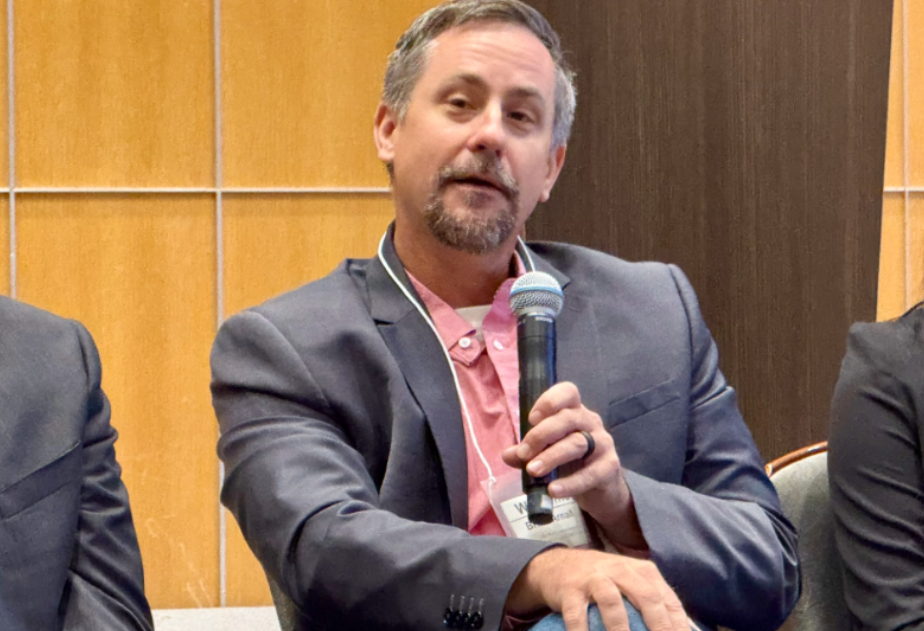
Drones are quickly becoming valuable tools for specific tasks on the farm. Farm Director KC Sheperd spoke with Oklahoma State University soil scientist Dr. Brian Arnall, who shared his perspective on how drone technology has evolved in agriculture. He explained that “mapping drones… is really where the drone technology first started jumping in, probably about six or seven years ago,” replacing older methods like satellite and aerial photography.
Arnall noted his own path into the field, saying, “I became a drone expert before I even touched a drone,” highlighting how early interest in remote sensing shaped his work. Despite the initial buzz, he admitted, “the progression has been really slow,” because while drones collect impressive amounts of data, “we’re still challenged in making really usable information from that data at a scalable level.” Discussing pasture mapping, Arnall said most producers aren’t yet fully using it, but the concept holds promise. “Could we use it for pasture mapping in that can we look at a pasture with a drone image and say, okay, we have this much Bermuda grass, and maybe this much weedy?” he asked. The goal, he explained, is to “get a better stock of what we have out there and maybe use it for guiding stocking rates or burning or herbicides.”
This kind of detailed imagery could allow for more targeted management of forage and weeds, improving both efficiency and productivity on rangeland. However, Arnall pointed out that scalability and processing remain major limitations. “There’s always been a little bit of a lag in upload,” he said, describing the complex software and time involved in making sense of drone data. He compared it to interpreting soil samples, noting, “I can give 20 people a drone map, and they’re going to give me 20 recommendations.”
| | October’s Warmth Gives Way to Fall Chill, But Dry Conditions Persist for Many | | |
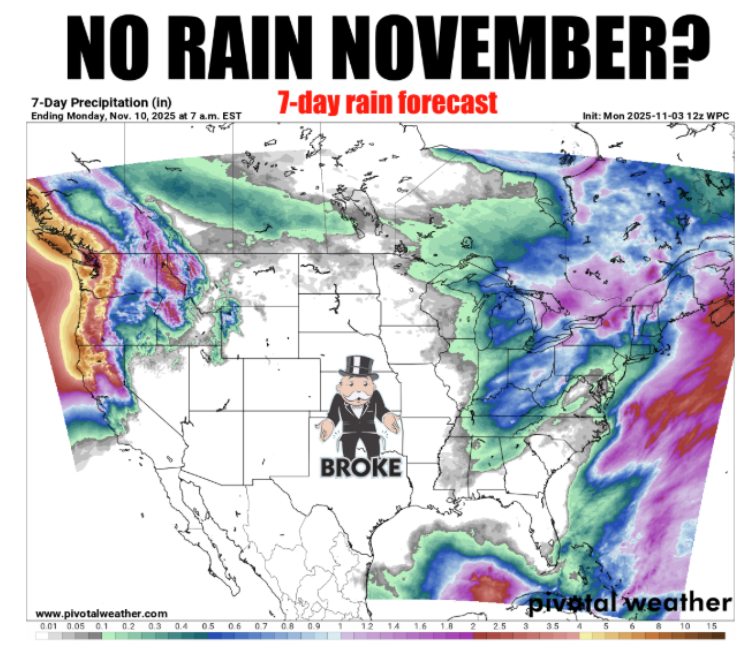
Oklahoma experienced a month of sharp contrasts in October, with early summer-like heat giving way to the season’s first freezes. However, significant rainfall was confined to the northeast, leaving much of the state with dry conditions that are expected to continue into November. The near-term forecast shows little to no significant rainfall expected over the next seven days, and no major winter cold outbreaks are on the immediate horizon.
Temperature: The first three weeks of October were dominated by warmth, with highs frequently reaching the 80s and 90s. The pattern shifted in the month’s final 10 days, bringing more seasonal highs in the 50s, 60s, and 70s. The season’s first freeze occurred on October 19 in the Panhandle, followed by a more widespread freeze in the month’s final four days. Overall, it was the 8th-warmest October on record (since 1895), with a statewide average temperature of 66.2°F, which is 4.9°F above normal.
The month’s high was 95°F (recorded at Goodwell and Grandfield), and the low was 24°F (at Boise City and Beaver).
Precipitation: Rainfall in October was starkly divided. The northeastern third of the state received widespread totals of 4 to 8 inches, representing a surplus of 2 to 4 inches for the area. Conversely, the southwestern third of the state saw deficits of 2 to 4 inches. The highest total was 7.93 inches at Stigler, while the lowest was 0.32 inches at Altus. Statewide, the average precipitation was 2.63 inches, which is 0.73 inches below normal.
| | Beef Board Chair Ryan Moorhouse on Tight Budgets, Big Returns, and Global Beef Demand | | |
Senior farm and ranch broadcaster Ron Hays spoke with Ryan Moorhouse, chairman of the Cattlemen’s Beef Promotion Board, who discussed the rollout of the new Beef Checkoff budget that began in October. Moorhouse and the other members of the CBB volunteer their time and are cattle producers that represent all segments of the cattle business- from cow-calf to stocker to feeder. He said many of the core efforts continue to be funded, explaining, “You see a lot of the same things — the foundational things like research and, of course, Beef It’s What’s For Dinner promotions — and then we’ve got some new things.”
One of those new efforts is the “Meat Demand Monitor” project, which Moorhouse noted had been renewed for another three years. He emphasized that even with “dollars tough right now,” the board is “able to spread them out and do a lot of good with the checkoff dollars.”
Despite optimism about ongoing projects, Moorhouse was realistic about the financial outlook facing the industry. He acknowledged that budgets remain tight and will likely stay that way for the foreseeable future. When asked about rebuilding the national cattle herd, he explained, “I get asked the question a lot, when are we going to get this herd expanded and get more cows? And I don’t have the answer. I wish I did, but it’s going to be a while, I think — a couple years if we get started right now before we really see anything.”
| | Dating back to 1891, Stillwater Milling Company has been supplying ranchers with the highest quality feeds made from the highest quality ingredients. Their full line of A & M Feeds can be delivered direct to your farm, found at their Agri-Center stores in Stillwater, Davis, Claremore and Perry or at more than 125 dealers in Oklahoma, Arkansas, Kansas and Texas. We appreciate Stillwater Milling Company’s long time support of the Radio Oklahoma Ag Network and we encourage you to click here to learn more about their products and services. | |  | |
National Livestock was founded in 1932 in Oklahoma City. National’s Marketing Division offers cattle for sale weekly at the Oklahoma National Stockyards in Oklahoma City. The Finance Division lends money to ranchers across several states for cattle production. The Grazing Division works with producers to place cattle for grazing on wheat or grass pastures.
National also owns and operates other livestock marketing subsidiaries including Southern Oklahoma Livestock Auction in Ada, Oklahoma, OKC West Livestock Market in El Reno, Oklahoma, and the nation’s premier livestock video sale, Superior Livestock Auction. National offers customers many services custom made for today’s producer. To learn more, click here for the website or call the Oklahoma City office at 1-800-310-0220.
| | | Cow Calf Corner Dr. Derrell Peel: What’s Next for Cattle and Beef Markets? | | |
Cattle futures and cash markets were pummeled by a barrage of politics the past two weeks. Negative market reactions piled up under a slew of political statements and proposals along with rumors about additional political actions that left market traders and producers running for the sidelines. Feeder cattle dropped $200-$300/head in value last week in Oklahoma auctions.
It’s important to remember that cattle market fundamentals have not changed…it’s the same supply and demand conditions that existed three weeks ago.
Political talk has included more beef imports from Argentina…largely irrelevant as an import source and with no expected impacts on U.S. beef prices as well as a possible reduction in Brazil tariffs…which could impact processing beef supplies slightly. Lack of data due to the government shutdown makes it hard to say how much the August tariffs on Brazil decreased beef imports and therefore how much removing/reducing them might increase beef imports. In any event it would be a return to market conditions that existed through July, including record high lean trimmings prices. Beef imports from Argentina and Brazil will have no impact on steak prices in the U.S.
| | National Sorghum Producers welcomes China sorghum announcement, calls for lasting trade commitments | | |
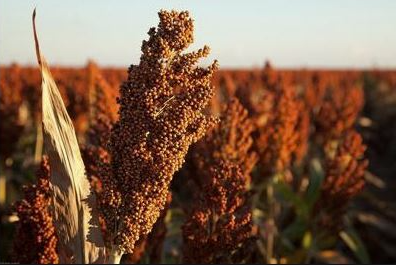
The National Sorghum Producers commends President Donald Trump, his administration—including the Office of the U.S. Trade Representative, the U.S. Department of Agriculture, the U.S. Department of Commerce and the U.S. Department of the Treasury—and congressional leaders following the President’s announcement that China has authorized the resumption of purchases of U.S. sorghum.
“The President’s meeting with President Xi, and sorghum being named, reflects sorghum’s importance to trade with China,” said Tim Lust, CEO of National Sorghum Producers. “Exports are vital to our industry, and today’s progress opens the door; however, we encourage the administration to finalize minimum purchase agreements with China of at least five million metric tons per year, reflecting the historical average of U.S. sorghum exports to the country. This will ensure consistent, reliable demand that provides long-term certainty for American sorghum growers.”
“We’re encouraged by this progress and look forward to seeing it translate into significant commercial sales in the days ahead,” said Amy France, chair of National Sorghum Producers and a farmer from Scott City, Kansas. “True success will come when we see shipments moving and grain flowing again from U.S. farms to our customers in China.”
| | American Angus Association fiscal year results show continued strength in beef industry | | |
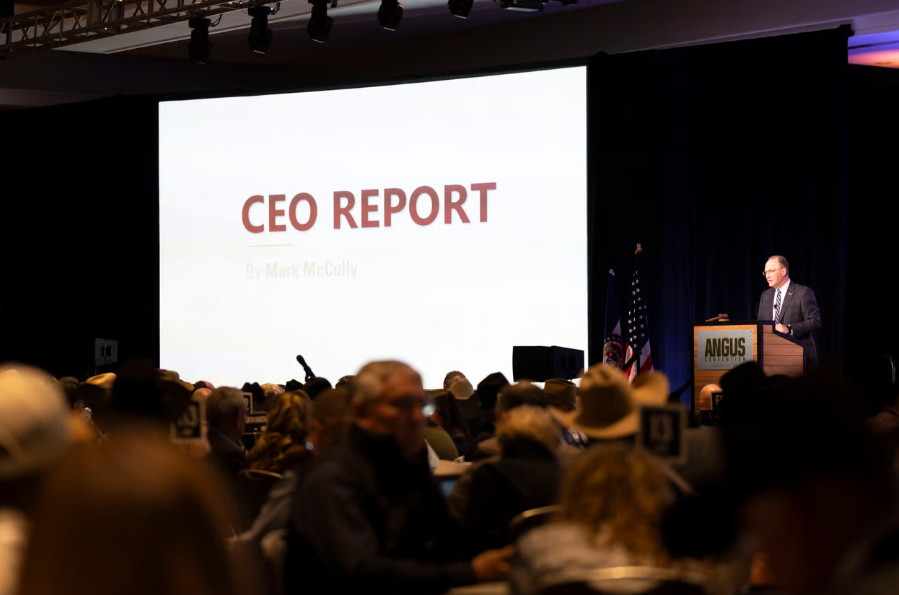
The American Angus Association® concluded a successful fiscal year in which registrations totaled more than 300,000 for the 11th consecutive year and were up nearly 2.4% from the year prior. Regular and junior memberships totaled 21,467. Leading seedstock sales during a record year in the cattle markets, registered Angus bulls and females both garnered high-dollar prices.
Bulls averaged $8,395 and females bested that number by $41 – an increase of $1,200 and nearly $1,600 respectively compared to the year prior. Demand not only supported the sale of cattle at a higher dollar but also an increase in the number of head sold during the same period. These market trends were the focus of several sessions held at the 2025 Angus Convention, October 31 – November 2, in Kansas City.
“We are fortunate to not only enjoy this historic market, but do it as a leader in the industry. That is not something we take lightly,” said Mark McCully, chief executive officer of the Association, while addressing the membership at the convention. “We have a responsibility to continue to improve the Angus breed by supporting our producers.”
| | Meat Institute to USTR: Renewed USMCA Critical to Meat and Poultry Industry, US National and Economic Security | | |
The Meat Institute today called on the Trump Administration to renew the U.S. Mexico Canada Agreement (USMCA) for its benefits to American meat and poultry companies and the entire U.S. animal protein value chain.
“USMCA has been a boon for the American meat, livestock, and poultry sector, along with the broader American food and agriculture economy and ancillary industries,” said Meat Institute President and CEO Julie Anna Potts. “It has provided steady income to American farmers, ranchers, and meat and poultry exporters; it has created jobs for American truck drivers, ports, and transportation companies; it has strenthened American food retail and food service establishments; and it has accomplished all of this through transparent rules that allow American businesses to proactively plan supply chains and develop durable customer relationships. No other trade agreement can boast the same success. President Trump deserves enormous credit for this extraordinary achievement.”
For more in depth information about the value of the Agreement to the meat and poultry industry, see The Meat Institute’s full comments in response to the U.S. Trade Representative’s (USTR) “Request for Comments on the Operation of the Agreement Between the United States of America, the United Mexican States, and Canada.”
| | Oklahoma Claims Four National Championships in Proficiency Awards at 2025 National FFA Convention | | |
At the 2025 National FFA Convention in Indianapolis, Oklahoma claimed four National Championships out of the 45 Proficiency Award categories. Agricultural proficiency awards honor FFA members who, through Supervised Agricultural Experiences (SAEs), have developed specialized skills that they can apply toward their future careers. Students compete in areas ranging from agricultural communications to wildlife management. Proficiency awards are also recognized at local and state levels and provide recognition to members exploring and becoming established in agricultural career pathways.
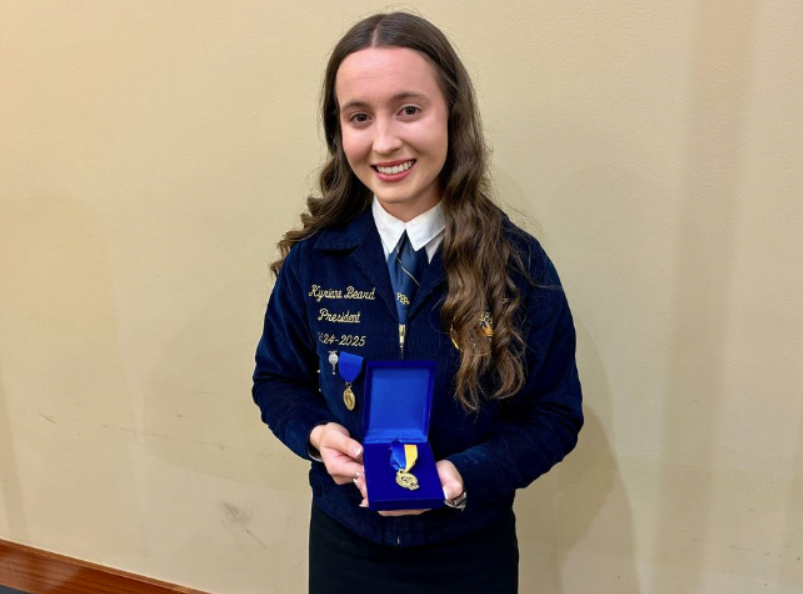
Agricultural Sales – Placement. Kenzie Mowery of the Chickasha FFA in Oklahoma has worked in sales and design at Life in Bloom Florals for three years. Mowery’s increasing responsibilities have included cleaning and disinfecting, organizing and conducting weekly inventory, and taking orders, as well as processing flowers, creating arrangements, and managing the store’s opening and closing duties. Agriscience Research – Animal Systems Kyriana Beard of the Stillwater FFA in Oklahoma performed research measuring factors related to health and exercise tolerance in horses with different exercise frequencies. Beard’s findings concluded which measures of exercise safety are useful, and how these findings can enhance animal welfare practices. Beard is supported by Kim Beard, and her FFA advisors Bailey Kliewer, Carl Nipper, and Robby Branscum.
Swine Production – Entrepreneurship Blake Weeks of the Meeker FFA in Oklahoma has a Supervised Agricultural Experience that consists of a show pig and sow herd operation. Weeks’s breeding operation profits by hosting private treaties and by selling to fellow breeders at live auctions. His show pig operation generates income through premium sales, winning shows, exhibiting breed champions, selling animals for meat, and selling animals to other swine breeders for breeding purposes. Wildlife Production and Management – Entrepreneurship/Placement Kizer Schneberger of the Carnegie FFA in Oklahoma has an entrepreneurship SAE in wildlife management that involves trapping turtles and furbearing animals and selling them to buyers licensed by the Oklahoma Department of Wildlife. Schneberger sells hides used in the garment industry to create sustainably produced clothing and apparel.
| | |
With the arrival of November- cattle markets have seemingly recovered from the political talk we dealt with in the second half of October- Live Cattle and Feeder Cattle Futures were both dollars higher- December Live Cattle up $2.52 at $232.20 while January Feeder Cattle up $4.62 settling at $336.52.
Choice Boxed beef prices began November on a firmer note, with both Choice and Select cutouts posting gains after two consecutive down days. On Monday, Choice boxed beef rose $1.12 to $379.25, while Select increased $1.28 to $359.93, narrowing the spread slightly to $19.32, compared to $19.48 on Friday. Movement slowed, with 77 loads reported, down from 115 to close out October.
The Oklahoma National Stockyards sold 5,850 head on Monday- Compared to last week: Feeder steers over 800lbs 10.00 higher in a light test, under 800lbs 25.00 higher. Steer calves 20.00-30.00 higher. Feeder heifers and heifer calves 15.00-25.00 higher. Feeder quality plain to average. Calf quality average with a few fancy drafts. Buyers were aggressively bidding on calves.
Joplin Regional had a total of 6,725 on Monday- Compared to last week feeder steers sold 10.00-40.00 higher. Feeder heifers sold 5.00-15.00 higher. Supply was moderate with very good demand. The market generally recovered from the "Adjustment" from last week.
OKC West is our Market Links Sponsor- they sell cattle three days a week- Cows on Mondays, Stockers on Tuesday and Feeders on Wednesday- Call 405-262-8800 to learn more.
Click here for our Markets Page on OklahomaFarmReport.Com- there you will find many of the reports we have linked on the right hand column found on the previous format of our email.
| | |
© 2025 Oklahoma Farm Report - All rights reserved
|
| | | |