Oklahoma's Latest Farm
and Ranch News
Friday, November 7, 2025
| | Its time for the friday farm funny!! farming and ranching can be stressful so enjoy a little laugh! | | New Severe Drought Develops In Southern Oklahoma | | |
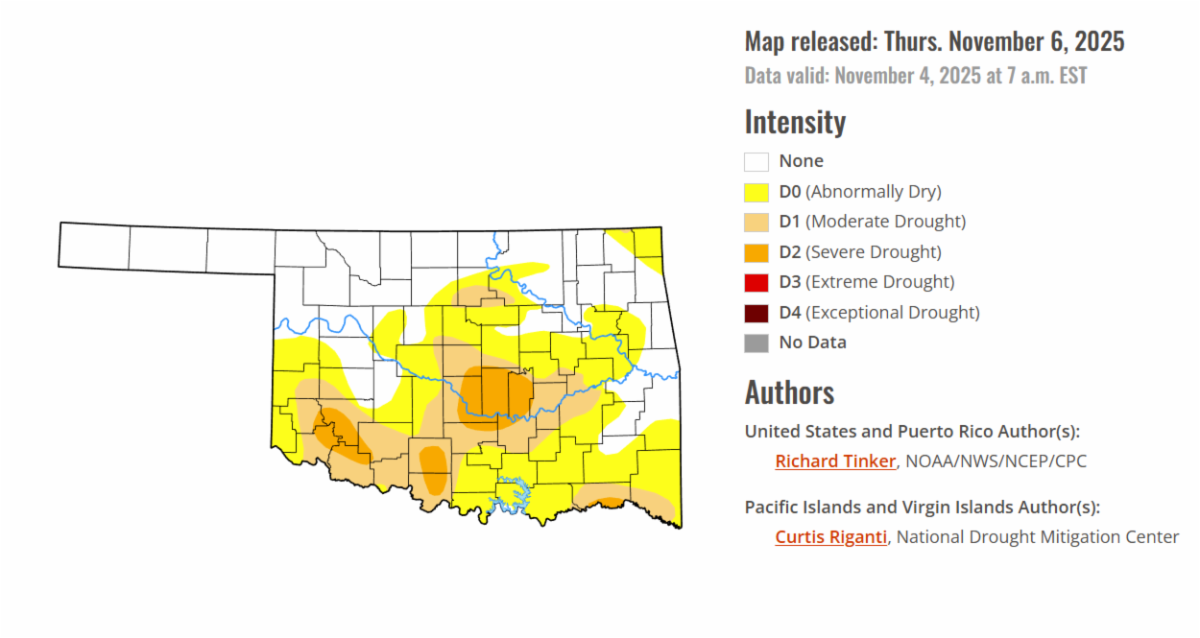
According to the latest Oklahoma Drought Monitor report, exceptional drought remains at 0 percent, unchanged from the start of the calendar year.
Severe Drought: Severe drought (D2) still remains in parts of central and southwestern Oklahoma, and new severe drought conditions have emerged in southern Oklahoma in Jefferson, Stephens, and Choctaw counties. All severe drought combined covers 6.23% of the state.
Widespread Dryness: Over 57 percent of the state is now experiencing abnormally dry to drought conditions versus over 52 percent last week. According to the 6-to-10-day precipitation outlook map, Oklahoma is leaning below 40-50% chance of precipitation through November 15, and the very westernmost tip of the panhandle is leaning below 33-40% chance of precipitation through that same date.
In the southern plains, Most locations across Tennessee, Arkansas, eastern Oklahoma, and northern Mississippi reported several tenths of an inch of rain, and similar totals fell on isolated areas across southern Mississippi, Louisiana, and coastal Texas. The remainder of the Region, including most of Texas and Oklahoma, observed no measurable rain.
| |
| Senator James Lankford Talks Shutdown, Ag Bill Delay, and Beef Price Strategy | | |
In a Zoom interview from Washington, D.C., Farm Director KC Sheperd, along with Oklahoma Senator James Lankford, announced a “possible end in sight” to the ongoing government shutdown, while sharply criticizing the Democratic strategy he claims caused the stalemate. When asked to explain the mechanics of the shutdown, Lankford said the current situation is unusual. He explained that in the past 13 impasses, both parties agreed to a “continuing resolution” (CR) to keep the government funded while negotiations continued. This time, Lankford said, Democrats refused a “clean” CR.“Republicans said, ‘Let’s just open the government at current year funding levels.’ And Democrats said, ‘No, I want a government shutdown to show our resistance to Trump,'” Lankford claimed.
Amid the shutdown, Lankford noted that negotiators have finalized three full appropriation bills, including the Agriculture (Ag) appropriation bill. However, he later noted that the shutdown has delayed other crucial legislation.“The farm bill that was scheduled to be taken up this fall, now with this shutdown, is now pushing that into spring to get the second half of the farm bill done,” he said.
Lankford also mentioned his recent discussion with the President about high beef prices.“The President’s really focused on how he can bring beef prices down,” Lankford said. “We’ve been very clear… It’s a deal on the Packers side of things, not on the farmers and ranchers.”Lankford also pushed back on the idea of importing more beef from Argentina. “Americans are used to good quality American beef. That’s what they’re looking for,” he said.
| | Breedr’s Ian Wheal on Building a ‘Full Circle Beef’ Supply Chain | | |
Senior farm and ranch broadcaster Ron Hays speaks with Ian Wheal, founder and CEO of Breedr, who shared how his background in Australia shaped his vision for the company. “I grew up in Australia, grew up in a cow-calf operation there,” Wheal said, adding that his father “spent a lot of time building co-ops and building supply chains.” That experience inspired him to create a platform focused on helping ranchers work together more efficiently. “Breeder is really focused on how do we bring this to individual producers… how do we enable these supply chains to vertically collaborate, but still put a lot of power in the hands of ranchers so that no one gets left behind.”
Wheal explained that Breedr’s platform centers on three main goals, starting with simplifying ranch data collection. “One is just really super easy data collection on the ranch,” he said. “We’re competing with pen and paper most of the time.” The app connects with EID readers and scales to log births, inventories, and weights — all from a phone. Wheal called it “a succession planning tool” since younger generations are comfortable using apps to manage operations. He emphasized that the data’s value extends beyond recordkeeping: “That data is also very valuable when you’re marketing your cattle and how that goes through into a supply chain.”
Breedr aims to close the loop between ranchers, feedyards, and packers. “We call it full circle beef,” Wheal said. “Instead of it being a chain that’s singular direction, how do we loop this back and how do we optimize our industry to deliver what the consumer wants?” Through Breedr’s system, data from packing plants can flow back to cow-calf producers, helping them make more informed culling and breeding decisions. “You’re not just thinking about phenotypically what it looks like,” he explained. “You’re starting to say, did its progeny kill well? Did it feed well?”
| | OSU’s Todd Hubbs Talks about how EPA is Reshaping Soybean Demand | | |
The U.S. Environmental Protection Agency (EPA) has been “extraordinarily active” in 2025, making three significant changes to the Renewable Fuel Standard (RFS) that are poised to reshape the biomass-based diesel market.
University of Illinois, Todd Gleason spoke to agricultural economists Dr. Todd Hubbs of Oklahoma State University and Dr. Scott Irwin of the University of Illinois, who outlined how these complex rulings create strong incentives for domestic soybean oil and other feedstocks. "It has been something this year,” Hubbs said, detailing the EPA’s recent actions. The changes, which are the focus of a new series of articles by Hubbs and Irwin, include: June: The EPA finalized the Renewable Volume Obligations (RVOs) for 2026 and 2027. July: The agency released a comprehensive ruling on Small Refinery Exemptions (SREs) that had been pending since 2018. September: The EPA established a new framework for reallocating those SREs.
These changes do not impact the 15-billion-gallon component of the RFS, which is generally met by corn-based ethanol. Instead, the focus is on biomass-based diesel (often called soy diesel). The mandate for this category is set for a 40% increase, rising from 5.36 billion gallons annually to 7.5 billion gallons by 2027. A major part of the EPA’s recent action was resolving the backlog of SREs, which allow small refineries to get out of the RFS mandate.
| | |
The vision of the Oklahoma Beef Council is to be a positive difference for Oklahoma's farming and ranching families and the greater beef community, and its mission is to enhance beef demand by strengthening consumer trust and exceeding consumer expectations.
To learn more, visit www.oklabeef.org. Also, don't forget to like its Facebook page at www.facebook.com/oklabeef for stories on Oklahoma's ranching families and great beef recipes.
And Check out this video below that helps you learn more about the Beef Checkoff- .
| |  | Great Plains Kubota is Oklahoma's family of full-line Kubota dealerships offering Kubota sales, service, and parts. As an Oklahoma Elite Kubota dealer, we have a large selection of Kubota Tractors, Kubota Mowers, Kubota Utility Vehicles, Kubota Construction Equipment and Kubota's line of Hay Tools. Give us a call today at 855-4KUBOTA or stop by any of our Kubota dealerships in Ada, Ardmore, Duncan, Edmond, Shawnee, Norman, Stillwater and our newest location serving western Oklahoma and beyond, Clinton. To schedule a DEMO with one of our Outside Salesmen, email gpsales@gpkubota.com Visit us and see why Great Plains Kubota is... rand that serves! | | | NCBA Supports Legislation to Expand Local Beef Sales | | |
The National Cattlemen’s Beef Association (NCBA) announced continued support for the Direct Interstate Retail Exemption for Certain Transactions (DIRECT) Act. This legislation introduced by Sens. Roger Marshall (R-KS), Tommy Tuberville (R-AL), and Cindy Hyde-Smith (R-MS) would increase marketing opportunities for smaller meat processors and give consumers more options to buy local beef.
“The cattle business benefits greatly from expanding marketing opportunities, and the DIRECT Act opens the door to the growing number of cattle producers who seek to grow their market across state lines,” said NCBA President and Nebraska cattleman Buck Wehrbein. “The increased market exposure for those cattlemen and women who are selling beef direct to consumers adds value and provides tremendous benefit for our farmers and ranchers.”
The DIRECT Act would allow state-inspected meat processors to sell beef across state lines, in limited quantities and through e-commerce, direct to consumers. The bill also protects food safety by ensuring a paper trail exists for tracing and containing potential food safety issues. Many of these direct-to-consumer marketing methods have rapidly increased in popularity during the last several years and consumers have recognized the convenience of buying local beef online.
| | Winter Supplementation and Body Condition Change Affect Cow Performance and Long-Term Calf Outcomes in Spring-Calving Herds | | |
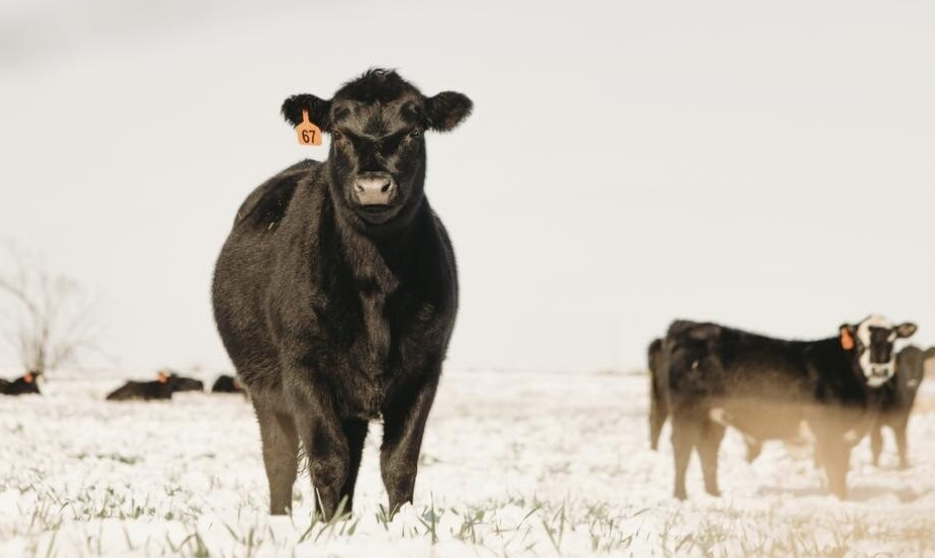
Nutritional management of beef cows during the winter months has lasting impacts on reproductive performance of the cow, calf health, and overall herd productivity in spring-calving herds. Recent research evaluating minimal and flexible supplementation strategies using distillers grains–based protein supplements for May-calving cows grazing native range compared three programs: a low daily rate (0.5 lb/cow/day), a standard rate (1.0 lb/cow/day), and a flexible strategy where cows were supplemented only during periods of environmental stress such as snow cover or cold rain. Supplementation began in January and ended about 30 days before calving.
Although cows receiving the lower supplementation rate were lighter at calving and tended to remain lighter at breeding, there were no differences among treatments in body condition score, pregnancy rate, calf birth weight, weaning weight, or subsequent feedlot performance and carcass characteristics. These results indicate that flexible supplementation during stressful weather can maintain productivity while reducing feed costs—a valuable option when winter feed prices are high.
Maintaining adequate cow body condition during late gestation, however, remains critical for both cow and calf success. Loss of body condition late in pregnancy can reduce colostrum quality and immunoglobulin content, weakening calf immunity and increasing disease susceptibility. Severe nutritional restriction in late gestation also decreases birth weight, especially in young cows, and can compromise the calf’s immune development.
| | A Reminder That All Three Parts of the Producer Safety Net Matter | | |
Joe Outlaw and Bart Fischer write: Over the past few months, producers have asked us on multiple occasions…since the ARC and PLC programs aren’t going to help very much, why don’t we just forget it and use the money on crop insurance that does help? This article contains the answer we typically give to that question.
First, remember that the producer safety net is made of three parts: ARC and PLC, marketing assistance loans, and crop insurance. Over the past few years, ARC and PLC have not kept pace in offsetting producer losses resulting from low commodity prices and extremely high production costs. The marketing assistance loan program provides a harvest-time loan to producers who need the cash flow but do not want to sell at harvest, which is typically the lowest prices of the year.
Not all producers utilize the marketing assistance loan program; however, in the South, cotton producers have routinely used this program. At the same time, producers have reported that crop insurance programs (especially revenue insurance) have been a very useful safety net for their operations and that crop insurance was the most important part of the safety net. We cannot disagree with this assertion.
| | Cantrell And Grissom Cattle Co. Bull And Female Sale | | |
Cantrell-Grissom Cattle Co. bull and female sale will take place this Saturday November 8th at 12:30PM in Earlsboro Oklahoma. The sale will be held at the Cantrell-Grissom Cattle Company Sale Facility at 35351 E111 Road in Earlsboro.
The event will feature over 250 head, including Registered Angus females, donor prospects, bred cows, heifer calf pairs, and 35 Registered Angus bulls alongside commercial Charolais and Angus cows. Highlighted sires include C-G Confidence Plus 4504, C-G Fireball 4003, C-G Commerce 4217, and C-G Growth Fund 4701.
Stream the sale live at Liveauctions.tv and for more information visit their website here or call Clint Grissom at (405)576- 9188. The sale is being managed by Matt Sims at MCS Auctions- 405-641-6081.
| | |
With the expanded limits- cattle futures traded lower but off the lows of the day-December live cattle closed $1.75 lower at $218.77, February live cattle closed $1.37 lower at $216.75 and April live cattle closed $0.87 lower at $216.70. November feeders closed $3.67 lower at $322.05, January feeders closed $4.37 lower at $315.60 and March feeders closed $4.67 lower at $311.00.
It was a mixed day on Thursday for our Boxed Beef- Choice Boxed Beef dropped 29 cents to finish at $377.97 while the select cutout was 51 cents higher at $360.76. The Choice-Select spread is at $17.21 with 129 loads.
Woodward sold 1,418 head on Thursday- Compared to last week: Feeder steers 10.00 to 20.00 lower. Feeder heifers, no enough last week for an accurate trend. Steer calves mostly steady. Heifer calves 15.00 to 20.00 lower.
OKC West is our Market Links Sponsor- they sell cattle three days a week- Cows on Mondays, Stockers on Tuesday and Feeders on Wednesday- Call 405-262-8800 to learn more.
Click here for our Markets Page on OklahomaFarmReport.Com- there you will find many of the reports we have linked on the right hand column found on the previous format of our email.
| | |
© 2025 Oklahoma Farm Report - All rights reserved
|
| | | |