Oklahoma's Latest Farm
and Ranch News
Friday, November 14, 2025
| | Its time for the friday farm funny! Thanksgiving is just around the corner, so this joke will get you ready... maybe..!! | | Extreme Drought Emerges In This Weeks Drought Monitor | | |
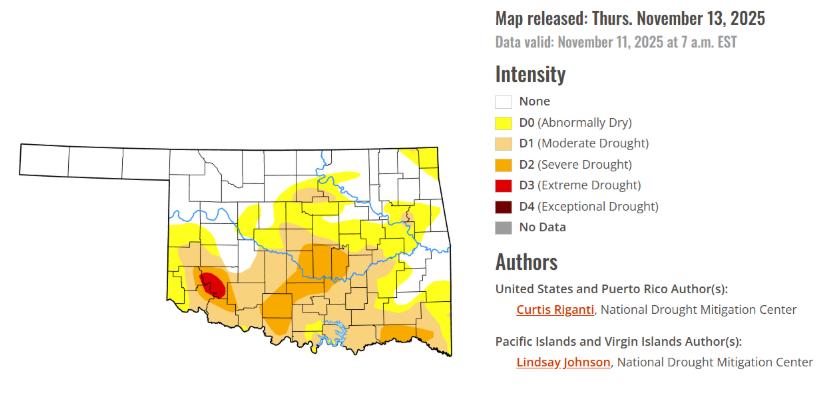
According to the latest Oklahoma Drought Monitor report, exceptional drought remains at 0 percent, unchanged from the start of the calendar year.
Extreme Drought (D3) has now emerged in southwestern Oklahoma in Kiowa, Jackson, and Greer counties, covering 0.8% of the state.
Southern Oklahoma: This area is the epicenter of the current concern. Extreme Drought (D3) has now emerged in southwestern Oklahoma, specifically in Kiowa, Jackson, and Greer counties, covering approximately 0.8% of the state.
Central & Southwest: Severe drought (D2) continues to persist in parts of central and southwestern Oklahoma, with recent expansions noted in counties like Jefferson, Stephens, and Choctaw.
The latest map indicates a trend across the state, particularly in the southern regions. After a dry week combined with unseasonably warm temperatures, "widespread degradations" were recorded from the southern half of Oklahoma extending into southwest Arkansas. According to the 6-to-10-day precipitation outlook map, Western Oklahoma is leaning above 60-70% chance of precipitation through November 22, while the rest of the state is leaning above 50-60% through that same date.
| | OSU’s Todd Hubbs Previews Post-Shutdown USDA Reports and Grain Market Outlook | | |
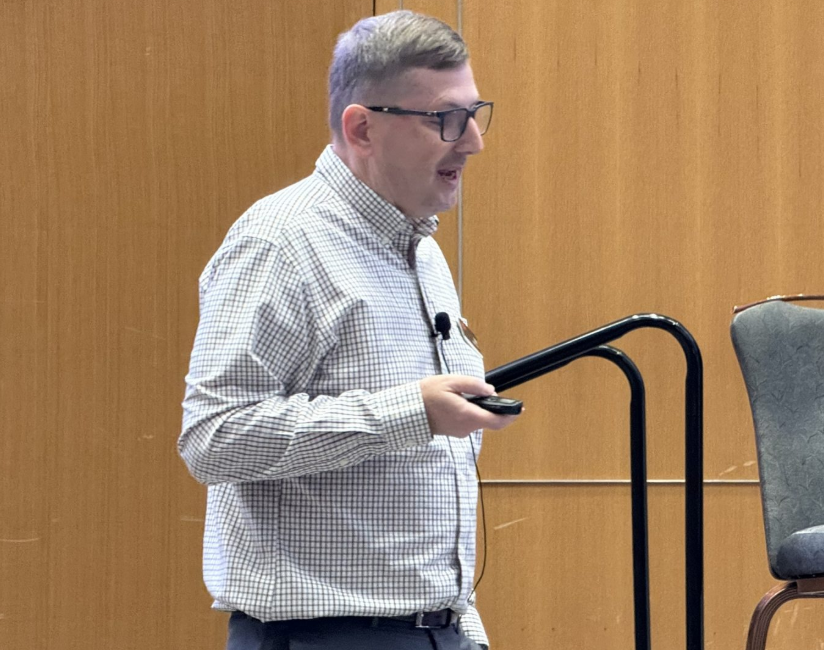
With the government finally reopening, the agricultural sector is preparing for a surge in data next week. Todd Hubbs Previews Post-Shutdown USDA Reports and Grain Market Outlook. Oklahoma State University Crop Marketing Specialist, Dr. Todd Hubbs, says the USDA is set to play catch-up starting today, November 14, with the release of the highly anticipated WASDE and Crop Production reports.
Speaking with Farm Director KC Sheperd, Hubbs outlined what producers should expect as the data begins to flow again and provided an outlook for Oklahoma’s key commodities.
Hubbs confirmed that while the WASDE and Crop Production reports will drop today, the USDA will likely release other backlog data, such as export sales, gradually over the coming months. “It’s been reported that the export sales data will be coming out gradually… as they catch up,” Hubbs noted. He explained that while crop analysts can return to work and produce reports quickly, other metrics like census and trade data take longer to update.
The wheat market has been “bumping along” this week, largely in a holding pattern while traders await Friday’s data. Hubbs noted that while the USDA had previously issued strong forecasts for major global wheat producers, he expects they might raise global production numbers slightly. “Ending stocks might come up slightly, but it won’t be a huge jump,” Hubbs said. Domestically, he expects the balance sheet to add roughly 25 million bushels to ending stocks, reflecting higher production numbers from the Small Grains Summary in September.
| | Dr Jason Sawyer: More Sterile Flies Needed to Push New World Screwworm Back to South America | | |
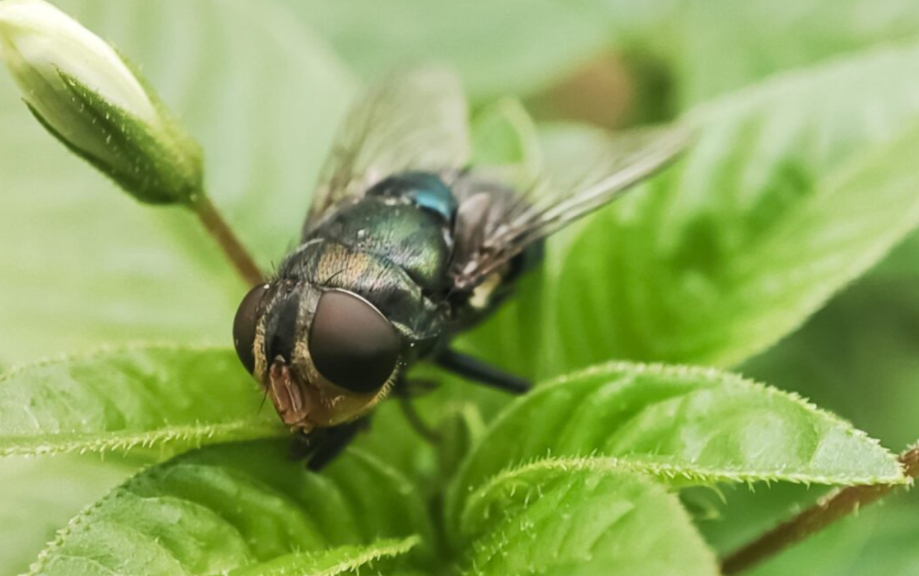
Senior farm and ranch broadcaster Ron Hays features comments made by one of the speakers at the recent King Ranch Institute for Ranch Management Symposium, Dr Jason Sawyer, Chief Science Officer of the East Foundation discussed the urgent threat posed by the potential return of the New World screwworm across the Rio Grande. The East Foundation oversees 217,000 acres across six ranches in South Texas, an area that would be “literally on the front lines” if the pest crosses into the U.S. Sawyer emphasized that government collaboration is vital in this battle, saying, “The long-term answer here is more sterile flies.”
Dr. Sawyer detailed ongoing efforts to control the spread of the screwworm through sterile fly production. “The 100 million flies being produced in Panama couldn’t quite hold the line,” he explained, noting that new facilities in Mexico and the U.S. are critical. A facility under development in Mexico will “produce an additional 150 to 300 million” sterile flies weekly, while a larger U.S. facility, backed by a $750 million USDA commitment, could yield “around 500 to 600 million flies per week for distribution and eradication.” According to Sawyer, this level of production mirrors historical efforts that required “the weekly dispersal of between 500 and 700 million flies for 20 years” to eliminate the pest in earlier decades.
Sawyer warned that complacency could have severe consequences. “It would be really easy for some of us to say, hey, these things are way down there in southern Mexico… forget about it,” he cautioned. “If we don’t construct these new facilities and fulfill that total eradication plan, they will be in Texas.” His message was clear — preparation and continued investment are the only ways to prevent a devastating outbreak that could impact livestock and wildlife across South Texas.
| | |
The vision of the Oklahoma Beef Council is to be a positive difference for Oklahoma's farming and ranching families and the greater beef community, and its mission is to enhance beef demand by strengthening consumer trust and exceeding consumer expectations.
To learn more, visit www.oklabeef.org. Also, don't forget to like its Facebook page at www.facebook.com/oklabeef for stories on Oklahoma's ranching families and great beef recipes.
And Check out this video below that helps you learn more about the Beef Checkoff- .
| |  | |
The Oklahoma Cattlemen's Association is the trusted voice of the Oklahoma Cattle Industry. With headquarters in Oklahoma City, the OCA has a regular presence at the State Capitol to protect and defend the interests of cattlemen and cattlewomen.
Their Vision Statement explains the highest priority of the organization- "Leadership that serves, strengthens and advocates for the Oklahoma cattle industry."
To learn more about the OCA and how you can be a part of this forward-looking group of cattle producers, click here for their website. For more information- call 405-235-4391.
| | | Lawmakers and Ag Groups Applaud End of Record-Breaking Shutdown | | |
American Farm Bureau Federation President Zippy Duvall commented on the House vote to end the government shutdown. “Farm Bureau applauds the House for its vote to end the government shutdown, swiftly following the Senate’s vote. Farmers and ranchers rely on critical USDA services and disaster relief programs during these tough economic times, as do Americans who need access to food assistance programs and other services. “We urge President Trump to quickly sign the continuing resolution so Congress can return its focus to policies that will improve the farm economy and expand opportunities for America’s farm families.”
The National Association of Wheat Growers (NAWG) CEO Sam Kieffer issued the following statement: “NAWG welcomes Congress’s decision to reopen the federal government. This action provides critical funding to restart full USDA operations and the essential services that America’s farmers depend on to grow safe and nutritious food. The vote by Congress also continues support for vital wheat research to benefit growers and consumers in the United States.” “While this is a positive step, America’s wheat growers call on Congress to turn toward a long-term, bipartisan Farm Bill that provides clarity and certainty in turbulent times with low commodity prices and high input costs. In addition, Congress must prioritize fully reauthorizing the U.S. Grain Standards Act to facilitate market stability and confidence in U.S. wheat exports.”
National Cattlemen’s Beef Association (NCBA) Senior Vice President of Government Affairs Ethan Lane released the following statement in response to Congress passing a Continuing Resolution to end the government shutdown: “American cattle producers need the federal government running at full capacity to provide critical services and market data. We thank Speaker Johnson and Majority Leader Thune for passing the funding package to end the shutdown and extend the Farm Bill. While we’re grateful to the Trump administration for easing the burden of the shutdown on producers, it still caused widespread disruptions, and we are glad it is now resolved.”
| | USDA Announces Opening of Sterile Fly Dispersal Facility in Tampico, Mexico | | |
The U.S. Department of Agriculture (USDA) announced the next milestone in the fight against New World screwworm (NWS) – the opening of a sterile fly dispersal facility in Tampico, Mexico. The Tampico facility will allow USDA to disperse sterile flies aerially across northeastern Mexico, including in Nuevo Leon.
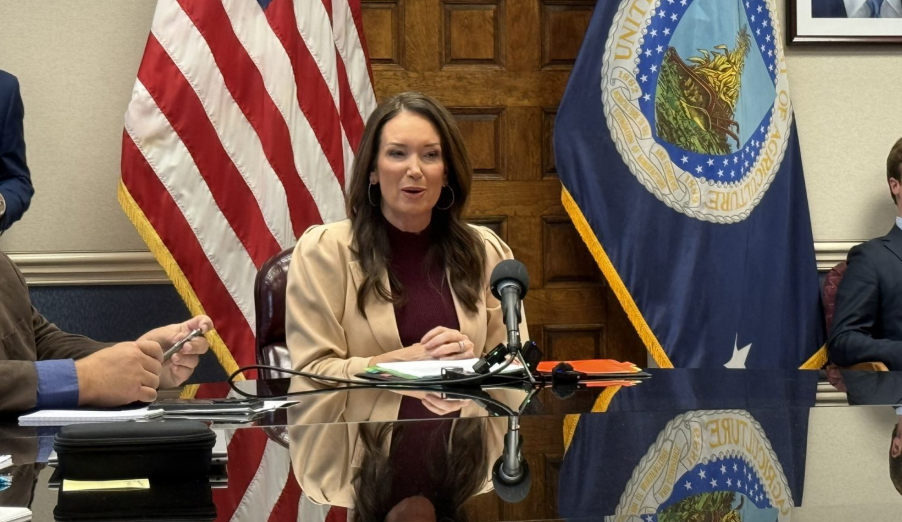
“The opening of the Tampico sterile fly dispersal facility is another incredibly important tool in our arsenal to stop the spread of screwworm. The facility will ensure flexibility and responsiveness in northern Mexico, giving us a greater ability to drop sterile flies and continue to push the pest south,” said U.S. Secretary of Agriculture Brooke L. Rollins.
“Stopping the spread of screwworm is a top priority for the entire Trump Administration. Last week I had a productive meeting with Mexican President Claudia Sheinbaum and my counterpart Secretary Julio Berdegue on the joint response to screwworm. We are boosting our efforts and completing a joint review of our screwworm operations in Mexico to ensure our protocols are being followed. As we enter the winter months, we continue to prioritize the response in Mexico and the rest of our five-pronged plan (PDF, 434 KB) to protect U.S. livestock and the livelihoods of American farmers and ranchers.”
| | Despite Volatility, Optimism Reigns at USMEF Conference in Indianapolis | | |
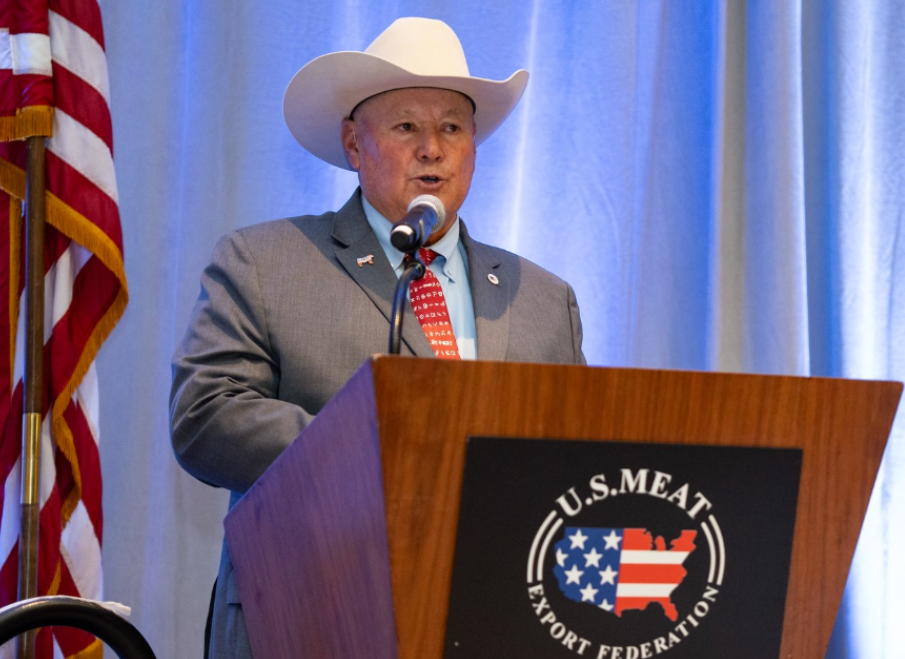
Although the U.S. red meat industry faces significant obstacles in the international marketplace, demand remains robust in many key destinations where customers crave the quality and consistency of U.S. pork, beef and lamb. This was the prevailing message delivered by U.S. Meat Export Federation (USMEF) President and CEO Dan Halstrom at the USMEF Strategic Planning Conference, which opened Wednesday in Indianapolis.
Halstrom noted that pork exports are modestly below last year’s record pace, but the gap stems mostly from a period early this year when China’s retaliatory tariffs escalated and the U.S. industry faced uncertainty about plant eligibility. Although export data is only available through July due to the government shutdown, pork shipments are on record pace to leading market Mexico, as well as to Central America and Colombia.
Beef exports have been hit harder by barriers in China, where U.S. beef not only faces retaliatory tariffs, but also unwarranted plant delistings and China’s failure to renew registrations for the vast majority of U.S. beef plants and cold storage facilities. Halstrom emphasized that fully reopening the world’s largest beef import market to U.S. beef will require several actions on China’s part, and the lockout could extend into next year.
| |
USDA Extends Livestock Disaster Recovery Assistance Application Deadline for 2023 and 2024 Flood and Wildfire Losses
| |
The USDA Farm Service Agency (FSA) today announced that the deadline for livestock producers to apply for assistance through the Emergency Livestock Relief Program for 2023 and 2024 Flood and Wildfire (ELRP 2023 and 2024 FW) is being extended to Nov. 21, 2025. The program is expected to provide approximately $1 billion in recovery benefits to producers whose livelihoods were adversely impacted by disrupted feed availability and poor forage conditions following catastrophic floods and wildfires in 2023 and 2024.
To streamline program delivery, FSA determined eligible counties with qualifying floods and wildfires in 2023 and 2024. For losses in these counties, livestock producers are not required to submit supporting documentation for floods or wildfire. A list of approved counties is available at fsa.usda.gov/elrp.
For losses in other counties, livestock producers may still be eligible for ELRP 2023 and 2024 FW but must provide supporting documentation to demonstrate that a qualifying flood or wildfire occurred in the county where the livestock were physically located or would have been physically located if not for the disaster event.
| | Secretary Rollins Leads Largest USDA Trade Mission to Mexico, Participates in New World Screwworm Joint Reviews | | |
Last week in Mexico City, Mexico, U.S. Secretary of Agriculture Brooke L. Rollins led the largest U.S. Department of Agriculture agribusiness trade mission in the country's history. During the mission to Mexico, 41 U.S. businesses, 33 cooperators and agriculture advocacy groups, six state departments of agriculture, and 150 participants conducted more than 500 business-to-business meetings over three days. This was a critical opportunity for American businesses to strengthen trade ties and for the USDA to continue its aggressive response to New World Screwworm (NWS) in Mexico, while also holding Mexico accountable for its commitments under the 1944 Water Treaty.
“The trading and diplomatic relationship between our two countries is of the utmost importance to President Trump and American farmers and ranchers. Whether it is securing the Southern Border from illegal migration, combating New World Screwworm, or expanding market access for American agricultural products, we are working every day to put American interests first.
I thank President Claudia Sheinbaum for welcoming me to the Presidential Palace where we had a productive and positive conversation about how we will continue to work closely together to eradicate the NWS which is negatively impacting both our economies, including conducting a comprehensive joint review of our NWS response and efforts to ensure enforcement of our joint responsibilities in the 1944 water treaty,” said Secretary Brooke Rollins.
| |
Checking the Markets...
It was another lower-waning day for the livestock complex as all three of the markets closed lower. Some cash cattle trade developed throughout the day as well, and prices traded mostly $3.00 lower in the South, but $7.00 to $10.00 lower in the North. December live cattle closed $6.27 lower at $219.00, February live cattle closed $6.02 lower at $218.95 and April live cattle closed $5.90 lower at $218.60. Thursday's slaughter is estimated at 120,000 head, 8,000 head more than a week ago and 4,000 head less than a year ago.
Boxed beef prices closed lower: choice down $0.88 ($373.57) and select down $4.91 ($355.03) with a movement of 131 loads (88.95 loads of choice, 20.46 loads of select, 8.78 loads of trim and 12.45 loads of ground beef)
| | |
Click here for our Markets Page on OklahomaFarmReport.Com- there you will find our latest reports on cattle auctions, boxed beef, cash grains and market analysis.
OKC West is our Market Links Sponsor- they sell cattle three days a week- Cows on Mondays, Stockers on Tuesday and Feeders on Wednesday- Call 405-262-8800 to learn more.
| | |
© 2025 Oklahoma Farm Report - All rights reserved
|
| | | |