Oklahoma's Latest Farm
and Ranch News
Friday, November 21, 2025
| | It's time for the Friday farm funny!! Farming and ranching can be stressful, so enjoy a little laugh! | | Extreme Drought Continues To Spread In This Weeks Drought Monitor | | |
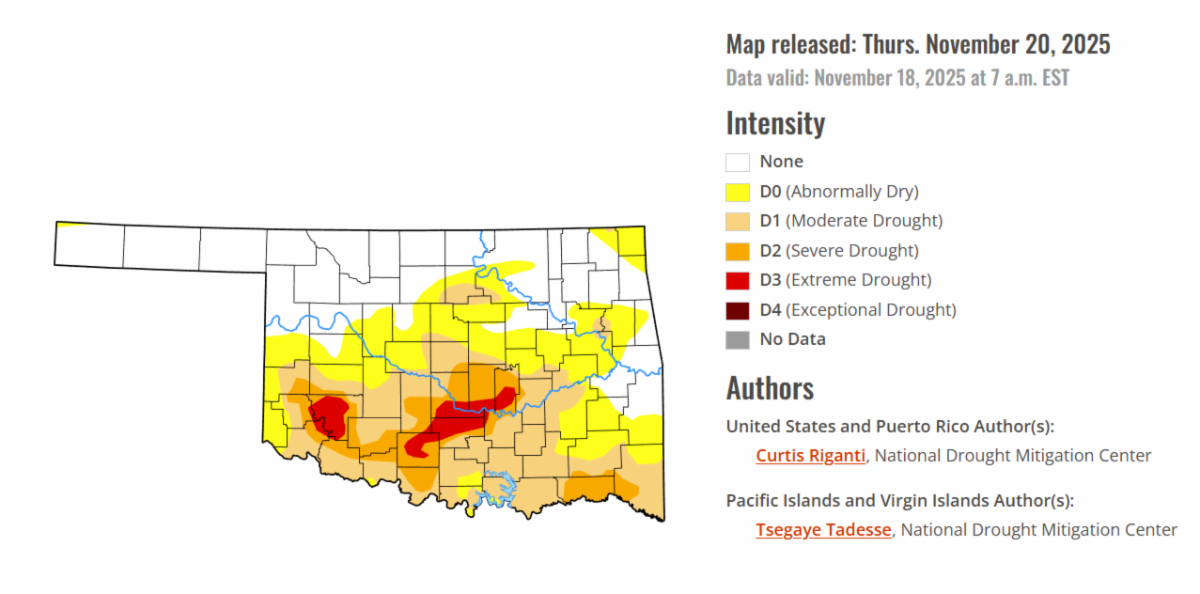
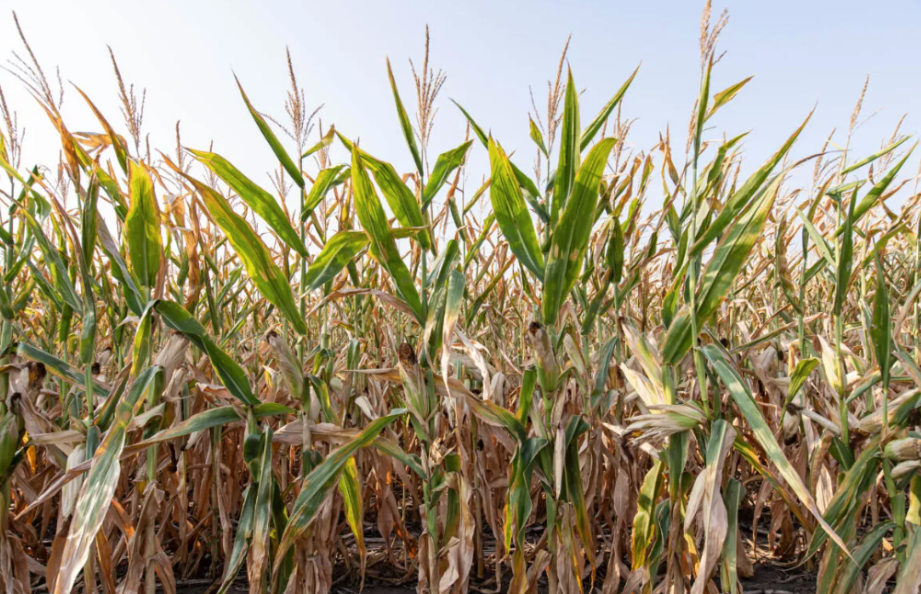
According to the latest Oklahoma Drought Monitor report, exceptional drought remains at 0 percent, unchanged from the start of the calendar year. Extreme Drought (D3) has grown significantly in the south this week, covering 3.48% of the state. New extreme drought has been reported in Stephens, Garvin, McClain, Cleveland, Pottawatomie, and Seminole counties. Overall dryness covers 61% of the state, including D0 to D3 drought.
According to the 6-to-10-day precipitation outlook map, southern Oklahoma is expected to see near-normal conditions through November 29, and northern Oklahoma is leaning above a 33-40% chance of rain through that same date.
In the southern plains, Dry weather occurred across nearly the entire South region this week, which led to widespread degradations in conditions in some states. Warmer-than-normal temperatures occurred in parts of Texas and Oklahoma and some locales in Arkansas, while near- or below-normal temperatures were more common elsewhere. In the Texas Panhandle and southwest parts of the Lone Star State, temperatures of at least 9 degrees above normal were common.
| |
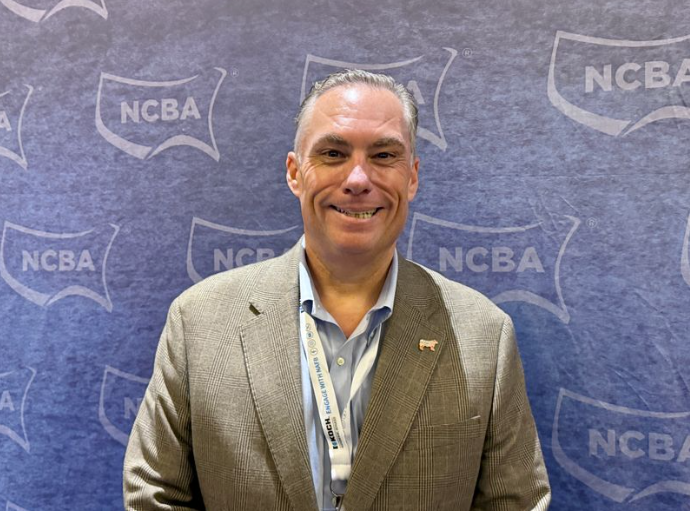
| Ethan Lane on U.S. Beef Trade and Screwworm Threat | | |
Senior farm and ranch broadcaster Ron Hays speaks with Ethan Lane of the National Cattlemen’s Beef Association regarding concerns from the U.S. cattle industry about China allowing beef plant export credentials to expire without renewing them. Lane expresses deep frustration with the lack of U.S. progress in correcting the situation, emphasizing that the lost access represents “$165 a head, give or take, in value to producers.” Despite repeated industry pressure, Lane notes, “We have not heard anything on that front, and so it does not appear that anything was done there.” The silence from policymakers, he says, has been “deafening.”
Lane underscores that the industry had been led to believe beef access was included in earlier trade conversations. He explains, “We were told for quite a long, long time that it was in the mix and part of the discussion, but clearly they weren’t able to make any headroom on that.” Looking ahead, he points to the administration’s plan for annual trade reviews and stresses the importance of making beef access a priority: “Obviously, we’re advocating that this be part of the conversation immediately.”
The conversation then shifts to the emerging new world screwworm threat, which Lane says is “a tough situation” that has placed significant pressure on Agriculture Secretary Brooke Rollins. Lane praises her handling of the crisis: “I think the Secretary has done well… making it clear to [Mexico] repeatedly what it is the U.S. side needs to see from them.” He notes that cooler weather has temporarily slowed fly production, offering “a little bit of a breather,” but emphasizes that long-term readiness is essential.
| | Pork Exports Remain Strong in August; Beef Decline Continues; Lamb Exports Trend Higher | | |
USDA has released August red meat export data, which was delayed due to the lengthy government shutdown. As compiled by the U.S. Meat Export Federation (USMEF), August data showed a relatively strong performance for U.S. pork exports and an uptick in shipments of U.S. lamb cuts. But beef exports were sharply lower than a year ago, impacted heavily by an impasse with China that has effectively locked U.S. beef out of the world’s largest import market.
August pork exports totaled 236,311 metric tons (mt), down 1% from a year ago, valued at $685.9 million (down 2%). August exports were bolstered by another remarkable performance by leading market Mexico, where shipments climbed 8% from a year ago to 102,790 mt, the fifth largest volume on record. Export value reached $252.3 million, up 9% and the second highest on record, trailing only December 2024.
For January through August, pork exports were 3% below last year’s record pace in both volume (1.93 million mt) and value ($5.48 billion). This gap is mostly attributable to lower exports to China, where U.S. pork faces retaliatory tariffs. This situation was especially disruptive in the spring months, when tariffs imposed by the U.S. and China temporarily escalated and there was growing uncertainty about the continued eligibility of U.S. plants.
| |
| |
The vision of the Oklahoma Beef Council is to be a positive difference for Oklahoma's farming and ranching families and the greater beef community, and its mission is to enhance beef demand by strengthening consumer trust and exceeding consumer expectations.
To learn more, visit www.oklabeef.org. Also, don't forget to like its Facebook page at www.facebook.com/oklabeef for stories on Oklahoma's ranching families and great beef recipes.
And Check out this video below that helps you learn more about the Beef Checkoff- .
| |  | |
KIS FUTURES specializes in Futures and Options for Institutions, Commercials, Hedgers, and Individual Traders and executes trades for its clients in the following markets: Livestock, Grains, Energy, Metals, Softs, Financials, Currencies, and Stock Index Futures. For more information, please give them a call Toll Free at (800) 256-2555. Click here for their website to learn more.
And- their iPhone App, which provides all electronic futures quotes is available at the App Store- click here for the KIS Futures App for your iPhone.
| | | EHV Outbreak Explained by Dr. Jason Thorne | | |
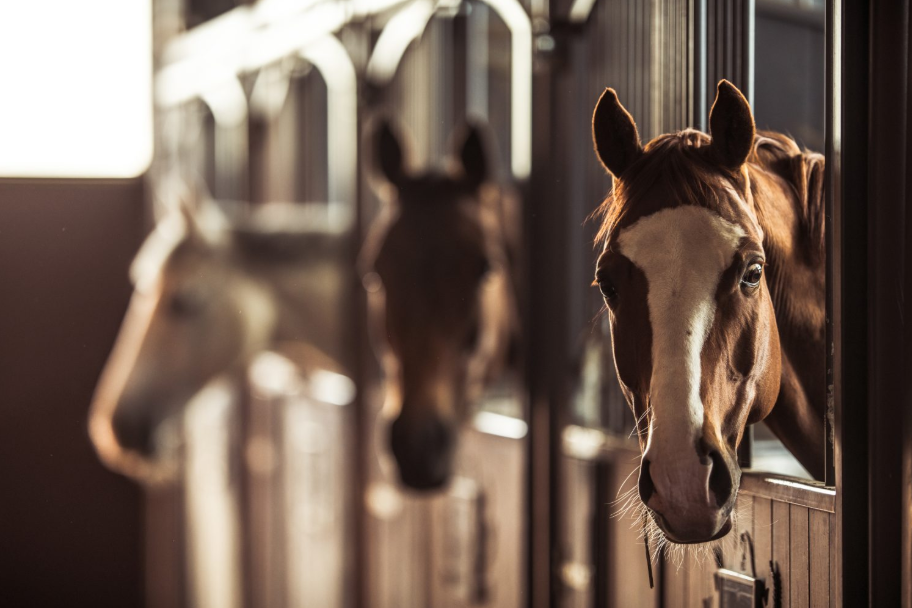
Associate farm reporter Carli Davenport spoke with Dr. Jason Thorne, a veterinarian and the owner of Territory Medicine in Weatherford, Oklahoma, about the ongoing EHV outbreak. The virus is believed to have originated at an event in Texas and has sparked widespread concern among horse owners, particularly in Oklahoma and Texas. Many organizations and boarding facilities have canceled major events and advised owners to suspend hauling and implement quarantine measures as a precaution.
Dr. Thorne explains the basics of the virus, noting that “EHV is a virus, a herpes virus to be exact in horses.” He distinguishes between the two primary problematic strains—Type 1 and Type 4—stating, “There are other types, but in our populations, really it’s just one and four causing problems.” Regarding the Texas event, dr thorne adds, “I believe what happened in Texas is going to be an EHV one,” which typically presents first as a respiratory infection.
On transmission, Dr. Thorne emphasizes the role of stress in triggering viral shedding: “ More than likely, A very stressed animal was allowed to recrudesce the virus. And then poof, you have this extremely contagious virus that spreads rapidly.” While noting that the virus does not persist as long in open environments, he warns, “It’ll be very, very contagious.” He explains that the virus may linger silently in a horse until reactivated by a stressful event, making early detection and control challenging.
| | Meat & Poultry Processors Contribute $57.3 Billion to the US Economy; Provide 584,000 Jobs | | |
The Meat Institute released an economic study that found the meat and poultry processing industry contributes $57.3 billion to the US economy and provides 584,000 jobs. The entire meat and poultry industry, including livestock production, animal feed, equipment manufacturing, transportation and more contributes $347.7 billion in value to the nation, supporting 3.2 million jobs.
“The meat and poultry industry is a critical and growing part of the US economy, and one that has outsized importance to rural economies,” said Meat Institute President and CEO, Julie Anna Potts. “Our member companies are often the biggest employers in their rural communities, and their impact goes beyond jobs.
In addition to the taxes they pay, they invest in their communities with generous donations of food and make financial and other irreplaceable contributions to local infrastructure like housing, community spaces, schools, and childcare.”
| | Farm Bureau Applauds Senate Action to Restore Whole Milk in Schools | | |
American Farm Bureau President Zippy Duvall applauded Senate passage of the bipartisan Whole Milk for Healthy Kids Act of 2025. “This is a win-win for kids and dairy farmers because the nutritional benefits of whole milk are now broadly known. By lifting the restrictions on whole and reduced-fat 2% milk in schools, kids have more access to important protein, calcium and vitamins. Because school milk accounts for almost 8% of fluid milk demand, it’s a significant market driver, too.
“Many thanks to the bipartisan leadership from Sens. Welch and Marshall as well as that from Chairman Boozman and Ranking Member Klobuchar for getting the bill across the finish line in the Senate. I urge the House to act quickly to get it to President Trump’s desk.
“This vote follows letters from AFBF to the president and Congress that, among other priorities, urged for the restoration of whole milk in schools to ensure children have access to nutritious dairy products. The availability of whole milk in schools is a step toward helping the struggling agricultural economy. We look forward to working with Congress and President Trump to advance priorities that benefit families and America’s farmers.”
| | E15 for All, a Win-Win for Farmers and Consumers | | |
Making E15 available across the country year-round would deliver real benefits for farmers, consumers and the country. America’s farmers are always looking for how we can do better for our families, our rural communities and our nation. We are committed to growing nutritious food for families across the country, and we are proud to help deliver products that make Americans’ daily lives more affordable and sustainable. Biofuels, like E15, are boosting farm businesses, improving the environment, and reducing costs at the pump.
Farmers are facing the toughest farm economy in a generation, with historically low row crop prices and record-high and ever-increasing production expenses. Some farm families are uncertain whether they can hang on for another season. Since 2017, we have lost more than 160,000 farms, and that number will only rise if relief doesn’t come soon. Farm Bureau has been calling on Congress and the administration to deliver short- and long-term solutions to ensure our farms and rural communities not only survive but thrive.
The challenges facing our farms are as diverse as the crops we grow. There’s not one quick solution for all of the farm economy, but there are plenty of clear steps that lawmakers can take to help, from addressing the labor crisis to finally passing a new, modernized farm bill. Earlier this fall, Farm Bureau sent a letter to Congress and the President outlining several policy solutions to help farm country. A top priority on that list: making E15 available year-round. Just last week, I had the opportunity to meet with senior White House officials to discuss this issue.
| | Thanksgiving Dinner Cost Analysis: Moderate Decline | | |
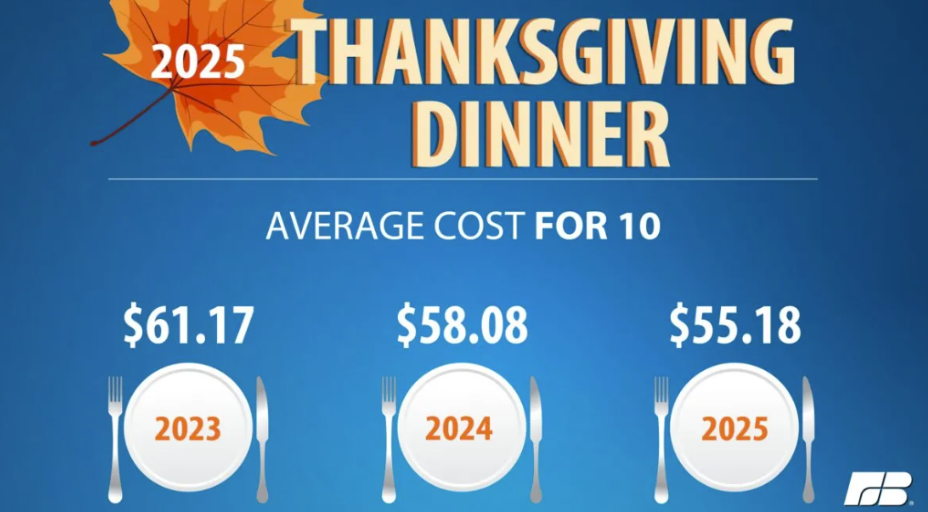
The 40th annual American Farm Bureau Federation (AFBF) Thanksgiving dinner survey finds that a table of classic dishes for 10 people will cost $55.18, down 5% from last year, but still higher than four years ago. Prices of several of the items reflect some of the struggles of farm and ranch families working to stock the grocery store shelves.
For one week leading up to Thanksgiving each year, volunteer shoppers from all 50 states and Puerto Rico visit their local grocery store (or local store’s website) to survey the prices of items used in a classic Thanksgiving feast. Since 1986, these volunteers have reported their local prices for turkey, cubed stuffing, sweet potatoes, dinner rolls, frozen peas, fresh cranberries, celery, carrots, pumpkin pie mix and crusts, whipping cream and whole milk. While many families put their own spin on this traditional dinner, the survey captures many key ingredients in American homes this holiday season.
The classic Thanksgiving dinner grocery bill is a mixed bag of savings and squeezes. Four of the items dropped in price this year – the main turkey dish, cubed stuffing, fresh cranberries and dinner rolls. However, five items – sweet potatoes, frozen green peas, a vegetable tray of carrots and celery, whole milk and whipping cream – rose in price. Pumpkin pie mix and pie shells remained virtually unchanged from 2024.
| |
Checking the Markets...
The livestock complex closed mixed, with the cattle contracts continuing their downward trend for the day. December live cattle closed $1.57 lower at $214.72, February live cattle closed $1.85 lower at $215.40 and April live cattle closed $2.22 lower at $215.57
Boxed beef prices closed higher: choice up $0.05 ($371.28) and select up $0.63 ($354.18) with a movement of 116 loads
January feeders closed $5.07 lower at $316.37, March feeders closed $4.85 lower at $308.55 and April feeders closed $4.17 lower at $306.55.
| |
| |
Click here for our Markets Page on OklahomaFarmReport.Com- there you will find our latest reports on cattle auctions, boxed beef, cash grains and market analysis.
OKC West is our Market Links Sponsor- they sell cattle three days a week- Cows on Mondays, Stockers on Tuesday and Feeders on Wednesday- Call 405-262-8800 to learn more.
| | |
© 2025 Oklahoma Farm Report - All rights reserved
|
| | | |