Oklahoma's Latest Farm
and Ranch News
Thursday, December 11, 2025
| | Tulsa Farm Show Returns for Year 32 | | |
The Tulsa Farm Show is quickly approaching its 32nd year, and Scott Guttormson of Midwest Farm Shows reflected on how far the event has come. When told it was hard to believe the show had reached its 32nd edition, Guttormson agreed, saying, “Wow, yeah, it goes by fast, doesn’t it.” He emphasized the consistency of the event’s location, noting that they have been able to stay in the same facility for all 32 years.
Guttormson praised the venue—now called the SageNet Center—for its suitability and long-standing presence at the Tulsa Fairgrounds. He explained, “This building is probably most suited for any facility that we use… it’s an ideal Event Center for a farm show, and we’re lucky and proud to use it.” He also reminded attendees that “parking is free and admission is free,” describing the show as accessible, easy to navigate, and structured so visitors can accomplish a lot in one trip.
A key distinguishing feature of the Tulsa Farm Show is its strong focus on livestock producers. While the event includes major farm equipment displays, Guttormson noted its unique appeal to cattle and horse owners, saying, “This show is definitely geared heavily towards folks that have livestock… it’s an ideal opportunity for people to see new equipment and find out what’s latest and most efficient.”
| | USDA Launches New Regenerative Pilot Program to Lower Farmer Production Costs and Advance MAHA Agenda | | |
U.S. Secretary of Agriculture Brooke L. Rollins, alongside others announced a $700 million Regenerative Pilot Program to help American farmers adopt practices that improve soil health, enhance water quality, and boost long-term productivity, all while strengthening America’s food and fiber supply.
Building off the Make Our Children Healthy Again Strategy released in September, the U.S. Department of Health and Human Services (HHS) is also investing in research on the connection between regenerative agriculture and public health, as well as developing public health messaging explaining this connection.
Protecting and improving the health of our soil is critical not only for the future viability of farmland, but to the future success of American farmers. In order to continue to be the most productive and efficient growers in the world, we must protect our topsoil from unnecessary erosion and improve soil health and land stewardship. This announcement encourages these priorities while supporting farmers who choose to transition to regenerative agriculture.
| | U.S. Wheat Exports Rebound in 2025: Gary Millershaski Discusses Global Demand and the “Big 8” Advantage | | |
After a few challenging years defined by drought and high prices that stifled foreign demand, U.S. wheat exports saw a significant resurgence in 2025. To understand the factors driving this growth, the Oklahoma Farm Report’s Maci Carter sat down with Gary Millershaski, Vice Chairman of U.S. Wheat Associates and a Kansas wheat farmer.
According to Millershaski, the turnaround for the industry began with the weather.
“If you’re a wheat farmer, this is more of a nightmare than it is looking back,” Millershaski said of the recent drought years. “That made our supply get lower and the prices went up. Didn’t do any good if you didn’t have wheat to sell… well, that shut us out of export markets.”
However, favorable rains over the last two years have revitalized the crop, leading to above-average yields and more competitive pricing on the global stage. This shift has allowed U.S. wheat to reclaim its footing in key international markets.
| | |
Dating back to 1891, Stillwater Milling Company has been supplying ranchers with the highest quality feeds made from the highest quality ingredients. Their full line of A & M Feeds can be delivered direct to your farm, found at their Agri-Center stores in Stillwater, Davis, Claremore and Perry or at more than 125 dealers in Oklahoma, Arkansas, Kansas and Texas. We appreciate Stillwater Milling Company’s long time support of the Radio Oklahoma Ag Network and we encourage you to click here to learn more about their products and services.
| |  | |
National Livestock was founded in 1932 in Oklahoma City. National’s Marketing Division offers cattle for sale weekly at the Oklahoma National Stockyards in Oklahoma City. The Finance Division lends money to ranchers across several states for cattle production. The Grazing Division works with producers to place cattle for grazing on wheat or grass pastures.
National also owns and operates other livestock marketing subsidiaries including Southern Oklahoma Livestock Auction in Ada, Oklahoma, OKC West Livestock Market in El Reno, Oklahoma, and the nation’s premier livestock video sale, Superior Livestock Auction. National offers customers many services custom made for today’s producer. To learn more, click here for the website or call the Oklahoma City office at 1-800-310-0220.
| | | Purina’s Laurence Williams on the Rapid Rise of Beef-on-Dairy Cattle | | |
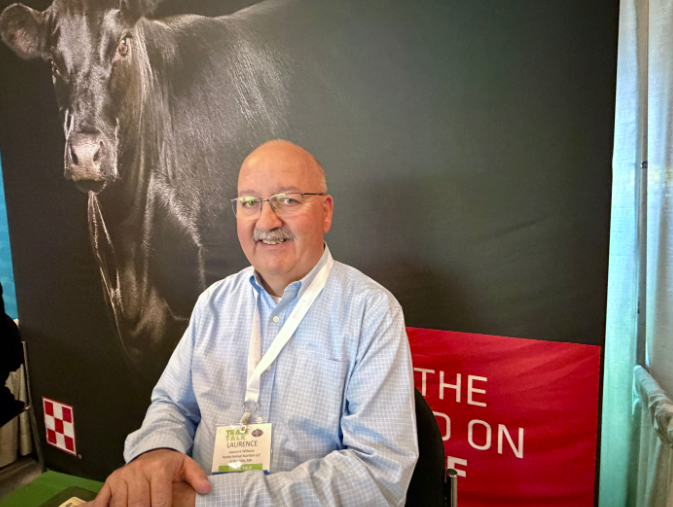
Senior farm and ranch broadcaster Ron Hays speaks with Laurence Williams, beef-on-dairy specialist for Purina, who says the rapid rise of beef-on-dairy has reshaped both the dairy and beef sectors. Williams notes that while these cattle have been around for a while, the industry has reached a turning point. “These cattle have been here. Now we’re making them better,” he says, adding that with the native beef herd “as soft as it is,” more attention is being placed on beef-on-dairy animals.
Williams explains that improved genetics have been a game-changer as dairies moved away from simply using leftover semen without long-term goals. “Early on, folks were emptying out their semen tank of whatever was left,” he says. But as calf supplies tightened and value became clearer, the industry shifted. “When we realized how much value there is in these beef-on-dairy cattle… all of a sudden there’s a focus on, let’s make them better,”
Genetically, the combination of dairy base traits and high-quality beef sires has created a more valuable end product. “If you’re feeding Holsteins, you’re going to get some marbling… Put great beef genetics on top of those dairy cows, and that’s just gotten better,” Williams says. The result is an animal that “is going to marble” and produce more red-meat yield, making them competitive with many native beef animals.
| | Val Dolcini on U.S. Ag Policy and Regulation | | |
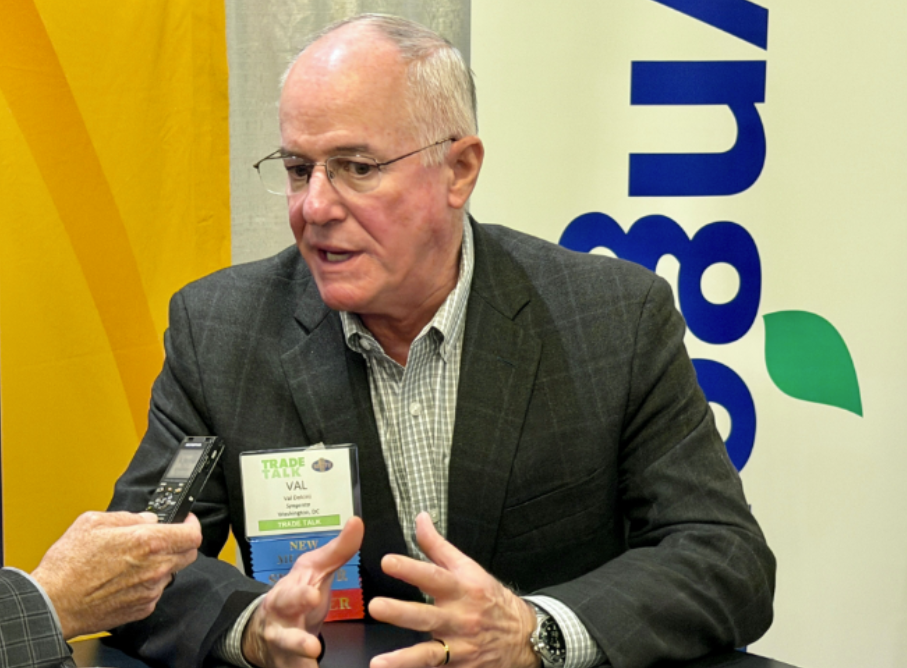
Val Dolcini explained his long-standing involvement in agriculture and policy and why that path led him to represent Syngenta at the national level with senior farm and ranch broadcaster Ron Hays. As he put it, “this was a natural evolution after working as a regulator in California in the ag chemical space and then certainly, as the administrator of a large USDA agency.”
A major theme Dolcini addressed was the growing distrust in scientific institutions. He noted that “we’ve seen trust erode in a lot of institutions in our nation… and that extends really, to a belief in the sound science that’s governed my industry for decades.” He stressed the importance of public trust in regulatory bodies, saying, “if people don’t believe in the scientific rigor that EPA uses to approve products, that’s a problem for us.” Rebuilding trust, he argued, is a significant challenge for companies like Syngenta.
Dolcini also discussed the administration’s MAHA process and concerns raised after its first report. He recalled that agriculture groups felt excluded, noting, “you’ve really got to have all the voices at the table… if you’re not at the table, you’re on the menu.” According to him, industry engagement led to some improvement: “the report that came out in September, was more favorable,” and he believes “we’ve made some progress there” in establishing a more constructive dialogue with the administration.
| | CoBank releases 2026 year ahead report – forces that will shape the US rural economy | | |
Economic uncertainty surrounding U.S. trade policy is much lower than it was a year ago, steadying the broader outlook for 2026. The reduced market anxiety can be seen in historically low volatility metrics for equity, bond and currency markets, as well as in historically tight corporate credit spreads.
The effective across-the-board tariff rate is now about 17% but based on tax collections, the actual average import tax paid is only about 10%. According to a new year-ahead report from CoBank’s Knowledge Exchange, that rate is expected to drop even further as the reduced tariffs on China and imported food products take effect and more bilateral agreements are finalized.
With tariffs fading from the forefront of economic concern somewhat, AI has become the focal point of financial market prognostication. Direct investments in AI and related infrastructure, combined with the wealth effects from the surging stock market, have conservatively added 1% to U.S. GDP this year. However, the unprecedented levels of investment are driving fears of an AI-driven stock market bubble.
| | Big Shifts in Quality Grades | | |
The fed cattle trade has undergone a tumultuous ride in the past two months. Weekly fed steer prices averaged $237/cwt. the second week in October, then rapidly declined $28/cwt. by the third week in November. Last week’s trade featured a sizeable recovery with the five-area steer average up $10/cwt., landing at $221/cwt. with prices as high as $226/cwt. in Kansas.
Cash trade was limited to fewer than three packers in Texas, triggering confidentiality rules by USDA regulations. This rule is typically only triggered in the Colorado region where it’s the norm for trade to be reported for just two packers. The total harvested head count was dramatically higher last week as the 600,000 head eclipsed the prior week’s holiday schedule by 102,000 head.
Before last week’s strong upward move in the spot cash cattle price, packer margins were calculated somewhere north of $50/head. This helped to incentivize packers to ramp up harvest levels, coupled with the increased volume needed to fulfill pre-holiday grocery store beef obligations. The cattle price recovery quickly wiped out much of the packer margin, setting that closer to breakeven as this week got underway.
| | OSU and Arkansas partner to push for evaluation of cow-calf performance tools | | |
Despite the United States’ long and storied past with cattle ranching, long-term research on health, nutrition and management is rarely wrangled, hamstrung by budget constraints and the segmented nature of the industry.
Most feedlot finishing in the United States occurs in the Great Plains region, while cow-calf operations focusing on grazing are largely outside of those locations, said Daniel Rivera, an associate professor of animal science for the Arkansas Agricultural Experiment Station, the research arm of the University of Arkansas System Division of Agriculture. He is also director of the Southwest Research and Extension Center in Hope.
This segmented nature of the industry makes it challenging for university research outside of the Plains and Midwest to follow the cattle from finishing to slaughter, Rivera explained. As part of an effort to better evaluate how pre-weaned calf and stocker calf treatments influence feedlot performance, Rivera and Paul Beck, a professor and Extension specialist for beef nutrition with the Oklahoma State University Department of Animal and Food Sciences, published a summary of research on the topic.
| | |
The livestock complex again closed mostly higher Wednesday afternoon as traders remain encouraged about the marketplace, even though they aren't willing to challenge the resistance threshold. December live cattle closed $0.02 lower at $226.80, February live cattle closed $1.57 higher at $228.52 and April live cattle closed $1.47 higher at $228.37.
Boxed beef prices closed lower: choice down $1.68 ($359.36) and select down $3.15 ($344.88) with a movement of 152 loads
January feeders closed $2.87 higher at 338.37, March feeders closed $2.67 higher at 332.82, and March feeders closed $2.42 higher at 331.90. At Ozarks Regional Stockyards in West Plains, Missouri, compared to last week, feeder steers and heifers traded $10.00 to $20.00 higher. Steer and heifer calves sold $6.00 to $12.00 higher, with peewee calves trading as much as $20.00 to $30.00 higher. Feeder cattle supply over 600 pounds was 41%. The CME feeder cattle index 12/9/2025: down $0.47, $344.03.
Click here for our Markets Page on OklahomaFarmReport.Com- there you will find our latest reports on cattle auctions, boxed beef, cash grains and market analysis.
OKC West is our Market Links Sponsor- they sell cattle three days a week- Cows on Mondays, Stockers on Tuesday and Feeders on Wednesday- Call 405-262-8800 to learn more.
| | |
© 2025 Oklahoma Farm Report - All rights reserved
|
| | | |