Oklahoma's Latest Farm
and Ranch News
Friday, December 12, 2025
| | It's time for the Friday farm funny!! Farming and ranching can be stressful, so enjoy a little laugh!! | Drought Monitor: Oklahoma Drought Expands to 66% as Dry Pattern Persists | | |
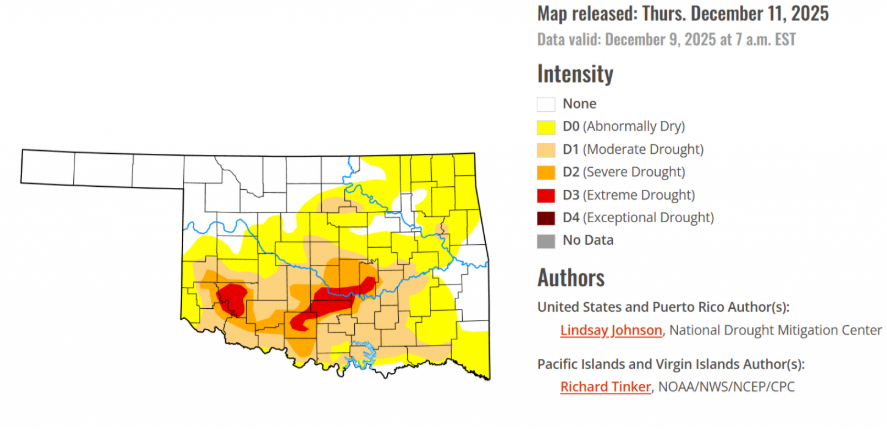
The latest Oklahoma Drought Monitor shows that while exceptional drought remains at zero percent, dry conditions continue to tighten their grip across the state, with overall drought coverage rising to 66% this week—up from 59% last week. Extreme drought holds steady in southern Oklahoma at just under 3.5%, but dryness has expanded in northeastern parts of the state as precipitation remains limited.
According to the latest Oklahoma Drought Monitor report, exceptional drought remains at 0 percent, unchanged from the start of the calendar year.
D0-D3 drought conditions in the current period indicate that 66.16 % of the state is affected by drought. Compared to last week at 59.20% drought has grown in the state Extreme Drought (D3) has remained unchanged this week. No new extreme drought has emerged, but the conditions still remain in southern Oklahoma, covering 3.48% of the state, the same as the previous week.
According to the 6-to-10-day precipitation outlook map, eastern Oklahoma is expected to experience near normal conditions and lean below 33-40% chance of precipitation. Central Oklahoma and western Oklahoma are leaning below 40-50% chance of precipitation, and the panhandle is leaning below 50-60% through December 20th.
| | Stacy Simunek on Protecting Oklahoma Agriculture | | |
At the busy 32nd Annual Tulsa Farm Show, newly elected Oklahoma Farm Bureau President Stacy Simunek shared insights from his first weeks leading the state’s largest general farm organization. Simunek said the transition from the farm to leadership has been brisk, explaining he has been “trying to get my feet underneath me” but feels momentum building as he settles in.
A major challenge on his desk involves the ongoing poultry dispute between the Oklahoma Attorney General and the Governor — an issue placing producers directly in the crossfire. Simunek was clear that his focus remains on protecting farmers rather than politics. “We’re here to protect Ag we’re not going to get political on it either way,” he said, emphasizing that Farm Bureau’s priority is safeguarding producers’ ability to operate.
Simunek also discussed the recent Bentonville meeting on the Illinois River watershed and the long-standing efforts poultry producers have made to address water-quality concerns. He warned that some growers face losing everything: “They’re going to lose their livelihood if this continues the way it is,” he said, pointing out that producers have spent two decades changing practices only to now fear it “has been for nothing.”
| | OSU’s Dr. Todd Hubbs on WASDE Surprises, the Global Wheat Glut, and “Wait and See” Markets | | |
Following the release of the latest World Agricultural Supply and Demand Estimates (WASDE) report, the agricultural markets saw a few surprises, though the overall reaction remained relatively muted. Farm Director KC Sheperd recently spoke with Dr. Todd Hubbs, OSU Crop Marketing Specialist, to break down the numbers, the massive global grain supply, and what producers should be watching as they head into the new year.
While many expected a quiet report, Dr. Hubbs noted one specific surprise regarding corn. The USDA raised the corn export number by another 125 million bushels.
“I don’t think we’re probably going to hit 3.2 billion, but it’s possible,” Hubbs said. He noted that while there have been strong sales and export inspections, the USDA appears to be the most optimistic voice in the room.
One of the most defining characteristics of the current market is the sheer volume of grain available globally. According to Hubbs, production estimates were raised for major competitors including Argentina, Australia, Canada, the EU, and Russia.
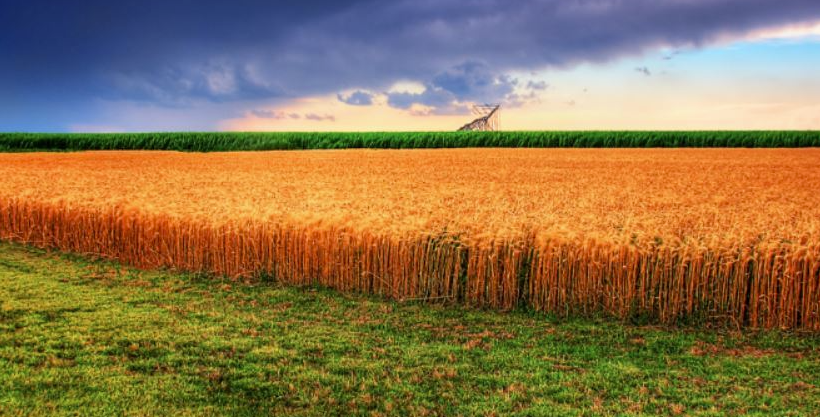
The situation is particularly stark for wheat producers. “It’s insane. Just bushels all over the place,” Hubbs told Sheperd.
| | As Oklahoma’s largest John Deere dealer, P&K Equipment is proud to serve our communities & the surrounding areas through 18 Oklahoma locations & 2 Arkansas locations. The entire P&K team is ready to keeping your equipment up & running. So, when it comes time to buy John Deere parts, look no further than GetGreenParts.com. Shop 24/7 from the convenience of wherever you are & have the parts shipped directly to you! This spring and summer- P&K is committed to making it easier than ever to really own your John Deere equipment. And long after the sale- P&K will be here to support you at every step. | |  | |
The Oklahoma Wheat Commission promotes greater use of wheat in domestic and international markets through research, market development and public education.
Our Commissioners develop policy and programs, direct the funding, represent producer interests and, of course, promote Oklahoma wheat!
Learn more about the Oklahoma Wheat Commission by clicking here for their website.
| | | Dr. Nancy Jackson Explains the Power of the Beef Federation | | |
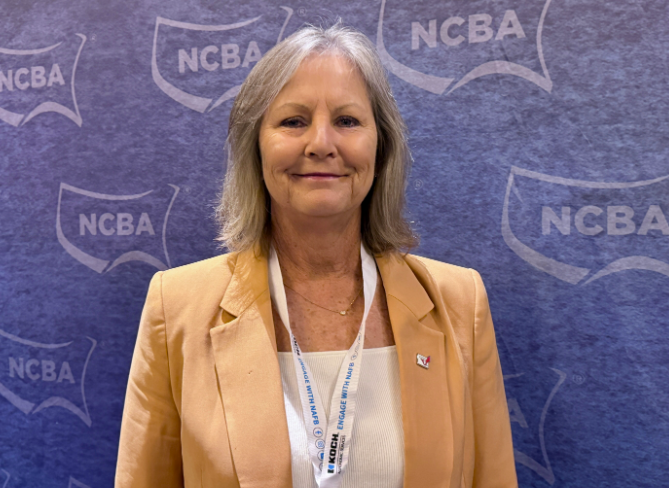
Senior farm and ranch broadcaster Ron Hays speaks with Dr. Nancy Jackson, chair of the Federation of State Beef Councils, who explains the structure, purpose, and grassroots strength behind the Federation. Dr. Jackson, a Mississippi veterinarian and cattle producer, notes that many folks struggle to understand how the Federation fits within NCBA. As she puts it, “It is tough because as a Federation… we still have cattle producers as our base focus,” while NCBA separately manages the policy and lobbying work.
Dr. Jackson emphasizes that the Federation maintains its own identity even though it operates within NCBA’s building. “It is voluntary, the Federation—that’s why it’s called a Federation—is separate from NCBA,” she says. Each state with a Qualified State Beef Council invests checkoff dollars into the Federation, which she says helps “make a much stronger way of utilizing that checkoff dollar and leveraging it.”
Hundreds of volunteers keep the system moving, with Jackson highlighting that “nationwide, there’s over 700 board members” serving on state beef councils.
One of Jackson’s major responsibilities as chair is serving on the Beef Operating Committee, the group that allocates the national 50 cents of each checkoff dollar.
| | Bullard Files Legislation to Responsibly Freeze, Eliminate Property Taxes | | |
Sen. David Bullard, R-Durant, filed legislation today to responsibly freeze or eliminate homeowners’ property taxes while shifting to a system whereby local governments and public schools are funded through adjusted sales and consumption taxes.
Bullard filed the Ad Valorem Reform Act of 2026, which would eliminate property taxes for Oklahomans age 65 or older who own their primary home outright. To stop skyrocketing increases in property taxes, Senate Joint Resolution 23 also proposes freezing property taxes for all other homeowners who qualify for a homestead exemption.
To ensure these changes don’t affect the stability of public schools and local governments, Bullard proposes these entities be funded through a fair tax model, where taxes are based on how much a consumer spends rather than on their productivity or success.
| | Compeer’s Megan Roberts Breaks Down the “Cost-Price Squeeze” in Ag Markets | | |
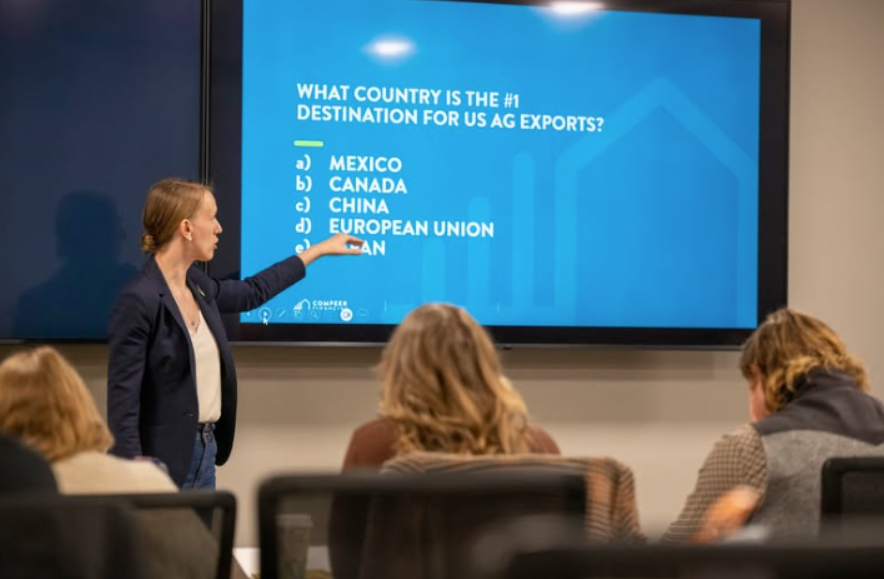
Farmers are navigating one of the most uneven market years in recent memory, with soaring livestock prices on one side and tightening grain margins on the other. Maci Carter, Oklahoma Farm Report intern, spoke with Megan Roberts, principal quantitative and economic analyst with Compeer Financial, about the unusual dynamics shaping this year’s agricultural markets.
Roberts noted the sharp divide between low grain prices and strong livestock prices, explaining that outcomes vary widely across sectors. “For beef producers, what a year… amazing margins,” she said, while “for corn and soybean and other grain producers, very challenging.” She emphasized that in tough grain years, farmers must “really just focus on your margins.”
When discussing the biggest financial pressures on grain farmers, Roberts described the situation as a “cost-price squeeze,” where input costs remain high while commodity prices lag behind. She pointed out that recent trade developments have offered “a little bit of optimism,” but the underlying margin pressure continues to challenge many operations.
| | Secretary Rollins Sends Letter Challenging California’s Proposed Redistribution of Ag Land | | |
Secretary of Agriculture Brooke Rollins sent a letter to Governor Gavin Newsom demanding that California abandon a proposal that would redistribute agricultural land based on race, ethnicity, and national origin. This letter comes as the California Land Equity Task Force considers a draft proposal that would encourage and facilitate land transfers and financial assistance exclusively to certain minorities.
“[T]he United States Department of Agriculture (the Department) writes to express substantial constitutional concerns regarding the state of California’s proposed redistribution of agricultural land based on race, ethnicity, and national origin. The proposed policies would grievously harm farmers, ranchers, and agricultural producers,” the Secretary wrote in the letter.
“All people should be treated equally and what California has proposed directly targets those who work from sunrise to well past sunset, faithfully tending our nation’s land and livestock. Hardworking farmers, ranchers, and agricultural producers all deserve a shot at the American dream, and they should not be stigmatized, demeaned, or shut out of opportunities because of their race, sex, ethnicity, or national origin,” the Secretary continued.
| | Lessons from 2025: Preparing for Disease, Pests, and Weed Control in the 2026 Crop Season | | |
As the agricultural community turns the calendar from the 2025 growing season to 2026, reflection is key to preparation. In a recent interview with Oklahoma Farm Report’s Maci Carter, Todd Cogdill with FMC emphasized that producers need to learn from the specific challenges of the past year—particularly Southern Rust, aggressive pests, and weed seed banks—to protect their investments in the upcoming season.
The 2025 season served as a harsh reminder of how quickly disease pressure can escalate. Cogdill told Carter that environmental factors created a perfect storm for Southern Rust, a fungal disease that can severely impact corn yields.
“2025 really showed us just that we need to be prepared for, you know, anything and everything,” Cogdill said. “Southern Rust really took off here in 2025… weather conditions were supportive for Southern Rust down in Mexico, South Texas… strong southern winds bring that inoculum load up into the center part of the United States.”
| | |
The livestock complex closed fully higher as traders poured support into the marketplace. December live cattle closed $3.57 higher at $230.37, February live cattle closed $2.42 higher at $230.95 and April live cattle closed $2.30 higher at $230.67.
Boxed beef prices closed lower: choice down $1.25 ($358.11) and select down $1.42 ($343.26) with a movement of 151 loads
January feeders closed $5.02 higher at $343.40, March feeders closed $4.85 higher at $337.67 and April feeders closed $4.67 higher at $336.57. At the Napoleon Livestock Auction in Napoleon, North Dakota, compared to last week, feeder steers weighing 400 to 450 pounds and steers weighing 500 to 550 pounds sold $5.00 to $8.00 lower, but steers weighing 550 to 600 pounds and steers weighing 650 to 700 pounds traded $30.00 to $32.00 higher, and steers weighing 600 to 650 pounds and steers weighing 700 to 750 pounds traded $44.00 to $47.00 higher.
Click here for our Markets Page on OklahomaFarmReport.Com- there you will find our latest reports on cattle auctions, boxed beef, cash grains and market analysis.
OKC West is our Market Links Sponsor- they sell cattle three days a week- Cows on Mondays, Stockers on Tuesday and Feeders on Wednesday- Call 405-262-8800 to learn more.
| | |
© 2025 Oklahoma Farm Report - All rights reserved
|
| | | |