
The latest Cattle on Feed Report confirms November 1 feedlot inventories at 11.59 million head, down 1.0 percent from last year. Figure 1 shows the slight decline in average feedlot inventories the past two months after increasing from April Through September. Feedlot inventories were higher year over year from May through September simply because feedlot marketings slowed faster than did feedlot placements. For the January – October period, feedlot marketings were down 7.3 percent, or 1.252 million head compared to decreased placements of 5.8 percent, or 1.021 million head. However, from June – October placements dropped 8.7 percent year over year compared to a marketings decrease of 5.0 percent year over year, once again pulling feedlot inventories lower.
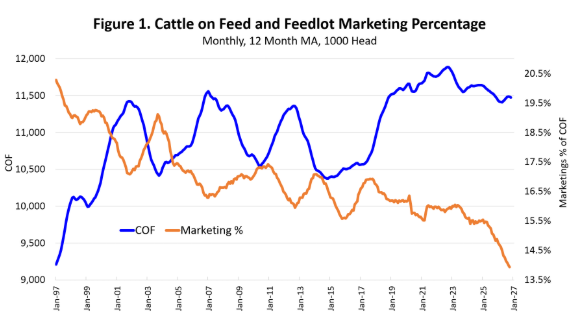
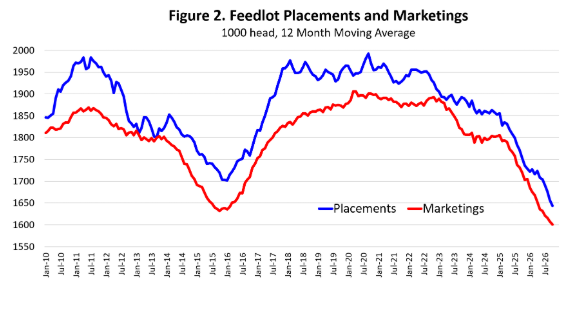
The most important point is that both placements and marketings are decreasing in the face of smaller feeder cattle supplies (Figure 2). The slow decline in feedlot inventories is the result of an ever-slow feedlot marketings rate. The average marketings rate dropped to a new record low of 13.9 percent in October (Figure 1).
Both placements and marketings are expected to continue declining into 2027. The 2026 calf crop was projected in the July Cattle report at 32.5 million head, down 1.5 percent, or another 495.6 thousand head smaller year over year. The July Cattle report also showed the beef cow herd down 0.7 percent from one year ago. Even if the herd stabilized in the second half of the year, the January 1, 2027 beef cow herd could well be smaller once again or perhaps most likely to be plus/minus unchanged, with the best case scenario a slight increase in the herd inventory. A significantly larger 2027 calf crop is not expected. Additional heifer retention is likely, in part to cover an expected increase in beef cow culling, as well as potential herd expansion, further squeezing feeder supplies.
How much does opening the Mexican border help? In the first twelve weeks since the border opened, a total of 95,460 head of feeder cattle had crossed (plus 2,741 head of rodeo stock). The weekly totals (currently about 15,000 head) will likely increase a bit more with the Nogales, AZ port scheduled to open after Thanksgiving. Depending on weight, some of the Mexican feeders are entering feedlots immediately, while lightweight cattle will be in stocker or growing programs before placement. The October feedlot placements include whatever number of Mexican cattle were available for placement. More Mexican cattle softens to impact of tight U.S. feeder cattle supplies but will not result in net increases. Moreover, in 2026, a net total of 298 thousand head of feeder cattle have been exported to Canada, up by 117 thousand head year over year. In total, live cattle trade with Mexico and Canada leaves feeder supplies mostly unchanged or slightly lower in 2026 and will provide some additional animals to limit the impact of tighter feeder supplies in 2027.