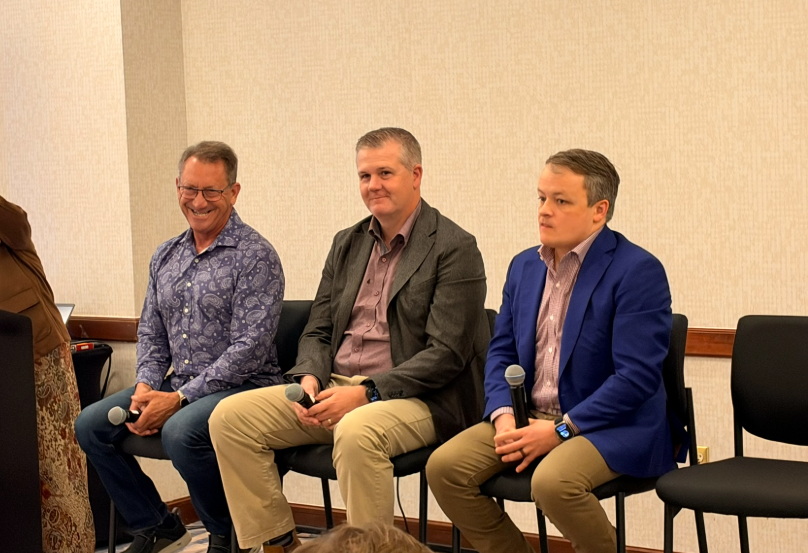
Surging electricity demand, artificial intelligence growth, and renewable energy expansion are rapidly transforming rural land use across the United States. During a panel discussion titled "At a Crossroads: How Data Centers, Solar, Wind, and Land Use Are Reshaping U.S. Agriculture," industry leaders examined how farmers, ranchers, and rural communities can navigate these competing pressures while protecting agricultural production and private property rights.
Moderated by Cyndi, the session featured Joby Young, executive vice president of the American Farm Bureau Federation; Greg Brophy, a farmer and representative with Renewable Energy Farmers of America (REFA); and Daniel Nibarger, strategic negotiator with Google.
Exploding Power Demand and the Push for Rural Land
After decades of relatively flat electricity consumption, the U.S. power grid is experiencing massive growth driven by artificial intelligence, cloud computing, and shifts in energy generation. According to Nibarger, AI and advanced digital tools have become essential decision-making partners in agriculture, requiring substantial backend data center infrastructure to process complex farm data.
For producers facing tight margins, offers to lease or sell acreage for solar panels, wind turbines, or data centers can be financially compelling. Brophy noted that during challenging commodity cycles—such as crop years 2015 through 2020 when he made no money farming—diversified revenue streams from energy projects can keep family operations afloat and help bring the next generation back to the farm.
"If you convert a field to solar, for instance, you may not be farming it any longer, but that's a temporary conversion," Brophy said, comparing the 30- to 35-year lifespan of a solar lease to the Conservation Reserve Program, after which land can return to agricultural production.
While the U.S. has lost roughly 300 million acres of farmland since 1950 while doubling food and fiber output, Brophy emphasized that he is far more concerned about permanent losses to urban and suburban sprawl than temporary energy leases.
Balancing Property Rights and Community Impact
Young noted that across the American Farm Bureau's 2,800 county chapters, land-use debates consistently center on balancing a landowner's private property rights against the broader interests of the surrounding community. Unlike temporary solar leases, data center developments typically represent permanent, one-way land conversions.
"We are for a balanced approach that takes all these factors into consideration—the benefits, the risks, the costs—and making sure that from a public policy perspective, whether at a local level or moving up to a state level and so forth, and in the national conversation, that it's one that balances all these things," Young said.
Young pointed out that while states like Virginia—home to more than 700 data centers—and Texas have navigated these developments for years, the rapid acceleration of projects has caught many rural counties off guard. More than 40 municipalities nationwide recently voted to enact restrictions or moratoria on data center construction as local officials work to catch up.
Infrastructure, Water, and "Good Neighbor" Commitments
When evaluating potential sites, Nibarger explained that Google prioritizes brownfield sites, industrial parks, and retired power plants—such as a converted coal plant in Jackson, Alabama—where high-voltage transmission infrastructure already exists.
To address rural concerns over water depletion, noise, and utility rate hikes, Nibarger outlined Google's "Good Neighbor Principles," which include funding its own energy infrastructure upgrades under clean transition tariffs so local ratepayers do not subsidize data center power. He also noted that Google no longer uses non-disclosure agreements (NDAs) with government officials, allowing local leaders and residents to have open conversations early in the planning process.
Regarding water consumption, Nibarger stated that Google conducts deep hydrological studies and utilizes closed-loop hybrid and air-cooling systems—similar to a vehicle radiator—that recycle water rather than drawing continuously from local aquifers. In water-stressed regions or areas where municipalities need infrastructure support, the company also invests in upgrading local water treatment and stormwater drainage facilities.
"If you've seen a data center, then you've seen a data center," Nibarger said, emphasizing that every community engagement plan must be tailored to local needs, whether that means supporting 4-H and FFA programs in Kansas or addressing medical and infrastructure gaps elsewhere.
Preparing Farmers and Local Leaders for Negotiations
During the audience question-and-answer session, broadcasters—including Farm Director KC Sheperd of the Oklahoma Farm Report, who noted Google's active development in Stillwater, Oklahoma—raised questions about closed-loop water systems, turbine blade recycling, and setback distances.
Nibarger confirmed that Google relies on reclaimed gray water and storm runoff rather than potable water where possible, while Brophy noted that the wind industry and the National Energy Lab of the Rockies are actively developing fully recyclable turbine blades alongside alternative uses such as agricultural windbreaks and road-base aggregate.
As developers increasingly look to rural America for land and power, all three panelists urged farmers and county officials to be proactive rather than reactive.
"They only pass pie every so often, so if they're passing pie, you ought to get a piece," Brophy advised landowners, while urging them to hire experienced attorneys and consult organizations like REFA before signing long-term agreements with professional landmen.
Young echoed the call for early preparation, noting that local governments and residents must define their community priorities before developers arrive at the table.
"Every partner should go into this project, like many projects, treating farmers, treating that rural community as a partner, not an obstacle," Young said.