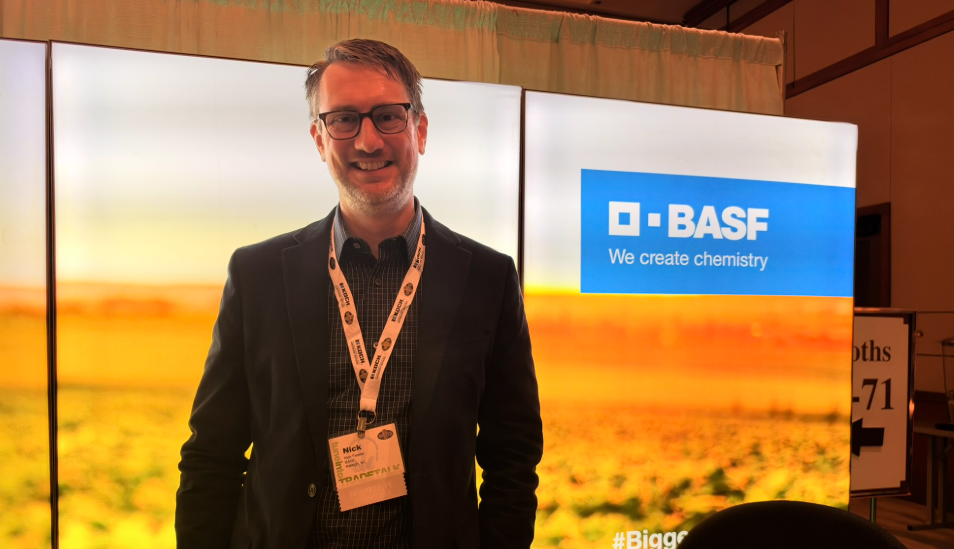
As agricultural producers look for ways to manage tight margins heading into the 2027 growing season, evaluating the return on investment for crop inputs has become more critical than ever. Farm Director KC Sheperd spoke with Nick Fassler, director of technical services at BASF, to discuss how farmers can balance cost management with effective weed and disease control.
While cutting upfront expenses is a common instinct during tough economic cycles, Fassler emphasized that selecting the right chemistry to protect yield potential often delivers a stronger financial outcome than simply choosing the lowest-priced option.
"Now's the time to scrutinize what you've did in 2026 and what you did in 2025—let's go back even further," Fassler said. "Our argument is, are you selecting the right products that are delivering the right outcome? And that's not always the cheapest solution."
To help producers manage cash flow without sacrificing agronomic performance, BASF is offering 0% financing across its branded portfolio for 2027, allowing growers to make timely input decisions based on field needs rather than immediate liquidity.
Combating Herbicide Resistance in the Southern Plains
Across the Southern and Western states, Fassler identified herbicide-resistant broadleaf weeds—including Palmer amaranth and waterhemp—as one of the most persistent challenges facing growers. Relying repeatedly on a single mode of action eventually diminishes effectiveness, requiring producers to target weeds before they emerge from the ground.
"We're always trying to go to battle to some degree with Mother Nature, and I will argue as if you use the same hammer over and over again, it's going to stop working at some point," Fassler said.
To expand weed control options for Southern Plains farmers, BASF is introducing Voraxor, a new burndown herbicide designed for use ahead of cereal and soybean crops. For cotton growers further south, the company is also advancing Axant Flex and awaiting EPA registration for Elead ISO, a new residual herbicide for the cotton system that BASF hopes to have available for the 2027 season. Looking further ahead to the early 2030s, Fassler pointed to upcoming PPO-traited crop technologies that will allow growers to apply strong herbicides over the top as part of a comprehensive weed management program.
A Field-by-Field Approach to Fungicides
When deciding whether to apply or skip a fungicide, Fassler advised producers to evaluate historical performance, current crop conditions, and risk tolerance on an acre-by-acre basis rather than applying a blanket strategy across an entire operation.
"I would say it's never one-size-fits-all, everybody needs this, but there's certainly areas where it pays and there's probably areas where it doesn't," Fassler said.
To help farmers make data-backed decisions, BASF publishes local trial data from its Real Results Yield Challenge online, enabling producers to review local fungicide yield responses in their specific area before committing to an application.