In celebration of National Farmworker Awareness Week, EPA Deputy Administrator Janet McCabe issued the following statement:
"During National Farmworker Awareness Week, we pay tribute to the more than two million unsung heroes who do some of the toughest work to help put food on our tables across the United States. Farmworkers often work day and night in the face of challenges, including increased extreme heat due to climate change, to promote healthy and secure food supplies. I have seen this firsthand in my home state of Indiana.
This week, EPA is shining a spotlight on these unsung heroes and their contributions to our nation. EPA's mission is to protect human health and the environment, and that includes how our policies and programs support and protect farmworkers and their families across the country. As an agency, we are committed to continuing to work closely with farmworkers and the broader agriculture community to confront environmental issues, advance conservation, and ensure clean air and clean water for all families." For more information on how EPA policies and programs protect farmworkers, click here
Senator James Lankford (R-OK) with Senator Cynthia Lummis (R-WY) led 17 of their colleagues in introducing a Congressional Review Act (CRA) resolution of disapproval to retain the regulatory definition of habitat within the Endangered Species Act(ESA). By defining habitat, this CRA resolution will provide clarity and transparency to landowners and businesses in Oklahoma and throughout the United States.
Senators John Barrasso (R-WY), Shelley Moore Capito (R-WV), Markwayne Mullin (R-OK), Dan Sullivan (R-AK), Pete Ricketts (R-NE), Katie Britt (R-AL), Ted Budd (R-NC), Roger Marshall (R-KS), Jim Risch (R-ID), Kevin Cramer (R-ND), John Boozman (R-AR), John Hoeven (R-ND), Steve Daines (R-MT), Joni Ernst (R-IA), Mike Crapo (R-ID) and Ted Cruz (R-TX) cosponsored the resolution of disapproval.
"Oklahomans are more than willing to do their part to protect species on the endangered species list, but more and more often the rules and regulations for the Endangered Species Act are not rational," said Lankford. "The Critical Habitat rule gives the Biden Administration free rein to interpret any geographic area across the country—not just the one a listed species currently occupies—as a 'critical habitat' in need of federal protection under the ESA. This radical environmentalist proposal potentially impacts landowners, a variety of industries crucial to Oklahoma, jobs, and existing wildlife recovery efforts nationwide. Oklahomans are tired of the federal government picking animals and plants over people, especially when the ESA only has about a two percent success rate of species recovery since the 1970s. I want to protect our plants and wildlife, but I stand firmly against this rule."
"There is an important distinction between 'habitat' and 'critical habitat' for an endangered species," said Lummis. "By scrapping the definition of habitat within the ESA, the Biden administration is causing chaos and confusion among private property owners throughout Wyoming and the west. Two-thirds of all endangered species are located on private lands, so private property owners need to be partners in species recover, not the enemy. This CRA will ensure that Wyoming landowners are not unfairly targeted by the administration and that habitat designations are based on science, not on politics."
"The Biden administration is once again burdening Wyoming farmers, ranchers and landowners with regulations that hurt our agriculture producers and reduce land value," said Barrasso. "I'm proud to join Sen. Lummis' effort to reinstate the Trump administration's rule to clearly define habitats under the Endangered Species Act."
"By finalizing a new critical habitat designation, the Biden administration is once again increasing costs, creating more red tape, and ultimately making it more difficult to build here in America. We should be making it easier to achieve our conservation goals through clear definitions, but the Biden designation would only drive more uncertainty for landowners across our country. I appreciate Senator Lummis for her leadership in challenging this new rule, and will continue to support commonsense checks on this administration's misguided policies," Capito said.
"The Biden administration has cast a net so broad that nearly anywhere could qualify as a critical habitat. This misguided definition will have far reaching effects on Idaho's farming, ranching, land management, and mining projects, and it will delay numerous projects vital to our rural communities. This resolution of disapproval provides the Senate with an opportunity to return some much needed common sense to critical habitat designation," said Risch.
"Providing an exact definition for 'habitat' is necessary for transparency and clarity as stakeholders make decisions regarding wildlife and proper management practices," said Crapo. "The Biden Administration's rollback of the definition of 'habitat' is unnecessary and only adds confusion when dealing with important wildlife issues."
"Once again, President Biden has attempted to take a common-sense law intended to protect endangered species and use it to expand the power of executive bureaucrats to intrude on the lives of North Carolina's builders and job creators. I'm proud to join Senator Lummis's CRA to stop this latest power grab," said Budd.
"This CRA is about pushing back on the overreaching Biden rule that doesn't respect private property rights and would lead to uncertainty for landowners when it comes to whether their property may be designated as critical habitat," said Hoeven.
"We can all agree that safeguarding our environment and ensuring wildlife habitat is protected for future generations is important. There are commonsense measures we can take to support conservation without trampling on the rights of landowners. I'm pleased to support this effort to block this overreaching regulation," said Boozman.
"Farmers and ranchers must be left to manage their land how they see fit," Marshall said. "As the original conservationists, who have worked for centuries to leave the world better than they found it and maintain our land for the enjoyment of their kids and grandkids, we cannot let overreaching and fluctuating habitat definitions undermine the great work our producers are doing. This Administration's regulatory overhaul of the ESA undermines our landowners and leaves them with a lot of uncertainty. That is why I am fully supporting this CRA that rolls back burdensome limitations on land use and costly mitigation requirements."
"Montanans know best how to manage wildlife in a way that is safe for the animals and for our communities. Biden's rescission of the clear Trump-era definition of 'habitat' opens the door to bureaucratic overreach and frivolous litigation that threatens commonsense practices—we must return to the transparent definition and hand legal certainty back to Montanans," said Daines.
Rep. Cliff Bentz (R-OR) introduced a companion CRA resolution in the US House of Representatives alongside Reps. Rob Wittman (R-VA), Matt Rosendale (R-MT), Dan Newhouse (R-WA), Tom Tiffany (R-WI), Doug Lamborn (R-CO), David Valadao (R-CA), and Ryan Zinke (R-MT).
"The Endangered Species Act (ESA) is being misused, abused, and misapplied, and it is time to get to work on fixing this. If the ESA is to work properly, without bankrupting all businesses and the USA, federal agencies must follow the science and narrowly target their efforts in ways best suited for the species, while not destroying communities. The Biden Administration, when it rescinded the Trump Critical Habitat Rule, gave Washington bureaucrats the green light to designate critical habitat where the species in question had not been seen in decades. This action by the Biden Administration was not about conserving or protecting at risk species. It was about preventing human activities that the Biden Administration disagrees with, like forest management, livestock grazing, and other multiple uses of our public lands and waters in and upon millions of acres of public land. The Trump Administration's definition of habitat is scientifically based and meets the needs of both our environment and the people living within it. This measure will help to restore sanity to the implementation of the ESA and will provide at least some certainty to millions of Americans who are impacted by at risk species," said Bentz.
The CRA resolution of disapproval is supported by the American Farm Bureau, the National Cattleman's Beef Association, the Public Lands Council, the National Mining Association, the Western Energy Alliance, the Independent Petroleum Association of America, Property and Environmental Policy Research Center (PERC) and the Dallas Safari Club.
"Western Energy Alliance urges Congress to pass the CRA resolution to overturn the Biden Administration's Critical Habitat Rule. The Supreme Court very clearly ruled that in order to be designated as critical habitat, lands must be just that, habitat. The Trump rule defined critical habitat accordingly. Now the Biden Administration would have us go back to a time before that unanimous Supreme Court decision and designate lands as critical habitat where not only is the species not even present, but doesn't even contain the conditions for the species to survive. Such a policy is about controlling land and stopping useful human activities, not about protecting species," said Kathleen Sgamma, President of the Western Energy Alliance.
"Each time an area is designated as critical habitat, ranchers and landowners bear the brunt of the regulatory burden. These decisions have real impacts on rural communities and landscape management – it is imperative that they be rooted in scientific reality, not hypotheticals. Restoring the 2020 definition of habitat is a commonsense step to reduce the delays and drawn-out, speculative analyses that are so often standing in the way of important wildlife conservation work on the ground,"said Public Lands Council Director Sigrid Johannes.
"Conserving and restoring habitat is essential to recovering species. Yet the Biden administration has opted to have no definition of habitat to guide its decisions. It would be appropriate to have a definition that reflects current science and the need for better incentives for private landowners to conserve and restore habitat," said Jonathan Wood, PERC Vice President of Law and Policy.
A critical habitat designation has major impacts on landowners, as it reduces the value of any private property within a designation because prospective landowners recognize the burdens that accompany a designation. It also greatly impacts any land with a federal nexus through permits or funding, as a critical habitat triggers significant scrutiny, resulting in burdensome limitations on land use and costly mitigation requirements.
In December 2020, citing Weyerhaeuser Co. v. U.S. FWS, the Trump administration finalized a rule that defined the term "habitat" as "the abiotic and biotic setting that currently or periodically contains the resources and conditions necessary to support one or more life processes of a species."
On June 24, 2022, the Biden Administration finalized a rule that rescinded the 2020 rule, eliminating the habitat distinction, leaving regulated parties in the dark and undermining the ESA's purpose of protecting endangered or threatened species.
The ESA directs the Secretary of Interior through the US Fish and Wildlife Service and/or the Secretary of Commerce through the National Marine Fisheries Services to designate critical habitat for listed species.
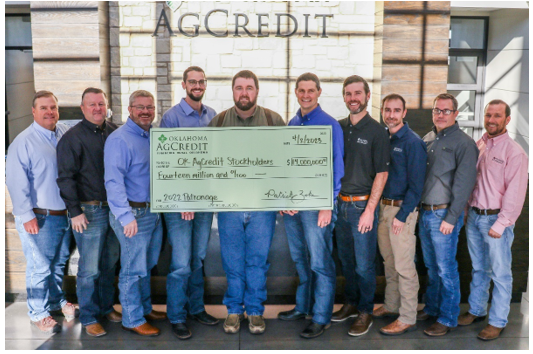
Oklahoma AgCredit Branch Managers with the record $14 million Patronage return check.
(L to R) Marty Meyer (Enid), Kelly Crissman (Pauls Valley), Brent Thompson (Chickasha / Duncan / Shawnee), Lane Winter (Kingfisher / Watonga), Travis Hanks (McAlester / Poteau), Ryan Luter (Stillwater), Beau Sheffield (Broken Arrow / Pawhuska), Michael Robinson (Vinita), Steve McIntyre (Ardmore / Durant / Idabel), David Rodden (Muskogee)
Oklahoma AgCredit, the state's largest agricultural lending cooperative, will pay its members a record $14 million Patronage return this month. This Patronage return reduces the average member's interest rate by one percent.*
"There's no other organization, that I am aware of, that's a financial lender where you have this opportunity...we were with a regular bank for the first 18 years and the gamechanger for us was Oklahoma AgCredit. If we would have switched earlier, we would be in a much different position now." Chickasha Customer
When a farmer, rancher, agribusiness owner or rural homeowner opens a loan with Oklahoma AgCredit, they become a member of the cooperative. As a member, they have an opportunity to share in the cooperative's financial success through the Patronage Program. Oklahoma AgCredit distributes returns based on the amount of interest expense on each member's loan(s).
Since the Patronage Program was initiated in 1997, Oklahoma AgCredit members have received approximately
$100 million in Patronage returns. With a capital position of more than $344 million, Oklahoma AgCredit has the risk-bearing capacity to provide reliable, consistent credit to Oklahoma's farmers and ranchers in good times and in bad.
"Our Association remains financially efficient and continues to grow each year, all thanks and gratitude to our loyal cooperative members and dedicated staff," says Gary Bledsoe, Board Chairman. "Oklahoma AgCredit's Board of Directors made it an earnest endeavor to achieve a one-percent interest rate reduction – and we have finally accomplished that through this year's $14 million Patronage return!"
Patronage Open Houses are held every April for members to pick up their checks, register to win a raffle item and share lunch with staff and other members. Open House dates for 2023 are:
April 4th – Ardmore, McAlester, Stillwater
April 5th – Kingfisher, Stigler, Muskogee, Idabel
April 6th – Durant, Poteau, Stilwell, Chickasha, Enid
April 11th – Shawnee, Watonga
April 13th – Broken Arrow
April 14th – Pawhuska, Pauls Valley
April 17th – Vinita
April 21st – Duncan
"We're more than your lender," said Patrick Zeka, President / CEO. "Our record Patronage not only signals the strength of the association, but also demonstrates the appreciation we have for our members' financial partnerships. Our members entrust us with the most important aspects of their lives – their families, careers, homesteads, multigenerational acreage and assets, and purpose for getting up each day. Oklahoma AgCredit does not take that responsibility lightly."
About Oklahoma AgCredit
Oklahoma AgCredit supports rural Oklahomans in 60 counties with reliable, consistent credit. A proud member of the Farm Credit System, the cooperative serves agricultural producers and rural landowners with combined assets over $2 billion and a portfolio more than 6,500 loans. Headquartered in Edmond, Oklahoma AgCredit has 18 full-time lending offices and a number of weekly contact points. Visit okagcredit.com or call
866-245-3633 for more information.
Only eligible borrowers will receive Patronage. Borrowers who are not eligible: 1) opted out of receiving Patronage; or 2) any loan in active non-accrual status at year end; 3) have a construction loan. Borrowers who are eligible for patronage and 1) the check distribution is a minimum of $50; 2) the loan is delinquent; 3) distributions between $10 and $49.99 are applied to an active loan(s). Patronage less than $10 is not distributed. Please contact your local branch if you have questions about Patronage eligibility. Branch contact information can be found at okagcredit.com.
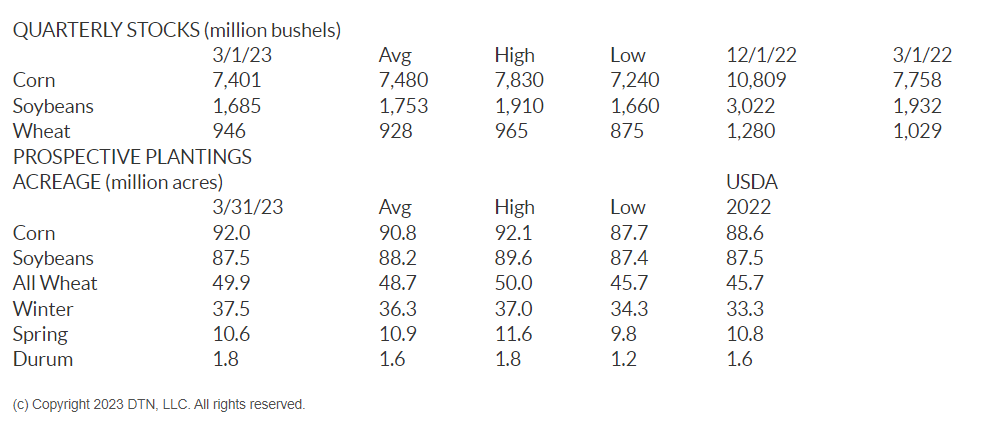
USDA on Friday released its Prospective Plantings and March 1 Grain Stocks reports. Farm Director, KC Sheperd, visited with Allendale's Rich Nelson about the two reports.
Two USDA reports today, quarterly Grain Stocks and Prospective Plantings, give the trade a good deal of both old and new crop information to digest. Grain Stocks issues remaining old crop stocks as of March 1. This report is simply a count of leftover stocks. USDA will incorporate a portion of today's old crop surprises into the next monthly supply/demand report on 4/11 in the feed/residual category. Prospective Plantings is the survey-based report that officially starts the new crop year. This report only holds intended planted acreage data. There are no estimates for percent harvested, new crop yields or new crop demand. The trade will take these acreage numbers and apply them to USDA's February AgForum demand estimates for a guide on how a USDA new crop balance sheet would look. USDA reported 72,900 producers were contacted for these two reports.
"We will point out that wheat stocks were found just a little larger expected about 12 million bushels over the trade estimate," Nelson said. "So, certainly for the grain stocks portion of our reports, this was positive corn and soybean, and slightly negative on the wheat side."
Regarding the perspective plantings, Nelson said for Oklahoma specifically, there was a very small increase in corn, as most producers in Oklahoma are not jumping on the corn bandwagon. In soybeans, he added, there was a decrease of about 45,000 acres compared to last year.
"The report today suggests 300,000 acres of extra winter wheat planting," Nelson said. "As we all know, the big question with winter wheat is not about planting- it is what will be harvested as well as yields, which are two very big questions."
As for Kansas Nelson said Producers were more willing to be a little more eager on the acreage side, "Plus 300,000 for corn minus 400,000 For soybeans, but plus 800,000 versus last year for wheat. So Kansas producers certainly were active with planning this year."
Texas, Nelson said, is a little different, "Slight decline on corn, in this case also a slight decline on soybeans. They were more active with wheat, plus 1.4. One thing which is different about Texas specifically is as they are major cotton producer, we did see numbers drop a bit more than we expected to see, down 1.5 million acres from last year."
PROSPECTIVE PLANTINGS
Wheat:
2022/23: USDA counted 946 million bushels for old crop stocks as of March 1. That was 12 million over the 934 trade estimate (ALDL 917). The wheat old crop marketing year ends on May 31 so there is limited time to correct this small discrepancy.
2023/24: USDA surprised the trade by reporting 49.855 million acres for all-wheat intended planting. That was even larger than their AgForum estimate of 49.5. The trade was looking for smaller numbers on this report, 48.852 (ALDL 48.706). This is bearish information but we hesitate to suggest the trade will price it in. There remains significant concern over both harvested acres and yields for hard red winter. Total winter wheat plantings were seen at 37.505, over the 36.256 estimate (36.524). Other spring was counted at 10.570 vs. the trade estimate of 10.950 (ALDL 10.607).This represents a net decline from last year of 265,000. Durum was seen at 1.780 vs. 1.666 estimated (ALDL 1.575). The trade has clear concern with spring wheat planting as North Dakota remains a clear problem.
All wheat planted area for 2023 is estimated at 49.85 million acres, up 9% from 2022. The 2023 winter wheat planted area, at 37.51 million acres, is up 13% from last year and up 2% from the previous estimate.
Of this total, about 26.0 million acres are hard red winter, 7.80 million acres are soft red winter and 3.71 million acres are white winter.
Corn planted area for all purposes in 2023 is estimated at 91.99 million acres, up 4% or 3.42 million acres from last year. Compared with last year, planted acreage is expected to be up or unchanged in 40 of the 48 estimating states.
Soybean planted area for 2023 is estimated at 87.51 million acres, up slightly from last year. Compared with last year, planted acreage is up or unchanged in 15 of the 29 estimating states.
Area expected to be planted to other spring wheat for 2023 is estimated at 10.57 million acres, down 2% from 2022. Of this total, about 9.95 million acres are hard red spring wheat. Durum planted area for 2023 is expected to total 1.78 million acres, up 9% from the previous year.
All cotton planted area for 2023 is estimated at 11.26 million acres, down 18% from last year. Upland area is estimated at 11.1 million acres, down 18% from 2022. American Pima area is estimated at 154,000 acres, down 16% from 2022.
On sorghum, USDA said farmers intend to plant 5.98 million acres this year, a 6% drop from last year.
QUARTERLY GRAIN STOCKS
All Wheat: Total stocks were reported at 946 mb, the lowest in 15 years but slightly above the pre-report average estimate.
All wheat stored in all positions on March 1 came in at 946 mb, down 8% from a year ago. On-farm stocks were estimated at 227 mb, up 30% from last March. Off-farm stocks were reported at 719 mb, down 16% from last year. Total disappearance or usage was list at 366 mb, up 5% from the same quarter in 2022.
Durum wheat stocks reported in all positions on March 1 came in at 35.8 mb, up 18% from last year. On-farm stocks were reported at 17.1 mb, up 36% from March 2022. Off-farm stocks were listed at 18.7 mb, up 6% from a year ago. Total disappearance from December 2022 through February 2023 was 12.3 mb, up 5% from the same quarter last year.
Corn: Total stocks pegged at 7.401 billion bushels (bb), the lowest in nine years.
USDA reported total corn stocks on March 1, 2023, at 7.401 bb, down 5% from the same date a year ago. Of total stocks 4.11 bb were stored on farms, up 1% from a year ago. Off-farm stocks were reported at 3.29 bb, down 10% from a year ago. Total disappearance (usage) for the quarter was reported at 3.42 bb, which was December 2022 through February 2023. That compares with 3.88 bb for the same quarter last year
Soybeans: Total stocks reported at 1.69 bb, the lowest in six years and on the lower side of the pre-report estimates.
Soybeans stored in all positions on March 1 came in at 1.69 bb, down 13% from March 1, 2022. On-farm stocks were reported at 750 million bushels (mb), down slightly from a year ago. Off-farm stocks were pegged at 936 mb, down 21% from a year ago. Total disappearance or usage was reported at 1.34 bb, up 11% % from the same quarter in 2022.
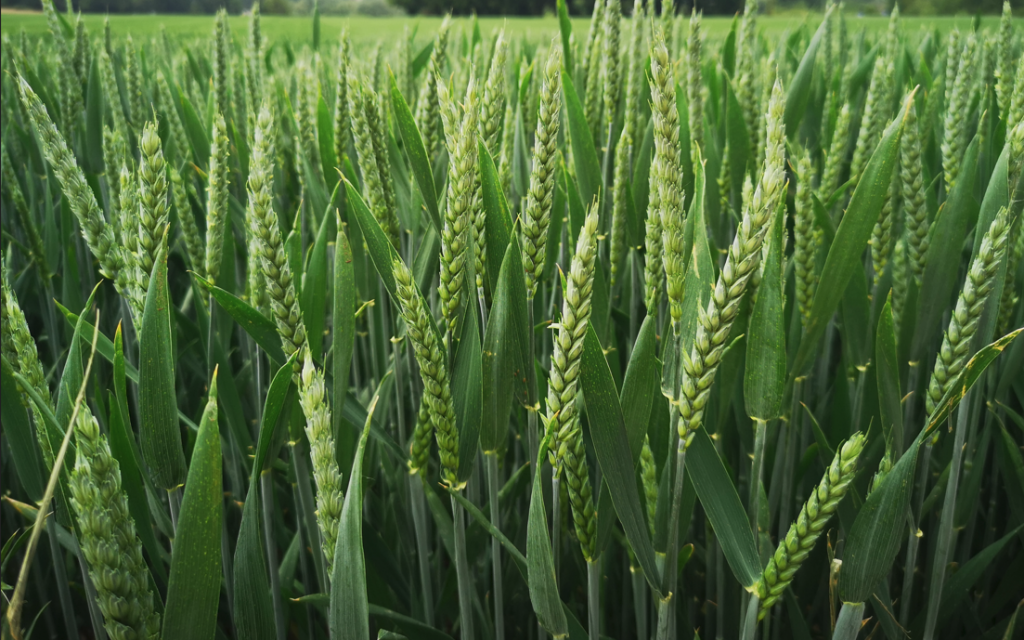
You can always find more Premium Content from Allendale by visiting their website.

Growth Energy CEO Emily Skor issued the following statement after Kansas Governor Laura Kelly (D) sent a letter to U.S. Environmental Protection Agency (EPA) Administrator Michael Regan requesting the agency allow the sale of E15 products this coming summer through the use of an emergency waiver.
"Momentum for the emergency waiver continues to build, and we hope EPA does what it must to allow E15 to be sold this coming summer. With this letter, Gov. Kelly joins the esteemed company of other midwestern leaders who have taken action on behalf of their constituents to ensure that they have continued access to E15—a fuel option that's less expensive, better for the environment, better for American energy security, and approved for use in 96 percent of cars on the road today. We welcome Gov. Kelly's support and hope EPA acts quickly to ensure that this lower-carbon fuel doesn't disappear from retail stations on June 1."

The American Farm Bureau Federation today called on President Biden to accept the will of Congress and repeal the 2023 Waters of the U.S. Rule. The House and Senate, in a rare bipartisan vote, passed a Congressional Review Act resolution of disapproval of the EPA and Army Corps of Engineers' 2023 WOTUS Rule.
In a letter to President Biden, AFBF President Zippy Duvall wrote, "America's farmers and ranchers need a clear, consistent, and transparent WOTUS rule so they can continue to protect our natural resources, operate with certainty, and create jobs in their communities. Continual revisions, remands, and reintroductions of WOTUS definitions only sow confusion and ultimately dissuade future investment in climate-smart agriculture. However, the new definition of WOTUS exceeds Congressional authority in multiple respects, ignores recent Supreme Court case law interpreting the Clean Water Act, and will be impossible to implement consistently in the field."
Farmers and ranchers shouldn't need a team of lawyers and consultants to determine how to care for their land. Unfortunately, the vague and conflicting rules complicate an already complex process and will expose farmers to costly fines as well as criminal charges.
The 2023 WOTUS Rule also expands the "significant nexus" test, which, in part, was challenged before the U.S. Supreme Court in the case Sackett v. EPA. "Despite requests by Members of Congress, farmers, ranchers and small businesses all across the country to delay any new regulation until that case is decided, EPA and the Corps disregarded this commonsense request and prematurely finalized yet another complex rule that lacks durability," wrote President Duvall. "The Court's decision in Sackett could render substantial portions of the final rule non-applicable and irrelevant – and require yet another WOTUS rule."
Read the full letter here.

The Oklahoma State Senate today gave passage to its historic $700 million education package.
Senators voted overwhelmingly on both measures 40 – to – 7 on House Bill 1935 and 46 – to – 2 on House Bill 2775, approving the single largest appropriations increase to education in state history, sending it back to the House of Representatives.
Senate Pro Tem Greg Treat, R-Oklahoma City, said the Senate did its job and delivered for teachers, children and parents.
"Today is a great day for education in Oklahoma," Pro Tem Treat said. "My Senate colleagues and I passed measures that, when signed into law will make drastic improvements to public education, reward our teaches, empower parents to make the best choice for their kids and fund students, not systems."
Senate Education Package
Over $700 million for Education
The Senate is proposing the single largest appropriations increase to education in history with the passage of HB 1935 and HB 2775.
HB 1935 will give parents additional options and control over their children's education by providing a $100 million investment in school choice. This bill provides a $7,500 tax credit per eligible student each tax year if the eligible student attends a private school and the family has an income of less than $250,000. The bill also provides for a $1,000 tax credit per family, for certain qualified expenditures, each tax year if one or more eligible students is homeschooled. Valid receipts must be provided to OTC to receive the $1,000 tax credit.
HB 2775 appropriates $500,000,000 to the State Board of Education for the purpose of providing Oklahoma teachers a pay raise as well as substantially increasing the State Aid Formula.
HB 2775 will also appropriate $30 million for the creation of the Rewarding Excellent Educators Grant Program. This program will provide grant funds to school districts to implement qualitative bonus pay plans for eligible teachers and eligible support employees.
Other Senate education measures sent to the House include:
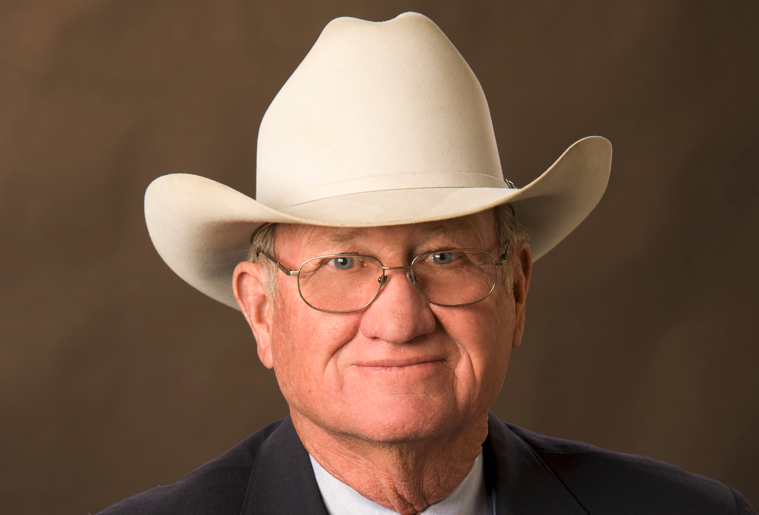
Bob Howard, a longtime Southwest Oklahoma wheat, pasture, and cattle producer, has been named the 2023 recipient of Governor Stitt's Outstanding Achievement in Agriculture Award. Howard is the 26th inductee into the Oklahoma Agriculture Hall of Fame, which is the state's most prestigious agricultural honor.
Howard, who passed away last April at the age of 75, will be honored at the annual Ag Day at the Capitol event in Oklahoma City on Tuesday, April 11.
Howard's career was spent bettering Oklahoma's agriculture industry through research and innovation. His partnership with OSU Extension resulted in improvements to wheat and pasture production systems still implemented today.
"We are so proud to call Bob Howard our 2023 Agriculture Hall of Fame inductee," said Oklahoma Secretary of Agriculture Blayne Arthur. "Bob was not only a critical player and innovator in the state's crop commodity industry, but a trusted community member and friend to many. His impact on Oklahoma's agriculture certainly lives on."
Over the years, numerous county, regional, and state projects were conducted on Howard's farm. One long-term study led Howard to transition several of his fields to a no-till or minimum till operation, which helped control most of the erosion on the property. In 2013, Howard was given OSU's prestigious Master Agronomist award.
Howard was a supporter of agriculture youth development programs. While he served as the FFA instructor at the Navajo School system for only four years, Howard spent a lifetime helping kids in both the FFA and 4-H programs by sharing his knowledge and providing support. Howard also served in several leadership roles for commodity groups including the Oklahoma Cattleman's Association, the Oklahoma Wheat Growers Association, and the Jackson County Farm Bureau Board.

The Missouri Corn Growers Association (MCGA) is applauding yesterday's reintroduction of the Next Generation Fuels Act in the U.S. House of Representatives. The bill aims to modernize the nation's fuel supply and optimize new vehicles to take advantage of higher ethanol blends, resulting in lower fuel costs, reduced emissions, and increased energy security for the future.
"The Next Generation Fuels Act is a top legislative priority for corn growers in Missouri and across the country," said MCGA President Clint Stephens. "Every time the price at the pumps spikes, we are reminded of the need for a diverse fuel supply and greater energy independence. Consumers want more choices and affordable options in the transition to cleaner vehicles and fuels. The Next Generation Fuels Act provides these solutions."
Designed to gradually clean up the nation's fuel supply and transition new vehicles to cleaner, more efficient fuels, the Next Generation Fuels Act would also lower costs for drivers by model year 2031. Higher octane levels increase engine efficiency, helping autos meet vehicle fuel efficiency standards and reducing emissions. As a clean octane standard, the bill requires additional octane sources resulting in at least 40 percent fewer GHG emissions than unblended gasoline, and sets new limits on toxic hydrocarbon aromatics.
The bill was introduced by Rep. Mariannette Miller-Meeks (R-Iowa), along with Reps. Angie Craig (D-Minn.), Darin LaHood (R-Ill.), and Nikki Budzinski (D-Ill.). Missouri Congressman Emanuel Cleaver (D-Mo.) has also signed on as an original co-sponsor of the clean-fuel measure.
"Incorporating higher blends of renewable fuels can be part of the solution in answering our nation's growing energy needs with a cleaner-burning fuel grown and refined here at home," Stephens said. "MCGA appreciates Congressman Cleaver for recognizing this bill's benefits for consumers and rural Missouri. We look forward to working closely with Missouri's congressional delegation to get this measure across the finish line and bring a cleaner, cheaper fuel to the pump."
A companion bill was introduced in the Senate last week. Learn more about the benefits of low-carbon, high-octane fuels at ncga.com/octane.
U.S. Department of Agriculture (USDA) Rural Development Oklahoma State Director Kenneth Corn announced today that USDA will accept applications starting on April 1 for $1 billion in grants to help agricultural producers and rural small businesses invest in renewable energy systems and make energy-efficiency improvements. USDA is making the $1 billion in grants available under the Rural Energy for America Program (REAP), with funding from President Biden's landmark Inflation Reduction Act, the nation's largest-ever investment in combatting the climate crisis.
"Oklahoma has the opportunity to be a rural leader in agriculture energy efficiencies thanks to this commonsense approach by President Biden to invest in our rural and tribal communities and lower our overall energy costs," Corn said. "Clean energy can be a game changer for my fellow Oklahoma neighbors, as not only does this lower costs for Oklahoma consumers it helps combat the ongoing climate crisis that threatens the very livelihood of agriculture producers across our state."
Recipients may use REAP funds to install renewable energy systems or to make energy-efficiency improvements. Eligible applicants include rural small businesses and agricultural producers. USDA will hold competitions quarterly through Sept. 30, 2024. The funding will also include the creation of the first underutilized technology fund in the REAP program, with $144.5 million available in dedicated funding.
The maximum federal share which may be requested is up to 50 percent of the total project cost for all energy-efficiency projects and zero-emissions renewable energy systems. An award of up to 50 percent of the total project cost is also available for any project in a designated energy community and/or submitted by an eligible tribal entity. All other projects are eligible to apply for grants of up to 25 percent of the total project cost. The maximum grant is $1 million for renewable energy systems and $500,000 for energy-efficiency projects.
"This is a tremendous opportunity for businesses and producers to be a part of this historic reinvestment of American entrepreneurial spirit and rebuild our economy from the bottom up and middle out," Corn said. "The time is now for Oklahoma to be a part of this transformation of our industrial strength, improve our supply chains and grow the productive capacity of our economy by contacting our State Office today to find out how they can participate in this historic program."
Examples of past projects accepted for a REAP grant include:
For more information on how to apply email: OKenergy@usda.gov or call 405-742-1063. Additionally, applicants who have submissions currently being considered for approval and have questions on the grant award process are encouraged to contact the State Office at 405-742-1063.
USDA touches the lives of all Americans each day in so many positive ways. Under the leadership of the Biden-Harris Administration, USDA is transforming America's food system with a greater focus on more resilient local and regional food production, fairer markets for all producers, ensuring access to safe, healthy and nutritious food in all communities, building new markets and streams of income for farmers and producers using climate-smart food and forestry practices, making historic investments in infrastructure and clean energy capabilities in rural America, and committing to equity across the Department by removing systemic barriers and building a workforce more representative of America. To learn more, visit https://www.rd.usda.gov/ok.
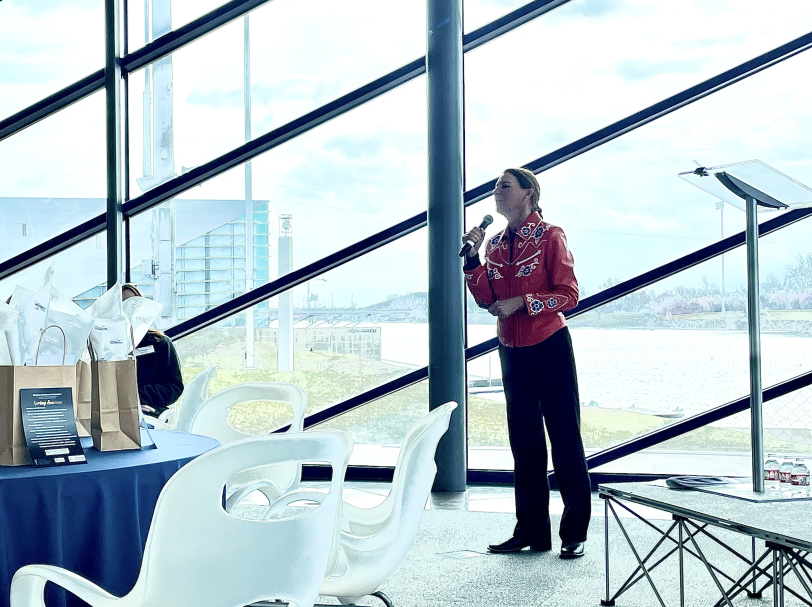
At the Oklahoma Cattlemen's Foundation Spring Seminar, Associate Farm Editor Reagan Calk had the chance to catch up with one of the featured speakers, Kelli Payne. Payne gave a captivating presentation about her personal experience of diversifying her own operation and provided advice and insight on how to take the first steps.
"A lot of times, we look at our outfit, and we think, 'gosh, this only has one use,' and my family and our farm is proof that you can diversity in a manner where you are opening up to the public," Payne said.
Payne talked about how there may be new ways of income right in front of your eyes, and it just takes looking at things in a different light. One of the ways Payne increased diversity on their operation was by allowing people to come and take photoshoots on the property.
"I am a big fan of saying, 'let's try it one time,'" Payne said. "The fear of failure is just something you are going to have to remove sometimes. I like to call it 'failing forward.' If we don't take the chances and see what else is out there, we are maybe missing an opportunity."
Producers in agriculture are constantly being urged to share their stories, Payne said, and a great way to do that is by opening the doors to your operation and providing educational opportunities there.
"Folks are hungry for agriculture," Payne said.
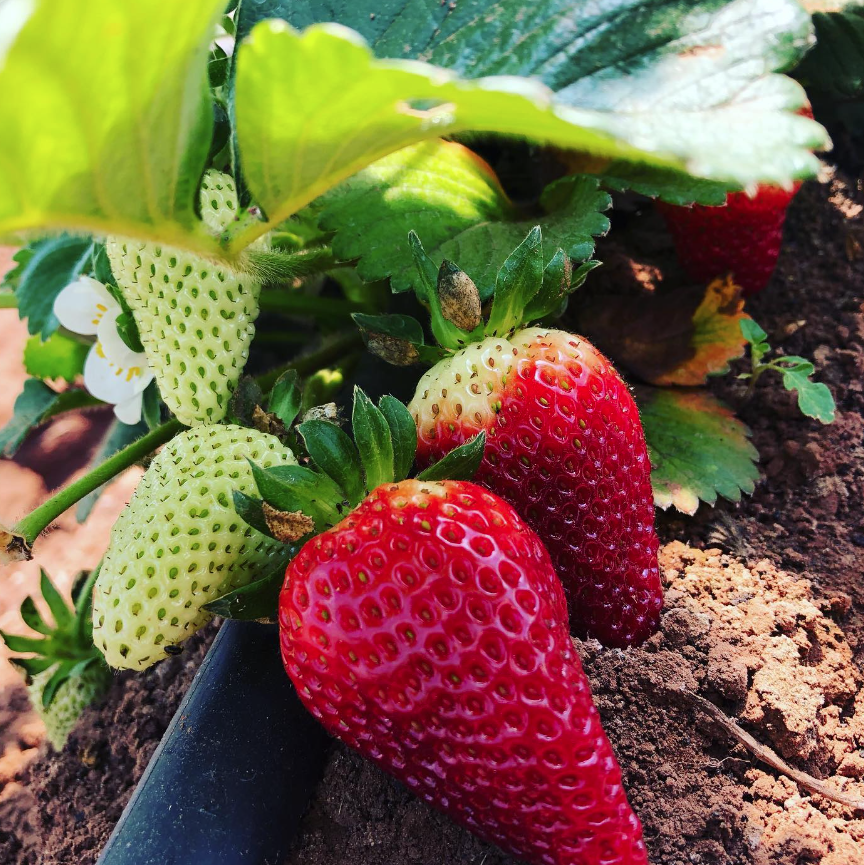
One example of how Payne worked to diversify her family's operation was by growing strawberries in greenhouses.
"That really opened some doors for us to have the public come out," Payne said. "They want to pick their own, they want to learn about it, they want to see it," Payne said. "Some folks have never seen strawberry plants, and then that has just morphed into two festivals a year."
Adding strawberries to the operation was not only a way to add extra income to the farm, Payne said, but it also allowed her family to tell the story of agriculture to the urban community.
With the help of the Oklahoma Agritourism program, Payne said she was able to receive help with any questions she had and receive the support of those at the Department of Ag.
"Extremely helpful resources," Payne said. "They are very hands-on. They do a lot of traveling so they can bring back new ideas and help this agritourism industry flourish in the state of Oklahoma. Just a fabulous team and I cannot say enough about how helpful they were."
To learn more about Growing Paynes Farm, visit their Facebook page by clicking here.

Growth Energy CEO Emily Skor, U.S. Grains Council President and CEO Ryan LeGrand, and Renewable Fuels Association President and CEO Geoff Cooper jointly issued the following statement after Japan's Ministry of Economy, Trade, and Industry (METI) finalized a rule that will allow U.S. ethanol producers more access to the Japanese biofuel market:
"The U.S. ethanol community applauds the Japanese government for joining other countries in recognizing the role ethanol can play in the global effort to address climate change at the same time it takes steps to decarbonize its transportation sector. Countries around the world are recognizing that biofuels like ethanol are a simple, inexpensive and effective solution they can deploy today to help them lower their carbon emissions and meet their climate goals. We will continue to work closely with Japan and other nations to find more ways for us to collaboratively decrease carbon emissions. The U.S. ethanol industry will engage with Japan on additional ethanol consumption efforts both within the on-road and sustainable aviation sectors as the country implements its new regulation."
Background:
Japan's Ministry of Economy, Trade and Industry (METI) released its final proposed rule for partial amendment of the Act on Sophisticated Methods of Energy Supply Structures on March 30, 2023 – in place through 2028 – that allows the country to further contribute to its climate targets through consumption of lower-carbon ethanol and, for the first time, will allow U.S. ethanol to successfully access 100% of the Japanese biofuel market.
The Act, which is reviewed every five years, featured timely and scientific updates regarding the life cycle assessment of U.S. corn-based ethanol.
Japanese regulators revised the U.S. corn ethanol carbon intensity score that allows U.S. ethanol to fully access the entire bioethanol market - up from 66% access in 2021 based on continued improvement in reduction of carbon emission by the U.S. ethanol industry. The target volume for Japanese bioethanol consumption remains at 217 million gallons per year at an ethanol blend level of 1.9% utilized in the form of ethyl tert-butyl ether (ETBE).
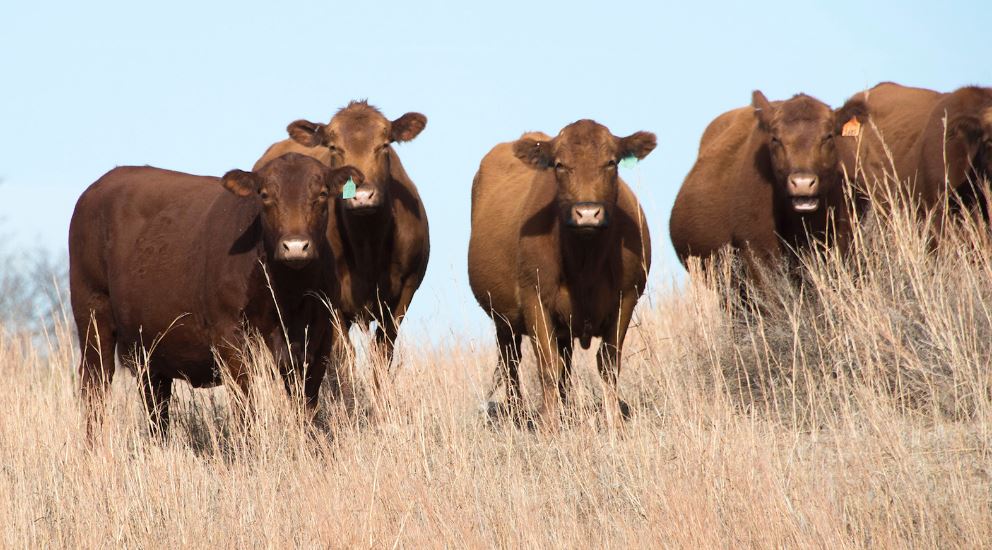
KC Sheperd, Farm Director, is back talking with Bob Rodenberger, a partner with Stockman Oklahoma Livestock Marketing, as he gives the latest on the cattle markets.
Runs have been lighter compared to 30 days ago, Rodenberger said, but the market is good.
"Most of the cattle are going to grass, you know, your 500-pound calves and up," Rodenberger said. "We are seeing a lot of 300-pound calves being bought in preparation for down the road- having ownership- which is great for the seller."
With LRP allowing individuals to buy price protection, Rodenberger said, there is some margin to cover expenses. Locking a profit in, Rodenberger added, is a great way to protect from a "black swan" event.
"We have seen the calf market good; we have seen the yearling market good, and the cow market would be fully steady," Rodenberger said. "We are selling the very, very front-end, high yielding killing cows for over a dollar."
Even the average cows, Rodenberger said, are bringing 30 cents more than they were 45 days ago.
Lower runs are to be expected right now, Rodenberger said, as we are in between seasons. Those who are going to cut their wheat have already pulled cattle off, he added, and others who are grazing out are going to carry their cattle as far as they can.
Senior Farm and Ranch Broadcaster Ron Hays is back visiting with Oklahoma State University Extension Beef Cattle Breeding Specialist, Dr. Mark Johnson for more details about the upcoming Cattlemen's Conference set to take place on May 24-25 in Stillwater, Oklahoma.
In the late 1980s, cattle industry leaders came together and held the Blue Print for the Right Kind of Cattle Conference, which focused on building cattle that fit the industry at the time. The upcoming Cattlemen's Conference is based around building and crafting the right kind of cattle for today and the future.
"We are going to cover a lot of topics, and we are going to have a lot of panel discussions," Johnson said. "We have got a nationally recognized panel of speakers to come in as we talk about range management, and what is going on in the packing and consuming end of beef. As we talk about selection programs, we are going to have panel discussions on the effectiveness of selection."
Topics covered at the Blue Print for the Right Kind of Cattle Conference, such as 'selection for extremes' will also be discussed at the conference.
"A variety of topics, a great panel of speakers, and interesting parts of information are going to come in that we hope each producer can take back to their operation and improve profit potential," Johnson said.
As the cow herd has improved its genetics significantly over the years, Johnson said that will be another topic at the conference as those improved genetics have also led to a better eating experience for consumers.
"It is not a consequence that ten years ago when we were dealing with drought, we used to talk about 1.5 to 2 percent of fed cattle each week reached a quality grade of prime," Johnson said. "Interestingly enough, in the past two to three years, we are seeing eight to 10 percent of the weekly slaughter mix actually achieving a quality grade of prime."
There have always been many moving parts in the beef industry, Johnson said, but now is an important time to focus on those important factors and create the best product to keep the industry going strong.
"It is not one single thing that we all can aim at the bullseye and address right now, but a lot of different things are on our plate in terms of trying to make beef a better product, trying to make beef production work long-term in different parts of the country, and using all of these different genetic values we have got available to us now in the best interest of our own unique operations," Johnson said.
The conference starts with discussion about historical perspectives of the beef industry, Johnson said, and ends with insight on where to go next in the industry with the tools available today.
"Each producer is going to be exposed to some information and have the opportunity for some discussions so that they can take back different ideas to improve the profit potential of their particular operation," Johnson said.
To see more information and to register for Cattlemen's Conference, click here.
The Beef Buzz is a regular feature heard on radio stations around the region on the Radio Oklahoma Ag Network and is a regular audio feature found on this website as well. Click on the LISTEN BAR for today's show and check out our archives for older Beef Buzz shows covering the gamut of the beef cattle industry today.
Joint Statement From U.S. Grains Council, Growth Energy, Renewable Fuels Association Regarding Japan's New Rule On Ethanol
Background:
Japan's Ministry of Economy, Trade and Industry (METI) released its final proposed rule for partial amendment of the Act on Sophisticated Methods of Energy Supply Structures on March 30, 2023 – in place through 2028 – that allows the country to further contribute to its climate targets through consumption of lower-carbon ethanol and, for the first time, will allow U.S. ethanol to successfully access 100% of the Japanese biofuel market.
The Act, which is reviewed every five years, featured timely and scientific updates regarding the life cycle assessment of U.S. corn-based ethanol.
Japanese regulators revised the U.S. corn ethanol carbon intensity score that allows U.S. ethanol to fully access the entire bioethanol market - up from 66% access in 2021 based on continued improvement in reduction of carbon emission by the U.S. ethanol industry.
The target volume for Japanese bioethanol consumption remains at 217 million gallons per year at an ethanol blend level of 1.9% utilized in the form of ethyl tert-butyl ether (ETBE).
Statement:
U.S. Grains Council President and CEO Ryan LeGrand, Growth Energy CEO Emily Skor and Renewable Fuels Association President and CEO Geoff Cooper said jointly:
"The U.S. ethanol community applauds the Japanese government for joining other countries in recognizing the role ethanol can play in the global effort to address climate change at the same time it takes steps to decarbonize its transportation sector. Countries around the world are recognizing that biofuels like ethanol are a simple, inexpensive and effective solution they can deploy today to help them lower their carbon emissions and meet their climate goals. We will continue to work closely with Japan and other nations to find more ways for us to collaboratively decrease carbon emissions. The U.S. ethanol industry will engage with Japan on additional ethanol consumption efforts both within the on-road and sustainable aviation sectors as the country implements its new regulation."

By Mandy Gross
The New Frontiers campaign to build a state-of-the-art teaching, research and Extension facility for Oklahoma State University Agriculture is providing opportunities for major gift donors to name a space in the building.
For Terry Tippens, of counsel at Fellers, Snider, Blankenship, Bailey and Tippens and a 1968 OSU agricultural economics graduate, becoming a New Frontiers major gift donor is a way to give back to the university. He named a space in the New Frontiers Agricultural Hall in recognition of the agricultural economics program that benefited him so much.
"I consider supporting the New Frontiers campaign as more of an honor than an obligation," Tippens said. "I have been very appreciative of the education I received in agricultural economics throughout my legal career as a litigator in complex commercial cases."
During his time at OSU, Tippens met James Plaxico, who served as head of the OSU Department of Agricultural Economics from 1961 to 1977 and retired from the university in 1988 with 43 years of service in the agricultural economics field.
Plaxico left a lasting impression on Tippens. As a result, Tippens and his wife, Donna, chose to name the agricultural economics department head office in the New Frontiers building in honor of 98-year-old Plaxico.
"Dr. Plaxico was head of the ag econ department while I was there, and I appreciated his counseling, guidance and upper-level courses," Tippens said. "As a practicing attorney, I even employed him as an expert witness and considered him a mentor. We wanted to honor his leadership of such a fine program."
Plaxico said he met Tippens while greeting and honoring incoming OSU freshmen and quickly identified him as an excellent student and wonderful person.
"When I first heard that the naming was in the works, I was surprised, elated, appreciative, humbled and overwhelmed with fond memories of people and events of long ago," he said. "My favorite memories as department head include observing the phenomenal growth of the ag econ department in terms of graduate and undergraduate enrollment along with student achievement. I loved being actively engaged with students, faculty and agricultural leaders in developing courses and programs to meet evolving needs and fill opportunities."
The world-class New Frontiers Agricultural Hall will provide the needed support to allow students, faculty and staff to be their best while contributing to OSU's mission, Plaxico added.
The agricultural economics department head office honoring Plaxico will be housed on the second floor of the new building.
The facility will help strengthen the land-grant mission while addressing two key challenges: attracting and retaining scientific leaders and students and equipping collaborative teams with cutting-edge teaching classrooms and research laboratories.
"It's been rewarding to see so many alumni, like Terry, invest in the vision of our college and honor someone like Dr. Plaxico with a named space," said Thomas G. Coon, vice president and dean of OSU Agriculture. "It's also been wonderful to share the naming opportunities with donors and see them select a space where their name will be on display in the building, and for many, that has evolved into a way to create a family legacy and honor a mentor or loved one."
The New Frontiers campaign reached its $50 million fundraising goal in record time. The campaign is recognized as one of the fastest capital campaigns at OSU and the first academic capital campaign of this magnitude to reach its fundraising goal before the building opens.
To address additional building costs and added features, more support is needed to enhance teaching, research and Extension efforts. Visit New Frontiers to learn more about getting involved in the campaign or for construction updates and donor stories.
The New Frontiers campaign was launched in January 2020 to build a new state-of-the-art facility for OSU Agriculture. The New Frontiers Agricultural Hall, expected to open in fall 2024, further advances teaching, research and Extension efforts that are critical to the state's economy, citizens' safety and quality of life. By advancing OSU Agriculture and its programs, New Frontiers is fostering innovation to help feed the world.
Application now available for youth educational program.
Texas & Southwestern Cattle Raisers Association is now accepting applications for the 2023 Cattle Raisers Roundup, a one-of-a-kind opportunity for select high school students to explore the beef industry from pasture to plate.
The Cattle Raisers Roundup is scheduled July 24-28 across Austin, Victoria, Corpus Christi and San Antonio. Attendees will engage in progressive, thought-provoking activities including tours of cattle operations, beef processing facilities, and legislative offices as well as interactive educational sessions simulating real-world experiences.
Tyler Schuster, the association's manager of education and leader of Cattle Raisers Roundup, said this is an exceptional program that offers students valuable insight to the beef industry.
"We are thrilled to be able to continue Cattle Raisers Roundup this year," Schuster says. "This in-depth experience provides young leaders an unparalleled opportunity to gain beef industry knowledge and grow their professional development skills. Investing in the future generation of our industry has never been so important and we're thrilled to welcoming this year's Roundup students."
The 2023 Cattle Raisers Roundup is available to 25 high school students completing their sophomore through senior year. To apply, students must submit an application, video, and recommendation letters by May 15. Additional information including application instructions are available at tscra.org/students.
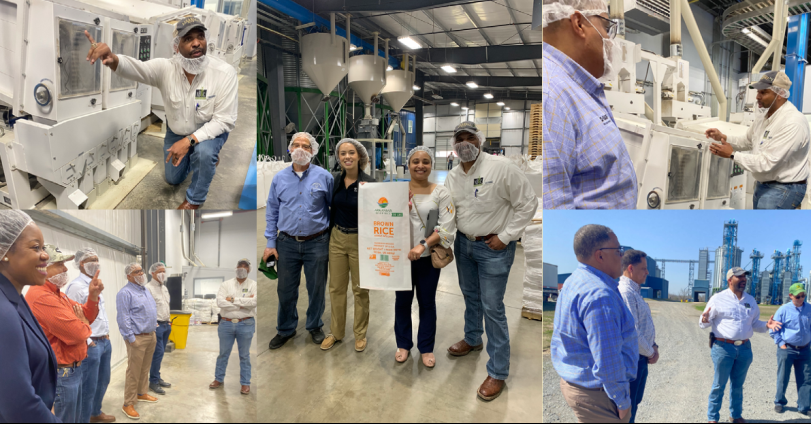
BASF Agricultural Solutions continues to work towards supporting diversity, equity and inclusion in agriculture by supporting black farmers across the country. Recently, several BASF employees visited Arkansas River Rice Mill, the only black-owned rice mill in the country, to learn more about their operation. The company's visit also allowed employees to plan for participation in the National Black Growers Council Model Farm Series field days and further company sponsorship in the organization.
Dr. Anna Alicea, Cotton Campaign Manager for BASF says that meeting with owners of this historic mill in the top rice-producing state in the U.S., is an essential step for advancing equity in agriculture.
"In the early 1900's there were approximately 15 million acres of land owned by African American growers," said Dr. Alicea. "Visiting this rice mill and experiencing first-hand the lasting legacy and contributions of Black farmers to this industry reaffirms the need to reinvest in all growers, especially those of color."
The Arkansas River Rice Mill was started by P.J. Haynie, a fifth-generation farmer from Virginia, who wanted to find more diversity in the rice industry. Haynie is also the chairman of the board of the National Black Growers Council which champions the advancement of systemically marginalized farmers.
"We express our sincere appreciation of BASF becoming a sustaining member of NBGC," said Chairman Haynie. "We are looking forward to BASF and its staff attending and participating in additional NBGC Model Farm Series field days and relative events, as its presence confirms for us and other minority growers, the company's commitment to supporting the closing of systemic gaps hindering successes of black growers in American agriculture."
"NBGC has been promised increased engagement and support from BASF and other companies in tangible ways that could help level the playing field for black growers," said Dr. Hazell Reed, NBGC's Executive Director. Reed also served as Vice Chancellor, Division of Research and Economic Development, North Carolina Central University (NCCU), former dean of the University of Arkansas at Pine Bluff (UAPB) School of Agriculture, Home Economics and Technology (currently the School of Agriculture, Fisheries and Human Sciences) and was recently appointed to the U.S. Department of Agriculture's (USDA) Equity Commission.
"This support and engagement we believe will assist in uniting farmers of all backgrounds, as growers give their lives to execute the biggest job on earth," said Dr. Reed.
Several BASF employees made the trip to tour the black-owned Arkansas rice mill including Anna Alicea, Leon Troutman, Damien LeBeouf, Frantina Williams, Annie Nsafoah and Norman Barclift, Director - East Region, Agriculture Solutions
"BASF knows that black farmers need parity to meet the needs of a growing world population," said Barclift. "As the largest chemical company in the world, we want to ensure they have access to timely agronomic insights and product innovations to get the most out of their acres."
Some of that insight centers around:
"Diverse communities and minority-owned enterprises are sources of great innovation and entrepreneurial activity in agriculture, partly out of necessity because they have also been historically underserved by U.S. commercial avenues," said Brady Spangenberg, Marketing Director of Crop Protection, U.S. Agricultural Solutions Spangenberg. "At BASF, we celebrate the successes of black farmers and intend to further invest in key areas including but not limited to recruitment and training, technical service/agronomy and business support."
About BASF's Agricultural Solutions division
Farming is fundamental to provide enough healthy and affordable food for a rapidly growing population while reducing environmental impacts. Working with partners and agricultural experts and by integrating sustainability criteria into all business decisions, we help farmers to create a positive impact on sustainable agriculture. That's why we invest in a strong R&D pipeline, connecting innovative thinking with practical action in the field. Our portfolio comprises seeds and specifically selected plant traits, chemical and biological crop protection, solutions for soil management, plant health, pest control and digital farming. With expert teams in the lab, field, office and in production, we strive to find the right balance for success – for farmers, agriculture and future generations. In 2022, our division generated sales of €10.3 billion. For more information, please visit www.agriculture.basf.com or any of our social media channels.
BASF Corporation, headquartered in Florham Park, New Jersey, is the North American affiliate of BASF SE, Ludwigshafen, Germany. BASF has approximately 16,000 employees in North America and had sales of $25.7 billion in 2022. For more information about BASF's North American operations, visit www.basf.com/us.
At BASF, we create chemistry for a sustainable future. We combine economic success with environmental protection and social responsibility. More than 111,000 employees in the BASF Group contribute to the success of our customers in nearly all sectors and almost every country in the world. Our portfolio comprises six segments: Chemicals, Materials, Industrial Solutions, Surface Technologies, Nutrition & Care and Agricultural Solutions. BASF generated sales of €87.3 billion in 2022. BASF shares are traded on the stock exchange in Frankfurt (BAS) and as American Depositary Receipts (BASFY) in the United States. Further information at www.basf.com.
The National Cattlemen's Beef Association (NCBA) and the Public Lands Council (PLC) expressed serious concern with the Bureau of Land Managment's (BLM) proposed rule titled "Strengthening the Stewardship of America's Public Lands" that would completely upend BLM's multiple-use mandate and jeopardizes the agency's ability to be a good partner to the ranchers who manage millions of acres across the West.
"Ranchers have a reasonable expectation of transparency and predictability with dealing with the BLM, and this proposed rule falls short on both accounts. The covert manner in which the rule was developed and announced has left permittees feeling like the rule is either a capitulation to the extremist environmental groups who want to eradicate grazing from the landscape, or a concerted effort to develop rules that preclude ranchers' input," said NCBA Executive Director of Natural Resources and PLC Executive Director Kaitlynn Glover. "Over the next 75 days, the BLM will have to answer some serious questions about their understanding of their multiple-use mandate and the value they place on their relationship with ranchers across the landscape."
Read the full proposed rule here.
RON's Dave Lanning has a pre-opening look at today's agricultural Markets.
Click the audio tab below for today's report.
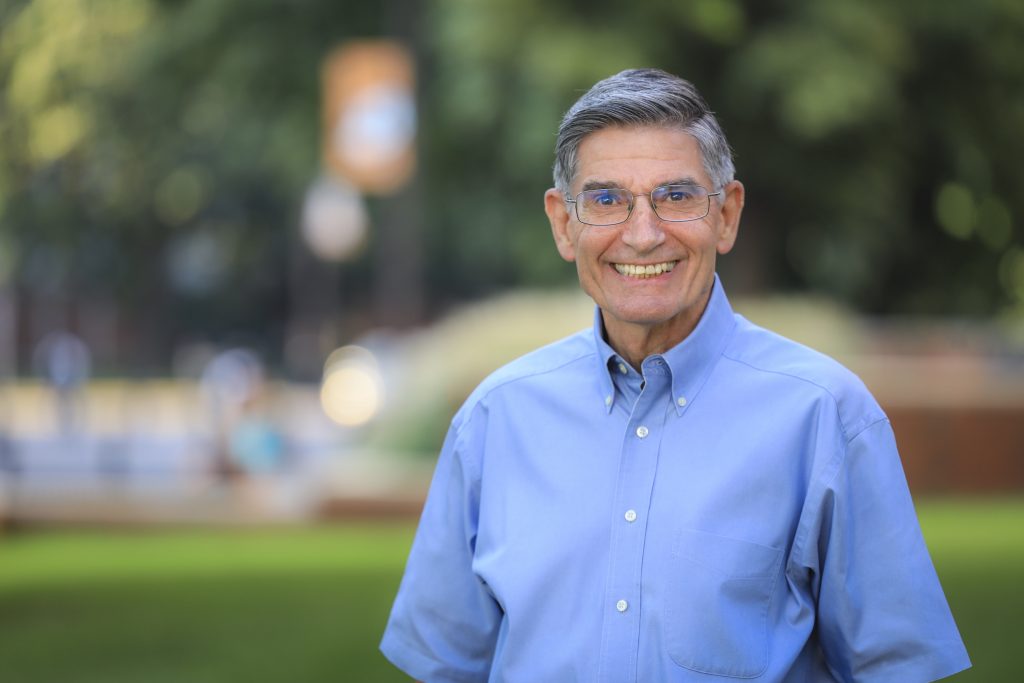
This Week on SUNUP is Oklahoma State University Extension grain market economist Kim Anderson. During this week's edition, Anderson talks about the latest in the grain markets and prices.
"If you have been watching crop prices lately, you have probably been pretty bored," Anderson said. "However, we have had enough moving in the prices to make some farmers nervous."
Anderson said harvest delivery of wheat in northern Oklahoma around the Medford and Pond Creek area is around $8.00 to $8.20 per bushel. Southern Oklahoma around Snyder, Anderson said, is around $7.90, and the panhandle is around $8.20 to $8.25 per bushel.
Corn can be forward contracted in northern Oklahoma around the Medford and Pond Creek area for around $5.50 per bushel, Anderson said, and in southern Oklahoma around Weatherford, corn is forward contracting for $5.90 per bushel. In the panhandle, it is around $6.30.
Soybeans can be forward contracted in most of Oklahoma for around $12.20, Anderson said, and in the panhandle area for about $11.90.
"Cotton prices had movements between $7.75 and 85 cents," Anderson said. "Down around 80 cents now is what the market is going to tell you it is going to be around harvest."
The biggest factor that will impact prices between now and harvest, Anderson said, is the weather.
"It is dry in much of our hard red winter wheat area," Anderson said. "It is a couple months before we get into harvest and a lot can happen to lower that yield. If yield comes in a little bit less than expected, we could have higher prices."
This week on SUNUP:
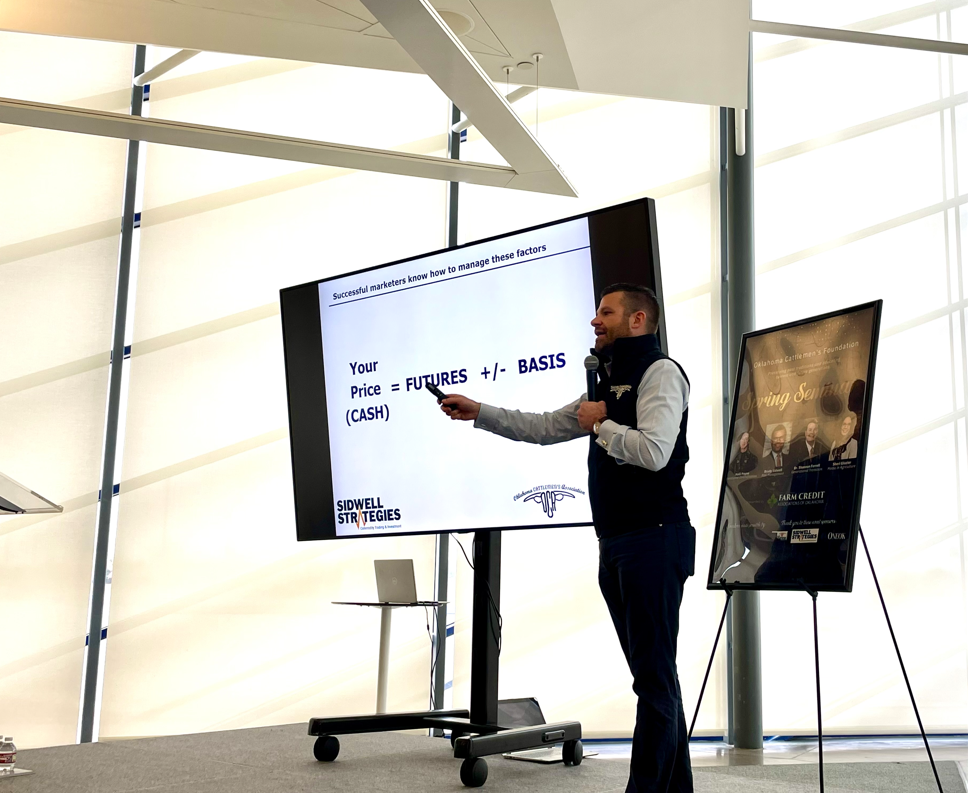
At the Oklahoma Cattlemen's Foundation Spring Seminar, a panel of remarkable speakers came out and had the chance to educate guests on many topics relevant to today's cattle industry, from operational diversification to protecting your profits.
Associate Farm Editor Reagan Calk had the chance to catch up with Brady Sidwell with Sidwell Strategies, after his presentation, where he talked about the importance of risk management.
With factors such as weather extremes and grain price movements impacting the markets, Sidwell said he does not see any relief for that volatility in those markets happening any time soon.
"Macro forces have been a big factor in commodity markets and cattle markets as of late with everything going on in the banking sector and around the world and geopolitics," Sidwell said. "For quite some time, we are going to see all these factors continue to influence, and weather extremes continue to influence the cattle market volatility."
As China has emerged as one of the largest beef importers from the U.S. market, Sidwell said things are becoming more challenging.
"President Xi just came off the national congress and was appointed into an unprecedented third term as president of the country as consolidated power, and then, of course, just getting back from Russia here a week ago," Sidwell said. "It is clear between partnerships there and potential for some kind of Taiwan aggression, that the border and the emergence of China and kind of the counter to western allies are getting trickier."
During these unpredictable times, Sidwell was able to give some insight into why insurance is important and how cattle producers can protect their profit. Just like people have insurance on their cars and homes, Sidwell said protection is also needed in the ag industry for when the unexpected occurs.
"A lot of these outside forces have nothing to do with how good we are at raising cattle or how good our overall system is," Sidwell said. "It is unfortunately influenced by things outside of our control."
If you have a profit that can be locked in and protected above break evens, Sidwell said now is the time to do so.
"Hitting home runs in the market is always difficult," Sidwell said. "You are holding out for something bigger, and it is just important to be able to protect your downside, and there are tools out there for producers to protect their downside with, but yet keep the upside open if the market does continue higher as we think it will- in a choppy fashion- but we think it will trend higher."
Using tools such as Livestock Risk Protection, Sidwell said, are great products to navigate these volatile markets.
Because producers cannot control the markets, Sidwell also talked about a few factors that good marketers should always consider.
"A successful marketer, I think, is somebody who is aware of their breakeven," Sidwell said. "They know what they need to be profitable, and I guess, don't get greedy. That is easy to say, but sometimes hard to do in these markets that are moving higher like we have seen recently."
Committing to putting risk management in place is critical, Sidwell said, and just because there are big moves in the market to the upside does not mean they will stay that way.
"We all hate spending money on insurance, but you do it for the unexpected," Sidwell said. "You don't know when you are going to need it, but you need to price it into your cost of production and cost of doing business."
For more information on risk management and more, contact 580-232-2272. To check out tools and information provided online by Sidwell Strategies, click here. Sidwell Strategies can also be found on Facebook at https://www.facebook.com/sidwellstrategies/ .

Growth Energy CEO Emily Skor today cheered the reintroduction of the Next Generation Fuels Act in the U.S. House of Representatives. The new legislation mirrors a similar proposal, reintroduced last week in the U.S. Senate. "High-octane ethanol has the power to deliver the performance and savings consumers need, while driving down transportation emissions.
We applaud Representatives Mariannette Miller-Meeks (R-Iowa), Angie Craig (D-Minn.), Darin LaHood (R-Ill.), and Nikki Budzinksi (D-Ill.) for leading efforts to unleash the full potential offered by American biofuels. This bipartisan legislation represents a common-sense step toward lower prices at the pump, greater energy security, and cleaner air. We urge lawmakers to join forces with our House and Senate champions to quickly send the Next Generation Fuels Act to the president's desk."
The U.S. Department of Agriculture (USDA) encourages urban producers, innovative producers and other stakeholders to submit comments for and virtually attend the fifth public meeting of the Federal Advisory Committee for Urban Agriculture and Innovative Production (Committee) on April 18, 2023.
"The Federal Advisory Committee is a valuable source of on the ground information and recommendations for USDA," said Terry Cosby, Chief of USDA's Natural Resources Conservation Service (NRCS), which houses USDA's Office of Urban Agriculture and Innovative Production (OUAIP). "I encourage members of the public to attend and submit comments for the Committee to help us better serve urban and innovative producers and their communities."
The Committee is part of USDA's efforts to support urban and innovative agriculture, creating a network for feedback. Members include agricultural producers and representatives from the areas of higher education or extension programs, non-profits, business and economic development, supply chains and financing. The committee last met in February 2023.
About the Meeting
Topics for the upcoming meeting will include addressing public comments and discussing the following recommended topics:
The Committee will deliberate and vote on proposed recommendations and address public comments during the meeting. USDA will share the agenda between 24 to 48 hours prior to the meeting on https://www.usda.gov/partnerships/federal-advisory-committee-urban-ag.
The virtual meeting runs from 3 p.m. to 5 p.m. Eastern on April 18, 2023. To attend virtually, register by April 18 on the Committee's webpage. To submit comments, send by11:59 p.m. ET on May 2 through the Federal eRulemaking Portal. Docket NRCS-2023-0006.
For special accommodations, contact Markus Holliday at UrbanAgricultureFederalAdvisoryCommittee@usda.gov.
Additional details are available in the Federal Register notice.
More Information
OUAIP was established through the 2018 Farm Bill. It is led by NRCS and works in partnership with numerous USDA agencies that support urban agriculture and innovative production. The Federal Advisory Committee is part of a broad USDA investment in urban agriculture. Other efforts include:
Investing up to $7.5 million for Urban Agriculture and Innovative Production competitive grants in fiscal year 2023.
Investing up to $9.5 million for Compost and Food Waste Reduction (CFWR) pilot projects for fiscal year 2023.
Renewing the People's Garden movement -- inspiring collaborative gardens across the country to join the People's Garden community; grow using sustainable practices that benefit people and wildlife; and teach about gardening and resilient, local food systems. Providing technical and financial assistance through conservation programs offered by NRCS.
Organizing 17 Farm Service Agency urban county committees.
Investing nearly $133 million in grants through the Agricultural Marketing Service's Local Agriculture Market Program (LAMP) that develop, coordinate, and expand producer-to-consumer marketing, local and regional food markets, and local food enterprises.
Helping child nutrition program operators incorporate local foods through the Food and Nutrition Services Farm to School Program.
USDA touches the lives of all Americans each day in so many positive ways. Under the Biden-Harris administration, USDA is transforming America's food system with a greater focus on more resilient local and regional food production, fairer markets for all producers, ensuring access to safe, healthy, and nutritious food in all communities, building new markets and streams of income for farmers and producers using climate smart food and forestry practices, making historic investments in infrastructure and clean energy capabilities throughout America, and committing to equity across the Department by removing systemic barriers and building a workforce more representative of America. To learn more, visit usda.gov.
USDA is an equal opportunity provider, employer and lender.
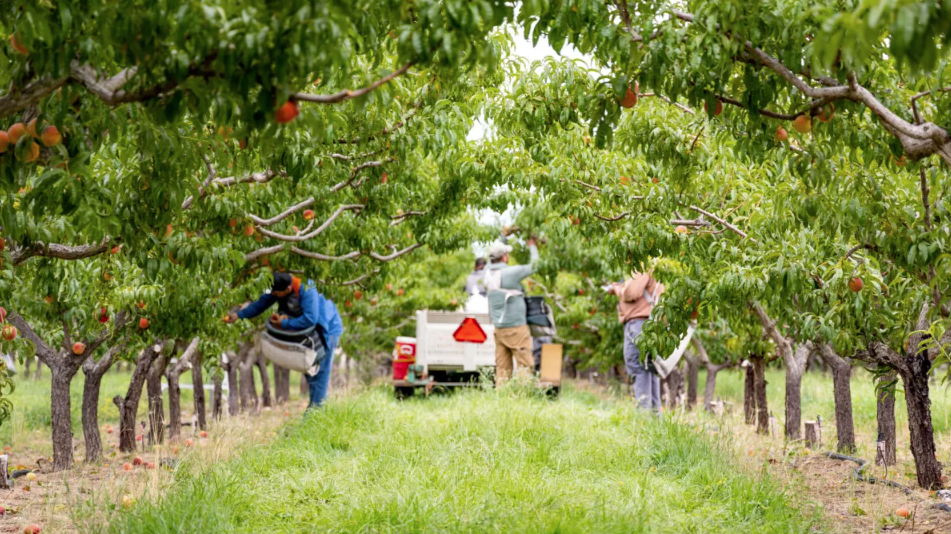
The new methodology for calculating the Adverse Effect Wage Rate, which takes effect today, will take a toll on farms that rely on H-2A workers, particularly small farms. American Farm Bureau Federation economists analyzed the new AEWR in their latest Market Intel report.
Among concerns with the new methodology is how worker responsibilities are determined. For example, a worker who spends most of the day in the field, but also drives fellow workers to the farm will be required to be paid as a chauffeur. In the state of New York, that represents a 30% increased wage rate. According to the Market Intel, "applying the above changes to the sample farms would have a significant impact on the wage outlays of each farm, but particularly the small farm. Across a national average, on the small farm the new methodology would have increased wage outlays by 15.1%, 13.6%, 12.8%, 12.7% and 12% in 2018, 2019, 2020 and 2021, respectively, and an estimated 12.6% in 2023."
The new rule will also make the H-2A program even more difficult to administer by introducing two dates for wage increases throughout the year instead of the current single date.
"We are disappointed in DOL's final rule on the AEWR methodology," said AFBF President Zippy Duvall. "This administration says it wants to help family farms, but its agency largely ignored industry input in favor of a new calculus that will hurt small farms the most. Labor already accounts for almost 40% of total production costs on some farms, and the final rule will certainly continue to raise costs for farm families. Congressional action is the only way to deliver needed certainty and fairness to the farm economy."
Lawmakers recognize the negative impact the new AEWR methodology will have on America's farms. Nearly 600 farm organizations and agribusinesses, including AFBF and many state Farm Bureaus, have urged Congress to support a resolution of disapproval under the Congressional Review Act. It is expected to be introduced in the coming weeks. In the Senate, the bipartisan Farm Operations Support Act (S.874) would temporarily reset the AEWR at 2022 levels.
Read industry letter here.
Read the full Market Intel here. Have Market Intels delivered to your inbox. Subscribe here
Here is the recipe that the U.S. Department of Labor used to create the Adverse Effect Wage Rate (AEWR) Methodology for the Temporary Employment of H-2A Nonimmigrants in Non-Range Occupations in the United States final rule. Step one: Copy the proposed rule of the same name released on Dec. 1, 2021. Step two: Paste. Step three: Sprinkle in some references to having received comments from a range of stakeholders from the public, private and nonprofit sectors, but fail to incorporate any of the suggestions. Step four: Add a dash of "it's not our job" in response to some of the comments received. Step five: Publish the final rule, which "is adopting the methodology proposed in the 2021 AEWR NPRM without change," in the Federal Register on Feb. 28, 2023. Barring any last-minute change of heart or legal action, this new wage regime goes into effect today, Thursday, March 30.
An Overview of the Final AEWR Rule
On the surface, understanding the new AEWR calculation is relatively easy. The wage for the majority of positions, defined by six Standard Occupational Classification (SOC) codes, will continue to be determined by the Farm Labor Survey (FLS) conducted by USDA's National Agricultural Statistics Service. All other positions will be paid according to the Occupational Employment and Wage Statistics (OEWS) survey conducted by the U.S. Bureau of Labor Statistics. But as with most things, the devil is in the details; unfortunately for the farmers who will have to try to implement the new AEWR final rule, there are devils around every corner.
First, the "easy" part – that which stays the same. The FLS is conducted four times per year and results in semiannual reports. The second report of the year, typically released in November, includes an annualized weighted-average combined hourly wage rate for field and livestock workers. This wage rate is what the current AEWR for all H-2A employees is based upon and what the majority of positions will continue to be based upon. The six job categories (with their corresponding SOC codes) that will continue to use this AEWR include: graders and sorters (45-2041); agricultural equipment operators (45-2091); farmworkers: crop, nursery, and greenhouse (45-2092); farmworkers: farm, ranch, and aquacultural animals (45-2093); agricultural workers, all others (45-2099); and packers and packagers (53-7064).
Now to the harder part. Any position that is determined to fall outside of the six classifications listed above will now be subject to an individual AEWR based on the OEWS. If there is a state-specific wage rate for that SOC in the OEWS, the AEWR will be based on that wage. If there is no state-level OEWS for that SOC, the AEWR will be based on the national wage rate for the SOC in the OEWS. This, of course, means that for some positions, the wage rate will no longer be state/regional specific.
How big of a deal is this bifurcated methodology? In the final rule, DOL contends that 98% of H-2A positions will continue to be paid under the previous methodology, i.e., the single-rate AEWR within the field and livestock workers (combined) category determined by the FLS. However, they are basing this assumption on a review of previous years of H-2A position determinations – before the new, and more complex, rules applied. This is an important distinction because the final rule stipulates that "for agricultural labor or services to be performed by H-2A workers that cannot be encompassed within a single SOC code, the Department proposed to determine the AEWR using the SOC code assigned to the employer's job opportunity with the highest applicable AEWR." This likely means that under the new rules, a much larger share of positions will no longer be classified as falling within the field and livestock workers (combined) category. DOL fails to recognize this reality with their assessment that only 2% of positions will be subject to SOC-specific AEWRs.
A personal favorite example from the final rule of how this might play out on the farm:
"An H-2A job opportunity that requires a worker to perform hand-harvest work and to pick-up farmworkers, according to a regular schedule, from employer-provided housing or a centralized pick-up point, in a van used only for passenger transport, on public roads ( e.g., from a motel to the farm), and drive them to the place(s) of employment to perform hand-harvest work, may be assigned SOC code 53-3053 (Shuttle Drivers and Chauffeurs), in addition to SOC code 45-2092 (Farmworkers and Laborers, Crop, Nursery, and Greenhouse). SOC codes 53-3053 and 45-2092 are subject to different AEWR determinations." SOC code 45-2092 is subject to the AEWR determination within the field and livestock workers (combined) category; 53-3053 is subject to the SOC-specific AEWR determination. "When determining the employer's H-2A wage obligation, and the higher of the two AEWRs (i.e., the AEWR applicable to SOC code 53-3053 and the AEWR applicable to SOC code 45-2092) is the single AEWR for evaluating the employer's wage obligations for all of the work performed for this job opportunity."
To put this change in a real-world perspective, in the state of New York in 2021 the state wage rate for chauffeurs (53-3053) was $19.52 an hour. The AEWR for field and livestock workers (combined) category in New York in 2021 was $14.99 an hour. Even though the worker will spend most of their time performing hand-harvest work, the new rule would require the New York farm employer to pay an additional 30% for that employee (assuming a 40-hour work week).
Perhaps you're not an employer, so this small example doesn't resonate. We modelled a limited version of what these two changes (bifurcated AEWR methodology and revised SOC determinations) could mean on two farms. The small farm employs 10 H-2A employees, the large farm employees 70 H-2A employees. Under the previous rule all of the employees on each farm were paid equally, the AEWR for field and livestock workers (combined) category. Under the new rule, however, it is likely that this would change. We assumed that on the small farm (10 employees) that eight employees would continue to be classified as farmworkers - crop, nursery and greenhouse (45-2092) and be paid the combined rate, but that one worker would now be classified as a first-line supervisors of farm workers (45-1011) and one worker would now be classified as a light truck driver (53-3033). On the large farm we made similar changes but adjusted for size. On the large farm 60 employees would continue to be classified as farmworkers - crop, nursery and greenhouse (45-2092) and be paid the combined rate, but three workers would now be classified as first-line supervisors of farm workers (45-1011) and three workers would now be classified as light truck drivers (53-3033). How big of a deal could this possibly be?

In Figure 1 we see that applying the above changes to the sample farms would have a significant impact on the wage outlays of each farm, but particularly the small farm. Across a national average, on the small farm the new methodology would have increased wage outlays by 15.1%, 13.6%, 12.8%, 12.7% and 12% in 2018, 2019, 2020 and 2021, respectively, and an estimated 12.6% in 2023. Across a national average, on the large farm the new methodology would have increased wage outlays by 6.5%, 5.8%, 5.5%, 5.4% and 5.2% in 2018, 2019, 2020 and 2021, respectively, and an estimated 5.5% in 2023. The increases in 2023 are estimated because the OEWS program doesn't release the May 2022 estimates until April 25, 2023.
As growers are quick to point out, however, no one pays the national average rate, so it's important to explore the regional/state specifics. In Figures 2 and 3 we see that every region would experience higher wage outlays under the new rule, but that the range across regions is significant. The smallest increase in 2022 would have occurred in California, where the small and large growers would have paid 7.6% and 3.3% more in wages, respectively. The largest increase in 2022 would have occurred in the Southeast region. The small growers in the Southeast region would have paid an average of 19.8% more in wages, while the large grower would have paid 8.5% more under the new rule. (Definitions of the Farm labor regions can be found on page 26 of the November 2022 Farm Labor report.)


Beyond Wages
Beyond wages, the additional complications for growers are not insignificant. We will focus on two complications here. The first is that employers would now face two wage changes each year. One Federal Register notice would announce annual adjustments to the AEWRs based on the FLS, effective on or about Jan. 1, and a second Federal Register notice would announce annual adjustments to the AEWRs based on the OEWS survey, effective on or about July 1. In the final rule, DOL, demonstrating a sizable break from reality, notes that it "considers the likelihood of confusion or disruption among workers subject to different temporary agricultural employment certifications to be low."
The other complication to consider here is the lack of predictability in the SOC determination for positions. Per the final rule (definitions in brackets are the author's own),
"The Department reiterates that the evaluation of tasks associated with an employer's job opportunity and SOC code assignment is not new in the H-2A program and declines to introduce a new, separate administrative process. Due to the time-sensitive nature of receiving and processing H-2A applications under the statute, the SWA [state workforce agencies] will continue to evaluate an employer's job opportunity in the first instance—and determine the appropriate SOC code(s) for the job opportunity—when it reviews an employer's job order for compliance with 20 CFR part 653, subpart F, and 20 CFR part 655, subpart B. The SWA will continue to enter the SOC code assigned to the employer's job opportunity on the Form ETA-790, Agricultural Clearance Order. After the employer files its H-2A Application for Temporary Employment Certification, the OFLC CO [Office of Foreign Labor Certification Certifying Officer] will continue to perform a secondary evaluation of the employer's application and job order, including SOC coding. As is currently the case, the CO may determine whether a different SOC coding is necessary, for example, based on additional information received during processing."
While it is true that state workforce agencies have been assigning SOC codes to positions, those determinations have not had a significant impact on employers. As was demonstrated above, under the final rule, the impact of those determinations could be considerable. As DOL points out, they could also change, after the Office of Foreign Labor Certification reviews the state workforce agency's evaluation. For employers this introduces a whole new level of uncertainty as they try to estimate the ultimate wage outlays for the year.
Legislative Attempts to Intervene
Some astute legislators have picked up on the significance of the "modest" changes that DOL is introducing with the AEWR final rule. Two attempts are currently underway to try to push pause on the final rule. The first is an effort by congressional leaders to introduce a resolution of disapproval under the Congressional Review Act (CRA) for the recent DOL rule on the new AEWR methodology. If the CRA joint resolution of disapproval is enacted, the AEWR final rule would go out of effect immediately and "shall be treated as though such rule had never taken effect." Learn more about CRA here. The second effort, the bipartisan Farm Operations Support Act, introduced by Sens. Jon Ossoff (D-Ga.) and Thom Tillis (R-N.C.), temporarily resets the AEWR at 2022 levels. While the national average AEWR in 2022 was $15.56, a sizable 6.4% increase over the 2021 level, it is certainly preferrable to the 2023 national average AEWR of $16.62 and the new AEWR final rule described above that goes into effect on March 30, 2023.
Summary
The new AEWR final rule will inflict considerable wage increases on farmers of all sizes who use the H-2A program. While DOL may be under the impression that the final rule it has crafted focuses on "prevent[ing] future adverse effect" with surgical precision, the reality is that it is more like the child's game of Operation. The patient (both grower employers and H-2A employees) is awake, will feel every misstep and may not survive the operation, no matter what the surgeon's intentions.
The National Cattlemen's Beef Association (NCBA) strongly supports legislation introduced today by Sen. John Thune (R-SD) to repeal the federal estate tax, commonly referred to as the Death Tax.
"No cattle producer should ever be forced to sell their family's farm or ranch to pay a tax bill due to the death of a family member. Repealing the Death Tax is a commonsense way to keep the farm or ranch in the family," said NCBA President and South Dakota cattle producer Todd Wilkinson. "As a land-based, capital-intensive industry, most cattle producing families are asset-rich and cash-poor, with few options to pay off tax liabilities. It is unacceptable that some families are forced to sell off land, farm equipment, parts of the operation, or the entire ranch to pay the estate tax. We need a tax code that promotes the continuation of family-owned businesses instead of breaking them up."
Ensuring a farm or ranch can be passed to children or grandchildren is a priority for family-owned farms, ranches and agricultural businesses. It is critically important that producers and business owners have permanent relief from the Death Tax. Current Death Tax relief is set to expire at the end of 2025, and it is vital that Congress takes immediate action to provide permanent relief for agricultural families. NCBA is committed to working with Senator Thune and members of the Senate and House, those who support American cattlemen and women and rural communities to kill the Death Tax.

The Next Generation Fuels Act was reintroduced in the U.S. House of Representatives today. The National Corn Growers Association applauded the development, saying the legislation would help address the country's most pressing energy issues through a transition to cleaner fuels and vehicles.
Rep. Mariannette Miller-Meeks (R-Iowa) led the bipartisan reintroduction of the bill along with Reps. Angie Craig (D-Minn.), Darin LaHood (R-Ill.) and Nikki Budzinski (D-Ill.).
"We're very grateful to Rep. Miller-Meeks, along with Reps. Craig, LaHood and Budzinski for taking the lead on this priority legislation for corn growers," said NCGA President Tom Haag. "Advancing the Next Generation Fuels Act is timely for Congress's work on energy and environmental issues, offering solutions that lower fuel costs, reduce emissions and help shore up America's energy security for the long run."
The Next Generation Fuels Act would clean up the nation's fuel supply and transition new vehicles to use cleaner, more efficient fuels that also lower costs for drivers. By establishing a clean, high-octane standard for fuel and requiring that sources of additional octane result in at least 40% fewer greenhouse gas emissions, the legislation would allow automakers to significantly improve vehicle fuel efficiency through advanced engines.
The legislation builds the nation's clean energy progress by advancing higher ethanol blends and new vehicles that work together to deliver greater emission reductions, cost savings and consumer choice.
As NCGA has called on the Biden administration to act to prevent a disruption in access to higher blends of ethanol this summer, the Next Generation Fuels Act would also permanently remove regulatory barriers, allowing for higher ethanol blends and advanced vehicles that maintain a wider range of competitive fuel and vehicle choices.
In addition to the four lead House sponsors, Reps. Don Bacon (R-Neb.), Mike Bost (R-Ill.), André Carson (D-Ind.), Emanuel Cleaver (D-Mo.), James Comer (R-Ky.), Randy Feenstra (R-Iowa), Brad Finstad (R-Minn.), Mike Flood (R-Neb.), Ashley Hinson (R-Iowa), Marcy Kaptur (D-Ohio), Dan Kildee (D-Mich.), Mike Lawler (R- N.Y.), Mary Miller (R-Ill.), Zach Nunn (R-Iowa), Elissa Slotkin (D-Mich.) and Eric Sorenson (D-Ill.) also joined the legislation as original cosponsors.
A companion bill was introduced in the Senate last week.
Congressman Frank Lucas (OK-03) released the following statement after the U.S. House of Representatives passed H.R. 1- the Lower Energy Costs Act by a bipartisan vote of 225-204:
"Over the past 19 months, the Biden Administration has logjammed American energy projects in government regulatory purgatory and enacted policies that have led to the dependence of energy from foreign adversaries- all leading to higher prices for America's families and communities. Oklahoma, and the United States as a whole, has tremendous potential to utilize its energy resources – resources that have the capability to provide efficient and reliable energy for many of our communities. The Lower Energy Costs Act would enhance our energy resources, strengthen our energy and national security, enact sensible permitting reforms into law, and- most importantly- cut costs for consumers," said Congressman Lucas. "The backbone of America's energy security are the resources that lie within our grasps for development. As the global leader in energy technology development and science innovation, the United States must take an all-of-the-above approach that embraces a wide range of energy sources and technologies that support integrated energy systems. I'm proud to support the Lower Energy Costs Act, ensuring America can untap the energy resources of tomorrow and strengthen America's energy security while making energy cleaner, more affordable, and more reliable for all Americans."
Click here for a summary of the bill.
The Agricultural Retailers Association (ARA) applauds the House vote today to adopt the Lower Energy Costs Act.
ARA is among the more than 100 stakeholders to endorse this legislation that reduces inflation pressures and costs for Americans.
"ARA strongly supports H.R. 1, the Lower Energy Costs Act, which is necessary legislation that will reform the National Environmental Policy Act (NEPA) and expedite mining, energy, and infrastructure projects to help lower America's energy costs and boost our economy," says ARA Senior Vice President of Public Policy & Counsel.
"We applaud efforts in Congress to address these important issues and for their effort to increase our nation's energy independence, boost domestic manufacturing, accelerate critical infrastructure projects and expand our global competitiveness."
View ARA's policy position on energy as well as the other priorities established earlier this year by ARA members.
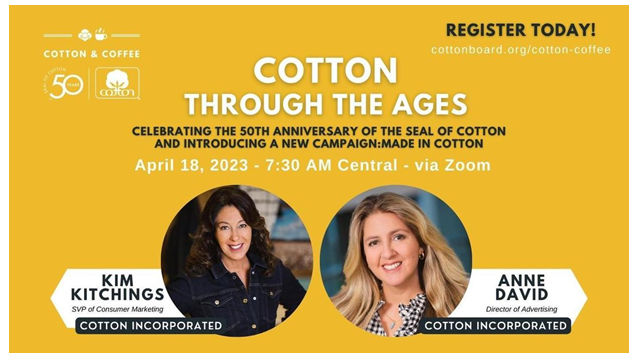
Join us for Cotton & Coffee on April 18, 2023.
Cotton Incorporated's Kim Kitchings and Anne David will lead a discussion about the Seal of Cotton and the new 2023 Brand Campaign, exploring cotton's role in shaping culture and learning about additional efforts to impact cotton's future. Cotton & Coffee Zoom sessions are open to all U.S. cotton producers, importers, and industry partners. Pre-registration is required to attend.
Please visit https://www.cottonboard.org/cotton-coffee to register.
At the Advanced Bioeconomy Leadership Conference (ABLC) in Washington D.C., the National Corn Growers Association (NCGA) once again sponsored and facilitated the Corn-to-Chemicals Summit, outlining the uses of corn as an industrial feedstock.
The panel was moderated by Sarah McKay, NCGA Market Development Director, and participants included Nick Lepore, Morning Consult Senior Research Manager, and Denny Vennekotter, Vice Chair of Market Development Action Team (MDAT) and Ohio corn grower. The panel highlighted the survey results from the MDAT commissioned study on public perception of industrial biotechnology and support for a national incentive for biobased products. Vennekotter also shared his perspective on the value and sustainability of corn as an industrial feedstock and how utilizing corn addresses key areas of importance for the public as it relates to industrial biotechnology. Further, the panel had a robust Q&A session with the audience on programs and policies, including the national incentive for biobased materials that NCGA and BIO are currently working towards.
"U.S. corn farmers continue to produce an affordable, high-quality and reliable crop each year," said Vennekotter. "That crop can be turned into more than just food, feed and fuel. The corn kernel can be utilized in so many ways, which is why we focus on new uses and corn as an industrial feedstock."
NCGA continues work in the new uses and industrial feedstock space through the Consider Corn Challenge and will be launching a fourth Consider Corn Challenge on April 14th! NCGA also works to accelerate new uses through a partnership with DigestData, continued conversations with government agencies like the Department of Energy's (DOE) Bioenergy Technologies Office (BETO), and expanded focus on a potential national incentive program. Learn more about NCGA's additional new uses programs and efforts at ncga.com/newuses.
Want to learn more about opportunities for corn as an industrial feedstock? Check out The Path for Corn as an Industrial Feedstock.
Congressman Tom Cole (OK-04) released the following statement after House passage of H.R. 1, the Lower Energy Costs Act. If signed into law, this legislation would increase domestic energy production, reform and streamline the permitting process for energy infrastructure, reverse the Biden Administration's anti-energy policies and boost the production and processing of critical minerals. Cole supported the legislation.
"President Joe Biden's repeated actions and anti-North American energy policies have left the United States in a vulnerable position by substantially driving up energy prices and damaging our energy security," said Cole. "However, House Republicans have put forth a plan to end this sad state of affairs. By rolling back the Biden Administration's disastrous Green New Deal-style agenda, we can unleash our energy resources here at home, lower energy costs and ensure the U.S. is not reliant on states such as China, Russia or Iran for energy sources. Over the past two years we have learned that an all of the above energy policy is certainly the best route for the American people and our national security, and I was proud to support the Lower Energy Costs Act that would fulfill this goal."
Earlier this week, Cole delivered remarks during the House Rules Committee's consideration of H.R. 1. Video here and transcript here.
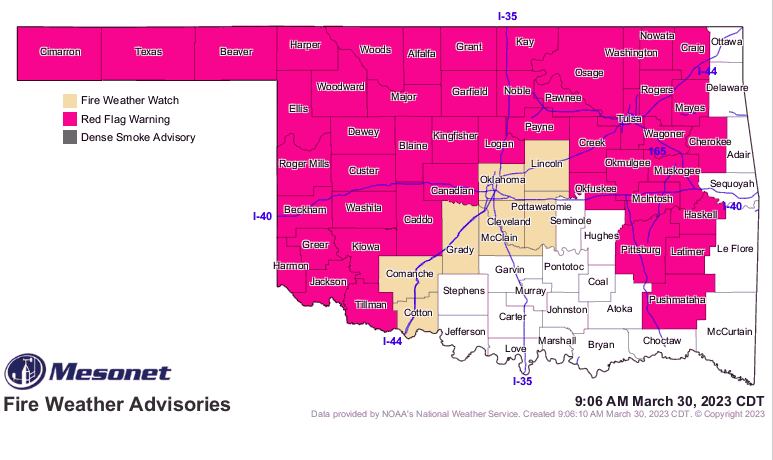
Oklahoma Forestry Services is urging Oklahomans to continue using extreme caution in the face of the strongest fire weather so far in 2023. Very high to extreme fire danger indices will develop on Friday. Wildfire concerns are expected to remain in place for the next seven days.
OFS is deploying firefighting resources, including engines, dozers and personnel, to both Woodward and Guthrie.
"For at least the next week, OFS is encouraging Oklahomans to avoid activities that may spark a wildfire," said State Forester Mark Goeller. "We have been fortunate so far this year in avoiding the number of fires seen in recent years and we hope this continues."
The duration of Oklahoma's current drought has limited the amount of fuel (i.e., grass and timber litter) although when coupled with the intensity of the forecasted fire weather, sufficient fuel is in place to worsen any fires that are sparked.
Landowners that have been conducting beneficial prescribed fires in recent days are asked to ensure that these fires are thoroughly mopped up and patrolled to limit escape potential as the weather becomes warm, dry, and windy. Oklahoma Forestry Services has a close working relationship with our partners at National Weather Service offices covering Oklahoma as well as our neighboring states to provide accurate and timely predictive services.
The main area of concern on Friday has been identified and highlighted on the attached map.
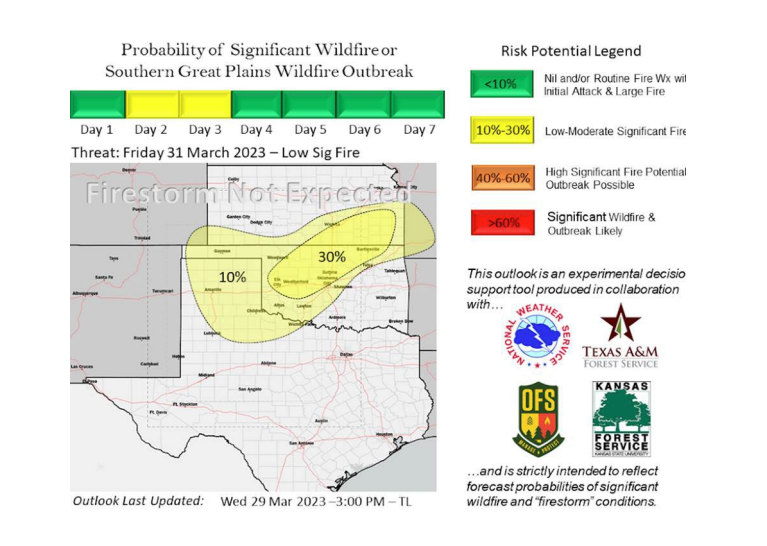
New wildfire occurrence is expected to increase and large fires greater than 300 acres are likely within the identified area. Significant fires (greater than 5,000 acres) are low-to-moderate risk.
Oklahoma Forestry Services is the state's lead wildland firefighting agency. For wildfire information, county burn ban resolutions, and the Oklahoma "Wildfire Situation Report" visit forestry.ok.gov.
Oklahoma State University's Pesticide Safety Education Program will partner with the Oklahoma Department of Agriculture, Food and Forestry to host two unwanted pesticide disposal days in McAlester, Oklahoma, on April 25, and Kingfisher, Oklahoma, on April 27.
The events will take place from 8 a.m. to 1 p.m. at the Southeast Expo Center, 4500 West, 4500 US-270 in McAlester and the Kingfisher County Fairgrounds, 300 S. 13th St., in Kingfisher.
Farmers, ranchers, applicators, pesticide dealers and homeowners may bring up to 2,000 pounds of pesticides to the drop-off sites for proper disposal at no charge. A fee is required if bringing more than 2,000 pounds of pesticides.
ODAFF has contracted with Clean Earth, a licensed hazardous waste company, to collect and properly dispose of waste pesticides. Pesticide dealers are asked to preregister through the OSU Pesticide Safety Education Program because of the potential for large quantities of pesticides coming in from multiple dealers. Applicators and agricultural producers are not required to preregister. Paint, batteries, oil or fertilizer will not be accepted.
Participants will need to safely transport their pesticides to one of the collection sites. Pick-up services are not available. Read these safe transportation tips before bringing chemicals to the drop-off site.
Originating in 2006, 1.232 million pounds of pesticides have been properly disposed of during Unwanted Pesticide Disposal Days, keeping the chemicals out of rivers, streams, landfills, storm drains and illegal roadside dumps. Proper disposal also lessens the chance of groundwater contamination and helps consumers get rid of containers taking up space in their barns, storage buildings and garages in an environmentally safe manner. For more information, visit the OSU Pesticide Safety Education Program website or contact Charles Luper, OSU Extension associate, at 405-744-5808
The United Sorghum Checkoff Program (USCP) has announced its strategic partnership with Google to increase sorghum consumer awareness through innovative marketing strategies. USCP is a producer-funded national organization dedicated to improving the sorghum industry and representing sorghum farmers across the United States.
USCP will leverage Google's expertise in digital marketing to create consumer awareness campaigns that promote the sustainability and health benefits of sorghum and its versatility as a food ingredient. USCP recently led efforts to develop and launch a new campaign for this partnership, titled "Sorghum. Food's Best Kept Secret." to showcase and offer a new whole-grain option for consumers. The campaign's ads can be viewed on The Sorghum Checkoff's Youtube channel, Sorghum. Nature's Super Grain and are powered by Google Ads, leveraging Google's expertise in digital marketing.
"Our partnership with Google will allow us to take sorghum consumer awareness campaigns to the next level," USCP Director of Communications Clint White said. "Sorghum is a powerhouse grain with so much to offer consumers who value nutrition, sustainability and versatility in the kitchen. By leveraging Google's expertise in digital marketing, we can raise awareness about sorghum's benefits and offer a viable solution to individuals seeking healthier alternatives."
In addition to working with Google, USCP partnered with public relations agency, Padilla Speer Beardsley, Inc. (Padilla), to help USCP make the most of resources in making sorghum the go-to grain for everyday cooks. USCP will lead the charge by accelerating sorghum's position from ancient to high-performance grain for sustainable, healthy meals and snacks. Padilla is a leading PR agency with extensive experience in the food and agriculture industry.
"We are thrilled to partner with the Sorghum Checkoff on this exciting new project," Padilla President Matt Kucharski said. "Together, we'll let consumers in on the secrets of sorghum – from its high-protein, gluten-free and antioxidant-rich nutrition benefits to its role as a water-saving, climate-resilient crop – and make it the go-to grain for everyday cooks."
More information is available at SorghumCheckoff.com. For more information on Padilla visit padillaco.com.
NASDA CEO Ted McKinney released the following statement regarding the bipartisan passage the Congressional Review Act resolution of disapproval for Waters of the United States (WOTUS).
"NASDA applauds the bipartisan passage of H.J.Res.27 – the Congressional Review Act resolution of disapproval for the WOTUS rule both in the House and the Senate. We thank the bipartisan members of Congress, especially House Transportation and Infrastructure Committee Chairman Graves and Senate Environment and Public Works Ranking Member Capito, who advanced this effort.
The recent WOTUS ruling failed to provide clarity and certainty for farmers and landowners, and it disregarded the Clean Water Act's statutory mandate for cooperative federalism.
While we await the Supreme Court's ruling in Sackett v. EPA, NASDA continues to work at the state and local level with those tasked with implementing the recent WOTUS rule and provide as much guidance and perspective to them as possible."
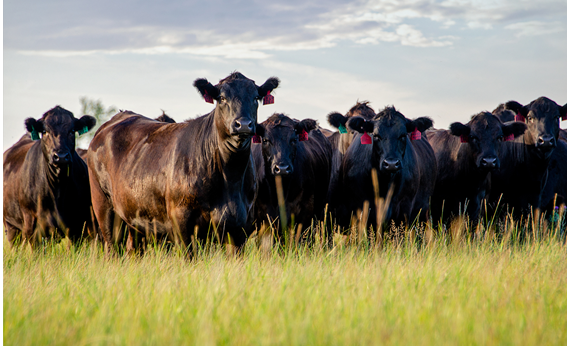
State Scoop from the Oklahoma Limousin Breeders Association
Questions answered by the President of the OLBA
Oklahoma Fun Facts:
Oklahoma is home to 4 mountain ranges: Arbuckle Mountains, Wichita Mountains, Ozark Mountains, and the Ouachita Mountains.
What is the largest agriculture industry in the state?
Production of beef cattle is the largest industry.
What's new with your association?
We are excited to host the 2024 National Junior Limousin Show & Congress!
What are some upcoming events your association has or are looking forward to attending?
We hold our annual Ronn Wayland Memorial Field Day Show in conjunction with the OCA Spotlight Classic Show in Stillwater on the first weekend in June. We also will hold the OLBA Annual Banquet and Benefit Auction on Friday evening June 2, 2023.
What is the biggest opportunity that breeders should be taking advantage of with your association?
Networking with other breeders and advertising their own operation in our bi-monthly ads in the Oklahoma Cowman Magazine.
What are your goals as an organization?
The goals of the organization are to promote the breed and to encourage the next generation to raise Limousin.
Final thoughts:
Oklahoma, along with our neighbors to the south, was the first to form state associations back in May 1971. The OLBA held the first Limousin Show & Sale in the United States on November 30, 1971.
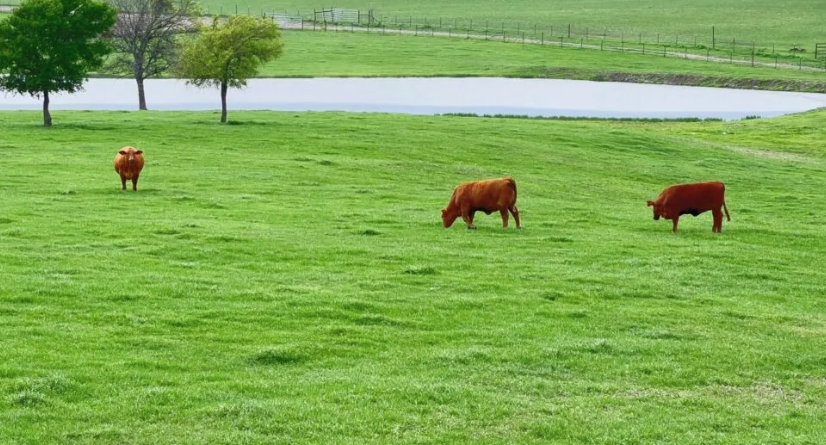
American Farm Bureau Federation President Zippy Duvall commented today on the Senate passage of a Congressional Review Act resolution of disapproval of the 2023 Waters of the U.S. Rule.
"AFBF applauds Senators for coming together to repeal the 2023 WOTUS rule. Today's bipartisan vote under the Congressional Review Act follows a similar effort in the House earlier this month. A majority of Congress has now told EPA and the Army Corps of Engineers that this overreaching rule will lead to more uncertainty for America's farmers and ranchers.
"Farmers and ranchers are committed to protecting the land and water they rely on to grow food for America's families. Unfortunately, the 2023 WOTUS threatens the progress made to responsibly manage natural resources. We urge President Biden to recognize the concerns from members of both parties and rescind this troubled rule."
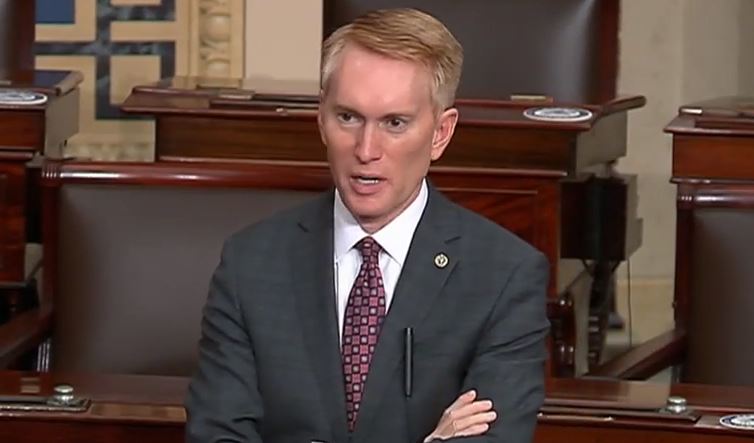
Senator James Lankford (R-OK) today introduced the bipartisan Security and Oversight of International Landholdings (SOIL) Act, along with Senators Jim Risch (R-ID), Thom Tillis (R-NC), and Michael Bennet (D-CO), in order to provide oversight and transparency of purchases of US agricultural land that threaten national security. On the heels of a successful rejection of allowing more marijuana growth in the state, Lankford continues to respond to concerns from Oklahomans about the multiple recent purchases of Oklahoma agricultural land by foreign entities.
"Our state overwhelming rejected 'legalizing' recreational marijuana earlier this month because we have seen firsthand how foreign criminal organizations exploit vulnerabilities in our law to destroy our families and communities for their profit," said Lankford. "Every region of Oklahoma is concerned about foreign nationals buying up farmland. Our loose oversight has allowed transnational criminal organizations to partner with Chinese nationals to buy land and businesses throughout Oklahoma. This is a national security issue and a human rights issue. We need to know who is buying our land, how they are using it, and if any criminal activity is occurring."
Oklahoma has over 7,000 licensed marijuana grows. The Oklahoma Bureau of Narcotics (OBN) believes that 2,000 of those farms have a Chinese connection. The marijuana market in Oklahoma has ushered in other serious crimes like human trafficking, forced labor, and money laundering.
"While there's no question America has some of the best farmland in the world, it's doubtful China is buying it up to plant more wheat and potatoes," said Risch. "The SOIL Act will introduce stricter measures and oversight to prevent bad actors, like China and Russia, from purchasing our agricultural land—particularly land near US military installations."
"Food security is national security, and it's alarming how the Chinese Communist Party has been buying up American farmland as fast as they can," said Tillis. "This commonsense legislation increases transparency and oversight on these purchases so we can protect both North Carolina farmers and the world's most abundant food supply from our adversaries."
"For too long, Washington has allowed foreign adversaries like China and Russia to buy up American farmland and its precious water resources while our family farmers and our economies became collateral damage. For the sake of American growers, farmers, and ranchers, we need to modernize and strengthen our tools to evaluate the risk of these foreign purchases on our supply chains and our national security," said Bennet.
Background
The SOIL Act deters criminal investment in US agriculture by:

The cattle industry is the largest segment of American agriculture, and beef derived from cattle is the second most consumed livestock protein in the United States. Despite its obvious importance, just three years ago consumers went to their grocery stores and for the first time they could not buy the beef they needed for their families because the beef shelves were empty.
Beef shortages in local grocery stores was unequivocal evidence that the U.S. food supply chain for beef is inadequate to meet America's food security needs. And this informs us that the market structure responsible for delivering an abundant, safe, and affordable supply of beef to American consumers is systemically broken.
One only needs to look at the prolonged and unprecedented spread between the super-inflated prices that consumers have been paying for beef at their grocery store and the depressed prices that American cattle farmers and ranchers have been receiving for their cattle to conclude that market failure pervades the cattle and beef industries.
The ringing of the watchtower alarm reverberated over all of America three years ago. It informed decision-makers that they must substantively reform the market structure for cattle and beef if America is to achieve an uninterrupted supply of affordable beef.
So, during the past three years, what substantive reforms has Congress initiated to correct the cattle and beef markets' broken structure?
Well, the answer is none. The cattle and beef markets continue to be as dysfunctional today as they were when your grocery shelves went bare.
Let's identify the problem. The problem is that the U.S. cattle industry underproduces for the U.S. market – we simply don't have enough domestic cattle to satisfy America's appetite for beef. But if that's true, then why are there sufficient supplies of beef sometimes but not always?
About a decade ago, the U.S. Department of Agriculture reported that about 18% of the U.S. beef supply consists of imported beef and beef from imported cattle. Today, we estimate that about 20% of our U.S. beef supply consists of imports.
What that means to food security is that the U.S. does not have enough cattle to achieve self-sufficiency in beef production. What it also means is that should another major geo-political event occur – think Ukraine – or if another supply chain-disrupting disease pandemic strikes, resulting in an inability to access foreign imports, consumers could face up to a 20% shortfall in the volume of beef needed to keep grocery shelves full. Empty beef shelves and skyrocketing prices for the beef that is available would be inevitable outcomes.
This begs the question: Why doesn't the U.S. produce more beef to alleviate America's significant dependency on imported beef?
Well, it's because the current market structure, which we now know is broken, was designed to maintain a significant dependency on foreign beef. And the designers of that broken market structure are none other than the multinational beef packers and their lobbying allies that fight fiercely to maintain America's dependency on foreign imports.
Remember, those imports are cheaper and undifferentiated, meaning the import dependency that threatens food security also means higher profits for importers as they can pass off imported beef to unsuspecting consumers as if it came from the cattle raised by America's cattle farmers and ranchers, even though it didn't.
And what does this mean to U.S. citizens? It means if our domestic cattle industry continues to not produce all the beef consumed in America, then the risk of future beef shortages in your grocery stores is much greater than if we did. We only need to look back three years to know that it can and did happen then and it can happen again.
So, what must be done? Congress must act. It must make substantive reforms to the structure of the U.S. cattle and beef market. It must rebalance the market to provide opportunities for domestic cattle producers to begin rebuilding their cattle herds. It must empower consumers to begin supporting the domestic beef supply chain. And it must reestablish competition as the controlling force with which to end America's dependency on foreign beef.
And that's where you come in. It's up to each and every one of us to convince our respective members of Congress to stop catering to big money interests and start representing cattle producers on one end of the beef supply chain and consumers on the other.
Tell Congress to do two things and do them fast: First Congress must pass the American Beef Labeling Act so consumers can choose to support the domestic beef supply chain. Second, Congress must force the highly concentrated beef packers to begin competing for domestic cattle. These happen to be the top two items recommended by R-CALF USA in its 2023 Farm Bill Platform, which you can access at R-CALF USA's website (here).
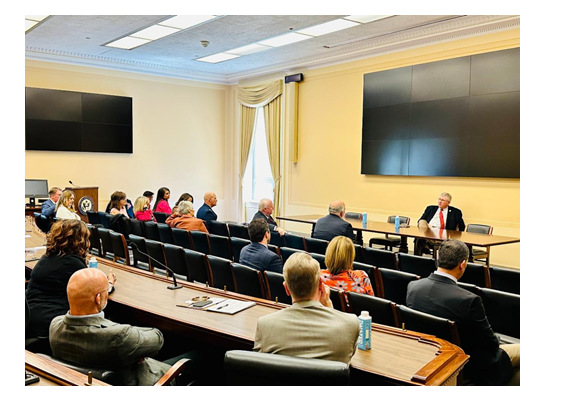
"I enjoyed meeting with members of the Altus Chamber of Commerce this week," said Congressman Lucas. "We had a great conversation about community projects and the strong partnership the Altus Chamber of Commerce continues to foster with Altus Air Force Base. I especially enjoyed attending the 61st Altus Quail Breakfast, which supports the mission of the United States Air Force and the 97th Air Mobility Wing.
"Altus Air Force Base goes above and beyond training Airmen and women for their next mission. Oklahoma's military bases play a crucial role in our nation's readiness and Altus Air Force Base's role in maintaining the C-17, the KC-135 and the KC-46 continues to exceed expectations," Lucas continued. "I look forward to continuing to support the 97th Air Mobility Wing and the Altus Chamber of Commerce and the community leaders that make Altus and Southwest Oklahoma a great place to live."
"Altus leaders are proud to be in our nation's capitol to continue the 61-year legacy of the Altus Quail Breakfast. We are honored to work side by side with Congressman Lucas and his staff year-round to support the mission, Airmen, and families of Altus Air Force Base," said Dr. Joe Leverett, Chairman of the Altus Military Affairs Committee. "Congressman Lucas is an unwavering partner who always keeps our community and our base front of mind. This year's Quail Breakfast event has been an incredible success, and we excited about the important conversations and important progress".
The U.S. Department of Agriculture Rural Development has announced the availability of approximately $31 million in funding for projects as part of the Value-Added Producer Grants (VAPG) program.
Individual farmers and ranchers, as well as agricultural businesses and producer groups, may apply for the grants, which must be used to develop new products or expand existing markets for value-added products. The applicant must produce at least 50% of the raw agricultural product to which value is being added.
Two separate grants are available. Planning grants of up to $75,000 help pay for feasibility studies and business planning. Working Capital grants fund up to $250,000 to cover marketing and product development costs. Projects requesting more than $50,000 require a previous feasibility study and business plan to verify product viability.
"The VAPG program provides a unique opportunity for producers on small- and mid-sized operations to invest in entrepreneurial ideas," said Kalee Olson, policy associate for the Center for Rural Affairs. "In addition, it prioritizes projects led by beginning, veteran, and socially-disadvantaged producers."
Applicants are required to register for a government identification number (UEI-Unique Entity Identifier). This can take two to five weeks to activate, so applicants are encouraged to register early.
Interested applicants should contact their state USDA Rural Development office for application materials and assistance. A list of state offices can be found at rd.usda.gov/about-rd/state-offices. Online applications are due May 11 through grants.gov. Completed paper applications must be submitted by close of business on May 16 to the USDA Rural Development state office where the project is located.

Over the last couple of years, it has been rare to tune into a college sporting event without mention of the new NCAA name, image and likeness (NIL) policies presenting exciting and unique opportunities for college athletes and brands alike. This monumental shift in the NCAA rules regarding NIL deals is a huge step forward in student athletes rights and an incredible opportunity for brands to target a far-reaching demographic of consumers.
Foundationally, the NIL policies comprise three elements known as "right of publicity" which include name - used to identify and address someone, image- photographs, imagery or videos of someone and likeness - the students' identity as an athlete that makes them marketable. Already utilizing and seeing success with similar sports partnerships such as Olympic athletes, Fuel Up to Play 60 NFL ambassadors and as the official nutrition partner of the Dallas Cowboys- expanding into college athletes to promote Built w/ Chocolate Milk and other sports nutrition messaging was a natural fit for Dairy MAX.
College athletes present a unique marketing opportunity for Dairy MAX. They are health-conscious, making them the perfect fit to share the many nutritional and recovery benefits of dairy, but are also diverse in many ways, including gender, sport, background, and channels where they share information. This diversity presents more opportunities to partner with female athletes and reach other sports outside of football. Collegiate athletes are also at the perfect age to capture the attention of the Gen Z audience (ages 11-26).
"We're excited to partner with college athletes to showcase the benefits of dairy in their everyday diet," says Jennie McDowell, vice president of business development at Dairy MAX. "We know that more than half of Gen Z is active on TikTok, and we're working hard to build trust with them. They tend to trust the influencers they follow on that platform, and with the help of our NIL athletes, we want the Gen Z consumer to see dairy as a trusted source of nutrition."
Dairy MAX has partnered with three female student athletes from different sports, universities, and backgrounds. However, despite their differences, they all have similarities to the mission of Dairy MAX and unique connections to the themes Dairy MAX already focuses on, like post-workout recovery with chocolate milk, heart health, cooking, and farming. These young women have 26.4K followers on Instagram and 127.7K followers on TikTok combined.
"We all believe in the nutritional benefits of dairy, but it is exciting to see Dairy MAX seeking out like-minded individuals with a broader and more diverse reach to share that message," says Todd Green, vice president of industry image and relations for Dairy MAX. "Partnering with student-athletes allows us to utilize another channel with a heavy Gen Z audience who quickly become independent decision-makers regarding their health and consumption behaviors. I think that presents an incredible opportunity for our dairy farmers."
Over the next year, the athletes will post about dairy several times throughout the year and make some in-person appearances. The agreement runs through the 2022-2023 school year.
About the Athletes:
Asjia O'Neal, who plays volleyball for The University of Texas at Arlington, survived two heart surgeries from a mitral valve leak condition but pushed through adversity to return to the court.
Trinity Bolden, who runs track and field for Southern University, is a self-proclaimed foodie, who loves to cook and posts regularly about food.
Brionna Warren, who plays softball for Texas A&M University, grew up on her family's ranch and successfully showed cattle as a proud member of 4-H.
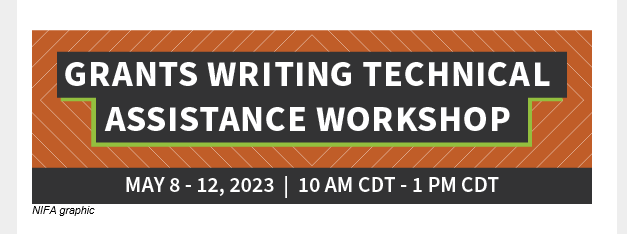
USDA's National Institute of Food and Agriculture (NIFA) will host a five-day technical assistance workshop from May 8 through May 12, from 10 a.m. to 1 p.m. CDT. This workshop will focus on accessing information about NIFA's competitive programs, grant writing tips for success, the application review process and post-award management.
Different topics will be covered each day. Participants can attend all five days, or they can choose to attend sessions featuring topics of particular interest or as their schedule permits. However, registration is required. Find workshop and registration details here.
Multiple sessions will focus on helping underrepresented institutions become more competitive in receiving and complying with NIFA funding. During the daily sessions, approximately 30 minutes will be set aside for live Q and A. Participants are encouraged to submit questions that will be posted as FAQs along with the recordings for future use.
For more information or to request a reasonable accommodation, contact Neerja Tyagi at Neerja.tyagi1@usda.gov.
Read More:
Impacts of NIFA-funded research and Extension programs on our Blog page.
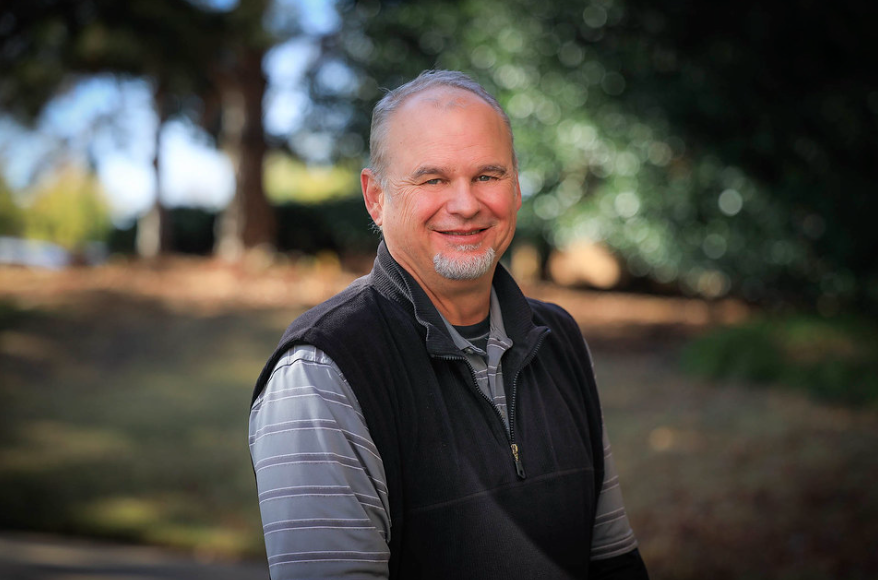
Sam Fuhlendorf, a regents professor in the Oklahoma State University Department of Natural Resource Ecology and Management, recently received the Society for Range Management W.R. Chapline Research Award from the Society of Range Management for his contributions to rangeland ecology and management. (Photo by OSU Agriculture)
Oklahoma State University regents professor Sam Fuhlendorf received the Society for Range Management W.R. Chapline Research Award in February for his vast contributions to the field of rangeland ecology.
"This award is an honor for me, but even more so, it is an honor for the OSU Department of Natural Resource Ecology and Management, OSU Agriculture and the university as a whole," Fuhlendorf said. "None of my work would have been possible without amazing colleagues and collaborators as well as the wonderful mentors that I've had at OSU and beyond."
Fuhlendorf's research focuses on how animals feeding on plants (herbivory) and livestock grazing interact with climate and fire to create land cover in plant communities. His early research contributed to the transition from traditional perspectives on vegetation change in drylands to the perspective currently studied by dryland ecologists worldwide. This perspective has been adopted by federal agencies.
"Dr. Fuhlendorf's work has profoundly shaped and advanced the field of rangeland ecology, conservation and management," said Brad Wilcox, Sid Kyle Endowed professor in the Ecology and Conservation Biology Department at Texas A&M University and a member of SRM. "Undoubtedly, a generation from now, Sam Fuhlendorf will be recognized as someone whose original and creative ideas revolutionized the way rangeland ecosystems are managed."
Most recently, Fuhlendorf developed a novel, ecological approach to the management of sub-humid, semi-dry and dry landscapes based on pyric herbivory, which refers to how the interactions between fire and grazing change landscapes. This concept, which embodies the interactive ecological effects of fire and grazing known to be critical for maintaining landscape scale and biodiversity in grasslands, is revolutionizing rangeland management.
"The beneficial effects of pyric herbivory have been well-documented by Sam and his colleagues through a prestigious output in referred literature," Wilcox said. "Sam's passion for academic excellence is evidenced in a research record to be envied. He has been published widely and in some of the most prestigious ecological journals. His research productivity has been breathtaking."
Fuhlendorf has published more than 225 peer-reviewed papers on ecological science. He has published in scientific journals, such as "Philosophical Transactions of the Royal Society," "Bioscience," "Conservation Biology," "Global Ecology and Biogeography," and the flagship journal of SRM, "Rangeland Ecology and Management." His work has garnered more than 14,600 citations and represents some of the most widely referenced work on the interactions between fire and grazing on rangelands.
Fuhlendorf has managed several multi-disciplinary programs focusing on understanding the social and ecological relationship on rangelands. His most recent endeavor, The Prairie Project, is a $10 million program aimed at increasing the use of pyric herbivory across The Great Plains. As a professor and advisor, he has a profound impact on graduate and undergraduate education, developing and teaching OSU's largest ecology class.
Other awards and honors Fuhlendorf has received include the SRM Sustained Lifetime Achievement Award and the Groendyke Chair in Wildlife Conservation.
"Dr. Fuhlendorf has fundamentally changed how we view the management of rangelands, which occupy 50% of the world's land surface area. Prior to his work, a commonly held view regarding rangeland management was to manage for uniformity to maximize a single goal, usually for livestock production," said Jim Ansley, department head of the natural resource ecology and management department. "Dr. Fuhlendorf recognized that rangelands provide multiple ecosystem services, such as wildlife habitat, resilience to drought and clean water yield and should be managed to provide for those services.
"He and his colleagues developing pyric herbivory provided an economical means to achieve those goals, Ansley continued. "It is a remarkable accomplishment. Like many major scientific accomplishments, his ideas were first met in the discipline with strong reservations and are now well accepted."
OSU Ag Research is Oklahoma's premier research and technology development agency in agriculture, natural resources and the life sciences.
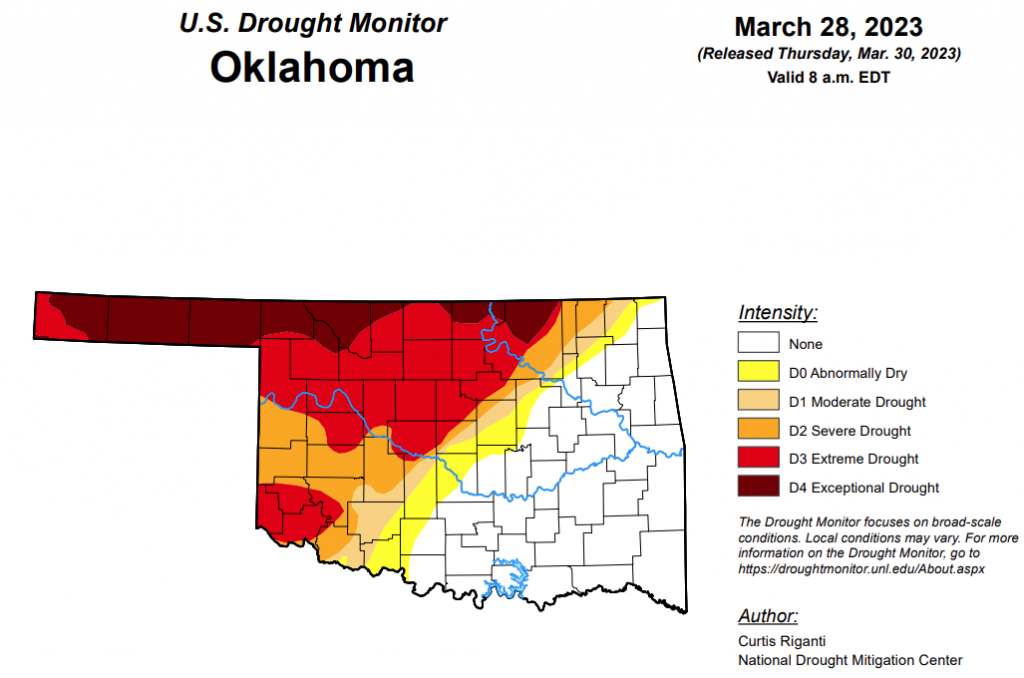
To view the Oklahoma Drought Map, click here.
According to the latest Oklahoma Drought Monitor report, Exceptional drought in the state has increased from 11.2 percent to 12.8 percent since last week.
Extreme drought or worse has increased slightly from 36.6 percent to 37.3 percent.
Severe drought or worse has decreased from 50.1 percent to 48.5 percent.
Moderate drought or worse has decreased from 59.07 percent to 53.6 percent.
Abnormally dry or worse conditions have also decreased from 65.6 percent to 60.3 percent.
According to the 6-10-day precipitation outlook map, roughly the southeast half of the state is leaning above a 40 to 50 percent chance of precipitation through April 8. Central Oklahoma and further west, including the panhandle and that southwest region is leaning above a 33 to 40 percent chance of precipitation through April 8.
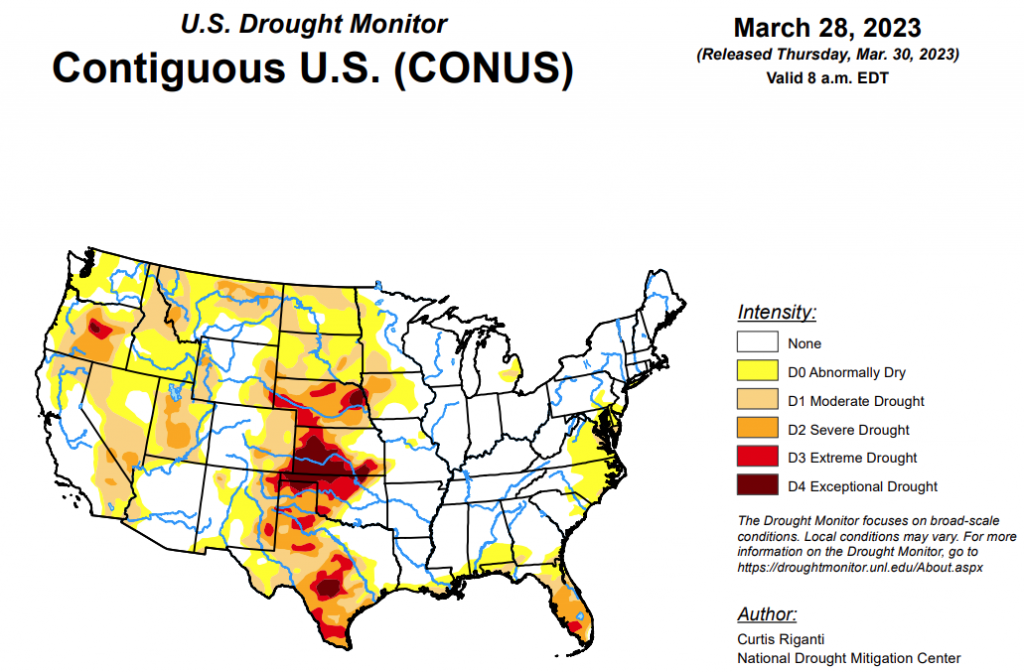
To view the United States Drought Monitor Report, click here.
According to the latest U.S. drought monitor report, after the wet pattern continued in parts of the West this week, building off of widespread wet and snowy weather this winter, widespread improvements were made to the drought depiction, especially in northern California, northern Nevada, southern Idaho and Utah, with scattered changes, mostly improvements, also taking place in other western states. East of the Rockies, drought and abnormally dry conditions mostly stayed the same or worsened in the Texas and Oklahoma panhandles, northwest Oklahoma, and central and southeast Texas. The western edge of heavy rains this week fell mostly along and southeast of the Interstate 44 corridor in Oklahoma and western north Texas, leading to further tightening of an already tight drought condition gradient in these areas. Farther west in northwest Oklahoma and western Kansas, extreme and exceptional drought persisted or intensified. Very dry recent weather continued in the Florida Peninsula, where severe drought expanded in coverage and extreme drought developed in response to quickly increasing fire danger. In the Mid-Atlantic, short- and long-term drought and abnormal dryness grew a bit in coverage this week. Conditions also worsened in northwest Puerto Rico and the southern Puerto Rico coast, the latter of which reported nearby forest fires. For more specific details, please refer to the regional paragraphs below.
In the Southern Plains, aside from Oklahoma and southwest Texas, near-normal or warmer-than-normal temperatures were common across much of the South region, with some locations seeing temperatures 5-10 degrees warmer than normal. Parts of north-central Texas and Oklahoma (especially southeast of Interstate 44) saw moderate to heavy rain amounts from thunderstorms, exceeding an inch or two in a few spots. Over 2 inches of rain fell across large areas of Arkansas and Tennessee, while heavier rains farther south in Louisiana and Mississippi were more scattered in nature. Some of this rainfall was associated with a severe thunderstorm outbreak, which was responsible for a destructive tornado that reached a maximum intensity of EF4 in Rolling Fork, Miss. Most of the rest of Texas, and Oklahoma northwest of Interstate 44, remained mostly or completely dry. The recent dry weather, very low groundwater and streamflow and mounting long-term precipitation deficits in central Texas and parts of the Edwards Plateau led to the expansion of moderate, severe, extreme and exceptional drought in some areas. Short-term dryness and decreasing streamflow also led to expanding drought conditions farther east in Texas, except for areas that saw heavier rain amounts this week. Short- and long-term extreme and exceptional drought also increased in coverage in the Texas Panhandle, the Oklahoma Panhandle and parts of northwest Oklahoma, the latter of which has recently experienced blowing dust and sand and a struggling winter wheat crop. Along the Interstate 44 corridor, the gradient in drought conditions increased further, with areas west of Oklahoma City experiencing extreme drought, while southern suburbs of Oklahoma City are only abnormally dry now, with dryness-free conditions nearby to the southeast.
In the High Plains, the region generally saw drier weather this week, with a few areas of the central and northern Great Plains seeing some precipitation. Heavier snows also occurred in some of the mountainous areas of Colorado and Wyoming, leading to some improvements to drought and abnormal dryness areas there. Colder-than-normal weather occurred over the entire region. Compared to normal, the coldest temperatures, in some cases 15 to 20 degrees below normal, occurred in North Dakota, western Wyoming and western Colorado. In southern Colorado, abnormal dryness and moderate drought lessened in coverage in the San Luis Valley and Sangre de Cristo Mountains. Recent precipitation and lessening long-term precipitation deficits, as well as deep snowpack in some areas, led to some localized improvements to ongoing drought areas in the Dakotas, western Nebraska and far northeast Colorado, while mounting precipitation deficits and low soil moisture led to localized worsening of conditions in eastern Nebraska and northeast North Dakota.
In the West, a wet pattern continued in parts of the West this week, especially western Oregon and Washington and coastal California and parts of the Sierra Nevada. Locally heavy precipitation amounts also fell in parts of Utah and central Arizona. Colder-than-normal temperatures also occurred over most of the West region this week. Temperatures generally ranged from 5 to 10 degrees below normal in the northern, western and southern parts of the region, while Nevada, Utah and southern Idaho experienced temperatures ranging from 10 to 20 degrees colder than normal. The recent snowfall in southern Colorado in the Sangre de Cristo Mountains also allowed for improvements to conditions across the border in New Mexico. Large areas of the Intermountain West saw improvements to drought conditions this week, as long-term precipitation deficits lessened, snowpack remained high or grew, soil moisture and streamflow increased or remained high and groundwater conditions improved. Extreme drought was removed from central Utah, while moderate and severe drought lessened in coverage there. Much of southern Idaho and northern Nevada saw improvements this week after hefty precipitation amounts this winter. Conditions also improved west of Las Vegas, where long-term precipitation deficits lessened and groundwater and soil moisture locally improved. Moderate drought was removed in parts of northern California as well, where long-term precipitation deficits continued to lessen. For similar reasoning, drought coverage lessened in a few parts of Montana as well. Due to recent precipitation and large snowpack and lessening long-term precipitation deficits, moderate drought and abnormal dryness lessened in coverage in western Oregon.
Looking ahead, from the morning of Wednesday, March 29 through the evening of Monday, April 3, the National Weather Service Weather Prediction Center is forecasting precipitation in some of the higher elevation areas of California, with heavier amounts likely in western Oregon and Washington. Some mountainous areas of Idaho, Colorado, southwest Montana, Wyoming and Utah will likely see over 0.75 inches of precipitation, with some locally heavy amounts possible. Farther east, the southern Great Plains are likely to remain dry, while precipitation is likely from South Dakota into the Upper Great Lakes, and from the Lower Great Lakes southwest toward the Lower Mississippi Valley as a strong storm system traverses the central Great Plains and Midwest. Localized precipitation amounts at or exceeding 0.75 inches are possible for northeast New York and Vermont as well.
From April 4-8, the National Weather Service Climate Prediction Center forecast strongly favors colder-than-normal weather in the West and warmer-than-normal conditions in the Southeast, with the dividing line between warmer and colder than normal running from Chicago southwest to St. Louis southwest to the Texas Big Bend region. Northwest of this line, below-normal temperatures generally become more likely, with the opposite true southeast of this line. Below-normal temperatures are slightly favored in much of Alaska, especially in the southeast regions. Above-normal precipitation is favored across much of the contiguous U.S., excluding the Florida Panhandle, western Montana, southern Arizona, New Mexico, and the El Paso area. The highest confidence for above-normal precipitation for this time period is over South Dakota, North Dakota and Minnesota. Wetter-than-normal weather is also favored in Alaska.
To view the 6-10 Day Precipitation Outlook Map, click here.
To view the 6-10 Day Temperature Outlook Map, click here.
To view the Monthly Drought Outlook Map, click here.

Early voting for Board of Education and Statutory Municipal Elections begins today for voters across the state. Early voting locations will be open Thursday, March 30 from 8 a.m. to 6 p.m. and Friday, March 31 from 8 a.m. to 6 p.m.
No excuse is needed to vote early. However, voters must vote in the county where they are registered. Early voting is typically held at the County Election Board, however, some counties may have alternate or additional voting locations. A list of early voting locations is available on the State Election Board website.
Sample ballots can be found in the OK Voter Portal. The election list is available on the State Election Board website and is searchable by county.
Voters with questions should contact their County Election Board or the State Election Board at (405) 521-2391 or info@elections.ok.gov.
Urges President Biden to Sign Resolution and End WOTUS Rule
Today, National Cattlemen's Beef Association (NCBA) President Todd Wilkinson, a South Dakota cattle producer, released a statement commending the U.S. Senate for passing a resolution to stop the Biden administration's latest Waters of the U.S. (WOTUS) rule:
"The bipartisan passage of this resolution sends a clear message to the Biden administration that this is not how Congress intended to implement the Clean Water Act. Now, President Biden has a choice: he can sign the resolution and pull back the unlawfully vague WOTUS rule, or he can veto it and turn his back on rural America. I am especially proud of my fellow cattle producers from across the country speaking up to make our voices heard. Together, we wrote more than 1,900 letters to senators calling for a vote on this resolution. Our advocacy made a crucial impact."
Senior Farm and Ranch Broadcaster Ron Hays is visiting with Oklahoma State University Extension Beef Cattle Breeding Specialist, Dr. Mark Johnson about the upcoming Cattlemen's Conference set to take place on May 24-25 in Stillwater, Oklahoma.
Derived from the idea of similar conferences in the past, such as the National Steer Symposium in 1981, the Cattlemen's Conference is aimed at discussing selection trends in breeding cattle and the importance of using genetic values and selection programs.
"It really led us to where we are today to do the best job we could to make improvement in cattle and increase profit potential in beef production," Johnson said. "We needed to be using EPDs and genetic values for the traits that we could measure objectively."
The topics to be discussed at the Cattlemen's Conference, Johnson said, will be broad in scope.
"We are going to address pasture management, dealing with drought, and making our soil plants and beef production systems sustainable long-term," Johnson said. "We are going to take a look at current trends in the meat packing industry. We are going to take a look at some data that we are collecting right now in terms of what is going on nationally in terms of carcass size and carcass specifications that we get into right now."
There will be panel discussions on how to continue to collect data to make genetic improvement in beef breeds, Johnson said, and the conference will discuss selection for extremes with respect to a variety of things.
"We are going to address ethics in the show ring and ethics in marketing," Johnson said. "We are going to get some experts in to speak from competing protein sources. We are going to take a look at marketing beef in 2023 as opposed to the next 10 or 20 years and what consumers are going to want.
Marketing outlooks based on the population and inventory of cattle in the country will also be discussed, Johnson said, as drought has impacted the industry.
"We have got a dynamic panel of speakers coming in from all over the country to address a variety of topics," Johnson said.
Regarding the cattle that make up today's beef herd, Johnson said he believes the U.S. cattle producers have become more aware of the benefits of utilizing genetic values to improve the function of the cow herd.
"We have got genetic values now we can incorporate into selection to try to program these cowherds to better fit one production environment or another," Johnson said.
To see more information and to register for Cattlemen's Conference, click here.
The Beef Buzz is a regular feature heard on radio stations around the region on the Radio Oklahoma Ag Network and is a regular audio feature found on this website as well. Click on the LISTEN BAR for today's show and check out our archives for older Beef Buzz shows covering the gamut of the beef cattle industry today.
RON's Dave Lanning has a pre-opening look at today's agricultural Markets.
Click the audio tab below for today's report.
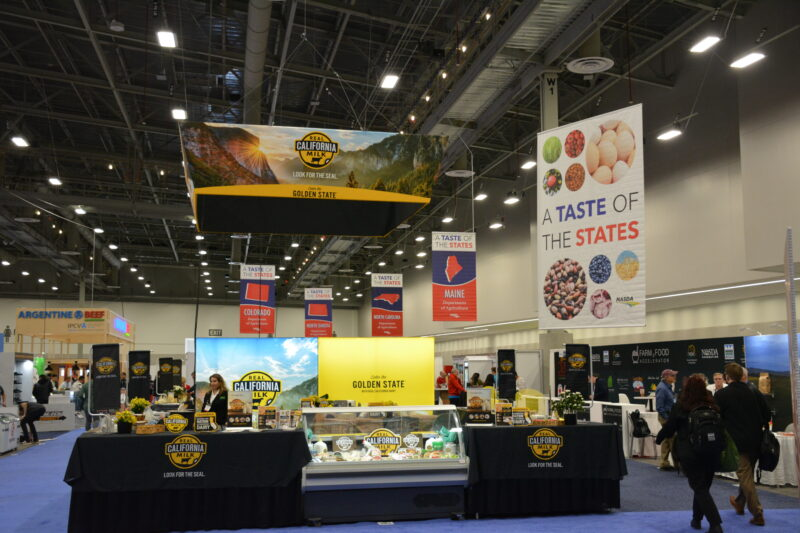
NASDA opened the first "A Taste of the States: Las Vegas" trade show pavilion to help state agriculture departments promote local food and beverage products to international markets. The NASDA pavilion is hosted within SIAL America, a top food and beverage event in the United States and will run from March 28-30.
"This is a first of its kind event for NASDA in the western United States. We're excited to expand opportunities to more U.S. food producers and reach further corners of the globe with U.S. products," NASDA CEO Ted McKinney said.
The pavilion will feature state department of agriculture participation from Colorado, Hawaii, Idaho, Maine, Montana, Nevada, New York, North Carolina, North Dakota, Oregon and Washington state.
"Helping small businesses grow is such a rewarding opportunity, and we're grateful to add this show to NASDA' s portfolio of trade promotion activities. We look forward to supporting the exhibitors this week and sharing the results of the show," McKinney said.
NASDA has hosted more than 50 trade show events in the U.S. and has assisted with scores of U.S. pavilions all over the world. In 2022, NASDA's trade promotion activities led to nearly $46 million in projected export sales and 185 companies acquiring new export markets for their business.
A Taste of the States: Las Vegas is possible due to funding from a 40-year-old cooperative agreement between NASDA and the U.S. Department of Agriculture Foreign Agricultural Service designed to empower small business owners with the tools needed to export their U.S.-grown and made products around the world.
Learn more about NASDA's work to create trade opportunities for small to medium-sized food and beverage companies at nasda.org/tradeshows, and keep up with happenings at the show all week by following NASDA's trade show social media accounts.
Senator James Lankford (R-OK) issued the following statement today after voting to stand against the Biden Administration's Waters of the US (WOTUS) rule. The Senate voted on a Congressional Review Act resolution of disapproval of the rule, which passed in a vote of 53 to 43.
"Oklahomans want clean, safe water. But President Biden's new Waters of the United States rule is not about clean water; it's all about federal control of almost every inch of Oklahoma so farmers, ranchers, and developers will have to play 'Mother, May I?' for months or years with Washington, DC, before they can operate on their own land. We can protect our water without giving near total control of our land to the Washington bureaucracy. This is absurd climate extremism and centralized control of private property. The Senate today affirmed this needs to stop."
Background
In 2015, the Obama Administration finalized a rule that expanded the definition of WOTUS, creating confusion and burdensome red tape, especially for Oklahoma's agriculture, construction, and energy industries. The Trump Administration released a proposed rule, the Navigable Waters Protection Rule (NWPR), to replace the 2015 WOTUS rule with a new one that provided much-needed predictability and certainty for farmers by establishing clear and reasonable definitions of what qualifies as a "Waters of the United States." The NWPR was finalized in 2020.
On day one of his Administration, President Biden signed an executive order to begin the process of rolling back the previous Administration's NWPR. In December 2022, the EPA issued a new rule repealing the NWPR and changing the definition of WOTUS in a way that will expand federal regulatory authority.
Lankford and his colleagues immediately responded by sending a letter with the entire Senate Republican Conference to urge the EPA and the US Army Corps of Engineers to suspend the pending rulemaking to redefine the scope of waters protected under the Clean Water Act (CWA), specifically "Waters of the United States," until the US Supreme Court completes its consideration of Sackett v. EPA, a case that is expected to have major implications on CWA scope and enforcement.
Lankford joined Senator Shelley Moore Capito (R-WV) and all of their Senate Republican colleagues in introducing the formal challenge last month.
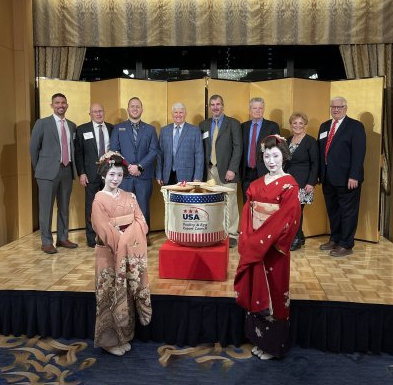
Last week, the U.S.A. Poultry Egg Export Council (USAPEEC) held their annual Strategic Planning Conference in Tokyo, Japan. Bringing together USAPEEC's global staff and industry representatives from across the sector, the conference enables participants to analyze opportunities for expansion and barriers to market access, and then formulate strategy to increase and create additional demand for American poultry and egg products. Representing National Corn Grower Association's Market Development Action Team was Michigan Corn Growers Association Vice President John Delmotte and NCGA Market Development Manager Michael Granché. On Thursday, Delmotte and Granché provided a presentation that highlighted the value of partnerships, highlighted goals and progress outlined within NCGA's Sustainability Report, and illustrated how USAPEEC and NCGA have worked together through projects their Chicken, Egg, and Turkey Buyer's Guides.
"Most farmers think that our corn is exported as grain to other countries by ships and trains, but often forget that much of our grain is moved out of the country in animal and egg products. Being in Tokyo with the USAPEEC team really solidified the importance of our partnership with animal agriculture. Working with their global staff illustrated to me the work that these partner organizations do to help us move through meat and egg exports all across the globe. These partnerships are important and valuable to our organization," said Delmotte.
Poultry remains a top customer for U.S. corn consuming over 1,250 million bushels and last year, contributed $.28 cents of added value thanks to poultry exports!
While in Tokyo, Delmotte and Granché discussed the importance of poultry exports with Agriculture of America's Mike Pearson. Catch that interview here.
To learn more about the U.S.A. Poultry Egg Export Council, visit USAPEEC.org.
Today, National Cattlemen's Beef Association (NCBA) Vice President of Government Affairs Ethan Lane slammed Food and Drug Administration (FDA) Commissioner Robert Califf's comments regarding cell cultured meat that he made during a hearing on the FDA's fiscal year 2024 budget request:
"By his own admission, the FDA's role is to ensure food safety, but Commissioner Califf's comments today indicate that he intends to bring his agency into climate and environmental discussions while promoting cell cultured meat. This viewpoint is extremely disappointing to America's cattle producers whose stewardship of the land already does more to protect our environment than fake meat production ever will. We appreciate Congresswoman Letlow shining a light on these concerning issues at FDA and hope that Commissioner Califf will reverse course and coordinate with the U.S. Department of Agriculture on the regulation of these cell cultured substitutes."
Background
Today, FDA Commissioner Robert Califf testified before the House Appropriations Subcommittee on Agriculture, Rural Development, Food and Drug Administration, and Related Agencies. During the hearing, Rep. Julia Letlow (R-LA) asked the Commissioner how the agency plans to coordinate with the U.S. Department of Agriculture (USDA) on pre-market consultation for reviewing cell cultured chicken products. In his answer, Commissioner Califf referenced climate change and the need for additional cell cultured research as a way to mitigate the impact of climate change.
Under a memorandum of understanding signed in 2019, USDA and FDA have joint jurisdiction over fake meat products, with USDA taking the lead on enforcing accurate labeling and food safety. This memorandum was supported by NCBA because of USDA's expertise in food inspections and labeling.
When FDA announced its second pre-market consultation for cell cultured chicken last week, the agency said that it is "ready to work with additional firms that are developing cultured animal cell food" and "will issue guidance to assist firms that intend to produce human food made from cultured animal cells." These statements are highly concerning and indicate FDA's desire to promote additional cell cultured meat products.
Watch Commissioner Califf's comments here.
Today, Congressman Frank Lucas (OK-03) joined his colleagues on the House Financial Services Committee for a hearing on "The Federal Regulators' Response to Recent Bank Failures".
Lucas questioned the Chairman of the Federal Deposit Insurance Corporation (FDIC) and the Vice Chair for Supervision of the Federal Reserve on the collapse of Silicon Valley Bank (SVB) and Signature Bank. By guaranteeing uninsured deposits at both banks, the FDIC will place a special assessment on the banking sector to cover the losses. Congressman Lucas pressed FDIC Chairman Gruenberg to ensure that the burden does not fall on community banks.
Lucas also questioned Federal Reserve Vice Chair Barr about the specific timeline of determining the systemic risk designation for both banks. It is imperative that Congress have insight into the sequence of events and criteria used for this designation.
Click here to watch Lucas' Q&A.
On special assessment fee
"I'd like to discuss the special assessment fee that will be used to cover the losses from the uninsured deposits. You've explained the proposed rulemaking for the special assessment will occur in May of this year. And while you're thinking about that, be thinking about a discussion of the flexibility the FDIC has during the rulemaking to ensure that our small community banks don't disproportionately carry the burden. Being one of the older members of this Committee, I've been around long enough to have observed firsthand several banking crises. In 1982, I was getting ready for my final semester at Oklahoma State when a little institution in Oklahoma City called Penn Square went down and took First Continental Illinois of Chicago down with it- a bank from the 1840s or 50s- and took First Seattle down with them too. Now, the FDIC and regulators responded in the appropriate fashion and addressed that. But it was a combination of collapse in the oil and gas industry and in production agriculture, and the chain reaction in my great state was the slaughter of community banks.
...
"And they're looking at this situation and they're saying to me, we've been the least problematic of any sector in the financial services industry for decades to the regulators and the FDIC, but yet in every crisis since then, we've been kind of the orphans. And this time they're saying we were wiped out as an industry 40 years ago, but now we're going to get a special assessment to pay to fund for the mistakes of the most sophisticated institutions, the biggest institutions. Can you tell me how it's possible when this special assessment fee process is completed that my community bankers aren't going to wind up disproportionately paying for the mistakes and the faulty roll of the biggest institutions in the country?"
Why you want them, how to know what you've got and how to get more.
Cattle. Sheep. Goats. When ranchers think about the creatures living on their land, their minds probably go to the livestock. But there's a whole host of other species in residence — and how many are present could indicate the health of the landscape.
Pollinators — the insects and animals that carry pollen from one plant to another — are an integral part of our ecosystem. According to the United States Department of Agriculture, 75% of the world's flowering plants and about 35% of the world's food crops depend on animal pollinators to reproduce.
But they're important to ranchers with native grasslands, too. Will Moseley, an agriculture consultant for Noble Research Institute, shares three reasons why.

"If you're interested in regenerative ranching, you're interested in biodiversity," Moseley says. "And pollinators are a good indicator of biodiversity."
Simply put, biodiversity means resiliency.
"When we have more insects, many of those insects are going to be predators," Moseley explains. "And those predators help control pests, naturally."
Additionally, insects and pollinators are an important part of the food web.
"If there's a species we're interested in that is higher on that food chain — deer, turkeys, whatever — we need those insects to create healthy habitats and healthy populations of other critters," Moseley says. "We need that base."

Some pollinators make financial sense, too.
Take the monarchs, for example. Not only do they offer an agritourism enterprise (people will come pay to see them), but there are federal dollars available for ranchers willing to manage for them. In 2017, USDA's Natural Resources Conservation Service updated its Conservation Stewardship Program to include incentives for farmers and ranchers who plant milkweed species – the only food source for monarch caterpillars – and other nectar-rich plants monarch butterflies need for energy before they migrate.
During the monarchs' reverse migration each fall, they need energy from flowering plants. Will Moseley, an agriculture consultant for Noble Research Institute, says in southern Oklahoma there's no shortage of milkweed for their migration north — but flowering plants can be scarce for the fall migration back to Mexico.
So, as the Noble Ranches have transitioned to regenerative, staff have been particularly interested in what sort of habitat that mindset is creating for the iconic butterflies.
And the way they monitor it is easy to duplicate on any ranch.
"We just went out and walked a hundred yards and counted how many butterflies were within 5 meters on each side of us," Moseley says. "Anyone who is interested can go out and walk and count."
There's even a website that will tell you when peak migration occurs in your area, he says.
"That allows you to narrow down your window and be efficient with your time," Moseley explains.
He says watching the weather is also important.
"You'll need to get ahead of a front," he says. "That's when they'll stage. If you wait till after the front, they'll be gone."
Moseley says after one year of surveying, there's one big takeaway.
"We saw butterflies where there were flowering plants," he says. "If there were no flowers, there were no butterflies."

"They're just so dang cool," Moseley says, while admitting his bias. (The nature lover holds two wildlife degrees.)
He recalls a farm visit he and fellow ag consultant Jim Johnson went on a few years back, where the landowners had several dozen acres of crownbeard, also known as cowpen daisy.
"It was in the fall when the monarchs were migrating through," he remembers. "And I've never seen anything like this in my life. As we walked out there, thousands of butterflies and bees were lifting off. It was almost a spiritual experience."

Want more pollinators? Focus on the plants they need.
"When we talk about pollinators, we're talking about pollinating plants," Moseley says. "And most of what we're talking about are flowers like cowpen daisy, gayfeather (blazing star) and Maximilian sunflower."
He says ranchers can manage to optimize forbs and more diverse vegetative communities, something that's already common on regenerative operations.
In short, it means not grazing the same way at the same time every year. It might mean varying times of prescribed burns, too. (Of course, reducing the usage of herbicides helps, too.)
And what's good for the pollinators is good for the ranch.
Note: This article is part two of three in our Wildlife Watch series about monitoring and managing wildlife on regenerative ranches.
Josh and Brook Gaskamp practice what they preach.
The duo, who both work for Noble Research Institute, run sheep. But they also recognize the importance of stacking enterprises.
When it came time to add another side business, the choice was clear — or perhaps golden brown.
"I like honey," Josh says.
"So that's why we got bees," Brook adds.
Josh, who has a wildlife background, became increasingly interested in the pollinators and began chatting with coworkers Charlie Canny and Eric Dunn, along with reading about bees online. And then one day, he got his sign it was time to just start.
He was driving down the road one day when he saw a swarm of bees in a tree. Josh called Dunn, who said he'd be there in the morning with a box.
The first year, they didn't produce. But the second year, one hive produced 60 pounds of honey. The Gaskamps gave it away to family and friends at Christmastime and began expanding. They now have four hives and sell what they don't need.
Brook's uncle raised bees when she was growing up, so she'd learned about the marketing side from him.
"I knew just enough to be dangerous," she says with a laugh. "But there was some nostalgia there for me, and it just made good financial sense. We had invested in land, and this was an enterprise that was fairly low risk, but high reward."
She says the demand for local honey is high, and most beekeepers find they have a pretty easy market. So far, they've sold all of theirs at the office, but have plans to expand as they grow the business.
While they're still relative newcomers, they've learned a lot through their own trial and errors. Their best advice? 1) Get a mentor; 2) start small; 3) experiment till you find what works for you.
While it may be a small part of their operation, the couple agrees it's one that makes a lot of sense.
"On a small farm or ranch, bees are perfect," Josh says. "I am collecting a resource that came off my neighbor's land. Nobody owns the bees. They're a public resource. But they travel to other properties looking for nectar and bring it back to me."
Story credit: Katrina Huffstutler, senior public relations and digital marketing coordinator for Noble Research Institute.
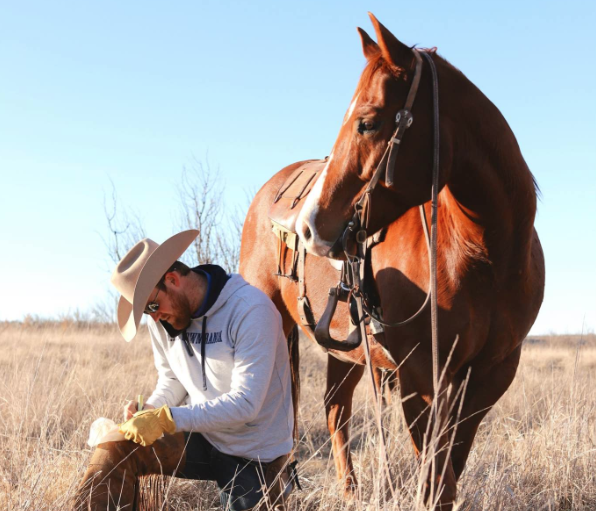
Senior Farm and Ranch Broadcaster, Ron Hays, is back visiting with beef advocate and sixth-generation cattle rancher from Throckmorton, Texas, Tucker Brown, about how he advocates for the beef industry by educating and entertaining consumers.
Brown is active in his family's operation, the R.A. Brown Ranch, and is on the Leadership Development Committee at the Texas and Southwestern Cattle Raisers Association. Because of his great advocacy work throughout 2022, Brown was recognized by the National Cattlemen's Beef Association as Advocate of the Year.
Brown said he likes to keep his content lighthearted by utilizing a comedy strategy.
"My hope is that when they watch the video, they enjoy it, so it kind of builds a trust factor to my page or my face," Brown said.
After each video, Brown said the goal is to teach someone something new.
"My hope is that it brings them to pages like NCBA's or the Beef Checkoff's page where it shows recipes, where it shows beef facts, where it shows how to cook the beef they are buying and that it is safe and that we are doing our best job to do that," Brown said.
Brown utilizes Facebook, Instagram and Tik Tok to reach his audience as he educates consumers about the agriculture industry. All three social media outlets reach a different audience, Brown added, so by using those three, he is able to reach a broader audience.
"Tik Tok is a very short form of entertainment," Brown said. "I have three seconds to get a person hooked to a video. I have another four seconds to have another hook, and really, videos between seven and 12 seconds are as far as I can go to keep the consumer entertained."
Brown said his go-to for his video content is making it quick and comedic, while also adding in some facts about the industry.
"That is challenging," Brown said. "If you had me do an hour video, I could do it right now and talk about beef all day. But seven to 12 seconds- I have to practice that a lot."
At the end of the day, Brown wants those who watch his videos to trust the American rancher more after watching and feel confident about the beef they buy in the grocery store.
"In a time that we are talking to a consumer that is asking questions, we are the face of the industry in that moment for them," Brown said. "What we say to them is what they think of the entire industry."
To see Tucker Brown's content, you can visit his Facebook, Instagram and Tik Tok accounts.
The Beef Buzz is a regular feature heard on radio stations around the region on the Radio Oklahoma Ag Network and is a regular audio feature found on this website as well. Click on the LISTEN BAR for today's show and check out our archives for older Beef Buzz shows covering the gamut of the beef cattle industry today.
| In early March, the fed cattle market topped out at just over $165/cwt. before pulling back to an average around $164/cwt., where prices have become stagnant for a few weeks. Live cattle contract prices on the CME have been unsettled, to put it mildly. It is likely that the unrest surrounding financial institutions, coupled with resulting equity market volatility, generated concerns about consumer beef demand. The April Live Cattle contract topped at $166/cwt. on March 7 then rapidly fell to $161.50/cwt. on March 15. Another week's worth of trading saw the contract bounce up and down in a range around $162/cwt., a discount to the spot cash cattle market. A strong recovery beginning last Friday has brought the April contract up to $165/cwt., now over $1/cwt. premium to last week's cash trade and certainly more reflective of the cattle supply tightening moving into the spring. |
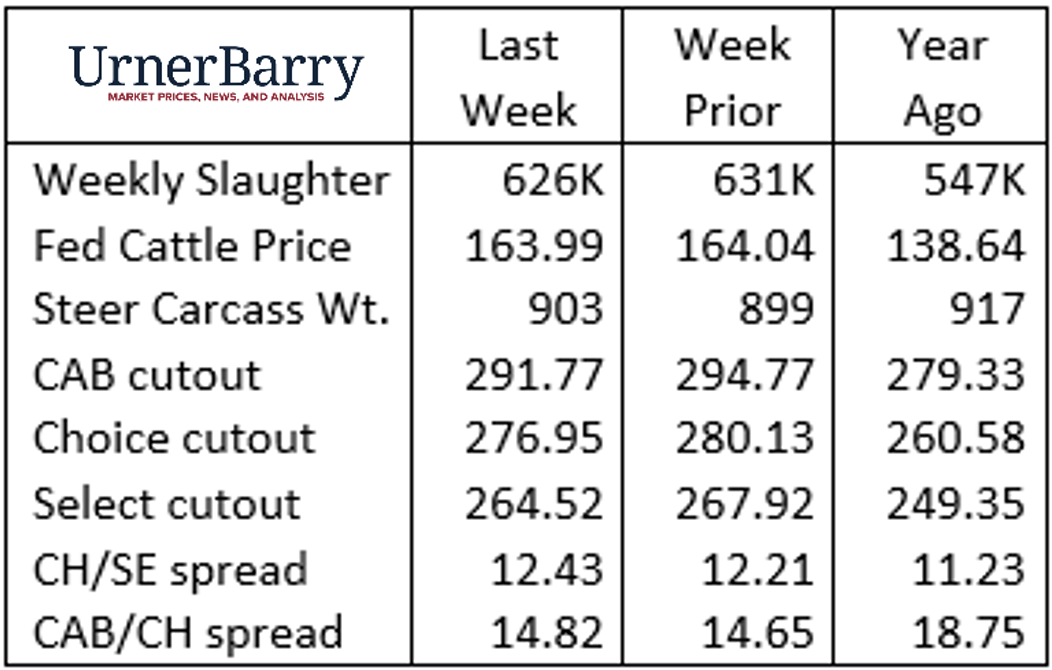 |
| The direction of the fed cattle market is also reflective of carcass cutout values this March. The CAB cutout touched the year-to-date high of $295/cwt. at the first of the month and has lost only a few dollars through last week's average quote of $292/cwt. The Choice cutout also saw a short term high of $282/cwt. at the beginning of March but has dropped a bit more than the CAB value, giving up $6/cwt. to average almost $277/cwt. last week. The cutout price direction in March has been softer during the past two weeks than the same period in 2021 and 2022. However, the general March trend this year, as well as the past two, can be described as a pullback prior to when spring beef buying demand kicks in. April demand is yet to be unveiled but protein buyers should be taking advantage of the recent dip in price on certain beef cuts, especially those popular for grilling. |
| Seasonal Quality Grade Highs Likely Already Posted |
| The official beginning of spring is already a week old and the calendar will turn to April soon. This means the beef market should be heating up right along with outdoor temperatures. Middle meats and some chuck primal steak items should start to see boost in demand. As we review this annual spring phenomenon it's important to keep in mind that current prices for such grilling items are easily record-high relative to history. CAB tenderloins, for example, are currently 15% higher than a year ago at a wholesale price of $15.17/lb. on average. With the stepped-up inflation, this is not entirely surprising but still a price that may slow demand a bit. On the other hand, the spring tenderloin price rally in the past two years has been so sharp that betting against a repeat this spring may not be a safe bet. On the supply side, spring demand opens up discussion about carcass quality trends. March typically marks the highs in national fed cattle percentages of Choice, Prime and CAB carcasses. The pattern in this year's data looks normal in that the industry did build up to a higher quality mix of carcasses into early March. USDA Choice reached 75% and USDA Prime reached 10% of the total fed carcasses. The share of eligible Angus-type carcasses to meet CAB brand specifications extended above 40%, highly reliant on the modest or higher marbling specification. |
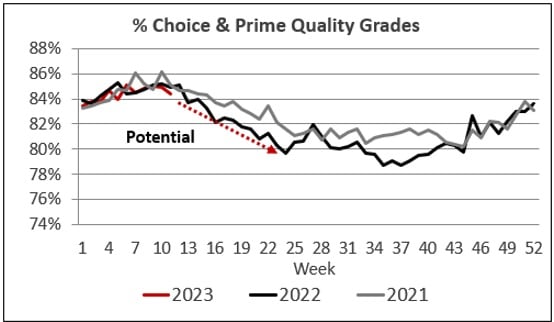 |
| The factor to watch moving forward is the carcass quality peak, which arrived approximately two weeks earlier this year versus a more typical pattern of previous years. For the week of March 13, the latest data shows a slight dip in the Prime grade from 10% to 9.5% while percent Choice fell back a very small one tenth of a percentage point. These are small changes, no doubt, but it is potential that the quality highs have already been tallied for the season. With current fed cattle carcass weights 16 lb. lighter than a year ago marbling achievement, on average, is likely to underperform in contrast to the past two years. Early in March, packer boxed beef supplies featured an abundance of CAB and other premium beef product but this condition is set to change given lighter carcass weights, a very current fed cattle supply, and the seasonal trend for a rapidly diminishing mix of quality carcasses. |
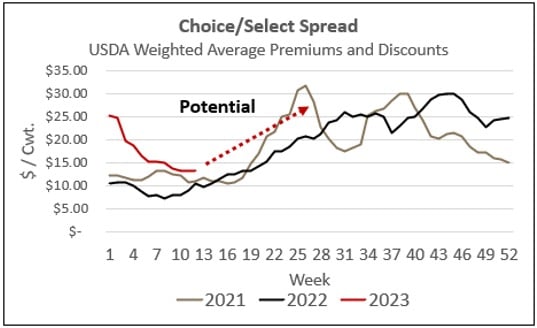 |
| The USDA's grid premiums and discounts report for this week showed the Choice/Select spread to be $13.10/cwt., 25% or $2.76/cwt. higher than the same week a year ago. While much lower than the record-wide $25.20/cwt. spread seen January 1, the current value is nothing to scoff at. Looking at the seasonal trend again, the market is poised to push the quality price spreads much wider into the spring driven from both supply and demand factors. The CAB grid premium is currently quoted in a range from $3 to $6/cwt. above Choice with Prime at $18.49/cwt. above Choice, nearly even with a year ago. The grid pricing incentive for feedyards to hit 50% CAB and 20% or more Prime carcasses remains good today and better in weeks to come. |
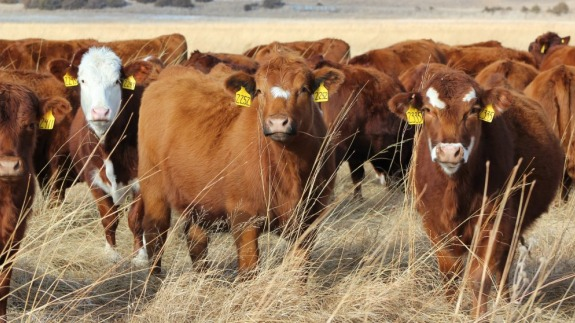
Weekly, Oklahoma State University Extension Beef Cattle Nutrition Specialist Paul Beck offers his expertise on the beef cattle industry. This is a part of the weekly series known as the "Cow-Calf Corner." Today, he talks about factors affecting calf prices.
There are some management and health programs that consistently increase sale price of beef calves. An analysis of calf sales through the Superior Livestock Auction by Kansas State University and Merck Animal Health looked at traits of load lots of calves that had impacted sales price. This analysis included 15,287 lots with over 2.5 million calves. The average lot contained 168 head and weighed an average of 559 pounds. The base average price was $1.81/pound.
As you may suspect, calf sex had a large impact on sale price. Steers brought premiums of $19.26/cwt over the base price and mixed lots of steers and heifers brought $4.90/cwt over the base. There were no bull calves in this analysis, intact bull calves are known to receive discounts of $5 to 7/cwt compared to steers with discounts often reaching over $20/cwt for intact bull calves. The presence of horns leads to an average discount of $3.57/cwt or about $20/head. Survey data of cow-calf producers in Oklahoma (Mulenga, Raper, and Peel; 2021) indicated that 71% of producers castrate their calves and 77% practice some form of horn management.
One practice that did not affect sale price was implanting. In this population of calves, 49% were not in programs that banned the use of growth promoting implants. In these calves, there was no discount for implanted calves. The 10 to 20-pound increase in sale weight from implanting with a value of $18 to 40/head is being left on the table, which is the equivalent of a $3 to 7/cwt discount for the calves sold. The Oklahoma cow-calf survey indicated only 20% of producers implant calves preweaning.
Breed was also a significant factor affecting sale price in this analysis. For the national data set brahman influenced cattle were discounted by $7.43/cwt, but when the analysis was conducted for the Southern Plains region (AZ, NM, OK, AR, LA, and TX) the discount for brahman influence breeding was only $1.56/cwt, likely due to the higher incidence of Brahman breeds in this area. Brahman breeding is essential to match cows to the environment, they are known for heat and insect tolerance and provide hybrid vigor to crossbreeding programs. This analysis indicates we should keep the minimum brahman influence in our herd to meet environmental conditions and market calves where the discounts are lowest.
There are several programs that add to the sale price which may incur some added costs of management, paperwork, ear tags, or audits. Producer BQA (Beef Quality Assurance) certification added $1.40/cwt ($8/head) to sales price, showing buyers see benefits in this certification. All natural programs (Natural+, GAP, NHTC) in this analysis have different requirements that must be considered, but these added from $0.87/cwt (Natural+) to $6/cwt (NHTC) in premiums for calves enrolled in those programs.
Value added health programs showed added value. The base price for this analysis was the VAC24 program where calves are vaccinated at 2 to 4 months of age with 1 dose of a 7-way, 8-way, or 9-way clostridial vaccine; 1 dose of a 5-way viral respiratory vaccine; and 1 dose of a Mannheimia Haemolytica or Mannheimia Multocida vaccine. Calves in the VAC24 program are unweaned at the time of the sale. Compared to these vaccinated but unweaned calves, calves in the VAC45 program (vaccinated twice and weaned for 45-days received a $8.64/cwt premium in the national data set and a $9.87/cwt in the Southern Plains Region. In the analysis of the OQBN preconditioning program premiums for 2022 the weighted average premium for OQBN VAC-45 calves was $18.67/cwt relative to unweaned non-preconditioned calves with no indication of vaccination status (Raper and Peel, 2023).
Buyers recognize the value of these factors. To remain profitable cow-calf producers need to add value where they can to increase the demand for their calves.
While we'll leave fuller explanations for the turmoil financial institutions such as Silicon Valley Bank, Signature Bank and others to those with more expertise, it's clear that good-old-fashioned poor choices played a role.
It turns out that betting heavily on low-interest government debt when that government is hiking interest rates to fight inflation might not work well; nor is overloading your portfolio on cryptocurrency. And given that propensity for bad bets, it isn't shocking to see what Silicon Valley Bank had to say about plant and cell-based meat-and-dairy alternatives in this 2019 analysts' report, which mixed tired tropes of the ills of animal agriculture with boosterism for the future of dairy ripoffs like Ripple and Perfect Day as well as alt-protein companies like Beyond Meat, which "has wowed consumers with its realistic taste and meat-like appearance," according to the authors.
"At Silicon Valley Bank, we embrace the future of the food industry. We have deep expertise working with foodtech companies and strong ties to the Silicon Valley ecosystem," the analysts wrote. "If you are working in this space and would like to learn more about SVB's role, please reach out to chat."
Of course, we know that that turned out. Beyond Meat stock is now considered a "recipe for disaster" due in part because of its wildly self-inflated expectations. Plant-based beverage sales fell last year. And Silicon Valley Bank? It's now part of First Citizens Bank & Trust Company after being unloaded by the Federal Deposit Insurance Corporation, which took over the institution upon Silicon Valley's failure.
So yes, perhaps it's time to "reach out to chat." About how venture capital investors have thrown good money after bad at products of questionable quality that are more about marketing pitch than actual market need. About how banks seeking a quick buck put depositors at risk with poor investment choices, which include those products. And about how high-quality, proven nutrition, with a product that's been in demand for millennia, might, unsurprisingly, be the best investment anyone could make – both for consumers and for investors who'd happily have a little less drama in their financial futures.
Dairy, like every other industry, has its challenges, which it's dedicated to meet. But with record exports and the highest U.S. per-capita consumption since 1959, it's a safe bet to say its future is bright. That's what you get with real quality. You can bank on it.
The office of Congressman Tom Cole (OK-04) is now accepting entries from high school students in the Fourth Congressional District for An Artistic Discovery, the annual Congressional Art Competition. The winning artist's work will be displayed for one year in the Cannon Tunnel of the U.S. Capitol.
Sponsored by the Congressional Institute, this nationwide competition is a great opportunity for high school students interested in the arts and looking for an opportunity to showcase their creativity. The annual contest recognizes and encourages artistic talent of young constituents in every congressional district across the nation.
All entries are accepted at one of Congressman Cole's district offices or the Ardmore Chamber of Commerce by 4 p.m. on Wednesday, May 3, 2023. Those locations are listed below:
Norman Office
2424 Springer Drive, Suite 201
(405) 329-6500
Lawton Office
711 SW D Avenue, Suite 201
(580) 357-2131
Ada Office
100 East 13th Street, Suite 213
(580) 436-5475
Ardmore Chamber of Commerce
410 West Main
(580) 223-7765
The official entry form and contest rules are available here. For other questions about the competition, please contact Debra Grogis at (405) 329-6500.
Congressman Frank Lucas (OK-03) joined his colleagues on the House Agriculture Committee for a hearing with United States Department of Agriculture (USDA) Secretary Tom Vilsack.
Lucas questioned Secretary Vilsack on USDA's administration of the Emergency Relief Program (ERP) and how the Agency's adjusted coverage negatively impacts farmers and ranchers across the United States. USDA changed the eligibly mechanism by which farmers and ranchers qualify for disaster payments from a model based on crop losses to a model based on revenue losses calculated by tax year. ERP covers losses to crops, trees, bushes, and vines due to a qualifying natural disaster event in calendar years 2020 and 2021.
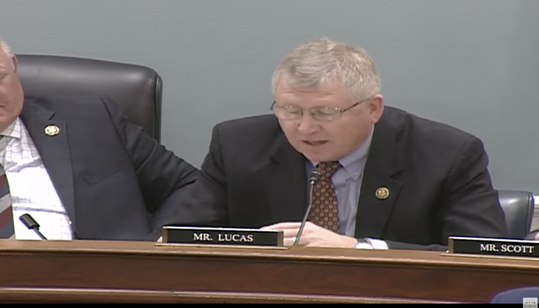
Click here to watch Lucas Q&A.
On USDA's ERP
"Over the past 6 years impacted producers have received ad hoc assistance for extreme weather events through the WHIP Plus program, administered by the previous Administration, and the ERP program administered by your Agency. ERP Phase One followed the WHIP Plus model, basing 2020 and 2021 coverage on crop losses. Producers who were left out of Phase 1 were given assurances that they would be captured under ERP Phase 2.
"However, when the regulations came out for ERP Phase 2, FSA had completely changed course and moved from a model based on crop losses to one based on revenue losses calculated by tax year. The reports I am hearing from Oklahoma is that due to the vast changes in the program, the drought impacted producers that were left out of Phase 1, are not qualifying for Phase 2 under these new parameters."
Earlier this month, Lucas joined Representative Jodey Arrington (TX-19), Senator Roger Marshall, M.D. (R-KS), Representative August Pfluger (TX-11), and Representative Tracey Mann (KS-01) in sending a letter to Secretary Vilsack urging USDA to reconsider ERP Phase II implementation and utilize the Phase I methodology for the crop year 2022 crop disaster assistance.
The seminar will focus on tools to help small and medium sized as well as underserved producers.
As part of their ongoing commitment to help production agriculture in Oklahoma and the Southern Plains region of the United States, the USDA Southern Plains Climate Hub (Climate Hub), in partnership with the City of Clearview, Langston University, Oklahoma State University and other collaborators will be hosting a sustainable farming in a changing climate seminar 9 a.m. to 1:30 p.m. on Saturday, April 29 in Clearview, Oklahoma. This event will inform small and medium sized agriculture producers about different strategies and initiatives available to help them increase profits and improve production.
"We are very excited to be a partner in this effort to provide assistance to smaller and underserved farmers and ranchers," said Andres Cibils, Director of the Southern Plains Climate Hub. "This is a great opportunity to share information about some of the initiatives that are available to help small farmers and ranchers maintain productivity and improve their overall profitability."
Topics at the event will include a discussion of climate-smart agriculture practices, urban agriculture, goat production 'nose to tail,' USDA agency assistance programs, rainwater harvesting, small acreage gardening, and educational opportunities for community youth.
Those planning to attend should RSVP by April 21 by contacting Clay Pope at 405-699-2087 or by e-mail at claygpope@gmail.com or Susan Eisenhour at 405-205-0152 or by e-mail at ssusan.eisenhour@usda.gov. There is no charge for the seminar and lunch will be provided.
Registration will begin at 8:30 a.m. at the Old School Gym in Clearview, Oklahoma located at 112 West Douglas Street.
For more information, contact Clay Pope at 405-699-2087, Susan Eisenhour at 405-205-0152 or Dr. Donnie Nero at 918-260-8132.
Dairy MAX expands its mini-video docuseries, Dairy Up Close, to feature a Colorado dairy farm family.
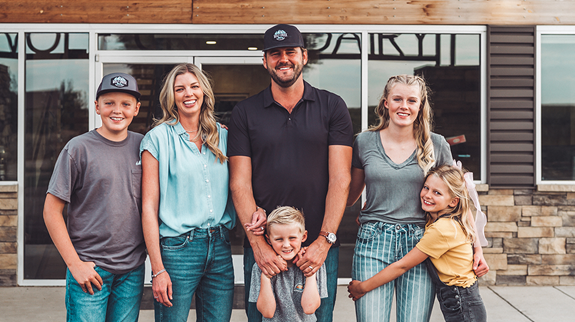
Real. Transparent. Sustainable. Community. These are just a few of the words we hear daily that matter most to today's consumers, especially when it pertains to foods and beverages. Knowing the importance of these few words to today's consumer, Dairy MAX created Dairy Up Close, a campaign to share the real stories of real dairy farm families and highlight the care they show daily for their animals, the planet and their communities. After seeing success with the inaugural campaign, Dairy Up Close is now expanding to feature a dairy farm family in Colorado.
The mini-documentary video series is aimed to give consumers, who are over three generations removed from agriculture, a behind-the-scenes look at where their food comes from and introduce them to dairy farm families who are not that much different from their own.
"Tools like Dairy Up Close are of paramount importance for today's dairy farmer because we can include all the reasons we know dairy should be a staple in the diet and package that in a way that is relatable, entertaining and educational all at once," says Todd Green, vice president of industry image and relations for Dairy MAX.
"Today's consumers are more connected than ever before and are hit with information rapidly. So, with Dairy Up Close, we can meet consumers where they are, highlight the hard-working dairy farm families across our region and educate them on the many benefits of dairy, all while they scroll their favorite apps or TV shows."
The original series followed the lives and stories of five local dairy farm families from central and east Texas to the Panhandle plains and eastern New Mexico, highlighting their daily lives and sharing the same passion we all have to make the best choices for our families and future generations.
The Dairy Up Close campaign ran ads on YouTube, Hulu and connected TV (CTV), which is a device that connects to a TV to support streaming video content. Overall, the campaign garnered 5.4 million impressions and 3.6 million video views.
After the success of the inaugural campaign, Dairy MAX knew it was time to expand and is excited to feature a Colorado dairy farm family at Wolf Creek Dairy. The Diepersloot family mission is simple: Clean milk, given by comfortable cows, assisted by caring people, in a culture of respect and integrity. With this, they also emphasize dairy farming technology and best practices, being constantly mindful of their impact on the land and the health of their cows.
"A true family affair, we are excited to highlight how the Deipersloot family cares about the health, safety and environmental impacts of the foods they consume just like everyone else because their kids and families enjoy the same dairy," says John Cass, director of industry image and relations for Dairy MAX.
"Consumers often forget that farm families are just like their families, so we are excited to make that connection again and remind people that the families stocking their grocery store shelves are focused on creating healthy communities for generations to come."
You can check out the Wolf Creek Dairy video series by visiting DairyUpClose.com. Videos will also be served to consumers on YouTube, smart TV, social media and more.
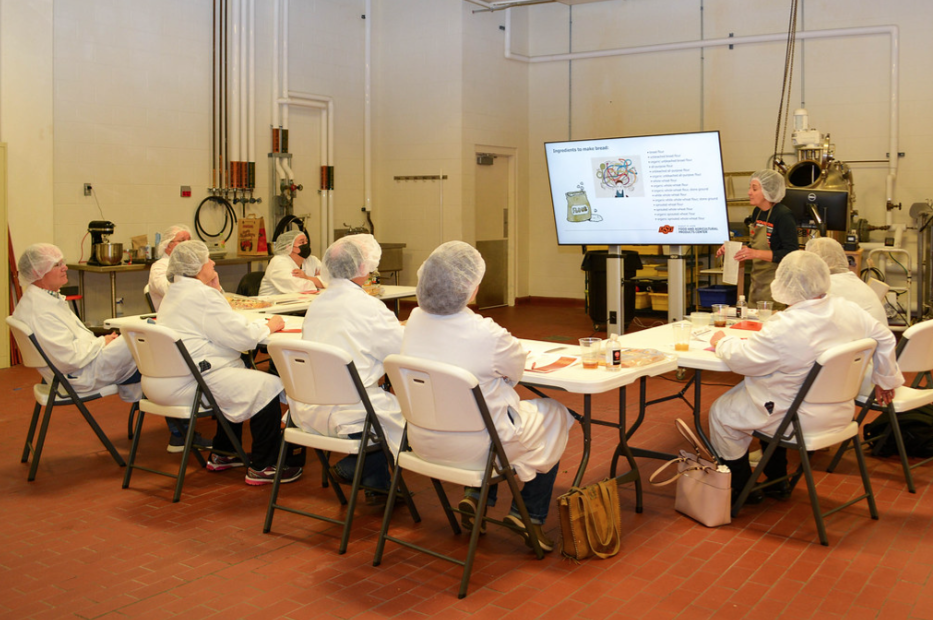
Join Renee Albers-Nelson, baking and milling specialist, for an artisan and grain workshop on May 17 at FAPC. (Photo by Kirsten Hollansworth)
By Kirsten Hollansworth
Renee Albers-Nelson, baking and milling specialist with the Robert M. Kerr Food and Agricultural Products Center at Oklahoma State University, is set to host All You Knead to Know, an artisan and grain workshop, from 8 a.m. to 4 p.m. on May 17 at FAPC.
Anyone from a chef to a farmer, as well as bakers in small and large bakeries, will find interest in this specialized workshop just for the baking industry.
"It's a mystery to a lot of people how to bake a loaf of bread at home," Albers-Nelson said. "But, baking is an art and it's important to understand the history of wheat flour."
This hands-on workshop will allow participants to hear from guest speakers including Mike Schulte, Oklahoma Wheat Commission executive director; Gary Lowrance, retired director of product development and quality control with Shawnee Milling Company; and Bailey Norwood, OSU agricultural economics professor.
Andrea Graves, business planning and marketing specialist, said participants will gain knowledge about OSU's Wheat Breeding Program, wheat flour milling and the variety of flavors in bread.
"This workshop should be of interest to anyone of all baking levels who appreciates the process of making and eating good bread," Graves said. "Participants will do some hands-on activities with sourdough, and of course get to do some tasting. Our guest speakers will be sharing tips and knowledge they have learned through their years of experience in the baking industry."
For more information and registration details, contact workshop coordinator Karen Smith at 405-744-6277.
FAPC, a part of OSU's Division of Agricultural Sciences and Natural Resources, helps to discover, develop and deliver technical and business information that will stimulate and support the growth of value-added food and agricultural products and processing in Oklahoma.
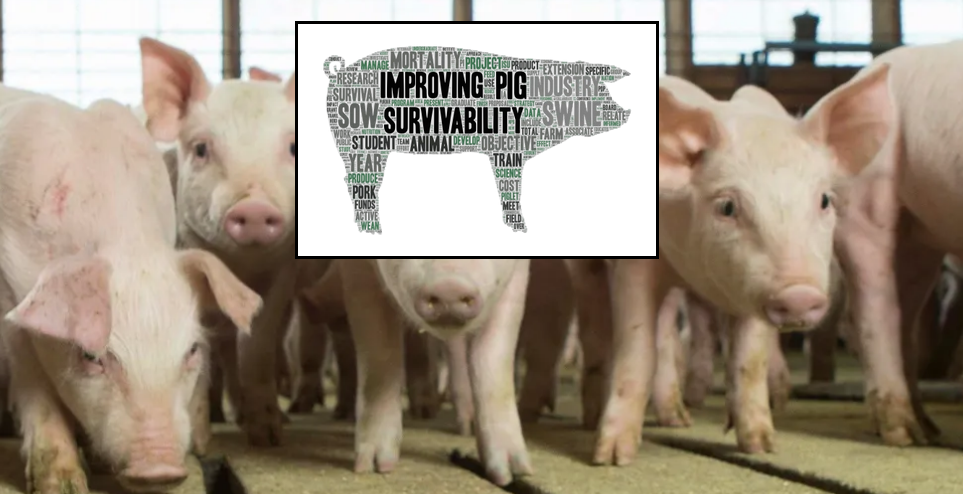
An interdisciplinary team of research and extension students, staff and faculty is bringing a 5-year research project focused on identifying causes of mortality on U.S. sow farms to a close with encouraging results.
Improving Pig Survivability is funded by NPB and the Foundation for Food and Agriculture Research (FFAR) and has been working to understand contributing factors to pre- and post-weaning survivability with an end goal of developing targeted strategies to reduce overall mortality rates in the commercial swine industry.
The effort has been hugely successful. For example, one outcome determined that monitoring and early detection of lameness, sickness and other causes of mortality in high-risk sows led to a 25% decrease in mortality rate.
This investment has inspired the creation of many resources for producers, including on-farm training materials, factsheets, informational videos, the PigX podcast and more.

Pork and Partners, a community for nutrition professionals, was launched by NPB last week to build strategic and mutually beneficial relationships with health professionals, to help build their skills and knowledge while being a credible resource.
Registered Dietitian Nutritionists (RDNs) present a large opportunity to reach thousands of consumers each year. NPB is committed to engaging with nutrition professionals and promoting the recommendation of lean pork as part of a nutritious way of eating.
NPB has identified human nutrition as an investment priority for 2023, with the board focusing on 3 long-term pillars:
• Stronger scientific foundation
• Relevant, meaningful stories
• Celebrating pork's flavor, convenience and versatility
The program will be a place for nutrition professionals to get all the facts and inspiration about pork, with the intent to ultimately help more people rethink the possibilities of pork as a part of a balanced diet.
Resources will be shared through a monthly email, better-for-you recipes, research-based educational resources, and continuing education opportunities that are of high value to nutrition professionals.
Additionally, we will provide ample opportunities for networking and speak directly with leaders in the field of nutrition through a series of intimate in-person events.
To kick it off, Kara Behlke-Ungerman, NPB vice president of nutrition health and wellness transformation, was a guest on the Sound Bites podcast to announce the new program and share the many health benefits of eating lean pork.
RON's Dave Lanning has a pre-opening look at today's agricultural Markets.
Click the audio tab below for today's report.
Hack, cough, and sneeze...allergy season is getting longer (thank you changing climate).
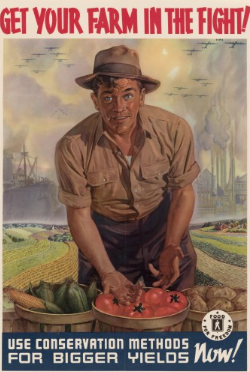
The headline that was in my inbox earlier this week pretty well sums up this entire blog.
"Allergy season is 'earlier, longer and worse' in these US cities, report finds."
If droughts, floods, cold snaps, and heat stress weren't enough, now it seems we get to deal with a longer, more intense allergy season. The good news just keeps on coming, doesn't it?
The story focuses on a report that analyzed the temperature data for 203 U.S. cities and determined that the freeze-free has season lengthened by more than two weeks (15 days) on average since 1970. This means that for the millions of Americans that suffer from seasonal allergies to pollen and mold, climate change is bringing an earlier, longer, and overall worse allergy season. This mirrors an earlier report from the Center for Disease Control and Prevention (CDC) that said climate change will potentially lead to shifts in precipitation patterns, more frost-free days, warmer seasonal air temperatures, and more carbon dioxide (CO2) in the atmosphere. These changes can affect when the pollen season starts and ends and how long it lasts each year, how much pollen plants create and how much is in the air, how pollen affects our health (the "allergenicity" of pollen), how much pollen we're exposed to, and our risk of experiencing allergy symptoms.
And just in case you think this only applies to folks with allergies, the Agricultural Research Service (ARS) also has determined this change is happening with potential impacts on agriculture and other studies have shown what this can mean for weed competition in crops and the range of certain harmful insects (I have written about the bugs before in an earlier blog and you can find another study on climate change and agriculture insect pests here).
All this adds up to new challenges for all of us, whether we are hacking and sneezing due to a more severe allergy season or fighting more aggressive weeds and bugs that we have never had to deal with before. As with so many of the impacts of climate change, this change in weather and temperature patterns won't simply go away with time. We need to be prepared for its effect and have at least some kind of strategy as to how to deal with it.
When it comes to allergies, the CDC has some great tips for how to best reduce your exposure to pollen and other allergens. With pests and agriculture, you can contact your local cooperative extension service office (you can find a list of offices for Oklahoma here, Texas here, and Kansas here), or you can visit your local USDA Service Center or talk to your local crop or animal health advisor.
Regardless of what course of action you take, you need to give some serious thought as to how to get ahead of these challenges, because more than likely it will only get worse as the climate continues to change.
To read this post at the Southern Plains Perspective, click here.

There is an abundance of agritourism opportunities across the state of Oklahoma to take advantage of this Spring and Summer. Associate Farm Editor Reagan Calk caught up with the Agritourism and Farmers Market Coordinator at the Oklahoma Department of Ag, Micaela Halverson, and talked about some fun venues in Oklahoma and what they have to offer.
Oklahoma has a few U-Pick tulip farms, Halverson said, which are listed on the Oklahoma Agritourism website.
"You can go pick your own tulips and create a bouquet to take home," Halverson said.
There are a few different locations to pick tulips in the state, including Flowers Farms in Oklahoma City, Oklahoma Tulips in Harrah, Tea and Country Estate in Enid, and Platter Flats Pumpkin Patch in Calera.
Aside from U-Pick tulip farms, Halverson said there are more U-Pick opportunities in the state ranging from strawberries and blueberries to blackberries and peaches, depending on the season.
"Following us on social media at 'oklahomaagritourism' either on Instagram or Facebook is going to be the best way to know when each season is and once those products are ready for the customers to go out and pick," Halverson said. "We like to go out and share each farm's individual Facebook post so that people can follow them."
The Oklahoma Agritourism website also features a few different trails in the state, including a jelly making trail, a craft beer trail and a wine trail. Brochures and trail maps can be found for free at travelok.com/brochures.
"They will mail those out to you guys if you wanted to have one of those maps in your hand to see which farms or businesses across the state you wanted to check out," Halverson said.
The Oklahoma Agritourism website features around 18 different categories of farms, ranches and businesses across the state, Halverson said, all offering unique experiences to visitors.
"The last thing I wanted to highlight is our farmers markets," Halverson said. "We are really gearing up for farmers market season and if your local farmers market has not opened, it will be opening soon."
Farmers markets are a great way to support buying locally, Halverson said, as the markets offer a wide array of products from dairy to vegetables.
"A lot of them have a lot of extra fun things going on at the markets as well, whether that is food trucks, or snow cones- different things like that," Halverson said.
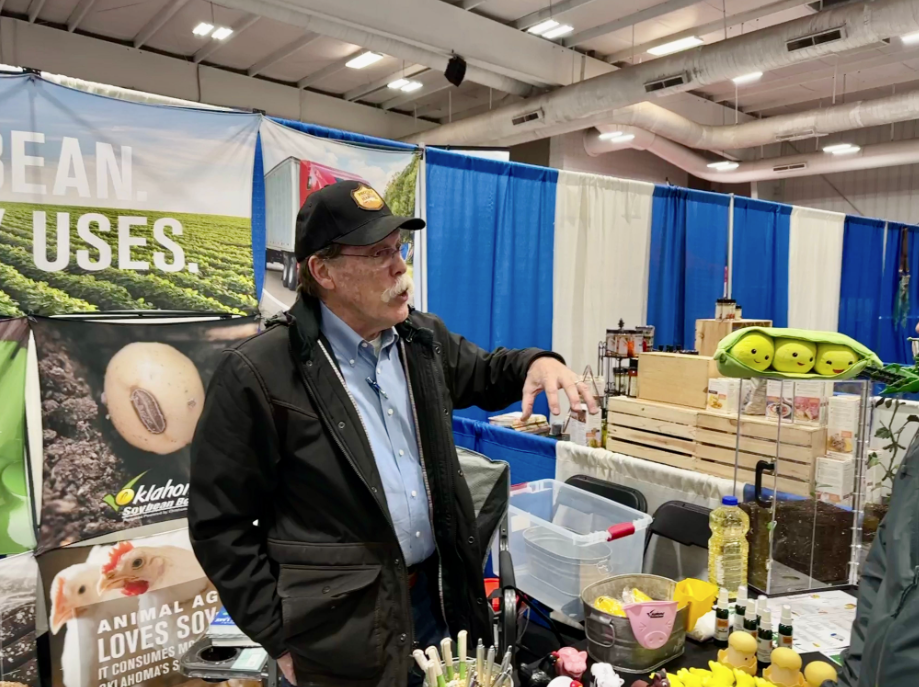
Senior Farm and Ranch Broadcaster, Ron Hays, is visiting with the Executive Director of the Oklahoma Soybean Board, Rick Reimer, talking about soybean success throughout Oklahoma.
For years, Reimer said northeast Oklahoma held the greatest soybean producing counties in the state.
"For the last five years, none of those have been the number one county," Reimer said.
Kay County was the number one in soybeans most recently, with the next three or four top producing countries being in the surrounding area. Contrary to popular belief, Reimer said dryland soybeans have been successful in northcentral Oklahoma.
"Some of the guys that try it tell me that not only do they yield as a cash crop, but it is almost worth growing alternating soybeans with wheat just to clean up their fields," Reimer said.
In a year with adequate moisture, Reimer said soybeans can be double cropped behind wheat, which works extremely well.
"We call it the 'miracle crop of many uses,'" Reimer said. "If you crush 100 pounds of soybeans, you get 80 pounds of meal and 20 pounds of oil. For a long time, oil was sort of a biproduct, but now, the number of things you can make from the oil are just incredible, so it is almost the primary product of soybean crush."
Reimer said soybeans are the second most planted crop in Oklahoma behind wheat.
For producers considering planting soybeans, Reimer said they must first analyze the rainfall and heat in their area.
"That is why we can't grow soybeans in southwest Oklahoma," Reimer said. "It just doesn't get cool enough in the evenings in the late summer for bloom and pod set."
Many producers who are wanting to diversify their operations, Reimer said, are realizing the benefit of growing soybeans as a part of their system.
"Certainly a significant crop for Oklahoma and a good opportunity- a good alternative- for some of the farmers in Oklahoma to diversify their operations a little bit," Reimer said.
The list goes on for the products that can be produced with soybeans, Reimer said, from plastics, food, dust control and more.
"In fact, in some of the heavy-duty F-250 Ford pickups, the plastics in the dash are all made from soybean oil derivatives," Reimer said.
To visit the Oklahoma Soybean Board's Facebook page, click here.
Global hunger and malnutrition pose significant threats to U.S. national security, underscoring the need to invest in international agricultural research and development, according to a new report commissioned by Farm Journal Foundation.
The report, authored by researchers from Texas A&M University, examines how global food insecurity is linked to numerous geopolitical risks, including immigration, radicalization, terrorist threats, environmental degradation, and lost economic opportunity. Increasing investments in agricultural development and innovation would help mitigate these risks by enabling developing countries to improve their crop yields and better feed themselves.
"Agriculture is the main profession practiced by the world's poorest people, so making investments in improving farm productivity in developing countries would go a long way toward addressing the root causes of many national security risks," said Dr. Edwin Price, lead author of the report and professor at the Department of Agricultural Economics' Conflict and Development Program at Texas A&M University. "Alleviating hunger and improving agricultural livelihoods means that people are less likely to immigrate, turn toward criminal activity, or fall prey to radicalized groups."
The world has seen an alarming rise in hunger and malnutrition in the past few years due to challenges from the global pandemic, the war in Ukraine, extreme weather events linked to climate change, and other shocks. As many as 828 million people – one in ten people on the planet – are affected by hunger, according to the World Food Program.
Hunger and poverty in developing countries create five kinds of threats to U.S. national security, according to the paper. These are socio/political threats, economic threats, nutrition and health threats, environmental threats, and cultural threats.
Investing in agricultural productivity and other long-term solutions can help reduce government spending on humanitarian assistance, according to the report. In spite of this, U.S. funding for agricultural research and development has been flat at about $1 billion since 2010, while U.S. humanitarian aid grew from under $4 billion in 2014 to $14 billion in 2022, according to the U.S. Agency for International Development (USAID). Agricultural research provides one of the highest returns of any public research investment, generating $20 on average for every $1 spent, according to a study by the U.S. Department of Agriculture's Economic Research Service (ERS).
The report makes a series of recommendations for how the U.S. can invest in long-term global agricultural development. This includes increasing investments in global food and nutrition security programs, as well as research and innovation, within the government's Feed the Future initiative, supporting funding for the Foundation for Food and Agricultural Research (FFAR) in the Farm Bill, and supporting additional programs that benefit developing countries' agriculture.
"Hunger used as a weapon is not only happening in Ukraine, but has been happening across the continent of Africa and in developing countries for many years," said Kelsey Barnes, Director of Government Affairs at Farm Journal Foundation and a U.S. Army National Guard veteran. "As a world leader, the U.S. has an opportunity to make long-term investments in agriculture to reduce hunger and protect national security."
To read the full report, click here.
To read the executive summary, click here.
Today, NASDA opened the first "A Taste of the States: Las Vegas" trade show pavilion to help state agriculture departments promote local food and beverage products to international markets. The NASDA pavilion is hosted within SIAL America, a top food and beverage event in the United States and will run from March 28-30.
"This is a first of its kind event for NASDA in the western United States. We're excited to expand opportunities to more U.S. food producers and reach further corners of the globe with U.S. products," NASDA CEO Ted McKinney said.
The pavilion will feature state department of agriculture participation from Colorado, Hawaii, Idaho, Maine, Montana, Nevada, New York, North Carolina, North Dakota, Oregon and Washington state.
"Helping small businesses grow is such a rewarding opportunity, and we're grateful to add this show to NASDA' s portfolio of trade promotion activities. We look forward to supporting the exhibitors this week and sharing the results of the show," McKinney said.
NASDA has hosted more than 50 trade show events in the U.S. and has assisted with scores of U.S. pavilions all over the world. In 2022, NASDA's trade promotion activities led to nearly $46 million in projected export sales and 185 companies acquiring new export markets for their business.
A Taste of the States: Las Vegas is possible due to funding from a 40-year-old cooperative agreement between NASDA and the U.S. Department of Agriculture Foreign Agricultural Service designed to empower small business owners with the tools needed to export their U.S.-grown and made products around the world.
Learn more about NASDA's work to create trade opportunities for small to medium-sized food and beverage companies at nasda.org/tradeshows, and keep up with happenings at the show all week by following NASDA's trade show social media accounts.
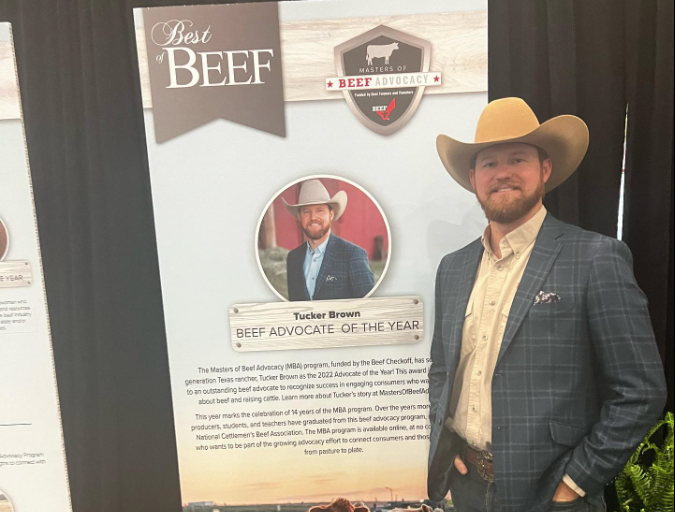
Senior Farm and Ranch Broadcaster, Ron Hays, is visiting with beef advocate and sixth-generation cattle rancher from Throckmorton, Texas, Tucker Brown.
Brown is active in his family's operation, the R.A. Brown Ranch, and is on the Leadership Development Committee at the Texas and Southwestern Cattle Raisers Association. Because of his great advocacy work throughout 2022, Brown was recognized by the National Cattlemen's Beef Association as Advocate of the Year.
"NCBA has done a really good job of trying to create and build the next group of advocates to get the word out to our consumers to build that trust back that we may have lost over the years," Brown said.
The Masters of Beef Advocacy program, Brown said, helps train ranchers and farmers how to communicate an effective message to consumers.
"I have had success through social media and through working through Texas and Southwestern Cattle Raisers, so that is where I spend most of my time, and had my most success of sharing that story," Brown said.
Part of the Masters of Beef Advocacy program that Brown found to be most valuable was learning to put himself in the shoes of the consumer.
"Research that NCBA and others have done tells us that the consumer trusts the rancher," Brown said.
Along with that trust, Brown said, it is important to know how to communicate with the consumer and be relatable.
"We are just like them," Brown said. "This is the food we put on our table for our families, and we want it to be safe and healthy too. So, making that connection I think, has been where the most success has happened in building that trust back."
As a spokesperson for the beef industry, Brown said he plans to keep doing what he loves and advocating to consumers.
"The future is bright for the ag industry as long as we take care of business and connect back with the consumer," Brown said.
A large part of Brown's advocating is on social media, Brown said, and the key is to make content interesting enough to keep the consumer engaged enough to take it all in.
"They are interested more now in this lifestyle than ever before," Brown said. "I want to be the one to share it rather than someone who is not in the industry and doesn't know the truth about it."
To see Tucker Brown's content, you can visit his Facebook, Instagram and Tik Tok accounts.
The Beef Buzz is a regular feature heard on radio stations around the region on the Radio Oklahoma Ag Network and is a regular audio feature found on this website as well. Click on the LISTEN BAR for today's show and check out our archives for older Beef Buzz shows covering the gamut of the beef cattle industry today.
Mark Johnson, Oklahoma State University Extension Beef Cattle Breeding Specialist, offers herd health advice as part of the weekly series known as the "Cow Calf Corner" published electronically by Dr. Peel, Mark Johnson, and Paul Beck. Today, Johnson is talking about managing your operation in drought.
At the conclusion of a winter of feeding cows, this time of year we, (and the cows), look forward to green grass. Parts of Oklahoma have received some much needed rain over the past few weeks and yet a majority of the state remains in various degrees of drought. Moisture over the next few weeks will be critical to help warm season grass pastures (native or improved grasses) get off and running for the summer. Regardless of your current moisture situation, proper range management is critical now and over the next couple of months. We need to resist the temptation caused by green grass, hold off on grazing pressure and manage our grazing eco-system of soil, plants and cattle for optimum, long-term benefit. Following is our management plan for the OSU Purebred Beef warm season grass pastures this spring.
Apply Herbicides for Weed Control Early
Drought stress (past and present) makes the timely application of herbicides critical in order to give the desired plant species the competitive advantage. Proper timing of herbicide application depends on the product used. Read product labels to determine proper timing. For example, post emergent herbicides like 2-4-D works on actively growing weeds. Accordingly, broadleaf weeds need to be growing before we can get effective weed control. That being said, apply herbicide for weed control before the weeds have the opportunity to scavenge moisture and soil nutrients.
Delay Grazing Until......
After or during drought stress, the most palatable plant species are most negatively impacted by grazing pressure. Under continuous grazing pressure, cattle of all ages will graze the most palatable plants and their lush regrowth repeatedly. For example, desirable forage plants will be grazed while rank weeds will grow to maturity untouched. The same holds true among desirable plants, for example crab grass is more palatable than switch grass. What do we do to give desirable grasses the competitive advantage this spring? Resist the temptation of the first signs of green grass and delay grazing as long as your supply of hay and/or supplemental feed permits. Depending on the type of plants in your forage base (native grasses or improved grasses like Bermuda), I suggest waiting until grasses are four to eight inches tall before turning out to graze. This gives the plants a healthy start and will provide cover to bare soils. Permit your desired plant species to get ahead of grazing pressure this spring.
Apply Fertilizer Early/Split Applications
This applies to improved grasses like Bermuda. When considering getting grasses off to the competitive advantage this spring, we want nitrogen fertilizer applied at the optimum time before rain or proper growing conditions happen. If we are dealing with Bermudagrass pastures which include cool season grasses, an extra level of management is needed to determine the best time to apply nitrogen in harmony with proper growing conditions for the Bermudagrass plants. Furthermore, with the uncertainty of moisture, it is best to split the amount of nitrogen fertilizer into at least two applications. For example, if we typically fertilize our Bermuda grass pastures with 100 pounds of actual nitrogen per acre in early May, this year we plan to apply 50 pounds of actual nitrogen per acre by the beginning of May. We will monitor growing conditions and rainfall to determine if/when to apply more nitrogen.
In summary, our goal is to permit our drought stressed, desired grasses some time to heal, grow and get ahead of the weeds and grazing pressure this spring. If we fail to accomplish this goal, the consequence is a weakened stand of desirable grasses, more weeds and more undesirable plant species. Plan ahead now to manage your grazing system for the long-term benefit of your beef operation.
The U.S. Department of Agriculture (USDA) is seeking nominations for individuals to serve on the Advisory Committee on Minority Farmers. This committee recommends solutions to challenges faced by minority farmers and ranchers, and is part of USDA's commitment to advance equity for all, especially for farmers and producers in underserved communities. The Committee is administered by USDA's Office of Partnerships and Public Engagement (OPPE).
The Committee was established in the Food Conservation and Energy Act of 2008 to ensure that underserved farmers have equal access to USDA programs. Advisory Committee members will represent underserved farmers and farming communities and should also reflect the diversity of agriculture in geography, size, scale and type of production. Members will include: six or more farmers or ranchers; two or more individuals from minority-serving institutions of higher education; two or more individuals from community-based nonprofit organizations; and two or more individuals with civil rights and equity expertise. Interested candidates may nominate themselves. The Committee consists of 15 members who serve two-year terms and may be reappointed for an additional two terms.
The Advisory Committee will meet no less than once per year to advise the Secretary of Agriculture on: (1) implementation of the Outreach and Assistance for Socially Disadvantaged and Veteran Farmers and Ranchers Program (aka the 2501 Program); (2) ways to maximize the participation of minority farmers and ranchers in USDA programs; and (3) civil rights activities related to participants in such programs. Advisory Committee public meetings may be held in hybrid style giving participants the choice to attend in person or virtually.
All nomination packages received by April 24, 2023 will be considered.
Nominations may be submitted electronically to the Advisory Committee's dedicated email inbox at acmf@usda.gov. Nominations may also be sent via first-class mail to: Advisory Committee on Minority Farmers, Office of Partnerships and Public Engagement, 1400 Independence Avenue SW, Mail Stop 0601, Washington, DC 20250. For more information, email acmf@usda.gov. Additional guidance on submitting nominations can be found on the Advisory Committee on Minority Farmers website.
USDA touches the lives of all Americans each day in so many positive ways. Under the Biden-Harris administration, USDA is transforming America's food system with a greater focus on more resilient local and regional food production, fairer markets for all producers, ensuring access to safe, healthy and nutritious food in all communities, building new markets and streams of income for farmers and producers using climate smart food and forestry practices, making historic investments in infrastructure and clean energy capabilities in rural America, and committing to equity across the Department by removing systemic barriers and building a workforce more representative of America. To learn more, visit www.usda.gov.
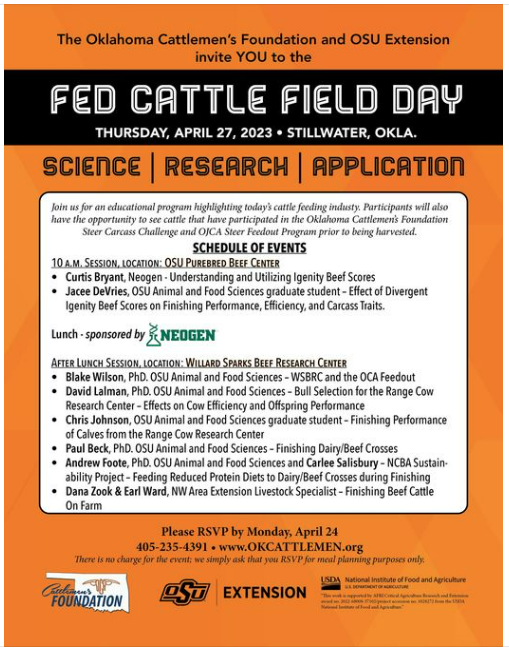
Its just about time for the Fed Cattle Field Day hosted by the Oklahoma Cattlemen's Foundation & Oklahoma Junior Cattlemen's Association
We collected steers on feed for the Oklahoma Cattlemen's Foundation Steer Carcass Challenge and sent them off to OSU Willard Sparks Beef Research Center in Stillwater, OK. We'll dig into the power of genetic data and how it affects your bottom line as a beef raiser, seller, and consumer.
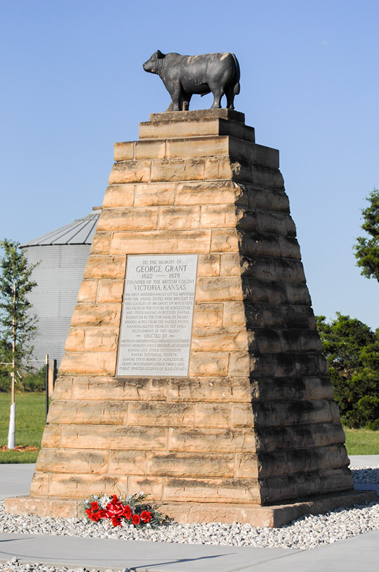
Pictured is the George Grant Memorial which marks the birthplace of Angus in America — Victoria, Kansas. Attendees of the 150 Years of Angus celebration, hosted by the Kansas Angus Association, will gather at the site to commemorate the breed's history.
Kansas Angus Association to host celebration event May 20.
In 1873, George Grant transported four Angus bulls from Scotland to the Kansas Prairie to fulfill his vision of American agricultural success. When crossed with the Texas longhorn cows native to the Plains, the bulls sired calves well-suited to the region. These results demonstrated the Angus breed's initial value in the United States. The legacy continues to be built today by Angus breeders across the nation.
Angus enthusiasts are invited to celebrate the bulls' arrival – 150 years later – on May 20 at the George Grant Memorial Cemetery in Victoria, Kansas. The commemoration, hosted by the Kansas Angus Association (KAA), will feature Angus camaraderie, food, education and more.
"We are excited to welcome all Angus and history enthusiasts to this event," said Anne Lampe, KAA manager and secretary. "The field day will not only commemorate our 150 year legacy, but will also celebrate the success of the Angus breed and its people as we continue our quest to remain the seedstock and beef industry leader."
The celebration, set to take place from 11 a.m. to 3 p.m., marks one of many celebrations of this lasting legacy. Attendees will enjoy a Certified Angus Beef® brand smoked brisket lunch and be able to view Angus cattle on display in addition to these attractions:
Additionally, a silent auction will take place during the event, featuring vintage Angus collectibles, a CAB kitchen block knife set and more. All proceeds of the silent auction will benefit the KAA to support its mission, including the KAA Young Angus Producer Scholarship.
Registration for the event is free of charge, but requested to be completed by April 30. To register your attendance, visit bit.ly/150YearsOfAngusFieldDay.
-Written by Briley Richard, Angus Communications

House Agriculture Committee Ranking Member David Scott delivered the following statement at today's full Committee hearing, which was convened for the purpose of receiving testimony from the Secretary of Agriculture Tom Vilsack.
[As prepared for delivery]
Thank you, Mr. Chairman, for holding this hearing today. I always look forward to seeing our distinguished witness, Secretary Vilsack.
As we begin the 2023 Farm Bill in earnest, I know the testimony provided today will educate and guide us.
We will all get a chance to ask you questions about our priorities today. I want to address mine too.
Let me start by addressing recent proposals that would add burdensome work requirements to SNAP. Mr. Secretary, I know you agree with me here.
SNAP already has strict work requirements, and it is a very effective work support program.
Nearly all SNAP recipients who can work, do work. More than two-thirds — 68 percent — of Americans participating in SNAP are children, seniors, or people with disabilities and not expected to work.
And 74 percent of those who are expected to work do so within a year of receiving SNAP.
More requirements will only leave vulnerable populations – like veterans – hungry.
SNAP is also one of the most important and effective tools we have to improve food security and nutrition while also having enormous positive impacts on the economy.
SNAP spending helps to support a robust national economy by returning one dollar and fifty cents for each dollar spent. It also generates thousands of jobs across the country in grocery, transportation, manufacturing, and other industries each year.
Further, SNAP has an outsized economic impact in rural communities.
SNAP spending increases rural economic output by 1.25 percent and rural employment by 1.18 percent annually and has a stronger impact on poverty in rural counties than in non-rural counties.
We must ensure that rural communities experience economic growth too.
The House Democrats will stand united to defeat any proposals to weaken SNAP, as we have in previous Farm Bill years.
Equally important to me is opening agriculture to more people. We must do something to address the loss of 17,000 ranchers each year while ensuring that all farmers, ranchers, and producers of all races, genders, and ethnicities can work our land or support agriculture in their own ways.
I want to call out my bill, recently re-introduced, H.R. 1436 to make permanent the 1890 Scholarships Program I created in the 2018 Farm Bill.
It would also provide $100 million in additional funds for these scholarships.
As a product of an 1890 Land-Grant Institution myself, I know the great value this system can provide to students. I think this is an area we can work together in a bipartisan way in this farm bill.
Let me end by saying that I look forward to working with you Mr. Secretary and with my colleague and friend, the Chairman, Mr. Thompson.
Together we can build a stronger safety net for our famers, our low-income Americans, and we can strengthen our food security and climate.
It's a tall task, but one that we can accomplish together. I yield back my time.
While the erosion control and soil health benefits associated with cover crops and limited tillage have piqued farmers' interest, the management shifts they require can be daunting. Justin Krell, area agronomy manager with LG Seeds, shares four steps for successfully planting into conservation systems.
#1. Tune up the planter
Krell reminds farmers planting into conservation systems to keep row cleaners, downforce management and closing wheels top of mind.
"Whether you're planting into a living cover crop or a terminated one, row cleaners are No. 1," Krell says. "Getting residue out of the way so it doesn't interfere with seed-to-soil contact is critical and makes for a smoother ride for the planter."
Since many cover crop users also incorporate strip-till or no-till, Krell says, "Downforce management and keeping planter depth accurate are other priorities. Managing less-disturbed soil requires more downforce management versus conventional systems."
Farmers new to conservation systems and especially no-till also need to make sure they're applying enough closing wheel pressure to cover the trench. Krell says, "Farmers can have perfect downforce management and get the seed exactly where they want it, but if they're not closing that seed trench, the effort will be wasted."
#2. Wait for the right conditions to terminate cover crops
Farmers also need to think through cover crop termination. Mowing, roller crimping and herbicide termination are all effective methods.
Temperature and timing also come into play, especially for corn. "Herbicide termination should be done on a warmer day to improve uptake. In early spring, I recommend waiting until the middle of the day when it's the warmest and using a good chemistry," Krell says. "Herbicide termination should also be done prior to the boot or heading stage for cover crops like rye."
While less commonly used, a roller crimper is also effective at terminating a cover crop, so long as the cover crop is in the reproductive stage when it's rolled. It can be a costly piece of equipment, though. Krell advises farmers to check with local co-ops or Soil and Water Conservation Districts to see if roller crimpers are available for rent.
Krell encourages farmers to have a late season plan in place with their chemical providers in case of any termination issues.
#3. Compensate for nitrogen tie-up
One of the biggest changes when it comes to adopting cover crops is nitrogen management, Krell says. Cover crops tie up nitrogen early in the season. This is especially true for corn following rye.
"To avoid early-season nitrogen deficiencies, farmers may need to apply up to 50% of their nitrogen at or near planting," says Krell. The nitrogen in the cover crop will come available to the crop later in the season.
"You don't need to apply more nitrogen. You just need to move the timing up to meet the needs of your corn crop," Krell says.
#4. Make strategic seed choices
Farmers in a conservation system also need to select seeds with good emergence that are well rated for no-till soils. "Check with your seed dealer for their product recommendations," Krell advises. "LG Seeds offers a number of products that have the emergence strength needed for no-till systems."
Krell also recommends farmers use seed treatments to defend against the threats presented by the cooler, wetter soils of a no-till system. He says the added protection is especially important for soybean seedlings vulnerable to threats like Pythium and sudden death syndrome, particularly in Northern environments.
For more information on managing conservation systems, farmers can contact their local LG Seeds agronomist.
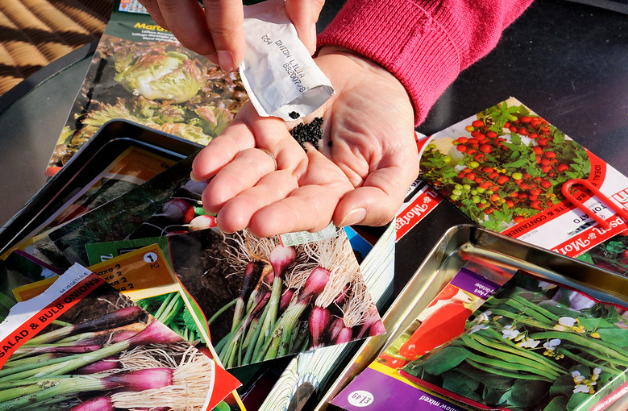
Gardeners shouldn't let themselves be fooled by photos of plants they find online. Check with reputable seed companies to verify the plant is legitimate. (Photo by Shutterstock)
By Trisha Gedon
While Jack may have gotten lucky with the magic beanstalk beans he received when he traded his cow, gardeners may not be so lucky when purchasing seeds for their gardens. Casey Hentges, host of Oklahoma State University Agriculture's television program "Oklahoma Gardening," has a word of caution for gardeners purchasing seeds this growing season.
"It's the time of year when I love browsing through the different seed catalogs and seeing what new plants are available," Hentges said. "Unfortunately, there are a lot of gimmicks and photoshopped pictures out there that can grab a gardener's attention, but often they're just selling magic beans."
A few years ago, gardeners may have seen rose seeds that claimed to produce a rainbow of vibrant colors on each flower. While roses have been hybridized and do come in some amazing colors, if something looks too good to be true, it probably is. Consumers may find images of multi-colored roses, but the truth is that petals have been dyed. Dyed roses can be purchased as cut flowers, but gardeners shouldn't expect to grow them in their gardens.
Hentges suggests if there's a plant that grabs a gardener's attention, search the internet to see if other plant nurseries are offering the variety. If it's legitimate, it'll be readily available at multiple vendors.
"If the only vendor is a craft trading site or an independent sales website, it's likely not a legitimate plant," she said. "Also, read the reviews on these questionable sources. If there are comments suggesting the plant colors weren't what the buyer was anticipating, the buyer likely bought seeds based on a picture of photoshopped plants. Check the websites of well-established vendors before spending your money on magic beans."
What can be tricky for gardeners is the fact that plant breeding has advanced, and the gardening industry does have some unusual – yet legitimate – selections available, including cheddar cauliflower, black beauty tomato or glass gem corn. While they may not look like the traditional white cauliflower, red tomato or yellow corn, a quick internet check will show multiple reputable sources offering these seeds.
Gardening is a big business and continues to grow annually. Hentges said in 2021, more than 18 million households in the country started gardening, and each household spent an average of just over $500 on garden-related items. That's a lot of money being pumped into the gardening industry.
"Gardeners should have fun and plant things they will enjoy looking at, but I also want them to be informed consumers," she said. "Remember, if it looks too good to be true, it probably is. Don't waste your money on magic beans."
For more information about purchasing seeds, check out this segment of "Oklahoma Gardening." OSU Extension also offers additional gardening information.
OSU Extension uses research-based information to help all Oklahomans solve local issues and concerns, promote leadership and manage resources wisely throughout the state's 77 counties. Most information is available at little to no cost.
The U.S. Department of Agriculture (USDA) today announced that beginning in April it will provide approximately $123 million in additional, automatic financial assistance for qualifying farm loan program borrowers who are facing financial risk, as part of the $3.1 billion to help distressed farm loan borrowers that was provided through Section 22006 of the Inflation Reduction Act (IRA). The announcement builds on financial assistance offered to borrowers through the same program in October 2022.
The IRA directed USDA to expedite assistance to distressed borrowers of direct or guaranteed loans administered by USDA's Farm Service Agency (FSA) whose operations face financial risk. For example, in the October payments, farmers that were 60 days delinquent due to challenges like natural disasters, the pandemic or other unexpected situations were brought current and had their next installment paid to give them breathing room.
"In too many cases, the rules surrounding our farm loan programs may actually be detrimental to helping a borrower get back to a financially viable path. As a result, some are pushed out of farming and others stuck under a debt burden that prevents them from growing or reacting to opportunities," said Agriculture Secretary Tom Vilsack. "Loan programs for the newest and more vulnerable producers must be about providing opportunity and tailored to expect and manage stumbles and hurdles along the way. Through this assistance, USDA is focusing on generating long-term stability and success for distressed borrowers."
In October 2022, USDA provided approximately $800 million in initial IRA assistance to more than 11,000 delinquent direct and guaranteed borrowers and approximately 2,100 borrowers who had their farms liquidated and still had remaining debt. USDA shared that it would conduct case-by-case reviews of about 1,600 complex cases for potential initial relief payments, including cases of borrowers in foreclosure or bankruptcy. These case-by-case reviews are underway.
At the same time in October 2022, USDA announced that it anticipated payments using separate pandemic relief funding totaling roughly $66 million on over 7,000 direct loans to borrowers who used the USDA Farm Service Agency's disaster-set-aside option during the COVID-19 pandemic. The majority of these payments have been processed and USDA anticipates it will complete all such payments in April 2023.
New Assistance for Distressed Borrowers
FSA intends to provide the new round of relief starting in April to additional distressed borrowers. This will include approximately $123 million in automatic financial assistance for qualifying Farm Loan Program (FLP) direct loan borrowers who meet certain criteria. Similar to the automatic payments announced in October 2022, qualifying borrowers will receive an individual letter detailing the assistance as payments are made. Distressed borrowers' eligibility for these new categories of automatic payments will be determined based on their circumstances as of today. More information about the new categories that make up the $123 million in assistance announced today and the specific amount of assistance a distressed borrower receives can be found described in this fact sheet, IRA Section 22006: Additional Automatic Payments, Improved Procedures, and Policy Recommendations.
To continue to make sure producers are aware of relief potentially available to them, all producers with open FLP loans will receive a letter detailing a new opportunity to receive assistance if they took certain extraordinary measures to avoid delinquency on their FLP loans, such as taking on more debt, selling property or cashing out retirement accounts. The letter will provide details on eligibility, the specific types of actions that may qualify for assistance, and the process for applying for and providing the documentation to seek that assistance.
These steps are part of a process USDA announced along with the October payments that is focused on assisting borrowers unable to make their next scheduled installment. Earlier this year, all borrowers should have received a letter detailing the process for seeking this type of assistance even before they become delinquent. Borrowers who are within two months of their next installment may seek a cashflow analysis from FSA using a recent balance sheet and operating plan to determine their eligibility.
Tax Resources
USDA will continue to work with the Department of Treasury to help borrowers understand the potential tax implications from the receipt of an IRA payment, including that options may be available to potentially avoid or alleviate any tax burden incurred as a result of receiving this financial assistance.
In early April, USDA will send a specific set of revised tax documents, educational materials and resources to borrowers that received assistance in 2022, including a link to a webinar hosted by a group of farm tax experts to provide education on the options available. USDA cannot provide tax advice and encourages borrowers to consult their own tax professional, but FSA is providing educational materials for borrowers to be aware of the options. USDA has tax-related resources available at farmers.gov/taxes.
Improved Procedures and Policy Recommendations
FSA is finalizing changes to its policy handbooks to remove unnecessary hurdles, improve loan making and loan servicing and provide more flexibility on how loans are structured to maximize the opportunities for borrowers. Additional details on those changes can be found in the linked fact sheet and are the start of a broader set of process enhancements. The fact sheet also provides information on the eight, no-cost legislative proposals included in the Fiscal Year 2024 President's Budget that are designed to improve the borrower experience.
USDA touches the lives of all Americans each day in so many positive ways. In the Biden-Harris Administration, USDA is transforming America's food system with a greater focus on more resilient local and regional food production, fairer markets for all producers, ensuring access to safe, healthy and nutritious food in all communities, building new markets and streams of income for farmers and producers using climate smart food and forestry practices, making historic investments in infrastructure and clean energy capabilities in rural America, and committing to equity across the Department by removing systemic barriers and building a workforce more representative of America. To learn more, visit www.usda.gov.
Congressman Frank Lucas (OK-03) today announced an addition to his District Office staff following the hiring of Wesley Javorsky as a Field Representative. Wesley, a native of Corn, Oklahoma, graduated from Southwestern Oklahoma State University in 2019 and has spent the previous seven years working in banking and insurance in Weatherford, Oklahoma. Wesley will serve Woods, Alfalfa, Woodward, Major, Garfield, Dewey, Kingfisher, Logan, Roger Mills, Custer, Canadian, Beckham, Washita, Caddo, and Kiowa Counties. He will represent Representative Frank Lucas at meetings and events throughout the District while also conducting staff outreach on behalf of the office.
"I'm glad to have Wesley join Team Lucas," said Congressman Lucas. "Growing up in Corn and having knowledge of the issues most important to Oklahoma's small businesses, Wesley will be a tremendous addition to my staff and for those who call Oklahoma's Third District home. I look forward to working with Wesley and I'm confident that he will continue the tradition of hard work for the people of Oklahoma's Third District."
Wesley is the proud son of Kenton and April Javorsky of Corn, Oklahoma. Kenton Javorsky currently serves as Chairman of the Farm Credit of Western Oklahoma Board of Directors. April Javorsky currently serves as the Admissions Director for Corn Bible Academy.
"All of my forefathers have farmed in Oklahoma dating back to statehood, so I am very honored to work for Congressman Lucas, one of the strongest and most conservative supporters of American agriculture in D.C.," said Wesley on his hiring.
Congressman Lucas' District Office provides several services to constituents, including assistance with federal casework and information regarding federal grants. For any type of assistance, visit lucas.house.gov.
Instability at some high-profile financial institutions is on growers' minds. Should we be worried?
The Silicon Valley Bank collapse, and the sudden perception that there's instability in the banking system, has a lot of us thinking back to 2008 and the financial crisis that spurred the Great Recession.
And, whether it's the war in Ukraine, lingering supply-side issues from COVID-19, or high-interest rates, we are all feeling the effects of the world economy a little more acutely this year.
So are we staring down another financial crisis, or just feeling a little economic speed bump?
For some perspectives on those questions, and what it means for corn growers, we're joined in this episode by Krista Swanson, the National Corn Growers Association's lead economist.
She provides some much-needed context, and an informed take on what the farm economy might have in store for us over the next few years.
To listen to the podcast episode, click here.

Wisconsin-based Filament agricultural public relations and marketing communications agency will sponsor the first 50 students who apply for 2023 membership in the Agricultural Communicators Network.
The Agricultural Communicators Network (ACN, formerly AAEA) announces students interested in agricultural communications may now become members for free thanks to the Wisconsin-based Filament agricultural public relations and marketing communications agency.
We all know the importance of cultivating a relationship with and supporting the next generation of Ag Communicators. The ACN Membership Committee has been brainstorming new ways to get students in the field of communications engaged with ACN and retain them as members as they enter the workforce and their professional careers. To help achieve this, Filament has graciously agreed to sponsor up to 50 free student memberships in 2023.
"Ag communicators are changing the value of agriculture. This mission closely aligns with our own," says Kayla Jentz, Chief Business Officer of Operations at Filament. "The best work starts with collaboration and innovation – a spark we are proud to ignite through our sponsorship with the Agricultural Communicators Network."
This partnership with ACN allows student members to receive discounts to Ag Media Summit, list their resumes on the ACN website, have access to unique mentoring opportunities, and make lifelong connections with other Ag Comm professionals.
Students can apply or be nominated for membership. Please share this with interested students and/or nominate a student today! Thank you, Filament Ag, for investing in the future of Ag Communicators!
The application is available at this link: https://bit.ly/40D2DdJ.
About Filament
At Filament, our agriculture experience and marketing expertise are inseparable. We partner with businesses in which we can see ourselves in the customer's shoes and create innovative marketing campaigns, giving our clients unmatched agri-marketing results. For more information visit filament.com.
About the Agricultural Communicators Network
The Ag Communicators Network is the premier professional organization for communicators across the spectrum of agricultural media—from editors, writers and photojournalists to designers and public relations professionals. For more information visit agcommnetwork.com.

Members of the Oklahoma State Senate voted on and approved two proposals today that would represent an historic investment that includes pay raises, school choice measures and local control.
Two bills totaling approximately $630 million were approved, sending the measures to the Senate floor. The full Senate is expected to vote on the bills Thursday.
The Senate's education policy and appropriations committees met at the call of the pro tem. Meeting notices were distributed Friday, in compliance with the Senate's 48-hour meeting notice requirement.
Senate Pro Tem Greg Treat, R-Oklahoma City, said the measures have been vetted, make common sense reforms and will put Oklahoma on the path to a better, more prosperous future.
"This legislation is the result of a collaborative effort, countless hours of work, conversations with educators and input from every member of our caucus," said Pro Tem Treat. "We have done exhaustive due diligence in putting this together. We believe targeted and meaningful investments are the only way to put our education system on a better trajectory. This package incorporates ideas from various members of the Senate – in addition to the reforms we have already passed out of the senate. This package is the largest, targeted investment in education in state history and it shows that the Senate is here to support our educators, school districts, students and families."
The Senate education plan includes the following:
Teacher Pay Raise – $248 million investment in state teachers
Each teacher will receive the following pay raise:
School Choice – $100 million investment in school choice (including an income cap)
Local Control – $30 million investment in qualitative pay by local school boards for raises for teachers who qualify based on criteria set by the school board
Today's announcement comes in addition to the 44 other bills the Senate has passed and sent to the House. Those bills include measures that will reform public education, recruit and retain teachers and improve student outcomes.
"The bills that have already passed are what my colleagues have prioritized," said Pro Tem Treat. "I applaud our members who have passed pro-family and life-affirming education measures like paid maternity leave, school safety to protect our kids, mentorship programs for teachers and many more. While we know the negotiations are continuously ongoing, I am extremely proud of our work and commend those who have worked together to send these pieces of legislation to our colleagues in the House. I hope they give these bills the consideration they deserve and make education reform a priority, just as we have."
Other Senate measures sent to the House include the following:
Paid Maternity Leave
This pro-life measure ensures a new mother doesn't have to choose between her teaching career and her family. If approved, new mothers would receive eight weeks of paid maternity leave.
School Safety
Each school district is unique. This legislation gives schools the ability to undergo a risk and vulnerability assessment by the Oklahoma School Security Institute. This will enable schools to have the best plan in place to protect their children. This will create a grant program for districts to address the issues identifed in the assessment.
Oklahoma Teacher Corps
The Oklahoma Teacher Corps Program aid teachers in the form of paying for tuition and fees for students who agree to teach for four years in a Title I school.
Mentorship Program
This measure gives a $500 annual stipend to mentor teachers to provide guidance to new teachers, whether they are just starting their careers or are new to the district.
Childcare for School Districts
This will create a pilot program to provide on-site childcare services to specific districts or provide stipends to employees to help cover childcare costs.
Certification Payments School districts will be given additional funding dedicated to pay for certifying teachers.
RON's Dave Lanning has a pre-opening look at today's agricultural Markets.
Click the audio tab below for today's report.
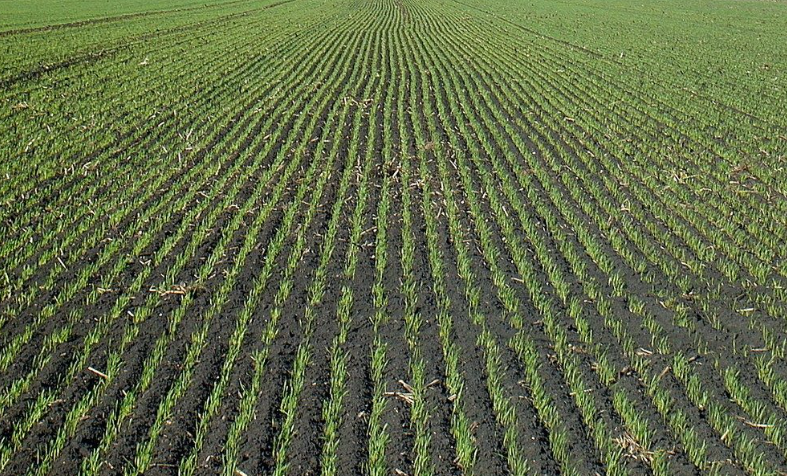
According to the Oklahoma Crop Progress and Condition Report released on March 27, 2023, winter wheat was rated 34 percent good to excellent, 34 percent fair and 32 percent poor to very poor. Last week's conditions rated 29 percent good to excellent, 28 percent fair and 43 percent poor to very poor. Winter wheat jointing reached 26 percent, up 11 points from the previous year but down 7 points from normal.
Pasture and Range Conditions rated 14 percent good to excellent, 28 percent fair and 58 percent poor to very poor. Last week's conditions rated 13 percent good to excellent, 27 percent fair and 60 percent poor to very poor.
Livestock conditions rated 39 percent good to excellent, 44 percent fair and 17 percent good to excellent. Last week's conditions rated 39 percent good to excellent, 42 percent fair and 19 percent poor to very poor.
Winter wheat conditions rated 19 percent good to excellent, 29 percent fair and 55 percent poor to very poor. Last week's conditions rated 23 percent good to excellent, 33 percent fair and 44 percent poor to very poor. Winter wheat jointed was 4 percent, near 1 percent last year and 1 percent for the five-year average.
Winter wheat conditions rated 18 percent good to excellent, 34 percent fair and 47 percent poor to very poor. Last week's conditions rated 23 percent good to excellent, 33 percent fair and 44 percent poor to very poor. Winter wheat headed reached 25 percent, up 4 percentage points from last year and up 9 points from the average.
Corn planted reached 52 percent, up 2 percent from the previous year and up 7 percent from the average.
Sorghum planted reached 38 percent, even with the previous year and the average.
Range and Pasture conditions rated 10 percent good to excellent, 22 percent fair and 68 percent poor to very poor. Last week's conditions rated 12 percent good to excellent, 27 percent fair and 61 percent poor to very poor.
The deadline for filing your 2022 taxes with the Internal Revenue Service (IRS) is less than a month away, and it is critical you file your tax returns on or before Tax Day to avoid late penalties. As this crucial deadline on April 18 approaches, I wanted to share some suggestions and resources to ensure you are well prepared for a smooth and timely filing process.
First, to avoid unnecessary delays, taxpayers should wait to file until they have received all proper tax documents. By creating an IRS Online Account can help taxpayers securely access information about their federal tax account, including payments, tax records and more. You can create your account at irs.gov/payments/your-online-account.
Filers should be aware of important changes to credits and deductions for tax year 2022 to help file an accurate return by April18. Since there were no stimulus payments made in 2022, taxpayers should not expect additional payments in their 2023 tax refund. Additionally, some tax credits return to 2019 levels this tax year. This means that taxpayers will likely receive a smaller federal refund compared to the previous tax year.
Taxpayers should also be aware of their reporting and potential tax obligations on income from the gig economy and service industry, transactions from digital assets and foreign sources or holding certain foreign assets. Generally, income earned from the gig economy, activity where people earn income providing on-demand work, services or goods, such as selling goods online, driving a car for deliveries or renting out property, is taxable and must be reported to the IRS on tax returns. The IRS is requiring that calendar year 2022 income reporting threshold of $600.
Often, this type of income is through a digital platform like an app or website. Those who work in restaurants, salons, hotels and similar service industries often receive tips for the service they provide. Tips are usually taxable income, so it is important to understand details on how to report tips. Resources on this can be found at irs.gov/newsroom/tax-time-guide-irs-reminder-to-report-all-income-gig-economy-and-service-industry-digital-or-foreign-assets-and-sources.
Next, taxpayers whose Adjusted Gross Income (AGI) was $73,000 or less this year qualify for the IRS' Free File program which offers a free federal return, guided preparation and even free tax preparation services for some states. Free Fillable Forms are also offered to taxpayers whose AGI was $73,000 or less this year. These are electronic federal tax forms, equivalent to a paper 1040 form. For this option, you should know how to prepare your own tax return using form instructions and IRS publications. If you qualify for these services, visit irs.gov/filing/free-file-do-your-federal-taxes-for-free for more information.
If you are receiving a refund, the best way to check the status of your refund is through the IRS' "Where's My Refund" tool at irs.gov/refunds, or by downloading the IRS2GO application available for Apple and Android products at irs.gov/help/irs2goapp. You can also call the IRS' automated refund hotline at 800-829-1954 to check the status.
While the IRS issues most refunds within a month, it is possible a refund may take longer. If the IRS needs more information to process a tax return, the agency will contact the taxpayer by mail. Taxpayers should also consider the time it takes for the banks to post the refund to the taxpayer's account. People waiting for a refund in the mail should plan for extra time. The fastest way to get a refund is by filing electronically and using direct deposit. Taxpayers who don't have a bank account can find out how to open a bank account at a FDIC-Insured Bank at banks.data.fdic.gov/bankfind-suite/bankfind or the National Credit Union Locator Tool at mapping.ncua.gov/.
After you submit your tax return, if you are presented with a hefty bill that is difficult to pay, the IRS offers several options to help meet this obligation and avoid additional late penalty fines. The first option is to request an extension, which you can do at irs.gov/extension, by April 18. Note that this extension only applies to the filing deadline, not the payment deadline. Taxpayers who cannot pay the full amount of taxes they owe by April 18 should file and pay what they can. Making a payment, even a partial payment, will help limit penalty and interest charges. Additional tools for those who cannot pay in full include setting up a payment plan with the IRS. You can apply for this option at IRS.gov/paymentplan.
Finally, the IRS YouTube channel provides short, information videos on a variety of tax related topics. To access these in English, visit www.youtube.com/@irsvideos, in Spanish at www.youtube.com/@irsmultilingual and in American Sign Language at www.youtube.com/@irsvideosASL. If you have any questions or need assistance in contacting the IRS, please call my Norman office at 405-329-6500. Happy filing!
BASF Agricultural Solutions has exceeded its initial goal of $5,000 and raised a total of $10,000 during Give FFA Day on Thursday, February 23, 2023.Give FFA Day funds support agricultural education for Future Farmers of America (FFA). Since 2022, BASF had donated more than $550,000.
"Together, not only did we meet our goal, but we exceeded it," said Neil Bentley, BASF Vice President, Market Management Agricultural Solutions NA and FFA Supporters Board Member. "We raised $7,155 and with our company match, expect to surpass $10,000 for FFA.This is a huge milestone and shows how passionate BASF employees are for the industry when so many are willing to support organizations committed to leading the next generation to careers in agriculture."
Give FFA Day is part of an annual week-long celebration, National FFA Week, which took place from February 18 – 25. The National FFA Board of Directors designated the weeklong tradition beginning in 1948, spanning the week of George Washington's birthday, to recognize Washington's legacy as an agriculturist and farmer.
A group of young farmers founded FFA in 1928, and the organization has been influencing generations that agriculture is more than planting and harvesting — it involves science, business and more. For more than 90 years, the National FFA Organization has strived to make a difference in students' lives. Donations help FFA grow the next generation of leaders.
The 2023 national goal for Give FFA Day was $500,000. In total, the 24 hours of support far exceeded that goal, raising $721,506 on February 23 alone – that's nearly $1 for each member of FFA.
About BASF's Agricultural Solutions Division
Farming is fundamental to provide enough healthy and affordable food for a rapidly growing population while reducing environmental impacts. Working with partners and agricultural experts and by integrating sustainability criteria into all business decisions, we help farmers to create a positive impact on sustainable agriculture. That's why we invest in a strong R&D pipeline, connecting innovative thinking with practical action in the field. Our portfolio comprises seeds and specifically selected plant traits, chemical and biological crop protection, solutions for soil management, plant health, pest control and digital farming. With expert teams in the lab, field, office and in production, we strive to find the right balance for success – for farmers, agriculture and future generations. In 2022, our division generated sales of €10.3 billion. For more information, please visit www.agriculture.basf.com or any of our social media channels.
BASF Corporation, headquartered in Florham Park, New Jersey, is the North American affiliate of BASF SE, Ludwigshafen, Germany. BASF has approximately 16,000 employees in North America and had sales of $25.7 billion in 2022. For more information about BASF's North American operations, visit www.basf.com/us.
At BASF, we create chemistry for a sustainable future. We combine economic success with environmental protection and social responsibility. More than 111,000 employees in the BASF Group contribute to the success of our customers in nearly all sectors and almost every country in the world. Our portfolio comprises six segments: Chemicals, Materials, Industrial Solutions, Surface Technologies, Nutrition & Care and Agricultural Solutions. BASF generated sales of €87.3 billion in 2022. BASF shares are traded on the stock exchange in Frankfurt (BAS) and as American Depositary Receipts (BASFY) in the United States. Further information at www.basf.com.
About National FFA Organization
The National FFA Organization is a school-based national youth leadership development organization of more than 850,000 student members as part of 8,995 local FFA chapters in all 50 states, Puerto Rico and the U.S. Virgin Islands. The FFA mission is to make a positive difference in the lives of students by developing their potential for premier leadership, personal growth and career success through agricultural education. For more, visit the National FFA Organization online at FFA.org and on Facebook and Twitter.
About National FFA Foundation
The National FFA Foundation builds partnerships with industry, education, government, other foundations, and individuals to secure financial resources that recognize FFA member achievements, develop student leaders, and support the future of agricultural education. Governed by a 19-member board of trustees composed of educators, business leaders, individual donors and FFA Alumni, the foundation is a separately registered nonprofit organization. About 82 percent of every dollar received by the foundation supports FFA members and agricultural education opportunities. For more, visit FFA.org/Give.
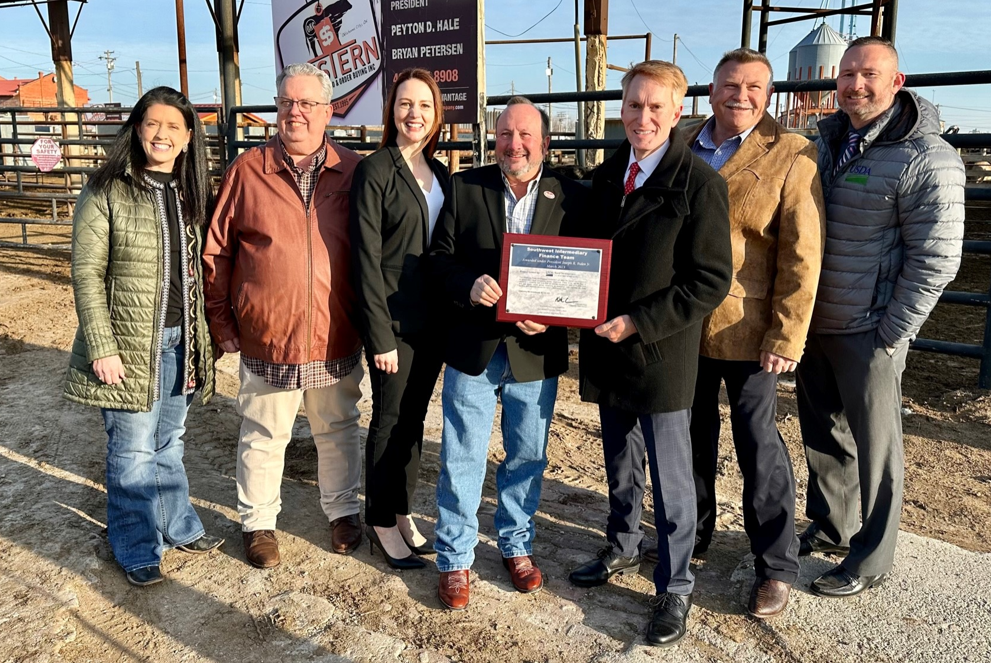
Today, State Director Kenneth Corn made a public announcement along with U.S. Sen. James Lankford for Southwest Intermediary Finance Team and Rural Enterprises Incorporated, who each received a grant from USDA to allow funding for startup and expansion of independent meat processors across Oklahoma.
In total, $14 million in grants from USDA will be applied toward these two intermediary lenders.
These grants are important because it increases access for consumers, Corn said, and provides more marketplaces for producers in Oklahoma, which reduces cost for producers, resulting in lower costs for consumers in the state.
Below, watch and listen to Kenneth Corn give the Oklahoma USDA Rural Development MPILP Grant Announcement.
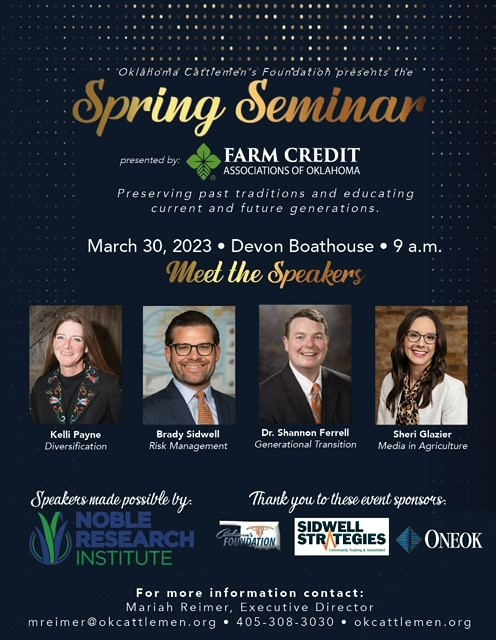
Farm Director, KC Sheperd, is visiting with the Executive Director of the Oklahoma Cattlemen's Foundation, Mariah Reimer, talking about the upcoming Oklahoma Cattlemen's Foundation Spring Seminar, which will be held on March 30, 2023 from 9 a.m. to 4 p.m. at the Devon Boathouse in Oklahoma City.
The goal of the seminar, Reimer said, is to promote the OCA and to provide educational access to all ages.
"It is the first spring seminar we have had and we are hoping to do this annually in the spring and fall," Reimer said.
Guest speakers, Reimer said, will include Brady Sidwell, Dr. Shannon Ferrell, Kelli Payne and Sherri Glazier. OCA Executive Vice President Michael Kelsey will also be giving a legislative update, she added.
"We wanted to kick it off with a really big bang, which is why we have Brady Sidwell- he is going to speak on risk management, which any cattle producer knows that is a huge topic that we are going to go into for 2023 and probably for a couple of years," Reimer said. "He is an expert in his field, he runs multiple businesses and he is just a tremendous individual."
Kelli Payne, Reimer said, will be speaking on diversification within an operation.
"Personally, I am really excited about that one, because anybody who knows Kelli, (knows) she is definitely an expert for diversification," Reimer said. "She is always thinking, she is always on her toes, she always has ideas going, which is exactly what agriculturalists need to be thinking of."
Sherri Glazier, who is well-known for her work with the Beef Checkoff, Reimer said, will be giving media training on agriculture and why it is important regardless of the size of an operation. The day will end with Dr. Shannon Ferrell, Reimer said, talking about generational transfer.
"I think it is important to have a plan, I think it is important to think of that for your heir," Reimer said. "If you don't have an heir, from a foundation's perspective, if you don't have an heir, you need to have a plan."
After each speaker there will be a breakout session, Reimer said, where attendees will have the chance to ask the speaker more questions on the second floor of the Devon Boathouse.
The seminar, Reimer said, will be a great opportunity for those inside and outside of the agriculture industry to receive a broad spectrum of valuable information.
Reimer also announced that a women's seminar next fall in Stillwater is in the works. The seminar is aimed to help women find and grow their confidence to continue be part of the agriculture industry.
To read more about this event and see registration info, click here.
Texas & Southwestern Cattle Raisers Association Special Ranger Foundation today announced $107,500 in funding was raised for the TSCRA Special Ranger Foundation through its annual silent auction fundraiser at the Cattle Raisers Convention & Expo. The foundation is a nonprofit 501(c)(3) organization supporting high-quality training and equipment, and cutting-edge investigative tools for peace officers dedicated to investigating and solving agricultural crimes.
"The special rangers are core to TSCRA's mission," said TSCRA Special Ranger Foundation Chairman Arthur Uhl. "This group has the respect and trust of the law enforcement community across the nation and are exceptional partners in protecting landowners and rural communities in Texas and Oklahoma. We're grateful for the generosity for all those who continually fund the efforts of the special rangers."
TSCRA Special Rangers have extensive knowledge of the cattle industry and provide law enforcement and theft prevention to agricultural producers and rural communities throughout Texas and Oklahoma. The special rangers do not receive federal, state, or local funding, and are supported through TSCRA membership dues and donations from the TSCRA Special Ranger Foundation. This funding provides the 30 special rangers tools and resources needed to solve agricultural crimes including livestock and equipment theft, financial fraud and more.
In 2022, TSCRA Special Rangers recovered more than $5.5 million worth of livestock and ranch-related property and investigated more than 800 cases.
To donate to the TSCRA Special Ranger Foundation, complete the linked online form.
The outlook for agricultural retailers is generally favorable for 2023 following a year of record profits in 2022. However, the sector faces an emerging set of risks that could depress profit margins and challenge traditional business models in the years ahead. Lower levels of industry working capital, higher property insurance costs, and changing grower needs are three of the key issues that ag retailers will need to navigate over the next five years.
According to a new report from CoBank's Knowledge Exchange, a downturn in the crop cycle—after several years of consecutive high profits—is likely during 2024 or shortly thereafter. The prospect of lower grain prices and financial pressure at the farm level, combined with the newly emerging risks, has business implications that ag retailers should begin preparing for now.
"Grain and farm supply cooperatives delivered tremendous value to their customers over the past three years of extreme volatility in prices and economic activity stemming from COVID-19," said Kenneth Scott Zuckerberg, lead grain, farm supply and biofuels economist for CoBank. "Unfortunately, the post-pandemic world is one that features a variety of new risks. The good news is that ag retailers and farm supply co-ops can develop risk mitigation strategies before the eventual cyclical downturn occurs."
Emerging Risks Flying Mostly Under the Radar
A significant percentage of U.S. farming operations, comprised mostly of mid-sized and non-family farms, are increasingly seeking more products and services than traditional farm suppliers typically offer. This group has demonstrated a strong interest in biologicals and other specialty nutrients, as well as advice on carbon monetization and ESG compliance programs. Beyond specific product and service categories, more farmers of all types prefer to evaluate, order and mange input purchases electronically. Ag retailers that want to compete for these customers will need to adjust their business models accordingly.
Lower levels of farmer working capital during the current upcycle suggests growers will cut back on input purchases more dramatically during the next downturn. Total farming working capital during the 2021/2022 crop cycle peak averaged $138 billion. That's down from $215 billion during the 2012 peak. (All figures in 2023 dollars as reported by USDA.) The lower levels of working capital may be a result of strategic purchases of equipment while interest rates were at historically low levels. However, the reality is that farmers and ranchers will have less available cash to purchase inputs during the next downturn, unless they increase debt.
Additionally, the rising cost of property insurance is an emerging risk factor that will pressure farm supply cooperatives profitability. The cost of property-casualty premiums has risen between 25% and 75% for the 2023 season, largely due to an increase in claims from natural catastrophes. Losses from extreme weather totaled $170 billion in 2022, compared to $155 billion in 2021, well above the long-term average. Zuckerberg said farm supply operators might want to investigate alternative risk transfer mechanisms, such as a self-funded captive insurance arrangements, to address rising premium costs.
Watch a video synopsis and read the report, Ag Retailers Prepare to Navigate 3 Emerging Risks.
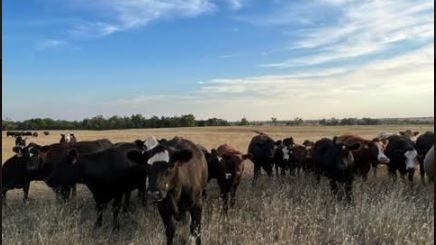
Dr. Derrell Peel, Oklahoma State University Extension Livestock Marketing Specialist, offers his economic analysis of the beef cattle industry as part of the weekly series known as the "Cow Calf Corner" published electronically by Dr. Peel and Mark Johnson. Today, Dr. Peel talks about beef production and prices.
As has been anticipated for several months, beef production is decreasing in 2023. In the last four weeks, beef production has averaged 6.4 percent lower compared to the same period last year. Lower beef production is the result of decreases in both cattle slaughter and carcass weights.
Steer slaughter is down 5.3 percent year over year in the last month and steer carcass weights have averaged 903 pounds, down 16 pounds from one year ago. Heifer slaughter has finally begun to decrease and is down 1.6 percent in the past month, with heifer carcass weights at 830 pounds, down 20 pounds year over year. Cow slaughter is down 6.8 percent year over year in the last four weeks, including a 0.9 percent increase in dairy cow slaughter and a 13.6 percent year over year decrease in beef cow slaughter. Cow carcass weights have averaged 646 pounds the last month, 11 pounds lower than the same period last year. Bull slaughter is down 14.6 percent from one year ago. Bull carcass weights have averaged 854 pounds in the last four weeks, down 26 pounds compared to one year ago.
Choice boxed beef cutout values have averaged $285.13/cwt. the last month, up 11.0 percent year over year. Boxed beef prices are led by higher middle meat values, with rib primals up 21.4 percent and loin primals up 15.5 percent year over year. Chuck primal values have averaged 8.5 percent higher with round primals up 1.3 percent year over year. Short plate primals are 13.5 percent higher with flank primals up 16.4 percent year over year in the last month. Only the brisket primal is down, 8.5 percent lower compared to last year. Select beef cutout and primal values are higher by similar amounts. The Choice-Select spread continues to inch lower to a seasonal low. The Choice-Select spread typically reaches a seasonal low in February. The current spread of $10.39/cwt. is the lowest weekly level so far this year, about a month later than the usual low and still looking for a seasonal low.
Beef production is expected to drop more sharply for the remainder of the year, adding even more supply pressure to support prices. Current estimates for 2023 have beef production decreasing in a range from 4.5 to 6 percent lower year over year. The decrease will depend, in part on whether continued drought causes additional herd liquidation and temporarily moderates declining beef production and resulting in a smaller decrease.
The ground beef market is responding to lower beef production as well. Decreasing cow slaughter is already pushing 90 percent lean trimmings prices higher and decreased fed slaughter is pushing 50 percent lean trimmings prices higher as well. The latest Cold Storage report showed seasonally lower beef in cold storage, down 5.9 percent year over year, likely mostly reflecting the seasonal drawdown in beef trimmings. This contrasts with last year, when cold storage inventories remained high all year due to large cow slaughter.
As the calendar turns to April, seasonal grilling demand typically adds additional support for some beef cuts and the ground beef market. Wholesale beef market values typical begin to reflect summer grilling demand in April in preparation for the Memorial Day kickoff to summer beef demand.
Below, Derrell Peel, OSU Extension livestock marketing specialist, explains why consumers can expect to see higher beef prices for the next few months on SunUp TV from March 18, 2023.
If weather stalls planting and deadlines loom, AgriGold agronomists say farmers still have options
The Environmental Protection Agency (EPA) moved up the cutoff dates for over-the-top application of dicamba label products for soybeans – to June 12 for Illinois, Indiana and Iowa and to June 20 for South Dakota. Those with the new June 12 cutoff also face a growth stage application cutoff of V4. While the timing of the announcement was not ideal given most farmers had already locked in their seed and chemical purchases, the move wasn't a complete surprise.
"Farmers were hoping it wouldn't happen, but they weren't necessarily surprised about it," explains AgriGold Agronomist Brian Ternus. He predicts the earlier cutoff for South Dakota will affect a few farmers.

AgriGold Agronomist Kevin Gale out of Illinois expressed similar sentiment: "It would've been nice to have that notice earlier in the sales year so farmers could plan accordingly. But the sector has also been gearing up for the transition the past year or two with a quick transition to XtendFlex® technology that allows us to utilize other herbicide programs like Liberty® herbicide to control late-emerging weeds."
New label fits with efforts to kill weeds early
"We've been talking 'start clean, stay clean' for years," Gale says, noting farmers have tended to err on the earlier side with dicamba products, using them as a burndown or early post-application. "Our whole goal is trying to get weeds under control at 4 inches or smaller to maximize the effectiveness of that herbicide. Allowing weeds to grow beyond that results in more potential for resistance and inadequate control."
If soybeans are planted in a timely manner, the deadlines should roughly coincide with when farmers would otherwise aim to have those applications completed – when soybeans have some growth and canopy closure, but before flowering. Another major timing consideration is farmers using a preemergence herbicide should aim for a post-application that ideally includes another residual product in the tank mix 21 to 30 days later, according to Gale.
However, to many farmers the larger concern is a delayed planting season.
Have a Plan B for when the weather doesn't cooperate
"The earlier deadline narrows the application window by 10 days for South Dakota farmers. If conditions cooperate, the June 20 deadline should be an achievable timeline for application," Ternus says. "But if you get too much rain or too much wind, those 10 days become significant.
"As long as farmers are planted mid-May or within a few days of that, most should be able to spray by June 20," Ternus details. Gale also signaled late-May planting would be problematic for farmers with June 12 cutoffs.
Ternus says farmers locked into dicamba for their spray selection need to do all they can to get it sprayed before the deadline, noting dicamba as a post-planting spray offers some soil activity control and can help control seedlings that haven't emerged.
"If you get past the deadline, you may need to consider alternative herbicides to control weeds like waterhemp that you were counting on dicamba to control," Ternus continues. "Products like Liberty® herbicide (glufosinate) can also be sprayed after the June 20 deadline and can help control some of the weeds that have started escaping Roundup® herbicide."
Using multiple modes of action and overlapping residuals is also important, both for navigating the new dicamba cutoff dates and for a successful weed control strategy in general, Gale emphasizes.
Will ongoing changes impact seed choices?
Ternus expects farmers in South Dakota to continue to evaluate their operations' reasoning for choosing dicamba-tolerant soybeans, based on our evolving regulator environment and notes decisions made by the EPA could have some impact on seed choices.
"Some farmers plant dicamba-tolerant soybeans because they don't want their soybeans to get cupped when their neighbors spray dicamba. Others may think a bit harder about whether they'll be able to plant in time and whether they have the capacity to get everything sprayed before the new deadlines," Ternus says. "If farmers are concerned EPA is going to come out fairly late like they did again this year, they may either hold off or go with chemistry they think is unlikely to face regulatory changes."
For help weighing your soybean seed and weed control options on your farm, reach out to your local AgriGold agronomist.
The USDA Farm Service Agency (FSA) works hard to get information to you in a timely manner regarding our programs and policies. This news bulletin provides a list of important FSA annual policy reminders. Many of these reminders include important information that will assist you in maintaining federal farm program eligibility for your operation. Sending all program reminders in this nationally issued news bulletin places all the annual reminders in one location, providing a single reference for maintaining USDA program eligibility.
If you have any questions, please contact your local FSA office. You can find contact information at Farmers.gov/service-center-locator. For more information visit the FSA website fsa.usda.gov or ask a specific question online at ask.usda.gov.
Did you know that, as a customer in any USDA service center, employees are required to provide you with a computer-generated receipt at the end of your visit? This Receipt for Service details the type of service you requested, the service and response provided by the staff, and the date and time of your visit.
The 2014 Farm Bill designated that FSA, Natural Resources Conservation Service (NRCS) and Rural Development (RD) employees are statutorily required to provide producers a receipt when a current or prospective producer or landowner interacts or engages with the Agency regarding a USDA benefit or service.
On behalf of our customers, FSA employees are required to enter receipts timely and create only one receipt per customer per visit, regardless of the number of employee interactions a customer may encounter in a single visit. A single receipt will be generated that provides a summary of the customer's visit on behalf of the other employees who also met with the customer on the same day. Employees must also ensure that all services rendered are properly reflected in that receipt.
Because it's required, there's no need to ask for a receipt, staff will automatically provide.
Don't leave the office without your receipt!
Changing Bank Accounts
FSA program payments are issued electronically into your bank account. In order to make timely payments, you need to notify your FSA servicing office if you close your account or if your bank information is changed for whatever reason (such as your financial institution merging or being purchased). Payments can be delayed if FSA is not notified of changes to account and bank routing numbers.
For some programs, payments are not made until the following year. For example, payments for crop year 2020 through the Agriculture Risk Coverage and Price Loss Coverage program aren't paid until 2021. If the bank account was closed due to the death of an individual or dissolution of an entity or partnership before the payment was issued, please notify your local FSA office as soon as possible to claim your payment.
Civil Rights/Discrimination Complaint Process
As a participant or applicant for programs or activities operated or sponsored by USDA you have a right to be treated fairly. If you believe you have been discriminated against because of your race, color, national origin, gender, age, religion, disability, or marital or familial status, you may file a discrimination complaint. The complaint should be filed with the USDA Office of Civil Rights within 180 days of the date you became aware of the alleged discrimination. To file a complaint of discrimination, write U.S. Department of Agriculture, Director, Office of Adjudication,1400 Independence Avenue, SW, Washington DC 20250-9410 or call 202-260-1026 (voice or TDD), USDA is an equal opportunity provider, employer and lender. A complaint must be filed within 180 calendar days from the date the complainant knew, or should have known, of the alleged discrimination.
Power of Attorney
FSA has a power of attorney form available that enables persons and legal entities to designate another person to conduct business on behalf of the person or legal entity. If you are interested, please contact our office or any FSA office near you for more information. FSA's power of attorney form and provisions do not apply to farm loan programs.
Reasonable Accommodations
Special accommodations will be made upon request for individuals with disabilities, vision impairment or hearing impairment. If accommodations are required, individuals should contact the county FSA office directly or by phone or dial 7-1-1 to access telecommunication relay services.
Translation Services Available
It is FSA's policy to provide equal opportunity in all programs, services, and activities to Limited English Proficiency (LEP) persons.
LEP persons are individuals who do not speak English as their primary language and who have a limited ability to read, speak, write, or understand English. FSA offers three types of language translation and interpretation services available to customers at no cost: (1) document translation; (2) telephonic interpretation; and (3) in-person interpretation. These language translation and interpretation services will assist both customers and staff with overcoming language barriers.
Contact us FSA more information.
Annual Review of Payment Eligibility for New Crop Year
FSA and NRCS program applicants for benefits are required to submit a completed CCC-902 (Farming Operation Plan) and CCC-941 Average Gross Income (AGI) Certification and Consent to Disclosure of Tax Information for FSA to determine the applicant's payment eligibility and establish the maximum payment limitation applicable to the program applicant.
Participants are not required to annually submit new CCC-902s for payment eligibility and payment limitation purposes unless a change in the farming operation occurs that may affect the previous determination of record. A valid CCC-902 filed by the participant is considered to be a continuous certification used for all payment eligibility and payment limitation determinations applicable for the program benefits requested.
Participants are responsible for ensuring that all CCC-902 and CCC-941 and related forms on file in the county office are updated, current, and correct. Participants are required to timely notify the county office of any changes in the farming operation that may affect the previous determination of record by filing a new or updated CCC-902 as applicable.
Changes that may require a NEW determination include, but are not limited to, a change of:
Participants are encouraged to file or review these forms within the deadlines established for each applicable program for which program benefits are being requested.
Payment Limitation
Program payments may be limited by direct attribution to individuals or entities. A legal entity is defined as an entity created under Federal or State law that owns land or an agricultural commodity, product or livestock. Through direct attribution, payment limitation is based on the total payments received by a person or legal entity, both directly and indirectly. Qualifying spouses are eligible for a separate payment limitation.
Payments and benefits under certain FSA programs are subject to some or all of the following:
No program benefits subject to payment eligibility and limitation will be provided until all required forms for the specific situation are provided and necessary payment eligibility and payment limitation determinations are made.
Payment eligibility and payment limitation determinations may be initiated by the County Committee or requested by the producer.
Statutory and Regulatory rules require persons and legal entities, provide the names and Tax Identification Numbers (TINs) for all persons and legal entities with an ownership interest in the farming operation to be eligible for payment.
Payment eligibility and payment limitation forms submitted by persons and legal entities are subject to spot check through FSA's end-of-year review process.
Persons or legal entities selected for end-of-year review must provide the County Committee with operating loan documents, income and expense ledgers, canceled checks for all expenditures, lease and purchase agreements, sales contracts, property tax statements, equipment listings, lease agreements, purchase contracts, documentation of who provided actual labor and management, employee time sheets or books, crop sales documents, warehouse ledgers, gin ledgers, corporate or entity papers, etc.
A finding that a person or legal entity is not actively engaged in farming results in the person or legal entity being ineligible for any payment or benefit subject to the actively engaged in farming rules.
Noncompliance with AGI provisions, either by exceeding the applicable limitation or failure to submit a certification and consent for disclosure statement, will result in payment ineligibility for all program benefits subject to AGI provisions. Program payments are reduced in an amount that is commensurate with the direct and indirect interest held by an ineligible person or legal entity in any legal entity, general partnership, or joint operation that receives benefits subject to the average AGI limitations.
If any changes occur that could affect an actively engaged in farming, cash-rent tenant, foreign person, or average Adjusted Gross Income (AGI) determination, producers must timely notify the County FSA Office by filing revised farm operating plans and/or supporting documentation, as applicable. Failure to timely notify the County Office may adversely affect payment eligibility.
Acreage Reporting
Timely filing an accurate crop and acreage report by the acreage reporting date at your local FSA office can prevent the loss of benefits for a variety of programs.
Failed acreage is acreage that was timely planted with the intent to harvest, but because of disaster related conditions, the crop failed before it could be brought to harvest.
Prevented planting must be reported no later than 15 days after the final planting date. Annual acreage reports are required for most FSA programs. Annual crop reporting deadlines vary based on region, crop, perennial vs. annual crop type, Noninsured Crop Disaster Assistance Program (NAP) or non-NAP crop and fall or winter seeding. Consult your local FSA office for deadlines in your area.
Change in Farming Operation
If you have bought or sold land, or if you have picked up or dropped rented land from your operation, make sure you report the changes to the office as soon as possible. You need to provide a copy of your deed or recorded land contract for purchased property. Failure to maintain accurate records with FSA on all land you have an interest in can lead to possible program ineligibility and penalties. Making the record changes now will save you time this spring. Update signature authorization when changes in the operation occur. Producers are reminded to contact the office if there is a change in operations on a farm so that records can be kept current and accurate.
Controlled Substance
Program participants convicted under federal or state law of any planting, cultivating, growing, producing, harvesting or storing a controlled substance are ineligible for program payments and benefits. If convicted of one of these offenses, the program participant shall be ineligible during that crop year and the four succeeding crop years for price support loans, loan deficiency payments, market loan gains, storage payments, farm storage facility loans, Noninsured Crop Disaster Assistance Program payments or disaster payments.
Program participants convicted of any federal or state offense consisting of the distribution (trafficking) of a controlled substance, at the discretion of the court, may be determined ineligible for any or all program payments and benefits:
Program participants convicted of federal or state offense for the possession of a controlled substance shall be ineligible, at the discretion of the court, for any or all program benefits, as follows:
Reconstitutions
To be effective for the current Fiscal Year (FY), farm combinations and farm divisions must be requested by Aug. 1 of the FY. A reconstitution is considered to be requested when all:
Farm Service Agency (FSA) and Risk Management Agency (RMA) to Prevent Fraud, Waste, and Abuse
FSA and RMA jointly support the prevention of fraud, waste and abuse of the Federal Crop Insurance Program. FSA has been, and will continue to, assist RMA and insurance providers by monitoring crop conditions throughout the growing season. FSA will continue to refer all suspected cases of fraud, waste and abuse directly to RMA. Producers can report suspected cases to the county office staff, the RMA office or the Office of the Inspector General.
Foreign Buyers Notification
The Agricultural Foreign Investment Disclosure Act (AFIDA) requires all foreign owners of U.S. agricultural land to report their holdings to the Secretary of Agriculture. Foreign persons who have purchased or sold agricultural land in the county are required to report the transaction to FSA within 90 days of the closing. Failure to submit the AFIDA form could result in civil penalties of up to 25 percent of the fair market value of the property. County government offices, realtors, attorneys and others involved in real estate transactions are reminded to notify foreign investors of these reporting requirements. The data gained from these disclosures is used in the preparation of periodic reports to the President and Congress concerning the effect of such holdings upon family farms and rural communities. Click here for more information on AFIDA.
Adjusted Gross Income Requirements
The average Adjusted Gross Income (AGI) limitation for FSA and NRCS administered programs is $900,000. A person or legal entity is eligible to receive, directly or indirectly, certain program payments or benefits if the average AGI of the person or legal entity (including the legal entity's members) is $900,000 or less for the three taxable years preceding the most immediately preceding complete taxable year.
For more information on payment limitation and payment eligibility by program, contact your local FSA office or visit FSA's payment eligibility website for more details.
Signature Policy
Using the correct signature when doing business with FSA can save time and prevent a delay in program benefits. The following are FSA signature guidelines:
Example—Mary Doe and John Doe are married. When signing FSA forms, each must use their given name, and may not sign with the name of their spouse. Mrs. Mary Doe may not sign documents as Mrs. John Doe.
Note, by signing a document with a minor, the parent is liable for actions of the minor and may be liable for refunds, liquidated damages, etc.
When signing on one's behalf the signature must agree with the name typed or printed on the form or be a variation that does not cause the name and signature to be in disagreement. Example - John W. Smith is on the form. The signature may be John W. Smith or J.W. Smith or J. Smith. Or Mary J. Smith may be signed as Mrs. Mary Joe Smith, M.J. Smith, Mary Smith, etc.
FAXED signatures will be accepted for certain forms and other documents provided the acceptable program forms are approved for FAXED signatures. Producers are responsible for the successful transmission and receipt of FAXED information.
Examples of documents not approved for FAXED signatures include:
Spouses may sign documents on behalf of each other for FSA and CCC programs in which either spouse has an interest, unless written notification denying a spouse this authority has been provided to the county office.
Spouses cannot sign on behalf of each other as an authorized signatory for partnerships, joint ventures, corporations or other similar entities. Likewise, a spouse cannot sign a document on behalf of the other in order to affirm the eligibility of oneself.
Any member of a general partnership can sign on behalf of the general partnership and bind all members unless the Articles of Partnership are more restrictive. Spouses may sign on behalf of each other's individual interest in a partnership, unless notification denying a spouse that authority is provided to the county office. Acceptable signatures for general partnerships, joint ventures, corporations, estates, and trusts must consist of an indicator "by" or "for" the individual's name, individual's name and capacity, or individual's name, capacity, and name of entity.
For additional clarification on proper signatures contact your local FSA office.
USDA Offers Options for Signing and Sharing Documents Online
Farmers working with FSA can now sign and share documents online in just a few clicks. By using Box or OneSpan, producers can digitally complete business transactions without leaving their homes or agricultural operations. Both services are free, secure, and available for multiple FSA programs.
Box is a secure, cloud-based site where FSA documents can be managed and shared. Producers who choose to use Box can create a username and password to access their secure Box account, where documents can be downloaded, printed, manually signed, scanned, uploaded, and shared digitally with Service Center staff. This service is available to any FSA customer with access to a mobile device or computer with printer connectivity.
OneSpan is a secure eSignature solution for FSA customers. Like Box, no software downloads or eAuthentication is required for OneSpan. Instead, producers interested in eSignature through OneSpan can confirm their identity through two-factor authentication using a verification code sent to their mobile device or a personalized question and answer. Once identity is confirmed, documents can be reviewed and e-signed through OneSpan via the producer's personal email address. Signed documents immediately become available to the appropriate Service Center staff.
Box and OneSpan are both optional services for customers interested in improved efficiency in signing and sharing documents with USDA, and they do not replace existing systems using eAuthentication for digital signature. Instead, these tools provide additional digital options for producers to use when conducting business with FSA.
FSA staff are available to help producers get started with Box and OneSpan through a few simple steps. Please contact FSA and let the staff know you're interested in signing and sharing documents through these new features. In most cases, one quick phone call will be all that is needed to initiate the process.
Visit farmers.gov to learn more about Box and OneSpan, steps for getting started, and additional resources for conducting business with USDA online.
Conservation Reserve Program (CRP), Conservation Reserve Enhancement Program (CREP) and Conservation Reserve Program (CRP) Grasslands - Annual Certification
Before an annual rental payment can be issued, participants must certify to contract compliance using either the FSA-578, Report of Acreage, or CCC-817U, Certification of Compliance for CRP.
Highly Erodible Land (HEL) and Wetland Conservation Compliance
Landowners and operators are reminded that in order to receive payments from USDA, compliance with Highly Erodible Land (HEL) and Wetland Conservation (WC) provisions are required. Farmers with HEL determined soils are reminded of tillage, crop residue, and rotation requirements as specified per their conservation plan. Producers are to notify the USDA Farm Service Agency prior to breaking sod, clearing land (tree removal), and of any drainage projects (tiling, ditching, etc.) to ensure compliance. Failure to update certification of compliance, with form AD-1026, triggering applicable HEL and/or wetland determinations, for any of these situations, can result in the loss of FSA farm program payments, FSA farm loans, NRCS program payments, and premium subsidy to Federal Crop Insurance administered by RMA.
Highly Erodible Land and Wetland Conservation Certification Must be Filed to Receive USDA Benefits
Since enactment of the 1985 Farm Bill, eligibility for most commodity, disaster and conservation programs has been linked to compliance with the highly erodible land conservation and wetland conservation provisions. The 2014 Farm Bill continues the requirement that producers adhere to conservation compliance guidelines to be eligible for most programs administered by FSA and the Natural Resources Conservation Service (NRCS). This includes financial assistance from the Agriculture Risk Coverage (ARC) and Price Loss Coverage (PLC) programs, the Conservation Reserve Program (CRP), livestock disaster assistance programs, Marketing Assistance Loans (MALs) and most programs implemented by FSA. It also includes the Environmental Quality Incentives Program (EQIP), the Conservation Stewardship Program (CSP) and other conservation programs implemented by NRCS.
The 2014 Farm Bill requires farmers to have a Highly Erodible Land Conservation and Wetland Conservation Certification (AD-1026) on file with their local Farm Service Agency (FSA) office in order to maintain eligibility for premium support on federal crop insurance.
Producers certify to conservation compliance at FSA with form AD-1026. This is a continuous certification that only requires updates when changes occur. A producer will be ineligible for any premium support paid by Federal Crop Insurance Corporation on their policy or plan of insurance if they do not have a completed AD-1026 on file with FSA certifying compliance on or before the premium billing date for their policy or plan of insurance, unless otherwise exempted.
When a producer completes and submits the AD-1026 certification form, FSA and NRCS staff will review the associated farm records and outline any additional actions that may be required to meet the required conservation compliance provisions.
Form AD-1026 is available at USDA Service Centers and online at: fsa.usda.gov. Please contact your local USDA Service Center for more information.
Marketing Assistance Loans and Loan Deficiency Payments
The 2018 Farm Bill extends loan authority through 2023 for Marketing Assistance Loans (MALs) and Loan Deficiency Payments (LDPs) for wheat, corn, grain sorghum, barley, oats, upland cotton, extra-long staple cotton, long grain rice, medium grain rice, soybeans, other oilseeds (including sunflower seed, rapeseed, canola, safflower, flaxseed, mustard seed, crambe and sesame seed), dry peas, lentils, small chickpeas, large chickpeas, graded and non-graded wool, mohair, unshorn pelts, honey and peanuts.
To be eligible for a MAL or LDP, producers must comply with conservation and wetland protection requirements and submit an acreage report to account for all cropland on all farms. Additionally, they must have and retain beneficial interest in the commodity until the MAL is repaid or the Commodity Credit Corporation (CCC) takes title to the commodity while also meeting Adjusted Gross Income (AGI) limitations.
LDPs and marketing loan gains available now through 2023 are not subject to adjusted gross income and payment limitation, including actively engaged in farming and cash rent tenant provisions.
In addition to producer eligibility, the commodity must have been produced, mechanically harvested, or shorn from live animals by an eligible producer and be in storable condition. It also must be merchantable for food, feed or other uses, as determined by CCC. Nonrecourse MALs must meet specific CCC minimum grade and quality standards.
Recourse marketing assistance loans are also available for commodities that may be of lower quality due to an element such as high moisture, commodities harvested as other than grain, seed cotton in module form, or for contaminated commodities that are still within merchantable levels of tolerance. Recourse MALs can only be repaid at principal plus accrued interest.
If beneficial interest in the commodity is lost, the commodity loses eligibility for a MAL or LDP and remains ineligible even if the producer later regains beneficial interest. To retain beneficial interest, the producer must have control and title to the commodity. The producer must be able to make all decisions affecting the commodity including movement, sale and the request for a MAL or LDP. The producer must not have sold or delivered the commodity or warehouse receipt to the buyer.
Producers are responsible for any loss in quantity or quality of commodities pledged as collateral for a farm-stored or warehouse stored loan. CCC will not assume any loss in quantity or quality of the loan collateral regardless of storage location.
The 2018 Farm Bill sets national loan rates. County and regional loan rates are based on each commodity's national loan rate, and they vary by county or region and are based on the average prices and production of the county or region where the commodity is stored.
For all loan-eligible commodities, pledged for a non-recourse loan, except extra-long staple (ELS) cotton, a producer may repay a MAL any time during the loan period at the lesser of the loan rate plus accrued interest and other charges or an alternative loan repayment rate as determined by CCC.
Producers may obtain MALs or receive LDPs on all or part of their eligible production anytime during the loan availability period. The loan availability period runs from when the commodity is normally harvested (or sheared for wool) until specified dates in the following calendar year.
Visit the Farm Service Agency (FSA) website for posted loan rates.
Program Incentives for Underserved Producers
The USDA Farm Service Agency (FSA) reminds producers that FSA offers support to beginning farmers and ranchers, targeted underserved farmers and ranchers, and military veteran farmers and ranchers through program incentives in existing farm programs.
Targeted underserved farmers and ranchers are defined as a group whose members have been subjected to racial, ethnic, or gender prejudice because of their identity as members of the group without regard to their individual qualities. For farm program purposes, this category includes African Americans, American Indians and Alaskan Natives, and Hispanics and Asians and Pacific Islanders. Farm program provisions for women producers vary from program to program.
In order to take advantage of these incentives please reach out to your local Service Center to ensure that you have completed CCC-860, Socially Disadvantaged, Limited Resource, Beginning and Veteran Farmer or Rancher Certification form.
Loans for Targeted Underserved Producers
The USDA Farm Service Agency (FSA) reminds producers that FSA offers targeted farm ownership and farm operating loan funds to assist underserved applicants as well as beginning farmers and ranchers.
USDA defines underserved applicants as a group whose members have been subjected to racial, ethnic, or gender prejudice because of their identity as members of the group without regard to their individual qualities. For farm loan programs purposes, targeted underserved groups are women, African Americans, American Indians and Alaskan Natives, Hispanics, and Asians and Pacific Islanders.
Underserved or beginning farmers and ranchers who cannot obtain credit from a commercial lender can apply for either FSA direct loans or guaranteed loans. Direct loans are made to applicants by FSA. Guaranteed loans are made by lending institutions who arrange for FSA to guarantee the loan. FSA can guarantee up to 95 percent of the loss of principal and interest on a loan. The FSA guarantee allows lenders to make agricultural credit available to producers who do not meet the lender's underwriting criteria for non-guaranteed borrowers.
The direct and guaranteed loan programs have historically provided three types of loans: farm ownership loans, farm operating loans and emergency loans. In addition to these loan products, FSA also offers microloans through the direct loan program. The focus of microloans is on the financing needs of small, beginning farmer, niche and non-traditional farm operations. Microloans are available for both ownership and operating finance needs. Visit FSA online for more information on microloans.
To qualify as a beginning farmer, the individual or entity must meet the eligibility requirements outlined for direct or guaranteed loans. Additionally, individuals and all entity members must have operated a farm for less than 10 years. Applicants must materially and substantially participate in the operation.
Visit FSA's farm loan programs website for more information on loans and targeted underserved and beginning farmer guidelines.
Farm Loan Programs' Tools and Guides
FSA offers online resources that can help producers understand our programs.
The Loan Discovery Tool helps producers find a USDA Farm Loan that might be right for them by answering a few short questions. They can also lean about their eligibility and find application guides to help them prepare for their USDA Service Center visit with a loan officer.
The Loan Assistance Tool allows producers to check their eligibility for FSA loans, discover the various FSA loan products, learn about documentation requirements, and follow easy-to-understand instructions when completing the loan application forms.
The Direct Loan Application was developed to provide an improved customer experience for producers applying for loans from FSA. The simplified direct loan application provides all loan applicants access to information regarding the application process and assists them with gathering the correct documents before they begin the process.
The Your Guide to FSA Farm Loans guidebook simplifies information on the types of farm loans available; how to apply for a guaranteed loan, direct loan, or land contract guarantee; what you can expect once you submit your application; and most importantly, your rights and responsibilities as an FSA customer.
The Your FSA Farm Loan Compass guidebook simplifies information regarding the responsibilities of FSA loan borrowers and the loan servicing options available to them.
Spanish language versions of the Your Guide to FSA Farm Loans and Your FSA Farm Loan Compass guidebooks are available as well.
Disaster Set-Aside (DSA) Program
FSA borrowers with farms located in designated primary or contiguous disaster areas who are unable to make their scheduled FSA loan payments should consider the Disaster Set-Aside (DSA) program.
DSA is available to producers who suffered losses as a result of a natural disaster* and is intended to relieve immediate and temporary financial stress. FSA is authorized to consider setting aside the portion of a payment/s needed for the operation to continue on a viable scale.
Borrowers must have at least two years left on the term of their loan in order to qualify.
Borrowers have eight months from the date of the disaster designation to submit a complete application. The application must include a written request for DSA signed by all parties liable for the debt along with production records and financial history for the operating year in which the disaster occurred. FSA may request additional information from the borrower in order to determine eligibility.
All farm loans must be current or less than 90 days past due at the time the DSA application is complete. Borrowers may not set aside more than one installment on each loan.
The amount set-aside, including interest accrued on the principal portion of the set-aside, is due on or before the final due date of the loan.
*Note: FSA is currently accepting requests for Disaster Set-Aside from impacted borrowers based on the Presidentially Declared COVID-19 Emergency. Borrowers who apply after the application window or who do not otherwise qualify will be notified accordingly.
For more USDA disaster assistance program information, visit farmers.gov/recover and download the USDA Disaster Assistance Programs At A Glance brochure.
Questions? Please contact your local FSA Office
The National Cattlemen's Beef Association (NCBA) is calling on the U.S. Department of Agriculture's (USDA) Secretary Tom Vilsack to continue blocking Paraguay from importing beef to the U.S. in response to USDA releasing a proposed rule that would grant access to Paraguayan beef imports.
"USDA's proposed rule to allow Paraguayan beef imports into the U.S. is based on 9-year-old data and site visits that occurred in 2008 and 2014. Paraguay has a history of outbreaks of foot-and-mouth disease (FMD), and we cannot jeopardize the safety of U.S. consumers and the health of our U.S. cattle herd with outdated information," said NCBA Executive Director of Government Affairs Kent Bacus. "The United States has the highest animal health and food safety standards in the world because we rely on the most up-to-date information and the highest science-based standards. USDA should not proceed with this application until a thorough review can be conducted with current information that demonstrates Paraguay's equivalence in animal health and food safety standards."
Farmbrite is offering a new Community Partner Program and free agtech for non-profits. As agriculture prices skyrocket across America, farmers and ranchers are feeling the impacts from every nuance of operation—feed, raw materials, technology—the opportunities for profit are shrinking.
Ian and Janine Russell's small farm is located in Longmont, Colorado and needed better records in order to improve agricultural business; the typical farmer pen-and-paper was no longer useful. Founded in 2012, Farmbrite was created with over 30 years of software development, sales, marketing, management, customer service and agriculture experience.
Farmbrite is an easy to use, cost effective, complete farm management system to help farmers and ranchers be more organized, sustainable and successful. The software provides diverse crop and livestock producers, across the globe, with a complete and holistic set of tools to more efficiently plan, manage, track, report and sell online (from seed-to-sale). The outcome, a more profitable business for farmers and ranchers.
Today, Farmbrite manages hundreds of thousands of animals, millions of acres of land, and customers across 140 countries. And, it has helped thousands of farms worldwide.
New Farmer Program (farmbrite.com/new-farmers)
"We know from experience that getting started in farming is not easy. With the cost of land, equipment, and other resources, many new farmers never get their business off the ground. In addition to the costs, many new farmers, like any start-up, often lack the organization, operational tools and experience to help them grow. Farmbrite wanted to help support new farmers and is offering a 75% discount on Farmbrite software to support this effort."—Janine Russell.
Community Partner Program (farmbrite.com/non-profit-farm-software)
"In the US more than 34 million people are facing some type of food insecurity, nine million of those are children. Everyone should have access to healthy and nutritious food and we recognized the impact that community food producers and urban gardens can have in supporting their communities by providing access to healthy food. We are offering free Farmbrite software to qualifying non-profits." —Ian Russell.
Who Should Apply?
Agricultural organizations working to eliminate food deserts or reduce hunger, urban community gardens serving under privileged or minority communities, sustainable and regenerative agriculture non-profits, non-profit organizations working to educate future generations to support sustainable agriculture and that provide free or discounted education to under privileged or under-served communities. School garden programs that support community access to fresh local foods (typically by donating > 50% of food produced). Community food hubs that provide free or discounted food.
About Farmbrite
Farmbrite's farm software has helped thousands of diverse crop and livestock producers from across the globe with a complete set of tools designed to help farmers efficiently plan, manage, track, report and sell online. Turn data into action, improve farm efficiency, farm production, and profitability. Boost soil and animal health, streamline from seed to sale and ditch the spreadsheets. Manage your farm from anywhere, anytime on any device. Even offline.
Who's it for: diverse crop producers, including market gardens, commodity producers, fruit, vegetable and flower growers; various livestock operations including cattle, goat, sheep, pig, chicken & poultry producers and other livestock operations; beekeeping and apiary, fish and aquaponics, horse barn management, and more.
What Customers Are Saying
"What I like most about Farmbrite is that it handles both vegetable and livestock production well. Most other software for market gardeners focus solely on vegetable production but livestock integration is key to regenerative agriculture. While most of our beginning farmers start with vegetable production, livestock quickly become a part of their farm plan and Farmbrite is there to grow with them." — Donna Issacs, DeLaTerre Permaculture Farm, LA
"Farmbrite helps us stay on task with things around our farm and organization." — Reatha Hardy-Jordan BUFA French Camp, A

Tune in to RFD-TV on March 29 at 5:30pm EDT for the premiere of a new "America's Heartland" episode showcasing farmers and ranchers from across the country who are leaders in sustainability.
SARE partnered with PBS KVIE to produce this episode, which features farmers describing their commitment to sustainability, how they plan to meet farming challenges of today and tomorrow, and how SARE has impacted their farming practices.
Watch as Bryce Wrigley of Delta Junction, Alaska, discusses the importance of soil health and how cover crops have improved his overall operation. He addresses the need for building food security in Alaska as well as how his farm is working to address this issue at the local level. Lastly, see how Wrigley works to share his newfound knowledge with other farmers.
In North Dakota, brother and sister Drew and Erin Guagler run a 4,000-acre ranch. The Guaglers have received several SARE grants over the years to test out new farming methods on their land. They'll talk about their grant projects that focused on bale grazing as a way to improve soil health. By prioritizing the health of the land, they know they'll be able to pass it down to future generations.
Pennsylvania farmer Hannah Brubaker-Smith's story is unique because she not only received a SARE grant but also served as a leader on the SARE committee that decides how the grant programs will address agricultural needs throughout the Northeast. She and her wife Debra have been farming in Cuba Mills, Penn., on land that has been in the family for 40 years. They'll share how diversification and new marketing opportunities have benefited their farm.
Lastly, the episode features a collaboration between farmers and researchers: an important component of many SARE grants that allows innovative ideas to be tested in real-world farming conditions. In west Texas, Dr. Reagan Noland is working with rancher Chad Raines to see if running sheep in organic cotton can be an effective method of weed management that allows a farmer to reduce their use of tillage.
Watch the episode on RFD-TV, March 29, at 5:30pm EDT. RFD-TV is carried nationwide on DISH and DIRECTV (satellite), and many cable systems: https://www.rfdtv.com/find-us-on-tv. If you miss the broadcast, stay tuned! SARE Outreach will share a link to the episode online in the near future.

Cotton pajamas are the natural choice on April 16
This year, Cotton Incorporated celebrates 50 years of the Seal of Cotton, the iconic logo that indicates a product contains cotton. Since 1973, the trademark has come to symbolize the attributes of this natural, sustainable, dependable, hardworking material.
From the home goods we use, like sheets and towels, to the clothes we buy, like jeans, tee shirts and pajamas, we experience the touch, the feel of cotton every day. We rely on it so much so that it's become The Fabric of Our Lives.
On April 16, Cotton Incorporated encourages you to wear cotton pajamas to work as part of National Wear Pajamas to Work Day. Among the benefits of cotton:
• Cotton is natural. Cotton is a plant grown from the earth. It starts as a flower and matures into a boll with a fluffy interior, which is spun into the soft fabric we know and love.
• Cotton breathes. Cotton is soft, absorbent and breathable. Clothing labels containing at least 60% cotton are considered "cotton-rich" and are less likely to be itchy, irritating, stiff or clingy. Cotton breathes better than oil-based synthetic fabrics like polyester, so it keeps you cool and comfortable.[1]
• Cotton clothes last longer. Cotton keeps its shape. There is such a thing as too much stretch. The more spandex you add to a garment, the higher your chances of sagging, bagging and stretching out. Keep your clothes from getting bent out of shape by looking for less than 5% spandex on the label.
• Cotton is easy to maintain. Cotton is easier to wash and care for than other fabrics, so let your washing machine do your dirty work and enjoy the money you'll save on dry cleaning.
To be sure, check for the Seal of Cotton and for cotton content. Apparel should have at least 60% cotton, jeans should have 90% and sheets and towels should be 100% cotton to reap the benefits.
Tag us in your National Wear Pajamas to Work Day photos @discovercotton #TheFabricOfOurLives #ShopCotton.
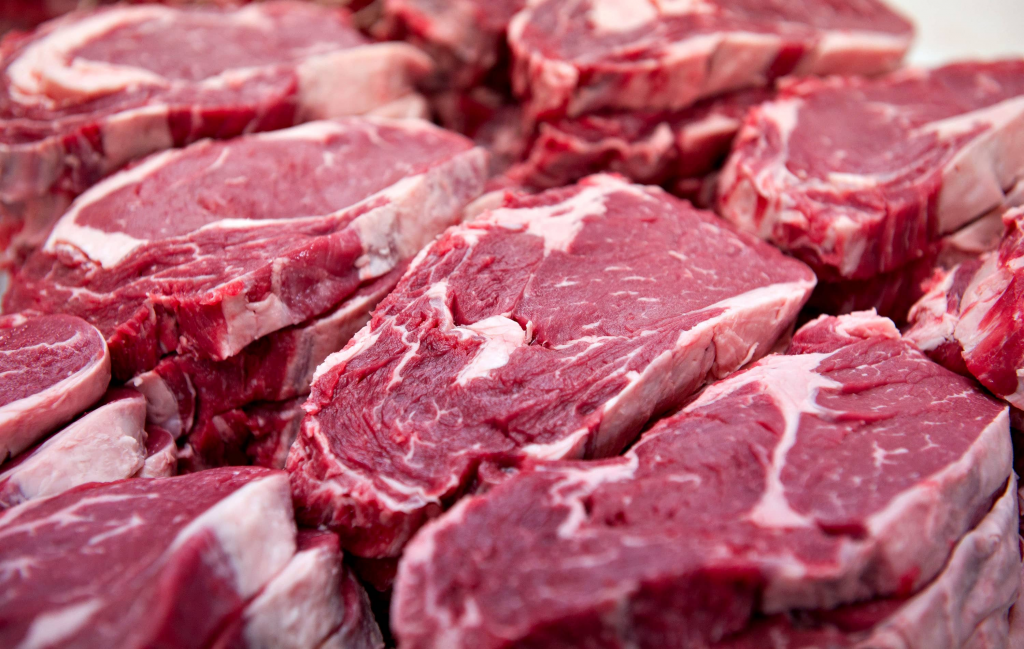
Senior Farm and Ranch Broadcaster Ron Hays is back visiting with the president and CEO of the United States Meat Export Federation, Dan Halstrom, about the beef export fall-off at the start of 2023.
One of the countries that has had phenomenal growth over the last few years is South Korea. In early 2023, South Korea's numbers dropped significantly compared to a year earlier.
"I think the primary problem there was totally timing," Halstrom said.
Inventory will be a point of struggle for beef exports to South Korea looking into next January and February, Halstrom said, but this does not mean anything negative for the demand.
"We were by-far a record in Korea last year," Halstrom said. "I don't think the general trend-lines have changed."
With tighter supplies of beef in the U.S., Halstrom talked about supplying other customers with what they need over the next few years.
"We all knew back in 2022, even into 2021 that at some point, with the drought and liquidation, that the numbers were going to tighten up," Halstrom said. "So, it's not a surprise. The fact we are down five percent so far on production is pretty much what a lot of people, including us, expected."
It will be critical, Halstrom said, to maximize the value of the entire carcass.
"We have a lot of customers in Asia that buy short plate, so are there other products that we could look at to kind of help make up that short-fall, so to speak," Halstrom said.
Utilizing more parts of the carcass, Halstrom said, will not offset the shortage, but it will help mitigate it. In cycles where production is down, Halstrom said USMEF works around the globe with those international customers to educate them about the circumstances and help provide them with the best service possible.
"We have been working hand-in-hand with these groups in the form of seminars or ideation sessions," Halstrom said.
In these sessions, Halstrom said, they will go through a carcass and talk about different ideas for how to best utilize part of that carcass to best meet the needs of the buyer.
"That is the sort of on-the-ground work that our offices are doing every day, whether it be in Korea, or in the Philippines, or in Mexico or wherever," Halstrom said. "That is really the boots on the ground trying to get down into the nitty-gritty of how we take care of these customers when we have a cycle like right now where production is down a bit."
The Beef Buzz is a regular feature heard on radio stations around the region on the Radio Oklahoma Ag Network and is a regular audio feature found on this website as well. Click on the LISTEN BAR for today's show and check out our archives for older Beef Buzz shows covering the gamut of the beef cattle industry today.
This week was a busy one at 23rd and Lincoln as the Legislature was up against the second major deadline of the session. Thursday was the final day for bills to be passed off the floor of their chamber of origin. Following the first deadline at the beginning of the month, around 1,000 bills were still left for consideration. As bills now switch sides to be considered by the opposite chamber, there are roughly 800 bills alive.
Oklahoma Farm Bureau members were pleased that HB 1921 by Rep. Lonnie Sims did not receive consideration on the House floor. HB 1921 sought to allow counties to create hazard mitigation assessment districts to raise revenue that might be used to leverage funds from the federal government to assist with a variety of disaster mitigation uses.
If a county created a hazard mitigation assessment district, the district would have been funded by an increase in property tax on all property within the county. As the bill did not receive approval by the House of Representatives by Thursday's deadline, the legislation will not be considered further this Legislative session.
SB 913 by Sen. Darcy Jech successfully passed the Senate this week, which will require individuals applying for medical marijuana growers license to obtain a bond of at least $50,000. If the Medical Marijuana Authority or the Department of Environmental Quality deems that the property to be used for the marijuana grow facility requires a larger bond to sufficiently cover a reclamation plan if the medical marijuana license were to be revoked, they would have the ability to require a larger bond to be acquired.
The bill provides an exception to the bond requirement if the applicant has owned the property for at least five years.
HB 2530 by Rep. Justin Humphrey received House approval upon its second consideration in a vote of 51-42 after failing its first consideration with a vote of 50-47. HB 2530 would give counties in Oklahoma the ability to vote to reduce the violation for cockfighting from its current offense as a felony to only a misdemeanor.
Oklahoma Farm Bureau members remain concerned that animal activists that are opposed to HB 2530 will increase their pushback and opposition to normal animal agriculture practices putting farmers and ranchers at risk. While HB 2530 did receive House approval, the unusually close vote makes its future in the Senate somewhat questionable.
Next week, the Legislature will return to committee work in preparation for the April 13 deadline, which will require bills to be passed from the committee of the opposite chamber. Additionally, around 60 Oklahoma Farm Bureau members will travel to Washington, D.C., to talk with the Oklahoma congressional delegation and industry professionals about issues facing the agriculture community in our state and nation.
For an update on weekly happenings at the Capitol and an outlook on what is ahead, be sure to tune in to Oklahoma Farm Bureau's weekly public policy update each Friday at noon.

The U.S. Grains Council (USGC) released its 2022/23 Sorghum Quality Report today and for the fourth year in a row, U.S. sorghum was, on average, graded above the necessary requirements for U.S. No. 1 certification.
"This detailed data provides in-depth information about the U.S. sorghum crop and better equips buyers around the world by showing them trends in sorghum crops year over year," said USGC Chairman Josh Miller. "We hope this year's report helps give our valued trade partners even more confidence in the continued reliability and quality of U.S. sorghum."
The report, funded through the U.S. Department of Agriculture's Foreign Agricultural Service Agricultural Trade Promotion (USDA-FAS) program and the United Sorghum Checkoff Program (USCP), provides international customers and other interested parties accurate, unbiased information about the 2022/23 U.S. sorghum crop.
To generate the report's findings, a total of 97 samples were collected from 15 participating elevators and one participating farmer in the central and southern regions of the U.S., which represents nearly 100 percent of all U.S. sorghum exports, between Aug. 9, 2022, and Mar. 8, 2023.
The samples were analyzed by the Amarillo Grain Exchange and the Cereal Quality Lab at Texas A&M University, where scientists calculated averages and standard deviations for each quality factor tested and reported results for the U.S. aggregate.
Total sorghum damage came in at 0.0 percent in the aggregate, and broken kernel and foreign material (BCFM) was only 1.4 percent, lower than last year's results, highlighting the grain's hardness and how well it survives handling and storage.
Additionally, tannins were absent from the sorghum samples for the fourth year in a row and protein content averaged 11 percent.
"Importers and overseas customers are always looking for high protein content, and this report proves once again that U.S. sorghum provides that," said USGC Secretary-Treasurer Verity Ulibarri, a sorghum and livestock farmer in New Mexico. "Most U.S. growers produce a non-tannin red variety which is a huge benefit to end-users since high-tannin sorghum can interfere with nutrient absorption for livestock."
This report is the fourth completed since the 2016/2017 sorghum crop and the Council plans to roll out these statistics across a series of events around the world.
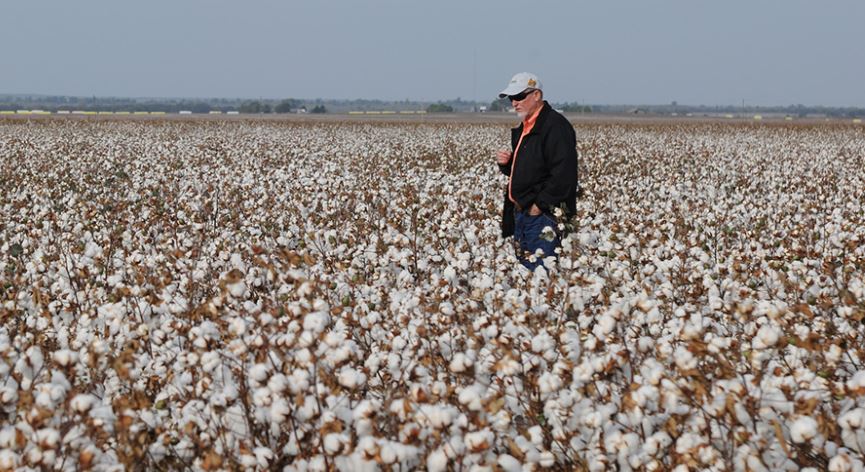
The Plains Cotton Improvement Committee (PCIP) met Thursday, March 23, 2023, to discuss research results in 2022 and plans for 2023. Researchers presented on pest management, plant diseases, variety trials, and more, as they discussed plans for research in the future.
The committee heard the following presentations:
For more information, visit the Texas A&M AgriLife Research and Extension Center – Lubbock website.
Senate Pro Tem Greg Treat, R-Oklahoma City, today named the members of his previously announced senate economic development select committee and announced the first meeting date.
The meeting will be at the Oklahoma State Capitol on Tuesday, March 28 at 9:30 a.m. in room 535. A live stream will be available for public viewing. The meeting will be organizational in nature, so no public comment will be on the agenda.
A Senate select committee can only be made up of senators, giving it subpoena power and the ability to compel witnesses.
Pro Tem Treat said the members of the committee are from all corners of the state and he is prepared to dig into every aspect of Oklahoma's issues surrounding workforce development, expansion and business attraction.
"I am honored to have the support and commitment of the members who I have chosen to serve on this select committee," Sen. Treat said. "I look forward to our bipartisan group of senators working together as we figure out ways to be more attractive to businesses looking to expand or relocate. Although some of the processes may not be pleasant to hear, I want those presenting to the committee to tell us what our downfalls are and where we are coming up short. This needs to be an honest conversation to see where changes need to be made to propel Oklahoma into a true competitor on a global scale. We also want to know what we can do to help local businesses and those entrepreneurs who risk it all on a dream they have to own a small business.
"I am also encouraged by the outpouring of support of Oklahomans that have reached out to my office who want to be involved. I anticipate one of the committee's first actions being a discussion of an advisory council that will run parallel to the committee's work. This will allow for a more diverse selection of business leaders and overall participation."
Members of the Senate Select Committee include:
Sen. Chuck Hall, R-Perry
Sen. Kristen Thompson, R-Edmond
Sen. Bill Coleman, R-Ponca City
Sen. John Haste, R-Broken Arrow
Sen. John Michael Montgomery, R-Lawton
Sen. Jerry Alvord, R-Wilson
Sen. Micheal Bergstrom, R-Adair
Sen. Cody Rogers, R-Tulsa
Sen. Adam Pugh, R-Edmond
Sen. Roland Pederson, R-Burlington
Sen. Kay Floyd, D-Oklahoma City
Sen. Julia Kirt, D-Oklahoma City
Pro Tem Treat and Sen. Greg McCortney, R-Ada, will serve as ex-officio members.
A chair and co-chair will be named at a later date.
A website with agendas and more information is being established and will be functional by Tuesday's meeting.
The 146th Cattle Raisers Convention & Expo concluded Sunday, marking a successful close to the three-day industry event that featured a full slate of keynote addresses, awards, nominations and educational programming.
Near 4,000 attendees joined the 2023 event held March 24-26 in downtown Fort Worth. Three general sessions focused on beef demand, global trade implications and market outlooks while keynote speaker Dana Perino discussed her rural Wyoming upbringing and life inside the White House. Additionally, the event hosted the Texas & Southwestern Cattle Raisers Association's annual meeting, where important business for the largest livestock association in the Southwest is conducted, including:
The TSCRA annual meeting also brought Congresswoman Monica De La Cruz (TX-15) to the stage where convention attendees heard important updates from an advocate working on the frontlines in Washington, D.C.
"For years, Cattle Raisers Convention & Expo has been a must-attend experience as our association's annual membership meeting," said TSCRA President Arthur Uhl. "This year was no different. We hosted a prestigious lineup of high-ranking and notable speakers on topics that impact our members directly. Sure, the conference is about the cattle industry, but it's also about wildlife, the environment, private property rights and so much more, all of which were addressed in Fort Worth this past week."
Cattle Raisers Convention & Expo also hosted fundraisers for various TSCRA entities, raising $107,500 in donations for the TSCRA Special Ranger Foundation, and $78,800 for TSCRA youth-specific programs.
This year's event was packed with hours of educational sessions, a live demonstration area, multiple student opportunities and competitions, as well as a vast expo with more than 250 exhibitor booths for attendees to visit.
"Thanks to all the cattle raisers, landowners and businesses who gave their time and support in making this event a success," said Uhl. "Our team of volunteer leadership and staff put together an outstanding program showcasing ideas, innovation and people that drive the industry forward. We look forward to welcoming everyone back to Fort Worth next year for the 2024 Cattle Raisers Convention & Expo, March 22-24, 2024."
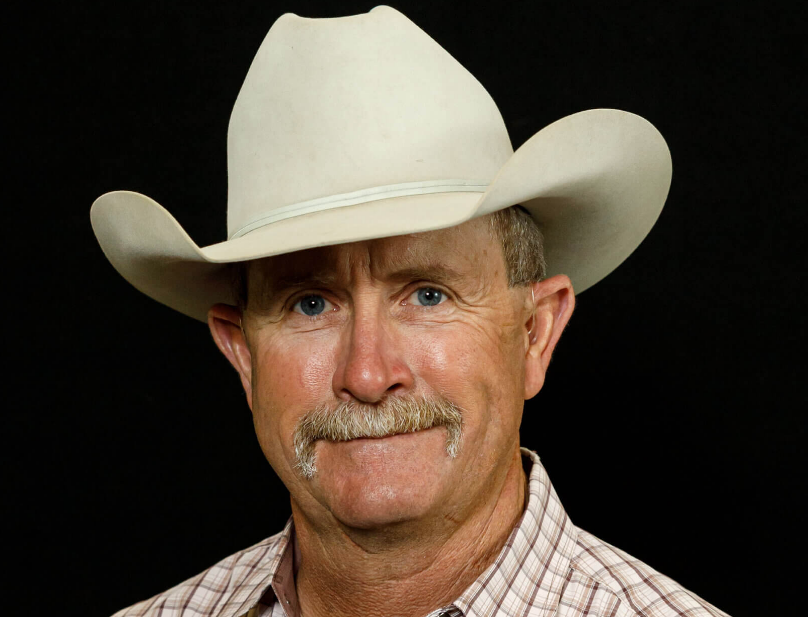
Texas & Southwestern Cattle Raisers Association executive committee met to elect leadership at the 2023 Cattle Raisers Convention & Expo. Two TSCRA members were newly elected to serve on the TSCRA board of directors:
The association also added three members to its executive committee. These individuals include:
"Membership is the lifeblood of Texas & Southwestern Cattle Raisers Association," says Arthur Uhl, association president. "Each year we are proud to add new directors to our board which helps guide the direction of the association. We are proud of the representation and look forward to accomplishing great things in 2023."
Robertson County Texas A&M AgriLife Extension Agent recognized by Texas & Southwestern Cattle Raisers Association
Texas & Southwestern Cattle Raisers Association announced David Groschke, a Robertson County Texas A&M AgriLife Extension Agent, as the 2023 Outstanding County Extension Agent – Beef.
The award, which was created to recognize Texas' most dedicated and effective local educators in cattle production, is presented annually at Cattle Raisers Convention & Expo.
Arthur Uhl, Texas & Southwestern Cattle Raisers Association's president, noted the important role county extension agents play in educating cattle producers to improve the industry and better natural resource stewardship.
"Texas A&M AgriLife Extension agents are instrumental to the beef cattle industry," Uhl said. "David Groschke is an exemplary example of this, having dedicated his career to supporting and educating beef producers. We're thankful for his efforts implementing first-class beef and range programming events reaching hundreds of producers in Texas."
Groschke has led in-depth programming focusing on range health, beef cattle economics, marketing and beef cattle management throughout Robertson County. Community engagement led by Groschke ensures his programming is relevant and timely to all cattle producers, and creative outreach efforts leveraging in-person events, newsletters and media outreach expand the reach of these efforts.
G Bar C Ranch honored as 2023 Texas Outstanding Rangeland Stewardship Award recipient
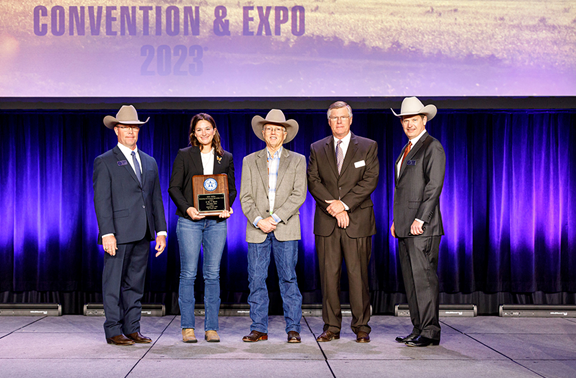
Texas & Southwestern Cattle Raisers Association today recognized Meredith Ellis of G Bar C Ranch as the winner of the Texas Outstanding Rangeland Stewardship Award, recognizing exceptional stewardship and innovation of the Rosston-based cattle operation.
This award is presented as a joint effort between Texas & Southwestern Cattle Raisers Association, Texas Section Society for Range Management and Texas Grazing Land Coalition. As the 2023 winner, Ellis will compete among other outstanding ranchers for the 2023 National Cattlemen's Foundation Environmental Stewardship Award Program.
Texas & Southwestern Cattle Raisers Association President Arthur Uhl said this is one of the most esteemed honors a rancher can receive, and it is extremely competitive.
"Ranching practices implemented by Meredith speak volumes to her dedication to sustainable use of the land," said Uhl. "Her ranching philosophies embrace livestock production as a tool to maintain native species habitat, biodiversity, and water resources. Meredith is an outstanding example of stewardship, and we're proud to present her with this award."
Ellis raises Angus cattle across the more than 3,000-acre ranch located between the Western Cross Timbers and Grand Prairies ecoregions. The ranch strategically rotates the herd through their 58 fenced pastures to reduce the potential need for artificial inputs. To do their part in enhancing water quality, G Bar C Ranch grazes in a way that maintains effective flow of vegetation filters to prevent erosion. The operation is exceptionally diverse, with 23 different ecological sites, including Wheat Creek flowing through the ranch which deposits into the Trinity River, providing nearly half of Texans' water needs.

After considering more than 40 candidates from across the nation, the Oklahoma Broadband Governing Board has voted unanimously to hire former Oklahoma State Representative Mike Sanders as executive director of the Oklahoma Broadband Office.
"I'm honored to be asked to serve in such an important role to benefit the state of Oklahoma," Sanders said. "This effort builds on previous work to connect the entire state with the economy of the 21st Century. The benefit to families, farms, businesses, and communities is this generation's equivalent to the impact of rural electrification of the 1930s and the interstate system of the 1950s."
Governor Kevin Stitt praised the board's decision to hire Sanders.
"Mike's extensive work at the state House and his time serving in the George W. Bush administration give him the unique ability to understand this process and how to best navigate the complicated DC bureaucracy to make sure these federal dollars are distributed fairly and align with our vision to deliver high-speed internet access to 95% of the state by 2028," Stitt said.
Lieutenant Governor Matt Pinnell, who serves on the governing board, expressed his confidence in Sanders.
"Mike has the experience to lead the effort to bring high-speed internet to every corner of our state. From his time with the USDA to serving on utility and transportation committees in the State House, he has the relevant background for this job. Just as important, Mike has a passion for and knowledge of Oklahoma that's needed in this role. I trust him to make sure these dollars are invested fairly across the state. I look forward to working with him," Pinnell said.
The chair of the governing board, Mike Fina, said Oklahoma will be well served by Sanders.
"The board has great confidence in Mike's ability to build out our highly qualified staff and oversee the most important infrastructure improvement project of our generation," Fina said.
Sanders served six terms in the Oklahoma House beginning in 2008. He chaired the House Utilities Committee and Appropriations Subcommittee on Transportation, was vice-chair of the Human Services Committee, and served as House Majority Leader.
Prior to the legislative service, Sanders worked in the White House for President George W. Bush. He also served in senior management in the United State Department of Agriculture in Rural Development and Natural Resource Conservation Service (NRCS). Sanders earned his undergraduate degree in History and Pre-Law from Oklahoma Christian University and attended Georgetown University to work on a Master's degree in Government.
After leaving the Legislature, Sanders started his own business – Sanders Strategy and Consulting Group.
Sanders lives in Kingfisher with his wife, Nellie, and sons, Davis and Walker.
The salary for the executive director will be considered at the next meeting of the governing board on March 31.
According to NonDoc- there is a sense of urgency to get monies out to broadband projects.
In an article on the selection process, they write "
"The Oklahoma Broadband Office will administer about $1.6 billion in grant funds, with the goal of providing high-speed internet service to the vast majority of Oklahomans by June 2028, when the office will be closed. Of that funding, American Rescue Plan Act money has to be spent by the end of 2024.
"The board and office were created in HB 3363, which was enacted last year. The nine-member board is responsible for broadband expansion policy and overseeing the broadband office.
"The office has already begun operations with an interim director, Kirk Martin, selected by the board. Martin did not seek the permanent position.
"The Legislature has allocated about $382 million of federal American Rescue Plan Act money to the OBO to fund various projects across the state. The OBO has received 139 broadband requests, which total about $4.3 billion."
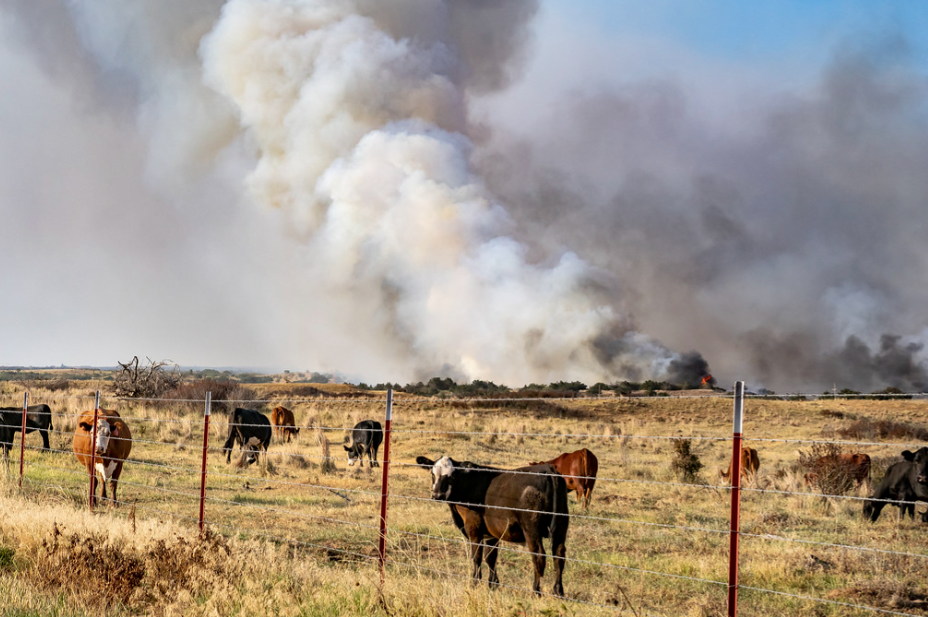
Prescribed fires and controlled burns are common this time of year, but dry, windy conditions can also fuel the unexpected wildfire, threatening livestock and property. (Photo by OSU Agriculture)
By Gail Ellis
This time of year, strong, spring winds whip across the prairie, and the smell of a grass fire may be detected in the air. John Weir, Oklahoma State University Extension fire ecology specialist, said March is the windiest month, driving wildfires in the dormant season before the brown, dead grass gives way to new spring growth.
In a recent segment of SUNUP, the agriculture television show of OSU Extension and Ag Research, Weir discussed how much of the state is still in a drought, and runaway grass fires are even more of a threat.
Wildfire precautions include:
"Just a little bit of prior planning will go a long way," Weir said. "Trying to do it when a fire is actively burning is not a good time to plan or act on things."
On the other hand, conducting prescribed fires and controlled burns:
Weir said the top reason people burn off their pastures and fields in Oklahoma is to control the eastern redcedar population and prevent other woody plants from invading rangelands.
"Even if you don't have a lot of cedars on your property, it's still a good thing to use fire to help keep them in check," he said. "There's no chemical or mechanical treatment that mimics what fire can do to the land."
Prescribed fires and controlled burns
Prescribed fire is a burn that is planned with a specific objective and a specific piece of land. Planning is key.
"It's not one of those things you wake up one morning and say, 'Hey, it looks like a good day to burn,'" Weir said. "We need to have a plan, have fire breaks in place, notify neighbors and local fire departments, and make sure we have adequate equipment and manpower. The biggest thing that day is to make sure the weather conditions are proper and within prescription of what you want to do to help you achieve your goals and objectives for that burn."
Those interested in assistance with prescribed fires and controlled burns should contact their local OSU Extension office or the Natural Resource Conservation Service. Extension educators and NRCS specialists can help landowners write plans for a burn and answer other questions. OSU Extension provides an online prescribed fire course, and the Oklahoma Prescribed Burn Association offers locations in 36 counties for training and support.
OSU Extension Fact Sheet Resources
Using Prescribed Fire in Oklahoma
Burn Plan for Prescribed Burning
Prescribed Fire: Understanding Liability, Laws and Risk
Firebreaks for Prescribed Burning
Prescribed Burning: Spotfires and Escapes
The Best Time of Year to Conduct Prescribed Burns
Smoke Management for Prescribed Burning
OSU Extension uses research-based information to help all Oklahomans solve local issues and concerns, promote leadership and manage resources wisely throughout the state's 77 counties. Most information is available at little to no cost.
Chapter 12 was introduced in bankruptcy law as a temporary measure in 1986 and became permanent in 2005. With 169 filings, farm bankruptcies in 2022 were the lowest since Chapter 12 became permanent in 2005. This comes just three years after the third-highest number of farm bankruptcy filings - 595 in 2019. According to data from the U.S. Courts, Chapter 12 bankruptcy filings were down nearly 39% from 2021. This is the first time since Chapter 12 became permanent that there were fewer than 200 filings.

Despite the overall drop in Chapter 12 bankruptcy filings in 2022, filings were not down in every region in 2022, like they were in 2021. In fact, of the eight regions, four – the Mid-Atlantic, West, Northwest and Other – saw double-digit percentage increases in filings. But before we dig into the regions with an increase, let us celebrate the regions with declining numbers. The region with both the largest decrease in Chapter 12 filings by absolute number and the largest percentage decline was the Midwest – Iowa, Illinois, Indiana, Kansas, Kentucky, Michigan, Minnesota, Missouri, North Dakota, Nebraska, Ohio, South Dakota and Wisconsin – which had 47 bankruptcy filings in 2022, down from 144 filings in 2021 – a decrease of 97 filings. The Midwest and the Southeast led all regions in the number of filings, each accounting for 28% of all Chapter 12 filings in the U.S.
The three other regions with a decline in the number of filings in 2022, relative to 2021 include the Southeast, Southwest and Northeast. While the Southeast remains a top region for Chapter 12 bankruptcies, the region saw an 11% reduction in total filings, with 47 in 2022. The Southwest had the second-largest decrease in filings, both in absolute terms and by percentage. In 2022, there were 11 Chapter 12 filings, down from 27 in 2021, a decline of 59%. Finally, the Northeast had four filings in 2022, relative to the five filings in 2021.
Now to the less favorable stats. Four regions had increases in Chapter 12 filings in 2022. The region with the largest increase in Chapter 12 filings by absolute number and percentage increase with 12 filings, up from 5 in 2021, was the Other region, which includes Puerto Rico, Alaska, Hawaii, Guam, the Virgin Islands and the District of Columbia. The Mid-Atlantic (Delaware, Maryland, New Jersey, New York, Pennsylvania, Virginia and West Virginia) had an increase of three filings for a total of 26 filings in 2022. The West (California and Nevada) had 11 filings in 2022, up two from 2021. Finally, the Northwest (Idaho, Montana, Wyoming, Oregon and Washington) also had 11 filings in 2022, up one from 2021.

Total bankruptcies filed by state vary significantly, from no bankruptcies in 12 states/territories to as many as 16 filings in others, as shown in Figure 2. Alaska, Connecticut, the District of Columbia, Guam, Hawaii, North Dakota, New Hampshire, Nevada, Rhode Island, the Virgin Islands, West Virginia and Wyoming had no Chapter 12 bankruptcies filed in the past year. In contrast, five states had Chapter 12 filings in the double digits. New York (16) and Puerto Rico (12) led the nation in Chapter 12 filings in 2022. Florida and Georgia both had 10 filings and California had 11 filings. It is worth noting that 2022 is the first year that Wisconsin has not led the nation in Chapter 12 filings since it earned that terrible distinction in 2016.

As seen in Figure 4, in 2022 total bankruptcy filings were either down or unchanged from 2021 in most – nearly 80% - states and territories. Filings were down in 24 states and 19 states had no change in the number of filings between 2022 and 2021. Bucking the overall trend, 11 states/territories had an increase in the number of filings – New York (16 up from nine), Puerto Rico (12 up from five), Arkansas (seven up from four), California (11 up from nine), Florida (10 up from seven), Louisiana (five up from one), Maryland (two up from zero), Oregon (five up from three), South Dakota (six up from five), Utah (one up from zero) and Washington (three up from one).

Overall, in 2022, USDA reports that there were 2,002,700 farms in the U.S., which was down from 2,012,050 in 2021, a loss of 9,350 farms. Chapter 12 farm bankruptcies fell below 200 for the first time and reached the lowest level since the Chapter 12 program was made permanent in 2005. 2022's 169 farm bankruptcies are over 70% lower than the 599 farm bankruptcies of 2019, just three years before. It is no coincidence that farm bankruptcies in 2019 were higher than in 2022: USDA estimated 2019's net farm income, a broad measure of farm profitability, of $79 billion was less than half of the 2022 net farm income estimate of $163 billion. So, while we cheer the second year of declining Chapter 12 filings, we also must keep an eye on the future. USDA's most recent Farm Sector Income Forecast, released Feb. 7, anticipates a decrease in net farm income for 2023. U.S. net farm income is currently forecast at $137 billion, down 15.9% from 2022's $163 billion. As our article 2023 USDA Farm Income Forecast Erases 2022 Gains points out, when adjusted for inflation, 2023 net farm income is expected to decrease $30.5 billion (18.2%). Meanwhile, USDA projects that farm and ranch production expenses will continue to increase by 4.1% in 2023, following a record increase in production expenses in 2022.
Like last year, we will point out that while the last two years have brought higher commodity prices for some, it has most certainly brought higher input costs for all; the increasing number of bankruptcies in some states and regions in 2022 highlight these facts. Given the considerable price volatility in the marketplace, declining Chapter 12 filings in 2023 are anything but guaranteed.
Texas & Southwestern Cattle Raisers Association, the largest livestock association in the Southwest, today unveiled its new member center to more than 3,500 attendees at the Cattle Raisers Convention & Expo in Fort Worth.
The member center serves as a centralized platform for TSCRA members looking to manage their membership, access member-only benefits, and explore digital content including The Cattleman magazine. The initiative is the latest move by TSCRA to innovate and create easy-to-use solutions that meet the needs of cattle raisers.
"Expanding our membership resources to a digital platform is a natural extension of TSCRA and a strategic way to increase access to the resources TSCRA members love," said TSCRA President Arthur Uhl. "We want to meet cattle raisers where they are, ensuring our tools and resources are at their fingertips."
TSCRA members can pay and set up automatic renewal of their annual membership dues and add or remove members from their account through the user-friendly interface. As part of the experience, The Cattleman will be available for members each month, providing the option for members to read exclusive content through the member center. Members can activate their member center accounts on-site at the TSCRA booth during Cattle Raisers Convention & Expo or anytime by visiting www.tscra.org/membership.
Shows importance for plant breeding programs to incorporate human health traits into crop improvement strategies.
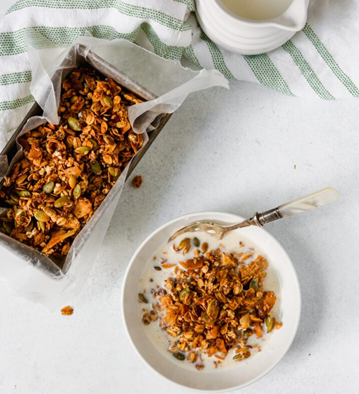
New research on waxy starch in sorghum by University of Nebraska-Lincoln researchers shows that waxy starches can have undesirable effects on the human gut microbiome. The gut microbiome is an ecosystem of microorganisms living in the gastrointestinal tract.
The Nebraska Food for Health research project focused on sorghum starch content, and its findings, were recently published in the journal "Gut Microbes": "The waxy mutation in sorghum and other cereal grains reshapes the gut microbiome by reducing levels of multiple beneficial species."
While starch is part of a healthy diet, it's important to note that not all starches are created equal. Typically, native starch comprises 20 to 25% amylose and 75 to 80% amylopectin, while waxy starches contain no amylose and are composed almost entirely of amylopectin molecules due to a naturally occurring mutation in starch synthesis genes. Normal starches often have physicochemical properties that are undesirable for food processing, while waxy starches are known for their high digestibility, desirable viscous properties in food processing, and unique organoleptic characteristics, such as sticky rice.
We know little about the health effects of consuming waxy starch compared to normal starch, particularly in context of a whole grain. Our gut contains trillions of microbes, which are influenced by our diet and impact our health through host-microbiome interaction. Could waxy vs normal starch have different effects on our gut microbiome and our health?
Using plant genetics and advanced research platforms, scientists at Nebraska Food for Health Center studied the in vitro fermentation of six pairs of near-isogenic sorghum lines. These lines were created through years of breeding and only differed in starch characteristics.
"It's a gold mine!" exclaimed Dr. Qinnan Yang, lead researcher, discussing the exceptional plant materials studied. Analyzing fermentation profiles across diverse human microbiomes, they discovered that grain from parental lines of sorghum stimulate growth of many species of gut microbes that are known to be beneficial to our health whereas grain from waxy derivatives lacks this capacity. Thus, there is a trade-off effect between the desirable characteristics of waxy starch for food processing and an undesirable effect on the human gut microbiome.
Waxy starch lacks amylose, a component more resistant to human digestion, which can reach the colon and fuel beneficial gut microbes to produce short chain fatty acids. The amylose content of normal starches drives growth of beneficial microbes and their desirable metabolites whereas waxy starch does not. Adding extracted normal sorghum starch to waxy sorghum restores the beneficial microbiome changes, demonstrating the causal effect of amylose on the gut microbiome. Their work also showed that this effect also applies to waxy derivatives of other commonly consumed grains like corn, wheat, rice, and millet.
They also showed that humanized gnotobiotic mice fed waxy sorghum have different microbiome composition and gain more weight than those on a normal sorghum diet.
The conclusion drawn is that while waxy starches offer benefits in terms of food functionality, they can also have unintended consequences on both the gut microbiome and host physiology. This could be especially relevant in human populations in parts of Asia that consume significant quantities of waxy grains (e.g. sticky rice).
This study marks the third major discovery from the Nebraska Food for Health Center demonstrating the substantial impact that naturally occurring genetic variation in food crops can have on the human gut microbiome.
This growing list of food crop components identified by these genetic analyses now includes levels of amylose in wildtype vs. waxy starch (https://www.tandfonline.com/doi/full/10.1080/19490976.2023.2178799), levels of condensed tannins influenced by major tannin regulatory loci in sorghum (https://www.nature.com/articles/s41467-022-33419-1), and the effects of mutations in the opaque-2 locus on seed protein composition in maize (https://www.frontiersin.org/articles/10.3389/fmicb.2022.921456/full).
"Collectively, these findings point toward the importance of plant breeding and genetics in human health-associated traits and should open the door for breeding programs to consider incorporating human health traits into crop improvement strategies," said Dr. Andrew Benson, director of the Nebraska Food for Health Center.
National livestock groups have come together to support Congressional efforts to expand opportunities for industry to invest in meat packing capacity.
The American Farm Bureau Federation, American Sheep Industry Association, Livestock Marketing Association, National Cattlemen's Beef Association, National Pork Producers Council, and United States Cattlemen's Association sent a letter to the Chairpeople and Ranking Members of the Senate and House Agriculture Committees expressing the groups' support of legislation to allow livestock market owners and operators to own or invest in small or regional livestock packing facilities.
The bipartisan legislation, the Expanding Local Meat Processing Act (S. 813), was reintroduced by Sens. Ben Ray Lujan (D-NM) and Joni Ernst (R-IA) last week. This is the Senate companion to the Amplifying Processing of Livestock in the United States (APLUS) Act (H.R.530), being led by U.S. Representatives Mark Alford (R-MO), Jimmy Panetta (D-CA), and Dusty Johnson (R-SD). If enacted, these bills would direct the Secretary of Agriculture to update a regulatory prohibition under the Packers and Stockyards Act which bars livestock auction owners from owning or investing in packers.
"This is an antiquated rule that does not fit with the current, transparent method of selling livestock at an open auction where sellers can view the transaction either in person or by streaming the auction online," the letter states.
The bills would allow for investment in the packing industry at local and regional levels by those active in the livestock marketing business.
"We appreciate our partners, both on Capitol Hill and at fellow livestock groups, fighting for opportunities to enhance participation in livestock packing," said Mark Barnett, LMA President and owner of Kentucky-Tennessee Livestock Market. "Livestock auction markets, like mine, are in the competition business. Allowing livestock auction owners to invest in small and regional packers could enhance competition which equates to needed additional profit for producers who are being squeezed by high inputs and low margins."
If you have questions about this legislation, please reach out to Chelsea Good, Vice President of Government and Industry Affairs & Legal at cgood@lmaweb.com or 816-305-9540.
About the Livestock Marketing Association
The Livestock Marketing Association (LMA), headquartered in Overland Park, Kan., is North America's leading, national trade association dedicated to serving its members in the open and competitive auction method of marketing livestock. Founded in 1947, LMA has more than 800 member businesses across the U.S. and Canada and remains invested in both the livestock and livestock marketing industries through support, representation and communication efforts. For more information, visit www.LMAWeb.com.
Senior Farm and Ranch Broadcaster Ron Hays is visiting with the president and CEO of the United States Meat Export Federation, Dan Halstrom about headwinds on beef exports.
Because of high levels of beef exports throughout most of 2022, Halstrom said those numbers were expected to take a hit at some point.
"There are some headwinds out there," Halstrom said. "We have been talking about those headwinds for quite a long while in the last part of last year. We've got that strong U.S. dollar, especially in Asia, especially in Japan, Korea, and a little bit effecting China as well. You still have inflation or impacts on pricing there, possibly slowing down some spending."
Although exports are down 15 percent from last year, Halstrom said demand is still good and there has been success in a few key countries.
"Mexico had a very large month, up 20 percent," Halstrom said.
Food service is in full swing in the Caribbean, Halstrom said, they are also up significantly.
"Philippines was up big, and Japan was almost steady with a year ago," Halstrom said. "To me, that is some pretty good news kind of filtered into the down start of the year. So, I don't think it is all negative."
Halstrom also talked about value numbers being down and said it could be related to a number of reasons, but demand has been strong regardless.
Because food service was not in full swing in Asia last year, Halstrom said retail and online carried the load of beef sales.
"I think that is part of the reason that maybe we saw a little bit better news out of Japan versus the rest of Asia," Halstrom said. "I think the retail business and food service to some extent is starting to come back there, so I think this is something else we need to keep an eye on as we go through the rest of this year."
The Beef Buzz is a regular feature heard on radio stations around the region on the Radio Oklahoma Ag Network and is a regular audio feature found on this website as well. Click on the LISTEN BAR for today's show and check out our archives for older Beef Buzz shows covering the gamut of the beef cattle industry today.
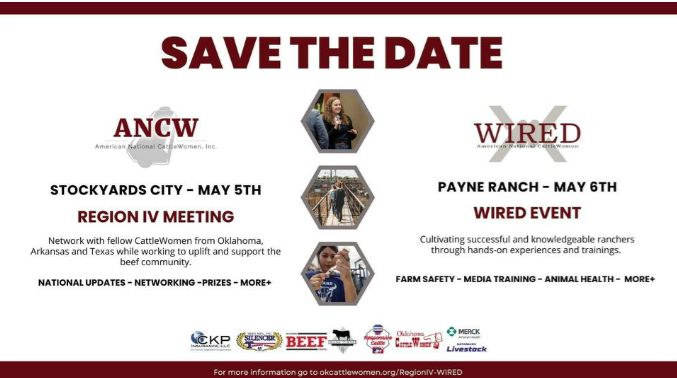
Farm Director, KC Sheperd, caught up with the president of the Oklahoma CattleWomen's Association, Cheyenne Sparks, and talked about the upcoming WIRED event and about her participation in the Cowgirl 30 Under 30 weekend.
"It (Cowgirl 30 Under 30 Weekend) was absolutely a humbling experience because I could not fathom, number one, the honor of being chosen for this award, you know, being put up on stage with 29 other fantastic women in the western industry was humbling and so honoring, and I have no words for how much I felt doted on," Sparks said. "They really spoiled us with their sponsors. It was incredible."
Sparks said Cowgirl Magazine chooses 30 women from across the western industry under the age of 30 to honor each year.
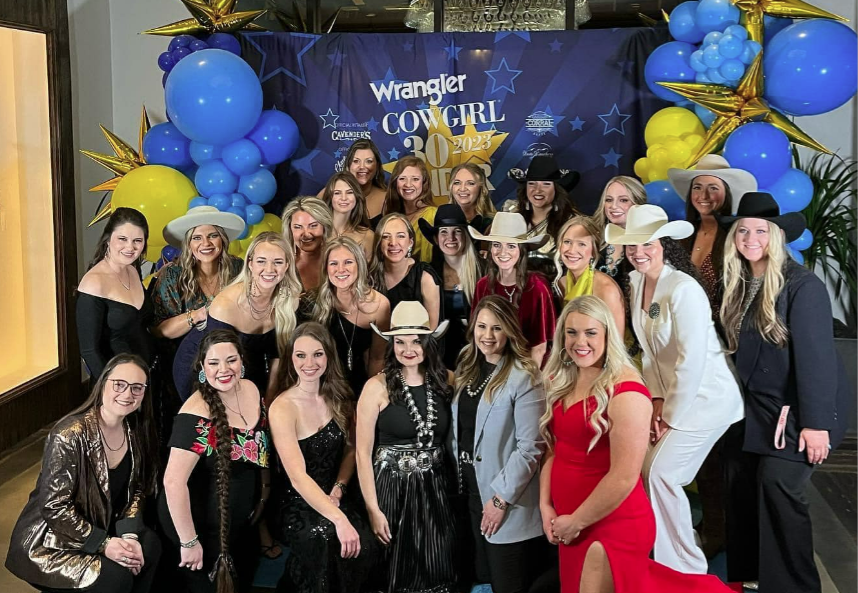
"I was so thankful to be in the 2023 class, and of course, I made sure to give my CattleWomen a shout out when I got up on stage because I know that I would not have been up there had it not have been for all the work that I've been privileged to be able to do for the CattleWomen," Sparks said.
Regarding the upcoming WIRED event, Sparks said women from all backgrounds in Oklahoma and outside states are welcome.
"These aren't just ranchers," Sparks said. "These are women that have either grown up in ranching or haven't. They're consumers, everybody that came is just someone that loves the beef industry loves learning and knows that WIRED is definitely the place to get that knowledge."
The Oklahoma WIRED event, Sparks said, is set to take place on Saturday, May 6.
"It's actually going to be the day after our region meeting which is going to take place in the stockyards at the Cattlemen's Steak House Special Events Center on Friday," Sparks said.
The region meeting, Sparks said, is welcome to everyone, and will include a variety of speakers, door prizes, a steak lunch, stockyards tour and a riverboat tour.
"So don't discount Friday because it's on the website as well," Sparks said. "You definitely want to give a look at that. But WIRED is going to kick off on Saturday, May 6, and it's going to be bright and early."
Check-in for the WIRED event starts at 7:30a.m., Sparks said, and the event begins at 8 a.m.
"We are going to be doing some hands-on stuff," Sparks said. "We are going to be learning chute behaviors and how to utilize Molly Manufacturing chutes, they are one of our sponsors. I love having them come in bring these materials in for our women to learn hands-on. We're also going to have PNK equipment there. They're bringing out big technology. They're bringing out machines that we want to learn on. They're going to talk to us about how to utilize those machines, and how to utilize them safely."
Oklahoma State University State Extension Beef Veterinarian, Rosslyn Biggs will also be at the event, Sparks said, helping with the presentation.
"All of these hands on things are going to be happening that morning, and then we're going to go over to lunch, and that's going to happen at Growing Pains, because this is all taking place at Kelly Payne who was the first woman president of the Oklahoma National Stockyards," Sparks said. "This is all happening at her place out there and Mustang. And so, we're going to head over to Growing Pains for a delicious lunch."
Oklahoma Farm Report Farm Director KC Sheperd will also be helping with the event to speak about media training for agriculture.
The morning will be more of the hands-on activities, Sparks said, then after lunch there will be speakers.
"They're going to give us some presentations on things like diversifying your operation," Sparks said. "We're also going to learn how to do things that are going to make it to where our operations are withstanding even in those tough months, kind of like right now when things are getting down to the nitty gritty and we're really needing to uplift our ranchers and support them with those extra jobs. This is going to be the same way here. We're going to be giving everybody knowledge on how, yes, to work hard on the ranch, but also how to keep your ranch sustainable through those hard times."
To register for the WIRED event, click here.
"You can register for just the region event which is on Friday and all those events I mentioned," Sparks said. " You can register just for WIRED for the Saturday event and all those things that we talked about, or you can do a combination and you can do the whole weekend, which I highly suggest because it's all going to play into each other and you want to stick around for everything you're going to learn because this is truly going to uplift you as a cattlewomen, you as a cattle rancher, you as a producer, as a consumer, it is going to truly give you this feeling of confidence in yourself when it comes to how you ranch."
Former White House Press Secretary Dana Perino to speak at three-day event.
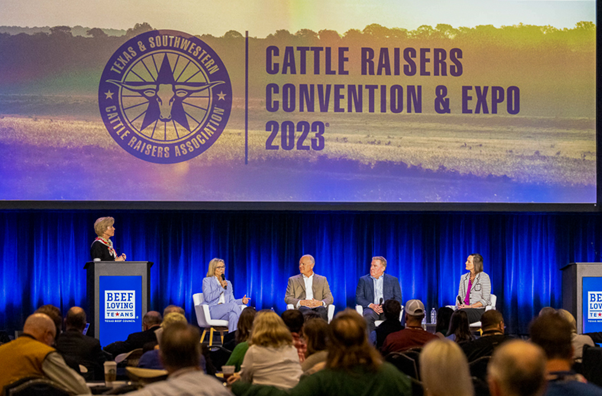
Cattle Raisers Convention & Expo is officially underway at the Fort Worth Convention Center where more than 3,500 cattle raisers, landowners and industry partners have gathered to connect, learn and shop at the largest beef cattle-specific event in the Southwest.
The three-day event, hosted by Texas & Southwestern Cattle Raisers Association, officially launched at 8:00 a.m. with "The Sparks That Accelerated Beef Demand," a keynote address sponsored by Beef Loving Texans featuring experts from National Cattlemen's Beef Association, H-E-B, U.S. Meat Export Federation and Texas Beef Council. Educational sessions and meetings continue throughout the weekend, including programming featuring former White House Press Secretary Dana Perino, the TSCRA annual membership meeting and the ever-popular School for Successful Ranching program boasting more than 30 hours of practical, real-world information for cattlemen.
"We're thrilled to bring the cattle raising community together yet again in Fort Worth for the Cattle Raisers Convention & Expo, and we have a great weekend ahead of us," said TSCRA President Arthur Uhl. "This week is about learning and growing alongside fellow cattlemen and women. We are proud to bring Dana Perino to our keynote stage, as well as former Congressman Will Hurd who each bring eye-opening perspectives about the state of our nation and important issues facing all Texans."
Attendees can explore the largest livestock trade show in the Southwest featuring more than 250 exhibitors and a live demonstration arena in the 225,000-square foot facility. Live entertainment on Saturday night will feature Jake Hooker and The Outsiders at the dinner and dance, followed by late-night party entertainment from the Amanda Kate Ferris Band.
Anyone can join in on the fun at the 2023 Cattle Raisers Convention & Expo. One-day registration packages and expo-only passes are available for as little as $10 per day and registration can be completed on-site. Learn more at CattleRaisersConvention.com.
Yesterday, the Biden-Harris administration announced new goals and priorities to advance American biotechnology and biomanufacturing. This follows President Biden's September 2022 executive order to advance a national biotechnology and biomanufacturing initiative. The EO contained many provisions important to American soybean farmers, including actions that will support improved markets for biobased products, create greater access to biotechnology, and encourage research and development supporting the "bioeconomy," or economic activity derived from biotechnology and biomanufacturing.
To coincide with the announcement, the White House released a new report outlining a vision for what is possible with the power of biotechnology and biomanufacturing, research and development needs to achieve this ambitious vision. The report includes information from federal agencies assessing the potential for biotechnology and biomanufacturing research and development to further five societal goals: climate change solutions, food and agricultural innovation, supply chain resilience, human health, and crosscutting advances.
In addition, the U.S. Department of Commerce's Bureau of Economic Analysis released a new report called for in the President's EO that assesses the feasibility of measuring the economic contributions of the country's bioeconomy. The report also includes an assessment of what is needed to better, more accurately measure these contributions. Read more from the White House here.
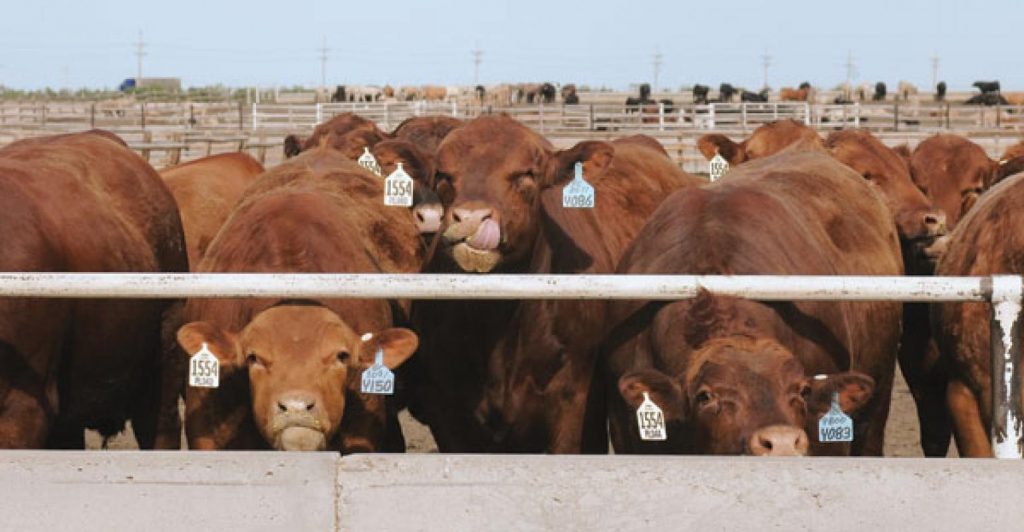
KC Sheperd, Farm Director, is back talking with Bob Rodenberger, a partner with Stockman Oklahoma Livestock Marketing, as he gives the latest on the cattle markets.
The demand for cattle weighing 600 and under, Rodenberger said, has been tremendous.
"Somebody's got to have some grass or wheat prospects because they're buying these light cattle, and awful good demand on them," Rodenberger said.
Rodenberger said he thinks most of these light cattle are going to Northeast Oklahoma and the Flint Hills, where there is adequate moisture.
"The 15th of April is when they'll start turning out up there, but that's where a lot of these calves are going," Rodenberger said. "Of course, a lot of them are being bought up and put on in grow yards."
There will be fewer cattle available, Rodenberger said, from now through the rest of the year. Prices right now, he added, are good.
"The biggest thing we have got to look at in our business is we've got to keep moving the product," Rodenberger said. "I don't know what the level of, you know, the consumer will quit paying for. I mean right now, he's still buying beef. We're still selling hamburger meat."
Cow numbers are down, Rodenberger said, and different cuts of the carcass are going to need to be utilized for hamburger meat. Looking into next week, Rodenberger said he sees the runs being lighter in Oklahoma City due to weather, and cattle being grazed out for another 45 days or so.

With recent breaks in U.S. and global wheat futures and lower freight rates, the wheat market seems to have turned a corner to favor buyers after two years of volatility and risk.
Despite the improved general outlook, inflationary pressures persist, influencing macroeconomic conditions both in the U.S. and for our customers overseas. For example, major runups in the U.S. dollar in the second and third quarter of 2022 impeded wheat trade. Yet even with recent strengthening, the U.S. dollar index has decreased 7% from the highs hit in September 2022, providing some relief for wheat importers.
As world wheat importers are keenly aware, a strong dollar erodes the purchasing power of foreign currencies, making U.S. commodities more expensive to customers.
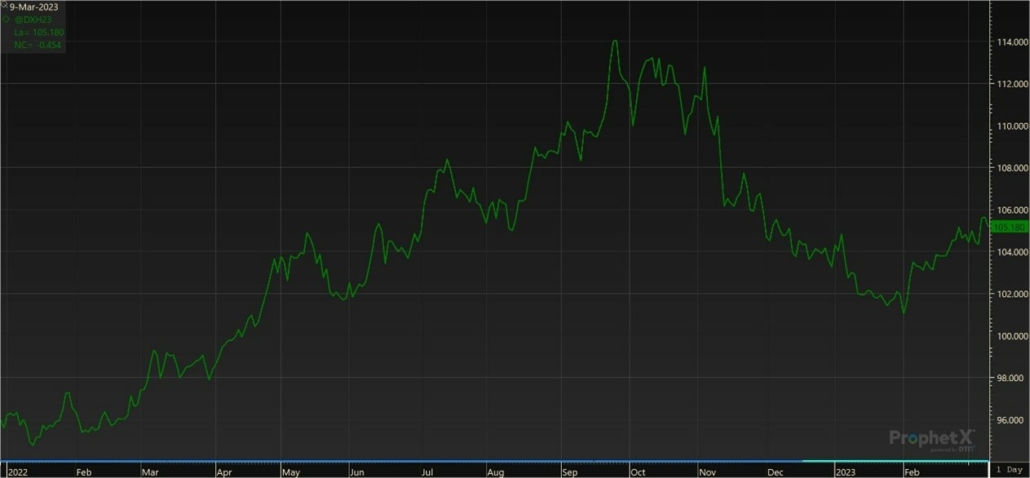
While the U.S. dollar index has decreased 7% from the highs hit in September 2022, though it remains elevated from pre-war levels, continued strength and fluctuations remain a concern for wheat importers. The U.S. dollar index measures the dollar's strength against a basket of six major currencies, including the Euro, Pound, Yen, Canadian Dollar, Swedish Kroner, and Swiss Franc. Source: DTN ProphetX
The factors driving currency markets are often complex, but the recent dollar strength can be primarily attributed to the U.S. Federal Reserve's reaction to the rising inflation triggered by Russia's unprovoked invasion of Ukraine and the lingering impacts of the COVID-19 pandemic.
Federal Reserve Policy
The U.S. has faced inflation not seen since the 1980s, at an annualized inflation rate of 8.0% for 2022. To combat the inflationary pressures, the U.S. Federal Reserve (Fed) began an aggressive series of interest rate increases, bringing Federal Fund Rates from 0.2% per year in March 2022 to 4.57% annually by February 2023. The hawkish policy added strength to the dollar as investors earned higher returns, making the currency more attractive.
As interest rates have risen, U.S. inflation has since slipped to 6.0%, signaling that inflation may be easing. Current market sentiment and comments from Federal Reserve leadership indicate that though interest rates may still increase, a slower pace could also ease the strength of the U.S. dollar.
Global Reaction
In uncertain times, global investors often turn to the U.S. dollar as a haven currency, generating greater demand for a currency already supported by the Federal Reserve's hawkish policy. As fears regarding a global recession began to mount following the onset of Putin's war, many major central banks had to weigh their economic outlook against inflation risk, generally maintaining a looser monetary policy than their U.S. counterpart. These policy decisions allowed the dollar to strengthen more quickly than other world currencies.
As recession fears have slowed and the global economy has normalized, central banks have become increasingly hawkish, moving their monetary policy in line with Federal Reserve. As interest rates rise around the world, future gains in the dollar will be curbed.
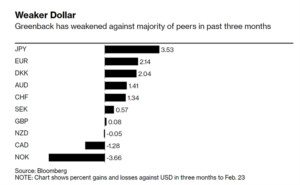
The dollar has weakened against many other currencies in the last few months, potentially signaling a more hawkish stance in other major central banks. Source: Bloomberg
Bears or Bulls, What's Next for the Dollar?
As the global economy stabilizes, many investors are increasingly bearish for the dollar, though the path will be far from straightforward. Analysts believe the recent dollar strength is temporary, and the currency could weaken if the Federal Reserve tapers its interest rate increases. Nevertheless, the underlying geopolitical risk of Putin's war will continue to prop up the dollar as it remains the haven currency in times of volatility. Likewise, the resilience of the U.S. economy will continue to drive dollar strength as robust jobs data, and stubborn increases in consumer and producer prices, underpin the need for hawkish policy and elevated interest rates.
By USW Market Analyst Tyllor Ledford
RON's Dave Lanning has a pre-opening look at today's agricultural Markets.
Click the audio tab below for today's report.
This Week on SUNUP is Oklahoma State University Extension grain market economist Kim Anderson. During this week's edition Anderson talks about the latest in the grain markets.
Russia's exports are backed up, Anderson said, and their ending stocks are projected to be relatively high as they are looking at an average crop following a record crop last year.
"Then you have got the Russia and Ukraine export agreement," Anderson said. "It is due to be renewed. Russia said they are going to extend it for 60 days. The Ukraine wants 120. That had some little impacts on the market."
Anderson said there is also some movement impacting markets going on in Brazil and Argentina.
Brazil is projected to have a big soybean crop, Anderson said, and for the first time, Brazil will be the number one exporter of corn compared to the United States.
"The big news is La Niña is dead," Anderson said. "It came out this week. The weather forecasters are saying La Niña has moved over to a neutral position."
In the next few months, Anderson said, we will move to El Nino, which means more precipitation and higher production.
This week on SUNUP:
Join us for SUNUP:
Saturday at 7:30 a.m. & Sunday at 6 a.m. on OETA (PBS)
YouTube.com/SUNUPtv
Each week, Beltway Beef brings you the latest policy news affecting the U.S. cattle and beef industry. Hear from subject-matter experts, producers, and industry leaders on the topics that impact the business viability of farms and ranches across the country.
On this episode, NCBA Chief Counsel Mary-Thomas Hart joins to discuss what cattle producers should expect now that the Biden administration's Waters of the U.S. rule has taken effect in 48 states. Hart highlights some of the most concerning provisions of the rule and explains how NCBA is continuing to fight against the rule in Congress and in court.
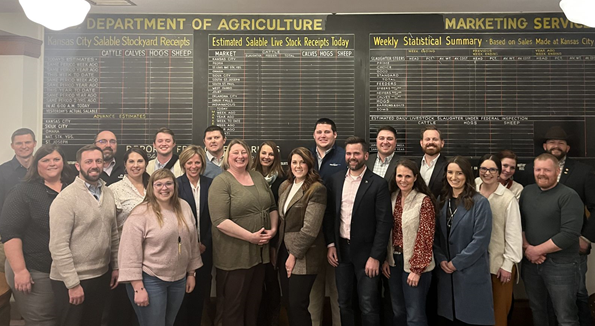
Cohort 2 with Kerryann Kocher, Vytelle; Eric Moore, Norbrook; and Jared Wareham, Genus ABS at the Livestock Exchange Building with the original pricing boards.
The second cohort of the National Institute for Animal Agriculture's (NIAA) Advanced Training for Animal Agriculture Leaders completed their first in-person leadership training session in Kansas City, Missouri.
In January, NIAA announced the second cohort of the Advanced Training for Animal Agriculture Leaders. This leadership training course is sponsored by the United Soybean Board and was created by NIAA to empower animal agriculture professionals to strengthen previous leadership development experiences and collaborate with peers across the industry.
During their time in Kansas City, Cohort participants met with Kansas City-based leaders in multiple sessions:
Innovation & Investment in Animal Agriculture
Federal Courthouse Tour
This visit outlined the role of the Courts and insights into food and agriculture from a legal perspective.
Building on our Traditions
Celebrating agriculture's history as a foundation for our future.
The second day of the training focused on strengths-based leadership development.
"Our first training session was extremely valuable. The time we spent collaborating and learning from our peers, understanding our personal strengths, and learning more about the rich agricultural history Kansas City boasts, gave us all excitement and anticipation for what's still to come over the next 16 months." said Kayla Rink, Senior Manager, Dairy Science and Farm Practices at Dairy Farmers of America and cohort member.
The second cohort of the Advanced Training for Animal Agriculture Leaders represents a range of agricultural sectors to advance animal agriculture's role in today's food system. Participants include Tressa Lacy, TransOva Genetics; Jared Bramer, Kemin Animal Nutrition & Health – North America; Amanda Butterfield, North American Meat Institute; TJ Flax, Dexer; Trisha Klement, Datamars Livestock; Phillip Lancaster, Kansas State University; Miriam Martin, North American Meat Institute; Chandler Mulvaney, National Cattlemen's Beef Association; Jake Renner, American Gelbvieh Association; Jennette Rietcheck, Norbrook; Kayla Rink, Dairy Farmers of America; Grant Sardella, ABS Global; Jennifer Schmitt, Institute on the Environment, University of Minnesota; Austin Snook, Merck Animal Health; Sarah Thomas, The Ohio State University; Brandon Treichler, Treichler Consulting Services; Stephanie Ward, NC State University; Jonathan White, United Producers NC; Tim Bardole, United Soybean Board; and Shannon Ellis, United Soybean Board.
Learn more about the leadership program, its sponsors, and see pictures of Cohort 2's visit to Kansas City, visit https://www.animalagriculture.org/leadership-program/.
Ground nesting bird populations are essential indicators of your ranch's ecological health.
Ground-nesting birds serve as an important indicator of a healthy ranch, according to Alan Sparks, senior research associate at Noble Research Institute. Such birds belong to a diverse group, from shorebirds that nest on sandy and rocky areas along ponds and lakes, such as killdeer and sandpipers, to some species of waterfowl that tuck their nests away in deep vegetation.
But, when it comes to evaluating ranch management, not all ground-nesting birds are created equal. The presence and prevalence of grassland ground-nesting game birds, such as the northern bobwhite quail and wild turkey, are key clues about your land's ecological health and diversity.
"I think using grassland birds is like a blanket indicator. If they're functioning properly, then you can, in a general statement, say the ecosystem on your ranch is functioning properly, as well," Sparks says.
Grassland ground-nesting birds, especially quail, can be good barometers for healthy land because they thrive in diverse native pastures. Quail coveys, or small flocks, prefer bunch grasses, such as little bluestem, big bluestem and Indiangrass to nest in, and they rear their young in the spaces between the bunches. They also need large forbs and brush to provide cover from predators. In addition to habitat requirements of quail, turkeys also need mature wooded areas near water, because the adult birds roost in trees.
If both of these game birds are present on your ranch, chances are you have healthy and diverse land that welcomes wildlife with a mixture of native grasses, forbs, brush and trees. Simply put, grassland ground-nesting game birds reflect a balanced landscape, habitat and grazing area.

Providing these diverse habitats is of the utmost importance, as some estimates show that the grassland ground-nesting game bird population has declined by as much as 60% over the last 50 years, according to Sparks.
Much of this decline can be attributed to some agricultural management practices. Overgrazing ruins the cover quail coveys need to raise their brood successfully. Dense monoculture, introduced-grass pastures no longer give the birds space to nest, and fractured tracks of land often hinder natural game trails and habitats. But regenerative ranching can encourage ground-nesting birds by increasing their natural habitats on your land.
With grassland ground-nesting birds serving as such an important indicator of your ranch's health, it is important to be mindful of them. Sparks recommends taking nesting season into your grazing management plan considerations.

To manage around grassland ground-nesting birds, you have to know where they are.
Biologists studying grassland birds conduct flush counts. During these counts, scientists tie a rope to a stick and drag the rope along the ground while walking through a specific portion of the field. This allows the biologists to count, record and survey the number and types of birds which are flushed from each part of the field.
Ranchers can take a less-formal approach to bird counts by simply noting any grassland ground-nesting birds they see while driving fields or checking their livestock or fences. Sparks suggests ranchers jot down bird sightings and locations — the notes app on their phone or a notebook in the ranch truck will work great.
These notes will help ranchers plan grazing and land management tactics around ground-nesting species to ensure the birds can safely rear their brood.

Another great way to track grassland ground-nesting birds on your ranch is to simply listen. Biologists also use this technique to survey bird populations, but it is a little more advanced. Scientists take acoustic recordings of properties they are surveying. These audio files are downloaded and run through a program that converts acoustic data to spectrograms, or visual representations of the pitch, frequency and pattern of a bird call. This technology allows researchers to "see" sound. Using spectrograms, biologists can easily use computer programs to sort and catalog bird calls and their frequency to help estimate populations.
"Birds are easy to see, and they're easy to listen to," Sparks says. "We could almost survey the birds and then be able to say what is happening all the way down to your soil. If your soil is functioning the way it's supposed to be, you'll probably have the plants that you're supposed to have, and therefore you'll have the right grassland birds."
Ranchers don't need complex computer programs to use this methodology, though. They can simply note quail and turkey calls that they hear on their land. And, if they're unfamiliar with different bird calls, Sparks says there is an app for that. Many free or low-cost bird identifier apps are available for smartphones, and some can even listen to a call and identify the bird. One example is Merlin Bird ID, which can identify birds by sound or image and lets you track date and location of your sighting.
Regardless of how the sound is gathered or processed, the familiar "bobwhite" whistle and wild turkey gobble should be welcome sounds on your ranch.

Outside of serving as a valuable measurement metric for ranch ecology, grassland ground-nesting birds offer a plethora of benefits for regenerative ranchers.
Quail and turkey both feed on many insects that are detrimental to pastures and crops. These game bird species also offer an additional revenue opportunity for ranchers if their populations are ample enough for hunting and harvesting. Bird-watching also provides a growing opportunity for ranchers willing to open their land to ecotourists.
Managing your land to encourage ground-nesting birds can not only improve the health and diversity of your ranchland, but it can also offer value-added marketing opportunities for your livestock. Programs like the Audubon Conservation Ranching Incentive offer a market-based certification process, which adds value to ranchers' products that were raised with grassland and wildlife management in mind.
As Sparks says, when it comes to regenerative ranching, producers do not need to choose between their livestock or the wildlife.
"With proper grazing, you can still get everything you need for the cattle and also maintain that habitat for these grassland birds."
Note: This article is part one of three in our Wildlife Watch series about monitoring and managing wildlife on regenerative ranches.
Story Credit: Katie Miller, Noble Research Institute
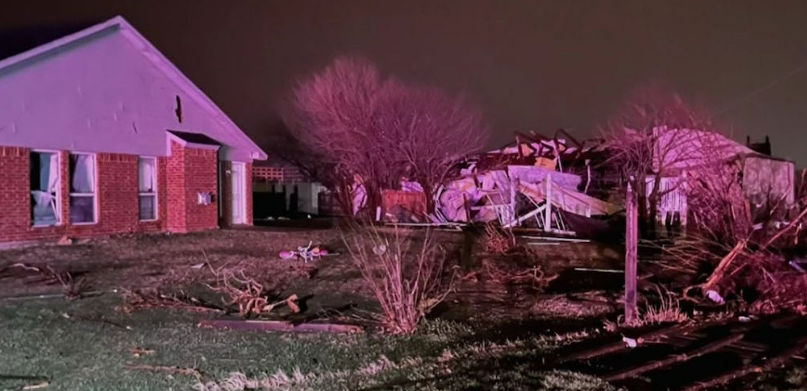
– U.S. Department of Agriculture (USDA) Rural Development Oklahoma State Director Kenneth Corn announced today that the Biden-Harris Administration is making grants available to assist Rural Oklahomans in the repair of their homes damaged by severe weather in 2022 in select counties that were declared disasters by the President.
The homes must be located in presidentially declared disaster areas. People living in seven counties in Oklahoma are eligible for the funding.
"Oklahomans all too well know the destructive forces Mother Nature can bring to the Sooner State and unfortunately the increasingly negative impacts of climate change have made each successive year harder for Oklahoma families to recover from these powerful storms," Corn said. "However, the Biden-Harris Administration has made it known they want to use the power of our federal government for good and ensure our rural neighborhoods in Oklahoma are able to afford the repairs so our neighbors in Oklahoma can live in safe and secure homes."
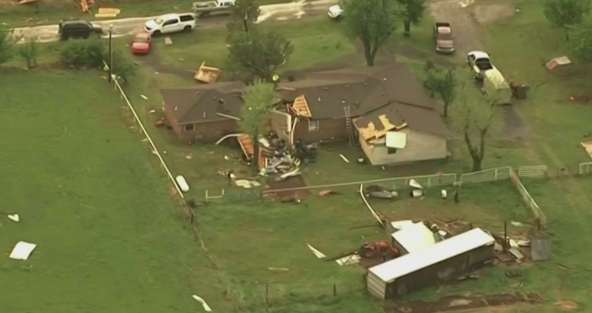
The grants are being made available through supplemental disaster funding under the Rural Disaster Home Repair Grant Program. Through this program, people may apply to receive grants of up to $40,675 directly from the USDA Oklahoma State Office to repair their homes.
Funds will be available until fully utilized. They may be used to:
To be eligible: ·
Residents in the following counties may be eligible for the funding:
"The Oklahoma economy depends on the work rural Oklahomans do every day, but that isn't possible without a strong foundation and pride in our rural homes," Corn said. "I am so thankful to our President for not only his leadership but more importantly delivering on his promises when Rural America raises its hand and asks for assistance."
For more information on how to apply, contact 405-742-1061 or visit https://www.rd.usda.gov/ok.
Background
The Biden-Harris Administration championed the bill known as the Consolidated Appropriations Act, 2023, that made this funding possible.
In the coming weeks and months, USDA expects to announce additional funding availability under the bill to help rural people in presidentially declared disaster areas who were impacted by natural disasters in 2022.
This additional funding will assist eligible organizations help rural people repair and improve their homes. It will also help rural communities repair water infrastructure and essential community facilities.
Additional resources to support rural communities seeking disaster assistance are available at https://www.rd.usda.gov/page/rural-development-disaster-assistance.
USDA touches the lives of all Americans each day in so many positive ways. Under the leadership of the Biden-Harris Administration, USDA is transforming America's food system with a greater focus on more resilient local and regional food production, fairer markets for all producers, ensuring access to safe, healthy and nutritious food in all communities, building new markets and streams of income for farmers and producers using climate-smart food and forestry practices, making historic investments in infrastructure and clean energy capabilities in rural America, and committing to equity across the Department by removing systemic barriers and building a workforce more representative of America.
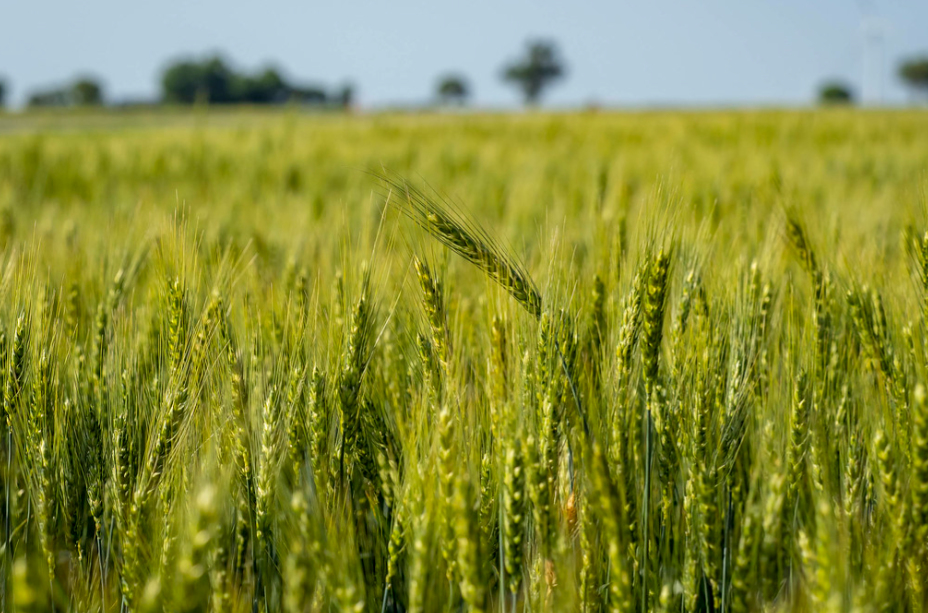
Oklahoma State University wheat varieties are among the top four varieties planted in Oklahoma for the ninth consecutive year. (Photo by OSU Agriculture)
By Alisa Boswell-Gore
Oklahoma State University wheat varieties are among the top four varieties planted in Oklahoma for the ninth consecutive year, according to the USDA National Agricultural Statistics Service.
"Wheat is essential to human nourishment and health. Our research in wheat genetics is well positioned to continue leading the nation in advances in food sustainability, quality and security," said Scott Senseman, associate vice president of OSU Ag Research. "We are proud to see the evidence of our scientists' discoveries making the world better through the land-grant system."
Doublestop CL Plus remains the most planted wheat variety in the state for the second consecutive year. It has remained in the top three since 2019. Gallagher has remained in the top three of most planted varieties since 2015, while Smith's Gold has remained in the top four since 2020.
The following OSU wheat varieties are the top five planted varieties in the state in 2023:
Endurance, OK Corral, Bentley, Iba, Butler's Gold, Strad CL Plus, Centerfield, Duster, Uncharted, Deliver, Garrison, Ruby Lee and Baker's Ann were also planted in Oklahoma this year.
"We do not take for granted Oklahoma producers' trust in the OSU Wheat Improvement Team," said Brett Carver, wheat genetics chair in the OSU Department of Plant and Soil Sciences. "We must improve productivity and genetic diversity in our varieties so that wheat producers can improve their bottom line and diversify their operations. The success of our entire wheat industry rests on the success of our wheat producers."
WIT is already well on its way to doing so with a new hard red winter wheat variety called High Cotton that was recently approved for commercial release. The variety significantly raises yield and has broad disease resistance. It can also serve as a dual-purpose wheat to support the state's beef cattle industry.
OSU Ag Research is Oklahoma's premier research and technology development agency in agriculture, natural resources and the life sciences.
At the recent International Livestock Congress in Houston, Texas, Senior Farm and Ranch Broadcaster Ron Hays had the chance to talk with the Executive Vice President of the Canadian Cattle Association, Dennis Laycraft.
"We actually have a great story in the North American cattle industry," Laycraft said. "We are amongst the most efficient cattle producers in the world, which means we have the lowest greenhouse gas footprint in the world."
Canada and the United States, Laycraft said, have been working together to ensure that animal agriculture is better understood in sustainability conversations.
"Attending meetings like this where we are sharing the best possible information, I think helps all of us when we engage in that bigger conversation," Laycraft said.
Laycraft also talked about how the cattle industry in the U.S. and Canada is very similar in terms of genetics, feeding methods and more.
"We have been seeing cattle move back and forth for probably 150 years, so it is not surprising we would be very similar," Laycraft said.
Like in the United States, Laycraft said cattle producers in Canada are also dealing with higher input costs.
"We are seeing higher prices as we are heading into this year, and a lot is going to depend on the weather," Laycraft said. "Last year we had a good growing year for most of Canada. The year before we had a terrible drought, so if we get good growing conditions and move through the year, then I think we are looking at a fairly reasonable year for 2023."
In regards to the international marketplace, Laycraft also talked about what Canada has to offer to their international customers.
"Interesting enough, particularly in Asia, there is this huge demand for grain-fed beef," Laycraft said.
The U.S. and Canada have both been able to satisfy that demand for high quality beef, Laycraft said, as the demand continues to grow each year.
"The only thing that is really limiting our exports right now is our own supplies," Laycraft said. "That is how strong the demand is."
The Beef Buzz is a regular feature heard on radio stations around the region on the Radio Oklahoma Ag Network and is a regular audio feature found on this website as well. Click on the LISTEN BAR for today's show and check out our archives for older Beef Buzz shows covering the gamut of the beef cattle industry today.
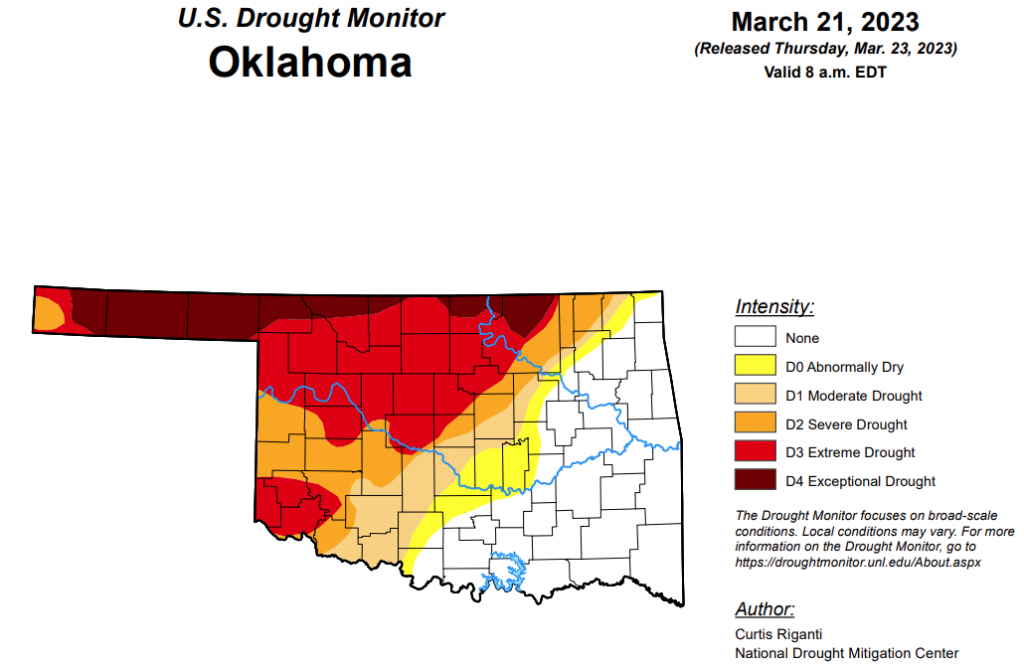
To view the Oklahoma Drought Map, click here.
After four weeks of no changes in the exceptional drought category, this week, exceptional drought has increased from 8.86 percent to 11.21 percent in Oklahoma.
Extreme drought or worse is still at 36.64 percent- the same as weeks before.
Severe drought or worse is virtually unchanged, moving from last week's 50.58 percent to this week's 50.12 percent.
Moderate drought or worse is unchanged from last week at 59.07 percent.
Abnormally dry or worse conditions are also the same as last week at 65.61 percent.
According to the 6-10 day precipitation outlook map, the northwest corner and the panhandle regions of Oklahoma stand at a near normal chance of precipitation through April 1. The southwest corner, up through central Oklahoma and the northeast corner of the state are learning above a 33 to 40 percent chance of precipitation. As for the southeast corner, that part of the state is learning above a 40 to 50 percent chance of precipitation through April 1.
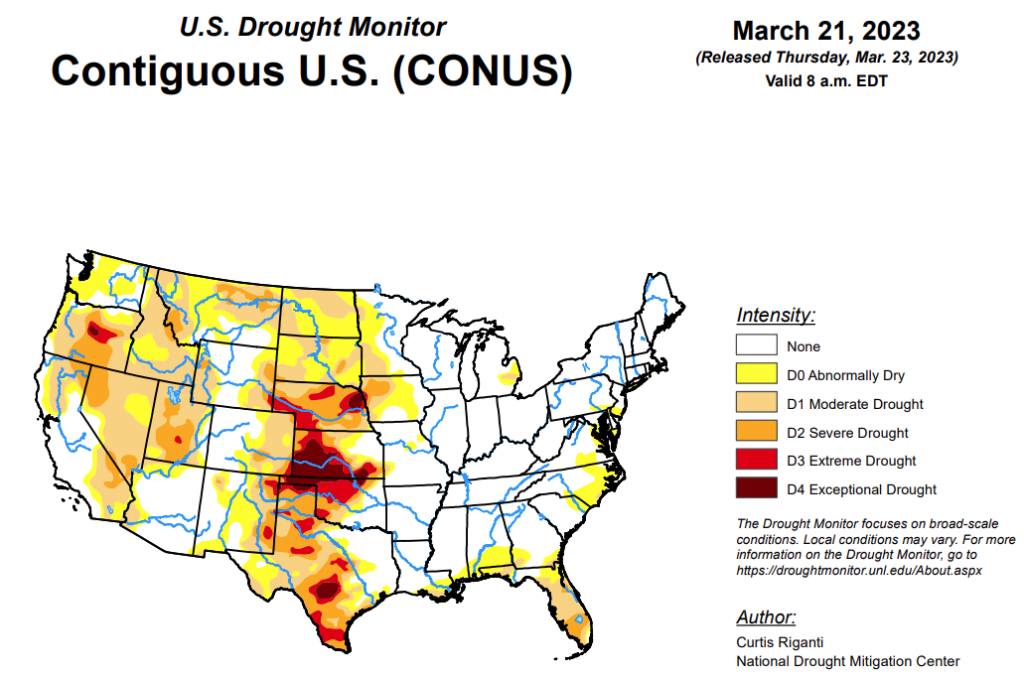
To view the United States Drought Monitor Report, click here.
According to the latest U.S. drought monitor report, his week, heavy precipitation fell in parts of the West, especially in California, while drier weather generally occurred in the Great Plains east of the Rocky Mountains. Heavier precipitation also fell along parts of the Rio Grande in Texas, leading to some improvements of drought conditions there. Widespread precipitation amounts at or above a half inch fell in east Texas eastward into the Southeast, and from near Interstate 44 in Oklahoma eastward into Arkansas and southern Missouri. New York and southern New England also saw near a half inch of precipitation this week, with localized higher amounts. Dry weather continued in parts of the Florida Peninsula, where severe drought coverage increased in several areas. In response to rainfall in central Puerto Rico but continued dry conditions in the northwest, abnormal dryness coverage shifted a bit there. Recent dry weeks in Hawaii led to decreased streamflows and the introduction of abnormal dryness on all islands except Kauai and Niihau. For more detailed information for each region, please refer to the paragraphs below.
In the Southern Plains, widespread precipitation amounts of at least a half inch fell across the eastern two-thirds of the region, with localized spots in far east Texas, Louisiana, southwest Mississippi and central Arkansas reaching 2 inches. Oklahoma northwest of Interstate 44 and much of central and west Texas had mostly dry weather this week. Exceptions to this occurred in many areas along the Rio Grande from the Big Bend east in southern Texas, which received localized heavier precipitation amounts from 0.5 to 2 inches. Temperatures across the South region this week were generally 5 to 15 degrees cooler than normal. Continued dry conditions in the Oklahoma and Texas panhandles led to expansions of severe and exceptional drought where soil moisture and groundwater levels continued to drop. In the northern Texas Panhandle, the winter wheat crop is in danger of total failure, which is indicative of the soil moisture and precipitation deficit problems in the area. In areas that mostly missed out on heavier rains in central Texas, streamflow continued to drop amid growing precipitation deficits, leading to expansion of drought and abnormal dryness in some locations. Farther south, in the Big Bend region and in south-central Texas, localized improvements were made due to benefits from recent heavier rainfall. Ongoing short- and long-term drought and abnormal dryness remained unchanged in southern Louisiana and Mississippi, and the rest of the region remained free of drought or abnormal dryness.
In the High Plains, temperatures in the High Plains region were mostly below normal for the week. The most significant departures occurred in the Dakotas, where temperatures mainly ranged from 15 to 25 degrees colder than normal outside of southwest South Dakota. Precipitation fell in some of the high elevation areas of Colorado and Wyoming this week; otherwise, the weather was mostly dry in the High Plains region. Moderate and severe drought expanded slightly in southeast Kansas; please see the Midwest paragraph for more details on this. Due to recent snowfall and lessening precipitation deficits, portions of northwest North Dakota saw reductions in moderate and severe long-term drought coverage. Otherwise, ongoing long-term drought was unchanged east of the Rocky Mountains. In north-central South Dakota, stock pond levels and river levels remained low, despite some recent snowmelt, indicative of long-term dryness there. Parts of the Sangre de Cristo Mountains and far eastern San Luis Valley saw some improvements due to increased snowpack. Increased recent precipitation in southwest Wyoming allowed for the removal of severe drought.
In the West, most of the West saw temperatures near or below normal for the week, with a few areas of temperatures between 10 and 15 degrees below normal occurring in the Intermountain West, especially in Utah, Idaho, Nevada and Oregon. Widespread precipitation in the form of rain and snow, with localized very heavy amounts, occurred in parts of the region, especially in the San Bernardino and Sierra Nevada Mountains in California. A few spots in the northern Sierra Nevada saw improvements where snowpack increased further. Lush vegetation was reported in San Bernardino County, California, indicative of the very wet recent weather. The effects of recent wet weather will continue to be analyzed in the coming weeks over this area, and slight improvements to lingering abnormal dryness were made in southwest California this week. Large areas of severe and extreme drought in northern Nevada, northern Utah, Oregon, southern Idaho and northern Montana saw improvements due to recent precipitation and lessening precipitation deficits. Due to increased soil moisture and lessened precipitation deficits, improvements to ongoing long-term drought and abnormal dryness were also made in southeast Arizona and southwest New Mexico, and in portions of south-central and northwest New Mexico.
Looking ahead, through the afternoon of Monday, March 27, the National Weather Service Weather Prediction Center is forecasting mainly dry weather in the northern Great Plains, Minnesota and northwest Wisconsin. Mostly dry weather is also forecast in most of the Florida Peninsula, where short-term moderate and severe drought has intensified recently. Aside from some of the higher elevation areas, mostly drier weather is forecast in southern Nevada, southeast California, Utah and New Mexico. Heavier precipitation amounts are forecast for parts of western Oregon and Washington and far northwest California. Heavy rainfall, locally up to or exceeding 3 inches, is forecast along and south of the Interstates 44 and 70 corridors from far northeast Oklahoma into Ohio. Widespread rain amounts of at least 1.5 inches are likely in the northern halves of Georgia, Alabama and Mississippi, and in the southwest half of Tennessee. Widespread precipitation amounts of 0.5-0.75 inches are likely in much of the Northeast, with localized higher amounts.
To view the 6-10 Day Precipitation Outlook Map, click here.
To view the 6-10 Day Temperature Outlook Map, click here.
To view the Monthly Drought Outlook Map, click here.
Starting with the May 12, 2023, release (issue No. 636), the following change will be made to the World Agricultural Supply and Demand Estimates (WASDE) report:
Sample WASDE tables, including the revised table, are available on the WASDE website.
The World Agricultural Supply and Demand Estimates is prepared and released by the U.S. Department of Agriculture (USDA) World Agricultural Outlook Board (WAOB). The report is released monthly, and provides annual forecasts for supply and use of U.S. and world wheat, rice, coarse grains, oilseeds, and cotton. The report also covers U.S. supply and use of sugar, meat, poultry, eggs and milk, as well as Mexico's supply and use of sugar. The WAOB chairs the Interagency Commodity Estimates Committees (ICECs), which include analysts from key USDA agencies who compile and interpret information from USDA and other domestic and foreign sources to produce the report. For more information about the WASDE process and data, visit the WASDE FAQ page.
USDA touches the lives of all Americans each day in so many positive ways. Under the Biden-Harris administration, USDA is transforming America's food system with a greater focus on more resilient local and regional food production, fairer markets for all producers, ensuring access to safe, healthy and nutritious food in all communities, building new markets and streams of income for farmers and producers using climate smart food and forestry practices, making historic investments in infrastructure and clean energy capabilities in rural America, and committing to equity across the Department by removing systemic barriers and building a workforce more representative of America. To learn more, visit www.usda.gov.
Once again, and tragically this time, Russian intervention is the underlying source of dramatic global wheat price volatility.
"...We are closely monitoring prices for the most essential social goods such as food, including bread," said Russian Prime Minister Mikhail Mishustin this week about its domestic wheat supply. "Russian grain is in good demand from abroad, and its price is increasing. That said, it is necessary to provide the necessary raw materials, first of all, to the domestic baking industry."
The Prime Minister made this comment with specific reference to the hyper reaction of global wheat prices to Russia's invasion of Ukraine and the immediate impacts of the widespread economic sanctions levied on Russia in response. Yet it spotlights the core tenants of Russia's protectionist and heavy-handed wheat supply and price control policies. Russian intervention has been front and center since the country first entered the global wheat export trade.
Anyone who does not take the Prime Minister at his word on this sets themselves up for a very disappointing and expensive lesson. Defending Russian domestic supplies and keeping domestic prices low by withholding supplies from the world will always be their primary wheat policy weapon. And they deploy it without regard for the harm and expense it creates for anyone.
Underscoring this point, the Russian Ministry of Economy confirmed on Mar. 11, 2022, that they are banning wheat exports through Aug. 31, 2022, to their fellow Eurasian Economic Union member states, including its Ukraine invasion staging partner Belarus, along with Armenia, Kazakhstan and Kyrgyzstan.
In six documented situations since 2007, when the global wheat market showed any sign of stress, the government of Russia stepped in to impose an export ban, export tax or export quota to isolate their home market. These actions intentionally limited world wheat importers' access to Russian wheat supplies. This Russian intervention further magnified any supply shortage and accelerated the rise in wheat prices.
Twice in this time frame, Russian military aggression against Ukraine directly caused world wheat prices to spike sharply. The world is reeling viscerally and economically from the shock of that situation right now.
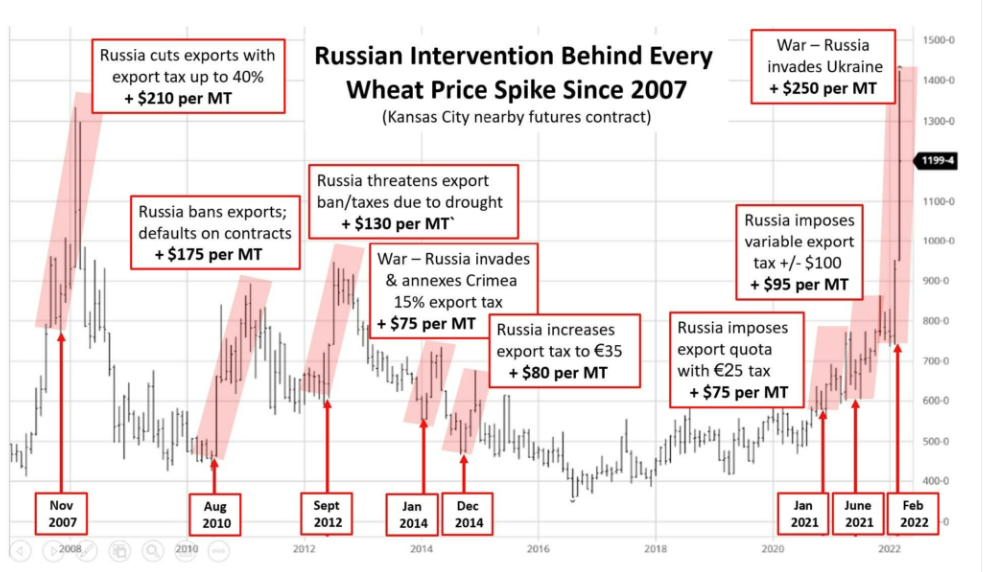
The COVID-19 pandemic lifted the tide of global inflation by disrupting global supply chains. Now, Russia's war on Ukraine has blocked nearly 30% of the expected wheat export supply from governments and people that depend on it the most. Uncertainty runs rampant. And it is almost impossible to know how this war will be prosecuted. How long it will persist? What will the physical and economic situation of Ukraine and Russia be at the end?
Market analysts everywhere are trying to assess the many implications of this latest Russian intervention. Who will be most severely impacted? What will be the magnitude of the shortage created in the global wheat supply chain? And how will the world's remaining supplies be apportioned, priced and relocated to the most severely affected countries?
The extreme wheat price volatility seen in the past two weeks sits witness to this uncertainty.
Such high prices and volatility create challenges for the world's wheat buyers and farmers and grain traders, who must also use the futures market to manage price risk. It is important to note that the U.S. wheat market remains fully open to importers and users everywhere. Dependable U.S. wheat producers and our reliable export system stand in the gap. They are ready and able to supply wheat as broadly to the world as our own supplies, and logistical capacity can accommodate.
In addition to the wheat price inflation attributed to Russian intervention, U.S. wheat prices reflect that last year's drought in the Northern Plains and Pacific Northwest limited current U.S. supplies. However, this year's original export expectations and calculations do not include all U.S. supplies available. And wheat farmers will harvest a new crop starting in June.
U.S. Wheat Associates (USW) also creates additional value for U.S. wheat through the services it offers its customers. As they navigate this extreme market situation to secure the wheat necessary to feed people worldwide, USW remains ready to provide any information, tools and assistance within our means that may be helpful.
Editor's Note: On March 11, 2022, U.S. Wheat Associates (USW) President Vince Peterson commented on the Russian government's role as a source of great uncertainty for the world's wheat producers, sellers and buyers. One year later, the price disruption of Russia's unprovoked invasion of Ukraine continues. While prices have settled since the invasion started, the market still moves on every scrap of news from the Black Sea region. Reprinted here are Mr. Peterson's views then, providing perspective today.
By USW President Vince Peterson
Join Oklahoma Ag in the Classroom for a special professional learning opportunity over National AITC's new resource "Ag Badging Field Guides." This resource was specifically created for 3rd-5th grade students, but it could be used at Ag Days or with 4-H students.
Follow this link to preview the resource: https://agclassroom.org/matrix/resource/1236/.
We have 5 professional development workshops available throughout the state which will include hands-on training and a local farm tour. Each participant will leave with 30 guides for students. Limit of 20 teachers per workshop, and lunch will be provided for participants.
Register at the link below and email Emily.ague@ag.ok.gov with any questions. You will be notified within 48 hours (possibly longer on weekend) of applying if you are accepted to attend the workshop.
Workshop Options (You only need to attend 1):
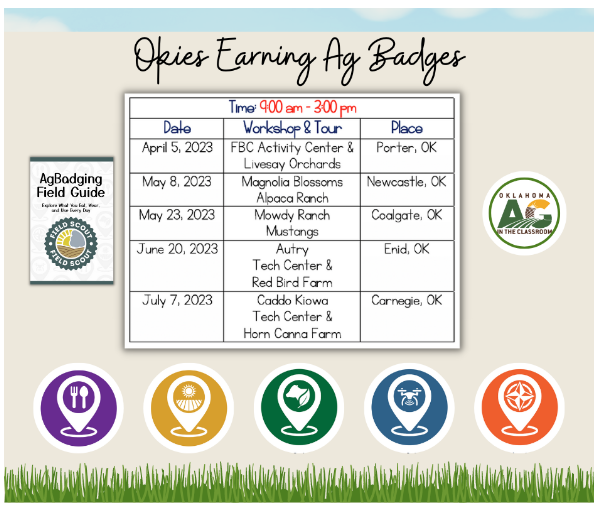
The U.S. Department of Agriculture today announced the names of individuals who will hold senior staff positions in Washington, D.C.
Kenneth Walker, Assistant Chief for the Natural Resources Conservation Service
Walker comes to USDA from the Mississippi House of Representatives, District 27. As a State Representative, Walker served as Vice Chair on the Workforce Development Committee and Member of the Agriculture, Water and Conservation, Education, Energy, and Forestry Committees. As a lifelong farmer, Walker grew up on a farm in Leake County, Miss., supporting the farms' cattle production. He was also a member of the local cattleman's association and a volunteer firefighter for the Ofahoma Volunteer Fire Department. Before serving as a State Representative, Walker was a Project Manager at United Water, overseeing the maintenance and operation of the Jackson, Miss., wastewater treatment plant. He received his Bachelor of Science and Master of Science from Jackson State University.
Ramón Correa-Colón, Oversight Director for the Office of Congressional Relations
Correa-Colón joins USDA from the U.S. House of Representatives, where he served as Legislative Counsel for a Member of the House Committee on the Judiciary, handling a portfolio that included immigration, civil rights, civil liberties, the federal judiciary, and oversight. Before that, he worked at the Puerto Rico Federal Affairs Administration, Office of the Governor of Puerto Rico in Washington, D.C., as General Counsel and Policy Advisor. In this role, he advised on proposed rules, pending legislation, and responses to Congressional inquiries and covered public policy issues around economic development, appropriations, public safety, and disaster recovery. Correa-Colón is a licensed attorney admitted before the Commonwealth of Puerto Rico, the Puerto Rico U.S. District Court, and the U.S. First Circuit Court of Appeals. Previously, Correa-Colón held roles as a judicial law clerk at the Supreme Court of Puerto Rico and the Puerto Rican Academy of Jurisprudence and Legislation, among others. He has a Bachelor of Arts in Political Science from the University of Puerto Rico and a Juris Doctor from the University of Puerto Rico School of Law.
Jaime Jackson, Senior Advisor for the Rural Utilities Service
Jackson will join USDA after years of public and private service. Most recently, Jaime served as Director of Investments at a clean energy finance authority where she led over $25 million in deployment of capital that benefited affordable community housing. Before that, she spent 11 years at the Export-Import Bank of the U.S. (EXIM) where she led a $1.2 billion portfolio of power and high-technology corporate and project finance transactions spanning across Asia Pacific, Europe, Africa, and Latin America. Prior to EXIM, Jaime also held leadership roles in hospitality and data integrity industries. She is a member of Women of Renewable Industries and Sustainable Energy and The Association of Women in International Trade. Jaime holds a Bachelor of Arts in Business Finance from Clark Atlanta University and a Master of Business Administration from the University of Maryland.
A new Rancher's Thursday Lunchtime Series kicks off this week. The series will focus on Navigating Dry Conditions and High Prices. Join our Beef Cattle Extension team, experienced ranchers and scientists to learn and share beef cattle production, management and marketing tips. These free Zoom webinar sessions are scheduled for Thursdays at noon from March 23 to April 13.
Topics include:
March 23, 2023 – Weather and Grass Forecast with Brian Fuchs of the National Drought Mitigation Center and Dr Laura Goodman from the OSU Department of Natural Resource Ecology and Management.
March 30, 2023 – Using Warm-Season Annual Grasses to Restore Hay and Grazing Inventory with James Rogers from North Dakota State University and Paul Beck from OSU Department of Animal and Food Sciences.
April 6, 2023 – Selecting Cattle from Productivity and Longevity in Tough Conditions with James Henderson from the Bradley 3 Ranch and Mark Johnson from the OSU Department of Animal and Food Sciences.
April 13, 2023 – The Future of the Cattle Industry – A View from South Texas with Robert Hodge, President and CEO of King Ranch and David Lalman OSU Department of Animal and Food Sciences.
Register for this webinar series at https://okstate-edu.zoom.us/webinar/register/WN_36PazDvSSd6vxCOuvgvO5A
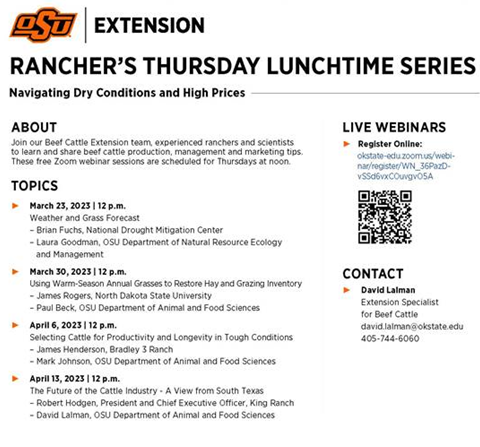
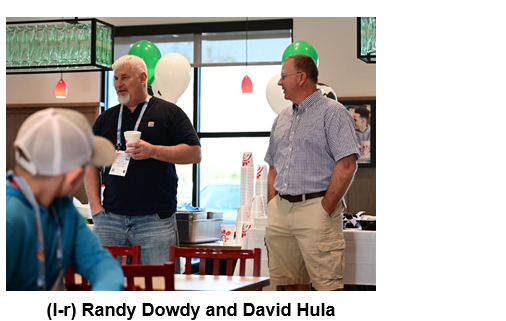
Chicken and biscuits were on the plate and insights from world-record-holding farmers David Hula and Randy Dowdy were on the table during a special Total Acre Grower Breakfast held at one of the nation's largest Chick-fil-A restaurants, during Commodity Classic 2023 in Orlando.
World record corn and soybean yield holders, Dowdy, a Georgia farmer, and Hula, a Virginia farmer, were joined by innovative corn and soybean farmers from across the country for the early morning discussion about profitability, optimizing crop yields and the 2023 planting season. Topics ranged from embracing advances such as precision agriculture and the use of cover crops to the importance of building soil health.
"Farming is like a big family," said Hula. "At Total Acre, our members are like family too. That relationship is what drives our ability to share the crop production information we have learned. Gathering at a Chick-fil-A, one of my personal favorites, and sharing time with my favorite people in the world, American farmers, offered a great way to talk about this year's crop and take a moment to celebrate the family spirit that lives in all U.S. crop growers."
"We are always looking for interesting ways to connect farming and food," said Lea Kimley, Director of Client Services at Stratovation Group, which planned and managed the event for Total Acre. "Being able to hold this Total Acre event at such an iconic food venue as Chick-fil-A really drove home a sense of community among the farmers."
Total Acre is a three-year program where hundreds of growers nationwide glean knowledge from Hula and Dowdy, two of the highest-yielding farmers in the world. In addition to the shared expertise, each Total Acre grower benefits from four, two-day farm camps every year, a dynamic software system customized to the industry, and a community of other growers to support them well beyond the program. To learn more, join the Total Acre interest list at: https://totalacre.com/interest-list.
RON's Dave Lanning has a pre-opening look at today's agricultural Markets.
Click the audio tab below for today's report.
Congressman Tom Cole (OK-04), Chairman of the Transportation, Housing and Urban Development Appropriations Subcommittee announced he will host a live roundtable discussion on Facebook with Midwest City Manager Tim Lyon and Tinker Air Force Base Air Base Wing Commander Colonel G. Hall Sebren, JR. The Facebook Live event will be held this Thursday, March 23, at 11:30 a.m. CT.
"Located near the heart of a larger urban area, Midwest City and Tinker Air Force Base have important perspectives not only on the benefits of economic growth and development in the area, but also on the increasing transportation and infrastructure needs to support and foster that growth now and into the future," said Cole. "Because of this, it is critical local and state partners and the federal government work together to meet infrastructure challenges that come with that growth and ensure the base, the largest employer in the state, can continue its mission unimpeded by challenges outside its gates. I look forward to discussing current and future projects that surround the base and the infrastructure needs of Midwest City with these community leaders."
Details for the event are below:
Date: Thursday, March 23, 2023
Time: 11:30 a.m. CT
Tune in: https://www.facebook.com/TomColeOK04

Growth Energy CEO Emily Skor issued the following statement today upon the reintroduction of the Next Generation Fuels Act in the U.S. Senate:
"American-made ethanol already makes a positive impact every day, but we've still only scratched the surface of the benefits this renewable fuel can deliver to the environment and to drivers across the country. The Next Generation Fuels Act recognizes that ethanol is the only fuel available today that can be immediately deployed to decrease our nation's carbon emissions, decrease our reliance on foreign oil, and decrease fuel costs for American families all at once. This legislation would give ethanol a greater role in decarbonizing our economy while decreasing volatility and lowering prices at the pump, and we urge all lawmakers on both sides of the aisle to join Senators Grassley and Klobuchar to see the bill quickly signed into law."

The Next Generation Fuels Act was reintroduced in the U.S. Senate today, drawing praise from the National Corn Growers Association. The legislation, which has been one of NCGA's top advocacy priorities, would lower fuel prices, reduce carbon emissions and help shore-up America's energy security.
Sens. Chuck Grassley (R-Iowa) and Amy Klobuchar (D-Minn.) led the bipartisan Senate reintroduction along with Sens. Joni Ernst (R-Iowa) and Tammy Duckworth (D-Ill.).
"We're very grateful to Sen. Grassley, along with Sens. Klobuchar, Ernst and Duckworth, for taking the lead on this priority legislation for corn growers," said NCGA President Tom Haag. "The Next Generation Fuels Act addresses some of the country's most pressing concerns by providing consumers with more options in the transition to cleaner fuels and vehicles and supporting our long-term energy security."
The Next Generation Fuels Act would clean up our nation's fuel supply and transition new vehicles to use cleaner, more efficient fuels that also lower costs for drivers. By establishing a clean, high-octane standard for fuel and requiring that sources of additional octane result in at least 40% fewer greenhouse gas emissions, the legislation would allow automakers to significantly improve vehicle fuel efficiency through advanced engines.
The legislation builds on our nation's clean energy progress by advancing higher ethanol blends and new vehicles that work together to deliver greater emission reductions, cost savings and consumer choice.
As NCGA has called on the Biden administration to act to prevent a disruption in access to higher blends of ethanol this summer, the Next Generation Fuels Act would also permanently remove regulatory barriers, allowing for higher ethanol blends and advanced vehicles that deliver greater emission reductions and cost savings in order to maintain a wider range of competitive fuel and vehicle choices.
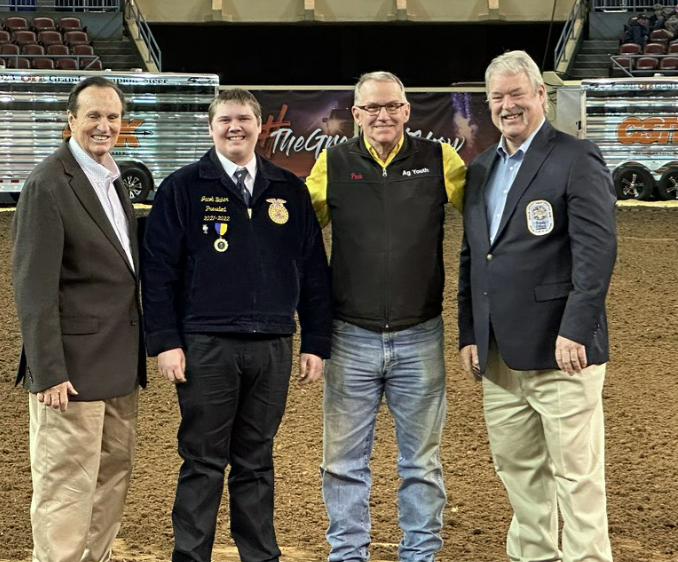
Ahead of the Oklahoma Youth Expo's grand drive, Senior Farm and Ranch Broadcaster Ron Hays, caught up with the owner of Ag Youth Magazine, Larry Peck. Hays and Peck talked about the advancement of OYE over the years.
Peck first talked about how much the show industry has grown over the last decade. Peck has been coming to livestock shows in Oklahoma City since around 1970, he added.
The Oklahoma Youth Expo has been able to flourish over the years, Peck said, thanks to great leadership, volunteer support, sponsors and more. Through making the youth a priority, Peck added, the show has come a long way.
At the first OYE, Peck said there was only three photographers. At the 2023 Grand Drive, Peck said the show had over 30 photographers ready to cover the event.
"It is just amazing where we have come from the old days of the spring fair, or the Oklahoma City fat livestock show," Peck said.
Years ago, Peck also played an integral part in getting the goat show at the Oklahoma Youth Expo running. After receiving a call from a friend asking how to have a goat show at OYE, Peck talked to a few people to see what needed to be done.
After talking with Jimmy Harrell, Peck said he was told it would probably take around $25,000 per year, for a three year commitment.
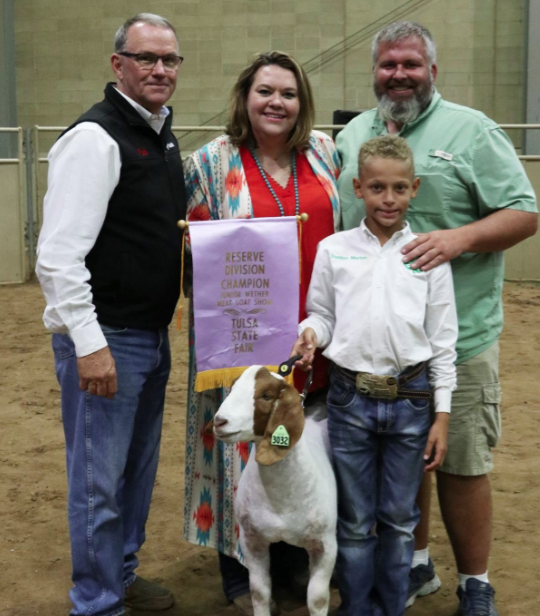
"They just as well have said a million dollars," Peck said.
A friend of Peck's with Farm Credit, John Grunewald was the next to receive a call from Peck. After talking things over, Grunewald agreed to give it a shot.
"That is why you see Farm Credit of Western Oklahoma still presenting the trophies here in the ring today, and that is who said, 'amen,' to show in their progressiveness," Peck said.
Peck said the state of Oklahoma is known around the nation as the premier place for livestock.
"People travel all over the nation to buy them, but when it comes down to it, the good ones are in Oklahoma, the good feeders are right here in Oklahoma," Peck said.
Illinois native to lead largest beef breed media company

The Angus Media board of directors recently named Clay Zwilling president of the organization to guide the company as it delivers industry-leading education, information and marketing to the beef industry.
"Clay is a natural leader," said Mark McCully, vice chairman of the Angus Media board of directors and chief executive officer for the American Angus Association. "His passion for innovation, while keeping an eye on the tradition, makes him a perfect fit."
Most recently, Zwilling was the chief operating officer for Walton Webcasting, where he helped develop the organization during a time of rapid growth. Prior to that, he was the chief executive officer of the National Swine Registry working with the executive committee, breed boards and membership to create and execute their vision and mission. Zwilling started his professional career with Farm Credit Illinois as the director of marketplace education and development.
"Angus breeders are stewards of both their herds and family ranches, as well as the Angus legacy," Zwilling said. "Angus Media plays an important role in telling their stories and giving them cutting-edge, cost-effective marketing tools to achieve their goals."
Zwilling brings diversified livestock experience to Angus Media, but his roots are in the beef business. He grew up raising cattle and knows that background from other segments of the livestock industry is additive, giving him additional perspective.
"I believe the vision of Angus breeders is very much like the rest of the livestock industry," he says. "We all want to ensure the profitability of the industry we love. That requires an understanding of the tried and true but with the ability to be innovative and creative."
That kind of vision is exactly what intrigued him about the position, and similarly why the Angus Media board selected him as the new president.
Zwilling holds a master's degree from Texas A&M University in Agricultural Leadership, Education and Communication. He did his undergraduate work at Oklahoma State University and Lake Land College in Illinois. In addition to his work experience, Zwilling has held various leadership roles within the livestock and agriculture industries, including currently serving on the board of National Pedigreed Livestock Council and OSU Animal Science Alumni. He was an All-American and a member of the national champion livestock judging team and is a past Illinois State FFA president.
Zwilling will assume his duties as president on May 8 and will relocate to the St. Joseph area with his wife, Deanna, and their 2-year-old daughter, Allie.
For more information about Angus Media and the American Angus Association, please visit angus.org.
—Written by Holly Martin, Angus Communications
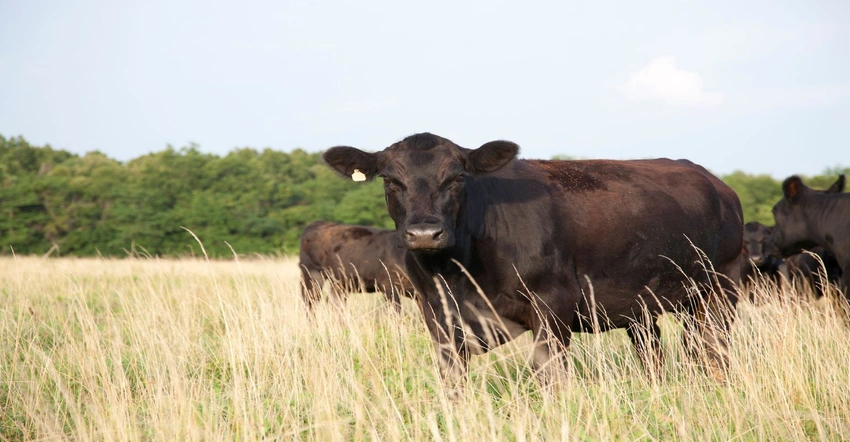
Senior Farm and Ranch Broadcaster, Ron Hays, is visiting with senior animal protein research analyst at Terrain, David Weaber, about strategy for rebuilding the cow herd once the drought comes to an end.
Launched in November of 2022, Terrain is a source of agricultural industry analysis farmers and ranchers in the United States. Terrain was established by American AgCredit, Farm Credit Services of America and Frontier Farm Credit.
"We have been waiting a long time to get rid of La Niña, and it looks like she is finally maybe on her way out the door," Weaber said. "That is great news for cow-calf producers that have been under this pressure from drought conditions for the last, some of them, three or four years."
That loss of cattle, Weaber said, has been reflected in the cattle inventory report. Around 2.8 million beef cows have been subtracted from the herd, Weaber added, since 2019.
"We had record beef production in 2022, but that is because we have been pushing all these heifers off ranches and not retaining them, and they are showing up going through feed yards," Weaber said. "We get a little bit of rain, and we are going to pull those out. They are going to go back to the beef cow herd."
One of the great things that came out of the pandemic, Weaber said, is that American consumers learned how to cook the upper two-thirds choice and prime steaks at home.
"We see that in the spreads for the value of those carcasses today and there is room for more of those to come through the system, so we are thinking about cow-calf producers, stocker operators, even feed yards- how to get them set up for this next part of the cattle cycle," Weaber said. "If you are a cow-calf guy, and you are going to rebuild, what are you going to do it with? Figure out what cows you got, what program to be part of, and we have got some time."
As producers begin to rebuild their cow herds, Weaber said it is important to be mindful, and have a good strategy.
"Single trait selection gives us single trait results," Weaber said. "We can't lose sight of the other things that are important."
Areas to consider such as growth, milk production, maternal feed efficiency and feed efficiency in the feed yards, Weaber said, are still driving economic factors that cannot be overlooked.
"The number one biggest driver of profitability outside of purchase price is feed efficiency," Weaber said. "We can't give that up in the process."
The Beef Buzz is a regular feature heard on radio stations around the region on the Radio Oklahoma Ag Network and is a regular audio feature found on this website as well. Click on the LISTEN BAR for today's show and check out our archives for older Beef Buzz shows covering the gamut of the beef cattle industry today.
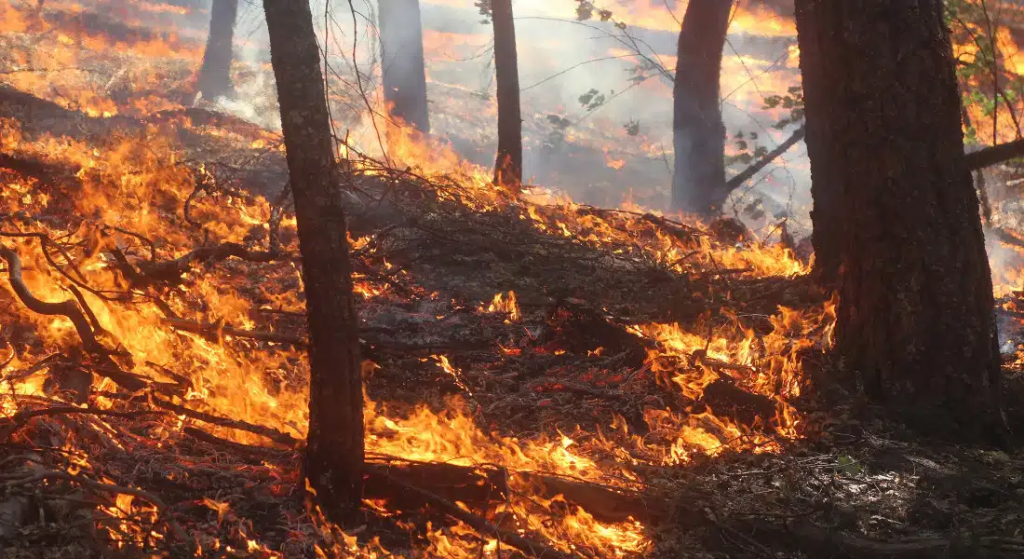
Oklahoma is the recipient of more than $134,000 in federal grant money awarded to reduce the risk of catastrophic wildfire. The funds are part of nearly $200 million announced by the U.S. Department of Agriculture, Forest Service that will benefit 22 states and seven tribes, as part of the Community Wildfire Defense Grant program. The grants will help communities, tribes, non-profit organizations, and state forestry agencies plan for and mitigate wildfire risks as the nation faces an ongoing wildfire crisis.
The city of Davis, OK will receive $134,477 to complete 9 projects on 1,500 acres as part of the Turner Falls Natural Wildland Restoration Project. The money will be used to reduce the threat of wildfire through the removal of ground and cedar fuel as well as the creation of firebreaks to enable firefighter access in areas with little to no current equipment access.
The grant comes as Oklahoma Forestry Services expands partnerships with local governments around the state on wildfire fuels mitigation efforts. Most recently OFS completed two projects in conjunction with the City of Bartlesville and Washington County. OFS is currently working to reduce the fuel load in Tulsa's Turkey Mountain Urban Wilderness.
Oklahoma Forestry Services is the state's lead wildland firefighting agency. For wildfire information, county burn ban resolutions, and the Oklahoma "Wildfire Situation Report" visit forestry.ok.gov.
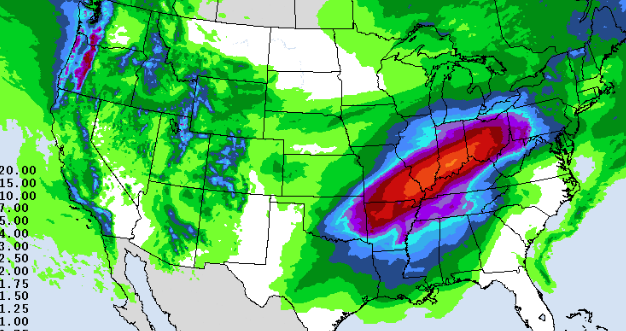
A big storm system is headed for the state tomorrow and Friday that brings with it some hope for more rain. According to State Climatologist Gary McManus, the rains we've been getting have "Skipped the areas roughly to the north and East of I-44"
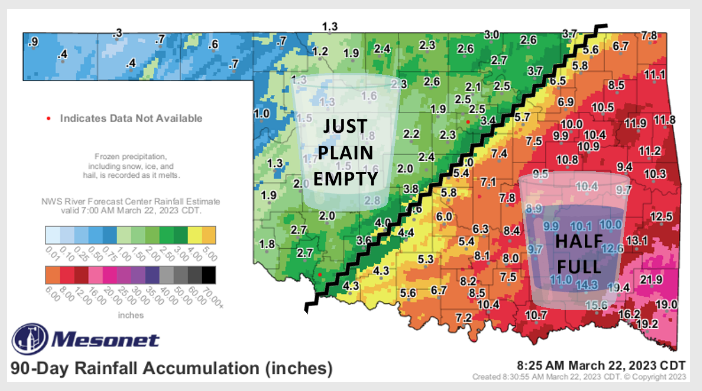
McManus says the threat of Tornado weather for tomorrow is very low, but Hail could be a big threat. "That hatched area on the hail outlook sez that there is at least a 15% chance of significant hail of at least 2" within 25 milesof a point...within that hatched area."
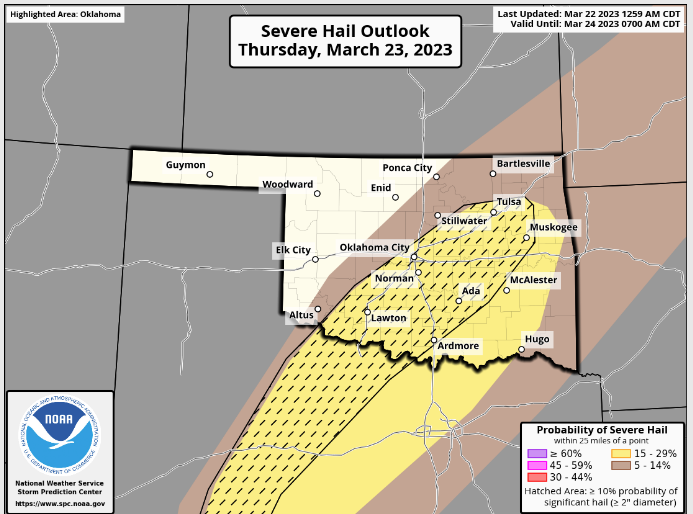
We will continue to see warm temperatures today and for at least part of the day tomorrow, but McManus reminds everyone to stay weather aware. To see more from McManus on his mesonet ticker, click here:
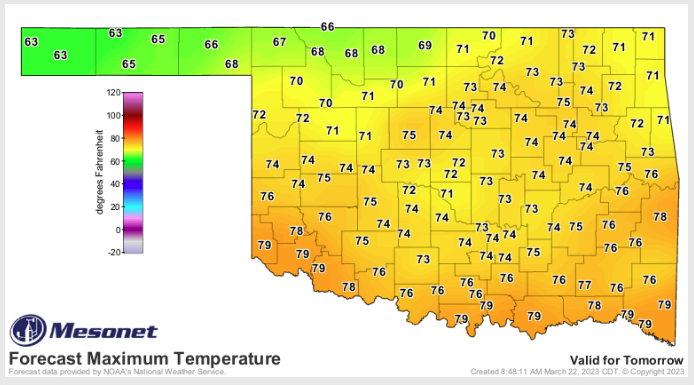
American Farmland Trust (AFT), the Agricultural Viability Alliance, and a national coalition of agricultural organizations, service providers, non-profits, businesses, lending institutions, and government entities, today sent a letter to leadership of the House and Senate Agriculture Committees calling for dedicated funding for business technical assistance and farm viability in the upcoming Farm Bill.
"As you begin the process of developing a new Farm Bill," the letter, signed by over 135 organizations, writes, "[we] urge you to include dedicated funding for one-to-one business technical assistance for small and midsized farm and food businesses. These investments in farm viability are critical to achieving a more just, secure, resilient food supply chain, growing our rural economies, and helping farmers and food businesses weather periods of uncertainty, high input costs, and market disruptions."
"Congress begins work on a new Farm Bill at a time when the agricultural economy and food system face a number of urgent, overlapping challenges," said Tim Fink, Policy Director for AFT. "From historic inequities and systemic barriers for underserved producers, to rising input costs and vanishing margins, to generational transfer of farmland – business technical assistance has proven an effective and cost-efficient way of addressing these challenges and building capacity on the ground."
The call for dedicated Farm Bill funding builds on work that AFT, in partnership with the Agricultural Viability Alliance (the Alliance), began in 2021 requesting USDA to set aside a portion of Coronavirus relief funding for one-to-one business technical assistance. More than 110 organizations joined AFT and the Alliance in urging USDA to prioritize this type of technical assistance to small and mid-sized farm and food businesses. In addition, 50 Members of Congress similarly encouraged USDA to support business technical assistance. USDA responded to this request with its establishment of two new initiatives: the Farm Service Agency's Increasing Land, Capital, and Market Access Program, and the Agricultural Marketing Service's Regional Food Business Centers.
"The entrepreneurs we serve face barriers to becoming financially viable, so we support them to develop financial management skills, access capital and land, and build resilient businesses," said Benneth Phelps, Executive Director of the Agricultural Viability Alliance. "We do this by providing information, training, skill-building, and capital, within a carefully crafted ecosystem of support, and funding for this work in the Farm Bill is critical."
Business technical assistance covers a wide range of one-to-one services offered to farm and food businesses by nonprofit organizations, state agencies, private consultants, and extension services. Customized to meet the unique needs of individual businesses, these services include coaching, skill development, and planning related to financial and labor management, marketing and business strategies, farm transfer and succession, and access to land and capital. BTA has proven effective at creating jobs and supporting local economies. This work is also critical to addressing historic and systemic barriers facing farmers and food entrepreneurs of color, who have been structurally denied opportunities to access capital, land, technical support, USDA programs, and broader professional advancement for generations.
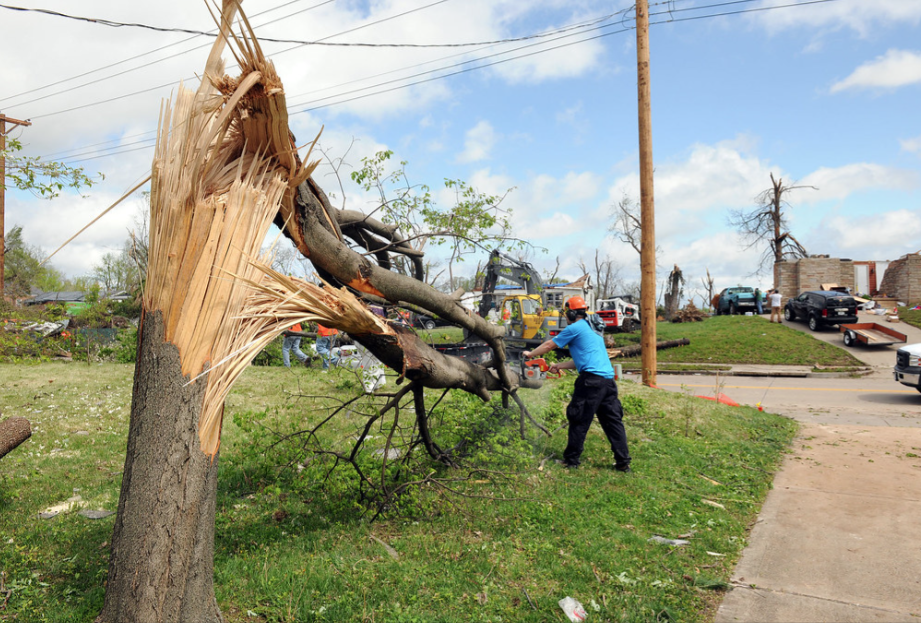
Practicing careful chainsaw safety can prevent injuries when clearing up storm debris. (Shutterstock)
By Trisha Gedon
If there's one thing Oklahomans know about, it's the process of cleaning up after a storm. Some of that cleanup will require the use of a chainsaw for felled trees and other debris.
Ryan Desantis, Oklahoma State University Extension forestry specialist, said it's important to keep chainsaw safety techniques in mind when cleaning up after a storm or doing any other type of chainsaw work.
There are several types of chainsaws on the market, including gas-powered, electric and battery-powered.
"No matter what type of saw a person is operating, safety is important. A battery-powered saw is just as powerful as a gas-powered saw," Desantis said. "One of the biggest safety concerns when operating a saw is kickback. The operator should wear a helmet with a visor to help protect their head. Also, position your body in a way that if kickback occurs, the saw won't hit your body."
Kickback occurs when the rotating chain hits a solid object or the chain is pinched in a cut. This can force the saw backward, resulting in serious injury. To prevent kickback, keep the saw moving at a fast speed when entering or leaving a cut. Also, keep the chain properly sharpened.
Other safety operating tips include:
The following protective clothing is encouraged:
"In storm-damaged areas, there likely will be debris on the ground, which can be a tripping hazard," Desantis said. "Considering the tripping hazard, it is important to keep the chain brake on whenever not actively cutting, especially when moving amongst debris."
For more in-depth information, OSU Extension provides safe chainsaw operations guidance online, as well as a wide range of other helpful storm damage response tips.
OSU Extension uses research-based information to help all Oklahomans solve local issues and concerns, promote leadership and manage resources wisely throughout the state's 77 counties. Most information is available at little to no cost.
Youth recognized with National Junior Angus Association award will now receive $5,000 through the Angus Foundation.
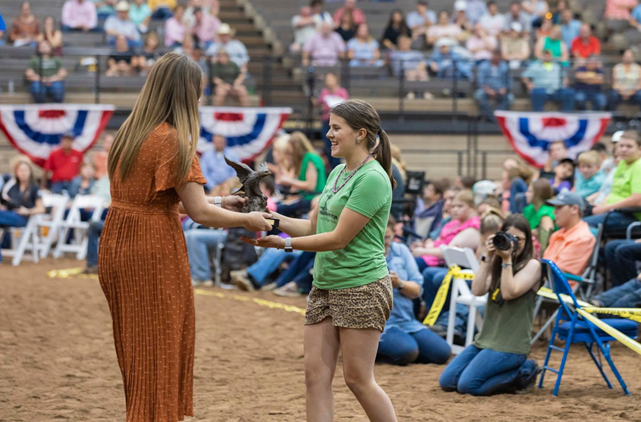
The Jim Baldridge Outstanding Leadership Award was designed to recognize one outstanding National Junior Angus Association (NJAA) member each year. In 2023, the scholarship awarded by the Angus Foundation will increase from $2,500 to $5,000. This prestigious award honors an NJAA member who exemplifies excellent leadership and character through their Angus involvement and beyond.
In 2013, Bill and Betty Werner of Werner Angus, Cordova, Illinois donated $50,000 to the Angus Foundation to sustain a permanent endowment fund for the recipient of the Outstanding Leadership Award, in memory of Jim Baldridge. Since then, this NJAA award has been known as the Jim Baldridge Outstanding Leadership Award and has supported many Angus youth in pursuing secondary education.
"We're excited to have the opportunity to provide recipients of the Jim Baldridge Outstanding Leadership Award even more support through this scholarship increase," said Jaclyn Boester, Angus Foundation executive director. "The Foundation is proud to invest in youth who exemplify the leadership qualities and strong character developed through NJAA involvement."
Nominations for the Jim Baldridge Outstanding Leadership Award are due May 1. The application form can be found at www.angus.org/Foundation/WhatWeDo/Awards and asks applicants to answer three essay questions, and provide their resume and two letters of recommendation. The recipient is selected by a judging committee and will be announced at the 2023 National Junior Angus Show in Grand Island, Nebraska during the awards ceremony.
Since 1998, the Angus Foundation has awarded more than $4.2 million in undergraduate and graduate scholarships. To learn more about the work of the Angus Foundation, visit AngusFoundation.org.
— Written by Peyton Schmitt, Angus Communications
RON's Dave Lanning has a pre-opening look at today's agricultural Markets.
Click the audio tab below for today's report.
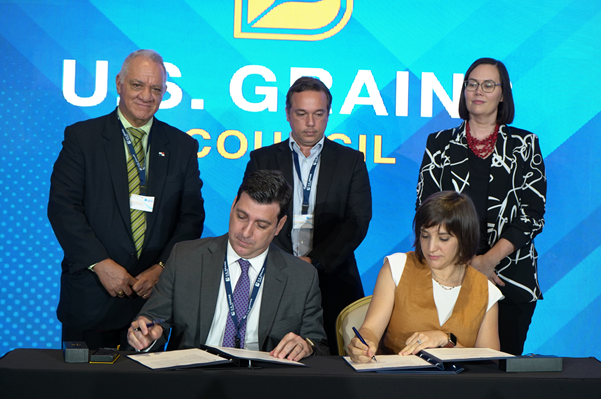
Today in Panama City, Panama, the U.S. Grains Council (USGC) and the Industrial Association of Sugar Cane of Panama (AZUCALPA) signed an ethanol memorandum of understanding (MOU). Pictured, USGC Regional Director for Latin America Marri Tejada and Rodrigo Cardenal, CEO of Grupo Calesa and President of AZUCALPA, sign the MOU while (from left to right) Carlos Salcedo, Minister Counselor for agricultural affairs of Panama; Jorge Rivera, national energy secretary of Panama; and USDA Undersecretary for Trade and Foreign Agricultural Affairs Alexis Taylor witness the event.
The U.S. Grains Council (USGC) hosted a regional seminar in Panama City, Panama, held on Mar. 21-22, that brought together critical stakeholders and high-level government officials from Central American (CTA) countries and the Dominican Republic to learn about and discuss the technical aspects, benefits and challenges of ethanol and gasoline blending in the region.
While there, the Council and the Industrial Association of Sugar Cane of Panama (AZUCALPA) signed – and U.S. Department of Agriculture (USDA) Undersecretary for Trade and Foreign Agricultural Affairs Alexis Taylor witnessed – an ethanol memorandum of understanding (MOU). The MOU recognizes the importance of assessing the role and benefits of biofuels and ethanol in the promotion of economic growth, diversification of the energy matrix and decarbonization of transportation in the global energy transition to address global greenhouse gas emissions.
"This MOU bolsters economic and energy security through both domestic production and strengthening trade ties between our two nations," said Taylor. "Ethanol blending helps countries meet their climate change goals by boosting the use of renewable energy and reducing greenhouse gas emissions in the transportation sector. I hope these benefits encourage other nations throughout the region to explore ethanol blending policies of their own."
Participants included ministers and vice ministers from the mines and energy, environment and agriculture sectors, along with representatives from national refineries, agro-industrial industries, oil and gas, finance, logistics and transportation.
"Cultivando Energia is an incredibly impressive event that brings together like-minded individuals from across the region who can share their concerns and explore areas of collaboration in developing coherent and robust biofuels programs in their countries," said USGC Regional Director for Latin America Marri Tejada, who signed the MOU on behalf of the Council.
"We are encouraged by the high-level of distinguished representatives at the conference, further demonstrating the interest and willingness to continue the development of ethanol use in their countries."
The seminar - Cultivando Energía - also included extensive discussions around ethanol's role in the global energy transition; dispelling ethanol myths; ethanol's contribution to greenhouse gas (GHG) reduction; the ethanol production chain; ethanol pathways in Latin America; and regional challenges to ethanol policy.
"We want to thank the U.S. Grains Council for organizing this seminar and for their support and accompaniment with technical, strategic and best practices contributions which have been of great value and which we are sure will continue to be of great importance for the biofuels sector in Panama," said Rodrigo Cardenal, CEO of Grupo Calesa and President of AZUCALPA.
"As a national agricultural industry with a tradition of more than 100 years operating in Panama, we are very optimistic about implementing a national biofuel and renewable energy program. We know the direct, positive impact and benefits the program will provide in terms of creating direct and indirect employment, ensuring investments in agriculture and the impact on several communities."
Global ethanol consumption has grown from 16 billion gallons in 2010 to more than 27 billion in 2022. CTA, with an area of 523,000 square kilometers (Km2) and a population of around 51 million, consumes on average 244 gallons of oil and oil products per person per year. Fuel consumption for transportation has increased 9.1% over the last few years, driven by an increase in population, a growing middle class and an increased vehicle ownership.
On this edition of Cow-Calf Corner, Bob LeValley, Oklahoma Beef Quality Assurance Coordinator, talks about Beef Quality Assurance principles.
Cattle producers have long recognized and fulfilled the need to properly care for livestock. Sound care and handling practices, based on years of experience and research are known to impact the well-being of cattle, individual animal health and herd productivity. Cattle are raised in very diverse environments and geographic locations. One specific set of production practices will not work for all cattle producers, but, personal experience, Beef Quality Assurance program principles, and professional judgement serve as valuable resources for proper animal handling and care. Animal behavior knowledge will facilitate proper animal handling to the benefit of both the handler and the livestock.
Knowledge of vision characteristics of cattle will help direct movement. Due to the location of their eyes, cattle have a wide-angle field of vision in excess of 300 degrees. This means they have a narrow blind spot which is directly behind them. They can see some colors and can distinguish between individuals/objects based on shape. Cattle have a tendency to move from dark areas to lighter areas, provided the light is not glaring. Shadows can often appear extreme to cattle.
Handling issues related to vision-related behaviors include:
Cattle have a wider range of hearing than most humans. However, they can locate the source of sound as well as human hearing allows. They are sensitive to high frequency sounds. With this in mind, we can expect that loud noises in working facilities should be avoided, but small amount of noise can assist in moving livestock. Noisy gates and other equipment can cause cattle to balk and resist moving forward.
Producers have long been aware that proper handling management based on their knowledge of animal behavior will reduce stress and behavior related issues. Improper handling that does not consider animal behavior may lower conception rates, reduce immune and rumen function, increase other health problems, cause excessive shrink, and bruising. Make sure to adequately instruct employees of your expectations for low stress cattle handling techniques.
For more information on the Beef Quality Assurance program, or to become a beef quality assurance certified producer, visit BQA.org or contact your county extension agriculture educator.
Below, Southeastern Area Livestock Specialist, Brian Freking shows low stress handling techniques on a video from BQA and Oklahoma State Cooperative Extension.
Last week, Chairman of the House Committee on Agriculture, Glenn "GT" Thompson (PA-15), led a Congressional delegation to Texas for a week-long tour of the Lone Star state. Highlights of the visit included a Farm Bill listening session in Waco, followed by a visit to McAllen to learn more about the challenges facing farmers and ranchers on the U.S.-Mexico border.
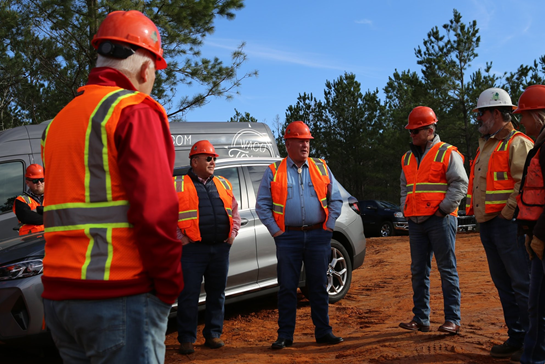
Forestry in Focus — On Monday, Chairman Thompson was joined by Congressmen Pete Sessions (TX-17) and Ronny Jackson (TX-13), as well as members of the Texas Farm Bureau for a road trip to East Texas to visit a logging site in Crockett, a visit with the Texas Forestry Association, and more.
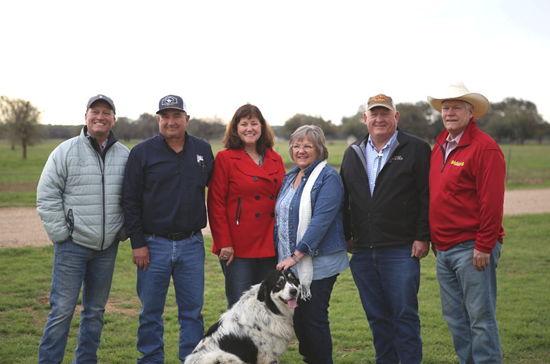
Down On The Dairy — Tuesday morning started with a tour of E&D Jackson Dairy in Waco. David Jackson has been a dairy farmer for nearly four decades. E&D Jackson Dairy milks 640 cows and includes a diversified business with beef cattle, stocker calves, and a grass business. He also serves on the national Dairy Board, Dairy Max Board, and is Chairman of the Cross-Country Water Board. While the Jacksons run an impressive operation, the family dog, Bella, stole the show.
Four Generations Of Farming — Later that morning in McGregor, Chairman Thompson met with Kevin Huffman, a fourth-generation farmer whose family-run operation provides sustainable harvesting services as well as field and feed analysis to help fellow farmers make the most informed decisions possible as it relates to their crop.
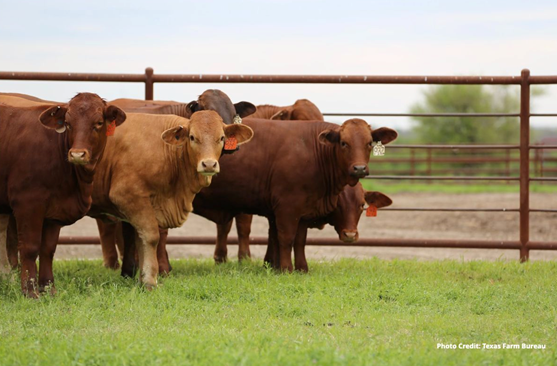
Best Of The Best Beef — Tuesday concluded with a visit to Swingin 'B' Ranch, owned and operated by Mackie and Norma Bounds. The couple specializes in Beefmaster cattle, a breed that is a cross between Hereford cows, Shorthorn cows, and Brahamn bulls. In 2013, Swingin' 'B' Ranch was awarded Breeder of the Year at the Beefmasters United Convention.
Science, Technology, and Innovation — Jared Ranley kicked off Wednesday's itinerary with a tour of his cattle company. Not only is Mr. Ranley a rancher, he is also a veterinarian and spoke at length about the importance of science, technology, and innovation when it comes to things like disease traceability and animal health.
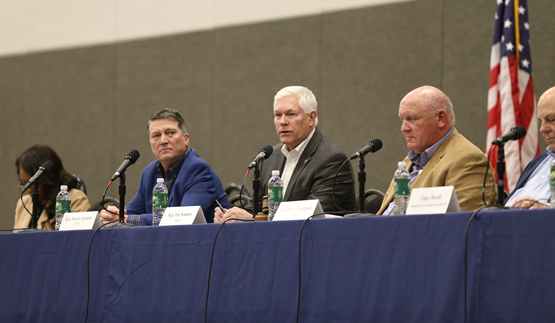
In Listening Mode — After a great visit with the Texas Farm Bureau, the House Committee on Agriculture hosted its third bipartisan Farm Bill listening session in Waco, Texas. The event drew approximately 300 people from across the state. Stakeholders shared their concerns and priorities on a range of issues, including crop insurance, conservation programs, research programs, nutrition, and more. Zippy Duvall, President of the American Farm Bureau Federation joined a Congressional delegation including Chairman "GT" Thompson (PA-15), Rep. Pete Sessions (TX-17), Rep. Austin Scott (GA-08), Rep. Jim Baird (IN-04), Rep. Kat Cammack (FL-03), Rep. Ronny Jackson (TX-13), Rep. Tracey Mann (KS-01), and Rep. Jasmine Crockett (TX-30).
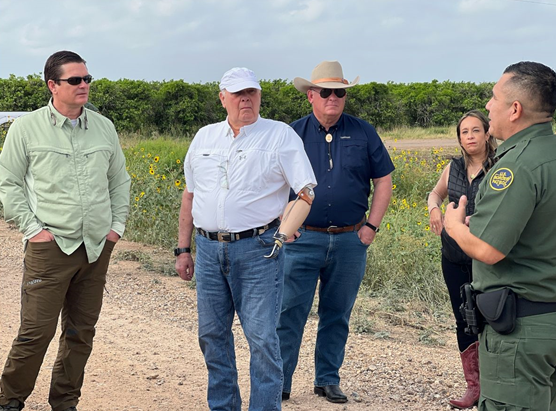
On The Border — After a successful event in Waco, Members traveled down to McAllen to visit Texas' 15th Congressional District, home to Committee freshman Rep. Monica De La Cruz. The day started with meetings with U.S. Customs and Border Patrol, where officers detailed the working relationship between the department and American farmers and ranchers. Joining the Chairman was Rep. Austin Scott (GA-08), Vice-Chairman of the Committee, and Rep. Jim Baird (IN-04), Chairman of the Conservation, Research, and Biotechnology Subcommittee.
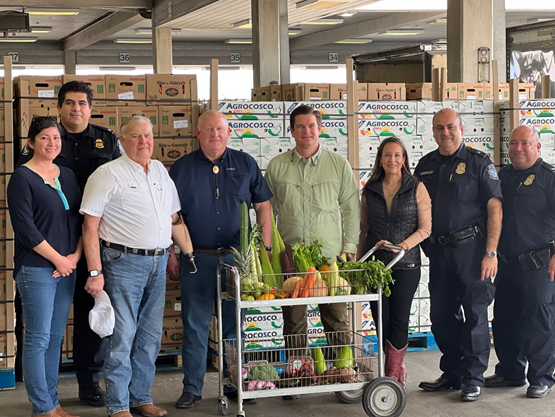
"Bugs, Drugs, and Thugs" — Carlos Rodriguez, U.S. Customs and Border Patrol Port Director at the Pharr International Bridge, directed a great tour for members. While Director Rodriguez joked that they inspected cargo for "bugs, drugs, and thugs," special emphasis was placed on agricultural inspections and how CBP works with USDA on pest identification of new species. Last fiscal year, the Pharr International Bridge ranked second on the southwest border and eighth in the nation for agricultural imports.
Speaking Of Bugs... — Abel Exparza of USDA's Animal and Plant Health Inspection Service (APHIS) provided valuable background on the Cattle Fever Tick Eradication Program. Cattle fever ticks are a major threat to the industry, destroying red blood cells, inducing fever, enlarging the spleen and liver, and ultimately resulting in death for approximately 90% of infected cattle.
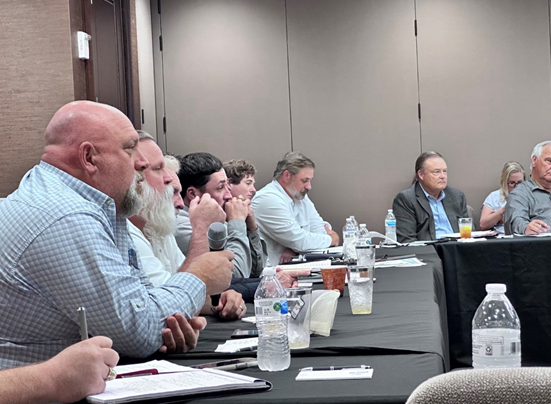
Help Wanted: Agricultural Labor Challenges — The Texas trip concluded with a roundtable discussion featuring South Texas farmers and ranchers to discuss the challenges that a lack of reliable, legal, year-round labor poses to their specific commodities.
Compared to the Last Report: Hay is getting tighter. The supply of hay continues to get lower. Over the past two weeks, the hay trade has remained steady. Oklahoma continues to see last year's crop being sold as they try and finish out this winter. Oklahoma did receive some moisture, but not enough to change the drought monitor. As we look at the Oklahoma Mesonet Drought Monitor, we are at 8.86 percent in exceptional drought, 36.64 percent in an extreme drought, 50.58 percent in severe drought, 59.07 percent in moderate, 65.61 percent in abnormally dry conditions, 34.39 percent that has no drought conditions.
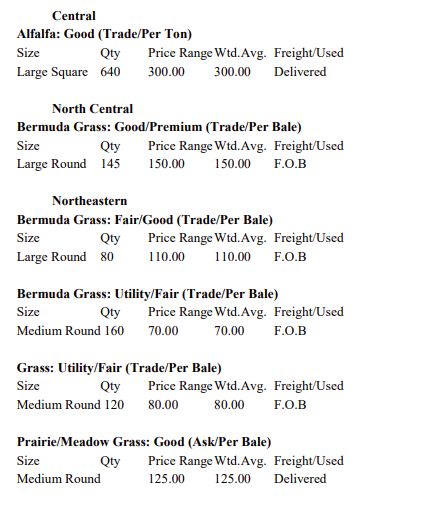
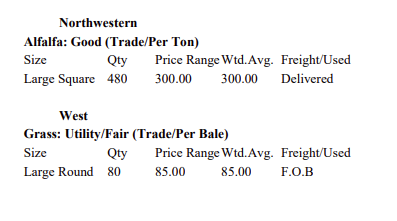
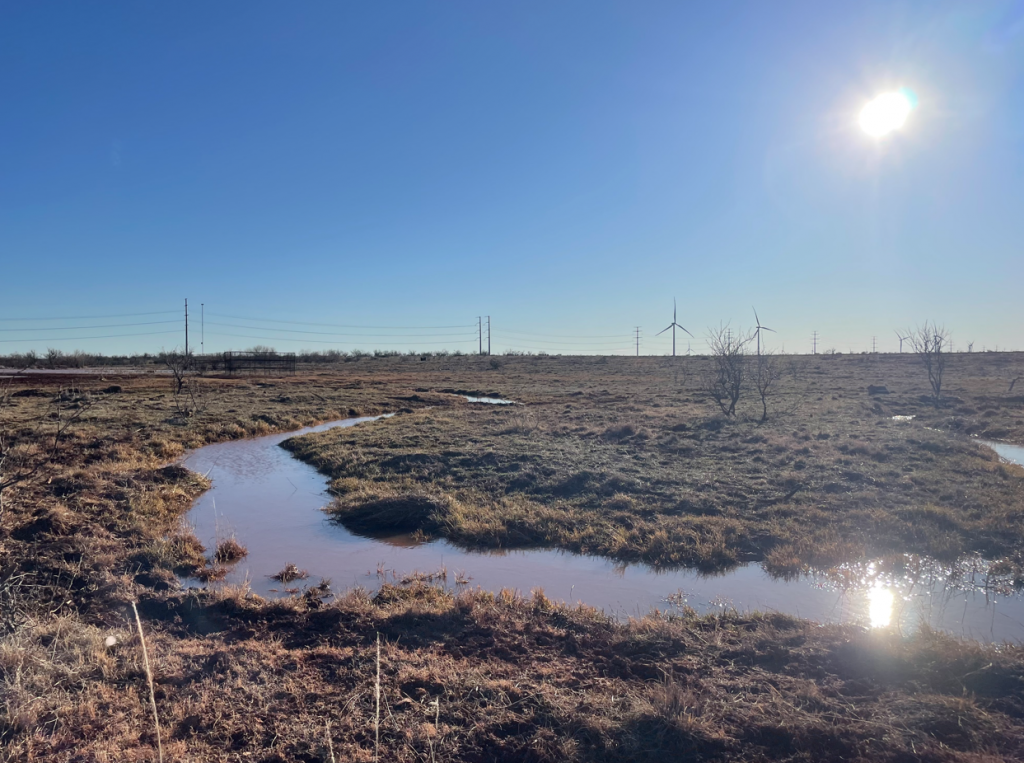
Senior Farm and Ranch Broadcaster Ron Hays is visiting with National Cattlemen's Beef Association Chief Counsel Mary-Thomas Hart, about the latest on WOTUS (Waters of the U.S.).
The NCBA has expressed strong disappointment in a decision by the U.S. District Court in the Southern District of Texas to deny a nationwide preliminary injunction that would have halted the Biden administration's harmful Waters of the United States (WOTUS) rule from taking effect.
While this decision was disappointing, Hart said that Judge Brown from the Southern District of Texas offered a very detailed opinion in response to NCBA's request for a nationwide preliminary injunction of the Biden administration's WOTUS definition.
"I think it is worth noting that if you are in Texas or Idaho, you are not going to be subject to the Biden WOTUS rule," Hart said. "There was a preliminary injunction applied in two states, but for the other 48 states, the Biden administration's rule takes effect on Monday, March 20th."
The Environmental Protection Agency finalized the latest WOTUS rule at the end of 2022. NCBA and its litigation partners filed a lawsuit seeking to overturn the rule on January 18, 2023. NCBA sought a nationwide preliminary injunction, which would have prevented the federal government from implementing the WOTUS rule until the entire case is decided. Instead, the court granted a limited injunction in only two states—Texas and Idaho.
"We asked the court for this preliminary injunction either through litigation of the rule on the merit, or through the Supreme Court's issue of the Sackett opinion, which we expect in the next few weeks," Hart said.
With this new rule in effect, Hart advises any producers who are considering starting any new projects that may involve the manipulation of a water feature on their property to seek out technical assistance beforehand.
One issue NCBA has with the recent rule, Hart said, is the grey area surrounding whether or not certain water features such as those that do not contribute to downstream water quality would be subject to federal jurisdiction.
"There is a lot of uncertainty for producers," Hart said. "I would say definitely be cautious going forward, at least for the next few weeks until we hear from the Supreme Court."
Hart also talked about why Judge Brown in the Southern District of Texas was not in favor of the nationwide injunction.
"I think we have seen a real, kind of cautious approach to this idea of a nationwide preliminary injunction, especially from more conservative judges that don't want the federal government to take a heavy hand in regulating land owners across the country," Hart said.
It is a conservative principle to not enact sweeping mandates that cover everyone in the country, Hart said, so while in this case that decision was not favorable, in the past it has been helpful to have judges who do not love nationwide preliminary injunction.
"Just because Judge Brown didn't give us the nationwide preliminary injunction, doesn't mean that he doesn't see some real issues with the Biden rule," Hart said. "We got a really helpful opinion from this court even through the outcome wasn't necessarily what we were looking for."
Judge Brown highlighted issues with the significant nexus test that the Biden Administration uses in this rule, Hart said, and also with the administration's assertion that is has absolute authority of every interstate feature in the country regardless of its size, or whether it contributes to downstream water quality.
"I think those things, together, bode well for a positive outcome down the road," Hart said.
The Beef Buzz is a regular feature heard on radio stations around the region on the Radio Oklahoma Ag Network and is a regular audio feature found on this website as well. Click on the LISTEN BAR for today's show and check out our archives for older Beef Buzz shows covering the gamut of the beef cattle industry today.
There is a new blog post out at the Southern Plains Perspective. Read Below!
This past week, the USDA Southern Plains Climate Hub had a booth at the 3I farm show in Dodge City, Kansas. I was there with my Daughter Madeleine manning the booth (say Hi Maddy).

Madeleine assisting at the USDA Climate Southern Plains Climate Hub booth
Because of this, I'm taking a little different approach to the blog this week and highlighting a few climate smart/soil health/conservation type articles that I have come across this week during breaks at the booth.
First, if you live in the southern plains (or follow this blog), you know how dry it has been in Kansas, Oklahoma, and Texas. With dry weather, exposed soil, and high winds, you have the recipe for dust in the air. It's important that producers understand what they can do to control erosion and hold their soil in place. This is the situation described in a news story from Lubbock, Texas, titled 'West Texas farmers use cover crops, clodding to fight soil erosion.' It's a great piece about how good land treatment practices can help address this serious natural resource issue.
Next is an article describing an initiative by USDA, the Farmers For Soil Health Initiative, NCGA, the United Soybean Board, The National Pork Board, and the U.S. Fish and Wildlife utilizing $95 million from the USDA Partnership for Climate Smart Commodities program to increase cover crop usage and develop new markets for conservation minded-producers. My favorite quote from the article comes from Indiana farmer J.R. Roesner, chair of the Ethanol Action Team for the National Corn Growers Association. He says that USDA is helping farmers to advance soil health practices. "And, reach the needs of our consumers, generate some extra revenue, and have the freedom to farm like we've had in the past."
Finally, most producers in parts of Oklahoma normally spend the first part of March pulling cattle off winter wheat pasture. Harvest (if you have wheat to cut—thanks to drought) will be coming later in the spring-early summer. After that, folks who use soil health practices will be planting summer cover crops, many acres of which (if we get moisture and a good stand) will be grazed.
With that in mind, I searched for information on grazing summer cover crops following winter wheat. What I found first was an interesting video from Kansas State University featuring Research Extension beef cattle specialist Sandy Johnson discussing grazing cattle on cover crops in western Kansas, an area where some folks feel cover crops won't work because of lower average annual rainfall.
In the video, Johnson explains how in studies conducted with cooperating farmers and on research plots, K-State researchers have found that grazing covers in Western Kansas can be an option for producers.
"There are challenges, but these are all manageable," she said. "If you're interested in incorporating cover crops to get some soil health benefits and improve water infiltration, I think that can still be compatible with livestock use in western Kansas. We always have to balance that trade-off between our crop goals and livestock goals, but many people are making it happen, and you can, too." You can also check out a fact sheet Kansas State put out on grazing cover crops here.
Enjoy your week, and if you made it to the 3I show, we hope you came by and said Hi!

The full Senate approved legislation Monday to address environmental concerns related to marijuana grows. Sen. Joe Newhouse, R- Tulsa, is the author of Senate Bill 808, which authorizes the executive director of the Oklahoma Medical Marijuana Authority to order licensees to cease and desist operations if the director finds that an environmental emergency exists.
"Oklahomans are fed up with the bad actors in the marijuana industry, many of whom are here illegally and flaunting our laws, and damaging our environment," Newhouse said. "Through intentional neglect and refusal to clean up contaminants, run-off, and even human waste, some grows have demonstrated a total lack of stewardship, and they need to be stopped."
SB 808 now moves to the House of Representatives for further consideration. Rep. Kyle Hilbert, R-Bristow, is the principal House author.
"We're doing everything we can in the Legislature this session to reform this industry. We must take it a step further and crack down on illegal operations that are polluting our environment. SB 808 will allow these grows to be shut down quickly and stop them from doing further damage. I am confident that Director Berry and OMMA are doing everything they can to protect our state, our citizens, and our resources. This measure will further their ability to stop this environmental abuse," Newhouse said.
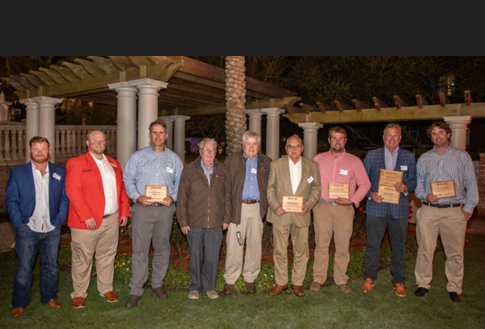
BASF's 2022 Stoneville® Legacy Club™, which celebrates growers' high yield achievements with Stoneville cotton, saw yet another record enrollment with 179 applicants. Thirty-four individuals qualified by harvesting yields in the top 10% of their states.
T&D Kohlleppel Farms of LaCoste, Texas, recorded the highest yield for 2022 at 2,694 lbs/A. Ten growers reported yields topping 2,000 lbs/A for the 2022 growing season. These winners join more than 200 other Stoneville Legacy Club members who represent top-producing cotton growers in their respective states.
"Our growers expect a certain level of quality and performance from the cotton they grow, and we're proud to offer the kind of consistency and quality they're looking for with Stoneville cotton," said Justin Jones, Cotton Marketing Manager for BASF. "The bonus is getting to celebrate those high-yield achievements with them in person through the Stoneville Legacy Club."
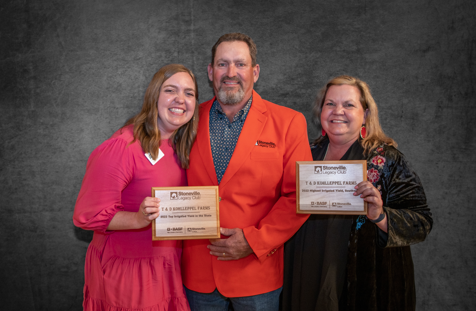
Top yielders received a trip for two to the Henderson Beach Resort in Destin, Florida, where they had the opportunity to connect with cotton growers from across the Cotton Belt. The trip culminated with an awards ceremony celebrating their achievements. This marked the first year the club has celebrated in person since 2020.
The following growers received special awards for their 2022 Stoneville cotton yields, in addition to qualifying for the Stoneville Legacy Club. Those who applied had the opportunity to enter yields in the irrigated and/or non-irrigated/dryland categories.
| Highest Yield | ||||||
| Region | Category | Yield | Farm Name | State | ||
| Southwest | Irrigated | 2,694 | T&D Kohlleppel Farms | TX | ||
| West | Irrigated | 2,431 | Tri T Farms | CA | ||
| East | Non-Irrigated | 2,081 | Cahoon Farms | NC | ||
| North Delta | Irrigated | 2,026 | Spikes Farm Partnership | AR | ||
| South Delta | Irrigated | 2,020 | Newby Farms | TN | ||
| East | Irrigated | 1,918 | Farless and Sons | NC | ||
| South Delta | Non-Irrigated | 1,809 | Newby Farms | TN | ||
| Southeast | Irrigated | 1,790 | John Nutt | GA | ||
| North Delta | Non-Irrigated | 1,503 | Mike and Les Sides | MO | ||
| Southeast | Non-Irrigated | 1,449 | Southern Grace Farms | GA | ||
| Southwest | Dryland | 882 | Ronnie Whitmire | TX | ||
To view the complete list of 2022 winners and learn more about the Stoneville Legacy Club, visit Stoneville.com/LC.
| Highest Yield | ||||||
| Region | Category | Yield | Farm Name | State | ||
| Southwest | Irrigated | 2,694 | T&D Kohlleppel Farms | TX | ||
| West | Irrigated | 2,431 | Tri T Farms | CA | ||
| East | Non-Irrigated | 2,081 | Cahoon Farms | NC | ||
| North Delta | Irrigated | 2,026 | Spikes Farm Partnership | AR | ||
| South Delta | Irrigated | 2,020 | Newby Farms | TN | ||
| East | Irrigated | 1,918 | Farless and Sons | NC | ||
| South Delta | Non-Irrigated | 1,809 | Newby Farms | TN | ||
| Southeast | Irrigated | 1,790 | John Nutt | GA | ||
| North Delta | Non-Irrigated | 1,503 | Mike and Les Sides | MO | ||
| Southeast | Non-Irrigated | 1,449 | Southern Grace Farms | GA | ||
| Southwest | Dryland | 882 | Ronnie Whitmire | TX | ||
About BASF's Agricultural Solutions Division
Farming is fundamental to provide enough healthy and affordable food for a rapidly growing population while reducing environmental impacts. Working with partners and agricultural experts and by integrating sustainability criteria into all business decisions, we help farmers to create a positive impact on sustainable agriculture. That's why we invest in a strong R&D pipeline, connecting innovative thinking with practical action in the field. Our portfolio comprises seeds and specifically selected plant traits, chemical and biological crop protection, solutions for soil management, plant health, pest control and digital farming. With expert teams in the lab, field, office and in production, we strive to find the right balance for success – for farmers, agriculture and future generations. In 2022, our division generated sales of €10.3 billion. For more information, please visit www.agriculture.basf.com or any of our social media channels.
About BASF
BASF Corporation, headquartered in Florham Park, New Jersey, is the North American affiliate of BASF SE, Ludwigshafen, Germany. BASF has approximately 16,000 employees in North America and had sales of $25.7 billion in 2022. For more information about BASF's North American operations, visit www.basf.com/us.
At BASF, we create chemistry for a sustainable future. We combine economic success with environmental protection and social responsibility. More than 111,000 employees in the BASF Group contribute to the success of our customers in nearly all sectors and almost every country in the world. Our portfolio comprises six segments: Chemicals, Materials, Industrial Solutions, Surface Technologies, Nutrition & Care and Agricultural Solutions. BASF generated sales of €87.3 billion in 2022. BASF shares are traded on the stock exchange in Frankfurt (BAS) and as American Depositary Receipts (BASFY) in the United States. Further information at www.basf.com.
Attorney General Gentner Drummond praised state legislators today for approving a trio of measures aimed at addressing the rise of illegal marijuana grow operations in Oklahoma. The bills have passed their legislative chamber of origin and are now headed for the opposite chamber.
"Oklahoma's illegal marijuana grow operations pose a serious threat to public safety, particularly in rural communities invaded by organized criminals from China and Mexico," Drummond said. "As the state's chief law enforcement officer, I am committed to working arm-in-arm with Oklahoma's law enforcement agencies to deliver justice and restore peaceful order."
The state has witnessed an explosion of marijuana grow operations in the aftermath of Oklahoma's 2018 legalization of medical marijuana. While many marijuana grow businesses abide by the law, medical marijuana has been a Trojan horse for organized criminals whose illicit activities also include human trafficking, sex trafficking and distribution of deadly drugs like fentanyl. The Oklahoma Bureau of Narcotics and Dangerous Drugs Control estimates that nearly half of the state's 6,299 marijuana grow operations are illegal.
The Attorney General noted that a number of other pending bills were drafted to assist law enforcement in this area.
"I am thankful the Legislature is working on many pieces of legislation to support law enforcement and protect public safety," Drummond said.
The Attorney General pointed to the following bills as critical:
House Bill 2095 by Rep. Jon Echols and Sen. Lonnie Paxton
Gives the Attorney General investigative and enforcement authority over medical marijuana laws to support the Oklahoma Medical Marijuana Authority and allows all enforcement agencies to work together; allows the Attorney General to conduct unannounced on-site inspections; upon reasonable suspicion, the Attorney General may subpoena documents to identify any ownership interest in the business; and extends the moratorium on grow licenses until Aug. 1, 2026.
Senate Bill 806 by Sen. Brent Howard and Rep. Jon Echols
Requires documented proof of land ownership of a licensed marijuana grow operation; requires an application to transfer a business license to include the same information required of new licensees; prohibits transfers when a licensee is under investigation; limits transfers to once per year; and prohibits multiple business licenses within the same category to be registered under one address or physical location.
Senate Bill 913 by Sen. Darcy Jech and Rep. Anthony Moore
Requires all marijuana grow businesses to hold a $50,000 bond that may be recalled if the property has been abandoned; the license has been revoked; or in response to a violation of law, regulation, or ordinance necessitating remedial action. The bond will be used to address any necessary restoration of the property, including removing equipment, destruction of waste, remediation of environmental hazards, prohibiting public access, addressing improper buildings, or determining the final disposition of any seized property.
"I am especially grateful for the House and Senate leadership as well as the individual legislators who have stepped up on behalf of public safety by authoring and voting for this legislation," Drummond said.
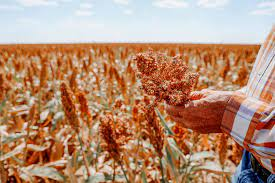
The Collaborative Sorghum Marketing Transformation Program (cSmart) today announced the launch of the first-ever venture capital platform dedicated exclusively to attracting capital for companies, projects and innovations that create opportunities for sorghum farmers.
"The number of opportunities to add value to sorghum farmers by attracting capital to our industry is truly unprecedented," cSmart board director and sorghum farmer from Keyes, Oklahoma, JB Stewart said. "From San Francisco to New York, businesses across the U.S. are seeing the value in investing in agriculture, and cSmart is proud to come alongside these businesses to facilitate investment in Sorghum: The Resource Conserving Crop™."
cSmart matches private capital with funding to support startups and established companies investing in sorghum and also facilitates a network of private investors seeking opportunities for competitive returns in agriculture.
"To date, cSmart has invested in support of a container facility for specialty sorghum exports, matched private investment with funds for marketing efforts for an all-female run sorghum food startup and facilitated networking and due diligence for an industrial sorghum starch project," cSmart consultant John Duff said. "The diversity of these investments demonstrates the wide net cSmart intends to cast, supporting and financing innovation in American agriculture—a necessity we are proud to announce this National Ag Day."
Fueled by relationships across the sorghum industry and the supply chain, cSmart leverages knowledge and financial flexibility to support startups, existing companies and investors bringing innovation to the sorghum industry.
"Out of necessity bred by difficult growing environments, innovation is the American sorghum farmer's most important tool," cSmart board director and MOJO Seed president Jerry O'Rear said. "As a reflection of this inventive spirit, the launch of cSmart is a groundbreaking step toward financing even more innovation and doing so in a way that adds maximum value to sorghum farmers."
For more information on investing or obtaining support for sorghum innovation, contact cSmart consultant John Duff. Duff can be reached at john@seroag.com or 806-638-5334.
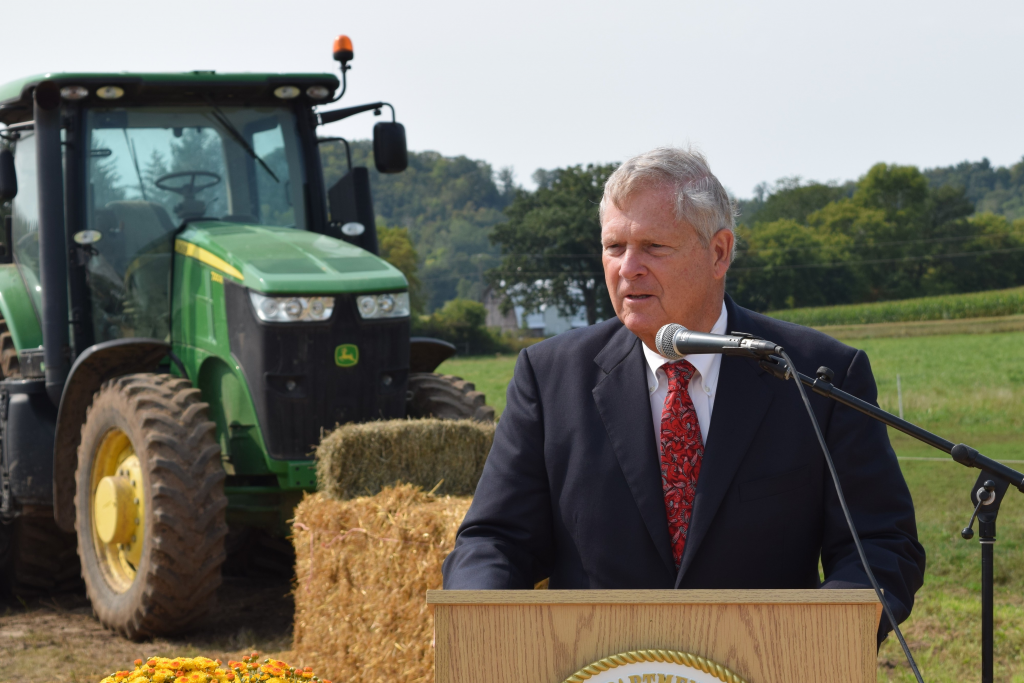
In celebration of National Agriculture Day, Ag Secretary, Tom Vilsack shares some comments about the great contributions America's producers have made to the nation and the world in providing a reliable source of food, fuel, and fiber.
"We are a food-secure nation," Vilsack said. "Very few nations on Earth have the opportunity to basically say that their farmers, ranchers, and producers produce everything that is necessary to feed the people. Many countries would like to have that advantage. It makes us a much more secure nation."
National Agriculture Day, Vilsack said, gives Americans the opportunity to remember that America's strength in producing its own food is national security.
"Every single one of us that isn't a farmer is able to be a farmer because we do not have to worry about where the food is going to come from to feed our family," Vilsack said. We just need a paycheck to go to the grocery store."
Regarding agricultural funding to meet the needs of those in the nation, Vilsack talked about different avenues to do so.
"You can always justify additional resources, but the key here is for folks to understand that it is just one vehicle by which you can address the needs," Vilsack said. "There is a budget, there is CCC, there is the Inflation Reduction Act, the Bipartisan Infrastructure Law, the American Rescue Plan..."
There have been discussions about limiting or scaling back on some of those resources, Vilsack said, but to meet every need, every tool and resource counts.
"I think we need to be able to have as much flexibility as possible," Vilsack said.
To read Vilsack's statement released in response to National Agriculture Day, click here.
The National Bison Association (NBA) is encouraging members of the U.S. Senate and House Agriculture Committees to include farm bill policies that will foster continued growth in the bison business. See the NBA's Farm Bill priorities here.
As the Agriculture Committees progress on the development of the 2023 Farm Bill, the National Bison Association this week provided each member of the committee with a summary of top priority issues for the bison business under the new long-term legislation.
The bison industry priorities include provisions regarding disaster assistance, trade, rural development, beginning farmer assistance, and truth-in-labeling. The organization also requested that agricultural research priorities recognize the importance of protecting the health of the nation's bison herds.
In a message accompanying the Bison Association's priorities, Executive Director Jim Matheson wrote, "Overall we simply want to ensure that bison is specifically included under the definition of livestock in terms of eligibility for all USDA loan, disaster, insurance, and other programs. Bison producers are generally included in farm bill programming, but being such a small sector of American agriculture, it always helps to explicitly list bison producers as being eligible."
Matheson also urged congressional leaders to include provisions that would encourage the elimination of trade barriers that place bison at a disadvantage to beef in the international marketplace. In the area of meat processing, the bison industry urged that loan and grant programs be expanded to encourage workforce development, infrastructure expansion, and reciprocity in state and federal inspection services, particularly in small facilities.
Learn more about the National Bison Association and their work at www.bisoncentral.com

Today, in comments delivered during a public hearing hosted by the U.S. Environmental Protection Agency (EPA), Growth Energy, the nation's leading biofuels trade association, urged EPA to finalize its proposal to implement the request of eight midwestern Governors to "opt-out" of the one-psi Reid Vapor Pressure (RVP) waiver, as well as to issue an emergency RVP waiver by this summer that would allow fuel retailers to continue selling E15—a lower-cost, lower-carbon fuel blend made with 15% biofuels.
EPA hosted the hearing in reference to its recent proposal that implements the request of eight midwestern Governors to allow for permanent year-round sale of E15, but only starting in 2024. Without an emergency RVP waiver in place by June 1, 2023, consumers would lose access to E15 for the upcoming summer driving season and many fuel retailers would stop offering E15 altogether.
"It is vital that EPA finalize this proposal to be effective next summer, and, in the meantime, issue an emergency RVP waiver for 2023, so that E15 will remain available year-round as it has since the summer of 2019," said Growth Energy Senior Vice President of Regulatory Affairs Chris Bliley in his remarks at the hearing. "The benefits are clear: if adopted nationally, E15 would reduce greenhouse gas emissions by more than 17 million tons, the equivalent of taking nearly 4 million cars off the road and would save consumers more than $20B in fuel costs while creating nearly 190,000 new jobs."
In his statement, Bliley also urged EPA not to be dissuaded by oil industry interests who have sought to use outdated regulations to deny consumers access to E15, which can be used in 96 percent of vehicles on the road today. "EPA must finalize this important rule, provide an emergency RVP waiver for this summer, and ignore the smokescreen of claims made by the oil industry to maintain their grip on the American gas tank," he concluded.
A full copy of Bliley's comments is available here.
Families, educators and anyone wanting to follow in the footsteps of farmers and ranchers can now pull on their boots for another exciting agricultural adventure with the latest publication from Feeding Minds Press, the American Farm Bureau Foundation for Agriculture's publishing venture. "Farm Boots" tells the story of several farm families as they work and play throughout the year, in boots for every kind of weather and activity.
Joyous and delightful, "Farm Boots" depicts a wide variety of agricultural settings in all four seasons. The book is a celebration of footwear, fun and life on and off the farm, and brought to you by the award-winning writer and illustrator of "Right This Very Minute," Lisl H. Detlefsen and Renée Kurilla.
"Farm Boots" joins an ever-expanding list of titles from Feeding Minds Press, including "Right This Very Minute," published in January 2019, and " I LOVE Strawberries," a Good Housekeeping 2022 Best Kids' Book Award Winner.
Feeding Minds Press also offers several free printable books that focus on careers in agriculture. All Feeding Minds Press publications are available for purchase directly from Feeding Minds Press, as well as on Amazon and Barnes & Noble online.
Educational resources for "Farm Boots," including an educator's guide, will be available soon.
View the trailer for "Farm Boots" here.
About Feeding Minds Press:
Feeding Minds Press is a project of the American Farm Bureau Foundation for Agriculture. The mission of the Foundation is to build awareness and understanding of agriculture through education. The goal of Feeding Minds Press is to publish accurate and engaging books about agriculture that connect readers to where their food comes from and to who grows it.
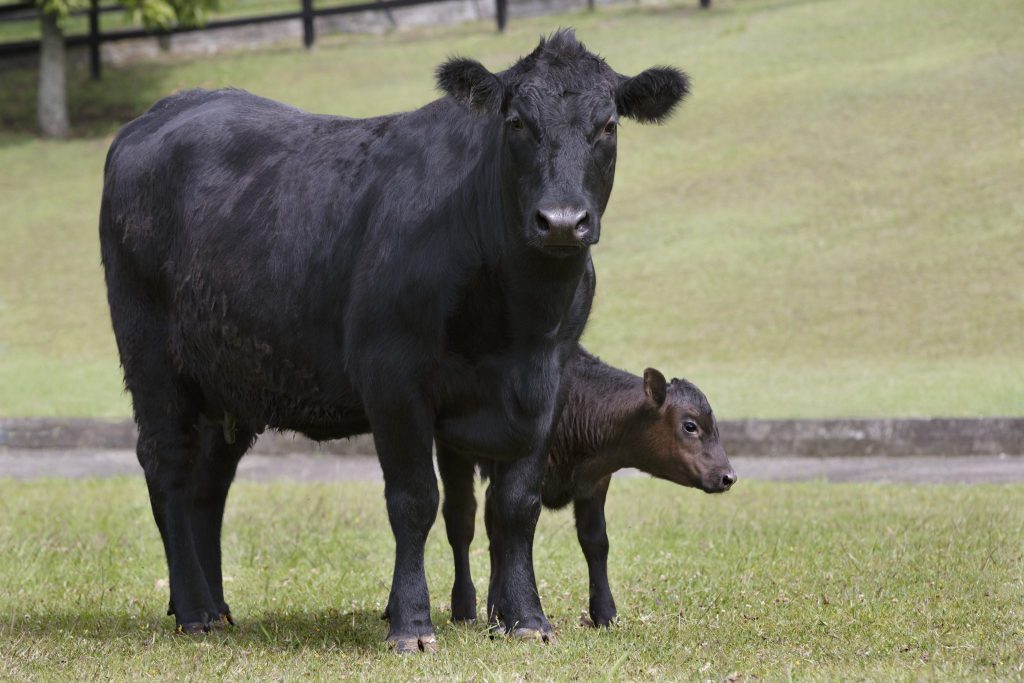
Mark Johnson, Oklahoma State University Extension Beef Cattle Breeding Specialist, offers herd health advice as part of the weekly series known as the "Cow Calf Corner" published electronically by Dr. Peel, Mark Johnson, and Paul Beck. Today, Johnson is talking about Estrus Synchronization and Artificial Insemination.
Regardless of when your calving season occurs, manipulating the reproductive process of your cow herd can result in shorter breeding and calving seasons. Accordingly, more calves born earlier in the calving season result in an older, heavier, more uniform calf crop when you wean. Shortened calving seasons permit improvements in herd health and management such as timing of vaccinations and practices that add to calf value with less labor requirements (or at the very least concentrating labor efforts into a shorter time frame). Cows that are closer to the same stage of gestation can also be fed and grouped accordingly which facilitates a higher level of management.
Estrus synchronization can be used for natural mating or breeding by Artificial Insemination (AI). Synchronization protocols permit us to concentrate the labor needed for heat detection to a few days, and in some cases eliminate the need for heat detection when cows can be bred on a timed basis. Choosing an estrous synchronization protocol which can be used with AI or natural mating can be difficult as a number of synchronization methods are available. Traditional protocols are designed to mimic or control the corpus luteum on the ovary. Newer protocols have been designed to control ovulation and/or the follicular waves that occur on the ovary during the 21-day estrous cycle. Estrus synchronization systems vary in cost, labor required, and effectiveness. Management decisions regarding synchronization should be based on answers to the following questions:
Use of AI permits us to get more cows bred to genetically superior sires for traits of economic importance to our operation's production and marketing goals. Synchronization at the onset of breeding season, results in more cows having heats in the first 18 – 25 days of breeding season. Female's return heats will remain synchronized to a degree, which gives a second chance to AI each female in the early part of breeding season. Without any synchronization, herd managers are faced with a 21 days of continual estrus detection and typically only one opportunity for AI in most females.
Bottomline: estrus synchronization can be an important management tool to get cows settled as early in the breeding season as possible and get cows bred to bulls with highest possible genetic value. A defined breeding season is important to permit meaningful record keeping, timely management and profit potential. Maintaining a 60-to-75-day breeding and calving season can be one of the most important management tools for cow calf producers.
Below, Mark Johnson, OSU Extension beef cattle breeding specialist, explains the process of heat synchronization in cow herds on SunUp TV from April 16, 2022.

Rep. Terry O'Donnell, R-Catoosa, passed a bill in the House designed to continue protections of state pension funds from strategies that would be harmful to the state's energy industry.
House Bill 2547 would prevent any state-run pension fund from delegating its votes by proxy to entities that do not subscribe to Oklahoma's investment strategy as outlined in the measure. The bill is a follow-up to legislation co-authored by O'Donnell last year that restricts the investment of Oklahoma pension funds by firms that adopt strategies akin to Environmental Social Governance (ESG).
"ESG policies are clearly anti-fossil fuel and are driven by political ideology and not fiduciary prudency," O'Donnell said. "In Oklahoma, the fossil fuel industry employees thousands of people and contributes mightily to our state's economy. To invest state pension funds in companies that actively work against this industry would be folly. This bill simply takes what was previously enacted in Oklahoma down to the proxy level to ensure those voting on behalf of state investments do so in keeping with our policies."
HB 2547 would prohibit governmental entities from relying on voting guidance from a company that is classified as a restricted financial institution by the State Treasurer. The measure expands on House Bill 2034, the Energy Discrimination Elimination Act of 2022, which requires the state treasurer to maintain and provide to each state governmental entity a list of financial companies that boycott energy companies. That bill further requires state governmental entities to rid themselves of assets of a financial company that boycotts energy companies.
HB 2547 would require all investment decisions by or on behalf of a governmental entity to be determined solely on pecuniary factors – factors that a fiduciary prudently determines are expected to have a material effect on the risk or return of an investment. ESG factors, therefore, would be disallowed.
Also on Monday, O'Donnell passed HB2542, which would add hydrogen to the list of fuels that would qualify for an existing income tax credit for investments in qualified clean-burning motor vehicles.
O'Donnell said even while state leaders continue to support the fossil fuel industry this doesn't preclude exploration of alternative energy sources as a way to broaden and diversify the state's energy portfolio.
Both bills now move to the state Senate where they are authored by Sen. Tom Woods, R-Westville.
Faced with demand that's found its ceiling and with its sustainability and health claims coming increasingly under question, the plant-based imitation milk marketing machine is now coming for your children. Despite the critical importance of dairy nutrients to childhood development, nut-based beverage purveyors are pushing for their white-colored sugar water to have greater access to federal nutrition programs, all in the name of "equity" – an emphasis on fairness and justice that's become an important paradigm in policy debates.
But equity, in food, requires a quality product and equality in access. And for that, milk, a natural product offered with both regular and lactose-free options, remains by far the best solution. Equity in food policy means making sure that everyone has access to the nutrients they need to thrive. The federal school lunch and breakfast programs, the WIC Program, and other initiatives are meant to ensure nutrition for all.
Lactose intolerance is a concern for populations that have higher rates of difficulty absorbing lactose, particularly African American, Asian American, American Indian and Hispanic/Latino populations. That, unfortunately, is now being used by dairy's opponents to tout their inferior nutrition as a solution to the problem lactose intolerance.
The latest ploy among the vegan, animal rights and plant-based lobbies is to suddenly paint themselves as social justice crusaders, demanding that their nutritionally inferior (which, even when fortified, remain unequal to dairy's unique nutritional package) products should now be treated as legitimate milk substitutes in federal nutrition programs – all the while conveniently forgetting that a widely available alternative already exists that circumvents lactose intolerance and delivers the exact same nutritional profile as milk. Because that's what it is.
The lactose-free milk moment has arrived. To note: This year, at its current pace, lactose-free milk consumption is set to overtake almond beverages – the most popular plant-based category -- in overall U.S. sales volume. Its total consumption is already more than half that of the entire plant-based sector, and it's four times as much as oat drink, the current darling for aficionados of heavily processed, artificially colored liquids. The rise of low- and no-lactose milk comes even though Starbuck's doesn't serve it, many consumers unfortunately aren't even sure that it comes from a cow, and it doesn't get nearly the attention it deserves as a solution to lactose intolerance – because the plant-based beverage-makers who shout loudest care more about their marketing pitch and ideologies than in actual nutrition solutions.
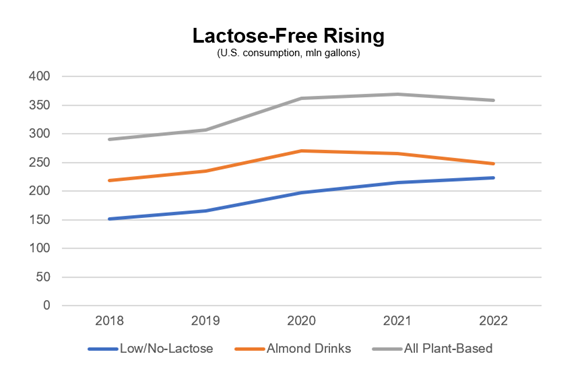
Imagine how equitable a solution it would be for lactose-intolerant populations if nutrition programs touted lactose-free milk as aggressively as plant-based lobbyists tout their artificially concocted, nutritionally inferior beverages. And when you think of it that way, it's an insult to the spirit of equity to tell lactose-intolerant children that they should receive nutrition that's unequal to what others receive.
These are sensitive topics, but for an honest discussion, sometimes it's important to "go there." Fortunately, we're seeing encouraging signs of progress, with recent USDA proposals beginning to acknowledge the need for greater lactose-free dairy access in federal nutrition programs.
But to get the most equitable nutrition policy, it's important to point out what equity would look like. It doesn't mean self-serving arguments designed to goose sales for the declining plant-based beverage industry. It doesn't mean allowing their advocates to cynically tout a "solution" that would worsen nutrition outcomes. It means making sure that everyone – especially children – gets the best available nutrition, so that everyone has an opportunity to thrive. And that means milk. We're more than able to provide that solution.
Helena Agri-Enterprises introduced two new brands at the 2023 Commodity Classic in Orlando, Florida, designed with sustainability in mind. The enzyme-based soybean seed treatment, Enertia™, improves soil quality on the farm, while the water use efficiency tool, Resgenix™, manages resource consumption. Together, Enertia and Resgenix balance crop production needs with environmental stewardship to increase yields responsibly and efficiently.
"Helena has been researching and developing biological products for decades," says Mike Powell, Sr. Brand Manager of Crop Production and BioScience products for Helena. "It's given our customers ways to make important changes on their farms such as the reduction of nitrogen rates and implementation of plant-based inputs. Now, with protected enzyme technology, we're targeting the needs of our soil to take a natural approach to raising productivity."
Enzymes are a key indicator of soil health. Applied as a seed treatment, they increase microbial activity in the germination zone. Enertia stabilizes its enzymes with VersaShield® Formulation Technology for longer-lasting activity in the soil and more compatibility with other soybean seed treatments. By improving nutrient availability in the soil as roots develop, Enertia produced a 14 percent increase in root weight by mass, a 3 percent increase in plant population, and a 2.4 bushel per acre yield advantage over the standard fungicide and insecticide seed treatment alone in trials across Midwest and southern geographies.
Despite advancements in technology, quality crop production would not be possible without adequate water availability. Worsening drought conditions and growing populations are increasing demand for fresh water, leading to more restrictions and higher costs for agricultural producers.
"Water impacts everything we do on the farm," says Austin Anderson, Brand Manager of Adjuvants and Water Management Products for Helena. "If we don't utilize the water we have effectively, we could lose productivity in the field, and the efficacy of our spray applications could suffer."
Resgenix improves water use efficiency with greater ease than ever before thanks to a revitalized polyacrylamide formulation. Its convenient liquid formulation is compatible with most crop management products and requires no special equipment for application. Applied through irrigation water or conventional spray applications, Resgenix can improve aggregation in all soil types, which strengthens water holding capacity and helps mitigate erosion, run-off and soil moisture evaporation loss. Even with a 20 percent reduction in irrigation water in field trials, adding Resgenix maintained soil moisture content and exceeded yield compared to water alone.
Addressing environmental challenges requires everyone to do their part. Helena is proud to introduce Enertia and Resgenix and help more growers begin a more sustainable path forward. Watch clips from Helena's product preview at the Commodity Classic on YouTube, and visit HelenaAgri.com for more information on products and services from Helena.
About Helena Agri-Enterprises, LLC
Helena Agri-Enterprises, LLC is a complete agronomic solutions provider headquartered outside of Memphis in Collierville, Tennessee. Helena is a multi-faceted retailer and distributor in the production agriculture and specialty markets, offering innovative products and services to improve productivity for greater customer returns. This includes crop protection and crop production products, seed and seed treatments, AGRIntelligence® tools, professional application, financial services, and chemical formulation. Helena is driven by a belief in People... Products... Knowledge®... Through knowledgeable and dedicated people, superior products, and the latest, proven technologies, Helena is committed to helping customers succeed.
President Joe Biden has proclaimed March 21, 2023 National Ag Day. This year marks the seventh year that The White House has publicly recognized National Ag Day as a salute to the contributions of America's farmers, ranchers and agribusinesses.
The proclamation highlights the spirit across America's ag communities. A respect for tradition, a drive to innovate and a commitment to never giving up. It also highlights the many challenges farmers face and the administration's commitment to fighting for farms and farm workers. You can view the proclamation here.
Amy Bradford, Growmark, chair of the board for the Agriculture Council of America, the national organization charged with promoting National Ag Day, said receiving this type of recognition from the administration greatly enhances the stature of National Ag Day, as well as the many local and state Ag Day activities planned around the country. "More importantly, it reminds everyone that the safe, affordable, abundant and nutritious food that they depend on every day comes to them thanks to the hard work and resilience of 2 million American farmers and ranchers."
National Ag Day is organized by the Agriculture Council of America (ACA). In its 50th year, Ag Day is composed of leaders in the agricultural, food and fiber community, dedicating its efforts to increasing the public's awareness of agriculture's role in modern society. #AgDay23
For more information on National Ag Day, visit agday.org and learn how America's agricultural producers are proudly leading the way in growing a climate for tomorrow.
Today on National Ag Day, the National Association of State Departments of Agriculture celebrates the many contributions agriculture makes to our nation's security and prosperity. NASDA is a proud partner of the seventh annual Feeding the Economy report revealing food and agriculture industries and their suppliers contribute over $8.6 trillion to the U.S. economy.
NASDA CEO Ted McKinney shared his support of the report and National Ag Day celebrations.
"Feeding the Economy" in concert with National Ag Day celebrates the collective impact that everyone working to grow, process and produce our food has on the economy. State departments of agriculture recognize that a thriving U.S. agricultural industry feeds our U.S. economy and nourishes the world through international trade. We're proud that today's report proves our industry's continued strength across the states and around the globe," McKinney said.
Learn more about the report at FeedingtheEconomy.com and celebrate National Ag Week all week long as NASDA highlights the impact of each state's agriculture and food industry on social media and NASDA members' efforts to ensure agriculture leads the way toward a healthy and resilient world.
NASDA is a nonpartisan, nonprofit association which represents the elected and appointed commissioners, secretaries and directors of the departments of agriculture in all 50 states and four U.S. territories. NASDA grows and enhances American food and agricultural communities through policy, partnerships and public engagement.
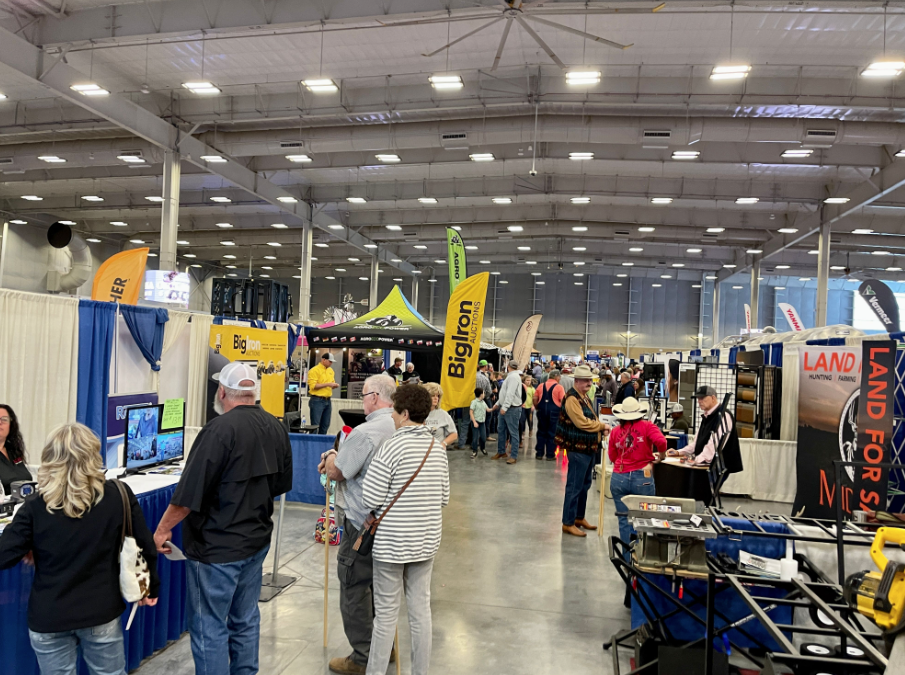
The 19th Annual Oklahoma City Farm Show is set to feature the latest agricultural machinery, equipment, technology, and services from hundreds of exhibitors representing more than 1000 products and services. Indoor exhibits will fill the Bennett Event Center, along with outdoor exhibits located directly in front of the event center. The show is free to attend and there is plenty of free parking at the OKC Fairgrounds complex.
Attendees can stay up to date on the event and view the interactive show floor plan at the event website, OklahomaCityFarmShow.com. The interactive floor plan provides the most up-to-date exhibitor information, along with contact information and exhibit location. Social media users can also stay informed of daily event announcements and interact with fellow attendees and exhibitors by following the show at facebook.com\OklahomaCityFarmShow.
Great food, events, music, and prizes
In addition to more than 150,000 square feet of agricultural and ranching exhibits, the show kicks off each morning with complimentary coffee and rolls until 10:00 AM. Early attendees can also take advantage of the opportunity to sign up for the daily $1,000 Showbucks prize drawing, sponsored by Great Plains Kubota. The Showbucks drawing will be held each day at 1:00PM. Showbucks can be used as cash to purchase products from show exhibitors. Attendees can sign up for the drawing at the Great Plains Kubota exhibit.
Spartan Mowers will be offering a Ride-and-Drive demonstration area, featuring it's full line of zeroturn riding mowers. Attendees who take a test drive on any day of the show will be entered in a drawing to win a new Spartan Zero-Turn mower, given away at 3:00pm on Saturday. The winner does not need to be present to win. Visit the Spartan mower exhibit for full details.
Returning this year, country singer, Rusty Rierson, will perform daily acoustic shows inside the Bennett Event Center. Rusty is a native of Kansas and has produced eight albums and performed across the country. Rusty always pays tribute to George Strait, Don Williams, and some of his other heroes, as well as his own music.
"We are excited to be hosting the 19th Annual Oklahoma City Farm Show in support of Oklahoma's great farm and ranch industry," said show manager, Penny Swank. "The OKC Fairgrounds provides great facilities, with hundreds of indoor and outdoor farm and ranch exhibits at the Bennett Event Center. It's a state-of-the-art facility and provides a clean and comfortable climate-controlled environment. Free admission and free parking make for an easy and enjoyable experience."
The Oklahoma City Farm Show runs April 13, 14 & 15 at the Bennett Event Center, located on the OKC Fairgrounds Complex in Oklahoma City. Show hours are 9AM-5PM on Thursday and Friday, and 9AM4PM Saturday. The OKC Fairgrounds complex is located off NW 10th Street in Oklahoma City, between I-44 and May Avenue. For more information on the Bennett Event Center and the OKC Fairgrounds, visit OKStateFair.com. For more information on the Oklahoma City Farm Show, including the most current event schedules, visit OklahomaCityFarmShow.com.
RON's Dave Lanning has a pre-opening look at today's agricultural Markets.
Click the audio tab below for today's report.
Agriculture Secretary Tom Vilsack today released the following statement in celebration of the annual National Agriculture Day, which will take place on Tuesday, March 21:
"On this 50th National Ag Day, we recognize the contributions of American farmers, farmworkers, ranchers, forest landowners, and all agricultural producers in providing our nation – and this world – with its food, fuel, and fiber.
"Throughout our history, Americans have faced unprecedented challenges, but we have always been able to endure thanks in large part to the unwavering efforts of those who work the land. Because of the efforts of our agricultural communities, here in America we all benefit from a rich abundance of safe and nutritious food, which allows us to thrive as one of the few nations on earth that is food secure and not dependent on any other nation for basic food needs. American agriculture is able to lead the world into a climate-smart future as farmers, ranchers and producers take seriously their responsibility to be stewards of our land and water and take part in every day climate smart practices that improve soil health and water quality.
"Rural America is the backbone of this country, and the strength of our agricultural and rural communities supports the vitality and prosperity of our entire country while bolstering our national security and competitive edge. Last year marked record export numbers for the agricultural sector, showing that there is a global desire for the high-quality foods produced here at home and that our agricultural industry understands their role in feeding the world, with productivity and with compassion.
"At USDA, we remain steadfast in our commitment to expanding market opportunities, ensuring an agricultural economy that benefits the many and not just the few, and meeting the moment for the opportunities before us. As we look toward another year of agricultural leadership, innovation, and growth, let us shine a light on all that our agricultural and rural communities do for our great country."
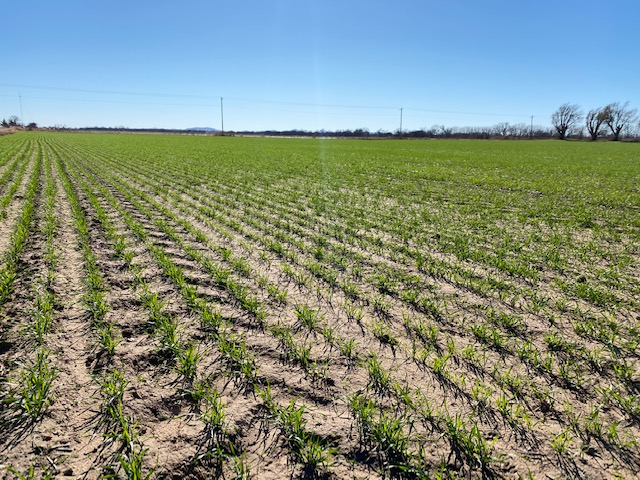
According to the Oklahoma Crop Progress and Condition Report released on March 20, 2023, winter wheat was rated 29 percent good to excellent, 28 percent fair and 43 percent poor to very poor. Last week's ratings were 30 percent good to excellent, 26 percent fair and 44 percent poor to very poor. Winter wheat jointing reached 22 percent, up 11 points from the previous year and up 1 point from normal.
Pasture and Range Conditions rated 13 percent good to excellent (no excellent), 27 percent fair and 60 percent poor to very poor. Last week's ratings were 9 percent good to excellent, 31 percent fair and 60 percent poor to very poor.
Livestock conditions rated 39 percent good to excellent, 42 percent fair and 19 percent poor to very poor. Last week's conditions rated 42 percent good to excellent, 42 percent fair and 16 percent poor to very poor.
Winter wheat conditions rated 19 percent good to excellent, 31 percent fair and 50 percent poor to very poor. Last week's conditions rated 17 percent good to excellent, 31 percent fair and 52 percent poor to very poor.
Winter wheat conditions rated 23 percent good to excellent, 33 percent fair and 44 percent poor to very poor. Last week's ratings were 17 percent good to excellent, 33 percent fair and 50 percent poor to very poor. Winter wheat headed reached 22 percent, up 4 percentage points from the previous year and up 10 points from the average.
Corn planted reached 40 percent, even with the previous year and up 5 percentage points from the average.
Sorghum planted reached 28 percent, even with the previous year and the average.
Range and pasture conditions rated 12 percent good to excellent, 27 percent fair and 61 percent poor to very poor. Last week's ratings were 8 percent good to excellent, 24 percent fair and 68 percent poor to very poor.
The Oklahoma Cattlemen's Association has served as the Trusted Voice of Oklahoma cattle producers since 1953. The organization has long-standing values that serving today's beef producers goes hand-in-hand with supporting Oklahoma's agricultural youth, specifically young people interested in beef production.
The Oklahoma Cattlemen's Association has coordinated the steer and heifer futurity sales and showback at the Oklahoma Youth Expo (OYE) since 2015. Over 60 heifers and 50 steers were sold through the 2023 futurity sales during OYE.
"These sales provide students an opportunity to purchase an animal for their next show," said Tiffani Pruitt, Futurity Sale Coordinator. "The OCA proudly coordinates the sales because it provides us with an opportunity to further support young cattlemen at OYE. We invest the commission from the futurity sales right back into agricultural youth through purchases and add-ons at the OYE Sale of Champions."
OCA invested about $20,000.00 at the OYE Sale of Champions. And that is just how the organization views it – an investment.
"Supporting, encouraging and investing in our youth helps keep the next generation rooted in agriculture and is vitally important to our association and industry," Pruitt said. "This year, we saw the largest number of animals return for the steer and heifer shows that exhibitors purchased last year, and we sold more cattle for next year than we ever have. We appreciate the young people involved and the breeders who help them be involved in the beef industry."
The Oklahoma Junior Cattlemen's Association was charted in 1985 with the purpose to promote the welfare of the cattle industry by furthering the education and cooperation of young people interested in cattle, and to aid in the attainment of mutual goals set by OJCA members interested in all phases of their business and all possible career and leadership opportunities.
According to Pruitt, who also serves as the coordinator of the Oklahoma Junior Cattlemen's Association (OJCA), 34 of the steer exhibitors who qualified for the OYE Sale of Champions were OJCA members. Young people interested in the beef industry can join the OJCA at okcattlemen.org/ojca.
The OCA is the trusted voice of the Oklahoma Cattle Industry and works to protect and empower Oklahoma cattlemen today, to serve tomorrow. OCA is the only voice that speaks solely for the cattlemen of Oklahoma and represents beef producers in all 77 counties across the state. The OCA officers, board of directors and membership encourages you to join us in our advocacy efforts to ensure less government intervention, lower taxes and a better bottom line. For more information about OCA membership, the theft reward program or activities call 405-235-4391 or visit www.okcattlemen.org.
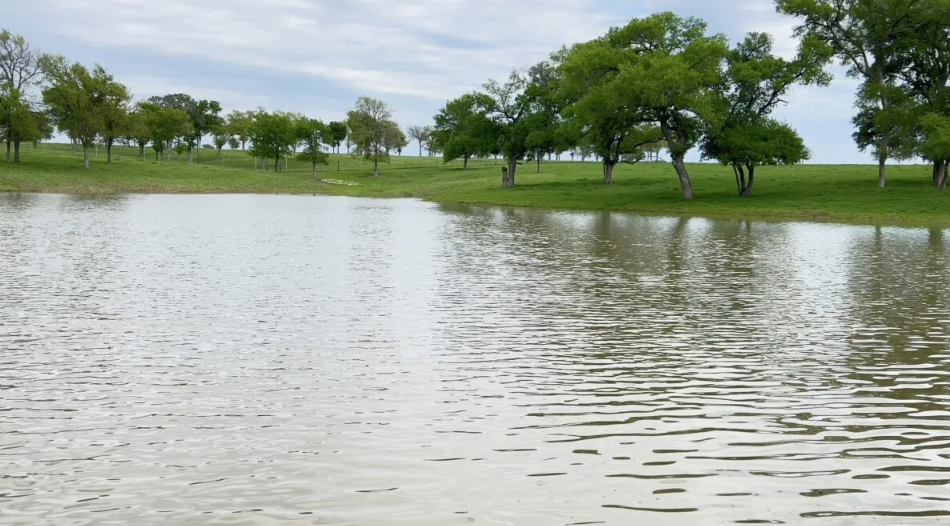
American Farm Bureau Federation President Zippy Duvall commented today on a U.S. District Court ruling to halt the 2023 Waters of the United States Rule in Texas and Idaho.
"AFBF is pleased the District Court ordered EPA and the U.S. Army Corps to halt implementation of the troubled 2023 WOTUS Rule in Texas and Idaho. The judge recognized the new rule likely oversteps EPA's authority under the Clean Water Act, which creates uncertainty for the farmers and ranchers who must navigate the complicated regulations.
"The District Court ruling also undermines the agencies' rationale for pushing through this new rule before the Supreme Court rules in Sackett v. EPA. These legal challenges send a clear message to EPA that it should rewrite WOTUS to limit its scope to navigable waters. Farmers and ranchers share the goal of caring for the natural resources we're entrusted with, but we need rules that don't require a team of attorneys to interpret."
Read the U.S. District Court for the Southern District of Texas ruling here.
The National Sorghum Foundation (NSF) and BASF are pleased to announce the award of two joint scholarships to Max Harman from Michigan State University and Breely Huguley from Texas Tech University. Each winner will be awarded $2,500 to be applied during the 2022-2023 academic year.
"The National Sorghum Foundation is proud to once again partner with BASF to award these scholarships to two very deserving young individuals," NSF Chairman Jeff Dahlberg said. "We send a warm congratulations to Max and Breely on this accomplishment and look forward to continuing this partnership to help hard working student leaders succeed."
Harman is a first year Ph.D. student studying molecular plant genetics at Michigan State. In his application, he said he wants to pursue a career in agriculture research to improve food and our food system using novel gene-editing techniques to discover and implement novel traits that benefit both producers and consumers.
Huguley, a senior agricultural communications major at Texas Tech, grew up on a farm near Olton, Texas. Huguley plans to pursue a master's degree in the same discipline with future aspirations to either work in public policy in Washington, D.C., or in public relations and crisis communications.
"It's great to see this generation focusing on sorghum," Brian Robert Taylor, BASF South-Central Kansas business representative, said. "Sorghum is near and dear to my farm and to my fathers-in-laws farming operation. Farming in a tough area, we are very resource conscious and recognize sorghum's ability to produce grain with less water and fertilizer; and it fits into our no-till farming operation extremely well.
"The future of tackling the 'Biggest Job on Earth' depends on growers continuing to plant it, and students continuing to study it. We are thrilled to partner with the NSF in this endeavor."
For more information about the National Sorghum Foundation, additional scholarships and criteria, visit www.sorghumgrowers.com/foundation-scholarships/.
Dr. Derrell Peel, Oklahoma State University Extension Livestock Marketing Specialist, offers his economic analysis of the beef cattle industry as part of the weekly series known as the "Cow Calf Corner" published electronically by Dr. Peel and Mark Johnson. Today, Dr. Peel talks about the USDA Cattle on Feed Report.
The latest USDA Cattle on Feed report showed March 1 feedlot inventories at 11.645 million head, down 4.5 percent year over year and the lowest March inventory since 2017. Placements in February were down 7.2 percent year over year and the sixth consecutive monthly decrease in placements. In fact, placements were down 10 of the past 12 months. February marketings were down 4.9 percent from one year earlier.
Figure 1 shows monthly inventory totals (blue line) and a 12-month moving average (MA) of monthly feedlot inventories (green line) since 2011. While monthly feedlot totals vary seasonally, the moving average removes the normal seasonality so that changes month to month indicate the underlying trend in feedlot production. March 2023 was the sixth consecutive month of declining feedlot inventories year over year. With feedlot totals decreasing since October, the MA peaked in September 2022 at 11.8 million head, dropping to 11.63 million head as of this latest report, the lowest level since October 2020.
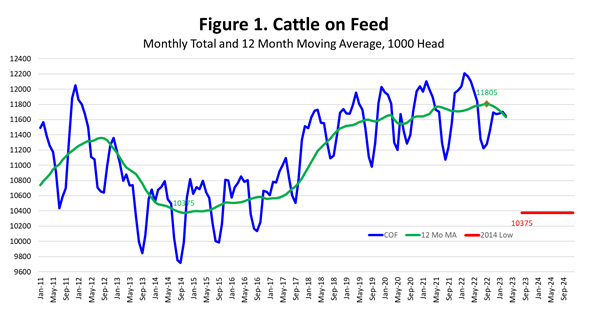
Declining feedlot production leads immediately to two questions. How low will feedlot inventories go in the coming months? And when will the low happen? Figure 1 may provide some indications of what to expect. The previous multi-year low in the feedlot inventory MA was in October 2014, after drought-forced herd liquidation in 2011-2013. The current beef cow herd is slightly smaller that the 2014 herd level. The beef cow herd is likely to drop a bit more in 2023. It is reasonable to expect that average feedlot inventories will drop close to the 2014 low of 10.375 million head or possibly even lower at some point in the coming months.
The question of when that low will happen is trickier. Although there are expectations for diminishing drought conditions in 2023, the drought continues for now and it's not clear whether liquidation will be pushed even further this year. The smallest calf crop of the next few years will be in 2024 at the earliest. Feedlot inventories will decline through 2023 with the low in 2024 or beyond. Figure 1 shows that the feedlot inventory MA decreased from August 2012 until October 2014 following the previous drought episode. This suggests that the coming feedlot low might not happen until late 2024 or later.
This leads to a third question of how long low feedlot inventories will persist. Figure 1 shows that, from the MA low in October 2014, average feedlot inventories increased very slowly until the fall of 2017 before increasing more rapidly through 2018 and 2019. Feedlot inventories remained relatively low for about three years. This was the period of herd rebuilding when heifer retention was at the highest levels, with replacement heifer inventories peaking in 2016 and 2017. Not until heifer retention slowed after 2017, were additional heifers available for feedlot placement. The number of heifers in feedlots on January 1 increased by 23 percent from 2017 to 2019.
It appears that the 2012-2017 period is a useful analog for the next few years regarding feedlot inventories. The current state of cattle inventories, especially the cow herd size, replacement heifer inventories and expected calf crops are generally analogous to the previous period beginning in late 2012. In fact, the current situation reflects a more severe depletion of female inventories compared to the 2012-2017 period. Based on the analog period, feedlot inventories will likely decline from the feedlot inventory MA peak in September 2022 to a level similar to the 2014 low in the coming months and remain relatively low for the next four years or longer.
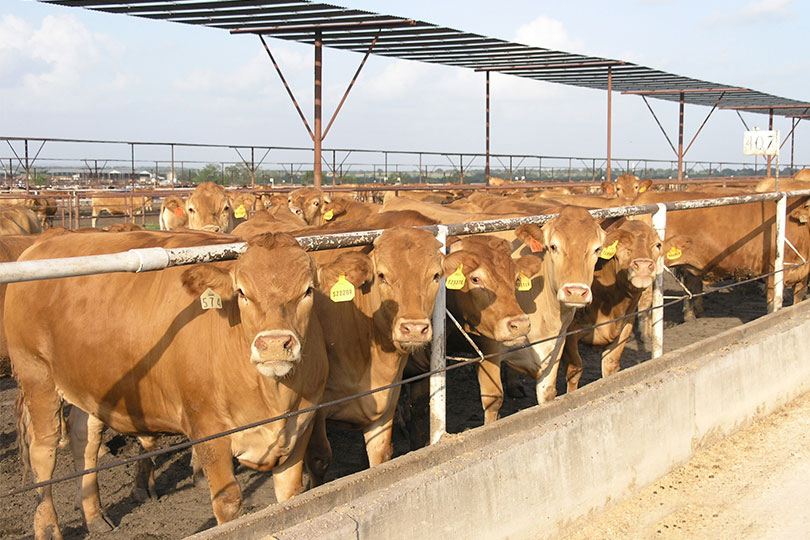
In this episode of Beef Buzz, Senior Farm and Ranch Broadcaster, Ron Hays, is talking about the latest cattle on feed numbers, and features input from DTN Livestock Analyst ShayLe Stewart on the report.
The cattle on feed number as of March is at 96 percent of a year ago, which is down four percentage points. The average estimate was expecting close to 95.3 percent of those cattle on feed numbers.
Placements in February were at 93 percent, down seven percent from a year ago. Pre report estimates showed placements at 93.1 percent.
Marketings were reported at 95 percent of a year ago and the pre-report estimates averaged at 95.7 percent at a range from 95 to 96 percent.
DTN Livestock Analyst, ShayLe Stewart, said it is likely traders will find the report neutral to somewhat bullish as analyst projections leading up to the report were spot-on. From a fundamental standpoint, she added, one cannot argue that with the tremendous position that this report has put cattle feeders and cow-calf producers in, it is not surprising to see Friday's cattle on feed number to come in at four percent under the year ago numbers, with some analysts predicting that the report could be as few as 94.2 percent of a year ago.
With marketings not as aggressive as they were the previous year, which is largely due to reduced slaughter speeds, there is naturally going to be more cattle on feed than if processing speeds were still operating like they were in 2022.
What is most interesting, Stewart said, is that the placement data is very bullish. Regardless of weight division, cattle placed in February of 2023 were lighter than the previous year.
When one compares the placements of January 2023 to those of February 2023, the only two weight divisions that saw an increase in placements from a month ago are the eight to nine weights, and those weighing over 900 pounds.
Friday's placement data clearly shows that the industry is looking at fewer cattle going forward. In this latest report, market fundamentals are showing that fewer beef cows in the market are contributing fewer calves and feeders to be had at both feedlots and packers.
The competition for those calves will likely keep prices on the upswing, and numbers are looking to be tighter as the year progresses. Higher prices can be expected for calves and yearlings, especially if forage becomes more available.
The Beef Buzz is a regular feature heard on radio stations around the region on the Radio Oklahoma Ag Network and is a regular audio feature found on this website as well. Click on the LISTEN BAR for today's show and check out our archives for older Beef Buzz shows covering the gamut of the beef cattle industry today.
WOTUS Rule Takes Effect Today in 48 States
Today, the National Cattlemen's Beef Association (NCBA) expressed strong disappointment in a decision by the U.S. District Court in the Southern District of Texas to deny a nationwide preliminary injunction that would have halted the Biden administration's harmful Waters of the United States (WOTUS) rule from taking effect.
"This latest WOTUS rule will place more burdens on family farms and ranches, drive up costs, and prevent cattle producers like me from making investments in our land," said NCBA President Todd Wilkinson, a South Dakota cattle producer. "While we appreciate the court's injunction of the rule in Texas and Idaho, we are strongly disappointed in the decision to keep this WOTUS rule in place in 48 states and I am proud of NCBA's efforts to continue the fight against this rule."
The Environmental Protect Agency finalized the latest WOTUS rule at the end of 2022. NCBA and its litigation partners filed a lawsuit seeking to overturn the rule on January 18, 2023. NCBA sought a nationwide preliminary injunction, which would have prevented the federal government from implementing the WOTUS rule until the entire case is decided. Instead, the court granted a limited injunction in only two states—Texas and Idaho.
"The court's decision to keep the Biden administration's WOTUS rule in place is concerning and irresponsible," said NCBA Chief Counsel Mary-Thomas Hart. "Without a nationwide injunction, the rule takes full legal effect today and will become an immediate burden on our nation's cattle producers. NCBA will continue efforts to defend our nation's farmers and ranchers."
CHS Inc. (NASDAQ: CHSCP), the nation's leading agribusiness cooperative, today announced the appointment of Sarah Bovim as vice president, government affairs. Bovim brings over 17 years of experience to CHS, leading government affairs and public policy for Whirlpool Corporation and Albertsons Companies, one of the largest U.S. food and drug retailers.
Before working in the private sector, Bovim served as a senior U.S. trade negotiator at the Office of the United States Trade Representative (USTR) during both Democratic and Republican administrations. She led negotiating teams that shaped international trade policy and provided insights and perspectives to Congress and executive branch officials on how government action affects business. She has also worked as an economist for the U.S. Department of Commerce, International Trade Administration and The World Bank.
Bovim succeeds Jim Zappa as head of government affairs, who will retire on April 3, 2023. Zappa joined CHS in 2015 as general counsel and held various leadership roles within the organization.
"Sarah brings tremendous experience, strong relationships and deep knowledge managing a broad range of regulatory and legislative issues that will help CHS represent the voice of our farmer and cooperative owners across the U.S.," said Brandon Smith, executive vice president and general counsel. "I also want to thank Jim Zappa for his tremendous contributions to CHS over his eight years at the company."
CHS Inc. (www.chsinc.com) is a leading global agribusiness owned by farmers, ranchers and cooperatives across the United States. Diversified in energy, agronomy, grains and foods, CHS is committed to creating connections to empower agriculture, helping its farmer-owners, customers and other stakeholders grow their businesses through its domestic and global operations. CHS supplies energy, crop nutrients, seed, crop protection products, grain marketing services, production and agricultural services, animal nutrition products, foods and food ingredients, and risk management services. The company operates petroleum refineries and pipelines and manufactures, markets and distributes Cenex® brand refined fuels, lubricants, propane and renewable energy products.
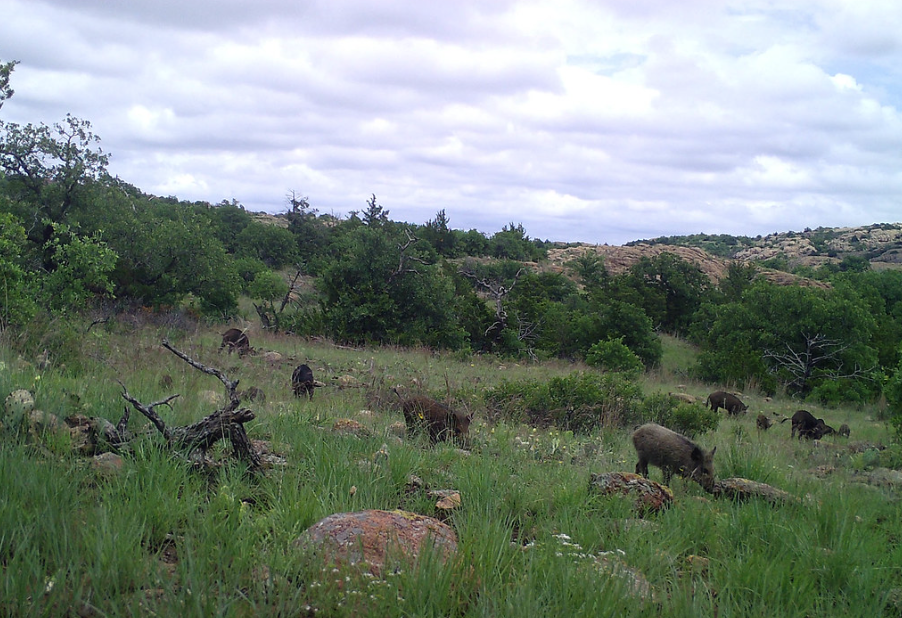
Feral hogs were almost unheard of in Oklahoma 40 years ago but can now be found all over the state. They cause an estimated $1.5 billion in economic damages annually across the U.S. (Photo by OSU Agriculture)
By Alisa Boswell-Gore
Researchers at land-grant institutions in the southern region of the United States are working hard to stop more than $1 billion in economic damages each year.
Around 9 million feral hogs have been reported in 35 states. Feral hogs were almost unheard of in Oklahoma 40 years ago but can now be found all over the state, according to the U.S. Department of Agriculture's Animal and Plant Health Inspection Service. They cause an estimated $1.5 billion in economic damages annually across the U.S. They eat crops, dig up trees and devour food that other animals depend on.
Hogs can significantly damage native flora and fauna through their rooting behaviors and facilitate the spread of invasive plants, alter soil and water resources and limit regeneration of native plants. Habitat degradation by feral hogs can influence the diversity and occurrence of native wildlife communities. Feral hogs also carry and transmit diseases that pose significant risks to the health of many wild and domestic animals.
"Damage from feral hogs has become a widespread phenomenon across many areas of the United States, causing a staggering amount of damage," said Scott Senseman, associate vice president of OSU Ag Research. "A collaborative, multi-state effort is likely the only way to mitigate the problem."
Oklahoma
The Wichita Mountains Wildlife Refuge is a key refuge for native bison conservation, and feral hogs were documented at WMWR as of 1993. Despite considerable control efforts and costs, feral hogs have persisted, and the ecosystem impacts have not been assessed.
Oklahoma State University's research goal is to estimate feral hogs' space use patterns within the refuge and assist refuge managers by evaluating the effects of the species on the diversity of the native mammal community.
Remote game cameras at 99 sites within the refuge will document how feral hogs and other native mammals use specific wildlife spaces. Small mammals have been live-captured at a quarter of the sites to document small mammal diversity. Analysis of results from the first field season is in progress.
Sampling will be repeated in May through August 2023. Researchers will evaluate what environmental factors drive the variety of ways that feral hogs use the refuge. Native animals will be analyzed to account for species that may have been missed. After the 2023 sampling is completed, data and research results will be provided to natural resource managers and the scientific community.
Arkansas
The Arkansas Forest Resources Center in Monticello led a multi-state survey of 4,500 landowners to gauge economic damage feral hogs cause to croplands, forestlands, pasturelands and livestock.
The study estimated feral hog damages over five years across all of Arkansas and Louisiana as well as 38 counties in east Texas. According to the survey, private landowners' average agricultural cropland damage in the past five years was $28 per acre in both Arkansas and Louisiana and approximately $25 per acre in east Texas. The most reported feral hog damage to agricultural crops involved corn, soybeans, rice, wheat, hay, silage and forage crops.
Louisiana
The Louisiana Department of Wildlife and Fisheries estimates the feral hog population in the state to be more than 900,000. A Louisiana State University AgCenter survey estimated damages to commodity production at $66 million and other non-production losses at almost $25 million.
The LSU AgCenter and Department of Chemistry are working on a bait-and-delivery system to help reduce the feral hog population. The soft baits, which are swallowed by the hogs, contain sodium nitrite, a common food additive in products like bacon, that is lethal to hogs.
The ag center team plans to commercialize the bait system once they are satisfied with its performance. The product will then go through federal and state approval processes.
South Carolina
The South Carolina Wild Hog Task Force was created to coordinate education, research and management efforts to reduce problems associated with wild hogs in the Palmetto state. The task force is comprised of 21 different state and federal agencies, agriculture and natural resources associations, and conservation groups led by Clemson University and the USDA Animal and Plant Health Inspective Service Wildlife Services.
Clemson University supports the South Carolina Wild Hog Task Force to coordinate education, research and management programs to reduce damage caused by wild hogs in South Carolina. Future research will focus on effective methods to reduce wild hog damage and track damage in the state.
For information on how to deal with feral hog issues, visit OSU Extension Fact Sheets.
OSU Ag Research is Oklahoma's premier research and technology development agency in agriculture, natural resources and the life sciences.

At its annual Executive Leadership Conference (ELC), Growth Energy, the nation's leading biofuels trade association, awarded member Kelly Nieuwenhuis with its highest honor, America's Fuel Award. America's Fuel Award is presented to an individual who has gone above and beyond the call of duty as a champion for the renewable fuels industry. Growth Energy CEO Emily Skor congratulated Iowa farmer and longtime ethanol advocate Kelly Nieuwenhuis on his award and thanked him for his years of service to the biofuels industry.
"Kelly has lived the ethanol success story—he has experienced first-hand the value that bioethanol offers for his farm, his family, and the future of agriculture. And he pays it forward," said Skor. "With a tireless commitment to ensuring the long-term viability of the industry and certainty for the rural economy, Kelly has spent the majority of his working life in the service of biofuels."
"With deep roots in agriculture, a staunch belief in the power and potential of biofuels, and an eye toward what's possible, Kelly Nieuwenhuis embodies the best of what our industry has to offer," she added.
Nieuwenhuis is chairman of the National Corn Growers Association (NCGA) Ethanol Action Team, where he leads the effort to increase ethanol demand through research, infrastructure partnerships, and sound public policy. He's also a member of the U.S. Grains Council Ethanol Committee, Chairman of the Iowa Corn Promotion Board—and, in 2016, former Iowa Governor and past America's Fuel Award winner Terry Branstad (R) appointed him to the Iowa Renewable Fuels Infrastructure board where he helped lead the effort to issue grant incentives for retailers converting equipment for the expanded use of renewable fuels. Current Iowa Governor Kim Reynolds (R) reappointed him to this position in 2021. Nieuwenhuis has also spent nine years on the Board of Directors of the Siouxland Energy Cooperative, serving as its president in 2018, 2019, and 2020. Past winners of America's Fuel Award include Iowa Senator Chuck Grassley, U.S. Department of Agriculture (USDA) Secretary Tom Vilsack, and many others that have made significant contributions to the U.S. bioethanol industry.
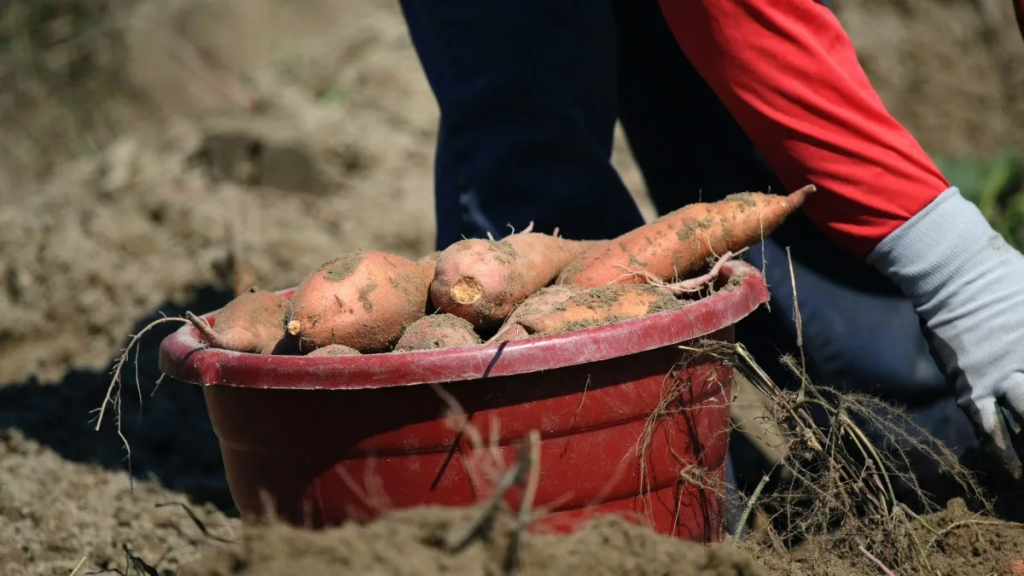
The American Farm Bureau Federation urges Congress to pass newly-introduced legislation to freeze the flawed 2023 Adverse Effect Wage Rate (AEWR), which distorts labor costs for farmers across the country who hire nearly 400,000 employees through the H-2A program.
The bipartisan Farm Operations Support Act, introduced by Sens. Jon Ossoff (D-GA) and Thom Tillis (R-NC), temporarily resets the AEWR at 2022 levels, providing much need wage relief to farm families and giving Congress an opportunity to deliver a fair and reasonable solution.
The 2023 AEWR rule missed the mark by such a wide margin that farmers in some states experienced required wage increases of more than 10% after smaller increases last year. In Michigan and Florida, for example, wages have increased 13 percent and 15 percent compared to 2022 rates. Furthermore, DOL's newly published rule in February 2023 will raise costs even higher for certain occupations on farm.
The AEWR has significantly outpaced increases in the national average wage for most workers in America for most of a decade. In fact, it has outpaced the overall U.S. Employment Cost Index in eight of the last 10 years.
AFBF President Zippy Duvall said, "Farmers are committed to paying their employees a fair wage, but the new AEWR rule used flawed data to reach a flawed conclusion. Requiring farmers to pay their workers far more than the average domestic worker is earning just makes no sense, especially in the face of high supply costs, inflation and a global food shortage. I commend Sens. Ossoff and Tillis for standing up for farmers and urge Congress to pass this critical legislation."
The Farm Operations Support Act ensures valued farm employees are paid a consistent and fair wage without demanding farmers exceed the wage rates paid to other workers in America.
Full text of the bill can be viewed here.
More information about the labor challenges facing agriculture can be found here.

Last week, two banks were in the process of collapsing, and state and federal regulators took them over.
On Sunday, the Federal Reserve Bank announced more liberal lending to all banks to help them weather the decline in the prices of bonds they hold as bank reserves.
On Monday, President Biden announced an unprecedented bailout for the depositors of two collapsed banks.
On Tuesday, the Bureau of Labor Statistics announced that consumer prices in February were 6.0% higher than a year ago, the lowest year-over-year inflation rate since September 2021, but still higher than any month before that, going back to December 1990. So-called "core inflation" (inflation minus food and energy – whose prices matter but move more erratically than other prices) was 5.5%, also the lowest since (December) 2021 and also higher than any other month in over 30 years. February's month-over-month core inflation of 0.5% is higher than any of the last four months.
How are these related?
The inflation of 2021 and 2022, as we have talked about before, was caused by the massive amount of new money created by the Federal Reserve Bank ("the Fed") in 2020 and 2021. The Fed lent trillions of dollars to banks at near-zero interest rates and purchased trillions of dollars in government-backed securities.

This recent modest slowing of inflation is the beginning of the price response, with a similar lag, to the Fed's tightening of the money supply, by selling some of those securities and by aggressively raising the interest rates they charge banks.
That is, the Fed has followed an unprecedented 40% increase in the money supply in just 2 years with a 2½% decline in the money supply in the 9 months ending in December, which is already unprecedented in the 50+ years since the dollar stopped being tied to the value of gold, and the largest decline in the money supply since 1937, when tight money policy reignited the Great Depression.
The good news is that this dramatic reversal of money supply growth should be sufficient to rein in inflation over the next 6 to 12 months, given the actions that have already been taken and the time required to see their full effects: just as inflation took 12 months and more to show up after the Fed's expansionary policies began, so does its contractionary effort take 12 months and more to be fully felt in the inflation rate.
The bad news is that the Fed no longer believes that the money supply is significant to inflation, but believes that it must slow the economy until inflation is reaches the Fed's target of 2%. The result is that the Fed continues to raise interest rates with the specific intent of slowing the economy, and only a clear immediate return of inflation to (or toward) the 2% target is likely to stop them.
Based on statementsby the Fed's chair, Jerome Powell, next week's meeting of the Fed's Open Market Committee was expected to bring another aggressive rate increase of one-half percent, which would have brought the effective rate the Fed charges banks to over 5%, after sitting at near zero for much of the last decade.
The only reason that this rate increase may be a quarter percent increase is because the Fed seems shaken by the banking crisis that their rate increases have triggered since the Chair's earlier statement.
Two banks, the Silicon Valley Bank in California and Signature Bank in New York, were closed and taken over by regulators last week. Banks generally have been squeezed by rising Fed interest rates and depositor withdrawals to spend down balances built up during the peak of the Covid pandemic, when the government was sending out big checks to people who had nothing to spend them on. In the case of Silicon Valley Bank, the rising interest rates caused the short-term value of bonds they held to go down, and the bank became arguably insolvent, in the sense that they couldn't sell those bonds now for enough to cover withdrawals, and the instant communication of that among their high-tech startup customers led to a very fast run on deposits, accelerated by digital banking which allows millions to be moved to another bank with a phone app. Signature Bank, which had been heavily involved in cryptocurrency banking, in addition to traditional banking, had a similar run apparently based in part on depositor panic caused by the troubles of Silicon Valley Bank.
The government response included two major actions, in addition to taking over the two banks. First, the Federal Deposit Insurance Corporation, which normally insures bank deposits up to $250,000 guaranteed all deposits in these two banks, as much as 90% of whose deposits were over that limit and so would have not been insured without that change. Second, the Fed opened up a new facility for banks to borrow at a slightly lower rate against the long-term value of bonds whose short-term value has been cut by the higher interest rate the Fed has imposed on the economy.
So what does this all have to do with inflation?
Good question.
We have established, I hope, that today's inflation was caused by the Fed's aggressive expansion of the money supply in 2020 and 2021.
That inflation has created price instability and uncertainty in the economy that has made many investment decisions riskier than they would be if inflation had remained low and stable.
The Fed has addressed inflation, not by returning to a steady and stable growth in the money supply, but by using monetary policy to beat the economy over the head until the economy slows down, based on their belief that this is the best way to control prices. (As we've said before, this is like swinging the anvil on the hammer, rather than the other way around.) In the past, the Fed would raise interest rates reluctantly as a way slow growth in the money supply (especially before selling off bonds was understood as a good alternative); now, the Fed is raising interest rates explicitly to slow demand in the economy.
That intention of slowing the economy also creates risk and uncertainty in the economy, including banks: no-one knows what the Fed will do. (One possibility is that the Fed keeps raising rates to over 6%, until the inflation reduction that is already in the pipeline shows up in another 6 to 8 months.) For the nearly forty years though 2019, by contrast, Fed policy had been remarkably stable and predictable, to the benefit of the entire economy.
As mentioned above, the Fed's interest rate increases have created pressures on banks by depressing the current market value of some of the relatively conservative assets they hold, ironically, to meet regulatory requirements.
The good news in the short run, for farmers and depositors, is that the government's quick action should shore up otherwise healthy banks across the country, including your community bank. The message from agricultural lenders at community banks I spoke to this week is that, while interest rates are higher and so is credit more expensive, access to that credit won't be a problem in 2023, especially given the strong outlook for the farm economy. Farm balance sheets are strong, on average, and 2023 looks to be another good year. The high cost of credit may slow expansion of production, and that caution in borrowing is probably prudent.
Community banks also tend to avoid the risky businesses like crypto-currency and high-risk startups, and they welcome depositor visits to the bank and scrutiny of their annual reports for reassurance.
And the government seems to have guaranteed all deposits in all banks, so that shouldn't be a concern for depositors either.
Whether that is a good long-term policy for the financial system is probably something we will be talking and thinking about for some time. The FDIC relies on healthy banks to pay into a pool, and uses that pool to guarantee depositors. Insuring all deposits could mean responsible banks will be paying more for the action of irresponsible (and unlucky) banks, and doing so in an economic environment made more risky by the Fed's new approach to its job.
RON's Dave Lanning has a pre-opening look at today's agricultural Markets.
Click the audio tab below for today's report.
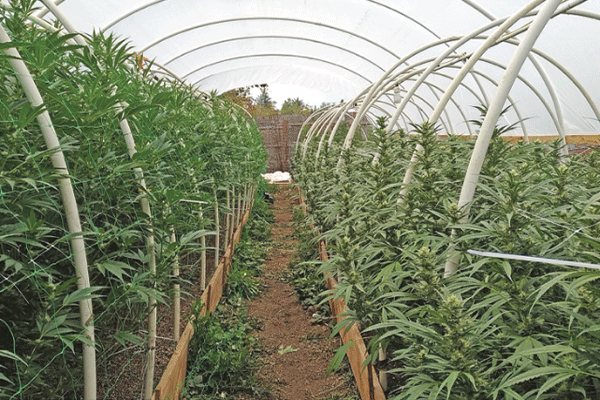
Since the legalization of Medical Marijuana in Oklahoma with State Question 788- criminals have flocked to the state to set up illegal grow houses because of cheap permits, cheap land and lax rules allowing them to get into the business of growing marijuana in Oklahoma.
Ron Hays talks with Oklahoma Bureau of Narcotics spokesman Mark Woodward about how these enterprises have invaded Oklahoma- the magnitude of the current problem and how the state is pushing back on thousands of bad people who have set up shop in the state- with the hope to reduce the number of these operations dramatically in the days to come.
It's a huge problem all across rural Oklahoma but Woodward believes progress is being made to reign in these illegal marijuana farms.
Click on the listen bar below- or click here to jump to Soundcloud link for the conversation- or search for Road to Rural Prosperity on the platform where you listen to your favorite podcasts to access this podcast.
Illinois River in Eastern Oklahoma
A federal judge on Friday granted Oklahoma Attorney General Gentner Drummond an additional 90 days to reach an agreement that would resolve an 18-year-old lawsuit over poultry litter pollution in state watersheds.
Oklahoma Northern District Judge Gregory Frizzell on Jan. 18 decided in favor of Oklahoma in its lawsuit against poultry companies for environmental damage to state waters, particularly the Illinois River watershed and Lake Tenkiller. At that time, the judge set a March 17 deadline for the Office of the Attorney General to forge an agreement with the 11 poultry companies and subsidiaries.
Drummond said the additional days are necessary to fulfill the judge's directive.
"We have had lengthy and productive discussions with the poultry companies about a resolution that both looks to the future and mitigates past damages," he said.
"The poultry industry has made significant improvements over the years in its litter abatement process, and I am hopeful we can craft a plan that protects Oklahoma's natural resources without placing unreasonable burdens on the companies."
Finley Yocham of Sapulpa 4-H is all smiles as she sets her Grand Champion Steer up as the Sale of Champions begins
The 2023 OYE is in the record books- and the Sale of Champions provided a strong finish- the sale of 211 top market animals sold for $1.5 million- matching last year's record!
Finley Yocham of Sapulpa 4-H saw her Grand Champion Steer bring $102,000- matching last years number and second only to the 2018 Grand Steer record. Yocham's steer was the Champion Crossbred at the 2023 show. The buyers group included Oklahoma City Chamber of Commerce, Bank of the West, Express Ranches, First Liberty, Bob Funk and Jarold Callahan.
The Grand Champion Barrow- owned by Brigham Bunt of Ringwood 4-H sold for $30,000. The best barrow of over 2,000 in the 2023 market hog show was the Champion Hampshire. The buyer who bought the 2023 Grand Barrow is Westgate Market Developers.
Next up was the Grand Champion Market Lamb that sold for $15,000- owned by Connor Anthony of Bethel FFA. Connor's lamb was purchased by the Oklahoma State Fair and CSTK Trailers.
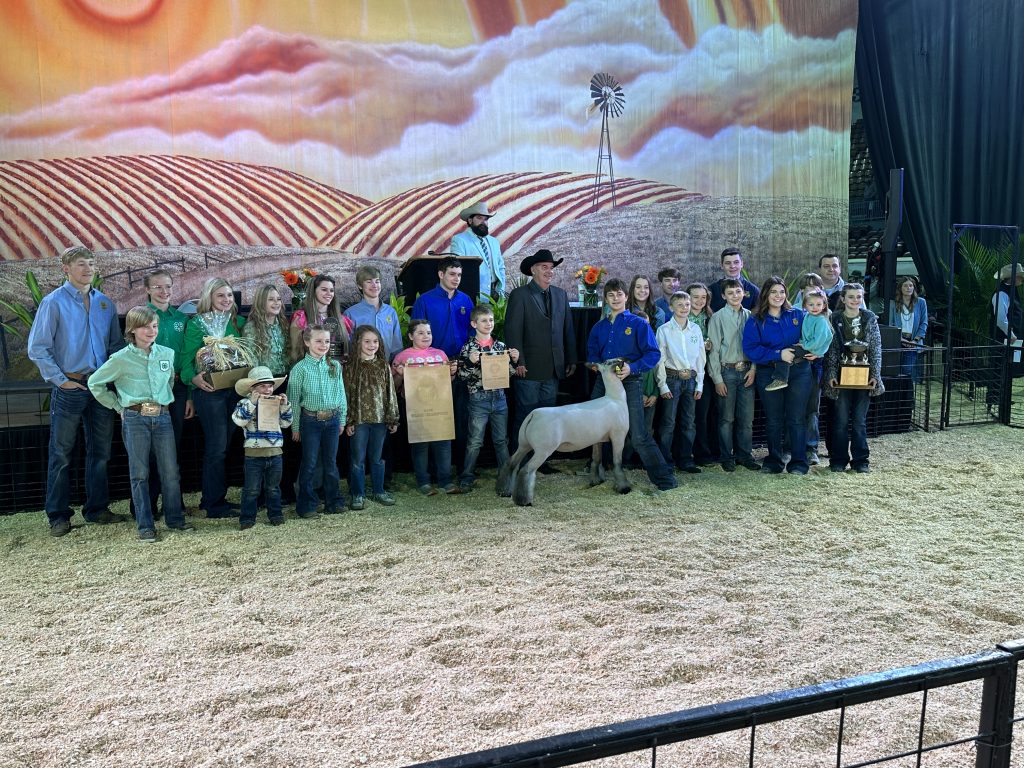
The final Grand Champion that was brought into the ring was owned by Cara Cummins of Hollis FFA, who showed the Grand Champion Goat- and he brought $15,000. The buyers group for the best Market Goat to be found at OYE in 2023 included McDonalds, Diamond Hats and Farm Credit of Western Oklahoma.
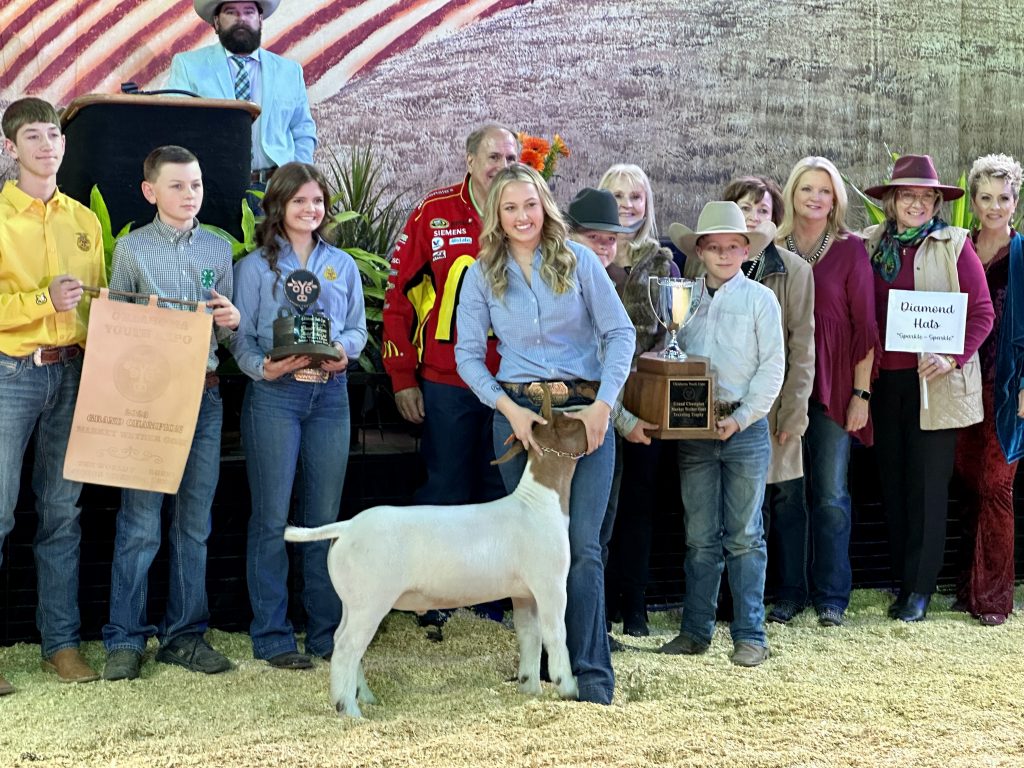
Leading off the Reserve Grand Champions- the Reserve Grand Steer owned by Colby Kokojan of Drummond FFA brought $35,000- the buyers group included Farm Credit of Western Oklahoma, Oklahoma State Fair, CSTK Trailers and P&K Equipment.
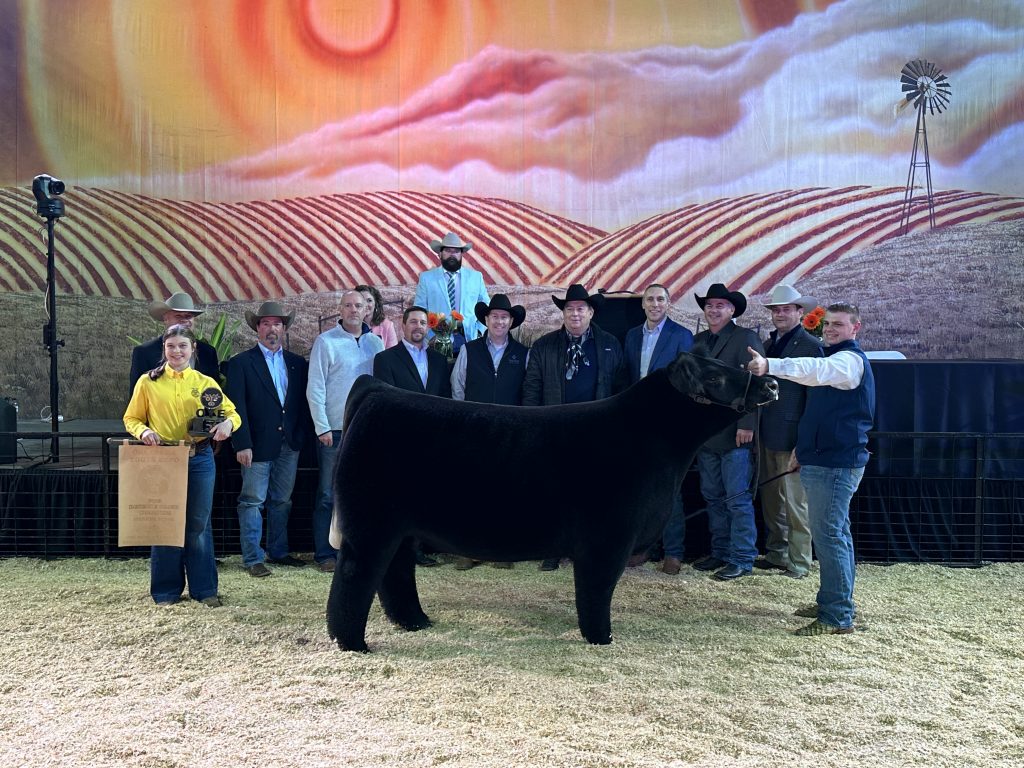
The Reserve Grand Champion Market Barrow was shown by Anna Franke of Covington FFA- the group that bought her barrow for $15,000 included Blue and Gold Sausage, Seth Wadley and the Oklahoma Pork Council.
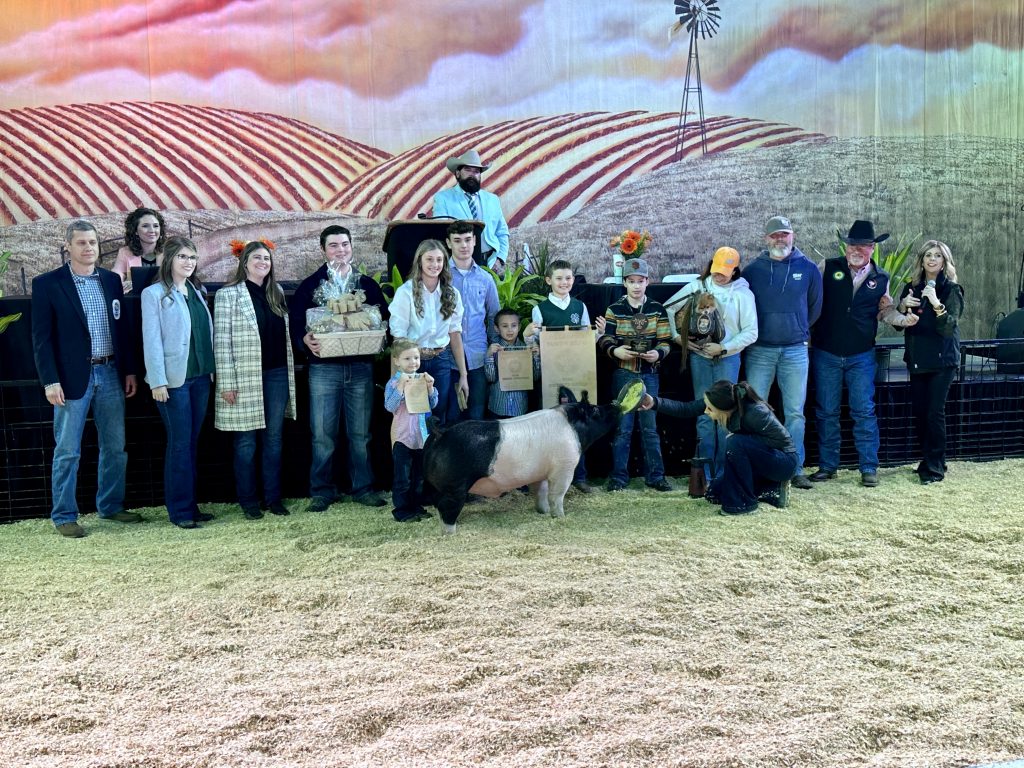
Next up was the Reserve Grand Champion Market Lamb. Sayde Allen of Canute 4-H was back to the big sale once again- last year- she had the Grand Champion Market Lamb and Grand Champion Market Goat in 2022. Her Reserve Lamb sold here in 2023 for $10,000- and was purchased by Bank of Western Oklahoma and the Oklahoma State Fair.
The Reserve Grand Champion Market Goat was shown by Dakota Thurmond of Snyder 4-H- young Dakota saw his Market Goat sell for $10,000- purchased by Generator Supercenter.
The Oklahoma Farm Report team was snapping pictures from start to finish- and you can see our full set of pictures in our Flickr album for 2023- available here. If you want to look back to the 2022 OYE- click here for our pictures from last year's event.
Our coverage of the 2023 Oklahoma Youth Expo is sponsored by Hilliary Communications- who deliver the latest cutting-edge communications services supporting tens of thousands of customers across 22 counties throughout Oklahoma, Texas and Iowa. The company offers internet, voice and HilliaryTV. Hilliary Communications continuously researches the marketplace for innovations and strives to improve underserved areas, offering services that exceed customer expectations. Click here to learn more about Hilliary Communications.
The National Bison Association (NBA) is encouraging members of the U.S. Senate and House Agriculture Committees to include farm bill policies that will foster continued growth in the bison business. See the NBA's Farm Bill priorities here.
As the Agriculture Committees progress on the development of the 2023 Farm Bill, the National Bison Association this week provided each member of the committee with a summary of top priority issues for the bison business under the new long-term legislation.
The bison industry priorities include provisions regarding disaster assistance, trade, rural development, beginning farmer assistance, and truth-in-labeling. The organization also requested that agricultural research priorities recognize the importance of protecting the health of the nation's bison herds.
In a message accompanying the Bison Association's priorities, Executive Director Jim Matheson wrote, "Overall we simply want to ensure that bison is specifically included under the definition of livestock in terms of eligibility for all USDA loan, disaster, insurance, and other programs. Bison producers are generally included in farm bill programming, but being such a small sector of American agriculture, it always helps to explicitly list bison producers as being eligible."
Matheson also urged congressional leaders to include provisions that would encourage the elimination of trade barriers that place bison at a disadvantage to beef in the international marketplace. In the area of meat processing, the bison industry urged that loan and grant programs be expanded to encourage workforce development, infrastructure expansion, and reciprocity in state and federal inspection services, particularly in small facilities.
Learn more about the National Bison Association and their work at www.bisoncentral.com
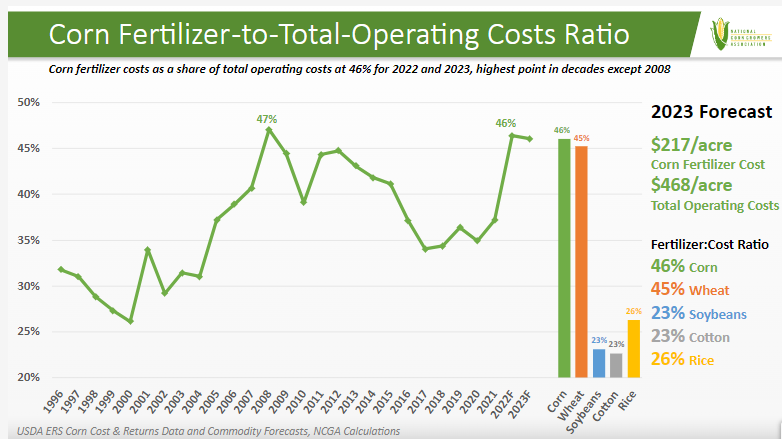
The following is a brief analysis by Krista Swanson, the lead economist for the National Corn Growers Association.
Phosphorus, an essential nutrient for plant growth and development, is important for corn productivity. Farmers use fertilizers to replenish phosphorus and other nutrients in the soil to maintain healthy and fertile land, but vital fertilizer management comes at a high cost. This is especially true for corn producers, particularly right now.
Since 1996, average annual fertilizer costs were about one-third of total operating costs incurred in growing a corn crop. For 2023, the United States Department of Agriculture (USDA) projects fertilizer to make up 46% of the total operating costs incurred by the U.S. farmer in growing a corn crop, unchanged from 2022, but up from 37% for the 2021 crop and 35% for the 2020 crop. Aside from 2008, the current fertilizer-to-operating-cost ratio is at the highest point since the 1970s.
Compared to other major commodity crops, corn not only has the highest fertilizer costs in dollar value, but also the highest fertilizer-to-operating-cost ratio. Wheat is a close second, with the USDA forecast at 45% for 2023, but fertilizer costs are only 23-26% of the total operating costs for soybeans, cotton and rice.
The American Farm Bureau Foundation for Agriculture, with support from Grow with Google, has selected four educators to be Foundation Fellows. Their goal is to make digital skills and agricultural literacy more accessible to students across the country, with a focus on rural classrooms, as they near completion of their first set of lesson plans.
The fellows are Melanie Berndtson (Pennsylvania), Linda Chase (Kansas), Keonte' Edmonds (North Carolina) and Tanya Novakowski (North Carolina). Each educator is currently participating in an eight-month long program, working to develop place-based curriculum that incorporates agriculture, technology, and key digital skills into a Google Applied Digital Skills lesson.
The lessons developed by the fellows will be available, for free, to all educators interested in teaching students about food, fuel and fiber while giving students a strong foundation in digital skills.
"Our four educators chosen as Foundation Fellows are excellent examples of teachers dedicated to equipping rural students with career-focused digital skills while introducing students across the country to fundamental agricultural concepts," said Daniel Meloy, executive director of the Foundation for Agriculture. "I can't wait to see how the lessons our fellows develop are used in rural, urban and suburban classrooms."
Each of the fellows has received a stipend, Chromebooks for their classroom and one-to-one instruction from experts at Google. The first two of four lessons will be available on National Ag Day, March 21.
About the Fellows
Melanie Berndtson, Pennsylvania
Melanie Berndtson is an agriscience teacher at Wellsboro Area High School in Wellsboro, Pennsylvania. She teaches animal science, plant science, leadership and natural resources. She holds an associate's degree in applied animal science, a bachelor's degree in agricultural education from the University of New Hampshire, and a master's degree in agricultural and Extension education from Penn State.
Melanie is an advocate of experiential learning and inquiry-based instruction. She is passionate about sustainability in agriculture and works with her students to look for new ways to use technology and fresh thinking to solve some of today's most pressing sustainability challenges. As a Farm Bureau Foundation Fellow, Melanie is excited to inspire the next generation of students and teachers in agriculture through her passion for hands-on learning and sustainable agriculture.
Learn more about Melanie here.
Linda Chase, Kansas
Linda Chase is an agriculture instructor and FFA advisor at Wellington High School in Wellington, Kansas. She has been teaching agriculture education for more than 25 years, with the last 13 of those at Wellington.
As a Farm Bureau Foundation Fellow, Linda wants to see more women involved in agriculture and agriculture education. She is focused on providing the public with a greater understanding of where food comes from, and on thinking more critically about how we can improve the global food supply in ways that are economically feasible for both farmers and consumers.
Learn more about Linda here.
Keonte' Edmonds, North Carolina
Keonte' Edmonds teaches agriculture at Apex Friendship High School and North Carolina Virtual Schools. He holds a master's degree in agricultural education from North Carolina A&T State University and is a doctoral student in agricultural education at North Carolina State University.
As a Farm Bureau Foundation Fellow, Keonte' is committed to using technology to ignite students' passions and connect them with a world of career opportunities in agriculture that they'd never imagined. He hopes to serve as a role model for students who love agriculture, but don't see many others like themselves in the industry.
Learn more about Keonte' here.
Tanya Novakowski, North Carolina
Tanya Novakowski is a sixth grade math and science teacher at Rose Hill-Magnolia Elementary School in Rose Hill, North Carolina, where she's worked for more than two decades. She wants to show students that rural communities offer them opportunities to make a good living and thrive, "from the fields to the board rooms."
Tanya believes digital literacy is a great equalizer and essential for her students to compete. For her efforts and dedication, Tanya was named North Carolina Farm Bureau Ag in the Classroom Teacher of the Year in 2022. As a Farm Bureau Foundation Fellow, she is working to develop a place-based curriculum that incorporates agriculture, technology and digital skills into an Applied Digital Skills lesson.
Learn more about Tanya here.
For more information on the Foundation Fellows program, visit the Foundation webpage.
VIDALIA ONIONS HEADED FOR SHELVES APRIL 17
Georgia Agriculture Commissioner Announces Official Pack Date for 2023
The start of Vidalia onion season is almost here, with the official pack date announced by the Georgia Agriculture Commissioner and Vidalia Onion Committee today. Vidalia onion fans across the country can mark their calendars for April 17, when the sweet onions are set to ship to grocery stores across the country.
"I'm pleased to announce, in coordination with the Vidalia Onion Committee, April 17, 2023, as the official pack date of the 2023 Vidalia onion season," said Georgia Agriculture Commissioner Tyler Harper. "It's an exciting time for farmers and producers in our state and for consumers across the country as we look forward to enjoying the sweet onion once again. The Vidalia onion has become a sought-after ingredient by professional chefs and home cooks alike, and we're proud to grow them right here in Georgia."
Vidalia onions are available for a limited time each year, between April through early September. As America's favorite sweet onion, many look forward to this time of year. The pack date is determined by soil and weather conditions during the growing season, which contributes to high quality Vidalia onions. The Vidalia Onion Advisory Panel voted April 17 as the 2023 pack date.
Known for their sweet, crisp flavor and versatility, Vidalia onions are a seasonal treat suitable in a variety of dishes – from savory to sweet! Because of the unique combination of weather, water and soil in 20 South Georgia counties, Vidalia onions cannot be replicated anywhere else in the world – while all Vidalia's are sweet onions, not all sweet onions are Vidalia's!
"For the 2023 season, we have 10,000 acres of Vidalia onions planted in the production area," said VOC Chairman Cliff Riner. "Over the past few years, sweet onion sales have continued to increase, with Vidalia onions being a big part of the market. We're looking forward to another great season this year."
For more than 80 years, Vidalia onions have been hand-planted, harvested and cured by growers. The Vidalia Onion Act of 1986 established their growing region in South Georgia and trademarked the "Vidalia onion" name. Vidalia onions are grown from a distinctive Granex seed, then packed and sold on or after the official pack date annually.
About the Vidalia® Onion Committee
Because Vidalia® onions are sweetly unique, farmers united to seek legal protection for their crop and its name. Federal Marketing Order No. 955 was established in 1989, to stipulate where the crop can be grown and help with research and promotion of Vidalia onions. The Vidalia Onion Committee administers FMO No. 955 and authorizes production research, marketing research and development and marketing promotion programs. This federal program along with Georgia state laws that protect the Vidalia trademark have provided a legal framework for the industry. So, you can try to grow a sweet onion elsewhere, but you cannot call it a "Vidalia," unless it is from Georgia! For more information, visit VidaliaOnion.org.
About the GDA
The Georgia Department of Agriculture (GDA) is the voice of the state's agriculture community. The department's mission is to provide excellence in services and regulatory functions, to protect and promote agriculture and consumer interests, and to ensure an abundance of safe food and fiber for Georgia, America, and the world by using state-of-the-art technology and a professional workforce. For more information, visit www.agr.georgia.gov.
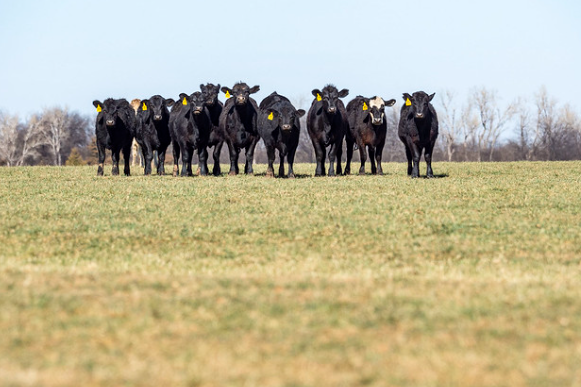
Some parts of the state have received rain within the past month, but wheat pasture and native rangelands throughout central and western Oklahoma are still challenged by drought. (Photo by OSU Agriculture)
By Gail Ellis
The Oklahoma State University Extension Rancher's Thursday Lunchtime Series will begin a spring session on March 23 to focus on navigating dry conditions and high prices.
The series features timely information on beef production, management and marketing from the OSU Extension beef cattle team, experienced ranchers and scientists. The following sessions are free and begin at noon.
March 23 – Weather and Grass Forecast
March 30 – Using Warm-Season Annual Grasses to Restore Hay and Grazing Inventory
April 6 – Selecting Cattle for Productivity and Longevity in Tough Conditions
April 13 – The Future of the Cattle Industry – A View from South Texas
Registration is required. For more information, contact David Lalman at 405-744-6060 or david.lalman@okstate.edu.
OSU Extension uses research-based information to help all Oklahomans solve local issues and concerns, promote leadership and manage resources wisely throughout the state's 77 counties. Most information is available at little to no cost.
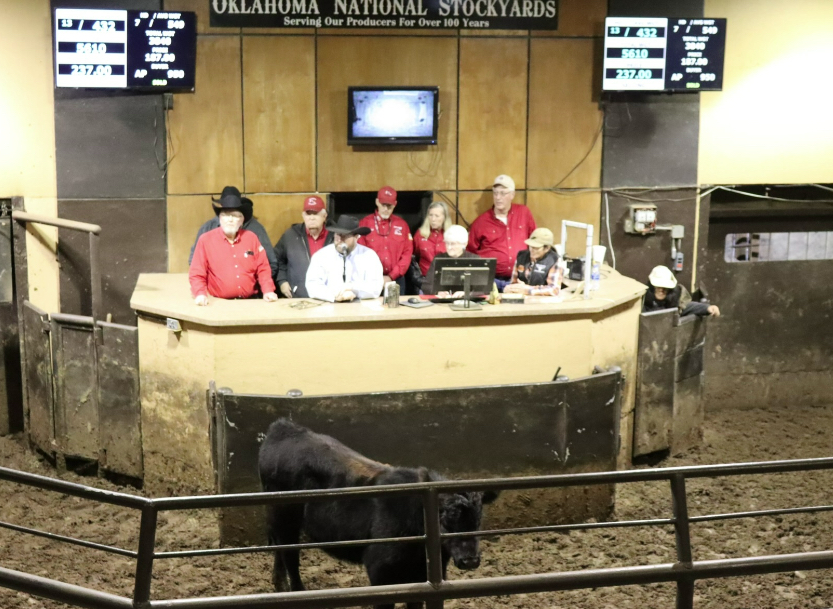
KC Sheperd, Farm Director, is back talking with Bob Rodenberger, a partner with Stockman Oklahoma Livestock Marketing, as he gives the latest on the cattle markets.
"In general, overall, the feeder market stayed good," Rodenberger said. "The grazing market is still phenomenal."
Demand for light cattle going to grass, Rodenberger said, and light cattle in general has been great.
"At these levels, even if you think we are going to get higher, it is cheap insurance to go out here and put some sort of coverage or use the government livestock protection to cover some of these cattle at these levels," Rodenberger said.
Rodenberger said regardless of the high markets, it is important to have some protection in place just in case.
"Optimism is still there, and meat is still moving," Rodenberger said. "I think we have got to find a level where we run up against demand pushing back, but we haven't found that yet."
For next week, Rodenberger said he expects to see good demand.
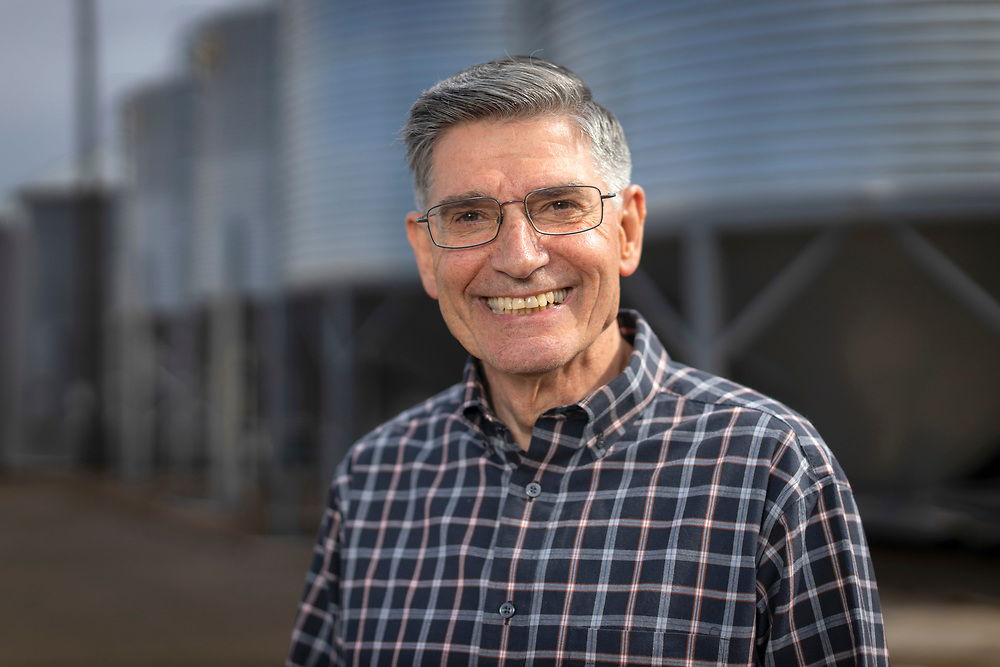
This Week on SUNUP is Oklahoma State University Extension grain market economist Kim Anderson. During this week's edition, with an above average amount of uncertainty in the market lately, Anderson talks about the latest information in the grain markets.
"Some of the uncertainty is the financial risk that is going on, but that is mostly in the financial markets," Anderson said. "I don't think it has bled over into the crop markets very much."
Brazil is seeing record soybean and corn production, Anderson said, and may become the number one exporter of corn this year. China, he added is speculated to be importing corn from Brazil relative to the U.S.
"You've got the drought in Argentina, you have got the record crops in Australia, and of course you have got the war," Anderson said.
There is some protection for producers for yield and price, Anderson said, with the crop insurance program. Sign up ended on March 15 for the summer crops and the wheat, he added.
Guaranteed price wheat is $8.77, Anderson said, and corn is $5.91. Grain sorghum is $5.84, and soybeans are $13.76 and cotton is 84 cents.
"Yield risk protection is going to depend on the percentage that producers bought, but like I said, those insurance contracts are closed, but that protection is there for producers," Anderson said.
This week on SUNUP:
Join us for SUNUP:
Saturday at 7:30 a.m. & Sunday at 6 a.m. on OETA (PBS)
YouTube.com/SUNUPtv
The National Wheat Foundation (NWF) elected new officers at their Annual meeting on March 7, 2023 in Orlando, Florida. Bernard Peterson from Loretto, KY was elected chair. Bernard raises winter wheat, corn and soybeans along with his brothers and nephew. Peterson Farms is very civic-minded and involved in their community, state and national farm organizations.
Scott Brown from Soda Springs, ID was elected vice chair. "I have always believed that it's important for every individual to be involved in their industry, whether you're a school teacher, a banker, or a garbage collector. Telling your story and working to steer the direction of your industry is important, said Scott Brown.
Gary Broyles from Rapelje, MT was elected secretary/treasurer. Gary was re-elected to his second three-year term as a director on the board of the National Wheat Foundation due to his passion for agriculture and the people who derive their living from the ag industry.
NWF also elected new directors: Ken Wood, who farms in north central Kansas, Brian Walker, a consultant who has worked in the flour milling business for over 40 years, and Carl Schwienke, Vice President of grain supply for Siemer Milling Company.
"The makeup of the Board of the National Wheat Foundation is very important so that we get representation and expertise from all across the wheat value chain. We are very excited to welcome all these new board members and know that their contributions are critical to advancing our work in research, education and outreach for the wheat industry. We thank our past board members and will miss having Joe Kejr (KS), Chuck Elsea (KS), and Scott Swenson (MN) on the board. Their contributions were numerous and have helped lay the foundation for our current and future projects," said NWF chair Bernard Peterson.
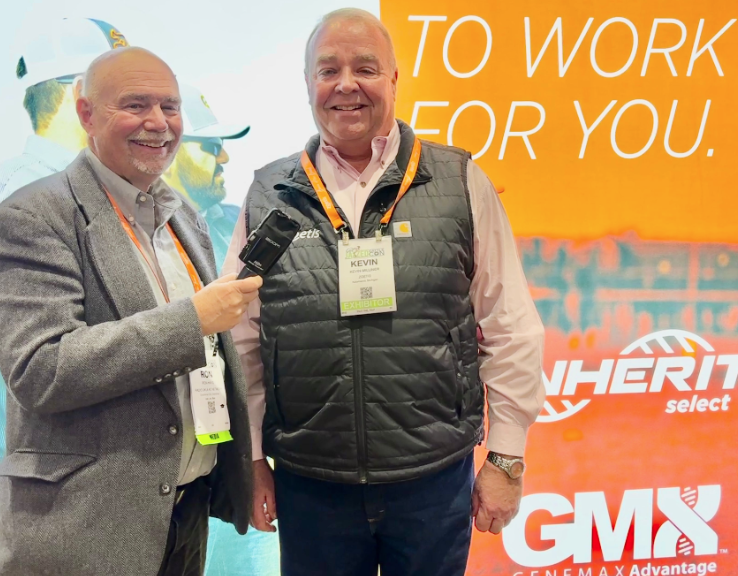
On this episode of Beef Buzz, Senior Farm and Rancher, Ron Hays, is featuring a "best of," talking again with Kevin Milliner, Cattle Genetics Specialist at Zoetis, and talk about Zoetis efforts to aid commercial cow producers in improving their beef cow herds.
The real challenge for the commercial producer, Milliner said, is making genetic improvement faster.
"Our extension folks have told us we need to buy the very best bull we can afford," Milliner said. "Still good wisdom, but the missing link is that female."
Having the chance to know more about their females in an operation, Milliner said, is critical in making genetic process.
"That is why we breed cattle," Milliner said. "We want the next generation to be better than the previous generation, much like we as parents want our kids to be better than we were."
The product Zoetis is offering, Milliner said, offers cow-calf producers the ability to calculate genomic EPDs for 19 traits.
"The EPD is actually calculated from the genomic information," Milliner said. "When you look at how accurate that is, it is as accurate as the old EPDs were before genomics. Certainly, something much more powerful than what we have ever had for the commercial female."
To make it easier for producers, Milliner said Zoetis also offers three indexes.
"These are bioeconomic indexes," Milliner said. "Big fancy word to say that not all traits are created equal. Those traits are weighted on those indexes to the extent that they drive profitability."
Milliner said the first trait is the cow-calf index, which looks at everything maternal.
"We have got the feeder and the carcass index that looks at everything post-weaning, so growth and carcass merit, and we combine those into a total score, if you will, called the total return," Milliner said. "So, it is an easy tool for producers to make those keep-cull decisions by using those indexes."
The tool not only gives producers the index number, but also the percentile range for those indexes and individual traits within the entire database, Milliner said, which is around 1.4 million head.
Using this information will give producers the ability to know what weaknesses they need to correct in their herd, and what to look for when buying their next bulls.
To learn more about Zoetis efforts to help improve producers' beef cow herd, visit https://inheritprogress.com/
The Beef Buzz is a regular feature heard on radio stations around the region on the Radio Oklahoma Ag Network and is a regular audio feature found on this website as well. Click on the LISTEN BAR for today's show and check out our archives for older Beef Buzz shows covering the gamut of the beef cattle industry today.
ASA is among 400 farm and related industry groups signed onto a letter led by ASA and shared this week with congressional leadership on agriculture's budgetary needs in the 2023 Farm Bill. In the letter sent to the chairmen and ranking members of both the House and Senate Budget Committees, the groups urge leaders to understand the value of agriculture and take their needs into consideration when developing the fiscal year 2024 budget.
"We write to express our strong support for providing (...) sufficient budgetary resources to write a new bipartisan, multi-year, comprehensive, and meaningful piece of legislation," the groups convey in the letter, continuing, "Just as there are many pressures on the federal budget, there are many pressures on U.S. farmers and others throughout the agricultural supply chain who provide food, feed, fuel, fiber, and other products to consumers across the United States and abroad."
ASA Says: Daryl Cates, soybean farmer from Illinois and ASA President said, "We have been heartened by recent meetings with leadership—both in Congress and the administration—and appreciate their willingness during this farm bill reauthorization year to hear from the many of us who provide for our nation every day, keeping our families fed and clothed, our cars and fleets moving, and our nation's economy strong and competitive. Their decisions for the 2023 Farm Bill have the ability to sustain these indispensable businesses—both on the farm and those that support and are supported by farmers—and keep them viable in the years to come."
Improving the Farm Safety Net: International sales of U.S. farm and food products reached $196 billion in 2022, according to USDA. China is the top market for these products. When the trade war with China began in 2018, U.S. agriculture endured significant market impacts, revealing critical gaps in the farm safety net.
Cates says for soybeans, the China trade war was a crystal-clear indicator of the need for changes to farm bill legislation, typically put in place for five years: "If a trade war capable of halting all sales of soy to our largest trading partner hardly triggered the farm safety net in the current farm bill, it's hard to envision a scenario that would provide real assistance without making significant improvements."
Other Disruptions: Along with ongoing volatility in China, the letter cites other disruptions continuing to impact U.S. agriculture, including the Russian invasion of Ukraine, COVID-19 and other supply chain disruptions, non-tariff trade barriers erected by multiple countries, and devastating natural disasters—many of which have led to rising production input costs at a time when projections for many crop cash receipts are lower.
Crop Insurance, Conservation, Competitiveness: The groups also note strong budget resources are needed for protecting and enhancing crop insurance, which assists with volatile weather and crop loss, improving access to voluntary conservation incentives, addressing rural development needs, investing in research for innovation and competitiveness, providing opportunities to help the nation become more energy independent and food secure, and supporting solutions to address logistics challenges.
Farm Bill in the News: The ASA-led farm bill budget letter caught the attention of several media outlets this week. Here is a roundup of a just a few:
What ASA is Watching:
Rep. Dusty Johnson (SD) introduced a bill this week to tighten work requirements under SNAP, which falls under the nutrition title of the farm bill. According to POLITICO, this is the first of several bills expected to be introduced to revamp SNAP, priming lawmakers for a partisan battle, which would present obstacles to passing the farm bill this year.
RON's Dave Lanning has a pre-opening look at today's agricultural Markets.
Click the audio tab below for today's report.
Fri, 17 Mar 2023 04:50:57 CDT
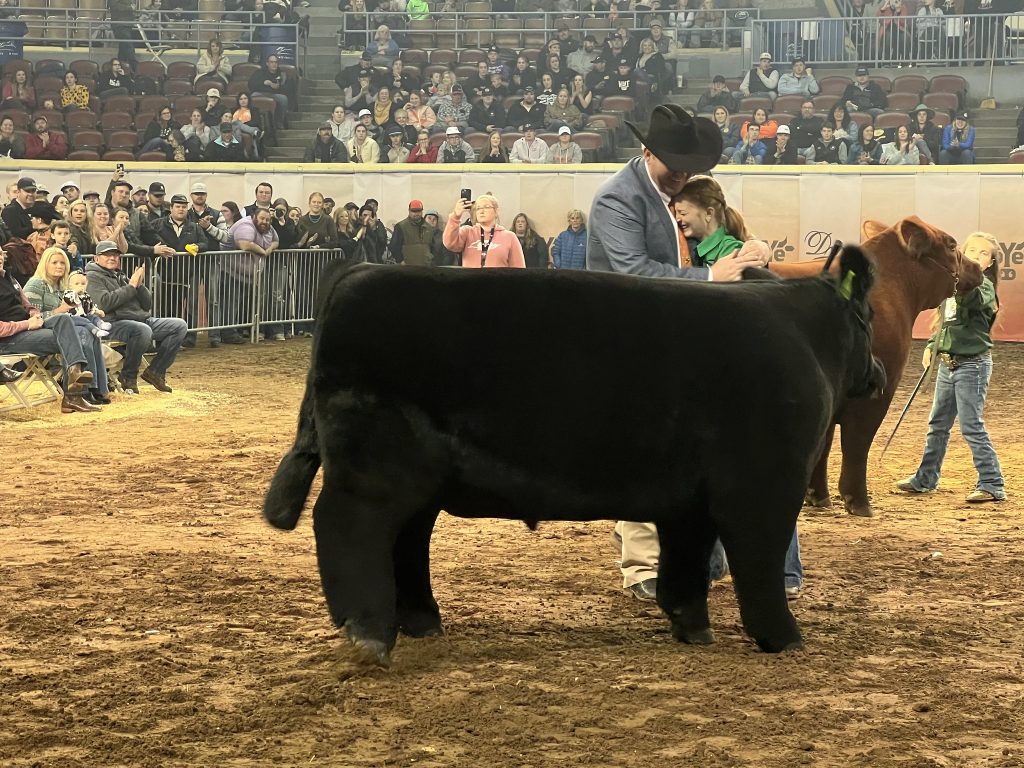
The lineup for the final event connected with the 2023 Oklahoma Youth Expo has been set- the Sale of Champions will feature 211 animals owned and shown by 4-H and FFA members from across Oklahoma. The four Grand Champions selected during the Grand Drive on Thursday evening will lead off the sale that starts at 4 PM on Friday afternoon in the Jim Norick Arena at the OKC Fairgrounds.
Those Grand Champions will start off the sale in the following order:
The Grand Champion Market Steer for 2023 is the Crossbred Steer Champ shown by Finley Yocham of Sapulpa 4-H- Her steer leads off the sale.
The Grand Champion Barrow for 2023 is the Hampshire Champion- shown by Brigham Bunt of the Ringwood 4-H club- Brigham's barrow sells second.
The Grand Champion Market Lamb will sell third-it will be led into the ring by Connor Anthony of the Bethel FFA- Connor's Hampshire Market Lamb was declared the best of show for 2023.
The fourth and final Grand Champion that will help lead off the Sale of Champions is the Market Goat- shown by Cara Cummins of the Hollis FFA.
Click here for the Sale of Champions Sale Order list.
You can also view or click on the PDF at the bottom of this story.
You can watch the Sale of Champions on Walton by clicking here.
The Oklahoma Farm Report team will be (and has been)snapping pictures from start to finish- and you can see them as we add them to our Flickr album for 2023- available here.
Our coverage of the 2023 Oklahoma Youth Expo is sponsored by Hilliary Communications- who deliver the latest cutting-edge communications services supporting tens of thousands of customers across 22 counties throughout Oklahoma, Texas and Iowa. The company offers internet, voice and HilliaryTV. Hilliary Communications continuously researches the marketplace for innovations and strives to improve underserved areas, offering services that exceed customer expectations. Click here to learn more about Hilliary Communications.
Fri, 17 Mar 2023 04:50:57 CDT
The lineup for the final event connected with the 2023 Oklahoma Youth Expo has been set- the Sale of Champions will feature 211 animals owned and shown by 4-H and FFA members from across Oklahoma. The four Grand Champions selected during the Grand Drive on Thursday evening will lead off the sale that starts at 4 PM on Friday afternoon in the Jim Norick Arena at the OKC Fairgrounds.
Those Grand Champions will start off the sale in the following order:
The Grand Champion Market Steer for 2023 is the Crossbred Steer Champ shown by Finley Yocham of Sapulpa 4-H- Her steer leads off the sale.
The Grand Champion Barrow for 2023 is the Hampshire Champion- shown by Brigham Bunt of the Ringwood 4-H club- Brigham's barrow sells second.
The Grand Champion Market Lamb will sell third-it will be led into the ring by Connor Anthony of the Bethel FFA- Connor's Hampshire Market Lamb was declared the best of show for 2023.
The fourth and final Grand Champion that will help lead off the Sale of Champions is the Market Goat- shown by Cara Cummins of the Hollis FFA.
Click here for the Sale of Champions Sale Order list.
You can also click on the PDF link at the bottom of this story.
Click here for the full schedule for the 2023 OYE. The Oklahoma Farm Report team will be snapping pictures from start to finish- and you can see them as we add them to our Flickr album for 2023- available here. If you want to look back to the 2022 OYE- click here for our pictures from last year's event.
Our coverage of the 2023 Oklahoma Youth Expo is sponsored by Hilliary Communications- who deliver the latest cutting-edge communications services supporting tens of thousands of customers across 22 counties throughout Oklahoma, Texas and Iowa. The company offers internet, voice and HilliaryTV. Hilliary Communications continuously researches the marketplace for innovations and strives to improve underserved areas, offering services that exceed customer expectations. Click here to learn more about Hilliary Communications.
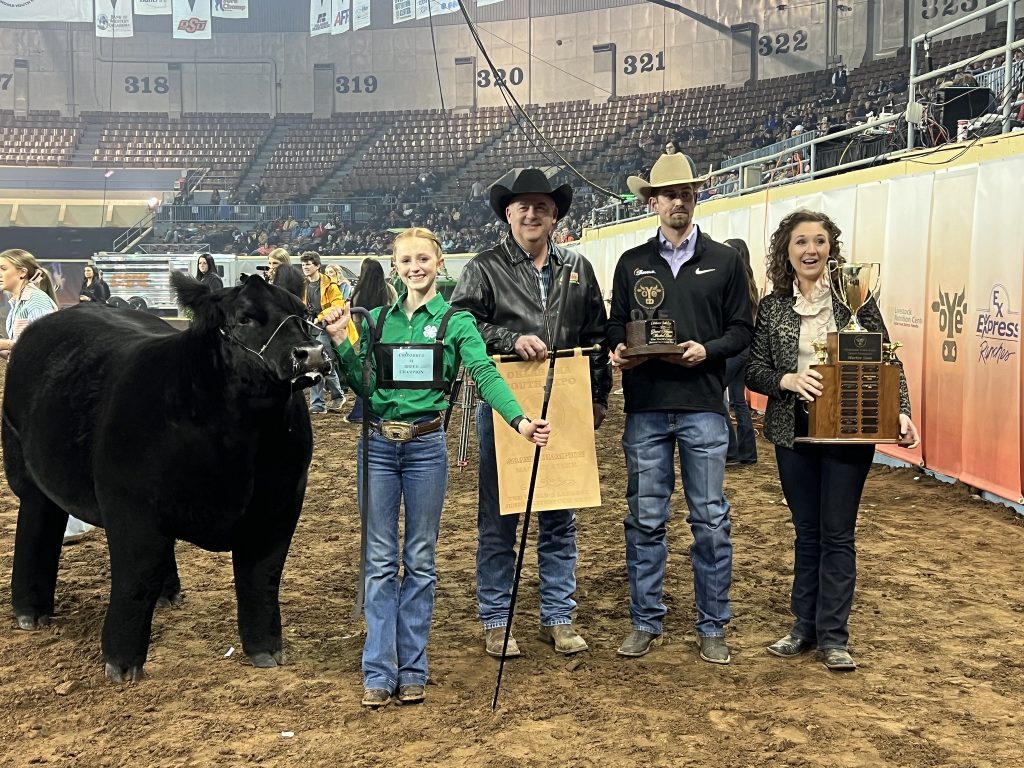
2023 Grand Champion Steer at OYE- Shown by Finley Yocham of Sapulpa 4-H
The Grand Drive of the 2023 Oklahoma Youth Expo concluded on Thursday evening with the selection of the Grand Champion Market Steer. The top steer was selected by judge Parker Henley, the Oklahoma State University Livestock Judging Team Coach, after he had evaluated steers in ten breeds and the crossbreds.
The Grand Champion Market Steer for 2023 is the Champion Crossbred Steer- shown by Finley Yocham of Sapulpa 4-H
Reserve Grand Champion was the Chianina Champion- shown by Colby Kokojan of the Drummond FFA.
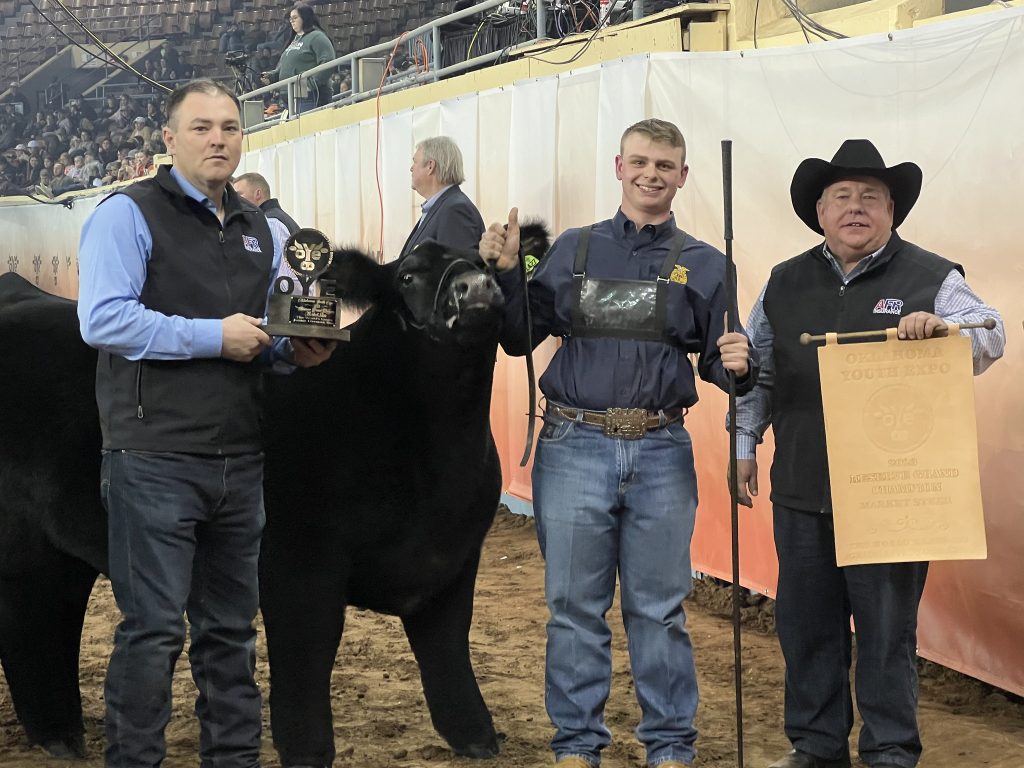
The Bronze Medallion(third place) Market Steer was the Chianina Reserve Champion- shown by Ruby Bell of the Bristow FFA.
Here are the Champions and Reserve Champions in the Market Steer Show:
Champion Angus
Jace Parker Lone Grove 4-H
Champion Charolais
Chloe Sue McEntire- Cheyenne FFA
Champion Chianina
Colby Kokojan- Drummond FFA
Champion Gelbvieh
Skyler Sturgeon- Hydro-Eakly 4-H
Champion Hereford
Haylee Taliaferro- Sterling FFA
Champion Limousin
Cutter Scasta- Madill 4-H
Champion Maine
Sadie Wynne- Newcastle 4-H
Champion Shorthorn
Madilyn Norvell- Amber-Pocasset 4-H
Champion Simmental
Braedon Callis- Minco 4-H
Champion AOB
Brylee Fuss- Twin Mounds 4-H
Champion Crossbred
Finley Yocham- Sapulpa FFA
Reserve Champions Include
Reserve Champion Angus
Kaden Griffin- Pauls Valley FFA
Reserve Champion Charolais
Konner Shebester- Alex FFA
Reserve Champion Chianina
Ruby Bell -Bristow FFA
Reserve Champion Gelbvieh
Asher Pollan- Norman 4-H
Reserve Champion Hereford
Crew Cummins- Holis 4-H
Reserve Champion Limousin
Price Poe- Cherokee 4-H
Reserve Champion Maine
Hayden Taliaferro- Sterling FFA
Reserve Champion Shorthorn
Madison Shout- Piedmont FFA
Reserve Champion Simmental
Reign Scasta- Madill FFA
Reserve Champion AOB
Niki Keesee- Elmore City-Pernell FFA
Reserve Champion Crossbred
Kelton Arthur- Ripley 4-H
All of these Champions and Reserve Champions will be a part of Friday's Sale 0f Champions at the Norick Arena at the OKC Fairgrounds- starting at 4 PM.
Click here for the full schedule for the 2023 OYE. The Oklahoma Farm Report team will be snapping pictures from start to finish- and you can see them as we add them to our Flickr album for 2023- available here. If you want to look back to the 2022 OYE- click here for our pictures from last year's event.
Our coverage of the 2023 Oklahoma Youth Expo is sponsored by Hilliary Communications- who deliver the latest cutting-edge communications services supporting tens of thousands of customers across 22 counties throughout Oklahoma, Texas and Iowa. The company offers internet, voice and HilliaryTV. Hilliary Communications continuously researches the marketplace for innovations and strives to improve underserved areas, offering services that exceed customer expectations. Click here to learn more about Hilliary Communications.
Connor Anthony- owner of the Grand Champion Market Lamb at 2023 OYE
The Grand Drive of the 2023 Oklahoma Youth Expo had the market lambs following the market goat Champion Drive- after over a thousand market lambs were looked at by judge Marvin Ensor of Texas.
The Grand Champion Market Lamb for 2023 is the Champion Hampshire lamb- shown by Connor Anthony of Bethel FFA.
Reserve Grand Champion was the Black Faced Cross Champion- shown by Sayde Allen of Canute 4-H.
The Bronze Medallion(third place) Market Lamb was the Champion Natural Lamb- shown by Clay Randall of Canute FFA.
Here are the Champions and Reserve Champions in the Market Lamb Show:
Champion Hair Sheep
Jancy Rippetoe Merritt FFA
Champion Southdown
Layne Allen Canute 4-H
Champion Shropshire
Hazen Pruett Canute 4-H
Champion Dorset
Austyn Matthews Kinta 4-H
Champion White Faced Cross
Layne Allen Canute 4-H
Champion Natural
Clay Randall Canute FFA
Champion Hampshire
Connor Anthony Bethel FFA
Champion Suffolk
Callen Oldenburg Mulhall-Orlando FFA
Champion Black Faced Cross
Sayde Allen Canute 4-H
Reserve Champions Include
Reserve Hair Sheep
Jana Stacy Oktaha FFA
Reserve Southdown
Adelyn Stevens Guthrie 4-H
Reserve Shropshire
Cooper Maxwell Canadian Co. 4-H
Reserve Dorset
Kobi Scroggins Tuttle FFA
Reserve White Faced Cross
Macklain Stinnett Lindsay FFA
Reserve Natural
Brody Scroggins Tuttle FFA
Reserve Hampshire
Sayde Allen Canute 4-H
Reserve Suffolk
Jack Thomas Elk City FFA
Reserve Black Faced Cross
Cade Charmasson Hennessey 4-H
All of these Champions and Reserve Champions will be a part of Friday's Sale 0f Champions at the Norick Arena at the OKC Fairgrounds- starting at 4 PM.
Click here for the full schedule for the 2023 OYE. The Oklahoma Farm Report team will be snapping pictures from start to finish- and you can see them as we add them to our Flickr album for 2023- available here. If you want to look back to the 2022 OYE- click here for our pictures from last year's event.
Our coverage of the 2023 Oklahoma Youth Expo is sponsored by Hilliary Communications- who deliver the latest cutting-edge communications services supporting tens of thousands of customers across 22 counties throughout Oklahoma, Texas and Iowa. The company offers internet, voice and HilliaryTV. Hilliary Communications continuously researches the marketplace for innovations and strives to improve underserved areas, offering services that exceed customer expectations. Click here to learn more about Hilliary Communications.
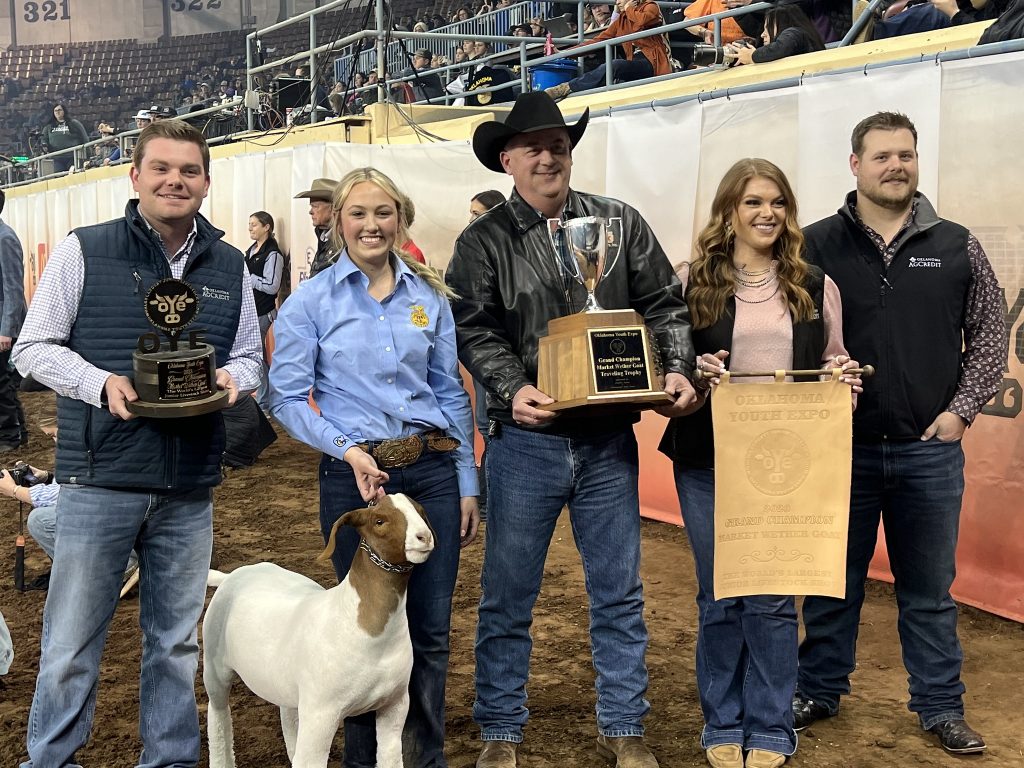
Cara Cummins of Hollis FFA Grand Champion Market Goat at 2023 OYE
The Grand Drive of the 2023 Oklahoma Youth Expo had the market goats following the barrow drive- after over 650 market goats were looked at by judge Skylar Scotten of Missouri.
The Grand Champion for 2023 is the Division 4 Champion- shown by Cara Cummins of the Hollis FFA.
Reserve Grand Champion was the Division 4 Reserve Champion- shown by Dakota Thurmond of Snyder FFA.
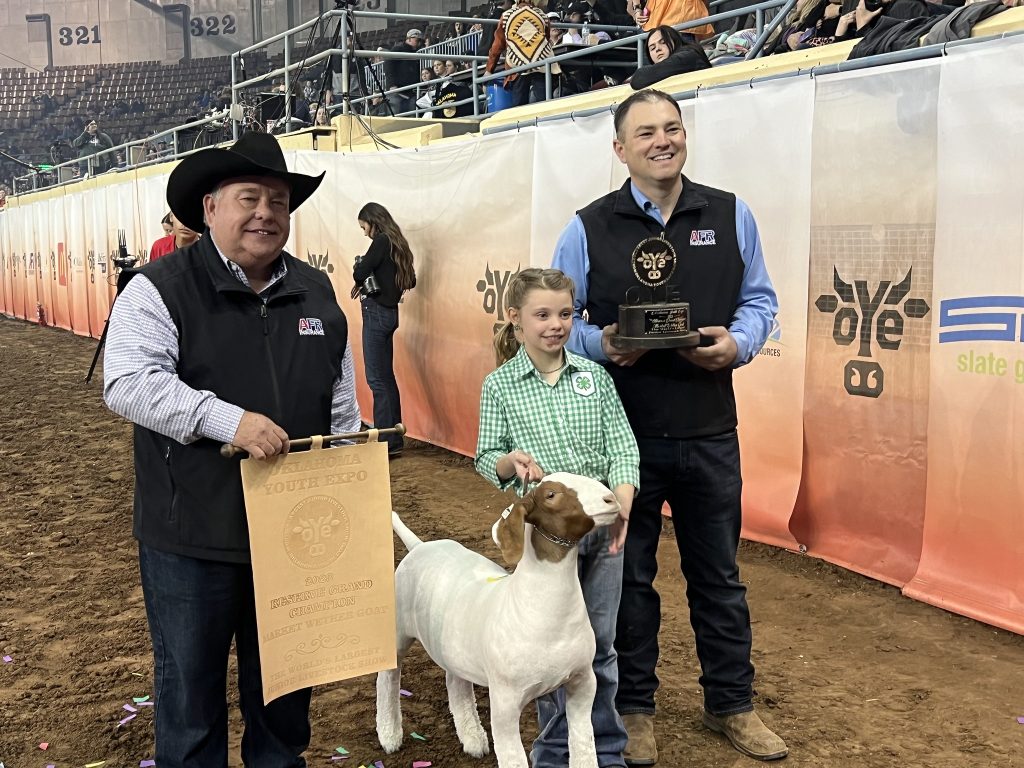
The Bronze Medallion(third place) Market Goat was the the Division 2 Champion- shown by Jailey Sparks of Hartshorne 4-h.
Here are the Champions and Reserve Champions in the Market Goat Show:
Champion Division 1 Baylor Pearson El Reno FFA
Champion Division 2 Jailey Sparks Hartshorne 4-H
Champion Division 3 Dakota Thurmond Snyder FFA
Champion Division 4 Cara Cummins Hollis FFA
Champion Division 5 Sayde Allen Canute 4-H
Reserve Champions Include
Reserve Champion Division 1 Emry Lee Elgin FFA
Reserve Champion Division 2 Emry Lee Elgin FFA
Reserve Champion Division 3 Katie Eisenhauer Oklahoma County 4-H
Reserve Champion Division 4 Dakota Thurmond Snyder FFA
Reserve Champion Division 5 Ridge Rose Sapulpa FFA
All of these Champions and Reserve Champions will be a part of Friday's Sale 0f Champions at the Norick Arena at the OKC Fairgrounds- starting at 4 PM.
Click here for the full schedule for the 2023 OYE. The Oklahoma Farm Report team will be snapping pictures from start to finish- and you can see them as we add them to our Flickr album for 2023- available here. If you want to look back to the 2022 OYE- click here for our pictures from last year's event.
Our coverage of the 2023 Oklahoma Youth Expo is sponsored by Hilliary Communications- who deliver the latest cutting-edge communications services supporting tens of thousands of customers across 22 counties throughout Oklahoma, Texas and Iowa. The company offers internet, voice and HilliaryTV. Hilliary Communications continuously researches the marketplace for innovations and strives to improve underserved areas, offering services that exceed customer expectations. Click here to learn more about Hilliary Communications.
Brigham Bunt of Ringwood 4-H after winning the Grand Champion Barrow drive at 2023 OYE
The Grand Drive of the 2023 Oklahoma Youth Expo kicked off with the Grand Champion Market Barrow selection- this after three days of showing over 2,200 barrows in Barn 6.
The Grand Champion for 2023 is the Hampshire Champion- shown by Brigham Bunt of the Ringwood 4-H Club.
Reserve Grand Champion was the Champion Dark Cross- shown by Anna Franke of Covington 4-H.
The Bronze Medallion(third place) Barrow was the Champion Yorkshire- shown by Nash Williamson from Sulphur FFA.
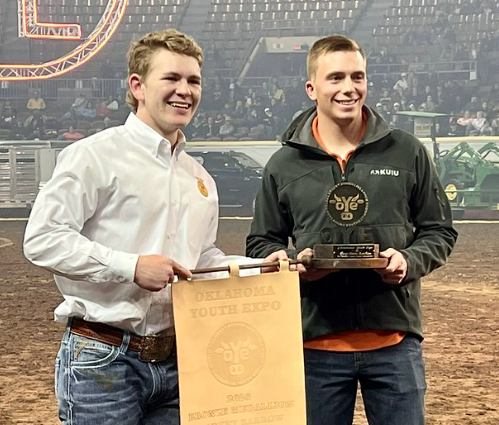
Here are the Champions and Reserve Champions in the Barrow Show:
Champion Berkshire Kaleb Stephenson Chickasha FFA
Champion Duroc Farrah Dupree Porter Peach Capitol 4-H
Champion Hereford Landon Barton Union City FFA
Champion Poland Emma Sutton Kiefer FFA
Champion Spotted Hunter Hines Tuttle FFA
Champion Yorkshire Nash Williamson Sulphur FFA
Champion Chester Rachel Palmer McCurtain Co. Homeschool 4-H
Champion Hamp Brigham Bunt Ringwood 4-H
Champion Light Cross Gavin Straka Yukon FFA
Champion Dark Cross Anna Franke Covington 4-H
Reserve Champions Include
Reserve Berkshire Addilyn Wood Yukon FFA
Reserve Duroc Camryn Harwood-Montgomery Kellyville FFA
Reserve Hereford Jadyn Caldwell Kiefer FFA
Reserve Poland China Kaitlyn Dufur Durant FFA
Reserve Spotted Jace Stotts Hydro-Eakly 4-H
Reserve Yorkshire Dusti Gregory Prague 4-H
Reserve Chester Preslee Bennett Yukon FFA
Reserve Hampshire Jacie Cantrell Ripley FFA
Reserve. Light Cross Ember Bell Caney Valley FFA
Reserve Dark Cross Tucker Oliver Velma-Alma FFA
All of these Champions and Reserve Champions will be a part of Friday's Sale 0f Champions at the Norick Arena at the OKC Fairgrounds- starting at 4 PM.
Click here for the full schedule for the 2023 OYE. The Oklahoma Farm Report team will be snapping pictures from start to finish- and you can see them as we add them to our Flickr album for 2023- available here. If you want to look back to the 2022 OYE- click here for our pictures from last year's event.
Our coverage of the 2023 Oklahoma Youth Expo is sponsored by Hilliary Communications- who deliver the latest cutting-edge communications services supporting tens of thousands of customers across 22 counties throughout Oklahoma, Texas and Iowa. The company offers internet, voice and HilliaryTV. Hilliary Communications continuously researches the marketplace for innovations and strives to improve underserved areas, offering services that exceed customer expectations. Click here to learn more about Hilliary Communications.
Attorney General Gentner Drummond has filed a federal lawsuit against the Biden administration's Environmental Protection Agency (EPA) over its rejection of Oklahoma's plan regarding ozone emissions. The petition to review the disapproval was filed March 2 with the U.S. Court of Appeals for the Tenth Circuit.
In addition to disapproving Oklahoma's state implementation plan (SIP) to comply with a Clean Air Act rule pertaining to ozone emissions, the EPA has issued a rule to require Oklahoma and other states with disapproved SIPs to follow a federal plan.
Drummond said the EPA actions amount to a power grab by the Biden administration.
"This is federal overreach of the first order," he said. "Rather than work with Oklahoma to make whatever modifications the EPA claims are necessary to comply with its burdensome regulations, the Biden Administration is seeking a one-size-fits-all federal plan with absolutely no input from Oklahoma or other affected states. The EPA plan places unnecessary and costly burdens on Oklahoma businesses and ignores the expertise of Oklahoma's Department of Environmental Quality, all at the expense of state sovereignty."
Drummond noted that the Oklahoma legislature has faithfully appropriated funds to the Office of the Attorney General for the purpose of fighting federal overreach.
"The people of Oklahoma should be deeply thankful that legislative leaders like Speaker Charles McCall and President Pro Tempore Greg Treat made it a priority to fund the fight against federal overreach," he said. "Oklahoma is ideally positioned to help lead the way in this battle against the EPA."
The DEQ had created the state implementation plan to ensure compliance with Clean Air Act requirements that address emissions contributing to ozone levels downwind.
The EPA's federal implementation plan would impose onerous federal emissions requirements on numerous sources, such as fossil fuel-fired power plants, in 25 states including Oklahoma.
The U.S. Department of Agriculture's (USDA) Animal and Plant Health Inspection Service (APHIS) announced this week that they are awarding the National Cattlemen's Beef Association (NCBA) with $445,396 in funding to advance the Secure Beef Supply Plan (SBS) in the event of a foot-and-mouth disease (FMD) outbreak in the U.S.
"NCBA thanks USDA for awarding this critical funding to help continue defending the U.S. cattle herd from the threat of foot-and-mouth disease. The Secure Beef Supply Plan combined with USDA's national vaccine bank provides a strong safety net for cattle producers and multiple tools to mitigate risk from a potential outbreak," said Allison Rivera, NCBA executive director of government affairs. "This funding was made available through the 2018 Farm Bill, showing why continued support and further funding for animal disease preparation measures like the Secure Beef Supply Plan and the National Animal Vaccine and Veterinary Countermeasure Bank are so important as Congress works on the 2023 Farm Bill."
Background
The SBS Plan provides guidance on workable business continuity measures for beef cattle operations with no evidence of FMD infection during an FMD outbreak. The SBS Plan is the result of a multi-year collaborative effort by industry, state, federal, and academic representatives to provide guidance on moving uninfected cattle to continue beef cattle production and keep grocery store shelves stocked.
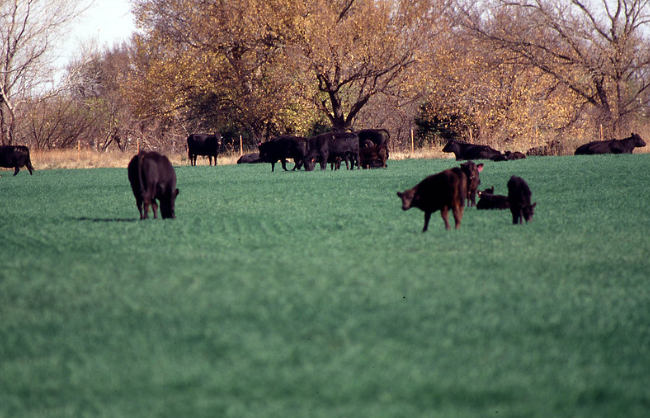
Cattle may have been turned on wheat pasture for grazing a little later than normal this year, but bloat from the new growth is still a concern. (Photo by OSU Agriculture)
By Gail Ellis
Varying degrees of drought across the state have caused cool-season grasses to grow a little later than usual this year, and Oklahoma State University Extension specialists have received reports of bloat in calves grazing wheat and other small grain pastures.
Growing conditions improved for these pastures, which have been grazed short this winter with regrowth that is all highly digestible leaf.
"We have also had some late winter frost events that can damage the cell walls in the new growth, releasing the cell contents for rapid availability in the rumen, said Paul Beck, OSU Extension beef cattle nutrition specialist. "These plant fractions are the most bloat provocative and can very quickly cause bloat in grazing calves."
Death can occur rapidly from bloat, but so can relief. Calves can return to normal soon after supplements containing Bloatguard (Poloxalene 6.6%). Bloatguard is commercially available in blocks, mineral supplements and topdresses for concentrate supplements.
OSU Extension also offers the following guidelines in herd management this time of year.
Replacement heifers and spring breeding
"At this point in the year, typically if we've got normal wheat pasture in Oklahoma, it's relatively easy to get those heifers to that target weight, but if we've been in a situation with limited hay and feed resources and we've not had any winter cool-season grass to graze, we might want to take inventory of those heifers," said Mark Johnson, OSU Extension beef cattle breeding specialist. "If we've got some wheat pasture coming on or just need to adjust our feeding program, we've still got time to get those heifers to where they need to be to breed at 2 years of age."
Body Condition score of cow herd
"Different feeding programs that we consider are supplemental feed, mineral supplementation and protein supplementation," Johnson said. "You could add in an ionofore to cows' diets if we need to put on a little weight and body condition score going into calving season. That way, we can get prompt breed back and keep them on schedule for calving once a year."
Deworming
Deworming can be the least expensive way for cattle to maintain or add body conditioning. Johnson recommends checking records and analyzing the cost effectiveness of deworming the herd.
Read more about preventing bloat in the Feb. 6 issue of OSU Extension's Cow-Calf Corner Newsletter.
OSU Extension uses research-based information to help all Oklahomans solve local issues and concerns, promote leadership and manage resources wisely throughout the state's 77 counties. Most information is available at little to no cost.
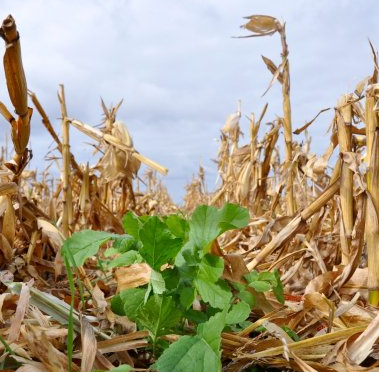
The National Corn Growers Association looks forward to seeing the next steps that will be taken as a part of the Farmers for Soil Health. NCGA is a founding member of FSH, which was awarded the $95 million grant from the USDA's Partnerships for Climate-Smart Commodities program that makes this work possible.
"This grant provides technical and financial resources to mitigate the risk farmers increasingly face due to severe climate events," said NCGA President Tom Haag, a farmer from Eden Valley, Minn. "It is exciting to see that this effort to promote cover crops will reach acreage producing over 85 percent of the nation's corn and soybeans."
The program, which will help double acreage nationally by 2030, will offer farmers three years of declining cost share payments to help them transition to cover crops. FSH will work with data insights and publishing company DTN to develop a digital platform that will use satellite imagery, allowing farmers to receive an "eco-score" for corn and soybeans produced with cover crops and conservation tillage. This platform will facilitate the marketing of crops to parties interested in securing a documented source of sustainably produced corn and soybeans.
FSH is a collaborative effort of the American Soybean Association, National Corn Growers Association, National Pork Board and the United Soybean Board with the mission to advance conservation practices to improve soil health across the U.S. The grant will fund cost share and technical assistance for cover crops to 8,000-10,000 farmers on 1.44 million acres of corn and soybeans.
To execute this grant, FSH will receive technical assistance from the National Association of Conservation Districts, The Sustainability Consortium, Soil Health Institute, University of Missouri Center for Regenerative Agriculture, National Fish and Wildlife Foundation, DTN, National Center for Appropriate Technology, and Appropriate Technology Transfer for Rural America.
For more information, contact FSH Executive Director Dr. Ben West at bwest572@gmail.com or visit Farmers for Soil Health.
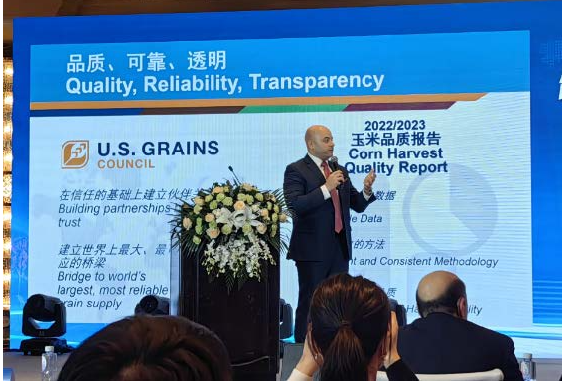
The U.S. Grains Council's (USGC's) China office recently co-hosted an in-person feed grains and proteins conference in Beijing. Topics discussed included market trends for grains and oilseeds globally, animal protein production and consumption. Pictured, USGC Director in China Manuel Sanchez speaks to attendees
The U.S. Grains Council's (USGC's) office in Beijing, China, hosted its second in-person conference of 2023 in late February. The event - Feed Grains & Proteins Conference - covered the current changes, challenges and opportunities in the grain industry and was a joint effort by the U.S. Soybean Export Council (USSEC), the China Chamber of Commerce for the Import/Export of Native and Ag Products (CFNA) and the China Animal Agricultural Association (CAAA).
About 200 participants attended the event. In addition to feed mill and trade representatives, a wide range of Chinese institutions were in attendance, including the China Feed Industry Association, China Dairy Association, National Animal Husbandry Station of MoRA, China Grain Industry Association, CNGOIC (National Grain and Oil Information Center), Dalian Commodity Exchange and China Agricultural Trade Promotion Center.
"It was an honor to co-organize this conference with USSEC, CFNA and CAAA. The success of our event is a testament to the cooperation and collaboration between all four organizations. We used our synergies to provide market updates while fostering the presence of U.S. agriculture in one of the most vital export markets for U.S. coarse grains and oilseeds," said Manuel Sanchez, USGC director in China.
During the conference, experts shared the latest information and market trends of global grains and oilseeds, animal protein production and consumption from different perspectives.
Three industry experts were also in attendance to highlight sustainability during the event. They discussed China's agricultural and food system transformation strategy under the dual carbon goal, perspectives on sustainable agriculture and the U.S. Soy Solutions to Carbon Goals.
"The 2022/2023 grain marketing year continues to be a time of change and challenges for China's feed, swine and trade sectors," Sanchez said. "Our seminar aimed to provide the most updated information on global markets of grains and oilseeds, protein production and consumption and to discuss market trends, opportunities, certainties and uncertainties for the end users, producers and other market stakeholders in the 2022/2023 marketing year."
Looking ahead in 2023, the Council's China office has arranged programs focused on its trade development efforts for U.S. sorghum and malt barley, while also looking at the domestic aquaculture industry's potential for coarse grains and co-products.
Each week, Beltway Beef brings you the latest policy news affecting the U.S. cattle and beef industry. Hear from subject-matter experts, producers, and industry leaders on the topics that impact the business viability of farms and ranches across the country.
On this episode, we are joined by Cattlemen to Cattlemen Host Kevin Ochsner and Executive Producer Kate Maher to discuss the special National Ag Day episode of NCBA's Cattlemen to Cattlemen TV show. Ochsner and Maher share updates from their recent travels where they visited 77 Ranch, JA Ranch, Bezner Beef, XIT Feeders, and The Meat Board in Texas. Together, these producers, feeders, and retailers represent the full cattle and beef supply chain. As a cattle producer, Ochsner shares what National Ag Day means to him and Maher explains the value of watching NCBA's Cattlemen to Cattlemen. This special episode will air on RFD-TV on March 21, 2023, at 8:30 PM Eastern. For more information about the show, visit www.cattlementocattlemen.org.
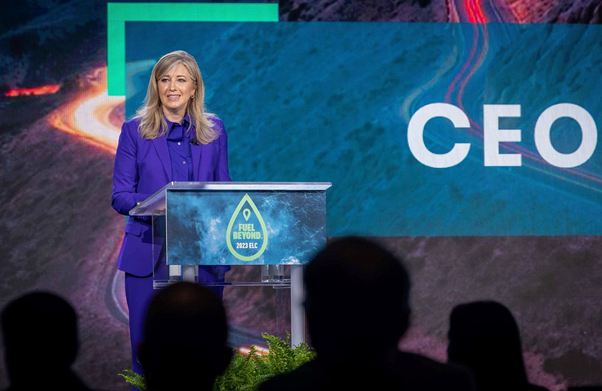
Growth Energy, the nation's largest ethanol trade association, today began its 14th annual Executive Leadership Conference (ELC), a marquee event for the biofuels industry where top ethanol industry leaders and innovators will participate in panel discussions, networking, and charity fundraising events.
Growth Energy CEO Emily Skor kicked off the three-day event with a speech that emphasized the hard-won progress made last year and ongoing innovation by Growth Energy's members. "Where some see only a field of corn, we see clean energy, nutrient-rich animal feed, green chemicals, and an ever-growing array of value-added bioproducts," said Skor. "We see an economy that can grow in sync with nature, rather than at her expense. Realizing the full potential of these endeavors is not easy. It requires policies that reward innovation, competition, and entrepreneurship.
"Last year, we made huge strides toward that goal. We secured critical tax incentives for clean energy, a summer waiver for E15 sales, a stronger Renewable Fuel Standard (RFS), and new, unprecedented funding for blending infrastructure.
"We also delivered record-breaking savings at the pump during a global fuel shortage, cementing the role of low-carbon bioethanol as a proven solution to our climate and energy challenges. "We're off to a great start. We're positioned for success like never before, and we have new momentum propelling us forward. Let's seize this moment to fuel beyond where we've ever been before," concluded Skor.
Prior to the official event kick off, dozens of participants attended the fourth annual Technical Forum on Wednesday, where panelists spoke on issues that affect plant and facility performance, such as carbon management, infrastructure, and fuel markets.
During the ELC general session, industry experts will dive into the Inflation Reduction Act and its impact on the ethanol industry's efforts to decarbonize the transportation sector, including opportunities like sustainable aviation fuel and carbon capture.
Speakers include Ambassador Doug McKalip, Chief Agricultural Negotiator in the Office of the United States Trade Representative. McKalip will discuss his goals for the expansion of American agricultural exports and address issues and opportunities in international markets. Attendees also will hear from gold medal Olympian and best-selling author Shawn Johnson East, who will share an update on her family's partnership with Get Biofuel's Green American Road Trip. Additionally, this year's keynote speaker will be Jon Dorenbos, a former NFL athlete and best-selling author.
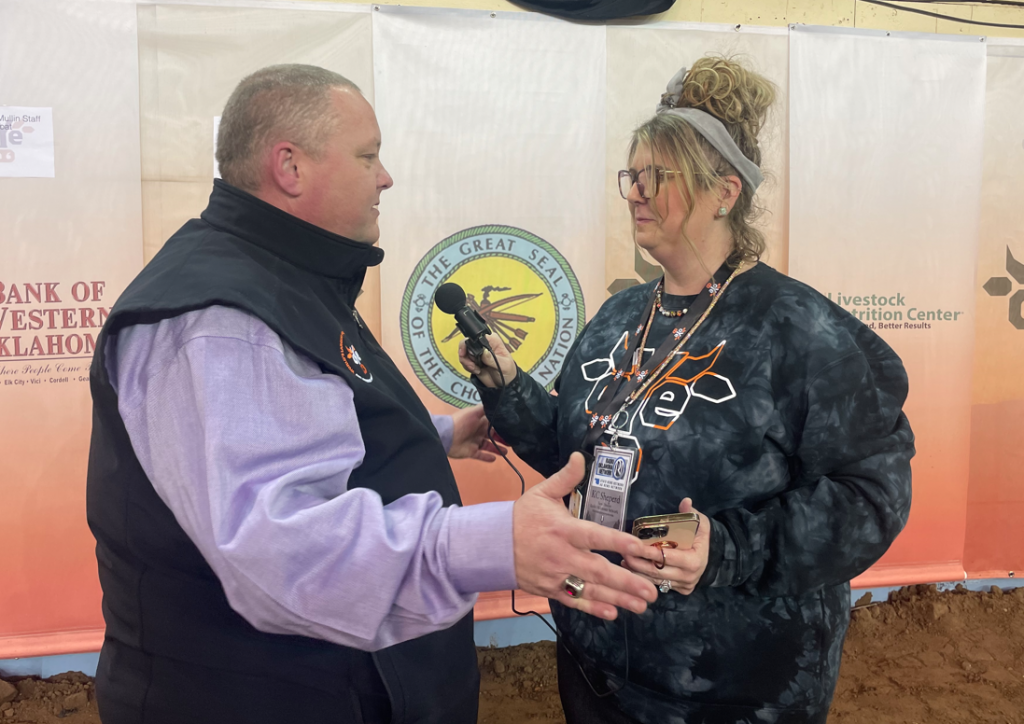
Each year at the Oklahoma Youth Expo, legislators have the opportunity to be paired with a showman and compete with other legislator/exhibitor pairs for the top showman. This opportunity allows legislators to connect with the future of the agriculture industry and be part of the Oklahoma Youth Expo experience.
Following the Legislative Showmanship Competition at OYE, Farm Director, KC Sheperd, had the chance to visit with State Representative, Dell Kerbs, about the OYE and legislative session.
"OYE is one of the biggest events for us," Kerbs said. "We look forward to it every year. We have competitions between the House and the Senate on raising funds for the sale that comes at the end of the week."
The best part of the event, Kerbs said, is having the chance to learn from the exhibitors.
"You can't put a price tag on that, because that is our future, and they are teaching us, and they are ready," Kerbs said.
Kerbs complimented the exhibitors at the show and said having FFA or 4-H on a resume is a valuable asset because it shows that those individuals know how to work hard.
"When you walk through these barns, and you see these kids, they are here day-in and day-out, and that is just here at the show," Kerbs said. "That is not to mention what these kids do at home. There is a work ethic like no other. They are our future."
Regarding the legislative session, Kerbs said education has been a big topic, along with everyday issues such as marijuana.
"Recreational marijuana went down," Kerbs said. "We have an excellent Oklahoma Medical Marijuana Authority that takes care of the medical marijuana. We still got a long way to go- we get that. But we have come a long way, too, from where we were when that vote happened two years ago."
Kerbs talked about Service Oklahoma and said it is a work in progress, but it is on the right track.
"I promise we are going to keep working at it," Kerbs said. "The legislative body is going full string. We have got an awesome team over there with that department now. We are going to make it happen so everybody can have great service from the state that they love, which is the state of Oklahoma."
Click here for the full schedule for the 2023 OYE. The Oklahoma Farm Report team will be snapping pictures from start to finish- and you can see them as we add them to our Flickr album for 2023- available here. If you want to look back to the 2022 OYE- click here for our pictures from last year's event.
Our coverage of the 2023 Oklahoma Youth Expo is sponsored by Hilliary Communications- who deliver the latest cutting-edge communications services supporting tens of thousands of customers across 22 counties throughout Oklahoma, Texas and Iowa. The company offers internet, voice and HilliaryTV. Hilliary Communications continuously researches the marketplace for innovations and strives to improve underserved areas, offering services that exceed customer expectations. Click here to learn more about Hilliary Communications.
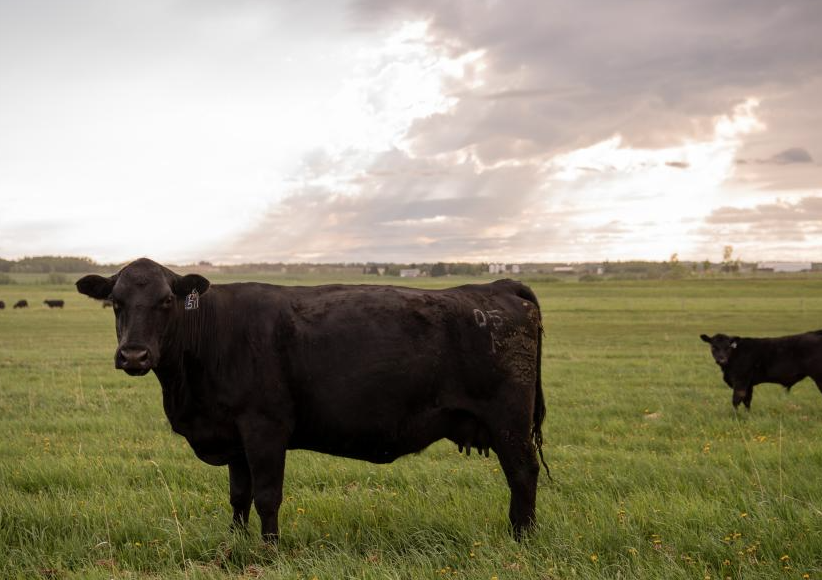
Senior Farm and Ranch Broadcaster, Ron Hays, is visiting with the Executive Director of Nutrition Research at the National Cattlemen's Beef Association, Dr. Shalene McNeill, and talking about advocating for beef in the dietary guidelines for 2025.
"Every five years, this process starts over, and it starts with a group of scientists that are nominated and convened to evaluate the research available at the time, to look at the issues that are facing America with regards to nutrition at the time, and then those scientists write a scientific report that is used to inform what becomes our dietary guidelines for Americans," McNeill said.
20 scientists will serve on the dietary guidelines committee, McNeill said, and those selected come from diverse backgrounds with experience in food security, hunger, and more.
"Many Americans maybe fall short on getting adequate nutrition and so that might be more of a focus than it has in the past, and I think that will be a great opportunity for beef farmers and ranchers, because beef can help deliver those key nutrients that we need," McNeill said. "If you have got a shortage of nutrients, you need high nutrient-dense foods like beef to help fill those gaps."
There is a lot of conversation going around relating to increasing access to affordable food for all people, McNeill said, and the term "food dignity" is part of that discussion.
"We want to make sure that regardless of your income level, regardless of your access and your means, you can reach out and have a nourishing meal in whatever part of America you are living," McNeill said. "Many health professionals are beginning to talk about the dignity that comes with the ability to nourish yourself."
Through Covid, McNeill said many have realized that although the food supply chain is great, there are still gaps. When things get tight, McNeill said many Americans do not have the means to put a nutritious meal together.
"Maybe there was a loss of dignity associated with not being able to do that, so we need to be able to pay attention to that, and that is an important part of the nutrition conversation happening today," McNeill said.
While many of the past dietary guidelines have focused on chronic disease, McNeill said, she would like to see these next guidelines to step back and focus on helping ensure everyone has access to more balanced meals to begin with.
"I think we have got a little too focused on all these sort-of specialty areas of nutrition, and we need to get back to the basics kind of as well," McNeill said.
The Beef Buzz is a regular feature heard on radio stations around the region on the Radio Oklahoma Ag Network and is a regular audio feature found on this website as well. Click on the LISTEN BAR for today's show and check out our archives for older Beef Buzz shows covering the gamut of the beef cattle industry today.
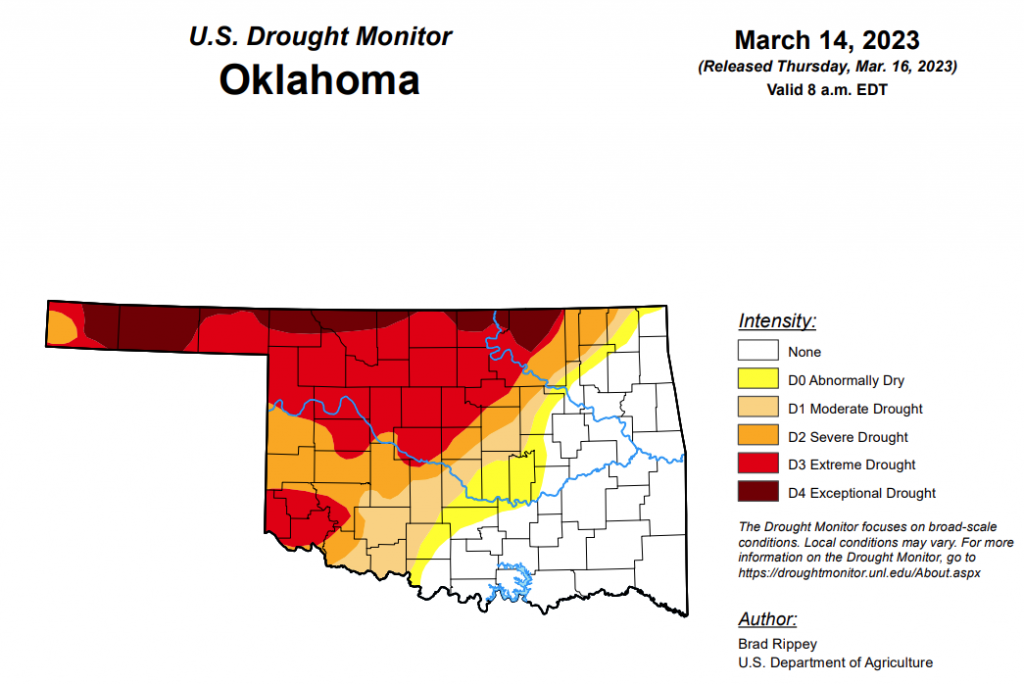
To view the Oklahoma Drought Map, click here.
Oklahoma is going on week four now of no change in the exceptional drought and extreme drought or worse categories. Exceptional drought remains at 8.86 percent, and extreme drought or worse remains at 36.64 percent.
Severe drought or worse is virtually unchanged but increased slightly from last week's 51.53 percent to this week's 50.58 percent.
Moderate drought or worse has not changed much this week, as it has moved from last week's 59.92 to this week's 59.07.
Abnormally dry or worse conditions have not made much movement this week but have improved from last week's 67.07 percent to the week's 65.61 percent.
According to the 6–10-day precipitation outlook map, most of the state has a near-normal probability of precipitation through March 25. The panhandle region is leaning above a 33-40 percent chance of precipitation, with the far west corner of the panhandle leaning above a 40-50 percent chance.
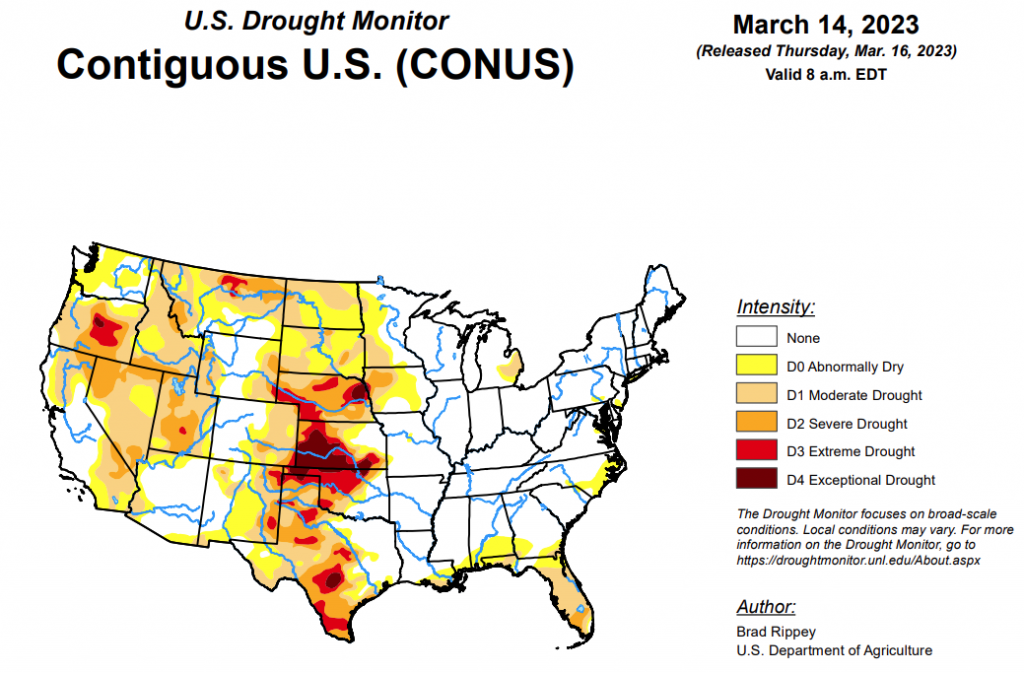
To view the United States Drought Monitor Report, click here.
According to the latest U.S. drought monitor report, two atmospheric river events struck California and portions of neighboring states, with the second arriving as the drought-monitoring period ended. Torrential rain in central California caused a levee break along the Pajaro River, flooding the community of Pajaro in Monterey County. Rain, along with melting of lower-elevation snowpack and dam releases, also led to significant water rises along many waterways in California's Central Valley. By March 15, the San Joaquin River at Patterson, California, neared a record crest, with the water rising to within less than a foot of the February 2017 high-water mark. The average mid-March water equivalency of the high-elevation Sierra Nevada snowpack topped 55 inches, more than 220% normal for an entire season, according to the California Department of Water Resources. Most other areas of the West received mostly light to moderately heavy precipitation. Farther east, storms delivered light to moderately heavy snow across the northern Plains and upper Midwest, with some of the most significant precipitation falling on March 11. Meanwhile, a band of heavy showers (locally 2 to 4 inches) stretched from northeastern Texas to the southern Appalachians, before shifting into the Deep South. Notably, northern Florida and environs received much-needed rain, following an extended period of record-setting warmth. Farther north, a powerful coastal storm developed as the monitoring period ended, battering parts of the Northeast with heavy, wet snow and high winds. Mostly dry weather covered the remainder of the country, including the central and southern High Plains, the Rio Grande Valley, and southern Florida. Elsewhere, chilly conditions dominated areas from the Pacific Coast to the northern half of the Plains, while record-setting warmth finally ended cross the Deep South. In fact, freezes were reported for several days, starting on March 14, as far south as Alabama, Georgia, and Mississippi.
In the Southern Plains, the "hot spot" for drought in South remained the southern tier of the region, across northern, central, and western Oklahoma and roughly the western two-thirds of Texas. According to the U.S. Department of Agriculture, 68% of the rangeland and pastures in Texas were rated in very poor to poor condition on March 12, along with 50% of the winter wheat and 47% of the oats. Additionally, statewide topsoil moisture in Texas was rated 69% very short to short, with values ranging from 92 to 100% very short to short across the Northern and South High Plains, Trans-Pecos, Edwards Plateau, Coastal Bend, and the South region. Meanwhile in Oklahoma, statewide topsoil moisture was categorized as 49% very short to short. Rangeland and pastures in Oklahoma were rated 60% in very poor to poor condition on March 12, while 44% of the state's winter wheat was rated very poor to poor. Notably, an extremely sharp gradient existed across eastern sections of Oklahoma and Texas between drought-free conditions to the east and moderate to exceptional drought (D1 to D4) to the west. Elsewhere, moderate drought (D1) expanded across southern Louisiana, where New Orleans, reported just 5.72 inches of rain (51% of normal) for the year to date through March 14.
In the High Plains, some of the nation's most serious drought conditions persisted across southern sections of the High Plains region, mainly across Kansas and Nebraska. Kansas, like other areas of the central and southern Plains, has an impressive gradient between drought-free conditions (in the east) and extreme to exceptional drought, D3 to D4 (in southern and western sections of the state). On March 12, according to the U.S. Department of Agriculture, topsoil moisture in Kansas was rated 66% very short to short, while more than half (52%) of the winter wheat was rated in very poor to poor condition. Some of the D4 areas in Kansas received record-low annual precipitation totals during 2022 and have not received much, if any, cold-season drought relief. In the hardest-hit areas, drought impacts—besides damaged rangeland/pastures and poor winter wheat conditions—include frequent episodes of blowing dust and limited surface water supplies in streams and ponds. Farther north, snow has been on the ground since November in much of North Dakota and portions of neighboring states, with recent cold weather maintaining impressive snow depths even as snow continues to fall. Bismarck, North Dakota, reported at least a trace of snow on 11 of the first 13 days of March, totaling 22.5 inches.
In the West, broad reductions in drought coverage and intensity were noted again this week in California and neighboring areas. By March 13, season-to-date snowfall at the Central Sierra Snow Lab at California's Donner Pass exceeded 650 inches, compared to a normal full-season total around 360 inches. Meanwhile, Bishop, California (2.06 inches on the 10th), experienced its wettest March day on record, surpassing 1.75 inches on March 4, 1991. Closer to the Pacific Coast, the Pajaro River at Chittenden, California, achieved its highest crest (on March 11) since February 1998. In California's Salinas River drainage basin, a record crest was set on March 10 along the Nacimiento River below Nacimiento Lake, with the water level edging the February 1969 high-water mark by 1.51 feet. The Salinas River near Spreckels, California, rose 3.89 feet above flood stage on March 13, second only to the March 1995 high-water mark (7.29 feet above flood stage)—and 2.29 feet above the level reached on January 13, 2023. Precipitation spread across southern California after the drought-monitoring period ended and will be reflected on next week's assessment. Looking more broadly at the western U.S., snow-water equivalency values greater than 200% of normal extend from the Sierra Nevada across much of the Great Basin and into parts of Utah. Similarly impressive snowpack values also cover much of Arizona and western New Mexico. Conversely, snow-water equivalency is closer to normal—and even below normal in some drainage basins—across the northern tier of the West, as well as some areas on the east side of the Continental Divide. Many smaller lakes have rebounded, with California's 154 primary intrastate reservoirs gaining 9.9 million acre-feet of water between November 30, 2022, and February 28, 2023. California's storage at the end of February, 23.2 million acre-feet, was 96% of the historical average for this time of year. However, in the Colorado River system, storage on February 28 stood at 15.1 million acre-feet, just 46% of average and 29% of capacity.
Looking ahead, a storm system that previously hammered California with heavy precipitation and high winds will cross the central Plains on March 16 and reach the Great Lakes States a day later. A band of accumulating snow can be expected on March 16-17 from parts of Nebraska into the upper Great Lakes region. Storm-related rainfall across the South could become locally heavy, with 1 to 3 inches possible. In the storm's wake, cold weather will return across much of the central and eastern U.S. Late in the weekend and early next week, freezes could again reach deep into the South, including parts of Mississippi, Alabama, and Georgia. Sub-0°F temperatures may occur during the weekend in portions of the north-central U.S. During the next few days, much of the West will get a reprieve from stormy conditions, although rain and snow showers will return during the weekend across the Pacific Coast States and the Southwest. The NWS 6- to 10-day outlook for March 21 – 25 calls for the likelihood of near- or below-normal temperatures and near- or above-normal temperatures across most of the country. Warmer-than-normal weather will be confined to peninsular Florida and portions of the Great Lakes region, while drier-than-normal conditions should be limited to parts of the south-central U.S., mainly in Texas.
To view the 6-10 Day Precipitation Outlook Map, click here.
To view the 6-10 Day Temperature Outlook Map, click here.
To view the Monthly Drought Outlook Map, click here.
RON's Dave Lanning has a pre-opening look at today's agricultural Markets.
Click the audio tab below for today's report.
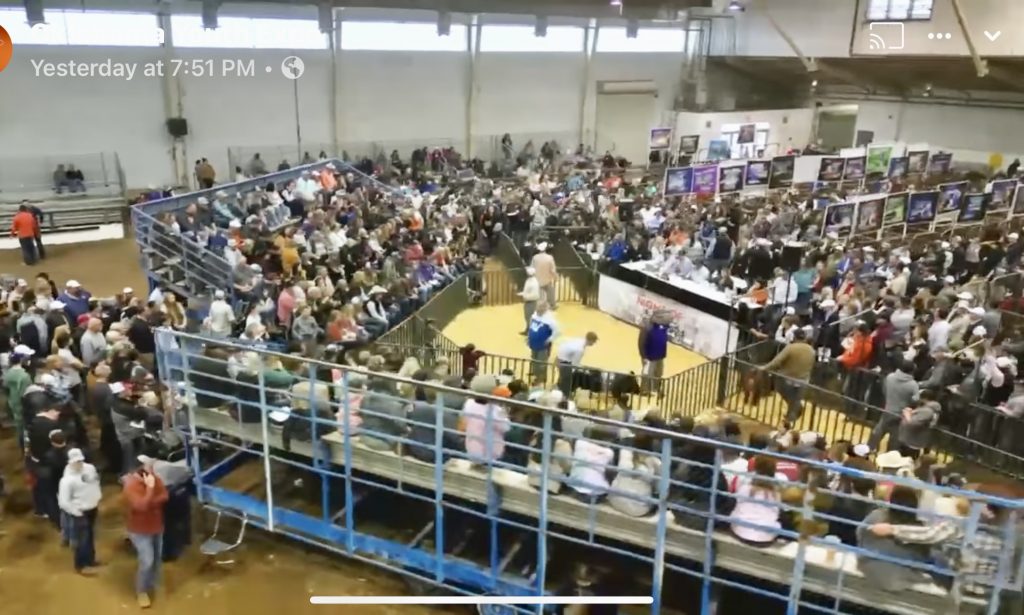
2023 OYE Night of Stars Gilt Show in Barn 8 at the OKC Fairgrounds
Records fell Wednesday night at the Oklahoma Youth Expo Night of Stars Gilt Sale- 131 Gilts sell for a record $1,259,250- a $9,612 per head average, also easily a new record. This eclipsed the 2021 Matinee version of the Night of Stars sale that came several days after the rest of that year's OYE wrapped up because of PED concerns. The old record in 2021 was a million dollars and a $7812 per head average.
The individual record that was also set in 2021 was swept away as well. The new OYE and NATIONAL record for a gilt hit $92,000 for the 75th pig in the sale(well into the second half of the sale)- this gilt was the 31st Dark Cross and was shown by Jaylee Buck of Kiefer FFA.
Earlier in the Sale-the Reserve Supreme Crossbred shown by Gage Winters of Altus FFA sold for $80,000- and that was the new OYE record for about an hour until Jaylee Buck smashed that record.
No names of the buyers were released- but it was reported that one of the top selling gilts is staying in Oklahoma and the other was leaving the state after the sale.
The third high individual gilt (as far as dollars received) was yet another dark cross barrow- shown by Preslee Bennett of the Yukon FFA- it was the 94th barrow sold in the sale and was the 44th Dark Cross selected for the sale- this gilt sold for $57,500.
After the sale- Oklahoma Farm Report's Ron Hays talked with sale manager Blake Kennedy of Kennedy Ventures about the records and how this Night of Stars will be remembered for a long, long time- click on the Listen Bar below to hear their conversation.
Click here for the full schedule for the 2023 OYE. The Oklahoma Farm Report team will be snapping pictures from start to finish- and you can see them as we add them to our Flickr album for 2023- available here. If you want to look back to the 2022 OYE- click here for our pictures from last year's event.
Our coverage of the 2023 Oklahoma Youth Expo is sponsored by Hilliary Communications- who deliver the latest cutting-edge communications services supporting tens of thousands of customers across 22 counties throughout Oklahoma, Texas and Iowa. The company offers internet, voice and HilliaryTV. Hilliary Communications continuously researches the marketplace for innovations and strives to improve underserved areas, offering services that exceed customer expectations. Click here to learn more about Hilliary Communications.
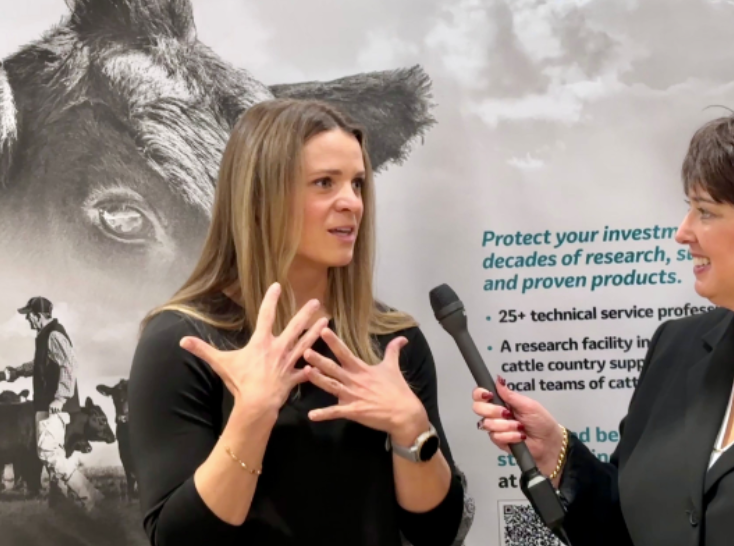
Merck Animal Health, known as MSD Animal Health outside of the United States and Canada, a division of Merck & Co., Inc., Rahway, N.J., USA (NYSE:MRK), announced on January 31, the results of the company's first-ever consumer transparency research study.
Senior Farm and Ranch Broadcaster, Ron Hays got the chance to visit with the Executive Director of Value Chain & Consumer Affairs at Merck Animal Health and author of the study, Allison Flinn, about that research.
The consumer transparency study focused on consumers' growing interest in transparency and its importance in their purchasing decisions and brand trust. The study explored consumer desire for transparency in animal protein, such as meat, fish, eggs, and dairy, and their perceptions of industry transparency when it comes to animal welfare and sustainability. It also looked at the interplay of transparency and traceability and consumers' willingness to pay for transparency label claims.
"Merck Animal Health conducted the transparency in animal health protein consumer research study because we really feel at our company that we have a role to play in improving the health and well-being of animals, empowering farmers and ranchers with the technology and the solutions they need to continue to invest in their business, continue to grow their business and to really provide solutions to unmet needs," Flinn said. "We know that consumer preferences certainly impact and drive evolution and change within the industry, and because we feel we have a role to play in contributing to animal health and wellbeing, we want to also help connect all of that good work that farmers and ranchers are doing on their operations to building consumer trust in food labels."
Flinn said many things were learned from their research, one of those being that transparency is extremely important to consumers.
"Over two-thirds of consumers report it to be very or highly important to them, and it is really for personal reasons," Flinn said. "They are thinking about the health and nutrition of the products that they are bringing home, and beef certainly has a great story there," Flinn said.
Flinn said consumers hold beef to a high standard, and over 69 percent of consumers want to know where their beef is coming from.
"That is a great story because we know that our farmers and ranchers and their families are working to produce that high-quality beef for consumers," Flinn said. "So, really being able to connect the dots there and let them know where it is coming from is an opportunity for transparency on a label."
A technology used at Merck Animal Health called DNA Traceback, Flinn said, uses DNA to track where the beef sold at the supermarket comes from.
"The survey results tell us consumers want more information than ever in order to make informed decisions about the food they put on their dinner tables," Flinn said. "We work to be the industry leader in improving animal health through our biopharmaceutical and technology portfolio solutions, and we also have the technology that can provide greater transparency and allow consumers to make informed decisions. In fact, our DNA TRACEBACK® technology, which uses nature's bar code – DNA – with data analytics, provides an evidence-based animal protein traceability solution to accurately trace meat and seafood that is verifiable from farm-to-table to help build trust in food labels."
Flinn said the goal with the DNA TRACEBACK® technology is to help producers tell that story about how their animals were grown and raised and to help verify their product while highlighting the uniqueness. Flinn also said said it was uncovered in Merck Animal Health's consumer research that consumers are willing to pay a premium of up to five percent for transparent labels.
"That value captured, that five percent, if you think about that across all the different cuts of meat they could be buying, really does connect back to growing the pie for farmers and ranchers to be able to sell their cattle on programs and gain the additional value out of that hard work that they put in," Flinn said.
To read more about the results of Merck Animal Health's Consumer Transparency Research Study, click here.
The Beef Buzz is a regular feature heard on radio stations around the region on the Radio Oklahoma Ag Network and is a regular audio feature found on this website as well. Click on the LISTEN BAR for today's show and check out our archives for older Beef Buzz shows covering the gamut of the beef cattle industry today.
The National Corn Growers Association joined a letter, signed by 400 national, regional, and state agriculture associations this week, which was sent to the Senate and House Budget Committees regarding budgetary resources needed to craft a comprehensive farm bill this year. Over 20 corn state grower affiliate associations also signed the letter with NCGA.
"We write to express our strong support for providing the Senate Committee on Agriculture, Nutrition, and Forestry and House Committee on Agriculture with sufficient budgetary resources to write a new bipartisan, multi-year, comprehensive, and meaningful piece of legislation," the letter read.
The letter noted that farm bill budget resources are needed for "protecting and enhancing crop insurance to assist with volatile weather and crop loss, improving access to voluntary conservation incentives, addressing rural development needs, investing in research for innovation and competitiveness, providing opportunities to help the nation become more energy independent and food secure, and supporting solutions to address logistics challenges."
Congress is working to reauthorize the Farm Bill before it expires on September 30, 2023.

U.S. Wheat Associates (USW) and the National Association of Wheat Growers (NAWG) are disappointed that the Surface Transportation Board (STB) has approved the Canadian Pacific Railway's merger with Kansas City Southern Railroad.
In public comments submitted to the STB on the proposed merger in February 2022, USW said the market power held by the Class I railroads has serious implications for U.S. wheat's competitiveness compared to other major exporters. NAWG shared similar public comments with the STB in February 2022, which outlined how reliant wheat is on rail and how decreased rail-to-rail competition hurts shippers and growers alike. Now, this merger takes the U.S. rail system from seven to six Class 1 railroads.
USW and NAWG believe the STB has given a greenlight to rail consolation without regard for the consequences on agricultural shippers from lack of competition in the U.S. rail sector.
"U.S. rail industry consolidation has led to poorer, not improved, service for agricultural shippers," said USW President Vince Peterson. "In addition, we see extreme disparity in rates for wheat shippers. Rail rates over the last decade have increased exponentially and rates for wheat are higher than rates for other commodities even with similar handling characteristics. Those higher rates make U.S. wheat less competitive in the global market at a time when higher prices already hurt our competitiveness."
"NAWG is disappointed by today's STB announcement and maintains our concerns that the merger of CP and KCS will impede competition in the rail market and increase rail rates," said NAWG CEO, Chandler Goule. "With 50 percent of wheat being exported, wheat is heavily reliant on rail transportation to move across the United States. Since the merger was announced in 2021, NAWG has filed four public comments with the STB opposing the merger, citing a myriad of concerns on the impact to competition, unfair access to competing wheat producing countries, and changes to tariff provisions that could impact wheat farmers."
USW and NAWG believe the STB must conduct more rigorous oversight of rail rates and service issues going forward. The STB should also aggressively pursue policies designed to inject competition such as reciprocal switching – a proposal that the STB ironically shelved last year because Class 1 rail service was severely challenged for agricultural shippers. USW and NAWG continue to review the conditions the STB included in the merger agreement that are intended to protect competition and mitigate impacts on communities. We look forward to working with both the new CP-KCS railroad and the STB on addressing the disparities wheat shippers face going forward.
About U.S. Wheat Associates
The U.S. Wheat Associates (USW) mission is to "develop, maintain, and expand international markets to enhance wheat's profitability for U.S. wheat producers and its value for their customers." USW activities in more than 100 countries are made possible through producer checkoff dollars managed by 17 state wheat commissions and cost-share funding provided by USDA's Foreign Agricultural Service. USW maintains 15 offices strategically located around the world to help wheat buyers, millers, bakers, wheat food processors and government officials understand the quality, value and reliability of all six U.S. wheat classes. For more information, visit www.uswheat.org.
About the National Association of Wheat Growers
NAWG is the primary policy representative in Washington D.C. for wheat growers, working to ensure a better future for America's growers, the industry, and the general public. NAWG works with a team of 20 state wheat grower organizations to benefit the wheat industry at the national level. NAWG's staff members are in constant contact with state association representatives, NAWG grower leaders, Members of Congress, Congressional staff members, Administration officials, and the public.
Registration for the 2023 Cattlewomen's Boot Camp is open!
This three-day workshop will combine traditional educational programming with hands-on demonstrations and activities.
Topic highlights include calf management, farm transitions, marketing, record-keeping and more.
The 2023 Cattlewomen's Boot Camp will take place at the Creek County Fairgrounds June 5-7. Registration is required.
The 2022 OSU Cattlewomen's Boot Camp was a great success. Planning for the OSU Cattlewomen's Boot Camp to be held in June 2023 is underway, an announcement with specific details of the event will be forthcoming.
If you have questions about the upcoming 2023 event or any related issue, please email Olivia Toothman or JJ Jones, additional contact data can be found under the Contact section of this page.
The OSU Cattlewomen's Boot Camp is a project that combines elements of two successful programs, Annie's Project and the Oklahoma Livestock Boot Camps. Using previous agendas from the boot camps and the teaching model of Annie's Project, the program intends to create an informative and engaging learning experience for female producers covering various methods on how to manage the production, financial, and market risks when operating a beef cow/calf operation.
June 5-7, 2023
Creek County Fairgrounds
Kellyville, OK
$150.00 per attendee
This program will be a three-day workshop that will combine traditional educational programming with hands-on demonstration and activities and classroom exercises. Topics that will be covered include but are not limited to:
This program will partner with the Southern Extension Risk Management Education, Oklahoma Cattlewomen's Association, Oklahoma Women in Agriculture, and Oklahoma Women Veterans Program.
Learn more about the workshop and register here  okla.st/3l63GnG

Meagan Kaiser, USB Chair, (L) and Susanne Oswald (R) present Ken Bader, Ph.D., (C) with the inaugural Tom Oswald Legacy Award during the American Soybean Association Awards Celebration at Commodity Classic in Orlando, Florida.
The United Soybean Board presented the inaugural Tom Oswald Legacy Award to Kenneth Bader, Ph.D., during the 2023 Commodity Classic in Orlando, Florida. The award recognizes Bader for his commitment and steadfast efforts to advance the soybean industry, most notably through his work that led to the creation of the United Soybean Board.
"I am humbled and honored to receive this award and am grateful to the farmer volunteers, staff and partners who continue to work on behalf of all U.S. soybean farmers," said Bader. "I have immense respect for Tom Oswald, who dedicated his career to agriculture and was a strong advocate for our industry. Looking back on 30 years since the inception of the soy checkoff, biodiesel, sustainability and exports serve as bright spots for checkoff investments."
Bader promoted agriculture through many roles during his career. He is most well-known for his 16 years as CEO of the American Soybean Association. He received his bachelor's, master's and doctorate degrees from The Ohio State University. He later served as a professor and dean of students at The Ohio State University and vice chancellor at the University of Nebraska-Lincoln.
"Without Dr. Bader's leadership, there would not be a national soy checkoff," said Dave Drennan, former American Soybean Association regional manager. Drennan was one of several individuals who nominated Bader for the award. "Ken knew the demands and opportunities in this industry, and that reaching them would require a bold move that involved all U.S. soybean farmers."
The annual Tom Oswald Legacy Award, established by the United Soybean Board in honor of the late Tom Oswald, is bestowed on an individual, organization or group that has left a lasting mark on the soybean industry and the soy checkoff. Oswald served eight years as a farmer-leader and three years on the United Soybean Board Executive Committee. He frequently posed the question, "How do we make it better-er?" — meaning what extra steps, thoughts and efforts could the checkoff take to go beyond expectations and provide the best possible outcome.
"Dr. Bader's contributions to the checkoff and U.S. soybean industry are monumental. He exemplifies Tom's legacy, and we all see the results of his relentless dedication and leadership to move research and promotion investments forward," said Meagan Kaiser, USB Chair from Missouri. "Dr. Bader left the soybean industry 'better-er.' We are stronger because of his work."
To learn more about Oswald and the Tom Oswald Legacy Award, visit Remembering 'No-Till Tom.' About United Soybean Board: United Soybean Board's 77 volunteer farmer-leaders work on behalf of all U.S. soybean farmers to achieve maximum value for their soy checkoff investments. These volunteers create value by investing in research, education and promotion with the vision to deliver sustainable soy solutions to every life, every day across the three priority areas of Infrastructure & Connectivity, Health & Nutrition, and Innovation & Technology. As stipulated in the federal Soybean Promotion, Research and Consumer Information Act, the USDA Agricultural Marketing Service has oversight responsibilities for USB and the soy checkoff. For more information on the United Soybean Board, visit unitedsoybean.org.
Due to recent issues with wheat pasture bloat, Oklahoma State Extension has created a webinar on "Options for Dealing with Bloat." The webinar will be on Thursday, March 16, at 12 p.m.
To register online, click here.
For more information, visit beef.okstate.edu
At the Oklahoma Youth Expo, Associate Farm Editor, Reagan Calk, had the chance to visit with Lacey Dale Gracia and talk about this year's "This One's for The Girls" event put on by Diamond Hats. Now with Diamond Hats, Gracia was previously the Marketing Manager for Express Ranches.
"This was just a dream birthed in my heart," Gracia said. "One year, I was sitting at the National Finals Rodeo with Mr. Bob Funk, and we were sitting at the ladies' luncheon, and I just wanted to give the girls a couple of hours to step outside of the barn and remember that they were girls, because they are working just as hard as the guys out there."
The goal of "This One's for The Girls," Gracia said, is to provide an environment for the girls at the show to be inspired, make memories, and take part in learning essential lessons to take with them as they navigate their lives.
Each year has been a different theme, Gracia said, ranging from etiquette to cell phones.
"This year, our theme happened to be 'Oh, The Places You'll Go' from Dr. Seuss, where the girls have gone around to different booths and learned different aspects to grow them up as they go so many places in life," Gracia said.
This year's event took place in the Barn 3 Sales Pavilion at OYE for two hours, Gracia said, and the crowd was phenomenal.
"The crowd started with about 30 girls back in 2007 when we started, and each year, we have been giving out 300 door prizes, so we know there are at least 300 girls or more coming in the doors, and that has just been wonderful for our Diamond Hats organization to see how many young lives are impacted annually," Gracia said.
As the event provides a strong female voice of inspiration and direction for the girls who attend, Gracia said that each year she has received amazing feedback.
"Maybe they don't listen to mama about something, but mama brings them in this room, and all of a sudden, maybe what mama was saying did become gospel," Gracia said. "It has been so impactful on us, in return, to see how many young ladies, even not just the moms, come up and thank us for something they have learned or a way that this has impacted their life."
Click here for the full schedule for the 2023 OYE. The Oklahoma Farm Report team will be snapping pictures from start to finish- and you can see them as we add them to our Flickr album for 2023- available here. If you want to look back to the 2022 OYE- click here for our pictures from last year's event.
Our coverage of the 2023 Oklahoma Youth Expo is sponsored by Hilliary Communications- who deliver the latest cutting-edge communications services supporting tens of thousands of customers across 22 counties throughout Oklahoma, Texas and Iowa. The company offers internet, voice and HilliaryTV. Hilliary Communications continuously researches the marketplace for innovations and strives to improve underserved areas, offering services that exceed customer expectations. Click here to learn more about Hilliary Communications.
By Todd Wilkinson, NCBA President
When asked what concerns me most for our industry's future, one of the first things that comes to mind is the threat of a foreign animal disease outbreak on U.S. soil. This is why animal disease traceability has been a primary focus for me as an NCBA leader.
In 2021, the NCBA Board of Directors approved a strategic plan to give the organization a more focused approach to engaging with cattle producers, policy makers and consumers. Traceability was identified as one of our strategic priorities and the NCBA Traceability Working Group was formed. For the past year, I've chaired this group comprised of producers throughout the country from every sector of the industry. Our mission was to evaluate the current industry efforts to identify and trace animals through the cattle and beef system in the United States and develop a set of requirements for any eventual system that might be put in place in our industry.
For me, leading on this issue means making it clear what a traceability system must do to work in the best interests of cattle producers. We believe that a traceability system must:
The impact of a foreign animal disease in the United States, such as foot-and-mouth disease (FMD), would be catastrophic. Without a working, meaningful national traceability system in place, the impacts would be multiplied significantly. If FMD is identified in the U.S., it would result in an immediate stop of all livestock movement within the United States for up to 72 hours until movement control areas are established, and epidemiological investigation and tracing activities are undertaken. Most major export markets would close to U.S. beef immediately. The overall economic impact has been estimated as high as $228 billion.
Traceability is about risk protection, and I view it the same way as I view the insurance policy on my truck. It's also about consumer trust. Consumer demand is the main driver of value for our product, both domestically and internationally. The reality is, we need a traceability program for our consumers so we can give them the information they want. Consumer demand for our product, and their trust in farmers and ranchers is strong and we want to keep it that way by providing the transparency they demand.
I firmly believe cattle producers are prepared to get out, protect their livelihoods and move forward with a producer-driven traceability program. Cattlemen and women with an innovative mindset are the ones that are going to chart the future. I am convinced that NCBA must take a leadership role to ensure that a traceability program is developed to benefit and protect producers like you and me.
Todd Wilkinson is a South Dakota cattle producer and president of NCBA.
Devlon Ford, ag consultant for Noble Research Institute, shares how he's applied regenerative practices at home.
Like many Noble Research Institute employees, my wife and I have a small agricultural operation of our own. We began our regenerative journey in 2021 by starting to use rotational grazing on 10 acres of our property.
After weaning our calves, we decided to background them on the 10 acres. We began using temporary polywire fence to create paddocks that ranged between 0.3 and 0.6 acres, based on forage availability.
The paddocks were set up for a three-day graze period, since we live about 30 miles away. The water source was a pond at the center of one end of the 10 acres, so we made a water access trap around the pond in order to water the calves. We didn't want to invest a lot of money upfront in fencing, so we cut some corners.
Here are six of the valuable lessons we learned:

In 2020, I used polywire to fence off the south side of this 10-acre tract. When we decided the next year to start our regenerative journey, we decided to replace the polywire with 12.5-gauge high-tensile wire. Rather than build metal or wood stretchers, I revised an old technique used at Noble in the mid-1990s. Former employees R. L. Dalrymple and Brett Flatt found that a t-post driven upright and a t-post driven at an angle could be fastened together by bending an 8-inch-long piece of ¾-inch-diameter conduit, using two radiator clamps to secure the corners.

To help keep costs down, we bought enough of the smaller braid polywire to install four to five stretches of fence at once. When the calves had moved into the last paddock, we would roll the wire up, pull the post and prepare to build the next set of paddocks.
Again, to save money, we chose not to buy a geared reel. Instead, I bought an extension cord reel to use in rolling up the wire. This worked pretty well, but was very slow. I eventually began untying the wire from the posts at both ends and pulling the wire to where we needed it.
Once the fence was up, I would splice any excess wire onto the wire on the reel and roll it up. Or if more wire was needed to finish the run, I would splice onto the wire reel and keep on fencing. I would like to point out that splicing polywire together multiple times can decrease the power of the fence.

We started out using black plastic tread-in posts. These were great in the beginning when the weather was cooler and the ground had adequate moisture, but as the weather warmed up and the ground dried out and got harder, the black post became too limber to tread in with the soil conditions we had.
We wound up going back to the standard 3/8-inch fiberglass posts and drove them into the ground with a 3-foot-long, ¾-inch diameter capped galvanized pipe. Rather than using insulators or clips to position the wire at the proper height, we wrapped the wire around the post.

The 3/8-posts cost about $2 each. I wanted to find a cheaper substitute for at least some of the posts. We found some ¼-inch x 4-foot reflective snow stakes that cost about 80 cents each. I placed three of these snow stakes between the 3/8" post with great success.
I was concerned when I received them that I would not be able to drive them in the ground, but the stakes came with a drill bit that I use in my cordless drill. This makes them easier to set: just drill the hole, put in the stake, and give the top a tap with a hammer to set it.
When we started, we did not have a plan for the design of every paddock. We just started building fences. We knew the calves needed access to the single water source and that we needed to optimize the forage supply, but, beyond that, very little strategy went into it. We were about 18 days into the process when we figured out that the roughly pie-shaped paddocks were not going to be very advantageous to properly graze the area. At this point, we knew we had to develop a plan, or we would not be successful in our grazing.
We looked at the grazed vs. the ungrazed areas and designed our fence locations ahead of the next build. The advance planning we did on the next go-round decreased the time it took to build the paddocks, as we knew approximately where and how to run the temporary fences.

It is my natural inclination to ride or drive while fencing. But since I was grazing such a small area, I was knocking too much forage down while driving back and forth.
Laying forage down on the soil can be a good practice, but I would rather achieve this soil-health benefit through animal impact and stock density, not with a UTV. I decided to start walking while building fence, which helped me lead a more active lifestyle and was healthier for me as well.
Walking also allows me to observe what was going on with the grass, soil and animals before and after a grazing event and adjust my management if need be. Monitoring the forage, soil and manure piles gives us an idea of how our management decisions are impacting our environment and animals.
Not surprisingly, we discovered that planning our fencing in advance would have been the most valuable thing we wish we'd known. Without a plan when we started, we built fence in a less-efficient manner and lost valuable time, either standing in the sun or looking for a shade tree to think about what to do next.
As you enter your regenerative journey, rather than just using fence to keep your livestock at home, put your fences to work for you to improve your soil, forage, ecosystem and animal performance. We hope some of the lessons we learned the hard way will help you on your place.
Story Credit: Devlon Ford, Noble ag consultant/research associate
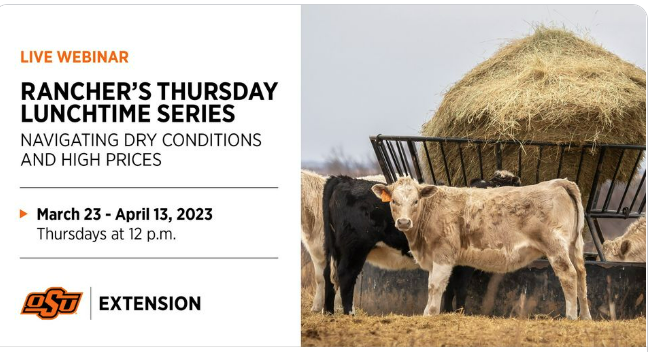
A new Rancher's Thursday Lunchtime Series begins March 23, 2023! This series will focus on navigating dry conditions and high prices.
Join our Beef Cattle Extension team, experienced ranchers and scientists to learn and share beef cattle production, management and marketing tips. These free Zoom webinar sessions are scheduled for Thursdays at noon.
Register online at https://bit.ly/3mO7SJ4.
View the session topics below!
March 23, 2023
Weather and Grass Forecast
Brian Fuchs, National Drought Mitigation Center
Laura Goodman, OSU Department of Natural Resource Ecology and Management
March 30, 2023
Using Warm-Season Annual Grasses to Restore Hay and Grazing Inventory
James Rogers, North Dakota State University
Paul Beck, OSU Department of Animal and Food Sciences
April 6, 2023
Selecting Cattle for Productivity and Longevity in Tough Conditions
James Henderson, Bradley 3 Ranch
Mark Johnson, OSU Department of Animal and Food Sciences
April 13, 2023
The Future of the Cattle Industry - A View from South Texas
Robert Hodgen, President and Chief Executive Officer, King Ranch
BASF presents the latest advancements in its agricultural innovation pipeline of crop protection, seeds and traits, and digital solutions. Their focus is to provide much-needed solutions for farmers to overcome local and crop system specific pest pressures, climate challenges, changing regulatory requirements and rising consumer expectations. Executing on its strategy in agriculture announced in 2019, the company is directing its innovations to improve outcomes for major regional crops, such as soy in the Americas, fruits and vegetables in Europe and rice in Asia Pacific. The value of the innovation pipeline remains strong, with an estimated peak sales potential of more than €7.5 billion fueled by products launched within the next ten years.
"Our goal is to become an ever more integrated provider of agricultural solutions and to expand the options we can offer to farmers. This is why we continue to invest substantially across our broad pipeline of agricultural technologies, with €944 million spent on Research & Development in 2022," said Dr. Livio Tedeschi, President of BASF Agricultural Solutions. "Farmers can continue to rely on us to innovate and deliver new active ingredients, innovative formulations, and traits to get more value from their production, both economically and environmentally."
"Our pipeline demonstrates that we are not only leveraging our deep expertise in chemistry and environmental sciences, but also matching it with leading biotechnology and digitalization approaches for next generation solutions," adds Dr. Peter Eckes, President R&D and Regulatory of BASF Agricultural Solutions. "BASF's industry-leading weed-control pipeline is a premier example of how our multidisciplinary approach yields solutions that balance the needs of farmers, society and the environment."
Significant advancements of weed management solutions for farmers in the Americas and Europe
In North and Latin America, BASF is advancing several weed management solutions, matching new herbicide modes of action active ingredients with innovative traits and precision farming technologies in major crops such as soybean. These solutions facilitate climate-smart and environmentally responsible farming practices, such as minimum tillage and efficient use of crop protection chemistries:
In addition, BASF is releasing unmatched weed management solutions for farmers in Europe:
Innovations for farmers growing fruits and vegetables in Europe
In Europe, BASF aims to improve fruit and vegetable quality and flavor, and to reduce food loss and waste through seed breeding and innovations in chemistry and digital:
Broad portfolio of solutions to improve outcomes in rice in Asia Pacific
Farmers growing rice – the major crop for the main continent of Asia – face growing pressure from resistant weeds, diseases, and pest insects. BASF actively supports farmers to overcome these challenges through a broad portfolio of technologies. Multiple new chemistries and formulations are expected before mid-decade aimed at improving outcomes in rice:
About BASF's Agricultural Solutions division
Farming is fundamental to provide enough healthy and affordable food for a rapidly growing population while reducing environmental impacts. Working with partners and agricultural experts and by integrating sustainability criteria into all business decisions, we help farmers to create a positive impact on sustainable agriculture. That's why we invest in a strong R&D pipeline, connecting innovative thinking with practical action in the field. Our portfolio comprises seeds and specifically selected plant traits, chemical and biological crop protection, solutions for soil management, plant health, pest control and digital farming. With expert teams in the lab, field, office and in production, we strive to find the right balance for success – for farmers, agriculture and future generations. In 2022, our division generated sales of €10.3 billion. For more information, please visit www.agriculture.basf.com or any of our social media channels.

Oklahoma State Treasurer Todd Russ' office is assessing the situation going on nationally with the collapse of Silicon Valley Bank. While this is an unsettling situation for the customers and investors of SVB, this is also a wakeup call to all financial institutions across the nation as rough economic times may be looming on the horizon.
"Bank regulations in America are among the most strict and comprehensive in the world. Contrary to the Biden administration, I don't think we need more regulations on banks," said Russ. "The fundamentals are in place. SVB just needed to follow sound practices and the California regulators maybe should have stepped in sooner with guidance."
"Stress testing the portfolio of a bank is a regular and ongoing practice. California regulators let SVB get out of hand before they identified the weakness in the bank holdings," Russ continued. "The loan to deposit ratio is also a key indicator of good financial health and liquidity. SVB was clearly over loaned outside of the ratios. Poor liquidity puts extreme pressure on a bank's capital and the capital to asset ratio is also a critical ratio."
The State has no direct investments or holdings in Silicon Valley Bank. Some of the pension portfolios took minor changes as indexed funds adjusted to the market but remain on a profitable path.
Russ commented, "The State Treasurer's office has very conservative investment practices in place to keep these kinds of events from harming us, and my office ensures those practices are precisely followed."
The Oklahoma State Banking Department has been through some of the toughest times in history making them very seasoned and wise overseers. They have experienced senior leadership that works very close with Oklahoma banks to keep them safe and strong.
"At the end of the day, Oklahoma is in great financial condition and ready to ride out potentially rough economic times in the future," said Russ.
Composite breeds like Lim-Flex provide hybrid vigor in a straightbred system.
By Burt Rutherford What's the big deal with composite bulls? And why should I use them?
Two good questions, says Dr. Bob Weaber, a geneticist and head of Kansas State University's Eastern Kansas Research and Extension Centers. For answers, he says look at the cowherd.
That's where composite bulls help commercial cow-calf producers realize the benefits of heterosis without the headaches of a traditional crossbreeding program. "They (the bulls) come with the crossbreeding system already built in," he says, using Lim-Flex as an example. Lim-Flex composites can have 25%- 75% Limousin genetics with the remainder being Registered Angus or Registered Red Angus.
"We get our biggest boost in performance due to heterosis in lowly heritable traits like cow longevity and fertility," he says. Given today's cost in developing replacement heifers, cow longevity is more important now than ever before.
Composite bulls also provide breed complementarity—that's when the breed combination possess complementary traits like Limousin and Angus do.
Coupled with heterosis, it adds even more to a commercial herd's economic potential. "So, producers can expect a 13 to 15 percent improvement in weaning weight per cow exposed using a Lim-Flex breeding program, for example," he says.
Real World Results
Shane Whiting and his two sons run around 1,000 commercial cows in northeast Utah near Roosevelt—all Lim-Flex, bulls and cows alike.
"Docility and calving ease are the two number-one things for a commercial rancher," he says. "And the docility of the Lim-Flex is really great. But calving ease is top of the line. She has to be able to produce a calf without a lot of problems."
They have a 60-day breeding and calving season. "And our conception rate with Lim-Flex cattle has run 95-96 percent consecutively for up to 20 years now."
He also appreciates that his cows have a moderate frame size, yet milk well. "We have better longevity, and we have a better bag," he says. "These hold up."
Whiting has carcass data on thousands of head beginning in 2014. That year, his Lim-Flex calves came down the rail grading 94 percent Choice and Prime. "Now we're at 97 percent."
Data from the Meat Animal Research Center, Clay Center, Nebraska, helps explain why Whiting's Lim-Flex cows perform well on a diet largely of grass and grass hay. "There was no statistical difference in feed efficiency yet lower intake. That's likely tied to the expected lower mature weights on these females," Weaber says. Citing other research, Weaber points out that Limousin females had the lowest mature cow weight among 10 breeds, with weights corrected for breed effect and contrasted to Angus.
Hitting Home Runs in the Southeast
Will Hargett owns a sale barn in Ayden, North Carolina, in the eastern part of the state. "We handle quite a few cattle that are in less than load lots," he says, with cow herds ranging from 20 to around 100 head.
A number of years ago, he marketed some Lim-Flex calves to a producer who backgrounded and finished them. "About a year later, he called me back and said, 'We've been in the business for three generations and that last set of calves we bought out of your barn really showed us something.'"
Hargett did a little research and decided he would help place Lim-Flex bulls with area cow-calf producers. "We've had a great experience with Lim-Flex bulls in recent years with what I would consider to be fairly average commercial cows, and just get outstanding calves coming off these cows," he says. "And we've had a lot of good response from the people buying these calves."
Several of his customers retain their heifers. To that end, he says the Lim-Flex genetics are busting some age-old myths. Bred back to Lim-Flex bulls, "They're not throwing anything with bad temperament issues. They're easy to handle, they're good milkers, they're good mothers and are producing fantastic calves."
Drought Insurance
"We've been tested pretty hard as far as weather the last handful of years," says Shane Anderson. "Mostly drought and feeding a lot of poor-quality roughages. And they (his Lim-Flex cows) seem to be holding up."
Anderson, a cow-calf producer from Towner, North Dakota, says that over the years he's used Lim-Flex genetics, he sees more consistency in the conformation and disposition of the cattle. "I've had a lot of confidence in the Lim-Flex females as far as calving ease and the vigor of the calves when they get up and get going. They're really a herd that doesn't require a lot of attention in the spring. And that's a big seller for me."
He'll come back with Lim-Flex bulls on his replacement heifers. "I'm happy with the selection I'm finding in the Lim-Flex breed as far as bulls that hit my maternal needs as well as ones that hit the benchmark as far as the feeder calves and the performance I expect from them."
What's more, he's impressed with the longevity of Lim-Flex females. Because of drought, he has culled deep, but says there are still some females in his herd that are producing at 12-13 years old.
When it's time to cull the old cows, their condition and yield adds value at the sale barn, he says. "I still want some salvage value and you know what? Even at 12, 13 years of age, they sell just as they would if they were five, six, seven years old. They look good."
Read more here.

On today's cow-calf corner, Barry Whitworth, DVM, OSU Extension Specialist in the Department of Animal and Food Sciences, discusses looking out for Bovine Leukemia Virus.
Prevalence of Bovine Leukemia Virus (BLV) appears to be changing in the United States. A recent study of cattle in eastern Kansas found that 42 out of 44 herds had at least one cow test positive for BLV. The same study found 55% of the cattle tested were positive for BLV. This is in contrast to the 1997 National Animal Health Monitoring System report in which BLV was found in 38.7% of the beef cattle operations and 11.5% of all cows tested were positive for BLV.
BLV is a retrovirus capable of causing cancer in cattle. The disease that is caused by the virus may be referred to as Enzootic Bovine Leukosis (EBL), malignant lymphoma, or lymphosarcoma. Most cattle infected with the virus remain asymptomatic or show no clinical signs of the disease. However, BLV is responsible for production losses due to increase veterinary cost, reproduction inefficiency, decrease milk production, deaths, and carcass condemnation at slaughter.
Cattle become infected with the virus when blood or body fluids is transferred between animals. Lymphocytes, a particular white blood cell, are the specific cells that are infected with the virus. Many different routes of transmission of BLV have been proposed, but more research is needed to fully understand BLV transmission.
Cattle that are infected with BLV have three possible outcomes. The most common outcome is the animal appears normal. Another 30% of the cattle will have an elevated lymphocyte count that is referred to as persistent lymphocytosis (PL). The last outcome is cancer; however, less than 5% of the cattle with BLV will ever develop lymphosarcoma.
Common symptoms of lymphosarcoma include appetite and weight loss, fever, eye problems, digestive problems, problems walking, hind limb paralysis, and enlarged lymph nodes. Most cattle are three years old or older before tumors develop.
Currently no treatments exist for cattle that are infected with BLV. Eradicating the disease requires testing and culling infected cattle until no positive cases are found for 2 years. This may not be economically feasible in a highly infected herd. A less intense approach being studied is to eliminate cows with high viral loads. It is thought that these cattle may be super shedders.
BLV will continue to be a problem in the United States until a vaccine is developed or there is an economic incentive to eradicate the disease. Until that time, producers should follow proper biosecurity to do all they can to prevent the spread of the virus.
RON's Dave Lanning has a pre-opening look at today's agricultural Markets.
Click the audio tab below for today's report.
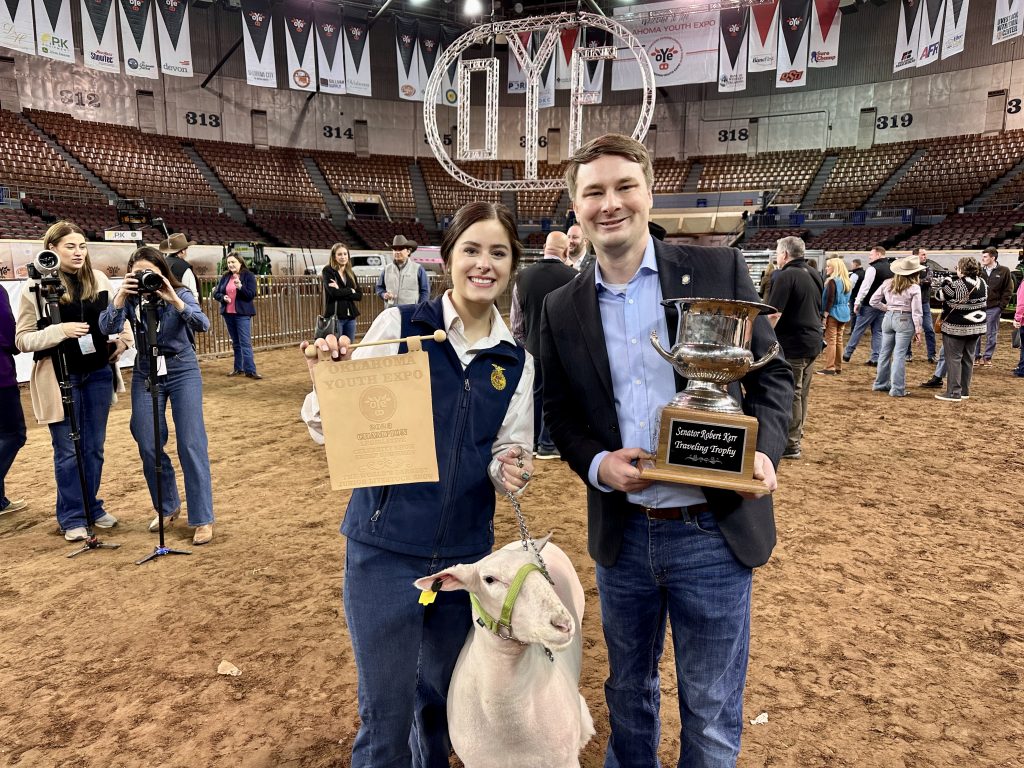
State Rep Kyle Hilbert after winning the 2023 OYE Legislative Showmanship Contest - the FFA member who provided her lamb for Hilbert to show- Abbey Roberts of Bristow FFA
It's just one more reason why the Oklahoma Youth Expo is one of the greatest youth livestock shows anywhere in the United States. On Tuesday evening- after the State House and Senate had adjourned for spring break week- 115 state lawmakers hung around Oklahoma City into the evening to be a part of the 2023 OYE Legislative and Celebrity Showmanship Contest. In addition to the state lawmakers- aides to most of the Oklahoma Congressional delegation participated as well- all showing at least one of the four species that are featured at the Youth Expo.
The lawmakers were paired with a 4-H or FFA member and got a lesson in how to handle their animal and properly present them to a judge during the contest. After that brief tutorial- they started the contest with a goat, lamb, steer or barrow.
Four lawmakers won their respective species showmanship. Rep. Carl Newton of Cherokee won the hog showmanship- Senator Chuck Hall won the Goat Showmanship, Speaker Pro Tempore Kyle Hilbert of Bristow took the lamb showmanship and newly elected State Treasurer Todd Russ was the Steer Showmanship winner.
These four each showed a steer- and the judges of the evening declared State Rep Kyle Hilbert as the Overall Showmanship winner- receiving the Senator Robert Kerr Traveling Trophy. After Hilbert won the top honor of the evening- Oklahoma Farm Report's Ron Hays talked with Rep Hilbert about the contest and the huge turnout of this legislative colleagues- and about how his experiences in the FFA has made him a better lawmaker- allowing him to take full advantage of serving the state as members of the House have elected him to the number two leadership position in the Oklahoma House of Representatives.
Listen to Ron and State Rep Hilbert by clicking on the Listen Bar below:
The Legislative/Celebrity Showmanship is an event designed to showcase the 4-H and FFA youth that are the heart of the Oklahoma Youth Expo- and to remind lawmakers about how many of these young people are the leaders of tomorrow for Oklahoma.
Click here for the full schedule for the 2023 OYE. The Oklahoma Farm Report team will be snapping pictures from start to finish- and you can see them as we add them to our Flickr album for 2023- available here. If you want to look back to the 2022 OYE- click here for our pictures from last year's event.
Our coverage of the 2023 Oklahoma Youth Expo is sponsored by Hilliary Communications- who deliver the latest cutting-edge communications services supporting tens of thousands of customers across 22 counties throughout Oklahoma, Texas and Iowa. The company offers internet, voice and HilliaryTV. Hilliary Communications continuously researches the marketplace for innovations and strives to improve underserved areas, offering services that exceed customer expectations. Click here to learn more about Hilliary Communications.

Growth Energy CEO Emily Skor issued the following statement today upon the reintroduction of the Consumer and Fuel Retailer Choice Act by a bipartisan group of lawmakers in the 118th Congress.
"Without action, the fast-approaching summer driving season could be the first since 2019 without lower-cost E15 blends. This legislation represents an immediate solution that will deliver savings for drivers, lower carbon emissions, and offer greater protection from the global turmoil that continues to cast a shadow over our energy security. There is no reason to keep biofuels from America's heartland bottled up, especially based on an outdated regulation. We are grateful to Senator Klobuchar, Senator Fischer, and their bipartisan allies who continue to fight for rural families and American drivers. The clock is ticking, but we have outstanding champions in Congress working to ensure that working families don't lose access to their favorite lower-carbon, lower-cost option on June 1."
The American Soybean Association is among 400 farm and industry groups signed onto a letter shared with congressional leadership on agriculture's budgetary needs in the 2023 Farm Bill. That letter sent to the chairmen and ranking members of both the House and Senate Budget Committees is a strong example of "united, we stand," a phrase popular amongst the country's founding fathers. Signees are hopeful modern leaders in the nation's capital understand the value of agriculture and will take their needs into consideration when developing the fiscal year 2024 budget.
"We write to express our strong support for providing (...) sufficient budgetary resources to write a new bipartisan, multi-year, comprehensive, and meaningful piece of legislation," the groups convey in the letter, continuing, "Just as there are many pressures on the federal budget, there are many pressures on U.S. farmers and others throughout the agricultural supply chain who provide food, feed, fuel, fiber, and other products to consumers across the United States and abroad."
Daryl Cates, soybean farmer from Illinois and ASA President said, "We have been heartened by recent meetings with leadership—both in Congress and the administration—and appreciate their willingness during this farm bill reauthorization year to hear from the many of us who provide for our nation every day, keeping our families fed and clothed, our cars and fleets moving, and our nation's economy strong and competitive. Their decisions for the 2023 Farm Bill have the ability to sustain these indispensable businesses—both on the farm and those that support and are supported by farmers—and keep them viable in the years to come."
International sales of U.S. farm and food products reached $196 billion in 2022, according to USDA. China is the top market for these products. When the trade war with China began in 2018, U.S. agriculture endured significant market impacts, revealing critical gaps in the farm safety net.
Cates says for soybeans, the China trade war was a crystal-clear indicator of the need for changes to farm bill legislation, typically put in place for five years: "If a trade war capable of halting all sales of soy to our largest trading partner hardly triggered the farm safety net in the current farm bill, it's hard to envision a scenario that would provide real assistance without making significant improvements."
Along with ongoing volatility in China, the letter cites other disruptions continuing to impact U.S. agriculture, including the Russian invasion of Ukraine, COVID-19 and other supply chain disruptions, non-tariff trade barriers erected by multiple countries, and devastating natural disasters—many of which have led to rising production input costs at a time when projections for many crop cash receipts are lower.
The groups also note strong budget resources are needed for protecting and enhancing crop insurance, which assists with volatile weather and crop loss, improving access to voluntary conservation incentives, addressing rural development needs, investing in research for innovation and competitiveness, providing opportunities to help the nation become more energy independent and food secure, and supporting solutions to address logistics challenges. Access the full letter here.
Promotional Sign above her pen for Jadyn Gwartney's Chester White Supreme Purebred Gilt that will lead off the 2023 Night of Stars Sale
Twenty years ago- the idea was kicked around to establish a sales venue for the top gilts that were being shown at the Oklahoma Youth Expo. That venue has matured and grown over the years as buyers from many states outside have traveled to Oklahoma City to bid in those early days to now where the bids can come from those in the seats in Barn 8- or can be hundreds or thousands of miles away watching and buying via CCI Live.
Oklahoma Farm Report's Ron Hays talked on Tuesday ahead of the Wednesday night 2023 Night of Stars Gilt Sale with Blake Kennedy of Kennedy Ventures. Kennedy says that the depth of quality of the gilts in the sale is better than he has seen in the last four or five years that he has been a part of the process. Click on the Listen Bar below to hear their conversation.
The 2023 sale will originate in Barn 8 at the OKC Fairgrounds at 6 PM, Wednesday March 15th and and will also be broadcast over the internet on CCI Live- where buyers can watch from anywhere and bid online. This will be the fifth year that Night of Stars will be taking bids live and on line as well.- starting the online option in 2018.
The past two years have been historic for the Sale, with the Night of Stars hitting the million dollar mark in 2021 and setting a record high price for a gilt of $60,000 for not just one- but two of the best gilts in the sale. Those that hit the record included the Supreme Commercial Gilt and the Reserve Supreme Purebred Gilt that year. (pictured below is the 2021 Champion Poland that was the second best Purebred of that 2021 show- owned by Bray Wright of Waukomis 4-H)
The 2022 sale ended up with the second highest total sale total- $880,000 with 130 gilts selling for an average of $6769 per gilt.
There is a video preview of the gilts for the 2023 sale- click here for the Facebook video that has been made.
Kennedy says the sale lineup has been set- click here to take a look- and that his phone has been ringing off the hook since the end of the gilt show this past Saturday asking about the strong points of many of the gilts that have been selected. The first gilt to sell will be the Supreme Champion Purebred- the Champion Chester White shown by Jadyn Gwartney (shown below) with the Champion Spotted Poland China that captured the Reserve Supreme Purebred Gilt honors as the second gilt that will sell.
Click here for the full schedule for the 2023 OYE. The Oklahoma Farm Report team will be snapping pictures from start to finish- and you can see them as we add them to our Flickr album for 2023- available here. If you want to look back to the 2022 OYE- click here for our pictures from last year's event.
Our coverage of the 2023 Oklahoma Youth Expo is sponsored by Hilliary Communications- who deliver the latest cutting-edge communications services supporting tens of thousands of customers across 22 counties throughout Oklahoma, Texas and Iowa. The company offers internet, voice and HilliaryTV. Hilliary Communications continuously researches the marketplace for innovations and strives to improve underserved areas, offering services that exceed customer expectations. Click here to learn more about Hilliary Communications.
Have a plan with options, observe closely, and be ready to adjust as needed.
Achieving ideal timing to maximize spring grazing may feel as tedious as Goldilocks' pursuit of the perfect porridge.
Turn livestock out too soon, and you're liable to damage future growth. Wait too long, and you risk missing the most productive opportunity of the season.
Getting it just right, Noble Research Institute Ranch Facility Manager Curt Larson says, depends on keen observation, flexibility and responsiveness to your environment.
Larson manages the Oswalt Ranch in south-central Oklahoma. In the decade and a half he's been there, he has seen and experimented with about every approach to spring grazing.
"We've had to change our mentality over the years," Larson says, pointing back to the days when they would bring in stocker calves, hold them for 45 days on hay until spring green-up arrived, then turn them out to a planted winter-wheat pasture.
The traditional one-steer-per-acre stocking rate usually holds true as a regional rule of thumb. When cool-season grasses are gone, we would gather and go on to native pastures, then waiting for the next warm-season crop of annual grasses to emerge.
"Often, either the grass would get ahead of the cattle, or the cattle would get ahead of the grass, one of the two," Larson says.

Today, the Oswalt Ranch team puts their emphasis on environmental observation, diversity and measuring forage availability for more-exact grazing plans. In October, they plant a cool-season combination of winter wheat, rye, clover and/or vetch and then start buying stocker calves in November or December.
Ideally, they will save warm-season native grasses from the previous summer to graze as winter forage, offering a holdover until air and soil temperatures start to warm. Larson starts monitoring forage availability on the cool-season planted pastures as soon as green emerges, using a forage stick to measure availability and calculate carrying capacity accordingly.

In one pasture test plot, Larson and Frank Rhoades, ranch facility assistant at Oswalt, have a 160-acre square split into 5-acre grazing paddocks or traps. The grazing plan typically calls for one day of grazing on each paddock. They set up temporary polywire fencing a couple of moves ahead to guide the animals through the rapid rotation. Depending on rainfall and green growth, that rotation might be sped up or slowed down.
Ideally, he keeps animals moving at a pace that allows them to take only one bite of a plant and leave enough leaf structure to continue photosynthesis and rapid growth. With 32 paddocks in the 160-acre pasture, each paddock gets at least 30 days of rest and regeneration.
"By the time we go through the system once, we're back on top of the prime growth, ready for a second cycle through it," Larson says.

While the animals make their way through the first-growth graze, Larson pulls samples for a Haney soil test. He works with soil scientists to determine the most advantageous cropping mix for warm-season grasses based on what the soil may be deficient in or carry in excess, just as he does in the fall to determine the cool-season planting combination.
"I'm not against using some kind of natural fertilizer if you need to get these spring pastures back in shape," Larson says. "But what we've found is that you can do the same thing by selecting different legumes or plants in that cool-season mix."
Warm-season planting mixes often contain 15 or 20 species for a variety of soil responses. After livestock make a second pass through a cool-season paddock, he's immediately on the no-till drill to seed the chosen mix into standing forage and residue. This time, he leaves the fence down behind the cattle, giving them a chance to backtrack over freshly seeded ground.
"I call it 'treading it in,'" Larson says. "You get that hoof action, plus fresh manure and nutrients from the animals, and we sure find a stronger germination response with that."
After two or three days, the back fence line is closed so hoof action doesn't damage germinating seeds. Once again, by the time the herd makes it through another 30-day rotation, it returns to a fresh stand of warm-season crops ready for summer grazing.
"This whole idea is about hitting it and hitting it quick. So we move fast, give it plenty of time to rest, always keep those animals on the freshest nutrition, always have something fresh to roll back onto," Larson says.

The grazing plan for the ranch is set well in advance, but it's flexible enough to adjust for the moisture and growth available.
"If I see those winter annuals slowing down, we're not getting the moisture, I'll kick them onto my stockpiled native pasture to give it a chance to catch up," he says. "If my winter annuals are going big, I know I can stockpile that native pasture for the next winter."
These management decisions vary greatly depending on region, climate and forage availability, but the same principles can be applied to all environments.
"The main thing is to just observe your grass. Do your clippings and weigh the forage, and know what you've got," Larson says. "Try to give yourself as many options as possible. The more diversity you can give yourself, the better off you are."
Story Credit: Laura Nelson, Noble Research Institute

There is a new blog post out at the Southern Plains Perspective! Read below:
I've seen a lot of interesting, producer-focused stories this week from varied sources about how researchers and agriculture producers are pursuing climate-smart agriculture (or soil health or sustainable agriculture or whatever—pick your term of art) and what they are learning. One theme seems to run through all of these stories—one size does not fit all when it comes to trying to make changes that help agriculture adapt to our changing climate.
In one story Roy Pfaltzgraff, a farmer and rancher from North East Colorado talked about how each farm is different and how each producer has a different reality. He said that, in his opinion, cookie-cutter approaches don't work; neither does a hide-bound allegiance to one set of specific practices or another.
"You can't do what I've done on my operation to get success, and I can't copy you likewise, but we can learn individual lessons from each other. I do believe in a living root, but I don't believe in cover crops as a religion." Pfaltzgraff said.
In a similar vein, an article that I came across just today told the story of Loran Steinlage, an West Union Iowa agriculture producer and 2020 No-Till Innovator Award Recipient, who drastically changed his operation and mindset when his son Roland nearly died 15 years ago from brain cancer. Flexibility, experimentation and a willingness to share what he had learned with others have become hallmarks of his approach to agriculture.
In the story he is quoted as saying "I don't have a clue what our actual rotation is this year yet," Steinlage says in early February. "It's going to flex as we see spring unfold. We're constantly adjusting."
What all this says to me is that we have to realize that a "you do 'x' and 'y' will result" approach to farming and ranching really doesn't apply when it comes to trying to adapt agriculture operations to climate change. What works on my place may not work on yours (and vice-versa). I wrote about how climate smart agriculture can mean many things to many people in an earlier blog. There are many options you can look at. The trick is that you give it some thought and understand that there is no one answer that works everywhere.
USDA has a breakdown of some of their recommended approaches to climate smart agriculture here. There also is some good information on the overall approach USDA is taking to climate change adaptation here and you can go to the USDA Agriculture Research Service website to check out what research USDA has going on in the area of extreme weather resiliency.
Weather in this part of the world has always been extremely variable. Will Rogers once said "If you don't like the weather in Oklahoma, wait a minute." This is true now more than ever with the vagaries of a changing climate. Adaptation requires flexibility and a little willingness for trial and error. It also requires an understanding that everyone is not in the same place, geographically, socially or financially. Don't get caught up in dogma when it comes to preparing your farm and ranch to the challenges of climate change. Remember that help is available from your local USDA Service Center and more information is available from their partners like cooperative extension. President Franklin Roosevelt once said "It is common sense to take a method and try it. If it fails, admit it frankly and try another. But above all, try something." I think the same holds true for climate smart agriculture.
By Alisa Boswell-Gore
The 2023 Oklahoma Peanut EXPO will be held March 23 at the Business Enterprise Center at Southwestern Oklahoma State University in Weatherford.
Attendees will receive updates from peanut experts on everything from variety and market type selection to marketing and industry outlook.
"The peanut expo allows attendees to visit with the industry representatives who supply the equipment, products and services needed to produce their crops," said Josh Bushong, northwest area Extension specialist for agronomy.
"It's a great opportunity for producers to interact with and learn from industry experts and other peanut producers," added Ron Sholar, executive director of the Oklahoma Peanut Commission.
The expo, which is considered the premier peanut education and training event for the region, is a joint effort of the OPC, Oklahoma State University Agriculture, the USDA-Agricultural Research Service, the National Peanut Board and partners in the peanut industry. The event is free, and lunch is provided.
The event will kick off with registration and exhibits at 9 a.m. and a program from 10 a.m. to 2:30 p.m.
Event Schedule:
OPC election caucuses for districts 1 and 2 will be held at the conclusion of the meeting.
Sholar will retire as the executive director of the OPC following the 2023 expo event, and retired Caddo County Extension director David Nowlin will step into the role.
"It's been wonderful to have the opportunity to work with the people at Oklahoma State University," Sholar said. "It's been everything I could have imagined, and I hope that my experience in higher education brought value to the peanut industry and the land-grant mission."
For additional information, contact Bushong at josh.bushong@okstate.edu or 580-237-7677 or Sholar at okpeanutcomm@aol.com or 405-780-0113.
OSU Agriculture is dedicated to improving the quality of life of Oklahomans through science-based information and education. It is comprised of the Ferguson College of Agriculture and two state agencies: OSU Ag Research and OSU Extension.

Scott Senseman
Farm Director, KC Sheperd, is visiting with the Associate Vice President of Research at Oklahoma State University, Scott Senseman, about agricultural research in Oklahoma.
"We have several campaigns going on with our ag comm services group there, and we are really trying to highlight more about some of the stories that are having an impact on the state of Oklahoma and some of the things that our scientists are working on," Senseman said. "We just want to be able to highlight those in the best possible light, and so we are really having a concerted effort to try and make those stories known in multiple ways."
Senseman said there are three pieces of the land grant system, and land research is one of those.
"We also have the extension service, which we now call OSU Extension, and then we have the teaching aspect of things," Senseman said. "Of course, that is our Ferguson College of Agriculture now. All three of those pieces together create a land grant system where we have research going on, we extend those findings out to the public, and then we have taught a lot of those same things coming from the research and extension programs to the young people coming through."
Senseman also talked about field days, which allow Oklahomans to learn about the latest ag research.
"We are really trying to identify and highlight and really promote at least five to seven field days a year to really make sure that we get the right kind of people that really are key people in the state of Oklahoma to hear the stories that are coming out," Senseman said.
Regarding ag research activity at OSU, Senseman said there are 16 locations with about 40 facilities for research taking place.
"A lot of that is around the Stillwater area, but all of those 16 locations encompass the diversity of the state of Oklahoma from the southeastern part, where we have a lot of rainfall and forestry, to the panhandle, where we have 15 inches of rain or less," Senseman said.
It is great to have research in different parts of the state, Senseman said, because it encompasses the diversity of the state to learn what kinds of crops do well in different environments.
Senseman said he is looking forward to the resources that will be available in the New Frontiers Ag Hall.
"One of the cool things I think that is going to come out of our new building space is a sense of collaboration, and it is really built for that design, so we have moveable parts and laboratories, and we have gathering places that are way different than our current ag space in our Ag Hall now," Senseman said. "All of those kinds of things are going to really, I think, encompass a tremendous amount of collaboration going forward."
At the Oklahoma Youth Expo, Farm Director, KC Sheperd, talked with an exhibitor, Trenton Morton about his experience at this year's OYE and previous years he has attended.
Morton is 13 years old and has been showing wether goats at the Oklahoma Youth Expo for the past five years. Heavily involved in many extracurriculars, Morton talked to Sheperd about how he makes time to do his best in all of his activities.
"Playing basketball really doesn't interfere with showing goats as much, but when it does, we just have to work through it," Morton said.
At a previous OYE, Morton started a campaign to write thank-you notes to those helping put on the show. Back in 2020, when OYE was shut down mid-way due to Covid 19, Morton wanted to make sure all of the folks who helped with the show knew how much that show meant to him and countless other exhibitors. So he set up a "Thank You" campaign at the Ag Youth Booth with his Grandpa, Larry Peck, and encouraged everyone to stop by and sign a Thank you card.
"We might be doing this again this year, but I am not 100 percent sure," Morton said.
Morton has been part of the OYE for many years before he was old enough to show, he said, helping his grandparents, Larry and Mary Peck, with the Ag Youth Magazine.
"It is always fun making new friends and just getting to know more people from all around the state of Oklahoma," Morton said.
Click here for the full schedule for the 2023 OYE. The Oklahoma Farm Report team will be snapping pictures from start to finish- and you can see them as we add them to our Flickr album for 2023- available here. If you want to look back to the 2022 OYE- click here for our pictures from last year's event.
Our coverage of the 2023 Oklahoma Youth Expo is sponsored by Hilliary Communications- who deliver the latest cutting-edge communications services supporting tens of thousands of customers across 22 counties throughout Oklahoma, Texas and Iowa. The company offers internet, voice and HilliaryTV. Hilliary Communications continuously researches the marketplace for innovations and strives to improve underserved areas, offering services that exceed customer expectations. Click here to learn more about Hilliary Communications.
Senior Farm and Ranch Broadcaster, Ron Hays, is visiting with the Director and Senior Agricultural Economist at the Livestock Marketing Information Center, Katelyn McCullock, about the latest beef export numbers from the USDA and the U.S. Meat Export Federation.
Looking back at 2021 and 2022 both being record export years, McCullock said this January 2023 data is starting things off on a negative note as those numbers have fallen 16 percent below 2022.
"We saw a pullback almost universally, across the board," McCullock said. "Canada was even with a year ago, but China was down 25 percent."
Taiwan was down over 30 percent, McCullock said, while Mexico and Japan were up. South Korea and Vietnam, she added, were both down significantly by double digits.
"We did import more product," McCullock said. "That was up four percent in total. Probably the big story out of this is going to be Brazil shipped, I believe, it was a record-high for the month."
Argentina sent 15 percent more and Canada sent 14 percent more, McCullock said, creating a pretty strong import month.
"One of the things that is happening with imports and exports is going to be what the relative currency value is, and how expensive beef is relatively here, and what we can buy it for in all of the relative values," McCullock said. "So, it remains to be seen maybe what the rest of the year looks like. We have a fairly aggressive import projection out there. We are up about seven to ten percent over a year ago in 2023."
While the U.S. has a fairly substantial decline in beef exports, McCullock said that should end up being only two to five percent in the long run. With that decline in beef production in the U.S., McCullock said imports will help fill that gap.
"For beef exports, that market has realty been driven by China in the last two years," McCullock said. "To see them slip down into under 60 million pounds in the last six or seven months is a pretty big change from what the last two years have been. I don't know if seasonality is what you would call that, but it is really going to depend on how they interact with our market as they have been such a driving factor for the last two years."
The Beef Buzz is a regular feature heard on radio stations around the region on the Radio Oklahoma Ag Network and is a regular audio feature found on this website as well. Click on the LISTEN BAR for today's show and check out our archives for older Beef Buzz shows covering the gamut of the beef cattle industry today.
The U.S. Meat Export Federation (USMEF) announced the speaker lineup and registration details for its 2023 Spring Conference, which is set for May 24-26 in Minneapolis.
The opening general session will feature USMEF's senior staff from the Asia Pacific region – Senior Vice President Joel Haggard and Vice President Jihae Yang – who will discuss emerging issues in key Asian markets, including how removal of many COVID restrictions could provide momentum for the region's foodservice sector.
The following day, USMEF will examine the state of U.S.-Mexico trade relations with Kenneth Smith Ramos, who served as Mexico´s chief negotiator for the modernization of NAFTA, which led to the signing and ratification of the U.S.-Mexico-Canada Agreement. He is now a partner at AGON, a consulting firm specializing in competition, regulatory affairs and international trade.
At the closing session, former House Agriculture Committee Chairman Collin Peterson – who oversaw development of four farm bills during his 30 years in Congress – will discuss the challenges lawmakers face as they work to craft an effective, pro-trade farm bill over the coming year.
In addition to the general sessions, the Beef, Pork, Exporter and Feedgrain/Oilseed breakouts will provide in-depth discussions on topics relevant to each sector. Registrants are welcome and encouraged to participate in all breakouts regardless of membership sector.
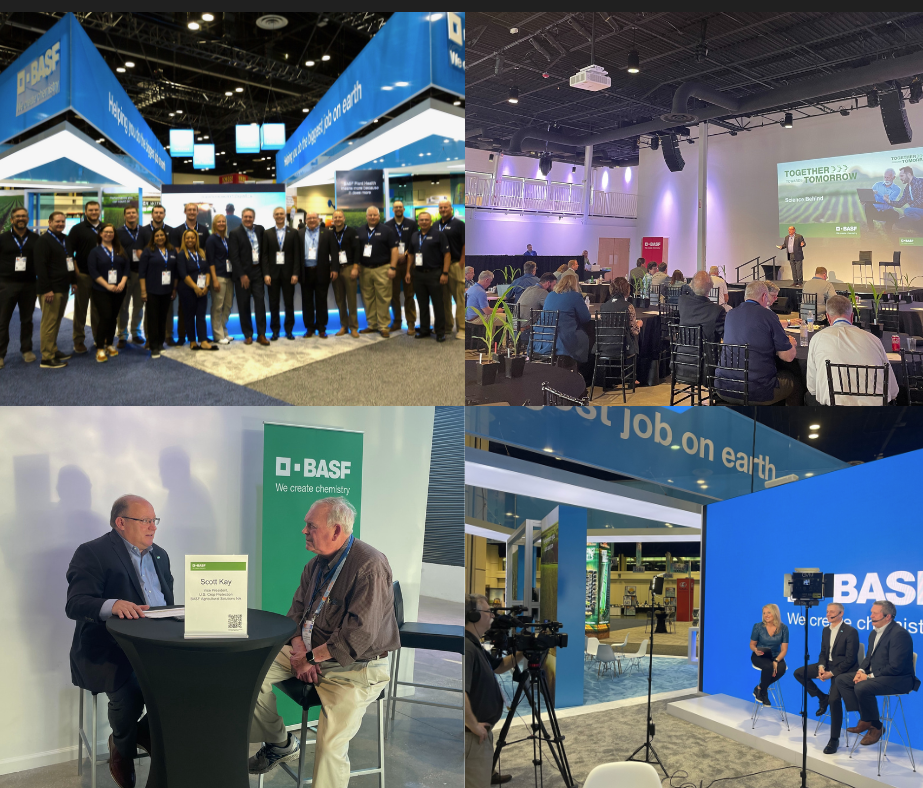
BASF embraced the theme of this year's Commodity Classic – Preparing for the Next Generation – by sharing its growing portfolio of solutions at the three-day event in Orlando last week.
Front and center was the latest innovation from the KixorÒ herbicide family, SurtainTM corn herbicide. Upon registration, which is expected later this year, this revolutionary resistance management tool will deliver the first solid-encapsulation technology to the marketplace, enabling farmers to apply pre-and early post-emergence in corn.
The full integration of BASF's innovation pipeline enables the company to anticipate grower solutions. BASF highlighted such solutions in its advanced seed portfolio, treatment, fungicide and herbicide portfolios for corn, soybean and wheat growers. The company continues to innovate across its pipeline of seeds and traits, seed treatments, biological and chemical crop protection over the next decade.
"From introducing our newest innovation, Surtain herbicide, to continuing the conversation on emerging technologies in areas like weed resistance, plant health and digital farming, this year's event provided a great opportunity for us to showcase BASF's commitment to delivering grower-focused solutions," said Paul Rea, Senior Vice President of Agricultural Solutions, North America.
The "Science Behind" Herbicide Formulations
Through its 16th annual Science Behind event, BASF shared a look behind the curtain at Surtain corn herbicide, developed with a revolutionary new solid-encapsulation formulation backed by 10 years of research and development.
This novel technology will enable farmers to apply Kixor herbicide pre-and early post-emergence in corn, expanding the application window and residual weed control into the growing season.
"With weeds evolving to be resistant to 21 of the 31 known herbicide sites of action, this type of innovation is needed to help growers fight those resistant weeds and preserve the technologies available to them today - building a bridge to novel artificial intelligence in the future," said Scott Kay, Vice President, U.S. Agricultural Solutions, BASF.
BASF is currently awaiting EPA regulatory approvals for Surtain herbicide, but the company anticipates those approvals will come later this year in time for a 2024 commercial launch.
Commodity Classic 2023
With the need for more product innovation paired with the uncertainties of a volatile marketplace, BASF had experts on hand to talk to growers specifically about how to overcome current challenges and be successful this growing season.
Key topics of discussion included:
"Events such as Commodity Classic give us the opportunity to hear from a variety of growers face to face, working together to address their biggest challenges," Kay said. "We know farming is the biggest job on earth and we're thankful for the opportunity to partner with them on solutions for now and the future."
Innovation Pipeline
The BASF team also shared an update on its innovation pipeline, which is well positioned for the future. Developments are underway in BASF's core canola, cotton and soybean seed businesses and in its crop protection portfolio in major crops, like wheat, canola, soybean, corn, cotton, rice, as well as fruits and vegetables.
"BASF is committed to providing innovative products and solutions, such as Surtain, to address grower challenges," Rea said. "By 2025, we expect to introduce 25 new products designed to make farming even more productive and sustainable."
For more information about Surtain, agronomic insights, or the innovation pipeline, contact your local BASF representative.
Surtain herbicide, an innovation from the Kixor herbicide family, is not registered and not available for sale. This information is provided for educational purposes only and is not intended to promote the sale of the product. Any sale of this product after registration is obtained shall be based solely on the EPA approved product label, and any claims regarding product safety and efficacy shall be addressed solely by the label.
Always read and follow label directions. Kixor is a registered trademark and Surtain is a trademark of BASF Corporation. ©2023 BASF. All Rights Reserved.
1 2021 BASF GLS Infection Microscopy Laboratory Trial
About BASF's Agricultural Solutions Division
Farming is fundamental to provide enough healthy and affordable food for a rapidly growing population while reducing environmental impacts. Working with partners and agricultural experts and by integrating sustainability criteria into all business decisions, we help farmers to create a positive impact on sustainable agriculture. That's why we invest in a strong R&D pipeline, connecting innovative thinking with practical action in the field. Our portfolio comprises seeds and specifically selected plant traits, chemical and biological crop protection, solutions for soil management, plant health, pest control and digital farming. With expert teams in the lab, field, office and in production, we strive to find the right balance for success – for farmers, agriculture and future generations. In 2022, our division generated sales of €10.3 billion. For more information, please visit www.agriculture.basf.com or any of our social media channels.
About BASF
BASF Corporation, headquartered in Florham Park, New Jersey, is the North American affiliate of BASF SE, Ludwigshafen, Germany. BASF has approximately 16,000 employees in North America and had sales of $25.7 billion in 2022. For more information about BASF's North American operations, visit www.basf.com/us.
At BASF, we create chemistry for a sustainable future. We combine economic success with environmental protection and social responsibility. More than 111,000 employees in the BASF Group contribute to the success of our customers in nearly all sectors and almost every country in the world. Our portfolio comprises six segments: Chemicals, Materials, Industrial Solutions, Surface Technologies, Nutrition & Care and Agricultural Solutions. BASF generated sales of €87.3 billion in 2022. BASF shares are traded on the stock exchange in Frankfurt (BAS) and as American Depositary Receipts (BASFY) in the United States. Further information at www.basf.com.
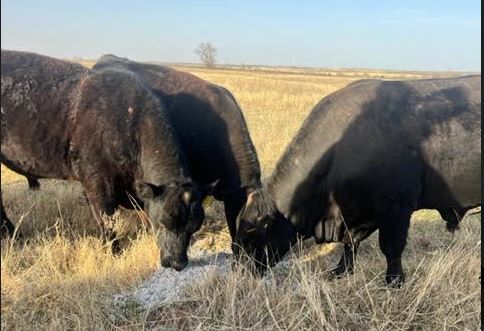
Mark Johnson, Oklahoma State University Extension Beef Cattle Breeding Specialist, offers herd health advice as part of the weekly series known as the "Cow Calf Corner" published electronically by Dr. Peel, Mark Johnson, and Paul Beck. Today, Johnson is talking about getting ready for breeding season.
For herds that plan to begin calving next January, breeding season begins in April. With that in mind, it's time to plan and manage bulls for breeding season. This week we address bull to female ratios for breeding season.
The three major goals of any breeding season should be:
A defined breeding season is important to permit meaningful record keeping, timely management and profit potential. Maintaining a 60 to 75 day breeding and calving season can be one of the most important management tools for cow calf producers. A uniform, heavier calf crop is an important reason to keep the breeding season short. Getting cows bred earlier results in calves born earlier. Missing an estrus cycle of a single cow is a significant monetary loss in calf weight gain the following year. The extra 21 days until the next heat cycle translates into a younger calf at weaning that is 40 to 50 pounds lighter. Spread over several cows the losses can grow quickly. In addition, more efficient cow supplementation and effective herd health programs are a product of a short breeding season. How do we get more cows settled earlier in the breeding season? By having adequate bull power on hand to get cows pregnant.
How Many Bulls Do I Need?
Can be answered with another question: How many cows should I expect my bull to cover? Depending on the age of your bull or bulls, and assuming bulls have passed a Breeding Soundness Examination (BSE), the general rule of thumb is to place about as many cows/heifers with a young bull as his age in months. For example, a bull that is 12 months old should be able to cover about 12 cows in his first breeding season. An 18 month old bull should be able to settle 18 or 19 cows. While a two-year-old bull could be expected to cover up to 25 cows. Mature bulls normally should be expected to cover 25 to 35 cows per season. Remember there is normal "prime of life " for breeding bull. They need be sound, fit, and athletic to cover terrain and settle cows. Bulls past the age of six are more likely to breakdown.
It is beneficial that bulls to be combined in multi-sire pastures are penned together for at least a few weeks prior to turnout to allow time for a pecking order to be established. This also leaves enough time to secure replacements if injury occurs prior to turnout. Injuries occurring during breeding season can spell economic disaster if bulls aren't getting cows bred.
Breeding Soundness Exams, Body Condition and Herd Health
It is suggested to have all bulls undergo a Breeding Soundness Exam (BSE) prior to turnout. A BSE includes a semen test as well as a physical exam of the entire reproductive tract, eyes, feet and legs, and teeth (if an older bull). Manage Body Condition Scores (BCS) on bulls similar to what is done with cows. Optimum BCS for bulls being turned out at beginning of breeding season is a six. Now is the time to manage herd heath, deworming and nutrition to have bulls fit and ready at turn out.

New Data Shows Manufacturers Return to Growth, Increased Output
The Association of Equipment Manufacturers (AEM) today released the latest economic impact report for the equipment manufacturing industry ahead of the organization's largest trade show CONEXPO-CON/AGG 2023, highlighting the industry's return to growth and increased output following the end of the COVID-19 pandemic. The report was prepared by the Market Intelligence Team at S&P Global and details the impact of the three major sectors – agriculture, construction, and mining – that make up the equipment manufacturing industry.
Key findings from the AEM Economic Impact Report include:
"The equipment manufacturing industry has shown time and again that it is a resilient force in the North American economy, weathering everything from global pandemics to supply chain disruptions with strength and determination. As we look to the future, we can be confident that this industry will continue to adapt and innovate in the face of new challenges, providing stable jobs and economic opportunities for communities across the continent," said AEM President Megan Tanel.
The return to growth for the equipment manufacturing industry in 2022 is part of a broader rebound in U.S. manufacturing output, which saw nominal output increase by an estimated 14 percent in 2022. The 4.2 percent employment growth seen by the equipment manufacturing industry in 2022 outpaced the broader manufacturing employment growth of 3.8 percent seen last year.
"Equipment manufacturers, like many other sectors in the U.S. economy, have weathered economic uncertainty during a global pandemic. But we answered the call and kept our factory floors open to produce the equipment that kept critical people and goods moving. We got the job done. This report is a testament to the grit and resiliency of the 2.35 million men and women who build, power, and feed America. It is because of them, and for them, that our industry's leaders will always look for solutions that allow us to meet the demands of tomorrow," said 2023 AEM Chair and Komatsu North America Chairman and CEO Rod Schrader.
A gradual return to normal conditions for global supply chains and increased availability of raw materials have helped U.S. manufacturing turn a corner, but persistent labor shortages and low inventories still pose a risk. The Global Supply Chain Pressure Index, maintained by the Federal Reserve Bank of New York, hit an all-time high in November 2021, but by February 2023 it had retreated to just below the historical average. This suggests that on average, global supply chain conditions have begun to return to normal. While the industry may see some retrenchment this year, primarily due to geopolitical instability and policy uncertainty, the next few years should see steady output growth supported by a rebound in investment.
"Fueled by a legacy of grit and ingenuity, America's equipment manufacturers can outcompete anyone, but we need the right mix of policies to continue to bolster manufacturing in America. With expanded opportunities to sell our products overseas, immigration reform that addresses our workforce needs, and improvements to the federal permitting process, equipment manufacturers can continue to invest in their communities, grow their businesses, and hire more Americans," said AEM Senior Vice President, Government and Industry Relations Kip Eideberg. Click here to access the 2023 AEM Economic Impact Report.
RON's Dave Lanning has a pre-opening look at today's agricultural Markets.
Click the audio tab below for today's report.
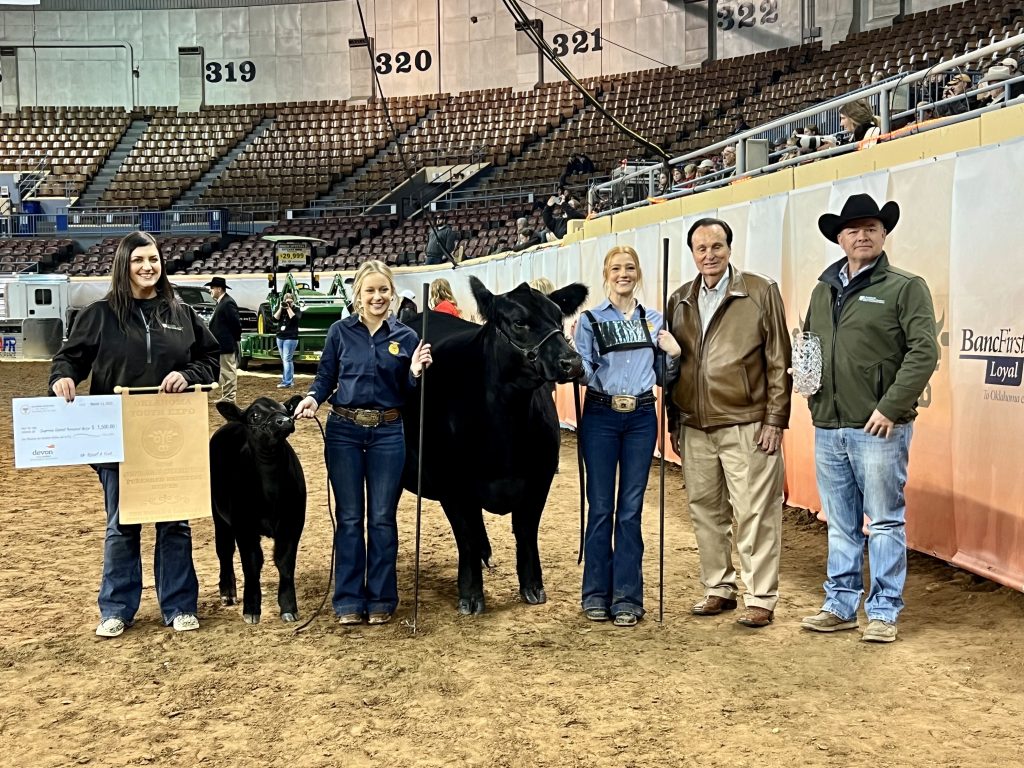
Supreme Purebred Heifer- Shown by Alyson Fresen of Arnet FFA- the Champion Angus Heifer at the 2023 OYE
The 2023 Breeding Heifer Show stretched over several days at the Oklahoma Youth Expo- both in Barn 3 as well as in the Jim Norrick Arena. A total of
Over twenty breed and influence shows were held with fourteen hundred heifers being evaluated, with the Supreme selection on Monday.
Three Supreme Champions were selected- starting with the Supreme Influence category. The Charolais Composite Champion, owned by Finley Yoacham of Sapulpa FFA was named the Supreme Influence Heifer.
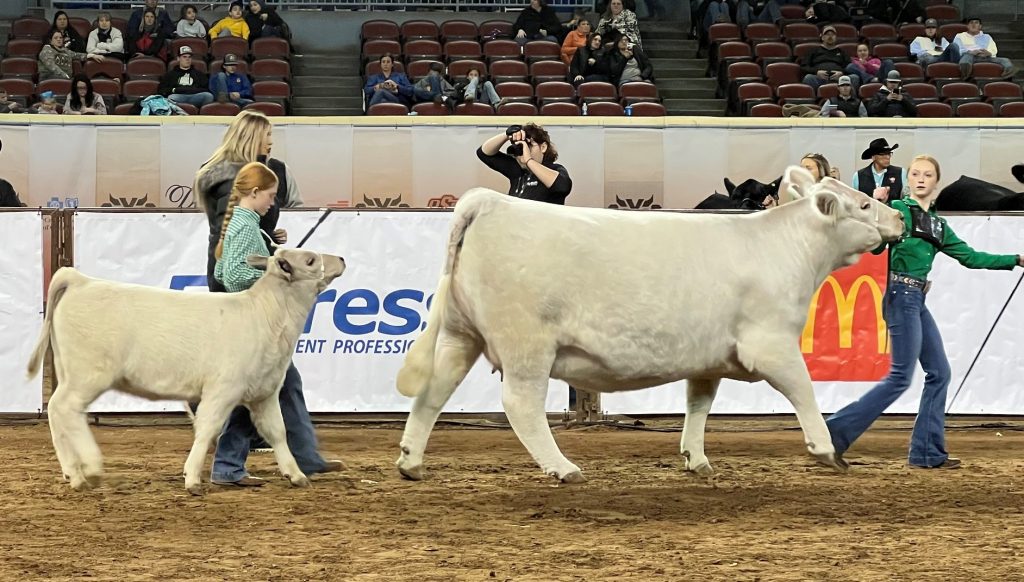
The Reserve Supreme Influence Heifer was the Maintainer Champion- shown by Maggie Griswold of Ripley FFA
The Bronze Medallion Influence Heifer was the Shorthorn Plus Champ- shown by Carter Kornegay of Rogers County 4-H
The Supreme Purebred Heifer was the Angus Champion- her owner was Alyson Friesen, Arnet FFA. (Shown at the top of the story) The Reserve Supreme Purebred Heifer was the Reserve Angus- shown by Jake Allison of Canadian County 4-H.
Finally in the Bred and Owned category- the Supreme Champion Bred and Owned was shown by Koy Moonen of Twin Mounds 4-H. His sister, Elle Moonen, had the Reserve Supreme Bred and Owned Heifer- the Reserve Maintainer.
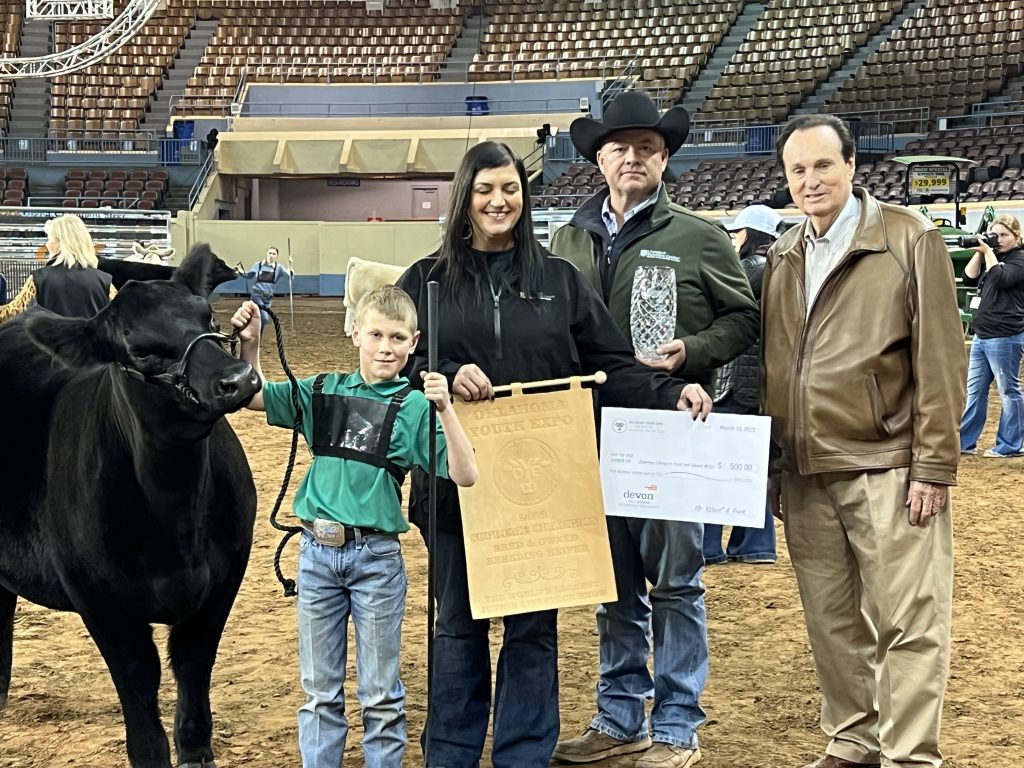
Here are the breed champions and reserves from the 2023 OYE.
Angus
Champion- Alyson Freisen Arnet FFA
Reserve- Jake Allison Canadian County 4-H
Red Angus
Champion- Bret Pembrook Fairview FFA
Reserve- Rhiata Bouziden Waynoka FFA
Red Angus Percentage
Champion- Rylee Abney Payne County 4-H
Reserve- Kate Sherrill Pawnee FFA
Shorthorn
Champion- Eli Matthews Muldrow FFA
Reserve- Owen Adams Amber Pocasset 4-H
Shorthorn Plus
Champion- Kase Glazier Lomega FFA
Reserve- Jade McPeak McIntosh 4-H
Chianina
Champion- Carlee Clark Muldrow 4-H
Reserve- Jaycie Perrier Dewey FFA
Charolais
Champion- Maddie Frazier Meeker FFA
Reserve- Case Conley Murray County 4-H
Charolais Composite
Champion- Finley Yocham Sapulpa FFA
Reserve- Brynna Herndon Kiefer 4-H
Limousin
Champion- Hailey Drake Guthrie FFA
Reserve- Peyton Collum Oklahoma County 4-H
Maintainer
Champion- Maggie Griswold Ripley 4-H
Reserve- Cholee Clark Muldrow 4-H
Horned Hereford
Champion- Madilyn Norvell Amber Pocasset 4-H
Reserve- Cierra Collins Tillman County 4-H
Polled Hereford
Champion- Blayklee Steizer Oologah 4-H
Reserve- Madilyn Norvell Amber Pocasset 4-H
Simmental
Champion- Kayden Offeiter Yukon FFA
Reserve- Maggie Griswald Ripley 4-H
Bred and Owned Category
Angus Bred and Owned
Champion- Brody Lott Alva FFA
Reserve- Brody Grisby Craig County 4-H
Charolais Bred and Owned
Champion- Kamden Filippo Rush Springs FFA
Reserve- Jason Staggs Purcell FFA
Composite Charolais Bred and Owned
Champion- Katie Dismukes Checotah 4-H
Reserve- Chase Dowell Canton FFA
Chianina Bred and Owned
Champion- Reagan Wilbourn Tuttle FFA
Reserve- Gemma Emberson Ok Union FFA
Horned Hereford Bred and Owned
Champion- McKenzie Boyer Claremore FFA
Reserve- Calin Kinder Canadian County 4-H
Polled Hereford Bred and Owned
Champion- Claire Collins Tillman County 4-H
Reserve- Hudson Carter Stratford 4-H
Maine-Anjou Bred and Owned
Champion- Bella Manous Boswell FFA
Reserve- Katharine Cross Comanche FFA
Mainetainer Bred and Owned
Champion- Koy Moonen Twin Mounds 4-H|
Reserve- Elle Moonen Twin Mounds 4-H
Red Angus Bred and Owned
Champion- Madeline McClain Leedey FFA
Reserve- Avery McMurphy Alva FFA
Red Angus Percentage Bred and Owned
Champion- Jillian Sherman Woodward FFA
Reserve- Piper Goodson Tecumseh FFA
Shorthorn Bred and Owned
Champion- Abilene Sullivan Lawton 4-H
Reserve- Kimberly Holland Tecumseh FFA
Shorthorn Plus Bred and Owned
Champion- Kase Glazier Lomega FFA
Reserve- Jade McPeak McIntosh County 4-H
Simmental Percentage Bred and Owned
Champion- Kale Robison Cushing FFA
Reserve- Lane Smith Amber Pocasett 4-H
ORB Bred and Owned
Champion- Avery Smith Henryetta FFA
Reserve- Brooklyn Matlock Cyril FFA
ORB American Bred and Owned
Champion- Talan Dean Maysville FFA
Reserve- Cayden Carpenter Bethel FFA
Click here for the full schedule for the 2023 OYE. The Oklahoma Farm Report team will be snapping pictures from start to finish- and you can see them as we add them to our Flickr album for 2023- available here. If you want to look back to the 2022 OYE- click here for our pictures from last year's event.
Our coverage of the 2023 Oklahoma Youth Expo is sponsored by Hilliary Communications- who deliver the latest cutting-edge communications services supporting tens of thousands of customers across 22 counties throughout Oklahoma, Texas and Iowa. The company offers internet, voice and HilliaryTV. Hilliary Communications continuously researches the marketplace for innovations and strives to improve underserved areas, offering services that exceed customer expectations. Click here to learn more about Hilliary Communications.
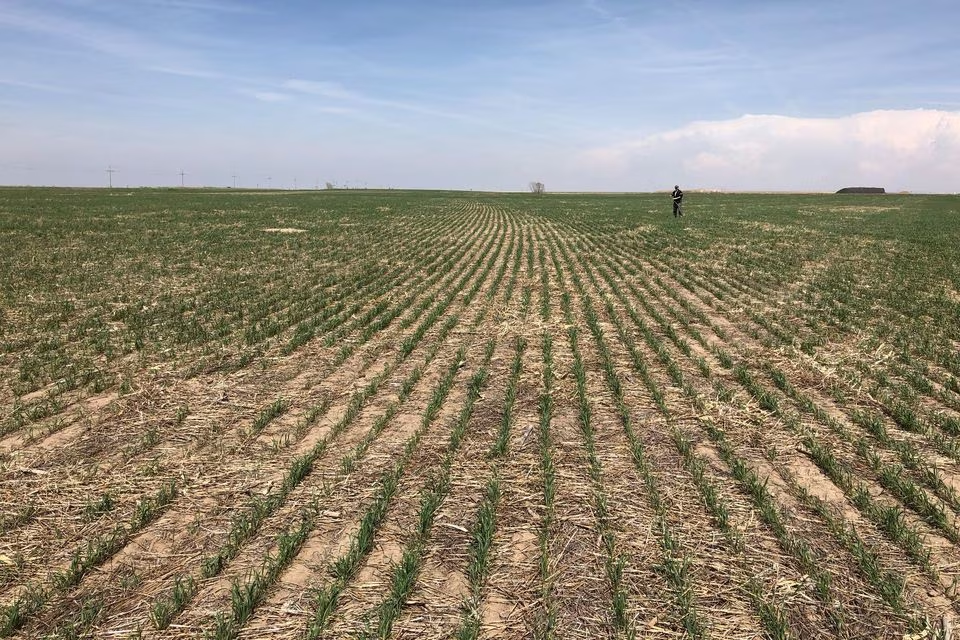
According to the Oklahoma Crop Progress and Condition report released on March 13, 2023, winter wheat was rated 30 percent good to excellent, 26 percent fair and 44 percent poor to very poor. Last week's ratings were 39 percent good to excellent, 21 percent fair and 40 percent poor to very poor. Winter wheat jointing reached 12 percent, up 5 points from the previous year and up 2 points from normal.
Pasture and range conditions rated 9 percent good to excellent, 31 percent fair and 60 percent poor to very poor. Last week's conditions rated 7 percent good to excellent, 34 percent fair and 59 percent poor to very poor.
Livestock conditions rated 42 percent good to excellent, 42 percent fair and 16 percent poor to very poor. Last week's conditions rated 37 percent good to excellent, 39 percent fair and 24 percent poor to very poor.
Winter Wheat conditions rated 17 percent good to excellent, 31 percent fair and 52 percent poor to very poor. Last week's conditions rated 17 percent good to excellent, 30 percent fair and 53 percent poor to very poor.
Winter Wheat conditions rated 17 percent good to excellent, 33 percent fair and 50 percent poor to very poor. Last week's ratings were 19 percent good to excellent, 31 percent fair and 50 percent poor to very poor. Winter wheat headed reached 21 percent, 4 points up from the previous year.
Corn planted reached 30 percent, up 4 points from the previous year and the average.
Sorghum planted reached 20 percent, up 3 points from the previous year and up one from the average.
Range and Pasture Conditions rated 8 percent good to excellent, 24 percent fair and 68 percent poor to very poor. Last week's ratings were 8 percent good to excellent, 23 percent fair and 69 percent poor to very poor.
Senate President Pro Tem Greg Treat, R-Oklahoma City, today announced the development of a business retention and economic development select committee.
The committee will study the current economic landscape in Oklahoma in an attempt to attract more employers and major investments in Oklahoma.
"Oklahoma has abundant resources, qualified employees and a legislature and executive branch that is friendly to the business community," said Pro Tem Treat. "We have a history of going out of our way to offer advantages other states cannot. There is no reason for us to continuously lose out to another state in this country on major business developments. That is why I am determined find the common denominator as to why we aren't being chosen and figure out how we can become more attractive to businesses looking to expand or relocate. We will hear from business experts, company executives, state offiicials and everyone else to make Oklahoma more attractive to major employers."
Pro Tem Treat will chair the committee and will announce appointees, meeting dates, times and locations at a later date.

House Agriculture Committee Ranking Member David Scott announced the following additions to the Democratic staff of the House Agriculture Committee:
Britton T. Burdick will serve as Democratic Communications Director for the Committee. He most recently served as Communications Director for Congressman Donald Norcross. Prior to working on Capitol Hill, Burdick served as the National Press Secretary for One Country Project, a rural policy and advocacy nonprofit founded by Senator Heidi Heitkamp, and as Director of Public Affairs at Forbes Tate Partners. He was raised in Healdsburg, CA, a small town renowned for its viticulture. Burdick earned his B.A. from New York University and an M.Phil. from the University of Cambridge.Michael Stein will serve as Democratic Chief Counsel for the Committee. He was previously Counsel for the Senate Small Business Committee and served with the House Agriculture Committee in the 117th Congress. Stein earned his J.D. and M.S. in Environment and Resources from the University of Wisconsin-Madison where he was a founding member of the Wisconsin Agriculture and Food Law Society. He started his career on Capitol Hill working on agriculture, energy, and environmental issues with the House Small Business Committee. Prior to working on Capitol Hill, Stein worked on policy issues for the Organic Farming Research Foundation, and also gained experience with the Food Law and Policy Clinic at Harvard Law School.
Senior Farm and Ranch Broadcaster, Ron Hays, is talking with the Executive Director of the Oklahoma Wheat Commission, Mike Schulte, about OSU wheat varieties and the 2023 wheat crop.
"it is exciting to see the lineup out of the USDA wheat variety report that came, showing what wheat producers are choosing to plant across the state, and the public research program at Oklahoma State University with their variety development program still standing strong," Schulte said. "As we make changes in the industry, as we have more varieties coming out of the OSU public research program and more varieties coming out of private companies giving producers more options. There is more competition in all areas, so it is exciting to see that we still are doing so well with the varieties coming out of OSU as producers are using them as mainstays to plant for their crops here in Oklahoma."
Oklahoma State University varieties continue to lead planted acres of Hard Red Winter Wheat across the state of Oklahoma, according to the March 2023 "Oklahoma Variety Report" from USDA National Agricultural Statistics Service. For the fifth year in a row, the top four leading wheat varieties planted in the state were developed by OSU with another three listed in the top nine.
Doublestop CL Plus variety takes the top spot for the second year in a row, with Smith's Gold moving from the fourth position last year into the number two spot this year. Gallagher and Green Hammer varieties move into the third and fourth spots. The Showdown variety makes a great leap moving from 24th last year to 6th place this year. It should be no surprise to see the movement in Showdown, as it is widely adapted from west Texas to central Kansas, including the Oklahoma panhandle and has a very high yield ceiling. Showdown shows good standability and responds well to grazing with adequate seed density. Showdown also incorporates Hessian fly resistance.
"I think it (Showdown) has just been a variety that has done well across the state and did actually very well last year in the extreme drought conditions," Schulte said. "Forty percent of its pedigree comes from the Jagger variety, which was a highly utilized wheat across the state 15 to 20 years ago. It is less tolerant to acidic soils, but it is similar to Duster and has some fly resistance, so I think producers are looking at that."
Showdown also provides adequate protection against stripe rust, Schulte said.
"Just looking at the variety trials that we had last year, the 33 where data was collected from, Showdown yields were 111 percent of the best available genetics statewide," Schulte said. "So, that data really indicates that it is a really good performer statewide, given the different types of environments that we have across the state, and so it is really a mainstay variety that I think if producers are making management decisions for their production purposes, they would look at it, and it would rise to the top and they would probably select that certainly to be in their rotation."
The OSU varieties offer a genetically diverse portfolio with wide adaptations across most regions of the state. Producers looking for high yielding varieties with the Gold n Grain trademark provide the best qualities for millers and bakers. (One message rings loud and clear, based on Wheat Quality Council and preferred variety lists, millers and bakers are sourcing from Oklahoma for the most suitable wheat quality.) Other core varieties for producer use include Bentley and Iba.
Newer OSU varieties released in 2020, broke into the survey this year with significant gains in acreage. These include Butler's Gold, a short season wheat that gives more options to producers growing multiple crops. Strad CL Plus follows right in line and is known as the Doublestop CL Plus upgrade for straw strength, forage production and maturity. The Uncharted variety comes in soon after with its significant breakthrough in Barley Yellow Dwarf protection and novel leaf rust resistance. Also listed is Baker's Ann, a premium-quality wheat variety well suited for quality-based contract production at a yield potential comparable to Green Hammer.
With 40 percent of the crop rated poor to very poor this past week, Schulte said the stands look good in many regions, but this crop is different because it has been planted a little later.
"As I have gone around central Oklahoma, where things I thought looked probably the best in the state this past weekend, we are starting to see, in the fields, bluer wheat in the areas where the soil may not be as good," Schulte said. "It has really been noticeable to me, just in the last couple of days, even where we have really strong, thick stands, that the crop is going backwards."
Schulte said the numbers reflected in last week's crop progress report are more positive than what he has seen, certainly compared to what he has seen in northwest Oklahoma and the panhandle regions.
"Things just do not look good at all talking to producers in the panhandle regions," Schulte said. "I don't see how we will have a dryland wheat harvest."
With that said, Schulte added that parts of southwest Oklahoma are looking better than previous years.
"No doubt, it is going to take moisture within the next week from here on out to have a successful crop," Schulte said.
Regarding Oklahoma State University's new wheat variety, High Cotton, Schulte said the name of the newest variety lends itself well to showcasing the success of the variety development program at OSU.
"The numbers are there to show us that we have some really great varieties doing very well and I think the data on this is really exciting to see," Schulte said.
Senior Farm and Ranch Broadcaster, Ron Hays, is visiting with NCBA's Associate Director for Governmental Affairs, Sigrid Johannes, about the introduction of the Black Vulture Relief Act.
Cattle producers in several states have reported black vultures swooping in and causing problems with their calves. Michael Kelsey, Oklahoma Cattlemen's Association Executive Vice President, says that several reports in eastern Oklahoma have the birds not only preying on newborn calves- but adds that if given the chance, will eat on the mama cow as she is trying to deliver.
The bill would allow a cattle producer to "take" (capture, kill, disperse, or transport) black vultures that pose a risk to livestock. Additionally, the bill reduces permitting burdens and red tape by instituting a simple report that producers submit once per year detailing the number of black vultures they took. Streamlining the system and lifting the cap on number of black vultures that producers can take is a commonsense approach to managing a fully recovered, aggressive predator species.
"This is a great piece of pretty common-sense and bipartisan legislation that is being led by Congressman John Rose from Tennessee and Congressman Darren Soto from Florida," Johannes said. "This is a measure that would allow for folks, for agricultural producers, to take black vultures without needing a permit on the front end. It maintains the requirement that you report those incidences of lethal take or just of harassment and things like that, deterrence measures on the back end, in a once yearly report, but it doesn't require that producers have a permit before they go and take that action against a predator species that might be harassing and often killing calves and they're attacking cows."
The black vulture is listed under the Migratory Bird Treaty Act, Johannes said, which is a piece of legislation that is different in function, but similar in concept to the Endangered Species Act. The Migratory Bird Treaty Act, Johannes said, puts in place protections for a variety of migratory bird species and puts restrictions on the ways they can be taken.
"Remember, 'take' includes not just killing, but also all of those harassment actions and non-lethal measures that folks to do deter those predatory birds from going after their livestock," Johannes said. "The problem is, the black vulture is by no means endangered, or even threatened and is a really abundant species throughout the Midwest and Southeast of the United States."
Black vulture depredation rates have gone up consistently over the past ten years, Johannes said, and wildlife services is over-taxed and overstretched in the requests that they receive to deal with this specific bird species.
"In some states like Florida, for example, the rate of folks who experience livestock loss due to black vulture depredation every year is 38 percent," Johannes said. "So, this is not some niche issue. It is definitely something that is affecting a lot of producers across the South, and what they have to do now is apply through their states for a permit to be able to take black vultures. States, in turn go to fish and wildlife to receive those permits, so it is really a sub-permit that folks are receiving from their state."
The problem is, Johannes said, these permits go out in very small amounts.
"We are talking, taking three birds a year, for example," Johannes said. "That is just not enough flexibility and not a high enough number to be able to deal with the level of the problem at hand."
There are people who lose more than a dozen animals in a year to black vultures, Johannes said, as it can be a pretty severe problem.
"We appreciate that this bill would take the cap off and just let people do what they need to do to protect their livestock," Johannes said.
The black vulture's harming of livestock impacts producers in many ways, Johannes said, inflicting them financially and emotionally.
"I don't have to explain this to any of our folks who are out there working on the ranch, and they see this, but for people who are not familiar, not a fast death," Johannes said. "It is a pretty gruesome situation when you get a calf who is down and being preyed upon by these birds."
The Beef Buzz is a regular feature heard on radio stations around the region on the Radio Oklahoma Ag Network and is a regular audio feature found on this website as well. Click on the LISTEN BAR for today's show and check out our archives for older Beef Buzz shows covering the gamut of the beef cattle industry today.
Lower wing prices welcome news for food service providers and March Madness revelers
Retail prices for chicken wings and breast meat have fallen sharply in recent months, bringing some much-needed relief to inflation-weary consumers. The falling prices are welcome news for foodservice providers as well, given the years-long market upheaval and supply shortages caused by COVID-19. And the timing couldn't be better as college basketball fans will soon flock to wing centric establishments to soak in March Madness.
According to a new report from CoBank's Knowledge Exchange, lower wholesale prices for wings and breast meat are creating a strong opportunity for grocers and restaurant chains to feature chicken as an inflation-busting protein item for consumers. Grocers are also likely to leverage the lower prices to promote chicken as they prepare for the 2023 grilling season, especially since U.S. beef production is set to hit its lowest level since 2017.
"With wholesale prices for boneless breast meat trending significantly lower than last year, it would be surprising if food service and retail outlets alike didn't take note and plan their summer meat case features accordingly," said Brian Earnest, lead animal protein economist for CoBank. "Particularly given the inflationary pressures in other animal protein sectors."
Throughout much of the pandemic, chicken production struggled to keep up with consumer demand for take-out wings due to labor challenges and other supply constraints. Strong demand, coupled with the ongoing supply squeeze, sent wing prices sky high in 2021. As wing-centric restaurants waited for inventory levels to build, many scrambled to divert attention to other offerings.
Breast meat prices skyrocketed during the second half of 2022 on a tailwind of tighter supplies, high beef prices and resurging food service demand. But, production rebounded to the tune of an additional 75 million pounds per week on average in the third and fourth quarters. At the same time, disposable incomes were being crunched by inflation and restaurant visits were decelerating. This all sent wholesale chicken markets into freefall by November, which is essentially where markets remain today.
While market conditions have been favorable for chicken buyers in recent months, producers have been squeezed by low chicken prices and higher feed costs. Soybean meal has risen 25% over the past three months and is approaching record highs.
But Earnest said strong profitability in 2022 should provide some cushion for chicken producers to weather the current price cycle. "With the shortage of other proteins and returning demand for chicken, we expect the profitability outlook to improve notably by mid-2023," he added.
Read the research brief, Chicken Wings and Breast Meat Set to Offer Reprieve for Inflation-Weary Consumers.
About CoBank
CoBank is a cooperative bank serving vital industries across rural America. The bank provides loans, leases, export financing and other financial services to agribusinesses and rural power, water and communications providers in all 50 states. The bank also provides wholesale loans and other financial services to affiliated Farm Credit associations serving more than 76,000 farmers, ranchers and other rural borrowers in 23 states around the country.
CoBank is a member of the Farm Credit System, a nationwide network of banks and retail lending associations chartered to support the borrowing needs of U.S. agriculture, rural infrastructure and rural communities. Headquartered outside Denver, Colorado, CoBank serves customers from regional banking centers across the U.S. and also maintains an international representative office in Singapore.
Last week, the bipartisan Black Vulture Relief Act was introduced in the US House by Rep. John Rose (R-TN) and Rep. Darren Soto (D-FL). The Oklahoma Cattlemen's Association (OCA) strongly supports the bill and will prioritize its passage this session. The bill would allow a cattle producer to "take" (capture, kill, disperse, or transport) black vultures that pose a risk to livestock. Additionally, the bill reduces permitting burdens and red tape by instituting a simple report that producers submit once per year detailing the number of black vultures they took.
The OCA has received feedback from members about how the black vultures have impacted their herds. It was a popular topic last fall during OCA Fall Gatherings, especially at meetings in eastern Oklahoma. This legislative action is greatly appreciated and will help producers that have battled these birds as well as anyone who may eventually have black vultures in their area.
"For several years now, Oklahoma cattle producers have been battling black vultures, especially at calving time. The birds will sit and wait on a cow to begin calving then swoop in in massive numbers to kill the calf and often severely injure, if not kill, the cow as well," noted OCA Executive Vice President Michael Kelsey. "Currently, the only option is to file for a special permit that allows the producer to take 5 birds in a year. Given that many producers are fighting off three to four times that many per cow, this bill is much needed," Kelsey continued.
The OCA is the trusted voice of the Oklahoma Cattle Industry. OCA is the only voice that speaks solely for the cattlemen of Oklahoma and represents beef producers in all 77 counties across the state. The OCA officers, board of directors and membership encourages you to join us in our advocacy efforts to ensure less government intervention, lower taxes and a better bottom line. For more information about OCA membership, the theft reward program or activities call 405-235-4391 or visit www.okcattlemen.org.
Cattlemen to Cattlemen, the television show of the National Cattlemen's Beef Association (NCBA), will air a special episode in honor of National Ag Day on Tuesday, March 21, 2023. The show will recognize the contributions of America's cattlemen and women and feature several Texas cattle operations.
"NCBA is unique in having a television show to highlight the stories of America's farming and ranching families," said NCBA President Todd Wilkinson, a South Dakota cattle producer. "This National Ag Day, we extend our gratitude to the cattle producers who work hard to feed our nation. Raising cattle is a full-time job and our producers face no shortage of challenges. Despite it all, they continue to show resilience and a commitment to putting beef on the table."
The episode will air on RFD-TV on Tuesday, March 21, 2023, at 8:30 PM Eastern Time. The episode will rerun on Wednesday, March 22, 2023 at 12:30 AM Eastern Time and again on Saturday, March 25, 2023 at 9:00 AM Eastern Time. The full episode will also be posted to the Cattlemen to Cattlemen YouTube page.
"We are thrilled to celebrate Ag Day with our viewers by highlighting the conservation efforts of several Texas cattle producers," said Kevin Ochsner, host of NCBA's Cattlemen to Cattlemen and a cattle producer from Colorado. "Featuring the 77 Ranch, JA Ranch, Bezner Beef, XIT Feeders, and The Meat Board, this episode showcases the entire beef industry from gate to plate."
NCBA's Cattlemen to Cattlemen is the leading TV show for beef producers to receive cattle industry news, education and information. With award winning content covering legislative updates from Washington D.C. to highlighting the history and traditions of unique ranches across the country, Cattlemen to Cattlemen covers educational topics and is a way for producers to be connected to operations from every state in the nation.
For more information about NCBA's Cattlemen to Cattlemen, contact Executive Producer Kate Maher at kmaher@beef.org.
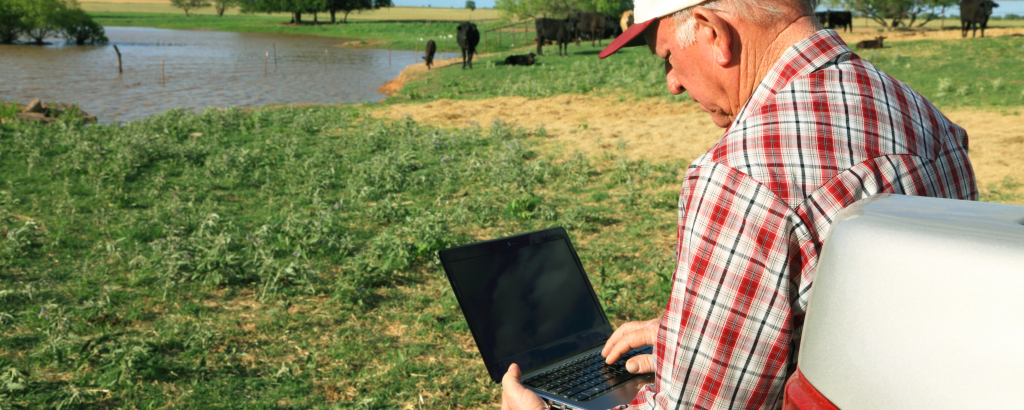
KC Sheperd, Farm Director, is visiting with the general manager of Pioneer Telephone Cooperative, Blake Callaham, about increasing broadband access for Oklahomans and innovations in connectivity.
The Pioneer Telephone Cooperative began in 1953, Callaham said, as an electric cooperative.
"Over the last 70 years, we have really taken pride in connecting what matters for our members and all of western Oklahoma, as a matter of fact," Callaham said. "With that, it has really evolved over the past 70 years, and our main mission has remained the same."
The main mission, Callaham said, is to connect what matters.
"We believe that path, today, is through fiber internet," Callaham said. "That is where we are headed, and we are proud of our history."
In many parts of rural Oklahoma, Callaham said there would not be connectivity if it wasn't for cooperatives such as Pioneer Telephone taking the initiative to serve in those places that are harder to reach.
"As a cooperative, we take great pride in connecting those members and those customers to what matters most," Callaham said. "After all, rural America deserves exactly what urban America can receive as well."
Callaham talked about the part Pioneer Telephone Cooperative is playing in Oklahoma's goal to provide 100 percent of the state with access to broadband in the next five years.
"We don't necessarily have the rules for that just yet, but we are looking forward to working with the state to achieve that mission," Callaham said. "As far as pioneer, we have been one of the most aggressive fiber builds since, I would say, probably the early 2000s, but really ramped it up since about 2016. So, we are currently around 70 percent fiber available to all of our membership and very proud of that number."
Working to help rural American gain access to connectivity, Callaham said, is important for a number of reasons as virtual learning, remote working, and even virtual doctors and health checkups have become more common.
"We are wanting to laser focus on getting fiber to those communities in western Oklahoma," Callahan said.
A new department is being developed within Pioneer Telephone Cooperative, Callaham said, called the Innovation Development and Transformation department. As technology changes, Callaham said, this department will focus on future evolution.
"This new department will be tasked to develop four new products, features or services per year," Callaham said. "The reason we are doing that is because we know that today is broadband. Today is broadband internet."
As fiber is the future, Callaham said the goal of Pioneer Telephone Cooperative is to continually innovate as technology changes.
"Fiber is a foundation," Callaham said. "It is a very solid foundation for our future."
Callaham also talked about Pioneer Telephone Cooperative's annual event coming up on May 2 in Kingfisher, Oklahoma. The cooperative has launched a new cookbook that has been popular among members, he added, and they will now be giving away new 70th-anniversary cookbooks to celebrate.
"The past 70 years, Pioneer has meant a lot to western Oklahoma, and we are here for another 70 years," Callaham said. "Although our goals and our technology changes, we are still here, and we are going to be here, and we are looking forward to seeing each and every one of our members at our annual meeting in May."
The Center for Rural Affairs is encouraged to see the Biden administration's support for agricultural producers and rural communities in its federal budget released Thursday. The proposed budget includes funding for a cover crop incentive program, as well as boosts in funding for programs supporting voluntary conservation and rural small businesses.
In 2021 and 2022, a $5 crop insurance premium discount was offered to producers who planted cover crops. The initiative, which was sustained by pandemic funds, resulted in discounts for 12 million and 10 million acres of cover crops, respectively. The president's budget calls for legislative action to make the discount permanent as part of the new Cover Crop Incentive Program and proposes a budget of about $1 billion for 10 years, $75 million of which is allocated for 2024.
"This is great news for producers who are already planting cover crops or interested in trying the practice for the first time," said Kalee Olson, policy associate. "We're glad to see President Biden take steps to reward these efforts through federal crop insurance."
The administration also proposed an increase in discretionary funding for Conservation Technical Assistance (CTA) to $904 million—an increase from about $800.9 million in 2023. Through CTA, Natural Resources Conservation Service field staff work one on one with farmers and ranchers to develop and implement personalized conservation plans aimed at building soil health, improving water quality, and increasing carbon sequestration through practices such as cover crops.
In addition to strong support for conservation, the proposed budget includes $8.3 million for the Rural Microentrepreneur Assistance Program (RMAP). The program supports rural small businesses through technical assistance and direct loans from intermediary organizations. This funding would provide a $2.3 million increase over 2023.
"RMAP continues to have a significant impact by supporting entrepreneurs who start businesses that keep rural main streets vibrant," Olson said. "An increase in funding would allow more individuals access to assistance they are unable to find anywhere else."
As part of the annual appropriations process, both the House and Senate will draft budgets to allocate funding to a range of federal programs, including CTA and RMAP, in the upcoming months.
"We hope Congress will follow the president's lead and invest in these programs at similar funding levels," Olson said.

For over 50 years, Cotton Incorporated leads the charge in providing resources and research needed to help companies develop and market superior, innovative and profitable products. With U.S. cotton production on the rise in 2023, the company aims to ensure that cotton remains the first choice among consumers in apparel and home products while also providing sustainable solutions through every stage of the cotton life cycle.
Since it was founded in 1970, the not-for-profit company does not manufacture or sell products but conducts research to benefit every link on the cotton supply chain and develops promotions that encourage the use and desirability of cotton and cotton products.
As a recognized global authority and resource for all things cotton, the departments of Cotton Incorporated are comprised of experts that continually develop resources for each phase including:
Through Cotton Incorporated, cotton became the first commodity to market directly to the consumer. The icon for this outreach was the Seal of Cotton trademark, a logo indicating that the product contains cotton. Since its introduction in 1973, the Seal of Cotton has been used on a variety of cotton-containing and cotton-related products, from apparel and beauty products to laundry detergent. The Company's 1989 "The Fabric of Our Lives" campaign conveyed the emotional connection between cotton and consumers, and how cotton touches our lives every day.
In more recent years innovative programs such as the Blue Jeans Go Jean™ denim recycling program and dynamic events such as Cotton's 24-Hour Fashion Show and Cotton's 60-second Runway Show showcase the range of cotton and cotton-rich apparel offered by well-known brands, retailers and designers.
GROWMARK, Inc. announces a revamped scholarship program for 2023. The GROWMARK Foundation will provide 55 scholarships of $2,000 each to students pursuing agriculture and business-related degrees or certificates at colleges, universities, and technical schools in the United States and Ontario, Canada.
"GROWMARK and the FS member cooperatives are strong supporters of youth leadership education and this is one more way we can contribute to the future of agriculture," says Amy Bradford, GROWMARK corporate communications manager and GROWMARK Foundation manager.
At the time of application, students must be high school seniors or the equivalent of and enrolled in a university, community college, or technical school for fall 2023, or continuing students enrolled in good standing at a university, community college, or technical school. Scholarships will be scored by a committee comprised of industry professionals outside of the GROWMARK System.
The 2023 GROWMARK Foundation Scholarship Application may be found here. The application deadline is May 12, 2023.

Over the last year, GROWMARK has contributed almost $1 million to community initiatives through its charitable organization, The GROWMARK Foundation. These funds have supported more than $200,000 in scholarships, $400,000 in matching funding to ag initiatives across North America, and more than $70,000 to Ag in the Classroom programs.
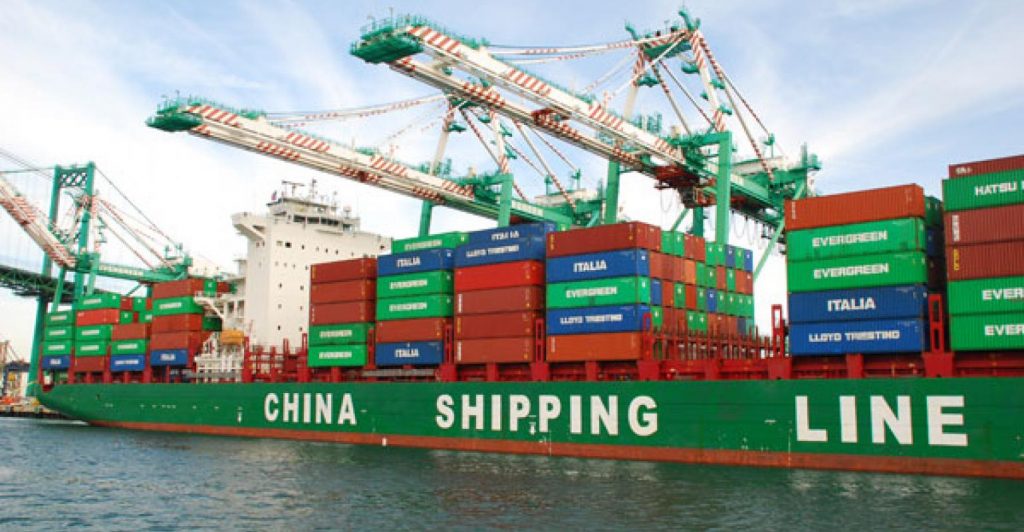
Dr. Derrell Peel, Oklahoma State University Extension Livestock Marketing Specialist, offers his economic analysis of the beef cattle industry as part of the weekly series known as the "Cow Calf Corner" published electronically by Dr. Peel and Mark Johnson. Today, Dr. Peel talks about January beef exports.
Beef exports in January were down 15.7 percent year over year. Despite record beef exports in 2022, signs of a weakening beef trade picture were developing late in the year with beef exports down year over year in both November and December. A strong U.S. dollar peaked in late 2022 and has decreased, but remains high, provided export headwinds that appear to be taking a toll.
The biggest decrease in January exports was South Korea, down 36.8 percent year over year. The dollar appreciation to the South Korean Won was particularly acute in late 2022 but has moderated somewhat since last October. In 2022, beef exports to South Korea increased 3.2 percent to a new record level and giving South Korea a 22.8 percent share of total U.S. beef exports, remaining the number two export market, but just fractionally lower than Japan.
Beef exports to China/Hong Kong were also down 24.2 percent year over year in January. Slower beef exports to China/HK were not an issue of exchange rates as much as the broader slowdown in the Chinese economy, perhaps aggravated by political tensions between China and the U.S. China/HK was the number three beef export market in 2022 with a 20.1 percent share of total beef exports. Beef exports to China/HK grew by 7.1 percent year over year in 2022, much slower than the previous two years but still the most growth among major U.S. beef export markets.
There was some good news in the January beef export data. Despite exchange rate headwinds, January beef exports to Japan were up 6.9 percent year over year. Beef exports to Japan decreased 1.9 percent annually in 2022. Japan remains the largest export market for the U.S., with a 22.9 percent share of total beef exports in 2022.
Beef exports to Mexico also increased, up 30.8 percent year over year in January. This follows a 10.3 percent decrease year over year for the entire year in 2022. The Mexican Peso did not experience the same currency devaluation to the U.S. dollar as did the Asian currencies in 2022. Mexico was the number four U.S. beef export market in 2022 with an 8.0 percent share of total beef exports.
January beef exports to the number five market Canada were about equal to one year ago, up just 0.4 percent year over year. Canada represented a 7.7 percent share of total beef exports in 2022. Beef exports to the number six beef export market, Taiwan, were down 34.0 percent year over year in January. In 2022, beef exports to Taiwan were 5.7 percent of total U.S. beef exports. The top six beef export markets accounted for 87.2 percent of beef exports in 2022.
Challenges for beef exports are likely to increase in 2023 as the headwinds due to the strong dollar will continue. Additionally, anticipated decreases in beef production began in February and will decrease beef availability and keep wholesale beef prices strong. Beef demand, including international demand, remains a significant concern going forward as declining beef production will pressure beef prices to push even higher than current levels.
This spring, 73 FFA members from across the country traveled to Denver, Colo., to explore careers in the animal systems industry. It's part of the Next Gen Conference offered by the National FFA Organization.
The Next Gen Conference, which began in 2020, focuses on specific pathways — from animal systems to biotechnology systems. Members access new ideas, trends and opportunities that connect them directly with industry leaders. The conference is designed specifically to give FFA members hands-on, industry-relevant experience.
"We heard from our members that they wanted more opportunities to explore careers in agriculture. It was one of the reasons the Next Gen Conferences were developed. It allows members to explore their future careers," said Celya Glowacki, the advocacy, literacy and ag-based experiences manager with the National FFA Organization. "This spring's conference will help us cultivate future leaders in the animal systems pathway through a week of experiential learning, relevant education and networking."
Members explored diverse animal operations around Denver and learned how to plan for their future careers. In addition, they learned about marketing, new technologies and unique opportunities in animal systems.
Members attending the #FFANextGen conference include:
Arizona:
Tanner Baker of the Mingus Union FFA Chapter
Lydia Bleak of the Camp Verde FFA Chapter
Ilsa Gooch of the Chandler FFA Chapter
Grace Groseta of the Mingus Union FFA Chapter
Raynele Harrington of the Chandler FFA Chapter
Aubrey Mulcaire of the Camp Verde FFA Chapter
Jaycee Peters of the Chandler FFA Chapter
Ellie Tipton of the AAEC-Estrella Mountain FFA Chapter
Danner Williamson of the Mingus Union FFA Chapter
California
Yuri Garcia of the Hamilton City FFA Chapter
Ximena Hernandez of the Hamilton City FFA Chapter
Kate Matthews of the Hamilton City FFA Chapter
Braden Miner of the Lincoln FFA Chapter
Nayeli Oseguera of the Hamilton City FFA Chapter
Colorado
Ena Gibson of the Greeley FFA Chapter
Kole Hawkins of the Cedaredge FFA Chapter
Grace Monat of the Arickaree FFA Chapter
Sabine Mundt of the Greeley FFA Chapter
Idaho
Delainee Ellsworth of the Deary FFA Chapter
Timothy Hebdon of the Nampa FFA Chapter
Pryce Romriell of the Rigby FFA Chapter
Laney Volkers of the Nampa FFA Chapter
Illinois
Emily Bianchi of the Normal FFA Chapter
Indiana
Jenna Bushong of the Southmost FFA Chapter
Kaleb Crowder of the Hope FFA Chapter
Kirsten Cummings of the Cascade FFA Chapter
Dane Kissell of the Southwestern-Shelby FFA Chapter
Courtney Phillips of the Hamilton Southeastern FFA Chapter
Emily Recker of the Northeast Dubois FFA Chapter
Claire Wood of the Hamilton Southeastern FFA Chapter
Iowa
Ashley Mose of the North Scott FFA Chapter
Kansas
Brynn Collier of the Jayhawk-Linn FFA Chapter
Louisiana
Alaishia Joseph of the Zachary FFA Chapter
Maryland
Joanna Genemans of the Catoctin FFA Chapter
Tyler Witherspoon of the Westminster FFA Chapter
Michigan
Sophia Barnum of the Mason FFA Chapter
Rainey Schuette of the Saginaw FFA Chapter
Olivia Spencer of the Saginaw FFA Chapter
Minnesota
Grace Bayerl of the Howard Lake-Waverly-Winsted FFA Chapter
Kaylee Gruber of the Pierz FFA Chapter
Ellie Swart of the Howard Lake-Waverly-Winsted FFA Chapter
Missouri
Allie Eifert of the Jackson FFA Chapter
Karlie Ellis of the Silex FFA Chapter
Dylan Hoyt of the Audrain County R-VI FFA Chapter
Meah McCoy of the Archie FFA Chapter
Taylor Myers of the Jackson FFA Chapter
Paisley Nelson of the North Platte FFA Chapter
Gavin Rhode of the East Buchanan FFA Chapter
Kate Robnett of the Audrain County R-VI FFA Chapter
Cheyenne Silvers of the Northland Career Center FFA Chapter
Shea Stille of the Montgomery Co. R-II FFA Chapter
Elena Wirths of the Boonville FFA Chapter
North Carolina
Kaitlyn Crompton of the Jones Senior FFA Chapter
North Dakota
Medora Ellingson of the Mandan FFA Chapter
Ohio
Emma Brandenburg of the Felicity Franklin FFA Chapter
Meegan Gleckler of the Evergreen FFA Chapter
Kaylee Jennings of the Felicity Franklin FFA Chapter
Oklahoma
Brooklyn Matlock of the Cyril FFA Chapter
Jace Melugin of the Pryor FFA Chapter
Pennsylvania
Leah Flinchbaugh of the Eastern York FFA Chapter
Elyssa Gilbert of the Big Spring FFA Chapter
Hailey Houck of the Tyrone Area FFA Chapter
Carter Kennedy of the Honesdale FFA Chapter
Natasha Maddox of the Grand Canyon FFA Chapter
Reilly Rawlings of the Tyrone Area FFA Chapter
Charlee Schock of the Big Spring FFA Chapter
Tennessee
Marynn Enders of the Hendersonville FFA Chapter
Paige Pardue of the Hendersonville FFA Chapter
T. Wayne Williams of Woodbury FFA Chapter
Virginia
Ayla Janney of the Broadway FFA Chapter
Wisconsin
Henry Koerner of the Big Foot FFA Chapter
Megan Schultz of the Adams-Friendship FFA Chapter
Wyoming
Carly Moore of the Wight FFA Chapter
The National FFA Organization is a school-based national youth leadership development organization of more than 850,000 student members as part of 8,995 local FFA chapters in all 50 states, Puerto Rico and the U.S. Virgin Islands.
FDA has finally offered its draft guidance on the "Labeling of Plant-Based (Nutritionally Inferior and Misleading) Milk Alternatives." So now what? Pay attention to this:
This is from FDA's draft guidance, showing labeling best practices for plant-based manufacturers. The guidance itself would allow plant-based beverage manufacturers to keep using "milk" on their labeling, but only if – and this is a huge "if" – they include disclosures like the ones above specifying nutritional differences. That isn't enough to truly protect consumers, but it's a start. Even more importantly, the agency has accepted the reality of consumer confusion over nutritional equivalence, the main argument dairy and its allies have been making for years. With that premise acknowledged and accepted, the logical conclusion –end the confusion by getting dairy terms off the labels – becomes much easier to achieve.
The draft guidance gives plant-based beverage purveyors a choice: They can use "milk" with their plant-based term and disclose their differences (i.e. shortcomings) on their packaging, or they can skip the disclaimers by not using a dairy term at all. That's the solution consumer advocates and dairy farmers have been pushing for all along.
The next few months will be telling in whether the plant-based beverage industry gets the message.
If this guidance is taken seriously, the most misleading labels should start to disappear as packaging gets updated and store shelves get restocked. Many mislabeled "milks" that are really drinks or beverages should start being labeled as drinks or beverages. For those that stubbornly insist on misleading consumers, disclosures should appear – real ones with clear statements, not wiggle words in tiny print that say differences exist without stating what those differences are. The guidance is voluntary, and it's only a draft, but FDA has put the industry on notice. The next move's on them.
And it's on us too, to make sure positive change really happens. FDA's public comment period on the guidance lasts until April 24. NMPF has directions on how you can submit a comment. Meanwhile, take pictures to post on social media. Write companies that aren't living up to the labeling example above. FDA's guidance is far from enough. That's why we're pushing to pass the DAIRY PRIDE Act, which would direct FDA to enforce its own standard of identity for milk – which, had that occurred in the first place, plant-based misinformation would never have proliferated. The fight for transparent labeling, is far from over, but it's going the right way. Keep your eye on the carton. Change should be coming. It's up to all of us to make sure that it does.
Farm Director, KC Sheperd, caught up with the owner of Ag Youth Magazine, Larry Peck at the Oklahoma Youth Expo and talked about the magazine's last run.
Larry Peck and his wife Mary Peck started the Ag Youth Magazine 35 years ago. After countless impressions on Oklahoma's youth, Peck and his wife have decided to retire the Ag Youth magazine and spend more time with their grandchildren.
"This is our final OYE with Ag Youth," Larry said.
Peck said he is grateful for the opportunity to work with amazing people through the Ag Youth Magazine.
"Mary and I are just totally blessed to be able to produce a magazine about good positive kids and what they do," Peck said. Peck and his team travel all over the state, showcasing the youth of Oklahoma as they show livestock. Not only has Peck taken great pictures, but he and his wife also pour into the Youth of the state by providing leadership, mentorship, and scholarship opportunities.
Peck and his wife have been involved in teaching FFA and 4-H for many years, Peck said, which they both enjoyed. Having the opportunity to watch so many young people grow up and have thriving careers after their involvement in the 4-H and FFA, Peck said, has been truly special. They continue to follow the careers of the kids they have taught, watched in the show ring, or helped in some way throughout their careers.
Peck said he and Mary would continue to run the paper in Sentinel Oklahoma, "The Sentinel Leader," which features good news around the community, " It has an Ag Youth look to it. It's all kids. We are only into it about five months, but we are fixing to blow it up."
Peck said he and Mary will enjoy more time to watch their three grandkids at all their activities as they are now getting older and more involved.
We here at Oklahoma Farm Report will undoubtedly miss seeing all the Red badges and T-shirts of the Ag Youth Staff around the show ring. They have helped us many times get those great shots of the kids! We are truly grateful for the opportunity to work with Larry, Mary, and the Ag Youth team throughout the years and will miss them, but know they will continue to inspire young people for years to come! Thank you for all you have done!
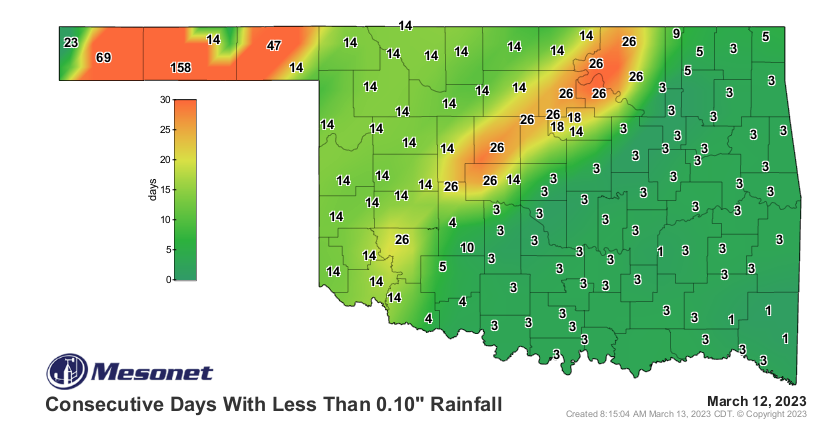
Statewide Discussion: While areas generally east of I-44 received wetting rains through last week, the rest of Oklahoma did not fare so well. The absence of wetting amounts continues to build with a specific note in the Panhandle and far northwestern Oklahoma, where a 4-6 month separation has become alarming. Significant fire danger is not currently forecast for this week with some light wintry precipitation possible in the Panhandle/Western counties early in the week along with some rain chances south. A strong cold front forecasted to enter the Oklahoma Panhandle Thursday will transit thestate offering precipitation chances statewide. Dependent upon rainfall, dry and breezy conditions both Friday and Saturday may pose some elevated wildfire risk in the west and northwest.
Near-Term: A coarse look at the precipitation expectation for the week ahead holds little promise of wetting potential in the west and northwest, unfortunately. No significant fire weather is in the current forecast, although Friday and Saturday will be dry and breezy in the post-frontal environment. The next update to the Oklahoma Wildfire Situation Report will be issued on Friday, March 17, 2023 unless fire weather or wildfire occurrence dictates otherwise.
Burn Bans: Refer to: https://ag.ok.gov/divisions/forestry-services/ for the most current burn ban information and links to specific burn ban proclamations.
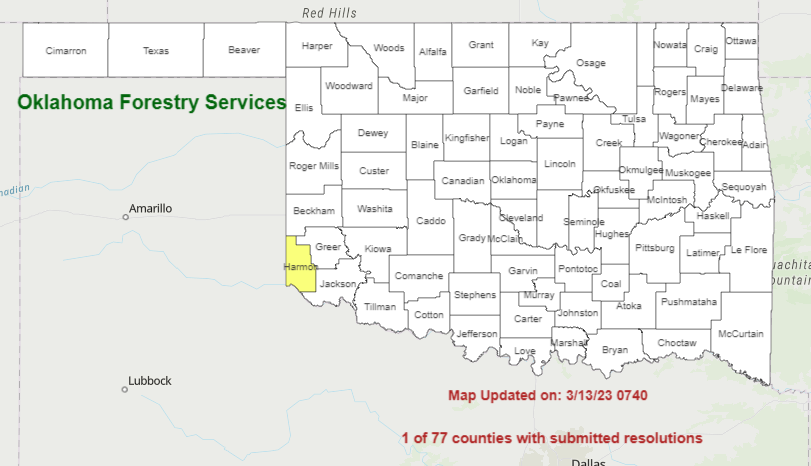
*** Note: Cimarron and Texas Counties Burn Bans expired at midnight, but they are anticipated to be renewed today.
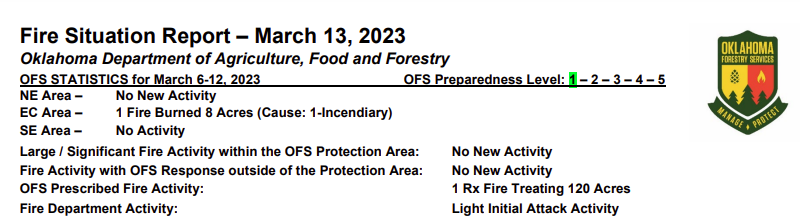

The Texas cotton industry convened at the state Capitol for Cotton Day on March 7, 2023, to educate Senate and House members and staff on the importance of Texas' No. 1 cash commodity crop.
Plains Cotton Growers representatives who attended the proceedings were PCG Chairman Brent Nelson, PCG President Martin Stoerner, PCG Board Member Todd Straley and PCG CEO Kody Bessent. Many Texas cotton industry segments, groups and councils were in attendance, handing out cotton towels to members and staffers with information pertaining to the industry.
In addition, the PCG team met with members to emphasize the need for cotton infrastructure assistance for the 2022 crop year; cotton, wool and mohair research funding; and maintaining funding for the Boll Weevil Eradication Program.
"Back in 2011 when we thought the drought was so bad, my gin produced 47,000 bales," Todd Straley told Rep. John Smithee (R-District 86). "This last year, we ginned 16,000."
Sen. Charles Perry (R-District 28) introduced Senate Resolution 268 on the Senate floor, recognizing the great cotton industry in the state of Texas.
"Agriculture is the spirit of West Texas and the spirit of this nation...we want to recognize this industry for what it does for Texas and recognize this day as Cotton Day."
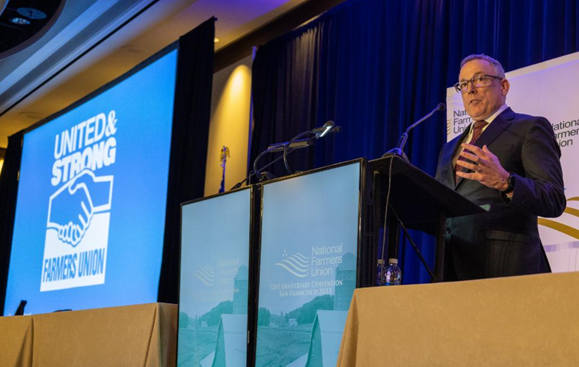
National Farmers Union wrapped up the 121st Anniversary Convention in San Francisco. After three days of programming and policy debate, we're ready to hit the ground running for the 2023 Farm Bill.
At the opening banquet, NFU President Rob Larew provided his State of the Farmers Union address and talked about the long history within the Farmers Union of the theme of being United and Strong. The theme of strength through unity dates back more than 100 years, and shines through in our historical common cause with unions and other organizations as well as during the farm crisis of the 1980s.
An additional highlight from the State of the Farmers Union was the growth we've seen in the last year – now surpassing 221,000 members across the country!
In his address to members and delegates, Secretary of Agriculture Tom Vilsack made a major announcement: going forward, only products grown and processed in the US will be able to be labeled "Product of USA." For too long, family farmers and ranchers have been competing in a market where imported products were labeled as a product of the United States. This announcement will bring about Fairness for Farmers and let consumers know where their food is coming from.
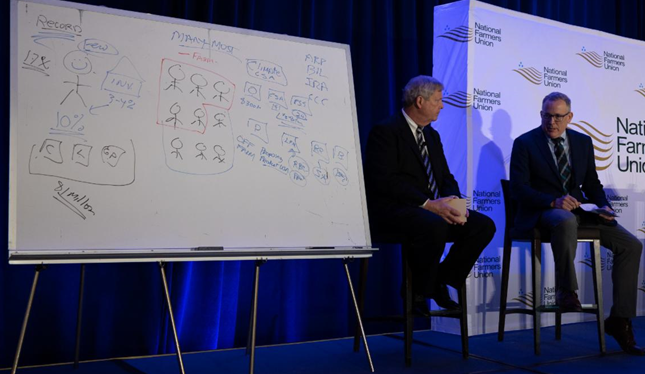
Keynote speaker Dr. Glenda Humiston of UC Davis joined us on day-two of convention and also took time for a Q&A with attendees. Her commitment to agricultural and environmental policy led her from the Colorado cattle farm of her youth to appointments in the USDA during both the Clinton and Obama administrations. Now more than seven years into her tenure as vice president of the University of California Division of Agriculture and Natural Resources, Humiston will address the climate and market challenges farm families face today and our opportunities to build resilience for the future.
Between programming sessions, convention attendees had the opportunity to stop by our photo booth. For many, this was a great way to memorialize old and new friendships at convention. For some, it appears to have been a good place to grab a snack.
Before speaking to convention attendees and delegates, U.S. House Speaker Emerita Nancy Pelosi took time to visit with NFU's National Youth Advisory Council and hear about what they're passionate about.
The deliberation of our grassroots policy is at the core of why we have our national convention. Delegates from all of our state divisions gather, discuss, and vote on proposed changes and additions to our policy book which sets the agenda for the advocacy NFU does.
During the policy process, delegates approved three special orders of business:
RON's Dave Lanning has a pre-opening look at today's agricultural Markets.
Click the audio tab below for today's report.
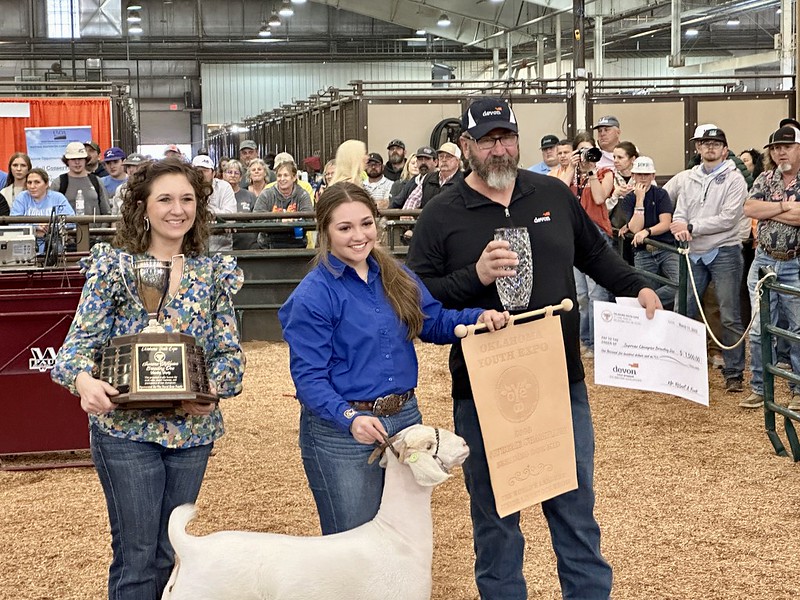
The 2023 Breeding Doe show at the Oklahoma Youth Expo was called by show officials the biggest hair goat doe show in the country- 720 Does were shown in four Divisions. Those Division Champs and Reserve Champs were in the Supreme Drive on Saturday afternoon in the Super Barn Arena- and judge Cade Halfmann of Texas selected the Division Three Champ shown by Madison Church of Canute FFA as the Supreme Champion of the show. Her all white goat, named Ghost, caught the eye of the judge early on and he called her the obvious choice for top honors.
Oklahoma Farm Report's Ron Hays talked with Halfmann right after the show and talked about the kids and the goats and the rapid growth in show goats for 4-H and FFA- click on the Listen bar below
The Reserve Supreme Champion Breeding Doe also came from Division three and was shown by Tabrey Lierle of Hydro Eakley FFA.
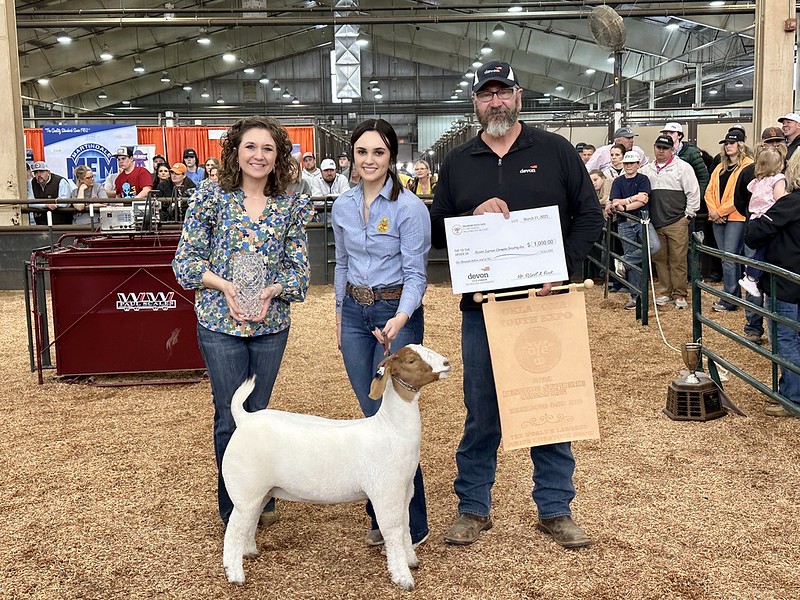
The Division Four Champ was selected as this year's Bronze Medallion Breeding Doe- shown by Jenna Holt of Hobart FFA.
Click here for the full schedule for the 2023 OYE. The Oklahoma Farm Report team will be snapping pictures from start to finish- and you can see them as we add them to our Flickr album for 2023- available here. If you want to look back to the 2022 OYE- click here for our pictures from last year's event.
Our coverage of the 2023 Oklahoma Youth Expo is sponsored by Hilliary Communications- who deliver the latest cutting-edge communications services supporting tens of thousands of customers across 22 counties throughout Oklahoma, Texas and Iowa. The company offers internet, voice and HilliaryTV. Hilliary Communications continuously researches the marketplace for innovations and strives to improve underserved areas, offering services that exceed customer expectations. Click here to learn more about Hilliary Communications.
This weekend, Jadyn Gwartney took home the Supreme Title at the Oklahoma Youth Expo's Purebred Gilt show. Gwartney was showing her Chester White.
Reserve Supreme Purebred Gilt Went to Preston Haines of the Tecumseh 4-H Club with his Spot.
Other big winners from the show include Champion Duroc going to Collin Wharton of Wilson FFA, and Reserve Champion Duroc going to Garrett Evans, also of Wilson FFA.
In the Landrace Gilt show, Connor Imhoff of Prague 4-H took top Honors as Champion, with Kodi Kastl of Perkins 4-H winning Reserve.
Champion Poland went to Wade Richey of Altus 4-H, followed by Channing Goodsong with the reserve title from the Tecumseh 4H Chapter.
Brogan Lancaster of El Reno FFA took the Champion Berkshire title, followed by Tucker Bloodworth of Purcell FFA with the Reserve.
As in previous pictures, Jadyn Gwartney of Mayes County 4-H had the Champion Chester, and Jacey Wentworth took Reserve Champ from Haskell FFA.
Jaxon Wills won big this weekend with his Champion Hampshire from Kiowa FFA, Followed by Oakley Cooper with Reserve from Amber-Pocasset FFA.
Hereford Gilt Champion went to Cheyann Vanbrunt of Midway FFA, followed by Riley Fuhr of Blanchard taking Reserve.
In the Yorkshire group, Molly Buckmaster of Porter FFA won Champion, followed by Bristol Rogers from Fort Gibson with the Reserve.
The Spotted Gilt Show saw Preston Haines of Tecumseh 4H walk off with the Champion title, followed by Mylli Hoffman of Morrison FFA with Reserve.
Click here for the full schedule for the 2023 OYE. The Oklahoma Farm Report team will be snapping pictures from start to finish- and you can see them as we add them to our Flickr album for 2023- available here. If you want to look back to the 2022 OYE- click here for our pictures from last year's event.
Our coverage of the 2023 Oklahoma Youth Expo is sponsored by Hilliary Communications- who deliver the latest cutting-edge communications services supporting tens of thousands of customers across 22 counties throughout Oklahoma, Texas and Iowa. The company offers internet, voice and HilliaryTV. Hilliary Communications continuously researches the marketplace for innovations and strives to improve underserved areas, offering services that exceed customer expectations. Click here to learn more about Hilliary Communications.
Special Thanks to the OK Pork Council for the great photos!
Ryan Lenaburg of Devon, Kensley Whittington and Jimmy Harrell of Bank of Western Oklahoma- Supreme Crossbred Gilt
Friday wrapped up the Commercial Gilt show at the 2023 Oklahoma Youth Expo- with the selection of the Supreme Champions and Sale order for the Night of Stars Gilt Sale that happens this coming Wednesday. Friday wrapped up with the first of the Purebred breeds showing in the OYE Purebred Gilt competition.
The Supreme Drive for Commercial Gilts at the 2023 OYE has just finished- Supreme Champion was the Champion Dark Cross owned by Kensley Whittington of Tecumseh 4-H- Kensley wins $3,000 plus a high slot in the Night of Stars Gilt sale
Reserve Supreme Commercial was also a dark cross- owned by Gage Winters of Altus FFA- winning $2,500 as Reserve champion
And- the Bronze Medallion Commercial Gilt is the Bronze dark cross- Madeline McClain of Leedey FFA gets a check for $1,000- these three were congratulated by OYE Vice Chair Jimmy Harrell of Bank of Western Oklahoma and Ryan Lenaburg from Devon Energy.
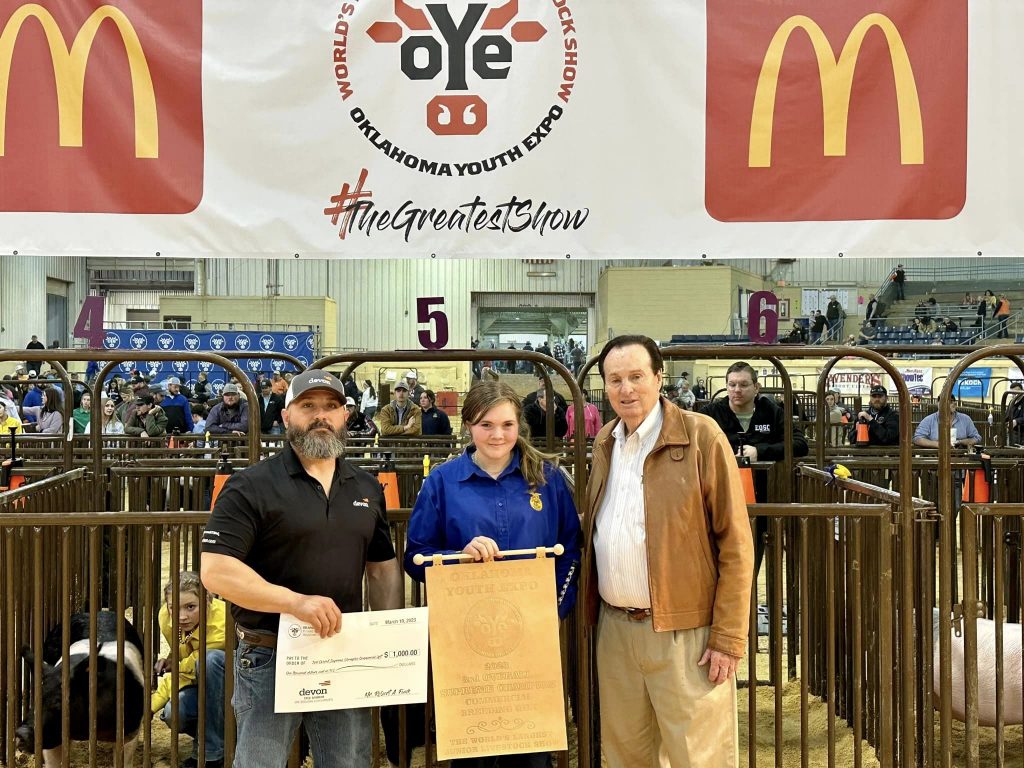
The three breeds that were shown on Friday in Barn 6 were the Durocs, Landrace and Polands.
Champion Duroc is owned by Collin Wharton of Wilson FFA with the Reserve Champion Duroc gilt also coming from the Wilson FFA Chapter- shown by Garrett Evans.
The Champion Landrace gilt was shown by Connor Imhoff of Prague 4-H while the Reserve Landrace is owned by Kodi Kastl of Perkins 4-H.
In the Poland breed- 2023 Champion Gilt was shown by Wade Richey of Altus 4-H with the Reserve Poland gilt shown by Channing Goodson of Tecumseh 4-H.
Click here for the full schedule for the 2023 OYE. The Oklahoma Farm Report team will be snapping pictures from start to finish- and you can see them as we add them to our Flickr album for 2023- available here. If you want to look back to the 2022 OYE- click here for our pictures from last year's event.
Our coverage of the 2023 Oklahoma Youth Expo is sponsored by Hilliary Communications- who deliver the latest cutting-edge communications services supporting tens of thousands of customers across 22 counties throughout Oklahoma, Texas and Iowa. The company offers internet, voice and HilliaryTV. Hilliary Communications continuously researches the marketplace for innovations and strives to improve underserved areas, offering services that exceed customer expectations. Click here to learn more about Hilliary Communications.
Each week, Beltway Beef brings you the latest policy news affecting the U.S. cattle and beef industry. Hear from subject-matter experts, producers, and industry leaders on the topics that impact the business viability of farms and ranches across the country.
On this episode, NCBA Executive Director of Government Affairs Kent Bacus joins to discuss Brazil's history of failing to report cases of BSE, commonly referred to as Mad Cow Disease, in a timely manner. Due to Brazil's lack of transparency, NCBA is calling for a suspension of Brazilian beef imports until it is determined that Brazil meets the United States' high animal health standards. Bacus also provides some information on the importance of the World Organization for Animal Health and the value of collaborating to prevent the spread of foreign animal diseases.

The National Corn Growers Association, along with a broad coalition of national and state agriculture and bioscience organizations, sent a letter to President Biden this week to thank the administration for beginning technical consultations with Mexico concerning its action to ban imports of biotech corn. The letter calls for those consultations to start without delay.
"We support your administration's request for consultations with Mexico regarding its treatment of agricultural biotechnology and denying the use of certain crop protection tools, to provide a framework and timeline to resolve this issue," the 62 groups wrote. "We look forward to these consultations beginning promptly."
Technical consultations bring leaders from the involved countries, which now includes Canada as well, into formal discussions to resolve the dispute. If the talks are not successful, the U.S. can initiate a dispute settlement under USMCA.
The organizations expressed appreciation for the administration's efforts over several months to resolve the issue through negotiations but indicated that the results, including a revised decree that Mexico issued Feb. 13, 2023, are inadequate, and now it is time for action.
The new decree, which the groups said drew a non-science based distinction between corn for food and corn for feed and industrial uses, is inconsistent with USMCA obligations. The new decree "continues to limit the use of innovative agricultural tools, extends restrictions on safe crop protection products, and enacts barriers to trade," the groups wrote, and it "fails to establish a science- and risk-based regulatory approval process for all agricultural biotechnology products and ignores the immediate need to establish a risk assessment process for gene editing technology."
The agricultural and biotechnology groups reiterated the importance of beginning the legal process to not only resolve the dispute with Mexico but also prevent other countries from following suit.
"The United States must use the dispute mechanisms afforded in trade agreements like the USMCA to ensure trade barriers or domestic policies do not limit the tools U.S. farmers have to sustainably produce food for our ever-growing world population," the letter concludes. "Sending a strong signal on enforcement will serve as a critical precedent for other trading partners."
Mexico's President Andrés Manuel López Obrador issued a decree in December 2020 to phase out imports of genetically modified corn by 2024. Mexico's revised decree, issued last month, clarified that the ban applied to corn for food use effective immediately and could apply to feed corn in the future. Mexico is a top market for U.S. corn exports, which are mostly genetically modified corn.
Yesterday, the House of Representatives passed H.J. Res. 27, a Waters of the United States (WOTUS) resolution of disapproval under the Congressional Review Act. Prior to passage, Republican Members of the House Committee on Agriculture called out the egregious and flawed Biden WOTUS rule on the House floor.
Rep. Doug LaMalfa (CA-01): "The definition that's being put forward by the Biden Administration is something that's undoing what the Trump Administration had trying to bring it back to reasonable... this isn't working, it's not working at all." Full remarks HERE.
Rep. Derrick Van Orden (WI-03): "Underneath these new rules, over 85% of the waterways in Wisconsin's Third District would be subject to EPA regulation. In many places, these rule changes will actually harm the environment, as many of my farmers in the district are pioneers in environmental stewardship." Full remarks HERE.
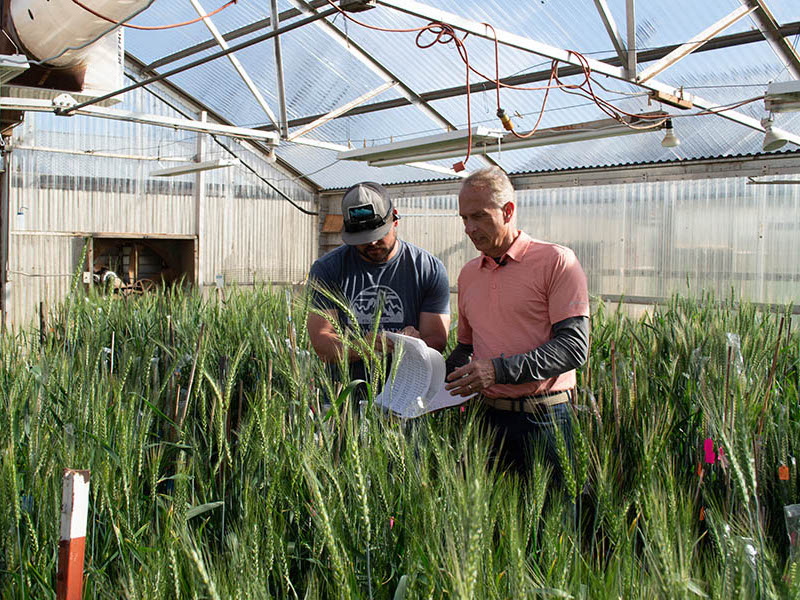
Oklahoma State University has a new hard red winter wheat variety on its way to the commercial market this fall. Senior Farm and Ranch Broadcaster, Ron Hays, had the chance to visit with OSU's Brett Carver about this new variety, and what it has to offer.
OK18510, which will be called High Cotton, first came into existence in 2010 in what OSU wheat genetics chair Brett Carver called the "maternity ward" of wheat varieties — an OSU greenhouse in Stillwater.
"We have to meet a certain yield standard to go forward with a release, and I think High Cotton really meets and exceeds that standard," Carver said. "It really has a good performance record across a broad swath of Oklahoma, including dual-purpose acres."
This variety not only has qualities to make it stand out in Oklahoma's environment, Carver told Hays, but the variety is special because it can yield great results in many different environments.
Seed producers can expect to have access to this variety by the summer, Carver said, if everything goes according to plan.
"Members of Oklahoma genetics will have the first choice on it to ramp up production of this variety," Carver said.
Carver said he chose the variety name of High Cotton because he wanted to draw attention to its elite performance through a name that is easy to remember.
"I wanted to suggest that adoption of this variety would put producers in a position to enjoy a bountiful harvest," he said.
Wheat is the No. 1 plant commodity in Oklahoma reported by the U.S. Department of Agriculture's National Agricultural Statistics Service, said Mike Schulte, executive director of the Oklahoma Wheat Commission. Wheat is a $1 billion industry in the state, and data shows that more than 50% of Oklahoma wheat producers grow OSU varieties.
"That's a great testament to the impact of those varieties, whether they be high-yielding and disease resistant or have traits highly regarded by millers and bakers in both the domestic and international markets," Schulte said.
He added the name of the new variety is likely to pique producer interest.
"It's about the OSU wheat breeding program being in the best of times," Schulte said. "The hope is this variety will make great contributions for the wheat producers in our state over the next five to six years."
Scott Senseman, associate vice president of OSU Ag Research, said High Cotton's potential resilience will also be appealing to producers.
"Our Wheat Improvement Team continues to move the needle from a yield perspective, but its disease profile appears to provide another level of yield stability that will also be attractive to growers," he said.
Carver said High Cotton caught his eye in its first year of Oklahoma variety yield trials in 2018.
"It has continued to rank either first or second in our breeding trials for five consecutive years," he said.
What does High Cotton have to offer?
Performance potential
High Cotton was created by breeding OSU wheat variety Ruby Lee with an experimental line developed in Turkey as part of the International Maize and Wheat Improvement Center breeding program, the largest wheat breeding program in the world. This hybrid was then crossed with an OSU experimental line bred from a collection of Pioneer hard red winter wheat.
"High Cotton will allow wheat producers to reap the benefits of the most advanced wheat genetics currently on the market," Carver said. "We hope that wheat growers from eastern Oklahoma to far western Oklahoma will have an interest in adopting High Cotton in their next variety lineup."
Scientists in the OSU wheat breeding program intend to have seed available this fall.
"If we get it harvested as we anticipate, we should have 3,000 to 4,000 bushels of foundation seed available through the Oklahoma Foundation Seed Stocks," Carver said.
To learn more about the High Cotton variety, watch the next SUNUP TV episode. Learn more about OSU's wheat program and the Wheat Improvement Team and find resources for producers on the Wheat Research and Extension website or by contacting your county OSU Extension office.
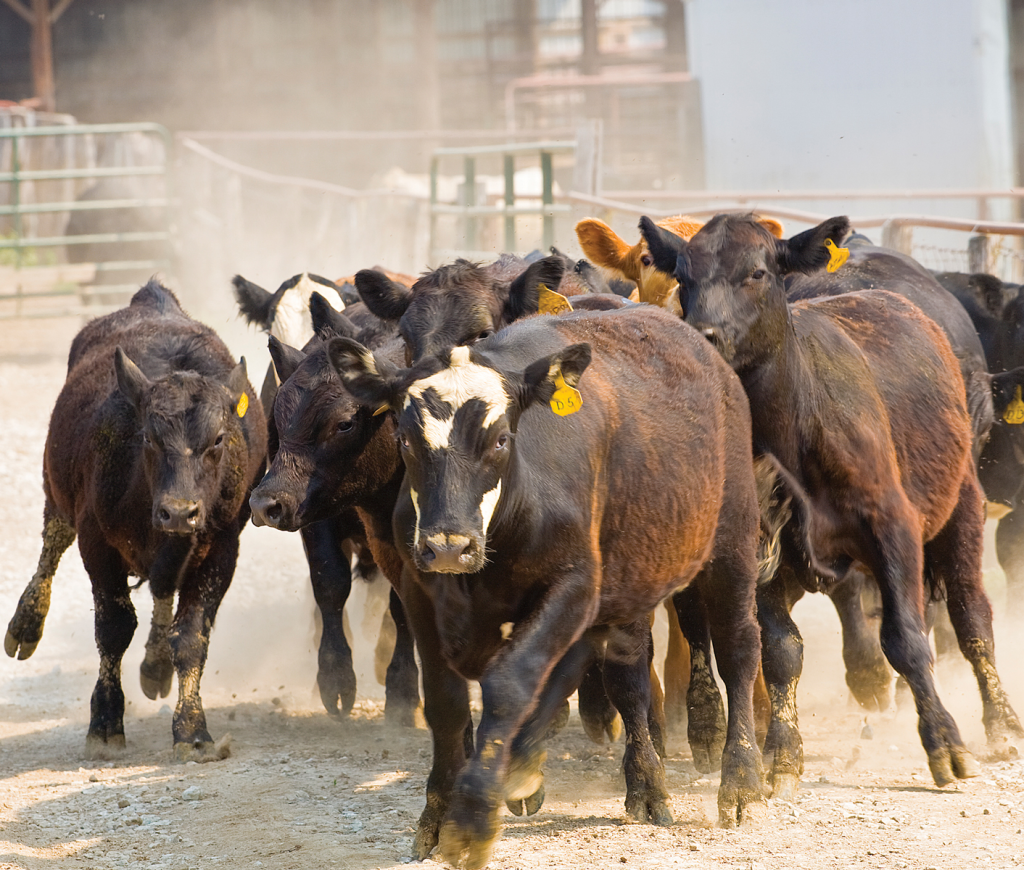
Associate Farm Editor, Reagan Calk, is talking with Bob Rodenberger, a partner with Stockman Oklahoma Livestock Marketing, as he gives his weekly update of the cattle markets.
There were good runs Monday, Rodenberger said, and many producers in the state are pleased with the recent moisture received.
"Market would have been fully steady with some tendency to a higher market in places," Rodenberger said. "Looks to me like still awful good demand for these grazing cattle. Got good demand for feeder cattle."
Runs at Apache were lighter compared to the week prior, Rodenberger said, and cow runs have been cut in half.
"We just had 150 cows, and the week before it was 250," Rodenberger said. "Of course, a year ago, we were having four (400) to 600 head, so hopefully, we have stopped the cow runs for a minute, and people are just waiting on moisture, and like I said, we have got some people that got some good moisture down in southern and southwest Oklahoma, which hasn't had any, but in general we have got a very positive market."
Regarding rebuilding of the cowherd, Rodenberger said that for now, there is nowhere to put any cows.
"It is going to happen, but we have got to get spring and summer grass," Rodenberger said.
Many producers, Rodenberger said, are maintaining the herd they have left.
"We have got to continue to get these rains, we have got to get spring grass, then we have got to get a hay crop in the barn," Rodenberger said.

American Farmland Trust (AFT) strongly endorses the bipartisan, bicameral Relief for Farmers Hit with PFAS Act. Introduced by the Maine delegation—Senators Collins and King and Representatives Pingree and Golden—the bill would provide much-needed federal funding for States, Tribes, and local governments to support farmers and ranchers impacted by the contamination of their land by so-called "forever chemicals." It would also help build local capacity to respond to this emerging crisis. Policymakers, service providers, and farmers in Maine have taken the lead in confronting this urgent challenge to our food system and farm economy, and this bill would provide critical federal support for those efforts.
PFAS are a class of human-made chemical compounds that have been widely used in consumer and industrial products since the mid-20th century. They are commonly referred to as "forever chemicals" due to their persistence and bioaccumulation in the environment, including in humans and livestock. They have been linked to harmful health effects, including increased risk of certain cancers and thyroid disease, as well as reproductive, developmental, and immune system harms.
In recent years, detection of PFAS in agricultural soils has presented an urgent challenge for farmers, service providers, and policymakers. Although some states, most notably Maine, have been proactive in helping farmers assess risk, test soils, and providing direct assistance to those whose livelihoods may be threatened by exposure, very little is understood about the national scale of the problem, and few resources exist to support impacted producers. As a national leader in farmland protection and farm viability, AFT believes that urgent action is needed on both the State and, in particular, the federal level to address PFAS issues in agriculture.
The Relief for Farmers Hit with PFAS Act would significantly ramp up funding for State- and Tribal-led responses, establish a task force at USDA charged with identifying existing USDA programs that can support impacted producers, and prioritize direct assistance to impacted producers. Specifically, the bill would support:

The National Pork Producers Council (NPPC) applauds the reintroduction of the Beagle Brigade Act of 2023. This legislation would provide congressional authority to the United States Department of Agriculture's National Detector Dog Training Center — a vital program in training agricultural canine teams that work daily to prevent foreign animal and plant diseases from entering the United States.
"Safe and reliable food production is critical to the United States' continued national and economic security," said Terry Wolters, NPPC president and owner of Stoney Creek Farms in Pipestone, Minnesota. "As African swine fever continues to plague the Dominican Republic and Haiti, strengthening early detection capabilities at our U.S. borders is more important than ever."
The "Beagle Brigade" serves as the first line of defense for early detection at the nation's ports of entry and is critical in keeping foreign animal diseases, like African swine fever, out of the United States. NPPC led over 50 agricultural and other organizations in supporting the Beagle Brigade Act's reintroduction and urges Congress to pass this bipartisan bill.
"We urge Congress to act fast and we thank Representatives Sandford Bishop (D-GA) and Drew Ferguson (R-GA) in the House and Senators Raphael Warnock (D-GA) and Joni Ernst (R-IA) in the Senate for their bipartisan efforts," said Wolters.
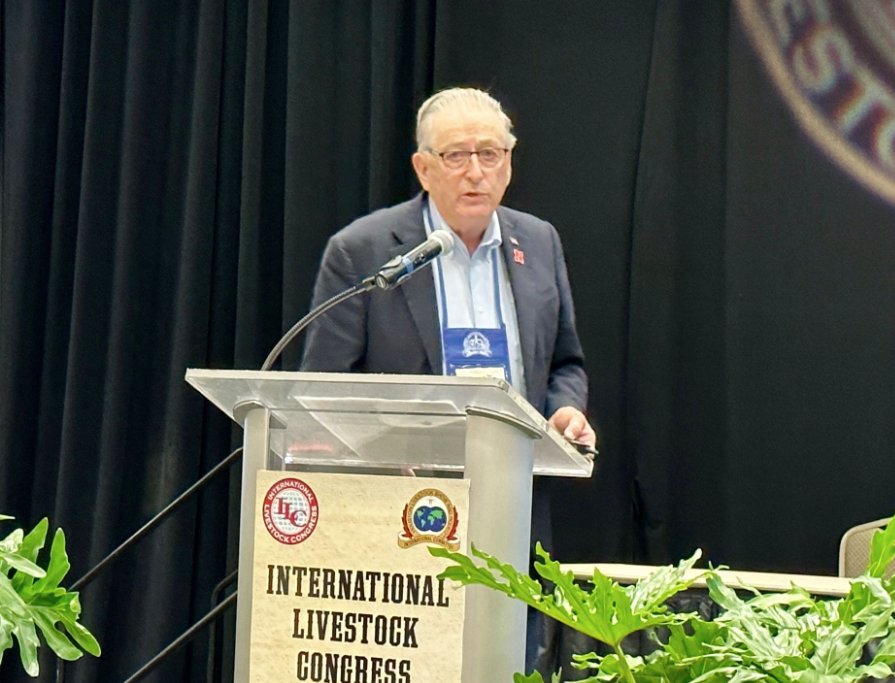
Editor's note- Senior Farm and Ranch Broadcaster Ron Hays was at Day One of the 2023 International Livestock Congress in Houston where the total focus was on the impact of ESG to Beef cattle. Over the next several Beef Buzz reports, Hays will explore what was discussed at the Congress as it relates to Cattle and this exploding concept.
Senior Farm and Ranch Broadcaster, Ron Hays, is visiting with Angus Breeder Bill Rishel about why the cattle industry needs to be paying attention to the ESG conversation.
"The more I researched ESG and studied it, the more I believed that it had already made great progress, but at the same time, there are unintended consequences, which so often happens," Rishel said. "There are some things that certainly I think going forward are beneficial that we need to look at as an industry, but there are often unintended consequences that are major problems that always somehow rare their ugly head, and they cause everybody issues and problems when they don't address in the right way."
Many agendas to increase sustainability, Rishel said, go about it the wrong way by trying to make everything mandatory.
"In doing so, they really take away many of the opportunities that have made this country the great country it is in terms of food production, looking at it from animal agriculture, farming, all of the above," Rishel said. "I am convinced that we are already leading the world in a lot of these categories and doing great work and will continue to do that. But I am against programs and efforts that take away freedom individual opportunity and the pursuit of excellence."
Rishel referred to the cattle industry as the 'original animal welfare people,' because cattle producers would not be in business very long if they did not take care of their livestock and the land in the proper way.
"It is because of our good caretaking and those things that really makes our industry and animal agriculture what it is today," Rishel said. "Same applies for row crops and farming. If you think about the conservation of water and irrigation systems today from what they were 20 or 30 years ago, it is phenomenal."
Time has told a great story for the cattle industry, Rishel said, as taking part in these sustainability practices without them being mandated, has already substantially increased efficiency over the years.
"When you do things that are good and right, usually it makes you more efficient, usually you will be a little more profitable, and make some more money which is what we are all in the business for- to exist, and to be sustainable in business," Rishel said. "When we do those things properly, they become the great paradigm shifts that change the course of the industry."
The Beef Buzz is a regular feature heard on radio stations around the region on the Radio Oklahoma Ag Network and is a regular audio feature found on this website as well. Click on the LISTEN BAR for today's show and check out our archives for older Beef Buzz shows covering the gamut of the beef cattle industry today.
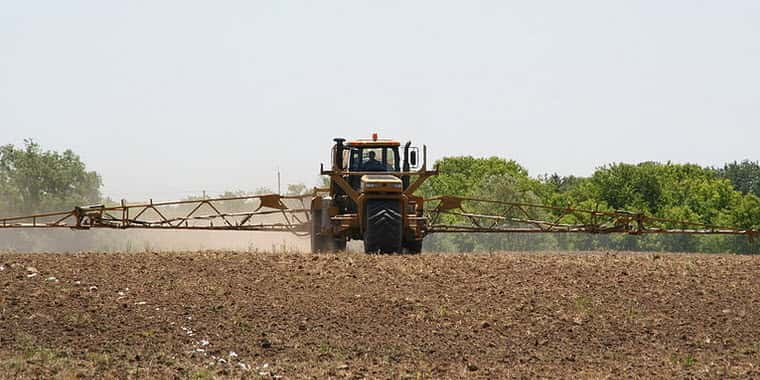
Independent Businesses Submitted More than 350 Applications for $3 Billion in Funding to Expand Domestic Fertilizer Capacity. First Round of Awards Will Spur Competition and Give U.S. Farmers More Choices and Fairer Prices.
U.S. Department of Agriculture (USDA) Secretary Tom Vilsack today announced that the Department received $3 billion in applications from more than 350 independent businesses from 47 states and 2 territories for the first two rounds of a new grant program to add innovative domestic fertilizer production capacity.
USDA also announced the first $29 million in grant offers under the first round that focused on projects that can come online in the near term. The grants will help independent businesses increase production of American-made fertilizer, which will spur competition, give U.S. farmers more choices and fairer prices and reduce dependence on unreliable foreign sources like Russia and Belarus. Vilsack made the announcement at the 2023 Commodity Classic, the same event where he first unveiled the program a year earlier.
"I know that increased costs for fertilizer and other inputs have put a strain on farmers and cut into the bottom line. The Biden-Harris Administration and USDA understand the importance of taking on the root causes and need to invest in the agricultural supply chain here at home to create a resilient, secure and sustainable economy for the long haul," Vilsack said. "By expanding the production of domestic fertilizer supplies, we can grow independent local businesses, bring production and jobs to rural communities and support fair prices for our farmers."
The Biden-Harris Administration's Fertilizer Production Expansion Program is part of a government-wide effort to promote competition in agricultural markets. The program supports fertilizer production that is independent, made-in-America, innovative, sustainable and farmer-focused.
Strong Demand
Vilsack made the initial announcement to dedicate $250 million at the 2022 Commodity Classic, the same event where he is making the first awards a year later. From the start, it has been clear there is strong demand for the program and even before applications were being taken, President Biden directed USDA to increase the program to $500 million at a farm visit in Illinois in May 2022. This fall, demand for the program was immediately evident by the sheer number, range and diversity of applications. More than 350 applications came in from applicants of every size and business model, including cooperatives, Tribal communities, female-owned companies and public bodies. These applicants requested between $1 million and $100 million for projects across 47 states, Puerto Rico and the Virgin Islands.
In all, $3 billion in funding was requested for projects that could increase production immediately for Crop Years 2023 and 2024, as well as bolster long-term availability of U.S.-produced fertilizer. Projects were proposed for both fertilizers and nutrient alternatives, and represented different technologies, including composters, complex manufacturing, farm supply blenders and distributors.
In addition to increasing the supply of domestic fertilizer, the projects propose the creation or saving of hundreds of jobs, often in regions where they are most needed, including energy communities and those experiencing generational poverty. Additional details on the second round of applications will be released in the coming weeks as the reviews are completed.
First Award Offers
The first round of FPEP was focused on projects that could increase fertilizer capacity for the 2023 or the 2024 crop year, to prioritize projects with near-term impact. In January, a list of 21 potentially viable projects from the first round was released with a request for public comment. The $29 million announced by Secretary Vilsack will be offered to eight independent businesses in Alabama, Colorado, Massachusetts, Missouri, Ohio and Washington. The grants will help businesses modernize equipment, advance climate-smart practices and build production plants, among other activities.
For example:
A full list of offers announced today is available at www.rd.usda.gov/media/file/download/usda-rd-nr-fpep-chart03092023.pdf
Background
USDA began accepting applications for FPEP in September 2022. The Department initially announced plans to make $250 million in grants available but quickly doubled the available funding to $500 million to address rising costs and spur competition.
Fertilizer prices more than doubled between 2021 and 2022 due to many factors, including price hikes caused by the war in Ukraine, a limited supply of the relevant minerals, high energy costs, high global demand and agricultural commodity prices, reliance on imports, and a lack of competition in the fertilizer industry.
FPEP is part of a broader effort to help producers boost production and address global food insecurity. For more information, visit www.rd.usda.gov/fpep or www.farmers.gov/global-food-insecurity.
It is one of many ways the Biden-Harris Administration's is promoting fair competition, innovation and resiliency across food and agriculture and combating the climate crisis by conserving and protecting our nation's lands, biodiversity and natural resources, including our soil, air and water.
Under the Biden-Harris Administration, Rural Development provides loans and grants to help expand economic opportunities, create jobs and improve the quality of life for millions of Americans in rural areas. This assistance supports infrastructure improvements; business development; housing; community facilities such as schools, public safety and health care; and high-speed internet access in rural, tribal and high-poverty areas. For more information, visit www.rd.usda.gov. If you'd like to subscribe to USDA Rural Development updates, visit our GovDelivery subscriber page.
USDA touches the lives of all Americans each day in so many positive ways. Under the leadership of the Biden-Harris Administration, USDA is transforming America's food system with a greater focus on more resilient local and regional food production, promoting competition and fairer markets for all producers, ensuring access to safe, healthy and nutritious food in all communities, building new markets and streams of income for farmers and producers using climate-smart food and forestry practices, making historic investments in infrastructure and clean energy capabilities in rural America, and committing to equity across the Department by removing systemic barriers and building a workforce more representative of America. To learn more, visit www.usda.gov.
Fri, 10 Mar 2023 07:13:07 CST
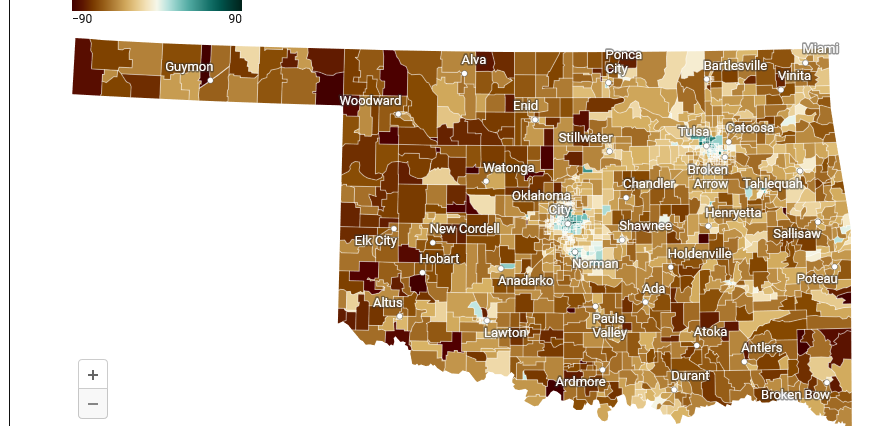
The sixty one percent of Oklahomans voting NO on State Question 820 were clearly in rural and suburban areas of the state. Outside of Oklahoma City and Tulsa- the precinct by precinct counts were overwhelmingly in favor of rejecting Recreational Marijuana.
Oklahoma Watch has taken Election Board data and built an interactive map of Oklahoma showing this clearly at the precinct level.
According to Oklahoma Watch- "Pockets of yes votes can also be found in densely populated areas of Edmond, Stillwater, Lawton and Muskogee.
"Elsewhere throughout the state, it was a lopsided rejection of State Question 820, according to a precinct-level map of results. All 77 counties and more than 80% of precinct locations statewide voted against the measure."
In a quick look at the map- one precinct in Jefferson County had just 10 votes cast- all against the State Question. The Precinct in the southeastern corner of Beaver County had 99 votes cast- 97% were no.
In contrast- the precinct that seems to have the most yes votes was in Oklahoma County- 274 votes were cast in that precinct and 77% were yes. Tulsa County had a precinct with 133 votes cast- and 76% were for State Question 820.
The Oklahoma Watch article points out that the voter turnout was almost exactly half of the turnout in this past November's general election- 50% of elelgible voters cast a ballot last November versus 25% here in March for the special election.
See their full article here
And check out the interactive map below.
Click here: r
Click here: "datawrapper-height"
Click here: t
Click here: r
.style.height=i}}}))}();
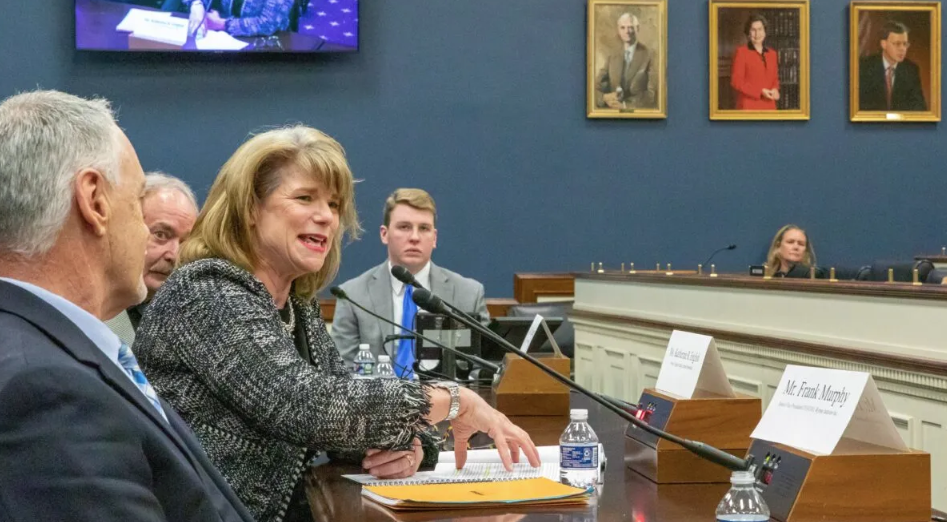
A Florida Farm Bureau member, rancher, small business owner and environmental lawyer presented a first-hand account of the implications of the federal government's overreach to the House Committee on Small Business this week.
Katherine English, who grows citrus and raises cows and calves in Fort Myers, Florida, participated on a panel comprised of small business owners. English provided an overview of the uncertainty faced by farmers, ranchers, homebuilders and more during the hearing titled "Small Business Perspectives on the Impacts of the Biden Administration's Waters of the United States (WOTUS) Rule."
"Farmers and ranchers' livelihoods depend on healthy soil and clean water. We support the Clean Water Act and its goals," English explained during her opening statement to the committee. "What we cannot support is a Waters of the United States rule that is so ambiguous it creates unmanageable risk and confusion for farmers.
"Farmers have struggled with uncertainty for decades, with near-constant rulemaking and litigation in regard to WOTUS. A workable definition of WOTUS is critically important to our members and they are extremely disappointed that the Biden administration's new WOTUS rule fails to provide that."
English testified that the proposed WOTUS rule greatly expands the federal government's reach over private property and that the significant nexus test, currently under scrutiny in the U.S. Supreme Court, allows the Environmental Protection Agency and U.S. Army Corps of Engineers to aggregate and regulate waters that would not otherwise be subject to federal jurisdiction.
"It is impossible, with this new rule, for any farmer or rancher to know whether their irrigation drainage infrastructure in their fields are jurisdictional waters requiring Clean Water Act permits," English said. "Considering these features jurisdictional waters risks federal regulation of everyday farm and ranch activities."
In answering a question from Chairman Roger Williams (R-Texas), English summarized the difficulty of interpreting the proposed rule: "This rule is simply unknowable, unless you have hired a lawyer, a biologist, an engineer, and—in some instances—a geologist."
A recording of the full hearing is available here.
English's written testimony is available here.
Today, the House of Representatives passed H.J. Res 27, a Waters of the United States (WOTUS) resolution of disapproval. The legislation was sponsored by House Transportation and Infrastructure (T&I) Committee Chairman Sam Graves (MO-06) and T&I Water Resources and Environment Subcommittee Chairman David Rouzer (NC-07).
Urges Senate to Adopt Resolution
The National Cattlemen's Beef Association (NCBA) hailed the passage of H.J. Res. 27, a joint resolution that would invalidate the Biden administration's new Waters of the United States (WOTUS) rule through the Congressional Review Act.
"This vote is a win for America's cattlemen and women and NCBA is thrilled to see a majority of House members reject the Biden administration's burdensome WOTUS rule," said NCBA President Todd Wilkinson, a South Dakota cattle producer. "Shifting WOTUS rules have plagued cattle producers for generations and this latest rule only continues the decades of uncertainty. We urge the Senate to pass this resolution as well so it can take full effect. At the same time, we look forward to the Supreme Court's verdict in the WOTUS case Sackett v. EPA and hope that this ruling finally places guardrails on the federal government's attempt to regulate small, isolated bodies of water on private farms and ranches."
The Biden administration's WOTUS rule creates more uncertainty for cattle producers by putting the burden on individual producers to determine if a water feature on their land is considered federally regulated. Additionally, NCBA has expressed strong opposition to the Environmental Protect Agency (EPA) finalizing this rule in the middle of a Supreme Court case that addresses this very issue. NCBA is also pursuing litigation against this rule to prevent it from taking effect and harming cattle producers.
The Congressional Review Act allows Congress to invalidate an executive agency's rule by passing a joint resolution through both the House of Representatives and the Senate. The resolution will now go to the Senate for consideration.
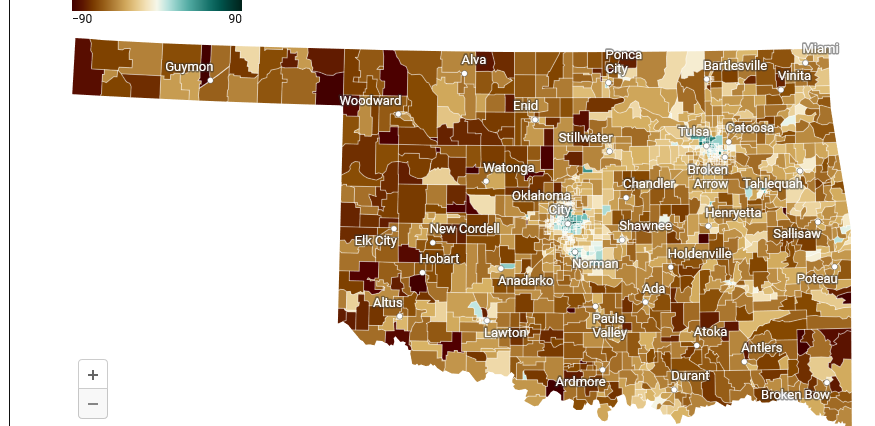
Click here for the Interactive Map
The sixty one percent of Oklahomans voting NO on State Question 820 were clearly in rural and suburban areas of the state. Outside of Oklahoma City and Tulsa- the precinct by precinct counts were overwhelmingly in favor of rejecting Recreational Marijuana.
Oklahoma Watch has taken Election Board data and built an interactive map of Oklahoma showing this clearly at the precinct level.
According to Oklahoma Watch- "Pockets of yes votes can also be found in densely populated areas of Edmond, Stillwater, Lawton and Muskogee.
"Elsewhere throughout the state, it was a lopsided rejection of State Question 820, according to a precinct-level map of results. All 77 counties and more than 80% of precinct locations statewide voted against the measure."
In a quick look at the map- one precinct in Jefferson County had just 10 votes cast- all against the State Question. The Precinct in the southeastern corner of Beaver County had 99 votes cast- 97% were no.
In contrast- the precinct that seems to have the most yes votes was in Oklahoma County- 274 votes were cast in that precinct and 77% were yes. Tulsa County had a precinct with 133 votes cast- and 76% were for State Question 820.
The Oklahoma Watch article points out that the voter turnout was almost exactly half of the turnout in this past November's general election- 50% of eligible voters cast a ballot last November versus 25% here in March for the special election.
See their full article here
RON's Dave Lanning has a pre-opening look at today's agricultural Markets.
Click the audio tab below for today's report.
Fri, 10 Mar 2023 07:13:07 CST
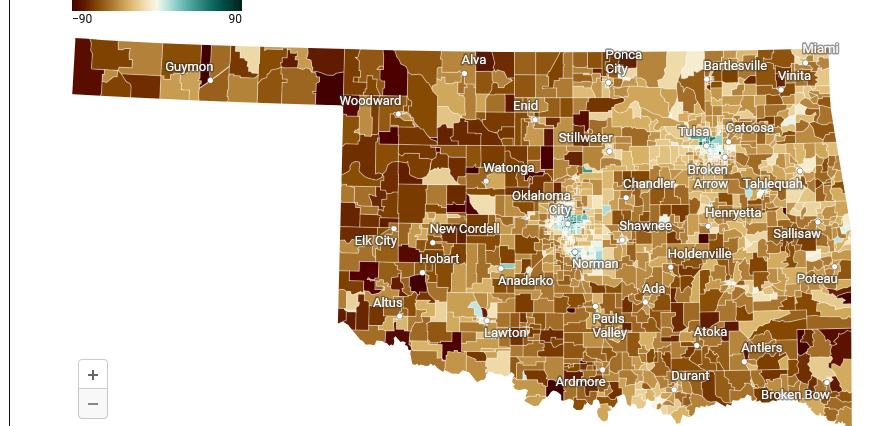
The sixty one percent of Oklahomans voting NO on State Question 820 were clearly in rural and suburban areas of the state. Outside of Oklahoma City and Tulsa- the precinct by precinct counts were overwhelmingly in favor of rejecting Recreational Marijuana.
Oklahoma Watch has taken Election Board data and built an interactive map of Oklahoma showing this clearly at the precinct level.
According to Oklahoma Watch- "Pockets of yes votes can also be found in densely populated areas of Edmond, Stillwater, Lawton and Muskogee.
"Elsewhere throughout the state, it was a lopsided rejection of State Question 820, according to a precinct-level map of results. All 77 counties and more than 80% of precinct locations statewide voted against the measure."
In a quick look at the map- one precinct in Jefferson County had just 10 votes cast- all against the State Question. The Precinct in the southeastern corner of Beaver County had 99 votes cast- 97% were no.
In contrast- the precinct that seems to have the most yes votes was in Oklahoma County- 274 votes were cast in that precinct and 77% were yes. Tulsa County had a precinct with 133 votes cast- and 76% were for State Question 820.
The Oklahoma Watch article points out that the voter turnout was almost exactly half of the turnout in this past November's general election- 50% of elelgible voters cast a ballot last November versus 25% here in March for the special election.
See their full article here
And check out the interactive map below.
Click here: r
Click here: "datawrapper-height"
Click here: t
Click here: r
.style.height=i}}}))}();
This week, Congressman Frank Lucas (OK-03) questioned Federal Reserve Chairman Jerome Powell and industry stakeholders from the CME Group and Futures Industry Association about the potential consequences that increased bank capital requirements could have on end-users of commodity derivatives.
End-users such as farmers, ranchers, and manufacturers depend on derivates to manage risk. As commodities markets have experienced significant volatility due to global events, end-users have relied on these financial products to manage economic uncertainty. As banking regulators consider changes to Basel capital requirements, it is important to understand the impact this would have on commodity derivatives to end-users.
Click to here watch Lucas' Q&A.
Lucas: "The U.S. banking regulators are in the initial phases of proposed changes to bank capital requirements. And as I raised to Federal Reserve Chairman Powell yesterday during his testimony before the Financial Services Committee, I'm concerned that this could increase the cost of hedging to end-users.
"Ms. Crighton, could you discuss potential adverse consequences to reducing access to these products, particularly during periods of financial uncertainty? If we make it harder to hedge, what's going to happen when things get tough?"
Crighton: "I think it's a topic we think about certainly within the firm and across the membership of FIA, and I think really across the panelists sitting at this table. When we think about the impact of bank capital on clearing members, one of the first topics that comes to mind is the amount of capacity that we're able to provide in the system. When we engage with clients, when we work with clients and we think about providing access to global markets, there's a few lenses that we'll think about and analyze their portfolio. The first is from an exchange margin perspective, the second is from a risk perspective, and the third is from a bank capital perspective. One of those three will ultimately define the amount of capacity that we give. The more punitive that bank capital becomes, the harder it is for us to be willing to stand in and continue to provide that capacity. So, we do urge policymakers going forward, as capital rules are considered and reconsidered, to not continue to increase bank capital because it will further impact banks in providing the amount of capacity that they do."
Earlier in the week, Lucas joined his colleagues on the House Financial Services Committee for a hearing on the Federal Reserve's Semi-Annual Monetary Policy Report. Lucas questioned Federal Reserve Chairman Jerome Powell about the Federal Reserve's consideration of increasing capital requirements, as well as the Federal Reserve's attention to not being engaged in climate-policy making.
Click here to watch Lucas' Q&A.
Lucas Looks Forward to Bringing Regulatory Clarity to Digital Asset Arena
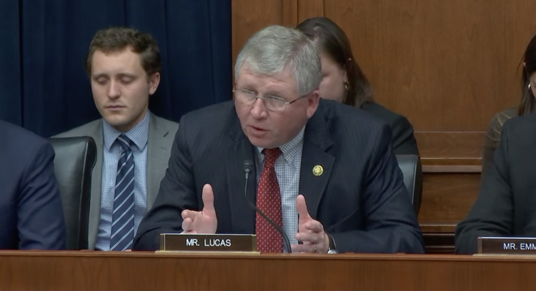
Today, Congressman Frank Lucas (OK-03) joined his colleagues on the House Financial Services' Digital Assets, Financial Technology, and Inclusion Subcommittee for a hearing on "Coincidence or Coordinated? The Administration's Attack on the Digital Asset Ecosystem."
Lucas questioned witnesses on the SEC's regulation by enforcement approach to digital assets and on legislative proposals that grant the CFTC spot market authority for crypto.
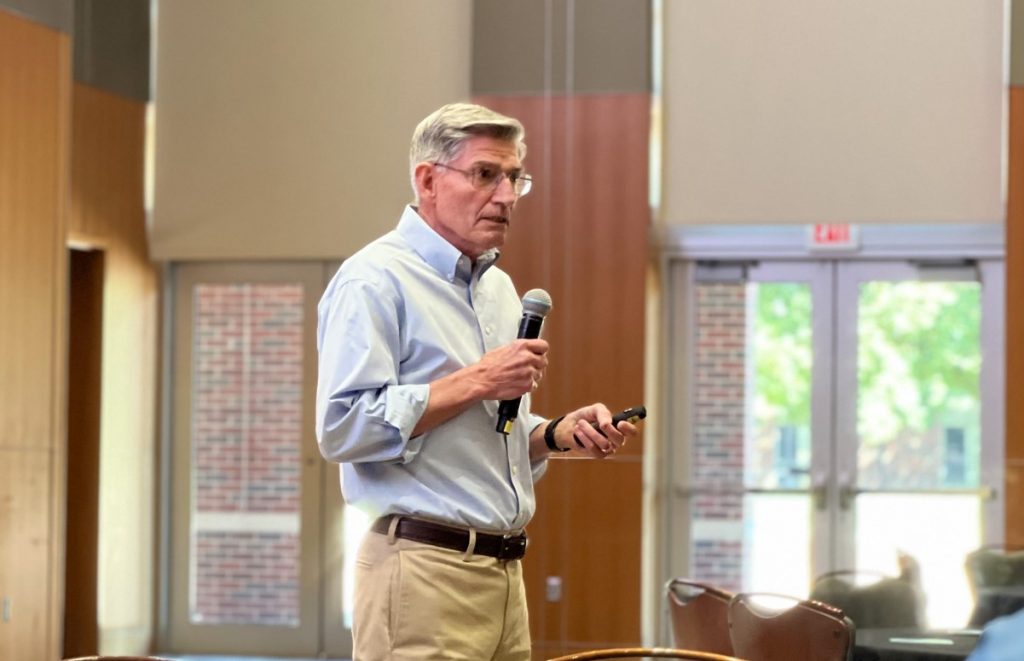
This Week on SUNUP is Oklahoma State University Extension grain market economist Kim Anderson. During this week's edition, Anderson talks about the latest information in the grain markets.
Anderson said it is 80 days until Oklahoma starts cutting wheat, and in 100 days, the harvest will be going 'full blast.' As of now, Anderson added, farmers are wanting to know where yields and prices will be.
"I don't know about yields, and I don't believe anybody knows about price, but there are some indications of what price will be," Anderson said. "If you look at the forward contract price for harvest delivered wheat, say in the Pond Creek-Medford area, that is about $7.50. Research has shown that price is about the best price to use for prediction of harvest price."
Anderson sees that price as being somewhere in between $7.50 and $8.50.
"There is a possibility that we could see what prices as low as 6 dollars or as high as 10 or 11 dollars," Anderson said.
Covid is out of the market now, Anderson said, but things are still being impacted by the war in Russia and Ukraine.
"If something happens, we could see 13-dollar wheat again, but if we will get the war taken care of and we get Covid taken care of, I think that six to nine dollar range is good as long as we got relatively tight stocks, and when we get more stocks, it is going to fall below six (dollar) and maybe even go down to four (dollars)," Anderson said.
Looking at ending stocks, Anderson said he cansee that the use is declining, production is holding relatively stable, and prices are going to come down.
This week on SUNUP:
Join us for SUNUP:
Saturday at 7:30 a.m. & Sunday at 6 a.m. on OETA (PBS)
YouTube.com/SUNUPtv
Congressman Tom Cole (OK-04), Vice Chairman of the House Appropriations Committee, released the following statement in response to President Joe Biden's fiscal year 2024 budget request submitted to Congress today.
"President Biden's budget request to Congress once again misses the mark," said Cole. "In a divided government, he must come to the table to negotiate and find common ground with House Republicans. Unfortunately, he has chosen not to do so. Once again, he has proposed too much domestic spending and not enough defense spending.
"While President Biden requested more in defense spending from last fiscal year, due to inflation, this number is still an effective cut. We live in a dangerous world and with growing tensions around the globe, this budget only shows that this administration is unwilling to prepare our military to confront the wide range of strategic threats we face. As this budget proposal only includes topline numbers, I eagerly expect the Biden Administration to follow up with details we need to fully evaluate his national security investment priorities.
"To pay for the costly domestic initiatives within this proposal, the president has proposed significant tax increases of $3 trillion on American individuals and American businesses. This includes a corporate tax rate increase to 28 percent from 21 percent, making the U.S. rate among the highest in the developed world and hindering the prosperity of businesses of every size. Indeed, 70 percent of the companies that would be hit by this tax increase are small businesses. His proposal even calls for individuals making less than $400,000 a year to pay higher taxes, despite his promise to not raise taxes on these income earners. At a time when the United States government has more tax revenue coming in than at any other time, it is wrong to raise taxes on Americans and businesses that are already struggling under the crushing weight of inflation. Moreover, his proposed 15 percent increase for the IRS's budget – on top of the $80 billion he already gave them through his misnamed Inflation Reduction Act - will unleash a new wave of audits that threatens to harass hard-working Americans.
"Furthermore, despite President Biden claiming to have found religion on cutting the deficit, his own budget projects the deficit rising from $1.38 trillion in 2022 to $2.04 trillion in 2033. In that time, the national debt will grow by nearly $20 trillion to 110 percent of our Gross Domestic Product, up from 97 percent.
"President Biden's budget shows just how out of touch he is with the real issues our country is facing. As we begin the appropriations process, I look forward to working with my colleagues to responsibly fund the government. While this process will require careful consideration, we must find areas both Democrats and Republicans can agree on. Americans have been crushed under runaway inflation caused by Democrats' reckless spending throughout the past two years and we cannot continue down that road."
New Program Helps Fill the Need Caused by Damaged Grain Storage Facilities in Kentucky, Minnesota, and South Dakota
Agriculture Secretary Tom Vilsack today announced that producers in counties affected by eligible disaster events in Kentucky, Minnesota, South Dakota, Illinois, Indiana, Iowa, Missouri, North Dakota, and Tennessee can apply for cost-share assistance through the Emergency Grain Storage Facility Assistance Program (EGSFP). The new program provides cost-share assistance for the construction of new grain storage capacity and drying and handling needs, in order to support the orderly marketing of commodities. An initial allocation of $20 million in cost-share assistance is available to agricultural producers in affected counties impacted by the damage to or destruction of large commercial grain elevators as a result of natural disasters from Dec. 1, 2021, to Aug. 1, 2022. The application period opens later this month and closes Dec. 29, 2023.
"Weather events in 2021 and 2022 in several states caused catastrophic losses to grain storage facilities on family farms as well as a large, commercial grain elevator, leaving stored grain exposed to the elements and affecting storage and commodity marketing options for many producers," Vilsack said. "USDA heard from congressional leaders, including Minority Leader McConnell, who identified a gap in our disaster assistance toolkit and used our Commodity Credit Corporation authority to act more quickly than waiting for specific legislation. This new program will provide cost-share assistance to help producers address their on-farm storage capacity needs that are necessary for marketing grain."
This assistance from USDA's Farm Service Agency (FSA) is designed to help producers affected by the December 2021 tornadoes that passed through 11 counties in Kentucky, as well as producers in Illinois, Indiana, Iowa, Minnesota, Missouri, North Dakota, South Dakota, and Tennessee affected by eligible disaster events in 2022. The program was previewed last fall and will be made available with the publication of the Notice in the Federal Register.
Eligibility
Maps showing the location of damaged grain facilities in Kentucky, Minnesota, South Dakota and surrounding eligible areas are available online. These maps depict damaged storage facility locations and the affected counties within a 30-mile radius of these facilities where producers may be eligible to apply for EGSFP benefits if they can demonstrate a need for additional on-farm grain storage capacity.
Additionally, FSA may determine a need for EGSFP assistance in counties in other states and regions during the application period where an eligible disaster event has damaged storage facility locations. Eligible disaster events include hurricanes, tornadoes, floods, derechos, straight-line winds and winter storms that occurred between Dec. 1, 2021, and Aug. 1, 2022.
EGSFP helps producers build permanent or temporary on-farm grain storage capacity, restore existing storage capacity, and purchase drying and handling equipment in affected counties.
The following types of new/used facilities and upgrades are eligible for cost-share assistance and must have a useful life of at least three years:
On-farm grain storage structures may account for aeration, drainage, and may require loading or unloading augers, drying and handling equipment.
How to Apply
Producers must submit the EGSFP Application, form FSA-413, and any additional required forms to their FSA county office either in person, by mail, email, or facsimile starting later this month and by the Dec. 29, 2023, deadline. Form FSA-413-1, Continuation Sheet for EGSFP, must be submitted with the FSA-413 when a group of producers are applying for assistance.
Payment Calculation
FSA will use the producer's self-certified cost of the additional on-farm grain storage capacity or drying and handling equipment needed multiplied by the producer's share of grain.
This amount will then be multiplied by the cost share factor of 75% or 90%. An eligible producer who certifies they are socially disadvantaged, limited resource, beginning and veteran farmer or rancher by filing form CCC-860 with FSA will receive the higher 90% cost share rate.
More Information
For more information visit the program webpage or the EGSFP fact sheet. USDA also has an existing Farm Storage Facility Loan Program that can immediately provide low-interest financing for eligible producers who may not be eligible for EGSFP but are in need of on-farm storage capacity.
USDA touches the lives of all Americans each day in so many positive ways. In the Biden-Harris administration, USDA is transforming America's food system with a greater focus on more resilient local and regional food production, fairer markets for all producers, ensuring access to healthy and nutritious food in all communities, building new markets and streams of income for farmers and producers using climate smart food and forestry practices, making historic investments in infrastructure and clean energy capabilities in rural America, and committing to equity across the Department by removing systemic barriers and building a workforce more representative of America. To learn more, visit usda.gov.
About 99% of farm bill outlays go to nutrition, crop insurance, commodities and conservation titles. The "Other" category makes up the remaining 1% of all projected outlays. Figure 1 provides the breakdown of all projected outlays as a percentage of total outlays under the Agriculture Improvement Act of 2018 (2018 farm bill, PL 115-334), including titles within the "other" category. This Market Intel will analyze the titles of the farm bill outside of the top four titles that account for nearly all farm bill outlays. These programs, while only making up 1%, have huge impacts on one of the most productive groups of people in the country, rural Americans.
Who are rural Americans and what do they provide? In 2020, approximately 46 million U.S. citizens lived in communities classified as rural. Facing challenges like limited internet access, fewer jobs, infrastructure issues and declining population, people living in rural America see things in a way that no one else does because small changes can have huge impacts.
"Rural" is defined by a broad range of factors depending on the definition used. This can cause some confusion but reflects the fact that the terms "rural" and "urban" are moving targets; some definitions use population density while others use geographic isolation. Regardless of the exact definition, rural America is an important piece of the U.S. economy, responsible for generating about 10% of the country's gross domestic product.
Most U.S. farmers operate in rural areas and are among the most productive in the world. In fact, agriculture and food-related industries contributed $1.055 trillion, or 5%, to the U.S. GDP in 2020. The output of American farmers in 2020 directly contributed $134.7 billion, or over 0.6%, to the overall GDP.

Title V, Credit
The relationship between a farmer and their lender is a crucial piece of production agriculture. Factors that affect the banking industry have a direct impact on farmers and other businesses in rural America related to agriculture. Recently one of the greatest changes affecting all consumers but especially farmers and ranchers has been inflation, specifically the response of the Federal Reserve Bank (the Fed). The Fed has addressed inflation with a series of interest rate hikes that affect borrowers and creditors alike. Borrowers now face interest rates double or even triple what they were in 2020. This can affect things like land values, the cost of borrowing money and even the impact of government programs when a dollar doesn't go as far. These effects can linger for many years.
The federal government has a history of assisting farmers and rural stakeholders with obtaining loans. The Farm Service Agency (FSA) and Farm Credit System (FCS) are agricultural lenders permanently established through federal mandates. While these two are both lenders, they operate differently.
FSA is a USDA-operated lender that is important for family farms that do not qualify for credit elsewhere. FSA lending peaked in the 1980s from a government attempt at addressing the farm debt crisis. During this time tight money policy that was intended to bring down interest rates caused farmland values to drop. At the end of 2021, out of the total $441 billion in farm debt, FSA serviced 3%, or $14.8 billion, of loans and 4%, or $17.6 billion, in loan guarantees that covered another 4% of the overall market. The standard guarantee ratio is 80-90% and is based on the borrower's credit risk. Loan guarantees are higher for socially disadvantaged or beginning farmer borrowers.
FCS is a private, retail lender with a federal charter and mandated by law to serve creditworthy farmers and ranchers, cooperatives, certain agribusinesses, and rural homeowners in towns with a population of less than 2,500. In 2021, FCS had a loan portfolio of $344 billion. This includes 44%, or $210 billion, in farm loans.
Title VI, Rural Development
Title VI, Rural Development, included in the farm bill since 1973, establishes, reauthorizes and amends programs administered by USDA's Rural Development agency. Title VI is important because it helps rural communities improve rural health outcomes, broadband investment, community and economic development programs, water and wastewater treatment, general business assistance, rural energy, electrification and cybersecurity.
Barriers to jobs is one issue that has led to a decline in rural populations. In fact, labor force participation rates among adults ages 25-64 decreased three times more in rural areas than urban areas from 2007-2019. This means many working age individuals are seeking jobs in metro areas. Over the last 10 years, rural America saw a population loss of 289,000 out of 46 million. Although it's a small decrease (0.6%), this is the first time in history rural America has seen a decade-long population loss.
Rural Broadband
Title VI authorizes the programs that help provide affordable broadband internet access to historically underserved areas. People who live in places with smaller populations or geographic isolation often struggle with access to services and other economic development hurdles that those living in more urban communities do not. Access to broadband internet can be limiting in a post-COVID-19-pandemic era, when working remotely has become a common practice and an important economic opportunity for rural residents.
The Rural Broadband Program provides loans, loan guarantees and grants to construct, improve and acquire facilities and equipment needed to provide broadband service to rural areas. Prior to the 2018 farm bill, the program was limited to direct loans and loan guarantees. The law also increased the threshold for sufficient broadband access to 25 megabits per second download/3 megabits per second upload (25/3 Mbps) from 4/1 Mbps.
The Community Connect Program is a grant program that provides awards to eligible applicants to provide broadband services to rural, underserved communities where services do not currently exist. The 2018 farm bill codified this program for the first time as it previously operated as a pilot program.
The ReConnect Program, while not authorized through the farm bill, is an important addition to supporting broadband in rural America. The program was established through appropriations legislation in 2018 and has continued to receive funding through multiple pieces of legislation including annual appropriations bills, the Coronavirus Aid, Relief, and Economic Security Act of 2020 and the Infrastructure Investment and Jobs Act of 2021. The program provides grants, loans and loan/grant combinations to build and enhance broadband infrastructure in eligible rural areas. While the program has similar goals to the Rural Broadband Program, it currently operates as a pilot program that has become popular with Congress.
Precision Agriculture
For thousands of years the world has relied on farmers to provide its growing population with sustainable and safe food, fiber and renewable energy. The world's population has continued to grow, placing demands on farmers to produce more food with fewer resources. Technological advances have played a major role in agricultural production in the 21st century. One of the greatest modern innovations has been precision agriculture. Studies have shown connections between precision agriculture and increases in yields. Precision agriculture relies on tools connected to the internet. These tools allow farmers to produce more with less, reducing the use of fuel, water and chemical applications. The Precision Agriculture Connectivity Act of 2018 was included in the 2018 farm bill and created a precision ag task force to bring together public and private stakeholders to evaluate current programs and develop new policies surrounding coverage gaps.
Rural Education and Health
In recent years, most students have relied on technological devices and the internet to complete homework assignments. During pandemic shutdowns schools relied on technology more than ever to enable students to continue to participate in school classwork.
The Distance Learning and Telemedicine Program provides grants to help rural communities access the technology and training to connect teachers and medical professionals with students and patients in rural communities. The program is primarily used for acquiring equipment that facilitates distance learning and telemedicine access. The 2018 farm bill increased authorization for the program from $75 million to $82 million.
Special attention has been given to substance use disorders. People living in rural areas face additional risk factors for substance use. Individuals seeking help may be more hesitant because of privacy issues in a town where everyone knows everyone. Those seeking treatment services may have to travel long distances, introducing additional costs to an already costly service. The 2018 farm bill set aside 20% of Distance Learning and Telemedicine Program funds specifically for projects providing treatment for substance use disorders and gives priority to Community Facilities applications that provide facilities for services, including telehealth services aimed at recovery from substance misuse in rural communities for fiscal years 2019 through 2025.
Title VII, Research, Extension, and Related Matters
Between 1990 and 2013, the U.S. share of spending on agricultural research and development (R&D) among nations with major public R&D programs fell from 22.5% to 13.4%. This was a result of decreased spending by the U.S. and rapidly increased spending by developing countries.

Title VII establishes funding for research, Extension and education including funding for land-grant institutions, state agricultural experiment stations, USDA research agencies and other cooperating institutions. The 2018 farm bill also amends and reauthorizes several programs and establishes new programs and initiatives. Mandatory outlays for research are $1.2 billion and make up about 0.2% of all 2018 farm bill spending.
The new programs and initiatives established by the 2018 farm bill include the Agriculture Advanced Research and Development Authority Pilot, Research Centers of Excellence at 1890 Institutions (historically black land-grant colleges and universities) and competitive grants programs to benefit tribal students and those 1890 Institutions. It also established new competitive research and Extension grants for hemp research and indoor and outdoor urban agriculture. As one of the top food-producing countries in the world, public funding for agricultural research is an essential part of keeping the United States a leader in global agriculture, providing the foundation for productivity growth at home and around the world.
Title VIII, Forestry
Forestland covers nearly 765 million acres or one-third of total land area in the United States. Forests are a precious resource that provide many biological and ecological benefits to the U.S. and the world. Forests provide resources for lumber and paper along with air, water and wildlife habitat. About 58%, or 444 million acres, of all forestlands in the United States is privately owned with ownership by states and other public entities making up the remaining 42% or 322 million acres.
Title VIII of the farm bill is Forestry. This title, authorized in the past five out of six farm bills, has been responsible for the reauthorization, repeal, modification and creation of several land management and forestry research assistance programs run by USDA's Forest Service. The baseline for the forestry title was $10 million under the 2018 farm bill.
Title IX, Energy
Agricultural energy, often referred to as bioenergy, is energy derived from agricultural or forestry feedstocks and can come in the form of liquid fuels, biomethane, electricity or heat. Ethanol is one of the most well-known bioenergies and is primarily blended with gasoline for use in motor vehicles. Bioenergy and other renewable energy technology has the potential to stimulate rural economies and presents opportunities as well as challenges.
Title IX is the energy title of the farm bill. This title primarily supports increases in energy efficiency and encourages the development of bio-based energy solutions. The 2018 farm bill extended eight programs and one initiative while removing one program and one initiative to help accomplish these goals.
The 2018 farm bill repealed both the Repowering Assistance Program and the Rural Energy Self-Sufficiency Initiative. Additionally, the 2018 farm bill established one new program, the Carbon Utilization and Biogas Education Program. Mandatory outlays for programs under Title IX total about $700 million.
Rural Energy for America Program (REAP)
One program of particular importance to rural America is the Rural Energy for America Program. REAP was intended to promote American energy independence by increasing the private sector renewable energy supply and decreasing energy demand by improving energy efficiency. The program provides guaranteed loan and grant money for agricultural producers and small businesses that can reduce energy-associated costs.
Funding is available to qualified small businesses in rural areas with 50,000 or fewer people and agricultural producers with at least 50% of gross income coming from agricultural operations. Funds can be used for renewable energy systems, to purchase, build and install energy efficiency improvements, or by agricultural producers to install energy-efficient equipment and systems for production or processing.
Rural Energy Savings Program (RESP)
The Rural Energy Savings Program is another energy program important to rural Americans. The program provides loans to rural utilities and other companies that provide energy efficiency loans to qualified consumers to implement durable cost-effective energy efficiency measures. Loans are available to corporations, states, territories, subdivisions, municipalities, utility districts and cooperative, nonprofit, limited-dividend or mutual associations that provide or propose to provide retail electric services for rural areas, the power supply needs of distribution borrowers under terms satisfactory to USDA's Rural Utilities Service, or other eligible purposes under RESP such as energy storage or related energy conservation measures or improvements.
Other Energy Programs
The Biobased Markets Program promotes renewable products through the USDA Certified Biobased Product label.
The Biorefinery, Renewable Chemical, and Biobased Product Manufacturing Assistance Program provides loan guarantees for development, construction and retrofitting of commercial biorefineries of qualifying technologies that produce one or a combination of advanced biofuels, renewable chemicals or biobased products.
The Bioenergy Program for Advanced Biofuels authorizes appropriations of $20 million per fiscal year through 2023 and sets mandatory funding at $7 million per year to increase the production of advanced biofuels.
The Biodiesel Fuel Education Program authorizes $2 million per year through 2023 to provide resources to assist with biodiesel acceptance and understanding.
The Biomass Research and Development Initiative, relocated from the Energy title to the Research title, provides grants to entities to conduct research and development and demonstrations of new ways to refine various biomass feedstocks into biofuels or biobased chemicals and products. This program authorizes $30 million per fiscal year through 2023.
The Feedstock Flexibility Program for Bioenergy Producers was initially authorized in the 2008 farm bill and was reauthorized in the 2018 farm bill. Under this program, federal law allows sugar processors to obtain loans from USDA with maturities up to nine months when sugarcane or sugar beet harvest begins. On loan maturity the processor may repay the loan in full or forfeit the sugar to satisfy the loan. This program serves as an option to avoid sugar forfeiture. Alternatively, USDA can purchase surplus sugar and sell it to bioenergy producers to reduce the sugar surplus in the food market.
The Biomass Crop Assistance Program (BCAP) authorizes up to $25 million through 2023 to provide financial assistance to owners and operators of agricultural and non-industrial forestland who establish, produce and deliver biomass feedstocks to qualified conversion facilities.
The Community Wood Energy and Wood Innovation Program expands and creates markets for wood products and wood energy that support long-term sustainable management of National Forest System lands.
The Sun Grant Program provides grant support to universities in each sun grant region to provide competitive grants for research and education programs on technology development and implementation to address bioenergy, biomass or bioproducts research priorities.
The Carbon Utilization and Biogas Education Program establishes the Biogas Opportunities Task Force and authorizes $2 million per year through 2023 to provide public education about the benefits of permanent carbon dioxide sequestration. Funds can also be used to provide education to agricultural producers about opportunities for aggregation of organic waste from multiple sources into a single biogas system.
Inflation Reduction Act
The Inflation Reduction Act, finalized in 2022, includes provisions to use fiscal year 2022 reconciliation instructions to raise revenue to lower prescription drug costs, fund new energy, climate and health care initiatives and reduce budget deficits. The bill provided nearly $40 billion of the total $750 billion specifically to agricultural programs ranging from farm bill working lands conservation to renewable energy and biofuels. Provisions in the final bill include nearly $20 billion for conservation programs, $14 billion for rural development to support renewable energy and $4 billion to mitigate the impacts of drought in Western Reclamation states. Click here for more information on the Inflation Reduction Act and its impacts on agriculture.
Summary
Most farm bill outlays fall into four categories – nutrition, commodities, crop insurance and conservation. The remainder of outlays are distributed into the eight other titles in the farm bill. From the rural development title to research and energy, nearly all titles in the farm bill have some sort of impact on rural Americans. Although its population is declining, rural America is home to some of the most productive people in the country, including farmers and ranchers. In these places, even the smallest changes can have huge impacts and completely change people's lives. With so many programs having such big impacts, continued innovation and support for these lesser-known farm bill titles can spur prosperity and improve our rural communities.
Natural Resource Conservation Service (NRCS) and Farm Service Agency (FSA) will partner together for a free conservation workshop on Wednesday, April 5, 2023.
The "Conserving Pollinators in Oklahoma's Gardens, Farms and Ranches" workshop will meet in person this year. Join the agencies to discuss the importance of the basics of soil fertility, horticulture, grazing and forage options for livestock, USDA program updates and NRCS Inflation Reduction Act (IRA).
Speakers for this event are Brent Pannell, NRCS Assistant State Conservationist; Mike Trammell, Pottawatomie County Ag Educator and Regional Agronomist; Laura Payne, Payne County, OSU Extension; Ray Moranz, Ph.D. and Carol Crouch, Ph.D., NRCS.
Partners that will provide updates on their programs include Nick Jones, NRCS; Mattie Alewine, FSA; Troy Marshall, National Agricultural Statistics Service (NASS), and Creek, Konawa, Lincoln, Okfuskee, and Shawnee districts.
There will be a special presentation by the Citizen Potawatomi Nation (CPN) Eagle Aviary with a live eagle and a virtual tour of the Eagle Aviary. They will also share their rescue process and the cultural significance of Eagle feathers.
When: Wednesday, April 5, 2023, from 9 a.m. to 2 p.m. Lunch will be provided by the Oklahoma Tribal Conservation Advisory Council (OTCAC).
Location: Citizen Potawatomi Nation (CPN) Reunion Hall North, at 1702 Gordon Cooper, in Shawnee, Oklahoma. The Reunion Hall is across the street from the CPN golf course and CPN Cultural Center.
RSVP: Participants must register before the workshop using following link: register here.
Persons with disabilities who require accommodations to attend or participate in this meeting/event/function should contact Carol Crouch via voice #405-742-1203, Federal Relay Service at 1-800-877-8339, or Carol.Crouch@usda.gov by Thursday, March 23, 2023. NRCS assists producers with implementing conservation concerns and addressing resource concerns. FSA administers a wide variety of programs covering commodity crops, livestock, conservation, and disaster programs with varying degrees of requirements for participation. Landowners and operators are encouraged to utilize workshops and webinars to learn more about the 2018 Farm Bill Programs and to ask questions regarding USDA programs.

Rep. Mike Dobrinski, R-Okeene, today advanced two bills in the House of Representatives.
House Bill 2242 would require public utilities and municipally owned utility providers to waive the initial credit and deposit requirements for documented victims of domestic violence. Dobrinski said the measure is a constituent request modeled after a plan proposal by the City of Edmond.
"We're just trying to make sure victims of domestic violence are able to get somewhere safe away from their abuser. Easing the burden of these up-front fees will help," he said.
Dobrinski also passed House Bill 2239, which would establish a pilot program to address the red cedar infestation throughout the state, beginning with a concentration on the North Canadian Watershed. The bill would create the Terry Peach North Canadian Watershed Restoration Act, named after for the former Oklahoma Secretary of Agriculture Terry Peach who died last year.
"Red cedars deplete our water supplies, they pose a great fire danger in our state, and they are an overall nuisance," Dobrinski said. "We've been working on this problem for a long time, and it will take a large investment of time and money to address the problem statewide, but taking action is a must."
Dobrinski said he's worked with others to craft the bill and particularly thanked former state Sen. Don Williams of Balko who has been following and working on this issue since the 1990s.
Both pieces of legislation now move to the state Senate to await committee assignment. HB 2242 is authored by Sen. Adam Pugh, R-Edmond. HB 2239 is authored by Darcy Jech, R-Kingfisher.
Following the release of the U.S. Grains Council's (USGC's) Corn Sustainability Assurance Protocol (CSAP) and Sustainable Corn Exports (SCE) web platform during its 20th International Marketing Conference and 63rd Annual Membership Meeting, Carlos Suarez, USGC manager of sustainability, policy and innovation, sat down with the National Association of Farm Broadcasting (NAFB) to further discuss these new tools aimed at facilitating sustainable corn trade.
"The CSAP is a document that compiled all of the laws and regulations that U.S. corn farmers already abide by and showcases a large number of the best practices and innovations that they have been adopting," Suarez said. "For SCE, it's a web platform where you will be able not only to download the CSAP, but most importantly, it's where corn exporters and international importers will go to register and issue shipments-specific records of sustainability."
Suarez also spoke about the responsibility of farmers to include their corn in the new platform.
"We do not need farmers to sign up or register in our platform because we use the data provided by USDA of the number of acres that farmers report and that fall under conservation compliance provisions to determine the annual volume of sustainable U.S. corn."
While farmers need not take action, Suarez did say these new tools will certainly benefit them. "Both the CSAP and SCE help farmers of corn and exporters to provide international supply chain stakeholders with a baseline of the commitment to continuous improvement in production practices. And it helps them to address the sustainability requirements and procurement guidelines that international customers, companies or regulators are requiring either in the present or that are likely to be coming down the road."
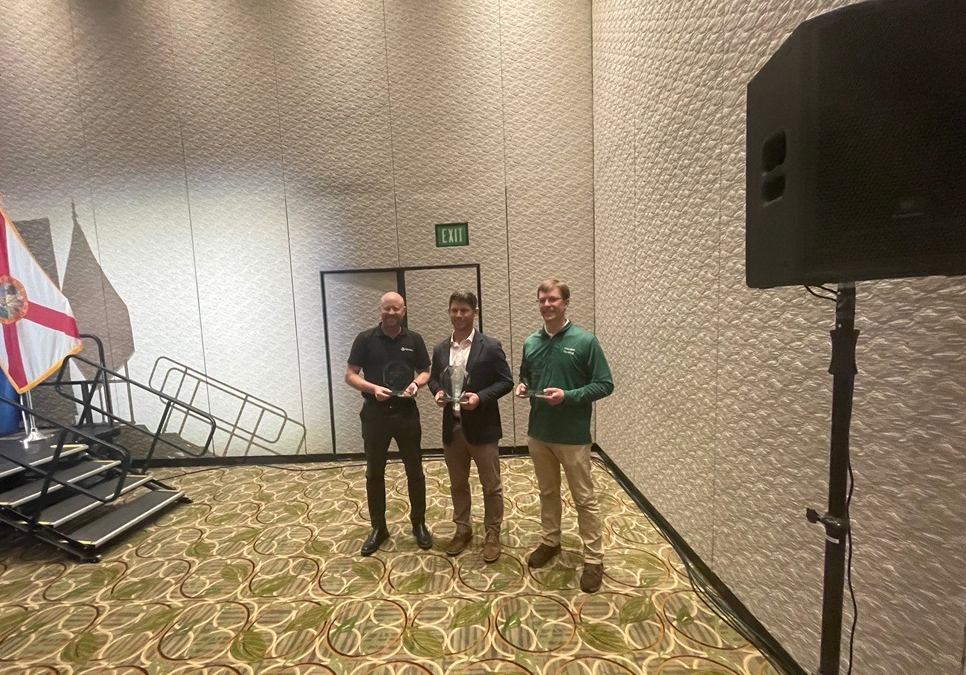
The Association of Equipment Manufacturers (AEM) and the American Society of Agricultural and Biological Engineers (ASABE) presented the sixth-annual Davidson Prize to the top three innovative products, selected from the AE50 honorees on March 9th during Commodity Classic in Orlando, Fla.
Winning entries included:
"These three products deliver on solutions that truly represent the spirit of J.B. Davidson and the innovative legacy of agriculture," said Curt Blades, senior vice president of Agriculture for AEM. "I continue to be amazed about the advancement of ag engineering and the positive impacts it continues to have on farmers' ability to work more efficiently."
The Davidson Prize was designed to celebrate breakthrough innovations in areas of agricultural, food and biological systems engineering.
"ASABE and AEM came together to create a new award to celebrate innovation in agriculture and bring additional recognition to those who embody the spirit of J.B. Davidson," said Darrin Drollinger, executive director at ASABE. "The products named as 2023 winners of the Davidson Prize continue to represent the diversity of agricultural engineering, as well as the variety of companies that bring advanced technology and exciting improvements to the marketplace.
The Davidson Prize is named for J.B. Davidson, the father of modern agricultural engineering. It gives a nod to the storied past of agricultural engineering and pays homage to those engineers, like J.B. Davidson, who aspire to find a better way. Winners were selected from the AE50 honorees, announced at the Agricultural Equipment Technology Conference in February.
"I believe J.B. Davidson would be amazed at how advanced farm equipment has become," continued Drollinger.
AEM is the North America-based international trade group representing off-road equipment manufacturers and suppliers with more than 1,000 companies and more than 200 product lines in the agriculture and construction-related industry sectors worldwide. The equipment manufacturing industry in the United States supports 2.8 million jobs and contributes roughly $288 billion to the economy every year.
ASABE is an international scientific and educational organization dedicated to the advancement of engineering applicable to agricultural, food, and biological systems.

Sigrid Johannes
Today, the National Cattlemen's Beef Association (NCBA) welcomed the introduction of the bipartisan Black Vulture Relief Act, led by Rep. John Rose (R-TN) and Rep. Darren Soto (D-FL).
"Across the country, cattle producers are coping with extreme input costs and the worst inflation rate in 40 years. Livestock deaths due to black vultures are a financial loss that no one can afford right now," said NCBA Director of Government Affairs Sigrid Johannes. "Giving producers greater flexibility on black vulture management means one less financial burden to worry about. We appreciate Congressman Rose and Congressman Soto's leadership and commonsense approach to controlling this abundant predator species."
The bill would allow a cattle producer to "take" (capture, kill, disperse, or transport) black vultures that pose a risk to livestock. Additionally, the bill reduces permitting burdens and red tape by instituting a simple report that producers submit once per year detailing the number of black vultures they took. Streamlining the system and lifting the cap on number of black vultures that producers can take is a commonsense approach to managing a fully recovered, aggressive, predator species.
"Black vultures have developed into a lethal predator for newborn calves, costing Tennessee cattle producers thousands of dollars in lost revenue each year. We appreciate Congressman Rose's bill as a significant tool to help control the over-population of these predators," said Tennessee Cattlemen's Association Executive Director Charles Hord.
Black vulture depredation rates have increased across the Southeast in recent years, surpassing 30 percent in some states like Florida.
"The Florida Cattlemen's Association appreciates Congressman Soto's co-sponsorship of this commonsense bill," said Jim Handley, executive vice president of the Florida Cattlemen's Association. "The economic loss to Florida cattle ranchers from black vultures is significant every year, and we thank Congressman Soto for taking action to assist our industry with this legislation."
Background
Cattle producers have experienced firsthand the devastating effects of vulture depredation:
Danny Clark, Lawrenceburg, TN: "Lawrence County livestock producers have been experiencing issues with black vultures preying on newly born calves for some time. Economic loss in addition to the time and labor spent during calving season for these producers is devastating. Government approved permits...allowing producers to use lethal means to control these preying birds is also a challenge...I know this year these black vultures have been the cause of [death for] at least one calf and damage to one cow as well, along with others in previous years."
Laura Wallace, Spencer, TN: "These buzzards have gotten four calves in one season, putting tremendous strain on my little 97-acre operation...The [price of] diesel, fertilizer, fencing, feed, 24D [herbicide] have all gone up."
Mark Russell, DVM, Tullahoma, TN: "Last year I found one newborn dead [calf] with its eyes eaten out. This year I came up on over 30 vultures in the field behind my house."
Jeff Russell, Kingston, TN: "During calving season...we have constant problems with vultures loitering in our pastures. I did lose one calf so far this year. When I found it there were 40-50 vultures in the pasture and in surrounding trees. Every time a cow gives birth the vultures are surrounding it and pestering the cow. We attempt to scare them off, but they have become more brazen and will return within minutes. The population appears to be out of balance. There are too many and the stress it is causing my cows is affecting their wellbeing and the safety of my newly born calves. Help is needed with this issue as it continues to get worse."
A. T. Burchell, Columbia, TN: "I have a 200 head beef cattle operation in Columbia, Tennessee, and we have had a continual problem with black vultures attacking newly born calves."
The President's Budget for USDA invests in an equitable and climate-smart food and agriculture economy that protects and improves the quality of life for all Americans.
The Biden-Harris Administration today released the President's Budget for Fiscal Year 2024. The budget details a blueprint to grow the economy from the bottom up and middle out, lower costs for families, protect and strengthen Medicare and Social Security, and reduce the deficit by ensuring the wealthy and big corporations pay their fair share—all while ensuring no one making less than $400,000 per year pays more in taxes.
"The President's budget provides USDA with the tools needed to serve all Americans by providing effective, innovative science-based public policy leadership at home and around the world. It contains critical investments that will help rural communities provide the fuel, food, and fiber upon which our nation depends and will drive solutions that will lead to more market opportunities for producers," said Agriculture Secretary Tom Vilsack. "USDA will continue to invest in equitable systems and programming, increase landscape resiliency and help rural communities build resistance to the impacts of climate change, create more and better markets for our hardworking producers, bolster access to healthy and affordable nutrition for families, and connect all Americans to economic prosperity. This budget is a clear message of what President Biden values and demonstrates the Administration's commitment to the success of Rural Americans and their communities."
The budget makes critical, targeted investments in the American people that will promote greater prosperity and economic growth for decades to come. At USDA, the budget will:
Building on the President's strong record of fiscal responsibility, the Budget more than fully pays for its investments—reducing deficits by nearly $3 trillion over the next decade by asking the wealthy and big corporations to pay their fair share.
For more information on the President's FY 2024 Budget, please visit: www.whitehouse.gov/omb/budget.
Today, the National Cattlemen's Beef Association (NCBA) welcomed the introduction of the bipartisan Black Vulture Relief Act, led by Rep. John Rose (R-TN) and Rep. Darren Soto (D-FL).
"Across the country, cattle producers are coping with extreme input costs and the worst inflation rate in 40 years. Livestock deaths due to black vultures are a financial loss that no one can afford right now," said NCBA Director of Government Affairs Sigrid Johannes. "Giving producers greater flexibility on black vulture management means one less financial burden to worry about. We appreciate Congressman Rose and Congressman Soto's leadership and commonsense approach to controlling this abundant predator species."
The bill would allow a cattle producer to "take" (capture, kill, disperse, or transport) black vultures that pose a risk to livestock. Additionally, the bill reduces permitting burdens and red tape by instituting a simple report that producers submit once per year detailing the number of black vultures they took. Streamlining the system and lifting the cap on number of black vultures that producers can take is a commonsense approach to managing a fully recovered, aggressive, predator species.
"Black vultures have developed into a lethal predator for newborn calves, costing Tennessee cattle producers thousands of dollars in lost revenue each year. We appreciate Congressman Rose's bill as a significant tool to help control the over-population of these predators," said Tennessee Cattlemen's Association Executive Director Charles Hord.
Black vulture depredation rates have increased across the Southeast in recent years, surpassing 30 percent in some states like Florida.
"The Florida Cattlemen's Association appreciates Congressman Soto's co-sponsorship of this commonsense bill," said Jim Handley, executive vice president of the Florida Cattlemen's Association. "The economic loss to Florida cattle ranchers from black vultures is significant every year, and we thank Congressman Soto for taking action to assist our industry with this legislation."
Background
Cattle producers have experienced firsthand the devastating effects of vulture depredation:
Danny Clark, Lawrenceburg, TN: "Lawrence County livestock producers have been experiencing issues with black vultures preying on newly born calves for some time. Economic loss in addition to the time and labor spent during calving season for these producers is devastating. Government approved permits...allowing producers to use lethal means to control these preying birds is also a challenge...I know this year these black vultures have been the cause of [death for] at least one calf and damage to one cow as well, along with others in previous years."
Laura Wallace, Spencer, TN: "These buzzards have gotten four calves in one season, putting tremendous strain on my little 97-acre operation...The [price of] diesel, fertilizer, fencing, feed, 24D [herbicide] have all gone up."
Mark Russell, DVM, Tullahoma, TN: "Last year I found one newborn dead [calf] with its eyes eaten out. This year I came up on over 30 vultures in the field behind my house."
Jeff Russell, Kingston, TN: "During calving season...we have constant problems with vultures loitering in our pastures. I did lose one calf so far this year. When I found it there were 40-50 vultures in the pasture and in surrounding trees. Every time a cow gives birth the vultures are surrounding it and pestering the cow. We attempt to scare them off, but they have become more brazen and will return within minutes. The population appears to be out of balance. There are too many and the stress it is causing my cows is affecting their wellbeing and the safety of my newly born calves. Help is needed with this issue as it continues to get worse."
A. T. Burchell, Columbia, TN: "I have a 200 head beef cattle operation in Columbia, Tennessee, and we have had a continual problem with black vultures attacking newly born calves."
U.S. pork exports, which posted a strong finish in 2022, maintained momentum in January, according to data released by USDA and compiled by the U.S. Meat Export Federation (USMEF). U.S. beef exports were record-breaking in 2022 but slowed late in the year. This trend continued in January, as shipments were well below the large totals from a year ago.
January pork exports totaled 236,767 metric tons (mt), up 13% year-over-year, while export value climbed 16% to $643.4 million. Exports to Mexico, which finished 2022 on a remarkable run on the way to an annual record, set another volume record in January. Exports also trended significantly higher year-over-year to China/Hong Kong, Japan, Canada, the Dominican Republic, Colombia, Honduras and the ASEAN region.
"While Mexico is certainly the pacesetter for U.S. pork exports, it's encouraging to see such broad-based growth," said USMEF President and CEO Dan Halstrom. "Market diversification is always a point of emphasis for the U.S. industry, and it's more important than ever to find new opportunities for U.S. pork in both established and emerging markets."
Beef exports declined to several major destinations in January, though shipments increased sharply to Mexico, the Dominican Republic, the Philippines and Africa. January volume fell 15% year-over-year to 100,942 mt, valued at $702.3 million (down 32%).
Beef inventories swelled in some key markets near the end of last year, contributing to a challenging environment for U.S. exports.
"While beef exports are off to a slow start in 2023, we remain optimistic that post-COVID foodservice demand will strengthen in additional markets as the year progresses," Halstrom said.
Record-large shipments to Mexico lead strong month for pork exports
Fresh off a record year, pork exports to Mexico didn't miss a beat in January. Export volume was a record 96,800 mt, up 11% from a year ago and 7% above the previous high in December 2022. January export value soared 40% to $191.2 million. Demand for U.S. pork is surging even as it faces increasing competition in Mexico, due to suspension of import duties for all eligible suppliers through the end of 2023. Mexico also recently opened to some imports from Brazil.
Pork exports to the Dominican Republic also remained strong in January, increasing 28% year-over-year to 8,185 mt, while export value jumped 67% to $23.8 million. The DR also suspended import duties from all suppliers for a portion of 2022. But with that decree now expired, the U.S. is the only major supplier with duty-free access at a time when the DR's domestic production is struggling to overcome the impact of African swine fever (ASF).
While pork production in China has recovered from its ASF-impacted lows, demand is expected to strengthen somewhat in 2023 as importers and consumers respond to the recent removal of COVID-related restrictions and the central and provincial governments implement efforts to revive the economy. In January, pork exports to China/Hong Kong reached 46,315 mt, up 31% from the low year-ago volume, valued at $121.8 million (up 25%).
Other pork export results for January include:
Challenging month for beef exports, but bright spots emerge
January beef exports were down substantially in most Asian destinations compared to the large year-ago totals. The decline was especially sharp in South Korea, where volume dipped 36% to 18,896 mt and value fell 52% to $151.5 million. Korea is coming off a record year in which exports set an all-time record value for any single destination, reaching $2.7 billion.
The decline was less pronounced in Japan, where January exports were down 2% to 22,456 mt, with value falling 20% to $144.9 million.


Exports to China/Hong Kong, which also reached new heights in 2022, fell 24% from a year ago to 14,980 mt, valued at $125.3 million. China lifted COVID-related restrictions on residents and travelers late last year and eliminated testing and disinfection of imported cold chain products in January. But these changes came amid a significant wave in COVID cases, which likely delayed any boost in consumer demand.
Beef exports to Mexico showed positive momentum in January, climbing 20% from a year ago to 17,479 mt, valued at $94.7 million – up 19% and the highest in more than a year. U.S. beef could soon face heightened competition in Mexico, as earlier this week Mexican officials finalized import requirements for some imports from Brazil. This will be the first time the country has opened to Brazilian beef.
Other beef export results for January include:
Lamb exports open 2023 on high note
January exports of U.S. lamb muscle cuts totaled 222 mt, up 161% from the low year-ago volume, while export value essentially doubled to $1.1 million (up 99%). Growth was led by strong increases to Mexico and the Caribbean, while shipments were also higher to Canada and Guatemala.
Complete January export results for U.S. pork, beef and lamb are available from USMEF's statistics web page.
The Innovative Solutions — 3 Herbicides and 1 Biological — Will Be Labeled for a Variety of Crops, Including Corn, Soybeans and Cereals.
Today, Corteva Agriscience announces four new crop protection products that will meet a wide range of farmer needs, from powerful weed control to cutting-edge nutrient management. The new solutions include three herbicides and a biological, and will protect a variety of crops, including corn, soybeans and cereals.
Here is a look at the four new products from Corteva:
"At Corteva, we like to say, 'When farmers succeed, everyone wins.' It's our job to bring farmers the tools they need to succeed. These four solutions can help pave the way for their successes – and wins in future growing seasons," said Aaron Smith, U.S. product manager, soybean herbicides, Corteva Agriscience. "Enversa herbicide is a new, proprietary formulation a decade in the making. Corteva scientists worked tirelessly to develop our encapsulation that is unique in the market. The herbicide will drive to the soil surface, providing several weeks' residual weed control and minimal crop response."
"When it comes to corn weed control, Kyro herbicide will offer farmers three modes of action in one convenient premix. This is an innovative solution to help control glyphosate- and ALS-resistant weeds — and to help prevent future resistance from developing," said Kelly White, U.S. product manager, corn herbicides, Corteva Agriscience.
"Being able to offer a new active ingredient for the cereals market is incredibly exciting. This new mode of action will make Tolvera herbicide an incredibly valuable tool for cereals farmers to combat weed resistance," said Breanna Thompson, U.S. product manager, cereals herbicides, Corteva Agriscience.
"Utrisha P is an exciting solution for farmers across a large crop spectrum. Phosphorus is an essential nutrient that can be difficult for plants to take up on their own. In addition to Utrisha P stimulating mobilization of phosphorus in the soil, helping crops take up the nutrient, the new biological also increases crop root growth for better access to other nutrients and water for enhanced plant health and higher grain production, ultimately leading to greater yield potential," said Brandon Emery, U.S. product manager, biologicals, Corteva Agriscience.
To find out if a product is available in your area, talk with your local ag retailer or Corteva Agriscience representative. You can also visit Corteva.us or scan the QR code below to find more resources about the new crop protection solutions.

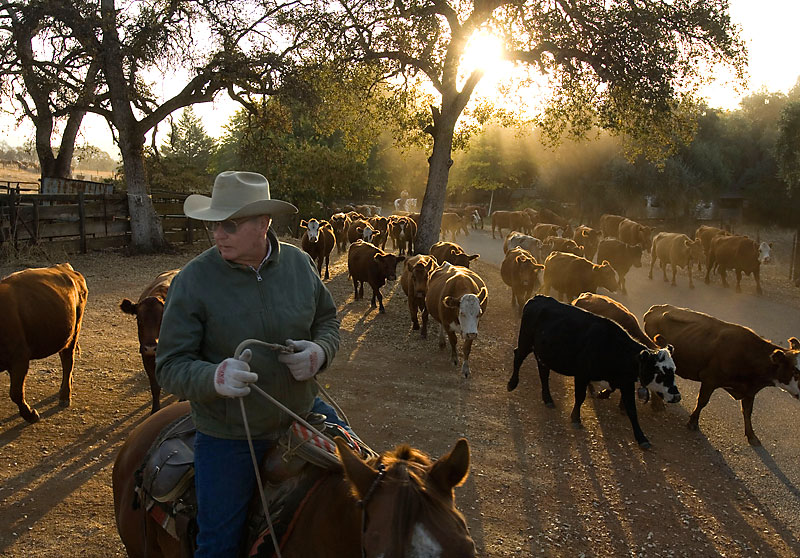
Editor's note- Senior Farm and Ranch Broadcaster Ron Hays was at Day One of the 2023 International Livestock Congress in Houston where the total focus was on the impact of ESG to Beef cattle. Over the next several Beef Buzz reports, Hays will explore what was discussed at the Congress as it relates to Cattle and this exploding concept.
In today's Beef Buzz, Senior Farm and Ranch Broadcaster, Ron Hays, is back visiting with California cattle producer, Mike Smith, with more about the conversation on Environmental, Social and Governance and the problems he sees down the road for cattle producers.
Smith has concerns that corporate America is interested in demanding information about greenhouse gas emissions without providing any value back in return to the producers who participate.
"A lot of these companies that are asking the industry to do these things have publicly stated they have no intention whatsoever of providing premiums to those who can meet these requirements," Smith said. "So, effectively, it is 'play our game, abide by our rules or tough kittens.'"
Smith said is time for the beef industry to push back. The National Cattlemen's Beef Association has taken a position to keep government out, Smith said, but he has concerns because NCBA also says to keep from requiring farmers and ranchers from reporting this information, and to just require publicly traded companies to do so.
"Therein lies the rub, because even though there is not going to be direct requirements to the government of cow calf operators, there very well could be requirements coming down the supply chain," Smith said. "So, big corporate America. It is the Burger Kings, it is the McDonalds, it is the Wendy's."
These publicly traded companies, Smith said, will want to make certain they have access, either to borrow capital or have asset management groups invest in their corporations. To get these investments, Smith said publicly traded companies will have to 'play the ESG game' to receive preferential treatment.
"It is banks, it is investment groups with too much power that are taking their eye off the ball," Smith said. "They are allowed to invest in companies who are excelling in these ESG scores and not focusing on their primary role. As asset managers, they are supposed to be looking after the best interests of people that are investing in their funds."
Asset managers who are very concerned about ESG scores, Smith said, is unsettling because as the fossil fuel industry is being viewed as a 'bad actor', the beef industry could be next because of its contribution of greenhouse gas emissions.
This is an issue looking into the future, Smith said, as beef producers could be impacted with more requirements and standards.
The Beef Buzz is a regular feature heard on radio stations around the region on the Radio Oklahoma Ag Network and is a regular audio feature found on this website as well. Click on the LISTEN BAR for today's show and check out our archives for older Beef Buzz shows covering the gamut of the beef cattle industry today.
Today, Brent Cheyne was elected President of the National Association of Wheat Growers (NAWG). Brent farms with his son Rodney near Klamath Falls, Oregon, where they raise wheat, barley, oats, alfalfa and Angus cattle. In 2011, Brent began his time with the Oregon Wheat Growers League as the Oregon president before accepting the position of NAWG Secretary in 2015.
"It is an honor to have been elected President of NAWG during this Farm Bill year. NAWG's purpose is to advocate for all wheat growers and we have an excellent opportunity to do just that with the 2023 Farm Bill. I hope to see, and I encourage, more involvement and commitment from farmers as we come together to improve the agricultural community," said NAWG President and Oregon wheat farmer Brent Cheyne.
During Brent's term, he will continue to work across the industry on the upcoming Farm Bill and advocate for the nation's wheat growers.
Along with Brent Cheyne being elected as NAWG's President, the Board of Directors elected a new slate of officers. Keeff Felty from Oklahoma was elected Vice President, Pat Clements from Kentucky was elected Treasurer, Jamie Kress from Idaho was elected as the new Secretary and Nicole Berg from Washington state transitioned to the role of Past President.
"We greatly appreciate Nicole Berg's service to the National Association of Wheat Growers. Nicole has led our organization as we developed our initial 2023 Farm Bill priorities, testified in front of Congress three times in reviewing the 2018 Farm Bill, and acted as a national spokesperson for wheat with Russia's invasion of Ukraine. She has been a true advocate for wheat growers, and we are thankful for her commitment to agriculture," said NAWG CEO, Chandler Goule. "We are looking forward to our new leadership this upcoming year as we continue to promote unity amongst wheat growers and support policy efforts that create an environment that is beneficial for wheat growers in our nation."
One Noble Research Institute ranch manager learned regenerative grazing doesn't have to add to one's work time – it just changes what you do with it. And the rewards are many.
When it came time to transition from conventional to regenerative grazing practices on Noble Ranches' Red River Ranch in southern Oklahoma, ranch manager Kevin Pierce admits to wondering where he and his team were going to find the time to move fences and cows all the time to accomplish adaptive grazing.
Up until then, Pierce says, he and his team were busy fertilizing and spraying pastures; baling, hauling and stacking hay; feeding hay.
"That's what consumed our time, driving tractors," he says. "We were used to doing everything the conventional way."
So, when the switch to regenerative was decided, "I told my boss that's fine, but I don't have the time to do all that and drive tractors eight or 10 hours a day. I may have said that more than once," he admits. His boss replied that now grazing management was going to be the key piece of what they did, "and 'we're not going to be doing all those other things.'"
Going through training to understand the concept of managing for soil health and using adaptive grazing to give grass a chance to rest was essential, Pierce says.
"I think that's the first part the person needs to understand, whether you read a book or go to a training session, is why he's going to be doing these things," he explains. "Not just because somebody says that's a good idea."
Still, they were entering unknown territory. After the training, Pierce went to his guys one morning and said, "Today's the day we're going to start. We're going to pick a set of cattle (of the five separate herds they had) and do this."
His team asked, "Are we really going to build fence every day?"
Yep. And they weren't real excited about it.
But as they began, they saw the cattle responding to getting turned out into fresh paddocks, and found out it wasn't so bad to move the posts and polywire and the cattle.
"The hardest part was just getting started," he says. "Once we started, then they got excited about it and wanted to do more, and I wanted to do more."

The Red River Ranch crew started to see results right away the first spring they started with adaptive grazing, even before they made any direct changes to the soil or the land.
"We were just doing a whole lot better job of grazing than we had done in years past," Pierce says. "We were giving these pastures a lot more rest, and it was tons better."
Another change they made was to stop spraying herbicides, which felt risky at first.
"We were concerned that all we would have in the pastures was weeds. And the forbs did increase. But we saw that the cattle would eat a lot of these things, and not because we were making them. They had a desire to eat them."
Last summer, they added sheep to the ranch, and saw that they could be a real asset when they followed the cattle in rotation.
"There's a certain vine out here that the cows really don't care to eat, and quite a bit of it, but the sheep loved it," he says.

When it came to setting up fencing for frequent moves, the ranch had the advantage of high-tensile, hot-wire fencing all the way around from which to build temporary fences, Pierce says. "We didn't have to take a portable charger and a bunch of stuff around."
They did, however, experiment to find user-friendly fence posts that that held up to daily moves – ring-top posts won out. He says thanks to the fact that the sheep they added were "hot-wire broke" first on another Noble ranch, "it was easy for us to just build a little different-style fence," with posts that let them run a single polywire about 10 inches off the ground. They add a second wire in certain seasons to contain the sheep when they aren't super happy about what they have to eat.

Regenerative ranching has moved the ranch staff out of the tractor seat for the most of the year and onto UTVs as they build fence and move the herd.
"Something that also concerned me about putting 400 head together was how am I going to look at them and see them every day," Pierce says. "Well, if every one of them walks by you two or three at a time, you get a better look at 'em than you ever would with them scattered out in separate pastures."
In addition, they're so much gentler than they were before, he says. "Once you move them around for a week or so, it's no different than them getting used to a feed truck. They know every day that you come, and they hear the Ranger, that there's fresh feed right there waiting on them. They come to you.
"I could call them a half mile away to a new pasture, and they know I'm going to take them to something good."

Just as promised, Pierce and his team no longer spend the summers baling hay, nor do they spend the winter feeding it. Their Red River Ranch hay barn had about 400 bales in it when they switched to regenerative ranching two years ago, and it's still full. As of mid-January, they hadn't fed any hay to the cattle or sheep this winter, and hadn't had to buy any hay for the ranch, as their winter forage continued to be the main food source.
They do use tractors to plant both cool-season and summer cover crops on the 600 acres of cropland formerly seeded to a monoculture of cereal rye for grazing. He says the main reason for the cover crops is to build soil health, and getting to graze them is a bonus. The same adaptive grazing practice goes for these acres, to maintain a healthy cover on the soil.

"I'm not saying we've mastered what we're doing yet, but after we figured out what we were doing and how it worked, and what we needed to do to make it work better, then we started combining all the herds, and that made it even easier," Pierce says.
He says he doesn't know why he had felt it was easier to run three different herds of steers on three different pastures side by side.
"We were making things harder on ourselves, but didn't want to change, because that was the way we'd always done it." For 28 years, in his case, having started on the ranch at age 19.
"Looking back on it now, I wouldn't go back to the way we were doing it," he says. "No way, whether we were trying to be regenerative or not."
Story credit: Marilyn Cummins , Noble Research Institute
March 7, 2023 – Customers of Farm Credit of Western Oklahoma (FCWO) will soon be
receiving their patronage refund payments totaling $11 million.
"We experienced sound financial performance last year and are honored to return a record amount to
our customer-owners that is almost double what we returned in 2022. Patronage is the foundation of
our cooperative business model and is what distinguishes Farm Credit of Western Oklahoma from other
lenders," said John Grunewald, FCWO Chief Executive Officer.
According to Grunewald, since 1998, a total of $75,400,000 has been returned to FCWO customers in
patronage refunds.
"FCWO specializes in agriculture lending and we do agriculture all day, every day. Our staff knows
agriculture because they are involved in agriculture. Our experienced loan officers work to get to know
customers and their operation. We offer long-term and short-term fixed rate loans and decisions are
made locally at each branch."
FCWO services 6,000 loans in Western, Central and Southwestern Oklahoma with nine locations in Altus,
Alva, Anadarko, Clinton, Enid, Elk City, Guymon, Tuttle and Woodward. Field offices in Beaver, Boise City
and Chattanooga.
Farm Credit of Western Oklahoma is a member of the Farm Credit System and comprised of Federal
Land Bank Associations and Production Credit Associations financing all types of farms, ranches and
other agriculture needs. Farm Credit of Western Oklahoma is an equal opportunity lender and equal
housing lender. Learn more at farmcreditloans.com.
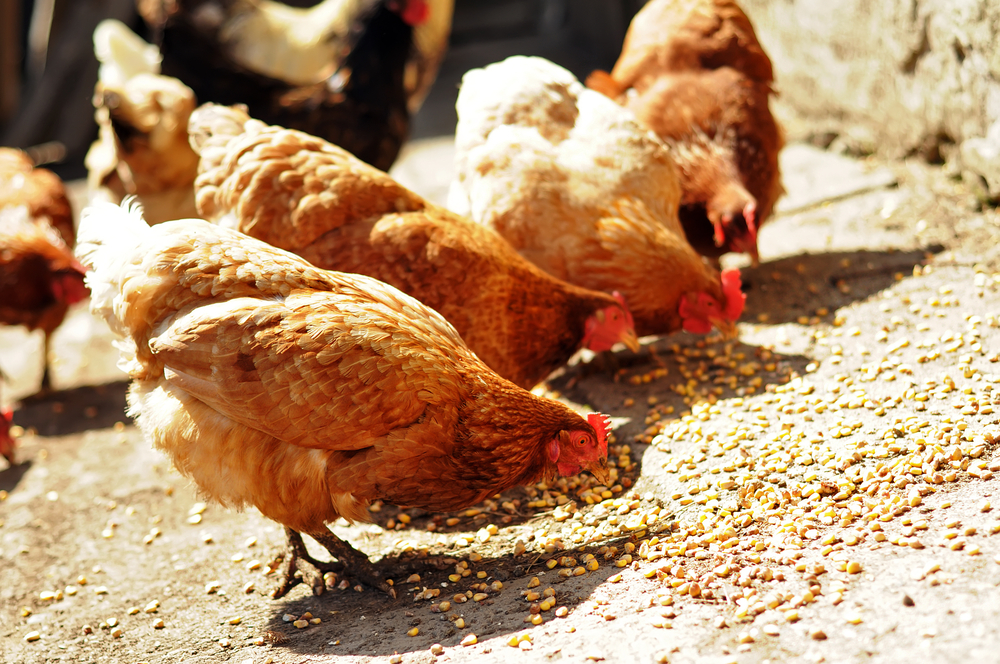
The U.S. Department of Agriculture (USDA) announced today an investment of more than $43 million in meat and poultry processing research, innovation and expansion in support of its ongoing efforts to transform the food system at every stage along the supply chain. This investment is funded through the American Rescue Plan and the Agriculture and Food Research Initiative (AFRI).
As part of this total investment, the University of Arkansas was awarded a $5 million grant from the AFRI Center of Excellence for Meat and Poultry Processing and Food Safety Research and Innovation (MPPFSRI). In addition, $13.9 million in grants from the Meat and Poultry Processing Research and Innovation – Small Business Innovation Research Phase III – program were awarded to 14 small and mid-sized meat and poultry processors. These grants are administered by USDA's National Institute of Food and Agriculture.
Additionally, one $25 million Meat and Poultry Processing Expansion Program (MPPEP) grant was awarded to Wholestone Farms for a major plant expansion in Fremont, Nebraska. This grant was administered by USDA Rural Development.
"Farmers rely on technology to become more efficient and profitable," said Agriculture Secretary Tom Vilsack. "Under the Biden-Harris Administration and through historic funding investments, USDA continues to invest in research processing expansion that will create new and better markets and expand opportunities for small businesses and rural communities. This investment will help enable that vision."
The AFRI MPPFSRI program promotes novel approaches to meat and poultry processing by implementing pioneering production system technology that assesses risk management and overall enhanced food safety. The University of Arkansas, Center for Scalable and Intelligent Automation in Poultry Processing, will incorporate basic and applied research in meat and poultry processing and food safety to promote technological innovation and decrease industry barriers to safety and processing."
As part of the MPPFSRI Phase III funding investments, prior Small Business Innovation Research (SBIR) or Small Business Technology Transfer (STTR) awardees with relevant technologies were invited to apply for this funding opportunity. Selected awardees must provide non-restrictive access or non-exclusive licenses to any technologies or related enabling technologies developed under this award to help small and mid-size processors implement the technology.
Examples of NIFA's 14 funded MPPFSRI Phase III projects include:
RD's MPPEP investment:
"Investments like these will deliver long-term improvements in meat and poultry processing practices to benefit consumers, farmers and the environment," said Vilsack. "We are excited to see how these investments will generate solutions that benefit all Americans."
Background
The MPPFSRI Phase III objectives are to rapidly deploy emerging technologies and make applied research more accessible to independent business owners, entrepreneurs, producers and other groups, such as cooperatives and worker associations who are less resourced. The areas in which technological developments were solicited address three areas prioritized by the Secretary: monitoring and improving complex processes, worker safety and food safety.
MPPEP was designed to support capacity expansion projects in concert with other private and public finance tools. For more information about MPPEP, view the Meat and Poultry Processing Expansion Program page.
NIFA invests in and advances agricultural research, education and Extension across the nation to make transformative discoveries that solve societal challenges. For more information visit, www.nifa.usda.gov.
USDA touches the lives of all Americans each day in so many positive ways. Under the leadership of the Biden-Harris Administration, USDA is transforming America's food system with a greater focus on more resilient local and regional food production, promoting competition and fairer markets for all producers, ensuring access to safe, healthy and nutritious food in all communities, building new markets and streams of income for farmers and producers using climate-smart food and forestry practices, making historic investments in infrastructure and clean energy capabilities in rural America, and committing to equity across the Department by removing systemic barriers and building a workforce more representative of America. To learn more, visit www.usda.gov.

House Agriculture Committee Ranking Member David Scott delivered the following statement at today's hearing "Rising Risks: Managing Volatility in Global Commodity Derivatives Markets."
[As prepared for delivery]
Thank you, Chairman Thompson, for convening today's hearing, "Rising Risks: Managing Volatility in Global Commodity Derivatives Markets." Global commodities markets help consumers and producers manage price risk and protect them from exposure to global events. The past several years have been rife with uncertainty and volatility that has tested the strength and resiliency of our derivatives markets.
This uncertainty and volatility has been driven by unexpected global challenges such as the Russian war in Ukraine and the COVID-19 pandemic. These events have disrupted global trade and the transportation of food, fuel, and fertilizer, creating supply shortages and price fluctuations.
Now, as we examine the reactions of our global commodity derivatives markets to these major events, it's important we also take the time to focus on other sources of volatility and uncertainty that have emerged in recent years and will continue in the years ahead - such as an increase in the occurrence of extreme weather events, cybersecurity concerns, and the growth of fintech, and the preeminent impact of Russia producing nearly 66% of ammonium nitrate. We need to produce our own supply.
These concerns and challenges have presented unique tests for our agricultural markets – from historically low water levels that have cut river traffic in the Mississippi River basin, to reduced access to critical crop inputs and energy as a result of global trade restrictions and interruptions.
For example, wheat prices have experienced historic swings due to the disruption caused by Russia's invasion of Ukraine and fears of a global wheat shortage.
Ensuring the orderly operation of our derivatives markets and preserving their role as a tool for price discovery and risk management is of utmost importance now more than ever.
Finally, I want to note that this year marks 10 years since the expiration of the Commodity Futures Trading Commission's reauthorization. In my previous role as the Chairman of the our Subcommittee on Commodities Exchanges, Energy, and Credit, I worked closely with our Republican colleagues to pass bipartisan reauthorization legislation through the Committee. The importance of Congress passing this legislation cannot be understated.
The testimony each of you provide here today will be critical for our Committee to guarantee that the CFTC has all the necessary and appropriate tools to ensure the integrity, resilience, and vibrancy of the U.S. derivatives market.
I look forward to hearing from this distinguished panel of expert witnesses as they share their expertise and knowledge of the state of our commodity derivatives markets and the effectiveness of our existing tools for risk management.
I yield back.
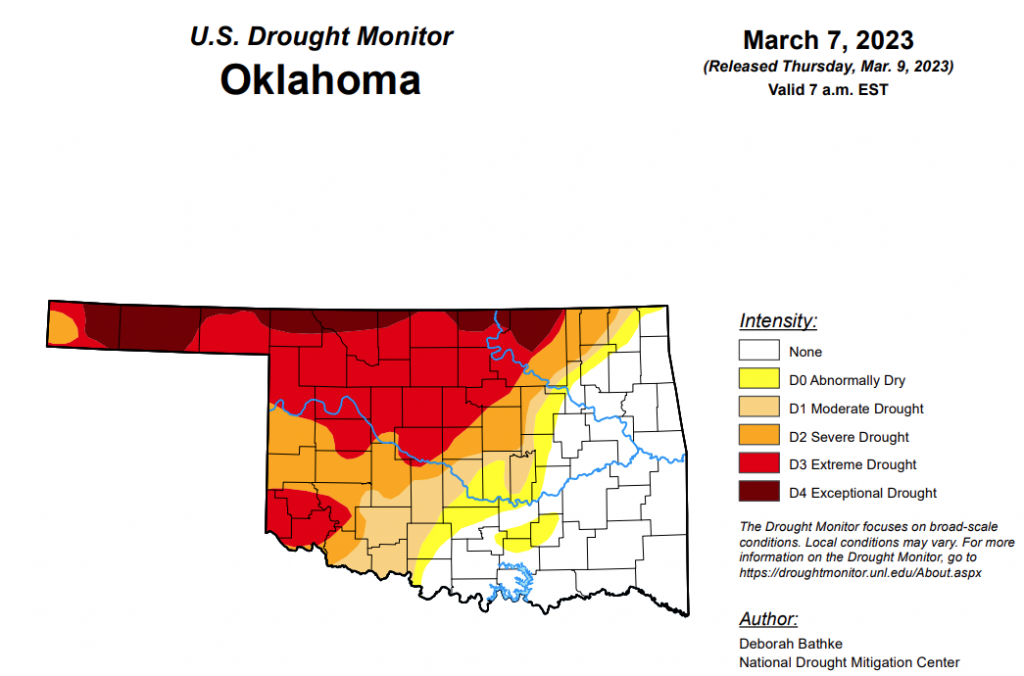
To view the Oklahoma Drought Map, click here.
For the third week in a row, exceptional drought remains at 8.86 percent and extreme drought or worse remains at 36.64 percent. Rains this week will hopefully be reflected in next week's report.
According to State Climatologist, Gary McManus, there is no guarantee that the current drought in northwest Oklahoma will end soon. However, there is hope for more rainfall, as the weather patterns are constantly changing and the region is prone to strong storms and heavy rainfall.
Severe drought or worse has improved only slightly, moving from 53.52 percent last week to 51.53 percent this week.
Moderate drought or worse has improved from last week's 66.88 percent to 59.92 percent.
Abnormally dry or worse conditions have improved significantly this week, moving from last week's 77.15 percent to 67.07 percent.
According to the 6-10-day precipitation outlook map, the majority of the state aside from the panhandle area is leaning above a 33 to 40 percent chance of precipitation through March 18th. The panhandle area is leaning above a 40 to 50 percent chance of precipitation through March 18th.
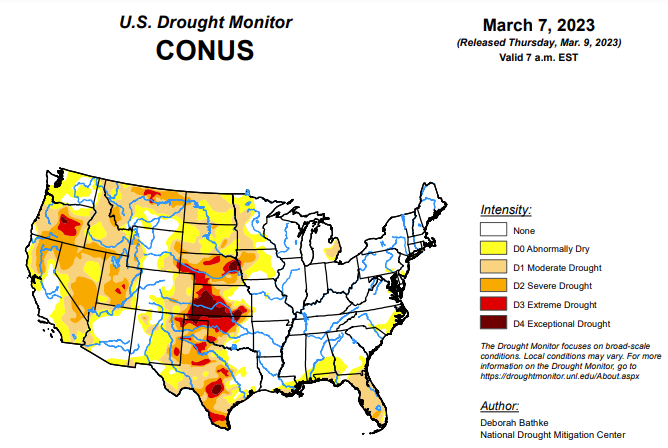
To view the United States Drought Monitor Report, click here.
According to the latest U.S. drought monitor report, a series of severe weather events moved across the South and Southeast this week, bringing damaging winds, tornados and heavy rainfall. As these storms moved through the Midwest, many locations experienced record daily rainfall. This same storm brought snow to the upper Great Lakes and parts of the Northeast. Precipitation was scarce across other areas of the country, including parts of the West, the High Plains and Deep South. Drought and dryness expanded in parts of the Pacific Northwest, southern Texas and the Gulf and Atlantic coasts. Drought improvements were seen across the West from prior weeks' precipitation events. In addition, parts of the southern Plains, Great Lakes and mid-Northeast regions also saw improvements.
In the Southern Plains, storms brought high winds, tornadoes and heavy rain to parts of the South. A band of heavy rain, over 300 percent of normal (over the last 7 days), fell over drought areas in north-central and central Texas. But, because precipitation is low in Texas this time of year, totals ranged from about 0.5 to 1 inch and provided minimal relief to areas in moderate (D1), severe (D2) and extreme (D3) drought. Longer term deficits remain, and streamflow values quickly returned to below normal over much of the region. Otherwise, most of Texas received little to no rainfall, and many locations experienced an expansion of drought conditions. In the Panhandle, D3 expanded slightly. Precipitation there is less than 25 percent of normal over the last 30 days, and satellite derived soil moisture is very low (5th percentile or less). In South and West Texas, all drought levels expanded as the dry pattern continued. Precipitation in these areas has been less than 10 percent of normal over the last 30 days. The dry weather, combined with temperatures of 3 to 6 degrees above normal, has dried out soils and increased fire danger (as indicated by the Keetch Byram Drought Index). CoCoRaHS observers in South Texas note the lack of measurable rain, cracks in the soil and plants with discoloration and delayed growth. In Oklahoma, 5 to 10 inches of rain fell last week (300% of normal) over the state's eastern drought boundary. Repeated bouts of moisture have led to short-term improvements overwhelming longer-term deficits, resulting in 1-category improvements. The state climatologist for Oklahoma noted that over half of the reservoirs in the southeast part of the state are now over their conservation pool or close to normal. Meanwhile, short- and long-term drought still have a grip on the northwest part of the state. Dry conditions combined with above normal temperatures and high winds have resulted in several fires.
In the High Plains, much of the High Plains remains in long-term drought, with the central High Plains seeing some expansion of moderate drought (D1) from southeast Nebraska to northeastern Kansas based on continued lack of recent precipitation, low streamflows and soil moisture. In the Colorado Rockies, abnormal dryness (D0) was slightly expanded based on below-normal precipitation. In south-central Colorado, abnormal dryness (D0) was expanded because of continued lack of precipitation and low soil moisture. However, southeast Kansas received heavy rain from severe storms that extended from the South and Southeast into the Great Lakes regions. The northern High Plains also saw improvements in north-central/northeastern Nebraska and southeastern North Dakota in response to the season's heavy snows. Soils are still frozen, so the full benefits of the season's precipitation will not be realized until the soils thaw and the snow meltwater soaks into the ground. Wyoming also saw improvements to moderate drought (D1) where precipitation deficits have recovered.
In the West, this week, additional rounds of rain and snow added to the ample precipitation received across the West since December 2022. Continued analysis of the effects of the season's moisture resulted in continued improvements to long-term drought conditions in many parts in the West. California saw improvements to severe (D2) and moderate (D1) drought, as well as abnormal dryness (D0) along the central coast and in the San Joaquin Valley and southern California. National Weather Service offices in the area report extremely wet conditions. Water-year-to-date (WYTD) precipitation is 150% of normal or higher, and nearly every indicator shows improvement with all but the longest timescales (24-to-36-month precipitation) showing above-normal conditions. Similarly, the season's precipitation chipped away at long-term drought areas in southern Nevada (D2 and D3), parts of Utah (D2 and D3) and western New Mexico (D1, D2 and D3). Precipitation deficits, soil moisture and streamflow show recovery. Groundwater levels and reservoir storage, which takes longer to recover, however, remain low. Precipitation in the Pacific Northwest helped improve severe drought (D1) in western Idaho and abnormal dryness (D0) in southwest Montana. Precipitation indicators in these areas are wet out to 12 months. In the rest of the Northwest, recent precipitation wasn't enough to warrant improvement. Moderate drought (D1) expanded in north central and northeast Oregon where WYTD precipitation, streamflow and soil moisture is low. The Oregon state climatologist notes that "This water year has been surprisingly dry across the state despite the near-normal snowpack. Approximately 70% of the state only has 75% of normal WYTD precipitation, and about 25% is below 50% of average." In Montana, severe drought (D2) expanded in response to low snow accumulations and its effect on streamflow and soil moisture.
Looking ahead, the National Weather Service Weather Prediction Center forecast for the remainder of the week (valid March 8 – March 11) calls for an atmospheric river to bring heavy rainfall, flooding and high-elevation snow to the West Coast. A winter storm tracking across the central High Plains and upper Midwest is also expected to bring snow to these regions, with the heaviest amounts in southern Minnesota, northern Iowa and southern Wisconsin. As this storm moves eastward, mixed precipitation is likely in a band stretching from eastern Nebraska to southern New York. Heavy rain and thunderstorms are expected across the southern Plains, the South, lower Midwest and the Southeast.
Moving into next week, the Climate Prediction Center's 6-to-10-day outlook (March 13 – March 17) calls for above-normal temperatures across the Southwest with below-normal temperatures across much of the Lower 48 and Alaska. Most of the U.S. can expect near- to slightly above-normal precipitation. Parts of the Midwest and Northeast are the only areas with slightly increased odds for below-normal precipitation.
Attorney General Gentner Drummond today named as his first assistant attorney general Amie Ely, a former federal prosecutor with the U.S. Attorney's Office for the Southern District of New York. In her new role, Ely will oversee the agency's solicitor general, general counsel, and the heads of the office's civil and criminal divisions.
"Amie is a driven, seasoned, and highly skilled prosecutor who has tried hundreds of defendants on charges ranging from violent crimes to drug trafficking and racketeering," Drummond said. "She brings a valuable and varied breadth of experience that will be a tremendous asset for this office. Oklahoma is fortunate to have her."
Ely said she is excited to work with General Drummond.
"I look forward to helping to ensure governmental accountability, supporting the office's dedicated staff, and collaborating with our federal, tribal, and local partners for the sake of public safety," she said. "I am thrilled to be a part of this talented team and honored to serve the people of Oklahoma."
In addition to her work as a federal prosecutor, Ely served as a law clerk for Second Circuit of U.S. Appeals Judge Richard C. Wesley and for Southern District of New York Judge Stephen C. Robinson. In 2016, she founded the National Attorneys General Training and Research Institute's Center for Ethics and Public Integrity and served as its director until joining the Oklahoma Office of Attorney General.
Born and raised on a farm in Wyoming, Ely attended high school in West Virginia before going on to earn her bachelor's degree from Oberlin College and law degree from Cornell Law School.
In today's cow-calf corner, Derrell S. Peel, Oklahoma State University Livestock Marketing Specialist, and Kellie Curry Raper, Oklahoma State University Livestock Marketing Specialist talk about the Oklahoma Quality Beef Network Cattle.
Oklahoma Quality Beef Network producers in Fall 2022 enjoyed the second highest average premiums in program history. OQBN is a third-party certified VAC-45 preconditioning program offered through Oklahoma Cooperative Extension. Extension Specialists guide producers through the calf health management protocol to qualify for certification and eligibility to market cattle through OQBN. OQBN premiums are measured as the weighted average premium for OQBN VAC-45 calves relative to non-preconditioned calves at the same sale. The Fall 2022 overall average premium across locations and weights was $18.67/cwt, the highest since 2014.
When we break that premium down across steers and heifers, steers averaged premiums of $18.27/cwt while heifers topped that at $19.12/cwt (Figure 2). Looking across weight classes, lighter weights tend to bring higher per cwt premiums. The bulk of OQBN lots are marketed as 4 weights to 6 weights. Across those weights, the calculated average premium per head for steers ranged from $92.25 to $114.84 and from $84.24 to $115.78 for heifers.
The 2022 fall marketing season included 9 fall sales across 6 Oklahoma livestock markets. Total fall enrollment included 2,784 head and 63 producers, with 1,633 head marketed through OQBN VAC-45 certified sales. The numbers are not too surprising, given that drought forced early weaning and marketing for many producers in the state. Overall, the data used to calculate 2022 premiums includes 10,583 head marketed in 1,252 lots. That data includes 232 OQBN lots. As expected, sales where more OQBN calves or other preconditioned calves were present tended to have higher premiums for those calves, as those sales usually attract a larger number of buyers to compete for preconditioned calves.
Markets never make guarantees and preconditioning is not free. That said, past research indicates that 80% of the time, certified preconditioning with OQBN nets positive returns. OQBN has no minimum requirement on number of head enrolled, so the program is accessible to all producers, large and small. More information about the OQBN protocol, past market premiums, upcoming marketing opportunities, program enrollment and Extension educator contact information can be found at https://extension.okstate.edu/programs/oklahoma-quality-beef-network/.
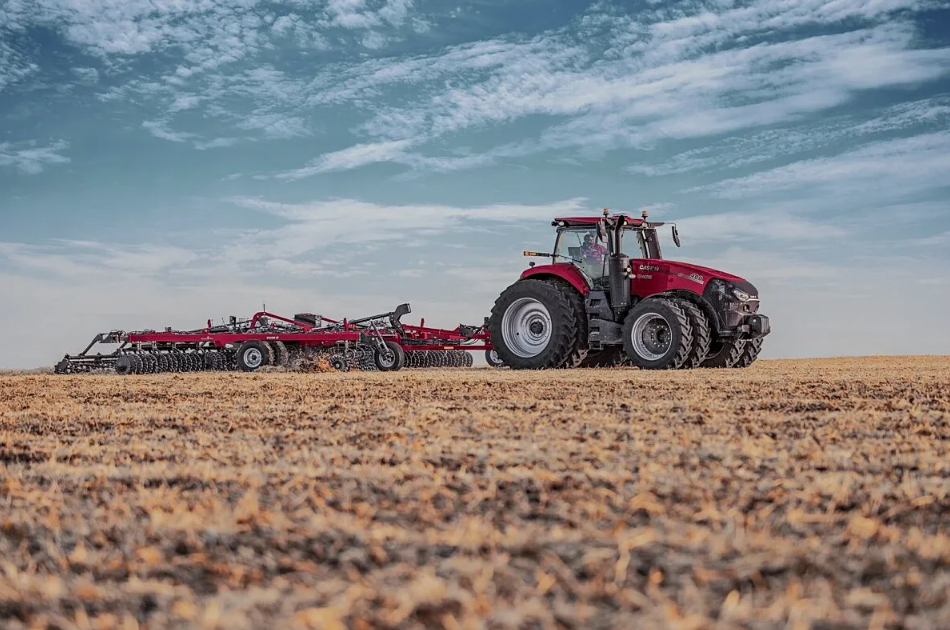
The American Farm Bureau Federation and CNH Industrial brands, Case IH and New Holland, signed a memorandum of understanding today that provides farmers and ranchers the right to repair their own farm equipment. The MOU follows a similar agreement AFBF entered into with John Deere earlier this year.
"Our members urged us to find a private sector-solution that gives them access to repair their own equipment and I'm pleased months of discussions have again paid off," said AFBF President Zippy Duvall. "Farmers and ranchers are more dependent on technology than ever before, so it's critical they have access to the tools to keep things running on the farm so the food supply chain keeps running, too."
"We understand the work our customers do is time-sensitive and critical for a safe and abundant food and fiber supply," said Sally Johnson, Vice President, New Holland Agriculture North America. "This agreement is the next step in delivering on New Holland's promise to better serve our customers, and in a way that helps them safely and effectively manage and maintain their equipment uptime."
"This agreement underscores CNH Industrial's commitment to empowering our customers by providing them with resources and tools that allow them to safely self-repair their equipment in a timely matter," said Kurt Coffey, Vice President, Case IH North America. "We know that agricultural equipment is one of the most significant investments for the American farmer. As a farmer, Farm Bureau member myself and brand leader, this MOU is a positive step forward in continuing to put the customer at the center of everything Case IH does."
The MOU sets a framework for farmers and independent repair facilities in all 50 U.S. states and Puerto Rico to access CNH Industrial brand manuals, tools, product guides and information to self-diagnose and self-repair machines, as well as support from CNH Industrial brands to directly purchase diagnostic tools and order products and parts.
The MOU respects intellectual property rights and recognizes the need to ensure safety controls and emission systems are not altered. CNH Industrial and AFBF will meet semiannually to review the agreement and address ongoing concerns.
The AFBF board of directors unanimously approved the MOU with CNH Industrial brands Case IH and New Holland.
Read the MOU here.

Bringing hundreds of 4-H'ers to the nation's capital each spring, National 4-H Conference is the flagship youth development opportunity of USDA, hosted by the National Institute of Food and Agriculture (NIFA). From April 14-19, 2023, the nationally recognized event is developing the next generation of leaders alongside more federal partners than ever before. Experience unparalleled discovery, learning, professional development, and networking with 4-H'ers from around the world. The event features Conference roundtable sessions, Youth Career Fair exhibitions, live "cool job" panels, community service, special events, assemblies and much more.
Register early and find more planning resources in our National 4-H Conference Delegate Handbook, including schedule overview, challenge questions, community service opportunities, chaperone roles and travel logistics.
Register today for 2023 National 4-H Conference to share your voice with federal agencies and congressional committees from April 14-19 at the Hyatt Regency Crystal City in Arlington, Virginia. Registration rates are $810 for youths (double occupancy room) and $1,300 for adults (single occupancy room). Registration closes at 8 p.m. ET on March 8.
Download the Registration Form ahead of time to collect needed information before registering your delegation online.
All registered adult chaperones must attend an online chaperone orientation on Wednesday, March 22, at 4 p.m. ET.
National 4-H Conference is administered by the USDA-NIFA in cooperation with S. Stewart and Associates, Inc. S. Stewart and Associates, Inc. handles registration, payment policies, hotel reservations, cancelation penalty deadlines, transportation, and other logistics. Please email Susan Stewart and Ged Matthews if you have questions.
The National 4-H Conference Guidebook for 1862, 1890 and 1994 Staff and Volunteers was developed by USDA-NIFA to help adult chaperones and volunteers understand their role in Conference. For questions contact National4-HConference@usda.gov.
If you need a reasonable accommodation to participate in this event, please contact Annie Ceccarini, National Program Leader, at annie.ceccarini@usda.gov no later than 14 days prior to the event. Language access services, such as interpretation or translation of vital information, will be provided free of charge to limited English proficient individuals upon request. If you need interpretation or translation services, please visit NIFA language services or contact Lois Tuttle, Equal Opportunity Specialist, at Lois.Tuttle@usda.gov or (443) 386-9488 no later than 14 days prior to the event.
The National 4-H Conference offers two programming formats – in-person and online – that empower attendees to learn, discover and connect. Make the most of your experience by understanding which of these formats will work best for you. In-person attendees will get the full experience of keynotes, assemblies, Youth Career Fair, meet ups, roundtables, presentations, community service, federal agency visits and tours in Washington, D.C. Virtual attendees will participate in roundtables, career panels and select assemblies. Email National4-HConference@usda.gov, subject line "Virtual National 4-H Conference," if interested in the virtual option.
We are pleased to offer financial assistance to 4-H youth and adult chaperones to maximize who otherwise would not be able to attend Conference. For more information, email Maurice Smith and Christopher Petty at National4-HConference@usda.gov, subject line "National 4-H Conference Scholarship Program".
The last day to apply for a scholarship is Friday, March 3 at 11:59 p.m. ET.
A key component of National 4-H Conference is amplifying youth voice. One way we do this is through a peer leadership model. The Youth Leadership Team (YLT) is made up of six high school students and two adult advisors. They are assembled to provide youth voice in conference planning and implementation.
Youth Leadership Team Adult Advisors
Morgan Beaty, University of Tennessee Extension
Manola Erby, Alcon State University Extension
The Collegiate Facilitator Team is made up of 20 college students and two adult advisors. This group is assembled to host and facilitate youth roundtable groups.
Collegiate Facilitator Adult Advisors
Earl McAlexander, Iowa State University Extension and Outreach
Brian Luckey, University of Nevada, Reno Extension
Lead Collegiate Facilitator
Cade Duran, Montana State University
Missed the National 4-H Conference Information Session in December 2022? Watch the recording below. The PowerPoint slides can be found on the National 4-H Conference Resources.
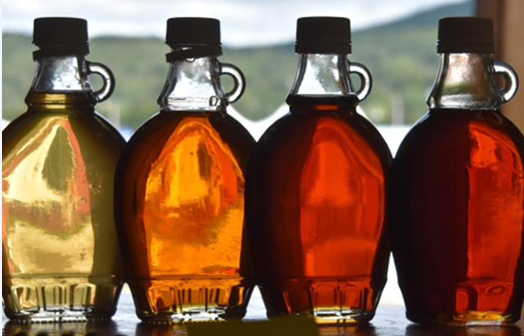
Vermont, New York and Maine are the top producing states, and produce about 80% of the maple syrup in the nation, with Vermont the overwhelming top producing state. In 2021, the three states produced more than 4 million gallons of maple syrup in 2021 valued at more than $100 million, according to USDA's National Agricultural Statistics Service.
USDA's National Institute of Food and Agriculture funds research and Extension projects in key maple-producing states through numerous grant programs, including Hatch, McIntire-Stennis and Smith-Lever capacity funding as well as the Agriculture and Food Research Initiative (AFRI), the nation's leading and largest competitive grants program for agricultural sciences. These grants are available to eligible colleges, universities, and other research organizations.
Jason Lilley, assistant Extension professor of sustainable agriculture and maple industry educator with University of Maine (UMaine) Cooperative Extension, said climate change is to blame for the early start of maple sugaring season. "If we were experiencing this in a single season, I would say that it's just a result of an abnormally warm winter. However, this has been a widely recognized trend among the maple industry over several seasons."
"In the Northeast, late winter and spring are the times of year that are experiencing the most dramatic climate change, so it's perhaps no surprise that tapping patterns are changing," said researcher Heidi Asbjornsen, professor of natural resources and the environment at the University of New Hampshire (UNH).
Mark Isselhardt, a maple specialist with the University of Vermont (UVM) Cooperative Extension, said 2023 has certainly been an odd year for weather with lots of warm weather in December, January and February in the lead up to the sugaring season. "January was the warmest on record in many places. And yet, we won't know the impact of all of it until the season wraps up -- whenever that happens."
Maple sap runs when there are freeze-thaw cycles, Asbjornsen explained. The best tapping window is the 6 to 8-week period where the number and magnitude of freeze-thaw cycles are the greatest. If this window occurs earlier in the winter-dormant period, maple sugar producers will tap trees earlier.
"This winter we've experienced particularly extreme fluctuations in weather with temperature differences of 30 to 40 degrees Fahrenheit from one day to the next not uncommon, which has likely caused earlier freeze-thaw events," she said.
In a typical year, the region might have one or two days in mid- or late January when temperatures are over 40 degrees Fahrenheit, Lilley said. In those scenarios, Extension staff encourage producers to wait as tapping too early for a small amount of sap can be detrimental to late season (often heavier) sap flow due to contamination and plugging of the tap holes.
"However, this season there were long-term forecasts with ideal sap flow conditions, so many producers got started in the first week of February," he said.
The fact that sap is flowing earlier in the season should not have a negative impact on the industry, Lilley said, as long as the region doesn't experience a very quick and abrupt spring warm up, which would shorten the back end of the season.
"Overall, technology has kept pace with this issue. For example, it's now possible to obtain higher yields per tap due to vacuum systems and more efficient boiling techniques, which has allowed maple syrup operations to stay profitable," Asbjornsen said.
Isselhardt agreed that syrup production is trending positive both in terms of total production due to expansion in the number of taps and in yield of gallons per tap. The later can be partially explained by the increase in adopting modern techniques including pumps capable of high vacuum and continuous service, improved sanitation practices, better understanding of how tapping practices impact yields and better materials.
"Whereas an operation of 2,000 to 3,000 taps would be considered good size in the past, we now see producers starting off with 10,000 to 20,000 taps. Given that labor to help with tapping is limited, it makes sense that we hear reports of people beginning to tap as early as January or in some cases December," he said.
NIFA AUTHOR
Lori Tyler Gula, Senior Public Affairs Specialist
If you live in the Northeast, you may have noticed that some maple syrup producers are tapping their trees already. And if you think it seems a bit early to be tapping trees this year, you are correct. In fact, maple syrup operations in the region are tapping several weeks earlier than usual, with the season this year starting much earlier than in past early years.
Vermont, New York and Maine are the top producing states, and produce about 80% of the maple syrup in the nation, with Vermont the overwhelming top producing state. In 2021, the three states produced more than 4 million gallons of maple syrup in 2021 valued at more than $100 million, according to USDA's National Agricultural Statistics Service.
USDA's National Institute of Food and Agriculture funds research and Extension projects in key maple-producing states through numerous grant programs, including Hatch, McIntire-Stennis and Smith-Lever capacity funding as well as the Agriculture and Food Research Initiative (AFRI), the nation's leading and largest competitive grants program for agricultural sciences. These grants are available to eligible colleges, universities, and other research organizations.
Jason Lilley, assistant Extension professor of sustainable agriculture and maple industry educator with University of Maine (UMaine) Cooperative Extension, said climate change is to blame for the early start of maple sugaring season. "If we were experiencing this in a single season, I would say that it's just a result of an abnormally warm winter. However, this has been a widely recognized trend among the maple industry over several seasons."
"In the Northeast, late winter and spring are the times of year that are experiencing the most dramatic climate change, so it's perhaps no surprise that tapping patterns are changing," said researcher Heidi Asbjornsen, professor of natural resources and the environment at the University of New Hampshire (UNH).
Mark Isselhardt, a maple specialist with the University of Vermont (UVM) Cooperative Extension, said 2023 has certainly been an odd year for weather with lots of warm weather in December, January and February in the lead up to the sugaring season. "January was the warmest on record in many places. And yet, we won't know the impact of all of it until the season wraps up -- whenever that happens."

Maple sap runs when there are freeze-thaw cycles, Asbjornsen explained. The best tapping window is the 6 to 8-week period where the number and magnitude of freeze-thaw cycles are the greatest. If this window occurs earlier in the winter-dormant period, maple sugar producers will tap trees earlier.
"This winter we've experienced particularly extreme fluctuations in weather with temperature differences of 30 to 40 degrees Fahrenheit from one day to the next not uncommon, which has likely caused earlier freeze-thaw events," she said.
In a typical year, the region might have one or two days in mid- or late January when temperatures are over 40 degrees Fahrenheit, Lilley said. In those scenarios, Extension staff encourage producers to wait as tapping too early for a small amount of sap can be detrimental to late season (often heavier) sap flow due to contamination and plugging of the tap holes.
"However, this season there were long-term forecasts with ideal sap flow conditions, so many producers got started in the first week of February," he said.

The fact that sap is flowing earlier in the season should not have a negative impact on the industry, Lilley said, as long as the region doesn't experience a very quick and abrupt spring warm up, which would shorten the back end of the season.
"Overall, technology has kept pace with this issue. For example, it's now possible to obtain higher yields per tap due to vacuum systems and more efficient boiling techniques, which has allowed maple syrup operations to stay profitable," Asbjornsen said.
Isselhardt agreed that syrup production is trending positive both in terms of total production due to expansion in the number of taps and in yield of gallons per tap. The later can be partially explained by the increase in adopting modern techniques including pumps capable of high vacuum and continuous service, improved sanitation practices, better understanding of how tapping practices impact yields and better materials.
"Whereas an operation of 2,000 to 3,000 taps would be considered good size in the past, we now see producers starting off with 10,000 to 20,000 taps. Given that labor to help with tapping is limited, it makes sense that we hear reports of people beginning to tap as early as January or in some cases December," he said.

However, NIFA-supported researchers and Extension staff are seeing other climate trends that could hamper maple syrup production including long periods of higher-than-average temperatures; more frequent extended droughts followed by extreme downpours; severe weather; high wind events; and soil saturation.
"These extreme conditions stress the trees during the growing season, when the trees are producing sugar through photosynthesis. A single stressor event can easily be withstood by the trees, as they have evolved with these events. But having multiple stressors per year over several years leads to a concern about groups of trees' long-term viability," Lilley said.
Another issue that may, over time, affect the health of sugar maple trees is the change in snowpack in the Northeast. When the ground is not protected by a deep snowpack due to warmer winter temperatures and/or changing precipitation patterns, this would allow for deeper frosts, Asbjornsen said.
"Deeper frosts can damage fine roots and reduce trees' ability to move water from the soil into the roots. However, more research is needed to better understand the impacts of changing snowpack on the maple industry," she said.
In addition to damaging sugar maple roots, Isselhardt said a reduced snowpack will have a negative effect on the next generation of sugar maples as it is the tree with perhaps the coldest germination temperature. Lack of snow also reduces moisture available to trees during spring.
And while not widespread, UMaine Extension staff also are receiving reports of sugarbush decline from producers. This includes producers reporting concerned about a few trees to one case of full sugarbush decline from one small producer. Sugarbush refers to a forest stand of maple trees.
"Maple trees are complex organisms. They have back-up systems to allow them to withstand poor years. With that in mind, there is not a good correlation between, for example, a drought in one season, and sap yields or sugar content the next. There are research projects being launched to investigate this connection between weather conditions and sap quality," Lilley said.
Invasive plants and animals also are impacting the region's forests. Isselhardt said some areas are seeing invasive plants establish themselves and create low shade, preventing maple seedling from establishing. Invasive earthworms that transform the forest floor by consuming the organic humus layer of partially decomposed leaves also are negatively impacting the maple's ability to become established.
Asbjornsen said forest tent caterpillars are another stressor affecting sugar maple health. When outbreaks occur, this causes defoliation reducing trees' ability to maintain photosynthesis and growth. If multiple outbreaks occur over consecutive years, this can have a detrimental effect on tree health.
And it's not just the maple trees that are under more stress due to the climate change-related impacts. With a less predictable start of the season, producers also are under more stress to make decisions on when to get started.
"Large producers need to start tapping several weeks in advance of the first run to get everything done. They cannot use the forecast to determine when to get started. Smaller scale producers often need to arrange time off from other jobs, which can be hard to manage with an unpredictable season launch date," Lilley said.
Producers who tap trees based on a "traditional" date will sometimes miss out on early sap flow events given the trends in earlier warming, Isselhardt said. This can lead to lower yields in years when the season ends early.
There is also risk associated with abnormal, high temperature events such as what was seen in 2012. "In 2012, we saw four to five days with temperatures in the 70s in March. This resulted in tap holes shutting down because of microbial growth in the tap hole and the trees natural wound response system. Warm temperatures also impact the sap quality because microbial growth in collection tanks t can lead to low quality and off-flavored product," he said.
Old tapholes and tapholes that shut down are an especially relevant problem for small producers relying on gravity to collect sap, Asbjornsen said.
In addition, sap quality can be affected by early bud swell of the trees. Under these conditions, the sugar structures and flavonoids in the sap change and produce off-flavored poor quality syrup, Lilley said. Mid-season warmups are often temporary, but with more warm mid-season days, sap quality is likely to decrease.
As a result, NIFA-funded maple researchers and Extension specialists are working on all aspects of these issues. There are project plans in the works to track weather date and sap quality.
"In Maine, we are collaborating with the Maine Forest Service, and maple producers to identify areas of tree decline, and to diagnose potential causes. We are also collaborating to educate and provide resources for maple business managers, and woodland owners on sustainable sugarbush management strategies to optimize the health of the woods, therefore doing as much as we can to decrease the stress on the trees," Lilley said.
In New Hampshire, Asbjornsen's NIFA-funded project, which includes collaborators Steve Roberge with UNH Cooperative Extension, Matt Vadeboncoeur with UNH's Earth Systems Research Center, and doctoral student David Moore, is investigating the potential to harvest sap and produce syrup from seven different non-maple species.
"By diversifying the syrup industry, this may allow producers to utilize other species that are better adapted to climate change, or to modify their sap collection and syrup production efforts depending on the weather patterns each year and which species are producing more sap," she said. "We anticipate having results from this research ready to share with producers within the next two years."
At the University of Vermont, the Extension Maple Program is engaged with sharing the latest information and best practices in three broad topic areas: sugarbush health, sustainable high yields of sap/syrup and syrup quality. For example, UVM developed 13-video series on "Sugarbush Management."
Extension staff also present the latest information on topics related to climate change and maple syrup at conferences and industry group meetings, respond directly to producer inquiries, write articles in maple industry trade publications, serves on industry committees, and help draft climate policy statements, such as for the Vermont Maple Sugar Makers Association.
The agricultural press is all aflutter over the earth-shattering news that the U.S. Department of Agriculture (USDA) is going to redefine the standards for affixing a voluntary "Product of the USA" or "Made in the USA" label on meat, eggs, and poultry in a newly proposed rule.
The stated purpose of the new voluntary standards is to put a stop to the current policy that allows imported beef, for example, to bear a "Product of the USA" label so long as the foreign beef was repackaged in the United States. In other words, the current standard allows a U.S. packer to import a big box of beef from Uruguay, to take the foreign beef out of the big box, put it in a smaller package, and then affix a "Product of the USA" label on the smaller package containing the Uruguayan beef.
The proposed rule would supposedly stop this deceptive practice by reserving the "Product of USA" and "Made in the USA" labels only for meat that is born, raised, slaughtered, and processed in the United States. We view this portion of the proposed rule as a good thing because it stops the deceptive practice of putting the USA label on foreign meat.
But in addition, the proposed rule would allow the term "United States" on a package of foreign beef so long as the label describes the processing steps completed in the United States. Here's the example provided by the USDA. The agency said it could approve a label that states, "Sliced and packaged in the United States using imported Pork." From here on I'm going to substitute the term "Pork" with "Beef."
Now wait a minute. The current deceptive standard allows a U.S. label if a foreign beef product is repackaged in the United States. And now the proposed rule will allow the term "United States" on a label provided it was sliced and packaged in the United States, and so long as the label also states the package was "using" imported beef.
Think about this: Do you "use" imported beef to slice and package? Or do you slice and package imported beef so you can "use" the term "United States" on the package? And why isn't the name of the foreign country required to be on the package as well?
I think this loophole was written into the proposed rule so foreign beef can continue to be labeled with the term "United States." It's my belief that the term "United States," however it's used on a package, will conjure up a sense of national pride in the minds of shoppers. And busy shoppers are likely to see the term "United States" and not read any further.
This is a phycological marketing tactic. If a shopper is predisposed to prefer a product produced in the United States, then just the term "United States" viewed anywhere on the package is likely to be enough to cause the shopper to select the product for purchase. To make matters worse, this sliced and packaged foreign beef will also be labeled with a USDA inspection stamp. So, shoppers will see both the term "United States" and the USDA inspection stamp.
So how do we correct this?
Well, the easiest thing to do is to tell Congress to reinstate mandatory country of origin labeling or MCOOL for beef by enacting the American Beef Labeling Act (S.52), and to tell the USDA to enforce the regulations implementing the Tariff Act of 1930 that requires imported product to retain its foreign label unless the product was substantially transformed in the United States.
Let's walk through this. When the mandatory country of origin labeling law included beef, which was the case until Congress repealed MCOOL for beef in 2015, imported beef was required to retain its foreign country of origin label through retail sale. This is why the mislabeling of foreign beef with a "Product of USA" label did not occur when MCOOL was in place.
And that's why the most effective way to correct the misuse of the USA label is for Congress to restore MCOOL for beef.
Further, because the regulations implementing the Tariff Act of 1930 require imported products to bear its foreign country of origin designation unless the product has been substantially transformed, the enforcement of this regulation would prevent the nondisclosure of the specific country from which the product was imported.
By now you've probably figured out that R-CALF USA does not like this proposed rule. We view it as a distraction from the real solution – the swift enactment of the American Beef Labeling Act and the proper enforcement of the Tariff Act of 1930. So why is Congress dragging its feet on MCOOL and allowing the USDA to carve out loopholes for the multinational beef packers at the expense of U.S. consumers? I'll let you answer that question.
RON's Dave Lanning has a pre-opening look at today's agricultural Markets.
Click the audio tab below for today's report.
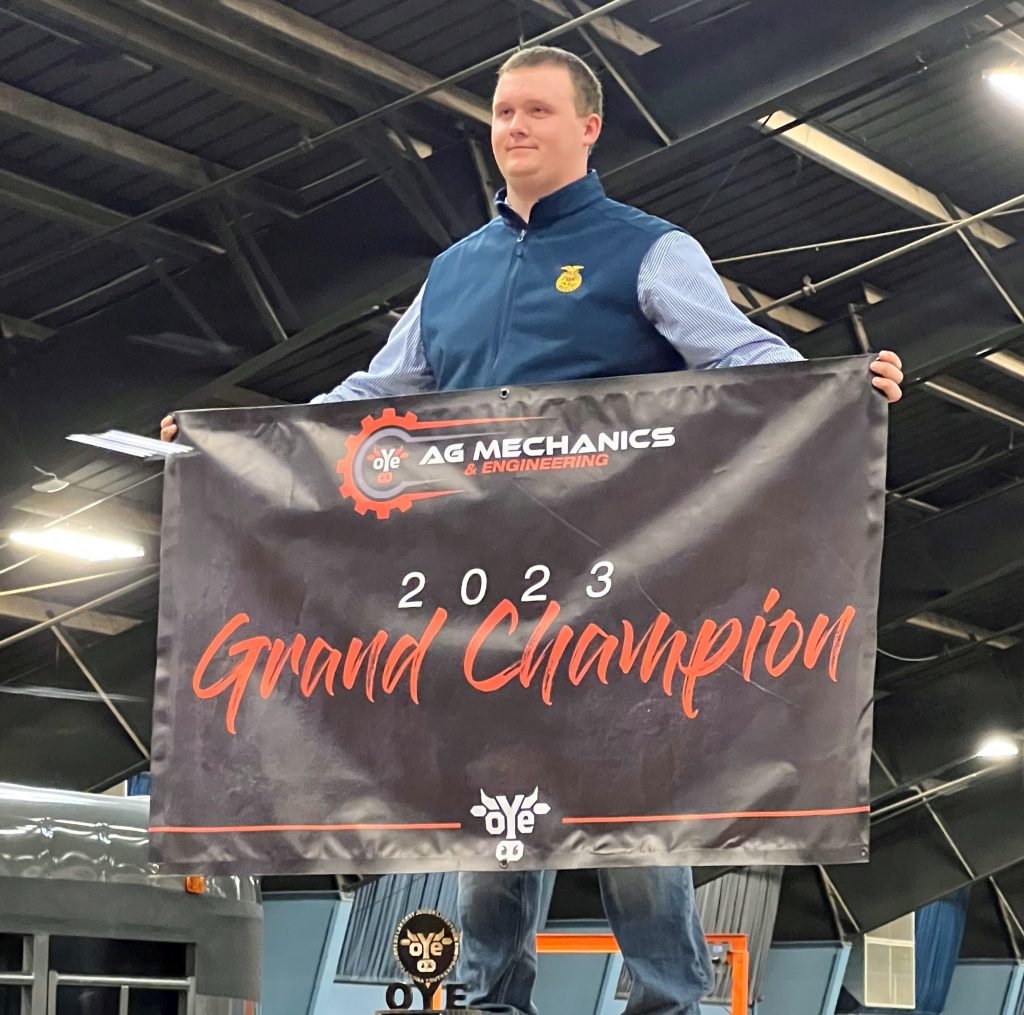
Brayden Rexford of Frontier FFA wins Grand Champion Honors at 4th Ag Mechanics Show at the opening of the 2023 OYE
Braden Rexford of Frontier claimed top honors at the 2023 Oklahoma Youth Expo Ag Mechanics contest and he is no stranger to hearing his name called at this contest as he has had one of the best projects of the show all four years.
Rexford's 51 foot trailer is the best project out of 205 that were exhibited in 2023- and just like the show- his projects have grown and gotten better. In 2020, he had the third best project in the first Ag Mechanics show- in 2021 and 2022 he had brought to Oklahoma City the Reserve Grand Champion exhibit and now in 2023 has the best of the show. He talked with the Oklahoma Farm Report's KC Sheperd after claiming the Grand Championship on Wednesday evening- and you can hear their conversation by clicking on the Listen Bar below.
The 205 projects at the 2023 show is a dramatic increase from the 122 projects shown last year and the exhibitors competed for $20,000 worth of prizes donated by supporters of the show.
Ahead of the show- Ron Hays talked with Show Superintendent Jerry Renshaw about the growing of this newest part of the OYE in March- click here for that earlier report.
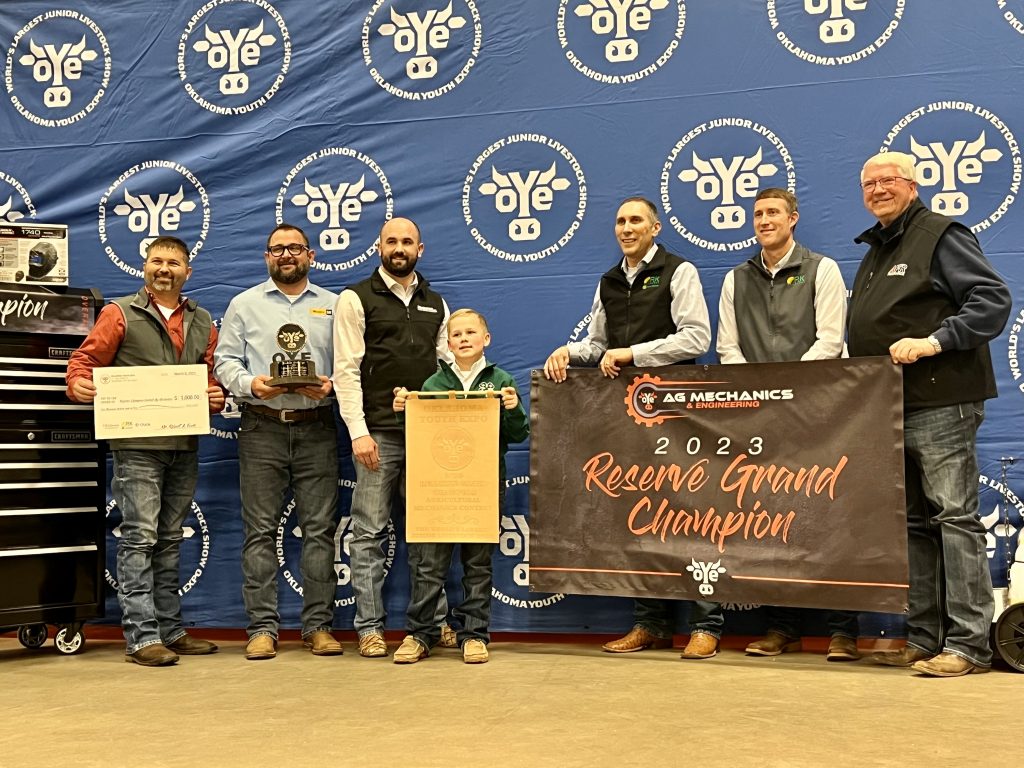
The Reserve Grand Champion of the show was shown by a team from Thackerville 4-H and the Bronze Medallion(Third overall) was a project shown by Comanche FFA.
Click here for the full schedule for the 2023 OYE. The Oklahoma Farm Report team will be snapping pictures from start to finish- and you can see them as we add them to our Flickr album for 2023- available here. If you want to look back to the 2022 OYE- click here for our pictures from last year's event.
Our coverage of the 2023 Oklahoma Youth Expo is sponsored by Hilliary Communications- who deliver the latest cutting-edge communications services supporting tens of thousands of customers across 22 counties throughout Oklahoma, Texas and Iowa. The company offers internet, voice and HilliaryTV. Hilliary Communications continuously researches the marketplace for innovations and strives to improve underserved areas, offering services that exceed customer expectations. Click here to learn more about Hilliary Communications.
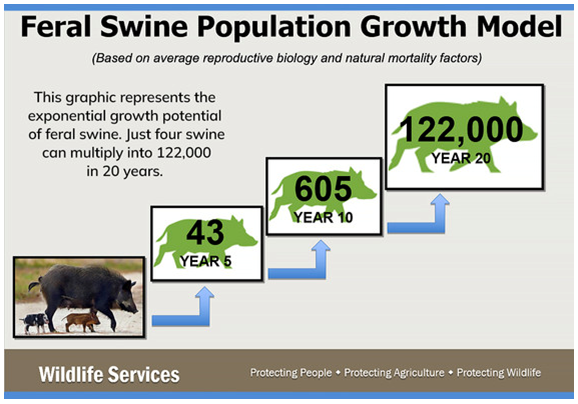
During a regular meeting March 6, the Oklahoma Wildlife Conservation Commission received an update on federal and state efforts to control feral swine across the state.
Scott Alls, Oklahoma state director of Wildlife Services for the U.S. Department of Agriculture's (USDA) Animal and Plant Health Inspection Service (APHIS), told Commissioners that any thought of eradicating feral swine in Oklahoma is probably unrealistic.
A pilot project to remove feral swine using Farm Bill funding started in 2019 in Greer, Harmon, Jackson, Tillman, and Kay counties. Osage, Pawnee, Roger Mills, and Beckham counties have been added to the project area. Alls said APHIS uses five helicopters in aerial shooting and has about 100 remotely activated traps being used on about 1.2 million acres under agreement.
To facilitate the pilot project's research, the Oklahoma Department of Wildlife Conservation closed hog shooting year-round on Hackberry Flat, Kaw, Sandy Sanders and Waurika wildlife management areas.
Since 2019, the project has removed about 11,000 feral swine, averting an estimated $4.3 million in agricultural damage. Alls said the prime obstacle in swine removal has been many landowners refusing to participate, as they are using feral hogs to sell hunting leases.
Alls said this pilot project along with other statewide efforts to remove feral swine produce much greater benefits than what could be gained from hunting.
Also, Commissioners recognized ODWC employees Kristen Gillman and Sarah Southerland as they were presented awards from Inger Guiffrida of The Wildlife Society's Oklahoma Chapter. Gillman, lands and minerals coordinator, received the Oklahoma Award, the organization's highest honor for her two decades of work in wildlife conservation. Southerland, social media coordinator, received the Publication and Creativity Award for her efforts to promote awareness and appreciation for native fish.
In other business:
The Oklahoma Wildlife Conservation Commission is the eight-member governing board of the Oklahoma Department of Wildlife Conservation. The Commission establishes state hunting and fishing regulations, sets policy for the Wildlife Department and indirectly oversees all state fish and wildlife conservation activities. Commission members are appointed by the governor and confirmed by the Oklahoma Senate.
The next scheduled Commission meeting is set for April 3, 2023. To view a video recording of the March. 6 meeting, go to the Outdoor Oklahoma YouTube Channel at https://www.youtube.com/live/apVY0zyIDPs?feature=share

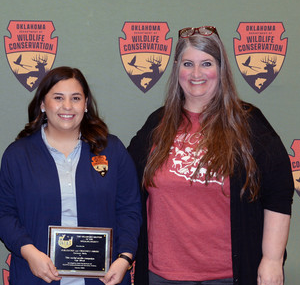

Senate Bill 910 by Sen. Blake "Cowboy" Stephens was unanimously approved by the Senate Tuesday. SB 910 authorizes the Oklahoma Wildlife Conservation Commission to declare an open season to hunt and harvest velvet bucks in Oklahoma.
"Oklahoma's tourism industry would greatly benefit from introducing a velvet buck season as only a few states offer this season," Stephens said. "Hunters from across the country will be looking to travel to our state to take part in the first season and many thereafter."
The velvet buck season would take place from the Saturday morning prior to the last weekend of August to the Sunday evening of the last weekend of August.
"I can remember the first deer I harvested, and passing down that tradition to my children," Stephens said. "With this legislation, I hope even more fellow Oklahomans can make memories and share these traditions with their own families and be a part of history when our state hosts its first velvet buck season."
SB 910 can be considered next in the House of Representatives, where Rep. Ty Burns, R-Pawnee, is the principal House author.
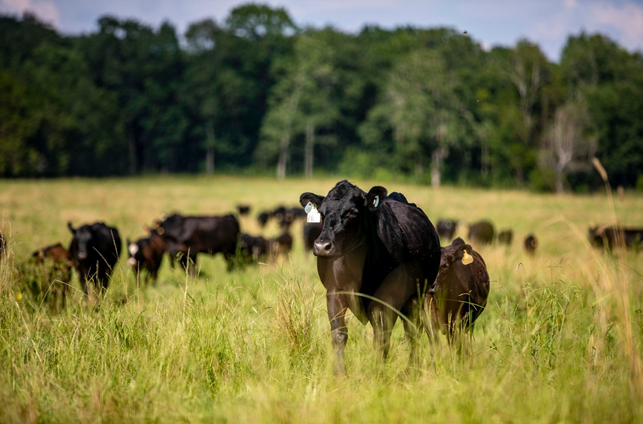
Youth using Angus genetics in commercial operations can apply until May 1.
The Angus Foundation offers a variety of scholarship opportunities, including to youth beyond the seedstock industry. Applications are open for the Foundation's Commercial Cattlemen Scholarship, which awards $1,500 to four outstanding youth in the beef industry. This scholarship is unique from others offered by the Foundation as it aims to support students specifically from the commercial sector of the industry.
"We're proud to offer this scholarship opportunity to students from commercial cattle backgrounds," said Jaclyn Boester, Angus Foundation executive director. "We recognize the importance of supporting young people using Angus genetics and want to help them succeed in our industry."
Young men and women whose families use Angus genetics in their commercial operations are eligible to receive the scholarship. Students should be pursuing an undergraduate degree or vocational program at an accredited institution of higher education. Selection emphasis is placed on the applicant's knowledge of the cattle industry and their perspective of the Angus breed.
"I'm grateful for the Commercial Cattlemen Scholarship awarded by the Angus Foundation," said Tucker Huseman, 2022 scholarship recipient. "I come from a commercial ranching background and scholarships like this allow me to pursue my passion for beef cattle production through my education."
The applicants or their parents/guardians must have transferred or been transferred an Angus registration paper in the last 36 months (on or after May 1, 2020) and must be considered commercial and not seedstock in their operation. The scholarship applies to any field of study. A separate application, from the general Foundation application, is required for the Commercial Cattlemen Scholarship. The application can be found on the Angus Foundation website. Applicants having received or applied for Angus Foundation undergraduate scholarships, using the standard general application this year or in past years, will not be considered for this scholarship.
For more information on the Commercial Cattlemen Scholarship, visit AngusFoundation.org. Since 1998, the Angus Foundation has awarded more than $4.2 million in undergraduate and graduate scholarships.
— Written by Peyton Schmitt, Angus Communications
From NMPF President and CEO Jim Mulhern:
"The National Milk Producers Federation applauds the bipartisan members of the House of Representatives who today re-introduced the DAIRY PRIDE Act, which adds momentum to legislation that saw Senate re-introduction last week and needs to pass Congress this year.
"With proposed FDA guidance that acknowledges the problem of consumer confusion over the nutritional content of plant-based beverages, but doesn't go far enough to solve the problem by enforcing its own standards of identity and limiting dairy terms used in food labeling to dairy products, DAIRY PRIDE is necessary for FDA to fulfill its own responsibilities.
"To eliminate consumer confusion over their nutritional content, plant-based drinks or beverages shouldn't be allowed to use dairy terms in their labeling. That's common-sense, and DAIRY PRIDE is a common-sense solution. We thank the House sponsors of the legislation – Reps. John Joyce, R-PA; Ann Kuster, D-NH; Mike Simpson, R-ID; Joe Courtney, D-CT; Derrick Van Orden, R-WI; and Angie Craig, D-MN – for being champions for consumers in this important nutrition and health issue.
The Defending Against Imitations and Replacements of Yogurt, Milk, and Cheese To Promote Regular Intake of Dairy Everyday Act" aka DAIRY PRIDE, requires FDA to enforce its standards of identity and would supersede the inadequate solution it offered last week, in which plant-based beverages could call themselves "milk" as long as they clearly state their nutritional differences with real dairy. FDA is accepting comments on its draft guidance until April 24. DAIRY PRIDE was introduced in the Senate last week. Lead sponsors in that chamber were: Sens. Tammy Baldwin, D-WI; Jim Risch, R-ID; Peter Welch, D-VT and Susan Collins, R-ME.
Farm Credit Associations of Oklahoma is pleased to award five junior and senior students enrolled in Oklahoma State University's (OSU) Ferguson College of Agriculture with $1,000 scholarships. The 2023 recipients of the Farm Credit Associations of Oklahoma Scholarship are: Victoria Gerken, Kingfisher, Okla.; Caden Church, Sentinel, Okla.;
Braden Heisler, Waukomis; Kallie Clifton, Soper, Okla.; and Tony (Anthony) Caruso, Benicia, CA.
"On behalf of the Farm Credit Associations of Oklahoma, congratulations to these five outstanding students. When it comes to supporting young people involved in agriculture, Farm Credit is all in," said Chancey Hanson, Marketing Specialist for Farm Credit of Western Oklahoma. "The students were selected based upon their application and a short essay. We are so happy to play a small role in futures of these bright and impressive young adults."
Victoria Gerken
Victoria Gerken grew up in Kingfisher, Okla. on her family's farm. She is a senior at OSU pursuing a degree in Animal Science with an emphasis in Biotechnology and a minor in Microbiology. Gerken is currently working as an Undergraduate Teaching Assistant for two classes along with a job as a Pharmacy Technician. Gerken stays involved in campus activities such as: OSU Homecoming Steering Committee; Ferguson College of Agriculture Ambassador, and Ferguson College of Agriculture Student Council Representative. She was selected as an OSU PLC Member and Scholarship Recipient and was named on the OSU Dean's Honor Roll.
Caden Church
Caden Church, a senior at OSU, is a native of Sentinel, Okla. He is pursuing a degree in Animal Science with an emphasis on livestock production and merchandising. In addition to running a ASSOCIATIONS OF OKLAHOMA small herd of cows and does and operating his own business – Church Livestock -- he is currently a member of the OSU Livestock Judging Team and judged at Redlands before transferring to OSU. In addition to competing collegiately, he has had opportunities to judge 12 livestock shows in multiple states. Church was selected as a PLC Scholar, and was selected as Redlands Ag Student of the Year in 2022.
Braden Heisler
Waukomis native, Braden Heisler is a junior at OSU pursuing a degree in Agribusiness. Heisler is a member of the FarmHouse Fraternity, the OSU Student Government Association, OSU Student Foundation, Greek Wide Student Ministry and has earned a spot on the President's Leadership Council. In addition, Heisler served at the Northwest Area Vice President for the Oklahoma FFA Association and was an OSU Freshman Research Scholar.
Kallie Clifton
Kallie Clifton hails from Soper, Okla., and is a senior at OSU working toward a degree in Agribusiness. She completed her Associate's Degree at Eastern Oklahoma State College. Clifton has roots on her family's farm, but is also involved in campus activities such as OSU Aggie X, OSU Ranch Horse Team, Oklahoma Collegiate Farm Bureau and 4-H Key Club. Clifton was recognized as an OSU Senior of Significance, inducted into the Phi Kappa Phi Honor Society and was selected for the Ferguson College of Agriculture – Outstanding Transfer Student.
Tony (Anthony) Caruso
A native of Benicia, California, Tony Caruso is pursuing a degree in Agribusiness and expecting to graduate this coming May. Tony is currently an undergraduate teaching assistant and worked as a Rural Scholar for OSU's Rural Renewal Initiative. Caruso was recognized as Transfer Student of Excellence and is involved in: Aggie X; Agricultural Economic Academic Quiz Bowl Team; Agricultural Communicators of Tomorrow; International Leadership Association
and several others.
The Farm Credit associations in Oklahoma serve every part of agriculture, from small to large operations and everything in between. Through good times and bad, Farm Credit associations are part of the rural communities we serve. Our cooperatives are governed by Boards of Directors who understand agriculture because they are farmers and ranchers, too. As part of our mission to support rural communities, we actively support agricultural organizations and
youth programs with donations of time and money.
Contact your local lending office to learn how they can help you finance your agricultural operation or rural lifestyle. Find a complete listing of Farm Credit offices in Oklahoma at www.okfarmcredit.com.
| From a cash price perspective, both cattle and beef markets continue on a relatively bullish run the past few weeks. The fed steer price has increased $9.37/cwt. since the week of January 23, yet the pace of that increase has been doggedly slow. That's potentially a better pace for cattle feeders versus large upward jumps followed by downward corrections. At $265/cwt., dressed carcass prices were more attractive than the live steer price at $165/cwt. last week. This is due to muddy pen conditions pulling dressing percentages lower than normal. The $265/cwt. market average is equivalent to a $168/cwt. live market at a 63% dressing percentage. |
 |
| Packers have rated the pace of fed cattle slaughter quite well for a number of weeks now as 2023 weekly head counts have pulled well under a year ago. We've noted the pullback in Saturday slaughter schedules, which have shrunk to average just 7,000 head over the past three Saturdays. This compares to a 35,000 head Saturday average for the same weeks last year. Last week's $1.00 increase in the fed cattle price didn't hurt packer margins as the comprehensive price was up $7.05/cwt. on the week prior. The Certified Angus Beef (CAB) cutout was up $3.80/cwt., Choice was up $4.98/cwt. and Select was up $6.55/cwt. Strength in Select and Choice pulled the quality price spreads a bit tighter. Narrowing of the Choice/Select price spread has been rapid since the beginning of the year, but last week's average of $15.13/cwt. remains record-wide for that week of the year. Similarly, the CAB cutout spread over Choice is historically wide with last week's $16.28/cwt. value $3.32/cwt. higher than a year ago. The Prime cutout premium to Choice is $1.70/cwt. higher than a year ago at $36.24/cwt., greatly reduced from the October peak of $92.21/cwt. |
| Quality Holds Up Under Lighter Carcass Weights |
| Fed cattle carcass weights have tracked a decidedly lower course this winter with the steer/heifer mix 18 lb. lighter since January 1. Winter weather has left a lasting mark on feedyard performance this season as feed efficiency has slipped away and industry production pounds followed lower. That reality easily leads to a discussion about the weather impacts on carcass quality grades and CAB carcass certification rates. The logical initial perception might be that prolonged cold weather events and muddy, icy feedlot pen conditions would result in decreased marbling deposition. From several recent years of observation, extended periods of winter weather extremes suggest that the industry quality grade mix and associated marbling scores are not harmed during these periods. In fact, Choice and Prime quality grades, along with CAB acceptance rates, are often improved above normal seasonal expectations during significant cold weather events. That's not especially intuitive when set alongside the more obvious detriment to weight gain and efficiency. |
 |
| On the other hand, an analysis of carcass weight trends shows that heavier carcasses, on average, tend to result in higher marbling scores. A relatively recent study of nearly half a million head of fed cattle shows that the top one-third of carcass quality groups were 14 lb. heavier than the average. Quality grade and CAB acceptance rates improve, on average, at higher pen average carcass weights. This is a counterpoint to the more generic observation about winter weather impacts described above. |
 |
| Several feedyard managers have stated that recently harvested fed cattle are showing carcass results in-line with expectations. The only difference is the lighter finished weights and disappearance of 30 days of performance, or a similar sentiment anyway. That's painful on the bottom line but at least there's a silver lining on the grid payment sheet. Quality spreads have been healthy with Prime premiums exceptionally high along with very good values on CAB and Choice carcasses as well. The latest data shows the national percent Choice grade at a record-high of 75% of the total for the week of February 20. Prime at 9.6% of the mix is fractionally lower than the same week last year where 10.1% was achieved. The CAB acceptance rate for brand-eligible cattle has been pressing higher, touching 40%, equal to the 2021 record for that week. While smaller slaughter levels are testing the customer base and pushing cutout values higher, the proportion of high-quality carcasses in the mix is providing a short-term assist. We'll see the seasonal peak in carcass quality during March if the historical trend holds true. |
Every successful dairy farmer is familiar with the concept of Return on Investment (ROI), which is central to making smart business decisions. The most tangible ROI measure is financial – but what generates healthy returns is much more complex than that, ranging from smart spending choices to sweat equity to the simple determination to get things done.
One clear ROI for our members early this year was the U.S. Department of Agriculture's (USDA) decision to allocate an additional $100 million in payments under the Pandemic Market Volatility Assistance Program to farmers for production up to 9 million pounds of milk during the six-month stretch of the COVID-19 pandemic when price imbalances in milk markets were at their worst. While still not everything we sought (and are still seeking), that $100 million – on top of the $250 million already gained for the first 5 million pounds of milk — happened because we didn't give up fighting for our members when a flaw in Class I pricing became apparent.
Along with rectifying that imbalance, this year we're tackling the Federal Milk Marketing Order (FMMO) system itself, modernizing it in ways that will hold benefits for dairy farmers of all sizes, in all regions, among all business models. We're also seeking regulatory clarity on everything from water rules to plant-based beverages. We do all this with a staff that's lean, but mighty – and a membership that's forward-thinking, influential, and willing to have the tough conversations necessary to forge the consensus this industry needs.
This year's Activities and Accomplishments highlights our work across the federal policy spectrum. It also highlights how decisions in Washington connect with choices made from U.S. dairy farms to global milk markets, through our work with the National Dairy Farmers Assuring Responsible Management (FARM) Program, the U.S. Dairy Export Council (USDEC) and other partners. We gain policy wins – and stave off negative outcomes for our members – because you invest in us. And, in keeping with that trust, we invest our time, our passion, our skills and our energy to get you results. Thank you for that investment. I hope you benefit from reading about some of the returns it generated in 2022, and how those accomplishments are setting the stage for dairy farmers to gain greater benefits in the years ahead.
To read the report, click here.
USDA released its latest Crop Production and World Agricultural Supply and Demand Estimates (WASDE) reports on Wednesday, March 8.
As expected by the grain trade, USDA on Wednesday lowered corn export demand 75 million bushels (mb) and also bumped up ending stocks for the crop by 75 mb as well.
USDA trimmed soybean ending stocks to 210 mb, 15 mb from last month's estimate. USDA lowered its crush estimate by 10 mb but raised its export estimate 25 mb.
USDA on Wednesday released its March Crop Production and World Agricultural Supply and Demand Estimates (WASDE) reports.
WHEAT:
USDA estimates for U.S. 2022-23 wheat ending stocks were left unchanged at 568 mb in March. USDA estimates wheat exports also are unchanged at 775 mb in March.
The average U.S. farmgate price for wheat was pegged at $9.00 in the March report.
USDA estimates world wheat production at 788.94 mmt, an increase from 783.8 mmt in February.
USDA estimates wheat production in Russia at 92.0 mmt, unchanged from February estimates.
Wheat exports from Russia were estimated at 43.5 mmt, also unchanged from February. USDA estimates Ukraine exports at 13.5 mmt. Australian wheat exports were estimated at 28.5 mmt, an increase from 28.0 last month.
USDA's estimates world ending wheat stocks at 267.2 mmt in March, down from 269.34 mmt in February.
SOYBEANS:
USDA trimmed soybean ending stocks to 210 mb. That's 15 mb from last month's estimate but within the range of pre-report expectations. USDA left supply numbers unchanged, but lowered the crush estimate by 10 mb and raised its export estimate 25 mb. It also increased the residual use category by 1 mb. The national average farm gate price was $14.30, unchanged from last month.
Globally, USDA lowered its 2022-23 ending stocks estimate by 2 mmt to 100.01 million metric tons, within the range of pre-report expectations. Brazilian production was left unchanged at 153 mmt, while slashing Argentina's production estimate 8 mmt to 33 mmt. USDA said it raised export estimate for Brazil and the U.S. to accommodate the shortfall in Argentina.
LIVESTOCK:
Wednesday's WASDE report shared exciting news for the cattle and beef markets. Production for 2023 was increased by 170 million pounds, which largely stems from more aggressive beef cow slaughter than originally assumed. The first three quarters of 2023 saw production increases to contribute to the 170 million additional pounds, but the fourth quarter remained unchanged. Quarterly price projections showed a bullish outlook for steer prices as all four quarters of 2023 saw a price increase. Compared to last month, the first quarter was raised by $3.00 to average $161.00, the second quarter was raised by $4.00 to average $163.00, the third quarter was raised by $2.00 to average $159.00 and the fourth quarter was raised by $2.00 to average $164.00. Beef imports remained unchanged at 3,425 million pounds, and exports remained unchanged at 3,090 million pounds.
Wednesday's WASDE report shared disappointing news for the hog and pork markets. Pork production was lowered from a month ago as higher than previously expected slaughter speeds in the first quarter were more than offset by lighter first half of 2023 carcass weights. Pork production in 2023 fell by 25 million pounds. In terms of quarterly price projections, the market received mixed news as both the first and second quarter of 2023 saw price reductions, but the third and fourth quarter of the year remained unchanged. Barrows and gilts in the first quarter were reduced by $2.00 to average $56.00, prices in the second quarter were reduced by a $1.00 to average $70.00, and both the third and fourth quarter remained unchanged at $73.00 and $64.00. Pork imports remained unchanged at 1,005 million pounds and exports also remained unchanged at 6,350 million pounds.
As expected by the grain trade, USDA on Wednesday lowered corn export demand 75 million bushels (mb) and also bumped up ending stocks for the crop by 75 mb as well.
USDA trimmed soybean ending stocks to 210 mb, 15 mb from last month's estimate. USDA lowered its crush estimate by 10 mb but raised its export estimate 25 mb.
USDA on Wednesday released its March Crop Production and World Agricultural Supply and Demand Estimates (WASDE) reports.
You can also access the full reports here:
-- Crop Production: https://www.nass.usda.gov/...
-- World Agricultural Supply and Demand Estimates (WASDE): http://www.usda.gov/...
WHEAT
USDA estimates for U.S. 2022-23 wheat ending stocks were left unchanged at 568 mb in March. USDA estimates wheat exports also are unchanged at 775 mb in March.
The average U.S. farmgate price for wheat was pegged at $9.00 in the March report.
USDA estimates world wheat production at 788.94 mmt, an increase from 783.8 mmt in February.
USDA estimates wheat production in Russia at 92.0 mmt, unchanged from February estimates.
Wheat exports from Russia were estimated at 43.5 mmt, also unchanged from February. USDA estimates Ukraine exports at 13.5 mmt. Australian wheat exports were estimated at 28.5 mmt, an increase from 28.0 last month.
USDA's estimates world ending wheat stocks at 267.2 mmt in March, down from 269.34 mmt in February.
CORN
USDA made one significant change to corn supply and demand in the 2022-23 corn crop.
Export demand was pegged 1.85 billion bushels (bb), a 75 mb decline. That was actually more than the pre-report expectations.
All of those adjustments put corn ending stocks at 1.342 bb -- still the second lowest ending stocks in a corn crop over the last nine years.
Production for the corn crop remained at 13.730 bb, the lowest in three years, and yield remained unchanged at 173.3 bushels per acre.
Total supply was held at 15.157 bb.
Feed and Residual use was pegged 5.275 bb. Ethanol use was held pat at 5.25 bb. Total domestic use came in at 11.965 bb.
Total use came in at 13.815 bb, down the 75 mb from exports.
The farmgate price was pegged at $6.60 per bushel, down 10 cents from last month.
Globally, USDA's 2022-23 beginning stocks for corn were pegged at 305.69 million metric tons (mmt), down .59 mmt. Total production was estimated at 1,147.52, down 3.84 mmt. Global ending stocks for 2022-23 were 296.46 mmt, down 1.18 mmt.
Brazil's production held pat at 125 mmt for 2022-23 and exports were pegged at 50 mmt. Argentina was pegged at 40 mmt, down 7 mmt and exports were dropped 7 mmt as well to 28 mmt as drought continues to take its toll there. Ukraine's production held firm at 27 mmt and Ukraine's exports were increased to 23.5 mmt.
SOYBEANS
USDA trimmed soybean ending stocks to 210 mb. That's 15 mb from last month's estimate but within the range of pre-report expectations. USDA left supply numbers unchanged, but lowered the crush estimate by 10 mb and raised its export estimate 25 mb. It also increased the residual use category by 1 mb. The national average farm gate price was $14.30, unchanged from last month.
Globally, USDA lowered its 2022-23 ending stocks estimate by 2 mmt to 100.01 million metric tons, within the range of pre-report expectations. Brazilian production was left unchanged at 153 mmt, while slashing Argentina's production estimate 8 mmt to 33 mmt. USDA said it raised export estimate for Brazil and the U.S. to accommodate the shortfall in Argentina.
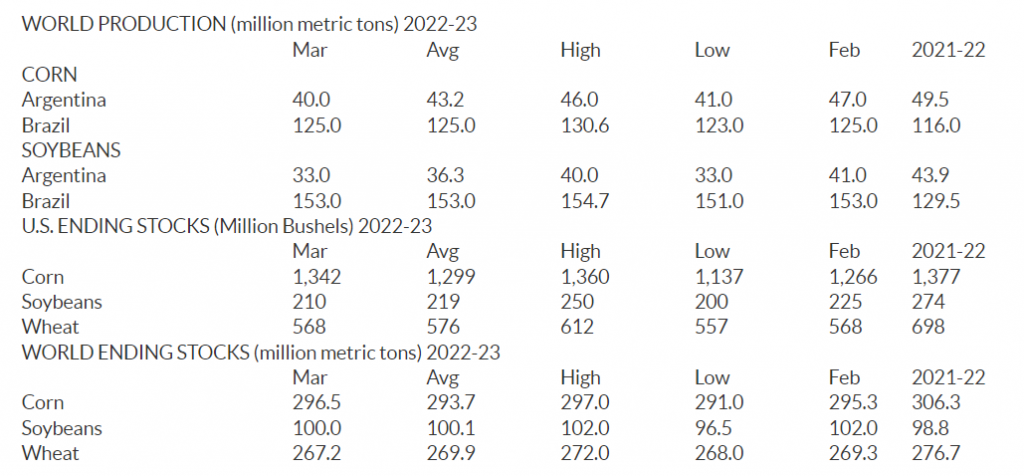
LIVESTOCK
Wednesday's WASDE report shared exciting news for the cattle and beef markets. Production for 2023 was increased by 170 million pounds, which largely stems from more aggressive beef cow slaughter than originally assumed. The first three quarters of 2023 saw production increases to contribute to the 170 million additional pounds, but the fourth quarter remained unchanged. Quarterly price projections showed a bullish outlook for steer prices as all four quarters of 2023 saw a price increase. Compared to last month, the first quarter was raised by $3.00 to average $161.00, the second quarter was raised by $4.00 to average $163.00, the third quarter was raised by $2.00 to average $159.00 and the fourth quarter was raised by $2.00 to average $164.00. Beef imports remained unchanged at 3,425 million pounds, and exports remained unchanged at 3,090 million pounds.
Wednesday's WASDE report shared disappointing news for the hog and pork markets. Pork production was lowered from a month ago as higher than previously expected slaughter speeds in the first quarter were more than offset by lighter first half of 2023 carcass weights. Pork production in 2023 fell by 25 million pounds. In terms of quarterly price projections, the market received mixed news as both the first and second quarter of 2023 saw price reductions, but the third and fourth quarter of the year remained unchanged. Barrows and gilts in the first quarter were reduced by $2.00 to average $56.00, prices in the second quarter were reduced by a $1.00 to average $70.00, and both the third and fourth quarter remained unchanged at $73.00 and $64.00. Pork imports remained unchanged at 1,005 million pounds and exports also remained unchanged at 6,350 million pounds.
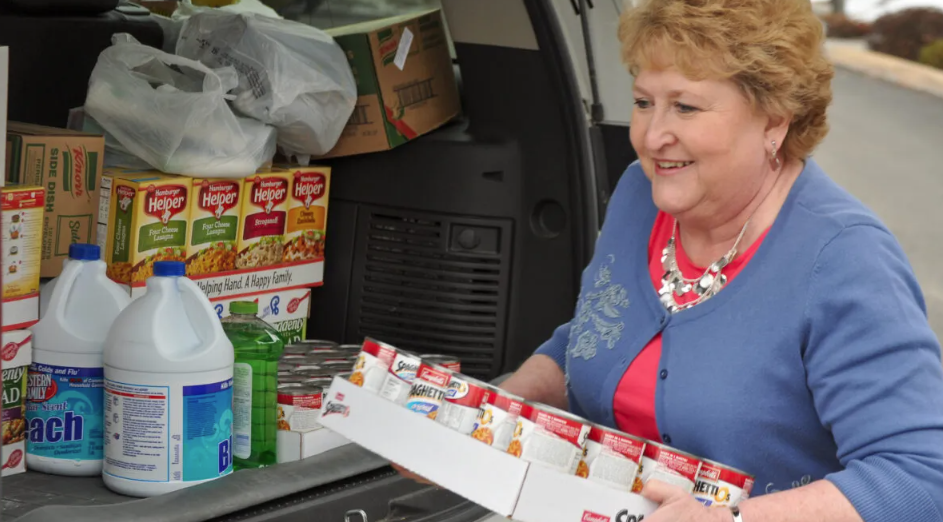
The spirit of farm communities has long embodied working together and giving back. Farm Bureau farmer and rancher members continued that tradition in 2022, raising nearly $78,000 for local Ronald McDonald House Charities Chapters. RMHC serves millions of children and their families every year, helping to provide access to healthcare for families with children who are sick.
The Farm Bureau donation drive to support select RMHC Chapters was spearheaded by members of the organization's Women's Leadership Program, which provides women with opportunities for growth and development to sharpen their skills and strengthen their ability to inspire change.
"The compassion and caring shown by Farm Bureau members across the country in raising funds for select RMHC Chapters provides an important connection point with members of the non-farming public," said Isabella Chism, an Indiana row crop farmer and chair of the American Farm Bureau Women's Leadership Committee. "Since the beginning of 2019, we're proud to have donated more than $550,000 to local RMHC Chapters across the U.S."
Farm Bureau members contribute to RMHC in a myriad of ways. In addition to funds, this includes volunteer hours at local RMHC Chapters and donating food, toiletries and other items.
About American Farm Bureau Federation
The American Farm Bureau Federation is the Voice of Agriculture. We are farm and ranch families working together to build a sustainable future of safe and abundant food, fiber and renewable fuel for our nation and the world.
About Ronald McDonald House Charities (RMHC)
Ronald McDonald House Charities® (RMHC®), is a non-profit, 501(c)(3) corporation that creates, finds and supports programs that directly improve the health and well-being of children and their families. Through a global network of over 260 Chapters in more than 60 countries and regions, RMHC enables, facilitates and supports family-centered care through three core programs: the Ronald McDonald House®, the Ronald McDonald Family Room® and the Ronald McDonald Care Mobile®. RMHC programs help families with ill or injured children stay together and near leading hospitals and health care services worldwide, ensuring they have access to the medical care their child needs while fully supported and actively involved in their child's care. For more information, visit RMHC.org.

Today, on the inaugural National Biobased Products Day, the Agriculture Energy Coalition released a letter to Senate and House Agriculture Committee leaders signed by a diverse range of nearly 300 industry groups and companies. The letter urges Congress to preserve funding for farm bill energy title programs provided in last year's Inflation Reduction Act. It also asks Congress to codify in farm bill language the improvements and policy changes to existing USDA Rural Development programs that were adopted in the IRA act.
"USDA's energy, bioeconomy and RD programs enable producers and businesses alike to make essential investments in energy and rural resilience, saving consumers and producers on energy costs," the groups write. "The 2022 funding for USDA's unique energy programs will help rural communities get ahead diversifying energy resources while improving energy security, the environment and public health."
The letter is available for download.
"At a crucial time when energy costs are driving inflation and impacting the pocketbooks of all Americans, Congress should maintain bipartisan support for rural businesses and communities to make cleaner energy more accessible and affordable," said Lloyd Ritter, Ag Energy Coalition Executive Director. "The incentives and improvements to energy programs passed in the Inflation Reduction Act last year should be codified to further help residents in rural and disadvantaged communities breathe cleaner air and access affordable, clean energy."
"The Inflation Reduction Act is the most significant investment in America's biofuels industry since the RFS was passed in 2007," stated Renewable Fuels Association President & CEO Geoff Cooper. "These IRA programs and financial commitments are vital to our industry and partners and their goals in achieving a net zero production of ethanol and other sustainable renewable fuels in the near future."
Adam Warthesen, Director of Government & Industry Affairs with CROPP Cooperative, added, "Now is the time and opportunity to make renewable energy more accessible for farms and business in rural communities. The Rural Energy for America Program, for instance, is sound public policy that leverages private investment while making business more resilient. We should strive to have renewable energy on every dairy farm in America." "Congress made historic investments in rural electrification in the Inflation Reduction Act on a scale not seen since the Rural Electrification Act of 1936," said Erik Hatlestad, Energy Democracy Program Director at Clean Up the River Environment (CURE) and member of the Rural Power Coalition. "Maintaining and growing these resources for rural cooperatives and communities is fundamentally important."
Six Regional Events Scheduled Across the Country
Registration is now open for six Stockmanship & Stewardship regional events in five states this spring and summer, with an additional virtual event to be held in November. During each event producers can become Beef Quality Assurance certified, network with fellow cattlemen and women, participate in hands-on demonstrations led by animal handling experts including Curt Pate and Dr. Ron Gill, and learn cutting-edge operation techniques.
2023 Stockmanship & Stewardship dates and locations:
A previous Stockmanship & Stewardship attendee shared, "While I have had experience with most of the topics covered, it was great to hear the speakers talk and give a good overview of industry practices. It was a great event, and it's one that I encourage others to attend."
Stockmanship & Stewardship is a unique educational experience for cattle producers featuring low-stress cattle handling demonstrations, BQA educational sessions, facility design sessions and industry updates. The program is sponsored by the National Cattlemen's Beef Association (NCBA), Merck Animal Health, and the Beef Checkoff-funded National Beef Quality Assurance program.
"At Merck Animal Health, we are committed to continuously improving animal health and well-being through our investments in research and development, our comprehensive portfolio of innovative products and technologies, the expertise of our people and in supporting the cattle industry and its causes," said Kevin Mobley, executive director of sales at Merck Animal Health. "We are proud to have a long-standing partnership with the Beef Checkoff and NCBA on its Stockmanship & Stewardship program to provide cattle producers with animal care training and education to help them be more profitable and sustainable in their operations."
For more information about upcoming Stockmanship & Stewardship events and to register, visit www.StockmanshipAndStewardship.org. Cattle producers attending a Stockmanship & Stewardship event are eligible for reimbursement through the Rancher Resilience Grant. To apply for a grant to cover registration costs and two nights hotel, visit www.ncba.org/producers/rancher-resilience-grant.
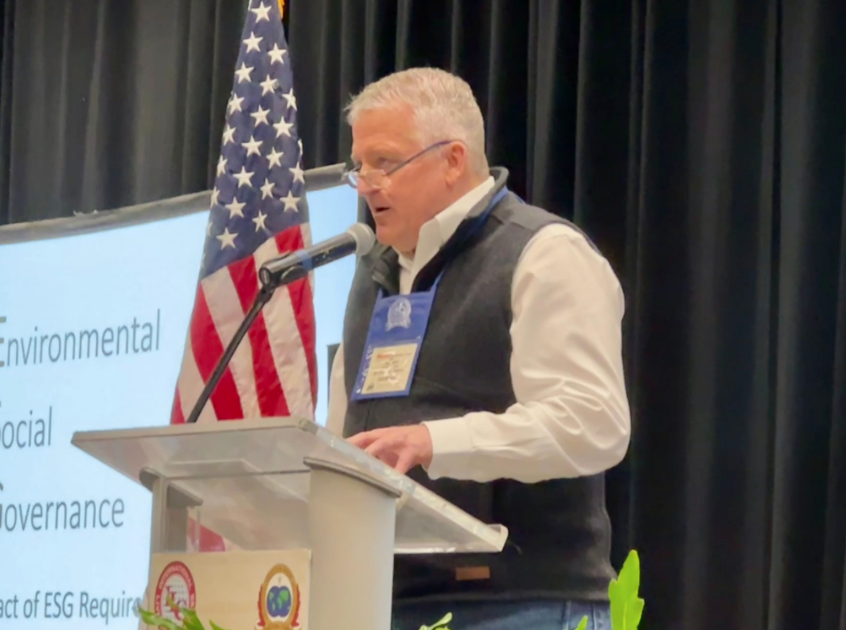
Editor's note- Senior Farm and Ranch Broadcaster Ron Hays was at Day One of the 2023 International Livestock Congress in Houston where the total focus was on the impact of ESG to Beef cattle. Over the next several Beef Buzz reports, Hays will explore what was discussed at the Congress as it relates to Cattle and this exploding concept.
In today's Beef Buzz, Senior Farm and Ranch Broadcaster, Ron Hays, is visiting with California cattle producer, Mike Smith, about the conversation on Environmental, Social and Governance. Smith talks about his apprehensions with ESG.
"My opinion is that corporate America, these publicly traded companies have way too much control and way too much power," Smith said. "Those decisions, whether we are supposed to report greenhouse gas emissions, those are supposed to be hashed out via public debate. We should be talking about them, then if something needs to occur, that needs to be a legislative initiative."
Smith said he views the ESG conversation as an example of corporate America dictating their power.
"I question the usefulness of the programs," Smith said. "I get that there is this big hue and cry, we need to reduce our carbon footprint, we need to look at opportunities to be better environmental stewards, but I just question if these types of programs are actually going to work."
Smith also voiced concerns about who these programs will actually benefit and said he feels like corporate America does not understand beef production.
"From the beef industry standpoint, my concern is they are doing these things without actually interacting with cattle producers," Smith said.
Many of these requests, Smith said, are difficult for beef producers to carry out. An example of one goal Smith mentioned is for all cattle coming into packing plants to be naturally polled because they do not want the cattle industry to dehorn their cattle. Another potential rule he mentioned had to do with regulations on the amount of time those cattle are in transit.
"They are establishing these rules, and they are raising the bar in most instances, and or they are dictating to those of us in production what we are going to do, how we are going to do it, the timeline we are going to do it in, and in a lot of instances they are just not doable requests," Smith. "I am of the opinion the industry needs to learn to push back."
The Beef Buzz is a regular feature heard on radio stations around the region on the Radio Oklahoma Ag Network and is a regular audio feature found on this website as well. Click on the LISTEN BAR for today's show and check out our archives for older Beef Buzz shows covering the gamut of the beef cattle industry today.
The U.S. Department of Agriculture today announced the names of individuals who will hold senior staff positions in Washington, D.C.
Malcom A. Shorter has been appointed to serve as Acting Assistant Secretary for Administration
Shorter was reappointed as the Deputy Assistant Secretary for Administration at USDA in June 2021. He previously served as the Acting Assistant Secretary for Administration from January 2017 to August 2017, as the Deputy Assistant Secretary for Administration from June 2013 to January 2017, and as the Associate Deputy Chief for Business Operations in the U.S. Forest Service. He is an accomplished administrative and financial professional with combined expertise in government relations and operational management having served as the Democratic Staff Director for the House Committee on Veterans Affairs. Shorter retired as a Lieutenant Colonel from the United States Army after a distinguished military career of more than 20 years. He graduated with a bachelor's of science from Rutgers University and has a master's of science from Central Michigan University. He resides with his family in Bowie, Maryland.
Victoria Maloch will be appointed Special Advisor in the Office of Communications
Maloch comes to USDA from the House Committee on Agriculture, where she most recently served as Communications Director. Prior to joining the Committee, Maloch worked in the Federal Office of Rural Health Policy at the Department of Health and Human Services and served as a national officer for the National FFA Organization. She also completed a Wallace-Carver Fellowship in USDA's Office of Communications during the Obama-Biden Administration. Maloch holds a Bachelor of Science in Agricultural, Food and Life Sciences from the University of Arkansas and Master's Degrees in policy from the Universities of Oxford and Cambridge.
Tracy Fox has been appointed Legislative Advisor in the Office of Congressional Relations
Fox has served on detail as a Legislative Advisor in the Office of Congressional Relations at USDA for the last six months. In this role, she works on issues involving the Food, Nutrition, and Consumer Service (FNCS). Fox has over 30 years of experience in nutrition policy, analysis, advocacy, Executive Branch and Congressional relations. She was the founder and past president of Food, Nutrition, and Policy Consultants, served as President of the Society for Nutrition Education and Behavior, and is a nationally recognized expert in the field of nutrition policy. Prior to starting her company, Fox held positions with USDA's Food and Nutrition Service and in the government relations branch of the Academy of Nutrition and Dietetics. Currently, she serves on the boards of the Healthy Eating Research Advisory Committee, the Marshall County, Indiana Board of Health, the United Way of Marshall County, the Marshall County Food Council, and co-manages the Culver, Indiana Farmers' Market. Fox is a retired Commander in the US Navy.
Nathaniel West will be appointed Senior Oversight Counsel in the Office of General Counsel
West joins USDA from the U.S. House of Representatives, where he served as Counsel for the Select Subcommittee on the Coronavirus Crisis Chaired by Representative James Clyburn. In this role, he developed and planned investigative agendas, carried out oversight investigations, and took transcribed interviews of senior federal government officials and private sector individuals involved in the federal pandemic response. West also held roles at Weil, Gotshal & Manges LLP in New York, NY, and with the Hon. Vernon S. Broderick and David J. Hale at the U.S. District Court. He received his Bachelor of Arts in Political Science from Northwestern University and Juris Doctorate from the University of Michigan Law School.
Prescott Martin III will be appointed Senior Counsel in the Office of General Counsel
Martin comes to USDA from the U.S. House of Representatives where he served as Chief Counsel of the Committee on Agriculture. He has extensive experience writing legislation and advising Members of Congress on legal, procedural, and policy matters related to agricultural commodity production, soil and water conservation, forestry, livestock production, pesticide registration and use, and biotechnology. Before joining the House of Representatives Committee on Agriculture, Martin worked in both private and public practice, including serving in the Office of the District Attorney for North Carolina's 5th Prosecutorial District. He received his Juris Doctor degree from the University of North Carolina and holds a Bachelor of Arts in International Affairs from the George Washington University Elliott School of International Affairs.

Oklahoma House Speaker Charles McCall, R-Atoka, today released the below statement following the passing of Tom Love, a founder of the Oklahoma-based Love's Travel Stops and Country Stores.
"Today, Oklahoma is mourning the loss of Tom Love, an innovative businessman with a heart for philanthropy.
After successfully growing the business he owned with his wife, Judy, into one of the country's most recognizable brands, he spent years giving back to the state. Tom made a profound impact on thousands of lives and his generosity cannot be overstated.
My prayers are with Judy and the rest of the Love family as they mourn the loss of their loved one."
Congressman Tom Cole (OK-04) released the following statement after learning of the passing of Tom Love, founder of Love's Travel Stops.
"I am deeply saddened by the loss of my dear friend and fellow Chickasaw citizen, Tom Love. Tom was a superb Oklahoman and American. There are few of his like, and he will be profoundly missed by many.
"Tom was an intelligent and successful businessman, however, always remained humble and grounded. He loved his home state of Oklahoma and never forgot where he came from. Not only was he charitable, donating to healthcare and education initiatives in the state, he also gave his skill and knowledge while serving as Chairman of the Oklahoma Transportation Commission during the Keating Administration. He always wanted to make Oklahoma a better place.
"Tom was the kind of businessman who cared deeply for his employees and customers, always putting them first. He also lived his life devoted to his wife, Judy, as well as his many children, grandchildren and great grandchildren. His family, friends, loved ones and all of Oklahoma are in my prayers as we mourn this enormous loss."
Today, the citizens of Oklahoma defeated State Question 820, the ballot measure that would have legalized recreational marijuana. This is the latest of a series of wins for public health, including the defeating of legalization in Arkansas, South Dakota, and North Dakota, as well as several state legislatures rejecting marijuana.
"Today's rejection of marijuana is a huge win for public health, public safety, and common sense," said Dr. Kevin Sabet, President of SAM Action. "The historic results of tonight's election show that the industry cannot buy votes and profit off our kids. Despite being vastly outspent by the industry and its allies, our coalition partners in Oklahoma worked tirelessly to educate voters about the unintended consequences of legalization, ranging from more incidents of impaired driving and workplace accidents to higher youth use rates. Following the roll-out of medical marijuana in Oklahoma––which led to the unprecedented outgrowth of the state's illicit market––voters were about to see firsthand how the liberalization of our drug laws routinely fails to deliver as promised."
"We cannot thank Pat McFerron and CMA Strategies enough for their top notch work when outspent enormously by the industry. Our coalition partners did an incredible job getting voters across Oklahoma engaged on this issue. I cannot thank their staff and volunteers enough for their hard work and dedication to public health and safety. I also want to acknowledge and thank the many doctors, faith leaders, law enforcement groups, parents, and social justice champions who publicly came out in opposition to legalization and helped us defeat this ill-conceived ballot measure."
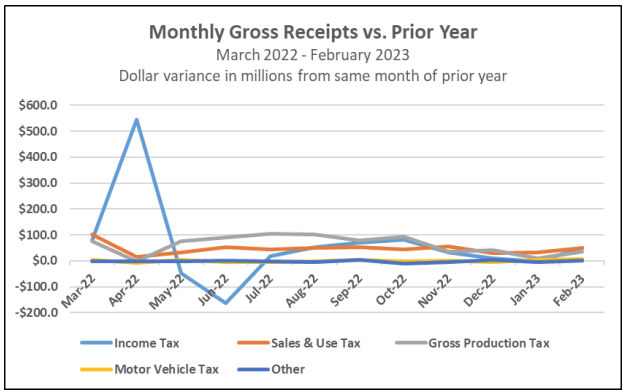
To see charts and graphs, click here.
Boosted by record receipts from oil and gas production, Gross Receipts to the Treasury in February show the state's economy continues to expand despite ongoing inflationary pressure, State Treasurer Todd Russ announced today.
Collections for the past year are $17.62 billion, up by 12.9 percent, compared to the 12-month collection total in February 2022 of $15.61 billion. For the first time in any 12-month period, oil and gas gross production taxes topped $2 billion.
February receipts of $1.21 billion are up by 13.4 percent from the same month of last year. The monthly sales and use tax revenues of $528.3 million are the highest February on record.
"While inflation remains a major concern, Oklahoma's economy is benefitting from strong energy prices and low unemployment," Treasurer Russ said. "In addition, economic activity in the state continues to be robust as reflected in sales and use tax receipts."
Other indicators
As measured by the Consumer Price Index, the U.S. Bureau of Labor Statistics (BLS) reports the annual inflation rate at 6.4 percent in January. The energy component of the index increased 8.7 percent over the last year, and the food index remained at 10.1 percent.
The U.S. jobless rate was 3.4 percent in January, down by one-tenth of a percentage point from the prior month. While the U.S. Bureau of Labor Statistics is not expected to report the state January unemployment rates until next week, Oklahoma's employment numbers are expected to continue to show strength. In December, the rate was 3.4 percent.
Regional economic trends have turned positive. The Creighton University Mid-America Business Conditions Index for the nine-state region reached its highest level since last July, after three straight months below growth neutral. The Oklahoma component of the index rose to 54.9 in February – a sharp increase from 43.3 in the previous month.
February collections
February 2023 collections compared to gross receipts from February 2022 show:
Twelve-month collections
Combined gross receipts for the past 12 months compared to the prior period show:
About Gross Receipts to the Treasury
The monthly Gross Receipts to the Treasury report, developed by the State Treasurer's Office, provides a timely and broad view of the state's economy.
It is released in conjunction with the General Revenue Fund report from the Office of Management and Enterprise Services, which provides information to state agencies for budgetary planning purposes.
The General Revenue Fund, the state's main operating account, receives less than half of the state's gross receipts with the remainder apportioned to other state funds, remitted to cities and counties, and paid in rebates and refunds.
Attorney General Gentner Drummond made the following remarks this evening in light of the apparent rejection of State Question 820 by Oklahoma voters:
"I'm proud of Oklahomans for rejecting the expansion of organized crime by defeating State Question 820. Regardless of where one stands on the question of marijuana legalization, the stark reality is that organized crime from China and Mexico has infiltrated Oklahoma's medical marijuana industry. I will continue to focus on this serious threat to public safety by targeting the illegal grow operations throughout our state."
Major Ag Groups within Oklahoma were a driving force in the success of the NO vote that prevailed in the statewide special ballot initiative to legalize recreational marijuana. Unofficial results show that all 77 counties voted no- with Oklahoma County the last of the counties that have ended up with the a no vote-with a narrow 36 vote lead for the "no"s with all of the County vote now in.
UPDATE- Statewide- with 100 percent of the precincts in , 349,121 have voted NO while 216,883 voted YES. That margin now stands at 61.68% of voters who have turned the question down versus 38.32% voting YES.
Oklahoma would have become the 22nd state to legalize adult use of cannabis and join conservative states like Montana and Missouri that have approved similar proposals in recent years. Many conservative states have also rejected the idea, including Arkansas, North Dakota and South Dakota last year.
Republican Gov. Kevin Stitt and many of the state's GOP legislators, including nearly every Republican senator, opposed the idea. Former Republican Gov. Frank Keating, an ex-FBI agent, and Terri White, the former head of the Oklahoma Department of Mental Health and Substance Abuse Services, led the "no" campaign.
Three of the major farm/ranch organizations banded together to call for a NO vote- Oklahoma Farm Bureau, American Farmers and Ranchers and the Oklahoma Cattlemen's Association held a news conference with the state capitol being used as a backdrop a few days before Election Day to urge rural citizens to turn out in large numbers and vote no. Apparently, they did.
Oklahoma Farm Bureau President Rodd Moesel is very pleased with the strong message sent by voters across the state. He told Oklahoma Farm Report's Ron Hays "we are just ecstatic that the voters of Oklahoma have responded and voted no" and he added "it was a unique situation - the only issue on the ballot and it gave voters a chance to study the question before they voted" and clearly a significant number broke to the "NO" side.
Moesel added that the "YES" side had close to $5 million dollars to market their side while the Protect Our Kids coalition urging a NO vote on 820 had less than a quarter of a million dollars to urge voters to vote no.
You can listen to Rodd Moesel and Hays talk about the vote after AP had called the vote- saying the recreational marijuana push had failed. Click on the Listen Bar below to hear their full conversation.
The American Farmers & Ranchers were also a part of the ag coalition that joined with other non ag groups to urge a no vote- their President Scott Blubaugh responded to the Oklahoma Farm Report while still in San Francisco for the NFU Convention with this statement: "Today's vote was a big victory for rural Oklahoma and the farmers, ranchers and families that live there. This vote clearly demonstrates the values that have been present in our organization from the very beginning. We were honored to join with other Oklahoma agriculture groups in the successful effort to defeat what would have been another great challenge for the rural areas of our state."
Another of the Ag groups that came together to urge a NO vote across the state was the Oklahoma Cattlemen's Association-their Executive VP Michael Kelsey sent us their reaction via text- "Oklahoma has strongly rejected recreational marijuana with rural Oklahoma leading an overwhelming "NO" vote. OCA's membership approved strong policy against recreational marijuana in 2021 and then carried that policy into action Tuesday as a proud participant in a big coalition to defend our great state. March 7th was a great day for all of Oklahoma!"
Today, Congressman Frank Lucas (OK-03) joined the House Committee on Ways & Means at a field hearing in Yukon, Oklahoma examining the state of the economy for American workers, farmers, and families.
"Thank you Chairman Smith and I would like to extend a very warm welcome to you and the other members of the illustrious House Ways and Means Committee to the great state of Oklahoma. The topic of this field hearing is not only timely and appropriate, but the location is too," said Congressman Lucas. "I cannot think of a single industry in our state that is not directly impacted by the work this Committee does. The future of ag, energy, and manufacturing in Oklahoma and across the nation is dependent on tax and trade policies that work for these industries, not against them. I look forward to joining my colleagues today in learning more about the challenges these witnesses are facing on the ground and how Congress can work to address those issues." Lucas discussed with Kelli Payne, former President of the Oklahoma National Stockyards, and Bryan Jackson, Owner of Route 66 Meat Processing, the impact the Biden Administration's burdensome regulations are having on Oklahoma's farmers, ranchers, landowners.
Click here to watch Lucas' Q&A.
On Biden Admin. regulations
Lucas: Kelli, thank you for your participation in today's hearing and for all the work you do on behalf of cattlemen in the state. I have often said that it is the role of Congress to do things for people not to them. In your written testimony you speak about the positive impact farm bill programs have had in the cattle industry. You also touch on various regulations such as WOTUS that will harm the industry. Can you speak to the importance of collaboration with producers on the ground when crafting policy? Should we asking the people who have to live with what we're doing?
Payne: Thank you, Congressman. As a long-time Oklahoman, I got to brag on our Delegation. I've always felt like we could get a hold of them, we can talk to our elected officials on the federal level. And whenever I ran the Stockyards I had the opportunity to host many of our federally-elected officials. They came to us. They understand boots on the ground. Collaboration is key...It's critically important to get this kind of feedback so that you're not picking winners and losers.
Lucas: I want to turn to Bryan for just a moment. I think it was about a year and a half ago, maybe almost two years ago, you gave me a tour of the facility in Sayre. You were getting ready to fire up. For the benefit of the crowd, you and I both know state inspected meat in Oklahoma and federally inspected meat: same safety, same quality, same everything. Explain to us why the federal stamp matters- even though it costs more. Why does it matter?
Jackson: That's a great question, Congressman. The benefit of being U.S.D.A. inspected is there's no restrictions on any quantity where it can go to. It can ship between states so there's no limitation. It can even be exported if we chose to and were licensed for that.
Lucas: And that matters greatly when you're moving your product, especially in a state where we produce so much beef, in particular. Thank you.
Kelli, back to you. Oklahomans are a resilient people. The people of this state have a long history of responding to hardships with innovation and hard work. What have producers voluntarily done to preserve and improve their land in order to better meet the challenges of weather and prolonged drought?
Payne: We've obviously learned a lot. We learn more every day. We have technology in place, we just know more now than we ever have. So, whether it was the shelter belts that were planted in the 30s all the way up to current. My operation itself is in a river bottom. Very sandy soil- we call it blow sand. We have to protect that. We, on our outfit, can run about 250 mama cow. I have one cow with a calf at her side as of this morning and three bulls loaded in the trailer. Then I have seven fat steers to be able to put in the freezer here in about a year. There's nothing there. But we had to pull those cattle off to protect that grass. If I don't have grass, I can't put cattle on it. So, we had to make that decision and we can't afford hay. There's all kind of sad, sad things going on. But to be able to put in place conservation-type practices so that we can be sustainable when it finally does start raining, Congressman.
Lucas: Bottom line: Comprehensive Farm Bills, where make sure we have the ability to produce and consume, is critically important. And in this Farm Bill, we've got to address how to make the federal-inspection available to more packers.
In February, Lucas joined House Transportation and Infrastructure Committee Chairman Sam Graves (R-MO), Water Resources and Environment Subcommittee Chairman David Rouzer (R-NC), and House Agriculture Committee Chairman Glenn "GT" Thompson in introducing a House Joint Resolution that would would terminate the Biden WOTUS rulemaking.
In January 2023, Lucas joined Congressional Western Caucus Chairman Dan Newhouse (WA-04) and 193 House Republicans in sending a letter strongly opposing the Biden Administration's recent "waters of the United States" rule.
Last year, Lucas joined then-House Republican Leader Kevin McCarthy and House Agriculture Committee Republican Leader Glenn "GT" Thompson in sending a letter to President Joe Biden calling on the Administration to reverse overly burdensome regulations and policy barriers to U.S. agriculture production that have caused needless uncertainty for farmers, ranchers, and working families.

Oklahoma House Speaker Charles McCall, R-Atoka, today released the below statement following the passing of Tom Love, a founder of the Oklahoma-based Love's Travel Stops and Country Stores.
"Today, Oklahoma is mourning the loss of Tom Love, an innovative businessman with a heart for philanthropy.
After successfully growing the business he owned with his wife, Judy, into one of the country's most recognizable brands, he spent years giving back to the state. Tom made a profound impact on thousands of lives and his generosity cannot be understated.
My prayers are with Judy and the rest of the Love family as they mourn the loss of their loved one."
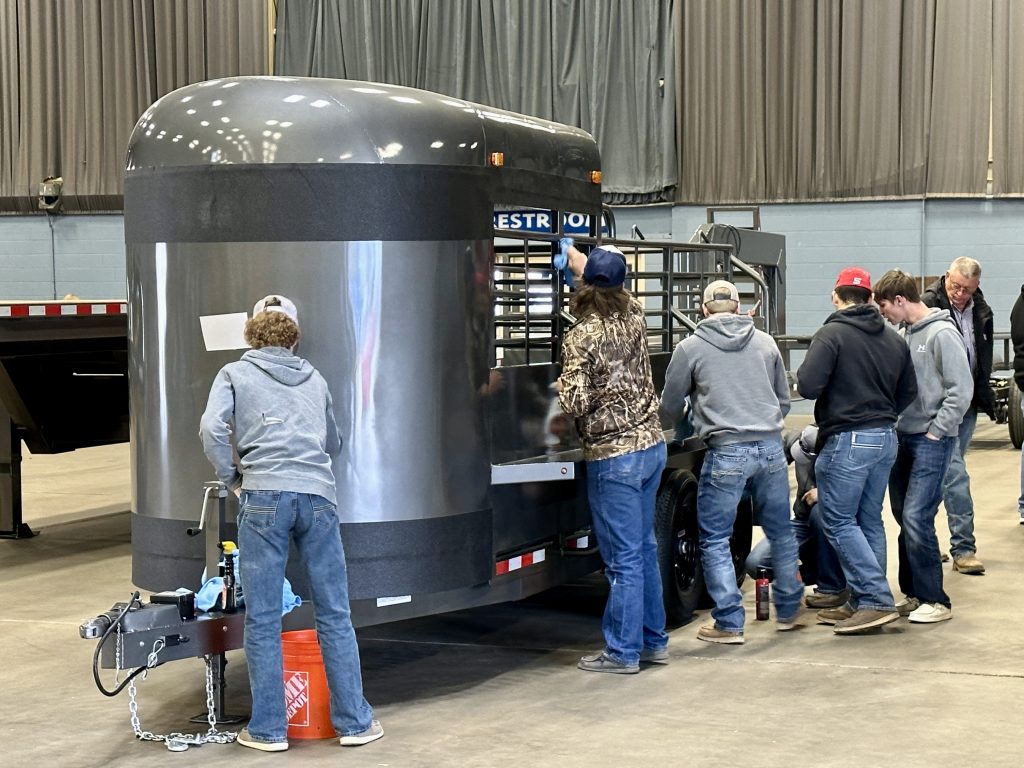
FFA Members Shining Up their Trailer in the Ag Mechanics Contest at OYE
The contest that will once again lead off a jam packed ten days at the 2023 Oklahoma Youth Expo at the OKC Fairgrounds is the 4th Ag Mechanics contest. As the last of the entries were being brought in on Tuesday afternoon- Show Superintendent Jerry Renshaw and OYE's Vice President of Operations Bray Haven were excited about the continued growth of the show with around 200 projects to be judged on Wednesday by almost two dozen judges- with $20,000 in prizes on the line.
Renshaw talked for a couple of minutes with Oklahoma Farm Report's Ron Hays on Tuesday afternoon about the 2023 event- very pleased that they have outgrown the one wing of Oklahoma Expo Hall- and will be occupying both sides here this week.
Ag based projects- stock trailers, hay trailers, livestock handling equipment, feeders, loading chutes and restored tractors as well as wildlife projects can be found in the building used in previous years- Renshaw tells Hays that the second building will feature decorative items- swings, picnic tables, games, cookers and more.
County and district shows continue to grow across Oklahoma- and that is helping feed more projects to the OYE- and Renshaw tells Hays- "it's a growing effect- hold on folks, it's getting better."
The contest judging is set to begin at 8 AM on Wednesday morning, with the awards ceremony set for Wednesday afternoon around 5 PM.
Click here for the full schedule for the 2023 OYE. The Oklahoma Farm Report team will be snapping pictures from start to finish- and you can see them as we add them to our Flickr album for 2023- available here. If you want to look back to the 2022 OYE- click here for our pictures from last year's event.
Our coverage of the 2023 Oklahoma Youth Expo is sponsored by Hilliary Communications- who deliver the latest cutting-edge communications services supporting tens of thousands of customers across 22 counties throughout Oklahoma, Texas and Iowa. The company offers internet, voice and HilliaryTV. Hilliary Communications continuously researches the marketplace for innovations and strives to improve underserved areas, offering services that exceed customer expectations. Click here to learn more about Hilliary Communications.
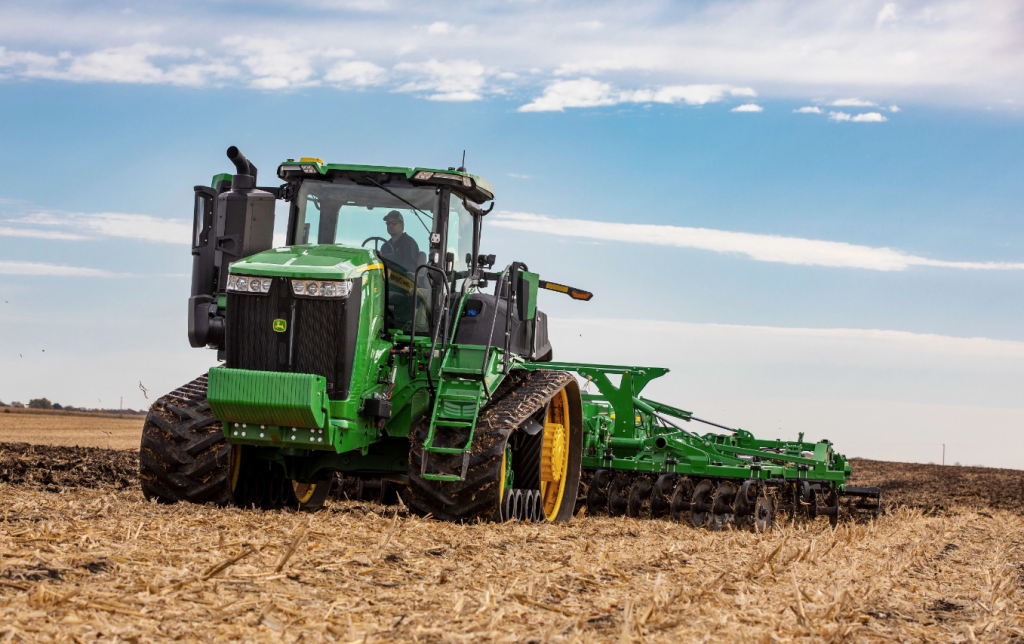
John Deere has added 20 horsepower
for all 9RT two-track tractors.
John Deere has announced MY24 updates for its lineup of 7, 8 and 9 Series Tractors that will help prepare them for the future of precision agriculture. Key updates include the new StarFire™ 7000 integrated GPS position receiver and an all-new G5Plus CommandCenter™ Display. Both will be included as base equipment.
"We updated our largest John Deere tractors with new technology to help our customers achieve the highest levels of precision-ag efficiency and ease-of-use today, while ensuring their tractors are prepared to work autonomously in coming years," said Ryan Jardon, marketing manager for John Deere.
The StarFire 7000 Receiver features five years of repeatability and 73% faster pull-in times, and is 17% more accurate when using SF-RTK when compared to previous models using SF3 signal. In addition, signal stability and reliability were improved and provide the highest level of guidance and accuracy ever offered by John Deere. SF-RTK gives farmers year-over-year repeatability without the need for base stations.
Inside the cab, farmers will find the all-new G5Plus CommandCenter Display (and optional G5Plus Extended Monitor) that features a larger screen, increased processing power and faster file transfer times compared to previous displays. G5Plus features a 35% larger viewing area and 1080p high-definition video resolution. The 12.8-inch touchscreen display and higher video resolution provide farmers with clear, bright and easy access to machine controls. AutoTrac™ guidance, and Section Control are now included in base equipment.
"Farmers can add the optional G5 Advanced package to take advantage of John Deere applications that include AutoTrac Turn Automation, AutoPath™, AutoTrac Implement Guidance, Machine Sync, and In-Field Data Sharing," said Jardon. "The G5 Advanced software license provides these valuable capabilities while providing lower up-front cost, gets better over time, and you only pay for what your farm needs. These applications help farmers cover more acres per day with less time and stress. The G5 Advanced package is available as a one- or three-year option from the factory. With G5Plus farmers can be confident in knowing they're using the latest, most advanced features each year."
Another feature John Deere is making available is a factory-installed implement ethernet. This new connection enables future high-bandwidth communication between tractors and implements.
John Deere is also offering an Autonomy Prep package for 8 and 9 Series Tractors that ensures these machines have the known components needed to operate autonomously in the future.
"This includes the right transmission and visibility package, implement ethernet, a 330-amp alternator and other additional hardware," Jardon said. "More components will likely be needed, but the Autonomy Prep package outfits these tractors with important known autonomy components to reduce what may be needed in the future when autonomy becomes more widely available."
A new right-hand cornerpost display was added inside the cab of all 7, 8 and 9 Series Tractors. The easy-to-read display features digital readouts and an illustration area to help ensure these tractors can take advantage of advanced features as they become available. A factory-installed rear-window tint is also available for John Deere CommandView™ 4 cabs to help keep operators comfortable while providing better visibility to display screens on the brightest of days.
Other updates include the addition of 20 horsepower for all 9RT two-track tractors. Farmers can now choose from the 9RT 490, 9RT 540 or 9RT 590.
For potato, sugar beet and vegetable growers, John Deere added wider track-spacing options for its lineup of 8RX four-track tractors. These include 132-, 136-, 144- or 152-inch-wide track spacings. The wider spacings are compatible with 16.5-, 18-, 24- and 30-inch track widths and John Deere ExactRate™ fertilizer tanks.
Additional model year updates and options are available for 7, 8 and 9 Series Tractors. To learn more, visit JohnDeere.com or contact your local John Deere dealer.
The National Milk Producers Federation's (NMPF) Board of Directors unanimously endorsed a proposal to modernize the Federal Milk Marketing Order (FMMO) system today at its March meeting, a milestone that caps more than two years of discussion and more than 130 meetings on different aspects of the proposal.
The plan to reinvigorate the FMMO system that guides milk pricing reflects an industry that's evolved significantly since the last comprehensive revamp in 2000. It's a proposal all dairy can get behind, said Randy Mooney, chairman of NMPF's board of directors and a dairy farmer from Rogersville, MO.
"After gathering dairy's best minds and consulting with partners across the industry, today we are moving forward with a comprehensive FMMO proposal the entire industry can get behind," Mooney said. "We look forward to leading a thorough, deliberative process as we submit this proposal to USDA and partner with our allies to modernize milk pricing in ways that serve dairy farmers and the entire industry."
The board reviewed a package of changes initially developed and proposed by a task force of NMPF cooperative experts and later approved by the organization's Economic Policy Committee. The adopted changes, listed here, reflects the industry's evolution while benefiting the farmers who form the bedrock of U.S. dairy. With the board's approval, NMPF's next step is to move toward submitting the proposal to USDA as the basis for a federal order hearing while continuing conversations with other dairy stakeholder partners. NMPF President and CEO Jim Mulhern said the organization stands ready to assist farmers, the dairy industry and federal officials in any way it can as the process unfolds.
"We believe in a better future for this industry, and this proposal will help build that future," he said.
Also speaking at the conference is House Agriculture Committee Chairman Glenn "GT" Thompson, R-PA, speaking on the farm bill expected in 2023 and other federal issues. NMPF looks forward to working closely with Chairman Thompson, a staunch ally of dairy farmers, to complete work on the 2023 farm bill and other matters.
NMPF's board also welcomed new directors -- Jacob Larson of Southeast Milk Inc., and Michael Lichte of Dairy Farmers of America – and released its annual report, highlighting the activities and accomplishments of the past year.
NMPF is the only nationwide organization devoted to advancing the interests of all dairy farmers of all sizes in all regions. A federation of dairy cooperatives, NMPF embodies the spirit of farmer self-help and community leadership.
Board members are also discussing:
The two-day conference concludes tomorrow.
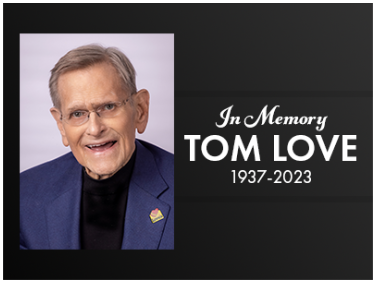
Senate Pro Tem Greg Treat, R-Oklahoma City, today released the following statement on the passing of Tom Love, who founded the family owned and operated network of Love's Travel Stops and Country Stores.
"The city of Oklahoma City and state of Oklahoma would look drastically different without the philanthropy and generosity of Tom Love and his family," said Sen. Treat. "He and his wife, Judy, worked tirelessly throughout their careers and marriage to grow their family-owned business, while never hesitating to give back to the community and causes they believed in. Tom will be missed tremendously but deserves to be celebrated for all his accomplishments and service to others. My wife Maressa and I offer our prayers to Judy, their children, grandchildren and all who loved him."
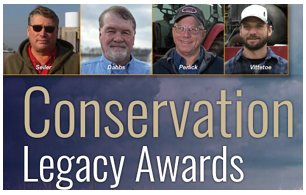
The American Soybean Association congratulates the regional winners of the 2023 Conservation Legacy Award.
• Terry & Lori Dabbs, Stuttgart, Arkansas (South Region)
• Tom Perlick, Washburn, Wisconsin (Upper Midwest Region)
• Michael Vittetoe, Washington, Iowa (Midwest Region)
• Les Seiler, Fayette, Ohio (Northeast Region)
The award winners will be recognized at the annual ASA Awards Celebration event during Commodity Classic on March 10, 2023. During the celebration, one of the regional winners will be announced as the national winner.
The Conservation Legacy Award is a national program designed to recognize the outstanding environmental and conservation achievements of soybean farmers, which help produce more sustainable U.S. soybeans.
A national selection committee, composed of soybean farmers, conservationists, agronomists and natural resource professionals, evaluated nominations based on each farmer's environmental and economic program. The program is sponsored by ASA, BASF, Bayer, Nutrien, the United Soybean Board/Soy Checkoff and Valent USA.
Terry & Lori Dabbs, Stuttgart, Arkansas (South Region)
For Stuttgart, Arkansas, farmers Terry and Lori Dabbs, their farming legacy solely focuses on water conservation. "Water is the most important thing to our farm," Terry says.
Both the Dabbs' LTD Farms and Lori's family operation, Hargrove Farms, Inc., focus on growing corn, soybeans and rice in a minimum-till setting.
Lori says many of their stewardship practices are specific to the area because water quantity is a big concern, with irrigation efficiencies and water conservation primary points of focus.
"One of our greatest challenges in our area is the availability and the competition for surface water," Lori explains. "The water conservation efforts on our farm really began before my grandparents ever purchased the farm." Read more.
Tom Perlick, Washburn, Wisconsin (Upper Midwest Region)
Tom Perlick's conservation journey is all about changing attitudes. From coming back to the family farm after his father's death to charting his own course in unexplored management techniques, the now-veteran farmer is a pioneer in the northwest Wisconsin conservation frontier.
Learning what cover crops could bring to his operation has been amazing, Perlick says, as the number of earthworms alone on his farm has grown exponentially.
"Soil health is what I think it's really brought to us," he explains. "We're learning so much more about how the mycorrhizal fungi, different bacteria and living organisms that are in the soil make our soil more productive and healthier. We minimize erosion to the maximum amount that we can."
During his tenure, Perlick has far exceeded no-till and cover crops in implementing successful conservation practices. From wetlands restoration to forestry management, pollinator plots and critical area seeding to manure pit remediation, nitrogen rate studies, grassed waterways and beyond, Perlick's conservation legacy is all about changing attitudes. When others said he couldn't succeed, he proved them wrong. Read more.
Michael Vittetoe, Washington, Iowa (Midwest Region)
To say conservation is in Michael Vittetoe's blood would be an understatement. The Washington, Iowa, soybean and corn farmer joined the family operation in 2014 after working off the farm as an engineer for five years.
"We have long strived to be good stewards of the land by taking action to reduce soil erosion and improve water quality," Vittetoe says.
In fact, Vittetoe's grandfather was an early adopter of reduced tillage in the area, moving away from the use of the moldboard plow. Waterways, terraces and filter strips also have been an integral part of the operation for decades.
"Going way back, conservation has been a part of our operation—essentially since its inception," Vittetoe explains. "My dad was big on no-till back in the '80s when it was first starting to be a thing. The farm has been essentially no-till ever since."
The family's rich history in soil preservation is matched by its efforts to protect water quality through cover crops, waterways, terraces and filter strips. Read more.
Les Seiler, Fayette, Ohio (Northeast Region)
Seiler Farms is part of the Western Lake Erie Basin, where Les says farming practices need to be improved to help mitigate losses. He adds the Maumee River itself is one of the biggest contributors to the algal bloom issues of Lake Erie.
"We have so much soil erosion because we have a lot of poor soil health, and we can't infiltrate water on the land anymore," Seiler says. "We've seen the need to do something different besides the conventional farming practices of moldboard plowing and a lot of tillage."
He recalls the Toledo water crisis of 2014, in which several people had no access to water for two days because of algal blooms on Lake Erie. He realized during that event he didn't want to be a contributing factor to people being without water.
"I don't think there should be anybody anywhere in the world who wonders where their next glass of water is coming from, or if water is going to be an issue," Seiler says. "I hope someday that somebody says, 'Well, I hope that guy made a difference.' I don't want to be the one who didn't realize the importance of that." Read more. Watch for a special insert about this year's winners in this month's issue of Farm Journal or click here to read more.
Noble Research Institute staff share four things they'd never do again — so you can learn from them.
Since transitioning our ranches to a management style that focuses on soil health and profitability, we've aimed to be fully transparent. We want to show you the challenges, the lessons we've learned and the victories along the way.
We know in ranching, it's not always sunshine and rainbows (or blue skies and green grass). But we also know, as with any endeavor, you can learn more from the hard times than the good ones. That's why we asked our ranch staff to share mistakes they made early on, to help others learn what not to do.
Here's what they said:

Paul Luna, ranch facility manager, says he learned a valuable lesson when much-needed rains came in.
"If you know rain is on the way, plan to give your livestock a bigger area, to graze," he says. "Otherwise, they'll muck it up pretty bad."

Joe Pokay, general ranch manager, says one of the biggest opportunities he sees (and originally missed) was managing cool season plants the same way we manage warm-season ones.
"I used to think when it was winter and the warm-season grasses were dormant, you could just turn the cows out on bigger pastures and not move them as often," he says. "However, when I started moving more frequently during that time, the cool-season annuals and perennials got more rest time and became more abundant and vigorous."
Moving cattle to rest winter grazing areas leads to better nutrition for the animal, decreased feed costs, more animal days per acre and a longer grazing season.

Luna recounts a time he set up a new paddock and didn't check the hot wire before leaving.
"I came back, and the cattle were scattered," he says. "Always take the time to test your fences before you leave. It'll save you a lot of time in the long run."

Clark Roberts, ranch facility manager, didn't always go with his gut when he was new to running sheep. One time in particular, he really wishes he had.
"In regenerative ranching, we move animals frequently," he explains. "However, I'd been told not to move ewes with baby lambs on their side. Folks scared me to death, saying the animals would get confused if I did."
He left them in the pasture too long, and they ended up getting parasites and had to be dewormed.
"Now," he says. "I move them as I normally would any other time of the year, and it's worked out."
By: Katrina Huffstutler, senior public relations and digital marketing coordinator for the Noble Research Institute
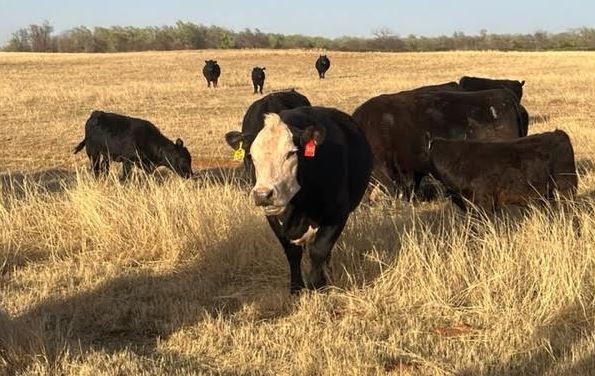
Mark Johnson, Oklahoma State University Extension Beef Cattle Breeding Specialist, offers herd health advice as part of the weekly series known as the "Cow Calf Corner" published electronically by Dr. Peel, Mark Johnson, and Paul Beck. Today, Johnson is talking about the failure to expel the placenta after parturition.
Retention of fetal membranes, or retained placenta, in cows usually is defined as failure to expel fetal membranes within 24 hours after parturition. Normally the expulsion occurs within eight hours after delivery of the calf. The placenta is retained when the cotyledons on the placenta do not detach from the caruncles on the uterus during parturition. Although retained placenta is rare in most cow herds, this year I am hearing that producers are seeing a higher incidence of this problem.
Retained placenta creates the potential for problems. It hangs from the vulva which permits manure and micro-organisms from the manure into the uterus. As well, when the cow lays down in dirt or mud which is loaded with bacteria, it permits bacteria to cause infection in the uterus and can have serious negative consequences. Infection in the uterus can cause the cow to become ill (fever, weight loss, etc). In severe cases of infection the cow can actually die. When the uterus becomes infected and inflamed, it takes longer for the cow to clean and be ready for the next breeding season. Retained placentas can result in delayed rebreeding or cows coming up open at the end of breeding season. Bottomline: retained placentas jeopardize reproductive efficiency and can rob operations of profit potential.
What follows is a list of the typical causes of retained placenta.
What are the best management practices to prevent retained placenta? Over time, proper nutrition, herd health and mineral supplementation should solve most the problems. If not, consult your veterinarian.
Why are we potentially seeing more retained placenta this year? Many operations are feeding "non-traditional" hays over the past several months which may not be very green or leafy. Typically the best source of vitamin A for cattle is green, leafy forage. A good quality free choice mineral supplement containing Selenium is advised. Cows and heifers in Body Condition Scores of 5 to 6 at calving time is advised. If you are dealing with sick cows as a result of retained placenta, consult your veterinarian for best treatment options.
Reference: Vet Views. University of California-Davis. Dr. John Maas. 2008.
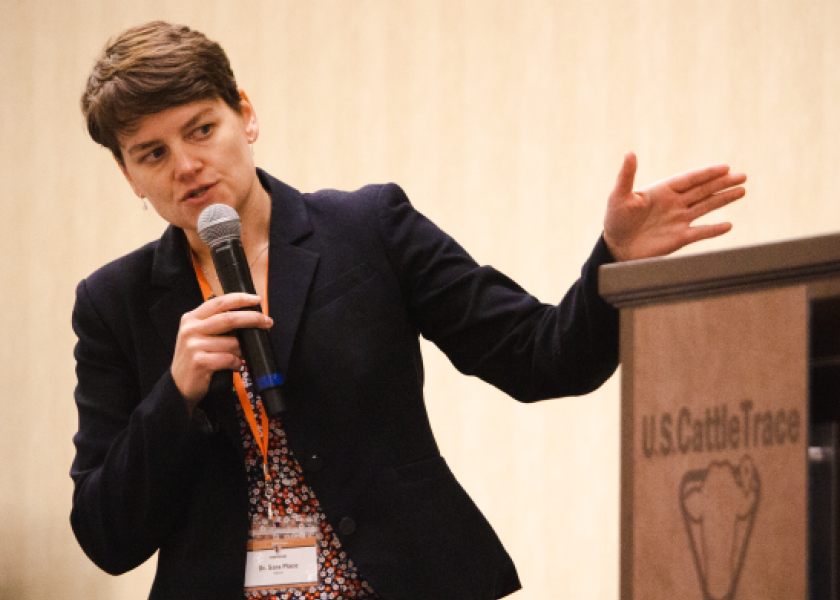
Editor's note- Senior Farm and Ranch Broadcaster Ron Hays was at Day One of the 2023 International Livestock Congress in Houston where the total focus was on the impact of ESG to Beef cattle. Over the next several Beef Buzz reports, Hays will explore what was discussed at the Congress as it relates to Cattle and this exploding concept.
Sustainability in the beef cattle business is a topic that has grown in importance as it is advancing faster now with the ESG (Environmental, Social and Governance) conversation as well as commitments for net-zero and climate neutrality that have been made by many companies and organizations.
Senior Farm and Ranch Broadcaster, Ron Hays, is back talking with Colorado State University Feedlot Systems Specialist, Dr. Sara Place, about the ESG conversation and what it means for those in the cattle industry.
Place said she believes that climate neutrality is potentially achievable.
"When you think about climate neutrality and beef, it is really about cutting methane emissions from cattle in ways that are practical, and ways that make economic sense will help get us there," Place said.
To achieve climate neutrality by 2040, Place said one important factor will be more technologies that are commercially available. Economics will play another role, Place added, in making sure those technologies can be accessed out in the pasture or in a feed yard.
"It makes economic sense that you get a payment basically, right, in some cases for reducing methane, because you are creating another commodity when you do that," Place said.
One of the reasons the beef industry does not account for a large percentage of emissions, Place said, is because of the efficiency of the U.S. beef system.
"The things that cattle producers do on a daily basis- everything from making sure the nutrition is right for your cows, having good reproduction, feeding your animals right, doing a good job, with health management- that all contributes to lowering greenhouse gas emissions and just reducing the resources it takes to produce beef," Place said.
Aside from prioritizing the sustainability conversation, Place said it is also critical to acknowledge the importance of beef as a nutritionally rich food.
"At a population level, having a certain amount of animal source foods, or meat, milk, eggs, fish, is really critical to make sure we don't have micronutrient deficiencies in a population," Place said. "We sometimes say animal protein, and that sometimes does a disservice to everything else that animal source foods are bringing to the diet."
The Beef Buzz is a regular feature heard on radio stations around the region on the Radio Oklahoma Ag Network and is a regular audio feature found on this website as well. Click on the LISTEN BAR for today's show and check out our archives for older Beef Buzz shows covering the gamut of the beef cattle industry today.
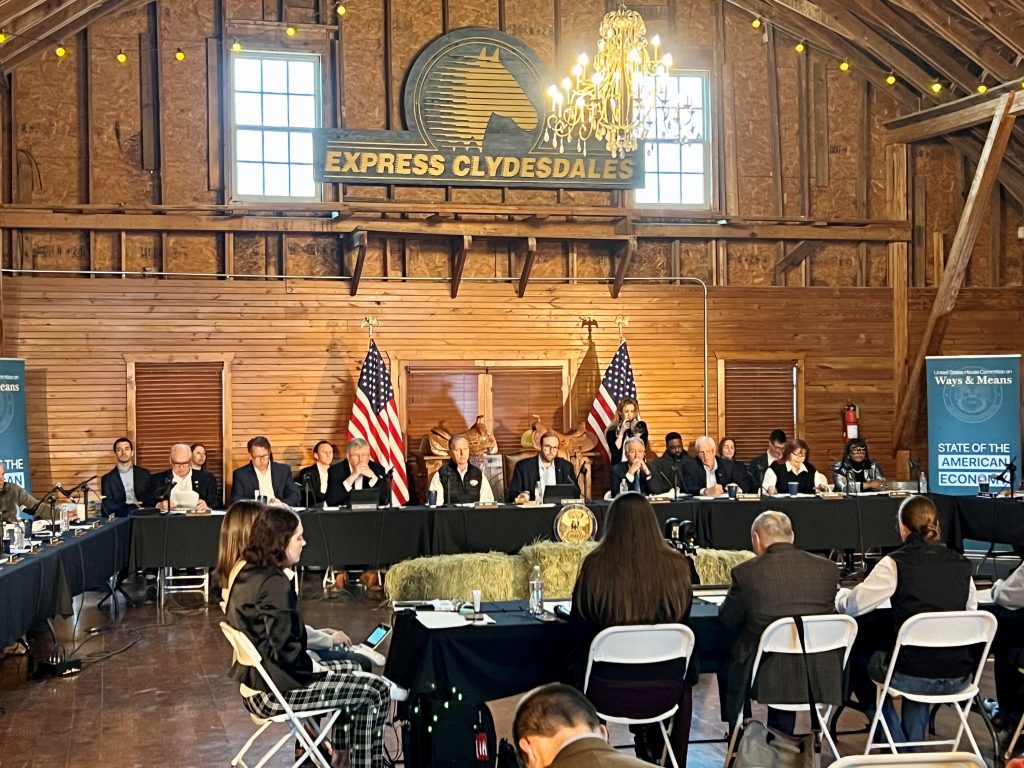
Members of the US House Ways and Means Committee(plus Oklahoma Congressman Frank Lucas) at Field Hearing in Yukon, Oklahoma Tuesday
House Committee on Ways and Means Committee Chairman Jason Smith (MO-08) brought the Committee to Oklahoma and held its second field hearing on the State of the American Economy: The Heartland. The hearing took place on Tuesday, March 7, 2023, in Yukon, Oklahoma.
"During our first official hearing of the 118th Congress, the Ways and Means Committee heard from small business owners, workers, and families in Appalachia about the state of the American economy. Their testimony highlighted the divide between the rosy picture the White House paints and the grim reality on the ground for millions of working Americans and families who are struggling to make ends meet and provide for their loved ones.
On Tuesday, the Committee came to the Heartland in Oklahoma, to hear from farmers, small business owners, workers, and those in the U.S. energy sector about the challenges facing working-class Americans and how they think Congress can help.
Two of the witnesses had farm, ranch and agribusiness ties. Bryan Jackson, Co-Founder, Route 66 Processing in Sayre offered his perspectives on a small meat processing business start up that he and his wife ramped up during the COVID Pandemic. He told the Committee that two of the biggest challenges to his business and it's survival was in finding and keeping workers- and then the recent impacts of inflation. He surmised that if he had to replace the building they are in- it would cost twice as much to rebuild it compared to it's original cost.
Click on the Audio Listen Bar below to hear his testimony- click here for his written testimony submitted to the Committee.
Later in the witness lineup came former President of the Oklahoma National Stockyards, Kelli Payne- who described herself currently as a rancher in Mustang, a District Vice President of the Oklahoma Cattlemen's Association and the new board chairman of the Oklahoma Cattlemen's Foundation. She also said that she was a proud member of the Oklahoma Farm Bureau.
Payne described the challenges of drought for Oklahoma Cattle producers- citing the huge liquidation seen in the most recent USDA Cattle Inventory Report for the state. She told the Committee that the state has lost 600,000 head of cattle in the past year because of extreme drought- double the lost of Nebraska- the state in USDA's Inventory Report that lost the second most cattle in the US.
She also talked of the challenges of regulation by the Biden Administration in policies like WOTUS and the recent endangered species listing of the Lesser Prairie Chicken.
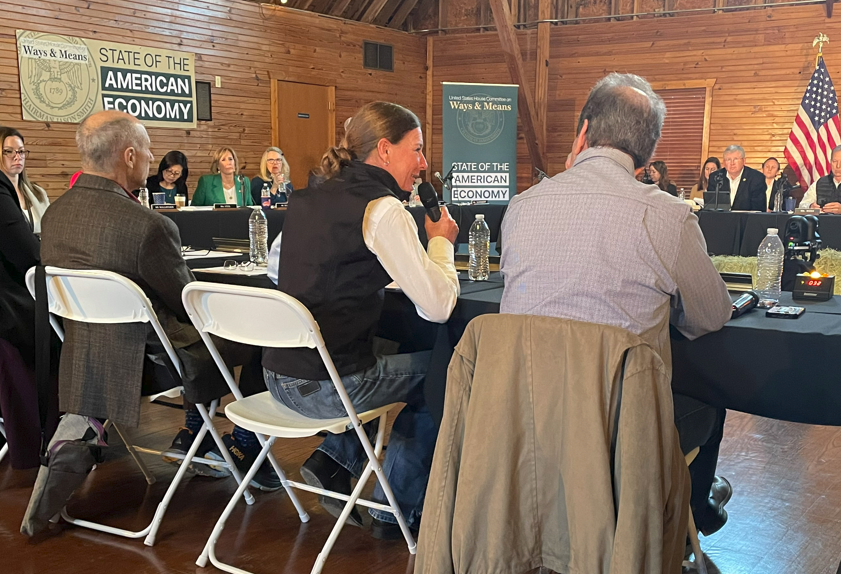
Click on the Audio Listen Bar below to hear Payne's testimony- click here for her written testimony submitted to the Committee.
After the witnesses testified- members of the Committee asked questions- and Chairman Smith gave that same courtesy to Congressman Lucas- who zeroed in on the witnesses representing agricultural interests. Jackson offered his thoughts on the value of being able to have Federal Inspection in his processing plant while Payne affirmed the importance to Congressman Lucas to be able to collaborate with members of Congress and their staffs when it comes to developing policy that works in a positive way for folks out in the country. You can listen to both Payne and Jackson respond to Congressman Lucas by clicking on the Listen Bar below.
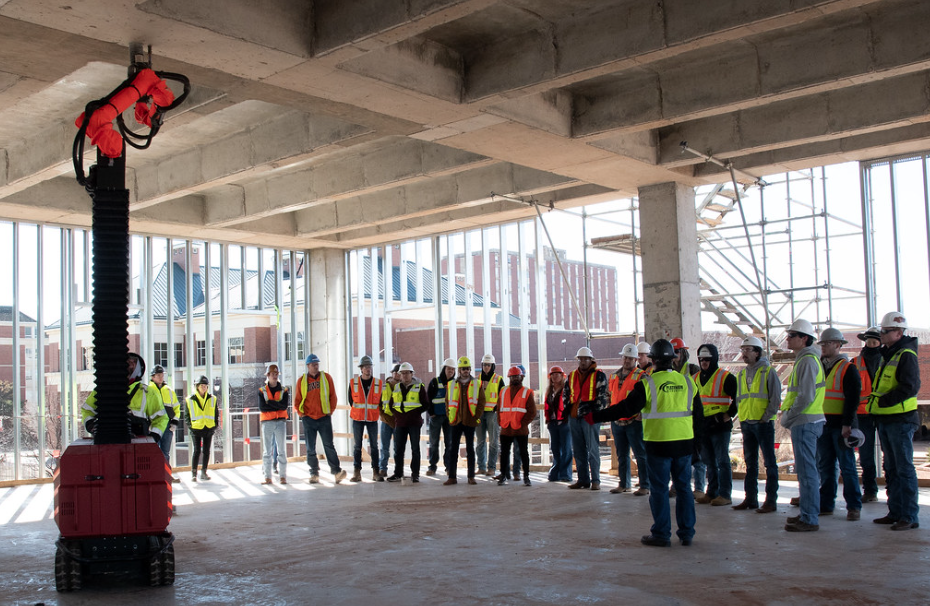
Oklahoma State University construction management students visited the New Frontiers Agricultural Hall construction site to learn more about the advanced technology used, including the Hilti JAIBOT robot. (Photo by Mandy Gross, OSU Agriculture)
By Mandy Gross
Oklahoma State University is building a new home for OSU Agriculture and providing hard hat tours to those who want to learn more about the construction process and see progress up close and personal.
The hard hat tours are popular as construction continues on the New Frontiers Agricultural Hall, said Randy Raper, OSU Agriculture assistant vice president of facilities.
"The tours offer a chance to see the work being done inside the building in addition to highlighting particular features of the facility," he said. "It's easier for participants to visualize where offices, teaching classrooms, research laboratories and other rooms are located when they are on the tour and see the construction firsthand."
OSU Agriculture and OSU Foundation partnered with Flintco to hold tours monthly and on special occasions starting last fall.
Since January, the team has hosted four tours, which have included participants such as OSU President Kayse Shrum, Provost Jeanette Mendez and OSU Foundation President Blaire Atkinson; Cornerstone Donors Larry and Kayleen Ferguson and Barry and Roxanne Pollard; OSU/A&M Board of Regents Rick Davis, Billy Taylor and Rick Walker; and members of the OSU Agriculture Dean's Advisory Council.
Taylor, an OSU graduate, said the New Frontiers project is a competitive advantage and an outstanding opportunity for faculty to teach, mentor and influence future generations of agricultural leaders in an inspiring space.
"You can feel the inspiration as you walk through and start to see firsthand how well-planned out the new facility truly is," he said. "I am confident our students will feel excited to learn and be served in such a dynamic, innovative environment. New Frontiers Agricultural Hall is a great addition to Oklahoma State that we can all be proud of."
As chief executive officer of Armstrong Bank, Taylor said it was important to invest in replacing OSU's aging Agricultural Hall.
"We see the opportunity to support the New Frontiers project as a natural partnership that allows us to align our values, including one of our core values to 'never stop learning,'" he said. "We believe in education wholeheartedly, and we believe in the success that will come out of this facility and this agricultural program."
In addition, student groups have participated in tours because of the hands-on learning experiences provided by the construction of the New Frontiers Agricultural Hall.
Last fall, OSU Institute of Technology students visited the site to learn more about the advanced technology used in building the new facility. Recently, OSU construction management students had the same opportunity as they witnessed the Hilti JAIBOT in action. The JAIBOT is a semi-automated anchor/hanger point layout and drilling robot utilized for piping and duct systems and the first of its kind to be used in Oklahoma.
"The New Frontiers construction project provides great hands-on opportunities for students, and we want to take advantage of as many educational opportunities as we can," Raper said. "It's important for students to be able to take what they learn in the classroom and see those concepts and technology firsthand."
The New Frontiers campaign reached its $50 million fundraising goal in record time. The campaign is recognized as one of the fastest capital campaigns at OSU and the first academic capital campaign of this magnitude to reach its fundraising goal before the building opens.
To address additional building costs and added features, more support is needed to enhance teaching, research and Extension efforts.
Visit New Frontiers to learn more about getting involved in the campaign or for construction updates and donor stories.
The New Frontiers campaign was launched in January 2020 to build a new state-of-the-art facility for OSU Agriculture. The New Frontiers Agricultural Hall, expected to open in fall 2024, further advances teaching, research and Extension efforts that are critical to the state's economy, citizens' safety and quality of life. By advancing OSU Agriculture and its programs, New Frontiers is fostering innovation to help feed the world.
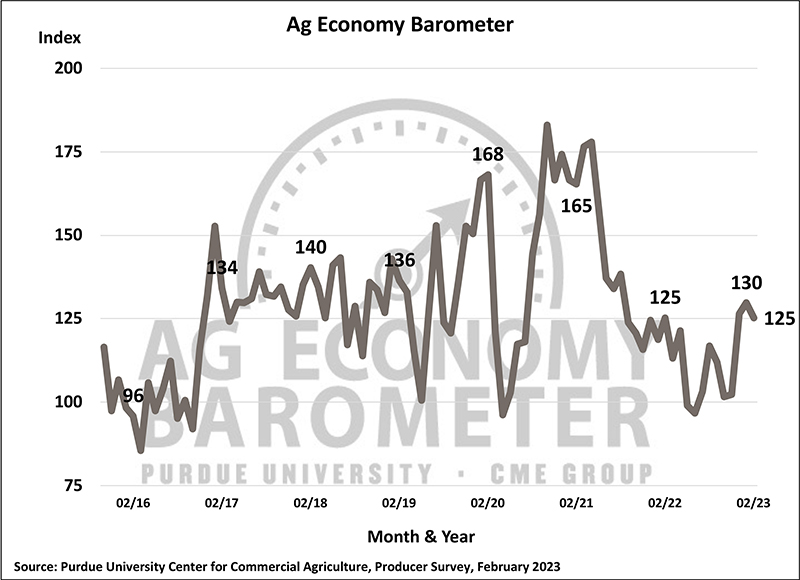
The Purdue University/CME Group Ag Economy Barometer dipped 5 points to a reading of 125 in February. Farmers' perspectives regarding both current conditions on their farms and their expectations for the future also weakened. The Index of Current Conditions fell 2 points to 134 and the Index of Future Expectations declined 6 points to 121. The Ag Economy Barometer is calculated each month from 400 U.S. agricultural producers' responses to a telephone survey. This month's survey was conducted between February 13-17.
"Increased concern over the risk of falling output prices, rising interest rates, and uncertainty over the future growth of U.S. agricultural exports is weighing on producers' minds," said James Mintert, the barometer's principal investigator and director of Purdue University's Center for Commercial Agriculture.
Producers' expectations for their farms' financial performance in 2023 compared to 2022 weakened in February. The Farm Financial Performance Index declined 7 points to a reading of 86. Farmers continue to point to concerns about higher input costs (38% of respondents), rising interest rates (24% of respondents), and lower output prices (18% of respondents), as their biggest concern for the year ahead.
Agricultural exports have been a key source of growth for U.S. agriculture for decades. Beginning in 2019, the Ag Economy Barometer survey routinely included a question asking producers about their expectations for agricultural exports in the upcoming 5 years. Since peaking in 2020, when just over 70% of respondents said they expected exports to increase in the upcoming 5 years, the percentage of farmers looking for exports to grow over time has drifted lower. In February, just 33% of survey respondents said they expect exports to increase, which leads Mintert to suggest that a lack of confidence in future agricultural export growth is contributing to weakened sentiment among producers.
Despite strong farm income, the February reading of the Farm Capital Investment Index changed little, rising one point to a reading of 43. This month, 72% of producers said it is a "bad time" to make large investments in their farming operation, while just 15% reported it is a "good time" to make such investments. The disparity between producers' responses to the question and actual farm equipment sales continues to be focused on costs. Of those who said now is a "bad time" to make large investments, 45% of respondents said it was because of an increase in prices for farm machinery and new construction, while 27% of respondents said it was because of "rising interest rates."
Producers' expectations for short-term and long-term farmland values fell in February but remain positive. The Short-Term Farmland Value Index declined one point to 119 while the Long-Term Farmland Value Index dropped 5 points to 137. Although both indices remain above 100, indicating a positive outlook on farmland values, the percentage of producers who said they expect values to decline over the next 5 years reached 19% this month, the highest percentage since this question was first routinely included in barometer surveys in 2019. Still, over half (56%) of respondents expect values 5 years from now to be higher than today. This month, just 33% of respondents said they expect values to rise in the next 12 months, while 14% said they expect values to weaken.
Each February, the barometer survey includes a question focused on farm growth, asking respondents about the annual growth rate they expect for their farm over the next 5 years. This year 49% of respondents said their farm either had "No plans to grow" (33%) or "Plan to exit or retire" (16%). Of those respondents who expect their farms to grow, 19% expect it to grow by "Less than 5% annually" and 22% said they expect it to grow by "5 to 10% annually."
Leasing of farmland for solar energy production is a hot topic in many parts of the U.S. Since the Spring of 2021, the barometer survey has periodically included questions about the discussions that farmers are having with solar companies. In both the January and February 2023 surveys, just over 10% of respondents said they had discussed a solar lease with a company. Of those who indicated they had been in discussions, nearly half (48%) of respondents said they were offered a lease rate above $1,000 per acre, up from a low of 27% and a high of 35% in previous surveys. This month's survey findings suggest companies have started to increase the lease rates they are willing to pay.
Read the full Ag Economy Barometer report at https://purdue.ag/agbarometer. The site also offers additional resources – such as past reports, charts and survey methodology – and a form to sign up for monthly barometer email updates and webinars.
Each month, the Purdue Center for Commercial Agriculture provides a short video analysis of the barometer results, available at https://purdue.ag/barometervideo. For more information, check out the Purdue Commercial AgCast podcast available at https://purdue.ag/agcast, which includes a detailed breakdown of each month's barometer and a discussion of recent agricultural news that affects farmers.
The Ag Economy Barometer, Index of Current Conditions and Index of Future Expectations are available on the Bloomberg Terminal under the following ticker symbols: AGECBARO, AGECCURC and AGECFTEX.
About the Purdue University Center for Commercial Agriculture
The Center for Commercial Agriculture was founded in 2011 to provide professional development and educational programs for farmers. Housed within Purdue University's Department of Agricultural Economics, the center's faculty and staff develop and execute research and educational programs that address the different needs of managing in today's business environment.
About CME Group
As the world's leading and most diverse derivatives marketplace, CME Group (www.cmegroup.com) enables clients to trade futures, options, cash and OTC markets, optimize portfolios, and analyze data – empowering market participants worldwide to efficiently manage risk and capture opportunities. CME Group exchanges offer the widest range of global benchmark products across all major asset classes based on interest rates, equity indexes, foreign exchange, energy, agricultural products and metals. The company offers futures and options on futures trading through the CME Globex® platform, fixed income trading via BrokerTec and foreign exchange trading on the EBS platform. In addition, it operates one of the world's leading central counterparty clearing providers, CME Clearing.
CME Group, the Globe logo, CME, Chicago Mercantile Exchange, Globex, and, E-mini are trademarks of Chicago Mercantile Exchange Inc. CBOT and Chicago Board of Trade are trademarks of Board of Trade of the City of Chicago, Inc. NYMEX, New York Mercantile Exchange and ClearPort are trademarks of New York Mercantile Exchange, Inc. COMEX is a trademark of Commodity Exchange, Inc. BrokerTec and EBS are trademarks of BrokerTec Europe LTD and EBS Group LTD, respectively. Dow Jones, Dow Jones Industrial Average, S&P 500 and S&P are service and/or trademarks of Dow Jones Trademark Holdings LLC, Standard & Poor's Financial Services LLC and S&P/Dow Jones Indices LLC, as the case may be, and have been licensed for use by Chicago Mercantile Exchange Inc. All other trademarks are the property of their respective owners.
It's Election Day for voters across the state! All voters have a state question on the ballot. Some voters also have county questions and local propositions to decide.
Polls will be open until 7 p.m. tonight. You can find your polling place and view a sample ballot at https://oklahoma.gov/elections/ovp.html. The election list is available on the State Election Board website.
Voters should be prepared to show proof of identity when they check in at their polling place. Voters without a valid proof of identity may request a provisional ballot.
Those with questions should contact their County Election Board or the State Election Board at (405) 521-2391 or info@elections.ok.gov.

Growth Energy, the nation's leading biofuels trade association, again today called on the U.S. Environmental Protection Agency (EPA) to rely on the best available science in its assessment of the environmental impacts of ethanol production and of the Renewable Fuel Standard (RFS).
In response to a call for comments on EPA's Third Triennial Report on biofuels and the environment, Growth Energy noted that while EPA's draft of the report correctly makes several important conclusions about the biofuels industry, it continues to rely too heavily on outdated science that inaccurately measures the nature and scale of the environmental impacts attributable to the RFS.
"Biofuels are an essential tool for combatting climate change with enormous potential for decarbonizing the transportation fuel sector, while bolstering domestic energy security, providing jobs in rural areas, and lowering the price at the pump for consumers," said Growth Energy. "For the full potential of biofuels to be realized and to provide a balanced and credible review of the science on environmental impacts, EPA must use the best, most up-to-date science that omits reliance on flawed data and studies that have been discredited by other government agencies and academics."
Previously, Growth Energy has urged EPA to update its approach to modeling on several occasions. Most recently, in response to EPA's proposed Renewable Volume Obligations (RVOs) for 2023-2025, Growth Energy introduced two new studies (available here and here) that further contributed to the growing body of research showing the overall environmental benefits of ethanol and the RFS.
Growth Energy also supplemented its comments on the draft Third Triennial Report by commissioning an additional study on air quality impacts by Air Improvement Resources, Inc., and another study by Ramboll on land use change and other environmental impacts. Both of these studies conclude that EPA's draft Triennial Report often overstates, to a significant degree, the environmental impacts of the RFS program, while understating biofuels' environmental benefits.
Read Growth Energy's full comments here.
Background EPA, in consultation with the U.S. Department of Agriculture (USDA) and the Department of Energy (DOE), is required under Section 204 of the Energy Independence and Security Act (EISA) to submit a triennial report to Congress that assesses the environmental and resource conservation impacts of the Renewable Fuel Standard (RFS). EPA issued the First Triennial Report in December 2011 and the Second Triennial Report in June 2018. EPA put the Third Triennial Report out in draft form in January 2023 and, for the first time, provided for a 60-day public comment period that included external peer review meetings to discuss the draft. All of the Triennial Reports assess a wide range of environmental impacts, including air, water, and soil quality, ecosystem health, and biodiversity. When it has been given the opportunity to do so, Growth Energy has long provided substantial technical input and scientific research to the EPA and other relevant federal agencies on the environmental impacts and benefits of the RFS program.
RON's Dave Lanning has a pre-opening look at today's agricultural Markets.
Click the audio tab below for today's report.
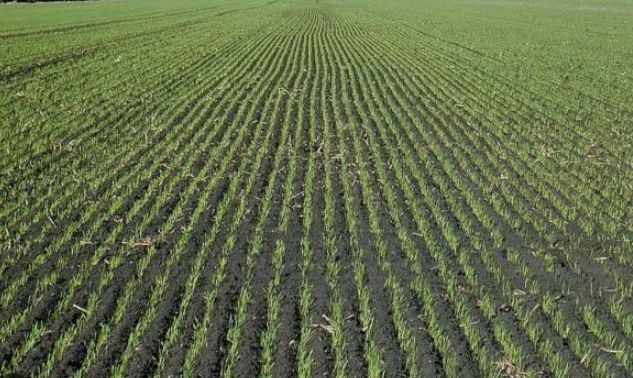
According to the Oklahoma Crop Progress and Condition report released on March 6, 2023, winter wheat was rated 39 percent good to excellent (one percent rated excellent), 21 percent fair and 40 percent poor to very poor. This time last year, winter wheat was rated 15 percent good to excellent, 28 percent fair and 57 percent poor to very poor. Winter wheat grazed reached 63 percent, down 3 points from the previous year, but up 9 points from normal.
Pasture and range conditions rated 7 percent good to excellent (one percent was rated excellent), 34 percent fair and 59 percent poor to very poor. This time last year, pasture and range conditions rated 31 percent good to excellent, 23 percent fair and 37 percent poor to very poor.
Livestock conditions rated 37 percent good to excellent, 39 percent fair and 24 percent poor to very poor.
Winter wheat conditions rated 17 percent good to excellent, 30 percent fair and 53 percent poor to very poor. This time last year, winter wheat conditions rated 24 percent good to excellent, 37 percent fair and 39 percent poor to very poor.
Winter wheat headed was at 19 percent, up 4 percentage points from the previous year and up 9 points from the average. Wheat conditions rated 19 percent good to excellent, 31 percent fair and 50 percent poor to very poor. This time last year, winter wheat conditions rated 7 percent good to excellent, 18 percent fair and 75 percent poor to very poor.
Range and pasture conditions rated 8 percent good to excellent, 23 percent fair and 69 percent poor to very poor. This time last year, range and pasture conditions rated 7 percent good to excellent, 25 percent fair and 68 percent poor to very poor.
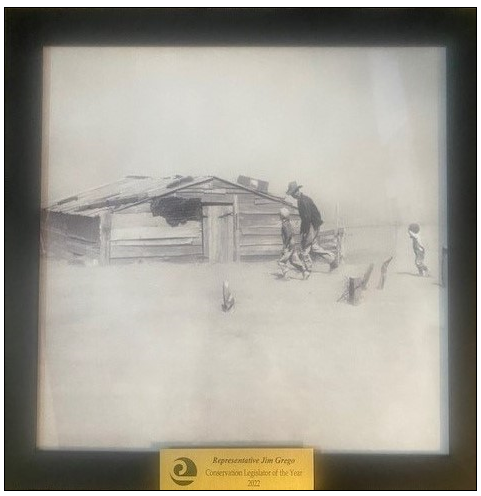
Rep. Jim Grego, R-Wilburton, this week was named the 2022 Conservation Legislator of the Year by the Oklahoma Association of Conservation Districts.
In the award recognition ceremony, it was noted there are many legislators passionate about conservation with each being vital to the success of private lands and voluntary conservation in Oklahoma.
"However, there are a few legislators that go above and beyond to preserve Oklahoma's soil and water. Representative Grego is always willing to meet with our district directors to discuss natural resource concerns and how we can best preserve the soil and water of Oklahoma. Personally, Representative Grego has implemented many conservation practices on his own cattle operation and has participated in both the Environmental Quality Incentive Program and the Conservation Stewardship Program," awardees noted.
Grego has been a cooperator with the Latimer County Conservation District for over 34 years. He served for 23 years on the Latimer County Conservation District board, including 20 of those years as chairman. He also served as the Area V Commissioner from 2010 to 2015.
The association acknowledged that during his time in the Legislature, Grego has helped provide a provision that allows for conservation districts to purchase feral swine traps and was instrumental in providing funding for the Office of Geographic Information.
"Conservation of our Oklahoma natural resources is of the utmost importance to me and to those who I serve in the Oklahoma House of Representatives," Grego said. "It's an honor to receive this recognition from a group of my peers. I guarantee I will continue my efforts toward best practices of preserving Oklahoma's soil, water and other resources."

American Farm Bureau Federation President Zippy Duvall commented today on the United States Trade Representative taking steps toward a formal trade dispute with Mexico over its ban on bioengineered corn.
"AFBF appreciates that USTR is taking this necessary step to press the Mexican government for fair access to markets for America's farmers. Mexican President Obrador's ban on biotech corn is not based on science and is a clear violation of the U.S.-Mexico-Canada trade agreement. It not only hurts our farmers, it denies families in Mexico access to safe and affordable food.
"We encourage Secretary Vilsack and USTR Ambassador Tai to continue pressing for a resolution with Mexico that upholds the framework of USMCA."
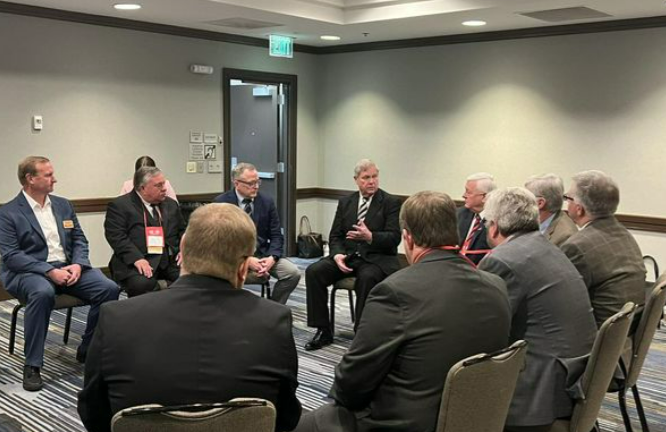
The U.S. Department of Agriculture (USDA) released a proposed rule on March 6, 2023 with new regulatory requirements aimed at aligning the voluntary "Product of USA" label claim with consumer understanding of what the claim means. The proposed rule allows the voluntary "Product of USA" or "Made in the USA" label claim to be used on meat, poultry and egg products only when they are derived from animals born, raised, slaughtered and processed in the United States.
KC Sheperd, Farm Director, had the chance to visit with the President of American Farmers and Ranchers, Scott Blubaugh about these new requirements and more.
Blubaugh is currently attending the National Farmers Union National Convention in San Francisco, where he had the opportunity to listen to U.S. Secretary of Agriculture, Tom Vilsack talking about the USDA proposing new requirements for the "Product of USA" label claim.
"I was really excited to hear that the Department of Agriculture there, USDA, filed in the federal registry new rules regulating the use of the product of USA label," Vilsack said. "We have argued for many years now that there is a lot of fraud and deception that has gone on in that program, where they are labeling beef that comes from outside of the United States as a product of the USA label."
In the past, products packaged in the U.S. could receive the label, Blubaugh said, which is not acceptable for consumers in the U.S. or AFR.
The new rules that have just been filed, Blubaugh said, require products to be born and raised in the United States to legally carry the Product of the USA label.
"That is the way it should have always been, but I am excited that finally we are going to get that reform that we have been asking for," Blubaugh said.
Blubaugh is excited to see some movement on this front and provide consumers truth in labeling.
"I know in Oklahoma, we have some of the very best cattle in the world," Blubaugh said. "We feed them the best way and we have best genetics and everything. It is very disheartening when one of these countries from outside the U.S. brings in beef that, quite frankly is inferior to our beef here in the United States."
It is disheartening, Blubaugh said, to see beef from outside of the U.S. be labeled as a product of the U.S. when American producers work so hard to produce a quality product.
"If they want to bring it in and sell it, fine, but don't lie to the American consumer and tell them it is a product of the USA when it is not," Blubaugh said. "We know our product is superior."
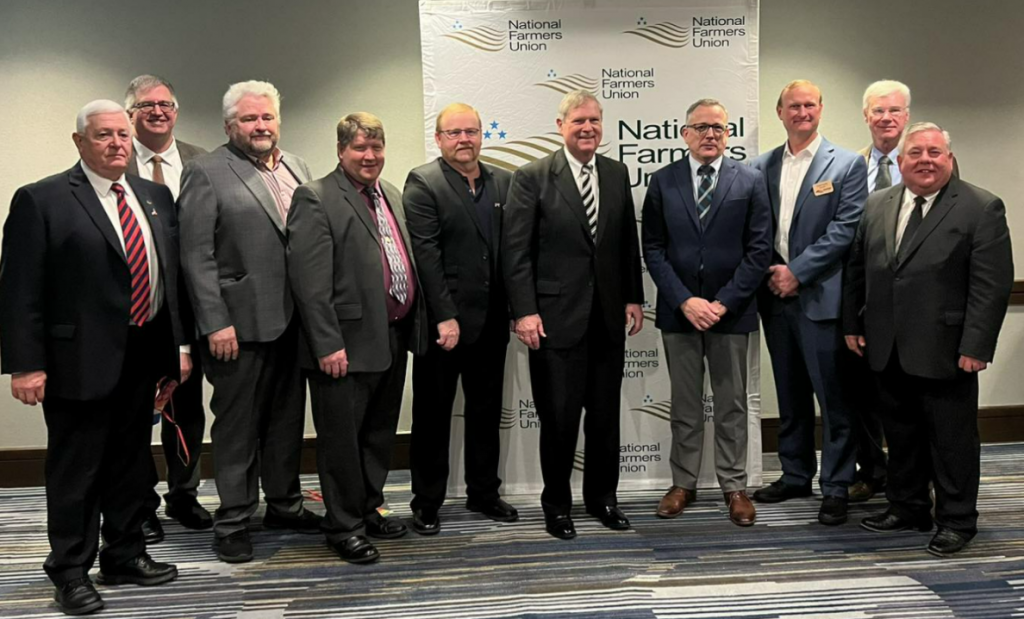
Today, NCBA Executive Director of Government Affairs Kent Bacus released the following statement on the USDA's new proposed rulemaking regarding the "Product of USA" label:
"There is no question that the current "Product of USA" label for beef is flawed, and it undercuts the ability of U.S. cattle producers to differentiate U.S. beef in the marketplace. For the past few years, NCBA's grassroots-driven efforts have focused on addressing problems with the existing label, and we will continue working to find a voluntary, trade-compliant solution that promotes product differentiation and delivers profitable solutions and for U.S. cattle producers. Simply adding born, raised, and harvested requirements to an already broken label will fail to deliver additional value to cattle producers and it will undercut true voluntary, market-driven labels that benefit cattle producers. We cannot afford to replace one flawed government label with another flawed government label."
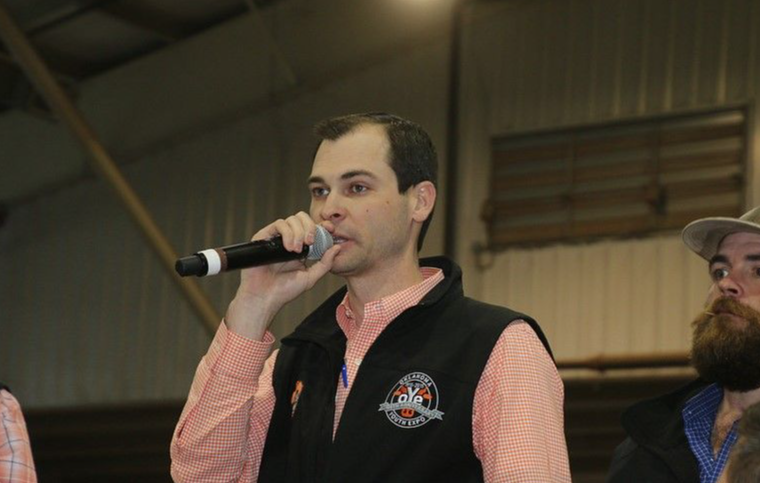
Senior Farm and Ranch Broadcaster, Ron Hays, is talking with the President of the Oklahoma Youth Expo and Onward Foundation, Tyler Norvell, about the 108th year at OYE as it kicks off this week.
"This year, we awarded over 350,000 dollars in scholarships, so what is great about that, the young people can only use the money here in Oklahoma," Norvell said. "So, we keep our most precious resource here in our state, and then I fully expect the premium sale to hit that 1.3 to 1.4, maybe 1.5 million dollars, just depending on how things finish up and what young people get into the sale."
It is the fourth year for the ag mechanics show at OYE, Norvell said and there will be 240 entrees this year. To put it into perspective, Norvell said the first year of the ag mechanics show, there were 50 entrees.
"It just continues to grow," Norvell said. "It is cool to see the young men and women that are part of that, that may not have livestock, but they are able to show their skills and their potential careers and jobs that they can do. Our sponsors continue to grow there."
Sponsorship of the Oklahoma Youth Expo is tremendous this year, Norvell said, and he is excited about some new sponsors this year as well. Many sponsors enjoy being part of the event, Norvell said, to make impressions on the youth of the show who will make great future hires.
"There will be plenty job opportunities for these young people and probably jobs offered Wednesday at the (ag mechanics) show, because of the issues with our workforce," Norvell said.
Following the guilt show starting this Thursday, Norvell said, next Wednesday night the youth will have the chance to sell their guilts. This year, Norvell said at least 125 head will be sold.
"There will be breeders literally from all over the country that buy these," Norvell said. "I think last year, we sent guilts to over 17 different states."
Regarding the upcoming legislative show that will be Tuesday, March 14, Norvell said, the event is a great opportunity for lawmakers to spend time with some outstanding students who are the future of agriculture.
"It is awesome to watch, I always say a nine-year-old girl is showing a 60-year-old-man that is an elected official how to show a 1400-pound steer, and the elected official is scared to death, and the little girl is just coaching him through it," Norvell said. "Those are just some classic moments, but we expect to have well over 100 legislators of the 149 there, and really look forward to that event."
Norvell takes pride in the Oklahoma Youth Expo, he said, because in his travels, he has found that many states look up to the event.
"The people that aren't a part of it wish they were, "Norvell said.
What makes the event unique, Norvell said is the sponsors, volunteers and people, but most of all, the help of Bob Funk and Jimmy Harrel. The OYE is one of the most impactful events of the year, Norvell said, for the Oklahoma City area.
"The city of Oklahoma City says that this is the only time they know for sure that at least one person from every Oklahoma county is in Oklahoma City throughout the whole year," Norvell said.
The show is running close to a 25-million-dollar economic impact for OKC, Norvell said, aiding the hotel business, restaurant business, and more.
"I think people always appreciated it, and then we combined it with Cattlemen's Congress, and they just are overwhelmed by the impact of the two together."
Click here for the full schedule for the 2023 OYE. The Oklahoma Farm Report team will be snapping pictures from start to finish- and you can see them as we add them to our Flickr album for 2023- available here. If you want to look back to the 2022 OYE- click here for our pictures from last year's event.
Our coverage of the 2023 Oklahoma Youth Expo is sponsored by Hilliary Communications- who deliver the latest cutting-edge communications services supporting tens of thousands of customers across 22 counties throughout Oklahoma, Texas and Iowa. The company offers internet, voice and HilliaryTV. Hilliary Communications continuously researches the marketplace for innovations and strives to improve underserved areas, offering services that exceed customer expectations. Click here to learn more about Hilliary Communications.

Background:
United States Trade Representative Katherine Tai today announced the United States is formally requesting technical consultations with the Government of Mexico under the Sanitary and Phytosanitary Measures (SPS) Chapter of the United States–Mexico–Canada Agreement (USMCA) to address genetically modified (GMO) corn restrictions by Mexico contrary to its USMCA commitments.
In a press release issued this morning, Tai cited biotech issues concerns and the importance of working with an approach based in science to help improve the relationship between the two countries, so it doesn't threaten U.S. market access to Mexico.
From U.S. Grains Council President and CEO Ryan LeGrand:
"The U.S. Grains Council thanks the Office of the U.S. Trade Representative for initiating the consultation with Mexico under USMCA because it undermines U.S. corn's access to the Mexican market," said USGC President and CEO Ryan LeGrand. "We have had a long and productive relationship with Mexico. It is our number one market for U.S. corn, and we support this action because it will likely be the most expedient way to ensure that positive relationship continues."
There is a new blog post out at the Southern Plains Perspective! Read Below:
The drought keeps hanging on, especially in Kansas, and just how many winter tornadoes did Oklahoma have?
From drought to tornadoes, it seems like we are having it all in the Southern Plains. Let's start by taking a look at the latest drought monitor.

Just look at all the brown up in Kansas, which, if you don't already know, means "exceptional drought." I know we are dry here where I am located at in Oklahoma, and its sure isn't wet in Texas, but just how bad is it in Kansas? Well, lets take a look (if you're from Western or Southern Kansas, you might want to divert your eyes).

That's not good.
As of this writing, the forecast is calling for some snow later this week in a lot of the "Exceptional Drought" areas, but it is going to take a lot of precipitation to turn this situation around.
To put this in perspective, consider the effect this dry weather is having on Kansas agriculture. As of Sunday, February 26, USDA rated winter wheat in Kansas as 19% good or excellent, down from 21% a month earlier and at the end of November and down from 25% a year ago. Some 51% were in poor or very poor condition, up from 38% a year ago.
The rest of the region isn't doing well either—USDA said winter wheat in Oklahoma is at 36% good or excellent versus 17% a month ago, 31% in November, and 11% a year ago. Texas wheat rated good or excellent is 19% versus 14% last month, 21% in November, and 8% last year. Additionally, Oklahoma and Texas wheat rated poor or very poor at 41% and 49%, respectively.
Needless to say, things are still looking rough, drought wise.
Now, about those tornadoes...
According to our partners at the Oklahoma MESONET (and if you haven't subscribed to the MESONET Ticker you should-it's great information, entertaining and its free), Oklahoma had at least 10 tornadoes in February. That breaks the previous record of six sets in 1975 and 2009.
That sounds like a lot...
Then consider that Oklahoma also had a record five tornadoes in January AND a record eight tornadoes in December. That's three straight months with a record number of tornadoes. Throw in six tornadoes in November (a month that usually averages 1.6 ), adding up to a record twenty three tornadoes during this winter season.
For comparisons sake, the previous recorded record was seven.
That's right, seven.
Do we have to worry about what is in store when we hit what is traditionally the REALLY active time for severe weather in the Southern Plains which actually runs from late March through early June?
Who knows?
After all, with this crazy weather, things are hard to pin down. Many of the old signposts seem to be turned around. Just look at this issue of the MESONET ticker from last week to understand how we can go from really warm weather to snow if just a few days (if not hours).
All this speaks to why we need to be prepared for anything when it comes to wild weather in the Southern Plains. Whether it's fire, snow, floods, droughts, tornadoes, or hurricanes, the region gets hit with them all (sometimes it seems like it's all in the same week). Producers should check with their local USDA Service Center to make sure they know what their options are, from adaptation strategies to risk management, because the crazy weather seems to keep on coming.
To read this blog post at the Southern Plains Perspective, click here.
To check out all other content at the Southern Plains Perspective, click here.
This week marked the first major deadline for the 2023 Legislative Session. Thursday was the final day for all bills except budget bills to be passed out of their assigned committee from their chamber of origin. While numbers are not yet finalized, there are around 1,000 bills and joint resolutions left alive after the Thursday deadline.
One bill that was passed out of committee this week was SB 669 by Sen. Michael Brooks. SB 669 would allow non-residents who file state taxes to utilize their individual tax identification number instead of a Social Security number to apply for a driver's license. The driver's license would be marked with a "NR" notation to indicate that the license holder is a non-resident.
The bill has received widespread support from the law enforcement community as it will allow some 33,000 people in Oklahoma to be documented in the driver's license system, which is the primary database used by law enforcement officers at all levels across the state. Additionally, other states that have implemented this legislation have seen their uninsured motorist and hit and run numbers drop dramatically.
There has been concern expressed that allowing non-residents to apply for a driver's license will result in non-residents being registered to vote. However, the bill explicitly states that those using an individual tax identification number shall not be provided voter registration services. Additionally, the bill goes to great lengths to ensure that individuals utilizing the individual tax identification number to apply for a driver's license are vetted through the State Election Board at least quarterly to ensure that those individuals are not intentionally or accidentally obtaining a voter registration card.
This bill will be beneficial to farmers and ranchers across the state who hire immigrant laborers to work on their farms and ranches by providing a path for those workers to receive a driver's license. It will lower the numbers of migrant workers driving without a license, which risks liability to the farm owner and causes significant delays if a farm vehicle driven by an unlicensed worker is impounded or detained.
HB 1921 by Rep. Lonnie Sims was approved by the House County and Municipal Government committee this week. HB 1921 seeks to allow counties to create Hazard Mitigation Assessment Districts to raise revenue that might be used to leverage funds from the Federal government to assist with a variety of disaster mitigation uses.
The funds would be accumulated by an increased property tax to all property within the county. An amendment has been made to the bill to exempt all agriculturally assessed land in the county, however, private residence and business would still be subject to the property tax increase and it is unclear how equipment would be impacted. Oklahoma Farm Bureau remains opposed to the bill in its current form because it still has the possibility to increase property taxes for farmers and ranchers.
HB 1921 is now available to be considered by the full House of Representatives.
For an update on weekly happenings at the Capitol and an outlook on what is ahead, be sure to tune in to Oklahoma Farm Bureau's Weekly Public Policy Update Zoom call each Friday at Noon.
Post-storm fraud common in Oklahoma
Attorney General Gentner Drummond is encouraging Oklahoma residents to be on the lookout for contractor fraud, especially in the wake of last month's tornadoes and severe storms. Drummond's warning is part of National Consumer Protection Week, a time designated for helping people understand their consumer rights and avoid frauds and scams. The week runs March 5-11 this year.
Drummond said the weeks that follow damaging storms and tornadoes are a common time for contractor fraud to occur.
"I encourage families to research companies and contractors before hiring them," he said. "It's important to stay on alert and to use your best judgment when selecting a contractor or construction company."
Ethan Shaner, deputy attorney general for the consumer protection unit, said construction and contractor fraud is the most common complaint submitted by consumers. Complaints in this category include new construction, roof repairs and replacements, remodeling and concrete work.
Shaner said the best ways to avoid contractor fraud are to:
Anyone can contact the Attorney General's Consumer Protection Unit to find out if complaints have been filed against a contractor. Anyone who suspects contractor fraud should contact the Office of the Oklahoma Attorney General. Consumer protection information is available at oag.ok.gov/consumer-protection or by calling 1-833-681-1895.
U.S. Department of Agriculture (USDA) Rural Development Oklahoma State Director Kenneth Corn announced today that the Biden-Harris Administration is investing $14 million to finance the startup and expansion of independent meat processors across Oklahoma. These funds will be used to capatilize a revolving loan fund that will provide low-interest rates to multiple beef and and poultry plants across Oklahoma to strengthen their capacity, be more resilient, and ultimately secure the nation's food supply chain.
The $14 million of investments announced today in Oklahoma support the Biden-Harris Administration's Action Plan for a Fairer, More Competitive, and More Resilient Meat and Poultry Supply Chain, which dedicates resources to expand independent processing capacity. As President Biden has highlighted, creating fairer markets and more opportunities for family farmers helps bring down prices at the grocery store.
"President Biden recognizes the need to expand processing capacity by creating a market that is fair for all Oklahomans and develop more revenue streams for our agriculture producers," Corn said. "Under the President and USDA's leadership, these investments will allow Oklahoma families to afford putting quality food on the dinner table by reducing inflation at our supermarkets and keep our Oklahoma ranchers and farmers from getting unfairly squeezed by large corporate meat processers by creating more competition in the marketplace for their product."
Rural Enterprises Incorporated ($5 million) and Southwest Intermediary Finance Team ($9 million) will manage these investments and provide the financing opportunities for Oklahoma meat and poultry processing sector in the state. Projects will include alleviating economic disruptions caused by the COVID-19 pandemic, increasing permanent resources to support food supply resiliency, and advancing long-term regional economic objectives in the Oklahoma agriculture producer market. Nationally, USDA is providing $89 million in grants under the Meat and Poultry Intermediary Lending Program to promote fair competition and innovation in the meat and poultry industry.
"The pandemic taught us that there was a great need for more capacity of meat processing in this nation. The lesson learned is not just a talking point for President Biden as he understands the need to take action so that our nation and our producers are never again held hostage to the lack of capacity in processing," said Corn
USDA touches the lives of all Americans each day in so many positive ways. Under the leadership of the Biden-Harris Administration, USDA is transforming America's food system with a greater focus on more resilient local and regional food production, fairer markets for all producers, ensuring access to safe, healthy and nutritious food in all communities, building new markets and streams of income for farmers and producers using climate-smart food and forestry practices, making historic investments in infrastructure and clean energy capabilities in rural America, and committing to equity across the Department by removing systemic barriers and building a workforce more representative of America. To learn more, visit https://www.rd.usda.gov/ok.
Editor's note- Senior Farm and Ranch Broadcaster Ron Hays was at Day One of the 2023 International Livestock Congress in Houston where the total focus was on the impact of ESG to Beef cattle. Over the next several Beef Buzz reports, Hays will explore what was discussed at the Congress as it relates to Cattle and this exploding concept.
Senior Farm and Ranch Broadcaster, Ron Hays, is back talking about the conversation on ESG (Environmental, Social and Governance) with Colorado State University Feedlot Systems Specialist, Dr. Sara Place.
"ESG stands for Environmental, Social, Governance, and it is really this catch-all for sustainability that a lot of companies are using to report their progress on to investors, to big banks, to hedge funds, and there is this increasing expectation that companies will," Place said. "So, why it matters for beef is there is companies that are selling beef, that are processing beef, that are reporting on these ESG metrics that have implications back down the supply chain in terms of things like greenhouse gas emissions that are in that framework."
Place also talked about individuals who have taken an anti-agriculture view, specifically focusing on farm production.
"There are different groups out there, different ESG rating agencies, or folks that will put out white papers and reports to try to inform the investment community- people like pension fund managers, folks like that- that maybe have an unfriendly view to modern intensive animal production," Place said. "That really comes from a standpoint of saying, 'well this industry is causing risk, whether it is to water supplies or to the climate.' So, that is one of those key places where we need to have good information, need to make sure science is driving these discussions, rather than perception in these different risk discussions."
Regarding conversations on climate change, Place said many companies have set "net-zero" goals.
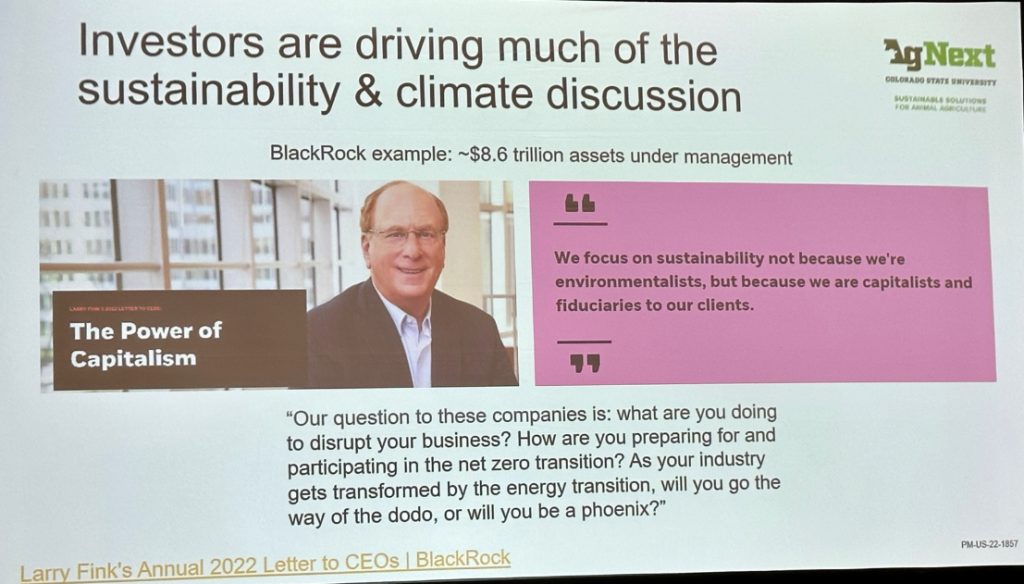
"These goals include all scopes of their missions," Place said. "All you need to know about that is, a lot of it is actually emissions of agricultural production. Whether you are a row crop producer, or a cattle producer, a lot of these companies have made greenhouse gas emission commitments that include your own emissions. The difficult thing about that is, are there going to be expectations for tracking, or for reporting, or solutions, or implementation? A lot of that has to be determined, but I think they key thing there is just to know and have that on your radar that this stuff is happening in the background."
A key part of telling the story in the beef cattle industry, Place said, is having the ability to showcase improvements made in the industry that are aimed at improving the sustainability and the environment.
The Beef Buzz is a regular feature heard on radio stations around the region on the Radio Oklahoma Ag Network and is a regular audio feature found on this website as well. Click on the LISTEN BAR for today's show and check out our archives for older Beef Buzz shows covering the gamut of the beef cattle industry today.
U.S. Department of Agriculture (USDA) Secretary Tom Vilsack today announced the Biden-Harris Administration is investing $89 million across the country (PDF, 160 KB) to finance the startup and expansion of independent meat processors. USDA also announced initial steps the Department is taking to create a more competitive marketplace for seeds and other agricultural inputs.
The $89 million of investments announced today support the Biden-Harris Administration's Action Plan for a Fairer, More Competitive, and More Resilient Meat and Poultry Supply Chain, which dedicates resources to expand independent processing capacity. As President Biden has highlighted, creating fairer markets and more opportunities for family farmers helps bring down prices at the grocery store.
"Under President Biden's leadership, USDA is laser-focused on standing up for America's farmers and ranchers by expanding processing capacity, creating fairer markets, and more revenue streams and market opportunities, which helps bring down food costs for families at the grocery store," Agriculture Secretary Tom Vilsack said. "Today's investments and actions to back the startup and expansion of independent processing capacity and boost market fairness in seeds and other key agricultural inputs will promote competition, support producer income, strengthen the supply chain, and increase economic opportunity in rural communities."
Secretary Vilsack announced the new investments at the National Farmers Union convention in San Francisco. USDA is providing $89 million in grants under the Meat and Poultry Intermediary Lending Program (MPILP) to increase available financing for independent processors, alleviate bottlenecks, and create opportunities for small businesses and entrepreneurs in rural communities. The investments are being made under the second round of the program. Last fall, USDA awarded $75 million in grants to eight nonprofit lenders in seven states under the first round of MPILP.
Nonprofit lenders in seven states will use the funding to establish revolving loan funds to finance the startup, expansion and operation of meat and poultry processors. USDA is making the investments in Alabama, Georgia, Maine, Nebraska, North Dakota, Oklahoma and South Dakota.
For example:
Additional information on MPILP is available at www.usda.gov/meat.
Creating a Fairer Market for Seeds, Other Agricultural Inputs
USDA today released a report, titled "More and Better Choices for Farmers: Promoting Fair Competition and Innovation in Seeds and Other Agricultural Inputs," that includes recommendations for improving market fairness. USDA is taking immediate action on three of these recommendations:
The report also underscores the importance of public investment in plant breeding to promote resiliency and competition and enable farmers to better adapt to local and regional needs.
As part of its efforts to enhance fair and competitive markets, and in response to President Biden's historic Executive Order on "Promoting Competition in the American Economy," USDA sought input from the public about the impacts of concentration, market power, and intellectual property in the market for seeds and other agricultural inputs. In particular, this focused on the effects to competition and market access for farmers, seed businesses, and other new and growing market competitors, especially small and medium-sized enterprises. USDA's Agricultural Marketing Service partnered with the University of Wisconsin to summarize the findings outlined in the report. The report reflects significant consultation across USDA and with USPTO's Director and staff, Department of Justice Antitrust, and the Federal Trade Commission.
USDA and its academic cooperator, Dr. Julie Dawson, a plant scientist at the University of Wisconsin-Madison, utilized comments received during the public comment period and listening session to inform this report. The report focuses on three ways to provide more and better seed choices to farmers: 1) working with the U.S. Patent and Trademark Office to enhance robust and reliable intellectual property rights that appropriately take into consideration the farmer's and plant breeder's voice and expertise, 2) ensuring that seed businesses are engaged in fair competition and are not unfairly taking advantage of market power, and 3) investing in the critical national infrastructure of more diverse seed variety development and stewardship to address local and regional food system needs and build greater resiliency into our food supply chains. In each of these sections, the report analyzes the current situation and makes recommendations that the U.S. Government can implement to promote fair competition and innovation.
More information is available on the AMS Fair and Competitive Markets webpage.
These initiatives are part of the Biden-Harris Administration's whole-of-government efforts to promote fair competition, innovation, and resiliency across food and agriculture, and parallel efforts by USDA to promote more and better choices for farmers by: investing more than $1 billion in more competitive meat and poultry processing options and $500 million in new domestic sustainable fertilizer capacity; enhancing transparency and modernizing competition enforcement through new Packers & Stockyards Act rules, a Cattle Contract Library Pilot, and more; and enabling farmers and ranchers to better secure value from their products such as through the proposed rule on Product of USA also announced today.
USDA touches the lives of all Americans each day in so many positive ways. Under the Biden-Harris Administration, USDA is transforming America's food system with a greater focus on more resilient local and regional food production, promoting competition and fairer markets for all producers, ensuring access to safe, healthy and nutritious food in all communities, building new markets and streams of income for farmers and producers using climate-smart food and forestry practices, making historic investments in infrastructure and clean energy capabilities in rural America, and committing to equity across the Department by removing systemic barriers and building a workforce more representative of America. To learn more, visit www.usda.gov.
U.S. Secretary of Agriculture Tom Vilsack issued the following statement regarding today's announcement by the Office of the U.S. Trade Representative that the United States is requesting technical consultations with Mexico under the Sanitary and Phytosanitary Measures (SPS) Chapter of the United States-Mexico-Canada Agreement (USMCA). These consultations regard certain Mexican measures concerning products of agricultural biotechnology.
"Mexico is an important partner, and we remain committed to maintaining and strengthening our economic and trade ties. A robust, transparent agricultural trading relationship, founded on rules and science, is vital to ensuring food security, mitigating the lingering effects of food price inflation, and helping to address the climate crisis. Innovations in agricultural biotechnology play a key role in advancing these critical, global objectives.
"These consultations represent the next step in addressing the United States' concerns with Mexico's biotechnology policies. While we appreciate the sustained, active engagement with our Mexican counterparts at all levels of government, we remain firm in our view that Mexico's current biotechnology trajectory is not grounded in science, which is the foundation of USMCA. We remain unequivocal in our stance that the science around agricultural biotechnology has been settled for decades.
"We remain hopeful that our concerns can be fully addressed but, absent that, we will continue to pursue all necessary steps to enforce our rights under the USMCA to ensure that U.S. producers and exporters have full and fair access to the Mexican market."
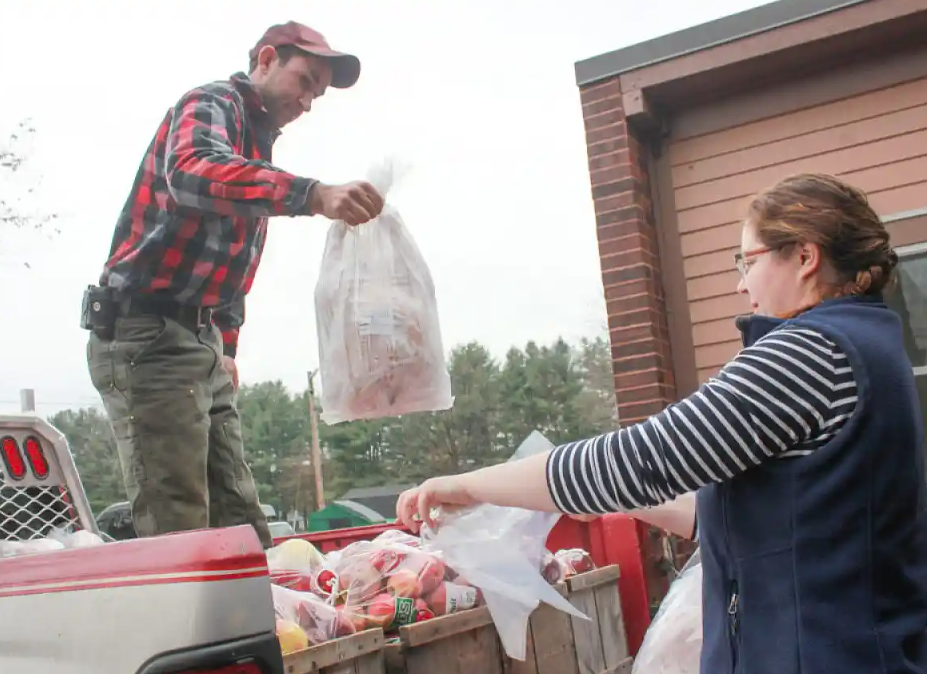
Farm and ranch families from across the nation donated 25.3 million pounds of food and raised more than $1 million to help fight hunger in 2022 through Farm Bureau's "Harvest for All" program. Combined, the monetary and food donations totaled the equivalent of 31.1 million meals.
Criteria for tracking Harvest for All donations included dollars and pounds of food donated by state and county Farm Bureaus, as well as volunteer hours, reported from the grassroots up as part of the annual campaign.
The spirit of farm communities has always been one of working together and giving back. Now in its 21st year, Harvest for All is spearheaded by members of Farm Bureau's Young Farmers & Ranchers program, but members of all ages from across the nation contribute to the effort. Their participation helps ensure Americans who are facing food insecurity can enjoy the bounty of food farmers and ranchers produce.
In addition to raising food and funds, farmers and ranchers tallied 13,827 volunteer hours assisting local hunger groups in 2022.
"The reality is that addressing hunger is a concern for people from all walks of life, including many rural Americans and residents of farming communities," said Matt Fimon of Virginia, chair of AFBF's YF&R Committee. "Farm Bureau remains committed to helping put food on the tables of those in need through Harvest for All."
Florida Farm Bureau took top honors for donating the most food in 2022, 18.7 million pounds. This included member participation in food drives and fundraisers to purchase holiday meals for those in need. Farmers also participated in gleaning activities, helping collect produce left in fields after harvest for donation to local food panties.
Michigan Farm Bureau took top honors for raising the most money in 2022, $372,716. Numerous fundraising activities conducted by county Farm Bureaus and the Agent Charitable Fund, coupled with "double-up" grants, helped Michigan reach this impressive total for funds donated. A month-long Million Meals Challenge that encouraged members and county Farm Bureaus to partner with communities to raise enough funds to provide 1 million meals also helped spur support.
Florida Farm Bureau tallied the most volunteer hours, 6,400. This included time collecting and delivering food and supplies to community members impacted by hurricanes. Members involved in YF&R programs in several counties also participated in gleaning projects, helping local farmers pick produce from fields after harvest for donation to local food pantries.
Thanks to the generosity of Nationwide, these state organizations received a $500 grant (for each type of contribution) for donation to a local food bank of their choice or for another Harvest for All project.
Second-place winners were New York Farm Bureau for 6.4 million pounds of food donated, Tennessee Farm Bureau for $256,500 in donated funds and Illinois Farm Bureau for 4,153 hours of donated volunteer time.
Each of the second-place winners received a $250 grant from Nationwide to donate to the local food bank of their choice.
Most Innovative Winner
In addition, the Illinois Farm Bureau Young Leader Committee received a $250 grant from Nationwide for "most innovative" program for hosting a March Madness NCAA basketball tournament fundraiser. Participants made donations to submit their brackets and the winner donated funds to Feeding Illinois, the association of Feeding America food banks that serve Illinois.
The awards were presented during AFBF's 2023 FUSION Conference, held March 3-6 in Jacksonville, Florida.
Since Harvest for All was launched, Farm Bureau families have gathered 437 million pounds of food, logged more than 237,000 volunteer hours and raised more than $11 million in donations.
The U.S. Department of Agriculture (USDA) issued a proposed rulemaking to close the "Product of the U.S.A." loophole that meatpackers use to purposefully mask the identify of their comingled beef products.
Under current regulations, imported beef product can be brought into the US., undergo a "significant transformation," - which can be as insignificant as trimming or rewrapping - and then claim the "Product of the U.S.A." label. This is a wholly unacceptable practice that intentionally misleads consumers.
The proposed rule announced today allows the voluntary "Product of USA" or "Made in the USA" label claim to be used on meat, poultry and egg products only when they are derived from animals born, raised, slaughtered and processed in the United States.
The proposed rule follows a request made by the U.S. Cattlemen's Association (USCA) in a petition for rulemaking submitted to USDA's Food Safety and Inspection Service in 2019.
USCA President Justin Tupper issued the following statement:
"In our 2019 petition for rulemaking to FSIS, USCA called out the practice of applying 'Product of the USA' and 'Made in the USA' labeling claims on beef products that the food safety agency itself admitted could have come from other countries.
"USCA is pleased to see that the proposed rule finally closes this loophole by accurately defining what these voluntary origin claims mean, something we have been working to clarify since the repeal of mandatory country-of-origin labeling in 2015. If it says 'Made in the USA,' then it should be from cattle that have only known USA soil. Consumers have the right to know where their food comes from, full stop.
"USCA would like to thank the Biden Administration for incorporating this goal in their Action Plan for a Fairer, More Competitive, and More Resilient Meat and Poultry Supply Chain issued in 2022. But, we also need to recognize the relentless work by our champions in Congress, including my home-state Senator Mike Rounds, who sponsored the U.S.A. Beef Act that would have prohibited beef from bearing the phrase "Product of U.S.A." unless it was exclusively derived from U.S. cattle. We could not have elevated this issue without the many voices speaking up in support of the change.
"USCA plans to submit comments supporting this proposed definition."
So, what exactly does this announcement mean?
This is the first major progress since COOL was originally passed in the 2008 Farm Bill - and the first step towards truth in labeling since the program's repeal in 2015.
What about mCOOL?
Mandatory COOL remains USCA's primary goal, and the wishes of the majority of the cattle producers and consumers. USCA members should continue to call and write their elected representatives and ask for their support of the American Beef Labeling Act. This bill reinstates mandatory country-of-origin labeling requirements for beef.
Specifically, the bill requires the Office of the U.S. Trade Representative (USTR) to develop a means of reinstating the requirements that complies with the rules of the World Trade Organization. The USTR and the Department of Agriculture must implement the means within one year. The support of Congress will be a critical part of the pathway forward for COOL, and that will be accomplished through a grassroots push by cattle producers. USCA's request for a clear definition from the USDA FSIS is the first step to securing truthful and accurate labels.
And what happens next?
USDA will open a public comment period on this proposed rule. We must rally around definitions - the pathway towards country-of-origin labeling begins with closing the current loopholes. The approach suggested by USDA would get labeling right on beef. Now, we need to work to get it right on cattle. Join us in putting an immediate halt to fraudulent labeling by supporting this definition change.
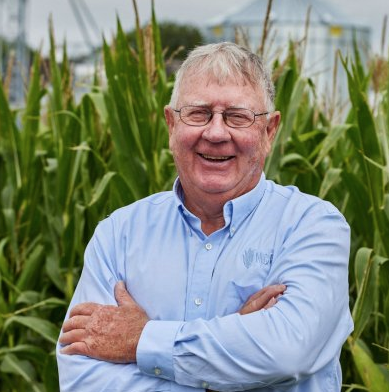
he U.S. Trade Representative today initiated a technical consultation with Mexico, a move that puts the U.S. one step away from filing a full dispute settlement under the U.S.-Mexico-Canada Agreement over the aggressive steps Mexico has taken to ban biotech corn. Mexico is a top market for corn, the number one agricultural export from the U.S.
The National Corn Growers Association, which along with affiliated state associations, has been leading calls for the Biden administration to act, applauded the development and urged USTR to expedite the process.
"We are pleased USTR is taking the next step to hold Mexican officials accountable for the commitments they made under USMCA, which include accepting both biotech and non-biotech commodities," said NCGA President Tom Haag. "Mexico's position on biotech corn is already creating uncertainty, so we need U.S officials to move swiftly and do everything it takes to eliminate this trade barrier in the very near future."
A technical consultation will bring leaders from both countries into formal discussions. As part of the process, which can happen in person or virtually, both countries can tap their experts to share information on agricultural biotechnology.
If this step does not resolve the impasse, the U.S. can then initiate a dispute settlement under USMCA. Once a dispute settlement is filed, a group of experts are empaneled to hear the case and make final determinations based on the commitments both parties signed as part of the free trade agreement.
The dispute over biotech corn stems from a 2020 decree by Mexican President Andrés Manuel López Obrador that sought to ban imports of biotech corn beginning in January 2024. Mexico issued a revised decree in February that banned biotech corn for food usage and left the door open for a future ban on biotech corn for feed, effective immediately.
Most corn grown in the U.S. is biotech corn, and Mexico has historically been one of America's top customers.
The ban raises concerns for U.S. farmers and rural economies, but also for the people of Mexico. According to a study by World Perspectives, Inc., the decree would raise tortilla prices in Mexico by 40% in the first year and 16% over time.
Given the high stakes, NCGA and corn grower leaders across the country began to sound the alarm last fall and have been calling on the Biden administration to initiate a dispute settlement under USMCA.
Mexico's decree is not based on sound scientific evidence. Regulators and health organizations around the world, from the World Health Organization to the U.S. Food and Drug Administration, have confirmed the safety and benefits of biotech crops for decades.
The U.S. Food and Drug Administration's (FDA) unwillingness to limit dairy terms to true dairy products makes passage of the DAIRY PRIDE Act more necessary than ever, Sen. Tammy Baldwin, D-WI, said in a Dairy Defined podcast released today.
"They're going to continue to allow mislabeled imitation products to be on the market," Baldwin said. "Wisconsin farmers work so hard to meet the FDA standards of nutrition and quality. They can't put the word 'milk' on the side of a carton of milk unless they meet those standards. It is not fair for plant-based products to be able to say they're milk when they don't meet those standards at all.
Baldwin, along with Sens. Jim Risch, R-ID; Peter Welch, D-VT, and Susan Collins, R-ME, last week reintroduced the DAIRY PRIDE Act, which would require FDA to enforce its standards of identity and supersede the inadequate draft guidance it offered in February, in which plant-based beverages could call themselves "milk" as long as they clearly state their nutritional differences with real dairy.
Baldwin said DAIRY PRIDE could pass Congress this year via one of several vehicles, including the farm bill due this year.
"Many of the folks that I'm joining forces with are going to have significant input as we draft a new farm bill, which is something that I expect to get completed this calendar year. So that's certainly one area that we can look towards. We also have funding bills for the Food and Drug Administration, and that would certainly be another opportunity to look at this type of legislation."
DAIRY PRIDE is an acronym for the Defending Against Imitations and Replacements of Yogurt, Milk, and Cheese to Promote Regular Intake of Dairy Everyday Act.
FDA's guidance is open for public comment until April 24. Dairy advocates may learn more about the issue and offer comments here. The full podcast is here. You can also find the podcast on Apple Podcasts, Spotify and Google Podcasts.
To listen to the podcast episode, click here.
Natural Resources Conservation Service (NRCS), Farm Service Agency (FSA) and the Oklahoma Tribal Conservation Advisory Council (OTCAC) will partner together for a free conservation workshop on Tuesday, April 4, 2023.
The "Conserving Pollinators in Oklahoma's Gardens, Farms and Ranches" workshop will meet in person this year. Join the agencies to discuss the importance of Pollinators, Sustainable Soils, Horticulture Methods, Key Steps for a Soil Test, NRCS Inflation Reduction Act (IRA), USDA agency updates and information on the locally led process to identify resource concerns.
Speakers for this event are Michael Ramming, NRCS; Mike Rose, Mayes County, OSU Extension; Haleigh Barnes, Ottawa County Extension; Brian Jervis, Tulsa County, OSU Extension; Ray Moranz, Ph.D., NRCS; Mattie Alewine and Wendy Ink, Farm Service Agency (FSA); Shirley Hudson, Ottawa County Conservation District, and Carol Crouch, Ph.D., NRCS.
Partners that will also present information include the National Agriculture Statistic Service (NASS), and Adair, Cherokee, Delaware, and Sequoyah Conservation Districts.
When: Tuesday, April 4, 2023, from 8:30 a.m. to 1:30 p.m. Lunch will be provided.
Location: Inter-Tribal Conference Room, 21 N. Eight Tribal Trail, Suite "C" in Miami, Oklahoma.
RSVP: Participants must register beforehand using following link: register here.
Persons with disabilities who require accommodations to attend or participate in this meeting/event/function should contact Carol Crouch via voice #405-742-1203, Federal Relay Service at 1-800-877-8339, or Carol.Crouch@usda.gov by March 23, 2023.
NRCS assists producers with implementing conservation concerns and addressing resource concerns and FSA administers a wide variety of programs covering commodity crops, livestock, conservation, and disaster programs with varying degrees of requirements for participation. Landowners and operators are encouraged to utilize workshops and webinars to learn more about the 2018 Farm Bill Programs and to ask questions regarding USDA programs.
Dr. Derrell Peel, Oklahoma State University Extension Livestock Marketing Specialist, offers his economic analysis of the beef cattle industry as part of the weekly series known as the "Cow Calf Corner" published electronically by Dr. Peel and Mark Johnson. Today, Dr. Peel talks about the cattle markets.
For the first time in several years it appears that all segments of cattle and beef markets are on the same page and responding to tightening supply fundamentals. The complex linkages across cattle and beef markets mean that the dynamics of market adjustments are relatively slow under the best of circumstances. Delays due to the pandemic in 2020 stretched into 2021 and drought impacts since late 2020 contributed to a delayed transition of fundamentals from feeder cattle markets, through fed cattle markets into beef markets.
Cattle numbers have declined for several years since the peak beef cow herd in 2019. Declining calf crop numbers (from the 2018 peak) should have led to peak cyclical beef production by 2020. Pandemic delays pushed beef production from 2020 into 2021. Drought liquidation in 2021 and 2022 led to further short-term increases in beef production. Record beef production in 2022 occurred four years after the peak calf crop. Drought the past two years resulted in additional heifer placements and caused early marketing of calves in 2022 that maintained feedlot inventories above year earlier levels until late in the year. Feedlot inventories have declined year over year for five consecutive months and will continue decreasing. Feedlot marketings and beef production were higher year over year in January but that appears to be changing.
Lower carcass weights and declining cattle slaughter have year-to-date beef production down 4.5 percent by early March. The decrease in cattle numbers since the 2018 peak calf crop has finally worked through the system. Cattle slaughter and beef production are expected to decrease for the balance of 2023 and beyond. With continuing drought conditions, it is not clear exactly how cattle and beef market timing will develop going forward, but the question is not one of whether beef production will fall, but rather how fast and how much it will fall in 2023.
The auction price for 500-pound steers in Oklahoma last week was $239.66/cwt., the highest price since September 2015. The record high price for 500-pound steers in Oklahoma was $312.72/cwt. in November 2014. The price of 825-pound steers last week was $181/cwt., the highest price since October 2015. The all-time peak price for these steers was $238.87/cwt. in October of 2014. The live 5-market average price of fed steers last week was $165.07/cwt., the highest fed price since April of 2015. Fed prices hit a record level of $171.38/cwt. in November 2014. Cattle prices are expected to continue trending higher in 2023 and new record cattle prices will happen, if not in 2023, at some point in the next two or three years.
Higher cattle prices will push wholesale and retail beef prices against beef demand, which remains strong but somewhat muted currently. There will be resistance to higher beef prices, but the reality of decreasing beef supplies will ultimately push beef prices higher. It will take some time for domestic and international demand to adjust to limited beef supplies. In the meantime, all the margins between cow-calf and consumer will be squeezed. The tightest pinch-point in this process will be when heifer retention begins in earnest to rebuild the herd. That will likely begin in late 2023 and continue through 2024 and perhaps beyond.
Below, Derrell Peel, OSU Extension livestock marketing specialist, says cattle markets are continuing to remain strong overall on SunUpTV.
The U.S. Department of Agriculture (USDA) today released a proposed rule with new regulatory requirements to better align the voluntary "Product of USA" label claim with consumer understanding of what the claim means. The proposed rule allows the voluntary "Product of USA" or "Made in the USA" label claim to be used on meat, poultry and egg products only when they are derived from animals born, raised, slaughtered and processed in the United States. Today's announcement delivers on one of the key actions in President Biden's Executive Order on Promoting Competition in the American Economy, and a commitment made in the Biden-Harris Administration's Action Plan for a Fairer, More Competitive, and More Resilient Meat and Poultry Supply Chain. The increased clarity and transparency provided by this proposed change would prevent consumer confusion and help ensure that consumers understand where their food comes from.
"American consumers expect that when they buy a meat product at the grocery store, the claims they see on the label mean what they say," said Agriculture Secretary Tom Vilsack. "These proposed changes are intended to provide consumers with accurate information to make informed purchasing decisions. Our action today affirms USDA's commitment to ensuring accurate and truthful product labeling."
USDA's proposed rulemaking is supported by petitions, thousands of comments from stakeholders, and data. In July 2021, USDA initiated a comprehensive review to understand what the "Product of USA" claim means to consumers and inform planned rulemaking to define the requirements for making such a claim. As part of its review, USDA commissioned a nationwide consumer survey. The survey revealed that the current "Product of USA" labeling claim is misleading to a majority of consumers surveyed, with a significant portion believing the claim means that the product was made from animals born, raised, slaughtered and processed in the United States.
USDA's comprehensive review shows there is a clear need to revise the current "Product of USA" label claim so that it more accurately conveys U.S. origin information.
Under the proposed rule, the "Product of USA" label claim would continue to be voluntary. It would also remain eligible for generic label approval, meaning it would not need to be pre-approved by USDA's Food Safety and Inspection Service (FSIS) before it could be used on regulated product, but would require supporting documentation to be on file for agency inspection personnel to verify. The rulemaking also proposes to allow other voluntary U.S. origin claims we see on meat, poultry and egg products sold in the marketplace. These claims would need to include a description on the package of all preparation and processing steps that occurred in the United States upon which the claim is made.
USDA encourages stakeholders, both domestic and international, to comment on the proposed rule. The proposed rule will be open for public comment for 60 days after publishing in the Federal Register. Public comments can be submitted at www.regulations.gov.
USDA touches the lives of all Americans each day in so many positive ways. In the Biden-Harris Administration, USDA is transforming America's food system with a greater focus on more resilient local and regional food production, fairer markets for all producers, ensuring access to safe, healthy, and nutritious food in all communities, building new markets and streams of income for farmers and producers using climate smart food and forestry practices, making historic investments in infrastructure and clean energy capabilities in rural America, and committing to equity across the Department by removing systemic barriers and building a workforce more representative of America. To learn more, visit www.usda.gov.
Farm Director, KC Sheperd, is visiting with Mary Chris Barth about the Beaver County Free Fair and Cimmaron Territorial Celebration combined event coming up on August 20th through the 26th. Barth is on the fair board in Beaver County and gives Sheperd a run-down of what the week will look like.
"The panhandle, 'no man's land,' Cimarron territory- we are the only part of the state that was in two territories," Barth said. "Because there was no government, the people here established their own territory, and then directly, we were attached to Oklahoma territory."
The event will begin on Sunday, August 20th with a community-wide church service, Barth said, then on Monday, festivities will begin.
"Tuesday will be our farmers market there on the fairgrounds, and it is vendors from both Oklahoma, Kansas, and Texas coming," Barth said. "So, we will welcome people Tuesday evening to do that."
On Wednesday, August 23, there will be a chili cookoff featuring hamburger meat that is sold directly from producers within Cimmaron territory.
"So, if you are in Beaver, Texas, or Cimmaron County, your hamburger will be featured, as well as those from our local processing plant," Barth said. "Those who want to participate and are not a direct producer are eligible to do so by purchasing hamburger from one of these producers."
Wednesday will also feature the crowning of the King and Queen of the Cimarron Territorial Celebration, Barth said, around mid-day at the First Security Bank in Beaver.

Barth also talked about the events that will take place on Saturday.
"We will start off our cow-chip events with our jackpot cow-chip stock show, which starts at 7:30," Barth said.
Barth said the stock show will have cattle, sheep, goats, and then swine from the county only.
"Then we have our cow-chip parade," Barth said. "Kiddie parade starts at 10, and cow chip parade starts at 10:30. The whole main street of Beaver will be closed off, and we look forward to having participation from across the area on that."
At 2 p.m., Barth said the cow chip throwing contest will begin.
"We feature cow chips because that was the fuel that homesteaders had to cook with, to heat with, because there were no trees," Barth said. "We have an opening for dignitaries to throw, and then we break down into ages. It will be held at the Beaver County rodeo arena, which is a portion of our fairgrounds."
The U.S. Food and Drug Administration's (FDA) unwillingness to limit dairy terms to true dairy products makes passage of the DAIRY PRIDE Act more necessary than ever, Sen. Tammy Baldwin, D-WI, said in a Dairy Defined podcast released today.
"They're going to continue to allow mislabeled imitation products to be on the market," Baldwin said. "Wisconsin farmers work so hard to meet the FDA standards of nutrition and quality. They can't put the word 'milk' on the side of a carton of milk unless they meet those standards. It is not fair for plant-based products to be able to say they're milk when they don't meet those standards at all.
Baldwin, along with Sens. Jim Risch, R-ID; Peter Welch, D-VT, and Susan Collins, R-ME, last week reintroduced the DAIRY PRIDE Act, which would require FDA to enforce its standards of identity and supersede the inadequate draft guidance it offered in February, in which plant-based beverages could call themselves "milk" as long as they clearly state their nutritional differences with real dairy.
Baldwin said DAIRY PRIDE could pass Congress this year via one of several vehicles, including the farm bill due this year.
"Many of the folks that I'm joining forces with are going to have significant input as we draft a new farm bill, which is something that I expect to get completed this calendar year. So that's certainly one area that we can look towards. We also have funding bills for the Food and Drug Administration, and that would certainly be another opportunity to look at this type of legislation."
DAIRY PRIDE is an acronym for the Defending Against Imitations and Replacements of Yogurt, Milk, and Cheese to Promote Regular Intake of Dairy Everyday Act.
FDA's guidance is open for public comment until April 24. Dairy advocates may learn more about the issue and offer comments here.
To listen to the podcast episode, click here.
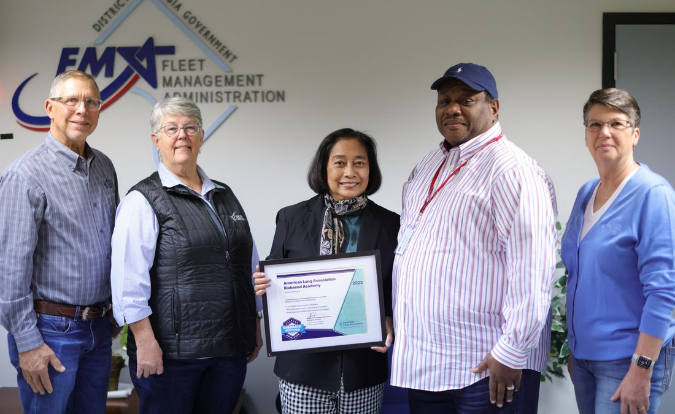
Left to Right: Nicholas Kercheval, USB Director, West Virginia; Belinda Burrier, USB Director, Maryland (Infrastructure & Connectivity Priority Area Coordinator); Angela Tin, American Lung Association Vice President, Environmental Health; Tim Fitzgerald, Director of District of Columbia Department of Public Works, Fleet Management; Susan Watkins, USB Director, Virginia
The soy checkoff, American Lung Association and U.S. Department of Agriculture recognize city fleet leaders ahead of National Biobased Products Day on March 8.
ST. LOUIS (March 3, 2023) — U.S. soybeans support cleaner environments and climate change initiatives in some of the nation's most populous cities. The Biobased Academy® is one partnership that goes the extra mile to further soy-biobased products in vehicle fleets.
Funded by U.S. soybean farmers, this joint partnership with the American Lung Association recently recognized fleet leaders as part of National Biobased Products Day. Fleet and facility professionals who participated completed a training program on the operational, health, safety and environmental benefits of using biobased products. The graduates of the Academy represented the District of Columbia; Port Authority of New York and New Jersey; Cobb County, Georgia; and Madison, Wisconsin. Additionally, the fleet professionals from the Smithsonian Institution look forward to completing the course this spring.
"Farmers, through their checkoff, remain committed to creating sustainable cities. Our goal is to invest in fleet education and outreach to promote the benefits of switching to renewable products made with U.S. Soy," said Susan Watkins, checkoff farmer-leader from Virginia. "Since the Academy launched publicly in October 2022, more than 30 fleet professionals from 20 communities have completed the training. The Biobased Academy not only strengthens cities and communities but also brings value back to all soybean farmers."
Soybean oil can replace petroleum-based compounds in thousands of products. Whether it's rubber, plastics, lubricants or coatings, soy as an ingredient doesn't sacrifice performance or competitive pricing. Checkoff-supported research leads to the commercialization of new soy-based products each year.
Cargie Vaughn, associate director of the Smithsonian Institution facilities, said the organization has upgraded a significant amount of its Washington, D.C., fleet. Previously, they used petroleum-based tires but have made the switch to soy-based Goodyear® tires.
"The Smithsonian intends to replace 100% of our fleet's tires," said Vaughn. "We visited a farm and saw for ourselves that U.S. farmers implement sustainable practices to grow soybeans. Our own evaluations show that the soy-biobased tires are high performing, too."
There are multiple benefits to using biobased products in the transportation sector. Implementing these products protects workers by reducing exposure to harsh chemicals and fumes while helping organizations reduce their environmental footprint. Making the switch also contributes to the American economy by increasing the use and sale of products made with U.S. soybeans.
Specific to the economic benefits, a USDA Rural Development report shows that the biobased products industry:
• Supports 4.6 million American jobs through direct, indirect and induced contributions.
• Contributes $470 billion to the U.S. economy.
• Generates 2.79 jobs in other sectors for every biobased job.
• Displaces about 9.4 million barrels of oil a year.
In addition to tires, fleets can find several soy-biobased products on the market, including synthetic motor oil and fifth-wheel grease. Tim Fitzgerald, District of Columbia fleet administrator and USB bio ambassador, said the biobased grease does the job better and more sustainably than the petroleum-based products used before.
"As a leader of a fleet in our nation's capital, I am proud to stand alongside this group of innovators in our industry. They not only completed the Biobased Academy program, but also adopted a new and climate-forward standard for their fleets," said Fitzgerald. "They demonstrate care for their employees, communities and environment. It's fitting that we recognize them in conjunction with USDA's first National Biobased Products Day."
About United Soybean Board: United Soybean Board's 77 volunteer farmer-leaders work on behalf of all U.S. soybean farmers to achieve maximum value for their soy checkoff investments. These volunteers create value by investing in research, education and promotion with the vision to deliver sustainable soy solutions to every life, every day across the three priority areas of Infrastructure & Connectivity, Health & Nutrition, and Innovation & Technology. As stipulated in the federal Soybean Promotion, Research and Consumer Information Act, the USDA Agricultural Marketing Service has oversight responsibilities for USB and the soy checkoff. For more information on the United Soybean Board, visit unitedsoybean.org.
RON's Dave Lanning has a pre-opening look at today's agricultural Markets.
Click the audio tab below for today's report.
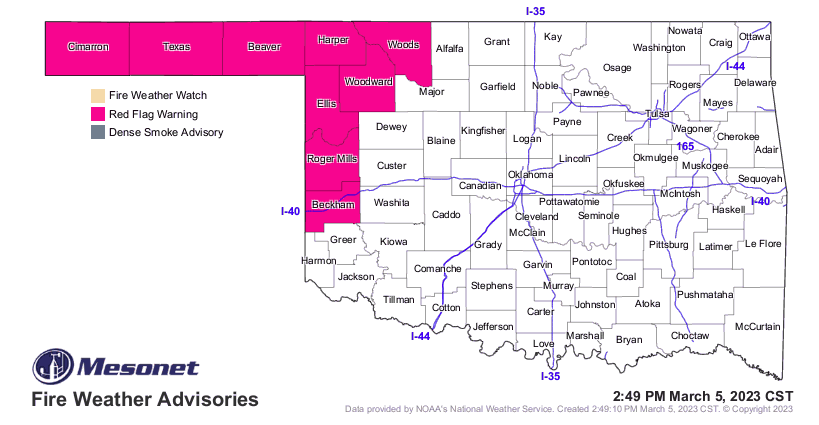
Statewide Discussion: Temperature will again push to well-above normal Sunday afternoon accompanied by a dryline expanding into the Panhandle, northwestern and far western counties. Above-normal temperatures, low relative humidity and gusty winds will bring critical to near-critical fire weather into the area. While winds will be gusty across most of Oklahoma on Sunday, the critical fire weather combination will hold along and west of a line from Woods County to Beckham County. Warm and dry conditions continue into Monday although wind speeds will be tamer with as a cold front begins to sink into the area.
Today: A Red Flag Warning is in effect from 1:00 PM through 8:00 PM in the Panhandle and from Noon through 6:00 PM in the northwestern and far-western counties. A dryline will push into the Warned Area as temperatures warm to +15°
above normal, and relative humidity values drop into the 6-18% range with strong, gusty southwest winds. The rest of Oklahoma will experience elevated fire weather, although relative humidity values holding above 20% will hold fine-dead fuel moisture just above critical threshold. Nonetheless, stout south-southwest winds will present potential for moderate to rapid rates of fire spread in grass-dominated fuels. Winds will gradually taper off overnight. Initial attack activity is expected to increase and some large fire occurrence is anticipated. Significant fire occurrence remains very limited.
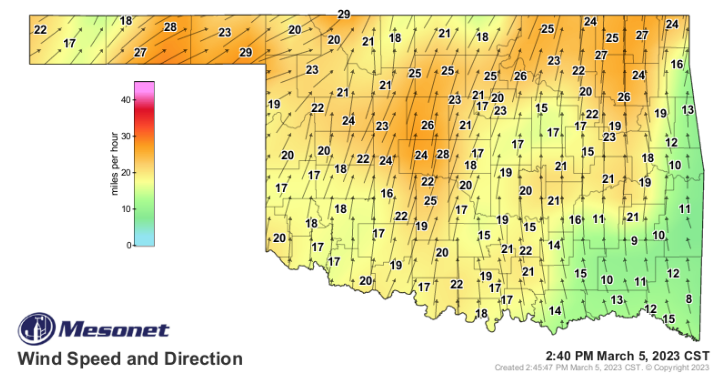
• Warned Area: As the dryline pushes in temperature 75°-80° and relative humidity values 6-18% under partly cloudy skies will yield very receptive fine fuels at 3% with some 2% observations likely in the western half of the Oklahoma Panhandle. Southwest winds will increase through the morning with afternoon winds sustained 19-26 mph and some gusts nearing 40 mph. Average rangeland fuels within the Warned Area will exhibit head fire rates of spread at 150-235 ft/min (2.2 mph) during peak burning conditions with flame lengths 8-15 ft. Those areas where heavier fuel loading remains, ROS 245- 305 ft/min (+/-3.1 mph) with FL 14-17 ft. Relative humidity will be slow to recover, and winds remain sustained above 15 mph well into the evening supporting an extended burning period.
• Along & West of I-44: East of the dryline, relative humidity values will not be quite as low registering 24-35% although
temperature will be above normal in the upper-70°'s to 80° along the Red River yielding fine-dead fuel moisture values in
the 5-6% range. With southerly winds sustained 17-23 gusting near 30 mph, rangeland fuels will exhibit head fire rates of
spread 120-168 ft/min (+/-1.6 mph) and flame length 8-13 ft during peak burning conditions. Areas where grazing has not
occurred could see ROS around 200 ft/min (2.3 mph) with FL 12-15 ft. Relative humidity values rebound above 45% by
2200 hrs. offering respectable opportunity for successful initial attack although large fire occurrence (>300 acres) is
possible.
• East of I-44: Wind speeds remain elevated in the counties along I-44 tapering off in intensity further south and east. Recent rainfall has prompted notable cool-season green up with the most notable effects in ag fields, grazed pastures and along roadways offering numerous barriers to fire spread. Temperature in the mid- to upper-70°'s and relative humidity values 28-37% will hold fine-dead fuel moisture in the 6-7% range. Head fire rates of spread 110-160 ft/min with flame lengths 7-12 ft are likely in un-grazed grasses with some single and group tree torching in open brush. Timber-litter fuels will present muted spread potential 18-30 ft/min. Relative humidity values will improve after sunset while winds taper off in the overnight hours offering good opportunity for successful initial attack efforts.
Monday: Warm and dry conditions continue, although winds will be calmer as a cold front filter into Oklahoma. Well above normal temperatures continue in the state's southern half while northwestern counties will top out near normal as the cold front sinks south. Relative humidity values will register below 30% west of I-44, presenting receptive fuels, although diminished wind speeds hold spread potential in the moderate range, generally less than 100 ft/min.
Near-Term: Rain chances appear on Tuesday in northeastern Oklahoma, with better
opportunities further west Tuesday evening and Wednesday. Unfortunately, the super parched Panhandle and far northwestern counties do not have the best opportunity for a wetting event based on current forecast data. Nonetheless, a cooler/wetter pattern appears to be on tap by mid-week.
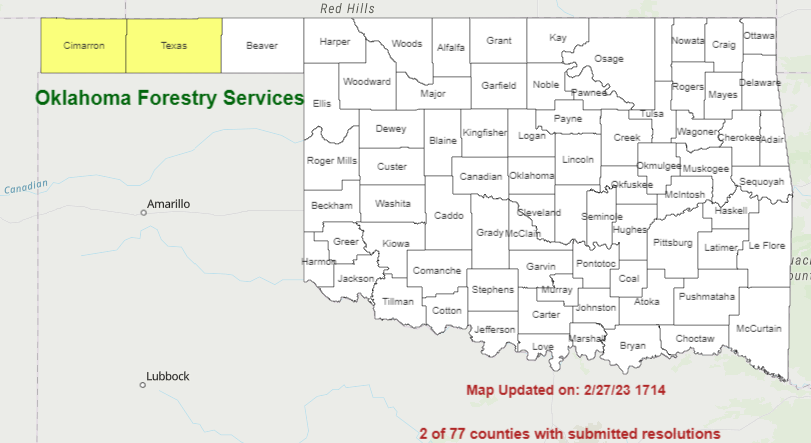
Burn Bans: Refer to: https://ag.ok.gov/divisions/forestry-services/ for the most current burn ban information and links to a specific burn banproclamations

Voters head to the polls Tuesday, March 7 for a special state question election. Some voters also have county questions and local propositions on the ballot. The State Election Board offers these tips and reminders to Oklahoma voters.
ELECTION DAY VOTINGMake a plan to vote. Polls are open from 7 a.m. to 7 p.m. on Election Day. Lines at the polls are typically longest before work, during the lunch hour, and after work. If turnout is heavy at your precinct, be prepared for possible wait times. All eligible voters in line by 7 p.m. will be permitted to vote.
VERIFY POLLING PLACE
All voters should verify their polling place before heading to the polls. Voters can verify their polling place using the OK Voter Portal or by contacting their County Election Board or the State Election Board. Voters must vote at their assigned polling place.
BE PREPARED View your sample ballot using the OK Voter Portal. You can also use the portal to find your polling place and track the status of your absentee ballot. The election list is available on the State Election Board website.
PROOF OF IDENTITYOklahoma law requires every voter who votes in person to show proof of identity before receiving a ballot. Some voters may also be required to confirm their address before being issued a ballot.
There are three ways to show proof of identity under the law (only one is required):
BALLOT STATUSIt is common for voters to ask, "How do I know my vote counted?" Ballots are counted when voters insert their ballots into the voting device during early voting and on Election Day.
Details regarding ballot status, Oklahoma's voting devices, and security procedures can be found on the State Election Board website.
Election results will be available on the State Election Board website after the polls close at 7 p.m. on election night.
BEWARE OR MISINFORMATION/DISINFORMATIONDuring election time, misinformation and disinformation can run rampant. Voters are asked to be wary of information that seeks to promote false claims of fraud, voter suppression and/or other problems.
If you experience an issue or believe an election or voting crime has been committed, your first action should be to notify your precinct officials and contact your County Election Board while the incident is in progress. Election officials can take immediate action to resolve the issue and/or contact local law enforcement.
State and county election officials should always be your trusted sources for information.
Agricultural producers who have not yet enrolled in the Agriculture Risk Coverage (ARC) or Price Loss Coverage (PLC) programs for the 2023 crop year have until March 15, 2023, to elect and enroll a contract. The U.S. Department of Agriculture (USDA) offers these two safety net programs to provide vital income support to farmers experiencing substantial declines in crop prices or revenues.
"The Agriculture Risk Coverage and Price Loss Coverage programs provide critical financial protections to many American farmers. As producers across the country deal with unexpected market volatility and natural disasters, these programs offer much-needed support and stability," said Steve Kouplen, State Executive Director for FSA in Oklahoma. "I am encouraging producers to reach out to their county offices to learn about program eligibility and election options today, so that they can begin the enrollment process as soon as possible."
Producers can elect coverage and enroll in ARC-County or PLC, which are both commodity-by-commodity, or ARC-Individual, which covers the entire farm. Although election changes for 2023 are optional, producers must enroll through a signed contract each year. Additionally, if a producer has a multi-year contract on their farm and makes an election change for 2023, they will need to sign a new contract.
If producers do not submit an election by the March 15, 2023, deadline, the election remains the same as the 2022 election for commodities on the farm. Farm owners cannot enroll in either program unless they have a share interest in the commodity.
In Oklahoma, producers have completed 37,659 contracts to date, representing 79% of the more than 47 thousand expected contracts.
Producers who do not complete enrollment by the deadline will not be enrolled in ARC or PLC for the 2023 year and will not receive a payment if triggered.
Producers are eligible to enroll farms with base acres for the following commodities: barley, canola, large and small chickpeas, corn, crambe, flaxseed, grain sorghum, lentils, mustard seed, oats, peanuts, dry peas, rapeseed, long grain rice, medium and short grain rice, safflower seed, seed cotton, sesame, soybeans, sunflower seed and wheat.
Decision Tools
In partnership with USDA, two web-based decision tools are available to assist producers in making informed, educated decisions using crop data specific to their respective farming operations:
Crop Insurance Considerations and Decision Deadline
ARC and PLC are part of a broader safety net provided by USDA, which also includes crop insurance and marketing assistance loans.
Producers are reminded that ARC and PLC elections and enrollments can impact eligibility for some crop insurance products.
Producers on farms with a PLC election have the option of purchasing Supplemental Coverage Option (SCO) through their Approved Insurance Provider. However, producers on farms where ARC is the election are ineligible for SCO on their planted acres for that crop on that farm.
Unlike SCO, the Enhanced Coverage Option (ECO) is unaffected by an ARC election. Producers may add ECO regardless of the farm program election.
Upland cotton farmers who choose to enroll seed cotton base acres in ARC or PLC are ineligible for the stacked income protection plan (STAX) on their planted cotton acres for that farm.
Producers should contact their crop insurance agent to make certain that the election and enrollment made at FSA follows their intention to participate in STAX or SCO coverage. Producers have until March 15, 2023, to make the appropriate changes or cancel their ARC or PLC contract.
More Information
For more information on ARC and PLC, producers can visit the ARC and PLC webpage or contact their local USDA Service Center.
USDA touches the lives of all Americans each day in so many positive ways. In the Biden-Harris administration, USDA is transforming America's food system with a greater focus on more resilient local and regional food production, fairer markets for all producers, ensuring access to healthy and nutritious food in all communities, building new markets and streams of income for farmers and producers using climate smart food and forestry practices, making historic investments in infrastructure and clean energy capabilities in rural America, and committing to equity across the Department by removing systemic barriers and building a workforce more representative of America. To learn more, visit www.usda.gov.
USDA is an equal opportunity provider, employer and lender.
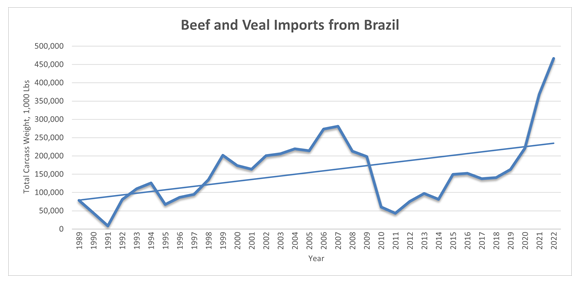
Source: USDA Economic Research Service Livestock and Meat International Trade Data
The U.S. Cattlemen's Association (USCA) stands with the National Cattlemen's Beef Association, RCALF-USA, Senators Jon Tester (D-MT), Ben Ray Luján (D-NM), and Mike Rounds (R-SD) in calling for the immediate suspension of Brazilian beef imports.
According to DTN's Progressive Farmer, more than a month passed before Brazilian authorities reported a case of mad cow disease, more properly known as bovine spongiform encephalopathy (BSE).
DTN reported earlier that BSE was confirmed in the state of Para. The Ministry of Agriculture identified the infected animal as a 9-year-old male in a 160-head herd. Samples from the sick animal were sent to a World Health Organization for Animal Health Lab in Canada.
USCA President Justin Tupper issued the following statement:
"We acknowledge that Atypical BSE arises spontaneously in certain cattle, especially amongst individuals animals that are 8 years of age or older.
"However, USCA still supports the full and immediate suspension of Brazilian beef imports, not just because of this incident, but because there are enough other reasons to do so: the use of forced labor in the Brazilian beef supply chain, the deforestation of the Amazon rainforest to raise beef cattle, concerns with Foot-and-Mouth Disease (FMD), and past events where elevated levels of tainted beef were being sent to our border.
"This atypical BSE case follows the finding of the disease in several animal remains in 2021, which the country had obviously failed to report in a timely manner. Brazil has long been a bad actor in the global marketplace, and as such, USCA calls on Secretary Vilsack to promptly protect the health of the domestic herd and immediately halt the importation of beef from Brazil."
BACKGROUND: In 2018, USCA opposed the Trump Administration's lifting of the ban on the importation of Brazilian beef. In 2019, USCA requested a review by the Committee on Foreign Investment in the United States on all U.S. acquisitions by Brazilian meatpacking giant, JBS, its holding company J & F Investments, and any entity controlled or owned by the Batista brothers. And in 2021, USCA sent a letter urging USDA to strongly consider the concerns outlined HERE to protect the health of the U.S. cattle herd and ensure America's favorite protein remains in plentiful supply.
Producers can now take a nationwide survey to help the U.S. Department of Agriculture (USDA) improve and increase access to its programs and services for America's farmers, ranchers, and forest managers. The survey includes new and existing customers. USDA encourages all agricultural producers to take the survey, especially those who have not worked with USDA previously. The survey gathers feedback on programs and services available through USDA's Farm Service Agency (FSA), Natural Resources Conservation Service (NRCS) and Risk Management Agency (RMA).
The survey is available online at farmers.gov/survey, and producers should complete by March 31, 2023. Stakeholder organizations are also encouraged to share the survey link through their networks. The survey is available in 14 different languages including Arabic, Chinese, English, French, Hmong, Korean, Navajo, Punjabi, Somali, Spanish, Tagalog, Thai, Urdu and Vietnamese.
"A robust survey response that includes the perspectives of all of our customers, including underserved producers, will help USDA better understand the unique needs of both existing and prospective customers, while identifying opportunities to enhance government programs and services. Please take the survey, especially if we haven't worked with you before," said Robert Bonnie, USDA's Under Secretary for Farm Production and Conservation (FPAC). "This survey will provide USDA with critical data to help USDA serve all of agriculture."
In addition to the online survey, the FPAC Business Center, which is administering the survey, will also mail 11,000 printed surveys to various local state stakeholder organizations and farmers markets.
The survey is an Office of Management and Budget requirement supported by the Biden-Harris President's Management Agenda (PMA), which identified FSA and NRCS as High-Impact Service Providers. These agencies provide critical customer-facing services and are expected to use the survey data to make targeted improvements.
More Information
USDA touches the lives of all Americans each day in so many positive ways. Under the Biden-Harris administration, USDA is transforming America's food system with a greater focus on more resilient local and regional food production, fairer markets for all producers, ensuring access to safe, healthy and nutritious food in all communities, building new markets and streams of income for farmers and producers using climate smart food and forestry practices, making historic investments in infrastructure and clean energy capabilities in rural America, and committing to equity across the Department by removing systemic barriers and building a workforce more representative of America. To learn more, visit usda.gov.
USDA is an equal opportunity provider, employer and lender.
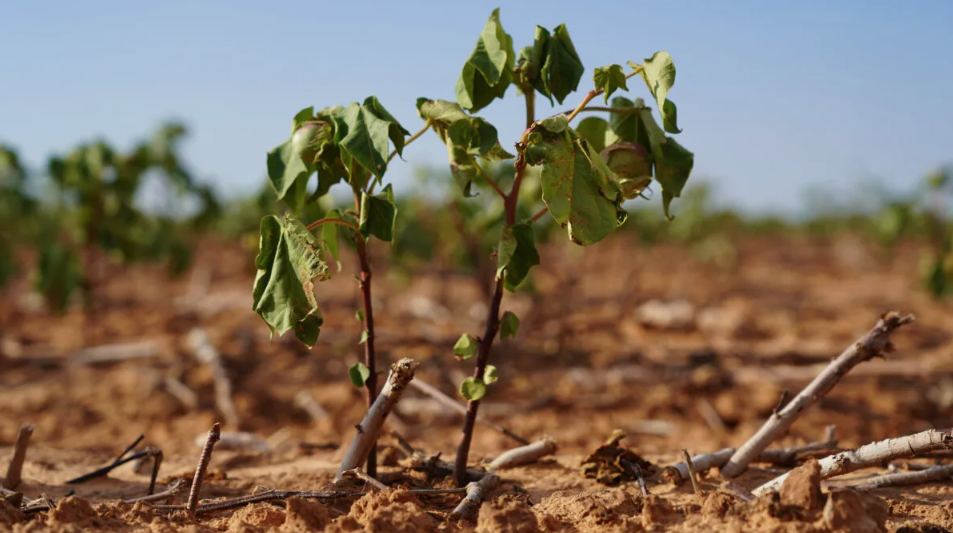
AFBF's Market Intel team has created a multi-part series highlighting agricultural losses incurred due to weather disasters and the associated disaster assistance programs meant to help mitigate their impacts. Previous articles include: 2020 Disaster Estimations Reveal at Least $3.6 Billion in Uncovered Losses; 2020 Disasters Reveal Gaps in Ad Hoc Aid Legislation; Continuing Resolution Extends Disaster Coverage for Most 2020 and 2021 Losses; Kentucky, Arkansas Tornadoes, Midwest Derecho Renew Calls for Timely Disaster Assistance; 2021 Disaster Estimations Reveal at Least $12.5 Billion in Crop and Forage Losses; and From WHIP+ to ERP: A New Name for 2020-2021 Ad Hoc Disaster Assistance. This Market Intel article updates and summarizes total crop loss estimations across major weather events for 2022.
Weather-associated production risk is an inherent factor in farmers' and ranchers' everyday business environment. Through heavy rain, hail, snow, winds and drought, farming families prepare land, plant and harvest knowing their livelihoods are reliant on local weather conditions. In 2022, 18 weather and climate disasters, each with damages exceeding $1 billion struck the U.S. coast-to-coast. The National Oceanic and Atmospheric Administration reported that 2022 surpassed 2021 as the third-costliest disaster year event in history, with an estimated $165 billion in total economic losses behind only 2017's $346 billion and 2005's $244 billion. With over 470 lives lost, these disasters will haunt impacted communities for years to come.

Updated crop and rangeland damage estimations for 2022 provide a window into the recent impacts of natural disasters on domestic food production. The assessment puts total crop and rangeland losses from major 2022 disasters at over $21.4 billion, or 7.7% of NOAA's total economic impact figure. Of that figure, over $11 billion in losses were covered by existing Risk Management Agency programs as of February 2022. Over $10 billion in losses were not insured through RMA, existed outside policies' coverage levels, or did not qualify under an existing risk management program. Drought and wildfires alone accounted for over $20.4 billion in total crop losses, with the remaining $1.08 billion linked to hurricanes, hail, flooding and severe weather events as displayed in the data table below.
AFBF crop loss estimates do not include infrastructure damage, livestock losses, horticulture crop losses or timber losses associated with the selected weather events. Estimates should be viewed as a minimum baseline as data to estimate these other categories are not readily available. More comprehensive analysis on individual storms may be available from local land-grant universities. For instance, the University of Florida estimated over $1.03 billion in agricultural losses from Hurricane Ian, a far cry from our estimated $40 million linked to more granular survey data; this includes comprehensive livestock, greenhouse and more accurate specialty crop baselines that aren't included in this analysis.


In 2022, Texas suffered the most significant hit, with over $6.4 billion in incurred losses primarily made up of $2.9 billion in damages to cotton, $1.7 billion in damages to forage and rangeland and nearly $1 billion in wheat damage mainly attributed to widespread exceptional drought conditions but also partly linked to May hailstorms and severe weather in April. Kansas ranked second with over $3.3 billion in incurred losses from drought conditions. Kansas corn losses totaled over $1.2 billion followed by $777 million in losses of other grains including crops such as grain and silage sorghum. Soybeans valued at nearly $700 million also succumbed to drought conditions in Kansas. Nebraska's losses mirrored those of its southern neighbor, with total losses of over $2 billion, $1.8 billion linked to drought including nearly $1 billion in corn and $400 million in soybeans. Nebraska also experienced losses from heavy derecho winds and severe weather in June, which resulted in almost $200 million in corn losses. Moving north again, South Dakota, in fourth place, was also plagued by drought, with over $1.4 billion in total damages, including $660 million in corn losses and $300 million in forage and rangeland losses. In addition, South Dakota experienced hailstorms in May which damaged $130 million in corn.
Rearranging crop loss data points by crop type allows us to pinpoint regional differences in damages associated with different weather conditions. Figure 2 displays overall crop losses by type across all major weather events in 2022. The other grains category includes crops like oats and sorghum, the other oilseeds category includes canola, mustard, flax and the like and the all other category includes miscellaneous crops like tobacco, sugarcane, sugar beets and mint. Seeing forage and rangeland with the most significant losses ($6.3 billion) is not surprising given the correlation between drought and rangeland. Western states are no strangers to arid conditions and vast landscapes often grazed by livestock herds. Reductions in hay stores and abysmal forage conditions forced many farmers and ranchers to liquidate cows early or pay upward of $400/ton for hay shipped across state lines. Importantly, the geographic footprint of extreme drought has shifted between 2021 and 2022, with states in the Pacific Northwest like Washington and Idaho having relatively better conditions, while states like Texas, Kansas and Nebraska have faced widespread drought in the highest, D4 - exceptional, drought category. This has shifted the categories of crops most impacted compared to last year, including a much higher value of corn ($4.5 billion) and cotton ($3.25 billion) lost across the country. Fruit and nut losses were lower but still significant in 2022, largely linked to the different geographic footprint of drought ($400 million in 2022 vs. $1.05 billion in 2021), a primary reason California is not as high on the list as in past years. Read more about the recent impacts of drought on agriculture here.

Figure 3 only includes crop losses from May 2022 hailstorms and severe weather, the second-most destructive event after drought. Minnesota, Oklahoma, South Dakota, Texas and Wisconsin faced over $400 million in crop losses from wind, hail and rain damage.

Traditionally, federal crop insurance programs are the preferred mechanism for managing risk associated with weather-related disasters for most agricultural products. These policies provide protection from yield losses, increased costs and revenue declines. Unanticipated disaster situations like large-scale weather events pose the optimal test for these programs, designed to provide targeted risk management under more probable and common loss conditions. Losses that occur outside the scope of these conditions and the specified terms of a policy complicate farmers' ability to qualify for indemnity payments. For some crops, like strawberries, lettuce and hazelnuts, RMA options are unavailable and other programs, like the Noninsured Crop Disaster Assistance Program, often fall short. A breakdown of relevant specialty crop risk management considerations can be found here.
To fill gaps in existing risk management programs during periods of extreme disasters, Congress has often responded through authorization of ad hoc disaster assistance programs. On May 16, 2022, USDA announced that some commodity and specialty crop producers impacted by natural disasters in 2020 and 2021 would be eligible to receive emergency relief payments to offset crop yield and value losses through Phase 1 of the Farm Service Agency's new Emergency Relief Program (ERP), previously known as the Wildfire and Hurricane Indemnity Program + (WHIP+). Phase 1 payments were made to farmers who had risk management program enrollment in prior years. Phase 2 opened on Jan. 23 and is meant to support producers who did not participate in existing risk management programs by using tax returns to show a decline in revenues compared to prior years. Thus far, there has been considerable concern surrounding ERP Phase 2 design and execution by both farmers and lawmakers. By the end of February, $7.4 billion in payments had been disbursed under ERP Phase 1 for 2020 and 2021 losses. The $1.7 trillion omnibus spending bill passed last December included an additional $3.74 billion for agricultural disaster losses in 2022. Further discussion of existing farm bill disaster programs and recent ad hoc authorizations can be found here.
Conclusion
Weather and climate-related disasters in 2022 pummeled farms and ranches across the United States, leaving over $21.4 billion in crop and rangeland losses in their wake. Over half of those losses were effectively protected under existing risk management programs with the remainder highlighting the importance of inclusive protections for growers of all crops in all regions of the nation. Not to mention, the full extent of damage across the sector is likely far higher when livestock, infrastructure, timber and other ag-related factors are considered. Already in 2023, farmers and ranchers are experiencing flooding, freezes and persistent drought conditions. The stability of U.S. farms and ranches relies on their ability to be resilient under an array of climate and weather conditions. The 2023 farm bill will give lawmakers a chance to fill gaps in existing risk management programs, providing similar risk management opportunities for farmers regardless of what they grow. The sure and timely payments associated with crop insurance and other farm bill programs is often critical for farm-level stability, and so for a safe and secure domestic food supply.
Methodology
To begin, AFBF economists compiled a list of states impacted by weather events in 2022 that would have qualified for ERP. All D3/D4 droughts, hurricanes, tornadoes and wildfires were included. Affected states were selected using the National Drought Mitigation Center's U.S. Drought Monitor and the Federal Emergency Management Agency's presidential disaster list. States that had any form of D3/D4 drought were automatically included in the analysis. States that suffered one or more of the weather events that qualify for ERP and had a presidential-declared disaster were also included in the analysis.
The analysis utilizes RMA crop insurance data to estimate losses if all crop acreage was insured with complete (100%) protection. Methodologies mimic those used by NOAA's National Climatic Data Center to estimate losses in their annual "Billion Dollar Climate and Weather Disasters" reports (first described in Smith, Katz 2011).
RMA reports on total indemnities (total insurance compensation) paid for each cause of loss (drought, hurricane, flooding, fire, excess moisture, hot wind, etc.) in a given month for each crop type by state. Each storm is defined with a set of cause of loss types based on the weather event and its related conditions covered by ERP. For instance, for hurricanes, the following cause of loss filters were included: excess moisture/precipitation/rain, flooding, hurricane/tropical depression and wind/excess wind. Data was also filtered by the month(s) the storm impacted each state. Once indemnity payments for crops were totaled, adjustments were made for losses outside insured acreage and coverage levels.
This is achieved by first calculating the percent of insured acres in each state (using 2022 data from USDA-National Agricultural Statistics Service and RMA summary of business data). It is assumed all acreage of a given crop has been equally impacted by a particular disaster. Then RMA coverage level data is used to find the average coverage rate for each crop in each state. Based on these stats, a factor approach defined as 1/ [(% acres insured) (average coverage level %)] is utilized to come up with a multiplier to estimate 100% of losses. This was repeated for crops in each affected state and totaled.
Using a real-life example: In Florida, 56% of pepper acreage was insured in 2020. Of the covered pepper acreage in Florida, insurance covered an average of 62% of losses. Following the formula described above, Florida pepper indemnities were multiplied by 1/(0.56*0.62), or 2.88, to estimate 100% of losses.
Additional related loss estimates were calculated using reported indemnities paid out under code 55, or the "ARPI/SCO/STAX/MP/HIP WI Crops Only" RMA cause of loss category. RMA is unable to differentiate the cause of loss for indemnities paid out under code 55, therefore it is assumed all losses to "pasture, rangeland, forage" were due to a qualifying disaster in the month(s) the disaster took place. Pasture, rangeland and forage acreage coverage was calculated using a national Natural Resources Conservation Service private rangeland estimate.
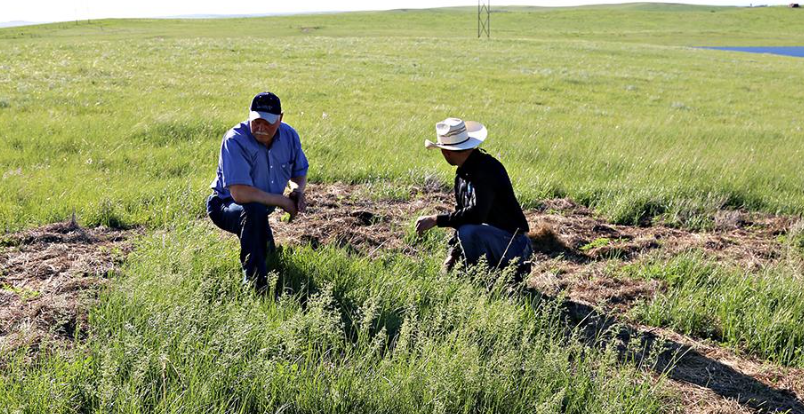
At the Oklahoma Association of Conservation Districts' 85th Annual Meeting, Farm Director, KC Sheperd, had the chance to visit with NRCS State Conservationist, Stacy Riley, talking about the locally-led conservation process and why it matters for communities throughout the state.
Locally led conservation consists of a series of phases that involve community stakeholders in natural resource planning, implementation of solutions, and evaluation of results. Locally led conservation begins with the community itself, working through the local conservation district. It is based on the principle that community stakeholders are best suited to deal with local resource problems.
"The locally-led process is a process that our conservation districts and our NRCS employees use to help engage public involvement with what we need in our counties," Riley said. "Specifically for us, as a conservation agency, we are looking for what the conservation needs are- what the resource concerns are out there, what are the problems going on in the communities so that we can find solutions to help make things better in that conservation district."
Trying to find people to come to NRCS meetings to give local input has become a challenge, Riley said, so the conservation districts are always working to find more ways to increase attendance to gather information to address the needs of these individuals.
"We have got to know what the local needs are so that we can figure out a solution- a plan," Riley said. "So, we gather all the information from our local constituents, hopefully, though a locally led process of either in a public meeting, or a lot of our districts will have surveys they hand out when they are at different functions, or even when people just walk in to local offices' doors."
The conservation districts were designed to be the local voice, Riley said, so they should know what their neighbors need and want, but at the same time, they don't know everyone, which is why public involvement is critical.
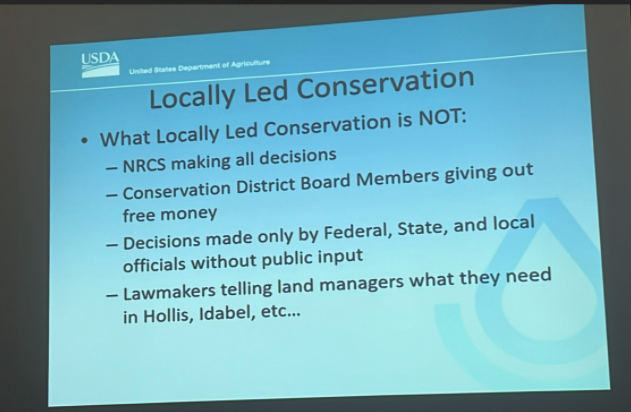
"We gather as much information as we can, and then we have what are called the 'local workgroup meetings,' that are more of the local community leaders," Riley said. "They are federal, they are state, they are tribal, government officials, but they are also the grassroots organizations, your cattlemen's associations, wheat growers associations, farmers markets associations. Those leaders, because they have a different customer base, so they can bring in additional information."
After the information is gathered, Riley said the action plan is designed to make a difference with those resources.
"If you get enough good minds in a room, you can always come up with a solution," Riley said.
Solutions to issues in conservation districts can vary from financial solutions to educational solutions, Riley said, depending on the best interest of the community's land and resources.
"Locally led is not giving out free money," Riley said. "It is not identifying something that we cannot do anything about. Locally led is very important to help drive what we need in our communities."
Kristina "Tina" Jerome, Acting State Conservationist for the U.S. Department of Agriculture (USDA) Natural Resource Conservation Service (NRCS), announced the 2023 Conservation Stewardship Program (CSP) Classic application deadline. Oklahoma agricultural producers who wish to be considered for the upcoming Fiscal Year's (FY) funding should apply by Friday, March 31, 2023.
Through CSP, NRCS helps farmers and ranchers earn payments for maintaining their current level of conservation across their entire operation. CSP provides the opportunity to expand their conservation activities by adopting new technologies and management techniques. The program provides many benefits including increased crop yields, decreased inputs, wildlife habitat improvements and increased resilience to weather extremes. CSP is for working lands including cropland, pastureland, rangeland, nonindustrial private forestland, and agricultural land under the jurisdiction of a tribe. Farmsteads and other associated agricultural lands are also included. CSP also provides specific support for organic and transitioning to organic producers.
CSP is a program made for farm operators. To be eligible, contract participants must meet Farm Bill Program eligibility in conjunction with the Farm Service Agency (FSA), including meeting the Highly Erodible Land (HEL) and Wetland Compliance requirements and the Adjusted Gross Income (AGI) limits.
While applications are accepted throughout the year, interested producers should submit applications to their local NRCS office by the deadline to ensure their operations are considered for FY 2023 funding.
Interested producers looking to increase their level of conservation across their operation can apply for CSP at their local USDA Service Center.
USDA touches the lives of all Americans each day in so many positive ways. In the Biden-Harris Administration, USDA is transforming America's food system with a greater focus on more resilient local and regional food production, fairer markets for all producers, ensuring access to healthy and nutritious food in all communities, building new markets and streams of income for farmers and producers using climate smart food and forestry practices, making historic investments in infrastructure, and clean energy capabilities in rural America. This administration is committed to equity across the Department by removing systemic barriers and building a workforce more representative of America. To learn more, visit www.usda.gov.
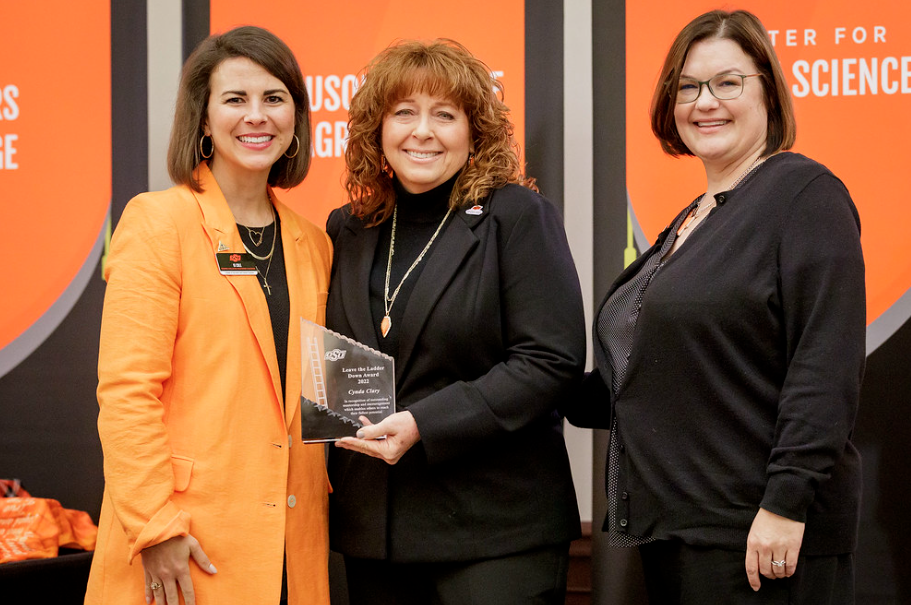
Ki Cole, Faculty Council Chair, left, and Michelle Stewart, Chair of Staff Advisory Council, right, present Cynda Clary, middle, with her award. (Photo by Oklahoma State University)
By Kaitlyn Weldon
Cynda Clary, associate dean of the Ferguson College of Agriculture, received the Leave the Ladder Down award at the fall 2022 University Awards Convocation.
The Leave the Ladder Down award is given to an individual who has mentored and encouraged others to reach their fullest potential at Oklahoma State University. The recipient is selected by a committee of campus leaders through a nomination process.
Karen Hickman, Ferguson College director of undergraduate research, honors programs and academic assessment, nominated Clary for the award.
"She's a highly positioned female leader who has left the ladder down and helped others climb up the ladder," Hickman said.
Before coming to OSU in 2012, Clary served in administrative positions at New Mexico State University for 19 years. In her current role as associate dean of the Ferguson College, Clary is committed to helping students, staff and faculty achieve success, and her enthusiasm for agriculture is apparent to anyone who speaks with her.
Hickman described how Clary has given her several opportunities to learn new leadership skills and how this has impacted her professional career. Clary encouraged Hickman to participate in several leadership trainings, such as LEAD21.
Additionally, Clary has mentored other faculty across campus. Kristen Baum, associate dean for research in the College of Arts and Sciences, said Clary was her mentor for the Women's Leadership Academy in 2013.
"I learned an incredible amount from Cynda's mentorship, and I try to emulate many of her approaches in my mentoring relationships," Baum said. "I now have the opportunity to work with her as a colleague, and I continue to value her insight, guidance and balanced perspective."
Clary says it brings her joy to see students and faculty succeed in the Ferguson College.
"When students come to college, they are developing their reputation and learning new things," Clary said. "They have to find their path – and it is a privilege to be part of that journey with them."
Ferguson College agribusiness graduate student, Gretchen Skaja, said Clary saw potential in her before she saw it in herself.
During Skaja's freshmen year, Clary took her to Our Daily Bread to volunteer and to lunch at Hideaway for the first time. Skaja said Clary showed her that Stillwater could be a second home for her and not just her college town. Skaja believes the guidance she received from Clary allowed her to be successful in Stillwater.
"Dr. Clary wants everybody to succeed," Skaja said. "When you meet with her and leave her office, you feel ready to take on the next challenge. As a mentor, she helps you plan the next steps to achieve your goals and she will connect you with the resources you need to be successful."
Skaja is not the only student who benefits from Clary's mentorship. Clary is also known for providing leadership and support to students, staff and faculty throughout the Ferguson College and beyond OSU.
On the day Clary was honored with the prestigious award, Ferguson College administration and staff arranged for her family to attend the ceremony.
Clary said the special surprise of having her husband, children and granddaughter at the convocation was the most memorable part about receiving her award. She said her family has sacrificed so much for her career, and seeing them in the audience – proud of her and her accomplishments – was meaningful.
OSU Agriculture is dedicated to improving the quality of life of Oklahomans through science-based information and education. It is comprised of the Ferguson College of Agriculture and two state agencies: OSU Ag Research and OSU Extension.

On Monday, the Center for Rural Affairs joined more than 600 organizations, businesses, and farms to urge U.S. House and Senate Agriculture Committee leaders to protect historic investments in conservation and climate-smart agriculture.
The Inflation Reduction Act (IRA) of 2022 allocated almost $20 billion over five years to the U.S. Department of Agriculture for conservation programs with climate impacts. Among the investments are $3.25 billion for the Conservation Stewardship Program (CSP) and $8.45 billion for the Environmental Quality Incentives Program (EQIP).
In a letter, a broad coalition of signatories called on Congress to ensure funding is directed to its intended programs as lawmakers develop the next farm bill.
"This is the largest investment into agriculture conservation and rural communities in decades and farmers, ranchers, and foresters across the country are depending on these resources," the letter reads.
CSP and EQIP are working lands conservation programs, meaning they support producers in implementing conservation practices on land actively used for agricultural production. They help producers adopt practices that build soil health, sequester carbon, improve water quality, promote resiliency, and more. The programs are voluntary and provide both technical and financial assistance.
"CSP and EQIP have historically been underfunded and oversubscribed," said Kate Hansen, senior policy associate with the Center. "Year after year, we see producer demand unmet due to limited funds. IRA investments present a robust opportunity to get more conservation practices on the ground, across the country."
A recent Center survey of CSP users in the Midwest and Great Plains highlights the program's impact. Of the more than 400 respondents, nearly 79% said the program helped them afford conservation practices, and about 77% said the program helped them improve soil health.
"Keeping these IRA funds in conservation programs, as intended, will be a win for farmers, ranchers, and our natural resources," Hansen said.
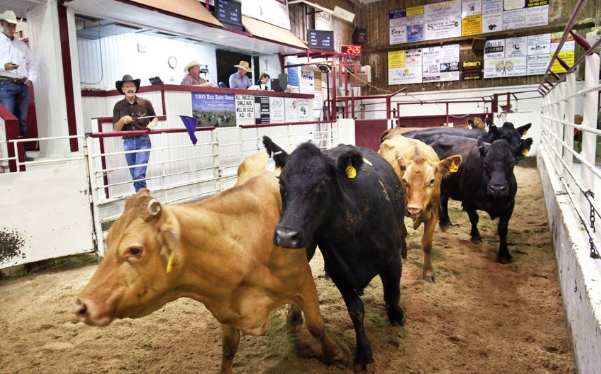
KC Sheperd, Farm Director, is back talking with Bob Rodenberger, a partner with Stockman Oklahoma Livestock Marketing, as he gives the latest on the cattle markets.
"Market started out fully steady, "Rodenberger said. "I didn't really see any change in it, there it is not any cheaper. I think the market reporter called it higher. I have just seen a pretty much a steady market. Good demand on feeders and good demand on calves."
This week, Rodenberger said cow numbers were down compared to a year ago by about half.
"I am hoping we have culled all of the old cows, and people are starting to hold onto what they have got left and have the resources to do that," Rodenberger said. "Good market, good outlook, heard of some extreme highs on fat cattle up in the northern, you know, in the Iowa area."
For the cattle producers, Rodenberger said, things continue to look positive out front.
"Normally, from the middle of March to the middle of April, our numbers slack off because people have already come off of everything they are going to sell prior to March," Rodenberger said. "Then we have got the 'lull' until they start selling their graze-out cattle, which is normally about the 15th of April, and that is all determined on these new varieties."
Today, the National Milk Producers Federation (NMPF), Consortium for Common Food Names (CCFN), U.S. Dairy Export Council (USDEC) and a coalition of other dairy stakeholders prevailed in their ongoing battle to protect the right of producers to use generic names in the U.S. market.
The U.S. Court of Appeals for the Fourth Circuit upheld the prior decisions of the U.S. District Court for the Eastern District of Virginia and of the U.S. Patent and Trademark Office's Trademark Trial and Appeal Board in finding "gruyere" to be a generic term for a variety of cheese. The Fourth Circuit's clear decision should put an end to the attempt by Swiss and French consortiums to expropriate a common food name through a U.S. certification mark registration.
The Fourth Circuit found that the evidence "is 'so one-sided' that there is no genuine issue as to any material fact and Opposers must prevail as a matter of law. " The Court reasoned that the "the common usage of gruyere 'establish[es] that when purchasers walk into retail stores and ask for [gruyere], they regularly mean' a type of cheese, and not a cheese that was produced in the Gruyère region of Switzerland and France." The Fourth Circuit concluded that "the Consortiums cannot overcome what the record makes clear: cheese consumers in the United States understand 'GRUYERE' to refer to a type of cheese, which renders the term generic."
For over a decade, well-resourced European interests have attempted to confiscate common names to prevent non-European producers from using long-established generic terms, essentially monopolizing the ability to produce certain products for producers in limited and specific regions.
This decision reinforces that generic terms like "gruyere" refer to types of food, and a method of production regardless of where they are produced.
"The United States remains a bastion for the defense of consumers' and producers' property rights that have been trampled in Europe and many countries around the world," said Jaime Castaneda, executive director for CCFN. "The court has sent a clear message that European attempts to stop American producers from using generic food names in the U.S. will be firmly rejected. It is a momentous victory for American consumers, farmers and food manufacturers."
With support from USDEC, NMPF, CCFN member companies and other allies, CCFN committed the necessary resources to show the widespread use of gruyere in the U.S. marketplace, and craft the successful argument that non-European consumers and companies should retain their rights to consume produce and sell gruyere in the United States.
"This is an outstanding result for manufacturers and farmers here in the United States," stated Krysta Harden, president and CEO of USDEC. "We're grateful that the Appeals Court agreed that nobody owns the exclusive right to use generic terms. This sets a terrific precedent for the right to use common food names in the United States. Now we need other countries to likewise stand up for what's right and defend that use just as strongly."
"Today's announcement represents a significant win for America's dairy farmers," said Jim Mulhern, president and CEO of NMPF. "NMPF rejects blatant European attempts to unjustly limit competition from American companies and will continue to fight alongside our allies to oppose efforts to monopolize common name foods." CCFN and its members support the protection of legitimate geographical indications but will continue to fight against efforts to build unfair trade barriers. You can learn more with an informational video on CCFN found here.
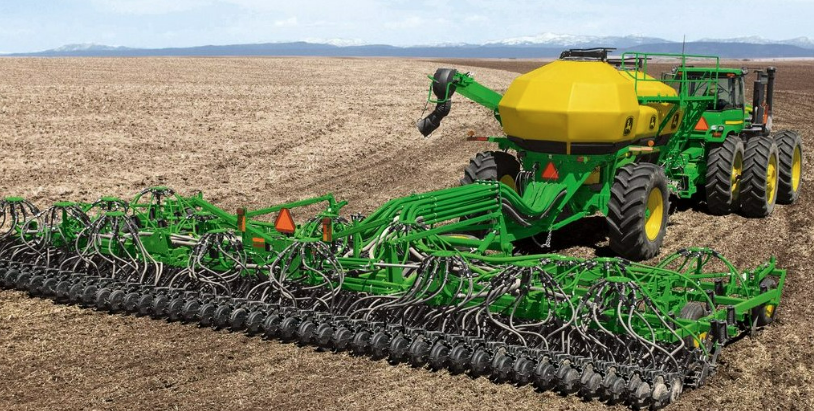
Since Russia's unprovoked invasion of Ukraine sent them soaring one year ago, global and U.S. wheat prices have decreased significantly. Continued Black Sea Grain Corridor exports and improved production outlook in major exporters such as Russia and Australia have helped relieve the market of some supply pressure. Bulk ocean freight rates have also broken in favor of wheat and other grain importers.
Even more relief for buyers arrived with the USDA Grains and Oilseed Outlook released on Feb. 23 that projected an 8% increase in all U.S. wheat planted area. On Feb. 24, wheat futures fell as much as 30 cents overnight in response to that report.
In a classic supply and demand equation, tight global wheat stocks and the uncertainty of the Black Sea pushed prices higher and provided an economic incentive to plant more wheat and futures prices reacted to the news.
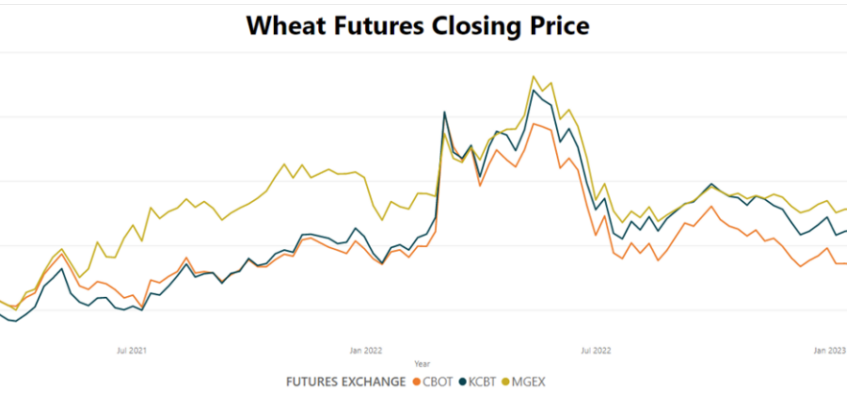
Over the last two decades, competition for wheat acres has increased as profit margins have shifted to favor other crops such as corn and soybeans. Meanwhile, as market volatility persists, farmers increasingly utilize diversified crop rotations to mitigate price and input risk. The combined impact has resulted in a slow erosion of U.S. wheat annual planted area, with the most recent five-year average coming in at 46.0 million acres (18.6 million hectares), down 24% from the 2002.
In addition to supply pressures at home, enhanced production in competing exporters has highlighted the increasingly tight U.S. balance sheet. Production in Russia has increased 76% over the last decade, while Argentine production, increased 138% from 2012/13 to 2021/22, (excluding the historic drought impacting the 2022/23 crop).
Wheat planted area erosion and increased global competition, coupled with drought-inflicted production shortfalls in the U.S. over the last three marketing years have created a tight balance sheet both domestically and on a global scale, underpinning wheat prices.
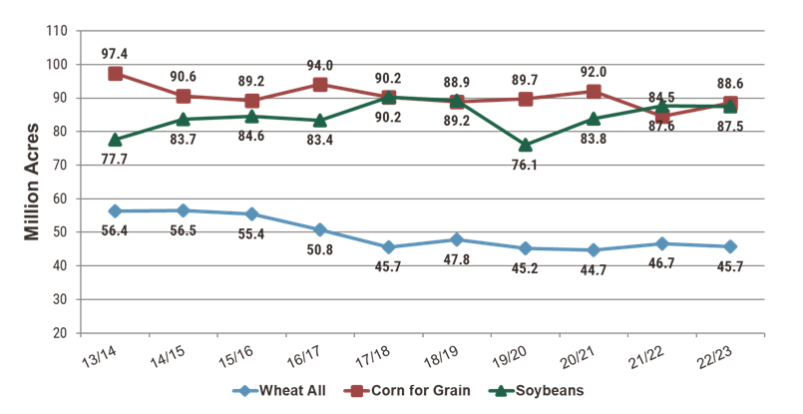
Breaking from the historical trend, in January 2023, the USDA Winter Wheat and Canola Seedings report projected the 2023 winter wheat seeded area at 37.0 million acres (14.9 million hectares), up 11% from 2022 and 14% above the five-year average. The Hard Red Winter wheat (HRW) area was up 10% to 25.3 million acres (10.2 million hectares), while white winter wheat is up by 3% to 3.73 million acres (1.5 million acres). Soft Red Winter wheat (SRW) experienced the most significant planting increase, jumping 20% from 2022/23 to 7.9 million acres (3.2 million hectares)
Further echoing the sentiment for increased planted area, the recent USDA Grains and Oilseed Outlook projected an 8% increase in all wheat planted area to 49.5 million acres (20.0 million hectares), driven primarily by the jump in winter wheat acres. The estimate is the highest since 2016 and 8% above the five-year average.
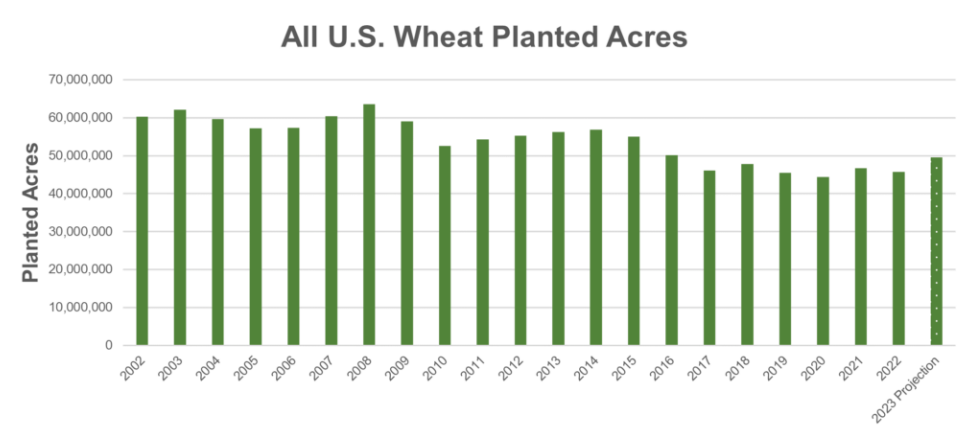
As producers begin their spring wheat sowing campaigns, Jim Peterson, Policy and Marketing Director at the North Dakota Wheat Commission, notes that though there is room for increased planting, many farmers minimized price risk by locking in their crop rotations and inputs for the season early, which tempers major acre shifts. He also added that spring wheat planted area increases this year would be in part a rebound after last year's wet spring prevented many acres from being planted.
More clarity will come on March 31, when USDA publishes its annual Prospective Plantings Report outlining the initial spring wheat area and updating winter wheat area estimates. Likewise, the May 2023 World Agricultural Supply and Demand Estimates will provide the government's first insight into the 2023/24 marketing year.
The incentive to plant wheat remains strong, but planted acres do not necessarily equate to production, especially as drought conditions persist in the southern plains. As always, the weather will play a crucial role in crop production as spring planting begins and the winter wheat crop emerges from dormancy.
By USW Market Analyst Tyllor Ledford

Be they students working toward a college degree in grain science or wheat professionals on campus for a quick lesson, thousands have experienced the sights, sounds and smells of wheat being milled into flour inside Shellenberger Hall at Kansas State University's (KSU).
It won't be long before the final kernels are gristed, separated and sifted inside the six decades-old building, which has been instrumental in the education and development of milling experts around the world.
Shellenberger Hall, long the center of the Kansas State University's Grain Science and Industry program, will be torn down, according to KSU's College of Agriculture. Earlier this month, KSU announced plans to upgrade facilities, including construction of a Global Center for Grain and Food Innovation Center. While it will not be built on the current site of Shellenberger Hall, the new facility will become the centerpiece of the grain program. According to KSU's plans, the Innovation Center will be built to the west of the Grain Science Complex that includes the Hal Ross Flour Mill, O.H. Kruse Feed Mill, International Grains Program (IGP) Institute and other facilities.
Currently, Shellenberger houses the milling science pilot classroom. Teaching mills are located on the first floor, along with the Baking Science Lab.
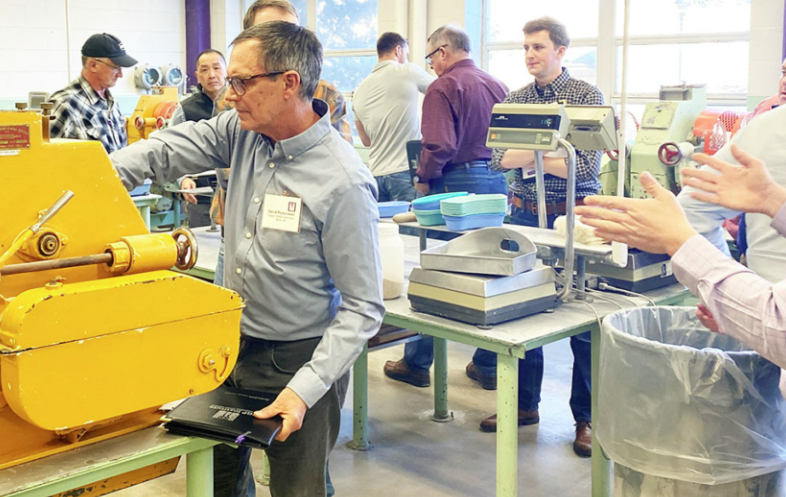
"KSU's Department of Grain Science and Industry has a long and storied history of career pathways into the flour milling industry worldwide and research and promotion of U.S.-grown wheat," said Justin Gilpin, CEO of Kansas Wheat. "It's exciting to see this new investment in infrastructure that will further enhance not only the student experience but the capacity for wheat industry engagement, research, and promotion of U.S. wheat usage and exports."
This important addition to KSU's Grain Science and Industry program holds promise toward reverse a trend in declining enrollment in flour milling and baking industry management programs.
Shellenberger Hall, named after John Shellenberger, head of KSU's Department of Flour and Feed Milling from 1944 to 1966, has been a key waypoint for KSU graduates – and others. State wheat associations and organizations such as U.S. Wheat Associates (USW) regularly send staff and board members to KSU to learn the details of flour milling in short courses offered by KSU and IGP. In all cases, Shellenberger Hall has been instrumental in milling education.
"Walk into any flour mill in the United States and you'll likely find a graduate from KSU's milling science program presiding over the operation," Arvin Donley, editor of World Grain, wrote in a recent editorial on the university's plans. "Many of the industry's future leaders will pass through the milling program, which is why having top-notch academic facilities to attract prospective students will not only benefit the university but the flour milling industry as well. The program also has sent hundreds of graduates to flour mills around the world over the years, making it a program with a truly global impact."
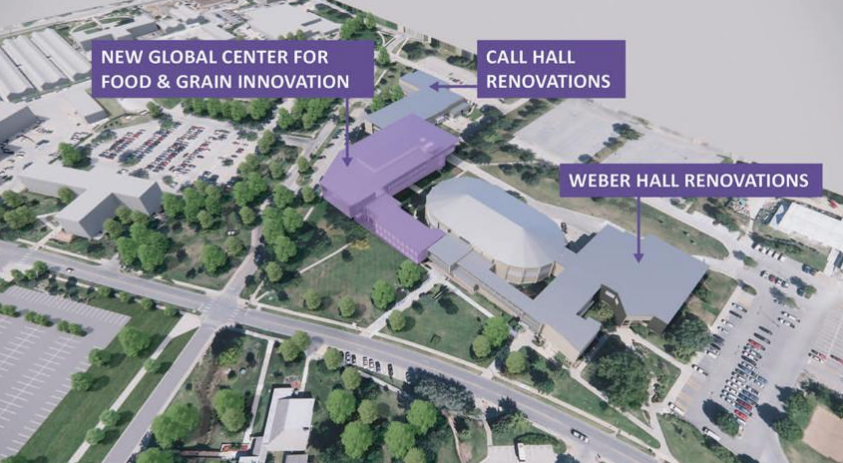
Dr. Ernie Minton, dean of KSU's College of Agriculture and director of K-State Research and Extension, said the project will begin with construction of an agronomy center that will house the field research component of the Department of Agronomy, including the wheat breeding program, and renovations to the Department of Animal Science's Weber Hall and Call Hall. That project is expected to be completed in 2024. Construction of the new Global Grain and Food Innovation Center is scheduled to follow.
The photo at the top of this page, courtesy of Kansas State University, is an artist's rendering of a proposed building at Kansas State University to replace Shellenberger Hall for the Department of Grain Science and Industry.
USW will follow the progress of this exciting addition to KSU's programs and share more information as it is available.
By USW Director of Communications Ralph Loos
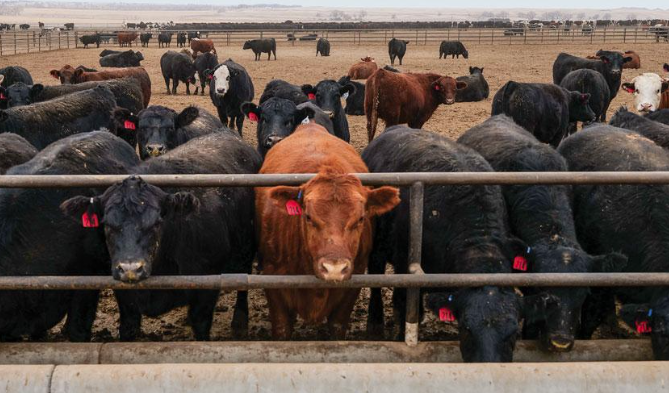
Editor's note- Senior Farm and Ranch Broadcaster Ron Hays was at Day One of the 2023 International Livestock Congress in Houston where the total focus was on the impact of ESG to Beef cattle. Over the several Beef Buzz reports, Hays will explore what was discussed at the Congress as it relates to Cattle and this exploding concept.
Senior Farm and Ranch Broadcaster, Ron Hays, attended the 2023 International Livestock Congress at the Houston Livestock Show and Rodeo. Following the presentation, Hays visited with the moderator, Don Close, talking about the impacts of ESG (Environmental, Social and Governance), on the beef cattle industry.
"I don't think there is anything that is impacting agriculture globally as broad as the whole environmental and sustainability component," Close said. "The classic line that, 'if you are not at the table, you are soon going to be on the menu,' I think that is the real message here that we can do the work now to largely determine our own future, or we can sit back, and it will be determined for us."
The three big drivers in consumer decision-making, Close said, are price, taste, and food-safety.
"On the sustainability side, in my view, I am not convinced that consumers want to know where their food comes from as much as they want to know they have the ability to determine where their food comes from, should they choose to look into it," Close said.
One thing that livestock producers have seen in this ESG conversation is the proposed rules from the Securities and Exchange Commission, requiring companies to go to their suppliers and get greenhouse gas emission data, which could include livestock producers. Even if cattle produces wanted to deliver that information to cooperate partners, Close said there is no way to measure it at this point.
"I just don't think we are there yet with the measuring capabilities to implement that phase of it," Close said. "Can that be in our list of goals looking forward? I have no opposition to that, but I think we need to be really careful that we can indeed measure and document what we are claiming before we have a lot of liability out there, making claims that are very likely going to change."
That data, Close said, can be measured in a number of ways, but the industry has a long way to go before agreeing on an accurate and effective way to do so. The ESG conversation, Close said, will only become more frequent as time goes by.
"It is not going to go away, and they need to be educated, they need to be informed, and they need to be in a position to make good decisions going forward," Close said.
The Beef Buzz is a regular feature heard on radio stations around the region on the Radio Oklahoma Ag Network and is a regular audio feature found on this website as well. Click on the LISTEN BAR for today's show and check out our archives for older Beef Buzz shows covering the gamut of the beef cattle industry today.
Farm Bureaus across the nation are preparing for Agricultural Safety Awareness Program (ASAP) Week, March 6-10. U.S. Agricultural Safety and Health Centers will join Farm Bureau in promoting ag safety this week with the theme "Lead the Way in Agriculture."
Farm Bureau and U.S. Ag Centers will focus on sharing information about a different safety area each day of ASAP Week:
"Keeping everyone safe on America's farms and ranches is so important," said American Farm Bureau Federation President Zippy Duvall. "We encourage farmers and ranchers to take the time to make safety a priority during Agricultural Safety Awareness Program Week and throughout the year."
The Agricultural Safety Awareness Program is a part of the Farm Bureau Health and Safety Network of professionals who share an interest in identifying and decreasing safety and health risks. For more information and resources, visit the ASAP Facebook page.
Visit the Centers' YouTube channel (www.youtube.com/user/USagCenters) for new content and fresh ideas about how to stay safe while working in agriculture, forestry and fishing.
Join the movement to keep farms safe and share your own safety messages on social media using these hashtags:
The 12 U.S. Agricultural Safety and Health Centers (www.cdc.gov/niosh/oep/agctrhom.html) are funded by the National Institute for Occupational Safety and Health.
Groups note there have been more political donations from cockfighters in 2022 than the total number of cockfighting busts in 20 years.
From 2004 to 2022, there were only 29 law enforcement actions resulting in the arrest of individuals involved in cockfighting, an average of 1.75 busts a year for 75 of 77 counties in Oklahoma. (Data are not yet available from Oklahoma or Tulsa counties.) There's not been a single arrest in most of the biggest cockfighting counties in the state, including Atoka, Coal, LeFlore, and McCurtain counties. In fact, there's not been a single arrest of anyone named in an 87-page dossier assembled by Animal Wellness Action that exposes many of the biggest cockfighters traffickers throughout Oklahoma. The data was assembled by the District Attorneys Council at the request of Oklahoma State Rep. Andy Fugate, D-94, and was obtained by Animal Wellness Action.
"There has been a near-complete breakdown in enforcement of the state's voter-approved law against staged animal fighting," said Wayne Pacelle, president of Animal Wellness Action and the Center for a Humane Economy. "In dozens of counties throughout Oklahoma, law enforcement personnel — whether they are sheriffs or district attorneys — simply aren't doing their jobs and are allowing cockfighters to commit acts of animal cruelty with impunity."
Animal Wellness Action and Showing Animals Respect and Kindness (SHARK) noted that Atoka County Sheriff Tony Head was provided with detailed and credible information on a regular basis of a cockfighting arena in Stringtown that operated every other weekend during a cockfighting season. The sheriff took no action to apprehend the organizer or the hundreds of other participants. In neighboring Bryan County, Sheriff Johnny Christian did take action and raided a cockfighting arena there, apprehending 200 participant and spectators. In the end, the district attorney for Bryan and Atoka counties brought charges against a single individual, failing to charge even one other person with even a $50 fine.
Animal Wellness Action and SHARK have provided detailed evidence to law enforcement of ongoing crimes to law enforcement authorities throughout the state. Today, for instance, SHARK is releasing additional footage of a Coal County cockfighter who has prior felony convictions for money laundering and narcotics trafficking, shipping birds to a border town in Texas, with the birds clearly destined for fighting venues in Mexico.
"The problem is not that our anti-cruelty laws are too harsh," said Drew Edmondson, former Oklahoma Attorney General (1994-2010) and co-chair of the National Law Enforcement Council for Animal Wellness Action. "Rather it's that cockfighters are exhibiting knowing and reckless disregard for our laws, and some county sheriffs and district attorneys are failing to uphold the law without fear or favor."
SHARK and Animal Wellness Action are continuing to conduct ongoing animal-fighting investigations, revealing that Oklahoma, despite a strong law that establishes felony-level penalties for a range of cockfighting crimes, continues to be the "cockfighting capital of the United States."
"We have information about widespread illegal possession of fighting animals, shipment of fighting animals through the Postal Service all over the world, the movement of fighting birds to border towns to export the animals to other countries, and more," said Steve Hindi, president of SHARK. "The proper response for lawmakers is to give law enforcement the resources it needs to enforce Oklahoma law, rather than to give comfort to cockfighters and gut the penalty provisions of state anti-cruelty laws."
The organizations have also investigated the leaders of the Oklahoma Gamefowl Commission, which donated $41,250 to 34 sitting House members and nine Senators, with the single largest recipient of contributions being Senator Lonnie Paxton, R-21 ($2,500). Mr. Paxton is the author of SB 1006 to allow counties to cripple penalties in the anti-cockfighting law. Rep. JJ Humphrey has the companion bill, HB 2530, and received $1,000 from the cockfighters' PAC. Both bills have passed from their assigned committees and await floor action.
Animal Wellness Action today asked lawmakers to return last year's political donations from the Oklahoma Gamefowl Commission (OGC). The OGC has not disclosed its donors and clearly violated Oklahoma Ethics Commission rules; the group's leaders are cockfighting practitioners violating Oklahoma and U.S. laws barring possession of fighting animals; and lawmakers and cockfighting leaders continue to assert that their goal is to allow cockfighters to violate a federal law that bars shipping fighting birds to any other jurisdiction. Information about the leaders of the OGC is contained in Animal Wellness Action's 87-page report on cockfighting in Oklahoma.
"Lawmakers should no more take money from illegal cockfighters than they should from dogfighters, the mob, or narco-traffickers wishing to weaken laws that apply to them," added General Edmondson.
"There have been far more political donations from cockfighters in one year than there have been raids on cockfighting arenas and gamecock farms in Oklahoma in 20 years," said Tom Pool, D.V.M, MPH, DACVPM, the senior veterinarian with the Animal Wellness Action and a native of Lawton and an OSU veterinary college graduate. From 2016 through 2022, Dr. Pool tracked thousands of illegal shipments of fighting birds from Oklahoma cockfighters to Guam, where he served as territorial veterinarian for 17 years. Dr. Pool is a retired Army Colonel who ran the U.S. Army's Veterinary Command.
A month ago, The Center for a Humane Economy also today released a comprehensive 63-page report on the links between cockfighting and avian influenza and virulent Newcastle Disease. "By allowing a massive cockfighting industry to flourish in Oklahoma, the state is putting the enormous number of commercial poultry operations in eastern Oklahoma and western Arkansas at risk," said Dr. Jim Keen, director of veterinary sciences for the Center for a Humane Economy and the primary author of the report.
The HPAI (H5N1 strain) bird flu epidemic that began in February 2022 in Indiana has already killed nearly 60 million commercial and backyard poultry and unknown thousands, perhaps millions, of wild birds in 48 states over the past 12 months.
Virulent Newcastle disease can cause commercial and backyard poultry devastation similar to that of HPAI if not contained. There have been 15 introductions of vND into the United States since 1950, 10 of which occurred via the illegal smuggling of game cocks across our southern border from Mexico. (Virulent Newcastle disease is endemic in Mexico and all of Latin America.) Just three of those outbreaks cost the federal government more than $1 billion.
Animal Wellness Action provides a $5,000 reward for information that leads to the arrest and conviction of anyone involved in animal fighting crimes. Tips should be submitted by email at info@animalwellnessaction.org.
RON's Dave Lanning has a pre-opening look at today's agricultural Markets.
Click the audio tab below for today's report.
This Week on SUNUP is Oklahoma State University Extension grain market economist Kim Anderson. During this week's edition, Anderson talks about the latest information in the grain markets.
USDA has released estimates for the 2023-2024 marketing year. Regarding those estimates, Anderson said there were not any surprises.
"You look at production for wheat- 1.89 billion bushels was the estimate," Anderson said. "1.89 billion bushels is what USDA came in with, and wheat produced 1.92 billion last year."
As for the USDA's price projections for wheat, Anderson said wheat is at $8.50 for the marketing year of 2023 through 2024. If you adjust that to Oklahoma, Anderson said it is at about eight dollars.
"Relatively good prices expected for the next marketing year," Anderson said.
Right now, Anderson said weather is the big driving force for the markets.
"If you look at the impacts for what this report had on it and the weather, and the rain we have had, you see wheat, corn and bean prices all go down," Anderson said.
The war in Russia and Ukraine is also continuing to impact the markets, Anderson said.
"I think the Covid impact is out of the market right now, so if by some chance the war ended, I think we could have lower prices because that Black Sea wheat and corn would flow out, and I think that could have more of a negative impact on corn and wheat prices," Anderson said. "Bean prices- I think they are going to watch the weather and the planted acres.
This week on SUNUP:
Join us for SUNUP:
Saturday at 7:30 a.m. & Sunday at 6 a.m. on OETA (PBS)
YouTube.com/SUNUPtv

House Agriculture Committee Ranking Member David Scott announced the following addition to the Democratic staff of the House Agriculture Committee:
Kate Fink has joined the Committee as Policy Director. Kate spent nearly 13 years at the Department of Agriculture, working on nutrition assistance programs and agricultural research. She previously worked for the House Budget Committee and has held positions at the Consumer Financial Protection Bureau and the Department of Health and Human Services. She holds a Master of Public Policy from Georgetown University and a Bachelor of Arts from the University of Wisconsin – Stevens Point.
The Environmental Stewardship Award Program (ESAP) will hold a reception and awards ceremony on April 25, 2023, in Washington, D.C., in conjunction with the National Cattlemen's Beef Association's (NCBA) annual Spring Legislative Conference. The evening will feature the announcement of the 2022 ESAP national winner from the group of seven regional winners that were recognized during the Cattle Industry Convention & NCBA Trade Show in New Orleans in February.
ESAP annually recognizes the outstanding stewardship practices and conservation achievements of U.S. cattle producers from across the nation. Cattlemen and women work every day to protect the environment, improve wildlife habitats and adopt the latest technologies while operating sustainable businesses that support rural communities. As a result of ranchers' commitment to continuous improvement and scientific advancements in beef cattle genetics, nutrition, production practices, and biotechnologies, the U.S. is a global leader in sustainable beef production.
"Announcing the national winner at a special ceremony in Washington, D.C., is new to the program. We believe sharing the cattle industry's great stewardship story with thought leaders in our nation's capital helps underscore the serious commitment cattlemen and women have to conserving natural resources and caring for livestock," said NCBA President Todd Wilkinson. "We're proud of the regional winners we recognized during our convention and look forward to celebrating the national winner. These farms and ranches undertake stewardship efforts unique to their environment, landscape and resources. Their desire is to leave the land in better shape for future generations while also inspiring the next generation of land stewards."
The 2022 regional winners are Lamb Farms, Inc., Oakfield, New York; Carter Cattle Company, LLC, Pintlala, Alabama; Huth Polled Herefords and S&H Livestock Enterprises, LLC, Oakfield, Wisconsin; Parks Ranch, Goliad County, Texas; Mannix Brothers Ranch, Helmville, Montana; Fulstone Ranches, Smith, Nevada; and Jorgensen Land & Cattle Partnership, Ideal, South Dakota.
Sponsors for the ESAP reception and awards ceremony include Corteva Agriscience, the Natural Resources Conservation Service, McDonalds and the U.S. Fish and Wildlife Service. A ticket to the ESAP reception is included with NCBA Legislative Conference. Registration is now open at ncba.org.
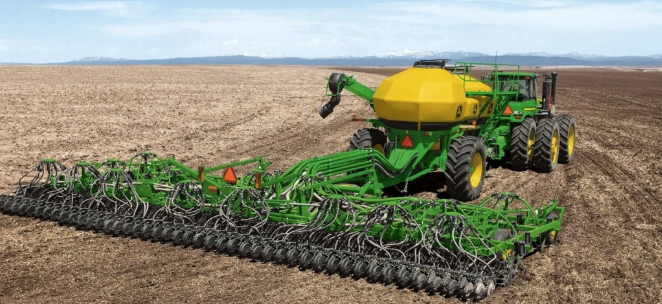
Since Russia's unprovoked invasion of Ukraine sent them soaring one year ago, global and U.S. wheat prices have decreased significantly. Continued Black Sea Grain Corridor exports and improved production outlook in major exporters such as Russia and Australia have helped relieve the market of some supply pressure. Bulk ocean freight rates have also broken in favor of wheat and other grain importers.
Even more relief for buyers arrived with the USDA Grains and Oilseed Outlook released on Feb. 23 that projected an 8% increase in all U.S. wheat planted area. On Feb. 24, wheat futures fell as much as 30 cents overnight in response to that report.
In a classic supply and demand equation, tight global wheat stocks and the uncertainty of the Black Sea pushed prices higher and provided an economic incentive to plant more wheat and futures prices reacted to the news.
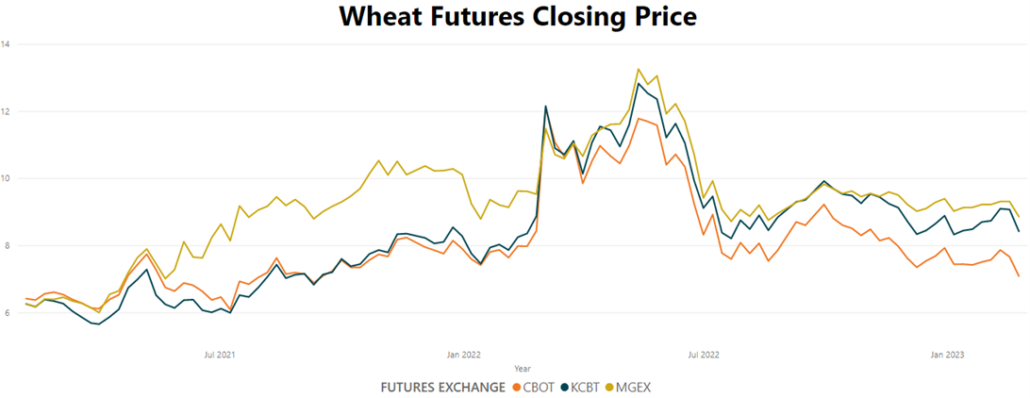
In response to the increased wheat acre estimates, Chicago Board of Trade (CBOT), Kansas City Board of Trade (KCBOT), and Minneapolis Grains Exchange (MGEX) wheat futures recently dropped, and have come down as much as 41% from the highs hit in March 2022 to prices not seen since September 2021. Source: Source: U.S. Wheat Associates Price Charting Tool.
Over the last two decades, competition for wheat acres has increased as profit margins have shifted to favor other crops such as corn and soybeans. Meanwhile, as market volatility persists, farmers increasingly utilize diversified crop rotations to mitigate price and input risk. The combined impact has resulted in a slow erosion of U.S. wheat annual planted area, with the most recent five-year average coming in at 46.0 million acres (18.6 million hectares), down 24% from the 2002.
In addition to supply pressures at home, enhanced production in competing exporters has highlighted the increasingly tight U.S. balance sheet. Production in Russia has increased 76% over the last decade, while Argentine production, increased 138% from 2012/13 to 2021/22, (excluding the historic drought impacting the 2022/23 crop).
Wheat planted area erosion and increased global competition, coupled with drought-inflicted production shortfalls in the U.S. over the last three marketing years have created a tight balance sheet both domestically and on a global scale, underpinning wheat prices.
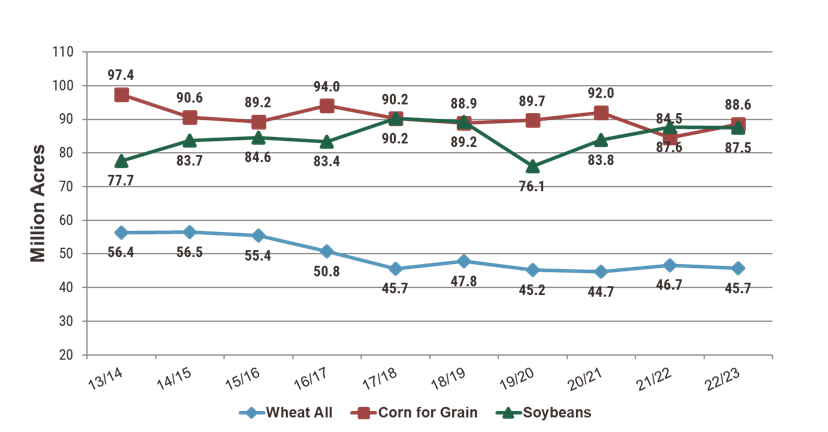
Wheat acres have decreased over the last decade, compared to the relative, recent stability of soybean and corn planted area. Source: USDA Economic Research Service Wheat Data, USDA National Agricultural Statistics Service.
Breaking from the historical trend, in January 2023, the USDA Winter Wheat and Canola Seedings report projected the 2023 winter wheat seeded area at 37.0 million acres (14.9 million hectares), up 11% from 2022 and 14% above the five-year average. The Hard Red Winter wheat (HRW) area was up 10% to 25.3 million acres (10.2 million hectares), while white winter wheat is up by 3% to 3.73 million acres (1.5 million acres). Soft Red Winter wheat (SRW) experienced the most significant planting increase, jumping 20% from 2022/23 to 7.9 million acres (3.2 million hectares)
Further echoing the sentiment for increased planted area, the recent USDA Grains and Oilseed Outlook projected an 8% increase in all wheat planted area to 49.5 million acres (20.0 million hectares), driven primarily by the jump in winter wheat acres. The estimate is the highest since 2016 and 8% above the five-year average.
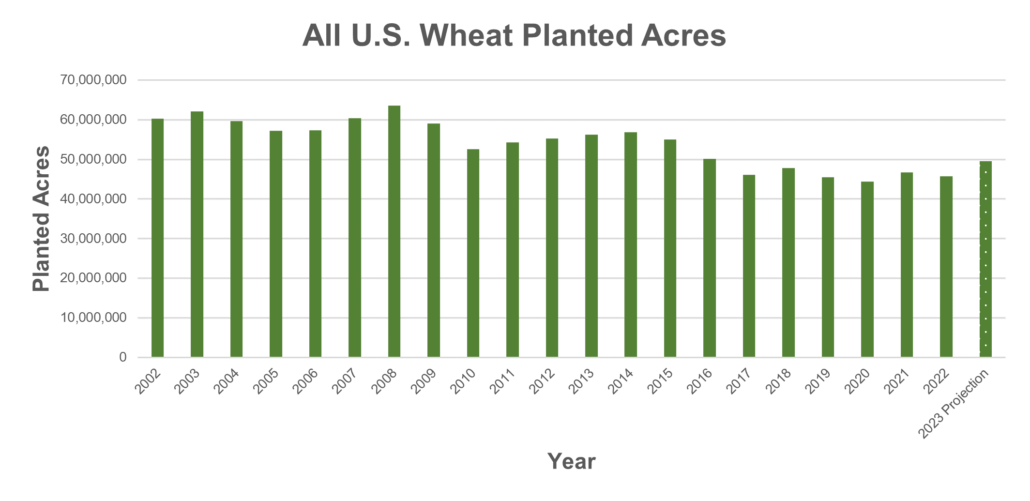
The 2023 estimate of wheat planted area mark a substantial increase in wheat acres compared to the last twenty years and the largest planted area since 2016. Source: USDA National Agricultural Statistics Service Data.
As producers begin their spring wheat sowing campaigns, Jim Peterson, Policy and Marketing Director at the North Dakota Wheat Commission, notes that though there is room for increased planting, many farmers minimized price risk by locking in their crop rotations and inputs for the season early, which tempers major acre shifts. He also added that spring wheat planted area increases this year would be in part a rebound after last year's wet spring prevented many acres from being planted.
More clarity will come on March 31, when USDA publishes its annual Prospective Plantings Report outlining the initial spring wheat area and updating winter wheat area estimates. Likewise, the May 2023 World Agricultural Supply and Demand Estimates will provide the government's first insight into the 2023/24 marketing year.
The incentive to plant wheat remains strong, but planted acres do not necessarily equate to production, especially as drought conditions persist in the southern plains. As always, the weather will play a crucial role in crop production as spring planting begins and the winter wheat crop emerges from dormancy.
By USW Market Analyst Tyllor Ledford
As final preparations are made to bring your show animals to the Oklahoma Youth Expo, Dr. Rod Hall, State Veterinarian, offers some things to take into consideration:
Gilts and heifers begin moving into the Oklahoma State Fairgrounds Tuesday for the Oklahoma Youth Expo. This is the culmination of months of searching for the "right" show animal, feeding, walking, fitting, and all the things that go into a successful exhibition season.
At this time it may be tempting for exhibitors, parents, advisors, and veterinarians to relax the standards of biosecurity since this is the show everyone has been pointing to. Please remember that livestock that are sick or have been sick in the past week should not be taken to places where they can expose other livestock.
I know it's heartbreaking for a young person to be told they can't show an animal they've worked very hard to take to OYE, but we all have to work together to ensure the health and safety of animals and exhibitors to make sure we continue to have the ability to enjoy this event.
So please, if you are aware of animals that might start a cascade of sick animals encourage the owners of that animal to not take it to OYE. In a 10 day show like OYE, a few gilts with PED that enter Tuesday could result in enough virus to cause a large number of sick pigs by the time barrows come in the following week, and could potentially cause the show to be canceled. We don't want that to happen, so please be vigilant and encourage owners of sick animals to leave them at home.
Our coverage of the 2023 Oklahoma Youth Expo is sponsored by Hilliary Communications- who deliver the latest cutting-edge communications services supporting tens of thousands of customers across 22 counties throughout Oklahoma, Texas and Iowa. The company offers internet, voice and HilliaryTV. Hilliary Communications continuously researches the marketplace for innovations and strives to improve underserved areas, offering services that exceed customer expectations. Click here to learn more about Hilliary Communications.
Farm Director, KC Sheperd, is visiting with the president of Farm Strategy, LLC, Andrew Hoelscher, about new genetic progress to increase the value of grain.
"We build ingredient-based supply chains," Hoelscher said. "We connect end-user demand signals, and value propositions back down to the producer and manage the supply chain in between them."
Farm Strategy is using the BX7 trait to cross into a set of varieties, Hoelscher said, which will increase the value of those varieties.
Regarding value in the marketplace, Hoelscher said it is important to remember that the value being created is in the consistency of the product, which includes the consistency of the delivery.
"If you are wanting to provide a consistent product to an end user, you have got to have a consistent supply chain," Hoelscher said.
As for Farm Strategy's role as a facilitator for the supply chain, Hoelscher said they are the ones who control the premium structure.
"It is a high-functioning trait when it comes to dough strength, so we measure it in stability, which could be known as tolerance as well," Hoelscher said. "But that trait is able to strengthen dough inside of a bakery, make it perform more consistently when used properly, or displace other additives that the industry would typically use."
"We are making sure that the value we understand at the baker is shared, and the incentives are aligned with the miller, with the grain handler, passed back down to the farmer, and then we also capture the value for OSU's royalty structure for how they are getting paid for coming up with these good genetics. It is a secondary royalty structure for them," Hoelscher said.
If we want to supply the consumer with better food, Hoelscher said some models must be challenged, which may be an unpopular opinion for some.
"There is a market that has been built on commodity for the past 100 years, and it is really good and it is really efficient, and people have made money on it, and people have personal incentives and bonuses that they get paid to play that game, and this is disruptive," Hoelscher said.
As it is the first year of commercial production of BX7 for Farm Strategy, LLC, Hoelscher also talked about what the next steps will look like.
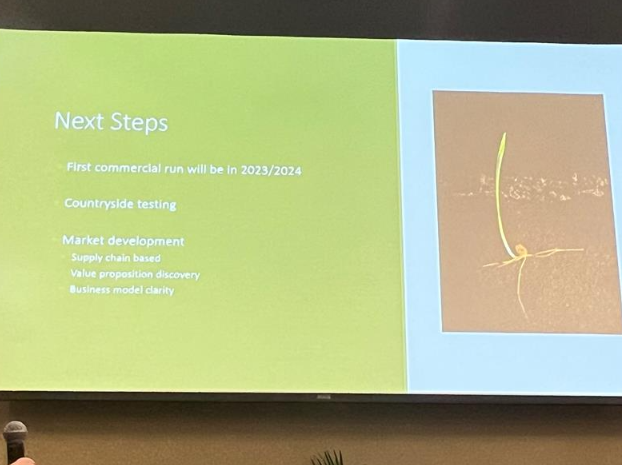
"We have to prove the commercial viability of it, we have got to turn around, stand up, what is the demand structure, so we are working through field-by-field testing protocols in which we are going to figure this stuff out and reduce some of the variability of it, where at the same time, building that next iteration of demand," Hoelscher said.
As exhibitors prepare for show season, it is important to develop a plan for how to handle any livestock emergencies that may arise. Having a plan in place prior to the show ensures quick action and timely care should an emergency happen.
"The most important part of an emergency plan for livestock shows is to know how and where to seek veterinary assistance before an issue occurs," said Dr. John Gilliam, a clinical professor of food animal production medicine and field service at the Oklahoma State University College of Veterinary Medicine (OSU CVM).
Many larger shows have a veterinarian on-site to provide emergency care. If a show does not have a veterinarian on-site, know ahead of time what off-site veterinarian you will use for emergencies.
If the show is local, exhibitors should contact their regular veterinarian ahead of time to see if he or she is available for emergencies and develop a plan if assistance is needed. If the show is out of town, show officials should be able to provide a list of local veterinarians that can be contacted. If possible, contacting these clinics ahead of time to confirm their availability for emergency service may save time and frustration.
Keep in mind that while the show may pay the veterinarian to be on-site, this likely won't include fees for veterinary services rendered in the case of an emergency. Be prepared for potential extra costs for these services.
Many potential emergencies pertain to animal health and can be prevented with the proper precautions.
"Make sure animals are healthy and are current on vaccinations before the show," Gilliam said. "Ensure each animal has also received an appropriate Certificate of Veterinary Inspection (CVI) prior to transport to the show."
While it can be difficult to avoid contact with other animals at shows, exhibitors should work to minimize contact as much as possible. Exhibitors should also avoid making any changes to an animal's diet while at the show. Bloat and diarrhea are common health problems that can develop at shows when animals undergo stress and diet changes.
"If you are at the show and you notice that your animal is not acting like it usually would, it is a good idea to get an examination by a veterinarian," said Dr. Rosslyn Biggs, director of continuing education and beef cattle extension specialist at the CVM.
Show officials should be contacted before moving the animal as specific protocols may be needed to avoid risk to other animals or people.
"If you're dealing with something that's infectious, you definitely want to have a discussion with show management so that appropriate measures can be taken to isolate and deal with any potential transmission that's already occurred," Biggs said.
Removing any animals that develop a potentially contagious illness protects the animal's health, as well as the health of other animals at the show.
Exhibitors may bring various medications with them to the show, however, an animal deemed in need of antibiotic treatment at the show should be removed from the show grounds.
"Most medications administered to livestock have a withdrawal period or a period of time that must elapse between administration of the medication and marketing of the animal for food production purposes," Gilliam said.
"This is required to reduce the risk of medication residues in food products. Always consider the withdrawal period before administering any medication to an animal, particularly if the show is a terminal show."
Any questions regarding withdrawal time should be directed to a veterinarian. Additionally, some shows may prohibit the use of certain medications, so always be sure to consult the show rules before administering medication to an animal.
While livestock emergencies at a show are uncommon, they can occur, and it is best to be prepared. Good preparation ahead of time can greatly reduce the impact of such emergencies should they arise. Speak with your veterinarian about establishing an emergency preparedness plan for your next livestock show.
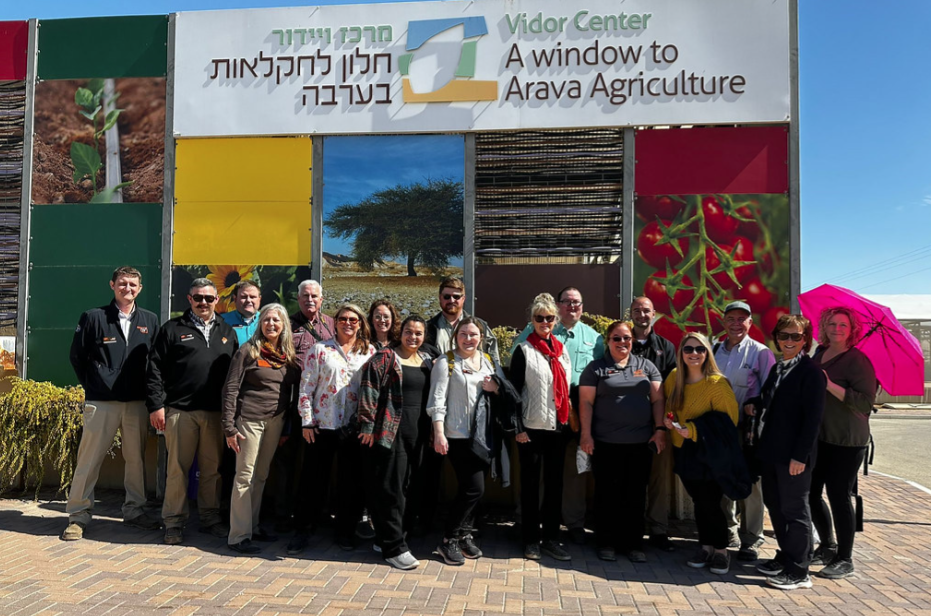
By Trisha Gedon
For more than 40 years, the Oklahoma Agricultural Leadership Program has enhanced knowledge and leadership skills for Oklahomans involved in agriculture.
"OALP helps potential leaders develop a better understanding of the various systems of economics and government," said Edmond Bonjour, OALP director since 2010. "Class members increase and use their knowledge and skills to solve problems and to explore opportunities for Oklahoma agriculture."
OALP is comprised of up to 30 professionals from across the state who are engaged in production agriculture, agribusiness or some other agricultural sector. Applicants must be at least 25 years old and are chosen for the program based on their potential to be important agricultural leaders in Oklahoma.
Applications are available on the OALP website and all application materials are due by May 1. Interviews will take place in June, and the first seminar will occur in August. OALP Class XXI graduation is slated for April 2025.
"Every new class brings a sense of excitement to the program. Each participant has a different perspective about agriculture, which enriches the leadership development that we provide," Bonjour said.
The 20-month program consists of 10 three-day seminars and study tours within Oklahoma, one three-day seminar in northern Oklahoma and Kansas, a seven-day seminar in Pennsylvania and Washington, D.C., and a two-week international experience near the end of the program. OALP Class XX just returned from Israel.
Seminars within the state are geared toward wind energy, dryland farming, animal processing and feedlots in northwest Oklahoma; cotton, irrigation and vegetable production in the southwest; fish farming, sod farms and both the poultry and forestry industries in the southeast part of the state; and soybeans, mushroom farming and water navigation systems in northeast Oklahoma.
During the Kansas trip, the class will visit a John Deere training facility, a flour mill, Cargill and an oil refinery. The Pennsylvania visit will allow class members to learn more about agriculture in Amish communities, and a stop in Hershey, Pennsylvania, will teach the group about various agricultural products that go into chocolate production. The OALP class also meets with the Oklahoma congressional delegation while visiting Washington, D.C.
Ron Hays, Oklahoma Agrinet, was a member of the inaugural OALP class and has served as the OALP Advisory Council chair. He has observed how the program has changed and adapted over the years to meet the needs of class members.
"I'm always glad to see the way the OALP director stretches the class in new ways," Hays said.
Travis Jones, Class XVIII member and rangeland management specialist, USDA-NRCS, looks back on his experience with OALP and remembers how fortunate he was to have been selected for this learning opportunity.
"I recently completed a master's degree in international agriculture with the intent of applying my natural resource-based knowledge in a broader global context," Jones said. "Maybe OALP was the catalyst, maybe it was the new connections and friendships developed; whatever the inspiration, I'm thankful for a broadened perspective. Hopefully, I will be able to impact agriculture on a global scale."
Bonjour said that while developing strong leaders is the overall goal of OALP, three specific program objectives define the program.
"First, the program is designed to help class members develop a deeper and fuller appreciation and understanding of people," he said. "The second objective is to help potential leaders gain a better understanding of basic systems of economics and government. And, finally, the third objective is to help the class use the first two objectives to solve problems and discover opportunities for Oklahoma agriculture."
For more information about OALP or applying for Class XXI, contact Bonjour at 405-744-8134 or edmond.bonjour@okstate.edu.
OSU Extension uses research-based information to help all Oklahomans solve local issues and concerns, promote leadership and manage resources wisely throughout the state's 77 counties. Most information is available at little to no cost.
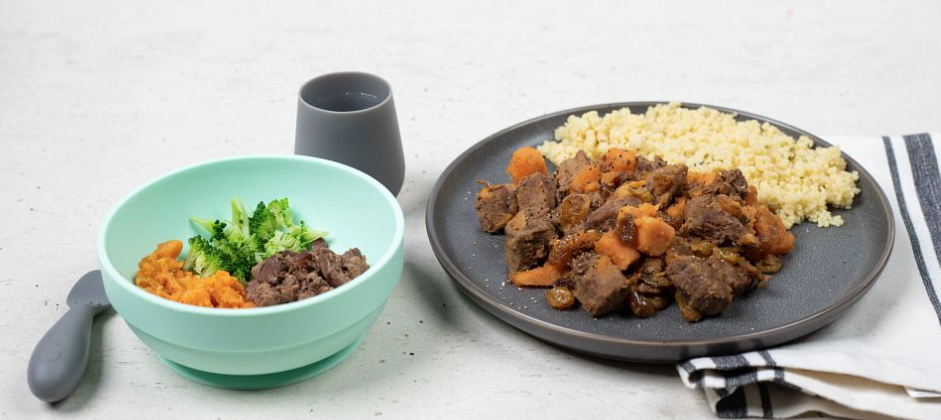
Senior Farm and Ranch Broadcaster, Ron Hays, is visiting with the executive director of nutrition research at the National Cattlemen's Beef Association, Dr. Shalene McNeill. Hays and McNeill talk about beef nutrition.
"I think nutrition is more important than ever before, and I think Covid really helped illuminate and bring more attention on nutrition," McNeill said. "People are wanting to cook at home more often, becoming even more health conscious, and we have great content and research that we can share with consumers in this current mindset that they are in about the way that beef nourishes them."
As a registered dietitian and a mother, McNeill talked about how many children and teenagers are not getting all of the nutrients they need.
"What the research is beginning to show is that beef is such a critical nutrient as we have known for a long time for children and the growing years but adolescents- teenagers- just really have important nutrient gaps," McNeill said. "They are not getting enough iron, they are not getting enough zinc, they are not getting enough choline. These are things that, for example, experts like the Dietary Guidelines Committee have brought to life that we have got to do a better job of closing these nutrition gaps, and beef can do that for our adolescents and teens, and we are starting to raise awareness on that with health professionals."
A campaign, directed by NCBA, a contractor to the Beef Checkoff, called "Beef in the Early Years," is aimed at educating consumers and healthcare professionals about the guidelines that say infants starting around six months of age should be consuming iron-rich foods such as beef to help nourish them.
"I think we have reached over 32 million consumers with our campaign on the early years, so we want to build off of that success and start raising awareness about teenage diets as well," McNeill said.
As February was "American Heart Month," McNeill also talked about the story beef has to tell when it comes to heart health during that month, and throughout the year.
"The beef story is great on heart health, and we still see consumer research that reminds us as a beef industry that we need to talk to consumers about the way that beef can support heart health, because we have a great amount of research that has been conducted over the years," McNeill said. "Every single time these studies show that you can incorporate beef in a heart-healthy diet that is balanced, a balanced healthy eating plan, and you can improve your cholesterol levels, you can improve your heart health outcomes, so we have got that important story to tell, and we are doing that."
The Beef Buzz is a regular feature heard on radio stations around the region on the Radio Oklahoma Ag Network and is a regular audio feature found on this website as well. Click on the LISTEN BAR for today's show and check out our archives for older Beef Buzz shows covering the gamut of the beef cattle industry today.
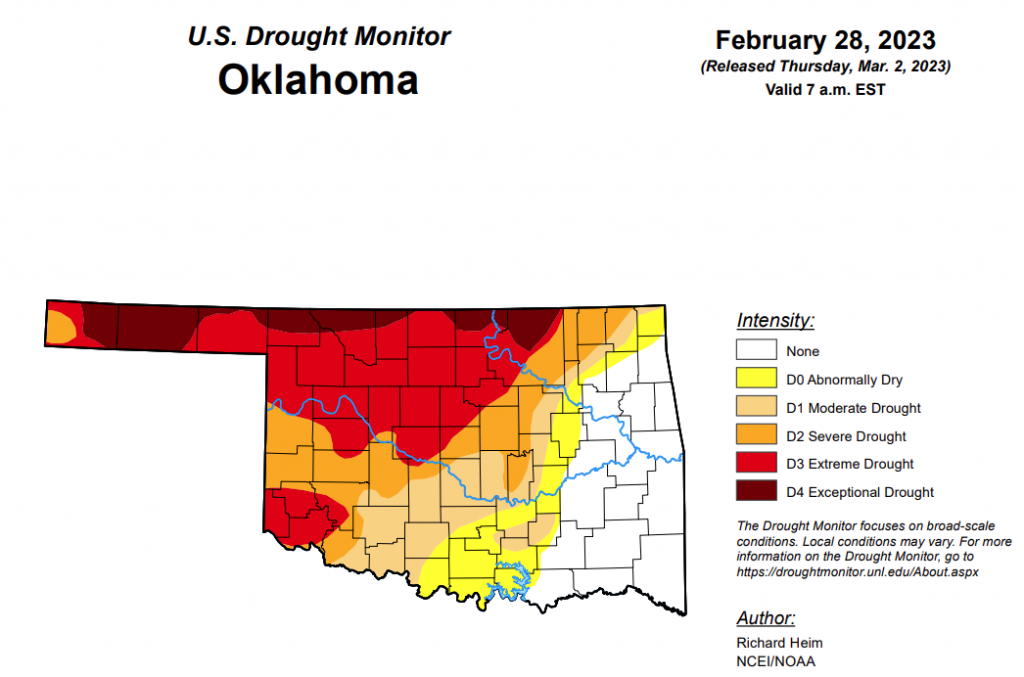
To view the Oklahoma Drought Map, click here.
Exceptional drought is unchanged this week at 8.86 percent.
Extreme drought or worse is also unchanged from last week at 36.64 percent.
Severe drought or worse has improved slightly from last week's percentage of 56.47 percent to this week's 53.52 percent.
Moderate drought or worse has improved since last week and is now at 66.88 percent, down from last week's 74.65 percent.
Abnormally dry or worse conditions are now at 77.15 percent, down from last week's 80.78 percent.
According to the 6-to-10-day precipitation outlook map, the majority of the state, aside from the panhandle, is leaning above a 40 to 50 percent chance of precipitation through March 11. The panhandle is sitting above a 50 to 60 percent chance of precipitation through March 11.
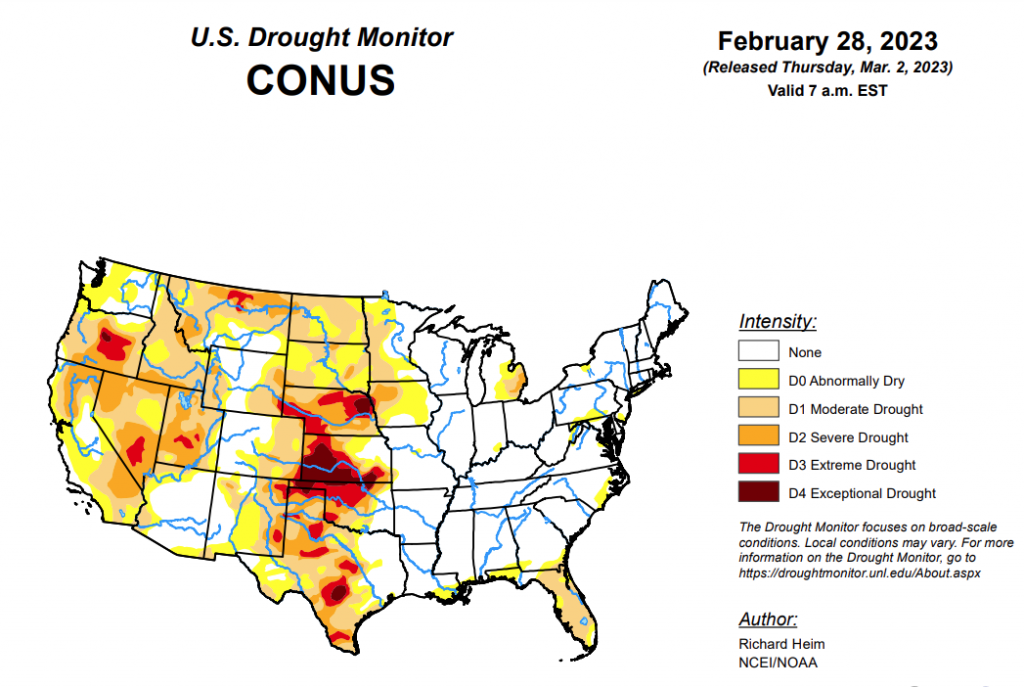
To view the United States Drought Monitor Report, click here.
According to the latest U.S. Drought Monitor Report, a series of Pacific low pressure and frontal systems moved across the western contiguous U.S. (CONUS) during this U.S. Drought Monitor (USDM) week (February 22-28). The weather systems dropped copious amounts of rain and snow across the West, especially over the Sierra and coastal ranges and Rocky Mountains. The weather systems re-intensified as they crossed the Plains and into the Midwest, tapping Gulf of Mexico moisture to spread several inches of rain over northeast Texas to the Appalachians and Ohio Valley, with several inches of snow falling in the below-freezing air across the northern tier states from the Dakotas to New England. A high-pressure ridge over the Gulf of Mexico generated a southerly flow that spread warmer-than-normal air from the Gulf Coast to southern Great Lakes. It also pushed the low-pressure systems along a storm track that went northeastward from the southern and central Plains to the Great Lakes. Temperatures averaged cooler than normal across the snowy northern states, across the central to northern Plains, and over the West. Little to no precipitation fell across the Gulf Coast, western portions of the southern and central Plains, and over the northern Plains near the Canadian border. It was also drier than normal over parts of the Pacific Northwest, northern New England, and the Mid-Atlantic states. Wetter-than-normal conditions were widespread across the rest of the West, parts of the northern and central Plains and Northeast, and much of the Midwest. Drought or abnormal dryness expanded where it continued dry in parts of Texas, Florida, and other Gulf Coast states. Drought or abnormal dryness contracted or reduced in intensity where it was wet across much of California and other parts of the West and Plains, as well as part of the Great Lakes region.
In the Southern Plains, two inches or more of precipitation fell in strips across Arkansas and eastern Oklahoma, with half an inch or more stretching from northeast Texas to Tennessee. But little to no precipitation fell across western and southern areas of the region. Abnormal dryness and moderate to extreme drought were trimmed in parts of eastern Oklahoma and north-central Texas, but abnormal dryness expanded along the Gulf Coast in Louisiana and Mississippi. Abnormal dryness and moderate to extreme drought expanded in parts of the southern half of Texas as streamflow, soil moisture, and groundwater continued at very low levels. High winds, low humidity, and hot temperatures continued to dry out the soils. Two years of drought in the southern Plains were capped this week by raging dust storms. The continued dry weather, and now 100+ mph winds with low humidity, have desiccated crops, with the media reporting that the dryland wheat crop in parts of Texas, Oklahoma, and Kansas could see abandonment rates up to 80%.
In the High Plains, the region experienced a patchwork pattern of precipitation this week. The Rocky Mountain areas of Wyoming and Colorado, as well as the eastern half of Kansas, received half an inch to locally 2 inches or more of precipitation, and half an inch fell across South Dakota and northern and eastern parts of Nebraska. But North Dakota, eastern Colorado, and adjacent parts of Kansas and Nebraska were drier, receiving less than half an inch. This winter has been particularly wet for central to northern portions of the High Plains region, while Kansas and parts of southeast Colorado have missed out on the above-normal winter precipitation. The heat and dryness of last summer and fall dried out soils, and as winter set in the soils froze in the northern states, locking the dryness into place. The precipitation this week and earlier weeks resulted in contraction of moderate to severe drought in the Dakotas to Nebraska, and exceptional drought in Nebraska, but abnormal dryness was kept to reflect the leftover dry state of the frozen soils. Abnormal dryness contracted in parts of Colorado and Wyoming, and abnormal dryness and moderate to exceptional drought contracted in eastern Kansas.
In the West, much of the western CONUS has suffered from episodes of drought since 1999. The most recent drought episode has lasted up to 3 years. The lack of precipitation was accompanied by excessive heat, which increased evapotranspiration and further dried soils. The prolonged drought lowered groundwater and reservoir levels. The Pacific weather systems of this week and last week added to copious precipitation that has been received from atmospheric rivers since December 2022, especially over California and states to the east. The coastal mountain ranges, Sierra Nevada, and central to southern Rockies received 2 inches or more of precipitation this week, with totals exceeding 5 inches in parts of California. The heavy rains this week resulted in widespread flash flooding in parts of California. Some interior parts of the West had half an inch or more of precipitation, but favored rainshadow areas received less than a fourth of an inch. According to SNOTEL observations, 4 feet or more of new snow fell across the Sierra Nevada range this week. The SNOTEL station at Css Lab reported 78 inches of new snow, bringing the total snow depth to 178 inches as of February 28. Mt. Rose Ski Area reported 178 inches of snow on the ground, Ebbetts Pass reported 176 inches, and Echo Peak had 172 inches. The Hanford, California, area received 9.59 inches of precipitation during December 1, 2022-February 26, 2023. This is the third highest amount for the December 1-February 26 period in the 1900-2023 history for the Hanford area. The rain has improved California soil moisture and streamflow levels, while the snow has increased mountain snowpack to much above-normal levels. Most California reservoirs have refilled with water levels near or above average, but groundwater levels remain low and may take months to recover. Abnormal dryness and moderate to severe drought were contracted across much of California to reflect the above-normal precipitation of recent months, above-normal snowpack, and improved reservoir levels. According to USDM statistics, central California's Sierra Nevada mountains and foothills are now free of drought and abnormal dryness for the first time since January 2020. Abnormal dryness and moderate to extreme drought were trimmed in Montana, abnormal dryness and moderate to severe drought contracted in New Mexico, and abnormal dryness and moderate drought were pulled back in Arizona. Soil moisture and mountain snowpack have improved in Utah, but groundwater and many reservoirs continue at very low levels. Abnormal dryness and moderate to severe drought were trimmed in Utah in areas where reservoir levels have improved sufficiently. The precipitation in the Pacific Northwest, especially Oregon, was not sufficient to warrant improvement in the drought depiction. In Oregon, reservoirs remain depleted at record to near-record low levels. The southwest Oregon reservoirs have improved only a couple percent over the last two weeks: Emigrant reservoir's level rose from 21% full on February 16 to only 22% full by February 27; Hyatt increased from 14% to only 15%; Howard Prairie from 17% to 18%; and Agate from 35% to 37%.
Looking Ahead, as this USDM week ended, one weather system was moving across the Northeast and another was slamming into the West. More Pacific weather systems will follow during March 2-7, bringing half an inch or more of precipitation to the West Coast and higher elevations of the West, parts of the Great Plains, and much of the CONUS to the east of the Plains. Another 4 inches or more of precipitation can be expected for the Sierra Nevada and coastal ranges, and from northeastern Texas and eastern Oklahoma to the Ohio Valley and southern Appalachians. An inch or more of precipitation should be widespread from eastern Kansas to the southern Great Lakes, and from the eastern Great Lakes to the Northeast and Mid-Atlantic states. Western and some central parts of the Great Plains, especially Nebraska, western Texas, and southeast New Mexico, as well as southern California to the Great Basin, are forecast to receive less than half an inch of precipitation. Temperatures are predicted to be warmer than normal in the south and southeast to cooler than normal in the West. A cooler- and wetter-than-normal pattern is likely for March 8-15 across the CONUS. The Gulf of Mexico coast and much of Alaska likely begin this period warmer than normal, but odds favor cooler-than-normal temperatures as the period progresses. At the beginning of this period, below-normal precipitation is favored in the Northeast and Great Lakes, but below-normal precipitation is expected to dominate the southern half of Alaska through the period.
To view the 6-10 Day Precipitation Outlook Map, click here.
To view the 6-10 Day Temperature Outlook Map, click here.
To view the Monthly Drought Outlook Map, click here.

The Oklahoma House of Representatives Appropriations & Budget Committee has approved legislation to exempt 501(c)3 nonprofits from sales tax.
Rep. Marilyn Stark, R-Bethany, said making Oklahoma's 501(c)3 charitable nonprofit organizations sales tax exempt has been one of her top priorities for years and House Bill 1568 is the culmination of several sessions spent learning, tweaking and working with agencies and committees. Under the bill, 501(c)3 nonprofit organizations established in the state who receive $3 million or less in annual gross revenue would be exempt from sales tax.
"Historically, a dollar in the hands of a nonprofit yields about $5 in assistance to their clients," said Stark, who held an interim study on sales tax exemptions for nonprofits in October 2022. "Nonprofit entities are passionate about what they do and most of them do it very well. The government shouldn't be limiting people who are passionate about caring for others; instead, we should be empowering those who help lessen the reliance on government, and exempting our nonprofits is a fantastic step in the right direction."
The measure stipulates that alcohol and tobacco purchases are not considered exempt purchases.
HB1568 passed the House A&B Committee 33-0 on Wednesday and now moves to the House floor.

New G5 Universal displays, a new
JDLink M modem, and the StarFire 7000
Universal receiver are now available as aftermarket options.
John Deere has introduced new G5 Universal displays, a new JDLink™ M modem and is also making the StarFire™ 7000 Universal receiver available all as aftermarket options. These offerings make it easy for farmers to upgrade equipment they already own or to replace dated components so they can take advantage of current and future technology.
Compared to previous John Deere displays, the G5 Universal displays provide a 35% larger viewing area, three times faster processing speed and a high-definition screen. The G5 Universal displays come in two configurations – G5 with a 10.1-inch display and G5Plus with a 12.8-inch display. Farmers will appreciate the updated functionality and enhanced user experience the new displays provide. G5Plus includes AutoTrac, Documentation, and now Section Control in base, simplifying the purchase experience. With the G5 Advanced package, farmers can take their in-field productivity and performance to the next level with automation features that include AutoTrac™ Turn Automation, AutoPath™, Machine Sync, and In-field Data Sharing. The G5 Advanced software license provides these valuable capabilities while providing lower up-front cost, gets better over time, and you only pay for what your farm needs.
"The G5 Universal display provides more usable area on the run pages and makes it easier for you to control your equipment and to take advantage of future technology like autonomy," said Christopher Murray, marketing manager for John Deere. "With the G5 Advanced package, you can improve the ease and accuracy of every pass by choosing the package tailored to your machine."
Introduced last year, the StarFire 7000 receiver features five years plus of repeatability, 73% faster pull-in times and is 17% more accurate when using SF-RTK when compared to previous models using SF3 signal. In addition, signal stability and reliability were improved and provide the highest level of guidance and accuracy John Deere has ever offered. Now, as an aftermarket option, farmers can add a StarFire 7000 Universal receiver to their equipment for improved functionality or to replace outdated GPS receivers for better accuracy and repeatability.
The JDLink M modem being offered can be installed in as quick as 15 minutes on John Deere and other brands of equipment and vehicles, making it possible to easily document machine and work data, and to make data transfer from those machines easier.
"The JDLink M modem was designed with legacy equipment, mixed fleets and support vehicles in mind," said Ryan Stien, marketing manager for John Deere. "Our goal is to ensure every customer can benefit from the value connectivity provides. Whether it's helping their dealer receive alerts on equipment, sharing agronomic data or monitoring logistics – connectivity makes it easier. The modem, along with the G5 Universal displays and StarFire 7000 Universal receiver, provide customers with a pathway to the future of precision ag."
To learn more about these new precision ag components visit JohnDeere.com or contact your local John Deere dealer.
Early voting for the March 7 Special Election begins today for voters across the state. All voters will have the opportunity to vote on a state question. Some voters will also have county questions or local propositions on the ballot.
Early voting is available Thursday, March 2 and Friday, March 3 from 8 a.m. to 6 p.m. No excuse is needed to cast an in-person absentee ballot, but you must vote at an early voting location in the county where you are registered. A list of early voting locations can be found on the State Election Board website.
Voters who requested mail absentee ballots are reminded that mail absentee ballots must be received by the County Election Board no later than 7 p.m. on election night.
"Standard" absentee ballots may be hand-delivered to the County Election Board; however, ballots must be received before the end of the business day on Monday, March 6. "Standard" absentee ballots that are hand-delivered must be accompanied by a notarized absentee ballot affidavit and must be delivered by the voter. Proof of identity is required.
Voters can view a sample ballot for the March 7 election using the OK Voter Portal. The election list is available on the State Election Board website.
Voters with questions should contact their County Election Board or the State Election Board at (405) 521-2391.
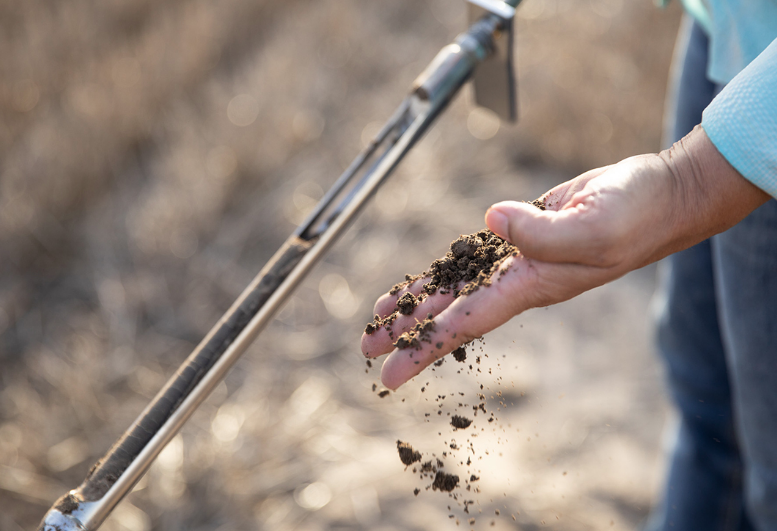
Farming technologies have come a long way in the last two centuries. Modern agriculture has witnessed a technology boom that farmers a century ago would scarcely recognize.
Technological advancements allow today's farmers to work much more efficiently than those in the past. Soil sensors gauge soil moisture levels and send alerts when irrigation is needed. Today's combines have a larger capacity and utilize tailored software to relay information like yield and moisture levels to the farmer in real time during harvest.
Through the use of aerial imagery from satellites and drones to GPS-supported technologies such as autosteer and site-specific spray prescriptions, farmers are able to make more informed decisions, leading to profitability while reducing their environmental footprint.
Collecting this much data creates another problem — what to do with it and how to manage it. Data related to soil composition, historical yield trends and inputs can be overwhelming. The checkoff is working to solve this problem with research that provides solutions to help farmers better utilize and manage data, ultimately leading to greater farm profitability.
"We try to make good use of our data," says Laurie Isley, a soy checkoff farmer-leader from Michigan. "We do regular soil testing on our farm, so we have a deep understanding of our farm's soil health, and we make our fertilizer decisions based off the results. We also use precision technology and data points to help us ensure we only apply nutrients when the soybean plant needs it so it's not wasted."
Isley farms in the Maumee River watershed, part of the larger Lake Erie watershed in Southeast Michigan. The region is not immune to water quality issues. Keeping nutrients on the land and out of the waterways is an environmental concern she takes seriously.
"We generally have sandy soil on our farm," Isley says. "We use data to show us where and how we can make the soil the best for our crops. We also use other management tools like cover crops to help keep the soil in place. We have a crop growing on our land 12 months a year."
Tony Mellenthin, a soy checkoff farmer-leader from Wisconsin, agrees, saying, "Data collection is one of the most important tools we have to make decisions on the farm moving forward. From yield maps and collecting to tillage maps, we use data to make decisions that maximize our bottom line."
Mellenthin also points out that yields are critical to profitability.
"We not only have yield maps on our fields, but we also have soil sampling for each field. When we combine those two data sets, we can zero in on where nutrients are and are not needed. It is good for the farm and good for the environment. And, it's in our best interest to ensure our soil, water and air are available for the next generation of farmers."
Derek Potter, a North Carolina soy checkoff farmer-leader, grows soybeans, corn, wheat and timber. He says every time he goes across a field, he collects data. Farmers have many data points that can help them make on-farm decisions.
"Sometimes, the problem is that we have too much data," says Potter. "We want to make sure we are correctly interpreting what the data is actually telling us."
If a farmer would like to dive deeper into data collection and analysis, Potter suggests finding a mentor or someone trustworthy to talk to.
"You can spend a lot of money on data. You can get pretty maps that look good, but what are you going to do with it?" he says. "Find someone who is doing something that you are interested in trying. See how it works before you spend money on something that might not work on your farm."
Technology is an indispensable part of every farm, regardless of size. Through technology, farmers maximize yields by controlling variables like moisture levels, crop stress, soil moisture conditions and ever-changing climates. Data collection enables farmers to make informed decisions to increase efficiency and more accurately manage costs.
"We cannot eliminate every variable. Weather is going to do what it does. But by using modern technology and data to our advantage, we can increase yield and profitability," says Isley.
Get Ready for for a Road Trip coming up June 6-8, 2023 with Ag in the Classroom!
Event Address: Departure location: Oklahoma Department of Agriculture, Food, and Forestry
Contact Info: Emily Ague at (405) 885-1851 or emily.ague@ag.ok.gov
Event Description: Join Oklahoma Ag in the Classroom on a three day adventure, "Oklahoma Agriculture: The Bedlam Series." We will travel from around Norman, OK to around Stillwater, OK area to experience agriculture in the areas surrounding our two Bedlam Universities. Stops will include: cattle ranches, turf, equestrian, and much more!
Event Cost: This tour cost $75 and space is limited. Hotel and meals are provided.
Application Process: Apply for the trip today with the form below. IF YOU ARE SELECTED TO PARTICIPATE IN THE TRIP, AN AITC STATE COORDINATOR WILL CONTACT YOU WITH REGISTRATION AND PAYMENT INFORMATION TO COMPLETE YOUR REGISTRATION.
Teachers who have NOT attended an AITC Road Trip (or have not attended in several years) are given TOP preference.
If you have questions, please contact Emily Ague. Contact information is listed above

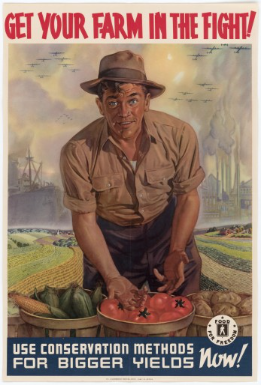
Sometimes you see a headline and just go "huh."
That happened to me today when I can across an article that said "Can methane burps be bred out of cows?"
Again, "huh."
I mean, why not? Humans have been selecting traits in livestock for thousands of years. We have bred for milk production, meat production, height, weight, calving ease, even color. Why not methane emissions?
It would seem that this question was asked by a research team working in Europe on a project called Ruminomics. Commissioned by the European Union in 2012, this group of 30 researchers was charged with looking at the connection between livestock production and methane emissions with an eye toward maintaining livestock production while reducing the industries climate impact. The result of their work is the recently published report Connecting the animal genome, gastrointestinal microbiomes and nutrition to improve digestion efficiency and the environmental impacts of ruminant livestock production. In this study researchers looked at Holstein cows on farms in Italy and the United Kingdom, as well as Nordic Red dairy cows in Sweden and Finland. Specialized tools were designed to collect samples from the rumen where the scientists could see a pool of protozoa, fungi, bacteria, archaea, and DNA crucial to the experiment. Breath samples were also taken to measure how much methane cows were burping.
After looking at the core microbes in each cow's rumen, researchers were able to identify which microbes were passed down from one generation to the next. Some microbes like succinovibrionaceae were common in cows that produced less methane. Researchers then concluded that since they now knew that these organisms were heritable and interconnected, they could be a target for breeding animals with improved milk yields, lower emissions, or other positive traits. The thought being that if they could identify young animals with a low-methane microbiome, they would pass this trait to the next generation, leading to animals producing less methane.
There is some question as to the impact this will have on production (although some of the initial results look promising) and this idea of breeding for lower methane emissions is just beginning to get attention so there is still much to learn. That said, reducing methane emissions from ruminants while maintaining (and perhaps improving) production and improving feed efficiency is something we have written about before and there has been some great research that was conducted at the USDA Grazing Lands Research Laboratory that looked at cattle frame size and methane production (spoiler alert-they found cattle efficiency is not sacrificed with frame size).
We know that most grassland ecosystems need grazing and browsing animals to properly function and we know that, generally speaking, land used for grazing is unsuitable for growing crops. We also know we are losing crop land to erosion at an alarming rate and some of our best farm ground is already under concrete and asphalt in our cities. If we are going to feed and clothe over 9 billion people by mid-century with a declining land base, it only makes sense that livestock utilization will have to be a big part of the strategy to accomplish that. At the same time, we know we need to protect our resource base and address issues like climate change. It only makes sense that selecting cattle (and other animals) that have the traits to meet those goals would be part of the way we do this. "Huh" indeed.
To read this post at the Southern Plains Perspective, click here.
To visit the Southern Plains Perspective site, click here.
On today's Cow-Calf Corner, Oklahoma State University State Extension OQBN Coordinator, Paul Vining, talks about the OQBN sale season.
Oklahoma Quality Beef Network (OQBN) Vac-45 sales recently wrapped up with the final winter sale held on February 7th at McAlester Livestock Auction. I would like to express my gratitude to the Oklahoma State University Extension Specialists, Area Livestock Educators, and County Educators that make this program a continued success. Oklahoma's cow-calf producers persevered through many challenges in 2022. Raising cattle during prolonged drought conditions while contending with exorbitant feed and fertilizer costs is difficult, requiring determination and deserving admiration. The livestock auction facilities that held OQBN Vac-45 sanctioned sales have been top-notch hosts. Even with drought and elevated input costs over 3,200 calves from 61 different ranches were enrolled in the OQBN Vac-45 Program, matching last year's participation. A memorable highlight was Leflore County Stockyard in Wister, OK holding its first OQBN-sanctioned sale in December and selling over 800 OQBN calves. I would like to offer a sincere "thank you" to all involved with the program, and I look forward to future program growth and success.
For calves to be eligible to participate in the OQBN Vac-45 Program calves must be, castrated, dehorned, and weaned for a minimum of 45 days prior to the date of sale. Calves must be vaccinated twice against respiratory (BRD) pathogens, and twice against clostridial bacteria (blackleg vaccinations) prior to sale. While many beef calf preconditioning programs are available, the OQBN Vac-45 and a few other programs have the unique requirement of third-party verification. Following program enrollment, an extension educator will conduct a ranch visit and verify that calves meet the necessary requirements to participate in an OQBN-sanctioned sale. This extra step in the preconditioning process provides ranchers and buyers with added confidence that OQBN calves will remain healthy upon entering the next phase of the beef supply chain.
On average calves participating in OQBN sales received premiums over similar non-preconditioned calves selling in the same sale. Recent sale data is being analyzed and overall premiums for OQBN calves sold in the past sale season (2022-2023) should be available soon. Past sale data compiled by Oklahoma State University Extension Professionals from 2011 to 2021 indicated an average market premium of $12.55/cwt for OQBN calves compared to similar non-preconditioned calves selling in the same sales. We expect this trend to continue for the foreseeable future, due to the continued demand for preconditioned beef calves.
Below, Dr. Mark Johnson talks about preconditioning and adding value to calves on SunUp TV from July 3, 2021.
RON's Dave Lanning has a pre-opening look at today's agricultural Markets.
Click the audio tab below for today's report.
| The following commentary has been written by Steve Dittmer, Executive Vice President of the Agribusiness Freedom Foundation. Steve can be reached at his email, Steve@agfreedom.org. Politics is a strange game sometimes. Well, most of the time. Like, how does a couple of usually smart, common sense senators decide to team up with a couple of very leftist, absolutely know-nothing-about-agriculture senators to attack a non-taxpayer funded entity that has brought more good to agriculture than any other set of programs? Makes no sense on the surface -- or any other way that we've been able to fathom. Yet in actual fact, it was a couple of years ago that we sat in on a video session with Sen Mike Lee (R-Ut) and he didn't even understand a fundamental basic of the checkoff system. He thought taxpayers were funding the agriculture commodity checkoffs. We can somewhat understand Sens. Corey Booker (D-NJ) and Elizabeth Warren (D-Ma) joining in the checkoff attack. They've made no secret of the fact that they don't like American agriculture and know better how to fix it. Booker has made a comprehensive proposal to overhaul agriculture that basically destroys the most efficient system producing the most high quality and safest food on the planet in favor of some idealistic vision of agriculture as it was decades ago. His ideas would create supply chain problems like we've never seen and escalate prices in a fashion to create starvation worldwide. In contrast to the checkoffs paid for, and run by, the producers paying for them, Warren's efforts to create a consumer protection bureau accountable to no one is being challenged at the Supreme Court level right now. She crafted an agency with federal powers, with no accountability to Congress and a separate source of funding -- the Federal Reserve -- not Congressional authority. Yet she wants to "reform" a self-help system of commodity checkoffs that also has a separate source of funding from Congress -- the people that produce the food. What a concept. Booker and Warren don't like something like the checkoff because it's not a government agency they can bully and control. Like most bills, this one has a misleading title, "Opportunities for Fairness in Farming Act of 2023," introduced by Sen. Lee, Booker, Rand Paul (R-Ky) and Kirsten Gillibrand (D-NY) and Rep. Nancy Mace (R-SC) and Dina Titus (D-NV) on the House side but no text is yet available, only a fact sheet from Lee. In fact, the sheet from Lee's office trying to recruit more sponsors cites several examples of great promotional campaigns developed by commodity checkoff groups, including "Beef. It's What's for Dinner." Yet it claims some checkoff programs have "a reputation for unscroupulous [sic] behavior." Then they cite an example of unauthorized bonuses paid to subcontractors of a grain checkoff, resolved and re-paid through normal audits, amounting to $302,000 out of the $528 million/ year raised by all the checkoffs (2009 revenue data cited). This example and some travel expense misallocations of travel expenses later repaid were all the "dirt" they could come up with. But the implication that there is not enough oversight is patently false. Not only has there always been audits and USDA oversight checking to make sure things were run properly but for beef, there was a recent multi-year process of re-reviewing all those procedures. There were specific moves to codify the safeguards already practiced to assured adherence to the enabling legislation, pre-approval for messaging and accountability up and down the line. Lawyers for R-CALF did their best to find something awry or unconstitutional and multiple courts, including SCOTUS, shot them down. And in typical fashion, R-CALF, as OCM has done also, managed to rack up big legal bills for mainstream cattlemen like NCBA members to defend the checkoff, all for no good purpose beyond harassment. In fact, the checkoffs long-time legal counsel said the last series of court precedents basically established a set of legal principles opponents could never surmount in future court proceedings. That means, like a lot of other industries and citizens, the only fear we have to fear is Congress itself. On cue, enter -- we love the implications of NCBA's description of them -- as the "collective" group of bill sponsors trying at "reforming" the checkoffs. They are a collective, a group with socialist intent, attacking a free market, volunteer system with only the necessary, basic government oversight as opposed to the socialist, government-run vision Booker and Warren have of every industry on earth. NCBA points out that both Booker and Warren have gotten support from animal welfare groups, factions advocating the elimination of animal agriculture. And what Sen. Mike Lee and Rand Paul are doing associating with those two and this effort is nothing but a smear on their reputations as representatives of liberty, freedom and free markets. These are the kind of things that give "bipartisanship" a bad name. As if that wasn't enough, a couple of disgruntled fringe groups, especially R-CALF -- spent roughly a year trying to gather a small percentage of the nation's cattle producers to petition for a referendum on the beef checkoff -- and didn't manage to eve get close. Cattlemen can be a skeptical bunch but the beef checkoff has proven itself invaluable to the demand for beef over and over. In fact, R-CALF was in the forefront years ago of those claiming not only was the checkoff worthless and unfair to them but opposed beef exports as unimportant and compromising to their efforts to stop beef imports. Yet beef export values are approaching $500/hd. on fed animals. The long-term vision of the beef checkoff supporting the USMEF's efforts in expanding beef exports around the entire globe certainly refutes the efforts of R-CALF, other fringe groups and this "collective" to damage the checkoff. Something else that gets little attention. Senators and representatives get paid. Government bureaucrats get paid. But there are thousands of cattlemen and cattlewomen who have put in hundreds of thousands of hours of unpaid time, volunteering solid, rational, intelligent work to advance the cause of beef demand on state beef councils and the CBB and predecessor groups. They have worked to better the industry, for us and for generations to come. Cassie Fish, an astute observer who writes "The Beef" column for the Consolidated Beef Producers, remarked that we're at a point where records are being broken or equaled for fed cattle, live cattle futures and boxed beef while packers are making around $100 again and feeder cattle futures are catching up. One of those rare times when all segments of the industry are either making money or getting close. And it's as if this Congressional "collective" said, "We've got to do something about this." With USDA contemplating how to spoil the party with some ill-advised moves to wreck the cattle marketing system, we hope they take note. This is not the time to mess everything up. Cattlemen have waited years for leverage to come their way, some of them have weathered the drought and tough times, some of them have bit the dust, resulting in tightened cattle supplies. Their checkoff dimes and quarters and dollars have been invested for nearly 100 years to get consumer demand worldwide to this point. We don't need a "collective" of Congressmen nor USDA bureaucrats to ruin things now. The Agribusiness Freedom Foundation promotes free market principles throughout the agricultural food chain. The AFF believes it is possible to value the traditions and heritage of the past while embracing the future and the changes it brings. The AFF is a communications and educational initiative striving to preserve the freedom of the agricultural food chain to operate and innovate in order to continue the success of American agriculture. |
Yesterday, former House Agriculture Committee Chairman Congressman Frank Lucas (OK-03) joined his colleagues on the House Agriculture Committee for a hearing on "Uncertainty, Inflation, Regulations: Challenges for American Agriculture."
Lucas discussed with American Farm Bureau Federation President Zippy Duvall, Fertilizer Institute President & CEO Corey Rosenbusch, and National Chicken Council President Mike Brown the impact the U.S. Securities and Exchange Commission's (SEC) climate disclosure rule would have on farmers and ranchers who serve as the starting point for many value chains of publicly traded companies.
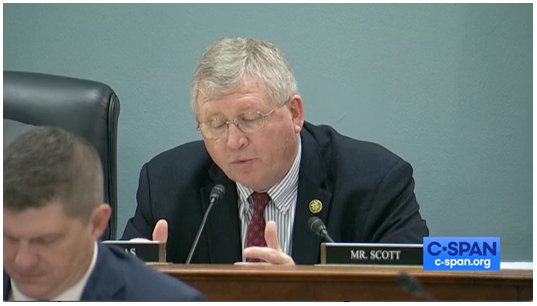
Click here to watch Lucas' Q&A.
On SEC climate disclosure rule
Lucas: In March of 2022, the U.S. Securities and Exchange Commission proposed a rule that expands the scope of what climate related information publicly traded companies must disclose to the SEC and to their investors.
One part of the deeply flawed rule requires companies to disclose various types of emission information.
Firstly, its own direct greenhouse gas emissions, otherwise known as scope 1.
Secondly, companies are to disclose the indirect emissions from all purchased electricity or other forms of energy, scope 2.
And finally, serving as a catch all, it would compel the public company to disclose the greenhouse gas emissions from all upstream and downstream activities in its entire value chain, so called scope 3 emissions.
I am greatly concerned about the impact this rule will have on the farmers and ranchers who serve as the starting point for many of these value chains. President Duvall, can you please speak to the potential impact and cost this rule would place on farmers and ranchers who find themselves ensnared in this broad reporting scheme?
Duvall: It could be tremendous. I've spoken to Chairman Gensler once and going to speak to him again this week about this issue. Scope Three would put a heavy bookkeeping burden on our farmers. And yes, if you're a large farmer, which is 2% of the farming group, you may have the office space and the specialist to be able to make that documentation. But you take a middle-sized small farmer like myself, that becomes a huge burden and you have to hire someone to do it, have consultants help you through it. It is tremendous. But I'll tell you this as a farmer that sells my cattle on free market and choose where I want to sell it to being a contract grower for a large, vertically integrated company, knowing that when things come down on that company, they have to deliver it, and when they have to deliver it, they turn to me to do it. And there's no one help record it, there's no one help to pay for it. And the farmer carries that burden, whether it be cattle or whether it be grain or whether it be poultry. And so, it is a tremendous burden and it's something that we need to stop before it gets started.
Lucas: Mr. Rosenbusch, I will start with you, but I welcome any insights the rest of the panel may have. Can you speak to the impact this rule would have on the publicly traded companies who are members of your organization?
Rosenbusch: Thank you, Chairman Lucas. The impact on publicly traded companies is one thing because a lot of them are already reporting a lot of their ESG metrics. As a matter of fact, we just released our sustainability report and we've captured an increase of over 300%- our emissions from fertilizer manufacturing. So great strides have been made there. And I will tell you that most of those manufacturers are committed and are doing a lot of that reporting. So, I think regulatory certainty, as I mentioned, is what's critical here. But I think a lot of the small to medium sized companies that are also involved in the fertilizer supply chain are the ones that we would be most concerned about. And then ultimately, any of the Scope Three emissions that Zippy referenced I think is going to be really difficult when it comes to these fertilizer companies that would have to report any of that up and downstream.
Brown: While I don't have a policy on that, I'll address that under the banner of regulation. In the chicken industry alone on sustainability, over the last ten years, we have reduced land use by 13%, greenhouse gas emissions by 18%, fossil fuel-based resources by 22%, and particulate forming emissions by 22%, all done without the hand of a government mandate.
Lucas: Clearly it shows that industry responds. You don't have to have an economic baseball bat.
Last month, Lucas introduced the Protect Farmers from the SEC Act, which would protect family farmers and ranchers from burdensome greenhouse gas (GHG) emissions reporting rules proposed by the SEC. U.S. Senator John Boozman (R-AR), Ranking Member of the Senate Committee on Agriculture, Nutrition, and Forestry, and U.S. Senator Mike Braun (R-IN) introduced a Senate companion.
In July of 2022, Lucas joined then-House Republican Leader Kevin McCarthy and House Agriculture Committee Republican Leader Glenn "GT" Thompson in sending a letter to President Joe Biden calling on the Administration to reverse overly burdensome regulations and policy barriers to U.S. agriculture production that have caused needless uncertainty for farmers, ranchers, and working families.
Melissa Holderby's backyard flock in Bristow are a mix of several poultry breeds. She is currently awaiting a shipment of spring chicks. (Photo by OSU Agriculture)
By Gail Ellis
The price jump in eggs over the past few months has inspired some consumers to establish their own flock of backyard chickens. Others who have taken on the adventure enjoy it as a hobby.
For those interested in acquiring chickens this spring, remember baby chicks are cute, but chickens are livestock, and all livestock requires time, effort and money.
When Melissa Holderby, her husband and three children moved to a 30-acre farm a couple of years ago, they knew the first thing they wanted to do was invest in chickens.
Their small city of Bristow does not permit a backyard flock, but once living outside the city limits, the family ordered an all-female run of 15 chicks from a hatchery online. Chicks have been shipped through the mail for more than a century because day-old chicks can survive 36 hours on the yolk.
"Buying chicks can be tricky because if you purchase a straight run from a bin in a store, they are not sexed," she said. "Statistically, you're going to get half roosters."
Some YouTube videos, a couple of books and a few chicken enthusiast Facebook groups helped Holderby learn the basics of chicken care. She has since added one rooster who acts as a lookout for the flock.
Her hens roam the yard throughout the day and are protected in a coop overnight, but hawk, raccoon, snake, dog and coyote predation are a threat.
"The chickens all have names, and we're attached to them, but you have to be practical," Holderby said. "If one of them is sick or injured, you need to decide if you're going to seek vet care or cull."
As free-range chickens, her hens consume plenty of insects, including ticks, but Holderby also feeds them a balanced diet of layer ration, grit, a form of calcium such as oyster shells, and mealworms. Chicken scratch, which is traditionally comprised of cracked corn and other grains, is used sparingly as a treat. Holderby said she's learned the rising cost of chicken food is an important line item of the poultry budget.
"Grain prices have skyrocketed, and the cost of feeding chicks has gone up along with the cost of food and eggs in the grocery store," she said.
Know the rules before purchasing chickens
New owners can rely on Oklahoma State University Extension to answer backyard chicken questions. Dana Zook, OSU Extension west area livestock specialist, provided a few tips for first-time poultry owners in a recent segment of SUNUP, OSU Extension's agriculture television show.
If ordering chicks online, Zook recommends selecting poultry from hatcheries that are National Poultry Improvement Plan certified. Farm store management can also provide information on the sourcing and certification of chicks for sale.
"Evaluate what kind of housing you'll need and check local policy before buying chicks," Zook said. "Some city ordinances may limit the number or types of birds. You'll need 2 square feet per chicken for small breeds and 4 square feet for larger breeds."
Chicks will need to be kept in a brooder until they are six to eight weeks old or until they are fully feathered. An absorbent material will give chicks good footing, and heat lamps help maintain a warm temperature. Zook suggested keeping a thermometer in the brooder and observing chick behavior.
"If chicks are spread out across the brooder, they're comfortable," she said. "If they are staying close to the edge, they're too hot, and if they're all huddled together under the heat lamp, they're not warm enough."
For chicks purchased at a local farm store, owners should ask what they were eating at the store and buy similar feed for home.
In addition to feeders and waterers, new chicken owners must decide if they are going to purchase a pre-made coop or materials to build one. Most urban backyards will require a chicken run, and biosecurity should be a priority for the safety of both animals and humans.
"We want to make sure we're practicing intentional handwashing or even wearing gloves to prevent salmonella infections," Zook said. "Children, the elderly and those who are immune-compromised are more susceptible to salmonella."
These days, Holderby's farm has grown to also include a few guineas, some dairy goats and a couple of friendly dogs. Her children help with daily chores and gathering eggs that the family shares with friends. Every new venture presents a learning curve, but Holderby said they are happy to be a chicken family.
"It was easier than I expected it to be," she said. "The chickens all have their own personalities, and they're interesting to watch. It's a simple way to teach kids about farm-to-table and animal husbandry."
Enroll any time in the OSU Extension backyard chicken online course or utilize the OSU Extension budget calculator for backyard chickens.
OSU Extension uses research-based information to help all Oklahomans solve local issues and concerns, promote leadership and manage resources wisely throughout the state's 77 counties. Most information is available at little to no cost.
The Richard Gebhart Legacy Post Graduate Annual Scholarship provides $2,500 to a student who will complete their 4-year degree prior to Fall 2023 or who has already received a 4-year degree and is continuing their post-graduate degree (Master's, PhD, Law Degree, Etc.). This is an educational award opportunity for students nationwide.
The Gebhart Legacy Scholarship Fund is administrated through the Oklahoma Cattlemen's Foundation (OCF). According to Mariah Reimer, OCF Executive Director, applicants must be able to show experience and involvement in cattle industry leadership activities and must be members in good standing of the Oklahoma Cattlemen's Association (OCA) or their state cattlemen's association.
More information and the application can be found at okcattlemen.org/scholarship-opportunities-menu. Application deadline is June 1, 2023.
"Scholarships for high school seniors and undergrad students are common. Scholarships for those pursuing a post graduate degree are not as common, but still vitally important," Reimer said. "Richard Gebhart was a unique visionary who earned several degrees in his lifetime. The Gebhart family has chosen to honor their loved one by providing a scholarship as special as Richard Gebhart's legacy."
Richard Gebhart is a past president of the Oklahoma Cattlemen's Association and served in several other capacities within the beef industry on a local, state and national level.
The Oklahoma Cattlemen's Foundation strives to support the Oklahoma cattle industry by preserving past traditions and educating current and future generations in coordination with OCA and OJCA. You can get involved, donate, or learn more on the website or by reaching out to the Executive Director, Mariah Reimer.
American Farm Bureau Federation President Zippy Duvall spent four and a half hours before the House Agriculture Committee Tuesday outlining the challenges facing America's farmers and ranchers. Duvall joined five other agriculture industry leaders in testifying and taking questions from lawmakers during the hearing titled "Uncertainty, Inflation, Regulations: Challenges for American Agriculture."
"There are certainly plenty of challenges for American agriculture," Duvall told the committee during his opening comments. "From losses experienced in the trade war with China, to pandemic lockdowns, and supply chain disruptions. Add to it the record-high supply costs, and you see how farmers and ranchers have faced unprecedented volatility in recent years.
"USDA's most recent Farm Sector Income Forecast sees a decrease in net farm income in 2023, down 15.9%. Adjusted for inflation, that's an 18% drop. The same report estimates farm and ranch production expenses will continue to increase – by $18 billion. This follows a record increase of $70 billion in 2022."
President Duvall also highlighted regulatory hardships facing farmers, including restricted access to pesticides, the new Waters of the United States rule, a proposed Securities and Exchange Commission emissions reporting rule and shortcomings in the H-2A labor program.
He also shared opportunities to strengthen farms through voluntary climate-smart programs, increased meat processing competition and the passage of a unified farm bill.
"It is important that we understand how important the safety net is for agriculture so that we will have the food to be able to use in the safety net for the people that are not as fortunate as others during...periods of their lives," Duvall said when Rep. Darren Soto (D-Fla.) asked him about keeping nutrition programs in the food bill. "So, I think they go together well. It gives us a true picture of the food, where it's produced and where a lot of it's consumed and making sure that those people have access to good quality food."
On a question from Rep. Mary Miller (R-Ill.) on the importance of trade, President Duvall replied, "Anytime the field in the arena of trade is leveled and we have access to those markets it helps our farmers and ranchers tremendously. We're always working to encourage trade across the world, and we just think there are some great opportunities, especially in the Asia Pacific areas."
Watch the full hearing here.
Read President Duvall's opening remarks here.
Read the AFBF written testimony here.
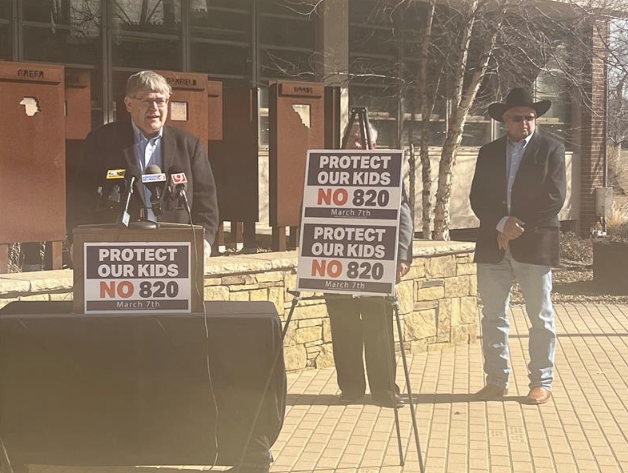
Today, the Oklahoma Farm Bureau, Oklahoma Cattlemen's Association, and American Farmers and Ranchers met for a press conference in Oklahoma City opposing State Question 820, on the legalization of recreational marijuana. Members from these three organizations believe the legalization of recreational marijuana in the state will have harmful repercussions to Oklahomans, especially in rural Oklahoma.
At the conference, made up of several local news outlets, KC Sheperd, Farm Director, had the chance to visit with leaders of each of these organizations about the implications of legalizing recreational marijuana in the state.
"This is an issue we have been in agreement on, all through this adventure on cannabis or marijuana, and this is a huge election next Tuesday," said Rodd Moesel, OKFB president. "Everybody has been very concerned and worried about different aspects of the marijuana question for some time. This is going to be a chance to vote on whether to allow to expand to recreational in our state or to stop it from expanding to recreational in the state."
As marijuana in the state already has caused implications for rural Oklahoma, Moesel said, if it becomes recreational, that will only multiply these issues. As ten percent of Oklahomans possess a medical marijuana card, Moesel said studies say that percentage will double as the population becomes more involved with marijuana.
Being a gateway drug, Moesel voiced concerns about recreational marijuana leading to an increase in usage of other drugs over time in the state, ultimately creating more problems in the workforce and more crime.
"If rural Oklahoma turns out the way they show in the polling, and they show up next Tuesday, we can beat this," Moesel said.
Byron Yeoman, OCA president, talked about why OCA strongly opposes State Question 820.
"Our infrastructure is already messed up," Yeoman said. "Electricity and water are already in short supply, and organized crime has moved into the area."
Scott Blubaugh, AFR president, expanded on the issues in rural areas and talked more about how the abundance of grow operations has depleted water and electricity sources in these areas.
"I think our membership has seen a lot of negativity over the last few years with the medical marijuana being grown," Blubaugh said. "Now, I know there are some folks doing it right and legal operations out there, but there is a lot of illegal operations and organized crime related."
Because many organized crime operations are selling marijuana outside of the state for higher prices, Blubaugh said, they have an advantage over farmers when paying those higher land prices.
"If you are growing an illegal marijuana crop and exporting out of state, you can pay a much higher price for land than if you are growing wheat or cattle or corn in Oklahoma," Blubaugh said. "So, it is priced a lot of our members out of the land market as well."
The late-February release of proposed FDA guidance on the labeling of plant-based beverages is far from what dairy producers want or consumers deserve.

The agency's justification of terms including "almond milk," "soy milk" and other terms as commonly accepted relies on circular reasoning, using its previous non-enforcement of its standards of identity to justify further inattention. And as guidance, the portion that does improve the consumer marketplace – front-of-packaging disclosures by plant-based beverages of their inferiority to dairy – does not have the same strength as regulation. FDA can "guide" a manufacturer, but company disclosures are voluntary. The good news is that most companies follow such voluntary guidance for fear of bad publicity or legal challenges.
As such, FDA's proposal contains a major win for dairy: the acknowledgment that consumer confusion over nutritional content is a public health issue that requires agency intervention. For nearly a decade, that's been NMPF's core argument against the mislabeling of plant-based beverages. And by accepting it, FDA has laid the groundwork for our work toward the logical conclusion of the need to end nutritional confusion: Reserving the use of dairy terms for dairy products only, in keeping with FDA's own standards of identity. We're on the right path, and FDA's guidance can directly contribute to our own eventual success.
A bit of background: Three decades into what's been a more than four-decade struggle to get FDA to take this issue seriously, in the early 2010s, the issue was in an unsatisfying stasis. NMPF would complain, and nothing would happen. Meanwhile, plant-based imposters were proliferating in the marketplace, to the detriment of public health. Beginning in 2015, we at NMPF zeroed in on the real issue of nutritional confusion – dismissing the plant-based red herring that "consumers know it's not dairy, they're not confused" to more accurately describe what "confusion" really meant: the mistaken belief that plant-based beverages provided the same level of nutritional benefits as real dairy.
We hammered that point home at every opportunity, to the extent that, when then-FDA Commissioner Scott Gottlieb was asked about nutritional confusion in a 2018 hearing, he had been informed enough about the issue to make his famous "confession": "An almond doesn't lactate, I will confess."
With that acknowledgment we pushed even harder. Through quality submissions to an FDA comment period on the issue, through constant attention to the issue through the media, through tough questions from dairy's allies in congressional hearings, we helped FDA – and importantly, consumers, who in 2022 drank a lower volume of plant-based beverages than the year before – understand the importance of the issue. We offered our own road map on labeling through a 2019 Citizen's Petition. And with allies including the American Academy of Pediatrics and the School Nutrition Association, we showed it wasn't just dairy that cared about consumer confusion – education and health professionals did as well.
And that brought us to last week. While FDA clearly wanted to cover over its decades-long failure to enforce existing standards by giving the plant-based folks the ability to use "milk," the nutrition disclosure recommendations and the acceptance of nutritional confusion as a public health issue are powerful tools with which we can move forward in pursuit of full transparency. First of all, FDA's concern for the issue adds impetus for what's now the most promising immediate solution to the problem – congressional passage of the DAIRY PRIDE Act, which would require FDA to enforce milk's standard of identity in the name of solving the very problem it's identified.
Second, though FDA guidance is non-binding, as I've noted, it's something industry takes seriously. We will be watching corporate practice on labels – and we won't accept labeling that ignores FDA's guidance or clearly attempts to do as little possible to get by. The plant-based industry is built on misinformation, and we expect old habits to die hard. But we're in a new landscape, and we'll make sure that consumers gain maximum benefit from the changed regulatory environment by reminding them of the nutritional inferiority of various fake milks.
This journey is far from complete. FDA has opened a comment period on the guidance that's open until April 24. We have a call to action here that allows you to tell the agency not to backslide on its guidance, and in fact to go further to protect consumers. Momentum is on our side, and it's gratifying to see an approach we consciously understood nearly a decade ago yield benefits that will only increase. But it's not time to let up on the gas, as our work is far from complete. We'll take what FDA has offered. And we'll make it even better in the future.
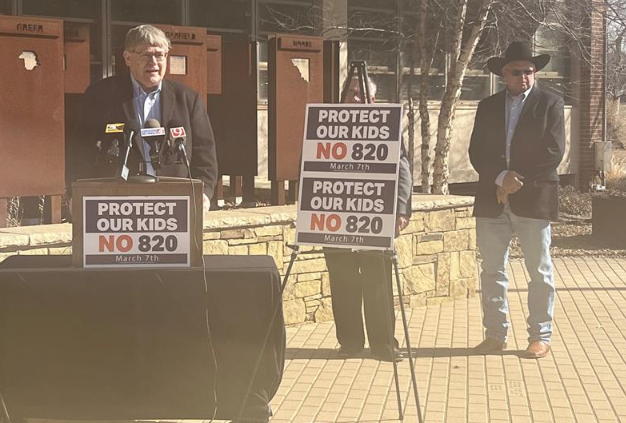
Three of the state's leading agriculture organizations gathered today for a press conference opposing State Question 820 today in Oklahoma City.
Oklahoma Farm Bureau, the Oklahoma Cattlemen's Association and American Farmers and Ranchers strongly oppose the state question appearing on ballots Tuesday, March 7. Members of all three organizations believe the legalization of recreational marijuana use will be harmful to rural Oklahoma and Oklahomans across the state.
Rodd Moesel, OKFB president, acknowledged the overwhelming sentiment from the organizations' members on Oklahoma's marijuana industry.
"Each of us has spent a disproportionate amount of time hearing from our members with concerns about marijuana and the impact within their rural communities," Moesel said. "A lot of times that gets lost in the urban environment, but in the rural environment, a lot of these changes have showed up very dramatically and have had a big factor in the fabric of many of our rural communities."
Moesel noted the significant impact SQ 820 will have on Oklahoma's youth.
"Our members do a lot of work with youth groups, so we are particularly concerned about our young people and very worried about the impact the increasing availability and access to marijuana might have on our young people across the state and in our rural communities," he said.
Byron Yeoman, OCA president, echoed the impact the state question would have on Oklahoma's rural communities.
"The Oklahoma Cattlemen's Association opposes State Question 820 because it invites even more marijuana activity to our rural communities, and we must protect our rural way of life from out-of-state and foreign interests that do not have the best interests of our state at heart," Yeoman said.
Scott Blubaugh, AFR president, underscored the strain that increased marijuana use would have on Oklahoma's agriculture industry, including tying up valuable Oklahoma farmland and posing continued communication challenges with neighboring grow operations ahead of applying herbicides and other land stewardship practices.
"We have seen the negative impact the rapid growth of the unregulated medical marijuana industry has had on Oklahoma agriculture and the rural communities," Blubaugh said. "We have seen a rise in farming challenges, and we have seen a strain on our rural electric and our rural water utilities. We have also seen a rise in crime. We oppose State Question 820 because additional growth in Oklahoma's marijuana industry will mean additional difficulties for our farmers and ranchers."
All three organizations are members of the "Protect Our Kids – No on SQ 820" coalition and encourage Oklahomans to vote no at the polls on March 7.
A full recording of Wednesday's press conference is available on YouTube at okfb.news/SQ820Presser.
Weather and Labor Continue to Challenge Railways
As shared in an October 2022 Market Intel, third quarter domestic rail service data indicated improvements in average rail speeds, unfilled grain car orders and employment numbers. A dive into the most recent data from the Surface Transportation Board, the independent agency tasked with economic regulation of freight rail, reveals an unexpected increase in the unfilled order metric for some Class I railroads, which continues to hinder farmers' and ranchers' abilities to move inputs and products efficiently and cost effectively. Other statistics send more positive signals on the domestic supply chain as transportation networks aim for pre-pandemic normalcy.
Total grain rail cars loaded and billed increased in the final quarter of 2022 from 321,000 cars in quarter three to 402,000 cars in quarter four. Over the past three years, volumes of grain rail cars have ranked the highest in the fourth quarter of the year, a trend that persisted in 2022 likely because of post-harvest demand. However, compared to the last quarter of 2020 and 2021, fewer grain rail cars were loaded at the end of 2022 (2% fewer than quarter four 2021 and 6% fewer than quarter four 2022). Burlington Northern and Santa Fe Railway (BNSF) and Union Pacific Railroad (UP), railroads that together processed 65% of all grain rail cars in quarter four 2022, shipped 6% and 5% fewer grain rail cars than the same period in 2021, respectively.
Much attention of late has been given to the Norfolk Southern (NS) derailment in East Palestine, Ohio. NS generally manages about 8% of the grain rail car movements across the country annually and is particularly important to farmers east of the Mississippi River. During the first eight weeks of 2021 and 2022 NS loaded and billed an average of 2,500 grain cars a week. During the first eight weeks of 2023, NS processed an average of 2,880 grain cars a week (a 10% increase). Though uncertainty remains regarding the derailment's environmental impact on local communities, it has not appeared to impact the volume of grain cars being transported.
A look at weekly unfilled grain car orders, a metric that tracks grain cars not effectively loaded and billed, reveals some shippers are still facing challenges in getting access to rail car capacity. As a reminder, each railroad reports its definition of "unfilled order" slightly differently but generally it is the number of cars a shipper (such as a grain elevator) ordered but did not receive. For example, if a grain elevator ordered 10 cars from a railroad and received seven, that would leave three unfilled orders. Though railroad companies report the number of these unfilled orders to the Surface Transportation Board weekly, the dataset does not distinguish between rail cars still undelivered between weeks or new undelivered grain cars. This means grain cars that are still undelivered over one week are counted again in the following week's report until successful delivery. So far in 2023, average weekly unfilled orders one or more days overdue have numbered over 16,000, 54%, or 5,600, more than last quarter and the same magnitude over quarter one 2022. This is the highest rate recorded since the data series began in 2017. By railroad, BNSF makes up nearly 80% of these unfilled orders (12,400) and has experienced a near 100% increase since last quarter. NS is in a distant second with an average of 1,900 unfilled weekly orders, which is down 11% from last quarter.

Of these over 16,000 unfilled orders per week one or more days overdue, almost 75% remain 11 or more days overdue. This is a 101% (6,000 car) increase over last quarter and the same magnitude over quarter one 2022. Comparing quarter four of last year to quarter one of 2023 so far, BNSF has seen a weekly increase of 177% (6,000) of orders 11 or more days overdue, which is also 150% higher that quarter one of last year. BNSF again makes up about 80% of the total unfilled orders. Canadian Pacific Railway is a distant second for delayed grain cars over 11 days overdue with an average of 1,246 or 10% of the total. The bulk of reported unfilled orders remain concentrated in Upper Midwest states like North Dakota (47,220 cumulative reports), Minnesota (21,500 cumulative reports in 2023) and Kansas (12,200 cumulative reports in 2023). Notably, many of these states have experienced significant snowfall within the past several months, likely contributing to challenges in getting cars moved quickly.

In the past we have analyzed price behavior in the secondary rail car market, which reflects the average bids shippers make against each other for contracts that could increase the chance of getting delayed product successfully moved. Sales that occur in this secondary stage may either represent a premium or a discount to the underlying original tariff rate and are reported as a positive or negative value, respectively. So far in 2023, average market bids have been below the underlying contract value (weighted average of -$30.45 per car). This is the first time since quarter one 2020 that secondary market bids have been negative and corresponds to an $800 decline from last quarter's $770 average bid. While weekly unfilled orders have reached record levels, shippers don't appear to be clamoring in the secondary market to access replacement capacity. Some of the bids included in these calculations are for deliveries set in future months, so lower values may signify that shippers expect railroads to increase efficiency as we head into warmer, less snow-impacted, months.

In addition to extreme winter conditions, railroads continue to cite labor as a primary hurdle to reaching pre-pandemic efficiency. Figure 4 displays the index of transportation employment for four major railroads with employment indexed to pre-pandemic levels (February 2020). A value below the 100 line would indicate a railroad that has not been able to reach pre-pandemic employment levels (100%). CSX remains the only railroad of the four to reach and surpass pre-pandemic employment levels (105% as of January 2023). BNSF has jumped from 92% to 96% of pre-pandemic employment between August 2022 and January 2023. UP has made gains but at a slower rate, hovering between 92% and 93% since August. NS, which rebounded from 85% in January 2022 to 96% in December, has since seen a 1% decline. Kansas City Southern and Canadian National Railway, which are not displayed, have surpassed or are near pre-pandemic employment. With BNSF and UP in control of 65% of grain movements, any improvements in hiring send positive signals to farmers and ranchers on the resiliency of the rail network. Any future employment declines put this reliability at risk.

Conclusion
Railways are a vital piece of the supply chain and are usually a cost-effective and reliable way to get agricultural goods to their destination. Continuing rail service disruptions associated primarily with inclement weather and labor shortages have contributed to record levels of unfilled orders faced by shippers. Unfilled and delayed orders mean a disruption in the delivery of agricultural and other goods to buyers. Confidence in railway efficiency, however, appears to be increasing. Though labor numbers still lag behind for most Class I railways, gains continue to be made, building a stronger foundation for future demand capacity. Shorter-term, cold weather events, while detrimental, will likely subside in spring and can be separated from the many pandemic-linked supply chain shocks that have characterized the last several years.
These metrics and metrics from all global transportation systems have been incorporated by the Federal Reserve Bank of New York into an index to reflect a summary of supply chain pressures, as displayed in Figure 5. Index values have moved closer to zero in the past several months, signifying reduced broader global supply chain pressure. This sends a positive signal to farmers and ranchers revving up for a new marketing year, even during a period of record unfilled rail car orders.


The U.S. Environmental Protection Agency (EPA) today issued a proposed rule in response to a plan put forth by Gov. Mike Parson and seven other Midwest governors to ensure drivers have access to year-round fuel containing 15 percent ethanol (E15) starting in 2024.
"We applaud Gov. Parson and his counterparts for working within the law to ensure drivers have access to lower-cost, lower-emission E15," noted Missouri Corn Growers Association President Clint Stephens of Advance. "Higher ethanol blends help improve the environment, save consumers money at the pump, and support a homegrown market."
In December, Gov. Parson joined other Midwest governors who petitioned EPA to request a waiver through the Clean Air Act for lower-volatility gasoline during summer months. According to the act, EPA has 90 days to approve the governors' plans. It took EPA more than 10 months from the initial request to issue this proposed rule, delaying implementation until 2024.
A group of U.S. senators, including Sen. Josh Hawley (R-MO), submitted a letter requesting EPA take immediate action to prevent disruption during the 2023 driving season. Last month, Missouri Attorney General Andrew Bailey joined his counterparts in a similar letter, calling for EPA to act on the request.
"We thank Gov. Parson, Attorney General Bailey, and Sen. Hawley for their efforts in urging EPA to use existing authority to prevent market disruption," Stephens continued. "However, we are disappointed action was not taken to address the upcoming 2023 summer driving season. We encourage President Biden to step in so motorists can continue to have access to the cost-saving fuel."
Last year, as the nation faced fuel supply challenges, President Biden directed EPA to use existing agency authority to prevent a disruption in E15 availability between June 1 and Sept. 15. As a result, continued availability of E15 increased the nation's fuel supply and saved drivers an average of 16 cents per gallon nationwide.
The use of E15 was approved by EPA in 2011 for all 2001 and newer vehicles, accounting for more than 96% of vehicles on the road today.
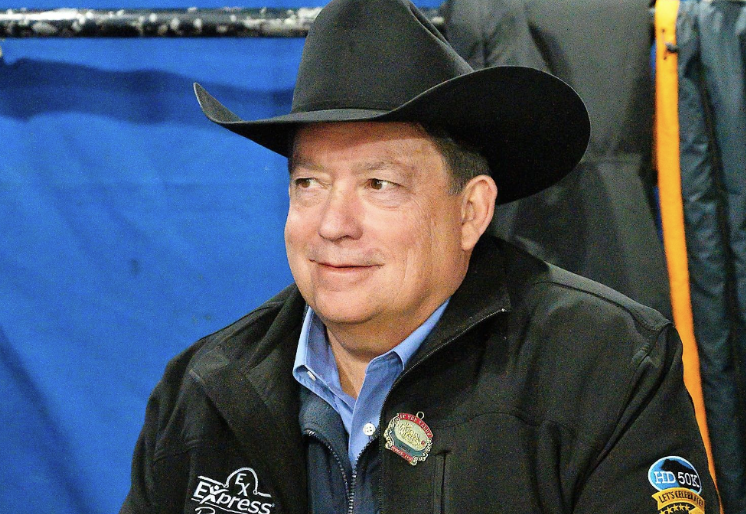
President of Express Ranches, Jarold Callahan has been busy preparing for the Express Ranches Annual Spring Bull Sale coming at 12 p.m. this Friday, on March 3, at the ranch in Yukon, Oklahoma. Senior Farm and Ranch Broadcaster, Ron Hays, had the chance to catch up with Callahan, and talk about spring bull selection.
"A good-looking bull has to have a really good phenotype, he has to have good feet and legs, he has to be gentle, have good docility, and then along with that, I think you want a low to moderate birth weight, then you want really rapid growth from birth to weaning and from weaning to yearling," Callahan said. "To go along with that, then we need to have good carcass measures because eventually, their progeny is going to enter the food chain and there is awfully good premiums for the upper two-thirds of the choice grade, as well as prime, and the premiums have been really, really good on those cattle and so I think you want good carcass characteristics as well."
With good common-sense, science and "cowboy logic," Callahan said at Express Ranches, they select for the best genetics, prioritizing a good phenotype with structural correctness and good feet and legs on the bulls.
"We also try to use the technology through DNA and through the performance information that is supplied to make sure that they have got EPDs, which is a prediction of what that bull is going to transmit to his progeny," Callahan said.
As the nation prepares to build back the cow herd, Callahan said high-quality cattle will be in tremendous demand.
"As you look at the product we are selling now, the demand for the high-quality product is really high, and I think that is true in the meat, but it is also true in the live cattle sector," Callahan said. "Everybody has become more discriminating, and I think that when we build back it will be with higher quality genetics."
As the calf crop is going to be smaller for the next two or three years, Callahan said he sees a chance to make a good profit in the cow-calf sector, even with those high input costs.
"The ones with quality are going to be in the driver's seat," Callahan said.
Callahan also talked about the stock that will be available in the 2023 Express Ranches Spring Bull Sale coming up.
"Friday morning, we have got about 450 Angus bulls in it and about 58 Hereford bulls in it," Callahan said.
The ranch is selling a combination of fall-born bulls, Callahan said, some 20 months old and others 14 months old.
"We are really proud of this year's offering," Callahan said. "We think it is, if not the best one we have ever had, it is certainly one of the best offerings we have ever had."
The Beef Buzz is a regular feature heard on radio stations around the region on the Radio Oklahoma Ag Network and is a regular audio feature found on this website as well. Click on the LISTEN BAR for today's show and check out our archives for older Beef Buzz shows covering the gamut of the beef cattle industry today.
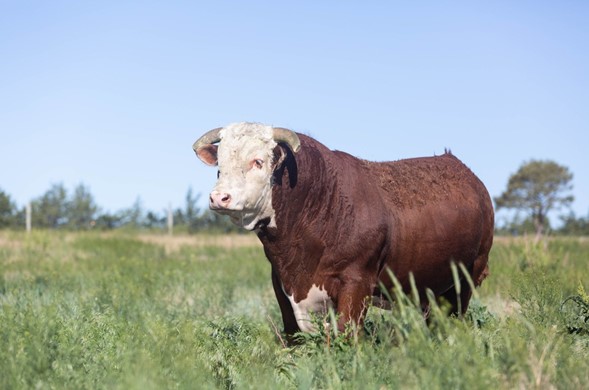
Mark Johnson, Oklahoma State University Extension Beef Cattle Breeding Specialist, offers herd health advice as part of the weekly series known as the "Cow Calf Corner" published electronically by Dr. Peel, Mark Johnson, and Paul Beck. Today, Johnson is talking about the value of a good bull.
This week we revisit this age-old question based on the February 21, 2023 USDA Market Report. The question has been asked forever, or at least as long as we have been breeding cattle with a notion of trying to make the next generation better. It is a classic and timeless question. It is an important question. At this time of year, when many bulls are being marketed and we are planning ahead for spring breeding season, it is the question that is asked a lot!
The Answer
I remember first hearing the answer nearly 40 years ago as a student at OSU. "A good bull is worth the value of five calves he sires." I've heard that answer again many times over the years. I believe it is a good answer and a good rule of thumb to follow, the problem is it doesn't exactly narrow down the range. If we do a little "cowboy math", this answer may in fact lead to more questions. Such as .........
When are we marketing our Calves? What is their Value?
According to the most recent USDA Cattle Market Report from Oklahoma National Stockyards:
523 lb. weaned steer calves (Large, 1) are worth about $2.31/lb. for a value of $1,208 per head. Therefore, if my future marketing plan is to sell weaned steers, $1,208 x 5 = $6,040 is the answer.
874 lb. yearling steers (Large, 1) are worth about $1.78/lb. for a value of $1,555 per head. Therefore, if my future marketing plan is to sell yearling steers, $1,555 x 5 = $7,775 is the answer.
1,400 lb. finished beef steers are worth $164.50/cwt live for a value of $2,303 each. Therefore, if my future marketing plan is to retain ownership through finishing and sell fed cattle on a carcass value basis, $2,303 x 5 = $11,515 is the answer.
So, in the current market, a good bull is worth somewhere between $6,040 - $11,515 to a commercial cattle operation. Where exactly in that range depends on your marketing plan and the market conditions at that time. Not an exact number because there are "many layers to this onion." One key point illustrated here is that the longer you will own the offspring before marketing, the greater the value of the bull to your operation. Retained ownership gives you more time and opportunity to capture the value of your investment in genetics. And we
haven't even considered the value added to replacement females if we select daughters as our next generation of cows.
I encourage cow-calf operations to consider their production system and marketing plan. Doing so dictates where to apply selection pressure. Genetics pay when you purchase a bull capable of improving genetic potential for the specific traits that will translate to added value at your intended marketing endpoint.
Keep the following chart in mind as another way to evaluate ownership cost of bulls on a per cow or annual basis.
Bull Purchase Price: $3,000 $6,000 $9,000 $12,000
$19.10 $38.21 $57.32 $76.43
Cost/cow bred - assuming 157 cows bred between ages 1 to 6 (over six breeding seasons)
$500 $1,000 $1,500 $2,000
Cost/year – assuming 6 years of service
Below, watch Dr. Mark Johnson discuss the value of a good bull from SunUpTV on February 28, 2022.

Growth Energy CEO Emily Skor issued the following remarks in response to a new proposal from the U.S. Environmental Protection Agency (EPA) that addresses a petition from Midwest governors seeking to ensure that retailers in those states can continue to offer year-round access to E15—a blend of gasoline and 15 percent ethanol. The draft rule offered by EPA would not take effect until 2024.
"We are pleased to see EPA make progress on the request submitted last year by Governors Reynolds, Evers, Noem, Pritzker, Walz, DeWine, and Parson, as well as former Governor Ricketts and with the support of Nebraska Governor Pillen. We are grateful to EPA Administrator Regan for his steadfast efforts to preserve access to affordable, domestic biofuels, but we're disappointed that the EPA's proposal doesn't provide a fix for 2023 and the coming summer driving season.
"There's no denying that the simplest, best solution to unnecessary and outdated restrictions on year-round access to E15 is a permanent, federal legislative fix. American families need the cost savings that E15 provides. Ethanol producers need a robust fuel market to reliably make new investments that create jobs and lower carbon emissions. Retailers need marketplace certainty to fully commit to offering this fuel choice to their customers. Securing parity between E10 and E15 nationwide would address all three of these concerns.
"American drivers have been able to purchase E15 every summer since 2019, and this summer should be no different. EPA can ensure that access continues in 2023, and should take whatever steps are necessary to do so, including through the use of an emergency waiver.
"EPA has nothing to lose by providing such a fix, and the country has everything to gain. First and foremost, we need E15 in 2023 so consumers can save money every time they fuel up at the pump. Drivers saved an average of 16 cents per gallon this past summer thanks to E15 – and many saved even more, up to nearly a dollar per gallon. Working families don't want to lose access to their favorite lower-carbon, lower-cost option on June 1.
"Additionally, the conditions that drove EPA to issue its first emergency waiver in summer 2022 are still impacting fuel markets. The war in Ukraine continues to affect the global supply chain and international oil prices. Granting a waiver or finding some other solution for this year would again decrease volatility and provide greater certainty for consumers, retailers, and ethanol producers.
"Finally, failing to offer a fix for 2023 would be a significant setback for E15 availability. While we appreciate parts of EPA's proposal, without similar treatment for E15 this year, the benefits of such treatment could be undermined or negated completely as retailers stop selling this lower-cost, lower-carbon fuel option.
"EPA should act swiftly to avoid these negative impacts and find a way to give American families access to the same savings this year that they came to rely on last year. Growth Energy will continue to work alongside our champions to work toward an immediate and permanent place at the pump for lower-cost ethanol blends."
Background In 2022, the governors of Iowa, Nebraska, Missouri, Wisconsin, South Dakota, Illinois, Minnesota, and Ohio sent letters to EPA calling for parity between E10 and E15 in their states through Section 211(h)(5) of the Clean Air Act, accompanied by research illustrating the benefits of E15 to air quality. After acknowledging receipt of the governors' request, EPA today proposed a rule to make the necessary regulatory changes to implement year-round sale of E15 in those states. The rule, however, if finalized as proposed, would only take effect in 2024, leaving consumer access to E15 during the upcoming 2023 driving season in limbo.

A group of bipartisan U.S. senators, led by Sens. John Thune (R-S.D.) and Dick Durbin (D-Ill.), sent a letter today asking President Biden to direct the Environmental Protection Agency to use existing authority to prevent the disruption of sales of E15, often marketed as Unleaded 88, again this summer.
NCGA expressed strong support for the senators' request and urged the Biden administration to take this needed action to bring certainty to the fuel marketplace.
"We appreciate the senators getting ahead of the problem and proposing a solution to prevent a disruption in E15 availability this summer," said NCGA President Tom Haag. "Ensuring continued availability of low-cost, low-emission E15 increases our domestic supply in the face of ongoing global energy uncertainty. The Biden administration took the same action last year, successfully boosting the fuel supply while lowering costs for drivers. We support the senators' timely request for this no-cost energy security solution."
The Senators letter to President Biden (link to letter) states, "Taking early action on E15 will send timely and necessary signals across the energy supply chain so that fuel producers and retailers will have the certainty they need to ensure affordable, reliable and cleaner fuel options for American consumers throughout the year. Further, U.S. use of E15 will continue to displace Russian oil and finished gasoline products, ease domestic and global supply constraints, and lower net domestic fuel prices."
Nearly 3,000 retail locations offer consumers the choice of E15. This action from the Biden administration last summer increased the fuel supply and saved consumers an average of 16 cents per gallon nationwide.
In addition to Sens. Thune and Durbin, the letter was signed by Sens. Tammy Baldwin (D-Wis.), Sherrod Brown (D-Ohio), Kevin Cramer (R-N.D.), Tammy Duckworth (D-Ill.), Joni Ernst (R-Iowa), Deb Fischer (R-Neb.), Chuck Grassley (R-Iowa), Josh Hawley (R-Mo.), Amy Klobuchar (D-Minn.), Roger Marshall (R-Kan.), Jerry Moran (R-Kan.), Pete Ricketts (R-Neb.), Mike Rounds (R-S.D.), Tina Smith (D-Minn.), and Debbie Stabenow (D-Mich.).v
Rep. Glenn "GT" Thompson, Chairman of the House Committee on Agriculture, delivered the closing remarks below following today's full committee hearing entitled "Uncertainty, Inflation, Regulations: Challenges for American Agriculture."

Associate Farm Editor, Reagan Calk, had the chance to visit with BASF Senior Field Technical Representative, Troy Bauer about biological seed treatments and the benefits for growers who use these treatments.
"Biological seed treatments, from our perspective, are products that contain the live biological organisms, and they usually benefit the plants we are using them with," Bauer said. "So, in the case of Vault IP Plus, we have a biological product that has bacilli strains- two bacilli strains- in the product as well as a live rhizobia product in there that will benefit growers."
Sometimes, individuals may have uncertainties regarding the benefits of biologicals, Bauer said, but Vault IP Plus is a proven biological product that has been on the market.
"The rhizobia that we have in Vault IP Plus is a very high-quality live rhizobia source, and it is a product that maximizes nitrogen fixation for the grower, and many of the soybean growers out there know that soybeans get at least 60 percent of their nitrogen from that symbiotic relationship with rhizobia."
By providing a high-quality rhizobia source every year, Bauer said growers can be assured they will get a high level of nitrogen fixation and maximize their yields as a result.
"Vault IP Plus is only available for soybean use in the U.S.," Bauer said. "Rhizobia sources are very specific to the species they will fix nitrogen in, so this is one that will work well with soybeans in the U.S."
The two bacilli strains present in Vault IP Plus, Bauer said, will live and grow with the soybean root system and help protect them against soil-borne diseases such as Fusarium and Rhizoctonia.
"You still need your base fungicide seed treatment for soybeans, but by the bacilli strains living and growing with the root system, it will actually increase your root growth, which will increase both your moisture and nutrient uptake, and again, maximizing your yield potential, which is really what the bottom line is for growers," Bauer said.
Regarding similar products for other crops aside from soybeans, Bauer said BASF has a number of other rhizobia products out on the market.
"If people have questions about that, I think they need to contact their local BASF representative or go to the BASF webpage to find out more information," Bauer said. "There is a lot of great products out there in the marketplace to help growers really maximize their yield potential."
For producers wanting to see if Vault IP is a good fit for their crop, Bauer said he recommends working with their local agronomist or BASF representative.
"Vault IP Plus is a high-quality product, and it has got the lowest use rate in the marketplace at 1.1 ounces per hundredweight (cwt)," Bauer said. "So, I would really encourage growers to check out this option."

Today, Sens. Mike Lee (R-Utah), Cory Booker (D-N.J.) Rand Paul (R-Ky.), Elizabeth Warren (D-Mass.) and Kirsten Gillibrand (D-N.Y.); and Reps. Dina Titus (D-Nev.) and Nancy Mace (R-S.C.) reintroduced the Opportunities for Fairness in Farming Act (OFF Act). The OFF Act will reform all commodity checkoff programs, including the beef checkoff program.
The bill finds that "although the laws establishing checkoff programs broadly prohibit the use of funds in any manner for the purpose of influencing legislation or government action, checkoff programs have repeatedly been shown to use funds to influence policy directly or by partnering with organizations that lobby; the unlawful use of checkoff programs funds benefits some agricultural producers while harming many others."
If passed the OFF Act would:
R-CALF USA CEO Bill Bullard issued the following statement in support of the bipartisan and bicameral legislation.
"The decades old beef checkoff program is ill-suited to meet the needs of today's cattle farmers and ranchers, in fact, the program promotes corporate control and globalization over the interests of America's cattle producers. We applaud these Senators and Representatives for introducing this legislation to meaningfully reform the beef checkoff program so it can begin working for, rather than against, American cattle producers.
"The OFF Act will provide the necessary accountability and transparency to prevent the misuse of producers' checkoff dollars."
You can read the full text of the legislation here.
Jimmy and Cathy Smith farm with their children Spencer and Calli. They credit conservation practices and technological advances with saving time and money, and benefitting the landscape. Growing rye as a cover crop has improved the Smith's soil, which average 2 to 4 percent organic matter compared to the statewide .5 percent average. They began interseeding rye on their fields prior to harvesting cotton in 1998.
There was a time when they used a moldboard plow to integrate rye back into the soil each spring. They now terminate the cover crop with herbicides rather than tilling it. Jimmy had completed a transition from conventional tillage to strip tillage to no-till practices across his 2,200 acres of cotton by 2010. Smith Family Farms also grows 200 acres of rye, some of which is used to graze their herd of 40 beef cattle.
The rest produces the seed used to plant that year's cover crop. Rye grows on the farm's sandiest soils that cannot produce cotton. To improve water quality in the Elk City Lake watershed, the Smiths utilize nutrient management plans and have fenced off riparian areas from cattle with assistance from the USDA Natural Resources Conservation Services. They also retrofitted watering facilities for wildlife, resulting in an uptick of local turkey and deer populations. Much of Smith Family Farms borders residential areas of Elk City.
The Smiths maintain neighborly relations using precision application technology that reduces drift of fertilizers and pesticides. They make positive impacts off the farm in other ways as well. Smith Family Farm became a cooperator with the North Fork of the Red River Conservation District in 1988, and Jimmy has served on its board since 2001. Spencer serves on the USDA's Farm Service Agency Committee for Beckham County. Smith Family Farms hosts field days for fellow farmers, researchers, and agribusiness professionals to learn more about their conservation practices. Jimmy and Spencer's ingenuity led to the creation of an agriculture manufacturing business.
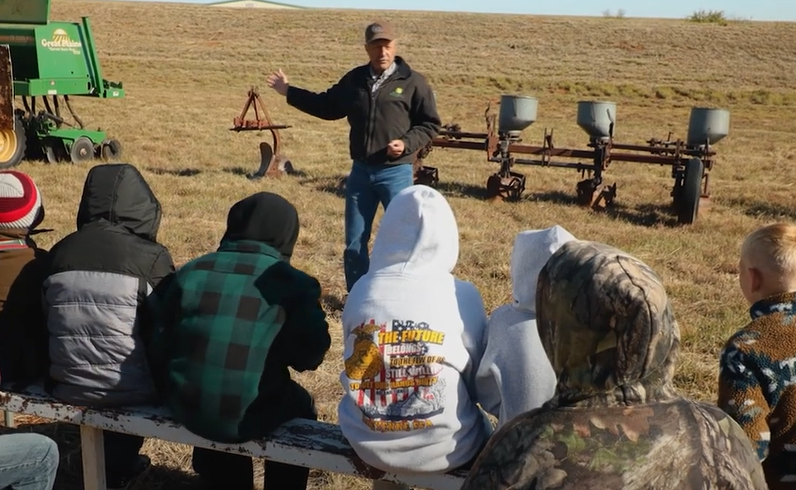
When the Smiths switched to no-till practices, they noticed their planter gauge wheels quickly wore out. After working with a machinist to build stronger tires, other farmers took notice. The Smiths partnered with machinist Jake Hunter to launch 4 AG MFG, which now produces and sells wheels for no-till planters and air seeders internationally. It's the latest reinvention in a story that began when Jimmy's great grandparents Edmond and Martha purchased the farm's original 300 acres in 1913 to grow cotton and raise cattle.
Smith Family Farms survived the Great Depression and the Dust Bowl and witnessed nearby Elk City's run as a booming cotton town from the 1930s to the 1970s, with nine cotton gins in operation. When Jimmy returned home from college to farm with his father and grandfather, soil health wasn't a commonly used term. Yet his efforts to improve the soil, water, and wildlife in his care ever since earned him an induction into the Oklahoma Conservation Hall of Fame in 2021.
Legislation introduced today in the House and Senate represents nothing more than another attempt to allow activists to dictate to producers. Sens. Booker and Warren have long been supported by animal rights groups, and this collective group of bill sponsors has worked long and hard to dismantle our industry's only self-funded promotion and education effort. Sens. Cory Booker (D-N.J.) and Mike Lee (R-Utah), and their partners Sens. Rand Paul, (R-Ky.), Elizabeth Warren (D-Mass.) and Kirsten Gillibrand (D-N.Y.) introduced the Senate bill. Reps. Nancy Mace, (R-S.C.), and Dina Titus, (D-Nev.) introduced the House bill.
"In 2021 cattle producers overwhelmingly denied a referendum to end the Checkoff with detractors coming nowhere near the required signatures to petition for the termination of this vital program. The Beef Checkoff has a long track record of support among cattle producers," said NCBA president and South Dakota cattleman Todd Wilkinson. "Congress has plenty of work to do that could be far more beneficial to Americans. They should focus in areas of urgent need, rather than wasting time on these unwelcome "reform efforts," that would only benefit anti-agriculture activists.
The Checkoff's legality and current implementation has already been upheld by multiple federal courts and, last year, the Supreme Court denied a petition challenging the Checkoff. Cattle producers understand the high return on investment and increase in beef demand the Checkoff provides.
"For every dollar paid into the Checkoff program, $11.91 is returned in producer profit and between 2014-2018 total domestic beef demand increased by 12.8 billion pounds. Any legislation that would hurt beef promotion efforts is tantamount to taking money directly out of cattle producers' pockets," said Wilkinson. "The introduction of the "Opportunities for Fairness in Farming Act of 2023" represents Senators Booker, Lee, Paul, Warren, and Gillibrand working to subvert the will of U.S. cattle producers. NCBA will always stand firm in its support of the U.S. Beef Checkoff program and will continue to fight the animal rights groups and the members of Congress who assist them in their efforts to end animal agriculture."
Early voting for the March 7 Special Election begins Thursday for voters across the state. All voters will have the opportunity to vote on a state question. Some voters will also have county questions or local propositions on the ballot.
In-person absentee voting, more commonly known as "early voting," will be held Thursday, March 2 and Friday, March 3 from 8 a.m. to 6 p.m. No excuse is needed to cast an in-person absentee ballot, but you must vote at an early voting location in the county where you are registered. Early voting locations/dates/times are available on the State Election Board website.
Voters who requested mail absentee ballots are reminded that mail absentee ballots must be received by the County Election Board no later than 7 p.m. on election night.
"Standard" absentee ballots (yellow affidavit) may be either mailed or hand delivered to the County Election Board. If hand delivered, "standard" absentee ballots must be received before the end of the business day on Monday, March 6. "Standard" absentee ballots that are hand-delivered must be accompanied by a notarized absentee ballot affidavit and must be delivered by the voter. Proof of identity is required.
Voters can view a sample ballot for the March 7 election using the OK Voter Portal. The election list is available on the State Election Board website. For voters who wish to vote on Election Day, polls will be open from 7 a.m. to 7 p.m.
Voters with questions should contact their County Election Board.
Congressman Frank Lucas (OK-03) joined Representatives Elise Stefanik (R-NY), Mark Pocan (D-WI), Rick Crawford (R-AR), and Mike Flood (R-NE) in leading a push for accountability to address United States Department of Agriculture's (USDA) failure to conduct oversight of foreign acquisition of U.S. agricultural land. In a bipartisan letter, the lawmakers expressed deep concern for USDA's failures to report foreign acquisition of U.S. agricultural land.
"Protecting America's agriculture security is a critical part of our national security," said Congressman Lucas. "USDA's failure to report foreign acquisition of U.S. agricultural land between 2015 and 2018, which is required by the Agricultural Foreign Investment Disclosure Act, is extremely troublesome. The foreign ownership of agricultural land threatens family farm operations and the overall health of the agricultural supply chain. Recent increases in foreign purchase of U.S. farmland, including across Oklahoma, is indicative for more transparency so that the federal government and states can address flaws in the current system."
In October of 2022, Congressman Lucas joined then-Republican Leader of the House Committee on Agriculture, Glenn "GT" Thompson and Republican Leader of the House Committee on Oversight and Reform, James Comer, in sending a request to the Government Accountability Office (GAO) to review foreign investment in U.S. farmland and its impact on national security, trade, and food security as well as U.S. government efforts to monitor these acquisitions.
Today's letter follows the publication of an internal USDA memo that revealed USDA failed to assess or follow through to penalize failures to report foreign acquisition of U.S. agricultural land between 2015 and 2018, which is required by the Agricultural Foreign Investment Disclosure Act (AFIDA).
"Food security is national security, and I am demanding answers for why USDA failed to do its job to protect U.S. agricultural land from our foreign adversaries," Stefanik said. "Our nation is currently faced with the increasing threat of foreign adversaries like China undermining our agriculture industry, encroaching on our military bases, and threatening our food security. The USDA's failure of due diligence is inexcusable. There must be accountability, so we do not cede any awareness or ownership of our food supply to foreign actors working against the United States."
"The recent increase in foreign purchases of U.S. farmland demonstrates the need for more government transparency of these purchases and to address flaws in the system for foreign acquisitions of land. We have an obligation to protect our food supply and those who produce it. It's troublesome that USDA ignored these transactions and we need to ensure that this doesn't happen in the future," Crawford said.
"Our country's land is inextricably linked to our national security, food supply, and energy resources. At a time when foreign ownership of our country's farmland is rightly coming under increased scrutiny, complete reporting will help ensure that the American people have all the information they need to steward the future of our land and natural resources," Flood said.
In August of 2022, Lucas joined Representatives Tom Emmer (R-MN) and Dan Newhouse (R-WA) in sending a letter to U.S. Department of Agriculture (USDA) Secretary Tom Vilsack requesting information about USDA's process for compiling data and reporting on foreign purchases of U.S. agricultural land. Foreign ownership of domestic agricultural land has risen sharply in recent years, with Chinese land holdings alone increasing from 13,720 acres to 352,140 acres between 2010 and 2020.
Last Congress, Congressman Lucas introduced the Agricultural Security Risk Review Act, legislation that would formally place the United States Department of Agriculture (USDA) Secretary as a member of the Committee on Foreign Investment in the United States (CFIUS). The Agricultural Security Risk Review Act ensures that CFIUS is operating effectively and efficiently to determine if a transaction, including agricultural, threatens to impair the national security of the United States.
Read the full letter here.
Chairman Thompson, Ranking Member Scott, and other members of the committee, I want to begin by thanking you for what you do for America's farmers and ranchers.
A country that cannot feed its people is not secure, so the strong farm policy that supports a strong food supply truly is part of a smart national security strategy.
There are certainly plenty of challenges for American agriculture. From losses experienced in the trade war with China, to pandemic lockdowns, and supply chain disruptions. Add to it the record-high supply costs, and you see how farmers and ranchers have faced unprecedented volatility in recent years.
USDA's most recent Farm Sector Income Forecast sees a decrease in net farm income in 2023, down 15.9%. Adjusted for inflation, that's an 18% drop. The same report estimates farm and ranch production expenses will continue to increase – by $18 billion. This follows a record increase of $70 billion in 2022.
Short- and long-term interest rates are also high and rising – to double and triple what they were just a few years ago. High interest rates, caused by both high inflation and the Fed's steps to address inflation, led to the farm debt crisis in the 1980s. We need to be sure that the doubling or tripling of interest rates does not cause similar pressures.
I am especially concerned about beginning farmers, those forced to borrow for succession and any farmer who recently made new investments. Affordable, reliable, and abundant energy is critical for farmers and ranchers. Energy is necessary for all farm production, and we continue to ride a rollercoaster of high energy and input costs.
But, along with the challenges, there are enormous opportunities ahead for agriculture. Innovation and research are helping us do more with less. Our advances in sustainability are truly impressive.
But in order to seize the opportunities ahead and continue the advancements, we need strong farm policy. And we need a supportive regulatory environment.
Federal regulations have a direct impact on farmers and ranchers. Today, farmers and ranchers face a flurry of requirements and challenges:
Much uncertainty remains related to the ability of farmers and ranchers to access affordable supplies and deal with regulatory and weather-related challenges. Expected revenue declines that more than erase gains made during 2022. So, it becomes even more important for farmers to have clarity on rules that impact their businesses' ability to operate.
Growers need to have access to comprehensive risk management options. They deserve a resounding voice during formulation of vital legislation, such as the farm bill. The farm bill is a critical tool for ensuring our nation's food supply remains secure. Farm Bureau supports the following principles to guide development of programs in the next farm bill:
The 2023 farm bill presents an important opportunity for lawmakers to rise above partisanship. I urge you to work together again to pass legislation that protects food security for all Americans and ensures the future success of our farmers and ranchers.
Farm Bureau will stand up against proposals that threaten the long-term resiliency of rural communities. For your part, Congress must protect American agriculture and modern production practices from undue burden.
Farmers and ranchers have the highest public trust ranking of any profession in America. I ask Congress to trust farmers and ranchers, too, and respect our ability to innovate and solve problems.
We're committed to doing the right thing and appreciate the support of this committee.
Thank you, Mr. Chairman, for holding today's hearing. I would be pleased to answer any questions the committee might have.
Families are seeing higher prices at the grocery store and are challenged to put together a family meal while sticking to a budget. NPB is working hard to become a resource for consumers of the widest range of cultures and socio-economic levels to show how pork can be an affordable and nutritious meal option.
NPB has invested Pork Checkoff funds to prioritize human nutrition, health and wellness by focusing on 3 pillars: research, story and endorsement.
- Research: Provide credible, third-party-verified data and information about pork's value in a balanced diet.
- Story: Celebrate Real Pork and share the story that pork is a tasty, nutrient-dense protein with consumers.
- Endorsements: Protect pork's place on the plate by meeting with health professionals, understanding their beliefs and engaging third-party advocates with data.
NPB is funding research that studies pork's potential as part of the USDA's Thrifty Food Plan, a sample healthy diet that can be purchased on a limited budget. This research shows pork is a high-quality, nutritious protein, that can be part of a healthy diet at a low cost. The study is expected to be completed and published in March.
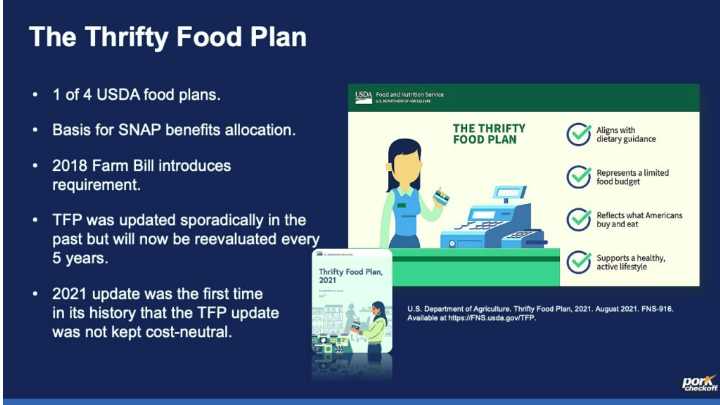
Adam Drewnowski, Ph.D., professor of epidemiology, Center for Public Health Nutrition at the School of Public Health, University of Washington, provided an overview of the nutritional value of fresh pork.
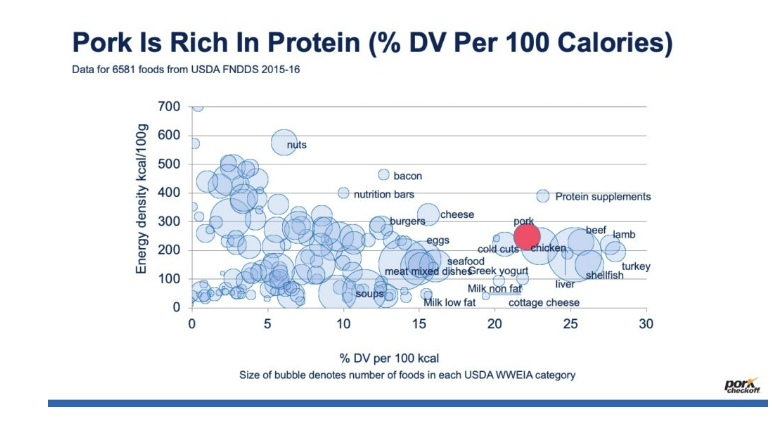
He then reviewed pork's role in healthy eating patterns as an affordable protein.
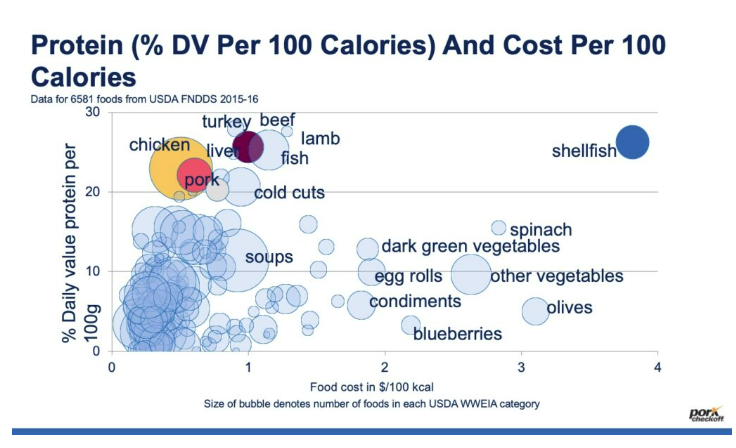
Dr. Drewnowski then reviewed new research sponsored by NPB on the TFP, which confirmed:
Practical Application of the Thrifty Food Plan
Shelley Maniscalco, M.P.H., R.D.N., of Nutrition on Demand and former director of the office of nutrition marketing and promotion at USDA's Center for Nutrition Policy, then guided attendees on how to practically apply the TFP for their audience.
She stressed that the importance of health and nutrition professionals meeting individuals and families where they are by addressing their top eating priorities and challenges.

RON's Dave Lanning has a pre-opening look at today's agricultural Markets.
Click the audio tab below for today's report.
Archives:
2026-11 | 2026-10 | 2026-09 | 2026-08 | 2026-07 | 2026-06 | 2026-05 | 2026-04 | 2026-03 | 2026-02 | 2026-01 | 2025-12 | 2025-11 | 2025-10 | 2025-09 | 2025-08 | 2025-07 | 2025-06 | 2025-05 | 2025-04 | 2025-03 | 2025-02 | 2025-01 | 2024-12 | 2024-11 | 2024-10 | 2024-09 | 2024-08 | 2024-07 | 2024-06 | 2024-05 | 2024-04 | 2024-03 | 2024-02 | 2024-01 | 2023-12 | 2023-11 | 2023-10 | 2023-09 | 2023-08 | 2023-07 | 2023-06 | 2023-05 | 2023-04 | 2023-03 | 2023-02 | 2023-01 | 2022-12 | 2022-11 | 2022-10 | 2022-09 | 2022-08