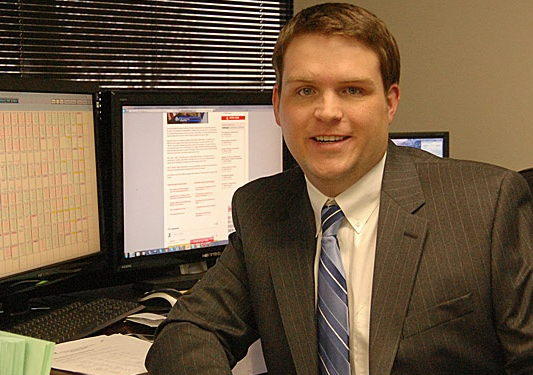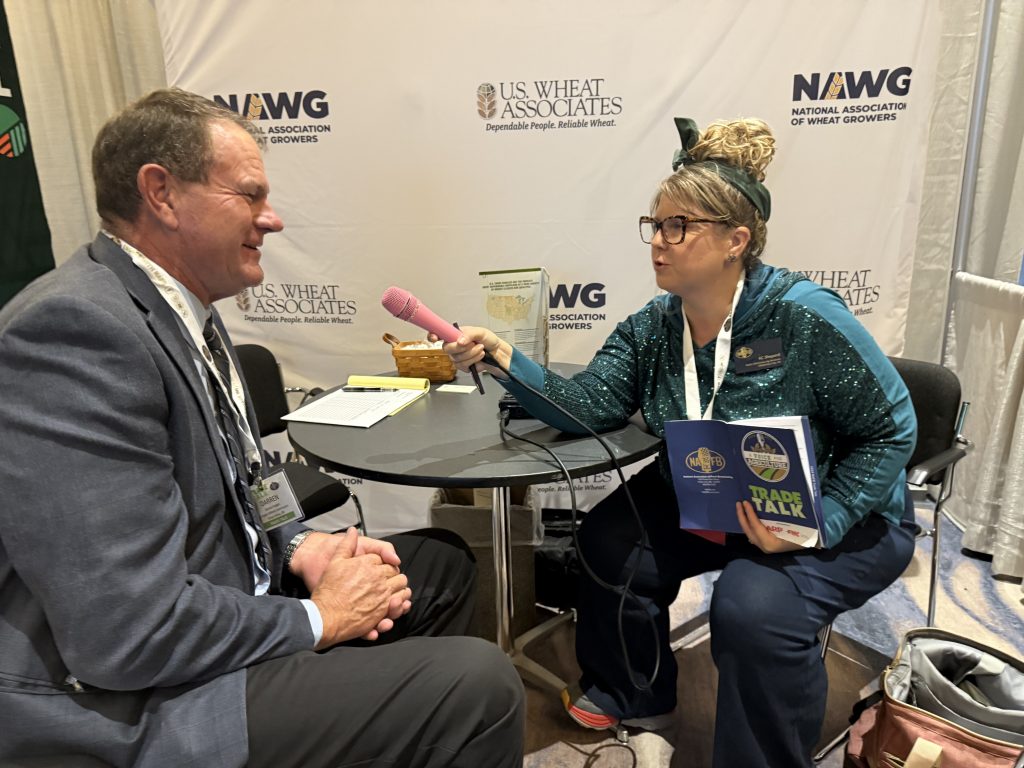
At the National Association of Farm Broadcasters Convention, Farm Director KC Sheperd visited with U.S. Wheat Associates' former Past Chairman Darren Padget about the export conditions expected under the new Trump administration.
Padget hopes for less regulatory pressure. "If you were in the natural resources business, it seems like you have had a target on your back for the last few years," he said. "I'm hoping to put that somewhere else for a while."
Ninety percent of Padget's crop is exported. "We are very sensitive to tariff talks, the strength of the dollar, and all things pertaining to trade," he said. "During Trump's first term, when they started saying tariffs, I bristled. I still do a little bit, but I also realize that is the only economic stick that we can really swing and bring people into line. It seems to work, so I am cautiously optimistic."
About the pending farm bill, he said that he, personally, would like to see it drafted and approved by the incoming administration. "I think we might find a more friendly ag bill for the farmers without maybe so many green restrictions," he said. "I wish they would just extend it a year. It could be a lot worse than it is right now. Let's just get through it and see what our people come up with. We have the House, the Senate, and the Presidency, so maybe we can put something together that'll work."
The status of crop insurance is the biggest piece of the farm bill to Padget, seconded by trade policies.
Last week was the 2024 Oklahoma Governor's Water Conference and Research Symposium. Attendees had the opportunity to network with other water experts and professionals as well as exploring resources and sessions that cover ongoing research and outreach efforts in the state. Every year, Oklahoma Water Resources Center holds a poster contest at the Research Symposium for graduate and undergraduate students.
Congratulations to this year's poster winners!


There were a record breaking amount of attendees and posters this year, with a total of 34 student posters that participated! We appreciate all of your hard work in water research and wish you luck in your future research!
Recently, in a letter sent to the U.S. Department of Agriculture (USDA), 11 members of Congress called for the postponement of its electronic identification (EID) eartag mandate on adult cattle shipped across state lines.
The letter follows the New Civil Liberties Alliance on behalf of R-CALF USA, South Dakota Stockgrowers Association, Farm and Ranch Freedom Alliance, and area ranchers, filing suit against USDA's rule and petitioning USDA to postpone the effective date of the rule. The final rule mandating the eartags went into effect on November 5, 2024, despite the court challenge, widespread industry opposition, and calls to postpone.
Sent on November 16, 2024, the letter states, "In light of this court challenge, and the fact that retailers are unable to provide timely access to compliant EID eartags, despite being required to do so and USDA assurances during the rulemaking process that eartag manufacturers were prepared for this government dictated change in the market, we urge USDA to consider postponing the effective date of the EID eartag rule."
The letter points out the shortcomings of USDA forcing this major shift in industry operations while a large number of cattle producers remain opposed to it. The members noted their concern about the lack of proper authority or resources for implementing the rule and the possible harm to producers and small businesses should a court reverse the rule.
"We're extremely pleased to see this influential group of U.S. Representatives weigh in to protect our nation's cattle producers from USDA's ill-conceived and poorly planned scheme that forces expensive, mandatory electronic identification eartags upon our industry," said R-CALF USA CEO Bill Bullard.
The 11 congressional members from eight states who joined the letter include Reps. Hageman (R-WY), Rosendale (R-MT), Duncan (R-SC), Roy (R-TX), Maloy (R-UT), Cloud (R-TX), Gosar (R-AZ), Biggs (R-AZ), Massie (R-KY), Smith (R-MO), and Fulcher (R-ID).
Show Sponsor Oklahoma Farm Bureau and More Than 300 Exhibitors to Showcase Latest Agricultural and Ranching Products
The 31st Annual Tulsa Farm Show is set to take place from December 12-14, 2024, at the SageNet Center at Expo Square in Tulsa, Oklahoma. This premier agricultural event will bring together farmers and ranchers from across the region to explore the latest in agricultural technology, ranching equipment, and services. With over 300 exhibitors, including
event sponsor Oklahoma Farm Bureau, the Tulsa Farm Show is one of the nation's largest agricultural exhibitions held under one roof.
Scott Guttormson, Show Manager, shared his excitement:
"We are thrilled to celebrate the 31st Annual Tulsa Farm Show this year! This event provides an excellent opportunity for farmers, ranchers, and exhibitors to come together and showcase the newest innovations in agriculture. We are proud to have the continued support of Oklahoma Farm Bureau as our official sponsor."
Farmers and ranchers from Oklahoma, Kansas, Missouri, Arkansas, and Texas regularly attend the Tulsa Farm Show, making it an essential end-of-year event. Admission and parking are free for all attendees. The SageNet Center, a key venue at Expo Square, boasts over 350,000 square feet of exhibit space and is one of the largest clear-span buildings in the world, making it an ideal setting for showcasing large equipment and exhibits.
Featured Events at the Show
In addition to a wide variety of exhibits, the Tulsa Farm Show will host several exciting events and attractions. One of the highlights is Craig Cameron, renowned natural horsemanship trainer, who will present daily horsemanship seminars and engage with attendees throughout the show. Cameron's interactive demonstrations have been a popular feature of the show for 29 years.
Country singer, Rusty Rierson, will also be performing daily acoustic music sets during the show. For cattle producers, livestock management will be a central focus of the event. Attendees can watch live demonstrations of ten different brands of cattle chutes, moderated by experienced livestock industry professionals. These demonstrations will take place twice daily in the southwest corner of the SageNet Center, near the Behlen Country exhibit.
Daily Prize Drawings
Prize drawings are always a favorite at the Tulsa Farm Show. A $1000 Showbucks drawing will be held at 1:00 pm each day, sponsored by Can-Am. Attendees can register at the Can-Am exhibit, and the winner must be present to win. Showbucks can be used as currency to purchase products and services from any exhibitor.
Additionally, Stewart Martin Equipment, a long-time exhibitor and sponsor, will give away a new Kubota lawn mower and trailer package. Attendees can register for this prize at the Stewart Martin exhibit throughout the show. The winner will be announced live on Big Country 99.5 radio.
Event Details
The Tulsa Farm Show runs December 12, 13, & 14, 2024 at the SageNet Center (located at Expo Square, home of the Tulsa State Fair). Admission and parking are free. Additional details, including a full event schedule can be found at www.TulsaFarmShow.com, along with an interactive show floor plan, sponsored by Stewart Martin Equipment
On November 22, 2024, the Chief Veterinary Officer of Mexico notified the United States Department of Agriculture's Animal and Plant Health Inspection Service (APHIS) of a positive detection of New World screwworm (NWS) in Mexico. Senior Farm and Ranch Broadcaster Ron Hays talked to OSU Extension Livestock Market Economist Dr. Derrell Peel about the disruption of feeder cattle coming into the U.S. from Mexico.
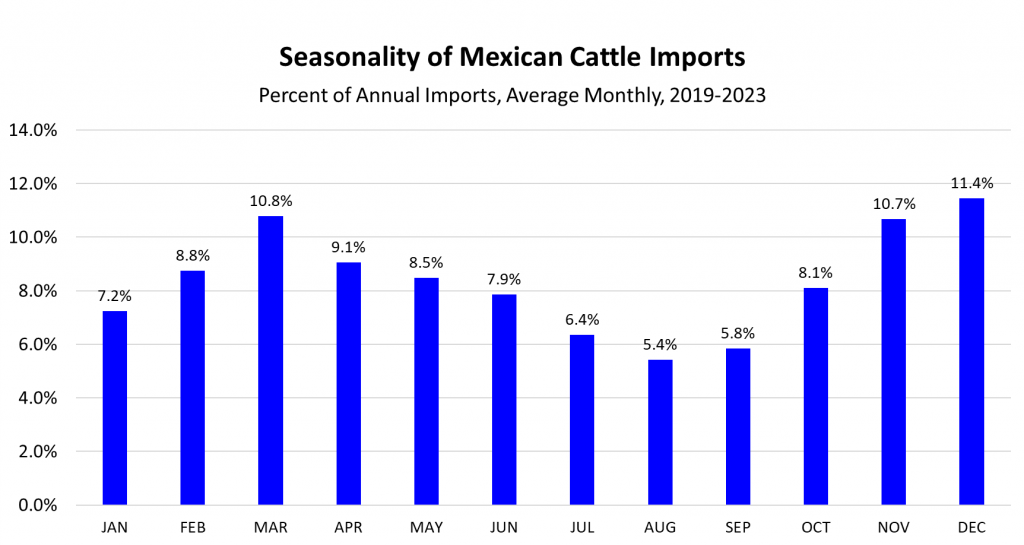
Dr. Peel said that the U.S. typically imports cattle from Mexico throughout the year, but on average 22% of the total number of Mexican cattle are brought in during the months of November and December.
"We've been on a pretty good pace this year, in terms of the numbers coming in," Dr. Peel noted. "This disruption will take out the last six weeks or so of imports, and I think that will reduce our annual total imports by roughly eighteen percent."
The disruption is likely to impact the feed supply and cattle on feed numbers, but Dr. Peel doesn't anticipate a huge impact.
"The Mexican cattle contribute to our total cattle supplies for the U.S., but they aren't huge," he said. "If you look at their numbers compared to our annual calf crop in the U.S., they are about 3 or 3.2 percent on average; however, in a tight supply market, any decrease in numbers will be noticeable."
By the end of the year, Dr. Peel expects to see a decline of about 250,000 to 300,000 fewer imported cattle but says it will only serve to add additional support to an already strong feeder market. Although the Mexican imports are generally lighter weights this time of the year, he noted that feedlots are starting them smaller to maintain their numbers with today's tight supplies. Dr. Peel expects to see a decrease in available placement numbers relatively quickly, and later the decrease will occur when the light calves would have been moving out of a backgrounding program into the feedlot system.
When the border is opened back up to northward moving cattle, USDA will have implemented additional inspection and quarantine protocols. "The initial steps will be to get the facilities identified and approved by USDA," Dr. Peel said. "Cattle inside Mexico will go to those facilities, get an additional screening on the Mexican side, then be given ivermectin to clear any parasites and quarantined for seven days."
After the quarantine, the cattle will go through the normal border process which includes another inspection and being dipped for other pests.
In a previous article, Dr. Peel said it will take most of December to get up and running when it comes to feeder cattle being imported from Mexico into the United States. "Essentially, it means that we may not get any cattle for the rest of 2024," he stated. "By the time you get that process in place and go through the initial quarantine. We might be in place to pick it back up, at least partially, going into next year."
The Santa Teresa Port of Entry is an important corridor in the movement of cattle across the border but due to the quality of existing facilities, it should be able to set up for the extra protocols relatively quickly. (the Santa Teresa Port is just west of El Paso and is in New Mexico)
"That is where the bulk of the cattle typically come across," Dr. Peel said.
Cattle futures markets have already risen as the uncertainty of the crisis in Mexico is sorted out. "I think it will probably pull back a little bit from this initial premium that we see in the futures market, but again, the feeder cattle market has been really strong in November anyway with the reality of cattle numbers in the U.S. This will continue that support, so I think we will continue to see an extremely strong market and this will certainly add a little bit to that."
The Beef Buzz is a regular feature heard on radio stations around the region on the Radio Oklahoma Ag Network and is a regular audio feature found on this website as well. Click on the LISTEN BAR at the top of the story for today's show and check out our archives for older Beef Buzz shows covering the gamut of the beef cattle industry today.
RON's Dave Lanning has a pre-opening look at today's agricultural Markets.
Click the audio tab below for today's report.
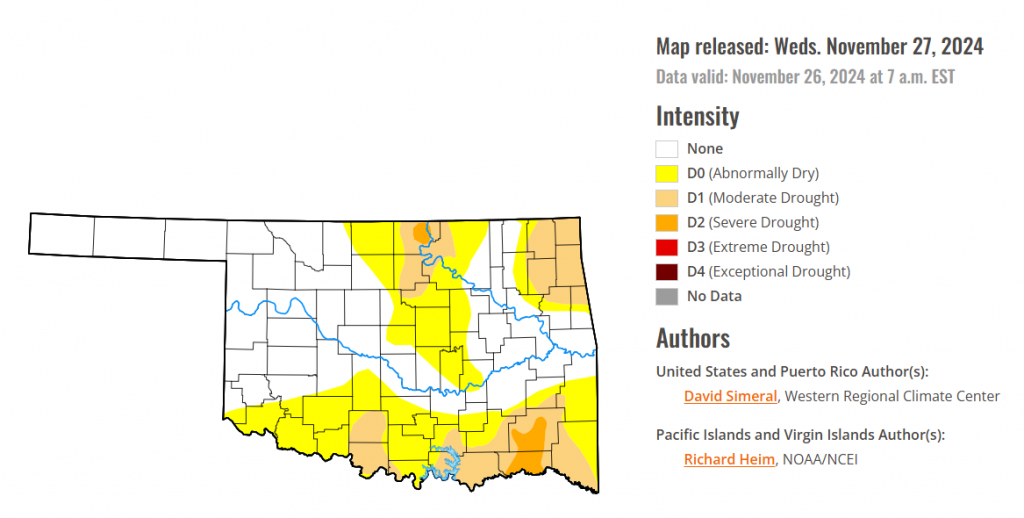
To view the latest Oklahoma drought map, CLICK HERE.
According to the latest Oklahoma drought monitor report, exceptional drought remains at zero percent, unchanged from the start of the calendar year.
Extreme drought or worse conditions remain at zero percent, unchanged for two weeks.
Severe drought or worse conditions are unchanged from last week at 1.85 percent.
Moderate drought or worse conditions have increased to 17.91 percent, up from 17.90 percent last week.
Abnormally dry or worse conditions decreased to 46.70 percent, down from 52.78 percent last week.
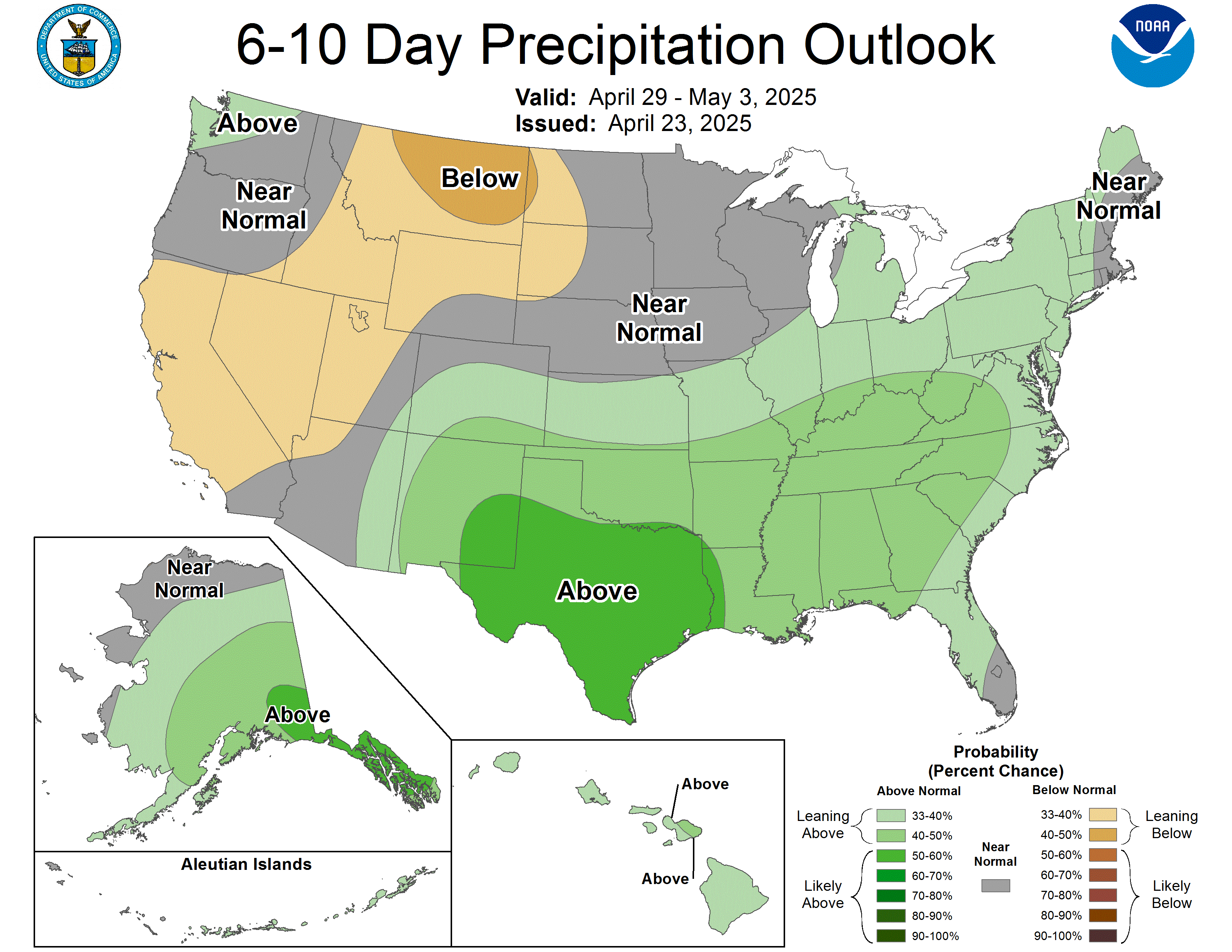
According to the 6-to-10-day precipitation outlook map, the southern portion of Oklahoma is leaning above a 33-40 percent chance of precipitation through December 7, 2024. Much of the central part of the state is near normal chances of precipitation. The eastern panhandle along with a portion of Northwest Oklahoma is leaning below a 33-40 percent chance of precipitation, and the western panhandle is learning below a 40-50 percent chance through that December 7 date.
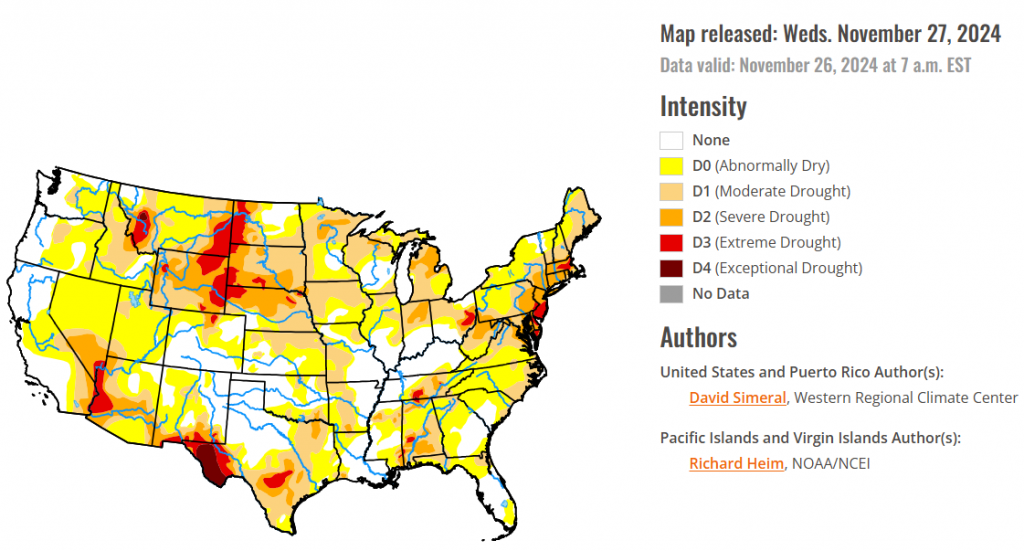
To view the United States Drought Map, CLICK HERE.
This U.S. Drought Monitor (USDM) week saw widespread improvement in drought-related conditions across areas of the Pacific Northwest and Northern California in response to a series of strong Pacific storms including a powerful atmospheric river that delivered significant rainfall accumulations to the lower elevation coastal areas and heavy mountain snow. In the coast ranges of Northern California, 7-day rainfall totals exceeded 25+ inches in some areas, according to preliminary data from the National Weather Service (NWS) California-Nevada River Forecast Center. The series of storms boosted mountain snowpacks above normal levels across the Cascades (Oregon, Washington), Blue Mountains (Oregon), Sawtooth Range (Idaho), and the northern and central Sierra. In the Desert Southwest, drought expanded and intensified on the map across areas of southern Nevada and Arizona in response to persistent dry conditions and record-warm temperatures during the past 6-month period. In the Midwest, improving short-term conditions due to recent precipitation events across areas of the region led to widespread improvements in drought-affected areas. In the Northeast, light-to-moderate precipitation accumulations, including beneficial snowfall, led to a reduction of areas of drought coverage in Pennsylvania and West Virginia. In the Southeast, rainfall last week and overall improving conditions (soil moisture, streamflows) led to the removal of areas of drought on the map in Alabama, Georgia, and Florida.
In terms of reservoir storage in areas of the West, California's reservoirs continue to be at or above historical averages for the date (November 25) with the state's two largest reservoirs (Lake Shasta and Lake Oroville) at 111% and 105% of their averages, respectively. In the Southwest, Lake Powell is currently 37% full (59% of typical storage level for the date) and Lake Mead is 32% full (53% of average), with the total Lower Colorado system 42% full as of November 18 (compared to 43% full at the same time last year), according to the U.S. Bureau of Reclamation. In Arizona, the Salt River Project is reporting the Salt River system reservoirs 75% full, the Verde River system 57% full, and the total reservoir system 73% full (compared to 81% full a year ago). In New Mexico, the state's largest reservoir along the Rio Grande is currently 7% full (17% of average). In the Pacific Northwest, Washington's Franklin D. Roosevelt Lake is 90% full (103% of average for the date), Idaho's American Falls Reservoir on the Snake River is 35% full (86% of average), and Hungry Horse Reservoir in northwestern Montana is 82% full (100% of average).
In the Southern Plains, generally dry conditions prevailed this week, especially in the western portion of the region, with little or no precipitation observed across the western half of Texas and Oklahoma. However, light to moderate rainfall (2 to 4+ inches) was observed in isolated areas of southern Louisiana and Mississippi leading to minor improvements in drought-affected areas of southeastern Mississippi. For the week, average temperatures were near normal across the southern extent of the region while northern portions ranged from 3 to 6 degrees F above normal. On the map, deterioration occurred in isolated areas of Texas including the Trans Pecos, South Texas, and the southern Edwards Plateau, while improvements were made in the Panhandle and east Texas. Looking at reservoir conditions in Texas, Water for Texas (November 26) was reporting statewide reservoirs at 72% full, with many reservoirs in the eastern part of the state in good condition, while numerous reservoirs in the western portion of the state were experiencing continued below-normal levels.
In The High Plains, moderate to heavy precipitation was widespread across the southern and eastern reaches, and moderate amounts were observed in some of the higher elevations of Wyoming and central Colorado, and over northern North Dakota. Elsewhere, only a few tenths of an inch, at most, was measured. In the areas of heaviest precipitation (1.5 to approaching 3.0 inches), improvement was introduced. This included significant parts of Kansas, southeastern Colorado, eastern sections of Nebraska and South Dakota, and a relatively small area in southeastern North Dakota. The remainder of the region, under a regime of light to moderate precipitation at best, dryness and drought assessments were unchanged.
In the West, a series of powerful Pacific storms delivered heavy rain and mountain snow accumulations to the Pacific Northwest and Northern California. Impacts from the series of storms included damaging winds, major power outages, flash flooding, road closures, landslides, and debris flows. In the Coastal Range, an NWS observing station northwest of Santa Rosa, California reported a 7-day total of 24 inches of rain. Overall, the series of storms led to widespread removal of areas of drought on the map across the Pacific Northwest as well as areas experiencing short-term dryness across Northern California. Looking at the regional snowpack situation, the NRCS SNOTEL network is reporting (November 25) the following region-level (2-digit HUC) SWE levels: Pacific Northwest 179%, Missouri 78%, Upper Colorado 96%, Great Basin 125%, Lower Colorado 127%, Rio Grande 145%, Missouri 78%, Souris-Red-Rainy 128%, and Arkansas-White-Red 157%. In the Desert Southwest, areas of Extreme Drought (D3) expanded on the map this week in northwestern Arizona, extending northward into southern Nevada, in response to a combination of short and long-term precipitation deficits and record heat observed during the past 6-month period. Elsewhere in the region, the atmospheric river last week boosted snowpack conditions in Montana, helping to improve drought-affected areas in the northwestern part of the state.
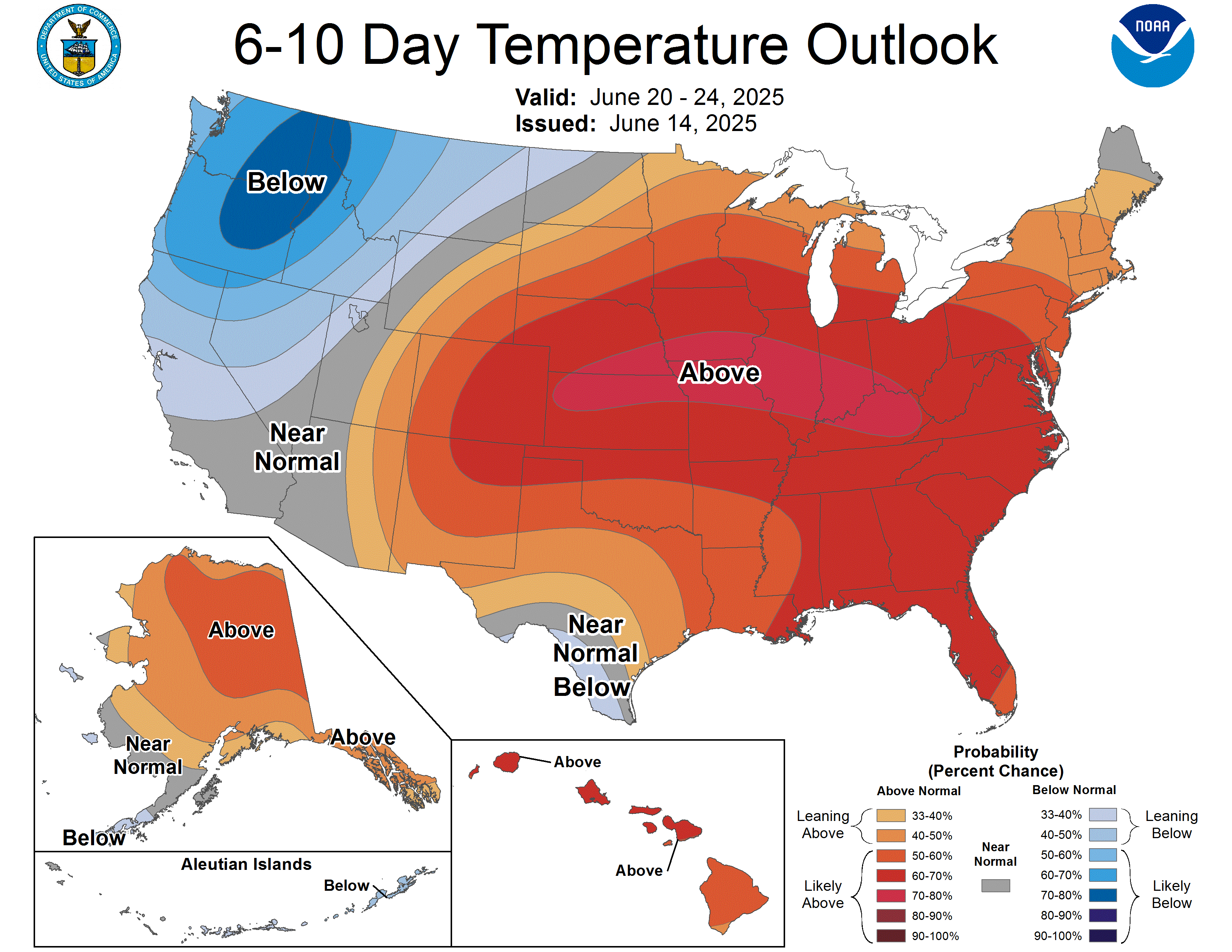
Looking ahead, the NWS Weather Prediction Center (WPC) 7-Day Quantitative Precipitation Forecast (QPF) calls for light-to-moderate precipitation accumulations ranging from 1 to 2 inches (liquid) across areas of the Intermountain West including the Colorado Rockies and ranges in central and southern Utah. Lighter accumulations are expected in the southern Sierra, North Cascades, and areas of the northern Rockies. Along the Gulf Coast of Texas and Louisiana, light accumulations (<1 inch) are forecasted for the 7-day period. In the Upper Midwest and areas downwind of the Great Lakes in the Northeast, accumulations of <1 inch are expected. The Climate Prediction Center (CPC) 6-10-day Outlook calls for a moderate-to-high probability of above-normal temperatures across the West and near-normal temperatures across the Plains states. Conversely, below-normal temperatures are expected across the Eastern tier. In terms of precipitation, there is a low-to-moderate probability of above-normal precipitation across much of Texas and Louisiana as well as areas of the northern Plains. Elsewhere, below-normal precipitation is expected across much of the West, Central and Southern Plains, Southeast, Mid-Atlantic, and New England.
To view the 6-10 Day Precipitation Outlook Map, click here.
To view the 6-10 Day Temperature Outlook Map, click here.
To view the Monthly Drought Outlook Map, click here.
As you come together with family and friends to celebrate Thanksgiving, it's worth acknowledging the invaluable contribution of our nation's Land-grant universities and colleges in ensuring a delectable spread.
At the University of Minnesota, Dr. Randall Singer is focused on reducing the amount of antibiotics used to treat Clostridial dermatitis in turkeys, one of the most important diseases in turkey production. This bacterial disease represents the majority of antibiotic use in turkey production.
Read more on how Dr. Singer is finding ways of reducing the incidence of Clostridial dermatitis.
NIFA supports four Regional Integrated Pest Management (IPM) Centers, the Northeast, North Central, Southern and Western. Regional IPM Centers help NIFA and its partner institutions identify, prioritize and coordinate national pest management research, Extension and education programs.
A bi-coastal project through the Western Integrated Pest Management Center is looking to keep West Coast cranberry farms safe from false blossom disease, an insect-spread pathogen that's plaguing East Coast cranberry producers.
False blossom disease is spread by only one known insect vector, the blunt-nosed leafhopper. The pathogen doesn't kill cranberry vines. Instead, infected plants continue to flower year after year but never again bear fruit.
Read more on this effort.
Potatoes are the most widely grown and consumed vegetable in the U.S. Potatoes' popularity is a result of their versatility and affordability, as well as being a tasty and nutrient-dense food choice.
In 2020, U.S. potato production was valued at about $3.65 billion. While per acre yield has trended up over the last several years, challenges such as climate change, diseases and pests threaten both potato yields and quality.
Oregon State University researchers will provide results from a large, collaborative USDA NIFA Specialty Crop Research Initiative project conducted in all major potato-producing states to identify indicators of soil health and develop management strategies that will enhance soil health in potato production systems. The research will help better understand what soil health means on potato farms and which approaches are effective at improving soil health.
Read about a few projects discussed at this year's 2024 Potato Expo by NIFA-funded researchers.
Downy mildew is a disease caused by a fungal pathogen. Downy mildew targets popular garden plants, such as cucurbits, which includes squashes, pumpkins and cucumbers. Farmers can lose their entire crop to the disease.
A Virginia farmer and co-owner of Common Wealth Seed Growers and Twin Oaks Seed Farm received funding from three Sustainable Agriculture Research and Education Farmer/Ranch grants for research, selection and breeding efforts aimed to develop better varieties of winter squash.
This NIFA-funded work resulted in the South Anna cultivar, a downy mildew resistant butternut squash.
Wine grapes are a high-value crop, but planting a poorly adapted variety in the wrong place is a costly mistake. Traditional grape varieties are not well suited to the growing conditions or pests and diseases in large parts of the U.S. In addition, some varieties may not perform well as climate change creates new pressures.
Read how researchers at Land-grant universities nationwide are developing and evaluating wine grapes for American growers and winemakers.
Happy Thanksgiving from the NIFA team!
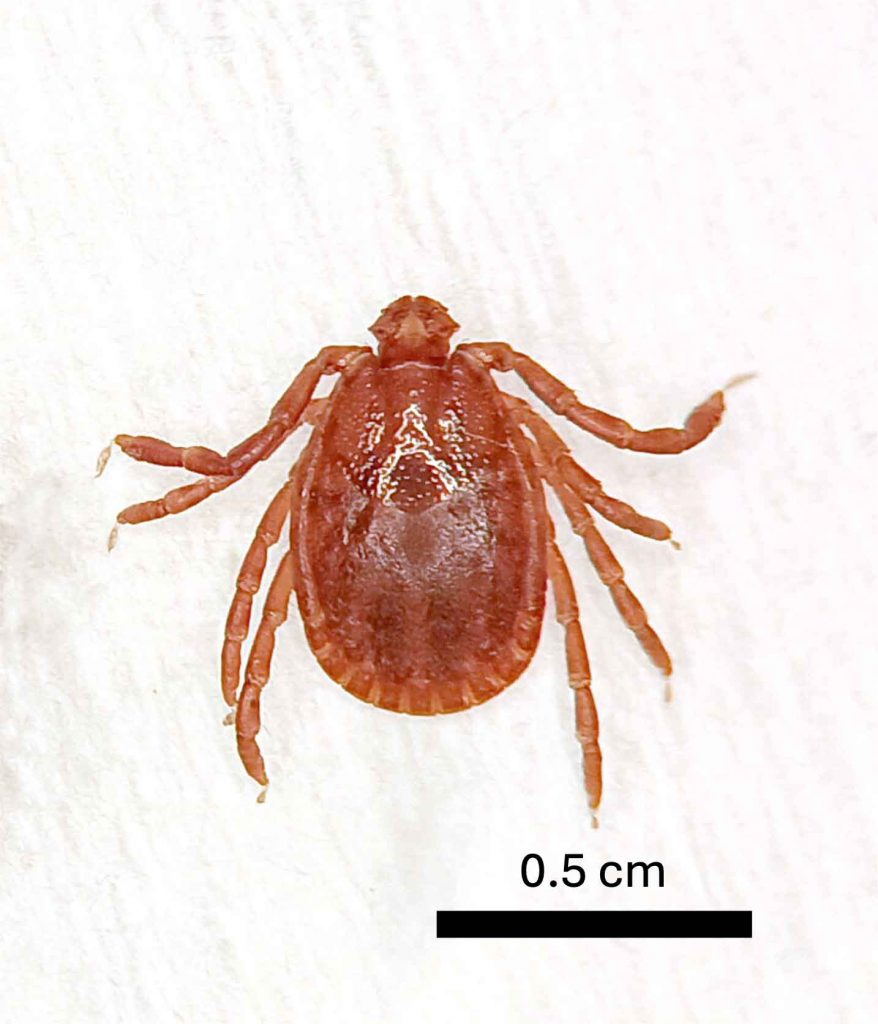
On today's Cow-Calf Corner, Rosslyn Biggs, DVM, Oklahoma State University Cooperative Extension Beef Cattle Specialist talks about OSU's research launch on the Asian longhorned tick (ALT).
The Asian longhorned tick, Haemaphysalis longicornis, an invasive species was identified in the summer of 2024 on cattle in northeast Oklahoma counties.
The ALT parasitizes multiple species including humans, pets, livestock and wildlife, including birds. It is a three-host tick that spends 90 percent of its life off the animal. The four most common animals this tick has been found on within the United States are dogs, white-tailed deer, raccoons and cattle.
A single female tick can reproduce without mating and may produce 1,000 to 2,000 eggs at a time. It has the potential to create an established population in a newly introduced location in two to three weeks.
Severe infestations of the ALT in cattle can lead to death from excessive blood loss. Production losses including decreased milk production and growth are substantial. The Asian longhorned tick has also been recognized as a vector for multiple diseases of both humans and animals.
In other countries, the tick is the primary vector of Theileria orientalis Ikeda genotype in cattle. The protozoal agent causes clinical signs similar to anaplasmosis-anemia, fever, lethargy, jaundice and death. The mortality rate for cattle infected with T. orientalis Ikeda genotype varies from three to 90 percent. T. orientalis Ikeda genotype has been identified in the United States, but as of this time not in Oklahoma.
Beginning in late 2024, Oklahoma State University College of Veterinary Medicine researchers will launch a project to evaluate the status of the pathogenic T. orientalis genotype Ikeda and the Asian longhorned tickin cattle herds from Oklahoma and eastern border states. 30 to 50 farms have the opportunity to participate.
Each participating herd will provide five to twenty blood samples. Herds that test positive to T. orientalis will be followed up with once or twice during the study. Ticks will also be collected from the animals. Tick trapping may also be performed. A maximum of 15 ticks will be analyzed from each sample collection site. All samples will be tested at the Oklahoma Animal Disease Diagnostic Laboratory.
Sampling supplies, shipping labels, and testing will be provided at no cost. Samples may be collected by veterinarians or producers with a consulting herd veterinarian.Anaplasma marginale testing will also be provided free of charge (up to 20 samples per herd) if anaplasmosis is suspected in the herd.
For more information or to participate in the study please contact a member of the research team:
Dr. Ruth Scimeca ruth.scimeca@okstate.edu, Dr. Rosslyn Biggs rosslyn.biggs@okstate.edu, or
Dr. John Gilliam john.gilliam@okstate.edu.
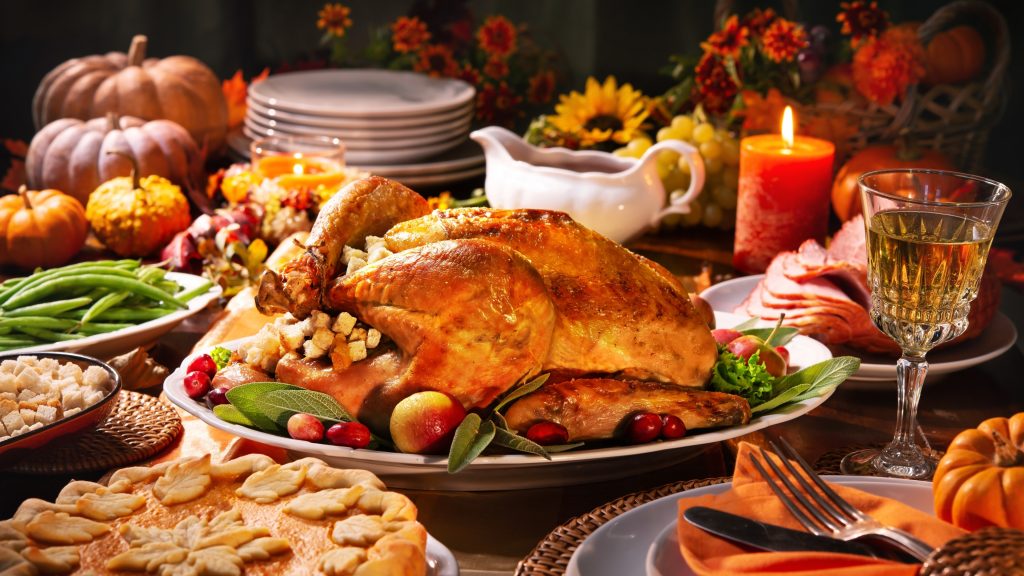
During the Thanksgiving holiday, Americans enjoy a meal featuring many domestically grown specialty crops, which are crucial to the traditional feast.
While California is known for producing a variety of specialty crops, Wisconsin stands out as a top producer of cranberries and green beans, and ranks third in green peas, potatoes, and carrots.
The diversity of Thanksgiving food sources is highlighted, with products coming from states across the country. This underscores the American effort behind the holiday meal and encourages appreciation for the farmers who contribute to it. This Thanksgiving, Thank a Farmer!
For more information, visit fb.org/market.
As we approach Thanksgiving, a time traditionally set aside for reflection and gratitude, it is essential for us to come together and pause, even in the midst of our differences. This holiday is an opportunity to appreciate what we have as communities, families, and as a country. In a time when our country often feels divided, Thanksgiving reminds us of the importance of unity. It gives us a chance to stop and reflect on the things that matter most.
The history of Thanksgiving is traced back to 1610 in America. It wasn't until 1863, during a period of national division, that President Abraham Lincoln declared Thanksgiving a national holiday. During the conflict, Lincoln called upon the nation to pause and give thanks, to remember the blessings that unite us. This call to unity is as relevant today as it was then. It wasn't until 1941 that Congress certified the celebration for the fourth Thursday in November every year. This solidified Thanksgiving as a tradition that Americans across the country embrace, each in their own way.
This year, as we gather around our tables, I am especially thankful for the many freedoms we enjoy as citizens of this great nation. America was built on the ideals of liberty; freedom from tyranny, the right to speak our minds, and the opportunity to build a better future for ourselves and our children. America stands as a beacon of democracy, a model for the world, even as our adversaries seek to undermine us. We must never forget that freedom comes at a cost, and I am eternally grateful for the men and women in uniform who put their lives on the line to protect the freedoms we hold dear.
Personally, I am deeply thankful for the privilege of representing the people of Oklahoma's Fifth District. Oklahoma has always been my home, and it is an honor to serve its communities. While we may not agree on every issue, it is my commitment to always fight for the people of this district through thoughtful legislation, constituent services, or simply lending a listening ear. I will continue to work every day to ensure that the voices of my constituents are heard and that our shared values are reflected in the decisions made in Washington.
I wish you all a safe and happy Thanksgiving!
Following is a statement from U.S. Wheat Associates (USW) and National Association of Wheat Growers:
"Trade deals with Japan and Mexico won by the previous Trump Administration protected crucial U.S. wheat export markets. U.S. Wheat Associates and the National Association of Wheat Growers strongly support an Office of the U.S. Trade Representative actively focused on enforcement of trade rules and opening markets under Jamieson Greer. The organizations look forward to working with him and the next Agricultural Trade Negotiator on behalf of American wheat growers."
| ||||||||||||||||||||||||||||||||||||||||||||||||||||||||||||||||||||||||||||||||||||||||||||||||||||||||||||||||||||||||||||||||||||||||||||||||||||||||||||||||||||||||||||||||||||||||||||||||||||||||||||||||||||||||||||||||||||||||||||||||||||||
| ||||||||||||||||||||||||||||||||||||||||||||||||||||||||||||||||||||||||||||||||||||||||||||||||||||||||||||||||||||||||||||||||||||||||||||||||||||||||||||||||||||||||||||||||||||||||||||||||||||||||||||||||||||||||||||||||||||||||||||||||||||||
|

Growth Energy, the nation's largest biofuel trade association, filed an amicus brief in a consolidated set of court challenges to the National Highway Traffic Safety Administration's (NHTSA's) Corporate Average Fuel Economy (CAFE) Standards for Passenger Cars and Light Trucks for Model Years 2027-2032, which is being litigated in the U.S. Circuit Court of Appeals for the Sixth Circuit.
In its brief, Growth Energy argues that the CAFE standards violate the Energy Policy and Conservation Act (EPCA), in particular the EPCA's prohibition on using electric vehicles (EVs) as a "baseline" to set fuel-economy standards. Growth also notes that the standards functionally serve as an EV mandate and unlawfully fail to take the benefits of biofuels into consideration. NHTSA's "one-track focus on EVs leads to rules that are arbitrary, inconsistent with law," including the Renewable Fuel Standard (RFS), "and miss important benefits of other technologies while also failing to minimize costs," Growth writes in the brief.
"NHTSA has continually failed to properly consider the important role that biofuels like bioethanol play in advancing the fuel economy goals of EPCA and the energy security, environmental, and rural economic development goals of the RFS," said Growth Energy CEO Emily Skor. "The CAFE standards should recognize and embrace the benefits of biofuels, a uniquely-American resource that can help NHTSA accomplish its goals without pushing one vehicle technology over all others." Read Growth Energy's brief here.
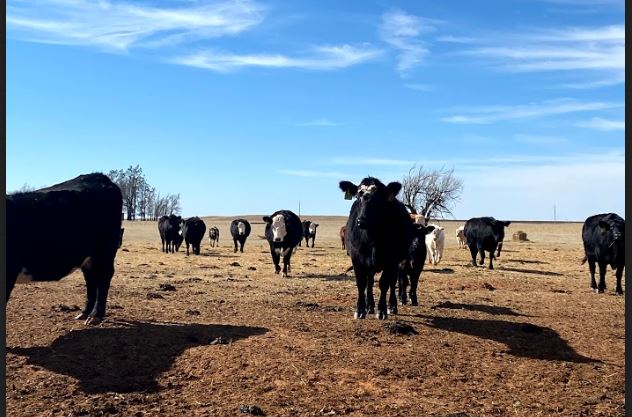
November 5, 2024, marked the implementation date for the updated federal animal disease traceability regulations requiring electronic identification tags in certain classes of cattle and bison crossing state lines.
The United States Department of Agriculture's Animal and Plant Health Inspection Service implemented the new rule to better pinpoint and respond to animal disease outbreaks in hopes to limit both the spread of disease and the economic impacts of disease on livestock producers.
It is important for producers to know that the classes of cattle required to be identified have not changed. The rule applies to all dairy cattle, sexually intact beef cattle and bison over 18 months of age, and all exhibition and rodeo stock moving interstate. The rule does not apply to stocker or feeder cattle.

In accordance with the new rule, any animal tagged after Nov. 5 will need an 840 electronic identification tag. The ear tags must be visually and electronically readable for official use. Cattle already identified with a sliver Brite metal tag or orange bangs metal tag prior to Nov. 5 will not need to be retagged with an electronic tag.
Producers can obtain 840 EID tags through the Oklahoma Department of Agriculture, Food and Forestry. The tags are free of charge, but the producer must cover the cost of shipping.
Other options to obtain 840 EID tags include:
A premises ID is required to order 840 EID tags regardless of source. A PIN application is available on the Animal Industry State Veterinarian page.
The 840 tags are specifically for use in animals of U.S. origin. Other country code specific EIDs should not be removed or replaced.
Additionally, 900 series tags are not considered official unless they were applied before 2015 (i.e. the animal must be 9 years of age or older) or the tags are lime green or blue in color with "IMP" and the U.S. shield printed on the tag. These tags are only to be used in imported or non-U.S. origin cattle and bison who lost their original country of origin ear tag.
For questions or more information about the ADT program, contact ODAFF's Rod Hall, state veterinarian, at (405) 522-0270 or rod.hall@ag.ok.gov.
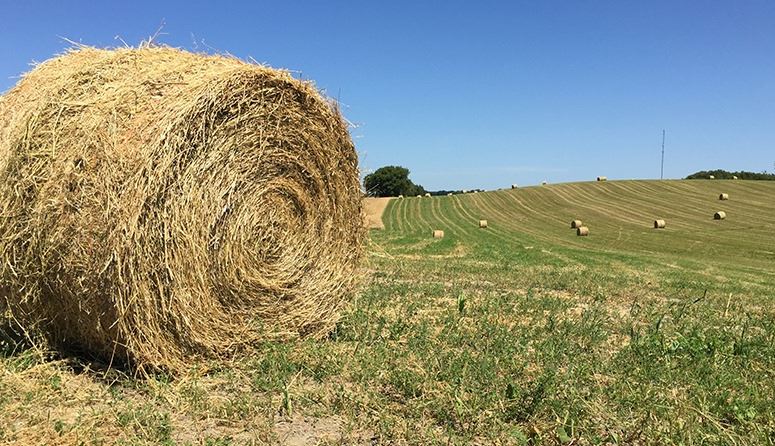
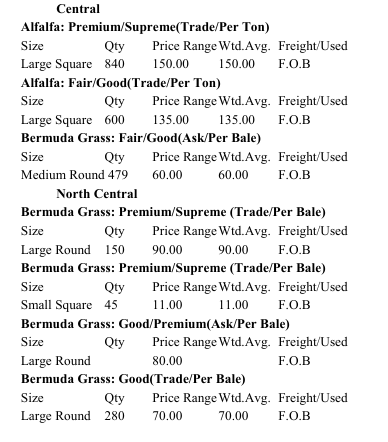
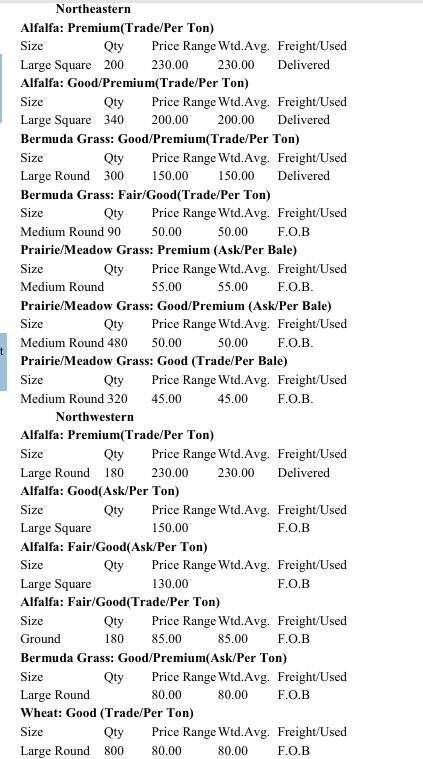
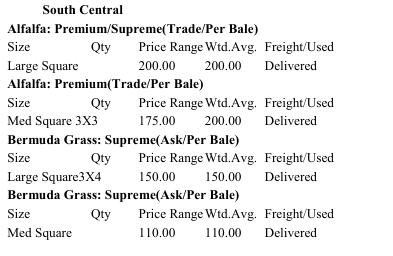
Receipts: 5,164 Last Reported: 4,635 Year Ago:4,146 Compared to the last report, the hay trade is slow to steady. Rain continues to move across Oklahoma and will continue for most of November. Some hay has been sold to new customers, but most of the movement of the trades are still mainly long-time customers and contracted hay
Trends: Alfalfa Large rounds & squares $130-$150 a ton - 2024 Grinding hay - No Trend
Bermuda 5x6 rounds - $70-$90 a bale - 2024
Bermuda 5x6 rounds - $50-$55 a bale - Year Old Hay
Bermuda Large Squares - No Trend
Wheat Hay 5x6 Round and Large Squares - $80-$90 a Ton - 2024 Grass Hay 4x5-4x6 - $45-$55 a bale - 2024
Grass Hay 4x5-4x6 Unfertilized hay - $25-$35 - 2024
Grass Hay 5x6 - No Trend Rough Grass
Hay any size $25 a bale - Year Old Hay
The Oklahoma Mesonet Drought Monitor shows we are at 0 percent in exceptional drought, 0 percent in an extreme drought, 1.85 percent in severe drought, 17.90 percent in moderate, and 52.78 percent in abnormally dry conditions, and 47.22 percent that has no drought conditions.
*** The next report release will be on December 6th ***
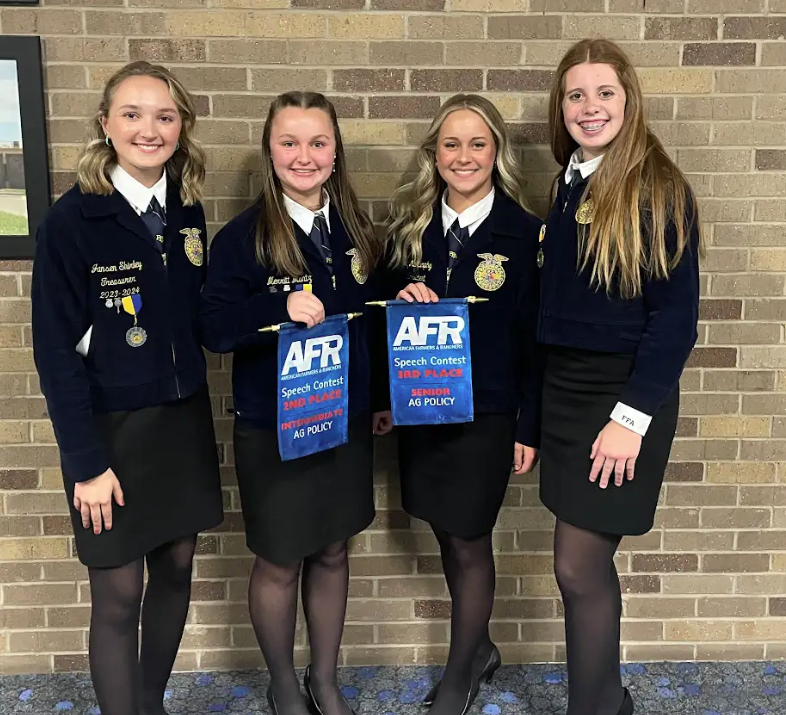
On November 21, 2024, four Alva FFA members competed in the Northwest Area
American Farmers and Ranchers Speech Contest. Merritt Mantz competed with her speech "One
Second," about educating people on the importance of safety in agriculture in the Intermediate
Agriculture Policy category and placed second, advancing to state. Avery McMurphy competed
with her speech "The Manhattan Project," about agriculture terrorism in the Senior Agriculture
Policy category and placed third.
Katelee Martin competed with her speech "The Solution to
Pollution," about sulfur pollution and fertilizers in the Senior Natural Resources category and
placed fifth. Jansen Shirley competed in the Senior Extemporaneous category.
Prepared speeches are six to eight minutes long, with five minutes for questions. To
compete in extemporaneous speeches, competitors receive a question for their speech to answer
and they have thirty minutes to research and create a speech on that question. They then give
their speech and answer questions.
This was the first speech contest of the year and these
members did phenomenally. Merritt Mantz will compete at the State AFR Speech Contest on
December 7, 2024, on the Oklahoma State University campus in Stillwater, Oklahoma
President-elect Donald Trump has selected Jamieson Greer as nominee for the position of United States Trade Representative.
Josh Gackle, American Soybean Association president and soy farmer from North Dakota said, "ASA congratulates Jamieson Greer for his nomination to serve as United States Trade Representative. Soybeans are the United States' largest agricultural export, and USTR's work at addressing market access and non-tariff issues is critical for continued market growth. ASA looks forward to working with Ambassador-Designate Greer on issues of importance to U.S. soybean farmers."
Both soy farmers and staff at ASA look forward to working with Greer and other members of the incoming administration as the industry continues to advance U.S. soy in the global marketplace.
Oklahoma State University Extension Livestock Market Economist Dr. Derrell Peel says it will take most of December to get up and running when it comes to feeder cattle being imported from Mexico into the United States. Dr. Peel provides this chart below that shows that typically about 22 percent of Mexican cattle come in November and December. He explains "If we assume that half of November and all of December is impacted, I estimate that imports will drop by about 250,000-300,000 head from what would have otherwise been imported. That's about an 18 percent drop in annual imports. It looked previously like we were on track to import about 1.5 million head and now it looks like 1.2 - 1.3 million head."
According to Dr. Peel- "USDA is saying that the border (west of Texas) could be open in about three weeks. They could have the pens ready and USDA approved in that time. But seven days quarantine after they start checking animals would mean essentially no more animals in 2024. I doubt that the quarantine period could start any sooner than the three weeks preparation. " Dr. Peel adds that the biggest port is Santa Teresa, New Mexico. That will be the most important one to get things moving again.
The Texas Cattle Feeders has discussed the process and timeline in a special email to their membership. According to TCFA: USDA-APHIS' goal is to reopen some of the cattle crossings in the next three weeks or so. (as discussed above by Dr. Peel)
USDA-APHIS spent 3½ hours on a call with their Mexican counterparts on Monday to outline and discuss expectations. The length of time it takes to reopen the crossings is largely dependent on how quickly Mexico moves.
Crossings where cattle are inspected on the Mexican side of the border will reopen first. For now, that means the crossings in New Mexico and Arizona. Reopening the crossings where cattle are inspected on the U.S. side of the border will take more time. Recall that because of safety concerns for USDA employees on the border several years ago, cattle inspections at several crossings were moved to the U.S. side.
USDA-APHIS is requiring that the Mexican government establish additional pre-export pens to verify the safety of Mexican cattle. As soon as the Mexican government identifies the pre-export pen locations, USDA-APHIS veterinarians will visit those facilities and approve them for use as pre-export pens. Memorandums of Agreement will also be executed with those facilities.
At these pre-export pens, cattle would be inspected by a Mexican government veterinarian to verify cattle identification and cattle health status. The cattle would also receive ivermectin by injection and be held/quarantined for 7 days at the pre-export pens.
After the 7-day quarantine period, cattle will be given a health certificate and allowed to move to approved ports in Chihuahua and Sonora. At the ports, cattle will be subjected to the normal crossing protocols, where they are dipped and inspected by USDA-APHIS veterinarians.
The primary prevention measure of New World Screwworm is production and distribution of sterile flies. Today, there is only one remaining sterile fly production facility that is located in Panama. Mexico is working to retrofit fruit fly facilities to ramp up production of sterile flies to help build a barrier between Mexico and Guatemala. (Editor's note- that will take months- if not years)
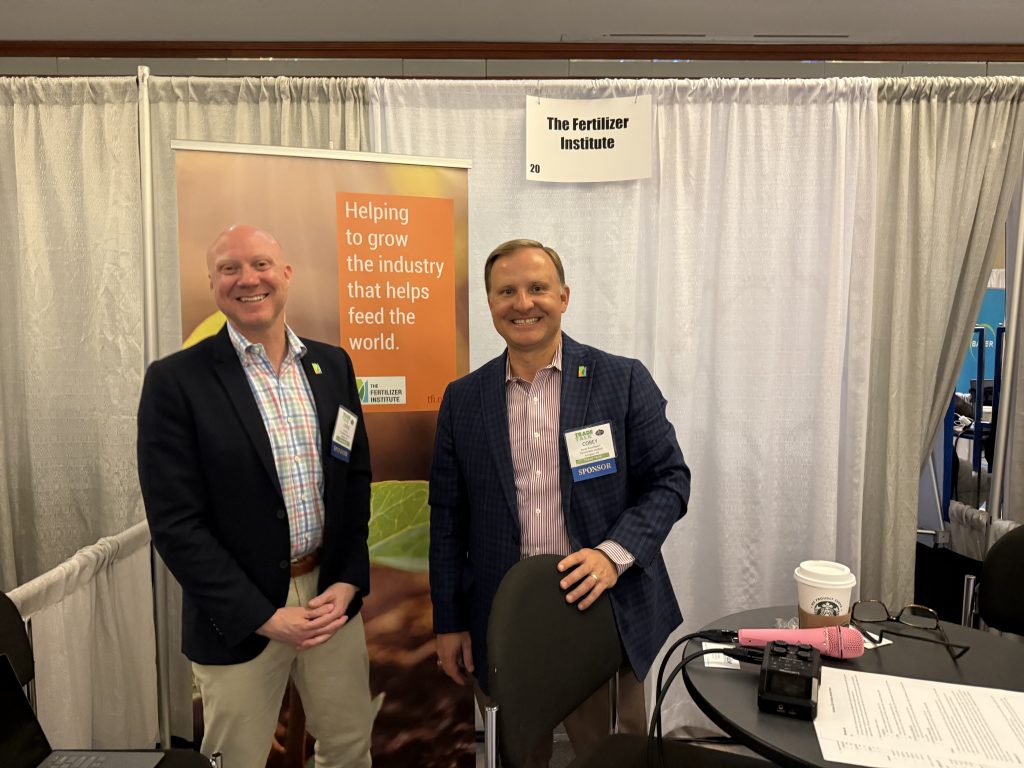
At the National Association of Farm Broadcasters Convention, Farm Director KC Sheperd stopped by The Fertilizer Institute booth where she spoke with the organization's President and CEP Corey Rosenbusch.
While fertilizer prices are fifty percent lower than last year and still below the ten-year average, Rosenbusch said that there is always a crisis in his realm, citing the rail crisis in Canada and the Florida hurricane's impact on phosphate production.
As far as the election, Rosenbusch said that The Fertilizer Institute was prepared for any outcome. "From a positive standpoint, I think we are all optimistic that we are going to see a lot of regulatory pressures lifted," he commented. "On the flip side, we are really concerned with what Trump does with trade and the Inflation Reduction Act. A lot of our member companies have invested billions because of the incentives of the 45 Tax credits. Fertilizer was named in one of the requirements of some of the grower sustainable jet fuel 45 Tax Incentive."
Nearing the end of his previous term as president, Trump made the fertilizer industry happy when he approved the use of phosphogypsum. "It is a byproduct of phosphate production, and companies spend hundreds of millions of dollars maintaining those in giant stacks – the mountains you see in Florida," Rosenbusch explained. "He allowed for that to be used in road construction to contribute to the circular economy."
Within two months of taking office, the Biden Administration reversed the decision, so The Fertilizer Institute hopes that it will be within the initial priorities of executive orders when the new Trump administration takes office.
Another concern for The Fertilizer Institute is the falling levels of the Mississippi River. Rosenbusch heard through a member with a terminal on the lower Mississippi that they haven't been able to get barges into their terminal since June. Subsequently, all deliveries are moving via rail or truck, which increases costs by five or six times normal.
"At the end of the day, that all gets passed down to the grower, then ultimately to us as consumers," he stated.
He is looking forward to hosting the 4R Farmer Advocates in Washington D.C. "They tell a great environmental, nutrient, and stewardship story around our four Rs of applying fertilizer at the right source, rate, time, and place. If there are any growers out there interested in telling their story and the good work they are doing, the application process opens in January. Talk to your local ag retailer, and we will get them nominated in addition to bringing them to D.C. a couple of times a year to talk to policymakers, attend conferences, and the Commodity Classic. They are terrific communicators for the industry."
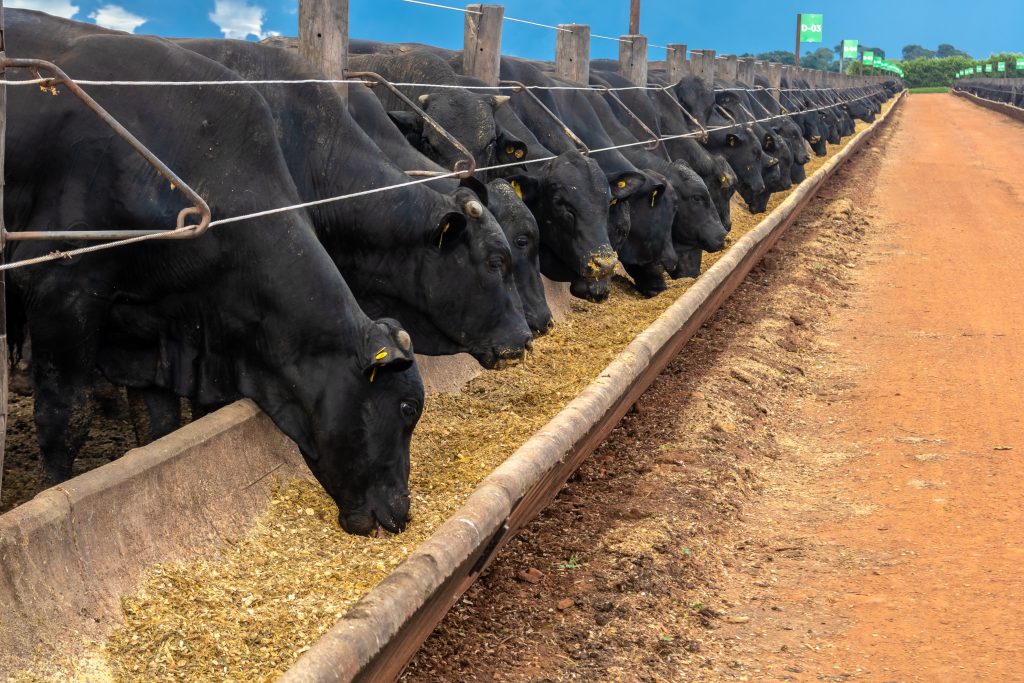
Oklahoma State University Extension Livestock Market Economist Dr. Derrell Peel says it will take most of December to get up and running when it comes to feeder cattle being imported from Mexico into the United States. Dr. Peel provides this chart below that shows that typically about 22 percent of Mexican cattle come in November and December. He explains "If we assume that half of November and all of December is impacted, I estimate that imports will drop by about 250,000-300,000 head from what would have otherwise been imported. That's about an 18 percent drop in annual imports. It looked previously like we were on track to import about 1.5 million head and now it looks like 1.2 - 1.3 million head."
According to Dr. Peel- "USDA is saying that the border (west of Texas) could be open in about three weeks. They could have the pens ready and USDA approved in that time. But seven days quarantine after they start checking animals would mean essentially no more animals in 2024. I doubt that the quarantine period could start any sooner than the three weeks preparation. " Dr. Peel adds that the biggest port is Santa Teresa, New Mexico. That will be the most important one to get things moving again.
The Texas Cattle Feeders has discussed the process and timeline in a special email to their membership. According to TCFA: USDA-APHIS' goal is to reopen some of the cattle crossings in the next three weeks or so. (as discussed above by Dr. Peel)
USDA-APHIS spent 3½ hours on a call with their Mexican counterparts on Monday to outline and discuss expectations. The length of time it takes to reopen the crossings is largely dependent on how quickly Mexico moves.
Crossings where cattle are inspected on the Mexican side of the border will reopen first. For now, that means the crossings in New Mexico and Arizona. Reopening the crossings where cattle are inspected on the U.S. side of the border will take more time. Recall that because of safety concerns for USDA employees on the border several years ago, cattle inspections at several crossings were moved to the U.S. side.
USDA-APHIS is requiring that the Mexican government establish additional pre-export pens to verify the safety of Mexican cattle. As soon as the Mexican government identifies the pre-export pen locations, USDA-APHIS veterinarians will visit those facilities and approve them for use as pre-export pens. Memorandums of Agreement will also be executed with those facilities.
At these pre-export pens, cattle would be inspected by a Mexican government veterinarian to verify cattle identification and cattle health status. The cattle would also receive ivermectin by injection and be held/quarantined for 7 days at the pre-export pens.
After the 7-day quarantine period, cattle will be given a health certificate and allowed to move to approved ports in Chihuahua and Sonora. At the ports, cattle will be subjected to the normal crossing protocols, where they are dipped and inspected by USDA-APHIS veterinarians.
The primary prevention measure of New World Screwworm is production and distribution of sterile flies. Today, there is only one remaining sterile fly production facility that is located in Panama. Mexico is working to retrofit fruit fly facilities to ramp up production of sterile flies to help build a barrier between Mexico and Guatemala. (Editor's note- that will take months- if not years)
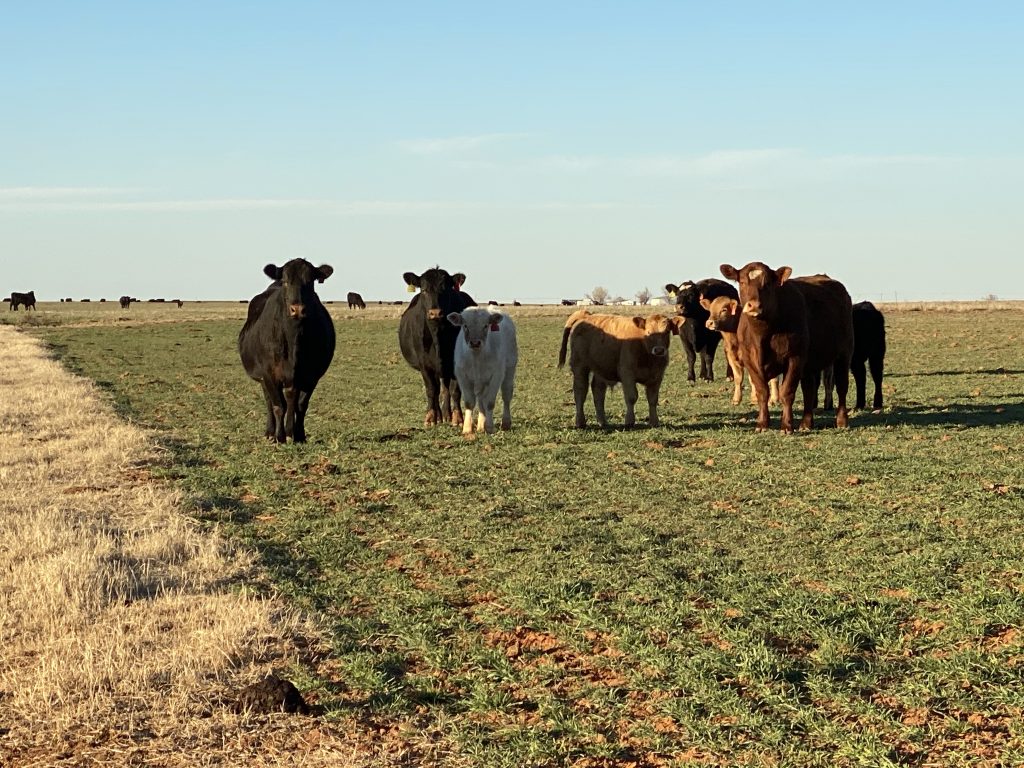
Weekly, Oklahoma State University Extension Beef Cattle Nutrition Specialist Paul Beck offers his expertise on the beef cattle industry. This is a part of the weekly series known as the "Cow-Calf Corner." Today, he talks about when producers can turn cattle out on wheat pasture.
It has been a tough wheat pasture year for most of the wheat producing areas in the Southern Great Plains. With rains in August, many of us were optimistic about our prospects for another good year for grazing calves on wheat. Other than a few areas that caught some rain, most of us missed any precipitation for right at 60-days. The Oklahoma Mesonet (https://www.mesonet.org/) shows that most of the area has received 8 to 10 inches of precipitation since the end of October. That has led to many phone calls and conversations asking when wheat pasture will be ready for grazing.
A good rule of thumb for stocking wheat pasture, is we need to accumulate 4 to 5 pounds of forage dry matter per pound of steer bodyweight at turnout on pasture to maximize grazing performance through the fall and winter. This would be a total of 2,500 pounds of forage for a 500 pound calf. At a stocking rate of 2 acres per steer, we need 1,200 to 1,300 pounds of forage growth per acre. If you estimate 200 pounds of forage per inch of forage height at the main mass of tillers (not the tallest tiller) in a good thick stand of wheat pasture, the wheat should be 6 to 7 inches deep on average across the field.
Wheat and other small grains produce about 3.3 pounds of forage dry matter per growing degree day. This concept is based on the critical temperature for growth for each forage species and is calculated by: Growing Degree Day = Average Daily Temperature – Critical Temperature. For wheat, I use a critical temperature of 42°F, while for rye and triticale the critical temperature for growth is 38°F. The slightly lower critical temperature for rye and triticale seems like very little difference but can have a large impact on growth potential as we get into cooler conditions.
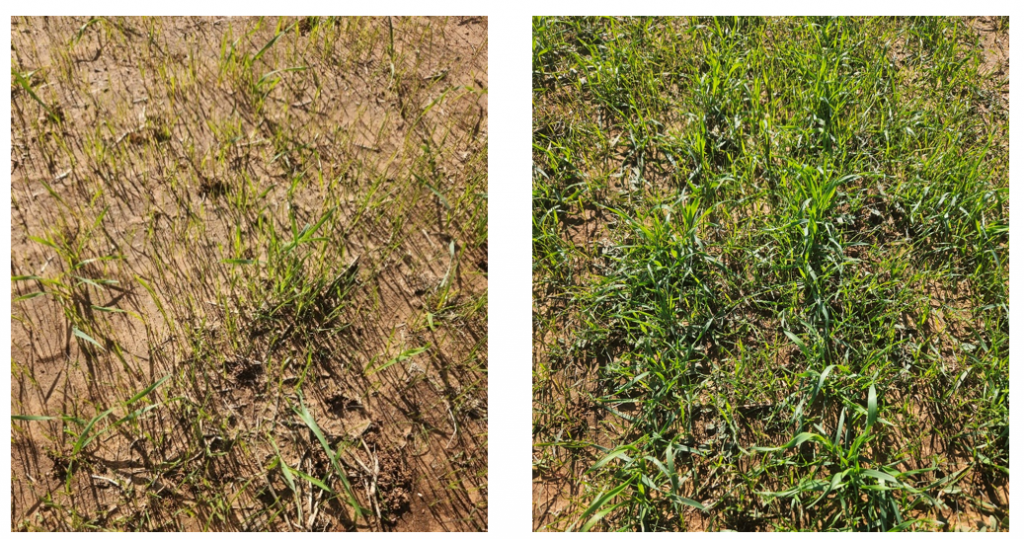
Below, the picture on the left is of a stand of triticale and ryegrass in a crop field in Central Oklahoma on November 12th. It has just emerged following the recent rains. The picture on the right is at the same spot on November 22nd. The stand is progressing rapidly with the great growing weather, so by the end of the month we should have 850 to 900 pounds of forage growth. Based on projected temperatures for the next month with average daily temperatures of around 44°F, we should expect 15 to 20 pounds of additional forage growth per day, reaching 1,200 pounds of forage accumulation by December 20th.
Here is another picture of a wheat field in Southern Oklahoma taken on November 10th, with a good bit of growth and tillering. This field has already accumulated about 200 - 300 pounds of forage per acre. By the end of the month, we expect another 900 pounds of forage growth per acre. So, for this field turnout will only be about 30 days later than our normal expected turnout date of November 1.
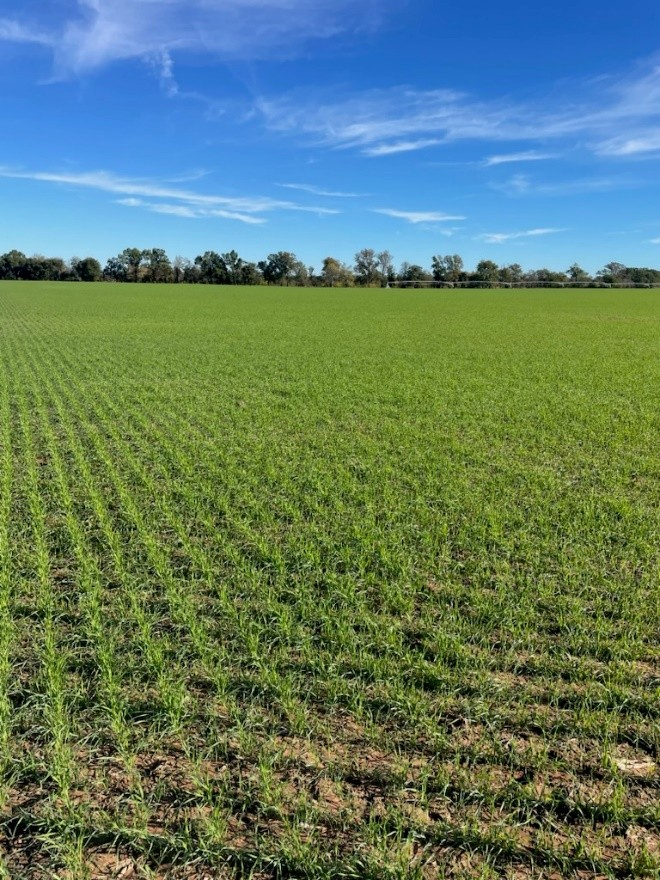
Don't turn cattle out on wheat pasture too early. Waiting just a few days for the stand to adequately develop will make a huge difference in the longevity of the stand and the performance of the calves on pasture.
OSU Extension beef cattle specialist Paul Beck talks about wheat pasture growth on SunUpTV from October 16, 2021 at https://www.youtube.com/watch?v=Sf26Q9270eY
RON's Dave Lanning has a pre-opening look at today's agricultural Markets.
Click the audio tab below for today's report.
Just ahead of the Thanksgiving holiday- Oklahoma Farm Report's Ron Hays talks with the Executive Vice President of the Oklahoma Cattlemen's Association, Michael Kelsey.
They start their visit talking about the concern US cattle producers have over the discovery of screwworms in southern Mexico- near the border with Guatemala. They also talk about what was on the mind of cattlemen and cattlewomen that attended the 2024 Fall Gatherings of the OCA.
Kelsey also updates us on the Oklahoma Cattlemen's Foundation putting a pause on their fundraising efforts to renovate and expand the OCA headquarters building located adjacent to the Oklahoma National Stockyards. They are waiting to see how the efforts to sell the Stockyards go before making any decisions about whether to proceed with their earlier announced plans on their building.
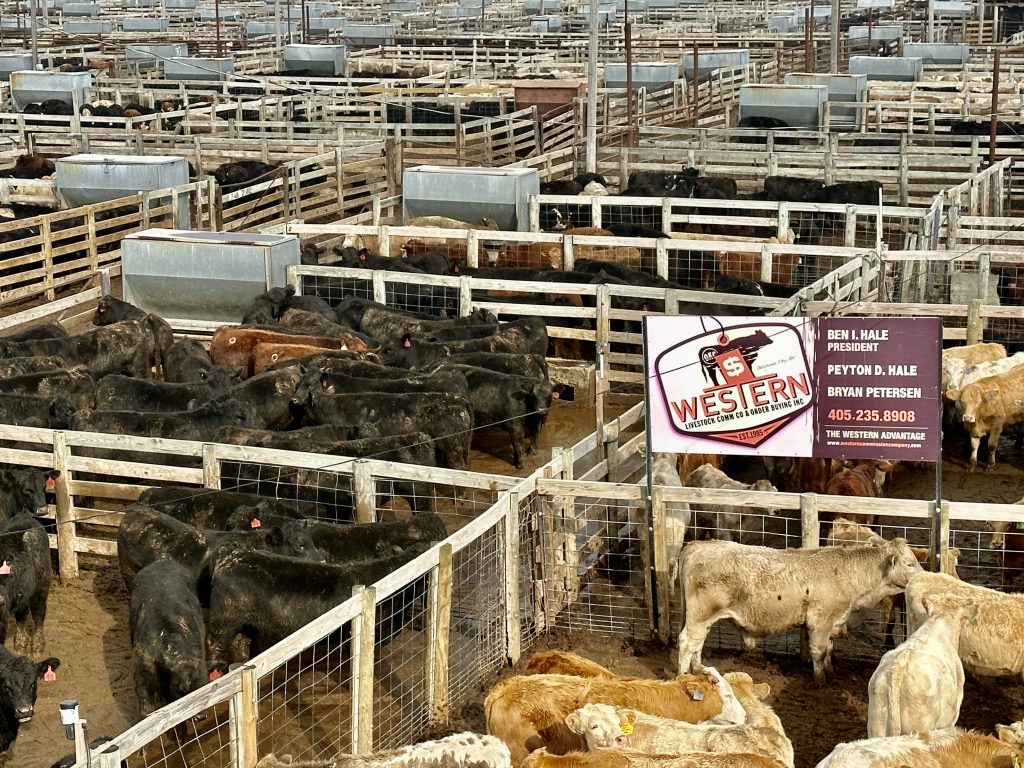
Ben Hale Reports on the Monday November 25h market from the Oklahoma National Stockyards. USDA Market News reported that the Oklahoma National Stockyards sold 6,342 on Monday. Hale says that this week's sale featured the highest priced cattle he has sold in the 30 years that he has been Marketing cattle and probably one of the single biggest jumps in the market across all classes of cattle. Here's his commentary after the Monday auction:
On Tuesdays, Senior Farm and Ranch Broadcaster, Ron Hays, visits with Ben Hale of Western Livestock Auctions as he talks about the latest in the markets and more. Established in 1995, Western has grown into a multi-generational family-owned and operated business and stands as a symbol of tradition, excellence, and a deep-rooted passion for the cattle industry. Western Livestock Auctions operates the Western Livestock Commission Firm- selling cattle on Mondays and Tuesdays. They also operate the livestock auction markets in Woodward, Comanche and Knoxville, Iowa.
Click on the Listen Bar Above to listen to Ben's report from the Western Commission Company's Facebook page this week, as he describes the sharply higher prices seen just ahead of the Thanksgiving holiday.
Hale can be contacted at 940-631-2333. Check out more about the marketing options that Western offers by clicking here.
AFBF and other industry coalition members achieved a crucial win yesterday that will help farmers across the country. AFBF and its partners were granted a preliminary injunction by the United States District Court for the Southern District of Mississippi barring the Department of Labor (DOL) from enforcing its Worker Protection Rule extending unionization rights to H-2A visaholders.
American Farm Bureau Federation President Zippy Duvall commented today on the litigation and the district court's nationwide injunction barring DOL's rule:
"Farmers appreciate the dedicated men and women who choose to work on their farms, and they take seriously the responsibility of ensuring a safe workplace. Farm Bureau agrees that workers should be treated fairly and respectfully. We also believe fairness to farmers is important and the DOL rule was overly broad to the point of being unlawful.
We appreciate that the court recognized the overreach of the rule. We urge the DOL to go back to the drawing board and engage with H-2A employers to better understand the impact more regulations will have on the men and women who work to ensure America's families have food on the table."
Two other courts previously blocked the rule in several states and for certain groups, but AFBF's lawsuit was the first to stop key aspects of the rule for all farmers nationwide. Read the full stay order here.
Last week, the U.S. Department of Agriculture (USDA) announced a series of investments to support community-operated irrigation systems, including the historical systems of the southwest known as acequias, to implement water conservation practices while continuing agricultural production as part of the Water-Savings Commodities Program.
Through the Water-Saving Commodities Program, the agency has allocated $15 million to help acequias in New Mexico and Colorado, the only places in the country where these historical systems are still operational. USDA will be working closely with the New Mexico Association of Conservation Districts and the Colorado Association of Conservation Districts to provide technical assistance, outreach, and education to ensure the continued ability of these systems to conserve water resources during ongoing drought conditions. This announcement also includes the preliminary selection of three Congressionally authorized Indian Irrigation Projects.
"The USDA's effort, together with the ongoing partnership with state associations underscores the importance of community-based water management, providing farmers with the tools they need to thrive despite growing water scarcity challenges," said NACD President Kim LaFleur. "These investments build on existing efforts by local conservation districts to enhance irrigation systems and ensure water is used responsibly while maintaining agricultural productivity." Acequias are community operated water systems that play a crucial role in managing surface waters in high desert environments that not only irrigate fields but also replenish rivers, wetlands, and groundwater in the region. New Mexico alone has nearly 800 individual acequias that have been in place since the 17th and 18th centuries. The San Luis Valley in southern Colorado has more than 70 acequias that provide water resources to over 300 families. Other historical acequias in the southwest have been incorporated into irrigation systems and districts over the years. With the addition of acequias and Indian Irrigation Projects, the Water-Savings Commodities partnerships are expected to conserve up to 50,000 acre-feet in water use across 250,000 acres of irrigated land in production, while expanding and creating new, sustainable market opportunities.

Oklahoma Farm Report's Ron Hays talked with Executive Vice President Michael Kelsey of the Oklahoma Cattlemen's Association about the encroachment of the New World Screwworm into southern Mexico as it has marched from Panama in recent months across Central America.
On November 22, 2024, the Chief Veterinary Officer of Mexico notified the United States Department of Agriculture's Animal and Plant Health Inspection Service (APHIS) of a positive detection of New World screwworm (NWS) in Mexico. The NWS was found in a cow in the southern Mexico state of Chiapas, at an inspection checkpoint close to the border with Guatemala. NWS are fly larvae that infest the living tissue of warm-blooded animals, causing infection.
"There is really nothing 'New World' about this," Kelsey said. "It is the same pest that the cattle industry became very familiar with back in the '30s, '40s, and '50s. Then we eradicated them in the mid-'60s."
It cost about $750 million to eradicate the flies in the '60s, so that number would translate to a much higher cost in today's economy if they were to make a comeback.
Mexico eradicated them in the '90s, and other southern countries had pushed the population all the way to the Darién Gap of the Panama Canal, then continued to fund the release of sterile male flies into the population to breed them into extinction.
"Mexico lost one of their fly facilities, so there is only one sterile fly facility in Panama that has been producing flies for some time now," Kelsey said. "We have been working in concert with NCBA for several months, and saw it come around some of those Central American countries."
Panama reported 23 cases in 2022, but several thousand in 2023. In the last two years, screwworms have spread north throughout Panama and into Costa Rica, Nicaragua, Honduras, Guatemala, and now Mexico. This increase is due to multiple factors including new areas of farming in previous barrier regions for fly control and increased cattle movements into the region.
APHIS initiated a stop-movement order on all bovine preventing them from being brought into the United States. "We understand from USDA that they are working on some protocols to allow cattle trade to resume, but it will be very specific in terms of quarantines on the southern side of the border to make sure those cattle are clean before they are brought in," Kelsey explained.
According to Kelsey, the fly's life cycle is pretty basic, so the quarantine should be pretty straightforward and effective. "We have a lot of treatments that we didn't have back in the fifties and sixties that will allow us to manage them much more effectively, but we just don't want to get to that point at all."
Ivermectin is one of the most effective treatments today.
OCA has been in communication with their congressional delegation for information but is also pushing for USDA to strengthen its protocols to assist Mexico.
"Every dollar we send to Mexico to assist in fly strategies is a very efficient use of funding because if the fly gets to this country, we are going to have to spend way more," Kelsey said. "The efficient use of funds at this time is to help Mexico re-establish that bio-border and push that fly back into the Central America area."
He emphasized the importance of remaining aware of signs of the fly and persistent in its eradication. He talked in more depth about how the flies were dealt with in the first infestation, so be sure to click the listen bar at the top of the page to hear the complete conversation.
The Beef Buzz is a regular feature heard on radio stations around the region on the Radio Oklahoma Ag Network and is a regular audio feature found on this website as well. Click on the LISTEN BAR at the top of the story for today's show and check out our archives for older Beef Buzz shows covering the gamut of the beef cattle industry today.
For more than 40 years, the American Angus Association's Angus Heritage Foundation has recognized the passion, dedication and perseverance of individuals whose life's work has made a lasting impact on the Angus breed. Today more than 80% of the U.S. cow herd is Angus-influenced. The forward-thinking action of the 2024 Heritage Foundation inductees contributed to that market share and helped position The Business Breed as a leader in the industry.
The 2024 inductees include: Bill and Sally Bowman, St. Joseph, Missouri; Dave and Yvonne Hinman, Malta, Montana; Bob and Jim Sitz, Harrison, Dillon, Montana; and Harlan Ritchie (posthumously), East Lansing, Michigan.
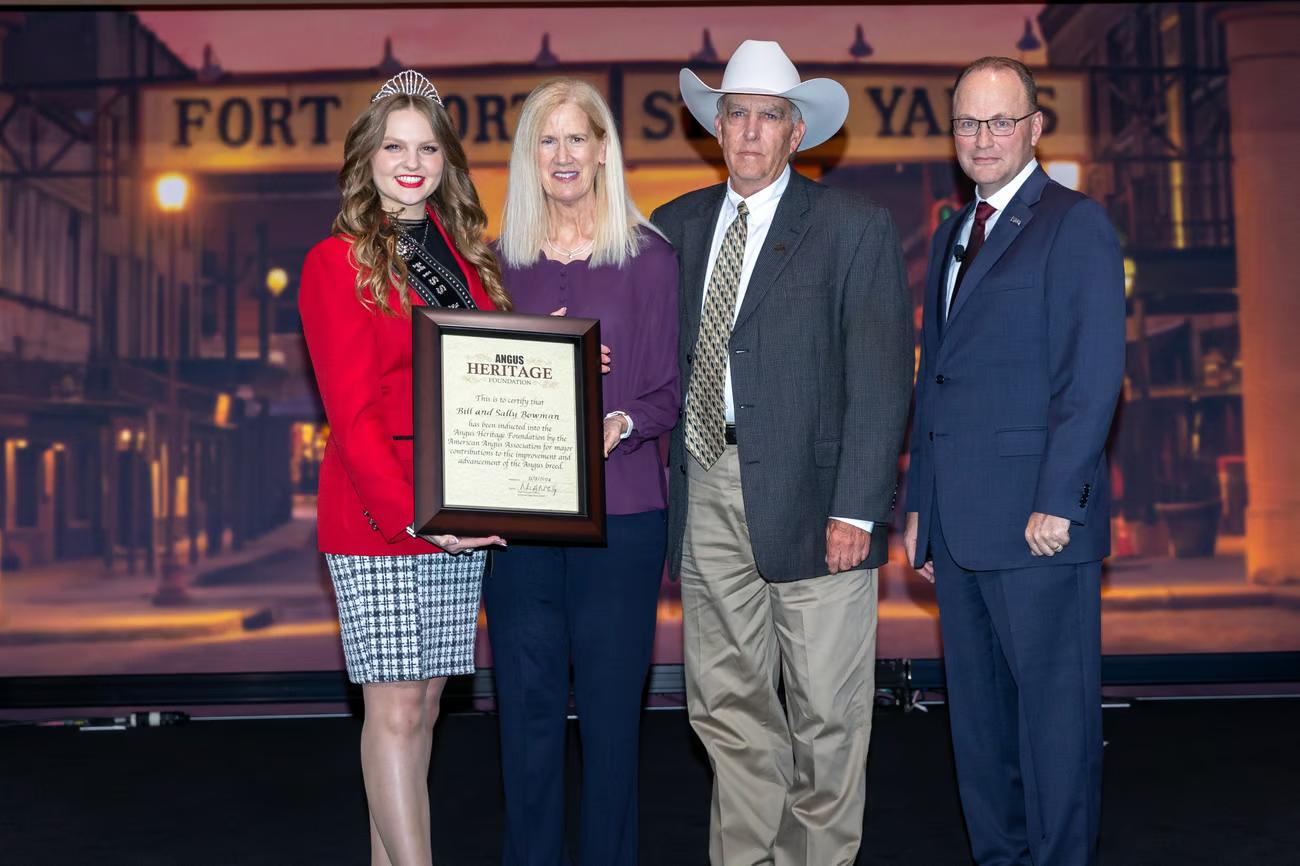
Bill and Sally Bowman
Bill and Sally Bowman traveled separate paths to Angus, but their shared teamwork helped transform genetic tools and producers' ability to use them. Bill's grandfather first taught him about livestock, and his small herd started as a junior high FFA project. He graduated with an animal science degree from the University of Missouri and worked in various roles for the American Angus Association®, including as a regional manager, director of commercial programs, and assistant director of performance programs.
Sally Northcutt-Bowman, a native of Lexington, Kentucky, earned her bachelor's and master's degrees from the University of Kentucky and then completed a doctorate in quantitative genetics at Iowa State University. After time at Oklahoma State University, she landed at the Association, bringing the organization's genetic evaluation in-house for the first time.
"We wanted to be more fluid and be efficient and change the environment of the industry," Bill said.
During their time at the Association, the duo led the introduction of $Value indexes, genomically-enhanced expected progeny differences (EPDs) and helped create Angus Genetics Inc. (AGI®) as a standalone subsidiary of the Association. With Sally working on the data to build tools, Bill was "out in the country" helping to inspire adoption as AGI's first president.
"I am still immersed in Angus cattle and the Angus breed and will be my whole life," Sally said.
In 2014, Sally founded Method Genetics, and Bill became her first employee. The couple was married in 2017 and continue to advance the Angus breed through data-driven innovation and a strong sense of commitment to the cattlemen they serve.
Learn more about Bill and Sally's story on Angus TV.
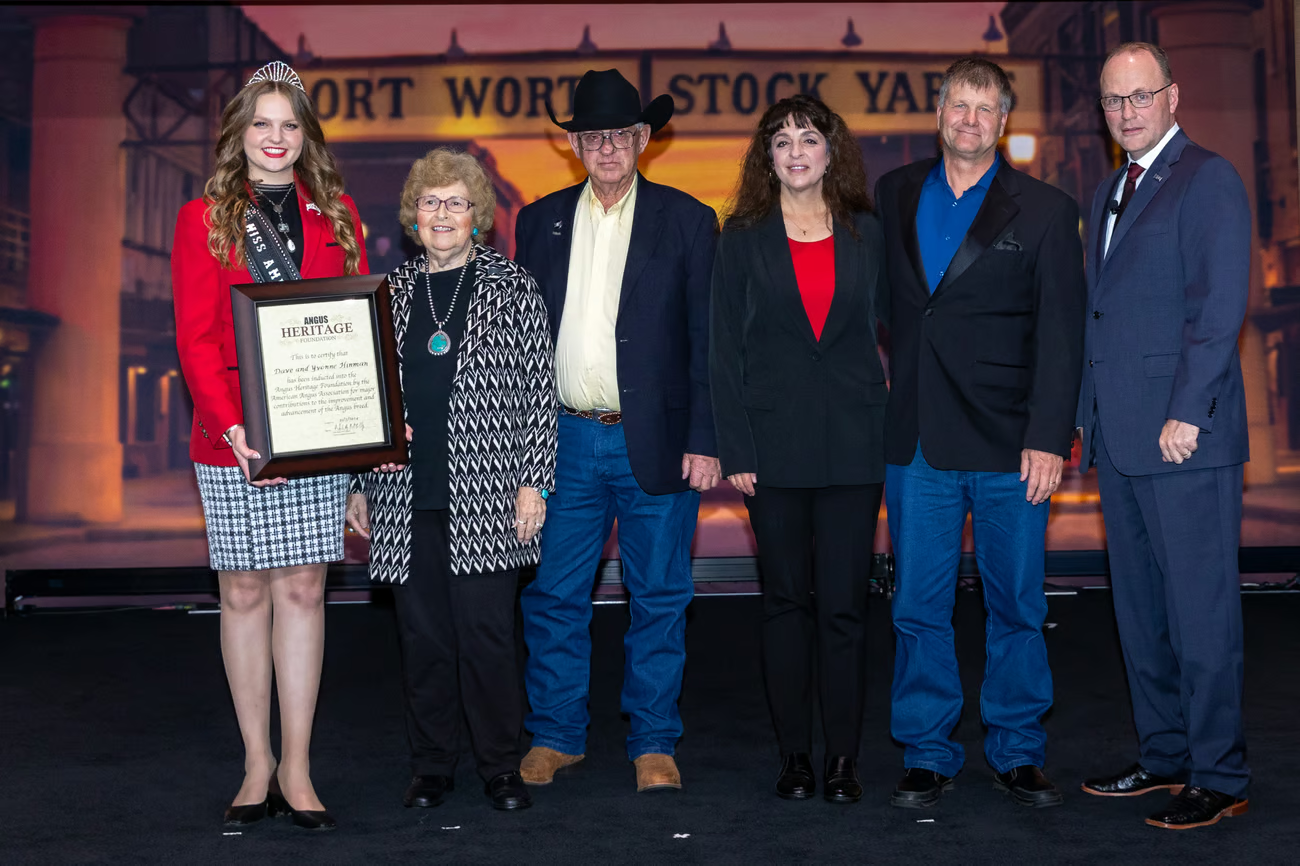
Dave and Yvonne Hinman
Pioneer breeders of performance cattle, Dave and Yvonne Hinman of Hinman Angus, have raised registered Angus cattle since 1973.
"It's a work in progress forever and it will be for the next generation and the next one," said Dave.
The couple and their daughters, Jill and Heidi, ran Hinman Angus in Willow Creek, Montana for over 25 years. In 1988, they had their first production sale, joining with Bill and Jennifer Davis and two other couples as the Performance Breeders, a group that worked together until 2008 to market registered Angus seedstock.
"The reason we wanted to do it together was at the time, we wanted more bulls in one sale," Dave said. "It worked."
In 2000, Dave and Yvonne made the move to "good old cow country" near Malta, Montana, to lease an 8,000-acre ranch and later purchase land in the area. In Malta, they have worked alongside daughter Heidi, and son-in-law Billy Lulloff for many years, mentoring them and now their grandson Tyler Lulloff. Together, the family continues to produce high-quality, reputation cattle as Hinman Angus and distribute their signature, bright yellow-covered sale books annually.
As leaders in the breed, Dave served on the Association Board of Directors from 2017 to 2023. Yvonne served as president of the American Angus Auxiliary in 1999 to 2000 and was honored as the Distinguished Woman Award in 2007. In 2005, the Performance Breeders were recognized with the Certified Angus Beef (CAB) Seedstock Commitment to Excellence Award.
"If I had advice for young breeders? I'd do this, make some friendships with older breeders that have been in the business and listen to them," Dave said. "I was very, very fortunate to have a lot of them. . . Those friendships, that's what made it so special."
Learn more about Dave and Yvonne's story on Angus TV.
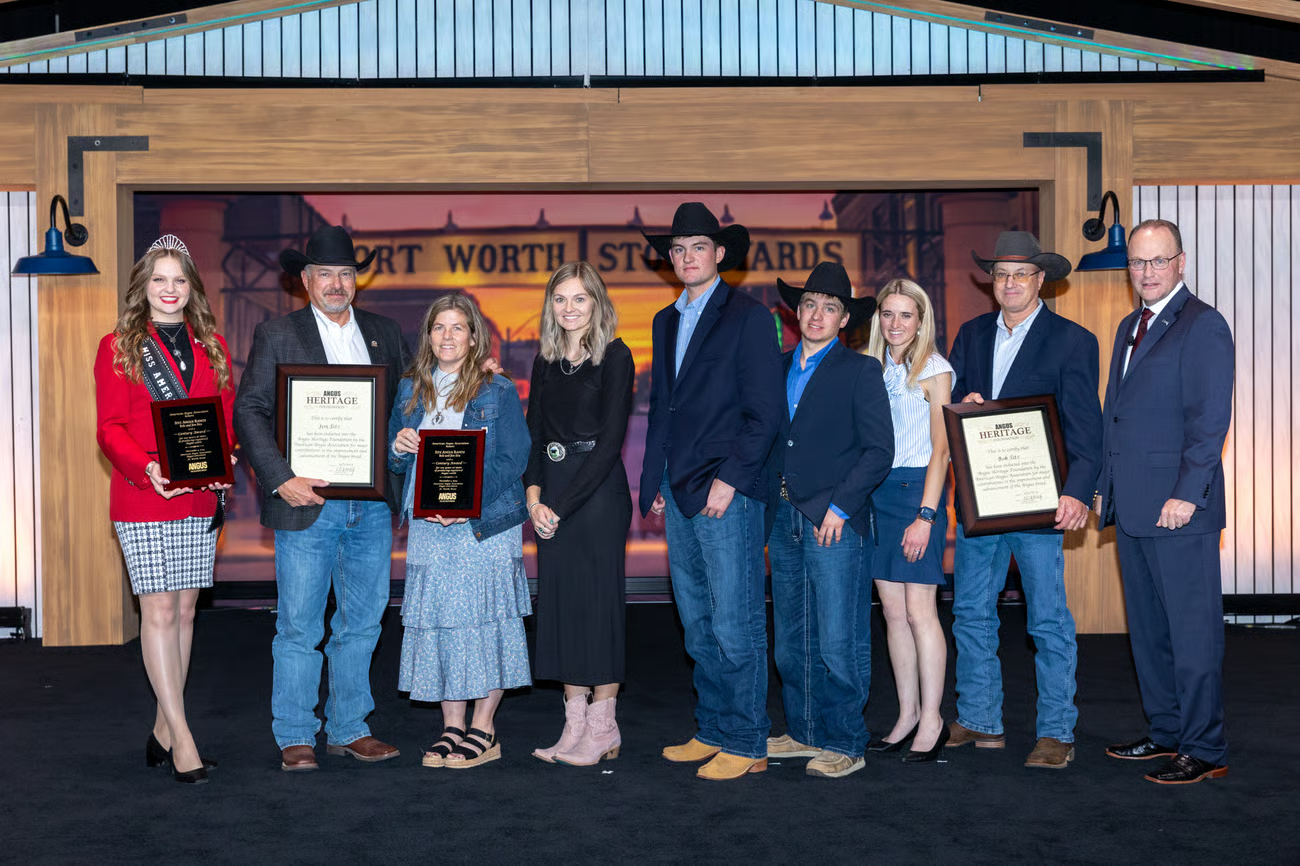
Bob and Jim Sitz
Bob (Jr.) and Jim Sitz of Harrison and Dillon, Montana, lead Sitz Angus as its third generation. They labored alongside their parents Bob (Sr.) and Donna as young men, growing a passion for Angus cattle and the cattle business. In their 20s, they chose to manage the ranch alongside their mother after the untimely death of their father in 1989.
"My dad always said, we had to be a jack-of-all-trades. That would fit Sitz Angus ranch to a T," said Jim.
Together, the brothers and their mother guided the ranch through some lean years that included a mature cow dispersal and subsequent herd rebuilding. In the decades since, they have expanded the ranch from a single location in Harrison to three properties, and they have prioritized customer relationships, adopted new technologies like embryo transfer and genomics, and improved the quality of their cattle.
"What's helped us survive for over a hundred years? I'd say adaptability," said Jim. "The consistency of knowing that the only thing constant in this world is change. When there is new technology that is brought forward, you can't be afraid to embrace it."
Sitz Angus sires consistently claim spots in annual lists of the top 25 sires for breed registration, and their reputation for being a high-quality source of maternal genetics persists.
As leaders, Bob serves the Montana Stockgrowers Association in addition to being an active member of the American Angus Association®. Jim followed in his father's footsteps, serving on the Association Board of Directors from 2009 to 2016 and as president in 2016.
Today, Jim and Bob, along with Jim's wife Tammi (Huntsman), run Sitz Angus with their families. Jim also markets customers' cattle as a representative with Northern Livestock Video Auction. The brothers continue to be long-term supporters and collectors of performance data, especially with the pulmonary arterial pressure (PAP) EPD and as a MaternalPlus® herd.
Learn more about Bob and Jim's story on Angus TV.
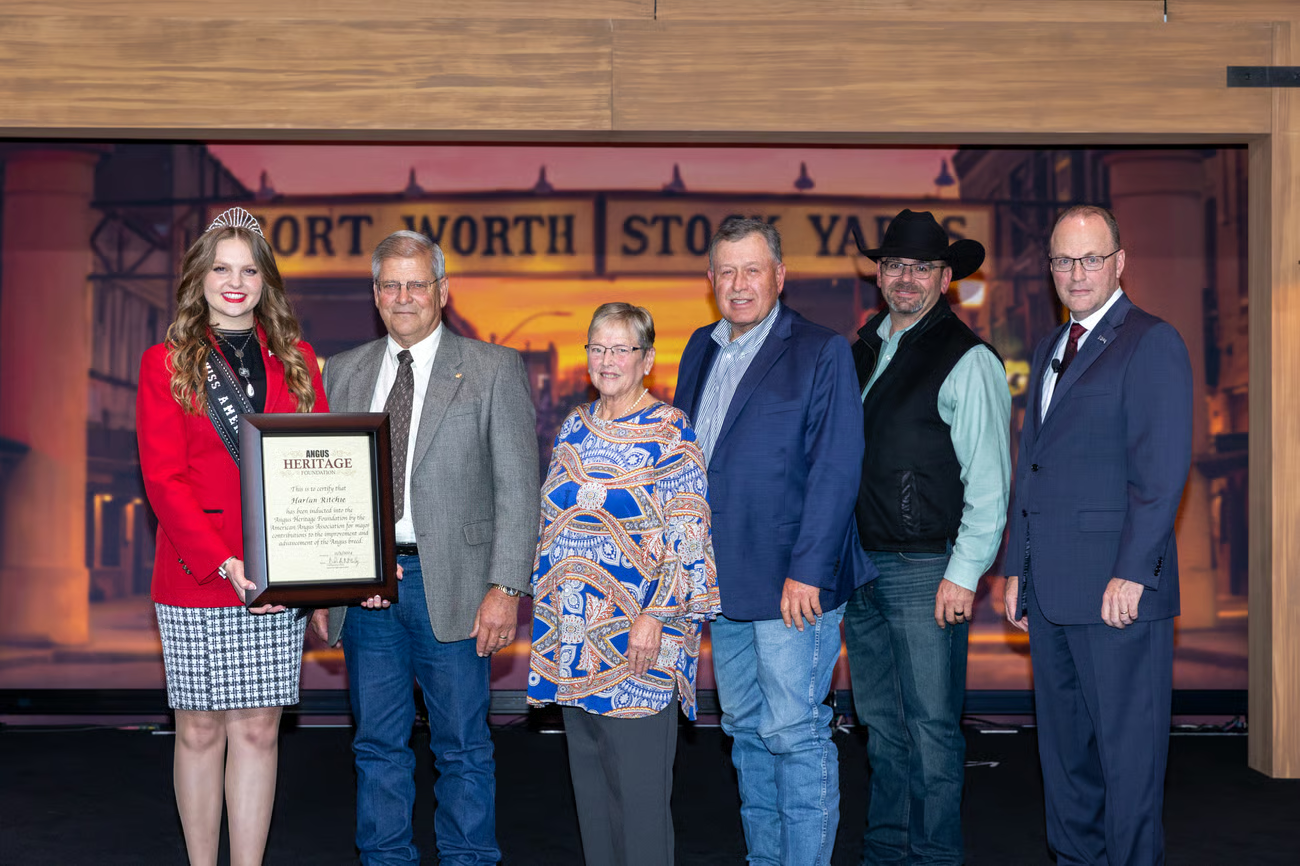
Dr. Harlan Ritchie (posthumously)
Dr. Harlan Ritchie's profound legacy and influence on the cattle industry is unmatched.
Throughout the 1960s, '70s and '80s, the Michigan State University (MSU) professor championed change, driving cattle trends with his bold selections in the show ring, groundbreaking research and published works.
"Dr. Ritchie had the innate ability to foresee the future needs of the beef cattle industry," said Ken Geuns, Ritchie's business partner in Ventura Farms.
Up until his passing in 2016, Ritchie was first and foremost a student, a seeker of knowledge. It was his constant curiosity and passion for learning that laid the foundation for him to become one of the world's leading experts on cattle. The Iowa native traveled the world speaking about his work, seeking out the value in all types of cattle and judging premier cattle shows. In the ring, Ritchie made selections that pushed the industry to think differently.
"Having the courage to walk out in front of thousands and thousands and thousands of people and slap an animal that you deem champion, that nobody else deems champion, requires tremendous courage," said Jason Rowntree, who knew Ritchie and now serves as MSU Faculty Coordinator at the Lake City Research Center where Ritchie did much of his research.
What stands out most to those who had the opportunity to cross paths with Ritchie is his generosity with his time and wisdom; always willing to have a conversation, answer questions and offer his insights.
"My dad was a very hard working, passionate person about the beef cattle industry," said Ritchie's oldest son, Bill. "He was very humble; very kind and generous."
Ritchie is remembered as a man who dedicated his life to the betterment of the cattle industry, pushing against the grain to drive meaningful and impactful change that continues to play a role in the success of today's market.
Learn more about Dr. Ritchie's legacy on Angus TV.
Registration delays are adding to uncertainty over new Clean Fuel Production Credit
Today, Clean Fuels Alliance America thanks Reps. Nikki Budzinski (D-IL) and Mike Carey (R-OH) for writing to IRS Commissioner Danny Werfel and urging the agency "to ensure that taxpayers' registrations under §45Z Clean Fuel Production Credit are completed before January 1, 2025." Under the law, registered fuel producers can only claim the credit for fuels produced after the date on their registration letter from the IRS. Many producers have not received these letters.
Treasury issued guidance in May 2024 encouraging fuel producers to register by July 15 to give the IRS sufficient time to process applications and issue the registration letters by January 1, when the credit becomes available.
"These delays are creating confusion in the marketplace and stand to have a significant negative economic impact on clean fuel producers, transportation fleets, fuel marketers, farmers and other economic sectors," the Representatives write. "We urge IRS to complete these registrations as soon as possible, and to ensure that U.S. producers who have initiated the registration process in a timely manner are found to be eligible to generate the credit beginning on January 1, 2025."
A copy of the letter from Reps. Budzinski and Carey is available on cleanfuels.org.
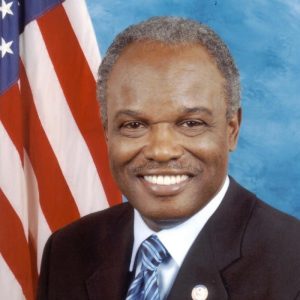
House Agriculture Committee Ranking Member David Scott today released the below statement following threats made by President-elect Donald Trump to levy 25 percent tariffs on goods imported from Canada and Mexico and 10 percent tariffs on goods imported from China.
"As American families prepare to gather for Thanksgiving dinner, President-elect Trump plans to drive up food prices by instituting reckless tariffs. Every single day, Americans visit grocery stores and buy food imported from Canada and Mexico.
"As our nation struggles to increase housing inventory to drive down the cost of living, Trump's tariffs on lumber will make housing less affordable.
"His plan to put a tariff on Canadian potash—an essential mineral in fertilizer—precisely when farmers are penciling out whether they can afford to plant a crop next year is inexplicable. Trump's tariffs will cost us at the grocery store, in our homes, and make it harder for American farmers to stay in business."
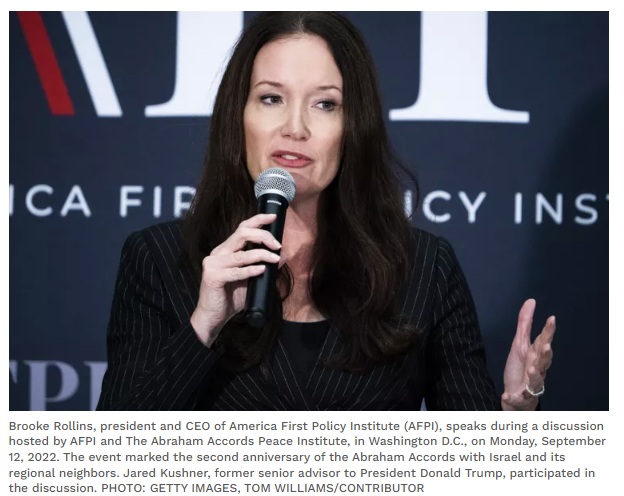
In a surprise move over the weekend, Texas attorney Brooke Rollins was announced as President-elect Donald Trump's nominee to lead the U.S. Department of Agriculture (USDA). Rollins is the president and CEO of the conservative nonprofit America First Policy Institute (AFPI), which was launched in 2021.
"As our next Secretary of Agriculture, Brooke will spearhead the effort to protect American farmers, who are truly the backbone of our country," Trump said in a statement.
The move came one day after a report from CNN pointed toward former Senator Kelly Loeffler (R-Ga.) getting the nomination. This was the last major Cabinet post to be filled in the transition to Trump's second administration, and according to reports from Politico, there was "ongoing fighting" about the position as the week went on.
CNN reported on Saturday that Rollins was an early candidate for the chief of staff role before it went to Susan Wiles — after which Rollins "told the transition team that Agriculture secretary would be another role she would be interested in." Rollins and Trump discussed the role earlier in the week, CNN sources said.
In a post on X following the announcement, Rollins said, "It will be the honor of my life to fight for America's farmers and our nation's agricultural communities."
Reactions have rolled in from national ag groups in the past 48 hours, but who is Rollins, and why has the Trump loyalist been picked to lead the USDA?
The 52-year-old Rollins hails from Glen Rose, Texas, where she grew up on a family farm and participated in FFA, where she served as a state officer, and 4-H. Rollins stayed involved with both of those organizations and has been hands-on in the show cattle careers of her four children. The Rollins family lives in Fort Worth, Texas.
In a post on X Sunday, thanking people for well wishes after the nomination announcement, she highlighted her agriculture teacher at Glen Rose High School, Gary Rosenbusch, saying he changed her life.
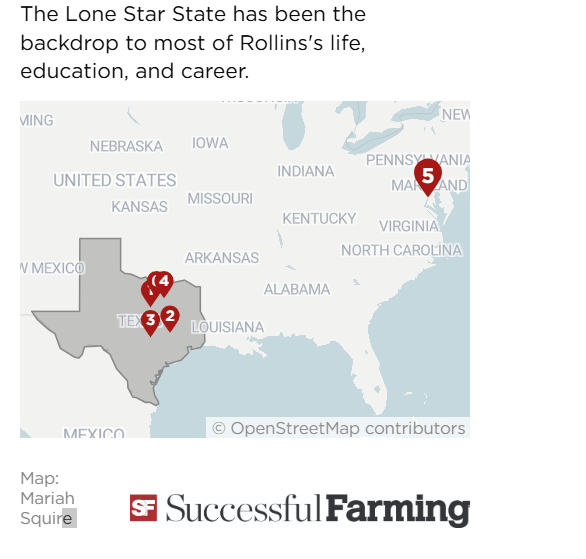
Rollins attended Texas A&M University, where she became the first woman to be named student body president, and graduated with an undergraduate degree in agricultural development in 1994. Rollins then earned her law degree from the University of Texas.
Post-law school, Rollins worked at Hughes & Luce LLP, a law firm in Dallas that has since merged with K&L Gates. She also served as the president and CEO of the Texas Public Policy Foundation (TPPF) for 15 years, and worked as former Texas governor Rick Perry's policy director. In 2018, Rollins was named an assistant to the president for intergovernmental and technology initiatives and director of the Office of American Innovation. She held these positions until May 2020, when Trump appointed her director of the Domestic Policy Council until the end of his first administration.
Trump to Nominate Brooke Rollins of Texas as USDA Secretary
After Trump left office in 2021, Rollins co-founded the AFPI alongside former Trump adviser Larry Kudlow. Rollins has served as the AFPI's president and CEO since its inception. She also rejoined the TPPF board of directors in April 2021.
During her first year in the Trump administration, Rollins reportedly helped with the First Steps Act — a bill which overhauled the criminal justice system and was signed into law in December 2018.
While Rollins was at the TPPF, the organization pushed a lawsuit seeking to overturn the Affordable Care Act along with influencing various other conservative policy initiatives in Texas.
Agriculture Industry Reacts to Nomination of Brooke Rollins as Secretary of Agriculture
In her role at the AFPI, Rollins and the organization were involved heavily with the Trump 2024 campaign on policy issues. The organization has published an agenda on its website with 10 "pillars," and states that "American citizens need policies that put them first instead of policies that stand in their way." There is little information on the AFPI website or in the nonprofit's agenda about how AFPI views agriculture policy — other than statements calling for the banning of Chinese ownership of U.S. farmland. Rollins' ag policy experience compared to other members of the Trump team's shortlist for USDA leadership led to intense "jockeying" over the role up until the Saturday announcement, Politico reported.
If confirmed, Rollins will oversee the USDA's $430 billion yearly budget and its heavy input on the food industry. As agriculture secretary, Rollins may work closely with Trump's Health and Human Services (HHS) Secretary nominee Robert F. Kennedy Jr., who is expected to have heavy input on the food and agriculture industries if he is confirmed.
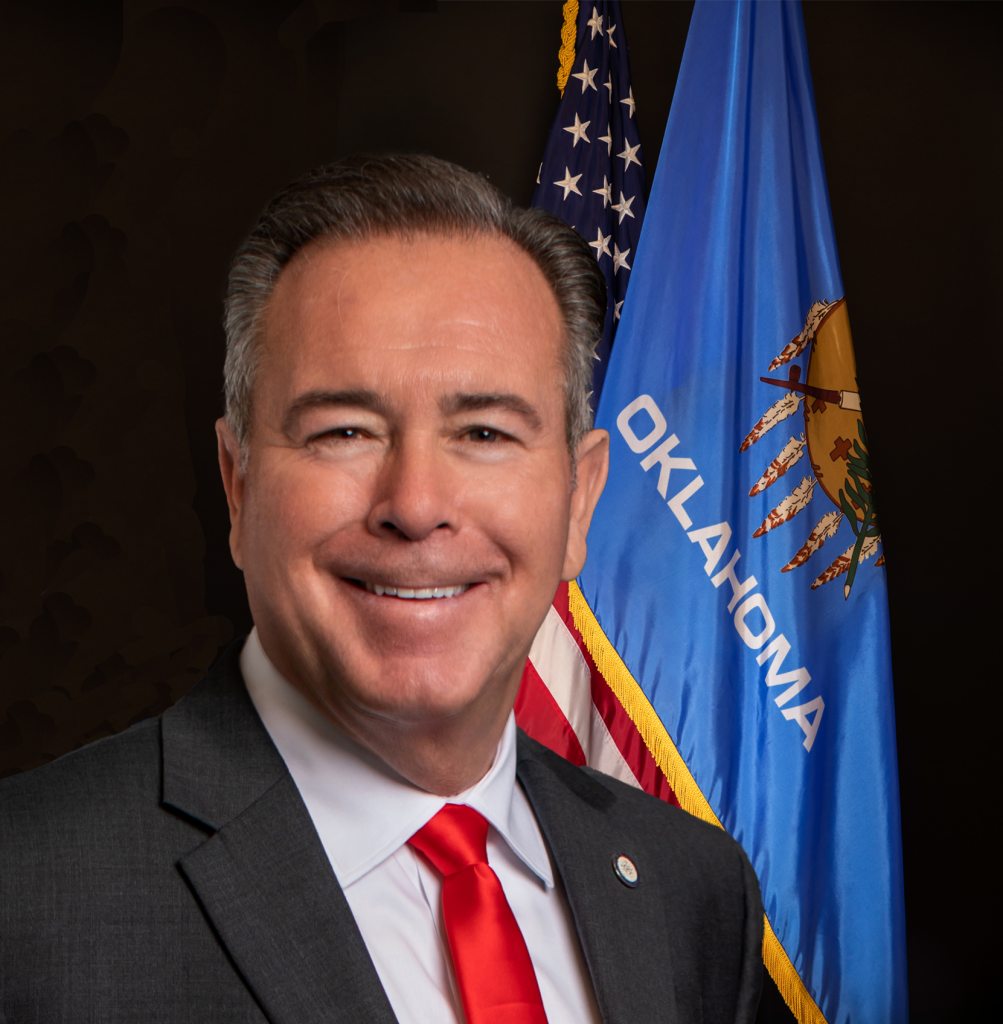
State Treasurer Todd Russ
Oklahoma 529 has once again proven to be a top choice for families saving for education expenses. For the fifth consecutive year, the plan has earned a Bronze Morningstar Analyst Rating™, distinguishing itself as one of only 32 plans to receive this honor among the 59 reviewed by Morningstar, covering over 90% of the industry's assets.
Morningstar praised Oklahoma 529 for its "well-structured investment strategy" and highlighted the state's generous tax benefits, allowing annual deductions of up to $20,000 for joint filers. Treasurer Todd Russ emphasized the plan's strengths, stating, "This high rating from Morningstar, one of the nation's most respected investment research firms, demonstrates Oklahoma 529's status as a reliable, cost-effective option for families planning for future education needs."
Since 2020, Oklahoma 529 has held its Bronze rating due to consistent excellence in investment strategy, oversight, and affordability. Key 2024 updates include a 50% reduction in management fees, saving participating families over $1 million annually. With no application, cancellation, commission, or transfer fees, Oklahoma 529 ensures low costs, which can lead to greater savings.
Families can open an Oklahoma 529 account with just $25, and investment expenses are among the lowest nationwide—less than half the industry average and one-quarter of broker-sold plans.
The plan's versatility extends beyond college tuition. Oklahoma 529 funds can also be used for:
This recognition complements the highest "Best" Rating for residents awarded to Oklahoma 529 by SavingforCollege.com, underscoring its performance, ease of use, and program delivery.
"As we approach Oklahoma 529's 25th anniversary in 2025, we remain committed to improving the program and making higher education more accessible for families across the state," Treasurer Russ said. "Oklahomans can be confident in choosing Oklahoma 529 as their trusted partner in saving for education."
For more information about the plan, its benefits, and how to start saving, visit oklahoma529.com.
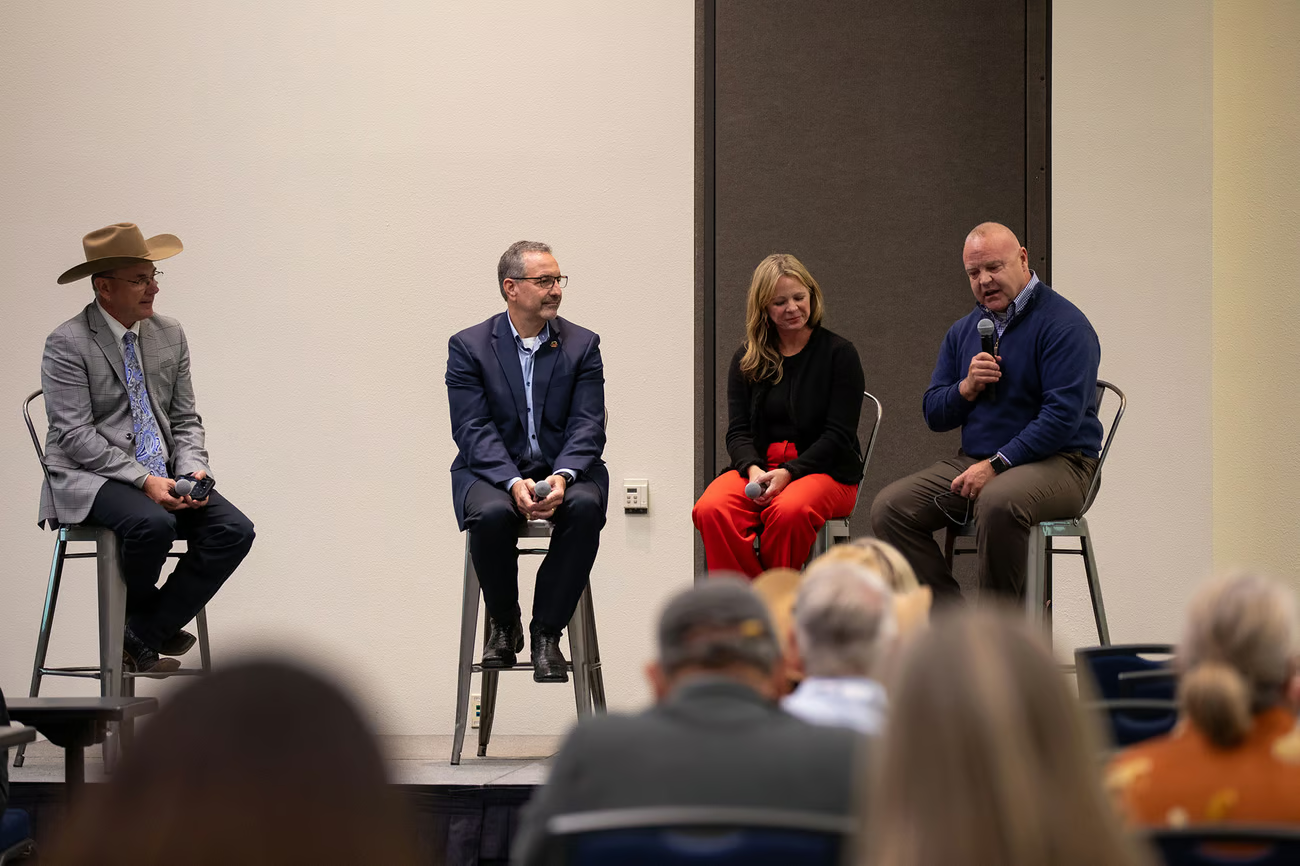
Industry consultant Nevil Speer speaks during the Capturing Value educational session at Angus Convention on November 2, 2024. From left to right, he was joined by panel moderator Troy Marshall, director of commercial industry relations with the American Angus Association®; Bruce Cobb, executive vice president of production with Certified Angus Beef; and Leann Saunders, chief operations officer with IMI Global, a division of Where Food Comes From Inc.
Change is not ranchers' favorite topic; but when change comes with potential increases in profitability and the preservation of their lifestyle, they are often willing to give it a try.
During one session at the 2024 Angus Convention in November, panelists discussed how value creation in the beef industry has changed and what the future might hold, focusing on areas like quality and sustainability.
"The wheels of change grind exceedingly slow, but change is coming," said Nevil Speer, an industry consultant who served on the educational panel. "It's all about what's at the end of the road. It's consumers, and there's going to be more and more questions."
It's not the first time producers have shifted their practices based on consumer demands. Bruce Cobb, executive vice president of production with Certified Angus Beef, said the early 1990s was a critical juncture for beef value and responding to consumer signals.
"We weren't really connected at all with the consumer and what we were producing," Cobb said. "We were producing what we wanted to produce as opposed to what the consumer was expecting and demanding."
In 2024, Cobb said, he feels excited about the opportunities afforded to producers willing to participate in value-based marketing and to talk about the value they have created in their cattle.
"Here's an opportunity for you to participate in something that can help you economically and also help build your business and build demand," Cobb said. "When you have models that address cattle care all the way through the supply chain, there's going to be a different demand for that product. When you have a model that drives quality all the way through the supply chain, there will be a different demand for that. We are no longer in the commodity business in the beef industry."
Current affairs
One place Speer, along with many cattle producers, looks for signs of change is by watching market prices.
Speer said that from April 2021 through early November 2024 most weeks have seen better prices year over year in the feeder-cattle markets. He said he interprets that to be a sign of genetic progress and other long-term efforts pushing the beef industry in the right direction – that is, in the same direction as consumer demands.
Speer said producers first need to maintain key characteristics of today's cattle and beef, like palatability, carcass merit and productivity.
In the same vein, Cobb predicted quality trends to continue.
"Whether that pace of change is driven by consumer demand, or it's driven by profitability or driven by genetic technology, all of those things are working together in concert," Cobb said.
The group told their audience there will continue to be a demand from consumers to know more about where their food comes from.
"[Sustainability is] not a new word at all, but it's something that we have really embraced in the last several years at Certified Angus Beef," Cobb said. "It was something that our customers were asking about, and asking is the key."
He continued, "When your customers engage with you like ours do and they see what you're doing relative to sustainability, and they walk away saying, 'That label that you have – we need it in our store next week,' those attributes are real." .
Panelist Leann Saunders, chief operations officer of IMI Global, a division of Where Food Comes From, said supply chains are being built to meet these consumer demands, so it is a growing area in which producers can capitalize.
"As you align with the things that work for you and your operations, then buyers that also believe that and want to sell that at the supply chain, there is added value," Saunders said.
New opportunities
So what's next? Speer said he notices conversations changing in the industry around how value is shared. Grid marketing is not the only tool the beef industry has at its disposal for capturing value, and he sees this with a corporate feedyard that works with their customers to create win-win scenarios.
"I don't remember having that conversation 20 years ago, or even 10 years ago," Speer said. "That's where we want to go, because the conversations are more win-win than they used to be; because we can win, and we have the tools."
Once genetic decisions have been made, "then you also have to work at getting the value, and that means marketing them in the correct venue," he said. "I think that's oftentimes where people get very frustrated."
Although producers can be frustrated by marketing and the time-consuming nature of building those relationships, Speer said buyers are highly motivated to find the right kind of cattle for their value-added supply chains.
"Now the cattle feeder is in a position where he is looking for those higher-quality cattle from commercial cattle producers who historically have sold weight, health, reputation. Now they can sell off of a quality perspective," Speer said.
Not done yet
While the business environment is a harsh one compared to historical conditions, the market is also ripe, providing premiums for cattle that match consumer demands.
"What we see is more and more of that differentiation in the programs that we have continuing to grow, not lessen, over time," Saunders said.
Panelists recognized that small producers might be feeling the economic pressure to capture value but struggling to find the marketing channels that are ideal for a smaller calf crop. Their advice was to look for opportunities to collaborate or create those opportunities with others facing the same hurdles. A tool like AngusLink's Genetic Merit ScorecardSM evaluates the genetic potential of a group of feeder calves, regardless of group size.
"Buyers are beginning to recognize the [Genetic Merit Scorecard], and there's an appetite for that data," Cobb said. "[Their appetite] allows a small producer or a group of small producers to market those cattle collectively anywhere across the country to buyers who do have a value on what the genetic merit score is."
Saunders said she has seen smaller producers succeed in capturing added value on their feeder calves by working with local livestock markets who host special sales for those types of cattle.
"On some of the other programs, there's a lot of livestock markets now across the United States that will schedule special days to sell verified cattle," she said. "That enables the smaller headcounts to go in and still receive the value."
Video markets are still the most popular way to sell cattle with verified claims. Saunders said they often sell cattle as load lots. She has been encouraged with the growth of special sales among livestock markets to more options.
"[The Livestock Marketing Association] has been very supportive of a lot of that effort, trying to get some of the smaller producers and buyers coming in that want those cattle," she said.
Speer summarized the major challenge presented to cattle producers, with its anecdote being greater collaboration.
"The supply chain part of this whole equation is critical, because we have to coordinate those segments in our industry," he said. "We really don't have that luxury like all other industries do, where production is contained within a building or across a complex. Our production is contained across thousands of producers, 50 states, different time zones, and we have to coordinate in order to hit that target for the consumer."
The U.S. Department of Agriculture's (USDA) Natural Resources Conservation Service (NRCS) has released a new Tribal Relations Strategy, demonstrating the agency's commitment to honoring its federal trust relationship with the 574 federally recognized tribes and Alaska Native Villages that have sovereign interest in more than 119 million acres of land across the United States.
In November 2024, NRCS released a new Tribal Relations Strategy, demonstrating the agency's commitment to honoring its federal trust relationship with the 574 federally recognized tribes and Alaska Native Villages that have sovereign interest in more than 119 million acres of land across the United States.
The strategy is based on feedback from Tribal Nations, including recommendations made to Chief Terry Cosby at the 2021, 2022, and 2023 National Tribal Consultations, and in-depth collaboration that took place at seven Regional Tribal Conservation Advisory Council meetings. Its six action items include:
This strategy builds on many years of listening, working and consulting with tribes to address their natural resources concerns. NRCS is committed to carrying out its federal trust responsibilities by ensuring that the agency has tribal operations built into its organizational structure.
| |||||||||||||||||||||||||||||||||||||||||||||||||||||||||||||||||||||||||||||||||||||||||||||||||||||||||||||||||||||||||||||||||||||||||||||||||||||||||||||||||||||||||||||||||||||||||||||||||||||||||||||||||||||||||||||||||||||||||
| |||||||||||||||||||||||||||||||||||||||||||||||||||||||||||||||||||||||||||||||||||||||||||||||||||||||||||||||||||||||||||||||||||||||||||||||||||||||||||||||||||||||||||||||||||||||||||||||||||||||||||||||||||||||||||||||||||||||||
|
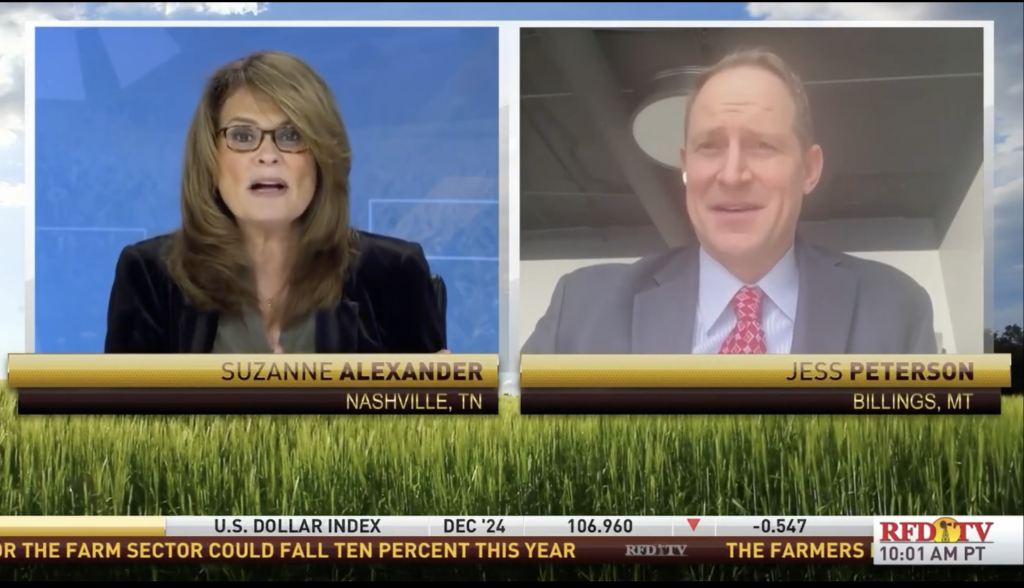
USCA Senior Policy Advisor Jess Peterson shares more of USCA's perspective on RFD-TV. Click the photo to watch the video.
This week, President-Elect Donald Trump announced the nomination of Brooke Rollins for the position of Secretary of Agriculture. The U.S. Cattlemen's Association (USCA) congratulates Rollins on this significant nomination.
"USCA is dedicated to advancing policies that ensure the prosperity and health of our nation's ranchers and agricultural sector and the USDA remains at the center of those conversations," USCA President Justin Tupper said. "We look forward to getting to know Secretary of Agriculture-elect Rollins as she moves through the confirmation process."
As a Texan, Rollins brings an understanding of the unique challenges and opportunities facing our agricultural communities, particularly ranchers. USCA anticipates her background and commitment to agriculture will benefit the Department of Agriculture.
"We look forward to the leadership Rollins will bring and her dedication to supporting agricultural communities nationwide. USCA is optimistic about her ability to champion issues that are critical to the future of agriculture in America," Tupper concluded.
Steve Maddox
The 2024 Fall Meeting of the Dairy Sustainability Alliance® emphasized the industry's collective efforts to meet sustainability targets through the adoption of new technologies, best practices and measurement tools. The meeting brought together more than 350 representatives from the dairy value chain, including nearly 40 dairy farmers, to collaborate on advancing sustainability across the industry.
The Alliance is a multi-stakeholder member initiative led by the checkoff-founded Innovation Center for U.S. Dairy®. With more than 200 companies and organizations, including farmers, the Alliance provides a platform for sharing ideas, tackling common challenges and accelerating progress on sustainability goals.
Sarah Hanson, executive lead for the Innovation Center for U.S. Dairy, underscored the importance of collaboration to advance solutions for a more sustainable world and a thriving U.S. dairy community.
"That mission is founded on the premise that we are stronger together," Hanson said. "And it comes to life through the leadership of our board, our committees and importantly through this Dairy Sustainability Alliance, where we come to learn, share and work together to advance U.S. dairy sustainability and the positive impact we know our products and industry have in people's lives."
Meeting presentations showcased innovative tools and resources that are shaping the future of sustainability in dairy, including:
· Shopper Attitudes around Sustainability and Health and Wellness: New consumer insights to help inform how companies can communicate with audiences whose preferences and perceptions continue to shift.
· FARM Environmental Stewardship Program: The updated program, powered by a new scientific model, allows farmers to run robust scenarios to assess sustainability and economic goals, measure progress with sound data outputs, and work together with cooperatives and processors to engage supply chain customers.
· Dairy Conservation Navigator: An online platform for farm advisors that consolidates practical information about science-based practices and technologies that can help reduce a farm's environmental footprint.
· Financial Models for Climate Mitigation: A report developed with the Environmental Defense Fund, detailing eight financial models for working with agricultural lenders to support climate mitigation strategies.
· U.S. Dairy Materiality Assessment: An effort that is underway with robust stakeholder input to provide insights into the social responsibility topics that are crucial for the industry, helping identify areas for action and collective engagement.
These efforts complement other significant ongoing sustainability commitments across the U.S. dairy industry. Many organizations are developing partnerships and making investments in new, efficient infrastructure, measurement capabilities, on-farm solutions and innovations and marketplace opportunities that advance U.S. dairy sustainability in an economically viable and beneficial way.
"U.S. dairy truly is walking the walk with significant progress to celebrate and, importantly, continue learning as we know there is more work to do," Hanson said. "With your ongoing engagement through the Alliance, we will continue to build our collective knowledge, navigate challenges and activate solutions that help us build a thriving industry and a more sustainable world with our delicious, nutritious dairy products."
Session Highlights
The meeting featured 20 interactive sessions with diverse experts across the industry, including farmers, and academia addressing topics of interest to dairy's sustainability journey. Highlights include:
Sustainability in Action – Advancing Well-Being and Effectively Showcasing Dairy's Role as a Modern Health & Wellness Solution – Paul Ziemnisky, head of wellness science, innovation, and business development at Dairy Management Inc., presented insights into the growing opportunity for dairy in modern health and wellness.
Ziemnisky shared how in 2023, the Innovation Center's Health & Well-being Committee identified a $150 billion opportunity in nutrition and modern wellness areas of growth and performance, healthy heart and weight, systems supercharge and mental and cognitive health, where dairy can emerge as a solution.
"We know one of the most important ways dairy positively contributes to people and to sustainability is in the unique and powerful nutrition and health benefits that our products provide," Ziemnisky said. "But for consumers to actually benefit from these products, they have to choose them, so it's our responsibility to ensure we're communicating with consumers in a way that meets their modern health and wellness needs and makes sure that the products in the marketplace clearly speak to those needs."
Breeding for a Greener Future: Genetic Innovation to Mitigate Enteric Methane Emissions – scientific and industry experts focused on how genetic improvements can reduce methane emissions in dairy cattle. Wisconsin farmer Mitch Breunig was among the participants discussing the importance of genetics in mitigating methane emissions through programs such as the Greener Cattle Initiative.
"Methane reduction is real," Breunig said. "It's going to be solved through a variety of places, but genetics has an opportunity to be a good place to solve it. If we can breed for a cow that just through her genetics is able to produce less methane, it's going to make the other things easier because the cow is the basis of all this."
The Now, Next, and Future of U.S. Dairy Sustainability – Barbara O'Brien, president and CEO of Dairy Management Inc. and the Innovation Center for U.S. Dairy, led a discussion exploring the future challenges and opportunities the industry faces, emphasizing the need to stay ahead of an ever-changing global environment. California dairy farmer Steve Maddox, who has been engaged with the Alliance since its creation in 2008, shared his perspective on how the organization fosters collaboration across the industry.
"The Alliance brings us together so we can learn from and share with each other," Maddox said. "The industry has benefited from so many technologies and practices over the years that have been good for the environment and good for farmers' bottom line.
"But the best part of our story is that it's more than just being sustainable. It's highlighting the story of so many dairy families being active in their communities and that is the heartbeat of the industry. Farmers truly care about our neighbors and the towns we call home."
O'Brien Delivers Remarks at Sustainable Agriculture Summit
The Sustainable Agriculture Summit, held after the Alliance meeting, marked its 10th anniversary and gathered farmers, suppliers, processors, conservation organizations and the public sector to discuss the future of sustainable agriculture in the U.S.
The Summit offered actionable insights from world-class experts, on-the-ground perspectives from farmers, including dairy, interactive breakout sessions and networking opportunities.
O'Brien delivered opening-day comments, emphasizing the importance of collaboration across the agricultural supply chain.
"The energy surrounding this event embodies a shared commitment to shaping the future of agriculture in a way that acknowledges the vital role of farmers and ranchers, honors the land, nourishes communities and drives innovation," O'Brien said. "Today, we stand at a remarkable crossroads, celebrating a decade of collaboration, innovation and resilience in agriculture, while looking ahead to the immense potential that lies before us.
"Ten years ago, we dared to imagine a more collaborative, sustainable future for agriculture. Today, we are not only witnessing that vision take shape but are called to lead it forward. This Summit is so much more than just a meeting of minds; it is a testament to what we can achieve together when we align our efforts toward a common purpose."
To learn more about the Innovation Center for U.S. Dairy, visit www.usdairy.com/about-us/innovation-center.
AARP represents 150,000 members in rural Oklahoma- making them one of the leading groups that represent the non-metro areas of the state - so says State Director Sean Voskuhl. Oklahoma Farm Report's Ron Hays and Voskuhl talked at the 2024 National Association of Farm Broadcasting about Medicare changes planned for 2025.
Voskuhl is excited about being able to limit out-of-pocket expenses for prescription drugs. In 2025, there will be an annual cap of $2,000 on those out-of-pocket expenses.
Updated benefits for social security have also been announced for 2025. "When you look at rural Oklahoma, a lot of folks may not have access to pensions or 401Ks," Voskuhl said. "So social security is the main source of retirement income for some folks. The cola increase next year will be 2.5 percent; that'll be about a $49 per month increase."
He admitted that it isn't much but hopes for more good news in 2026.
With broadband connectivity continuing to spread deeper into rural areas, Voskuhl and AARP hope to help older citizens learn to take full advantage of its opportunities.
"If we are going to have high-speed internet, we need to be sure that our folks know how to use devices," he said. "There is an equal opportunity for us to provide digital literacy classes to individuals seeking that help. We work with rural libraries across the state through digital navigators. AARP also has an OATS [Older Adults Technology Services] program as well as Senior Planet to help people learn to use devices, and apps, and stay safe online."
The AARP Community Challenge grant program is part of the nationwide AARP Livable Communities initiative that helps communities become great places to live for residents of all ages. The program is intended to help communities make immediate improvements and jump-start long-term progress.
"Forty percent of those dollars go to rural communities, so we push that a lot in Oklahoma," Voskuhl said. "There are a lot of communities across the state that have taken advantage of them. The grants run around ten to twelve thousand dollars apiece."
The grants are quick action grants meaning that once awarded, the funds must be spent within the year. AARP will track the funds to be sure that they are used appropriately.
Last year, the Sulphur Library System used the grant to implement a telehealth pod in their library. Shawnee used the funds for infrastructure improvements by building a roundabout. Vinita used the grant for a community center.
"It ranges. It can be for broadband or an intergenerational community garden," Voskuh said. "Those are just some of the things that you can apply for. If you've got a good idea, apply!"
Some communities use the grant as a supplement to complete a project that is already partially funded. "It has been a great way for us to invest in rural communities," he added. "Being able to make communities safe, with sidewalks or better lighting or better signage, that not only helps older adults, but it helps people of all ages and they will want to live there and stay there. We have to think about other ways that people can stay in rural communities."
As friends and family sit down for a Thanksgiving dinner, very few are aware that the feast on their table is a culmination of efforts of farmers from every corner of the United States. American Farm Bureau Federation economists analyzed the production of the ingredients that go into a classic Thanksgiving dinner, detailing which states produce the most commodities and the production value of those items. The Market Intel provides context to AFBF's annual Thanksgiving dinner cost survey, which found the average cost of this year's classic holiday dinner for 10 is $58.08, or about $5.80 per person.
"To give a sense of the geographic diversity involved in producing your meal, we ranked the top three production states for nine Thanksgiving dinner staples: cranberries, celery, sweet potatoes, green beans, pumpkins, green peas, potatoes, carrots and turkey," the Market Intel states. "A total of 15 different states appeared at least once in these rankings, representing every region of the country. From Massachusetts to California, Wisconsin to Mississippi – farmers across the nation work hard all year to grow the food we gather around and give thanks for on Thanksgiving."
The turkey, a Thanksgiving staple, represented $6.57 billion in production value in 2023. Minnesota and North Carolina raise more turkeys than any other states, combining for 30% of national production. Potatoes had a production value of $5.4 billion in 2023. Not surprisingly, Idaho led in production at 32%, followed by Washington at 23%. California leads the nation in growing carrots, representing a whopping 73% of the nation's production. Carrot growth in all states combined for $1.8 billion in production value in 2023.
"It really is awe-inspiring that America's farmers are able to grow such a diverse range of food," said AFBF President Zippy Duvall. "Each item on the Thanksgiving dinner table represents a different farmer from across the nation, each dedicated to ensuring America's food supply remains strong.
"America also has one of the most affordable food supplies in the world, thanks in part, to strong farm bill programs that provide much needed certainty to farmers in every state. Unfortunately, this criticallyimportant legislation currently remains in limbo, as Congress continues to kick the can down the road. We urge lawmakers to pass a modernized farm bill with safety nets to support the men and women who grow the food every family in America relies on."
Farming is a difficult industry with tight profit margins. The Market Intel notes rising labor costs, and the impact inflation is having on supplies like machinery, fertilizer and pest protection products. Despite these increasing costs of farming, this is the second year in a row the Thanksgiving dinner is estimated to have declined in price.
Read the full Market Intel here.
Read the Thanksgiving dinner cost survey Market Intel here. Learn more about the farm bill here.

Senator Kristen Thompson, R-Edmond, has introduced legislation to better improve health outcomes in Oklahoma.
The initiative comes as incoming President Donald Trump's administration aims to prioritize public health. Senator Thompson's bill specifically examines the use of certain harmful food additives that are prohibited in other countries.
Sen. Thompson's Senate Bill 4 was born out of the growing concern over dangerous chemicals and additives in food that have been linked to serious health issues, including developmental and behavioral challenges in children.
"For too long Oklahoma has ranked near the bottom in overall health outcomes," Sen. Thompson said. "I believe this legislation will begin to reverse this negative trend, leading to a healthier state. As a mom of three, I have experienced firsthand the adverse effects of chemicals and preservatives in our foods. This legislation is about putting the health and safety of Oklahoma's children and families first. Our children deserve a healthy start in life, free from exposure to harmful chemicals during critical stages of their development. I hope this legislation acts to shine a light on the harmful chemicals in food and will give us the ability to further this conversation and put Oklahoma on a better trajectory for health outcomes."
Other countries have taken decisive action to ban or severely restrict harmful chemicals due to the risks they pose, especially to children. Research has shown that exposure to these chemicals can impact cognitive and physical development, making this legislation critical to Oklahoma's future.
Oklahoma consistently ranks near the bottom in health statistics. A recent study put Oklahoma as the eighth unhealthiest state in the nation.About Senator Kristen Thompson
Senator Kristen Thompson represents District 22, which includes Edmond, Oklahoma, in the Oklahoma Senate. She is a dedicated advocate for health, safety, and the well-being of Oklahoma's families and children. Recently, Senator Thompson successfully passed the landmark OkEDGE legislation, which established a modernized economic development agency to attract new businesses, retain existing employers, and drive innovation in Oklahoma. Her leadership continues to focus on building a brighter, healthier, and more prosperous future for all Oklahomans.
Mark Johnson, Oklahoma State University Extension Beef Cattle Breeding Specialist, offers herd health advice as part of the weekly series known as the "Cow Calf Corner," published electronically by Dr. Derrell Peel, Mark Johnson, and Paul Beck. Today, Johnson talks about Thanksgiving feast.
Thanksgiving is a time when American families come together to celebrate a holiday that connects each and every one of us. The holiday was first celebrated in 1621 when the Plymouth settlers, joined with the Wampanoag Indians to enjoy a fall feast to celebrate a bountiful harvest. The tradition of Thanksgiving became official when President George Washington declared the nation would celebrate the day on November 26, 1789. President Abraham Lincoln wrote a proclamation declaring all states would celebrate the day in 1863. President Franklin D. Roosevelt signed a resolution from Congress in 1941 that established the official date of Thanksgiving to be the fourth Thursday in November each year. While Thanksgiving is observed in varied ways in different nations, in America the holiday is truly rooted in agriculture. We may bring our own flavors and traditions to the table, but Thanksgiving is a time for all of us to celebrate our nation's harvest and ability to efficiently produce food, to express gratitude for our blessings, and look ahead to the future.
We have much to be thankful for this year: strong cattle prices and an excellent market outlook. Ample amounts of moisture across Oklahoma in the past 3 weeks has filled ponds, brought on wheat pasture and helped release us from the grip of drought. I am thankful to work in an industry which is responsible for producing the highest quality beef in the world. I am thankful that we, as Ag producers, have the ability to produce food efficiently and sustainably, and as a result of this ability, permit Americans to enjoy the world's safest food supply while we spend a relatively small percentage of our disposable income for it.
Happy Thanksgiving to each of you and your families. Thanks for reading.
Mark Johnson, OSU Extension beef cattle breeding specialist, explains why you may want to keep beef on the menu for Thanksgiving dinner. https://www.youtube.com/watch?v=STHl6vROCgo
RON's Dave Lanning has a pre-opening look at today's agricultural Markets.
Click the audio tab below for today's report.
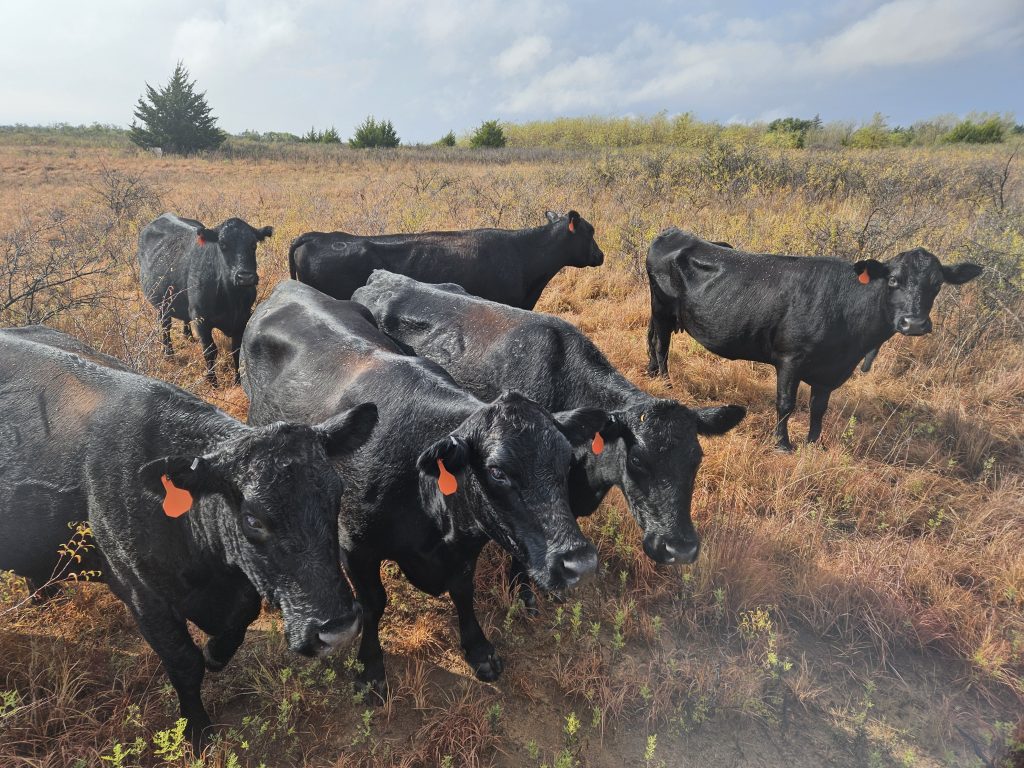
The liquidation of the U.S. cow herd has been a big deal over the last couple of years. Senior Farm and Ranch Broadcaster Ron Hays talked to OSU Extension Livestock Market Economist Dr. Derrell Peel after the latest USDA Cattle on Feed Report was released on Friday afternoon to talk about cull cow liquidation.
In part one of this conversation, Peel said that feeders heifers is the biggest factor in how feedlots are staying relatively full with overall cattle numbers down.
"We've been lower most of the year on cull cow numbers, and normally, we see a seasonal increase in the fall of each year," Peel noted. "We have not seen much of that increase this year so we are pulling them down even faster."
Peel also noted that year to date, beef cow slaughter is down almost 18%, and there hasn't been a lot price pressure because there aren't as many cows being culled.
"Cow slaughter is down. If you convert that to our estimates for the year and then put it in terms of the herd culling rate, it is coming down from record levels about two years ago, and that is part of what we have to do, ultimately, to get into this mode of herd rebuilding, is we'll cut cow culling down," Peel said. "We are going to be at about average levels for this year, so we are down from record high levels, but not low enough yet to suggest that we are really actively rebuilding that herd. Guys are taking advantage of selling those cows for some awfully good money at this point."
Peel anticipates that the January 1 Cattle Inventory Report will show that the U.S. cow herd has continued to liquidate in 2024 but may not be down by much. Still, he anticipates that even after 2025, it will show no increase in cow numbers. Looking back- the US Beef Cow Herd stood at 28.2 million head on January 1, 2024.
With significant rainfall improving conditions and the prospects for winter wheat, the Oklahoma feeder markets have leaped in the past two weeks, but even nationwide, feeder markets remain strong.
"From the standpoint of Oklahoma, we had an early fall run," Peel said. "We were up on a weekly basis year over year through September and October. We've already moved the cattle that were out there, so now we are down. The numbers are quite tight, and I think that is true around the country, so we are seeing some very, very strong feeder cattle markets around the country, including here in Oklahoma."
Now that producers have better water supplies, if not a little more grass, Peel says that it will be interesting to observe what their actions reveal about their expectations. While drought is still a slight threat, the heavy rainfall over the past few weeks has reduced its strength considerably.
"The real question as we go into 2025 is are these guys ready to think about some herd rebuilding and that will start, of course, with some heifer retention," Peel said. "We don't have any indication that it is happening yet, but at some point in time, I would expect that to happen and we have to wait and see if the industry is ready to start that process."
The Beef Buzz is a regular feature heard on radio stations around the region on the Radio Oklahoma Ag Network and is a regular audio feature found on this website as well. Click on the LISTEN BAR at the top of the story for today's show and check out our archives for older Beef Buzz shows covering the gamut of the beef cattle industry today.
Winter Wheat Planted reached 97 percent, equal to the previous year, but down 1 percentage point from the average. Winter Wheat Emerged reached 89 percent, down 1 point from a year ago but equal to the five-year average. Winter wheat conditions rated 55 percent good to excellent, 33 percent fair, and 12 percent poor to very poor. Last week's conditions rated 49 percent good to excellent, 36 percent fair, and 15 percent poor to very poor.
The National Corn harvest is complete.
The National Soybean harvest is complete.
Cotton harvested reached 84 percent, up 3 points from a year ago and 4 points from the average.
The National Sorghum harvest is complete.
Oklahoma Crop Progress Report:
Winter wheat planted reached 95 percent, equal to the previous year and down 2 points from the five-year average. Winter wheat emerged reached 80 percent, down 13 points from the previous year and the average. Winter wheat conditions rated 48 percent good to excellent, 36 percent fair, and 16 percent poor to very poor. Last week's conditions rated 37 percent good to excellent, 25 percent fair, and 18 percent poor to very poor.
The Oklahoma Corn harvest is complete.
Sorghum harvested reached 93 percent, down 2 points from a year ago and the average.
Soybeans harvested reached 76 percent, down 4 points from a year ago and the average.
Cotton harvested reached 65 percent, down 16 percentage points from a year ago and 12 from the average.
Livestock conditions rated 57 percent good to excellent, 30 percent fair, and 13 percent poor to very poor. Last week's conditions rated 57 percent good to excellent, 29 percent fair, and 14 percent poor to very poor.
Pasture and range conditions rated 21 percent good to excellent, 33 percent fair, and 46 percent poor to very poor. Last week's conditions rated 12 percent good to excellent, 34 percent fair, and 54 percent poor to very poor.
Kansas Winter wheat planting is complete. Winter wheat emerged was 96 percent, up 4 points from last year and 6 points from the average. Winter wheat conditions rated 55 percent good to excellent, 33 percent fair, and 12 percent poor to very poor. Last week's conditions rated 49 percent good to excellent, 39 percent fair, and 11 percent poor to very poor
The Kansas Corn harvest is complete.
The Kansas Soybean harvest is complete.
Sorghum harvested reached 96 percent, equal to last year, and the five-year-average.
Cotton harvested reached 71 percent, down 7 points from last year but up 3 points from the average.
Pasture and range conditions rated 23 percent good to excellent, 43 percent fair, and 34 percent poor to very poor. Last week's conditions rated 24 percent good to excellent, 43 percent fair, and 33 percent poor to very poor.
Winter Wheat planted reached 93 percent, up 2 percentage points from a year ago and 1 point from the five-year average. Winter wheat emerged reached 77 percent, up 1 point from a year ago and equal to the average. Winter wheat conditions rated 52 percent good to excellent, 30 percent fair, and 18 percent poor to very poor. Last week's conditions rated 47 percent good to excellent, 31 percent fair, and 22 percent poor to very poor.
The Texas Corn harvest is complete.
Cotton harvested reached 80 percent, up 8 points from the previous year and 7 from the average.
The Texas Sorghum harvest is complete.
The Texas Soybeans harvest is complete.
Pasture and range conditions rated 13 percent good to excellent, 25 percent fair, and 62 percent poor to very poor. Last week's conditions rated 12 percent good to excellent, 25 percent fair, and 63 percent poor to very poor.
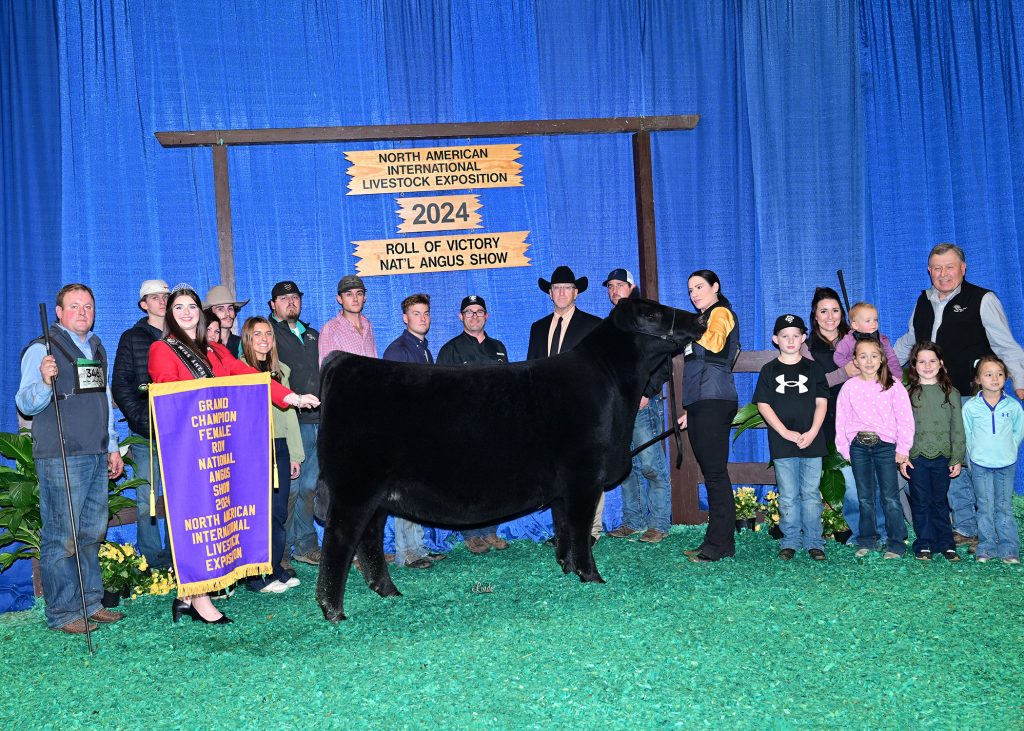
Seldom Rest Pin Up Gal 3095 won grand champion female at the 2024 North American International Livestock Exposition (NAILE) Super Point Roll of Victory (ROV) Angus Show, Nov. 18 in Louisville, Ky. Caddo Craft, Anadarko, Okla., owns the May 2023 daughter of SCC SCH 24 Karat 838. She first claimed intermediate champion. Barry Nowatzke, Michigan City, Ind., evaluated the 223 entries. Photo by Linde's Livestock Photos.
Angus enthusiasts led 223 entries while competing for top honors at the 2024 North American International Livestock Exposition (NAILE) Super Point Roll of Victory (ROV) Angus Show and National Angus Show, Nov. 17 in Louisville, Ky. Barry Nowatzke, Ind., evaluated the 184 females, 32 bulls and seven cow-calf pairs before selecting the winning animals.
Fitzgerald Saint Elmo 1997 claimed grand champion bull honors after first winning senior calf champion. Brody Fitzgerald, Fairmount, Ind., owns the September 2023 son of BRDG Mahogany Prime 904B.
Coulter FCF All Due Respect won reserve grand champion bull for Circle M, Rockwell, Texas; Sunrise Sunset Farm, Williamsburg, Ind.; and Ella Coulter, Wentzville, Mo. The March 2023 son of BNWZ Dignity 8017 first won junior champion.
Seldom Rest Pin Up Gal 3095 captured grand champion female honors for Caddo Craft, Anadarko, Okla. The May 2023 daughter of SCC SCH 24 Karat 838 first won intermediate champion.
Ella Weldon, Piedmont, Okla., owns the reserve grand champion female. EXAR Princess 3691 is the March 2023 daughter of C&C Intuition 7104 and first claimed junior champion – division 1.
TLF Northern Miss won grand champion cow-calf pair. Holly Marsh, Earlville, Ill., owns the May 2020 daughter of Colburn Primo 5153. A May 2024 bull calf sired by STAG Good Times 201 ET completes the winning pair.
SE Rita K105 won reserve grand champion cow-calf pair. Sawyer Eastridge, Taswell, Ind., owns the April 2022 daughter of RVF/SE Captain H103. A May 2024 heifer calf sired by Destinys Back In Black 320 completes the winning pair.
A complete list of winners follows:
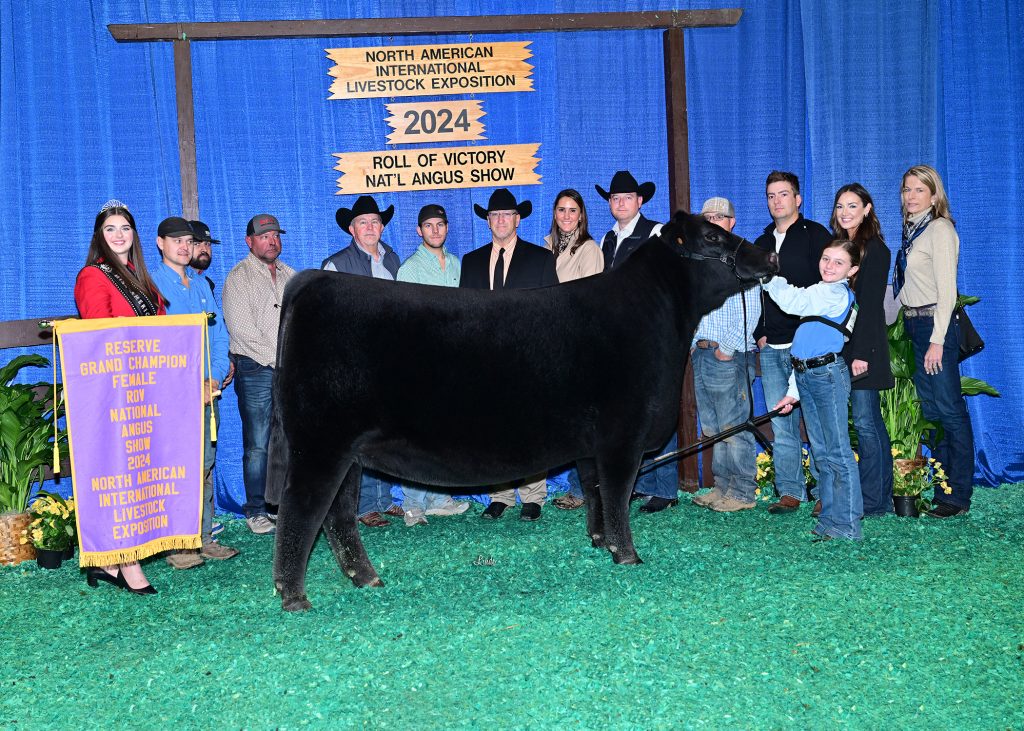
LOUISVILLE, KENTUCKY
Total number shown: 223
Judges: Barry Nowatzke, Michigan City, Ind.
HEIFERS: 184 Shown
Junior Heifer Calf Champion – division 1: Seldom Rest Cassandra 4123
Exhibitor: Seldom Rest Farms, Niles, Mich.
Reserve Junior Heifer Calf Champion – division 1: Henning BCII Sandy 4052
Exhibitor: Spencer Wright, Lebanon, Tenn.
Junior Heifer Calf Champion – division 2: JCC Lola 411|
Exhibitor: Josie Phillips, Maysville, Ky.
Reserve Junior Heifer Calf Champion – division 2: Seldom Rest Diva Bardot 4048
Exhibitor: Alyson Friesen, Arnett, Okla.
Junior Heifer Calf Champion – division 3: SSF DS Lady 1314
Exhibitor: Weston Haag, Plymouth, Ind.
Reserve Junior Heifer Calf Champion – division 3: EXAR Princess 4630
Exhibitor: Jake Allison, Yukon, Okla.
Senior Heifer Calf Champion – division 1: Seldom Rest Pin Up Gal 3223
Exhibitor: Cody Robert York, Palestine, Ill.
Reserve Senior Heifer Calf Champion – division 1: SSF Blackcap N123
Exhibitor: Piper Cates, Modoc, Ind.
Senior Heifer Calf Champion – division 2: SSF HAG Georgina 9053
Exhibitor: Mercedes Ferree, Sullivan, Ind.
Reserve Senior Heifer Calf Champion – division 2: SULL Ellie 3655L
Exhibitor: Josie Phillips, Maysville, Ky.
Intermediate Champion Heifer: Seldom Rest Pin Up Gal 3095
Exhibitor: Caddo Craft, Anadarko, Okla.
Reserve Intermediate Champion Heifer: Conley Sandy 3712
Exhibitor: Finley Yocham, Sapulpa, Okla.
Junior Champion Heifer – division 1: EXAR Princess 3691
Exhibitor: Ella Weldon, Piedmont, Okla.
Reserve Junior Champion Heifer – division 1: BLC Proven Queen 2356
Exhibitor: Dakota Allen, Ottawa, Kan.
Junior Champion Heifer – division 2: PVF SFA Blackbird 3303
Exhibitor: Ashton Dillow, Villa Ridge, Ill.
Reserve Junior Champion Heifer – division 2: Seldom Rest Sandy 3007
Exhibitor: Seldom Rest Farms, Niles, Mich., and Moore Cattle Company, Lebanon, Okla.
Senior Champion Female: KCC Cheyenne 9122
Exhibitor: Logan Davis, Bidwell, Ohio
Reserve Senior Champion Female: SAF Lucy Pride 2103
Exhibitor: Bryanna Smith, Russell Springs, Ky.
Grand Champion Female: Seldom Rest Pin Up Gal 3095
Exhibitor: Caddo Craft, Anadarko, Okla.
Reserve Grand Champion Female: EXAR Princess 3691
Exhibitor: Ella Weldon, Piedmont, Okla.
BULLS: 32 Shown
Junior Bull Calf Champion: Seldom Rest Battle Cry 4011
Exhibitor: Seldom Rest Farms, Niles, Mich., and Krebs Ranch, Gordon, Neb.
Reserve Junior Bull Calf Champion: Horstman Don Juan 442M
Exhibitor: Larry & Joe Horstman, West Lafayette, Ind.
Senior Bull Calf Champion: Fitzgerald Saint Elmo 1997
Exhibitor: Brody Fitzgerald, Fairmount, Ind.
Reserve Senior Bull Calf Champion: SAF Slayer 3099
Exhibitor: Bryanna Smith, Russell Springs, Ky.
Intermediate Champion Bull: AML Party Line 310
Exhibitor: AM Livestock, Richmond, Kan.
Reserve Intermediate Champion Bull: DAJS Tricked Out 610
Exhibitor: Doug Satree Angus, Montague, Texas
Junior Champion Bull: Coulter FCF All Due Respect
Exhibitor: Circle M, Rockwell, Texas; Sunrise Sunset Farms, Williamsburg, Ind. and Ella Coulter, Wentzville, Mo.
Reserve Junior Champion Bull: EXAR Hard Rock 3690B
Exhibitor: Express Angus Ranches, Yukon, Okla.
Senior Champion Bull: MC TSSC Outkast 2095
Exhibitor: Tim Schaeffer Show Cattle, Hagerstown, Ind., and Tom McCall, Greenville, Va.
Reserve Senior Champion Bull: Wheeler Hunters Ted Lasso
Exhibitor: Rance Wheeler, Paris, Mo.
Grand Champion Bull: Fitzgerald Saint Elmo 1997
Exhibitor: Brody Fitzgerald, Fairmount, Ind.
Reserve Grand Champion Bull: Coulter FCF All Due Respect
Exhibitor: Circle M, Rockwell, Texas; Sunrise Sunset Farm, Williamsburg, Ind. and Ella Coulter, Wentzville, Mo.
COW-CALF PAIRS: 7 Shown
Grand Champion Cow-Calf: TLF Northern Miss
Exhibitor: Holly Marsh, Earlville, Ill.
Reserve Grand Champion Cow-Calf: SE Rita K105
Exhibitor: Sawyer Eastridge, Taswell, Ind.

U.S. Wheat Associates (USW) and the National Association of Wheat Growers (NAWG) released the following statements in response to President-elect Donald Trump's nomination of Brooke Rollins to serve as Secretary of the U.S. Department of Agriculture.
"As the wheat industry's export market development organization, U.S. Wheat Associates looks forward to working with Secretary-Designate Rollins and the President-Elect's administration on issues related to fair global trade and market access," said U.S. Wheat Associates President and CEO Vince Peterson. "We welcome a renewed partnership with her and USDA to support U.S. agriculture and the farmers we represent in the world wheat market."
"Congratulations to Brooke Rollins on her nomination to serve as our next Secretary of Agriculture. NAWG members look forward to working together to foster public policy initiatives that will help wheat growers and rural communities thrive," said Chandler Goule, CEO of the National Association of Wheat Growers.
Thanksgiving dinner is a special meal cherished by nearly all Americans. Gathering around the table, we give thanks for the abundance of a delicious feast. But, while millions of Americans look forward to their annual Thanksgiving meal, very few know about the amazing diversity of how and where most classic Thanksgiving foods are grown. In this Market Intel, we dive into the facts behind the production of nine Thanksgiving staples that are part of American Farm Bureau's traditional Thanksgiving Dinner Cost Survey, which has been conducted annually since 1986.
To give a sense of the geographic diversity involved in producing your meal, we ranked the top three production states for nine Thanksgiving dinner staples: cranberries, celery, sweet potatoes, green beans, pumpkins, green peas, potatoes, carrots and turkey. A total of 15 different states appeared at least once in these rankings, representing every region of the country. From Massachusetts to California, Wisconsin to Mississippi – farmers across the nation work hard all year to grow the food we gather around and give thanks for on Thanksgiving.
Cranberries
The United States is the world's largest producer of cranberries. Nearly all cranberries produced in the United States are processed into delicious and nutritious products including dried cranberries and cranberry juice. Famously, most cranberries are wet harvested – the beds are flooded, removed from the vine, then flooded again, during which the fruit floats to the top to be harvested. Fresh market cranberries are harvested in a drier, slower manner by being "combed" from the vines using a mechanized picking machine. Cranberries are a perennial plant, with the bush-like vines growing cranberries year-after-year in bogs.
Cranberries are native to North America and have a long history here, with cranberry sauce even being the suggested pairing with turkey in the first cookbook written by an American: American Cookery, published in 1796. The first commercial cranberry beds in the United States were planted by a Revolutionary War veteran in 1816 in Massachusetts on the Cape Cod peninsula. Today, the top states for cranberry production are Wisconsin (60% of domestic production), Massachusetts (26%), New Jersey (8%) and Oregon (7%).

Celery
Today, most domestically produced celery grows nearly year-round on over 20,000 acres on the central and southern coasts of California. The state is so dominant in celery production that USDA's National Agricultural Statistical Service only provides data for California-grown celery. Despite this reporting, growers in Michigan (1,100 acres) also produce celery. Most celery goes into the fresh market, and 86% of the celery supply in the United States is produced domestically.
Celery can be hand-harvested or mechanically harvested, but regardless of method it's production is labor-intensive. Celery is a cool-season crop grown from transplants but can be grown year-round in California's unique microclimates.

Sweet Potatoes
While sweet potatoes share a name with their other potato cousins, the production techniques and geographies of the two crops are very different. Sweet potatoes are primarily grown in the warm climates of North Carolina (60%), California (25%) and Mississippi (15%). The skin of sweet potatoes is delicate, requiring hand-harvesting or harvesting with minimal mechanization for sweet potatoes grown for the fresh market. This results in much higher labor costs than Russet and other varieties of potatoes that can be mechanically harvested.
Nation-wide, 78% of sweet potatoes are grown for the fresh market, but this varies quite a bit by region. Nearly all sweet potatoes grown in California go into the fresh market while nearly 40% of Mississippi sweet potatoes are processed. Thanks to innovations in curing and storage, sweet potatoes can be stored for a year – making them available domestically year-round and expanding export opportunities.

Green Beans
Green beans, also referred to as "snap beans" or "string beans," are grown in a wide variety of states. While Wisconsin (46%) is the largest producer by a significant margin, remaining production is divided between Florida (13%), New York (12%), Michigan (7%), Oregon (6%), Illinois (5%), California (4%), Georgia (3%), Pennsylvania (3%) and Minnesota (2%).
Over 80% of domestically-produced green beans are processed through canning or freezing. Processed green beans are more likely to be harvested mechanically. Like many other crops, sometimes a combination of harvest methods is used. A first-round may be harvested by hand for the fresh-market, then a harvester will be used for a final pass for the processed market.
As fresh green beans are more labor-intensive to produce, they are more likely to be imported. While nearly half of all green beans sold fresh are imported, only 14% of the processed green bean supply is imported.

Pumpkins
Pumpkins have two different distinct markets: pumpkins for decoration (ornamental) and pumpkins for processing. Processed pumpkins are more yellow than traditional bright-orange ornamental pumpkins and are used primarily for canning. Illinois grows 98% of all pumpkins for processing in the United States, so when you are eating your favorite pumpkin treats, you can thank an Illinois farmer. Ornamental pumpkin production accounts for 58% of total production and is more geographically dispersed.
When combined, Illinois is the top pumpkin-producing state with 40% of all production, followed by Indiana (10%) and California (9%). Michigan, New York North Carolina, Ohio, Oregon, Pennsylvania, Texas, Virginia, Washington and Wisconsin each account for 5% or less of national production.

Green Peas
Over 99% of green peas, or "sweet peas", are used in the processed market, typically either frozen or canned. But just because a product is canned, does not mean that it isn't fresh. Canning facilities strive to can produce as quickly as possible, with as few as three hours between harvest and canning! Green peas are mostly grown in Washington (36%), Minnesota (33%), Wisconsin (25%) and Oregon (6%).
Green peas are mechanically harvested and separated from their pods in the field, with peas later delivered to a processing facility. Compared to most vegetables, green peas can be grown and processed with relatively little labor – which is why they remain an inexpensive vegetable option.

Potatoes
Potatoes are a large and diverse crop, with many different varieties grown for different market segments. For instance, chipping potatoes are used for potato chips with varieties grown for specific characteristics including uniform shape, color, high density, high starch and low sugar (which prevents burnt, black spots in the fryer). Russets, the specific potato featured in AFBF's expanded Thanksgiving Survey basket, make up the majority of potato acreage nation-wideand are also dominate in the top potato-growing states. These versatile potatoes can be used for both the fresh market – referred to as "table-stock"– or to create frozen fries.
Idaho is synonymous with potatoes for good reason: it produces about one third of all potatoes nationwide. Washington (23%) and Wisconsin (7%) round out the top three, followed by Oregon and North Dakota at 6%; and Colorado, Michigan, Minnesota, Maine, Nebraska, California, Texas and Florida at 5% or less.
Potatoes are grown from seed potatoes, harvested mechanically and can be stored for up to a year in temperature-controlled, humid packing sheds – allowing table-stock potatoes to be enjoyed year-round.

Carrots
Carrots are predominantly a California crop, where they can be grown year-round. Carrots are mechanically harvested, being pulled up by their leafy tops then separated from their tops in the field. At the packing house, they are cooled, cleaned and packaged with many being cut, peeled and polished into baby carrots to be sold at the grocery store – all within 24 hours of harvest.
About 21% of the total fresh market supply is imported, including baby carrots. The number is smaller for processed carrots – about 7% were imported in 2023.

Turkey, the Centerpiece of Thanksgiving Dinner
Last, but certainly not least, we have the centerpiece of Thanksgiving dinner – the turkey. Turkeys are raised in many states, with Minnesota (17%), North Carolina (13%) and Arkansas (12%) being the top three states for production followed by Indiana, Missouri, Virginia, and Iowa with between 5 and 10%; Pennsylvania, Ohio, California, Michigan, West Virginia and South Dakota with under 5% each. USDA previously estimated that approximately 46 million turkeys are consumed at Thanksgiving. If this holds true in 2024, that would be approximately 22% of all turkeys produced this year.

Conclusion
Thanksgiving is a widely celebrated, food-centric holiday that gives Americans who may not know much about agriculture an opportunity to learn a bit about where the food comes from.
Farming is a difficult industry with tight profit margins. Rising labor costs impact many of the products we explored today, as does inflation in other inputs such as machinery, fertilizer and pest protection products. Despite these increasing costs of farming, this is the second year in a row that the Thanksgiving Dinner is estimated to have declined in price.
Now that we have traveled around the country exploring the production of Thanksgiving staples, we hope that you have greater appreciation for the great diversity of agricultural production practices across commodities and our nation. From the entire team at the American Farm Bureau Federation, we hope you have a great Thanksgiving!
Train cars with grain arrived at elevators in the agricultural sector (Provided by NAFB Facebook page)
While at the National Association of Farm Broadcasters Convention, Oklahoma Farm Report's Maci caught up with the President and CEO of the National Grain and Feed Association, Mike Seyfert. The National Grain and Feed Association represents about 850 member companies from country elevators up through export elevators, soy crush facilities, ethanol plants, millers, exporters, livestock feeders, integrated poultry, as well as several transportation companies.
"Our members are responsible for trading, marketing, and moving the commodity from once it leaves the producer's farm until it reaches its final destination," Seyfert explained.
National Grain and Feed Association members enjoyed a good harvest year with plenty of commodities to work with and a latter-year export increase. While prices have been as tough on them as for producers, members are overall satisfied.
Post-election concerns for Seyfert are similar to those of other ag entities: learning who cabinet appointees will be is one. He expressed a good working relationship with the Biden administration and with the previous Trump administration, so anticipates more of the same.
"The farm bill is still hanging out there," he said. "Folks would like to get it done in the lame duck, but it feels like it is moving more towards an extension."
He hopes the Water Resources and Development Act (WRDA) which impacts the lock and dam system, will come to a resolution during the lame duck session. He related the Act to its effect on Oklahoma's system which carries barges into Tulsa, and then back down the Mississippi River.
"There are some funding issues, particularly, as it relates to NASS reports and how our members use them, that we would like to get done this year, but it looks like the funding is going to get kicked to 2025," Seyfert said. "As we head into 2025, we may still have the farm bill, we may still have WRDA, and we would like to see some regulatory relief, hopefully, from the new administration. We are going to have a tax package probably moving, developments on the trade front with the new administration, and about 4,000 political appointees in every new administration, and around 1200 of them have to be approved. A number of them are important to ag, so we are going to be watching for who those nominees are closely, and then asking how we can get them confirmed and then educated and up to speed on some of our key issues."
Going forward, the National Grain and Feed Association will continue to work with the Army Corp of Engineers on getting the Mississippi dredged to help with low water levels. All methods of transportation of grain are crucial to the organization and its members.
"The rail system has been working pretty good this year, but we have had some significant challenges on the Mexican border which have impacted some of our members in Oklahoma and particularly, the center of the country not being able to get their product moved across the border, because of rail challenges in Mexico. That is something we are going to continue to address with the Mexican railroad, but it is also something that we will be talking about to both the current and incoming administrations here in the U.S. We really do feel like U.S. Ag is being singled out unfairly through some of the blockages and difficulty we have had getting into Mexico. We feel pretty strongly that it needs to be addressed."
Broader trade under the new administration presents both trepidation and opportunity for the National Grain and Feed Association. "We think there is a good opportunity for the new administration to go back and take a look at knocking the dust off of phase one, and seeing what we can do with that on exports to China," Seyfert said. "We know it is going to be a different approach, maybe a different playing field, but we think there are some real opportunities in those areas to do some individual deals on some specific commodities."
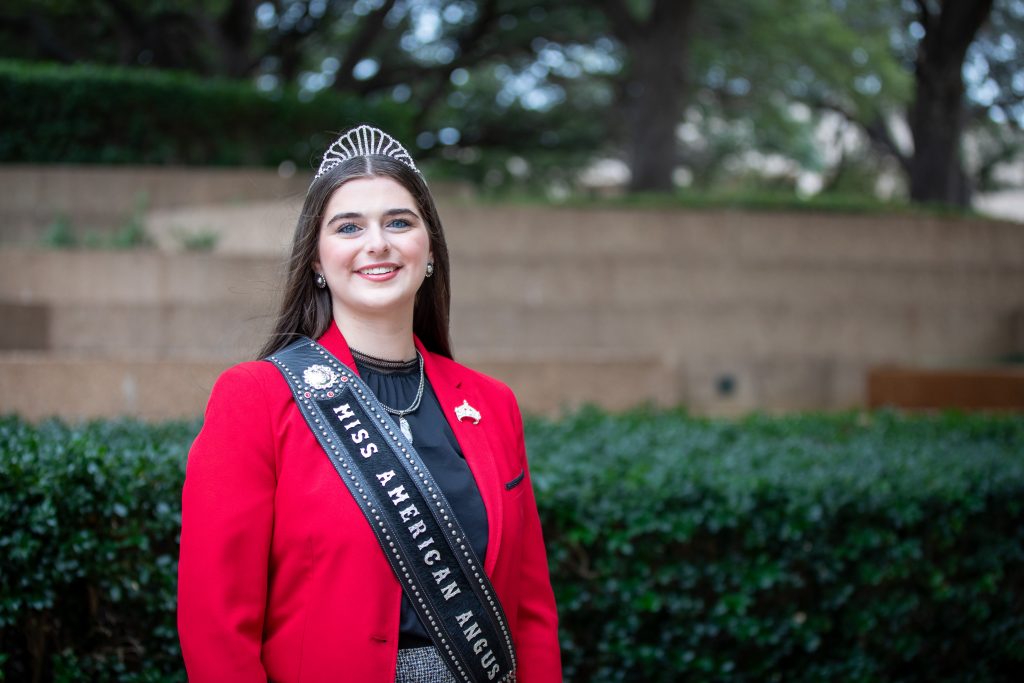
Indiana junior, Rosalind Kidwell has been selected to serve the Angus breed as Miss American Angus.
When Rosalind Kidwell said all she's ever known is the beef industry, she really meant it. If the title of fifth-generation Angus breeder wasn't enough, Kidwell recently earned the famous red blazer of Miss American Angus when she was crowned during the annual American Angus Association® Awards Dinner and Reception held Sunday, Nov. 3 in Fort Worth, Texas, as part of Angus Convention.
"I think that Miss American Angus is almost like a focal point for the Angus breed," the Gentryville, Indiana, local said. "I love advocating for the Angus breed. I love talking about it. So, to have that opportunity to advocate for the Angus breed and the beef industry is something I think that is really, really pivotal to Miss American Angus."
The leadership role is also a chance for Kidwell to carry on a legacy. "Family history is a really important thing to me," she explained. "I ran for junior princess within Indiana, and we were going through scrapbooks of pictures from my grandparents, and I still remember finding the certificate that verified my great, great, great grandpa as a member of the Indiana Junior Angus Association and the American Aberdeen Breeders Association."
That same great, great, great grandpa was also one of the first people to exhibit the champion bred and owned heifer and champion bull at the Chicago Stock Exchange.
"Those were small things that we always told stories about at family get-togethers," Kidwell said. "Just being around that tradition and that history... it's kind of become something that I wanted to carry on."
As her older cousin, Maddie Butler, exhibited her black-hided cattle across the country, Kidwell found herself happy to tag along.
"I was always going to shows," she explained, recalling memories on the road, looking up to Butler. "I grew up being around her constantly, pretty well from the time I was about five until when she stopped showing, which would've been right after she became Miss American Angus."
After watching her older cousin wear the crown of Miss American Angus, Kidwell knew it was a role she wanted to work toward.
"I saw her grow into being a really confident, powerful and poised young woman for other people to look up to," Kidwell said. "I want to do that for young girls. I want to give young girls the opportunity to have that mentor and someone to look up to within the ag industry."
Kidwell's passion for the industry goes beyond family ties. She's pursuing a biochemistry degree and animal science minor at Purdue University, with hopes of finding a career as a veterinary pharmacist.
Find Kidwell in the crown, red blazer and sash during her travels as Miss American Angus this year. For more information about the American Angus Auxiliary-sponsored contest, visit www.angusauxiliary.com.
| ||||||||||||||||||||||||||||||||||||||||||||||||||||||||||||||||||||||||||||||||||||||||||||||||||||||||||||||||||||||||||||||||||||||||||||||||||||||||||||||||||||||||||||||||||||||||||||||||||||||||||||||||||||||||||||||||||
| ||||||||||||||||||||||||||||||||||||||||||||||||||||||||||||||||||||||||||||||||||||||||||||||||||||||||||||||||||||||||||||||||||||||||||||||||||||||||||||||||||||||||||||||||||||||||||||||||||||||||||||||||||||||||||||||||||
|
EPA's 50th Annual Automotive Trends Report shows that all large automotive manufacturers are meeting current GHG standards

Today, Nov. 25, the U.S. Environmental Protection Agency released its 50th annual Automotive Trends Report, demonstrating that model year 2023 vehicle fuel economy reached a record high while greenhouse gas emissions dropped to record low levels. The report also shows that all 14 large automotive manufacturers are in compliance with EPA's light-duty GHG program requirements through the MY 2023 reporting period. Today, the new MY 2023 electric vehicles and plug-in hybrid electric vehicles on the road have led to 11% lower CO2 emissions.
The 2024 EPA Automotive Trends Report celebrates its 50th anniversary and continues a long tradition of providing the public with a highly detailed look at progress in the auto industry.
"This report provides a critical data-driven affirmation that strong, technology-neutral standards can underpin environmental progress while saving drivers money at the pump," said EPA Administrator Michael S. Regan. "Manufacturers continue to innovate and are bringing technologies to market which will directly improve air quality, better protecting people's health and saving lives."
Over the course of 50 years, there have been many notable vehicle emission and public health accomplishments. Since EPA began keeping data in 1975, vehicles today are roughly 99% cleaner for common pollutants (such as hydrocarbons, carbon monoxide, nitrogen oxides and particle emissions) which can help alleviate adverse health effects such as asthma and heart problems, and limit hospital days and cancer. In addition, fuel economy in the United States has improved from 13.1 miles per gallon in MY 1975 to 27.1 mpg for MY 2023 vehicles.
Despite these significant improvements in local air pollution that have benefited Americans, passenger cars and light trucks still accounted for nearly 17% of total U.S. GHG emissions in 2022, indicating the importance of further reductions in GHG emissions and improvements in fuel economy.
2024 EPA Automotive Trends Report highlights:
· For MY 2023, new vehicle fuel economy increased by 1.1 mpg reaching a record high 27.1 miles mpg.
· For MY 2023, new vehicle real-world CO2 emissions decreased to a record low of 319 grams per mile. By saving an additional 18 grams per mile of CO2 on each vehicle produced in the United States in MY 2023, the impact on climate change is reduced.
· Since MY 2004, CO2 emissions have decreased 31%, or 142 g/mi, and fuel economy has increased 40%, or 7.8 mpg.
· Since MY 2004, CO2 emissions have improved in 16 of 19 years.
· EVs and PHEVs are accelerating the downward trend in new vehicle real-world emissions. These vehicles have reduced CO2 emissions by 38 g/mi and improved fuel economy by 2.2 mpg in MY 2023.
· In MY 2023, the combined category of battery-electric vehicles, PHEVs, and fuel cell vehicles increased from 6.7% of production in MY 2022 to 11.5% of production in MY 2023 and are projected to reach 14.8% of production in model year 2024. This accelerating trend will likely continue as EV production is expected to grow across the industry in coming years.
This annual report reflects EPA's commitment to provide the public with information about new light-duty vehicle greenhouse gas emissions, fuel economy, technology data, and auto manufacturers' performance in meeting the nation's emissions standards. EPA's annual Automotive Trends Report is separate from the agency's regulatory process.
Read the full EPA Annual Automotive Trends Report and learn more about the trends.
Honorees to be Recognized at CattleCon 2025 in San Antonio
Established in 2009, the Cattle Feeders Hall of Fame honors the exceptional visionary men and women who have made lasting contributions to the cattle-feeding industry. 2025 Cattle Feeders Hall of Fame honorees will be recognized during the 16th annual banquet on Feb. 5 during CattleCon 2025 in San Antonio, Texas.
Hall of Fame inductees for 2025 include Joe Morgan with Poky Feeders in Scott City, Kansas, and Dan May with 4M Feeders in Stratton, Colorado. Tom Jensen of Nebraska will receive the Industry Leadership Award for his decades of banking experience and service to the cattle industry, and George "Frank" Littrell Jr., with Midwest Feeders, Inc., in Kansas, will receive the Arturo Armendariz Distinguished Service Award.
"We are proud to recognize these individuals who have devoted their careers to improving the cattle-feeding industry," said Dustin Johansen, senior vice president at Farm Journal and Cattle Feeders Hall of Fame board member. "Their commitment to quality contributes to our industry's ongoing success."
Cattle Feeders Hall of Fame banquet attendees are invited to participate in CattleCon 2025, the largest cattle and beef industry event of the year. The annual convention features industry meetings, inspirational speakers, valuable education, entertainment, a massive trade show, producer recognition and much more. All proceeds from banquet corporate sponsorships benefit future Hall of Fame initiatives.
For more information about CattleCon 2025 and to register, visit convention.ncba.org. For more information about the Cattle Feeders Hall of Fame and 2025 inductees, visit www.cattlefeeders.org.
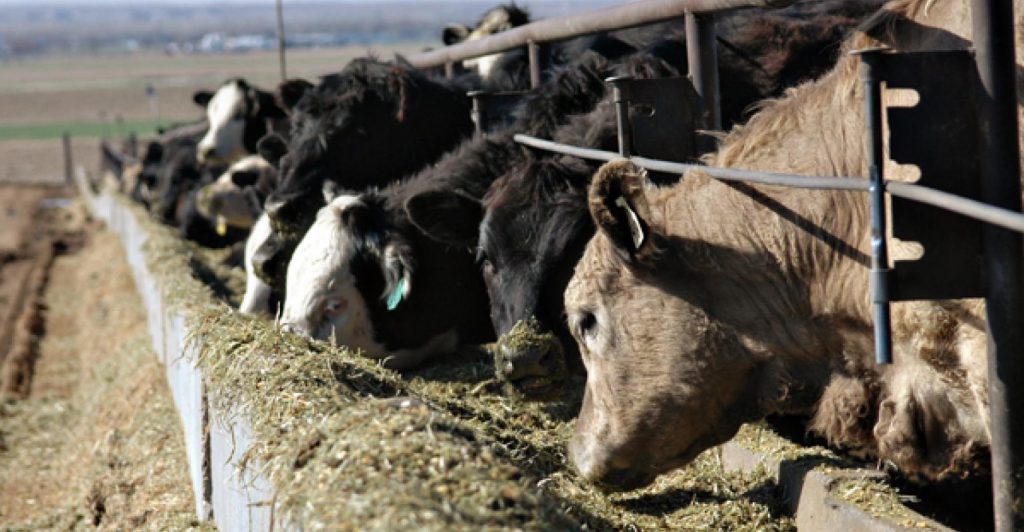
Dr. Derrell Peel, Oklahoma State University Extension Livestock Marketing Specialist, offers his economic analysis of the beef cattle industry as part of the weekly series known as the "Cow Calf Corner," published electronically by Dr. Peel and Mark Johnson. Today, Dr. Peel discusses the latest Cattle on Feed report.
The latest Cattle on Feed report showed that feedlot inventories on November 1 were 11.99 million head, equal to one year ago. Feedlot inventories have been about equal to the previous year for each of the past 14 months. October feedlot placements were 105.3 percent of year ago levels, slightly higher than pre-report expectations. Placements in October were likely enhanced by early movement of feeder cattle in October. In Oklahoma, October auction volumes were up by 45.2 percent over year earlier levels. Auction volumes dropped sharply in November. The larger, earlier fall run of calves likely means that auction volumes will be smaller for the remainder of the year. Total feedlot placements this year have been 1.1 percent less year over year.
Feedlot marketings in October were 104.7 percent of last year. However, October 2024 had one additional business day compared to last year so daily average feedlot marketings were equal to one year ago. Total feedlot marketings this year have been down slightly, just 0.1 percent less than last year.
Recent slaughter data for October showed that heifer slaughter was 32.5 percent of total cattle slaughter for the month. The twelve-month moving average of heifer slaughter was 31.8 percent of total slaughter for the past year. With just two months of data left in 2024, this is a good estimate of the annual value of heifer slaughter as a percent of total cattle slaughter. This estimate is included in Figure 1 (shown in red) and shows that heifer slaughter rates continue to increase. The 2024 heifer percentage of total cattle slaughter is likely to be the highest level since 2004.
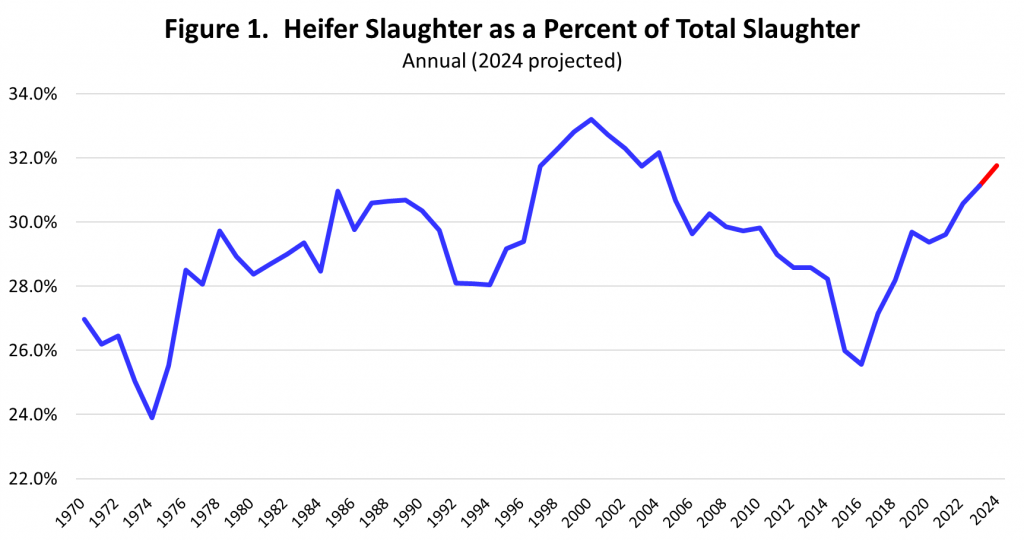
Cattle cycle herd dynamics depend on the dynamics of female cattle including both cull cows and heifers. Declining cull cow rates is often the leading indicator of producer herd rebuilding intentions. Beef cow slaughter is down 17.9 percent year over year in the first 45 weeks of 2024. This is projected to result in an annual culling rate of about ten percent, roughly equal to the long-term average and down from the recent high over 13 percent in 2022. During herd expansion the cow culling rate typically drops below nine percent for 3-4 years.
The biggest component of herd expansion is heifer retention. The heifer slaughter rates in Figure 1 indicate that no heifer retention is occurring yet. Heifer retention usually lags changes in cow culling. Herd expansion results in decreased heifer slaughter rates similar to the 1991-1996 and the 2014-2017 periods. Current heifer slaughter rates suggest that the beef cow has continued to decrease in 2024 and that prospects for herd expansion in 2025 are very limited.

The National Association of State Departments of Agriculture congratulates Brooke Rollins for her nomination to be U.S. Secretary of Agriculture. NASDA looks forward to working with the U.S. Senate to get Brooke Rollins confirmed so she can begin to champion solutions for food and agricultural production.
"NASDA members look forward to working with a leader who is committed to ensuring agriculture leads the way toward a healthy and resilient world," NASDA CEO Ted McKinney said. "As co-regulators with the federal government on environmental, agricultural and food safety policies, NASDA will work with Brooke Rollins to continue seeking innovative opportunities and solutions for our food, fiber and fuel supply."
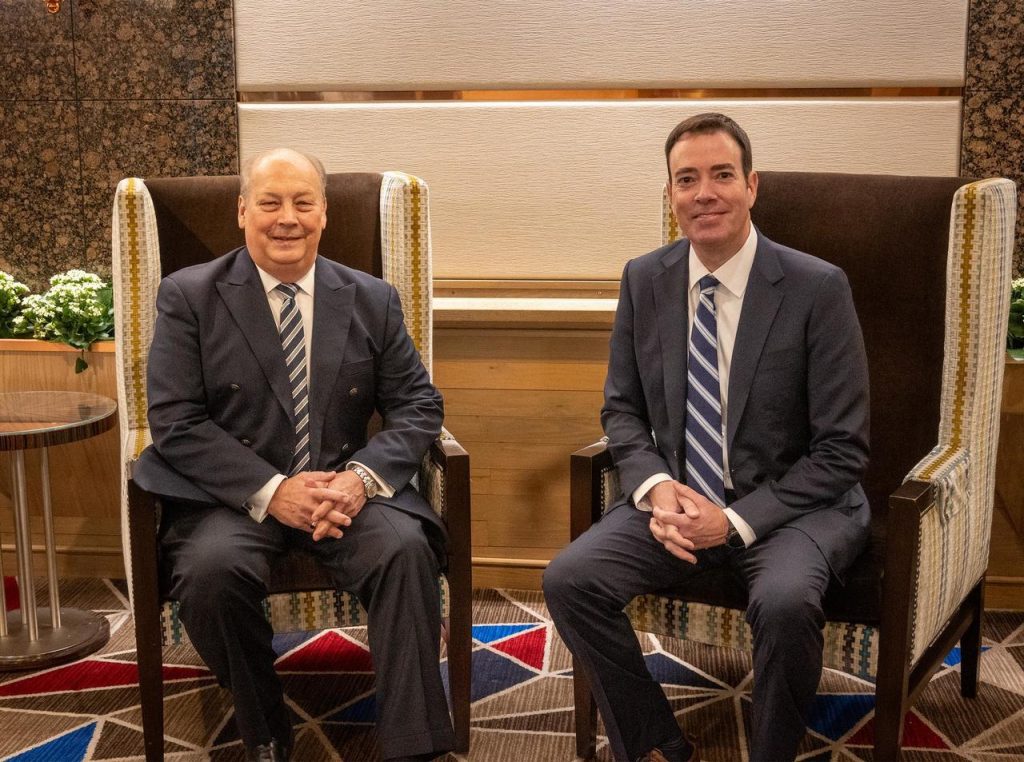
Mike Spier (right), USW Vice President of Overseas Operations, has been selected to replace Vince Peterson (left) as the organization's next President and CEO, effective July 1, 2025.
At their board meeting Nov. 14, 2024, U.S. Wheat Associates (USW) directors elected Mike Spier, Vice President of Overseas Operations, as the export market organization's next President and CEO, effective with the retirement of current President and CEO Vince Peterson on July 1, 2025.
"I am deeply honored and humbled to be elected to this position and grateful to our officers and directors for their trust and confidence," said Spier. "I am also immensely grateful to Vince Peterson, whose vision and dedication have laid a durable foundation for future success. I look forward to working with my outstanding colleagues, as well as the National Association of Wheat Growers, state wheat commissions, and our industry partners. Together, we will continue to innovate, create new export opportunities, enhance profitability for U.S. wheat growers, and deliver value to customers overseas."
The USW President serves at the pleasure of the wheat farmers on its Board of Directors and is responsible for implementing board-directed policies and for managing staff, export market development programs, and finances.
"Mike is well-known and respected by our overseas wheat buyers and the entire domestic industry. He is highly qualified, and I am very pleased the board selected him to lead the organization," said Peterson, who was named USW's fourth President in 2017. "With strong support from our board, we have maintained a solid financial position that will give Mike and our talented, hard-working staff a great foundation to meet the challenges and opportunities ahead in the world wheat market."
Spier is an Oregon native who has a bachelor's degree in accounting from Seattle Pacific University. He started his career in 1992 as an accountant and then a grain merchandiser with United Grain Corporation in Portland, Ore. In 1997, he joined USW as Assistant Director of the West Coast Office. Spier relocated to Cairo, Egypt, in 1998 as USW Assistant Regional Director for the Middle East and East Africa. After four years in Cairo, he transferred to Manila, Philippines, as Assistant Regional Director for South and Southeast Asia. In 2009, USW promoted Spier to Regional Vice President for South and Southeast Asia and transferred him to USW's Singapore Regional Office. In 2015, Spier transitioned to Columbia Grain International Inc. (CGI) as Assistant Vice President of International Marketing, establishing CGI's Singapore office for marketing international milling wheat in Southeast Asia. In 2018, he moved to the company's headquarters in Portland, Oregon to lead CGI's international wheat marketing desk. In 2019, Spier returned to USW as Vice President of Overseas Operations.
Throughout his career, Spier has gained expertise in grain merchandising, international wheat trading, market analysis, risk management and hedging, logistics, execution, and negotiation of ocean freight contracts. Over his career in the wheat industry, Spier has traveled to more than 50 countries, implementing wheat export market development activities, providing insight into the U.S. and world wheat markets, and assisting buyers with wheat contract terms to meet price and quality expectations.
USW's mission is to "Develop, maintain, and expand international markets to enhance wheat's profitability for U.S. wheat producers and its value for their customers." Its activities are made possible by producer checkoff dollars managed by 17 state wheat commissions and through USDA Foreign Agricultural Service cost-share funding. For more information, visit www.uswheat.org or contact your state wheat commission.
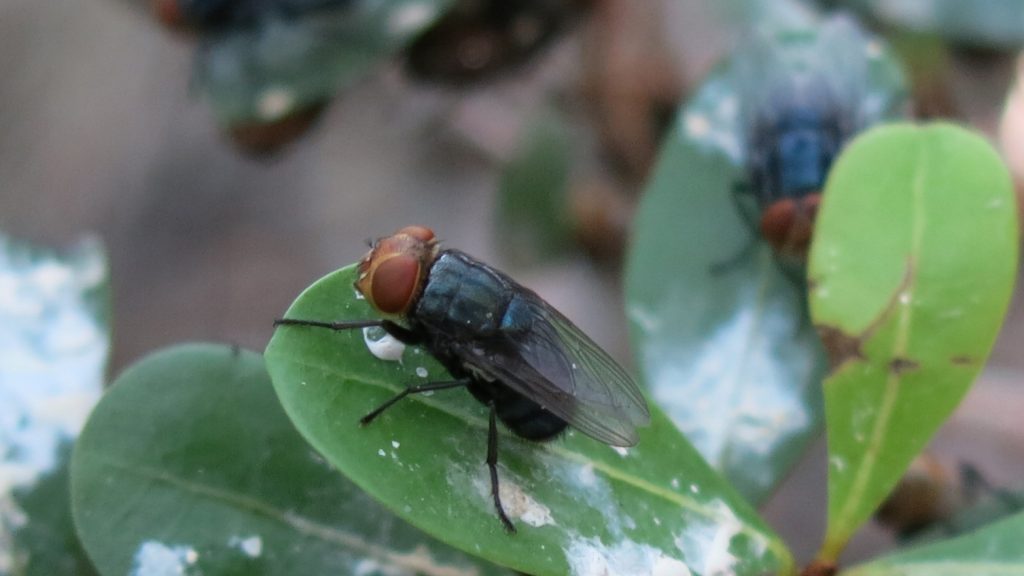
NCBA Vice President of Government Affairs Ethan Lane on New World Screwworm: "In response to the detection of New World screwworm in southern Mexico, USDA is restricting the import of live animal commodities coming from or traveling through Mexico. So far, New World screwworm has only been reported in the southern state of Chiapas, near the Guatemala border and it has not yet been detected at the U.S.-Mexico border. New World screwworm was eradicated from the United States in the late 1960s using sterile flies, a technique that has successfully—until this year—kept this parasite at bay in Central America. NCBA will continue working with Congress and USDA to bolster the sterile fly program and protect the American cattle herd from infection."
"U.S. cattle producers should remain vigilant and monitor their herds closely. New World screwworms look for open wounds, so immediate treatment of wounds or sores in cattle is essential. If cattle exhibit irritated behavior, head shaking, you notice the smell of decay, or spot maggots in a wound, seek treatment from a veterinarian immediately. New World Screwworms have orange eyes, a metallic blue or green body, and three dark stripes across their backs. If you see any suspicious flies, please alert your local veterinarian or contact USDA."
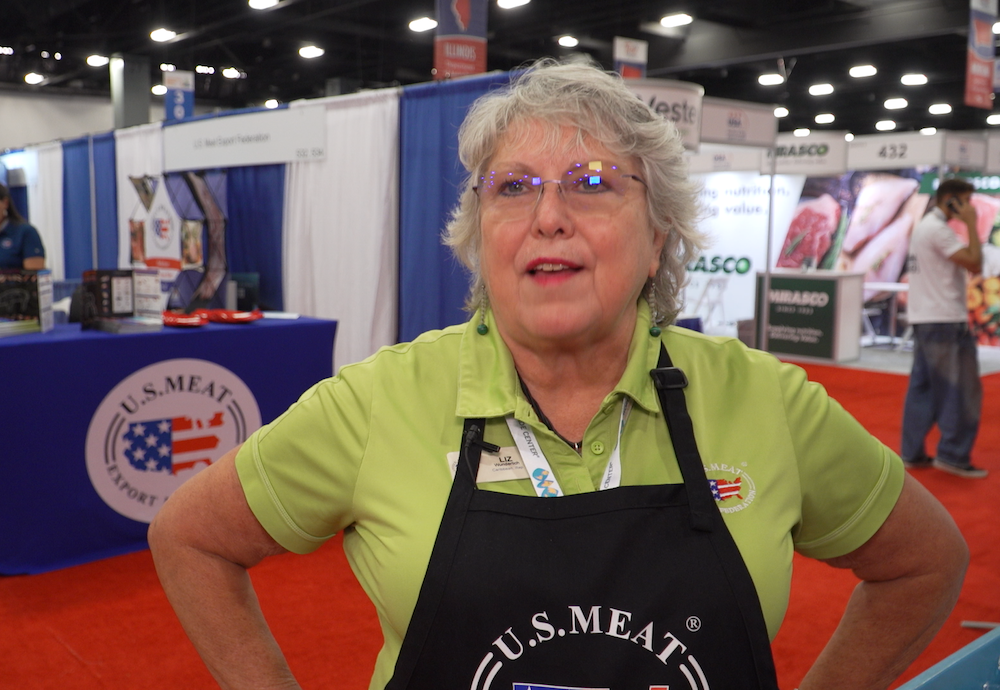
USMEF Caribbean Representative Elizabeth Wunderlich
After many years of having a minimal presence in the market, U.S. red meat is gaining traction in Cuba – due in part to an expansion of private-sector buying.
To help U.S. suppliers capitalize on this opportunity, the U.S. Meat Export Federation (USMEF) recently held an educational seminar in Miami, bringing exporters and prospective buyers together to learn more about the procedures for conducting business in Cuba. USMEF Caribbean Representative Elizabeth Wunderlich has more details on the seminar in this audio report, which also includes remarks from Paul Johnson of FocusCuba, a consulting firm that specializes in assisting U.S. companies interested in the Cuban market.

Johnson says that much of the interest from Cuban buyers is for U.S. pork, due to a sharp decline in Cuba's domestic pork production. But he notes that opportunities for U.S. exporters are also expanding because they now have access to more buyers, rather than having to work through Cuba's government procurement agency.
Alicia Rodriguez, who directs new business development for Florida-based distributor American Foods International, found the USMEF seminar to be a great opportunity.
Through September, U.S. pork exports to Cuba totaled 5,843 metric tons (mt), up 322% from the same period last year, valued at $17.2 million (up 236%). On the beef side, Cuba currently takes mostly canned product but shipments are up sharply. January-September exports increased more than 1,500% from a year ago, reaching 3,234 mt, valued at $5.4 million (up 519%). For U.S. lamb entering Cuba, 387 mt of variety meat exports were reported through September, valued at $1.5 million (no lamb exports were reported for the same period in 2023).

Across the U.S., producers are facing unpredictable or extreme weather events which can cause financial difficulties. Risk management, in the form of crop insurance, can offer financial protection.
To aid producers new to crop insurance, whether they are commodity corn and soybean growers or raising organic and specialty crops, the Center for Rural Affairs has created the "Crop Insurance 101" series that addresses frequently asked questions.
"Signing up for crop insurance, especially for the first time, can be daunting," said Kelsey Willardson, policy associate with the Center. "With shifts in weather patterns and extreme events like flooding and drought, it is important that all producers have access to crop insurance, and sometimes this access depends on understanding the basics."
Federal crop insurance is administered by the U.S. Department of Agriculture's Risk Management Agency and provides financial protection for producers who face yield or revenue losses caused by natural causes or market fluctuations.
The first of the series, "Weathering the Unpredictable: The Protection Crop Insurance Provides," describes common perils that result in these losses, as well as which crop insurance policies cover each type of loss.
The series continues with resources outlining important dates to remember and instructions for filing a claim. This includes dates that producers must follow to maintain eligibility for crop insurance coverage, such as the sales closing date, premium billing date, and final planting date. In addition, the guide contains details producers need when filing a claim to ensure they receive full coverage.
"The process may seem complicated to newcomers, but there's no need to navigate the process alone," said Willardson. "These guides are meant to serve as a starting point for a conversation with your crop insurance agent."
Another resource in the series includes an overview of Prevented Plant Coverage. Many producers are familiar with crop insurance policies that offer financial protection for damaged or destroyed crops; Prevented Plant Coverage, however, offers protection from the loss of crops that could not be planted in the first place.
"Farmers face many risks in their profession, and all farmers should have access to the safety net that crop insurance provides," said Willardson.
To view these guides in both English and Spanish, visit cfra.org/crop-insurance-resources.
Farmers with questions about crop insurance are invited to reach out to the Center for Rural Affairs for one-on-one support. Contact kelseyw@cfra.org or 641.218.4694

New World Screwwom (picture from USDA APHIS)
On November 22, 2024, the Chief Veterinary Officer of Mexico notified the United States Department of Agriculture's Animal and Plant Health Inspection Service (APHIS) of a positive detection of New World screwworm (NWS) in Mexico. The NWS was found in a cow in the southern Mexico state of Chiapas, at an inspection checkpoint close to the border with Guatemala. NWS are fly larvae that infest living tissue of warm-blooded animals, causing infection.
"Given the northward movement of NWS, APHIS has in recent months stepped up its efforts in Central America to partner with impacted countries to push this pest out of newly affected areas," said Dr. Rosemary Sifford, Chief Veterinary Officer of the United States. "With this latest find in Mexico, we will further intensify this work to protect American agriculture and reestablish the barrier in Central America."
Given the severity of the threat from NWS, APHIS is restricting the importation of animal commodities1 originating from or transiting Mexico effective immediately(1 Live cattle and bison are the animal commodities impacted by this restriction.) and pending further information from Mexican veterinary authorities on the size and scope of the infestation. A complete list of regions APHIS recognizes as affected by screwworm and well as more detailed information on trade restrictions can be found on the USDA APHIS Animal Health Status of Regions website.
NWS maggots can infest livestock and other warm-blooded animals, including people. They most often enter an animal through an open wound and feed on the animal's living flesh. While they can fly much farther under ideal conditions, adult flies generally do not travel more than a couple of miles if there are suitable host animals in the area.
APHIS is working with partners in Mexico and Central America to stop the spread of NWS into the United States and asking all producers along the southern border to watch their livestock and pets for signs of NWS and immediately report potential cases.
Screwworm infestations are difficult to detect at first. Check your pets and livestock for draining or enlarging wounds, and signs of discomfort. Also look for screwworm larvae or eggs. Screwworm eggs are creamy and white and are deposited on near the edges of superficial wounds. If you suspect your animal is infected with screwworm, contact your veterinarian.
While not common in humans, if you notice a suspicious lesion on your body or suspect you may have contracted screwworms, seek immediate medical attention.
Since 2006, APHIS has collaborated with Panama to maintain a barrier zone in eastern Panama, working to prevent the northward movement of NWS from South America to NWS-free areas in Central and North America. In the last two years, screwworm has spread north of the barrier throughout Panama and into Costa Rica, Nicaragua, Honduras, Guatemala and now Mexico. This increase is due to multiple factors including new areas of farming in previous barrier regions for fly control and increased cattle movements into the region. APHIS is releasing sterile flies through aerial and ground release at strategic locations throughout Central America.
APHIS will continue working with partners in Mexico and Central America to eradicate NWS from the affected areas and to reestablish the biological barrier in Panama.
To learn more about NWS, visit the APHIS website.
Farm Director KC Sheperd got to talk to Keely Bowling and Kaylee Springer to learn about the Alva FFA Chore Chicks who provide livestock and pet care services to the Alva community.
"The Alva FFA Chore Chicks is an FFA group of girls who do livestock chores for people in the Alva community," Bowling said. "It isn't only livestock chores. It can be letting the dogs out or watering the garden."
Their services stretch as far as grooming dogs and breaking ice for livestock, particularly useful during winter months.
To access their services, interested parties need only to contact one of the girls who will arrange a meeting with the person to learn what needs to be done and how to do it. Each time the girls visit the property to do chores, they would drop a pin for the homeowner to let them know the job was done.
The idea began when Bowling began helping retired ag teacher Jack Staats with his chores. After a couple of months, Staats visited the ag barn and helped set the work up as a Supervised Agricultural Experience (SAE) to allow FFA members to claim credit for their work within the FFA organization.
The group's services can be accessed through Alva FFA Facebook and Instagram posts with graphics including their girls' phone numbers and will continue until Bowling and Springer graduate, after which the group may be opened up to new members.
•Keyli Bowling - 580-732-0632
•Allison Blocker - 580-737-0547
•Madison Blocker - 580-430-1237
•Kaylee Springer - 580-596-8888
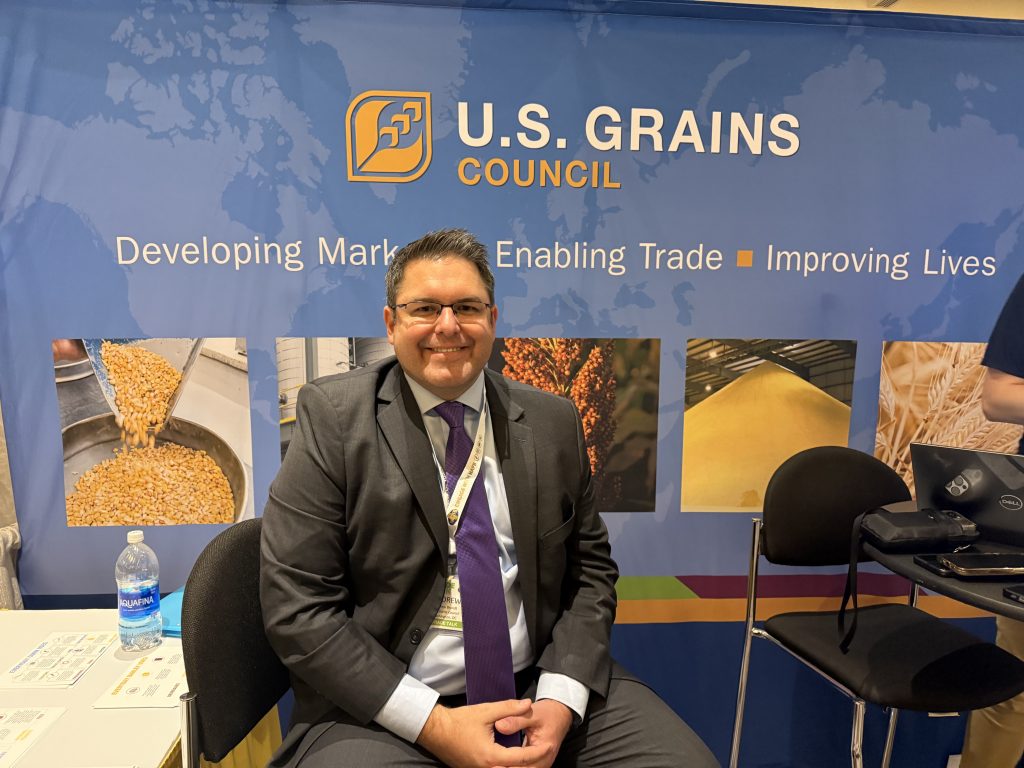
At the National Association of Farm Broadcasters Convention, KC Sheperd caught up with U.S. Grains Council (USGC) Director of Trade Policy Andrew Brandt.
The USGC is composed of nine offices around the world tasked with promoting various U.S. grains such as corn, barley, and sorghum in foreign markets, as well as helping to shape trade policies domestically.
"I, myself, do the trade policy piece of anywhere from tariffs, free trade agreements, and I spend a surprising amount of time on sanitary and phytosanitary or SPS issues, specifically related to MRL or maximum Residue Limits, which is related to residual crop protection residue," Brandt shared.
He said that increasingly, instead of tariffs, other countries are setting such low MRL numbers that U.S. grains can rarely meet.
The USGC's biggest post-election concerns include the biotech dispute with Mexico, new sustainability mandates, which Brandt counts as both concerns and opportunities, and consumer preferences.
He explained, "There is a lot there to try to satisfy, because in some cases, governments are dong mandates of how we should grow a certain crop, or like the EU deforestation regulations."
Another resulting concern of the election is the potential for a new round of tariffs. "The Trump administration has been saying they are going to enact tariffs," he said. "We don't have the final details on what those tariffs will look like, yet. I don't think our farmers will be hurt by our tariffs. However, the retaliatory tariffs some of these countries might throw up could have an impact on, not only where our bushels can go, but certainly on the prices that our farmers can receive."
Brandt hopes that the tariffs will be a means to an end as leverage to get what the Trump administration wants. "Our hope is that it is a temporary leverage strategy and not a permanent change in the marketplace," he said. "Specifically to where we get permanent retaliatory tariffs towards us that tilts the playing field away from us. We have enough competition from our South American friends already, that if we get hit with long-term retaliatory tariffs from some of these key markets, that will have an impact."
One thing that U.S. grains has going for it is outstanding quality. "There is a quality piece and there is our ability to move it, and there is the financing of it with the dollar as the world's reserve currency – that is all in our favor, yet," he admitted. "Those are still all very good things. By and large, we are competitive on those fronts, but sometimes tariffs get in the way or just the ability of how much production Brazil can bring online, yet."
RON's Dave Lanning has a pre-opening look at today's agricultural Markets.
Click the audio tab below for today's report.
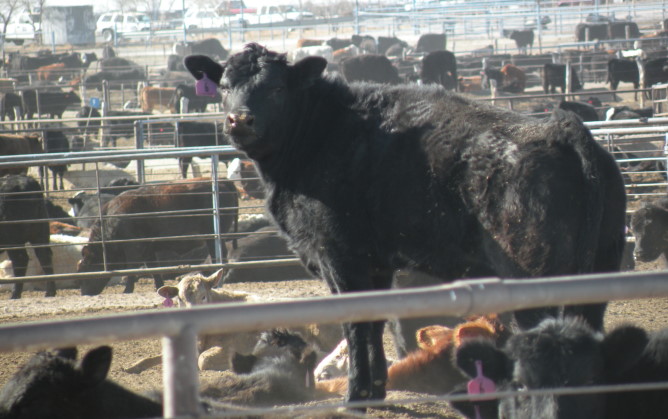
Oklahoma State University's Dr. Derrell Peel says the November USDA Cattle on Feed Report says it's more of the same with on feed numbers just slightly above November first of 2023. He says it's happening despite the fact that we have fewer calves available because of smaller US Beef Cow herd. "Feedlots have been very creative and very good at finding ways to hold their inventories- obviously, they have an incentive to hold those capacities and they are going to do it as long as they can."
How are feedlots staying relatively full? Peel says it starts with feeding heifers. Peel says "that's probably the biggest factor as the October one numbers gave us that we are still about forty percent of the feedlot inventories being heifers and then the last part of that is that the fact that feedlots have continued to extend the days on feed. Even though they are actually placing less cattle- if you look at average placements, they have gone down but we have slowed them down in order to hold the inventory high- so we filling the tank slower but we are letting them out even slower than that and that keeps the level high at this point."
Cattle and calves on feed for the slaughter market in the United States for feedlots with capacity of 1,000 or more head totaled 12.0 million head on Nov. 1, 2024. The inventory was slightly above Nov. 1, 2023, USDA NASS reported on Friday.
Placements in feedlots during October totaled 2.29 million head, 5.3% above 2023. Net placements were 2.23 million head. During October, placements of cattle and calves weighing less than 600 pounds were 585,000 head, 600-699 pounds were 480,000 head, 700-799 pounds were 490,000 head, 800-899 pounds were 436,000 head, 900-999 pounds were 215,000 head, and 1,000 pounds.
Marketings of fed cattle during October totaled 1.85 million head, 4.7% above 2023.
Other disappearance totaled 55,000 head during October, unchanged from 2023.
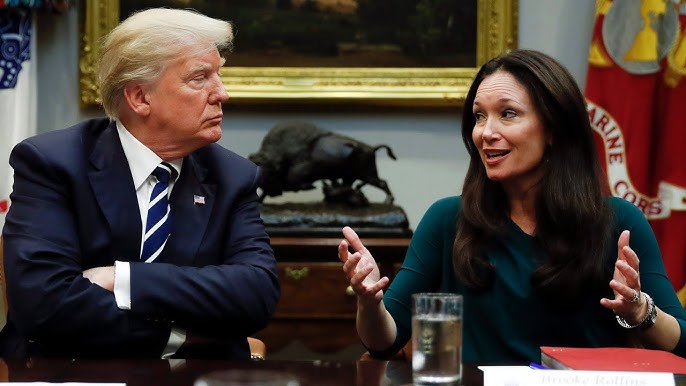
American Farm Bureau Federation President Zippy Duvall commented today on the nomination of Brooke Rollins for Secretary of Agriculture.
"We congratulate Brooke Rollins on her nomination to be Secretary of Agriculture. We're pleased she has a good relationship with our state Farm Bureau in Texas and hope to build on it if she's confirmed by the Senate. We're encouraged by her statement that she'd 'fight for America's farmers and our nation's agricultural communities.' Effective leadership at USDA is more important than ever as farmers and ranchers face a struggling agricultural economy."
Speaking of the Texas Farm Bureau- The following statement may be attributed to Texas Farm Bureau President Russell Boening regarding the nomination of Brooke Rollins of Texas as U.S. Secretary of Agriculture.
"Texas Farm Bureau has known and worked with Brooke Rollins for many years. Our organization first met Brooke when she attended our TFB Citizenship Seminar and competed in our youth contests while in high school. Her leadership skills were evident then and during her service in the first Trump administration. She is a passionate advocate for agriculture and is an excellent nominee for U.S. Secretary of Agriculture."
National Sorghum Producers Chairwoman Amy France, a sorghum farmer from Scott City, Kan., commented today on President-elect Trump's nomination of Brooke Rollins as Secretary of Agriculture.
"We congratulate Brooke Rollins on her nomination as Secretary of Agriculture. This is an important moment for U.S. agriculture, and we are optimistic about the opportunities her leadership will bring to rural America.
"Sorghum farmers are at the forefront of innovation, contributing to domestic biofuels and heart-healthy, nutritious ancient grain foods. We are eager to work with her to advance policies that strengthen the sorghum industry and benefit growers nationwide."
The American Soybean Association congratulates former Trump policy advisor Brooke Rollins on being selected by President-elect Donald Trump as nominee to serve as the next U.S. Department of Agriculture Secretary.
Josh Gackle, ASA president and soy farmer from Kulm, North Dakota, said, "We appreciate that Rollins holds a degree in agriculture development and grew up on a farm and that she will bring that perspective, along with her policy experience from the previous Trump administration, to the role. The mission carried out by USDA is vital to the continued success both domestically and abroad for U.S. soybean farmers. ASA welcomes the opportunity to share the importance of soy in the U.S. economy and work with the department and this nominee upon her confirmation on issues critical to farmers."
USDA has offices in states and counties across the country and a purview that includes farm and nutrition programs, crop insurance, forestry, home and farm lending, food safety, rural development, agricultural research, trade, and more. ASA looks forward to working with Rollins on priorities ranging from farm bill to biotechnology, biofuels support to agricultural trade, among other issues that impact soy growers and agriculture at large.
NCFC Congratulates Brooke Rollins on Nomination as Ag Secretary
"I would like to congratulate Brooke Rollins on her nomination to be the next Secretary of Agriculture. As someone who grew up in a rural community directly connected to agriculture, she has a deep respect and appreciation for the work that America's farmers and ranchers do. We look forward to working with her both in the upcoming confirmation process and once she assumes the role of secretary."
Growth Energy CEO Emily Skor issued the following statement regarding President-elect Donald Trump's nomination of America First Policy Institute (AFPI) Founder Brooke Rollins as Secretary of Agriculture: "Growth Energy looks forward to engaging with Secretary Designate Rollins and demonstrating how our industry is vital to growing jobs and innovation across rural America and unleashing American energy dominance. The USDA Secretary is rural America's voice in the White House, and we will work hard to ensure Rollins is well-positioned to deliver on President Trump's rural agenda, expand markets for homegrown renewable fuel, and bring more low-cost options to the pump."
Today, National Cattlemen's Beef Association (NCBA) Vice President of Government Affairs Ethan Lane issued a statement congratulating Brooke Rollins on her nomination as Secretary of Agriculture:
"From her time as a college student studying agriculture development to her distinguished career in Texas and Washington, Brooke Rollins has a history of fighting for Main Street and rural America. America's cattle producers need a Secretary of Agriculture who will protect family farms and ranches, roll back crushing regulations, and stand up for rural values—and we look forward to working with Secretary-Designate Rollins to make it happen."

Pic courtesy of Brook Rollins X account
No one watching the USDA Ag Secretary selection process saw it coming- but President-elect Donald Trump on Saturday named Brooke L. Rollins as the country's next Secretary of Agriculture.
A native of Texan, Rollins, 52, is the founder and CEO of the America First Policy Institute (AFPI) and America First Works (AFW), a pair of organizations that have championed Trump's agenda. According to Politico- "Rollins, who grew up on a farm, is a surprise pick for the role, with less experience in agriculture policy than those on Trump's shortlist. Trump's decision to tap her, which was first reported by The Wall Street Journal, came amid ongoing fighting over the role among his advisers, family members and powerful agriculture groups.
"Interest in the USDA chief role only grew as it became one of the last major Cabinet posts left for Trump to fill. Rollins had also been in the early running to be Trump's chief of staff, but he ultimately tapped Susie Wiles."
Politico adds "She was the last person standing at Mar-a-Lago," said a person familiar with the transition conversations who was granted anonymity to speak candidly.
"The jockeying over the USDA chief intensified in the final hours, including after CNN reported that Trump was expected to tap former Georgia Sen. Kelly Loeffler for the role. Trump, who regularly speaks with Rollins, discussed the role with her earlier this week, according to a person familiar with the conversation."
Rollins will take over a department with more than 100,000 people, a $213 billion budget and more than 3,000 county offices. USDA is responsible for the country's main nutrition support programs, school lunches, farm programs and rural economic development. Rollins would also lead the Trump administration's efforts to advise the next Congress on what should be included in a new farm bill. One of the early decisions for the next agriculture secretary also likely will consist of determining how to disburse an aid package for farmers currently being crafted in Congress. The Biden administration this past week proposed a $24 billion disaster package for farmers and rural infrastructure.
On social platform X, Rollins commented:
"Thank you, Mr. President, for the opportunity to serve as the next U.S. Secretary of Agriculture. It will be the honor of my life to fight for America's farmers and our Nation's agricultural communities. This is big stuff for a small-town ag girl from Glen Rose, TX -- truly the American Dream at its greatest.
"WHO'S READY TO MAKE AGRICULTURE GREAT AGAIN?" @BrookeLRollins"
Rollins also was a member of Trump's Economic Advisory Council in 2016. In a statement, Trump said Rollins "did an incredible job during my first term as the director of the Domestic Policy Council, director of the Office of American Innovation, and assistant to the President for Strategic Initiatives. In these roles, she helped develop and manage the transformational domestic policy agenda of my administration."
Trump's transition team stated, "Brooke's commitment to support the American Farmer, defense of American Food Self-Sufficiency, and the restoration of Agriculture-dependent American Small Towns is second to none."
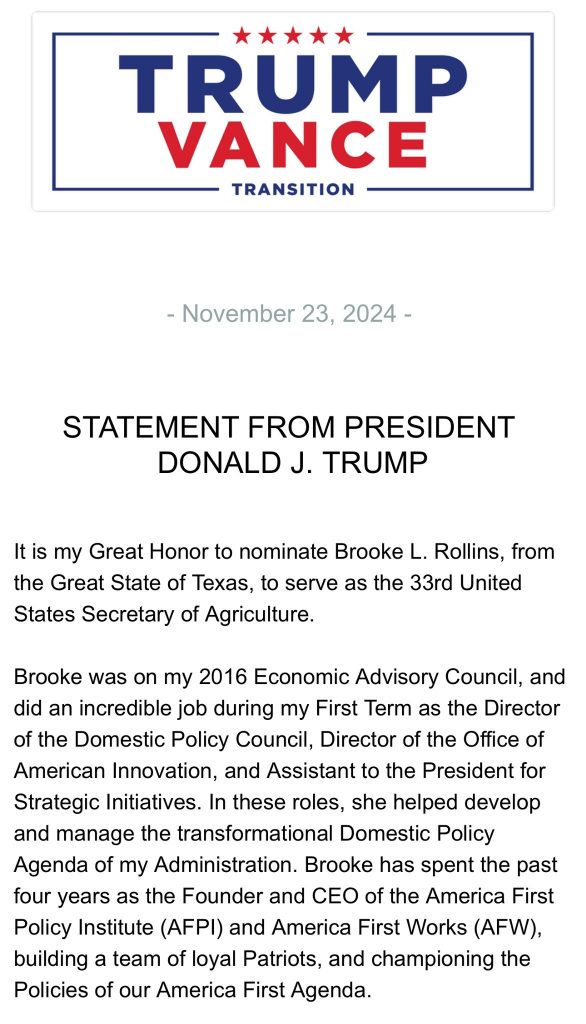
Rollins has a Bachelor of Science in Agriculture from Texas A&M University and a law degree from there as well.
The transition team statement on Rollins added, "From her upbringing in the small and Agriculture-centered town of Glen Rose, Texas, to her years of leadership involvement with Future Farmers of America and 4H, to her generational family farming background, to guiding her four kids in their show cattle careers, Brooke has a practitioner's experience, along with deep policy credentials in both nonprofit and government leadership at the state and national levels."
The statement added, "As our next Secretary of Agriculture, Brooke will spearhead the effort to protect American Farmers, who are truly the backbone of our Country."
The announcement comes a day after news organizations, reported former Georgia Sen. Kelly Loeffler was in line for Agriculture secretary. CNN initially reported Loeffler was at Mar a Lago to meet about the position.
Trump on Friday evening named eight new nominees for his administration but Loeffler and Agriculture were not on the lists. Trump named Scott Bessent for Treasury secretary, Rep. Lori Chavez-DeRemer for Labor secretary, Marty Makary to lead the Food and Drug Administration, Janette Nesheiwat for surgeon general, Scott Turner for Housing and Urban Development secretary, Russell Vought for the Office of Budget and Management, and Dave Weldon to lead the Centers for Disease Control and Prevention.
Rollins has not offered a lot of policy about agriculture in the American First Policy Institute, but the group has campaigned against Chinese ownership of U.S. property, an issue that has drawn a lot of attention in agriculture over the past few years.
Illinois Farm Broadcaster Todd Gleason writes on X about the American First Policy Institute website "Trump's pick for ag secretary, Brooke Rollins, leads the America First Policy Institute. The website lists "Agriculture" as one of its policy issues. However there are no team members with agricultural expertise. The page concentrates on energy."
A long list of Washington agricultural policy advisors and farm leaders had been suggested as possible picks for USDA, but Rollins was not among them. Other positions are expected in the coming weeks, including deputy secretary, undersecretaries for trade, farm programs, research and nutrition, as well as directors for agencies such as the Farm Service Agency.
If confirmed, Rollins would be the country's second female Agriculture secretary. Ann Veneman was the first woman to lead USDA from 2001-2005 under then-President George W. Bush.
Chuck Conner, CEO of the National Council of Farmer Cooperatives congratulated Rollins for the nomination. "As someone who grew up in a rural community directly connected to agriculture, she has a deep respect and appreciation for the work that America's farmers and ranchers do. We look forward to working with her both in the upcoming confirmation process and once she assumes the role of secretary," he said.
Emily Skor CEO of the biofuels group Growth Energy also said the group looks to highlight the value of biofuels around the country.
"Growth Energy looks forward to engaging with Secretary Designate Rollins and demonstrating how our industry is vital to growing jobs and innovation across rural America and unleashing American energy dominance," Skor said. "The USDA Secretary is rural America's voice in the White House, and we will work hard to ensure Rollins is well-positioned to deliver on President Trump's rural agenda, expand markets for homegrown renewable fuel, and bring more low-cost options to the pump."
Rob Larew, president of the National Farmers Union, also congratulated Rollins.
"I am hopeful her rural roots instilled in her the important role family farmers and ranchers play in supporting our nation's economy," Larew said.
He added, "If confirmed, Ms. Rollins will begin her tenure at a time when family farmers and our communities face historic challenges, including soaring input costs, difficult market conditions, extreme weather events, and the ongoing need for the certainty of a five-year farm bill. We are eager to collaborate on solutions that ensure fair markets, a robust agriculture economy, and vibrant rural communities. Together, we can advance a stronger future for agriculture and rural America."
As a breaking story, more reactions from agricultural groups will be reported in the coming days.
| Dear Oklahoma friends and neighbors: It's time for the holiday season to officially begin! I pray that each of us would remember with gratitude the many blessings we enjoy as Oklahomans and Americans. We are always working to form a more perfect union, but we are still the greatest nation on Earth. This Thanksgiving is a great moment to pass down our values to the next generation of Americans. Please remember during this time to give thanks for all that God has given us and to those who keep us safe so we can live free. Congress Still Has a LONG To-Do List for 2024 Currently, government funding runs out on December 20th. Each year, the deadline for the Defense Bill (known as the National Defense Authorization Act or the NDAA) is the end of the year. North Carolina and Florida are still struggling to recover from the devastating hurricanes. Our farmers and ranchers also need us to finalize a Farm Bill to update our agricultural policies and provide more certainty and stability for our producers. Senator Chuck Schumer has not scheduled votes on any of those important bills all year, which has pushed everything to the end of the year. I am continuing to push for the NDAA, Farm Bill, Pharmacy Benefit Manager reforms and other end-of-year agenda items to get completed and not just punted to "later." Next year, the new Republican majority in the Senate is ready to quickly confirm President Trump's nominees through an open and transparent process, help close the open southern border, extend the expiring Trump tax cuts, tackle our skyrocketing debt and deficit, and much more. As busy as December will be to end this session of Congress, the start of the next session will be even busier. Two weeks ago, I was elected into leadership of the Republican Senate for next session. In January, I will begin my service as the Republican Vice-Chair of our Conference, which will allow me to bring Oklahoma common sense and problem solving to the decision making process. We have an incredible number of things to get done next year. My new position will allow me to push the Senate to get busy solving the problems we face, not just talk about them. I would appreciate your ideas and prayer support as we get started early next year. FEMA Clean Up As soon as the information came out about FEMA disaster responders avoiding locations with Trump yard signs in the areas affected by the recent hurricane on the East Coast, we immediately took action to verify the information and then connect directly with FEMA. The individuals carrying out the political discrimination have now been fired, but I want to make sure this never happens again. This week, I passed legislation out of the Homeland Security Committee to prevent FEMA from ever again using political discrimination against disaster victims. This is one of multiple reforms I have proposed to fix our emergency disaster assistance programs. Natural disasters are nothing new for Oklahomans. When disaster strikes, families should focus on rebuilding and helping their neighbors recover, not waiting on FEMA paperwork or dealing with replacement fees. I introduced the Replacing Essential Passports and Licenses After Certain Emergencies (REPLACE) Act to automatically waive replacement fees when survivors lose critical documents like passports, citizenship documents, and visas in natural disasters. CLICK HERE to read more about my REPLACE Act. I also called out the Administration's reliance on FEMA to address the border crisis, which has diminished FEMA's readiness for disaster relief, including hurricane response. Since taking office, the Biden-Harris Administration has spent around $1.5 billion on FEMA's border-related programs, and I am concerned that reliance on FEMA to address the ongoing border crisis has diminished FEMA's readiness for disaster relief, including hurricane response. CLICK HERE to read my letter. I also recently advanced my bill in the Senate to reform FEMA's Individual Assistance program, which helps families without insurance after a disaster, because when disaster strikes, red tape shouldn't get in the way of Oklahomans getting assistance from federal agencies. My bill streamlines the process to get resources to those who need it most. CLICK HERE to read more about my bill. UPDATE: Securing Our Southern Border On November 21st, FBI Director Chris Wray and DHS Secretary Ali Mayorkas were scheduled to publicly appear before the Senate Homeland Security Committee, but they both bailed out the day of the hearing. This is a hearing that has been conducted every year for over a decade and a half, but this Administration said they would only appear in a closed-door session, not in public. I had already notified both leaders of the questions I would ask them so they could be prepared, including updates on the number of people who have recently illegally crossed the border that were designated as a national security risk and an update on the massive telecommunications hack by the Chinese. People deserve to know the truth. Last month, I spent time on a very remote area of our southern border in Arizona to see the continuing crisis along our southern border. I watched federal law enforcement process Russian nationals into the country under President Biden's mandatory release program. This is one of many programs that will end January 20 of next year, but I will continue to challenge this Administration to focus on national security now. CLICK HERE to read more about my most recent time at the southern border. Meanwhile, the Biden-Harris Administration continues to use taxpayer dollars to put up a politically charged billboard from the Office of Immigration Detention Ombudsman that seems to advance their progressive border agenda. Fox News's Bill Melugin first reported on the billboard on X. CLICK HERE to read Bill's post. I took action immediately to demand answers for this and flag this practice for my colleagues as Republicans prepare our priorities for addressing the crisis on the southern border. CLICK HERE to read my letter demanding answers. CLICK HERE to read my letter outlining the ways the Biden-Harris Administration has undermined law enforcement at our southern border. |
 EPA Waste Management Rule Hurting Oklahomans I was joined by Oklahoma Senator Markwayne Mullin to stand against the EPA's proposed rule that would lead to dramatic and unnecessary increases in compliance costs for waste management across Oklahoma without any real benefit. We urged the EPA to reexaimne the standards they used to create this mess. CLICK HERE to read more about my letter to addresss this burdensome compliance process for Oklahomans. |
Homemade bread is a trending food item for 2025. (Photo by Emma Grace Nowotny, Robert M. Kerr Food and Agricultural Products Center)
Oklahoma State University's Robert M. Kerr Food and Agricultural Products Center explores the future of flavor with a look into some of the 2025 food trends.
The culinary landscape is buzzing with new trends, some familiar and others emerging as frontrunners in the industry. Social media has played a powerful role, catapulting certain foods to popularity overnight or giving them a steady rise over recent years. In anticipation of the new year, the Food and Agricultural Products Center has highlighted the trends likely to shape plates in the coming months.
"Consumers crave products that add value to their lives and can keep up with their busy schedules," said Andrea Graves, Food and Agricultural Products Center business planning and marketing specialist. "Food manufacturers need to know what their consumers want now and in the future to fill that demand and generate sales."
The following concepts are food trends to watch for in 2025.
Sweet and heat: Combination foods with a sweet-and-heat profile – like pepper jellies, preserves and salsas – are all the rage. Made in Oklahoma companies such as Kayterra Farms, Sixth Day Snacks, Southern Roots Sisters and Suan Foods offer products that will satisfy a sweet tooth while giving a pleasant kick to elevate your dishes.
Homemade bread: Homemade bread, a fan favorite in recent years, will continue to be a staple in many homes, with new recipes and ingredients that add nutritional value and offer different flavor profiles. Homemade bread allows for the customization of ingredients, and kneading the dough can be a great way to relax. Oklahomans can take advantage of this trend by using locally produced flour from Shawnee Milling or Chisholm Trail Milling.
Protein: With the rise of various specialized diets, many will focus on increasing protein intake to help with weight management and energy levels. Great sources of protein include eggs, seafood, milk, cottage cheese, nuts and seeds, lean beef, chicken, oats and beans. Kize Concepts, based out of Oklahoma City, offers high-quality protein bars to give an extra boost throughout the day.
Beverages with function: Some days it's hard to consume all the necessary vitamins, gut health supplements and minerals, but now some drinks include them. Brands like Olipop, Poppi and Hint Water offer healthier, more fun beverages. Olipop and Poppi are changing the soda world with less sugar, fewer calories and prebiotics. Hint Water is making water fun with an infusion of real fruit, vitamins and minerals. Shake UR Greens, based in Oklahoma County, offers cold pressed green juices to help with daily fruit and vegetable intake.
The Food and Agricultural Products Center has supported many local companies that produce trending food products. See the list at www.madeinoklahoma.net and www.miocoalition.com.
The Robert M. Kerr Food and Agricultural Products Center, a part of OSU's Division of Agricultural Sciences and Natural Resources, helps to discover, develop and deliver technical and business information that will stimulate and support the growth of value-added food and agricultural products and processing in Oklahoma.
STORY BY: Hartley Silva | FAPC Communications Undergraduate Employee
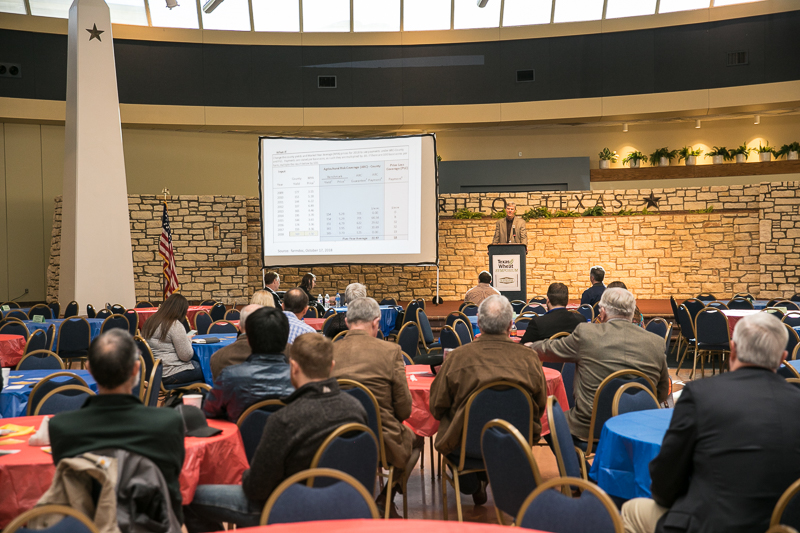
The Amarillo Farm & Ranch Show, slated for Dec. 3-5, at the Amarillo Civic Center in Amarillo, Texas, will return with over four hundred exhibiting companies and a full schedule of opportunities for ag producers to gain certifications and knowledge to help grow their operations.
This popular trade show is back again in 2024 for its fortieth year. Located at the Amarillo Civic Center, attendees of the Amarillo Farm & Ranch Show can see a variety of products and services, including large harvesting and planting equipment for crops such as cotton, corn, wheat and hay, seed varieties, livestock equipment, tools, and insurance and banking services. Of the exhibitors in attendance, several dozen are new to the show. Attendees can visit dealers and see brands such as John Deere, BASF, Massey Ferguson, Claas and Polaris.
There is an increased number of exhibitors providing holiday shopping opportunities this year as well. Admission and parking are free. For a full list of exhibitors, attendees are encouraged to visit AmarilloFarmShow.com.
Attendees will find opportunities for certification and education at this year's Amarillo Farm and Ranch Show. On Tuesday, Dec. 3, new events include two livestock education sessions conducted by the Texas Tech School of Veterinary Medicine, Building Your Herd: A Look at Implementing Assisted Reproductive Technologies and Cow Culling Protocols and Sustainable Parasite Control for Small Ruminants. Livestock producers can get certified or re-certified at the Beef Quality Assurance Training Tuesday afternoon starting at 1:00 p.m.
There are new topics to cover at the returning Texas A&M AgriLife Extension CEU Workshop on Tues., Dec. 3. This session will earn attendees five continuing education credits.
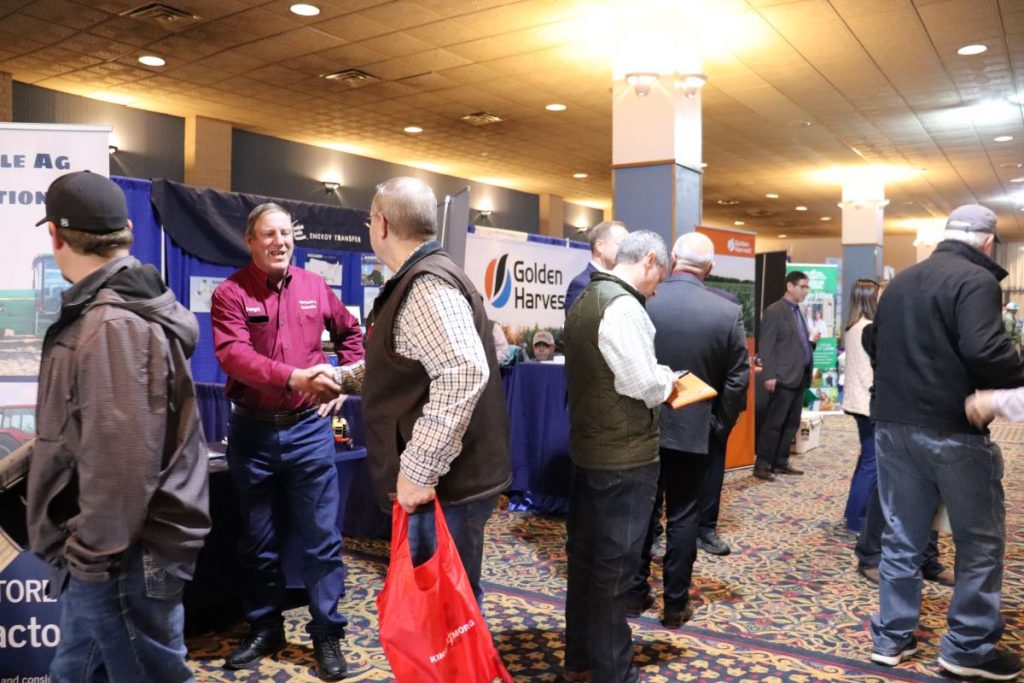
The Texas Wheat Symposium and the Cotton Conference return on Wednesday, Dec. 4. The Texas Wheat Symposium is presented by the Texas Wheat Growers Association, with a market outlook and farm policy discussion. The Ag Appreciation Luncheon, hosted jointly with the Amarillo Chamber of Commerce Ag Council, will return with serving lines open at 11:45 a.m. The keynote address for this free lunch event features Michelle Miller, known online as The Farm Babe.
The Cotton Conference, taking place Wednesday from 9:00 a.m. to 12:00 p.m., features cotton experts from across the High Plains covering topics including cotton growing, marketing, opportunities, and issues both domestically and globally.
Texas A&M AgriLife Extension will host Wildfire Mitigation Program and Ruminant (Cattle, Sheep & Goats) General Health Overview on Wednesday from 1:30 – 4:00 p.m.
4-H and FFA students are invited to attend the Panhandle Ag Education Day, in its second year at the Amarillo Farm and Ranch Show on Thursday, Dec. 5 starting at 10:30 a.m. The session will begin with a career panel followed by lunch and a scavenger hunt through the trade show to learn about the ag industry from panelists and exhibitors.
To learn more about the speakers, schedule and to register for events, attendees are asked to visit the Amarillo Farm & Ranch Show Website.
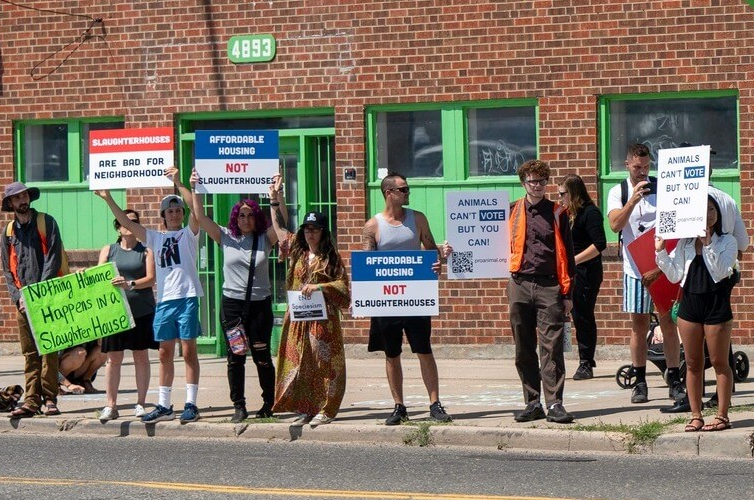
On November 5, several ballot initiatives around the country pertained to animal agriculture, at least three of which were front and center to the Animal Agricultural Alliance (AAA). On today's BeefBuzz, Senior Farm and Ranch Broadcaster Ron Hays is talking with Hannah Thompson Wieman President and CEO of the AAA about the three major ballot initiatives.
"Unfortunately, there is never a dull moment when it comes to monitoring issues impacting animal agriculture, and that was certainly true this past election season," Wieman said. "State-level ballot initiatives are nothing new, but now activist groups are taking it a step further and going all the way to a hyper-local level, even to the city level. They see that as a stepping stone to their twenty-year approach plan."
The City of Denver experienced a processing plant and fur ban ballot initiative from Pro Animal Future. In Sonoma County, California, a ballot initiative was introduced as a factory farm ban, but "factory farm" was defined as a concentrated animal feeding operation, which would have affected roughly twenty farms, including dairies, egg, broiler, and duck producers. The City of Berkley was presented with a similar ban on factory farms and confined animals that would have affected a horse racing facility.
"All of those measures that we follow originated from animal activist groups," Wieman detailed. "On the positive side, in Denver, we saw both of those initiatives fail by a pretty healthy margin. Eighty-five percent of voters in Sonoma County opposed that ban on farms of a certain size. While the initiative in Berkley did pass, because nobody really worked to oppose it. It was more of a symbolic move for them, and they are really heralding that as a victorious sign of what is to come."
Wieman expects the local-level ballot initiative trend to continue, especially with the change in administration making activist groups feel like federal-level advances won't get far. They are already sharing a list of states and cities that they plan to introduce similar measures to in 2026.
"Berkley is a great example of what happens when we don't engage," she said. "The animal agriculture community had other places to focus, but it is a good test case where if we don't intervene, the ballot initiatives are likely to pass because voters are not informed. They do not understand the issues. When a lot of these things are put on the ballot, they are overly simplified. They are made to sound like a good thing for animal welfare and the environment, so if we aren't engaged and a part of these discussions, unfortunately, it might be a different story."
The Beef Buzz is a regular feature heard on radio stations around the region on the Radio Oklahoma Ag Network and is a regular audio feature found on this website as well. Click on the LISTEN BAR at the top of the story for today's show and check out our archives for older Beef Buzz shows covering the gamut of the beef cattle industry today
 |
Smithfield Foods provided 50,000 pounds of protein to the 28th Annual Mayflower Marathon Food and Fund Drive to benefit the Virginia Peninsula Foodbank and Foodbank of Southeastern Virginia and the Eastern Shore.
"Smithfield Foods is honored to continue our support for the Mayflower Marathon, which makes a real difference for many local families and individuals facing food insecurity this holiday season," said Steve Evans, vice president of community development for Smithfield Foods. "Through our protein donation and employee volunteers, we can bring hope and relief for our neighbors in need."
Donated food items included bacon, ham and smoked sausage, and will provide 200,000 servings of protein to help take a bite out of hunger for many Southeastern Virginia neighbors this holiday season.
"Protein is such a critical component of a healthy diet that has become very difficult to afford for many families across the Peninsula," said Bob Latvis, chief executive officer for Virginia Peninsula Foodbank. "The annual protein donation from Smithfield Foods at this year's 28th Mayflower Marathon Holiday Food Drive will make a meaningful difference in the lives of families experiencing food insecurity. Their compassion and generosity are truly inspiring as they are helping to alleviate food insecurity and bring people together, especially during the holiday season."
More than 40 local Smithfield employees volunteered at the 57-hour round-the-clock food drive by unloading donations, organizing food items and lending an extra hand to event organizers.
"We are deeply grateful for Smithfield Foods' generosity and ongoing commitment to fighting hunger in our region," said Christopher Tan, president and CEO of the Foodbank of Southeastern Virginia and the Eastern Shore. "Protein is one of the most essential yet challenging items to secure for families facing food insecurity, especially during the holidays. This donation will help ensure that thousands of our neighbors can gather around the table with nourishing meals and experience the comfort and connection the holiday season brings."
Smithfield's hunger relief program, Helping Hungry Homes®, has provided hundreds of millions of servings of protein all 50 U.S. states since 2008. Smithfield donated more than 30 million servings of protein to food banks, disaster relief efforts and community outreach programs across the U.S. in 2023 and has pledged to donate 200 million servings of protein by 2025.
For more information about Smithfield's programs to support local communities, please visit smithfieldfoods.com/helping-communities.
Agriculture Secretary Tom Vilsack announced next steps and selections within the U.S. Department of Agriculture's (USDA) Water-Saving Commodities program to support agricultural commodity production while reducing water losses in communities across the West. Today, USDA is announcing the preliminary selection of three Congressionally-authorized Indian Irrigation Projects supported by the U.S. Department of the Interior's Bureau of Indian Affairs (BIA) and a new initiative to support acequias in the Southwest through a partnership with New Mexico and Colorado associations of conservation districts.
In August, USDA announced the preliminary selection of 18 irrigation districts for the production of water-saving commodities. USDA has entered into formal agreements with all 18 districts to implement water-saving strategies across the West. With the addition of today's preliminary selections, these Water-Saving Commodities partnerships – which support irrigation organization projects and producers in using innovative water saving technologies and farming practices while continuing to produce crop commodities in the face of continued drought – are expected to conserve up to 50,000 acre-feet in water use across 250,000 acres of irrigated land in production, while expanding and creating new, sustainable market opportunities.
"The United States is experiencing the devastating and unpredictable effects of climate change, and in the West this often means grappling with drought and limited water availability, the staggering effects of which our agricultural communities feel first-hand," Vilsack said. "In doing everything we can to support the health of American agriculture and our natural resources, we are leveraging this effort and the expertise in the western irrigation districts, tribes, and acequias to help not only our producers, but also the American consumer. It is paramount that we make opportunities like this accessible to all agricultural communities, including Tribal and underserved communities."
This effort is part of a larger all-of-government approach to address drought throughout the West. In regions like the Colorado River, Rio Grande, and Deschutes River basins, this integrated approach and partnership with local farmers is important in ensuring a more sustainable and resilient future for rural communities.
Tribal Communities
Reflecting USDA's priorities and goals to broaden the scope and reach of its conservation programs to engage underserved communities, USDA's Farm Service Agency (FSA) has dedicated $45 million specifically for Water-Saving Commodities assistance to help Tribal communities with BIA Irrigation Projects. These investments will help the selected projects strengthen their irrigation practices in places experiencing the impacts from drought, reducing water losses, while continuing agricultural commodity production.
USDA held a Tribal consultation this summer, engaged with BIA, and applied a similar criteria that was used to select the irrigation projects to target funding within the Tribal set-aside.
The BIA Irrigation Projects initially selected for funding are:
Colorado River Indian Irrigation Project, in Arizona
San Carlos Irrigation Project, in Arizona
Navajo Indian Irrigation Project, in New Mexico
"The Gila River Indian Community is grateful to be working with USDA on multiple water saving strategies within the San Carlos Irrigation Project service area. This relationship is highly valued in that it supports tribal growers seeking to reclaim their agricultural economy and way of life. To have the opportunity to continue this partnership in a manner that benefits water conservation efforts in the southwest and within the Community while at the same furthering the goals of tribal growers to use water as efficiently as possible is of great cultural importance," said the Gila River Indian Community. "Working together we can enhance the Community's blue-green economy of being good stewards of the water resources provided by our creator and utilizing those resources in an environmentally friendly manner."
Acequia Partnerships
Similarly, USDA has dedicated $15 million specifically for Water-Saving Commodities partnerships with two state associations of conservation districts for helping community operated irrigation systems known as acequias produce water-saving commodities. As a community, acequias are the stewards of surface waters that not only flow to their crop fields but help replenish rivers, wetlands and groundwater. These partnerships enhance existing cooperative efforts by local conservation districts to provide education, outreach, and technical services needed to keep production up while responsibly utilizing water and other natural resources during drought conditions.
The state associations of conservation districts preliminarily selected for funding are:
Colorado State Association of Conservation Districts
New Mexico State Association of Conservation Districts
Final Agreements with Irrigation Districts
There has also been, to date, 18 grant agreements signed with irrigation districts. These organizations were initially selected based on several commodity production and water management-related criteria to maximize achieving program objectives, leveraging available data from the Department of the Interior's Bureau of Reclamation to ensure close alignment and partnership.
Black Canyon Irrigation District, Idaho
Brooklyn Canal Company, Utah
Central Oregon Irrigation District, Oregon
Central Arizona Irrigation and Drainage District, Arizona
Corcoran Irrigation District, California
East Columbia Basin Irrigation District, Washington
Elephant Butte Irrigation District, New Mexico
Glenn – Colusa Irrigation District, California
Greybull Valley Irrigation District, Wyoming
Hidalgo & Cameron Counties Irrigation District 9, Texas
Huntley Project Irrigation District, Montana
Imperial Irrigation District, California
Maricopa – Stanfield Irrigation and Drainage District, Arizona
Palisade Irrigation District, Colorado
Quincy Columbia Basin Irrigation District, Washington
Solano Irrigation District, California
Sutter Mutual Water Company, California
Truckee-Carson Irrigation District, Nevada
Up to $15 million in eligible payments may be disbursed through each of these agreements for water-saving activities carried out by irrigation districts and eligible producers within their water delivery area. Depending on available funding, additional awards may be possible.
Participating producers will receive payments from the irrigation districts for voluntarily reducing water losses while maintaining commodity production. The needs of producers will determine the specific strategies for water conservation, including irrigation improvements, shifts in management practices, shifts in cropping systems, and other innovative strategies. USDA will learn from the diversity of strategies used and identify additional opportunities to maintain and expand water-saving commodity production in the future.
Irrigation districts and participating producers will commit to ensuring continued commodity production in the areas where water supplies are impacted by drought. Work plans under development will describe the water-saving strategies and activities being funded, commodities to be produced, specific budgets, and methods for quantifying water savings.
Following the approval of work plans, irrigation districts and eligible producers will carry out the plans and be eligible for reimbursement of costs or advanced payments as needed and approved.
More Information
Visit the Water-Saving Commodities program webpage for frequently asked questions, and other resources.
USDA touches the lives of all Americans each day in so many positive ways. Under the Biden-Harris administration, USDA is transforming America's food system with a greater focus on more resilient local and regional food production, fairer markets for all producers, ensuring access to safe, healthy and nutritious food in all communities, building new markets and streams of income for farmers and producers using climate smart food and forestry practices, making historic investments in infrastructure and clean energy capabilities in rural America, and committed to equity across the Department by removing systemic barriers and building a workforce more representative of America. To learn more, visit www.usda.gov.
The U.S. Department of Agriculture (USDA) announced the launch of a new online portal to manage civil rights discrimination complaints more efficiently and transparently. The USDA Civil Rights Management System (CRMS) Program Discrimination Complaint electronic submission portal will streamline the filing of complaints by USDA customers who believe they have experienced discrimination when they apply for USDA services or participate in USDA programs or USDA-funded programs. The portal is administered by USDA's Office of the Assistant Secretary for Civil Rights (OASCR).
"The online portal is part of our efforts to better serve USDA customers and ensure Department-wide efficient, fair, consistent, and equitable application of civil rights," said Dr. Penny Brown Reynolds, USDA Deputy Assistant Secretary for Civil Rights.
It is a violation of the law to discriminate against members of the public based on the following: race, color, national origin, religion, sex (including gender identity and expression), sexual orientation, disability, age, marital status, family/parental status, income derived from a public assistance program, and political beliefs. Not all bases apply to all USDA programs. The program complaint portal is for USDA customers who believe they have experienced discrimination in relation to USDA services, programs, or USDA-funded programs.
At the direction of Agriculture Secretary Tom Vilsack, USDA commenced a top-to-bottom review of the OASCR, and has worked to rebuild the transparency, accountability, and integrity of operations and programs. The new program complaints portal is one result of this effort.
The portal allows USDA customers to submit and track complaints throughout their lifecycle, as well check the status of previously submitted USDA program discrimination complaints. The system is available in both English and Spanish. The online portal complements other existing methods of submitting complaints including email, mail, and fax which USDA customers will continue to be able to use.
Visit www.usda.gov/oascr/program-complaints to create and manage an account through a secure username and password system (login.gov). For questions or assistance, contact 866-632-9992 or program.intake@usda.gov. Individuals who are deaf, hard of hearing, or have speech disabilities may use the Telecommunication Relay Service at 711 or 800-845-6136 for Spanish translation services.
OASCR is tasked with providing overall leadership, coordination, and direction for the Department's civil rights initiatives, including program delivery, compliance, and equal employment opportunity. Between Fiscal Years 2019 and 2023, OASCR received and manually processed a total of eight hundred five (805) program complaints and reduced the average inventory by 86%. In addition, under Dr. Brown Reynolds' leadership, OASCR has completely transformed the Program Complaints process resulting in an average processing time of 225 days or less an overall 43% reduction in processing time. OASCR also offers a Civil Rights mobile application designed to provide easy access to civil rights news, information, and resources for all USDA employees and program customers.
USDA touches the lives of all Americans each day in so many positive ways. Under the Biden-Harris Administration, USDA is transforming America's food system with a greater focus on more resilient local and regional food production, fairer markets for all producers, ensuring access to safe, healthy and nutritious food in all communities, building new markets and streams of income for farmers and producers using climate-smart food and forestry practices, making historic investments in infrastructure and clean energy capabilities in rural America, and committing to equity across the Department by removing systemic barriers and building a workforce more representative of America. To learn more, visit www.usda.gov.
| |||||||||||||||||||||||||||||||||||||||||||||||||||||||||||||||||||||||||||||||||||||||||||||||||||||||||||||||||||||||||||||||||||||||||||||||||||||||||||||||||||||||||||||||||||||||||||||||||||||||||||||||||||||||||||||||||||||||||
| |||||||||||||||||||||||||||||||||||||||||||||||||||||||||||||||||||||||||||||||||||||||||||||||||||||||||||||||||||||||||||||||||||||||||||||||||||||||||||||||||||||||||||||||||||||||||||||||||||||||||||||||||||||||||||||||||||||||||
|
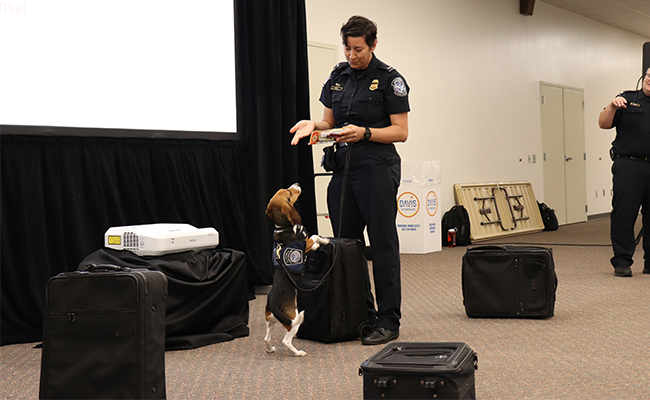
A member of the Beagle Brigade demonstrates his inspection skills at the 2023 World Pork Expo.
The National Pork Producers Council (NPPC) celebrated the U.S. Senate's unanimous passage of S.759, the Beagle Brigade Act, which provides statutory authority and reliable funding to the National Detector Dog Training Center.
"American agriculture relies on the National Detector Dog Training Center to prevent the introduction of foreign animal and plant diseases that would cripple our food supply," said Lori Stevermer, NPPC president and pork producer from Easton, Minnesota. "For the pork industry, the 'Beagle Brigade' is the first line of defense for keeping threats from foreign animal diseases, like African swine fever, out of the United States. America's pork producers greatly appreciate Senator Ernst and our Senate champions and urge the House to take this up before the end of the year."
The agriculture canine teams (Beagle Brigade) of the U.S. Customs and Border Protection bolster national security by performing critically important inspections at ports of entry. The Beagle Brigade Act will secure and strengthen the program.
The Oklahoma Grassroots Rural and Ag Business Accelerators program has announced the launch of In the Weeds, a rural development masterclass program for entrepreneurs and business owners across Oklahoma.
In the Weeds is designed for rural entrepreneurs looking to hone and refine their businesses, their innovation pitches and learn more about the numerous Oklahoma-based business resources at their fingertips.
"The Oklahoma Grassroots Rural and Ag Business Accelerators program is honored to be one of the U.S. Treasury's State Small Business Credit Initiative Technical Assistance providers," said Amarie Bartel, OKFB rural economic development coordinator. "Through this program, our team is catalyzed to share more state and federal capital opportunities for rural small businesses. In the Weeds allows us to meet rural small business owners where they are with a wealth of funding opportunities – and the tools to attain said opportunities – to close financial gaps."
A series of four classes held across the state in eight rural locations throughout 2025 will provide rural entrepreneurs with cutting-edge business resources and the opportunity to develop skills, learn about opportunities and develop business connections with Oklahoma-based program partners.
In the Weeds will feature four unique sessions, including:
Venture Forward: How to Pitch
Crafting your Business Blueprint with LivePlan
Unlocking Lending Opportunities with TEDC: Interactive SSBCI Loan Application Workshop
Custom Solutions for Market-Specific Needs
Participants may attend the program most convenient for them. All classes will be held from 5:30 – 7 p.m. and are free of charge. Dinner will be provided.
To learn more about the In the Weeds program and register for a masterclass, visit okfb.news/intheweeds.
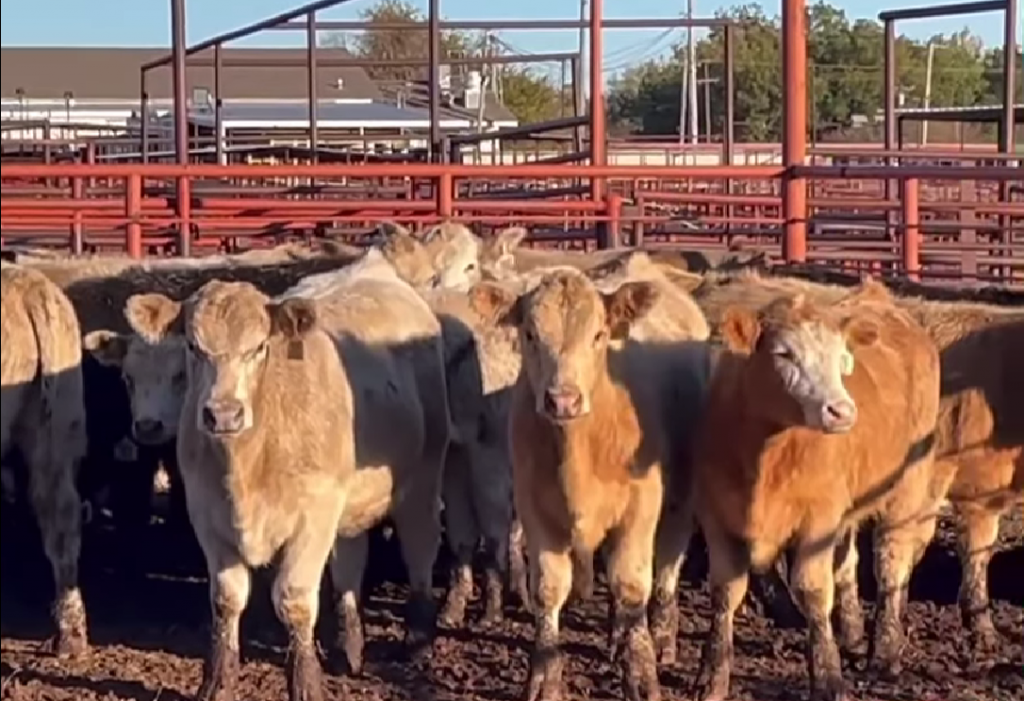
KC Sheperd, Farm Director, is back talking with Bob Rodenberger, a Stockman Oklahoma Livestock Marketing partner, as he gives the latest on the cattle markets.
Rodenberger noted that the calf market has increased significantly due to recent rainfall, while feeder markets have remained stable, although runs have been down.
"In the last two weeks since before the rain, the calf market has jumped $100 to $150 per head, higher," he said.
He said that it is a seller's market so if anyone doesn't have wheat, grass, or water to carry cattle through the winter, there are big incentives to take them to town.
"We are still killing a lot of cows," he said. "Not near as many as we were a year ago at this time, but more than we were back in the summer. Even though the rain has helped, we are still culling cows."
He continues to get calls from people with wheat, so the rain has brought the wheat up.
Despite the Thanksgiving holiday next week, Oklahoma City will still be selling cattle on Monday and Tuesday, and Rodenberger expects a good market. Apache will be closed next week. There will only be three more sales after Thanksgiving before they shut down for a couple of weeks.
While attending the Oklahoma Farm Bureau Convention, Farm Director KC Sheperd caught up with Farm Bureau's Rural Economic Development Coordinator Amarie Bartel to talk about the Activate Oklahoma programs and more.
Activate Oklahoma is an Oklahoma Grassroots Rural and Ag Business Accelerator pipeline which is essentially a program designed to help startup companies reach profitability faster.
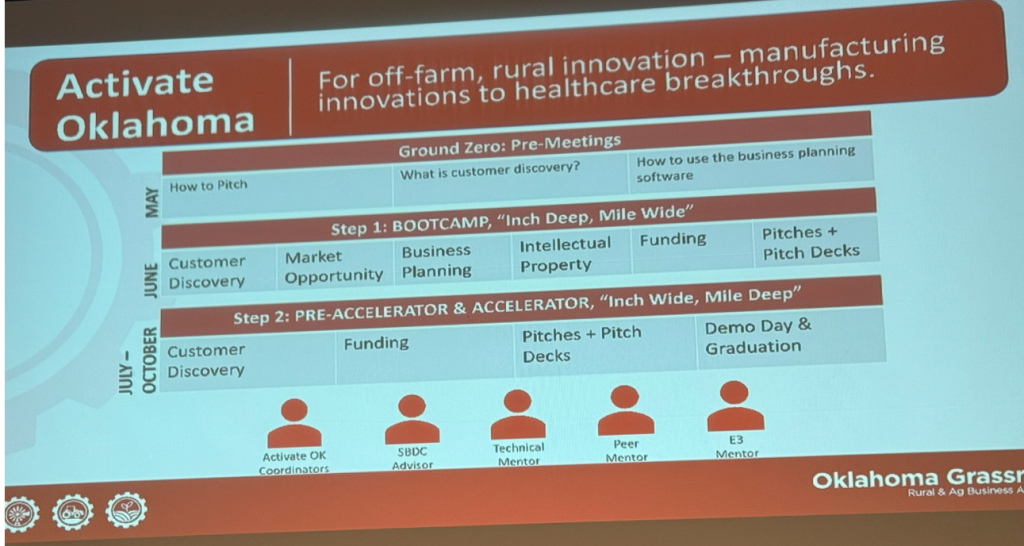
"Activate Oklahoma and AgCelerate Oklahoma are for anyone from a community of fifty thousand individuals or less," Bartel explained.
Companies that stay in pre-profitability for too long often have a short lifespan, so Farm Bureau's goal is to keep these companies in business and actuate rural jobs through them using these programs.
"We know that 96% of farm families derive a portion of their income from an off-farm source," Bartel revealed. "We want to ensure that off-farm jobs are readily available. By planting new companies in rural communities, we are able to help catalyze those rural jobs."
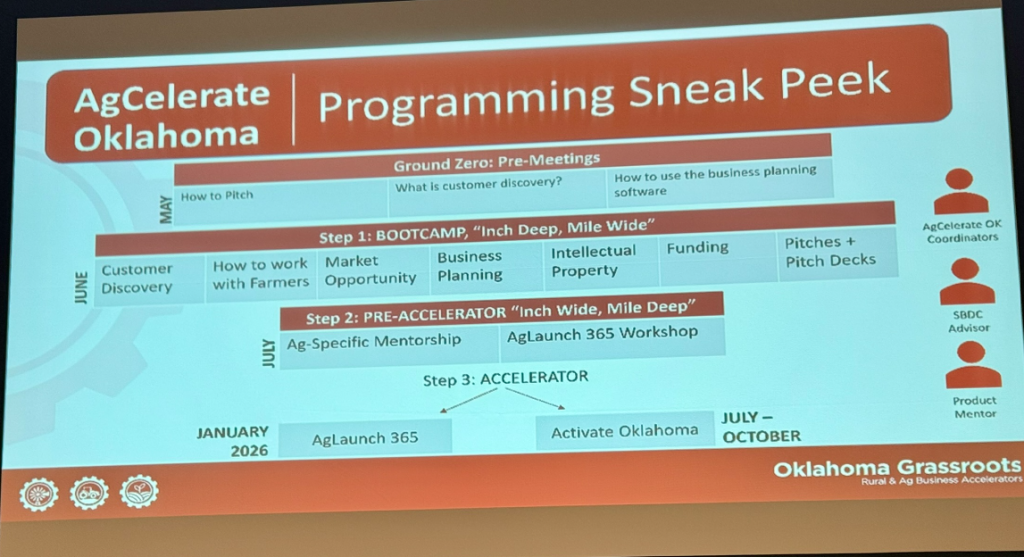
The AgCelerator Program is for companies either beginning entirely new ideas or new versions of existing concepts. Farm Bureau is widening its scope of innovation to help more businesses grow.
"There are additional opportunities," Bartel added. "We are launching a Masterclass series, and in partnership with many rural ecosystem entrepreneurship providers, also a series of conferences. Between those two programs added onto the accelerator, we have a program for anyone from a legacy business to an innovative startup."
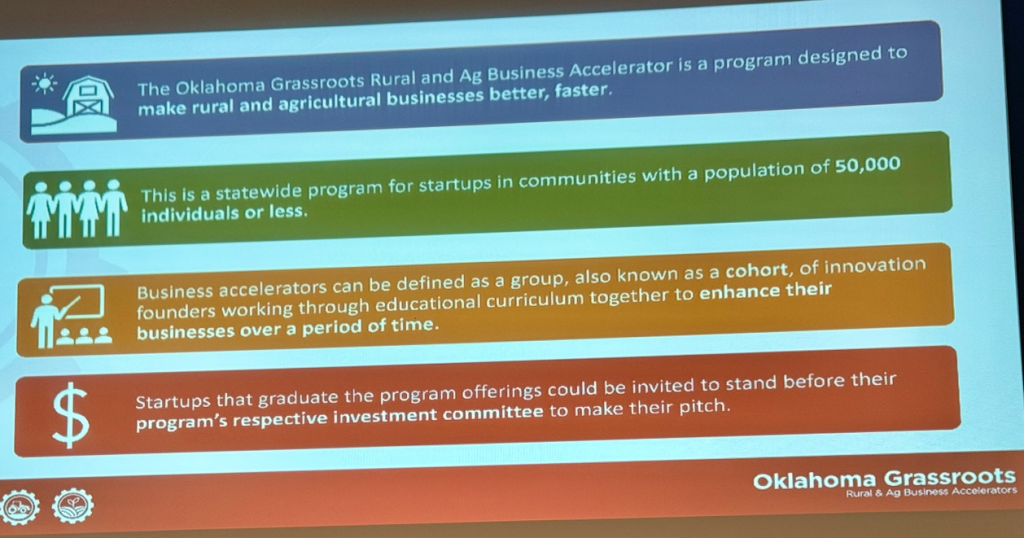
Many of the available programs will kick off in 2025. The AgCelerator Program opens for applications early in the year, and applications can be accessed on the Farm Bureau website. The Rural Entrepreneurship Opportunities program has applications available on launchruralok.com. Its application window opened in November and conferences will be available in February and March 2025. The Master Class series, comprised of four classes in eight different rural communities, begins taking applications in January 2025.
Bartel encouraged individuals who aren't sure which program will fit their ideas to reach out to her via email or by calling the Oklahoma Farm Bureau so the call can be directed to her.
'Tis the season for camo, foothills that are sprouting pickup trucks, and men, women and children afoot on varying terrain armed with rifles, bows, and dogs. If you are a landowner, there is a good chance you have been approached by someone seeking permission to hunt on or traverse your land. Before counting points on bucks, here are some points for landowners' consideration to prepare for this season.
Get a signed lease. A hunting lease will provide clarity and protection to all parties by defining access, laying out expectations, addressing property management and use, and providing some liability protections. Agreements should be documented in writing with detail to prevent any confusion or misunderstanding of the agreed terms and as insurance should a dispute or issue arise. When drafting a lease, be specific and thorough. The danger of a "simple" lease is that most lease disputes don't arise over terms that are clearly set forth in the lease, but rather most disputes arise from terms that are not addressed in the lease. Among the important lease terms such as naming the lessor(s) and lessee(s), payment terms, length of lease, liability, identifying the property and access points, remedies for breach and the like. A thorough hunting lease should address management kills, ATV use, fence and trail repairs, fallen trees, feeding plots, use and location of outbuildings, blinds and tree stands, whether guests are permitted and how many at once, communication with lessor, whether the hunting rights are exclusive or nonexclusive, wildlife that may be hunted, known or potential hazards, and other considerations of important to either party. If a dispute arises, a court will first look at the lease, and only the lease, to resolve it. Absent extenuating circumstances, additional agreements or promises which are not reflected in the lease itself will not be enforced.
Reinforce to anyone hunting on your land that it is their responsibility to know the property boundaries. It is unlawful for hunters to track or retrieve wounded game on private property without permission. Hound hunters should check to see if their state has a right to retrieve law. These statutes generally allow the owners of hunting dogs to enter upon the land of another without permission for the purpose of retrieving their hunting dogs. Virginia's 100-year-old statute was recently challenged by a group of landowners arguing that Virginia's right to retrieve law amounted to a taking of private property without just compensation, converting their private property to public use.[1] Despite alleging that hounds were a nuisance which had killed a landowner's chickens and would spook horses allegedly justifying compensation from the state, the circuit court held that the law was merely an exception to criminal trespass and did not deprive the landowners of any property rights. In response, Virginia's Board of Wildlife Resources considered two proposals which would have required hound hunters to use GPS collars and make reasonable attempts to prevent their dogs from entering another's property. Though it was questioned whether the Board had authority to require such measures, both were ultimately rejected.
Hunting leases are contractual agreements to which every other basic principle of contract law applies. Make sure leases are written, thorough, and reviewed by a knowledgeable agricultural attorney licensed in your jurisdiction. If you are hunting on your own land or that of others, know the property boundaries and as necessary, consult with a local attorney on your state specific laws related to one of the oldest practices in the world.
Article courtesy of Southern Ag Today: Friedel, Jennifer Shaver. "Preparing for the (Camo) Season." Southern Ag Today 4(47.5). November 22, 2024. Permalink
The North American International Livestock Exposition Level I Medal of Excellence (MOE) Limousin Show was held on Monday, November 18, 2024, in Louisville, Ky. Judge, Andy Higgins, Tenn., had the challenging task of sorting through an impressive set of 75 females and 6 bulls.
Grand Champion Limousin Female was TSSL Main Larissa 3032L ET exhibited by Makayla Massey, London, Ky. She is a 25% Lim-Flex female born March 22, 2023 and sired by PVF Blacklist 7077.
Reserve Grand Champion Limousin Female was SSUL Forever Charmed 4295M ET exhibited by Sara Sullivan, Dunlap, Iowa. She is a 82% Limousin female born February 4, 2024 and sired by ELCX Kings Landing 599D ET.
Grand Champion Limousin Cow/Calf Pair was exhibited by Carter Kornegay, Tulsa, Okla. with ELCX Kate 332K ET. She is a May 16,2022, 53% Lim-Flex female and sired by ELCX Kings Landing 599D ET.
Reserve Champion Limousin Cow/Calf Pair was AUTO Haze ET, exhibited by Jackson Kidd, Sandy Hook, Ky. She is an October 10, 2020, 50% Lim-Flex female and sired by Silveiras Style 9303.
Grand Champion Limousin Bull was Schillings BLC Lazarus ET exhibited by Kaelyn Schilling, Goodland, Kan. He is a 42% Lim-Flex bull born April 10, 2023 and sired by Ratliff Jump Start 340J ET.
Reserve Grand Champion Limousin Bull was TASF Masterclass 846M ET exhibited by Thomas & Son Farms, Boonsboro, Md. He is a 56% Lim-Flex bull born March 30, 2024 and sired by TASF Heineken 405H ET.
A complete list of winners follows:
2024 NAILE Level I MOE Limousin Show
November 18, 2024
Louisville, Ky.
Judge: Andy Higgins, Tenn.
Grand Champion Limousin Female: TSSL Main Larissa 3032L ET, 03/22/2023, 25% Lim-Flex, homozygous black, double polled, sired by PVF Blacklist 7077, out of JSZC TSSC Larissa 49G ET, exhibited by Makayla Massey, London, Ky.
Reserve Champion Limousin Female: SSUL Forever Charmed 4295M ET, 02/04/2024, 82% Limousin, double polled, sired by ELCX Kings Landing 599D ET, out of Ratliff Howboutit, exhibited by Sara Sullivan, Dunlap, Iowa.
Grand Champion Limousin Cow/Calf Pair: ELCX Kate 332K ET, 05/16/2022, 53% Lim-Flex, heterozygous black, homozygous polled, sired by ELCX Kings Landing 599D ET, ELCX Extra Special, exhibited by Carter Kornegay, Tulsa, Okla.
Reserve Champion Limousin Cow/Calf Pair: AUTO Haze ET, 10/15/2020, 50% Lim-Flex, homozygous black, homozygous polled, sired by Silveiras Style 9303, out of AUTO Luckie 246W, exhibited by Jackson Kidd, Sandy Hook, Ky.
Grand Champion Limousin Bull: Schillings BLC Lazarus ET, 04/10/2023, 42% Lim-Flex, homozygous black, double polled, sired by Ratliff Jump Start 340J ET, out of MLA Proven Queen 2156, exhibited by Kaelyn Schilling, Goodland, Kan.
Reserve Champion Limousin Bull: TASF Masterclass 846M ET, 03/30/2024, 56% Lim-Flex, homozygous black, homozygous polled, sired by TASF Heineken 405H ET, out of TASF Extra Class 124E ET, exhibited by Thomas & Son Farms, Boonsboro, Md.
Female Show Division Winners:
Division I Champion: TSSL BTOM Mariah Carey ET, 03/12/2024, 25% Lim-Flex, homozygous black, double polled, sired by SCC SCH 24 Karat 838, out of JSZC TSSC Larissa 49G ET, exhibited by Jacob Stofer, Warsaw, Ind.
Division I Reserve: HB Whiskey 443M ET, 03/10/2024, 81% Limousin, homozygous black, double polled, sired by Ratliff Jump Start 340J ET, out of TASF Whiskey 222F ET, exhibited by Landon Clark, Gainesville, Ga.
Division II Champion: SSUL Forever Charmed 4295M ET, 02/04/2024, 82% Limousin, double polled, sired by ELCX Kings Landing 599D ET, out of Ratliff Howboutit, exhibited by Sara Sullivan, Dunlap, Iowa.
Division II Reserve: BOYJ CORE Layla 435M ET, 01/17/2024, 25% Lim-Flex, homozygous black, double polled, sired by SCC SCH 24 Karat 838, out of JSZC TSSC Larissa 49G ET, exhibited by Keagen Bohnsack, Taylor Ridge, Ill.
Division III Champion: TASF Lady Gaga 815L ET, 09/27/2023, 84% Limousin, double black, double polled, sired by TASF Grey Goose 333G ET, out of AUTO Crowning Day 204G, exhibited by Siddalee Portwood, Versailles, Ky.
Division III Reserve: TSSL BTOM Ashanti 3904L ET, 09/10/2023, 25% Lim-Flex, sired by SCC SCH 24 Karat 838, out of JSZC TSSC Larissa 49G ET, exhibited by Braylen Schaeffer, Hagerstown, Ind.
Division IV Champion: TSSL NEAL Sa My Oh My ET, 05/10/2023, 25% Lim-Flex, homozygous black, double polled, sired by PVF Blacklist 7077, out of JSZC HH TSSC Larissa 101G, exhibited by Kesler Collins, Flanagan, Ill.
Division IV Reserve: WCEN Larissa Jane 55L ET, 05/05/2023, 25% Lim-Flex, homozygous black, double polled, sired by Chestnut Perfect Timing 341, out of JSZC TSSC Larissa 49G, exhibited by John Crawford, Malta, Ohio.
Division V Champion: TSSL Main Larissa 3032L ET, 03/22/2023, 25% Lim-Flex, homozygous black, double polled, sired by PVF Blacklist 7077, out of JSZC TSSC Larissa 49G ET, exhibited by Makayla Massey, London, Ky.
Division V Reserve: SSUL Charmin Forever 3237L, 02/14/2023, 42% Lim-Flex, homozygous black, double polled, sired by Silveiras Forbes 8088, out of Ratliff Howboutit 008H ET, exhibited by Reid Utterback, Elwood, Ind.
Division VI Champion: SJMR Princess Kate 250K ET, 12/12/2022, 65% Lim-Flex, homozygous black, homozygous polled, sired by ELCX Kings Landing 599D ET, out of TJMR Peaches 226Z, exhibited by Samantha Moore, Staunton, Va.
Division VI Reserve: ELCX Kassie 17K, 12/20/2022, 62% Lim-Flex, double black, double polled, sired by TASF Grey Goose 333G ET, out of ELCX Callie 17C, exhibited by Taylor Holloway, Fort White, Fla.
Cow/Calf Pair Show Division Winners:
Division VII Champion: ELCX Kate 332K ET, 05/16/2022, 53% Lim-Flex, heterozygous black, homozygous polled, sired by ELCX Kings Landing 599D ET, ELCX Extra Special, exhibited by Carter Kornegay, Tulsa, Okla.
Division VII Reserve Champion: AUTO Haze ET, 10/15/2020, 50% Lim-Flex, homozygous black, homozygous polled, sired by Silveiras Style 9303, out of AUTO Luckie 246W, exhibited by Jackson Kidd, Sandy Hook, Ky.
Bull Show Division Winners:
Division I Champion: TASF Masterclass 846M ET, 03/30/2024, 56% Lim-Flex, homozygous black, homozygous polled, sired by TASF Heineken 405H ET, out of TASF Extra Class 124E ET, exhibited by Thomas & Son Farms, Boonsboro, Md.
Division I Reserve: PRF Maverick ET, 03/12/2024, 42% Lim-Flex, homozygous black, homozygous polled, sired by Ratliff Jump Start 340J ET, out of FCF Nellie 945, exhibited by Persimmon Ridge Farm, Magnolia, Ky.
Division III Champion: KLCS MK Smooth Talker 109L, 10/15/2023, 67% Lim-Flex, homozygous black, double polled, out of Ratliff Jump Start 340J ET, out of Auto Darlin 204D ET, exhibited by Keely Campbell Shultz, Danielsville, Ga.
Division III Reserve: FRBR Lorenzo 358L, 10/13/2023, 81% Limousin, double black, double polled, sired by Ratliff Jump Start 340J ET, out of Auto Remi 674D, exhibited by Friend Brothers Limousin, Duck, W.Va.
Division V Champion: Schillings BLC Lazarus ET, 04/10/2023, 42% Lim-Flex, homozygous black, double polled, sired by Ratliff Jump Start 340J ET, out of MLA Proven Queen 2156, exhibited by Kaelyn Schilling, Goodland, Kan.
Premier Breeder: Tim Schaeffer, Hagerstown, Ind.
Premier Exhibitor: Jackson Kidd, Sandy Hook, Ky.

For four years, House Republicans have waged an uphill battle, working to halt the most damaging policies of the Biden-Harris Administration, while implementing pro-growth and pro-American policies. However, a new day is approaching. The American people have given us a mandate to govern and to get our country back on track. We're moving on and we're turning the page, which is something that the American people desperately need and deserve.
Last week, House Republicans met to establish rules for the Conference and to elect leadership to carry out the agenda for which Americans voted. We were successful in negotiating rules changes which will allow for more cohesion and functionality of the Caucus. Our leadership, which includes one of Oklahoma's own, Congressman Kevin Hern, will be ready on day one to implement America First policies. The focus will be revitalizing our economy, lowering the costs of goods and services, and safeguarding our nation.
In this new chapter, Republicans will work to make our economy affordable again for all Americans. Through the power of the pen, the Biden-Harris Administration's actions, including billions in new spending, have pushed our country to the brink. It's imperative we work to reduce federal spending, cut inefficient government programs, and undo the damage caused by burdensome regulations placed on American families and businesses. These actions will allow America's economy to flourish while driving down the costs of goods and services.
An immediate priority must also be securing our border, putting an end to the surge of illegal immigration. After years of record border crossings, our border patrol agents must once again be empowered to uphold our laws. We will not allow individuals on the terror watchlist to infiltrate our country, and we will prevent fentanyl and human trafficking. These are commonsense solutions to make our communities safer.
Finally, this new era of government will restore America's image on the global stage. We have already seen foreign leaders, who were emboldened under President Biden, backtrack on their aggression, signaling a willingness to negotiate with President Trump. The United States has long been a leader on the world stage, using its strength to prevent conflicts. Under Republican leadership, we will return to a policy of peace through strength and deter adversarial nations against further aggression. For the past four years, my colleagues and I have worked to prevent damaging legislation from being signed into law. Now, with a majority in the House, Senate, and the Administration, we are finally in a position to implement real change for the American people. Let's get to work.
RON's Dave Lanning has a pre-opening look at today's agricultural Markets.
Click the audio tab below for today's report.
This week on SUNUP, OSU Agriculture Economist Dr. John Michael Riley discusses the highs and lows of current grain and cotton markets.
As it turns out the release of the latest WASDE caused a bit of a rollercoaster in the grain markets. "The Soybean market was elevated, and corn rallied as a result. Wheat picked up a little bit of that as well," Riley detailed. "After that report, we tended to fall back. I don't know it was that proverbial 'dead cow bounce', but instead of bouncing, it kind of fell. Also, there was a little bit of pressure from exports, but since then, we've seen a little bit of improvement for corn, wheat, and soybeans. Some of that is coming back to exports. There is some concern about what is going on globally, as well as some improvements in trade overall."
In Oklahoma, despite significant rainfall, the soybean harvest is progressing nicely with 70 percent of the crop harvested, up from 59 percent last week, and on par with the five-year average.
Wheat conditions have improved greatly overall with a 37 percent good to excellent rating, up 16 percentage points from last week. Ninety-four percent of the nation's wheat crop is planted, compared to 90 percent in Oklahoma. Eighty-four percent of the nation's wheat has emerged, while 75 percent of Oklahoma's is up.
Riley said that the basis is weaker for soybeans, corn, and wheat relative to normal for the time of year, so he advised producers to either hold on to their grain in hopes of an improvement in the future if they can with tax implications at the year's end.
This week on SUNUP:
Oklahoma Agriculture Starts at SUNUP!
Weekly Statewide Broadcast: Saturday at 7:30 a.m. & Sunday at 6 a.m. on OETA (PBS)
Stream Anytime: YouTube.com/SUNUPtv

In a departure from the ongoing bipartisan, bicameral discussions of the four House and Senate agriculture committee leaders, retiring Senate Agriculture Committee Chairwoman Debbie Stabenow this week released highlights of her version of the farm bill, along with a revised summary of the farm bill framework she released on May 1.
This development, coupled with the short amount of time remaining in the lame duck congressional session to negotiate, has resulted in ag committee leaders in both chambers initiating talks to add a one-year farm bill extension to a must-pass bill before the year ends.
A hearing of the Senate Appropriations Committee was held this week to discuss disaster assistance needs and the Biden administration's request to Congress for disaster relief resources. During the hearing, several senators raised the critical need for farm economic assistance given the sharp decline in the farm economy. Discussions are underway to develop disaster relief legislation.
Three weeks remain in the lame duck congressional session prior to expiration of government funding on Dec. 20. ASA will continue to engage and monitor developments on these and other issues.
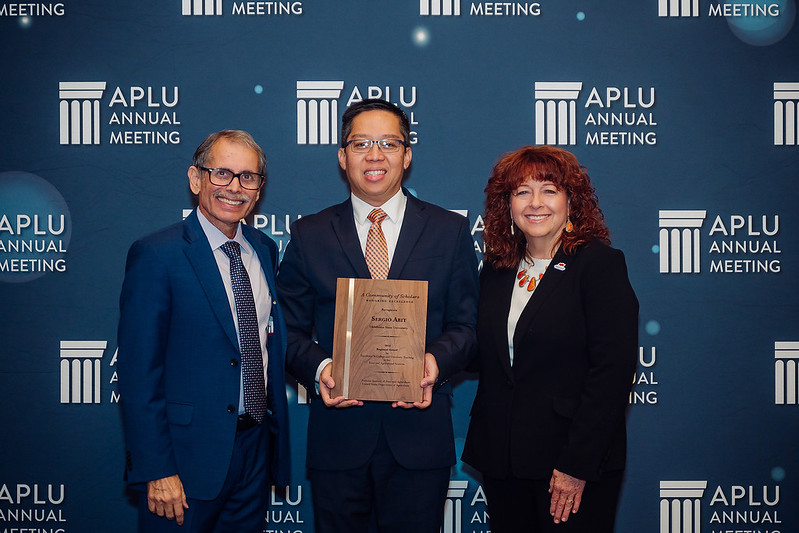
Dr. Manjit Misra, director of the USDA National Institute of Food and Agriculture, Dr. Sergio Abit, plant and soil sciences professor, and Dr. Cynda Clary, associate dean for the Ferguson College of Agriculture. (Photo courtesy of the Association of Public and Land-Grant Universities)
Sergio Abit, professor in the Oklahoma State University Department of Plant and Soil Sciences, is a regional recipient of the Association of Public and Land-grant Universities' 2024 Excellence in College and University Teaching Award for Food and Agricultural Sciences.
Abit was honored during an awards ceremony at the Annual APLU Meeting on Nov. 10.
This national recognition is a partnership between the United States Department of Agriculture and APLU and is awarded to faculty members from public institutions in the U.S. who have shown excellence in agricultural sciences teaching and student engagement.
"Dr. Abit is a remarkable educator whose commitment to his students is truly inspiring," said Cynda Clary, associate dean of academic programs for the Ferguson College of Agriculture. "His impact goes beyond the classroom through internship and career mentoring, student organization advising and activities."
Abit said receiving this award not only recognizes his efforts but also acknowledges those who support him.
"Teaching in front of 250 students three times a week across multiple courses for more than a decade is a task that can only be successfully done with the solid backing from the department and college, the support of many teaching assistants, and the inspiration from family," he said.
Abit's approach to teaching goes beyond delivering lessons. It is about creating meaningful learning experiences for students and the memories and friendships created in the process, he said.
"I do my best to foster a friendly sense of community in my classes because learning is easier when it is done with friends," Abit said. "I take advantage of every opportunity to teach at different places because when people learn together at certain places, they make learning memories, and if I succeed at connecting lessons to lasting memories among friends in my classes, then I am successful at teaching students with lessons that last a lifetime."
The Ferguson College of Agriculture believes in the value of hands-on education and the importance of having a well-rounded student experience. The college's award-winning faculty members are dedicated to developing students and are passionate about adding value to the total educational experience. With 16 majors, a variety of study options and more than 60 student organizations, the college is committed to expanding minds and inspiring purpose. Learn more at agriculture.okstate.edu
Homemade bread is a trending food item for 2025. (Photo by Emma Grace Nowotny, Robert M. Kerr Food and Agricultural Products Center)
Oklahoma State University's Robert M. Kerr Food and Agricultural Products Center explores the future of flavor with a look into some of the 2025 food trends.
The culinary landscape is buzzing with new trends, some familiar and others emerging as frontrunners in the industry. Social media has played a powerful role, catapulting certain foods to popularity overnight or giving them a steady rise over recent years. In anticipation of the new year, the Food and Agricultural Products Center has highlighted the trends likely to shape plates in the coming months.
"Consumers crave products that add value to their lives and can keep up with their busy schedules," said Andrea Graves, Food and Agricultural Products Center business planning and marketing specialist. "Food manufacturers need to know what their consumers want now and in the future to fill that demand and generate sales."
The following concepts are food trends to watch for in 2025.
Sweet and heat: Combination foods with a sweet-and-heat profile – like pepper jellies, preserves and salsas – are all the rage. Made in Oklahoma companies such as Kayterra Farms, Sixth Day Snacks, Southern Roots Sisters and Suan Foods offer products that will satisfy a sweet tooth while giving a pleasant kick to elevate your dishes.
Homemade bread: Homemade bread, a fan favorite in recent years, will continue to be a staple in many homes, with new recipes and ingredients that add nutritional value and offer different flavor profiles. Homemade bread allows for the customization of ingredients, and kneading the dough can be a great way to relax. Oklahomans can take advantage of this trend by using locally produced flour from Shawnee Milling or Chisholm Trail Milling.
Protein: With the rise of various specialized diets, many will focus on increasing protein intake to help with weight management and energy levels. Great sources of protein include eggs, seafood, milk, cottage cheese, nuts and seeds, lean beef, chicken, oats and beans. Kize Concepts, based out of Oklahoma City, offers high-quality protein bars to give an extra boost throughout the day.
Beverages with function: Some days it's hard to consume all the necessary vitamins, gut health supplements and minerals, but now some drinks include them. Brands like Olipop, Poppi and Hint Water offer healthier, more fun beverages. Olipop and Poppi are changing the soda world with less sugar, fewer calories and prebiotics. Hint Water is making water fun with an infusion of real fruit, vitamins and minerals. Shake UR Greens, based in Oklahoma County, offers cold pressed green juices to help with daily fruit and vegetable intake.
The Food and Agricultural Products Center has supported many local companies that produce trending food products. See the list at www.madeinoklahoma.net and www.miocoalition.com.
The Robert M. Kerr Food and Agricultural Products Center, a part of OSU's Division of Agricultural Sciences and Natural Resources, helps to discover, develop and deliver technical and business information that will stimulate and support the growth of value-added food and agricultural products and processing in Oklahoma.
STORY BY: Hartley Silva | FAPC Communications Undergraduate Employee
PORTFOLIO PERFORMANCE, DIVERSIFICATION, AND STRATEGY
October portfolio yielded 3.48%, up from 2.97% last year, with a weighted average maturity of 929 days.
Total assets under management of $16.7 billion, up $1.2 billion in comparison to October 2023.
The total portfolio contained 73.5% in U.S. Treasurys, 3.5% in U.S. government agencies, 13.5% in mortgage-backed securities, 8.5% money market mutual funds, 0.2% in certificates of deposit, and 0.8% in state bond issues and foreign bonds, comprising the balance of funds invested.
"Total portfolio yields are lower than current yields due to the laddered structure of the investments over a 3 year average." STATE TREASURER, TODD RUSS

TOTAL FUNDS INVESTED
Funds available for investment at market value include the State Treasurer's investments at $12,660,806,681 and State Agency balances in OK Invest at $4,049,289,436, for a total of $16,710,096,117.
MARKET CONDITIONS
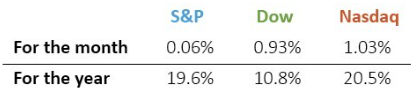
Treasury yields were mixed in October. The 2-year and 10-year note yields rose 0.53% and 0.50% respectively to 4.17% and 4.29%. The 3-month treasury bill, which fell 0.08% in the month to 4.55%, is moving toward the 10-year note as the yield curve, a visual relationship of U.S. interest rates and the maturity dates of treasury securities, is undergoing a process of disinversion.
Indexes broadly declined in October alongside meager corporate earnings reports and weak future corporate guidance. Investors were broadly bearish ahead of the election as the market was injected with uncertainty of how policies like increased capital gains taxes or universal tariffs would affect markets.
At the November meeting the Federal Reserve approved a 0.25% rate cut bringing the benchmark federal funds rate down to a range between 4.5% and 4.75%. The Federal Open Market Committee (FOMC) is cutting rates to achieve the dual mandate of maximum employment and price stability. From the outside, it appears that the Fed is making an effort to stay ahead of disinflation and safe from an economic recession. As of the publishing date of this report, the market is expecting a 57% change of a 0.25% rate cut at the FOMC's December meeting, according to the CME FedWatch tool.
ECONOMIC DEVELOPMENTS
In October the headline unemployment rate was unchanged at 4.1%. However, non-farm payrolls rose the slowest since December 2020 adding just 12,000 jobs to the economy. The August and September jobs reports were revised downward by a combined 112,000 jobs per the U.S. Bureau of Labor Statistics. Economists will be on the lookout for revisions as this data was collected just after Helene and during the Milton hurricanes. Strikes, particularly in the transportation manufacturing industry, may have also had significant effects on this report. Despite the sour headline, the Federal Reserve saw more signs of a stabilizing labor market within it.
The consumer price index (CPI) rose to 2.6% for the year ending in October. Core CPI, which excludes volatile food and energy prices, increased 3.3% over the same period. The Bureau of Labor Statistics reported that the rising cost of shelter accounted for over half of the change in CPI. Core personal consumption expenditures (PCE), the Fed's preferred measure of inflation increased 2.1% over 12 months ending in September. The producer price index (PPI) increased 0.3% in October after revising September up 0.2%. Final demand services increased 0.3% in October and over one-third of the rise can be attributed to a 3.6% increase in prices for portfolio management.
Retail sales growth measured 0.4% in October and was revised up to 0.8% in September. For the year ended in October, retail sales were up 2.3%. This month's growth came in above expectations of 0.3% per The Wall Street Journal. The Census Bureau reports, "Nonstore retail sales were up 7.0% from last year while food services and drinking places were up 4.3% from October 2023". An increase of 1.6% in auto sales drove much of this month's growth. The Associated Press reports, "though some of October's rise in retail sales reflected higher prices, it mainly indicated increased purchases".
In September, the National Association of Realtors reports existing home sales decreased -1.0% in August to a seasonally adjusted annual rate of 3.84 million homes, down 3.5% from last year. Total housing inventory increased to 1.39 million, up 23.0% from a year ago. The average 30-year fixed rate mortgage is 6.78% down 0.66% from a year ago. The median existing home sales price in September was $404,500 down 2.3% from last month.
In the third quarter of 2024 gross domestic product (GDP) growth was 2.8%. Compared to second-quarter GDP growth of 3.0% (revised), Q3 saw slight drop in fixed investment and inventory growth. The Bureau of Economic Analysis reports, "compared to the second quarter, the deceleration in real GDP in the third quarter primarily reflected a downturn in private inventory investment and a larger decrease in residential fixed investment". The increase in consumer spending was led by prescription drugs and healthcare outpatient services.
COLLATERALIZATION
All funds under the control of this office requiring collateralization were secured at rates ranging from 100% to 110%, depending on the type of investment.
Best regards,
TODD RUSS
STATE TREASURER
cc: The Honorable Kevin Stitt, Governor
The Honorable Charles McCall, Speaker of the House
The Honorable Greg Treat, President Pro Tempore
The Honorable Gentner Drummond, Attorney General
The Honorable Cindy Byrd, State Auditor and Inspector
View full report below.
| ||||||||||||||||||||||||||||||||||||||||||||||||||||||||||||||||||||||||||||||||||||||||||||||||||||||||||||||||||||||||||||||||||||||||||||||||||||||||||||||||||||||||||||||||||||||||||||||||||||||
| ||||||||||||||||||||||||||||||||||||||||||||||||||||||||||||||||||||||||||||||||||||||||||||||||||||||||||||||||||||||||||||||||||||||||||||||||||||||||||||||||||||||||||||||||||||||||||||||||||||||
|
BASF invites cotton farmers who yield one ton or more of cotton during the 2024 season using FiberMax® cotton seed to join its exclusive FiberMax One Ton Club™, now in its 20th year. Club enrollment is now open, and members have the opportunity to win rewards, including a two-year lease on a Ford Super Duty® F-350 Lariat® truck.
Applications for the FiberMax One Ton Club can be submitted online, and printed forms will be mailed to qualified farmers this month. As an added incentive, farmers who attend the FiberMax One Ton Club members banquet in Lubbock, Texas, on April 3, 2025, are entered into the truck lease sweepstakes. The deadline to submit the application form is February 28, 2025.
To qualify for the FiberMax One Ton Club, farmers must produce a minimum of 2,000 pounds of ginned cotton per acre on a minimum of 20 acres planted with 100% FiberMax cotton from January 1 to December 31, 2024. The FiberMax One Ton Club is open to farmers in Alabama, Arizona, Arkansas, California, Georgia, Kansas, Louisiana, Mississippi, Missouri, New Mexico, North Carolina, Oklahoma, South Carolina, Tennessee, Texas and Virginia. Cotton acreage can be either irrigated or dryland. Farmers must provide an accurate and complete qualification form and gin recap sheets by mail or online by February 28, 2025. See full details for qualification.
"Reaching the 20th anniversary of the FiberMax One Ton Club is a remarkable milestone for us," said Bryan Perry, Head of U.S. Seeds and Traits for BASF. "This club honors the dedication and skill of cotton farmers who continually push the boundaries of what's possible in yield. Each season, we look forward to celebrating these farmers and the legacy they build through their hard work, resilience and commitment to excellence. It's a privilege to recognize their achievements, and we're excited to make this 20th year a memorable one."
To learn more about the FiberMax One Ton Club visit fibermax.com/otc or contact your local BASF representative.
About BASF's Agricultural Solutions division
Everything we do, we do for the love of farming. Farming is fundamental to provide enough healthy and affordable food for a rapidly growing population, while reducing environmental impacts. That's why we are working with partners and experts to integrate sustainability criteria into all business decisions. With €900 million in 2023, we continue to invest in a strong R&D pipeline, combining innovative thinking with practical action in the field. Our solutions are purpose-designed for different crop systems. Connecting seeds and traits, crop protection products, digital tools and sustainability approaches, to help deliver the best possible outcomes for farmers, growers and our other stakeholders along the value chain. With teams in the lab, field, office and in production, we do everything in our power to build a sustainable future for agriculture. In 2023, our division generated sales of €10.1 billion. For more information, please visit www.agriculture.basf.com or our social media channels.
About BASF
BASF Corporation, headquartered in Florham Park, New Jersey, is the North American affiliate of BASF SE, Ludwigshafen, Germany. BASF has approximately 16,000 employees in North America and had sales of $20.5 billion in 2023. For more information about BASF's North American operations, visit www.basf.com/us.
At BASF, we create chemistry for a sustainable future. We combine economic success with environmental protection and social responsibility. Around 112,000 employees in the BASF Group contribute to the success of our customers in nearly all sectors and almost every country in the world. Our portfolio comprises six segments: Chemicals, Materials, Industrial Solutions, Surface Technologies, Nutrition & Care and Agricultural Solutions. BASF generated sales of €68.9 billion in 2023. BASF shares are traded on the stock exchange in Frankfurt (BAS) and as American Depositary Receipts (BASFY) in the United States. Further information at www.basf.com.
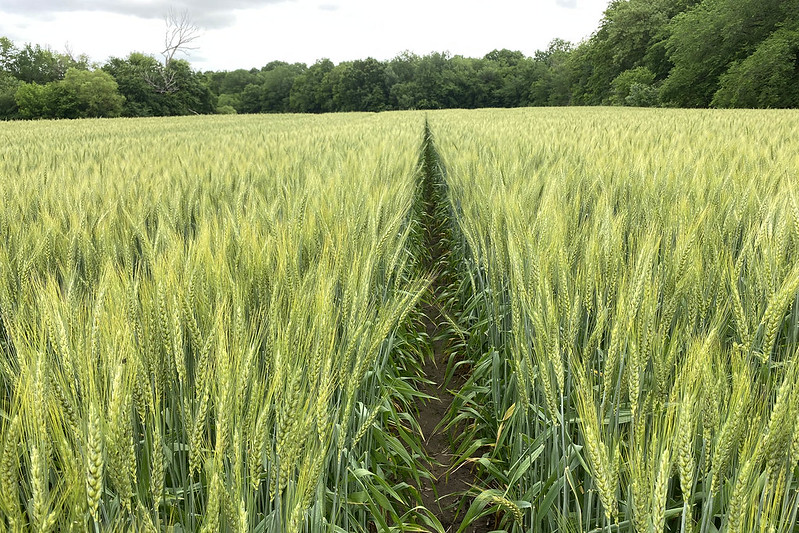
Oklahoma State University Agriculture recently released Scab Stryker, a wheat variety resistant to the fungal disease fusarium head blight. Scab Stryker research trials, such as the one pictured above in Morris, performed the best against head scab for four years in a row. (Photo by OSU Agriculture)
A new wheat variety released by Oklahoma State University will help eastern and northern Oklahoma farmers combat the small grain fungal disease fusarium head blight, also known as head scab.
"It's not a common disease in Oklahoma, but it's dangerous enough that we needed to have something in place for it, especially in the area of Oklahoma east of I-35 and further north," said Brett Carver, professor and wheat genetics chair in the Oklahoma State University Department of Plant and Soil Sciences.
Head scab affects wheat and other small grains and is most common in wheat crops planted after corn crops. Corn residue is a major source of the disease, which poses the biggest threat during high moisture conditions when the wheat head develops.
Carver said the new OSU wheat variety, called Scab Stryker, was bred from the combination of the 2011 OSU variety Garrison and a University of Nebraska experimental line with a scab-resistant gene.
"As far as I know, this gene is the most powerful gene to influence scab resistance in wheat," Carver said. "I don't know of any variety in the Great Plains that has this gene, so Scab Stryker will be the first one."
The variety is intended for limited production, Carver said, because while it has strong scab resistance, it is susceptible to stripe rust and leaf rust.
"The risk that we address with the scab resistance far outweighs the risk associated with leaf rust and stripe rust," Carver said. "Producers can usually control leaf rust and stripe with a single application of fungicide, and you put that fungicide on top of the genetic resistance for head scab. I don't think a person has to worry about scab."
Fungicides also traditionally protect against leaf and stripe rust, and most producers already apply them. Fungicides are usually not enough to fight against head scab, Carver added.
"This was our first time breeding a scab-resistant variety, and it performed the best for four years running in the presence of the disease. You can't ignore that," he said. "We are not looking for this to be a widely grown variety. If head scab is not an issue in someone's region of Oklahoma, I would not necessarily recommend growing this variety."
The variety is also good against barley yellow dwarf, powdery mildew, leaf spotting diseases such as Septoria nodorum, and bacterial diseases such as bacterial leaf streak.
Scab Stryker is a stout variety with a competitive yield, averaging over 90 bushels per acre during trials. Its kernel size is smaller due to it being a late-maturing variety, which makes it stronger against spring freezes. Carver said the tall height of the stalk gives it another advantage over head scab because the disease usually originates from corn residue on the ground.
"Late maturity is excellent when you're trying to avoid scab because the later it matures, the more likely it is to miss the infection. So, when you put that on top of the genetic resistance, that's a good package," Carver said.
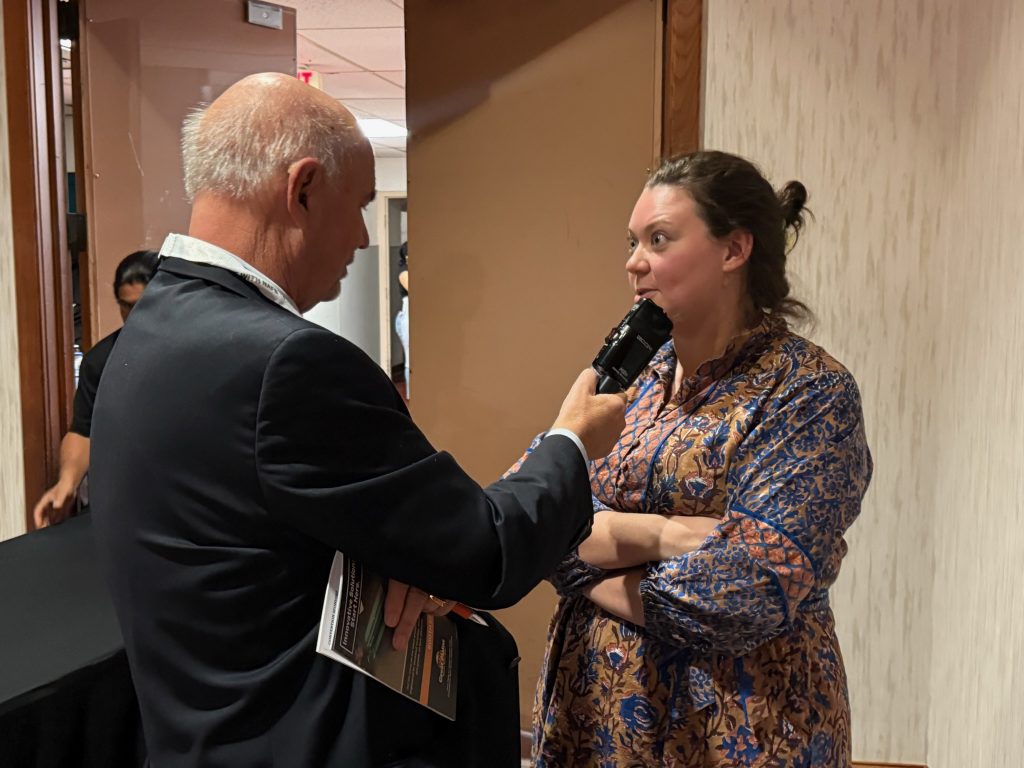
Senior Farm and Ranch Broadcaster, Ron Hays, is talking with the National Cattlemen's Beef Association Chief Counsel Mary-Thomas Hart about the outcome of the election and what it means for the beef industry.
"My first four years at NCBA were the four years of the first Trump administration," Hart shared. "I'm happy to be back in a position playing offense, working with an EPA that really understands the needs of farmers and ranchers, and will interpret some of these supreme court decisions that we've gotten in the last few years in a way that is very workable for agricultural producers across the country."
In 2018, during Trump's first tenure in the Whitehouse, he enacted the Navigable Waters Protection Rule (NWPR) which the Biden administration subsequently recalled and replaced with their own. Biden's version of the rule was vacated by the Supreme Court in the Sackett v. EPA ruling in 2023.
"Looking forward, we have a couple of terms that were in the Sackett decision that need to be effectively defined," Hart detailed. "EPA has crafted the rule that implements those standards, but they haven't done the work to define the standards yet."
The standards she is referring to include continuous surface connection as a concept and the concept of relative permanence. "Those are going to be the two things that WOTUS jurisdiction hinges on, so we are excited to work with the Trump administration to define those terms in the next four years," she related.
Hart believes that the ultimate task would be getting Congress to delve deeper into WOTUS and provide a statutory definition of it; however, she warned that the last time they tried, the word "navigable" was almost removed from the Clean Water Act, which would have been disastrous.
Like other agricultural entities, the top priority for NCBA is to get a farm bill. Questions surrounding that include whether or not Congress will have to draw up an entirely new farm bill if the one as it currently stands isn't completed during the lame duck session, and how long will it take if they do. Also, what opportunities might become available if it is rewritten?
"A couple of other things that are going on at EPA: This administration started the process of reviewing the CAFO permit, and I think it is going to be important to continue that process through the Trump administration," Hart said. "There are a couple of other supreme court decisions that we got in the last few years that we would love to take the opportunity to interpret and apply with this administration and with this EPA."
Hart feels like the all-important first 100 days of the Trump administration for EPA won't be livestock-centric, but rather more about chemical use. "We are happy to let those play out in the first few days," she said. "Our efforts at EPA for this administration, we hope, are going to be very collaborative which means that we have four years to get some good work done. We aren't in a rush to make things happen at EPA; we want to make sure that whatever rules and guidance documents that we get across the finish line are effective and can stand the test of time."
When Hays brought up EPA's strict policies surrounding the Endangered Species Act, Hart asked to shift the focus away from EPA's application of the ESA to the ESA itself. "Within the last few weeks, this administration finalized a set of ESA rules that are pretty aggressive, but I believe they were done well within the window for the Congressional Review Act to apply, so as far as NCBA is concerned, I do think one of our priorities for the new congress is going to be a review of those ESA rules."
The Beef Buzz is a regular feature heard on radio stations around the region on the Radio Oklahoma Ag Network and is a regular audio feature found on this website as well. Click on the LISTEN BAR at the top of the story for today's show and check out our archives for older Beef Buzz shows covering the gamut of the beef cattle industry today.
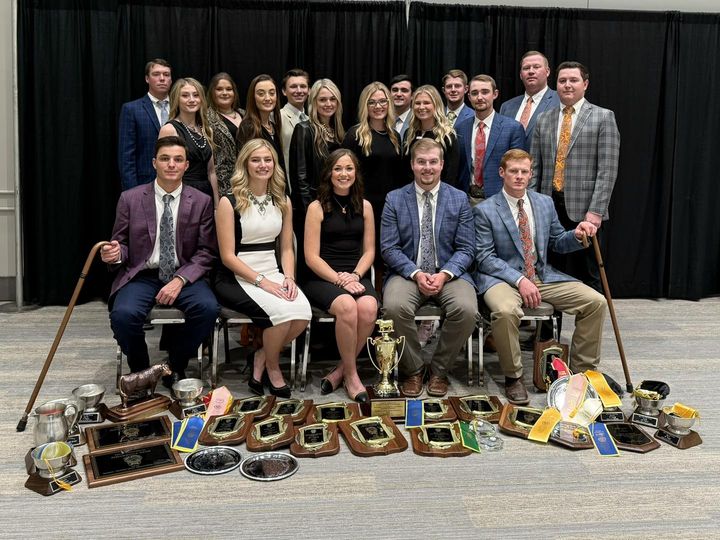
OSU's Livestock Judging Team earned the Reserve National title.
The North American International Livestock Judging Exposition (NAILE) is the largest all-breed, purebred livestock show in the country. Every year, livestock exhibitors from around the globe come together in Louisville, Kentucky to compete on the green shavings for purple banners.
The 119th National Collegiate Livestock Judging Contest was run in conjunction with NAILE on Monday, November 18, 2024, and three Southern Plains colleges claimed big titles from the prestigious event.
The Kansas State University team, composed of top placing members Jacob Klaudt, Cole Murphy, Logan Buhrman, Kyla Mennen, and Ty Knodle, took the National Championship. While each earned individual honors, the team placed first in Swine, Sheep and Goats, and Reasons and second in Cattle judging. Other team members include Benjamin Archer, Alex Scovill, Zane Redifer, Emerson Tarr, Ethan Hyers, Blake Bruns, Logan Topp, Olivia Gerloff, and Hailey Gillespie.
The Oklahoma State University Livestock Judging Team earned the Reserve National title. The top-placing individual team members were Anna Hannon, Kale Campbell, Ashlyn O.Brien, and Jed Sidwell. Additional team members were Clay Brillhart, Kale Campbell, Hailey Coggins, Emma Eldridge Emma Farmer, Parker Fleming, Anna Hannon, Ryan Hegland, Delaney Hemann, Doug Hewitt, Mckenzie Layton, Shaylee Maddox, Ashlyn O'Brien, Jed Sidwell, and Braylon Spears.
After earning the inaugural National Junior College Livestock Judging title in 1974, Northeastern Oklahoma A&M College in Miami, Oklahoma, earned a Junior College National Title after their second with high-scoring individual members Tyeson Gravenhof, Avery Kimble, Jayce Smith, and Dustee Hollenback. Other team members are Brighton Lane, Cooper Frazier, and Chloe Mabry.
The collegiate Livestock Judging Contest has been running every year since 1900. Throughout its history, the contest has provided valuable training and experience for students in the livestock industry. Many contestants who participated in the contest went on to become distinguished leaders in the livestock industry as well as leaders in agriculture, education, business, and national and international policymaking.
This marks the 25th year that All-American Livestock Judging Awards have been presented. The All-American program was initiated by the Livestock Judging Team Coaches' Association and American Society of Animal Science in 2000 to recognize students who have made a commitment to livestock judging but have additionally excelled in academic performance, university and industry activities, and community service.
Two OSU students, Emma Farmer and Anna Hannon, earned Academic All-American titles.
Farmer is an OSU transfer student Achievement Scholar, and Flemming family and Klemme family Memorial Scholar. She serves on the student council for the Ferguson College of Agriculture and Vice President of Collegiate Farm Bureau. She is also a member of Agricultural Communicators of Tomorrow, Block and Bridle and Collegiate Cattlewomen's. At Connor's College, she was a member of Aggie Club, Ag Ambassadors and the Presidential Leadership Class. Emma held an internship with Oklahoma 4-H Foundation and is currently a Legal Assistant at Stephens Swafford Law Firm in Stillwater. She also participated in the Oklahoma House of Representatives Page Program and graduated from Oklahoma Legislative Fellowship Program. She grew up on a diversified farming operation in Southwest Oklahoma. She is a member of the highly successful OSU livestock judging team and Reserve National Champion Meat Animal Evaluation team. She was also on a nationally competitive team at Connors College. Emma will graduate in May 2025 with a bachelor's degree in agricultural communications and minor in law and legal studies. Her goal is to pursue a law degree from the University of Oklahoma to ultimately become an attorney with a legal practice in Oklahoma that represents agricultural clients and she hopes to serve as a voice for agricultural policy at the state capital.
Hannon grew up on a family-owned show pig and commercial cattle operation in Rensselaer, IN. She attended Northern Oklahoma college where she was Public Relations officer for Phi Theta Kappa, an Agriculture Leadership Ambassador and a Public Relations Officer for Phi Theta Kappa. She was a member of the highly successful NOC livestock judging team which was named Junior College Team of the year after winning the State Fair of Texas, American Royal, North American International, National Western and Houston contests and Anna placed in the top 10 overall individuals at the American Royal, Cattleman's Congress, National Western, San Antonio and Houston well as being named a JUCO All American. She transferred to Oklahoma State University where she is Secretary of Rho Phi Lambda fraternity, a student worker with the Oklahoma State Swine Research and Education Center and a Cowboy Commitment Scholar. She has been a member of the winning OSU teams at Cattlemen's Congress, National Western and Dixie National and Reserve team at Denver. She was a member of the Reserve National Champion Meat Animal Evaluation team at OSU as well. She was a member of the state winning 4-H and FFA teams in Indiana which also won both the American Royal and the National FFA Contests. Consequently, she had the opportunity to represent the United States in the international judging competition hosted by Royal Highlands Show in Ireland. She was a State FFA Degree recipient as well. Anna is pursuing a degree in Recreational Therapy and following graduation, hopes to pursue a Doctorate in Occupational Therapy to ultimately help others.
Three K-State students won Academic All-American awards, and they were Quinna Molden, Kylie Schakel, and Bailey Lavender.
Molden serves as an Animal Science and Industry mentor for incoming Freshmen, is an Agricultural Council representative and member of the K-State Women's Lacrosse Team. Quinna also served as President of the Bulter Community College Ag Ambassadors. She has been a student researcher with K-State Equine Center, a summer research intern with Virginia Cooperative Extension Service and a summer intern with Udell Cattle Company in Iowa. She has been recognized as a Virgina Farm Bureau, Virginia Cattlemen's Association as well as a K-State Presidential and Foundation Scholar. Molden was a member of the Virginia 4-H All Star Judging Team which were named Reserve National Champions at National 4-H contest and were awarded 14-day tour of Scotland and Ireland to compete at Royal Highland Contest. In addition to K-State livestock judging team, she was a member of the National Champion Meat Animal Evaluation team. Upon completion of an undergraduate Animal Science and Industry degree, she plans to pursue a M.S. and Ph.D. in beef cattle reproductive physiology and eventually becoming a professor with teaching and research responsibilities.
Schakel grew up in Indiana in a fourth-generation sheep farming family. At K-State, she is a College of Agriculture Ambassador recruiting for the Agricultural Leadership Program, serves as Vice President of Development for Agricultural Communicators of Tomorrow, Copy Editor for the K-State Purple Yearbook, and social media specialist for both the College of Agriculture and K-State Research and Extension. She was a communications intern with American Farm Bureau in Washington, D.C., communications and legislative intern with Illinois FFA Association and a communications intern with Indiana State Department of Agriculture. Schakel served as President of the National Junior Dorset Association and was member of the National Tunis Sheep, American Hampshire Sheep, American Shropshire, American Southdown and Natural Colored Wool Growers Associations. In addition, she served as secretary for Indiana FFA Association. She has been a successful member of the K-State Livestock Judging Team and National Champion Meat Animal Evaluation team as well judged for Lincoln Land College. Schakel will graduate in May 2025 with a degree in Agricultural Communications and Journalism and has a career goal of media relations for the agricultural industry to impact policy initiatives through an organization like American Farm Bureau Federation.
Lavender is President of KSU Educational Marketing Club, a Student Fellow with KSU Center for Risk Management Education and Research and Student Library Assistant with KSU Veterinary Medical Library. She has pursued undergraduate research with the Department of Agricultural Economics to identify a regression model examining global differences in agricultural policy which impact trade agreements. Lavende also participated in internships with Bunge Grain Merchandising and Commodities and a livestock show internship with the North American in Louisville. She was an agricultural ambassador at the Florida State Fair advocating for youth agricultural programs. Lavender judged for Connors College in Junior College and has been a member of the successful KSU livestock judging team which won the American Royal and the meat animal evaluation teams which was named National Champion, and she was 4th high individual overall in the contest. Following graduation in May 2025 with a degree in Agricultural Economics, she plans attend graduate school for a Master of Science and Ph.D. degrees in Agricultural Economics with the goal of a teaching and conducting research at a land grant university focusing her research on risk mitigation practices for farmers and ranchers.

On Wednesday, November 20th, Growth Energy, along with Clean Fuels Alliance America (CFAA), filed a new opening brief with the U.S. Court of Appeals for the District of Columbia Circuit (Case No. 20-1046) challenging the Environmental Protection Agency's (EPA) failure to fully account for small refinery exemptions (SREs) when issuing renewable volume obligations (RVO) under the Renewable Fuel Standard (RFS).
In their brief, the parties seek to ensure that RVOs account for SREs the agency issued for past years. Current regulations require EPA only to project future SREs when establishing future RVOs, while ignoring biofuel demand destroyed by past SREs granted retroactively, totaling more than four billion gallons in recent years.
"EPA's RVO regulations fail to account for the billions of gallons of demand lost to the agency's mismanagement of the Renewable Fuel Standard," said Growth Energy CEO Emily Skor. "Regulators took one step forward during the first Trump administration by recognizing the future impact of oil industry handouts, but since then EPA has never attempted to repair the damage from past handouts that continues to weigh down the biofuels industry and our farm partners. That has to change."
Background
EPA published the original 2020 RVO on February 6, 2020. The RVO was challenged in the D.C. Circuit by several parties soon thereafter. Growth intervened in support of parts of the rule on behalf of EPA and, separately, petitioned the court to challenge EPA's failure to account for past SREs. After the cases were consolidated (Case No. 20-1046), and after initial briefing in late 2020, the court granted motions to stay the consolidated cases pending the Supreme Court's decision on SRE eligibility in HollyFrontier v. EPA. The case proceeded until December 2021, when EPA issued a new proposed rule for the 2020 RVO as well as 2021-2022 RVOs and sought remand without vacatur of the original 2020 RVO. The court deferred decision on remand and continued to stay the case. EPA's final 2020-2022 RVOs also failed to account for past SREs. The court continued to stay the original 2020 RVO case until after the D.C. Circuit's opinion on new cases challenging the new 2020-2022 RVOs. The D.C. Circuit upheld the new 2020-2022 RVOs on May 14, 2024 (Case No. 22-1210), after which time the court lifted the stay on the original 2020 RVO challenge and set a briefing schedule.
The Center for Veterinary Medicine at the Food and Drug Administration first issued Guidance For Industry (GFI) #191 in 2009. Over the last few years, the CVM asked animal health manufacturers to update growth implant labels in accordance with the production phases outlined in GFI #191. This created some confusion around how growth implants could be used in the beef industry.
The defined production phases for beef cattle left some lingering questions for many in the beef industry, especially with the production phase of dry lot and how it differs from growing on pasture and the confinement for slaughter production phase. GFI #191 and associated documents from FDA have helped define the dry lot production phase.
A summary of the FDA documentation defines dry lot by four criteria:
These four criteria are key to understanding how the FDA considers a dry lot different from a pasture phase and a grow yard or backgrounding operation that are a subset of cattle fed in the confinement for slaughter production phase as defined by the FDA.
While cattle in a dry lot and cattle in a grow yard (a subset of cattle fed in confinement for slaughter) can both be on a dirt floor pen, the FDA has outlined differences in physiological state, diet, movement from one production phase to the next and potentially rates of growth between the two production phases.
This table summarizes the differences between a dry lot and a grow yard.
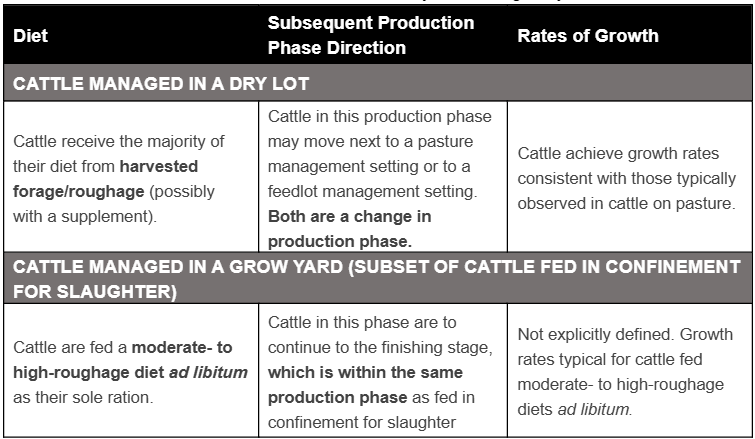
The dry lot phase is an opportunity for beef producers to add value to the cattle in their care. At this stage, cattle can come in from several sources and may not be consistent in size or health programs. A dry lot allows producers to get cattle healthy, add weight and sort cattle into uniform groups. By leveraging an implant with trenbolone acetate (TBA) in the dry lot phase, cattle can add lean muscle and hit their target weight sooner before moving to the next phase.
Earlier this year, Zoetis received an additional label indication for its Synovex Choice® implant in the dry lot production phase, as well as gained approval on a new implant product for the dry lot, Synovex® PrimerTM.
These are the first TBA-containing implants approved for the dry lot production phase, and it gives producers in the dry lot phase more options. Research has demonstrated that TBA-containing implants help extend the growth curve and keep cattle leaner longer as cattle get heavier.1
In dry lot research comparing Synovex Choice and Synovex Primer with a sham implant, cattle receiving Synovex Choice gained 2.50 lb./head/day (p = 0.0016) and cattle receiving Synovex Primer gained 2.47 lbs./head/day (p = 0.0016) when compared with the sham implanted group at 2.21 lbs./head/day over the course of the 90-day study.2
Talk with your nutritionist or veterinarian about the value of including an implant in your dry lot program. For more information on the complete line of implants from Zoetis, go to Synovex.com.
Refer to individual labels for complete directions for use, precautions, and warning. Reimplant only if and as directed in labeling.
About Zoetis
As the world's leading animal health company, Zoetis is driven by a singular purpose: to nurture our world and humankind by advancing care for animals. After innovating ways to predict, prevent, detect, and treat animal illness for more than 70 years, Zoetis continues to stand by those raising and caring for animals worldwide – from veterinarians and pet owners to livestock farmers and ranchers. The company's leading portfolio and pipeline of medicines, vaccines, diagnostics and technologies make a difference in over 100 countries. A Fortune 500 company, Zoetis generated revenue of $8.5 billion in 2023 with approximately 14,100 employees. For more information, visit www.zoetis.com.
U.S. Poultry & Egg Association matching Giving Tuesday donations up to $100,000

The Animal Agriculture Alliance, a non-profit working to safeguard the future of animal agriculture, is participating in Giving Tuesday on December 3. Every bit counts and from now until Giving Tuesday, U.S. Poultry & Egg Association will match donations up to $100,000 to help contributions go even further toward keeping meat, dairy, poultry, eggs, and seafood on consumers' plates. Donate today!
There's only one way to safeguard the future of animal agriculture – together. On Giving Tuesday, a global day of giving, people around the world are coming together to support causes they care about. As a 501(c)(3) non-profit, the Alliance relies on generous supporters to keep its mission moving forward. Join the Giving Tuesday celebration today by making a tax-deductible donation that will support the Alliance's critical work to advance animal agriculture.
"Without the support of our members, donors, and sponsors, the Animal Agriculture Alliance would not be able to carry out our critical work to bridge the gap between farm and fork," said Hannah Thompson-Weeman, president and CEO, Animal Agriculture Alliance. "The generous support of the animal agriculture community and individual donations propels us forward to continue monitoring animal rights extremists, empowering advocates for agriculture, and bringing the barnyard together to align on issues. Every donation makes a difference."
Founded in 1987, the Alliance brings together farmers, ranchers, veterinarians, animal feed companies, animal health companies, processors, allied associations, and others involved in getting food from farm to fork. The Alliance safeguards the future of animal agriculture and its value to society by bridging the communication gap between the farm and food communities. The organization connects key food industry stakeholders to arm them with responses to emerging issues, engages food chain influencers and promote consumer choice by helping them better understand modern animal agriculture, and protects farmers' livelihoods by exposing those who threaten our nation's food security with damaging misinformation.
Donations can be made here. To learn more about the Alliance and its work to connect, engage, and protect the animal agriculture community, visit www.animalagalliance.org.
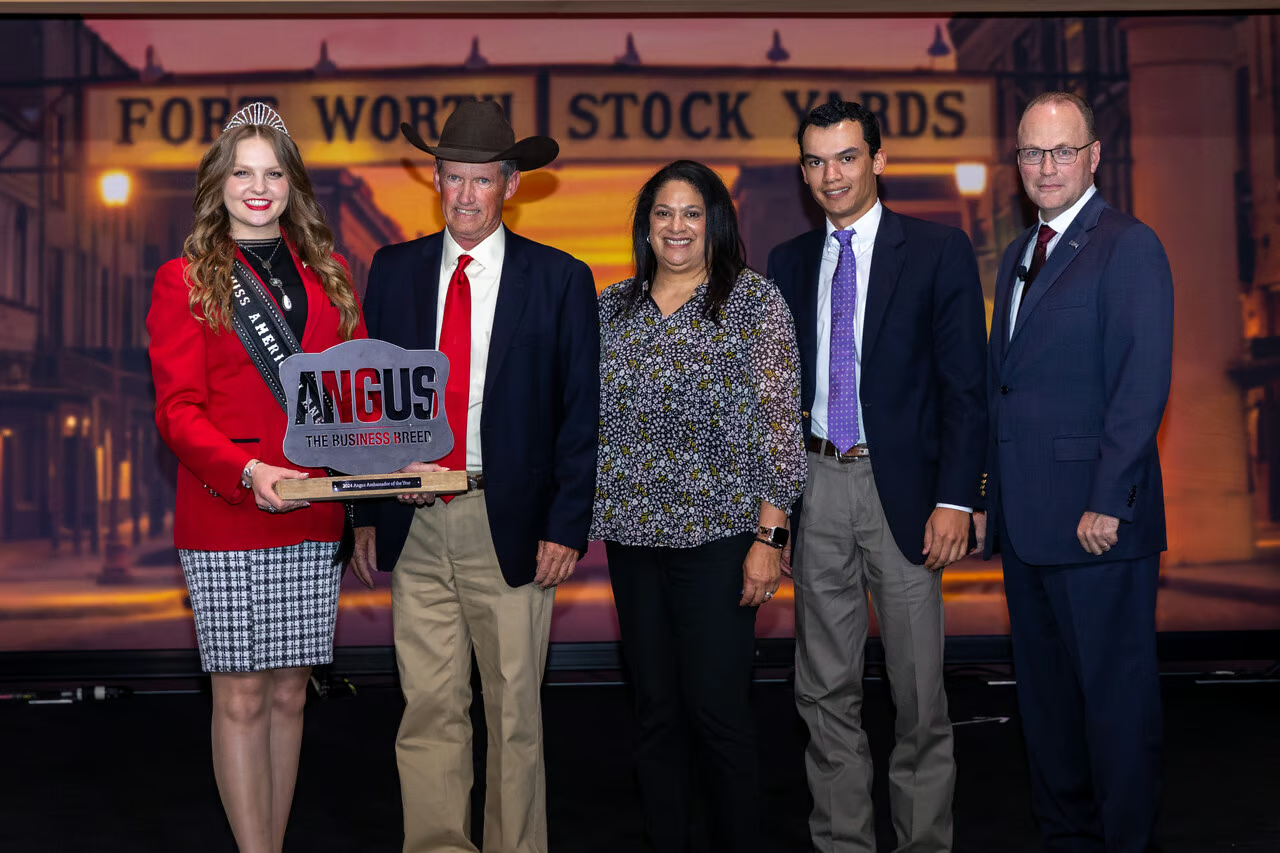
Mike McGuire was awarded the Angus Ambassador of the Year Award at the 2024 Angus Convention. Pictured from left are Lauren Wolter, 2024 Miss American Angus; Mark McGuire, Angelika McGuire and Reid McGuire; and Mark McCully, American Angus Association CEO.
Many young farm kids dream of having a toy John Deere tractor or imagine working cows and plowing fields on the carpet of their living room. For Mike McGuire his dream as a young 4-Her was to have an Angus heifer.
"I had some influential people around me at that time that had an Angus herd," McGuire said. "And boy, it was not long until I wanted an Angus heifer so bad."
From his early years shadowing his father at the University of Georgia, to becoming a founding member of the National Junior Angus Association, to working summer jobs working on ranches from South Dakota to Georgia, McGuire's journey has been shaped by his passion for the Angus breed. His passion has remained steadfast, especially when he returned to Alabama to raise a family and build his own herd. More importantly, his commitment has always been to Angus breeders.
McGuire's dedication to Angus and Alabama for nearly five decades culminated in being recognized as the Angus Ambassador of the Year at the 2024 American Angus Association® Awards Reception and Dinner in Fort Worth, Texas on November 3. The Ambassador of the Year Award honors someone who goes above and beyond to promote or aid Angus efforts and broaden the breed's influence in the beef industry.
In 1980, the Alabama breeder was part of the group of juniors who established the National Junior Angus Association and Junior Board. After working on a few different ranches and operations in the southeast, McGuire settled in Waverly, Alabama, alongside wife Angelika and sons, Reid and Clay.
In 1997 McGuire became the Executive Secretary of the Alabama Angus Association.
"The Alabama Angus Association had a strong Foundation that preceded me. A lot of the things that we do now, were all in the place before I started, I have just tried to carry those on," McGuire said. "You blink your eyes, and 27 years have gone by now."
Decades later, McGuire continues to be a leader in the breed and has been pivotal in growing one of the most robust state associations in the country. In his role, McGuire has helped to serve an active membership by organizing over 50 state sales, planning annual field days and helping to establish the Alabama Angus Family of the Year and Alabama Progressive Breeder of the Year awards.
"A couple of important activities we have been able to maintain is hosting two sales a year, one each April and November," McGuire said. "It's given people an avenue to sell and build a reputation. It is a great gathering place for us and a way to bring everybody together."
In March, McGuire will have been raising Angus cattle for 50 years. Part of that achievement he attributes to his hard-headedness and part simply out of an enjoyment for the cattle.
"I think it is simply out of love for the business to stay in it that long. It has been a really great experience and there was just nothing I wanted to do more than show an Angus heifer or steer back in those days," McGuire said. "Still even to this day, I just want to get out there and touch them and work on them. And that's just what really gets me excited."
McGuire becomes the second to be named Ambassador of the Year as the award was founded in 2023, a recognition he calls a tremendous honor.
"Anytime you get recognized by the American Angus Association it just means a lot," McGuire said. "Working in the position for the Alabama Association was never something I had envisioned myself in, but I am thankful to have been able to do it. I am proud of what we have been able to accomplish here, and it is just a huge honor."
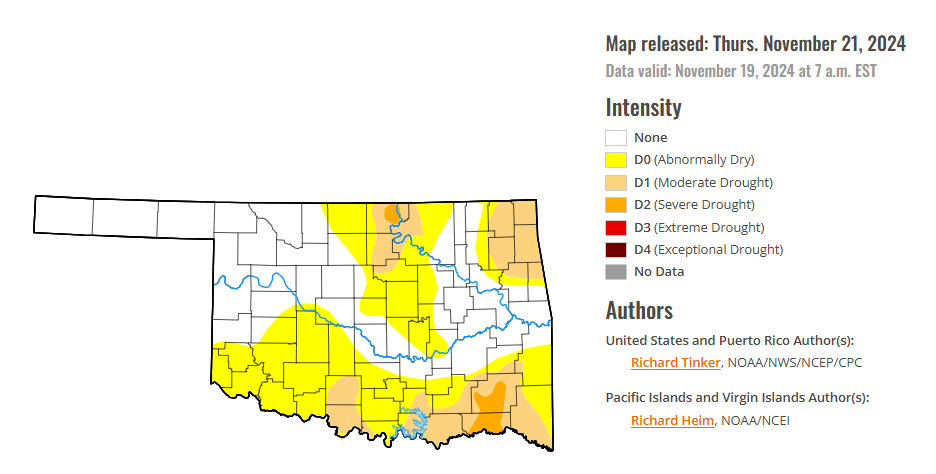
To view the latest Oklahoma drought map, CLICK HERE.
According to the latest Oklahoma drought monitor report, exceptional drought remains at zero percent, unchanged from the start of the calendar year.
Extreme drought or worse conditions remain at zero percent, unchanged for two weeks.
Severe drought or worse conditions have decreased to 1.85 percent, down from 9.38 percent last week.
Moderate drought or worse conditions have decreased to 17.90 percent, down from 47.05 percent last week.
Abnormally dry or worse conditions decreased to 52.78 percent, down from 81.78 percent last week.
According to the 6-to-10-day precipitation outlook map, the southern half of Oklahoma is leaning above a 33-40 percent chance of precipitation through November 30, 2024. Most of the state's northern half is leaning above a 40-50 percent chance of precipitation, except for the Northwestern corner of the panhandle, which is leaning above a 50-60 percent chance of precipitation through that November 30 date.
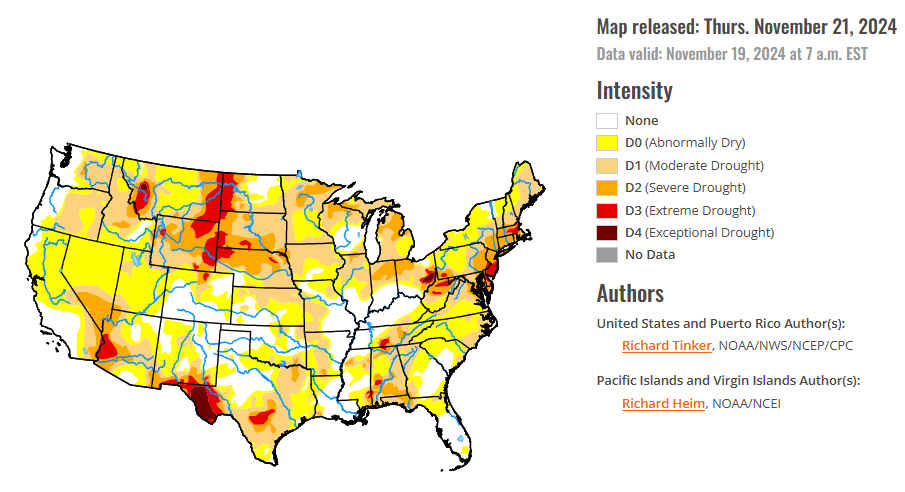
To view the United States Drought Map, CLICK HERE.
The trend of the past few weeks toward generally increased precipitation across the Contiguous 48 states continued this week, with several sizeable swaths of heavy precipitation recorded, and broad coverage of near or above-normal amounts. The heaviest amounts fell from the Cascades westward to the Pacific Ocean, in addition to southwestern Oregon and northwestern California. Amounts exceeded 3 inches through almost this entire region, with amounts of 5 inches to locally 1 foot observed in portions of the Cascades and immediate Pacific Coastline, especially where orographically enhanced. Several other large areas recorded at least an inch and locally up to 5 inches, including most of the northern Intermountain West, a swath from the southern High Plains through the central Great Plains and the middle and upper Mississippi Valley, much of the lower Mississippi Valley, the lower Ohio and Tennessee Valleys, the upper Southeast, much of the Virginia Tidewater and eastern North Carolina, and parts of the southern and central Appalachians. Numerous locations in the Lower Mississippi Valley and northwestern Alabama reported 3 to 5 inches of rain, as did a swath in north-central Kentucky and isolated spots in western Tennessee, northwestern Texas, eastern Oklahoma, southwestern Kansas, and western Iowa. The broad coverage of moderate to heavy precipitation prompted sizeable areas of improvement in this week's Drought Monitor. The pattern of increased precipitation has yet to materialize in the Northeast, however, where record and near-record low precipitation amounts have been observed over the past few months, and continued dryness last week allowed conditions to continue to deteriorate. Little or no precipitation was also recorded across the southern reaches of South Carolina and Georgia, the Florida Peninsula, southern Texas, most of the central and northern Plains, and the southwestern quarter of the country, with patches of deterioration noted in these areas as well this week.
The Southern Plains experienced highly variable rainfall this past week, although more areas experienced significant rainfall and improved conditions than dryness and deterioration. The latter was confined to central and southern Texas where little or no rain fell, expanding D0 through much of Deep South Texas and prompting the introduction of D1 in a patch near the lower Rio Grande River. Farther north, moderate to heavy precipitation prevailed, especially across western Teas, much of Oklahoma, portions of Louisiana, Mississippi, and western Tennessee. A large part of these areas saw a 1-category improvement, nearly eliminating severe drought (D2) in western Arkansas, eastern Oklahoma, and adjacent Texas, and also decreasing D1 coverage substantially across the northern and eastern tiers of the Region.
In The High Plains, moderate to heavy precipitation was widespread across the southern and eastern reaches, and moderate amounts were observed in some of the higher elevations of Wyoming and central Colorado, and over northern North Dakota. Elsewhere, only a few tenths of an inch, at most, was measured. In the areas of heaviest precipitation (1.5 to approaching 3.0 inches), improvement was introduced. This included significant parts of Kansas, southeastern Colorado, eastern sections of Nebraska and South Dakota, and a relatively small area in southeastern North Dakota. The remainder of the region, under a regime of light to moderate precipitation at best, dryness and drought assessments were unchanged.
In the West, heavy to excessive precipitation in northwestern California and the Northwest from the Cascades to the Pacific Coast induced widespread 1-category improvement in these areas. Totals exceeding 3 inches were almost ubiquitous, and amounts of 5 to locally 12 inches were common in the Cascades and near the immediate coast. This amounted to peeling back D0 and D1 to the west. In Oregon, streamflows have finally begun to respond to the increased precipitation. Other areas of improvement were introduced where there was spottier moderate to heavy rain in parts of eastern Oregon, northern Idaho, and westernmost Montana. Moderate to heavy precipitation (locally up to 3 inches) also doused southeastern New Mexico adjacent to the heavy rains in western Texas, with similar 1-category improvements introduced in areas with over 1.5 inches of precipitation. Elsewhere, only scattered light precipitation was reported, and dryness and drought were primarily unchanged. Some deterioration was noted in west-central Montana (to D1) while a significant swath of eastern Montana slid into extreme drought (D3).
Looking ahead, during the next five days (November 21-25), moderate to heavy precipitation is expected in the western and northeastern quarters of the contiguous states, and along the immediate Canadian border. Lesser amounts, if any, are expected in and around the Plains and along most of the southern tier. The greatest amounts are forecast across northern California and the Sierra Nevada, where totals exceeding 5 inches are expected to be widespread, with the potential for as much as 15 inches at isolated spots in the higher elevations. Generally 1.5 to 3.0 inches are expected in the West from the Cascades to the Pacific Coast and in portions of the northern Intermountain West. Similar amounts are also forecast for most of New York State, northeastern Pennsylvania, and to a lesser extent New England, the Great Lakes, and southwestern California. Between 0.75 and 1.5 inches should fall in the remainder of the Northwest, the higher elevations of the central Rockies, southwestern California, much of the Great Lakes, Pennsylvania, Maryland and Delaware, and the rest of New England. In contrast, little or no precipitation is expected in the Plains from the central Dakotas southward, and along the southern tier of the country from southeastern California eastward through Georgia and most of the Carolinas. Very warm weather is expected in central and southern Texas, with temperatures expected to average 10 to 13 deg. F above normal. A larger area from eastern Arizona through the Lower Mississippi Valley is forecast to average 5 to 10 deg. F above normal. Meanwhile, unusually low temperatures averaging 10 to 17 deg. F below normal are anticipated from the central and western Dakotas through most of Montana. Temperatures may average up to 10 deg. F above normal from the Upper Mississippi Valley and central Plains westward through the Great Basin and northern Intermountain West. Near or slightly above normal temperatures are expected elsewhere.
The Climate Prediction Center's 6-10 day outlook (valid November 26-30) favors above-normal precipitation in a swath from the Southwest and the Great Basin eastward through most of the Plains, and from Mississippi Valley eastward to the Atlantic Coast. Only the Northeast, Florida Peninsula, central and southern Texas, the Great Lakes, and the Far West are outside the area where above-normal precipitation is expected. Odds exceed 50 percent over the east-central Rockies and adjacent High Plains. Unusually dry weather is more likely in western Texas, the Northwest, parts of the Intermountain West, plus central and northern portions of the Rockies and Plains. Subnormal precipitation is also more likely across Hawaii, especially the northwestern islands. Meanwhile, the southern tier of the country from the Plains to the Atlantic Coast is expected to average warmer than normal, with odds topping 50 percent along and near the Gulf of Mexico Coast. Hawaii is also expected to average warmer than normal, especially the central and northwestern islands. Cold weather is favored across central and northern portions of the Rockies, Plains, and Mississippi Valley, plus some adjacent areas. Chances for significantly subnormal temperatures are 70 to 80+ percent from Montana east of the Rockies and most of the Dakotas.
To view the 6-10 Day Precipitation Outlook Map, click here.
To view the 6-10 Day Temperature Outlook Map, click here.
To view the Monthly Drought Outlook Map, click here.

The dairy checkoff partnered with General Mills to create YoBark, a yogurt-based snack designed to give families a tasty option and expand yogurt's presence in the snacking category.
YoBark is refrigerated and combines the creaminess of yogurt with the crunchy texture of Nature Valley Granola, offering a multi-sensory flavor experience. It is available at Albertson's, Safeway and Walmart and will reach more retailers nationwide in the coming months.
Dairy Management Inc. (DMI) has been working with General Mills on this concept since 2021, providing consumer insights on why "tweens" (ages 12-13) have decreased their yogurt consumption. DMI also provided new product concept development, package design and research and development support.
"Recognizing this trend, we partnered with General Mills and co-funded research to develop product concepts that would appeal to this demographic," said Chris Urban, vice president of growth platforms and partnerships for DMI. "The lead concept that emerged from our collaboration was YoBark, which received the highest-ranking score in our concept evaluations."
Urban said the product, which comes in a stand-up pouch in strawberry and honey vanilla flavors, delivers a nutritious snack that appeals to parents who are seeking options for their families beyond traditional snack foods.
"Our strategy targets families," Urban said. "Moms often act as gatekeepers for household purchases, but it's crucial that the product also appeals to their tweens. We found that YoBark meets the health standards moms want while offering a fun, snackable form that tweens enjoy. It's also designed to be shareable, tapping into tweens' social interactions." To learn more about dairy checkoff strategies designed to increase sales and trust, visit www.DairyCheckoff.com

I'm writing this somewhere over the Atlantic Ocean as I travel home from England. I was there for the last several days at the invitation of the British Embassy in Washington, D.C., along with several U.S. agricultural officials, including Congressional staff and a handful of state secretaries, directors, and commissioners. The purpose was to learn about the agricultural industry in one of the most beautiful and storied countries on the planet, but it also provided a good opportunity to compare with current events unfolding at home. Not surprisingly, farmers and ranchers in both countries face a lot of the same challenges: enduring erratic weather; striking the right balance between conserving resources and growing food; and navigating unpredictable politics, just to name a few.
With respect to the latter, both countries have recently gone through elections. This past summer in the general election in the U.K., the opposition Labour Party led by Keir Starmer – now Prime Minister – defeated the governing Conservative Party. The new government recently introduced a new inheritance tax proposal. While there are far more details (and nuance) than I have space to discuss today, the proposed changes will impose an inheritance tax of 20% on business and agricultural assets beyond £1 million (roughly $1.26 million at today's exchange rates) beginning in April 2026. Much like in the United States, growth in land values and equipment costs have resulted in a situation where farms have significant net worth – at least on paper – but little liquidity. In other words, producers have little ability to pay huge tax burdens when an operation is passed along to an heir. Proponents of the proposal will argue that any transfers to individuals more than seven years before death will continue to fall outside the scope of the new inheritance tax. However, producers will counter that death doesn't respect the timeframes set by the government, and they will argue that the proposal stands to destroy the heritage their families have built – to say nothing of the eventual impact on food security. On Tuesday of this week, British farmers and ranchers descended on London to protest the new government's proposal.
While England is a long way from the United States, it's not all that different from here. Throughout our own election season this Fall – and as part of the debate about how to pay for the now-defunct Build Back Better Act – a number of proposals were discussed to significantly change the taxation of unrealized capital gains and estate taxes in the United States. In June 2021, at the request of Rep. GT Thompson (R-PA) and Sen. John Boozman (R-AR), our team at the Agricultural and Food Policy Center (AFPC) authored a report that estimated the impact of two of these proposals, the Sensible Taxation and Equity Promotion Act and the For the 99.5 Percent Act. At the time, our analysis showed that a generational transfer under the two bills would impact 92 of AFPC's 94 representative farms (increasing the average tax liability by $726,000 per farm) and 41 of 94 representative farms (increasing the average tax liability of $2.2 million per farm), respectively.
While our election results this Fall very likely mean that agricultural producers in the United States won't face a near-term change in the treatment of unrealized capital gains and estate taxes, the events unfolding "across the pond" are a very clear reminder that elections have consequences...and that policies (well-intentioned or not) often have unintended consequences.
Article courtesy of Southern Ag Today: Bart Fischer
RON's Dave Lanning has a pre-opening look at today's agricultural Markets.
Click the audio tab below for today's report.

Oklahoma House Republicans this week elected their new caucus leadership for the upcoming 60th Legislature. The 81 Republicans maintain their supermajority in the House.
Newly elected caucus leadership includes:
"I am honored to have been elected by my colleagues to serve for a second term," May said. "I look forward to working with our new legislative leaders on pressing issues such as economic development, educational improvements and public safety."
This is May's second term as Caucus Chair and fourth term in office. During the previous Legislature, May also served as vice chair of the House Appropriations & Budget Subcommittee on Judiciary.
"I am grateful to have the opportunity to serve the House Republican Caucus, my district and the people of Oklahoma," Archer said. "I look forward to working with my colleagues toward a shared vision and dedication to the conservative principles Oklahomans value."
Archer, a second-term legislator, served as vice chair of the House General Government Committee as a freshman lawmaker. Before being elected to the House, he served two terms as mayor of Elk City.
"I appreciate the trust placed in me to serve in this role," Cantrell said. "The House is in an excellent position to address critical issues facing our state, and I am optimistic about the future of our caucus, our state and our country."
Cantrell, also a second-term legislator, previously served as Marshall County Commissioner for District 2. During the previous Legislature, he was vice chair of the County and Municipal Government Committee.
Archer and Cantrell succeed Rep. Danny Williams, R-Seminole, and Rep. Sherrie Conley, R-Newcastle, in their respective positions.
Representatives were officially sworn in on Wed., Nov. 20. The full House will formally vote on its next Speaker and Speaker Pro Tempore during Organizational Day on Jan. 7, 2025. The first session of the 60th Legislature convenes on Feb. 3.
He sold your grandfather a tractor back in '73, likes the look of a clean lawn, and every morning he checks the chicken coop for fresh eggs. And today, he's John Deere's Chief Tractor Kid. You heard that right: John Deere is partnering with Jackson Laux, a 9-year-old farmer and viral social media sensation known for his love of tractors and farming. Jackson will create content for Deere's social media channels throughout the next year to bring awareness to the people working tirelessly in agriculture.
"Wise beyond his years, Jackson brings a fresh perspective to an industry that has been around since the beginning of time," said Jennifer Hartmann, global director of strategic public relations and enterprise social media. "Creating content alongside Jackson will help us introduce agriculture to a new generation in fun, unique formats that capture the true day-to-day life of a farmer."
Jackson first went viral on TikTok in November 2023 when his cousin posted a video of him in response to the comment "farm kids are just built different"—and he hasn't looked back since. Coined as the youngest tractor expert by his followers, Jackson has worked on his family's farm in "good old South Whitley, Windy-ana" since the day he could walk. Jackson comes from a family of fifth-generation farmers
"Farming is really cool, and I want to show other kids my age why they should get into farming too. And show farmers of all ages why they should take the time to teach us younger ones," Jackson said.
Deere's Chief Tractor Officer, Rex Curtiss, visited Jackson's family farm where Jackson taught him how to plow fields, harvest corn, and take care of his prized chickens. Jackson will continue to inspire the next generation of farmers as Chief Tractor Kid, highlighting the stories of the people who are our source of food and fuel.
Watch the story unfold on TikTok and Instagram by following @JohnDeere.
And in the words of Jackson: "That's all she wrote."
The United States Department of Agriculture's (USDA) National Institute of Food and Agriculture (NIFA) today announced a $14 million investment to support food safety research, outreach and workforce training. The investment will fund research and efforts to strengthen the safety of our nation's food supply.
"Ensuring that all Americans have consistent and equitable access to healthy, safe, affordable foods essential to optimal health and well-being is a cornerstone priority of the USDA," said USDA NIFA Director Dr. Manjit Misra. "From research to education and training, the projects funded through these initiatives will work to reduce the risk of food contamination, develop food processing technologies, better equip small farmers for success, and much more."
NIFA is investing $4.5 million to support research under its Food Safety and Defense Program, which funds basic and applied research projects aimed at reducing food contamination risks by developing methods and procedures to identify, detect, enumerate, reduce and/or mitigate pathogens, allergens, physical hazards or heavy metals in foods. The program also funds projects that develop and validate innovative technologies for food processing, manufacturing, packaging, cleaning and sanitation to reduce the presence of pathogens in food and processing facilities.
Among the funded projects, Emory University in Georgia will work to improve produce testing. Laboratory tests for produce can detect virus pieces on produce but cannot tell if the virus pieces are infectious and will make consumers sick. The project will develop improved laboratory tests for produce, such as raspberries and lettuce, to tell if a detected virus is infectious. Explore the full list of 12 funded projects.
Additionally, NIFA is investing $9.6 million in projects under its Food Safety Outreach Program (FSOP), which provides customized food safety education, training and technical assistance for operators of small to mid-size farms and food processing facilities; veteran, beginning and underserved farmers and ranchers; and small-scale vegetable and fruit merchant wholesalers.
Among the funded projects is a multistate effort to build a University of Florida-led collaborative infrastructure in the Southeast to support Food Safety Modernization Act compliance training, education and Extension outreach to the produce industry. The project includes participation from Alabama, Arkansas, Florida, Georgia, Kentucky, Louisiana, Mississippi, North Carolina, Oklahoma, South Carolina, Tennessee, Texas and Virginia. Explore the full list of 23 funded projects.
Through investments in science as a solution to our greatest challenges, USDA NIFA collaborates with partners to drive research, education and Extension — improving lives, supporting livelihoods and sustaining the planet. In FY 2024, NIFA awarded more than 2,200 grants totaling $2 billion.
Visit our website: www.nifa.usda.gov; Twitter: @USDA_NIFA; LinkedIn: USDA-NIFA. To learn more about NIFA's impact on agricultural science (searchable by state or keyword), visit www.nifa.usda.gov/impacts.

Ninety-nine members of the Oklahoma House of Representatives took their oaths of office Wednesday, Nov. 20, in the House Chamber.
The oath was administered by the Honorable Dustin P. Rowe, vice chief justice of the Oklahoma Supreme Court. One member took the oath of office Monday and a second member will take the oath of office at a later time.
The House will consist of 81 Republicans and 20 Democrats. There are 17 new members and 84 returning members.
Newly-elected Republicans include Mark Chapman, House District 12; Tim Turner, House District 15; Jonathan Wilk, House District 20; Ryan Eaves, House District 22; Derrick Hildebrant, House District 23; Jim Shaw, House District 32; Molly Jenkins, House District 33; Stacy Jo Adams, House District 50; Jason Blair, House District 53; Mike Kelley, House District 60; Rob Hall, House District 67; Mike Lay, House District 68; Emily Gise, House District 90; and Gabe Woolley, House District 98.
Newly-elected Democrats include Michelle McCane, House District 72; Ron Stewart, House District 73; and Ellen Pogemiller, House District 88.
The full House will officially convene for an organizational day on Tuesday, Jan. 7, 2025, and the First Session of the 60th Legislature reconvenes on Monday, Feb. 3.
The Oklahoma Legislature has designated funding for state schools to be reimbursed for purchases of local foods similar to the USDA Cooperative Agreement "Local Food For Schools" that has been active for the past two years and is not closed. The Oklahoma Department of Agriculture, Food and Forestry has written rules for this new program.
Written Public Comment Period:
Persons may submit written comments to Kiersten Wormus at kiersten.wormus@ag.ok.gov, 2800 North Lincoln Boulevard, P.O. Box 528804, Oklahoma City, Oklahoma 73152-8804 during the period beginning November 15, 2024, and ending December 16, 2024.
Public Hearing:
A public hearing will be held at 9:00 a.m., December 16, 2024, in the ODAFF Board Room, located at the Oklahoma Department of Agriculture, Food, and Forestry, 2800 North Lincoln Boulevard, Oklahoma City, Oklahoma.
Please note, ODAFF has NOT opened applications, but will as soon as the rules are approved.
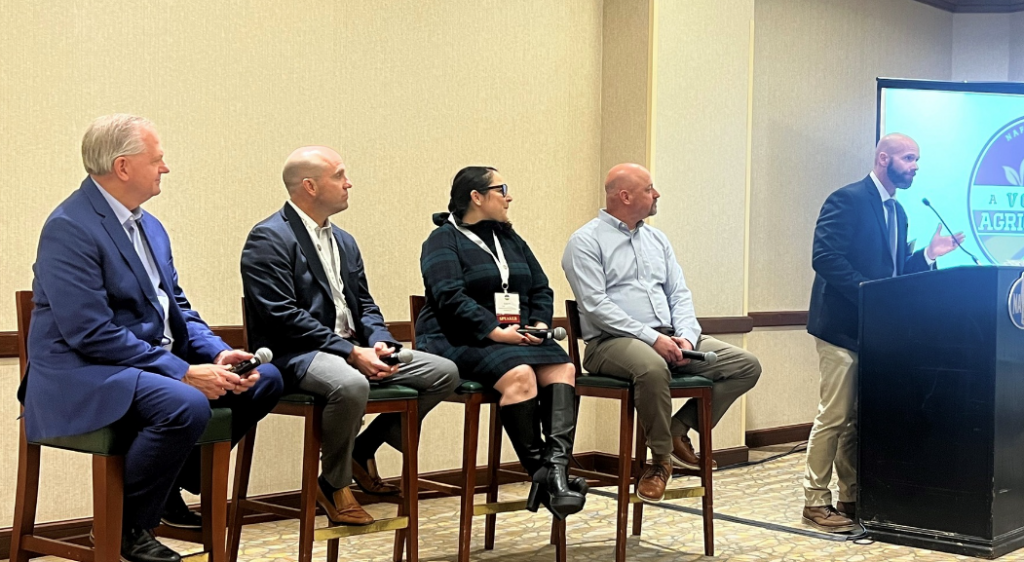
At the National Association of Farm Broadcasters Convention, Oklahoma Farm Report's Maci Carter caught up with Neil Caskey, CEO of the National Corn Growers Association (NCGA) to cover many topics including the 2024 corn harvest, the farm bill, tax cuts, and more.
"We are going to have another really big crop," Caskey said. "Now, the job at hand is to find markets for all of that corn. That is what we are committed to at the National Corn Growers Association."
He said that the recent story for corn growers has been high inputs and low prices on their outputs. He hopes for an economic crisis relief fund from Congress for the time being, but the completion of an adequate farm bill would give growers the ongoing stability they need.
After that, he said the corn industry has to get into growth mode. "For us, that starts with passage of a year-round E-15 that will begin to grind more corn as we are producing more, and we need other legislative initiatives that will allow us to sell higher blends as well. That is how we are going to be dealing with the tough markets of today."
About the completion of the farm bill, he said that it will be tough to accomplish in the lame duck session, so most are expecting an extension of some sort.
"Our biggest priority in the farm bill is crop insurance," he said. "We want to improve Title I. We would love to see a greater investment in foreign market development programs for farmers, and voluntary conservation initiatives. We will be working with the new congress and administration to get all of that enacted."
With the incoming Trump administration, Caskey said that corn growers are looking forward to reduced taxes and regulation. He added that Trump provided for year-round E-15 during his first term in office. "He has been supportive of biofuels, specifically ethanol, so we look forward to working with him and his administration to continue a lot of the good work that he did in his first term. We are very encouraged by what we will be able to do together."
45-Z, one of the tax credits of discussion, will help make sustainable aviation fuel more competitive on the price points. Sustainable aviation fuel can be derived from ethanol or soy so the tax credit will help more than corn growers.
"We are very bullish on sustainable aviation fuel as a market opportunity, whether it is 45-Z or something else that will allow farmers to take advantage of that market opportunity, we are all for it," Caskey said.
The corn industry is dependent upon strong export markets, with 15% to 20% of the annual product being sold to markets overseas. "We want to be able to sell our products, corn in all forms, to markets overseas and domestically, so that is a big focus of our work – ensuring that market access remains," he concluded.
Going forward, he is looking forward to the NCGA Tradeshow and Convention known as the Commodity Classic in a few months. "I think that is a wonderful opportunity for all of the movers and shakers in agriculture to come together. We set our new policy for the new year and learn a lot about new technologies and innovations that will be available to farmers. This year, it is going to be in Denver at a brand new venue, so if you are a skier, this will be a must-see event."

Sen. Micheal Bergstrom, R-Adair, has filed Senate Bill 1, a tax reform proposal designed to reduce Oklahoma's income tax rates in a responsible and measured way.
Under SB1, the state's marginal income tax rate will be reduced by 0.25 percentage points across all income brackets. Future reductions are tied to revenue growth, with the Board of Equalization tasked with determining if total state revenue has increased by at least $400 million compared to the fiscal year before the most recent tax cut. Each time this benchmark is met, another 0.25 percent reduction will be triggered, continuing until the top marginal income tax rate is zero.
To protect the state's financial health, the bill includes safeguards to delay tax cuts during times of revenue failure. If a shortfall occurs after a tax cut has been triggered but before it takes effect, the reduction will be postponed until revenue growth resumes. Additionally, starting in 2035, the $400 million benchmark will adjust every ten years to account for inflation, ensuring the plan remains economically viable over time.
"I'm proud to champion a policy that supports hardworking Oklahomans and promotes economic growth," Bergstrom said. "This measured, step-by-step approach ensures that our state remains on a sound financial footing while giving families and businesses more of their hard-earned money back."
SB1 can be considered when the 2025 legislative session begins on Feb. 3, 2025
Yesterday, members of the National Cattlemen's Beef Association (NCBA) and the Public Lands Council (PLC) testified before the U.S. House Natural Resources Subcommittee on Federal Lands in support of legislation to expand the use of livestock grazing as a tool to reduce wildfire risk, make grazing permits more responsive to range conditions, and remove regulatory barriers to the maintenance of critical infrastructure. Each of these bills works together to protect beautiful landscapes across the West and support the ranchers who drive the economic success of rural communities.
"I see such a clear need for the Operational Flexibility Grazing Management Act. This bill provides much-needed flexibility to ensure land managers like me can be responsive to what the land needs while also maintaining compliance with our grazing permit," testified NCBA member and Utah Cattlemen's Association President Jeff Young. "Resource management shouldn't be static; it should be responsive and collaborative. This bill represents an updated, modernized way to manage the land, understanding that you need flexibility to make things work from year to year."
California rancher and Public Lands Council member Sherri Brennan shared her personal experience from the 2013 Rim Fire that burned over 257,000 acres in Tuolumne County, CA and the need to prevent recurrent resource damage.
"The combination of reduced grazing and timber harvest, and the lack of meaningful fuel breaks has made many parts of the West one long stretch of high fuel loads. Eight million acres have burned so far this year. What's worse is that every year, the percentage of total acres that experience the worst kind of fire—high intensity burns—continues to grow," Brennan testified. "There's a way to fix this. Targeted grazing with the intention of fuels reduction can remove up to 1,000 pounds of fine fuels per acre. This means that if the area burns, the fire is likely to be shorter—flames under 4 feet tall—which means it's safer for first responders. Less fuel, cooler flames, and safer firefighters should be common objectives."
Together, Young and Brennan discussed NCBA's and PLC's support for the Operational Flexibility Grazing Management Program Act (H.R. 9062) introduced by Rep. John Curtis (R-UT), the Ranching Without Red Tape Act (H.R. 6441) introduced by Rep. Gabe Vasquez (D-NM), and legislation to increase livestock grazing to reduce wildfire risk (H.R. 7666) introduced by Rep. Doug LaMalfa (R-CA).
"Livestock grazing is a valuable tool for protecting our scenic Western landscapes from the ever-present threat of catastrophic wildfire, habitat conversion, and damage from a wide variety of sources," said Executive Director of PLC and NCBA Natural Resources Kaitlynn Glover. "NCBA and PLC are proud to support legislation that supports and expands the use of livestock grazing as a tool to reduce wildfire risk and we are grateful for leaders like Rep. Curtis, Rep. Vasquez, and Rep. LaMalfa for addressing the needs of Western ranchers."
View the hearing here.
Written testimony will be available here.
Last week's cattle harvest was truncated on Monday with Veteran's Day pulling Monday's fed cattle harvest down to 88,000 head while the remaining weekdays averaged near 100,000 head each.
Cutout values continue to show weakness as weekly average prices have retreated nearly $8/cwt. for traditional Certified Angus Beef ® (CAB) brand carcasses. The downward price direction follows a particularly strong October trend that saw the CAB cutout increase by $20/cwt. from the first of the month.
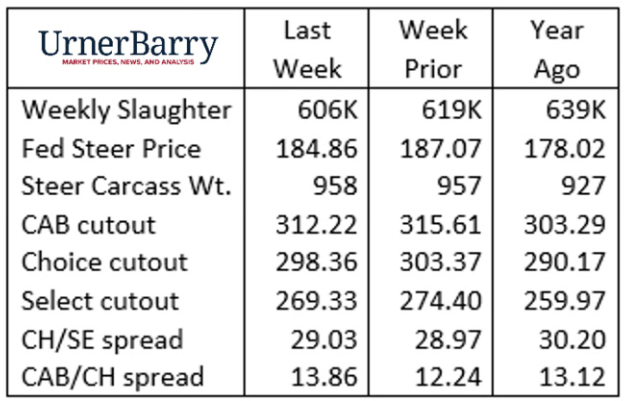
Softer boxed beef prices coupled with Live Cattle futures trading at a slight discount to recent spot cash cattle values pushed cattle prices $2.21/cwt. lower last week. A stronger futures price trend developed early this week, taking the December contract to a premium compared to cash.
On the other hand, feeder cattle demand caught fire on the heels of widespread precipitation throughout much of the winter wheat grazing region, including Oklahoma and the Texas panhandle. Some markets reported calf prices jumping as much as $20/cwt. as grazers' outlooks were much higher for winter growing conditions.
A review of carcass subprimal pricing shows the lower price trend across much of the chuck and round primal, including ground beef values. Ribs continue to show price stimulus with typical fourth quarter demand, trading at similar wholesale prices as this time last year. Strip loins and short loins are slightly higher than a year ago, but adjusting a bit lower in the last two weeks following a strong run-up in preceding weeks. Tenderloins remain near $2/lb. cheaper than a year ago but demand should take spot market prices higher into early December before dropping off
Beef market watchers have discussed rebuilding the nation's cow herd for months, anticipating a turnaround in cow numbers following healthy cow/calf margins and improving drought conditions. Gross cow/calf returns have exceeded expectations as the shrinking calf supply and strong beef demand collude to drive higher receipts. Even so, turnaround from the depth of the latest drought that brought beef cow harvest to a cyclical peak in 2022 has been slow to develop. The U.S. drought monitor has shown incremental improvement in November but widespread shades of abnormally dry to extremely dry conditions remain over a large portion of the U.S.
Record-high calf values are strong stimulus for cattlemen to maintain or increase cow herd inventories. Yet the value of heifer calves has been so good that many cow/calf producers have opted to merchandise a large percentage of the heifer crop rather than increasing retention rates for breeding. Aside from the obvious cash-in-hand, those willing to increase breeding female numbers may have encountered high interest rates, increasing cow costs and lack of labor as potential limiting factors. Recollection of the feeder cattle market crash following record-high replacement female prices in 2015 generates a modicum of caution for others.
Year to date, U.S. beef cow harvest has declined 19% (12,700 head per week) compared to 2023. Culling of spring-calving herds typically boosts beef cow harvest volume to the annual high in late October through November. So far that seasonal spike has not developed as beef cow harvest has remained flat since early September. This suggests that more mature cows are being retained in 2024 while the total supply is 1.8 million head smaller than two years ago.
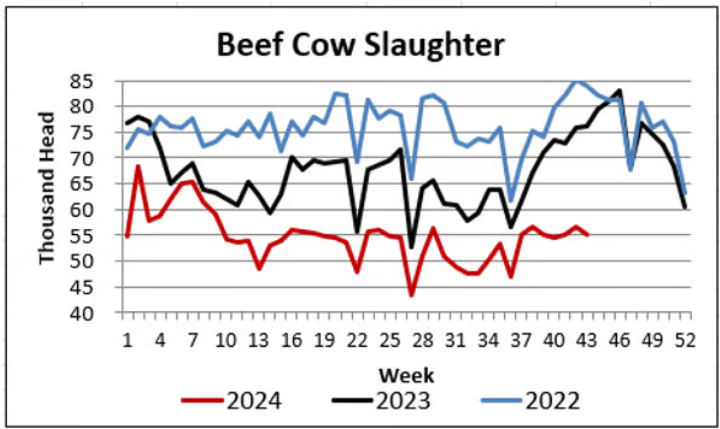
Beef volume from the dairy side of the supply chain is also expected to remain in a downtrend. Latest data shows a dramatic dip in dairy cow harvest with a steep drop from 51,000 head per week in early September to just 32,000 head in late October. Despite rising production costs dairy profitability was record-large in September. The dairy segment has suffered lower production volume due to avian influenza while the profitable beef x dairy cross calves have pulled replacement heifer numbers lower in recent years. Even so, total year-over-year milk production is quoted as larger in 2025 by Mike North at Ever.Ag, who also states that both domestic and export demand for dairy products is sharp. Recent profitability in the dairy segment suggests that dairy herd expansion will limit additional short-term growth in beef x dairy calf supplies.
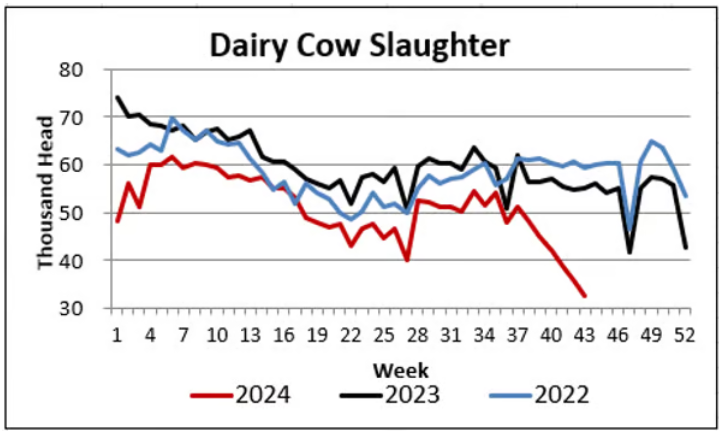
| ||||||||||||||||||||||||||||||||||||||||||||||||||||||||||||||||||||||||||||||||||||||||||||||||||||||||||||||||||||||||||||||||||||||||||||||||||||||||||||||||||||||||||||||||||||||||||||||||||||||||||||
| ||||||||||||||||||||||||||||||||||||||||||||||||||||||||||||||||||||||||||||||||||||||||||||||||||||||||||||||||||||||||||||||||||||||||||||||||||||||||||||||||||||||||||||||||||||||||||||||||||||||||||||
|
Verdi Multi-Depth Soil Moisture Kit (CNW Group/Verdi)
Verdi, a leader in precision agriculture technologies, announces the launch of its latest product, the Verdi Multi-Depth Soil Moisture Kit. Designed to simplify irrigation management, this all-in-one kit allows farmers to seamlessly monitor soil moisture in real time, enabling data-driven irrigation decisions that maximize crop health and water efficiency.
Soil moisture monitoring is one of the most common first steps in precision irrigation, yet high costs and complexity have historically limited adoption among farmers. The Verdi Multi-Depth Soil Moisture Kit offers an affordable wireless solution, using Verdi's proprietary technology to reduce monitoring costs by 80% compared to traditional systems. Farmers can purchase directly from the Verdi Online Store, eliminating the traditional need for sales intermediaries.
Key Benefits of the Verdi Multi-Depth Soil Moisture Kit:
"At Verdi, we're committed to making advanced irrigation tools accessible for farmers," said Arthur Chen, CEO of Verdi. "The Soil Moisture Kit significantly lowers barriers to adopting precision irrigation and automation. By providing real-time soil data affordably, Verdi enables farmers to optimize water usage, reduce costs, and move toward efficient practices."
For more information on the Verdi Multi-Depth Soil Moisture Kit, visit the Verdi Online Store.
About Verdi Verdi is an agriculture technology company making modern automation tools accessible to every farm on the planet. Verdi's proprietary technology is driving down the cost and complexity of precision agriculture solutions, enabling food brands and their farmers to scale automation across their operations. Using its smart devices, Verdi retrofits farm equipment such as irrigation systems to add a layer of intelligence to existing infrastructure on the farm. Learn more at the Verdi website

Oklahoma House Democratic Leader Cyndi Munson, D-Oklahoma City, welcomed three new members to the House Democratic Caucus, Rep. Ellen Pogemiller, D-Oklahoma City; Rep. Ron Stewart, D-Tulsa; and Rep. Michelle McCane, D-Tulsa.
"Congratulations and a warm welcome to our new members Ellen Pogemiller, Ron Stewart, and Michelle McCane," Leader Munson said. "I am excited to work with these incredible individuals and look forward to serving the State of Oklahoma alongside my House Democratic colleagues returning to the State Capitol. House Democrats will remain focused on lowering costs for working Oklahoma families, keeping public dollars in public schools, pushing back against harmful rhetoric and actions from our State Superintendent, and ensuring Oklahomans have access to the healthcare they need. The House Democratic Caucus is committed to putting Oklahomans first."
Pogemiller says she is honored to get to serve those in her district.
"It is a huge honor to serve House District 88 and carry their stories from their doorsteps to the steps of the capitol," Pogemiller said. "I will work to improve the lives of those who have graciously entrusted me to serve them, specifically through efforts to increase access to affordable housing, community resources, and support for our public education systems."
Stewart looks forward to serving the district where he grew up.
"Being elected and given the opportunity to serve the very district in which I grew up is beyond exciting and an honor that I do not take for granted," Stewart said. "Having intimate knowledge and personal relationships with the families, schools, businesses, and other constituents fuels my desire and commitment to serve them well."
McCane says she is excited to bring her experience as an educator to the capitol. "I am truly honored to have the privilege to serve the people of House District 72," McCane said. "I look forward to using my teacher's voice to bring the voices of my district to the House floor and I am excited to get to work."

Sen. David Bullard, R-Durant, released the following statement regarding the filing of a new state question that aims to change Oklahoma's elections to impose open primaries.
"On November 5th, Oklahoma spoke loud and clear that we are a conservative state that is only becoming more conservative. So, why then would Oklahoma suddenly move to a liberal, open primary system, which seeks only to disenfranchise Republicans? This proposed state question is a sure pathway to turn our state blue and a 'solution' in search of a problem.
"It also doesn't matter what you call it — open primaries, jungle primaries, top two — they are all the same. Instead of running liberal policies like open primaries to hand our elections over to the left, we should instead be focused on reforming the initiative petition process to keep out-of-state leftists from perverting our state. To protect Oklahoma, we need policies that require state question signature gatherers to collect signatures in dozens of counties, which would align with legislation I've filed in the past. "After the greatest win for Republicans in history, now more than ever, we must focus on stopping this progressive policy, rather than inviting it to ruin the party."

Senior Farm and Ranch Broadcaster Ron Hays caught up with the government and industry affairs vice president at the Livestock Marketing Association (LMA), Chelsea Good to talk about the republican trifecta, the farm bill, EID mandates, and more.
Good recounted the resounding victory for President-elect Trump and the Republican takeover of the House and Senate. "It was a trifecta for the republican party, and now there will be expectations that they are able to get things done," Good said.
The completion of the farm bill and tax policies are priorities for the LMA. The farm bill contains provisions that may be impactful in reducing outdated regulations on livestock auctions, and the expiration of the Tax Cut and Jobs Act is at the forefront of many minds in agriculture and beyond.
Good and Hays believe that the Republican trifecta creates a little more assurance that these things will get done. Good said, "We are in a different fiscal situation than we were in in 2017, as it relates to our national debt, so I think it is going to take all of agriculture pushing together as it relates to things like full bonus depreciation and keeping a high exemption level for estate tax, and some of those pieces that are set to expire. I think we have to speak with a unified message and continue to push on those items."
The EID mandate that went into effect on election day requires electronic identification tags on bovines crossing state lines. "From an LMA perspective, we believe that this shouldn't be a producer expense. This shouldn't be an unfunded mandate," Good commented. "We pushed really hard for Congress to provide funds and a directive to USDA for those tags to be provided. That has occurred, and thankfully, in many states like Oklahoma, we do have plentiful tags and we are seeing those getting out to veterinarians and being taken advantage of."
Good has, however, noted other states experiencing challenges getting the USDA-issued tags where they need to go so, they are available for use by producers; LMA has requested a delay in enforcement until USDA can work through those issues.
Another challenge is for livestock markets to obtain electronic readers. Although the tags are designed to be read visually as well as electronically, the purpose and expense of electronic tags become void if they are only read visually.
"Readers are another thing that we believe is part of the fundamental infrastructure for this, and needs to be provided by USDA," Good stated. "We've seen markets transition as some have started working with those readers. Some have seen a good transition, others have seen fits and starts with the new technology, so that is another challenge we are working through."
Other things that LMA is focused on going forward is the new Department of Government Efficiency and the opportunities and challenges that it may present.
"We want to be partners in that process," Good said. "That is something that our Government Affairs and Board is going to be working on is having our own recommendations of outdated regulations. That is going to be a big project for us, but an exciting one." The Beef Buzz is a regular feature heard on radio stations around the region on the Radio Oklahoma Ag Network and is a regular audio feature found on this website as well. Click on the LISTEN BAR at the top of the story for today's show and check out our archives for older Beef Buzz shows covering the gamut of the beef cattle industry today.

Spending time together in the kitchen is a great way to introduce younger generations to traditional family recipes and create lasting memories. (Photo by Adobe Photo Stock)
When the wooden recipe box or the cookbook with the tattered, stained pages opens to a favorite recipe, the kitchen will soon be filled with familiar smells and nostalgic feelings.
Families keep traditions alive through recipes handed down to each new generation, and creating memories together in the kitchen is important, said Lisa Hamblin, Oklahoma State University Extension family and consumer sciences educator in Oklahoma County.
"We retain those memories because we use all of our senses in the kitchen," she said. "Food is a big part of family celebrations, including birthdays and holidays, and people often think about the food that went along with the celebration and recall the positive memories created. For many people, food memories are the strongest associative memories we have."
When enticing the senses, memories become engrained. The smell of cinnamon can take a person back to their grandmother's kitchen when she was making cinnamon rolls. The taste of chocolate frosting can trigger the memory of a special birthday cake. For Hamblin, it's the picture in her mind of her grandmother frying apples.
"I can still visualize and hear those apple slices sizzling in the cast iron pan. Grandma's secret ingredient was bacon fat," she said. "I'm thankful my mom has that recipe and put it in the church cookbook so it can live on."
Parents and grandparents can foster the love of cooking and develop a strong bond with children and grandchildren by teaching them how to prepare their favorite family recipes. Hamblin said cooking together is a wonderful hands-on activity that results in tasty food to eat and creates memories among generations.
"Parents and grandparents can create food-related memories with the younger generation by reading fun books such as 'Green Eggs and Ham' or 'Stone Soup,'" Hamblin said. "After reading the books, create those recipes in the kitchen."
There are many educational benefits to cooking, including math and chemistry. Baking bread is a fun activity that helps children learn the chemistry of yeast and leavening. They learn math when they measure ingredients. Reading is also involved when reading the recipes.
The Academy of Nutrition and Dietetics recommends getting children involved in the kitchen with age-appropriate skills.
There are things in the kitchen that children as young as 3 years old can accomplish, said Jenni Klufa, OSU Extension associate state specialist for youth nutrition programs.
"Research shows kids who participate in the kitchen and help with grocery shopping are more likely to try nutritious foods," Klufa said. "Cooking can help build their confidence. When they enjoy spending time in the kitchen doing age-appropriate tasks, it will grow their interest in learning about traditional family recipes and passing them down to generations to come."
Children aged 3-5 can wash fruits and vegetables in the sink, brush cooking oil on vegetables and breads and use cookie cutters. Six to 7-year-olds with more developed fine motor skills can use a peeler to peel potatoes, break eggs into a bowl, snap green beans or shuck corn. Opening cans with a can opener, beating eggs, juicing a lemon and checking the temperature of meat with a food thermometer are age-appropriate skills for children aged 8 and 9. Pre-teens can boil pasta, microwave foods, follow a simple recipe, slice/chop fruits and vegetables, simmer ingredients on the stove and bake foods in the oven.
OSU Extension offers many kid-friendly recipes through the Kik It Up! program that encourages parents, grandparents and other caregivers to come together in the kitchen to create fun, tasty foods.
Pam Richardson comes from a long line of cooks who have passed down recipes to younger generations. When her son married a few years ago, she wanted to share those recipes with her new daughter-in-law.
She prepared many of the family's favorite recipes, took pictures of the cooking and baking processes, and using an online vendor, created a cookbook.
"There are stories to go along with the photos and recipes that give more information on the origin of the recipe and the family member whose recipe it was," Richardson said. "Many of those family members passed years ago, and my daughter-in-law never had a chance to meet them. This book helps her learn more about our family history and enjoy the foods that are important to our family. Now she'll be able to share those recipes with my granddaughters."
Hamblin said the holiday season is a great opportunity to spend time in the kitchen with the younger generation, baking cookies and other traditional family favorites.
"There probably will be sugar and flour all over the kitchen, but that's all part of the fun and creating the memories," she said.
OSU Extension uses research-based information to help all Oklahomans solve local issues and concerns, promote leadership and manage resources wisely throughout the state's 77 counties. Most information is available at little to no cost.
By Trisha Gedon
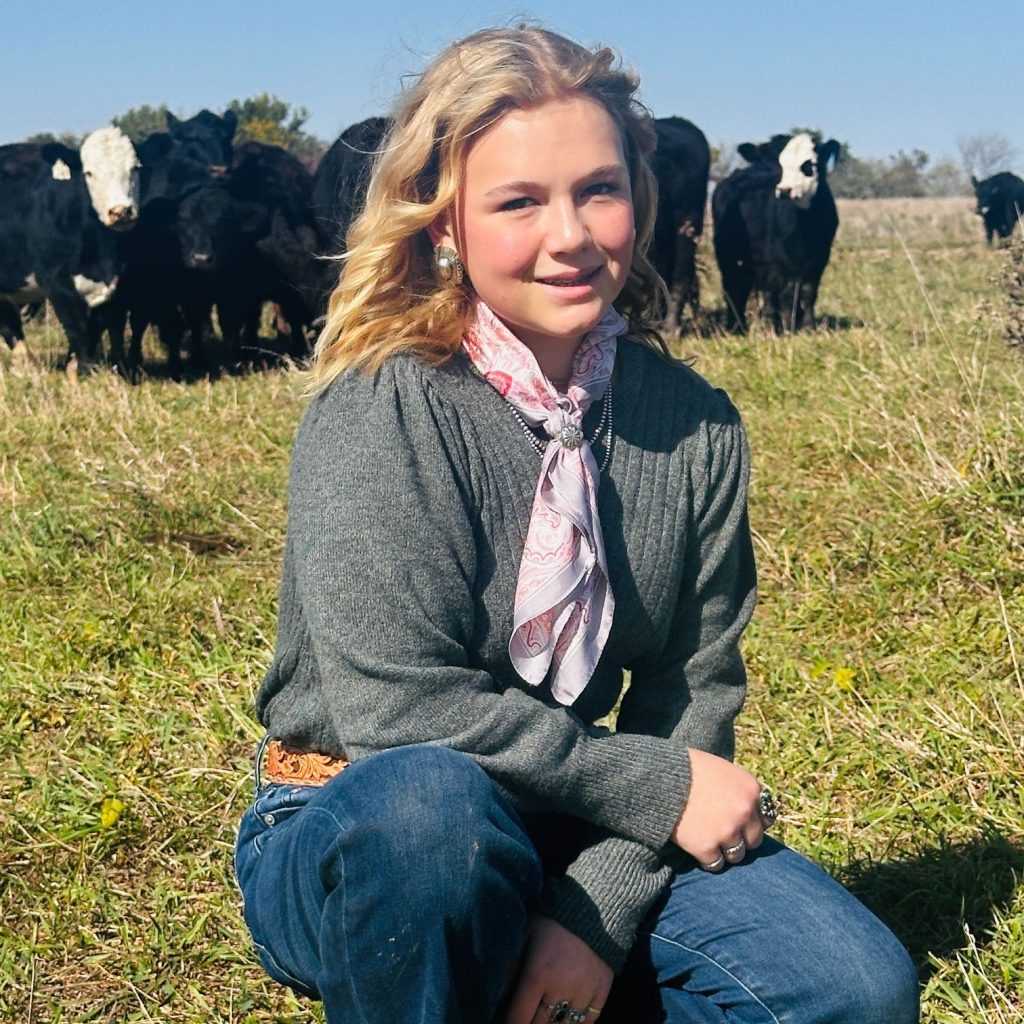
Anah Higbie to perform during CattleCon 2025 in San Antonio.
Anah Higbie of Quenemo, Kansas, is the winner of the 12th annual NCBA National Anthem Contest, sponsored by Norbrook®. Higbie will sing the "Star-Spangled Banner" at CattleCon 2025 in San Antonio, Texas.
"Cattle have been a defining part of who I am from a very early age," said Higbie. "My heart is, and always will be, deeply passionate about the cattle industry."
Higbie's family owns a commercial Simmental cow-calf operation in eastern Kansas. Besides thriving on the day-to-day operations of running cattle, she enjoys showing cattle and considers being an animal agriculture advocate one of the biggest passions of her life.
As the winner of the contest, Higbie will receive roundtrip airfare to San Antonio, hotel room for three nights, convention registration, plus a pair of boots, jeans and a shirt from Roper or Stetson. Online voting by the public determined the winner.
CattleCon is the oldest and largest convention for the cattle industry. The 2025 convention is Feb. 4-6, and features education, entertainment and meetings of the National Cattlemen's Beef Association, Cattlemen's Beef Board, CattleFax, National Cattlemen's Foundation and American National CattleWomen. For more information and to register and reserve housing, visit convention.ncba.org.
Rep. Anthony Moore, R-Clinton, today was elected Speaker Pro Tempore-Elect by the Oklahoma House Republican caucus to serve during the 60th Legislature.
The Speaker Pro Tempore serves as the chamber's second highest officer and assists leadership in all facets of administering the business of the House. The position serves as a voting member on all House committees.
"It's an honor to be selected by my peers to serve in this capacity," Moore said. "I appreciate their trust and look forward to supporting the goals of our caucus and to serving as second to our new Speaker-Elect Kyle Hilbert. Together we will work toward improving our state's economy to ensure the needs of all Oklahomans are met, whether in our schools, on our state's roadways, in our hospitals, in our places of employment or in any agency that serves the public. Oklahoma's best days are in front of us."
Moore was elected to the House in 2020. He most recently served as chair of the House Higher Education and CareerTech Committee as well as a member of the Appropriations & Budget Committee among others. During his time in office, he has voted on legislation to protect life and the Second Amendment, reduce rules and regulations, lower taxes, defend property owners' rights, preserve water resources, and protect girls' sports and parental rights. He's demanded law and order and voted to improve education and teacher pay, among many other conservative causes.
Moore is a fifth-generation native of Custer County. He's a graduate of Clinton High School and holds a bachelor's degree from Oklahoma Christian University and a law degree from Oklahoma City University. He and his wife, Rachel, and their three children live in Clinton. Members of the 60th Legislature will be sworn into office at 10 a.m. Wednesday, Nov. 20. The entire body of the House will formally vote for its next Speaker and Speaker Pro Tempore on Jan. 7, during Organizational Day. The first session of the 60th Legislature convenes Feb. 3.

House Speaker Charles McCall, R-Atoka, released the following statement expressing his gratitude and reflecting on legislative accomplishments during his eight years as Speaker of the House, and twelve years in the House of Representatives:
"First and foremost, I would like to thank my wife and children for their support these last twelve years. Without them, I would never have been able to effectively serve the citizens of our state. Next, I want to thank the citizens of District 22 for electing me twelve years ago and allowing me to serve them for over a decade. It has been the honor of a lifetime. I would also be remiss if I did not extend a sincere thank you to my fellow House members, and the citizens they represent throughout our great state, for putting their trust in me to lead as Speaker of the House. Finally, I would like to thank the staff of the Oklahoma House of Representatives for their hard work and dedication. Together, we have accomplished meaningful changes for the people of Oklahoma.
We right sized Oklahoma's budget, moving from deficits to billions in surplus. This allowed us to cut taxes, protect core services and invest in the future of our state. We invested more in education over the past eight years than in the previous 27 years combined. We lowered taxes on citizens and businesses, creating an economic environment that attracts new investment and encourages growth. We protected constitutional rights, defended the lives of the unborn and fought back against the Leftist agenda that has swept across our nation over the past four years, which led to Oklahoma being ranked as the second most conservative Legislature in the country. Last, but not least, we created more parental choice in education, allowing parents, and students, to determine their own educational pathway.
Of course, there are countless other accomplishments that could be included in this list, and I truly feel that as my time as Speaker comes to a close, Oklahoma is in a better place than it was twelve years ago. I would like to congratulate my successor in House District 22, Ryan Eaves, and wish him well as he embarks on his own legislative journey. I hope that he feels the joy of service as deeply as I have these past twelve years.
I want to leave you with a quote from President Ronald Reagan who said, 'The greatest leader is not necessarily the one who does the greatest things. He is the one that gets the people to do the greatest things.' I hope I have been a leader worthy of my station, and I am forever grateful for your faith in me. Thank you to everyone who has been a part of this journey. God bless the Great State of Oklahoma."
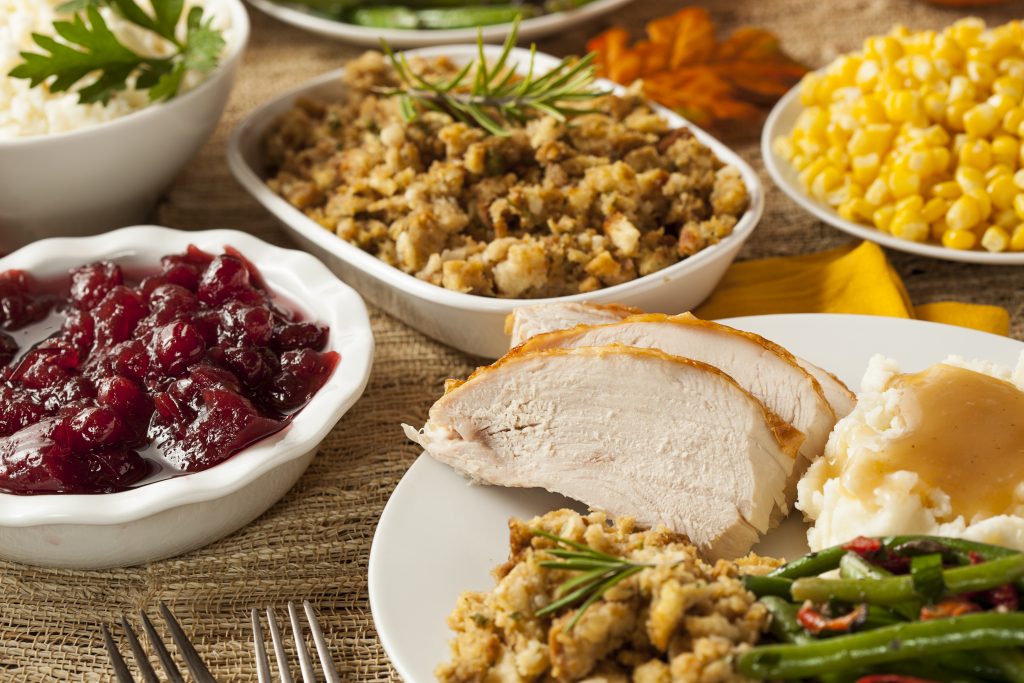
Cooking a Thanksgiving feast for your friends and family will cost less than last year but will still be more expensive than before the pandemic. The American Farm Bureau Federation's 39th annual Thanksgiving dinner survey provides a snapshot of the average cost of this year's classic holiday feast for 10, which is $58.08 or about $5.80 per person.
This is a 5% decrease from 2023, which was 4.5% lower than 2022. Two years of declines don't erase dramatic increases that led to a record high cost of $64.06 in 2022. Despite the encouraging momentum, a Thanksgiving meal is still 19% higher than it was in 2019, which highlights the impact inflation has had on food prices – and farmers' costs – since the pandemic.
The centerpiece on most Thanksgiving tables – the turkey – helped bring down the overall cost of dinner. The average price for a 16-pound turkey is $25.67. That is $1.68 per pound, down 6% from last year.
Farm Bureau volunteer shoppers checked prices Nov. 1-7, before most grocery store chains began featuring whole frozen turkeys at sharply lower prices. According to USDA Agricultural Marketing Service data, the average per-pound feature price for whole frozen turkeys declined further during the second week of November. Consumers who have not yet purchased a turkey may find additional savings in the days leading up to Thanksgiving.
"The turkey is traditionally the main attraction on the Thanksgiving table and is typically the most expensive part of the meal," said AFBF Economist Bernt Nelson. "The American turkey flock is the smallest it's been since 1985 because of avian influenza, but overall demand has also fallen, resulting in lower prices at the grocery store for families planning a holiday meal."
The shopping list for Farm Bureau's informal survey includes turkey, stuffing, sweet potatoes, rolls, peas, cranberries, a veggie tray, and pumpkin pie with whipped cream, all in quantities sufficient to serve a gathering of 10.
Most ingredients in the survey saw a decline in prices, including fresh vegetables. The drop in prices reflects price volatility in crops this year. The cost of whole milk dropped more than 14%. Favorable weather contributed to the decline in milk pricing. It is important to note, however, that milk prices vary significantly between regions in the U.S.
Items like dinner rolls and cubed stuffing both saw an 8% increase because higher labor costs, among other drivers, are increasing the cost of processed food. Cranberry prices increased almost 12% year-over-year. In 2023, cranberries had the second largest decrease in price of any products in our basket at 18%. The increase this year puts cranberry prices closer to historic norms and, excluding last year, is the least expensive year since 2015.
"We should all be thankful that we live in a country with such an abundant food supply," said AFBF President Zippy Duvall. "We are seeing modest improvements in the cost of a Thanksgiving dinner for a second year, but America's families, including farm families, are still being hurt by high inflation."
"America has one of the most affordable food supplies in the world. In order to maintain that, we need a strong farm bill which enables Americans to pursue their dreams without worrying about feeding their families," Duvall said. "A new farm bill with a modernized safety net to support those who raise crops and livestock ensures farmers can survive tough economic times and continue to supply food for America's families, not just for the holidays, but year-round."
In recognition of changes in Thanksgiving dinner traditions, the Farm Bureau price survey also includes boneless ham, Russet potatoes and frozen green beans, in an expanded menu. Adding these foods to the classic Thanksgiving menu increased the overall cost by $19.26, to $77.34.
This year's national average cost was calculated using surveys completed with pricing data from all 50 states and Puerto Rico. Farm Bureau volunteer shoppers checked prices in person and online using grocery store apps and websites. They looked for the best possible prices without taking advantage of special promotional coupons or combined purchase deals.
The AFBF Thanksgiving dinner survey was first conducted in 1986. The informal survey provides a record of comparative holiday meal costs over the years. Farm Bureau's classic survey menu has remained unchanged since 1986 to allow for consistent price comparisons.
Individual Prices
Regional Averages
AFBF analysis revealed regional differences in the cost of the meal. The cost for the classic meal was the most affordable in the South at $56.81, followed by the Northeast at $57.36, the Midwest at $58.90, and then a significant jump in the West at $67.81. The expanded meal (classic meal plus boneless ham, Russet potatoes and green beans) was the most affordable in the South at $81.07, the Northeast at $81.37, the Midwest at $83.04, and least affordable in the West at $94.09.
Read a full analysis of the 2024 Thanksgiving dinner cost survey in a Market Intel report here.
To download selected soundbites on the survey, click here.
To learn more about the farm bill, click here.
AFBF also conducts an annual summer cookout survey in advance of the 4th of July holiday. Be sure to watch for that in late June 2025.
Forestry undergraduate advisor Justin Kunkle has sought to bridge gaps between prospective students and the MSU Forestry undergraduate program since he began the role in 2016. Kunkle worked diligently to form partnerships with Detroit-based schools and youth development programs to introduce students to the areas of environmental stewardship, natural resource management and conservation.
The overarching goal of the program is to expand and sustain long-term professional training that will equip underrepresented minority (URM) students with the necessary skills to be leaders and stewards in sustainable forest management.
The supporting objectives of this project are to: build on the existing successful multicultural scholars program to further increase enrollment of URM students in the Forestry program at Michigan State University; establish a faculty-mentored research training experience to broaden forestry scholars critical thinking and problem-solving skills; enhance leadership skills through scholar-created outreach programming and peer mentoring for youth development organizations serving minority high school students; and develop undergraduate intercultural competence through the creation of a service-learning study abroad program to Costa Rica. 
The main pillars of the program include:
The first cohort of the MSP program, beginning in 2019, included students Rachel Ray, Davien Graham, Derrick Wade, Dylan Nelson, and Lavoness Bolds. The program began with a 10-day study-away program during the summer before their first semester at MSU. Scholars travelled throughout the state of Michigan exploring a variety of forested ecosystems, including urban green infrastructure. Through this study away experience, students were introduced to diverse career pathways in forestry in urban, rural, and suburban areas. Students networked with current forestry professionals who can provide internship or other practicum experiences during the remainder of their careers.
Reflecting on his time in the MSP Program, Graham recalls "I was shown so many different aspects and iterations of forestry and conservation in general, and due to the program, my idea of what it was I could and would do with forestry changed drastically."
"I truly enjoyed meeting and working with the MSP students this summer. I worked with some members of my lab to teach the scholars urban tree inventory methods, and the scholars helped us by providing helpful feedback on educational signage we are preparing for urban forestry sites in Detroit," said Asia Dowtin, Assistant Professor of Urban Forestry.
This trip was filled with a lot of "firsts" for many of the students in the cohort. Before enrolling in the forestry program, Janie Chavies wasn't sure what she wanted to do in life. Deciding to take a leap of faith, Chavies said "I decided that I'd do something no one I know has ever done, which was work with the environment." Chavies enjoyed visiting many places she had never heard of and canoeing for the first time. After completing the 10-day experience, Chavies says "I now know that Forestry is what I want to do and this is the life I want to live." Chavies is looking forward to similar experiences like this in her undergraduate future. "This trip has shown me an entire new world and has helped me decide what I want in life," said Chavies.

"I had a great time working with this engaging group of students during the Study Away Program, spending the day looking at a variety of forest ecosystems in northern Michigan. I have all seven students this semester in FOR 204 (Forest Vegetation) and this program provides such a great opportunity for me to get to know the students ahead of their college careers," said David Rothstein, Professor of Forest Ecology.
Corey McKenzie also began his foray into the field of forestry with some trepidation, but this trip provided a feeling of certainty. "Being with everyone on those ten days affirmed that I do belong and have a spot. As I continue along my journey of achieving my goals, I will never forget the incredible experience this was," said McKenzie.
CANR faculty and staff supporting the USDA NIFA grant include:
This work is supported by the Higher Education Multicultural Scholars Program [grant no. 2023-38413-41456/project accession no. 1031394] from the USDA National Institute of Food and Agriculture.
Seeing a need in the agriculture media community, three women at varying ages and stages in their careers have teamed up to form the non-profit Association of Females in Agriculture Media (A-FAM). With its official launch on December 1, A-FAM seeks to provide networking, professional development, mentoring, and personal support for women in all realms of ag media, including broadcast, print, digital, podcasting, sales, and industry relations.
"Over the past few years, I've had a lot of women approach me and express the need for sessions that focus on us and what we go through with our careers and lives in general," said founding trustee Sabrina Halvorson. "Nothing against men, but as much as they may want to, they often don't truly understand the different things women go through in our careers and our lives."
Halvorson joined with Corryn LaRue and Aria Wilcox, and together the three created A-FAM.
"I'm simply thrilled to be doing this with Corryn and Aria. We're all in different stages in our careers and we each have different job types, two factors that I think add a lot of depth to the organization," Halvorson said, "and they're just amazing women."
She points out that no one will be turned away from membership, even men, but that the first priority is always that A-FAM remains a safe space for women to have meaningful conversations without worrying about repercussions.
The organization already has monthly virtual sessions planned through April of 2025, with speakers on topics such as diversity at the ag table, building a trusting relationship with your audience, utilizing the latest tools of the trade, and building your personal brand.
Membership is currently free. For more information or to join, visit https://www.a-fam-members.org.
Bios
Sabrina Halvorson is the most senior of the group. A 34-year media veteran at 49-years of age, she has won a number of awards throughout her career. Most recently, she was awarded the 2024 Farm Broadcaster of the Year award by the National Association of Farm Broadcasting and was named to the World Agriculture Forum Council, based in the Netherlands. She is the National Correspondent for AgNet Media, the host of the daily ag radio talk show The AgNet News Hour, and farm broadcaster for four networks including AgNet West, Southeast AgNet, Hoosier Ag Today, and Michigan Ag Today. She is also a magazine writer, published book author, and public speaker.


Corryn LaRue currently serves as a farm broadcaster and content specialist with the American Ag Network, delivering reports across various platforms. She has also served as the Washington, D.C. Bureau Chief for RFD-TV, where she covered agricultural policy from the White House and Capitol Hill. Additionally, LaRue has experience with Agri-Pulse Communications, where she interned in Washington, D.C., and has contributed to other ag media sources. Corryn was the 2023 NAFB Horizon Award recipient.
Aria Wilcox works in the sales and events department for a California-based agriculture magazine and trade show company. In addition, she is the chief marketing officer for her family's book publishing business, Wolford Press, and co-owns the exotic pet business, Biomancer Morphs, with her partner. She is currently working toward earning her bachelor's degree in communications from Fresno State University, while first earning a business communications certificate and associate's degree.
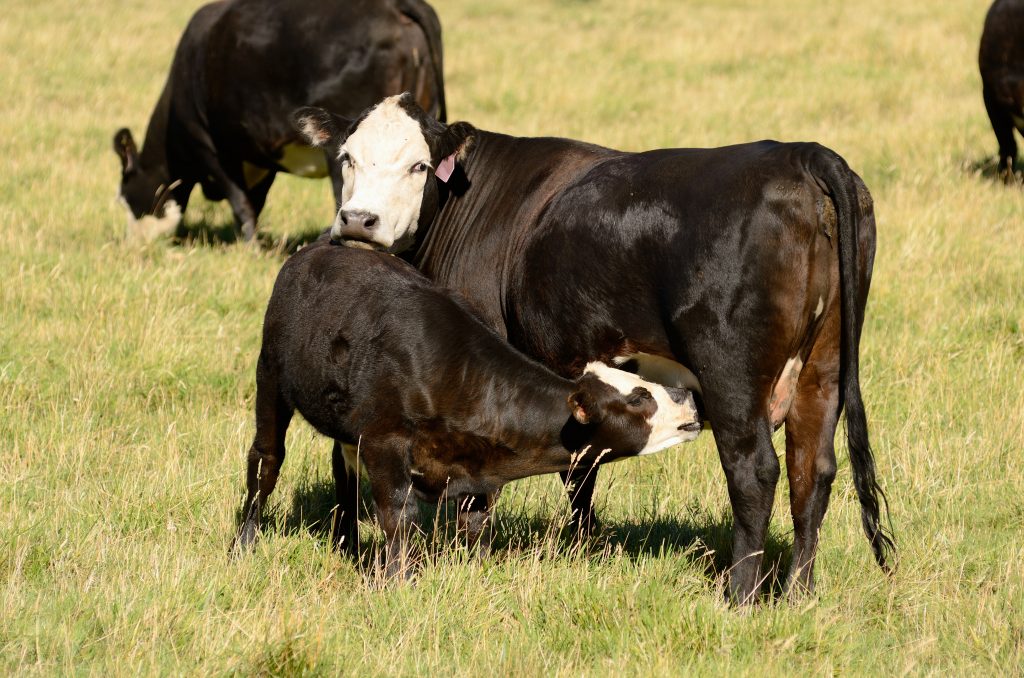
Brian Freking, SE District Extension Livestock Specialist, offers vaccine handling advice as part of the weekly series known as the "Cow Calf Corner" published electronically by Paul Beck. Today Freking is talking about a product that can reduce the stress of weaning calves.
Have you considered using a product such as maternal bovine appeasing substance (mBAS) aka FerAppease® during weaning. The management key points listed in the bullet list below for fence line weaning have been fairly broadly accepted as a stress minimizing management technique. Could cows on the opposite side of the fence still be providing enough appeasing substance (pheromone) to keep calves calmer?
Fence Line Weaning Benefits
Scientists have been investigating reducing stress in cattle for decades. Current published information shows promise for the use of mBAS. Journal of Animal Science, 2020, Vol. 98, No. 9, 1-10 provides results from Reinaldo Cooke Texas A&M University providing a detailed project report from this product. Growth rate from day 0 to 28 was greater (P=0.05) in mBAS versus control calves (2.21 lb/d vs 1.87 lb/d, respectively; SEM = 0.125 ) and did not differ (P=0.23) from day 28 to 42 between treatments. The key consideration is calves tend to adjust quicker to eating during the stressful first week after weaning. Calves eating routinely coincides with better immunity therefore less of a need for treatment for respiratory complexes. Cortisol concentrations, a biomarker of chronic stress, has been shown to be reduced in calves treated with mBAS.
One common question raised is how long does this product last? The current recommendation is that it will last approximately 14 days. Therefore, utilizing this type of technology would require a precondition period of approximately 45 days to see a return on investment (ROI). As always Read Label Directions but currently it calls for a dosage rate in Adult cattle to be 5 ml to the Nuchal skin and second 5 ml application to the skin above the muzzle. For calves, apply half the dose on the same locations. There is no slaughter withdrawal period.
Administration of mBAS to beef calves may be a strategy to alleviate some of the physiological and behavioral stress responses elicited by weaning.
RON's Dave Lanning has a pre-opening look at today's agricultural Markets.
Click the audio tab below for today's report.
On Tuesdays, Senior Farm and Ranch Broadcaster, Ron Hays, visits with Ben Hale of Western Livestock Auctions as he talks about the latest in the markets and more. Established in 1995, Western has grown into a multi-generational family-owned and operated business and stands as a symbol of tradition, excellence, and a deep-rooted passion for the cattle industry. Western Livestock Auctions operates the Western Livestock Commission Firm- selling cattle on Mondays and Tuesdays. They also operate the livestock auction markets in Woodward, Comanche and Knoxville, Iowa.
Click on the Listen Bar Above to listen to Ben's report from the Western Commission Company's Facebook page this week, as he describes a generally steady market, except for light weight calves which USDA Market News called $10 higher than last week- a "run away" as he calls it.
Hale can be contacted at 940-631-2333. Check out more about the marketing options that Western offers by clicking here.
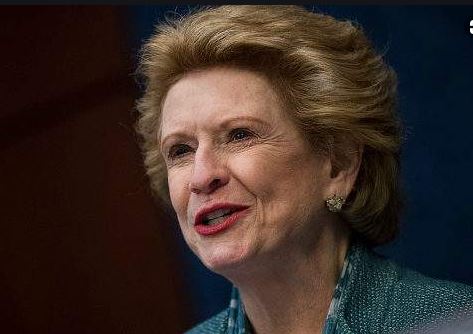
Senator Debbie Stabenow (D-MI), Chairwoman of the Senate Agriculture, Nutrition, and Forestry Committee, Tuesday announced $2 billion to support the competitiveness of U.S. specialty crop growers.
Stabenow said: "Specialty crops represent almost half of the cash receipts in agriculture across our country, and it's not easy to grow fruits and vegetables. Specialty crop producers across the country are struggling to stay competitive under pressure from rising labor costs, the climate crisis, and international markets. Today's announcement will provide much needed help to ensure that our specialty crop industry, from producers large and small, remains competitive well into the future."
Labor costs are continuing to rise for farmers across the country, particularly for specialty crop producers. These farmers lack access to commodity program safety net tools, and their labor costs are three to four times higher than most traditional row crops. The resources announced today will help ease this pressure on these producers ahead of the next growing season, helping to keep American-grown produce on our plates.
Chairwoman Stabenow remains focused on passing a 5-year Farm Bill by the end of the year and securing additional emergency relief for producers and rural communities that have been ravaged by recent natural disasters made worse by the climate crisis.
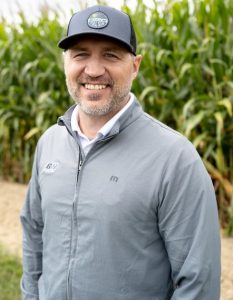
Jason Schley
A new company has been formed that will offer growers more effective and sustainable biologicals at every stage of the crop nutrition cycle.
BW Fusion, an innovator in agricultural crop and soil nutrition; Biodyne, an environmental microbiology company; and Agronomy 365, a tech-enabled crop analytics and management program, announced their merging to create an integrated platform under BW Fusion. The transaction formalized a previous strategic alliance between the three companies.
Biodyne has a long history of developing beneficial microbes for environmental applications. BW Fusion partnered with the company in 2019 to focus its research and products on helping reduce soil contamination and improve overall plant health in row crops. As BW Fusion expanded, Agronomy 365 was brought into the mix to measure biological activity in the soil, track data, and produce insights to help growers make better crop nutrient decisions.
Going forward, BW Fusion will marry Biodyne's 30+ years of biological research, Agronomy 365's cutting-edge data and software tools, and BW Fusion's product development, manufacturing, and commercial expertise. This powerful combination means everything a grower needs in a biological company is under one roof, from R&D to quality control to data and insights. BW Fusion aims to bring innovative solutions to the industry more efficiently.

"Our mission has always been to help growers improve crop productivity and long-term soil health," said BW Fusion Chief Agronomist and Product Officer Jason Schley, a third-generation grower from South Dakota. "Because we farm too, we understand the importance of providing growers with the right data to make informed decisions. Through our partnership to date, it's evident that leveraging our combined strengths supports growers with the resources they need at scale to improve farming methods and increase long-term profits."
BW Fusion goes beyond product sales. They employ seasoned agronomists who also train and educate growers about soil health and how to maximize their crop nutrition programs.
"The products we provide and the information we share are revolutionary and can change the way growers feed their crops," said BW Fusion Partner Grant Wells. "We can show growers exactly what their soil and plants need, how to increase the efficiency and efficacy of crop nutrient applications, and ultimately how to increase yields."
Bain Capital Double Impact, the impact investing arm of Bain Capital, provided financial support for the transaction.
"Our products are currently on more than 1 million acres across the country, and we are excited to partner with Bain Capital Double Impact to continue and expand our support of growers while simultaneously helping the environment win," added Wells.
"Our investment in the BW Fusion platform reflects our strategy of partnering with mission-driven companies to help them scale and achieve greater climate and sustainability results," said Bain Capital Double Impact Partner Jacob Donnelly.
Financial terms of the private transaction were not disclosed.
For more information, visit bw-fusion.com, or growers can contact their local regional business manager or call 1-888-429-3874.
The Oklahoma House Republican caucus today elected Rep. Kyle Hilbert, R-Bristow, as Speaker-Elect of the House for the 60th Legislature.
Speaker-Elect Hilbert has served as Speaker Pro Tempore for the House since 2022. He is set to become the 45th Speaker of the House and the ninth Republican speaker.
"I am deeply honored and humbled by the trust the Republican caucus has placed in me heading into the 60th Legislature," said Hilbert. "Together, we must rise to the occasion of the urgent challenges facing Oklahomans, including the ongoing pinch of inflation, a widening workforce skills gap and much-needed investment in our public infrastructure system including transportation, water, wastewater and broadband connectivity. Our caucus is ready to make the tough decisions needed to move Oklahoma forward."
The Speaker of the Oklahoma House of Representatives is the body's chief presiding officer and is responsible for committee appointments, the flow of legislation and the management of the House budget and staff. The speaker also serves as an ex-officio voting member on all House committees.
Hilbert, 30, will be the youngest House speaker in Oklahoma state history and only the second Republican speaker 30 years old or younger in any state since 1873.
The House Republican caucus also elected today Rep. Anthony Moore, R-Clinton, as Speaker Pro Tempore-Elect; Rep. Stan May, R-Broken Arrow, as Caucus Chair; Rep. Nick Archer, R-Elk City, as Caucus Vice Chair; and Rep. Josh Cantrell, R-Kingston, as Caucus Secretary.
In Hilbert's eight-year tenure in the House, he has authored over 40 bills that have been signed into law. Oklahoma's budget is in better shape than it has ever been and the budget negotiation process is more transparent than ever, due in part to Hilbert's efforts as Vice Chairman of the Appropriations and Budget Committee and his previous leadership positions.
Hilbert has tackled numerous policy challenges head-on. He authored the DRIVE Act, which brought the state's transportation funding into the 21st century, while simultaneously spearheading modernization of Oklahoma's ad valorem tax reimbursement system. Hilbert also led the charge to create and implement a transparent process for the distribution of federal American Rescue Plan Act (ARPA) funds to targeted and transformational projects across the state.
Additionally, Hilbert was the author of the Redbud School Funding Act, which directs a portion of revenue generated from marijuana taxes to school districts with below-average local property taxes, enabling them to address pressing infrastructure needs. This legislation also stopped countless lawsuits in their tracks as it settled longstanding questions of funding disparity amongst public schools.
"I came to Oklahoma City to get things done," said Hilbert. "My record in the House reflects that. I will work diligently to conserve tax dollars while looking for wasteful or duplicative services and continue to fight for a stronger, brighter Oklahoma."
Hilbert is coming into legislative leadership as Sen. Lonnie Paxton, R-Tuttle, was elected last week by his caucus as Senate President Pro Tempore-Elect.
"I have worked closely with Sen. Paxton on significant legislation - including combatting ghost employees and allowing gubernatorial appointment when there is a U.S. Senate vacancy - and look forward to partnering with him and Gov. Stitt as we build on the momentum from Election day for a conservative vision for Oklahoma," said Hilbert.
Hilbert was elected Speaker-designate by his Republican colleagues in March. Members of the 60th Legislature will take their oaths of office Wednesday at 10 a.m. and will convene for its first session in 2025.
The entire body of the House will formally vote for its next Speaker of the House on Organizational Day for the 60th Oklahoma Legislature on January 7, 2025.
Hilbert was elected in 2016 to represent House District 29, which contains portions of rural Creek and Tulsa counties. He holds a bachelor's degree in agribusiness from Oklahoma State University, where he also served as Student Government Association President.
Hilbert and his wife, Alexis, have two daughters, Addison (5) and Dorothy (2). The family lives in Bristow and are members of Foundation Church in Sapulpa.
The Senate unanimously passed a bill introduced by Senators James Lankford (R-OK) and Markwayne Mullin (R-OK) to name the new Veterans Administration (VA) 75,000-square-foot, 58-bed medical-surgical hospital in Tulsa the James Mountain Inhofe VA Medical Center in honor of the life and legacy of the late-Oklahoma Senator Jim Inhofe, who tirelessly served our military, veterans, and their families for his entire public service career. Lankford helped ensure the hospital received funding to commence construction in 2020 and helped ensure the skyrocketing inflation of the last three years did not interrupt the construction schedule with additional unforeseen costs. Representative Kevin Hern (R-OK) is introducing companion legislation in the House of Representatives.
"This is one of the most fitting honors we can give to Senator Inhofe for his decades of dedicated service to our veterans and their families," said Lankford. "Taking care of our military and veterans was at the top of Senator Inhofe's priorities. Many of our heroes and their families will never know all he did for them and the ways he shaped good national defense policies. He ensured we kept our promise to those who wore the cloth of our nation. When people pass by this beautiful new facility in Tulsa, they will always remember the many contributions of James Mountain Inhofe to our state and nation."
"No one is more deserving of this honor," said Mullin. "Senator Inhofe was a tireless champion for Oklahoma's military installations and defense communities. Our state is a better place for his leadership and service. It is my privilege to join my Oklahoma colleagues in naming the Tulsa VA in his honor and in doing so, carry on his legacy of service to the men and women of our Armed Forces."
"My respect and admiration for Senator Jim Inhofe is immeasurable. A US Army veteran, Senator Inhofe always ensured America's armed service members were taken care of, both during and after their service. His steadfast support of the new veterans hospital in Tulsa proves his level of dedication and why the facility will soon bear his name. The example of his leadership will be an inspiration for generations to come," said Dr Kayse Shrum, President of Oklahoma State University.
"Without a doubt, the support of Senator Jim Inhofe was instrumental in making Tulsa's new veterans hospital a reality, and it's only fitting that we will honor him in the facility's name. He leaves a long-lasting imprint on the city of Tulsa, our state and nation, and the health of Oklahomans is better today because of his tireless dedication," said Dr. Johnny Stephens, President of the Oklahoma State University Center for Health Sciences.
Eastern Oklahoma is home to over 115,000 veterans and is an important part of the national network of veterans' care facilities across the country. Estimates predict that a Tulsa-area hospital would serve up to 30 percent more veterans each year. Northeast Oklahoma is currently home to more than 115,000 veterans, and an estimated two-thirds live close to Tulsa. In addition to serving more veterans, a VA hospital in Tulsa would reduce driving time significantly for a majority of veterans and would give access to a broader array of social services.
Today, Agriculture Secretary Tom Vilsack announced the creation of new programs that will help farmers who grow fruits, vegetables, and nuts overcome market barriers for their products, and help producers access necessary pre-market storage for their crops following severe weather events, including recent hurricanes. Specifically, the new Marketing Assistance for Specialty Crops initiative will provide $2 billion to assist specialty crop growers in maintaining a strong domestic supply and expanding market opportunities for their crops.
USDA is also creating the Commodity Storage Assistance Program, which will provide $140 million to help producers gain access to a packinghouse, grain elevator, or other facility necessary for the marketing of agricultural commodities. This program is designed for farmers nationwide due to disaster-related challenges, and USDA anticipates high signup rates in the Southeast due to the devastation caused by Hurricanes Debbie, Helene and Milton.
"From providing high-quality, nutritious, American-grown fruits, vegetables, and nuts to our nation and the world, to serving as economic pillars of their communities, specialty crop producers play a critical role in the success of U.S. agriculture," said Agriculture Secretary Tom Vilsack. "The Marketing Assistance for Specialty Crops and Commodity Storage Assistance programs will be important for producers in every corner of the United States, but they come at an especially critical time for southeastern farmers, who will face a difficult and long recovery after this season's devastating hurricanes."
These programs would complement the disaster assistance package the Biden-Harris Administration has proposed to Congress, which included a request for resources for USDA's Emergency Relief Program (ERP) and Emergency Livestock Relief Program (ELRP), in addition to nutrition assistance, and rural infrastructure support. The ERP and ELRP provide support for disaster losses for row crop, specialty crop, and livestock producers.
Final details, including eligibility and payment rates will be set forth in a Notice of Funding Availability for each program.
Marketing Assistance Program for Specialty Crops
The Marketing Assistance Program for Specialty Crops will expand markets by helping specialty who typically have higher marketing costs related to the tenderness and perishability of fruits, vegetables, floriculture, nursery crops and herbs; specialized handling and transport equipment with temperature and humidity control; packaging; moving perishables to market quickly; and higher labor costs. USDA anticipates applications will open in December 2024.
This initiative builds on previous investments by USDA under the Biden-Harris Administration to in support of the U.S. specialty crop industry. In January 2024, as part of its new Regional Agricultural Promotion Program (RAPP), a foreign market development and food security initiative announced in October 2023, USDA launched the Assisting Specialty Crop Exports (ASCE) initiative, which is providing $65 million for projects that will help the specialty crop sector increase global exports and expand to new markets. USDA awarded the first $25 million through this initiative in October.
Additionally in August 2023, USDA announced $72.9 million in grant funding available to support the specialty crops industry through the Specialty Crop Block Grant Program (SCBGP), which will fund innovative projects designed to bolster the competitiveness of the expanding specialty crop sector. USDA also announced $72.9 million through SCBGP in 2022. Specialty crop exports totaled $24.6 billion in FY2023, representing 13.8 percent of total U.S. agricultural exports.
Commodity Storage Assistance Program
USDA is creating the Commodity Storage Assistance Program to make available commercial storage facilities such as grain elevators and packinghouses necessary for the orderly marketing of commodities by producers experiencing reduced commercial storage access due to 2024 natural disasters. This program builds on the Emergency Grain Storage Assistance Program which helped producers respond to lost grain storage options after a series of tornadoes, derechos, and flooding in 2021 and 2022.
USDA is making $140 million in Commodity Credit Corporation funds available for this program for a wide range of commodities. Producers will have to show that natural disasters caused a loss in commercial storage or marketing. Applications are expected to be available in December 2024.
USDA Offers Support, Flexibilities in the Aftermath of 2024 Natural Disasters
These investments build on USDA's wide array of disaster assistance, farm loan, and conservation programs to help agricultural producers impacted by natural disasters. These programs can help producers recover in a number of ways, including land and private forest rehabilitation, fence loss, debris removal, animal mortality disposal and other challenges.
Deadline Extensions
As previously announced, USDA has added flexibilities to a number of disaster assistance programs to help streamline and expedite the recovery process for producers impacted by Hurricanes Debby, Helene and Milton. USDA is providing flexibilities for its programs, including extended signup opportunities. The flexibilities include but are not limited to an extended signup period for the Emergency Conservation Program and Emergency Forest Restoration Program, which is now open at USDA Service Centers and runs through June 1, 2025.
Crop Insurance Indemnities
In total, USDA has issued more than $6 billion in crop insurance indemnities for the 2024 crop year. Of the $6 billion, nearly $1 billion was paid to agricultural producers impacted by hurricanes and tropical storms in 2024. This includes $792 million through the Hurricane Insurance Protection-Wind Index (HIP-WI) endorsement and the Tropical Storm (TS) option.
Visit farmers.gov/hurricane for a full list of available flexibilities, frequently asked questions, webinars and other resources.
USDA touches the lives of all Americans each day in so many positive ways. In the Biden-Harris Administration, USDA is transforming America's food system with a greater focus on more resilient local and regional food production, fairer markets for all producers, ensuring access to safe, healthy and nutritious food in all communities, building new markets and streams of income for farmers and producers using climate smart food and forestry practices, making historic investments in infrastructure and clean energy capabilities in rural America, and committing to equity across the Department by removing systemic barriers and building a workforce more representative of America. To learn more, visit www.usda.gov.
Today, the Public Lands Council (PLC) congratulated Rep. Doug LaMalfa (CA) on his election to lead the Congressional Western Caucus. As the next Chairman, LaMalfa will lead the powerful caucus that was founded out of the need to unite Members of Congress from the West to fight undue federal interference with rural, agricultural, timber, water, energy and hunting values that are the foundation of the domestic economy and American heritage.
"We are thrilled to congratulate Chairman-elect LaMalfa as he continues his long history of fighting for the western way of life. He is a strong advocate for livestock producers and has been instrumental in improving grazing flexibility on public lands and bringing much-needed common sense to conversations about fighting wildfires and other multiple use issues," said PLC Executive Director Kaitlynn Glover. "As a western agriculture producer with decades of on-the-ground policy experience, he is perfectly suited to take on this role leading the Congressional Western Caucus. Ranchers congratulate Chairman-elect LaMalfa on his successful leadership election and look forward to continue working with him in the 119th Congress."
Air Force Lt. Col. Dan Rooney, a decorated F-16 fighter pilot, will address attendees as mid general session keynote speaker during the 2025 American Farm Bureau Convention on Sunday, Jan. 26. Rooney is founder and CEO of Folds of Honor, a nonprofit foundation that provides educational scholarships for children and spouses of fallen or disabled military service members and first responders. The foundation has provided nearly 62,000 military and first responder families with $290 million in scholarships since its founding in 2007.
Rooney's military service included three combat tours to Iraq where he flew the F-16 Viper. He continues his military service today as a U.S. Air Force ambassador tasked with inspiring the next generation of service members to give the same devotion to our nation that he has demonstrated throughout his career. Rooney is also the author of two best-selling books, "A Patriot's Calling" and "Fly Into the Wind."
"Farmers, ranchers and members of the military center their lives around hard work, perseverance and dedication," said AFBF President Zippy Duvall. "We look forward to hearing Lt. Col. Rooney's inspiring message as we reflect on how we serve our communities."
The theme of AFBF's 106th convention, which will be held Jan. 24-29, 2025, in San Antonio, Texas, is "Step Up, Drive Forward." Duvall will give his annual address to Farm Bureau members during the opening general session on Sunday morning, Jan. 26.
A full lineup of engaging workshops will be available at convention. Workshops will be offered in four tracks – public policy, rural development, member engagement and consumer engagement. Topics will include the farm bill, hot issues in public policy, the 2024 election, farmer mental health, farm transition planning and engaging the next generation of agriculturists. A vibrant trade show with exhibitors showcasing cutting-edge innovations in agricultural technology, tools and services is also sure to capture the attention of attendees.
View the high-level convention agenda here.
| |||||||||||||||||||||||||||||||||||||||||||||||||||||||||||||||||||||||||||||||||||||||||||||||||||||||||||||||||||||||||||||||||||||||||||||||||||||||||||||||||||||||||||||||||||||||||||||||||||||||||||
| |||||||||||||||||||||||||||||||||||||||||||||||||||||||||||||||||||||||||||||||||||||||||||||||||||||||||||||||||||||||||||||||||||||||||||||||||||||||||||||||||||||||||||||||||||||||||||||||||||||||||||
|
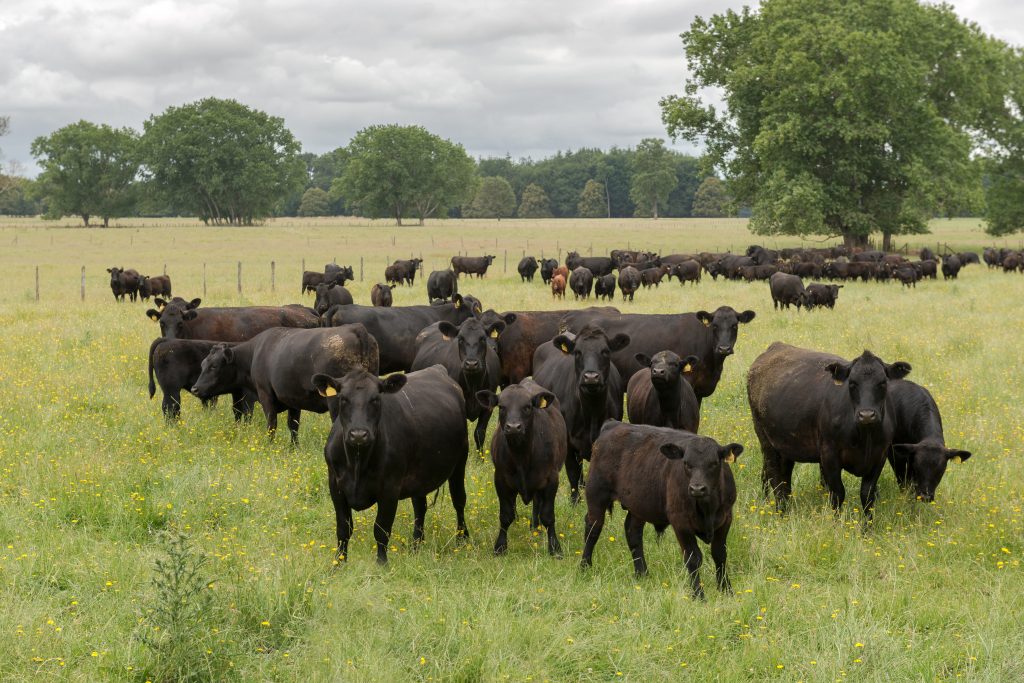
Rabobank's senior beef analyst, Lance Zimmerman, talked in depth with Oklahoma Farm Report's Ron Hays about strategically rebuilding the U.S.'s mama cow herd. Yesterday, Zimmerman and Hays discussed the beef market and why it is so important for producers to fill out NASS surveys. Click here to see that conversation.
According to Zimmerman, the days of liquidation are over. "In 2024, we finally stopped liquidating mama cows," he said. "Year-to-day beef cow slaughter is down about seventeen to eighteen percent. Right now, year over year, we are seeing declines of over twenty percent in this fall run period where we typically would liquidate a lot of cows as we wean calves."
Due to this, he expects the 2025 Cow Inventory Report to reflect numbers similar to those reported in 2024. Even still, he says that intentional rebuilding hasn't yet begun evidenced by watching the fall run; the percentage of heifers in feeder cattle and calf sales, is still steady with the last several years, around 40%.
"We won't see bigger herd numbers in all likelihood, certainly for 2025 and likely not any bigger for 2026," he predicted. "We'll be looking now to January 1, 2027's report to hopefully start seeing some bigger cow and heifer numbers."
He explained that so long as heifers are sent to feedyards, the beef supply will be maintained and the cow herd will remain steady.
Zimmerman advised producers to think ahead for their needs to start rebuilding next spring, but rather two and three years out. "Because we have liquidated the cow herd to such an extreme that now, you don't have the cows and heifers coming behind them," he said. "Consider the ages of your cow herd now, next year, and in two years, and start making heifer retention decisions now."
He mentioned that bred heifers of average quality bring $2,500 - $3,000, and high-quality ones are in the $3,000 - $4,000 range. "You could probably take heifer calves right now, run them as feeders through the winter, decide whether to breed them next spring and you may have $2,600 to $2,700 in them by next fall. If you try to buy those replacement heifers, it's going to cost you another $1,000 per head on top of that. If you have the resources and the genetics to carry those extra heifers over, be making those decisions today."
The Beef Buzz is a regular feature heard on radio stations around the region on the Radio Oklahoma Ag Network and is a regular audio feature found on this website as well. Click on the LISTEN BAR for today's show and check out our archives for older Beef Buzz shows covering the gamut of the beef cattle industry today.
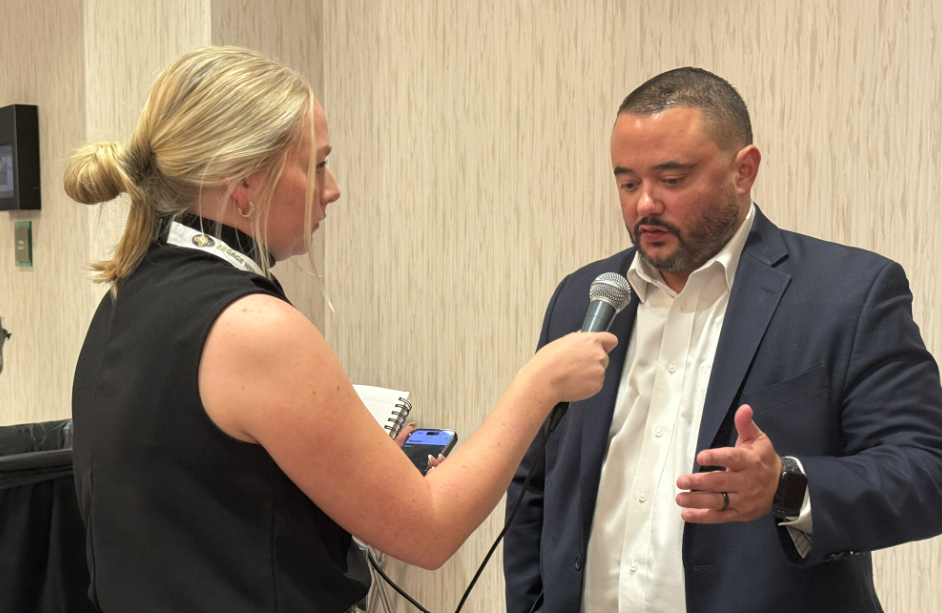
While attending the National Association of Farm Broadcasters Convention, Maci Carter got to talk to the Executive Head of Terrain John Newton. They discussed the election results, the pending farm bill, and the first 100 days of President-elect Trump's administration.
He pointed to the historic inflation seen across the economy in the past four years, as well as growing concerns about immigration, saying that the American people spoke through their votes at this year's election. "They want to see change. They want better economic conditions for their families. They want safer communities, and we saw that in the election," he stated.
Newton believes that there is a good chance that the farm bill will reach completion during the lame duck session of Congress. "Farm bills are always bipartisan. Senator Boozman and Senator Stabenow are working with G.T. He already has a bill out of the committee. Once the four corners agree on what a deal could potentially look like, you can get a bipartisan farm bill over the finish line if staff works very quickly."
He pointed out that the math changes if the farm bill process continues into 2025 which means that Chairman Thompson would have to start over with getting a new farm bill out of the Ag Committee, this time amid tax reform and reconciliation.
"If you want to avoid that, now is the time to act – in the lame duck session," he said.
USDA projects lower corn, soybean, oat, and barley prices and flat wheat and cotton prices, and combined with rising input costs, the economy will be even more challenging next year. Newton commented, "There is an opportunity to get a farm bill done now that enhances the risk management tools that farmers are going to need in place next spring when they get out and start sowing a crop."
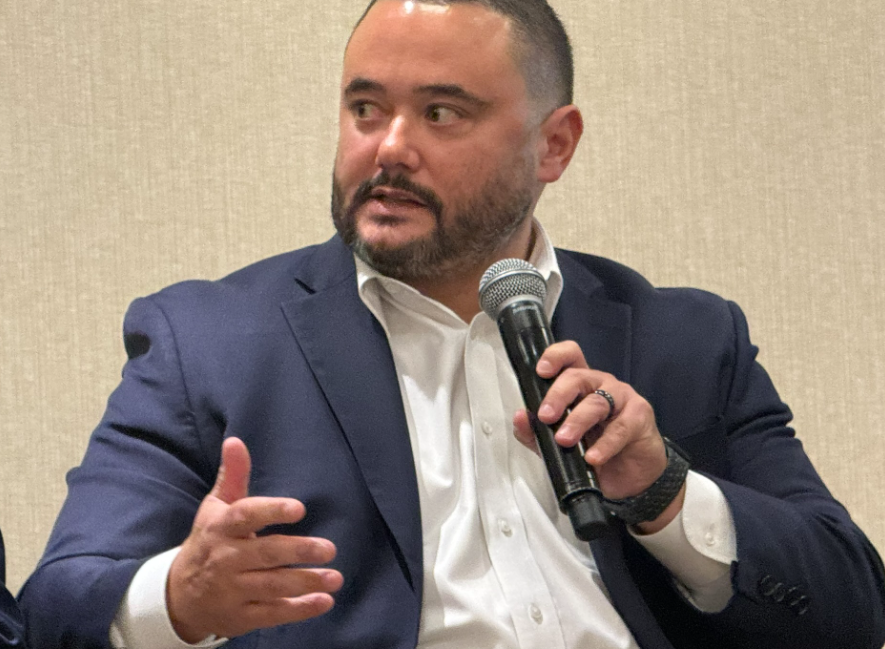
He praised producers for being vocal about their needs in the challenging economic environment today but said getting the farm bill done sooner rather than later is now up to the will of government leaders.
The first 100 days of a new administration are crucially busy. From the agricultural perspective, the Cabinet must be established beginning with the appointment of the new Secretary of Agriculture, and Congress needs to organize under their new leaders including Senator Boozman's move to Chairman of the Ag Committee. Newton says it's also important to monitor executive orders that may be introduced on January 21st.
"The first and most important is to have a leader in agriculture who understands the industry and can be a sound voice in the room as we think about these issues that need to be addressed," Newton said.
They went on to talk more about Trump's tax reform and reconciliation policies and potential trade opportunities in global markets. Click the listen bar at the top of the page to hear the complete conversation.
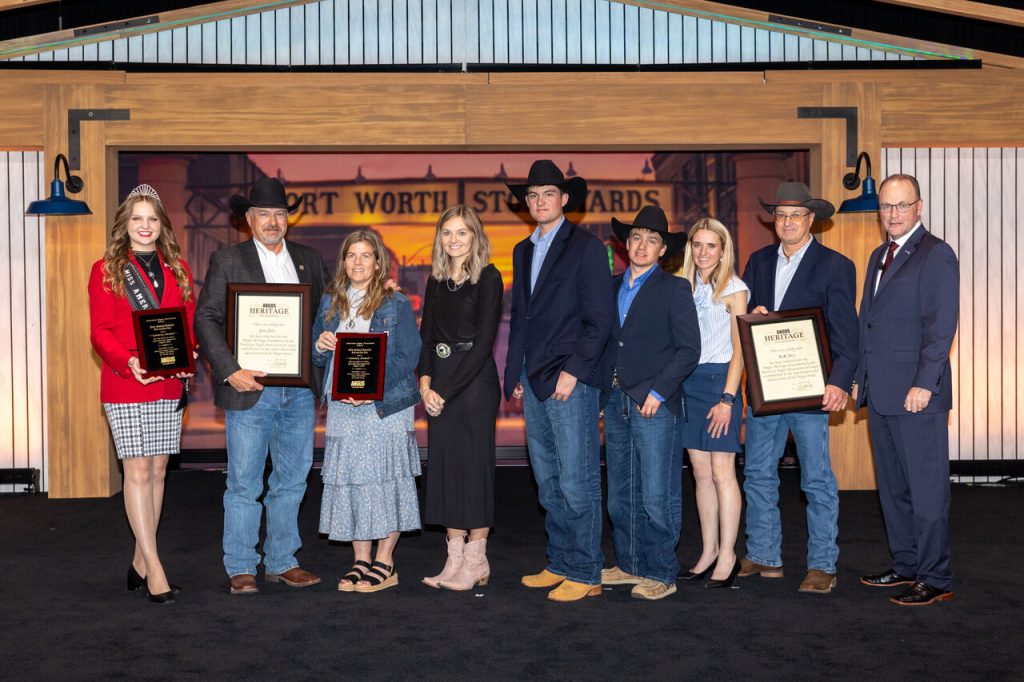
Sitz Angus was awarded the American Angus Association Century Award at the 2024
Angus Convention on Nov. 3 in Fort Worth, Texas. Pictured from left are 2024 Miss American Angus Lauren Wolter, Jim Sitz, Tammi Sitz, Amber Konen, Tyler Sitz, Tucker Sitz, Taylre Sitz, Bob Sitz, and Association CEO Mark McCully.
Family-run businesses that last 100 or more years often leave a legacy, and when an Angus herd lasts that long the breed comes together to celebrate the accomplishment. At the 2024 Angus Convention in Fort Worth, Texas the American Angus Association® honored Sitz Angus of Dillon and Harrison, Montana with the Century Award for their 100-plus years as a registered Angus herd.
"Being able to say we've been in the Angus business for over 100 years – that's a feat itself," said Jim Sitz of the Sitz Angus.
William and Frieda Sitz started Sitz Angus in the Nebraska Sandhills in 1923 with the purchase of registered Angus cows from William Williams of Clarks, Nebraska. William and Frieda had four children: Robert "Bob", Bill, Dolores, and Ruth. In 1952, William and Frieda moved with son, Bob (Sr.), to a ranch in Longmont, Colorado. In 1959, two years after Bob married Donna Scriffiny, the young couple purchased a ranch in Harrison, Montana and moved the herd.
In Harrison, Bob Sr. and Donna raised two daughters and two sons – Deb, Sherrie, Bob, and Jim - while being early champions of performance testing and Angus Herd Improvement Records (AHIR®). In 1966, Sitz Angus hosted its first bull sale and began offering customers free delivery of their bulls. The family was also early adopters of artificial insemination. All four of Bob Sr. and Donna's children are still involved in the cattle business through Sitz Angus, Bar 69 Angus Ranch and Stockman Angus of New Zealand.
Bob Sr. was inducted into the Angus Heritage Foundation in 1993, four years after his untimely death. Donna and her sons persevered through the loss with a cow sale and rebuilt the herd. The brothers, Jim and Bob, are 2024 inductees into the Angus Heritage Foundation.
Leaving a legacy of leadership within the breed at both the state and national level, Bob Sr. served on the American Angus Association Board of Directors from 1979 to1985. Donna was an active member of the National Angus Auxiliary and Montana Angus Auxiliary. Jim followed in his father's footsteps, serving on the Board of Directors from 2009 to 2016 and as president in 2016. In 2001, Sitz Angus donated the Angus Foundation Heifer.
Today, William and Frieda's grandsons, Bob and Jim, along with Jim's wife Tammi (Huntsman), run Sitz Angus in Harrison and Dillon, Montana with their families. (The Dillon ranch was acquired in 1997.) The fourth generation, known sometimes as "the Sitz six," are preparing to make their mark on the Angus breed as they each find unique ways to support the ranch through cattle breeding, raising crops, bookkeeping, hosting interns, influencing range management and even managing social media and promotion. They are Taylre, Lane, Amber, Ashley, Tyler and Tucker Sitz.
Speaking of the next generation on the ranch, Jim said, "I see no reason why they shouldn't be able to take it to a whole new level."
Sitz Angus sires have consistently held spots in the list of top 25 sires for breed registration and sell high-quality Angus genetics across the United States and internationally. The family offers yearling bulls each spring and nearly 2-year-old bulls at their annual fall sale. While being well-known for their bulls, Sitz Angus maintains its status as a MaternalPlus® herd, as it has since the program's first year in 2012, proving their focus on producing high-performing, profit-yielding females for their commercial customers. After 100 years with the Business Breed, Sitz Angus – the family and others who have been dedicated to its success – still exhibits a forward-thinking attitude and a love of Angus cattle.
"My dad always said a long time ago that we have to be a jack of all trades," Jim said. "That would fit Sitz Angus ranch to a T."
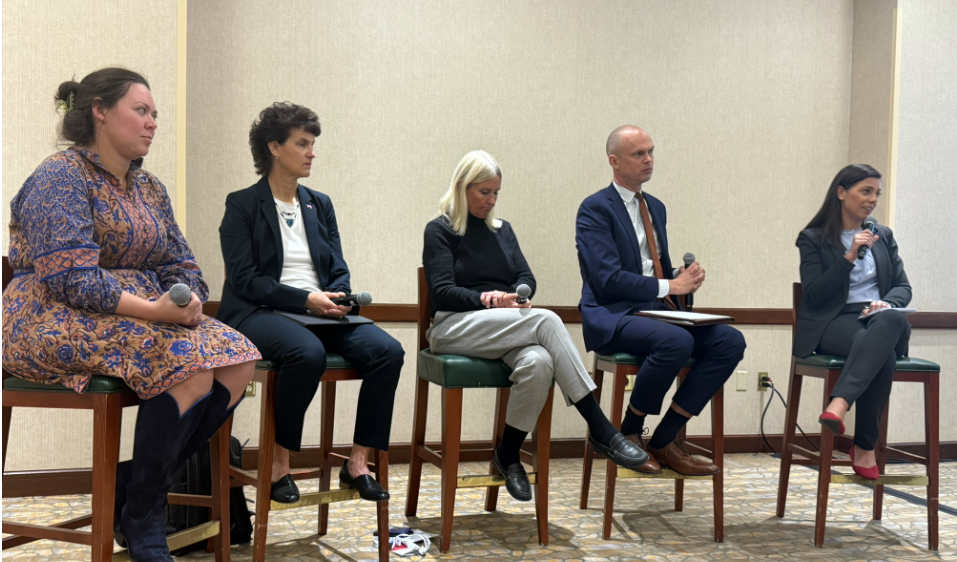
At the National Association of Farm Broadcasters Convention, Farm Director KC Sheperd caught up with Rod Snyder, a former EPA advisor who spoke on the EPA issues panel about the possible repercussions of the U.S. pulling back from the Paris Climate Accord.
He said that pulling back would remove the U.S. from a leadership position, and reduce our ability to represent the American economy and the agricultural industry at the negotiating table. It would also reduce America's ability to invest in innovation in low-carbon solutions.
"I think that would be a huge mistake, in part because, American farmers and ranchers have major solutions to provide on this issue," he said. "It can be a win-win opportunity for the U.S. farm sector. I think it is a shame to pull back from that and not have American leadership."
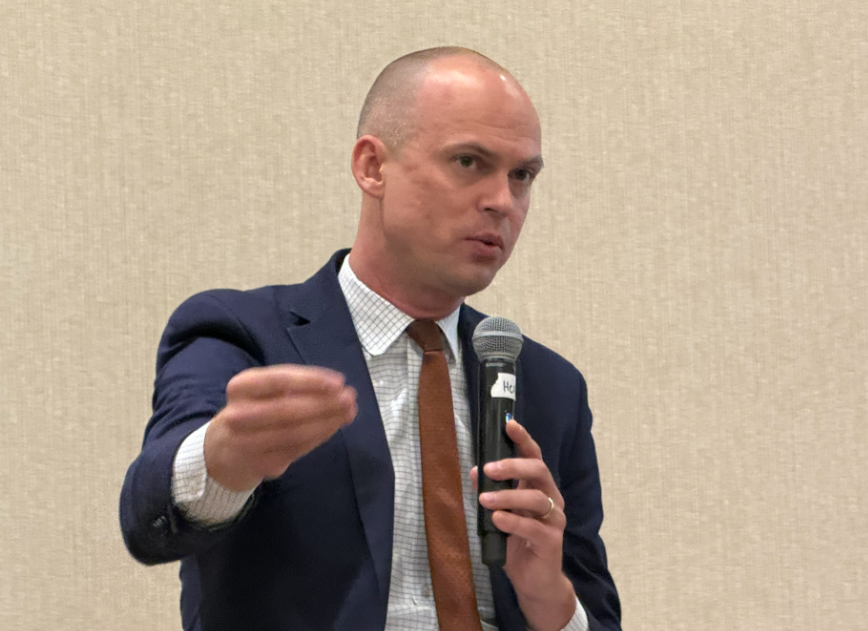
While the regulatory action of EPA generally turns farmers and ranchers away from the organization, Snyder says that his previous advisory role was to make sure that farmers' voices were heard in the discussion.
"It is critically important that farm groups be involved in rulemaking and provide comments and feedback," he said. "Secondly, EPA plays a really important role in supporting the agricultural industry because the agency approves all of the new products and crop protection tools that come to market. If that work were to stop, it would really bottleneck future innovation in American agriculture. EPA isn't just a regulatory agency, but also an enabler of a lot of the technology and work."
He believes that to rebuild trust in the EPA and other institutions, it is important to demystify science to the average person and make the point that they are on the same team as farmers and ranchers.
"I think it is important that when EPA or USDA speaks on an issue that those messages be accepted by the public," he said. "If we lose that, I worry about the ability to defend a lot of the practices and technology that farmers across the country utilize on a day-to-day basis. Let's all work together to make sure that the institutions remain trusted and that the science is understood."
Please join us on Wednesday, December 4 at 12 p.m. EST to hear U.S. Regenerative Cotton Fund's Soil Health Educator Jessica Kelton and Texas A&M University Agriculture Conservationist Jodie McVane discuss two fact sheets we developed with Texas A&M AgriLife Research and Rodale Institute. VF Corporation Senior Manager, Global Sustainability Programs Alyse Russel will moderate a Q&A session.
During the webinar, Kelton and McVane will explain how cover crops can be a powerful tool to enhance soil health across diverse soil and climate conditions in conventional and certified organic cotton production.
Key topics will include:
After the webinar, registered attendees will receive a link to the recording.
Haven't read the fact sheets yet? Read them here and bring your questions to the Q&A session!
Registration is free, but required to attend, so sign up today!
During the 2024 United Nations Climate Change Conference (COP29), U.S. Agriculture Secretary Tom Vilsack highlighted four years of progress and historic investments made under the Biden-Harris Administration to position U.S. agriculture and forestry as climate leaders, develop innovative climate solutions and build climate-smart markets to provide new revenue streams for rural communities. Today marks the second-ever day at a COP conference focused on the food and agriculture sectors.
Through a series of events and meetings, Secretary Vilsack showcased the Biden-Harris Administration's Inflation Reduction Act, now in its third year, which nearly doubles support for voluntary conservation and climate-smart practices on farm and forestlands. Secretary Vilsack also highlighted USDA's Partnerships for Climate-Smart Commodities initiative and the public and private collaboration underway to create markets that can help meet climate objectives while providing new income opportunities for farmers, ranchers and forest landowners. In addition, Secretary Vilsack announced recent accomplishments of the Agriculture Innovation Mission for Climate (AIM for Climate).
"Over the past four years, the Biden-Harris Administration has made historic progress in tackling climate change by making unprecedented investments in climate action, providing producers with needed conservation assistance, and helping them tap into new markets for climate-smart commodities and products," Secretary Vilsack said. "Farmers, ranchers and foresters in the U.S. and across the world have experienced the increasing destruction caused by natural disasters – including droughts, floods and extreme weather – all of which are expected to continue and worsen due to climate change. The best way to combat the impacts of climate change is to equip producers of all sizes with the tools they need to adapt and build resilience.
"At the same time, USDA has served as a global leader through AIM for Climate by significantly increasing investment and support for climate-smart agriculture and food systems innovation. The progress made under the Biden-Harris Administration will leave a lasting legacy through a food and agricultural system that is more equitable, sustainable and resilient," he added.
Secretary Vilsack is participating in COP29 from November 18-20.
AIM for Climate
Since the United States and United Arab Emirates launched AIM for Climate at COP26 in 2021, it has grown to a network of more than 800 partners, including 56 countries. AIM for Climate partners have mobilized $29.2 billion in increased investment in climate-smart agriculture and food systems innovation, above a 2020 baseline – $16.7 billion by government partners and $12.5 billion by innovation sprint partners. Secretary Vilsack announced that the United States' investment has topped $4.3 billion, with nearly $4 billion coming from USDA.
AIM for Climate announced the final cohort of 52 innovation sprints at COP29, increasing the total number to 129. Secretary Vilsack announced that USDA will provide $80 million to Atlas Agro North America Corporation, one of the newest innovation sprint partners, through the Fertilizer Production Expansion Program to increase nitrogen fertilizer availability in the United States without adding to agriculture's carbon footprint.
At the third AIM for Climate Ministerial, held on the margins of COP29, Secretary Vilsack encouraged partners to continue supporting the goal of AIM for Climate, even as the initiative prepares to sunset in 2025. He challenged partners to embrace and champion the recommendations in the September 2024 report, AIM for Climate Report: Cultivating Transformative Investments in Climate-Smart Agriculture and Food Systems Innovation, to help ensure that we achieve a world where hunger does not exist, communities thrive, and our planet heals.
Historic Investments through the Inflation Reduction Act
Secretary Vilsack underscored the significance of President Biden's Inflation Reduction Act, the single largest investment in climate and clean energy solutions in American history, which provides billions of dollars to help position farmers, ranchers and forest landowners as part of the solution to climate change while encouraging new economic activity in rural areas and protecting the communities most vulnerable to climate change impacts. USDA's investments total nearly $40 billion.
Recent USDA investments under the Inflation Reduction Act include:
Partnerships for Climate-Smart Commodities
Through the Partnerships for Climate-Smart Commodities, USDA has invested more than $3 billion since 2022, supporting more than 21,000 farms encompassing more than five million acres across the United States. These projects are expanding markets for climate-smart commodities, allowing all types of producers – including small and underserved ones – to leverage the greenhouse gas benefits of climate-smart commodity production, and providing direct and meaningful benefits to production agriculture.
As a result of these projects, more than 40 climate-smart commodities are now available to consumers, including rice, beef, yogurt, milk, coffee, beer, vodka, rye whiskey, bourbon and gin. Projects have also produced low-carbon biofuels, including sustainable aviation fuel. Additional projects continue to come online, allowing consumers and farmers alike to access new markets for climate-smart commodities.
In October, USDA released a progress report highlighting the success of the initiative.
Sharing Resources with the Global Community
At COP29, USDA also highlighted its International Climate Hub, launched in 2023 to share U.S. climate science and to increase the resilience of global farmers, ranchers and foresters to climate impacts. The Hub has grown into a relevant resource with 26,000 users worldwide who take advantage of its climate-informed decision support tools, webinars, resources and international events. In the coming months, the Hub plans to launch several new initiatives and products, including the AgroClimate Atlas, which will provide regional climate and crop data, the International Climate Learning Network, and a Know Your Global Farmer interview series.
Detailed information about U.S. government activities at COP29, including video links to Secretary Vilsack's sessions, can be found at: U.S. Center at COP 29.
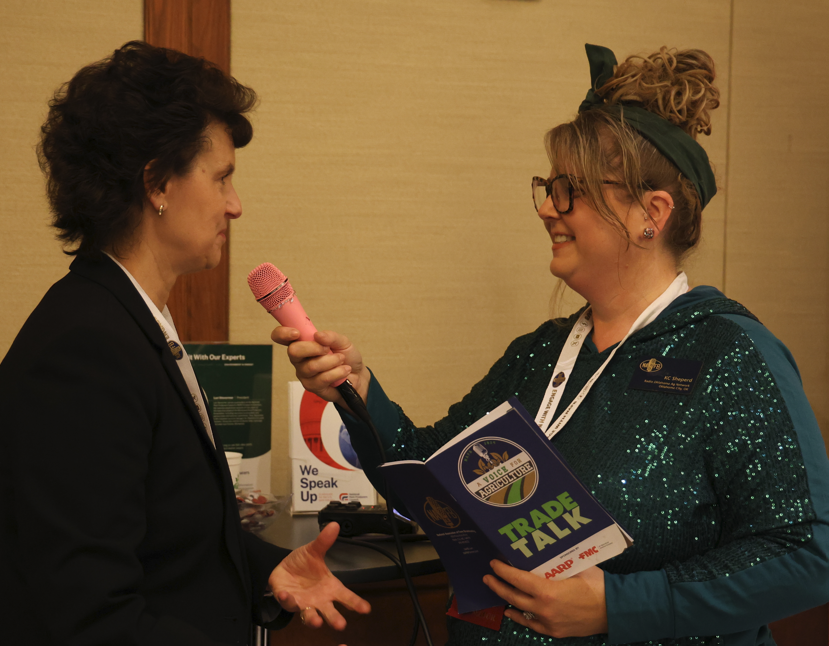
At the National Association of Farm Broadcasters Convention, the National Pork Producers Council's Board of Directors President Lori Stevermer sat on a panel to discuss the challenges and opportunities facing the pork industry today. Farm Director KC Sheperd got her take on the discussion.
Stevermer said that lots of things keep her up at night but two things in particular weigh heavily on her mind. "When I look at our producers going through that long stretch of being unprofitable, that affects our ability to invent new technologies to really advance our industry.
"Also, the activists coming at us at our state levels and not allowing us to use the science, data, and metrics that we have from our farms which really proves how well we do as farmers is another thing that keeps me up at night."
She said that although consumers don't generally spend a lot of time trying to understand science, it is still important to pursue scientific data to better the practices of each operation and the industry as a whole.
As far as the Trump administration's re-election into the Whitehouse, she said that NPPC is sitting back to see how things play out. "We know that exports are very important to our industry – twenty-five percent of our pork products are exported, which brings us sixty-four dollars worth of value – so any discussion about tariffs typically brings retaliatory tariffs to agriculture and the pork industry."
She mentioned that farm labor is a concern for pork producers as well. She expressed frustration when discussions about bringing in legal immigrants to work on farms so often become border discussions.
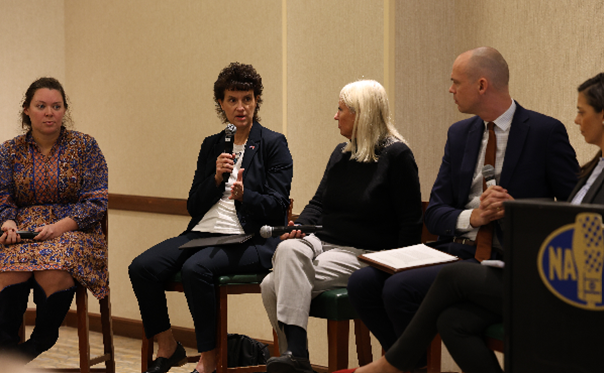
"The H-2A visa cannot be used in the pork industry because it is seasonal, and our workers are year-round," she said. "Can we reform that H-2A visa so that it can be a year-round visa? We also use TN visas quite a bit as skilled workers in our sale barns, and we have had a lot of trouble in the last year or so with a lot of declines in those applications. So we are really looking at how we can best use the tools that are there and modify them to work better for us because they want to work and we need them on our farms."
On a positive note, Stevermer said that the year is ending on a positive as far as prices go, in fact, better than was expected. "I'm also just really proud of our farmers," she said. "When I took over as president, one of the things I talked about was grassroots engagement. The work we do – the policy – is built on relationships. Our farmers have shown up. They've been engaged. They've done many fly-ins. They are reaching out to their legislatures, and my encouragement to them was to keep showing up because it has to be our voice. If someone else tells the story, it might not be told the way we want.
House Agriculture Committee Ranking Member David Scott today released the following statement regarding the Biden Administration's request for $24 billion to assist rural communities impacted by the deadly Hurricanes Helene and Milton and other disasters. The money would provide help to farmers who experienced crop or livestock losses, repair rural infrastructure, remove debris from impacted communities, and support food and nutrition programs.
"America is at its best when we come together and support one another. President Biden has seen the destruction and loss suffered in the Southeast and is taking seriously the need for help there and in other regions of the country. The $24 billion requested by the President will help address the impacts faced by our farmers and rural households over the last two years. I wholeheartedly support this funding and call on my colleagues on both sides of the aisle to respond to this pressing need by passing the requested aid without delay."
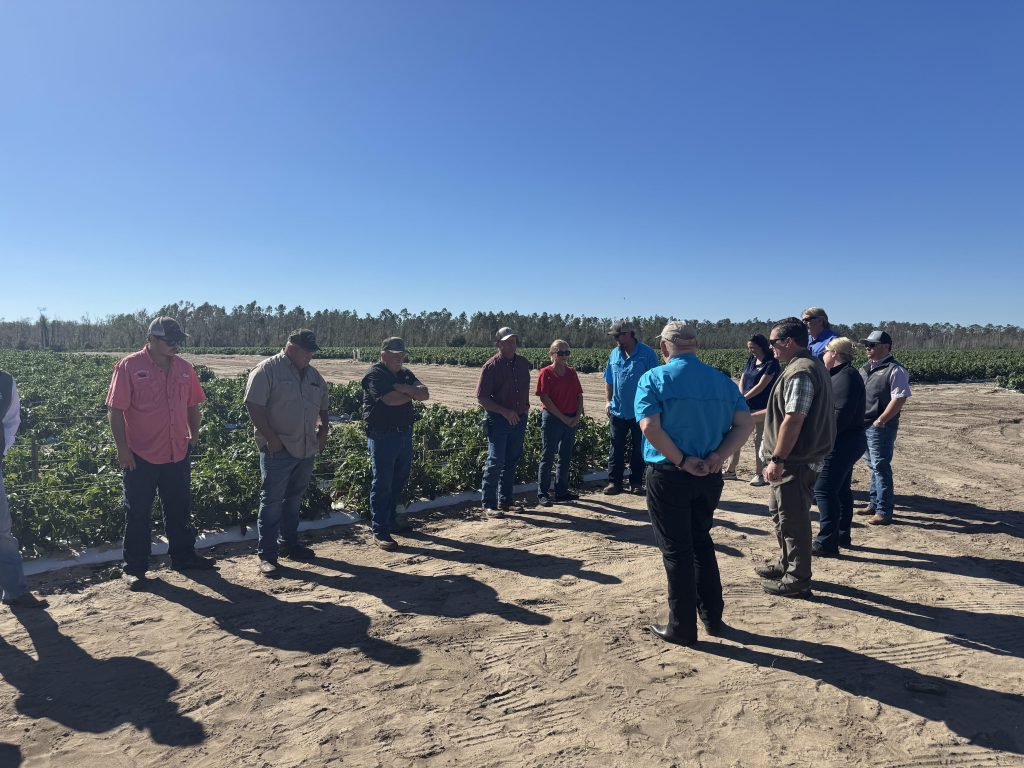
Following a bipartisan tour of hurricane damage in Florida and Georgia, House Committee on Agriculture Chairman Glenn "GT" Thompson released the following statement:
"Traveling to the Southeast, I was able to see firsthand the devastating impact of the recent hurricanes. Hurricanes Milton and Helene hit our agricultural sector especially hard, highlighting the urgent need for disaster relief. I want to thank Rep. Austin Scott and Rep. Kat Cammack for the invitation. I am committed to identifying resources to help our hardworking producers and rural communities fully recover and thrive."
Over the weekend, at the invitation of Reps. Austin Scott and Kat Cammack, a bipartisan group of Members of the Committee on Agriculture traveled to Northern Florida and Southern Georgia. In addition to Reps. Scott and Cammack, Chairman Thompson was joined by Reps. Doug LaMalfa and Darren Soto. The purpose of the visit was to assess damage, hear from impacted producers, and get a boots-on-the-ground perspective of the response. Congress will soon be developing and advancing disaster aid legislation and this trip better informed those future discussions in D.C.
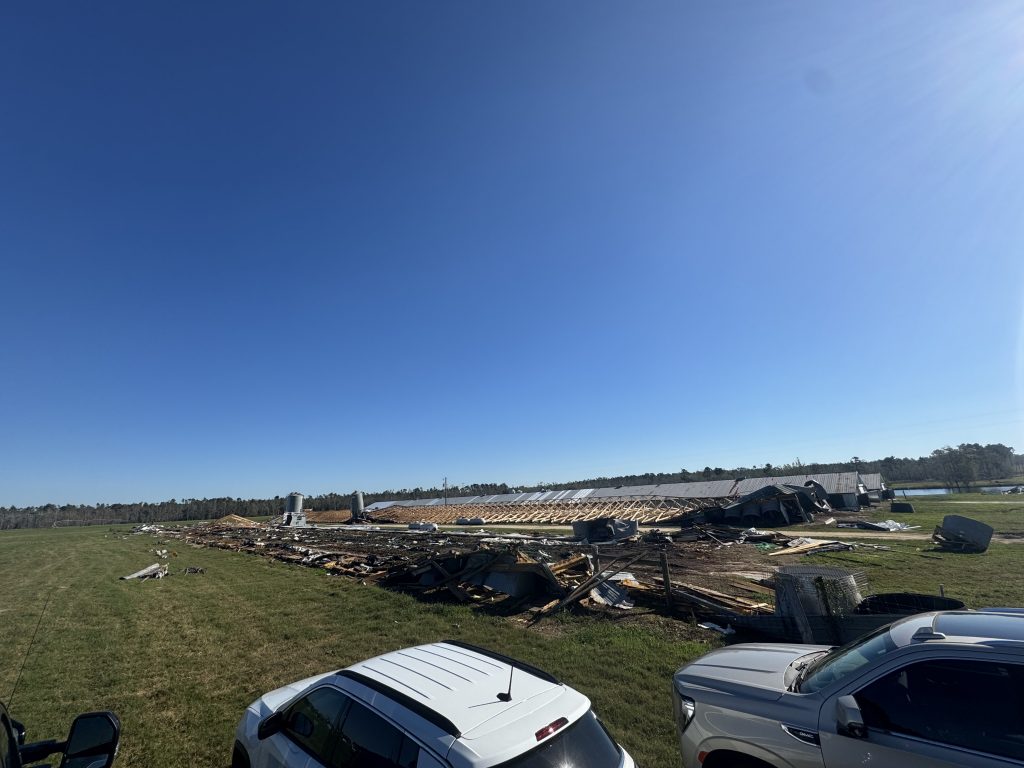
Congressman Austin Scott (GA-08):"I'm thankful to Chairman Thompson for visiting Georgia's Eighth district to survey the damage after Helene. Georgia's farmers need help, and I appreciate the Chairman taking the time to meet with them firsthand so we can better work together for relief."
In Georgia, the Members toured hurricane damage at a pecan orchard in Pearson. They then traveled to Broxton to meet with impacted poultry and pecan producers, met with representatives from the University of Georgia, and toured several downed poultry houses. According to the University of Georgia, the overall economic impact of Hurricane Helene on Georgia's entire agriculture industry is estimated at $6.46 billion.
Congresswoman Kat Cammack (FL-03): "I'm grateful to Agriculture Committee Chairman "GT" Thompson for visiting the Florida and Georgia areas impacted by Hurricanes Helene and Milton. Helene devastated my district at the end of August, generating billions in agriculture losses for some of our major crops. While the USDA response has been lackluster, I'm grateful for my colleagues and Chairman Thompson who are committed to ensuring we deliver the necessary aid to our hardworking producers."
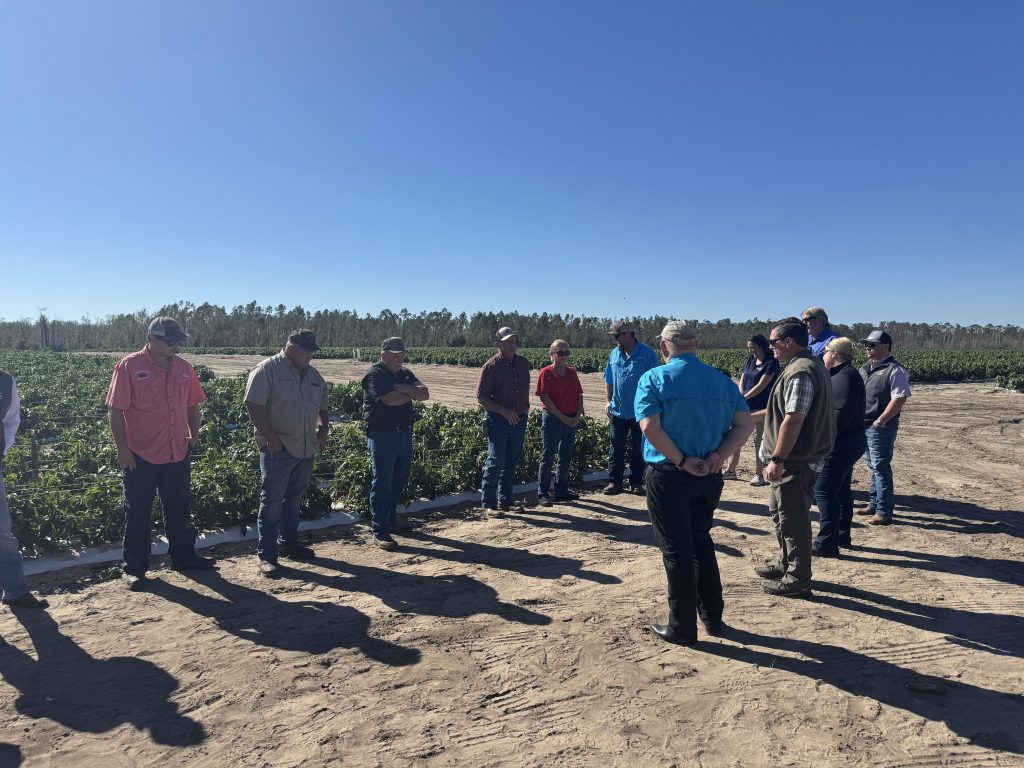
In Florida, Members toured Shenandoah Dairy in Live Oak and held a roundtable with producers at the Suwannee County Farm Bureau, surveyed a timber track with the Florida Forestry Association, and inspected the infrastructure damage at Adams Farm in Jasper. The Members then traveled to Jennings, Florida where they met with fruit and vegetable producers impacted by the hurricanes. According to a preliminary assessment by Florida's Department of Agriculture and Consumer Services, Hurricane Milton caused $1.5 billion to $2.5 billion in damage to Florida's crops and agricultural infrastructure.
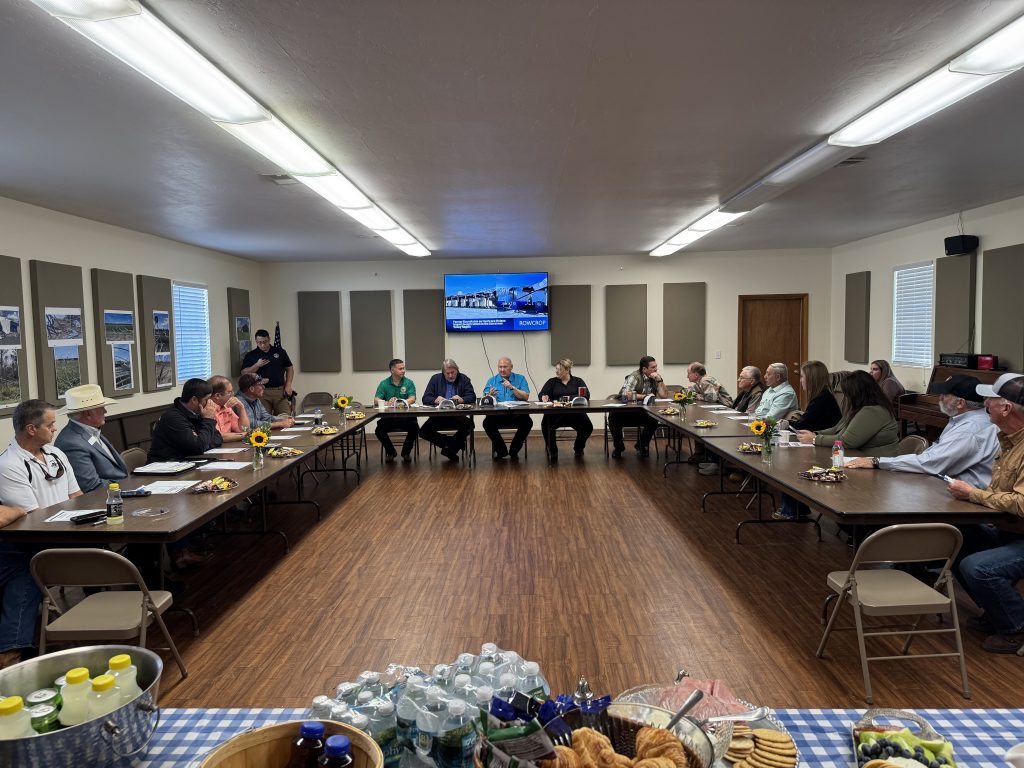
America's producers are already facing a tough farm economy. Since the last farm bill was passed in 2018, farmers have traversed a global pandemic, trade wars, fractured supply chains, labor shortages, rising input costs, lower commodity prices, the sharpest declines in farm income, record agricultural trade deficits, and more. The current farm safety net simply does not meet the needs of our rural communities. A new five-year farm bill that meaningfully strengthens the farm safety net is the least Congress can do to shore up our domestic food supply. An agriculture disaster package is also equally important to the Committee and this trip will help inform discussions moving forward.
U.S. Senator Debbie Stabenow (D-MI), Chairwoman of the Senate Agriculture, Nutrition, and Forestry Committee, Monday spoke on the Senate floor to introduce the Rural Prosperity and Food Security Act.
Chairwoman Stabenow's remarks as prepared for delivery are available below:
For more than 2 years, I have been working with colleagues on both sides of the aisle to pass my sixth Farm Bill and the third I have led as either Chair or Ranking Member of the Senate Agriculture, Nutrition and Forestry Committee.
I have met with farmers across the country who have made clear that crop insurance is the #1 risk management tool they have.
Farmers who made clear that the farm safety net must be the backbone of support for all farmers, and not just a handful of mostly southern commodities.
I have met with families who are finding it harder and harder to make ends meet as food insecurity in our country continues to rise.
And I have met with rural communities who are struggling to access the basic things they need to thrive like access to health care, including mental health, and childcare, clean drinking water, and high-speed internet.
The Farm Bill has always been the place where we put the power of the federal government to work in a bipartisan way to support farmers, families, and rural communities.
That is the coalition that has always been the foundation of a successful, bipartisan Farm Bill.
In May, the House released a proposal that would put immense taxpayer resources into a handful of mostly southern commodities.
I am not saying that these farmers do not need support – they do – but it cannot come at the expense of the millions of other farmers and ranchers in this country, farmers in the middle of the country – farmers who grow our fruits and vegetables, who run smaller and diversified operations, or lack access to the tools and support that is overwhelmingly favored in the House Bill.
And the large increases in farm subsidies should not be paid for on the back of our families in need or the broader needs of our small towns and rural communities.
In the Spring, I unveiled our Democratic proposal, a ninety-page section-by-section bill, to try to refocus our negotiations on holding together the Farm Bill coalition, not robbing Peter to pay Paul, but instead taking a balanced approach that supports all of agriculture, and families, and rural communities, across the country.
But unfortunately, this did not spark the serious negotiation I had hoped in order to put forward a bipartisan Farm bill that can pass both the House and the Senate and be signed by the President.
Today, I am introducing my Rural Prosperity and Food Security Act – 1397 pages of hard work by my great staff and staff and colleagues on both sides of the aisle. This includes $39 billion in new resources beyond the Farm Bill baseline.
This is a robust bill that puts more farm in the Farm Bill for all of our commodities, but not at the expense of rural communities and American families that are critical to holding the Farm Bill coalition together.
It provides farmers with the certainty of a 5-year Farm Bill – so they can plan for the future – and the assistance they need to manage the urgent needs they have right now.
It authorizes a permanent disaster program to ensure that we have a process in place when disasters like hurricanes Helene and Milton strike.
This new program will put a consistent process in place so farmers have certainty, and USDA can get the money out the door.
No more scrambling. No more leaving farmers behind.
It also makes a significant investment in Title 1 for the 22 row crops that receive the lion's share of the resources available in the House proposal.
It moves up Agriculture Risk (ARC) and Price Loss Coverage (PLC) program payments by six months, so farmers receive the assistance faster that they need to keep their operations going.
And it increases effective reference prices by as much as 15%, with all 22 commodities getting at least a 5% increase, for the first time in a decade.
The Rural Prosperity and Food Security Act continues to improve crop insurance by making it more affordable and ensuring that all farmers have access to this critical tool. It provides more coverage to more farmers at a lower cost.
Importantly, I include a provision that will partially reimburse farmers' crop insurance premiums and NAP fees to put cash in their pockets to address the urgent needs they are facing right now.
The bill strengthens support for specialty crops and ensures that farmers have the support they need to put American grown fruits and vegetables on the table.
This is a significant investment in all farmers and all of agriculture because farming is one of the riskiest businesses there is, and it is getting even riskier with the climate crisis.
How many "once in a generation" storms or droughts need to hit our farmers over the head before we take this crisis seriously?
This bill will roll the historic investment we made in the Inflation Reduction Act into the Farm Bill baseline for the future. These dollars put cash into farmers' pockets to put popular, voluntary conservation programs to work.
This will make our farms more resilient by putting carbon in the ground, which is good for crops, and taking it out of the atmosphere, which is good for all of us.
That is what I call a win-win!
I am also including new investments in biofuels, loans, local foods, trade, and the list goes on and on, including a down payment on a much-needed ag research moonshot
But a Farm Bill is not just about investing in farmers. It's also about investing in the communities they call home.
We know that rural communities are shrinking, and it's getting harder and harder to pass the farm onto the next generation.
In this bill we are betting that rural prosperity is American prosperity.
It improves quality of life for rural families by improving rural health care, including mental health, and childcare.
It grows the middle class by creating good-paying jobs in manufacturing, entrepreneurship, and small businesses in rural America.
It increases our investment in connecting rural communities to high-speed internet, which everyone in this Chamber agrees is essential to their success in the world we live in today.
Whether it's a child being able to do their homework, or a farmer being able to see a doctor, or a small business being able to access new markets beyond their rural Main Street, that all starts with reliable, high-speed internet access.
And importantly, this bill makes sure that rural communities are not left behind when it comes to accessing the resources of the federal government.
When it comes to securing federal grants, I know that my hometown of Clare can't compete with Detroit or New York City when it comes to staffing. So, we level the playing field by investing in the resources rural communities need to compete by hiring grant writers, planners, and advisors to provide technical assistance.
And finally, it is discouraging to me that the needs of families have been lost in this debate over the last two years.
Yes. The Farm Bill must be the backbone of support for farmers and ranchers across the country.
Yes. The Farm Bill must ensure that farming and a rural way of life can thrive today and into the future.
Yes. The Farm Bill is where we put the support of the American people behind the women and men who feed, clothe, and fuel this country.
I challenge anyone to look at my record as a leader on the Senate Agriculture, Nutrition, and Forestry Committee and say with a straight face that I am not a stalwart champion for farmers and ranchers.
But a Farm Bill must also be about the single mother in Michigan working two jobs who needs just a little bit of help to put food on the table so her children can thrive.
At a time when food insecurity rates in our country increased for the second year in a row, it is absolutely unacceptable for anyone to attempt to cut SNAP and other nutrition programs.
I refuse to leave this mom behind. Not on my watch.
We should be investing in the Farm Bill nutrition programs that are at the heart of the family safety net in this country.
My Rural Prosperity and Food Security Act does that and lays the groundwork to see a future where we end hunger in America.
It protects nutrition assistance and draws a clear line in the sand that we will not walk away from the progress we have made to keep families fed in this country.
This is a bill that keeps farmers farming, families fed, and rural communities strong.
And it is a robust bill that is paid for using the same resources that my Republican colleagues in the House used to pay for their bill – without dividing the broad, bipartisan coalition that has always been the foundation of the Farm Bill.
In my time leading Democrats on this Committee, I have locked arms with Republican leaders like Pat Roberts to defend programs that may not have been my priority because it meant holding the coalition together.
Farm Bills failed to pass the House in 2012 and 2018 because Republicans included cutting food assistance and did not have the votes to pass the bills on their own.
In 2018, the Farm Bill passed the Senate with a historic 87 votes. The 13 "nays" were all Republicans.
Looking to the future, Project 2025, the road map for the incoming Trump Administration, proposes eliminating ARC and PLC – the very same programs the House Republican bill makes their top priority.
It would also gut crop insurance, terminate U.S. sugar production, and slash trade promotion programs.
This is why it should be no secret why the House Farm Bill has yet to receive a vote on the House Floor – it does not have the Republican votes to pass.
And the last time I checked, that Chamber will be similarly divided in the 119th Congress.
So, I would encourage my Republican colleagues to rethink their proposal to make the largest cut to SNAP in more than 30 years, and join with us to pass a meaningful five-year Farm Bill now that includes immediate assistance that our farmers need.
The Rural Prosperity and Food Security Act is robust, adding $39 billion to the Farm Bill baseline. It is bipartisan with over 100 bipartisan bills included, and it balances the needs of farmers, ranchers, families, and rural communities.
It holds the broad Farm Bill coalition together, which is critical for the future of farm bill, and I firmly believe it is the best and probably only path forward to pass a 5-year Farm Bill this year.
I urge my colleagues to consider it seriously.
I yield the floor.
The Junior Limousin and Lim-Flex Show at the North American International Livestock Exposition were held Sunday, November 17 in Louisville, Ky. Judge Will Coor, Ohio, sorted the junior Limousin and Lim-Flex entries.
The Grand Champion Limousin Female was exhibited by Jacee Parrish, Liberty, Texas. The heifer, Ratliff Legacy 301L ET is a February 2, 2023 born, 84 percent Limousin female, sired by sired by FWLY Can Do, out of Riverstone Charmed.
The Reserve Grand Champion Limousin Female was TASF Lady Gaga 815L exhibited by Siddalee Portwood, Versailles, Ky. She's a September 27, 2023 born, 84% percent Limousin female, sired by TASF Grey Goose 333G ET, out of AUTO Crowning Day 204G.
The Grand Champion Lim-Flex Female was exhibited by Claire Sennett, Waynetown, Ind. The heifer, SSUL Charmed 3419L ET is a March 25, 2023 born, 42% percent Lim-Flex female, sired by Silveiras Forbes 8088, out of Ratliff Howboutit 008H ET.
The Reserve Grand Champion Lim-Flex Female was TSSL Something Special exhibited by Kinley Holmes, Ainswoth, Iowa. She's a March 19, 2023 born, 25% percent Lim-Flex female, sired by Conley No Limit, out of JSZC TSSC Larissa 49G ET.
For more information about NALJA, the North American Limousin Foundation, or to locate a Limousin or Lim-Flex breeder near you, visit www.NALF.org or call 303-220-1693.
Mark Johnson, Oklahoma State University Extension Beef Cattle Breeding Specialist, offers herd health advice as part of the weekly series known as the "Cow Calf Corner," published electronically by Dr. Derrell Peel, Mark Johnson, and Paul Beck. Today, Johnson talks about beef as part of the Thanksgiving feast.
Thanksgiving is a time when American families come together to celebrate a holiday that connects each and every one of us. While Thanksgiving is observed in varied ways in different nations, in American the holiday is truly rooted in agriculture. We may bring our own flavors and traditions to the table but Thanksgiving is a time for all of us to celebrate our nation's harvest and ability to efficiently produce food, to express gratitude for our blessings, and look ahead to the future.
I encourage you to make plans to enjoy beef this year at Thanksgiving. Why? Because compared to turkey, or among all the protein sources you may be considering for Thanksgiving dinner, beef holds the advantage. With regard to flavor, beef is generally more interlaced with marbling, the taste fat that translates to a more flavorful and satisfying eating experience. Beef can be aged to further intensify flavor, not an option with poultry products. Beef offers more variety of cuts, all of which result in the same satisfying eating experience. Beef can be served in a variety of "degree of doneness" options relative to what is most satisfying to your palate. Likewise, beef offers more options in the amount of time spent in preparation to better fit your schedule. Turkey requires long-term baking/frying preparation resulting in the option of white meat or dark meat. Consuming beef on Thanksgiving Day has the further advantage of improving the supply and demand equation thereby improving the profit potential of beef production. Because of the variety of advantages offered by beef, please give consideration to the following when planning.
If your answer is not much, consider grilling or pan-frying. Middle meats from the beef carcass like ribeye, strip loin, filet and sirloin steaks are very tender and can be cooked quickly at high temperatures on the grill or stove top to seal in the tenderness, juiciness and flavor. If you intend to grill or pan fry steaks remember to give them adequate time to thaw and reach room temperature before cooking. Burgers made from ground beef are also great when grilled or pan-fried. Chicken fried steak using tenderized round steaks can be pan-fried.
If you have more time to spend in preparation, smoking or oven roasting can result in the same tender, succulent beef flavor. Roasts from the chuck or round can be seasoned and slow-cooked to bring out "melt in your mouth" flavor. Beef brisket is ideal for smoking and slow cooking. An intact rib roast can also work great for smoking or slow cooking.
Typically steaks or middle meats will be the more expensive cuts to purchase. The cuts that require more cooking time (because they contain more connective tissue) can be purchased at a lower price per pound. Ground beef is also less expensive. Since beef is the preferred protein among most consumers, it will typically cost more per pound in comparison; nevertheless, the variety of options from a beef carcass leads to choices to fit any budget.
More information about cooking methods, recipes and beef cuts can be found at www.beefitswhatsfordinner.com. Regardless of the cut of beef you enjoy this Thanksgiving you will be eating a nutrient dense, delicious source of protein, B vitamins, iron and zinc that is a healthy diet choice.
This year on Thanksgiving, I want to say thanks to America's farmers, ranchers and everyone in production agriculture that make it possible. Whatever we eat on Thanksgiving Day, it is the ingenuity, perseverance, efficiency, work ethic and "can do" attitude of America's cattle men and women, and ag producers that permit us to enjoy the highest quality beef produced in the world and spend a relatively small percentage of our income on food.
Thanksgiving in 2024 arrives at a time when we, as cattle producers, have a great deal to be thankful for. Recent rains across Oklahoma have been highly beneficial and dramatically improved the prospects of cool season pastures. Strong cattle prices and historically robust profit potential for cow-calf operations has existed over the past two years. Low cattle inventories indicate strong value of all classes of cattle for the next several years.
Happy Thanksgiving, thanks for reading and remember "BEEF! IT'S WHAT'S FOR THANKSGIVING!"
Mark Johnson, OSU Extension beef cattle breeding specialist, reminds us of another option to consider for Thanksgiving tables from SunUpTV on November 19, 2022 at https://www.youtube.com/watch?v=2tropkp0V18
RON's Dave Lanning has a pre-opening look at today's agricultural Markets.
Click the audio tab below for today's report.
American Farm Bureau Federation President Zippy Duvall commented today on Senate Agriculture Committee Chairwoman Debbie Stabenow's release of farm bill text.
"We're reviewing Chairwoman Stabenow's newly released 1,300 pages of farm bill text. It's unfortunate that only a few legislative working days remain for Congress to act, but Farm Bureau remains committed to working with elected officials on both sides of the aisle to achieve federal policy that improves the outlook for farmers and ranchers. Our members across the nation have been clear in calling for a new farm bill in 2024 that helps farmers hold on after farm income dropped 30% in two years. The hardworking women and men who grow the food, fiber and renewable fuel for our nation cannot afford to wait for good federal policy that helps them manage the day-to-day risks inherent in agriculture."
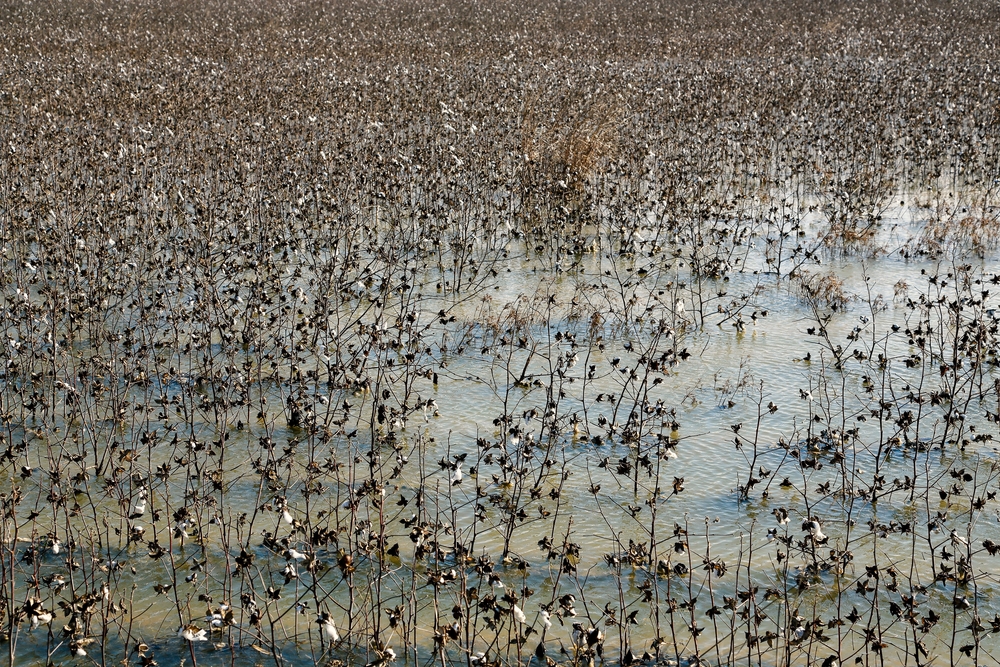
Winter Wheat Planted reached 94 percent, equal to the previous year, but down 2 points from the average. Winter Wheat Emerged reached 84 percent, down 1 point from a year ago but equal to the five-year average. Winter wheat conditions rated 49 percent good to excellent, 36 percent fair, and 15 percent poor to very poor. Last week's conditions rated 44 percent good to excellent, 38 percent fair, and 18 percent poor to very poor.
The National Corn harvest is complete.
The National Soybean harvest is complete.
Cotton harvested reached 77 percent, up 3 points from a year ago and 5 points from the average.
Sorghum harvested reached 95 percent, equal to a year ago and up 1 from the average.
Oklahoma Crop Progress Report:
Winter wheat planted reached 90 percent, down 4 points from the previous year and 6 points from the five-year average. Winter wheat emerged reached 75 percent, down 11 points from the previous year and 12 points from normal. Winter wheat conditions rated 37 percent good to excellent, 25 percent fair, and 18 percent poor to very poor. Last week's conditions rated 28 percent good to excellent, 50 percent fair, and 22 percent poor to very poor.
The Oklahoma Corn harvest is complete.
Sorghum harvested reached 88 percent, down 1 point from a year ago and the average.
Soybeans harvested reached 70 percent, down 4 points from a year ago and 1 from the average.
Cotton harvested reached 57 percent, down 13 percentage points from a year ago and 8 from the average.
Livestock conditions rated 57 percent good to excellent, 29 percent fair, and 14 percent poor to very poor. Last week's conditions rated 48 percent good to excellent, 35 percent fair, and 17 percent poor to very poor.
Pasture and range conditions rated 12 percent good to excellent, 34 percent fair, and 54 percent poor to very poor. Last week's conditions rated 10 percent good to excellent, 33 percent fair, and 57 percent poor to very poor.
Kansas Winter wheat planting is complete. Winter wheat emerged was 91 percent, up 1 point from last year, but up 5 points from the average. Winter wheat conditions rated 49 percent good to excellent, 39 percent fair, and 11 percent poor to very poor. Last week's conditions rated 40 percent good to excellent, 37 percent fair, and 23 percent poor to very poor.
The Kansas Corn harvest is complete.
The Kansas Soybean harvest is complete.
Sorghum harvested reached 88 percent, up 1 point from last year, and 3 points from the average.
Cotton harvested reached 93 percent, down 1 point from last year but up 2 points from the average.
Pasture and range conditions rated 24 percent good to excellent, 43 percent fair, and 33 percent poor to very poor. Last week's conditions rated 23 percent good to excellent, 45 percent fair, and 32 percent poor to very poor.
Winter Wheat planted reached 86 percent, equal to a year ago but, down 3 percentage points from the five-year average. Winter wheat emerged reached 71 percent, equal to a year ago but down two from the average. Winter wheat conditions rated 47 percent good to excellent, 31 percent fair, and 22 percent poor to very poor. Last week's conditions rated 33 percent good to excellent, 33 percent fair, and 34 percent poor to very poor
The Texas Corn harvest is complete.
Cotton harvested reached 72 percent, up 7 points from the previous year and 8 from the average.
The Texas Sorghum harvest is complete.
The Texas Soybeans harvest is complete.
Pasture and range conditions rated 12 percent good to excellent, 25 percent fair, and 63 percent poor to very poor. Last week's conditions rated 14 percent good to excellent, 23 percent fair, and 63 percent poor to very poor.
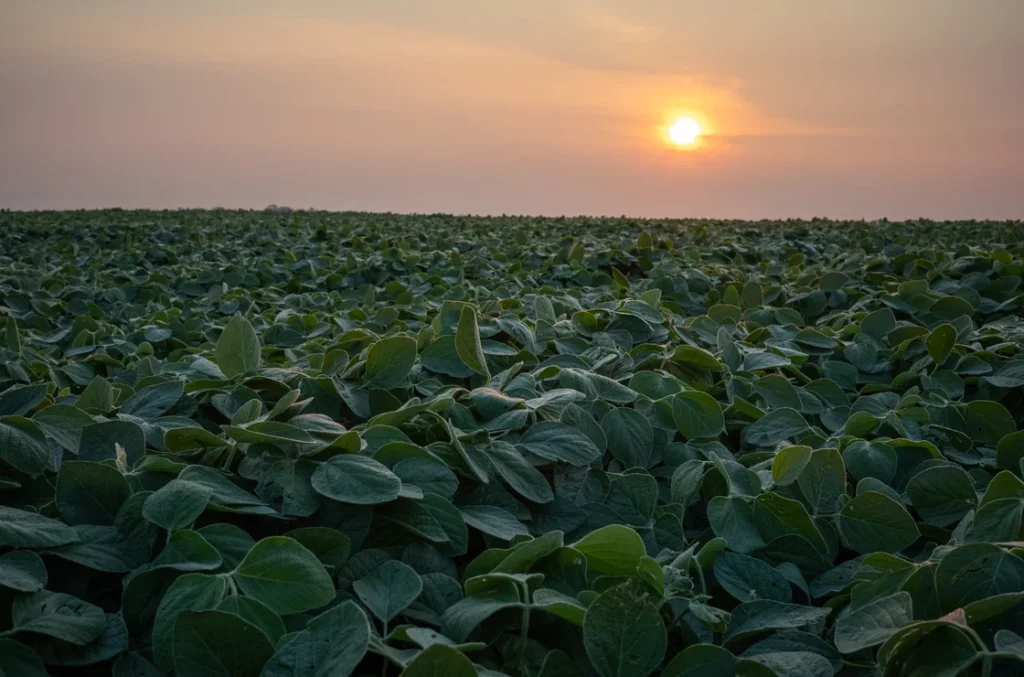
The U.S. Department of Agriculture appoints five U.S. soybean farmers to serve on the United Soybean Board and reappoints 12 directors for an additional term.
The U.S. Department of Agriculture has appointed five new farmer-leaders to the United Soybean Board (USB) and reappointed 12 others. In total, 17 USB directors and alternates will begin three-year terms, and one director will begin a two-year term. These U.S. soybean farmers, representing 16 states, will be officially sworn in at the USB December Meeting in St. Charles, Missouri, on Dec. 11, 2024.
"We are pleased to welcome this dynamic group of farmer-leaders, both new and returning, each bringing invaluable expertise and fresh perspectives. With fluctuating commodity prices and evolving markets, it's critical we have a group of strong, forward-thinkers joining the United Soybean Board," said Steve Reinhard, USB Chair and farmer from Ohio. "As I reflect on the outgoing directors, I am proud and honored to have worked with such a committed group of individuals, many of whom pursued leadership roles and sparked positive change in bringing value back to the half-million U.S. soybean farmers."
The United Soybean Board, which administers national soy checkoff investments, increases farmer profitability through initiatives and partnerships that grow domestic and global demand for U.S. soybeans and protect on-farm resiliency. The checkoff program has 77 members from 29 states in addition to the Eastern and Western Regions. The volume of soybeans produced in each state and region determines the number of board seats and farmer representation. Board members are soybean farmers nominated by their respective Qualified State Soybean Boards (QSSB) and appointed by the U.S. Secretary of Agriculture.
"While our board members grow and raise more than 30 different commodities across the country, growing U.S. Soy unites us, and our goal is to create value by investing in research, education and promotion," said Ed Lammers, USB Vice Chair and Nebraska farmer. "USB was founded by farmers, run by farmers and exists to serve farmers. Whether we're growing export markets, increasing market share in animal diets, reinforcing our transportation system or discovering new biobased products made with soybean meal or oil, our board remains dedicated to strengthening the bottom line for U.S. soybean growers."
The newly appointed farmer-leaders include:
The reappointed farmer-leaders include:
The newly appointed alternates include:
To see USDA's Notice of Trade about appointments, click here. To learn more about key investments made on behalf of U.S. soybean farmers, visit unitedsoybean.org.
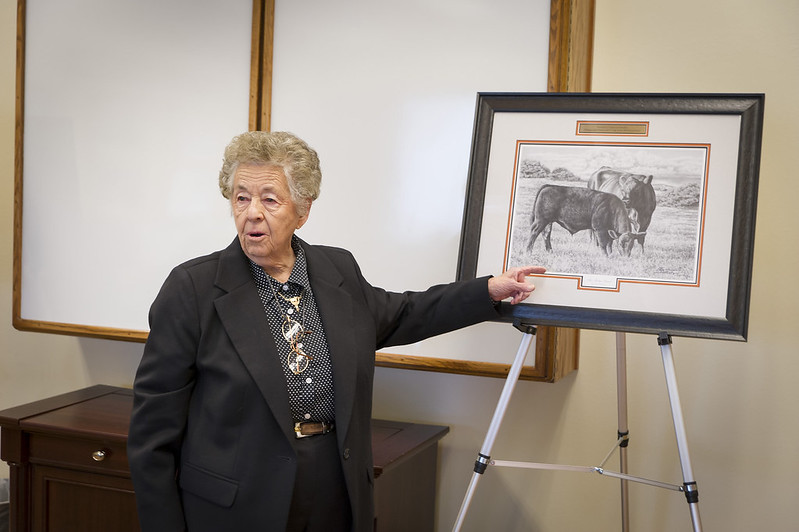
The Oklahoma State University Beef Extension team featured OSU distinguished alumna Minnie Lou Bradley in a Rancher's Thursday Lunchtime Series webinar in October.
Bradley was the first woman to graduate with a bachelor's degree from OSU's Department of Animal Husbandry (later named Animal and Food Sciences) in 1953. She was also the first woman to compete on the OSU livestock judging team, earning high individual in the beef cattle division at the 1952 American Royal Livestock Judging Competition. Later that season, she placed first in sheep, second in horse and first overall at the Chicago International Competition, carving a path for other women to participate in local and national livestock judging contests.
Bradley and her husband, Bill, established Bradley 3 Ranch in Memphis, Texas, 25 miles northwest of Childress and the gate to the panhandle of northwest Texas. In the early 1950s, they pioneered cattle management techniques in the area's dry and rough terrain. The Bradleys' daughter and son-in-law, Mary Lou and James Henderson, joined the business, and seven decades later, the family owns one of the most respected seed stock Angus operations in the country. Their management practices have revolutionized the industry by minimizing herd deficiencies and creating profitable bulls for commercial producers.
The OSU Beef Extension team met with 92-year-old Bradley in Texas to reflect on her ranching success and discuss the family's impact on the beef industry.
She was named a Graduate of Distinction in the OSU Department of Animal and Food Sciences in 1988, received the Master Breeder Award in 2010 and was recognized as a Ferguson College of Agriculture Distinguished Alumnus in 2015. OSU also selected Bradley as a Distinguished Alumna in 2023. She was listed in "Beef Magazine" in 2004 and 2014 as a Top 40 Cattleman, inducted into the National Cowgirl Hall of Fame in 2006, and joined the Saddle and Sirloin Portrait Gallery in Lexington, Kentucky, in 2014.
Blue ribbons and making her way in a man's world
Bradley was raised in central Oklahoma on a small farm. At age 5, she temporarily moved in with her grandparents while her sister recovered from a medical operation. Her uncle, a senior in high school, was her ride to school each day.
"Every evening, he would pick me up from school. He and his friends loaded up in cars and pickups and would go out to one of the farms to see their FFA projects," she said. "I went with them. I'd see pigs, cattle and wheat. The boys would just take care of me and have taken care of me ever since."
At age 9, Bradley convinced her grandfather to give her a few lambs she could feed for a show in Oklahoma City. Her lambs, hauled in an old trailer pulled behind a Pontiac sedan, dominated the show of adult exhibitors. Bradley took home the blue ribbon, winning the hearts of local FFA instructors who helped her with projects in the many years of competitive livestock exhibitions that followed.
When Bradley enrolled at Oklahoma A&M College (now OSU), she was a first-generation college student and eager to pursue her interest in livestock judging.
"I wanted to judge every Saturday if I could," she said. "I just loved going to those field days. I'd beg somebody to take me, and there were always Oklahoma A&M representatives there. It's the only school I ever thought I'd go to. I didn't know anything about college, and I surely didn't know I would be the only girl (majoring in animal husbandry)."
Learning about animal science and livestock confirmation was normal to Bradley, but not to her male professors and classmates. Her presence as a woman in the classroom, laboratory and barn ruffled feathers, but she learned to carry on despite inappropriate comments or language aimed in her direction. Her orientation into a man's world of animal husbandry was not easy, and taking chemistry with veterinary and medical students was overwhelming. She said she almost gave up that first semester if not for Professor James Webster, the head of the chemistry department.
"I didn't even know what a test tube was and at mid-term; I might have had a 5 average," she said. "I went to Dr. Webster and said, 'I guess I'd better drop out.'" He said, 'No, you're not going to drop out. We're getting you a tutor, and you're starting all over at mid-term.' I ended up with 13 hours of a B in chemistry. I'll always remember he was the one who said, 'You're going to stay, and you're going to make it.'"
Bradley never missed a judging workout during the grueling travel season of livestock competitions. She also signed up for the meats judging team but excelled most at livestock evaluation. When it came time to select who would compete at the Denver Stock Show in 1952, her scores were the highest on the team, but she wasn't chosen to make the trip. She was heartbroken.
"They'd never had a girl (in the competition), and they didn't think the judges would be fair with me giving reasons," she said. "They left me home, and it really got to me, but I just kept going."
Bradley's consistent judging scores were high enough to compete at national events where women were unwelcome. After members of the Oklahoma A&M administration determined she was eligible to travel with the team, she prepared to compete at the Fort Worth Stock Show. She was the first woman to enter the event, and the show's organizers and competitors' coaches made sure she felt the pressure. She was pulled aside and told her performance would determine if other women would be allowed to participate in the future.
"I was putting the college in a position where its name was on the line," Bradley said. "I felt so bad about it. That wasn't my intention, but I had a pretty good day. That spring, I was the top individual at the Oklahoma A&M Block and Bridle International."
Building Bradley 3 Ranch
Following her impressive collegiate livestock judging career, Bradley worked for the Texas Angus Association in Fort Worth, learning the difference between quality seed stock cattle and those that win in the show ring.
When she and Bill prepared to marry, they bought 20 cows and the 3,300-acre ranch, quickly learning that the road to a profitable operation was all uphill.
"The old house was in really bad shape," Bradley said. "We had to haul all the water, no telephone, no roads. After we bought it, I got to looking, and nobody had lasted over nine years on the property."
Through trial and error, the Bradley 3 Ranch navigated the many challenges of ranching in west Texas. They learned to install windmills, build fence, improve forage quality and understand stocking rates. Bradley and her husband partnered with local FFA chapters, community colleges and chemical companies to conduct research on stocking rates, genetic traits, fertility, grazing patterns and forage restoration.
"Several years ago, the FFA teacher here in Childress came out and put collars on our cows' necks that would radio back and show where the cows grazed every 10 minutes," Bradley said. "It was eye-opening. They were taking the easy way and only using about 10% of the pasture, going around fence lines and roads."
The ranch responded by removing red berry juniper and mesquite from their East Salt Creek Pasture. The next spring, they sprayed for weeds, and native grasses began to appear. The grama grasses, side oats, blue and hairy grama, the great stirrup high grasses of the 1800s and 1900s began to return. The Bradley 3 Ranch has been recognized for its grassland conservation efforts, and it shows in their numbers. Managing 250 cows was almost impossible those first few years, but after seven decades of range preservation and intensive grazing, the ranch is home to about 400 cows.
"This used to be tallgrass country and we're trying to get it back to tallgrass," Bradley said. "I was always taught to leave whatever you touch better than you found it. You have to have a home for a cow and take care of the grass or whatever you use. Grass is the standard out here, so we always stay in a state of trying to improve."
Early adopters of progressive management
In addition to rangeland conservation efforts, the family has made an even bigger name for itself in herd management strategies and practices. For example, in the early 1960s, the ranch began weighing its cows on the same day their calves were weaned.
"You cannot improve what you do not measure, so we set up a goal for our cows years ago that they had to wean 50% of their body weight every 12 months or they're gone," Bradley said. "If she's open, she's gone. Standardized Performance Analysis says it costs over $1,000 to keep a cow, and there's no way she can make it up if she loses a calf in her lifetime. You love your land, you love your cattle, but you have to run it like a business and make it work for you."
The ranch was also an early adopter of DNA testing, ultrasound technology, EPDs (Expected Progeny Differences), and measuring scrotal circumference and fertility testing in bulls. They launched a major effort to eliminate dwarfism that ran rampant in the 1960s and 1970s.
"A recessive gene in all breeds of cattle took hold as the show ring dominated what bulls should be used across the country," Bradley said. "Dwarfism in seed stock became awful even at Oklahoma A&M. Then there was the idea that if a cow had a dwarf, she herself was a carrier of the dwarf gene, and a bull could be proven clean of the recessive gene if mated to 15 carrier cows. That took at least nine months, and producers were afraid to use the bull on other cows until known clean or a carrier.
"Today at birth, a calf can be identified as a carrier of any known harmful gene by the use of DNA. What a great tool for the industry. We've worked on fertility and with every new development we've come across, we've tried to be ahead of the game," she added.
Bradley 3 Ranch operates on the idea that each cow is an individual and can't be managed as a herd.
"If you name your cows, you're going to lose money," she said. "We're heartless. If they don't produce, they're gone, and that's how we have one of the most fertile herds."
As the cattle industry continues to evolve, Bradley stressed prioritizing the end buyer. Cattlemen and women provide the raw product, but the Beef Quality Assurance (BQA) program builds long-term demand among beef consumers and commercial producers. She encouraged beef producers to become BQA certified. She emphasized the importance of teaching people the right way to give a vaccine, handle cattle, and follow BQA principles. "These are vital to sustaining the industry."
"Now we've got to work on efficiency," Bradley said. "We're losing 2 million acres a year in farm and ranch land. We're to the point where our cows and everything we do must be more efficient. We use liquid feed that can be moved wherever we want the cows to graze instead of overgrazing ground like we used to. There's no more moving west. In today's world of agriculture, we must find ways to produce more with less inputs."
Ranching and farming are not for the weak of heart, and it takes a spirit like hers with a lot of grit to survive the highs and lows of ranching life.
"You've got to love it, and it's rewarding," she said. "You can do it if you've got it in you, but don't think it's going to be easy."
Watch the Minnie Lou Bradley interview on YouTube.
By Gail Ellis
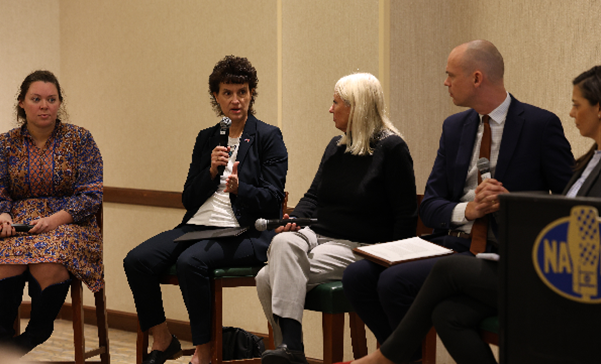
What happened: NPPC, the American Farm Bureau Federation, the National Cattlemen's Beef Association, and the U.S. Poultry and Egg Association on Tuesday joined the U.S. Environmental Protection Agency (EPA) in asking a federal court to dismiss a lawsuit seeking a broad interpretation of the requirements for reporting emissions from animal waste.
Animal and environmental activist groups sued EPA in the U.S. District Court for the District of Columbia over a section of the Emergency Planning and Community Right to Know Act (EPCRA) that exempts livestock and poultry farmers from reporting routine air emissions from animal waste. EPCRA requires certain entities to notify state and local authorities, including first responders, about accidental spills and releases of hazardous materials and chemicals.
The law initially exempted livestock and poultry farmers from reporting, but a 2017 court decision rejected the exemption. In 2018, Congress approved the Fair Agricultural Reporting Method (FARM) Act, which reinstated the exclusion. Activist groups challenged EPA's regulation implementing the FARM Act.
NPPC's take: NPPC and the other agricultural organizations cited EPA's reasoning for exempting agriculture from the reporting requirements: Farm emissions might exceed thresholds that would trigger responses under EPCRA, but such responses would be "unnecessary, impractical and unlikely." Agitating a manure pit, for example, could result in the release of ammonia and hydrogen sulfide in amounts that exceed reportable levels, but the gases would dissipate quickly, so no response would be warranted.
Why it matters: If livestock producers were subject to EPCRA reporting, they would be required to estimate the emissions of certain gases. However, EPA has yet to finalize reliable, scientifically sound estimating methodologies that accurately represent the air emissions from animal manure at modern livestock farms. Additionally, farmers could be subject to liabilities resulting from differing interpretations of the information called for in the emissions reports, exposing them to potential civil penalties or litigation.
NPPC's Stevermer, Staff Participate in NAFB 'Trade Talk'
What happened: NPPC President and Minnesota producer Lori Stevermer and several NPPC staff Thursday participated in the National Association of Farm Broadcasting's (NAFB) national convention in Kansas City, MO, where they took part in NAFB's "Trade Talk." Stevermer also participated in a panel discussion on environmental issues. (Oklahoma Farm Reports KC Sheperd also interviewed Stevermer, we will be publishing this in the next few weeks)
Joining Stevermer were NPPC CEO Bryan Humphreys; Maria Zieba, vice president of government affairs; Chase Adams, assistant vice president of domestic policy; and Dr. Ashley Johnson, director of food policy.
Among the topics they discussed in 44 radio interviews were:
Why it matters: NAFB's "Trade Talk" connects agriculture broadcasters and agricultural industry leaders to discuss key issues and topics affecting U.S. farmers. Farm broadcasters are a trusted source, provide an invaluable service, and are a vital tool for communicating with the agricultural community, telling the story of the who, what, when, where, and how of America's food, feed, fiber, and fuel system.

The OWRB is proposing to amend its administrative rules relating to dam safety application fees, the process for dam construction and modification, rules related to permitting of groundwater and stream water, and updates to the rules related to financial assistance.
The proposed text and rule impact statement for each chapter is included below. To view the Notice of Rulemaking Intent for each chapter, see Volume 42, Issue 5 of the Oklahoma Register. The public comment period for proposed rules begins on November 15, 2024, and will continue to 5:00 p.m. on December 16, 2024.
A public hearing will be held during the regular meeting of the OWRB beginning at 9:30 a.m. on December 17, 2024, at 3800 N. Classen Blvd., Oklahoma City, OK 73118. Questions may be directed to Chrystal Krittenbrink at Cris.Krittenbrink@owrb.ok.gov or (405) 530-8801.
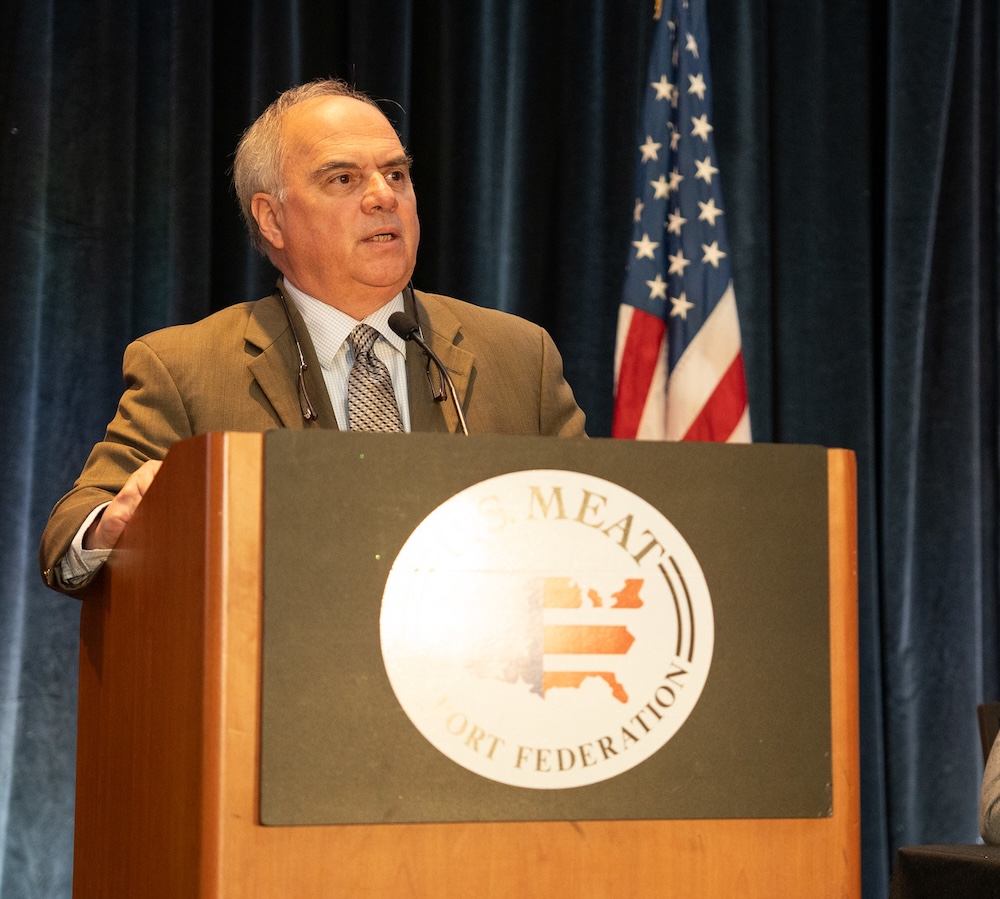
At the U.S. Meat Export Federation's (USMEF) Strategic Planning Conference in Tucson, USMEF Latin America Representative Homero Recio updated members on promotional activities for U.S. red meat in South America. His report included details on an exciting new product recently launched in Colombia – a U.S. pork burger derived from the Boston butt, developed through support from USDA and the National Pork Board.
Recio explained the unique attributes of the Boston butt burger, noting how it stands out against burgers made from trimmings. He said the burger has been very well-received in Colombia and a variation of the product is also being launched in Chile.
Colombia is a major destination for U.S. pork exports, and shipments are reaching new heights this year. January-September exports to Colombia climbed 37% from a year ago to nearly 90,000 metric tons, valued at $255 million (up 44%).
| ||||||||||||||||||||||||||||||||||||||||||||||||||||||||||||||||||||||||||||||||||||||||||||||||||||||||||||||||||||||||||||||||||||||||||||||||||||||||||||||||||||||||||||||||||||||||||||||||||||||||||||||||||
| ||||||||||||||||||||||||||||||||||||||||||||||||||||||||||||||||||||||||||||||||||||||||||||||||||||||||||||||||||||||||||||||||||||||||||||||||||||||||||||||||||||||||||||||||||||||||||||||||||||||||||||||||||
|
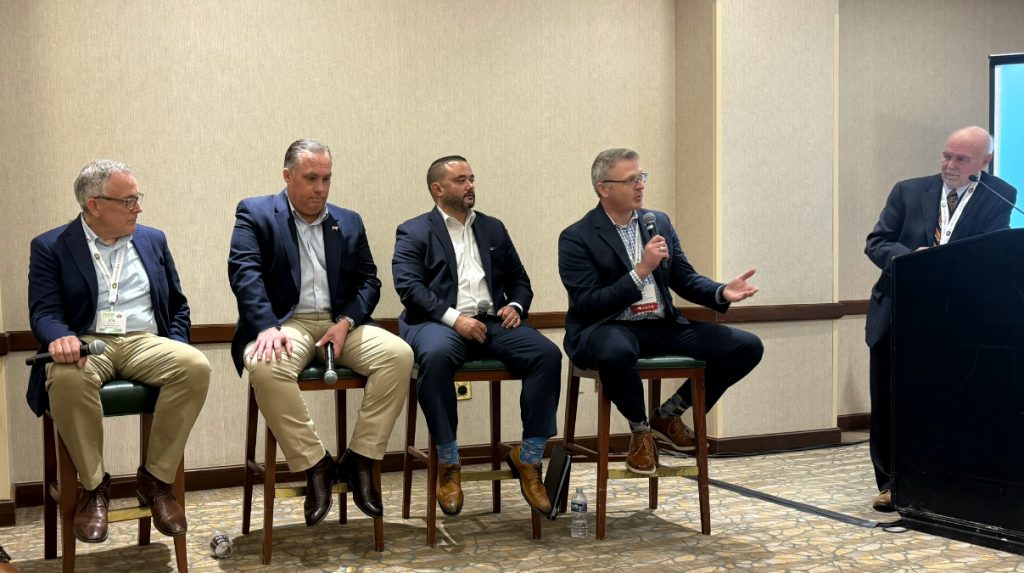
While attending the National Association of Farm Broadcasters Convention, Farm Director KC Shepard caught up with American Farm Bureau Foundation's Vice President of Public Policy Sam Keiffer to talk about the recent presidential election.
According to Keiffer, industry leaders are keenly focused on who Trump's appointees will be.
"There are a lot of appointments that we don't know, yet," he said. "But we look forward to making sure that the agricultural conversations occur in a manner that is amenable to bipartisan policy conversations because that is what the farm bill is, and that's what USDA does. We want the folks who are in place to remain committed to focusing on the science."
Keiffer admitted that historically, farm bills have been difficult to accomplish, and the situation with the current farm bill is no different. He said that if a farm bill cannot be completed during the congressional lame duck session, an extension will be necessary to continue the outdated one designed in 2018, meaning that the new farm bill would have to start over at ground zero with all new players and a different budget arrangement.
"The new administration is going to come in focused on the first 100 days," he said. "They also have cabinet secretary appointments to make, judicial appointments in the Senate to confirm; there is a long list of things that need to happen in 2025. There are more reasons to capture a farm bill in 2024 than to wait."
According to Keiffer, AFBF has worked with the Trump Administration throughout his campaign and is working with them as they transition into the Whitehouse. He looks forward to the continuing relationship.
"Governing is different than campaigning," he said. "We need to make sure that the coalition that is in place and the leaders that are put in place also bring with them good number twos and number threes in that organization chart to help make sure we continue to have the safest, most affordable, and most efficient agricultural industry on the globe."
AFBF is looking forward to the return of Trump's enthusiasm for global trade shown during his first term in office. "There is a lot of energy around the trade discussions. There is concern, but also a lot of energy," he commented. "There has been frustration in these last four years that there have been a lot of conversations on the trade front, but not a lot delivered in terms of bonified trade agreements and market access. We anticipate that President Trump will be more engaged on that global scale, but he is also using tariffs as a bargaining chip and that does have some repercussions throughout the agricultural community."
In addition to global markets, Keiffer looks forward to Trump's tax policy. "The tax cuts and jobs act was extremely helpful to many farm family checkbooks, and many of those provisions are set to expire in 2025, so we have been gearing up for well over a year to set the deck for some significant tax conversations. The Republican trifecta with the Whitehouse, the Senate, and the House makes those conversations a little bit easier."
Dr. Derrell Peel, Oklahoma State University Extension Livestock Marketing Specialist, offers his economic analysis of the beef cattle industry as part of the weekly series known as the "Cow Calf Corner," published electronically by Dr. Peel and Mark Johnson. Today, Dr. Peel discusses rising calf prices.
Calf and stocker prices jumped sharply last week in Oklahoma and across the country. In Oklahoma, a combination of renewed stocker demand for winter wheat grazing and lower auction volumes pushed calf and stocker prices up. After auction volumes were higher year over year in September and October, Oklahoma auction volumes have been significantly lower in November. Some of the reduced volume was due to wet conditions but it likely also reflects smaller available supplies after the early fall run. Volumes are likely to be reduced for the remainder of the year.
Figure 1 shows the constellation of feeder prices in Oklahoma auctions including the jump this past week and the change in prices since the seasonally early fall low in September. Notice that most of the price strength is on the lightweight end of calf and stocker prices. Heavy feeders have shown little price change, especially this past week.
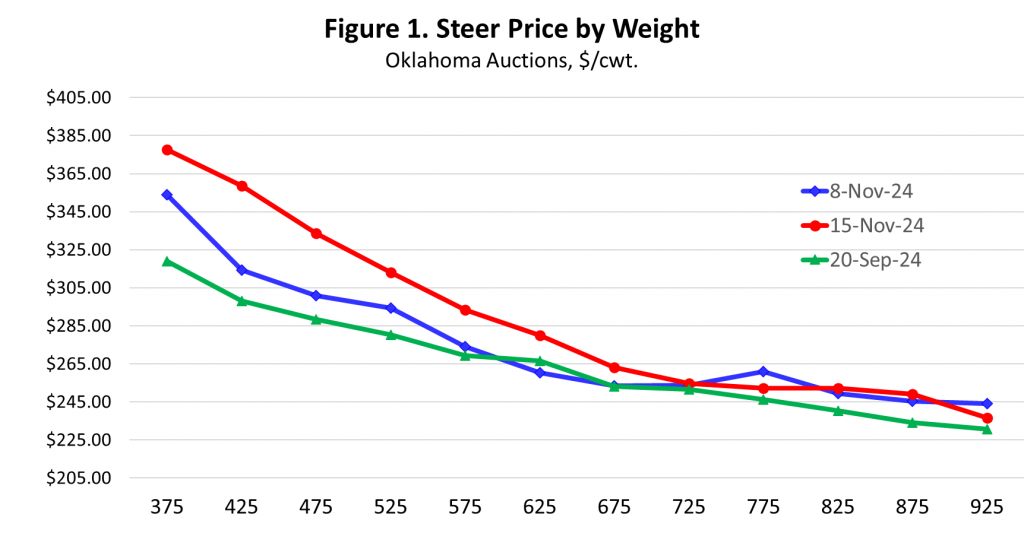
Table 1 shows the value of gain using the latest weekly feeder prices for beginning weights ranging from 400 to 650 pounds and ending weights up to 900 pounds. For example, purchasing a 500-pound steer this week at $322.26/cwt. results in a value of 250 pounds of gain at 750 pounds of $1.16/lb. (based on value of a 750-pound steer at $253.63/cwt.) However, that same steer at 900 pounds (current price $242.92/cwt.), has a value of gain of $1.41/lb. for the entire 400 pounds of gain.
Table 1. Value of Gain, Combined Oklahoma Auctions, November 15, 2024
| BeginningWeight | Price $/cwt. | Value $Per Head | Beginning Weight | |||||
| 400 | 450 | 500 | 550 | 600 | 650 | |||
| Value of Gain $/lb. | ||||||||
| 400 | $369.23 | $1,477 | ||||||
| 450 | $345.00 | $1,552 | $1.51 | |||||
| 500 | $322.26 | $1,611 | $1.34 | $1.18 | ||||
| 550 | $302.48 | $1,664 | $1.24 | $1.11 | $1.05 | |||
| 600 | $285.68 | $1,714 | $1.19 | $1.08 | $1.03 | $1.01 | ||
| 650 | $270.54 | $1,758 | $1.13 | $1.03 | $0.98 | $0.95 | $0.89 | |
| 700 | $258.61 | $1,810 | $1.11 | $1.03 | $0.99 | $0.98 | $0.96 | $1.04 |
| 750 | $253.63 | $1,902 | $1.22 | $1.17 | $1.16 | $1.19 | $1.25 | $1.44 |
| 800 | $252.26 | $2,018 | $1.35 | $1.33 | $1.36 | $1.42 | $1.52 | $1.73 |
| 850 | $250.64 | $2,130 | $1.45 | $1.44 | $1.48 | $1.56 | $1.67 | $1.86 |
| 900 | $242.92 | $2,186 | $1.42 | $1.41 | $1.44 | $1.49 | $1.57 | $1.71 |
These values of gain are based on the current market and will depend on the actual selling price of the feeders. The example of 250 pounds of gain to 750 pounds could represent winter grazing until March. The current March Feeder Futures price is about $245/cwt. which implies a March Oklahoma cash price of roughly $247/cwt., which is lower than the current price of $253.63/cwt. Taking the steer to 900 pounds might be looking at a May price with Feeder Futures current at roughly 246/cwt. and implies an Oklahoma cash price of roughly $229/cwt., compared to the current cash price of $242.92. In both cases, the futures prices are lower than the current market meaning that the value of gain in Table 1 could be overestimated based on current market values.
Derrell Peel, OSU Extension livestock marketing specialist, says the rain may not help much with wheat pasture, but it will help cow-calf operations with available water sources on SunUpTV from November 16, 2024 at https://www.youtube.com/watch?v=IG1qtQ0LsiY

The National Pork Producers Council (NPPC) issued the following statement after the unveiling of Senate Democrats' 2024 Farm Bill text by U.S. Senate Agriculture Committee on Agriculture, Nutrition, and Forestry Chairwoman Debbie Stabenow (D-MI).
"Though America's pork producers appreciate Chairwoman Stabenow's efforts to publish Farm Bill text, this is simply not a viable bill, as it fails to provide a solution to California Prop. 12," said NPPC President Lori Stevermer, a pork producer from Easton, Minn. "Pork producers have continually spoken up about the negative impacts of this issue, and it is a shame these conversations were disregarded."
In May, NPPC secured 100 percent of pork producers' priorities in the House Agriculture Committee-passed bipartisan 2024 Farm Bill. In June, producers once again secured all policy priorities in Senate Agriculture Committee Ranking Member John Boozman's 2024 Farm Bill framework.
NPPC urges both chambers of Congress to swiftly consider and pass a Farm Bill this year that includes a fix to California Proposition 12, a state law that places arbitrary housing standards on the pork industry, creating uncertainty for pork producers as they look to continue their operations to the next generation.

Attorney General Gentner Drummond is urging the Federal Communications Commission (FCC) to improve its Robocall Mitigation Database that could reduce illegal robocalls. He is working with 46 other attorneys general to close a loophole in the database that allows bad actors to have access to the U.S. telephone network.
Registration on the FCC's Robocall Mitigation Database is required to operate as a voice service provider. Since it went live in 2021, however, the database has done little to prevent scammers from obtaining legitimate registrations to make illegal robocalls. Companies have submitted non-vetted information, and voice service providers have faced no consequences for filing inaccurate, false, misleading or incomplete information.
In the last year, Oklahomans have filed 26,262 Do Not Call complaints with the Federal Trade Commission. While all of those calls may not be illegal, more than half of those reported were robocalls.
Drummond and the coalition of attorneys general sent a letter to the FCC last week asking for measures to be taken to strengthen the Robocall Mitigation Database. The letter suggests these actions: making clear what information needs to be submitted by providers and a deadline for those submissions, validating the data providers submit to flag inaccurate or misleading data, penalizing providers for submitting false or inadequate information by denying authorization to operate, and blocking non-compliant providers.
"Illegal robocalls aren't just a nuisance – they are a direct threat to Oklahomans," Drummond said. "By strengthening these protections, we can shut down these scammers and ensure our communities stay safe from predatory schemes."
Drummond, a member of the Anti-Robocall Litigation Task Force, has been committed to actively investigating and pursuing enforcement actions against entities identified as being responsible for illegal and fraudulent robocall traffic.
He is joined in sending the letter to the FCC with the attorneys general of Alabama, Alaska, Arizona, Arkansas, California, Colorado, Connecticut, Delaware, Florida, Georgia, Hawaii, Idaho, Illinois, Indiana, Iowa, Kansas, Kentucky, Louisiana, Maine, Maryland, Massachusetts, Michigan, Minnesota, Mississippi, Missouri, Nevada, New Hampshire, New Jersey, New Mexico, New York, North Carolina, North Dakota, Ohio, Oregon, Pennsylvania, Rhode Island, South Carolina, South Dakota, Tennessee, Utah, Vermont, Virginia, West Virginia, Wisconsin, Wyoming and the District of Columbia.
The dairy checkoff has launched the Dairy Conservation Navigator, an online resource hub designed to provide farm advisors, stakeholders and conservation professionals with science-based information on sustainable farming practices and technologies.
The Navigator aggregates science-based information from more than 70 experts, helping users make informed decisions that enhance farm profitability and sustainability efforts.
Dairy checkoff scientists and others developed a list of over 80 practices that have a positive environmental benefit in areas including nutrient management, methane reduction, soil health, manure handling and more. The tool can be accessed at www.dairyconservation.org.
"Sustainability is one of those topics where there's so much information, but it's scattered across countless websites and it's often difficult to know what's credible and applicable to dairy farming," said Bridgett Hilshey, senior director of sustainability projects at Dairy Management Inc. (DMI). "Our goal is to simplify the process of accessing that information – offering a single, trusted platform where industry professionals can find scientifically-backed information about practices that can help improve farm sustainability."
The tool features a filterable database, allowing users to find solutions tailored to their specific needs. Each practice includes a summary outlining its purpose, conditions for use, implementation considerations, funding options and environmental benefits.
The Navigator also includes information on emerging sustainability practices and technologies that could transform the industry. Additionally, the checkoff partnered with experts nationwide to create free short courses covering topics like environmental modeling, carbon markets and water conservation.
"We strive to make sure the information on the site is comprehensive," Hilshey said. "We worked with experts to cover a wide range of topics that interest dairy industry stakeholders, and to ensure that the Navigator content is grounded in real-world experience. Our goal is for farm advisors and other stakeholders to understand these practices, including the benefits and limitations, so they can identify new opportunities and set realistic expectations."
The tool is designed for the wide range of professionals who support farm decisions, including veterinarians, nutritionists, agronomists, equipment suppliers, conservationists, financial advisors as well as those associated with cooperatives, processors, university extension and others.
Jacqi Coleman, senior vice president of sustainability partnerships for DMI, emphasized the Navigator's role in bridging the gap between the increasing demand for sustainability in dairy farming and the need for easily accessible, reliable information.
"What we hear most often is that sustainability is confusing, with new terms and evolving expectations," Coleman said. "This site provides science-based information and educational tools that help users navigate sustainability through education.
"The checkoff has always been backed by science, and we want to make sure the resource provides trusted, science-based information."
The Navigator will be frequently updated to reflect the latest research, field trials and emerging technologies.
"Sustainability is an evolving field, and we're committed to ensuring the Navigator can meet that pace," Hilshey said. "The goal is to make this a living, breathing resource that grows alongside the industry."
DMI will introduce the tool at industry events and conferences with partners like The Nature Conservancy and the Conservation Technology Information Center. To learn more about checkoff strategies, visit www.dairycheckoff.com.

The Oklahoma Horse Racing Commission recognized their Executive Director Dr. John Chancey at their regular November meeting for his appointment to the board of the Association of Racing Commissioners International (ARCI). Chairman Keith Sanders congratulated him on behalf of the Commission.
"That is quite an honor," Sanders said. He also recognized Dr. Chancey for his years of service as Chairman of the ARCI Drug Testing Standards and Practices Committee.
Chancey has served as the Executive Director and Director of Equine Welfare for the OHRC since He was the Supervising Veterinarian for welfare and safety of horse racing at Remington Park from 2017-2023. He has been an equine veterinarian specializing in racehorses since 1984. He is a board member for the National Racing Compact and the Association of Problem Gambling and Gaming.
Chancey received his Doctorate of Veterinary Medicine from Oklahoma State University in 1984. He also earned an MBA from Oklahoma City University.
Chancey was raised in Nowata on a Quarter Horse farm and has been around racehorses his entire life. Chancey learned a keen sense of calm and compassion that has made him extremely successful with difficult horses. He finds a great deal of emotional and professional satisfaction serving in the front lines of equine safety and welfare. His commitment to learning, passion and love of horses has directed a lifetime of work.
Chancey has operated award-winning veterinary practices and nutritional service companies. As a dedicated scientist, his research has led him to develop innovative nutraceutical formulations for people, as well as horses, pets and livestock. This has led to the formulation of many patents.
He has served international missions for church and classroom construction, and water well drilling. He has also assisted with livestock development programs in Morogoro, Tanzania.
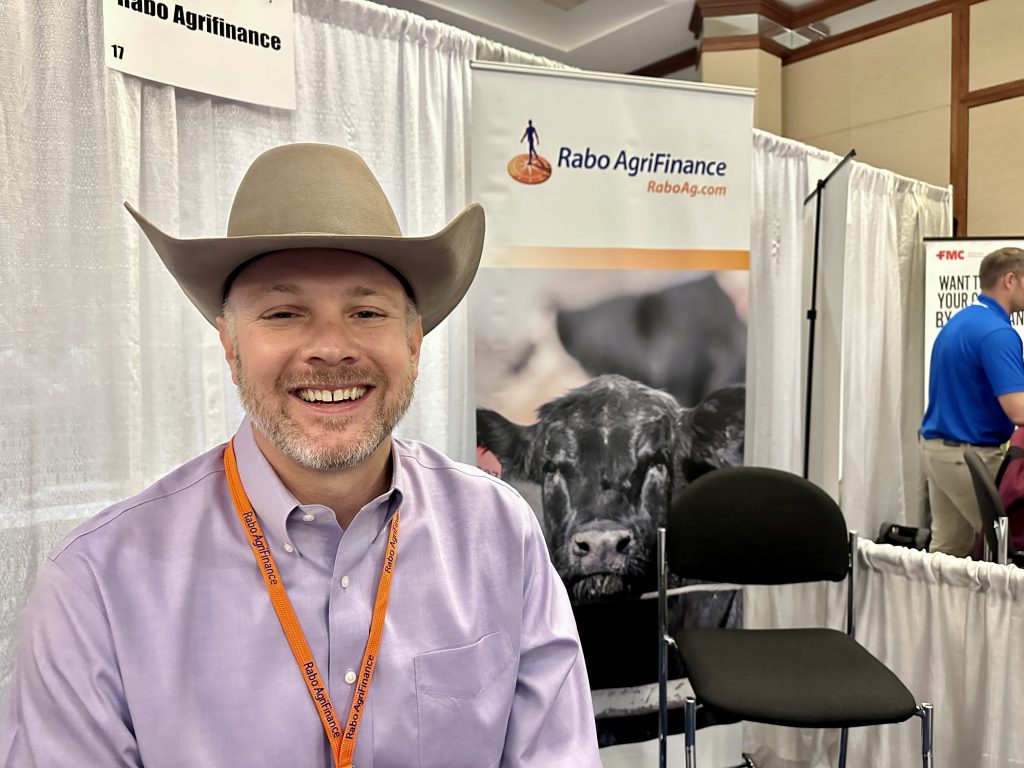
Rabobank's senior beef analyst, Lance Zimmerman, talked in depth with Oklahoma Farm Report's Ron Hays about producer attitudes towards the beef market and the importance of filling out surveys.
Overall, he says that most producers are quite satisfied with the current market conditions.
"If you would have told producers at the beginning of 2024 that we were going to see record high retail beef prices, set thirty-year highs in demand, feedyards would keep finding cattle and supplies would be steady to higher for the year, and that prices of cattle would move higher across the board regardless of cattle class, I think everybody would have taken that," Zimmerman said. "But that's where we are!"
High consumer demand offsets the ability to find more supply whether through increased feeder cattle and calf imports from Mexico and Canada, increased carcass weights, or just finding ample placements in the feedyards throughout the year.
Zimmerman admitted that he was surprised that supply has remained so strong. He said, "When we saw the January 1 Cattle Inventory Report, the feeder cattle and calf supply outside of feedyards was down more than seven percent year over year. Right now, placements through September are down about four percent. Down, yes, but not as much as we would have expected from the cattle inventory report."
While he considered drought as a contributor, he knows that drought is often a very common factor. "I think the bigger source to explain some of it is that feeder cattle import number from Canada and Mexico is up more than fifty percent year over year to 1.1 million head for the year. That's about 500,000 head more than what we saw last year at this time."
Zimmerman questioned whether the government is getting good data from the cattle industry. The annually published Response Rate Report has shown a marked decline in producer participation in the surveys every year since the COVID pandemic. Ten years ago, eighty percent of producers were participating in the surveys.
"The most recent Cattle On Feed data suggests that we are only returning about sixty-five percent of those surveys. The Cattle Inventory Report is seeing less than fifty percent participation," Zimmerman detailed. "What kind of errors are we getting in that data because we aren't submitting data back to the government?
"I get it. We want to maintain our independence from the government, and we don't want them poking around in our business, but if that is the case, then we forfeit the right to complain if the data doesn't look like we think it should."
Zimmerman emphasized that there is nothing to lose and everything to gain by providing the requested data. "We can have more confidence in those market reports and in the fundamentals of what is going on in the countryside so that as producers and as analysts, we can guide each other in making the best decisions for our individual operations and the future of the industry as a whole."
The Beef Buzz is a regular feature heard on radio stations around the region on the Radio Oklahoma Ag Network and is a regular audio feature found on this website as well. Click on the LISTEN BAR for today's show and check out our archives for older Beef Buzz shows covering the gamut of the beef cattle industry today.
Deadline: January 10, 2025
The Patrick Leahy Farm to School Grant Program is designed to increase the availability of local foods in schools and connect students to the sources of their food through education, taste tests, school gardens, field trips, and local food sourcing for school meals. Grants can launch new farm to school programs or expand existing efforts.
On an annual basis, USDA awards competitive Farm to School grants that support planning, developing, and implementing farm to school programs. USDA's Farm to School grants are an important way to help state, regional, and local organizations as they initiate, expand, and institutionalize farm to school efforts.
Applicants may decide which grant track best suits their project. This year the RFA has been split into three separate solicitations. Please note, applicants can only submit one application across the three solicitations listed below. If multiple packages are submitted through Grants.gov by the same applicant to more than one solicitations, ALL submissions will be removed.
The objective of the Farm to School Implementation Grant is to improve access to local foods in eligible CNP sites through comprehensive farm to school programming that includes both local sourcing and agricultural education efforts. Project proposals should incorporate both elements of the required objective.
The FY 2025 Farm to School Implementation Grant awards projects of 24 months in length for funding up to $500,000. Applicants are required to provide matching support of at least 25 percent of the total project budget in the form of cash or in-kind contributions.
Eligible applicants for the Implementation grant may include schools and other institutions that operate child nutrition programs, Indian Tribal Organizations, agricultural producers or groups of agricultural producers, non-profit entities, and local agencies.
Entities not meeting the eligibility definitions will be deemed ineligible and removed from competition without further consideration. The following are eligible entities for the FY 2025 Farm to School Implementation Grant, which are described in more detail in the RFA.
The objective of the Farm to School Turnkey grants is to simplify the proposal-writing process by providing pre-designed activities to simplify applications for frequently proposed farm to school projects. However, it is important for all prospective applicants to read the RFA in full to ensure that they understand all submission requirements.
There are three Turnkey Grant project tracks available in 2025: Action Planning, Agricultural Education, and Edible Gardens. Applicants may only apply to one project track. The project types are summarized as follows:
All applicants must demonstrate a commitment to one or more federal child nutrition program(s).
The FY 2025 Farm to School Turnkey Grant awards projects of 24 months in length for funding up to $50,000. Applicants are required to provide matching support of at least 25 percent of the total project budget in the form of cash or in-kind contributions.
Eligible applicants for the Turnkey Grant may include schools and other institutions that operate child nutrition programs, Indian Tribal Organizations, agricultural producers or groups of agricultural producers, non-profit entities, and local agencies.
The following are eligible entities for the FY 2025 Farm to School Turnkey Grant, which are described in more detail below.
For additional information please see the Patrick Leahy Farm to School Grant Program website.
To apply, visit Grants.gov and follow the instructions found in each FY 2025 RFA.
| Dear Oklahoma friends and neighbors: On November 5th, the American people sent a resounding message to Washington, DC, that the status quo has to change. The Biden-Harris agenda was rejected overwhelmingly, and the American people set a new agenda for the nation. The nation chose President-elect Donald Trump to serve in his second term as president—only the second president chosen in non-consecutive terms (the other being Grover Cleveland, the 22nd and 24th President of the United States). The country also chose to give the Republicans the majority in the United States Senate and he United States House of Representatives. This week, Senate Republicans came together to select our leadership for the Senate Republican Conference for the 119th Congress, which begins on January 3, 2025. For decades, the Republican Conference leadership election has been held a week after the general election during new member orientation. This date allows the newly elected Senators full access, and it allows the newly elected leadership staff enough time to hire staff and prepare for the next session of Congress, which begins in seven weeks. The Conference leadership election date for 2024 was set during January of 2023 when we voted on our Conference rules. I was honored to be chosen by my colleagues to serve in the new Senate leadership as the Vice Chair of our Republican Conference. This position will allow me to have greater ability to speak into the issues we face nationally and to share some good Oklahoma common sense in the leadership meetings. As the Conference has always done, Senate Republicans held a closed Conference meeting for internal debate and a vote on each of the six leadership positions. This year, we also held a three-hour forum with the three candidates for Majority Leader the night before the vote. Senator John Thune of South Dakota was selected to be the new Majority Leader. Senator Thune had one of the highest voting percentage with President Trump in the entire Senate when the President was in office four years ago. He and President Trump have a good working relationship already. In addition to Majority Leader Thune and my position as the Vice Chair of the Conference, Senator John Barrasso of Wyoming was selected to serve as Majority Whip. Senator Tom Cotton from Arkansas was selected to serve as Senate Republican Conference Chair. Senator Shelley Moore Capito from West Virginia was selected as Senate Republican Policy Committee Chair, and Senator Tim Scott from South Carolina was selected to chair the National Republican Senatorial Committee. CLICK HERE to watch my remarks at our Senate leadership press conference following my selection as Vice Chair. CLICK HERE to watch my interview on Fox & Friends about my new role as Vice Chair. I will work with my colleagues on Senate leadership to find ways we can defend and strengthen our nation and continue to lead us to prosperity. The new leadership team literally met to start organizing for next year less than 24 hours after we were elected to the new roles. As soon as the Senate takes the oath of office, January 3, 2025, we will immediately begin the work on the President's nominations, tax policy, budget, government efficiency and energy security. With so much to do, we cannot start the session divided. The American people gave President Trump a mandate and a Republican Senate to get big things done, not to fight each other through the press. I received many calls just before the leadership elections from people who encouraged me to support President Trump's choice for the new Senate leader. To be clear, President Trump never shared his preference for the new leadership in the Senate. If the President had a preference, I have never known him not to share it publicly. However, after the election, President Trump posted a very kind statement about John Thune and the whole leadership team in the Senate.  Thank you for your ideas, prayer support, and encouragement as we work toward the positive direction our nation has demanded. We need to confront the skyrocketing prices for things like gas and groceries, secure our southern border, and bring some calm to a very troubled world. I hope you will remain engaged with my office as we work to bring our nation together in prosperity and peace. We look forward to working on the American agenda with the President and the leadership of the House of Representatives. |
 |
The American Angus Association® recently hired Andrew Swanson as the newest member of its regional manager team. Swanson will cover the states of Minnesota, North Dakota and South Dakota, helping commercial cattlemen and Association members with their needs.
"Andrew is no stranger to the area or the world of Angus sales," said Levi Landers, director of field and member services for the Association. "He has spent the last 10 years serving cattlemen, and I'm looking forward to introducing him to breeders in his area.
A native of Ivanhoe, Minnesota, Swanson joins Angus from Select Sires, where he served as a beef business manager, overseeing the beef market sector in North Dakota and Minnesota. He also held other roles with Select Sires and worked with seedstock and commercial producers, representing Lee Agri-Media at production sales over last five years.
Swanson is one of 13 regional managers serving across the United States as full-time staff members of the Association. They work with cattle breeders in their designated regions to promote Angus cattle, help commercial cattleman utilize Angus programs and assist Angus breeders who want to get started in the Angus business.
Regional managers also work with breeders to ensure their advertising needs are being met through the Angus Journal and Angus Beef Bulletin. They can often be found working at Angus sales and shows, representing the Association at livestock conventions and serving as a liaison between the organization, its membership, users of Angus genetics, industry partners and academia.
"In my final year of college, I remember thinking the Angus regional manager job was my dream job," Swanson said. Ten years later, he has built the kind of experience that will be beneficial to the cattlemen in his area.
"I look forward to engaging with cattlemen at a number of industry events, making herd visits and helping answer as many questions as I can about the Angus business," he said.
Swanson understands producers' perspectives. He and his wife, Bridgette, and their two young sons, Owen and Brooks, own a small, registered Angus cowherd. They are the fourth generation to farm their family's land.
"That first-hand knowledge will be a huge benefit to cattlemen – both seedstock breeders and commercial cattlemen," Landers said.
Swanson will begin his duties on Dec. 1 and can be reached at aswanson@angus.org and by calling him at (507) 829-4133.
On October 10th, Joe Outlaw, Bart Fischer, and Natalie Graff's SAT article of the day highlighted the need to understand USDA's net farm income projection. They noted that while the overall projection for farms across the country is down slightly, that masks the commodity-specific variability, where most crop farmers are losing money, and many livestock producers are relatively better off.
In a time of low commodity prices, we often look at economic indicators to help us pin down the extent of the problem. Another approach is to talk to farmers directly about the economic conditions and document their thoughts. This qualitative data gives a much richer description of the issues that underlie the downturn in economic conditions. In July and August of 2024, we held 11 focus groups in Alabama with 115 farmers, producers, growers, agribusiness owners and employees, agricultural processors and manufacturers, and agricultural lenders. The focus groups were intentionally representative of the agricultural commodities produced in the southeast. The goal of the focus groups was to gather their perspectives on agriculture and economic development in Alabama. In the process, we heard an earful about profitability overall and many of the driving factors that affect profitability in the state and region.
One focus group participant stated, "I think the biggest thing is profitability is the leading factor in growing most anything. If it's not worth doing, you know, why are you going to spend the resources and all your energy just to be at a breakeven point or just barely pay the bills? You know what I'm saying? I think that's figuring out how to become more profitable, whether it be a niche market or something like that. But I think that's the main driver." This sentiment was echoed across all the focus groups. Participants' central concern for the agricultural sector was profitability. They identified a myriad of factors that contribute to their concerns, and the most common are listed below:
Rising input costs and decreasing commodity prices
Participants noted that the high cost of production coupled with low commodity prices for row crops and lack of markets for catfish, fruit, and vegetables affects the overall profitability of agriculture. Livestock producers discussed the increase in input costs eating away at profits. The inverted relationship between input prices and commodity prices and the subsequent impact on profitability is a critical stressor for farmers.
Equipment costs are skyrocketing with inflation
Participants remarked that the high cost of specific, necessary equipment limits them from diversifying crops as their equipment purchases tie them to particular commodities. The inability to easily diversify crops causes significant stress when specific commodity prices plummet, and producers have to make decisions regarding equipment sunk costs and expected future profitability.
Increasing transportation costs and freight charges
This sentiment was shared by producers across commodities indifferent to the mode of transportation. The escalation in costs related to shipping commodities has had a negative impact on the profitability of producers already impacted by low commodity prices.
Rising farmland values and rental rates
Participants emphasized the growth in metro areas in the southeastern U.S. and the resulting increase in land values. This has caused the growing inability to find land to purchase or rent that is economically viable for a farming operation. While expenses related to land are existing concerns now for profitability, focus group participants expect land values to continue to increase and have an even greater impact on profitability in the future.
Labor availability and costs
Participants discussed the (un)availability and high cost of labor, particularly for labor-intensive operations such as poultry, fruit, vegetable, nursery, and greenhouse production. Regardless of commodity, though, all producers stated that labor issues directly impacted profitability.
These issues all affect profitability, and while some will improve with upswings in commodity prices, others are systematically affecting the profitability of the ag sector. Documentation of these issues is the first step in informing decision-makers of what is unique about agriculture and how those in the industry perceive the likelihood of continuing their operations with the next generation of producers.
References:
Outlaw, J., B. Fischer, and N. Graff. USDA Farm Income Projections... Misused and Abused. Thursday, October 10, 2024. Available at: https://southernagtoday.org/2024/10/10/usda-farm-income-projections-misused-and-abused/
Article Courtesy of Southern Ag Today: Russel, Kelli, and Mykel Taylor. "Profitability According to Farmers." Southern Ag Today 4(47.1). November 18, 2024. Permalink
RON's Dave Lanning has a pre-opening look at today's agricultural Markets.
Click the audio tab below for today's report.
U.S. Senate Agriculture, Nutrition, and Forestry Committee Chairwoman Debbie Stabenow (D-MI) Monday introduced the Rural Prosperity and Food Security Act. The bill includes $39 billion in new resources to keep farmers farming, families fed, and rural communities strong.
Chairwoman Stabenow said: "The foundation of every successful Farm Bill is built on holding together the broad, bipartisan Farm Bill coalition. This is a strong bill that invests in all of agriculture, helps families put food on the table, supports rural prosperity, and holds that coalition together."
The bill builds on the proposal Chairwoman Stabenow released in May by investing new resources and including innovative, new ideas to deliver the assistance farmers need faster. It provides farmers with the certainty of a 5-year Farm Bill – so they can plan for the future – and the immediate help they need to manage the urgent needs of the present. It doubles down on our commitment to rural communities, ensures that the Supplemental Nutrition Assistance Program (SNAP) keeps up with the realities of American life, and brings the historic investments in climate-smart conservation practices into the Farm Bill. These new investments include:
A summary of the bill is available here.
Bill text is available here.
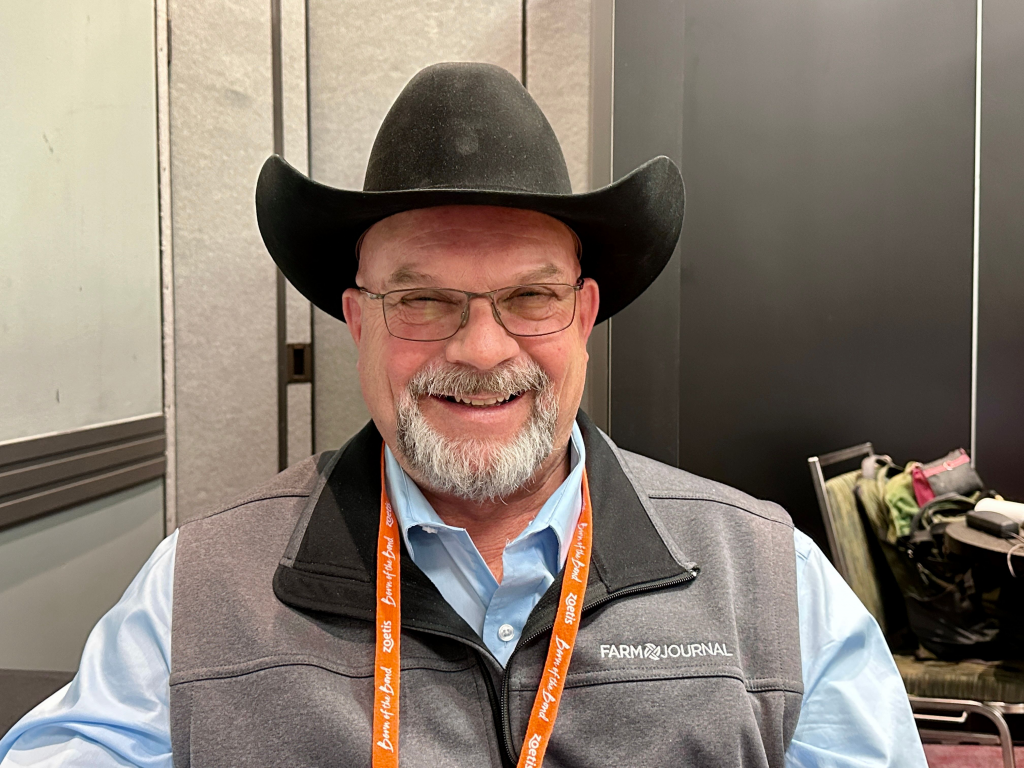
President Elect Donald Trump has wasted little time in assembling his team at the Cabinet level when he takes the oath of office on January 20, 2024. And- apparently- things have heated up in his choice for Secretary of Agriculture. That has led to a dark horse candidate gaining traction and has interviewed for the office- Jimmy Emmons of Leedey, Oklahoma.
Emmons tells Senior Farm and Ranch broadcaster with the Oklahoma Farm Report, Ron Hays, that he had been in discussions with the Trump Transition team and the Kennedy Transition Team about an under secretary USDA position in recent days-but late this week- he tells Hays he was asked to consider upping the game and submit his name for Secretary- and has been working in that direction since Thursday afternoon.
Emmons tells Hays "the (incoming) administration of Donald Trump and Robert Kennedy, Jr are trying to change the way we look at farming and practices to make the soil healthy and land healthy and to make the food healthy to make our bodies healthy- and what I have been working on these last several years have put me in that arena." He adds that he has been in negotiations- has been interviewed and he says "things are moving along. We're excited- nothing is done until it's done and we don't want to be over optimistic but things look well and we are waiting for the next step."
Emmons does believe that we are close to hearing about who might be Donald Trump's Secretary of Agriculture- and he says no matter who might be chosen- it has been an honor to have been in consideration.
Jimmy Emmons is the third generation on the family farm in Dewey County. He and his wife Ginger have been farming and ranching together since 1980. They have a diverse 2000 acre cropping operation growing wheat, soybeans, sesame, sunflowers, irrigated dairy alfalfa hay, canola, grain sorghum and several cover crops for seed.
Jimmy and Ginger also have a 250 cow/calf herd and take in yearling cattle for custom grazing on the nearly 6000 acres of native range. Ginger is the primary cattle manager in the operation. The Emmons' utilize their range and forage resources grown on the crops ground to keep the native grasses and soils healthy to maximize biological diversity and animal health.
Currently, Emmons serves as the Senior Vice President, Climate Smart Programs for the Trust in Food Initiative of the Farm Journal Foundation. Before that- Emmons served as coordinator for mentoring for the Oklahoma Conservation Commission. Prior to that, in the first Trump Administration, he was regional coordinator for USDA's Farm Production and Conservation, where he supported operational and business functions across the Farm Service Agency (FSA), Natural Resources Conservation Service (NRCS) and Risk Management Agency (RMA). He has also served as president of the Oklahoma Association of Conservation Districts and led fundraising for the National Young Farmers Education Association.
He also currently serves as the Vice President for No Till on the Plains.
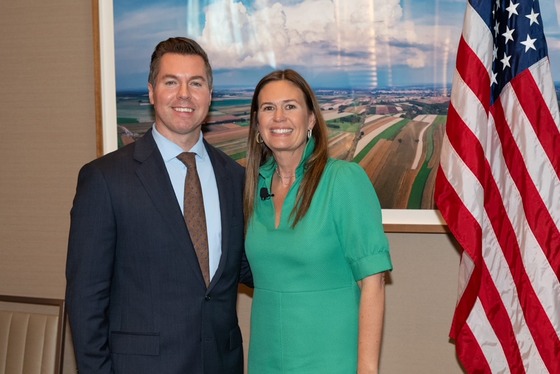
Sen. Adam Pugh and Arkansas Governor Sarah Huckabee Sanders pose for a photo at the ExcelinEd 2024 National Summit on Education.
Senator Adam Pugh, R-Edmond, chair of the Senate Education Committee, welcomed Arkansas Gov. Sarah Huckabee Sanders today at the National Summit on Education, hosted by ExcelinEd in Oklahoma City.
The event, running from Nov. 13 to 15, brought together policymakers, educators and thought leaders to discuss transformative strategies for improving education nationwide.
Governor Sanders, a strong advocate for educational reform, addressed the summit to highlight building unique and flexible academic pathways, career readiness and teacher empowerment in Arkansas and across the nation. Governor Sanders has been a champion of the importance of collaborative efforts to elevate educational outcomes for students across the region.
"It was an honor to welcome Governor Sanders at this year's summit," said Senator Pugh. "Her leadership in promoting education as the building block of all other policy measures resonates with the values we're striving for here in Oklahoma. Together, we can ensure every student is equipped for success in the classroom and beyond. I greatly appreciate the ExcelinEd team for choosing Oklahoma for this year's national conference."
Senator Pugh, a vocal proponent of improving education standards and outcomes in Oklahoma, has championed legislation aimed at expanding access to early childhood education, advancing age-appropriate literacy initiatives, increasing teacher pay and fostering partnerships between schools and local businesses.
The National Summit on Education, hosted annually by ExcelinEd, provides a platform for leaders to share policy innovations and inspire action in education reform. This year's summit featured a range of sessions on topics such as rural schools innovation, digital learning, and workforce development.
For more information about the summit, visit ExcelinEd.org.
Today, the National Cattlemen's Beef Association (NCBA) and Public Lands Council (PLC) congratulated Gov. Doug Burgum on his nomination to lead the Department of the Interior:
"Governor Burgum's experience navigating natural resources issues in North Dakota, coupled with his business acumen and extensive agriculture background, make him uniquely qualified to be Interior Secretary." said Kaitlynn Glover, NCBA Executive Director of Natural Resources and PLC Executive Director. "Ranchers across the country congratulate Governor Burgum on his nomination and are excited to see a return of common-sense and science-based analysis to Interior's rulemaking process. The Governor understands that grazing is a key tool and economic driver to prevent catastrophic wildfires, boost wildlife conservation, and support rural communities. Burdensome Endangered Species Act and NEPA rulemakings have led to the increased prevalence of wildfires, degradation of rangeland, and reduced wildlife conservation efforts. NCBA and PLC support the Governor's nomination and look forward to a swift confirmation process."
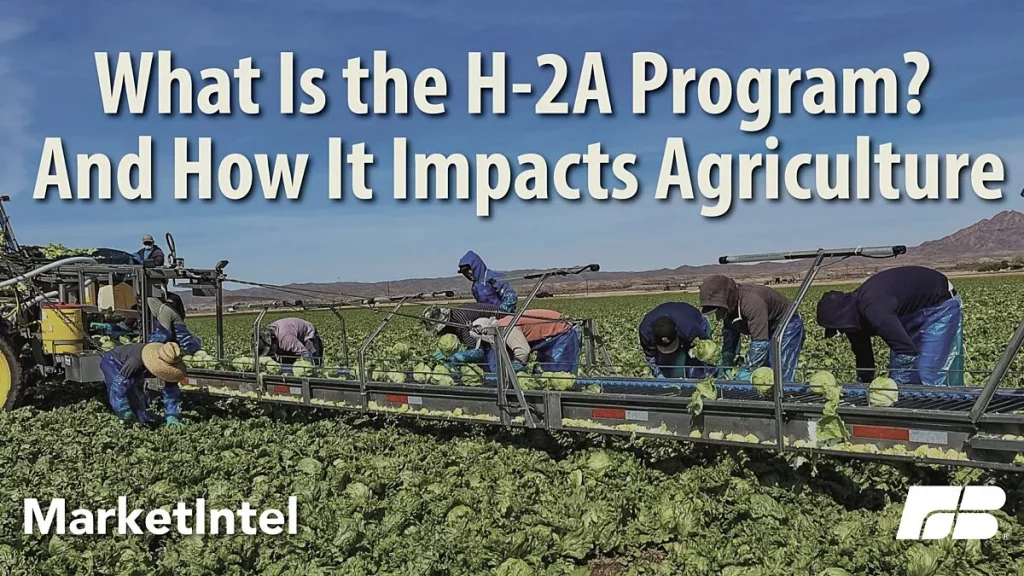
The H-2A Temporary Agricultural Workers program – commonly known as H-2A – is the leading source of temporary and seasonal farmworkers in the U.S. H-2A workers, who come from many countries but mostly Mexico, are vital to many types of farms, particularly for specialty crops that are not machine-harvested. This Market Intel addresses some of the most common myths about the H-2A program, drawing directly from the Immigration and Nationality Act (INA) that authorized the program in 1952.
1. Myth: H-2A workers stay in the U.S. long-term.
H-2A workers must "perform agricultural services of a temporary or seasonal nature." In implementing the INA, the U.S. Department of Labor (DOL) has restricted H-2A use to both seasonal and temporary work; petitions – the applications and job contracts for H-2A workers – may only last up to 10 months, but theaverage contract is only 6 months. This has created a barrier to utilizing the H-2A program for industries like dairy or nursery that experience labor shortages for more than 10 months. However, a worker who holds a H-2A visa may take different employment contracts to remain in the U.S. for up to three years, if they utilize one-year extensions. Overstaying a visa is rare – less than 2% of all nonimmigrant visa holders, of which there are over 80 programs, stay longer than the length of their visa. If over 10% of nonimmigrants from one country overstay, the entire country can be found ineligible for H-2 visa programs.
2. Myth: H-2A workers take American jobs.
The first step of petitioning to employ H-2A workers is proving that "there are not sufficient workers who are able, willing, and qualified, and who will be available at the time and place needed, to perform the labor or services involved in the petition." This is accomplished by performing domestic employee recruitment through the state's, and often surrounding states', workforce agencies. Employers must hire any American applicant – regardless of qualification – who applies before and up to halfway through the H-2A contract period. However, as discussed in previous Market Intels, the participating American domestic workforce continues to decline and to move away from agricultural work. Less than 10,000 job postings out of over 380,000 positions requested in fiscal year 2023 received an application, and when a domestic worker does apply for one of these jobs, they often do not work through the entire production window, if they show up to work at all. If an employer laid off any U.S. worker within 60 days of the petition start date, they are ineligible to petition for the H-2A program unless the domestic worker was offered and rejected the potential H-2A position.
3. Myth: H-2A workers are a form of "cheap" labor.
The certification of H-2A workers is reliant upon "not adversely affect[ing] the wages and working conditions of workers in the United States similarly employed." Rather than evaluating whether there is an adverse effect on wages, DOL pre-emptively requires that H-2A workers are paid the highest of the federal or state minimum wage, the prevailing wage rate, the collective bargaining rate, or the adverse effect wage rate (AEWR). For six job classifications, including farmworkers on crop and livestock operations – which represent 89% of H-2A certified positions – the AEWR is taken from the combined crop and livestock wage in the USDA-administered November Farm Labor Survey (FLS) of the preceding year. The 2025 AEWR will be derived from the next FLS, which will be released on Nov. 20, and will take effect immediately upon publication in the Federal Register. The national average AEWR was $17.55 in 2024. For comparison, farmworkers in Mexico earned $1.59 per hour in 2022. By coming to the U.S., Mexican H-2A workers can earn the equivalent of an entire day's work at home in one hour in California which has the nation's highest AEWR at $19.75 per hour. Regardless of how a farmworker is paid – for example, hourly versus piece rate – they must make at least the AEWR for each hour they work. For eight of the past last 10 years, the AEWR has outgrown domestic employment wages. Since 2019, the AEWR has risen an average of nearly 6% a year while other domestic wages only grew 3.7% on average.

As of March 2023, the AEWR has become even more complex. Any H-2A worker who performs a job outside of the six Standard Occupation Classifications (SOCs) included in the FLS combined crop and livestock wage – graders and sorters, agricultural equipment operators, farmworkers (both crop and non-range livestock), packers and packagers, and other agricultural workers – must now be paid full time based on the wage found in the Bureau of Labor Statistics' Occupational Employment and Wage Statistics (OEWS) mean hourly wage for the general economic conditions, regardless of how frequently they perform that job duty. Yet, the OEWS does not survey agricultural workers. Basing farmworker wages off of this survey means labor costs are being further inflated by non-related industries. While the outcome of these occupations may be similar, the qualifications and requirements differ greatly. For example, a laborer driving a truck of sugar cane from the farm to the mill on local roads must now be paid a wage based on that of commercial driver's license-holding, long-haul truck drivers.
The hourly wage is far from the only cost for employing H-2A workers. Employers must provide all transportation to and from the United States. While working in the United States, employers are also responsible for providing housing for all employees. USDA reports that housing costs approximately $9,000 to $13,000 per worker. This estimate also does not account for housing requirements that vary greatly by state and can be quite stringent. Transportation costs vary greatly depending on the H-2A worker's hometown, and with the disaggregation of wages discussed previously, the cost of transporting workers locally has increased as H-2A workers who transport others are now considered chauffeurs.
Employers are also responsible for all application fees for the labor petition and each individual worker visa. Fees are collected at each step of the application process from DOL, the U.S. Customs and Immigration Service (USCIS) and State Department. Depending on the number of positions certified, these fees can quickly climb into the thousands of dollars. As of April 1, 2024, USCIS increased their nonimmigrant worker petition Form I-129 fees substantially; most of this increase is a fee to fund an unrelated asylum program. The fee increases vary depending on the size of the employer. Small employers (under 25 full-time employees) who have not yet designated their H-2A workers saw a 65% increase in their petition fees, and fee increases are as high as 267% for large employers with named workers.

Lack of affordable labor compared to international competitors threatens the competitiveness of American products in the international market. The U.S. agricultural trade deficit reached a record $17.1 billion in fiscal year 2023 and is forecasted to continue expanding. This trade deficit is driven largely by specialty crops and other horticultural products, which account for 49% of all imports by value. Domestic specialty crop production, defined as fruit, vegetables and nursery crops, is reliant on H-2A workers. Labor is the number one expense in specialty crop production, accounting for 38 cents of every dollar spent on farm expenses. Ballooning labor costs threaten the viability of specialty crop farms nationwide. Farms that are unable to produce because of labor shortages face production cuts and decisions over whether to shut down. This could avalanche into major losses for rural communities and economies. If fruit and vegetable production continues to decline domestically due to lack of affordable labor, this will further worsen agricultural trade deficits.
4. Myth: H-2A is only used by large employers.
H-2A workers are vital to farms of all sizes. Over two-thirds of H-2A petitions request fewer than 10 temporary workers. Forty-five percent of all H-2A jobs are found in contracts containing between 10 and 99 workers. While some employers may submit multiple positions over a fiscal year, only 1% of all employers employ over 500 employees.

However, because of the growing complexity of H-2A rules and paperwork, there has been a rise in the use of farm labor contractors (FLC). These companies employ more workers, whom they apply for, pay and house, that are then sent to different farms to work. FLCs give farmers access to temporary guestworkers to alleviate labor shortages without having to navigate the H-2A process themselves. In 2020, over 40% of H-2A jobs were employed by FLCs. The rise of FLCs, however, means additional costs to farmers and less direct oversight into the well-being of their employees.
5. Myth: H-2A is a small fraction of the ag labor force.
According to the 2022 Census of Agriculture, over 2.1 million people were hired farm employees, spanning all commodities, jobs and length of employment. In fiscal year 2024, 378,513 H-2A positions were certified, equal to 17% of the total agricultural workforce. In labor-intensive industries such as fruit, vegetable and nursery/greenhouse production, the share is even higher. Nearly 600,000 fewer people were hired to work in agriculture between the 2012 and 2022 censuses. At the same time, the number of H-2A positions certified grew 15% a year on average in those 10 years, going from 85,248 positions in 2012 to 371,619 positions in 2022. The H-2A program is one of the few visa programs without a cap. As the number of H-2A workers continues to grow, so does these workers' importance to American agriculture.
6. Myth: H-2A workers have no legal protections.
Employers must provide workers with an overview of their rights under the H-2A program in the language most commonly understood by their workers. H-2A employers are subject to state and local guidelines for workplace compensation and safety. Regardless of local requirements, all H-2A employees must be provided with workers' compensation insurance. H-2A workers are also subject to state overtime wage rules. With the elevated labor costs discussed above, this can result in more employees working less hours so employers can avoid paying overtime wages. However, H-2A workers are protected from employment loss with the "three-fourths guarantee." This protection requires that employers pay workers for at least 35 hours per week for the entire length of the job contract, even if the work is completed in fewer hours. If the employee works less than three-fourths of the workdays on the contract, the employer must pay the difference to meet the guarantee.
H-2A employment is also subject to safety inspections and state safety standards. Housing must conform to "local standards for rental and/or public accommodations or other substantially similar class of habitation." These accommodations are inspected by Occupational Safety and Health Administration (OHSA) employees to ensure compliance. Other safety standards include state heat illness prevention rules, first aid requirements or water access.
Violations to any H-2A provisions are handled through the DOL Office of Foreign Labor Certification (OFLC) Ombudsman Program. Concerns are filed with OFLC and investigated at no charge to the filer. The program provides impartial remediation between parties to discuss events of interest. Workers are protected from retaliation or discrimination resulting from a complaint filing, legal inquiry or testifying in a proceeding. Workers may also assert their workplace rights for themselves or others with the same protections from intimidation or discrimination.
7. Myth: The H-2A program must be working great for farmers based on its popularity and growth.
The H-2A program is crucial to helping combat the labor shortages plaguing the agricultural industry. Recent growth in the H-2A program is reflective of declining labor across the economy as the domestic American labor force shrinks.
While the program is vital to agriculture, it could be improved. The costs and administrative burdens associated with the program weaken the practicality of utilizing the program for many farmers. While these costs must be borne in the short run, they change the economics of farming, and risk making many American farmers uncompetitive with imports from low-wage countries.
With eased administrative burdens and lower costs, it is likely that use of the H-2A program would grow even faster than it has been in recent years. As the domestic workforce continues to move away from manual labor, foreign labor sources will become more crucial to maintaining domestic food, fiber and fuel production.
Previous Market Intel Coverage of H-2A
Various components of the H-2A program have been detailed in previous Market Intels – program usage (H-2A Growth Slows, But Remains Strong; Reviewing 2021 H-2A Participation and Potential 2022 H-2A Wages), wage updates (2024 H-2A AEWRs On Their Way (Up); Examining the 2023 AEWR) and new rules (AEWR Methodology Change a Blow to Growers).
For USDA's comprehensive guide on applying for the H-2A program, please visit: https://www.farmers.gov/working-with-us/h2a-visa-program
Three years ago, on November 15, 2021, President Biden signed the Bipartisan Infrastructure Law, making a historic investment in America's infrastructure and competitiveness. Since being signed into law, it has been instrumental in transforming the lives and livelihoods of farmers, ranchers, small businesses and communities nationwide.
Through this landmark legislation, the U.S. Department of Agriculture (USDA) is bringing economic opportunity, telemedicine and distance learning to rural America, with investments in high-speed internet; protecting and making communities more resilient to wildfires by restoring forests and investing in the wildland fire workforce; and supporting innovative solutions to the many environmental, economic and social challenges faced in communities across the nation.
"For three years, USDA has been working diligently and efficiently to ensure the historic resources from the Bipartisan Infrastructure Law reach communities nationwide," said Agriculture Secretary Tom Vilsack. "Thanks to the Biden-Harris Administration's Investing in America Agenda, we are protecting more communities and natural resources from wildfire, connecting rural areas to high-speed internet, and improving watershed management and flood protection, making historic investments in these efforts."
In the three years since the Bipartisan Infrastructure Law (BIL) was signed into law, USDA has delivered funding to historically underfunded and backlogged programs. The funding has also allowed for the development of new programs, which listen to local voices, include underserved communities, and focus on responding directly to community needs.
Reducing Wildfire Risk and Supporting Rural America
With nearly $5.5 billion from the Bipartisan Infrastructure Law, USDA is reducing wildfire risk and restoring healthy, resilient and productive forests while improving economic, environmental and recreation infrastructure. Listening to local voices, USDA has taken historic strides in fighting climate change, growing sustainable forest economies and supporting wildland firefighters. The Forest Service has:
Connecting Communities through High-Speed Internet
The Bipartisan Infrastructure Law has been helping to close the digital divide in rural America by building, improving, and acquiring the facilities and equipment needed to deliver high-speed internet through the ReConnect Program. High-speed internet connects rural communities to jobs, telemedicine and distance learning, farmers with new technologies and the real-time information they need to stay competitive, and helps small businesses develop their markets.
Since 2021, USDA has invested over $2.2 billion for 120 ReConnect projects from Bipartisan Infrastructure Law funding to expand high-speed internet access to hundreds of thousands of people through broadband loans, grants and loan/grant combinations. Examples include:
Bipartisan Infrastructure Law projects are now under construction and even turning on across the country, connecting rural communities to high-speed internet for the first time. Since the beginning of the Biden-Harris Administration, the Department has invested more than $4 billion for 345 ReConnect projects that will bring high-speed internet access to more than 600,000 people in the most rural and remote areas of America.
Improving Watershed Resilience
The Bipartisan Infrastructure Law provided USDA's Natural Resources Conservation Service (NRCS) with $918 million for projects focused on previously underserved communities, and include building new dams, flood prevention projects and improving watershed infrastructure. In the first two years, NRCS investments include:
USDA touches the lives of all Americans each day in so many positive ways. In the Biden-Harris administration, USDA is transforming America's food system with a greater focus on more resilient local and regional food production, fairer markets for all producers, ensuring access to safe, healthy and nutritious food in all communities, building new markets and streams of income for farmers and producers using climate smart food and forestry practices, making historic investments in infrastructure and clean energy capabilities in rural America, and committing to equity across the Department by removing systemic barriers and building a workforce more representative of America. To learn more, visit www.usda.gov.
At the National Association of Farm Broadcasters Convention, Farm Director KC Sheperd visited with Ian Loar at the Farmer's Business Network's booth. FBN is celebrating its tenth year of business.
"We deliver crop production inputs, lending solutions, sustainable grain marketing, and risk management solutions for farmers," Loar stated. "We are up to a hundred thousand members now."
FBN's 8th Annual Cyber Sale kicked off this month and offers zero percent interest on input purchases.
"At FBN, we have a history of providing a tremendous amount of transparency regarding pricing in the marketplace and input trends," Loar added. "This year, crop protection pricing is back to all-time lows, and looking forward into 2025, there is some uncertainty on the horizon so our advice is to start hedging some of that risk."
He emphasized that the zero percent interest rate on input purchases being offered by FBN this month is a great way to lock in those input costs and relieve some of the uncertainty about next year.
He pointed out that interest rates have stayed relatively high. "The federal government has given us some relief recently, and there could be more on the horizon, but compared to interest rates two or three years ago, it is still taking a much bigger piece out of anybody's operating budget than it historically has."
He encouraged farmers to visit fbn.com to see for themselves how much the platform offers. "We have a full suite of analytics available to help you with recommendations regarding hybrid selection, and just making educated decisions on how and when to purchase inputs or market grain," he said.
| |||||||||||||||||||||||||||||||||||||||||||||||||||||||||||||||||||||||||||||||||||||||||||||||||||||||||||||||||||||||||||||||||||||||||||||||||||||||||||||||||||||||||||||||||||||||||||||||||||||||||||||||||||||||||
| |||||||||||||||||||||||||||||||||||||||||||||||||||||||||||||||||||||||||||||||||||||||||||||||||||||||||||||||||||||||||||||||||||||||||||||||||||||||||||||||||||||||||||||||||||||||||||||||||||||||||||||||||||||||||
|
Today, Nov. 15, on America Recycles Day, the U.S. Environmental Protection Agency is highlighting progress achieved on actions in its "National Recycling Strategy" through implementation of the Bipartisan Infrastructure Law. As a key agency in the Biden-Harris administration's efforts to build a circular economy, EPA is joining the White House to recognize America Recycles Day with a Presidential Proclamation. Since 1997, EPA has celebrated the nation's progress on recycling, and this year, EPA is encouraging organizations and individuals to continue expanding the ways they reduce, reuse and recycle. Together with investments from the Bipartisan Infrastructure Law, EPA's work has helped to transform recycling and solid waste management across the country while creating jobs and strengthening the nation's economy.
"President Biden's commitment to upgrading our nation's recycling infrastructure has supported local economies, created good-paying American jobs, and provided stronger public health protections for communities across our nation," said EPA Administrator Michael S. Regan. "As we celebrate America Recycles Day, let us remember that recycling is a simple and effective way to make a difference."
Thanks to the historic Bipartisan Infrastructure Law signed three years ago today, EPA received the largest recycling investment in 30 years to fund the Solid Waste Infrastructure for Recycling (SWIFR) and Recycling Education and Outreach (REO) grant programs. These recycling grants tackle consumer confusion and outdated recycling infrastructure, the largest barriers to proper recycling, and support implementation of EPA's "National Recycling Strategy." The 164 grants EPA has selected so far are also an investment in overburdened communities where waste management facilities are most concentrated – 156 of these grants are already awarded – 56 to states and territories, 24 through REO, 24 to communities, and 52 to Tribes and Intertribal Consortia. As a result of SWIFR funding, several states are conducting their first-ever solid waste management plans and waste characterization studies, and some are creating market development strategies.
One of the most effective ways to protect the environment is to reduce waste. The United Nations' International Resource Panel found that natural resource extraction and processing contribute to over 55% of all global greenhouse gas emissions driving climate change. EPA's focus is on preventing waste through reduction and reuse strategies and supporting a circular economy, an approach that keeps materials and products in use for as long as possible.
In June of 2024, EPA released a joint "National Strategy for Reducing Food Loss and Waste and Recycling Organics" with the U.S. Department of Agriculture and Food and Drug Administration to prevent the loss and waste of food and increase the recycling of organic materials, reduce greenhouse gas emissions, save households and businesses money, and build cleaner communities. Additionally, EPA published reports analyzing and quantifying the impacts of wasted food.
EPA also recently hosted working sessions to develop best practices and battery labeling guidelines to increase battery recycling—one of EPA's latest efforts to reduce landfill waste and recover valuable materials from used products. The best practices and guidelines aim to increase the collection and recycling of used consumer electric and portable batteries, vehicle batteries, and storage and industrial batteries.
In September 2024, EPA announced additional SWIFR funding opportunities for Tribes and intertribal consortia and communities, as well as additional funding through the REO grant program. EPA anticipates announcing additional SWIFR funding for states and territories next year. These grants are covered programs under the Justice40 Initiative, which aims to deliver at least 40% of the overall benefits of certain federal climate, clean energy, affordable and sustainable housing, clean water, and other investments to disadvantaged communities.
Next, EPA is planning to publish the final "National Strategy to Prevent Plastic Pollution," part three of the series on building a circular economy. In this latest strategy, EPA will share actions that governments, businesses, non-profits, and communities can take in the U.S. to eliminate the release of plastic waste into the environment and reduce the U.S. contribution to plastic pollution.
EPA offers many free, online resources, including:
Visit the EPA recycling webpage to learn more ways to reduce, reuse and recycle.
Senior Farm and Ranch Broadcaster, Ron Hays, spoke with the Vice President of Governmental Affairs at the National Cattlemen's Beef Association, Ethan Lane about what needs to happen in the lame duck session. In yesterday's BeefBuzz, they talked about the impacts of Trump's popular vote on the cattle industry.
Hays explained that, in congressional terms, a lame duck session is the period of time between the November election and the reorganization of congress in early January of the next year. Lane listed the unfinished items of business as the farm bill,
"If I am a Democrat in the House or Senate, my prospects for a reasonable farm bill don't get better next year," Lane said. "They were steadfastly refusing to talk about anything to do with G.T. Thompson's bill up until now, but I would be shocked if there wasn't just a little more interest in a lame duck conversation on getting that bill moved."
Lane admitted that he isn't sure if there is enough bandwidth to get that done in the lame duck session, but the resolutions of leadership changes, such as Senator John Thune's election as Senate Majority Leader, clears things up for greater progress of such issues.
Conversely, Republicans, who now hold the majority, are going to be looking at all of the possibilities they will have through control of both houses of congress for the next two years.
"I anticipate this now being a less tumultuous lame duck," Lane said. "Even as far as days on the calendar. Congressional Review Act action is now possible. We haven't seen that since 2016, when Trump came in. That is based on sixty legislative days from the time when regulation is promulgated, which means, if they gavel out early, that puts more days back on the clock and sends that back into last Spring a few extra days. All of that is now going to have to be factored in to how we use this time over the next few weeks in lame duck before they gavel out and go home for Christmas."
The bipartisan ag sector is now united behind the farm bill that they all support and are anxious to get it through and finished.
"G.T. Thompson has done phenomenal work here. Let's take advantage of it, and put this thing to bed," Lane encouraged. Hays and Lane detailed the possibility of Thompson becoming the next Secretary of Agriculture, an appointment which Lane fully supports. Click the soundbar above to hear the complete conversation.
Lane said that priorities for 2025 will be encompassed by a strong desire to show productivity from the Republican majority in the House and Senate.
"On the minds of a lot of farmers and ranchers around the country are going to be those tax provisions that expire at the end of 2025," he commented. "There have been conversations about if this day were to come, what does it look like to get that tax package renewed early in the 119th Congress, whether that be through budget reconciliation or something else. I think that has to be bubbling to the top of everybody's priority list very quickly. There's no need to let that one go to the end of the year. Time kills all deals, in my opinion, and this one wouldn't be any different."
He believes that there will be a lot of interest in the Congressional Review Act within the first few weeks of the new Congress. As far as the Senate goes, they will have their hands full with 1,200 new congressional confirmations and 2,800 new appointees. The renewal of government funding will also be a high priority early in the year as it expires on December 20, 2024.
The Beef Buzz is a regular feature heard on radio stations around the region on the Radio Oklahoma Ag Network and is a regular audio feature found on this website as well. Click on the LISTEN BAR for today's show and check out our archives for older Beef Buzz shows covering the gamut of the beef cattle industry today.

America's largest organization exclusively representing independent cattle and sheep producers, R-CALF USA, has endorsed the Protecting Agricultural Spaces Through Effective Ranching Strategies (PASTURES) Act (H.R.10042).
The bill, introduced on Oct. 25, 2024, by U.S. Rep. Harriet Hageman (R-WY), will limit the U.S. Department of Agriculture (USDA) and the U.S. Department of the Interior (DOI) from penalizing landowners with private property adjacent to certain federally managed lands for livestock trespassing after grazing allocations are adjusted or rescinded.
The legislation will also prevent penalties upon livestock owners for livestock grazing on certain federal lands where a fence to prevent such grazing does not exist, and it will place responsibility on the USDA and DOI for the construction and maintenance of fencing that prevents grazing on covered federally managed lands.
"The first step in restoring grazing to federally managed lands is to stop the federal government from its ongoing practice of systematically reducing or eliminating grazing where it was historically recognized as beneficial," said R-CALF USA CEO Bill Bullard. "The PASTURES Act helps accomplish this by placing the cost burden for livestock removal where it belongs, which is not on the backs of independent livestock producers."
Press Release provided by R-CALF.
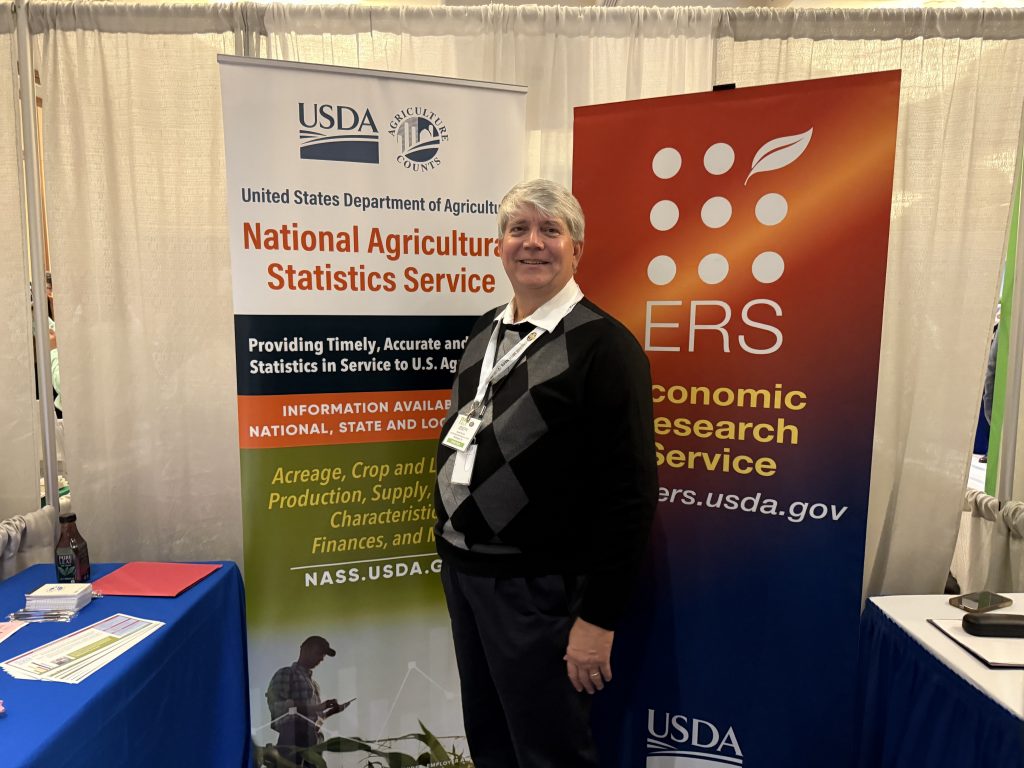
While attending the National Association of Farm Broadcasters Convention, Farm Director KC Sheperd spoke to the Associate Administrator of USDA's National Agricultural Statistics Service, Joe Prusacki, about current events in the organization.
Early this year, the 2022 Census of Agriculture was released to provide comprehensive data on the agricultural economy down to the county level. Since its release, State and County Profiles, Congressional Districts, and Zip Code Tabulations have also been released.
Coming up in the spring of 2025, the Agricultural Resource Management (ARM) Survey will be released which NASS partners with the Economic Research Service to conduct. The survey's goal is to gauge the economic health of the farmer, but this year, it will be different. In conjunction with the Census of Agriculture, it will be called the Tenure Ownership And Transition of Agricultural Lands (TOTAL) Survey.
"The idea is that normally, we collect information from producers, but a lot of producers rent land," Prusacki explained. "What we do with this TOTAL Survey is collect information from the landlords because, in many cases, there are contributions to the farming entity from landlords that are not necessarily captured any other place. It's been ten years since we last did this, and it gives us a snapshot of the landlord and operator relationship."
The end-of-year Agricultural Survey will be released soon to gather data on spring-planted crops' yield production, and January's survey will be about cattle.
The information gathered in these surveys is not only important to NASS, but also to their partners at the Economic Research Service. NASS works with the Farm Service Agency on cash rents. They coordinate with NRCS on the Conservation Effects and Assessment Program (CEAP).
"We are collecting information for a lot of groups so a lot of people have access to information," Prusacki commented. "Right now, in farm country, we have relatively low commodity prices, and collectively, we need to be able to make better decisions. You need information to make better decisions. I know it is sometimes tedious to fill out these surveys, but that is the only way we have to gather information to make better decisions for everybody."
The information provided on these surveys is confidential. Federal law prohibits the sharing of information under the threat of a $250,000 fine or ten years in prison.
"We will never publish data such that identifies who the data was provided by," he assured. "For example on the Census of Agriculture, if we have information that points to the cattle ranch that everyone knows is the largest cattle ranch in the county, we won't publish the whole county because somebody will know."
To see information that has been published, visit the website at www.nass.usda.gov or contact your state statistician (Troy Marshall in Oklahoma) or regional director.
RON's Dave Lanning has a pre-opening look at today's agricultural Markets.
Click the audio tab below for today's report.
Senator John Thune (R-SD) was elected as the next Senate majority leader this week as the chamber looks ahead to January. The United States Cattlemen's Association (USCA) extended its congratulations to Senator Thune with the following statement:
"USCA has a long working relationship with Senator Thune and his office, and we look forward to working with the Senator as he takes on the position of majority leader," President Justin Tupper said. "As a native of South Dakota, it is exciting to see our state represented at this level. We know the Senator will continue to fight on behalf of ranchers as he has done now for so many years and we are ready to support him as he takes on this new role."
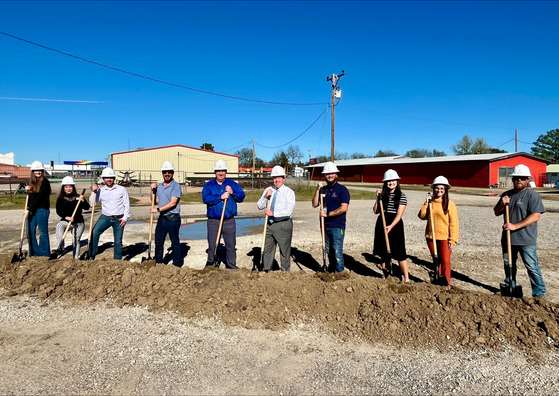
Ten projects totaling $29.8 million for high-speed internet expansion were officially launched Thursday afternoon in Coalgate in southeastern Oklahoma by the Oklahoma Broadband Office (OBO) and Chisholm Broadband.
The projects, funded through $23.8 million in federal grants administered by the OBO coupled with $6 million in matching funds from Chisholm, will connect 2,046 homes and businesses with broadband internet using fixed wireless service. The award from ARPA State and Local Fiscal Recovery Funds (SLFRF) was made earlier this year by the Oklahoma Broadband Governing Board.
Thursday's event is but one example of the progress being made statewide to get high-speed internet access to all Oklahomans. The Chisholm projects are in Alfalfa, Beckham, Choctaw, Coal, Grant, Greer, Harmon, Latimer, Major, and Roger Mills counties.
OBO and Chisholm officials, along with local officials and legislators attended the event in Coal County.
"Today's launch is more than just building towers – it's the foundation for opportunity, growth, and connectivity in every corner of Oklahoma. With each mile of broadband we expand, we're not just bridging a digital divide, we're empowering our communities for a brighter, more prosperous future," said OBO Executive Director Mike Sanders.
"Our mission to bring internet connectivity to unserved and underserved areas in rural Oklahoma is about more than access – it's about creating opportunity. We want rural towns to thrive, not just survive, by empowering them with the tools they need for growth, innovation, and a stronger future," said Michelle Yirka, Senior Vice President/Business Development, Chisholm Broadband
ARPA-SLFRF-awarded grant projects will result in some 50,000 homes and businesses statewide being served with affordable and reliable high-speed internet. But the growth of broadband access across Oklahoma is just beginning.
This fall, the Governing Board gave tentative approval to more than $158 million in ARPA Capital Projects Fund grants to 12 internet service providers for 50 projects in 28 counties.
Now, ISPs are competing for more than $750 million in additional grant funds through the Broadband Equity Access and Deployment (BEAD) program. With tens of thousands of locations to be served through OBO administered programs, the office is on pace to complete its mission of achieving statewide coverage.
This week on SUNUP, OSU Agriculture Economist Dr. John Michael Riley discusses the highs and lows of current grain and cotton markets after the World Agriculture Supply and Demand Estimates Report was released last week.
He said that soybeans earned the headline of the day when its 51.7 bushels per acre yield was reported, down 1.4 bushels per acre from a month ago and 1.1 lower than expected. Ending stocks were 470 million bushels, down 80 bushels from a month prior, and 62 bushels lower than expected.
"We were thinking that would happen because of the dryness across the Midwest and the corn belt," Riley said. "As the numbers were coming in, we were seeing the numbers drop."
Corn earned the subtitle when USDA reported 183.1 bushels per acre, down 0.7 bushels from the previous month, and 0.6 bushels lower than the trade. Reported ending stocks 1.938 billion bushels, down 61 million bushels from last month, and 8 million lower than the trade expected.
"Trade was largely expecting USDA to keep the corn yield at the previous month, but it was adjusted lower for the same reasons as soybeans," Riley added.
Wheat reported 815 million bushels of ending stocks, slightly up from a month ago.
This week on SUNUP:
Oklahoma Agriculture Starts at SUNUP!
Weekly Statewide Broadcast: Saturday at 7:30 a.m. & Sunday at 6 a.m. on OETA (PBS)
Stream Anytime: YouTube.com/SUNUPtv
Senior Farm and Ranch Broadcaster, Ron Hays, spoke with the Vice President of Governmental Affairs at the National Cattlemen's Beef Association, Ethan Lane about the presidential election.
President-Elect Trump was the first Republican presidential candidate in twenty years to win the popular vote, and Lane said that the political realm is still digesting the implications of that outcome.
"What do those new voters to the Republican tent view as priority? Are they aligned with more traditional Republicans or our rural Republican voter?" Lane mused. "What kind of impact will that have on this new Trump administration? This isn't 2016 when they were figuring out where the light switches are. These folks know where to go, and what they wish they would have done last time. It's going to be interesting to see what sort of mandate we will see coming out of this vote really means for Donald Trump and his administration moving into the next couple of years,"
Trump earned high percentages of various unexpected voting groups like Hispanics, women, and African American men. "We are in a new world here," Lane said. "It is not aligned with those traditional party lines."
In the past, the cattle industry has relied on the idea that the average Republican elected official will have a positive view of agriculture; however, Lane says that producers can't take that for granted anymore.
"I'm not saying that I don't think Donald Trump supports agriculture," Lane clarified. "He absolutely does, but some of this group that brought him into office doesn't trust where their food comes from. Beyond that, what does it mean to have a president who is going to take a much more libertarian view of some of this stuff."
The idea that we are going to return commerce to the United States is a paradigm that can be applied to agriculture. Lane asked how those principles might apply to transporting livestock across state lines, truck weight issues, or marketing meat across state lines.
Rumors speak of Elon Musk and Vivek Ramaswamy joining the administration as part of a non-governmental department, labeled the Department of Government Efficiency (DOGE) focused on downsizing the imprint of the Federal government while increasing its efficiency.
"Certainly, in the cattle industry, we have never been accused of thinking that we needed to add anything to the federal government, so I can see some areas where we are probably going to be aligned with that. However, the devil is in the details. There are things that need to be done to have safe food, and that we can still get some of that food overseas. We still make $400 plus on every fed carcass from exports, so doing things that prevent our ability to put that beef in front of consumers around the world is something that we won't be terribly interested in."
Lane emphasized the importance of educating politicians on the nuances of the cattle industry and what the average cattle producer relies on to sell their calves at a profit.
The Beef Buzz is a regular feature heard on radio stations around the region on the Radio Oklahoma Ag Network and is a regular audio feature found on this website as well. Click on the LISTEN BAR for today's show and check out our archives for older Beef Buzz shows covering the gamut of the beef cattle industry today.
The Patrick Leahy Farm to School Grant Program is designed to increase the availability of local foods in schools and connect students to the sources of their food through education, taste tests, school gardens, field trips, and local food sourcing for school meals. Grants can launch new farm to school programs or expand existing efforts.
On an annual basis, USDA awards competitive Farm to School grants that support planning, developing, and implementing farm to school programs. USDA's Farm to School grants are an important way to help state, regional, and local organizations as they initiate, expand, and institutionalize farm to school efforts.
Applicants may decide which grant track best suits their project. This year the RFA has been split into three separate solicitations. Please note, applicants can only submit one application across the three solicitations listed below. If multiple packages are submitted through Grants.gov by the same applicant to more than one solicitations, ALL submissions will be removed.
The objective of the Farm to School Implementation Grant is to improve access to local foods in eligible CNP sites through comprehensive farm to school programming that includes both local sourcing and agricultural education efforts. Project proposals should incorporate both elements of the required objective.
The FY 2025 Farm to School Implementation Grant awards projects of 24 months in length for funding up to $500,000. Applicants are required to provide matching support of at least 25 percent of the total project budget in the form of cash or in-kind contributions.
Eligible applicants for the Implementation grant may include schools and other institutions that operate child nutrition programs, Indian Tribal Organizations, agricultural producers or groups of agricultural producers, non-profit entities, and local agencies.
Entities not meeting the eligibility definitions will be deemed ineligible and removed from competition without further consideration. The following are eligible entities for the FY 2025 Farm to School Implementation Grant, which are described in more detail in the RFA.
The objective of the Farm to School Turnkey grants is to simplify the proposal-writing process by providing pre-designed activities to simplify applications for frequently proposed farm to school projects. However, it is important for all prospective applicants to read the RFA in full to ensure that they understand all submission requirements.
There are three Turnkey Grant project tracks available in 2025: Action Planning, Agricultural Education, and Edible Gardens. Applicants may only apply to one project track. The project types are summarized as follows:
All applicants must demonstrate a commitment to one or more federal child nutrition program(s).
The FY 2025 Farm to School Turnkey Grant awards projects of 24 months in length for funding up to $50,000. Applicants are required to provide matching support of at least 25 percent of the total project budget in the form of cash or in-kind contributions.
Eligible applicants for the Turnkey Grant may include schools and other institutions that operate child nutrition programs, Indian Tribal Organizations, agricultural producers or groups of agricultural producers, non-profit entities, and local agencies.
The following are eligible entities for the FY 2025 Farm to School Turnkey Grant, which are described in more detail below.
For additional information please see the Patrick Leahy Farm to School Grant Program website.
To apply, visit Grants.gov and follow the instructions found in each FY 2025 RFA.
The Oklahoma Farm to School Program wants to make selling food to Oklahoma's Child Nutrition Programs easy and help facilitate a partnership between producers and schools. No matter where you're located in Oklahoma, schools and care centers are nearby looking to source locally produced food for their menus and cafeterias. Farm to School is a great avenue for farmers to explore. It increases market opportunities for farmers, ranchers, food processors, and food manufacturers.
Any conservation discussion will include cover cropping and conservation tillage use at the forefront. According to the 2022 Census of Agriculture, conservation tillage, including no-till, is used on 53% of America's cropland, making it the most-used conservation practice. Meanwhile, cover crops are planted on just under 5% of all cropland, and adoption is more regionalized, highlighting the challenges that come with adopting this management system. So, what drives the focus on cover cropping? And why do these two practices steal the spotlight in conservation-related policy?
Cover Cropping
Cover cropping involves growing various plant varieties between cash crop rotations to ensure continuous soil coverage. This practice improves soil water infiltration, builds soil organic matter, prevents soil erosion, restores soil nutrients and manages pests by increasing root channels, plant diversity and soil cover in fields.
Under USDA definitions, cover crops are not harvested and sold (except for forage in limited emergency circumstances) but are terminated in various ways including natural frost, burning, applying herbicides, and flattening ("rolling") or tilling them before planting the primary crop. Termination methods must be carefully considered as all these approaches have risk. Frost may not kill the plant, causing competition with the primary crop; burning can sacrifice much of the soil health and carbon retention benefits of cover cropping; using herbicides comes with the risk of adding to herbicide-resistant weed populations; and rolling or tilling can worsen soil compaction.
Cover crops are incentivized through various USDA-Natural Resources Conservation Service (NRCS) programs such as the Environmental Quality Incentives Program (EQIP) and Conservation Stewardship Program (CSP), programs that fund cover crop adoption and set guidelines for practice management. While USDA-Risk Management Agency (RMA) does not financially cover the planting of cover crops, the agency includes cover crop usage among allowed Good Farming Practices (GFP) as of 2024. Farmers must employ GFPs to receive full indemnity payments to prevents farmers from incurring crop insurance compensation due to management-induced yield losses. Until December 2023, NRCS conservation practices were not considered GFPs if they negatively impacted crop growth, so short-term yield effects while fields adapted to cover cropping could be penalized under RMA insurance requirements. Including NRCS conservation practice procedures in the updated 2024 GFP guidelines removes one barrier to cover crop adoption for RMA insurance users.
Cover crops financed under NRCS programs may be used as extra livestock forage either through grazing or cutting for hay or silage – which in this case may be sold. However, haying and grazing are limited if the farmer is participating in the RMA summer fallow program or the state-focused EQIP Soil Health Initiative. Keeping track of these differences between agencies and program requirements adds a hurdle for participating farmers.
Double Cropping
Double cropping differs from cover cropping only in that both commodities grown are harvested for money at different points in the year – for example corn and winter wheat. Double cropping provides many of the same benefits as cover cropping – continuous soil coverage, living root systems and nutrient building. By growing more food, fiber and fuel on existing cropland, this practice also increases farming productivity. Yet, double cropping is not considered a conservation management practice under USDA program eligibility.
Cash crops, including those grown through double cropping, are eligible for RMA insurance policies. The distinction between "cover cropping" and "double cropping" prevents double payment from USDA for the same field activity as a field growing cash crops year-round is under continuous insurance coverage. RMA expanded their double cropping coverage area in 2023 to encourage increased food production, recognizing the benefits of continuous cash crop production.
While both provide conservation benefits, the arbitrary differences between double cropping and cover cropping can affect the management decisions of farmers attempting to provide continuous soil coverage. If farmers hope to make a monetary return on their decision to continuously cover their field (the goal of cover cropping) by planting a valuable crop such as wheat outside of their typical crop rotation, they are not being recognized for their contributions to conservation efforts. Double cropping acres are not explicitly recorded in the Census of Agriculture. Instead, the same acres on which two crops are grown are counted to the total harvested acres of each individually, meaning that the total number of harvested cropland acres in the census adds up to more than the total acres of U.S. cropland used for production. The administrative distinctions between double cropping and cover cropping thus prevent us from tracking the true number of acres that are benefiting from the soil health advantages of continuous plant coverage.
Tillage
Tillage is traditionally used to loosen the soil and remove surface residue to improve seed planting. Conservation tillage – either no-till or reduced tillage – reduces soil disturbances that cause soil compaction or reduce soil cover, which can both exacerbate erosion. Conservation tillage limits soil compaction from tire pressure by reducing the amount of times machinery is driving over the field to prepare for planting. Instead of clearing the field cover to plant directly into the soil, conservation tillage methods create channels through previous years' biomatter to plant seeds, moving as little soil as possible. No-till requires planters that cut into the soil and deposit seeds directly into the ground while other minimum tillage practices like strip till, ridge till and mulch till keep at least 30% of the soil surface covered in plant residue. The practice also reduces carbon emissions by reducing the amount of equipment passes on each field; according to USDA's estimate, between 2013 and 2016 conservation tillage reduced fuel use by 763 million gallons per year which reduces carbon dioxide emissions by 8.5 million tons.
Used individually or in conjunction with each other, cover crops and conservation tillage cover all the pillars of soil health management: minimize soil disturbance, maximize soil cover, maximize biodiversity and maximize the presence of living roots in the soil.
National Adoption
Total land farmed in the U.S. is down over 20 million acres in 2022 compared to 2017, when the previous Census of Agriculture was conducted. However, acreage for all three practices – conservation tillage, no-till and cover cropping – increased between the two censuses, now reaching 25%, 28% and 5%, respectively.
The Inflation Reduction Act committed $19.5 billion over five years for USDA conservation programs with climate change mitigation benefits. NRCS made its largest commitment of assistance under these programs in 2023 with over $2.8 billion spent on more than 45,000 contracts. Some of these programs include conservation easement development, technical assistance for in-field training, the Regional Conservation Partnership Program (RCPP) to collaborate with partners and on-farm practice funding through EQIP or CSP. Individual practice adoption was tied to $1.4 million in outlays in fiscal year 2024 for over 330,000 new conservation practice uses. Cover cropping is the fifth-most-used practice under obligated contracts in fiscal year 2024. Conservation tillage contracts do not make the top 30 practices supported under these programs, showing a slowdown in adoption growth.
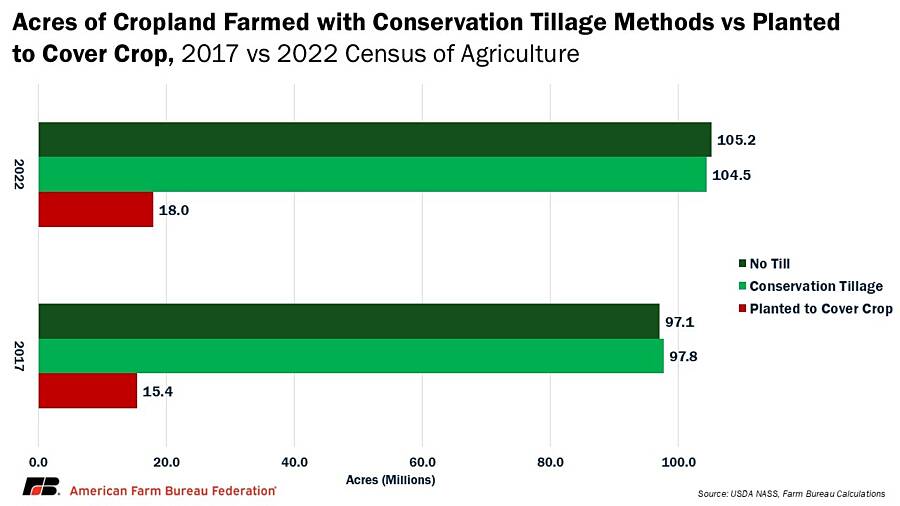
Cover cropping was used on just under 18 million acres nationwide, a nearly 17% increase between 2017 and 2022 – double the growth rate of conservation tillage methods. Cover crop adoption is largely driven by regional shifts as weather conditions, water availability and soil type all impact regional suitability for cover crops.
Challenges
As with any new (or newly appreciated) technology, acceptance of conservation practices can take time. Farmers' attitudes toward risk, social acceptance, expectations of effort, the local soil and weather conditions, and the length of time before soil health benefits can provide bottom line benefits can all affect the likelihood of adoption, and none of these practices is likely to reach 100% adoption.
Cover cropping and conservation tillage both have technical limitations. Farmers' primary concern with conservation tillage is increased pest presence as tillage typically serves to eradicate weeds and other pests. If significant residue is left from the previous year's crop, it may also be difficult to cut through to plant the next crop. Special no-till planters are required to cut through this residue, which can be a substantial initial investment to begin using conservation tillage.
Cover crops come with significant labor and financial investments over their entire use – new equipment, planting time and termination management. It will often take a long-term commitment to see benefits from the practice, so the initial costs are a significant barrier to entry. In fact, cover crops can initially hurt yields as the plants use soil nutrients before they decompose and add back to the organic matter. So, in the first few years, additional inputs like fertilizer or irrigation are needed to replenish the nutrients being used by additional plant growth on a field. In down farm economies like the current one where farmers already face high production costs and low revenues, it may be difficult to justify these additional expenses.
Additionally, different soils, climates or primary crops can affect the land's suitability for different cover crops and management systems. Areas with limited rainfall might not have enough moisture to sustain multiple plants. If not enough soil water is left after growth of a cover crop, that can prevent growth of a cash crop later in the year. In cold climates, increased water retention in the soil from runoff prevention can also delay soil warming and the planting of the cash crop. Each primary crop also has different cover crop compatibility. Fields for crops such as corn have a high level of residue left on the surface after harvest, while some, like cotton, do not leave significant residue. High-residue crops, while missing living roots of cover crops, do not have the same bare soil that worsens erosion, especially if being managed with conservation tillage. These considerations all combine to specific growing condition requirements for effective use of cover crops: a light residue left over from the primary crop in a climate with adequate weather and longer, warmer growing seasons.
The technical components can make cover cropping a significant managerial burden, so extensive training and support is needed to learn how to effectively utilize the practice. The different rules for each USDA programs' eligible cover crop varieties, planting and termination procedures can also make it difficult to develop a suitable plan. After five years, farmers are also no longer eligible for EQIP funding for cover crop implementation. Additionally, any farmers who have been implementing conservation practices prior to receiving assistance lose their eligibility for conservation funding. This punishes early adopters by limiting their financial options to maintain conservation management. Instead, they may enroll in CSP, but this program requires combinations of practices and advancements beyond "basic" practices – for example, planting cover crop mixes rather than one plant. This program can be difficult to participate in due to the extensive technical expertise needed to implement these "bundles" of practices.
Other programs may require using multiple conservation practices in conjunction – referred to as "bundling." The most prominent example of this is the requirements for farmers growing corn and soybeans to become feedstocks for sustainable aviation fuel. To be eligible for the IRS 40B tax credit for contributing to climate change initiatives, both corn and soybeans must be farmed with no-till and cover crops. Corn must also use specific enhanced-efficiency fertilizer to reduce nitrogen emissions. As we have discussed, cover crops adoption is limited; so most farmers were ineligible for these credits, leaving feedstock demand to overseas sources. Every additional requirement intensifies the management factors and expertise needed to participate, creating serious barriers to entry for these programs whose aim is broader adoption of conservation practices.
Regional Adoption
The East Coast has the highest level of adoption by acreage. Ten states on the Eastern shoreline have the only double-digit percentage share of cropland planted to cover crops, but many of these are Northeastern states with less cropland farmed overall. The Great Plains states have the greatest growth rate in cover cropping despite having some of the largest decreases in overall acres farmed. However, no state west of the Mississippi River has more than 6% of its cropland planted to cover crops, and 22 states nationwide have less than the national average of 5% of cropland planted to cover crops.
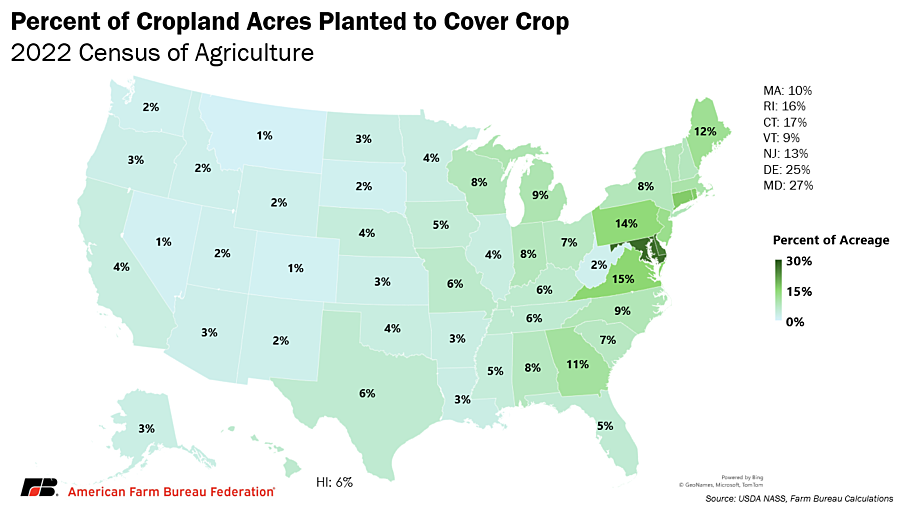
Local initiatives targeting specific fragile environments such as highly erodible land or watersheds with runoff-related water quality issues are significant contributors to cover crop adoption. Maryland has had the highest adoption rate for cover crops, with 27% of all cropland planted to cover crop in 2022 due to long-standing commitments to improve water quality in the Chesapeake Bay. More recently, the Environmental Protection Agency set benchmarks for water quality improvements in the Mississippi River basin (MRB) specifically targeting nutrient runoff. Each state in the MRB has developed nutrient reduction strategies for their watersheds, and many rely on research and implementation projects and partnerships to increase conservation practices in their states. Cover crops are a significant resource in combating nutrient runoff because they prevent erosion and promote nutrient retention in the soil. Thirteen of the 15 MRB states increased cover crop adoption from 2017 to 2022. There are some states and watersheds that entered RCPP contracts with NRCS to target conservation funding to at-risk watersheds.

Conservation tillage methods are more widely adopted than cover cropping. Combined, no-till or reduced tillage is used on over 200 million acres of cropland nationwide, nearly equally split between no-till and reduced tillage. No-till and other forms of conservation tillage increased 8% and 7%, respectively. Many farmers use tillage as a pest management tool to eradicate weeds and insects, so reduced tillage was historically more popular. But in 2022, no-till acreage overtook other forms of conservation tillage, showing a growing acceptance of more intense conservation tillage methods through the previous five years. The economic benefits of reduced tillage likely incentivized practice adoption since removing the intensive tillage requirements of traditional methods can save money on fuel, labor and equipment. Overall, acreage farmed with conservation tillage is more consistent between 2017 and 2022. Most states have only single-digit percentage point growth or lower rates in conservation tillage acres. As these practices are already more widely used, it is likely adoption has plateaued.
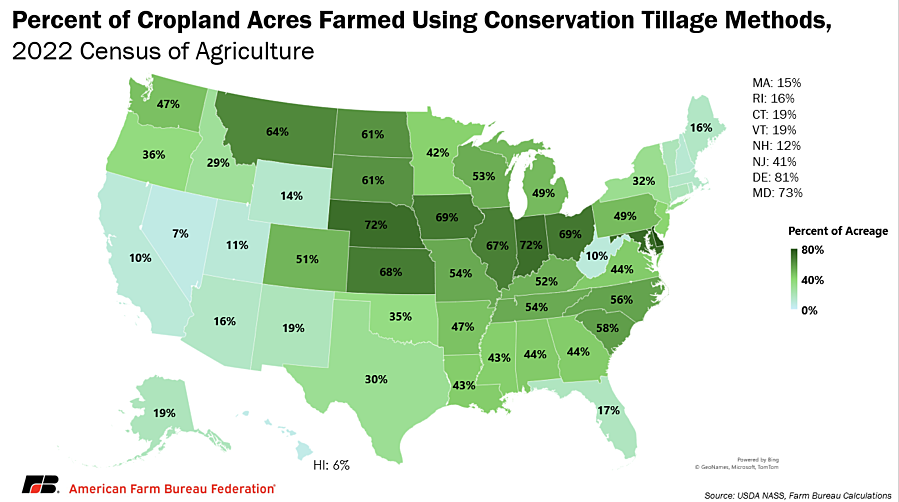
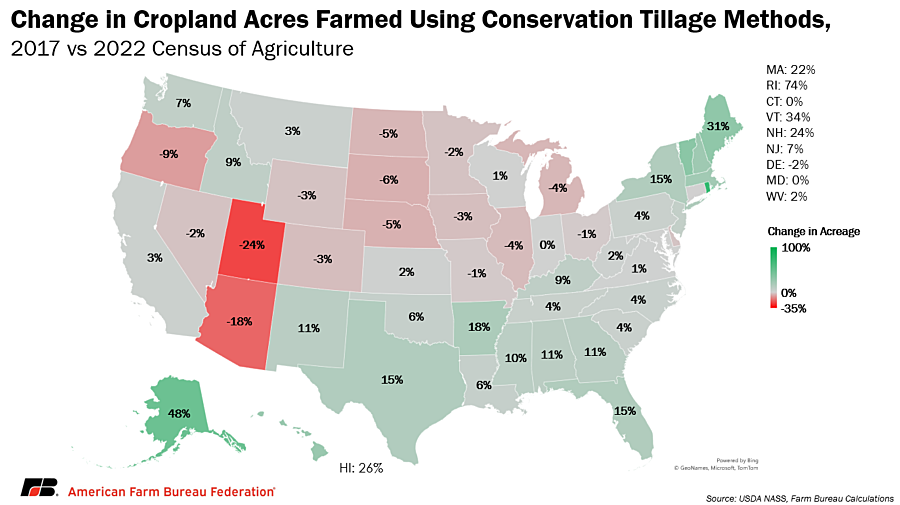
Conclusion
The variety of environmental conditions across the country means field compatibility with different conservation practices will vary too. Beyond climate and soil types, adoption of these conservation methods is also impacted by financial and farm management factors. Cover cropping can be especially challenging due to the additional inputs required and management intensity of the practice. The lack of USDA program support for double cropping may be encouraging cover cropping in cases where the conservation benefits of double cropping (including reduced acreage requirements for food production) might be greater. We are seeing increased adoption of cover cropping year-over-year, highlighting the commitment of American farmers to conservation efforts. While it is encouraging to see growing adoption of conservation practices, there is no one-size-fits-all solution for the diverse regions and production types of American agriculture.
By Samantha Ayoub, Associate Economist
Under the leadership of President Biden and Vice President Harris, the U.S. Environmental Protection Agency (EPA) has delivered bold and concrete actions to protect people from PFAS, or per- and polyfluoroalkyl substances, in their water and everyday lives while dramatically increasing investments in research and solutions. Specific actions and progress are detailed in EPA's third annual progress report, highlighting the significant achievements the agency has made under its PFAS Strategic Roadmap and the Biden-Harris Administration's whole-of-government strategy to protect communities from the impacts of forever chemicals.
"Before President Biden took office, the federal government wasn't doing enough to address PFAS pollution across the country. The Biden-Harris Administration has since taken unprecedented steps to develop the science, implement strong standards, and invest billions into solutions to protect all Americans from these forever chemicals," said EPA Administrator Michael S. Regan. "Our actions are making a difference in communities across America, and especially in those that have been overburdened by pollution for far too long."
PFAS are an urgent threat to public health and the environment. Communities across the nation are discovering these chemicals in their air, land, and water. The science is clear: exposure to certain PFAS poses significant risks to human health, including cancer, even at very low levels. In 2021, EPA Administrator Michael S. Regan established the EPA Council on PFAS and charged the group to develop the agency's strategic roadmap. The roadmap is EPA's commitment to confront PFAS contamination head on – by following the science, leveraging all available tools and authorities, holding polluters accountable, and investing historic levels of resources to protect communities.
Progress on PFAS During the Biden-Harris Administration
The progress the Biden-Harris Administration has made to protect communities from PFAS pollution is unprecedented. EPA will continue to move with urgency to develop the science and research related to PFAS, partner with states, Tribes, and local leaders to implement funding and solutions, and set and update strong standards to ensure all Americans are safe from potential contamination.
Read the PFAS Strategic Roadmap - EPA's Commitments to Action 2021-2024.
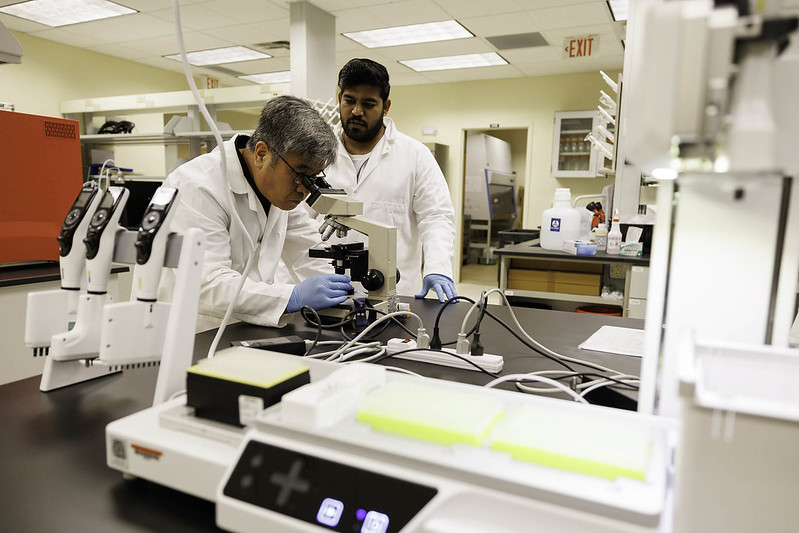
Hong Jin Hwang (left), the core senior sequencing technician at the One Health Innovation Lab, has been working with Samuel Jeyasingh, the One Health Innovation Lab director, to re-sequence genes from the Oklahoma State University wheat research program to establish the new lab and its services. (Photo by Mitchell Alcala, OSU Agriculture)
A new research laboratory tied to the Oklahoma State University Innovation Foundation is advancing the mission of OSU Ag Research.
OSU Agriculture is responsible for technological discoveries in animal and crop production, 37 wheat varieties resistant to pests and diseases, and 10 turfgrass varieties resistant to drought and freezing. However, the OSU Ag Research lacks certain technologies and resources that would allow it to streamline and speed up research related to human, animal and plant health, an initiative known as One Health.
One such OSU research achievement is DNA sequencing technology used to determine the precise order of nucleotides within a DNA strand. This specific arrangement of DNA nucleotides encodes valuable information about genetic or biological functions. By analyzing these data, scientists can better understand the genetic makeup of an organism and offer insights into how genes influence plant growth and adaptation, which is key to agricultural productivity.
The One Health Innovation Lab, established at the Innovation Park in Stillwater earlier this year, provides DNA sequencing services to OSU scientists. Until now, the university's wheat breeding program has outsourced its gene sequencing to external institutions due to a lack of local technology and infrastructure to support such capabilities.
"This year, we have been working with OSU Agriculture to bring in the sequencing technologies and do a test run to ensure everything is working well," said Samuel Jeyasingh, One Health Innovation Lab director. "Next year, we anticipate handling thousands of seeds and fully working with the OSU wheat breeding program to genotype breeding materials, which will allow us to work much faster."
For the pilot program, Charles Chen, associate professor in the OSU Department of Biochemistry and Molecular Biology and member of the Wheat Improvement Team, worked with the One Health Innovation Lab to re-genotype seeds from OSU's wheat breeding program that have already been sequenced. The re-genotyping ensures the OSU lab receives the same data as the external institutions.
"Breeding has been the primary tool for creating new wheat varieties, but breeding cycles are very long," Chen said. "Creating a new winter wheat variety takes about 10 to 15 years. Sequencing technology can potentially cut this time in half by allowing us to predict the genetic potential of upcoming varieties.
"Having someone here 100% committed to obtaining the genetic information is highly important and has been the missing piece to our research on campus. It's a vital piece of accurate information that allows us to expedite the breeding process while ensuring precision," he continued.
The laboratory will sequence plant, animal and human genetic materials and establish a biobank in which the materials and their data will be stored and available to scientists. Another part of the lab's mission is to further One Health education by conducting seminars and outreach education and working closely with OSU's academic departments and industry partners.
"We are trying to bring partners together to accomplish our mission of advancing health across boundaries, meaning to not work in silos but to have interdisciplinary, collaborative efforts," Jeyasingh said. "Part of my job is seeking out institutions and identifying what needs they might have that we can fill. Being the bridge between research domains is what One Health is."
Sequencing genetic materials on the OSU campus opens a world of opportunities, Jeyasingh said, including the ability to prevent disease outbreaks.
"One Health emphasizes the deep interconnection among plants, animals and humans," he said. "Imagine a child playing in the park with a dog. If that dog picks up a tick with a pathogen, and the tick bites the child, the potential health impact becomes evident. This scenario showcases how health is interconnected across species."
Jeyasingh added that the lab could work with other entities to sequence the DNA from the tick to identify the pathogen.
"This could eliminate the rabbit hole sometimes involved in identifying diseases," Jeyasingh said. "It is vital to understand and address these connections to protect and enhance the health of all living beings."
Brett Carver, professor and wheat genetics chair in the OSU Department of Plant and Soil Sciences, said new and improved locally adapted wheat varieties bring value to the food industry by providing a key ingredient to sustaining the nation's food supply, and success in one breeding program is leveraged by successes in others with similar objectives.
"Over 75 years of continuous wheat breeding at OSU has resulted in one of the deepest and more commercially relevant pools of bread wheat genetics in this country, if not the world," Carver said. "A divergent genetic base is the fuel that drives innovation in any wheat or plant breeding program. We can drive the OSU wheat breeding program long and hard, but better in-house sequencing capability gives us the crucial ability to see where we have been and where we are going."
Groundbreaking developments in wheat breeding will be housed in OSU's new Agronomy Discovery Center as part of the Innovation Park. The project will upgrade and modernize OSU wheat research facilities, equipment and technology. A designated fundraising initiative is underway. Learn more about supporting the project by calling Megan Smith at 405-747-1977.
Did you know we are only 41 days away from Christmas? Are you looking for the perfect centerpiece to complete your living space this holiday? Oklahoma is home to more than 20 Christmas tree farms ready to host an authentic Christmas experience for you. There, you can cut your own tree or buy a pre-cut evergreen tree and wreath. Visit Oklahoma Agritourism or the list below to find a Christmas tree farm near you!
Central Oklahoma
Nov. 29 - All Pine Christmas Tree Farm (Yukon)
Nov. 29 - Cross Timbers Christmas Tree Farm & Pumpkin Patch (Harrah)
Nov. 23 - Leafer Lodge Farms (Stillwater)
Nov. 29 - Martinbird Tree Farm (Tuttle)
Nov. 29 - Pioneer Homestead Christmas Tree Farm (Oklahoma City)
Nov. 29 - Silver Bells Christmas Tree Farm (Tuttle)
Nov. 23 - Sorghum Mill Christmas Tree & Blackberry Farm (Edmond)
Nov. 29 - Wells Christmas Tree Farm (Norman)
Nov. 23 - Wonderland Farms (Harrah)
Northeast Oklahoma
Nov. 29 - Akecheta Christmas Tree Farm (Hitchita)
Nov. 29 - Cal2Homa Farm (Gore)
Nov. 29 - Crisp Tree Farm (Bixby)
Nov. 23 - D & C Holiday Farm (Muldrow)
Nov. 23 - Molly & Socks Christmas Tree Farm (Bristow)
Nov. 23 - Owasso Tree and Berry Farm (Owasso)
Nov. 29 - Pleasant Valley Farms (Sand Springs)
Nov. 29 - Wilkinson's Christmas Forest (Tahlequah)
Northwest Oklahoma
Nov. 29 - Red Bird Farm (Enid)
Nov. 30 - Santa's Forest Christmas Tree Farm (Ponca City)
Southeast Oklahoma
Nov. 29 - Red Barn Christmas Tree Farm (Kiowa)
Southwest Oklahoma
Nov. 29 - D & L Christmas Tree Farm (Fletcher)
| ||||||||||||||||||||||||||||||||||||||||||||||||||||||||||||||||||||||||||||||||||||||||||||||||||||||||||||||||||||||||||||||||||||||||||||||||||||||||||||||||||||||||||||||||||||||||||||||||||||||||
| ||||||||||||||||||||||||||||||||||||||||||||||||||||||||||||||||||||||||||||||||||||||||||||||||||||||||||||||||||||||||||||||||||||||||||||||||||||||||||||||||||||||||||||||||||||||||||||||||||||||||
|
Today, Nov. 14, the U.S. Environmental Protection Agency is issuing an advance notice of proposed rulemaking (ANPRM) under Section 6 of the Toxic Substances Control Act (TSCA) to gather information on the potential risks associated with N-(1,3-Dimethylbutyl)-N′-phenyl-p-phenylenediamine (6PPD) and its transformation product, 6PPD-quinone. In August 2023, the Yurok Tribe, the Port Gamble S'Klallam Tribe and the Puyallup Tribe of Indians submitted a petition under TSCA Section 21 asking EPA to establish regulations (pdf) under TSCA Section 6 prohibiting the manufacturing, processing, use and distribution of 6PPD in tires. EPA granted this petition in November 2023 and committed to publishing an ANPRM by Fall 2024 in order to gather more information that could be used to inform a subsequent regulatory action.
"Today, we're following through on the commitment we made to our Tribal partners to gather more information about this chemical used in rubber products to help protect coho salmon," said Assistant Administrator for the Office of Chemical Safety and Pollution Prevention Michal Freedhoff. "We'll use the information we get on the health and environmental risks to determine next steps to protect people and the planet."
"Toxic stormwater runoff is one of the biggest threats facing Puget Sound salmon recovery," said Rep. Derek Kilmer (WA-06). "I am grateful that the EPA has been responsive to the petition filed by Tribes from across our region who are helping to lead the effort to better understand how 6PPD and 6PPD-quinone get into our waterways, how they impact our environment and our health, and how we can get these chemicals out of local ecosystems. We have an obligation to protect salmon in the Pacific Northwest in order to honor the federal government's trust and treaty responsibilities to Tribes in the region. I am excited that the EPA is moving forward with this rulemaking as an important step toward salmon recovery."
"Salmon are a keystone species and research shows that the 6PPD-Q chemical which runs off from vehicle tires into our waterways is lethal to their survival, and our marine ecosystem," said Rep. Marilyn Strickland (WA-10). "As co-chair of the Puget Sound Recovery Caucus, I have secured funding to find solutions to this problem, and the U.S. EPA is taking an important step forward to help us."
The chemical 6PPD has been used in motor vehicle tires for more than six decades to make them more durable. It can also be found in other rubber products such as footwear, synthetic turf infill and playgrounds. 6PPD reacts with ozone pollution in the air to form a transformation product called 6PPD-quinone, which may be present in stormwater runoff from parking lots and streets due to the presence of tire wear particles. Runoff may be washed into streams and other bodies of water during rain events. As a result, aquatic organisms can be exposed to 6PPD-quinone. Concentrations of 6PPD-quinone in stormwater in the Pacific Northwest were found to be lethal to coho salmon after only a few hours of exposure.
EPA is issuing an ANPRM to solicit information on the chemicals, including but not limited to: environmental effects on aquatic and terrestrial ecosystems, potential human health effects, environmental fate and transport, exposure pathways, persistence and bioaccumulation, additional uses of 6PPD, and releases from consumer products such as sneakers, playgrounds, rubber-modified asphalt, reused tire or other rubber products. EPA is also seeking comment and information related to alternatives to 6PPD, as well as potential chemical transformation products associated with potential alternatives.
For example, there are data showing that 6PPD-quinone is toxic to fish, with coho salmon being the most sensitive species studied to date. However, there are still uncertainties about the potential impacts of 6PPD-quinone on human health, as well as the potential for exposure from other sources of 6PPD-quinone.
EPA's Work on 6PPD
It was EPA-funded research that first established the link between 6PPD-quinone and salmon deaths in the Puget Sound region in 2020. Since then, EPA has been engaged in ongoing efforts with other federal agencies, states, Tribes, industry and other stakeholders to address information gaps and address concerns regarding the use of 6PPD and the risks of 6PPD-quinone.
EPA is continuing to fund research activities to expand its understanding of the impacts of 6PPD-quinone, and to fill data gaps. For example, the Office of Research and Development is continuing further investigation of 6PPD-quinone, including work on fate and transport, ecotoxicity, and green infrastructure solutions for stormwater contamination. The Office of Water developed a draft analytical method for detection of 6PPD-quinone in surface and stormwater and finalized screening values for 6PPD-quinone and 6PPD to protect sensitive salmon and other aquatic life. The agency is also coordinating with the National Science and Technology Council's Joint Subcommittee on Environment, Innovation and Public Health on potential cross-governmental research on human health effects.
EPA proposed a rule in March 2024 under Section 8(d) of TSCA that would require manufacturers (including importers) of 6PPD to report lists and copies of unpublished health and safety studies on 6PPD and 6PPD-quinone to EPA. EPA plans to finalize this rule by the end of 2024.
EPA has also developed a webpage on 6PPD and 6PPD-quinone to keep the public and stakeholders updated as research progresses, alternatives are identified, and ways to mitigate the effects of the chemicals on the environment are implemented.
EPA will accept written comments on the ANPRM for 60 days following publication via docket EPA-HQ-OPPT-2024-0403 at Regulations.gov.
Learn more and read the Advanced Notice of Proposed Rulemaking for 6PPD.
Today, Clean Fuels Alliance America and 10 national and state associations wrote to House and Senate leaders requesting a one-year extension of the §40A Biodiesel and Renewable Diesel Tax Incentive. With fewer than 60 days till the scheduled transition to the new §45Z Clean Fuel Production Credit and insufficient guidance from the U.S. Treasury, the one-year extension of existing policy is needed to provide certainty and stability to stakeholders in the biodiesel and renewable diesel industry.
"Due to the significant uncertainty created by this lack of guidance, American clean fuel producers and their partners in agriculture and fuel marketing are facing tremendous confusion in the marketplace," the groups write. "It is therefore critical that Congress provide a temporary, short-term extension of the existing 40A blenders credit to allow the necessary transition and a smooth integration of the new credit into business plans."
Treasury has requested comment on the §45Z Clean Fuel Production Credit and issued guidance on registration requirements and the prevailing wage and apprenticeship requirements. But Treasury has not provided guidance sufficient to enable taxpayers and industry stakeholders to calculate the tax credit value for the fuels they produce. Many producers have not received the registration letters necessary to claim the credit.
Kurt Kovarik, Clean Fuels Vice President of Federal Affairs, added, "Farmers, fuel producers, and marketers needed to know the value of the new credit months ago to successfully negotiate feedstock contracts and fuel offtake agreements for the start of 2025. The industry is facing extreme uncertainty that threatens to undermine clean fuel production, jobs, economic opportunities for farmers, and near-term carbon reductions. A one-year extension of the existing policy would provide time for Treasury and the industry to navigate the transition to the new credit." A copy of the letter is available at cleanfuels.org.
McDonald's USA, one of the largest fast food restaurant chains, Lopez Foods, a multi-protein producer and long-term supplier to McDonald's, and Syngenta North America, a leader in agricultural technology, today announced a collaboration that aims to increase feed efficiency and help reduce the amount of greenhouse gas emissions released per pound of meat produced, as part of efforts to improve the sustainability of beef production.
"At Syngenta, we're convinced improving the sustainability of the global food system can be accelerated through innovation and collaboration," said Justin Wolfe, President of Syngenta Seeds. "We're proud of the great attributes of our Enogen® corn, and how our work can help enable McDonald's and their beef supply chain to deliver impact."
Ambitious climate commitments mean that companies like McDonald's and Lopez Foods may need to invest in climate-smart technologies like Enogen® corn. "McDonald's is starting with a priority ingredient for our company – beef," said Kendra Levine, Director of US Sustainability for McDonald's. "We believe the innovative collaboration with Syngenta is an opportunity to help us make progress toward our science-based climate targets."
Enogen® corn, used for both grain and silage, contains a robust alpha amylase enzyme that quickly converts starch to usable sugars, delivering more available energy to cattle while being easily digestible. Increased digestibility of Enogen® corn can result in increased feed efficiency, which is widely recognized as an important approach to helping reduce greenhouse gas emissions in livestock production systems1. University research has shown that feeding Enogen® as silage or grain can improve feed efficiency by about 5%.2 Life-Cycle Assessment (LCA) shows potential for environmental savings resulting from this increased efficiency, including lower emissions of greenhouse gases and lower use of land, energy, and water per unit of production.3 Specific findings show that, per 1,000 head of beef cattle, this collaboration could potentially achieve annual savings of:
McDonald's plans to scale this program to help deliver over 164,000 metric tons CO2e per year. According to Wolfe, sustainability is fully embedded in the global business strategy of Syngenta, with clear targets and an ambition that guides the company's innovation, including advancements in Seed technology like Enogen®. Syngenta sustainability priorities include achieving higher yields with lower impact, regenerating soil and nature, improving rural prosperity, and establishing sustainable operations. Collaborations like these will drive impact and change at scale.

Corteva Agriscience continues to provide growers the weed-control solutions they need with the launch of Kyber® Pro herbicide and Sonic® Boom herbicide. Both preemergence products will offer multiple, effective modes of action and extended residual activity to help soybean growers maximize yield potential, while preventing and mitigating weed resistance.
"At Corteva, it's our job to help soybean growers overcome the challenges of the shifting weed control landscape, and Kyber Pro and Sonic Boom herbicides will do just that — offering diverse modes of action and several weeks of residual control in convenient premix formulations," says Drake Robards, U.S. Product Manager, Soybean Herbicides, Corteva. "By starting the season with one of these two new preemergence solutions, growers will give their soybeans a clean start for optimal growth. Sonic Boom delivers strong performance against many of the key hard-to-control and resistant broadleaf weeds, such as waterhemp and Palmer amaranth, that soybean growers face today. Kyber Pro also delivers premier weed control of many of the same broadleaf weeds as Sonic Boom, plus has a Group 15 active for additional control of grass weeds."
Kyber Pro and Sonic Boom herbicides join Enversa™ herbicide as new soybean residual options from Corteva that will be available for growers to use in the 2025 growing season. Plus, both Kyber Pro and Sonic Boom herbicides fit well as preemergence herbicides in a program approach to season-long weed control, especially with Enlist E3® soybeans.
Key features of Kyber Pro herbicide include:
— Exceptional weed control. Kyber Pro herbicide contains three proven modes of action — metribuzin, flumioxazin and pyroxasulfone. Together, the three modes of action create a comprehensive solution for exceptional control of more than 50 broadleaf and grass weeds, including hard-to-control and ALS- and PPO-resistant weeds like Palmer amaranth and waterhemp. Kyber Pro herbicide also will offer up to six weeks of residual activity — even more in the right conditions — to prevent weed competition from interfering during essential early soybean yield growth stages.
— Excellent flexibility. Kyber Pro herbicide has the flexibility to be tank-mixed and applied with burndown herbicides prior to planting or with other preemergence herbicides. It also creates greater postemergence application flexibility with extended residual activity, giving growers more time before they have to make a second application.
— Enhanced formulation. Kyber Pro herbicide comes in a convenient liquid premix formulation that has been enhanced for simplified in-season mixing, handling and storage.
Key features of Sonic® Boom herbicide include:
— Effective weed control. Sonic Boom herbicide offers two powerful modes of action — metribuzin and sulfentrazone — for effective weed control plus superior crop safety for higher yield potential. The solution is especially effective against difficult, resistant broadleaves, including waterhemp, Palmer amaranth, marestail and kochia.
— Extended residual. Sonic Boom herbicide provides several weeks of residual weed control to help ensure better soybean growth and to keep weeds at bay until postemergence applications can be made.
— Efficiency. Sonic Boom herbicide comes in a convenient liquid premix formulation that can be easily mixed with a variety of tank-mix partners for efficient applications. Sonic Boom herbicide also can be applied at different times, depending on the need, including at fall or spring burndown, preplant or preemergence.
"We know a one-size-fits-all approach to weed control doesn't cut it; that's why we decided to launch three new soybean herbicides for 2025," Robards says. "Earlier this year we announced Enversa herbicide, the preferred layered residual tank-mix partner with Enlist One herbicide for Enlist E3 soybeans. Now with the introduction of Kyber Pro herbicide and Sonic Boom herbicide, we're giving growers more options to fully customize their weed-control programs to their soybean acres."
Kyber Pro and Sonic Boom herbicides have received federal registration. State registrations are in progress. Kyber Pro herbicide is currently available for purchase in states where it has already received state registration. Sonic Boom herbicide is expected to be available for purchase in early 2025. To learn more about these new solutions, talk with your local Corteva representative or visit Kyber Pro and Sonic Boom.
Cautionary Statement on Forward-looking Statements
This release contains certain estimates and forward-looking statements within the meaning of Section 21E of the Securities Exchange Act of 1934, as amended, and Section 27A of the Securities Act of 1933, as amended, which are intended to be covered by the safe harbor provisions for forward-looking statements contained in the Private Securities Litigation Reform Act of 1995, and may be identified by their use of words like "plans," "expects," "will," "anticipates," "believes," "intends," or other words of similar meaning. All statements that address expectations or projections about the future, including statements about Corteva's regulatory approvals, product development, product offerings and expected performance are forward-looking statements. Corteva disclaims and does not undertake any obligation to update or revise any forward-looking statement, except as required by applicable law. A detailed discussion of some of the significant risks and uncertainties which may cause results and events to differ materially from such forward-looking statements or other estimates is included in the "Risk Factors" section of Corteva's Annual Report on Form 10-K, as modified by subsequent reports on Form 10-Q and Current Reports on Form 8-K.
About Corteva Corteva, Inc. (NYSE: CTVA) is a global pure-play agriculture company that combines industry-leading innovation, high-touch customer engagement and operational execution to profitably deliver solutions for the world's most pressing agriculture challenges. Corteva generates advantaged market preference through its unique distribution strategy, together with its balanced and globally diverse mix of seed, crop protection, and digital products and services. With some of the most recognized brands in agriculture and a technology pipeline well positioned to drive growth, the company is committed to maximizing productivity for farmers, while working with stakeholders throughout the food system as it fulfills its promise to enrich the lives of those who produce and those who consume, ensuring progress for generations to come. More information can be found at www.corteva.com.
Worldwide, many agricultural soils are deficient in the nutrient zinc – despite the fact that farmers use fertilizers enriched with the element. This limits crop yields and reduces food quality. It's estimated that roughly a third of the global population consume foods low in zinc, which can increase sickness and death in early childhood, as well as impaired growth and cognition.
Using the Canadian Light Source (CLS) at the University of Saskatchewan (USask), researchers from the University of Adelaide in Australia investigated how to manufacture more efficient zinc-enriched fertilizers. The HXMA beamline at CLS enabled the researchers to examine at the molecular level what happens to the water solubility of zinc (its ability to dissolve in water) when it's added to ammonium phosphate fertilizer.Video: Finetuning fertilizers to boost crop yields
"Going in to the project, our group thought the type of zinc compound would be a good predictor of a fertilizer's solubility" says Rodrigo da Silva, from the University of Adelaide. "However, the CLS beamline enabled us to understand that the agronomic performance cannot be predicted based on what form of zinc is present in the fertilizer granules. Instead, the pH drives the fertilizer zinc solubility and availability to the crops."
Dr. da Silva and colleagues found that when zinc is added to phosphate fertilizer, it forms a range of different zinc phosphate compounds. However, its solubility was not related to the relative abundance of these compounds, but to fertilizer pH. This means that zinc added to more alkaline phosphate fertilizers such as diammonium phosphate will have very low solubility and hence low agronomic effectiveness for crop uptake.
The University of Adelaide team found that lowering fertilizer pH by spraying the granules with an acid solution further increases the solubility and availability of zinc compared to current commercial products. The researchers also showed an additional method to increase Zn water solubility by putting a barrier coating on fertilizer granules, to separate the zinc from the phosphate. They showed that there was more uptake of zinc by plants treated with the barrier-coating fertilizer.
The Mosaic Company, which funded this research, has already patented both of these new technologies in conjunction with the University of Adelaide's Fertilizer Technology Research Centre. Mosaic is the world's leading producer of concentrated phosphate and potash. The findings are published in the Soil Science Society of America Journal.
"It is crucial to improve zinc fertilization practices, to maximize yields and produce more nutritional food," says da Silva. "This research can help the industry produce more efficient fertilizers."
Last night, U.S. Senator Markwayne Mullin (R-OK) released the following statement after South Dakota Republican Senator John Thune was selected to serve as the new Senate Majority Leader:
"Back in March, I announced my strong support for Senator John Thune as our next Majority Leader," said Senator Mullin. "He's an experienced leader, a good friend, and just like President Trump, he's ready to lead on Day One to advance the America First policy agenda. I'm confident that under the leadership of Donald Trump, Leader-elect Thune, and Speaker Johnson—Republicans will finally get America back on track."
President-elect DonaldTrump said in a statement on Truth Social, in part: "Congratulations to Senator John Thune, the Newly Elected Senate Majority Leader. He moves quickly, and will do an outstanding job. I look forward to working with him."

The National Livestock Companies are pleased to announce their support, once again, for the All American Beef Battalion (AABB).
On Monday, December 16th, the Oklahoma National Stockyards will auction a calf for the benefit of the AABB, along with National Livestock providing lunch for those in attendance. The AABB crew is bringing in their cooker and will be preparing a ribeye lunch. Lunch will begin at 11:00 a.m. and the actual sale will take place at approximately 12:30 p.m. in the sale arena of the Stockyards.
The calf to be auctioned is again being donated by 3C Cattle Feeders and the Clyde Runyan family of Mill Creek, Oklahoma. A very special thanks go out to Penny, along with her sons Casey and Bear, who have donated the calf for 11 years. Clyde was with the 101st Airborne in Vietnam and always considered this as a privilege to be able to give back to the troops. Runyan passed away in 2019 and his family continues the legacy of donating the calf in his honor.
This is the 14th year for the National Livestock companies to be involved in supporting the AABB. With the 2023 auction bringing in more than $64,000, contributors to this event have raised over $651,100 from the annual auction of a
donated calf.
Many organizations and individuals have joined together for this worthy cause each year. The efforts of many have made this successful and we thank all our partners and friends for their help. Through these auctions, approximately 65,000 troops have been fed an American ribeye steak upon their return home from deployment or prior to their deployment.
Anyone may support this effort by calling 800-310-0220 and speaking with Debbie Wedel. If you are unable to attend but would still like to support the cause, you can call Debbie for your proxy bid or you may also visit the All American Beef Battalion web site (www.steaksfortroops.com) and make your donation. National Livestock will invoice bidders and contributors and will forward all funds to the AABB. All checks should be made payable to the All American Beef Battalion
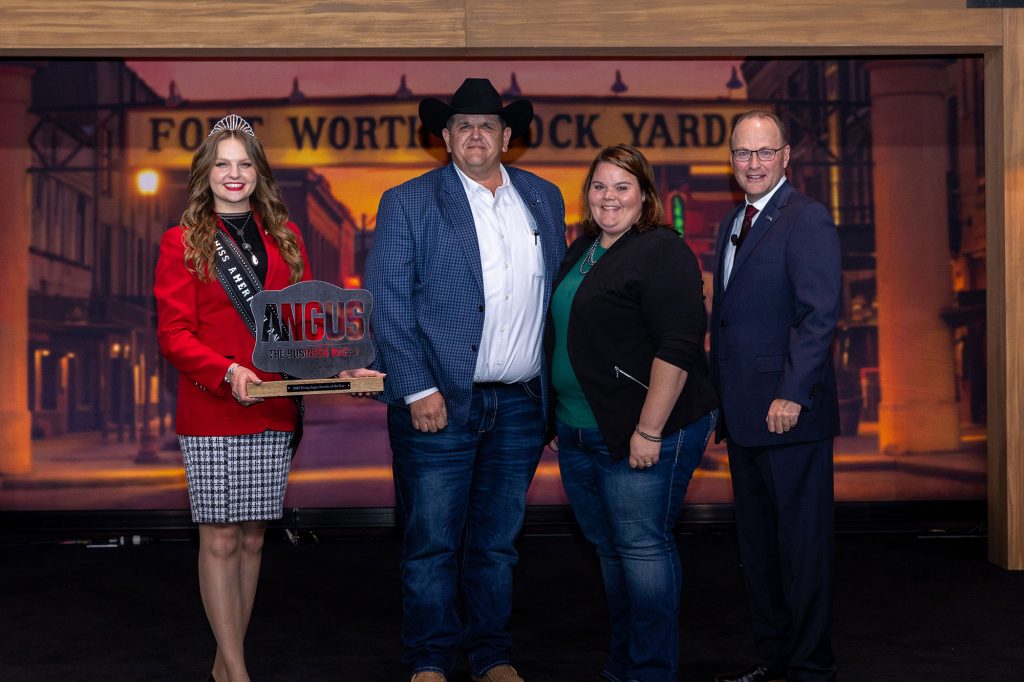
Cody Quam accepts his award for Young Breeder of the Year on stage in Fort Worth, Texas during Angus Convention. Pictured from Left: Lauren Waltor, 2024 Miss American Angus; Cody Quam; Tracy Quam, wife; and Mark McCully, American Angus Association® CEO.
The American Angus Association® awarded its second annual Young Breeder of the Year award to fourth-generation Angus breeder Cody Quam of Lodi, Wisconsin on November 3, during the 2024 Angus Convention held in Fort Worth, Texas.
Known as a humble, quite man, Quam is not afraid to generously share his knowledge of the cattle industry. "I've made it a point to try and help anybody that will take the time and ask, and are willing to put the work in," said Quam when asked to reflect on why he was selected for the award. "I'll share what we've done right and what we've done wrong to try and help people that are just getting started to maybe get there a little faster."
It's a wealth of experience Quam and his family have spent more than eighty years gathering while building the reputation of Marda Angus Farm. Quam's great-grandfather purchased the family's first Angus heifers as 4-H projects for his son in 1942. That same year, he also purchased two Hereford heifers for his daughter. The Angus cattle stayed, the Herefords didn't, so the family story is told by Quam; "It's hard to deny the quality of the Angus cow."
Twelve years ago, Quam was able to come back to the farm full-time, bringing with him ideas gathered not only from his time working in sale barns and feed mills, but from his time volunteering. As part of two terms served on the Wisconsin Angus Association's board, Quam helped run the state's futurity sale.
"That was the most interesting because you could help a wide diversity of Angus breeders across the state," recalled Quam. "It is also probably the most educational thing I've done, that's benefitted this farm."
Quam now leads Marda's genetic selection and donor/ET program as well as sales and marketing. Under his stewardship, the operation has earned multiple top honors at the Midland Bull Test and hosted its 9th production female sale on November 16.
"What I truly believe about this breed is you can find your home in it – no matter what you want to raise, what you want to sell, what you want to have as your cow herd," Quam reflected. "Do what you like, and if you're persistent enough, you will find a place."
For Quam, that place is on the family farm where he works side-by-side with his 92-year-old grandmother, father and mother, and gets the joy of raising his two children with his wife on the ground that instilled in him a love of Angus cattle, a pension for hard work and the desire to give back.
About the Award
The Young Breeder of the Year Award recognizes a young, registered Angus breeder for their leadership within the Angus breed, participation in Angus programs and innovation within their herd.
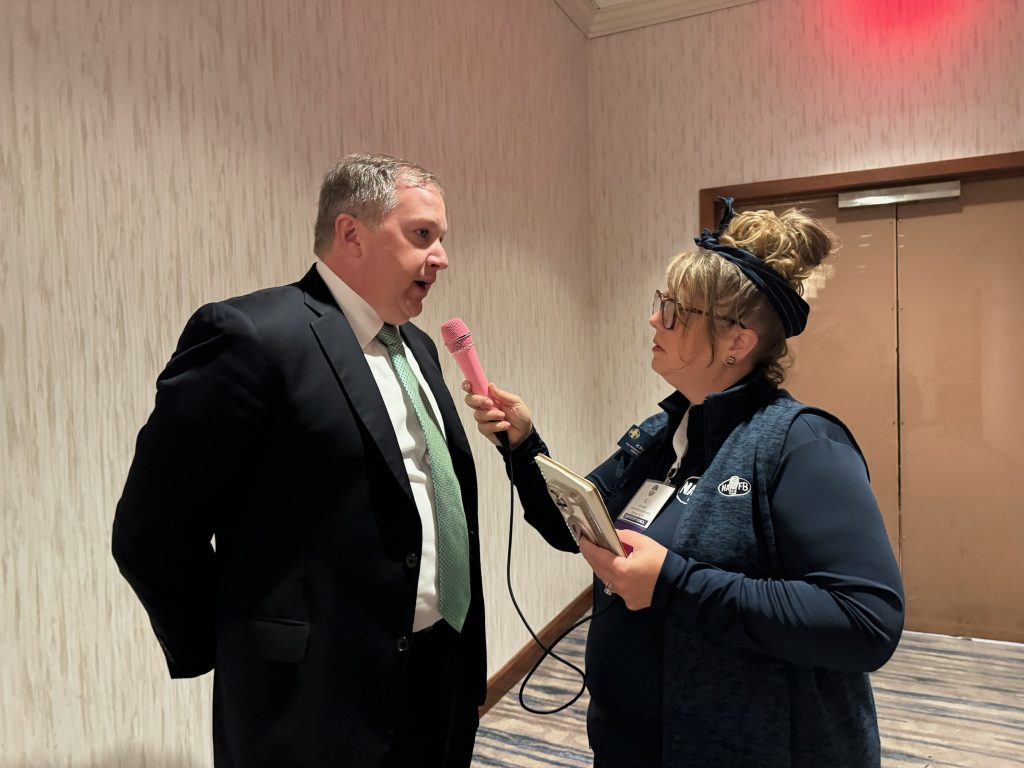
At the National Association of Farm Broadcasters Convention, Farm Director KC Sheperd caught up with the National Association of State Departments of Agriculture's (NASDA) Senior Director of Public Policy, RJ Karney, to discuss H-2A reform and the crisis in ag labor.
"The ag labor discussion has been one of the top, if not the top, priority amongst all of the agricultural industry for the past one or two decades," Karney stated. "If we don't have H-2A reform, there will be economic and supply chain impacts."
He said broadening H-2A reform to include industries that aren't currently eligible to participate is the focus of NASDA. Specifically, the livestock and dairy industries that require year-round laborers.
"Agriculture is currently unified in telling members of Congress and President-Elect Trump as he is coming into office that we have a workable solution, and we would like to see that addressed," Karney added.
More than seventy percent of rural America went to the polls to vote for President-Elect Trump so Karney believes they should have a welcoming audience ready to hear this issue.
"We have a story to tell," he said. "Since we are unified in finding a legal workforce for farmers and ranchers to utilize, I think we have a strong story with this incoming administration."
Karney and Sheperd went on to discuss Oklahoma Secretary of Agriculture Blayne Arthur's lasting impact on NASDA as well as NASDA's feelings about unionizing the farm workforce. Click the listen bar at the top of the page to hear the complete conversation.
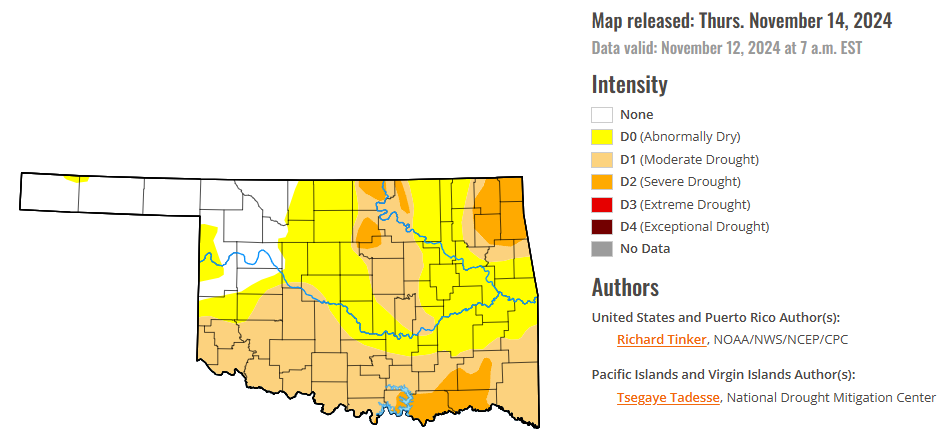
To view the latest Oklahoma drought map, CLICK HERE.
According to the latest Oklahoma drought monitor report, exceptional drought remains at zero percent, unchanged from the start of the calendar year.
Extreme drought or worse conditions remain at zero percent, unchanged from last week.
Severe drought or worse conditions have decreased to 9.38 percent, down from 41.55 percent last week.
Moderate drought or worse conditions have decreased to 47.05 percent, down from 67.84 percent last week.
Abnormally dry or worse conditions decreased to 81.78 percent, down from 92.26 percent last week.
According to the 6-to-10-day precipitation outlook map, nearly the entire state of Oklahoma is near normal chances of precipitation through November 23, 2024. Only the southern corridor of the state is leaning below a 33-40 percent chance of precipitation through that November 23 date.
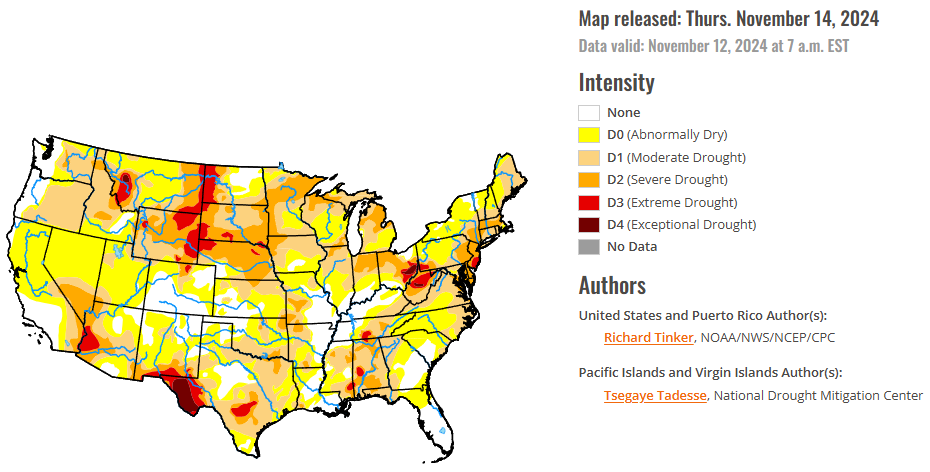
To view the United States Drought Map, CLICK HERE.
Storm systems brought significant precipitation and drought relief to broad areas in the central Rockies, central and southern Plains, Lower and Middle Mississippi Valley, Lower and Middle Ohio Valley, and the South Atlantic Region. Meanwhile, subnormal precipitation and some unseasonable warmth led to deterioration in dryness and drought conditions in portions of the Southwest, southern and western Texas, the interior Southeast, the northeastern Gulf Coast, the central and southern Appalachians, the mid-Atlantic region, the Northeast. Excessive precipitation totals fell on some areas. From central South Carolina through much of southeastern Georgia, amounts of 4 inches to locally a foot of rain were reported. Similar totals fell on central Louisiana, a band through central and north-central Texas, small parts of the Lower Ohio Valley, and orographically-favored areas in the Northwest. In addition, a broad area covering the eastern half of Colorado and adjacent areas in New Mexico and the central High Plains recorded 2 to 4 inches of precipitation, much of which fell as snow in the middle and higher elevations. A few scattered sites reported 3 to 4.5 feet of snow, mainly in the higher elevations of Colorado
The Southern Plains experienced highly variable rainfall this past week. Heavy precipitation – in some areas for the second consecutive week – soaked a swath from Louisiana and eastern Texas northward through much of the Lower and Middle Mississippi Valley and the Tennessee Valley. A broad swath reaching as far west as central Arkansas recorded at least 1.5 inches in most places, with some areas recording much higher amounts (3 to 8 inches in part of western Tennessee, and over a foot in parts of central Louisiana). This resulted in reductions in dryness and drought severity across affected areas of the Lower Mississippi Valley and eastern Texas, with some 2-class improvements imposed in a small part of both southwestern Louisiana and an area straddling southwesternmost Mississippi and adjacent southeastern Louisiana. To the north, the heavy rains also removed abnormal dryness from across western Tennessee. Farther west, another area of heavy precipitation accompanied a frontal passage in a swath from central Texas into the central Red River (south) Valley, where totals reached 4 to 8 inches along the axis of heaviest amounts. To the north, heavy precipitation associated with a pair of potent upper-level low pressure systems dropped over 2 inches on a large part of central and western Oklahoma and much of the Texas Panhandle, with localized totals exceeding 4 inches in the eastern Texas Panhandle northward to the Oklahoma/Kansas border. There was also a patch of heavy rainfall to the east across portions of eastern Oklahoma, where isolated amounts peaked at around 3 inches. Dryness and drought affecting these areas were significantly eased, with a couple patches of 2-class improvements in north-central and northeastern Oklahoma. In stark contrast, little or no precipitation was observed from parts of southeastern Oklahoma southward through Deep South Texas, and across western Texas as well. Dryness and drought worsened in some of the areas, with the most widespread deterioration noted in western Texas. The broad area of exceptional drought (D4, the most intense category) expanded there to cover most or all of eastern Hudspeth, Culberson, western Reeves, Jeff Davis, Presidio, and Brewster Counties. Also, D3 (extreme drought) also expanded to cover most of the remainder of the Big Bend of Texas.
In The High Plains, a potent 500-hPa low triggered widespread heavy precipitation over the southern half of the Region, except along the eastern fringe, while amounts were limited to several tenths of an inch at most farther north. Between 2 and 4 inches of precipitation fell on a large swath covering the eastern half of Colorado, most of central and western Kansas, and adjacent Nebraska. In nearby areas, amounts ranging from a few tenths of an inch to a couple of inches were observed over the western half of Colorado amounts of 0.5 inch to approaching 2 inches in spots was observed across southeastern Wyoming, most other areas in Nebraska, and eastern Kansas. Moderate amounts fell on a swath across the central and southwestern Dakotas the remainder of this region reported little or no precipitation, as well as most of Wyoming. In some of the higher elevations of Colorado, this precipitation fell as heavy snow, with a few locations reporting snow piling up 3 to 4.5 feet deep (50 to 54 inches buried Fort Garland CO while 44 to 47 inches were reported near La Veta, Elbert, and Trinidad CO). All of this resulted in a large area of improvement depicted over southern and western Kansas, most of northern and eastern Colorado, part of southwestern Nebraska, and a few spots in eastern Wyoming. There were a few areas of 2-class improvement in southeastern Colorado, northwestern Kansas, and the fringes of south-central and southeastern Kansas. Elsewhere, due to relatively cool weather, the dry week didn't engender much deterioration, with most of these locations remaining unchanged from last week. One exception was in a small patch of northeastern Nebraska and adjacent South Dakota, where a new patch of extreme drought (D3) was identified.
In the West, heavy precipitation in northeastern New Mexico, with snow reported in some of the higher elevations, produced areas of improvement to dryness and drought. A few high spots in New Mexico reported near 3 feet of snow, including locations near Las Vegas NM and Folsom NM. The only other area of improvement in the West Region was in eastern Washington. Not much precipitation fell last week, but based on impacts and a reassessment of conditions.
Looking ahead, during the next five days (November 14-18), moderate to heavy precipitation is again expected from the Cascades westward to the Pacific Coast, with totals expected to exceed 5 inches expected in some of the higher elevations and orographically-favored sites. One or more inches are also anticipated in the Sierra Nevada, with several tenths of an inch possible along most of the California Coast down to the Mexican border. Parts of the northern Intermountain West are expected to receive over an inch of precipitation, with 2 to locally 4 inches forecast across the Idaho Panhandle. A low pressure system and trailing front should trigger another round of heavy precipitation in the central and southern Great Plains from central Texas northward into southeastern Nebraska and the Middle Mississippi Valley, with 1.5 to locally 4.0 inches anticipated from central and east-central Kansas southward through the Red River (south) Valley and adjacent northern Texas. At least an inch is also anticipated east of the Lower and Middle Mississippi River through the interior Southeast, Lower Ohio Valley, central and southern Appalachians, and the mid-Atlantic region. Over 2 inches may fall on parts of the central Appalachians and adjacent Piedmont. Meanwhile, moderate amounts should fall on the southern Rockies and adjacent High Plains and across the Great Lakes region and the northern Ohio Valley. In contrast, little or no precipitation is expected across much of the Northeast, Florida and the adjacent South Atlantic region, southern Texas, the northern Plains, the central and southern Rockies, and the Southwest.
The Climate Prediction Center's 6-10 day outlook (valid November 19-23) features enhanced chances for both above-normal precipitation and temperatures across the Upper Midwest and across most areas east of the Mississippi River, with odds for significantly above-normal rainfall reaching 50 to near 70 percent on the Florida Peninsula. Wetter than normal weather is also slightly favored across Hawaii. Meanwhile, subnormal precipitation seems more likely across Texas and adjacent locations as well as the western Rockies, most of the Intermountain West, and the Sierra Nevada. Below normal temperatures are favored across the central and southern Plains and adjacent Mississippi Valley, the Rockies, and the Intermountain West. Southeastern Alaska should also average colder than normal while in Hawaii, neither extreme of temperature is favored.
To view the 6-10 Day Precipitation Outlook Map, click here.
To view the 6-10 Day Temperature Outlook Map, click here.
To view the Monthly Drought Outlook Map, click here.
U.S. Department of Agriculture (USDA) Secretary Tom Vilsack announced today that USDA is funding new projects in nearly every state to lower costs, expand access to clean energy and strengthen American farms and small businesses. USDA is making the investments through the Rural Energy for America Program (REAP), a program that has seen record demand in response to historic funding provided by President Biden's Inflation Reduction Act.
"The Biden-Harris Administration and USDA are ensuring farmers, small business owners and rural communities have the resources they need for the future," Secretary Vilsack said. "The investments I'm announcing today will help rural communities lead our country toward an economy that benefits working people everywhere with lower costs and clean energy jobs."
Today, USDA is investing more than $256 million in loans and grants that will support more than 1,100 clean energy projects in 40 states.
Most of the projects being announced today are funded by President Biden's Inflation Reduction Act, the nation's largest-ever investment in combating the climate crisis.
Since the start of the Biden-Harris Administration, USDA has invested more than $2.7 billion through REAP in 9,901 renewable energy and energy efficiency improvements. Almost 7,000 of these projects were funded by over $1 billion provided by the Inflation Reduction Act.
REAP enables agricultural producers and rural small business owners to expand their use of wind, solar, geothermal and small hydropower energy and make energy efficiency improvements. These innovations help them increase their income, grow their businesses and address climate change while lowering energy costs for American families.
Here are examples of the awards being announced today:
The investments announced today will benefit farmers, entrepreneurs and others in Alabama, Alaska, Arizona, California, Colorado, Connecticut, Florida, Georgia, Hawaii, Idaho, Illinois, Indiana, Iowa, Kansas, Kentucky, Maine, Massachusetts, Michigan, Minnesota, Mississippi, Missouri, Montana, Nebraska, New Hampshire, New Jersey, New York, North Carolina, North Dakota, Ohio, Oklahoma, Oregon, South Dakota, Tennessee, Texas, Utah, Vermont, Virginia, Washington, West Virginia and Wisconsin.
USDA Rural Development provides loans and grants to expand economic opportunities, create jobs and improve the quality of life for millions of Americans in rural areas. REAP is a part of the President's Justice40 Initiative which sets a goal that 40% of the benefits from certain federal investments go to disadvantaged communities that are marginalized by underinvestment and overburdened by pollution. USDA Rural Development supports infrastructure improvements; business development; housing; community facilities such as schools, public safety and health care; and high-speed internet access in rural, tribal and high-poverty areas. Visit the Rural Data Gateway to learn how and where these investments are impacting rural America. To subscribe to USDA Rural Development updates, visit the GovDelivery Subscriber Page.
USDA touches the lives of all Americans each day in so many positive ways. Under the Biden-Harris Administration, USDA is transforming America's food system with a greater focus on more resilient local and regional food production, fairer markets for all producers, ensuring access to safe, healthy and nutritious food in all communities, building new markets and streams of income for farmers and producers using climate-smart food and forestry practices, making historic investments in infrastructure and clean energy capabilities in rural America, and committing to equity across the Department by removing systemic barriers and building a workforce more representative of America. To learn more, visit www.usda.gov.
RON's Dave Lanning has a pre-opening look at today's agricultural Markets.
Click the audio tab below for today's report.
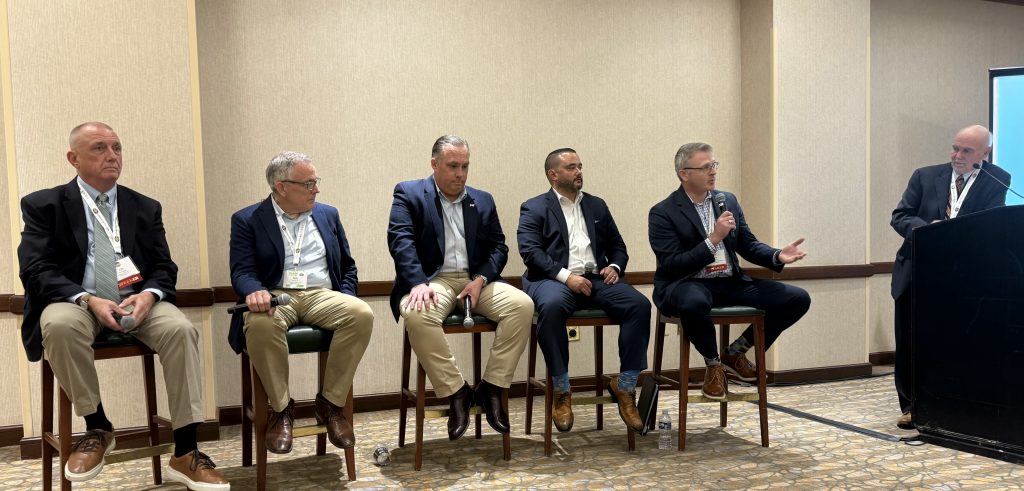
Oklahoma Farm Report's Ron Hays was asked to moderate a panel of five industry leaders on Wednesday at the 2024 National Association of Farm Broadcasting Annual Convention in Kansas City. Included in this panel- Rob Larew, President of the National Farmers Union, Ethan Lane, Vice President, Government Affairs for the National Cattlemen's Beef Association, Sam Kieffer, American Farm Bureau's Vice President for Public Policy, Dr. John Newton, Executive Head of Terrain and longtime National Corn Grower Association executive Jon Doggett, now running his own consulting firm, Camas, Creek Consulting.
Hays led these industry leaders thru their takes on the impact of the 2024 election that has resulted in a trifecta for the Republican Party- as they will control the White House, US Senate and the US House in early 2025.
They also looked at the Lame Duck session now underway and the three major groups represented agreed it's now or never for getting a new five year farm bill now.
And- they spent some time looking at what 2025 may look like for the ag industry with the new players that are expected to be in place.
Click on the link below to hear hour long presentation from Kansas City that happened Wednesday afternoon, November 13, 2024.
U.S. Environmental Protection Agency Administrator Michael S. Regan announced the appointment of 18 new members and reappointment of 6 members to the Farm, Ranch, and Rural Communities Federal Advisory Committee. The FRRCC provides independent policy advice and recommendations to the Administrator on crucial environmental issues affecting agriculture and rural communities.
Dr. Beth Sauerhaft, of American Farmland Trust, will remain as chair, and Mr. Michael Crowder, from Ducks Unlimited, will serve as vice-chair, leading the FRRCC's work alongside 13 existing members whose terms expire November 2025. Together, these members bring a wealth of experience and represent a broad array of perspectives from academia, agriculture and allied industries, non-governmental organizations, and state, local and tribal governments.
"EPA remains committed to ensuring agricultural and rural communities and are fully engaged as partners in our work to protect our environment and advance public health," said EPA Administrator Michael S. Regan. "The diverse perspectives of these new appointees, along with our dedicated returning members, will be instrumental in helping us navigate environmental challenges and deliver science-based, practical solutions that strengthen our nation's food and agriculture systems for generations to come."
The FRRCC will continue to be both productive and valuable to EPA. In addition to the recommendations submitted earlier this year, the committee has provided an additional series of 32 recommendations to Administrator Regan (pdf) on topics including improvements to the technical assistance EPA provides to rural communities, outreach and education on solar energy programs that support agriculture, and ways that EPA can scale up public-private partnerships and market-based approaches to accelerate the adoption of agricultural conservation practices. These recommendations represent the work the committee has done in 2024 in alignment with the committee charge set out by Administrator Regan. The Administrator looks forward to issuing the agency's response to these recommendations in the coming weeks.
The selection process for new members began in July 2024, with EPA issuing a request for nominations that drew more than 80 applicants. The agency selected individuals from a diverse and highly qualified pool, ensuring representation across all 10 EPA regions and from 24 states, territories and the District of Columbia. Members were chosen for their expertise in key EPA priority areas, including climate change and sustainable agricultural practices and represent a variety of agricultural sectors, rural stakeholders, diverse geographies.
NEW MEMBERS
RETURNING MEMBERS
EXISTING MEMBERS
For more information about the committee, please visit the FRRCC website.
Today, the Public Lands Council (PLC) congratulated Sen. John Thune on being selected as Majority Leader for the 119th Congress:
"Ranchers across the West have something to celebrate with Senator Thune, a champion of livestock production and rural communities, being selected by his peers to be Senate Majority Leader," said PLC Executive Director Kaitlynn Glover. "His work protecting grazing rights on public lands and streamlining the federal permitting process is in lockstep with the needs of livestock producers – who are in dire need of regulatory relief. Ranchers stand ready to work with the soon-to-be Majority Leader to finally reduce the prevalence of catastrophic wildfires by unleashing the benefits of grazing and voluntary conservation work."
| Today, the National Cattlemen's Beef Association's (NCBA) congratulated Sen. John Thune (SD) for being selected as the next Senate Majority Leader: "Senator Thune has long been a strong ally for cattle producers and is an excellent choice to secure meaningful relief for cattle producers as he leads the Senate," said NCBA Vice President of Government Affairs Ethan Lane. "Throughout his career, Sen. Thune has led the effort to repeal the federal estate tax and fought to ensure family farms and ranches are able to be passed down to future generations. With crucial tax provisions set to expire at the end of 2025, NCBA looks forward to continuing to work with the new Majority Leader to deliver critical tax relief to producers in the 119th Congress." |
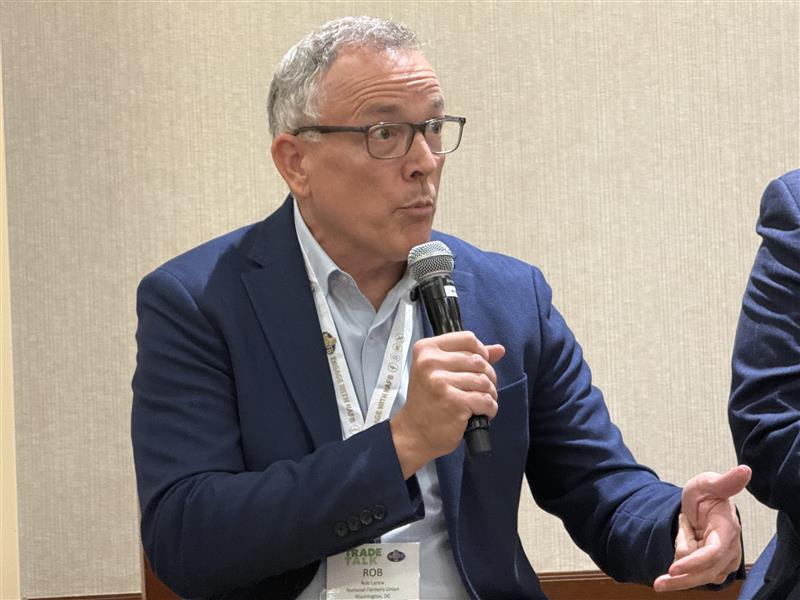
While attending the National Association of Farm Broadcasters Convention, Farm Director KC Sheperd caught up with the president of the National Farmers Union (NFU), Rob Larew to discuss lots of topics being covered after the presidential election.
"There are so many unknowns right now," Larew said. "For farmers and ranchers, I think there is a lot of hope and optimism about what could be, and also some concern about some negative consequences out there. With all that uncertainty, the one thing that we know is that we continue to face high input prices, low prices for our goods, and so many challenges out there. We are looking for relief and certainty, so we are hoping to get a farm bill done by the end of the year."
According to Larew, the farm bill must be completed during the current lame duck session. "A lot of the work is already done, but right now, we need the leaders at the highest levels to come together, and the make-it-or-break-it might be President-elect Trump signaling that we need to get this farm bill done before next year when he takes office because he has a lot of other things on his agenda. Let's get this farm bill done," Larew stated.
He emphasized that the need for a complete farm bill is preeminent, because, politically, next year there will be more discussions about extending tax cuts and various other policies so that there will be less money available for a farm bill.
"Trying to write a bill with fewer resources and a busy agenda is not a good recipe for getting farm policy done," he commented.
Many of the people Trump is appointing to positions are not known to much of the ag industry. Larew admitted that it is difficult to sort through all of the rhetoric he is hearing to determine where the truth lies but said that there are policy positions that are strongly in favor of family farmers and others that are adamantly anti-agriculture so it is anyone's guess at this point.
"As we look at all of these names that could be in the departments, whether it is at USDA or EPA, the point I want to make is that there is a lot of talk right now about deregulating and cutting back the federal system," Larew pointed out. "As a farmer who is regulated by all of this, we want some regulatory relief. However, we also know that some of those wheels and cogs need to actually move. If you cut, slash, and burn, that can have ripple effects where we don't get products cleared out of the government, where we have other regulatory roadblocks that prevent us from doing certain things. As we go forward with this, we need to make sure that we are being smart about it."
Sheperd and Larew continued to speak about Senator John Thune's appointment to Majority Leader and next year's NFU Convention to be held in Oklahoma next March. Click the listen bar at the top of the page to hear the complete conversation.
Today, Nov. 13, 2024, U.S. Environmental Protection Agency Administrator Michael S. Regan announced the appointment of 18 new members and reappointment of 6 members to the Farm, Ranch, and Rural Communities Federal Advisory Committee. The FRRCC provides independent policy advice and recommendations to the Administrator on crucial environmental issues affecting agriculture and rural communities.
Dr. Beth Sauerhaft, of American Farmland Trust, will remain as chair, and Mr. Michael Crowder, from Ducks Unlimited, will serve as vice-chair, leading the FRRCC's work alongside 13 existing members whose terms expire November 2025. Together, these members bring a wealth of experience and represent a broad array of perspectives from academia, agriculture and allied industries, non-governmental organizations, and state, local and tribal governments.
"EPA remains committed to ensuring agricultural and rural communities and are fully engaged as partners in our work to protect our environment and advance public health," said EPA Administrator Michael S. Regan. "The diverse perspectives of these new appointees, along with our dedicated returning members, will be instrumental in helping us navigate environmental challenges and deliver science-based, practical solutions that strengthen our nation's food and agriculture systems for generations to come."
The FRRCC will continue to be both productive and valuable to EPA. In addition to the recommendations submitted earlier this year, the committee has provided an additional series of 32 recommendations to Administrator Regan (pdf) on topics including improvements to the technical assistance EPA provides to rural communities, outreach and education on solar energy programs that support agriculture, and ways that EPA can scale up public-private partnerships and market-based approaches to accelerate the adoption of agricultural conservation practices. These recommendations represent the work the committee has done in 2024 in alignment with the committee charge set out by Administrator Regan. The Administrator looks forward to issuing the agency's response to these recommendations in the coming weeks.
The selection process for new members began in July 2024, with EPA issuing a request for nominations that drew more than 80 applicants. The agency selected individuals from a diverse and highly qualified pool, ensuring representation across all 10 EPA regions and from 24 states, territories and the District of Columbia. Members were chosen for their expertise in key EPA priority areas, including climate change and sustainable agricultural practices and represent a variety of agricultural sectors, rural stakeholders, diverse geographies.
NEW MEMBERS
RETURNING MEMBERS
EXISTING MEMBERS
For more information about the committee, please visit the FRRCC website.

Senate Pro Tem Designee Lonnie Paxton, R-Tuttle, today released the following statement after the Senate swearing in ceremony on the Senate Floor at the Oklahoma Capitol.
"Today, we officially and proudly welcome our newly sworn-in senators to the Oklahoma Senate," Pro Tem Designee Paxton said. "Their commitment to serving our state, their constituents and all Oklahomans marks the beginning of an important journey. We look forward to the ideas, passion and dedication they bring to the chamber. Each new senator holds a unique perspective that will strengthen our mission to support Oklahoma families, grow our economy and uphold the values of our communities. Together, we are ready to work toward a brighter future for our state."
The following is a list of new Republican members of the Oklahoma Senate who were sworn in today and a link to their statements following the ceremony.
Senator Julie McIntosh, District 3Senator Avery Frix, District 9
Senator Jonathan Wingard, District 13
Senator Lisa Standridge, District 15
Senator Randy Grellner, District 21
Senator Brian Guthrie, District 25
Senator Spencer Kern, District 31
Senator Christi Gillespie, District 33
Senator Aaron Reinhardt, District 37
Senator Kendal Sacchieri, District 43
Senator Kelly Hines, District 47
The Senate Republican Caucus today also elected Senator Warren Hamilton, District 7, as its caucus vice chair. Senator Dave Rader, District 39, will remain as Senate Caucus
Senator James Lankford (R-OK) was elected as Vice Chair of the Senate Republican Conference today and delivered remarks following the election.
Remarks:
Congratulations to John Thune. We're looking forward to his great leadership there. Republicans were asked a very simple thing—can you get us back on track? Over 70% of the country right now believes the country is on the wrong track. Our task is going to be very, very simple: to defend our values, to be able to strengthen us as a nation, and to be able to bring prosperity to people that are really struggling right now.
That's a primary issue for us, and all of those things are things that we're going to get onto immediately, because the American people have spoken and said, 'We do not like the direction that the country is going.' So let's get us back on a better direction. So, this leadership team, President Trump, J.D. Vance—we are headed in a direction to be able to get the country back on the track that she is looking for.

Growth Energy CEO Emily Skor issued the following statement on the 2024 congressional election results:
"We're excited to have so many new and familiar leaders in Congress ready to work on a bipartisan basis to deliver for rural America. Lawmakers from both parties campaigned and won on their support for jobs in the U.S. bioeconomy. We're confident that our champions will continue to set the direction for Congress when it comes to lowering fuel costs with E15 and protecting and expanding rural America's access to new markets and energy incentives.
"We congratulate incoming members of the 119th Congress, and we look forward to working with them to maintain robust, bipartisan momentum behind efforts to protect the Renewable Fuel Standard, extend clean energy incentives, break down trade barriers, and increase competition at the fuel pump."
"I congratulate Senator John Thune on his election as Majority Leader when Republicans take control of the chamber this January. Senator Thune has been a champion of farmers and ranchers both in South Dakota and across the country. He is also strong supporter of farmer co-ops and has served as the co-chair of the Congressional Farmer Cooperative Caucus for a number of years. We look forward to working with Senator Thune next year on a number of issues—including tax extension and farm policy—that will bolster the economy, increase American competitiveness and ensure national security."
About NCFC
Since 1929, NCFC has been the voice of America's farmer cooperatives. Our members are regional and national farmer cooperatives, which are in turn consist of nearly 2,000 local farmer cooperatives across the country. NCFC members also include 17state and regional councils of cooperatives. Farmer cooperatives allow individual farmers the ability to own and lead organizations that are essential for continued competitiveness in both the domestic and international markets.
America's farmer-owned cooperatives provide a comprehensive array of services for their members. These diverse organizations handle, process and market virtually every type of agricultural commodity. They also provide farmers with access to infrastructure necessary to manufacture, distribute and sell a variety of farm inputs. Additionally, they provide credit and related financial services, including export financing.
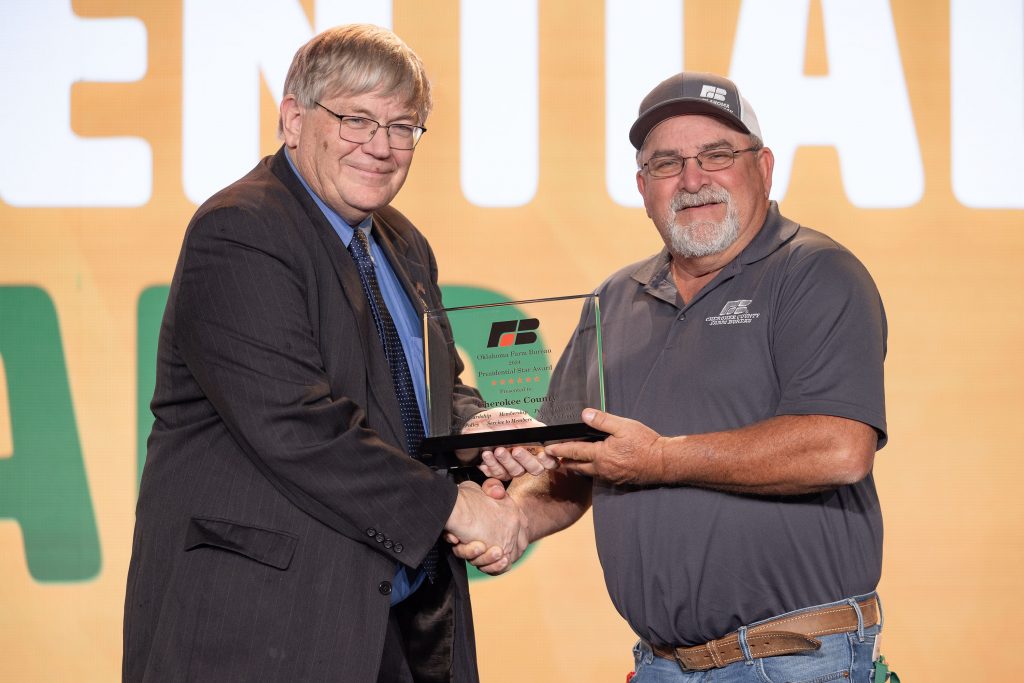
Cherokee County Farm Bureau earned one of five Six-Star Presidential Awards presented during the Oklahoma Farm Bureau's 83rd annual meeting.
Several county Farm Bureaus were recognized for their efforts to further agriculture and rural Oklahoma on Saturday, Nov. 9, during Oklahoma Farm Bureau's 83rd annual meeting in Oklahoma City.
Each year, OKFB recognizes the county Farm Bureaus that have excelled in program areas such as membership, public policy, local affairs, service to members, Women's Leadership Committee and Young Farmers and Ranchers with a Presidential Star Award.
The Six-Star Presidential Award was presented to Cherokee, Comanche, Mayes, Okmulgee, and Payne County Farm Bureaus for excelling in six program areas.
Caddo, Garfield, Grant, Kay, Kingfisher, LeFlore, Major, Ottawa, Rogers, Texas, and Washington County Farm Bureaus each received the Five-Star Presidential Award for excelling in five program areas.
Four-Star Presidential Awards were presented to Alfalfa, Canadian, Creek, Hughes, Lincoln, Logan, Love, McClain, Muskogee, Noble, Okfuskee, Pottawatomie, Seminole, Tulsa, Washita, and Woodward County Farm Bureaus.
Atoka, Beaver, Choctaw, Custer, Haskell, Jackson, Kiowa, McIntosh, Nowata, Oklahoma, Pawnee, Pontotoc, Stephens, and Woods County Farm Bureaus were awarded the Three-Star Presidential Award.
OKFB also recognized 47 county Farm Bureaus for reaching their membership quotas, including Adair, Atoka, Beaver, Beckham, Canadian, Carter, Cherokee, Choctaw, Cimarron, Creek, Custer, Delaware, Ellis, Garfield, Grant, Harmon, Haskell, Jefferson, Kay, Kingfisher, Latimer, Lincoln, Love, McClain, McIntosh, Major, Marshall, Mayes, Muskogee, Nowata, Okfuskee, Oklahoma, Okmulgee, Osage, Ottawa, Pawnee, Pottawatomie, Roger Mills, Rogers, Sequoyah, Texas, Tulsa, Wagoner, Washington, Woods and Woodward County Farm Bureaus.
The Oklahoma Farm Bureau Annual Meeting is the organization's largest gathering of farmers and ranchers every year. At the event, members vote on grassroots policy, elect leaders and award outstanding individuals. OKFB has a presence in all 77 Oklahoma counties and serves as the voice of agriculture and the rural way of life. To learn more, visit okfarmbureau.org.

Today, the Animal Agriculture Alliance released a new report detailing U.S. animal agriculture's contributions to the U.N. Sustainable Development Goals (SDGs). According to the report, U.S. animal agriculture is actively contributing toward all 17 of the SDGs, including Zero Hunger, Decent Work and Economic Growth, and Climate Action. The SDGs will be a central focus of the U.N.'s annual climate change conference, COP29, taking place now through Nov. 22.
The U.S. animal agriculture community is a world leader in sustainability efforts and has a proven track record of continued progress in environmental stewardship, food security, and more. Meat, dairy, poultry, eggs, and seafood are at the heart of healthy, sustainable diets, playing a vital role in meeting nutritional demands and closing gaps in nutrient deficiencies. The Food and Agriculture Organization (FAO) has concluded that, "Livestock serves as a crucial source of high-quality protein and essential micronutrients, and is vital for normal development and good health."
This new report, U.S. Animal Agriculture and the U.N. Sustainable Development Goals, highlights examples of contributions being made toward each goal, including:
The Alliance received a badge to participate in COP29 discussions, which has been shared with the Protein PACT to engage on behalf of animal agriculture. To view the full report or to learn more about U.S. animal agriculture's work to advance sustainability efforts, click here
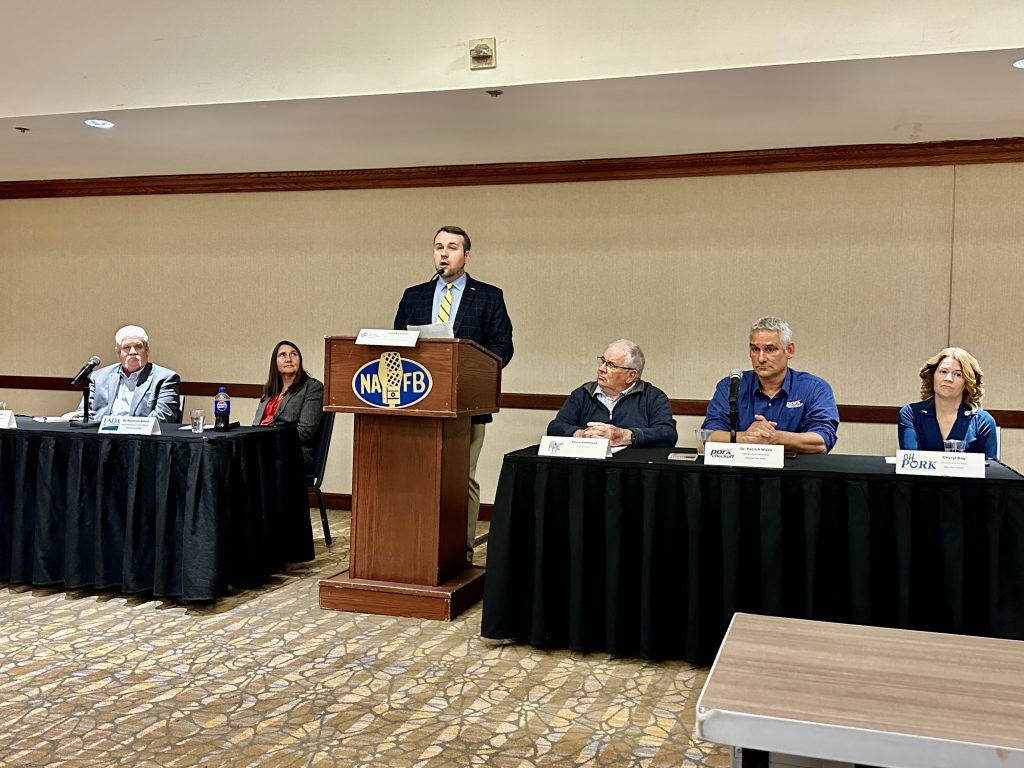
A special session on livestock disease training was held at the beginning of the National Association of Farm Broadcasters Convention. Its focus was on a foreign animal disease outbreak and included an exercise that utilized a theoretical swine disease outbreak. Attending farm broadcasters were filled in on how they could help in getting the news of such an outbreak out to the general public. After the presentation ended, Senior Farm and Ranch Broadcaster Ron Hays spoke with Kansas State Veterinarian Dr. Justin Smith to review what was discussed.
There are three main disease concerns in the swine industry. They are foot-and-mouth disease, African swine fever, and Classical swine fever. Thus far, the U.S. has not had to deal with those diseases, and through diligent and intentional effort, hopes to maintain the trade status gained from that record.
No other livestock species is susceptible to African and Classical swine fever, but foot-and-mouth disease can affect multiple species with cloven hooves including both beef and dairy cattle, pigs, sheep, and goats.
The hypothetical disease outbreak used in the exercise was foot-and-mouth disease, so Dr. Smith detailed how his office would handle such an event. He said that they would first send out a foreign animal disease diagnostician to take samples and verify the disease. Once the disease is confirmed, the facility will be quarantined and a statewide stop-movement order will be issued. USDA will likely issue its own stop-movement order in tandem.
"The idea is that we will stop the movement of all of those susceptible species and products until we can get our hands wrapped around this," Dr. Smith explained. "Early on in the process, our goal is to take those animals that are continuing to produce the virus and stop the production of that virus. We will more than likely respond with some level of depopulation on the impacted farm."
He emphasized that he hopes depopulation wouldn't extend beyond the confines of that farm; however, if there is another farm highly connected to the farm in question, whether through people, shared facilities, or other ways, samples will be taken from its animals and depopulation may have to be initiated there as well.
"We know that these diseases are very contagious, and we have a naïve population here in the United States," he stated.
The appearance of a high-consequence disease would invoke a state-wide response with national involvement. First responders, emergency managers, healthcare providers, Sheriff's departments, state police, wildlife biologists, and more entities would be involved in the response.
Biosecurity is the key to preventing disease and lessening its spread. Dr. Smith described basic biosecurity measures as anything that a producer can do to implement a gentle line of separation of the outside from the inside through physical barriers such as walls or fences, washing hands and/or shoes when moving from one divided area to another.
Upon the outbreak of disease, enhanced biosecurity measures will come into play, and Dr. Smith admitted that such practices are not economically sustainable.
"The practices that you will have to put into place cannot be done on a day-to-day basis, but they are a necessary effort to try to survive the outbreak at this place and time," he said. "It gets severe about what has to happen for feed deliveries, mortalities, and to staff who need to be able to go home and take care of their own stock."
| ||||||||||||||||||||||||||||||||||||||||||||||||||||||||||||||||||||||||||||||||||||||||||||||||||||||||||||||||||||||||||||||||||||||||||||||||||||||||||||||||||||||||||||||||||||||||||||||||||||||||||||||
| ||||||||||||||||||||||||||||||||||||||||||||||||||||||||||||||||||||||||||||||||||||||||||||||||||||||||||||||||||||||||||||||||||||||||||||||||||||||||||||||||||||||||||||||||||||||||||||||||||||||||||||||
|
Denali Water Solutions LLC of Russellville, Arkansas, has agreed to pay a $610,000 civil penalty as part of a settlement with the federal government for violations of the Clean Water Act (CWA) in two Western states.
According to the U.S. Environmental Protection Agency (EPA), the company provides land application services of sewage sludge derived from wastewater treatment facilities, also known as biosolids. EPA Region 7 is the lead region for all CWA biosolids cases across the nation.
Biosolids are regulated by EPA under the federal Clean Water Act. Pursuant to the regulations, biosolids producers and land appliers are required to collect pollution data on biosolids before applying it to land, and land appliers are required to apply biosolids at a rate that limits the amount of nitrogen to what the crop or vegetation can utilize.
"EPA's biosolids regulations protect wetlands, streams, rivers, and groundwater from harmful sewage sludge pollution," said EPA Region 7 Administrator Meg McCollister. "This settlement demonstrates EPA's commitment to watershed and groundwater aquifer health, which in turn protects wildlife habitat and drinking water sources."
EPA says that since at least 2016, Denali repeatedly land-applied sewage sludge to farm fields in Arizona and southern California at levels that exceeded the nitrogen needs of the crops in those fields and repeatedly failed to obtain the information necessary to determine the correct amount of sewage sludge to apply. Such alleged violations can lead to nitrogen and other pollutants migrating to groundwater or running off into nearby surface waters.
Excess nitrogen in drinking water can be harmful to infants or young livestock. In surface waters, too much nitrogen can lead to overgrowth of aquatic plants, increased harmful algal blooms, decreased light penetration, and reduced levels of dissolved oxygen. Each of these conditions makes it difficult for fish to live and people to swim.
In mid-2024, Denali ceased land application activities in Arizona and California. However, the settlement requires Denali to follow a specific "Soil Sampling and Agronomic Rate Calculation Protocol" if Denali resumes land application in the region. To ensure future compliance with the law, Denali will be required to sample soil in the fields where it will apply sludge and perform site-specific calculations to determine the amount of sludge it can apply to those fields without risking groundwater contamination.
EPA estimates that by ceasing land application and complying with the settlement terms, the excess application of 5.8 million pounds of sewage sludge will be eliminated annually.
The proposed consent decree was filed in the U.S. District Court for the District of Arizona. The consent decree is subject to a 30-day comment period. Information on how to provide comments and a copy of the proposed consent decree are available on the Justice Department's Proposed Consent Decree webpage.
More information on this enforcement action is available on EPA's Denali Clean Water Act Settlement Summary.
Learn more about EPA's enforcement of the Clean Water Act.
Learn more about EPA's Biosolids program.
While Denali has reached a settlement with the U.S. EPA regarding biosolids land application in Arizona and California, we deny the agency's allegation that we violated any laws or policies regarding biosolid land application.
Organics recycling plays a critically important role in sustainability by repurposing organics into useful products instead of filling landfills where they can emit dangerous greenhouse gases. The collection and processing of biosolids is vital to American farmers as it serves as a natural fertilizer, putting natural nutrients back into soil, which assists in yielding more robust crops with organic soil amendments. This service also is vital to the successful operation of municipal wastewater treatment facilities.
Prior to reaching the settlement agreement, we made the business decision to sell our biosolids operations in those states to prioritize our other organics activities there, such as collecting and recycling food waste and used cooking oil.
Denali remains committed to our municipal services in other markets.
Quote issued by Denali Water Solutions LLC
The United Sorghum Checkoff Program (USCP) is pleased to announce that four new forms of sorghum have been officially added to the U.S. Department of Agriculture's FoodData Central Database. This significant milestone ensures that the most up-to-date nutritional information on commonly used sorghum products is readily available to consumers and food companies amid growing demand for sorghum.
In collaboration with USCP, USDA collected samples from sorghum farms across the United States, gathered metadata and conducted nutrient analyses. The newly updated sorghum forms now available in FoodData Central are:
"This is a pivotal step in making sorghum information more accessible and understood by both consumers and the food industry," said Lanier Dabruzzi, MS, RD, LD, Director of Nutrition & Food Innovation at Sorghum Checkoff. "We are excited about the potential growth this brings to the sorghum market." USCP will continue working with the USDA's Methods and Application of Food Composition Laboratory (MAFCL) to include data on cooked grains and popped sorghum varieties
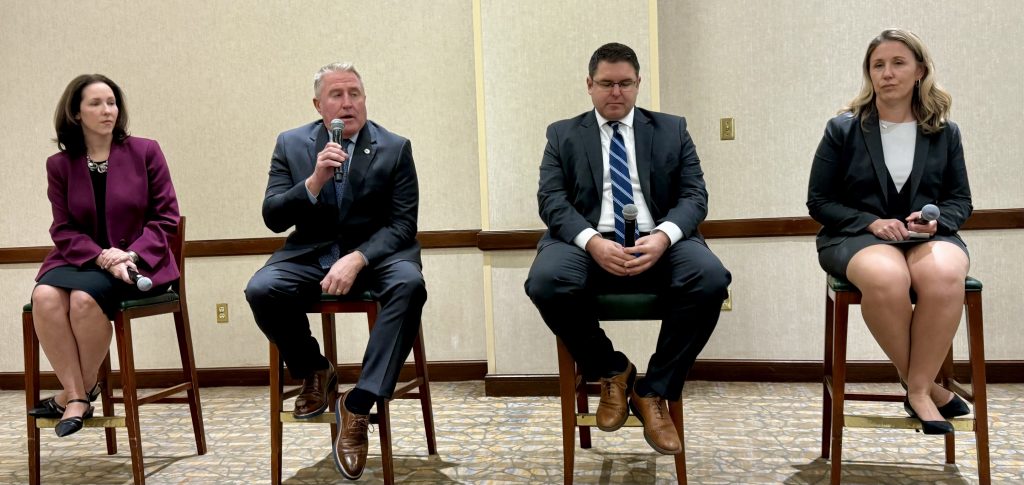
At the National Association of Farm Broadcasters Convention, Farm Director KC Sheperd caught up with Kim Atkins with the U.S. Soybeans Export Council whose strategic goals are to differentiate the U.S. soy from other origins, elevate demand for U.S. soy, and to obtain market access.
Brazil is a top competitor with U.S. soy, but according to Atkins, U.S. soy is the most sustainable, has the lowest carbon footprint, and the most nutritional advantages. She said that the U.S. is the supplier of choice.
Atkins explained, "We have a variety of options for buyers of soy from around the world, and we look forward to being the most reliable and consistent supplier."
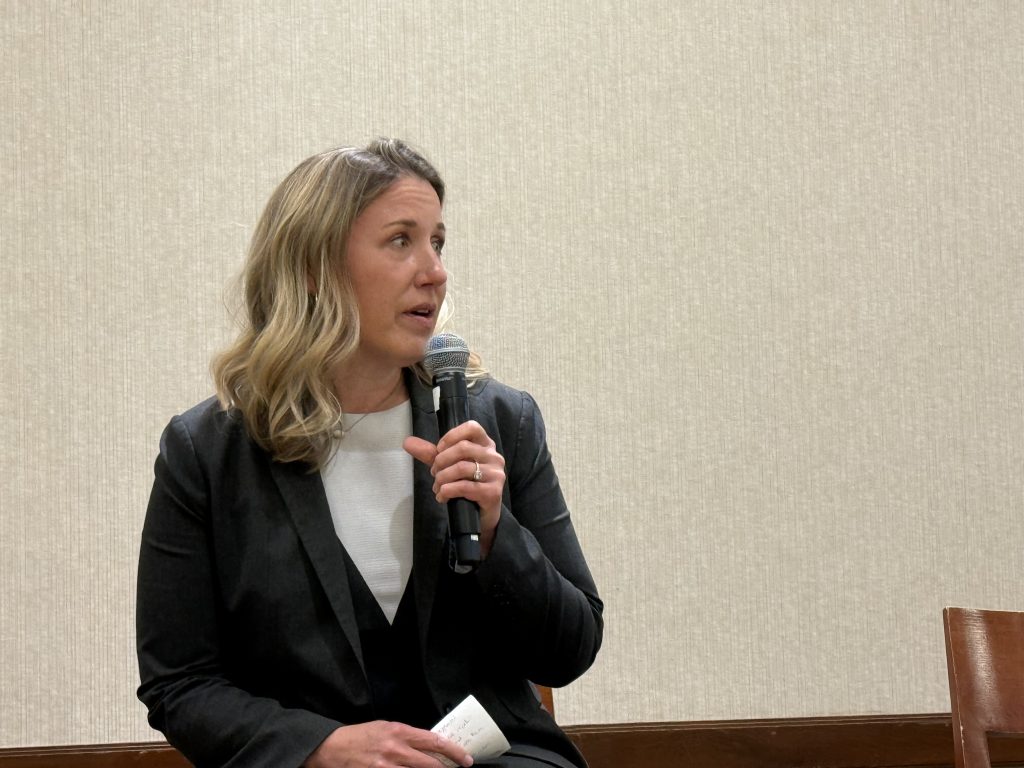
Atkins admitted that she would like to see the U.S. get more active in negotiating new free trade agreements to help expand market access.
She said that global demand for soy is growing, especially in Southeast Asia and Latin America. "Support from our funders including the United Soybean Board and USDA's Foreign Agricultural Service has allowed us to really expand our presence and global presence."
The U.S. Soybeans Council is actively working to diversify and expand global markets for U.S. soy in more than eighty countries around the world.
Atkins looks forward to working with the incoming Trump administration to emphasize the importance of agricultural trade while maintaining a good trade balance for the U.S. "More than sixty percent of U.S. soy is exported globally," she said. "We need free and open access to those markets."
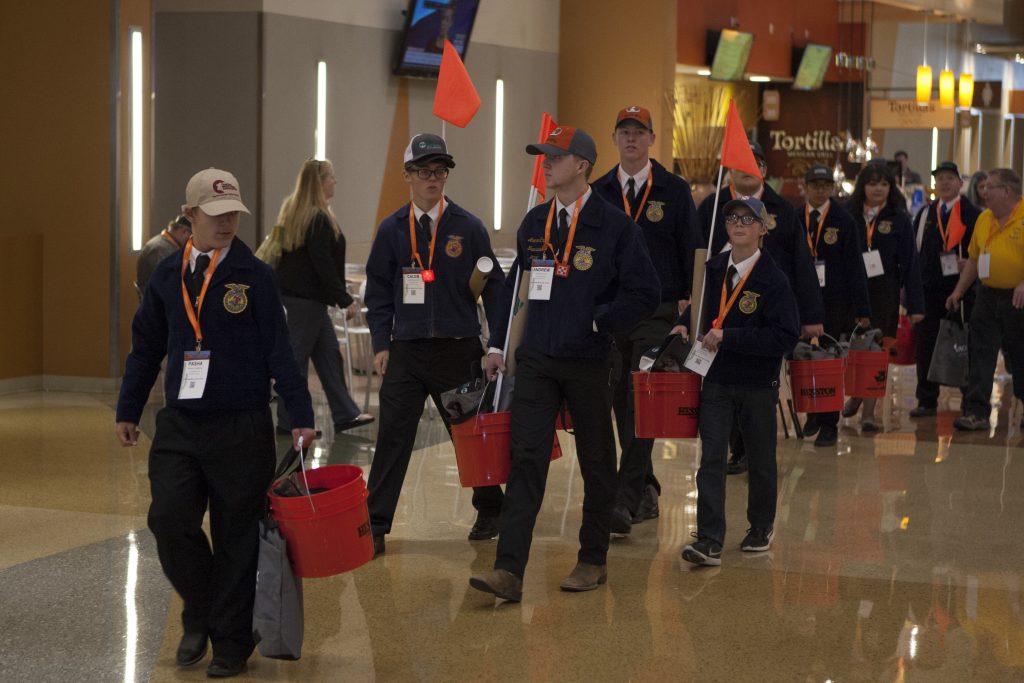
CattleCon 2025 invites future agricultural leaders to San Antonio, Texas, to experience the largest cattle industry event of the year, Feb. 4-6. Courtesy of Culver's and Nationwide Insurance, FFA and 4-H members can receive free trade show admission on Thursday, Feb. 6, 2025, which includes access to a variety of educational events.
The first 250 FFA members and 250 4-H members to register will receive complimentary Thursday NCBA Trade Show admission. FFA members and alumni are also invited to the Culver's Blue Jacket Social, a special gathering designed for networking, sharing experiences and building lasting relationships.
NCBA Trade Show attendees can explore more than nine acres of displays and exhibitors offering the latest advancements, from equipment and technology to pharmaceuticals and feed supplements. In addition to finding the right product or service to solve any problem, there are a variety of educational opportunities within the show.
Attendees can stop in the Learning Lounge to enjoy informal, face-to-face talks in an intimate setting right on the trade show floor. The popular Stockmanship & Stewardship Demonstration Arena also returns with stockmanship experts providing low-stress cattle handling demonstrations, Beef Quality Assurance educational sessions, industry updates and facility design sessions. Cattle Chats will feature beef industry educational sessions, and the Chutes and Scales Showdown will offer a side-by-side comparison of equipment where producers can watch cattle run through chutes then get hands-on experience.
To receive free Thursday NCBA Trade Show registration, FFA members must use the code FFACULVERS, and 4-H members, 4HNW. In addition, children 12 and under receive free trade show admission with a paying adult. A variety of other registration options are also available. For more information and to register and reserve housing, visit convention.ncba.org

On Wednesday, the United States Senate will vote on the next majority leader. Ahead of the vote, State Senator Dusty Deevers, R-Elgin, exhorted Oklahoma Senators James Lankford and Markwayne Mullin, in addition to the rest of the U.S. Senate, to support Rick Scott, R-Florida, for Senate Republican Leader.
"In voting 66-32% for Donald Trump with all 77 counties in agreement, Oklahomans have spoken clearly," Deevers said. "We want unashamedly conservative leadership that aligns with our conservative values and vision. John Cornyn and John Thune represent the Mitch McConnell wing of the party: a center-left, neo-con establishment that Republican voters have made clear we do not want. According to the Heritage Action Scorecard, Cornyn is the fourth most liberal Republican Senator and Thune is the 10th. Both have conservative scores below 40 percent for the recent session. No Senator can call himself a conservative who elects someone to leadership who votes liberal more often than conservative. Rick Scott, on the other hand, is rated as the sixth most conservative US Senator."
Deevers also pointed to online poll conducted by Elon Musk with just under 1.1 million votes yielded the following results:
1) Rick Scott (65.5%)
2) Other (22.6%)
3) John Thune (6.6%)
4) John Cornyn (5.2%)
"For those counting, that is a 60-point advantage for Rick Scott over Thune and Cornyn," Deevers said. "The days of running on conservative talking points and governing as liberals behind closed doors are quickly coming to an end. Electing Thune or Cornyn as Senate Republican Leader would be a gut punch to an active and educated Republican base who will not forget such betrayal." With the results of last week's election giving federal Republicans a clear mandate to implement Trump's Agenda 47, Deevers emphasized the importance of having a Senate Leader with a conservative record to help shepherd that agenda through the Senate.
"Those like Thune and Cornyn, who have made clear for years that their allegiance lies with Mitch McConnell and the Republican establishment rather than with the Republican base, should not be chosen to shepherd Trump's Agenda 47 through the Senate. Mitch McConnell did nothing to cut spending, drain the swamp, promote government efficiency, secure the border, end welfare for illegals, bring industry to America, ban wokeness from schools, oppose globalists, pursue an America First foreign policy, end ESG, and countless other policies for which the Republican base just voted," Deevers said.
"While I wish Rick Scott were stronger on a few issues and Senators such as Rand Paul, Mike Lee, Tommy Tuberville, and Ron Johnson would be the Senate Republican leaders if I had my way, there is no question that Rick Scott is the strongest candidate in the leadership race and the only one who represents a change from the center-left leadership that Mitch McConnell has given Senate Republicans for the last 17 years. I strongly urge Senators Lankford and Mullin to publicly endorse and vote for Rick Scott for Senate Majority Leader. This is a pivotal moment—an opportunity for federal Republicans to take a step forward and do the will of the people rather than the DC swamp."

Pivot Bio has introduced "N-SIGHTS from the Farm," a digital hub providing real-time harvest data and weekly agronomic insights that showcase how Pivot Bio PROVEN® 40 is performing in corn fields across the United States. Farmers can visit PivotsProvenIt.com to explore yield data, track nitrogen efficiency metrics, and hear directly from other farmers who are incorporating this advanced nitrogen solution into their operations.
The vidcast is being co-hosted by Ryan Van Roekel, Ph.D., senior manager of commercial agronomy at Pivot Bio.
"Farmers know that nitrogen isn't simple," Van Roekel said. "The N-SIGHTS platform gives them harvest data and agronomic insights to understand how PROVEN® 40 is working in real-world conditions. With the "N-SIGHTS from the Farm" vidcast and digital hub, we're bringing them data from their regions and sharing insights on how their peers are using PROVEN® 40."
The vidcast will deliver weekly internet shows that feature agronomists and innovative farmers who are benefiting from PROVEN® 40. The first four episodes are already available:
· Episode 1: Wet Fields, Big Yields
· Episode 2: Growing by the Bushel. Delivering by the Ton
· Episode 3: A New Mode of Nitrogen: Where Science Meets Soil
· Episode 4: The N Factor: How Agronomists Evaluate Nitrogen Programs
The website features an interactive map that allows farmers to obtain national and state-specific data on yield, nitrogen replacement, nitrogen advantage and nitrogen use efficiency (NUE). After selecting their states, farmers can download comprehensive reports detailing PROVEN® 40 performance. Data will be updated as new information becomes available.
About PROVEN® 40 – A New Mode of Action in Nitrogen Delivery
Pivot Bio PROVEN® 40 represents the first new mode of nitrogen action in this century, using patented, gene-edited nitrogen-fixing microbes attached at the root to provide a steady nitrogen source that helps meet crop needs. Made in the United States, PROVEN® 40 allows farmers to incorporate a foundational nitrogen source into their nutrient plans, partially replacing synthetic nitrogen applications. By using PROVEN® 40, farmers gain a consistent nitrogen supply that minimizes risks associated with nitrogen loss — such as volatilization and leaching — while optimizing yield potential. Visit PivotsProvenIt.com to explore these resources, stay updated on performance metrics, and access the latest episodes of the "N-SIGHTS From the Farm" weekly harvest vidcast.
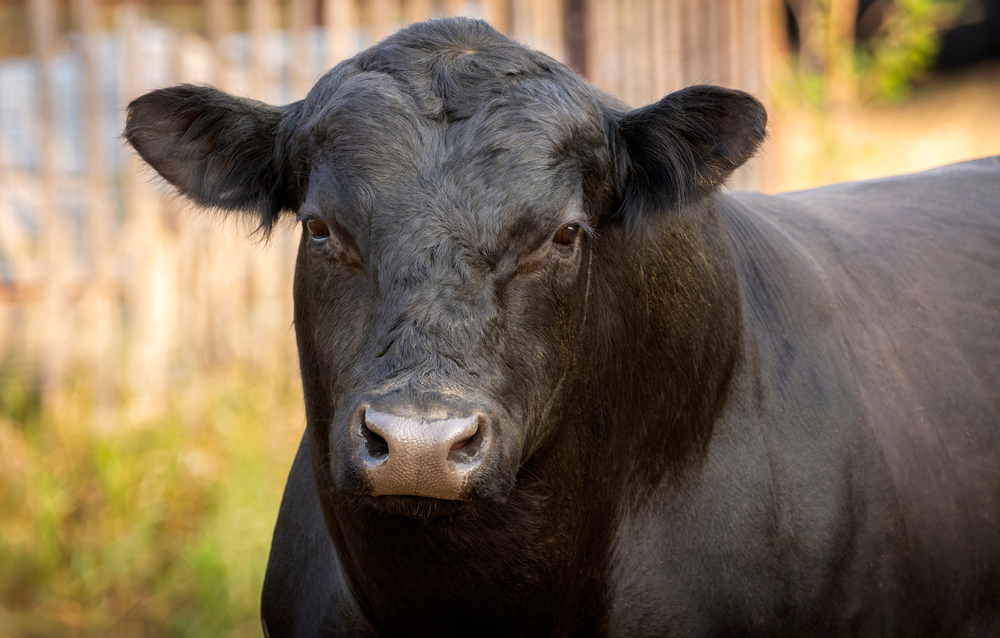
Senior Farm and Ranch Broadcaster Ron Hays is talking with Kelli Retallick-Riley, president of Angus Genetics, Inc. (AGI) about genomic expected progeny differences or EPDs and their uses in the cattle industry today.
Retallick-Riley said, "We are in an interesting place right now with herd rebuilding. We have a lot of people thinking about starting with the end and understanding what the consumer needs are while making sure we have that quality packed in."
She also described the evolution of the cow herd citing accelerated growth rates, quality carcass characteristics, and the balanced structure of maternal traits which allows the females to thrive while producing productive calves.
"There is a lot of information out there and you are getting a lot of market signals from different places," Retallick-Riley admitted. "We try to help distill down that information. When you are looking at that big buffet of tools that we have available for Angus seed stock producers and commercial users, a lot of people start with those dollar values, those economic indexes. With that, they can refine it for specific traits to address issues they are having in their herds."
If the issues are pregnancy rates, genomics can find improved heifer pregnancy traits. Dystocia problems can be improved with calving ease maternal and calving ease direct traits.
"I think the best advice we can give to a commercial producer is to figure out what your goal is," Retallick-Riley added. "How do you remain profitable in your operation? That can really lead you to figure out how to work through all of these tools."
She explained common indexes as maternal and maternal weaned calf values, which are based on the weaned calf value from conception to weaning. Next is the dollar beef value, or the terminal sire index. It relates to feed efficiency, carcass quality, and pounds of saleable meat yield. Then, the dollar combined value combines the maternal weaned calf value component with the terminal component in beef value.
When Hays mentioned increased days on feed and increased carcass weights, Retallick-Riley replied that it all begins with sire selection. "Selecting the sire with the right genomically enhanced EPDs."
AGI is already working on upgraded GMAX Commercial Heifer tests to help producers be more selective as they begin rebuilding their herds. They can identify common traits in their females and better select bulls to complement their genetic strengths and weaknesses.
The Beef Buzz is a regular feature heard on radio stations around the region on the Radio Oklahoma Ag Network and is a regular audio feature found on this website as well. Click on the LISTEN BAR for today's show and check out our archives for older Beef Buzz shows covering the gamut of the beef cattle industry today.
In this episode of the Red Dirt Agronomy Podcast, OSU Associate Professor of Agricultural Economics Dr. John Michael Riley acknowledges that producers often grapple with the choice of sticking to historical planting practices versus adapting to current market conditions; however, he says that understanding input costs and market prices is crucial for making informed decisions that can impact profitability.
Oklahoma producers tentatively began planting wheat for winter grazing in mid-August, but due to persistently dry conditions and the onslaught of army worms, minimal emergence was seen. However, the biggest concern is the price difference for those needing to plant wheat for grain. Low wheat prices, relatively cheap anhydrous, and rumors that nitrogen prices could skyrocket by springtime have grain farmers planning their next moves carefully.
"The risk for putting in dry wheat in August is a shallow rain that germinates the seed, but doesn't sustain the plant," Dr. Riley said. "It can sit there for a long time dry if that doesn't happen. There are a lot of things producers do by the calendar, no matter what the environmental conditions are."
Dr. Riley mentioned that there are risk management options, but many producers don't take full advantage of them. He said that grazing cattle on wheat is a good start, though. "We can have that dual crop with wheat and cattle," he commented. "That gives you a little bit of insulation in one or the other. Right now, the cattle market is pretty strong. That may entice some folks to go a little heavier on wheat so they have the capacity to run some cattle."
Price protection through crop insurance and basic budgeting to minimize expenses are two other risk management options. He also said that creating a detailed budget is essential for producers. It outlines expected costs and revenues, enabling them to make informed agricultural decisions and manage their resources effectively.
After determining their budget, producers should determine whether or not they are comfortable with the price they are getting today.
"If you are comfortable with the price, lock it down, and don't think about it anymore." Dr. Riley advised. "Don't beat yourself up if a better price comes tomorrow. Be comfortable in the fact that if the price moves in the other direction, you've got that covered. Have a price in mind, and once that price is there, try to secure – not all of it – but try to capitalize on it as much as possible."
He observed that producers are more educated than they were 20 or 30 years ago and that technological advancements are readily available to lessen the effects of mistakes. Besides equipment advancements, markets are much more readily accessible to producers nowadays.
He admitted that it is easy to get caught in the trap of too much information. He said, "You have to make your budget, find your break-even, and work off of that. You have to have that conviction of once you make a decision, you can't beat yourself up about it. Hindsight is 20/20 and you can't let yourself get lost looking in the rearview mirror."
Producers have to focus on the things they have some element of control over: land, soil nutrients, equipment and the frequency of use of it, and seed variety. Producers have the most control over the production of their products.
"The risk management comes in doing the job of producing the crop to the best of your ability," Dr. Riley concluded. "If you are doing that correctly and budgeting correctly, to me, they are on the right foot."
He said that mistakes are often made by trying too much on the marketing side. It's important to stay on the right side of the fence of hedging versus speculating when it comes to futures marketing.
The Red Dirt Agronomy Podcast team discussed many other topics with Dr. Riley. Listen to the entire episode here.
The incidence of occupational injuries and illnesses within the poultry sector's slaughter and processing workforce has fallen below all general industry, manufacturing and food manufacturing levels for the first time since the Department of Labor's Bureau of Labor Statistics (BLS) began recording injuries and illnesses information in 1994. The poultry industry's rate of 2.6 injuries per 100 full-time workers was below the rate of 4.7 for similar agricultural industries and lower than 3.6 for the entire food manufacturing sector, all of the manufacturing industries at 2.8, and all of the general industry at 2.7. The full report can be accessed here.
Poultry processing's 2023 incident rate of 2.6 represents an 89% decrease from 1994, the oldest data available on the BLS website when the recorded rate was 22.7 and demonstrates the advancements the industry has made in improving safety for its workforce.
"The poultry industry has always prioritized employee safety and remains dedicated to preventing workplace injuries and illnesses, with a particular focus on musculoskeletal disorders like carpal tunnel syndrome. By embracing ergonomic practices and early medical intervention, and by adopting new technology and automation, the industry has made significant strides in worker safety. We have seen a substantial reduction in injury and illness rates. Nonetheless, the industry remains committed to exploring innovative approaches to further protect our workforce," stated the Joint Poultry Industry Safety & Health Council in response to the report's release.
The Joint Poultry Industry Safety & Health Council consists of members from the U.S. Poultry & Egg Association (USPOULTRY), the National Chicken Council (NCC) and the National Turkey Federation (NTF). Collectively, the three organizations represent companies that produce 95% of the nation's poultry products and directly employ more than 350,000 workers.
"Our employees are our most important asset, and their safety is paramount," said USPOULTRY, NCC and NTF in response to the report. "The poultry industry has consistently focused on preventing workplace injuries and illnesses, and this latest data reflects the outstanding safety performance we have achieved. Having a lower incident rate than the general industry, manufacturing and food manufacturing categories is a milestone we are proud to have reached. We will continue setting new benchmarks to ensure the safety and well-being of our employees."
To mark the 10th anniversary of National Apprenticeship Week (NAW) from November 17-24, 2024, the American Welding Society (AWS) has issued a proclamation reaffirming its commitment to advancing a skilled welding workforce through registered apprenticeships.
Registered apprenticeships play a critical role in building a skilled workforce nationwide, ensuring job quality and creating well-paying career pathways. AWS's proclamation calls on industry leaders and employers to champion apprenticeship programs for individuals from all backgrounds, including those from historically underserved communities.
"National Apprenticeship Week is an opportunity for us to invest in the future of our industry," said AWS President Michael Krupnicki. "Through registered apprenticeships, we can address the skills gap and create rewarding, lucrative career paths through hands-on, paid training in welding, inspection, and automation."
AWS believes registered apprenticeship programs are essential for strengthening the welding workforce and addressing critical needs of the nation's infrastructure, supply chain, and clean energy sectors. To support employers in launching or enhancing apprenticeship programs the AWS Foundation has developed weldingapprenticeship.com, a resource hub providing guidance on structuring registered apprenticeship programs for welders, welding inspectors and automation technicians.
For more on how AWS's Registered Apprenticeship Programs can support your organization's workforce needs, visit weldingapprenticeship.com. The official National Apprenticeship Week website offers details on activities happening nationwide
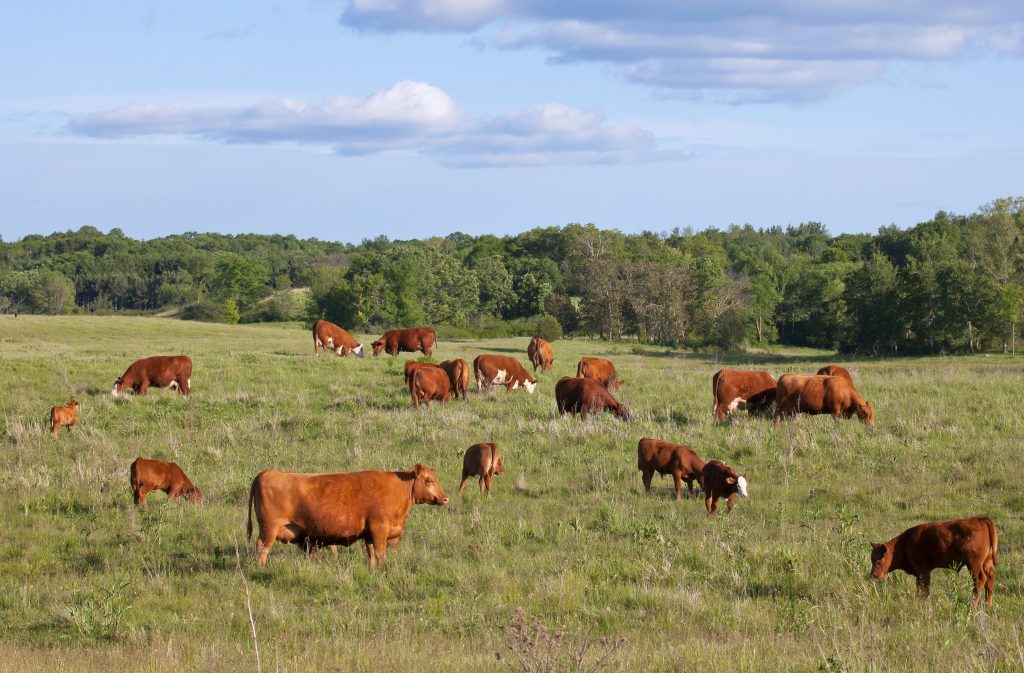
On today's Cow-Calf Corner, Rosslyn Biggs, DVM, Oklahoma State University Cooperative Extension Beef Cattle Specialist talks about enhancing reproductive success in the cow-calf herd.
Reproductive management is at the foundation of a successful cow-calf herd. However, enhanced reproductive technologies are not readily incorporated as seen in the results of the 2017 USDA National Animal Health Monitoring System Beef Cow-calf study. Results of this study indicated, of heifers bred for calving in 2017, 76.8 percent were bred only by bulls, and 15.1 percent were bred by a combination of artificial insemination and bull breeding. Of cows bred for calving in 2017, 92.9 percent were bred only by bulls, and 5.5 percent were bred by a combination of artificial insemination and bull breeding. Estrus synchronization was utilized in only 7.3 percent of all operations.
As producers approach breeding season, plans should be developed to fit the needs of the operation in coordination with veterinary input. Breeding soundness evaluations and pregnancy detections should be standard in all breeding herds. Reproductive technologies when used appropriately improve herd health, efficiency, genetics, and overall profitability. Enhanced reproductive protocols can be utilized for operations incorporating artificial insemination as well as exclusively bull bred herds.
Estrus synchronization involves manipulating the estrous cycle of heifers and cows so that a large group of females come into heat at the same time. Various hormone-based protocols are used to achieve estrus synchronization, making it easier to manage breeding and improve pregnancy rates.
By synchronizing estrus, producers can breed multiple cows simultaneously, potentially reducing the time and labor required for heat detection and insemination. Although this technique is most often used in conjunction with artificial insemination to maximize reproductive efficiency, advantages can also be seen in bull-bred herds. Estrus synchronization allows for more precise timing of calving.
Artificial insemination (AI) is one of the most widely used reproductive technologies in the beef industry. AI allows producers to access superior genetics enabling them to improve a variety of traits in the resulting calf crop. Moreover, AI reduces the need for keeping a large number of bulls on-site, thereby lowering bull maintenance costs, decreasing disease transmission, and improving animal and human safety.
Great resources exist for producers seeking to integrate or improve their reproductive strategies. Notable examples are those provided by the Beef Reproduction Task Force. The task force offers a variety of free resources including webinars, synchronization protocols, and decision tools such as the Estrus Synchronization Planner and AI Cowculator. More information on these resources can be found at www.beefrepro.org .
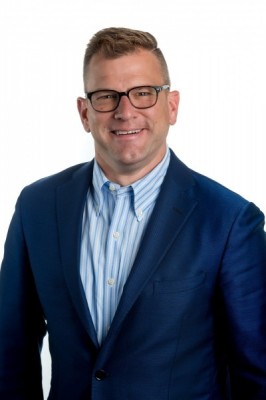
AEM Senior Vice President Curt Blades
U.S. sales of Ag tractors decreased 14.2% in October 2024 compared to the year prior, according to new data from the Association of Equipment Manufacturers. Sales of combines also fell during the month, dropping 34.6% compared to 2023.
"October's sales of ag tractors and combines follow a September that also showed a slowdown in sales," said AEM Senior Vice President Curt Blades. "These declines point to the overall softness in the ag economy following a robust five years of positive industry results."
Canadian sales of Ag tractors also dropped in October 2024, finishing the month 15.1% behind 2023's sales, while combine sales fell 26.9% compared to the year before.
The Ag Tractor and Combine reports can be found on the AEM Market Share Statistics page. The U.S. report can be downloaded from this page, while the Canadian report is available for download here.
RON's Dave Lanning has a pre-opening look at today's agricultural Markets.
Click the audio tab below for today's report.
The American Soybean Association welcomes President-elect Donald Trump's nomination of former U.S. Representative Lee Zeldin (R-NY) to serve as Environmental Protection Agency Administrator.
ASA Chief Executive Officer Stephen Censky said, "From representing a congressional district with significant agriculture production to protecting the Long Island Sound, former Congressman Lee Zeldin is no stranger to interactions with the Environmental Protection Agency. Mr. Zeldin has a track record in D.C. of working in a thoughtful, bipartisan way, which makes him well suited to the position of EPA administrator."
ASA looks forward to introducing Zeldin to the soy industry and the role it plays both in agriculture and the U.S. economy as he comes to the helm of EPA, an agency of critical importance to soybean farmers.

General Revenue Fund collections in October totaled $711.9 million, which is $24.5 million, or 3.6%, above the monthly estimate. This is $3.8 million, or 0.5%, below collections in October 2023. Total GRF collections for the first four months of fiscal year 2025 are $2.68 billion, which is $29.3 million, or 1.1%, above the estimate, and $13.6 million, or 0.5%, below prior year collections for the same period.
"The state's General Revenue Fund is tracking closely with estimates as we enter the second quarter of the fiscal year," said OMES Director Rick Rose. "October marked the first full month of collections impacted by the state grocery tax elimination, which is reflected in the decrease in overall sales tax revenue. Despite the sales tax shortfall, a stronger-than-anticipated contribution from individual income tax more than offset the gap. We will continue to closely monitor general revenue trends to assess the full impact of the grocery tax elimination as the fiscal year progresses."
October 2024 revenue tables are available on the OMES website.

Winter Wheat Planted reached 91 percent, down 1 percentage point from the previous year and 2 from the average. Winter Wheat Emerged reached 76 percent, down 3 points from a year ago and from the five-year average. Winter wheat conditions rated 44 percent good to excellent, 38 percent fair, and 18 percent poor to very poor. Last week's conditions rated 41 percent good to excellent, 36 percent fair, and 23 percent poor to very poor.
Corn harvested reached 95 percent, up 11 points from last year and 9 points from the average.
Soybeans harvested reached 96 percent, up 2 points from last year and 5 points from the average.
Cotton harvested reached 91 percent, up 7 points from a year ago and 8 points from the average.
Sorghum harvested reached 85 percent, up 1 point from the previous year and 2 from the average.
Oklahoma Crop Progress Report:
Winter wheat planted reached 79 percent, down 11 points from the previous year and 14 points from the five-year average. Winter wheat emerged reached 77 percent, down 14 points from the previous year and 17 points from normal. Winter wheat conditions rated 28 percent good to excellent, 50 percent fair, and 22 percent poor to very poor. Last week's conditions rated 31 percent good to excellent, 42 percent fair, and 27 percent poor to very poor
The Oklahoma Corn harvest is complete.
Sorghum harvested reached 80 percent, equal to a year ago, but down 2 percentage points from the average.
Soybeans harvested reached 59 percent, down 7 points from a year ago and 3 from the average.
Cotton harvested reached 48 percent, down 7 percentage points from a year ago and 4 from the average.
Livestock conditions rated 48 percent good to excellent, 35 percent fair, and 17 percent poor to very poor. Last week's conditions rated 51 percent good to excellent, 29 percent fair, and 20 percent poor to very poor.
Pasture and range conditions rated 10 percent good to excellent, 33 percent fair, and 57 percent poor to very poor. Last week's conditions rated 9 percent good, 38 percent fair, and 53 percent poor to very poor.
Winter wheat planted was 97 percent, equal to last year but up 1 point from the five-year average. Winter wheat emerged was 84 percent, down 1 point from last year, but up 3 points from the average. Winter wheat conditions rated 40 percent good to excellent, 37 percent fair, and 23 percent poor to very poor. Last week's conditions rated 40 percent good to excellent, 37 percent fair, and 23 percent poor to very poor
Corn harvested reached 97 percent, up one point from last year and up 3 points from the average.
Soybeans harvested reached 96 percent, up 5 points from last year and 8 points from the average.
Sorghum harvested reached 88 percent, up 1 point from last year, and 3 points from the average.
Cotton harvested reached 57 percent, down 1 point from last year but up 14 points from the average.
Pasture and range conditions rated 23 percent good to excellent, 45 percent fair, and 32 percent poor to very poor. Last week's conditions rated 19 percent good to excellent, 39 percent fair, and 42 percent poor to very poor.
Winter Wheat planted reached 81 percent, equal to a year ago but, down 4 points from the five-year average. Winter wheat emerged reached 63 percent, down 1 point from a year ago and 5 from the average. Winter wheat conditions rated 33 percent good to excellent, 33 percent fair, and 34 percent poor to very poor. Last week's conditions rated 24 percent good to excellent, 38 percent fair, and 38 percent poor to very poor.
The Texas Corn harvest is complete.
Cotton harvested reached 65 percent, up 12 points from the previous year and 9 from the average.
The Texas Sorghum harvest is complete.
Soybeans harvested reached 95 percent, up 6 points from last year, and 5 points from the average.
Pasture and range conditions rated 14 percent good to excellent, 23 percent fair, and 63 percent poor to very poor. Last week's conditions rated 11 percent good to excellent, 28 percent fair, and 63 percent poor to very poor.
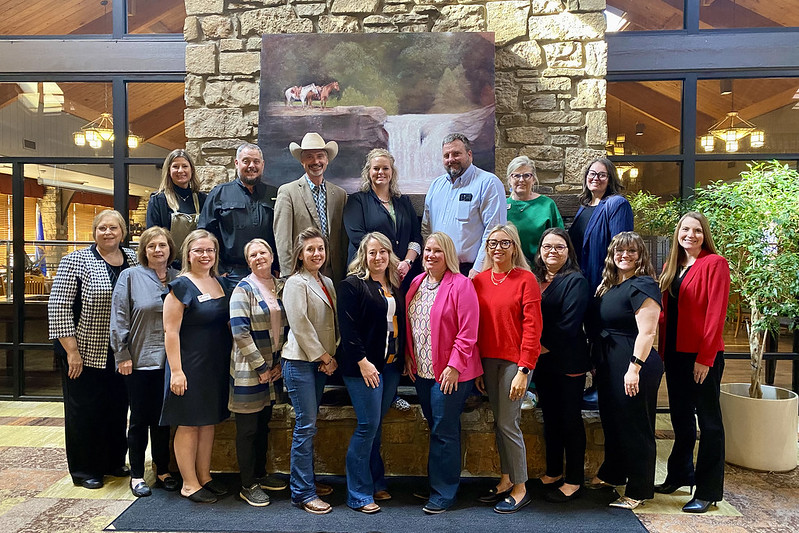
Oklahoma State University Extension recognized graduates of its latest Leadership Academy class this month as they conclude the program's meeting series and begin work on final projects.
The group of 17 OSU Extension county educators, district/area specialists and Community Nutrition Education Program coordinators kicked off the course in April. The program featured three overnight retreats, four webinars, practice exercises and group reports.
The following educators completed the OSU Extension Leadership Academy:
Graduates will participate in two leadership project follow-up meetings in 2025 for continued professional development and networking with the first class of graduates. They will also discuss project updates and how the program has improved their personal and professional lives.
"I have learned the benefit of delegating tasks and projects to others, and how to improve my communication skills," said Justin McDaniel, agriculture educator and county Extension director for McClain County Extension. "I have also improved my ability to set priorities, make decisions and allocate resources."
The Leadership Academy provides networking and collaboration opportunities for mid-career Extension professionals through discussion, practical application of lessons and projects, and team building. Participants learn personal leadership and self-management; interpersonal leadership and relationship building; decision-making, influence and big picture methodology to advance Extension; and how to foster ongoing professional growth among fellow aspiring leaders.
"My biggest takeaway from the Leadership Academy has been learning how to lead with both strategy and empathy," said Liana Palmer, agriculture and 4-H educator for LeFlore County Extension. "This program has expanded my ability to approach challenges with a solution-focused mindset. I've learned how to bring people together, listen to different perspectives, and face challenges with a spirit of openness and collaboration. Through hands-on experience and collaboration with fellow leaders, I feel equipped to make a lasting impact in my community."
Qualified candidates for the OSU Extension Leadership Academy must have three years of Extension experience, and participation is limited to 20 individuals.
OSU Extension uses research-based information to help all Oklahomans solve local issues and concerns, promote leadership and manage resources wisely throughout the state's 77 counties. Most information is available at little to no cost.
Senate Pro Tem Designee Lonnie Paxton, R-Tuttle, today has named key members of his leadership team after being tapped as the Senate's next leader.
Pro Tem Designee Paxton has appointed Sen. Julie Daniels, R-Bartlesville, as the Senate Majority Floor Leader, Sen. Chuck Hall, R-Perry, as Appropriations Chairman and Sen. John Haste, R-Broken Arrow, as Vice Chairman of Appropriations.
"Each of these individuals are experienced lawmakers and will serve in critical roles as the Senate prepares for the upcoming legislative session," Pro Tem Designee Paxton said. "Senators Daniels, Hall and Haste have shown tremendous dedication to the state and a commitment to improving Oklahoma. Their leadership and expertise will be invaluable as we work on issues that matter most to those we serve, from budget allocations to legislative priorities that are heard on the Senate floor. Our caucus is united in its vision to advance Oklahoma. This team will play a pivotal role in helping create policies that reflect our state's values and priorities."
As Floor Leader, Sen. Daniels will direct the flow of legislation on the Senate floor, ensure effective debate, and manage the legislative agenda. Her experience in policy leadership and dedication to constitutional principles make her an ideal fit for the role. She is the second woman to serve as the Senate's Floor Leader.
"I'm grateful to Pro Tem Designee Paxton for giving me the opportunity to serve the Senate as floor leader," Daniels said. "Handling how bills get assigned to committees and making sure they move off the Senate floor is a complex task that requires a significant amount of work behind the scenes. I'm ready for this new challenge, and I look forward to working with my Senate colleagues in the upcoming session."
Sen. Hall will continue to oversee the Senate's budget-writing process by guiding the development of a financially prudent spending plan for the state in an open and transparent manner. Sen. Hall was named appropriations chairman toward the end of last session after previously serving as vice chairman and as the Senate lead on the Joint Committee on Pandemic Relief Funding.
"I'm honored Pro Tem Designee Paxton reappointed me to serve as Appropriations Chair," Hall said. "Last year, the Senate crafted a state budget through the most public-facing process in modern history. I look forward to working with my Senate colleagues, members of the House and executive branch officials to improve that open and transparent process to build a fiscally responsible budget that benefits all Oklahomans."
Sen. Haste takes on the role of Vice Chairman of Appropriations. Known for his background in transportation and aerospace policy, in addition to previous service on other key Senate committees, Sen. Haste will work closely with Sen. Hall to address budget needs across state agencies.
"It's an incredible honor to be named Vice Chair of Appropriations, and I want to thank Pro Tem Designee Paxton for his confidence in me," Haste said. "I'm grateful for the opportunity to work with Sen. Hall and my other Senate colleagues in this new role to make responsible and strategic spending decisions for the people of Oklahoma and to ensure our state's resources are directed where they'll make the greatest impact."
Full bios for Daniels, Hall and Haste can be found on the Senate's website.

NASDA Director of Public Policy Patrick Wade
The National Association of State Departments of Agriculture is excited to announce the hiring of Patrick Wade as Director of Public Policy.
As Director, Wade will advance the organization's public policy advocacy with his nearly 10 years of experience in agricultural policy and government affairs. Wade will be the staff lead for NASDA's Plant Agriculture and Pesticide Regulations and Rural Development and Financial Security Committees.
"I am thrilled for the opportunity to join the NASDA team and help advance this organization's essential mission. Now, more than ever, it is critical to champion nonpartisan, collaborative solutions to some of the most pressing issues in agricultural policymaking. I have seen firsthand the instrumental role state departments of agriculture play in supporting producers, consumers and the broader agriculture industry. I cannot wait to do my part to help NASDA's members continue to protect natural resources, bolster sound regulatory frameworks and strengthen rural economies," Wade said.
Wade comes to NASDA most recently from the Texas Grain Sorghum Producers, and he holds bachelor's degrees in government and economics from The University of Texas at Austin. He has also been honored as a Nuffield Farming Scholar and conducted research on the impact of international trade policy on agricultural sustainability outcomes.
Wade's first day with NASDA will be Nov. 12, 2024.
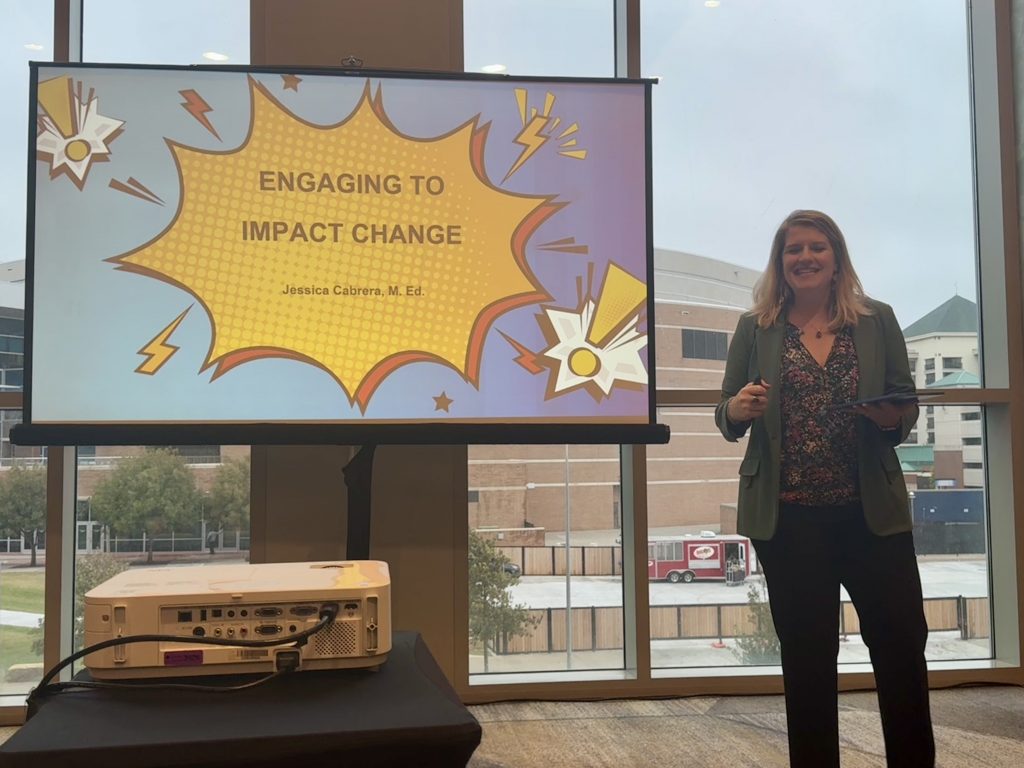
At the Oklahoma Farm Bureau Convention, Oklahoma Farm Report's Maci Carter visited with Farm Bureau's Managing Director of Member Engagement Jessica Cabrera who led a session about Cultivating Healthy Minds, which is OkFB's farmer mental health wellness campaign.
Talking about mental health can be difficult for a plethora of reasons. Associated stigma, fear of judgment, a lack of confidence in how or what to say, fear of how people will respond are some of the hurdles that Cabrera cited for why people may not broach the topic with others.
"Even though you aren't a clinician or a mental health professional, or a medical provider, you are still a person who is uniquely positioned to have these conversations in your sphere of influence," Cabrera stated. "Whether that be your own family, your neighbors, friends, or another local Farm Bureau member, each of us influences our own social circles differently, so we each hold a lot of power within ourselves to make an impact and we often don't realize it. It is important that we lean in."
She explained that courage and confidence are not the same thing. While a person may lack the confidence to begin the conversation with someone, they can still be courageous enough to do it. She said that the more you act with courage, the more confidence you will gain.
"Farm Bureau is very uniquely positioned as well," she added. "The whole mission of Farm Bureau is to help farmers and ranchers thrive. We want to build a sustainable future for agriculture, and you can't do that without farmers. A person's mental and physical wellness is important to their ability to thrive in life and in business."
In her presentation, Cabrera listed a Superpower for Success that everyone possesses. "Our superpower is our 'Why,'" she said. "The reason I consider this a superpower is because we can talk ourselves out of things really quickly, but if we anchor in on why it matters, then we get that extra boost of courage that we need."
She also listed three secret weapons that people can keep in their arsenal of wellness for themselves and others: Small Gestures, Your Voice, and Teaming Up.
"Small Gestures is a secret weapon because we forget about it," she explained. "It is simple things like making a phone call or sending a text or writing a card to somebody. Those are simple gestures that don't cost much and hardly take any time, but they can make a really big impact."
She explained that a person using their voice to bring up the topic of mental health and saying things in a way that normalizes the conversation. Teaming Up is based on the community spirit and how quickly things can get done when like-minded people come together with a singular purpose.
"We often get busy with our own routines and interact with the people in our lives in a certain way all the time," Cabrera said. "Intentionality is about pausing long enough to tap into your 'why.' Asking why it matters for me to lean in and do something on purpose. I think we can all be intentional with a little bit of effort."
More resources can be found at farmstateofmind.org. It includes a national resource directory, helpful tips, on-demand training, and information for people struggling with opioid misuse. "Additionally, and most importantly, I think, we have partnered with the Farm Family Wellness Alliance so that now a resource called Togetherall is available nationwide to all farm families sixteen and older, free of charge," Cabrera concluded.
She further explained accessing Togetherall's assistance. Click the listen bar above to hear the full conversation. If you or someone you know is in crisis, call or text 988 or visit 988lifeline.org.
The U.S. Department of Agriculture (USDA) mailed ballots last week for the Farm Service Agency (FSA) county committee elections to all eligible agricultural producers and private landowners across the country. Elections are occurring in certain Local Administrative Areas (LAA) for these committee members who make important decisions about how federal farm programs are administered locally. Producers and landowners must return ballots to their local FSA county office or have their ballots postmarked by Dec. 2, 2024, for those ballots to be counted.
Producers must participate or cooperate in a USDA program and reside in the LAA that is up for election this year to be eligible to vote in the county committee election. A cooperating producer is someone who has provided information about their farming or ranching operation to FSA, even if they have not applied or received program benefits. Additionally, producers who are not of legal voting age, but supervise and conduct farming operations for an entire farm, are eligible to vote in these elections.
For purposes of FSA county committee elections, every member of an American Indian tribe is considered an agricultural landowner if the land on which the tribal member's voting eligibility is based is tribally owned or held in trust by the U.S. for the tribe, even if the individual does not personally produce a commodity on that land. Tribal agricultural landowners 18 years and older can contact their local FSA county office to register to vote.
Nationwide, more than 7,700 dedicated members of the agricultural community serve on FSA county committees. Each committee has from three to 11 elected members who serve three-year terms, and at least one seat representing a LAA up for election each year. Committee members are vital to how FSA carries out disaster recovery, conservation, commodity and price support programs, as well as making decisions on county office employment and other agricultural issues. They help ensure inclusive representation on committees and equitable administration of FSA farm programs in their jurisdiction.
Ballots must be postmarked or delivered in person to the local FSA office by close of business Dec. 2, 2024, to be counted. Newly elected committee members will take office Jan. 1, 2025. Producers can identify LAAs up for election through a geographic information system locator tool available at fsa.usda.gov/elections and may confirm their LAA by contacting their local FSA office. Eligible voters who do not receive a ballot in the mail can request one from their local FSA county office.
Urban County Committees
Urban county committees have been established in 27 cities to strengthen administration of FSA programs in urban areas. Urban committee members are nominated and elected to serve by local urban producers in the same jurisdiction. Committee members will provide outreach to ensure urban producers understand USDA programs, serve as the voice of other urban producers and assist in program implementation that support the needs of the growing urban community.
The 27 cities with urban county committees are listed at fsa.usda.gov/elections and farmers.gov/urban. Of these, ten urban county committees will hold an inaugural election this cycle.
More Information
Visit fsa.usda.gov/elections for more information on county committee elections.
To learn more about FSA programs, producers can contact their local USDA Service Center or their Urban Service Center. Producers can also prepare maps for acreage reporting as well as manage farm loans and view other farm records data and customer information by logging into their farmers.gov account. Producers who don't have an account can sign up today.
U.S. Department of Agriculture (USDA) Rural Development Oklahoma State Director Kenneth Corn announced today that the department has made Cooperative Agreements with the Greenwood Community Development Corporation and the Oklahoma Black Historical Research Project to uplift and deliver financial security to Oklahoma's historic All Black Towns.
These agreements will deliver this by generating commerce and providing assistance with Rural Development's 504 home repair program. The Greenwood Community Development Corporation will receive $250,000 and will drive Economic Development in the Oklahoma Black Townships by empowering low- and moderate-income residents through financial literacy and entrepreneurial training. The Oklahoma Black Historical Research Project will receive $150,000 to focus on empowering socially disadvantaged rural residents through awareness and access to Rural Development Programs.
"President Biden and Vice President Harris believe that all American regardless of their zip code deserve a fair shake, and for far too long our Historic All Black Towns in Oklahoma have not been given a fair opportunity to prosper," Corn said. "These grants aim to tackle the two pain points in building long-term financial success by investing in our entrepreneurial spirit and home ownership."
These partnerships will target 30 businesses across the historic All Black towns, offering critical resources for financial planning, business development, and marketing. Additionally, it will provide technical assistance and training in Oklahoma's fourteen historic Black towns, this project aims to strengthen these communities by building strategic plans, supporting land retention and estate planning, and guiding community development efforts.
"Through these cooperative agreements, we're not just investing in economic potential—we're reinforcing a sense of belonging and hope for the future," Corn said USDA touches the lives of all Americans each day in so many positive ways. Under the leadership of the Biden-Harris Administration, USDA is transforming America's food system with a greater focus on more resilient local and regional food production, fairer markets for all producers, ensuring access to safe, healthy and nutritious food in all communities, building new markets and streams of income for farmers and producers using climate-smart food and forestry practices, making historic investments in infrastructure and clean energy capabilities in rural America, and committing to equity across the Department by removing systemic barriers and building a workforce more representative of America. To learn more, visit https://www.rd.usda.gov/ok.
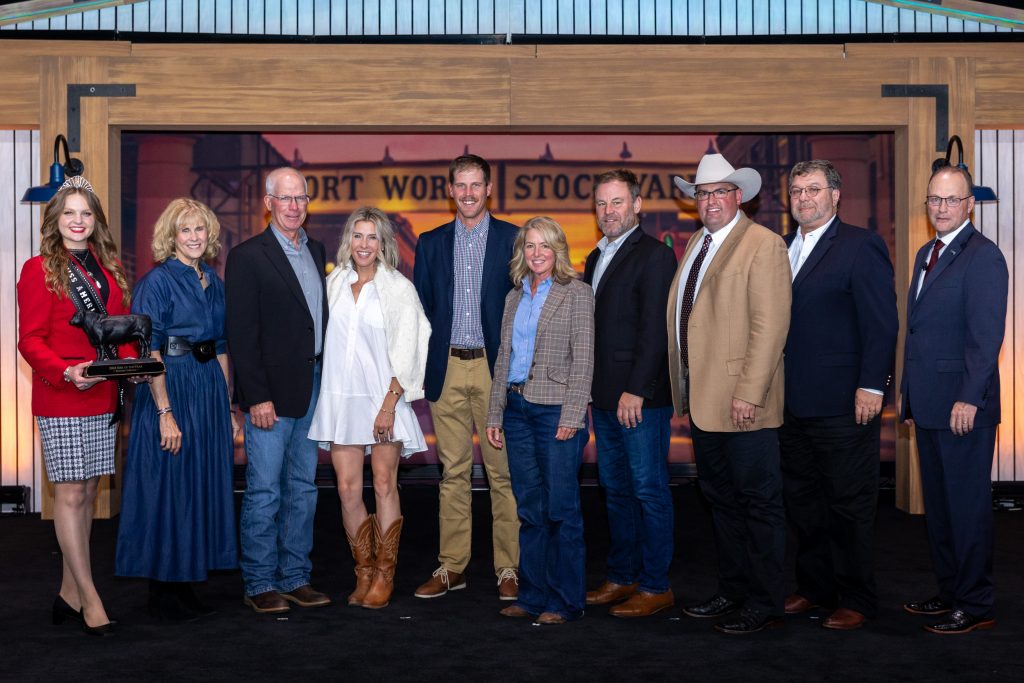
Connealy Craftsman owned by Select Sires Inc., Plain City, Ohio, and Sexing Technologies, Navasota, Texas, sired 4,014 calves registered into the Angus herd book, the most in fiscal year 2024. Pictured from left are Lauren Wolter, Miss American Angus; Sharon, Jerry, Hannah, and Gabriel Connealy of Connealy Angus Ranch; Lorna Marshall and David Thorbahn of Select Sires Inc.; Aaron Arnett, and Juan Moreno of STgenetics; and Mark McCully, American Angus Association CEO.
For over 150 years, the popularity of Angus cattle has grown, making over 80% of America's cowherd influenced by Angus genetics. Influential sires have made their mark and during the 2024 American Angus Association® Awards Dinner and Reception on November 3rd, 2024 in Fort Worth, Texas, the Association recognized the sire registering the most progeny.
Connealy Craftsman owned by Select Sires Inc., Plain City, Ohio, and Sexing Technologies, Navasota, Texas, sired 4,014 calves registered into the Angus herd book, the most in fiscal year 2024.
"We were interested in this bull for a variety of reasons, but it was phenotype that set him apart for us. His $M index and foot scores were excellent, and his pedigree was something different for us," Brian House of Select Sires Inc. said. "When our team set their eyes on him, they very quickly selected him as the 'special bull,' in that sale."
Recognizing these sires highlights the breeders dedicated to providing top-quality Angus bulls.
"Our members enjoy wide diversity in genetics to achieve whatever their breeding goals are," said Mark McCully, chief executive officer of the Association. "We're thankful for these cattlemen committed to breed improvement."
The top 10 sires are recorded from October 1 through September 30.
2. GB Fireball 672, ABS Global Inc., De Forest, Wis.; Goode Angus, Pampa, Texas; and Grand Bayou Farms, Ruston, La., 3.500 calves
3. Deer Valley Growth Fund, Deer Valley Farm, Fayetteville, Tenn., 3,368 calves
4. Sitz Resilient 10208, Bar J V Angus Ranch, Fairview, Mont.; Dan Ingalls, Casper, Wyo.; and Lunds B Bar Angus, Wibaux, Mont., 3,332 calves
5. Tehama Tahoe B767, Midwest Genetics, Long Island, Kan.; Tehama Angus Ranch, Gerber, Calif.; and VanDerVeen Farms, Phillipsburg, Kan., 2,411 calves
6. LAR Man in Black, ABS Global, De Forest, Wis., and Larson Angus Ranch, Sharon Springs, Kan., 2,292 calves
7. DB Iconic G95, Douglas Booth Family, Torrington, Wyo., and Genex Cooperative, Shawano Wis., 2,273 calves
8. Sitz Stellar 726D, ABS Global, Inc., De Forest, Wis., and Sitz Angus Farm, Dillon, Mont., 2,165 calves
9. Poss Rawhide, Danny Poss, Scotia, Neb., and Sexing Technologies, Navasota, Texas, 2,090 calves
10. GAR Home Town, Gardiner Angus Ranch Inc., Ashland, Kan., 2,068 calves
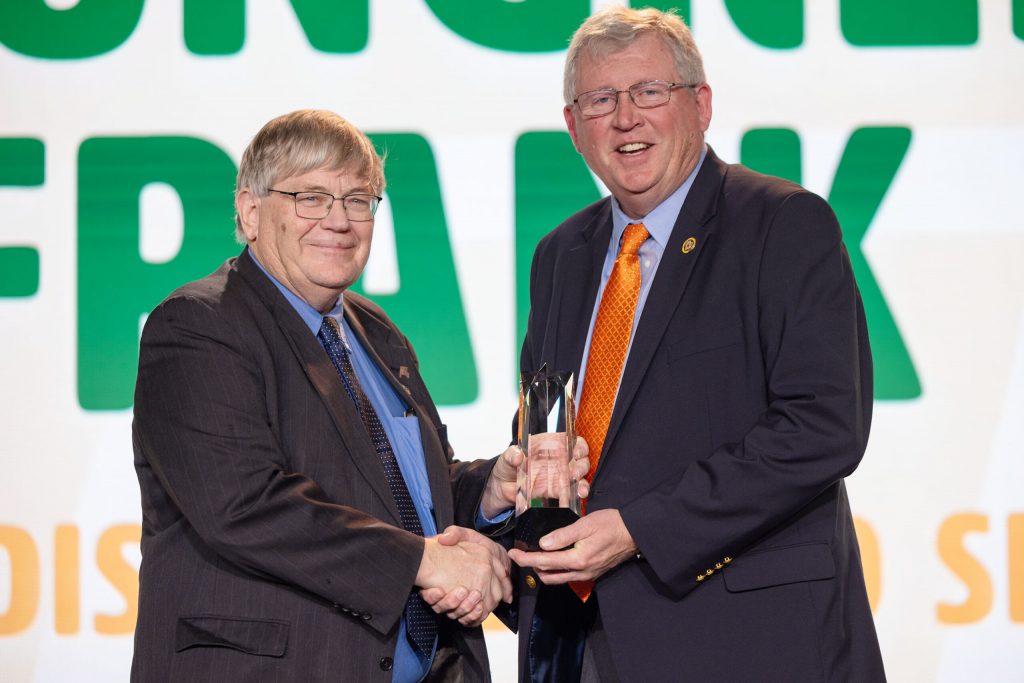
Rep. Frank Lucas (right) accepts the 2024 Oklahoma Farm Bureau Distinguished Service to Oklahoma Farm Bureau Award from OKFB President Rodd Moesel during the 2024 OKFB Annual Meeting Awards Banquet Saturday, Nov. 9, in Oklahoma City.
Congressman Frank Lucas was recognized with the Distinguished Service to Oklahoma Farm Bureau Award on Saturday, Nov. 9, during the organization's 83rd annual meeting in Oklahoma City.
The award honors individuals who have made outstanding contributions to agriculture and the Farm Bureau organization.
Lucas is a fifth-generation Oklahoman and farmer who has been a defender of agriculture for more than 40 years.
"Farm Bureau is a large family, and we operate like that in all 77 county organizations," Lucas said. "I represent 32 counties in Congress – people I depend on, people who are responsible. When your family pays you this kind of compliment, it is just outstanding."
Elected to Congress in 1994, he is recognized as the longest-serving member on the House Agriculture Committee and served as chairman of the committee from 2011 to 2015, playing an instrumental role in the 2014 farm bill. Prior to serving in Congress, Lucas served in the Oklahoma State House of Representatives where he focused on prominent agriculture issues.
The Oklahoma Farm Bureau annual meeting is the organization's largest gathering of farmers and ranchers every year. At the event, members vote on grassroots policy, elect leaders and award outstanding individuals. OKFB has a presence in all 77 Oklahoma counties and serves as the voice of agriculture and the rural way of life. To learn more, visit okfarmbureau.org.
Dairy MAX, a leading regional dairy council representing over 900 dairy farmers across eight states, officially announced that Keira Lombardo of Southlake, Texas, has been named its new chief executive officer. Lombardo is an accomplished agricultural leader with more than 20 years of experience.
Lombardo will begin her tenure at Dairy MAX on December 2, 2024, and will transition into the role of retiring CEO Mike Konkle, who has served as CEO since 2007.
Dairy MAX Board Chair Mary Kraft, CEO of Kraft Family Dairies, expressed the Board's deep appreciation for Konkle's leadership. "Under Mike's guidance, Dairy MAX has flourished, expanding our reach and impact for dairy farmers across the region," said Kraft. "Keira brings a wealth of experience to Dairy MAX, with a passion for farmers, sustainability and agriculture."
Most recently, Lombardo served as chief administrative officer at Smithfield Foods, a global food and agriculture company and leader in pork production. In this role, she oversaw a broad range of functions, including corporate communications, government affairs, sustainability, investor relations and human resources.
"I am honored to serve as the next CEO of Dairy MAX," said Lombardo. "I have a deep respect for the hard work and dedication of dairy farmers, and I am passionate about ensuring the continued success of this vital industry. I look forward to working with the talented Dairy MAX team to champion dairy, advocate for our farmers and connect with consumers across the region."
With a commitment to advancing sustainability and social impact within the food and agriculture space, Lombardo embodies a people-powered approach to leadership. Her adaptable leadership style fosters a high-performing team of inclusivity and belonging, where individuals are empowered to drive meaningful change. "Keira's proven track record of success in building strong relationships, navigating complex issues and fostering growth aligns with Dairy MAX's mission," stated Barb O'Brien, president and CEO of Dairy Management, Inc. (DMI). "Her extensive experience in the food and agriculture industry, coupled with her leadership skills, make her the right fit for the Dairy MAX team."
An important part of the regenerative ranching process is regenerative grazing. The use of livestock grazing is an important part of the ecological process to improve soil health and plant diversity. In starting this process, you might be asking yourself "What do I need to get started with regenerative grazing?"
Regenerative grazing is first and foremost a change in mindset from traditional grazing management. It is the proactive planning and active management of the grazing events: grazing the appropriate amount of leaf production at the optimal time, encouraging the grazing livestock to uniformly utilize the pasture or paddock, and managing grazing to maintain ample residual and allow full recovery of grazed plants before the next grazing event. Being adaptive and flexible, active monitoring, and managing for positive changes to improve soil health are the main differences between regenerative and traditional grazing management.
The flexibility of an adaptive system allows and encourages changes in grazing management of a property from year to year. These changes include:
Other considerations are what type of grazing animal species to use (cattle, sheep, goats, etc.) and the physiological stage of production of those grazing animals (growing, mature, bred, open, lactating, dry).

As your mindset toward grazing becomes more adaptive and flexible, you'll need a plan to implement adaptive grazing. The plan is important, because it helps you map the process needed to achieve the outcomes. A regenerative grazing management plan should include:
Let's look at each part of the plan in more detail.
Goals are important, because they give you outcomes to strive for and help define the practices that are needed to meet the outcomes. Goals are most impactful when you develop them with all involved parties on the ranch and write them down. In developing the goals, periodic milestones/steps should be laid out. This method allows for many smaller victories, providing encouragement along the way. Common grazing goals include improving soil and animal health, increasing plant diversity, reducing brush encroachment, increasing livestock production and increasing profitability.

Unfortunately, far too many people entering their regenerative journey do not get the necessary support or guidance needed. Attempt to locate like-minded individuals to help support you through the process. Use these individuals as sources of information, sounding boards and advisers. Odds are these individuals went through the same challenges and struggles you are facing now or will soon face. Most of them will be happy to share their experiences and help you grow.
Maps are an essential step in the process. Aerial photos and soil maps allow you to view the property as a whole and draw in your infrastructure, forage types, etc. Aerial photos can be obtained online from websites such as Google Maps, Google Earth, Daft Logic, etc. There are also numerous apps that can be used on your phone as well. Local USDA Natural Resources Conservation Service offices can also help provide maps.
Soil maps are useful in determining the different soil types on your property and estimating the forage productivity of an area. Soil differences typically explain why some areas of a property are more productive than others. The USDA Web Soil Survey is an excellent source for soil maps.

Now that maps have been developed for the property, draw in any existing infrastructure such as fences, corrals, water sources (pond and plumbed), roads, paddocks, forage types and other structures. Knowing these locations helps identify areas that need infrastructure development to improve the utilization of the entire property to meet your regenerative grazing goals.

Knowing the types of forage present and production of each type is important to determine an appropriate stocking rate. Most pastures have one or multiple species of forages, and knowing the differences between them will help direct your grazing plan. For help identifying plants, use the Noble Research Institute Plant Image Gallery. Base forage production numbers on past production records or estimates developed using the Web Soil Survey.

Determining the number of grazeable acres is the next step. Grazeable acres are the areas where the selected grazing animal could forage. To do this, use one of the aerial photo websites (preferably Google Earth or Daft Logic) or phone apps to outline these areas. If the grazing animal is cattle, outline the areas not dominated by trees, brush, water or other non-grazeable cover. If goats are used, the entire property minus water and infrastructure could possibly be used. Once all the areas are drawn, total their areas for the grazeable acres. Be conservative, because overestimating the number of grazeable acres will lead to properties being overgrazed.

Proper stocking rate is the most important management decision you can make, regardless of goals. Stocking rate can be defined as the total number of animals that can use the whole grazeable area for the entire grazing period during a year. Stocking rate impacts not only livestock production but every aspect of the operation and property (soil and plant health, wildlife, economics, etc.).
Overgrazing is a significant cause of poor forage and livestock production, wildlife habitat loss, soil erosion, weed problems and lower profitability on millions of acres across the country. A correctly stocked property provides flexibility in operational management, such as wildlife habitat management, prescribed fire implementation, preparation for drought or other adverse weather conditions, or a temporary increase in livestock numbers during years of better-than-average growing conditions. Proper stocking rate varies throughout time due to changes in precipitation patterns, plant communities, pasture/range condition, historical management and other environmental factors. The articles Proper livestock stocking rate supports operation, wildlife and Stocking Rate: The Key to Successful Livestock Production are good resources to help you determine the proper stocking rate.

If you are transitioning from a traditional grazing system to a regenerative grazing system, you may already have much of the necessary equipment. In most cases, a system of fences and water sources are already in place. To accommodate higher stock densities commonly used in regenerative grazing, more temporary fences typically are required. These additional fences can be constructed with temporary electric fencing. This could be as simple as a few geared reels with polywire, fiberglass or step-in posts, and a fence charger. A temporary fence can be installed on foot, but it is easier to put in longer stretches from a vehicle. It is also important to have a good fence tester.
In some cases, you may need additional water sources to optimize grazing management. There are often cost-share programs through the USDA or NGOs available to producers to help offset these costs. The article Where to Find Technical Guidance for Land Management and Conservation can help you get started.

After you have completed the list above, determine what limiting factors exist. These are the items that are most likely to hold you back from completing your goals. They are different for everyone. Typically, there are several, but identify the one most-limiting factor first. It could be knowledge, water, quality forage, equipment, money, etc. At Noble, water infrastructure is the limiting factor on many of our properties. Initially, focus your resources and time on that one item. The most-limiting factor needing your focus likely will change over time.
Start small before implementing the new grazing management practices across the entire property. Select an area or areas that will be "safe to learn" in. This area will probably already have everything you need to get started, such as reliable water and good fences. Ideally, it would be one of your more productive areas, as they are more resilient and will respond more rapidly to good management (and recover sooner should there be an "oops"). This area may only be big enough to graze for a few days or week, or a month. The thing to remember is that starting small and selecting a safe-to-learn area will allow you to gain knowledge and become comfortable with the practice before scaling it up to the entire property.
In summary, regenerative grazing is a change from the traditional grazing mindset. It is the intentional mindset of being adaptive and flexible, employing active monitoring, and managing for positive changes for improved soil health. You likely already have most of the equipment and facilities you need to get started, so the most important first step is being open to changing the way you think about and implement grazing on your ranch.
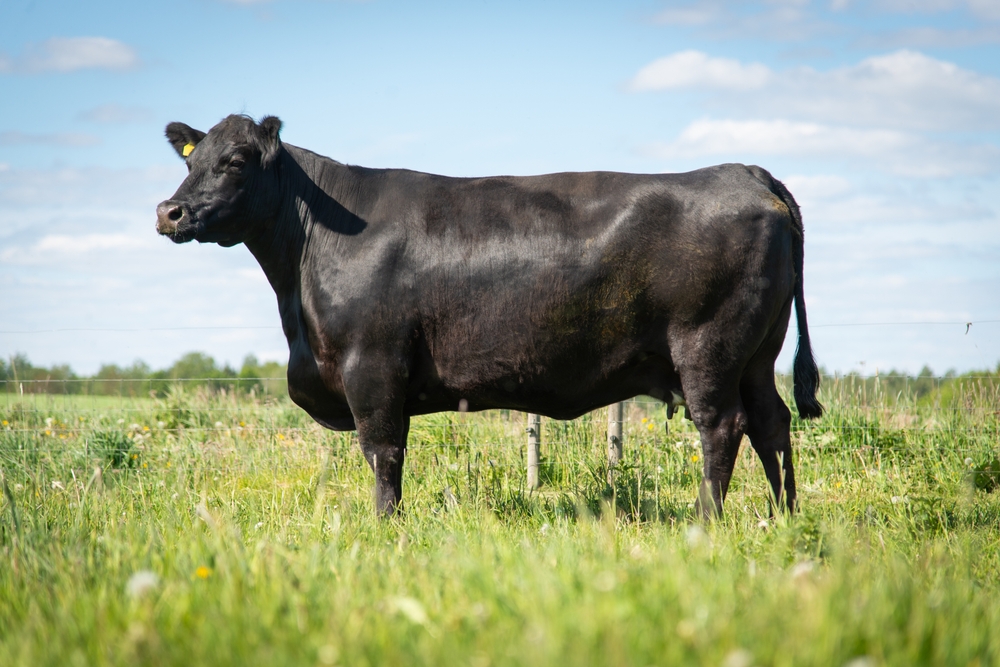
Senior Farm and Ranch Broadcaster Ron Hays talked with Jimmy Taylor, Western Oklahoma rancher and Angus University's Herd Rebuilding track panelist at the American Angus Convention.
His herd began with commercial cattle, changed to purebreds, and then to show cattle, but in 2005, he decided to aim for premiums on every animal he sold. After much research, selling carcass cattle on the grid was where he settled.
In yesterday's BeefBuzz, Taylor detailed how, through much time, effort and expense, he achieved 82% prime ratings in his cattle to earn premium bonuses when he sells them. However, the USDA, currently led by Tom Vilsack, wants to remove premium bonuses, citing unfairness to other producers and consumers.
The passage of such a rule would be devastating to not only Taylor and other producers like him but also to the entire beef industry. He said, "The industry has worked really hard to develop quality cattle so they would lose. The system that is in place now with the AMAs incentivizes quality, if we go back the other way, it incentivizes pounds. The biggest loser would be the consumer because when you are incentivizing quality, that consumer is consistently getting a better eating experience all the time. The more pleased they are with the product they eat, the more beef they want to order."
Taylor's road to quality came quickly when Zoetis released its genomics test and he quickly made full use of it and timed artificial insemination. "As time went on, I got all of the low-hanging fruit and things have slowed down," he said. "To the point that last year, I decided to stop using A.I. and moved to identifying the traits of the bulls I had. When I go buy a bull, milk is a trait that is limited in my area. My environment won't support high milkers. Now that I've identified my females that are low in milk, I can buy a bull that has a high EPD for milk and it is tremendous everywhere else. Before, I couldn't."
He also groups his fatter cows to breed to leaner bulls and breeds his leaner cows to bulls with higher fat production. "That way of doing things would fit more commercial operations better than the timed A.I.," he said. "I know a few commercial producers that do it, but probably more just turn the bulls out." The Beef Buzz is a regular feature heard on radio stations around the region on the Radio Oklahoma Ag Network and is a regular audio feature found on this website as well. Click on the LISTEN BAR for today's show and check out our archives for older Beef Buzz shows covering the gamut of the beef cattle industry today.
| |||||||||||||||||||||||||||||||||||||||||||||||||||||||||||||||||||||||||||||||||||||||||||||||||||||||||||||||||||||||||||||||||||||||||||||||||||||||||||||||||||||||||||||||||||||||||||||||||||||||||||||||||
| |||||||||||||||||||||||||||||||||||||||||||||||||||||||||||||||||||||||||||||||||||||||||||||||||||||||||||||||||||||||||||||||||||||||||||||||||||||||||||||||||||||||||||||||||||||||||||||||||||||||||||||||||
|
Senator Lonnie Paxton, R-Tuttle, has been nominated by his peers to serve as the next President Pro Tempore of the Oklahoma Senate.
The Senate Republican caucus announced his selection today, placing Pro Tem Designee Paxton in line to assume the leadership role for the 60th Oklahoma Legislature. While the final vote will be during the Senate's Organizational Day on January 7, and include members of both Senate Republicans and Democrats, today's vote gives a nod to Pro Tem Designee Paxton as his Senate Republican colleagues control the state's upper legislative chamber.
"I am grateful to my fellow members who chose me to lead the Senate moving forward," Pro Tem Designee Paxton said. "The Oklahoma Legislature has never been in a better position overall to make changes and pass legislation that benefit Oklahomans. I am excited for this new chapter, and I will work every day to ensure we continue to build on our success. I have learned many lessons during my time in the Senate.
"Whether a member of the Senate Republican Caucus voted for me or voted for Senator Bullard, I look forward to working directly with new and returning members, House Speaker-Designee Kyle Hilbert, Governor Kevin Stitt and our federal Congressional delegation to ensure Oklahoma is a destination for people who want to live, work and raise a family."
Pro Tem Designee Paxton will replace current Pro Tem Greg Treat, R-Oklahoma City, who is term limited.
First elected in 2016, Pro Tem Designee Paxton has been a vocal advocate for his constituents, focusing on issues such as economic development, education, public safety and as the co-chairman on the Joint Committee on Transportation, Infrastructure and Rural Development. He has leaned on his background in business and civic experience to shape his policy positions in the state Senate to benefit the state.
Pro Tem Designee Paxton is a fifth-generation Oklahoman, born in Chickasha and raised on his family's farm in Tuttle. Senator Paxton's roots run deep in his district as a businessman, entrepreneur, volunteer firefighter, farmer and rancher.
Pro Tem Designee Paxton and his wife, Misti, have been married for over 30 years and have four grown children. Mrs. Paxton taught in the Tuttle Public School district for almost three decades before retiring. They are members of Tuttle United Methodist Church.
He represents Senate District 23, which includes portions of Grady and Canadian counties.
To read Senator Paxton's full bio, click here.

Senate Democratic Leader Kay Floyd, who has led her caucus for the past six years, announced Sen. Julia Kirt, D-Oklahoma City, will officially begin her role as leader on Wednesday, Nov. 13. Additionally, Sen. Michael Brooks, D-Oklahoma City, will officially succeed Sen. Kevin Matthews, D-Tulsa, as caucus chair. Both Floyd and Matthews have completed their final terms in the Senate due to term limits.
"On behalf of Senator Matthews and myself, we are grateful for the opportunity we had to serve the Senate Democratic Caucus, our districts, and the people of Oklahoma," said Floyd, D-Oklahoma City. "We have the greatest confidence in the leadership skills and experience of Senators Kirt and Brooks, and wish all of our newly elected and returning members the very best as they prepare for the 60th Legislature."
New and returning members of the Oklahoma Senate will officially be sworn into office during a ceremony in the Senate Gallery at 2 p.m. on Wednesday, Nov. 13. The ceremony will be livestreamed on the Senate website at https://oksenate.gov/live-chamber.
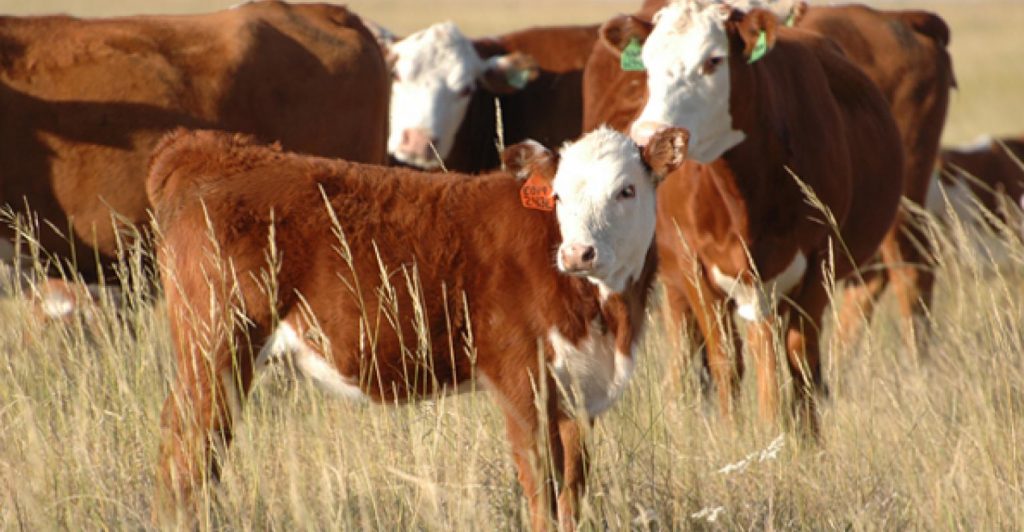
On Tuesdays, Senior Farm and Ranch Broadcaster, Ron Hays, visits with Ben Hale of Western Livestock Auctions as he talks about the latest in the markets and more. Established in 1995, Western has grown into a multi-generational family-owned and operated business and stands as a symbol of tradition, excellence, and a deep-rooted passion for the cattle industry. Western Livestock Auctions are located in Oklahoma City, Woodward, and Comanche.
The National Stockyards sold 6,500 head, a steep uptick from last week just after the heavy rains. "There's some guys really wanting to take advantage of this market," Hale said. "The grazing deal was considerably higher yesterday. The feeder deal may have been steady to a little softer on the front end of those, but some places, they were sure enough cheaper., but the grazing cattle still have lots of interest whether they are weaned or unweaned."
Hale is still hoping for winter wheat for grazing so long as the warmer temperatures hold out long enough.
He said the sale at Comanche is still pretty quiet due to the rain, but Woodward is expecting several feeder cattle in Thursday's sale. With calf prices still as high as they are, he anticipates that people will still be bringing them to sell if they are able.
Overall, the rain has caused buyers to have a more positive outlook for the coming winter months and have been fighting for the high five- and low six-weight calves.
Hale can be contacted at 940-631-2333. Check out more about the marketing options that Western offers by clicking here.

Charles Chen, an associate professor in the OSU Department of Biochemistry and Molecular Biology, and River Smith, a researcher and clinical psychologist in the Eastern Oklahoma VA system, are trying to determine if there is a connection between post-traumatic stress disorder and obstructive sleep apnea in veterans. (Photo by Adobe Photostock)
An Oklahoma State University researcher is working with the Eastern Oklahoma VA Health Care System to bridge the genetic knowledge gap between post-traumatic stress disorder and obstructive sleep apnea.
Charles Chen, an associate professor in the OSU Department of Biochemistry and Molecular Biology, is collaborating with River Smith, a researcher and clinical psychologist in the Eastern Oklahoma VA system, to understand how genes, lifestyle and military experiences affect the health and well-being of United States veterans.
The study uses data from the Million Veteran Program, one of the most extensive genomic studies in the world.
"Nationally, we have surpassed our goal of enrolling 1 million veterans in the program, which is impressive because it is voluntary," said River Smith, a researcher and clinical psychologist in the Eastern Oklahoma VA system. "I think many veterans who participate do so because they see it as continuing to serve other veterans. They may not benefit directly, but the program is leaving a legacy of scientific innovation in better understanding who develops specific diseases and why and what medications might work better for certain types of people."
Smith said roughly 700 VA researchers are using the MVP research database to conduct studies to understand a variety of diseases, such as PTSD, cancer and heart disease. Smith and Chen are attempting to determine if there is a link between PTSD and obstructive sleep apnea and if some veterans are more genetically predisposed than others.
"There have been many individual genetic studies of these disorders, but studies examining a shared genetic association have been scarce," Smith said. "Clinically, we know that veterans who have PTSD tend to have higher rates of obstructive sleep apnea, but we don't entirely understand why because the association is not obvious. "Obstructive sleep apnea involves your airway closing at night, limiting breathing, and PTSD is a stress-related disorder. So, how are these two things connected? This research could shed light on common genetic factors that help us understand why PTSD and obstructive sleep apnea co-occur at higher rates."
Smith and Chen are studying genetic data provided by VA scientists in the Million Veteran Program database to connect the two diseases.
"Our goal is to pinpoint specific genetic mutations so we can be able to determine what's responsible for PTSD, and what's responsible for obstructive sleep apnea," Chen said. "Our upbringing, diet, lifestyle, genetics and a variety of other factors play a role in the development of these conditions. How do we push aside the other interacting factors to uncover the underlying genetics of PTSD and obstructive sleep apnea? It's not an easy job to do. We must consider differences in age, gender, combat exposures and many other factors."
Chen said the long-term goal is to build a comprehensive understanding that allows researchers and clinicians to locate the specific genetic mutations. This could lead to a clearer picture of who develops co-occurring PTSD and obstructive sleep apnea while improving clinical interventions.
"The VA also has a robust electronic health record system, so for people interested in doing studies looking at Million Veteran Program program data, there's the capacity to link information in someone's health record with genomic information," Smith said.
"Genetic markers would allow a healthcare provider to anticipate long-term impacts," Chen added. "This level of data collection has not been seen anywhere else in the world. It is difficult to collect this kind of data extensively for a genetic association study."
Oklahoma veterans wishing to participate in the Million Veteran Program can visit the MVP website.
"The data from the Million Veteran Program will lead the way for healthcare innovation and precision medicine long after I'm gone," Smith said. "I think it will contribute to understanding disease development and progression and a better understanding of what medications work for certain people and what side effects are more likely. It is going to help bring about medicine tailored to the individual."
OSU Ag Research is Oklahoma's premier research and technology development agency in agriculture, natural resources and the life sciences.
By Alisa Boswell-Gore
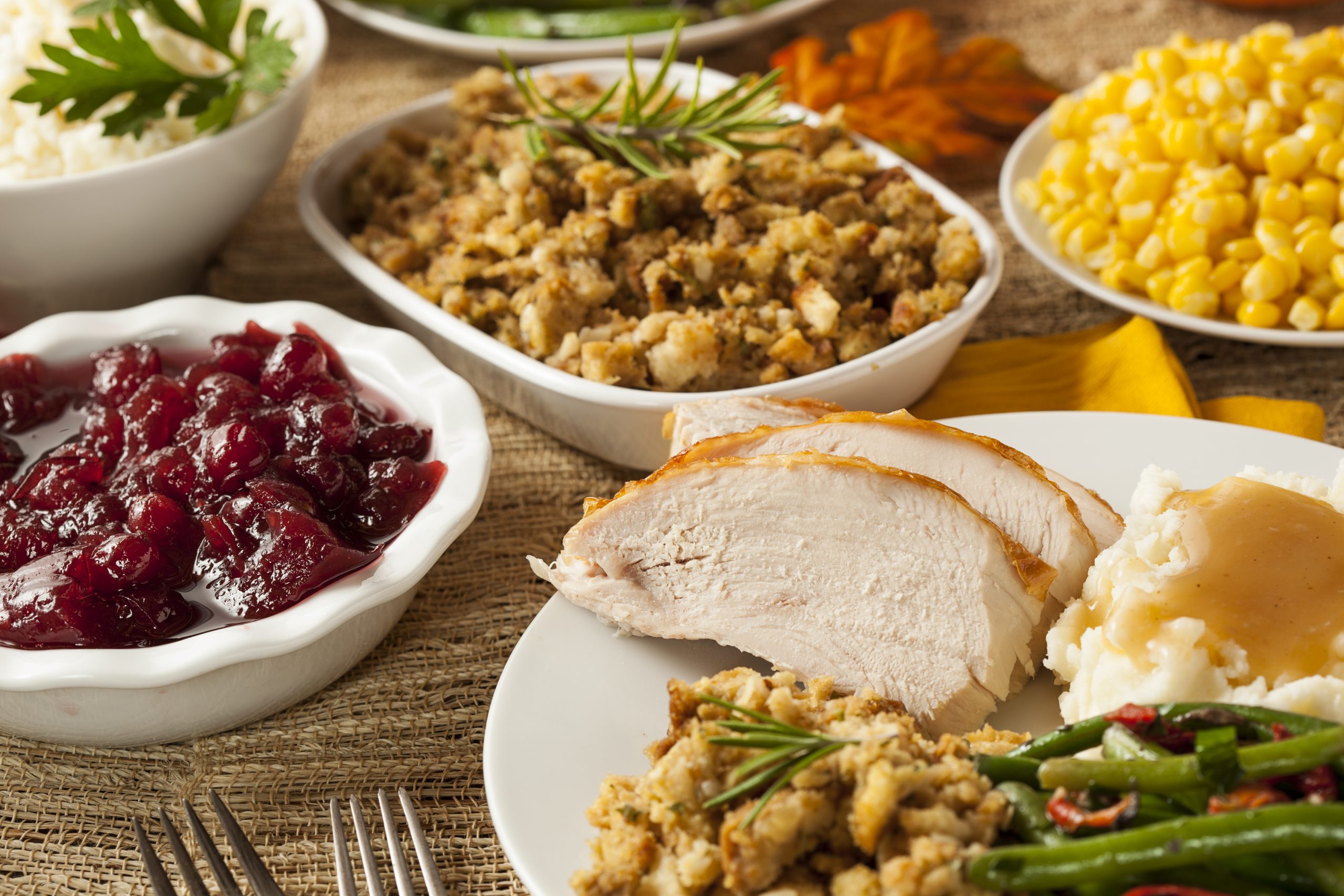
Turkey is the most popular dish during Thanksgiving celebrations, yet there are many inexperienced cooks who will be in the kitchen. The U.S. Department of Agriculture (USDA) is encouraging consumers to practice food safety throughout the entire Thanksgiving process, from the grocery store to the dining table.
"On the most popular food holiday of the year, we're reminding consumers to follow safe food handling practices starting at the grocery store and going all the way through enjoying your leftovers," said Under Secretary for Food Safety Dr. Emilio Esteban. "Following these basic steps can help keep your family and friends safe this holiday season."
To keep your Thanksgiving food safe, follow this guide:
Shopping
· Bacteria can multiply to dangerous levels if perishables, like turkey, are left in the Danger Zone (temperatures between 40 F and 140 F) for too long. Pick up your turkey and other perishable products at the end of your grocery shopping so they stay cold as long as possible. Pack perishables in insulated bags with cold sources if the commute home is longer than an hour and place them in the refrigerator as soon as you get home.
· Make sure the packaging of your turkey is not torn or leaking. Juices from raw poultry can cause cross-contamination of harmful bacteria that can get you sick. Place turkey, and other raw meat products, in plastic bags and in a separate part of your shopping cart to prevent harmful bacteria from spreading.
Thawing
A frozen turkey can be safely thawed in the refrigerator or in cold water:
· When thawing in a refrigerator at 40 F or below, allow roughly 24 hours for every 4 to 5 pounds. Consider putting the turkey in a container or dish to contain juices that may leak.
· When thawing in cold water, allow roughly 30 minutes per pound. Submerge the wrapped turkey into the cold water and change the water every 30 minutes until the turkey is fully thawed. Once thawed, cook the turkey immediately.
Preparing
When it is time to prepare the turkey, keep in mind that turkeys may contain bacteria that cause foodborne illness. Keep the turkey and its juices separate from foods that won't be cooked and fully clean and sanitize surfaces that come into contact with the turkey and its juices. A USDA study found that about 30% of consumers did not successfully clean and sanitize kitchen surfaces around meal preparation.
Washing a turkey is risky because it can spread bacteria to your sink and other nearby surfaces. If you choose to wash it, make sure to fully clean surfaces with soap and water afterwards and then sanitize using a sanitizing solution.
Cooking
There are many ways to cook a turkey, but one thing remains consistent: the turkey needs to reach a safe minimum internal temperature of 165 F, as measured by a food thermometer, in three places — the thickest part of the breast, the innermost part of the thigh, and the innermost part of the wing. Always use a thermometer to make sure the turkey is fully cooked even if the turkey has a pop-up temperature indicator. If stuffing your turkey, the stuffing must also reach 165 F in the center of the stuffing.
Serving
· When serving food to groups, remember the two-hour rule. Perishable foods that have sat out at room temperature for more than two hours are unsafe, due to bacterial growth, and must be discarded. When you are serving food, keep your hot food hot and cold food cold. This will keep it from developing harmful bacteria. Hot foods such as turkey, macaroni and cheese, stuffing, mashed potatoes and gravy must be kept at or above 140 F and you can do so by serving them in warming trays, chafing dishes, slow cookers, etc.
· Cold foods such as salad, cranberry relish, deviled eggs and cold dips must be kept below 40 F and you can do so by serving them in trays or bowls nestled over ice. Remember to replace the ice as it melts. You can also serve cold foods by dividing them in small portions and serving them a portion at a time, keeping the remainder in the refrigerator.
Leftovers
Leftovers are arguably one of the best parts of Thanksgiving. For leftovers to be safe to keep, they must be refrigerated within two hours of serving or have been kept hot at or above 140 F or cold below 40 F. Discard any foods that sat out for more than two hours at room temperature because bacteria that cause foodborne illness could have reached dangerous levels. If you have turkey leftovers, carve the bird into smaller pieces and place them into small, shallow containers so the meat can cool evenly and quickly.
If you have food safety questions while planning and preparing your Thanksgiving feast, call the USDA Meat and Poultry Hotline at 1-888-MPHotline (1-888-674-6854), email MPHotline@usda.gov or chat live at www.ask.usda.gov 10 a.m. to 6 p.m. Eastern Time, Monday through Friday to reach a food safety specialist in English or Spanish. The Meat and Poultry Hotline is also open on Thanksgiving Day from 8 a.m. to 2 p.m. Eastern Time.
Access news releases and other information at USDA's Food Safety and Inspection Service's (FSIS) website at www.fsis.usda.gov/newsroom. Follow FSIS on X at @usdafoodsafety or in Spanish at X @usdafoodsafety_es and USDA on Instagram at @usdagov and Facebook.
USDA touches the lives of all Americans each day in so many positive ways. In the Biden-Harris Administration, USDA is transforming America's food system with a greater focus on more resilient local and regional food production, fairer markets for all producers, ensuring access to safe, healthy and nutritious food in all communities, building new markets and streams of income for farmers and producers using climate smart food and forestry practices, making historic investments in infrastructure and clean energy capabilities in rural America, and committing to equity across the Department by removing systemic barriers and building a workforce more representative of America. To learn more, visit www.usda.gov.
Fundraising efforts from the 21 Millionth Registration and Foundation Raffle help to support education, youth and research
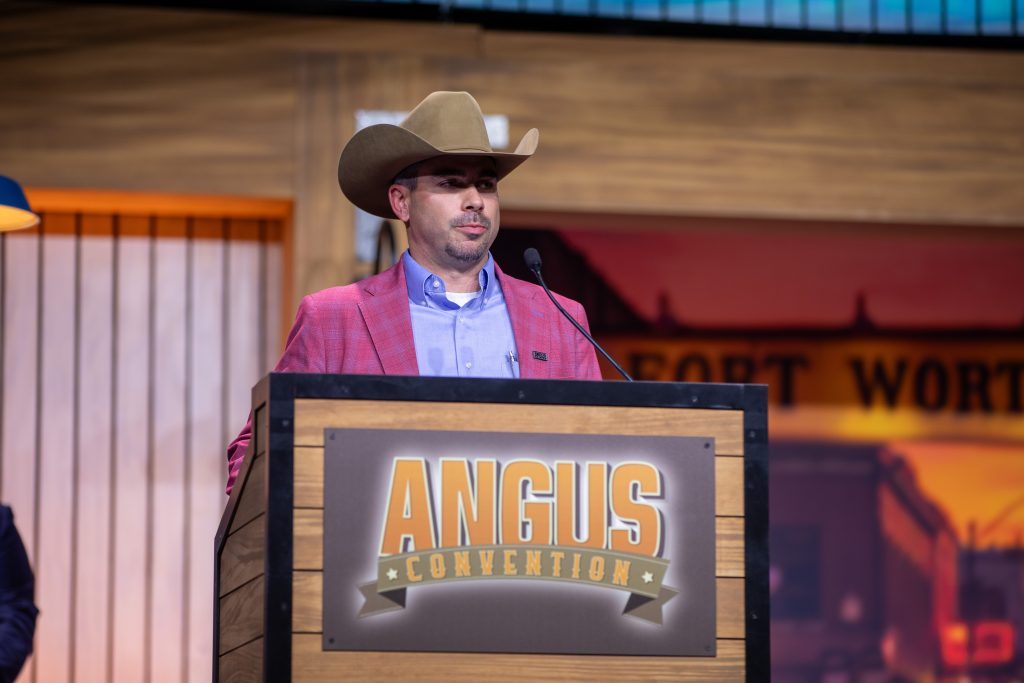
As the final gavel fell, "STgenetics, Novasota, Texas," rang out throughout the ballroom, as regional manager, Will Harsh, announced the lucky, new owner of the 21 Millionth Registration number.
This summer the American Angus Association Herd Book surpassed 21 million registrations. The coveted number was reserved and auctioned off at the annual Angus Convention, selling for $19,000 with all funds going to help support the Angus Foundations mission of education, youth and research.
"The Angus community has been very good to STgenetics since we entered the market," said Aaron Arnett, Ph.D., Director of Beef Genetics at STgeneticts. "We are so appreciative of the leadership and expertise of the American Angus Association, especially in the program areas of research, genetic evaluation and youth development. We saw buying the 21 Millionth Registration as an opportunity to give back to a breed that has been a tremendous partner to STgenetics."
The 21 Millionth Registration had been reserved for the buyer to use on an animal already registered in the American Angus Association Herd Book or to be used on a future progeny.
"We are hoping to name ST Wizard 1585 the 21 Millionth Registration," Arnett said. "He is a very unique young sire bred by STgenetics that exemplifies many of the Association traits we value combined with an impressive physical build."
ST Wizard 1585 is available in sexed female, sexed male and conventional semen from STgeneticts.
"We are all so appreciative of STgenetics and their generosity in purchasing the 21 Millionth Registration from the Herd Book," said Jaclyn Boester, Angus Foundation executive director. "Their donation helped us to surpass our goal at Angus Convention and will help us to continue to support our mission."
Also at Angus Convention, the Angus Foundation held a raffle with donation items from Zoetis, Merck Animal Health, SenseHub, Select Sires and the Angus Foundation.
"We are excited to share that the convention raffle was a fantastic new initiative, offering a fun opportunity to donate while supporting the Angus Foundation," said Jimmy Stickley, Angus Foundation donor coordinator. "A big thank you to our generous sponsors—Merck Animal Health, Select Sires, SenseHub Vence and Zoetis—for their continued commitment to the breed and its future."
Enthusiastic Foundation supporters helped to gather $6,000, which will go into the Angus Fund, a fund of unrestricted dollars, supporting events like Beef Leaders Institute, LEAD and Raising the Bar Conferences.
Mike Frey, Oklahoma, was the winner of the Merck Animal Health Prime Vac Cooler and 2 All Flex 50MR2 Syringes; Howard Franklin, Arizona, took home the 10 Units Angus Semen from Select Sires; Theresa Miller, Illinois, is now the owner of the Yeti 45 Tundra Cooler from SenseHub Vence; Ruth Grove, Virginia, will now be able to capitalize on their genetics with 50 GeneMAX Advantage Tests from Zoetis and Jim Williams, Texas, got to take home the CAB Knife Set, Wine Glasses, Cutting Board & Angus Swag.
"Each raffle ticket sold will go on to help every junior's experience while in the NJAA," said Mary Wood, Chairman, National Junior Angus Association Board. "We cannot thank breeders enough for the support we received throughout the weekend."
About the Angus Foundation
Established as a 501(c)(3) organization in 1980, the Angus Foundation remains focused on its mission to support Angus education, youth, and research. The organization has distributed more than $4.9 million in youth scholarships since 1998 and has also invested more than $1.4 million in beef cattle research in the past decade.
For more information, contact the Angus Foundation at 816-383-5100.
In the inaugural year of the Attorney General's Outstanding Officer of the Year Award, Attorney General Gentner Drummond has announced four regional winners, one of whom will be named next month as the statewide Officer of the Year for 2024.
Drummond launched the initiative in May to highlight the extraordinary work of law enforcement officers across Oklahoma. With 44 nominations submitted to the Office of the Attorney General, judges – comprised of city, county, tribal and state criminal justice professionals – selected regional winners from across the state.
"These four individuals reflect the courage, selflessness and unwavering commitment that is representative of Oklahoma's law enforcement community," Drummond said. "I congratulate the regional winners for their extraordinary work and thank them for their steadfast dedication to public safety."
The regional winners are:

A 16-year veteran of the Oklahoma City Police Department, Detective Cunningham has been with the homicide division since 2021. Prior to that, she served in units handling crimes against children and cases of domestic violence. Cunningham has been lauded for the painstaking work she and her partner did investigating an April 1, 2023, triple murder at the Whiskey Barrel Saloon. They spent weeks assembling video, photographs and 3D imaging technology to show the movements of the defendants at the crime scene. Because the slayings allegedly stemmed from a dispute between biker gangs, Cunningham also delved into the intricacies of that culture. Her efforts resulted in the arrest and charging of 15 defendants.
On March 24, 2023, the suspect in a Kansas armed robbery was racing southbound on I-35 at speeds over 100 mph, eluding Oklahoma Highway Patrol (OHP) troopers for more than 45 miles. The suspect had told Kansas bank employees he had a bomb. With lethal force having been authorized, Trooper Fry fired on the speeding car near Highway 412. The suspect lost control of the vehicle and fled on foot in the direction of a populated area. Fry and fellow troopers gave chase. Seeing the suspect armed with an AK-47 and taking position to ambush troopers, Fry fatally shot the man. The nine-year OHP veteran was one of two recipients of the 2023 Trooper of the Year Award. Fry is currently with the Oklahoma Counter Terrorism Intelligence Center.


An eight-year veteran of the Norman Police Department (NPD), Gomez was named NPD's 2023 Officer of the Year. Department leaders commended Gomez for his exemplary work in "all facets of our profession," including submitting more than 230 felony/misdemeanor charges, completing more than 819 calls for service and serving more than 360 hours of community outreach. He earned particular praise for two incidents. In March 2023, Gomez's quick actions on an emergency call saved a 2-year-old who had been choking. In a separate case, he and fellow officers conducted many hours of surveillance that led to the eventual arrest of a couple charged with trafficking fentanyl.
On Aug. 11 of this year, Bryan County Sheriff's Deputy Murray responded to a domestic disturbance concerning a man in a pickup truck who had chased his fleeing wife and two children. The pickup had struck the wife's vehicle, forcing her to crash into a tree off a highway near Achille. Murray drew his pistol as soon as the suspect, Wesley Buford, reached for a gun tucked inside his pants. Buford jumped behind his truck and the two exchanged gunfire. Murray was hit three times before he was able to get a clear shot at the suspect. Buford collapsed and surrendered shortly thereafter. Murray, who has been with the department for nearly four years, recently received the Medal of Valor from the Oklahoma Sheriffs Association.
All 44 nominees and the four regional winners will be recognized at a reception Dec. 2 at the National Cowboy & Western Heritage Museum in Oklahoma City. The state Officer of the Year for 2024 will be announced at that time.
FARM Environmental Stewardship Version 3 is out – and it's a step forward for dairy farmers both as stewards and as business managers, according to NMPF Chief Sustainability Officer Nicole Ayache, who oversaw development of the initiative through the National Dairy Farmers Assuring Responsible Management (FARM) Program, in a Dairy Defined Podcast released today.
With new, updating modeling, under FARM ES Version 3, "farmers can actually run scenarios to assess practice or technology changes, see how those would impact their greenhouse gas emissions, and any potential impact on milk productivity as well," Ayache said. "The scenarios, being able to project what-ifs, is the biggest benefit."
The FARM Program is a partnership between NMPF and Dairy Management Inc. that helps ensure dairy's success by demonstrating U.S. dairy farmer commitment to safe, high-quality, high-integrity milk. FARM ES Version 3 took effect Oct. 31.
For more information on FARM ES Version 3, visit the FARM Program website.
You can find and subscribe to the Dairy Defined podcast on Apple Podcasts, Spotify and Amazon Music under the podcast name "Dairy Defined."

Although using fungicides is an option to combat tar spot pressure, planting corn products with increased resistance to the disease can help safeguard yield potential from the start.
Intensifying disease pressures are impacting fields and costing farmers yield potential across the Corn Belt. Tyler Stastny, retail sales agronomist for Brevant® seeds in Nebraska, says tar spot, Goss's wilt and soybean cyst nematode (SCN) are three of the top threats from 2024 that are driving growers' decisions for the upcoming season.
"What we have seen in the field this year can be an indicator of what's to come," Stastny said. "Farmers should apply their learnings from this season to plan for 2025."
Tar spot
Tar spot is stealing yield potential from fields as it rapidly spreads across the Corn Belt, causing widespread economic impact. Stastny reported the foliar disease showed up in fields later than normal and more severely this year. With tar spot symptoms appearing in more advanced crop stages, management options are limited. To stay ahead of damage from tar spot next season, Stastny recommends farmers start their defense strategies with seed.
"Seed selection can provide a first line of defense against tar spot pressure," Stastny said. "Planting hybrids with greater genetic tolerance to tar spot can help farmers save on inputs and mitigate the spread for seasons to come."
Goss's wilt
Although Goss's wilt is not spreading as rapidly as tar spot, infections can be just as devastating — reducing yield potential as much as 50%, according to University of Nebraska-Lincoln Extension. With no in-season management tools available to control Goss's wilt, those who experienced destruction from the disease in 2024 should put an emphasis on seed genetics as they make decisions for the upcoming season.
"A decade ago, Goss's wilt just ate plants alive," Stastny said. "Through breeding and genetic advancements, farmers now have access to superior technology to better manage the disease. For example, new Brevant brand Vorceed Enlist corn products have strong disease packages for Goss's wilt tolerance for corn-on-corn acres."
SCN
SCN often goes unnoticed or gets misdiagnosed as nutrient deficiency or environmental stress. According to Iowa State University Extension and Outreach, SCN is thought to cost soybean producers $1.5 billion annually in North America. Stastny noted the impact SCN has on the industry is substantial and affects more soybean acres than farmers realize. He added that, with SCN populations on the rise, farmers need another tool to suppress expansion and improve plant health.
"Planting varieties with a different source of SCN resistance, such as Peking, can help protect fields early by giving plants the opportunity to develop a strong root system and set up soybeans for success," Stastny said. "The current class of Brevant brand Enlist E3 soybeans features several Peking-resistant varieties to help farmers defend their acres against this yield-robbing disease like never before."
Brevant seeds recommends that farmers work with their local ag retailer to manage these yield threats for the upcoming season and visit Brevant.com.
About Brevant seeds in the U.S.
Brevant® seeds is a high-performance corn and soybean brand from Corteva Agriscience that provides industry-leading seed and service exclusively to retail. Brevant seeds sets itself apart by providing a unique way of doing business driven by its field experts teamed with local retailers.
For more information about Brevant seeds in the U.S., visit Brevant.com or follow Brevant on Facebook, X and YouTube.
About Corteva
Corteva, Inc. (NYSE: CTVA) is a global pure-play agriculture company that combines industry-leading innovation, high-touch customer engagement and operational execution to profitably deliver solutions for the world's most pressing agriculture challenges. Corteva generates advantaged market preference through its unique distribution strategy, together with its balanced and globally diverse mix of seed, crop protection, and digital products and services. With some of the most recognized brands in agriculture and a technology pipeline well positioned to drive growth, the company is committed to maximizing productivity for farmers, while working with stakeholders throughout the food system as it fulfills its promise to enrich the lives of those who produce and those who consume, ensuring progress for generations to come. More information can be found at www.corteva.com.
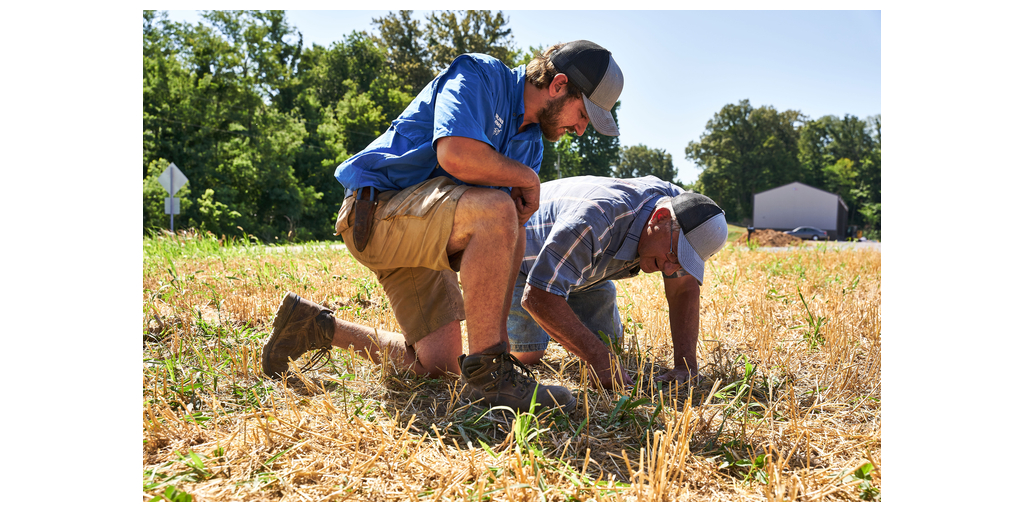
Cargill RegenConnect® has surpassed one million enrolled acres for the 2025 U.S. planting season, a milestone that underscores Cargill's ongoing efforts to support farmers in adopting regenerative agriculture practices. Through partnerships with farmers across the United States and beyond, Cargill is helping to transform agricultural systems for a more sustainable, food-secure world. (Photo: Business Wire)
its launch in 2021, Cargill RegenConnect has provided farmers with the tools, resources, and incentives they need to implement regenerative practices like low till, no-till, and cover cropping. These practices can help improve soil health, increase water retention, sequester carbon and enhance biodiversity. The nearly 1,500 farmers enrolled in the U.S. program receive dedicated agronomist support, one-year contracts, payments for carbon sequestered, and choice of regenerative practices to adopt. This flexible approach helps farmers find the methods that work best for their operation as they transition.
"This milestone is not just a number; it reflects the growing movement of farmers who are integrating regenerative practices to help improve their soil health and resiliency. Most farmers that enroll in Cargill RegenConnect return year after year, and more than 40 percent of those returning growers added new acres for 2025, underscoring the momentum behind this shift," said Brooke Hokana Hansen, Sustainability Director for Cargill's North American Agriculture & Trading business.
The expansion of Cargill RegenConnect builds on the progress Cargill recently shared in its 2024 Impact Report, which highlights the company's efforts to scale regenerative agricultural practices globally.
Cargill's vision is to make regenerative agriculture commonplace across its global supply chains. Today, Cargill RegenConnect is available in 24 U.S. states. Cargill has expanded regenerative agriculture globally with programs in Canada, Australia, Brazil and Europe. In total, Cargill has introduced regenerative agriculture initiatives across more than 15 countries which include agroforestry and cattle grazing management, farmer trainings and research. These region-specific programs and partnerships help farmers access solutions and technical support tailored to their local growing conditions.
"Every farm faces its own set of unique operating conditions, and successful adoption requires localized solutions," added Hansen. "We meet farmers where they are, providing them the agronomic and technical support they need. To fully unlock the potential of regenerative agriculture, collaboration is essential. Farmers, policymakers and food companies must work together to scale these practices and support a more resilient, secure food system."
Regenerative agriculture programs like Cargill RegenConnect not only provide benefits at the farm level, but can also help Cargill's downstream customers reduce the environmental footprint of their supply chains.
About Cargill
Cargill is committed to providing food, ingredients, agricultural solutions, and industrial products to nourish the world in a safe, responsible, and sustainable way. Sitting at the heart of the supply chain, we partner with farmers and customers to source, make and deliver products that are vital for living.
Our 160,000 team members innovate with purpose, providing customers with life's essentials so businesses can grow, communities prosper, and consumers live well. With 159 years of experience as a family company, we look ahead while remaining true to our values. We put people first. We reach higher. We do the right thing—today and for generations to come. For more information, visit Cargill.com and our News Center.
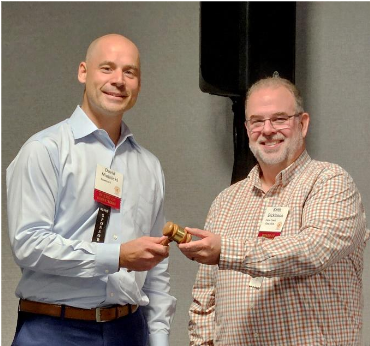
Keith Dickinson (right), outgoing president, passes the gavel to incoming president David Mielnicki at the conclusion of the election process.
Members of the leadership team of the American Society of Agricultural Consultants (ASAC) moved up the chairs, assuming new officer roles at the organization's annual business meeting held in Fort Myers, Fla., November 5. The election was held in conjunction with the Annual Conference there.
Dave Mielnicki, Newmark Valuation and Advisory, Clarkston, Mich., advanced to president of the group. Abigal Byerly, Snowy Mountain Development Corporation, Lewistown, Mont., became the president-elect after serving a year as the organization's vice president/secretary. Keith Dickinson, CAC, Farm Credit East, Bridgeton, N.J., will serve as immediate past president. Russell Morgan, CAC, Morgan Ag Consulting Services, Portland, Tenn., continues as chief financial officer for another two-year term.
Directors elected to serve two-year terms are Don Tyler, Tyler & Associates, Clarks Hill, Ind., in the Northern Region; and Ron Rabou, Rabou Farms, Inc., Albin, Wyo., for the Western Region. Both were incumbents.
Continuing directors serving a two-year term are Scott Mickey, Clemson University, Columbia, S.C., for the Southern Region; and Ethan Robertson, CAC, Farm Credit East, Auburn, Maine, for the Eastern Region.
ASAC is an organization of agricultural professionals who provide a full spectrum of consulting services to producers across the United States and internationally. ASAC's 2025 Annual Conference is scheduled to be held in Indianapolis, Ind., November 2 through 4. The theme, "On Track for Success," was announced at this year's event.
About the American Society of Agricultural Consultants (ASAC)
The American Society of Agriculture Consultants (ASAC) is a non-profit organization whose members represent a diverse range of disciplines in the agriculture industry. ASAC's membership is comprised primarily of experienced consultants boasting a wide array of expertise. Their business models range from sole proprietorships to leadership roles in larger, multi-consultant organizations, which cover a wide geographical area. To learn more about how ASAC can help you grow your agricultural consulting business, go to www.agconsultants.org.
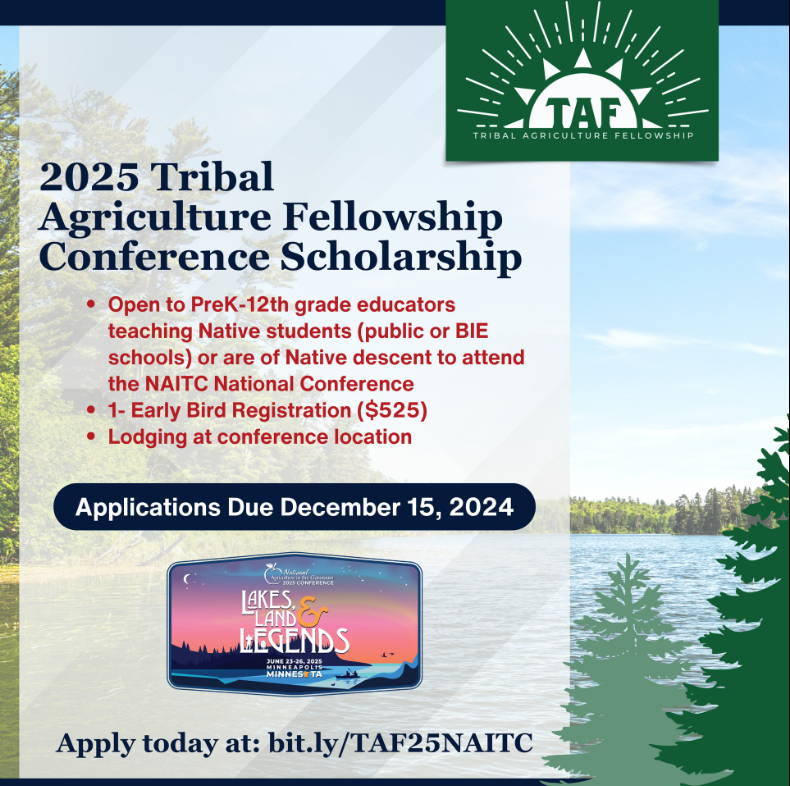
The 2025 Tribal Agriculture Fellowship Scholarship to attend the National Conference is now open! Applications are due December 15, 2024.
The Tribal Agriculture Fellowship (TAF) is a proud partner with National Agriculture in the Classroom to promote agricultural literacy and advance agriculture among Tribal communities. TAF recognizes the importance of agriculture education and growing the future leaders of Native Agriculture.
This year's scholarships will provide:
-1- Early Bird Registration ($525 value)
-Lodging at conference location
Scholarship Qualifications:
- PreK-12th grade educator teaching Native students (public or BIE schools) or are of Native descent.
Apply today: bit.ly/TAF25NAITC
U.S. Wheat Associates (USW) and the National Association of Wheat Growers (NAWG) today praised the Office of the United States Trade Representative (USTR) for submitting a counter-notification to the World Trade Organization (WTO) on India's domestic support, input subsidies, and market support prices for wheat and rice.
This is the latest in a series of U.S. counter-notifications showing India is not transparent about the true level of wheat and rice support it provides. Joining the United States in this notification were the governments of Argentina, Australia, Canada, and Ukraine.
"We appreciate that the USTR and other country delegations are working to highlight India's trade-distorting wheat support," said USW President Vince Peterson. "India's government continues to be out of compliance on its commitments and its refusal to compromise on its level of support and public stockholding is blocking any progress on agricultural negotiations at the WTO. It is important to keep bringing this issue to light with hope that it will eventually pressure India to become a responsible trading partner."
"Thank you to the USTR for their continued efforts to push India to follow through and come into compliance with their WTO commitments," said NAWG CEO Chandler Goule. "Farmers in the United States understand the importance of supporting producers when needed. However, India's approach is the wrong way to do it, and it is important that they follow through on their commitments."
India's wheat support schemes incentivize overproduction and discourage farmers from growing other crops. This has led to massive public stocks of wheat that the Indian government has at times dumped onto international markets. The disruption it causes harms farmers in exporting countries and their customers who benefit from stable markets.
Under its WTO commitments, India may provide subsidies equal to no more than 10% of the total value of crop production. In marketing years 2021/22 and 2022/23 covered in the counter-notification, the United States and other countries demonstrate through India's own data that its support level far exceeds that limit.
USW and NAWG are committed to working with USTR and other government officials to address these challenges and to ensure that U.S. wheat farmers have a fair chance to compete in the global marketplace.
Mark Johnson, Oklahoma State University Extension Beef Cattle Breeding Specialist, offers herd health advice as part of the weekly series known as the "Cow Calf Corner," published electronically by Dr. Peel, Mark Johnson, and Paul Beck. Today, Johnson talks about cow inventory and culling rates.
Approximately 70% of the U.S. cowherd calves in the spring. As referenced in previous Cow-calf Corner articles, the fall months, when we wean spring born calves and pregnancy check our cowherd, is usually the time we see the majority of cull cows going to market. Accordingly, the fall and winter months during the last quarter of the year are typically the lowest prices for cull cows.
Overall in 2024, the rate of cow slaughter is down. While cow slaughter has picked up somewhat since August (as expected), it remains sharply lower than recent years. Cull cow prices have seen their typical break as we have moved through the fall. However, cull cow prices remain well above 2023 levels and record high for the fourth quarter. As compared to recent years, reduced cow slaughter has supported cull cow values even through seasonal fall markets. Tight slaughter cow supplies and strong prices are expected to be the pattern through the winter months and into 2025.
From a cow inventory standpoint, the lower rate of cow culling/cow slaughter this year has not been enough to overcome the tight supply of bred heifers at the start of 2024. As a result, the U.S. beef cow inventory is most likely to be smaller to at the beginning of 2025.
Reference: CattleFax Update November 1, 2024
RON's Dave Lanning has a pre-opening look at today's agricultural Markets.
Click the audio tab below for today's report.
For the second time since 2017, the OSU College of Vet Medicine is back on probationary accreditation. At that time, the American Veterinary Medical Association placed the CVM on probationary accreditation after a site visit. OSU was successful then in fixing the problems cited by the AVMA and regained full accreditation.
However- after a review this past month- the OSU-CVM is back in the same position it found itself in 2017. Senior Farm and Ranch Broadcaster Ron Hays spoke with Dr. Johnny Stephens, President of Oklahoma State University's Center for Health Sciences which oversees OSU's College of Veterinary Medicine, about the status of the school and the vision of where it is headed.
"The thing about that status is that our students and our graduates are coming from a fully accredited veterinary program, but we do have two years to come off of that probation from the deficiencies that were found in the latest review by the accrediting board," Dr. Stephens explained.
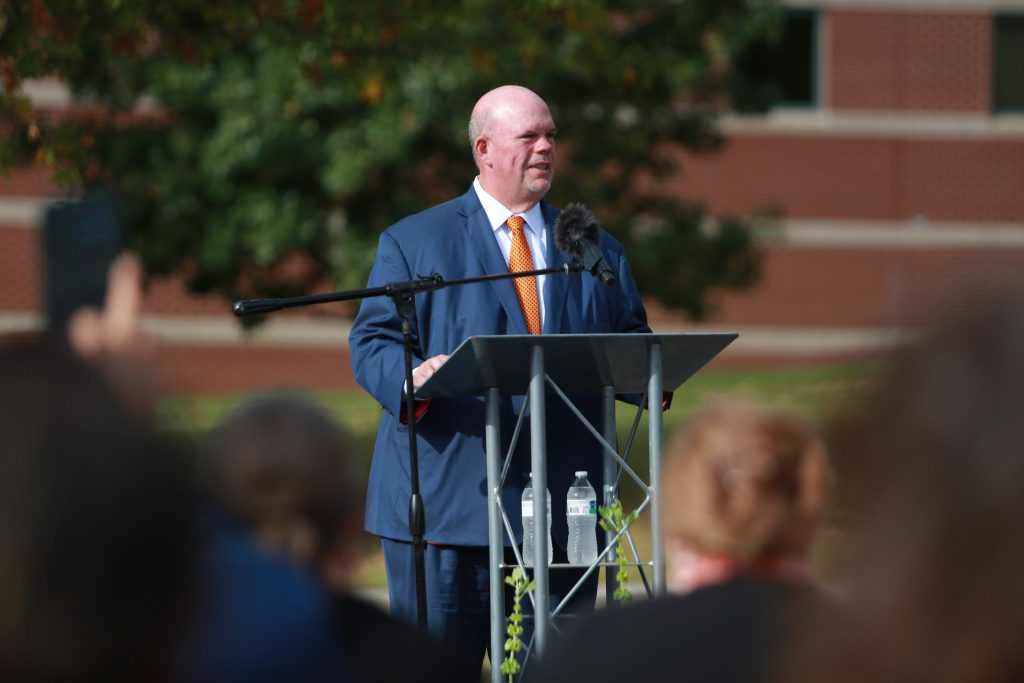
He said further that the deficiencies they were cited for were broken down into major and minor categories: the major being clinical education, meaning the number of cases that students were seeing.
"I scratched my head just a little bit over this because the North American Veterinarian Licensure Examination is the test that students come out and pass to go on and become licensed veterinarians," he said. "Our students are performing at a very high level. In 2023, ninety-six percent of our students passed that test their first time, and in 2024, it was ninety-four percent. That is compared to an 88% average across the nation."
Dr. Stephens tells Hays that it boils down to the administration not documenting the full extent of the cases that their students were exposed to. That problem has been corrected, so now, they must work with the accrediting body to prove that those cases are improving.
The minor deficiencies were to do with the facility itself and funding is already in place to make those improvements.
Dr. Stephens said that none of their deficiencies are a reflection of the quality of education veterinary medicine students receive in the program. "We have complete confidence in the faculty and staff and those who are providing the education, and the students are coming out confident in their education. We are turning out great graduates today, just like we were six months ago."
Dr. Carlos Risco stepped down in his role as dean on Oct. 31, and Dr. Jerry Ritchey has been appointed interim dean. A leadership transition team from across the OSU System is directing efforts to ensure swift action is taken to address deficiencies identified by the AVMA. When asked about the role of Oklahoma State University's Center for Health Sciences in the oversight of the College of Veterinary Medicine, Dr. Stephens says he is not responsible for the day to day operation of the College.
"My oversight is more at a macro level," he said. "I help with accreditation. The Center for Health Sciences started working with the Veterinary School about three years ago when it was identified that there are a lot of similarities between what we have worked with in our OSU Medical Center in Tulsa and what we were seeing from OSU's Veterinary Hospital in Stillwater.
"We started working together largely around the funding aspect. The school has long been funded around the academic programs that were happening with veterinary medicine, but what was identified by President Kayse Shrum and her leadership team was that the Veterinary Hospital had been underfunded for a number of years."
Three years ago, Dr. Stephens began working with the Oklahoma Legislature to create a program to fund the third teaching hospital in the state of Oklahoma – the OSU Veterinary Hospital. A year later, the OSU Vet Med Authority was created to provide funding.
There are recurring funds through the OSU Vet Med Authority that will be used for the maintenance and expansion of the OSU teaching hospital. These and some one-time funding options will be used to remodel the teaching hospital and address the minor deficiencies affecting its accreditation.
"There are opportunities to build a new teaching hospital as well," Dr. Stephens stated. "We will have time over the next six months to a year to discuss the outlook for a remodel versus a new hospital. There are pluses to both of those options. We will work with all stakeholders to be able to make that determination."
An area of focus in the decision-making process will be addressing the shortage of large animal veterinarians in rural areas. Hays and Dr. Stephens further discussed what this might look like. Click the soundbar above to listen to the entire conversation.
OSU President Shrum has long stated that she wants to make OSU the preeminent Land Grant University in the Nation, and there is no reason why the Veterinary Medicine program shouldn't also be a top-notch option.
"We have excellent faculty, and excellent students in the program," Dr. Stephens said. "How do we grow those facilities to national prominence in different areas? 'Large animal' is a very broad term. What are other animals underneath that heading that we can be preeminent for in the country? We are searching for where we can help in the state of Oklahoma and across the country or even worldwide."
Oklahoma Farm Bureau members from across the state gathered Nov. 8-10 at the Omni Hotel in Oklahoma City for the organization's 83rd annual meeting where they elected new leaders, set organizational policy for the coming year, recognized outstanding members and learned from speakers.
"We had a really wonderful convention this year," said OKFB President Rodd Moesel. "Everybody enjoyed the chance to fellowship and visit with one another and address the issues of the day during the resolutions sessions. A lot of times in agriculture, we are out on the farm or ranch and don't get to see each other as much. There is a lot of learning that occurs in the networking between one another at convention and a lot of reassurance that although there may be challenges, many are facing the same things."
Leaders elected
OKFB members elected several new and returning leaders throughout the weekend, including two new members to serve on OKFB's board of directors.
Jimmy Taylor of Roger Mills County was elected to serve as the new District 2 director. He will serve a three-year term representing Beckham, Custer, Greer, Harmon, Kiowa, Jackson, Roger Mills, Tillman and Washita counties.
Gary Crawley of Pittsburg County will return to the OKFB board of directors after being elected to serve a three-year term as the new District 5 director. He will represent Atoka, Bryan, Choctaw, Haskell, Latimer, LeFlore, McCurtain, Pittsburg and Pushmataha counties.
Mike Leverett of McClain County was re-elected to serve another three-year term as District 8 director. He will represent Cleveland, Coal, Garvin, Hughes, McClain, Pontotoc, Pottawatomie and Seminole counties. Jill Derusha of Greer County was elected to represent District 2 on the OKFB Women's Leadership Committee.
OKFB Young Farmers and Ranchers re-elected Jacob and Chastity Beck of Logan County to serve a one-year term as YF&R chair. Additional members re-elected include Jaclyn Darling of Coal County, District 8; and Tommy and Chalaynna Salisbury of Tulsa County, at-large. Lincoln and Gracee Muller of Jackson County were elected to represent District 2; Jake and Jonessa Cantrell of Haskell County were elected to represent District 5; and Teegin Crosthwait of Oklahoma State University was elected to serve as the Collegiate Farm Bureau representative.
Members set 2025 grassroots policy
Farm Bureau voting delegates considered more than 100 grassroots policy resolutions throughout two business sessions, including resolutions on property rights, eminent domain, renewable energy, conservation, labor and more.
The policy resolutions presented on the floor in Oklahoma City began as county-submitted positions and advanced through the state resolutions process in October. The policies adopted by OKFB members during the annual meeting will help to guide the work of the organization at the state Capitol for years to come.
OKFB members and counties recognized
Comanche County Farm Bureau was honored as the top county Farm Bureau with the John I. Taylor Award, and Payne County was recognized for its programs with the Lewis H. Munn Award.
Chasen Doye of Comanche County received the YF&R Achievement Award, and Jacob and Chastity Beck of Logan County received the YF&R Excellence in Agriculture Award. Okmulgee County was presented with the Charles L. Roff Award for the most outstanding county YF&R committee, and Southwestern Oklahoma State University was honored as the top Collegiate Farm Bureau chapter with the YF&R Moesel Award.
Mayes and Okmulgee County Farm Bureaus were recognized for outstanding county activity with County Excellence Awards, and 46 county Farm Bureaus were presented with OKFB Presidential Star Awards.
Austin Jackson of Payne County was named the YF&R Discussion Meet winner, Ashlee Purvine of Northern Oklahoma College was the Collegiate Farm Bureau Discussion Meet winner, and Heath Laubauch of Woodward FFA was named the High School Discussion Meet winner.
Congressman Frank Lucas received the Distinguished Service to OKFB Award for his decades-long service to agriculture in the United States House of Representatives. The OKFB WLC recognized nine outstanding farm and ranch families from around the state with the annual OKFB District Farm and Ranch Family Recognition awards. This year's honorees were Braden and Maria Naylor, Beaver County, District 1; Derek and Paige Jacobs, Tillman County, District 2; Shawn and Debbie Cox, Blaine County, District 3; Weston and Lacie Hoodenpyle, Cotton County, District 4; David and Haley McClendon, Pittsburg County, District 5; Charles and Ellen Coblentz, Mayes County, District 6; Steve and Denise Kienholz, Noble County, District 7; Jake and Samantha Calvert, Cleveland County, District 8; and Mike and Lotsee Spradling, Tulsa County, District 9.
Members learn from speakers, presenters
Farm Bureau members heard from Congressman Kevin Hern, Congressman Frank Lucas, Gov. Kevin Stitt, Texas A&M's Bart Fischer, and American Farm Bureau's Jessica Cabrera throughout the weekend and heard an inspirational message from Sen. James Lankford and enjoyed music from Blake and Jenna Bolerjack during the Sunday morning worship service.
Members also had the opportunity to attend one of three breakout sessions on Friday, Nov. 8, including a session on the Oklahoma Grassroots Rural and Ag Business Accelerators program, a session featuring landowners' rights in wind and solar leases, and a Cultivating Healthy Minds workshop on mental well-being. The Oklahoma Farm Bureau Annual Meeting is the organization's largest gathering of farmers and ranchers every year. At the three-day convention, members vote on grassroots policy, elect leaders and award outstanding individuals. OKFB has a presence in all 77 Oklahoma counties and serves as the voice of agriculture and the rural way of life
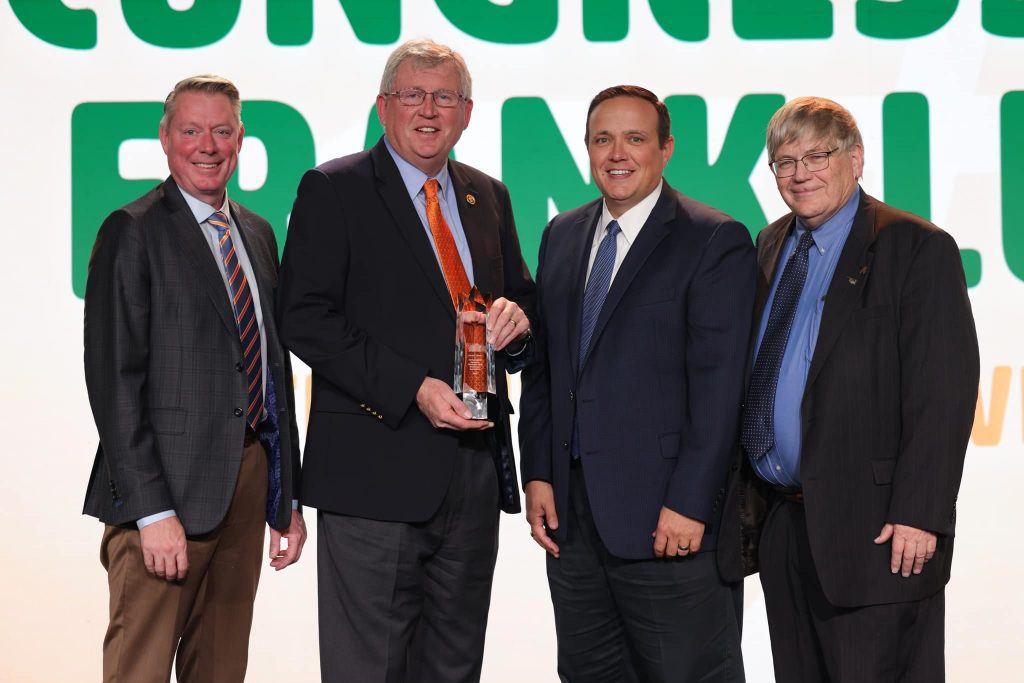
Oklahoma Congressman Frank Lucas honored with the Oklahoma Farm Bureau Distinguished Service Award on Saturday night
Oklahoma Farm Bureau honored achievements and accomplishments of the organization's members during the past year at OKFB's annual awards banquet held Saturday, Nov. 9, at the Omni Hotel in Oklahoma City.
Awards were presented to county Farm Bureaus for outstanding achievement in advocating for agriculture and Oklahoma's rural communities with county star awards, the John I. Taylor Award, the Lewis H. Munn Award and more.
Awards were also given to young farmers and ranchers, members of Oklahoma's agriculture community, and nine farm and ranch families who were recognized for upholding our state's richest agricultural traditions.
Awards presented during the evening included:
To view photos of the award winners, visit Oklahoma Farm Bureau's Facebook page.
The Oklahoma Farm Bureau Annual Meeting is the organization's largest gathering of farmers and ranchers every year. At the event, members vote on grassroots policy, elect leaders and award outstanding individuals. OKFB has a presence in all 77 Oklahoma counties and serves as the voice of agriculture and the rural way of life. To learn more, visit okfarmbureau.org.
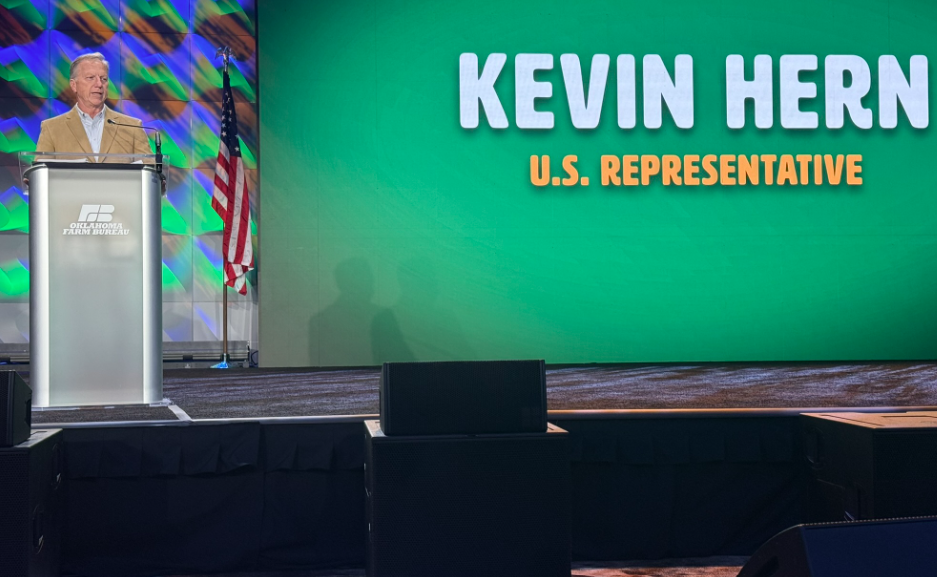
While attending the Oklahoma Farm Bureau Convention, KC Sheperd spoke to Oklahoma Representative Kevin Hern, District 1, about whether the tax cuts initiated by Former President Trump and whether they will expire or increase since his reelection.
Hern believes that Trump will reward American companies for doing business in America. "I think that is part of his reducing the corporate rate from twenty-one percent to fifteen percent. He knows how important farmers and ranchers are to the American dream by feeding Americans and keeping us less dependent on other people around the world. "
He also believes that this is also why Trump pushes predominant energy production as Trump has been quoted as saying that the real gold in America is under our feet. Hern says this is important for the security of the nation.
Hern believes that the farm bill will be extended to be reviewed under President-Elect Trump's tenure. "Right now, we've got to fund the government. We are currently funded until December 20th. It's important to get that done before he comes into office," he said. "Also, we have an expiration of the debt ceiling at the end of January, so we need to get that taken care of before he gets into office so that we can have a clean first 100 days to get a lot of the policies done that he's been talking about on the campaign trail."
Hern mentioned that people are concerned about the expiration of tax codes, and what that means for farm succession plans. If the farm bill expires, many heirs will be forced to sell part of the farm to pay the taxes on it.
"Had Kamala Harris taken office, and there are still Democrats in place who want this, is to have taxation on unrealized gains," Hern said. "This is very problematic with the increase in value of farmland. That didn't happen, but that's always in the back of their minds for the Democrats to push.
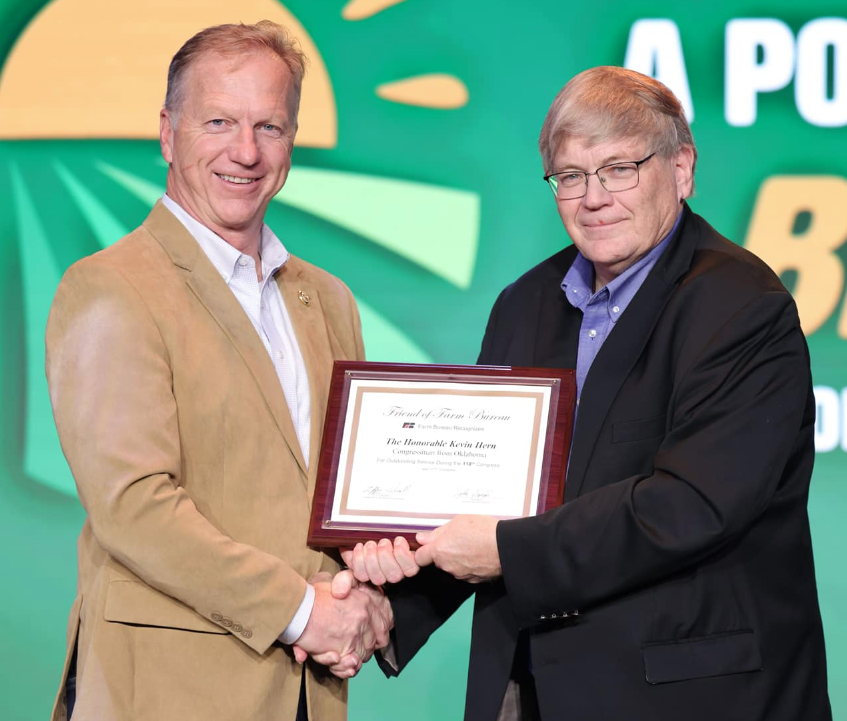
"When you compare the policy of the Democrats and the Republicans today, Republicans want to keep more money in your pocket so you can spend it on your family, your business, and your farm and not have to ask the Federal government for it back."
He pointed out the chasm between the two parties and expressed gratitude that Republicans will hold the House, the Senate, and the Presidency for the next two years.
As an advocate for farmers, Hern plans to instruct Congress on the importance of farmers by examining which foreign companies currently own the larger packing houses, production facilities, and large farms. He also hopes to find the balance between directing farmers in who they can sell their farms to in a free market capitalist environment while taking national security into account.
"It is more than just buying land around our military installations. It is who owns the majority of our production of crops and cattle in the United States," Hern stated. "Congressional U.S. Ag Committee Chairman G.T. Thompson, from Pennsylvania, has done a great job of educating the committees and everyone in Congress about everything going on."
He emphasized the importance of educating the thirty new Congressional members and the swift passage of the farm bill. He said that his goal from the beginning has been to reduce the footprint of the government and increase the footprint of families, churches, and communities.
"The only way we can do that is to put more money back into the American people's pocket," he said. "We start that by making the expiring tax code permanent. We know as members of Congress that we have two years, for sure, until our reelection, so we need to make the most of the next 18 months to be sure that we are doing what we have said, and what Trump said, and to help him get it done."
| |||||||||||||||||||||||||||||||||||||||||||||||||||||||||||||||||||||||||||||||||||||||||||||||||||||||||||||||||||||||||||||||||||||||||||||||||||||||||||||||||||||||||||||||||||||||||||||||||||||||||||||||||||||
| |||||||||||||||||||||||||||||||||||||||||||||||||||||||||||||||||||||||||||||||||||||||||||||||||||||||||||||||||||||||||||||||||||||||||||||||||||||||||||||||||||||||||||||||||||||||||||||||||||||||||||||||||||||
|
The National Council of Farmer Cooperatives (NCFC) announces the retirement of Charles F. "Chuck" Conner from his position as President and CEO, effective December 31, 2025. Conner has led the organization with distinction for over 15 years.
During his tenure, Conner has been instrumental in overseeing NCFC's efforts to promote and protect the interests of America's farmer-owned cooperatives. He has provided a strategic vision for the organization and enhanced the value for its members. Specifically, Conner has advocated for agriculture at the highest level of government, working to influence policy and provide a voice for NCFC members.
"Throughout his tenure, Chuck's leadership has guided the NCFC in adapting to the evolving needs of our member cooperatives and farmers," comments NCFC Board Chair Jay Debertin. "He has guided NCFC to remain a relevant and influential organization. We express our deepest gratitude to Chuck for his dedicated service to NCFC membership and the agriculture industry."
The NCFC Executive Council has selected Kincannon & Reed to begin a national search for Conner's successor.
"Chuck's planned departure allows for a transition period that will ensure our organization's continued success and stability, " said Debertin. "Kincannon & Reed is known for its expertise in recruiting executives to food and agriculture organizations."
For more information on the President & CEO role, to be considered, or to confidentially suggest a candidate, please contact David Turner, Managing Partner with Kincannon & Reed at NCFCCEOSearch@krsearch.com.
About NCFC
Since 1929, NCFC has been the voice of America's farmer cooperatives. Our members are regional and national farmer cooperatives, which are in turn consist of nearly 2,000 local farmer cooperatives across the country. NCFC members also include 17state and regional councils of cooperatives. Farmer cooperatives allow individual farmers the ability to own and lead organizations that are essential for continued competitiveness in both the domestic and international markets. America's farmer-owned cooperatives provide a comprehensive array of services for their members. These diverse organizations handle, process and market virtually every type of agricultural commodity. They also provide farmers with access to infrastructure necessary to manufacture, distribute and sell a variety of farm inputs. Additionally, they provide credit and related financial services, including export financing.
Smithfield Foods was recognized as a top military veteran employer by Forbes, Military Times and Military Friendly® for its commitment to veteran employment, career development opportunities and resources to help veterans transition to civilian life.
"Smithfield is immensely grateful to the military veterans and their families who have selflessly served our country," said Jay Bennett, chief human resources officer for Smithfield Foods. "It's an honor to be recognized for our veteran programs and initiatives, and we are committed to providing resources and support to veterans throughout their transition from active duty to civilian life."
Forbes selected Smithfield as one of America's Best Employers for Veterans 2024 for its commitment to support veterans in the workplace. Selections are determined by a survey sent to more than 24,000 veterans on criteria such as salary, career advancement, civilian transition support services and benefits.
In addition, Military Times recognized Smithfield as a Best for Vets 2024 Employer for its efforts to recruit, retain and support the veteran community through transition services. The survey is a comprehensive annual ranking of the country's best employers and organizations with military-connected programs and benefits. Military Times previously recognized Smithfield as a Best for Vets Employer in 2019, 2020, 2021 and 2023.
Smithfield also earned a spot on the Military Friendly® Employers list for 2025. The recognition is awarded based on an organization's commitment, effort and success in creating sustainable and meaningful benefits for the military community.
Helping Our Heroes, Smithfield's veteran engagement program, honors the service and sacrifice of American veterans and their families. The program prioritizes veteran employment and career development and strengthens veterans' community and family support systems. Additionally, Smithfield Salutes, an employee business resource group, provides resources for employees with prior military service and helps active-duty personnel transition to civilian life.
Smithfield supports Military Missions in Action, a nonprofit organization dedicated to assisting veterans with disabilities, homeless veterans and members of armed forces and their families. Smithfield employees also volunteer to support the organization during its Homes for Healing program, which provides new or gently-used furniture and household goods to veterans and active-duty service members and their families in need of establishing housing stability.
For more information about Smithfield's programs to support veterans, please visit smithfieldfoods.com/veterans.
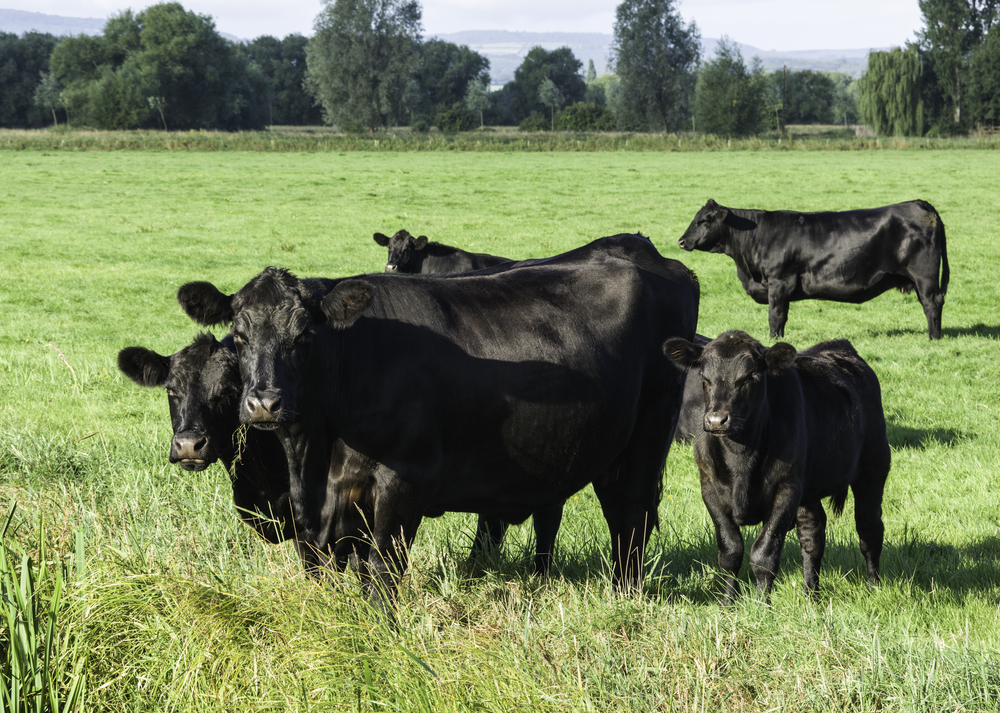
Senior Farm and Ranch Broadcaster Ron Hays talked with Jimmy Taylor, Western Oklahoma rancher and Angus University's Herd Rebuilding track panelist at the American Angus Convention.
His herd began with commercial cattle, changed to purebreds, and then to show cattle, but in 2005, he decided to aim for premiums on every animal he sold. After much research, selling carcass cattle on the grid was where he settled.
"We started out by buying registered Angus bulls – they were the best marbling breed," he said. "I first graded 12.5% prime. By 2012, we were grading 19.5% prime. We made progress, but it was real slow."
Taylor partnered with Zoetis and capitalized on their technology. Zoetis made a breakthrough around 2016. "They came out with an enhanced test in 2016, and it gave me data down to the trait, in ten different traits, how all of my females ranked. Those traits were both carcass and maternal; I'm focusing on carcass, but I'm keeping replacement heifers, too."
He took the data from the tests and placed parameters above each trait. He marked anything that was below 50%. Because he had worked extensively on marbling, so he marked any in that category that weren't in the top 30%. With these traits marked on each cow, he could choose an A.I. bull to complement each cow's traits.
"By doing this procedure, I ended up going 82% prime a couple of times, beginning in 2018-2019," Taylor said. "When I know a number, I can improve on a number. I can target individual traits."
He explained how sometimes different traits go together such as bigger growth and higher birth weights, but with his precise breeding practices, he was able to improve the three growth traits by 22% to 32% while simultaneously improving calving easy by 10%. During this time, his marbling improved 24% and ribeye size increased 22%.
"Something that is really intriguing to me," he shared. "Is I was able to increase that marbling 24% and at the same time, reduce external fat. So, when you have those numbers, you can make those different traits go in different directions and not only improve the carcass on your cattle where you get more bonus dollars in premiums but also, you are building that herd."
Will the premiums justify the effort? Taylor answered, "The tests cost $28 a piece. If I were looking at just one year, it would be hard to pencil out, but if you are going to be in this for the long term, and want to look out ten years to see where your cow herd is going to be, it's a no-brainer. You will be so far ahead if you use this test. The last premiums I received, I was getting a bonus of $15 per hundred prime over choice. I've seen a grid or two that paid $20 over, so that adds up in a hurry."
The Beef Buzz is a regular feature heard on radio stations around the region on the Radio Oklahoma Ag Network and is a regular audio feature found on this website as well. Click on the LISTEN BAR for today's show and check out our archives for older Beef Buzz shows covering the gamut of the beef cattle industry today.
David Lalman receives the 2024 Southern Region Excellence in Extension individual award for his impact on integrated beef Extension programs. (Photo by Todd Johnson, OSU Agriculture)
David Lalman, Oklahoma State University Extension beef cattle specialist, is the recipient of the 2024 Southern Region Individual Excellence in Extension Award for impactful integrated beef Extension programs.
He was recognized during an awards ceremony at the Annual Meeting of the Association of Public and Land-grant Universities on Nov. 10.
The recognition is a partnership between the United States Department of Agriculture, National Institute of Food and Agriculture and the Cooperative Extension System's Extension Committee on Organization and Policy. The Individual Excellence in Extension Award honors professionals who excel at science-based programming, provide visionary leadership and make a positive impact on constituents.
Lalman's OSU Extension beef cattle programs include Master Cattleman, Rancher's Thursday Lunchtime Series and the Cowculator beef cattle ration evaluation software.
"I enjoy my Extension appointment," Lalman said. "It is rewarding to know that you can help people with real-world problems in an industry you are passionate about."
He focuses on cow/calf and stocker cattle production with an emphasis on grazing and nutrition.
"Lalman has long been a state, regional and national leader in programming to help producers understand the nutritional needs of their cattle and how to better manage them for sustainable operations," said Damona Doye, associate vice president of OSU Extension. "His impact on the beef industry through presentations, publications and tools developed has been huge.
"His leadership and contributions to the OSU Beef Cattle Manual and the Master Cattleman educational program have been very well-received not only in our state but beyond," she added.
OSU Agriculture is dedicated to improving the quality of life of Oklahomans through science-based information and education. It is comprised of the Ferguson College of Agriculture and two state agencies: OSU Ag Research and OSU Extension.
By Macy Shoulders
Dr. Derrell Peel, Oklahoma State University Extension Livestock Marketing Specialist, offers his economic analysis of the beef cattle industry as part of the weekly series known as the "Cow Calf Corner," published electronically by Dr. Peel and Mark Johnson. Today, Dr. Peel discusses beef export and import data.
Total beef exports increased 3.6 percent year over year in September, bringing the total for the first nine months of the year to just 2.9 percent below last year (Figure 1). Japan is the number one export market, up 8.4 percent in September and up 0.6 percent year over year thus far in 2024. Number two South Korea was up 5.9 percent in September but remains down 10.3 percent for the first nine months of the year. China/Hong Kong is the number three export destination, down 12.3 percent in September and down 10.2 percent year over year for the January-September period. Beef exports to fourth-ranked Mexico were up 11.2 percent in September and are up 10.9 percent year over year for the first nine months of the year. Canada is the number five export market and was down 16.6 percent year over year in September and down 5.5 percent for the year to date. Beef exports to number six Taiwan were up 35.9 percent year over year in September, bringing the year-to-date total just 0.7 percent below one year ago.
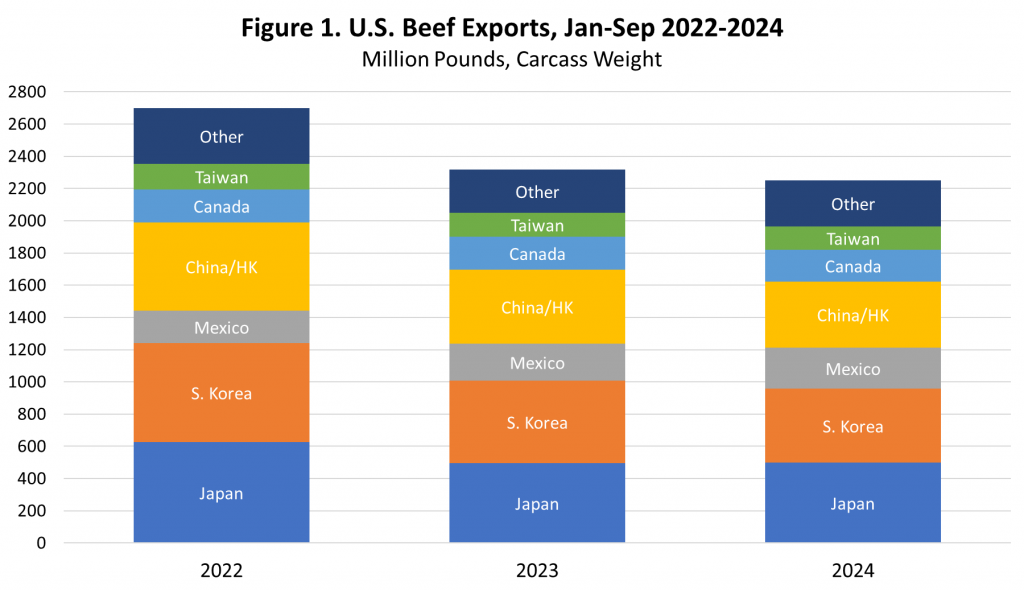
Total beef imports remain significantly stronger in 2024, up 23.0 percent year over year in September and up 21.1 percent thus far in 2024 (Figure 2). Canada remains the number one beef import source, just fractionally higher than Australia. Beef imports from Canada were down 0.7 percent year over year in September but remain up by 2.7 percent over last year. Imports from Australia have jumped sharply in 2024, up 60.0 percent in September and up 68.4 percent for the year to date compared to one year ago.
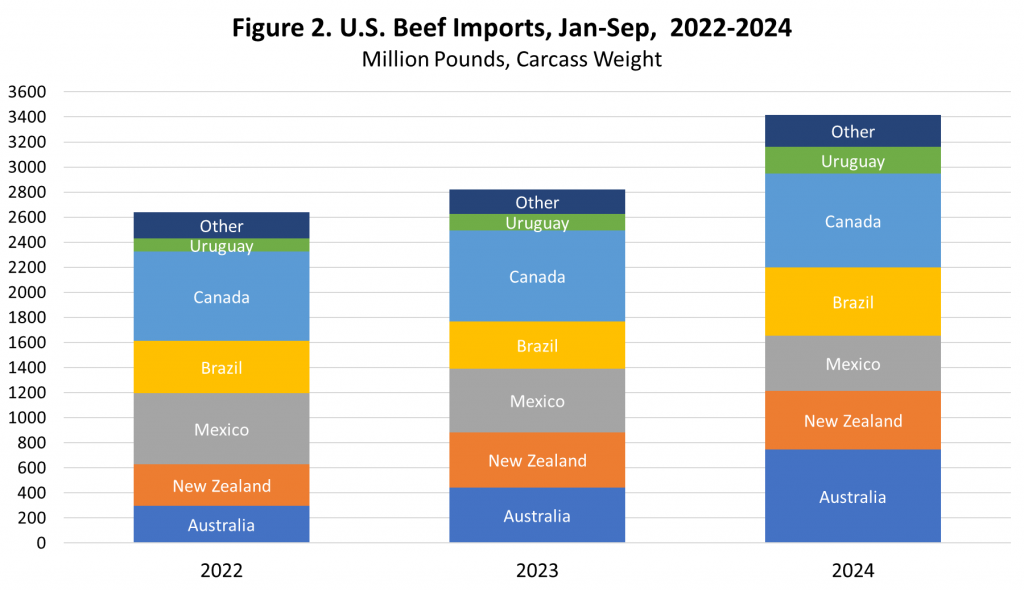
Brazil has also grown sharply as a source of U.S. beef imports, up 87.4 percent in September and up 44.9 percent for the January-September period. Brazil is the number three beef import source in 2024, up from number five last year. The number four beef import market is New Zealand, with September imports down 20.0 percent from one year ago but up 6.2 percent year over year for the first nine months of the year. Mexico is the number five beef import source, down from third place last year, with September imports up 6.2 percent year over year, but down 13.4 percent for the year to date. Uruguay is the sixth largest beef import source and was up 11.2 percent in September and is up 64.8 percent year over year thus far in 2024.

DMI Chair Marilyn Hershey
Dairy Management Inc. (DMI), the planning and management organization that oversees the national dairy checkoff program on behalf of America's dairy farmers and importers, has posted its 2023 annual report at https://dairycheckoff.com/about-us/annual-report.
The report provides checkoff funders and other members of the dairy community an audited financial report and highlights from 2023, including:
The report features insights from farmer leadership, including DMI Chair Marilyn Hershey, United Dairy Industry Association Chair Alex Peterson and National Dairy Promotion and Research Board Chair Joanna Shipp. Additionally, DMI President and CEO Barbara O'Brien shares thoughts on checkoff strategies designed to build sales and trust of dairy.
"The 2023 annual report delivers insights in a transparent way of the dairy checkoff's mission, including highlights and a financial summary of how our dollars are being invested," Hershey said. "This is a powerful tool that shows the workings of our organization and how the checkoff is delivering results for us."
The checkoff's 2024 program budget summary and audited financial statements also are available at https://dairycheckoff.com/about-us/budget-financials.
Those interested in learning more about the checkoff can visit www.DairyCheckoff.com and the Dairy Checkoff Facebook Page, listen to the "Your Dairy Checkoff Podcast" or subscribe to the Dairy Checkoff Newsletter.
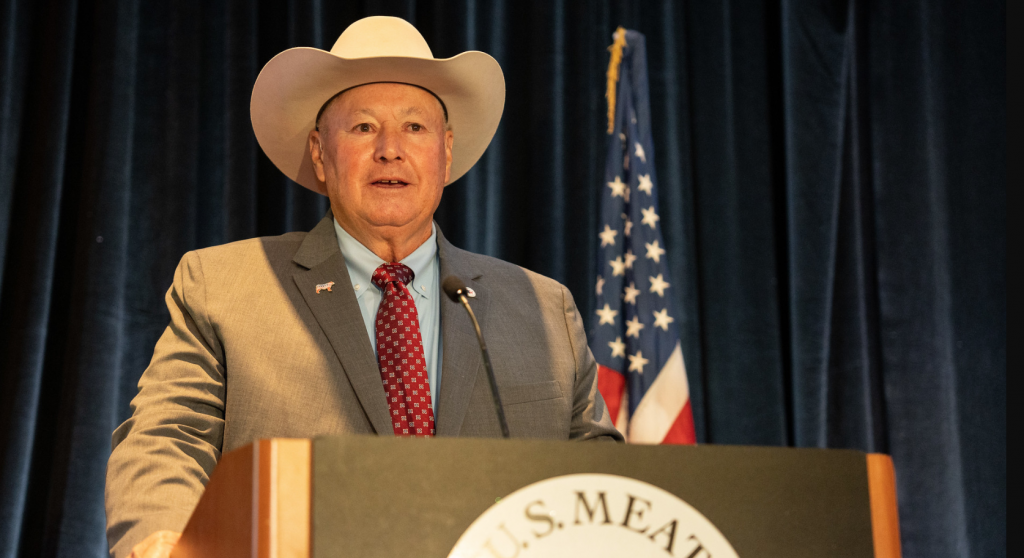
The U.S. Meat Export Federation (USMEF) concluded its annual strategic planning conference in Tucson, Ariz., Friday with the election of officers for 2024-25. Steve Hanson, a rancher and cattle feeder from Elsie, Neb., is the new USMEF chair, succeeding Minnesota pork and grain producer Randy Spronk.
Hanson has previously held many beef industry leadership roles, including chair of the Nebraska Beef Council and Federation of State Beef Councils and president of the Nebraska Cattlemen. He also served on the Beef Promotion Operating Committee, where he came to appreciate the importance of international marketing programs for U.S. red meat.
"The Operating Committee is where I first got my exposure to USMEF, which invests our checkoff dollars so well and adds value to the beef carcass," Hanson said.
Hanson also praised USMEF for bringing together a wide range of agricultural sectors to support a common goal – something he said was fully on display in Tucson.
"That's one of the best things about USMEF conferences – the idea that I can attend the Pork Committee and Exporter Committee meetings, to broaden my perspective," he said. "Yesterday, I sat in on the Exporter Committee meeting so I could learn more about the challenges they face moving product overseas. Those guys have some real hurdles, and this meeting gave me a much greater appreciation for what they do."
Hanson added that industry unity is also critical when countering efforts to shut down animal agriculture. He cited a Denver ballot initiative that sought to ban slaughterhouses as a prime example.
"Fortunately, that measure was defeated by nearly a two-to-one margin, and we are very proud of that fact," he said. "But there are more cities on these activists' lists, and we need to be paying attention."
USMEF's new chair-elect is Jay Theiler, executive vice president of corporate affairs for Agri Beef Co., a diversified business with operations in ranching, cattle feeding, cattle nutrition and beef processing. He is a past director of the Idaho Beef Council and has served on the Beef Industry Long Range Plan Task Force.
USMEF Vice Chair Dave Bruntz is president of Bruntz Farming & Feeding in southeastern Nebraska, where he raises corn and soybeans and feeds cattle. Bruntz is a past president of the Nebraska Corn Board and Nebraska Cattlemen. He also served as a regional vice president for the National Cattlemen's Beef Association.
The newest USMEF officer is Secretary-Treasurer Darin Parker, director of Salt Lake City-based exporter/distributor PMI Foods.
Friday's closing business session also included a USMEF staff panel focused on the importance of market diversification and developing new opportunities for U.S. pork, beef and lamb in emerging destinations. Scott Reynolds, assistant vice president of marketing programs, described how USMEF categorizes markets for beef and pork and showed how allocations of USMEF investments in new and emerging markets has grown by 22% in the past five years. These are markets with less current volume, but greater upside potential. New and emerging markets can also help manage risk when market access issues occur in the leading markets for beef or pork.
In terms of new, untapped markets for U.S. red meat, Africa tops the list. USMEF Africa Representative Matt Copeland focused on population and economic growth and reminded the audience that by 2050, one in four people in the world will be African. It will take time, says Copeland, but we can't underestimate the importance of this economic evolution in Africa.
"The geographic reach is immense. It is more than 7,000 miles from Casablanca in Morocco in the north down to Cape Town in South Africa. One of the world's finest beef restaurants will open in Marrakesh in September 2025 and will showcase U.S. beef. In December, Marble is opening its second restaurant in Johannesburg and the flagship item on their menu is Prime grade beef from Snake River Farms," said Copeland. "In between, we're launching an event in Ghana in April 2025 that will be a wonderful opportunity to meet the entire West African trade."
USMEF Latin America Representative Homero Recio addressed recent initiatives to develop new opportunities in South America, including a new product launch in Colombia.
"Colombia is a growing market for U.S. pork made up of trimmings, hams, loins and ribs. But how do we grow tonnage? There are different ways to do it," said Recio. "One, you just sell more of what you already sell. Another way is to introduce new items and that's what we've been working on with the Boston butt ‒ pork's best-kept secret."
The new product with the most immediate potential in Colombia's foodservice sector may be a pork burger derived from the Boston butt.
"We've tested the burger in Colombia and the reaction was off the charts. We are now promoting it to the trade as "BBB" – for Boston butt burger," said Recio, who added that USMEF is also testing a variation of the burger in Chile.
USMEF ASEAN Director Sabrina Yin discussed the diversity of her region and its varying stages of market development, contrasting the highly developed market of Singapore with emerging markets such as Vietnam and Cambodia.
Yin explained that in several ASEAN markets, much of USMEF's work is directed at overcoming technical barriers and working with the trade on supply chain development, capacity building and imaging U.S. product. Where possible, USMEF continues to utilize sampling programs for U.S. beef and pork toward growing retail shelf space. Yin described how USMEF is evolving to more of a business-to-business approach with promotions, utilizing sales contests for U.S. red meat with importers and distributors.
Thursday highlights include producer insights from overseas, USMEF awards
The previous day's program featured a panel discussion titled Building Connections and Creating Opportunities, in which livestock producers shared firsthand experiences and insights from engaging with red meat buyers, consumers and government officials in overseas markets.
Randy Spronk, who served as USMEF chair over the past year, kicked off the discussion by recapping his first market visit to Japan 25 years ago, traveling with then-Governor Jesse Ventura. He highlighted the U.S. pork industry's success in developing the Japanese market while also expanding demand in other Asian markets and the Western Hemisphere.
"One of the biggest takeaways for me was that exports are not something that you do in six months or in 12 months, said Spronk. "It's a long-term strategy to continue to grow a market and to be present in that market."
Bob Ruth, a pork producer from Pennsylvania and past president of the National Pork Board, participated in a USMEF Heartland Team tour of Japan in September.
"I was amazed with the Japanese attention to detail and quality. Quality in how they cut the meat, in how they package it and how they present the meat to customers," said Ruth. "I'm talking pork in general, but they did it with all their red meats. A big take home message for me was how we could do better here in the United States to boost demand, based on what I saw in in Japan."
Cattlemen's Beef Board member Ross Havens, a cattle producer from Iowa, appreciated seeing the popularity of products that have little demand in the United States.
"Tongues are one of the top beef products we export to Japan," said Havens. "Most people in the U.S. have no interest in trying beef tongue but in Japan, the way they cook it and prepare it, beef tongue is really delicious. It's a great example of how international markets add value to the carcass. Shipping beef products to where somebody really values it is a great return on our Beef Checkoff investments."
Don Pemberton, former president of Kentucky Cattlemen's Association and a participant in a Heartland Team tour of Korea and Japan in 2023, talked about his experience grilling steak for social media influencers in Tokyo and the great interest they showed in his technique. He also shared his surprise at how much attention he received upon his return to Kentucky.
"When I got back to Kentucky, I prepared a trip report and presentation for Kentucky Cattlemen and Kentucky Beef Council. And the next thing I knew, I was on a speaking tour around the state. Because I'd spent 48 hours in Seoul and 48 hours in Tokyo, I was now considered an expert on foreign trade," laughed Pemberton.
"As I presented at more of these meetings, I realized their great interest in how global trade affects them, and more importantly, their checkoff investment. With what I was able to share, they could better understand how their checkoff dollars are invested in global marketing and what a difference this is making."
While the panel freely shared their observations and insights with conference attendees, they also encouraged members to consider visiting an international market through a USMEF trade mission.
"My advice would be, take a trip. The intelligence that you pick up in the markets is a very valuable experience," said Ruth. "The other thing is, and Don had talked about it, and Ross talked about it, is that our customers want to hear from you, the producer. The influence that you have is phenomenal, and your presence there really helps USMEF. It's going to be valuable for you, and it will be valuable for our industry as well."
Thursday highlights also included an awards luncheon where USMEF honored Nick Giordano, former lead lobbyist with the National Pork Producers Council, with its Michael J. Mansfield Award. Mark Jagels, a corn and livestock producer from Davenport, Neb., and former USMEF chair, received USMEF's Distinguished Service Award. More details on these awards and comments from the recipients are available here.
USMEF also honored the Montana Beef Council with its Million Dollar Club Award. This award recognizes USMEF member organizations that have contributed more than $1 million in support of USMEF's marketing programs. Montana Beef Council is a longtime partner of USMEF, making its initial contribution in 1984.
The conference began on Wednesday with a deep dive into the election's impact on agricultural and trade policy, as well as an update on U.S.-Mexico trade relations.
USMEF members will next meet at the organization's Spring Conference, May 21-23 in Fort Worth, Texas.
Photo provided by OSU extension website.
Originally from eastern Asia, the Asian longhorned tick, Haemaphysalis longicornis, has successfully established itself in countries around the world and now the United States. In the summer of 2024, the tick was identified on cattle in northeast Oklahoma counties.
The Asian longhorned tick parasitizes multiple species including humans, pets, livestock and wildlife, including birds. Relatively small in size when compared to native ticks, it is a three-host tick. It spends 90 percent of its life off the animal. Larva, commonly called seed ticks, feed on smaller animals. The nymph and adult stages then feed on larger animals including humans and cattle. The four most common animals this tick has been found on within the United States are dogs, white-tailed deer, raccoons and cattle.
The female tick can reproduce without mating and may produce 1,000 to 2,000 eggs at a time. A single female tick has the potential to create an established population in a newly introduced location in two to three weeks.
Severe infestations of the Asian longhorned tick in cattle can lead to death from the stress of excessive blood loss. Production losses including decreased milk production and growth are substantial. The Asian longhorned tick has also been recognized as a vector for multiple diseases of both humans and animals including viral, bacterial, and protozoan agents.
In other countries, the tick is the primary vector of Theileria orientalis Ikeda genotype in cattle. The protozoal agent causes clinical signs similar to anaplasmosis-anemia, fever, lethargy, jaundice and death. The mortality rate for cattle infected with T. orientalis Ikeda genotype varies from three to 90 percent. T. orientalis Ikeda genotype has been identified in the United States, but as of this time not in Oklahoma.
Beginning in late 2024, Oklahoma State University College of Veterinary Medicine researchers will launch a project to evaluate the status of the pathogenic T. orientalis genotype Ikeda and the Asian longhorned tickin cattle herds from Oklahoma and eastern border states. 30 to 50 farms have the opportunity to participate by submitting blood, ticks, or both.
Each participating herd will provide five to twenty blood samples. Herds that test positive to T. orientalis will be followed up with once or twice during the study. Ticks will also be collected from the animals. Tick trapping may also be performed. A maximum of 15 ticks will be analyzed from each sample collection site. All samples will be tested at the Oklahoma Animal Disease Diagnostic Laboratory.
Sampling supplies, shipping labels, and testing will be provided at no cost. Samples may be collected by veterinarians or producers with a consulting herd veterinarian. Blood submissions will process twice weekly with results emailed to the address on the submittal form and the consulting herd veterinarian. Anaplasma marginale testing will also be provided free of charge (up to 20 samples per herd) if anaplasmosis is suspected in the herd.
For more information or to participate in the study please contact a member of the research team:
Dr. Ruth Scimeca ruth.scimeca@okstate.edu, Dr. Rosslyn Biggs rosslyn.biggs@okstate.edu, or Dr. John Gilliam john.gilliam@okstate.edu.
By Rosslyn Biggs, DVM
Oklahoma Farm Bureau honored achievements and accomplishments of the organization's members during the past year at OKFB's annual awards banquet held Saturday, Nov. 9, at the Omni Hotel in Oklahoma City.
Awards were presented to county Farm Bureaus for outstanding achievement in advocating for agriculture and Oklahoma's rural communities with county star awards, the John I. Taylor Award, the Lewis H. Munn Award and more.
Awards were also given to young farmers and ranchers, members of Oklahoma's agriculture community, and nine farm and ranch families who were recognized for upholding our state's richest agricultural traditions.
Awards presented during the evening included:
To view photos of the award winners, visit Oklahoma Farm Bureau's Facebook page.
The Oklahoma Farm Bureau Annual Meeting is the organization's largest gathering of farmers and ranchers every year. At the event, members vote on grassroots policy, elect leaders and award outstanding individuals. OKFB has a presence in all 77 Oklahoma counties and serves as the voice of agriculture and the rural way of life. To learn more, visit okfarmbureau.org.
Congratulations to President-Elect Donald J. Trump on his election as the 47th President!
House of Representatives
At the present time, Republicans have secured a majority in the Senate, while the House remains close, but still un-called. This morning, Republicans have secured 212 seats, and but need 218 seats to have the majority for the House. Many of the uncalled seats lean Republican, so it appears that Republicans have the potential to have a slim majority once all votes are tallied. However, with seat flips, it is still possible that Democrats could pick up enough seats to keep the chamber effectively level with a Democrat majority. At least 11 House seats have changed parties, with Democrats picking up 5 seats, and Republicans picking up 6.
In California, both parties are vying for control in districts where margins remain razor-thin. In District 9, Rep. Josh Harder (D) is holding a narrow lead over Republican Kevin Lincoln, while in District 21, long-serving Democrat Jim Costa has a slight edge against Michael Maher (R). Republican incumbent Mike Garcia leads George Whitesides (D) in District 27, and GOP Rep. Ken Calvert is fighting to keep his seat in District 41, where he faces a strong challenge from Democrat Will Rollins.
The race to replace outgoing Rep. Katie Porter in District 47 is particularly tight, with Republican Scott Baugh just ahead of Democrat Dave Min. In District 49, Rep. Mike Levin (D) leads his challenger, Matt Gunderson (R). Outside California, Arizona's 6th District is in a near tie, with incumbent Republican Juan Ciscomani barely leading Democrat Kirsten Engel by a few dozen votes. Alaska's at-large district is also competitive, as Democrat Rep. Mary Peltola trails Republican Nick Begich in a ranked-choice race that could swing either way once all votes are counted. These close contests are pivotal as both parties strive for the magic 218.
Senate
The Senate has officially taken a Republican majority by flipping three seats (so far). John Curtis (R) won the 3rd Congressional District seat in the Utah senate race, replacing Mitt Romney as Utah's junior U.S. senator. Republican Tim Sheehy defeated the 3-term incumbent Tester flipping Montana's U.S. Senate seat. Montana's political profile has seen a dramatic change since Tester's first election; with surging numbers of Republicans.
On Saturday morning, incumbent Nevada Democrat Jacky Rosen (D) secured reelection, besting challenger Sam Brown (R) by a little over a percentage point; making it a thin advantage. Over in the Arizona Senate race, Democratic nominee Ruben Gallego leads the contest against Republican counterpart Kari Lake by less than a percentage point.
With Republicans gaining control of the Senate, major changes are expected in the leadership of key committees. The Senate Energy and Natural Resources (ENR) Committee, previously chaired by retiring West Virginia Democrat Senator Joe Manchin, will likely be chaired in the upcoming Congress by Utah Senator Mike Lee. Meanwhile, the Environmental and Public Works (EPW) Committee will also see maybe leadership changes as West Virginia Senator Shelley Moore Capito is poised to become the new Chair. Overall, these leadership changes will likely lead to a shift in priorities from these committees that haven't been shared for many years.
Western Ballot Initiatives
There were multiple agriculture-related ballot initiatives across the West this year. Thankfully, voters were able to see the impacts these initiatives would have had on our producers and provided some remarkable wins for our industry!
Colorado voters rejected a gambit of animal rights measures that could have had disastrous impacts on the agriculture and livestock industry. Two ordinances, in particular, were initiated by animal activist groups, Pro-Animal Future. Ordinance 309, which sought to close Superior Farms and outlaw slaughterhouses within the Denver city limits, lost by a wide margin. This was a major win for the U.S. sheep industry and the Denver community. Superior Farms is the only slaughterhouse serving Colorado and Wyoming, which are both sheep-heavy states. If passed, a study found that the Colorado economy would have seen an $861 million loss of economic activity in the state and 2,787 fewer jobs.
Pro-Animal Future's Ordinance 308 to ban making or selling fur-based products also failed to win over Denver voters. This posed significant risks to the market for livestock byproducts being sold. This was a major win for the livestock industry and Western culture at large. This ordinance would have outlawed products like fly-fishing lures or even cowboy hat sales within city limits. Though Denverites are pushing animal rights movements in the city and state, voters do not seem interested in letting it impact local and state economies.
Lame Duck: What's next?
As the shake-up on the Hill settles, PLC remains focused on activity in the lame-duck session. While the legislative to-do list remains long, Tuesday's election results are expected to shift the timing and priorities of the chambers. PLC has been engaged with Congressmen Westerman (AR) and Newhouse (WA) on an Endangered Species Act (ESA) reform bill, gaining support for revisions that would make the act more manageable and geared towards the recovery of species. Although legislative avenues are limited with timing, we remain optimistic and committed that momentum is established for the next Congress.
While Congress must pass appropriations measures in some form, there's very few other must-pass bills on the Congressional calendar - particularly for Republicans who are hoping they hold the House and have a strong negotiating position next year. That motivation is likely to impact not only the prospect of a Farm Bill, lands package, and other permitting reform before the end of the year.
The Farm Bill, a crucial policy initiative, remains a priority, though its passage this year is still being determined. For those affected by the devastating wildfire season and recent hurricanes, disaster relief is another urgent issue. Speaker Johnson has pledged to prioritize disaster relief upon Congress's return, with many lawmakers stressing the need for swift action. The damage to ranching operations and grazing land requires immediate relief and long-term support for rebuilding efforts. PLC will continue advocating to ensure wildfire relief remains a top priority while continuing our push to see preventative measures implemented. As we move forward, we reaffirm our commitment to advocating for the policies that support ranchers.
RON's Dave Lanning has a pre-opening look at today's agricultural Markets.
Click the audio tab below for today's report.
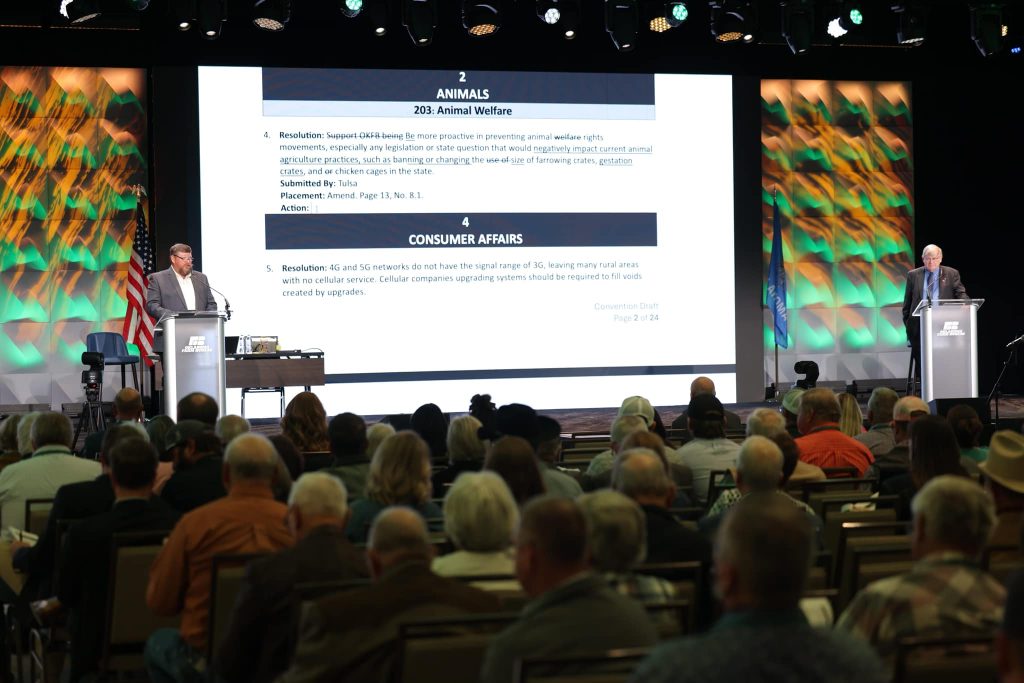
Delegates at the 2024 Oklahoma Farm Bureau Annual Meeting worked through a wide range of policy positions that was presented to them by the Resolutions Committee of the organization that had come from County Farm Bureaus back earlier in the fall.
After the several hours of debate and approval- Oklahoma Farm Report's Ron Hays talked with OkFB President Rodd Moesel about the process and the result- a document that will help the public policy team of the group advocate for the state's largest general farm organization this coming year at the State Legislature. Click on the Listen Bar below to hear their conversation:
Moesel says that delegates and the Resolution Committee agreed that private property rights as it related to renewable energy projects- wind, solar and transmission lines for renewables- needed to be addressed. Delegates voted to call on the group to advocate for protection of the land owner in eminent domain discussions over the a corridor across the northern part of the state for a possible transmission line that would carry electricity generated by wind power in the Panhandle region. The OkFB President says he calls a lot of this discussion "farming energy" as farmers, ranchers and rural landowners deal with companies wanting to lease their land for these renewable energy projects.
The delegates also spent a lot of their time on water policy after lunch on Saturday. Moesel says this year's conversation was a transition from previous policy discussions- moving from policy that was more statewide water policy to 2025 policy that is "starting to look at regions or water basins recognizing that there is really tremendous differences in water availability and water issues in the different parts of the state and the different water basins."
OkFB Vice President Monte Tucker, who farms in western Oklahoma, was on stage with Moesel as they worked through the resolutions with the delegates- and he was right in the middle this past legislative session of the debate over how different parts of Oklahoma have unique water challenges. Hays also talked with Tucker- and you can hear his take on how the delegates dealt with this important issue by clicking on the Listen Bar Below:
Tucker agrees with Moesel that the delegates were clear on water- "water policy is not a blanket policy from Idabel to Felt, Oklahoma. Every aquifer is unique, every watershed is unique, the needs are unique, the demand is unique and the water itself is unique."
Tucker was surprised by the delegates (and earlier in the Resolutions Committee) on producers being willing to accept monitoring of their water use. "What surprised me is that our delegation really doesn't oppose self metering. Farm Bureau members are not afraid to be monitored. We really believe we are good stewards of the resource."
Tucker, who is ending 11 years on the board of the Oklahoma Farm Bureau here in 2024, was pleased with how Farm Bureau members are willing to come together. "I always believe our delegation gets it right."
The grassroots process that began at the Farm Bureau's August Area meetings concluded on Saturday- and will be the backbone of what the farm group will use as talking points with state lawmakers in 2025 at 23rd and Lincoln. There were also several policies that will be presented to the AFBF for consideration at the policy session at their annual meeting in January.
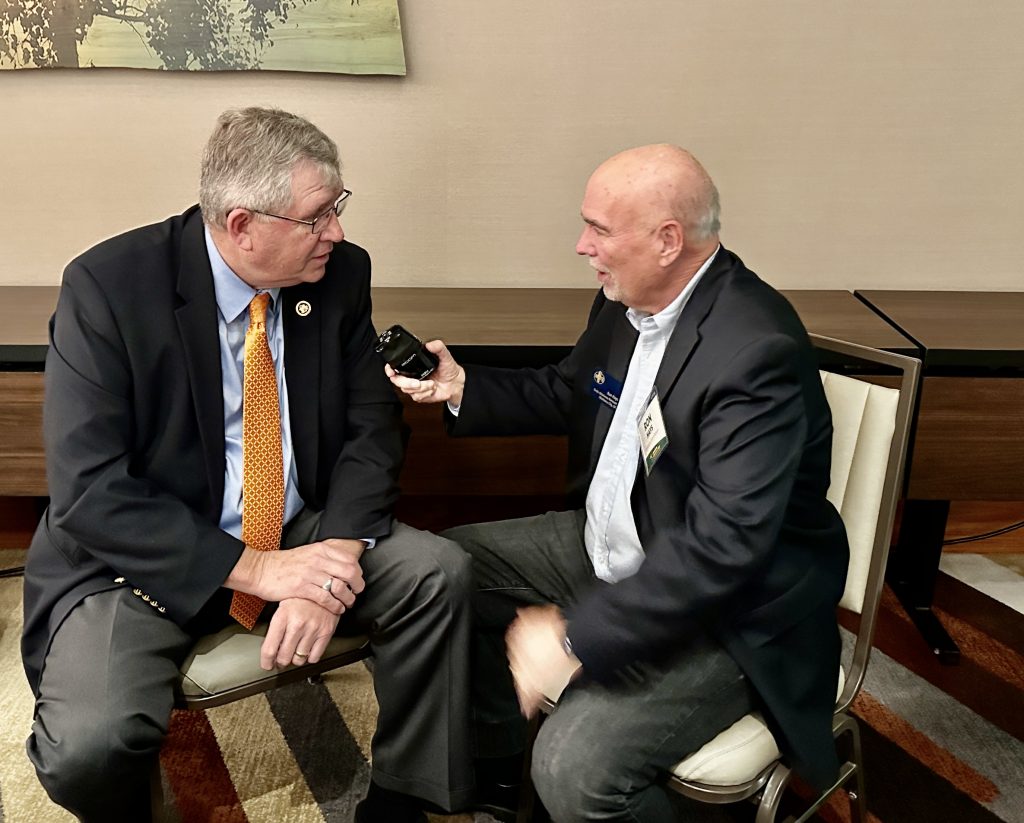
While attending the Oklahoma Farm Bureau Convention, Senior Farm and Ranch Broadcaster Ron Hays had the opportunity to visit with Congressman Frank Lucas about many things including the AFBF Distinguished Service Award he was presented with at the 2024 National AFBF Convention, a farm bill update, and the outlook for President-Elect Trump's second term in office.
Congressman Lucas is a fifth-generation Oklahoman whose family has lived and farmed in Oklahoma for over 120 years. He graduated from Oklahoma State University with a degree in Ag Economics and has served on the nation's Ag Committee for thirty years. Before that, he was on the state House of Representatives Ag Committee for five and a half years. Lucas has been a crusader for the American farmer since being elected to Congress in 1994 and has fought to protect Oklahoma values.
He said, "It was very kind of my friends, my fellow Farm Bureau members on the national level to honor me that way at the last National Convention. When the folks who know you and understand what you have tried to do show their appreciation, that means a tremendous amount. It's kind of like the family reunion when you get to say grace to start the meal."
Optimism is an inherent value of Oklahoma farmers that Congressman Lucas shares. He feels good about Republicans gaining the majority vote of the House, Senate, and Presidency. Two hundred eighteen votes are required to be the majority, and Republicans will hold roughly 220-221 in the House of Representatives when the newly elected members take their seats.
As far as the renewal of a farm bill, Congressman Lucas began by saying, "There are several things in play right now. First and foremost, is the overall appropriations process. The government is only temporarily funded until December 20. Some of my very conservative friends will call for a short-term extension of the present funding, and want to sort through the rest of it in the new administration. I suspect that President Trump's advisors would like to have a clean slate, and I agree with them."
He mentioned the National Defense Authorization Act (NDAA) which will authorize the activities of the Department of Defense for the coming year. The fact that Oklahoma houses five large military bases makes it of paramount importance as well.
"Of course, it goes without saying that my heartbeat is set by where we are in the farm bill process, and right now, I'm missing a beat every so often," Congressman Lucas admitted. "It might be the toughest piece of those three. I had a long visit on the phone with Chairman [G.T.] Thompson last night about the issue. He assures me that he is pressing the Speaker on the first hand that we, in the ag committee, have a product that is ready to go and that we can be a part of whatever kinds of year-end negotiations there are."
Chairman Thompson related back to Congressman Lucas that if they couldn't have a complete farm bill, they must at least take the Title 1 - Commodity title and the Title 11 Crop Insurance title to incorporate them into the final year package.
"Now, there have been lots of discussions about disasters: bridges, hurricanes, and all manner of things going on in the country. I would argue that whether you are a farmer in the Southeast or a farmer in much of the Southwest who didn't get a summer crop – there was no milo cut – that we need to address those issues. Afterall, as well-written as the farm bill was in 2018, based on the 2014 farm bill, between inflation, trade wars, COVID, and a myriad of things beyond producers' control, the safety net that was set up in '18, is not adding much safety for producers out there. That has to be addressed," Congressman Lucas stated.
In the absence of a complete farm bill, he said that he would prefer to take the sections that must be operative, use supplemental spending to address the needs for disaster relief, and then buckle down on completing a new farm bill in the Spring when the new members are seated.
Under Republican rules, a person can only lead a House committee for six years, and Congressman Lucas is preparing to wrap up his tenures as Chairman of both the Ag Committee and the Science Committee. His focus is shifting to the third committee he hopes to lead.
"While not many people in the district think of me as being a member of Financial Services, it was one of my early committee requests right after ag, because whether you are aggies, energy producers, main street, or manufacturing, the common thread in the third district is capital," Congressman Lucas said. "We are a capital-starved district, so the cost of and the availability of credit, meaning capital, matters! So let's take a fellow farmer from many generations of debtors, make him Chairman of the Committee, and we will see if we can make sure those issues are better addressed when it comes to ag, industry, main street, and everybody's home expenses."
Three others are vying for the title, and Lucas says that it is the most complicated and competitive chairman's race that he has ever taken part in due to the committee's jurisdiction over all banks, credit unions, the Department of Treasury, the federal reserve system, housing, certain insurance issues, and export/import banks.
"It is a level of competition I have never been a part of before, but that's okay," he commented. "I bring the longest track record of any of the candidates, having accomplished the most legislatively. We will see. I think my fellow Republicans will trust me when they have to make a decision."
About President-Elect Trump's second and final term in office, Congressman Lucas said, "What kind of legacy does he want to leave? He is clearly focused on trade, taking less money from every individual's pocket, less regulatory interference from the government, and letting business be business. Agriculture is incredibly business oriented. I think that bodes well for us."
The Emergency Drought Committee met Friday to review the recently announced emergency drought assistance program following recent rainfall across Oklahoma.
In the last 10 days, 56 of 77 counties have received four or more inches of rain, according to the Oklahoma Mesonet. All but two Oklahoma counties have received at least one inch of rain since October 29. Despite the significant rainfall, more than 67 percent of Oklahoma remains in some degree of drought, according to the latest U.S. Drought Monitor map of Oklahoma released Thursday.
"This committee's job is to get relief to farmers and ranchers who've been impacted by drought," said Oklahoma Secretary of Agriculture Blayne Arthur. "At the same time, it's important for this committee to use state dollars efficiently and responsibly. Data from the drought monitor and input from producers shows us there is still significant impact as well as opportunity to prepare for future drought."
The program designed to provide emergency drought assistance to Oklahoma producers begins accepting applications Tuesday, Nov. 12. The program was approved by the Emergency Drought Committee on Oct. 28.
Producers are eligible to apply for the program when the total area in D1 drought in their county reaches 25 percent as reported by the National Drought Monitor. The initial list of eligible counties will be determined based on the National Drought Monitor map from October 29.
Eligible producers may apply for the following practices: pipeline, heavy use protection area, water well,
pumping plant, watering facility, pasture tap, and pond cleanout.
Applications will be available Nov. 12 at local conservation districts and the Oklahoma Conservation Commission website.
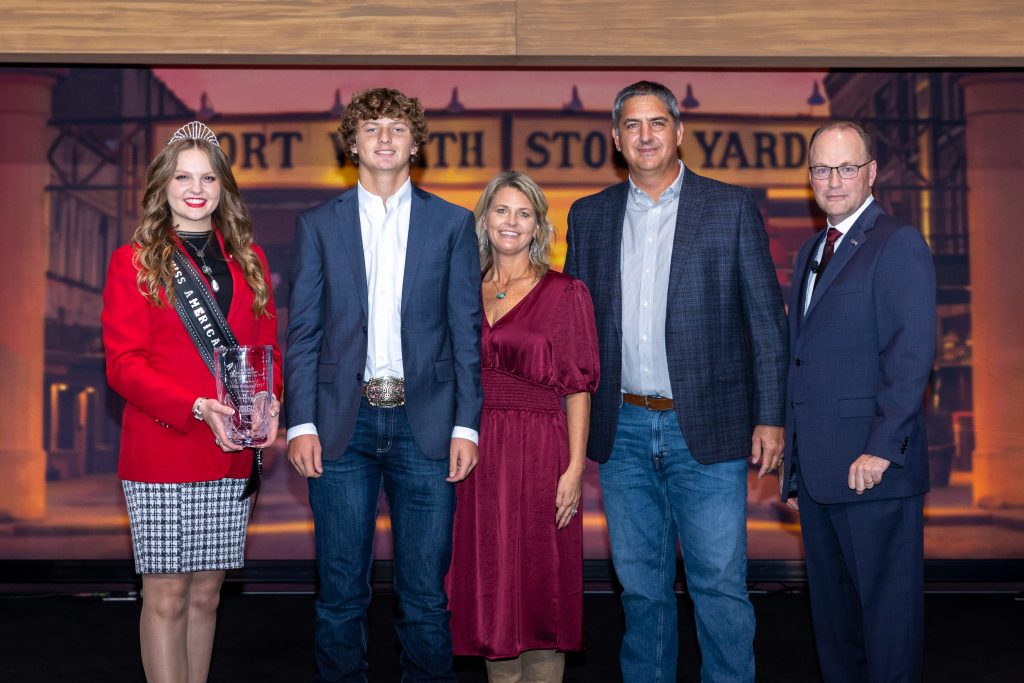
EXAR Princess 2717 owned by Jake Allison of Yukon, Okla., was named ROV Show Heifer of the Year at the 2024 Angus Convention Awards Dinner in Fort Worth, Texas. Pictured from left are Miss American Angus Lauren Wolter, Jake Allison, Jake's parents, Kristi and Nick Allison; and Mark McCully, American Angus Association CEO.
Angus cattle have a tradition of excellence in the show ring, and that history continues across the country each year. The American Angus Association® created the Roll of Victory (ROV) Show Program in 1984 to recognize show-winning animals, their sires, dams, breeders and owners on a per year basis.
The ROV Show Heifer of the Year, EXAR Princess 2717; the ROV Bull of the Year, BNWZ Executive Decision 2219; and the ROV Breeder of the Year, Express Ranches, were honored at the 2024 Association Awards Dinner and Reception on November 3 in Fort Worth, Texas.
The awards dinner was part of the Angus Convention program.
"The 2023 to 2024 ROV show program included 16 shows across the country. The ROV program continues to showcase the top Angus cattle in the country as they compete for top honors every year," said Caitlyn Brandt, director of events and junior activities. "We congratulate the winners on their achievements."
The ROV season runs from June 1 through May 31, and the 16 shows consist of six Super ROV shows and 10 other recognized shows. Points for these shows are accumulated on an annual basis, rather than on accumulation of points over many years.
The ROV Show Heifer of the Year was EXAR Princess 2717 owned by Jake Allison of Yukon, Okla. The heifer received grand champion honors at the North American International Livestock Expo Super ROV show, and reserve honors at the Fort Worth Stock Show ROV Show.
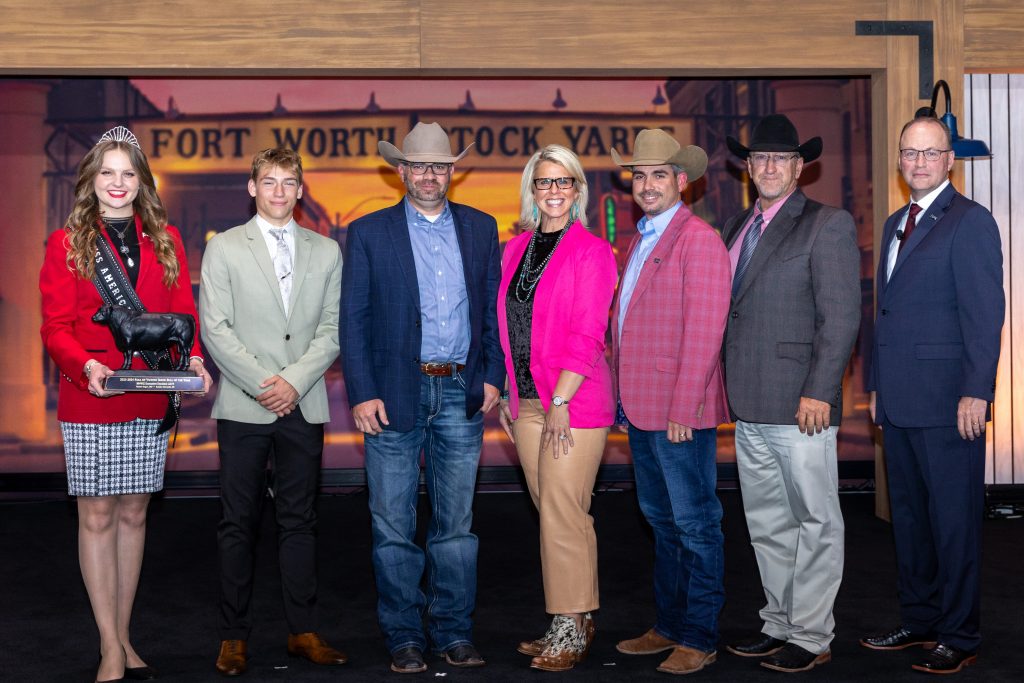
The ROV Show Bull of the Year was BNWZ Executive Decision 2219 owned by Hunter Angus of Fair Grove, Mo., and Kayden Nowatzke of Michigan City, Ind. He was grand champion bull at the 2023 Tennessee State Fair ROV Show, and the 2023 Kansas State Fair ROV Show. He went on to win the 2023 supreme champion bull at the North American International Livestock Exposition, after first claiming the grand champion bull title. He was the 2024 grand champion bull at the National Western Stock Show, and the 2024 grand champion bull at the Fort Worth Stock Show.
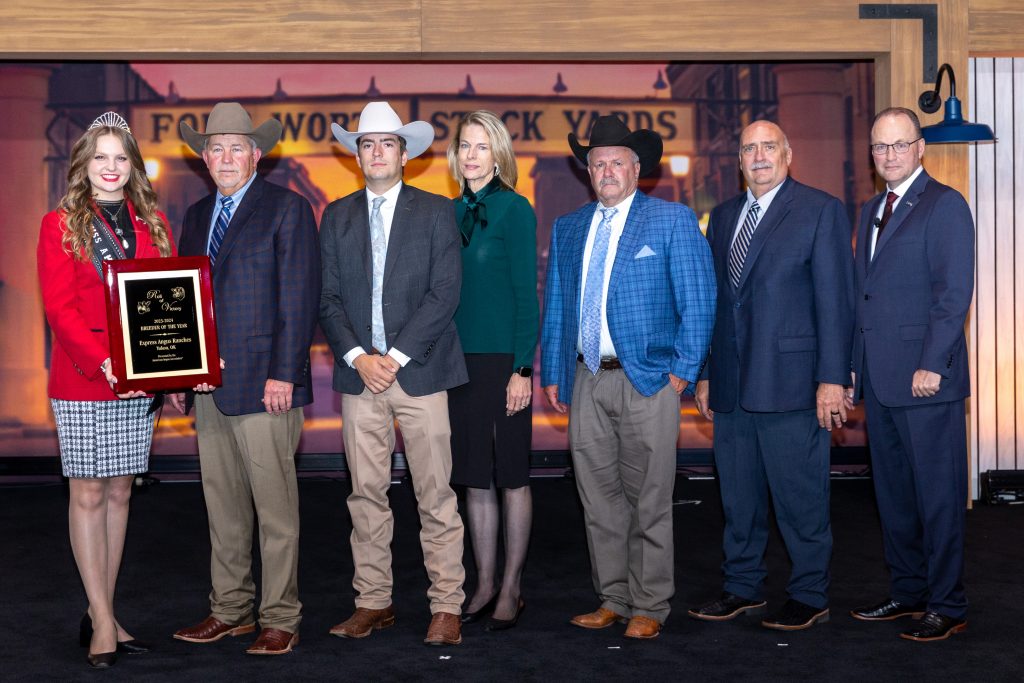
The ROV Breeder of the Year was Express Ranches of Yukon, Oklahoma. Express Ranches earned 759 points from the 16 eligible shows throughout the year. This is the 12th consecutive year Express Ranches has won the award.
For more information about the rules and regulations behind the ROV Show Program, visit https://www.angus.org/Show/RovVictoryProgram.
| CROOKSTON, Minnesota (AgPR) November 8, 2024 | American Agri-Women (AAW), the nation's leading coalition of women in farming, ranching, and agribusiness, congratulates President-Elect Donald J. Trump and Vice President-Elect JD Vance on their victory in the 2024 presidential election. AAW extends its best wishes to the incoming administration and looks forward to advancing the needs of American agriculture with leaders dedicated to supporting our nation's food and fiber producers. AAW President Rose Tryon shared her optimism for the future of agriculture under the new leadership. "American Agri-Women congratulates President-Elect Donald J. Trump, Vice President-Elect JD Vance, their families, and campaign teams on their decisive election victory," said Tryon. "As always, American Agri-Women stand ready as a resource to help shape agricultural policy and secure the growth and success of U.S. agriculture for generations to come." AAW looks forward to the new administration and welcomes policies that foster agricultural innovation, strengthen rural economies, and support family-owned farms. With members deeply connected to all sectors of agriculture, AAW remains committed to promoting fair regulations, reducing red tape, and ensuring that rural voices are a priority in national policy discussions. American Agri-Women encourages the administration to engage with farmers, ranchers, and rural communities, recognizing their essential role in America's prosperity. AAW is prepared to support the President-Elect and his team in building a strong, sustainable future for American agriculture. |
| About American Agri-Women American Agri-Women (AAW) promotes the welfare of our national security through a safe and reliable food, fiber and mineral supply. Since 1974, AAW members have worked together to educate consumers; advocate for agriculture; and offer networking and professional development opportunities. For more information, or to join, visit AmericanAgriWomen.org. Find AAW on social media at: facebook.com/AgriWomen and twitter.com/Women4Ag. |

The Multi-County Grand Jury has indicted four men in a pair of robberies for allegedly stealing cash and marijuana from two Oklahoma marijuana grow operations.
Geane Johnson Jr., 25, Herbert Lee Morris Jr., 20, Anthony Jermaine Rainger, 21, and Ameil Jordan Elijah Rainger, 20, each face multiple felony counts for allegedly robbing Butter Cookies LLC in Marlow on June 25 and Fuda2020 LLC in Alex on June 29. The men are accused of stealing cash and bundles of packaged marijuana from each business in association with the Murder I Blood street gang.
"These crimes are among the many dangerous activities we are seeing across our state following the legalization of medical marijuana," said Attorney General Gentner Drummond. "My office is committed to stamping out these crimes and holding accountable those who are endangering public safety."
The accused face nine felony counts of conspiracy to commit first degree robbery, first degree robbery, first degree burglary, assault while masked or in disguise, commission of a gang-related offense and engaging in a pattern of criminal offenses. Johnson and Morris also face a count of possession of a firearm during a felony.
The men are believed to be connected to other robberies that are currently under investigation.
Every person arrested or indicted is presumed innocent unless and until convicted in a court of law.
Read the indictments.

The National Chicken Council's (NCC) Board of Directors today announced that Harrison Kircher has been named NCC President and CEO, effective January 1, 2025.
"On behalf of the NCC Board of Directors, I congratulate Harrison on his appointment as the new President and CEO," said NCC Chairman Bill Griffith, Peco Foods. "Harrison's dedication, expertise and leadership have been evident throughout his time with the Council. We have complete confidence in his ability to guide us towards a successful future. His passion for our industry and commitment to our members make him the perfect fit for this role. We are excited to see the positive impact Harrison will undoubtedly have on our organization and stand ready to support him as he embarks on this new journey."
Kircher has been a member of the NCC team for the past 13 years, first joining as an intern in 2011. He has spent time as a Government Affairs Associate, Manager, Director and Vice President on the legislative affairs team. Promoted to Senior Vice President of Government Affairs in 2021, his primary focus has been advancing NCC's lobbying efforts on Capitol Hill and educating members of Congress and their staffs on a range of policy issues including agriculture, appropriations, immigration, labor, energy and international trade. Prior to joining NCC, Kircher worked in advertising at Ogilvy & Mather in New York and aided in Robert Hurt's 2010 congressional campaign victory in Virginia. He graduated from the University of Virginia in 2009 and is a native of Pittsford, New York. Kircher resides in Arlington, VA, with his wife, Amelia.
"I am honored to accept this position and the opportunity to continue working for the chicken industry," Kircher said. "I am especially confident in our future success given the very strong team around me at NCC. I look forward to the challenge and continuing NCC's tradition of service and effective representation in Washington."
Kincannon & Reed, a leading global executive search and leadership development firm, led the search, demonstrating its commitment to connecting organizations with top talent in the food and agriculture sectors.
The Agriculture Risk Coverage (ARC) and Price Loss Coverage (PLC) programs are two commodity programs under Title I of the farm bill that provide income support to farmers. Title I is explained in greater detail in a previous Market Intel.
For both programs, payments begin in October after the crop years end. This Market Intel and the tables and maps below detail the 2023 ARC-County (ARC-CO) and PLC payments currently being paid to farmers based on the 2023-24 crop year. Payments for the 2024-25 crop year, which is wrapping up harvest now, will be paid beginning in October 2025. ARC-CO and PLC for the 2025 program year are in limbo due to the recent expiration of the latest farm bill. The 2025 ARC and PLC program year would typically have elections due in mid-March 2025 for the 2025-26 crop year, with payments in October 2026. However, the program must be reauthorized through either the passage of a new farm bill or another extension of the 2018 farm bill.
PLC Payments
The PLC program assists farmers in times of low national prices, issuing payments when the market year average (MYA) price of a commodity falls below the corresponding effective reference price. The effective reference price was introduced in the 2018 farm bill as part of a mechanism that allows for changes to the reference price based on past MYA prices, often referred to as the "price escalator." Notably, the effective reference price is capped at 115% of the statutory reference price, which was established in the 2014 farm bill and has remained unchanged since. Through 2023, the program year explored in this Market Intel, the price escalator had only been activated for eight crops with little base acreage; the largest of these was temperate japonica rice with only 336,260 enrolled base acres in 2023 (comprising just 0.1% of total enrolled base acres). In 2024, the effective reference price escalator activated for the first time for major crops – including corn, soybeans, grain sorghum and oats.
Of the 23 commodities covered by the Title I commodity programs, the only crop confirmed or projected to receive a 2023 PLC payment is rapeseed. Rapeseed also happens to be the smallest crop based on enrolled base acres – with only 2,355 acres, representing 0.001% total base acres.
ARC-CO Payments
ARC-County (ARC-CO) issues payments when actual revenue falls below 86% of benchmark revenue in a specific county. Benchmark revenue is calculated using a national benchmark price and county-level benchmark yield, which are each calculated using an Olympic average of the five years preceding the current year. As the 2023 MYA price across all covered commodities was equal to or above the 2023 ARC-CO benchmark price, the minimum county-average yield losses required to trigger a payment at the county level ranged between 13.3% for rapeseed and 57.7% for mustard seed. That is, for an ARC-CO payment to be triggered for mustard seed, an individual county had to see yields fall by at least 57.7% from the county's calculated benchmark yield.
Summary of Payments
Using the methodology described in the "Data and Analysis" section below, we estimate approximately 27 million enrolled base acres are eligible to receive an ARC-CO payment for the 2023 crop year. This represents 18% of all ARC-CO enrolled base acres. Combined with the PLC payment for rapeseed, approximately 11% of all enrolled base acres will have received an ARC-CO or PLC payment. Notably, there are over 17 million PLC-enrolled base acres in counties that triggered an ARC-CO payment that will receive no payment for the 2023 crop year. This shows how important, and difficult, enrollment decisions are. In years where commodity prices are expected to be high, and thus PLC is unlikely to be triggered, some farmers who typically elect PLC should consider electing ARC-CO.
The following table displays the effective reference price, MYA price, ARC-CO benchmark price, minimum required decline in yield for ARC-CO payment at the county level, and the percentage of total enrolled base acres assigned to each crop.
Note the differences between the ARC-CO benchmark price and the effective reference price in Table 1. Due to how it is calculated, the ARC-CO benchmark price is more flexible and more responsive to the changing long-term price landscape than the effective reference price, which is used to determine PLC payments. The effective reference price has not kept up to escalating prices and costs, one of the main reasons that many farm groups, including the American Farm Bureau Federation, are advocating for higher reference prices for all crops in a future farm bill.
Conclusion
Despite the elevated commodity prices in 2023, many farmers still lost money on every acre they planted due to high input costs; but only approximately one in 10 base acres will receive a Title I payment. In 2024, farmers will face even steeper losses. They will lose significant money on every acre they plant and the outdated safety net will not catch them.
Data and Analysis
The following table and maps will review the ARC-CO and PLC payments for each covered commodity based on FSA data published on Oct. 31, 2024. ARC-CO payment rates are displayed in dollars per acre. For counties with both irrigated and non-irrigated designations, the designation with the higher ARC-CO payment is displayed. Please note that if a payment is triggered for one designation, it does not mean that it is triggered for the other. For instance, non-irrigated corn in Cuming County, Nebraska, will receive an ARC-CO payment of $85.16 per acre, while irrigated corn in the same county will not receive a payment.
For each commodity, we estimate enrolled acres qualifying for an ARC-CO payment. This estimate is calculated using the ARC-CO enrolled acres for counties identified as having a payment. We cannot pinpoint the exact acreage for two main reasons. First, data on county-level enrollment for irrigated and non-irrigated designation by acreage is not available. All enrolled ARC-CO base acres are included in this figure, even if only one of the two designations triggered payment, which may cause us to overestimate acreage with a payment. Using corn in Cuming County, Nebraska, again, all 123,197 ARC-CO enrolled base acres are designated as triggering a payment in the following commodity summaries. However, an unknown portion of these acres are likely designated as irrigated – and would not actually receive a payment.
Secondly, some ARC-CO and PLC acres are not assigned to an individual county in available FSA data and are instead lumped into a national "undisclosed" figure, which results in the data potentially missing some acres that receive ARC-CO payments. The impact of undisclosed acres would lead to an underestimation, with impacts varying substantially from crop to crop. The most impacted crop on a percentage basis is long grain rice, which has nearly 12,000 acres of ARC-CO enrolled acres in an undisclosed location, comprising 61% of all enrolled ARC-CO acres for that crop. Meanwhile, corn has the highest amount of undisclosed location ARC-CO acres at over 47,000, but those represent only 0.2% of total ARC-CO-enrolled corn acres.
This Market Intel was inspired by, and expands upon, FarmDoc Daily's "2023 ARC-CO and PLC Payments for Corn, Soybeans, and Wheat" by Nick Paulson, Gary Schnitkey, Jonathan Coppess and Carl Zulauf.

Corn
A total of 254 counties across 32 states qualified for ARC-CO payments for corn, representing 10% of counties with Farm Service Agency (FSA)-reported payment rates. Over 5.5 million acres were identified as being both enrolled in and qualifying for an ARC-CO payment, representing 6% of total enrolled corn base acres.

Wheat
A total of 352 counties across 26 states qualified for ARC-CO payments for wheat, representing 14% of counties with FSA-reported payment rates. Over 12.9 million acres were identified as being both enrolled in and qualifying for an ARC-CO payment, representing 21% of total enrolled wheat base acres.

Soybeans
A total of 254 counties across 23 states qualified for ARC-CO payments for soybeans, representing 12% of counties with FSA-reported payment rates. Nearly 3.2 million acres were identified as being both enrolled in and qualifying for an ARC-CO payment, representing 6% of total enrolled soybean base acres.

Grain Sorghum
A total of 488 counties across 24 states qualified for ARC-CO payments for grain sorghum, representing 26% of counties with FSA-reported payment rates. Over 2.9 million acres were identified as being both enrolled in and qualifying for an ARC-CO payment, representing 35% of total enrolled grain sorghum base acres.

Seed Cotton
A total of 214 counties across 11 states qualified for ARC-CO payments for seed cotton, representing 40% of counties with FSA-reported payment rates. Over 1.6 million acres were identified as being both enrolled in and qualifying for an ARC-CO payment, representing 20% of total enrolled seed cotton base acres. Notably, there were more PLC-enrolled base acres in the ARC-CO-payment-qualifying counties, at 1.9 million PLC-enrolled base acres.

Barley
A total of 27 counties across 12 states qualified for ARC-CO payments for barley, representing nearly 2% of counties with FSA-reported payment rates. Less than 70,000 acres were identified as being both enrolled in and qualifying for an ARC-CO payment, representing nearly 1% of total enrolled barley base acres.

Long Grain Rice
A total of four counties across Mississippi, California and Arkansas qualified for ARC-CO payments for long grain rice, representing 6% of counties with FSA-reported payment rates. Only 330 acres were identified as being both enrolled in and qualifying for an ARC-CO payment, representing only 0.01% of total enrolled long-grain rice base acres. In 2023, 99.6% of all long grain rice base acres nationwide were enrolled in PLC, the highest percentage of any covered commodity.

Peanuts
A total of 59 counties across seven states qualified for ARC-CO payments for peanuts, representing 31% of counties with FSA-reported payment rates. Slightly over 23,000 acres were identified as being both enrolled in and qualifying for an ARC-CO payment, representing only 1% of total peanut base acres. In 2023, 98.4% of all peanut base acres nationwide were enrolled in PLC.

Oats
A total of 66 counties across 13 states qualified for ARC-CO payments for oats, representing 3% of counties with FSA-reported payment rates. Nearly 68,000 acres were identified as being both enrolled in and qualifying for an ARC-CO payment, representing 3% of total enrolled oat base acres.

Sunflower Seed
A total of 189 counties across 13 states qualified for ARC-CO payments for sunflower seed, representing 21% of counties with FSA-reported payment rates. Nearly 225,000 acres were identified as being both enrolled in and qualifying for an ARC-CO payment, representing 14% of total enrolled sunflower seed base acres.

Canola
A total of 44 counties across eight states qualified for ARC-CO payments for canola, representing 15% of counties with FSA-reported payment rates. Nearly 17,000 acres were identified as being both enrolled in and qualifying for an ARC-CO payment, representing over 1% of total enrolled canola base acres.

Dry Peas
A total of 31 counties across six states qualified for ARC-CO payments for dry peas, representing 13% of counties with FSA-reported payment rates. Nearly 11,000 acres were identified as being both enrolled in and qualifying for an ARC-CO payment, representing nearly 3% of total enrolled dry pea base acres.

Temperate Japonica Rice
Finalized 2023 MYA price data is not yet available for temperate japonica rice, so county-level ARC-CO payments are also not yet available. At the projected MYA price of $28 per cwt, a yield decrease of over 33.1% would be necessary to qualify a county for an ARC-CO payment, and no counties will qualify for a payment. Temperate japonica rice would not qualify for a PLC payment, as the 2023 effective reference price is only $18.50.
Lentils
Only one area in Idaho, defined as Kootenai-North Shoshone by FSA, qualified for an ARC-CO payment for lentils, representing 1% of counties with FSA-reported payment rates. Nearly 2,000 acres were identified as being both enrolled in and qualifying for an ARC-CO payment, representing less than 1% of total enrolled lentil base acres.

Flaxseed
A total of 30 counties in Washington, Montana, North Dakota and Wisconsin qualified for ARC-CO payments for flaxseed, representing 21% of counties with FSA-reported payment rates. Over 13,000 acres were identified as being both enrolled in and qualifying for an ARC-CO payment, representing nearly 6% of total enrolled flaxseed base acres.

Medium/Short Grain Rice
Only five counties in Arkansas and Louisiana qualified for ARC-CO payments for medium/short grain rice, representing 15% of counties with FSA-reported payment rates. There are no acres identified as being both enrolled in and qualifying for an ARC-CO payment. There are over 5,000 acres of PLC-enrolled base acres in the five qualifying counties, representing 3% of total enrolled medium/short grain rice base acres.

Safflower
There were no counties identified as qualifying for an ARC-CO payments for safflower. High prices in safflower meant that a county would have needed a yield loss of over 50.7% to qualify for an ARC-CO payment.

Large Chickpeas
Only Gem County, Idaho, qualified for ARC-CO payments for large chickpeas, representing 1% of counties with FSA-reported payment rates. There were no enrolled ARC-CO base acres in that county, so no large chickpea base acres qualified for a payment.

Mustard Seed
Only two counties, one in Montana and one in Kansas, qualified for ARC-CO payments for mustard seed, representing 3% of counties with FSA-reported payment rates. Only 373 acres were identified as being both enrolled in and qualifying for an ARC-CO payment, representing nearly 2% of total enrolled mustard seed base acres. Of all the covered commodities, mustard seed had the highest required drop in county yields to trigger a payment due to mustard seed prices.

Small Chickpeas
Only Glacier County, Montana, qualified for ARC-CO payments for small chickpeas, representing 2% of counties with FSA-reported payment rates. There were no enrolled ARC-CO base acres in that county, so no small chickpea base acres qualified for a payment.

Sesame Seed
A total of 21 counties across Oklahoma, Texas, Alabama and North Carolina qualified for ARC-CO payments for sesame seed, representing 40% of counties with FSA-reported payment rates. Only 476 acres were identified as being both enrolled in and qualifying for an ARC-CO payment, representing over 8% of total enrolled sesame seed base acres.

Crambe
Four counties across Montana, North Dakota and Iowa, were identified as qualifying for ARC-CO payments for crambe, representing 17% of counties with FSA-reported payment rates. Only 53 acres were identified as being both enrolled in and qualifying for an ARC-CO payment, representing nearly 2% of total enrolled crambe base acres.

Rapeseed
A total of eight counties in Oregon and Idaho qualified for ARC-CO payments for rapeseed, representing 30% of counties with FSA-reported payment rates. Only 779 acres were identified as being both enrolled in and qualifying for an ARC-CO payment. Rapeseed was the only commodity to also qualify for a PLC payment, with slightly over 1,000 acres enrolled in the PLC program. In total, 76% of total enrolled rapeseed base acres received either an ARC-CO or PLC payment.

By Betty Resnick, Economist
What happened: In addition to Donald Trump's return to the White House, Tuesday's elections saw Republicans gain control of the U.S. Senate and will likely hold power in the House of Representatives, giving them leadership of committees important to agriculture.
At press time, the GOP had 53 seats in the Senate, while Democrats held 47. Arizona and Nevada have not yet been called.
Republicans ousted three incumbents, winning seats in Montana with Tim Sheehy defeating Sen. Jon Tester; Ohio, where businessman Bernie Moreno unseated Sen. Sherrod Brown; and Pennsylvania, with Dave McCormick beating Sen. Bob Casey.
In the House, Republicans currently have a 211-199 lead. Two dozen races are too close to call.
Why it matters: As done during the Biden presidency, NPPC will work with the new administration to champion policies that enable producers to operate their farms successfully and secure their livelihoods for future generations. Among those policies are fixing California Proposition 12, passing a new farm bill, promoting U.S. pork exports, and resolving agriculture's labor shortage.
In the Senate, John Boozman (R-AR) is expected to become chairman of the Agriculture, Nutrition, and Forestry Committee. Currently serving as ranking member, Boozman would take over from retiring Sen. Debbie Stabenow (D-MI). The House Agriculture Committee again will likely be led by Chairman Glenn G.T. Thompson (R-PA).
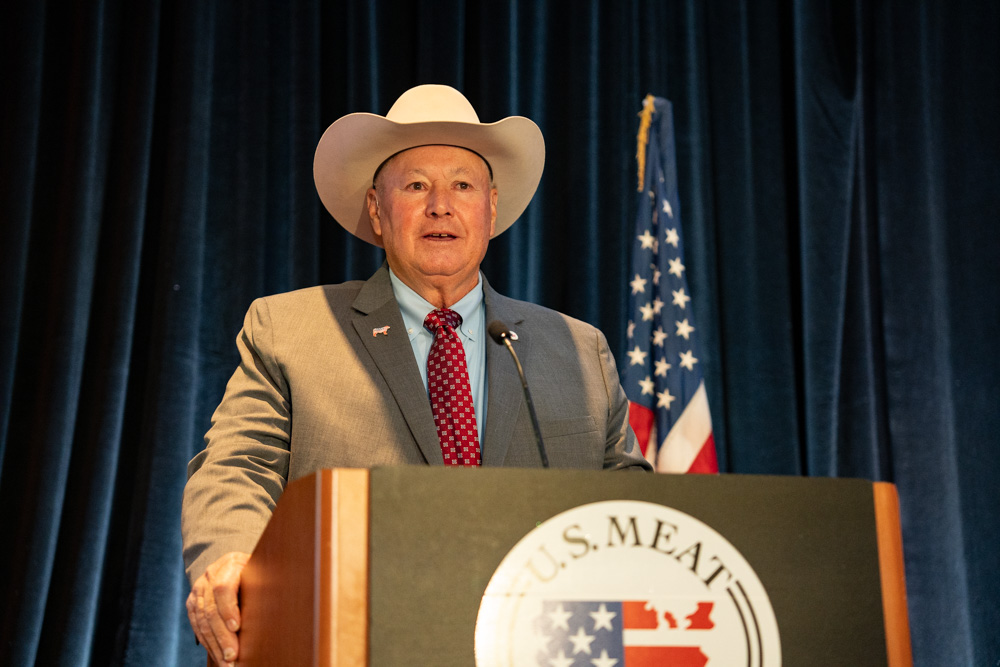
The U.S. Meat Export Federation (USMEF) concluded its annual strategic planning conference in Tucson, Ariz., Friday with the election of officers for 2024-25. Steve Hanson, a rancher and cattle feeder from Elsie, Neb., is the new USMEF chair, succeeding Minnesota pork and grain producer Randy Spronk.
Hanson has previously held many beef industry leadership roles, including chair of the Nebraska Beef Council and Federation of State Beef Councils and president of the Nebraska Cattlemen. He also served on the Beef Promotion Operating Committee, where he came to appreciate the importance of international marketing programs for U.S. red meat.
"The Operating Committee is where I first got my exposure to USMEF, which invests our checkoff dollars so well and adds value to the beef carcass," Hanson said.
Hanson also praised USMEF for bringing together a wide range of agricultural sectors to support a common goal – something he said was fully on display in Tucson.
"That's one of the best things about USMEF conferences – the idea that I can attend the Pork Committee and Exporter Committee meetings, to broaden my perspective," he said. "Yesterday, I sat in on the Exporter Committee meeting so I could learn more about the challenges they face moving product overseas. Those guys have some real hurdles, and this meeting gave me a much greater appreciation for what they do."
Hanson added that industry unity is also critical when countering efforts to shut down animal agriculture. He cited a Denver ballot initiative that sought to ban slaughterhouses as a prime example.
"Fortunately, that measure was defeated by nearly a two-to-one margin, and we are very proud of that fact," he said. "But there are more cities on these activists' lists, and we need to be paying attention."
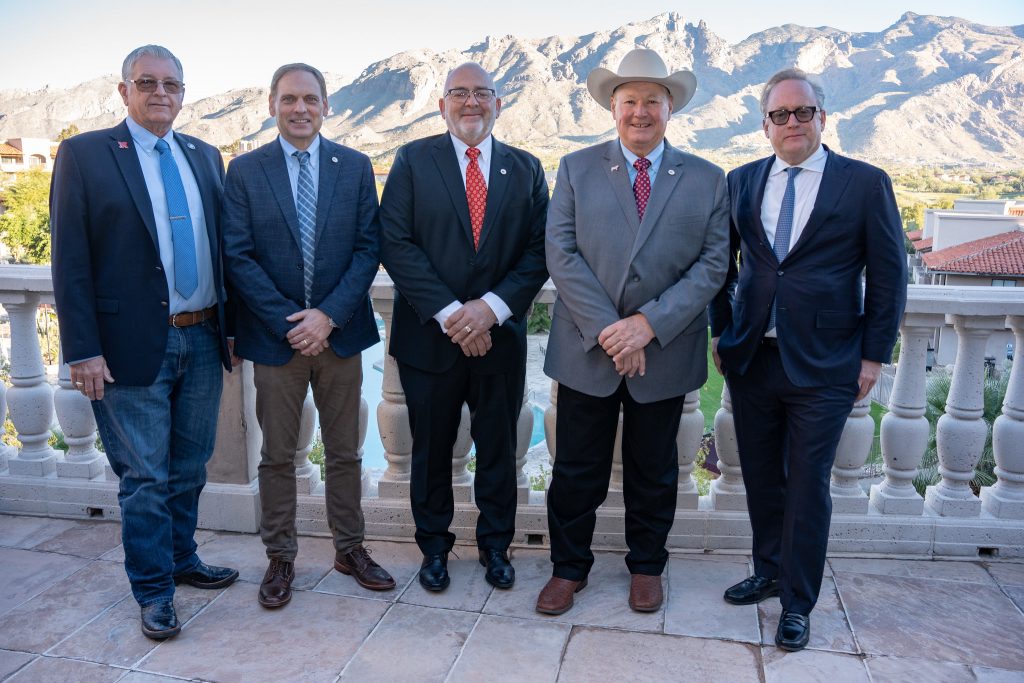
USMEF's new chair-elect is Jay Theiler, executive vice president of corporate affairs for Agri Beef Co., a diversified business with operations in ranching, cattle feeding, cattle nutrition and beef processing. He is a past director of the Idaho Beef Council and has served on the Beef Industry Long Range Plan Task Force.
USMEF Vice Chair Dave Bruntz is president of Bruntz Farming & Feeding in southeastern Nebraska, where he raises corn and soybeans and feeds cattle. Bruntz is a past president of the Nebraska Corn Board and Nebraska Cattlemen. He also served as a regional vice president for the National Cattlemen's Beef Association.
The newest USMEF officer is Secretary-Treasurer Darin Parker, director of Salt Lake City-based exporter/distributor PMI Foods.
Friday's closing business session also included a USMEF staff panel focused on the importance of market diversification and developing new opportunities for U.S. pork, beef and lamb in emerging destinations. Scott Reynolds, assistant vice president of marketing programs, described how USMEF categorizes markets for beef and pork and showed how allocations of USMEF investments in new and emerging markets has grown by 22% in the past five years. These are markets with less current volume, but greater upside potential. New and emerging markets can also help manage risk when market access issues occur in the leading markets for beef or pork.
In terms of new, untapped markets for U.S. red meat, Africa tops the list. USMEF Africa Representative Matt Copeland focused on population and economic growth and reminded the audience that by 2050, one in four people in the world will be African. It will take time, says Copeland, but we can't underestimate the importance of this economic evolution in Africa.
"The geographic reach is immense. It is more than 7,000 miles from Casablanca in Morocco in the north down to Cape Town in South Africa. One of the world's finest beef restaurants will open in Marrakesh in September 2025 and will showcase U.S. beef. In December, Marble is opening its second restaurant in Johannesburg and the flagship item on their menu is Prime grade beef from Snake River Farms," said Copeland. "In between, we're launching an event in Ghana in April 2025 that will be a wonderful opportunity to meet the entire West African trade."
USMEF Latin America Representative Homero Recio addressed recent initiatives to develop new opportunities in South America, including a new product launch in Colombia.
"Colombia is a growing market for U.S. pork made up of trimmings, hams, loins and ribs. But how do we grow tonnage? There are different ways to do it," said Recio. "One, you just sell more of what you already sell. Another way is to introduce new items and that's what we've been working on with the Boston butt ‒ pork's best-kept secret."
The new product with the most immediate potential in Colombia's foodservice sector may be a pork burger derived from the Boston butt.
"We've tested the burger in Colombia and the reaction was off the charts. We are now promoting it to the trade as "BBB" – for Boston butt burger," said Recio, who added that USMEF is also testing a variation of the burger in Chile.
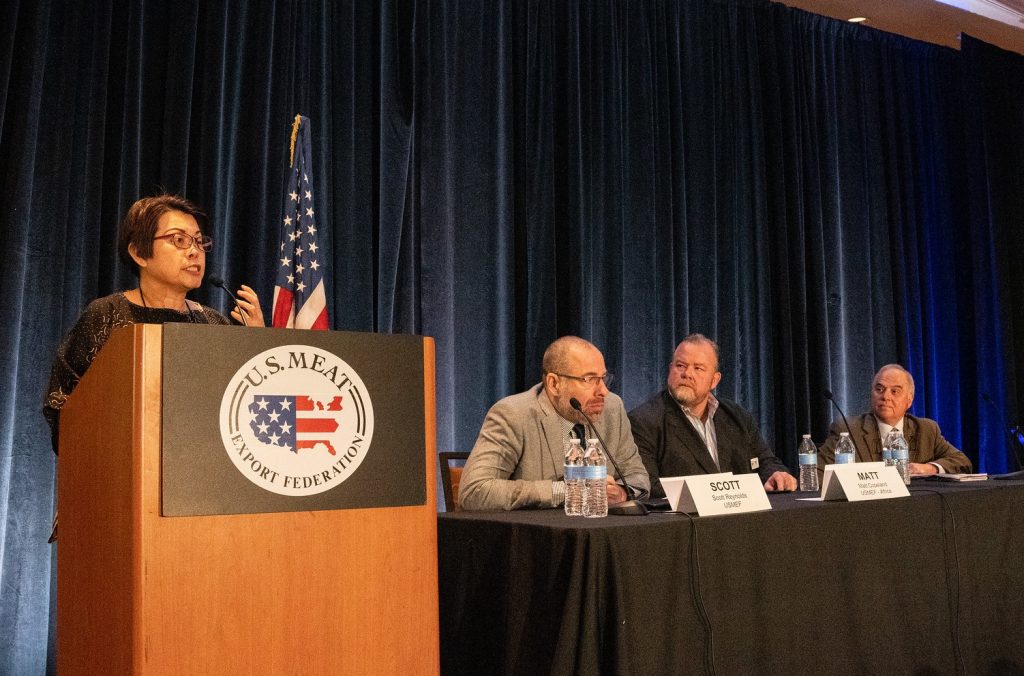
USMEF ASEAN Director Sabrina Yin discussed the diversity of her region and its varying stages of market development, contrasting the highly developed market of Singapore with emerging markets such as Vietnam and Cambodia.
Yin explained that in several ASEAN markets, much of USMEF's work is directed at overcoming technical barriers and working with the trade on supply chain development, capacity building and imaging U.S. product. Where possible, USMEF continues to utilize sampling programs for U.S. beef and pork toward growing retail shelf space. Yin described how USMEF is evolving to more of a business-to-business approach with promotions, utilizing sales contests for U.S. red meat with importers and distributors.
Thursday highlights include producer insights from overseas, USMEF awards
The previous day's program featured a panel discussion titled Building Connections and Creating Opportunities, in which livestock producers shared firsthand experiences and insights from engaging with red meat buyers, consumers and government officials in overseas markets.
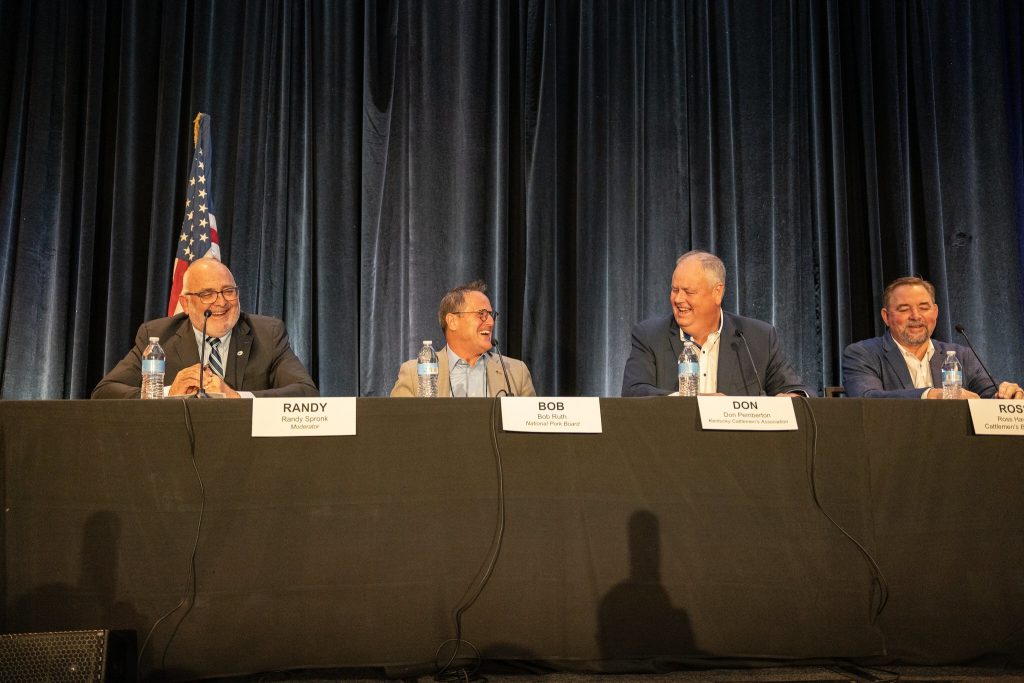
Randy Spronk, who served as USMEF chair over the past year, kicked off the discussion by recapping his first market visit to Japan 25 years ago, traveling with then-Governor Jesse Ventura. He highlighted the U.S. pork industry's success in developing the Japanese market while also expanding demand in other Asian markets and the Western Hemisphere.
"One of the biggest takeaways for me was that exports are not something that you do in six months or in 12 months, said Spronk. "It's a long-term strategy to continue to grow a market and to be present in that market."
Bob Ruth, a pork producer from Pennsylvania and past president of the National Pork Board, participated in a USMEF Heartland Team tour of Japan in September.
"I was amazed with the Japanese attention to detail and quality. Quality in how they cut the meat, in how they package it and how they present the meat to customers," said Ruth. "I'm talking pork in general, but they did it with all their red meats. A big take home message for me was how we could do better here in the United States to boost demand, based on what I saw in in Japan."
Cattlemen's Beef Board member Ross Havens, a cattle producer from Iowa, appreciated seeing the popularity of products that have little demand in the United States.
"Tongues are one of the top beef products we export to Japan," said Havens. "Most people in the U.S. have no interest in trying beef tongue but in Japan, the way they cook it and prepare it, beef tongue is really delicious. It's a great example of how international markets add value to the carcass. Shipping beef products to where somebody really values it is a great return on our Beef Checkoff investments."
Don Pemberton, former president of Kentucky Cattlemen's Association and a participant in a Heartland Team tour of Korea and Japan in 2023, talked about his experience grilling steak for social media influencers in Tokyo and the great interest they showed in his technique. He also shared his surprise at how much attention he received upon his return to Kentucky.
"When I got back to Kentucky, I prepared a trip report and presentation for Kentucky Cattlemen and Kentucky Beef Council. And the next thing I knew, I was on a speaking tour around the state. Because I'd spent 48 hours in Seoul and 48 hours in Tokyo, I was now considered an expert on foreign trade," laughed Pemberton.
"As I presented at more of these meetings, I realized their great interest in how global trade affects them, and more importantly, their checkoff investment. With what I was able to share, they could better understand how their checkoff dollars are invested in global marketing and what a difference this is making."
While the panel freely shared their observations and insights with conference attendees, they also encouraged members to consider visiting an international market through a USMEF trade mission.
"My advice would be, take a trip. The intelligence that you pick up in the markets is a very valuable experience," said Ruth. "The other thing is, and Don had talked about it, and Ross talked about it, is that our customers want to hear from you, the producer. The influence that you have is phenomenal, and your presence there really helps USMEF. It's going to be valuable for you, and it will be valuable for our industry as well."
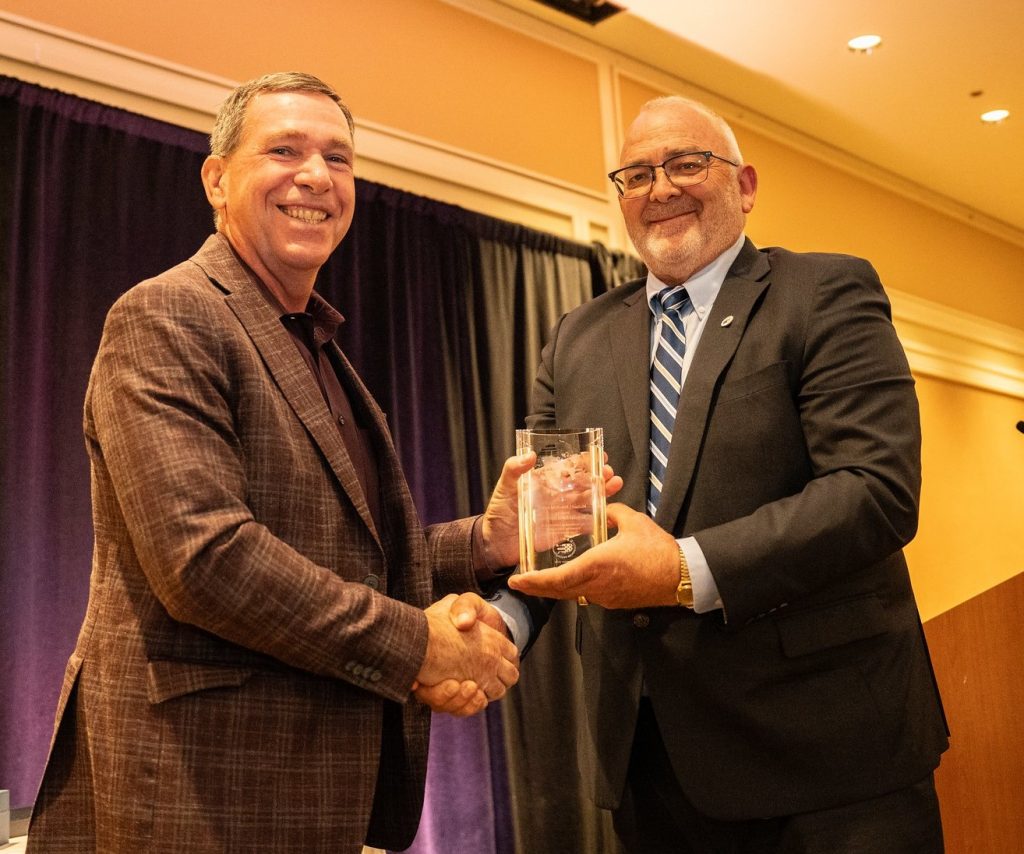
Thursday highlights also included an awards luncheon where USMEF honored Nick Giordano, former lead lobbyist with the National Pork Producers Council, with its Michael J. Mansfield Award. Mark Jagels, a corn and livestock producer from Davenport, Neb., and former USMEF chair, received USMEF's Distinguished Service Award. More details on these awards and comments from the recipients are available here.
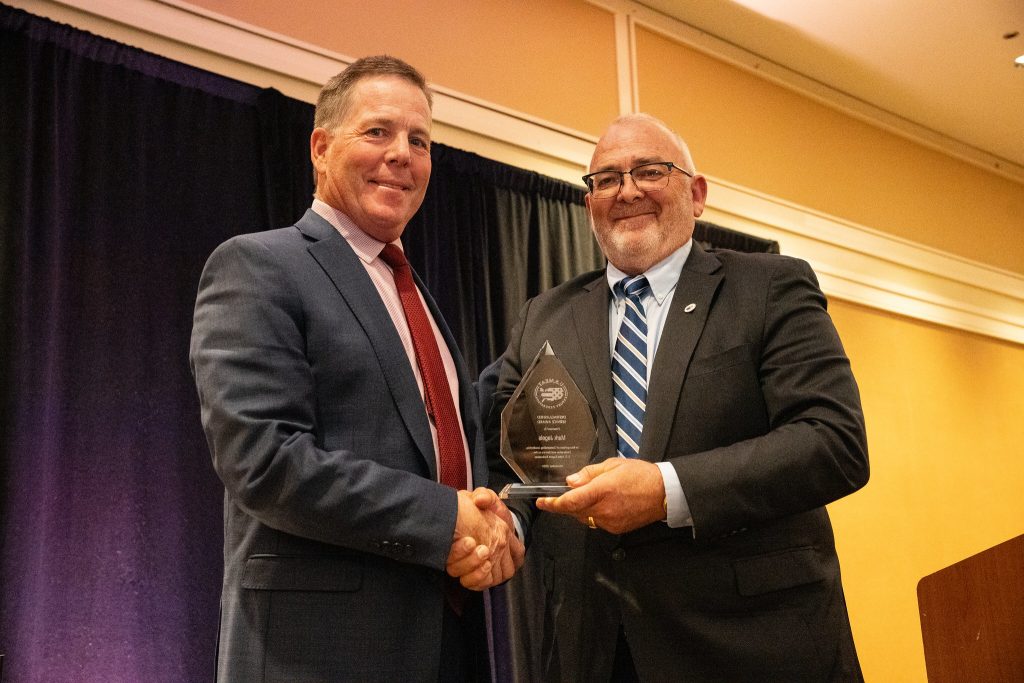
USMEF also honored the Montana Beef Council with its Million Dollar Club Award. This award recognizes USMEF member organizations that have contributed more than $1 million in support of USMEF's marketing programs. Montana Beef Council is a longtime partner of USMEF, making its initial contribution in 1984.
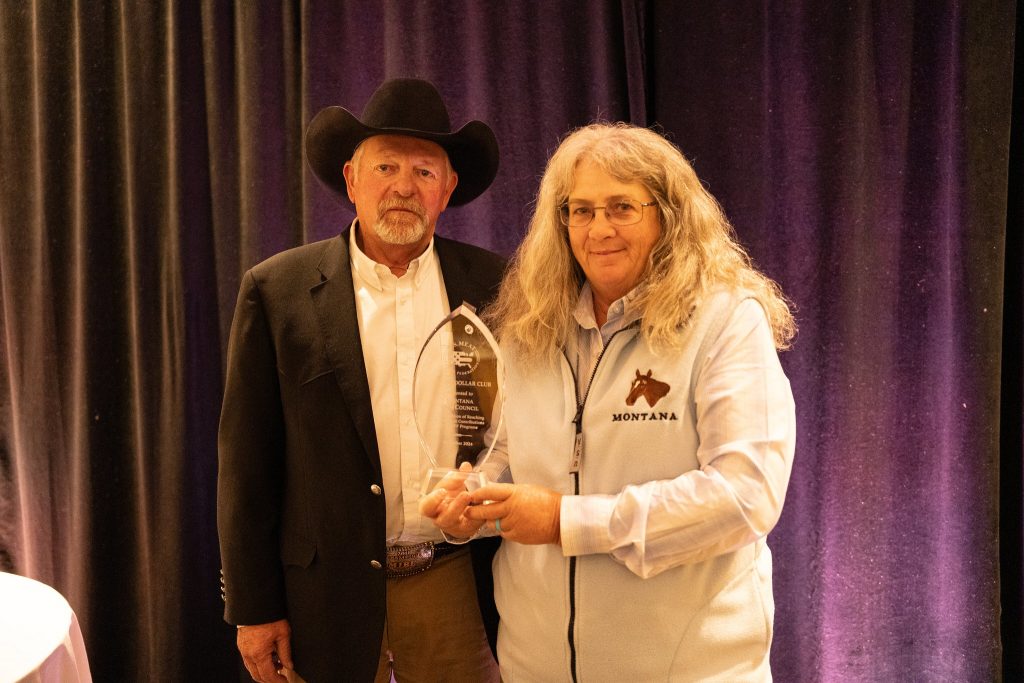
The conference began on Wednesday with a deep dive into the election's impact on agricultural and trade policy, as well as an update on U.S.-Mexico trade relations. Opening day highlights are available in this press release.
USMEF members will next meet at the organization's Spring Conference, May 21-23 in Fort Worth, Texas.
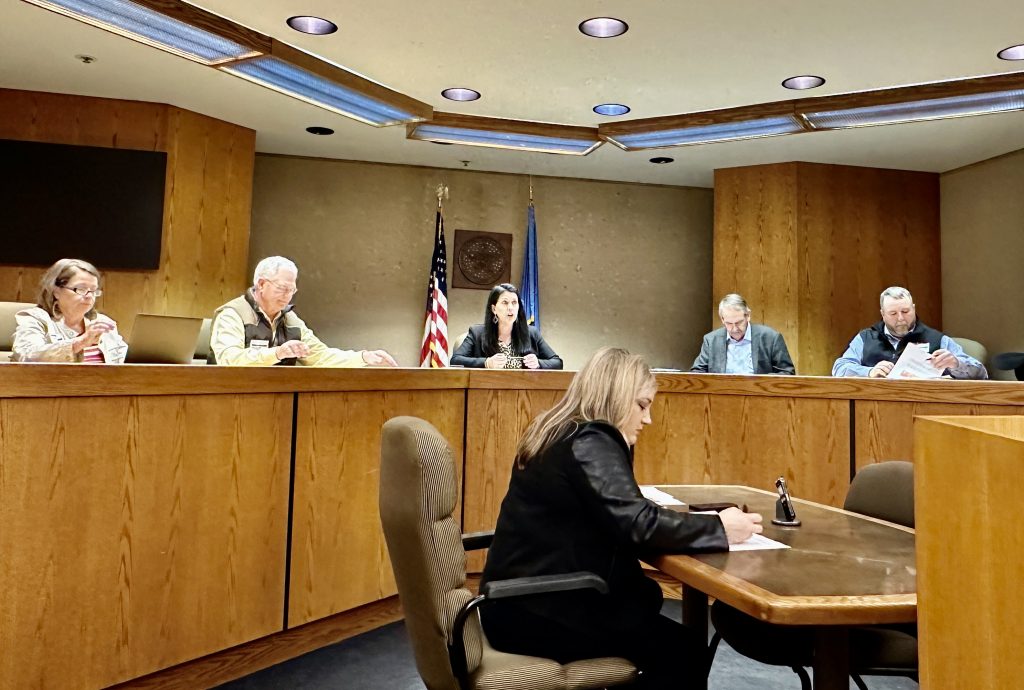
At today's, November 8, 2024, Emergency Drought Commission Meeting, Senior Farm and Ranch Broadcaster Ron Hays caught up with Oklahoma Secretary of Agriculture Blayne Arthur to talk about the major goals of the meeting.
Arthur related that clarification was a big focus. She said, "We realize that we are responsible to the taxpayers and these dollars that are coming out from the drought committee were appropriated by the legislature."
People had been questioning if the committee's decision to utilize a $27 million legislative appropriation to aid producers in drought-stricken counties would still stand after recent rainfall. The decision was made to utilize last week's Drought Monitor Report which means that all but 6 counties in the state will qualify for aid.
"I think it was important for us to gather as a committee and say that even with the significant rainfall that we have received, drought is still pretty widespread across the state of Oklahoma," Arthur stated. "We will still move forward with practices that will put us in a better position for future droughts."
She boasted about the enthusiasm from the legislature to support the program and their frequent participation in Drought Commission meetings. She expressed appreciation for their part in expanding the Drought Commission Committee to include grassroots producers.
"I know there is going to be a lot of demand for this funding, so the terms may be revised by individual counties as things move forward, but my guess is that those dollars will begin moving out very quickly as we begin getting those applications on Tuesday. If funds are available, the counties can look at that to see if people are eligible or not," she said.
The Conservation Commission program was designed to help with pond cleanouts, water well installations, pumping unit purchases, laying pipelines, pasture taps (if rural water allows), and tank purchases.
Arthur related that she would like to see improvements to irrigation methods. She admitted that DRIP systems are expensive, but they do well in conserving water. She added that drilling wells is a big priority for producers, and she would like to see more people implementing practices to increase water capacity and retention.
Oklahoma Conservation Commission Director Trey Lam said in the meeting that officials would be checking to see if applicants' ponds are full before agreeing to clean them out. If the ponds are full, the applicant will be moved down the list in favor of producers in greater need.
Giving credit to the legislature, Arther said that she and the committee are optimistic that this can be an annual program so producers can count on the Drought Commission having funds when they need them.
This year, it pays 80% of the expense with a $7,500 cap per person, and the producer is responsible for the remaining 20% of the cost of the work requested. Each drought-stricken county will have a little more than $350,000 to appropriate. Applications will be worked through on a first come and first serve basis, and local conservation districts will begin accepting applications on November 12, 2024.
On November 8, 2024, the USDA released the latest Crop Production report. This report is a forecast of where summer crops looked as of November 1. It will be the last look of the series before the final summer crop data is released in January. Associate Farm Editor Stevie White had the chance to talk with USDA's Troy Marshall about the report.
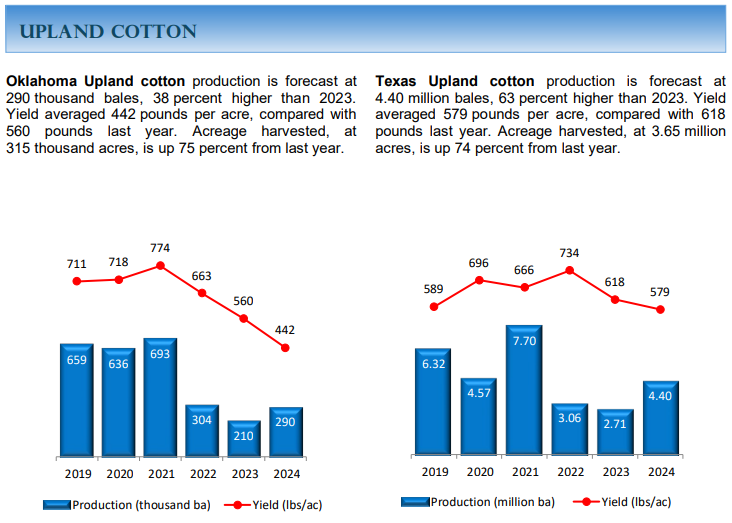
Marshall reported decreases on most of Oklahoma's summer crop yields. The data for the report came from before the heavy rains that fell upon much of Oklahoma and when a good deal of the crop was already harvested. He noted a slight increase in cotton from 442 pounds per acre a month ago to 457 pounds per acre.
"Overall, we are still looking at an overall production increase year over year of 300 thousand bales, which is a 43% increase over last year," Marshall said.
The heavy rains will likely negatively affect the harvests of crops that still have a large portion in the field, like soybeans and cotton, so the final numbers published in January may show some of the impacts.
He also talked about October Crop Production numbers for Kansas and Texas. Click the listen bar above to hear the full conversation!
U.S. Crop Production:
Corn production for grain is forecast at 15.1 billion bushels, down less than 1 percent from the previous forecast and down 1 percent from 2023. Based on conditions as of November 1, yields are expected to average a record high 183.1 bushels per harvested acre, down 0.7 bushel from the previous forecast but up 5.8 bushels from last year. Area harvested for grain is forecast at 82.7 million acres, unchanged from the previous forecast but down 4 percent from the previous year.
Soybean production for beans is forecast at 4.46 billion bushels, down 3 percent from the previous forecast but up 7 percent from 2023. Based on conditions as of November 1, yields are expected to average 51.7 bushels per acre, down 1.4 bushels from the previous forecast but up 1.1 bushels from 2023. Area harvested for beans in the United States is forecast at 86.3 million acres, unchanged from the previous forecast but up 5 percent from 2023.
All cotton production is forecast at 14.2 million 480-pound bales, down slightly from the previous forecast but up 18 percent from 2023. Based on conditions as of November 1, yields are expected to average 789 pounds per harvested acre, unchanged from the previous forecast but down 110 pounds from 2023. Upland cotton production is forecast at 13.7 million 480-pound bales, up less than 1 percent from the previous forecast and up 17 percent from 2023. Pima cotton production is forecast at 481,000 bales, down 7 percent from the previous forecast but up 52 percent from 2023.
To view the full U.S. Crop Production Report, click here.
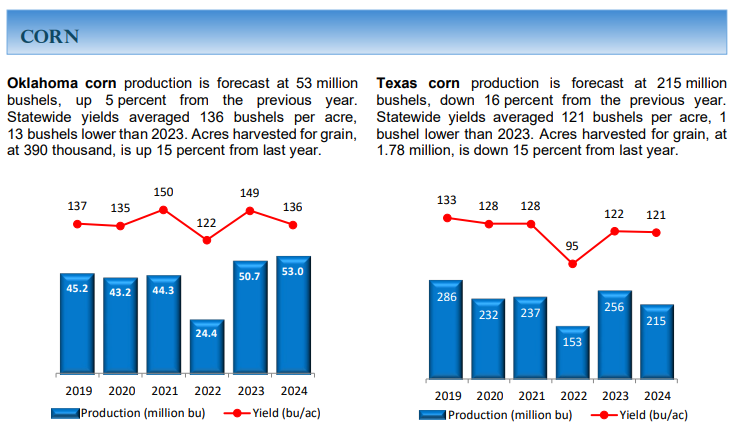
Oklahoma Crop Production:
Oklahoma Upland cotton production is forecast at 290 thousand bales, 38 percent higher than 2023. Yield averaged 442 pounds per acre, compared with 560 pounds last year. Acreage harvested, at 315 thousand acres, is up 75 percent from last year.
Oklahoma corn production is forecast at 53 million bushels, up 5 percent from the previous year. Statewide yields averaged 136 bushels per acre, 13 bushels lower than 2023. Acres harvested for grain, at 390 thousand, is up 15 percent from last year.
Oklahoma soybean production is forecast at 11.4 million bushels, up 9 percent from last year. Yield is expected to average 25 bushels per acre, compared with 26 bushels in 2023. Harvested acreage, at 455 thousand acres, is 14 percent higher than last year.
Oklahoma sorghum production is forecast at 10.8 million bushels, down 34 percent from last year. Yield averaged 38 bushels per acre, down 9 bushels from the previous year. Acres harvested, at 285 thousand acres, is 19 percent lower than 2023.
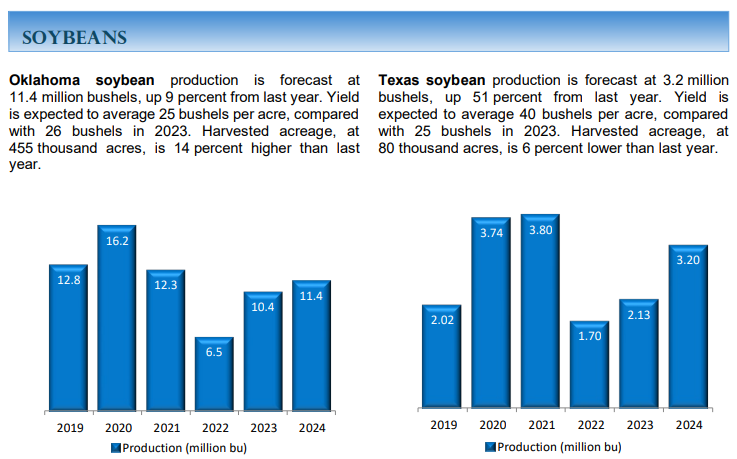
Texas Crop Production:
Texas Upland cotton production is forecast at 4.40 million bales, 63 percent higher than 2023. Yield averaged 579 pounds per acre, compared with 618 pounds last year. Acreage harvested, at 3.65 million acres, is up 74 percent from last year.
Texas corn production is forecast at 215 million bushels, down 16 percent from the previous year. Statewide yields averaged 121 bushels per acre, 1 bushel lower than 2023. Acres harvested for grain, at 1.78 million, is down 15 percent from last year.
Texas soybean production is forecast at 3.2 million bushels, up 51 percent from last year. Yield is expected to average 40 bushels per acre, compared with 25 bushels in 2023. Harvested acreage, at 80 thousand acres, is 6 percent lower than last year.
Texas sorghum production is forecast at 72.9 million bushels, down 4 percent from last year. Yield averaged 54 bushels per acre, up 5 bushels from the previous year. Acres harvested, at 1.35 million acres, is 13 percent lower than 2023
To see the report for October Crop Production in the Southern Plains, click here.
USDA released its November Crop Production and World Agricultural Supply and Demand Estimates (WASDE) reports on Friday. Rich Nelson with Allendale discussed the latest agricultural report with Oklahoma Farm Report's Stevie White, highlighting the share drop in soybean production by 121 million bushels (mb) to 4.461 billion bushels (bb) and lowered corn production 60 mb to 15.143 bb.
Soybean yield was cut to 51.7 bushels per acre (bpa), down 1.4 bpa from October. The corn yield was pegged at 183.1 bpa, down 0.7 bpa but still a record.
Friday's new-crop U.S. ending stocks estimates were neutral to slightly bullish for corn, bullish for soybeans and neutral on wheat. World ending stocks estimates from USDA were neutral to slightly bullish for corn, bullish for soybeans and neutral to slightly bearish for wheat.
"There was no change for wheat production, which was normal on this report," Nelson said. "As far as minor changes for stocks, USDA raised them by 3 million bushels. So, for grains, this was a corn story, this really was a soybean story, but wheat was kind of quiet for this month."
The big story in livestock is beef. "We've been waiting for this big drop in supplies as we have gone through these multi-year declines in production. However last month's projected 4% drop in beef production was revised up to only a 2.6% drop. So this heightening supply story has been kind of reined in for quite a few months in a row, now."
This is due in part to a 3% increase in carcass weights over last year, but also because placements are still strong.
Nelson expects the December supply demand report to be relatively quiet as there are generally no changes for production on corn, soybeans, or wheat, and only minor changes in demand. The big final number for the year will be published on the annual production summary report.
You can also view the full reports here:
-- Crop Production: https://www.nass.usda.gov/...
-- World Agricultural Supply and Demand Estimates (WASDE): http://www.usda.gov/oce/commodity/wasde/
WHEAT:
USDA pegged U.S. wheat production at 1.971 bb in November, unchanged from October's estimate.
USDA estimates ending stocks at 815 mb in November, an increase of 3 million bushels from October's estimate. U.S. wheat use is estimated at 1.973 bb, an increase of 2 million bushels from October.
Wheat exports were left unchanged at 825 mb, while USDA estimates the farmgate price at $5.60, down from $5.70 in October.
Wheat world ending stocks were estimated at 257.57 mmt, a decrease from 257.72 mmt in October.
USDA estimates global wheat production at 794.73 mmt, an increase from 794.08 mmt last month.
Wheat production in Argentina was estimated at 17.5 mmt, down from the October estimate of 18.0. Brazil's production is estimated at 8.5 mmt, a slight dip from 9.0 mmt in October. Australia's production was unchanged from last month at 32.0 mmt.
Wheat production in Russia was pegged at 81.5 mmt and Ukraine production was estimated at 22.9 mmt. Wheat exports from Russia and Ukraine both were unchanged at 48 mmt and 16 mmt, respectively.
CORN
Corn production for the 2024-25 crop is projected at 15.143 billion bushels, down 60 million bushels from last month. USDA also trimmed the yield by 0.7 bushel per acre to 183.1 bpa.
Harvested acres remained at 82.7 million acres.
For demand, USDA held pat. Projected total Feed and Residual use was held at 5.825 bb. Ethanol use is forecast at 5.45 bb. Total domestic use is forecast at 12.665 bb.
Corn exports are forecast at 2.325 bb.
Ending stocks for the 2024-25 crop were 1.938 bb, down 61 million bushels from last month, likely due to round numbering.
The farmgate price for 2024-25 remained at $4.10 a bushel.
Globally, 2024-25 corn beginning stocks came in at 314.22 million metric tons (mmt), up 1.57 mmt. Global ending stocks were pegged at 304.14 mmt, down 2.38 mmt. USDA held pat on 2024-25 Brazil's corn production at 127 mmt and Argentina at 51 mmt.
For the global 2023-24 crop, USDA also held Brazil's production at 122 mmt, but lowered exports 2 mmt to 44 mmt. USDA also maintained Argentina's production at 50 mmt and raised exports 1 mmt to 33 mmt.
SOYBEANS
USDA slashed its estimate for the national average soybean yield by 1.4 bushels to 51.7 bushels per acre. After leaving acreage unchanged, the production forecast fell to 4.461 billion bushels from last month's 4.582 bb. That's just barely behind 2021's record.
On the demand side, USDA trimmed 2024-25 crush by 15 mb and exports by 25 mb. Residual use was trimmed by 1 mb. As a result of production and demand changed, ending stocks dropped to 470 mb, 80 mb less than last month.
The national average farm gate price is $10.80.
Globally, USDA cut 2.9 mmt from ending stocks for 2024-25 to 131.74 mmt, reflecting lower U.S. soybean production. USDA left Brazil and Argentina production unchanged for 2024-25 at 169 mmt and 51 mmt, respectively.
LIVESTOCK
Friday's WASDE report was very supportive to the cattle and beef markets of 2024 and 2025, said DTN Livestock Analyst ShayLe Stewart.
"Beef production for 2024 was increased by 25 million pounds, as dressed weights are significantly heavier than originally assumed, and cow processing speeds aren't expected to decline through the year's end, which more than offsets the decrease in the fed cattle slaughter," Stewart said. "Beef production for 2025 was also increased by 355 million pounds as fed cattle slaughter is expected to increase by 2025. Feedlot managers will be pleased to see that quarterly steer prices were increased from last month's projection as steer prices in the fourth quarter of 2024 are expected to average $188 (up $2 from last month), steer prices in the first quarter of 2025 are expected to average $188 (up $1), steer prices in the second quarter of 2025 are expected to average $187 (up $1) and steer prices in the third quarter of 2025 are expected to average $186 (up $1). Beef imports for 2024 were increased by 125 million pounds as packers need more processing type of cuts, but exports for 2024 also saw a slight increase of 5 million pounds. Beef imports for 2025 were increased by 90 million pounds, but 2025 exports were also increased by 100 million pounds."
Friday's WASDE report was supportive for the hog and pork markets of 2024 and 2025, Stewart said.
"Pork production for 2024 was decreased by 90 million pounds, as slaughter speeds and carcass weights are both lighter than originally assumed, and the trend continued into 2025 projections as pork production for 2025 was decreased by 115 million pounds," she said. "Thankfully, the industry did see some support in terms of quarterly prices, as hog prices in the fourth quarter of 2024 are expected to average $60 (up $5 from last month), hog prices in the first quarter of 2025 are expected to average $58 (up $3), hog prices in the second quarter of 2025 are expected to average $62 (up $1) and hog prices in the third quarter of 2025 are expected to average $63 (which is unchanged from a month ago). Pork imports for 2024 were decreased by 21 million pounds, and pork exports for 2024 were increased by 1 million pounds. Pork imports for 2025 were decreased by 15 million pounds, but pork exports for 2025 were decreased by 40 million pounds."
| |||||||||||||||||||||||||||||||||||||||||||||||||||||||||||||||||||||||||||||||||||||||||||||||||||||||||||||||||||||||||||||||||||||||||||||||||||||||||||||||||||||||||||||||||||||||||||||||||||||||||||||||||||||||||||||
| |||||||||||||||||||||||||||||||||||||||||||||||||||||||||||||||||||||||||||||||||||||||||||||||||||||||||||||||||||||||||||||||||||||||||||||||||||||||||||||||||||||||||||||||||||||||||||||||||||||||||||||||||||||||||||||
|
The first workshop for OSU's Beginning Farmer and Rancher Program is the Beginning Farmer Garlic Workshop on Nov. 14, based on a research project started in 2023 to evaluate how 10 garlic varieties grow in the Oklahoma climate. (Photo by Mitchell Alcala, OSU Agriculture)
Oklahoma State University recently has received a $719,000 United States Department of Agriculture-National Institute of Food and Agriculture grant to help new farmers and ranchers get their start in Oklahoma.
The average age of an agricultural producer in the U.S. today is 58, and the number of family farms in the U.S. is decreasing. The Beginning Farmers and Ranchers Program is critical to establishing the next generation of producers.
"We plan to equip people with specific information that allows them to be successful farmers and ranchers in Oklahoma," said Josh Campbell, assistant state Extension program specialist for beginning farmer and rancher development. "We'll look at crops, livestock or whatever agriculture enterprise someone is interested in through the lens of what it takes to be successful here in Oklahoma."
The USDA defines beginning farmers and ranchers in five experience categories from zero to 10 years of farm ownership. OSU's new NIFA-funded project will primarily focus on the first two categories of farmers with three years or less experience. Oklahoma Farm Report's Ron Hays spoke to Campbell about the program in October. That interview and story can be found here.
"I think many new farmers are unaware of the resources available, which makes it difficult to get into farming for the first time," Campbell said. "There's a lot involved in starting an agriculture business, and many people aren't pursuing their dreams of farming because they think the challenges that come with it will be too difficult to overcome. We hope to provide clarity regarding information and resources and help guide people through them."
The three-year Oklahoma program will provide information on enterprise budgets, marketing channels and technical expertise related to Oklahoma production through a series of workshops, webinars and informational emails.
The first workshop is the Beginning Farmer Garlic Workshop from 2 to 4 p.m. on Nov. 14 at the OSU Student Farm (2917 W. Sixth Ave.). In 2023, Tyler Mason, assistant professor in the OSU Department of Horticulture and Landscape Architecture, began a research project to evaluate how 10 garlic varieties grow in the Oklahoma climate. The garlic workshop will inform potential garlic growers about what varieties grow well in the state and provide background information on garlic production and what it takes to grow garlic in Oklahoma. The workshop is free to attend, but pre-registration is encouraged.
The Beginning Farmers and Ranchers program will launch a 16-week webinar series and a lunchtime series to discuss budgeting, technical information and other aspects of beginning farming and ranching in February 2025.
OSU is also working with the College of Muskogee Nation as part of the grant.
"A unique component to the Oklahoma Beginning Farmer and Rancher Program is that we are working with a sovereign nation as they establish urban agriculture, vegetable production and livestock programs," Mason said.
"We are not starting from ground zero," he added. "We are meeting the farmers where they're at in life and work experience and taking them to the next steps." For more information, visit the BFR website. To register for the garlic workshop, visit the OSU Extension Events Calendar.
By Alisa Boswell-Gore
State Treasurer Todd Russ
The Oklahoma State Treasurer's Office is excited to announce the relaunch of the Agricultural Linked Deposit Program. This program offers low-interest loans to farmers, ranchers, and agricultural businesses, helping them reduce financial strain, expand operations, and invest in their future.
Through partnerships with local community and agricultural banks, the program ensures that vital funding reaches producers where it's needed most. Ranchers and farmers can use the loans for operational expenses, refinancing, or expanding into alternative agricultural products.
"This program is a lifeline for Oklahoma's agricultural producers, launched out of the State Treasurer's Office, enabling them to thrive despite economic challenges," said Treasurer Russ. "It's a win-win for our farmers and the financial institutions that support them."
For more information or to apply, contact your local lender or the Linked Deposit Department at (405) 522-4212. Apply now!

Kip Tom with President Elect Donald Trump- Tom served as co-chair of "Farmers and Ranchers for Trump '47". Photo courtesy of Ambassador Kip Tom.
Now that the election is behind us- mostly- the ag community is asking lots of questions about who President Elect Donald Trump will utilize to run the USDA in 2025 and beyond. Colleague Cindy Zimmerman has had the chance to sit down and talk with one of the people being mentioned in that conversation. Indiana farmer Kip Tom is one of several names being mentioned as possible Secretary of Agriculture in the new Trump Administration. Tom runs a successful international farming operation and served as Ambassador to the United Nations Agencies for Food and Agriculture during President Trump's previous term.
In this interview, Tom talks about his reaction to the Trump victory, what he sees as priorities for the new administration in farm and energy policy, his thoughts on RFK Jr.'s potential influence in farm policy, and what kind of role he personally would like to play on the new Trump team. In addition, he gives his reflections on what it was like to be in Butler, Pennsylvania the day President Trump was nearly assassinated.
Click on the listen bar below to hear their conversation- it's provided to the Oklahoma Farm Report by AgNewsWire.
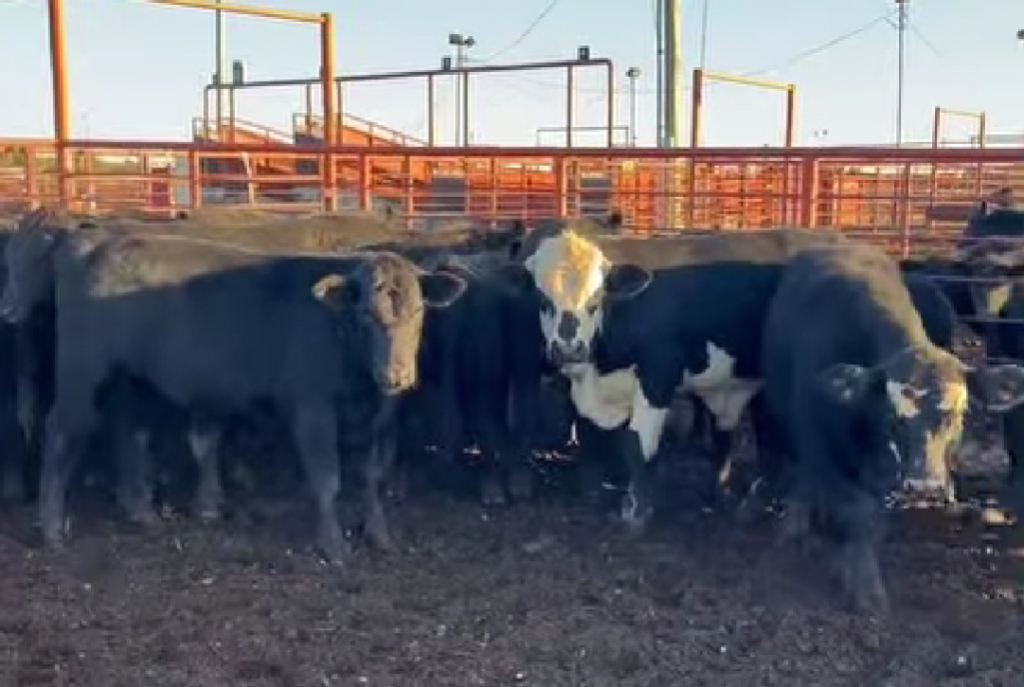
KC Sheperd, Farm Director, is back talking with Bob Rodenberger, a Stockman Oklahoma Livestock Marketing partner, as he gives the latest on the cattle markets.
Rodenberger said that he's heard from several producers that they've never seen it go from as wet as it was last spring, to as dry as it started getting July through October, to their ponds being refilled in two days of rain. Farmers whose wheat was already emerged are thrilled with the rain, but those who dusted it in are concerned that it may have washed away.
He said that the runs have been lighter, but the feeder market remains steady. "They didn't get $1.90, what they were trying to get on fats," he said. "I think they are bidding $1.85. Nobody sold any, but the calf market, I thought to myself, how can it be any higher? It was higher, yesterday."
He related how people had been waiting for a good rain to buy calves, and after they rain, they bought them.
Rodenberger expects lighter runs again next week, as more rain is on the way, making access to the pastures and pens difficult at best. With the Holiday season quickly approaching, he said Apache will only have two more sales in November, and three sales in December before closing for the Christmas season. It will open again on January 9, 2025.
Weather-related production risks are unavoidable on the farm or ranch. From heavy rain and hail to snow, high winds and drought, farm families prepare their land, plant and harvest each season, fully aware that their livelihoods depend on local weather conditions. In 2024, severe weather has taken center stage, with recovery from hurricanes Helene and Milton just beginning. These powerful storms have been accompanied by hurricanes Debby, Beryl and Francine, relentless wildfires across Texas and New Mexico, and waves of hailstorms, tornadoes and other extreme weather, making this year a challenging one for many communities.
While the scale of 2024 losses is still being tallied, it's critical to remember that the financial impacts of recent years' disasters continue to burden farmers. Crop insurance is an invaluable tool, covering more than 50% of weather-related crop losses in recent years, but its coverage has limitations, with policies not available for all crop types in every region. In this Market Intel report "uncovered loss" refers to crop losses that were not insured through crop insurance, existed outside policies' coverage levels, or did not qualify under an existing risk management program. To date, only one third of 2022 uncovered losses from natural disasters have been addressed through ad hoc relief programs, and uncovered losses from 2023 and 2024 are still unaddressed. As farm economic conditions worsen and natural disasters mount, timely disaster assistance is crucial to protect farmers, ranchers and the rural communities they sustain from lasting harm.

Farmers Still Waiting for Disaster Assistance
According to the National Oceanic and Atmospheric Administration (NOAA), in 2022, there were 18 weather disasters with total economic damage over $1 billion dollars each. This included widespread drought in the West; hurricanes Ian, Fiona and Nicole; derechos; tornadoes and others. NOAA reported that 2022's $165 billion in total economic losses surpassed 2021 as the third-costliest disaster year in history, behind only 2017's $346 billion and 2005's $244 billion. Farm Bureau calculations put total crop and rangeland losses from major 2022 disasters at over $21.48 billion, or 7.7% of NOAA's total economic impact figure. Of that figure, over $10.48 billion in losses were uncovered losses.
On Dec. 29, 2022, President Biden signed the Disaster Relief Supplemental Appropriations Act, which authorized $3.74 billion for producers who suffered losses to crops, trees, bushes and vines from qualifying causes occurring in calendar year 2022. However, this support covers only 36% of the total uncovered losses farmers faced from major weather events that year, leaving a substantial $6.74 billion gap that has yet to be made whole two years later.
In 2023, 28 weather disasters with damages exceeding $1 billion struck the U.S. coast-to-coast. NOAA reported that 2023 ranked ninth in terms of the total inflation-adjusted economic impact of these events, with industries across the economy experiencing an estimated $92.9 billion hit. Key events included extreme drought along the Gulf Coast, hurricanes Hilary and Idalia, the Hawaiian firestorm and severe Northeast flooding. Farm Bureau estimates indicate that crop and rangeland losses from these 2023 events exceeded $21.94 billion, representing 23.6% of NOAA's total economic impact. Nearly $10 billion of these losses were uncovered.
While assessments of 2024's natural disasters are ongoing, preliminary Farm Bureau estimates project billions more in agricultural losses. Early estimates following the same methodology as previous analyses that exclude the recent impacts of Hurricanes Helene and Milton as well as North Dakota fires, indicate uncovered crop and rangeland losses exceeding $4.1 billion. (Losses from Helene and Milton will be billions more.)
Since 2022, farmers and ranchers are facing a cumulative minimum $20 billion loss in crops alone that has not been addressed with ad-hoc relief. These continued losses are severely impacting balance sheets and straining farmers' financial stability. This $20 billion cumulative loss figure does not include the additional billions in losses to livestock, timber and infrastructure also impacting farmers and ranchers nationwide.

Challenges with the Emergency Relief Program
As of Nov. 3, 2024, $2.8 billion of the authorized $3.74 billion for 2022 crop losses have been disbursed. Given the total need of over $10 billion, this may seem perplexing — but the explanation is straightforward. The 2022 version of the Emergency Relief Program (ERP) included provisions that aggressively lowered benefits to farmers impacted by natural disasters. The program used a method called "progressive factoring" to curb payments. The "progressive factoring" approach applied income-tax-like reductions to disaster assistance, with payments decreasing incrementally based on disaster need, ranging from no reduction for amounts up to $2,000 to an 80% reduction for amounts between $8,001 and $10,000 and a 90% reduction over $10,000. While intended to allocate the limited funds fairly across affected producers, this structure left farmers with the most losses without the support they needed to recover.
The ERP 2022 handbook also includes antiquated definitions for "related conditions" that limit eligibility in ways that overlook common disaster sequences. According to the handbook, "related conditions" must occur directly due to a qualifying disaster event. For example, if a wildfire in September 2022 was followed by rains in November, a resulting mudslide that destroyed crops would not be considered a related condition of the wildfire, rendering the crop loss ineligible. This overlooks the well-known link between wildfires and subsequent mudslides or debris flows, as wildfires often strip away vegetation critical for soil stability.
Another restrictive example is the treatment of tropical storms and depressions. Under the current guidelines, if a tropical storm strengthens into a named hurricane and is later downgraded to a tropical storm or depression, only losses from the named hurricane and its subsequent phases are eligible. Losses from an initial or standalone tropical storm are excluded, despite their direct impact on crop losses. These narrow definitions fail to account for the interconnected nature of weather events, excluding legitimate losses that result from cascading disasters.
Historically, ad hoc disaster programs have imposed stringent eligibility and payment limitation requirements that create barriers for producers seeking adequate relief. ERP, for instance, includes payment caps vary based on crop type (specialty, non-specialty, high-value), disaster type and an applicant's adjusted gross income (AGI). For farms with diversified operations or small administrative budgets, navigating the program's requirements — such as certifying AGI through a CPA or attorney to access higher payment limits — can present a significant challenge. These complex eligibility standards may unintentionally exclude or limit relief for farmers who lack the resources to meet them, often those in the greatest need. (For a deeper dive into the challenges and innerworkings of ERP 2022 please read: Farmers Can Expect Limited Disaster Support from the Latest ERP Reboot.)
Calls for Timely, Fair and Comprehensive Natural Disaster Assistance
The partial aid provided by ERP 2022, along with mounting losses from recent and ongoing disasters, highlights the urgent need for a robust, timely disaster relief response that only Congress can deliver. Previous relief measures have often been delayed for years, leaving farmers without essential support when they need it most. Some members of Congress are working to address this gap. Rep. David Valadao's (R-Calif.) H.R. 9889, the Agriculture Disaster Relief Supplemental Appropriations Act of 2024, proposes an additional $14 billion to help farmers and ranchers recover from production, revenue and quality losses caused by extreme weather events in 2023, including hurricanes, droughts, wildfires and more.
With $20 billion in uncovered losses accumulated since 2022, farmers and ranchers are calling for timely disaster aid to keep their operations afloat. The financial strain on farmers without this assistance—or when relief arrives two or more years too late, as is often the case—threatens the viability of farms and the rural communities that depend on them. Immediate, comprehensive relief can enable these producers to recover, rebuild and prepare for future challenges.


Discussions from the on-line GRSB Strategy Sessions plus the Leadership Conversation at the Global Conference on Sustainable Beef identified these priorities for GRSB in 2025:
This 60-minute webinar is an exclusive GRSB member benefit but for this special event, non-members are also welcome.
There will be opportunities for all participants to ask questions and to join in the discussion. This session will feature English to Spanish simultaneous translation.
The holiday season is synonymous with roasts, and nothing elevates a festive meal like a perfectly prepared roast at the center of the table, surrounded by family and friends. With a variety of recipes and cuts to suit any budget, beef should be the star of every holiday feast!
While roasts are a holiday favorite, many people aren't sure how to prepare them properly. As the festivities begin, we need your insights on making holiday dinners special with beef. Below are some ideas to inspire you:
Don't forget to check out Beef. It's What's For Dinner. on Facebook and Instagram for more holiday content to share!

Horseradish Whip
For more information on degree of doneness and other cooking tips visit: https://www.beefitswhatsfordinner.com/cooking/determining-doneness
For more information on safe food handling and beef safety, see: https://www.beefitswhatsfordinner.com/cooking/food-safety
RON's Dave Lanning has a pre-opening look at today's agricultural Markets.
Click the audio tab below for today's report.
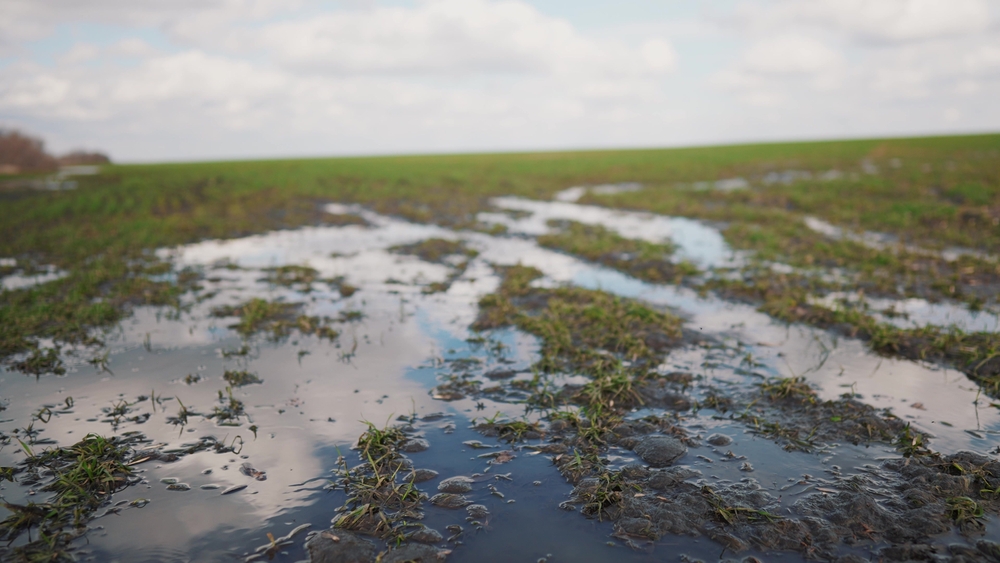
This week on SUNUP, OSU Agriculture Economist Dr. John Michael Riley discusses the highs and lows of current grain and cotton markets.
Recently heavy rains have fallen across much of the state. Riley said, "If you look at mesonet maps, depending where you are at, anywhere from one to two inches all the way up to possibly six inches have fallen."
He admitted that while it was a blessing to receive, the force and volume of it may feel like a curse for some.
The corn harvest is almost over, and soybeans are still needing to be harvested despite the soggy ground. The nation's wheat is 87% planted and Oklahoma's wheat is only 72% planted. While it is getting late in the season, Riley mentioned that wheat is a hardy crop.
"Wheat conditions right now are pretty poor across the state and the U.S.," Riley said. "We were in the midst of those rains when the date was being listed for the Crop Progress report that was released on Monday so we will certainly see how things change moving forward."
He went on to discuss more about the harvest of summer crops in the state and nation. To hear the whole conversation, click the listen bar at the top of the page.
He said that the markets have been down and have remained down for some time. He said that the rain is putting pressure on wheat markets. He added that across the state, cash grain prices are near normal for this time of year. Wheat, Corn, and Soybeans are about 10 cents below normal relative to futures markets.
This week on SUNUP:
Oklahoma Agriculture Starts at SUNUP!
Weekly Statewide Broadcast: Saturday at 7:30 a.m. & Sunday at 6 a.m. on OETA (PBS)
Stream Anytime: YouTube.com/SUNUPtv

The 2024 election has closed with control of the Senate and presidency passed to Republicans. The presential race has been secured by candidate and former president Donald Trump, with 295 electoral votes as of this afternoon. We will learn about key leadership positions in coming weeks, and clarity on agriculture policy and personnel may come as a new transition team is formed.
Republicans flipped three seats in the Senate—Montana, Ohio, and West Virginia—to secure a majority of at least 52, though the final total is still unknown. Given the change in majority party, ASA expects Sen. John Boozman (R-AR) to move into the role as chairman of the Senate Agriculture Committee and Sen. Amy Klobuchar (D-MN) into the ranking member role in the new year.
Among ASA's closely watched Senate Agriculture Committee members were Sen. Deb Fischer (R-NE) and Sen. Sherrod Brown (D-OH). Fischer won her election in what became a surprising battleground while Brown lost to Republican candidate Bernie Moreno.
Additionally, several House Agriculture Committee members' races have been called. Reps. Zach Nunn (R-IA), Angie Craig (D-MN), Don Davis (D-NC), Nikki Budzinski (D-IL), and Eric Sorensen (D-IL) emerged victorious in tight races. Rep. Marc Molinaro (R-NY) lost to his Democratic challenger, Josh Riley. Among House races not yet called are those of Reps. Mariannette Miller-Meeks (R-IA), Don Bacon (R-NE) and Marcy Kaptur (D-OH). Many House races remain outstanding and will determine control of the chamber and composition of committees. ASA will continue to monitor developments related to election outcomes, the lame duck session expected to begin next week, and the transition of government that will officially occur in January 2025.
The Public Lands Council (PLC) has released a new version of their website to further promote public lands ranchers and the issues they face every day as they effectively manage millions of acres of grazing land in the West.
"Our newly updated website is the clearinghouse for everything related to federals lands ranching. From the popular series "Real Ranchers. Real Stories." to coverage of the latest news on what is happening in the federal government as it pertains to ranching – PLC's new website has all of that and more in a user-friendly design," said PLC Executive Director Kaitlynn Glover. "Over the past few years, there has been monumental growth in the body of research that recognizes and quantifies the environmental benefits of livestock grazing, soundly debunking some of the most egregious myths about ranchers' conservation work. The new PLC website is designed to be a modern, streamlined hub for information so ranchers, supporters, and politicians can find what they need to know about the conservationists of the American West: public lands ranchers."
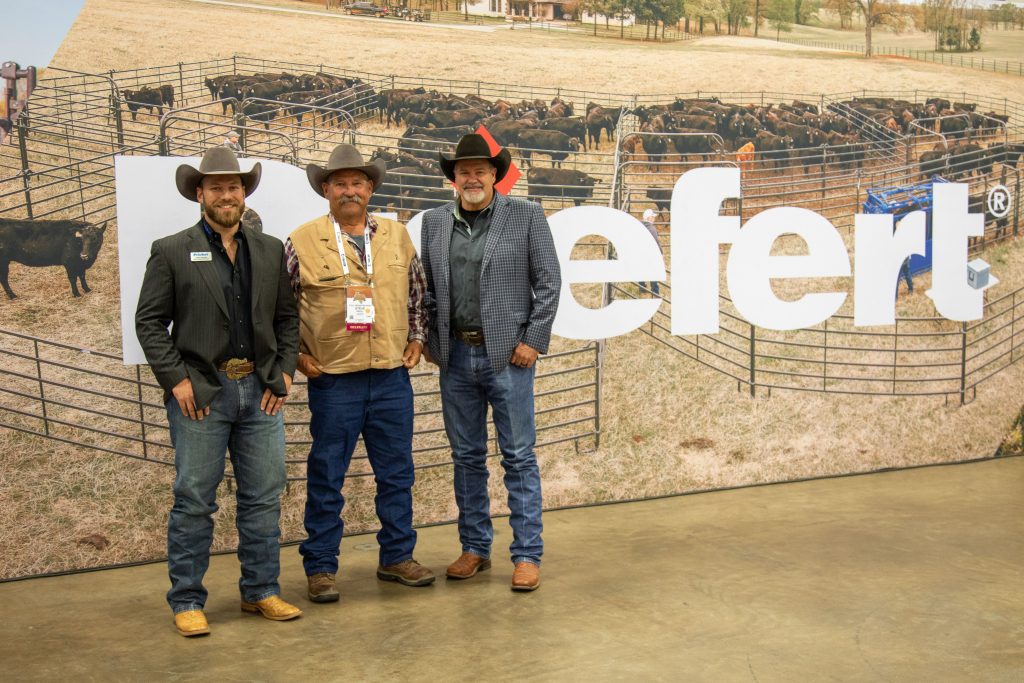
Steve Knoll of Texas was the winner of the Priefert and Datamars Complete Cattle Handling System at the 2024 Angus Convention in Ft. Worth. Pictured from left are Cody Duncan, Priefert representative; Steve Knoll; and Todd Tieperman, Datamars representative.
Angus breeders and beef industry enthusiasts gathered in Ft. Worth, Texas for the 2024 Angus Convention and three fortunate individuals left with prizes to help them expand their operations' potential.
Working cattle will become a more efficient and low-stress task for Steve Knoll's operation in Texas as he installs his new Priefert and Datamars Complete Cattle Handling System, valued at $42,000. Knoll says many of their current cattle handling facilities are outdated and were built by him and his dad over 50 years ago.
"Our operation is scattered across 200 miles, and we have several locations in need of better panels. Before now, we've just been making do."
The new corral system features a solid sweep with a straight, adjustable working alley, leading to a Priefert Model S04 Squeeze Chute. The set-up is completed by a Tru-Test by Datamars complete weight and water management solution, electronic identification reader, and WaterWell 2 automatic waterer.
Knoll says he will be able to use this technology to make necessary and needed enhancements to his cattle-handling facilities.
"There's actually a 50-year-old Priefert headgate at my dad's place we've needed to replace for a while," said Knoll. "We're excited to be able to make upgrades to some of our locations that really need it."
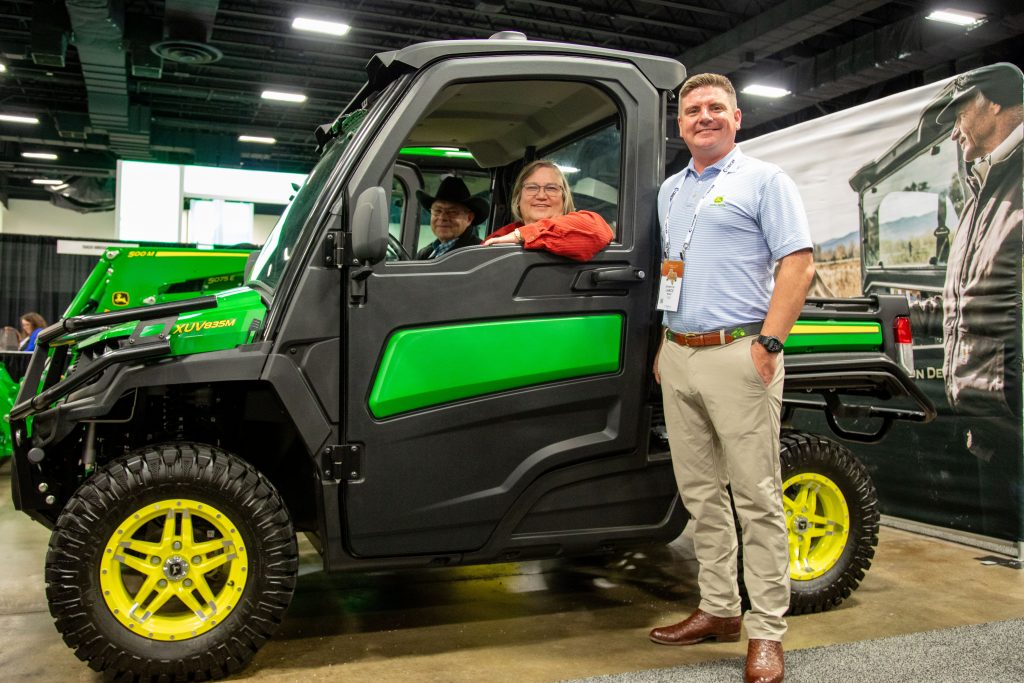
The second grand prize giveaway winner was Debbie Denowh of Montana, who took home a John Deere 845M HVA Gator valued at $24,000. Denowh's new John Deere 845M HVA Gator features a three-person cock pit, power steering, 54 HP, 2,000 lb. towing capacity, 1,000 lb. cargo box capacity and speeds up to 45 MPH.
The third winner, Lori Thomas of Oregon, received a Trans Ova service voucher valued at $5,000. The voucher will help cover one genetic preservation, an IVF cycle and up to five fresh implants into Trans Ova or client recipients and more.
"It's quite exciting to win something like this," said Thomas. "We do a lot of embryo transplant work on our operation, so it's going to come in very handy. It'll be put to good use, for sure."
Caitlyn Brandt, director of events and junior activities says these giveaways would not be possible without the continued support of sponsors.
"Thank you to Priefert, Datamars, John Deere and Trans Ova for their continued partnership in many of our events throughout the year," says Brandt. "These special donations continually help make the Angus Convention a priceless experience for attendees."
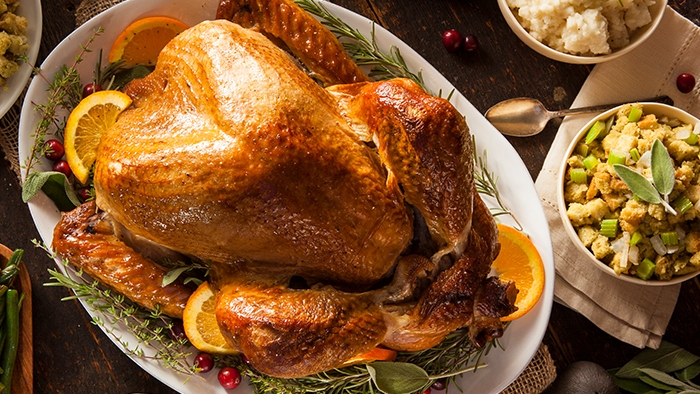
Thanksgiving is the second-largest U.S. food holiday, driving an estimated $2.1 billion in sales lift at grocery stores.¹ And a turkey on the table for Thanksgiving is a familiar sight for many American families, a time-honored tradition long embedded in American culture. Whether through supply-related issues, consumer desire for convenience, or changing preferences, the future of this tradition and the U.S. consumer support to the turkey industry has become less certain in recent years.
Most consumers think about cooking a whole turkey only once a year. And even then, attention is in decline. Whole retail turkey consumption between October and December 2023 was the lowest since 1980, at just 4.04 lbs. per capita. Other animal protein segments, like beef and pork, are taking note of shifting consumer purchasing behavior. They want in on the Thanksgiving action, and consumers are interested.
Promotional activity around the holidays drives much of what shoppers put in the cart. Thanksgiving comes with a widely utilized retail tactic called "loss-leader" to drive foot traffic. Retailers will typically price a turkey low, at a loss, or sometimes free, in hopes that sales on the remainder of the consumer's Thanksgiving meal shopping cart will include items that help offset those losses.
While turkeys still prominently appear on the front page of retail advertisement in weeks leading up to Thanksgiving, over the past few years USDA's feature activity index for weeks 40-49 has shown a noteworthy decline. Frozen turkey features in these key weeks were down 36% in 2023 from 2018 levels. However, while not to the same degree, ham features were down 14% over the same period. This could partially explain falling disappearance rates at the key time frame of the year.

However, the data does not include "no-price" features such as buy one item get one half off or spend a certain dollar amount and receive one center of plate item free (such as a turkey, turkey breast, ham or other). Also, prepared entrees have become commonplace at Thanksgiving, and that is also not covered in this data. Thus, we rely more broadly on production and inventory levels to analyze whole turkey demand.
To get an idea of what prices consumers should expect at the grocery store this Thanksgiving, it is important to understand that the turkey industry prepares all year for the holiday. The majority of contracting for Thanksgiving turkeys typically occurs in the first quarter of the year. For example, during January 2023, wholesale prices for frozen whole turkey hens reached a record of $1.71/lb., up 33% YoY and 112% higher than in 2019 (pre-pandemic). And somehow retailers in the most competitive markets were still able to offer whole frozen turkeys to consumers for less than $0.30/lb. For 2024, wholesale prices were down 50% YoY, at an average of $0.87/lb., the lowest since 2019.
Inflation has taken its toll on both producers and consumers in recent years. Although feed corn prices have been easing from their most recent peaks over the last 12 months, turkey producer costs have remained elevated since 2023, and were down just 18% YoY for the 12 months ended in January 2024. This all suggests that wholesale values adjusted down more ferociously than producer costs as producers prepared turkey supplies for the 2024 holiday season.

As retailers began preparing for Thanksgiving features this past January, projections for turkey inventories were reported at their lowest point in four decades, signaling reduced availability for Thanksgiving in 2024. Outside of consumer preference, the animal protein industry has faced supply-limiting challenges: high operating costs, labor shortages, regulatory hurdles and disease-related issues. U.S. turkey flocks have struggled with two diseases in particular: Highly Pathogenic Avian Influenza (HPAI) and avian metapneumovirus (AMPV).
The U.S. turkey industry was impacted heavily by depopulations in commercial houses, including breeder facilities during the fourth quarter of 2023. Both viruses causing HPAI and AMPV have contributed to these heavy declines. However, the primary reason for fewer turkey poult placements has been weak profitability for U.S. turkey growers.

A multitude of production costs rose rapidly through 2020 and beyond. While some costs like feed (the biggest expense in turkey production) have been in decline over the last 18 months, costs of labor, capital, packaging, energy, interest rates and other factors have all kept the poultry producer price index from falling back to pre-pandemic levels. However, at less than $0.90/lb., wholesale values for whole frozen turkeys were reported at some of the lowest levels in modern times, negatively impacting producer margins for 2024.
While the starkly lower placement numbers would suggest a sizeable decline in turkey availability for Thanksgiving, inventories of whole turkeys in cold storage were up about 4% YoY, when they peaked in September this year, at 246 million pounds. But that contrasts with roughly a 100-million-pound decline when compared with 2018, suggesting the market is more accepting of smaller supplies of whole birds. Similarly, inventories of hams in cold storage were in line YoY, but down just 61 million pounds vs. 2018 peak.

So how will the market deal with a 160 million-pound-decline in combined frozen whole turkey and ham availability from its peak in 2018? Traditions are changing; this might be the "new norm" as consumption is trending downward for traditional center-of-plate offerings. Marketers are being challenged to creatively market turkey meat and thrive through innovation. If consumers are becoming comfortable with declining availability of whole turkeys around the holidays, producers should consider more closely evaluating the overall product mix.

While whole turkey demand might be slipping, the opportunity to grow consumption may be elsewhere. Grinds have shown tremendous strength this year. Ground turkey retail volume sales are up 5.5% YoY and are at $1.9 billion through the 52 weeks ending Sept. 8.² Ground turkey is the second-largest ground category, only behind ground beef. This strongly suggests that while the traditional imagery of turkey may be Norman Rockwell's iconic "freedom from want" painting, the U.S. consumer perception of turkey is changing.
1 Circana point of sales data, 2023. Dollar sales uplift is defined as dollar sales for the two key Thanksgiving weeks in total vs. average weekly dollar sales for the calendar year.
2 Circana Integrated Fresh, MULO+, Data Ending 9/8/2024
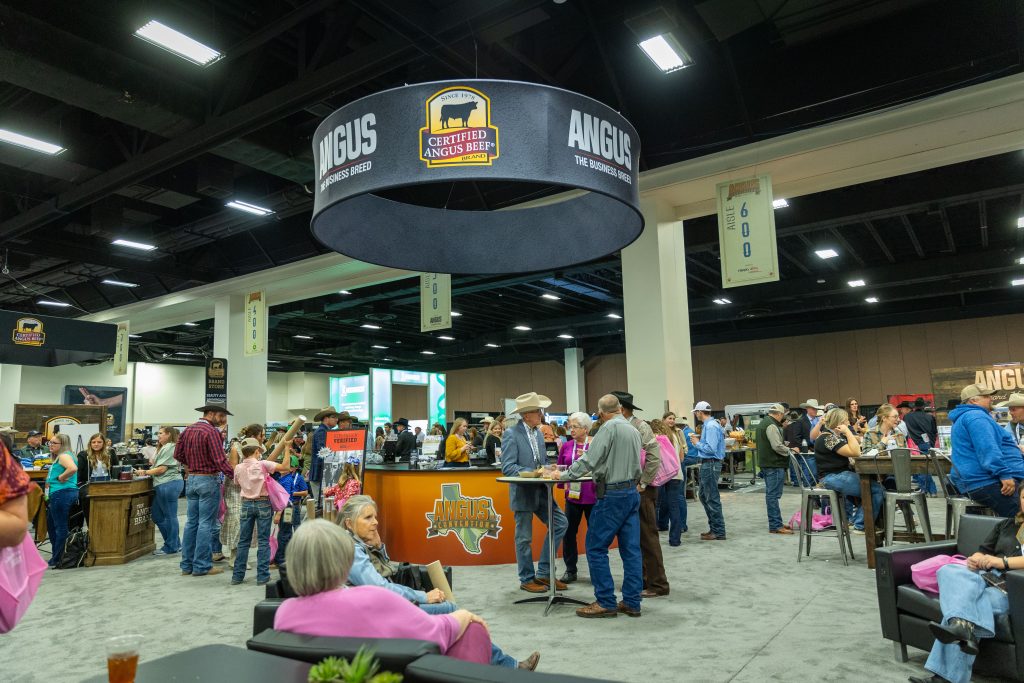
The Angus family gathered November 1-4 in Fort Worth, Texas for Angus Convention, an event for all cattle producers.
The American Angus Association® welcomed nearly 1,500 registrants to Fort Worth, Texas November 1-4 for its annual Angus Convention. The event showcased innovation in production practices, technology and Association programs, and it celebrated tradition and the people who have helped make the Angus breed what it is today.
"It encourages me to see people investing time to be at Angus Convention and stay connected," said Mark McCully, CEO of the Association. "With everything we have going in this business, I'm still most optimistic about what is yet to come."
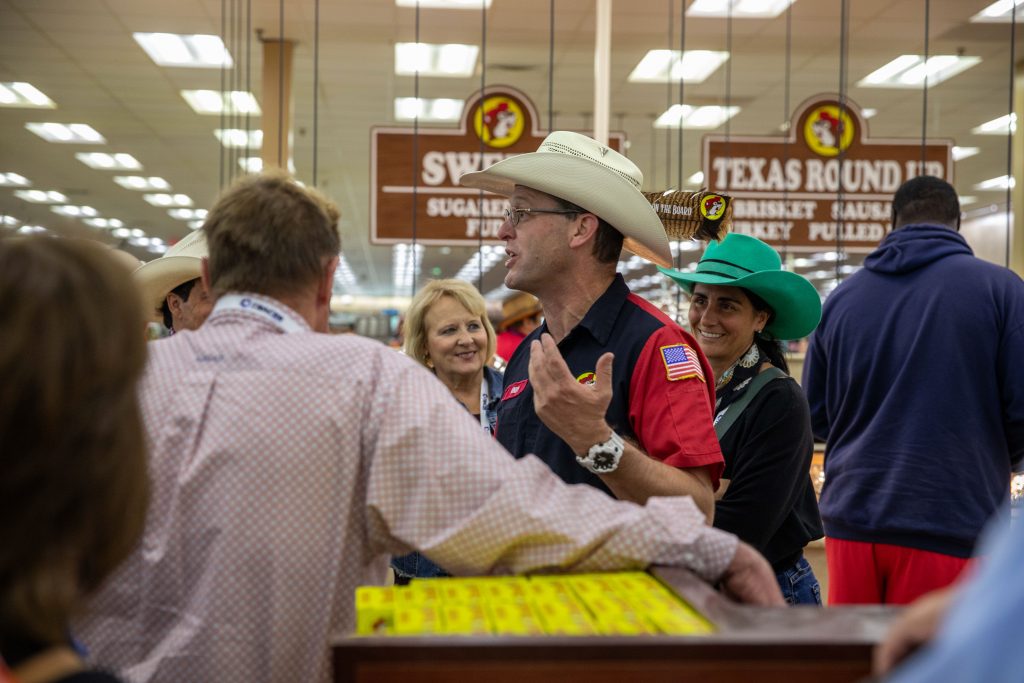
Learning together
Educational tours and presentations continue to be a highlight for many attendees. The 2024 National Angus Tour and Beef Blitz tour included stops at the Cox Ranch in Peaster, Texas, Vytelle's corporate laboratory in Fort Worth and Certified Angus Beef's (CAB's) Texas-based, licensed partner Buc-ee's among others.
"Farmers and ranchers take care of the cattle and land; that's their world," said Mike McReynolds, CAB's executive account manager for the south-central region who helped organize the 2024 Beef Blitz. "From gate to plate, there are several segments in the supply chain. We host the Beef Blitz to help connect the dots, sharing more about how it all works after cattle leave the ranch."
On the main stage, Scott Stratten of UnMarketing Inc. spoke about the value of storytelling and the value of making things right when they go wrong, related to seedstock providers' customer experience. His keynote was sponsored by IMI Global, a division of Where Food Comes From.
The genetics symposium during Angus Convention featured presentations and discussion on the intersection of genetics and cattle health. Sponsored by Neogen, the symposium speakers discussed the use of new technologies, like gene editing in the pork industry and data collection methods for cattle, to improve animal health and productivity.
Angus University sessions offered attendees even more education. One learning track on Sunday featured succession planning expert and Oklahoma State University professor Shannon Ferrell, who brought energy and humor to a challenging subject for many ranching families. Producers were introduced to the basics: ways to start a conversation with their family and a variety of tools that can help them make the most of the transition. In another track, speakers shared about the economics of herd rebuilding and selection and marketing tools for commercial cattlemen like GeneMax® Advantage™ and AngusLinkSM.
"Begin with the end in mind," said Nevil Speer, an industry consultant. "Ultimately consumers are our business."
Producers considering new ways to drive revenue for their operation sat in on sessions exploring direct-to-consumer sales through the Certified Angus Beef® Ranch to Table program as well as opportunities to leverage carbon credits and cost-sharing sustainability programs.
Offered for a second year in a row, the Angus Media Marketing Summit offered breeders information to better understand how to refresh or evolve their brand. This included presentations about the use of videos, Angus Media's Pasture to PublishSM portal and ideas for how to make the most of sale day with marketing.
Taking care of business
During the 141st Annual Convention of Delegates on Monday, November 4, the Association recognized Dr. Barry Pollard for his service as the outgoing president of the Board of Directors. The 263 delegates in attendance re-elected Paul Bennett of Red House, Virginia and John Dickinson of Auburn, California to the Board for a second term. Elected for a first term were Ron Hinrichsen of Westmoreland, Kansas; Mark Johnson of Orlando, Oklahoma; and Danny Poss of Scotia, Nebraska.
Jonathan Perry of Fayetteville, Tennessee was elected as president for the Board's 2024-2025 year, and Jim Brinkley of Milan, Missouri was elected as vice president. Darrell Stevenson of White Sulphur Springs, Montana will serve as treasurer.
The Association also took time during the convention to collectively reflect on the progress the breed has made.
"We talk a lot about quality, but something lately that I've been thinking more about is the impact of the Angus breed on consistency," said McCully during the opening general session. "We've improved the consistency of the product and that has a tremendous amount of value. It brings value to how we market the cattle, how we manage the cattle and sure has a lot of value to the folks that are selling our product and the consumers at the end of that supply chain."
Celebrating in style
The largest celebration at Angus Convention was once more the Association's awards dinner and reception on November 3. During it, the Angus Heritage Foundation inducted Bill and Sally Bowman of Saint Joseph, Missouri; Dave and Yvonne Hinman of Malta, Montana; Harlan Ritchie (posthumously) of East Lansing, Michigan; and Bob and Jim Sitz of Harrison and Dillon, Montana. Sitz Angus was recognized for passing the 100-year mark for continuously raising Angus cattle.
Other winners recognized during the awards dinner and reception are as follows:
The Roll of Victory (ROV) Breeder of the Year - Express Ranches, Yukon, Okla.
ROV Bull of the Year - BNWZ Executive Decision 2219 owned by Hunter Angus, Fair Grove, Mo. and Kayden Nowatzke, Michigan City, Ind.
ROV Show Heifer of the Year - EXAR Princess 2717, owned by Jake Allison, Yukon, Okla.
2024 Sire of the Year - Conneally Craftsman (Registration No. 20132505) bred by Conneally Angus, Whitman, Neb. and owned by Select Sires Inc., Plain City, Ohio and STgenetics, Navasota, Texas
Angus Ambassador of the Year - Mike McGuire, Waverly, Ala.
Young Breeder of the Year - Cody Quam, Lodi, Wisc.
The reception concluded with the crowning of the 2025 Miss American Angus. Rosalind Kidwell of Gentryville, Indiana will serve as a spokesperson for the Angus breed at shows and events across the country in the coming year.
Another source of excitement came from drawing the grand prize giveaways. Steve Knoll of Hereford, Texas won a complete cattle-handling system from Priefert and Datamars. Debbie Denowh of Sidney, Montana was drawn for a John Deere XUV835M Gator; and Lori Thomas of Baker City, Oregon took home a Trans Ova genetics service voucher, which helps cover one genetic preservation, an IVF cycle, and up to five fresh implants into Trans Ova or client recipients.
Throughout the long weekend, the director of culinary arts for the Certified Angus Beef® brand, chef Tony Biggs, along with convention staff, kept attendees satisfied with beef dishes and hors d'oevres. The brand also hosted a Beef Quality Assurance (BQA) Bash on November 2 as part of its "Raised with Respect" campaign. It was preceded earlier in the day by a BQA training, which was attended by 115 ranchers.
Radale Tiner, Association regional manager for Texas and New Mexico, reflected on Angus Convention as a whole. He said, "It was great. It was well attended. I thought everyone had fun, starting with the National Angus Tour – people talking about how good the stops were – all the way through to the awards dinner. I'm glad we could host the Angus family back in Texas this year."
Oklahoma Farm Bureau has named Trace Justiss to serve as the organization's assistant director of research and regulatory affairs.

In his new position, Justiss will work in the organization's public policy department to support the advocacy efforts of Farm Bureau and the OKFB Legal Foundation. Justiss will conduct legal research and monitor regulatory activity that affects Oklahoma farmers, ranchers and rural residents.
"I am proud to be part of an organization that stands up for the rights of Oklahoma's agricultural community," Justiss said. "Agriculture is an industry that everyone relies on, whether or not they realize it, and as someone who grew up in agriculture, I am committed to standing up for our rural way of life. Every day when I walk into Farm Bureau, my goal is to fight for the future of agriculture."
Justiss earned his law degree from Oklahoma City University in May and is a licensed attorney. He completed his undergraduate studies at West Texas A&M with a degree in agricultural business and economics with a minor in plant and soil science.
He spent the last year as the OKFB Legal Foundation intern where he researched legal and regulatory issues while providing information and resources to Farm Bureau leaders and members.
Justiss grew up on a ranch near San Angelo, Texas, and was an active 4-H and FFA member.
| ||||||||||||||||||||||||||||||||||||||||||||||||||||||||||||||||||||||||||||||||||||||||||||||||||||||||||||||||||||||||||||||||||||||||||||||||||||||||||||||||||||||||||||||||||||||||||||||||||||||||||||
| ||||||||||||||||||||||||||||||||||||||||||||||||||||||||||||||||||||||||||||||||||||||||||||||||||||||||||||||||||||||||||||||||||||||||||||||||||||||||||||||||||||||||||||||||||||||||||||||||||||||||||||
|

Tuesday's election will bring a significant change to the leadership in Washington D.C., with Republicans taking over leadership of the Senate and former President Trump being re-elected President. As of late Wednesday evening, it appears Republicans will remain in control of the House of Representatives, albeit with a very small majority. Leadership elections over the next couple of months will determine if Chairman Thompson (PA) and Ranking Member Scott (GA) will continue to lead the House Committee on Agriculture. Of the 29 Republican members currently on the committee, only 10 were around to vote on the 2018 Farm Bill (green represents they voted for the 2018 Farm Bill). Eight of 25 Democrat members were around to vote on the 2018 Farm Bill. So, only 18 of 54 members of the committee were around to experience the process and vote for the last farm bill. Most of the current Republican and Democrat members were re-elected on Tuesday with the exceptions of Republican Marc Molinaro (NY) and Democrats Abigail Spanberger (VA) and Elissa Slotkin (MI) who both left to seek other offices.
There is more experience on the Senate Committee on Agriculture, Nutrition and Forestry as 8 of 12 Democrats and 8 of 11 Republicans were around to work on the 2018 Farm Bill, although Senator Grassley (IA) voted against the bill (indicated in red). After Tuesday's election, it is presumed that Senator Boozman (AR) will become Chairman, and the Democrats will select a new ranking member as Chairwoman Stabenow is set to retire at the end of the year. In terms of departures, Senator Braun (IN) is leaving to become the Governor of Indiana, and Senator Brown (OH) was defeated.
What does this mean going forward for the next farm bill? While the House and Senate differ in terms of experience, there should be plenty of motivated and experienced leaders in both the House and Senate to push the farm bill through whether it be before the end of the year or shortly into next year. After all, the need for a better safety net is currently being felt across the entire country.
House Ag Committee

Senate Ag Committee

Article courtesy of Southern Ag Today: Outlaw, Joe, and Bart L. Fischer. "Election Impacts on Current Ag Committee Members." Southern Ag Today 4(45.4). November 7, 2024. Permalink
USMEF President and CEO Dan Halstrom updates members on red meat export results and the outlook for 2025
The U.S. Meat Export Federation (USMEF) launched its annual strategic planning conference in Tucson, Ariz., Wednesday with an analysis of the U.S. election's potential impact on agricultural policy and international trade. USMEF members also received an in-depth look at the new administration in Mexico, as the United States prepares for a critical phase of trade relations with the largest export destination for U.S. red meat.
USMEF President and CEO Dan Halstrom opened the conference with an overview of U.S. red meat exports in 2024 and his outlook for the coming year. Halstrom highlighted the resilience in international demand for U.S. red meat despite volatility and serious headwinds in major Asian markets. USMEF forecasts that U.S. pork exports will set volume and value records in 2024, surpassing 3 million metric tons (mt) valued at $8.63 billion. U.S. beef exports are projected to reach 1.28 million mt worth $10.5 billion, an increase of 5% over 2023. A critical piece of this export performance in a volatile year is the demand growth for U.S. red meat in Latin America. Halstrom emphasized the importance of protecting hard-fought market share in increasingly competitive environments. The Latin American boom is real, Halstrom said, and the U.S. industry must keep a close eye on its competition.
"Brazil is starting to get more volume into Mexico, Central America and even into Japan," Halstrom said. "That being said, our quality ‒ beef, pork and lamb ‒ is second to none. Our products command a superior price and that's the way that we're approaching it when we work to develop these markets. We need to maximize opportunities in our major markets and carve out new destinations, such as Africa, for the future."
Keynote speaker Jim Wiesemeyer, a veteran journalist and renowned Washington insider, delivered his insights about the presidential and congressional elections and the potential effects on U.S. agriculture and trade policy. Wiesemeyer highlighted that Trump is the first candidate in over a century to reclaim the White House after losing it, having gained even stronger support in rural America than he had in two previous elections. Republicans did much better than most expected in U.S. Senate races, with a likely pickup of four seats in addition to the 49 held in the current Congress. Although several House races were still too close to call, it appears the GOP will hold on to its narrow majority, he reported.
Wiesemeyer speculated on the post-election agendas for the White House and the 119th Congress and identified what he expects will be their key issues. He stated that the election outcome may have improved the chances of completing a new Farm Bill before the end of 2024, with Senate Agriculture Committee Ranking Member John Boozeman (R-Ark.) leading the effort during the upcoming lame duck session of Congress.
Wiesemeyer pledged to return with additional election analysis on Friday, the final day of the USMEF conference, when he also plans to discuss potential candidates for cabinet positions and other major presidential appointments.
Although the U.S. election was top-of-mind for conference attendees, key trading partners are also undergoing changes at the highest levels of government. At the top of this list is Mexico, where President Claudia Sheinbaum was elected in May and inaugurated on Oct. 1.
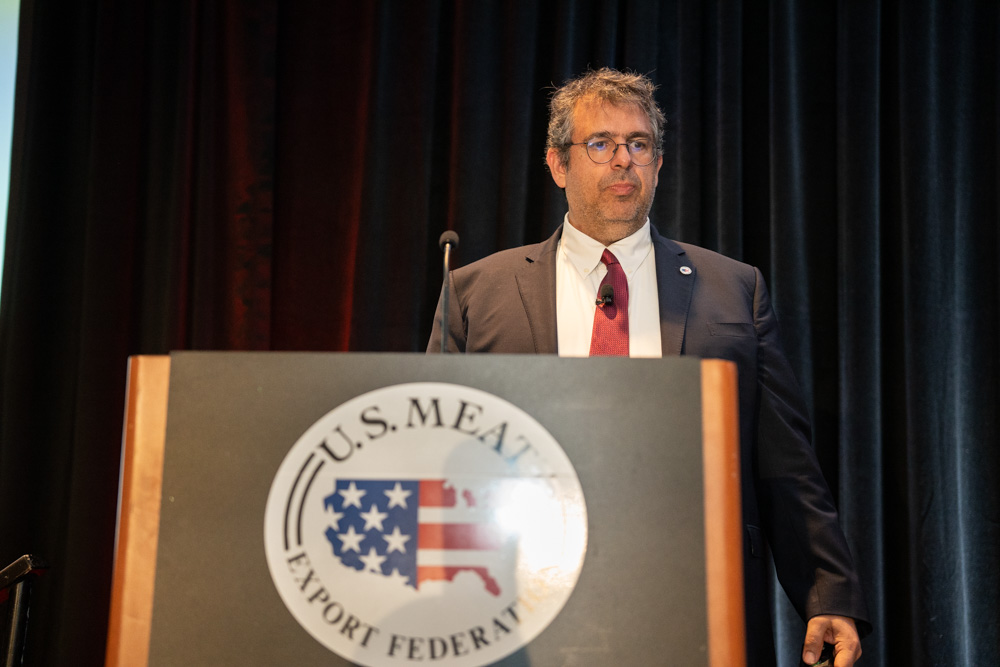
Guest speaker Mateo Diego, a partner in the regulatory consulting firm AGON and one of Mexico's leading trade experts, walked USMEF members through President Sheinbaum's philosophy on critical issues impacting agricultural trade.
Diego emphasized that the United States and Mexico generally enjoy productive and mutually beneficial trade, but cautioned that there are "irritants" that could disrupt this relationship. Some directly impact agriculture, such as Mexico's restrictions on imports of genetically modified corn, new USDA rules on voluntary country-of-origin labeling of beef and pork, and threats from the U.S. side to limit imports of certain produce items. Another contentious trade issue is automotive rules of origin, which Diego feels will be at the forefront of the upcoming review of the U.S.-Mexico-Canada Agreement (USMCA).
Diego outlined the possible scenarios that could emerge when USMCA comes up for review in 2026. While it is possible that the agreement could be reopened, negotiations on key issues fail, and the United States withdraws from USMCA, Diego sees this as unlikely.
"Unlike NAFTA, the USMCA is President Trump's baby – he negotiated it," Diego said. "Trump has talked about USMCA as being the best trade agreement ever, so withdrawing from his own creation would be a strange signal."
Nevertheless, Diego urged conference attendees to speak up and voice their support for USMCA.
"We need USMCA and other rules of order to provide certainty to what we do, and keeping a stable trade relationship in the agricultural sector is critically important," he said.
The conference continues Thursday with a panel of livestock producers sharing their experience meeting with buyers and consumers in international markets, as well as meetings of USMEF's sector-specific standing committees. Friday's closing business session will include the election of USMEF's new officer team.
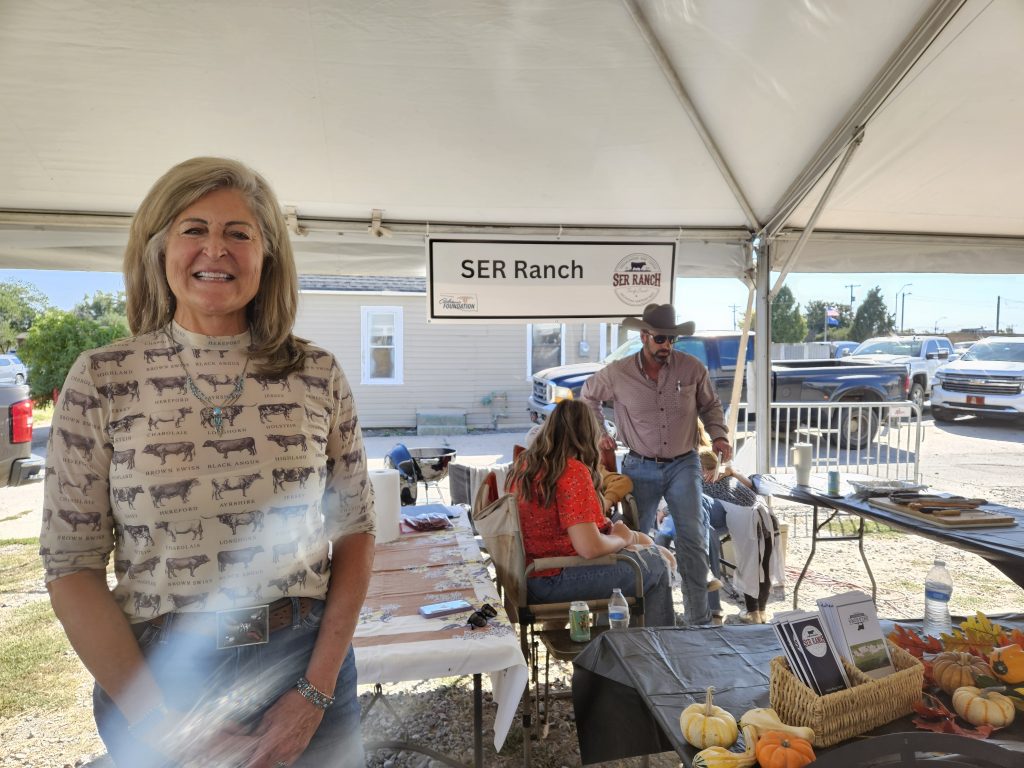
Oklahoma Farm Report's Stevie White got to talk with Vickie Roop at the Best Beef Competition a few weeks ago. Roop raises unique Piedmontese beef on her ranch in Okarche, Oklahoma.
She competed at the inaugural Oklahoma Best Beef Competition and has been invited back every year since. "This is a great event to get out in the public and have them taste our locally sourced beef."
Her niche beef product is produced by a breed of cow originally from the Piedmont region of Italy. She first tasted the beef in 2018 while attending a wedding in Italy. She loved the flavor and after learning about the other health benefits, she began replacing her own Angus/Charolais crosses with Piedmontese cattle. By 2019, she had 14 head and is now up to 32 mama cows that produce 17 to 20 steers each year.
She explained the uniqueness of the breed she chose. "Piedmontese is a double-muscling breed, but they have an inactive myostatin gene that maintains tenderness and juiciness despite the double-muscling, while also producing less fat and more Omega-3s, ounce-for-ounce, than salmon. It is truly the healthy beef."
Less fat means lower cholesterol and Omega-3 fatty acids are well-known for benefitting heart, brain, eye, and joint health. Beef is high in iron, so Piedmontese beef allows consumers to enjoy that part of beef without many of its other reputed downsides.
Roop sells beef directly from the ranch and more information can be found on their Facebook page, SER Ranch.
A newly establishedaward recognizes veterans or service members for excellence in farming or agriculture and positively impacting local communities.Retired Army Col. Joe Ricker of Indiana is the first recipient of the Veteran Farmer Award of Excellence presented by the American Farm Bureau Federation with support from Farm Credit.
Ricker served 30 years in the Army before retiring from a logistics post at the Pentagon in 2022. His service also included tours in Iraq and Afghanistan. Since leaving the Army, his commitment to excellence in farming and enriching the lives of veterans has blossomed in a myriad of ways in both his local community of Wilkinson, Indiana, and across the country.
Ricker started At Ease Orchard, a nonprofit that introduces veterans, first responders and their family members to beekeeping and other farm activities. He also founded Veterans IN Farming, which provides veterans in Indiana with training and support to succeed in farming. He's involved with Heroes to Hives through Michigan Food & Farming Systems, which uses beekeeping to help veterans achieve financial and personal wellness. For the last several years, he has served as veteran outreach coordinator for the National AgrAbility Project, which helps farmers, ranchers and agricultural workers with disabilities remain in the workforce.
"We're proud to elevate and celebrate Col. Joe Ricker for his past service to our country and current involvement in agriculture and local communities," said AFBF President Zippy Duvall. "We greatly appreciate the sacrifices of veterans and active service members so we can enjoy the freedoms we have in our country, and I'm delighted to highlight their contributions to agriculture, too."
Ability to assess risk, aptitude for planning and patience are among the skills gained from military service that Ricker has found transition well to agriculture. Through the training classes he conducts in beekeeping and other types of agriculture for veterans, he offers an ear and more formally, referrals for mental health support and resources.
"I feel successful and worth my time if I save one [person] from hurting themselves," Ricker said. He's excited about using the $10,000 cash prize for the award to train additional veterans in beekeeping and also improve outreach and national networking.
AFBF will present Ricker with the Veteran Farmer Award of Excellence at the organization's 2025 Convention in January, in San Antonio
The United States Cattlemen's Association (USCA) will host their 2024 Annual Meeting December 5 – 7 in San Antonio, Texas at the InterContinental Hotel. Each year, USCA brings together its members and leaders in the industry to discuss current policy and issues facing the industry. This year, USCA will host panels on animal ID, marketing and competition, Livestock Risk Protection, and new and emerging technologies within the industry.
The Annual Meeting will kick off with a "Meet the Officers and Staff" event on Thursday evening. Friday, December 6 will feature two panels, the Annual USCA Board of Directors and Members Meeting, and a hosted dinner and fundraising auction. The meeting will conclude on Saturday with a full day of panels from industry experts. USCA's Annual Meeting also serves as the time in which the Association reviews its official policy and receives nominations for Regional Directors.
"The USCA Annual Meeting is an opportunity for producers and our members to come together and discuss the issues that will guide the organization for the year ahead," USCA President Justin Tupper said. "Each year this meeting serves as the guidepost for how and what USCA will focus on in terms of policy and issue priorities. I encourage every USCA member to attend and let your voice be heard."
For more information and to register and book hotel rooms in the meeting block, visit uscattlemen.org/annual-meeting-2024/
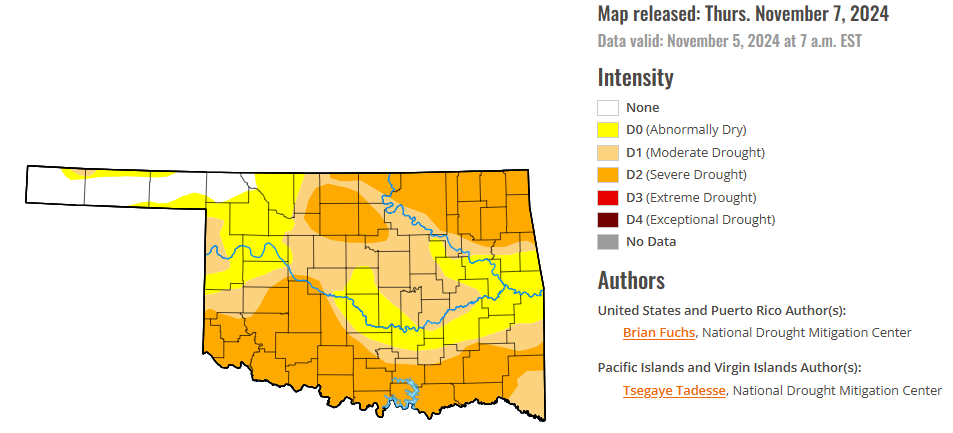
To view the latest Oklahoma drought map, CLICK HERE.
According to the latest Oklahoma drought monitor report, exceptional drought remains at zero percent, unchanged from the start of the calendar year.
Extreme drought or worse conditions have been eliminated, down from 41.57 percent last week.
Severe drought or worse conditions have decreased to 41.55 percent, down from 67.70 percent last week.
Moderate drought or worse conditions have decreased to 67.84 percent, down from 83.54 percent last week.
Abnormally dry or worse conditions decreased to 92.26 percent, down from 92.27 percent last week.
According to the 6-to-10-day precipitation outlook map, nearly the entire state of Oklahoma is leaning above a 33-40 percent chance of precipitation through November 16, 2024. Only the Northeast quarter of the state is leaning above a 40-50 percent chance of precipitation through that November 16 date.
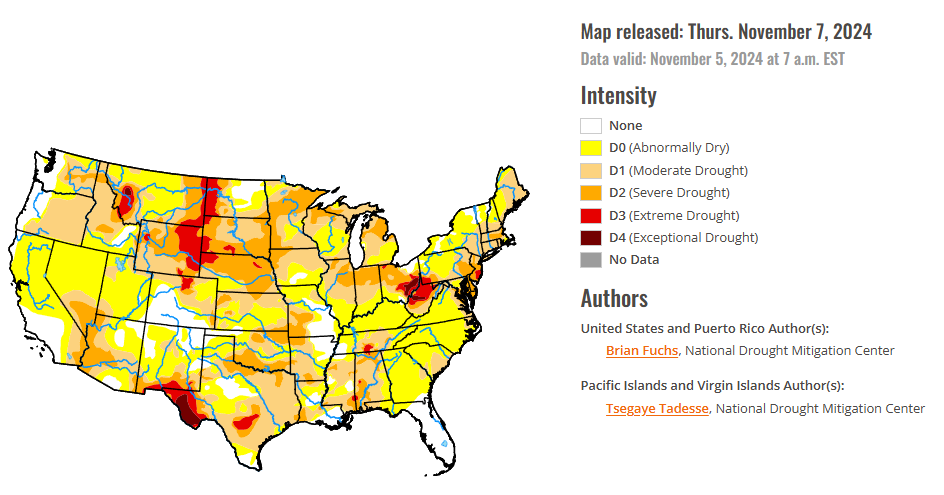
To view the United States Drought Map, CLICK HERE.
According to the latest U.S. Drought Monitor, over the last week, weather systems tracked over the southern Plains and into the Midwest, bringing much-needed precipitation. Some areas of Arkansas and Missouri reported over 10 inches of rain for the week. The active pattern also continued over the Pacific Northwest, with the coastal areas and inland recording 2-4 inches of rain that helped to alleviate dryness. Temperatures over the West were below-normal for the week, by as much as 6-9 degrees in parts of Nevada, Utah and Arizona. The rest of the country had warmer-than-normal temperatures, especially in Texas and into Louisiana, Mississippi, Arkansas and Alabama, where they were 9-12 degrees above normal. Many areas that received rain during the period had these rains come on the cusp of record-setting dryness in October, but many records were still set for areas that didn't receive rain at the end of October and early November.
In the Southern Plains, temperatures were 12-15 degrees above normal, with areas of the Texas Panhandle into Oklahoma 6-9 degrees above normal. Much of Oklahoma and north Texas and Arkansas received significant precipitation, with widespread reports of 800% of normal rain for the week. The dryness continued over much of Tennessee and into northern Mississippi as the active rain patterns brought some rains, but not the significant and widespread rains that were more common in the West. A full category improvement was made over much of Oklahoma and northern Texas and western Arkansas, with extreme drought removed from the region. Extreme drought emerged in southeast Mississippi. Severe drought improved in Louisiana with moderate drought and abnormally dry conditions also improving in southern Louisiana.
In The High Plains, significant rains fell over much of Kansas, into southeast Nebraska and southeast Colorado. Rain and snow fell from portions of eastern Colorado into Wyoming and into the Dakotas too, reversing the trend of very dry conditions. Not all areas were as fortunate, with northeast Colorado, western Nebraska, eastern and southwest South Dakota and northwest North Dakota remaining dry this week. The region was split, with temperatures in the western areas 3-6 degrees below normal, and temperatures 9-12 degrees above normal in much of eastern Nebraska and eastern Kansas. Much of eastern Kansas saw a full category of improvement this week, with extreme drought being removed from the southeast. Severe drought was removed from far southeast Nebraska. In western North Dakota and in eastern Montana, severe and extreme drought expanded slightly. Some improvements were made to abnormally dry conditions over central to southern Colorado and to moderate drought over northeast Colorado. Moderate drought expanded across central South Dakota this week.
In the West, precipitation was scattered, with the greatest rain over the Pacific Northwest, where 200% of normal rain was recorded for the week in much of Oregon and Washington. Cooler-than-normal temperatures dominated the region with many areas of Nevada, Utah, and Arizona and into western Wyoming 6-9 degrees below normal for the week. Dryness continued to dominate much of Montana with abnormally dry conditions expanding to fill the rest of the state and moderate and severe drought expanding in the west. Abnormally dry conditions spread to the rest of central Utah while moderate drought and abnormally dry conditions improved over much of western Oregon and Washington. Some improvements were made over eastern New Mexico this week as a result of the continued wetter conditions
Looking ahead, over the next 5-7 days, it is anticipated that the wet pattern will continue over much of the southern Plains and into the South, Southeast, and Midwest. The active pattern along the coastal areas of the Pacific Northwest will also continue. Greatest precipitation is anticipated over the southern Plains, western Tennessee, western Kentucky, northern Mississippi, southern Georgia, western South Carolina and the Pacific Northwest coast, where 3 or more inches of rain is anticipated. Much of the West will remain dry. Temperatures will remain cooler than normal over much of the West with departures of 10-12 degrees below normal over northern New Mexico and southern Colorado. Much of the eastern half of the country will be warmer than normal, while areas of the Midwest and South are anticipated to be 10-12 degrees below normal for the week. Hurricane Rafael has formed in the Gulf of Mexico and is projected to track westward. It may not make landfall until the middle of next week but could impact the dryness over the South and southern Plains depending on its path.
The 6-10 day outlooks show that the probability of above-normal temperatures will be greatest over the eastern half of the United States, especially over the Midwest and into the Southeast. Chances of cooler-than-normal temperatures are greatest over the West, in particular over California and Nevada. Most of the country has a good chance of recording above-normal precipitation during the period, especially over the Pacific Northwest..
To view the 6-10 Day Precipitation Outlook Map, click here.
To view the 6-10 Day Temperature Outlook Map, click here.
To view the Monthly Drought Outlook Map, click here
RON's Dave Lanning has a pre-opening look at today's agricultural Markets.
Click the audio tab below for today's report.

At the American Angus Convention in Ft. Worth, Texas, Oklahoma State University's Dr. Shannon Ferrell gave a presentation on succession planning and Senior Farm and Ranch Broadcaster Ron Hays caught up with him to get the details for you.
Ferrell acknowledged the increasing median age of agricultural producers across the nation and the fact that estimates show that perhaps a trillion dollars in agricultural assets will need to be transferred to the next generation of farmers and ranchers in the next twenty years.
Misconceptions surrounding succession planning are common. Ferrell detailed that only 30% of family-owned businesses will survive succession intact because owners have failed to plan correctly. Also, 64% of farms and ranches exist with no estate plan in place.
"You really have to do something," he said. "You have to be proactive, otherwise, a lot of forces are working to pull your ranch apart as it makes that transition."
Another common misconception is the minuteness of the estate tax exemption, when in fact, it is currently over $13 million. "I think a lot of people may be making transition steps out of fear, especially of an estate tax liability, when for most of our operations, that's not really going to be the concern," he stated. "We need to make sure that we aren't letting that unfounded concern force us into decisions that may not be best for the operation."
According to Ferrell, no matter what a person's asset base is or their family situation, there are certain things that everyone needs to have in place. Parents with children under 18 need a guardian nomination on record. Anyone with an investment account should be taking advantage of the beneficiary designations on it. Everyone should have a durable power of attorney for business and one for health care decisions, an advanced directive for end-of-life care and organ donation decisions, and a will to designate their property after their deaths.
"If you don't know where to start, do a deep dive inventory of all of the assets you have," Ferrell instructed. "Land deeds, business records, investment accounts, and put it all together in one place."
This is the first step that an attorney or accountant will take when asked to draw up documentation, so having it done already saves time and money. "The other thing is that as you go through that process, you start to see the picture of yourself, and you may not have ever pulled all of those pieces together before. You also start to think in your head about where that asset needs to go and how it might get there. So you have already jumpstarted the transition process just by that exercise," Ferrell explained.
To access more information about succession planning, visit OSU's Farm Transitions website here.
The Beef Buzz is a regular feature heard on radio stations around the region on the Radio Oklahoma Ag Network and is a regular audio feature found on this website as well. Click on the LISTEN BAR for today's show and check out our archives for older Beef Buzz shows covering the gamut of the beef cattle industry today.
The U.S. Department of Agriculture (USDA) broke its promise to our nation's cattle producers. After pushing back against the agency's persistent efforts to mandate electronic identification (EID) eartags on all cattle of all ages for 13 years, the agency offered a compromise to the cattle industry in 2013. The agency promised to implement a system of disease traceability that gave cattle producers flexibility in determining which type of individual animal identification device would best fit their operations. Producers could choose a low-cost metal or plastic eartag or they could choose the highest-cost eartag – the EID eartag. The agency's promise to cattle producers was that they would be given the right to choose.
But the USDA soon reneged on its promise when, in 2019, it issued a policy paper mandating the exclusive use of EID eartags beginning January 1, 2023. When the agency did this, and with the help of the New Civil Liberties Alliance, we sued the USDA over that broken promise. And within a matter of weeks, the agency withdrew its mandate.
But the agency came right back with a notice the very next year stating it was still going to mandate the exclusive use of EID eartags, again by January 1, 2023. Again, we pushed back, not in the courts this time but within the Administration, and we succeeded again – the agency withdrew its mandate.
Now, and despite overwhelming opposition from cattle producers, the USDA has bowed its neck and issued a final rule to mandate the exclusive use of EID eartags for certain adult cattle shipped across state lines.
The agency states that EID eartags will improve its disease traceback capabilities. But this is just a pretext for its true objective of appeasing multinational beef packers and eartag manufacturers, both of whom expect to benefit from the mandate. The final rule does not accomplish the USDA's disease traceback goals because, as the USDA itself admits, the infrastructure for reading EID tags and digitally recording tag numbers must also be in place in order to achieve the benefits of the EID technology. But that costly infrastructure is not in place and the final rule doesn't even require it to be.
So, the only mandate within the rule is to require cows to wear EID eartags. There's no requirement that the eartags be electronically read, and no requirement that the electronic data contained in the eartag be exported electronically to a database. In other words, the new rule will function just like the 2013 rule, except that cattle producers will no longer be afforded the right to choose what type of animal identification device best fits their operations.
And so, for that reason – that the rule can't accomplish what the USDA said it would, and because Congress never authorized the USDA to burden U.S. cattle producers with an EID mandate, we're challenging this final rule in court, again with the New Civil Liberties Alliance as our legal representative.
R-CALF USA is the lead plaintiff in the legal challenge against the final rule and the South Dakota Stockgrowers Association and the Farm and Ranch Freedom Alliance have joined us as co-organizational plaintiffs. There are also three husband and wife co-individual plaintiffs.
The lawsuit was filed in the federal district court in Rapid City, South Dakota, on October 30, but the date the final rule begins having the force and effect of law is November 5.
In an effort to postpone the November 5 effective date of the final rule, the New Civil Liberties Alliance, on our behalf, has formally requested the Secretary of Agriculture to postpone the effective date of the final rule while it is under judicial review. In the alternative, the NCLA asks the USDA to delay the final rule for 180 days.
And here's where we would appreciate your help, and I'm going to give you two phone numbers in just a bit. First, it would be great if you'd call Secretary of Agriculture Tom Vilsack to urge him to postpone the EID rule until the lawsuit is finished. You can reach Secretary Vilsack's office by calling 202-720-3631.
Next, it would be great if you called your two Senators and your Representative to tell them a lawsuit has been filed against the USDA's unlawful EID mandate and that you want them to contact the Secretary of Agriculture's office to urge the Secretary to postpone the mandate until the lawsuit is finished. You can reach your members of Congress by calling the Capitol Switchboard and asking for them by name. The number is 202-224-3121.
And if you're in another occupation, It would be great if you'd make calls too because this draconian rule is a classic example of unlawful government overreach, which is bad government, and everyone should want it to stop.
Monday, November 11th from 12:00 - 1:00PM CST
iGENDEC is an advanced software tool designed to help cattle producers understand and improve their herd's genetics. By utilizing known genetic relationships among traits, breed differences, and a producer's own knowledge about their herd, iGENDEC provides detailed insights into how different traits should be emphasized when selecting herd bulls. With this information, producers can make more informed breeding decisions, leading to healthier, more productive herds. Using iGENDEC can boost long-term profitability by optimizing genetic potential, improving herd quality, and increasing operational efficiency.
Join us to hear more about what this updated rule means for you!

"Oklahoma's 2024 General Election is one for the history books. Unofficial results show that more Oklahomans cast a vote for President than any previous election. Voters set a new record for in-person early voting by more than 120,000. We also had the largest number of registered voters heading into this election since we began tracking this statistic in 2000.
"As Oklahoma's chief election official, I am proud of the Oklahomans who exercised their right to vote in this election. I am deeply grateful for the poll workers, county election officials, and State Election Board employees who worked so hard to make this election possible even with heavy turnout and despite the storms that ravaged parts of our state in the days before the election. Our election officials are thankful to local, state and federal law enforcement officials for their efforts to keep everyone safe during the General Election."
Today, the Public Lands Council (PLC) issued the following statement on the results of the 2024 election:
"We congratulate President Donald Trump on his victory and stand ready to renew our work with him to cut government red tape and unleash the full potential of our nation's natural resources. It is no secret that livestock production on public lands has long been targeted by an over-involved bureaucracy that has hindered ranchers' work to conserve lands, while raising the best food and fiber in the world," said PLC President and Colorado rancher Tim Canterbury. "Moving forward, it's critical President Trump restores transparency to the federal rulemaking process so that input from real cattle and sheep producers is actually heard and not ignored. Ranchers are in dire need of regulatory relief and PLC is excited to work with the Trump Administration to streamline the federal permitting process to improve the health of America's vast rangeland."

Following the election of Donald Trump and the significant changes anticipated for the US economy from a Trump 2.0 presidency;
Paula Bauer, Vice President Agricultural Consumer and Retail, North America at GlobalData, a leading data and analytics company, offers her view on some of the changes expected in the US agribusiness industry from Trump 2.0:
"Overnight, there appears to be a small exhale as the country knows who will occupy the Senate, House and White House. Today's primary focus is economic policy, and with a single party in control in the House, Senate and Presidency, we could finally see a farm bill put in place early next year with an outside chance of an extension of the expired 2018 Farm Bill during this lame duck session.
"Only 20% of the total U.S. Department of Agriculture (USDA) budget is spent on agriculture programs and subsidies. Nutrition assistance spending including the Supplemental Nutrition Assistance Program (SNAP) and the Special Supplemental Nutrition Program for Women, Infants, and Children (WIC) is 80% of the budget. With a relatively small percent spent on crop assistance, it could be argued the real power in a farm bill is the sense of stability. Markets like stability.
"Instabilities, however, could come in the form of trade and renewable energy policies. US Farmers are really good at what they do. So good, in fact, that much of what is grown is sold to other countries. Care must be taken in trade policy to not alienate buyers.
"Additionally, US Ag occupies a large space in the energy sector. Will energy policies and renewable fuels standards change come January 2025? As a party, the Right has been critical of electrification of vehicles because some power plants are 'dirty energy'. Even if support for electrification falls out of favor, the US may retain gains made in adopting ethanol and biofuels for internal combustion engines and continue to support SAF technologies for air travel. Support for this could be found in pro-environmental groups, Ag groups, pro-domestic energy consortiums and businesses who've invested heavily in this technology including major petroleum companies.
Following the call of the 2024 presidential election by the Associated Press in favor of Donald Trump as president-elect, NAWG President Keeff Felty provided the following statement:
"Congratulations to President-elect Trump and the incoming members of the 119th Congress. American agriculture faces many challenges, and we look forward to working with the House and Senate leadership and the new Senate Agriculture Committee Chair and Ranking Member in a bipartisan manner to support our farmers."
"However, there is work yet to be done this year. Wheat growers are seeking action during the lame duck to enact a farm bill and economic assistance by the end of the year that supports growers as we continue to face increased input costs, depressed prices, and weather-related disasters. It is critical that we continue to advance those policy initiatives immediately and work with everyone in the 119th Congress to foster public policy initiatives that help our farmers and rural communities thrive."
About NAWG
NAWG is the primary policy representative in Washington D.C. for wheat growers, working to ensure a better future for America's growers, the industry and the general public. NAWG works with a team of 20 state wheat grower organizations to benefit the wheat industry at the national level. From their offices on Capitol Hill, NAWG's staff members are in constant contact with state association representatives, NAWG grower leaders, Members of Congress, Congressional staff members, Administration officials and the public.
Today, Oklahoma House Democratic Leader Cyndi Munson, D-Oklahoma City, released the following statement regarding last night's election results for House Democrats.
"For the second election cycle in a row, House Democrats are welcoming back every Democratic member who ran for re-election and adding new members to our caucus," Leader Munson said. "Our members on the ballot worked hard communicating with their constituents on their doorsteps and I'm excited to continue working with them to protect women's reproductive rights, fight for public schools by standing up to our State Superintendent, and build an economy that works for everyday Oklahomans.
"Our candidates ran strong campaigns and, with the support of our caucus infrastructure, shared a clear vision for Oklahoma's future that has and will continue to make a difference in our state going forward.
"I'm especially excited to work with our three new incoming members: Rep.-Elect Michelle McCane, D-Tulsa, Rep.-Elect Ronald Stewart, D-Tulsa, and Rep.-Elect Ellen Pogemiller, D-Oklahoma City. They bring a diverse range of experience and backgrounds in education, public service, and nonprofit leadership to our caucus, and I look forward to their contributions to the Oklahoma House of Representatives and our state."

The American Royal was founded in 1899 as the first-ever exhibition and sale of purebred cattle. 125 years later, the annual livestock show tradition continues with record-setting results. The three-week show boasted nearly 8,000 entries from over 2,400 exhibitors representing 44 states, and $31,000 in scholarships were awarded to youth participants.
The market animal show was record-setting. An all-time high of 2,684 animals filled the barns for exhibition in the market swine, sheep, goat and cattle shows. Sales of species champions in the Junior Premium Livestock Auction, a highlight event, set a new record for the American Royal, bringing in $876,000 to support junior exhibitors in furthering their education.
In the market animal show, the Grand Champion Market Barrow was exhibited by Kyle Odell of California, and the Reserve Grand Champion Market Barrow was exhibited by Cason Bratland of South Dakota. The Grand Champion Market Lamb was exhibited by Hudson Franklin of Texas, and the Reserve Grand Champion Market Lamb was exhibited by Kirsten Walck of Oklahoma. The Grand Champion Market Goat was exhibited by Madden Wise of Texas, and the Reserve Grand Champion Market Goat was exhibited by Bisco Black of Texas. The Grand Champion Market Steer was exhibited by Ruby Bell of Oklahoma, and the Reserve Grand Champion Market Steer was exhibited by Rhylee Rodgers of Iowa.
The American Royal also awarded a premier junior market exhibitor award to recognize an exhibitor who showed success in the show ring, educational contests and skill development. The inaugural honor was awarded to Lindsey Dore of Ohio.
"We are so proud of the youth who exhibited such high-quality animals during our record-setting market animal show," said Matt Durian, livestock manager at the American Royal. "Competition was just as fierce in the breeding cattle show this year, where we were able to have the first-ever supreme open female and bull drive, bringing all the breed champions together for an overall selection."
The Grand Champion Angus Bull, exhibited by Jeff Fruhling of Illinois and Austin Nowatzke of Colorado, was named Supreme Champion Open Bull. The Grand Champion Maine-Anjou Female, exhibited by Sloane Curtin of Iowa, was crowned Supreme Champion Open Female.
Addison Bartlow of Illinois exhibited the Supreme Champion Junior Heifer—a purebred Simmental.
During the livestock show, the American Royal also hosts the 4-H, FFA and collegiate livestock judging, and 4-H and collegiate meats judging competitions. Over 500 contestants participated this year.
The Grand Champion 4-H Livestock Judging Team was from Texas, and Reserve was awarded to the team from Kansas. The top 4-H individual was Pecos Worrell of Texas. The Grand Champion FFA Livestock Judging Team was from Illinois, and Reserve was awarded to Indiana. The top FFA individual was Lola Mitchell of Colorado.
In the collegiate livestock judging competition, the Grand Champion Senior College Team was Kansas State University, and Reserve was awarded to Texas Tech University. Grace Angotti of Western Illinois University was the top senior college individual. The Grand Champion Junior College Team was Black Hawk East College, and Reserve was awarded to Northeastern Oklahoma A&M College. Tyeson Gravenhof of Northeastern Oklahoma A&M College was the top junior college individual.
The Grand Champion 4-H Meats Judging Team was from Texas, and Reserve was awarded to Kansas. Brecken Shipman of Texas was the top 4-H individual. The Collegiate Grand Champion American Division Meats Judging Team was West Texas A&M University, and Reserve was awarded to Texas Tech University. Will Hauerland of West Texas A&M University was the top individual in the American division. The Collegiate Grand Champion National Division Meats Judging Team was Clarendon College, and Reserve was Garden City Community College. Aaron Morales of Garden City Community College was the top individual in the National division.
"The American Royal has grown and prospered so much since our beginning in 1899, and I'm proud that we were able to celebrate our 125th anniversary the way it all began," said Jackie McClaskey, president and CEO at the American Royal. "Our livestock show is more than just a livestock show. It is centered around our mission of championing food and agriculture for youth and adults. The livestock show serves as a backdrop for youth in agriculture to compete against their peers and receive scholarships and premiums that will positively impact their future. We also get to host some extremely talented judging contests and invite local elementary students to learn more about agriculture."
The American Royal's fall field trip brought nearly 400 local third, fourth and fifth grade students closer to agriculture. They were able to watch part of the show and participate in 18 interactive stations to learn about where their food comes from.
Learn more about the American Royal at americanroyal.com.
Senate Pro Tem Designee Lonnie Paxton, R-Tuttle, today released the following statement after Tuesday's election.
"Oklahomans spoke loud and clear last night when the election results came in. They show a clear endorsement of our continued efforts to ensure safer communities, individual liberties and a growing economy for hardworking Oklahomans. I have had the pleasure to already meet and continue an open dialogue with all our current and new members of the Senate and I am proud to say we have a class of new Senators coming in who will help us build on our positive momentum. Collectively, we all support values that matter most to Oklahoma including protecting our rights and fostering an environment that believes in the future of this state.
"I want to congratulate everyone who won their races last night in the Senate, House, our federal delegation and President Trump and Vice President Vance. Together we will build a stronger state and nation and uphold the trust the electorate has placed in us. Our best days are ahead of us, and we will continue to advance policies that make Oklahoma a better place to live, work and raise a family."
The swearing in of new Senators will be at 2 p.m. on Wednesday, November 13 in the Senate Chamber.
Sen. David Bullard, R-Durant, released the following statement regarding President Donald Trump's victory in the presidential election.
"This is a day Oklahomans will remember as the day we made our conservative values and voices heard loud and clear. The results of our elections prove that point, and the people of this great state have not been shy about the fact that they want conservative leaders.
"Together, we will guard our election system, protect our kids, reform our tax structure, defend our state from federal overreach, preserve our lands, protect our freedoms and so much more. I endorsed President Trump as a partner in Making America Great Again, and I vow to make Oklahoma a leader in his mission."
Today, the National Cattlemen's Beef Association (NCBA) congratulated President-Elect Donald Trump on his decisive victory in the 2024 presidential election and reiterated its enthusiasm for working with him once again.
"Congratulations to President-Elect Trump for his historic victory last night and for running such a hard-fought campaign. NCBA is excited to work with the President-Elect to undo the harm which cattle producers have endured under four years of "Bidenomics" and restore the free-market principles which have made U.S. cattle and beef the finest and safest in the world." said NCBA Vice President of Government Affairs Ethan Lane. "Despite cattle prices soaring to record highs over the previous years, producers have been squeezed by exceptionally high input costs, record inflation, and the Biden Administration's so-called competition agenda. This is the perfect opportunity to execute a hard reset on all of these failed policies."
Oklahoma House of Representatives Speaker-Designate Kyle Hilbert, R-Bristow, released the following statement regarding Tuesday's general election results:
"This week was strong for House Republicans, as we secured 81 out of the 101 seats in the Chamber. Our candidates ran phenomenal campaigns and voters locally and nationally made it clear they support our conservative vision. Our caucus is ready to work with President Trump, our Congressional delegation, the state Senate, and the Governor to continue building on the great momentum we have behind us in Oklahoma."
The House will conduct its oath of office ceremony for members of the 60th Legislature at 10 a.m. on Wednesday, Nov. 20, in the House Chamber.
The deadline for House members to request the drafting of House Bills and Joint Resolutions is Friday, Dec. 6. The deadline to file bills and joint resolutions is 4 p.m. on Thursday, Jan. 16, 2025.
The House will officially convene for its constitutionally-required Organizational Day on Tuesday, Jan. 7, 2025, and the First Session of the 60th Legislature reconvenes on Monday, Feb. 3.
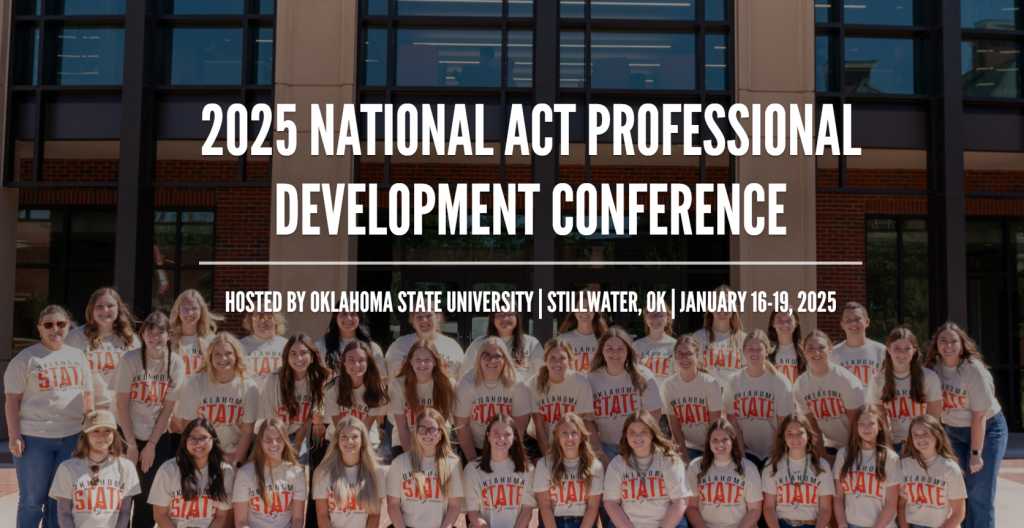
The Oklahoma State Agricultural Communicators of Tomorrow (ACT) Club is set to host the National ACT Professional Development Conference (PDC) on January 16-19, 2025. This premier event is held annually for agricultural communications students from across the nation. Farm Director KC Sheperd talked to our own Maci Carter who is president of Oklahoma State ACT, about the event.
"Each university usually has their own chapter," Carter explained. "We have about a hundred due-paying members at Oklahoma State. We threw our names in the hat and received the honor of hosting PDC this year."
PDC is a three-day conference, providing a platform for students to immerse
themselves in a variety of opportunities aimed at advancing their professional and personal growth in the agricultural communications industry.
"Students will get the opportunity to talk with industry professionals, build skills, and network," Carter said.
While it is too soon to give the names of Speakers for the event, Carter said that thirty industry professionals have been invited to speak there. "We have everything from, you, KC Sheperd, talking about radio broadcasts and mentorship. We have stuff about writing, photography, and design. Information on marketing yourself, building a portfolio, and some financial information about running a business. Hopefully, we have everything under the sun covered! We are really excited about those workshops and the opportunity for our students to work with those professionals."
To ensure that the opportunity for students and professionals alike isn't cut short by any means, Carter and her team are asking for donations for the event. Funds will be allocated for securing a suitable venue, creating engaging decorations to set the tone of the event, and covering any other necessary logistics to ensure the conference runs smoothly and successfully.
"We are taking sponsorships or any other type of support that people are willing to give," Carter said. "We have three different levels of sponsorship: a five-hundred-dollar level, a thousand-dollar level, or a twenty-five-hundred-dollar level."
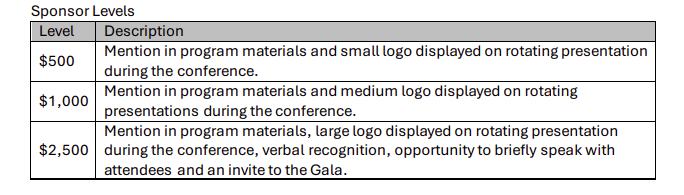
On the last night of the event, ACT will be hosting a gala dinner for top sponsors to have another opportunity to get to know the students who are attending from across the nation.
For additional information about the event or becoming a sponsor, send an email to either Maci Carter or Kenna Sandberg, or visit the website here.
"Other students should be hearing about this through their own chapters, and National ACT Communications," Carter said. "The Oklahoma Agricultural Community is the reason we are so strong here at Oklahoma State, and we want to be able to show the students from other institutions what that community looks like."
| ||||||||||||||||||||||||||||||||||||||||||||||||||||||||||||||||||||||||||||||||||||||||||||||||||||||||||||||||||||||||||||||||||||||||||||||||||||||||||||||||||||||||||||||||||||||||||||||||||||||||||||||||||||
| ||||||||||||||||||||||||||||||||||||||||||||||||||||||||||||||||||||||||||||||||||||||||||||||||||||||||||||||||||||||||||||||||||||||||||||||||||||||||||||||||||||||||||||||||||||||||||||||||||||||||||||||||||||
|
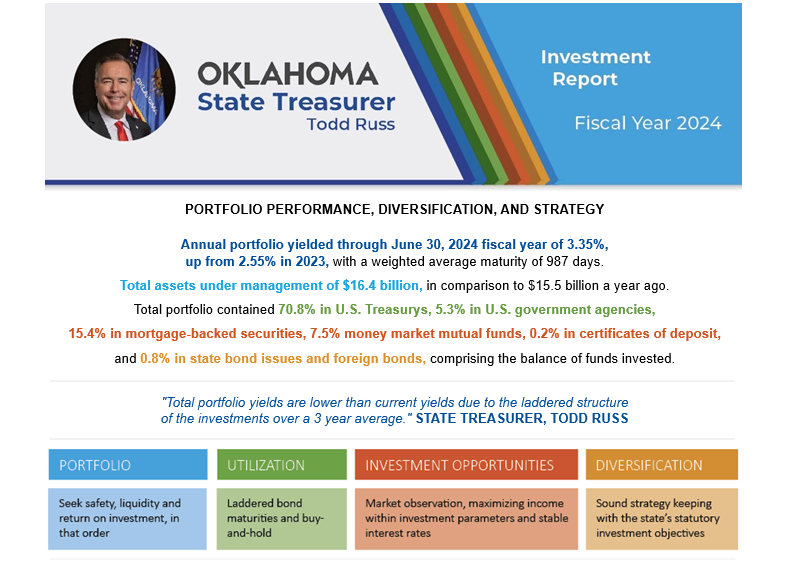 TOTAL FUNDS INVESTED Funds available for investment at market value include the State Treasurer's investments at $12,412,332,151 and State Agency balances in OK Invest at $3,972,739,644, for a total of $16,385,071,795. |
| MARKET CONDITIONS |
| The Federal Reserve held rates high during fiscal year 2024. The benchmark federal funds rate—the rate banks borrow at to meet their reserve requirements—started at 5% to 5.25%. At the July 2023 Federal Open Market Committee meeting the rate was raised 25 basis points to 5.25% to 5.5%, the highest rates since February 2001. Throughout the fiscal year the Fed kept interest rates elevated to fight against stubborn inflation that persisted above the annual target rate of 2%. The significant lag between the changes in monetary policy and consumer spending pointed to how insulated US consumers were from the high-rate environment. The treasury yield curve, a visual portrayal of interest rates and US treasury security maturity dates, remained inverted or negatively sloped this fiscal year. Short-term yields are slowly falling, and long-term yields are rising in a pattern called disinversion. The 2-year treasury note yield fell 14.5 basis points to 4.76% and the 10-year treasury note yield rose 55.7 basis point to 4.40% during the fiscal year. US equity indices performed exceptionally well during the fiscal year with stable interest rates as investors balanced fears of inflation and promises of future rate cuts with the motto "higher for longer". The technology sector led the stock market rally with the firms that stand to benefit most from the AI revolution at the front of the pack. The S&P 500, Dow Jones Industrial Average and the Nasdaq 100 grew during the fiscal year by 22.7%, 13.8%, and 29.6% respectively before reinvesting dividends. The S&P 500 and Nasdaq 100 both hit all-time highs in June. |
ECONOMIC DEVELOPMENTS |
| The national unemployment rate was historically low throughout the fiscal year ending June at 4.1%. There were approximately 2.5 million non-farm seasonally adjusted jobs created in FY 24, in comparison to 3.7 million in FY 23. The seasonally adjusted Consumer Price Index (CPI) and the Producer Price Index (PPI) grew 2.98% and 2.88% respectively for FY 24. The unadjusted price index for food increased 2.22% during the fiscal year, below headline inflation. The unadjusted price index for shelter increased 5.16% during the same period, outpacing inflation but decelerating from a red hot 7.83% in FY 23. |
| Retail sales grew 1.97% during the fiscal year slightly ahead of the prior period's growth of 1.94%. June existing home sales fell to 3.9 million units, just barely above October's 3.85 million, the lowest since 2010. The fiscal year ended with June 30-year fixed mortgage rates at 6.92%—falling from October's 23 year high of 7.62%—and median existing home sales price of $426,900, an all-time high. |
| The gross domestic product (GDP)—a measure of goods and services produced across the United States—on an annualized quarter-over-quarter basis, growth was – 4.4% for the 3rd quarter of 2023, 3.2% for the 4th quarter of 2023, 1.6% for the 1st quarter of 2024 and 3.0% for the 2nd quarter of 2024. GDP growth was primarily fueled by three industries for the fiscal year: retail motor vehicles and parts dealers, healthcare and social assistance, and non-durable goods led by petroleum, coal, and chemical products per data from the Bureau of Economic Analysis. |
| COLLATERALIZATION All funds under the control of this office requiring collateralization were secured at rates ranging from 100% to 110%, depending on the type of investment. |
| PAYMENTS, FEES AND COMMISSIONS Securities were purchased or sold utilizing competitive bidding. Bank fees and money market mutual fund operating expenses are detailed in the attached pages, as is the earnings split between the State Treasurer and the master custodian bank on securities lending income. |
Best regards,  TODD RUSS STATE TREASURER cc: The Honorable Kevin Stitt, Governor The Honorable Charles McCall, Speaker of the House The Honorable Greg Treat, President Pro Tempore The Honorable Gentner Drummond, Attorney General The Honorable Cindy Byrd, State Auditor and Inspector View full report below. FY24 Annual Investment Report.pdf |
On the sidelines of the American Angus Convention in Ft. Worth, Texas, Senior Farm and Ranch Broadcaster Ron Hays spoke with Nevil Speer, a beef industry consultant and influential columnist. Yesterday, they covered several topics from herd rebuilding to the positive side of extended droughts. Today, they are discussing the heightened quality of modern beef.
"It is just amazing what has happened over the last ten years," Speer said. "That is what causes the return of the customer. We have more upper two-thirds choice, more prime; we all have learned to like marbling. It has really made a difference in terms of consumer acceptance and that is what gives us pricing power and drives dollars."
He emphasized how every dollar in the beef industry comes from the consumer, so the product produced must invoke demand from consumers.
"One thing we have to remember is that there is more equity at risk in this business than ever," he stated. "This is a big dollar business, and we need to keep that in mind."
Hays brought up the USDA's proposal to level the prices of all cattle with no premiums, but Speer defended the industry's market-oriented approach describing the value of grid marketing. He said, "Grid marketing is what began to allow us to separate the value of cattle, and ultimately because it was in response to consumer signals. It is what allowed cattle producers to get closer to the consumer and get paid accordingly. Any effort to undo that would unravel all of the gains we have made with the consumer."
He emphasized the $1,300 difference from the top-priced cattle and the bottom-priced cattle and how different individual animals are. He was in accordance with different prices for different animals being very justifiable.
He related that consumers are just as varied, with different price/value drivers. While demand for a quality product is the most common factor, getting beef into the hands of the consumer is a very complex business when considering things such as shopping experience, how to categorize beef, and determining price points.
The Beef Buzz is a regular feature heard on radio stations around the region on the Radio Oklahoma Ag Network and is a regular audio feature found on this website as well. Click on the LISTEN BAR for today's show and check out our archives for older Beef Buzz shows covering the gamut of the beef cattle industry today.

September exports of U.S. pork and beef were higher year-over-year, according to data released by USDA and compiled by the U.S. Meat Export Federation (USMEF), with pork exports well-positioned to set annual volume and value records in 2024.
USMEF President and CEO Dan Halstrom explains much of the pork growth in September was driven by Colombia, as well as small and medium-sized markets in Central America, Southeast Asia and Oceania.
September pork exports totaled 238,047 metric tons (mt), up 8% from a year ago, while value increased 6% to $685.1 million. Through the first three quarters of the year, pork exports were 5% above last year's pace at 2.23 million mt, with value up 7% to $6.36 billion.
"U.S. pork's September performance was especially encouraging because growth was mainly driven by small and medium-sized markets in Central America, Southeast Asia and Oceania, and pork exports to Colombia continue to reach new heights," said USMEF President and CEO Dan Halstrom. "It was certainly another robust month for pork exports to Mexico and shipments to Japan were above last year. But the broad-based growth reflects the U.S. industry's strong commitment to market diversification."
Exports of U.S. beef totaled 103,980 mt in September, up 5% year-over-year, while export value climbed 6% to $843.8 million. January-September exports increased 5% in value to $7.82 billion, despite volume falling 2% to 960,814 mt.
With the exception of China/Hong Kong, September beef exports trended higher than a year ago in all major Asian markets, while demand remained strong in Mexico and shipments to Central America were the largest in 18 months.
"The tourism rebound in Asia has certainly provided momentum for U.S. beef, especially in Japan, Taiwan and Korea," Halstrom said. "We also saw impressive growth in the Philippines and Indonesia, which are markets where we see a lot of untapped growth potential."
Mexico, Central America, Asian markets fuel September beef export growth
Mexico was the leading volume market for U.S. beef exports in September, with shipments climbing 20% from a year ago to 19,692 mt. Export value was 19% above last year at $112.1 million.
January-September exports to Mexico were up 13% to 173,283 mt, while value increased 17% to just over $1 billion. This included 92,465 mt of variety meat exports, up 17% year-over-year, while the value of these items increased 10% to just under $250 million. This included about $73 million of beef tripe, $69 million of lips and $34 million of hearts.

After a slow start in 2024, beef exports to Taiwan rebounded impressively in the second and third quarters. This trend continued in September, with exports climbing 36% from a year ago to 4,702 mt, valued at $53.3 million, up 33%. These results pulled January-September exports to Taiwan to within 1% of last year's pace in volume (47,371 mt), while value increased 8% to $525.1 million.
September beef exports to Japan totaled 19,249 mt, up 10% from a year ago, while value increased 6% to $145.8 million. Through September, exports to Japan were slightly ahead of last year's pace at 188,885 mt (up 1%), while value climbed 5% to $1.46 billion.
Other January-September results for U.S. beef exports include:
Broad-based growth has pork exports poised to set annual records
September pork exports to leading market Mexico totaled 91,492 mt, up 3% from a year ago, though value edged slightly lower to $206.6 million. Exports to Mexico remained on a record pace through September, climbing 7% in volume (850,204 mt) and 12% in value ($1.89 billion). With a strong fourth quarter, export value to Mexico will exceed $2.5 billion, which is in line with USMEF's forecast. Exports to Mexico currently equate to nearly $20 for every U.S. hog slaughtered.
Led by outstanding growth in Honduras, Guatemala, Costa Rica, El Salvador, Panama and Nicaragua, September pork exports to Central America soared 36% above last year to 12,895 mt, valued at $41.9 million (up 42%). Exports to the region are also on a record pace in 2024, with shipments through September climbing 23% to 109,634 mt, with value up 33% to $344 million.

Robust growth in the Philippines, Malaysia and Singapore pushed September pork exports to the ASEAN region to 7,701 mt, up 83% from a year ago, while value climbed 82% to $16 million. Domestic production in the region continues to be impacted by African swine fever, driving strong demand for imports. U.S. pork is capturing market share previously held by European suppliers, although EU exports to the region have rebounded to some degree this year. Through September, U.S. exports to the ASEAN region increased 17% from a year ago to 61,320 mt, while value was up 8% to $134.2 million.
Other January-September results for U.S. pork exports include:
September lamb exports lowest of 2024
Exports of U.S. lamb reached just 167 mt in September, down 32% from a year ago and the lowest this year. Export value was $853,000, down 27%. Despite this slowdown, January-September lamb exports were 13% above a year ago at 2,113 mt, while value increased 17% to $11.1 million. Shipments trended higher than a year ago to the Caribbean, Mexico, the Philippines, Guatemala and Taiwan. Lamb exports to Mexico are on pace to be the largest since 2019, while shipments to the Bahamas are the strongest since since 2011.
Complete January-September export results for U.S. pork, beef and lamb are available from USMEF's statistics web page.
The Oklahoma Emergency Drought Committee will meet on Friday, November 8th at 11:30 a.m. in Oklahoma City at the Oklahoma Department of Agriculture, Food, and Forestry (2800 N. Lincoln Blvd., Oklahoma City, OK). There will be an opportunity for public comment. Information regarding the Emergency Drought Committee can be found and an agenda for the meeting can be found here: Oklahoma Emergency Drought Commission and Drought Resources – ODAFF
Oklahoma's Emergency Drought Commission, enabled through passage of Enrolled House Bill 1923 in 2013, provides funding for drought mitigation and related projects in Oklahoma in conjunction with a formal gubernatorial drought declaration. The Emergency Drought Commission consists of the Executive Director of the Oklahoma Conservation Commission, the Secretary of Agriculture and the Executive Director of the Oklahoma Water Resources Board.
The Emergency Drought Commission shall determine the expenditures to be made from the Emergency Drought Relief Fund, totaling up to three million dollars as appropriated by House Bill 2959, and shall determine the appropriate agency to expend the funds. The activities of the Emergency Drought Commission shall continue until it is determined by the Governor that a drought emergency no longer exists in the state. Specific assistance projects are limited to the affected counties and must be approved by the Oklahoma Emergency Drought Commission. The Emergency Drought Commission also serves as a permanent drought advisory panel to the Governor and appropriate state agencies.
The Emergency Drought Commission shall have the authority to consider requests for use of Emergency Drought Relief Funds from proposed projects located, or operating, within one, or more, of Oklahoma's 77 counties, in accordance with EO 2022-23.
Growth Energy CEO Emily Skor issued the following statement on the 2024 election results:
"Growth Energy extends its congratulations to President Donald J. Trump on his re-election as President of the United States and J.D. Vance on his election as Vice President of the United States.
"President Trump has championed consumer access to American-made, lower-cost ethanol options at the pump and has expanded markets for U.S. ethanol. We look forward to working with the Trump-Vance administration to deliver on American energy dominance, consumer savings, and booming rural economies – starting with year-round access to E15. During his first term, President Trump delivered on E15 to bring lower cost fuel to American consumers, and we support him enacting a permanent solution that will deliver continued savings at the pump for all Americans, all months, across all 50 states.
"We stand ready to partner with President Trump and his administration to unlock markets for American biofuels abroad, allow private investments in the rural economy to soar, and harness American-led innovations in aviation and clean energy production."
American Farm Bureau Federation President Zippy Duvall commented today on the election of Donald Trump to be the 47th President of the United States of America.
"Farm Bureau congratulates President-elect Donald Trump on his election to lead our great nation, as well as the representatives and senators elected to serve in the 119th Congress. We are committed to working with our nation's leaders to strengthen agriculture and rural America, and we look forward to continuing that work in the days ahead.
"Now that the American people have spoken, it's time to put politics aside and begin the work of ensuring families nationwide can prosper. Among the most pressing issues in rural America is the need for a new, modernized farm bill. The two-year delay is unacceptable. The new administration must also address the impending tax hikes, which would crush many of America's farmers and ranchers when stacked on top of inflation, high supply costs and market instability. Another big issue on farmers' minds is the labor shortage and skyrocketing costs.
"There is no shortage of critical issues requiring immediate attention and Farm Bureau stands ready to work with our elected leaders to tackle them. Clearing hurdles for America's farmers and ranchers will contribute to the strength and continued growth of the entire nation."

On today's Cow-Calf Corner, Scott Clawson, M.S., Oklahoma State University Cooperative Extension Service NE Area Agricultural Economics Specialist writes about examining overhead.
Overheads have been explained in many ways. I like to describe them as all the things that we need to take care of the cattle, that don't go into the cattle. For example, a bale of hay is not overhead. But all the things it took to get the bale in front of the cow likely is. The tractor, baler, rake, truck, hay bed, repairs, labor, etc. all are a part of our overhead expense. Costs that fall into the overhead category tend to not follow a normal "commodity trend". More specifically, when we enter drought and hay supplies are already tight, we can expect hay prices to climb. We expect hay prices to stay high until we have a good hay growing season and adequate supply returns. Most overhead items don't behave like this. They tend to have a slow but steady increase in cost over time that is corrosive to our profit margins.
Don't get me wrong, there is a degree of overhead that is required to care for the cowherd. That will vary among ranches based on goals, labor and resource availability. Minimizing overhead costs is difficult. Just be aware that the decisions made to repair, replace or upgrade these assets will impact our profitability for many years. As the cost of these items that we need to do business with continues to increase, be especially diligent of how we can stretch each dollar a little further.
RON's Dave Lanning has a pre-opening look at today's agricultural Markets.
Click the audio tab below for today's report.
Oklahoma Congresswoman Stephanie Bice at the GOP Watch Party in OKC Tuesday night
Four of the five House members of the Oklahoma Congressional delegation drew opponents for the November General Election. The fifth- Congressman Frank Lucas did not. Lucas secured reelection in June when he received more than 73% of the vote in a three-way Republican primary, since no Democrat or independent ran for the seat.
First elected in a special election in 1994, the rancher from Cheyenne, Oklahoma, currently chairs the House Science, Space, and Technology Committee and is the longest-serving member of the House Agriculture Committee. He is the dean of the state's Congressional delegation.
Congressman Tom Cole easily won reelection- defeating Democrat Mary Brannon and Independent James Stacy with 65% of the Fourth District's vote. This will be Cole's 12th term in the U.S. House representing the 4th Congressional District, which includes 13 counties in south-central and southwest Oklahoma and the state's two largest military installations: Fort Sill and Tinker Air Force Base. A citizen of the Chickasaw Nation, Cole serves as chairman of the powerful House Appropriations Committee.
Republican Rep. Stephanie Bice won reelection to her Fifth District U.S. House seat representing Oklahoma on Tuesday. She defeated Democrat Madison Horn, a cybersecurity expert from Oklahoma City. Bice, a former state senator from Edmond, first won the Oklahoma City-area seat from a Democrat in 2020.
Republican Rep. Kevin Hern won reelection to his First District U.S. House seat representing Oklahoma on Tuesday. He defeated Democrat Dennis Baker, a former Tulsa police officer and FBI agent. Hern was first elected in 2018 to the seat that includes most of Tulsa and several of its surrounding suburbs. Hern has moved quickly up the GOP leadership ranks in the House and currently leads the Republican Study Committee.
Oklahoma's Second District Congressman, Josh Brecheen defeated Democrat Brandon Wade and Independent Ronnie Hopkins as he secured 74% of the vote to win his second term as a US Congressman.
Neither one of Oklahoma's US Senators were facing reelection this cycle- but both Senator James Lankford and Markwayne Mullin were winners Tuesday night- as the GOP will become the Majority in January for at least the next two years. Several races remain undecided early Wednesday- but the Republicans could hold as many of 54 seats once all the votes are counted in the days to come.
Senator Lankford told the Oklahoma Farm Report in a statement provided Tuesday evening that ""Lankford will head back to DC next week when they will vote on leadership and where he could end up the Vice Chair of the Senate Republican Conference (4th in Leadership). Depending on Senator Rand Paul's decision to lead the Homeland Security and Governmental Affairs Committee or the Health Education Labor and Pensions Committee, Lankford could also be the committee Chair for Homeland Security."
In the only statewide race in Oklahoma (except for the President)- In the Corporation Commission race, voters chose Bingman to replace Bob Anthony, the longest-serving utility commissioner in the United States and the longest-serving statewide-elected official in Oklahoma. Anthony was first elected in 1988 and could not seek reelection owing to the imposition of term limits.
Bingman prevailed among the three candidates on Tuesday's ballot for the open Corporation Commission seat, winning the election with 63.71 percent of the more than 1.5 million votes cast. Harold Spradling, a Democrat, received 28.88 percent support. Chad Williams, a Libertarian, received 7.41 percent of the vote.
Bingman will be sworn into his new position in January and will serve alongside Commissioner Kim David, the OCC's chairwoman, and Commissioner Todd Hiett, whom some legislators have asked to resign following allegations of habitual drunkenness and sexual assault.
Tuesday's online results are unofficial until they are certified by the Oklahoma State Election Board.

Make no doubt about it. Rural voters provided the margin of victory for the Trump- Vance ticket as they have apparently won at least 277 Electoral College votes that will propel the 45th President of the US into the Oval Office again in 2025 as the 47th President. Fox News declared Trump the victor shortly after midnight central time after calling Wisconsin for the former President. (Update at 4 AM Central- Reuters shows the former President with 266 Electoral Votes- but with leads that are unlikely to be overcome in four states- Wisconsin, Michigan, Nevada and Alaska- and a small lead in Arizona- which could push the Trump-Vance ticket to over 300 electoral votes.)
Rural counties in states like Pennsylvania, Georgia and North Carolina overcame the suburban and urban vote that went to Vice President Kamala Harris. Oklahoma contributed seven electoral votes to the Trump win with just over a million Oklahomans voting for the former President to give him 66% of the vote in the state.
According to the 2024 DTN/Progressive Farmer Pulse of Rural America poll, a survey of 1,393 rural Americans shows nearly 70% say they support former President Donald Trump. Another 19% say they support Vice President Kamala Harris. There were 9% of rural residents who were undecided, and a wild card 2% say they back Robert F. Kennedy Jr., who has since ended his campaign and is supporting Trump.
If the results across the US stand- Kennedy is hopeful that the President will give him a role in either the USDA or the FDA to fulfill his campaign rhetoric to "Make America Healthy Again."
Politico suggested three names that might be considered by a Trump-Vance administration to be their Secretary of Ag- farmer Kip Tom, USDA undersecretary in the first Trump term Ted McKinney and Texas Ag Commissioner Syd Miller
According to the Denver Gazette- Denver voters rejected the proposal to shut down the city's only slaughterhouse.
The results on Tuesday night showed voters resoundingly defeating the measure, which was losing by about 40 points.
Only about 35.6% of Denver voters supported it, compared to the 64.4% who voted against it, according to the latest tally.
Gustavo Fernandez, the general manager of Superior Farms Denver, released a statement Tuesday night.
"I can't tell you how relieved I am," Fernandez said. "I and the workers at this facility just want to do our jobs and provide for our families. Now we can get back to that without this huge weight on our shoulders. Thank you, Denver!"
"We are eager for the campaign to be over regardless of the results. We feel like we've done what we can, learned what we can, and now we have to let go and see what happens," said Olivia Hammond, a member of Pro Animal Future, the group that pushed both the fur and slaughterhouse bans. Initiated Ordinance 308, the "Fur Ban" proposal, was on track to be defeated by a significant margin, with initial results showing a 13 percentage-point margin.
The ban targeted Superior Farms, an employee-owned meat processing plant that provides lamb meat to Denver and the entire country. Superior Farms employs roughly 160 people in a minority-majority neighborhood.
Proponents argued that slaughterhouses are inhumane for the animals and workers, pointing to what they described as documented physical and mental health issues among slaughterhouse employees nationwide. As envisioned, the proposal requires the Denver government to prioritize employees who will lose their jobs because of the shutdown.
Before the election- the Oklahoma Farm Report featured comments from Colorado Cattlemen's Association Executive Vice President Erin Karney Spaur about the fight against an anti-animal agricultural group currently staged in Denver, Colorado.
The group is known as Pro Animal Future, and they have been integral in getting Initiated Ordinance 309 onto the ballot in the city and county of Denver. The initiative would ban slaughterhouses in the city and county of Denver, namely a sheep slaughterhouse called Superior Farms, the only remaining slaughterhouse in Denver. Also on the ballot is Initiated Ordinance 308 which would ban fur sales in the area.
"When you think about Denver, you think about the stockyards because it was the meat-packing district down there," Karney said. "One slaughterhouse remains, Superior Farms."
With 160 employees, Superior Farms is one of the largest lamb processing plants in the United States.
Why should a cattlemen's association be concerned about preserving a lamb slaughterhouse? Karney said, "Ultimately, it comes down to Pro-Animal Future and their broad goals of, not only eliminating that slaughterhouse but also eliminating animal agriculture."
Karney believes that the city and county of Denver were targeted because of a low threshold to get on the ballot and the Left to Center Denver voter base, but that isn't all.
"They've made it very clear in multiple channels and interviews that Denver is just a testing ground to try their message and refine their campaign to take it to other cities," Karney commented. "Our message is that these out-of-state interest groups have no stake in the future of Denver, or of Colorado. There will be real impacts on the employees who are residents of the city and county of Denver, and on the community that will lose that local food source and the revenue from the local business. It also sets a dangerous precedent for the city and county of Denver to ban one single business based on what they produce or manufacture."

Senior Farm and Ranch Broadcaster Ron Hays caught up with Tom Sell, managing partner of Combest, Sell & Associates, (CS&A) an agriculture-focused lobbying firm, for an update on the Farm Bill as today's voting window nears its end.
Sell says big things are going on in agriculture in Washington D.C. "We have been working on these things for two years," he said. "It all emanates from the need to adjust, update, and improve the farm safety net via the Farm Bill."
The Bill was supposed to be approved in late 2023 or early 2024, but according to Sell, congress hasn't been working well together and issues needing solutions are getting backed up.
"Unfortunately, this is the reality we live in today, so everything gets pushed to this final, lame-duck session when the current Congress comes back after the election," Sell explained. "They will have from about November 13th until the new Congress is seated on January 3rd. The current Congress has to adjourn before the new Congress gets seated, so there is a lot of pressure on this lame-duck Congress."
He said agricultural lobbyists are still asking for a disaster relief program for 2023-2024 to address crop losses and a solution for the economic crisis going on in rural America due to the decline in prices of the 2024 crops that fall short of the cost of production. They also desire the completion of the Farm Bill to provide a long-term, bankable safety net for farmers and ranchers.
Sell says that an extension of the previous Farm Bill is still possible but raises more questions. Would it be a clean extension meaning that nothing will be changed or an extension plus which may include something to address the economic losses from 2024? If so, would those provisions extend to 2025 or perhaps for the next five years?
"There are a lot of different ways that even the term 'extension' could be molded and shaped into a way that would be more favorable to farmers," he said. "The vast need, as farmers line up their finances over winter, is a greater safety net, some greater assurance that our independent entrepreneurial farm families are going to be able to compete in this environment.
"There is so much packed into this ag policy. The work these farmers do is so very essential and vital to our nation's economy, culture, and health."

School, homework, sports practice, part-time job, socializing with friends and family time – are there enough hours in the day? Some teens sacrifice sleep so they can accomplish everything on their to-do lists.
Not getting enough shut-eye is a significant issue for teens, resulting in lower academic performance, health issues and safety risks, said Emily Abel, assistant professor in Oklahoma State University's Department of Human Development and Family Science.
"It's hard enough for teens to get enough sleep with all of their activities and school work, plus many teens have jobs," Abel said. "Unfortunately, sleep is typically the first thing sacrificed in order to accomplish all that needs to be done."
Some schools are pushing for delayed start times for high schools because research suggests teens who start school later get more sleep, have fewer absences and have better academic outcomes. The National Sleep Foundation recommends 8-10 hours of sleep for teens and 9-11 hours for children aged 6-13.
Not getting enough sleep hinders concentration, which can affect school performance. When sleep-deprived teens drive to school, work and other activities, their lack of sleep becomes a safety issue for them and others on the road.
"On weekends, parents may find their teens sleeping late because they're trying to catch up on the sleep they didn't get during the week. Parents need to realize their teens aren't being lazy, they're simply tired," she said. "This can be a big issue with families who are co-parenting because the teens are trying to manage different routines at each parent's house."
To help promote good sleep, Abel recommends dimming the lights in the evening because people are exposed to bright lights all day. It's important to be intentional about preparing for sleep. Develop a routine and stick to it because consistency is key.
"Students shouldn't do homework in bed. Allocate a place in the home that is a dedicated homework space," she said. "Also, a television in a teen's bedroom isn't a good idea."
Matt Brosi, OSU Extension family science specialist, said that while technology has many benefits, it can impact sleep quality.
"The brain is often being hyper-stimulated by the constant exposure to technology," he said. "Chronic gaming, binging videos and internet surfing leaves the brain deprived of needed rest time. This type of constant exposure can lead to increased mental health issues including anxiety and depression. Research indicates there have been spikes in these areas due to the increased use of technology following the pandemic."
Parents need to set limits regarding screen time for teens. Setting boundaries can help reduce dependency on devices and improve mental health.
"Technology affects sleep in that it interferes with the production of melatonin, which makes it harder to fall asleep," Brosi said. "Avoiding electronic devices at least an hour before bedtime can help remedy that. Alternatives could be to read a book or practice relaxation techniques."
He also suggests engaging in physical activities. Regular exercise can counteract the sedentary lifestyle that often goes hand-in-hand with excessive screen time.
Mandy Gross, mother of two teenage girls, said her family relies on schedules. A weekly calendar helps the family of four keep track of everyone's activities, including school, work, meal planning and chores.
"Knowing what's coming up each week and scheduling things is very beneficial for time management for all of us," Gross said. "Planning meals around everyone's activities helps, too. We plan quick meals on busy nights, so the girls have time to finish homework before it gets too late."
Her oldest daughter, Oakley, is a senior who, in addition to her high school classes and serving as an officer in her local FFA chapter, also juggles concurrent enrollment at OSU, a part-time job of 20 to 30 hours per week and socializing with her friends.
"Oakley is very good at scheduling her time and plans homework assignments and studying around her work schedule," Gross said. "Fortunately, she doesn't have to be at school until 9 a.m., so if she's up a little later finishing homework she can sleep in a bit."
Turning off electronics at a set time each night helps Gross' eighth-grader, Keeley, settle into a nighttime routine. Electronics are turned off an hour before bed, giving Keely time to read and relax before bedtime.
"Our family is busy and both girls have a lot going on, so for us, it all comes back to scheduling and planning ahead to ensure we all have time to get plenty of rest," she said.
OSU Extension uses research-based information to help all Oklahomans solve local issues and concerns, promote leadership and manage resources wisely throughout the state's 77 counties. Most information is available at little to no cost.
House Speaker Charles McCall, R-Atoka, released the following statement regarding the passing of Judy Love, co-founder of Love's Travel Stops:
"Judy Love not only founded a company that has provided tens of thousands of jobs across our country, she poured herself into our state, and the Oklahoma City community, impacting millions of lives.
Judy created jobs in some of the most rural parts of Oklahoma, like my hometown of Atoka, impacting the economy and changing lives for the better. Her commitment to community involvement, and helping provide a better life for the less fortunate, will be felt for generations.
I want to extend my deepest condolences to her family during this difficult time."
Oklahoma House Democratic Leader Cyndi Munson, D-Oklahoma City, released the following statement of condolences after the passing of Judy Love, co-founder of Love's Travel Stops.
"My heart goes out to the Love family, especially her children and grandchildren, and everyone who had the pleasure of knowing Judy Love," Munson said. "Judy Love's incredible impact on our community in Oklahoma City will be forever felt. Her memory and her remarkable philanthropy will always be honored in Oklahoma."
Senate Pro Tem Greg Treat, R-Oklahoma City, today issued the following statement on the passing of Judy Love, a community leader, visionary philanthropist and beloved member of the Oklahoma community.
"I am deeply saddened by the passing of Judy Love, a woman whose unwavering generosity, integrity and passion for helping others will forever resonate within our state. Judy, and her late husband Tom's contributions to Oklahoma went far beyond their incredible success in business. Her dedication to giving back to her community transformed lives and uplifted countless individuals through causes she championed.
"The Love's commitment to giving back through their charitable giving left a profound impact on Oklahoma. Through her visionary donations, Judy played a pivotal role in strengthening institutions that remain as lasting legacies of her belief in the power of community. Her legacy of kindness will continue to serve as an inspiration for generations to come.
"On behalf of my wife Maressa and I, we extend our heartfelt condolences to the Love family and to everyone fortunate enough to have known Judy Love."
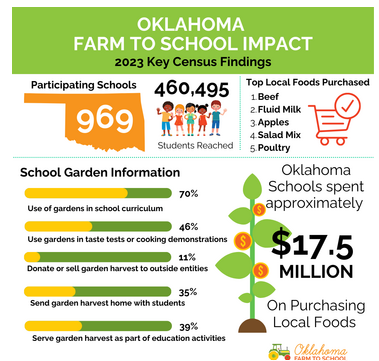
National Farm to School Month offers time to reflect on all that schools, childcare providers, agricultural producers, and partners have done to strengthen local and regional food systems and school supply chains. It also offers a time to look ahead to the future.
This year, the Farm to School Program is celebrating with two new resources to help farm to school partners take stock of their recent efforts and plan for and fund the road ahead. These include the results of the 2023 Farm to School Census (Census) and Fiscal Year (FY) 2025 Farm to School Grant Request for Applications.
In the fall of 2023, USDA asked all School Food Authorities (SFAs) to answer a comprehensive survey about their use of local food in school meals and the use of nutrition and agricultural education, edible school gardens, and other relevant farm to school activities in child nutrition program settings during the 2022-2023 school year. Farm to school is growing in Oklahoma with more than 870 schools serving local foods in the cafeteria.
The 2023 Farm to School Census website includes high-level data snapshots of national and state farm to school activities, individual SFA responses, and public-use datasets for further data analysis and exploration. The 2023 Farm to School Census Report also organizes and summarizes data to help give readers a quick overview of the farm to school landscape, the policies and (physical and staffing) infrastructure of farm to school programs, and opportunities for farm to school to grow and evolve.
Do you want to learn more? Please visit the Farm to School Census Partner Resources.
The Greater Oklahoma City Chamber announced today that Hardy Watkins has joined the Chamber team as Senior Vice President, Membership and Investor Relations. Hardy brings extensive management and development experience that will assist the Chamber in growing the organization and creating stronger relationships with members.
"We are thrilled to welcome a proven leader with an exceptional track record of achievement," said Christy Gillenwater, President and CEO of the Greater OKC Chamber. "Hardy's robust community connections, outstanding executive leadership, and commitment to accountability and effective communication uniquely position him as the ideal candidate for this critical role."
Hardy's experience includes serving as President and CEO of the Edmond Chamber of Commerce; as Deputy Director and then Executive Director of the Oklahoma Tourism and Recreation Department; as VP of Marketing, Government and Community Relations for INTEGRIS HEALTH; and as Chief Strategy and Innovation Officer of Hearts for Hearing.
Watkins expressed his enthusiasm for joining the organization. "Having closely collaborated with the Chamber for many years, I have witnessed firsthand its remarkable ability to drive our city's progress. I am honored to join this dedicated team and am eager to roll up my sleeves and contribute to our shared vision for a vibrant and prosperous Oklahoma City."
About the Greater Oklahoma City Chamber
The Greater Oklahoma City Chamber has been the voice of Oklahoma City business and industry for more than a century, taking an active role in helping create a business climate in Oklahoma City that is conducive to its long-term growth and vitality. The Chamber supports its members and the business community through its divisions of Economic Development, Education, Government Relations, Marketing and Communications, and Membership. Visit OKC is also a division of the Chamber, promoting Oklahoma City as a first-class visitor destination. Whether through economic development and workforce development efforts and activities, promoting business-friendly legislation, coalition building, promoting tourism, engaging in strategic community initiatives, or enhancing Oklahoma City's name and image, the Chamber is poised to continue its mission of ensuring Oklahoma City's standing as one of nation's best places in which to live and work.
| ||||||||||||||||||||||||||||||||||||||||||||||||||||||||||||||||||||||||||||||||||||||||||||||||||||||||||||||||||||||||||||||||||||||||||||||||||||||||||||||||||||||||||||||||||||||||||||||||||||||||||||||
| ||||||||||||||||||||||||||||||||||||||||||||||||||||||||||||||||||||||||||||||||||||||||||||||||||||||||||||||||||||||||||||||||||||||||||||||||||||||||||||||||||||||||||||||||||||||||||||||||||||||||||||||
|
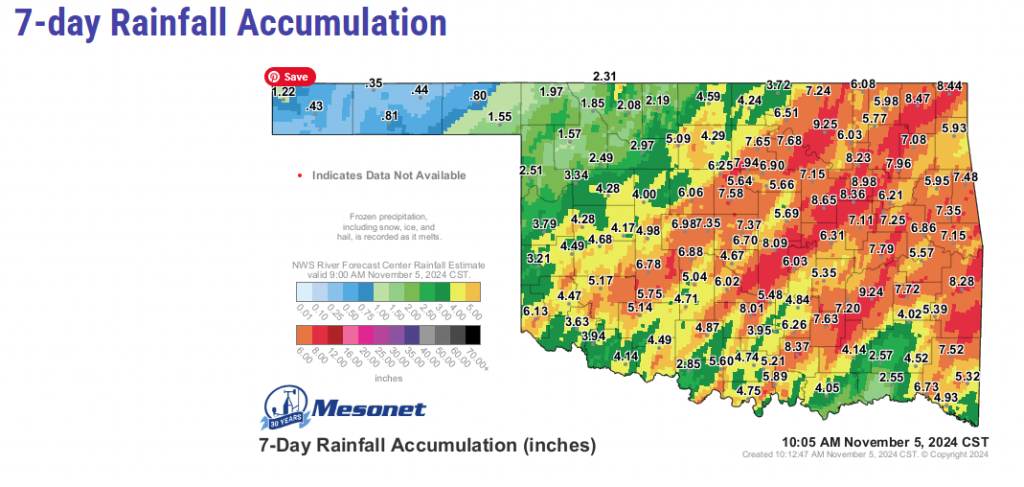
After the heavy rainfall of the past week, Farm Director KC Sheperd spoke with Oklahoma State Climatologist Gary McManus about how it affected drought conditions and the future outlook across the state.
McManus detailed the rainfall amounts in various parts of the state saying that Northwest Oklahoma missed a lot of it, settling for only an inch or two of rain. Central Oklahoma, Northeast Oklahoma, and parts of East Central Oklahoma received 7 to 9 inches of rain.
"We see that a lot over the last thirty or forty years," McManus said. "When we get a drought of some significance, it does tend to end in extremely heavy rainfall. I don't think we are completely out of drought, but we have certainly alleviated some of those impacts we were seeing over the last three or four months."
The concern for wheat farmers, now, is that the seed that was dusted in when it was dry is now washed away. The fields will have to be replanted.
"I know that bad things come with rain like this," McManus admitted. "We get a lot of erosion, crop damage, flooding, and things of that nature, but we are certainly better off where we are now than we were before these big-time rains."
McManus and Sheperd attended an Emergency Drought Commission meeting only a week ago, and at that time the deficits were nearing the driest on record from 1985, but after the recent rain, conditions stand within the 15th wettest on record since 1985.
It is still too early to recount impacts to lakes and reservoirs, but farm ponds are visually much improved. "One thing we want to know when we are looking at these drought impacts is how the lower-level soil moisture starting to respond," McManus explained. "As we are looking at the mesonet data, we are starting to see that response even in the 32-inch soil moisture levels.
"Sometimes when you get these big rains, they run right off, but I think in this case, it is permeating down to those lower levels in the soil at least."
Another big storm system is forecast to arrive on Thursday and possibly last until Sunday. It is predicted to dump another 2" - 4" inches on Southwest Oklahoma and West Central Oklahoma that also missed the bulk of the most recent system, and the Western Panhandle may see 6" of snow.
"We are in that territory where if we get that cold air combined with these types of storm systems, we will start to see that frozen precipitation," McManus said.
Typical when talking about the weather in Oklahoma, the conversation moved directly from frozen precipitation to tornados. "It looks like we might break the record for the largest number of tornadoes in the month of November," McManus said. "We are just on day five and we have had five confirmed, but there is probably a dozen more out there waiting to be confirmed by the weather service. The record is twelve from 1958, so we might just blow that record out of the water. We are already at the 15th wettest November on record, and with 25 more days to go... This November is shaping up to be one of the craziest ones we've had in quite some time. You just never know in Oklahoma."
McManus went on to explain why he disagrees with Drought Monitor Reports saying that D4 Exceptional Drought has been absent in Oklahoma since the beginning of the calendar year. Click the soundbar at the top of the page to listen to the whole conversation.
He did urge producers to weigh in on drought impacts on crops, farm ponds, cattle inventories, and forage and water supplementation directly on the Drought Monitor website using a tool called the Condition Monitoring Observer Report or email him directly by using this link.
| Receipts for the last 12 months through September total $16.95B, a decrease of $115.6M, or 0.7%, when comparing revenue from the previous year. Total revenue for October 2024 equal $1.387B and decreased over October 2023 by $16.2M or 1.2%. and reflecting a modest change from grocery tax cut going forward. Gross Production Tax or "GPT" totals equal $73.3M, down $12.1M or 14.2% over the previous month. Other tax sources for the same time period show individual income tax increased 16.3%, total sales and use tax decreased 7.7%, motor vehicle tax increased 1.7% and other sources increased 9.9%.  |
 |
| OK Unemployment for September — 3.4% seasonally adjusted rate, and unchanged from August. US Unemployment for September — 4.1% seasonally adjusted rate, and unchanged from August. Consumer Price Index — Increased 0.2% in September, after increasing 0.2% in August and July. The index for shelter rose 0.2% in September, and the index for food increased 0.4%. Together, these two indexes contributed over 75% of the monthly all items increase. The food at home index increased 0.4% in September and the food away from home index rose 0.3% over the month. The energy index fell 1.9% over the month, after declining 0.8% the preceding month. The all items index rose 2.4% for the 12 months ending September, the smallest 12-month increase since February 2021. The all items less food and energy index rose 3.3% over the last 12 months. The energy index decreased 6.8% for the 12 months ending September. The food index increased 2.3% over the last year. |
 The state's Business Conditions Index for September decreased over last month. Jan. 48.7 Feb 46.9 March 53.3 April 54.7 May 48.4 June 47.5 July 49.3 Aug. 48.0 Sept. 45.7 Components of the overall September index were: new orders at 41.5; production or sales at 37.8; delivery lead time at 54.8; inventories at 50.9; and employment at 44.7. As a result of a cooling 2024 economy and waning inflationary pressures, Goss expects the Federal Reserve to cut interest rates by 0.25% at their November 6-7, 2024 meetings. |
 As a timely, broad view of the state's economy the report releases in conjunction with the General Revenue Fund report. Providing information to state agencies for budgetary planning purposes, the General Revenue Fund acts as the state's main operating account and receives a portion of the state's gross receipts as well as state, city and county funds. |
  |
| 12-Month Period End Comparison Gross receipts total $16.95 billion, down $115.59 million or 0.7 percent. |
Combined individual income tax and corporate income tax $6.2 billion, up $252.3 million or 4.2 percent. Individual tax of $5.3 billion, up $286.4 million or 5.7 percent. Corporate tax of $908 million, down $34.1 million or 3.6 percent. Combined sales tax and use tax–including city and county remittances–of $7.1 billion, down $49.9 million or 0.7 percent. Sales tax of $5.9 billion, down $122.7 million or 2.0 percent. Use tax, received on out-of-state and Internet purchases, of $1.2 billion, up $72.7 million or 6.5 percent. |
Oil and gas gross production tax of $1.1 billion, down $360.3 million or 25.3 percent. Motor vehicle tax of $918.4 million, up $37.9 million or 4.3 percent. Other sources, including 70 different revenues, of $1.64 billion, up $4.5 million or 0.3 percent. Monthly Comparison Gross receipts total $1.39 billion, down $16.2 million or 1.2 percent for October 2024 vs. 2023. Income tax of $538.2 million, up $42.4 million or 8.5 percent. Individual tax of $507.3 million, up $43.5 million or 9.4 percent. Corporate tax of $30.9 million, down $1.2 million or 3.6 percent. Sales and use tax of $546.4 million, down $44 million or 7.5 percent. Sales tax of $450.6 million, down $48.1 million or 9.6 percent. Use tax of $95.8 million, up $4.1 million or 4.4 percent.  Gross production taxes of $73.3 million, down $26.5 million or 26.6 percent. Motor vehicle taxes of $77.4 million, up $6.4 million or 9 percent. Other sources of $152.4 million, up $5.6 million or 3.8 percent. Month-Over-Month Comparison Gross receipts total $1.39 billion, down $105.6 million or 7.1 percent from last month. Decrease in income tax of $62.7 million or 10.4 percent. Decrease in sales and use tax of $45.8 million or 7.7 percent. Increase in gross production taxes of $12.1 million or 14.2 percent. Decrease in motor vehicle taxes of $1.3 million or 1.7 percent. Increase in other sources of $13.7 million or 9.9 percent. View full PDF report below. Gross_Receipts_October2024.pdf |
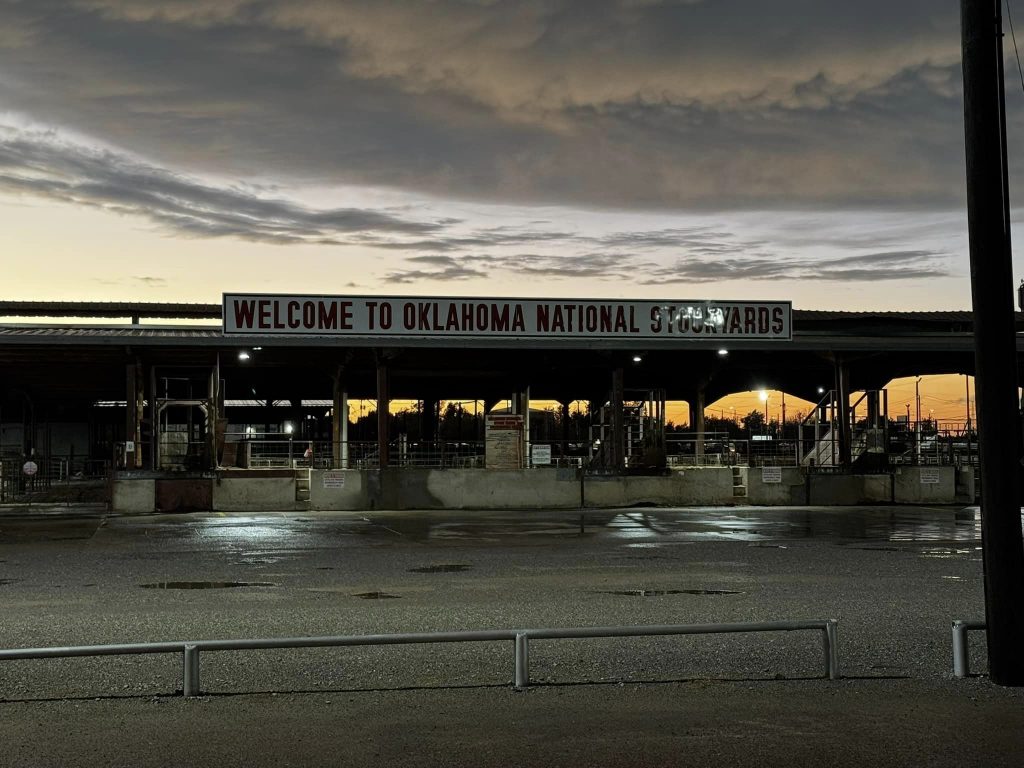
On Tuesdays, Senior Farm and Ranch Broadcaster, Ron Hays, visits with Ben Hale of Western Livestock Auctions as he talks about the latest in the markets and more. Established in 1995, Western has grown into a multi-generational family-owned and operated business and stands as a symbol of tradition, excellence, and a deep-rooted passion for the cattle industry. Western Livestock Auctions are located in Oklahoma City, Woodward, and Comanche.
Heavy rainfall significantly limited the movement of cattle into the Oklahoma National Stockyards on Monday. They ran less than 2,000 head compared to 8,100 a year ago.
"It was a good general rain over all of the wheat country," Hale said. "It was just what we needed to fill up these stock ponds and tanks, and to give the wheat a drink."
Hale expects the sales at Woodward and Comanche to also be lighter this week, and with more rain in the forecast, he expects next week's sales to also run fewer cattle through.
"It's not a bad thing," he said. "It's still warm enough for growing wheat and there was some guys who said they thought their Bermuda grass was greening back up and growing. It's not a bad thing to have right here before winter."
Hale can be contacted at 940-631-2333. Check out more about the marketing options that Western offers by clicking here.
On the sidelines of the American Angus Convention in Ft. Worth, Texas, Senior Farm and Ranch Broadcaster Ron Hays spoke with Nevil Speer, a beef industry consultant and influential columnist. They discussed herd rebuilding and increased carcass weights and the positive side of extended drought.
"It is definitely not your granddad's cows anymore," Speer said. "That is probably what is holding up herd rebuilding."
He ticked off regulatory uncertainty, challenging interest rates, the cost of labor, and skyrocketing equipment costs as other reasons for producers to hesitate to increase their herds.
"Carcass weights have increased five to seven pounds per year," he said. "Steer carcass weights last year were 960 pounds, and at one time, that was the upper limit. We know how to make cattle bigger through genetics, management and knowledge. I'm not sure we are going to turn that back down very far."
He admitted that while some cuts have outgrown normal packaging, productivity and throughput are major positives.
While herd reductions due to drought aren't helping, producers repetitively hauling their lesser quality cows to the sale has allowed the better genetics to shine.
"No one wants to wish for a drought," Speer said. "But ultimately, it is also a reason to fill the gooseneck with the ten worse cows that you have. When you begin to do that on a macro perspective, you begin to make a big jump in genetics and quality."
The Beef Buzz is a regular feature heard on radio stations around the region on the Radio Oklahoma Ag Network and is a regular audio feature found on this website as well. Click on the LISTEN BAR for today's show and check out our archives for older Beef Buzz shows covering the gamut of the beef cattle industry today.
October provided a surprising pre-election bounce in farmer sentiment as the Purdue University-CME Group Ag Economy Barometer index climbed to 115, 27 points higher than in September. The biggest driver of the sentiment improvement was an increase in producers' confidence in the future, as the Future Expectations Index jumped 30 points to 124. The Current Conditions Index also rose in October but by a smaller amount. With a reading of 95, the Current Conditions Index confirmed that farmers think economic conditions this year are worse than last year and weaker than during the barometer's base period of 2015-2016, which was in the early days of a multi-year downturn in the U.S. farm economy. Producers this month expressed some optimism that economic conditions will improve and not precipitate an extended downturn in the farm economy. The October barometer survey took place from October 14-18, 2024.
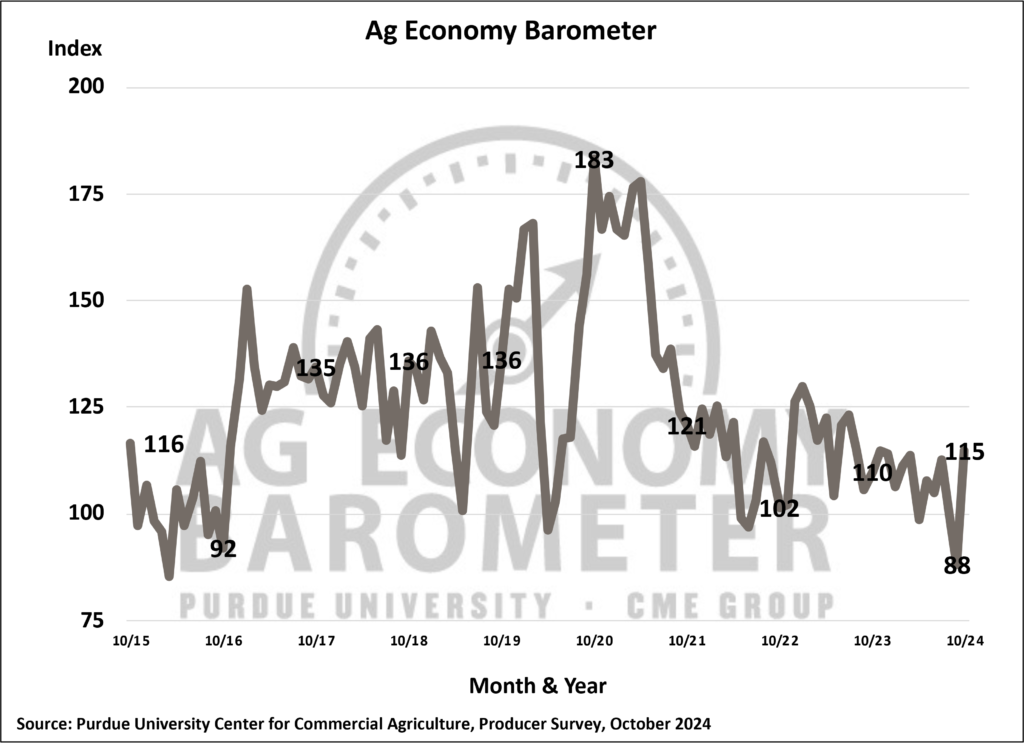
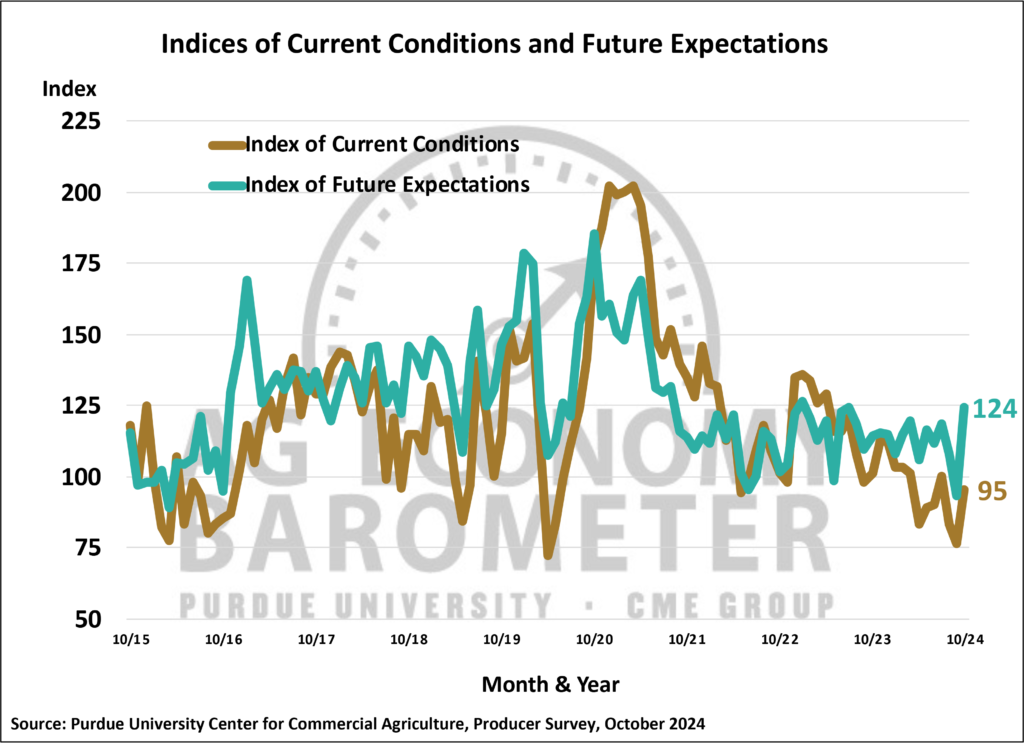
The overall improvement in farmer sentiment is better understood by examining responses to the individual questions used to generate the barometer. Much of the sentiment improvement was attributable to producers possessing a less pessimistic view of the U.S. agricultural economy. For example, the percentage of producers who expect bad times for the U.S. agricultural economy in the upcoming year declined from 73% of respondents in September to 53% in October. Similarly, the percentage of producers who expect bad times for U.S. agriculture in the next 5 years fell from 48% to 33%. Looking at a related question, fewer producers this month said they expect their farm's financial condition to worsen over the next 12 months, with just 23% looking for conditions to worsen compared to 38% who felt that way in September. However, despite the improvement in the main barometer indices, it's clear producers financial situation deteriorated in 2024. For example, over half (56%) of the October respondents said their farm's financial condition was worse than a year earlier. That was lower than reported in September but matches the response to this question in August.
The last question on each month's survey provides respondents with an open-ended question asking them to share what's on their minds. Figure 3 is a word cloud representation of responses received in the October survey. Unsurprisingly, politics was mentioned quite often, with the elections looming just a few weeks into the future. Perhaps more importantly, it's clear that many producers were thinking about possible policy shifts that could impact their farms and the agricultural economy. Mentions of regulation, environment, and taxes were featured prominently, along with concerns about prices. When asked explicitly about their biggest concerns for the upcoming year, producers still point to higher input costs and lower output prices as their biggest concerns. The trend of fewer producers citing interest rates as a top concern continued this month. Just 15% of producers, down from as much as 26% of producers in late 2023, chose interest rates as one of their biggest concerns in October.
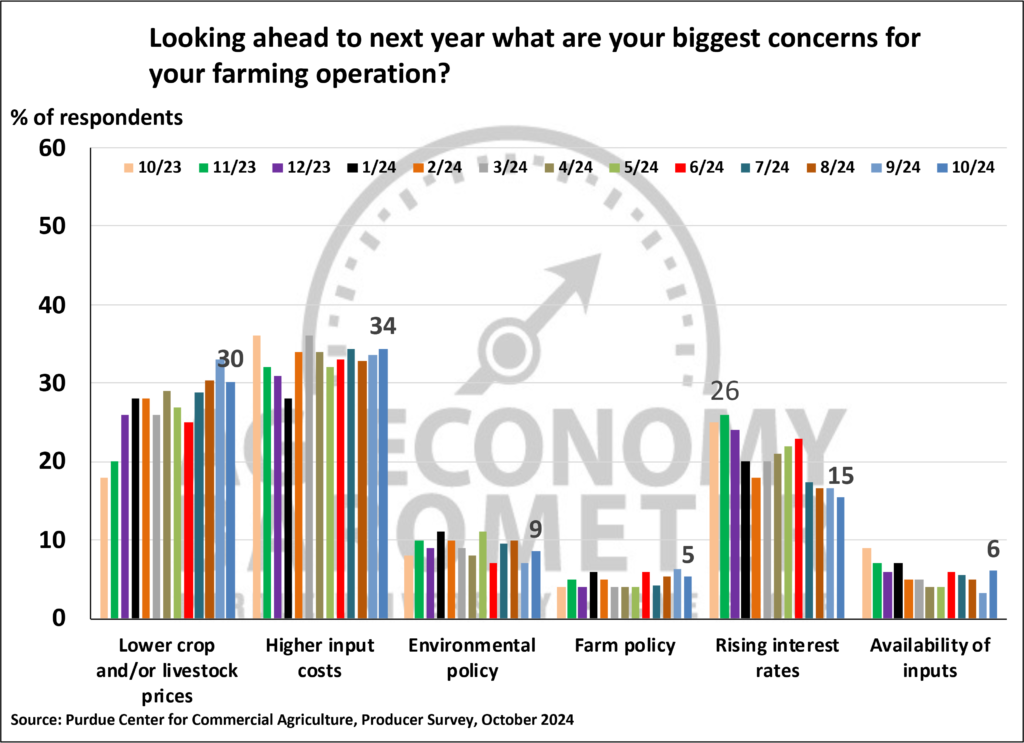
One of the biggest surprises arising from this month's survey was the increase in the Farm Financial Performance Index. The index is based upon a question that says, "As of today, do you expect your farm's financial performance in the next 12 months to be better than, worse than, or about the same as in the past 12 months." The October reading of 90 jumped 22 points above September's and was just 2 points lower than a year earlier. High fall crop yields and a stress-free fall harvest season in the Corn Belt and Plains states likely contributed to the index's rise. However, those two factors alone don't account for the index's sharp rise. The index's improvement provides another indication that farmers' optimism about the future shifted in October, leading to an expectation of better financial performance in 2025 than in 2024. Coincident with the rise in the financial index was a modest improvement in the Farm Capital Investment Index,which, at 42, was 7 points higher than in September, another signal that producers in October might be viewing 2024's weak income prospects as transitory.
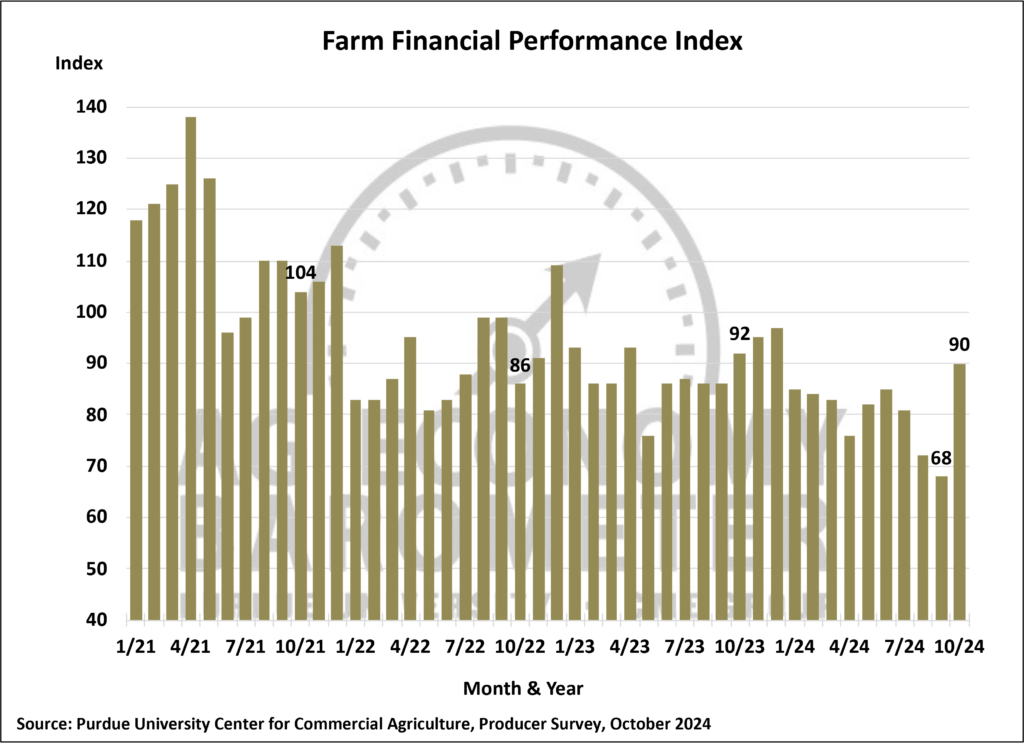
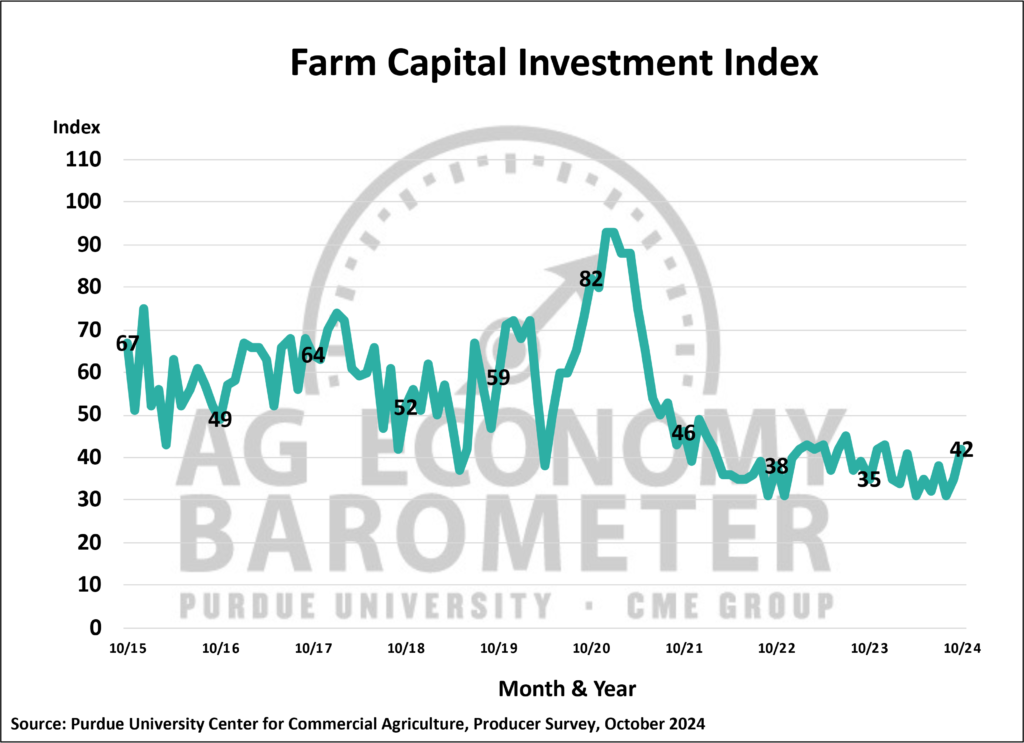
The Short-Term Farmland Value Expectations Index tends to be correlated with financial performance expectations, and that was the case this month, with the index climbing up to 120, 25 points above the September reading. The long-term index also rose, improving to 159 versus 147 a month earlier. Once again, the rise in both farmland value expectation indices suggests that producers retain some optimism about the agricultural economy's future strength, which, in turn, could support farmland values.
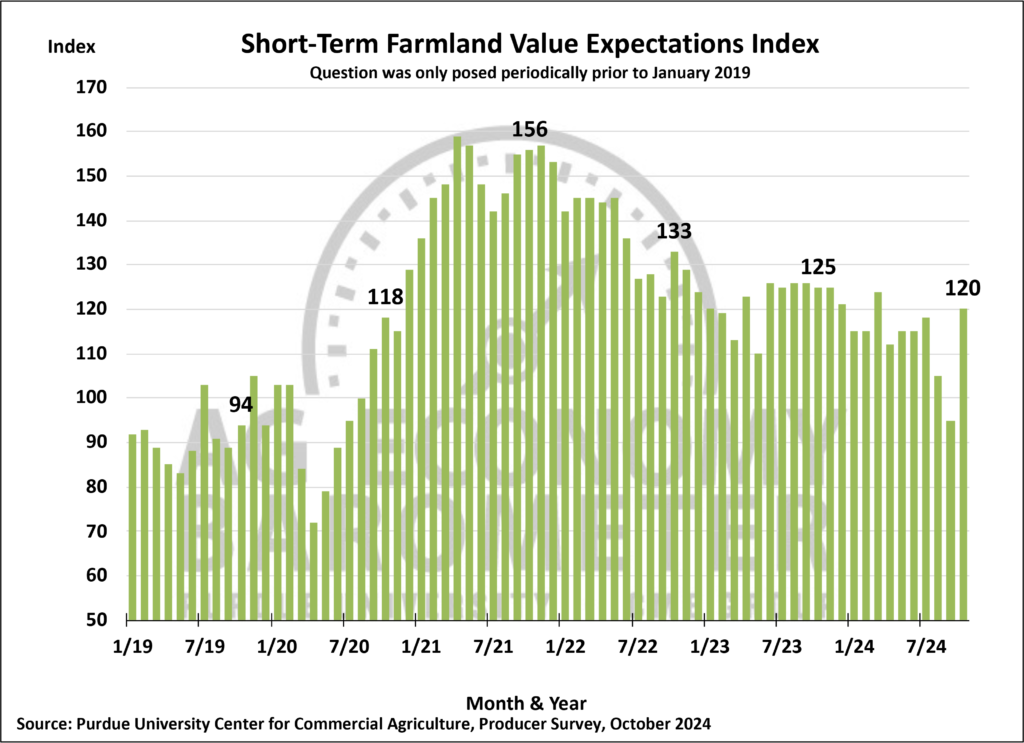
Wrapping Up
The October Ag Economy Barometer survey revealed a surprising rebound in U.S. farmer's sentiment. In a survey taken just three weeks before the U.S. presidential election, the Future Expectations Index rose 30 points compared to a month earlier. The future expectations index upturn was correlated with improvements in farmers' outlook for farmland values and a somewhat more optimistic view regarding investments in their farm operations. Producers still have reservations about current economic conditions on their farms since, despite this month's rise, the Current Conditions Index remains below 100, which indicates farmers still have a weak view of their current situation. Comments provided by survey respondents this month indicate that politics and policy are top of mind for many U.S. farmers. The November barometer survey, to be conducted one week following the presidential election, will provide an update on how the election's outcome affects producers' outlook.
The OSU Animal Science Alumni Association invites you to participate in their Online Holiday Auction on November 8 - 12, 2024. The auction will take place online at e.givesmart.com/r/1-vHQmaV1Quq4/e/FK2/ . Proceeds from the auction support OSU animal and food sciences students through scholarship, judging team, animal unit and additional organizational support.
Learn more and register for the Online Holiday Auction by visiting www.ASAAholiday.givesmart.com. Take the opportunity to browse, bid and buy these great items that are perfect for your holidays with friends and family! Get ahead on your Christmas shopping with ASAA apparel items and stock your fridge and freezer. Featured items include ribeyes, pork packages, tickets to The Boys from Oklahoma April Concert, cattle, sheep and goat genetic offerings and much more along with instant buy and donation options for ASAA memberships and endowment funds. Make sure and register today. Your impact makes a difference by supporting animal science students and future industry leaders.
For questions related to the auction or to set up an automatic bid, reach out to Megan Smith at osuanscialumni@gmail.com or call 405-747-1977.
The auction will begin on Friday, November 8 at noon CST and end on Tuesday, November 12 at 8:00 p.m. CST. ASAA hats, memberships and raffle tickets are also available for purchase.
Taking place now through February 28, you have the opportunity to purchase raffle tickets on item 125 for Four Tickets to the April 12th Boys From Oklahoma Concert including a parking pass. Tickets are $25 each or five for $100 and can be purchased at e.givesmart.com/r/ddo2JnTEfVlf6/e/FK2/ beginning November 8.
Upcoming Events
The annual ASAA Cowboy Tailgate will take place on Saturday, November 23, 2024, prior to the OSU vs. Texas Tech Football Game. Join the ASAA and Animal Science Alumni & Friends at the green P&K Tent on the west side of the stadium.
Nominations are currently open for the 2025 Minnie Lou Bradley Trailblazer Award. The Minnie Lou Bradley Trailblazer Award aims to recognize a younger alum who has used their degree to advance animal agriculture and agriculture through their career and seen success along this path, with a requirement they are a graduate of the department of animal and food sciences at OSU. It is recommended the individual be at or about the age of 40 or younger and/or graduated in the past twenty years with their BS, MS or PhD. Nominations are due December 15, 2024, through the online link at https://forms.gle/qgwNVGgtW86E6LeH9
The 2025 Animal Science Weekend will be held April 5 -7, 2025 with the ASAA Gala Reunion taking place on Saturday, April 6. More information and tickets will be available in January at www.asaagala.givesmart.com. The OSU Animal Science Alumni Association is a not-for-profit organization focused on promoting the profession of animal science. This is accomplished by providing scholarship and judging team support, encouraging student enrollment in animal science, improving awareness of educational opportunities and organizing events and activities for alumni. To learn more about the ASAA visit www.osuanscialumni.com
VANE, a leading provider of specialty agricultural insurance, is expanding its agricultural risk management portfolio to offer insurance coverage for agricultural financing and lending institutions.
VANE's newest insurance offering is designed to protect agricultural banks and their balance sheets, in the unfortunate scenario of a weather event that would prevent a client from making payments.
"Much like farmers have crop insurance, we are now offering revenue insurance protection for agribusinesses and lenders," said Matthew Boulos, Global Director of Business Development and Sales at VANE.
"This allows banks to continue to add value, grow their portfolio, and geographic footprint while helping agribusinesses and farmers succeed," said Don Preusser, Founder and President at VANE. "We are providing a way for ag lenders to buy insurance against the uncertainty associated with disruptive market and weather events."
It's no secret that the ag industry is going through a challenging, time. VANE's portfolio of insurance solutions is designed to protect professionals across the agriculture value chain including equipment dealers, cooperatives, processors, ground and aerial applicators seed and nutrient providers, custom harvesters, and now, agricultural lenders.
"With our portfolio, we can protect both the banker and their agribusiness customers," Boulos explained. "Agricultural lenders and banks can encourage their customers to purchase this added protection as well. Either way, the revenue is being protected."
The VANE team brings decades of technology and insurance experience with an emphasis on agriculture, to deliver quality agricultural insurance solutions to each of its clients. To learn more, visit https://vane.ag/.
About VANE:
VANE provides creative and innovative revenue insurance solutions specifically designed to protect agribusinesses. Their insurance solutions offer customized products for agribusinesses that support farmers and ranchers during weather-related crop losses.
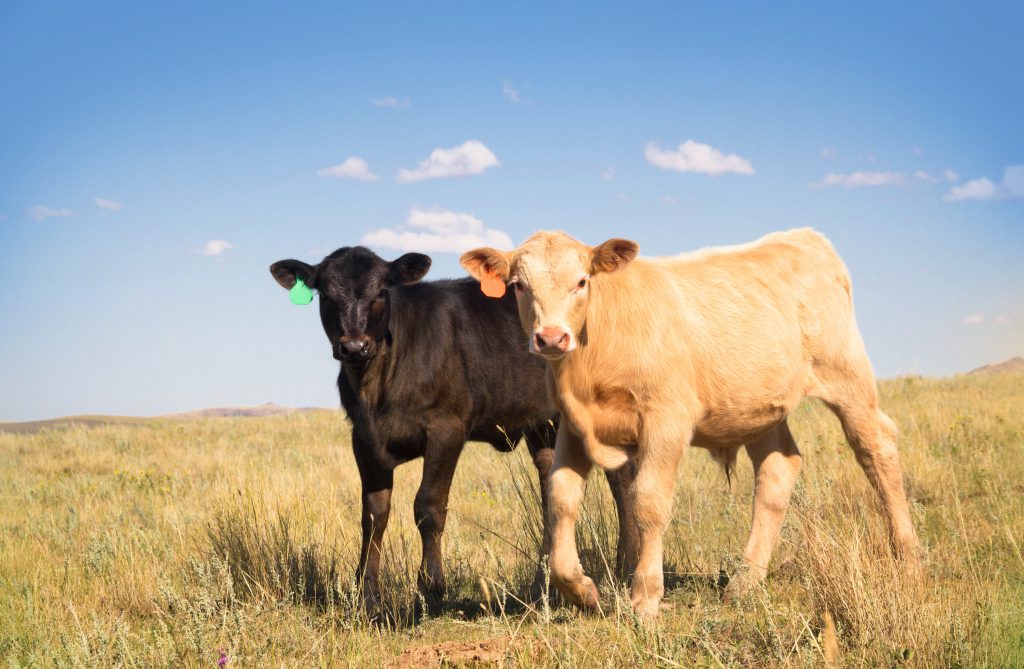
Mark Johnson, Oklahoma State University Extension Beef Cattle Breeding Specialist, offers herd health advice as part of the weekly series known as the "Cow Calf Corner," published electronically by Dr. Peel, Mark Johnson, and Paul Beck. Today, Johnson talks about weight per day of age and average daily gain.
In response to a recent question from a producer, the topic this week addresses the difference between a couple of growth performance measures commonly used in beef production. As well as some anecdotal evidence observed on a handful of Angus calves we are feeding at the OSU Purebred Beef Cattle Center. The Beef Improvement Federation (BIF) defines Weight per Day of Age (WDA) and Average Daily Gain (ADG) as follows:
WDA - Weight of an individual divided by its age in days.
ADG - Measurement of the average daily body weight change over a specified period of time of an animal on a feed test.
Both are measures of growth that are easy to calculate but are distinctly different. For example, if a calf was born weighing 80 pounds and later weaned at 200 days of age weighing 500 pounds. The WDA (500 divided by 200) is 2.5 pounds/day. The ADG of the same calf from birth to weaning would be 2.1 pounds/day. The result of 500 minus 80, divided by 200.
The measure of WDA is useful to evaluate on young growing cattle from approximately weaning to yearling time. The measure of ADG has been used in performance testing for decades and is commonly used to measure the growth performance of pens of finishing cattle. Both these measures would be based on the genetic potential of calves to grow as well as the environmental effects of factors like weather and the plane of nutrition. ADG could also be heavily influenced by plane of nutrition prior to the testing period which could impact the amount of compensatory gain during the test period.
The OSU Purebred Beef Center is currently developing a group of four Angus heifers and a group of four Angus bulls to potentially exhibit in Angus Pen of Three Show at the Cattlemen's Congress Show in Oklahoma City in January. The calves were born from January 17th to February 25, 2024. The calves were on a 14% Crude Protein creep ration, fed ad-lib, for several months prior to weaning in mid-August. Six of the eight calves have Weaning and Yearling EPDs in the best 5% of non-parent Angus cattle. The other two rank in the best 20% of the breed for Weaning and Yearling Weight EPDs. Based on Weights taken at the beginning of October when the calves were 219 to 258 days of age the range of actual weights, ADGs and WDAs of the calves are summarized as follows.
Bulls: Weight range = 970 – 1110
ADG range = 3.83 – 4.1
WDA range = 4.14 – 4.41
Heifers: Weight Range = 780 – 815
ADG range = 2.9 – 3.2
WDA range = 3.2 – 3.55

According to National Retail Federation’s Chief Executive Officer Matt Shay, retailers are rolling out their Christmas-themed campaigns earlier than ever, and shoppers are responding in kind. USDA’s Gary Crawford is reporting with comments from Shay.
Although consumer surveys show that shoppers don’t intend to spend any less this year, Shay said that they will likely be looking for bargains. “We expect shoppers to be more price-conscious and pragmatic in their spending decisions this year,” he said.
The National Retail Federation considers the holiday shopping season to run from November 1 to December 31 and expects between a 2.5% and 3.5% increase in sales from last year’s holiday season which works out to between $980 billion and $990 billion in sales.
The projected rate of growth is less than it was last year and Shays says that is likely due to worries about inflation, despite it being almost nothing for the past few months. “Even food, is only up very modestly in several categories,” he explained.
Still, shoppers are expected to pay up to 3.5% more for holiday items this year, and online sales for those items continue to grow with an expected increase of 8% to 9% from a year ago.

Shell egg prices have proven highly variable in the last few years. Consumer demand for eggs can be equally erratic but predictably increases around Easter in the spring and then again around the fall/winter holidays. Prices typically go up in response to this higher demand. Beginning in early summer, 2024 prices rose above and remained higher than in 2023. They spiked again in August due to lower supply caused by laying hen losses earlier in the year from Highly Pathogenic Avian Influenza (HPAI). Prices then dropped as flocks were repopulated and late summer demand fell. Now, leading up to the fall holiday season, we see egg prices spiking again, and they are higher than they were not only in 2023 but also higher than the same time in 2022. Later in 2022 wholesale egg prices reached an all-time high approaching $5.00/doz. (fig 1). When we compare 2022 to 2024, we see a haunting premonition of where egg prices could be headed this holiday season. The current price spike looks to be holiday demand coming in the face of a decrease in layers producing the eggs; the same thing we saw in 2022.
When we compare current 2024 numbers to the same timeframe in 2022 and 2023, there are a few comparable trends worth noting. Current shell egg inventory and layer numbers have dropped 13.7% and 3% respectively from the previous year, while price is significantly higher (over 300%). The current price is also 22% higher than the same time in 2022 when the egg and layer inventories were very similar to now (fig 2). It's possible we could see the same prices on the horizon as we saw in late 2022.
While the supply and demand numbers may not bode well for egg consumers, layer producers have additional concerns. December corn is currently trading in the $4.28/bu. range and looks to stay below $4.60 through spring according to the USDA futures price estimates. This looks to be a positive for egg producers as the resulting lower feed cost could help egg producers recover from their losses as well as last year's low egg prices – IF they have the hens to produce the eggs. The concern is that the HPAI threat still looms large over the layer industry. HPAI losses are driving the current low inventories of layers and eggs. In October of this year, 2.84 million layers were lost to HPAI to begin the holiday season. Year-to-date, the layer industry has lost 20.75 million layers, which equals 6.8% of the total current flock of producing hens. It is difficult for layer producers to keep up with current demand in the face of such losses. And now, the fall waterfowl migration is ramping up, bringing with it an increased HPAI risk. According to the USDA, there are currently only 4.1 days of shell eggs on hand for sale. Therefore, any additional hen losses could have a significant impact on the market. Whether 2024 prices will reach the highs of 2022 remains to be seen, but if HPAI continues to devastate producing layer flocks, prices this year could reach and even surpass 2022.
Figure 1: Egg prices were relatively stable, though above last year, until mid-summer, when they spiked due to laying hen losses that occurred earlier in the year. Prices spiked again this fall due to a convergence of additional hen losses to HPAI and an increasing demand for the holidays.
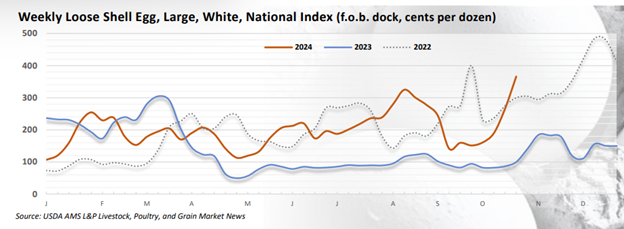
Figure 2: Laying hen inventory and egg inventory for 2024 looks hauntingly like 2022, when late season egg prices rose to historical levels

RON's Dave Lanning has a pre-opening look at today's agricultural Markets.
Click the audio tab below for today's report.
Today, the American Livestock Markets and Dealers Association (ALMDA) formally requested that USDA-APHIS delay the implementation or enforcement of the final rule on Use of Electronic Identification Eartags as Official Identification in Cattle and Bison (ADT Rule).
In a letter to USDA-APHIS, ALMDA requested that the implementation or enforcement of the ADT Rule be delayed at least 180 days ensure USDA, state animal health officials, veterinarians, tag manufacturers, and the entire industry are fully prepared support the ADT Rule in a way that does not reduce industry traceability, slow speed of commerce, or increase costs for livestock markets and dealers.
ALMDA, working alongside livestock markets, dealers, order buyers, veterinarians, and state animal health officials, has identified numerous gaps in the implementation plan and communicated these to USDA officials. In September, ALMDA provided USDA with data that illustrated potential issues with the ADT Rule. As the implementation date has approached, the issues ALMDA identified are becoming a reality.
"ALMDA understands the need to protect the U.S. livestock industry and the intent of the ADT Rule to make the traceability process faster and more accurate," said ALMDA Chair Brian Forester, a livestock market owner from Texas. "We have been transparent with USDA and shared data from member livestock markets across the U.S. which illustrate the complexity and challenges associated with implementing the ADT Rule. At this time, livestock producers, tag suppliers, and state animal health officials have acknowledged they are not prepared to implement the rule so we believe it is in USDA and the industry's best interest to delay rule implementation or enforcement."
ALMDA supports animal disease traceability (ADT) and the role traceability has in protecting the U.S. livestock supply. Livestock markets and dealers are already subject to a range of state and federal traceability requirements across all livestock species.
Livestock markets and dealers routinely cooperate with tracebacks for a variety of animal health diseases. Based on this experience, livestock markets and dealers understand the need for both speed and accuracy in conducting tracebacks.
ALMDA's letter to USDA is available at www.americanlivestock.org/adt
About the American Livestock Markets and Dealers Association
The American Livestock Markets and Dealers Association (ALMDA) is a national association serving livestock markets, order buyers, dealers, and professional livestock marketers throughout the U.S. For more information, please visit www.americanlivestock.org.
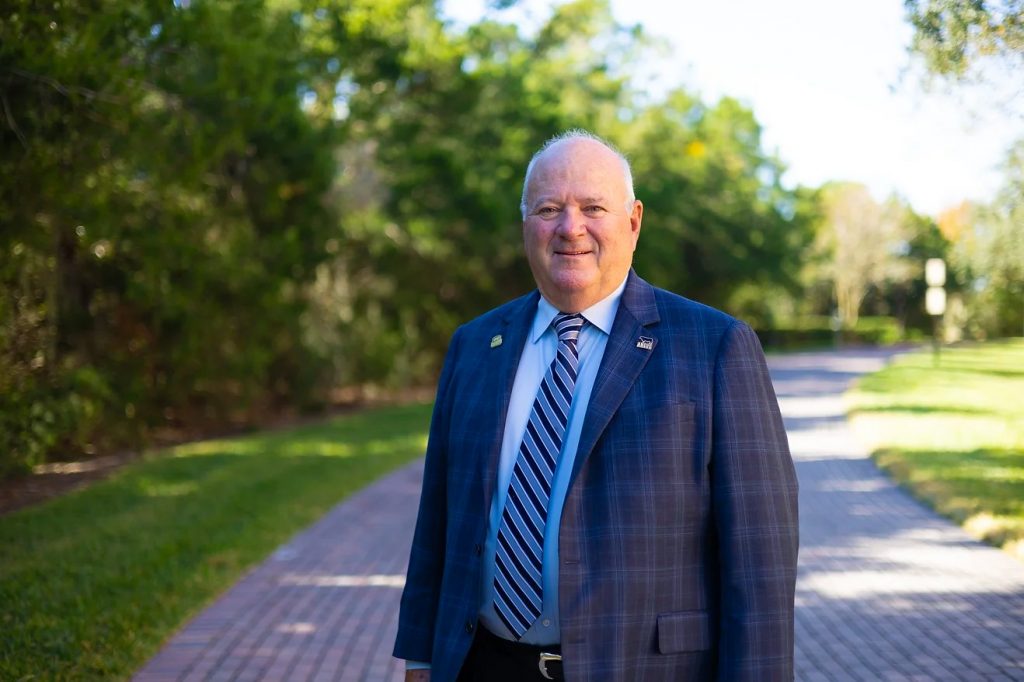
Senior Farm and Ranch Broadcaster, Ron Hays, caught up with outgoing American Angus Association President, and Oklahoma Rancher, Barry Pollard. On the last day of his term as both President and a board member, Pollard reflected on the association and the breed as a whole.
Pollard served on the board of directors for eight years and says that interest in the Angus industry is at an all-time high. "We've developed EPDs, a lot of accurate and reliable tools for producers, and people have taken advantage of those opportunities and created herds of Angus cattle that are superior in many aspects from mothering ability to carcass qualities."
According to Pollard, those qualities are the basis of the breed's success. He said, "As Americans have become more accustomed to finer quality meat and their desire for it continues to grow, not only in the United States but also across the world. It has created a demand for the Angus breed which excels in those carcass traits."
No matter which organization Pollard has been involved with, he understands the importance of helping the youth grow as future producers and leaders. "Our junior program is robust," he said. "One of the things I'm really excited about is on our new website, we are creating an Angus Beef Academy. It offers courses on the beef industry, and people can earn points towards various types of recognition for their accomplishments in those learning modules. It is a great opportunity to get that information out to our youth."
As an individual producer, Pollard will be supporting the charitable arm of the association this year by donating an Angus heifer from his herd to be sold at the start of the National Bull Sale of the Angus breed at Cattlemen's Congress to raise money for the Angus Foundation.
Pollard encouraged producers to check out the website to find information about the Angus breed, how to get involved, and where to find quality Angus bulls. "That Angus cross is just a superior animal," he said.
The Beef Buzz is a regular feature heard on radio stations around the region on the Radio Oklahoma Ag Network and is a regular audio feature found on this website as well. Click on the LISTEN BAR for today's show and check out our archives for older Beef Buzz shows covering the gamut of the beef cattle industry today.

The State Election Board has released its official pre-election voter registration statistics and the report shows that Oklahoma has reached a milestone – surpassing 2.4 million voters as of November 1, 2024. This year's report shows a net increase of more than 141,023 registered voters since January 15 and a net increase of nearly 29,056 since September 30. The State Election Board's official pre-election voter registration statistics show the total number of registered voters is the largest before a Presidential Election since Oklahoma began tracking pre-election voter registration statistics in 2000.
Oklahoma's voter registration statistics show that registered Republicans make up 52.33% of Oklahoma's registered voters, while Democrats make up 26.98% of the state's registration. Independents represent the third largest group of registered voters in the state, making up 19.72% of voter registration totals. Libertarians consist of less than one-percent of the state's registration at 0.95%, but numbers continue to steadily increase each year.
"I am encouraged by the latest numbers and the growth in registered voters we have seen over the past several years. Hopefully, they point to better overall turnout for the General Election," said Paul Ziriax, Secretary of the State Election Board.
Net change in voter registrations since January 15, 2024
Comparison of Registered Voter Percentages
Comparison of Official Nov. 1 Pre-Election Statistics (Total Registered Voters)
View Complete Voter Registration Statistics
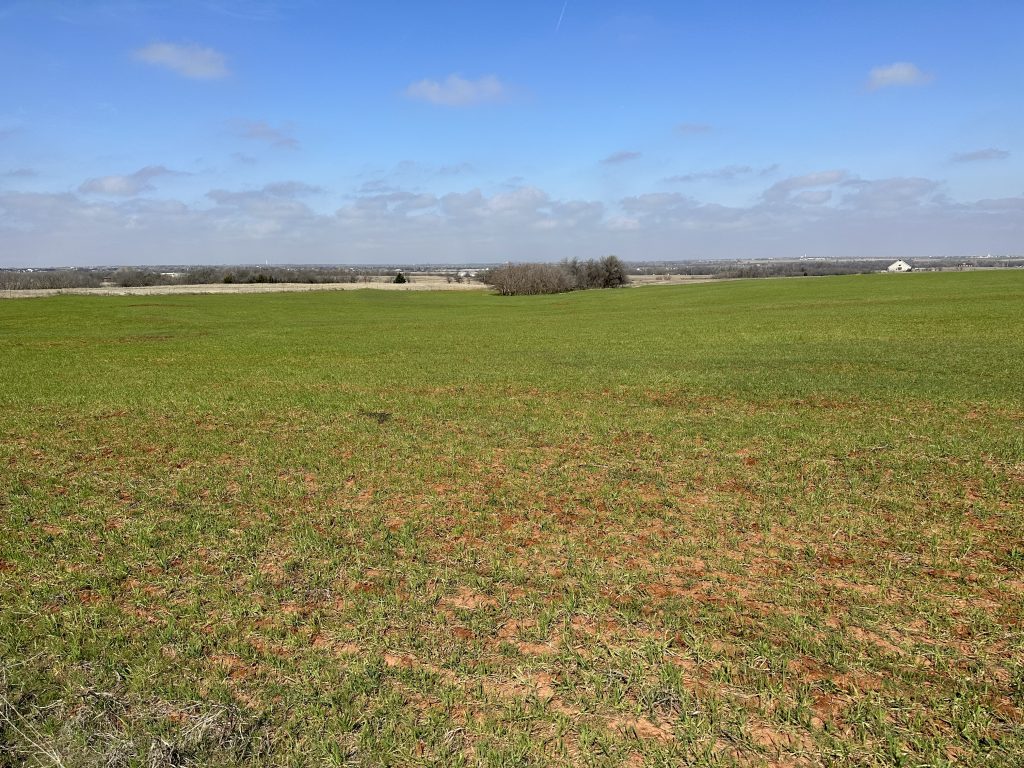
Winter Wheat Planted reached 87 percent, down 1 percentage points from the previous year and 2 from the average. Winter Wheat Emerged reached 66 percent, down 6 points from a year ago and 5 points from the five-year average. Winter wheat conditions rated 41 percent good to excellent, 36 percent fair, and 23 percent poor to very poor. Last week's conditions rated 38 percent good to excellent, 36 percent fair, and 23 percent poor to very poor.
Corn harvested reached 91 percent, up 13 points from last year and 16 points from the average.
Soybeans harvested reached 94 percent, up 5 points from last year and 9 points from the average.
Cotton harvested reached 63 percent, up 8 points from a year ago and 9 points from the average.
Sorghum harvested reached 85 percent, up 2 points from the previous year and 3 from the average.
Oklahoma Crop Progress Report:
Winter wheat planted reached 72 percent, down 12 points from the previous year and 16 points from the five-year average. Winter wheat emerged reached 47 percent, down 20 points from the previous year and 26 points from normal. Winter wheat conditions rated 31 percent good to excellent, 42 percent fair, and 27 percent poor to very poor. Last week's conditions rated 21 percent good to excellent, 46 percent fair, and 33 percent poor to very poor.
Corn harvested reached 95 percent, up 2 percentage points from a year ago and the average.
Sorghum harvested reached 72 percent, up 3 points from a year ago and the average.
Soybeans dropping leaves reached 85 percent, down 8 percentage points from a year ago, and 5 from the average. Soybeans harvested reached 49 percent, down 5 points from a year ago and 1 from the average.
Cotton harvested reached 40 percent, equal to a year ago and up 3 percentage points from the average.
Livestock conditions rated 51 percent good to excellent, 29 percent fair, and 20 percent poor to very poor. Last week's conditions rated 55 percent good to excellent, 26 percent fair, and 19 percent poor to very poor.
Pasture and range conditions rated 9 percent good, 38 percent fair, and 53 percent poor to very poor. Last week's conditions rated 16 percent good to excellent, 33 percent fair, and 51 percent poor to very poor.
Winter wheat planted was 94 percent, down 1 percentage point from last year but up 1 point from the five-year average. Winter wheat emerged was 76 percent, down 2 points from last year, but up 3 points from the average. Winter wheat conditions rated 40 percent good to excellent, 37 percent fair, and 23 percent poor to very poor. Last week's conditions rated 38 percent good to excellent, 42 percent fair, and 20 percent poor to very poor.
Corn harvested reached 93 percent, equal to last year and up 3 points from the average.
Soybeans harvested reached 93 percent, up 7 points from last year and 13 points from the average.
Sorghum harvested reached 81 percent, up 3 points from last year, and 6 points from the average.
Cotton harvested reached 50 percent, up 10 points from last year and 19 points from the average.
Pasture and range conditions rated 19 percent good to excellent, 39 percent fair, and 42 percent poor to very poor. Last week's conditions rated 17 percent good to excellent, 37 percent fair, and 46 percent poor to very poor.
Winter Wheat planted reached 76 percent, down 1 percentage point from a year ago and 4 from the five-year average. Winter wheat emerged reached 52 percent, down 2 points from a year ago and the 5-year average. Winter wheat conditions rated 24 percent good to excellent, 38 percent fair, and 38 percent poor to very poor.
The Texas Corn harvest is complete.
Cotton harvested reached 58 percent, up 12 points from the previous year and 9 from the average.
The Texas Sorghum harvest is complete.
Soybeans harvested reached 90 percent, up 7 points from last year, and 5 points from the average.
Pasture and range conditions rated 11 percent good to excellent, 28 percent fair, and 63 percent poor to very poor. Last week's conditions rated 11 percent good to excellent, 26 percent fair, and 61 percent poor to very poor.

Successful Farming's Chuck Abbott reported recently that "the lame-duck session of Congress offers a last chance to enact the new farm bill this year, but it would require compromise on a number of nettlesome policy disputes and an agreement among House and Senate leaders on how much to spend, said farm policy experts. The bill could also be sidetracked by overarching issues such as passing a government funding bill, they cautioned."
"Neither chamber has made much progress on the farm bill, now 14 months overdue. The House Agriculture Committee approved a Republican-written bill in May that is $33 billion over budget," Abbott reported. "Leaders of the Senate Agriculture Committee have written farm bill outlines but have not drafted legislative language."
"'A leadership-level agreement is necessary,' said Jonathan Coppess of the University of Illinois, author of a 2018 book on farm policy. He said there are three hurdles for the lame-duck session: potential challenges to election results, hurricane relief legislation, and funding the government for the rest of the fiscal year," Abbott reported. "'If the lame duck can clear those three hurdles, and quickly, I see that the precursor to any farm bill getting passed is a public agreement by leadership of the House and Senate — not just at the committee level — on the funding issues,' said Coppess. 'Without that top-line agreement on the budget blockers, there is no way for the committees to work out the farm bill details.'"
Analysts Say Senate Democrat Holds Key to New Bill
AgWeb's Jim Wiesemeyer reported that "according to Washington-based sources, Senate Ag Chairwoman Debbie Stabenow (D-Mich.) holds the key as to whether a farm bill can be completed this calendar year."
"The unknown is whether Stabenow can work out a deal with the other farm bill players–Senate Ag ranking member John Boozman, House Ag Chair G.T. Thompson (R-Pa.) and House Ag ranking member David Scott (D-Ga.). Some say that could be at least possible after elections," Wiesemeyer reported. "Results of the Nov. 5 elections, whenever they come, will likely help determine the odds of a farm bill yet this year. Some say Stabenow would like another farm bill completion for her legacy items as she is not running for re-election. Others say she already has billions of dollars in additional conservation funding via the Inflation Reduction Act (IRA/Climate Act) and adequate food and nutrition funding without a new farm bill, especially relative to the Thrifty Food Plan."
Abbott reported that "progress on the farm bill has been stalemated for months by disagreements over crop subsidy spending, SNAP funding, and climate mitigation. House and Senate Republicans want a 15% increase in so-called reference prices, which would make it easier to trigger subsidy payments; a $29 billion cut in SNAP; and allowing climate funds to be spent for conservation practices that do not sequester carbon or reduce greenhouse gases. Democrats have ruled out SNAP cuts and want to keep the climate 'guardrails' in place. Senate Agriculture Committee chairwoman Debbie Stabenow has suggested an increase of at least 5% in reference prices."
"The simplest resolution would be for Republicans to drop their demand for SNAP cuts, for Democrats to agree to higher reference prices, and for both sides to 'reach an accommodation on climate guardrails where everyone can claim victory,' said a veteran farm lobbyist," according to Abbott. "However, a farm bill compromise was not certain, he said, since election results might make one side reluctant to make a deal if it expected more leverage in the new session of Congress. And if there was a deal, disappointed lawmakers might oppose it unless it included their pet provisions."
Wiesemeyer reported that "some long-time Washington contacts still give the odds of a farm bill this year at only 15%."
Lame Duck Farm Bill Passage Won't Be Easy, Analysts Say was originally published by Farmdoc.
Article courtesy of: Ryan Hanrahan by Farmdoc in Successful Farming
Association leadership selected for 2025 at the Annual Convention of Delegates.
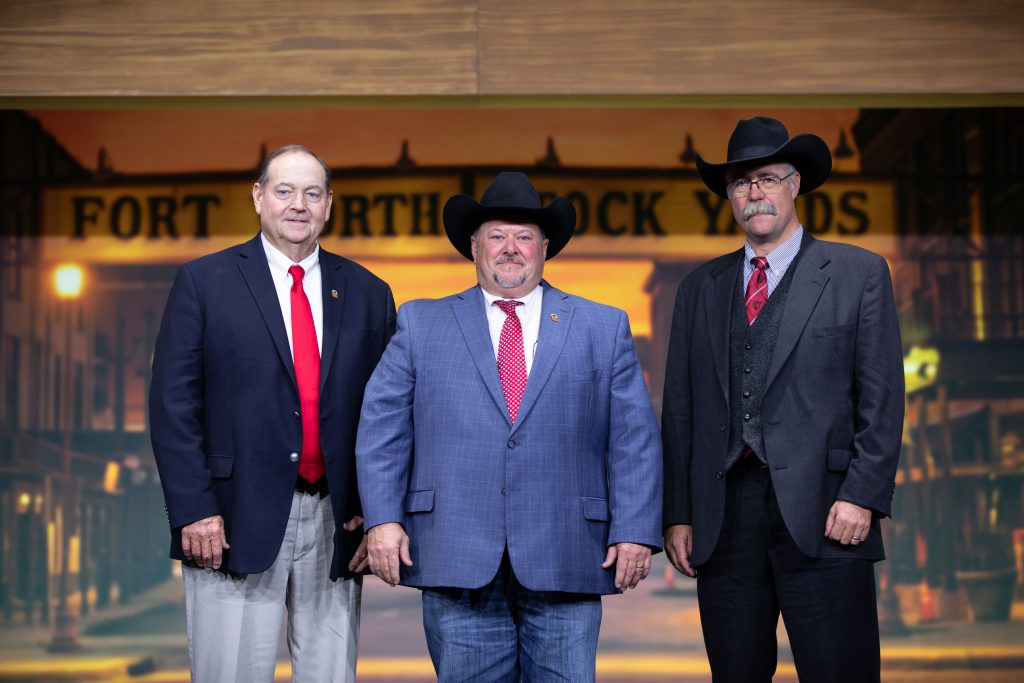
The American Angus Association® 141st Annual Convention of Delegates gathered November 4 in Fort Worth, Texas. Five members were elected to the board of directors. They are Paul Bennett (second term), Red House, Virgina; John Dickinson (second term), Auburn, California; Ron Hinrichsen, Westmoreland, Kansas; Mark Johnson, Orlando, Oklahoma; and Danny Poss, Scotia, Nebraska. The delegation also elected new officers; Jonathan Perry, Fayetteville, Tennessee, president and chairman of the board and Jim Brinkley, Milan, Missouri, vice president and vice chairman of the board. Darrell Stevenson, White Sulphur Springs, Montana will serve as the treasurer for the 2024 to 2025 term.
"We have got to continue to make the American Angus Association relevant to its breeders and its members," said Jonathan Perry, president and chairman of the American Angus Association® Board of Directors. "We have got to embrace diversity. We have got to continue to create tools that touch every member. The diversity of our breeders and our breed is our greatest strength."
Directors can serve up to two, three-year terms on the board and, if elected, they serve an additional one-year term in office as president/chairman and/or vice president/vice chairman.
More about the elected directors:
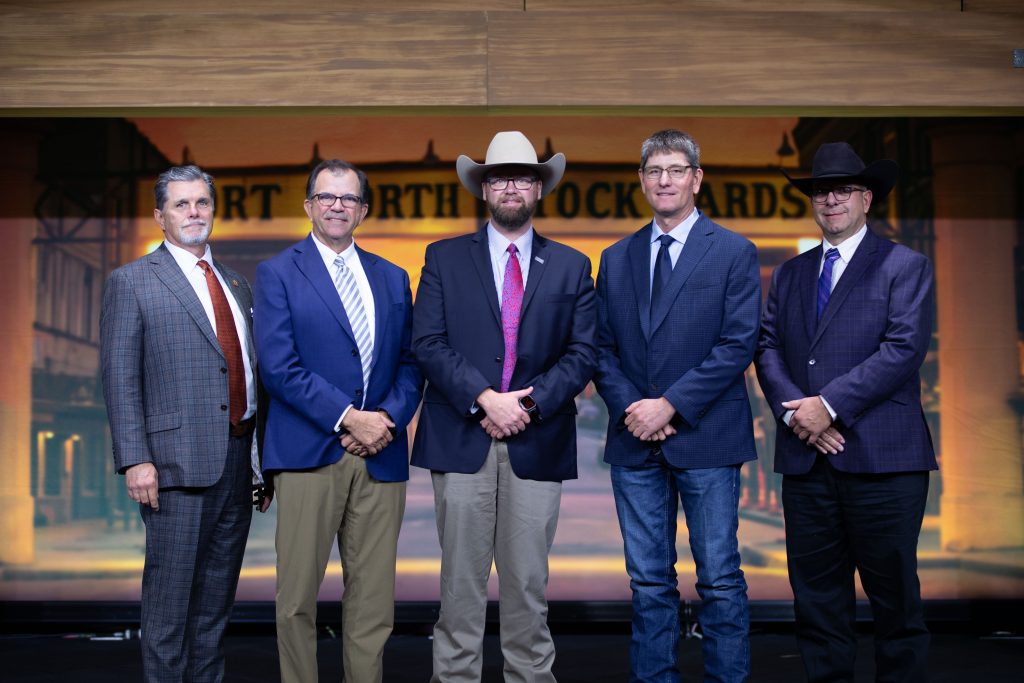
Paul Bennett, Virginia
Paul Bennett, will serve a second term on the Board of Directors. In his first term, he served on the Certified Angus Beef (CAB) Board of Directors, as Chairman of the Breed Improvement committee, and served on the Member Services committee. Bennett and his wife, Tracy, have two children, Scott and Sarah. In 2024, they were richly blessed with three grandchildren born in a span of three days. The family operation, Knoll Crest Farm, Inc,. is now a fourth-generation seedstock operation, with Bennett's grandfather, Paul D. Bennett, establishing a registered cow herd in 1944. The family transitioned the farm from a typical southside-Virginia tobacco, livestock and crop farm to a beef seedstock operation in the 1980s. Today, Knoll Crest is operated by the team of brothers - Jim, Brian and Paul - along with Paul's nephew, Dalton. Bennett is honored to continue sharing his enthusiasm, experience and understanding of the Angus breed and its industry and pledges to remain accessible and highly engaged.
John Dickinson, California
John Dickinson finished his first term on the board as a member of the committees for Member Services, Events and Activities, Breed Improvement; and Commercial Programs. He also served for a time on the Angus Genetics Inc. Board and the Angus Productions, Inc. board. Dickinson and his brother are fifth-generation Angus breeders. His great-great-grandfather, Senator Simon E. Lantz, a former American Angus Association® president, first brought registered Angus cattle to their farm in 1896. Upon graduation from the University of Illinois, Dickinson served as a regional manager for the Association for 10 years. In the spring of 2007, Dickinson left the Association and formed Parnell Dickinson, Inc. (PDI) with his two partners. He works 85 auctions annually. Dickinson also serves as the bull development manager and head of sire procurement for Grimmius Cattle Company. Dickinson is a life member of the Association and has served two terms as president of the California Angus Association (CAA). In 2007, Dickinson was the youngest recipient of the CAA Hall of Fame Award. John and his girlfriend, Katie Bishop, reside in Caldwell, Idaho, and have two children, Blakely (12) and Silas (3).
Ron Hinrichsen, Kansas
Ron Hinrichsen of Westmoreland, Kansas, has been involved in multiple sectors of the beef cattle industry throughout his professional career and is a third-generation Angus breeder. Ron and his wife, Lynne, established R&L Angus/Hinrichsen Ranch in the Flint Hills of Kansas upon graduating from Kansas State University. While raising high-quality cattle, Ron and Lynne have focused on bringing in the fourth generation—their children Cale and Eva—to continue the legacy they have established. They raise cattle to fit the environment and sell bulls to commercial cattlemen based on their needs. With another family, they host an annual bull sale in the spring. Angus Herd Improvement Records, ultrasound data, and genomic testing are used to continually improve the predictability of their cattle. Along with the cattle operation, Ron's professional career started in semen sales and later moved into animal health sales. Today he works for Boehringer Ingelheim as a senior territory manager. Ron has played an active role in the Kansas Angus Association, serving on the board and as president and junior advisor. Other leadership roles have included serving as the American Royal beef superintendent for 20 years, as the Kansas State Fair board president, and on the Kansas Livestock Association and National Cattlemen's Beef Association animal health committees.
Mark Johnson, Oklahoma
Mark Johnson of Orlando, Oklahoma, is a lifelong cattleman with more than 50 years of experience in beef production. Along with his wife, Brenda, and two daughters, Sydney and Charley, he operates J&J Beef Genetics, LLC. Johnson grew up on a centennial family farm in Deerfield, Missouri. He attended Northeastern Oklahoma A&M junior college and later Oklahoma State University (OSU). He then completed his doctorate at Kansas State University in 1992. Since then, Johnson has been a professor of animal and food sciences at OSU and has served as supervisor of the OSU Purebred Beef operation for 32 years. At OSU, Johnson has held the Totusek Endowed Chair, been recognized with awards for teaching and advising, conducted youth and beef cattle extension programming and coached the livestock judging team. He is also the lead author of four chapters in the OSU Beef Cattle Manual. Johnson has served as president and vice president of the Oklahoma Angus Association (OAA) and has been honored with the Mr. Angus Award. He and his wife have served as Oklahoma Junior Angus Association Advisors and were inducted into the OAA Hall of Fame in 2024.
Danny Poss, Nebraska
Danny Poss, a first-generation Angus breeder and lifelong resident of Scotia, Nebraska, grew up on a diversified, family farming operation. The early foundation of the family's commercial cattle operation was established by his parents, Melvin and Elizabeth. In 1985, as a sophomore in high school, Poss purchased his first registered Angus heifer. Poss attended the University of Nebraska–Lincoln (UNL) where he majored in animal science. After graduating from college, Poss returned home to the family operation and began growing his Angus cow herd, while working with his parents on their farming operation. That same year, 1993, he sold his first three bulls privately. In 2005, Poss purchased his own ground and continued to help his dad farm. Sadly, in February 2012, Poss lost his dad to brain cancer. In 2017, he and Kristi moved the bull sale to their ranch in Scotia, Nebraska. Today, with the help of their boys, they market more than 300 bulls a year. To Danny and Kristi's 30 years of marriage, they have four children: Nolan, Nathan, Neleigh and Natalie.
To learn more about the American Angus Association Board of Directors, visit www.angus.org/about/board-of-directors.
Four finalists have been selected in the 12th annual National Anthem Contest, sponsored by Norbrook®. The National Cattlemen's Beef Association (NCBA) is inviting the public to vote for the winner through Nov. 15.
Introducing the four finalists:

Jaci Deitrick of Newcastle, Oklahoma, is involved in her family's registered Hereford cattle operation and is pursuing a master's degree in international agriculture at Oklahoma State University.
Payton Goodman of Canyon, Texas, is majoring in agriculture media and communication at West Texas A&M University and looks forward to advocating for the beef industry.

Anah Higbie of Quenemo, Kansas, helps with her family's commercial Simmental cow-calf operation, enjoys showing cattle and considers being an animal agriculture advocate one of the biggest passions of her life.
Hayden Ladd of Waldron, Michigan, is a fourth-generation cattle producer who enjoys showing cattle, playing guitar, singing at local venues, and roping on the Michigan High School Rodeo team.
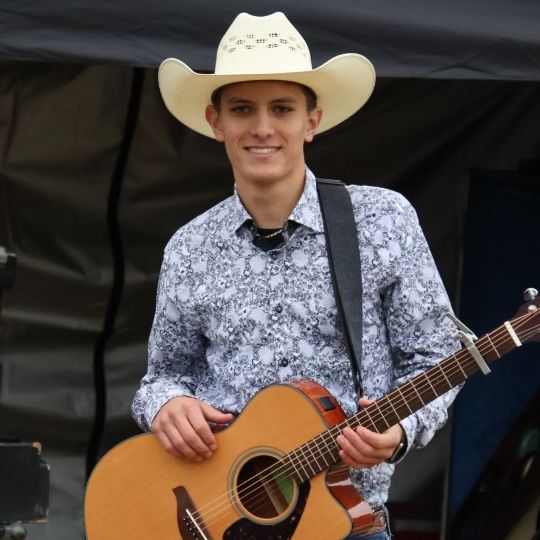
Videos of the finalists are available for viewing and voting at convention.ncba.org. The public can vote once per day per person through Nov. 15, and the winner will be announced Nov. 21.
The winner will perform the "Star-Spangled Banner" at the Opening General Session of CattleCon 2025 and will receive round trip airfare to San Antonio, Texas, a hotel room for three nights, complimentary convention registration, plus a pair of boots, jeans and a shirt from Roper or Stetson.
For more information and to register for CattleCon 2025 and reserve housing, visit convention.ncba.org.
Attorney General Gentner Drummond is urging Oklahoma residents to watch out for contractor fraud in the wake of this weekend's severe weather. Drummond said the weeks following damaging storms and tornadoes are a common time for fraudsters to prey on those who suffered storm damage.
"Even though it's tempting to move quickly after sustaining property damage, Oklahomans should carefully research businesses and contractors before hiring them," Drummond advised. "Staying alert and using good discretion when choosing a contractor or construction company are vitally important."
Six counties have been declared a State of Emergency, and agents from the Office of the Attorney General will be in those areas posting notices and educating residents on avoiding scams.
Some tips on how to avoid contractor fraud are:
Anyone can contact the Attorney General's Consumer Protection Unit to find out if complaints have been filed against a contractor or to file a complaint against a contractor. Call the Office of the Oklahoma Attorney General Consumer Protection Unit at 1-833-681-1895.
Today, the National Wheat Yield Contest announced the 26 national and 94 state winners for 2024-the ninth year of the contest. This year's contest had 516 entries, the most ever. "The new website, along with all our great partners promoting the contest and good growing conditions in most wheat-growing states early last spring, created more interest and enthusiasm for the contest. We appreciate all the growers who participated and our partners who supported the contest. Congratulations to all the winners and to everyone who is learning how to raise higher yield and quality wheat through their experiences in the contest," said Bernard Peterson, National Wheat Foundation Chairman and Bardstown, Kentucky Farmer.
The National Wheat Yield Contest encourages wheat growers to strive for high yield, quality, and profit while trying new and innovative wheat management strategies.
Out of the 26 national winners, 7 are new national winners this year, 19 have placed nationally in the past. Two of the winners are from the new category, Digital Yield, which ran as a pilot in dryland spring wheat only in 4 northern plains states. "We are pleased with how the pilot digital yield category went and how much we can learn from it. We expect to continue this type of category and will take time this winter to gather feedback from the participants and our partners who helped us develop this category to refine it even more," said Anne Osborne, National Wheat Foundation Project Manager.
All 26 national winners will ship in a wheat sample to be tested for quality parameters, including milling and baking analysis. A panel of experts will evaluate the results, and top-quality winners will be announced on January 15 at the National Wheat Foundation's Winter Board meeting in Washington, D.C.
"The National Wheat Yield Contest emphasizes wheat quality as well as yield because our customers all over the world expect that our wheat is the best and most consistent high-quality wheat they can buy," said Bernard Peterson, National Wheat Foundation Chairman and Bardstown, Kentucky Farmer.
Thank you to all the partners in the 2024 contest: WestBred, John Deere, U.S. Wheat Associates, BASF, Croplan, Eastman, Limagrain Cereal Seeds, The McGregor Companies, Agrimaxx, Ardent Mills, Bushel, Climate FieldView, Corteva, DynaGro, GrainSense, Kentucky Small Grain Growers Association, Mennel, North Carolina Small Grain Growers Association, Ohio Corn & Wheat, PlainsGold, Siemer Milling Company, UPL, UniSouth Genetics, Grain Craft, Kansas Wheat, Miller Milling, Michigan Wheat, Montana Grain Growers Association, Northern Crops Institute, North Dakota Mill & Elevator. DTN/Progressive Farmer is the official publication of the National Wheat Yield Contest.
The full list winners can be found here.
For more details on the National Wheat Yield Contest, visit www.wheatcontest.org. For questions on partnership in the 2025contest, contact Anne Osborne [aosborne@wheatworld.org]aosborne@wheatworld.org.
Signals in 2024 show strong demand for Angus cattle, beef products to continue.

The American Angus Association® concluded a successful fiscal year, expanding the breed's market share. The 2024 fiscal year marked the 10th-consecutive year of more than 300,000 registrations. In addition, the Association surpassed 21-million total registrations. Regular and junior memberships totaled 21,443.
"Despite record low inventory in the beef industry, the Association continues to see strong registration numbers and year-over-year growth," said Mark McCully, chief executive officer of the Association. "It illustrates The Business Breed's prominent position in the market; more than 80% of the U.S. cow herd is now Angus-influenced." This was one of many takeaways garnered from the Industry Insights Survey, which was released in the first quarter and conducted by Angus MediaSM and CattleFax.
The breed also celebrated a historic industry milestone with the announcement from National Beef Packing Co., LLC (NPB) to pay grid premiums for genetic merit. As of August 5, NPB pays a $5 per head premium for cattle on their U.S. Premium Beef, LLC grid with an AngusLinkSM Genetic Merit Scorecard (GMS) Beef Score of 100 or greater. Beginning December 1, cattle with a Beef Score of at least 150 will receive a $10 premium. This is in addition to the nearly $17/cwt. average premium paid on feeder cattle enrolled in AngusLink value-added programs during the past year, even as annual enrollments grew by 76%.
AngusLink is one of many programs and tools the Association and its subsidiaries continue to expand to better support Angus breeders and drive demand for their products. During the fiscal year, Angus Genetics Inc. (AGI®) processed 218,497 genomic samples — a 5.6% increase from the year prior. In partnership with the Association's Angus Herd Improvement Records (AHIR®), AGI® also released research expected progeny differences (rEPDs) for both teat size and udder suspension. More than 148,000 phenotypic records for each trait were collected from 87,000 cows to contribute to the dataset for the rEPDs.
Angus MediaSM welcomed Benjie Lemon as its new president in June 2024. His team ended the year having created 573 custom sale books and sold 3,170 advertising pages. The Angus Journal® produced more than 3,500 pages of breeder news and articles, while the Angus Beef Bulletin® provided commercial readers with 960 pages of industry news and insights.
In a joint effort to better serve readers, members and commercial producers, Angus Media and the Association launched a new, redesigned website. The retooled homepage of Angus.org allows visitors a choice of three actions; to learn about Angus advantages, go to the commercial cattlemen's corner, or visit the member center. Each section has resources, news and links specifically curated for different types of Angus producers.
Angus Foundation continues to expand its reach and support of youth, education and research; having awarded more than $388,000 in scholarship dollars and raising nearly $800,000 in donations in the fiscal year. Under the Foundation's guidance and with additional funds from Ingram Angus and the Association, BEEF Academy launched in July 2024. The new youth-focused, online learning platform is a go-to-resource for beef industry education for National Junior Angus Association members. In the future, the platform will be available to schools and other organizations to utilize.
Driving growing demand for Angus genetics, Certified Angus Beef sold 1.236 billion pounds of branded beef with 18,000 licensed partners worldwide. Engaging producers across the industry, Certified Angus Beef concluded the first year of its Raised with RespectTM campaign having facilitated the Beef Quality Assurance certification of more than 1,500 ranchers.
"Today's consumers have greater interest in how their beef is raised and the practices behind it," said John Stika, president of Certified Angus Beef. "Programs like BQA help bring our customers and beef community closer together in that understanding, building trust to ensure a sustainable future for our industry." The program which is funded in partnership by Sysco has been greenlighted for another year.
To view the 2024 Angus Annual Report and to view the Association's complete financial report, visit https://bit.ly/AAA_AnnualReport24.
For the second time since 2017, the OSU College of Vet Medicine is back on probationary accreditation. At that time, American Veterinary Medical Association placed the CVM on probationary accreditation after a site visit. The AVMA cited deficiencies in several areas, including finances, students, faculty, physical facilities, curriculum, and outcomes assessment. The CVM was directed to address these deficiencies, including: Presenting a financial plan, Ensuring there was enough faculty and staff, Reviewing the curriculum, Incorporating learning outcomes into course objectives, and Repairing or replacing flooring in the large animal hospital. OSU was successful in fixing the problems cited by the AVMA and regained full accreditation.
However- after a review this past month- the OSU-CVM is back in the same position it found itself in 2017. Oklahoma State released the following update on where the College currently stands:
AMERICAN VETERINARY MEDICAL ASSOCIATION ACCREDITATION
The OSU-CVM remains fully accredited. However, after its scheduled review in September, the American Veterinary Medical Association (AVMA) placed the college on probationary accreditation until certain deficiencies are addressed.
Probationary status enables the college to retain its accreditation while addressing specific concerns raised by the AVMA. The status does not adversely impact the quality of OSU-CVM's educational programs, as evidenced by CVM graduates' recent performance in national licensing testing, with passing rates of 96% and 94% in 2023 and 2024, respectively.
The OSU-CVM is taking immediate action to address the deficiencies identified and is committed to continuing to enhance its programs, facilities and services.
OSU-CVM LEADERSHIP TRANSITION
Dr. Carlos Risco stepped down in his role as dean on Oct. 31, and Dr. Jerry Ritchey has been appointed interim dean. A leadership transition team from across the OSU System is directing efforts to ensure swift action is taken to address deficiencies identified by the AVMA.
This leadership transition brings new opportunities to build on the momentum created by the OSU Veterinary Medicine Authority and Trust (see below), which was established to bring enhanced clinical facilities, new construction and additional resources for clinical faculty and staff that will enrich the student experience and place OSU in a very competitive position among other veterinary medical schools and teaching hospitals.
OSU CVM GRADUATES: STRONG PERFORMANCE NATIONALLY
RECENT HIGHLIGHTS AND PROGRESS
| |||||||||||||||||||||||||||||||||||||||||||||||||||||||||||||||||||||||||||||||||||||||||||||||||||||||||||||||||||||||||||||||||||||||||||||||||||||||||||||||||||||||||||||||||||||||||||||||||||||||||||||
| |||||||||||||||||||||||||||||||||||||||||||||||||||||||||||||||||||||||||||||||||||||||||||||||||||||||||||||||||||||||||||||||||||||||||||||||||||||||||||||||||||||||||||||||||||||||||||||||||||||||||||||
|
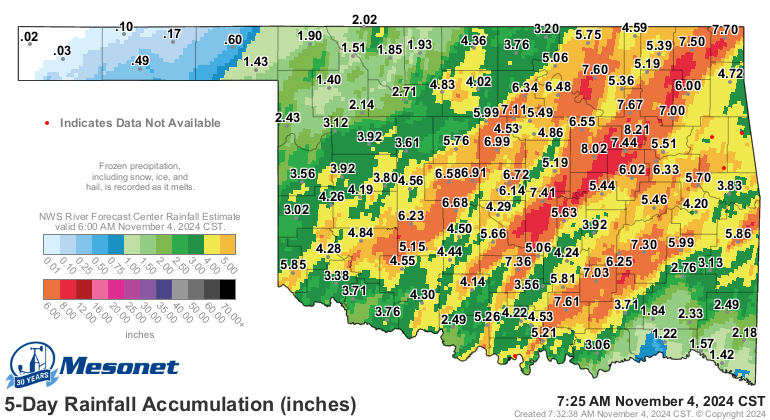
Figure 1.
Dr. Derrell Peel, Oklahoma State University Extension Livestock Marketing Specialist, offers his economic analysis of the beef cattle industry as part of the weekly series known as the "Cow Calf Corner," published electronically by Dr. Peel and Mark Johnson. Today, Dr. Peel discusses how recent rainfall will affect producers.
Data from the Oklahoma Mesonet shows that Stillwater, Oklahoma received 2.36 inches of rain on August 11, 2024. For the next 78 days, a total of 0.92 inches of rain fell with only one day receiving more than 0.2 inches and 72 days with zero precipitation. Starting October 30, Stillwater received 5.49 inches of rain in 5 days (Figure 1), with additional rain falling at the time of writing. Figure 1 confirms that the majority of Oklahoma received significant rain in this period. As is frequently the case in Oklahoma, the much-needed rain arrived in the form of severe storms with several tornados, leaving a trail of damage in several communities.
The rain is very helpful to the Oklahoma winter wheat crop and revives prospects for limited late wheat grazing. The Crop Progress report for the last week of October showed that wheat planting in Oklahoma was at 59 percent, compared with the five-year average of 81 percent for that date. Wheat emerged was at 36 percent, compared to an average of 62 percent. The moisture will jump-start wheat growth, but very little winter wheat will be grazable before December and perhaps not much before the end of the year.
The heavy storms likely provided some critical recharge of water supplies for cattle. Refilling ponds will allow some cattle producers to avoid difficult decisions to relocate or liquidate cattle due to lack of drinking water. It is not clear how much or how wide-spread pond water recharge occurred. The extremely dry conditions meant that much of the rain absorbed quickly and did not run, although flash flooding occurred in several locations.
The Summer 2024 issue of Oklahoma Farm Bureau's Oklahoma Country magazine, filled with stories from around Oklahoma agriculture and Farm Bureau, is headed to mailboxes and is also available online for viewing and reading. Be sure to check out the digital copy in addition to the print copy mailed to each and every OKFB member.
OKFB's Fall 2024 magazine features Ottawa County members Justin and Jared Miller, growing their pecan legacy from harvesting trees in their spare time to a state-of-the art pecan cracking and retail business. Also in the Fall issue, Kay County member Garrett Haskins takes achievement to a different level, winning the 2024 YF&R Achievement Award.
Additional magazine content includes Major County Farm Bureau member, Paisley White shares her agriculture story through her book "Scout the Scottish Highlander" and Bill Peetom, an Ellis County Farm Bureau member follows-up from the recent wildfires in the panhandle.
Check out our featured content below, and OKFB members can read the print edition delivered directly to their mailboxes.

The Association of Equipment Manufacturers (AEM) recently announced the addition of Lisa Stafl as the association's first in-house General Counsel.
Stafl brings a wealth of corporate counsel experience to AEM, where she will serve as a member of AEM's Leadership Team.
"Lisa's corporate counsel expertise will be crucial in guiding AEM's efforts to ensure its business practices, policies, and dealings meet legal and regulatory requirements," said AEM President Megan Tanel. "Her track record spent leveraging her international experience to provide guidance across organizations and guiding the legal posture and interests of a company will serve AEM and our members well."
Stafl joins AEM after having spent the last several years in corporate counsel roles for Palfinger, Progress Rail, Caterpillar, and Buycrus International. In those roles, she earned a reputation as a trusted advisor and business partner, capable of providing strategic direction to corporate management on dealing with legal matters.
In addition to gaining senior management experience during her career, Stafl also participated in the initiation, development and execution of strategic planning and corporate policies, as well as served as an inspiring mentor to high-caliber teams.
Stafl earned both a law degree and a bachelor's degree from Marquette University Law School.
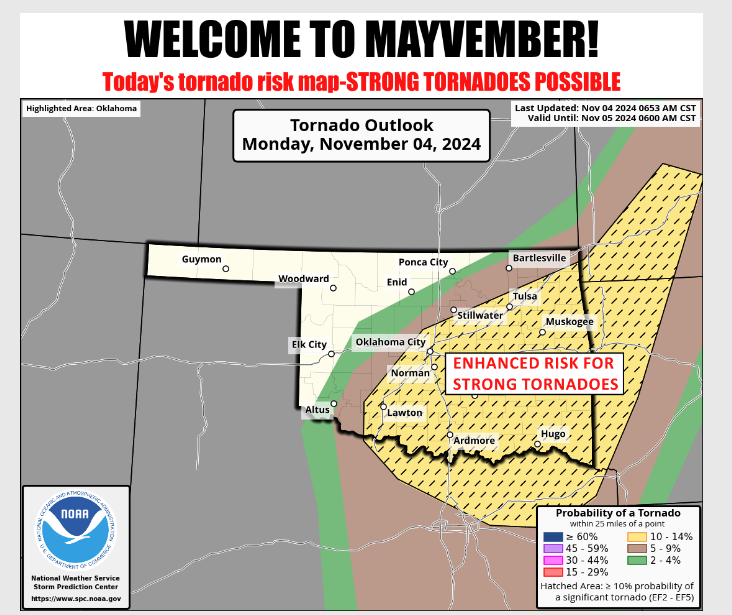
Oklahoma weather can always be interesting, and this past weekend did not disappoint. While we are used to seeing severe weather across the state in the spring and summer months, we are NOT used to seeing November tornadoes!
According to State Climatologist Gary McManus, we saw several tornadoes this weekend, "we've already had at LEAST 6 confirmed tornadoes thus far...2 EF3s, 1 EF2, 2 EF1s, and an EF0, and there have undoubtedly been quite a few more that remain uninvestigated by the good folks at NSSL, SPC, and the NWS. The record for tornadoes in November is 12, set back in 1958."
Tornadoes touched down near Blanchard, Newcastle, and the Harrah Area, causing downed trees, roof damage, and structural damage.
Oklahoma needed the rain for sure, as Wheat planting has been delayed across the state, waiting to see some moisture, and moisture we did see it! Take a look at the latest rainfall map across the state (It's Interactive so you can click and see where your area ended up)
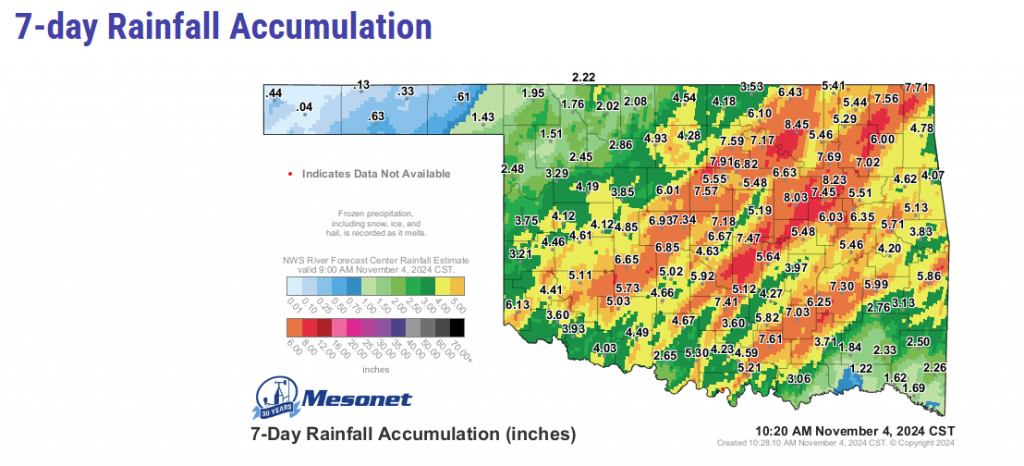
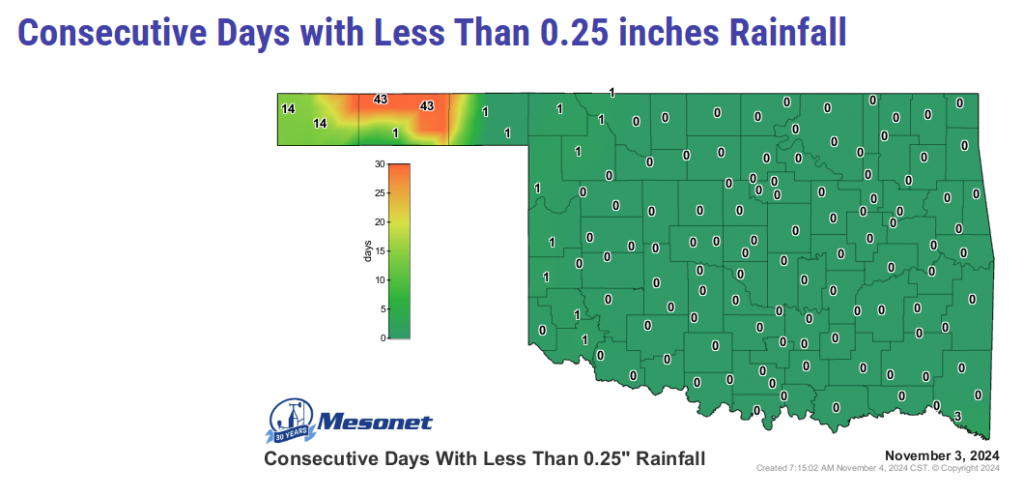
Today will be the final day of the rainfall, according to McManus, and we could still see severe weather out of the deal, "As per usual, today's severe weather environment will be evolving, and it is as we speak. Tune to your local NWS Office and favorite media source NOW and stay weather aware."
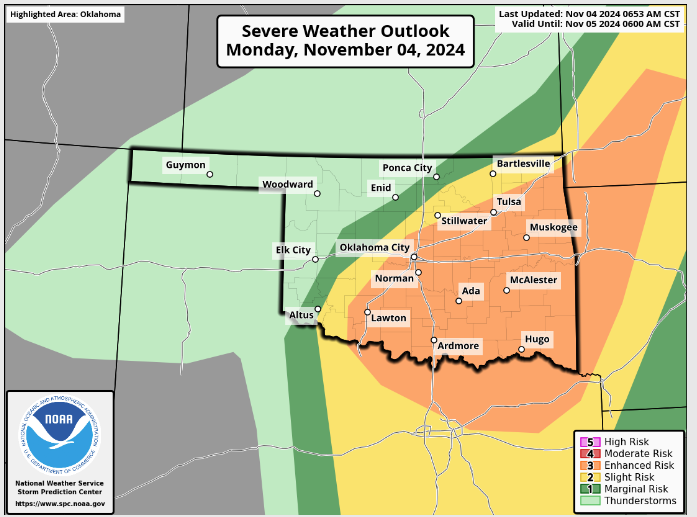
To read more from Gary McManus on his mesonet ticker, click here:
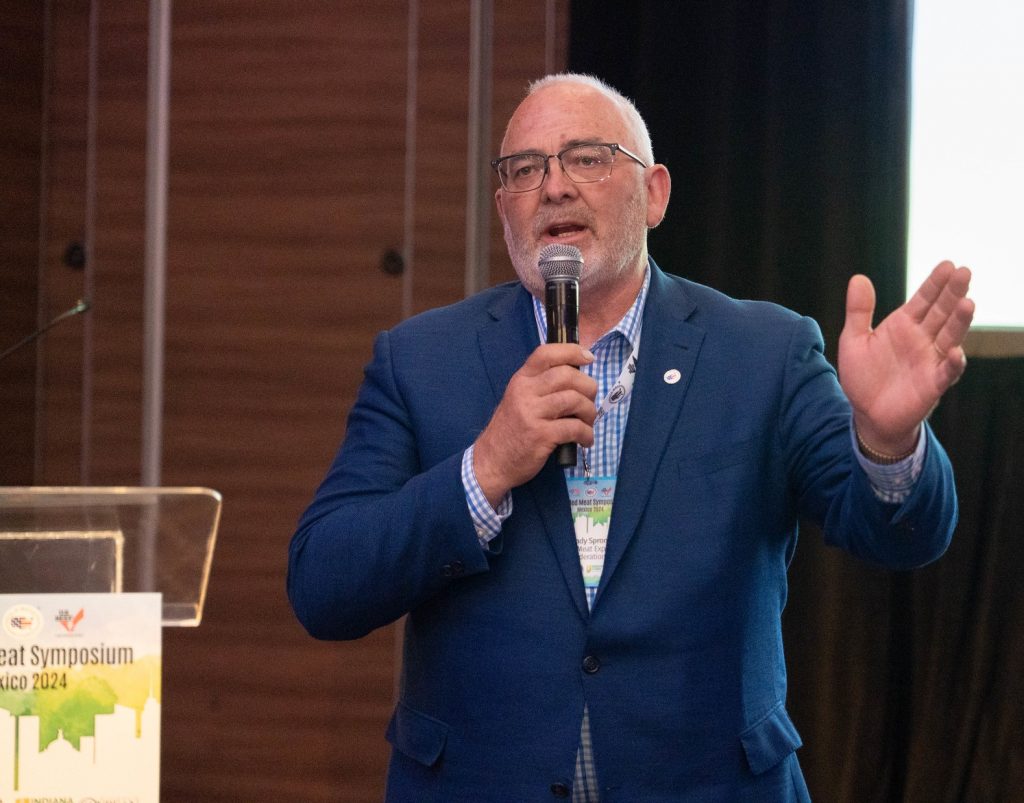
Randy Spronk
Members of the U.S. Meat Export Federation (USMEF) will gather in Tucson, Ariz., this week for the federation's annual Strategic Planning Conference.
USMEF Chair Randy Spronk, a pork and grain producer from Minnesota, will mark the end of his term of leadership of the organization. He notes that over the past year USMEF has diversified its marketing footprint through additional funding from USDA's new Regional Agricultural Promotion Program (RAPP), which has allowed expansion of resources in developing markets like Indonesia.
In this audio report, Spronk details two key sessions of the conference. The first is a panel on the importance of farmers and industry leaders seeing firsthand the markets served by USMEF and forging personal relationships with our trading partners. That panel, hosted by Spronk, will feature Ross Havens of the Cattlemen's Beef Board, Bob Ruth of the National Pork Board and Don Pemberton of the Kentucky Cattlemen's Association. Another general session will offer an in-depth look at the trade relationship with Mexico as that country also transitions to a new administration.
The USMEF Strategic Planning Conference starts Wednesday, and details are available in this press release. Updates from the conference will be available on the USMEF website.

What is the value of seed treatments to U.S. soybean farmers, and how do they feel about alternatives to seed treatments? A recent survey conducted by the American Soybean Association and the United Soybean Board sought to determine just that.
Seed treatments typically comprise one or more pesticides applied to seeds as a coating before planting—when plants are most susceptible and face the highest pressures—to limit early season risks to pest damage.
Jacquie Holland, an ASA economist who worked on the study, said it was not surprising the survey found seed treatments to be widely used across the country in soybean production: "Seed treatments are a proactive means of ensuring plant health and yield vigor while minimizing environmental impacts. Alternative methods to seed treatments do exist, but few are widely accepted by farmers as feasible options."
Because seed treatments are broadly adopted by U.S. soybean producers, disruptions to this technology would likely alter on-farm operational strategies and product delivery methods. Holland said this work finds that farmers would likely face lower yields and higher costs without seed treatments.
Josh Gackle, ASA president and a soy grower from North Dakota, agreed. "On our farm and farms across the country, soybean growers rely on seed treatments as a cost-effective, reliable and safe method of providing early-season plant health and pest prevention. Farmers need these tools to help get our growing season off to a good start," he said.
The survey was conducted in July 2024 and gathered 491 online responses from farmers growing at least 150 acres of soybeans during the 2023 season across the 17 largest soybean-producing states in the United States. On average, 90% of soybean acres in the ASA/USB survey were planted with treated seeds. Only 3% of respondents had never planted any treated soybean seeds. Because seed treatments are so widely used by farmers, the technology impacts farms across the United States.
Without seed treatments, farmers must resort to alternative practices to maintain yield vigor and reduce early season pest pressure within a reasonable cost. These options include higher seeding population rates to account for seedling damage, later planting dates to avoid prime pest pressure, increased starter applications at planting, and more foliar pesticide applications. Increasing seeding population rates was the preferred alternative, followed by increasing foliar pesticide applications, with later planting the least preferred option. From both a yield and profitability perspective, seed treatments remained the clear preference.
The survey also looked at farmer safety when handling treated seeds. It indicated occupational exposure risk potential for growers, applicators and farm labor from these sources is limited.
Just over a third of seed treatment users rely on their dealers to treat their soybeans. Only 6% of respondents treat their own soybean seed, with the remainder relying on seed companies or retailers to treat their soybean seed ahead of planting.
Of the producers utilizing treated seed, nearly two out of five reported storing their treated seed in an enclosed storage building. It is worth noting that oftentimes these treated seeds are not stored for long after being delivered to the farm before farmers plant them.
To read the full survey results, access it online here.
RON's Dave Lanning has a pre-opening look at today's agricultural Markets.
Click the audio tab below for today's report.

Whole Farm Revenue Protection (WFRP) is a crop insurance product administered by the USDA Risk Management Agency (RMA). WFRP provides protection against the risk of farm revenue generated by all crops falling below a level of guaranteed revenue. Expected revenue is found by taking the most recently available five-year average of whole farm revenue reported on the Schedule F farm income tax form. For example, the expected revenue for 2024 is found by taking the average of revenue reported in 2018-2022. Subsequently, the expected revenue is multiplied by the producer-elected coverage level to determine the guaranteed revenue or WFRP liability. The WFRP revenue guarantee is capped at $17 million.
Like other multi-peril crop insurance (MPCI) products, the WFRP premium is subsidized by rates determined through federal legislation. The subsidy, or portion of the actuarially fair premium rate paid by the government, decreases as the elected coverage level increases. The WFRP producer premium may be further reduced through the Diversity Factor, which is a percentage multiplied by the actuarially fair rate. As the number of qualifying commodities insured increases, the greater the discount in the actuarially fair premium rate. Lastly, the WFRP producer premium may be reduced for those producers who have Beginning Farmer or Rancher or Veteran Farmer Status. Combining all three of these producer premium reductions can result in up to a 90% reduction in the actuarially fair premium.
While the increasing trend in federal crop insurance participation since its inception can be largely attributed to increases in the premium subsidy rate, not all programs have experienced the same utilization (Yehouenou et al., 2018). Yehouenou et al. (2018) cite the reluctance of crop insurance agents to encourage purchasing STAX as one reason for the lack of participation despite the 80% premium subsidy rate attached to all coverage levels. Whole Farm Revenue Protection also faces a lag in participation and has experienced a decline in purchased liability since its inception in 2015. Average purchased liability of about $2 billion per year (Figure 1), which is far less than yield protection (YP) and revenue protection (RP) purchased liability which averaged over $100 billion over the same period (Figure 2).
One issue driving the lack of federal crop insurance participation is a lack of understanding of crop insurance programs. In response to this knowledge gap, RMA set up a number of cooperative agreements to build relationships, enhance understanding, and strengthen the public-private partnership of federal crop insurance across the agriculture community. In 2022, the University of Arkansas partnered on a two-year pilot program with RMA, the Crop Insurance Navigator program. The Navigator project seeks to address "knowledge gaps" of RMA products with a focus on historically underserved producer communities. The partnership is funded by the USDA Risk Management Agency. This southern region focused pilot is primarily designed to address the knowledge gaps present in WFRP and Micro-Farm products on both the part of producers and crop insurance agents. The program uses a cohort of project specialists to engage farmers, ranchers, educators, community-based organizations, and agricultural stakeholders to enhance understanding of federal crop insurance products serving small and historically underserved producer groups. To learn more about the Crop Insurance Navigator program visit https://srmec.uada.edu/navigator.html.
In an aligned effort to enhance understanding of crop insurance, UA faculty led the development of a workbook covering the fundamentals of federal crop insurance to educate producers, crop insurance agents, and policymakers with chapters on products and opportunities for socially disadvantaged farmers and ranchers. To access the workbook follow this link:https://www.uaex.uada.edu/publications/pdf/MP576.pdf
Figure 1. Whole Farm Revenue Purchased Liability (1999-2023)
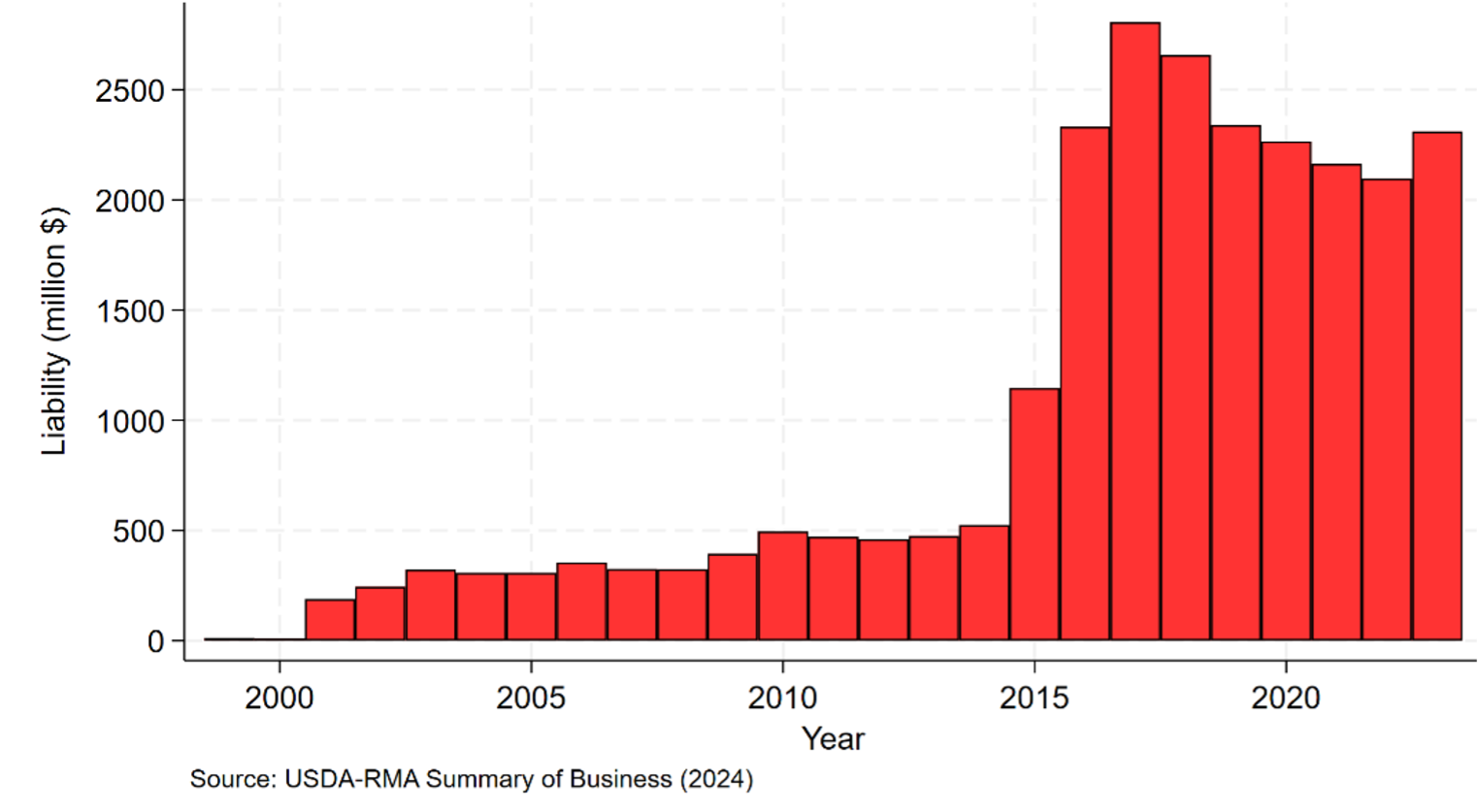
Figure 2. Multi-Peril Crop Insurance Purchased Liability (1989-2023)
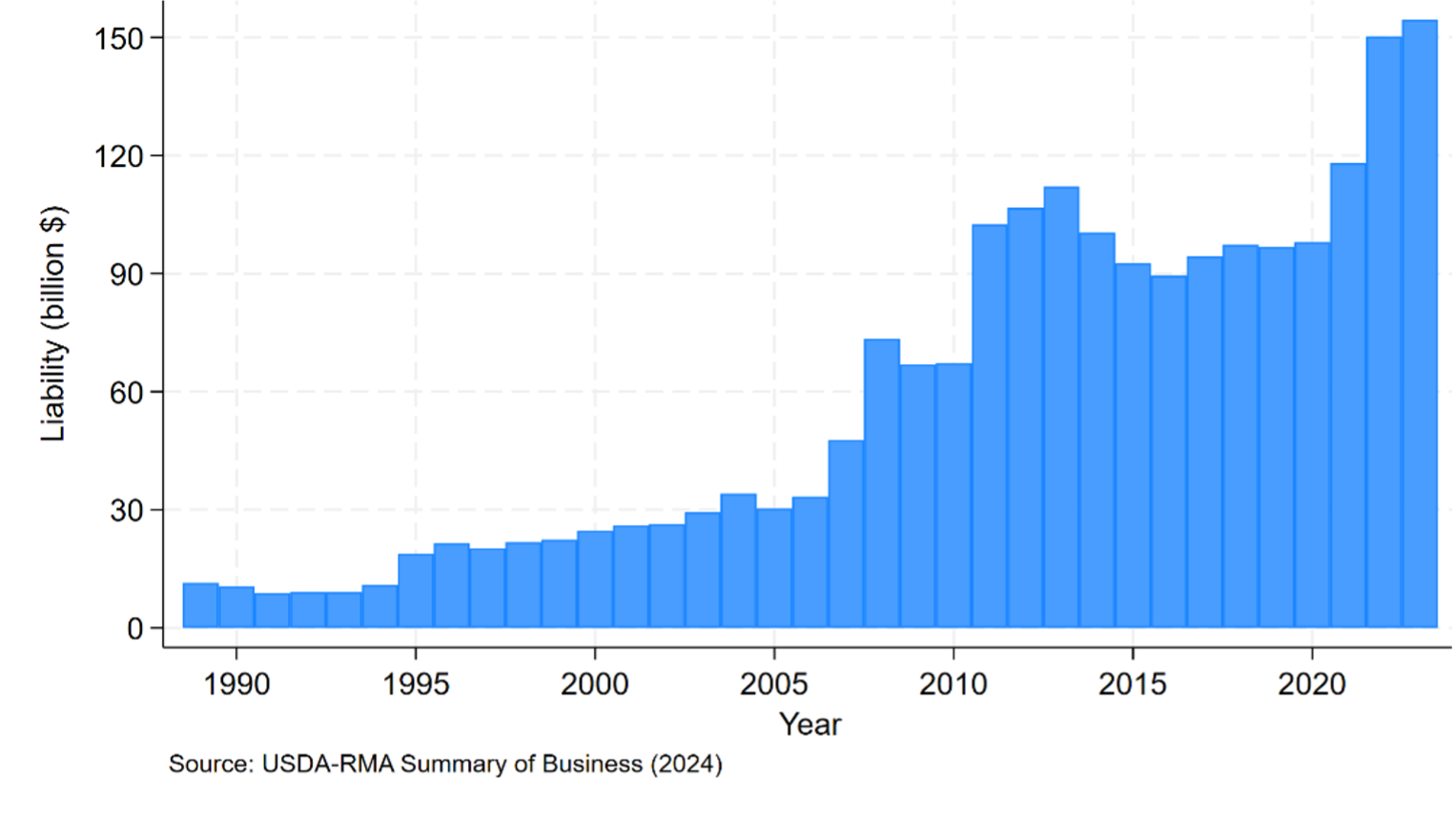
References
USDA-RMA. (2024). USDA-RMA Summary of Business. Retrieved February 20, 2024, from https://www.rma.usda.gov/SummaryOfBusiness
Yehouenou, L., Barnett, B. J., Harri, A., & Coble, K. H. (2018). STAX appeal?. Applied economic perspectives and policy, 40(4), 563-584.
Article Courtesy of Southern Ag Today: Biram, Hunter, and Ron Rainey. "Addressing the Gap in Participation Between Whole Farm Revenue Protection and Other MPCI Products." Southern Ag Today 4(45.1). November 4, 2024. Permalink
Voters head to the polls Tuesday for the General Election. The State Election Board offers these tips and reminders to Oklahoma voters ahead of the November 5 General Election.
ELECTION DAY VOTING
Make a plan to vote. Polls are open from 7 a.m. to 7 p.m. on Election Day. Lines at the polls are typically longest before work, during the lunch hour, and after work. Presidential elections typically have a higher turnout than other elections. If turnout is heavy at your precinct, be prepared for possible wait times. All eligible voters in line by 7 p.m. will be permitted to vote.
VERIFY POLLING PLACE
All voters should confirm their polling place before heading to the polls. Voters can confirm their polling place using the OK Voter Portal or by contacting their County Election Board or the State Election Board. The State Election Board reminds voters that you must vote at your assigned polling place on Election Day.
BE PREPARED
Study the candidates and issues before going to the polls. View your sample ballot using the OK Voter Portal. You can also use the portal to find your polling place. The election list is available on the State Election Board website.
PROOF OF IDENTITY
Oklahoma law requires every voter who votes in person to show proof of identity before receiving a ballot. There are three ways to show proof of identity under the law (only one proof of identity is required):
1. Show a valid photo ID issued by the State of Oklahoma, federal government or a federally-recognized tribal government; or
2. Show the free voter identification card issued by the County Election Board; or
3. Sign an affidavit and vote a provisional ballot. (If the information on the affidavit matches official voter registration records, the ballot will be counted after Election Day.)
If your identification card has an expiration, the expiration date must fall after the date of the election.
SECURITY AND INTEGRITY
Information about Oklahoma's voting devices and security procedures can be found on the State Election Board website. Election results will be available on the State Election Board website after the polls close at 7 p.m. on election night.
BEWARE OF MISINFORMATION/DISINFORMATION
During election time, misinformation and disinformation can run rampant. Voters are asked to be wary of inaccurate or false claims of fraud, voter suppression and/or other problems. If you experience an issue or believe an election or voting crime has been committed:
First - Notify your precinct officials, while the incident is in progress;
Second - Contact your County Election Board while the incident is in progress.
Election officials can take immediate action to resolve the issue and/or contact local law enforcement. State and county election officials should always be your trusted sources for information.
URL Guide
OK Voter Portal: https://oklahoma.gov/elections/ovp.html
County Election Board: https://oklahoma.gov/elections/about-us/county-election-boards.html
State Election Board: https://oklahoma.gov/elections/about-us/contact-us.html
Election List: https://oklahoma.gov/elections/elections-results/next-election.html
Proof of Identity: https://oklahoma.gov/elections/voters/proof-of-identity.html
Voting Devices: https://oklahoma.gov/elections/security-integrity/voting-devices.html
Security Procedures: https://oklahoma.gov/elections/security-integrity/election-security.html
Election Results: https://oklahoma.gov/elections.html
The American Soybean Association raised the alarm this week after the U.S. Environmental Protection Agency released its final registration for glufosinate-P, which imposes additional restrictions beyond what was outlined in the draft released May 2024.
The draft registration included mitigations designed to protect endangered species and their habitats, such as a 50-foot downwind buffer for aerial applications and conservation practices to minimize runoff. At that time, EPA concluded these measures would adequately safeguard listed species and their critical habitats.
The final registration, announced earlier this month, introduced significant new restrictions. These include a 10-foot buffer for ground applications, initially deemed unnecessary, and three additional measures to reduce runoff. EPA also established pesticide use limitation areas (PULAs) for two species: one for the Spring Creek bladderpod and another for the Whorled Sunflower, which now restricts glufosinate-P use entirely within its range.
In a media release from ASA, Director Alan Meadows, who farms soybeans in Tennessee, expressed concern over the unexpected severity of the restrictions, noting that this issue was not raised during the draft comment period. Meadows stated, "The additional limitations raise questions about EPA's commitment to its Herbicide Strategy and suggest undue influence from external pressures."
As the agricultural community navigates these changes, ASA advocates for a balanced approach that considers both environmental protection and the needs of farmers, emphasizing the importance of a science-based regulatory framework.
Why It Matters
ASA is concerned about the implications of these additional restrictions. The agency initially expressed confidence in its Herbicide Strategy to protect endangered species, yet the final registration includes requirements that exceed the original mitigations. This raises questions about the consistency and predictability of the regulatory process, potentially setting a troubling precedent for future herbicide registrations. As ASA and other agricultural groups discuss next steps, it is crucial to raise awareness about these developments and their impact on the farming community.

Keep America Beautiful®, in partnership with Keep Oklahoma Beautiful, Pottawatomie Go (Pogo), and United Way of Eastern Frontier Country, invites Pottawatomie County residents impacted by the April 2023 tornado to register for the Pottawatomie County RETREET initiative. Eligible homeowners can receive up to two large native trees at no cost to replace those lost during the storm, in addition to tree risk assessments, debris removal, and expert advice on long-term tree care.
"At Keep America Beautiful, we understand the power of trees and the impact they have on the overall health and well-being of a community," said Jerí Irby, Keep America Beautiful RETREET Manager. "Losing trees in a disaster of this scale is devastating and replanting them is a crucial part of the recovery process. It's not only about restoring the landscape—it's about restoring hope for those who have been through so much."
"Replanting trees is more than restoring the natural beauty of our community—it's about healing and strengthening the core of our neighborhoods", said John Bobb-Semple, Pottawatomie Go Executive Director. "This initiative is vital to improving our built environment and fostering a sense of new beginnings, but it requires all of us to come together and make it happen."
The Pottawatomie County RETREET initiative will begin with home site assessments and debris removal throughout the winter, ensuring properties are ready for tree planting. In March 2025, volunteers and staff aim to plant 175 to 200 large (8'-10' tall) native trees in Pottawatomie County neighborhoods, followed by a community celebration of renewal and resilience, with food, music, and local activities.
All owners of impacted properties can complete their tree requests online now; visit https://kab.org/our-signature-programs/retreet/ . United Way of Eastern Frontier Country (formerly United Way of Pottawatomie County) is accepting local donations to fund this initiative. To donate online, visit www.gopogo.org/retreet and click "Donate". To donate by mail, make checks payable to United Way of Eastern Frontier Country and send to PO Box 697, Shawnee, OK 74802 with the memo line: RETREET.
RETREET, a signature program of Keep America Beautiful, is the only program of its kind dedicated to post-disaster tree planting. Over the past decade, it has helped restore more than 7,000 trees for communities across the country as they recover from natural disasters.
This tree planting event is made possible through generous support from the lead funder, Pottawatomie County Board of County Commissioners, along with Oklahoma Baptist University, Oklahoma State University Extension Office of Pottawatomie County, Shawnee Feed and Garden Center, United Way of Eastern Frontier Country, Citizen Potawatomi Nation, and the Pottawatomie Go Built Environment Committee.
About Keep America Beautiful: Keep America Beautiful®, the nation's leading community improvement nonprofit organization, inspires and educates people to take action every day to improve and beautify their community environment. Established in 1953, Keep America Beautiful® strives to end littering, improve recycling, and beautify America's communities. Join us on Facebook, Instagram, X, LinkedIn, and YouTube
Entrepreneurs encouraged to apply for beef industry grant program through Nov. 30
The Texas & Southwestern Cattle Raisers Association (TSCRA) Leadership Development Foundation, a 501(c)(3) organization committed to future generations of land and livestock stewards and leaders, announced today the application window for the TSCRA Leadership Development Foundation Working Grant Program is now open.
The TSCRA Leadership Development Foundation Working Grant Program was designed to support individuals through financial capital who are establishing, operating or growing a beef business.
The program is open to entrepreneurs in Texas and Oklahoma including cow-calf operations, stockers, feeders, packing plants, large animal veterinary clinics and any other related segment of the beef value chain.
"Access to capital is one of the greatest challenges in the beef industry today," said TSCRA Leadership Development Foundation Chair Carl Ray Polk Jr. "By investing in these entrepreneurs, we're not only supporting their success but also securing the future of our nation's food supply and natural resources."
To be eligible for consideration for financial assistance, applicants must operate a business in an economically depressed or blighted area in Texas or Oklahoma and face disadvantages. Eligible applicants must also demonstrate the difficulty of obtaining conventional financing because of such disadvantages.
The online application will remain open until Nov. 30. Applicants can expect to be notified of full, partial or denial of funding within 120 days of the close of the application period.
Details about the TSCRA Leadership Development Working Grant Program including the application and eligibility requirements can be found online at tscra.org/what-we-do/leadership-development-foundation/ .
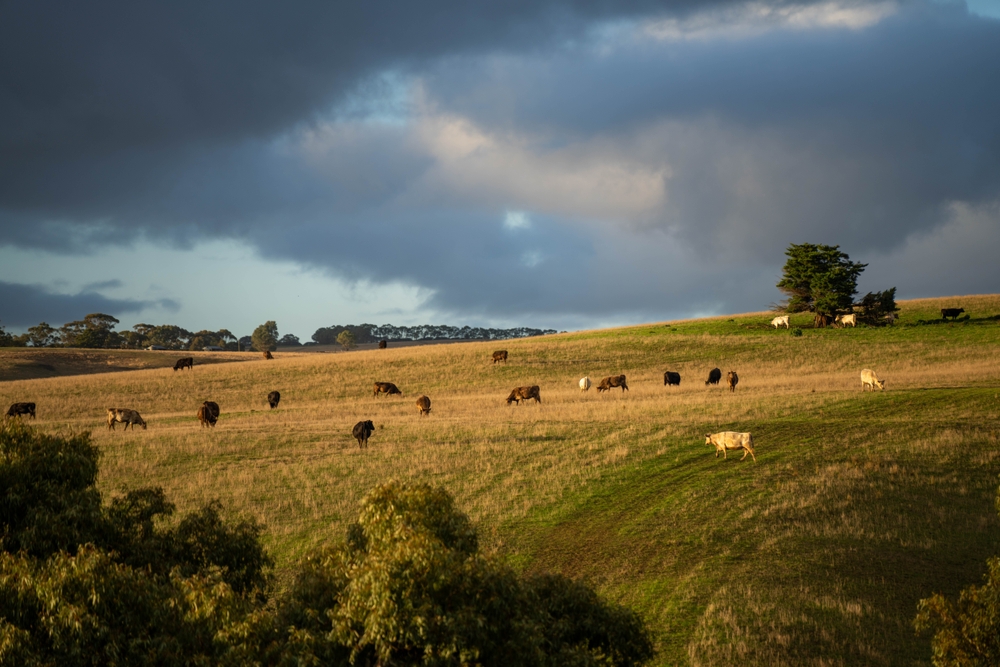
America's Conservation Ag Movement hosts live, farmer-led networking events, called Virtual Peer Networks, which allow producers to hear the latest from experts and innovators moving the needle in conservation ag. They can glean insights and meet other like-minded farmers and ranchers in their own states and others at these interactive virtual events. In 2024, ACAM is hosting a series of VPN events in Montana, Georgia, Louisiana, Oklahoma, and New York.
On October 30, the first VPN of the fourth quarter was hosted by Oklahoma rancher Jack Thomas who utilizes a strong partnership with his local conservation district and USDA-NRCS to expand conservation on his 2,000-acre cow calf operation. During his recent field day, Jack shared how river-bottom conservation tactics, rotational grazing, and financial incentives are changing his fourth-generation farm for the better. He was joined by his local USDA-NRCS officers Trevor Folsom and Julie Lamb for the discussion. Oklahoma Farm Report's Stevie White is featuring comments from that conversation.
Folsom detailed that the NRCS office has aided Thomas with erosion control, replacing historical cropland with grass to preserve topsoil, and further plans to help Thomas implement bale grazing into his operation to help increase organic matter in the soil.
"Increasing organic matter will add resiliency to his operation to reduce the negative effects of things like drought by increasing the holding capacity of his pastures," Folsom said.
Thomas shared how the NRCS office helped him overcome an invasion of Sericea lespedeza when Remedy wasn't quite as affordable. "You learn a lot through that process," Thomas shared. "Since then, I have learned to budget Remedy or the generic Ally, Metsulfuron. Sericea is not a huge deal anymore."
He shared another experience with bottomland that his family had planted to wheat for generations, but Thomas noticed that the ground was eroding and found that the process of planting wheat was costing him more than the gain on the calves. He reached out to Lamb at his NRCS office once again who helped him replace the wheat with Bermuda grass. Through proper management of the grass, the change benefited his operation more than he ever anticipated.
"I used to run about forty pairs on that land," Thomas said. "Now I run about seventy pairs, and in just an average summer, I can shut them on that pasture, and they don't run out of grass all summer. That is good bottomland. The best land that Oklahoma has is that bottomland - that mason silt loam."
He added that water retention has improved greatly, and even in the current drought, the converted pasture still grows green grass in places. He has also gotten control of some ravines that were forming through erosion.
"He has built resiliency into his operation," Folsom added. "The plant community shifted from the Sericea, so that was restored back. Water quality was one of the things that he hit on by fencing out his ponds and adding alternate watering systems. He reduced erosion. Just all of the resource concerns that we have identified on his property have been addressed and now we are trying to take it a step further as we look toward the future."
The NRCS office offers two main programs. The Environmental Quality Incentive Program addresses resource concerns on the landscape through brush management, herbaceous weed treatment, adding or improving ponds and other watering facilities, and improving water quality.
"That is our fix-it program, and guys who have already been through EQIP or are already doing a good job coming through our doors for the first time can participate in CSP or the Conservation Stewardship Program."
CSP is for good stewards of the land who have achieved good conservation practices already. NRCS helps them take the next steps to improve the small things such as organic matter in the soil, body condition scoring education, and many other activities to take stewardship to the next level.
NRCS Soil Expert Jamie Patton chimed in to encourage producers to participate in a VPN and emphasized that they are not only state-wide. "We are continuing these throughout all of our ACAM concentrated states," she said. "These are not state-specific. You can go to our website, AmericasConcervationAgMovement.com, and register for any of these VPN's that you would like, in whichever state you want."
| |||||||||||||||||||||||||||||||||||||||||||||||||||||||||||||||||||||||||||||||||||||||||||||||||||||||||||||||||||||||||||||||||||||||||||||||||||||||||||||||||||||||||||||||||||||||||||||||||||||||||||||||||||||||||||||
| |||||||||||||||||||||||||||||||||||||||||||||||||||||||||||||||||||||||||||||||||||||||||||||||||||||||||||||||||||||||||||||||||||||||||||||||||||||||||||||||||||||||||||||||||||||||||||||||||||||||||||||||||||||||||||||
|
U.S. Department of Agriculture (USDA) Deputy Secretary Xochitl Torres Small announced today that USDA is partnering with Reinvestment Fund to invest nearly $6 million to improve access to healthy foods in underserved communities across the country.
The investments are being made through the Healthy Food Financing Initiative (HFFI) Planning Grant Program, which provides grants to organizations for healthy food retail or food retail supply chain projects in early-stage planning and predevelopment phases.
"No matter where you live in our country, you should be able to get affordable, fresh, and healthy food close to home," Deputy Secretary Torres Small said. "Through the Biden-Harris Administration, USDA is working with farmers and ranchers, food retailers, and other stakeholders to strengthen the local and regional food systems we all count on. Reinvestment Fund has been a key partner to USDA in these efforts and today's investments will ensure more communities get the nutritious food we all deserve."
This announcement is part of USDA's comprehensive set of efforts, bolstered by funding made available through the American Rescue Plan Act, to create more and better markets that benefit both producers and American consumers.
HFFI is designed to support new and expanded markets for a diversity of growers while helping people across the nation access affordable, healthy foods.
Today's announcement includes investments that will support planning activities for 45 projects to develop or expand food retail and food retail supply chain business models.
For example:
Projects announced today will increase access to healthy food for people living in Alaska, Arizona, Arkansas, California, Colorado, Georgia, Illinois, Kansas, Louisiana, Massachusetts, Michigan, Minnesota, Mississippi, Missouri, Montana, New Jersey, New York, Nevada, North Carolina, Oregon, Pennsylvania, South Carolina, Tennessee, Texas, Vermont, Virginia, Washington, Wisconsin and Washington, D.C.
Background
Many low-income communities lack adequate, affordable access to healthy food. HFFI provides grants and loans to entities that offer healthy foods in communities that are underserved by grocery stores and other food retailers. The program increases access to healthy foods, provides new market opportunities for farmers and ranchers, stabilizes small and independent retailers, and creates good-paying jobs and economic opportunity in low-income communities.
Through HFFI, USDA partners with Reinvestment Fund to bring healthy food options to underserved rural, urban and Tribal communities. Reinvestment Fund serves as the National Fund Manager for USDA. It raises capital; provides financial and technical assistance to regional, state and local partnerships; and helps fund projects to improve access to fresh, healthy foods in underserved areas.
In August 2023, Reinvestment Fund expanded America's Healthy Food Financing Initiative to include the new HFFI Local and Regional Healthy Food Financing Partnerships Program.
In June 2024, the Reinvestment Fund expanded the Healthy Food Financing Initiative to include the Food Access and Retail Expansion (FARE) Fund.
USDA Rural Development provides loans and grants to help expand economic opportunities, create jobs and improve the quality of life for millions of Americans in rural areas. This assistance supports infrastructure improvements; business development; housing; community facilities such as schools, public safety and health care; and high-speed internet access in rural, tribal and high-poverty areas. Visit the Rural Data Gateway to learn how and where these investments are impacting rural America. To subscribe to USDA Rural Development updates, visit the GovDelivery Subscriber Page.
USDA touches the lives of all Americans each day in so many positive ways. Under the Biden-Harris Administration, USDA is transforming America's food system with a greater focus on more resilient local and regional food production, fairer markets for all producers, ensuring access to safe, healthy and nutritious food in all communities, building new markets and streams of income for farmers and producers using climate-smart food and forestry practices, making historic investments in infrastructure and clean energy capabilities in rural America, and committing to equity across the Department by removing systemic barriers and building a workforce more representative of America. To learn more, visit www.usda.gov.
Agriculture Secretary Tom Vilsack today announced that students eligible for free and reduced price school meals must not be charged junk fees along with the cost of a meal served through the School Breakfast Program and National School Lunch Program. This policy, effective school year 2027-2028, will lower costs for families with income under 185% of federal poverty guidelines – equal to $57,720 for a family of four – by ensuring they are not burdened by processing fees when purchasing school meals for their children. Today's action is a first step. USDA will examine fees charged to families with a goal of eliminating online junk fees for all families regardless of income level to further remove barriers to access healthy meals.
The U.S. Department of Agriculture's Food and Nutrition Service issued a memo today to schools across the country about this policy. The school year 2027-2028 implementation date gives schools ample time to modify current systems or establish new contracts; however, USDA is encouraging schools to implement this requirement as soon as possible. The memo also reiterated USDA's longstanding policy that schools must offer all families a free and accessible method for making deposits to school meal accounts – and that schools must ensure families know about this option.
"USDA and schools across America share the common goal of nourishing schoolchildren and giving them the fuel they need to learn, grown and thrive," said Agriculture Secretary Tom Vilsack. "While today's action to eliminate extra fees for lower income households is a major step in the right direction, the most equitable path forward is to offer every child access to healthy school meals at no cost. We will continue to work with Congress to move toward that goal so all kids have the nutrition they need to reach their full potential."
"Today's announcement reflects the President and Vice President's broader efforts to lower food costs and eliminate junk fees," said National Economic Advisor Lael Brainard. "The Department of Agriculture's action applies to the 1 million children who receive reduced priced meals and lays the foundation to eliminate these junk fees for all 30 million children that receive healthy meals at school every day."
Last year, the Administration committed to bring down costs for Americans by cracking down on junk fees, which are hidden fees that increase costs for customers and bring financial stress on low-income families. And this year, USDA promised to bring relief to families of children who eat school meals, in response to a report from the Consumer Protection Financial Bureau which found that online school meal payments are raising costs for them.
K-12 schools serve nutritious meals to about 30 million children every school day. While this policy applies to all students eligible for free or reduced lunch, it will most directly benefit the more than 1 million students who received reduced price school meals. By law, students who are eligible for reduced price meals cannot be charged more than $0.30 for breakfast and $0.40 for lunch. But some families end up paying more than that, by way of processing fees they're charged when depositing money into their student's school meals account using an online method. The policy announced today will ensure fairness for all students receiving meals at a reduced price, even when paying online. Schools may choose to use their own funds to cover the processing fees associated with online payment systems.
The memo also includes best practices schools can use to inform families of the payment methods available that do not add fees.
Healthy School Meals for All
Advancing a pathway to free healthy school meals for all is a priority set forth in the Biden-Harris Administration's White House National Strategy on Hunger, Nutrition and Health.
Eight states have taken permanent actions to provide healthy school meals at no cost to all their students: California, Colorado, Maine, Massachusetts, Michigan, Minnesota, New Mexico and Vermont.
Meanwhile, in other states, many schools in high-need areas provide free meals to all their students through the Community Eligibility Provision, commonly known as CEP. Last year, USDA gave an estimated 3,000 more school districts the option to serve breakfast and lunch to all students at no cost by expanding the availability of CEP.
Support for Healthy Kids
USDA is committed to helping kids lead healthy lives. The Department has taken several actions to bolster programs that provide critical nutrition to infants and children. Specific to the school meal programs, USDA has provided a total of nearly $13.2 billion in extra financial support for schools across the country since 2021.
USDA touches the lives of all Americans each day in so many positive ways. Under the Biden-Harris Administration, USDA is transforming America's food system with a greater focus on more resilient local and regional food production, fairer markets for all producers, ensuring access to safe, healthy and nutritious food in all communities, building new markets and streams of income for farmers and producers using climate-smart food and forestry practices, making historic investments in infrastructure and clean energy capabilities in rural America, and committing to equity across the Department by removing systemic barriers and building a workforce more representative of America. To learn more, visit www.usda.gov.
Food and beverage manufacturers are refining their merger and acquisition efforts to address strategic business imperatives and keep pace with evolving consumer demand trends. While M&A activity in the sector has slowed considerably in 2024, recent moves reflect two key themes that will likely continue when the pace of dealmaking picks up.
According to a new report from CoBank's Knowledge Exchange, food and beverage companies are streamlining their product portfolios by shedding brands that don't align with their core strengths. Meanwhile, acquisitions have largely been in response to growing consumer demand for grab-and-go convenience and healthier snacking.
"There's a common strategic focus that underpins the majority of M&A activity in recent months," said Billy Roberts, food & beverage economist with CoBank. "Food and beverage manufacturers are increasingly applying the 80/20 rule and devoting more attention to the 20% of their core brands and categories that account for the lion's share of company revenue."
Roberts points to recent deals that exemplify the current trends driving M&A in the food sector. Recognizing its future was not in the dairy case, General Mills exited the yogurt category by selling its Yoplait, Go-Gurt and Oui brands. The move allows the company to focus on brands with better margins and more aligned with its core portfolio. Hershey's 2023 purchase of two popcorn operations to increase production capacity for SkinnyPop reflects the company's pursuit of consumers seeking better-for-you snack options.
The pace of M&A activity in the food and beverage sector has trended much slower in 2024 compared to recent years. The average number of deals by quarter in the first half of the year was down nearly 40% from the 2021-23 average. However, several indicators suggest a pickup in activity. The expected interest rate cuts are poised to lower the cost of capital to finance acquisitions. Additionally, recent earnings calls have shown executives from Mondelēz International, General Mills and other CPG firms are open to M&A activity.
"Ironically, M&A within the food and beverage space has mirrored overall CPG activity in recent years, namely lower volume and higher prices," said Roberts. "The majority of sales growth for food and beverage brands has stemmed from price inflation. As that eases, companies are feeling the pressure to return to profitable volume-led growth."
Acquisitions are reducing some of the pressure on major manufacturers' R&D departments to innovate. Several recent acquisitions have been of a smaller variety and that trend is likely to continue. Roberts said manufacturers at the smaller end of the spectrum, regardless of food or beverage category, could find opportunities with larger companies looking to acquire innovative products.
Read the report, Food and Beverage Companies Sharpen M&A Efforts.
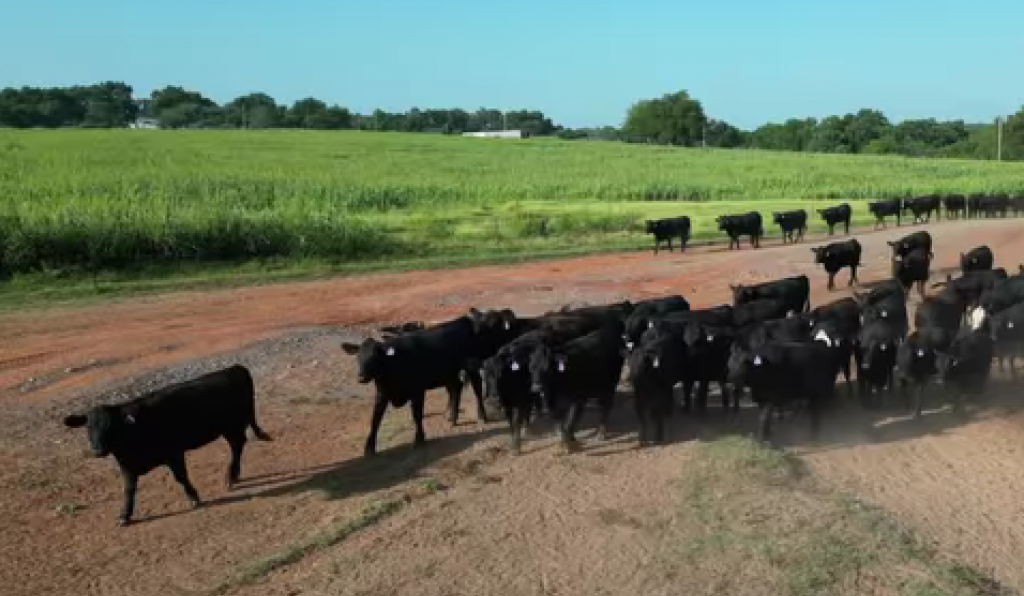
KC Sheperd, Farm Director, is back talking with Bob Rodenberger, a Stockman Oklahoma Livestock Marketing partner, as he gives the latest on the cattle markets.
Possibly due to recent rain, runs were lighter this week, the calf and feeder markets were fully steady, and fat cattle brought $1.90 per pound. "There is still a great demand for calves to go to wheat or on feed," Rodenberger said.
He said that the feeder index closed at $251 yesterday. "Half of the feeder index is based on Northern markets which will be $10 above us," Rodenberger reminded. "If you took the Northern cattle out, it would put us down in the $245 to $246 range, which is what our cattle are bringing."
He said whether producers decide to wean their calves or sell them right off of the cow, they won't go wrong at this time because prices are good for both.
Pending the upcoming election, he noted that lots of producers have been securing their LRPs before it happens. "I think that is smart because nobody knows what is going to happen one way or the other," Rodenberger said. "I just know that we still have a good market now, and if you haven't protected yourself, I would do that, then go to bed and sleep well at night."
He anticipates that Oklahoma City will also experience lighter runs on Monday.
Senior Farm and Ranch Broadcaster Ron Hays visited with the President of Certified Angus Beef, John Stika, about how CAB grew its business over the past fiscal year.
This is part two of the conversation with Stika, click here for part one.
Certified Angus Beef grew by about 4.8 million pounds, a 0.4% growth from last year, resulting in its second most productive year.
"While International is the smallest of the three divisions that we have, we grew our international sales by almost five percent this year," Stika said.
Domestically, food service experienced the second-best year ever, marking 14 years of growth out of the past 15. However, retail continued to feel the pressure of high prices which translates into margin pressure at the store level, then typically a reduction in feature activity of beef and Certified Angus Beef. Retail sales were down 1.5%.
"That gives you some idea of how we grew. It was really at International food service, but make no mistake, our volume still flows through retail," Stika said. "Retail makes up forty-two percent of our overall business. Food service, domestically, makes up about a third, and international business makes up about sixteen percent. The residual is product that goes into further processing, like grinding operations and so forth."
Stika admitted that Certified Angus Beef can only enjoy such success when the producer is able to produce the product profitably and the end users are able to do the same. He said, "It's been really exciting to see that we as a brand over the last forty-six years have been able to bring all segments of this industry together as a brand community to, hopefully, drive everyone's success by creating a shared focus on quality, across the gamut from the producer to the end user and to the consumer.
"It all comes down to creating value in the eyes of the consumer and that value translates, hopefully, into margin, and that flows back through every segment of production."
As cattle numbers dwindle it becomes increasingly more difficult for Certified Angus Beef to meet the needs of end users and consumers, but Stika said CAB's strategy is centered on creating demand.
"One of our best supply-generating activities is that if we create enough demand for the product, Certified Angus Beef, and go to one of our licensed partners that is selling under our brand name, that is the key to getting cattle and product into a Certified Angus Beef bag or box. Along with that, I think we are all in the same boat. It's not only making sure that existing customers get the product that they need but also how do we all continue to grow market share. It definitely isn't going to get any easier moving forward, but for us, the next couple of years are going to be all about making sure that the brand remains strong, and well-positioned for the growth that we expect to see as pastures once again begin to populate with even more Angus cattle."
A recent press release from CAB reported that while the total fed cattle supply declined by 1.6%, this year a record 5.96 million carcasses, up 2.4%, were certified for the brand, with 37.4% of all Angus cattle meeting the brand's strict quality standards. A record 730,000 carcasses qualified for Certified Angus Beef ® Prime.
The Beef Buzz is a regular feature heard on radio stations around the region on the Radio Oklahoma Ag Network and is a regular audio feature found on this website as well. Click on the LISTEN BAR for today's show and check out our archives for older Beef Buzz shows covering the gamut of the beef cattle industry today.
Photo provided by High Point Grocery Facebook page.

Vive Crop Protection, a leader in innovative agricultural solutions, is excited to announce the appointment of Young Kim as the company's new Chief Financial Officer (CFO). With an extensive background in finance and accounting, Kim brings a wealth of experience in overseeing complex financial operations and driving strategic growth initiatives.
"We are thrilled to welcome Young Kim as our new CFO at Vive Crop Protection," said Darren Anderson, Co-Founder and CEO of Vive Crop Protection. "His deep financial expertise and strategic vision will be instrumental as we continue to scale and drive innovation in agriculture. Kim's leadership will help us navigate the opportunities ahead, ensuring we remain agile and forward-thinking as we build the Highest Velocity Commercialization Engine in agriculture."
A graduate of the University of Toronto with a Bachelor of Science and a member of the Institute of Chartered Accountants of Ontario, Kim brings over 30 years of finance and accounting experience across diverse industries, including financial services, digital advertising, IT consulting, and custom software development, with a particular focus on supporting the growth and evolution of early-stage companies and international expansion.
Known for his broad knowledge of mergers and acquisitions, Kim has worked extensively with private equity, venture capital, and investment banking partners. His expertise in M&A activities complements his ability to optimize processes, re-engineer business procedures, and implement continuous improvement initiatives that drive measurable value. Kim is a trusted advisor, leveraging his hands-on approach and strategic insights to support teams, enhance enterprise value, and foster organizational growth.
"I'm very excited to be joining the Vive team," said Young Kim. "What the company has been able to achieve in the ag-tech space is nothing short of phenomenal and I look forward to contributing to Vive's continued growth as it strives to become a world leader in the crop protection industry." For more information, visit www.vivecrop.com.
iGENDEC is an advanced software tool designed to help cattle producers understand and improve their herd's genetics. By utilizing known genetic relationships among traits, breed differences, and a producer's own knowledge about their herd, iGENDEC provides detailed insights into how different traits should be emphasized when selecting herd bulls. With this information, producers can make more informed breeding decisions, leading to healthier, more productive herds. Using iGENDEC can boost long-term profitability by optimizing genetic potential, improving herd quality, and increasing operational efficiency.
Join us to hear more about what this updated rule means for you!
RON's Dave Lanning has a pre-opening look at today's agricultural Markets.
Click the audio tab below for today's report.
Archives:
2026-11 | 2026-10 | 2026-09 | 2026-08 | 2026-07 | 2026-06 | 2026-05 | 2026-04 | 2026-03 | 2026-02 | 2026-01 | 2025-12 | 2025-11 | 2025-10 | 2025-09 | 2025-08 | 2025-07 | 2025-06 | 2025-05 | 2025-04 | 2025-03 | 2025-02 | 2025-01 | 2024-12 | 2024-11 | 2024-10 | 2024-09 | 2024-08 | 2024-07 | 2024-06 | 2024-05 | 2024-04 | 2024-03 | 2024-02 | 2024-01 | 2023-12 | 2023-11 | 2023-10 | 2023-09 | 2023-08 | 2023-07 | 2023-06 | 2023-05 | 2023-04 | 2023-03 | 2023-02 | 2023-01 | 2022-12 | 2022-11 | 2022-10 | 2022-09 | 2022-08