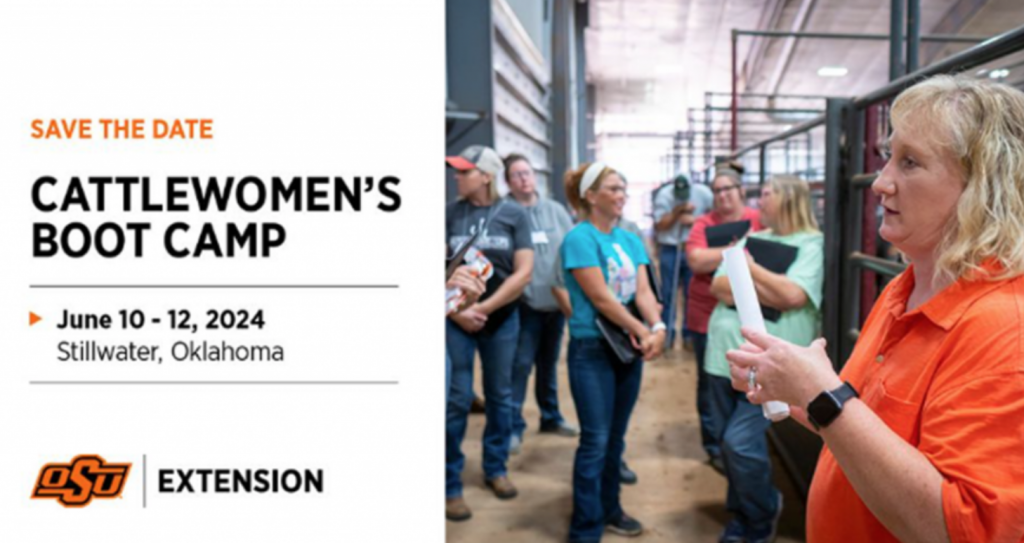
Farm Director KC Sheperd is talking with the Oklahoma State University Area Agricultural Economics Specialist, JJ Jones, about the upcoming OSU Cattlewomen's Bootcamp set for June 10-12. Jones said the workshop is open to everyone who is interested in learning more about cattle production.
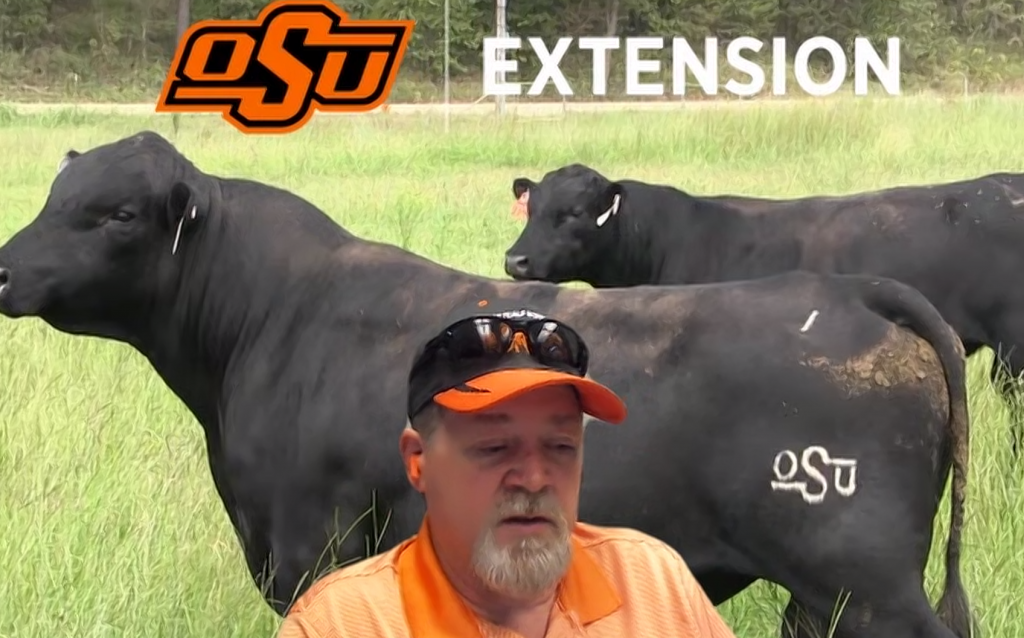
"This is a three-day camp where we basically talk about anything cattle-related, but we teach it from the Cattlewomen's perspective," Jones said. "Not that it is much different from anyone else's perspective, but there is a project we used to do called Annie's project that basically was kind of focused around female producers and female owners. It was taught from the female perspective. We took that concept and applied it to the cow-calf bootcamp."
The OSU Cattlewomen's Boot Camp is a project that combines elements of two successful programs, Annie's Project and the Oklahoma Livestock Boot Camps. Using previous agendas from the boot camps and the teaching model of Annie's Project, the program intends to create an informative and engaging learning experience for female producers covering various methods on how to manage the production, financial, and market risks when operating a beef cow/calf operation.
Jones said the program will fit in close to 30 hours of instruction within the three days.
"It is pretty much full of anything you can imagine when it comes to cattle production," Jones said. "We try to teach you as much as we can possibly teach you within three days."
This program will combine traditional educational programming with hands-on demonstrations and activities and classroom exercises. Topics that will be covered include but are not limited to:
To learn more about the upcoming OSU Cattlewomen's Bootcamp, visit the webpage by CLICKING HERE. JJ Jones can be contacted for more information at (580) 332-7011 or jj.jones@okstate.edu.
| ||||||||||||||||||||||||||||||||||||||||||||||||||||||||||||||||||||||||||||||||||||||||||||||||||||||||||||||||||||||||||||||||||||||||||||||||||||||||||||||||||||||||||||||||||||||||||||||||||||||||||||||||||||||||||||||
| ||||||||||||||||||||||||||||||||||||||||||||||||||||||||||||||||||||||||||||||||||||||||||||||||||||||||||||||||||||||||||||||||||||||||||||||||||||||||||||||||||||||||||||||||||||||||||||||||||||||||||||||||||||||||||||||
|
Senior Farm and Ranch Broadcaster Ron Hays, is featuring Farm Director KC Sheperd's chat with Vice President of Operations at Farm Data Services and Oklahoma cattle producer Clay Burtrum talking about an upcoming Trust In Beef Sustainable Ranchers Tour held June 19-20 on his ranch in Stillwater, Oklahoma.
Trust In Beef is an organization that provides technical resources for producers to support the management of their ranches and natural resources. Part of this mission includes a 5-state tour, where attendees can hear from ranchers and farmers who are implementing regenerative practices while managing challenges of farming today. For registration info and more, click here!
"We all know that everybody has a different definition of what sustainability is as we talk about building a better beef system in this beef production system that we talk about, and what does it mean on your ranch," Clay Burtrum.
Beef production systems are now doing more with less, Burtrum said, as the industry evolves and changes. Part of Farm Journal's initiative, the tour will talk about the "ins and outs" of sustainability and what that may look like on different operations.
Locally, the tour is supported by Oklahoma Ag Credit, Farm Credit of Western Oklahoma, Oklahoma Beef Council, Oklahoma Cattlemen's Association, Corteva, and the Oklahoma Natural Resource Conservation Service.
There will be a reception held on the opening day, June 19th, at the Oklahoma State University Totusek Arena. Starting the morning of June 20th, Burtrum said Oklahoma Secretary of Agriculture Blayne Arthur will give opening remarks before heading out to Burtrum Cattle, LLC.
After remarks from Secretary Arther, Burtrum said there will be several stops on the ranch covering topics from virtual fence, sustainable spraying techniques, grazing management systems, and more. For lunch, Burtrum said the group will head back to Totusek Arena for a meal sponsored by Oklahoma Ag Credit and Farm Credit of Western Oklahoma and cooked by the Oklahoma Cattlemen's Association.
After lunch, Farm Data Services will talk to the group about sustainability and record management. The afternoon will wrap up with a Beef Quality Assurance session with the Oklahoma Beef Council.
"They have put this all together in a one-stop area where you can have these resources as a farmer and rancher as you come about these tours," Burtrum said.
Sign-up is free. To learn more, visit https://www.trustinbeef.com/.
To listen to an earlier edition of Beef Buzz featuring nationally recognized no-till farmer, regenerative rancher and soil-health expert Jimmy Emmons talking more about Farm Journal's Trust In Beef initiative, CLICK HERE.
The Beef Buzz is a regular feature heard on radio stations around the region on the Radio Oklahoma Ag Network and is a regular audio feature found on this website as well. Click on the LISTEN BAR for today's show and check out our archives for older Beef Buzz shows covering the gamut of the beef cattle industry today.
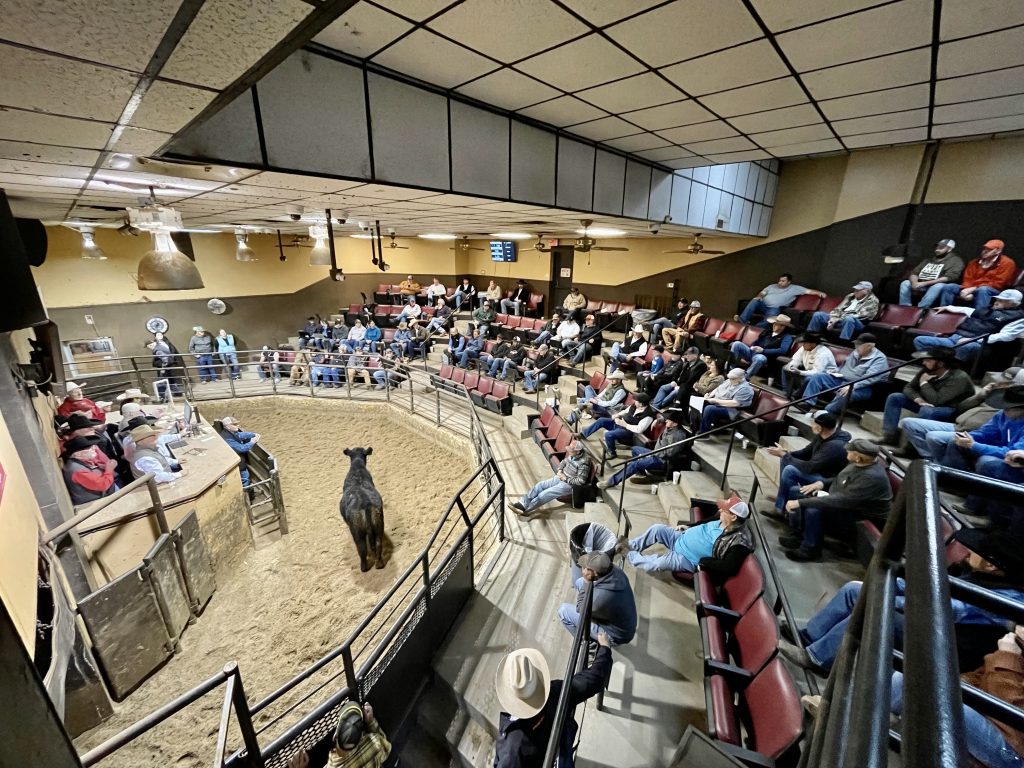
Farm Director KC Sheperd is visiting with Bob Rodenberger, a partner with Stockman Oklahoma Livestock, as he gives the latest on the cattle markets. Rodenberger discussed the recent weather conditions, their impact on the market, and the potential for a pullback in beef demand. He also shared strategies for securing marginal profits and suggested decreased market runs due to reduced demand for grazing land.
While some areas are dryer than others, Rodenberger said as a whole there have been good rains across the state. Rodenberger added that the market was exceptional this week, and the cattle were high quality. Rodenberger said he believes there is some pullback in beef demand, and he recommends ranchers utilize Livestock Risk Protection to lock in a price.
"Put some protection on it, get your margin, and if the market rallies, you are going to get the benefit of it," Rodenberger said. "Just protect yourselves. There is no need to live in gloom and doom here."
As wheat harvest progresses, Rodenberger said he expects runs to become a little lighter.
"People aren't worried about moving cattle when they are cutting wheat," Rodenberger said.
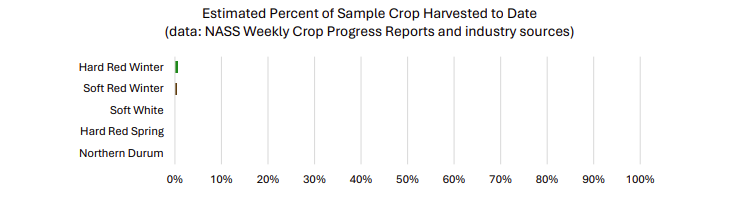
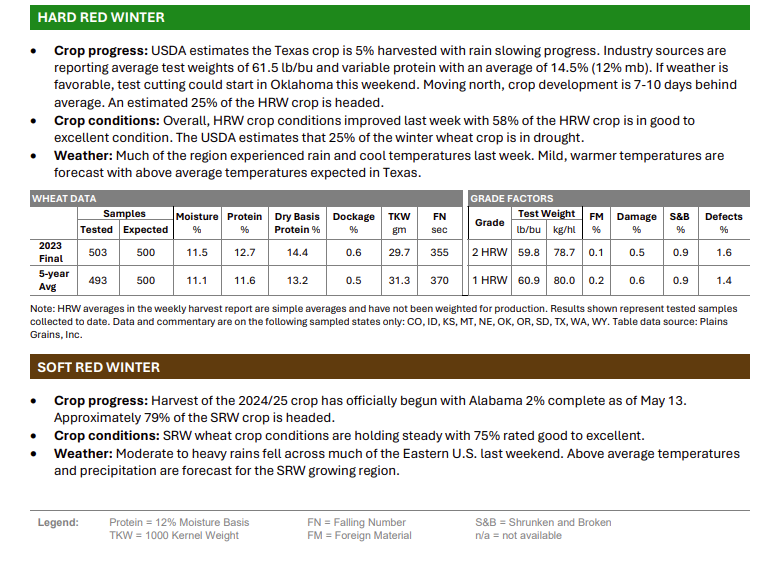
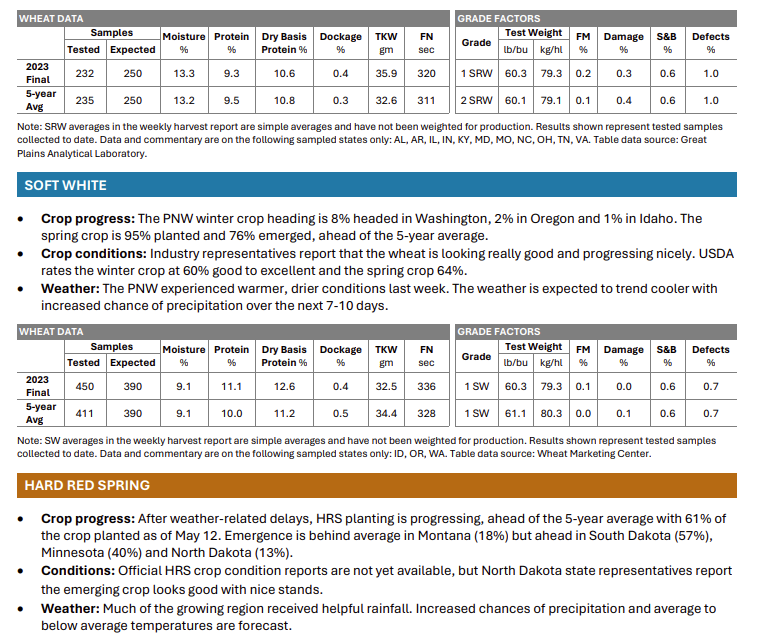
The 2024 hard red winter (HRW) harvest is well underway in the South, Southeast, Texas, and Oklahoma. Test cutting has started in south-central Kansas but recent rain has slowed progress. Spring wheat planting made good progress and is at least 84% complete. First samples of soft red winter (SRW) are expected soon for initial testing.
From Gregg Doud, President and CEO, National Milk Producers Federation:
"We thank USDA for its leadership and important work with dairy farmers in meeting the challenges posed by H5N1. Collaboration and communication across all levels of government, and among all segments of the livestock industry, is critical in making sure that producers can continue to feed Americans and the world with safe, nutritious food. We look forward to working with USDA and all of dairy's stakeholders to ensure that these challenges are met."
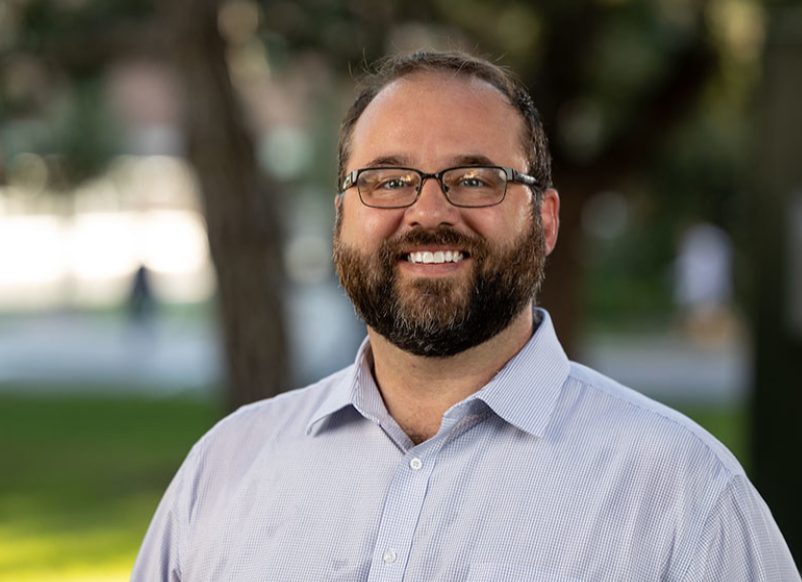
: Tyler Mason has an extensive background in urban crop production and educates Oklahomans on sustainable agriculture methods. (Photo by Mitchell Alcala, OSU Agriculture)
Tyler Mason joined the Oklahoma State University Extension team as the small farms and urban horticultural food crop production systems specialist in August 2023. He also serves as an assistant professor in the OSU Department of Horticulture and Landscape Architecture.
A native of Indiana, Mason was exposed to horticulture as an urban resident and chose to focus on agriculture education during his undergraduate degree at Purdue University. While there, he also received an associate degree in horticulture. He moved to Cheyenne, Wyoming, and worked as the assistant education director for the Cheyenne Botanic Gardens.
"That's where I fell in love with urban agriculture," Mason said. "I knew I wanted to spend my professional time working on vegetables and crops and teaching people sustainable practices."
He received a master's degree in Extension education and a doctorate in horticulture with an emphasis on vegetable crops from Colorado State University. He later served one year in the Alabama Cooperative Extension System as a county educator, specializing in urban ag and natural resources.
Fast-forward to today, Mason has jumped into his OSU Extension role by developing a garlic variety trial, conducting a study on asparagus cultivars and their establishment methods, and presenting gardening classes to OSU Extension Master Gardeners. Mason is also partnering with Mustafa Jibrin, OSU entomology and plant pathology assistant professor, to research integrated pest management strategies for squash, peppers and tomatoes.
Mason plans to host educational workshops for commercial and small-scale market growers at the OSU Student Farm this summer. His expertise in vegetable production meets the demands of a passionate Oklahoma gardening community.
"My role at OSU is a culmination of all the things I've been working on and building toward in my career," Mason said. "With my exposure to urban horticulture from a young age, I know teaching people sustainable production methods is my professional goal."
OSU Extension uses research-based information to help all Oklahomans solve local issues and concerns, promote leadership and manage resources wisely throughout the state's 77 counties. Most information is available at little to no cost.
By Gail Ellis
From Gregg Doud, President and CEO, National Milk Producers Federation:
"We thank USDA for its leadership and important work with dairy farmers in meeting the challenges posed by H5N1. Collaboration and communication across all levels of government, and among all segments of the livestock industry, is critical in making sure that producers can continue to feed Americans and the world with safe, nutritious food. We look forward to working with USDA and all of dairy's stakeholders to ensure that these challenges are met."
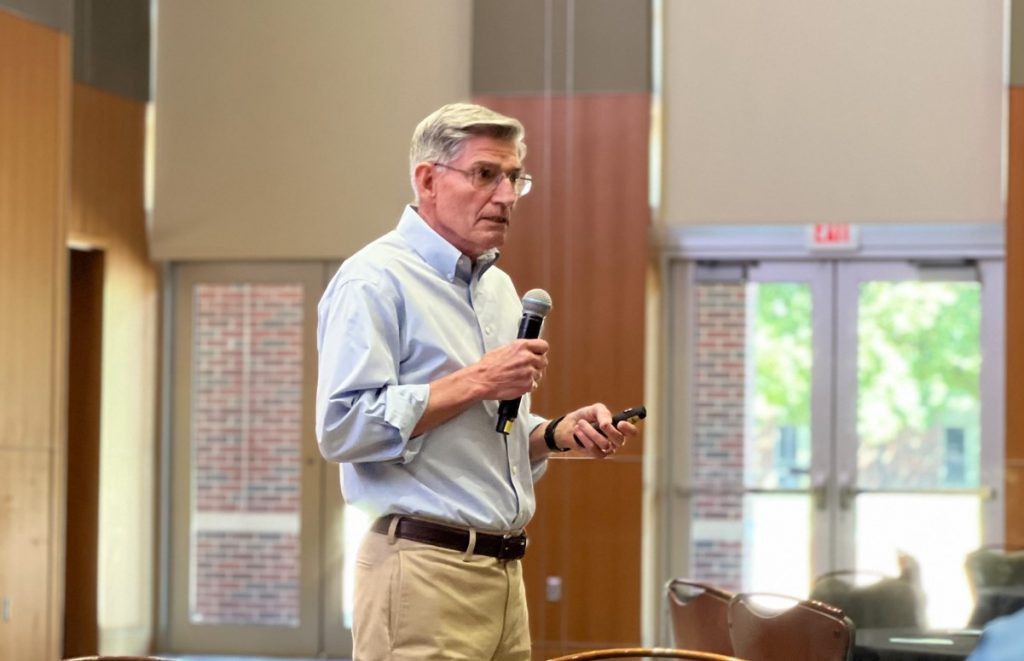
This week on SUNUP is Oklahoma State University Extension grain market economist Kim Anderson. During this week's edition, Anderson talks about the latest in the crop markets.
Harvest is running a couple of weeks early, Anderson said, but weather conditions such as rain and humidity have slowed things down. If wheat protein comes in low, Anderson said he expects to see a protein premium this year.
Regarding the recent increase in wheat prices by $1.00 to $1.60, Anderson said Russia is a big contributor.
"The Russian wheat crop has been lowered," Anderson said. "If you go back to the January and February period from 3.4 billion down to 3 billion. That is a 400-million-bushel decline in Russian production. 200 million in the last couple of weeks. 400 million is over half of the U.S. hard winter wheat crop. It's had a big impact."
As usual, Anderson recommends producers stagger their wheat in the market from June through August.
This week on SUNUP:
Oklahoma Agriculture Starts at SUNUP!
Weekly Statewide Broadcast: Saturday at 7:30 a.m. & Sunday at 6 a.m. on OETA (PBS)
Anytime: YouTube.com/SUNUPtv
The U.S. Department of Agriculture today announced it is taking several additional actions to ensure the health and viability of the nation's livestock and poultry. In the two months since the initial detection of H5N1 in dairy cattle, USDA has worked quickly and in concert with its federal and state partners to better understand the virus and contain the disease and remains committed to seeking additional ways to collect the data needed to better understand and mitigate the risk created by this outbreak. USDA is adding an additional $824 million in emergency funding from the Commodity Credit Corporation (CCC) to bolster these efforts and is launching a new Voluntary H5N1 Dairy Herd Status Pilot Program to give dairy producers more options to monitor the health of their herds and move cows more quickly while providing on-going testing and expanding USDA's understanding of the disease.
Emergency Funding to Build on Response Efforts
To help ensure the Animal and Plant Health Inspection Service (APHIS) can continue to provide critical rapid response activities, Secretary Vilsack approved the transfer of $824 million from the CCC to APHIS to directly support the response efforts. This funding allows APHIS to continue its critical work with state and local partners to quickly identify and address cases of HPAI/H5N1 in poultry and livestock. The funding will support anticipated diagnostics, field response activities, pre-movement testing requirements, other necessary surveillance and control activities, surveillance in wildlife for APHIS, the Agricultural Research Service's (ARS) work in developing vaccines for HPAI in cattle, turkeys, pigs, and goats, and ARS and the Food Safety and Inspection Service's food safety studies.
The Secretary is authorized to transfer funding from available resources including the CCC to address emergency outbreaks of animal and plant pests and diseases. USDA previously approved the use of $1.3 billion in emergency funding to address nationwide HPAI detections in wild birds and commercial poultry operations. These additional funds will ensure our continued robust and rapid response to this outbreak.
Voluntary Dairy Herd Status Pilot Program
Continuing to build on the efforts to contain H5N1, APHIS is standing up a Voluntary H5N1 Dairy Herd Status Pilot Program, which provides alternative testing and movement options to the Federal Order to increase USDA's monitoring capabilities to mitigate the spread of H5N1. The Voluntary H5N1 Dairy Herd Status Pilot Program aims to create additional testing options for producers with herds that have tested negative for three weeks in a row, further reduce H5N1 virus dissemination, provide for further opportunities to test herds that are not known to be affected with H5N1, increase surveillance and expand our knowledge of the disease, and support an overall national program to reduce the risk of H5N1 in dairy herds.
The main benefit for farmers who choose to enroll in the Voluntary H5N1 Dairy Herd Status Pilot Program is that once they can demonstrate their herds are free of H5N1 with results from a National Animal Health Laboratory Network (NAHLN) facility, they will then need to conduct weekly tests on bulk milk from that herd to confirm that status and will be able to ship their cows at the time they prefer and without testing individual animals.
Dairy producers from States enrolled in the first phase of this program who choose to enroll their herds and who test negative for H5N1 for three consecutive weeks using on-farm bulk tank milk samples or similar representative milk samples tested at a NAHLN laboratory will be able to move animals without additional pre-movement testing currently required under the Federal Order. Producers must also comply with continued regular weekly monitoring and testing of the herd for H5N1.
APHIS is currently working with state animal health officials to identify states to participate in a pilot phase of the program. Producers from states participating in this pilot can start enrolling in the Voluntary H5N1 Dairy Herd Status Pilot Program on the week of June 3, 2024, by contacting their APHIS Area Veterinarian in Charge or State Veterinarian and signing a Herd Monitoring Plan agreement. USDA strongly encourages dairy producers to enroll in this new program. Beyond the benefits for their own operations, increased producer participation may help USDA to establish state and/or regional disease-free statuses that could further ease compliance with the current Federal Order. Those herds not enrolled in the pilot program will continue to follow the interstate testing and movement requirements published in the Federal Order. More specific guidance on the new program, including how to enroll and how to obtain and maintain a herd status, will be made available on the APHIS website in the coming days.
As additional testing measures take place, USDA anticipates that it will see an increase in testing and positive test results, which will add to our knowledge of the disease and how it may spread between herds. At the same time, this pilot program will help to gather additional information on how producers with affected herds can document elimination of the virus on their operations and steps they can take to maintain an H5N1 virus-free herd.
This new investment in risk mitigation augments the previously announced Federal Order on pre-movement testing of lactating dairy cattle, announced on April 24, as well as the tools to support biosecurity activities, announced on May 10, and the Emergency Assistance for Livestock, Honey Bees, and Farm-raised Fish Program funding availability, announced on May 23.
As USDA continues to take steps to protect the health of livestock, the Department continues to work closely with federal partners at the CDC on protecting the health of people and FDA on protecting the safety of the food supply. The U.S. government remains committed to addressing this situation with urgency.
To learn more about USDA's response to H5N1 in dairy cattle, visit https://www.aphis.usda.gov/livestock-poultry-disease/avian/avian-influenza/hpai-detections/livestock.
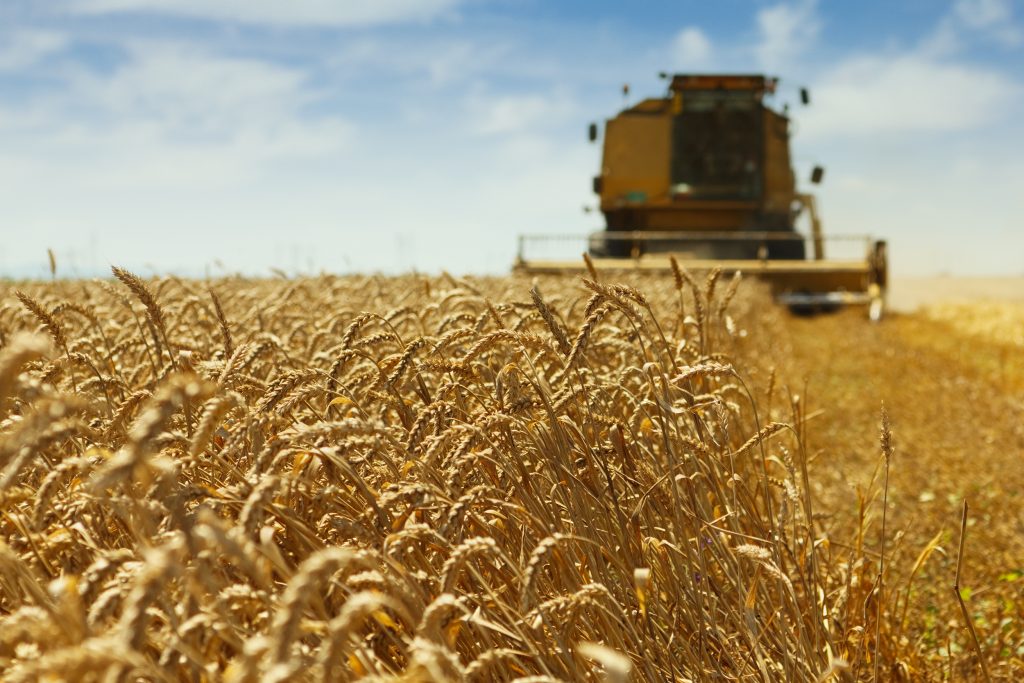
"Rains and Cooler Temperatures Slow Harvest Progress the Past Two Days"
Thursday May 30, 2024
By: The Oklahoma Wheat Commission
Oklahoma wheat harvest continued to move forward in parts of Southwest and Central Oklahoma on Wednesday at a slow pace, but rains in many parts of the state hindered a large amount of progress as producers had hoped for over the past two days. Rains today will also delay harvest in most regions if not the entire wheat belt. Up to the time of this report not much has changed from Tuesday on what has been reported as far as yields, test weights and protein. The Oklahoma Wheat Commission is calling harvest 18% complete, a more complete report will be put out on Monday, June 3, 2024.
Southwest and Western Oklahoma
Grandfield/Chattanooga/Lawton- Wheat harvest was in full force over the weekend in this region. Yields for the most part ranging from the low 40's to low 50's. Heavily grazed wheat having the lower yields in the high 20's to low 30's. It has been noted some intensively managed fields have been yielding 50, with a few yields in the lower 70's being reported. Test weights ranging from 60lbs. to 65lbs. per bushel. Protein averages being reported from 10.5% to 12%, with the overall average being around 11.0% to 11.2%. At the time of this report rains ranged over the area Tuesday morning from 2/10ths to 1/2 inch for the most part. These locations reporting 50 percent complete
Frederick- Producers made great progress in this region over the weekend. Yields have been ranging from 35 to 50 bushels per acre for the most part depending on management practices. Test weights ranging from 60 lbs. to 63 lbs. per bushel. Proteins ranging all over the board, from 9.5% to 13.5%. The protein average for the region is reported at 11.0 to 11.2%. At the time of this report rains around Frederick came in this morning with 1/2 inch to 8/10ths. These locations reporting from 40 to 45 percent complete.
Gotebo/Sentinel/Rocky/-Producers had a good weekend with movement in this region. Test weights ranging from 63 to 64 lbs. per bushel. Yields being reported from 30 bushels to mid 50's. The lower yields are on heavily grazed fields. Some higher yields are expected once producers start getting into better wheat. At the time of this report, Sentinel had one inch of moisture, Rocky had ½ inch, and places around Goteboreceived 2 inches of rain. Proteins in this region have been favorable ranging from 12% to 15%. They are calling the average in this region at 13%.
Central Oklahoma
Okarche- Early cuttings report yields from 40 to 55 bushelaverages for the most part. Producers are just getting a good start over the weekend in this region. Yields are expected to increase as producers get into better wheat. Test weights reported at 61 lbs. to 64 lbs. per bushel. Protein reports on early cuttings ranging all over the board from 9% to 13.5%. Right now it looks like the region is averaging 11.0%
Reeding/Kingfisher/Omega- Producers are just getting good starts in this region over the weekend, early reports indicate test weights to be doing well ranging from 63lbs. to 64lbs. for the most part. A few test weights at 59 lbs. but that wheat was heavily grazed. Yields ranging from mid 40's to low 50's for the most part. It is expected yields will increase as producers get into better wheat. Some higher yields have been noted in low to mid 60's on fields with intensive management. Protein ranging from 9% to 13.5%. Right now it is looking like an 11.0% to 11.2% average for the region.
Northern Oklahoma
Waukomis/Marshall- These locations had a few loads brought in over the weekend. Early test weights have been favorable at 60 lbs. per bushel and higher. Early yields ranging from mid 30's to mid 50's. Protein on early cuttings not reported at this time.
Helena- A couple loads were taken in at this location, but no yields, test weights or proteins were reported at the time of this report.
Blackwell- Some early cutting in Blackwell on Monday being reported by the Wooderson family, no yields reported on early cuttings but test weights were favorable at 60 plus. The weather was overcast at the time of this report, so it does not look like a lot of drying will be going on today, with predicted rains in the forecast.
Early reports in all locations show test weights ranging from 60 to 65 lbs. per bushel. Proteins ranging from 9% to 13.5%, with an overall average of proteins being reported at 11.0% to 11.2%. The wheat being harvested in Southwest Oklahoma has not been stressed as much, so it is thought proteins will get higher as harvest progresses North where we have drought stress. Early yields being reported at 40 to 50 bushels per acrein most regions. Higher yields being reported on intensivelymanaged wheat with some yields on a few fields being reported in the mid 60's to low 70's. The state has received a large amount of hail damage in South Central, Southwest, and Northern, Oklahoma over the past two weeks, so this will show losses on overall production. Harvest has been delayed in many areas due to rains on Tuesday with more rains predicted today and over the weekend. The Oklahoma Wheat Commission is calling the state 18% complete with harvest. The next Oklahoma Wheat Commission Harvest report will be published on Monday, June 3, 2024.
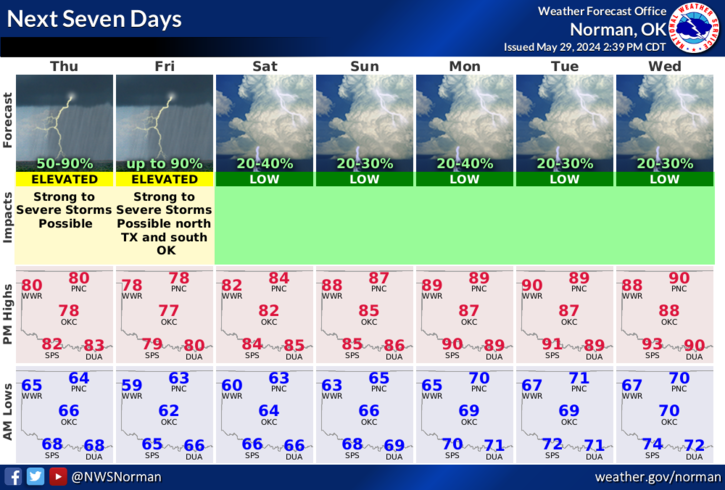
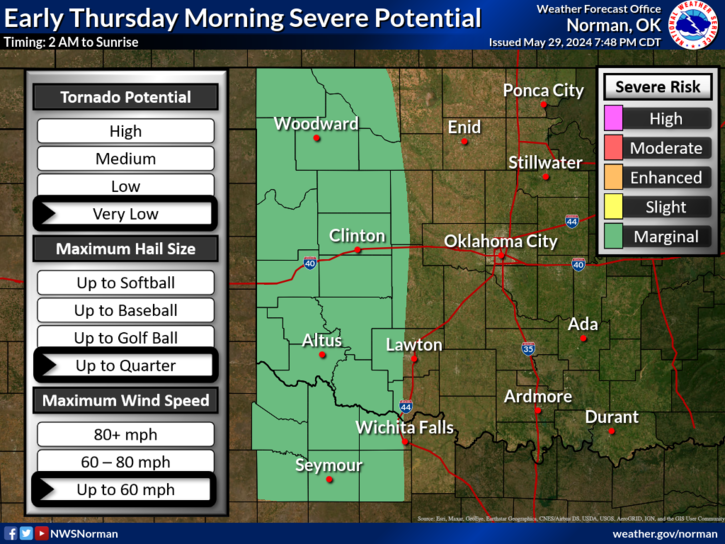
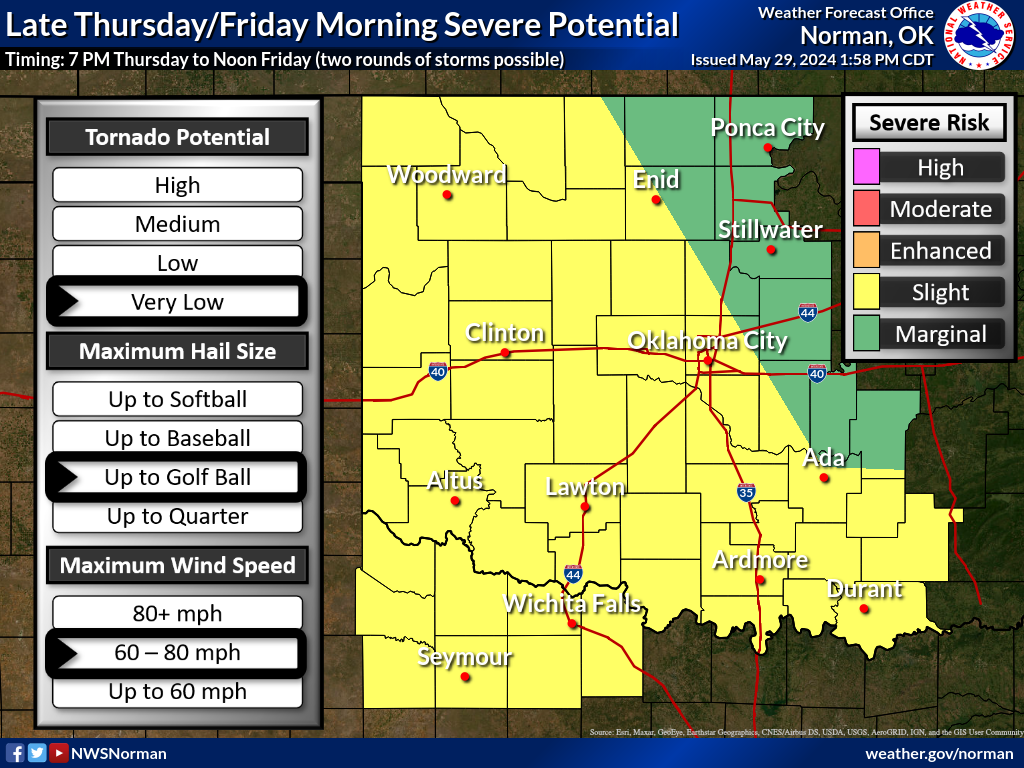
Below, see the 7-day forecast and storm potential outlookprovided by the Oklahoma Mesonet.
The U.S. Department of Agriculture, in partnership with FarmRaise, today launched a new, online Emergency Assistance for Livestock, Honey Bees and Farm-raised Fish Program (ELAP) Decision Tool. The USDA's Farm Service Agency (FSA) tool is designed to assist agricultural producers who have been impacted by natural disasters access available program support. This ELAP Decision Tool, a component of a broader disaster assistance program educational module, further expands the library of online FSA disaster and farm loan program reference resources and decision aids currently available to agricultural producers on the FarmRaise FSA educational hub. The Decision Tool is a resource only and is not an application for benefits or a determination of eligibility.
"The Emergency Assistance for Livestock, Honey Bees and Farm-raised Fish Program is our most flexible tool for dealing with natural disasters and other qualifying losses. As we continue to enhance this critical program, having the right tool to streamline application processes can expedite assistance," said FSA Administrator Zach Ducheneaux. "FarmRaise uses feedback from cooperators and producers to develop the tools they request to more easily navigate our programs, allowing them to maximize assistance available through FSA's extensive program portfolio. This tool is the next iteration of this important work."
ELAP is designed to address losses not covered by other FSA disaster assistance programs. The program provides recovery assistance to eligible producers of livestock, honey bee, and farm-raised fish losses due to an eligible adverse weather or loss condition, including drought, blizzards, disease, water shortages and wildfires. ELAP covers grazing and feed losses, transportation of water and feed to livestock and hauling livestock to grazing acres due to an eligible loss condition. ELAP also covers certain mortality losses, due to an eligible condition, for livestock including honey bees and farm-raised fish as well as honey bee hive losses.
New FarmRaise Tools and Resources
FarmRaise, in partnership with FSA, recently launched their online, educational hub – the FarmRaise | FSA Educational Hub – comprised of videos, tools and interactive resources that enable USDA cooperators and agricultural producers to learn about and access major FSA programs.
A new addition to the hub, the ELAP Decision Tool helps eligible producers impacted by qualifying natural disasters and other eligible causes of loss better understand program eligibility and application requirements, learn about record-keeping and supporting loss documentation requirements and track the steps needed before applying for program benefits. The document generated by the ELAP Decision Tool can be used to support the ELAP application process, but it is not a program application. Producers will need to complete and submit the ELAP Application to their local FSA county office. Upon request, applicants may be asked to provide additional supporting documentation per the program requirements.
Through use of the ELAP Decision Tool, producers can segment by loss type (honey bee, farm-raised fish and livestock). This enables easier navigation, as guided by the tool, to assistance available to meet specific disaster recovery needs. After entering the type of loss, identifying the loss condition and entering their inventory and loss information, producers are guided through a worksheet that helps identify required loss documentation — documentation (i.e., pictures, receipts, truck logs, etc.) that can be uploaded through the ELAP tool and sent directly to the producer's local FSA county office, or producers can provide a copy of the tool-generated worksheet summary document when they visit their local FSA county office to complete and submit the required ELAP application.
"We're thrilled to expand the resources available on the FarmRaise FSA Educational Hub, with a particular focus on disaster relief and emergency programs," said Sami Tellatin, the COO of FarmRaise. "It's imperative that farmers and ranchers have easy access to these much-needed assistance programs, and the newest resources available on the hub will ensure greater empowerment and a smoother process for producers already facing difficult circumstances."
Additional FarmRaise Resources
The previously announced Livestock Indemnity Program (LIP) Decision Tool, also available through the FarmRaise | FSA Educational Hub, assists livestock producers who suffered losses from eligible adverse weather events and other causes of loss as well as cooperators who are helping disaster-impacted livestock producers navigate available federal disaster assistance programs. The LIP Decision Tool gives producers guidance on what is needed to gather and submit required loss documentation, reducing the amount of time needed to complete applications and enabling FSA county office staff to deliver much-needed assistance faster. Using the LIP Decision Tool is not an application for benefits or a determination of eligibility.
In addition to the new ELAP Decision Tool and the LIP Decision Tool, the FarmRaise | FSA Educational Hub offers several, easily navigated farm loan programs how-to videos designed to introduce producers to FSA's many farm loan programs options and guide them through the application process.
More FSA program resources and tools will continue to be added to the FarmRaise | FSA Educational Hub. Cooperators and agricultural producers are encouraged to visit the FarmRaise | FSA Educational Hub often to access all available educational resources.
About the Partnership
USDA cooperators are organizations on the frontlines of access and often are the first point of contact connecting farmers to USDA programs. By developing a digital educational hub that delivers free, user-friendly, producer and cooperator-tested resources and Decision Tools, the USDA and FarmRaise, partnership will help FSA improve educational program delivery to agricultural producers. The hub offers how-to videos and visual aids that educate producers about FSA programs and prepares them for submitting applications for program participation.
More Information
To learn more about FSA programs, producers can contact their local USDA Service Center. Producers can also prepare maps for acreage reporting as well as manage farm loans and view other farm records data and customer information by logging into their farmers.gov account. If you don't have an account, sign up today. To learn more about FarmRaise, visit the FSA educational hub on the FarmRaise website. USDA touches the lives of all Americans each day in so many positive ways. Under the Biden-Harris administration, USDA is transforming America's food system with a greater focus on more resilient local and regional food production, fairer markets for all producers, ensuring access to safe, healthy and nutritious food in all communities, building new markets and streams of income for farmers and producers using climate smart food and forestry practices, making historic investments in infrastructure and clean energy capabilities in rural America, and committing to equity across the Department by removing systemic barriers and building a workforce more representative of America. To learn more, visit usda.gov.
USDA is an equal opportunity provider, employer and lender.
The U.S. Department of Agriculture (USDA) announced today the signing of a formal agreement with the U.S. Environmental Protection Agency (EPA) and the U.S. Food and Drug Administration (FDA) to renew their Federal Interagency Collaboration to Reduce Food Loss and Waste (FIFLAW). The U.S. Agency for International Development (USAID) also joined the collaboration to help reduce food loss and waste internationally.
Agriculture Secretary Tom Vilsack, EPA Administrator Michael S. Regan, FDA Commissioner Dr. Robert M. Califf, and USAID Administrator Samantha Power signed the formal agreement renewing and enhancing the collaborative effort.
"By renewing this agreement and adding USAID into the effort, we affirm our shared commitment to coordinated action to reduce food loss and waste and educate Americans on its impacts and importance," Vilsack said. "Individually and collectively, each of these agencies is working to combat food loss and waste from farm to table."
Collaboration to Reduce Food Loss and Waste
The Federal Interagency Collaboration to Reduce Food Loss and Waste was first formed in October 2018 and was renewed in December 2020. Since its creation, the Federal Interagency Collaboration has published the draft National Strategy for Reducing Food Loss and Waste and Recycling Organics (PDF, 1.7 MB). The Collaboration also has forged a formal agreement with the national non-profit, ReFED, to leverage resources to evaluate what is and is not working with respect to the technical implementation of strategies aimed at reducing food waste in the United States.
With the renewal of the agreement, collaborating agencies will strengthen coordination to continue to produce educational and guidance materials, conduct outreach, community investments, voluntary programs, technical assistance, policy discussion, and public-private partnerships. The addition of USAID enables the U.S. government to expand its efforts and reach a broad range of international stakeholders while better leveraging government resources. The agencies will also work together with external partners to leverage the private and the non-governmental sectors to drive national and global change to reduce food loss and waste.
New Investments in Research and Consumer Education
USDA also announced today an investment by the USDA National Institute of Food and Agriculture of $4 million to fund a $1.5 million Center for Research, Behavioral Economics and Extension on Food Loss and Waste and a $2.5 million Pilot Consumer Education Campaign on Food Loss and Waste. Purdue University and Ohio State University will lead the two projects.
The Center will use a systems approach in conducting research and Extension outreach on policies and programs relevant to addressing inefficiencies in the food system and food-related practices, focusing on engaging underserved audiences and the next generation of young adults. Furthermore, the Center will develop a National Extension Food Loss and Waste strategy that is in alignment with other federal guidance.
Ohio State University will conduct and evaluate a pilot consumer campaign to develop educational messages and materials that meaningfully reduce the amount of U.S. household food waste. Lessons learned from the pilot will be used to develop an integrated education program for governmental and non-governmental organizations for local consumer food waste reduction campaigns.
USDA Efforts on Reducing Food Loss and Waste
These efforts build on the substantial investments and activities that USDA has undertaken to reduce food loss and waste. In recent years, USDA has invested $57 million of American Rescue Plan Act funds to reduce food loss and waste and spur action across the country from farm to table. These investments include:
USDA has also hosted two USDA Food Loss and Waste Innovation Fairs and several roundtables to share success stories where cities, states, and businesses have taken action to reduce food loss and waste as well as share the new innovations coming out of USDA to reduce food loss and waste, such as improved cultivars, packaging, and equipment and valuable new products that can be made out food scraps.
Additionally, with EPA, USDA has expanded membership of the U.S. Food Loss and Waste 2030 Champions from 30 Champions in March 2020 to around 50 currently. 2030 Champions are businesses and organizations that have made a public commitment to reduce food loss and waste in their own U.S. operations by 50% by 2030. 2030 Champions include several industry giants across the food supply chain, such as Danone North America, Smithfield Foods, Inc., Starbucks, Sysco, and Tyson Foods.
Globally, 30-40% of food produced is either lost or wasted throughout the farm-to-consumer supply chain, such as in fields due to spoilage and pest damage, while being stored, in transit, and when it goes unused by consumers. The U.S. sends nearly 80 billion pounds of food to municipal solid waste to landfills annually, and when food is tossed aside, so too are opportunities for improved food security, economic growth, and environmental prosperity. For more information, visit www.usda.gov/foodlossandwaste.
USDA touches the lives of all Americans each day in so many positive ways. In the Biden-Harris Administration, USDA is transforming America's food system with a greater focus on more resilient local and regional food production, fairer markets for all producers, ensuring access to safe, healthy, and nutritious food in all communities, building new markets and streams of income for farmers and producers using climate smart food and forestry practices, making historic investments in infrastructure and clean energy capabilities in rural America, and committing to equity across the Department by removing systemic barriers and building a workforce more representative of America. To learn more, visit www.usda.gov.
| ||||||||||||||||||||||||||||||||||||||||||||||||||||||||||||||||||||||||||||||||||||||||||||||||||||||||||||||||||||||||||||||||||||||||||||||||||||||||||||||||||||||||||||||||||||||||||||||||||||||||||||||
| ||||||||||||||||||||||||||||||||||||||||||||||||||||||||||||||||||||||||||||||||||||||||||||||||||||||||||||||||||||||||||||||||||||||||||||||||||||||||||||||||||||||||||||||||||||||||||||||||||||||||||||||
|
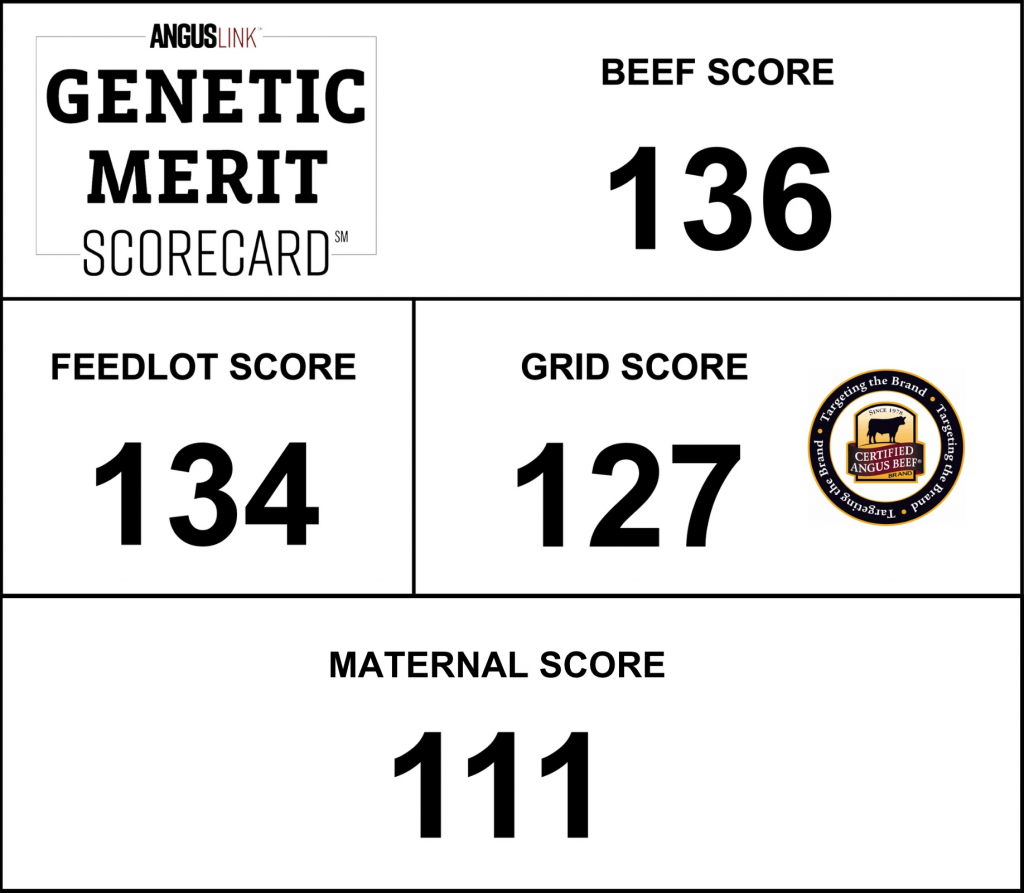
AngusLink's Genetic Merit Scorecard (GMS) adds a fourth score option, Maternal, to demonstrate the maternal weaned calf value to aid in the selection of replacement females.
As the cattle industry prepares for herd rebuilding, a new tool for objectively describing the genetic potential of replacement females hits the market and with it an opportunity for producers selling replacement females to market their added genetic value. The AngusLinkSM Genetic Merit ScorecardSM (GMS) draws on the industry's largest database to evaluate the genetic merit of a pen of feeder cattle, and starting in June, its new Maternal Score demonstrates an enrollment group's maternal weaned calf value to aid in the selection of replacement females.
"The Maternal Score is becoming available at a perfect time with herd expansion on the horizon," said Troy Marshall, director of commercial industry relations with the American Angus Association®. "Maternal traits are generally more difficult to quantify because of the need to match cows to their environment, so it's going to be a valuable tool for producers marketing or purchasing replacement females."
The Maternal Score will be displayed alongside other scores – Beef, Feedlot and Grid – on the GMS as females are marketed.
Marshall continued, "This new tool provides a reliable way to compare cattle's performance potential across our industry and rebuild with better genetics that are more closely aligned with targets that the marketplace has clearly defined: increase in efficiency and increase in the consumers' eating satisfaction, primarily through increased marbling and quality grade."
John Dickinson of Parnell Dickinson Inc., Auburn, California, is one of the Association's board members.
"I see the same evolution coming with the Maternal Score that we have witnessed the past few years with Beef, Feedlot, and Grid scores already on the GMS," Dickinson said. "In today's marketing landscape, reputation and historical data are still very important, but buyers also want more tools they can use to mitigate risk."
Information about individual component traits, specifically for mature size and milk production, will also be shared alongside an enrollment group's Maternal Score; so, producers can better understand how a group of cattle would match with their environmental conditions. Dickinson said this appeals to both buyers and sellers because they can dive into individual maternal components.
"This is really exciting as the GMS Maternal Score is not only the first predictor of its kind in the industry, but also can you think of a better time for this tool to become available than when we have the smallest inventory numbers in over 50 years?" Dickinson said. "We will see a re-build and retention soon, and the Maternal Score can play a large role in moving you to the front of the market."
To enroll, a producer must be AngusVerifiedSM through IMI Global, providing a list of sire registration numbers. Unique to the Maternal Score, the cattle must also have a predominantly Angus cow base.
There is no additional cost associated with the GMS program or AngusVerifiedSM, aside from IMI Global's Age and Source verification enrollment, which includes an EID tag.
"There's a lot of science behind this scorecard," said Rafael Medeiros, geneticist with Angus Genetics Inc. (AGI®).
Scores are determined by the average EPDs of the bulls used to sire the current enrollment group and the cow herd's genetic makeup. To raise cattle's Maternal Score, a producer would want to select for higher Maternal Weaned Calf Value ($M) on registered Angus sires.
Medeiros, who led the technical development of the new score, said this prediction tool uses similar rationale to other genetic prediction tools managed by AGI®, and is supported by Angus sire data and data from the USDA's U.S. Meat Animal Research Center breed averages.
"If you're not genotyping, this is the best estimate and the best value," he said.
Medeiros added it is important to know that like the other GMS values, the Maternal Score characterizes the enrolled group, not individual animals. In this way, the program can also serve as an instrument to track a herd's genetic progress to make sure the next calf crop is better than the last.
As a seedstock producer, Dickinson said he sees the Maternal Score as another profit-minded program he and other members of the Association can offer their customers.
"This is yet another service we are providing for our commercial customers and those continuing to pay a premium for registered Angus bulls," he said. "We are committed to their success and profitability being a pathway to our own. When they build back, we want them to build back with Angus – not necessarily because of reputation or nostalgia, but because we can provide them with the highest quality and most accurate tools for production and management in the industry today."
For more information or to enroll cattle, call 816-383-5100, or contact AngusLinkSM via email at anguslink@angus.org. IMI Global can also be reached to help start an enrollment at 303-895-3002, or producers can complete its contact form at www.imiglobal.com/contact.
– Written by Sarah Kocher, Angus Communications
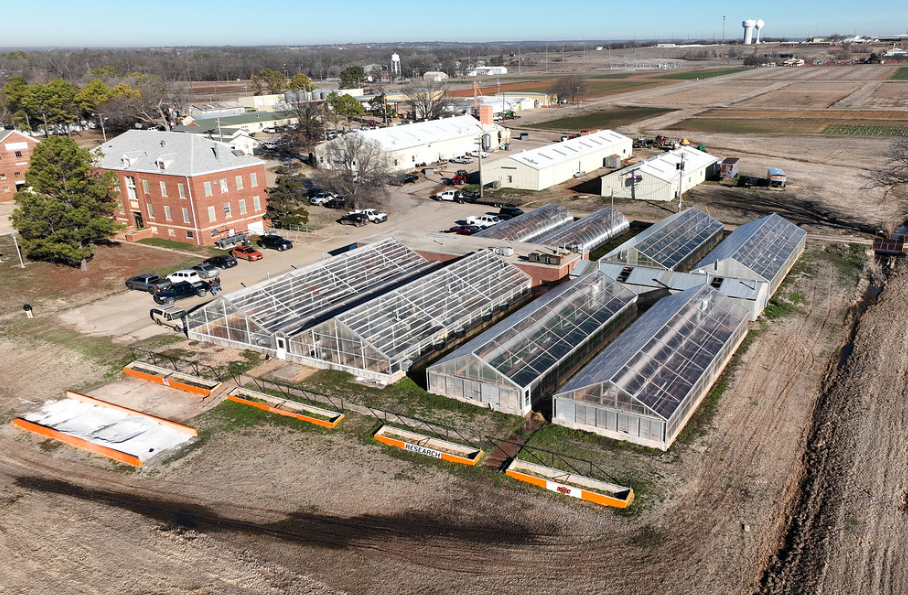
The Oklahoma State University Agronomy Research Station includes 28 buildings used for classroom instruction, greenhouse trials, research and support services. Many of these aging structures were built 60 years ago and threaten to compromise the advancement of OSU's wheat-breeding trials. (Photo by Craig Woods, OSU Agriculture)
The Oklahoma State University/A&M Board of Regents has selected architectural and construction management firms to draft construction plans for crucial infrastructure updates at the OSU Agronomy Research Station in Stillwater.
The board approved Dewberry Architects and Willowbrook as the construction manager at risk during the April 26 board meeting.
The architectural and construction management firms will assist with designing and constructing new greenhouses and a headhouse at the OSU agronomy farm. This initial phase is expected to cost $10 million.
"We are pleased this much-anticipated project is moving forward with the design phase," said Randy Raper, OSU Agriculture assistant vice president of facilities. "The next steps are to work with the selected firms to develop designs and renderings of the new buildings. Updates to the facility will allow OSU Agriculture to continue to be a leader in wheat research and development."
Located on the west side of campus along Highway 51, the OSU agronomy farm is a historic facility that houses one of the top wheat breeding programs in the world. OSU has commercialized 34 wheat varieties since 2000 and has the largest footprint for variety development in the Great Plains region.
By Ainsley Treesh
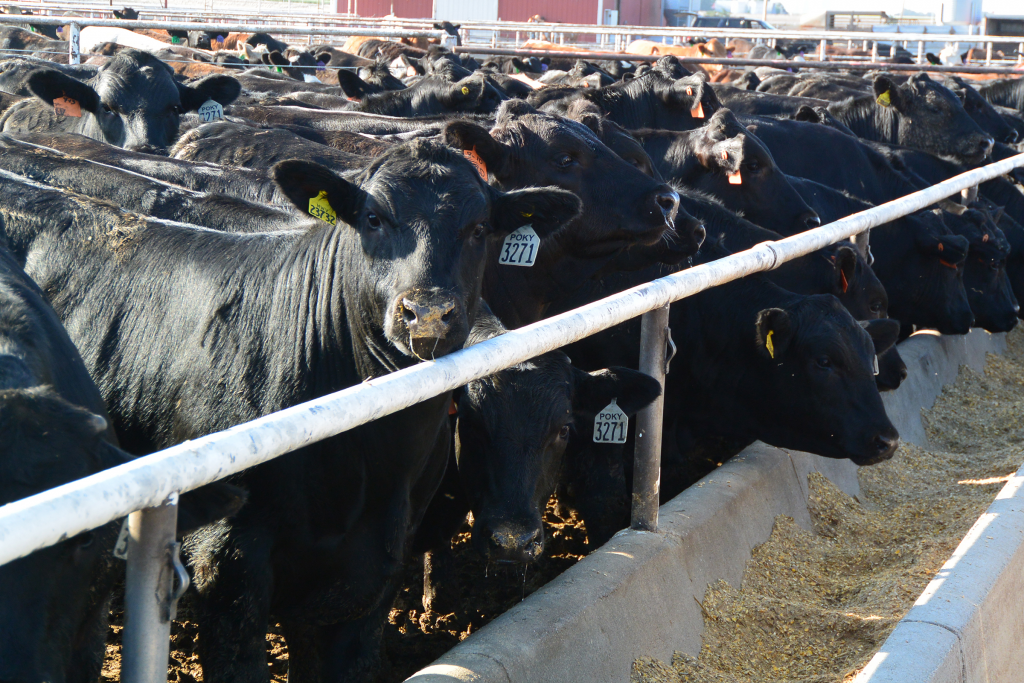
In this episode of Beef Buzz, Senior Farm and Ranch Broadcaster, Ron Hays, is back talking with the CEO of the American Angus Association, Mark McCully, about AngusLink.
To listen to Part One of the conversation with Mark McCully talking about gene editing, CLICK HERE!
For today's cattle producers, it is more important than ever to be able to differentiate their cattle in the marketplace. Two of the leading third-party verification companies, IMI Global and the American Angus Association's AngusLinkSM, have joined forces to create an improved experience for those cattle producers while offering more value-added opportunities.
Through this new relationship, IMI Global will be providing the verification services for the U.S. Department of Agriculture Process Verified Program (PVP) for IMI Global and AngusLink customers. The collaboration makes it easier and more efficient for producers to access an extensive suite of verification programs and the feeder cattle industry's leading genetic merit evaluation tool in one enrollment.
"It has been great with the AngusLink programs, specifically the Genetic Merit Scorecard where through the enrollment process, we capture the bull battery," McCully said. "They don't all have to be Angus bulls, but most of them need to be registered. Then, we are able to basically compute a genetic merit score for that group of feeder cattle."
Great growth has been seen in these programs in the last couple of years, McCully added.
"This month we had an announcement by National Beef and U.S. Premium Beef that they are actually putting a direct grid premium on cattle that are enrolled in the AngusLink program and have a genetic merit score of 100, which is industry average, so better than average," McCully said. "That is five dollars per head, and later on in the year, they are going to bump that up another five dollars for those that are 150 on their genetic merit beef score, or higher."
The initial grid premium of five dollars per head will be paid for cattle harvested on August 5th or later for cattle with a beef score of 100 or greater on their American Angus genetic merit scorecard. After December 1st, cattle with a score of 150 or greater will have the chance to receive a ten dollar premium per head.
McCully said this is the first time a packer has stepped out and put a direct premium on a grid that is directly tied to the genetic investment that producers are making.
To learn about AngusLink enrollment, visit the website by CLICKING HERE.
"We are coming into these summer video sales, and we are getting a lot of interest in the program," McCully said. "We had tremendous interest last year, and we are expecting big things this summer."
McCully refers to the usage of these new programs as the "evolution of value-based marketing," as more information is put into the market, which allows buyers and sellers to exchange that information.
"The better we can describe the genetic merit of feeder cattle, cattle feeders can enter that into their risk management strategies, it allows them to understand what they should pay for those cattle, how they are going to market those cattle, and it is important information and cattle feeders are asking for it."
The Beef Buzz is a regular feature heard on radio stations around the region on the Radio Oklahoma Ag Network and is a regular audio feature found on this website as well. Click on the LISTEN BAR for today's show and check out our archives for older Beef Buzz shows covering the gamut of the beef cattle industry today.
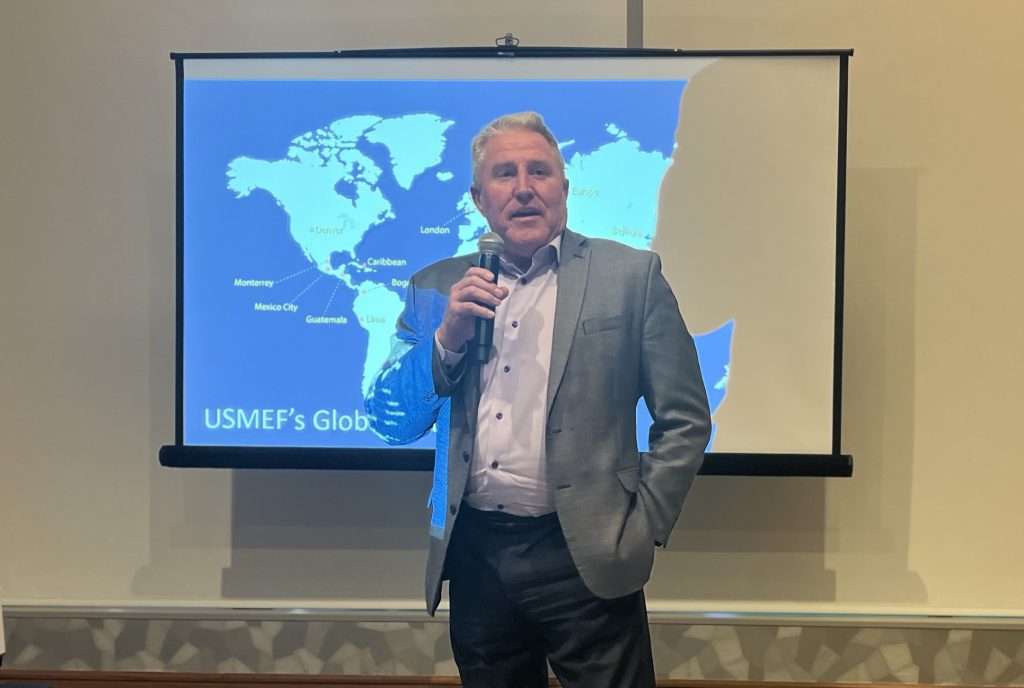
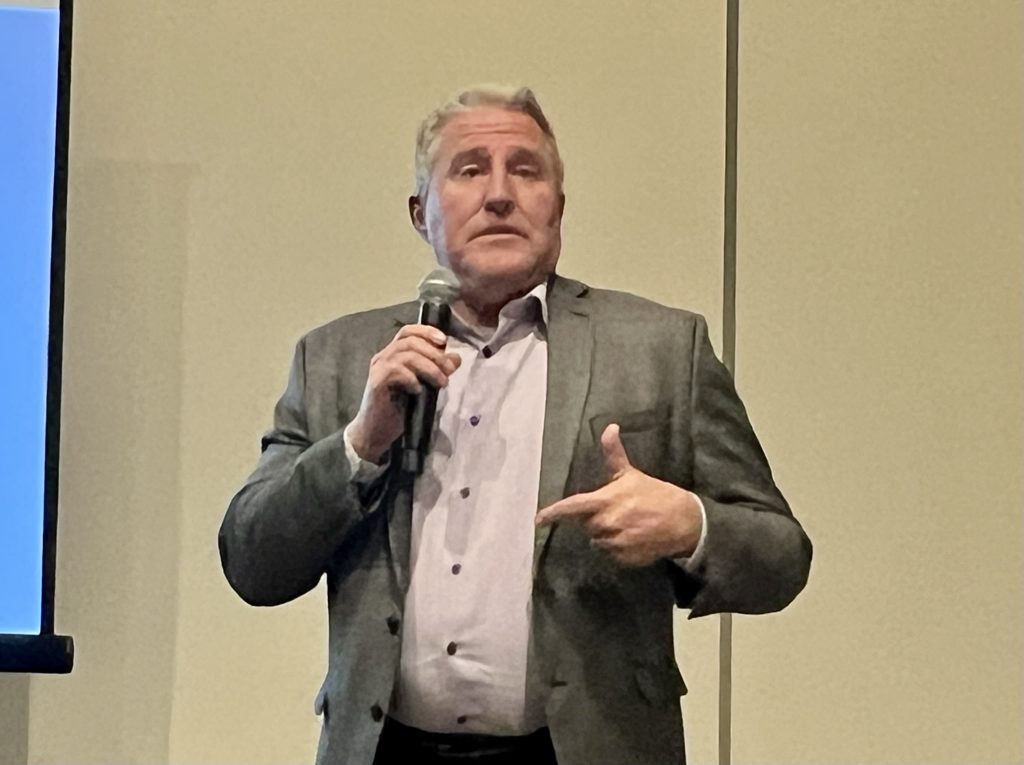
Farm Director KC Sheperd talked this week with the CEO of the United States Meat Export Federation, Dan Halstrom, about the USMEF annual Spring Conference and an update on U.S. beef exports and demand.
Halstrom first talked about highlights from the USMEF annual Spring Conference which was held in Kansas City, MO on May 22-24. Speakers at the conference covered topics ranging from domestic and global consumer perspectives to recognizing the value of U.S. production and high-quality supply.
"It was a resounding success," Halstrom said. "We had good weather, we had record attendance, and despite a few headwinds that are out there, we had some pretty good news to report on in general. I think it was quite the successful week."
Regarding the latest beef export results, Halstrom said that first-quarter statistics show that tonnage is down slightly for the year at four percent less than a year ago. On the value side, Halstrom said beef is up six percent year-to-date.
"What that tells me is that with lower volume and higher value, the international-global customer still sees value in U.S. beef even though tonnages that are available are a bit lower, and prices are a bit higher. I think our unique quality of U.S. grain-fed beef is the selling point because we have a very unique product out there."
Halstrom also noted that while food service in Asia had struggled initially, it is now rebounding, with Japan and Korea seeing a significant increase in visitors and revitalization of the food service sector. Halstrom identified emerging regions such as Central America and Southeast Asia as offering significant opportunities.
Emphasizing the importance of selling the entire carcass to maximize value, Halstrom addressed concerns about herd rebuilding, assuring that buyers were well-educated and understood the cyclical nature of the industry.
"They understand while the price is high, but they are trying to understand what the opportunity is going forward for a rebound in production," Halstrom said. "I think these are good spots to be in."
One important thing to note about international trade, Halstrom said, is that other countries value variety meats highly, whereas in America some of those cuts are less popular. Halstrom said the demand for U.S. beef from international countries is a testament to the high-quality product produced by American ranchers.
"The key to maximizing the cutout and the value for the U.S. beef industry and the whole supply chain is selling the entire carcass," Halstrom said.
Lastly, Halstrom outlined that educating customers about the industry's conditions and partnering with them would be the focus for the coming months.
"I think that will be the focus for the next six months and for the rest of this year is to continue to push and educate our customers around the world and really partner with them knowing full well that production is going to be down here for the next year or two," Halstrom said.
As commercial cow/calf producers drive through their pastures evaluating their spring calf crop and contemplating which heifer calves will make the short list of future herd replacements, now is the time to think about genetic testing. Genetic testing is a practical, proven tool that provides dependable genetic predictions and actionable insights about individual animal performance. In situations where resources are limited or herd inventories need to be tightly managed, information from genetic testing can be used to confidently confirm pasture observations and to inform and validate selection, breeding and marketing decisions.
As a genetics sales representative with Zoetis Beef Genetics, Kori Soutter guides customers in the step-by-step process of genetic testing their cattle and sends producers the sampling equipment they need.
"While working with customers, I've learned that collecting tissue samples to submit for genetic testing is half the battle, and a critical first step toward unlocking powerful insights," Soutter said. Whether producers are ready to jump into genetic testing with two feet, or still exploring the possibilities, Soutter explained that it's never too soon to collect tissue samples and offered five key considerations for simplifying genetic testing sample collection and submission.
Having the necessary supplies on hand to collect tissue samples enables producers to grab samples when they're handling cattle. For cow/calf operations, the best times are at birth, weaning, while vaccinating or during branding season. Order tissue sampling units (TSUs) and applicators today so you have the supplies you need the next time you work cattle.
The best way to take a tissue sample is to collect the sample from inside the hairline, about an inch from the edge of the animal's ear. Simply squeeze the applicator and take the sample. After collecting the sample, make sure there is tissue in the vial and the vial is closed. This will help visualize if a successful sample was collected.
Each TSU comes with a unique barcode. For each sample collected, write down the ID of the animal sampled to match the sample barcode. This information must be included on the order submission form (in addition to gender, breed and an estimated birthdate) in order for the samples to go through the lab successfully.
After samples are collected, you do not have to put them in the refrigerator or freezer. Simply store the samples in a cool, dry place after collecting them. Putting all the animal data in the order form could take a little bit of extra time and it may be a few days before you are able to ship them back to the lab. A critical point is to make sure none of the TSU vials are cracked or leaking.
One of the most common questions customers ask is, "How do I send in my samples?" Soutter recommends putting the samples in a sealed plastic bag, placing them in a box and padding the samples with tissue paper or paper towels to protect them from extra movement during transport. Don't forget to place the completed order form on top of the samples inside the shipping box and always ask for a tracking number.
Ongoing Support from Zoetis
"From sampling support from sales representatives to the team of beef genetics experts helping interpret results and developing actionable insights for your herd, Zoetis is there to help producers have a successful genetic testing experience," Soutter said.
Regardless of operation size or goals, producers can implement genetic testing to help build an efficient and profitable herd by using genetic testing insights to speed up genetic progress for future calf crops. Having the tools on hand to genetic test is the first step in making better breeding and selection decisions to build a better herd.
Zoetis offers support and resources to help producers select the right genetic test, determine which heifers to test and develop best practices for sample collection and submissions. Visit BeefGenetics.com and click on "book a call" to schedule time with a Zoetis rep to learn more.
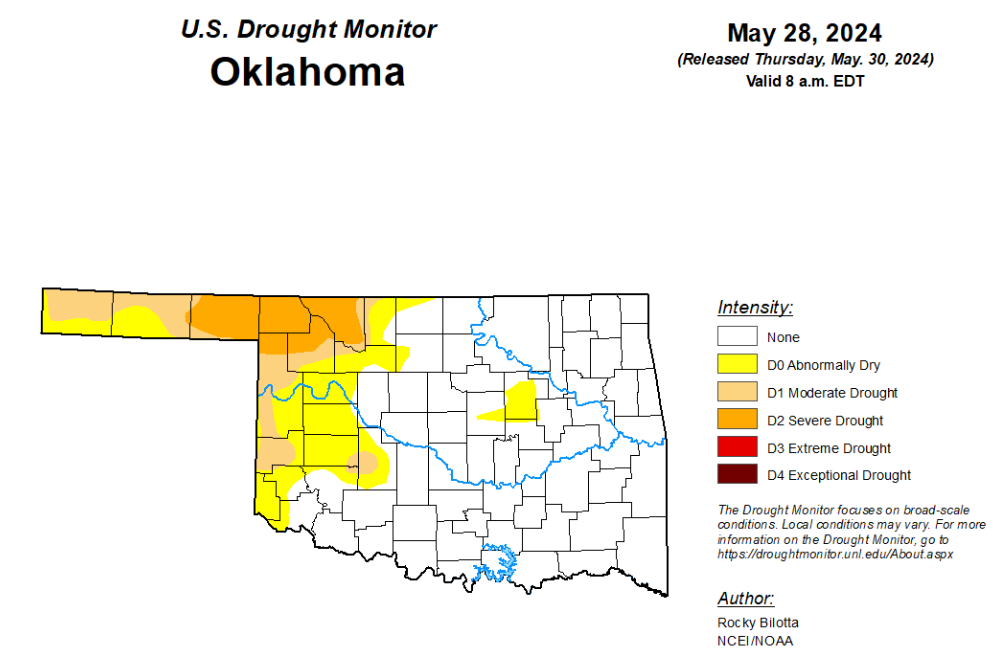
To view the latest Oklahoma drought map, CLICK HERE.
According to the latest Oklahoma drought monitor report, exceptional drought and extreme drought remain at zero percent, unchanged from the start of the calendar year.
Severe drought or worse is now at 6.72 percent, up from last week's 5.91 percent.
Moderate drought or worse is now at 14.68 percent, up from last week's 11.37 percent.
Abnormally dry or worse conditions are unchanged from last week at 29.60 percent.
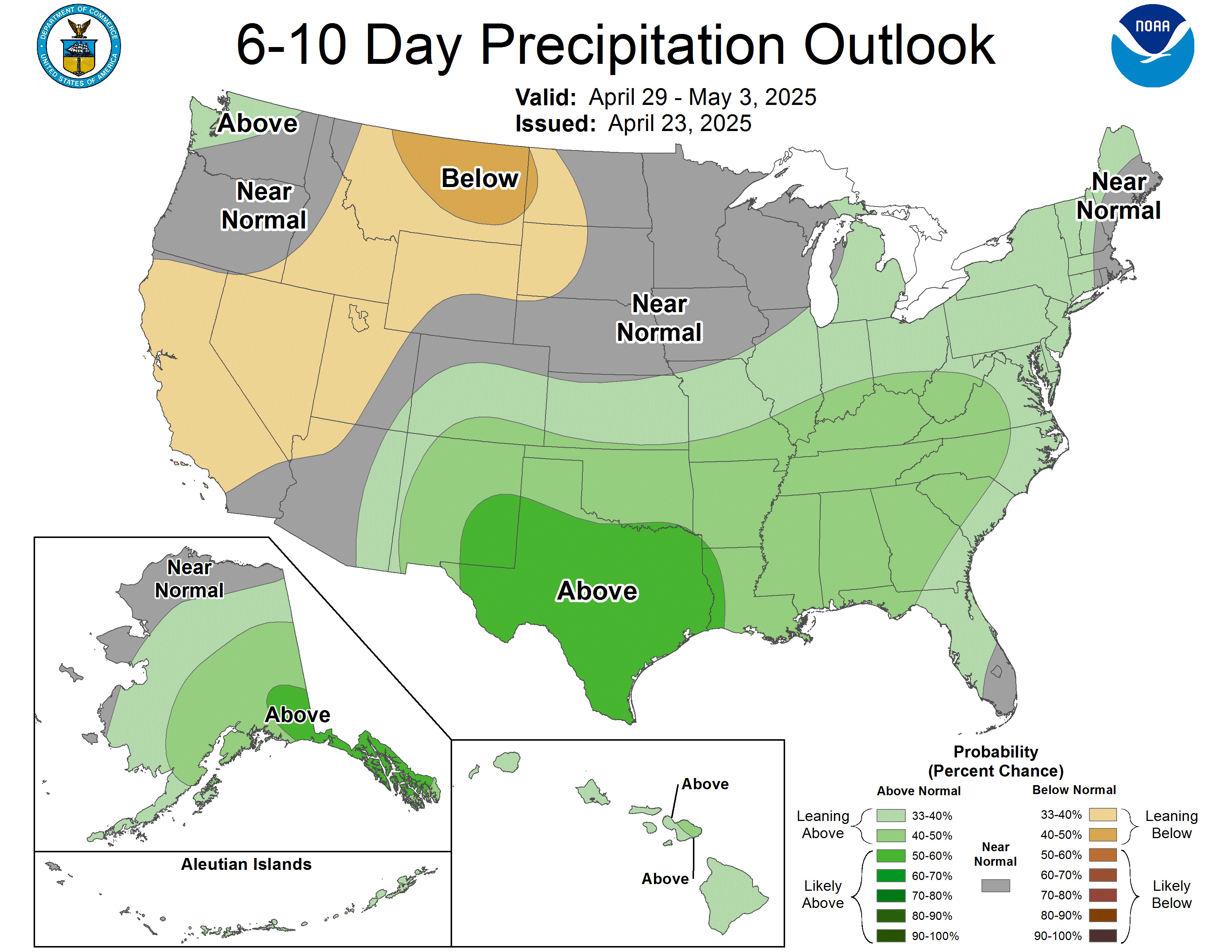
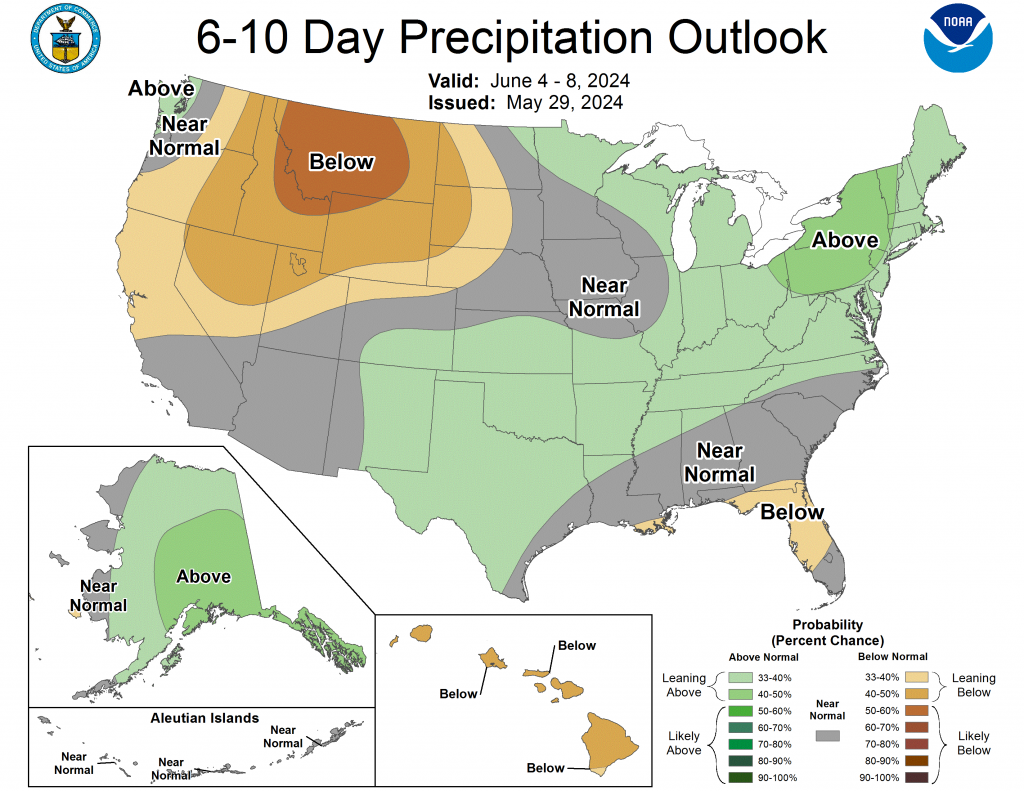
According to the 6-to-10-day precipitation outlook map, the entire state is leaning above a 33-40 percent chance of precipitation through June 8.
To view the United States Drought Map, click here.
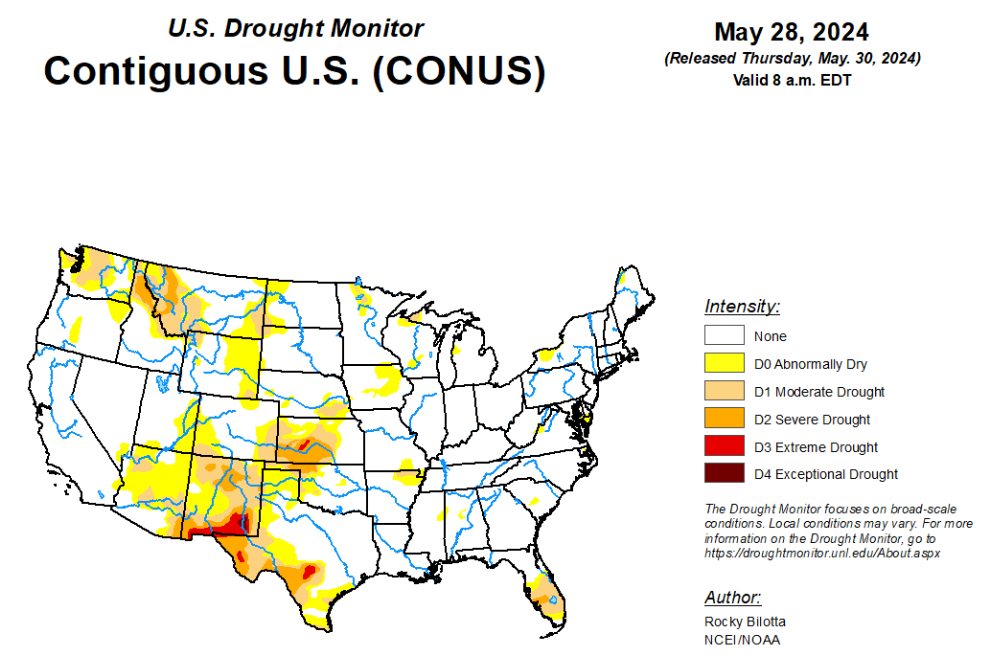
According to the latest U.S. Drought Monitor Report, a front over the Northwest to the Great Basin brought rain and higher-elevation snow to parts of the region, as well as rain and extreme weather to most of the Plains and Lower Mississippi Valley as the front advanced eastward. An additional front from southern Plains to the Great Lakes brought severe weather and thunderstorms from Texas to New York. Meanwhile, a sub-tropical upper-level high over Mexico brought record- to near-record warmth to portions of Texas. Temperatures were above normal across the eastern contiguous U.S., by as much as 10+ degrees F above average from parts of the eastern Great Lakes to the Northeast and in parts of Texas. Precipitation was below normal across much of the southern contiguous U.S. and the Northeast, as well as portions of the Northwest and parts along the East Coast. The most widespread improvements were made to portions of the Midwest and in eastern parts of the High Plains and South, as well as Montana and Hawaii, where above-normal precipitation was observed this past week. Dry conditions continued across the western portions of the Southern region, southern High Plains and Southeast, with degradations occurring in parts of the western Plains and Florida Peninsula. Drought and abnormal dryness also expanded or intensified in portions of the northern Rockies and Pacific Northwest. In Alaska, heavy rainfall resulted in the removal of abnormal dryness from the central interior this week.
In the Southern Plains, dry conditions continued across the western portions of the South this week, while heavy precipitation fell across eastern portions of the region. Most of Arkansas and Tennessee, as well as eastern parts of Oklahoma and Texas, received between 1 to 6 inches of rainfall (200% to 800% above normal) this week, resulting in the improvement of moderate drought (D1) and abnormal dryness (D0) in Arkansas while D0 was removed from most of Tennessee. Conversely, conditions continued to deteriorate in parts of eastern Oklahoma, Texas and Mississippi, where precipitation totals were 1 to 4 inches below normal this month. Severe drought (D2) and moderate drought were expanded in parts of eastern Oklahoma, while moderate drought was introduced in southern Texas. Abnormal dryness was also expanded into parts of northern and southern Texas and small portions of eastern Mississippi. Temperatures were 2 to 8 degrees F above normal across much of the region this week, while parts of southern Texas observed temperatures between 8 to 10 degrees F above normal. The expansion and intensification of drought categories were based on short-term SPI/SPEI, reservoir levels, streamflow and soil moisture data.
In the High Plains, precipitation fell across much of the region this week, which was enough to prevent further degradation but not enough to warrant large improvements. The heaviest rainfall amounts fell across much of North Dakota and along eastern portions of the region, where rainfall totals were up to 600% of normal and ranged between 1 to 4 inches this week. Severe drought (D2) was improved in south-central Kansas, while improvements to moderate drought (D1) and abnormal dryness (D0) were made in northern Kansas and southeast Nebraska. Abnormal dryness was also removed from northern Wyoming and northeast North Dakota due to heavy precipitation and improvement shown in soil moisture and short-term SPI/SPEI indicators this week. Conversely, dry conditions persisted in eastern portions of the High Plains this week. Deteriorating conditions shown in short-term SPI/SPEI, streamflow, soil moisture and snow water equivalent (SWE) data justified degradations in Colorado and eastern portions of Nebraska and Kansas. Extreme drought (D3) and severe drought were expanded in eastern Kansas, while moderate drought was introduced into southeast Wyoming where precipitation amounts were 50% of normal over the past month. Abnormal dryness was expanded in parts of Colorado, eastern Wyoming and western Nebraska this week.
In the West, much of the West remained as status quo this week, while temperatures were below normal (2 to 10 degrees F below normal) across most of the region. Precipitation fell across northern portions of the West, with the heaviest amounts falling over parts of western Washington and Montana. Above-normal precipitation (up to 3 inches), along with cooler temperatures (up to 10 degrees F below normal), resulted in improvements to extreme drought (D3), severe drought (D2), moderate drought (D1) and abnormal dryness (D0) across parts of Montana. Parts of Southwest Montana missed out on some of the beneficial rains resulting in the expansion of moderate drought in the area. Conditions remained dry in the interior parts of Washington, resulting in expansion of moderate drought and abnormal dryness based on short-term SPI/SPEI data, as well as low soil moisture and streamflow.
Looking ahead, during the next five days (May 28–June 1, 2024), moisture convergence along a frontal boundary and east of a dryline across Texas and Oklahoma will likely generate scattered to numerous showers and thunderstorms, with the potential for episodes of locally heavy rainfall early to mid-week. The threat of heavy rainfall will be highest in Texas Tuesday into Wednesday as an upper level shortwave moves over the southern Plains, where the potential exists for storms with rainfall rates approaching 2 inches per hour. The coverage of showers and storms will likely expand north across the central and northern Plains later in the week as an organized frontal system moves into the central U.S. from the Rockies. Locally heavy rainfall will be possible across portions of the Rockies going into late Friday and early Saturday as the cold front intercepts an increasingly humid airmass. In terms of temperatures, the Gulf Coast region will continue to remain hot and humid on Tuesday before some limited relief arrives by midweek as a cold front drops southward. However, the heat and humidity will likely continue across Deep South Texas and South Florida with highs running up to 10 degree above average, and heat indices in the 100-110 degree range, especially for southern Texas. Some triple digit heat is also likely for the lower elevations of the Desert Southwest, but very low humidity here will help keep heat indices in check.
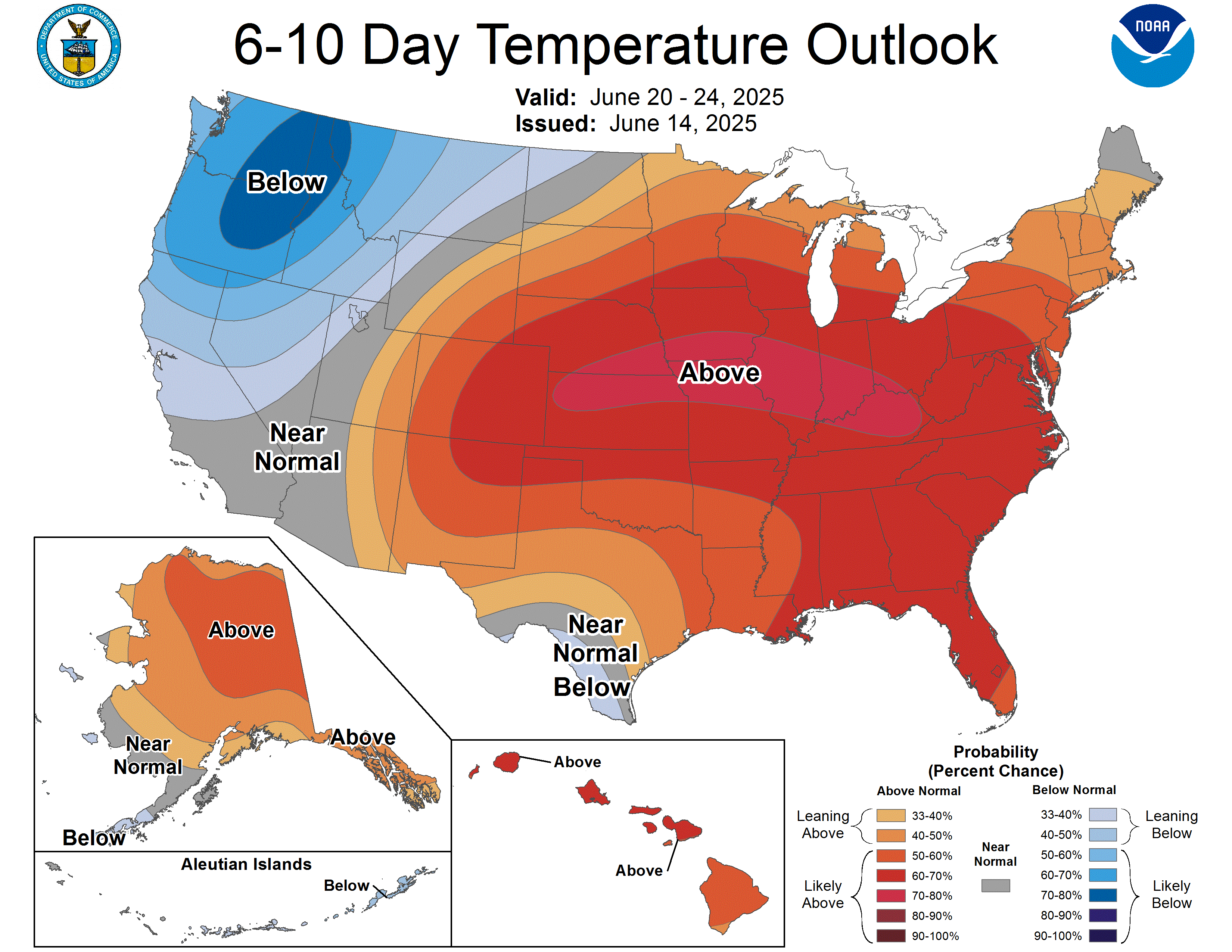
The Climate Prediction Center's 6-10 day outlook (valid June 2–6, 2024) favors above-normal precipitation along much of the West Coast, from the southern Plains to the East Coast, and across much of Alaska, with below-normal precipitation across most of the interior West and Hawaii. Increased probabilities for above-normal temperatures are forecast for Hawaii and much of the contiguous U.S., while below-normal temperatures are likely across the state of Alaska and in parts of Georgia and South Carolina.
To view the 6-10 Day Precipitation Outlook Map, click here.
To view the 6-10 Day Temperature Outlook Map, click here.
To view the Monthly Drought Outlook Map, click here.
Dairy farmers are descending on Washington next week, as NMPF's Young Cooperators lead the organization's annual fly-in. Hannah and Matthew Lansing, this year's chairs for the YC Program, say policy engagement is critical to dairy's future.
"There are so many things that affect us, but they don't affect us in a way that we see every day," said Matthew Lansing, who along with his wife and her family milk 1,100 cows and farm more than 5,000 acres at Blue Hill Dairy in Clinton, Iowa. said. "Keeping involved and up-to-date as much as we can and pushing for things that we need on a farm on a day-to-day basis is really key for us to propel forward into the future and be what we need to be for consumers going forward."
You can find and subscribe to the Dairy Defined podcast on Apple Podcasts and Spotify under the podcast name "Dairy Defined."
To listen to the latest episode, CLICK HERE.
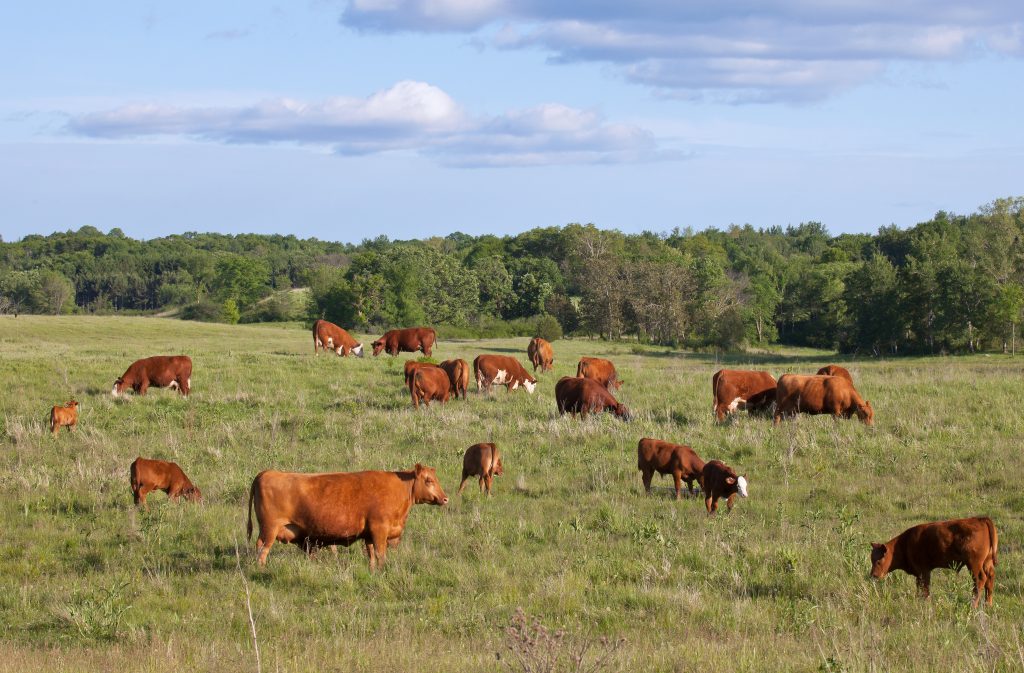
Weekly, Oklahoma State University Extension Beef Cattle Nutrition Specialist Paul Beck offers his expertise on the beef cattle industry. This is a part of the weekly series known as the "Cow-Calf Corner." Today, he talks about nutritional qualities of native range.
The nutritive quality of native range in the Southern Great Plains declines during the mid to late summer. Crude protein and digestibility of the forage increases in the spring as it greens up and starts summer growth beginning in April, peaking in May, and then steadily declines throughout the rest of the year.
Performance of stocker calves on native range declines from highs of 2 pounds/day during early summer to less than one pound per day through the late summer. Deficiency in dietary protein causes dramatic reductions in forage intake and digestibility. A small amount of high protein supplement corrects the protein deficiency increasing both forage intake and forage digestibility when adequate forage is available. Our research indicates that feeding 2 to 2.5 pounds of extruded distiller's grains cube supplement per day (or feeding 5 to 6 pounds/head 3 days per week) to growing calves on native pasture can increase performance in the late summer by 0.75 to 1.0 pounds/day requiring only 2.5 to 3.5 pounds of supplement per pound of added gain.
Bermudagrass and other introduced pasture forages common to eastern Oklahoma and the Southeast do not have the same nutrient profile as native pastures through the summer with crude protein values over 12% even during the late summer. The fiber content of the bermudagrass increases as the summer progresses resulting in reduced forage digestibility and limited performance. Our research in Eastern Oklahoma steers showed feeding 5.8 pounds of supplement 3-days per week (a 2.5 lb/head daily supplement rate) increased gains of growing steers were increased by 0.5 to 0.7 pounds per day, requiring 5.3 and 3.5 pounds of supplement for each pound of added gain, respectively.
Because protein content of the forage is usually adequate for growing calves in the fertilized bermudagrass throughout the summer, steers don't respond to added protein like they do on native range. The increase in performance we saw is through the addition of energy to the diet to offset the reduced digestibility of the forage during the late summer. This decreases the efficiency of supplementation on introduced pastures compared with native range.
Supplementation of grazing calves during the late summer can be highly profitable even in years with high input costs. The response by growing stocker calves may not be the same on differing forages and pasture types so the economics of the supplementation program need to be evaluated based on the types of pasture and supplement, the supplement cost, and the margins of the stocker cattle enterprise based on the current markets.
Below, SunUpTV highlights research on the influence of supplementation and stocking rate on performance and economics of stocker cattle operations at the Marvin Klemme Range Research Station on October 17, 2020.
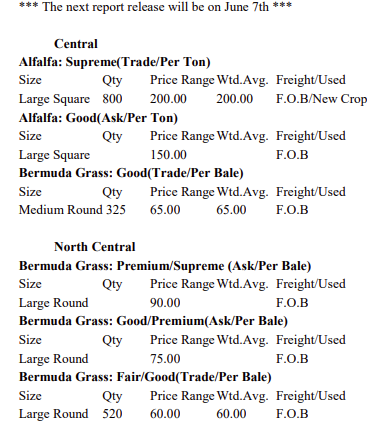
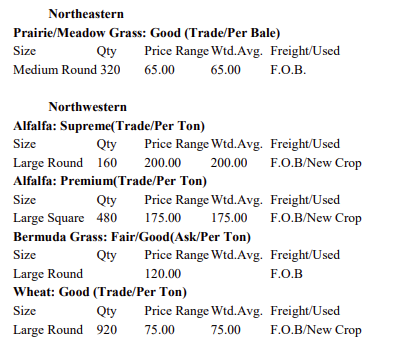
Compared to the last report, We have had several storms across Ok-Lahoma, which have slowed down some hay trade as well as hay bal-ing. The wheat hay movement has picked up, but it is not enough to say the demand is high. Old-crop hay continues to move lower in price as we enter the new hay season. We still have barns full of old-crop hay that are trying to be sold and emptied for new-crop hay. The wheat harvest has started in parts of Oklahoma. The rest of Oklahoma's wheat harvest will begin in the coming weeks, which might slow down more trade.
Trends: Alfalfa Large squares $175-$200 a ton - New Crop
Alfalfa Rounds - No Trend
Grinding hay - No Trend
Bermuda 5x6 rounds - $60-$75 a bale - Year Old Hay
Bermuda Large Squares - No Trend
Wheat Hay 5x6 Round - $75-$100 a Ton - New Crop
Wheat Hay Large Squares - $75-$100 a Ton - New Crop
Grass Hay 4x5-4x6 - $50-$60 a bale - Year Old Hay
Grass Hay 5x6 - $60-$70 a bale - Year Old Hay
Rough Grass Hay any size $30-$40 a bale - Year Old Hay
The Oklahoma Mesonet Drought Monitor shows we are at 0 percent in exceptional drought, 0 percent in an extreme drought, 5.91 percent in severe drought, 11.37 percent in moderate, 29.60 percent in abnor-mally dry conditions, and 70.40 percent that has no drought condi-tions.
RON's Dave Lanning has a pre-opening look at today's agricultural Markets.
Click the audio tab below for today's report.
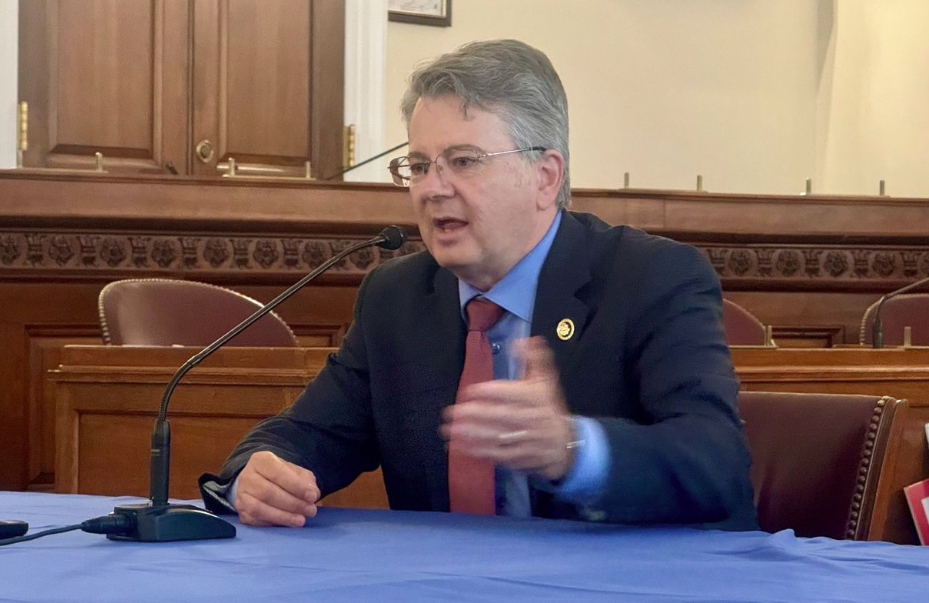
At the 2024 National Association of Farm Broadcasters (NAFB) Washington Watch event in Washington, D.C., members of NAFB , including Farm Director KC Sheperd, had the chance to talk with Congressman John Duarte about many pertinent issues in the agricultural industry. Duarte represents California and is also a fourth generation farmer.
Duarte first talked about resource abandonment in agriculture and its impact on American working families. To solve this issue, Duarte highlighted the need for policies that support farmers.
Although some American families are doing well and some salaries have been increased, Duarte said the Biden Administration is increasing interest rates at the same time. Now, Duarte said home affordability, energy affordability and more is on the wrong track due to a broad category of policies he calls resource abandonment.
"Sadly, when we are not abandoning our resources in agriculture, we tend to want to misdirect them towards uses that aren't feeding humans or feeding things that feed humans," Duarte said. "I think that is a crisis and I think that is coming down on the backs of American working families."
When asked about Proposition 12 in California and possibly seeing a change in the Farm Bill, Duarte said overall, these policies are impacting the affordability of animal protein for California residents.
"We care about how many pigs there are in a pig pen, and we care about how a chicken lays an egg," Duarte said. "Although, I don't think most of the people supporting these policies really know of either."
Next, Duarte talked about his new bill, the EV Trade Act.
"If you look at the cobalt mining in the Congo, this supports the critical minerals needed for these electric vehicles," Duarte said. "It is the most abject colonialism and slavery that we've seen in the history of the world. It's industrialized slavery in the Congo, and we are subsidizing electric vehicles made with these critical minerals out of these inhuman mines, and so I'm dropping the EV Fair Trade Act that says if you want an electric vehicle, great, I'm sure you look cute in it, but if you want a federal rebate, we have to document that these electric vehicles that we're subsidizing through taxpayer dollars are not made of constituents or components produced with slave labor. I'm a lot more concerned about human slave labor through our proxy imperialism to China in the Congo, than I am about telling the farmer who raises pigs and has a very economic and deep interest in their health and welfare, simply for financial reasons, if nothing else, how to raise a pig or how to how chicken should lay an egg or spread its wings in the cage."
When asked about his outlook on the ag labor crisis, Duarte said one of his main mantras is that the American dream must stay alive. This means more border control so immigrants can work safely in the U.S. without others coming through with ill intentions such as drugs.
"There's some real opportunities for these migrant ag families to make a lot of money," Duarte said. "It's hard work. It's not certain, but it's important for them to establish."
Regarding the California water situation, Duarte explained the need to make up for generations of neglect to provide for the future.
"So, make no mistake when California has water scarcity when we're causing a thermal Dustbowl in the South Valley, destroying millions of acres of irrigated landscapes and the habitat value those involved as well as the climate value in the carbon sinks those involved but that's where you're worried about every morning, this was a choice and it's a choice we're making today...," Duarte said.
To listen to full comments from Congressman Duarte, click the listen bar above the story!
| ||||||||||||||||||||||||||||||||||||||||||||||||||||||||||||||||||||||||||||||||||||||||||||||||||||||||||||||||||||||||||||||||||||||||||||||||||||||||||||||||||||||||||||||||||||||||||||||||||||||||||||||||
| ||||||||||||||||||||||||||||||||||||||||||||||||||||||||||||||||||||||||||||||||||||||||||||||||||||||||||||||||||||||||||||||||||||||||||||||||||||||||||||||||||||||||||||||||||||||||||||||||||||||||||||||||
|
May 29, 2024 – Farmers Edge™, a pure-play digital ag company, and the National Sorghum Producers (NSP) are excited to announce a new strategic partnership aimed at enhancing sustainable farming practices for sorghum growers. This strategic partnership will support growers participating in NSP's Partnerships for Climate-Smart Commodities (PCSC) grant program funded by the U.S. Department of Agriculture. Together, Farmers Edge and NSP will help growers seamlessly integrate advanced technology solutions for capturing essential on-farm data, including Carbon Intensity (CI) scoring, thus contributing to broader environmental goals.
Using FarmCommand®, Farmers Edge's end-to-end platform, growers can make more informed management decisions, monitor and improve their CI scores, and easily work with NSP to extract and export data verifying their environmental impact. With this data, growers have an opportunity to monetize their sustainability initiatives, solidifying sorghum as a climate-smart commodity and supporting their farms' long-term financial viability.
"We're proud to partner with the National Sorghum Producers," said Vibhore Arora, CEO of Farmers Edge. "Through our customized technology solutions, we're committed to supporting NSP in simplifying sustainability reporting and assisting their growers in accessing new revenue streams for climate-smart farming practices."
"We are excited to collaborate with Farmers Edge to bring innovative solutions to sorghum farmers," NSP PCSC program Managing Director Matt Durler said. "This partnership underscores NSP's commitment to driving sustainable agriculture forward and ensuring our growers have the resources they need to thrive in a rapidly changing environment."
Through this partnership, NSP is focused on increasing value for their members. Selecting Farmers Edge as a technology partner supports a pivotal data collection process for the climate-smart commodities-funded project, creating a pathway for all practices to be quantified, tracked, and monetized and enables broader farmer participation in climate-smart inset programs moving forward.
Memorial Day is first and foremost a time for Americans to honor military personnel who died serving their country. It's also the unofficial kick-off to summer – and grilling season, stimulating demand for all types of animal proteins, including beef.
Though the July Cattle Inventory has been discontinued by USDA's National Agricultural Statistics Service, we can use other reports to piece together the cattle and beef market outlook. This Market Intel covers three beef reports to tell the story of where markets and grocery store prices are headed as we kick off grilling season.
Cattle on Feed
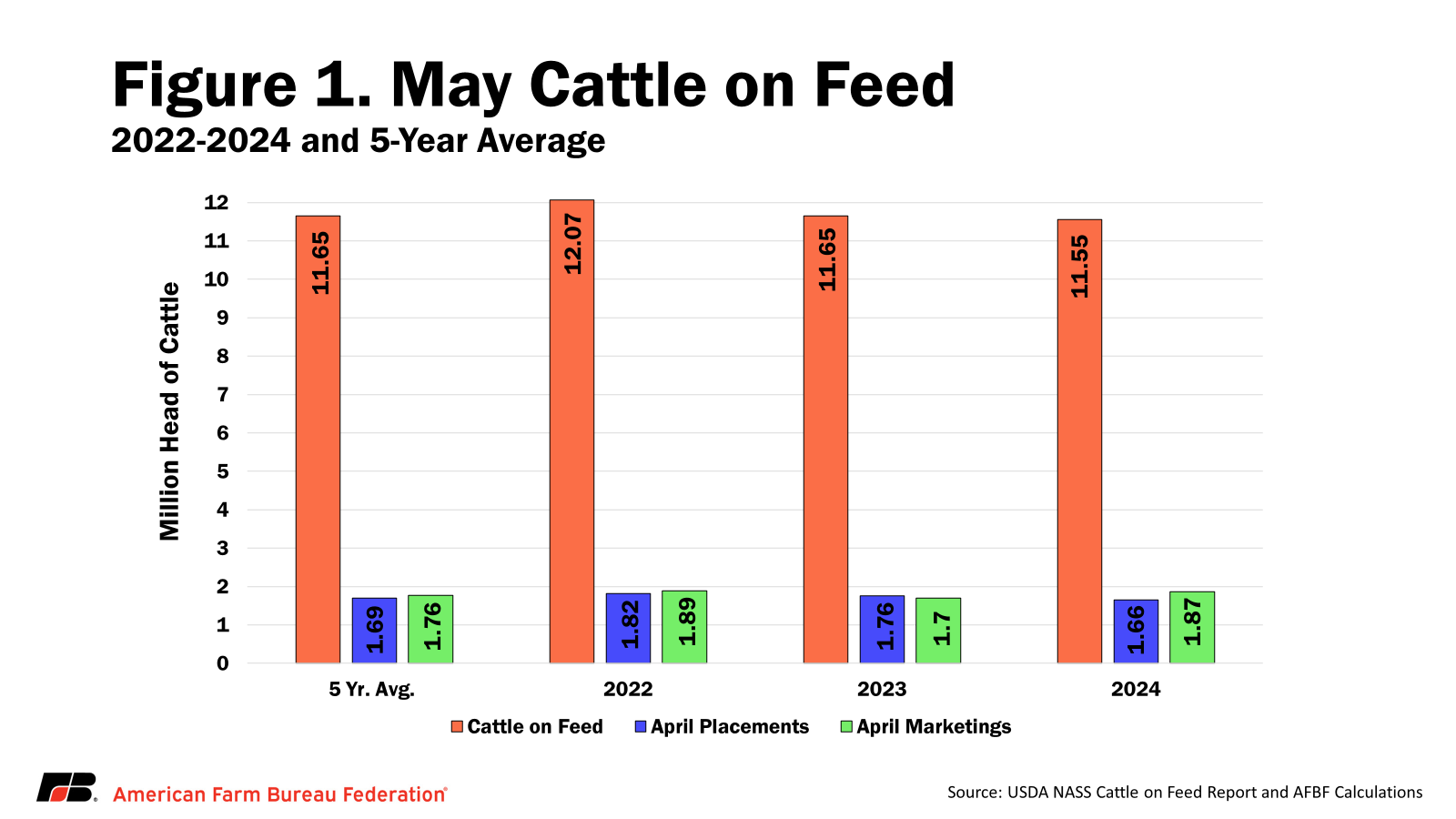
USDA's monthly Cattle On Feed report, published on May 24, estimates that there were 11.6 million head of cattle on feed on May 1, up 1% from May 2023. Cattle placed on feed in April were estimated to be 1.66 million, down 6% from April 2023. Cattle marketed in April totaled 1.87 million head, up 172,000 head or 10% from 2023. Cattle on feed for 120-plus days was 4.72 million, down 4.5% from last month, but up about 5.5% from this time last year. This still leaves higher numbers of fed cattle available in the short run and should help keep beef prices from skyrocketing through the summer.
Substantial improvements in drought conditions over the last year, especially in parts of the country with high concentrations of cattle, could result in more cattle being retained for breeding purposes rather than being placed on feed. If this happens, placements could fall through the remainder of 2024 as cattle feeders continue to add weight to what they already have in feedlots rather than adding more cattle.
Regardless of the reason for fewer cattle on feed, the result is the same: fewer cattle available for beef production in the long run.

Livestock Slaughter
NASS' monthly Livestock Slaughter report, released on May 23, shows April 2024 beef production was 2.3 billion pounds, up 234 million pounds, or 11%, from April 2023. Average live weight was 1,395 pounds, up 41 pounds from April 2023. This is just 6 pounds less than the record average live weight of 1,401 pounds set in December 2023. Cattle prices are up from last year, increasing the cost for packers to buy market-ready cattle. Increasing production during a time of high retail prices helps packers make up for paying more for cattle.
Also released on May 24 was USDA's monthly Cold Storage Report, a helpful tool in gauging the amount of nearly 150 different items kept in cold storage, including beef. USDA estimates beef in cold storage on April 30 was 413.95 pounds, down 1% from last month and down about 16.7 million pounds, or 5%, from last year. All red meat in freezers totaled 955.9 million pounds, which is about 9% below year-ago levels. Increased production addressed earlier in this article has helped keep beef in cold storage from dropping more rapidly. There have been some record prices set for beef products early in 2024, but increased production has kept most national average retail prices from hitting record levels so far this year.
Prices and Demand
USDA's May Livestock, Dairy, and Poultry Outlook provides additional data useful in analyzing beef supply and demand. This report forecasts 2024 U.S. per capita disappearance of beef will be 58.3 pounds per person, an increase of 0.2 pounds from 2023. However, USDA is projecting this metric will fall by 5%, to 55.6 pounds per capita in 2025. Much of this decrease is due to expected consumer fatigue from inflation and expected record beef prices in late 2024 and 2025.
Summary and Conclusions
While there is no substitute for the data provided in NASS' July Cattle Inventory survey report, especially for projecting the next 12 months of supply, other USDA reports can be used to ascertain the overall direction of the market as we head into the summer grilling season and the peak beef demand that comes with it.
The May Cattle on Feed report estimated lower placements of cattle on feed – normal for this time of the year – and higher marketings. In addition, much-needed moisture is helping improve pasture conditions across the country, giving farmers a reason to retain heifers for breeding purposes. While this would be the first step to expanding the U.S. beef herd again, a smaller 2024 calf crop projected by USDA means the first opportunity for expansion of the cattle inventory will not occur until 2025. Domestic demand for beef is still strong but tight supplies will continue to drive up grocery store prices through 2025, which will drive down consumer demand for beef, according to USDA forecasts.
Farm Bureau July 4th Cookout Survey
The results of the American Farm Bureau Federation's Fourth of July cookout cost survey, which will be released on June 26, will provide a grassroots snapshot of the cost of beef and other traditional Fourth of July favorites.
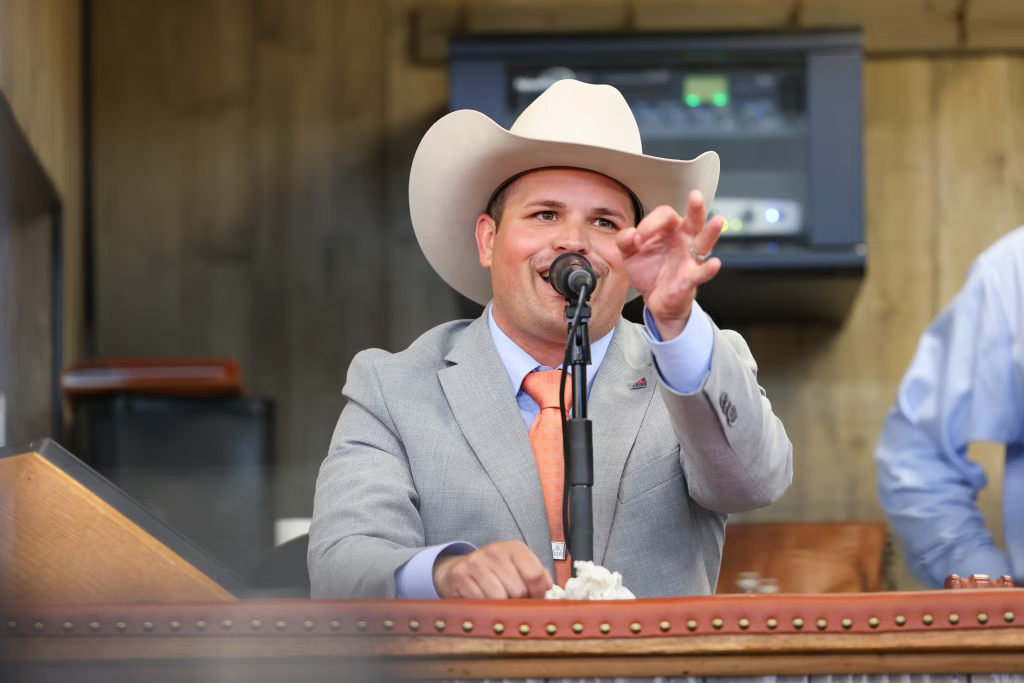
Pictured: Will Epperly, from Dunlap, Iowa, was named the 2022 World Livestock Auctioneer Champion at the 58th annual competition held at Shipshewana Auction & Trading Place, Shipshewana, Ind.
Senior Farm and Ranch Broadcaster Ron Hays is talking with Ben Hale of Western Livestock Auctions about the upcoming 2024 LMA Convention and World Livestock Auctioneer Championship. Hale is a member of the board of directors of the Livestock Marketing Association based out of the Kansas City area.
On June 12-25, the LMA Convention will be held in Oklahoma City at the Omni Oklahoma City Hotel, and the World Livestock Auctioneer Championship will be held at Oklahoma National Stockyards. Hale said auctioneers will be coming from across North America to compete in the championship.
The 2024 Livestock Marketing Association (LMA) Annual Convention brings together livestock auction market operators, livestock dealers, livestock auctioneers and others who share a vested interest in promoting the true price discovery method of marketing livestock. The three-day convention is held in conjunction with the premier livestock auctioneer contest, the World Livestock Auctioneer Championship (WLAC). This will be the 60th year of the contest where 31 auctioneers compete for the title of champion. Join this elite group for business meetings, industry discussions, guest speakers, a trade show, local tours, dinner events and world class competition.
"There is lots of talent there that will be showcased," Hale said.
With great cattle prices, Hale said it is a perfect time to have an auctioneer championship. During the contest, actual cattle will be sold.
"We are just looking forward to having everybody out to show what we can do in the auction business and at the world's oldest and largest market in the country," Hale said.
Aside from the contest, Hale said there will be plenty of meetings and sessions to attend. To view the full schedule, CLICK HERE.
To register, CLICK HERE.
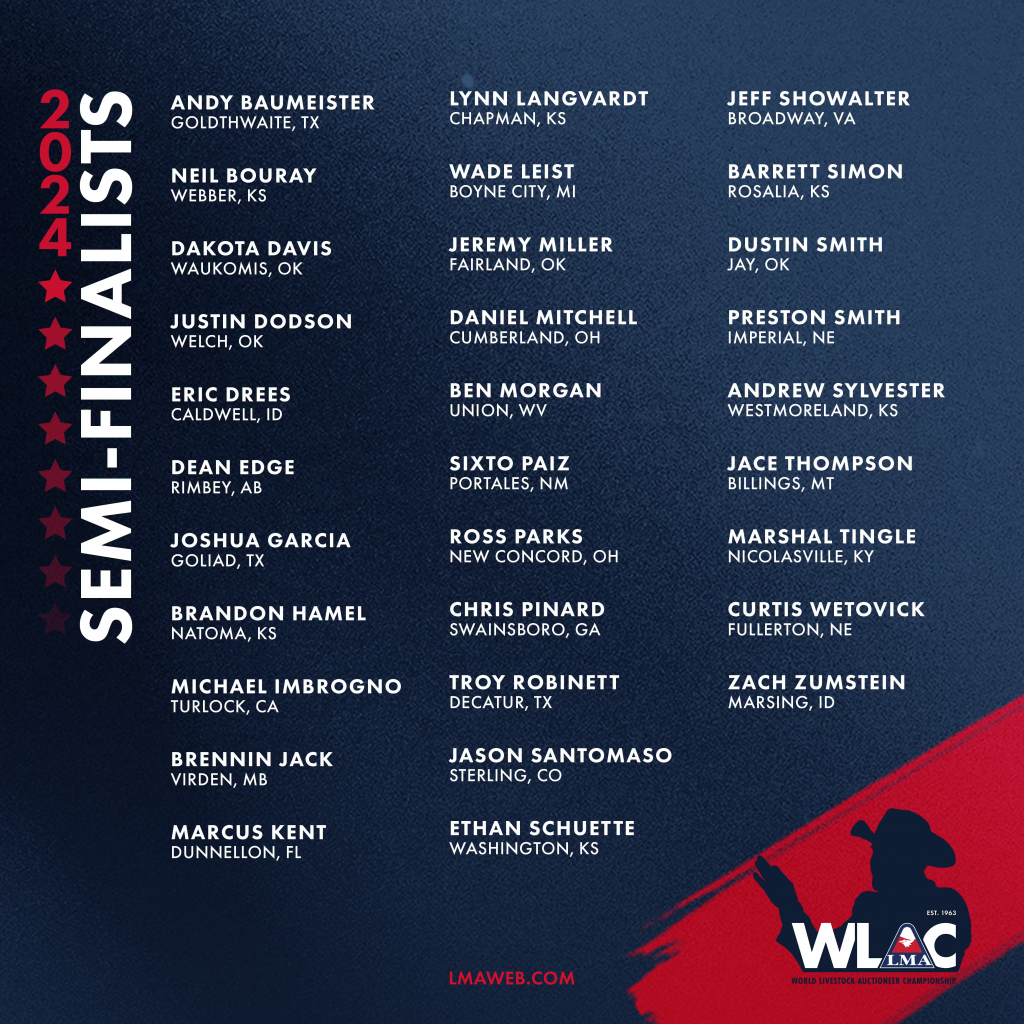
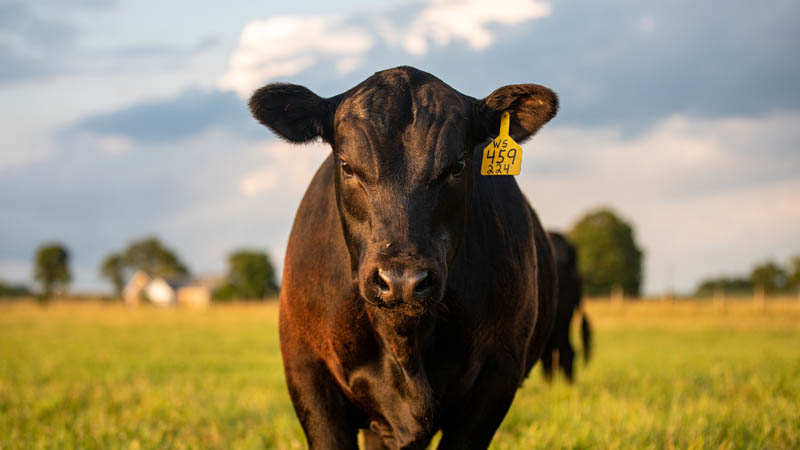
At the recent 2024 Cattlemen's Conference at Oklahoma State University, Senior Farm and Ranch Broadcaster, Ron Hays, caught up with the CEO of the American Angus Association, Mark McCully, and talked about gene editing of the Angus breed.
Looking back on the cattle industry many years ago, McCully talked about the strides that have been made in terms of technology and innovation. Now with gene editing, McCully said there is the ability to advance animal health, wellness, and more.
Many have different feelings about gene editing, McCully said, as some individuals are excited about what this technology can mean for the beef industry, while others fear its potential.
"I think it is a very timely discussion, but it is a complicated one, because it is very technical, and to some people, it becomes very scary," McCully said.
One of the most important things to remember when adopting this technology is how the consumer will accept it, McCully said, because keeping the trust of consumers is vital.
"We have to think about how they are going to accept this technology," McCully said. "They have choices of other proteins and so we need to make sure we always keep them in mind."
McCully added that explaining the benefits of technology such as gene editing to consumers can have value, as today's consumers are concerned with sustainability, animal health, and more- which can all be improved by gene editing.
"It is very important to keep the consumer front and center, and it is going to be very important that we talk about these things in the right way," McCully said.
The Beef Buzz is a regular feature heard on radio stations around the region on the Radio Oklahoma Ag Network and is a regular audio feature found on this website as well. Click on the LISTEN BAR for today's show and check out our archives for older Beef Buzz shows covering the gamut of the beef cattle industry today.

Opportunities to advance sustainable cotton farming in the United States are growing thanks to a nationwide partnership led by the Soil Health Institute's United States Regenerative Cotton Fund (USRCF).
The fund's holistic approach to advance economic insights, soil health measurement, and education has made significant progress in the U.S. Cotton Belt since its establishment, engaging more than 1,000 cotton farmers and their advisors. Its efforts support adoption of management systems to improve soil health, the foundation for regenerative agriculture.
"The soil health benchmarks SHI is providing are a great way to help farmers set realistic soil health goals and measure their success," said fifth-generation cotton farmer Zeb Winslow, who hosted a recent USRCF field demonstration at his farm in North Carolina. "Reaching farmers where they're at is important if we're going to continue the soil health movement."
Launched in 2021, USRCF is a farmer-facing, science-based initiative to support long-term, sustainable U.S. cotton production, with the goal of eliminating one million metric tons of carbon dioxide equivalent from the atmosphere by 2026. Active in Alabama, Arkansas, California, Georgia, Mississippi, Missouri, North Carolina, Oklahoma, South Carolina, and Texas, the fund's work is made possible by boots-on-the ground partnerships with U.S. Cotton Trust Protocol, Cotton Incorporated, agricultural extension, local technical specialists, advisors, and cotton farmers.
Notable successes include:
The USRCF was initiated through a founding grant from The Ralph Lauren Corporate Foundation. Walmart Foundation, The VF Foundation, Levi Strauss & Co., Hearst Foundations, and Cotton Incorporated are also supporters of the fund. For more information about the U.S. Regenerative Cotton Fund, please visit https://soilhealthinstitute.org/our-work/initiatives/us-regenerative-cotton-fund
Mike VanMaanen married into a family of Livestock Marketing Association members in the 1980s, but never dreamed he'd one day lead the organization. Even though he immediately recognized the benefits of membership, he thought he was too busy to get involved or since his niche market wasn't nationally known, he didn't have a place. Soon enough, VanMaanen learned he was wrong on both accounts, and May 17, he was elected president.
VanMaanen, who grew up on a corn, soybean and hog farm in Iowa, attended Missouri Western State University, where he graduated with degrees in agricultural economics and agronomy. It was there he met Lori Angell, a third-generation livestock marketer. The two married soon after graduation and joined her family's auction market business in Columbia, Missouri, and bought into it in 1990. In 2000, the couple, along with two of her cousins, took over Eastern Missouri Commission Co., in Bowling Green. Last year, they became sole owners.
The World Livestock Auctioneer Championship was VanMaanen's gateway to Livestock Marketing Association leadership, first serving as a judge in the Parsons, Kansas, qualifier in the fall of 2009 and at the finals in Oklahoma City the following summer. He joined the association's government and industry affairs committee in 2014 and the board of directors in 2016. During his tenure on the board, he also chaired the membership services committee for two years. He said his time on the board has had many highlights, and he looks forward to what's to come.
"I've had the opportunity to testify in front of the House Committee on Transportation, I worked alongside many others to get Dealer Statutory Trust signed into law and was a part of the producer profitability initiative we launched last fall," VanMaanen said. "I'm extremely proud of the work LMA has done and look forward to continuing it."
VanMaanen will take over the reins from Mark Barnett during the association's annual convention in June. First up on his agenda? Having deep discussions with members and staff about how to protect the livestock auction market sector.
"We're going to take a look at what it takes not only for the larger markets to survive, but what it takes for those small markets that are so important in their rural communities, to keep them alive and going," VanMaanen said.
But the conversation won't just be about markets. He said Livestock Marketing Association members will continue to push their producer profitability initiative, aimed at bringing the entire industry together for a common goal.
"By supporting America's farmers and ranchers, we are supporting the future of livestock marketing, too," VanMaanen said. "We know producer profitability is industry sustainability."
The incoming president said he hopes all members will take the opportunity to get more involved this year, whether that means attending the convention, participating in the D.C. Fly-In, joining a committee — or even just staying in touch with their region executive officer.
"I think when people start getting involved, they find it really rewarding," he said. "And you don't have to be a big operator — I'm a good example of that. You just have to want to pitch in and do some work to improve your livelihood. If you can stay active and participate in conversations, we'd love to have you."
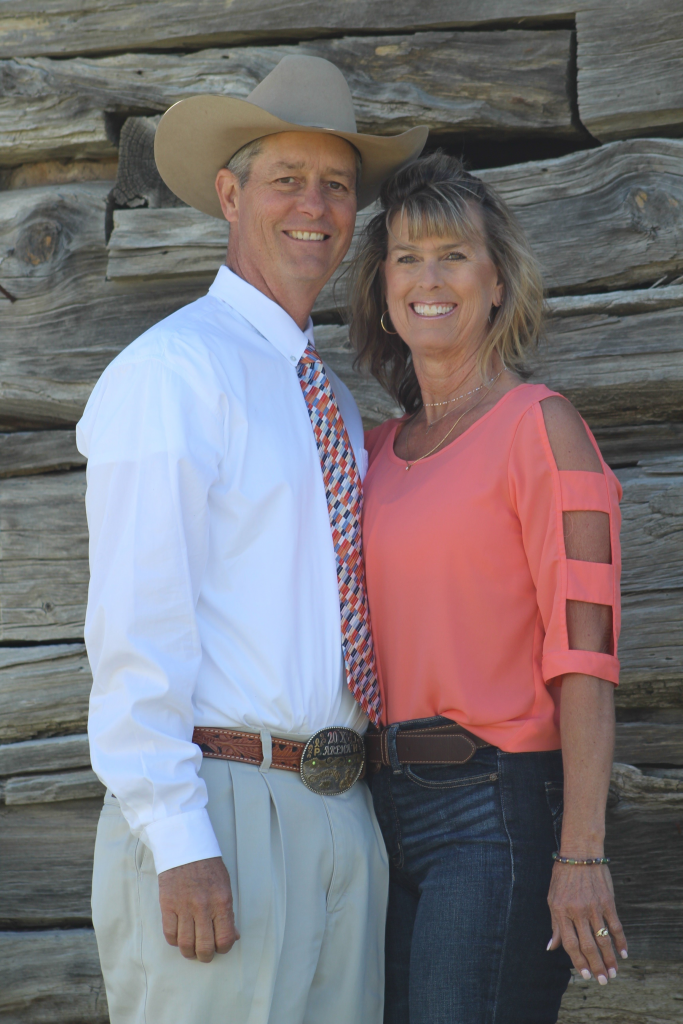
Pictured are Benjie Lemon and his wife, Laurie
Veteran media expert to lead American Angus Association®'s marketing entity
The Angus Media board of directors recently named Benjie Lemon as president of the organization to guide the company as it delivers industry-leading information and marketing to the beef industry.
An agricultural media veteran, Lemon has spent 18 years helping the equine industry advance their media offerings and improving the ways they can connect.
"Benjie will be a great fit in the Angus family. He is an experienced leader, has significant knowledge in delivering innovative media solutions, and has strong cattle industry roots," said Mark McCully, vice chairman on the Angus Media board of directors and chief executive officer for the American Angus Association®.
Most recently Lemon was group publisher with the Equine Network, the largest subscription and membership-based organization for equine enthusiasts delivering content, competition, commerce and community for the equine world through both print and digital media.
"In particular, Benjie has extensive experience with integrating different business units and media solutions into a seamless customer experience and this will be a great asset for customers of Angus Media," McCully said.
Lemon said he is eager to help advance the mission of Angus Media. "I look forward to capitalizing on my experience helping Angus breeders," Lemon said.
Lemon has deep roots in the cattle industry. Prior to working with Equine Network, Lemon held two different roles at the North American Limousin Foundation. He was a Director Member Relations and Director of Commercial Industry Relations.
"It's great to come full circle and be able to once again serve the beef industry in a professional capacity," Lemon said. "The future is so bright with the Angus breed and I'm excited to be joining the Angus family."
Lemon also has additional membership association experience, having worked for both the Colorado Livestock Association and the Colorado Cattlemen's Association. He is a native of Colorado and a graduate of Colorado State University in Animal Science.
He and his wife, Laurie, have a daughter, Kallie who attends college in Nebraska. They will be relocating to the St. Joseph, MO area and he will begin his role on June 24.
Angus Media provides cutting-edge marketing services to the cattle industry, including publishing Angus Journal and Angus Beef Bulletin, and producing hundreds of sale books and websites annually.
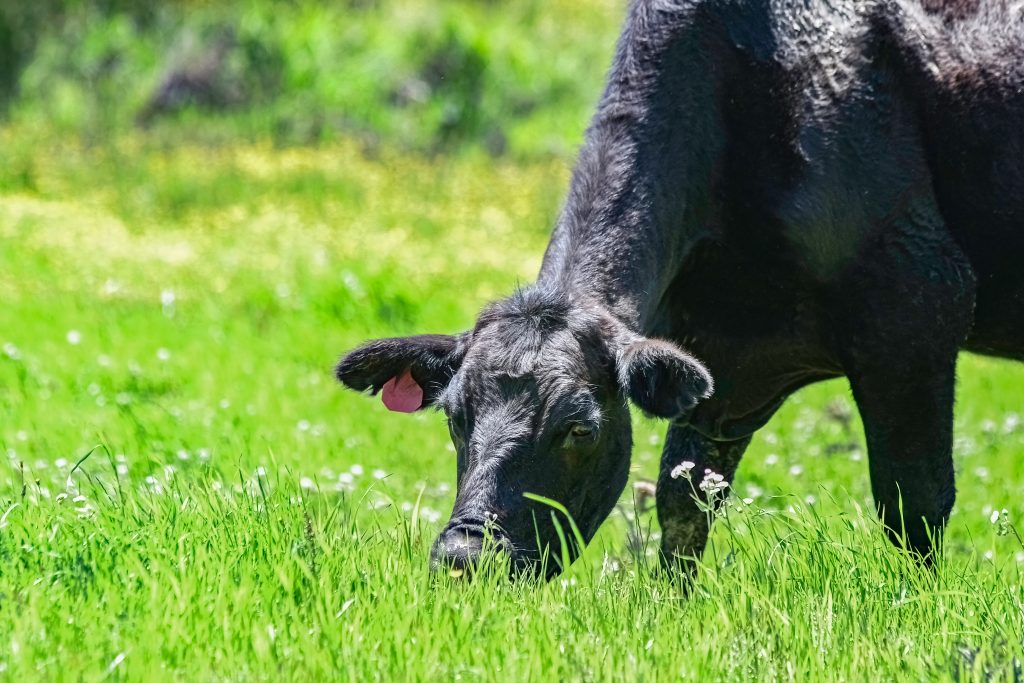
Mark Johnson, Oklahoma State University Extension Beef Cattle Breeding Specialist, offers herd health advice as part of the weekly series known as the "Cow Calf Corner," published electronically by Dr. Peel, Mark Johnson, and Paul Beck. Today, Johnson talks about genetics in relation to profit.
Commercial cow-calf operations should take advantage of both additive and non-additive genetic effects. This can be accomplished in two phases: 1) determining which breeds to incorporate into a well-designed crossbreeding system in order to gain hybrid vigor and breed complementarity; and, 2) selecting sires within those breeds based on strong additive genetic values (in the form of EPDs) for the traits of primary economic importance in your production and marketing system.
The results of a well-designed crossbreeding system are primarily realized through the advantages of the crossbred cow. As compared to purebred cows:
Crossbred calves, as compared to purebred calves:
The magnitude of these advantages will vary based on the breeds involved. Bos Taurus crossed to Bos Indicus will respond with higher levels of heterosis for reproduction, growth and carcass traits than Bos Taurus to Bos Taurus crosses. The USDA Meat Animal Research Center's Germplasm Evaluation Program serves as a long-standing resource for current additive genetic differences among beef breeds as well as the non-additive genetic response observed when making specific breed crosses.
Crossbreeding for the sake of crossbreeding is not suggested. Selecting the right breeds based on additive genetic strengths and complementarity is critical. A well designed crossbreeding system will require an additional level of management and considerations. Determining if sires will be used as terminal or rotational. If replacement heifers are to be purchased from outside sources or produced from within should be part of the planning process.
Reference: Blueprint For The Future – Part 2 Cattle Conference. Selection and Mating Panel Discussion. May, 2024
Below, Mark Johnson, OSU Extension beef cattle breeding specialist, discusses economically relevant traits in cattle herds on SunUpTV from May 18, 2024.
RON's Dave Lanning has a pre-opening look at today's agricultural Markets.
Click the audio tab below for today's report.
"I would like to applaud the action by the U.S. Food & Drug Administration announced today that would allow sales and marketing of Bovaer, an animal drug developed by Elanco Animal Health to help reduce enteric methane production in dairy cows. Today's action is long overdue, as the product is one of the most tested and trusted enteric methane emission solutions and available to farmers in nearly 50 countries around the world, including Europe, Australia and Canada. Today, American farmers are able to share in opportunities to create a new value stream on the farm that had previously been beyond their reach.
"At the same time, the fact that this process has taken over two years shows that the system is in dire need of reform. That is why NCFC strongly supports passage of the IFEED Act and other legislation that would modernize the approval process and further innovation in American agriculture."
About NCFC
Since 1929, NCFC has been the voice of America's farmer cooperatives. Our members are regional and national farmer cooperatives, which are in turn consist of nearly 2,000 local farmer cooperatives across the country. NCFC members also include 17state and regional councils of cooperatives. Farmer cooperatives allow individual farmers the ability to own and lead organizations that are essential for continued competitiveness in both the domestic and international markets.
America's farmer-owned cooperatives provide a comprehensive array of services for their members. These diverse organizations handle, process and market virtually every type of agricultural commodity. They also provide farmers with access to infrastructure necessary to manufacture, distribute and sell a variety of farm inputs. Additionally, they provide credit and related financial services, including export financing.
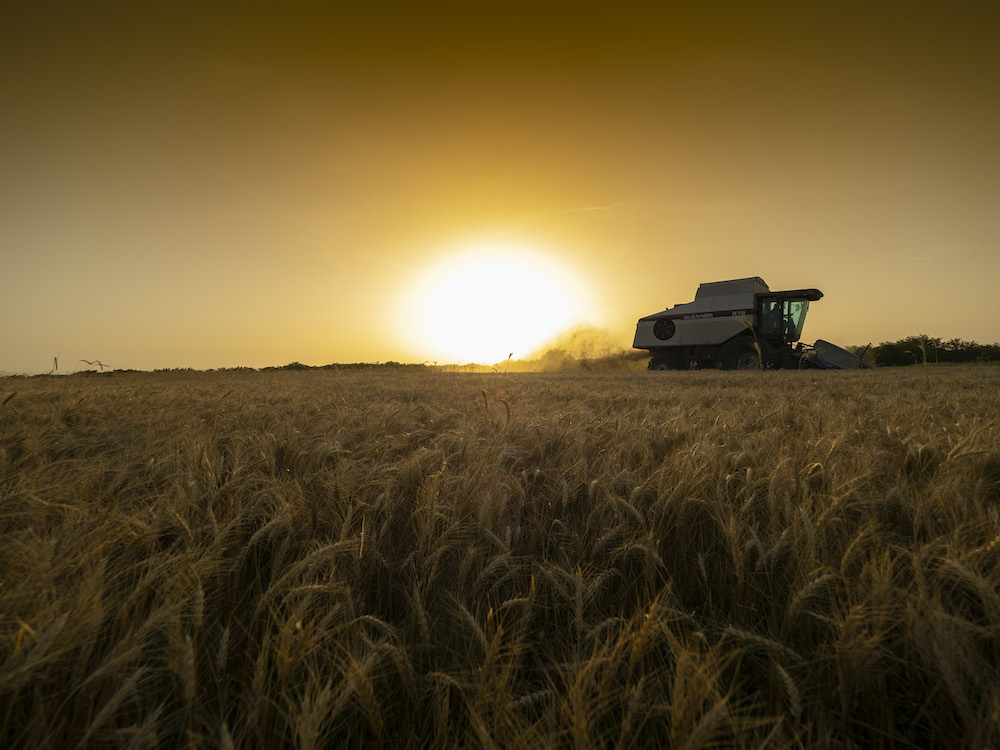
Wheat Harvest on the Yochum Farm in North Logan County near Marshall.
Winter wheat headed reached 77 percent, up 8 percentage points from the previous year and the five-year average. Winter wheat conditions rated 48 percent good to excellent, 33 percent fair and 19 percent poor to very poor- not changed much from last week. This time last year, winter wheat conditions rated 34 percent good to excellent, 31 percent fair and 35 percent poor to very poor.
Corn planted reached 83 percent, down 6 percentage points from the previous year and up 1 point from the five-year average. Corn emerged reached 58 percent, down 8 points from the previous year and even with the average.
Soybeans planted reached 68 percent, down 10 percentage points from the previous year and up 5 points from the five-year average. Soybeans emerged reached 39 percent, down 11 points from the previous year and up 3 points from the average.
Cotton planted reached 59 percent, up 3 percentage points from the previous year and up 2 points from the five-year average. Cotton squaring reached 4 percent, up 1 point from the previous year and down 1 point from the average. Cotton conditions rated 60 percent good to excellent, 35 percent fair and 5 percent poor to very poor. This time last year, cotton conditions rated 48 percent good to excellent, 39 percent fair and 13 percent poor to very poor.
Range and pasture conditions rated 48 percent good to excellent, 30 percent fair and 22 percent poor to very poor. This time last year, conditions rated 43 percent good to excellent, 35 percent fair and 22 percent poor to very poor.
Winter wheat harvested reached 12 percent, up 12 points from the previous week and up 11 points from normal. Winter wheat conditions rated 53 percent good to excellent, 32 percent fair and 15 percent poor to very poor. Last week's conditions rated 51 percent good to excellent, 35 percent fair and 14 percent poor to very poor. This time last year, conditions rated 30 percent good to excellent, 43 percent fair and 27 percent poor to very poor.
Corn planted reached 91 percent, up 10 points from the previous week and up 20 points from normal. Corn emerged reached 81 percent, up 20 points from the previous week and up 24 points from normal. Corn conditions rated 81 percent good to excellent, 17 percent fair and 2 percent poor to very poor. Last week's conditions rated 84 percent good to excellent, 14 percent fair and 2 percent poor to very poor.
Sorghum planted reached 40 percent, up 8 points from the previous week and up 18 points from normal.
Soybeans planted reached 29 percent, up 5 points from the previous week but down 7 points from normal.
Peanuts planted reached 49 percent, up 19 points from the previous week and up 17 points from normal.
Cotton planted reached 38 percent, up 18 points from the previous week and up 12 points from normal.
Livestock conditions rated 73 percent good to excellent, 23 percent fair and 4 percent poor to very poor. Last week's conditions rated 74 percent good to excellent, 22 percent fair and 4 percent poor to very poor.
Pasture and range conditions rated 57 percent good to excellent, 36 percent fair and 7 percent poor to very poor. Last week's conditions rated the same. This time last year, pasture and range conditions rated 45 percent good to excellent, 39 percent fair and 16 percent poor to very poor.
Kansas Crop Progress:
Winter wheat headed reached 94 percent, up 13 percentage points from the previous year and up 8 points from the five-year average. Winter wheat conditions rated 32 percent good to excellent, 36 percent fair and 32 percent poor to very poor. Last week's conditions rated 33 percent good to excellent, 36 percent fair and 31 percent poor to very poor. This time last year, conditions rated 10 percent good to excellent, 21 percent fair and 69 percent poor to very poor.
Corn planted reached 85 percent, up 6 percentage points from the previous year and up 5 points from the five-year average. Corn emerged reached 68 percent, up 5 points from the previous year and up 10 points from the five-year average.
Soybeans planted reached 55 percent, down 11 percentage points from the previous year and up 5 points from the five-year average. Soybeans emerged reached 34 percent, down 8 points from the previous year and up 4 points from the average.
Cotton planted reached 72 percent, up 18 percentage points from the previous year and up 19 points from the five-year average. Cotton conditions rated 64 percent good to excellent, 33 percent fair and 3 percent poor to very poor.
Sorghum planted reached 24 percent, up 5 percentage points from the previous year and up 10 points from the five-year average.
Pasture and range conditions rated 46 percent good to excellent, 33 percent fair and 21 percent poor to very poor. This time last year, conditions rated 15 percent good to excellent, 34 percent fair and 51 percent poor to very poor.
.
Winter wheat harvested reached 21 percent, up 7 percentage points from the previous year and up 4 points from the five-year average. Winter wheat conditions rated 36 percent good to excellent, 44 percent fair and 20 percent poor to very poor. Last week's conditions rated 39 percent good to excellent, 39 percent fair and 22 percent poor to very poor. This time last year, conditions rated 23 percent good to excellent, 37 percent fair and 40 percent poor to very poor.
Corn planted reached 92 percent, up 1 percentage point from the previous year and down 1 point from the five-year average. Corn emerged reached 83 percent, even with the previous year and down 2 points form the average. Corn silked reached 40 percent, up 3 points from the previous year and up 8 points from the average. Corn conditions rated 63 percent good to excellent, 27 percent fair and 10 percent poor to very poor. Last week's conditions rated 59 percent good to excellent, 30 percent fair, and 11 percent poor to very poor.
Cotton planted reached 50 percent, up 4 percentage points from the previous year and up 1 point from the five-year average. Cotton squaring reached 7 percent, up 3 points from the previous year and down 1 point from the average. Cotton conditions rated 49 percent good to excellent, 44 percent fair and 7 percent poor to very poor.
Peanuts planted reached 65 percent, up 24 percentage points from the previous year and up 17 points from the five-year average. Peanut conditions rated 45 percent good to excellent, 54 percent fair and 1 percent poor to very poor.
Sorghum planted reached 82 percent, even with the previous year and up 1 percentage point from the five-year average. Sorghum headed reached 36 percent, up 3 points from the previous year and up 4 points from the five-year average.
Soybeans planted reached 55 percent, down 8 percentage points from the previous year and down 14 points from the five-year average. Soybeans emerged reached 37 percent, up 3 points form the previous year and down 13 points from the five-year average.
Range and pasture conditions rated 31 percent good to excellent, 31 percent fair and 38 percent poor to very poor. Last week's conditions rated 33 percent good to excellent, 29 percent fair and 38 percent poor to very poor.

Today, the Oklahoma House of Representatives approved legislation to allocate $80 million from the Legacy Capital Financing Fund to construct, refurbish and expand life science facilities at Oklahoma State University.
Rep. John Talley, R-Stillwater, presented House Bill 2893 on the House floor. The bill aims to construct a new state-of-the-art life sciences building to serve as a dedicated classroom home facility for all undergraduate science students. Additionally, it seeks to support the strategic expansion of STEM graduates, enhance the recruitment of top researchers, and bolster the state's STEM-focused industry.
"This is a significant win for OSU and represents a major step forward in the university's statewide impact," Talley said. "The state-of-the-art facilities will not only enhance access to STEM education but also address the pressing need for skilled professionals in Oklahoma's workforce."
OSU's current life sciences buildings, constructed between 1938 and 1960, do not reflect the numerous scientific advances since that time.
The new 220,000-square-foot Life and Physical Science facility will cater to over 90,000 OSU undergraduate and graduate students over the next 20 years. The funding will address healthcare practitioner shortages across multiple professions: physicians, nursing, pharmacy, physical therapy, dental, veterinary medicine and other critical areas.
Talley said HB2893 will bolster OSU's position as a leading national research institution, promoting collaboration and innovation through resource sharing across academic disciplines.
HB2893 covers fifty percent of the required funding, while OSU has committed to securing the remaining $80 million through private donations. It passed the House 83 – 9 and now heads to the Senate for consideration.

Central Stockyards, LLC, a livestock marketing service that hosts the Fed Cattle Exchange, the cattle industry's only weekly fed cattle online auction, has expanded its team in preparation for the addition of Canadian feedyard and packer participation in its weekly sales.
Brent Difley has been named Business Development Director for Canada. In this role, he will be responsible for working with Canadian feedyards and packers to market fed cattle on the Fed Cattle Exchange.
Difley grew up on a ranch in Saskatchewan and has spent his career in the animal health industry, working across all Canadian provinces. With a degree from the University of Saskatchewan, Difley currently lives in Calgary and volunteers with the Calgary Stampede International Agriculture and Agrifood Committee where he serves as a Past Chair. He has also served as a mentor for the Canadian Cattlemen's Association Canadian Young Leaders Program.
Cassidee Rogers has also joined Central Stockyards as Business Operations Coordinator, responsible for coordinating customer relations and daily Fed Cattle Exchange auctions. A cattle feeding industry veteran, Rogers brings a wealth of experience to the Central Stockyards team. Her knowledge and experience in the Northern Plains will help Central Stockyards expand into additional cattle feeding regions.
The addition of Difley and Rogers to the Central Stockyards team is being made in advance of the Fed Cattle Exchange's forthcoming expansion into the Canadian market. While the Canadian fed cattle market is smaller than its United States counterpart, the basic principles and demand for transparent, real-time price discovery are still vital to the long-term profitability of the Canadian beef industry.
Forrest Roberts, President & CEO of Central Stockyards, LLC, noted: "The Fed Cattle Exchange has been approached many times by Canadian feedyards looking for a better way to enhance fed cattle price discovery. We are responding to this interest by modifying the Fed Cattle Exchange platform and setting aside a portion of our weekly auctions for Canadian fed cattle listings."
The first Canadian cattle will be featured on the Fed Cattle Exchange on June 5, 2024. The Fed Cattle Exchange platform will reflect the terms used in Canadian fed cattle sales, including currency, weight, yield, and quality grade differences.
For more information, visit Central Stockyards at www.centralstockyards.com.
Before participating in outdoor activities in the summer heat, people with diabetes need to keep a few emergency supplies on hand, including fruit snacks, glucose tablets and a water bottle. (Photo by Mitchell Alcala, OSU Agriculture)
Temperatures are rising, and the summer heat can directly impact people with diabetes.
People with diabetes or who have prediabetes are affected by more than their physical activity levels and what foods they put in their body, said Lauren Amaya, Oklahoma State University Extension diabetes specialist.
"Individuals with type 1 or type 2 diabetes or who have prediabetes can have more adverse reactions to the heat, especially when engaging in moderate or vigorous physical activity when outdoors," Amaya said. "Heat can cause the body stress, which affects blood sugar, but how it affects one person will differ from how it affects another. Always be prepared when planning outdoor activities, especially in warmer weather."
Amaya recommends at least 180 minutes of weekly activity for most people with diabetes. Depending on a person's blood sugar level, heat stress can cause blood sugar to increase. However, if a person's blood sugar level is lower or within normal range, heat may have the opposite effect and cause blood sugar levels to plummet.
Before going into the heat outdoors, Amaya suggests people with diabetes who take insulin or some other diabetes-related medications be aware that heat can cause hypoglycemia. Glucose is necessary to raise their blood sugar.
"People with diabetes who are physically active in the heat can eat a complex carbohydrate snack with protein or fat, such as apple slices with peanut butter, to help blood sugar stay in range. Also, they should carry glucose and have the ability to contact someone if they need help," Amaya said. "As a person with diabetes myself, I always carry a fanny pack with emergency supplies like glucose tablets, fruit snacks, water for hydration and my phone to call for help if needed."
In general, a target blood sugar range of 90-250 mg/dl before exercise is recommended.
Amaya advises eating a meal and then checking blood sugar before participating in outdoor activities. If blood sugar is elevated, people are at a higher risk of dehydration because the body is trying to flush out excess glucose.
"This is one reason why it's important to stay hydrated. All fluids count for hydration, but non-caffeinated beverages are better," she said. "Beverages containing alcohol don't count for hydration."
Amaya teaches the National Diabetes Prevention Program online course for people with prediabetes and diabetes. Stephanie Sandlin said her doctor recommended the class to prevent diabetes.
"I'm considered as having prediabetes and have been for several years," Sandlin said. "I do have issues with the heat due to prediabetes and other health conditions. Learning how to manage these health issues is really making a difference for me."
Sandlin took nutrition classes in college, and the online diabetes prevention course has been a good refresher to help improve her diet and overall health
"I enjoy the class and appreciate the opportunity we have for questions on clarification of any information," Sandlin said.
Amaya said in addition to medications, physical activity plays an important role in managing diabetes.
"Being physically active is important for everyone, especially people with diabetes. Anyone noticing health complications from being out in the heat should follow up with their primary care physician," she said.
OSU Extension uses research-based information to help all Oklahomans solve local issues and concerns, promote leadership and manage resources wisely throughout the state's 77 counties. Most information is available at little to no cost.
By Trisha Gedon
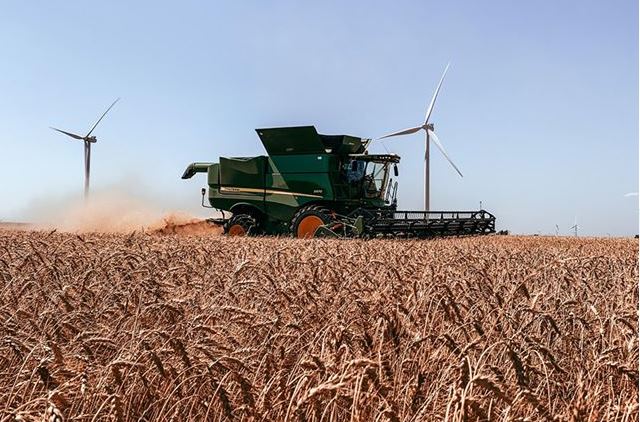
Tuesday May 28, 2024
By: The Oklahoma Wheat Commission
Oklahoma wheat harvest continued to move forward in Southwest and Central Oklahoma over the weekend, but rains in parts of Southwest Oklahoma and Northern Oklahoma that were received at the time of this report will delay harvest today most likely in those regions the next couple days. More rains are predicted in all regions of the wheat belt over the next few days. Wheat taken in at locations in Southwest, South Central and Central Oklahoma, have had favorable test weights, and yields reported at this time. Protein ranges are varying all over the board, but most locations are reporting an 11.0 to 11.2% average. Early reports of wheat being harvested in Northern, Oklahoma are also showing promising yields with decent test weights.
Southwest and Western Oklahoma
Grandfield/Chattanooga/Lawton- Wheat harvest was in full force over the weekend in this region. Yields for the most part ranging from the low 40's to low 50's. Heavily grazed wheat having the lower yields in the high 20's to low 30's. It has been noted some intensively managed fields have been yielding 50, with a few yields in the lower 70's being reported. Test weights ranging from 60lbs. to 65lbs. per bushel. Protein averages being reported from 10.5% to 12%, with the overall average being around 11.0% to 11.2%. At the time of this report rains ranged over the area Tuesday morning from 2/10ths to 1/2 inch for the most part. These locations reporting 40 to 45 percent complete.
Frederick- Producers made great progress in this region over the weekend. Yields have been ranging from 35 to 50 bushels per acre for the most part depending on management practices. Test weights ranging from 60 lbs. to 63 lbs. per bushel. Proteins ranging all over the board, from 9.5% to 13.5%. The protein average for the region is reported at 11.0 to 11.2%. At the time of this report rains around Frederick came in this morning with 1/2 inch to 8/10ths. These locations reporting from 40 to 45 percent complete.
Gotebo/Sentinel/Rocky/-Producers had a good weekend with movement in this region. Test weights ranging from 63 to 64 lbs. per bushel. Yields being reported from 30 bushels to mid 50's. The lower yields are on heavily grazed fields. Some higher yields are expected once producers start getting into better wheat. At the time of this report, Sentinel had one inch of moisture, Rocky had ½ inch, and places around Gotebo received 2 inches of rain. Proteins in this region have been favorable ranging from 12% to 15%. They are calling the average in this region at 13%.
Central Oklahoma
Okarche- Early cuttings report yields from 40 to 55 bushel averages for the most part. Producers are just getting a good start over the weekend in this region. Yields are expected to increase as producers get into better wheat. Test weights reported at 61 lbs. to 64 lbs. per bushel. Protein reports on early cuttings ranging all over the board from 9% to 13.5%. Right now it looks like the region is averaging 11.0%
Reeding/Kingfisher/Omega- Producers are just getting good starts in this region over the weekend, early reports indicate test weights to be doing well ranging from 63lbs. to 64lbs. for the most part. A few test weights at 59 lbs. but that wheat was heavily grazed. Yields ranging from mid 40's to low 50's for the most part. It is expected yields will increase as producers get into better wheat. Some higher yields have been noted in low to mid 60's on fields with intensive management. Protein ranging from 9% to 13.5%. Right now it is looking like an 11.0% to 11.2% average for the region.
Northern Oklahoma
Waukomis/Marshall- These locations had a few loads brought in over the weekend. Early test weights have been favorable at 60 lbs. per bushel and higher. Early yields ranging from mid 30's to mid 50's. Protein on early cuttings not reported at this time.
Helena- A couple loads were taken in at this location, but no yields, test weights or proteins were reported at the time of this report.
Blackwell- Some early cutting in Blackwell on Monday being reported by the Wooderson family, no yields reported on early cuttings but test weights were favorable at 60 plus. The weather was overcast at the time of this report, so it does not look like a lot of drying will be going on today, with predicted rains in the forecast.
Early reports in all locations show test weights ranging from 60 to 65 lbs. per bushel. Proteins ranging from 9% to 13.5%, with an overall average of proteins being reported at 11.0% to 11.2%. The wheat being harvested in Southwest Oklahoma has not been stressed as much, so it is thought proteins will get higher as harvest progresses North where we have drought stress. Early yields being reported at 40 to 50 bushels per acre in most regions. Higher yields being reported on intensively managed wheat with some yields on a few fields being reported in the mid 60's to low 70's. The state has received a large amount of hail damage in South Central, Southwest, and Northern, Oklahoma over the past two weeks, so this will show losses on overall production. Harvest will be delayed in many areas due to moisture late last night and early this morning, with more rains predicted. The Oklahoma Wheat Commission is calling the state 15% complete with harvest. The next Oklahoma Wheat Commission Harvest report will be published on Thursday, May 30, 2024.
Below, see the 7-day forecast and storm potential outlook provided by the Oklahoma Mesonet.
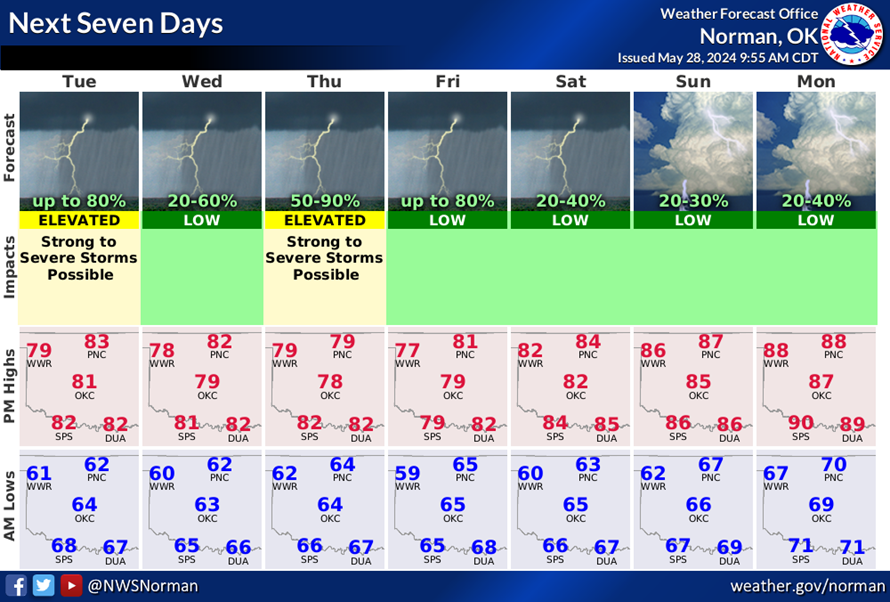
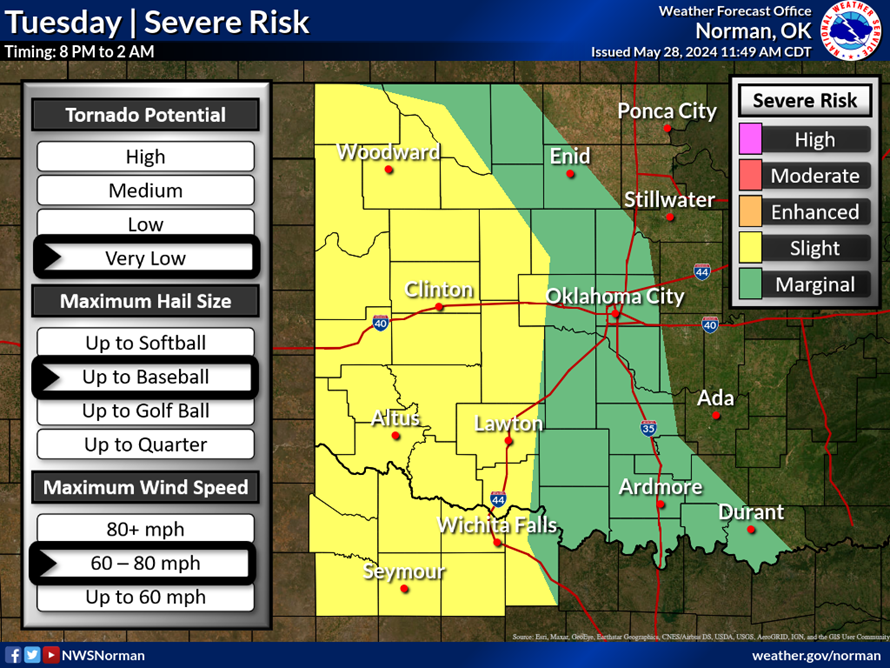
Attorney General Gentner Drummond is asking the U.S. Supreme Court to declare unconstitutional the efforts of California, Connecticut, Minnesota, New Jersey and Rhode Island to dictate American energy policy. Those five states have brought unprecedented litigation against the nation's most vital energy companies, and they demand billions of dollars in damages. As litigation proceeds in their state courts, California and the other states threaten to impose ruinous penalties and coercive remedies that would affect energy and fuel consumption and production across the country.
Drummond is part of a 19-state coalition raising the significant constitutional problems with California's extraordinary tactics and asking the Supreme Court to take up a multi-state lawsuit.
"This wasteful litigation by five states is a brazen attempt to hobble energy policies that positively impact our country," Drummond said "The energy industry is key to a thriving Oklahoma and nation. No single state – or even five – should be allowed to dictate what is right for another state. I will always defend what is right for Oklahomans."
The Supreme Court will decide whether to hear the lawsuit against California and the other four proposed defendants. The coalition's motion, complaint and brief argue that traditional energy sources like oil and natural gas are essential for American prosperity. The states also argue that the matter is of utmost importance because our system of federalism gives each state no more power than any other state.
The Alabama-led motion was joined by attorneys general in Alaska, Florida, Georgia, Idaho, Iowa, Kansas, Mississippi, Missouri, Montana, Nebraska, New Hampshire, North Dakota, South Carolina, South Dakota, Utah, West Virginia and Wyoming.
Read the filing here.
Oklahoma 529 is celebrating National 529 Day with a special bonus offer of up to $100 when opening a new account. The promotion, which ends 6/9/24 is designed to encourage parents, grandparents and other family members to start saving for future education costs.
"As I meet with families, I am frequently asked how best to save for education. My answer is always the same. Open an Oklahoma 529 account." commented State Treasurer Todd Russ. "We hope this offer is the incentive Oklahomans need to get started on their college savings journey – there's no better time."
Oklahoma 529 is offering two bonus levels, $50 and $100. Individuals who open an account and deposit $500 with a recurring contribution of $50 or more per month until 11/30/24 will receive $50 added to their account. Those with a minimum deposit of $1,000 in a new account and recurring contributions of $100 or more per month until 11/30/24 will see $100 added to their account.1
The special bonus offer is just one reason to invest with Oklahoma 529. Research shows that state families see the value in saving for higher education and the Oklahoma program consistently receives high marks from people across the state.2
Oklahoma 529 can be an ideal way to save because it can be used for additional educational opportunities or rolled over into a Roth IRA if plans change.3
To take advantage of this National 529 Day bonus offer, visit Oklahoma529.com/529offer24. National 529 Day is a day dedicated to raising awareness about the value of planning and saving for higher education expenses with 529 plans.
About Oklahoma 529
The Oklahoma 529 is the State's official 529 college savings plan and makes it easier for families to save for education expenses. Funds saved can be used at eligible colleges and universities, community colleges, CareerTech, and professional or graduate schools nationwide and many abroad. In addition to tuition, funds may be used for certain housing and food expenses, books, computers, supplies or other qualified expenses.
| ||||||||||||||||||||||||||||||||||||||||||||||||||||||||||||||||||||||||||||||||||||||||||||||||||||||||||||||||||||||||||||||||||||||||||||||||||||||||||||||||||||||||||||||||||||||||||||||||||||||||||||||||||
| ||||||||||||||||||||||||||||||||||||||||||||||||||||||||||||||||||||||||||||||||||||||||||||||||||||||||||||||||||||||||||||||||||||||||||||||||||||||||||||||||||||||||||||||||||||||||||||||||||||||||||||||||||
|
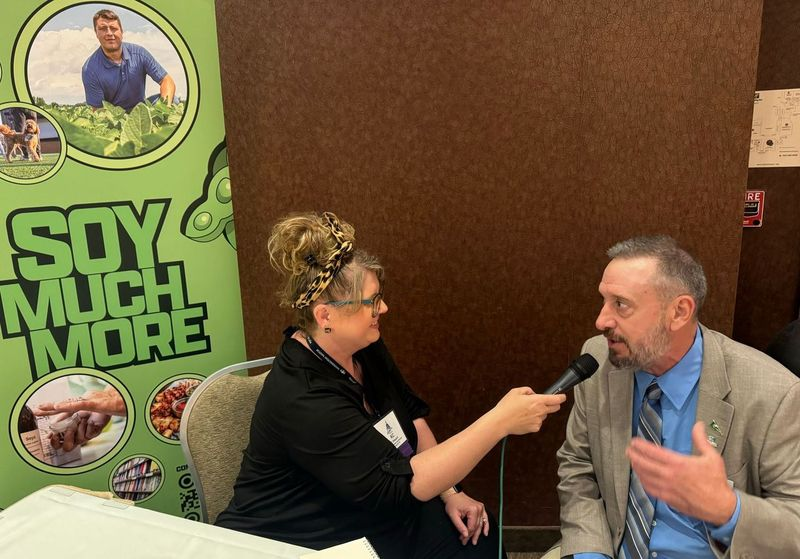
At the National Association of Farm Broadcasters (NAFB) annual Washington Watch event in Washington, D.C., Farm Director KC Sheperd had the chance to talk with United Soybean Board Director, Patrick Giberson, about different ways to utilize soybeans.
"The opportunities for soybeans are endless," Giberson said. "Two of our big ones have just come out."
Giberson said USB has recently partnered with DeWalt to produce an environmentally friendly bar and chain oil. This new product is available now in 1300 Home Depots nationwide.
The next exciting partnership Giberson talked about is the use of soybeans in firefighting foam which does not contain forever chemicals such as PFAS.
With farmer investment, the safer alternative, SoyFoam™, eliminates this exposure, prioritizing the well-being of our first responders. Cross Plains Solutions' SoyFoam™ TF 1122 is the first and only firefighting foam GreenScreen Certified® at the Gold level. This partnership between Cross Plains Solutions and the soy checkoff gives firefighters one less thing to worry about while keeping our communities safe.
"They put their lives on the line every day for us, so if we can get them home safely and have something safe for the environment, I think it is a win for everybody," Giberson said.
The use of soybean has increased dramatically over the years, Giberson said, in products many never imagined possible.
"There are things in the pipeline now, that it seems like it snowballs when we find one use for this certain product we are trying to make or the chemical formulation, it just continually falls into another spot," Giberson said.
Regarding marketing opportunities for soybeans going forward, Giberson said there is room to grow in the biofuels market.
"Moving forward I think there is a lot of opportunity coming online with that, and it is something that is growing," Giberson said. "I don't think it is going to jump all at once, but it will gradually grow."
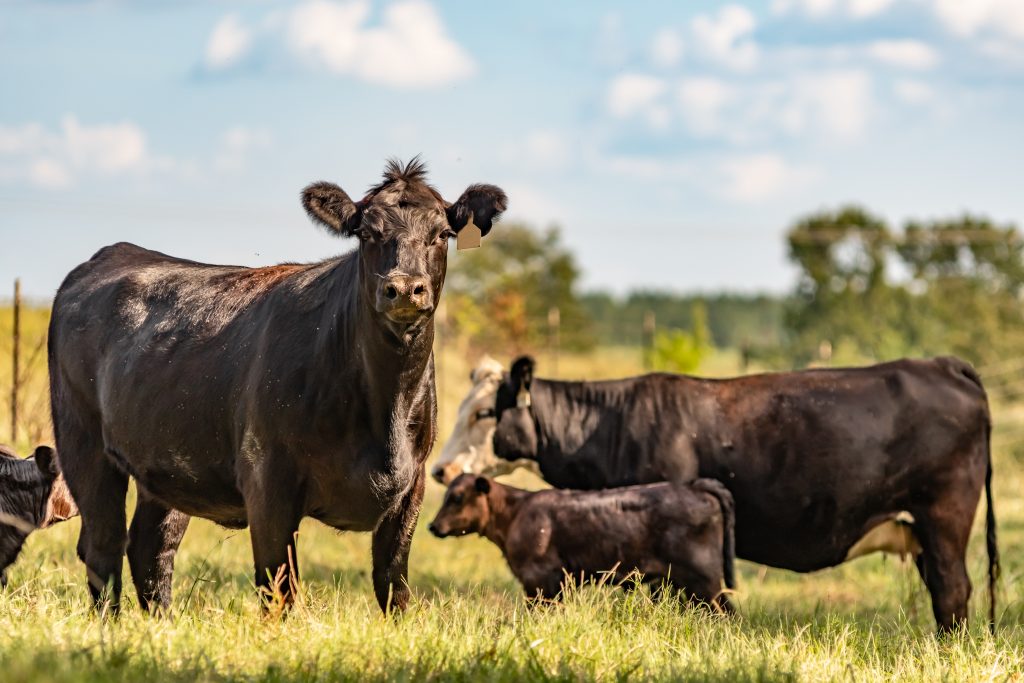
In this episode of Beef Buzz, Senior Farm and Ranch Broadcaster Ron Hays is back talking about gene editing with Dr. Alison Van Eenennaam of the University of California-Davis. Dr. Van Eenennaam was the keynote speaker on the first evening of Cattlemen's Conference Part 2: Blueprint for the Future and was on a follow-up panel the next morning on the science and regulatory challenges of gene editing.
To listen to Part One of the conversation with Dr. Alison Van Eenennaam, CLICK HERE.
As discussed in part one of the conversation with Dr. Van Eenennaam, gene editing has tremendous potential for the beef cattle industry, but there are some substantial regulatory challenges in the way. Van Eenennaam said one issue is that the FDA has elected to treat gene editing technology like a drug, which slows down the approval process immensely.
"The regulatory approach this has been taken in the United States is to regulate all intentional alterations in the genome as new animal drugs under the Food and Drug Cosmetic Act," Van Eenennaam said. "That is not the approach that has been taken by other countries."
Van Eenennaam said there has been a recent announcement by the FDA that if someone does perform a targeted elimination of a gene in an animal's genome, it will be evaluated on a case-by-case basis. If the procedure is low-risk, Van Eenennaam said persons in the U.S. can receive technical enforcement discretion, which means the product can be commercialized.
"There is this extra step associated with genome editing in the United States which is not the same in some of these other countries, and some of our major competitors like Brazil and Australia are going to have a different and easier regulatory pathway, and it might incentivize moving the technology to those types of regulatory jurisdictions that are going through the system here," Van Eenennaam said.
In the case of genetic alterations in the genome, Van Eenennaam said there are no hazards when it comes to the food supply.
"Every meal you have ever eaten is genetically distinct," Van Eenenaam said. "That is just genetic variation. We don't differentiate between the milk of a Holstein and a Jersey as being somehow different from a food safety perspective. I feel like we are kind of inventing a hazard association with genome alterations that is just not seen with conventional breeding. I think if there is a unique risk or hazard, then that is what should be the trigger for doing extensive regulatory evaluations. If you can't come up with a hazard for gene editing and altering the genome, then I don't know that we need to spend a lot of our regulatory effort and expense providing all of this data when you can't come up with hypothetical hazards associated with this technology."
Van Eenennaam said creating a highly difficult regulatory process will disincentivize commercial investment and the use of gene editing technology in general.
"The fact that you use gene editing doesn't make a product unsafe," Van Eenennaam said.
Van Eenennaam also talked about where gene editing is going, and new developments. Click the listen bar above the story to hear the full conversation!
The Beef Buzz is a regular feature heard on radio stations around the region on the Radio Oklahoma Ag Network and is a regular audio feature found on this website as well. Click on the LISTEN BAR at the top of the story for today's show and check out our archives for older Beef Buzz shows covering the gamut of the beef cattle industry today.
Dairy farmers are committed to their communities and giving back to the next generation. With 17 applicants this year, Dairy MAX has awarded $7,500 in scholarships to three students across the region who have ties to the dairy industry and are planning to continue their education in the agriculture industry.
The 2024 scholarship recipients are Layne Burnett of Carpenter, Wyoming, Tom Kuiper of Hico, Texas, and Dieter Ally of Friona, Texas. Each recipient was awarded $2,500 in scholarships to go towards their college education. Scholarships are awarded based on a combination of scholastic achievement, leadership, and involvement in agriculture.
"Investing in the youth of the dairy industry is important to Dairy MAX, and fundamental in progressing the industry as a whole," said Todd Green, vice president of industry image and relations at Dairy MAX. "The Dairy MAX scholarship program allows the organization to support the next generation and encourages these young people while they are working to advance their education. We are honored to have these three students represent Dairy MAX and the industry."
Layne Burnett grew up on her family's dairy farm in Carpenter, Wyoming. As a senior at Texas Tech University, Burnett plays an active role in numerous clubs, organization and committees. Even while balancing her classwork and extracurricular activities, Burnett remains involved in her family's dairy farm. She contributes by managing the farm's data tracking programs and financial records. She is currently studying agricultural communications and plans to use her skills to serve the dairy industry.
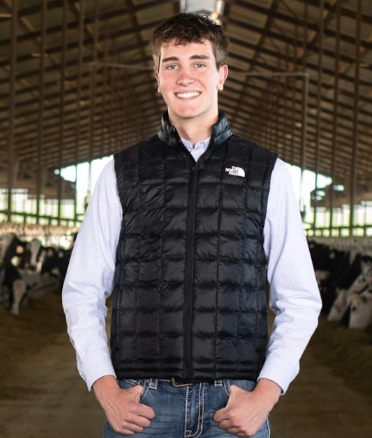
Tom Kuiper is from Hico, Texas and is currently a senior at Hico High School. Upon graduation, he will be attending Cornell University in the fall. While at Cornell University, Kuiper plans to major in animal science with a minor in dairy management and join dairy-focused clubs and internship programs. During his time at Hico High School, Kuiper was highly active in several organizations including 4-H and FFA where he served as an officer and a member of multiple successful teams.
Growing up on a dairy farm in Friona, Texas, Dieter Ally continues to be very involved in the family farm's day-to-day operations. He is currently a student within the veterinary medicine program at Texas A&M University and plans to become a large animal veterinarian. Ally has always been very involved in his community, being active in 4-H, FFA, local community events and his church.
A total of 17 scholarship applications underwent an in-depth judging process. To be eligible for the Dairy MAX scholarship, students must reside in the Dairy MAX region, be a graduating high school senior or undergraduate student currently enrolled in college and be a child of a dairy farmer, child of a dairy farm employee or an FFA/4-H dairy show participant.
"These three students are excellent representations of the dairy industry's future. Their knowledge and experience with the commitment to advancing their education will make a positive impact on the dairy industry. Dairy MAX is proud to be a part of their success," said Green.
Investing in the recipients' education propels dairy forward to continue feeding the world while nourishing communities. The 2025 Dairy MAX Scholarship application will open in January 2025. To see a full list of eligibility requirements and information about applying, visit DairyMAX.org/Dairy/Scholarships.
From June to September 2024, Michigan State University Extension and MSU AgBioResearch will host a series of field days on campus and at research and extension centers across Michigan.
The events are open to the public. Some are free, while others have registration fees. Please check details of the individual event for more information.
Topics of this year's field days include management of dairy, dry beans, Christmas trees, potatoes, turfgrass and wheat, among many others.
If interested in attending, please see the event page below. If there is no event page, please contact the research center directly. Additional event information — and potentially new events — will be added to this story and the research center websites when possible.
School will soon be "out", and that unfortunately means roadway risks are "in" for the summer for teenage drivers. The days between Memorial Day and Labor Day is the time period where crash fatalities involving a teen driver historically rise, making those summer days the 100 Deadliest Days of the year.
"Traffic crashes remain one of the leading causes of death for U.S teens between the ages of 16 and 19," says Rylie Fletcher, Manager for Public and Government Affairs for AAA Oklahoma. "Teens often have a lot of unstructured time in the summer, but don't have the experience and skills of older drivers. Those factors can often lead to deadly consequences on the road."
Nationwide, 6,697 people died in teen driver-related summertime crashes between 2013 and 2022. That is nearly half of the total number of those killed in teen-driver crashes for the entire rest of the year. And in 2022 alone, 707 people were killed in these types of crashes - a 10% increase over pre-pandemic 2019.
In Oklahoma, 175 people were killed in crashes involving teen drivers ages 15 to 18 during the 100 Deadliest Days from 2013 to 2022*, representing 33% of all vehicle crash fatalities during that 10-year period.
AAA Oklahoma is encouraging teen drivers to double down on staying focused when driving, buckling up for every ride and driving within posted speed limits. Parents should also talk to their teens specifically about the dangers of impaired driving.
In 2022, according to statistics from the National Highway Traffic Safety Administration (NHTSA):
According to the AAA Foundation 2021 Traffic Safety Culture Index, teen drivers ages 16-18 admitted to having engaged in at least one of the following risky behaviors in the past 30 days:
"Parents remain the best line of defense to keep everyone safe behind the wheel," says Michael Belcuore, Manager for Driver Education for AAA Club Alliance. "It's never too soon for parents to talk to their kids about the dangers of distracted driving, speeding, and alcohol and marijuana impairment. But, and this is an important but, they also need to model good driving behavior themselves."
To support parents in conducting practice driving sessions, AAA provides a free four-page guide to help parents coach their teens on how to drive safely, "Coaching Your New Driver – An In-Car Guide for Parents." The guide offers a driving log as well as behind-the-wheel lesson plans.
The AAA Teen Driver Website has a variety of tools to help prepare parents and teens for the dangerous summer driving season. The online AAA StartSmart Parent Session also offers excellent resources for parents on how to become effective in-car coaches as well as advice on how to manage their teen's overall driving privileges.
*Data from Fatality Analysis Reporting System (National Highway Traffic Safety Administration). Analysis by AAA Foundation for Traffic Safety.
On May 23, 2024, the National Association of Wheat Growers' (NAWG) CEO Chandler Goule attended the White House State Dinner with President William Ruto and First Lady Rachel Ruto of the Republic of Kenya. Goule was chosen to participate in this event due to President William Ruto's background in agriculture.
"It was an honor to attend this state dinner as we celebrate the 60th anniversary of the United States' partnership with Kenya. The partnership between our two countries is essential as we work to increase global trade opportunities for U.S. wheat growers," said NAWG CEO Chandler Goule.
Kenya is the fastest and most stable growing economy on the African continent. NAWG supports proactive free trade negotiations with Kenya and believes a free trade agreement could provide a more favorable tariff and SPS provisions for U.S.-sourced wheat. A free trade agreement with Kenya could also provide a model for other African countries to follow
Seven FFA student members have been named U.S. Presidential Scholars — one of the nation's highest honors for high school students — for their accomplishments in academics, the arts, and career and technical education. Of the 3.7 million students expected to graduate from high school this year, more than 5,700 candidates qualified for the 2024 award and only 161 students received the honor.
The FFA members named as scholars are:
Lynn Dyber of Higginsville, Mo., Lafayette County C-1 High School, Higginsville FFA
Teagan Erbele of Lehr, North Dakota, Napoleon High School, Napoleon FFA
Faith Genzilinger of Winfred, South Dakota, Howard High School, Howard FFA
Lexi J. Molnar of Centerville, Washington, Goldendale High School, Goldendale FFA
Ezra Linnan of Sturgeon Bay, Wisconsin, Sevastopol High School, Sevastopol FFA
Landis Zebroski of Sheridan, Wyoming, Sheridan High School, John B. Kendrick Sheridan FFA
Cy Pavlov of Trumbull, Connecticut, Trumbull High School, Trumbull Regional FFA
Established in 1964 by executive order of President Lyndon B. Johnson, the U.S. Presidential Scholars program was created to recognize the nation's most distinguished high school graduating seniors. In 2015, the program was expanded to recognize students demonstrating ability and accomplishment in career and technical education.
The 2024 U.S. Presidential Scholars include two students from each state, the District of Columbia and Puerto Rico, as well as U.S. families living abroad and 15 chosen at large. There are also 20 scholars in the arts and 20 in career and technical education.
Overseen by the Commission on Presidential Scholars, the program is administered by staff at the U.S. Department of Education. The commission selects honored scholars annually based on their academic success, artistic excellence, essays, school evaluations and transcripts, as well as evidence of community service and leadership.
"We are extremely proud of this accomplishment for these seven FFA members," said National FFA CEO Scott Stump. "We know that our members are current and future leaders, and this demonstrates the students' academic excellence while making a positive difference in their schools and communities. These members have exceeded expectations and live out the organization's mission and vision daily. We know the future is in good hands."
The U.S. Presidential Scholars Program has honored over 8,200 of the nation's top-performing students since its inception. The Class of 2024 will be recognized for their outstanding achievement this summer with an online recognition program.
A complete list of 2024 U.S. Presidential Scholars is available at http://www.ed.gov/psp.
From Gregg Doud, President and CEO, National Milk Producers Federation:
"FDA approval of Elanco's Bovaer is another important step on U.S. dairy's journey toward a net-zero future, one in which dairy farmers have already made great progress. Bovaer and other new technologies that reduce enteric emissions will help U.S. farmers be rewarded for participating in voluntary, producer-led sustainability initiatives, which is critical for the success of such efforts.
"Consumers around the world are demanding lower-carbon foods. Innovations such as Bovaer will help U.S. dairy farmers remain globally competitive and maintain their role as leaders in more sustainable dairy production. We thank FDA for its recognition of and support for these efforts."
"We also commend Agriculture Secretary Tom Vilsack and his team at USDA for supporting dairy farmers as they prepare to use Bovaer on their own operations. We are grateful to the department for awarding more than $90 million to dairy farmer-owned cooperatives and partner organizations for innovative feed management under the Regional Conservation Partnership Program for fiscal year 2023. FDA's approval of Bovaer now enables these key resources to move forward, and sets the stage for dairy to build on this first round in fiscal year 2024."
Fifty-four students have been selected to receive scholarships totaling $2,000 each through the GROWMARK Foundation. Nearly 500 students from across the United States and Ontario, Canada, applied for the scholarships. Students who received the scholarships will have those funds available for the fall 2024 semester.
"As a diverse wholesale agricultural cooperative, GROWMARK sees value in supporting students who are pursuing careers in agriculture as well as any business-related field. We're excited to be able to help these students achieve their academic goals while also showing them that our industry is full of opportunities including working for GROWMARK or an FS company after they graduate."
Scholarship recipients are divided into three categories:
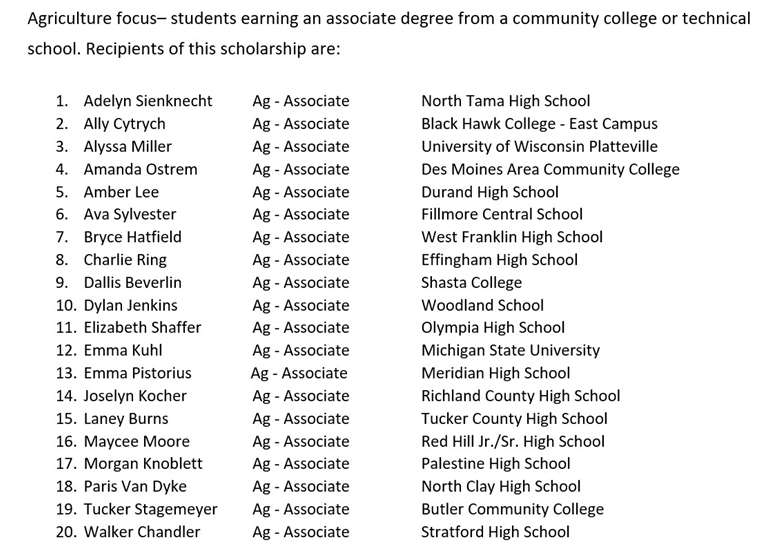
The U.S. Department of Agriculture (USDA) is seeking information from the public on protocols that may be considered for inclusion in a new Greenhouse Gas Technical Assistance Provider and Third-Party Verifier Program, the main program of the Growing Climate Solutions Act. The input is being collected through a Request for Information and will be considered in the preparation of a proposed rule to establish the program. Agriculture Secretary Tom Vilsack announced the release of the Request for Information at an event at the Johns Hopkins University Bloomberg Center in Washington, DC this morning entitled, "Advancing a Low-Carbon American Economy Through High-Integrity Voluntary Carbon Markets and Industrial Strategy."
"High-integrity voluntary carbon markets offer a promising tool to create new revenue streams for producers and achieve greenhouse gas reductions from the agriculture and forest sectors," Vilsack said. "However, a variety of barriers have hindered agriculture's participation in voluntary carbon markets and we are seeking to change that by establishing a new Greenhouse Gas Technical Assistance Provider and Third-Party Verifier Program."
The program is authorized under the Growing Climate Solutions Act (GCSA), part of the Consolidated Appropriations Act of 2023. As part of USDA's implementation of the GCSA, in October 2023 the Department published A General Assessment of the Role of Agriculture and Forestry in the U.S. Carbon Markets (PDF, 1.7 MB), a comprehensive look at current market activity, barriers to participation, and opportunities to improve access to high-integrity carbon markets for farmers, ranchers, and private forest landowners.
Establishing the new Greenhouse Gas Technical Assistance Provider and Third-Party Verifier Program is the next step in implementing the GCSA. The new program would facilitate better technical assistance by providing a list of qualified technical assistance providers and third-party verifiers who work with producers to generate credible carbon credits, enabling USDA to share trusted information and reduce market confusion. USDA would also list widely accepted voluntary carbon credit protocols designed to ensure consistency, reliability, effectiveness, efficiency, and transparency.
"By adopting science-based practices to reduce emissions or sequester carbon on their land, farmers, ranchers, and private forest landowners can access a new income stream through carbon credit sales while also combatting climate change," said USDA Under Secretary for Marketing and Regulatory Programs Jenny Lester Moffitt. "USDA is now seeking to gather information about the protocols used in carbon credit markets as we work to best support the agricultural industry's participation in carbon credit programs. Public input will be invaluable as we develop the structure of these new resources."
USDA's Request for Information will publish in the Federal Register on May 29, 2024 and is seeking feedback on provisions of the GCSA including:
Interested parties may submit comments during the 30-day public comment period at www.regulations.gov.
Following this request for information USDA will also seek industry participation in an advisory committee to further inform the development of this and related programs. For more information about the Greenhouse Gas Technical Assistance Provider and Third-Party Verifier Program, visit www.ams.usda.gov/services/GCSA or contact Sasha Strohm, Program Manager, at sasha.strohm@usda.gov or 202-720-5705.
USDA touches the lives of all Americans each day in so many positive ways. In the Biden-Harris administration, USDA is transforming America's food system with a greater focus on more resilient local and regional food production, fairer markets for all producers, ensuring access to healthy and nutritious food in all communities, building new markets and streams of income for farmers and producers using climate smart food and forestry practices, making historic investments in infrastructure and clean energy capabilities in rural America and committing to equity across the department by removing systemic barriers and building a workforce more representative of America. To learn more, visit www.usda.gov.
Dr. Derrell Peel, Oklahoma State University Extension Livestock Marketing Specialist, offers his economic analysis of the beef cattle industry as part of the weekly series known as the "Cow Calf Corner," published electronically by Dr. Peel and Mark Johnson. Today, Dr. Peel talks about the latest Cattle on Feed report.
The latest USDA Cattle on Feed report pegged May 1 feedlot inventories at 11.554 million head, down 0.9 percent from one year ago. This is the first year over year decrease in feedlot inventories in eight months (Figure 1). Feedlots typically see a consistent seasonal pattern in inventories with peaks in the November to February period and summer lows in July-September. The average seasonal decrease from peak to trough has averaged just under 900,000 head in the past five years. The May 1 inventory is down 462,000 head from the recent December 2023 peak. Feedlot inventories are expected to decrease seasonally for another three months or so, but the more important question may be the extent to which feedlot inventories will increase for the next seasonal peak.
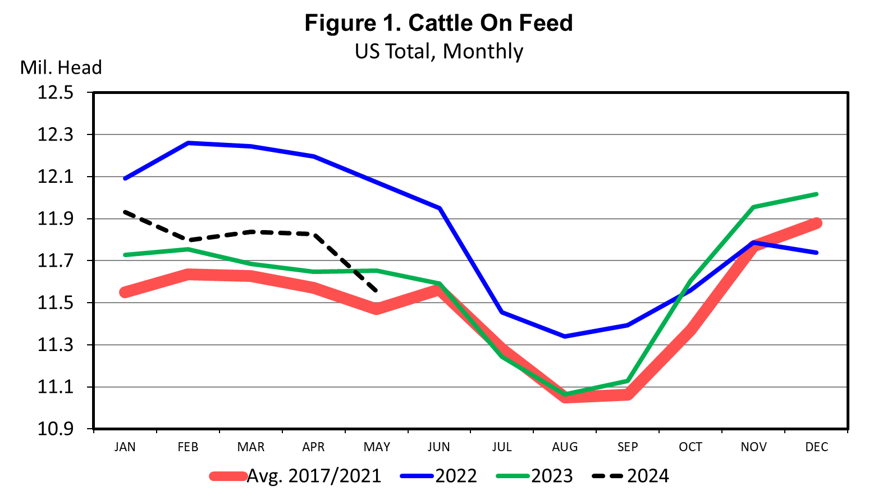
The top four cattle feeding states all have May 1 inventories lower year over year. Texas has the largest inventory at 2.77 million head, down 0.7 percent from last year. Nebraska is number two with an inventory of 2.51 million, down 1.2 percent year over year. Kansas is the third largest cattle feeding state with a May 1 inventory of 2.30 million head, down 5.7 percent from one year ago. Colorado is number four with 0.950 million head, down 3.1 percent year over year. The top four feedlot states represent 73.8 percent of total inventories in feedlots with 1000 head or more of capacity. Other cattle feeding states, in descending order, include Iowa, California, Idaho, Oklahoma, Arizona, South Dakota, and Washington.
April feedlot placements were 1.656 million head, down 5.8 percent year over year and the smallest April placement total since the pandemic reductions in April 2020. In the first four months of 2024, total placements are down 4.3 percent year over year, with placements of cattle weighing less than 800 pounds down 6.7 percent. Placements of cattle weighing 800 pounds and higher are unchanged from one year ago.
April feedlot marketings were 1.872 million head, up 10.1 percent year over year. April 2024 had two more business days compared to last year. After adjusting for the number of days, daily average marketings in April were about equal to April 2023. April marketings were 15.8 percent of the April 1 on-feed inventory, the highest monthly rate since August 2023. Nevertheless, the average marketing rate over the past twelve months remains historically low. Marketings in the first four months of this year are down 0.6 percent year over year.
The slow pace of feedlot marketings continues to push fed cattle weights higher. The latest weekly data shows steer carcass weights at 923 pounds, up 32 pounds compared to one year ago, and heifer carcass weights of 848 pounds, up 28 pounds from one year ago. Increased carcass weights are partially offsetting reduced cattle slaughter and keeping beef production higher than otherwise. For the first 19 weeks of the year, beef production is down 2.1 percent year over year. Earlier forecasts called for 2024 beef production to be down nearly five percent, but those forecasts have been revised due to the heavy carcass weights to a smaller year over year decrease in beef production.

The Smithsonian Museum in Washington, DC., is a huge museum complex that hosts over 30 million visitors annually and has an annual budget of over $1.25 billion dollars. Recognizing the need to reach people outside of the DC area, the Smithsonian offers traveling displays to share with visitors in all corners of the US.
This summer the Bristow Historical Society is a host site for the Smithsonian's Voices and Votes: Democracy in American exhibition! Voices and Votes is part of Museum on Main Street, a collaboration between the Smithsonian Institution and the Oklahoma Humanities. Bristow is one of only six Oklahoma locations to be selected for this program. Most of the Bristow Historical Society's displays have been taken down and packed up to make room for this dynamic exhibition, which will feature photos, videos, multimedia interactives with short games. The exhibition will showcase historical objects like campaign souvenirs, voter memorabilia, and protest material. It is the goal of this major Smithsonian exhibition to engage the community and remind each citizen of the importance of voting, one of the greatest responsibilities of all Americans. From the revolution and suffrage to civil rights and casting ballots, everyone in every community is part of this ever-evolving story – the story of democracy in America.
Local displays and events will join the Smithsonian's exhibition in Bristow, such as a Youth Art Show housed at the Bristow Public Library, a Voter's Registration Drive, and a charitable display of rare documents from our nation's history from the Scott and Karah Peters Family Collection. All this and more will be happening right here in Bristow this summer, beginning Saturday, June 1, 2024 at 10 a.m. Please enter at the caboose and bring your pocketbook for our gift shop.
We are honored to preserve our local story every day and this summer we bring our friends and neighbors a piece of the Smithsonian. Please contact us for more information or to schedule a group tour by emailing contactus@bristowhistory.org or stopping by the depot during the first week of June.
Get ready – the Smithsonian is HERE in Bristow!
RON's Dave Lanning has a pre-opening look at today's agricultural Markets.
Click the audio tab below for today's report.
The Smithsonian Museum in Washington, DC., is a huge museum complex that hosts over 30 million visitors annually and has an annual budget of over $1.25 billion dollars. Recognizing the need to reach people outside of the DC area, the Smithsonian offers traveling displays to share with visitors in all corners of the US.
This summer the Bristow Historical Society is a host site for the Smithsonian's Voices and Votes: Democracy in American exhibition! Voices and Votes is part of Museum on Main Street, a collaboration between the Smithsonian Institution and the Oklahoma Humanities. Bristow is one of only six Oklahoma locations to be selected for this program. Most of the Bristow Historical Society's displays have been taken down and packed up to make room for this dynamic exhibition, which will feature photos, videos, multimedia interactives with short games. The exhibition will showcase historical objects like campaign souvenirs, voter memorabilia, and protest material. It is the goal of this major Smithsonian exhibition to engage the community and remind each citizen of the importance of voting, one of the greatest responsibilities of all Americans. From the revolution and suffrage to civil rights and casting ballots, everyone in every community is part of this ever-evolving story – the story of democracy in America.

Local displays and events will join the Smithsonian's exhibition in Bristow, such as a Youth Art Show housed at the Bristow Public Library, a Voter's Registration Drive, and a charitable display of rare documents from our nation's history from the Scott and Karah Peters Family Collection. All this and more will be happening right here in Bristow this summer, beginning Saturday, June 1, 2024 at 10 a.m. Please enter at the caboose and bring your pocketbook for our gift shop.
We are honored to preserve our local story every day and this summer we bring our friends and neighbors a piece of the Smithsonian. Please contact us for more information or to schedule a group tour by emailing contactus@bristowhistory.org or stopping by the depot during the first week of June.
Get ready – the Smithsonian is HERE in Bristow!
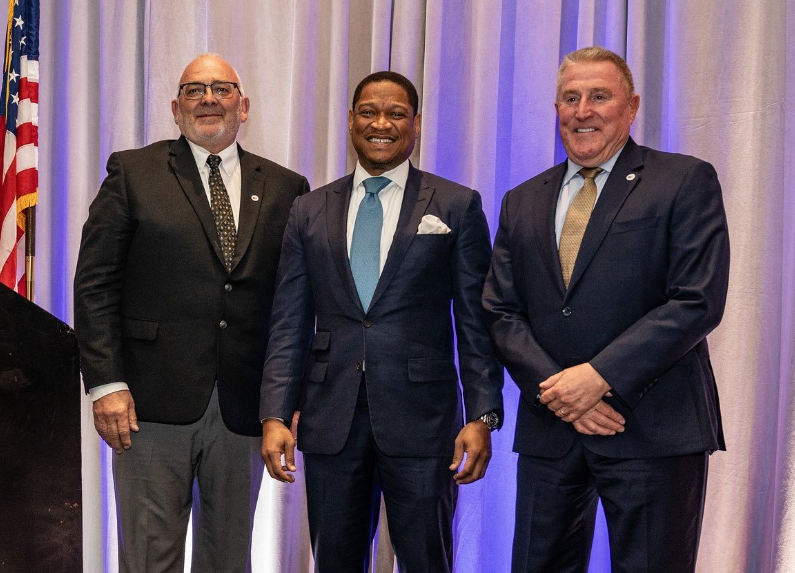
Emphasizing the quality and consistency of U.S. red meat is the key to expanding the international customer base, according to the impressive lineup of opening day speakers on Wednesday at the U.S. Meat Export Federation (USMEF) Spring Conference in Kansas City. USMEF members from throughout the nation also learned about additional resources available to promote U.S. pork, beef and lamb in emerging markets through USDA's new Regional Agricultural Promotion Program (RAPP).
USMEF Chair Randy Spronk, a pork and grain producer from Edgerton, Minn., welcomed attendees with a reminder of how critical free trade agreements (FTAs) have been in creating global opportunities for the U.S. red meat industry.
"Would we have found success in South Korea if U.S. beef was still tariffed at 40% and U.S. pork at 25%?" Spronk asked. "Would we have been able to develop Central and South America, or the Dominican Republic, into reliable destinations for U.S. red meat?"
While they are not full-blown FTAs, Spronk also praised the market access gains achieved in the U.S.-China Phase One Economic and Trade Agreement and the U.S.-Japan Agreement.
"With the weak yen and other headwinds in Japan, imagine trying to compete effectively there if U.S. beef and pork were still at a tariff disadvantage," Spronk noted.
USMEF President and CEO Dan Halstrom followed with an update on year-to-date export results for U.S. pork, beef and lamb. On the pork side, Halstrom explained that while shipments to leading market Mexico are on a record pace, U.S. pork is achieving broad-based growth in several regions. Halstrom noted that first quarter export value ($2.1 billion) equated to more than $64 per hog slaughtered, while March exports averaged nearly $71 per head.
March was also a great month for U.S. beef export value, which equated to nearly $455 per head of fed slaughter. The first quarter average was $408, up 9% from a year ago, which Halstrom said was a very encouraging metric.
"This tells me that the global consumer is willing to pay because they understand the value of U.S. beef," Halstrom said. "We're different. We're higher value, higher perception. U.S. beef is not a commodity product, like a lot of our competitors. This is a key takeaway."
Guest speaker Randy Blach, CEO of CattleFax, echoed these sentiments in explaining how U.S. beef competes for the consumer dollar, both in the U.S. and internationally.
"The biggest change in the beef industry has been quality," Blach said. "And we can never lose sight of that – our niche is grain-fed, high-quality beef that really nobody else can produce around the globe. Those of you who are producers in the room, you have also invested in genetics and you have gotten paid dividends for those decisions."
Blach also gave an update on the U.S. cattle industry's herd rebuilding efforts. He noted that the U.S. herd is not yet in expansion mode, but liquidation has definitely slowed, and the herd size has stabilized. He cautioned that even when expansion does materialize, it will not mirror the previous expansion cycle.
"The cost of money is significantly different, and there's a worry hanging over people's heads about going back into a La Niña [weather pattern]," Blach said. "The last cattle cycle saw the most rapid expansion in the history of our industry in 2014 and 2015. This time I think we'll get some expansion, but it's going to stretch out over a longer period of time."
As for expanding exports, Blach stressed the need for patience and persistence in developing new markets.
"During my career at CattleFax, I have seen how USMEF is able to go into these markets and build a foundation," he explained. "Japan didn't just become our biggest market overnight, did they? It took decades to build that market, to build confidence and to build relationships. This is not instant gratification that you're talking about. You need to have a vision of the decisions you're making today, and know that we may not see the fruit of those decisions until five or 10 years down the road."
Daniel Whitley, administrator of USDA's Foreign Agricultural Service, praised USMEF members for their productivity gains while also providing an update on RAPP funding allocations. He highlighted RAPP's goal of helping U.S. exporters expand their customer base beyond traditional and established markets, focusing on regions such as Africa, Latin America and Southeast Asia.
Whitley noted that RAPP places a specific emphasis on Africa, which is projected to hold 25% of the world's population by 2050. That same year, the planet's total population is expected to reach 10 billion, which presents a massive food production challenge.
"There is no way – no way – that the global agricultural community will be able to solve the problem of feeding 10 billion people by the year 2050 if we don't embrace science, technology and innovation," Whitley said. "All of the wonderful seed techniques, all of the wonderful techniques we use to grow livestock and farm animal products, we need all of these techniques. We're not going to find new land and plant our way out of this problem, so there's really only one path forward and I do think it's the embrace of science, technology and innovation."
USMEF members also received unique insights about global food security issues from Kip Tom, former U.S. ambassador to the United Nations for Food and Agriculture. Ambassador Tom stressed that our national security is dependent on our food security, and he too emphasized the need to embrace production technologies.
"The innovation that has taken place in agriculture, whether it's on the livestock side, or the grain side, or food processing – it's something we need to be very proud of," Tom said. "We oftentimes say that the U.S. innovates, China replicates and the EU regulates. But we need to make sure we keep those in check, so that we can continue to innovate, grow our economy and grow this industry."
While Tom believes the U.S. must pay close attention to the global trade advances made by major agricultural competitors, he shares the opinion that an emphasis on quality will differentiate U.S. products and lead to continuing opportunities for American agriculture.
"When I look at Brazil, for example, and what they're exporting in terms of animal proteins, what they're doing in terms of exporting grains, the reality is, they're mostly exporting commodities," said Tom. "And this is where the real opportunity is for U.S. agriculture – to make sure that we add value and ensure that we set ourselves apart in the global marketplace, to maintain and grow our markets."
The USMEF Spring Conference continues through Friday, May 24. Thursday's program will feature a panel discussion on consumer perceptions of red meat products, as well as meetings of USMEF's sector-specific standing committees. Friday's general session will focus on the organization's efforts to build global demand for underutilized beef and pork cuts.
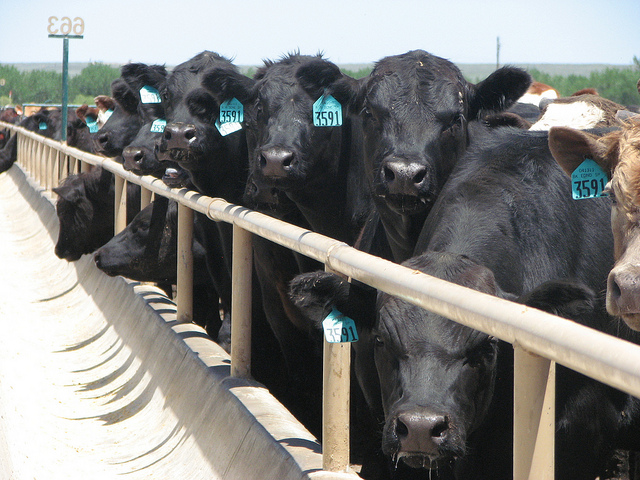
The May USDA Cattle on Feed report released on Friday ahead of the Memorial Day holiday hit almost all of the pre report estimates square on the head. Cattle and calves on feed for the slaughter market in the United States for feedlots with capacity of 1,000 or more head totaled 11.6 million head on May 1, 2024. The inventory was 1% below May 1, 2023, USDA NASS reported on Friday.
Placements in feedlots during April totaled 1.66 million head, 6% below 2023. Net placements were 1.60 million head. During April, placements of cattle and calves weighing less than 600 pounds were 335,000 head, 600-699 pounds were 220,000 head, 700-799 pounds were 375,000 head, 800-899 pounds were 451,000 head, 900-999 pounds were 205,000 head, and 1,000 pounds and greater were 70,000 head.
Marketings of fed cattle during April totaled 1.87 million head, 10% above 2023.
After the report- Oklahoma Farm Report's Ron Hays talked with Oklahoma State University Extension Livestock Market Economist Dr. Derrell Peel about the numbers and what they seem to be telling us- listen to their conversation by clicking on the listen bar below:
Dr. Peel believes that the on feed numbers finally slipping below a year ago is significant- "You know we have been over year ago levels in the on feed numbers for several months now- we built them up last fall and carried that into the first part of this year, now we have dropped back year over year levels and I would anticipate- although I have been wrong before- I would anticipate that we would stay below year over year for an extended period of time and continue to pull this feedlot inventory going forward."
Hays and Peel also do a deep dive into the marketings and placements from this report- and what is happening to carcass weights here in 2024.
To review the complete May USDA Cattle on Feed Report- click here.
The Beef Buzz is a regular feature heard on radio stations around the region on the Radio Oklahoma Ag Network and is a regular audio feature found on this website as well. Click on the LISTEN BAR at the top of the story for today's show and check out our archives for older Beef Buzz shows covering the gamut of the beef cattle industry today.
| |||||||||||||||||||||||||||||||||||||||||||||||||||||||||||||||||||||||||||||||||||||||||||||||||||||||||||||||||||||||||||||||||||||||||||||||||||||||||||||||||||||||||||||||||||||||||||||||||||||||||||||||||||||||||||||
| |||||||||||||||||||||||||||||||||||||||||||||||||||||||||||||||||||||||||||||||||||||||||||||||||||||||||||||||||||||||||||||||||||||||||||||||||||||||||||||||||||||||||||||||||||||||||||||||||||||||||||||||||||||||||||||
|
Yesterday, the U.S. House of Representatives Committee on Agriculture passed the Farm, Food, and National Security Act of 2024 by a vote of 33-21.
While yesterday's markup highlighted sharp partisan divisions, NACD appreciates the House Committee on Agriculture taking this critical first step in advancing a farm bill that bolsters locally led conservation. We encourage committee leaders and Congress to move forward in a bipartisan and bicameral manner to pass a final bill.
NACD's top farm bill priority to integrate all remaining Inflation Reduction Act conservation funding into the conservation title is included in the House bill, and this request is also supported by Senate Agriculture Committee leaders. This huge opportunity to permanently increase funding for USDA conservation programs is time sensitive, making it imperative for lawmakers to work together to pass a farm bill as soon as possible.
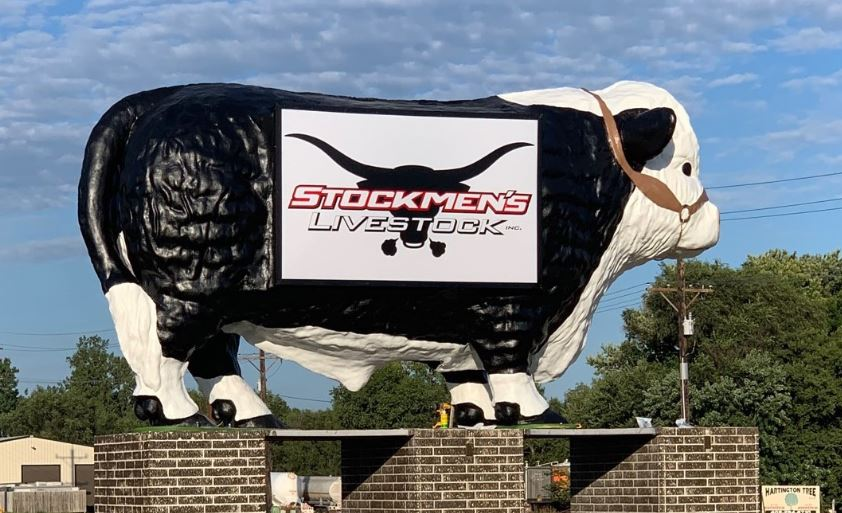
Farm Director KC Sheperd is visiting with Bob Rodenberger, a Partner with Stockman Oklahoma Livestock, as he gives the latest on the cattle markets. Rodenberger discussed the current state of the cattle industry, highlighting that they were producing more with less cattle, aiming to keep consumers satisfied. He noted that while there had been some slowing in sales, there was still demand for their products.
"Runs were pretty much normal compared to a year ago," Rodenberger said. "Out at El Reno, they had a bigger than normal run. Oklahoma City was at a little bit less than they had a year ago. We had a good run at Apache."
The markets are looking positive, Rodenberger said, and feeders are selling higher than ever.
"We are still moving the beef, and that is going to be the key to our business for the next six months," Rodenberger said. "We have just got to move beef and move what is available because we don't have to have any cattle coming to town when you are making them 30 pounds heavier than they were a year ago."
Regarding recent rainfall, Rodenberger confirmed that overall, it has been beneficial for crop growth and demand. He also predicted a stable market for the coming weeks, despite anticipating the sale of older cows to make way for younger ones.
"In general, the livestock industry is in a good state," Rodenberger said.
Rodenberger said Monday and Tuesday at Oklahoma National Stockyards will be closed.

Independent Community Bankers of America (ICBA) President and CEO Rebeca Romero Rainey issued the following statement on House Agriculture Committee passage of the farm bill, H.R. 8467, on a 33-21 bipartisan vote.
"ICBA congratulates the House Agriculture Committee for taking the first step in passing a new farm bill and encourages members of Congress to reconcile remaining differences as the Farm, Food and National Security Act of 2024 moves to the House floor.
"The farm bill has numerous positive enhancements for American farm policy, though there are also provisions in the bill that cause concerns for the community banking industry.
"A few of the bill's positive aspects include enhancements to commodity price supports, strengthening of the crop insurance program, and bolstering of USDA guaranteed loan programs with ICBA-advocated provisions. These improvements for guaranteed farm loan programs include an increase in loan limits and quicker loan approvals, among other policies that will help producers repay loans, protect assets, and afford expanded credit to sustain farm and ranch operations.
"ICBA continues to raise concerns with farm bill provisions that would expand the tax-advantaged Farm Credit System's powers. There needs to be further scrutiny to prevent FCS lenders from broadly shifting into non-farm business lending. FCS also has a reduced regulatory compliance burden under the Consumer Financial Protection Bureau's 1071 small business data collection and reporting rule that is not afforded to community banks. ICBA appreciates acknowledgement of this unfair burden by several members during the markup. We look forward to working with Congress to address our concerns in the weeks and months ahead."
About ICBA
The Independent Community Bankers of America® has one mission: to create and promote an environment where community banks flourish. We power the potential of the nation's community banks through effective advocacy, education, and innovation.
As local and trusted sources of credit, America's community banks leverage their relationship-based business model and innovative offerings to channel deposits into the neighborhoods they serve, creating jobs, fostering economic prosperity, and fueling their customers' financial goals and dreams. For more information, visit ICBA's website at icba.org.
Today the House Committee on Agriculture passed the Farm, Food, and National Security Act of 2024, which now goes to the full House for a vote. Among other policies, the bill would provide resources to farmers, ranchers, foresters, and other private landowners to voluntarily implement conservation efforts on working lands.
"The bill passed out of committee today provides resources to farmers and ranchers to implement conservation efforts on working lands, and we thank the Committee for their commitment to these key issues. However, we are concerned that the bill falls short in some key areas, including removing critical guardrails in the Inflation Reduction Act that support farmers, ranchers, and land managers working to conserve their lands to help solve the climate crisis," said Felice Stadler, vice president of government affairs at the National Audubon Society. "These voluntary conservation programs and practices are overwhelmingly popular and demonstrate the growing interest in adopting agricultural practices that store and capture carbon on the land. Additionally, the renewable energy provisions included in this bill fail to take the steps necessary to ensure growers and producers can easily access clean energy and energy efficiency resources that reduce emissions while lowering their overhead costs."
"As negotiations continue in both chambers and across the aisle, the National Audubon Society and our 1.4 million members and supporters call on Congress to invest in the future of conservation and to pass a bipartisan bill that recognizes the importance of working lands and climate-smart agriculture and forestry practices that protect biodiversity—and our planet," said Stadler.
The Farm Bill is the largest source of federal funding for voluntary conservation on working lands. Audubon supports a Farm Bill that secures the historic $20 billion in funding for climate-smart agriculture included in the Inflation Reduction Act (IRA) and is not diverted away from programs that incentivize voluntary conservation to benefit wildlife habitat.
Audubon has engaged its 1.4 million members and supporters through action alerts and ads calling on elected officials to support a Farm Bill that builds on the strong foundation of current conservation programs to better address the challenges facing communities and wildlife across the country.
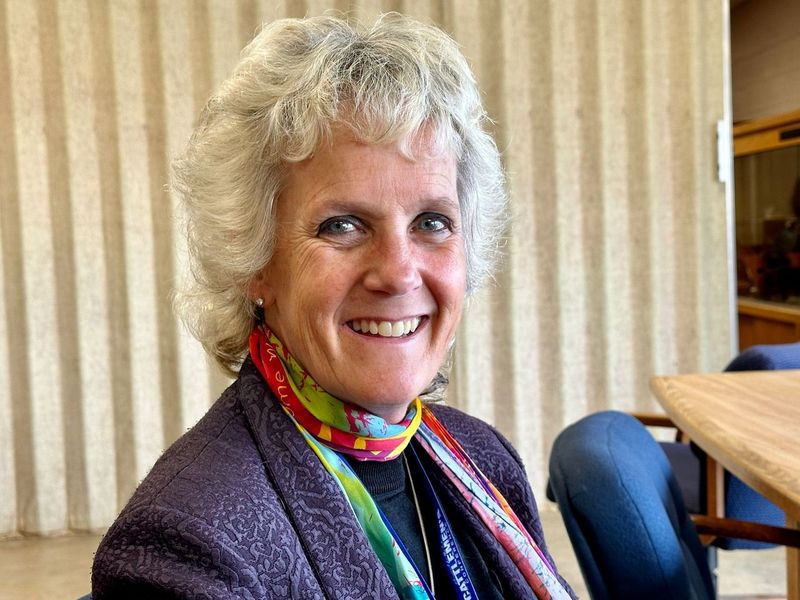
At Cattlemen's Conference Part 2: Blueprint for the Future, Senior Farm and Ranch Broadcaster Ron Hays had the chance to talk with Dr. Alison Van Eenennaam of the University of California-Davis about gene editing. Dr. Eenennaam was the key note speaker the first evening of the Conference and was on a follow up panel the next morning on the science and regulatory challenges of gene editing.
"Gene editing basically enables you to do a targeted alteration in the genome to introduce a useful trait," Van Eenennaam said. "It is a way to add to your breeding program when you already have a genetically elite animal, and you would like to add one more characteristic such as not growing horns, for example. Maybe in beef cattle, you want to add heat tolerance so you can introduce the slick allele that already exists naturally in Senepol cattle, and you'd like to maybe introduce it to Angus for example."
As many are not aware of the differences between gene editing and genetically modified organisms (GMOs), Van Eenennaam explained that gene editing is simply bringing out genes that already exist within an animal's genome.
"The difference between genome editing is that you can actually use editors to make a targeted change in the genome without introducing foreign DNA or transgenic DNA," Van Eenennaam said. "It is tweaking the genome of an animal in the same way that we naturally do in selection, because nature is always tweaking the genome of animals, and in fact, humans. That is the basis of evolution and our selection programs."
Van Eenennaam said gene editing mimics a naturally occurring process, but the advantage is that it can be accomplished in a targeted way. For example, gene editing can be used to inactivate a gene that makes an animal susceptible to a particular disease.
"In this case, we are just tweaking the genome of the animal itself to activate (or inactivate) a gene that gives us a particular characteristic that we would like in our breeding programs," Van Eenennaam said.
The Beef Buzz is a regular feature heard on radio stations around the region on the Radio Oklahoma Ag Network and is a regular audio feature found on this website as well. Click on the LISTEN BAR at the top of the story for today's show and check out our archives for older Beef Buzz shows covering the gamut of the beef cattle industry today.

Today, May 24, the Friday before the Memorial Day weekend, the U.S. Environmental Protection Agency, along with the National Council on Skin Cancer Prevention, is recognizing the 16th annual "Don't Fry Day" to encourage Americans to take a few simple steps to protect their skin and eye health while outdoors. Overexposure to ultraviolet radiation from the sun can increase the risk of developing skin cancer and cataracts, so it is important to be aware of the strength of the sun's UV rays and take simple steps to protect your skin and eyes while outdoors.
"Remember to protect your skin and eyes from UV rays before you go outdoors," said Joseph Goffman, Assistant Administrator for the Office of Air and Radiation. "Don't Fry Day is a great annual reminder of the importance of sun safety, and you can use the EPA's UV Index app to get the UV forecast for your location and tips on how to be sun safe."
Almost 20% of Americans will develop skin cancer. Since many skin cancer cases are caused by overexposure to UV radiation, protecting your skin outdoors is an important step to reducing your skin cancer risk. The American Cancer Society estimates that in 2024, more than 100,600 new cases of invasive melanoma, the most dangerous form of skin cancer, will be diagnosed in the United States. This is approximately 3,000 more cases than were estimated in 2023.
All people are equally at risk of eye damage and developing cataracts, but some people may be at greater risk of contracting skin cancer depending on the color of their skin, a history of blistering sunburns in early childhood, the presence of many moles, or a family history of skin cancer. Also, although sun safety is especially important in summer when we spend more time outdoors, UV can be high throughout the year depending on factors such as location, elevation, and reflective surfaces like sand and snow.
The EPA, the National Weather Service, and the Centers for Disease Control and Prevention work together to make the UV Index forecast available in the United States. The EPA's UV Index app (search for the EPA's UV Index in the App Store and on Google Play) is a convenient tool to let you know the strength of the sun's skin cancer-causing UV rays. The app gives daily and hourly UV intensity forecasts for your location, provides recommendations on sun safety, and is also available in Spanish. Reduce your risk of skin cancer and eye damage by remembering to:
Download Don't Fry Day and sun safety posters, sign up for a daily UV Index forecast via email, or check the UV Index online daily on the EPA's sun safety webpage.
Physical loss loans through the United States Department of Agriculture's (USDA) Farm Service Agency (FSA) can help producers repair or replace damaged or destroyed physical property essential to the success of the agricultural operation, including livestock losses. Examples of property commonly affected include essential farm buildings, fixtures to real estate, equipment, livestock, perennial crops, fruit and nut bearing trees, and harvested or stored crops and hay.
Impacted Area: Texas
Triggering Disaster: Flash Flood, Hail, and High Winds that occurred on May 9, 2024
Application Deadline: January 9, 2025
Primary Counties Eligible: Grayson
Contiguous Counties Also Eligible:
Texas: Collin, Cooke, Denton, Fannin Oklahoma: Bryan, Love, Marshall
More Resources
On farmers.gov, the Disaster Assistance Discovery Tool, Disaster Assistance-at-a-Glance fact sheet, and Loan Assistance Tool can help you determine program or loan options. To file a Notice of Loss or to ask questions about available programs, contact your local USDA Service Center.
USDA is an equal opportunity provider, employer and lender.
Signaling the appreciation of the House Farm Bill legislation, National Cotton Council (NCC) Chairman Joe Nicosia said, "While we are all aware that Committee action is a first step – not a final one – in a longer Farm Bill process, we must begin moving forward now." Nicosia added that the NCC is ready to assist legislator's efforts to bring relief to farm country. The NCC strongly supports the House Committee on Agriculture's mark up of the Farm Bill
and urges the Senate Agriculture Committee to act soon.
The American Soybean Association commends the House Agriculture Committee on its passage of the Farm, Food, and National Security Act of 2024.
Josh Gackle, ASA president and a soybean farmer from North Dakota, said "We appreciate that Chairman Thompson heard clearly the concerns and needs of soybean farmers and addressed those in the bill his committee approved today. We thank all Republican members and Democratic members – namely Representatives Don Davis, Eric Sorensen, Sanford Bishop, and Yadira Caraveo – for their votes in support of the 2024 Farm Bill, which we believe will be impactful for soybean farmers across our 30 soybean-producing states."
Over the past two years, ASA has advocated to strengthen the farm bill to address the pressing needs of soybean farmers. The Farm, Food, and National Security Act of 2024 includes significant enhancements to improve effectiveness and accessibility of the farm safety net, meaningful investments to promote expansion and diversification of markets, and protection of vital programs like crop insurance and the soy checkoff, as well as other important provisions.
Strengthening the farm bill is critical for the future of U.S. soybeans, and ASA stands ready to advance the bill as it moves forward in the legislative process.
American Farm Bureau Federation President Zippy Duvall commented today on the House Agriculture Committee markup and passage of the Farm, Food, and National Security Act.
"AFBF appreciates the leadership of Chairman Thompson and members of the House Agriculture Committee for the markup and bipartisan passage of the Farm, Food, and National Security Act. The farm bill affects all of America's families, and we're encouraged to see the legislation progress in the House.
"We applaud the bipartisan vote after 13 hours of rigorous debate, but know that tight margins in both chambers and a crowded congressional calendar will present challenges in the next legislative steps. We urge House leaders to continue the momentum and bring this important legislation to a vote on the floor.
"We also urge the Senate Agriculture Committee to follow the lead of the House by scheduling a farm bill markup. A pandemic, high inflation, supply chain issues and global unrest all present challenges that can only be addressed by a new, modernized farm bill.
"This is an opportunity for both chambers to work to advance a piece of legislation that will pay off at every dinner table in America."
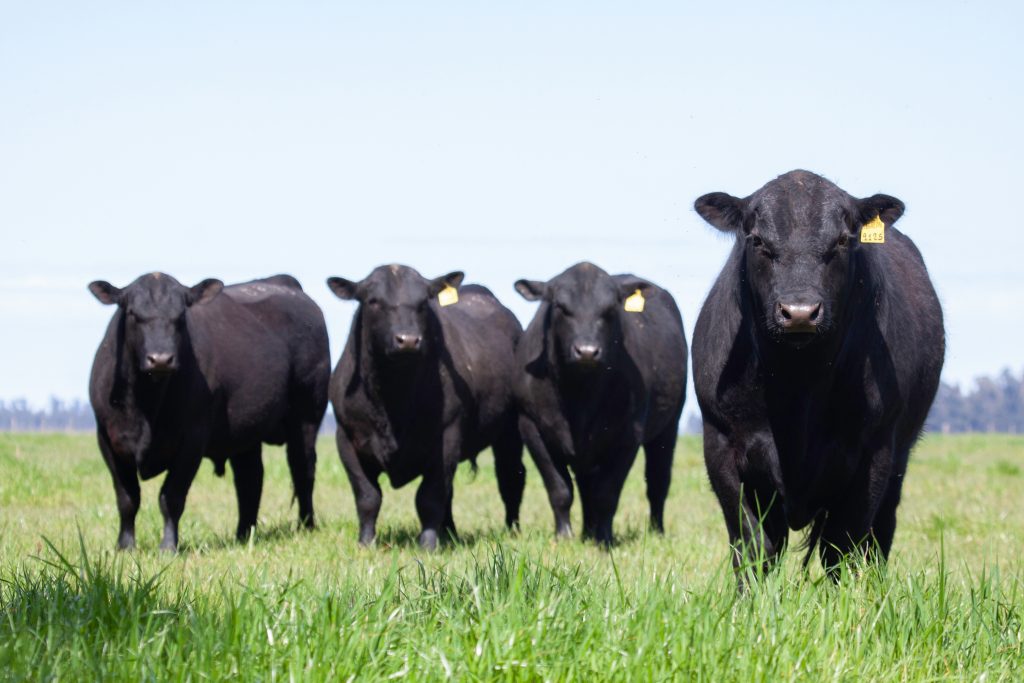
Two years ago the Masters of Beef Advocacy (MBA) program managed by the National Cattlemen's Beef Association, a contractor to the Beef Checkoff, hit 20,000 graduates. Today, the program celebrates an additional 5,000 graduates – reaching a new milestone for advocacy in the beef industry.
"It feels like yesterday that we were celebrating 20,000 graduates," said Paul Dybedahl, Associate Director of Communications for the Masters of Beef Advocacy Program. "Just two years later, it's incredible to see an additional 5,000 graduates, all willing to dedicate their time to learn more about, and advocate for, the beef industry."
Created in 2009, the MBA program is a free, self-guided online course that provides members of the beef community – from farmers and ranchers to students, supply chain members and consumers – with the tools and resources needed to become a strong advocate for the beef community.
In 2021, the MBA program launched MBA NextGen – which updated training modules, splitting the course into five online lessons:
After completing NextGen, MBA graduates can enroll in MBA Continuing Education where graduates can continue their education with more lessons on beef's nutrition, sustainability and animal welfare among more. Graduates can also access monthly newsletters and join the program's Facebook community where updates are given on the latest consumer trends. Anyone interested in learning about beef's journey from pasture to plate is invited to enroll today
Each week, Beltway Beef brings you the latest policy news affecting the U.S. cattle and beef industry. Hear from subject-matter experts, producers, and industry leaders on the topics that impact the business viability of farms and ranches across the country.
On this episode, NCBA President and Wyoming rancher Mark Eisele joins to discuss some of his recent travels to Australia and Mexico. At these meetings, Eisele worked to unite farmers and ranchers on some of the common threats facing cattle producers around the world like foreign animal diseases, lab-grown protein, and radical anti-agriculture activism. Eisele signed joint statements with his cattle industry counterparts from Australia, Canada, and Mexico to further this collaboration. Eisele also shared some information on a joint letter sent to the top trade officials in the United States, Mexico, and Canada calling for greater trade opportunities and robust oversight of disreputable trading partners.
RON's Dave Lanning has a pre-opening look at today's agricultural Markets.
Click the audio tab below for today's report.

With the increase in air travel expected to continue this year, airports will be busy and security lines will be long. Air travelers can ease their pain and get through checkpoints faster by taking advantage of a special TSA PreCheck® enrollment opportunity this month in Edmond.
AAA and IDEMIA, a TSA PreCheck® authorized enrollment provider, are hosting a TSA PreCheck® event at the AAA Edmond Car Care, Insurance and Travel Center, 1701 S Broadway Ave., Edmond, OK 73013-4014 from May 28 – 31. Appointments are required and limited and can be scheduled here. Appointments are available Tuesday - Thursday, 9:00 AM - 12:00 PM and 1:00 PM - 5:00 PM, and Friday, 9:00 AM - 12:00 PM
The enrollment process is quick, convenient and even faster when the application is completed online beforehand. The in-person enrollment requires that applicants provide proof of identity, proof of citizenship, fingerprints and a photo. IDEMIA offers TSA PreCheck® enrollment for $78 and if approved, travelers get a five-year membership with the program. The program is open to U.S. citizens, U.S. nationals and lawful permanent residents.
Following the in-person enrollment appointment, most applicants receive their Known Traveler Number (KTN) in about three to five days. The KTN number must be added to flight reservations to enjoy TSA PreCheck® benefits.
TSA PreCheck® was created in December 2011 as a way to provide low-risk travelers with a smoother experience through airport security. It's a great option for travelers looking to save time. Enrolled members do not need to remove shoes, laptops, 3-1-1 liquids, belts, or light jackets. They also access TSA PreCheck® dedicated screening lanes at over 200 participating U.S. airports nationwide.
"With the summer vacation season just around the corner, this TSA PreCheck® enrollment opportunity couldn't come at a better time for travelers anticipating long airport lines," said Rylie Fletcher, spokesperson for AAA Oklahoma. "TSA PreCheck® enables identified low-risk air travelers to enjoy an expedited and efficient security screening experience."
TSA PreCheck® is valid for 5 years. In addition, children ages 12 and younger may use the TSA PreCheck® lane when traveling with a parent or guardian who has the indicator on their boarding pass.
Children 17 and under can join an adult with TSA PreCheck® when the TSA PreCheck® indicator appears on the child's boarding pass. For TSA PreCheck® eligibility requirements and frequently asked questions about TSA PreCheck®. AAA travel experts will also be on hand at the pop-up event to help book flights, hotels, cruises or other travel arrangements, provide travel planning resources, and offer a variety of luggage and other travel accessories to make trips more convenient and enjoyable.
On May 1, 2024, Rep. G.T. Thompson, Chairman of the House Committee on Agriculture, and Sen. Debbie Stabenow (D-MI), Chairwoman of the Senate Committee on Agriculture, Nutrition, and Forestry, released summaries of their respective farm bill proposals (see here and here).
On May 17, 2024, Chairman Thompson released text of his bill. Very early this morning, the House Committee on Agriculture finished marking up its version of the 2024 Farm Bill – the Farm, Food, and National Security Act of 2024 – and passed it out of Committee on a bipartisan vote of 33 to 21.
While there will be a lot of chatter about the path forward in the full House, attention is now turning to the Senate. To help set the stage, we have compiled a side-by-side comparison of the major farm safety net features of the House Ag Committee-passed bill and the Senate majority proposal – the Rural Prosperity and Food Security Act of 2024. Importantly, no bill text has been released for the Senate proposal, so the comparison is compiled from the summary materials linked above. Further, while Table 1 compares the proposals currently on the table, we leave it to the reader to draw their own conclusions about which approach they prefer. It is also important to note that Sen. John Boozman (R-AR), Ranking Member of the Senate Committee on Agriculture, Nutrition, and Forestry, announced earlier this morning that he will weigh in with his own framework "in the coming weeks" but highlighted that the House Ag Committee-passed bill "mirrors much of what Senate Republicans are seeking to accomplish with our framework."
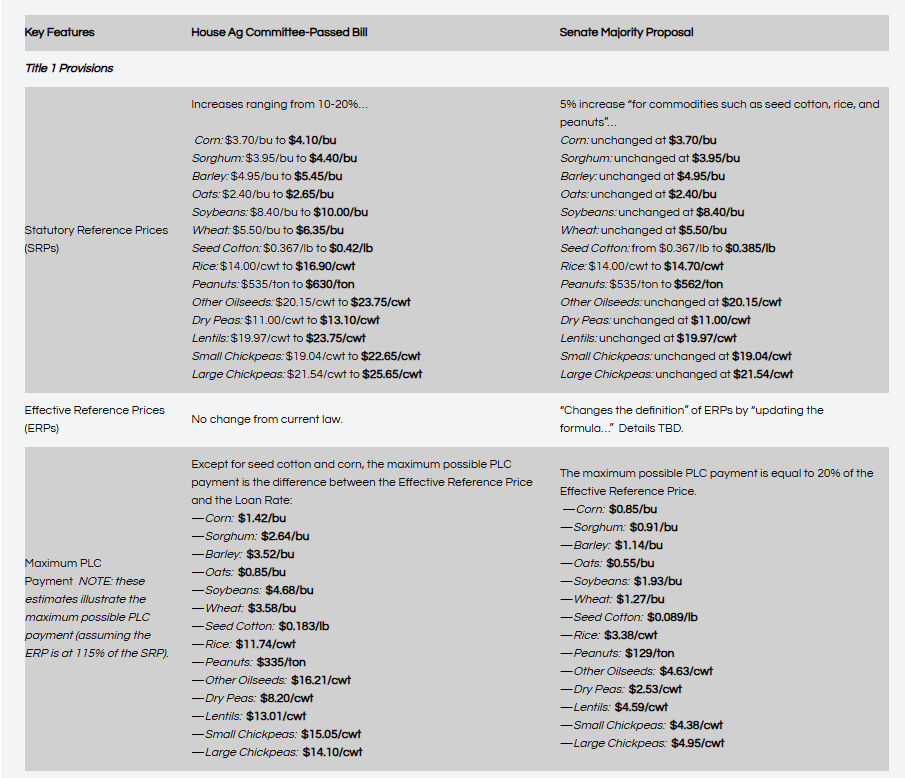
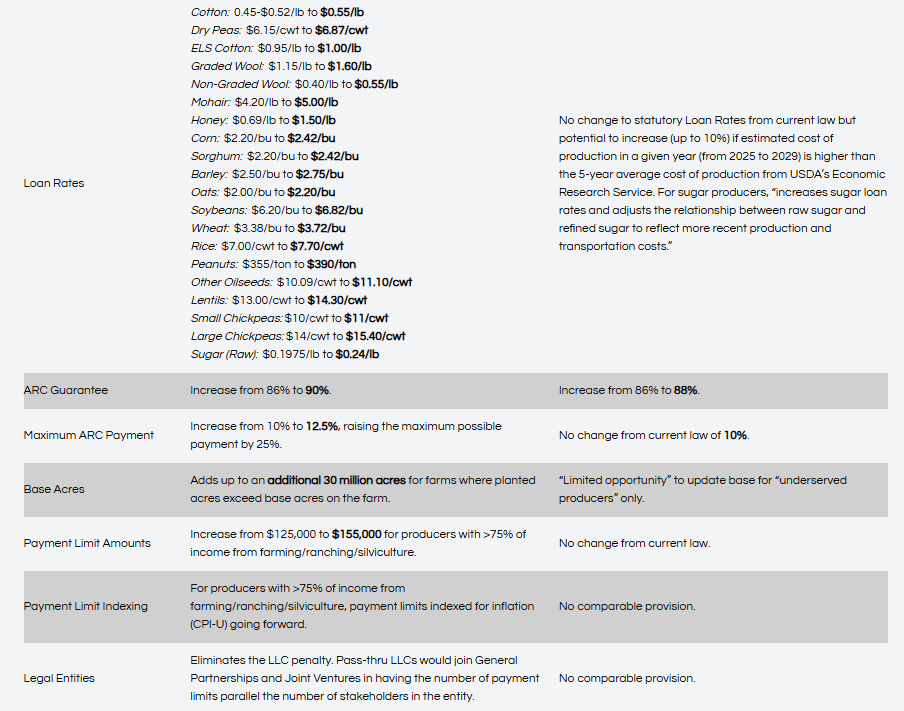
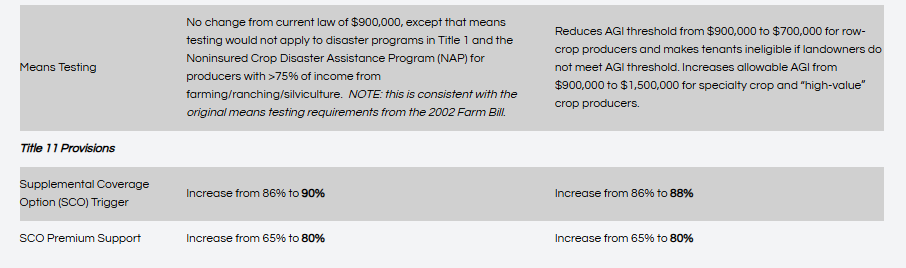
Senator Debbie Stabenow (D-MI), Chairwoman of the Senate Committee on Agriculture, Nutrition, and Forestry, Friday released the following statement on the House markup of the 2024 Farm Bill.
"I'm glad that Chairman Thompson is working to move the process forward so that we can complete our work on the 2024 Farm Bill this year. Despite areas of common ground, it is now clear that key parts of the House bill split the Farm Bill coalition in a way that makes it impossible to achieve the votes to become law. And it is also clear that we do not have time to waste on proposals that cannot meet that goal.
"I have always believed there is a bipartisan path forward if we maintain the long tradition of respecting the needs and interests of the broad farm and food coalition. This has always been the foundation of a successful Farm Bill.
"My door remains open, and I am ready to find a successful way forward. Working together, I know we can pass a strong, bipartisan bill that keeps farmers farming, families fed, and rural communities strong."
The approval of the Farm, Food, and National Security Act of 2024 by the House Agriculture Committee represents a necessary step forward towards passing a new farm bill by the end of this year. I would like to applaud Chairman Thompson for his leadership on moving this bill forward. We look forward to working with members of Congress on both sides of the aisle to build the bipartisan support that will be needed to see a farm bill passed through both chambers and signed into law."
About NCFC
Since 1929, NCFC has been the voice of America's farmer cooperatives. Our members are regional and national farmer cooperatives, which are in turn consist of nearly 2,000 local farmer cooperatives across the country. NCFC members also include 17state and regional councils of cooperatives. Farmer cooperatives allow individual farmers the ability to own and lead organizations that are essential for continued competitiveness in both the domestic and international markets.
America's farmer-owned cooperatives provide a comprehensive array of services for their members. These diverse organizations handle, process and market virtually every type of agricultural commodity. They also provide farmers with access to infrastructure necessary to manufacture, distribute and sell a variety of farm inputs. Additionally, they provide credit and related financial services, including export financing.
Today, the House Committee on Agriculture passed the Farm, Food, and National Security Act of 2024 (H.R. 8472) on a bipartisan vote of 33-21. In response, National Association of Wheat Growers (NAWG) President Keeff Felty made the following statement:
"NAWG commends Chairman Thompson for moving the process forward and urges a bipartisan and bicameral process to enact a highly effective Farm Bill. Ultimately, for a Farm Bill to get signed into law, it will have to pass both chambers and be bipartisan. We look forward to working with all stakeholders to help get a farm bill signed into law that provides certainty and a strong safety net for producers."
"The Farm, Food, and National Security Act of 2024 recognizes the needs of wheat growers and includes several priorities that NAWG has advocated for over the past two years. We appreciate that the committee passed bill protects and enhances crop insurance, provides a meaningful increase in the Price Loss Coverage (PLC) program, prioritizes U.S. commodities in the Food for Peace Program, and doubles funding for the Market Access Program (MAP) and Foreign Market Development (FMD) program. Additionally, we would like to thank Congressman Mann (R-KS-1) for offering an amendment encouraging the Risk Management Agency to allow farmers to insure wheat enterprise units by fallow and continuous, which was adopted."
Background on NAWG's Involvement in the Farm Bill Process:
Since NAWG released its farm bill priorities on June 30, 2022, we have continued to underscore the need to get a Farm Bill done which works for wheat growers and rural America. These priorities, as outlined by the NAWG board of directors, include:
In July 2022, NAWG sent a letter to House and Senate Agriculture Committee leaders outlining its Farm Bill policy priorities. Following Commodity Classic in 2023, NAWG further refined its core priorities and shared those with the committee leadership.
NAWG officers also testified before members of Congress on five separate occasions, including the full House Agriculture Committee in March 2022, House Agriculture Subcommittee on Livestock and Foreign Agriculture's hearing in April 2022, House Agriculture Subcommittee on Conservation and Forestry's hearing in September 2022, House Agriculture Subcommittee on General Farm Commodities, Risk Management, and Credit's hearing in April 2023, and the Senate Agriculture Subcommittee on Commodities, Risk Management, and Trade's hearing in May 2023. These testimonies laid out NAWG's policies to enhance the farm safety net, strengthen conservation programs, and increase access to international trade and food aid opportunities for wheat growers.
The Farm, Food, and National Security Act of 2024 has passed the House Committee on Agriculture by a vote of 33-21.
The National Corn Growers Association said many of the recommendations made by corn grower leaders are reflected in the legislation and language in the bill would improve programs for corn growers across the country.
"We are deeply appreciative of the members on the committee and their staff for their work on this legislation," said NCGA President Harold Wolle. "Advancing the farm bill through committee is an important milestone in the legislative process."
During the markup, corn growers supported several amendments that were filed by committee members to improve the farm bill. Wolle said growers were appreciative of Rep. Max Miller (R-Ohio) for offering an amendment on sustainable aviation fuel that was adopted by the committee. He also thanked Rep. Dusty Johnson (R-S.D.) for leading and offering an amendment requiring a mandatory base acre update that would better reflect corn growers priorities for commodity program eligibility.
Wolle said corn growers stand ready to provide additional feedback to the House and Senate Agriculture Committees and all members of Congress as the legislative process moves forward.
"For the farm bill to be successfully reauthorized this year, there will ultimately need to be broad support from members of both parties," Wolle noted.
NCGA sent a letter to House Agriculture Committee members earlier this week reflecting on the Farm, Food, and National Security Act provisions important to corn growers.
NCGA's farm bill priorities include protecting federal crop insurance, bolstering U.S. international market development efforts, strengthening the producer safety net, supporting voluntary conservation programs, championing initiatives important to rural America and providing a base acre update.
The Agricultural Retailers Association (ARA) President & CEO Daren Coppock released the following statement applauding the bipartisan efforts by the House Agriculture Committee to move the Farm Bill forward:
"ARA applauds members of the House Committee on Agriculture for passing a new five-year Farm Bill out of committee, which included several of ARA's policy priorities. This is a critical step forward to providing much needed economic certainty for America's agricultural industry.
"We are confident that Congress will find a bipartisan agreement that ensures farmers and ranchers are supported in their efforts to meet our nation's food, fiber, and fuel needs for our growing population.
"ARA urges the House and Senate to vote to pass the five-year Farm Bill this year."
Learn more about ARA's Farm Bill policy positions established by its membership.
(DTN) The House Agriculture Committee early Friday morning advanced a farm bill after pushing back on Democratic efforts to halt cuts to nutrition and changes to conservation programs.
The bill, HR 8467, the $1.5 trillion "Farm, Food and National Security Act of 2024," passed out of committee on a 33-21 vote with four Democrats joining 29 Republicans to back the bill.
Holding a four-vote edge in committee, Republicans blocked attempts by Democrats to amend the bill. In a series of votes that went along party lines of 25-29, the GOP-led committee rejected:
-- A push by Democrats to restore requirements that conservation money from the Inflation Reduction Act focus on climate-smart practices.
-- Language that would keep the USDA secretary's authority over the Commodity Credit Corporation.
-- Democratic efforts to restore $27 billion in funding over 10 years to the Supplemental Nutrition Assistance Program (SNAP).
-- An attempt to ensure meatpackers with USDA contracts follow child-labor laws.
COMMODITY AND CROP INSURANCE PROVISIONS
The bill would bolster commodity programs for producers by an estimated $45 billion over 10 years. The bill would increase reference prices in the Price Loss Coverage (PLC), as well as increase coverage levels and payments under the Agricultural Risk Coverage (ARC) program. The bill includes a chance for farmers to update and add base acres to their operations but has a cap of 30 million acres. Farmers who receive 75% or more of their income from farming would see their payment limits increased from $125,000 to $155,000.
The bill would increase the statutory reference price for crops by 10% to 20%. Boosting the statutory reference price will then boost the calculation used to create the effective reference price.
Corn would go from $3.70 a bushel per acre to $4.10 bpa, nearly an 11% increase.
Soybeans would go from $8.40 bpa to $10 bpa, up 19%.
Wheat would increase from $5.50 bpa to $6.35 bpa, up 15%.
Rice reference prices would increase from $14 per cwt to $16.90 per cwt, up more than 20%.
In crop insurance, the bill also expands premium subsidy support for beginning farmers and ranchers. It increases premium support for the Supplemental Coverage Option (SCO) to 80%, providing access to all commodities to a policy similar to the Stacked Income Protection Plan (STAX) in cotton while also keeping SCO for Price Loss Coverage.
COMMITTEE DEBATE
The House Agriculture Committee defeated an amendment by Rep. Gabe Vasquez, D-N.M., that would have restored the requirements that conservation money from the Inflation Reduction Act rolled into the farm bill be focused on climate-smart practices.
The amendment would have required that a percentage of program funding be spent on programs to improve soil carbon, reduce nitrogen losses or reduce, capture, avoid or sequester carbon dioxide, methane or nitrous oxide emissions, associated with agricultural production.
Rep. Angie Craig, D-Minn., was among those who called for keeping the climate-smart language with the IRA dollars. She and others pointed to the demand for those conservation funds.
"We need to be protecting funding for these chronically overprescribed and underfunded programs," Craig said.
House Agriculture Committee Chairman Glenn "GT" Thompson, R-Pa., urged a no vote.
"It's the brilliance of our system to let states decide what natural resources they want to address," Thompson said.
The vote was 29 to 25 along party lines.
SNAP DEBATE
In another 29-25 vote, Republicans voted down an amendment that would have allowed USDA to increase benefits under SNAP without congressional approval. The bill language specifically prevents an administration from increasing or cutting SNAP benefits without congressional approval.
The bill also takes $27 billion from SNAP over the 10-year course of the farm bill, though Republicans noted most "cuts" aren't projected until after another farm bill would be written down the road. The amendment would have restored those spending cuts.
Rep. David Scott, D-Ga., ranking member on the House Agriculture Committee, told Republicans, "There is absolutely no way you are going to get a farm bill unless we take care of this provision." Scott added, "You all are coming at the SNAP program in every direction that you can."
Thompson's bill would use $12 billion to $16 billion for other nutrition program purposes and the rest for trade promotion and specialty crops.
The debate was highly emotional. "We are squabbling over $6 a day to help them." said Rep. Andrea Salinas, D-Ore., about SNAP benefits.
Republicans noted that SNAP beneficiaries will still get inflation-related benefit increases.
"The idea that we would periodically assess what is the right funding for SNAP is not cruel. That's actually our job," said Rep. Dusty Johnson, R-S.D.
CCC FUNDING AUTHORITY CHANGED
Republicans also defeated an amendment from Rep. Sanford Bishop, D-Ga., who also serves as ranking member of the House Appropriations Committee. Bishop moved to drop the provision that would end the Agriculture secretary's control of the Commodity Credit Corporation (CCC). Blocking USDA's authority would allow the committee to use more than $50 billion over 10 years to boost commodity and crop insurance programs.
"Let's call it what it is. It's a budget gimmick and we know that restricting the Secretary's authority won't get us anywhere near enough money to pay" for the program changes in commodities or crop insurance, Bishop said.
Thompson said the Biden and Trump administrations have used the CCC for an average of $10.7 billion a year, which allows the justification to spend $50 billion over 10 years.
Rep. Cheri Pingree, D-Maine, said the CCC authority has helped with trade aid, the pandemic, supply chain disruptions, climate-smart agriculture projects and other crises such as avian influenza.
"Taking away this authority from one agriculture secretary because you don't like this one program is misguided," Pingree said, adding there are already risks such as avian influenza that may need USDA funding. "We cannot possibly take this authority away from the Secretary."
CHILD LABOR: STUDY IT
Late into Thursday night, the committee was rolling along until an amendment came up from Rep. Greg Casar, D-Texas, introduced a bill that would require meatpackers with USDA contracts comply with enforcement of child-labor and minimum wage laws.
That led to a split between Democrats and Republicans over the impact of Casar's amendment even though everyone maintained that child labor and exploitation should be condemned. Republicans moved to override Casar's amendment by instead having a Congressional Accountability Office (GAO) investigation, an amendment led by Rep. Derrick Van Orden, R-Wis., whose state had a meatpacking cleaning contractor fined $1.5 million last year for employing more than 100 children at packing plants in 13 states.
Tempers flared among committee members over the child-labor debate, which went on for nearly an hour.
"We can't even agree that child labor here is wrong. That's part of the problem," said Rep. Jahana Hayes, D-Conn.
Thompson said he would hold a hearing to bring in the secretaries of USDA and Labor to talk about the issues with child labor at meatpacking plants.
PROP 12 DEBATE
The bill also supersedes state animal-protection laws by ensuring livestock producers have a federal right to market their livestock across state lines. Despite intense lobbying by animal-rights groups to defend state laws such as California's Proposition 12, no committee member introduced an amendment to change or halt the provision.
Thompson agreed to include the interstate commerce language in the farm bill after the U.S. Supreme Court voted last year to uphold California's Prop 12, which requires pork producers outside of California to meet the state's standards for pen spaces to sell pork products in the state. Pork producers and others say the Supreme Court decision opens the door for every state to set different production standards to sell products there.
| ARLINGTON, VA – The National Milk Producers Federation thanked members of the House Agriculture Committee for their work to advance a 2024 Farm Bill through Congress this year, with bipartisan approval for a plan introduced by Chairman Glenn "GT" Thompson that includes numerous provisions important to dairy farmers and the cooperatives they own. "We commend Chairman Thompson and committee members from both parties for approving a 2024 House Farm Bill that includes critical dairy priorities that will help support and grow this industry," said Gregg Doud, president and CEO of NMPF. "We will do whatever we can to work with lawmakers in both chambers on a bipartisan basis to pass a new law as soon as possible, knowing that dairy is well-served by what the House Agriculture Committee approved today." Provisions benefiting dairy urged by NMPF are found across the bill's titles, including ones that: Extend the Dairy Margin Coverage (DMC) program through 2029; update production history for participating dairies to be based on the highest production year of 2021, 2022, or 2023; and extend the ability for producers to receive a 25% premium discount for locking five years of coverage; Restore the "higher of" Class I mover to reinstate orderly milk marketing and require plant cost studies every two years to provide better data to inform future make allowance conversations, two key components of NMPF's Federal Milk Marketing Order modernization proposal; Support the bipartisan, House-passed Whole Milk for Healthy Kids Act to reverse the under consumption of nutritious milk in our schools; Boost funding for critical dairy trade promotion programs and protect the use of common food names worldwide; Support voluntary, producer-led conservation programs, such as the Environmental Quality Incentives Program, with dedicated funds for livestock operations and language encouraging states to prioritize methane-reducing practices; Improve the certification of Third-Party Service Providers with technical expertise related to conservation planning to better assist producers participating in National Resources Conservation Service (NRCS) programs; Continue the Farm and Ranch Stress Assistance Network; and Increase funding for animal health initiatives and programs. Other provisions relevant to dairy include: Increasing the DMC Program Tier 1 volume threshold from five million pounds to six million pounds; Extending the Dairy Forward Pricing Program, the Dairy Indemnity Program, and the Dairy Promotion and Research Program; Directing USDA to collect and publish cost-of-production data for organic milk; Raising EQIP conservation funding from $2.4 billion in fiscal year 2025 to $3.25 billion in fiscal year 2029; Requiring USDA to create a public process for updating conservation practice standards every five years; and Requiring USDA to report to Congress on the department's preparedness to support livestock and poultry growers facing economic losses in the event of an outbreak of a foreign animal disease. |
Early Friday morning, the National Cattlemen's Beef Association (NCBA) thanked the House Agriculture Committee for passing the next Farm Bill, known as the Farm, Food, and National Security Act of 2024. This Farm Bill includes top priorities for cattle farmers and ranchers including cattle health, voluntary conservation, and food security provisions.
"Cattle producers are thankful that the House Agriculture Committee has advanced a Farm Bill that delivers on the needs of rural America," said NCBA President and Wyoming rancher Mark Eisele. "This Farm Bill protects the cattle industry from foreign animal disease, supports producers' voluntary conservation efforts, and safeguards our food supply, recognizing that our food security is national security. On behalf of cattle farmers and ranchers across the country, thank you to Chairman Thompson and the House Agriculture Committee for passing this bill. I hope the full House will take the next step and pass this bill soon."
Senator Debbie Stabenow (D-MI), Chairwoman of the Senate Committee on Agriculture, Nutrition, and Forestry, Friday released the following statement on the House markup of the 2024 Farm Bill.
"I'm glad that Chairman Thompson is working to move the process forward so that we can complete our work on the 2024 Farm Bill this year. Despite areas of common ground, it is now clear that key parts of the House bill split the Farm Bill coalition in a way that makes it impossible to achieve the votes to become law. And it is also clear that we do not have time to waste on proposals that cannot meet that goal.
"I have always believed there is a bipartisan path forward if we maintain the long tradition of respecting the needs and interests of the broad farm and food coalition. This has always been the foundation of a successful Farm Bill.
"My door remains open, and I am ready to find a successful way forward. Working together, I know we can pass a strong, bipartisan bill that keeps farmers farming, families fed, and rural communities strong."
The National Pork Producers Council (NPPC) is pleased to announce the U.S. House Agriculture Committee has passed their 2024 Farm Bill, which supported all of producer's farm bill requests, including a federal fix to the host of Prop. 12 issues plaguing producers and consumers.
"The 2024 Farm Bill is a golden opportunity to address a top issue for pork producers across the country – California Prop. 12 – and I'm pleased to see the U.S. House Agriculture Committee seize the opportunity to stop a potential 50-state patchwork of differing on-farm regulations," said NPPC President Lori Stevermer, a pork producer from Easton, Minn.
"At a time when bipartisanship is often a four-letter word in Washington, we applaud the House Agriculture Committee for working together to deliver a farm bill that validates America's pork producers' needs."
"We urge the U.S. Senate to follow suit and provide much needed certainty to pork producers and consumers across the country."
A 2018 California ballot initiative, Proposition 12, prohibits the sale of uncooked whole pork meat not produced according to the state's arbitrary housing dimensions. Recent USDA data indicates price spikes as high as 41% for pork in California since Prop. 12 came into effect.
The House Farm Bill also accomplishes 100% of U.S. pork producers' priorities, including: • Preservation of necessary resources to protect the nation's food supply through foreign animal disease prevention.
• Increase in market access programs for U.S. pork.
• Boost in resources for feral swine eradication to protect the health of our herds.
• Authorization of the National Detector Dog Training Center, which serves as the first line of defense for early detection at ports of entry.
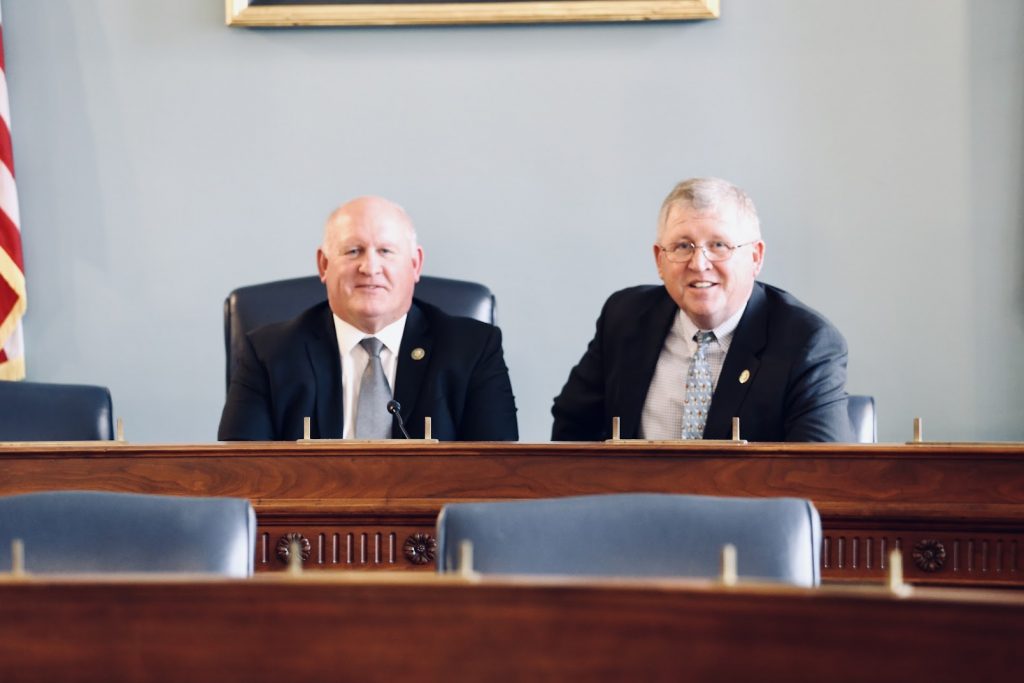
Congressman Frank Lucas (OK-03) released the following statement after the House Committee on Agriculture completed its markup of the next Farm Bill: "I applaud Chairman Thompson for completing the gargantuan task of passing this Farm Bill out of Committee. As a former Chairman of the House Ag Committee, I know firsthand just how difficult this process can be. Not only does this bill continue the good work done by the Committee over the last decade, but it secures much needed investments into the farm safety net and conservation title, all while assuring our neighbors that they have the calories they need. I am happy to support this essential piece of legislation and I look forward to working with the Chairman and my colleagues to advance this legislation on the House Floor."
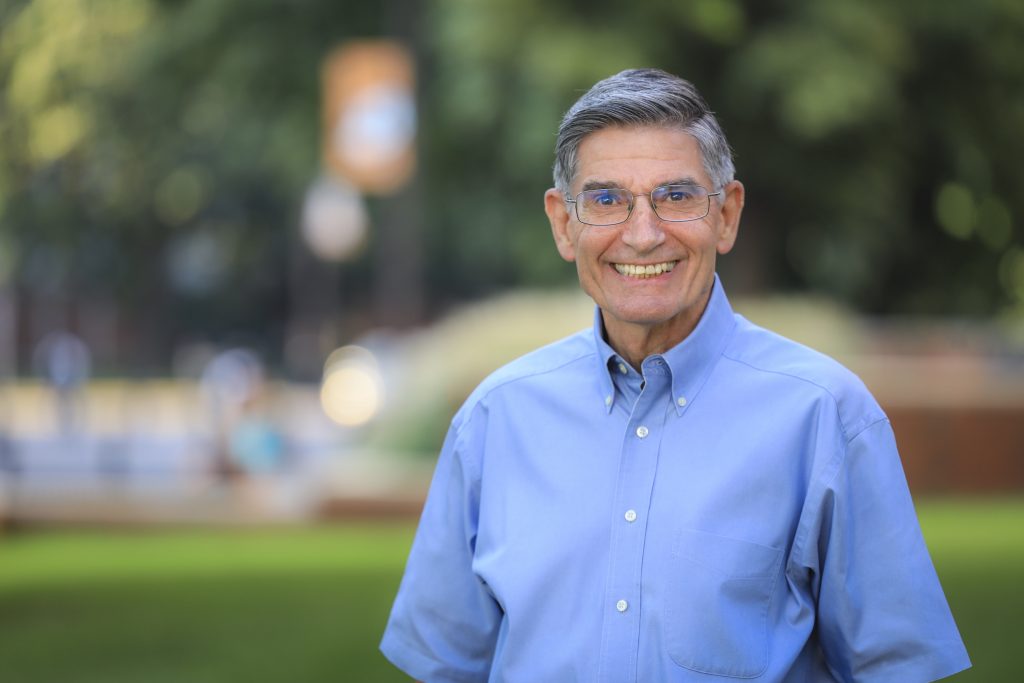
This week on SUNUP is Oklahoma State University Extension grain market economist Kim Anderson. During this week's edition, Anderson gives his weekly update from the fields of Lahoma at the OSU Lahoma Field Day.
"Out here, the farmers and ranchers are learning about raising wheat," Anderson said. "They are learning how to produce it, they are learning soil fertility, and they are learning about production. All of that information on production has no value unless you can convert it to economics. You have got to know what the bottom line for each alternative is, and what the probabilities are that it is going to generate profit so you can select the one with the highest profitability to keep you in business."
Looking at the prices from 2009 to 2013, Anderson said Oklahomans can easily see that is best to sell their wheat throughout the June, July, and August time period.
"The big point is, from the high to the low on the average, was $1.83, plus or minus 90 cents," Anderson said. "Losing $1.83 because you sold it at the wrong time is a big problem. What you need to do when you are selling your wheat is to stagger it over that three-month time period, because you don't know if the highest price is going to be at the beginning or the end."
This week on SUNUP:
Oklahoma Agriculture Starts at SUNUP!
Weekly Statewide Broadcast: Saturday at 7:30 a.m. & Sunday at 6 a.m. on OETA (PBS)
Anytime: YouTube.com/SUNUPtv

This conceptional rendering shows what the landscape environment could look like on the east side of the new home for Oklahoma State University Agriculture. (Rendering provided by OSU Facilities Management)
Oklahoma State University Agriculture is partnering with OSU Landscape Services to develop several outdoor gathering spaces around the new cutting-edge facility for the Ferguson College of Agriculture, OSU Ag Research and OSU Extension.
The east side of the building will feature an outdoor patio, plaza and grand pathway that accentuates the surrounding buildings and supports the land-grant mission, said Nick Ouellette, university landscape design manager.
"The east corridor creates an inviting pathway that offers opportunities for engagement, education, creativity and relaxation," Ouellette said. "This space also provides an ideal place to take a break between classes, socialize, study and enjoy a snack."
OSU Department of Horticulture and Landscape Architecture students and landscape architecture design interns assisted in developing landscape plans for the new building.
Randy Raper, OSU Agriculture assistant vice president of facilities, oversees the New Frontiers construction project and has worked closely with Ouellette and Landscape Services during the design process.
"Nick and his team have created a beautiful landscape design with a plaza-like atmosphere on the east side between the new building and the Noble Research Center that will complement both buildings," Raper said. "This space will increase collaboration between the two buildings and programming across OSU Agriculture."
Located directly outside Larry and Kay's Dairy Bar, the outdoor patio will have five tables, two benches and a living plant wall that will serve as a gathering spot for students, faculty and staff.
Preserved pieces of the Dairy Building will be used in landscaping features surrounding the outdoor patio. The Dairy Bar was housed in the Dairy Building, which was demolished in 2006 to create room for the Henry Bellmon Research Center.
"One of the raised garden beds along the plaza will also display multiple reclaimed architectural building remnants preserved from the 1928 dairy barn," Ouellette said. "Preserving OSU history and displaying the building elements in a way that brings back memories to many is living by The Cowboy Code."
A unique piece of the outdoor patio will be the living plant wall, a 20-foot wide and 8-foot-tall vegetative wall that will include more than 200 plants.
"Living walls offer a variety of economic, environmental and social benefits, which allow us to connect with nature and enhance our health and well-being," Ouellette said.
The wall design will start with colorful annuals for the fall semester but will transition to an urban forest design, using evergreens and perennials in late fall.
The outdoor patio will be connected via the grand pathway to the plaza in the northeast corner of the building.
"The grand pathway provides ideal site accessibility flanked by diverse garden beds, turf areas for tailgating opportunities, landscape lighting, art placeholders and campus site amenities," Ouellette said.
The northeast plaza will contain three benches and offer a view of Boone Pickens Stadium, an ideal destination for tailgating during football season, said Teresa Gustafson, OSU Foundation senior director of development and team lead for OSU Agriculture. When naming the plaza, she added donors would have first rights to the area during football season.
Additional naming opportunities are available on the east side of the building, including the outdoor patio, living plant wall and commemorative benches.
"A popular gift option for those wishing to have their special place on campus is an attractive, comfortable cast-iron bench – an amenity much appreciated by students, visitors and the entire university community," Gustafson said. "Your personalized bench will preserve the legacy of a family member, treasured faculty mentor or friend while enhancing the aesthetic appeal of the campus and the surrounding community."
Please contact Gustafson to participate in a naming opportunity before the building's grand opening in the fall. To learn more about construction updates and donor stories, visit New Frontiers.
The New Frontiers campaign was launched in January 2020 to build a new state-of-the-art facility for OSU Agriculture. The New Frontiers Agricultural Hall, expected to open in fall 2024, further advances teaching, research and Extension efforts that are critical to the state's economy, citizens' safety and quality of life. By advancing OSU Agriculture and its programs, New Frontiers is fostering innovation to help feed the world.
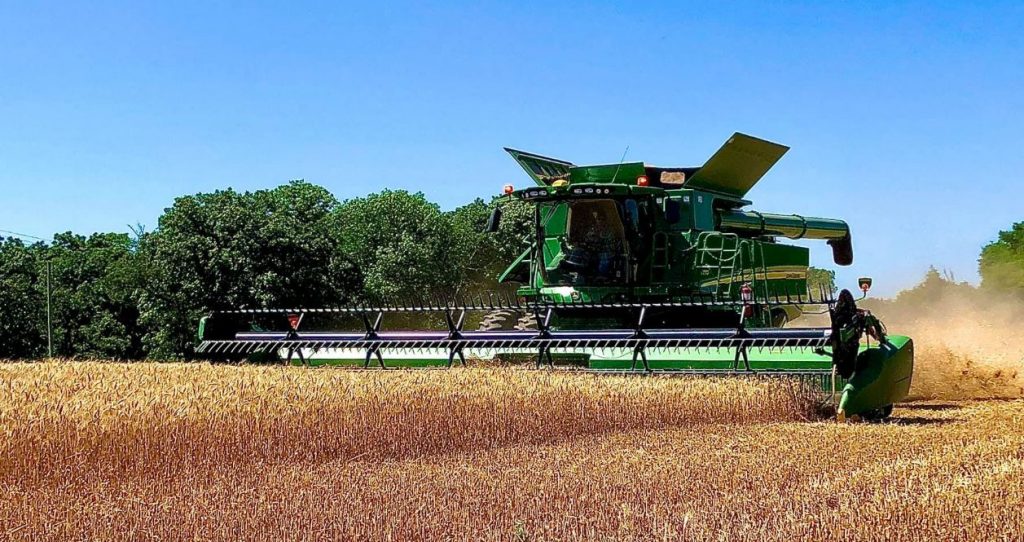
By: The Oklahoma Wheat Commission
Thursday, May 23, 2024
Oklahoma wheat harvest made good strides the last few days in parts of Southwest, Oklahoma. Producers as far North in the Okarche and Reeding area also were able to start earlier in the week before rains delayed progress on Wednesday morning. Samples and small cuttings were taken in at Greenfield. Cooler temperatures made for a late start in a lot of areas yesterday. High humidity, cloudy weather, with fog and mist today have hindered anything being cut this morning. Predicted rains late this afternoon/evening and over the weekend most likely will stall progress over the Memorial Day weekend. Wheat being taken in at all locations show favorable yields and quality.
Devol/Grandfield/Chattanooga- This area has taken in a lot of wheat over the past 5 to 7 days, with approximately 15 percent of the crop harvested. Yields are ranging from the low 20's to high 40's for the most part. Heavily grazed wheat having the lower yields. It has been noted some intensively managed fields have been yielding 50, with a few yields in the lower 70's being reported. Test weights ranging from 60lbs. to 65lbs. per bushel. Protein averages being reported from 10.5% to 12%, with the overall average being around 11.0% to 11.2%.
Frederick- Great strides have been made in this area until cooler temperatures and higher humidities yesterday. Yields being reported from as low as 25 to as high as 50 bushels per acre depending on management and whether or not it was grazed. Test weights reported from 60lbs. to 63lbs. per bushel. Protein average at 10.5%
Altus/Lone Wolf- Yields in this region mainly ranging from 35 to 40 bushels per acre. A couple of intensively managed fields making above 60 bushels per acre being reported. Test weights ranging from 60 lbs. to 64 lbs. per bushel. Harvest just getting a good start at these locations so no protein reports being made at this time. (Test cuttings and samples have been taken in at Hobart, Gotebo, Roosevelt, Sentinel, Rocky, Dill City and Cordell, but no actual reports being made until harvest starts in these regions.)
Greenfield- Early test weights being reported on one field making 58.5 lbs. per bushel. Protein was reported at 13%, no yields reported.
Okarche- Early cuttings reporting yields from 40 to 45 bushels per acre. Test weights reported at 61 lbs. to 62 lbs. per bushel. Protein reports on early cuttings coming in at 13.5%
Reeding- Early cuttings on a couple fields in this region had reports of yields making 45 to 50 bushels per acre. Test weights ranging from 60lbs. to 62lbs. per bushel. No proteins being reported on the early cuttings.
Early reports in all locations show test weights ranging from 60 to 65 lbs. per bushel. Proteins ranging from 10.5% to 13.5%, with an overall average of proteins being reported at 11.0% to 11.2%. The wheat being harvested in Southwest Oklahoma has not been stressed as much, so it is thought proteins will get higher as harvest progresses North where we have drought stress. Early yields being reported at 40 to 45 bushels per acre in most regions. Higher yields being reported on intensively managed wheat with some yields on a few fields being reported in the mid 60's to low 70's. The regions where this is being reported is considered the bright spot of the state for growing conditions this year. The state has received a large amount of hail damage in South Central, Southwest, and Northern, Oklahoma over the past two weeks. Producers are hoping future predicted storms for tonight and over the weekend subside. The next harvest report to be published will be Tuesday, May 28th. In honor of all the Veterans and Active Service members the Oklahoma Wheat Commission wants to wish everyone a Happy Memorial Day weekend!
Below, see the 6-10 day precipitation and storm potential outlook provided by the Oklahoma Mesonet.
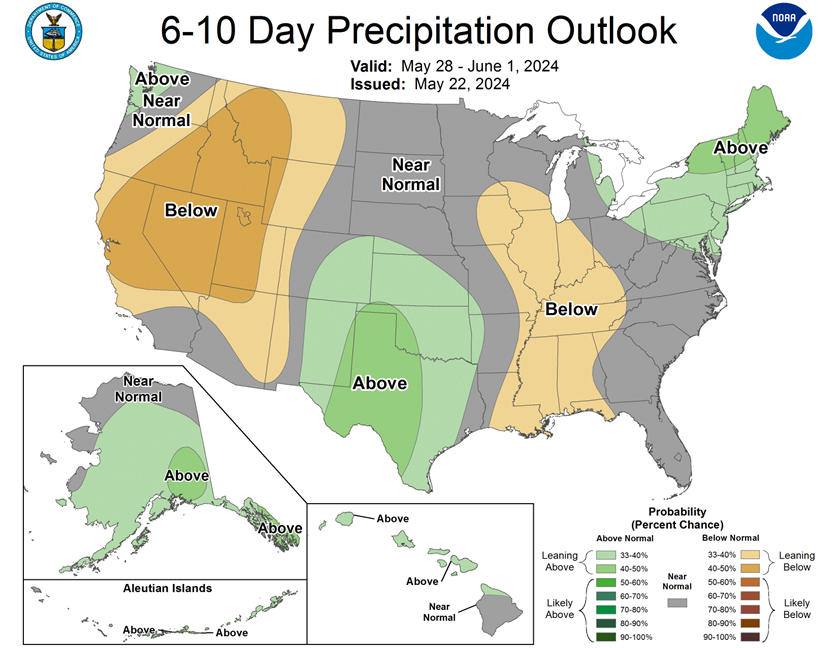
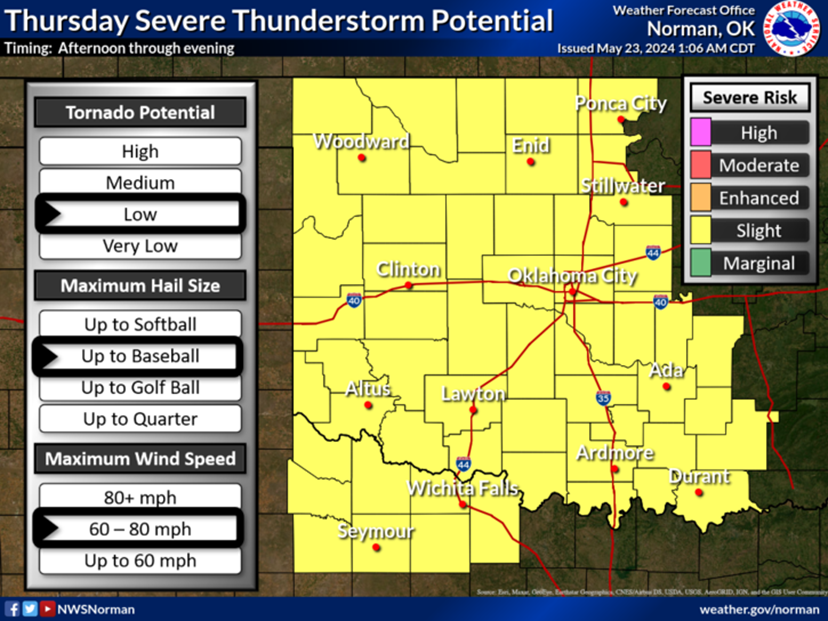
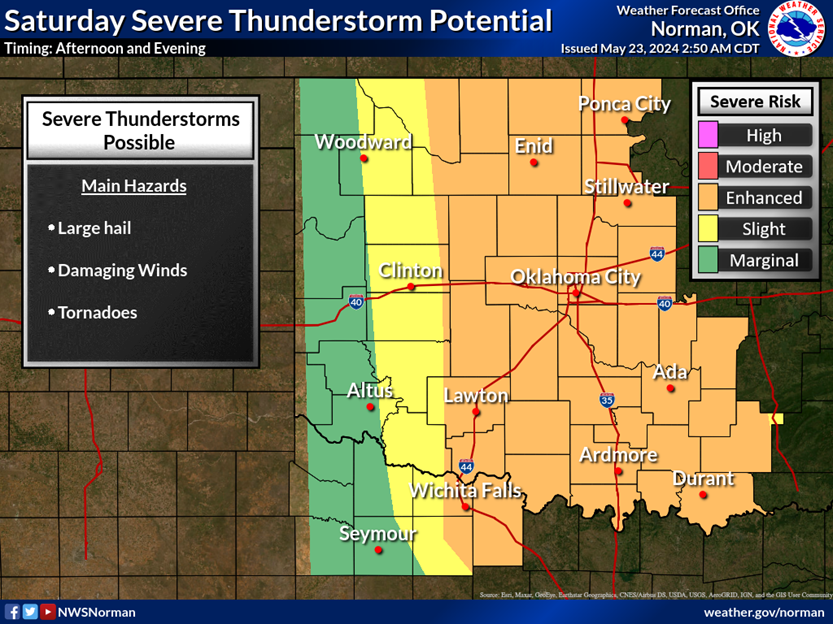
| |||||||||||||||||||||||||||||||||||||||||||||||||||||||||||||||||||||||||||||||||||||||||||||||||||||||||||||||||||||||||||||||||||||||||||||||||||||||||||||||||||||||||||||||||||||||||||||||||||||||||||||||
|
Today, Chairman of the House Agriculture Committee, Glenn "GT" Thompson (PA-15), delivered the following opening remarks at today's full committee markup of H.R. 8467, the Farm, Food, and National Security Act of 2024:
Remarks as prepared for delivery:
Good morning, and welcome to the Committee's consideration of the Farm, Food, and National Security Act of 2024.
When I became Chairman of the House Committee on Agriculture, I took seriously my mandate to protect our food supply and enhance the impact of our nation's agricultural value chain. Across each title of this bill are new and better tools and resources for our farmers and rural communities. From production and processing, to delivery and consumption, this bill strengthens the rural economy across every region, state, and district.
While a few armchair critics have gotten louder these last few weeks, aiming to divide the Committee and fracture the process that brings about a bipartisan, bicameral Farm Bill, I believe it is important to focus on the substance of the legislation before us today.
Over the past few decades, the farm safety net has lost its ability to protect those who are the backbone of our great nation. American farmers face natural disasters, take huge personal risk, and are at the whims of regulatory overreach. It is a privilege to deliver a farm bill that strengthens the risk mitigation measures available to producers, providing certainty in a time of volatility.
The restoration of the farm safety net does come at a cost, and I have spent a lot of time with the Congressional Budget Office and the Budget Committee to correct erroneous assumptions. The Budget Committee has been a terrific partner, and that work will continue to ensure that not only do we correct those erroneous assessments, but do so in a transparent, judicious manner that restores the farm safety net and integrity to current and future agricultural estimates.
The Farm, Food, and National Security Act also provides historic, long-term investments in conservation programming through a practical reinvestment of Inflation Reduction Act conservation dollars. Reorganizing these dollars allows substantial investment in the voluntary, locally-led, and incentive-based conservation programs that are popular, flexible, and beneficial. As many of you know, the conservation portion of the IRA was not considered by this Committee in 2021, instead $20 billion appeared once the bill moved to the Rules Committee. So today, the bill before us uses those dollars for conservation programming in Title II, something so important to this Committee.
Over the past few weeks, many have voiced concerns about a policy shift that both restores regular order and allows transformational investment in our low-income communities.
For more than 40 years, updates to the Thrifty Food Plan were cost neutral. In 2021, President Biden unilaterally, intentionally—and according to GAO—unlawfully, updated the market basket to no longer be cost neutral, resulting in a $256 billion addition to the farm bill baseline.
The Administration and my Democratic colleagues purport the update was science-based and transparent, and have even gone so far to say that no one can arbitrarily increase SNAP. However, Secretary Vilsack stood by his team as they did just that, through a rushed process devoid of thoroughness and filled with politics.
The TFP update before us does not cater to any one side; it is a balanced approach, forward-looking, underscored by the need for Congress to reassert its authority.
If the benefit must be increased beyond inflation, Congress must consider and execute.
Importantly, and as CBO recognizes, annual cost of living adjustments remain, so SNAP benefits will continue to rise and respond to inflation. Unfortunately, I have learned my Democratic colleagues were led to believe otherwise.
So what does the bill before us do with CBO's assumption—an assumption that allows significant, historic investment in the title, of which has been intentionally ignored?
Republicans are providing additional financial resources across multiple programs that have successfully benefited tribal communities, seniors, and households pursuing healthier options.
Republicans are championing efforts for individuals to remain on their current career pathways without choosing between SNAP and employment or education.
Republicans are correcting a draconian, outdated policy option to now allow all individuals with past drug offenses to receive SNAP, aligning federal policy with the will of dozens of states across the nation.
Republicans are increasing resources available to the Nutrition Assistance Program block grant for Puerto Rico and encouraging both USDA and Puerto Rico to continue to formulate a financially and operationally viable pathway toward a transition from the block grant to SNAP.
And Republicans are holding USDA and the States who administer SNAP accountable to the American taxpayer.
In further efforts to disrupt the process, there has been talk about the movement of money across titles or the longstanding coalition of food and farm advocates. I assume it needs reminding of contemporary farm bills where farmers were stripped of billions in exchange for additional funds in nutrition, or where nutrition saw a 1 percent decrease in the deficit reduction exercise of 2014, yet farmers had to face an astonishing 25 percent cut. So, I have no shame transitioning available resources to the nearly unanimous, bipartisan priorities shared by each of you and incorporated in this bill, including trade promotion, research, and various specialty crop programs.
Each of the titles within this bill are supremely important to our rural communities. Providing access to credit, streamlining policies to provide connectivity to the many, improving precision agriculture, encouraging active forest management and enhancing forest health, creating access to energy system and efficiency updates, protecting plant health and specialty crop competitiveness, and protecting the livestock and poultry industry from catastrophic disease and the inside-the-beltway animal welfare activists, are each worthy topics and policies that demand strong consideration as this markup unfolds.
I firmly believe the legislation before us today restores a robust rural economy, invests in America's farmers, ranchers, and foresters, and bolsters every facet of American agriculture. And having seen the widespread support from stakeholders across this country, I believe we have achieved that goal.
As I said last week, a farm bill has long been an example of consensus, where both sides must take a step off the soapbox and have tough conversations. I do not draw redlines; I do not close the door to conversation. I could not have been clearer throughout this process that I was willing to work with each one of you to find a pathway forward on this bill. I have been here, I have been transparent, and I have been fighting for American agriculture.
Before I close, my appreciation to the staff on both sides of the aisle who have, for the most part, produced the bill text before you. Working in Washington is not easy, and you all have done a tremendous job of ignoring the noise and bringing to life the priorities of the Members you serve. Thank you.
With that, I yield to the distinguished Ranking Member, the gentleman from Georgia.
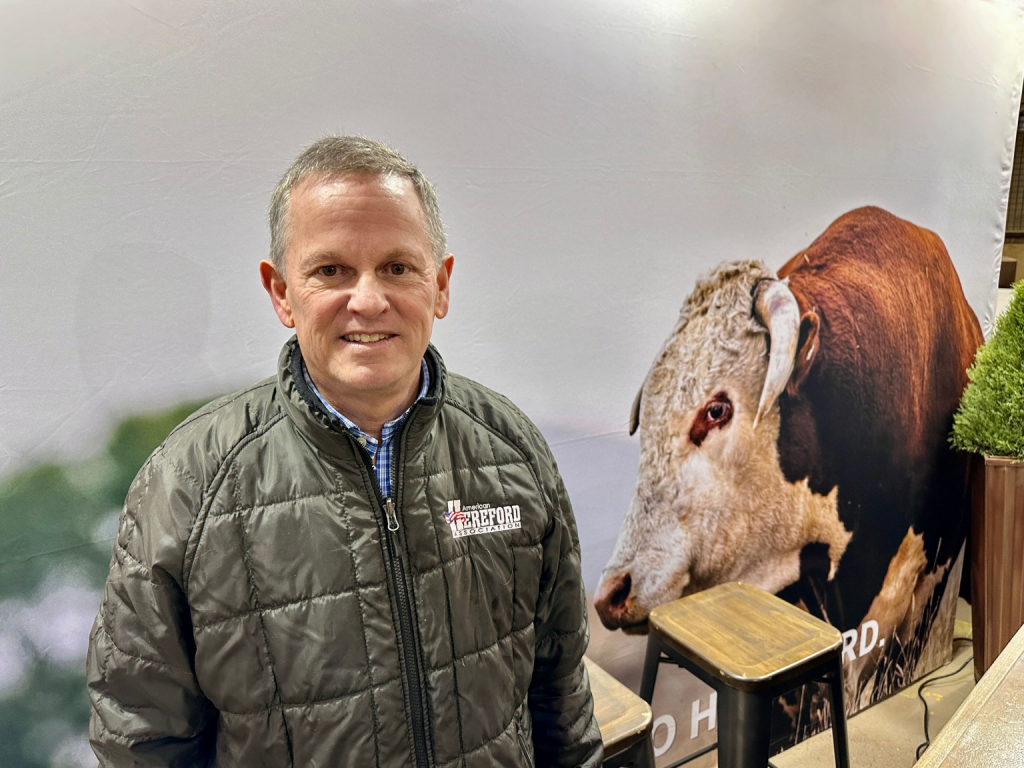
At Cattlemen's Conference Part Two: Blueprint for the Future, Senior Farm and Ranch Broadcaster, Ron Hays, had the chance to catch up with the Executive Vice President of the American Hereford Association, Jack Ward, and talk about new technologies in the beef industry discussed at this year's conference.
At last year's conference, Ward said as he wrapped up discussions on the last day, he felt there was more to cover, hence the need for a part two.
"Last year we heard from some of the presenters about how we have turned the corner in terms of demand for beef and high-quality beef," Ward said. "It is a more consistent product than what we did. We increased per capita consumption, we heard a lot about consumer preferences, we heard a lot from presenters in terms of the value of soil health and trying to work your way through that."
Comparing this conference to last year's there is a larger focus on regenerative ranching, heterosis, and gene editing. In his role working within a breed association, Ward said when it comes to new technologies, one thing to consider is what will be accepted by breed associations in years to come.
Ward added that it is also critical to keep in mind what the consumer will prefer when adopting new technologies. Still to come, speakers at the conference will be discussing different technologies like embryo transfer, cloning, and more.
"This is just the next step," Ward said. "Will it be a tool we can look at and utilize for genetics improvement, maybe feedlot health, cattle health, animal welfare issues, or anything associated with the business that is going to make us more efficient? I am excited about it, and it is a dynamic set of folks to present and share some knowledge with us."
The Beef Buzz is a regular feature heard on radio stations around the region on the Radio Oklahoma Ag Network and is a regular audio feature found on this website as well. Click on the LISTEN BAR for today's show and check out our archives for older Beef Buzz shows covering the gamut of the beef cattle industry today.

U.S. Department of Agriculture (USDA) Secretary Tom Vilsack today announced that USDA is investing in domestic fertilizer projects to strengthen competition for U.S. farmers, ranchers and agricultural producers.
This funding advances President Biden's Investing in America agenda to grow the nation's economy from the middle out and bottom up. It will create jobs and spur economic growth in rural communities by increasing competition in agricultural markets. Through these projects, President Biden is delivering on promises he made two years ago when he visited rural Illinois to announce the doubling of funding available through the Fertilizer Production and Expansion Program (FPEP).
"The Biden-Harris Administration and USDA are committed to bolstering the economy and increasing competition for our nation's farmers, ranchers and small business owners," Secretary Vilsack said. "The investments announced today, made possible through the Commodity Credit Corporation, will increase domestic fertilizer production and strengthen our supply chain, all while creating good-paying jobs that will benefit everyone."
The Department is awarding $83 million in 12 states for projects through the Fertilizer Production Expansion Program (FPEP). This program provides grants to independent business owners to help them modernize equipment, adopt new technologies, build production plants and more.
These investments will boost domestic fertilizer production, strengthen competition and lower costs for U.S. farmers. The projects will also help U.S. farmers increase independent, domestic fertilizer production. For example:
USDA is making awards to facilities in California, Florida, Hawaii, Iowa, Illinois, Kansas, Kentucky, Minnesota, North Carolina, North Dakota, Oregon and Washington.
To date, USDA has invested $251 million in 57 projects across 29 states through FPEP.
President Biden and USDA created FPEP to combat issues facing American farmers due to rising fertilizer prices, which more than doubled between 2021 and 2022 due to a variety of factors such as war in Ukraine and a lack of competition in the fertilizer industry. The Administration committed up to $900 million through the Commodity Credit Corporation for FPEP. Funding supports long-term investments that will strengthen supply chains, create new economic opportunities for American businesses, and support climate-smart innovation.
FPEP is part of a broader effort to help producers boost production and address global food insecurity. It is also one of many ways the Administration is promoting fair competition, innovation and resiliency across food and agriculture while combating the climate crisis.
USDA Rural Development provides loans and grants to help expand economic opportunities, create jobs and improve the quality of life for millions of Americans in rural areas. This assistance supports infrastructure improvements; business development; housing; community facilities such as schools, public safety and health care; and high-speed internet access in rural, tribal and high-poverty areas. Visit the Rural Data Gateway to learn how and where these investments are impacting rural America. To learn more, visit www.usda.gov. To subscribe to USDA Rural Development updates, visit the GovDelivery Subscriber Page.

House Agriculture Committee Ranking Member David Scott today delivered the following statement at a full Committee markup of the Republicans' partisan farm bill. Watch the full hearing here.
[As prepared for delivery]
Today we are marking up the a farm bill that undermines and hurts both our farmers and our American families, and here is why:
This farm bill makes the largest financial cut to SNAP in 30 years!
Listen to me carefully: Our non partisan congressional budget office says that this 30 billion dollars in cuts generated by the thrifty food plan changes, all come from SNAP benefits!
Now, this means that this legislation before us today ensures that 30 billion dollars in SNAP benefits will not flow to low-income households with children, our senior citizens, our American people with disabilities, our courageous veterans, our working parents and caretakers who need the help the most with getting food.
That is a fact! And, this is why each of our experts that appeared before our recent, China Threats to Agriculture hearing, determined and said to us that food is now a national security issue.
SNAP benefits are inadequate in 99 percent of our counties, in out Nation, that is a fact!
And, 71 percent of SNAP benefits are in families with young children. That is a fact!
And, these facts alone are reason enough to vote against this terrible bill, but this bill does even more damage than taking food away from families, it also takes much needed financial support away from our farmers.
Now, we Democrats passed the largest climate investment in history, which is 19 billion dollars in climate smart conservation funding with IRA conservation money that protects the climate guardrails.
Folks, protecting the climate guardrails is very popular with our farmers, and it is not just being climate smart, it is very business smart, because it helps our farmers operate with more sustainability and profitability.
Ladies and gentlemen, farmers most important resources are their land and the climate that they need and want to protect, improve, and understand better the climate in order for our farmers to keep feeding us, sheltering us, fueling us and clothing us.
Another tool that the Republicans are trying to take away from our farmers with this bill is the Commodity Credit Corporation (CCC) away from the Secretary of Agriculture then when the pandemic hit it was the 31 billion dollars in CCC money that helped connect the farmers and processors to get food commodities to hungry Americans.
And, when China's tariffs hit our farmers under former president Trump started a trade war it was the 28 million dollars in CCC money that helped our farmers unload surplus commodities and find more markets.
And with this terrible bill before us today, the Republicans are trying to prohibit the future Secretary of Agriculture from using the CCC, the very tool that helps our farmers in those kinds of nightmare scenarios.
I cannot, I will not support this bill, I will vote no and I encourage my colleagues to oppose it.
This bill is misguided, and in some aspects, it is mean spirited to American families and our American farmers.
And, everyone here knows that this bill before us will never become law, the Senate won't accept it, the administration won't accept it.
And while this bill is a giant mis-step it never the less begins our journey toward passing the farm bill.
But, there will be opportunities along this journey for Republicans to reconsider and turn away from this partisan path that they are currently taking us down. I hope they will do that soon.
And when my Republican friends are ready to return to the path of bipartisanship, which is the only path that leads to a successful farm bill, we Democrats will be there waiting for them to join with us Democrats hand-in-hand and arm-in-arm.
You know, I was born on a farm in Aynor, South Carolina, on my grandparents Hellen and Jim Burroughs' tobacco and cotton farm.
I was raised around farmers, and I know that our farmers know that the only way we succeed is by us working together. We may not be there today, but we have to get there! For the sake of American agriculture, the American farmers, and the American people. Thank you, Chairman, and I yield back.
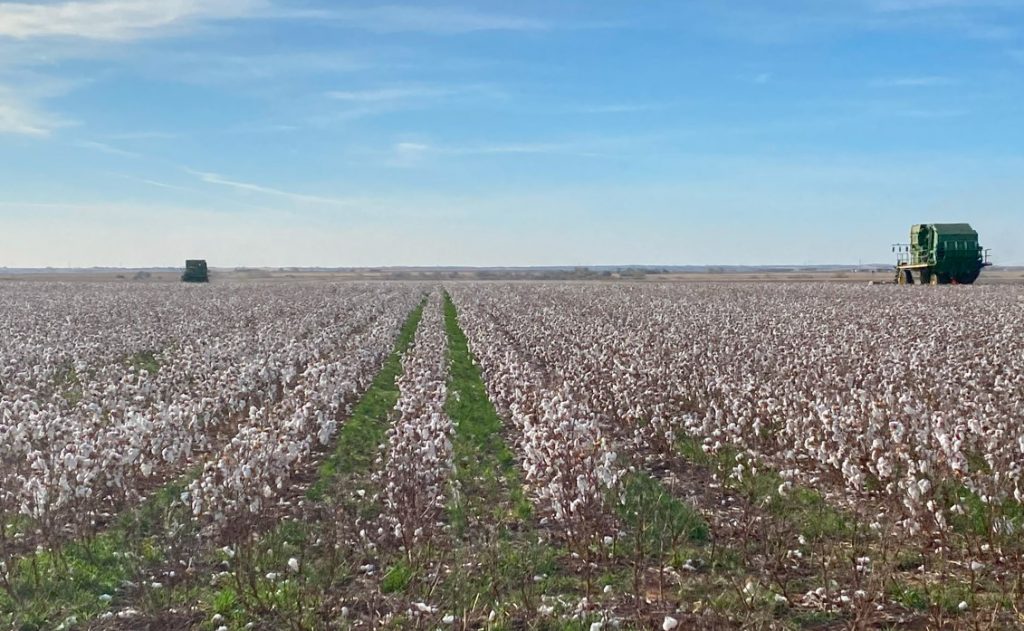
Twelve U.S. cotton industry members have been chosen to participate in the National Cotton Council's (NCC) Emerging Leaders Program for 2024-25. Participants include: PRODUCERS – Clint Dunn, Itta Bena, MS; Lambert Marshall, Scott, AR; Greg Riccomini, Bakersfield, CA; Todd Rovey, Buckeye, AZ; Greg Sikes, Brooklet, GA; and Jack Whatley, Odem, TX; GINNERS – Nathan Goldman, Casa Grande, AZ; Daniel Luehrs, Odem, TX; MERCHANTS – Brett Edgy, Savannah, GA; Jacinta Condon, Greenville, SC; WAREHOUSER – Chris Moore, Southaven, MS, and MARKETING COOPERATIVE – Zach Flowers, Clarksdale, MS.
Now in its ninth year, the NCC's Emerging Leaders Program is supported by a grant to The Cotton Foundation from Bayer.
NCC Chairman Joe Nicosia, a Cordova, TN merchant, said, "We are grateful for Bayer's ongoing support of the Emerging Leaders Program. U.S. cotton needs dedicated leaders who are committed to helping our industry maintain a competitive edge in the global marketplace. This initiative helps to identify men and women who have demonstrated the potential for taking on this important challenge and then encourages and equips them for this important task."
Overall, the Emerging Leaders Program gives participants a better understanding of how the NCC carries out its mission of ensuring the U.S. cotton industry's seven segments can compete effectively and profitably in the raw cotton, oilseed and U.S.-manufactured product markets at home and abroad. Specifically, participants get an in-depth look at: 1) the U.S. cotton industry infrastructure and the issues affecting the industry's economic well-being; 2) the U.S. political process; 3) the NCC's programs as well as its policy development and implementation process and 4) Cotton Council
International's activities aimed at developing and maintaining export markets for U.S. cotton, manufactured cotton products and cottonseed products.
The Emerging Leaders Program also provides participants with professional development and communications training, such as presentation and business etiquette, instruction for engaging with the news media, and utilizing social media tools and tactics.
Class members will participate in three sessions. The first session, set for the week of June 16, 2024, in Memphis and St. Louis, will provide an orientation to the NCC, professional development and communication skills training and an agribusiness briefing. During the second session, class members will see policy development at the NCC's 2025 Annual Meeting in February. The third session, to be conducted later in 2025 in Washington, DC, will provide a focus on policy implementation.
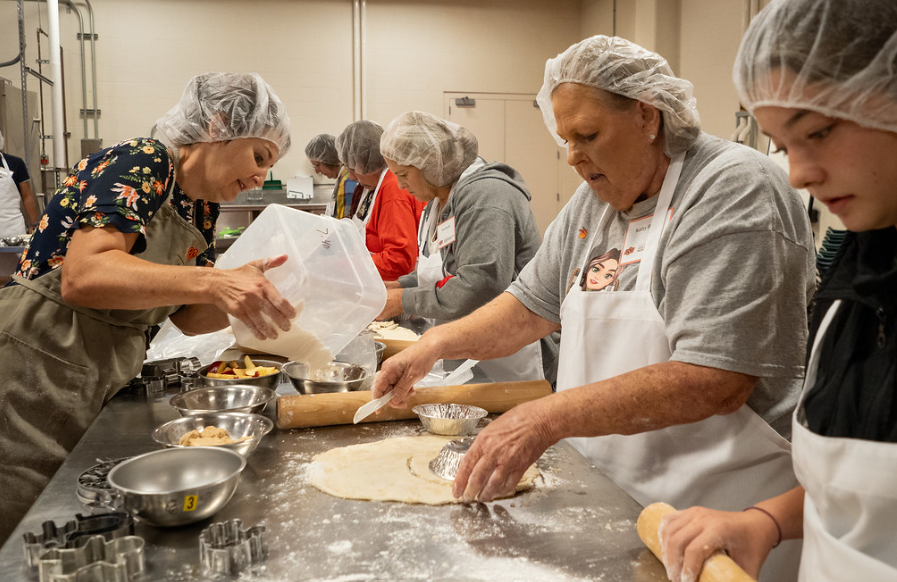
Participants learn how to make dough for apple pies during a Playing in the Dough series event in OSU's Robert M. Kerr Food and Agricultural Products Center. (Photo by Hunter Gibson, OSU Agriculture)
Homesteading has become more mainstream within the past decade as interest climbs in gardening and locally sourced products. With more than a century of experience and research, Oklahoma State University Extension is a valuable resource for homesteaders.
"People want to get back to their roots," said Cheyenne Patrick, Osage County Extension agriculture educator and Federally-Recognized Tribes Extension Program educator for the Osage Nation, who has organized local workshops on beekeeping, backyard chickens and breadmaking. "They want to learn how their grandma cooked because there for a while, many of us got pretty far away from that. Now we want to know what's in our food and either make it or raise it ourselves."
Mayes County resident Rachel Pritchett and her husband became interested in homesteading 20 years ago with a few backyard chickens. They garden, preserve fruit from their small orchard and manage a beehive. The family enjoys a form of modern homesteading that includes hunting, fishing and raising meat goats while creating content for their Hidden Heights Farm YouTube channel.
"The pandemic has exposed a need for homesteading," Pritchett said. "It was a wake-up call for everybody when they couldn't find bread and eggs were so expensive. How were people supposed to buy meat or milk? We've seen an increase in farmers markets with people going straight to the source."
Over the past two decades, the Pritchett family has relied on its local Mayes County Extension office for accurate information on homesteading. From support with tree grafting and soil testing to insight on tree diseases and other horticulture topics, OSU Extension is a trustworthy bank of information.
Rachel, her husband and their business partners, Sean and Brandi Farnsworth of the popular homesteading YouTube channel Keeping It Dutch, own and coordinate the Okie Homesteading Expo they established in 2022 at the Mayes County Fairgrounds. They invited OSU Extension to set up a booth and connect with fellow homesteaders. The following year, Extension specialists presented on pecan grafting, demonstrated a calving simulator and recruited Master Gardener volunteers to answer questions about all levels of gardening.
"Extension information is backed by research. We're going to trust someone who can provide the data and science behind it," Pritchett said. "A lot of homesteaders don't have a background in agriculture. We rely heavily on the experts."
Attractions and attendance at the family's Okie Homesteading Expo continue to expand, drawing homesteaders from across the country. Pritchett said the goal is to advocate for a more self-sufficient lifestyle that gives people the confidence and inspiration to try something new.
"Typically, people have the perception of homesteaders living off-grid, but that's not the case," she said. "There's a place for everyone. If you want to learn how to make bread, you can do that right in your own apartment or grow vegetables in your window. You don't have to have a large acreage."
Trinity Brown, the family and consumer sciences educator for OSU Extension in Pawnee County, said homesteading has been a primary theme of Extension education since its founding in 1914 with proven, research-based methods and practices.
"Any family and consumer sciences or agriculture Extension educator at the county, state or district level can teach people the correct homesteading methods that are safe for families and homes," Brown said. "Homesteading is just a renaming of the phrase family and consumer sciences. It's a trending word, but we have been teaching the same programs since day one."
An expert in food safety, Brown is passionate about using her canning and food preservation knowledge to support homesteaders. She has explained the chemistry of baking in breadmaking classes, taught youth how to cook simple skillet meals at home, demonstrated how to can produce from the garden and tested pressure cookers to ensure they are in safe working order.
"This whole push for organic food and farmers markets has been part of Extension all along," she said. "We focus on kids with 4-H youth development, but adults can still turn to us with questions about owning a home, lawn care, financial management, gardening, eating healthy and cooking. I hope to make a difference in the homesteading programs we offer."
OSU Extension homesteading resources are available via extension.okstate.edu, fact sheets, seminars and workshops, and online courses.
OSU Extension uses research-based information to help all Oklahomans solve local issues and concerns, promote leadership and manage resources wisely throughout the state's 77 counties. Most information is available at little to no cost.
By Gail Ellis
At Cattlemen's Conference, Senior Farm and Ranch Broadcaster Ron Hays had the chance to visit with Executive Director of Government Affairs at the National Cattlemen's Beef Association, Allison Rivera, about expectations for the 2024 Farm Bill ahead of the scheduled markup.
The markup of the 2024 Farm Bill is scheduled for 11 a.m. ET on May 23, 2024- click here for current details as found on the House Ag Committee website.
Regarding House Committee on Agriculture Chairman GT Thompson's 2024 Farm Bill proposal, Rivera said NCBA is pleased with what they have seen.
"We are very appreciative of the support he has shown and continues to show to cattle producers across the country," Rivera said. "We got every single bit of dollars and cents we asked for in that animal health preparedness space. Again, as we are sitting here talking about more tools in the toolbox, we hope to not have to use these tools like the vaccine bank, but we need to have it for that case when we do."
All in all, Rivera said NCBA fully stands behind the proposal from Chairman Thompson.
"We are pleased with the conservation title maintaining that deeper set EQIP (Environmental Quality Incentives Program) carve-out for livestock producers," Rivera said. "There is a lot of good movement in that space kind of away from those climate-smart borders, if you will. We want those dollars in voluntary conservation programs like EQIP and CSP, but as we move forward, there is also some good disaster payment type issues that are covered in there."
Rivera also noted some tweaks to the Livestock Indemnity Program that will be critical for producers facing tough times. Thompson's bill also includes funding for efforts such as feral swine control, which is a large issue in Oklahoma.
"At the end of the day, we know we have a long road ahead of us, but this is a step in the right direction," Rivera said. "Getting something done today and moving forward is a positive."
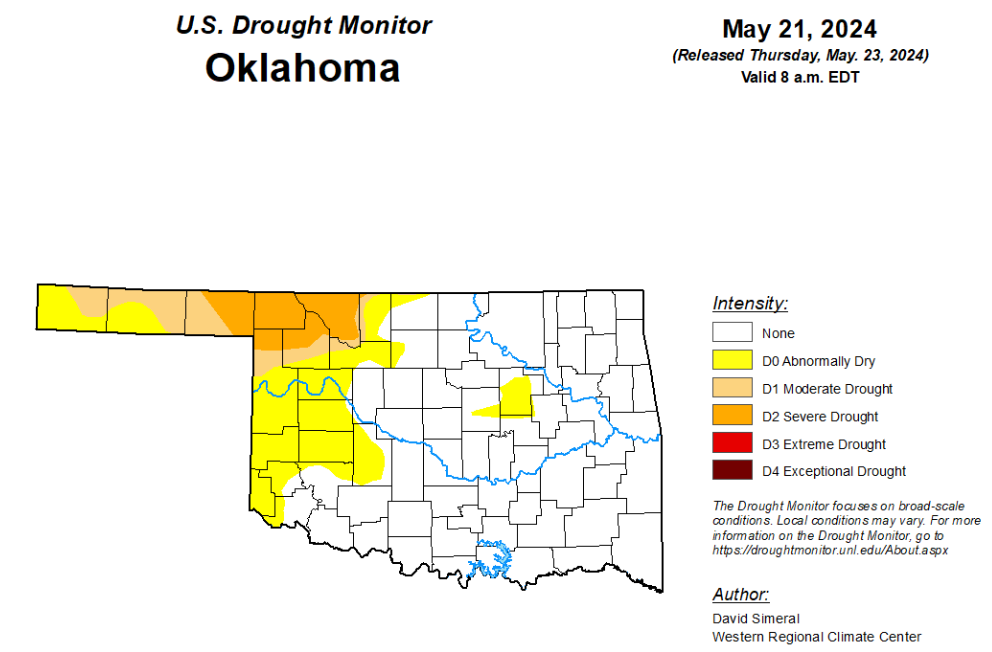
To view the latest Oklahoma drought map, CLICK HERE.
According to the latest Oklahoma drought monitor report, exceptional drought and extreme drought remain at zero percent, unchanged from the start of the calendar year.
Severe drought or worse is unchanged from the past two weeks at 5.91 percent.
Moderate drought or worse is now at 11.37 percent, improved from last week's 12.13 percent.
Abnormally dry or worse is now at 29.60 percent, improved from last week's 32.64 percent.
According to the 6-to-10-day precipitation outlook map, the majority of the panhandle and southern Oklahoma are leaning above a 40 to 50 percent chance of precipitation through June 1st. The rest of the state is leaning above a 33-40 percent chance of precipitation through that June 1st date.
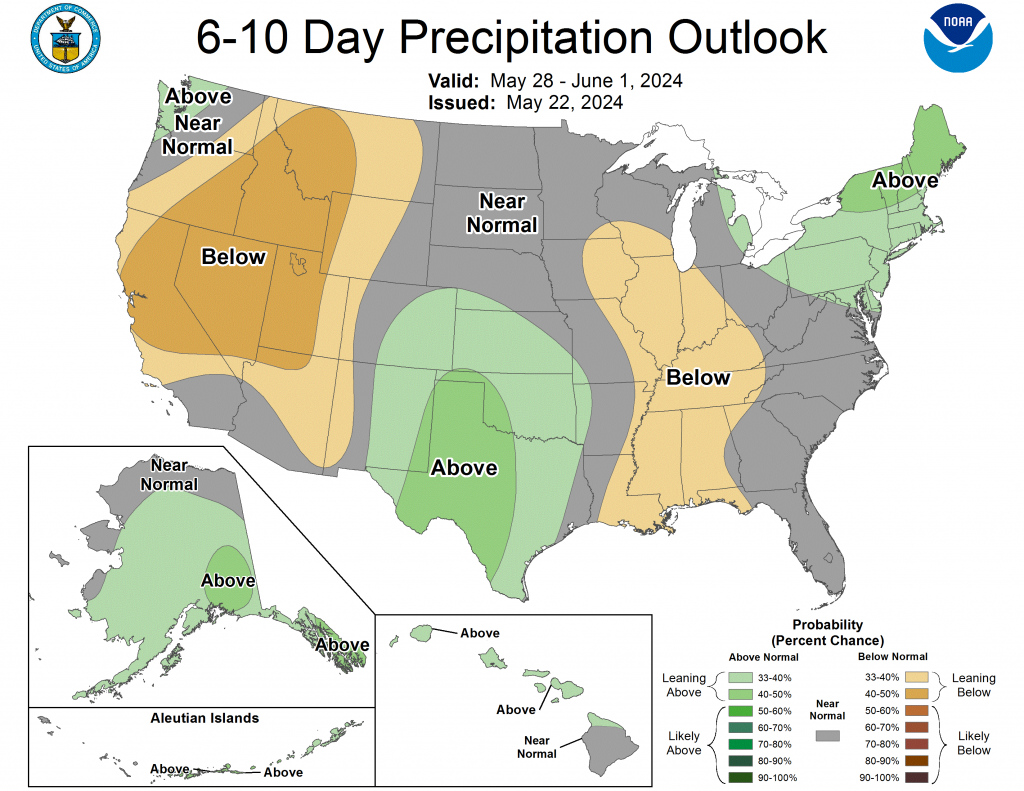
To view the United States Drought Map, click here.
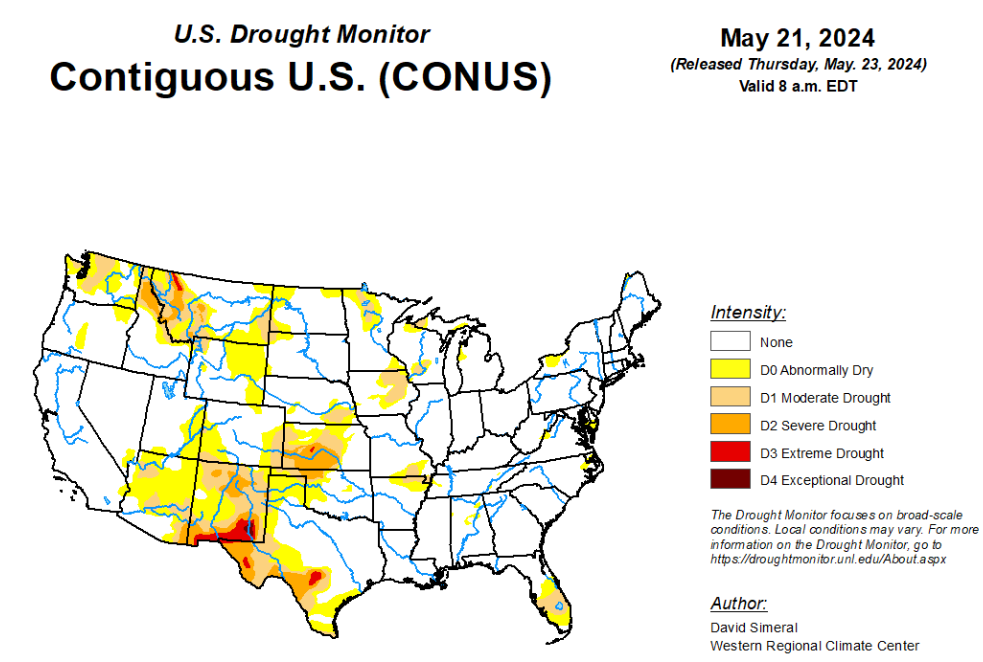
According the latest U.S. Drought Monitor, this week saw widespread improvement in drought-related conditions on the map across areas of the South, Plains, Midwest, Mid-Atlantic, and the West. In the Plains and Midwest, locally heavy rainfall accumulations (up to 7 inches) were observed in drought-affected areas of Oklahoma, Kansas, Nebraska, Missouri, and Iowa leading to continued improvements of conditions on the ground (vegetation health, soil moisture, surface water) as well as reductions in the longer-term precipitation deficits. Likewise, above-normal precipitation during the past several months led to removal of areas of drought on the map in Michigan's Upper Peninsula as well as in southern Wisconsin. In the South, isolated areas of central and west-central Texas saw minor improvements in response to recent rains and improving conditions during the past 30-day period. In the Mid-Atlantic, 1-6-inch accumulations were observed in areas of North Carolina and Virginia this week leading to removal of areas of Abnormally Dry (D0). Out West, some minor improvements were logged in central and northern Arizona where precipitation has been above normal since January 1. In southeastern Montana, recent rains erased Water Year (since October 1) deficits and have improved soil moisture conditions and vegetation health. Across the border in the Bighorn Mountains of north-central Wyoming, areas of Moderate Drought (D1) were removed in response to above-normal snowpack conditions observed in its associated drainage basins. In California, the state's reservoirs are above normal levels moving into the dry season with the state's two largest reservoirs (Lake Shasta and Lake Oroville) at 115% and 126% of their historical average for the date (May 21), respectively. In the Southwest, Lake Powell is currently 33% full (58% of typical storage level for the date) and Lake Mead is 35% full (62% of average) with the total Lower Colorado system at 42% full as of May 20 (compared to 37% full at the same time last year), according to the U.S. Bureau of Reclamation. In Arizona, the Salt River Project is reporting the Salt River system reservoirs at 95% full, the Verde River system at 70% full, and the total reservoir system at 92% full (compared to 99% full a year ago). In New Mexico, the state's largest reservoir along the Rio Grande is currently at 23% full (59% of average). In the Pacific Northwest, Washington's Franklin D. Roosevelt Lake is at 87% full (176% of average for the date). In terms of degradations on the map this week, the only noteworthy ones were made in areas of South Florida where areas of Moderate Drought (D1) expanded in response to dry conditions during the past 60-day period with reports of various impacts including burn bans, lake levels dropping at Lake Okeechobee, reduced soil moisture, and some minor impact in the recreation sector due to low surface water levels. Overall, looking at the broader drought situation across the conterminous U.S., the total percentage of drought coverage is at its lowest since 2020.
In the Southern Plains, across portions of the region, the active pattern continued with significant rainfall accumulations observed in portions of eastern Texas, southern Louisiana, and southern Mississippi, where 7-day totals ranged from 2 to 8 inches. Moreover, beneficial rainfall continued to help ease drought-related conditions in areas of Texas and Oklahoma. On the map, isolated rainfall activity this week led to some minor improvements in north-central Oklahoma, while areas of central and west-central Texas saw minor improvements. According to Water for Texas (May 22), statewide reservoirs are currently at 77.3% full with numerous reservoirs in the eastern part of the state near capacity, while many reservoirs in the western half of the state are experiencing below-normal levels. In terms of pasture and range conditions across the region, the USDA (May 19) is reporting statewide pasture and range conditions rated good to excellent as follows: Tennessee 74%, Mississippi 65%, Arkansas 61%, Louisiana 61%, Oklahoma 57%, and Texas 33%. Looking at climatological rankings for the January 2024-April 2024 period, the region experienced its 19th wettest (+2.32-inch anomaly) and the 11th warmest (+3.2 degrees F anomaly) on record, according to NOAA NCEI.
In the High Plains, on this week's map, Kansas, Nebraska, North Dakota, and the eastern Plains of Montana saw improvements in drought-affected areas. In Kansas and Nebraska, moderate to heavy rainfall accumulations (2 to 7+ inches) led to a reduction in areas of drought and provided a boost in soil moisture and streamflow levels. In North Dakota, areas of Moderate Drought (D1) were reduced in response to above-normal precipitation during the past 30-to-90-day period as well as numerous recent field reports coming into the National Drought Mitigation Center's Condition Monitoring Observer Reports (CMOR) system. According to the USDA (May 19), statewide pasture and range conditions rated good to excellent are as follows: North Dakota 68%, South Dakota 83%, Nebraska 56%, and Kansas 42%. According to the latest USDA Kansas Crop Progress and Condition Report (May 19), winter wheat condition was rated 11% very poor, 20% poor, 36% fair, 30% good, and 3% excellent. In terms of NOAA NCEI's regional climatological rankings, the Great Plains Region observed its 44th wettest (near normal) and 12th warmest (+3.9 degrees F anomaly) January-April period on record.
In the West, some minor improvements were made on the map in central and northern Arizona, eastern New Mexico, southern Colorado, southern Nevada, north-central Wyoming, and southeastern and central Montana. Looking at precipitation across the region, the start of the Water Year was not looking good with most of the region experiencing below-normal precipitation levels. However, the period from January 1 to current (May 21) was much more promising with above-normal precipitation observed across much of the region, with the exception of areas of the Pacific Northwest including Washington, northern Idaho, and western and central Montana as well as areas of the Southwest (eastern New Mexico and northwestern Arizona). In terms of snowpack, the Natural Resources Conservation Service SNOTEL network is reporting (May 21) the following region-level (2-digit HUC) snow water equivalent levels (percent of 1991-2020 median): Pacific Northwest 73%, Missouri 100%, California 147%, Great Basin 137%, Upper Colorado 112%, Arkansas-White-Red 140%, Lower Colorado 232%, and Rio Grande 52%. For the week, conditions were very dry across the region except for some isolated, light shower activity in eastern portions of New Mexico, Colorado, Wyoming, and Montana.
Looking ahead, the NWS Weather Prediction Center (WPC) 7-Day Quantitative Precipitation Forecast (QPF) calls for moderate-to-heavy rainfall accumulations ranging from 2 to 5 inches across areas of the eastern portions of the Southern Plains (Oklahoma), South (northeastern Texas, Arkansas, northern Mississippi, Tennessee, Kentucky) and the Midwest (Illinois, Indiana, Ohio) while lesser accumulations (1 to 2.5 inches) are expected in areas of the Upper Midwest, Mid-Atlantic, Northeast, and out West in isolated areas of the Northern Rockies, and eastern plains of Montana. Dry conditions are expected across California, the Great Basin, the Southwest, and the southern extent of the Intermountain West. Likewise, much of the Gulf Coast region is expected to experience relatively dry conditions. The Climate Prediction Center (CPC) 6-10-day Outlook calls for a moderate-to-high probability of above-normal temperatures across much of the South, Southeast, lower Mid-Atlantic, and northern portions of the Northeast. Likewise, above-normal temperatures are expected across most of the western U.S., with the exception of the Far West coastal areas from California to Washington where near-normal temperatures are expected. Conversely, below-normal temperatures are expected in eastern portions of the Central Plains and across much of the Midwest. In terms of precipitation, there is a low-to-moderate probability of above-normal precipitation across the South, Southeast, Mid-Atlantic, and Northeast, while below-normal precipitation is expected across most of the western U.S., Northern Plains, and areas of the Upper Midwest.
To view the 6-10 Day Precipitation Outlook Map, click here.
To view the 6-10 Day Temperature Outlook Map, click here.
To view the Monthly Drought Outlook Map, click here.
In today's Cow-Calf Corner, Rosslyn Biggs, DVM, Oklahoma State University Cooperative Extension Beef Cattle Specialist provides information about USDA's move to electronic identification tags.
Animal disease traceability (ADT), as defined by the United States Department of Agriculture (USDA), is knowing where diseased and at-risk animals are, where they've been, and when. ADT does not prevent disease introduction, but does allow expedited emergency response during an animal disease outbreak.
The primary ADT system in the United States is the National Uniform Eartagging System (NUES). This system has been used for decades and is familiar to many producers although they may not know it by name. The system is utilized when USDA official tags are required such as when adult breeding cattle moved interstate or for program disease purposes such as brucellosis vaccination or tuberculosis testing. Historically this system used primarily metal visual tags, commonly called "Bangs tags" or "Silver Brite" tags.
In more recent years, both the traditional metal visual tags and certain radiofrequency (electronic) (EID) tags have been accepted as official identification. Official USDA EID tags are a 15-digit usually round/button tag that begin the tag number with the digits 840. EID tags can be read visually and with electronic readers.
Recently the USDA finalized a rule that has been under discussion for the last several years. Significant input was received from industry leaders and animal health officials. This rule moves USDA official identification to exclusively EID tags that can be read both visually and electronically starting in November 2024.
It is important to recognize that this rule change does not in any way require the mandatory tagging of all cattle. This rule change only moves USDA official identification tags from the metal option to EID tags. The classes of cattle requiring official identification have not changed. USDA official identification tags are required only under certain conditions and for certain ages and classes of cattle. The two primary situations requiring official identification are program disease testing, (such as that required for brucellosis), and interstate movement.
The cattle classes requiring identification when moving interstate are listed below. Exceptions to this requirement do apply under unique movement types, such as travel for veterinary care. Feeder cattle and animals moving directly to slaughter do not require official identification for interstate movement.
Classes of cattle requiring USDA official identification for interstate movement include:
Beef Cattle & Bison
• sexually intact and 18 months or older
• used for rodeo or recreational events (regardless of age)
• used for shows or exhibitions
Dairy Cattle
• all female dairy cattle
• all male dairy cattle born after March 11, 2013
Producers can find more information about the USDA rule change at https://www.aphis.usda.gov/news/agency-announcements/aphis-bolsters-animal-disease-traceability-united-states USDA and the Oklahoma Department of Agriculture, Food, and Forestry are providing EID tags for the cost of shipping for producers needing to officially identify cattle or for herd management purposes. More information on that program can be found by calling 405-522-6141 or at https://ag.ok.gov/wp-content/uploads/2023/04/MULTI-TAG-ORDER-FORM-v8.23.pdf .
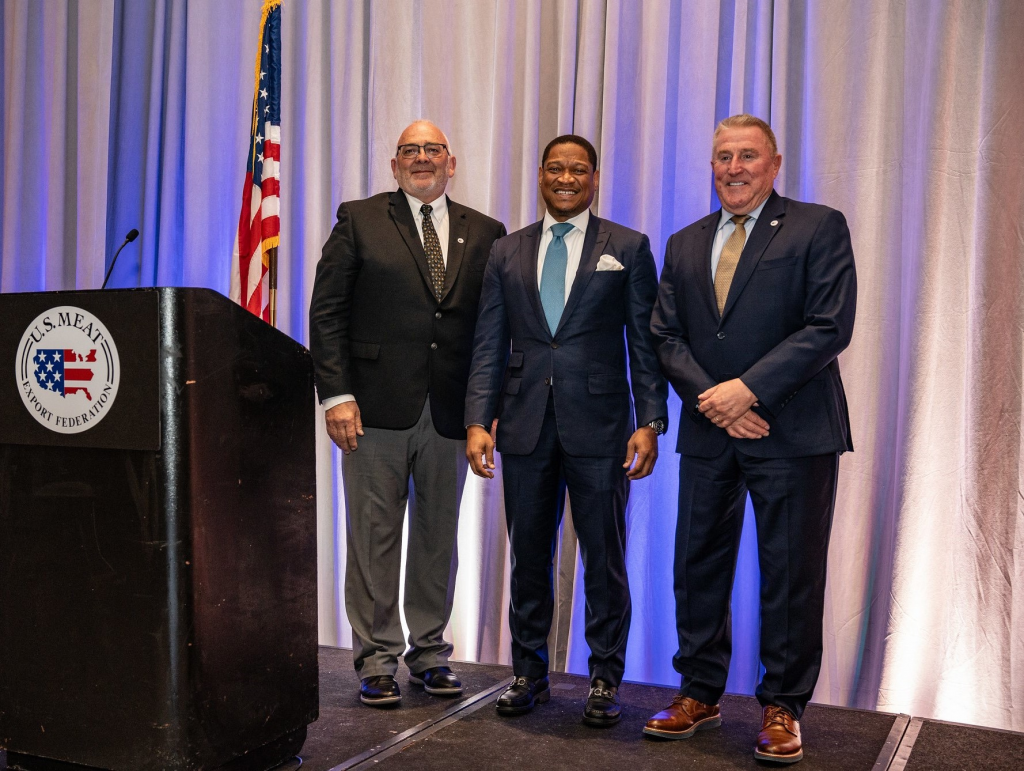
(from left) USMEF Chair Randy Spronk, USDA-FAS Administrator Daniel Whitley, USMEF President and CEO Dan Halstrom
Emphasizing the quality and consistency of U.S. red meat is the key to expanding the international customer base, according to the impressive lineup of opening day speakers on Wednesday at the U.S. Meat Export Federation (USMEF) Spring Conference in Kansas City. USMEF members from throughout the nation also learned about additional resources available to promote U.S. pork, beef and lamb in emerging markets through USDA's new Regional Agricultural Promotion Program (RAPP).
USMEF Chair Randy Spronk, a pork and grain producer from Edgerton, Minn., welcomed attendees with a reminder of how critical free trade agreements (FTAs) have been in creating global opportunities for the U.S. red meat industry.
"Would we have found success in South Korea if U.S. beef was still tariffed at 40% and U.S. pork at 25%?" Spronk asked. "Would we have been able to develop Central and South America, or the Dominican Republic, into reliable destinations for U.S. red meat?"
While they are not full-blown FTAs, Spronk also praised the market access gains achieved in the U.S.-China Phase One Economic and Trade Agreement and the U.S.-Japan Agreement.
"With the weak yen and other headwinds in Japan, imagine trying to compete effectively there if U.S. beef and pork were still at a tariff disadvantage," Spronk noted.
USMEF President and CEO Dan Halstrom followed with an update on year-to-date export results for U.S. pork, beef and lamb. On the pork side, Halstrom explained that while shipments to leading market Mexico are on a record pace, U.S. pork is achieving broad-based growth in several regions. Halstrom noted that first quarter export value ($2.1 billion) equated to more than $64 per hog slaughtered, while March exports averaged nearly $71 per head.
March was also a great month for U.S. beef export value, which equated to nearly $455 per head of fed slaughter. The first quarter average was $408, up 9% from a year ago, which Halstrom said was a very encouraging metric.
"This tells me that the global consumer is willing to pay because they understand the value of U.S. beef," Halstrom said. "We're different. We're higher value, higher perception. U.S. beef is not a commodity product, like a lot of our competitors. This is a key takeaway."
Guest speaker Randy Blach, CEO of CattleFax, echoed these sentiments in explaining how U.S. beef competes for the consumer dollar, both in the U.S. and internationally.
"The biggest change in the beef industry has been quality," Blach said. "And we can never lose sight of that – our niche is grain-fed, high-quality beef that really nobody else can produce around the globe. Those of you who are producers in the room, you have also invested in genetics and you have gotten paid dividends for those decisions."
Blach also gave an update on the U.S. cattle industry's herd rebuilding efforts. He noted that the U.S. herd is not yet in expansion mode, but liquidation has definitely slowed, and the herd size has stabilized. He cautioned that even when expansion does materialize, it will not mirror the previous expansion cycle.
"The cost of money is significantly different, and there's a worry hanging over people's heads about going back into a La Niña [weather pattern]," Blach said. "The last cattle cycle saw the most rapid expansion in the history of our industry in 2014 and 2015. This time I think we'll get some expansion, but it's going to stretch out over a longer period of time."
As for expanding exports, Blach stressed the need for patience and persistence in developing new markets.
"During my career at CattleFax, I have seen how USMEF is able to go into these markets and build a foundation," he explained. "Japan didn't just become our biggest market overnight, did they? It took decades to build that market, to build confidence and to build relationships. This is not instant gratification that you're talking about. You need to have a vision of the decisions you're making today, and know that we may not see the fruit of those decisions until five or 10 years down the road."
Daniel Whitley, administrator of USDA's Foreign Agricultural Service, praised USMEF members for their productivity gains while also providing an update on RAPP funding allocations. He highlighted RAPP's goal of helping U.S. exporters expand their customer base beyond traditional and established markets, focusing on regions such as Africa, Latin America and Southeast Asia.
Whitley noted that RAPP places a specific emphasis on Africa, which is projected to hold 25% of the world's population by 2050. That same year, the planet's total population is expected to reach 10 billion, which presents a massive food production challenge.
"There is no way – no way – that the global agricultural community will be able to solve the problem of feeding 10 billion people by the year 2050 if we don't embrace science, technology and innovation," Whitley said. "All of the wonderful seed techniques, all of the wonderful techniques we use to grow livestock and farm animal products, we need all of these techniques. We're not going to find new land and plant our way out of this problem, so there's really only one path forward and I do think it's the embrace of science, technology and innovation."
USMEF members also received unique insights about global food security issues from Kip Tom, former U.S. ambassador to the United Nations for Food and Agriculture. Ambassador Tom stressed that our national security is dependent on our food security, and he too emphasized the need to embrace production technologies.
"The innovation that has taken place in agriculture, whether it's on the livestock side, or the grain side, or food processing – it's something we need to be very proud of," Tom said. "We oftentimes say that the U.S. innovates, China replicates and the EU regulates. But we need to make sure we keep those in check, so that we can continue to innovate, grow our economy and grow this industry."
While Tom believes the U.S. must pay close attention to the global trade advances made by major agricultural competitors, he shares the opinion that an emphasis on quality will differentiate U.S. products and lead to continuing opportunities for American agriculture.
"When I look at Brazil, for example, and what they're exporting in terms of animal proteins, what they're doing in terms of exporting grains, the reality is, they're mostly exporting commodities," said Tom. "And this is where the real opportunity is for U.S. agriculture – to make sure that we add value and ensure that we set ourselves apart in the global marketplace, to maintain and grow our markets."
The USMEF Spring Conference continues through Friday, May 24. Thursday's program will feature a panel discussion on consumer perceptions of red meat products, as well as meetings of USMEF's sector-specific standing committees. Friday's general session will focus on the organization's efforts to build global demand for underutilized beef and pork cuts.
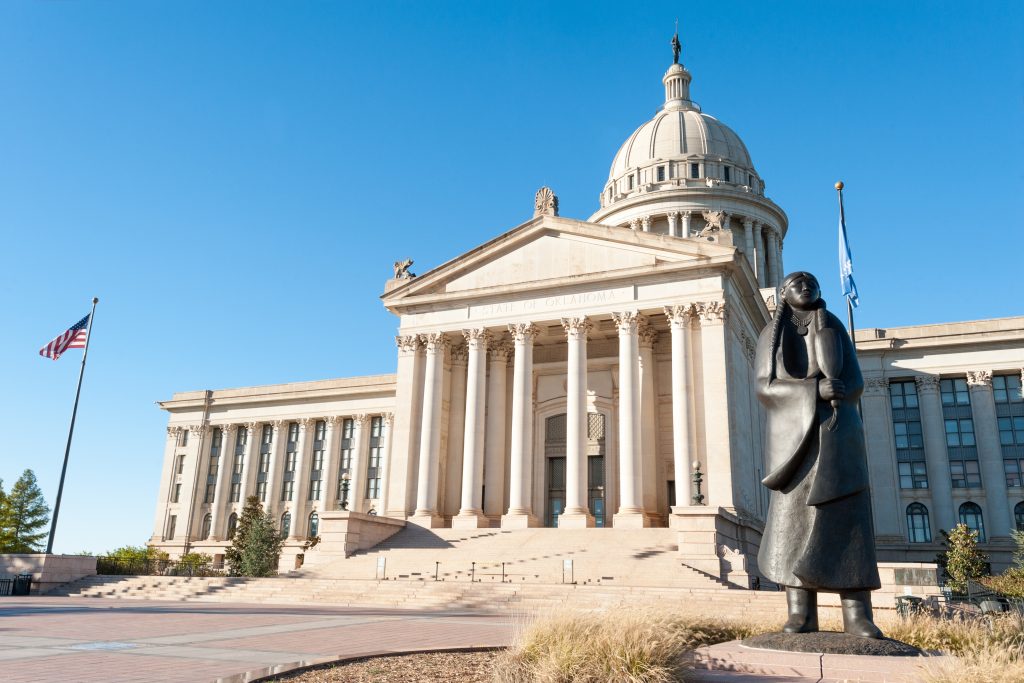
State leaders released the following statements Wednesday after an agreement was reached on the Fiscal Year 2025 budget.
Senate Majority Leader Greg McCortney, R-Ada:
"I'm appreciative of everyone who has provided input on this year's budget as our cooperative efforts ensured the needs of Oklahomans have remained at the forefront of our conversations and negotiations. Further, I applaud Pro Tem Treat for launching transparency initiatives that have led to this all-encompassing and fiscally responsible budget agreement. This approach has ensured all voices were represented throughout the process and has set a standard for effective governance and accountability moving forward. I look forward to expanding on these efforts to make Oklahoma's budget process the most transparent in the nation."
Speaker Pro Tempore Kyle Hilbert, R-Bristow:
"It's often said that successful negotiation is not about getting to yes, it's about mastering no and understanding what the path to an agreement is. During this negotiation process, neither chamber got every item they would have liked, but what we did get was a good budget for the people of Oklahoma.
It's important to remember that the budget agreements and decisions made today can have a lasting impact in the future. I'm thankful that the House and Senate could reach an agreement, and I'm optimistic about our ability to continue addressing areas of concern and disagreement in the future."
House Majority Floor Leader Jon Echols, R-Oklahoma City:
"During my 12 years in the Legislature, we have encountered some of the most difficult budget issues that Oklahoma has ever seen, and we found a way to work together to lift our state up and get back on track.
Thankfully, due to shrewd budgeting practices and forward thinking, those issues have been left in the past and now the conversations regarding the budget surround how much to spend and how much to save. That's a great problem to have. I'm thankful for the robust budget conversations that took place this year, and confident that we have delivered a budget that will address issues that matter to the citizens of our state."
Senate Appropriations Chairman Chuck Hall, R-Perry:
"This state budget meets the needs of all Oklahomans in a comprehensive and fiscally responsible manner. I'm proud this spending plan was born out of the most transparent budget process in state history, which included countless public meetings that allowed the public to remain involved and engaged as we discussed every line item. I want to thank Senate Pro Tem Greg Treat once again for putting his faith in me to get this budget to the finish line."
House Appropriations & Budget Chairman Kevin Wallace, R-Wellston:
"The budget agreement reached today will provide much needed funding for a wide array of projects and programs across our state. Negotiations are rarely quick and easy, but the process produced a budget that focuses on the main priority of the House: our constituents.
I'm thankful for the countless hours that House staff put into this process, and the work of our appropriation's subchairs, and subcommittees, to ensure that we were up to date with all information necessary to negotiate in good faith."
Senate Appropriations Vice Chairman Paul Rosino, R-Oklahoma City:
"This agreement reflects our commitment to transparency and fiscal responsibility while prioritizing the needs of our constituents. Though the process proved difficult at times, I am appreciative of my legislative colleagues for their continued collaboration. We have crafted a comprehensive budget that supports key initiatives across Oklahoma, and I am confident that this will serve the best interests of our state for the fiscal year ahead."
House Appropriations & Budget Vice Chairman Trey Caldwell, R-Lawton:
"Over many weeks and months, dating back to last Fall, the House has been dedicated to a transparent budget process that addresses the needs of our citizens and is fiscally responsible for the future of our state.
Today's budget agreement delivers a budget that will do exactly that. I'm thankful for the leadership of Chairman Wallace during this process, and the hard work of House budget staff to come in early, and stay late, to make sure we were always prepared for meetings and able to negotiate a good budget for all Oklahomans."
The U.S. House of Representatives passed H.R. 4763, the "Financial Innovation and Technology for the 21st Century Act, by a margin of 279-136. FIT21 provides the robust, time-tested consumer protections and regulatory certainty necessary to allow digital asset innovation to flourish in the United States.
"Clarity in digital assets is crucial. Today's bipartisan passage of FIT21 is a significant milestone. It underscores the House Committees on Agriculture and Financial Services' efforts to establish a much-needed regulatory framework," said Chairman Glenn 'GT' Thompson (PA-15). "This framework is designed to protect consumers and investors while fostering American leadership in the digital asset space. I extend my thanks to Chairman McHenry for his leadership and that of our subcommittee chairs, Rep. Johnson and Rep. Hill, in moving this legislation."
"Today, the House took a historic step by passing FIT21 with broad, bipartisan support," said Chairman Patrick McHenry (NC-10). "FIT21 provides the regulatory clarity and robust consumer protections necessary for the digital asset ecosystem to thrive in the United States. The bill also ensures America leads the financial system of the future and remains a hub for technological innovation. I appreciate the partnership of Chairman Thompson, as well as Congressmen French Hill and Dusty Johnson. This landmark initiative would not be possible without their steadfast leadership. The overwhelming support for FIT21 in the House should serve as a wakeup call to the Senate and this Administration. They must come to the table to ensure the Americans who engage with digital assets can do so safely."
"House passage of FIT21 is necessary to bring stability and clarity to the digital assets ecosystem," said Rep. Dusty Johnson (SD-AL). "Without this bill, digital asset innovation will continue to be filled with uncertainty. Today's victory gets us one step closer to establishing clear rules of the road for developers in the industry so America can remain a global hub for tech and finance innovation. I hope the Senate considers this bill soon so we can finalize this essential framework."
"Today is a historic day for American consumers, investors, and innovators. I applaud the House's bipartisan passage of FIT21, which crafts a 'fit for purpose' regulatory framework for digital assets that protects consumers and investors while securing the United States as a leader in blockchain innovation. As FTX's collapse showed, we need a functional regulatory framework in place to create consumer protections that currently do not exist, while ensuring America is a leader in the digital asset market," said Rep. French Hill (AR-02). "This legislation passed in a bipartisan manner, signaling that consumer protection and American innovation are priorities for lawmakers on both sides of the aisle. I thank House Financial Services Chairman Patrick McHenry, House Agriculture Committee Chairman G.T. Thompson, and Agriculture Subcommittee Chairman Dusty Johnson for their outstanding leadership and collaboration on this bill, and I applaud each member of our committees who worked tirelessly to move this landmark legislation across the House Floor. FIT21 is the first legislation of its kind in United States history to pass a chamber of Congress, and I remain committed to pushing this legislation forward until it becomes law."
Background
On July 20, 2023, Chairman Glenn "GT" Thompson, Rep. French Hill, Rep. Dusty Johnson, Whip Tom Emmer, and Rep. Warren Davidson introduced H.R. 4763, the Financial Innovation and Technology for the 21st Century Act (FIT21). Chairman Patrick McHenry is a cosponsor of the legislation.
FIT21 establishes clear and functional federal requirements over digital asset markets. It provides the robust consumer protections and regulatory clarity necessary for the digital asset ecosystem to thrive in the U.S.—cementing American leadership of the global financial system of the future while reinforcing our role as a hub for innovation.
The legislation provides the Commodity Futures Trading Commission (CFTC) with new jurisdiction over digital commodities and clarifies the Securities and Exchange Commission's (SEC) jurisdiction over digital assets offered as part of an investment contract. Additionally, the bill establishes a process to permit the secondary market trading of digital commodities if they were initially offered as part of an investment contract. Finally, H.R. 4763 imposes comprehensive customer disclosure, asset safeguarding, and operational requirements on all entities required to be registered with the CFTC and/or the SEC.
FIT21 will protect consumers by strengthening transparency and accountability with market participants:
FIT21 will strengthen the market by protecting digital asset projects:
FIT21 will protect digital asset customer-serving institutions by:
Creating comprehensive registration regimes to permit them to lawfully serve customers in digital asset markets.
In his April 24 Drovers opinion, "Protectionism's Persistent Misunderstandings," Nevil Speer states this is his third-in-a-series foray into claims about international trade. This is my third response (see one and two). Speer now asserts R-CALF USA exemplifies a group that "condemns the presence of international trade."
No, we don't! But we do condemn stupid trade policies that result in persistent trade deficits and excessive import penetration.
Let's answer a fundamental trade question: Can unlimited imports destroy an American livestock industry?
The chart below contains four decades of data depicting the cattle industry's canary in the coal mine – its sister sheep industry.
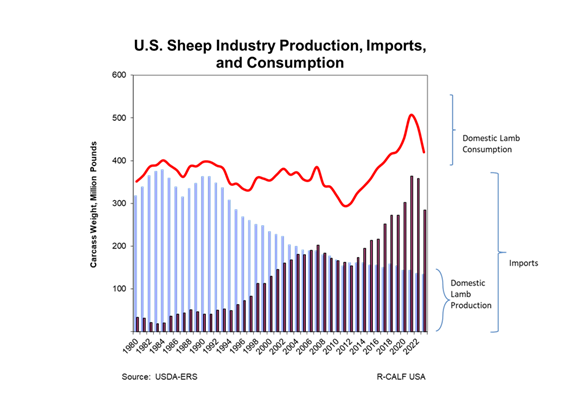
The chart reveals that until the early 90s, production (blue columns) followed consumption (red line). But after the start of the free trade frenzy in the 90s, production began decreasing at about the same rate that imports (maroon columns) were increasing, even while consumption remained relatively high!
Soon after the 2005 U.S.-Australia Free Trade Agreement, the sheep industry became the first American livestock industry to be outsourced – U.S. consumers relied more on imports for their lamb and mutton than their beleaguered sheep industry could any more produce. For a moment the sheep industry received a temporary reprieve – a multi-year Australian drought that slowed imports through 2012. Domestic consumption exploded after 2012, and so did imports. In fact, imports satisfied all of America's increased lamb and mutton consumption while domestic production continued its decline. During this period, the U.S. sheep inventory declined ~61 percent; the number of 100-plus head sheep producers shrank ~63 percent; and rural communities once supported by sheep hollowed out. By 2022, ~74 percent of the lamb consumed in America was foreign.
Unlimited imports have decimated our domestic sheep industry. It is now incapable of meeting domestic demand should foreign supply chains become disrupted. America is now dependent on imports for most of this staple protein.
This is a real example of the impact of unlimited imports and is the result of stupid trade policies. And did I mention the sheep industry is the cattle industry's canary in the coal mine?
So, what should be done? Should we retreat to the laboratory and create complicated regression analyses using hand-picked variables that may or may not reflect conditions in the real world?
That's what Speer did in his chart showing imported live cattle have essentially no impact on fed cattle prices. Really? Does the law of supply and demand not apply to fed cattle prices? Do imported live cattle not represent an increase in supplies? And, are we to presume demand for fed cattle is not already altered by the volume of beef imports that are satisfying a portion of consumer demand before the bidding for fed cattle even begins?
Again, the impact of imports cannot be evaluated by looking only at hand-picked branches on a tree within a forest containing both imported beef and beef produced from imported cattle (see one and two).
But Speer continues, asserting imported cattle have essentially no impact on domestic cow numbers. Really? Basic economics inform us that if the U.S. did not import ~2 million head of cattle each year, there would be more profitable opportunities for both existing and new cow/calf producers. Doesn't the law of supply and demand apply here either? And don't economists refer to these imports as direct substitutes for domestic cattle? To "substitute" is to take the place of another, and imported cattle take the place of domestic cattle, period. My last response provides a real life example of how imported cattle have taken the place of domestic cattle.
Cow/calf producers will recall when their returns per bred cow increased to then record levels in 2004-2005, the result of the U.S. banning Canadian live cattle imports for over two years.
Policy makers have listened to Speer and his counterparts for decades. That's why we've lost an additional 107,000 beef cattle producers and 2.5 million beef mother cows in just the past five years, all while beef demand was strong! Producers must stop supporting stupid trade policies.
**Note to editors: This op-ed first appeared on Drovers.com.Bill Bullard is the CEO of R-CALF USA, the nation's largest nonprofit trade association exclusively representing U.S. cattle producers in the multisegmented beef supply chain. Bullard's photo is available here.
There was a time when agricultural economists who focus on farm policy didn't take a position on a farm bill proposal. At least the authors of this article were taught by our mentors...just describe what's in a policy proposal and don't take a position...that's not your job. Good and bad was for others to decide...primarily elected officials since it is, in fact, their job. Those days are over. In the last two weeks since the House Agriculture Committee majority released details of their bill, there has been a steady stream of articles talking about the proposal's reference price increases as being tilted to the South and Southern crops.
We thought we would instead try to provide facts and information that you can use to help decide whether any proposed bill—House or Senate—is providing a safety net for all U.S. farmers.
Fact #1
During the development of every farm bill, there are people who say unequivocally that one or more commodities are advantaged relative to others. In the current environment – with ARC and PLC as the Title I safety net programs – since they are both countercyclical, producing a map that shows payments are higher in one area really means very little. It very likely means that prices for those crops are lower and triggering payments, not that the farm bill was titled toward producers of those crops.
Fact #2
While farm bills encompass a broad range of topics, producers rely on the programs in Title I and Title XI to provide a minimal safety net so they can endure economic downturns like we are currently in. Without meaningfully bolstering the safety net provided in Title I and Title XI, the producers we encounter all over the country see little benefit in passing a new farm bill.
Fact #3
Statutory reference prices were established in the 2014 Farm Bill and have not kept up with increases in the cost of production. Using USDA cost of production data, the average increase in costs from 2014 to 2023 (the most current) for corn, cotton, grain sorghum, peanuts, rice, soybeans, and wheat was 31 percent.
Fact #4
The effective reference price (ERP) provisions included in the 2018 Farm Bill allow individual crop reference prices to increase based on the 5-year Olympic average of market prices (lagged one year) multiplied by 85%. ERPs are capped at 115% of statutory reference prices. Of the 23 covered commodities with reference prices, only 10 (corn, oats, soybeans, grain sorghum, large chickpeas, small chickpeas, mustard seed, crambe, sesame seed and temperate japonica rice) had market prices increase enough to result in a 2024 ERP greater than the statutory reference prices in the 2018 Farm Bill. Of these 10, only corn, soybeans and grain sorghum represent significant base acreages. Based on realized market prices and CBO projections, corn and soybean ERPs are expected to increase each year and hit the 115% cap in each year through 2027. Based on hearing testimony in both the House and Senate, commodities not in that position were seeking reference price increases in the next farm bill.
Fact #5
Statutory reference prices are set by Congress. In past farm bills, at least since the 1970s, reference prices and their predecessor (i.e., target prices) have been established with the commodity's cost of production in mind. Looking at major crop cost of production for 2023 indicates that current reference prices are not covering much of major commodity costs (Table 1). This happens for two reasons: (1) costs are higher than reference prices and (2) the payment calculations use an 85% payment factor to reduce payments. Based on USDA data, wheat and grain sorghum appear to have the strongest case for significant reference price increases, but USDA data is just one resource the Committees use in establishing support levels.
Table 1. Major Crop Cost of Production, Effective Reference Prices and Percent of Costs Covered by the Effective Reference Price.

Article courtesy of Southern Ag Today: Joe Outlaw, Bart Fischer, and Nathan Smith
RON's Dave Lanning has a pre-opening look at today's agricultural Markets.
Click the audio tab below for today's report.

-- Forever Feed Technologies today announced an investment coalition of fifteen leading dairy and beef producers from California, Texas, Indiana, and Michigan to accelerate the technology development and complete the world's largest enterprise scale on-farm feed mill growing highly nutritious Automated Sprouted Grain™(ASG). As future installations of the technology are complete, the group envisions saving billions of gallons of water and significantly reducing the climate impact from feeding cattle. The first FFT Feed Mill is currently under construction at the River Ranch Dairy in Hanford, California.
The Forever Feed coalition includes: River Ranch Farms, Hanford, CA; Bar 20 Dairy, Fresno, CA; Producers Dairy Foods, Fresno, CA, Grimmius Cattle, Hanford, CA; Wreden Ranch, Hanford, CA; Hollandia Farms, Hanford, CA; Central Valley Meat Company & Harris Ranch Beef, Hanford, CA; Rancho Teresita Dairy, Tulare, CA; Associated Feed & Supply, Turlock, CA, Red Triangle Oil Company, Fresno, CA; High Roller Dairy, Hanford, CA; D&J Dairies, Hereford, TX; de Jong Family Farms, Franceville, IN; Prairie View Dairy, Delton, MI; M.F. Rosa Dairy, Hanford, CA. These coalition members consistently lead the charge to deploy innovative technology and climate-smart practices and together they feed over 500,000 head of cattle every year.
"We are extremely pleased with the caliber of our second-round investment coalition," remarked Jack de Jong, owner of River Ranch Farms and co-founder/CEO of Forever Feed Technologies. "Our investors are some of the leading producers and businesses in agriculture and represent the forward-thinking innovators needed to help solve the major challenges of water shortages and the climate impact facing our industry."
"Bar-20 Dairy is pleased to be one of the founders of Forever Feed Technologies. We are excited to be joined by this esteemed group of innovative ag leaders." said Steve Shehadey, owner of Bar 20 Dairy. "We have great trust in the experience of Forever Feed's co-founders, Jack de Jong and Steve Lindsley, and their management and engineering teams. At Bar-20, we are always looking to reduce our environmental impact and adding FFT feed mills to our operation will complement our sustainability efforts, including the methane reduction fuel cell technology we installed last year."
"The dairy and beef industries share many of the same opportunities for improving the quality and sustainability of the foods they produce," said Brian Coelho, President/CEO of the Central Valley Meat Company and Harris Ranch Beef. "Having both dairy and beef operators join the Forever Feed investment coalition expands FFT's ability to tap into our expertise as they develop the most dependable and sustainable high-volume feed mill in the world."
The Forever Feed Mill is an enterprise scale system that grows Automated Sprouted Grain™ (ASG) year-round, such as wheat and barley, to enrich the animal's daily diet. The benefits to both farmers and animals are increased productivity, improved animal health, nutritional consistency, plus significant resource savings of water, land, and fuel emissions.
The first Forever Feed Mill is being built at the River Ranch Dairy in Hanford, California, and is anticipated to begin growing Automated Sprouted Grain™ (ASG) by the fourth quarter of this year.
ABOUT FOREVER FEED TECHNOLOGIES
Forever Feed Technologies is a pioneering leader in automated agricultural feed systems designed to provide environmentally conscious, economically viable, and sustainably produced feed that will enhance food security and self-reliance worldwide. As the world grapples with the challenges posed by changing climates, the agriculture sector has emerged as a critical arena for sustainable innovation. Forever Feed Technologies signifies a profound leap towards achieving climate-neutral agriculture by 2050, and a more sustainable future for all. Forever Feed is based in both Hanford, California and American Fork, Utah.
Members of the Senate and House Democratic Caucuses issued the following statements after Republican leaders announced they'd reached agreement on the Fiscal Year 2025 budget. The new fiscal year begins July 1.
"While we appreciate this agreement should negate the need for yet another costly special session, we are concerned the budget doesn't address critical needs facing citizens in every district of the state. This is not a bipartisan budget, because it misses important opportunities to invest more in our schools, health and mental health, and other programs that would have improved the lives of working Oklahomans and their families." – Senate Democratic Leader Kay Floyd, D-Oklahoma City.
"We will never stop demanding better for the people of Oklahoma. We're ready to support a budget if it solves the problems Oklahomans are facing every day and puts people over politics. Oklahomans want education funded for success for our kids, timely access to mental health care, and ethics systems that hold our elected officials accountable if they break the rules. What we've seen from the budget so far, these challenges are not yet being addressed." – Sen. Julia Kirt, D-Oklahoma City.
"By keeping the Democratic Leaders out of the public budget discussion process, issues important to Oklahomans have not been prioritized, such as affordable and accessible child care, addressing hunger by providing free school lunches to students across our state, and investing in health care to ensure people can access physicians and the care they need. Instead, we have observed Republican infighting, which unnecessarily prolonged the budget process. Now the process is being rushed, which does not give legislators, stakeholders, or the public enough time to fully understand the budget and know how our tax dollars will be spent. In the future, we need to work together on bipartisan solutions that address real challenges in our state and benefit all Oklahoma families."– House Democratic Leader Cyndi Munson, D-Oklahoma City.
Senate Pro Tem Greg Treat, R-Oklahoma City, and House Speaker Charles McCall, R-Atoka, today released the following statements after Senate and House negotiators reached an agreement on the state's Fiscal Year 2025 budget.
The budget agreement is the first time all meetings were hosted in public and gave Oklahomans a behind the scenes look on how the state budget is negotiated.
Senate Pro Tem Greg Treat
"I am proud of how this process played out in a transparent manner," Pro Tem Treat said. "It has been contentious, stressful and at times combative. But it is the legislative process that has historically been behind closed doors, never available to public view. For the first time, Oklahomans were able to see how these meetings happen behind the scenes. I appreciate my colleagues in the Senate and House who participated in this new process and my hope is that they will build upon it in the future and continue improving this moving forward. I especially want to thank Appropriations Chairman Sen. Chuck Hall, Appropriations Vice Chairman Sen. Paul Rosino and Floor Leader Sen. Greg McCortney, as well as our staff who have put in hours of work, late nights and helped get this to where we are today.
"Oklahomans deserve to know how their money is being spent and where we prioritize funding. The governor committed today that he will sign this budget and I look forward to getting it to his desk."
House of Representatives Speaker Charles McCall
"Throughout the budget process I have empowered the House negotiating team to negotiate a budget on behalf of our body and the Oklahomans we represent," Speaker McCall said.
"Today's budget agreement with the Senate is the culmination of those robust negotiations, and I want to applaud the hard work of our House negotiating team and budget staff for getting this across the finish line. The House showed our commitment to transparency and good faith throughout the process, and we are thankful that a deal was reached."
Fiscal Year 2025 Budget Highlights
Education
Health
Public Safety
Miscellaneous
The final agreed upon budget numbers will be published here.
To access the House of Representatives budget portal click here.

This spring, alongside the routine annual updates of economic assumptions and genomic scores, significant enhancements will be implemented in the Sire Evaluation Report and National Cattle Evaluation. These updates will be effective Friday, May 24, and aim to refine the accuracy and performance of the American Angus Association's genetic evaluations.
The Sire Evaluation Report is the biannual report run to update the main and supplemental sire lists, breed averages, percentile ranks and more.
Carcass weight, ribeye area and fat
The enhancements include updates to the carcass model and its genetic parameters, including heritability estimates and genetic correlations.
This carcass model update involves the modeling of the ultrasound fat thickness and ultrasound ribeye area records in the evaluation. Previously, records for animals of different sexes (bulls, cows, and steers) were modeled as separate traits. In 2017, cows and steers were condensed into one trait, and now the Angus Genetics Inc. (AGI®) team will condense the ultrasound traits again by placing all three sexes into one singular ultrasound phenotype. This reduces the model from nine traits to seven traits.
"Our research shows accounting for the sex within a contemporary group yields the same prediction accuracy as the previous model while reducing the model's complexity, which is important for an on-time delivery of the weekly genetic evaluation," said André Garcia, senior geneticist with AGI®.
An updated model also means an update to the genetic parameters inside this genetic evaluation.
"This is necessary because we are changing the make-up of the model, which warrants updated variance components. Not to mention, over time the population changes and evolves due to selection," Garcia said. "As more phenotypes are collected, the variances, heritability estimates, and genetic correlations change. By updating genetic parameters regularly, we can accurately estimate the genetic variation in the population and the relationships between traits."
In multiple trait models, as is the case with the carcass evaluation, accurately estimating the genetic correlations between traits is crucial to take advantage of the accuracy that correlated phenotypes bring. This is particularly true of ultrasound records, Garcia said.
Continuous research and the implementation of regular updates ensure accurate and unbiased genetic evaluations are delivered on time. These updated estimates will be seen online, effective May 24, and in the 2024 Fall Sire Evaluation Report.
Core update
Also taking effect on May 24, the core update is related to how genomic relationships are calculated inside of the genetic evaluations.
"This is not a new update, and the most recent core update was implemented in May 2021," said Kelli Retallick-Riley, AGI® president. "Since then, genotypes of more than half a million animals have been added to the weekly evaluation. With the 2023 addition of Angus Australia's genotypes to the World Angus Evaluation, that number has increased by more than 800,000 for a total of over 1.8 million genotyped animals."
With all genotypes being used in the evaluation, Retallick-Riley said the core update ensures a good representation of the genotyped population and provides optimized convergence for the models and computing time efficiencies, allowing AGI® and the Association to maintain a timely delivery of weekly genetic evaluations.
Learn more about the motivation behind core updates on Page 62, "A Good Problem to Have," of the Angus Journal's May issue.
Economic assumption updates
Annually, the bio-economic model driving the Association's $Values undergoes annual updates, utilizing data from CattleFax. Economic assumptions are averaged over the previous seven years for stability, with the 2024 assumptions based on data from 2017 to 2023.
"This long-term perspective mitigates market volatility and aligns with the average cattle cycle," said Esther Tarpoff, director of performance programs.
The May 2024 updates account for rising weaned calf sale prices and ration costs. In May 2023, the average weaned calf price was $167 per cwt. for steer calves and $152 per cwt. for heifer calves. The update increases the average calf price to $182 per cwt. for steer calves and $164 per cwt. for heifer calves.
Ration costs in the feedlot also increased from $199 to $225 per ton, affecting feed costs in the cow-calf sector. These changes influence the outcome of the maternal weaned calf value ($M), where calf price relative to cow cost stays the major revenue driver.
The average price per hundred for a fed steer delivered and dressed increased from $192 per cwt. to $206 per cwt. from 2023-2024. This shift redirects economic weight in beef value ($B) towards weight traits like carcass weight and postweaning gain and away from grid premiums, which only saw a slight increase. Despite the significant increase in fed cattle prices and minimal changes in quality premiums, overall changes in $B are minimal.
Producers might notice a slight re-ranking favoring cattle excelling in feedlot value $F over those at the top of the $B ranks to their $G, Tarpoff said. Some individual animals experienced changes, with the largest decreases in $M, $B, and $C being -$4, -$6, and -$9, respectively across the 4,146 current sires.
"Changes in $Values will be less likely due to economic assumption updates and more likely due to changes in individual EPDs from other evaluation updates," she said. "Overall, updates didn't substantially alter individual $Values, with economic assumption updates resulting in correlations above 0.99."
Annual genomic scores update
Genomic scores are also updated annually. This process involves updating SNP effects for each trait based on additional phenotypes and genotypes from the previous year.
The May 2024 update includes a larger reference population (n= 1,593,532), which genomic scores are ranked against. With an increased number of genotyped animals, the reference population grows, leading to re-ranking. Genomic scores are a by-product of genetic evaluation and are updated alongside EPDs.
"It's preferable to use genomically-enhanced EPDs for selection decisions, with genomic score updates not affecting EPDs themselves," Retallick-Riley said.
For more information about updates specific to phenotypic traits, read the "By the Numbers" column in the Angus Journal's May issue.
Phenotypic trait updates
Since 2021, phenotypic traits submitted to Angus Herd Improvement Records (AHIR®) were listed in a variety of places, including the performance registration certificate and EPD/Pedigree Look-up. Adding these traits provides visibility to members submitting phenotypes on animals and continues to fuel genetic evaluation.
Taking it one step further, starting on May 24, some phenotypes will be bolded in the list while others are not. This differentiates what phenotypes are included in the genetic evaluation and which traits are not. The phenotypes included in the genetic evaluation helped to inform the predictions for EPDs.
Heifer Pregnancy contemporary groups
Updates made to the heifer pregnancy contemporary groups aim to better characterize weather and environmental conditions that could affect heifer pregnancy outcomes.
"Contemporary groups play a significant role in any genetic evaluation, accounting for non-genetic sources of variation that affected an animal's phenotype," Garcia said. "This update leads to a more accurate and less biased heifer pregnancy genetic evaluation."
The "By the Numbers" column in the Angus Journal's April issue dives into further detail about updates to the heifer pregnancy genetic evaluation.
– Written by Sarah Kocher, Angus Communications
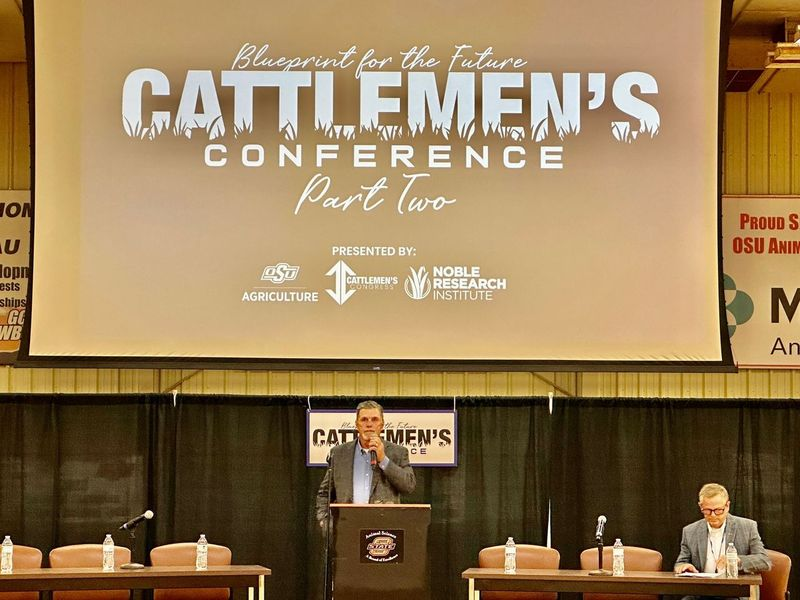
At Cattlemen's Conference Part 2: Blueprint for the Future, Senior Farm and Ranch Broadcaster, Ron Hays, had the chance to visit with Oklahoma State University Extension Beef Cattle Breeding Specialist, Mark Johnson about this year's conference and discussions that are taking place. The conference is being held at OSU's Totusek Arena and will run through midday Thursday.
"At OSU, we have a history of significant beef cattle conferences," Johnson said. "A few years ago, we began the idea of having the first one, and last year we found ourselves addressing a variety of topics from ethics in marketing to late-day morbidity in feedlot cattle, to selection for extremes. By the time we were done after two days, we had a really good event and a good crowd, and we decided that we had some pretty important topics left."
As Johnson explained, this year's Cattlemen's Conference Part 2: Blueprint for the Future covers more topics, including those that were not afforded enough time at the previous conference.
"Our hope is that people will take advantage of what this conference has to offer and leave with more information, the opportunity to dialogue with their peers while they are here the next couple of days, and feel empowered to improve upon what they are doing, and take their beef operation to the next level," Johnson said.
Over the next few days, Johnson said there will be a great set of speakers discussing topics from selection and mating to regenerative ranching and gene editing.
"The future belongs to those who show up to make the decisions, and we hope everybody makes the most out of this opportunity," Johnson said.
A highlight of the conference will be a discussion of gene editing in animals with Dr. Alison Van Enennaam from the University of California-Davis. As everyone's operation is different, Johnson said each person can come out of the convention with something different.
"I think there will be morsels that come from different parts of the program that will pertain to one operation or another," Johnson said. "It is up to producers to use that to their advantage."
Thanks to an investigative tip from the Blaine County Sheriff's Office, agents of the Office of the Attorney General (OAG) led a raid May 21 on an illegal marijuana grow west of Watonga that resulted in the confiscation of more than 17,500 untagged marijuana plants and 600 pounds of untraceable, processed marijuana. The seizure was a joint operation of the OAG's Organized Crime Task Force and the Blaine County Sheriff's Office, with additional assistance from the Oklahoma Medical Marijuana Authority (OMMA) and the Oklahoma City Police Department.
Investigators allege the plants, found in a search of more than 100 hoop houses and other structures in a densely packed area, was headed for the black market.
Attorney General Gentner Drummond said the bust is emblematic of how the Organized Crime Task Force is partnering with local law enforcement agencies to stamp out the illegal grows that have invaded Oklahoma since the legalization of medical marijuana.
"The drug cartels and crime syndicates are steadily getting the message that Oklahoma will not tolerate their nefarious activities," he said. "We want them out of our state and out of our lives. Law enforcement will continue to crack down and do what needs to be done to eliminate this pestilence."
The Organized Crime Task Force worked particularly closely with the Blaine County Sheriff's Office. Blaine County Sheriff Travis Daugherty expressed his gratitude to all those involved in the operation, including the Blaine County Commissioners for their help in removing the plants for destruction.
"I want to send a clear message that our vigilance will continue," Daugherty said. "We have established a partnership with a dedicated team that will relentlessly pursue those involved in illegal activities. If you are engaged in such activities, it is in your best interest to leave Blaine County or be prepared to face the consequences enforced by the Department of Corrections."
OMMA Executive Director Adria Berry said she is proud of the partnerships forged.
"We're committed to advancing our mission by working with fellow agencies like the AG's office. Working together has allowed OMMA to more effectively identify and remove bad actors to safeguard the integrity of the state's medical marijuana program," she said.
Four firearms were also seized in the bust.

UPL NA Inc. ("UPL"), a provider of holistic and sustainable agricultural solutions, announces the U.S. Environmental Protection Agency registration of IronGate™ herbicide for use on winter, spring and durum wheat for the control of a broad spectrum of grasses, including multiple brome species, and broadleaf weeds.
IronGate herbicide delivers excellent post-emergent, residual control at a low use rate through its high-efficiency premix formulation of flucarbazone-sodium and pyroxsulam, two leading wheat active ingredients. For winter wheat growers facing brome species in their fields, IronGate herbicide can be applied in the fall or spring to keep these winter annuals from interfering with crop growth and reducing yield. IronGate herbicide also delivers the ultimate defense against a wide range of other troublesome grass and broadleaf weeds, while providing tank-mix flexibility to reduce trips across the field.
Kathy Seitzinger, Strategic Marketing Manager for UPL NA Inc., said: "We are excited to introduce new IronGate herbicide to wheat growers, especially winter wheat growers facing yield-robbing brome species. The flexibility of IronGate herbicide is a big benefit for wheat growers with a wide application window and exceptional tank-mix flexibility."
Using a high-performance liquid formulation of two complementary active ingredients, IronGate herbicide delivers convenient, flush-after-flush control of yield-robbing weeds like wild oats, green and yellow foxtail, barnyardgrass, common chickweed and mustards.
| |||||||||||||||||||||||||||||||||||||||||||||||||||||||||||||||||||||||||||||||||||||||||||||||||||||||||||||||||||||||||||||||||||||||||||||||||||||||||||||||||||||||||||||||||||||||||||||||||||||||||||||||||
|
At the National Association of Farm Broadcasters (NAFB) annual Washington Watch event in Washington, D.C., Farm Director KC Sheperd had the chance to talk with the President and CEO of the Agricultural Retailers Association, Daren Coppock.
The ARA recently wrapped up their annual Washington, D.C. fly-in, which Coppock said focused heavily on the 2024 Farm Bill.
"In our case, we are trying to get some provisions in the Farm Bill that will allow people that have professional certifications in agronomy, so a certified crop advisor, those kinds of certifications, to be considered as third-party service providers under NRCS programs," Coppock said. "That would allow them to write conservation plans for growers and to provide the service for a fee, whereas today if they want to do that, they still have to go to NRCS, even after earning that professional certification and jumping through more hoops to be able to do that."
Coppock said the feedback for this provision has been positive, so when the Farm Bill makes it across the finish line, he is optimistic that it will be included.
"Our main concern is to make sure producers continue to have a safety net underneath them, whether that is the commodity programs and crop insurance or some other innovation they want to make," Coppock said. "There is too much risk out there from weather and markets and everything else for the growers to be out there without any kind of protection whatsoever."
Regarding supply chain issues, Coppock said the supply chain is looking better now than during the height of the pandemic.
"A couple of label issues around pesticides may restrict access to a couple of those products, and there have been a couple of production shortages where there are allegations of certain products in certain markets," Coppock said. "It is nothing like it was in 2021 when we just weren't sure we were going to get anything."
Coppock said he is looking forward to the annual ARA conference set for December 3-5 in Houston, Texas, which he said will focus on artificial intelligence and more. The theme of "Powering Ag Retail's Next Frontier" will guide the speakers and session topics. Registration will open in June 2024.
In this episode of Beef Buzz, Senior Farm and Ranch Broadcaster, Ron Hays, is back talking with Vice President of Governmental Affairs at the National Cattlemen's Beef Association, Ethan Lane about House Committee on Agriculture Chairman GT Thompson's 2024 Farm Bill proposal.
The markup of the 2024 Farm Bill is scheduled for May 23, 2024- click here for current details as found on the House Ag Committee website.
CLICK HERE to listen to Part One of the conversation with NCBA's Ethan Lane.
"Our goal with the Farm Bill was never to be too deeply involved in the Farm Bill," Lane said. "The cattle industry is not like other parts of agriculture. Our producers are pretty independent, and they don't necessarily want to be so tied to the federal government that their livelihood depends on money coming from the federal government or support programs with strings tied to them."
While cattle producers are in favor of programs related to conservation and disaster relief, Lane said the industry has not been involved in issues more pertinent to the farming industry such as those present in the Farm Bill.
"The few things we did ask for appear to be in there, and we are happy with that and we are happy with the Chairman's commitment that he wants to do a bill that doesn't cater to some of these outside forces like the radical animal rights community that wants to gut the checkoff system or is seeking to create some sort of larger opportunity with the Proposition 12 decision in California by allowing the animal rights groups to circumvent a conservative Supreme Court by making nuanced state's rights arguments like they have in that Prop 12 case," Lane said.
Thankfully, Lane said there will not be a livestock title in the 2024 Farm Bill, as it is unnecessary.
"The things we need are in the bill, that is appropriate, and the way it has been done for a very long time," Lane said. "All and all, it is a great draft and something we are excited to see."
Based on comments from Chairwomen Debbie Stabenow Lane said he does not expect the Senate Agriculture Committee to move forward with their version of a Farm Bill.
The Beef Buzz is a regular feature heard on radio stations around the region on the Radio Oklahoma Ag Network and is a regular audio feature found on this website as well. Click on the LISTEN BAR for today's show and check out our archives for older Beef Buzz shows covering the gamut of the beef cattle industry today.

As renewable energy development grows in rural areas, so do concerns about protecting agricultural land, especially from utility-scale solar projects.
The U.S. Department of Energy (DOE) estimates that by 2050 solar will occupy 10.3 million acres of land nationally, 90% of which will be in rural areas. To address concerns about utility-scale solar systems occupying a large amount of prime farmland, some local and state officials have proposed and even placed restrictions prohibiting it.
Alex Delworth, policy associate with the Center for Rural Affairs, said the restrictions are concerning.
"They can be debilitating for solar development, not to mention raise questions about private property rights," he said. "In one instance, we found a county-level restriction related to prime farmland that eliminated 75% of potentially developable land in the area."
While utility-scale solar projects can look intimidating amid concerns about taking land out of production, a new report from the Center for Rural Affairs found their overall impact on agricultural land use is minimal.
"Sifting through Solar: Land-Use Concerns on Prime Farmland," written by Delworth, discusses how restrictions are designed and forecasts solar development's impact on prime farmland in the Midwest region.
The DOE predicts that between 210 and 420 GWs of solar projects are needed in the Midwest by 2050 to meet federal decarbonization standards. According to the report, if all of the forecasted solar was built on the region's prime farmland, it would occupy between 1.45% and 2.9%.
The report also addresses potential short-term impacts in Iowa and Minnesota.
Delworth said if every acre currently proposed for solar development in Iowa was built on the state's top 14% rated farmland (90 Corn Suitability Rating, or CSR, and above), it would occupy 0.54% of the total acres. Furthermore, the proposed solar would occupy only 0.14% of the top 62% rated farmland (65 CSR and above).
The projected impact in Minnesota is also minimal. According to the report, if the number of acres currently proposed were located on prime farmland, it would cover less than 0.3% of the land.
Delworth hopes local, county, and state officials will consider the report's findings as they decide the future of solar development in their area.
"Implementing rules that work with solar development rather than limiting it will open up economic opportunities for rural residents who want to voluntarily lease their land," Delworth said. Renewable energy projects also generate tax revenue for counties, schools, and emergency services as well as create rural employment opportunities.
To read and download a copy of "Sifting through Solar: Land-Use Concerns on Prime Farmland," visit cfra.org/sifting-through-solar.
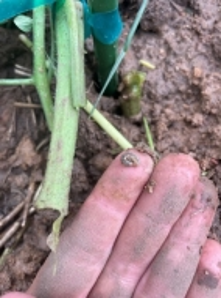
Make sure to scout fields often for threats like this true armyworm found in a rye cover crop.
"With weather patterns we've never seen before, it's hard to predict what insect pressures we'll face," says LG Seeds Agronomist Alex Cox. The elements are certainly there for a challenging year.
Like much of the Corn Belt, Cox's territory — eastern Kansas and western Missouri — experienced a relatively mild winter, with unusually warm, 80 F temperatures in February. "That gave insects a head start," he says. "Plus, it allowed higher survival rates."
Therefore, Cox is urging farmers to be on alert. "Insects can come in, feed and move on, causing significant damage before you realize you have a problem," he says. "That's why I'm urging farmers to scout early and consistently."
Know your at-risk fields
"A good starting place is knowing your problem fields and their history," Cox says. But with these unprecedented weather patterns, he says it's difficult to predict what farmers will run into. Case in point: His counterpart in Texas is dealing with corn leaf aphids, a rarity for the area.
A farmer's threat level depends on the area, the surrounding vegetation and the weather. Cox elaborates, "If you're in a heavy row crop area, insects have fewer alternative environments to feed upon so crop pressure will be heavier." Early planted crops are more prone to insect pressure for the same reason.
Fields with residue are also more vulnerable because the residue gives insects a place to overwinter. "Planting row crops into cover crops has become increasingly popular here because of the erosion control and moisture retention they offer during our hot summers," Cox says. "Those farmers need to scout more often to make sure they don't have slugs or other insects warranting treatment."
Protect crops with seed treatments and traits
A seed treatment is a must when a farmer plants into cover crops or plants early, according to Cox. "LG Seeds offers a premium mix of the industry's seed treatments to control early season insects like cutworms and wireworms," he says. "You'll be able to plant with confidence and sleep at night, knowing you have a layer of control in place to protect your seedlings."
Traits are another line of defense against insect pressure. "Traits offer multiple modes of action against insect pressures extending beyond the seedling stage," Cox says. "Our lineup includes multiple trait products, giving farmers choices for meeting the unique needs of their farm and enhancing their ability to incorporate diversity."
Keep an eye on fields and consider a chemical treatment, if necessary
Cox says he's on the watch for the following three pests in particular:
He recently encountered high levels of black cutworms in a field planted to a rye cover crop. Once the cover crop is terminated and a row crop planted, he fears "cutworms will have a tiny green crop to chew on."
Cox encourages farmers to scout for these bugs from emergence until about V6. Because true armyworms feed at night, he recommends scouting early in the morning or late in the afternoon.
When farmers encounter pressure from pests like black cutworms or true armyworms, Cox says they need to consider a chemical treatment if 25% or more of their plants have two or more larvae on them.
Cox encourages farmers to reach out to their local LG Seeds agronomist for support dealing with pest pressure.

Valley View Agri-Systems (VVA) is pleased to announce that Mike Kraus has joined Team VVA as Landscape Equipment Mechanic & Parts Department Assistant.
"Mike's technical skills set him apart from the rest—and our customers will see the difference in their service and parts experience," says Hayden Cole, Midwest General Manager. "Beyond his superior raw technical skills, he has the drive and ability to diagnostically deep dive to solve any challenge in front of him."
As Landscape Equipment Mechanic & Parts Department Assistant, Kraus will provide preventive maintenance and service for the Gravely and Ariens lawn equipment Valley View sells at its Divernon, Illinois, location. In addition, he will sell and service Kawasaki Engines and provide parts support for customers.
"Throughout my career, I have focused on quality and making sure the customer is satisfied," says Kraus. "I am committed to ensuring every Valley View customer experience is the best."
Kraus completed automotive & diesel training at Universal Technical Institute in Lisle, Illinois, and also gained experience working in the construction field for 20 years. Kraus can be reached at 217-628-6217 or mike.kraus@valleyviewagri.com.
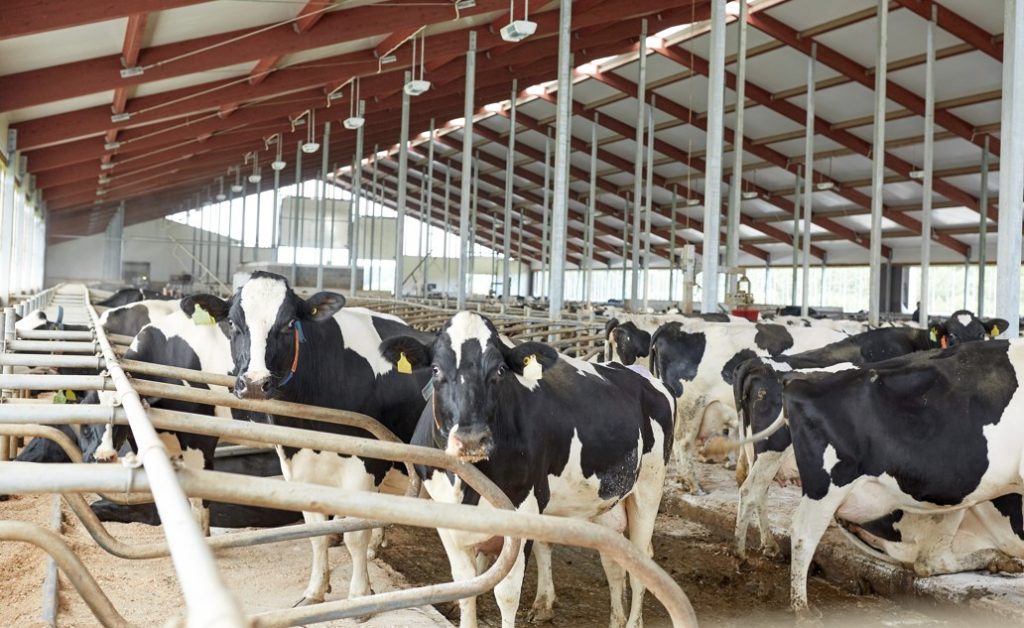
Cooperatives Working Together (CWT) member cooperatives accepted five offers of export assistance from CWT that helped them capture sales contracts for 86,000 pounds (40 MT) of American-type cheese, 88,000 pounds (40 MT) of whole milk powder and 190,000 pounds (85 MT) of cream cheese. The product is going to customers in Asia and Middle East-North Africa and will be delivered from May through November 2024.
CWT-assisted member cooperative year-to-date export sales total 41.2 million pounds of American-type cheeses, 309,000 pounds of butter (82% milkfat), 769,000 pounds of anhydrous milkfat, 11.8 million pounds of whole milk powder and 4.1 million pounds of cream cheese. The products are going to 26 countries in five regions. These sales are the equivalent of 526 million pounds of milk on a milkfat basis.
Assisting CWT members through the Export Assistance program positively affects all U.S. dairy farmers and cooperatives by fostering the competitiveness of U.S. dairy products in the global marketplace and helping member cooperatives gain and maintain world market share for U.S. dairy products. As a result, the program has helped significantly expand the total demand for U.S. dairy products and the demand for U.S. farm milk that produces those products.
The amounts of dairy products and related milk volumes reflect current contracts for delivery, not completed export volumes. CWT pays export assistance to the bidders only when export and delivery of the product is verified by required documentation.

In a bid to bolster the state's blood reserves ahead of the Memorial Day weekend, the Oklahoma Pork Council, in partnership with the Oklahoma Blood Institute, will host a large-scale blood donation drive across various locations. From Thursday, May 23, to Friday, May 24, 2024, community members are invited to donate blood, and in return, they will receive a free pork sandwich, a "Bacon" shirt, and free admission to a select OKC attraction this summer. The drive aims to collect over 1,400 donations to support local medical facilities during the summer's peak periods.
Further, on Thursday, May 23, a mobile center will be set up in Hinton to connect directly with two of our pork-producing communities during Oklahoma Pork's annual drive.
Where: Oklahoma Blood Institute Donor Centers
These locations are part of a broader network of donation sites across the state:
When: May 23-24, 2024, from 8:00 a.m. onward
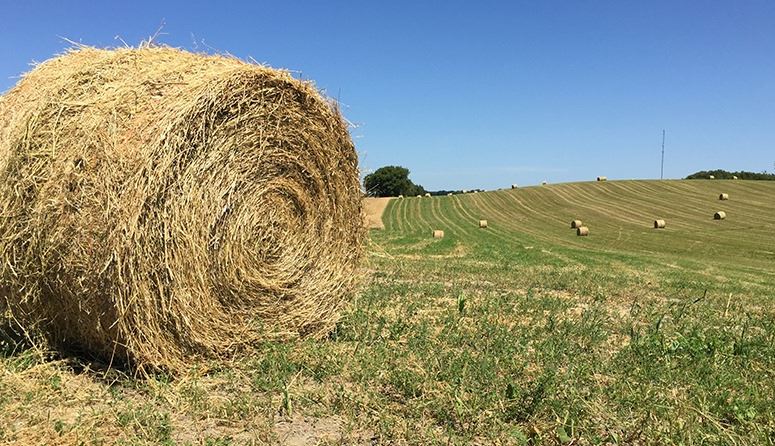
Compared to the last report: The demand and trade remain low. We have had several storms across Oklahoma which have slowed down some hay trade as well as hay baling. Old-crop hay continues to move lower in price as we enter the new hay season. We still have barns full of old-crop hay that are trying to be sold and emptied for new-crop hay.
Trends: Alfalfa Large squares $175-$200 a ton - New Crop
Alfalfa Rounds - No Trend
Grinding hay - No Trend
Bermuda 5x6 rounds - $60-$75 a bale - Year Old Hay
Bermuda Large Squares - No Trend
Wheat Hay 5x6 Round - $75-$100 a Ton - New Crop
Wheat Hay Large Squares - $75-$100 a Ton - New Crop
Grass Hay 4x5-4x6 - $50-$60 a bale - Year Old Hay
Grass Hay 5x6 - $60-$70 a bale - Year Old Hay
Rough Grass Hay any size $30-$40 a bale - Year Old Hay
The Oklahoma Mesonet Drought Monitor shows we are at 0 percent in exceptional drought, 0 percent in an extreme drought, 5.91 percent in severe drought, 20.41 percent in moderate, 48.38 percent in abnor-mally dry conditions, and 51.62 percent that has no drought condi-tions.
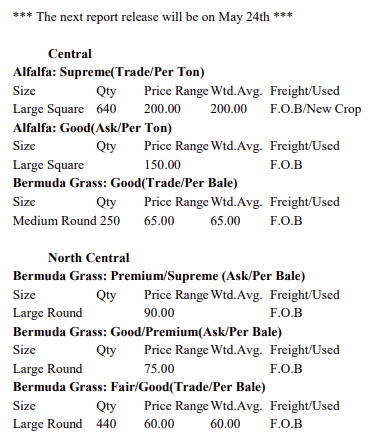
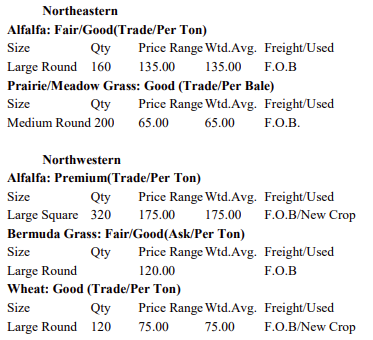
The U.S. Department of Agriculture (USDA) announced that low-income Oklahoma residents recovering from severe storms and tornadoes beginning April 25, 2024, could be eligible for a helping hand from the USDA's Disaster Supplemental Nutrition Assistance Program (D-SNAP).
Agriculture Secretary Tom Vilsack said that approximately 1,000 households that may not normally be eligible under regular Supplemental Nutrition Assistance Program (SNAP) rules may qualify for D-SNAP – if they meet certain criteria, including the disaster income limits and have qualifying disaster-related expenses.
"USDA is committed to making sure that the Oklahoma residents affected by the severe storms and tornados get the vital assistance they need," said Secretary Vilsack. "Helping residents of Oklahoma get back on their feet is a top priority, and we will continue working to expedite access to USDA's nutrition assistance programs."
To be eligible for D-SNAP, a household must live or work in an identified disaster area, have been affected by the disaster, and meet certain D-SNAP eligibility criteria. Eligible households will receive one month of benefits – equal to the maximum monthly amount for a SNAP household of their size – that they can use to purchase groceries at SNAP-authorized stores or from select retailers online to meet their temporary food needs as they settle back home following the disaster. Oklahoma will operate its D-SNAP application for 5 consecutive days beginning Monday, May 20, 2024, through Friday, May 24, 2024. Oklahoma will share additional information about D-SNAP application dates and locations through local media and their website Oklahoma.gov.
The timing of D-SNAP varies with the unique circumstances of each disaster, but always begins after commercial channels of food distribution have been restored and families are able to purchase and prepare food at home. Before operating a D-SNAP, a state must ensure that the proper public information, staffing, and resources are in place.
The D-SNAP announcement today is the latest in a battery of USDA actions taken to help Oklahoma residents cope with recent severe storms and tornadoes and its aftermath, which also include:
For more information about this and other available aid, callers from Oklahoma can dial 2-1-1 or 1-405-487-LIVE. For more information about Oklahoma SNAP, visit Oklahoma's Department of Human Services
USDA's Food and Nutrition Service works to end hunger and improve food and nutrition security through a suite of more than 16 nutrition assistance programs, such as the school breakfast and lunch programs, WIC and SNAP. Together, these programs serve 1 in 4 Americans over the course of a year, promoting consistent and equitable access to healthy, safe, and affordable food essential to optimal health and well-being. FNS also provides science-based nutrition recommendations through the co-development of the Dietary Guidelines for Americans. FNS's report, "Leveraging the White House Conference to Promote and Elevate Nutrition Security: The Role of the USDA Food and Nutrition Service," highlights ways the agency will support the Biden-Harris Administration's National Strategy, released in conjunction with the historic White House Conference on Hunger, Nutrition, and Health in September 2022. To learn more about FNS, visit www.fns.usda.gov and follow @USDANutrition.
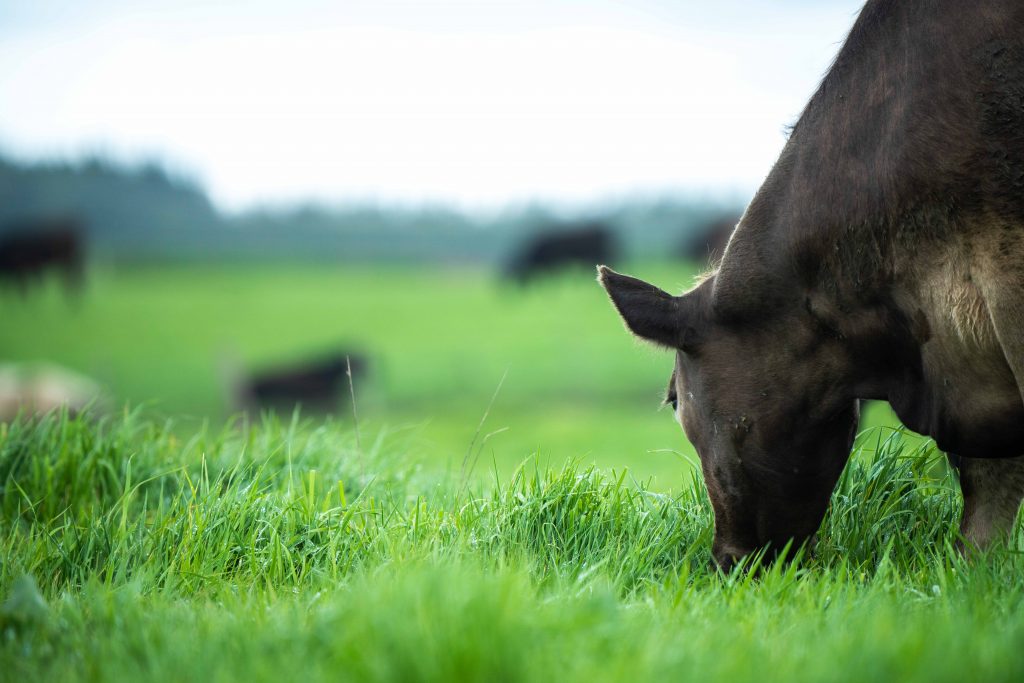
On today's Cow-Calf Corner, Scott Clawson, M.S., Oklahoma State University Cooperative Extension Service NE Area Agricultural Economics Specialist writes about the importance of cull cow values.
As I roam the two-lane highways in eastern Oklahoma going to producer meetings, cull cow prices and the decision to rebuild the cowherd are common points of discussion. In fact, if I ask who has sold some cull cows lately more smiles show up thinking about that check than anything else. The story behind the great cull cow prices has been discussed (see the March 11, 2024, edition). That leaves the expansion discussion up for grabs, and exactly what do cull cow prices have to do with it?
Much of the unease of the expansion decision is tied to the sheer size of the investment. If we decide to retain our own heifers, we will turn down a price that we have rarely seen for a weaning age heifer. Additionally, producers have reported that private treaty and special sales are fetching strong prices for bred females.
One of the most common ways to analyze an investment is to use a net present value (NPV) analysis. That is just a fancy way to say that we are going to invest in something (cow), and we expect it to generate cash (calf sales minus expenses) for a certain number of years (cow longevity) then we will salvage it (cull the cow). NPV guides us in answering the question, what is that investment worth or what should we pay for that replacement? While we process that, there are several issues to unpack. Calf prices, annual cost to run the cow, and longevity usually see the most focus and they are all important.
However, in which year of the cow's productive life will she return the most cash to our investment? Most commonly that will be the year she is culled. In that year, she will likely calve for the last time in the spring and in the fall we will sell her and her calf. This highlights the impact that cull values can have on the math of this investment. On average, we tend to run a cow to failure. More specifically, we will keep them around until she comes up open, has a bad bag, comes up lame, etc. In those instances, we usually get the worst of what the market has to offer.
My speculation is that our current cull cow markets have changed the math from the red to the black on some cattle that we retained over the past decade while prices were more moderate, and expenses increased. Going forward, are there things that we can do to avoid getting the worst of the market? Selling as a bred, improve body condition, selling younger, etc. are all factors that we can manipulate in our culling decision and maximize the cash returned in the final year.
You can visit https://extension.okstate.edu/programs/beef-extension/calculators/ and use the Cow Bid Price Estimate Calculator to evaluate different options for your ranch.
RON's Dave Lanning has a pre-opening look at today's agricultural Markets.
Click the audio tab below for today's report.
The National Association of State Departments of Agriculture has been awarded $5 million through the United States Department of Agriculture Foreign Agricultural Service Regional Agricultural Promotion Program, as announced today by USDA and USDA Foreign Agricultural Service Administrator Daniel Whitley during "A Taste of the States: Chicago" at the National Restaurant Association Show. The program aims to diversify market opportunities for U.S. food and agricultural products by expanding markets beyond the top regions U.S. food and agricultural products are currently exported to.
"We are excited for NASDA members to have additional resources to bolster international marketing opportunities for U.S. agricultural producers," NASDA CEO Ted McKinney said. "With this new investment in diversifying markets and increasing trade, we can support rural and agricultural communities through developing long-term economic impacts."
The USDA Foreign Agricultural Service cites that for each $1 invested in export market development, U.S. agricultural exports have increased by more than $24.
"NASDA thanks USDA for its leadership in building the Regional Agricultural Promotion Program and for recognizing NASDA as a unique leader in growing international market development," McKinney said.
NASDA will use the funding to develop emerging markets by fostering robust relationships, maintaining and improving market access and expanding export opportunities for small and medium-sized U.S. food and beverage companies.
The American Soybean Association, ASA's World Initiative for Soy in Human Health program, and the U.S. Soybean Export Council welcome the funding announced today as part of the initial tranche of the U.S. Department of Agriculture Foreign Agriculture Service's Regional Agricultural Promotion Program (RAPP). This new source of funding will be invested to facilitate diversification and growth of U.S. soybean exports, help meet growing global protein demand, and address nutrition and food security.
"ASA commends USDA for its commitment to strengthening U.S. agricultural trade by providing Commodity Credit Corporation funds through RAPP to maintain and develop markets and address global food security. We appreciate the work by Senator Stabenow, Senator Boozman, and Secretary Vilsack to initiate this much-needed program," said ASA President Josh Gackle, a soybean grower from North Dakota. "New international markets are critical to sustaining U.S. soybean growers' success. This program will open new opportunities while improving upon the success of other programs vital to U.S. soy, like MAP and FMD."
"We applaud Secretary of Agriculture Tom Vilsack and USDA FAS for the creation of RAPP, a critically important and timely program that builds upon decades of success achieved with the Market Access Program, Foreign Market Development Program and most recently the Agricultural Trade Promotions Program," said Lance Rezac, USSEC chair and Kansas farmer. "Current examples of innovative USSEC programs aimed at diversifying markets and growing exports include the Soy Excellence Center and the Right to Protein campaign. The USSEC team is excited to build on these successes and bring to life the creative program concepts included in our RAPP funding proposal."
"Trade promotion programs are vital to soy growers," said WISHH Chair Roberta Simpson-Dolbeare. "Utilizing MAP, FMD, and ATP funds, WISHH has successfully leveraged those dollars to increase market access, address technical barriers to entry, and create on-the-ground capacity and demand for U.S. soy. Through RAPP, WISHH looks to expand the Training Program for Young Professionals, a hands-on capacity building program for youth and young professionals, in addition to expanding the program and scope in Ghana and Nigeria. We will also invest in expanding U.S. soy's presence in Central Asia and throughout sub-Saharan Africa. WISHH looks forward to the new opportunities this funding will create for ASA's WISHH to invest in developing and emerging markets and appreciate the support of USDA FAS and Secretary Vilsack."
The Food and Agriculture Climate Alliance (FACA) welcomes the release of the Farm, Food, and National Security Act from House Agriculture Committee Chairman GT Thompson. One of FACA's core principles is bipartisanship, and we urge Chairman Thompson and Ranking Member David Scott, as well as Senate Agriculture Committee leadership, to find common ground and finalize a bipartisan farm bill by the end of the year.
In February 2023, FACA released a suite of farm bill recommendations. We applaud the inclusion of the following priorities that will help our industries achieve our climate mitigation potential while preserving and creating new economic opportunities:
We appreciate the chairman's robust investments in Title II and language prioritizing practices that address methane and nitrous oxide emissions in the Environmental Quality Incentives Program. We hope this will lead to a bipartisan, bicameral agreement on supporting voluntary climate-smart practices through other USDA conservation programs as well.
The introduction of the Farm, Food, and National Security Act is an important step toward enacting a farm bill this year, and we commend the chairman for his leadership in moving the process forward. We encourage bipartisan collaboration as this process continues.
About the Food and Agriculture Climate Alliance
Founded in 2020, FACA members are united in support of climate policies that are voluntary, market-based and scientifically sound. Our broad membership represents farmers, ranchers, forest owners, agribusinesses, manufacturers, the food and innovation sector, state governments, higher education associations, sportsmen and sportswomen, and environmental advocates. Learn more about FACA policy recommendations and see the full list of member organizations at agclimatealliance.com.
The National Pork Producers Council (NPPC) joined forces with the American Farm Bureau Federation to garner support from 900+ agricultural stakeholders supporting the federal fix to California Prop. 12 to be included in the 2024 Farm Bill.
Laying out robust arguments in a letter to U.S. House Agriculture Committee Chairman G.T. Thompson (R-PA) and Ranking Member David Scott (D-GA) on Prop. 12's damaging implications, the coalition highlighted the following:
The letter includes signatures from over 40 states, as well as the following national organizations: the Agricultural and Food Transporters Conference of American Trucking Associations, American Farm Bureau Federation, American Sheep Industry Association, Beef Alliance, Livestock Marketing Association, National Cattlemen's Beef Association, National Corn Growers Association, National Lamb Feeders Association, National Milk Producers Federation, National Pork Producers Council, National Sorghum Producers, National Turkey Federation, Rural & Agricultural Council of America, and U.S. Cattlemen's Association.
By the midpoint of the growing season, ranchers typically should have accumulated more than half of the necessary forage their livestock will need for the year and the remainder of the dormant season. However, during La Niña years, such as 2024 is predicted to be, forage production can fall short in the next six months if and when weather patterns shift toward drier and warmer conditions in many states.
Understanding and adapting to these changes is not just beneficial for ranchers – it's essential for sustainable operations.

La Niña conditions can drastically alter precipitation levels and temperature patterns, depending on the region. Across the Southern U.S., La Niña events tend to bring dry conditions that can lead to decreased forage growth, which challenges ranchers who depend on grazing native pastures year-round.
Hugh Aljoe, director of ranches, outreach and partnerships at Noble Research Institute, says the key to proactive forage management is first understanding how a La Niña year may impact your area and your ranch.
"Understanding the specific impact of La Niña on your region's climate – particularly how it influences drought conditions – is crucial," he says. "It allows us to make informed decisions about adjusting our forage supply strategy."
Clearly, drought will stress existing vegetation and reduce the soil's moisture retention capacity, making the use of effective grazing management and adequate recovery times critical in regions that go dry. Producers in other parts of the country may see an overabundance of rain and colder winter conditions thanks to La Niña, and have to deal with the challenges those can bring.

With a clear understanding of how a La Niña year impacts your region, you can make strategic adjustments in time to mitigate risks, Aljoe says. If drought is likely, be ready to consider adjusting your stocking rate to align with reduced forage availability as a direct approach to managing through a La Niña year.
"When we look at forage and grazing management, it's crucial that these align with our soil health principles. We must ensure that we can always adjust our stocking rate according to the carrying capacity, which varies depending on the land's ability to support forage production."
Aljoe explains that if ranchers see that they are falling behind on their forage curve and rainfall patterns are not meeting their needs for the year, then proactive measures, such as stocking adjustments, become essential to maintain the health of their pastures and the productivity of their cattle herd.
"If you wait until June 30 to identify that your production is lacking, you're probably already behind," Aljoe says, emphasizing that by June 1, ranchers should have already produced 30% of their annual forage, aiming to reach more than 60% by the end of the month.

"I prefer a simple method to assess forage production, which I call 'reserve herd days.' This gives us a clear estimate of how many days the cattle can graze a pasture without additional growth," he says.
Reserve herd days are the number of days your existing total number of cattle (herd) can graze on existing forage reserves, including standing pasture and stored forage such as hay – total grazeable forage for the existing herd of cattle on date of assessment – assuming no additional growth (no consideration for regrowth potential) and leaving the residual required to sustain the plants and soil organisms.
This approach can help ranchers understand their buffer against forage scarcity and plan accordingly. Aljoe recommends that by June 1, ranchers have grown enough forage to have more than 125 reserve herd days in front of them, and, by the end of June, at least 250.
"By the end of May, I examine my reserve herd days. If they are significantly below what's needed – say 30% to 50% less – it's a clear indication that I need to pay close attention, especially if the rainfall over winter was insufficient to recharge the soil moisture."

Strategic destocking becomes a necessary consideration when reserve herd days indicate impending forage shortages.
"When forage is limited, it's wise to start making destocking decisions, considering that there's likely a lower-performing 20% of your herd that could be reduced," he says.
Identifying less productive or older animals for early sale can prevent overgrazing, extend the existing grazing resources, and preserve the soil and plant health of your pastures.
Aljoe recommends maintaining a base stocking rate at 80% of the total capacity in southern Oklahoma and northeastern Texas. (That number decreases to 50-60% as one moves west or into south Texas.) This conservative approach ensures that ranchers are not overstocked more than once every five to seven years, thus preserving forage in good years to take advantage of potential market opportunities or to increase herd nutrition.
Ultimately, the decision to destock is a balancing act between immediate economic pressures and the ranch's long-term grazing land soil health and ecological sustainability. By monitoring reserve herd days and being ready to take proactive measures like destocking, ranchers can navigate potential challenges posed by La Niña.

In cases where forage is lacking as early as June, Aljoe suggests strategic measures to bridge the gap. If early summer rainfall permits, this might include planting short-cycle forage crops like sudangrass, sorghum-sudan hybrids or millets in a mixed covercrop blend on grazeable cropland acres. Depending on the timing of the planting and subsequent rain, these crops can provide critical grazing relief in late summer or early fall.
"When we anticipate shortfalls, planting tactical forage crops early in the season can capitalize on the available moisture, providing a vital stopgap and securing early fall grazing opportunities," he says.
"In situations where forage supply might not meet demand, particularly during a La Niña year, it's important to implement strategies that extend the life and productivity of our pastures," he adds.
By controlling or limiting grazing time, allowing cattle into just the portion of the pasture they need for the day and then moving them, you significantly reduce trampling and enhance regrowth. This method not only extends the usability of the pastures, but also maximizes their regenerative capacity.

Navigating the challenges of a La Niña year requires a blend of timely action, strategic foresight, and effective use of available resources. By understanding the potential impacts of La Niña on their specific regions, employing predictive tools such as calculating reserve herd days, and adapting grazing and stocking practices accordingly, ranchers can maintain the health of their pastures and the productivity of their herds. Through proactive management, the adversity posed by a La Niña year can be transformed into an opportunity to strengthen the resilience of ranch operations.
UNDERSTANDING THE IMPACT OF LA NIÑA ON YOUR REGION
To anticipate La Niña impacts, ranchers should:
Story Credit: Maddy Bezner, Sr. Content Writer at the Noble Research Institute

The U.S. Department of Agriculture (USDA) is partnering with Oregon Tilth and Organic Farming Research Foundation (OFRF) to strengthen organic expertise for conservation programs and expand relationships among producers wanting to transition to organic. USDA's Natural Resources Conservation Service (NRCS) is investing $5 million in these five-year partnerships, which are part of USDA's Organic Transition Initiative (OTI), a Department-wide effort to support agricultural producers interested in transitioning to organic. Additionally, NRCS encourages organic and transitioning producers to apply for assistance through its conservation programs that currently have boosted funding from the OTI as well as the Inflation Reduction Act.
"Organic standards are closely aligned with NRCS conservation practices, so producers transitioning to organic are a natural fit for us," said Jeanne Hamilton, NRCS State Conservationist in Oklahoma. "These new partnerships will enable us to raise our organic proficiency so we can better assist producers with organic transition."
These OTI partnerships were part of a broader organic announcement made by Agriculture Secretary Tom Vilsack on May 15, 2024, which also included the Organic Market Development Grant program and Organic Certification Cost Share Program.
The OTI partnerships include seven new staff positions. An OFRF organic research specialist will disseminate the latest in organic research and national training to NRCS staff and Oregon Tilth will establish six organic specialists across the country who will develop regional networks, provide hands-on organic training for producers, and support NRCS staff who assist farmers transitioning to organic. The organic specialist positions will be filled by staff from Oregon Tilth working with organic partners including Marbleseed, California Certified Organic Farmers Foundation, and Organic Agronomy Training Service.
Conservation Assistance
As part of OTI, NRCS introduced a new organic management standard in 2023 to allow producers flexibility to get assistance and education, such as attending workshops or requesting help from experts or mentors. The management standard supports conservation practices required for organic certification and may provide foregone income reimbursement for dips in production during the transition period.
In 2023, NRCS allocated $12 million in 22 states, signing 112 contracts with transitioning producers.
In addition to the new standard, NRCS provides technical and financial assistance to help with conservation plans supporting organic transition and organic management, cover cropping and crop rotation, field borders and hedgerows, high tunnels, irrigation practices, nutrient management, mulching and pest management. Many of these practices are NRCS' Climate-Smart Agriculture and Forestry Activities and eligible for Inflation Reduction Act funding.
Higher payment rates and other options are available for underserved producers including socially disadvantaged, beginning, veteran, and limited resource farmers and ranchers.
Producers beginning or in the process of transitioning to organic certification are encouraged to apply at their local USDA Service Center. If a state deadline is missed, applications will be considered for the next fiscal year.
More Information
These NRCS partnerships are part of the OTI's multi-agency effort to support organic and transitioning producers including farmer-to-farmer mentoring, direct support for crop insurance in 2023, and market development projects.
OTI complements existing assistance for organic producers, including the Farm Service Agency's Organic Certification Cost Share Program, (OCCSP) that provides cost share for producers who obtain or renew their organic certification. Sign-up for 2024 OCCSP begins on May 15 and runs through October 31.
For more information on organic agriculture, visit farmers.gov/organic or contact your local USDA Service Center. Producers can also apply for NRCS programs, manage conservation plans and contracts, and view and print conservation maps by logging into their farmers.gov account. If you don't have an account, sign up today.
USDA touches the lives of all Americans each day in so many positive ways. Under the Biden-Harris administration, USDA is transforming America's food system with a greater focus on more resilient local and regional food production, fairer markets for all producers, ensuring access to safe, healthy and nutritious food in all communities, building new markets and streams of income for farmers and producers using climate smart food and forestry practices, making historic investments in infrastructure and clean energy capabilities in rural America, and committing to equity across the Department by removing systemic barriers and building a workforce more representative of America. To learn more, visit usda.gov.
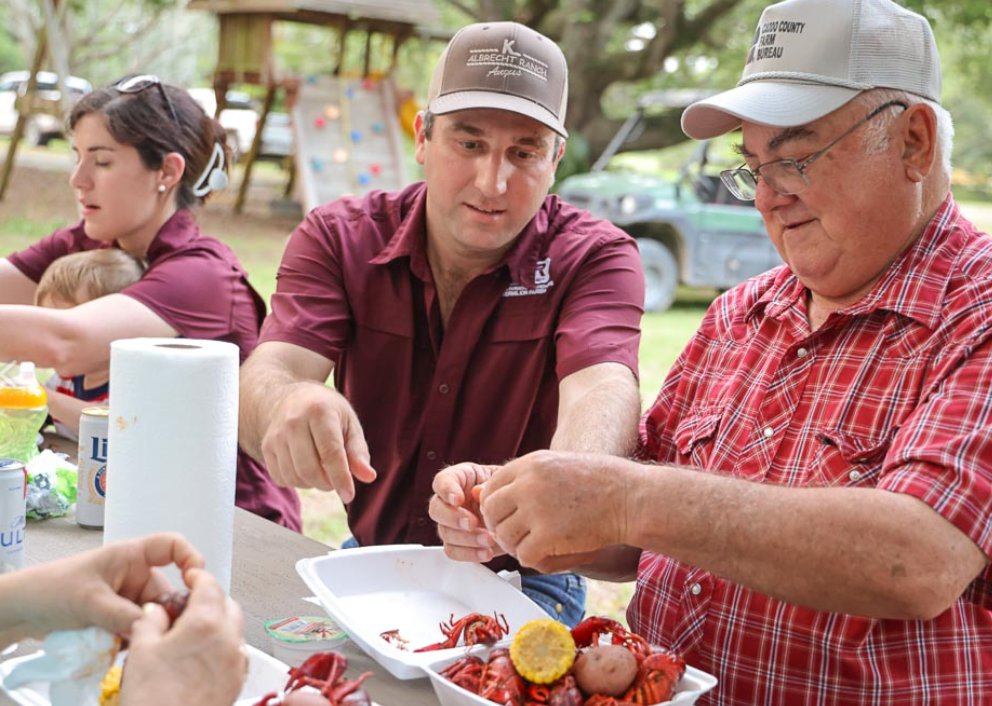
More than 60 Oklahoma Farm Bureau members learned about the spicy, savory and sweet Louisiana agriculture industry during the 2024 OKFB Ag Tour May 6-9 to Vermilion Parish, Louisiana.
The tour featured two days of stops and visits to farms, agribusinesses and cultural destinations in southwest Louisiana near Lafayette.
Members arrived on Monday, May 6, with a welcome dinner and meeting with Vermilion Parish Farm Bureau members and leaders at the parish Farm Bureau office. The local Farm Bureau planned the tour stops for OKFB members with numerous visits at local Farm Bureau members' farms and ranches.
The first full day of visits kicked off on Tuesday, May 7, with a tour of the LSU AgCenter H. Rouse Caffey Rice Research Station. OKFB members learned about the class-leading rice breeding program the station has developed over decades along with an overview of the Louisiana rice industry. Members toured the research farm where they saw rice in various stages of growth along with crawfish ponds where the station studies integrated rice and crawfish agricultural production programs.
Tuesday afternoon featured tours of local farms including a stop at a sugar cane field farmed by Vermilion Parish County Farm Bureau President Bryan Simon, who showed OKFB members farm equipment used in sugar cane production along with an overview of the crop's growing season.
OKFB members heard from rancher Raymond Fontenot of Crescent Bar F who raises grass-finished beef that he sells directly to area chefs for use in their restaurants. The Duhon family showed OKFB members the heart of their haying operation where they take round hay bales and re-bale and bundle them into small square bales for sale around the region.
The evening featured a tour of L'Terre at Live Oak Plantation, a 6000-acre farm that includes managed marshlands, rice and crawfish fields, cattle and hay production. OKFB members had the opportunity to see the marshlands from atop airboats and had the opportunity to see the alligators that call L'Terre home.
After a crawfish boil dinner, Farm Bureau members learned about alligator farming and conservation, which work hand-in-hand to preserve a wild population in the area while raising alligators commercially for a wide variety of beneficial purposes.
Wedesday, May 8, kicked off at Avery Island at the Tabasco Factory Tour and Museum where OKFB members learned about the history of Tabasco, the peppers that are raised for the internationally known hot sauce and the personal details of the McIlhenny family, who has been at the helm of the company for generations.
The next stop took members to the Louisiana Sugar Cane Cooperative, or LASUCA, in St. Martinville. Members learned how sugar cane that is grown around the region is milled into sugar for consumers around the country and beyond. John Hebert, LASUCA ag division manager, showed OKFB members sugar cane harvesting equipment and discussed the cooperative's custom harvesting operation and shared that once sugar cane harvest begins in late fall, harvesters run, rain or shine, to keep the coop's mill running throughout the harvest season.
OKFB members visited the Houmas House Plantation on the banks of the Mississippi River near Darrow where the toured the historic home and gardens. A tour guide walked members through the home and shared information about the property's history, its residents and the role the plantation played throughout the area's history.
The 2024 Ag Tour culminated in a visit to the Louisiana Farm Bureau headquarters in Baton Rouge where LAFB staff and leaders hosted a dinner and took OKFB members on a tour of the organization's new building. State board members Allen McClain and Richard Fortenot along with LAFB Assistant to the President Kyle McCann welcomed members to the office and shared how their organization represents Louisiana farmers and ranchers.
Throughout the tour, OKFB members enjoyed a wide variety of local food at several meals featuring crawfish, oysters, shrimp, crab and more.
The OKFB Ag Tour is an annual bus tour for OKFB members that helps expand their agricultural horizons and experience through tours and cultural experiences. The 2024 event was the first fully out-of-state Ag Tour. The 2025 tour is currently being planned for a region in Oklahoma.
To view the 2024 Ag Tour Photo Gallery, CLICK HERE.
In a letter sent today to the House Committee on Agriculture, National Corn Growers Association (NCGA) President Harold Wolle reacted to the recently released House Farm Bill legislation. The committee is expected to markup the Farm, Food, and National Security Act of 2024 on Thursday, May 23.
"NCGA's farm bill recommendations seek to make existing USDA programs more effective, efficient, and responsive," Wolle said. "Many of these recommendations are reflected in the proposed legislation and would be an improvement upon existing programs for corn growers across the country."
The organization's priorities include protecting federal crop insurance, bolstering U.S. international market development efforts, strengthening the producer safety net, supporting voluntary conservation programs, championing initiatives important to rural America and providing a base acre update.
The letter noted corn growers' appreciation for the leadership of Chairman GT Thompson (R-Penn.), Ranking Member David Scott (D-Ga.) and members of the committee in crafting and negotiating the language.
The letter also highlighted the need to get the bill across the finish line.
"NCGA and our members would like to see this process move forward in a bipartisan manner and for a farm bill to be signed into law this year," the letter said. "We stand ready to provide additional feedback to the Agriculture Committees and all Members of Congress as the legislative process moves forward."
— Smithfield Foods donated more than 38,000 of protein to help veterans and families in Geary County, Kansas, who are facing food insecurity. Feeding America's Kansas Food Bank will collaborate with Geary County Food Pantry to distribute protein servings throughout the community.
"At Smithfield Foods, we are on a mission to ensure that no one goes hungry, especially military veterans and families that have made the ultimate sacrifice to serve our country," said Steve Evans, vice president, community development for Smithfield Foods. "We're honored to do good in this community through this food donation to take a bite of out hunger in Geary County."
The donation, which included bacon, sausage, smoked sausage, ham steaks, hot dogs and various sandwich meats, will provide over 150,000 servings of protein to individuals at risk of hunger in Geary County.
 |
The donation was announced during the Armed Forces Day Celebration on May 18 hosted by the Military Affairs Council near Fort Riley in Junction City, Kansas. Geary County experiences the highest rate of child food insecurity and one of the highest rates of overall food insecurity in the state.
"We are deeply grateful to Smithfield Foods for their generous donation to our community and being a huge part of our Armed Forces Day event," said Isreal Waddell, director for Military Affairs Council for Junction City, Kansas and Geary County, Kansas. "Their commitment to supporting our military families and combating food insecurity in Geary County is truly commendable. This donation will make a meaningful difference in the lives of the community and the men and women who have selflessly served our country."
Smithfield's hunger relief program, Helping Hungry Homes®, has provided hundreds of millions of servings of protein all 50 U.S. states, as well as in Poland, Romania and Mexico, since 2008. Smithfield donated nearly 28 million servings of protein to food banks, disaster relief efforts and community outreach programs across the U.S. in 2023 and has pledged to donate 200 million servings of protein by 2025.
For more information about Smithfield's programs to support local communities, please visit smithfieldfoods.com/helping-communities.
| ||||||||||||||||||||||||||||||||||||||||||||||||||||||||||||||||||||||||||||||||||||||||||||||||||||||||||||||||||||||||||||||||||||||||||||||||||||||||||||||||||||||||||||||||||||||||||||||||||||||||||||||||
|
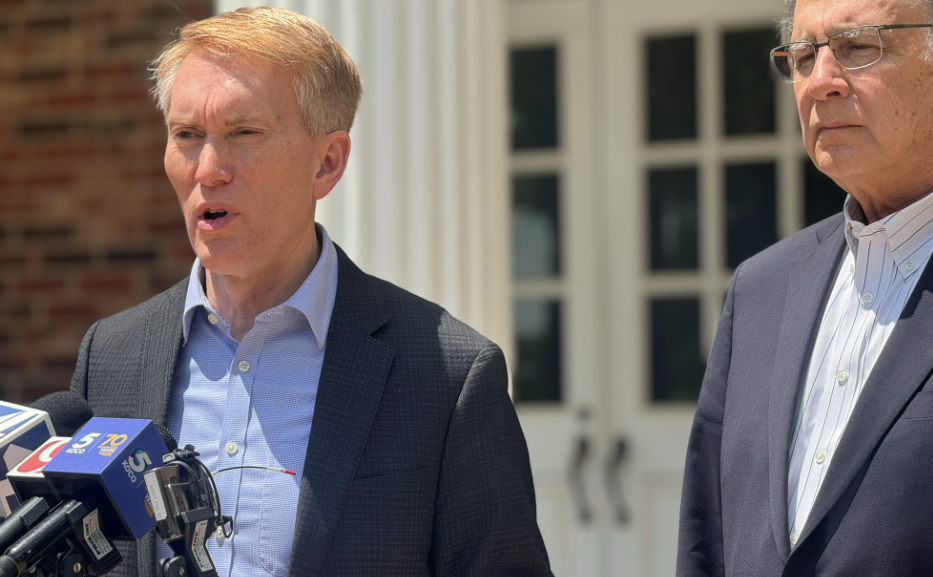
After the Farm Bill listening session last week, Senator James Lankford and Senator John Boozman agreed to take a few questions outside of Heritage Place in Oklahoma City. Several agricultural producers and agricultural groups were on hand to talk about agriculture with the Senators.
Lankford first talked about his excitement for having the chance to spend the day showcasing the ins and outs of Oklahoma agriculture to Senator John Boozman.
"It is a very full day trying to get the ranking member as much exposure as we can to Oklahoma agriculture, but also talk about the importance of food, fiber, and how important that is, and the effects of inflation right now that so many families are experiencing just based on the cost of food," Lankford said. "The cost of food has gone up 20 percent across the country."
Boozman said he is not a stranger to Oklahoma, as he grew up in Fort Smith, Arkansas.
"We are here talking about the Farm Bill," Boozman said. "It is one of the most important things we do in Congress. We do it every five years, and it is all about feeding America, and not only about feeding America but feeding the nation. We are blessed with the safest, cheapest food supply in the world and that is because of the hard work of our farm community."
While input costs are up and commodity prices are down, Boozman noted that challenges like these are why it is important to write a Farm Bill that is in the best interest of everyone involved.
"Farm Bills aren't about Democrats or Republicans; they are bipartisan, so it is different regions of the country," Boozman said. "Southern agriculture is different than the Midwest and California, and the list goes on."
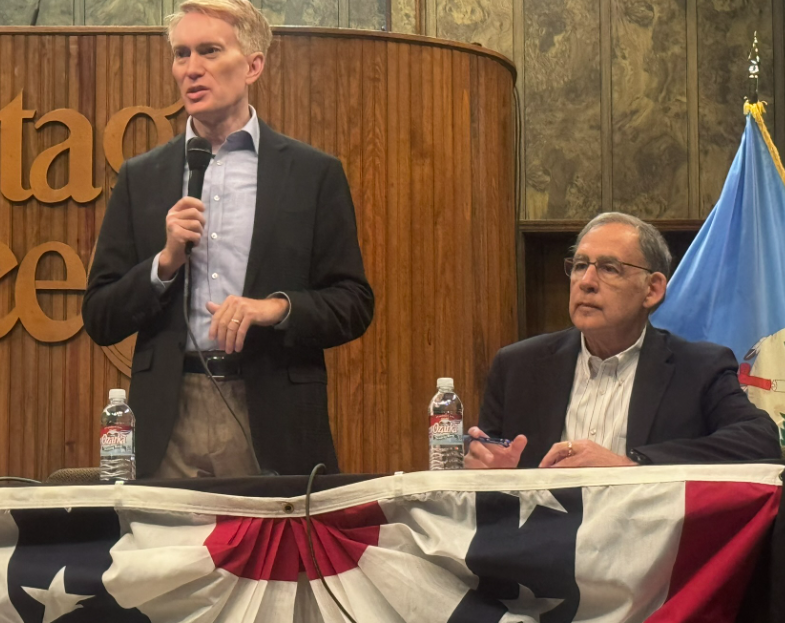
Boozman said he believes the answers to issues must come from the ground up.
"Food security is national security," Boozman said. "That is really the bottom line."
When asked what he would like to see in the Senate Farm Bill, Boozman said he would like to first make sure the safety nets and risk management tools are in place.
"They (farmers) must have the ability to be able to plant and know they are not going to get totally wiped out," Boozman said.
Boozman also talked about the importance of trade, conservation, and research for agriculture. Thanks to the hard work of many universities, Boozman said production has gone up dramatically. Speaking of that hard work, Boozman applauded Oklahoma State University ag research.
Regarding GT Thompson's release of his 2024 Farm Bill proposal, Boozman said he believes the House Farm Bill is at an advantage because House members have done a great job of getting out and talking to producers across the country about their needs and priorities.
Boozman said the Senate should release their own Farm Bill framework in a week or so.
Listen to the full conversation to hear Lankford give an update on his SOIL bill, which works to protect Oklahoma's agricultural land from foreign ownership and the detrimental impacts that follow.
To read about Lankford's SOIL Act, CLICK HERE.
Today, Britton T. Burdick, Communications Director for House Agriculture Democrats, released the following statement:
"House Republicans have spent over a year ignoring the red lines and core values of House Democrats. This unforced error will lead to a badly embarrassing result: a partisan farm bill that cannot pass on the House Floor. House Republicans charted this path through double-talk, backtracking, and constantly moving the goalposts. They promised they wouldn't cut SNAP benefits but now plan to use the largest cut to SNAP benefits in nearly 30 years to pay for the farm bill. They tell Democrats these are not benefit cuts but then tell their Republican colleagues off the Committee that they are. They insisted that Thrifty Food Plan cuts would be totally reinvested into the Nutrition Title but now plan to invest that money in other titles. They promised to protect the Thrifty Food Plan from cuts by a future Administration, but the draft betrays that promise. They say Speaker Mike Johnson and Budget Chair Jodey Arrington are on board, but the Speaker publicly said he won't commit to putting the bill on the Floor. "The Republicans have lost credibility, which will only make it harder to convince Democrats to support a farm bill down the road. Farmers know that the only way we get a farm bill this year is if Republicans and Democrats work together and respect each other's priorities. House Republicans should drop their partisan approach and work with Democrats to pass a truly bipartisan farm bill."
Truterra, a leading agricultural sustainability business that offers consultation, tools and solutions for the ag and food value chain, today announced that its carbon program has paid more than $21 million to farmers for the sequestration and reduction of over 1.1 million metric tons of carbon in its first three years.
Along with these results, the Truterra® carbon program has seen significant growth in total acres
enrolled. In 2023, total acres increased by 99% vs. 2022. In 2022, total acres enrolled increased by 151% vs. 2021. All of these results help position Truterra as a valuable source for connecting food and ag companies with farmers to drive sustainable practices on farms.
"Our carbon program is gaining momentum as a leader among farmers and retailers. Our differentiated approach matches agronomics with economics to help farmers make sustainable practice changes," said Truterra President Jamie Leifker. "What's more, these carbon assets could help organizations with sustainability goals who choose to make agriculture part of their toolkit of solutions. Truterra will continue to focus on creating new markets for farmers and retailers, while helping them make the best agronomic, economic and sustainable decisions for their operations."
The Truterra® carbon program is also experiencing growth in farmer participation. In 2023, the number of farmers participating in the carbon program grew by 58% compared to 2022.
"In many ways, we're returning to the way that my grandfather or my great-grandfather would have farmed, but with new technology and new metrics. Through the Truterra carbon program, we are doing this by changing some of our cover crop mixes, and I believe that higher yields will come from it," said Kelly Garrett, a farmer enrolled in Truterra's carbon program. "I'm looking at the big picture to secure the best for my farm and the best for my family. And I'm very proud that it goes hand in hand with Truterra's carbon program."
As a subsidiary of Land O'Lakes, Inc.'s over 100-year-old farmer-owned cooperative, farmers are at the center of everything Truterra does. The Truterra® carbon program is delivered through Truterra's network of local ag retail advisors, who work directly with farmers to help them make the best decisions for their fields. Truterra's farmer-friendly approach also means that qualified farmers can achieve optimal earning potential by paying based on actual carbon stored rather than a set per acre payment.
For more information, visit https://www.truterraag.com/Food-CPG-Companies.
Memorial Day weekend is the official kickoff for summer, and as the weather heats up, so do the number of meals that will be served outside. Whether you're eating with friends at the pool or family in a backyard cookout, food should be served safe to avoid foodborne illness. As you start to plan your outdoor activities and meals, the U.S. Department of Agriculture's (USDA) Food Safety and Inspection Service is offering food safety tips to keep you safe from foodborne illness.
"The bacteria that cause foodborne illness love the summertime as much as we do because they thrive and multiply quickly in warmer temperatures. This causes illnesses to spike during the summer," said Under Secretary for Food Safety Dr. Emilio Esteban. "As we all spend more time outside, it is important to remember these food safety steps to keep your friends and family safe."
Wash Hands
The first step to serving summer foods safely is to start with clean hands. If running water is available, wet hands, lather with soap, scrub for 20 seconds, rinse and dry. If no running water is available, use hand sanitizer or moist towelettes that contain at least 60 percent alcohol.
Pack Perishables Safely
When traveling with perishable food to places like the pool, beach, summer camp, hiking, or a cookout, always use cold sources in coolers or insulated containers to keep food at a safe cold temperature below 40 F. Cold source options include ice, frozen gel packs, and frozen beverages (that do not require refrigeration for safety) such as water bottles, iced tea, and juices like apple and grape. Additional cooler tips:
Keep Out of the Danger Zone
The Danger Zone is the temperature range where bacteria multiply rapidly between 40 and 140 F. Perishable foods, including meat and poultry, sliced fruits and vegetables, and cooked side dishes, should avoid the Danger Zone or be kept hot or cold to maintain food safety.
Check the temperatures of cold and hot items frequently.
Follow the Two-Hour Rule
Foods that are kept hot or cold out of the Danger Zone or do not sit out for more than two hours (one hour if over 90 F) are safe to keep. Any other items would be considered unsafe and need to be discarded. When in doubt, throw it out!
If You Have Food Safety Questions
Call the USDA Meat and Poultry Hotline at 1-888-MPHotline (1-888-674-6854), email MPHotline@usda.gov or chat live at www.ask.usda.gov 10 a.m. to 6 p.m. Eastern Time, Monday through Friday.
Access news releases and other information at USDA's Food Safety and Inspection Service's (FSIS) website at www.fsis.usda.gov/newsroom. Follow FSIS on X at @usdafoodsafety or in Spanish at X @usdafoodsafety_es, and USDA on Instagram at @usdagov and Facebook.
USDA touches the lives of all Americans each day in many positive ways. In the Biden-Harris Administration, USDA is transforming America's food system with a greater focus on more resilient local and regional food production, fairer markets for all producers, ensuring access to safe, healthy and nutritious food in all communities, building new markets and streams of income for farmers and producers using climate smart food and forestry practices, making historic investments in infrastructure and clean energy capabilities in rural America, and committing to equity across the Department by removing systemic barriers and building a workforce more representative of America. To learn more, visit www.usda.gov.
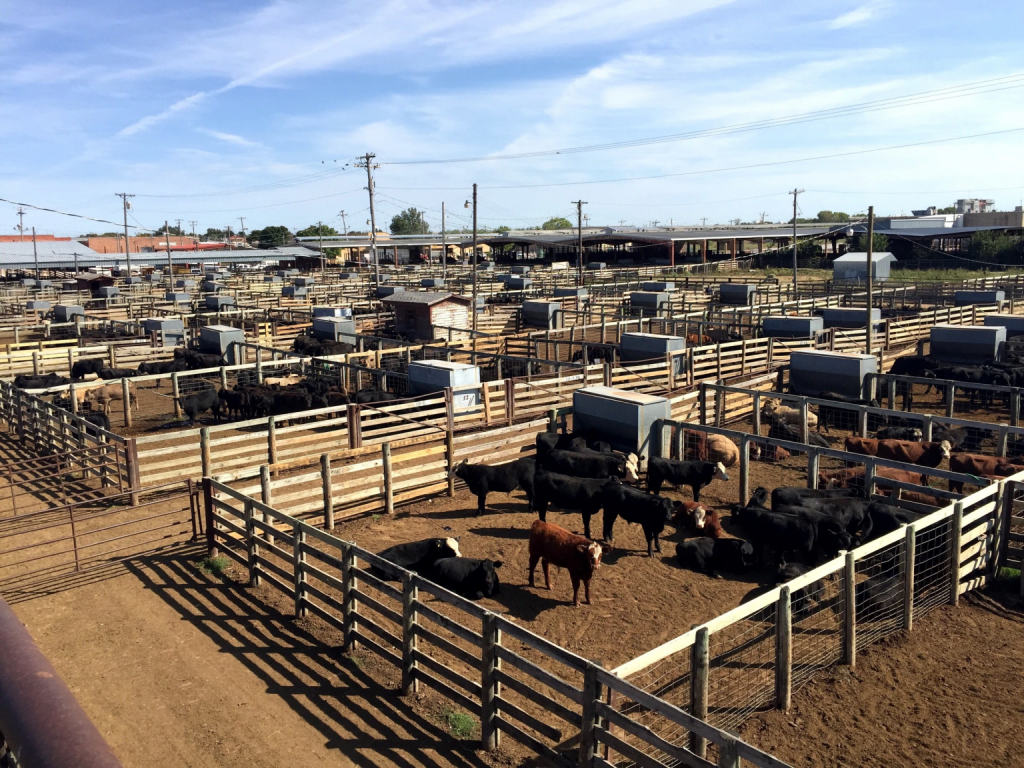
On Tuesdays, Senior Farm and Ranch Broadcaster, Ron Hays, visits with Ben Hale of Western Livestock Auctions as he talks about the latest in the markets and more. Established in 1995, Western has grown into a multi-generational family-owned and operated business and stands as a symbol of tradition, excellence, and a deep-rooted passion for the cattle industry. Western Livestock Auctions is located in Oklahoma City, Woodward, and Comanche.
At Oklahoma National Stockyards yesterday, Hale said the cutoff was right at 6900 head. The markets continued to gain strength all last week, Hale said, with a rally at the end of the week.
"It carried into Monday with all of those feeders 3.00 to 6.00 higher and some of those eight-weights up to 10.00 higher," Hale said.
With plenty of good grass available in many parts of the state, full ponds, and good market prices, Hale said things are looking exceptionally positive in the industry.
"I think everyone is just trying to figure out what they can buy to turn out," Hale said.
Most of the heavy cattle coming to auction are coming off wheat, Hale said, as the wheat has produced well this year, aiding in the quality cattle coming off.
Looking at the auctions in Woodward and Comanche, Hale said good runs are expected this week. Hale noted there will not be a sale at Oklahoma National Stockyards next Monday and Tuesday, but Comanche and Woodward will proceed as usual.
At the Oklahoma State FFA Convention, Senior Farm and Ranch Broadcaster, Ron Hays, is talking with the National Cattlemen's Beef Association Director of Grassroots Advocacy and Spokesperson Development, Chandler Mulvaney.
In his role at NCBA, Mulvaney said he helps equip and elevate advocates across the country to find their story and share it best across the media.
"This is one of the first times we have been at a state FFA convention, so this is a really exciting new venture for us in the past three to four years, expanding into this new avenue where we really see an opportunity to connect with teachers, but then also FFA members as well where they can see the value of Masters of Beef Advocacy, or MBA as a resource in the classroom or their role as an incoming Freshman at a local institution or academic institution."
Masters of Beef Advocacy is your go-to program for training and resources to be a strong advocate for the beef community. This free, self-guided online course provides farmers, ranchers, service providers, consumers, and all members of the beef community the tools and resources to become a beef advocate and answer tough questions about beef and raising cattle.
To learn more about Masters of Beef Advocacy and see learning resources, CLICK HERE.
Mulvaney said MBA resources are not just for students, as they are available to anyone interested in learning more about advocacy in the beef industry.
"We are just under 25,000 graduates since we got our start in 2009, so we are still seeing tremendous value," Mulvaney said.
Another special part of the program Mulvaney mentioned is that graduates still receive information and updates after they have received their MBA.
"We send out key forms of information at least once a month in the form of an MBA newsletter, and we have also implemented this past year, a quarterly call to action," Mulvaney said. "We want to share information whether it be about Earth Day, or if a state is doing a particular beef month celebration. Finding ways that advocates can best share their story and then elevate those stories on social media or with their local media partners."
Mulvaney also talked about a new webinar series called "Building Better," which focuses on helping beef advocates build better stories, and build partnerships within their communities.
"That is also done on a quarterly basis where we bring in an outside speaker to talk on a respective topic and help elevate our advocate's experience in the program," Mulvaney said.
The Beef Buzz is a regular feature heard on radio stations around the region on the Radio Oklahoma Ag Network and is a regular audio feature found on this website as well. Click on the LISTEN BAR for today's show and check out our archives for older Beef Buzz shows covering the gamut of the beef cattle industry today.

The U.S. Grains Council (USGC) today received notice of additional funding from the U.S. Department of Agriculture (USDA) under its Regional Agriculture Promotion Program (RAPP). The award will disperse $17 million to the Council for use in developing markets that will be crucial to the future of U.S. agriculture exports.
"USDA's decision to distribute additional investment is a wonderful show of confidence in the Council and its partners to continue blazing a trail in foreign markets on behalf of U.S. agriculture," said Brent Boydston, USGC chairman. "The future of the Council and its programming has never been brighter and I am certain there will be incredible results for producers, buyers and sellers alike."
RAPP was launched after a request from the U.S. Senate Committee on Agriculture, Nutrition, and Forestry to bolster, diversify and expand market opportunities for U.S. agriculture products. This round of funding is the first of five tranches, with the next one coming in 2026.
The majority of the Council's RAPP funding will be used to enhance its programming in Africa, Latin America, the Middle East, South and Southeast Asia, where rapid population and economic growth is creating demand for high-quality agriculture products that the U.S. industry will be positioned to meet.
Other portions of the investment will be committed to solidifying U.S. producers' stances in existing top export markets and to add staff in the Council's Washington, D.C. headquarters to properly manage and administer the Council's higher international activity.
"RAPP funding is a game changer for the Council and other cooperators representing U.S. products in international markets and will allow a significant expansion of the great work that Council staff are already doing worldwide," said Ryan LeGrand, USGC president and CEO. "Thank you to USDA for its constant support of the Council and for recognizing the need to continue improving U.S. export market promotion efforts."
On May 21, U.S. Secretary of Agriculture Tom Vilsack announced funding allocations for the Regional Agricultural Promotion Program (RAPP), which utilizes Commodity Credit Corporation (CCC) funds to diversify export markets for U.S. agricultural products.
U.S. Meat Export Federation (USMEF) President and CEO Dan Halstrom issued the following statement:
USMEF is honored to participate in RAPP and we thank Secretary Vilsack and the staff at USDA for their vision and leadership in implementing this program. The additional investment in foreign market development is very timely and will be especially helpful in expanding demand for U.S. red meat in emerging export markets. USMEF also appreciates the role Congressional leaders played in the development of RAPP. We thank them for their support of this program and for prioritizing Market Access Program (MAP) and Foreign Market Development (FMD) funding in the new Farm Bill.
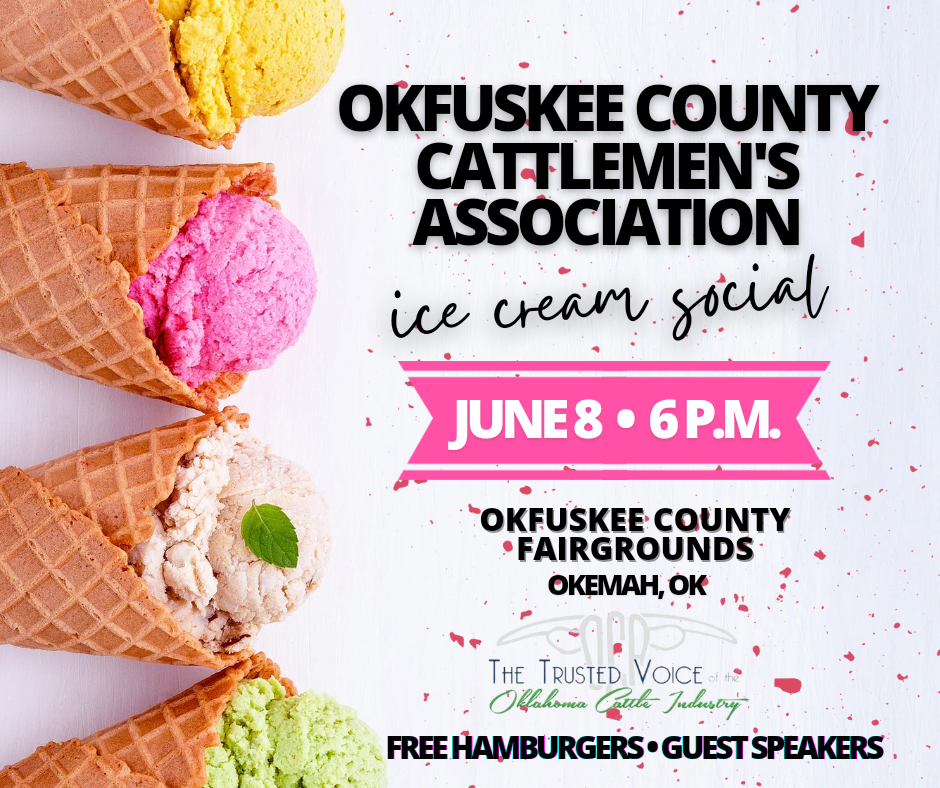
The Okfuskee County Cattleman's Association would like to invite the community to attend their June 8, 2024 meeting at 6 p.m. at the Okfuskee County Fairgrounds. No membership is required to attend, just an interest in learning more about the beef industry and building community. Cheeseburger dinner and ice cream are provided by the local cattlemen. During and after the meal, door prizes from local businesses will be given away.
The Okfuskee County Cattlemen's Association is excited to announce that the guest speaker is Brice Callahan, our Okfuskee County Extension Educator! We look forward to hearing about how to raise local beef in an efficient way during today's economy. Our speaker will help those new to the Cattlemen's Association to learn more about the benefits and rewards of being an active member in the community's association and how to promote the health and quality of the livestock in Okfuskee County.
The Okfuskee County Cattleman's Association would like to thank our previous sponsors of door prizes; Glenn White Feed and Seed, Oklahoma Beef Council, Okemah News Leader, Benson's True Value, Banc First, Walker Feed Store, and Warn Home Furnishings.
If you or your business would like to sponsor a door prize of any size, please contact Tom Goode at (940) 393-9815 for more information. We look forward to seeing you all at this quarterly meeting on June 8 at 6 p.m.
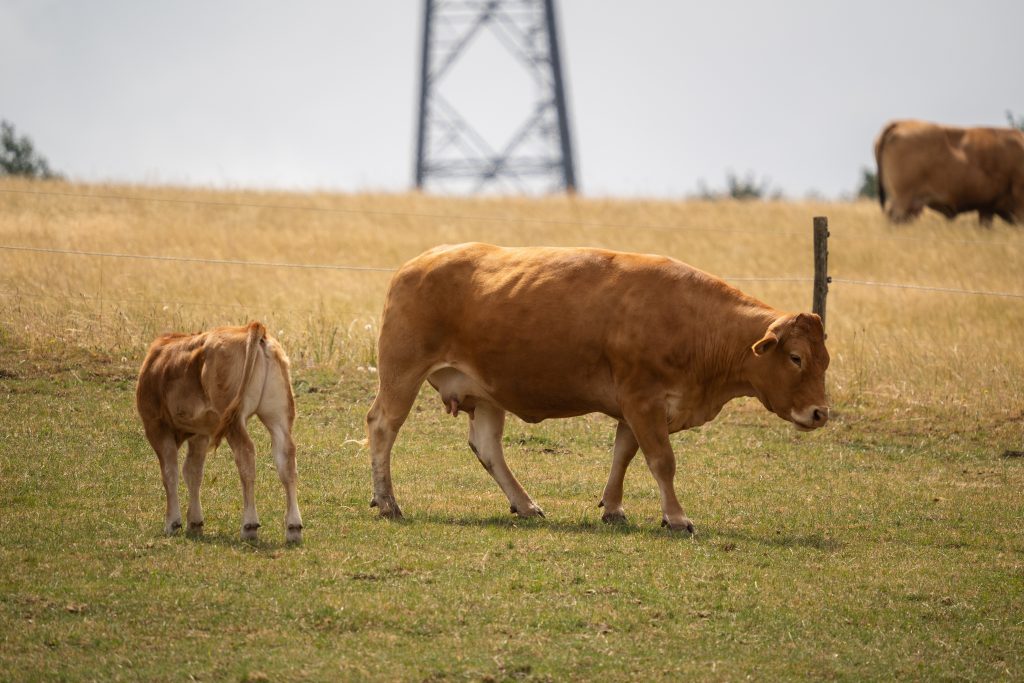
Mark Johnson, Oklahoma State University Extension Beef Cattle Breeding Specialist, offers herd health advice as part of the weekly series known as the "Cow Calf Corner," published electronically by Dr. Peel, Mark Johnson, and Paul Beck. Today, Johnson talks about management factors in the spring.
The commercial cow-calf business does not require intensive day-to-day management to the same extent of the other industry segments. That being said, timely management input is critical to maximizing forage production, shortening the calving season and creating profit potential. The key to capitalizing on the future value of cattle is to run your operation as a business. Managing your operation like a business means making sound financial decisions and concentrating management and labor into some of the critical control points through the annual production cycle.
As of May 2024, consider the following checklist.
- Have I made a plan for weed control, fertilizer, rotational grazing and proper pasture management? Weed control, especially on improved grasses, insures that the grass we intend to grow is making use of the moisture and soil nutrients. Applying an adequate amount of nitrogen fertilizer to Bermudagrass pastures is essential to produce the amount of forage needed to sustain your cowherd.
- Have my bulls undergone a Breeding Soundness Exam and do I have an adequate number of bulls on hand to get cows bred promptly?
- Have I given pre-breeding vaccinations and dewormed my cow herd?
- Are my replacement heifers of adequate age and target weight to breed up quick and early ahead of my mature cow herd?
- Are my cows and bulls in adequate Body Condition for the onset of breeding season?
- Based on that answer, do I need to continue with supplemental feed?
- What is my hay and feed plan for next winter?
- Have I castrated, dehorned, dewormed and given the first round of vaccinations to my spring born calves? Best management practices are to have this done by the time calves are two to four months of age.
Agriculture Secretary Tom Vilsack announced today that the U.S. Department of Agriculture is allocating $300 million to 66 U.S. organizations, under the new Regional Agricultural Promotion Program (RAPP), to build demand for American food and farm exports in high-potential markets around the globe.
Secretary Vilsack launched RAPP in October 2023, authorizing $1.2 billion in Commodity Credit Corporation funding to help U.S. exporters expand their customer base beyond traditional and established markets, focusing on regions such as Africa, Latin America and the Caribbean, and South and Southeast Asia, where consumer demand and purchasing power are growing.
"USDA and the entire Biden-Harris Administration are focused on creating more, new and better markets for U.S. producers and agribusinesses, and exports are a critical part of that effort," Vilsack said. "By enabling U.S. exporters to expand their footprint in diverse and dynamic new markets, RAPP will help make them more competitive and resilient in an increasingly volatile global trading environment. We know the potential is out there, but it takes time and money to grow new markets. USDA is pleased to be able to provide the start-up capital to help tap into these opportunities, because if we are serious about reversing the decline of small and mid-sized farms, and building wealth that stays in rural communities, it's crucial that we create and sustain diverse market opportunities abroad as well as at home."
The initial round of RAPP funding will help recipient organizations carry out hundreds of projects encompassing a wide variety of products and markets. For example:
To view the complete list of organizations that received RAPP funding, please visit the following link: FY 2024 RAPP Funding Allocations.
USDA touches the lives of all Americans each day in so many positive ways. Under the Biden-Harris Administration, USDA is transforming America's food system with a greater focus on more resilient local and regional food production, fairer markets for all producers, ensuring access to safe, healthy and nutritious food in all communities, building new markets and streams of income for farmers and producers using climate-smart food and forestry practices, making historic investments in infrastructure and clean energy capabilities in rural America, and committing to equity across the Department by removing systemic barriers and building a workforce more representative of America. To learn more, visit www.usda.gov.
Addie Gauck of Greensburg, Indiana, is the recipient of the 2024-25 Soy Scholarship award, sponsored by the American Soybean Association and BASF.
The ASA/BASF Soy Scholarship is a $7,000 award presented to an exceptional high school senior who excels in both academic and leadership roles and who plans to pursue a degree in an agriculture-related field at an accredited college or university. The scholarship is open to children and grandchildren of ASA members.
"ASA is proud to partner with BASF to offer this opportunity to a promising student pursuing agriculture as a career path," said ASA President Josh Gackle. "Investing in future industry leaders like Addie helps pave the future of agriculture with success and growth."
Gauck plans to study agriculture systems management at Purdue University. Her impressive agricultural involvement includes numerous awards and leadership roles in 4-H and FFA. Gauck also owns Addie's Fresh Pork and Pasture Raised Chicken, a business she started at age 11 that she credits for boosting her confidence and broadening her awareness of working with others.
Gauck says an important lesson her father taught her is to maintain her business and agriculture connections—and she reports clearly seeing the value in these relationships as she plans her future career. She notes that owning her own business has changed her life by showing her the importance of being responsible and accountable. Gauck says her goal is to someday bring together all the skills she's learned to improve the agriculture industry and her community. "Farming is the 'Biggest Job on Earth' and BASF is committed to supporting the next generation of farmers dedicated to solving the challenges facing the future of aquiculture," said Scott Kay, vice president of U.S. Agricultural Solutions at BASF. "BASF is proud to support this scholarship and invest in the future leaders of our industry.
The strongest border security bill in history passed the United States House of Representatives on May 11, 2023. This legislation – formally known as H.R. 2 or the Secure the Border Act – would put an end to President Biden's reckless open-border policies by resuming construction of the border wall, increasing the number of Border Patrol agents, ending Catch-and-Release, requiring transparency from the Department of Homeland Security (DHS) regarding illegal crossings, ending the abuse of executive immigration authority, and more.
Yet, although it has been over a year since H.R. 2 passed the House, the Democratic Senate has yet to even consider the legislation for a vote. However, it is not just H.R. 2 that the Senate has blocked. Back in February, the House passed articles of impeachment against Department of Homeland Security Secretary Alejandro Mayorkas, but the Senate killed these articles just last month. Then, in March, the House passed the Laken Riley Act, which would help give ICE and state governments more tools in the fight against crimes committed by illegal immigrants. The Senate blocked that too. And, just last week, we passed H.R. 7343, a bill that requires ICE to detain any illegal immigrant who has been charged with or convicted of assaulting a police officer. Yet, there has been no talk of H.R. 7343 being brought up for a vote in the Senate either, making it seem as though the Democrats are just choosing to allow the border crisis to continue to rage on.
And, let me be clear, it is raging. Uncontrollable surges of illegal immigrants are swarming and crossing our Southern border, resulting in a serious national security crisis. In fact, since President Biden took office, there have been over 9.5 million illegal immigrant encounters nationwide – including 350 individuals whose names appear on the terrorist watchlist, over 27,500 Chinese nationals, and thousands of "special interest aliens" from countries like Iraq, Pakistan, Yemen, and Afghanistan – and over 1.8 million known "got-aways" who evaded U.S. Border Patrol.
Meanwhile, traffickers, dangerous criminals, and cartels are taking advantage of the Administration's open-border policies. Over the past three years, we have watched illicit fentanyl be pushed into every community throughout our nation, creating an unprecedented opioid epidemic that is killing far too many of our own citizens, and innocent Americans, like University of Georgia student Laken Riley, be violently murdered by illegal immigrants that entered our nation unvetted.
Not to mention, the burden of paying for these illegals should not be placed on the taxpayer. Yet, under the Biden Administration, it is. As a matter of fact, according to FAIR Research, the border crisis is costing the United States approximately $150.7 billion each year, with the gross cost per taxpayer being $1,165 per year.
The evidence makes it clear – this crisis cannot go on. It is jeopardizing our national security and costing American lives every day.
As the Representative for Oklahomans in the Fourth District, I know my constituents do not want me to sit by and watch as this catastrophe continues to rampage – and trust me, I am not. I am committed to bringing this border crisis to an end. I voted in favor of H.R. 2 last year and continue to be a strong supporter of it now. I also supported the articles of impeachment against Secretary Mayorkas, as well as the Laken Riley Act, H.R. 7343, and more.
Instead of continuing to allow these strong border security bills to collect dust on Senator Schumer's desk, I am urging the Senate to take them up for a vote. It is past time we end the ongoing border catastrophe once and for all.
RON's Dave Lanning has a pre-opening look at today's agricultural Markets.
Click the audio tab below for today's report.
Winter wheat was 69 percent headed, which was 11 points ahead of 58 percent at this time last year and 12 points ahead of the five-year average of 57 percent. 49 percent of the crop was rated in good-to-excellent condition, down 1 from the previous week but still up considerably from 31 percent a year ago. The percentage rated very poor to poor held steady at 18 percent.
Corn planting jumped 21 percentage points last week to reach 70 percent complete nationwide as of Sunday, May 19. That puts current planting progress at 6 percentage points behind last year's 76 percent and just 1 point behind the five-year average of 71 percent. 40 percent of corn had emerged as of Sunday, 6 points behind last year but 1 point ahead of the five-year average of 39 percent.
Soybean planting moved ahead 17 percentage points last week to reach 52 percent complete nationwide as of Sunday. That was 9 percentage points behind last year's pace of 61 percent but 3 percentage points ahead of the five-year average of 49 percent. 26 percent of soybeans had emerged as of Sunday, 5 points behind last year's 31 percent but 5 points ahead of the five-year average of 21 percent.
Winter wheat conditions rated 51 percent good to excellent, 35 percent fair and 14 percent poor to very poor. Last week's conditions rated 53 percent good to excellent, 35 percent fair and 12 percent poor to very poor. This time last year, conditions rated 10 percent good to excellent, 38 percent fair and 52 percent poor to very poor.
Corn planted reached 81 percent, up 7 points from the previous week and up 19 points from normal. Corn emerged reached 61 percent, up 12 points from the previous week and up 16 points from normal. Corn conditions rated 84 percent good to excellent, 14 percent fair and 2 percent poor to very poor.
Sorghum planted reached 32 percent, up 10 points from the previous week and up 15 points from normal.
Soybeans planted reached 24 percent, up 9 points from the previous week but down 6 points from normal.
Peanuts planted reached 30 percent, up 17 points from the previous week and up 8 points from normal.
Cotton planted reached 20 percent, up 8 points from the previous week and up 2 points from normal.
Livestock conditions rated 74 percent good to excellent, 22 percent fair and 4 percent poor to very poor. Last week's conditions rated 71 percent good to excellent, 24 percent fair, and 5 percent poor to very poor.
Pasture and range conditions rated 57 percent good to excellent, 36 percent fair and 7 percent poor to very poor. Last week's conditions rated 53 percent good to excellent, 36 percent fair and 11 percent poor to very poor. This time last year, pasture and range conditions rated 33 percent good to excellent and 49 percent poor to very poor.
Winter wheat condition rated 11% very poor, 20% poor, 36% fair, 30%
good, and 3% excellent. Winter wheat headed was 90%, well ahead of 68% for both last year and
the five-year average. Coloring was 24%.
Corn condition rated 2% very poor, 11% poor, 29% fair, 53% good, and 5% excellent. Corn
planted was 74%, ahead of 68% last year and 69% average. Emerged was 53%, near 49% last
year, and ahead of 44% average.
Soybeans planted was 43%, behind 51% last year, but near 39% average. Emerged was 23%,
near 27% last year, but ahead of 18% average.
Sorghum planted was 13%, near 11% last year, and ahead of 8% average.
Cotton planted was 38%, near 39% last year and 37% average.
Sunflowers planted was 6%, near 2% last year and 8% average.
Pasture and Range Report: Pasture and range conditions rated 7% very poor, 15% poor, 36%
fair, 36% good, and 6% excellent.
Winter wheat headed reached 96 percent, up 6 percentage points from the previous year and up 3 points from the five-year average. Harvested reached 10 percent, up 6 points from the previous year and up 1 point from the average. Winter wheat conditions rated 39 percent good to excellent, 39 percent fair and 22 percent poor to very poor. Last week's conditions rated 42 percent good to excellent, 35 percent fair and 23 percent poor to very poor. This time last year, conditions rated 23 percent good to excellent, 32 percent fair and 45 percent poor to very poor.
Corn planted reached 85 percent, down 1 percentage point from the previous year and down 5 points from the five-year average. Corn emerged reached 74 percent, down 2 points from the previous year and down 4 points from the average. Corn silked reached 31 percent, up 4 points from the previous year and up 11 points from the average.Corn conditions rated 59 percent good to excellent, 30 percent fair, and 11 percent poor to very poor. Last week's conditions rated 66 percent good to excellent, 26 percent fair and 8 percent poor to very poor.
Cotton planted reached 37 percent, up 3 percentage points from the previous year and down 2 points from the five-year average.
Peanuts planted reached 46 percent, up 18 percentage points from the previous year and up 14 points from the five-year average.
Sorghum planted reached 78 percent, even with the previous year and the five-year average. Sorghum headed reached 29 percent, up 5 points from the previous year and up 6 from the average.
Soybeans planted reached 49 percent, down 5 percentage points from the previous year and down 14 from the five-year average. Soybeans emerged reached 28 percent, down 4 percentage points from the previous year and down 13 from the average.
Range and pasture conditions rated 33 percent good to excellent, 29 percent fair and 38 percent poor to very poor.
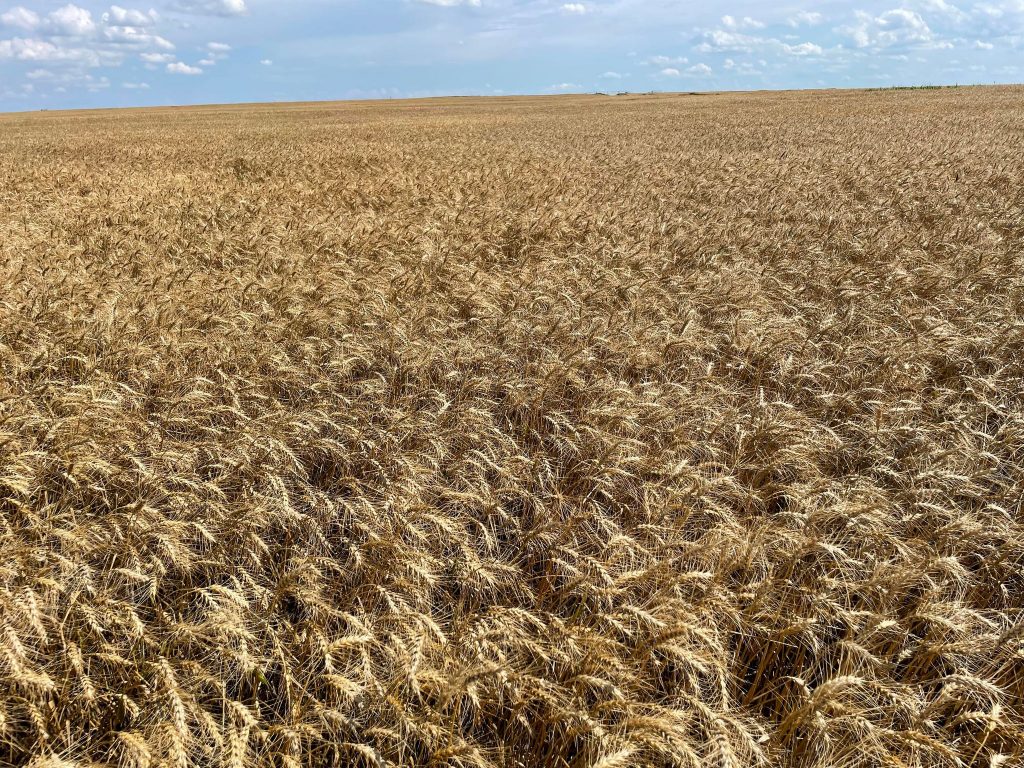
2024 Ripe Wheat- Picture courtesy Brent McIntyre, Temple, Oklahoma
According to the Executive Director of the Oklahoma Wheat Commission, Mike Schulte, Oklahoma wheat harvest has started in multiple locations in Southwest Oklahoma over the weekend, with the wheat being 10 days ahead of normal schedule. It has been reported that over 100,000 bushels was received between locations at Grandfield and Devol. Trucks have also been received at Frederick. Early cutting has also started around Temple, Walters and Chattanooga. Test cutting has taken place around Altus with some producers hoping to start this afternoon(Monday).
Early reports in all locations show test weights ranging from 60 to 63 lbs. per bushel. (The wheat reported at 60 lbs. per bushel was at a higher moisture level, so producers are hopeful as moisture goes down test weights will still go up.)
Proteins ranging from 11.1% to 12.5% with more of the proteins on early cuttings being reported in the 11.9% to 12.5% range. Early yields being reported at 40 to 45 bushels per acre. Higher yields are predicted on intensively managed wheat. Keep in mind this region has been considered the bright spot of the state for growing conditions this year. The state has received a large amount of hail damage in South Central, Oklahoma last night with large amounts of hail damage in other regions of Southwest Oklahoma and Northern Oklahoma over the past two weeks. A more comprehensive report will be published on Thursday, May 23, 2024.
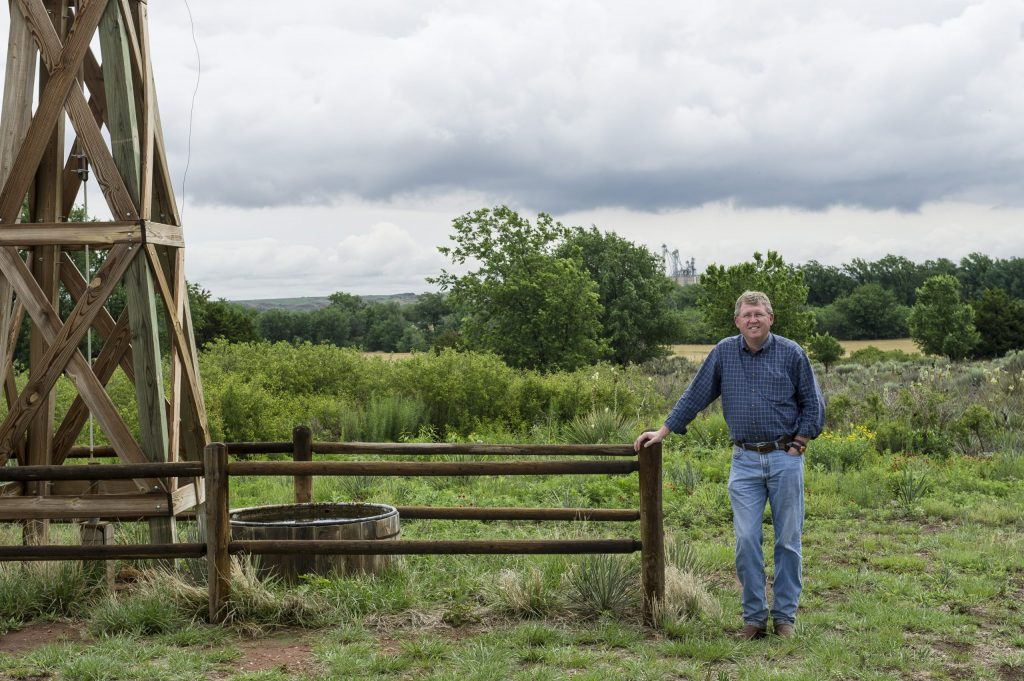
Senior Farm and Ranch Broadcaster, Ron Hays, is talking with Congressman Frank Lucas about the House Committee on Agriculture Chairman Glenn "GT" Thompson's 2024 Farm Bill proposal which was released last week. Lucas is the former Chairman of the House Committee on Agriculture and now serves as the Senior member of the committee, aiding in the completion of the 2024 Farm Bill.
The markup of the 2024 Farm Bill is scheduled for May 23, 2024- click here for current details as found on the House Ag Committee website.
"We don't need to rewrite the entire Farm Bill," Lucas said. "We did that in '14 when I was Chairman. We modified and improved in '18, and now it is time to do that process again. By looking at the commodity title, conservation and development, and all of those sections, I think the Chairman has done an exceptional job, and I think we will be pleased with what we see."
Lucas said the controversial part of the bill will most likely be the nutrition title, as this title is usually the main priority of Democrats in the committee.
"When the Biden Administration first came in, they had a Democrat majority in the House and Senate," Lucas said. "Their goal was to spend money, not just in conservation but across the entire gamut of the Federal Government. The allocated moneys that could not be spent in a timely or orderly fashion. In this Farm Bill, we are going to reallocate those dollars to existing programs like EQIP (Environmental Quality Incentives Program) that have demonstrated themselves time and time again."
Regarding the Biden Administration's passion for social justice and environmental justice, Lucas said the next Farm Bill will focus more on conservation and less on climate change protocols. Now, Lucas said the priority is getting voluntary, incentive-based efforts across the finish line.
"In order to qualify for these resources or programs they wanted to fund, you had to farm the way they wanted you to farm, and you had to be the kind of farmer they wanted you to be," Lucas said.
When it comes to ARC and PLC, Lucas said farmers will still choose between one or the other each year.
"When I visit with folks back home as well as stakeholders and representatives in D.C., I think there is an understanding that the Chairman and the committee has done a good job on the commodity title," Lucas said. "Let's be honest. Farm Bills are still about raising food and fiber. You have got to make sure it is on the shelves and available to consumers at home to sell our surplus into the world market."
Lucas said he believes that the focus on the Republican side of the committee is on production, and they have worked together to create a good Farm Bill for American producers. As crop insurance is one of those top priorities, Lucas also talked about the importance of an effective and affordable safety net.
On the livestock side, Lucas said the Farm Bill maintains programs such as LRP (Livestock Risk Protection) and the LIP Program (Livestock Indemnity Program).
"In the complicated world that we live in for both crops and livestock, that safety net has to be there for everybody," Lucas said.
Lucas and Hays also talked more about support for conservation and market promotion programs, the OFF Act, GIPSA provisions, and more. Click the listen bar above the story to listen to the full conversation!
May 20, 2024 – AAA's previously released national Memorial Day travel forecast showing the second highest number of travelers for the holiday – 43.8 million – and a record 38.4 million people driving to their destination – are reflected in Oklahoma traveler projections.
More than 435,000 Oklahomans will travel 50 or more miles from home this Memorial Day weekend travel period (Thursday through Monday). While travel by air and other modes of transportation will be up this year compared to Memorial Day 2023, the large majority – 87% of travelers – or over 380,000 Oklahoma residents – will take to the highways.
| 2024 Projected Memorial Day Holiday Travelers – Oklahoma | |||
| Mode of Travel | 2024 Travelers | Percent Change vs. 2023 | Percent of Travelers |
| Auto | 381,059 | +3.7% | 87% |
| Air | 36,484 | +3.7% | 8.3% |
| Other (cruise, train, bus) | 20,269 | +5.2% | 4.6% |
| Total | 437,813 | +3.9% | 100% |
Road Trip Costs
Whereas most people drive for their family vacations and holiday trips, there are still expenses to plan for.
Even if there is some relief at the pumps of late, there are always things drivers can do to increase gas mileage and save money at the pumps.
AAA provides these tips for saving money on gas:
AAA has a variety of resources to help motorists save on fuel:
Safety Focus While on the Road
With more traffic on the roads for the holiday weekend, AAA Oklahoma reminds drivers to take the following safety precautions during their Memorial Day road trip:
Pull out of the traffic lanes if your car breaks down. If faced with a vehicle emergency, safely steer your car off the roadway. Turn on the emergency flashers to alert other drivers and exit the vehicle on the side facing away from traffic if possible. Once everyone is in a safe location, request assistance from an emergency road service provider. Have your AAA membership number and toll-free number or mobile app handy to request assistance

As a foster care recruiter in Northwest and Western Oklahoma, I see the impacts foster parents have on their community each day. Whether it's singing a child to sleep to soften sorrowful tears or celebrating the milestones biological parents make on their path to reunification our foster parents pour into the lives of the children and families they serve daily.
Being a foster parent is hard work and we don't have enough foster families to serve the needs of every child who comes into state custody. Being a child who is removed from your home and everything you've known due to neglect or abuse is also hard, and we need foster families who are willing to walk alongside children and families as they navigate and grow through what may be some of the most difficult times in their lives. If you choose to step into this, you need to know I'll be with you every step of the way, along with a host of others on my team and in the community who are there to cheer you and the family you're serving onto success.
Our hope is that, over time, our cheers will be joined by the sound of ultimate success-the bang of a judge's gavel and the proclamation of a closed case and a reunified family. When that happens, it means the family has worked incredibly hard, with the support of their team, to correct the safety concerns that caused a judge to order the children into state custody in the first place.
There are times, unfortunately, despite everyone's best efforts, when the sound of a judge's gavel may have a more bittersweet clang. If a family is unable to correct safety concerns, a judge may say that children can't go back home and our agency is charged to help guide them onto other types of permanency including adoption or guardianship. This chance for a new start is often also a time of great despair for many of the children in our care. Still, we know hope can grow in even the darkest of spaces and our foster families are often asked to nurture that hope as the child's new adoptive parents.
Whether through foster care, reunification, or adoption, hope is amplified through the thoughtful works of an engaged community. Our amazing community partners, sister agencies, and faith-based organizations create pathways for families to follow as they rebuild their lives with safety and support at the forefront. if foster care isn't right for you today, I can most assuredly say there is seat for you at our table. You can find plenty of opportunities to get involved on the Raise Awareness page of our website at OKFosters.org, or by calling me at 580-744-0049.
Together, we have the opportunity to create a symphony of hope for the children and families in our community. I can't wait for you to join me.
Article courtesy of Roxanne Freeman. Freeman is a foster care recruiter for Oklahoma Human Services in Woodward, Dewey, Ellis, Beckham and Roger Mills Counties.
Details for the 2024 Farm Bill are beginning to come into focus, with marked-up versions of the bill circulating in D.C. In the first episode of Farm Bill Focus, get a rundown on what you need to know from NCGA's director of public policy and Farm Bill expert Wayne Stoskopf.

Growth Energy and the Renewable Fuels Association (RFA) today jointly petitioned the Supreme Court to overturn an opinion from the U.S. Court of Appeals for the Fifth Circuit regarding the U.S. Environmental Protection Agency's (EPA's) denials of several small refinery exemptions (SREs) under the Renewable Fuel Standard (RFS). In their petition, Growth Energy and RFA argue that those challenges to the denials should be adjudicated solely in the U.S. Court of Appeals for the D.C. Circuit, not in regional circuits like the Fifth, which only covers Louisiana, Mississippi, and Texas. In contrast to all other U.S. Courts of Appeals that evaluated this venue issue, the Fifth Circuit concluded that it was the proper venue to hear and rule on these challenges, despite the fact that EPA's SRE policy is "nationally applicable" and "based on a determination of nationwide scope or effect."
"There's a simple reason why the Third, Seventh, Ninth, Tenth, and Eleventh Circuits have all found that EPA's SRE decisions should be litigated in the D.C. Circuit. SREs have nationwide impacts on the entire U.S. renewable fuels market, and EPA has developed and applied a nationwide SRE policy to assess them," said Growth Energy CEO Emily Skor. "The Supreme Court should take up our petition and overturn the Fifth Circuit's opinion to ensure that SRE review is governed by a single court whose decisions apply nationwide. Furthermore, the Court should not allow oil industry interests to take advantage of a fragmented system of judicial review and forum shop for more favorable courts at the expense of a coherent SRE program. Only by funneling SRE challenges to the D.C. Circuit can we ensure consistent, nationwide SRE policy and avoid regulatory and market uncertainty for the nation's transportation fuel supply."
Background
In April and June 2022, EPA denied 105 SRE petitions from 36 refineries located in 18 states. In assessing the petitions, EPA applied a single, nationwide legal requirement: to be eligible for an SRE, petitioning refineries must demonstrate a direct causal relationship between RFS compliance and their claimed economic hardship. EPA then invited petitioning refineries to submit refinery-specific evidence to rebut EPA's general factual finding that refineries have the ability to pass through their costs of compliance with the RFS and that, as a general matter, RFS compliance does not cause refineries to incur any net compliance costs, let alone economic hardship. Reviewing the evidence submitted by the refineries, EPA found that none met their burden.
Refineries whose SRE petitions were denied challenged the denials in the Third, Fifth, Seventh, Ninth, Tenth, Eleventh, and D.C. Circuits. All regional circuit courts except the Fifth Circuit concluded that only the D.C. Circuit was the proper venue to hear the challenges, and they dismissed or transferred the challenges to the D.C. Circuit. By contrast, the Fifth Circuit held that venue in that court was proper, and in a divided 2-1 panel opinion, vacated EPA's denials for the refineries that brought challenges in that court. The D.C. Circuit challenge is pending.
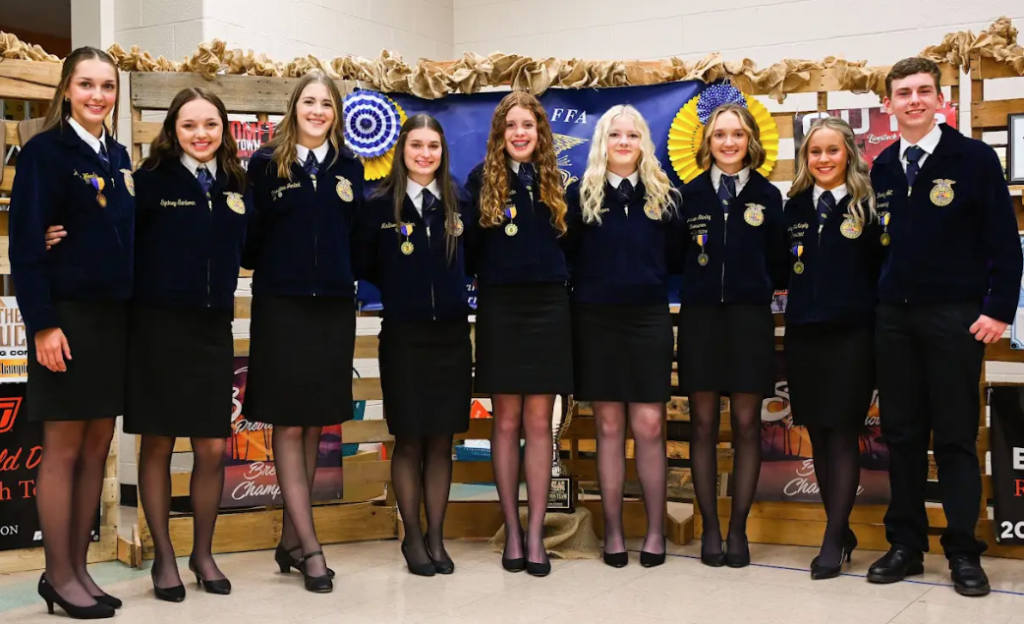
The 73rd Annual Alva FFA Banquet was held on May 14 at Alva Middle School. This banquet is held to celebrate accomplishments of the past year, thank all of our sponsors and parents, and announce the newly elected officer team. The new 2024-2025 FFA Officers are: Brady Lott, President; Avery McMurphey, Vice President; Jansen Shirley, Secretary; Christina Jenlink, Treasurer; Katelee Martin, Reporter; Kayla Leeper, Sentinel; Kaylen Woods, Historian;
Sydney Sanborn, Parliamentarian; and Madison Blocker, Chaplain.
Some other special awards were given at the banquet. The Star in Discovery Award is given to a member who has been the most active as an 8th grader. This award was given to Merritt Mantz. The Star Greenhand award is given to a member who shows excellence as a 9th grade member. This award was given to Kayla Leeper and Kaylen Woods. The Star Farmer
Award and the Star Ag Placement Award are given to members who have already obtained their Chapter Degree and have outstanding achievements in their Supervised Agriculture Experience.
As an FFA member, it is required to have a Supervised Agricultural Experience. There are many categories, but the following members excelled in their respective categories. Kayla Leeper won the Sheep Production Award. Brady Lott won the Beef Production Entrepreneurship award. Katelee Martin won the Ag Communications award. Brooklyn Murrow won the Ag Education award. Jansen Shirley won the Diversified Ag Production award. Ember Sandoval
won the Goat Production award. Connor Sneary won the Diversified Livestock Placement, Beef Production Placement, and Diversified Crop Production awards.
The Agronomy Team was recognized for their outstanding achievements throughout the year, and will receive belt buckles. THe Dekalb award and the Randy Nation Memorial Scholarship was given to Cristen Bosch. The Duane Sneary Award was given to Pryce Williams. The Dustin Graves Memorial Scholarship was given to Cristen Bosch, Connor Sneary, and Pryce Williams. The Honorary FFA Degree was given to Mr. Charlie Bird Jr. and Mrs. Kasady Dietz. The Ag Mechanics Team presented Byron Shirley with a model tractor of their restoration tractor project.
This banquet signifies the end of a very successful year and the start of a new one. The
new officer team cannot wait to begin their time serving!
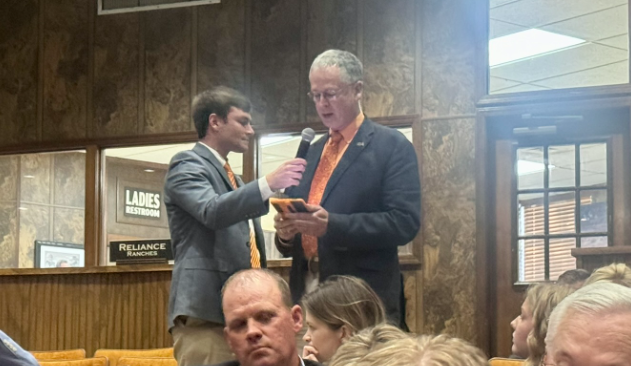
Last week after a Farm Bill session featuring many Oklahoma Senators, Farm Director KC Sheperd had the chance to talk with Oklahoma farmer and National Association of Wheat Growers President Keeff Felty about priorities for wheat growers in the 2024 Farm Bill.
"The high points were reiterating our asks since June 2022 and focusing on some of the things that are being put forward by Chairwoman Stabenow and her proposed legislation and language," Felty said. "The Senate language has not been released yet, so we don't have an official version."
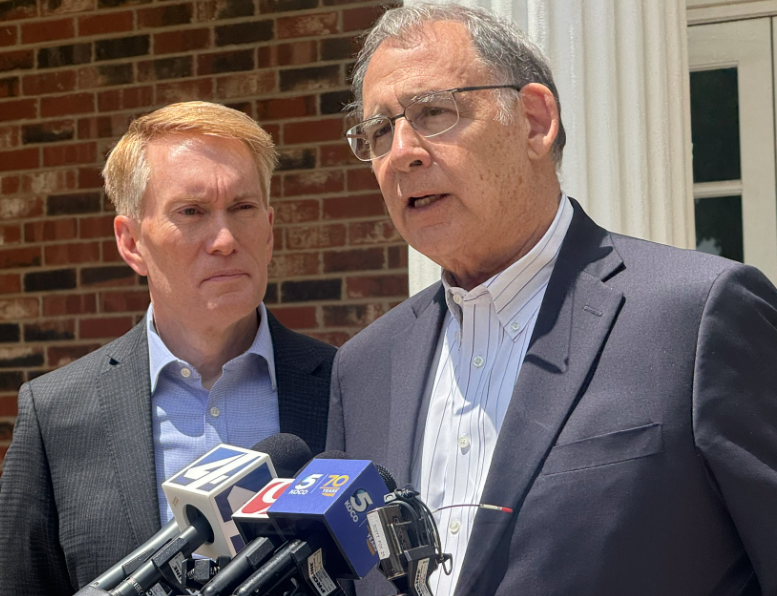
Felty also emphasized the importance of completing a Farm Bill during this current Congress. Between the House and Senate Farm Bill proposals, Felty said the House version leans more toward the priorities of NAWG.
"The process is going to be based on compromise and coming together, and that is a hallmark of Farm Bills," Felty said. "They are a group effort and at the end of the day, the solutions are arrived at that are best for the time. We are hopeful that continues to be the case."
Regarding market promotion, Felty said NAWG would like to see the funding of the MAP (Market Access Program) and FMD (Foreign Market Development) programs doubled.
"Fifty percent of wheat is exported, so that is where those come into play," Felty said.
In Title I of the Farm Bill, Felty said NAWG would like to see an increase in reference prices, as they have not increased since the 2014 Farm Bill.
Switching gears to Oklahoma's wheat crop conditions, Felty said the crop looks above average. He expects combines to start rolling pretty quickly and expects Harvest to start by the end of this week.
"Wheat Crop looks pretty good, above average. We have not been overly wet, but we have had timely rains," Felty said. "I think it has potential."
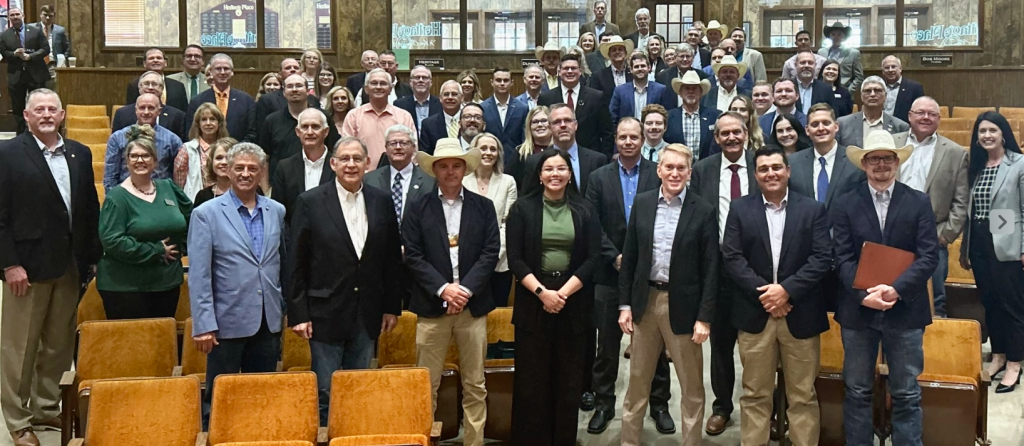
| |||||||||||||||||||||||||||||||||||||||||||||||||||||||||||||||||||||||||||||||||||||||||||||||||||||||||||||||||||||||||||||||||||||||||||||||||||||||||||||||||||||||||||||||||||||||||||||||||||||||||||||||||
|
Speaker Charles McCall, R-Atoka, today responded to a letter sent by the Biden Administration last week regarding House Bill 4156 which creates the crime of impermissible occupation in Oklahoma. The letter was sent to Gov. Kevin Stitt and Attorney General Gentner Drummond by the Biden Dept. of Justice, and threatened legal action if the law is enforced.
"The Biden Administration's continued failures to address the illegal immigration crisis in our country are what necessitated the passage of House Bill 4156 in the first place.
I find it laughable that in the Administration's letter to Gov. Stitt and Attorney General Drummond, they claim Oklahoma is interfering with the function of the federal government on immigration issues. There has been nothing but disfunction at the federal level since President Biden took office.
House Bill 4156 was a carefully crafted, well-thought-out piece of legislation designed to acknowledge the role of the federal government in immigration matters, while at the same time protect the sovereignty and security of our state's borders. I fully support the defense of this law by our state's attorney general, and look forward to seeing it upheld in court."
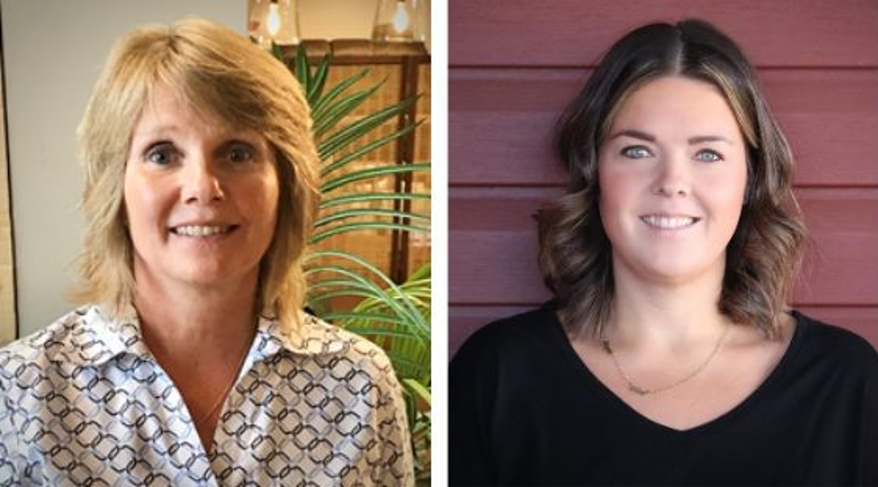
OPI, the global leader in grain storage management, has announced new sales leadership to support its Canadian customer base. Laura Solberg and Brianne Borchowitz bring deep industry knowledge and a passion for agriculture that customers will appreciate.
"Laura and Brianne are the dream team for our Canadian market customers," says Adam Weiss, CEO. "Their combined ag knowledge and passion for customer success will help deepen relationships with our key partners, while providing superior in-market support and training as needed."
Solberg and Borchowitz will work with OPI's partners and their teams to be the best global provider of grain storage management and technology. Their joint goal is ensuring business strategies are optimized and OPI partner's experience with the products is backed by outstanding customer satisfaction.
Laura Solberg joined OPI as Business Development Manager overseeing activities for the Canadian market. She helped farm in Manitoba and has spent more than 25 years growing global agriculture and oil and gas sector businesses. In her most recent role with Farmers Business Network, she gained valuable experience with growers and technology. Prior to that with Arctic Gateway Group, she helped enhance key Canadian logistics points for more efficient grain shipments. At Cargill, she held multiple development roles and served the Board of Directors as chairperson with Cargill's Joint Ventures. Solberg holds an MBA from the University of Manitoba and holds Project Management Professional and Canadian Sales Professional certifications.
As customers' primary point of contact for the region, she is dedicated to customer satisfaction and growth. "Our leadership and our team are amazing; we are empowered to make decisions with our partners, this is the #1 reason why I like working at OPI," she says. "There is so much passion and persistence that drives me every day. I want every Canadian farmer to succeed with grain storage management. Farmers know rain means grain for better yields, and getting the crop in the bin is the ultimate goal; however grain bin storage management technology will improve ROI and is a must for every farmer."
Likewise, Brianne Borchowitz's passion for agriculture is what drew her to OPI and the role of Customer Success Representative for Canada. She grew up on a farm in rural Alberta and has dedicated much of her professional life to improving customer experience in the ag industry. Her career includes time as Customer Experience Representative with Ag Exchange Group, Farm Business Representative with CWB and Sales Representative with Viterra.
I am excited to be in this role because it will allow me to apply multiple skill sets and broaden the OPI team and customers that I get to support on a daily basis," says Borchowitz. "Growing up in ag has given me the ability to quickly connect with customers and find common ground."
Weiss believes Canadian customers will see a significant difference with Solberg and Borchowitz serving the country: "Both of them will directly impact our partners with their knowledge of agribusiness and production and their customer-centric focus."
National Sorghum Producers commends the House Committee on Agriculture as they commence markup this week on the 2024 Farm Bill, particularly in the face of economic uncertainty and rising costs for U.S. sorghum producers. NSP is optimistic the proposal by Chairman Glenn "GT" Thompson will bolster much-needed protection and relief for America's farmers and ranchers.
"NSP is very pleased with the commitment and efforts of Chairman Thompson, and the entire House Ag Committee in ensuring a robust farm bill for sorghum producers," NSP Chairman Craig Meeker, a sorghum farmer from Wellington, Kansas, said. "We are eager to assist the committee in advancing a bill that will reinforce the safety net, strengthen crop insurance and conservation programs, which are key provisions for sorghum farmers."
The committee's focus on putting "more farm in the farm bill" by enhancing Title I is an essential improvement to the strength of U.S. agriculture producers. The legislation also includes critical improvements to crop insurance that encourage participation and help strengthen the safety net, the expansion of conservation funding by incorporating Inflation Reduction Act funds into the farm bill baseline, increased funding authorization for the Foreign Market Development (FMD) and Market Access Program (MAP), and the authorization for Section 9005 and other "orphan" programs that have previously lacked consistent support but are important to U.S. sorghum ethanol producers.
"In the lead-up to the 2024 bill, the House Ag Committee has conducted multiple hearings, listening sessions and meetings where NSP highlighted the priorities of the National Sorghum Producers," Meeker said. "We are confident the committee is poised to deliver a farm bill that will significantly benefit sorghum producers across the United States, and we look forward to working with committee members to advance this important legislation."
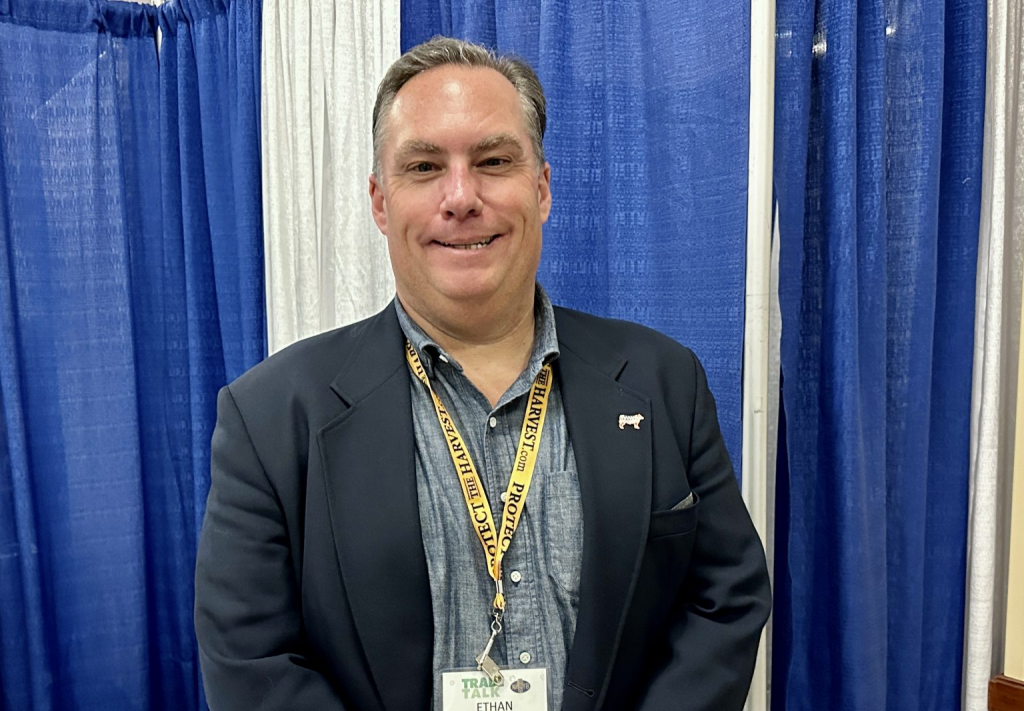
Senior Farm and Ranch Broadcaster, Ron Hays, is talking with Vice President of Governmental Affairs at the National Cattlemen's Beef Association, Ethan Lane about House Committee on Agriculture Chairman GT Thompson's 2024 Farm Bill proposal.
The markup of the 2024 Farm Bill is scheduled for May 23, 2024- click here for current details as found on the House Ag Committee website.
"We know what is in the draft and we are very comfortable with the product that GT and his team have put together," Lane said. "This is a bill that comes from a team that has paid a lot of attention to ensuring that the cattle industry's priorities are addressed, that this bill is a product that should be bipartisan, even though it is not being treated that way by that minority party in the House of Representatives or said Democrats for that matter at this point."
Lane said the 2024 Farm Bill aims to address some of the larger issues impacting the cattle industry.
"The reality is that the Inflation Reduction Act created 20 billion dollars in conservation in funding before the Farm Bill process started, but with constraints that don't exist in the Farm Bill writ large, or haven't up to this point," Lane said. "GT's draft seeks to get that money back into a broader strategy for ensuring that those programs keep up with inflation. There is funding in place to increase money going to valuable programs for producers across the country. That is going to be a fight because Democrats feel like they have something there with this climate-focused implementation of popular programs like EQIP (Environmental Quality Incentives Program)."
Lane added that he believes Thompson's draft is an elegant way to bridge the gap and move forward with robust funding for farm and ranch programs.
"This bill also takes an aggressive move in the direction of fully funding those disease preparedness programs- what we call the three-legged stool- like foot and mouth disease funding, investment and research and ensuring that if we were to have a foreign animal disease outbreak on American soil that both the cattle industry and the livestock industry at large is ready for that and can deal with it...," Lane said.
Regarding the nutrition programs in the Farm Bill, Lane said GT's draft does a good job of balancing out other parts of the bill, yielding benefits for American farmers and ranchers. NCBA is especially pleased that there is no livestock title included.
The Beef Buzz is a regular feature heard on radio stations around the region on the Radio Oklahoma Ag Network and is a regular audio feature found on this website as well. Click on the LISTEN BAR for today's show and check out our archives for older Beef Buzz shows covering the gamut of the beef cattle industry today.

Want an early read on your corn crop's potential? Pull out the shovel, advises AgriGold Agronomist Steven Heightchew. "The root system is the most important part of a corn crop, but also the most overlooked."
Root development can guide management decisions. "Evaluating corn as it's emerging gives farmers a scorecard for the rest of the year, showing whether they can push the crop to its maximum potential or whether the groundwork is laid for an average crop," Heightchew explains.
Root dig at emergence
"When I get called to a field to look at unevenness, it usually has to do with the radicle root system being injured by pests or chemicals," Heightchew says. Even when there's not a problem, he says it's important to dig up plants and see how radicle roots are faring.
To get things off to a solid start, Heightchew says, "we need the right root growth, the proper seeding depth, the crown to set at three-quarters of an inch and those roots to come out at 45-degree angles."
To assess root systems, farmers should find a few representative places in their fields to dig up some plants. If there's a lot of variation in your ground, you may need to do separate evaluations of those areas, Heightchew says.
Farmers should use a hand shovel to gently dig up the corn as it's spiking through the ground, making sure to scoop out the entire root ball and seed. That provides what they need to evaluate whether there were any issues with the planter pass, like sidewall compaction or shearing, as well as to determine if there has been chemical or pest injury to the plant's root system.
Check roots again at V3/V4
The next time Heightchew recommends farmers pull out the shovel is in the V3/V4 time frame when the seedling is around a foot tall and shifting from its seminal root system to its nodal root system for nutrient uptake.
"The fibrous roots should start at that 45-degree angle and branch down through the soil to get the depth needed for water uptake if dry conditions develop," Heightchew explains. "For the corn factory to thrive, it needs to have big, deep roots to pull up water and nutrients.
"Think of those roots like a straw in a milkshake," Heightchew says. "With a small straw, you'll have trouble pulling the milkshake up out of that cup. But if you use a bigger straw, it's easier."
If there's adequate soil moisture, a good 45-degree root set and no compaction, Heightchew says that's the green light farmers need to apply additional inputs and push yields.
But if roots start turning to go out rather than down at that 45-degree angle at the 3- or 4-inch mark, that indicates you have compaction lower in the soil — likely due to tillage. "When that happens, farmers should focus on having nutrients available in those top 3 to 4 inches," Heightchew says. Water availability will also be key.
Roots can guide troubleshooting in the fall
If yield estimates disappoint come fall, the first thing farmers should do is dig, Heightchew says. "Even that far into the crop cycle, you can usually pinpoint what went wrong by looking at the roots."
Besides a shovel, Heightchew wants farmers equipped with a penetrometer, noting a sharpened piece of rebar also works. "You just need something you can push down into the soil to see if there are restrictions. If it pushes through the soil easily, that's good. But if you face resistance, so will roots." In the latter scenario, he says farmers should work on soil health and evaluate magnesium levels.
It's easy to get in a hurry in the spring, rushing to plant ahead of rain or to push planting early in hopes of capturing that yield advantage. "Rooting starts with the planter pass. Taking the time to make smart decisions and place seed right, that will give you better yields overall," he says. "Balance is the key."
Want support striking that balance? Reach out to your local AgriGold agronomist for help monitoring crops through the growing season.
A new farm manager has been named to supervise the Michigan State University Plant Pathology and Entomology Research Centers.
Jared Andrews will direct operations and lead administrative duties at the two MSU AgBioResearch on-campus research centers, both located on the south side of campus.
The Plant Pathology Research Center is home to the university's cutting-edge research into plant diseases, such as fire blight in apples and downy mildew in cucumbers and other cucurbits.
The Entomology Research Center houses novel projects focused on insect physiology, integrated pest management and pollination. Researchers study ways to protect crops from pests like spotted wing drosophila, a small invasive fly that harms soft-fleshed fruits, and ways to support beneficial insects like honeybees.
"The fruit, vegetable, ornamental and field crop research that's being done at MSU is important in maintaining its status as the nation's pioneer land-grant university," Andrews said. "I'm really excited to be able to continue helping these different departments with their research as a facilitator and as a resource."
Andrews started in his new role on April 1. Before beginning at the two centers, he served as assistant farm manager at the MSU Horticulture Teaching and Research Center. He helped prepare and maintain field plots for research, facilitate structural repairs to the center and train student employees, among other organizational responsibilities.
Overall, Andrews has worked full-time at MSU for 13 years after graduating from the university in 2011 with a bachelor's degree in crop and soil sciences, with a specialization in sustainable agriculture and food systems.
In addition to holding the assistant farm manager position — as well as equipment and facility coordinator earlier in his career — at the Horticulture Teaching and Research Center, Andrews also worked in the MSU Office of Environmental Health and Safety as an industrial hygienist. In these roles, Andrews managed equipment and assisted with facility repairs at the center, and he conducted safety inspections at laboratories and research stations across campus.
"I'm a third-generation Spartan," Andrews said. "My grandmother went here. My father works here, and now I'm here. I'm excited to continue my work here and to remain a resource to everyone who's using these facilities."
James Averill, the assistant director of MSU AgBioResearch who oversees its on- and off-campus research centers, said the vast experience Andrews has collected throughout his career at MSU will ensure that both centers are cared for and the important research and education done there can continue.
"The MSU Plant Pathology and Entomology Research Centers will greatly benefit from Jared's background in helping run the MSU Horticulture Teaching and Research Center, along with the insight he gained in safety management from the MSU Office of Environmental Health and Safety," Averill said. "We're excited to have him and look forward to his contributions toward the impactful research and education happening at the centers."
Andrews said one of his first priorities as farm manager will be to collaborate with other on-campus farm managers to share information and equipment. In the future, he said he'd like to help build out a cloud-based farm management system that research centers can use to engage faculty, staff and administrators.
"In the past, all of these centers were departmental facilities, and now having them under MSU AgBioResearch is helping us streamline our services," Andrews said. "Each center used to have their own pieces of equipment for everything, which wasn't great in terms of finances, maintenance and storage.
"One of the goals on-campus farm managers are working on is to centralize our equipment to reduce that duplicity. If we do that, we can combine our financial power to get newer and more modern equipment for researchers to have available and for us to share across the board."
National Sorghum Producers commends the House Committee on Agriculture as they commence markup this week on the 2024 Farm Bill, particularly in the face of economic uncertainty and rising costs for U.S. sorghum producers. NSP is optimistic the proposal by Chairman Glenn "GT" Thompson will bolster much-needed protection and relief for America's farmers and ranchers.
"NSP is very pleased with the commitment and efforts of Chairman Thompson, and the entire House Ag Committee in ensuring a robust farm bill for sorghum producers," NSP Chairman Craig Meeker, a sorghum farmer from Wellington, Kansas, said. "We are eager to assist the committee in advancing a bill that will reinforce the safety net, strengthen crop insurance and conservation programs, which are key provisions for sorghum farmers."
The committee's focus on putting "more farm in the farm bill" by enhancing Title I is an essential improvement to the strength of U.S. agriculture producers. The legislation also includes critical improvements to crop insurance that encourage participation and help strengthen the safety net, the expansion of conservation funding by incorporating Inflation Reduction Act funds into the farm bill baseline, increased funding authorization for the Foreign Market Development (FMD) and Market Access Program (MAP), and the authorization for Section 9005 and other "orphan" programs that have previously lacked consistent support but are important to U.S. sorghum ethanol producers.
"In the lead-up to the 2024 bill, the House Ag Committee has conducted multiple hearings, listening sessions and meetings where NSP highlighted the priorities of the National Sorghum Producers," Meeker said. "We are confident the committee is poised to deliver a farm bill that will significantly benefit sorghum producers across the United States, and we look forward to working with committee members to advance this important legislation."
The American Soybean Association today expressed strong support for the Farm, Food, and National Security Act of 2024. In a letter addressed to Chairman Glenn "GT" Thompson and Ranking Member David Scott of the House Committee on Agriculture, ASA President Josh Gackle, who grows soybeans in Kulm, ND, emphasized the importance of the proposed legislation, which will be considered on May 23.
"We applaud Chairman Thompson for crafting legislation impactful for soybean farmers across our 30 soybean-producing states," said Gackle. "Strengthening the farm bill is more important than ever, and we believe this legislation will significantly enhance the effectiveness and accessibility of the farm safety net, promote expansion and diversification of markets, and protect vital programs like crop insurance and the soy checkoff."
Key Highlights from the ASA Support Letter:
ASA looks forward to working with the House Committee on Agriculture to ensure the passage of the 2024 Farm Bill.
Dr. Derrell Peel, Oklahoma State University Extension Livestock Marketing Specialist, offers his economic analysis of the beef cattle industry as part of the weekly series known as the "Cow Calf Corner," published electronically by Dr. Peel and Mark Johnson. Today, Dr. Peel talks about pasture and hay conditions.
As forage production moves into full swing, conditions for pasture and beginning hay stocks are in significantly better shape compared to last year. Released in the May Crop Production report from USDA-NASS, total U.S. hay stocks on May 1 were 21.0 million tons, up 46.6 percent year over year. That percentage speaks not only to improvement this year but just how bad last year was. The current May 1 total stocks are 8.9 percent higher than the 10-year average from 2013-2022. One year ago, the May 1 stocks were 25.7 percent below the ten-year average. The improvement in hay stocks indicates that producers generally got through the winter in better shape and still have some forage reserves going forward.
Figure 1 shows the May 1 hay stocks for the eight largest beef cow states. These states represent just over 51 percent of the total beef cow inventory of the country. May 1 hay stocks in the states in Figure 1 were mostly higher year over year, some significantly higher. Only Missouri and Kentucky had fractionally lower hays stocks this year. Hay stocks in these eight states are collectively up 81.4 percent year over year and are 9.4 percent above the ten-year average. These major beef cow states accounted for 54.0 percent of the total U.S. May1 hay stocks.
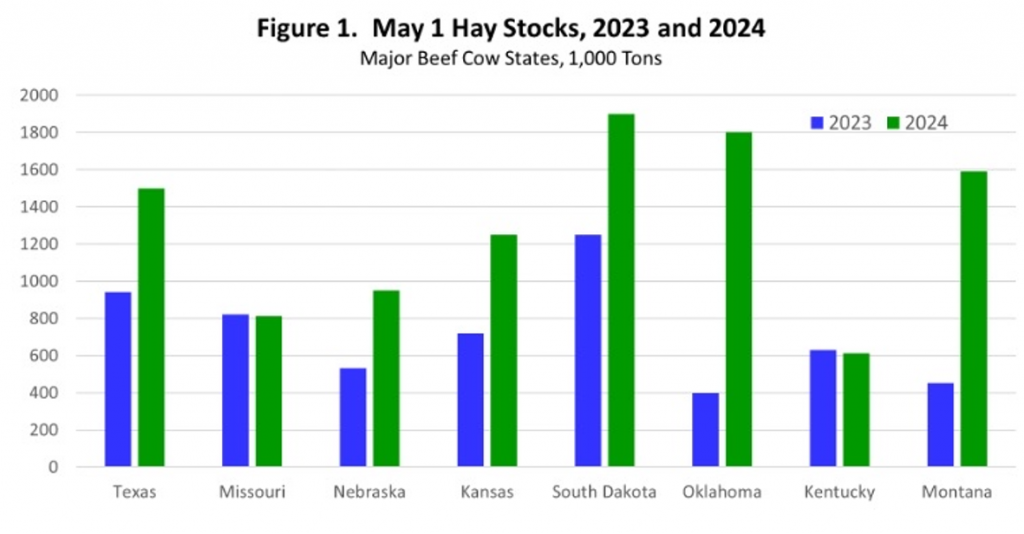
May 1 is also when USDA-NASS begins the seasonal reports on pasture and range conditions. The second report of the year for May 13 shows that the percent of U.S. pastures and ranges in poor to very poor condition was 24 percent, compared to 33 percent at the same time one year ago. At the other end of the scale, 47 percent of pastures and ranges are currently rated in good to excellent condition, compared to 34 percent last year. Regional pasture and range conditions show significant improvement year over year. The Great Plains, including Kansas, Colorado, Nebraska, Wyoming, Montana, and North and South Dakota, have 12.29 percent of pastures and ranges in poor to very poor condition, compared to 31.29 percent one year ago. The Southern Plains, consisting of Oklahoma and Texas, have 26.5 percent of pastures in poor to very poor condition this year, compared to 47.5 percent last year. The eight states west of the Great Plains region have 14.63 percent of pastures and ranges in poor to very poor condition, compared to 20.5 percent one year ago.
The U.S. currently has less drought than anytime in the last four years. The Drought Monitor includes the Drought Severity and Coverage Index (DSCI), which combines the drought categories in the Drought Monitor into a single drought measure. The DSCI can take on values from zero to 500 and the current value of 51 is the lowest DSCI since April 2020. The DSCI reached a recent peak of 202 in late 2022.
Conditions at the beginning of the 2024 forage growing season suggest that producers may be able to plan grazing and hay production with less restriction compared to recent years. However, in many cases, pastures and ranges still need time to recover from extended drought conditions. There is reason to be cautiously optimistic for better cattle production conditions in 2024. However, the forecasted redevelopment of La Niña conditions this summer is worrisome. The seasonal forecast from the Climate Prediction Center is for above average temperatures and below average precipitation for the next three months in much of major beef cattle country. Proceed with caution.
Below, Derrell Peel, OSU Extension livestock marketing specialist, talks about volatility in the cattle markets on SunUpTV from March 11, 2024.
Two days after the Biden Administration sent a letter threatening to sue Oklahoma over its new immigration reform law, Attorney General Gentner Drummond issued a sharply worded response vowing to defend the law.
In a May 15 letter to Gov. Stitt and AG Drummond, the U.S. Department of Justice (DOJ) threatened to challenge House Bill 4156 unless Oklahoma agrees not to enforce it, claiming the law is unconstitutional and preempted by federal statute.
"This letter constitutes notice ... that the U.S. Department of Justice intends to bring a lawsuit to enforce the supremacy of federal law and to enjoin the enforcement of HB 4156," stated the DOJ. "If you have not confirmed by May 20, 2024, that Oklahoma will forbear such enforcement, the United States will pursue all appropriate legal remedies to ensure that Oklahoma does not interfere with the function of the federal government."
Drummond pushed back in his response, rejecting DOJ's "disingenuous" contention that the White House is committed to enforcing federal immigration law.
"One thing that has been glaring over the last 3.5 years is that the Biden Administration is only 'committed' to subverting the immigration laws of this country," Drummond wrote in the May 17 letter. "Your misguided demands ignore that Oklahoma has not only the sovereign right, but also the solemn legal obligation, to protect its own borders and its own citizens.
"You are wrong about our law – and if the Biden Administration sues over it, I will vigorously defend Oklahoma and its people."
Drummond contends Oklahoma had no option but to pursue the law amid the federal government's failure to address the illegal immigration crisis.
"Acquiescence to this intolerable situation is not in my state's DNA; neither is surrender," Drummond wrote. "As such, HB 4156 represents a meaningful, common-sense, and legally permissible step toward addressing and correcting that which the Biden Administration has willfully refused to enforce the last 3.5 years."
The Attorney General characterized the DOJ's preemption argument as "dubious at best," countering that the federal government's "broad" authority over immigration does not equate to "exclusive power" on the subject.
"Oklahoma is exercising its concurrent and complementary power as a sovereign state to address an ongoing public crisis within its borders through appropriate legislation," Drummond wrote. "Put more bluntly, Oklahoma is cleaning up the Biden Administration's mess through entirely legal means in its own backyard – and will resolutely continue to do so by supplementing federal prohibitions with robust state penalties."
Finally, Drummond emphasized that racial profiling is not a component of enforcing HB 4156.
"This law is a powerful tool to combat those foreign nationals who enter and remain in this country illegally, and who become involved in serious criminal activity such as illegal marijuana-grow operations, fentanyl distribution, sex trafficking, and labor trafficking," he wrote. "At the same time, I emphasize that racial profiling of any sort is not only unacceptable under any circumstances, but also illegal in Oklahoma. ... To detain someone who looks, sounds, or acts 'foreign' is itself un-American and will never be tolerated by this office."
The U.S. International Trade Commission today agreed to advance a petition by Corteva Agribusiness to place anti-dumping and countervailing duties on imports of the herbicide 2,4-D shipped from China and India.
The National Corn Growers Association (NCGA) said the decision will impact farmers.
"We are disappointed that ITC did not listen to the feedback from farmers about how harmful these tariffs could be to rural America," said Minnesota farmer and NCGA President Harold Wolle. "Corn prices are already low and input costs have been rising. This decision will only compound our problems."
Six of the nation's major commodity groups, including the National Corn Growers Association, sent a letter to the U.S. International Trade Commission in April encouraging it to vote against advancing a petition.
Growers have said the imports covered by this case are the major sources of supply other than Corteva, which is the only U.S. manufacturer, and that America's farmers cannot rely upon a sole domestic supplier of 2,4-D to meet nearly all the market's needs.
Duties on 2,4-D imports from the two countries would intensify what is already a difficult period for many growers as key input costs continue to increase.
The U.S. Department of Agriculture is projecting record-high farm production cash expenses for 2024. At the same time, crop values are declining. USDA projects total cash receipts for crops in 2024 will be 11.7% lower than 2022.
NCGA intends to continue to engage in this case as it goes to the next stage, including the final phase at the U.S. International Trade Commission early next year.
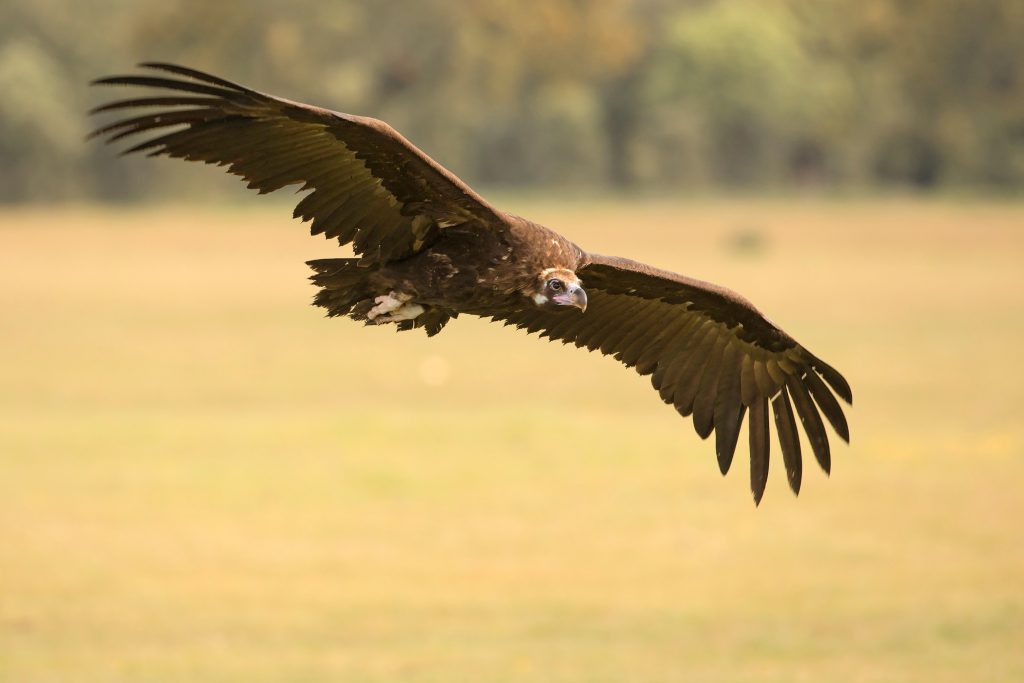
The Oklahoma Department of Agriculture, Food and Forestry, in partnership with the USDA and U.S. Fish and Wildlife Services, increased the number of black vultures authorized to a maximum of 10 vultures, previously a maximum of 5 vultures per sub-permit.
The sub-permits remain free of charge and allow Oklahoma residents to dispose of black vultures attacking their livestock.
"The increased number of permits supports livestock producers with black vulture management," said staff biologist Karen Duncan. "Black vulture attacks on livestock pose a significant challenge for Oklahoma producers. These permits aim to alleviate the burden on livestock producers."
The statewide depredation permit allows livestock producers an opportunity to apply for a livestock protection depredation sub-permit — allowing 10 legal "takes" of black vultures at no charge to the livestock owner.
Black vulture take may not occur under any other depredation permit for a producer acting under a sub-permit. Producers wishing to implement other methods or take more than 10 black vultures must obtain their own depredation permit. For anyone experiencing extensive depredation issues (requiring more than 10 takes) or having large black vulture roosts on their property, contact the wildlife division at blackvultures@ag.ok.gov
We are proud to partner with Farm Foundation and others to provide Togetherall: free, anonymous mental health support to those who need it. That partnership -- the Farm Family Wellness Alliance -- will host an open webinar about Togetherall. We encourage Farmers Union members and staff, as well as other farmers, rural residents, or agriculture organizations, to attend and participate.
The virtual informational session will be held on Tuesday, May 21 from 10-11 a.m. CT. Registration is required and registrants will receive a recording following the webinar.
The webinar will cover the following:
How can I help promote these services?
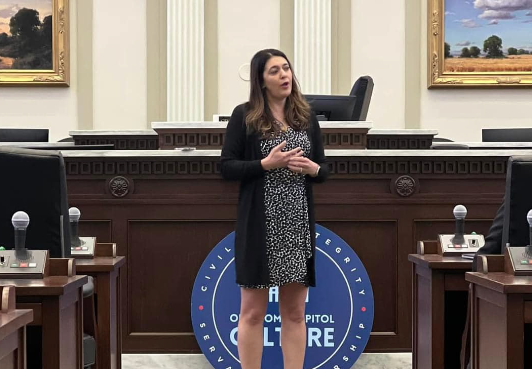
A House bill introduced Wednesday would modernize legislation barring foreign money from influencing U.S. elections, closing loopholes that have been leveraged by foreign billionaires to get involved in American politics, its authors told The Daily Wire.
The "Preventing Foreign Interference in American Elections Act," introduced by Rep. Bryan Steil (R-WI) and first obtained by The Daily Wire, would amend a 1971 law to "further restrict contributions of foreign nationals."
The law would not only bar foreign nationals from making direct contributions to candidates and political groups, but also to groups that collect ballots, register voters, or conduct get-out-the-vote efforts. Steil says these loopholes have allowed foreign billionaires to fund indirect election efforts.
"American elections must be free from foreign influence. By closing loopholes that allow foreign nationals from funding elections operations, we are one step closer in preventing foreign involvement in American elections," Steil told The Daily Wire. "I'm committed to stopping foreign influence in U.S. elections and protecting U.S. donor privacy."
Experts say current statutes have proven inadequate in the complex modern age of political finance. Caitlin Sutherland, the executive director of Americans for Public Trust, which has worked to make stopping foreign influence in elections a major political issue, celebrated the legislation.
"For too long, loopholes in our laws have allowed Swiss billionaire Hansjörg Wyss to pour hundreds of millions of dollars into organizations directly and indirectly influencing politics and elections," Sutherland told The Daily Wire. "There's nothing stopping foreign adversaries from China, North Korea, or Russia from doing the same. This commonsense legislation will help safeguard our politics from foreign meddling."
If passed, the new legislation would bar foreign nationals from giving donations to support "any public communication that refers to a clearly identified Federal, State, or local political party" or "the administration of a Federal, State, or local election." The bill also refines existing legislation to create penalties for "indirect contributions" from foreign nationals who give funds to American citizens with the intent of the money being used for the aforementioned activities.
Sutherland's group found that Wyss-funded nonprofits, including the Wyss Foundation and the Berger Fund, have spent $475 million influencing U.S. politics. It found that $265 million of the money from the Wyss nonprofits went to Arabella Advisors, a dark money network that supports liberal causes across the country.
Rep. Stephanie Bice (R-OK), a co-sponsor of the legislation, also singled out Wyss when pointing to the impact foreign billionaires have had in American politics.
"Individuals like Hansjörg Wyss should not be allowed to use loopholes to bankroll liberal groups such as the 1630 Fund or Arabella Advisors," Bice asserted. "We must ensure that foreign individuals or even foreign adversaries are not corrupting our political processes with money or influence." Read the article here.
Today, the National Cattlemen's Beef Association (NCBA) announced support for the Farm Bill crafted and released by House Agriculture Committee Chairman Glenn "GT" Thompson (R-PA)—the Farm, Food, and National Security Act of 2024. The bill includes numerous priorities for America's cattle producers, strengthens essential USDA programs, and protects farmers and ranchers from emerging threats.
"America's cattle producers don't ask for much from the federal government, but we do need a few essential programs that protect our industry from foreign animal diseases, reward voluntary conservation, and keep farms and ranches in business after a natural disaster," said NCBA President and Wyoming rancher Mark Eisele. "Chairman Thompson's Farm Bill supports these critical needs for the cattle industry, and I am very grateful that the Chairman listened to groups like NCBA when writing this bill. We strongly support this legislation and urge Congress to pass this bill."
Chairman Thompson's Farm Bill is the result of months of stakeholder input and dialogue with farmers and ranchers. NCBA members have been involved in these conversations and had the opportunity to weigh in on Farm Bill priorities.
"Last summer, I had the chance to talk to Chairman Thompson during a Farm Bill listening session in Virginia. The provisions that cattle producers asked for during the listening session are now in the draft bill, and that's a testament to Rep. Thompson's commitment to listening to the producers who rely on the Farm Bill," said NCBA Vice President Gene Copenhaver, a Virginia cattle producer. "This is exactly how our system should be working with Congress asking questions, listening to feedback, and using that knowledge to craft our laws. I am very pleased with this Farm Bill, and I hope members of Congress from both parties join together and get this bill passed."
The House Farm Bill addresses several key priorities for the cattle industry including:
The bill also includes numerous other provisions that support cattle producers and strengthen our food and national security.
National, state, and local leaders and groups oppose the House Republicans' partisan farm bill. The bill would institute the largest cut to SNAP, America's most effective anti-poverty program, in nearly 30 years. Additionally, it rescinds critical funds for climate-smart agricultural practices secured by House Democrats in the Inflation Reduction Act and limits the ability of the USDA to support farmers during natural disasters and other emergencies.
Bill O'Keefe, Executive Vice President for Mission, Mobilization and Advocacy, Catholic Relief Services: "CRS is concerned about Chairperson Thompson's Farm Bill proposal in the House. It risks undermining the program quality and reach of the Food for Peace Title II (FFP) program. We strongly oppose including parts of the American Farmers Feed the World Act (H.R. 4293) in the package, as it jeopardizes Resilience Food Security Activities."
Evangelical Environmental Network: "Through the Inflation Reduction Act, a promise was made to our farmers: to support them in implementing climate-smart agriculture practices. In addition to being climate-smart, these practices are also water-smart, soil- smart, and smart for our farmers' bottom line."
Reverand Susan Hendershot, President, Interfaith Power and Light: "We do not support a partisan Farm Bill proposal that pits funding for nutrition assistance, including SNAP benefits, and conservation funding against each other. Instead, we call for a Farm Bill that protects these programs, along with protecting the $20 billion allocated for climate-smart agriculture in the Inflation Reduction Act and firmly integrating it into the core of the Farm Bill with climate guardrails."
Daren Caughron, Sustainable Energy and Environment Legislative Manager, Friends Committee on National Legislation: "The framework released by the House Committee on Agriculture [republicans] fails to meet the standards for a bipartisan Farm Bill that works towards ending hunger and supporting farmer's resilience to extreme weather. Proposals to remove "guardrails" protecting conservation investments and cuts to nutrition funding will pit critical nutrition and conservation programs against one another, rather than underscoring the deep importance of both components."
Linda Lipsen, CEO, American Association for Justice: "In the face of hundreds of thousands of claims that ordinary Americans have brought against the manufacturers of Roundup and other pesticides, it's appalling that Congress would choose to protect the profit margins of corporate giants over the lives of farmers, maintenance workers, and others who come into contact with these potentially deadly chemicals."
AFL-CIO: "The AFL-CIO strongly opposes the [republican] Farm Bill. Families rely on Food for Peace – and also SNAP, SNAP's Thrifty Food Plan, and other federal nutrition and food security programs. We cannot support making harmful policy changes or funding cuts to any of them."
Nancy Perry, Senior VP of Government Relations, ASPCA: "The draft Farm Bill attacks state protections for farm animals, puts dogs in puppy mills at even greater risk, and fails to address the horse slaughter crisis. It is far too harmful to support, and we urge Congress to ensure that the final Farm Bill upholds state farm animal protection laws."
Cristel Zoebisch, Director of Policy, Carbon180: "We urge lawmakers to focus on a bipartisan final Farm Bill that maintains the integrity of climate safeguards included in the Inflation Reduction Act and supports a broad set of innovative approaches to building strong agriculture and forestry systems."
CARE Chefs' Table: "As professional chefs and advocates fighting to end global hunger, we work daily to support local food systems, build reliable supply chains, and help our communities have safe, nourished lives. We urge you to ensure communities around the world have the same opportunities through this year's Farm Bill reauthorization. To do so, we must protect and strengthen Food for Peace Title II and McGovern-Dole Food for Education, two of the United States' most critical international food assistance programs. Alarmingly, proposals like the American Farmers Feed the World Act (H.R.4293 and S.2862) threaten to cripple Food for Peace."
Emily Gee, Vice President for Inclusive Growth, Center for American Progress: "This partisan farm bill contains unacceptable cuts to vital nutrition programs and guts critical investments in climate-smart agriculture. It would also prevent any adjustment to food benefits, which would result in more people going hungry."
Margie Alt, Director, Climate Action Campaign: "Depriving the nation's farmers of critical dollars and tools that they need to slash climate pollution and guard against the worst impacts of the climate crisis is short-sighted and counterproductive. It puts our food systems and numerous family farms at risk."
Ty Jones Cox, Vice President for Food Assistance, Center on Budget and Policy Priorities: "Every SNAP participant would receive less to buy groceries in future years than they would under current law, putting a healthy diet out of reach for millions of people. This would be the largest cut to SNAP since 1996 if enacted & these cuts would grow even deeper over time."
Dr. Peter G. Lurie, President, Center for Science in the Public Interest: "The bill attacks Supplemental Nutrition Assistance Program (SNAP) benefits, cuts key climate-focused programs, and includes measures to weaken the nutritional content of school meals. In general, the framework undercuts programs vital to protecting our nation's food and nutrition security."
Andrew Lentz, Director of Federal Affairs for Agriculture Policy, Environmental Defense Fund: "The removal of climate-focused funding in these programs is a step backward at a time when we need to be moving forward with greater urgency. Stripping these resources away will undermine farmers' and ranchers' ability to adapt and thrive in the face of increasingly challenging growing conditions."
Environmental Working Group: "Environmental Working Group (EWG) strongly opposes the farm bill proposed last week and instead urges you to develop a farm bill that reduces hunger, supports all farmers, preserves the rights of state and local governments, and helps farmers who seek USDA assistance to reduce greenhouse gas emissions and prepare their farms for extreme weather."
Mattea Mrkusic, Senior Energy Transition Policy Lead, Evergreen Action: "The GOP's draft farm bill removes vital climate 'guardrails' to conservation programs that are already improving water and soil quality, boosting rural economies, and fighting climate change across the country. It's bad policy, and even worse politics. Democrats have made it clear for months that they won't support any bill that eliminates the climate guardrails. This bill doesn't stand a chance in the Senate. It's time for House Republicans to get real and work with Democrats to draft a farm bill that maintains this popular and necessary funding."
Feeding America: "The significance of the farm bill in combating food insecurity in the United States cannot be overstated. We've heard from our neighbors facing hunger that food insecurity should be treated as an urgent crisis and, unfortunately, the bill text the House Agriculture Committee released today is cause for concern."
Mitch Jones, Managing Director of Policy Litigation, Food & Water Watch: ""The Farm Bill is a seminal opportunity to reform our food and agriculture sector away from factory farms and corporate greed. Instead, House Republicans want to double down. Some of leadership's more dangerous proposals would take us backwards on animal welfare, and climate-smart agriculture — both The EATS Act and support for factory farm biogas must be dead on arrival. It's time Congress put the culture wars aside and got back to work on a Farm Bill that puts consumers, farmers, and the environment above politicking and Big Ag handouts."
Kelly Horton, Interim President, Food Research & Action Center: "The House Farm Bill text released today by House Agriculture Committee Chair G.T. Thompson poses a serious threat to the health and wellbeing of the more than 41.4 million people who rely on the Supplemental Nutrition Assistance Program to put food on the table."
HEAL Food Alliance: "Today, 44.2 million people, including over 13 million children, live in food insecure households, yet this bill will slash the Supplemental Nutrition Assistance Program (SNAP) by $27 billion. Although the bill improves SNAP eligibility for certain demographics such as college students, it will restrict the USDA's ability to set SNAP benefits, eroding nutrition programs' long-term ability to provide access to vulnerable families and communities across the country."
James Beard Foundation: "We are concerned about the House of Representatives version of the farm bill, particularly the provisions regarding conservation funding for climate-smart agriculture and proposals to weaken and cut the Supplemental Nutrition Assistance Program (SNAP)."
Madeleine Foote, Healthy Communities Program Director, League of Conservation Voters: "House Agriculture Committee Chair GT Thompson caved to the demands of extreme MAGA Republicans who are not serious about working in a bipartisan way to protect our farmers, communities, and environment. The proposal from the Republican-led House would strip money from climate-smart agricultural practices and conservation programs that are already oversubscribed, even after the increased investments from Inflation Reduction Act, taking money out of the hands of farmers who want to leave a better environment and a more sustainable food system to feed our families for generations to come."
113 Massachusetts organizations: "Congressman Thompson's proposal would prevent future science and evidence based adjustments to SNAP benefit amounts. The Congressional Budget Office (CBO) estimates this would cut $30 billion from SNAP over 10 years. This would mean a $750 million cut to SNAP for Massachusetts families between FY2027 and FY2033."
Abby J. Leibman, President & CEO, MAZON: A Jewish Response to Hunger: "With over 44 million Americans facing hunger, Chairman Thompson would rather double down on harmful and irresponsible policies to cut nutrition assistance for those in need. I find it ridiculous that once again, conservatives are looking to 'refocus' the purpose of SNAP — this time to 'promote a healthy lifestyle.' Let's be clear: SNAP is an anti-hunger program, plain and simple."
Kristin Rowe-Finkbeiner, Executive Director and CEO, MomsRising: "At this time when skyrocketing food prices have increased hunger and food insecurity, forcing tens of millions of U.S. families to make impossible choices between food and other essentials, it would be mean-spirited and shameful for Congress to cut the SNAP benefits moms and families rely on; and it also would be damaging to our economy. Yet this is exactly what the Farm, Food, and National Security Act of 2024, introduced by U.S. House Republican leadership today, would do. Its impact would be devastating."
Christina Stucker-Gassi, Policy Lead, Northwest Center for Alternatives to Pesticides: "NCAP strongly opposes the current farm bill draft and advocates for a bill that reduces hunger, supports all farmers, preserves local rights, and helps farmers reduce greenhouse gas emissions while adapting alternatives to changing pest and disease regimes."
Mike Lavender, Policy Director, National Sustainable Agriculture Coalition: "A bill that closely mirrors the latest House summary is not a bill that should become law."
Oregon Food Bank: "The House Farm Bill proposal, put forth by House Agriculture Chair Glenn 'GT' Thompson, cuts SNAP benefits for all participants by freezing the USDA's ability to update the Thrifty Food Plan to accurately reflect the cost of a healthy, realistic diet accurately."
Gina Cummings, Vice President for Advocacy, Alliances, and Policy, Oxfam: "The House must reject must reject the provisions of the American Farmers Feed the World Act included in the House Farm Bill draft as the bill goes for markup. The inclusion of such provisions is a threat to global food security and a shift towards a less-efficient model of international aid by the United States."
UnidosUS: "House Agriculture Committee Chairman G.T. Thompson's proposed cuts to SNAP benefits threaten to undermine this vital support system and deepen the hunger crisis in Latino communities."Melissa Kaplan, Senior Manager of Government Affairs, Union of Concerned Scientists: "The bill is out of line with what the public wants and our food system needs. People across the country strongly support programs that help farmers protect their farms from extreme weather, like those funded by the Inflation Reduction Act. They also support protecting the workers who keep our country fed and want to ensure that small- scale, diverse and young farmers have equitable access to land, credit, and other vital resources. The [republican] House bill fails in these respects."
RON's Dave Lanning has a pre-opening look at today's agricultural Markets.
Click the audio tab below for today's report.
NPPC scored big wins for pork producers in the House Agriculture Committee's 2024 Farm Bill, the text of which was released this week by panel Chairman G.T. Thompson (R-PA).
All the U.S. pork industry's legislative priorities are included in the lower chamber's five-year agricultural blueprint, including provisions that would:
The Senate Committee on Agriculture, Nutrition, and Forestry is expected to release the full text of its Farm Bill soon.
NPPC's take: "America's pork producers appreciate Chairman G.T. Thompson's willingness to listen, put pen to paper, and address the most pressing issues facing the agriculture industry across the country — a prime example of how our government should work," said NPPC President Lori Stevermer, a pork producer from Easton, Minnesota. "The inclusion of pork producers' top priorities in the 2024 House Farm Bill is a testament to our industry's ability to unite and speak up about our common challenges."
Why it matters: The five-year farm bill sets farm, conservation, forestry, and nutrition policy and authorizes various agricultural programs, including ones related to foreign animal disease preparation and prevention and export promotion.
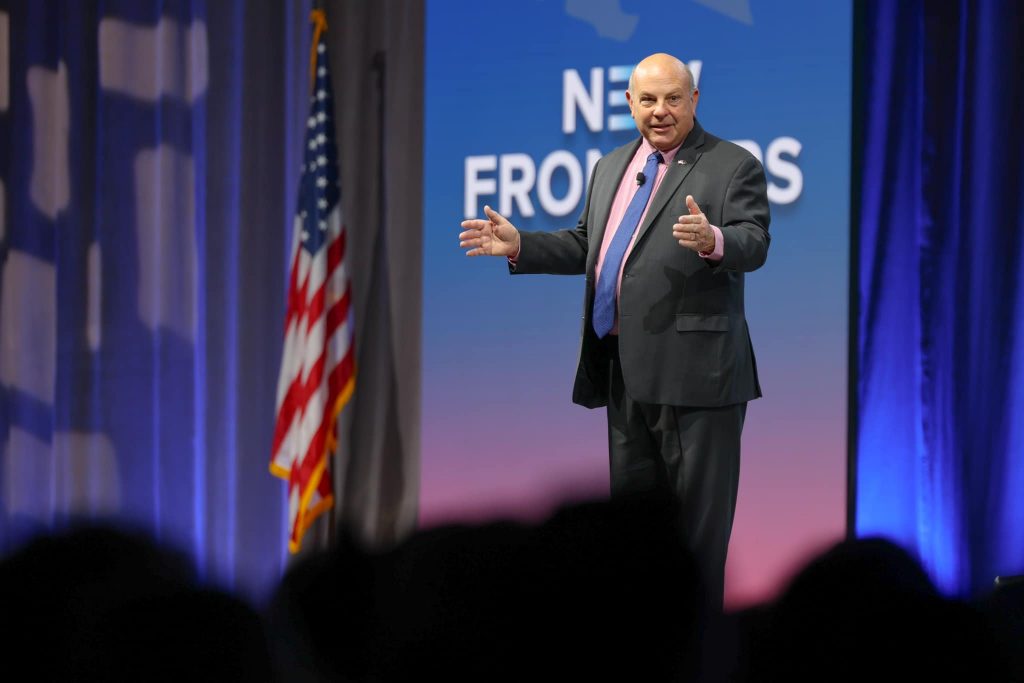
American Farm Bureau Federation President Zippy Duvall commented today on the release of a farm bill draft in the House Agriculture Committee.
"AFBF appreciates the work of Chairman Thompson and the entire House Agriculture Committee for its work in drafting a new, modernized farm bill.
"America's farmers and ranchers need the stability that the farm bill provides so they can withstand the unforeseen challenges of growing the food, fuel and fiber America's families rely on. Conservation and research programs help farmers protect the resources they've been entrusted with and enable American agriculture to remain on the forefront of innovation. Nutrition programs also give a helping hand to families struggling to make ends meet.
"We look forward to taking a deep dive into the House farm bill draft in advance of next week's markup. We hope to see the Senate Agriculture Committee's version soon so we can move forward with getting the farm bill passed. It's too important to wait. America's families are counting on Congress to get this done."
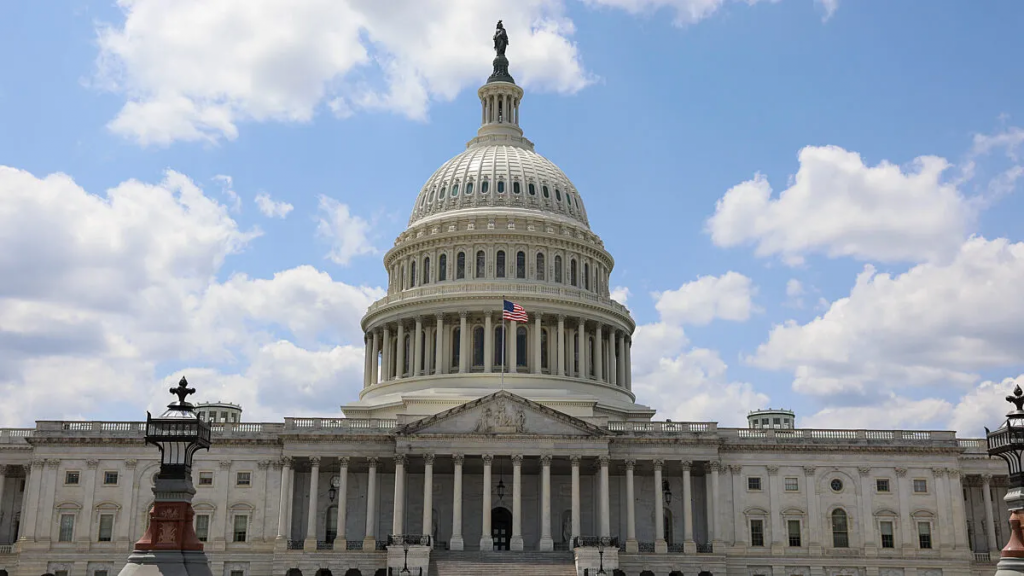
American Farm Bureau Federation President Zippy Duvall commented today on the release of a farm bill draft in the House Agriculture Committee.
"AFBF appreciates the work of Chairman Thompson and the entire House Agriculture Committee for its work in drafting a new, modernized farm bill.
"America's farmers and ranchers need the stability that the farm bill provides so they can withstand the unforeseen challenges of growing the food, fuel and fiber America's families rely on. Conservation and research programs help farmers protect the resources they've been entrusted with and enable American agriculture to remain on the forefront of innovation. Nutrition programs also give a helping hand to families struggling to make ends meet.
"We look forward to taking a deep dive into the House farm bill draft in advance of next week's markup. We hope to see the Senate Agriculture Committee's version soon so we can move forward with getting the farm bill passed. It's too important to wait. America's families are counting on Congress to get this done."
The National Pork Producers Council (NPPC) applauds the U.S. House Agriculture Committee's unveiling of its 2024 Farm Bill.
"America's pork producers appreciate Chairman G.T. Thompson's willingness to listen, put pen to paper, and address the most pressing issues facing the agriculture industry across the country – a prime example of how our government should work," said NPPC President Lori Stevermer, a pork producer from Easton, Minn. "The inclusion of pork producers' top priorities in the 2024 House Farm Bill is a testament to our industry's ability to unite and speak up about our common challenges."
NPPC successfully advocated to include pork producers' priorities in the House Farm Bill, including:
NPPC urges the House Agriculture Committee to swiftly consider and pass this Farm Bill, so pork producers have the certainty to continue their operations to the next generation.
Though the U.S. Senate Committee on Agriculture, Nutrition, and Forestry has yet to reveal its full Farm Bill text, NPPC urges timely publication and consideration of a Senate Farm Bill that addresses the above priorities.
U.S. Wheat Associates (USW) joins the North American Millers' Association (NAMA), National Association of Wheat Growers, Midwest Dry Bean Coalition, USA Rice, and AFL-CIO in applauding the House Agriculture Committee for its inclusion of life-saving reforms to U.S. international food aid programs in today's release of the Farm, Food, and National Security Act of 2024. These reforms would immediately feed more people without spending any new taxpayer dollars.
The Farm, Food, and National Security Act of 2024 includes a 50 percent floor for U.S. commodities and ocean shipping in Food for Peace, ensuring that at least half of the budget goes directly to the program's mission of feeding hungry people worldwide. Through its reforms, the Act preserves a robust role for USDA and the American farmers, millers, and shippers that have reliably contributed to Food for Peace since its inception. Additionally, it simplifies the Bill Emerson Humanitarian Trust release mechanism so that the program can respond efficiently and effectively to hunger crises, as intended.
"The Farm Food and National Security Act of 2024 sends a clear message that Food for Peace should be delivering as much American grown food to as many hungry people as possible," said USW Director of Trade Policy Peter Laudeman. "This is a mission that U.S. wheat farmers are proud to support, and we look forward to seeing these important reforms carried through the farm bill process."
USW's partners in backing the measure also voiced strong support.
"The food aid reforms included in the House farm bill ensure that more food will go directly into the bellies of hungry people around the world. In a time of such unprecedented famine emergency, we cannot imagine a higher priority than making sure we are feeding as many people as possible," said NAMA Vice President of Government Affairs Kim Cooper. "American labor has long supported the Food for Peace program, and is proud to endorse these provisions in the Farm, Food, and National Security Act of 2024 that ensure our nation continues its leadership in the fight against global hunger," said Mark Clements, Executive Secretary-Treasurer of the Maritime Trades Department, AFL-CIO.
A large contingent of farmers, ranchers and the ag business community were on hand as Oklahoma Senator James Lankford hosted the top Republican on the Senate Ag Committee, Arkansas Senator John Boozman, for a Farm Bill listening session. Executive Vice President of the Oklahoma Cattlemens Association Michael Kelsey was on hand along with, OKFB's Rodd Moesel, AFR's Scott Blubaugh, NAWG President Keeff Felty, Kylee Deniz with the Oklahoma Pork Council, Jeff Moen with Noble Research, Peyton Hale with Western Livestock Auctions(Representing LMA), Kent Martin with the Sorghum Producers, Brent Bolen representing the Poultry industry, Greg Livingston of Farm Credit Western Oklahoma, and several other organizations.
Ag Secretary Blayne Arthur moderated the meeting, and all had the opportunity to share their thoughts and suggestions with the Senators.
After the meeting, Farm Director KC Sheperd had the opportunity to catch up with Senator Boozman to get his thoughts on the newly released Farm Bill Draft from GT. Thompson. Boozman revealed in the meeting that he will be releasing his version of the farm bill and that it would be similar to that of Chairman Thompsons, "Ours will be very similar to GT's, and I think he's done a really good job of listening to the farm community and trying to address the problems that we see out there."
Boozman noted that farmers across the country have similar concerns: input costs, commodity prices and the farm bill. Because of this, Boozman said it is critical that parts of the Farm Bill such as the safety net are prioritized.
Boozman said his first priority is not only getting a farm bill done, but getting the RIGHT farm bill done.
"People say, 'Senator! We've got to get this done,' and I agree totally.'" Boozman said. "On the other hand, this is a five-year commitment, and once we do this, this is a contract with our farmers for five years. We don't need to just do something, we need to do the right thing because they are in a situation now where its just difficult in farm country."
If the GOP is able to take control of the Senate in November, Boozman said his plan will mimic the goals and priorities of GT Thompson.
"It is a big deal, and we are committed to getting it done as quickly as possible," Boozeman said. "But we do want to make sure that our farmers have the tools they need to go forward. If not, we are better off staying like are for a while."
The senators met with OMMA after the meeting and were headed to Stillwater afterwards to tour the OSU land grant university.
House Committee on Agriculture Chairman Glenn "GT" Thompson (PA-15) issued the following statement after releasing text of the 2024 Farm Bill:
"The Farm, Food, and National Security Act of 2024 is the product of extensive feedback from stakeholders and all Members of the House, and is responsive to the needs of farm country through the incorporation of hundreds of bipartisan policies. The release of this draft is a significant step forward in a years-long, deliberative process. The markup is one step in a greater House process, that should not be compromised by misleading arguments, false narratives, or edicts from the Senate. I look forward to engaging with colleagues on both sides of the aisle as we move to markup."
Click here for the discussion draft text of the Farm, Food, and National Security Act of 2024.
An updated title-by-title summary can be found here (Updated May 17, 2024.
The mark up of the 2024 Farm Bill is scheduled for May 23, 2024- click here for current details as found on the House Ag Committee website.
| ||||||||||||||||||||||||||||||||||||||||||||||||||||||||||||||||||||||||||||||||||||||||||||||||||||||||||||||||||||||||||||||||||||||||||||||||||||||||||||||||||||||||||||||||||||||||||||||||||||||||||||||||||||||||||||
|
The National Cotton Council applauds House Agriculture Committee Chairman Glenn "G.T." Thompson for producing a Farm Bill that significantly increases the support levels for cotton producers, who have been weighed down by the recent rise in on-farm production costs. This legislation also gives growers more affordable options for their risk management strategies, makes important improvements in the marketing loan program, and restores critical support for our domestic textile manufacturers.
The NCC urges this legislation to move forward in a bi-partisan manner with our industry committed to working with the leadership of the House and Senate to ensure final passage in 2024.
Today, House Agriculture Ranking Member David Scott released the below statement following the unveiling of the long-awaited partisan farm bill text by Agriculture Committee Republicans.
"The discussion draft released by Chairman Thompson today confirms my worst fears: House Republicans plan to pay for the farm bill by taking food out of the mouths of America's hungry children, restricting farmers from receiving the climate-smart conservation funding they so desperately need, and barring the USDA from providing financial assistance to farmers in times of crisis.
"The economic impact of the SNAP cuts alone would be staggering. A $27 billion reduction in food purchasing power would not only increase hunger, but it would also reduce demand for jobs in the agriculture, transportation, manufacturing, and grocery sectors.
"Food has become a natural security issue, as pointed out by experts at our recent hearing on China, and weakening our ability to feed the most vulnerable members of our communities is shortsighted and wrong.
"The Republican plan to eliminate the Agriculture Secretary's CCC discretionary authority would tie the hands of our government to assist farmers during natural disasters and pandemics. "The funding proposal that the Chairman has put forward does a disservice to American agriculture because it doesn't provide a path forward to getting a bill passed on the House Floor."
National Association of State Departments of Agriculture CEO Ted McKinney praised U.S. House Agriculture Committee Chairman Glenn "GT" Thompson for releasing the Farm, Food, and National Security Act of 2024 today in the following statement:
"NASDA applauds Chairman Thompson for beginning the process of creating the next farm bill," McKinney said. "With the release of the legislative text, NASDA remains committed to advocating for a bipartisan farm bill that will secure a commitment to American agriculture and the critical food and nutritional assistance programs for those who need it most. Signing a farm bill into law is vital to the food and agriculture sector which benefits our economy, accounting for roughly one-fifth of U.S. economic activity and supporting nearly 23 million jobs. We welcome the opportunity to work with the House Agriculture Committee as they begin debating the Farm, Food, and National Security Act of 2024."
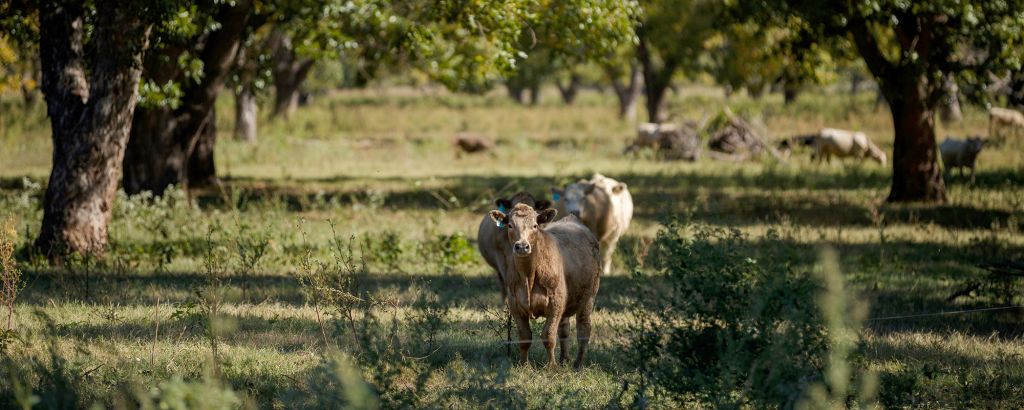
Noble Research Institute, the nation's largest nonprofit agricultural research organization, has been given a 2024 Regenerative Agriculture Research Grant from the Greenacres Foundation to advance its ongoing pecan-focused research.
The $295,000 grant was awarded to aid the organization's study of pecan silvopasture and measuring improved soil health's impact on building profitable and resilient systems. In line with Noble's goal of regenerating 164 million acres of US grazing land by 2040, this three-year project will contribute to the continuing research focused on the impact of implementing regenerative practices for achieving a balanced and resilient ecosystem.
"This Greenacres Foundation Grant will support research to monitor soil health across a continuum of management practices in producer pecan orchards across Texas and Oklahoma," said Dr. Lauren Jones, principal investigator on the project and senior research associate for Noble Research Institute. "More specifically, the funds will contribute to systems-level research that we are doing in pecan silvopasture to better understand which agricultural practices lead to improvement in soil health."
The team will sample soil, pecan leaves, and nuts as part of the project and correlate the data to management decisions and economics. Researchers hypothesize that healthier soils achieved through regenerative management will lead to healthier trees and more nutrient-dense pecans.
The study will address the following priorities:
Locations identified for data collection include pecan orchards on producer properties in Texas and Oklahoma, two of the top five pecan-producing states in the US. This will be Noble's first long-term study in a pecan silvopasture system where the results will aid not only the pecan producers but also the silvopasture systems.
Greenacres Foundation, a Cincinnati-based nonprofit, is dedicated to advancing research and initiatives that promote a healthier and more sustainable future through active engagement in land preservation, education and the arts.
To learn more about Noble Research Institute's current pecan research, please visit www.noble.org/pecan-strategy-research.
About Greenacres Foundation
Greenacres Foundation was established in 1988 by Cincinnati philanthropists Louis and Louise Nippert in Cincinnati and has since expanded to manage over 1,200 acres across Ohio and Indiana. The foundation embodies the Nipperts' dedication to land preservation, education, and the classical arts. Each year, it reaches over 30,000 students with its educational programs and actively engages in and supports agricultural and environmental research through grants and its own initiatives, enhancing the well-being of the communities it serves and beyond.
To learn more about the Greenacres Foundation, visit green-acres.org/.
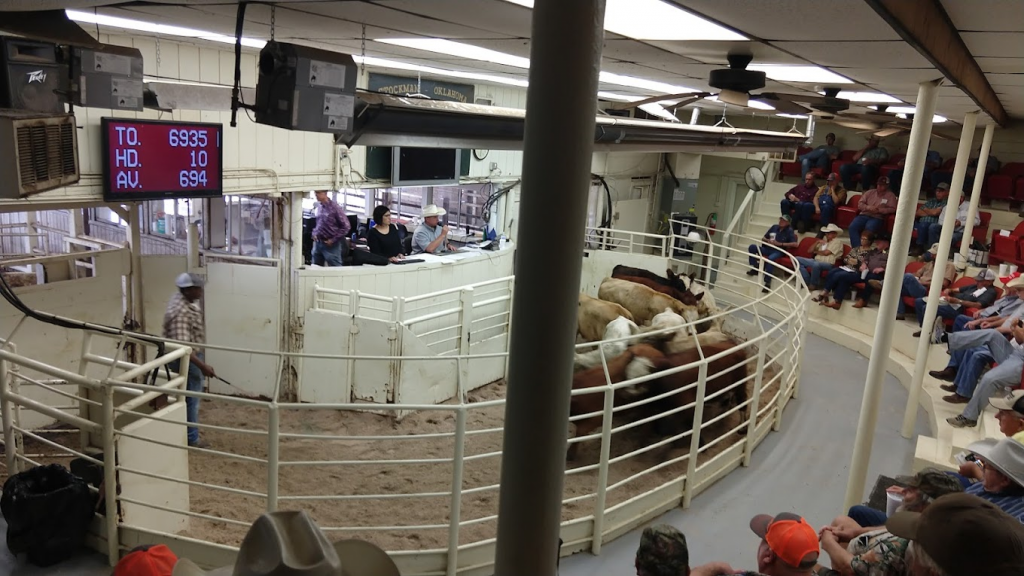
Associate Farm Editor Reagan Calk is visiting with Bob Rodenberger, a Partner with Stockman Oklahoma Livestock, as he gives the latest on the cattle markets. Overall, Bob said cattle producers around the state are pleased with the recent rainfall, which has filled up ponds. He also noted good market prices.
"We started out with average runs throughout the state, and had good rain around," Rodenberger said.
The market started out steady for the week, Rodenberger said, and is still excellent compared to a year ago.
"We are running anywhere from $15 to $20 above last year's weighted averages," Rodenberger said. "There is nothing we can complain about."
With fewer cow numbers, Rodenberger also talked about feedlots feeding cattle longer to maintain inventories and yield heavier carcass weights at the packer.
"We are continuing to produce more beef with less cattle coming out of feed yards," Rodenberger said.
Each week, Beltway Beef brings you the latest policy news affecting the U.S. cattle and beef industry. Hear from subject-matter experts, producers, and industry leaders on the topics that impact the business viability of farms and ranches across the country.
On this episode, House Agriculture Committee Chairman Glenn "GT" Thompson joins to provide an update on the Farm Bill. Chairman Thompson walks us through the contents of his Farm Bill and unveils its title, the Farm, Food, and National Security Act. He details some of the cattle health and disaster relief provisions in the next Farm Bill, explains congressional dynamics surrounding the legislation, and discusses the producer feedback that was critical to crafting this bill.
Plans for the 2025 Commodity Classic are well underway as America's largest farmer-led agricultural and educational experience takes place March 2–4, 2025, in Denver, Colo. The theme for the 2025 show is "Elevating Excellence in Agriculture."
The preliminary schedule for the 2025 Commodity Classic can be found online at CommodityClassic.com/2025-schedule. The schedule highlights tentative dates and times for the dozens of sessions, presentations, special events, and trade show. Approximately 30 educational sessions on the newest farming technologies will be added to the schedule beginning this fall.
The Denver show also features a new schedule that will run from Sunday, March 2 through Tuesday, March 4, which is a change from past years' usual format. The new format will also include a pancake brunch, closing reception, and other exciting farmer-focused events.
"Our 2024 show in Houston was a record-breaking event with over 11,500 attendees, so we're excited to see what happens for the show's first time in Denver," said Deb Gangwish, a Nebraska farmer, NCGA member, and co-chair of the 2025 Commodity Classic.
Fellow 2025 co-chair Rob Shaffer, an Illinois farmer and ASA member, echoed Gangwish's comments. "This show is the best of the best, and our record-breaking attendance the past two years shows how much farmers and exhibitors love coming to Commodity Classic. It's an experience unlike anything else."
Limited space is still available for the nearly sold-out trade show. Companies who wish to exhibit at the 2025 show are invited to look for the exhibitor application on the Commodity Classic website at www.CommodityClassic.com. For additional information, exhibitors may contact the Trade Show office at 636-745-3008 or tradeshow@commodityclassic.com. Registration for the Denver show will open in November of 2024.
Make sure to follow Commodity Classic on Twitter at @ComClassic and on Facebook for continued updates.
Established in 1996, Commodity Classic is presented annually by the American Soybean Association, National Corn Growers Association, National Sorghum Producers, and the Association of Equipment Manufacturers.
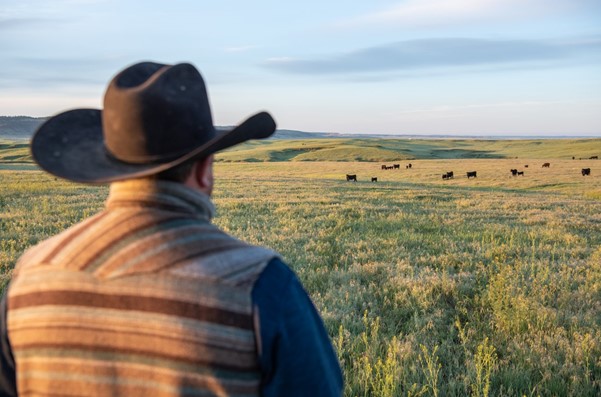
As Part Two of Cattlemen's Conference: A Blueprint for the Future Approaches, Senior Farm and Ranch Broadcaster, Ron Hays, is featuring comments from Donnell Brown of the R.A. Brown Ranch talking about the value of gene editing- a key topic that will be discussed at this year's Cattlemen's Conference. The conference will be held at Oklahoma State University's Totusek Arena from May 22nd through 23rd.
On Wednesday evening of the conference, Dr. Alison Van Eenennaam of UC-Davis will be speaking on gene editing in animal agriculture. On Thursday, there will be two panel discussions featuring industry leaders addressing how consumers and policymakers view gene-edited animals. An overview of the technology, the approval process, and currently approved gene-edited animals in the beef industry. Breed association policies regarding registration of gene-edited animals and the potential impact of gene editing technology.
According to Donnell Brown, gene editing is all about ensuring that we have the ability to feed a growing global population with the safest, most abundant, and most affordably priced food supply in the world.
"The gene editing front is exciting, we have got new things coming along on those fronts, and we are able to edit multiple traits," Brown said. "We have changed a couple of bulls from Black Angus to Red Angus, building an identical clone that was a Black Angus and now a Red Angus, so we are excited about those things."
Brown said he believes the most exciting part of gene editing is the ability to improve the health and wellness of cattle.
"What a huge advantage that can be to the industry, especially as consumers are saying, 'Hey, I want to make sure that if I can get cattle without antibiotics, that I feel better,'" Brown said. "Even though we are judicious users of safe and healthy use of antibiotics just like we are with our families, we are with our livestock."
If gene editing can help increase productivity, longevity and overall health of cattle, Brown said the value is something that cannot be overlooked. On the gene editing front, Brown said research is being conducted on diseases such as Bovine Viral Diarrhea (BVD), and Bovine Respiratory Disease (BRD).
"I believe there are some exciting things in the future coming ahead in the gene editing front in that frontier," Brown said.
Gene editing is not the same as genetically modifying, Brown said, because it uses the same genes an animal already has and moves them around.
"We are simply reorganizing an animal's own DNA to kind of rewrite its code," Brown said. "For example, if you spell thumbtack 'TAC,' you take those same exact three letters and you reverse them and come up with 'CAT.' Same three letters, but a totally different meaning. That is what we are doing with those animal's DNA at a microscopic level, and it is amazing what we can do."
To learn more about the conference and register, CLICK HERE!
Here's the Gene Editing portions of the Cattlemen's Conference program
Wednesday, May 22
The Beef Buzz is a regular feature heard on radio stations around the region on the Radio Oklahoma Ag Network and is a regular audio feature found on this website as well. Click on the LISTEN BAR for today's show and check out our archives for older Beef Buzz shows covering the gamut of the beef cattle industry today.
RON's Dave Lanning has a pre-opening look at today's agricultural Markets.
Click the audio tab below for today's report.
As the House Agriculture Committee prepares to consider Chairman Glenn "GT" Thompson's proposed farm bill next week, soy growers are contacting their representatives to express support for soybean priorities included in the bill.
ASA's farm bill priorities addressed in the chairman's proposal include:
The House Ag Committee will mark up the farm bill Thursday, May 23.
The cooperative business model has been very successful in the U.S. and cooperatives are particularly successful in the agricultural sector. Many U.S. agricultural cooperatives are approaching or exceeding 100 years of existence. Despite that historical success we are starting relatively few new agricultural cooperatives. Many of our existing agricultural cooperatives started with a handful of producers joining together to address a common need. We don't see that same type of activity today or, if we do, it is not structured as a cooperative business. That raises the question of why we don't start more cooperatives.
The first reason for the infrequency of new cooperatives is lack of understanding of the cooperative business model. Even producers who are members of a cooperative likely do not know that a cooperative is a corporation, how to incorporate a cooperative or all the details of the cooperative financial model. Even if a producer knows that incorporating as a cooperative is an option, they likely feel that the process is more opaque, mysterious, and complicated relative to other options. That leads to the second impediment to cooperative development, most producers and professional advisors are more familiar with Limited Liability Companies and investor-based business forms. A student could graduate with a business degree and go on to get an MBA while never hearing the word "cooperative". Advisors, attorneys, and accountants are more likely to understand LLCs relative to cooperative corporations. That makes LLC formation the path of least resistance.
The final factor limiting new cooperative development is access to capital. Most existing U.S. agricultural cooperatives are capitalized from decades of retained profits. New opportunities for cooperatives often require substantial amounts of up-front capital. There are cooperative models, such as the closed membership cooperative and the hybrid member-investor model that address those issues. The formation of those types of cooperatives requires not only an understanding of their structures but also the ability and willingness to make substantial up-front investment.
I can think of many agricultural situations from machinery sharing, to condo grain storage to feral hog trapping operations where small scale cooperatives could be logical and successful. Those small cooperatives could be formed under the closed membership cooperative model with members receiving a usage right (bushel of grain stored, acre of machinery use, one week usage of trapping equipment) for a share of membership stock. By receiving patronage in proportion to use the members would achieve services at essentially an at cost basis and the cooperative could issue stock patronage to fund any necessary re-investment in equipment and infrastructure. Members wishing to exit the cooperative could sell their share and usage rights to another eligible producer with approval of the cooperative board. The cooperative model would provide economies of scale and let the members receive a service at much lower cost than they could achieve on their own. Opportunities for new agricultural cooperatives exist but we rarely hear them discussed. Perhaps we just need to recycle some good old ideas!
Article Courtesy of OSU's Kenkel, Phil. "Why Don't We Start More Cooperatives?" Southern Ag Today 4(20.5). May 17, 2024. Permalink
AAA proudly announces an Edmond student has been selected as one of this year's Outstanding School Safety Patroller for Oklahoma. Max Hathaway, a fifth grader at Heritage Elementary School, has been selected for the honor. Like thousands of his peers across the county, Max has remained committed to keeping his fellow students safe and being a positive leader in his school community. That commitment shown by Max and the Heritage school community is part of the legacy of the AAA School Safety program.
"Max is exemplary in everything that he does," said Heritage Elementary fifth grade teacher and safety patrol advisor, Gena Schuck. "He always has a smile on his face, shows up every day for his position, offers to help everyone in any way that he can, has excellent grades, and is a genuinely nice person. He is one of those natural leaders who is always there helping and leading through his actions."

It's the exemplary leadership of students like Max and countless others that have made the legacy program so impactful for decades. Created to make school children safer while walking to school, the program has grown-up and matured with the times while remaining steadfast to its mission to provide a safer environment and leadership opportunities for millions of schoolchildren. The training that patrollers receive instills safety sense beyond street crossings, including bus and car drop-offs, monitoring hallway congestion, and teaching patrollers invaluable leadership skills.
"Students continue to rise to the challenge for School Safety Patrol; advisors and patrollers have risen to the challenge of keeping students safe," said AAA Public Affairs Manager, Rylie Fletcher. "Their actions save lives. Patrollers serve as role models across the county."
The leadership values and safety awareness have inspired many alumnus patrollers to pursue admirable careers, including Presidents of the United States, astronauts, governors, Members of Congress, Supreme Court justices, Olympic medalists, and authors, like Diary of a Wimpy Kid author Jeff Kinney. Many patrollers now serve as educators, executives, and community leaders.
For more than 100 years, interest in and excitement for the program has spread around the world. The AAA model has been adopted in at least 30 other countries, including England, France, Germany, the Netherlands and New Zealand.
Since 1920, AAA provides various equipment and education materials to patrollers, including reflective belts, patrol badges and training resources.
Near the end of May, we will celebrate Memorial Day, a day in which we will honor and mourn all our nation's military personnel who made the ultimate sacrifice protecting our freedoms, liberty and independence while serving in the United States Armed Forces. May is also Military Appreciation Month, a special time for honoring and recognizing the contributions, sacrifices and service of the members of the armed forces, past and present.
Our nation's military veterans are living and working among us in every conceivable line of work. And because many who served in our armed forces came from rural America, it's no surprise that about nine percent of our food producers – our farmers and ranchers, are veterans.
But as we reported before, the latest census shows that in just the past five years, we've lost 107,000 more cattle farmers and ranchers from our food production system.
That census also shows we've lost 65,000 more veteran farmers and ranchers over just that short period. This is alarming!
This is putting our nation's food security at risk. Our nation's food security was built upon our family farm and ranch system of agriculture. That system was based on having family farm and ranch food production operations scattered all across America.
The strength of that system was its diversity and disaggregation, meaning a disaster in one region would not disrupt the ability of our citizens to have a continuous supply of abundant, affordable, and wholesome food.
But over the past few decades we've been losing that diversity and we've been concentrating our food production, which is why we've been losing so many farmers and ranchers, including veteran farmers and ranchers. Today's agricultural policies favor industrialized agriculture over our historically successful family farm and ranch system of food production.
One of the reasons industrial agriculture is supplanting our family farm and ranch system is globalization. Congress has for decades catered to the interests of global corporations who don't care at all whether America produces her own food or becomes dependent on foreign countries for life's sustenance.
And this is why Congress isn't supporting mandatory country of origin labeling, or MCOOL for beef. It's simply not in the interests of global corporations to tell consumers where their beef is produced. Global corporations want to continue sourcing cheaper beef from around the world and selling it to unsuspecting consumers as if it were produced right here in the United States. The global corporations are making too much money by keeping consumers in the dark and they want to keep it that way.
But we can't let this continue; so, we've devised a plan in which we're again asking our nation's veterans for help.
The president of R-CALF USA is a veteran of the U.S. Army and a cattle rancher. He's drafted a joint letter that he's asking other veterans to join that urges Congress to pass mandatory country of origin labeling or MCOOL for beef so U.S. consumers can choose to purchase beef produced exclusively in the United States of America. You can see the letter at www.vetsforMCOOL.com. And if you're a veteran, you can sign the letter there too!
The letter explains that among the many interests our veterans helped protect and defend while serving in the military is America's ability to freely use, without foreign intervention, her natural resources to produce life's sustenance – food.
And it says, "But over the past generation or so, Congress has idly watched the exodus of hundreds of thousands of United States farmers and ranchers. This has weakened our nation's national food security."
It also says that veterans "are patriots, and preserving for ourselves and our children the family farm and ranch system of agriculture that helped make our nation strong is a patriotic and constitutional act Congress must undertake."
And then speaking directly to the threat of globalism, the letter continues, "Contributing to the farm and ranch exodus of veterans and nonveterans alike is Congress' deference to international tribunals over matters for which supreme authority rests with our United States Constitution."
Near its conclusion, the letter states, "We urge Congress to once again stand up for America by passing the American Beef Labeling Act (S.52) or the Country of Origin Labeling Enforcement Act (H.R. 5081), both of which will restore MCOOL for beef for America. The bills will enable beef produced by United States cattle to bear a 'United States of America' designation. And they will empower America's consumers to patriotically support America's cattle producers by choosing to purchase USA beef produced from their USA cattle." If you're a U.S. veteran, we invite you to join this important letter. Please go to www.vetsforMCOOL.com to sign.
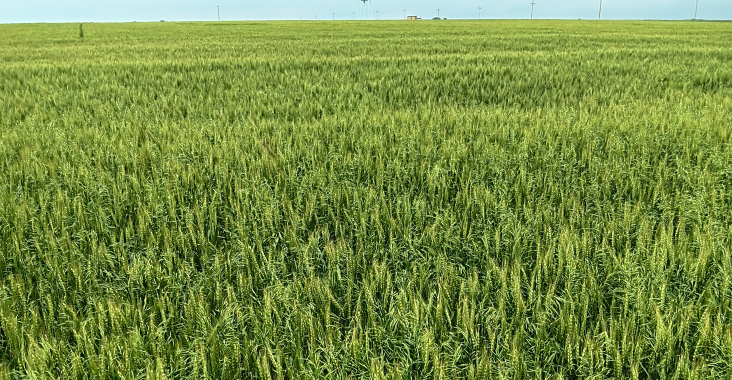
From CHS Hedging on X- West of Hillsboro, KS on Hwy 56 Eyeball yield 60 Average car calculation at 63 BPA
The 2024 Wheat Quality Council's Hard Winter Wheat Tour across Kansas wrapped up on May 16. During the three days of wheat scouting, tour participants traveled six routes from Manhattan to Colby to Wichita and back to Manhattan. This year's tour hosted 70 people from 19 U.S. states in 18 vehicles while traveling across the state. Of those participants, 50 people had never been on the tour before.
The three-day average yield for the fields that were calculated was 46.5 bushels per acre. While an estimated 7.5 million acres of wheat were planted in the fall, the Kansas wheat crop varies in condition based on amount of moisture received. What Mother Nature has in store for the wheat crop still remains to be seen, but the tour captures a moment in time for the yield potential for fields across the state.
The official tour projection for total production of wheat to be harvested in Kansas is 290.4 million bushels. This number is the average of estimated predictions from tour participants who gathered information from 449 fields across the state. Based on May 1 conditions, NASS predicted the crop to be slightly lower at 267.9 million bushels, with a yield of 38 bushels per acre.
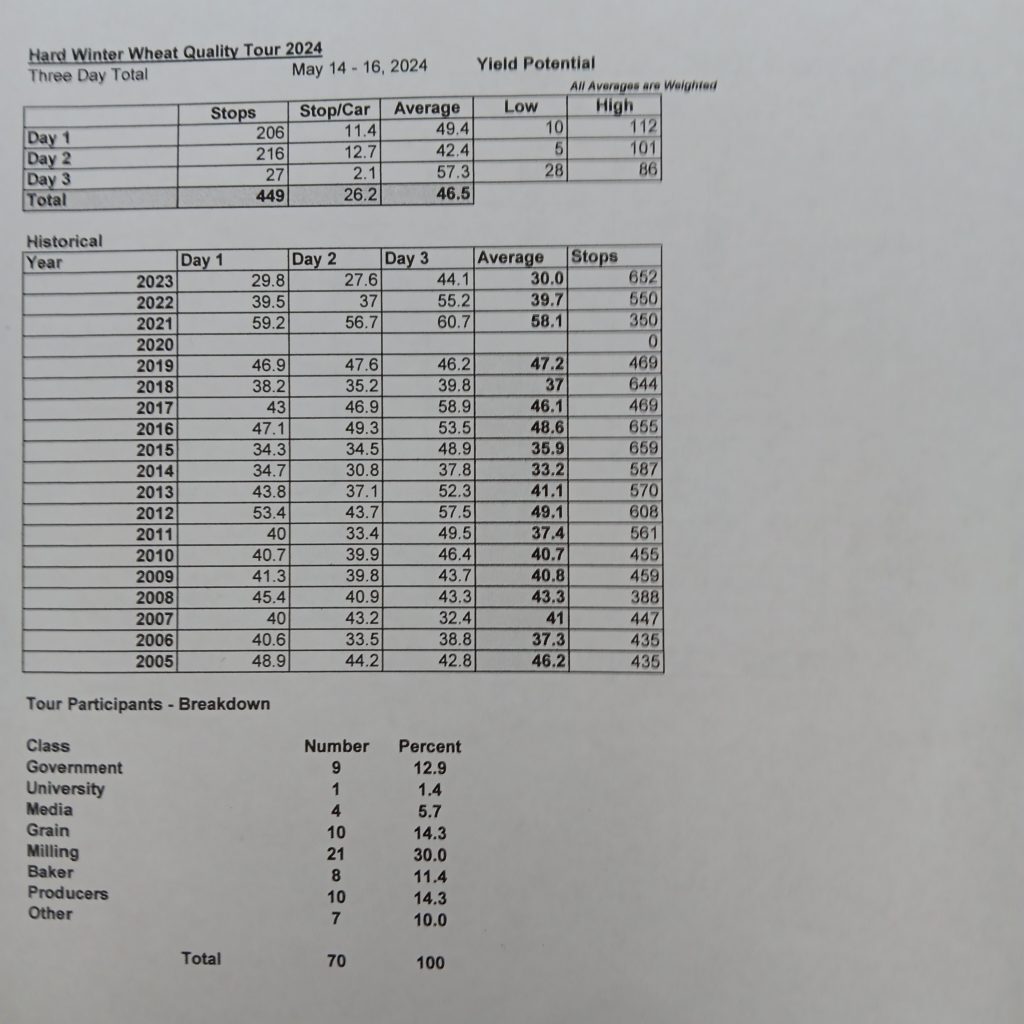
These fields are still two to four weeks from harvest. A lot can happen during that time to affect final yields and production.
Dr. Romulo Lollato, K-State Wheat and Forages Extension Specialist, reminded tour participants that the yield number is based on the potential that the crop has as of now, if things go well from now until harvest.
"It's where we could get," he said. If Kansas gets cool and wet weather during grain fill, it has the potential to reach that yield. However, there are still many things that could go wrong before that wheat makes it into the bin. He said he believes the 46.5 yield is on the high end.
"Variability is the name of the game this year," Lollato said, recapping what tour participants saw this year: freeze damage, drought stress and stripe rust coming on after it was too late to spray fungicide.
Click here for our report from Day One of the Tour.
Click here for our report from Day Two of the Tour.
The tour is sponsored by the Wheat Quality Council, which is a coordinated effort by breeders, producers and processors to improve wheat and flour quality. Dave Green, executive director of the WQC, said there are several goals of the tour. The first is for participants to make connections within the wheat industry. Another is to "describe the wheat as well as we can at the current point in time, not knowing what will happen over the next few weeks." A third goal is to highlight the agriculture industry.
This week on SUNUP is Oklahoma State University Extension grain market economist Kim Anderson. During this week's edition, Anderson talks about the latest in the crop markets.
Anderson said the markets continue to go up, except for soybeans and cotton. Wheat is 80 cents above average, Anderson added.
"If you look at wheat, they are up to $6.66 for harvest-delivered wheat at Pond Creek," Anderson said.
Corn is up to $4.75, Anderson said, and the harvest average price is $4.80.
Regarding the May WASDE report that was released last week, Anderson said there were not any surprises from the pre-release estimates.
"The number to look at is the stocks-to-use ratio," Anderson said. "Wheat for the U.S. is 41 percent average, and 40 percent projected."
With wheat prices above average, Anderson recommends producers stagger their wheat in the market from June through August.
This week on SUNUP:
Oklahoma Agriculture Starts at SUNUP!
Weekly Statewide Broadcast: Saturday at 7:30 a.m. & Sunday at 6 a.m. on OETA (PBS)
Anytime: YouTube.com/SUNUPtv
The National Milk Producers Federation (NMPF) today was awarded funding from the U.S. Department of Agriculture's (USDA) Animal and Plant Health Inspection Service National Animal Disease Preparedness and Response Program (NADPRP) supporting two projects advancing dairy cattle disease preparedness.
The first award will expand on USDA funding NMPF received in 2021 to build the National Dairy Farmers Assuring Responsible Management (FARM) Biosecurity Program. FARM Biosecurity provides dairy farmers with the tools to protect the health of their herds and employees from everyday and foreign animal diseases. Biosecurity resources developed from the initial 2021 USDA funding are currently being used to respond to the H5N1 animal health issue. This new funding will expand educational resources and training opportunities for producers, cooperatives, state animal health officials and FARM Program evaluators; update the Secure Milk Supply Plan guidance and further develop the capabilities of the FARM Biosecurity database.
The second award will bring together stakeholders including dairy cooperatives, milk haulers, milk testing labs, state and federal animal health officials and National Animal Health Laboratory Network (NAHLN) lab directors to conduct a gap analysis and create a report outlining current capabilities and guidance for industry and policymakers to implement a foot-and-mouth disease diagnostic assay using bulk tank milk samples to provide herd-level disease surveillance in the event of an outbreak.
"USDA funding for continued enhancement of biosecurity on dairy farms for emerging and foreign animal diseases arrives at a time when the dairy industry is already using USDA-funded resources to address the challenges of H5N1," Gregg Doud, president and CEO of NMPF, said. "This ongoing collaboration between USDA and NMPF is building resiliency for the U.S. dairy industry now and for the future."
The grants are funded by the 2018 Farm Bill as part of an overall strategy to help prevent animal pests and diseases from entering the United States and reduce the spread and impact of potential disease incursions through advance planning and preparedness. USDA has funded the NADPRP projects with the goal of individually and collectively addressing critical livestock biosecurity, large-scale depopulation and carcass disposal concerns in all major livestock industries across all U.S. regions. NMPF will apply the grant funding to advance biosecurity and diagnostic testing capabilities to support animal health on dairy farms by partnering with stakeholders and experts, including dairy farmers, veterinarians, dairy cooperatives and processors, NAHLN laboratories, Preventalytics LLC, and state and federal animal health officials.
Through the Organic Certification Cost Share Program (OCCSP), USDA's Farm Service Agency (FSA) will cover up to 75% of organic certification costs at a maximum of $750 per certification category. FSA is now accepting applications, and organic producers and handlers should apply for OCCSP by the Oct. 31, 2024, deadline for eligible expenses incurred from Oct. 1, 2023, to Sept. 30, 2024. FSA will issue payments as applications are received and approved.
"Costs associated with obtaining organic certification can be a barrier for Oklahoma producers wanting to get certified," said Steve Kouplen, FSA State Executive Director in Oklahoma. "Through OCCSP assistance, FSA helps Oklahoma organic producers obtain certification and leverage related benefits like premium prices for commodities and access to broader markets and additional technical assistance."
OCCSP was part of a broader organic announcement made by Agriculture Secretary Tom Vilsack on May 15, 2024, which also included the Organic Market Development Grant program and Organic Transition Initiative.
Eligible Applicants, Expenses and Categories
OCCSP provides cost-share assistance to producers and handlers of organic agricultural commodities for expenses incurred obtaining or maintaining organic certification under USDA's National Organic Program. Eligible OCCSP applicants include any certified organic producers or handlers who have paid organic certification fees to a USDA-accredited certifying agent.
Cost share assistance covers expenses including application fees, inspection costs, fees related to equivalency agreement and arrangement requirements, inspector travel expenses, user fees, sales assessments and postage. OCCSP pays a maximum of $750 per certification category for crops, wild crops, livestock, processing/handling, and state organic program fees (California only).
How to Apply
To apply, producers and handlers should contact FSA at their local USDA Service Center and be prepared to provide documentation of organic certification and eligible expenses. OCCSP applications can also be submitted through participating state departments of agriculture. For more information, visit the OCCSP webpage.
Opportunity for State Departments of Agriculture
FSA is also accepting applications from state departments of agriculture to administer OCCSP. FSA posted a funding opportunity summary on grants.gov and will electronically mail the Notice of Funding Opportunity to all eligible state departments of agriculture. Applications are due July 12, 2024.
If a state department of agriculture chooses to participate in OCCSP, both the state department of agriculture and FSA county offices in that state will accept OCCSP applications and make payments to eligible certified operations. Producers or handlers can receive OCCSP assistance from either FSA or the participating state department of agriculture but not both.
More Information
USDA offers other assistance for organic producers, including the Organic Transition Initiative (OTI), which includes direct farmer assistance for organic production and processing and conservation. For more information on organic agriculture, visit farmers.gov/organic.
To learn more about FSA programs, producers can contact their local USDA Service Center. Producers can also prepare maps for acreage reporting as well as manage farm loans and view other farm records data and customer information by logging into their farmers.gov account. If you don't have an account, sign up today.
USDA touches the lives of all Americans each day in so many positive ways. Under the Biden-Harris administration, USDA is transforming America's food system with a greater focus on more resilient local and regional food production, fairer markets for all producers, ensuring access to safe, healthy and nutritious food in all communities, building new markets and streams of income for farmers and producers using climate smart food and forestry practices, making historic investments in infrastructure and clean energy capabilities in rural America, and committing to equity across the Department by removing systemic barriers and building a workforce more representative of America. To learn more, visit usda.gov.
USDA is an equal opportunity provider, employer and lender.
Many Americans recognize dairy as a cornerstone of a healthy diet but continue to fall short of recommended daily intake as endorsed by the Dietary Guidelines for Americans. An in-depth consumer survey released today by the International Food Information Council (IFIC) and supported by the International Dairy Foods Association (IDFA) and the National Milk Producers Federation (NMPF), explores barriers to dairy nutrition among Americans and how to remove them.
The report provides a roadmap for how industry, government, and health and nutrition groups can improve awareness of and access to lactose-free milk and dairy products; expand understanding about dairy's nutritional value; and work with the dairy industry to extend shelf life and improve the value of dairy purchases to consumers.
The report draws on the beliefs, behaviors, and perceptions of Black, Latino, Asian/Pacific Islander, and Non-Hispanic White consumers toward dairy.
Key Data Points:
Spotlighting a Disconnect Between Perception and Consumption
The "Exploring Fluid Milk & Dairy Food Consumption Patterns to Improve Diet Quality & Nutrition Equity" study reveals a disconnect between consumer perception and actual dairy intake. While a strong majority (78%) of Americans believe dairy is essential, many are not reaping its benefits.
"Good nutrition is the foundation of health and wellness for adults and children across all demographics, and dairy is a crucial part of a healthy diet beginning at a very young age," said Michelle Matto, MPH, RDN, associate vice president of regulatory affairs and nutrition, IDFA. "This survey shows how consumers value dairy for nutrition and taste but may lack adequate information about or access to the types of dairy that are right for them and their families. It demonstrates that dairy will need to expand its partnerships with communities of color, with health and nutrition experts, and with policymakers to remove barriers preventing Americans from getting adequate dairy nutrition, including high quality protein, calcium, vitamin D, potassium, and health benefits including better bone health and lower risk for type 2 diabetes and cardiovascular disease."
Moving Forward
The survey shows the clear need for greater educational efforts, said Miquela Hanselman, director of regulatory affairs for NMPF.
"The IFIC research puts data behind both the importance of dairy nutrition and the need for better education about what dairy options are available and what benefits they provide," Hanselman said. "With discussion of the next Dietary Guidelines under way, it's important that this information be communicated clearly and forcefully to all who may benefit, from consumers who need dairy nutrition to policymakers who determine federal programs."
The IFIC research underscores the importance of targeted outreach programs to improve overall diet quality and achieve greater nutrition equity.
"While dairy is a chronically under consumed food group among many Americans, BIPOC and SNAP-eligible households may benefit most from hearing more about the health benefits associated with consistent dairy consumption. Education and outreach efforts tailored to increase awareness and availability of lactose-free dairy foods and beverages, in addition to emphasizing dairy's benefits beyond bone health for everyone, present new opportunities," said IFIC President & CEO Wendy Reinhardt Kapsak, MS, RDN. "Increased dairy consumption among all populations can positively contribute to improved diet quality and nutrition equity — availability, accessible, and affordability — goals that support enhanced health for all Americans."
Students from Hollis Middle School visited the state capitol on May 8 to meet with Gov. Kevin Stitt and other state leaders. (Photo by Kurtis Hair, OSU Agriculture)
Sixth- and eighth-grade students from Hollis, Oklahoma, have completed the first-ever LEADERS rural civic leadership and entrepreneurship class organized by Oklahoma State University's Rural Renewal Initiative.
A group of 21 students began the LEADERS course in fall of 2023 to develop civic leadership skills and promote economic opportunities in their community. Students formed a youth action council and wrote a project proposal for Hollis Remote, an online hub to recruit residents to Hollis that advertises local jobs, housing, entertainment options and more. They also participated in several service projects, including repaving a small stretch of road in Hollis.
The LEADERS class finished their year of learning and service with a field trip to Oklahoma City May 7-8. The students visited city leaders and entrepreneurs in Frederick, Elgin and Chickasha before touring the state capitol and meeting with Lt. Gov. Matt Pinnell, Secretary of Agriculture Blayne Arthur, Sen. Brent Howard and Rep. Gerrid Kendrix.
Hollis Middle School principal Kimberly Copeland, Hollis city council member Adam Bromlow and OSU Ferguson College of Agriculture faculty Shane Robinson and Lauren Lewis Cline accompanied the students on the Oklahoma City tour.
Robinson said the LEADERS class originated from a research study conducted in the summer of 2022. Hollis students were given the unique opportunity to learn about their local community and its governance while becoming civically engaged in the decision-making process.
"Through the class, students learned to take a more proactive role in identifying the assets and problems present in their hometown," he said. "By teaming students with adult mentors in Hollis, students learned to voice their opinions and enact positive change in a professional manner. We are grateful for the mentors who dedicated their time and expertise to helping these students acquire some incredible skills and experiences."
The Hollis LEADERS Class is funded through a grant provided by the Rural Renewal Initiative. Hollis Middle School administrators will select the next LEADERS class this summer. The students will enroll in the middle school's careers class and serve as the 2024-25 Hollis Youth Action Council.
OSU Extension uses research-based information to help all Oklahomans solve local issues and concerns, promote leadership and manage resources wisely throughout the state's 77 counties. Most information is available at little to no cost.

Farm Director KC Sheperd recently had the chance to catch up with country music singer, James Otto! Otto, who grew up on a farm, shared his songwriting philosophy and his love for the country music industry.
"I grew up on a 700-acre farm in the middle of North Dakota," Otto said. "That was my entire childhood."
As he reminisced about his childhood on a North Dakota farm and his music career, Otto also talked about his popular reimagining of Beyonce's "Texas Hold 'Em." He also revealed his upcoming album, "Self Made Fool," which features a song written with Jamie Johnson and Randy Hauser.
Otto said his love for music began early, starting with learning to play the fiddle in grade school.
"My whole life has been centered around music ever since," Otto said. "I have been obsessed with music since childhood."

Otto and KC discussed the evolution of music release strategy, with Otto proposing a single-release approach before an album, an idea still under consideration. Otto also shared insights into his dynamic and spontaneous songwriting process and his love for performing covers.
"I try to show up with the same enthusiasm every day no matter what I am doing and try to write whatever energy is in the room that day," Otto said.
The discussion also touched on the challenges and benefits of being an artist in the modern era, with Otto emphasizing the importance of building strong roots in the country music industry and pursuing what one loves for intrinsic reasons. Lastly, Otto announced his bi-monthly release schedule for his upcoming country soul album and his live show, "James Otto's Country Soul Sessions."
To visit James Otto's website, CLICK HERE.
James Otto can also be found on Facebook, TikTok and Instagram.
| |||||||||||||||||||||||||||||||||||||||||||||||||||||||||||||||||||||||||||||||||||||||||||||||||||||||||||||||||||||||||||||||||||||||||||||||||||||||||||||||||||||||||||||||||||||||||||||||||||||||||||||||||||
|
Pictured above is USB Farmer Leader Shannon Tignor Ellis, USB Vice President of Market Intelligence Mac Marshall, and The Yield Lab Institute COO Brandon Day—along with challenge winner Clean Label Solution CEO and Founder Dr. Mohammad Arshadi, and runners-up, Renewable Green Composites Founder Scott Loethen, EDEN Cellyfill Vice President Nancy Levens, and NeuEsse CEO Joseph Connell.
The United Soybean Board, in partnership with The Yield Lab Institute and Amazon Web Services (AWS) Startups, is pleased to announce Clean Label Solution as this year's Soy Innovation Challenge grand prize winner. Through a proprietary fermentation process, Clean Label Solution delivers high-value beef and dairy cattle feed from soybeans and soybean meal. U.S. soybean farmers produce a high-quality and eco-friendly feed ingredient for the livestock supply chain, making soybeans a preferred choice for animal agriculture.
The protein component of the soybean provides a valuable source of nutrients for cattle, however cattle are unable to consume the soy oil component. In trials of the Clean Label Solution's Bi-Pass Pro+ feed product, cattle could digest the 30% of soy protein that otherwise passes through the animal without use. This boosts milk and meat production while curbing methane emissions. It also offers a more sustainable ingredient that replaces the need for palm oil in cow feed.
"Securing victory in the Soy Innovation Challenge unlocks the immense potential of the soybean market, not only in terms of methane reduction but also economically. Our breakthrough soy-based feed addresses environmental concerns by reducing methane emissions and also presents lucrative opportunities for sustainable agriculture and economic growth. This win marks a pivotal moment in harnessing the full potential of soybeans for a greener, more prosperous future," says Dr. Mohammad Arshadi, Founder and CEO of Clean Label Solution.
This year's Soy Innovation Challenge encouraged new and novel uses for soybean meal. As soybean oil demand continues to expand in the biofuels space to help U.S. states decarbonize, this presents an opportunity to find new uses for increased soybean meal supply. Nearly 70 candidates from around the globe submitted innovative ideas for soy-based solutions for a wide range of applications, including food, cosmetics, petrochemicals, and biofuels. A panel of nine experts vetted applications and selected four finalists to participate in a venture accelerator program while also competing for a U.S. Soy investment. This furthers the economic viability of their businesses and grows a customer base that will consume U.S.-grown soybeans through these products.
"Reviewing all of the applicants' submissions and hearing from them firsthand showcased the power and the possibility of the soybean," shared USB farmer-leader from Virginia and Soy Innovation Challenge judge Shannon Tignor Ellis. "Each of the four finalists brought something different to the table, opening doors for innovation that elevates the value of our soybeans and presents a unique opportunity for checkoff investment. While the push for sustainability continues, our soybeans keep finding new ways to be part of the solution."
In addition to Clean Label Solution being awarded $75,000, the other 2023 Soy Innovation Challenge winners include:
"The Soy Innovation Challenge has been a fantastic effort to showcase the most promising and innovative technology to promote the utility of soy in markets we know like feed, food, and fuel and new markets in consumer packaged goods (CPGs), medicine, and nonfood uses. We cannot thank the United Soybean Board, AWS and partners enough for believing in the challenge model and funding 3 of these exciting challenges over the past four years. We look forward to seeing where these finalists go and how they bring their soy innovations to market," says Brandon Day, COO of The Yield Lab Institute.
Plans for the 2025 Commodity Classic are well underway as America's largest farmer-led agricultural and educational experience takes place March 2–4, 2025 in Denver, CO. The theme for the 2025 show is "Elevating Excellence in Agriculture."
The preliminary schedule for the 2025 Commodity Classic can be found online at https://commodityclassic.com/2025-schedule. The schedule highlights tentative dates and times for the dozens of sessions, presentations, special events, and trade show. Approximately 30 educational sessions on the newest farming technologies will be added to the schedule beginning this fall.
The Denver show also features a new schedule that will run from Sunday, March 2 through Tuesday, March 4, which is a change from past years' usual format. The new format will also include a pancake brunch, closing reception, and other exciting farmer-focused events.
"Our 2024 show in Houston was a record-breaking event with over 11,500 attendees, so we're excited to see what happens for the show's first time in Denver," said Deb Gangwish, a Nebraska farmer, NCGA member, and co-chair of the 2025 Commodity Classic.
Fellow 2025 co-chair Rob Shaffer, an Illinois farmer and ASA member, echoed Gangwish's comments. "This show is the best of the best, and our record-breaking attendance the past two years shows how much farmers and exhibitors love coming to Commodity Classic. It's an experience unlike anything else."
Limited space is still available for the nearly sold-out trade show. Companies who wish to exhibit at the 2025 show are invited to look for the exhibitor application on the Commodity Classic website at www.CommodityClassic.com. For additional information, exhibitors may contact the Trade Show office at 636-745-3008 or tradeshow@commodityclassic.com. Registration for the Denver show will open in November of 2024.
Make sure to follow Commodity Classic on Twitter at @ComClassic and on Facebook for continued updates.

Following numerous tornadoes across the state this spring, the Oklahoma House of Representatives passed two bills Tuesday to assist communities affected by recent tornadoes.
House Bill 2912 and House Bill 2913 were coauthored by and presented on the House floor by Rep. Judd Strom, R-Copan, whose district includes the town of Barnsdall. The town suffered severe damage as a result of an EF4 tornado on May 6, which led to the deaths of two people and numerous injuries.
"The outpouring of support from across the state and country has been tremendous, and I want to thank everyone who has already reached out," Strom said. "This funding represents a major step toward filling a crucial gap in hazard mitigation and restoring the communities across Oklahoma that have been or will be affected by natural disasters, and I'm glad to see strong support for these measures as they move through the process."
HB2912 creates the State Assistance Dedicated for Disaster-impacted Local Economies Revolving Fund. The fund would provide advanced financial liquidity to governmental subdivisions directly impacted by a Federal Emergency Management Agency (FEMA)-declared emergency or disaster event. Governmental subdivisions could put the funds toward infrastructure repair, temporary housing and shelter, to fund gaps in required matching funds necessary to participate in FEMA programs, and to mitigate revenue losses.
HB2913 appropriates $15 million to the State Emergency Fund and $30 million to the fund created by HB2912.
Rep. Dell Kerbs, R-Shawnee, whose district is still grappling with the after-effects of a tornado in April 2023, expressed strong support for both bills.
"Last year, I saw firsthand the incredible spirit of the Oklahoma standard as people traveled from across the state to provide support," Kerbs said. "Having resources like this funding available is crucial for meeting the minimum funding requirement for specific federal programs and assisting our affected neighbors in their rebuilding efforts."
Both bills passed the House 80-0 on Tuesday and now move to the Senate for consideration.
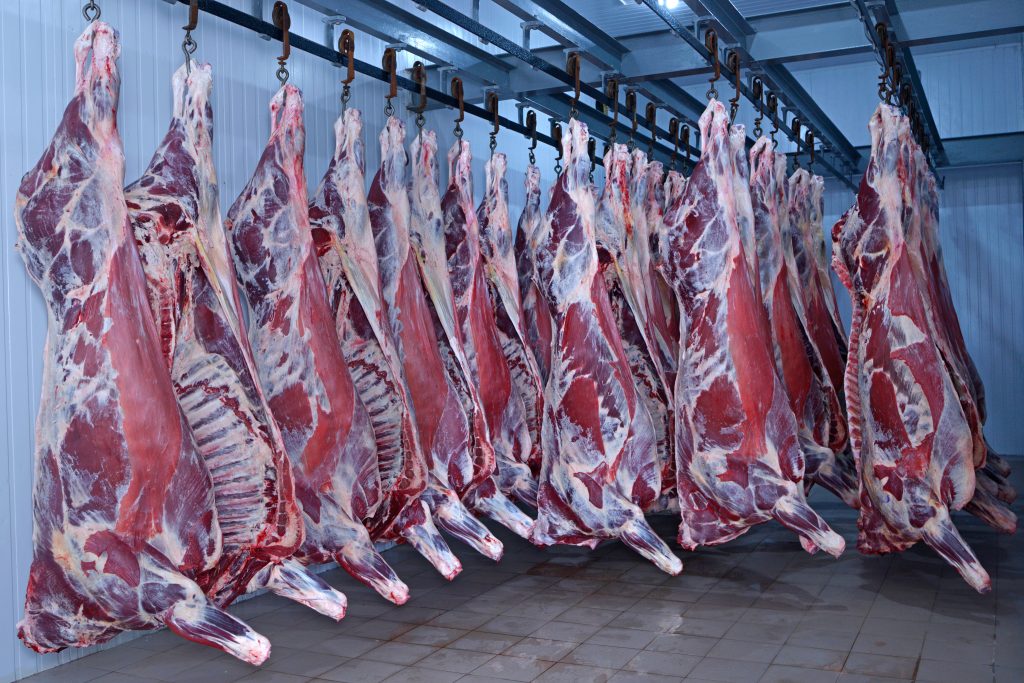
Senior Farm and Ranch Broadcaster, Ron Hays, is talking with Oklahoma State University Livestock Market Economist, Derrell Peel about feedlots and packers working towards heavier carcass weights to offset low cattle numbers.
According to Peel, there are plenty of incentives for the feedlot industry and the packers to hold cattle a little longer and see those heavier carcass weights.
"Coming into this year, we were expecting beef production to be down around 5 percent, plus or minus, on top of the 4.7 percent decrease last year," Peel said. "Cattle slaughter is down for the year. We have less cattle, and we know we are going to continue with tighter numbers there."
Due to the economics of replacing cattle in the feedlot and lower cost of gain, Peel said feedlots have more of a reason to feed cattle longer than usual. Peel said carcass weights went up counter seasonally in March and April, equating to about 27 pounds heavier per carcass on average for steers and heifers compared to a year ago.
"Seasonally, these carcass weights should be coming down to a low around the end of May or the first of June, then they typically go back up in the last part of the year," Peel said. "I do think we will see some more seasonal decrease in them, but they are decreasing from a higher level. I think we are going to continue to see these carcass weights running well above a year ago."
Peel said higher carcass weights have helped to offset the decline in slaughter rates, as beef is down for the year. Peel said there are many positives for both feeders and packers for feeding cattle to heavier weights and therefore producing a heavier carcass.
"If you slow down the turnover in the feedlot, you are not producing more beef and you are actually producing fewer cattle over time, but you can keep them in the feedlot longer, slow down the turnover rate, and keep the feedlot full, which is the motivation at least in the short run for the feedlots is to keep feeding and to keep the feedlot full from a feeding standpoint," Peel said. "That leads to this incentive to essentially hang onto cattle longer, and push the weights higher, potentially to overfeeding these cattle."
When there are not enough cattle to utilize the full packing capacity, Peel said packers offset this by bringing in more pounds from each carcass. There is a point when these cattle may become too heavy, Peel said, as the limit continues to be pushed.
"The other part of it is that physically, cattle can get too big," Peel said. "Most packers have an upper weight limit of around 1050 for carcasses, and again, both feedlots and packers have the incentive to push up against that limit, and in some cases, we may go over."
If steers and heifers do become too heavy, Peel said they will have to be slaughtered in different facilities made for cows and bulls. Peel adds this has happened before.
The Beef Buzz is a regular feature heard on radio stations around the region on the Radio Oklahoma Ag Network and is a regular audio feature found on this website as well. Click on the LISTEN BAR at the top of the story for today's show and check out our archives for older Beef Buzz shows covering the gamut of the beef cattle industry today.
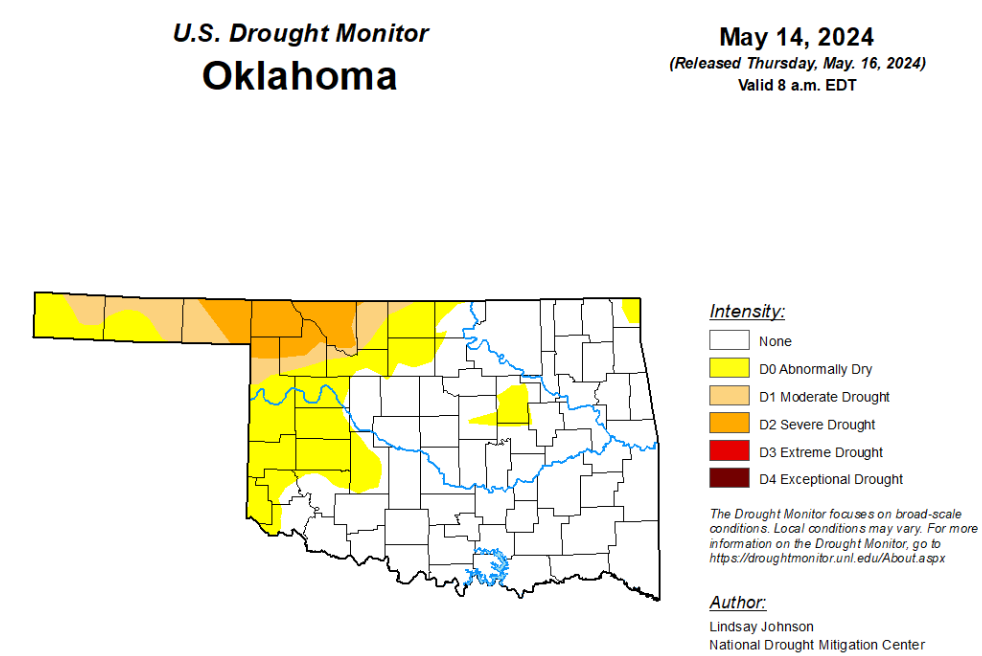
To view the latest Oklahoma drought map, CLICK HERE.
According to the latest Oklahoma drought monitor report, exceptional drought and extreme drought remain at zero percent, unchanged from the start of the calendar year.
Severe drought or worse is unchanged from last week at 5.91 percent.
Moderate drought or worse has improved from last week's 20.41 percent and is now at 12.13 percent.
Abnormally dry or worse conditions are now at 32.64 percent, improved from last week's 48.38 percent.
According to the 6-to-10-day precipitation outlook map, the west corner of the Oklahoma panhandle is leaning below a 33 to 40 percent chance of precipitation through May 25. The remaining parts of the panhandle, including western Oklahoma and the central part of the state can expect a "near normal" chance of precipitation through May 25th. The remaining eastern part of the state is leaning above a 33 to 40 percent chance of precipitation through that May 25th date.
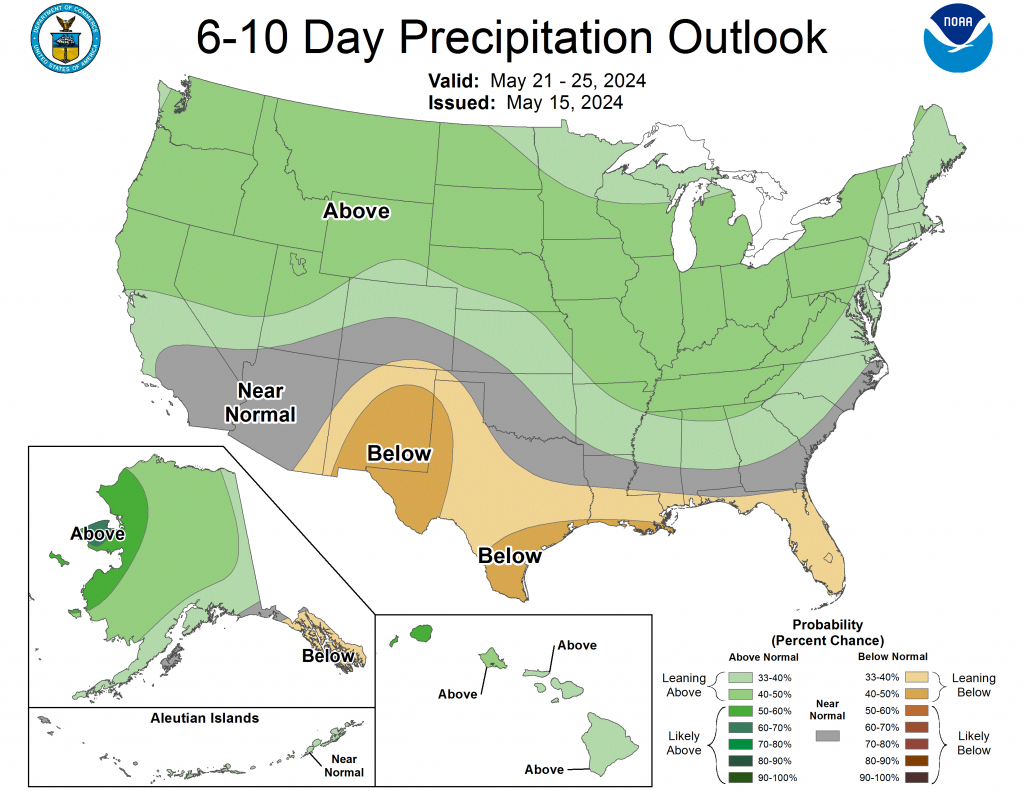
To view the United States Drought Map, click here.
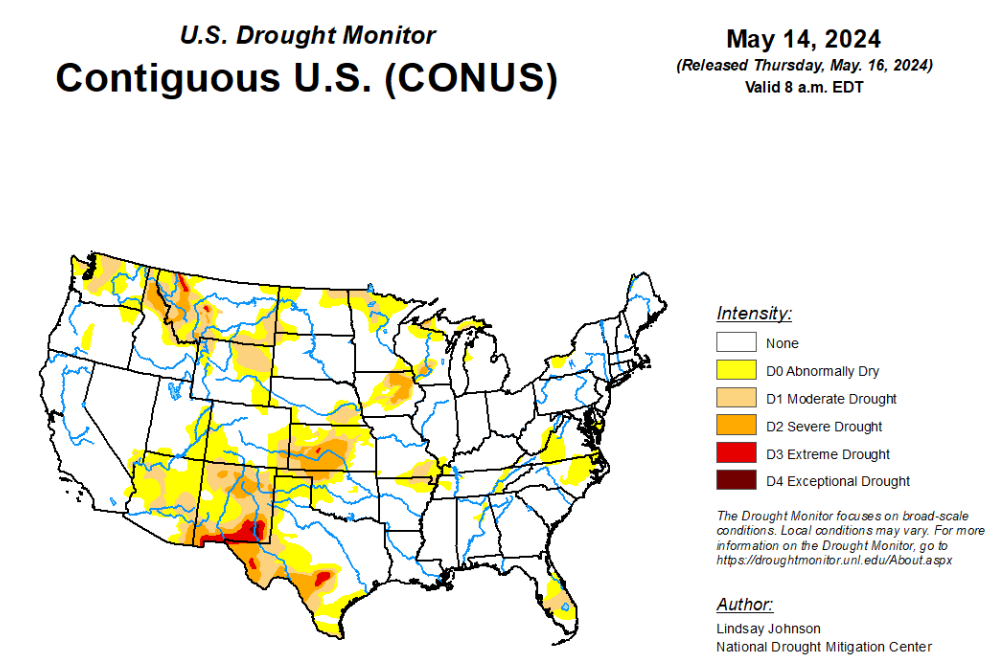
According the latest U.S. Drought Monitor, heavy precipitation fell across the Rocky Mountains of Montana, Wyoming and Colorado, as well as a large part of the South and southern Midwest. This brought widespread improvements to much of the South and Midwest, with scattered or widespread improvements in the Great Plains and Midwest. Heavy precipitation falling over the Southeast brought improvements from central Alabama into the southern Appalachian Mountains, as well as the area surrounding the convergence of the Ohio, Mississippi, and Tennessee rivers. A small area of the Mid-Atlantic region missed out on much of the precipitation, leading to minor degradations. Very dry weather for the past few months led to increased fire danger in parts of the Florida Peninsula, and short-term moderate drought and abnormal dryness expanded in coverage. Texas saw isolated degradations in the panhandle and south – where record breaking temperatures converged with the lack of precipitation. The High Plains were a mixture of light to moderate precipitation, which greatly influenced where improvements or degradations were made. Kansas, Colorado and Wyoming saw improvements where measurable precipitation fell. Degradations occurred in western Kansas and eastern Wyoming, where trace amounts of precipitation fell. Montana saw heavy precipitation, which improved conditions across much of the state. Isolated storms in western Oregon and Washington brought widespread improvements in Oregon, which continued into southwestern Washington. Central Washington, meanwhile, missed out on the precipitation and saw further expansion of abnormal dryness.
In the Southern Plains, the South saw a mixture of improvements in the north and degradation in the western and southern parts of the region. Western Texas, central Arkansas and northern Mississippi saw trace amounts of precipitation, while central and eastern Texas, Louisiana, and central and southern Mississippi saw between 2 to 5 inches of precipitation. Precipitation helped alleviate conditions in northern, western and southern Oklahoma. Following the precipitation, further improvements occurred across northern Arkansas and western and eastern Tennessee.
The Texas panhandle and southern parts of Texas saw expansion of existing abnormal dryness – and a small sliver of moderate drought (D1) in far south Texas – with a lack of measurable precipitation and above-normal temperatures. Southern Texas saw temperatures of 6 to 8 degrees above normal with Brownsville (124°F), Harlingen (125°F), and McAllen (122°F) breaking May temperature records of 115°F (5/4/1999), 121°F (5/26/1973), and 119°F (5/13/1995) respectively. A small area around the Missouri Bootheel also saw moderate drought (D1) expansion.
In the High Plains, there was a mixed bag of light to moderate precipitation, as well as improvements and degradations. Wyoming and Colorado saw improvements and degradations closely aligning with areas of moderate and light precipitation respectively. Northern and central Wyoming saw improvements, which were a continuation of improvements made in Montana and South Dakota. However, degradations occurred in areas that received trace amounts of precipitation along the eastern and southeastern part of these states into northern Colorado. Northeastern Colorado also saw a slight introduction of abnormally dry (D0) conditions as overflow from adjoining area of western Nebraska, where precipitation was low. Slight improvements occurred in south and northeast areas of Kansas that received precipitation. Elsewhere, conditions in central and western Kansas continued to degrade as streamflows, soil moisture, and groundwater continued to deteriorate. Southeast Nebraska saw slight improvements from continuous moisture over the past few weeks.
In the West, temperatures across the northern and Pacific coast of the West saw temperatures of 2 to 6 degrees above normal. Areas in northern California, northwest Oregon, south and central Washington and northeastern Montana experienced temperatures 6 to 8 degrees above normal. Little to no measurable precipitation fell over much of the West, except for Montana where 1 to 3 inches of precipitation fell. Conditions improved through most of central and western Montana with slivers of improvement in the parts where the short-term dryness from the weeks past have shown improvement. There were some isolated areas in western and southern Montana that saw degradations. Oregon saw widespread improvements in part due to the isolated precipitation and improved streamflow and soil moisture. These conditions were also seen in southern Washington where improvements were made. Central Washington, however, missed out on any meaningful precipitation and saw temperatures of 4 to 8 degrees above normal, leading to abnormal dryness (D0) expansion.
Looking ahead, over the next five days (May 16-21), heavy precipitation of2 to 5 inches is expected to continue to fall in the far South from central Texas to western Georgia, with 1 to 2 inches of rain expected in surrounding areas into the southern Midwest and Mid-Atlantic coast. The rest of the central and eastern United States will see some light precipitation. Much of the West will miss out on this precipitation.
The National Weather Service Climate Prediction Center's 6-10 day outlook heavily favors above-normal temperatures from New Mexico to Wisconsin, Maine, and down into Florida, with the greatest possibility being in southern Texas. The Southwest and High Plains are expected to be near normal temperature and everything to the west is likely going to be cooler than normal. Hawaii and northern Alaska are likely going to be warmer than normal, whereas parts central and western Alaska are leaning towards below-normal temperatures. For precipitation, much of the country is leaning towards above-normal precipitation. New Mexico and central and southern Texas are leaning toward below-normal precipitation, with the western and eastern coasts likely to be around normal. The Big Island of Hawaii is likely to see above-normal precipitation, along with central and northern Alaska. Southern Alaska is leaning toward below-normal precipitation.
To view the 6-10 Day Precipitation Outlook Map, click here.
To view the 6-10 Day Temperature Outlook Map, click here.
To view the Monthly Drought Outlook Map, click here.
On May 15, 2024, House Agriculture Ranking Member David Scott and Senate Agriculture, Nutrition, and Forestry Committee Chairwoman Debbie Stabenow released the below statement following a meeting with House Agriculture Committee Democrats and Democratic Leader Hakeem Jeffries.
"House and Senate Democrats remain committed to passing a strong, bipartisan farm bill that strengthens the farm and family safety nets and invests in our rural communities. America's farmers, families, workers, and rural communities deserve the certainty of a five-year farm bill, and everyone knows it must be bipartisan to pass.
"House Republicans are undermining this goal by proposing policies that split the broad, bipartisan coalition that has always been the foundation of a successful farm bill. "We need a farm bill that holds the coalition together and upholds the historic tradition of providing food assistance to our most vulnerable Americans while keeping our commitment to our farmers battling the effects of the climate crisis every day. Democrats remain ready and willing to work with Republicans on a truly bipartisan farm bill to keep farmers farming, families fed, and rural communities strong."

Farmers and ranchers know all too well that natural disasters can be a common, and likely a costly, variable to their operation. The Farm Service Agency (FSA) has emergency assistance programs to provide assistance when disasters strike, and for some of those programs, a disaster designation may be the eligibility trigger. When natural disaster occurs, there is a process for requesting a USDA Secretarial disaster designation for a county. You can play a vital role in this process.
If you have experienced a production loss as a result of a natural disaster, you may submit a request to your local FSA county office for your county to be evaluated for a Secretarial disaster designation. Once a request is received, the county office will collect disaster data and create a Loss Assessment Report. The County Emergency Board will review the Loss Assessment Report and determine if a recommendation is sent forward to the U.S. Secretary of Agriculture for the designation. For more information on FSA disaster programs and disaster designations, contact your County USDA Service Center or visit fsa.usda.gov/disaster.
RON's Dave Lanning has a pre-opening look at today's agricultural Markets.
Click the audio tab below for today's report.
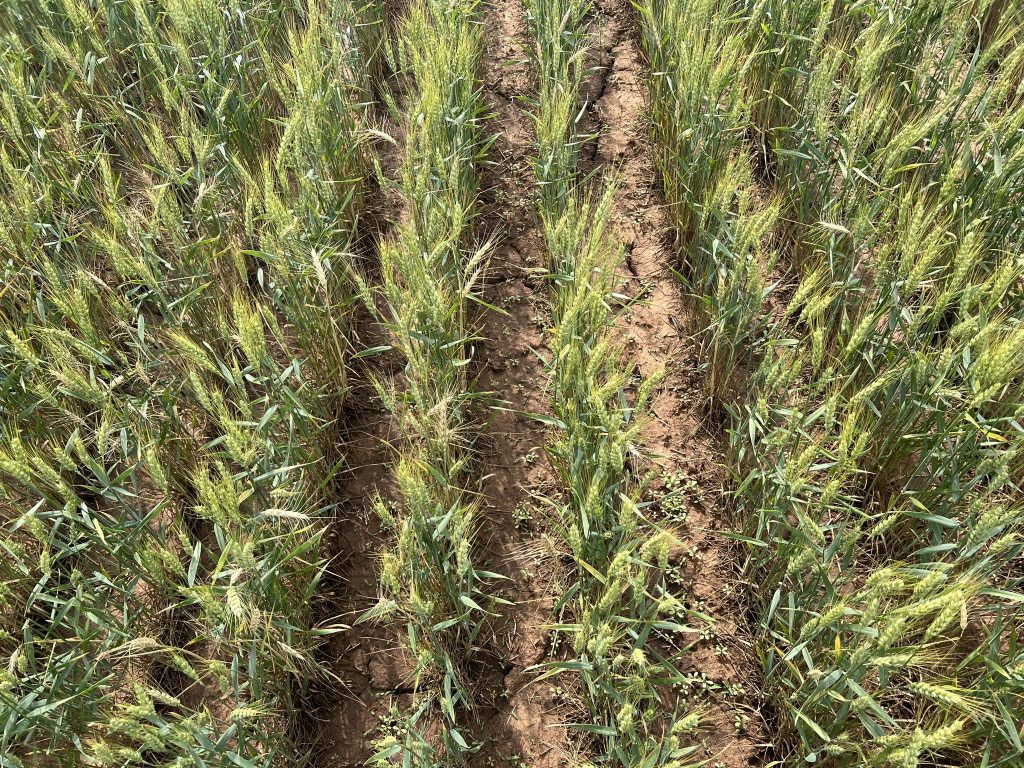
Kingman County in south central Kansas- Picture from K-State's Romulo Lollato showing stripe and leaf rust as well as fusarium root rot and drought stress (short and cracks in the ground)
Wheat Tour 24 continued Wednesday with six routes between Colby and Wichita, Kansas. About 69 people from 19 U.S. states, traveled in 18 cars on those six routes, stopping at wheat fields every 15-20 miles along the routes, as part of the Wheat Quality Council's 66th Annual Hard Winter Wheat Evaluation Tour. One of those routes took scouts into the Oklahoma Panhandle and across the northern tier of Oklahoma counties on US 60 before coming north to arrive in Wichita on late Wednesday afternoon.
Oklahoma Farm Report's Ron Hays checks in again with Oklahoma Wheat Grower President Dennis Schoenhals- this time after the report session in Wichita, Kansas on Wednesday evening. Hear their conversation by clicking o the LISTEN BAR below:
As expected, the second day found more drought stress and ended up with a lower bushel per acre yield than on day one- but well above the year ago levels. Scouts made a total of 216 stops and found an average yield of 42.4 bushels per acre. That compares to 27.6 bushels per acre a year ago and 56.7 bushels per acre in 2021. The highest yield calculated on Wednesday was 101 bushels per acre while one car found a field with an expected yield of just 5 bushels per acre.
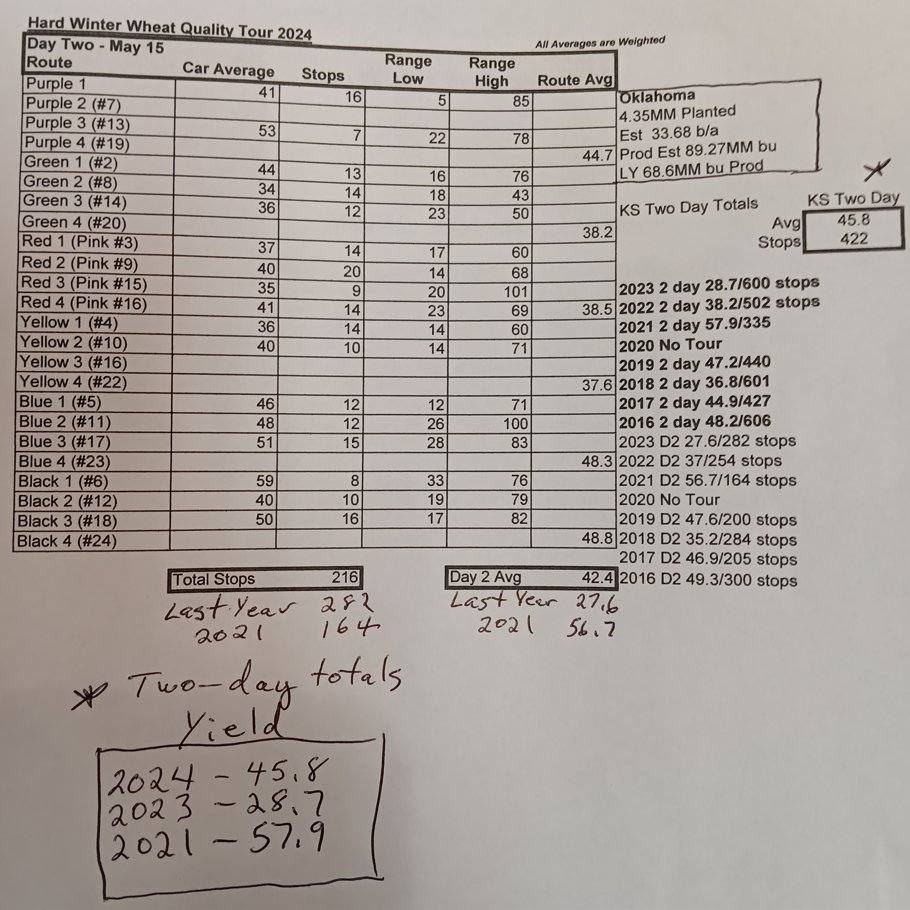
The two day totals on 422 stops here in 2024 is an average of 45.8 bushels per acre. K-State's Romulo Lollato said the theme of the day was variability, even within fields. Groups saw a lot of drought stress and freeze damage, with some fields already being destroyed. Not as much stripe rust or Wheat Streak Mosaic Virus were observed on Wednesday, compared to Tuesday, likely due to drought conditions.
Farmers in the area reported that combines will probably start rolling by June 1 in south central Kansas, about seven to ten days earlier than average. There wasn't as much fungicide applied in the southern areas of Kansas because the stripe rust started coming on in a later growth stage.
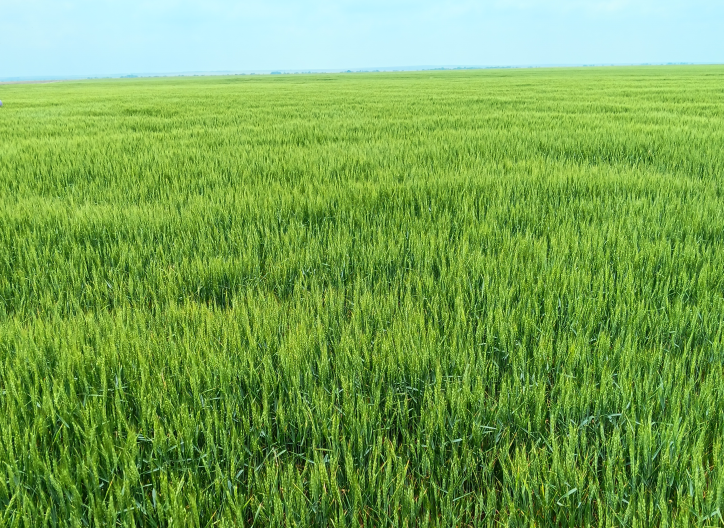
Schoenhals and his car made the route south from Colby down into Oklahoma and then rolled east on US 64 into Alfalfa and Grant Counties before heading north into Wichita. They saw wheat starting to turn color and like the field shown below- with a expected yield of 31 bushels per acre. Schoenhals says the flash drought of some 83 days was clearly seen in those north central Oklahoma counties- estimating yields from 14 bushels up to low 30s which assumes favorable weather in these final days in northern Oklahoma before the start of harvest- which could happen in and around Enid by Memorial Day weekend- and in southern counties in the Oklahoma wheat belt- by May 20th.
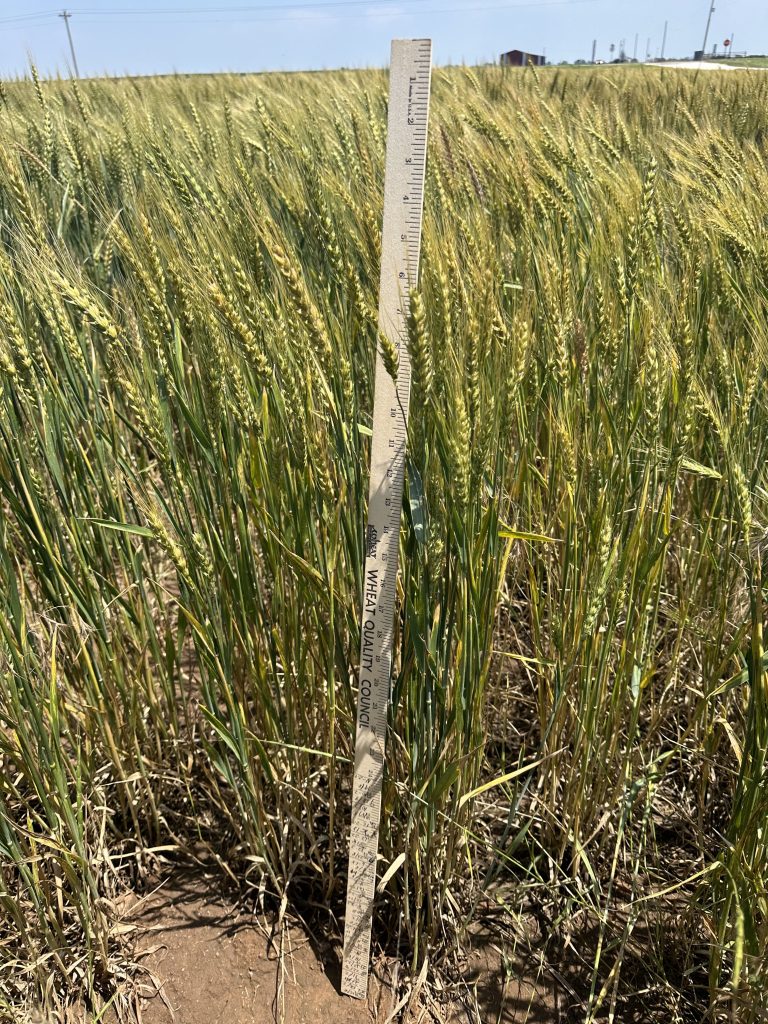
A summary of day two from the Kansas Wheat Growers can be seen by clicking here.
Wheat Tour 24 continues Thursday with six routes between Wichita and Manhattan. A final production estimate will be announced Thursday afternoon.
The U.S. Department of Agriculture's (USDA) National Agricultural Statistics Service (NASS) today released the Congressional District Profiles and Rankings from the 2022 Census of Agriculture. This summary presents data by congressional district from the 118th Congress that includes land, farms, market value of agricultural products sold, rankings and producer characteristics.
"These profiles present local data in a fast and easy-to-read format, allowing producers and all data users to quickly view and evaluate information," said NASS Acting Administrator Joseph Parsons. "Congressional District Profiles and Rankings from the ag census are only available every five years. Providing ag census information at a congressional district level, in addition to state, county and nationwide data, allows data users to compare districts to each other, shows the value of agriculture in a district, and informs policy makers."
To address questions about the Congressional District Rankings and Profiles, NASS will host a live X Stat Chat @usda_nass for the public on Thursday, May 16, at 1 p.m. EDT.
NASS released the Census of Agriculture State and County Profiles on March 27. Upcoming releases include the Race, Ethnicity, and Gender Profiles on June 28; the Watersheds report on July 24; the American Indian Reservations Report on Aug. 29; and Zip Code Tabulations on Nov. 7. All these products will be available at nass.usda.gov/Publications/AgCensus/2022.
Other products to be released this summer and fall include additional census Highlights publications found on the NASS website at www.nass.usda.gov/Publications/Highlights. Census of Agriculture Highlights cover topics such as information about producer demographics, commodity-specific information and more.
Data from the 2022 Census of Agriculture, collected directly from producers, found a continued decline in farms and farmland and a rise in the number of new and beginning (operating 10 or fewer years on any farm) as well as young (under the age of 35) producers. Another continuing trend included a rise in internet access (79% compared to 75% in 2017). Spanning more than 6 million data points about America's farms and ranches and the people who operate them, the full ag census report can be found at nass.usda.gov/AgCensus. Ag census data can also be found in NASS's searchable online database, Quick Stats.
In preparation for the 2027 Census of Agriculture, NASS is already asking for content change suggestionsand for new producers who did not receive a 2022 Census of Agriculture form last year to sign up to be counted in future censuses and surveys. Both forms can be found at nass.usda.gov
Today, leaders of the National Cattlemen's Beef Association (NCBA), Confederación Nacional de Organizaciones Ganaderas (CNOG), and Canadian Cattle Association (CCA) signed a joint statement to continue advocating for greater oversight of emerging lab-grown proteins, protecting cattle from animal diseases, and promoting the sustainability of the cattle industry. This action builds on the recent statement signing with Cattle Australia and furthers the international partnerships between cattle producers.
"The signing of this joint statement is an important step that unites cattle producers across North America and around the world to promote and protect efficient cattle production," said NCBA President and Wyoming rancher Mark Eisele.
Following the joint statement signing, NCBA, CNOG, and CCA also signed a letter addressed to U.S. Trade Representative Katherine Tai, Secretaria de Economía Raquel Buenrostro Sanchez, and Minister of Export Promotion, International Trade and Economic Development Mary Ng urging the U.S., Mexican, and Canadian governments to re-engage in opening markets for beef exports and provide stronger science-based oversight of beef imports. Unfortunately, the three governments have expanded market access for beef imports while providing little opportunities for beef exports. If this continues, it will place North American cattle producers at a competitive disadvantage to other beef producers, including South America.
"I am also pleased that American, Mexican, and Canadian cattle producers are standing together to hold our trade partners accountable. For the United States, we have significant concerns that Brazil continues to have access to the U.S. market even though they have a repeated history of failing to disclose animal health concerns, including cases of atypical BSE," Eisele added. "We continue urging our respective governments to protect the beef supply by blocking Brazilian imports. We are pleased to be partners on these issues and act as the voice of cattle farmers and ranchers to our respective governments."
NCBA has previously raised concerns with Brazil's access to the American market due to the country's failure to report cases of atypical bovine spongiform encephalopathy (BSE) in a timely manner to the World Organization for Animal Health (WOAH). These atypical cases occur spontaneously, but countries are required to report any cases within 24 hours to WOAH. The United States has upheld the 24 hour requirement continuously, but Brazil has often delayed reporting cases from anywhere between 35 days and nearly 2 years. That lack of transparency increases the risk to food safety and makes Brazil an unreputable trading partner.
The letter and joint statement were signed at the CNOG 2024 convention in Hermosillo, Sonora, Mexico by NCBA President Mark Eisele, CNOG President Sr. Homero García de la Llata, and CCA President Nathan Phinney.
View the statement here.
View the letter to U.S., Mexican, and Canadian trade officials here.
Background
The National Cattlemen's Beef Association (NCBA) represents America's beef cattle farmers and ranchers. Initiated in 1898, NCBA has members in all 50 U.S. states and also represents producers through a network of 44 state affiliate organizations.
Confederación Nacional de Organizaciones Ganaderas (CNOG), created in 1935, represents Mexican ranchers, local livestock associations, regional livestock unions, registered livestock associations, and regional livestock unions of pig farmers.
The Canadian Cattle Association (CCA) represents Canada's 60,000 beef farms and feedlots. CCA is a non-profit federation comprised of nine provincial member cattle associations that provide representation to a national, producer-led board of directors.
In the second year since the expansion of Dolly Parton's Imagination Library into Isle of Wight County, Virginia, Smithfield Foods has donated $12,000 to The DeGood Foundation, a local Imagination Library partner, to expand access of the book-gifting program for 2024.
"It's no secret that reading at an early age can have a profound impact on a child's life and future success," said Steve Evans, vice president, community development for Smithfield Foods. "Through our partnership with The DeGood Foundation, we're able to continue expanding literacy access to all children and deepening the program impact in Isle of Wight County, bolstering our commitment to do good work in our communities."
Recent legislation passed by the Virginia General Assembly supports continued expansion of Dolly Parton's Imagination Library book gifting program in Virginia. Virginia State expansion monies were approved in 2022 and renewed for the next two years. Smithfield's $12,000 donation together with the Commonwealth's $12,000 funding match would provide $24,000 to Isle of Wight County, which will help distribute books to more children, supporting early literacy development, knowledge and fundamental skills.
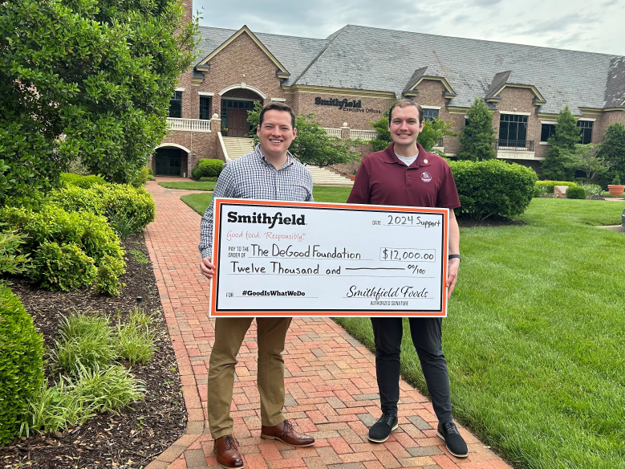
This is the second year of Smithfield's support for The DeGood Foundation, following a $6,675 donation in 2023. Smithfield and the Foundation held a kick-off event in February 2023 at the Smithfield Center to celebrate and enroll local children in the program.
To date, 45% of eligible children in Isle of Wight County have been enrolled, with more than 7,600 books distributed to over 600 children in the county.
"We couldn't be more excited to continue to partner with our friends at Smithfield Foods to get more free books into the hands of more children," said Kyle DeGood, founder and executive director for The DeGood Foundation. "Our expansion to Isle of Wight County, made possible by Smithfield, was one of our best performing expansions to date. We're so grateful to be working with a corporate partner that cares so much for the communities where their associates live and work."
Enrolled children will receive a free brand-new, age-appropriate book in the mail every month from the time they are born to age five. Parents and guardians can register at their local library branch or online at www.degoodfoundation.org or www.imaginationlibrary.com.
Smithfield is committed to developing the next generation of leaders through donations to schools and education programs and providing scholarship assistance for 1,500 students globally by 2025. Last year, the company funded more than $2.5 million in education programs and awarded scholarships of more than $740,000 to 13 schools in seven states for the 2023–2024 school year. For more information, visit https://smithfieldfoods.com/sustainability/helping-communities/.
Observation is the cornerstone of a regenerative mindset on a ranch. Because it marries immediate responsiveness with monitoring over time, it can help you adapt effectively to your environment's ever-changing dynamics.
Noble Research Institute regenerative ranching advisor Caitlin Word says the ability to observe and record land and livestock changes is a powerful entry point for individuals new to regenerative ranching, who might find extensive data collection and scientific methodologies daunting.
"At its core, regenerative ranching revolves around enhancing soil health and ecosystem resilience. Observational skills are crucial because they offer immediate insights into the environment's health," Word says.
What one sees above ground – a lush grass cover or a patch of bare soil – reflects the complex interplay of biological processes occurring beneath the surface. Word, a seasoned regenerative ranching expert, emphasizes the importance of understanding these visual cues.
"Observing these signs provides direct feedback on our management practices and their effects on the land," she says. "Everything you see above the ground tells you about what's happening below it."
Whether it's plant health, soil conditions, or livestock behavior, each observation can inform decisions that lead to healthier, more productive land.
QUICK OBSERVATION TIPS FOR RANCHERS

One of the simplest yet most effective tools is journaling. Word explains that keeping a detailed record of daily observations can transform how you manage land.
"Journaling is as easy as noting that a particular plant appeared where it hadn't before, or that livestock exhibited certain behaviors on a new pasture," she says. "Many ranchers already keep detailed records, like entries in a little red book, such as noting that a cow was limping on her left front foot today. This method can also be applied to ecological observations."
For instance, if you notice a new plant species or a wildflower that you can't identify, it's beneficial to document it and possibly research it later. Likewise, recording environmental changes like significant rainfall or signs of erosion can be compelling.
"Just as some ranchers record daily rainfall, why not extend this practice to include other ecological observations," Word says. "This habit not only keeps a record of changes in your pasture, but it also boosts your awareness and understanding of the environment, helping you make more informed management decisions."
These records build over time, creating a comprehensive picture of the ecological shifts and enabling you to track progress and identify issues early.

Word says that along with written records, photo documentation stands out as a strategic observational tool.
"You see your pasture every day, and just like watching a child grow, the gradual changes might escape you," she says.
By taking regular photos – preferably at the same time each year – you can make side-by-side comparisons to visually gauge changes in plant density, species diversity and land cover.
"To effectively monitor changes in your pasture, it's important to select representative areas for photo documentation," Word says.
If there are specific areas you are actively working to improve, document these as well.
"For example, if an area doesn't look great right now, take a photo of it and aim to capture its improvement over the next year," she says.
Word recommends setting up fixed points in your pasture for yearly photos. These fixed points can be marked with something as simple as a brightly colored t-post or a distinctive natural feature like a rock. This method ensures consistency in the photos, making year-to-year comparisons meaningful and informative. (Read more about setting up monitoring sites.)

Another practical tool is the use of grazing exclosures. These are small areas fenced off to prevent grazing, thereby serving as control sites you can use to compare natural vegetation growth against grazed areas.
"It's a direct way to see how grazing impacts your land," Word says. "When you use grazing exclosures, they serve as a reference point for evaluating forage utilization. A designated reference point allows you to see how extensively the forage has been grazed down."
Additionally, if certain plants are being selected preferentially, this can lead to overgrazing of those species and give other plants a chance to proliferate. Word says you can observe this phenomenon in your grazing exclosure.
"Plants once prevalent in the pasture might be found intact within the exclosure, indicating they were grazed out in the surrounding areas. This clearly indicates the plant community dynamics and the degree of forage utilization – essentially, how much forage was consumed or trampled by the livestock."
By comparing exclosed areas with grazed ones, you can assess how your grazing strategies may affect plant diversity and soil health and then adjust your practices based on what you observe.

Ultimately, the practice of observation ties back to the fundamental principles of soil health, which should always guide your regenerative ranching transition.
If you're ready to dive deeper into regenerative ranching, resources like the Noble Land Essentials course offer extensive guidance about both observational and data-driven management practices.
As you grow more comfortable with basic observations, you can gradually incorporate more detailed data collection. Word says this adaptive approach is key to growing a regenerative mindset.
Word says that by starting with these simple observation tools, you can not only enhance your immediate understanding of your land but also lay the groundwork for more sophisticated environmental management.
"In doing so, you contribute to a more regenerative mindset, one observation at a time."
Story Credit: Maddy Bezner, senior content writer for Noble Research Institute.
Today, 25 trade associations representing producers, feedstock providers, blenders, consumers, and retailers of low-carbon, renewable fuels sent a letter to Treasury Secretary Janet Yellen, urging Treasury to finalize and publish guidance for the §45Z Clean Fuels Production Credit as soon as possible. The new credit, adopted in the 2022 Inflation Reduction Act, is designed to incentivize domestic production of low-carbon fuels on a technology-neutral basis. The value of the credit is based on the life-cycle greenhouse gas emission score of each fuel.
"With the Sec. 45Z credit set to take effect January 1, 2025, our member companies and organizations may face significant headwinds and business risk if this guidance is not published promptly," the groups write. "Any extended delays in publication of guidance for the Sec. 45Z credit may disrupt project timelines, impede capital flows, and threaten existing production and demand for low carbon renewable fuels."
Kurt Kovarik, Vice President of Federal Affairs for Clean Fuels Alliance America, added, "U.S. biodiesel and renewable diesel producers are facing uncertainty as the transition from the biodiesel and renewable diesel blender credit to the producer credit. They are facing difficulties already as they try to negotiate feedstock and fuel offtake contracts for next year. The need for policy certainty is urgent."
Joining Clean Fuels in signing the letter are Advanced Biofuels Business Council, Airlines for America, Alternative Fuels & Chemicals Coalition, American Biogas Council, American Short Line and Regional Railroads Association, American Soybean Association, Associated Equipment Distributors, Association of American Railroads, Association of Equipment Manufacturers, Cargo Airline Association, Coalition for Renewable Natural Gas, General Aviation Manufacturers Association, Growth Energy, Methanol Institute, National Air Transportation Association, National Business Aviation Association, National Corn Growers Association, National Oilseed Processors Association, North American Renderers Association, Renewable Fuel Association, SAF Coalition, U.S. Canola Association, Vertical Aviation International, and Waste Gas Capture Initiative. The letter is available on cleanfuels.org.
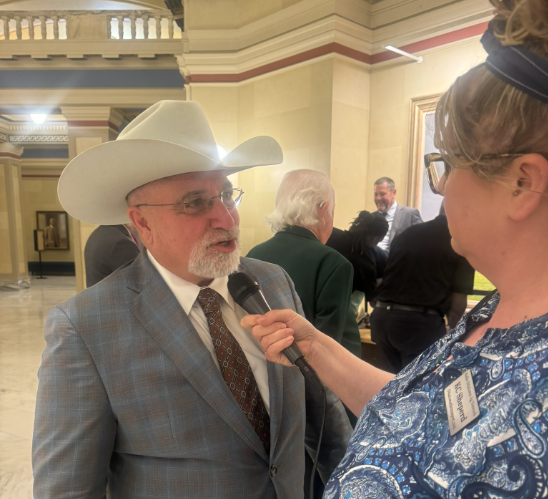
During Beef Day at the Capitol, Farm Director KC Sheperd caught up with a member of the Oklahoma Senate, Blake Stephens, about his Daylight Savings Time Bill (Senate Bill 1200).
Senate Bill 1200 provides that Oklahoma shall adopt permanent Daylight-Saving Time (DST) upon passage of a federal law authorizing states to choose whether or not to participate in the antiquated practice of bi-annual time change.
After four years of working on this legislation, Stephens said he is excited to see it pass the House of Representatives.
"Finally, we got this thing moving in a positive direction, and it is all about a matter of time," Stephens said. "I was honored to have the Speaker of the House running the bill with me on Senate Bill 1200. I am very honored and blessed that the Governor signed that bill after we got through both chambers."
Stephens said Oklahoma is the 20th state to pass legislation to "lock the clock" and keep an hour of daylight in the evening during the wintertime.
From health to crime reduction, Stephens said an extra hour of sunlight in the winter yields numerous benefits.
"What has to happen now is the Sunshine Protection Act has to be passed by Congress to allow us to lock that clock on Daylight Savings Time," Stephens said.
There is strength in numbers, Stephens said, and as more states adopt permanent Daylight Savings Time, he predicts it will become more popular across the United States. Stephens said if the bill passes, there will be 127 days in the wintertime with one more hour of sunlight- the rest of the year will stay the same.
"We won't quit working on it until it is across the finish line once and for all," Stephens said.
Senior Farm and Ranch Broadcaster, Ron Hays, is catching up with Tyler Norvell in this episode of Beef Buzz, talking about Cattlemen's Congress and a preview of the upcoming Cattlemen's Conference: Blueprint for the Future.
Norvell is the board chairman for Cattlemen's Congress and talked about the success of the show's fourth year. The 2025 Cattlemen's Congress will be held January 4th-16th in Oklahoma City.
"It has been really good feedback," Norvell said. "The breeds continue to tell us that nobody has customer service like Cattlemen's Congress, and we want to continue that because they are our customers."
Novell said numbers for the fourth year are on par with the previous year, and the next steps are looking into what to improve for the fifth year. Many breeds have selected Cattlemen's Congress as their national show location, Novell added, as the feedback suggests many will continue to do so.
"Everything we hear from the breeds is positive, and we have got some cool new things we are going to start, and we are excited about that, hopefully, to draw in more commercial cattlemen," Norvell said.
One new addition to the show Norvell mentioned is a commercial pen sale.
"We have several great sale managers along with Bray Haven helping to put that together," Norvell said. "We are in the early stages, but you will be hearing a lot about that in the coming months."
Coming up, Cattlemen's Conference is set to take place on May 22nd and 23rd in Stillwater, Oklahoma at Oklahoma State University's Totusek Arena. To register, click here. This second Cattlemen's Conference is once again being organized by Cattlemen's Congress, OSU Agriculture and the Noble Research Institute.
"This year, we are really focusing more on genomics, gene editing, consumers, and what we need to do," Norvell said. "I would make the argument that it is great for purebred seedstock operators and focuses on them, but it also focuses on the commercial cattlemen. There is really not going to be any panels about the show ring. It is going to be about the industry, which it should be."
Wednesday evening, the conference will feature a gene editing discussion with Dr. Alison Van Enennaam at the University of California-Davis. Enannaam is the leading authority in the world when it comes to gene editing.
"Thursday morning, we are going to focus on panels all around her speech so we can be more of a sniper-focus instead of a shotgun focus this year," Norvell said.
To see the full schedule of speakers for both days of Cattlemen's Conference, CLICK HERE.
The Beef Buzz is a regular feature heard on radio stations around the region on the Radio Oklahoma Ag Network and is a regular audio feature found on this website as well. Click on the LISTEN BAR at the top of the story for today's show and check out our archives for older Beef Buzz shows covering the gamut of the beef cattle industry today.
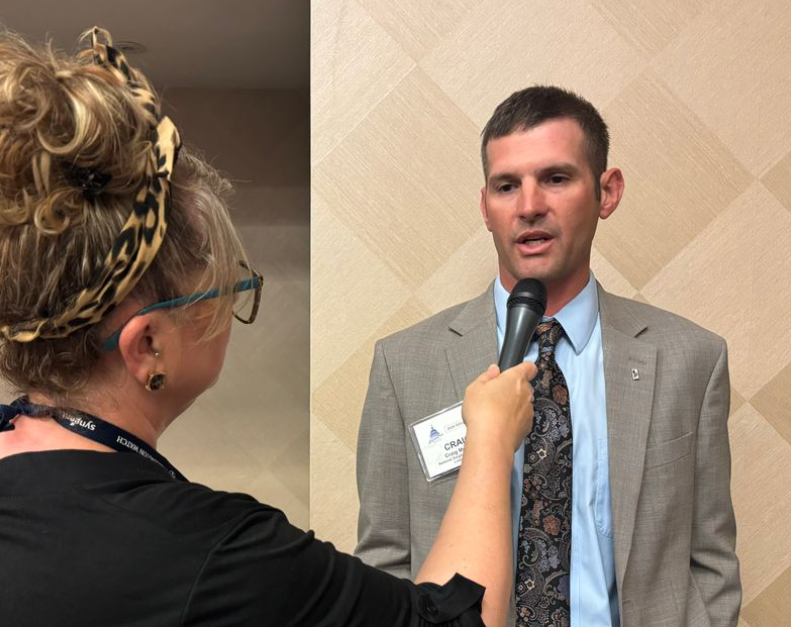
At the National Association of Farm Broadcasters (NAFB) annual Washington Watch event in Washington, D.C., Farm Director KC Sheperd had the chance to talk with the Chairman of the National Sorghum Producers and Kansas sorghum producer, Craig Meeker.
"2024 is off with a bang," Meeker said. "The crop went in at very good conditions in the coastal bend of Texas."
Meeker said the sorghum belt stretches from South Texas to South Dakota, with a few exceptions such as Maryland, Pennsylvania, and more. Sorghum harvest will begin in a few months in South Texas, Meeker added.
"Things are looking good down there (south Texas) with good moisture and good conditions," Meeker said. "The rest of the sorghum belt may not be quite so lucky."
The high plains of Texas, along with western Oklahoma and Kansas are fairly dry, Meeker said, but sorghum is an adaptable, tough crop.
"Very optimistic still, because we haven't planted much sorghum in the bulk of sorghum country yet, but hopeful and looking forward to good conditions coming on," Meeker said.
Looking back at last year's crop, Meeker said this year it appears there is more subsoil moisture to work with.
"Hopefully we have some rain to bring that moisture together and get us off to a good start," Meeker said.
Aside from weather conditions impacting sorghum, Meeker said regulatory, trade, and policy issues are also at play. Meeker said he and his team are actively working with agricultural committees in the House and the Senate to ensure good policy is written for sorghum producers.
"Our whole staff at team sorghum is making sure we make a difference at the farm gate for producers," Meeker said.
| |||||||||||||||||||||||||||||||||||||||||||||||||||||||||||||||||||||||||||||||||||||||||||||||||||||||||||||||||||||||||||||||||||||||||||||||||||||||||||||||||||||||||||||||||||||||||||||||||||||||||||||||||
|
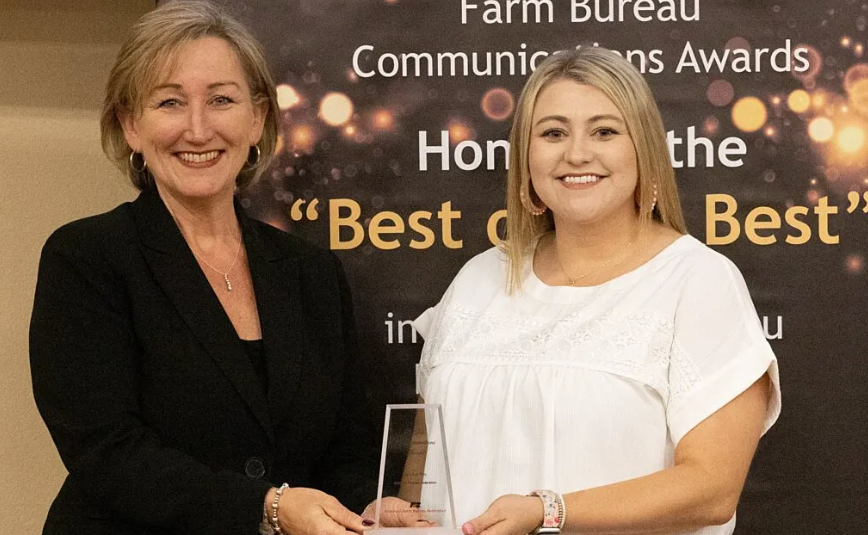
photo credit: AFBF Photo, Philip Gerlach
The American Farm Bureau Federation's 2024 Communications Award winners named at this year's Communications Conference in Waco, Texas, include 16 standout states. The competition recognizes state Farm Bureau professionals from across the country for their exceptional work in communications.
Judged against states with similar membership sizes, Maryland, Montana, California and Illinois rose to the top, receiving the most awards overall. Participants could submit one entry per category, with 18 categories to choose from, in the areas of writing, print, media relations, social media, graphic design, video, audio and website. More than 200 entries for work produced in 2023 were submitted for the 2024 contest.
"Our state Farm Bureau communicators are dedicated to sharing the voices of farm and ranch families across the country," said AFBF President Zippy Duvall. "The work of our communicators is second to none and I'm proud of them for continually evolving to keep pace with the rapidly changing communications field. Congratulations to the winning states and my thanks to all Farm Bureau communicators."
Contest judges represent a cross section of communications professionals not affiliated with Farm Bureau. Awards were presented to Farm Bureau communicators in Alabama, Arkansas, California, Colorado, Illinois, Kansas, Kentucky, Maryland, Missouri, Montana, New York, Oklahoma, Tennessee, Texas, Virgina and Wisconsin.
Each award is divided into groups based on membership size with up to three winners possible per category. The number of winners per category is based on the number of submissions received for the division. A list of award winners follows.
Anne Marie Moss Team Effort Award –recognizes outstanding collaboration on an issue that is a priority for AFBF; the farm bill is the issue for this year's contest.
Virginia, for "Farm Bill Affects Us All," a campaign highlighting the role the farm bill plays in the lives of all Americans – Tenille Nuckols, Burke Moeller, Kathy Dixon, Nicole Zema, Christina Amano Dolan
Texas, for promoting the farm bill though numerous media forms in a powerful and memorable way – Gary Joiner, Julie Tomascik, Ed Wolff, Shelby Shank, Emmy Powell, Tom Nicolette
Best Agriculture Story
Montana – Rebecca Colnar
California – Caleb Hampton
Alabama – Marlee Jackson
Best Single Blog Item, Editorial or Column
California – Amrith Gunasekara
Illinois – Sierra Henry, Richard Guebert Jr.
Best Newspaper or E-Newsletter
Maryland – Jeb Burchick
California – Christine Souza, Ching Lee, Caleb Hampton, Peter Hecht
Illinois – Daniel Grant, Kay Shipman, Tammie Sloup, Timothy Eggert, Erin Henkel, Catrina Rawson, Nicole Dowling, Jenny Gentes, Deana Stroisch
Best Magazine
Montana – Rebecca Colnar, Bobbi Burow
California – Barbara Arciero, Linda DuBois, Paula Earth, Caleb Hampton, Ching Lee, Christine Souza
Tennessee – Lee Maddox, Amy Beckham, Stacey Warner, Jessy Yancey, Thomas Capps, Misty McNeese
Best Member/Leader Newsletter
Kansas – Sheridan Wimmer
Alabama – Maggie Edwards
Best Graphic Design
Montana – Sue Ann Streufert, Nicole Rolf, Rachel Cone
Missouri – Rebecca Hoelscher
Illinois – Melissa Rhode, Donny Skelton, Ryan Ford, Dan Schlipmann, Donna Gallivan, Stephanie Knittel
Best Audio News Story, Feature Story or Commentary/Editorial
New York – Steve Ammerman, Seth Moser-Katz
Arkansas – Chad Hooten
Best Video News Story
New York – Seth Moser-Katz
California – Aubrey Aquino
Alabama – Mary Wilson, Matt Wilson, Kevin Worthington
Best Video Feature Story
California – Aubrey Aquino, Hadrian Santos, Evan Christensen
Kentucky – Matthew Hilton, Austin Anderson, Michael Corrigan
Best Promotional or Education Video or Ad
Wisconsin – Amy Eckelberg, Cassie Sonnentag
Illinois – Seth Leverenz, Scott Anderson, Mack Klingbeil, Mark Pressburger
Best Website
Wisconsin – Cassie Sonnentag, Rachel LaCount, Amy Eckelberg, Lynn Siekmann
Illinois – Gracie Pierson
Best Social Media Video
Maryland – Jeb Burchick, Parker Welch
Oklahoma – Dustin Mielke
Texas – Shelby Shank, Pedro Rosas
Best Social Media Campaign
Colorado – Luke Munchrath, Melissa Weaver
Wisconsin – Cassie Sonnentag, Rachel LaCount
Texas – Julie Tomascik, Angela Lujan, Emmy Powell, Shelby Shank, Ed Wolff, Pedro Rosas, Penny Cox
Best Social Media Presence
Maryland – Jeb Burchick
California – Christina Apkarian, Connor Duncan, Alex Eickmann, Darren Lee
Illinois – Gracie Pierson
Best Media Relations Event
Oklahoma – Dustin Mielke, Rachel Havens
Best Public Relations Campaign
Oklahoma – Dustin Mielke, Rachel Havens
Illinois – Gracie Pierson, Sierra Henry, DeAnne Bloomberg
Best Unique Tactic or Execution
Kansas – Meagan Cramer, Leigh Ann Maurath, Sheridan Wimmer
Alabama – Mary Wilson, Marlee Jackson, Laura Unger
Attorney General Gentner Drummond and OG&E are partnering to warn Oklahomans about scams involving solar energy equipment and services.
Drummond encouraged Oklahomans to remain vigilant in protecting themselves against phone scams.
"Fraudsters are always finding new ways to separate unsuspecting individuals from their money, and this latest phone scam is no exception," he said. "Oklahomans should be cautious with high-pressure tactics in phone or door-to-door solicitations, even when they purport to be connected to a reputable company. Always verify."
OG&E customers have alerted the electric company to a recent increase in automated phone calls. One call promises thousands of dollars in rebates for OG&E customers in the wake of "new energy policy" and "mandates." The caller then asks customers to sign-up for a solar energy program saying it will "support our new mandate."
The other call features someone claiming to be with OG&E and threatening to cut off the customers' service if they don't pay their bill immediately over the phone. Customers also have reported to OG&E an increase in door-to-door salespeople trying to sell solar equipment and falsely claiming to be partnering or working with OG&E.
"We never call our customers and ask them to pay their bills, nor do we go door-to-door to enroll them in special programs or services. Despite any claims, OG&E does not have any solar panel installation partners, nor do we recommend or partner with any company selling solar generation equipment," said Aaron Cooper, manager of corporate communications. "We understand the frustrations and impact of scams, and we want our customers to be aware and protect themselves from falling victim to the latest scam. We appreciate the Attorney General and his team for their work to protect Oklahomans from these types of scams."
The Consumer Protection Unit of the Attorney General's office offers tips to avoid falling victim to this scam:
Anyone who believes they may be victimized by a phone scam should contact the Office of the Oklahoma Attorney General at consumerprotection@oag.ok.gov or (833) 681-1895.

Optimal ear development begins with the right planting conditions and management practices early in the season. "Around the V5 or V6 stage, the corn plant determines how many kernels it can support around the ear," says LG Seeds Agronomist Steve Crafton. "As we move to the V12 growth stage with adequate nutrients and moisture, the plant will maximize kernels in length."
Even after these crucial moments in the corn growing season, Crafton says it's important to support the plant's needs. "As pollination begins, the plant focuses on filling all the kernels it can. If it encounters stress during this period, the plant will abort kernels at the tip, reducing weight and overall ear size."
Crafton shares his advice for farmers who want to optimize ear size: "It takes a combination of planning and preparation, planting and feeding, and season-long management."
Provide the right growing conditions
Mitigating plant stress starts with proper soil preparation and planting practices. "Our main goal is even emergence, getting plants up with a uniform stand and good population," Crafton says. "That involves preparing a good seedbed, ensuring good seed-to-soil contact and appropriate seeding depth."
Farmers should create seeding and planting plans on a field-by-field basis. "Make sure you're checking planting depth in every field and throughout the day," he says. "Getting the right seeding depth for good root structure and even emergence is critical."
Seed treatments help protect against diseases and pests that can threaten corn and soybean crop establishment. "Seed treatments provide protection on getting a good stand, helping to keep insects away and protecting against soilborne diseases early in the season." LG Seeds offers a premium mix of the industry's latest and most effective seed treatment packages.
Feed the right inputs at the right time
Crafton highlights the importance of feeding corn plants what they need when they need it. "The longer we can feed the plant and keep it healthy, the better we maximize kernel development."
He recommends using a starter fertilizer, then tailoring the timing and application of nutrients to each field's potential, the farmer's management practices and hybrid characteristics.
"Starter fertilizer provides nutrients on day one for root update," Crafton says. "A V5 fungicide application helps keep plants healthy leading up to pollination."
A plant's biggest uptake of nitrogen occurs about 10 days before pollination. "Side-dressing or applying micronutrients before pollination keeps plants fed and healthy for optimum yield."
Plant the right hybrid in the right field
Matching hybrids to specific field conditions can boost yield potential. "Putting the right hybrid on the right acre often gets overlooked — costing you bushels."
For instance, heavy and sandy soils need different hybrids. "For heavier soils, you want hybrids that can tolerate wet feet. In sandier soils, you need a hybrid that produces deep roots."
Farmers should also pay attention to how hybrids flex their ears to maximize kernel development. Each hybrid fills by kernel depth, kernels around or kernels long.
"Fields with high yield potential benefit more from a hybrid that maximizes kernels around or kernels in length — also known as a semi-flex hybrid — like LG62C73 and LG64C43. Tougher soils should get hybrids that maintain consistency in kernels around or in length, also known as a determinant or semi-determinant ear, such as LG59C72 and LG63C82.
Management practices also affect hybrid choice. "If you apply all of your nitrogen ahead of planting, I recommend a determinant-ear hybrid that doesn't need to be fed all season long," Crafton explains. "With a semi-flex hybrid, you want a cropping system where you can feed the plant later into the season."
Facing challenges and looking ahead
Navigating the growing season's challenges and disease threats demands vigilant scouting and proactive management. Crafton advises farmers to be on the lookout for signs of nutrient deficiency and common diseases like tar spot, gray leaf spot and northern corn leaf blight.
Understanding when ear size is determined and how to enhance it is essential for optimizing yield potential. Timely intervention through fungicide applications and nutrient supplementation can help safeguard crop health and maximize yield potential.
Reach out to your local LG Seeds agronomist for guidance choosing the best seed and seed treatment package for your acres.
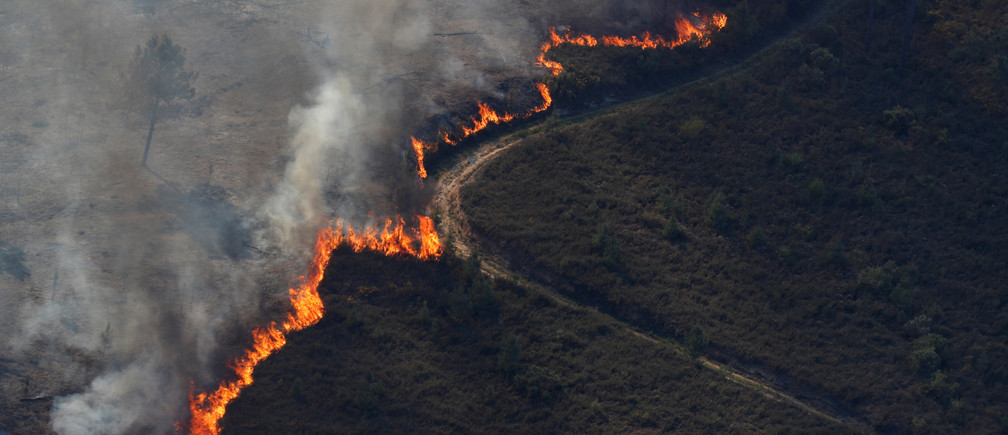
Texas & Southwestern Cattle Raisers Association (TSCRA), the largest and oldest livestock association in the Southwest, today announced the distribution of $900,000 in financial assistance through the TSCRA Disaster Relief Fund. This signifies the first of ongoing financial assistance going directly to cattle raisers impacted by the largest wildfire in Texas history.
"Funds are on the way to ranching families affected by these fires, and we will continue to quickly distribute much more funding to those in need for as long as it takes to help them to rebuild," said TSCRA President Carl Ray Polk Jr.
The distribution of funds comes after thousands of individuals and businesses came together to generously donate to the TSCRA Disaster Relief Fund in support of cattle raisers facing staggering losses.
"We hope the acts of kindness by so many individuals and companies who donated to the TSCRA Disaster Relief Fund will help these rural communities and ranching families recover amid great loss," Polk said.
Recent data from the Texas A&M AgriLife Extension Service estimates the region faced agricultural losses totaling $123 million. This includes losses of livestock, equipment, fencing, hay, feed and more.
The TSCRA Disaster Relief Fund continues to accept applications for financial aid from landowners and cattle raisers in disaster-declared counties in Texas and Oklahoma impacted by the Smokehouse Creek, Windy Deuce and other catastrophic wildfires earlier this spring. Individuals are asked to apply for aid online at tscra.org/disasterreliefapp.
The USDA recently released data from the 2022 census of agriculture. In 2022, cover crops were planted on 6.2% of the total cropland acres in the South, surpassing the national average of 4.7% for the 48 contiguous states. In fact, the top five counties in the US in terms of percent of cropland in cover crops were all from the South, located in Virginia, Maryland, and Florida. However, there is substantial variation in the adoption of cover crops across counties, as shown in Figure 1. Maryland led the way with 27.3% of its total cropland acres in cover crops, followed by Virginia at 15.2%. On the other end of the spectrum, Louisiana and Arkansas had the lowest rates, at 3.2% and 3.4%, respectively.
Figure 1: 2022 Southern Cover Crop Adoption Rate by County, as Percent of 2022 Cropland

Between 2017 and 2022, there has been a significant change in cover-crop adoption across the southern states. Texas saw the largest increase in cover-crop area in the US, adding over half a million acres, corresponding to a 1.9 percentage-point increase as a percentage of 2022 cropland. The remaining states in the South combined for a net increase of just fifty-thousand cover crop acres. This was largely due to the disadoption of the practice, as six states observed decreases in cover-crop acreage from 2017-2022. In fact, 49.8% of counties in the southern states saw disadoption over the period – as demonstrated by the blue counties in Figure 2 – disadopting over one million acres of cover crops in total. Overall, the adoption of cover crops decelerated between 2012-2017 and 2017-2022, driven by the increased number of counties that experienced disadoption.
Figure 2. Change in Cover Crop Adoption Rate by County (2017-2022)

These patterns help us understand how the cover crop adoption rate in the South has changed. The adoption of cover crops has expected benefits, including soil health, erosion control, weed and water management, and carbon sequestration. Patterns of adoption over time should reflect areas where realized benefits and any additional subsidy (state, federal, or private sector) outweigh the costs of implementation. Similarly, disadoption is likely an indication of producers experiencing cover crop expenses that exceed any realized or perceived benefits. Acres fluctuating in and out of cover crops may have implications on the credibility and stability of voluntary carbon markets and contracts tied to the practice. One thing is clear: the costs and benefits of cover crop systems are dynamic and can vary significantly by producer, commodity, and region.
References
U.S. Department of Agriculture. 2024. 2022 Census of Agriculture. Washington, DC: U.S. Department of Agriculture, National Agricultural Statistical Service.
U.S. Department of Agriculture. 2019. 2017 Census of Agriculture. Washington, DC: U.S. Department of Agriculture, National Agricultural Statistical Service.
Article courtesy of Southern Ag Today: Okonkwo, Emmanuel, Wendiam Sawadgo, and Alejandro Plastina. "Cover-crop Acres up in Texas, Stagnant Across Rest of the South." Southern Ag Today 4(20.3). May 15, 2024. Permalink
The Natural Resources Conservation Service (NRCS) is announcing Friday, June 14th, 2024, as the first application batching deadline for the Neighborhood Solutions RCPP in FY 2024. NRCS accepts applications on a continuous basis, and applications received after the deadline will be considered for the next batching date, as funding allows.
Neighborhood Solutions Project
Natural Resource Conservation Service (NRCS), Oklahoma Conservation Commission (OCC), and Grand River Dam Authority (GRDA) have partnered to address resource concerns related to the expansion and evolution of the poultry industry in eastern Oklahoma.
Potential practices utilized to address these resource concerns: Waste Storage Facility, Animal Mortality Facility, Composting Facility, Nutrient Management, Roof Runoff Structures, Conservation Cover, Tree/Shrub Establishment, Vegetative Barriers, Diversions, Critical Area Plantings, etc.
Eligibility
Eligible participants for the Neighborhood Solutions RCPP Project are poultry producers and neighbors located in: Craig, Ottawa, Delaware, Cherokee, Adair, Sequoyah, Mayes, Muskogee, LeFlore, Haskell, and McCurtain counties.
As per all USDA/NRCS participation rules, applicants must: have records established and up to date with the Farm Service Agency, own or operate agricultural land, and be treating a primary resource concern for this project.
How to Apply
Interested participants will need to contact their local NRCS Field Office to apply. GRDA will help conduct initial assessments (your local NRCS Field Office will provide your GRDA point of contact). NRCS will complete all needed field inventories, eligibility checks, and rank applications received by the application deadline accordingly.
Regional Conservation Stewardship (RCPP)
RCPP is a partner-driven approach to conservation that allows NRCS and partners to co-invest in solutions to natural resource challenges on agricultural and non-industrial private forest lands. This program allows eligible partners to focus NRCS funding, while leveraging their partner funding, on important conservation issues in specific regions across the state and nation.
More Information
For more information about NRCS programs and technical assistance visit NRCS Oklahoma or contact your local NRCS Field Office. For more information about RCPP and becoming a partner, visit NRCS Oklahoma RCPP or email the Regional Conservation Partnership Program Coordinator at tiffany.nelson1@usda.gov.
25 trade associations representing producers, feedstock providers, blenders, consumers, and retailers of low-carbon, renewable fuels sent a letter to Treasury Secretary Janet Yellen, urging Treasury to finalize and publish guidance for the §45Z Clean Fuels Production Credit as soon as possible. The new credit, adopted in the 2022 Inflation Reduction Act, is designed to incentivize domestic production of low-carbon fuels on a technology-neutral basis. The value of the credit is based on the life-cycle greenhouse gas emission score of each fuel.
"With the Sec. 45Z credit set to take effect January 1, 2025, our member companies and organizations may face significant headwinds and business risk if this guidance is not published promptly," the groups write. "Any extended delays in publication of guidance for the Sec. 45Z credit may disrupt project timelines, impede capital flows, and threaten existing production and demand for low carbon renewable fuels."
Kurt Kovarik, Vice President of Federal Affairs for Clean Fuels Alliance America, added, "U.S. biodiesel and renewable diesel producers are facing uncertainty as the transition from the biodiesel and renewable diesel blender credit to the producer credit. They are facing difficulties already as they try to negotiate feedstock and fuel offtake contracts for next year. The need for policy certainty is urgent."
Joining Clean Fuels in signing the letter are Advanced Biofuels Business Council, Airlines for America, Alternative Fuels & Chemicals Coalition, American Biogas Council, American Short Line and Regional Railroads Association, American Soybean Association, Associated Equipment Distributors, Association of American Railroads, Association of Equipment Manufacturers, Cargo Airline Association, Coalition for Renewable Natural Gas, General Aviation Manufacturers Association, Growth Energy, Methanol Institute, National Air Transportation Association, National Business Aviation Association, National Corn Growers Association, National Oilseed Processors Association, North American Renderers Association, Renewable Fuel Association, SAF Coalition, U.S. Canola Association, Vertical Aviation International, and Waste Gas Capture Initiative. The letter is available on cleanfuels.org.
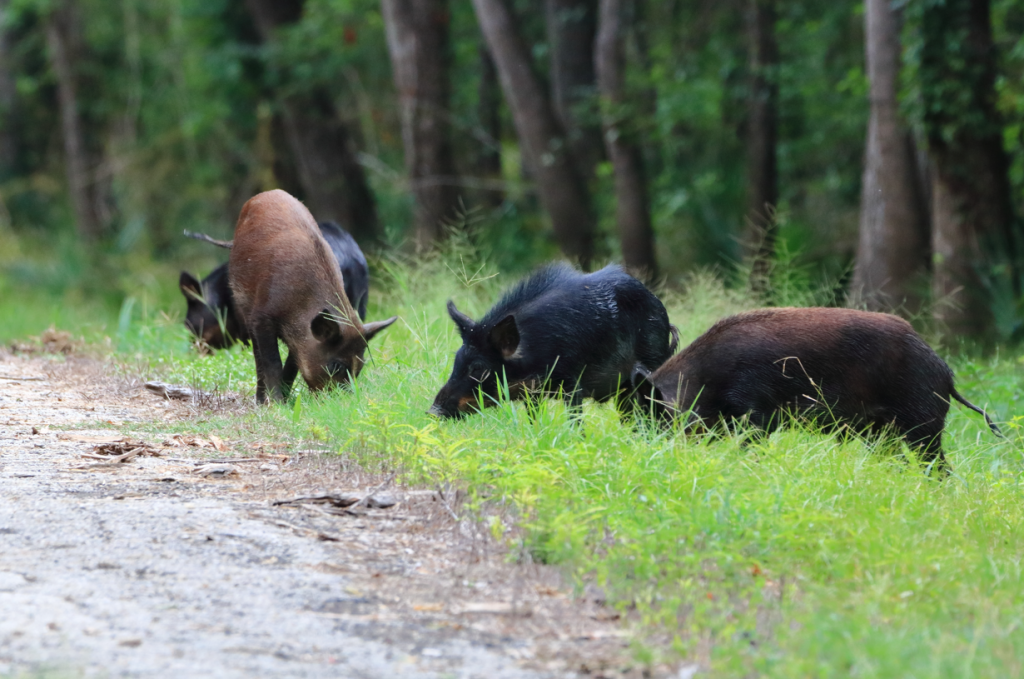
On today's Cow-Calf Corner, Rosslyn Biggs, DVM, Oklahoma State University Cooperative Extension Beef Cattle Specialist talks about biosecurity.
Biosecurity measures are critical in safeguarding livestock health and productivity by minimizing the risk of infectious diseases. Wildlife populations can harbor a variety of pathogens, including bacteria, viruses, and parasites. For instance, wildlife, such as feral hogs, may carry bacteria such as Leptospira, which can cause leptospirosis in cattle. Skunks and other species are well known for carrying rabies. Recently, migratory waterfowl have been identified as a potential source of avian influenza viruses in non-avian species.
In the 2022 Oklahoma State University Cow-Calf Biosecurity Survey, funded by the USDA National Animal Preparedness and Response Program, 50% of producers indicated that wild deer, elk, or antelope were found on their cattle operations. Most producers are likely able to identify multiple forms of wildlife on their operations, and depending on the species, appropriately managed species can be useful in improving environmental balance on the farm or ranch.
When considering which practices to implement, disease risk assessments in coordination with a veterinarian should take place, and recognition of the need for biodiversity on the operation must be considered. Basic biosecurity measures can assist producers in limiting disease risks including those posed by wildlife interactions.
Operations should select a biosecurity manager. This individual is responsible for developing a biosecurity plan in cooperation with the operation's veterinarian. Training of the operational team should occur and, the biosecurity manager should stay in tune with any changes involving new disease identification and outbreaks.
Monitoring animal health of both domestic and wildlife species is a critical biosecurity practice. Livestock should be monitored on a daily basis and any signs of illness documented. Developing a herd health plan advised by a veterinarian is essential. Any abnormal or unusual signs of illness or death, including those seen in wildlife, should be reported to the operation veterinarian and animal health officials.
Managing wildlife populations at appropriate levels can promote both good biosecurity and environmental health as long as disease risk is considered. Consulting with local, state, and federal wildlife entities, such as US Fish & Wildlife, USDA APHIS Wildlife Services, and state agriculture/wildlife departments, is advised to fully understand current populations and acceptable legal measures to address wildlife.
Physical separation of livestock from wildlife that present disease risks can be challenging, but must be considered. Fences often limit direct contact of livestock with certain wildlife species. Guardian animals can also deter certain wildlife species, especially predators. Managing access to livestock feed and water resources may be necessary. Producers should be careful to not inadvertently create wildlife habitats that promote disease spread. Additionally, care should also be taken to prevent wildlife access to animal disposal locations, as scavengers have the potential to spread unwanted illness.
Protecting livestock health against wildlife-borne diseases requires an everchanging multifaceted approach that combines practical and economically feasible management strategies. By implementing operation specific biosecurity measures tailored to the risks posed by wildlife, producers can mitigate disease transmission, promote animal welfare, and create environmentally sustainable production systems.
More information about biosecurity can be found at www.bqa.org and www.securebeef.org
Below, OSU Extension beef cattle specialist Rosslyn Bigs discusses the importance of practicing safe biosecurity with livestock during the fair season on SunUpTV from 9/25/2021.
RON's Dave Lanning has a pre-opening look at today's agricultural Markets.
Click the audio tab below for today's report.
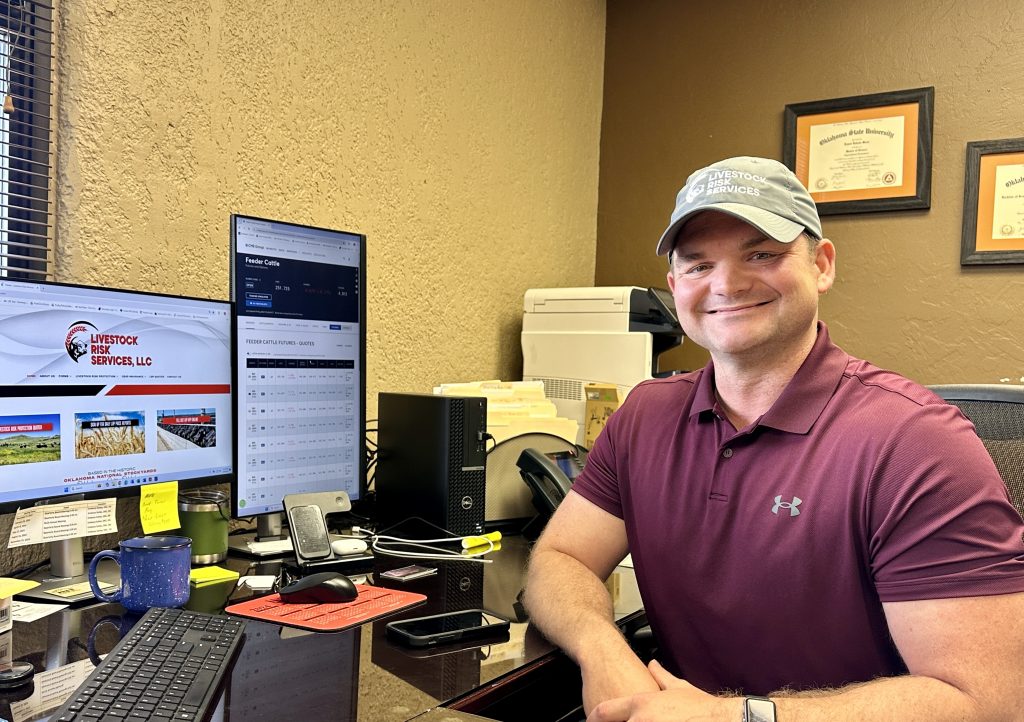
In this episode of Beef Buzz, Senior Farm and Ranch Broadcaster Ron Hays is back talking with Dakota Moss of Livestock Risk Services about the advantages of utilizing Livestock Risk Protection (LRP), and some options for protecting unborn calves.
To listen to Part One of the conversation, CLICK HERE.
The utilization of LRP under USDA's Risk Management Agency's offices has become more popular over the years due to the benefits provided to cattle producers. While these programs are a great tool for cattle already alive and on the ranch, Moss also talked about an option for unborn livestock.
"The unborn steer and heifer contract is an amazing tool for our cow-calf producers," Moss said. "When we were in September and October of last year, and we saw those record-high futures prices for this coming fall, if a producer knew he was going to have calves hitting the ground in the spring, and he knew those cows were bred, he could go ahead and ensure that unborn calf crop for next fall at an amazingly high price." He adds that one of the great things about the LRP program is that pricing for your protection is updated daily and is reflected in the current market place.
Going forward, if someone is looking to change livestock agents, Moss said they must fill out a transfer application by June 30th at the latest because July 1st is the start of the 2025 livestock year.
"That is one thing with Livestock Risk Services- we specialize in LRP and it is our bread and butter," Moss said. "It is all we really do. We would love to have someone's business if they want to move it to us."
To utilize the free LRP quote tool offered at the Livestock Risk Services website, click here.
To sign up for daily price reports, click here.
The Beef Buzz is a regular feature heard on radio stations around the region on the Radio Oklahoma Ag Network and is a regular audio feature found on this website as well. Click on the LISTEN BAR at the top of the story for today's show and check out our archives for older Beef Buzz shows covering the gamut of the beef cattle industry today.
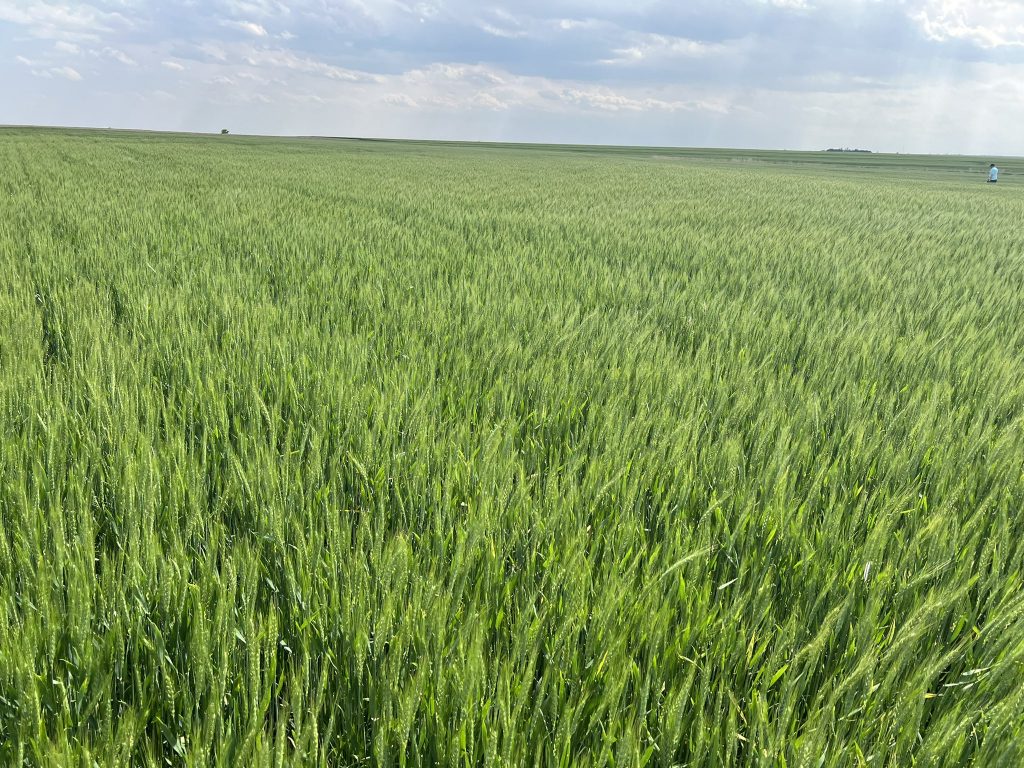
Rawlings County- Photo from Romulo Lolatto, K-State Wheat Specialist- he describes this field "Good potential, available moisture, stripe rust present but not as widespread "
Day one of the Wheat Quality Council wheat tour is in the books- and the crop scouts saw a wide variety of crop conditions- from really good looking wheat like that seen above- to wheat fields struggling with freeze damage, drought issues, stripe rust, wheat streak mosaic and more.
Oklahoma Wheat Grower President Dennis Schoenhals is participating in the tour- traveling by car from Manhattan to Colby on Day One- Colby to Wichita on Day two and Wichita to Manhattan for the wrap up of the tour on Day three.
Schoenhals and Oklahoma Farm Report's Ron Hays talked on Monday evening after the report session in Colby and you can hear their conversation by clicking on the Listen Bar below:
Dennis Schoenhals tells Hays that the Day One totals come from 206 stops by the cars on the tour with an average yield of 49.9 bushel per acre- well above the 29.8 bushels per acre found on the same Manhattan to Colby set of routes. He says the low reported by any car was 10 bushels per acre and the high for some irrigated wheat was 112 bushels per acre.
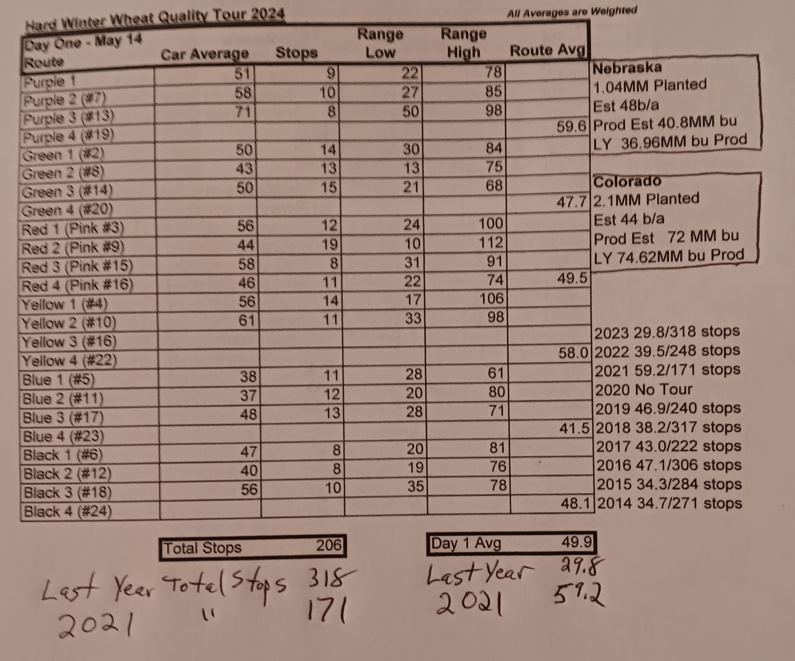
He adds that across areas of Kansas where it was common to see many fields in the 20s last May- here in 2024 those same locations were predicted to make 50-60 and even 70 bushels per acre. The wheat is expected to yield strong despite the problems of freeze and drought damage- as well as lots of disease pressure.
Schoenhals shared several pictures of some of the wheat fields with various levels of stress- including the one below taken west of Highway 281 that had white heads reflecting freeze damage:
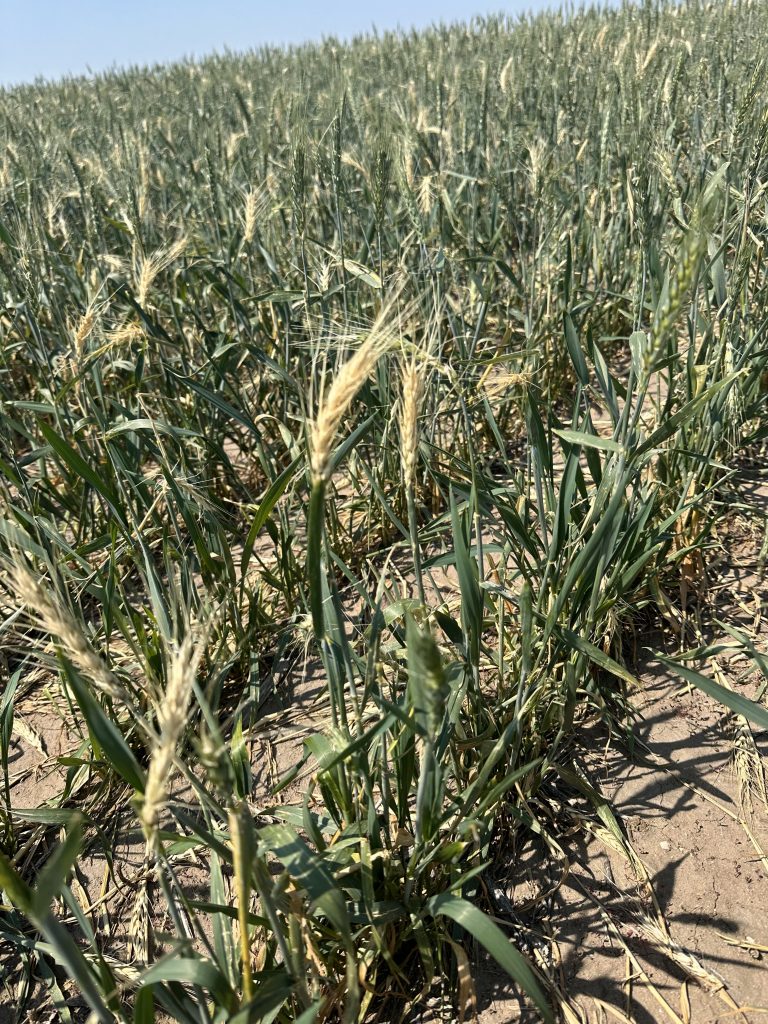
Schoenhals and the team he was riding with also saw their share of drought damage:
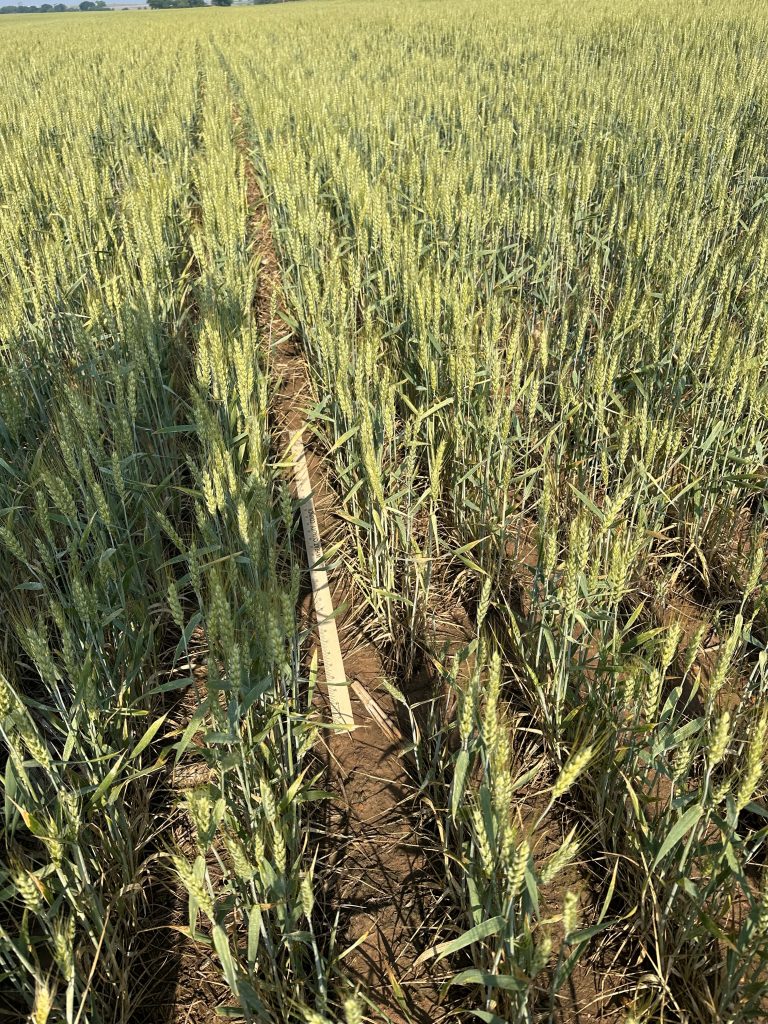
Day two of the tour will head south out of Colby with some cars heading south to Dodge City and then eastward into south central Kansas before stopping in Wichita for the day two report session.
In the case of the route that Dennis Schoenhals will be a part of- they will continue south out of the Dodge City area- cross over into Oklahoma and turn eastward on US 60- travel across northern Oklahoma before turning north to arrive in Wichita Wednesday late afternoon.
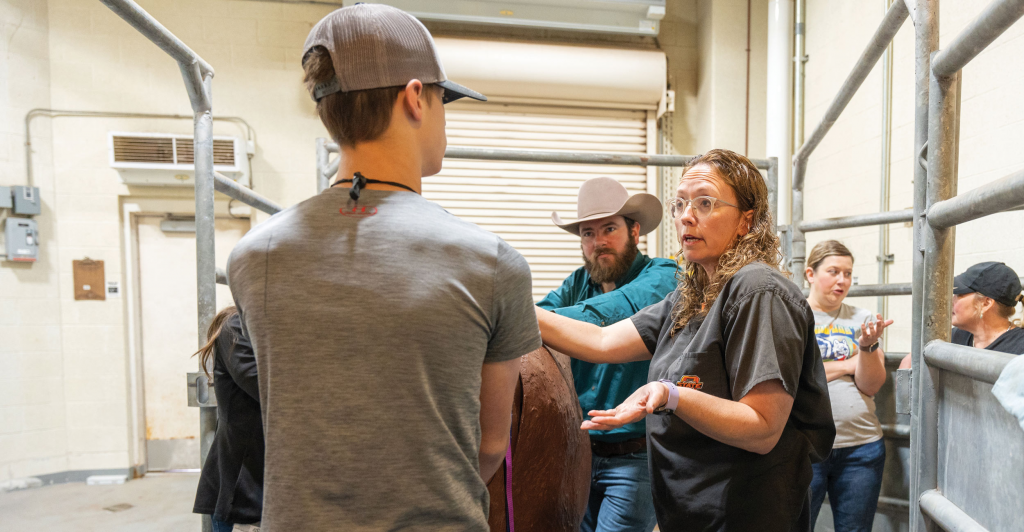
Farm Director KC Sheperd is visiting with Muscogee County 4-H Programs Specialist, Leslie Lewis, about the Vet Science Short Course offered by Oklahoma State University for high school students interested in veterinary medicine. This course will be offered again in 2025, and applications will open in late February.
Lewis explained that the program provides hands-on experiences and information about vet school programs to help students decide if a career in veterinary medicine is suitable. The program aims to address the shortage of rural veterinarians in Oklahoma and the application process opens in late February with 30 participants selected each year.
"The Vet Science Short Course is designed for 9th through 12th graders, and we invite them to come to OSU, and they go to the College of Veterinary Medicine there, and they get to go through some hands-on experiences and get an idea of what it is like to be a vet student for the day," Lewis said. "They get information about how to get into vet school, programs that would be helpful for them, and just the experience to know whether or not vet school is the right direction for them to go or if they should think about going a different direction."
One activity planned for the day will be an outbreak simulation, Lewis said, where students will go into the room, receive a disease outbreak scenario and learn how to walk through the situation.
"There is a bandaging session where they learn how to bandage legs, they get to listen with stethoscopes to dogs and cats, and then they also have a dissection lab where they get to dissect hearts and eyeballs," Lewis said.
Applications will open up to 4-H youth at the end of February, then from the applications, 30 individuals will be selected for the program. Each year, Lewis said the short course will take place before Memorial Weekend in May.
"We will do this again in 2025," Lewis said. "We have already selected our 30 for this year, but we try to focus on those 11th and 12th graders coming in so they have an idea of the path they want to take."
Lewis said those interested in applying for the 2025 group can reach out to their local 4-H Extension office for more information.
To read about a recent OSU Vet Science Short Course, CLICK HERE.
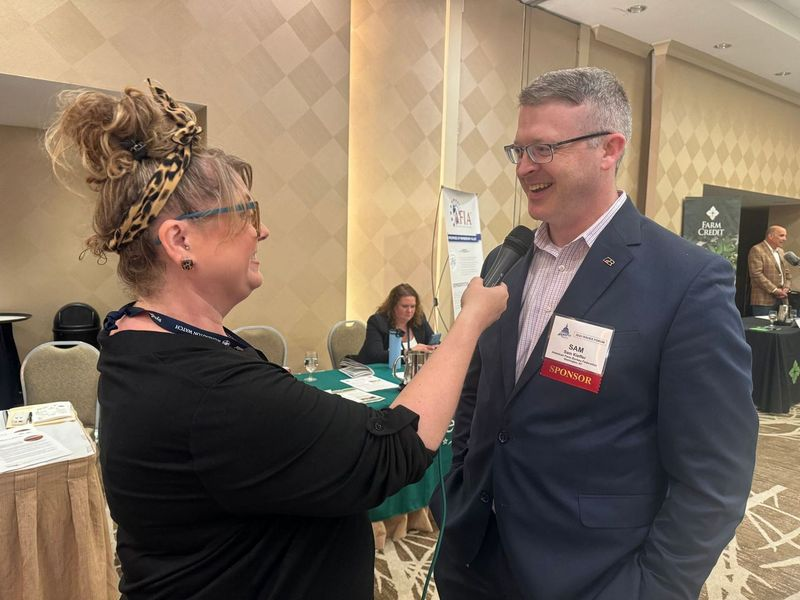
At the National Association of Farm Broadcasters (NAFB) annual Washington Watch event in Washington, D.C., Farm Director KC Sheperd had the chance to talk with the American Farm Bureau Federation's Vice President of Public Policy, Sam Kieffer, about the 2024 Farm Bill from the perspective of AFBF.
"We need a Farm Bill- period," Kieffer said. "We absolutely, positively need a Farm Bill. It is a year overdue, and if you think about the last time Congress passed a Farm Bill, it was 2018. A lot has changed since then. We have experienced a global pandemic, we have experienced nearly record inflation, and we are seeing significant global turmoil, and political strife internationally on multiple fronts. We are seeing international channels for shipment of goods including agricultural products being blocked or at least rerouted. The world is different than it was in 2018, and we need a Farm Bill that reflects modern times."
Due to the changes seen over the years along with global uncertainty, Kieffer said there must be an investment into the Title I crop commodity program and conservation programs focused on production.
"We want to ensure farmers continue to have access to programs that allow them to do the monumental heroic things around sustainability," Kieffer said. "We want to make sure that the nutrition title and the farm programs stay united because that is how you get a farm bill done. Farmers have historically taken it upon themselves to make sure to look out for their friends and neighbors in their community. That is what a Farm Bill does. It ensures the most vulnerable among us have an opportunity for three square meals a day."
Kieffer said the longer it takes to get the Farm Bill across the finish line, the more difficult it this process will become.
"We have a presidential election, and politics is always difficult, but if you believe public opinion polls, what we might experience after the election could be divided government in a different way than we are seeing it now," Kieffer said. "So, there is no incentive from our vantage point in delaying the already late Farm Bill."
Regarding some of the biggest issues being faced by the agriculture industry today, Kieffer said agricultural labor is at the top of the list.
"We need Congress to come together in a bipartisan way, and a serious way, to address the issue," Kieffer said. "It is hard to accomplish legislation in the halls of Congress. It was meant to be that way. What we are seeing, in many ways, is a level of frustration even among members of Congress who are trying to come about this, in a bipartisan way, to fix it."
| |||||||||||||||||||||||||||||||||||||||||||||||||||||||||||||||||||||||||||||||||||||||||||||||||||||||||||||||||||||||||||||||||||||||||||||||||||||||||||||||||||||||||||||||||||||||||||||||||||||||||||||||||||||
|
On Tuesdays, Senior Farm and Ranch Broadcaster, Ron Hays, visits with Ben Hale of Western Livestock Auctions as he talks about the latest in the markets and more. Established in 1995, Western has grown into a multi-generational family-owned and operated business and stands as a symbol of tradition, excellence, and a deep-rooted passion for the cattle industry. Western Livestock Auctions is located in Oklahoma City, Woodward, and Comanche.
This week's runs at Oklahoma National Stockyards totaled 8400 compared to 4300 a year ago. Hale said the demand was tremendous this week, especially for lighter cattle and heavier feeder cattle.
"They did call it steady, but it looked awfully good to me," Hale said.
Regarding recent rains, Hale commented on the potential for a decent summer grazing season.
"I think we are well on our way," Hale said. "In some places in Southern Oklahoma and North Texas, we filled some ponds up that we hadn't had filled up in several years."
Overall, Hale said cattle producers are enjoying the markets, and hoping for more green grass.
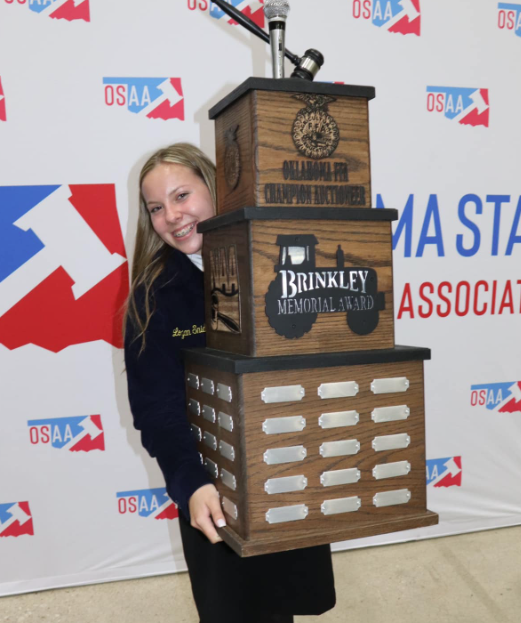
Pic Courtesy of OK State Auctioneers Association
Congratulations to our Inaugural FFA Auction Contest Champion, Logan Snider! The Oklahoma State Auctioneers Association worked with leaders in FFA to introduce the auction industry to FFA members. The Oklahoma State Auctioneers Association was there to congratulate Logan and held the following Q & A with her after the big win.
Logan Snider, a first year FFA member, attends Chisholm Public Schools in Enid, Oklahoma. Logan is an 8th grader who is very active in FFA, volleyball, basketball, and track. She has 2 brothers, 5 horses, and a dog. She enjoys the sport of rodeo and has found a passion for FFA competitions such as Opening and Closing Ceremonies, Prepared Speech, and Auctioneering.
How does it feel to have won the inaugural state FFA championship?
"I am extremely excited to have won the championship! There were so many talented competitors and I feel grateful and blessed to have won!"
Do you see the auction industry being a part of your career? If so why?
"Absolutely! The auction industry is filled with great people and amazing opportunities. I look forward to seeing where it leads me."
How could you encourage future FFA members to participate in this program?
"I can encourage others by sharing what this program has done for me! FFA and the OSAA's partnership is the first of its kind, which makes it exciting to promote this opportunity. I would tell members to be on the lookout for future auctioneering competitions and to take part in FFA leadership opportunities in public speaking."
One piece of advice for other FFA members interested in competing?
"My advice would be to step out of your comfort zone and take on new challenges. I had never auctioneered before joining FFA, but have found competing both fun and exciting!"
Kevin T. Swain also talked about the Larry Brinkley Award trophy on his Facebook page, "The Larry Brinkley award went to the winner along with numerous other items, and Rachel Sain is buying the winner a ring. Brent Bolen, Dwight Clardy, Michael Storey, and I paid to have a custom trophy built to travel the State and to be housed at the winning chapter's school for a year.
The trophy is designed for 60 years of winners' names to be engraved. Several members of the Brinkley family were present to watch Larry Brinkley be honored. Larry Brinkley's name will be honored across Oklahoma in every FFA chapter. The winner of the contest was 14 years old. If you have a child in FFA interested in learning how to auctioneer, please reach out, and I will give you instructions. I'm currently training two young auctioneers from our area in hopes of bringing the Larry Brinkley Award home to McCurtain County next year"
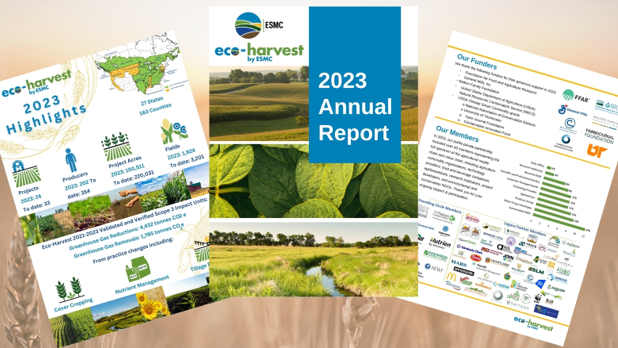
The Ecosystem Services Market Consortium (ESMC) released its 2023 Annual Report today. ESMC's Eco-Harvest program compensates farmers and ranchers for reduced greenhouse gases, increased soil carbon, improved water quality, and other ecosystem services benefits.
ESMC and its research arm, ESMRC, are a leading nonprofit consortium achieving environmental stewardship via innovative market solutions to scale carbon and ecosystem markets for the agricultural supply chain. The validated and verified Eco-Harvest program provides the necessary transparency, credibility, and integrity for corporates, producers, and all stakeholders across the supply chain. In 2023, 24 Eco-Harvest projects included over 200 producers on more than 150,000 acres. These producers implemented practice changes including cover crops, reduced/no till, and increased nutrient management resulting in measured greenhouse gas emission reductions and removals.
In 2023, ESMC completed another comprehensive audit and verification cycle for Eco-Harvest which continues to generate verified soil carbon removals and greenhouse gas reduction impacts for Scope 3 agri-food and supply chain reporting. For ESMC-member reporting companies, Eco-Harvest offers a reliable program and platform to achieve environmental improvements and make valid claims towards achieving science-based commitments. Additionally, Eco-Harvest earned Ag Data Transparent certification, confirming that producer data is protected and used to benefit producers. Read about these achievements and our future direction in the 2023 Annual Report.

In this episode of Beef Buzz, Senior Farm and Ranch Broadcaster Ron Hays is back talking with Dakota Moss of Livestock Risk Services about the advantages of utilizing Livestock Risk Protection (LRP), and some options for protecting unborn calves.
To listen to Part One of the conversation, CLICK HERE.
The utilization of LRP under USDA's Risk Management Agency's offices has become more popular over the years due to the benefits provided to cattle producers. While these programs are a great tool for cattle already alive and on the ranch, Moss also talked about an option for unborn livestock.
"The unborn steer and heifer contract is an amazing tool for our cow-calf producers," Moss said. "When we were in September and October of last year, and we saw those record-high futures prices for this coming fall, if a producer knew he was going to have calves hitting the ground in the spring, and he knew those cows were bred, he could go ahead and ensure that unborn calf crop for next fall at an amazingly high price."
Going forward, if someone is looking to change livestock agents, Moss said they must fill out a transfer application by June 30th at the latest because July 1st is the start of the 2025 livestock year.
"That is one thing with Livestock Risk Services- we specialize in LRP and it is our bread and butter," Moss said. "It is all we really do. We would love to have someone's business if they want to move it to us."
To utilize the free LRP quote tool offered at the Livestock Risk Services website, click here.
To sign up for daily price reports, click here.
The Beef Buzz is a regular feature heard on radio stations around the region on the Radio Oklahoma Ag Network and is a regular audio feature found on this website as well. Click on the LISTEN BAR at the top of the story for today's show and check out our archives for older Beef Buzz shows covering the gamut of the beef cattle industry today.
New for the 2024 crop season, GRAINCO FS is offering myFS Agronomy as its latest digital agronomic tool for on-farm data-driven decision-making for its farmer customers in Kendall, LaSalle, and Grundy counties in Illinois. The new digital platform and app, developed with Intelinair, provides in-season and postseason actionable insights and analytics for improved operational efficiency and return on investment. For years, GRAINCO FS has been at the forefront of providing innovative digital solutions to its customers. The recently launched app available now brings new features and functionality for an improved experience.
"We embarked on our ag tech journey nearly six years ago, driven by a commitment to leverage technology to generate the best return on investment for our customers," said Alan Drake, General Manager of GRAINCO FS. "Partnering closely with our farmers, we recognized the immense potential of data-driven decision-making and continue to enhance our program to support their operations. Our strategy remains focused on an ever-evolving omni-channel where our growers can connect anytime and anywhere with all aspects of doing business with GRAINCO FS. We are striving for a seamless experience where growers can monitor the health of their fields, pay off a bill, view an open contract, chat with our team - the list only continues to evolve with what our customers need. As we navigate the challenges posed by fluctuating commodity prices this growing season, tools like myFS Agronomy will focus on decision-making that will maximize returns on every acre."
GRAINCO FS uses the tech platform to analyze the crop on every acre across their entire trade territory to ensure their crop specialists are given the best data to make the decisions during the season to maximize the crop and to understand what seed, inputs, and practices will bring the highest ROI for each acre and in each situation postseason. All of this being built on real, local data gives their customers access to information they have never been able to see.
Cal Mason, Farm Data Manager for GRAINCO FS, said, "Our mission is to do what is best for our farmers. Using myFS Agronomy, we are able to take an unbiased approach, find what works and bring this information to our customers. Whether it's helping them decide whether or not to replant and making sure their fields are clean or helping them select the best seed and where to plant it, we have taken a 360-degree in-season and postseason approach to partnering with our customers."
Having several years of experience with this technology, GRAINCO FS has found that providing support to help their customers learn and utilize the product is critically important to their success.
"When a grower decides to partner with us, we make sure we are with them every step of the way ensuring they get the most out of the technology. From training them to use myFS Agronomy and interpreting the data, to making sure each field with a problem has boots on the ground so no opportunity is missed, we are there to support them," said Morgan Picht, Data Management Specialist for GRAINCO FS.
Crop specialists and the data management team members partner with the customer to review and interpret their field data and from there they decide what actions might be taken, if any.
GRAINCO FS Crop Specialist Jason Hamer said, "My customers want to feel exceptionally confident that they are making the best decisions possible. With the analytics, I know how to direct my customers to make the most profitable decisions for their farm. Together, we are able to look at the information and make decisions we both feel great about.
"One of the most eye-opening things that we are taking action on this year is corn planting populations. I always thought 34K to 36K was good enough, and the analysis, across an astronomical amount of acres, did not show that. The information showed we needed to push certain hybrids harder. This is one of the easiest things we can do to increase profitability.
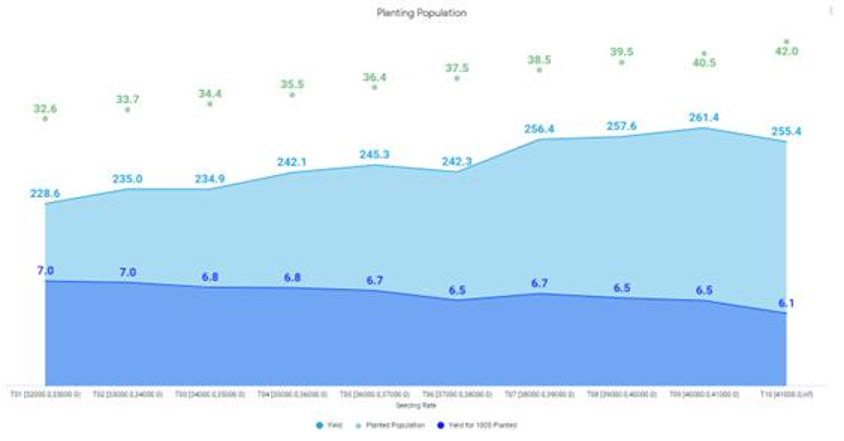
This chart illustrates the yield by planting population across tens of thousands of corn acres in LaSalle, Grundy, and Kendall counties.
"Looking forward, what makes me most excited is that as more people get on board in our geography, we are creating a community to drive our territory and our yields forward. Each person that joins, builds this data and the community. We all get better because of it,"added Hamer.
"Our long-term vision with our ag tech journey is to partner as consultants with our growers. We strive to be their go-to farm advisor with a committed emphasis on helping determine the best plan for each field. With the information we now have access to, we can customize a field plan based on various factors, including slope, seed, soil type, and many other historical data points," added Drake. "This allows us to analyze every input to generate the best ROI for every acre. Our digital journey is not one to replace the salesman/grower relationship, either. With the technology at hand, we are working to only enhance our partnerships with our growers to empower them with data analysis to help them make better decisions."
Conner Schmidt, National Sales Leader for Intelinair, said, "Our goal is to make technology simple enough that anyone can utilize it with analytics that find the answers to two difficult questions - What is the problem and how do I fix it? Analyze is a big step in that direction that this feature will continue to evolve.
"GRAINCO FS has and will continue to play a large role in this innovation. They are a company that relentlessly pursues better solutions for their customers, and they are not afraid to lead the way in uncharted territory. In the early stages of Analyze, they were the first to embrace the information and bring it to their customers. I was able to watch their team use Analyze to consult their growers to make numerous large and impactful decisions last fall which will pay dividends in this challenging market environment. I look forward to working together with GRAINCO FS to push the envelope further," added Schmidt.
About myFS Agronomy
With the myFS Agronomy platform, farmers and retailers can view fields from anywhere at any time and these features and much more:
For more information about the myFS Agronomy platform or to request a demo, visit www.graincofs.com/myfsagronomy
Mark Johnson, Oklahoma State University Extension Beef Cattle Breeding Specialist, offers herd health advice as part of the weekly series known as the "Cow Calf Corner," published electronically by Dr. Peel, Mark Johnson, and Paul Beck. Today, Johnson talks about analyzing your cow-calf production system and the upcoming Cattlemen's Conference.
Analyzing your cow-calf production system includes taking a look at:
How these components interact in your production system should determine the most Economically Relevant Traits (ERT) to your operation. The ERTs of significance to your operation should impact your selection and mating program. When considering what the most ERTs are to your operation consider the following questions:
By design, the questions force producers to consider input costs relative to the value of calves marketed at various endpoints. Analyzing the components of your production system should force you to answer questions about efficiency and profit margins beyond just targeting a level of production. For example: If I plan to sell my calf crop at weaning and identify a 600 pound weaning weight level of production as my objective. Am I more profitable when achieving this objective from a cowherd with a 1250 pound mature weight, or a 1500 pound average mature weight? Am I more efficient and profitable when achieving this objective from a cowherd averaging a 95% calf crop weaned or an 85% calf crop weaned?
Obviously, there is more to the profitability/efficiency equation than production levels alone. This is the point of assessing ALL the components of your production system.
The Blueprint For The Future Beef Conference – Part 2 will be held at the Totusek Arena on the OSU campus May 22 and 23, 2024. The conference will feature key industry leaders addressing topics such as gene editing, land stewardship and how they identifying the ERTs of their respective operations. If you have questions about the conference please contact me at mark.johnson@okstate.edu.
Registration for the conference can be done at: Cattlemen's Conference (cattleconference.com)
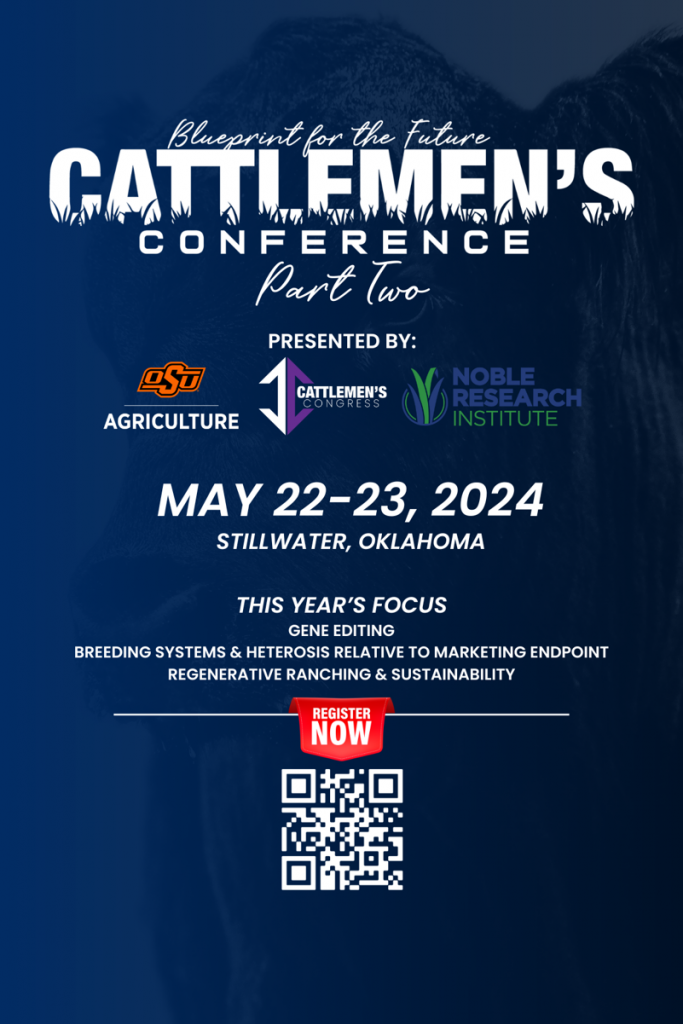
Below, Mark Johnson, OSU Extension beef cattle breeding specialist, discusses the upcoming Blueprint for the Future Cattleman's Conference and Rosslyn Biggs, OSU Extension beef cattle specialist, explains why animal stewardship is important to the cattle industry on SunUpTV from April 6, 2024.
In his April 16 Drovers opinion, "Speer: Limestone vs Protectionist Brimstone," Nevil Speer continues to criticize R-CALF USA's beef trade position and further his own, which is indistinguishable from that of the multinational beef complex. I'm grateful he's providing this opportunity for producers to take a probing look into cattle and beef trade.
In our April 23, rebuttal of his first opinion, "Bullard: Alas, A Genuine Discussion on Beef and Cattle" we pointed out Speer's glaring omission. He pretends beef from imported cattle is not imported beef. Consequently, his analysis understates the volume of imported beef in the U.S. market.
While ignoring beef produced in the U.S. from foreign-born cattle, he nevertheless claims, "There's simply no evidence that 'suggests' beef producers are being 'displaced' by beef imports – nor being unduly damaged in the marketplace."
Speer is not alone in this subterfuge. We've long criticized the USDA for understating beef imports by failing to account for imported beef derived from imported cattle. Then, in 2012 the USDA published a study stating, "Over the last decade, imports of [beef] into the United States and [beef] produced in the United States from foreign livestock have accounted for roughly 18 percent [] of US beef [] supplies (emphasis added)."
This study helps prove that if you don't include beef derived from imported cattle, you will grossly understate the volume of actual beef imports, period.
Speer tries to belittle our trade concerns by labeling us as protectionists motivated by emotion. Indeed, he states "international trade is an emotional issue." No, it's not! It's business, and if in business you persistently buy more than you sell, your business will eventually fail.
We're fighting to strengthen the business we represent – the U.S. cattle industry – and we've advanced facts showing the volume of beef our industry buys is grossly understated and far greater than the volume of beef our industry sells.
Speer acknowledges that even without including all imported beef, there is already a discrepancy between import and export tonnage, which he dismisses on the grounds that there is an "ever-widening advantage to U.S. producers in trade dollars." But he cannot make that claim if both the value of beef and value of cattle are properly included in the discussion. This fact is borne out in the value-based trade chart included in my previous opinion linked again here.
Below is an informative example of how the cattle industry has changed in the Pacific Northwest, which is penetrated by hundreds of thousands of imported cattle each year. Importantly, this real example is immune from any hypothetical assumptions that often distort reality by eliminating causal factors. During a U.S. International Trade Commission hearing in 2018 regarding the North American Free Trade Agreement (NAFTA) between the U.S., Canada, and Mexico, the National Cattlemen's Beef Association testified that, "Especially in the Pacific Northwest," imports of Canadian and Mexican cattle "have supplemented seasonal shortages in our herd and helped our feed yards and packing facilities run at optimal levels." The North American Meat Institute testified that those imports numbered about 282,000 head each year. The following chart depicts a shrinking Pacific Northwest cattle industry since NAFTA.
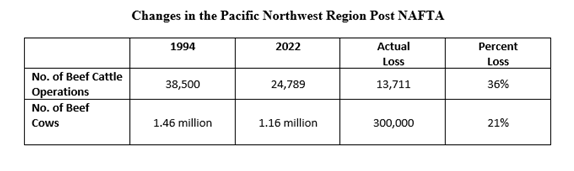
These facts show that 94 percent of the Pacific Northwest's beef cow numbers were displaced by the 282,000 head of annual imports that penetrated the region each year, and that is associated with the loss of 36 percent of the region's beef cattle operations. In other words, the calves produced by 300,000 cows are no longer needed because the calves those cows once produced in the United States are now being produced in foreign countries.
Due to its relative remoteness, the Pacific Northwest is a microcosm of the national cattle and beef industries, replete with its own import and domestic cattle supply chains, feedyards, and packers. Thus, it serves to inform us as to how the remainder of our nation's cattle and beef industries are functioning while confronted with excessive imports.
**Note to editors: This op-ed first appeared on Drovers.com.
Texas Tech University's Biological Threat Research Laboratory (BTRL) played a critical role in confirming the first case of highly pathogenic avian influenza transmission from a mammal (dairy cow) to a human.
The case was made public in an article published in the New England Journal of Medicine. Steve Presley, the director of The Institute of Environmental and Human Health (TIEHH) and the BTRL, and Cynthia Reinoso Webb, the biological threat coordinator at TIEHH, were co-authors on the journal publication.

The journal article explains that in March a farm worker who reported no contact with sick or dead birds, but who was in contact with dairy cattle, began showing symptoms in the eye and samples were collected by the regional health department to test for potential influenza A.
The concern stemmed from recent testing results on dairy farms across the region. Dairy cattle, some showing signs of illness but others asymptomatic, had tested positive for highly pathogenic avian influenza (HPAI).
Given the HPAI outbreak in dairy cattle, Reinoso Webb increased the precautions with all the raw milk testing, moving dairy sample testing into the biosafety level three (BSL-3) lab, a high-containment laboratory, where the work could be done with minimal risk of exposure to themselves and the environment.
"We have a milk and dairy product quality assurance lab we test dairy products, from raw milk to ice cream, for the region. That's part of the state health services contracts we have," Presley said. "That work is typically done in a BSL-1 level lab, which is like a kitchen. Dr. Reinoso Webb was very on her toes, for lack of a better term, to say 'Hey, we've got people testing raw milk in a BSL-1 and there's avian influenza virus in dairy herds confirmed.'
"This was even before the human case was determined. In a risk assessment, she decided to move into BSL-3 if there is potential for the virus to be present and infectious in the unpasteurized milk that was being tested."
So, when the concern of a human case came up, the BSL-3 lab was ready for the challenge.
"Before we tested the human case in the Centers for Disease Control and Prevention (CDC) Laboratory Response Network-Biological (LRN-B) facility located with the Texas Tech BTRL, we had already established communications with the CDC," Reinoso Webb explained.
"Being part of the CDC LRN-B, we have the standing capability to test for a lot of biological threats and some that are considered emergent."
Reinoso Webb and the team at TIEH
H responded quickly to the need
s of the regional public health authority knowing the potential dangers of the virus. Having received the samples in the early evening, within hours results were being reported back to the regional, state and federal levels. By the next day the samples were on their way to CDC for further testing.
"We were on the phone with the CDC until around midnight discussing different scenarios and follow up requirements," Reinoso Webb said. "There is a lot of federal reporting. It was a very complicated case, even though it was two samples and one patient.
"But we had this wonderful communication with the CDC and made sure we did everything by the book. This is how it's been structured, and this is how the communication was supposed to happen."
While the transmission of HPAI to humans is concerning, the ability of places laboratories like the BTRL at TIEHH to get answers to protect public health in a timely and accurate manner is immensely helpful in containing potential biological threats.
"We had never received a request for this testing before," Reinoso Webb explained.
The request for testing came on a weekend and the team had to quickly prepare and put together a risk assessment specific to the incoming samples.
"There's so much continued maintenance and competency tests that may not be used for years," Reinoso Webb said. "But when they are needed, we are prepared and competent to run the test."
With the human case presenting as eye inflammation rather than any type of upper respiratory infection, the likelihood of it spreading quickly decreased. Although it was one case, the information from the test results and clinical presentation provided insight into the threat posted to public health by this virus.
"It's a huge thing that the virus has jumped from birds to mammals, dairy cows in this case, and then to humans," Presley said. "That's why this paper in the New England Journal of Medicine is, I think, very significant. It's going to lay the foundation, I believe, for a lot of research in the future of how the virus is evolving."
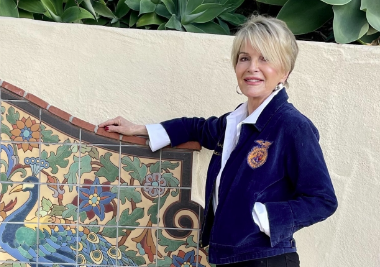
The National FFA Organization, headquartered in Indianapolis, is proud to announce the incoming cohort of National Teacher Ambassadors for the 2024-2025 school year. There will be 64 National Teacher Ambassadors representing 31 different states, as well as Puerto Rico.
The National Teacher Ambassadors will serve as the leaders, mentors, and trainers for more than 10,000 FFA advisors in the United States, Puerto Rico, and the U.S. Virgin Islands. They also can share feedback with the National FFA leadership about the changing educational landscape they are experiencing and how it can impact the National FFA Organization as a whole. The teacher ambassadors serve as a resource for teachers in their home states as well as those across the country, supporting other teachers in their professional growth and development.
"The National Teacher Ambassadors for FFA program is a unique program that informs and develops teachers while allowing teachers to help National FFA remain relevant with today's educational landscape," said Ambra Tennery, associate director of educational development & evaluation programs in the programs and events division of the National FFA Organization. "We are proud of the design of the program and the ability for teachers to make lifelong friendships with fellow teachers across the country. The benefits of this program are far reaching and important to the overarching work of the National FFA Organization."
The National Teacher Ambassadors for 2024-2025 include:
Alabama
Allison Heald, Southside FFA
Amanda Teixeira, Eufaula FFA
Jeff McKinney, Haleyville Center of Technology FFA
Arizona
Aleah Shook, Queen Creek FFA
Arkansas
Kisia Holland, Gravette FFA
California
Audrey Lent, Lakeside Middle FFA
Cara Parlato, Elsie Allen FFA
Colorado
Alexandra Grimes, Greeley FFA
Shauna Valko, Sedgwick County FFA
Delaware
Rebecca Moore, Smyrna FFA
Florida
Shelby Ball, Avon Park FFA
Stacy Young, Branford FFA
Georgia
April Davis, Commerce Middle School FFA
Ashley Rivers, Etowah FFA
Donovan Hemmings, Denmark High School FFA
Idaho
Josette Nebeker, Highland-Craigmont FFA
Katie Cooper, Salmon FFA
Iowa
Anna Brooks, West Marshall FFA
Melanie Bloom, Sioux Central FFA
Kansas
Ashley Vahsholtz, Junction City FFA
Kim Clark, Royal Valley FFA
Laura Miller, Junction City FFA
Kentucky
Jacob Ball, Carter G. Woodson FFA
Louisiana
Alyssa Stelly, Church Point FFA
Brooke Scott, Berwick FFA
Kalyn Yount, Varnado FFA
Regina Smart, Westlake FFA
Maryland
Leasa Gudderra, Gwynn Park FFA
Mississippi
Carla Lawrence, Loyd Star FFA
Catherine Avent, Lafayette FFA
Millie Chism, Pine Grove FFA
Toni Boatner, Brandon FFA
Montana
JR Pierce, Shields Valley FFA
New Hampshire
Carrie Hough, Dover FFA
New Jersey
Patricia Smith, Warren Hills FFA
Robin McLean, Northern Burlington Middle FFA
New Mexico
Leslie Clark, Carlsbad FFA
Shannon Watling, School of Dreams Academy FFA
North Carolina
Christopher Hicks, Lakewood FFA
Elizabeth Farmer, Uwharrie Charter FFA
Emma Hendley, Northwest Cabarrus FFA
Paul Young, Greene Central FFA
North Dakota
Bailey Hawbaker, Stanley FFA
Callahan Lemar, Grafton/Minto FFA
Ohio
Caleb Hickman, Utica FFA
Jeremy Ryan, West Muskingum FFA
Lori Romie, Ridgemont FFA
Stephanie Jolliff, Ridgemont FFA
Oklahoma
Shawn Martin, Bluejacket FFA
Puerto Rico
Kenneth Barbosa, Julio Víctor Guzmán Middle FFA
South Dakota
AnnaMarie Sachs, Langford Area FFA
Sarah McClure, Gettysburg FFA
Tennessee
Kyle Gehring, Bradford FFA
Ryan Wick, Lebanon FFA
Shana Boteler, Page FFA
Texas
Cheryl Handy, Sinton FFA
Kasey Naylor, Sam Rayburn FFA
Utah
Justice Fitzgerald, Crimson Cliffs FFA
McKayla Plewe, Cedar FFA
Virginia
Dakota Stroud, Signal Knob Middle FFA
Elizabeth Eastep, Louisa FFA
West Virginia
Allyson Lewis, Upshur County FFA
Wisconsin
Emma Huber, Portage FFA
Wyoming
Jennifer Schultz, Greybull FFA
RON's Dave Lanning has a pre-opening look at today's agricultural Markets.
Click the audio tab below for today's report.
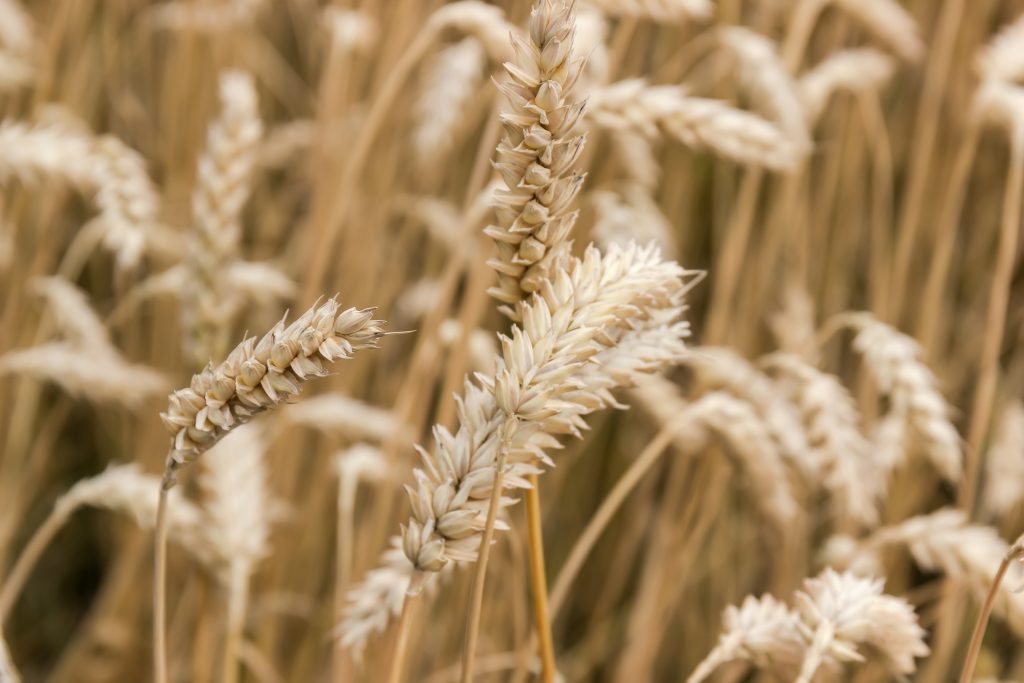
Winter wheat headed reached 57 percent, up 11 percentage points from the previous year and up 13 points from the five-year average. Winter wheat conditions rated 50 percent good to excellent, 32 percent fair and 18 percent poor to very poor. Last week's ratings were 50 percent good to excellent, 34 percent fair, and 16 percent poor to very poor. This time last year, winter wheat ratings for the U.S. were at 29 percent good to excellent, 30 percent fair and 41 percent poor to very poor.
Corn planted reached 49 percent, down 11 percentage points from the previous year and down 5 points from the five-year average. Corn emerged reached 23 percent, down 2 percentage points from the previous year and up 2 points from the five-year average.
Soybeans planted reached 35 percent, down 10 percentage points from the previous year and up 1 point from the five-year average. Soybeans emerged reached 16 percent, down 1 percentage point from the previous year and up 6 points from the five-year average.
Cotton planted reached 33 percent, up 2 percentage points from the previous year and the five-year average.
Sorghum planted reached 26 percent, down 1 percentage point from the previous year and even with the five-year average.
Winter wheat headed reached 95 percent, up 28 points from the previous week and up 13 points from normal. Winter wheat conditions rated 53 percent good to excellent, 35 percent fair and 12 percent poor to very poor. Last week's conditions rated 52 percent good to excellent, 41 percent fair, and 7 percent poor to very poor. This time last year, conditions rated 11 percent good to excellent, 38 percent fair and 51 percent poor to very poor.
Corn planted reached 74 percent, up 23 points from the previous week and from normal. Corn emerged reached 49 percent, up 17 points from the previous week and up 18 points from normal.
Sorghum planted reached 22 percent, up 8 points from the previous week and up 9 points from normal.
Soybeans planted reached 15 percent, up 8 points from the previous week but down 6 points from normal.
Peanuts planted reached 13 percent, up 8 points from the previous week but unchanged from normal.
Cotton planted reached 12 percent, up 7 points from the previous week, unchanged from normal.
Livestock conditions rated 71 percent good to excellent, 24 percent fair, and 5 percent poor to very poor. Last week's conditions rated 70 percent good to excellent, 25 percent fair and 5 percent poor to very poor.
Pasture and range conditions rated 53 percent good to excellent, 36 percent fair and 11 percent poor to very poor. Last week's conditions rated 52 percent good to excellent, 38 percent fair and 10 percent poor to very poor.
Winter wheat headed reached 88 percent, up 6 percentage points from the previous year and up 3 points from the five-year average. Winter wheat harvested reached 5 percent, up 1 percentage point from the five-year average. Winter wheat conditions rated 42 percent good to excellent, 35 percent fair and 23 percent poor to very poor. Last week's conditions rated 48 percent good to excellent, 33 percent fair and 19 percent poor to very poor. This time last year, conditions rated 20 percent good to excellent, 28 percent fair and 52 percent poor to very poor.
Corn planted reached 80 percent, even with the previous year and down 1 percentage point from the five-year average. Corn emerged reached 69 percent, down 4 points from the previous year and even with the average. Corn silked reached 18 percent, up 1 point from the previous year and up 8 points from the average. Corn conditions rated 66 percent good to excellent, 26 percent fair and 8 percent poor to very poor.
Cotton planted reached 28 percent, even with the previous year and the five-year average.
Peanuts planted reached 17 percent, down 1 percentage point from the previous year and up 2 points from the five-year average.
Sorghum planted reached 74 percent, down 1 percentage point from the previous year and even with the five-year average.
Soybeans planted reached 38 percent, down 9 points from the previous year down 17 points from the five-year average. Soybeans emerged reached 19 percent, down 8 points from the previous year and up 2 points from the five-year average.
Kansas Crop Progress:
Winter wheat headed reached 73 points, up 25 points from the previous year and up 30 points from the five-year average. Winter wheat conditions rated 31 percent good to excellent, 32 percent fair and 35 percent poor to very poor. Last week's ratings were 32 percent good to excellent, 35 percent fair and 33 percent poor to very poor. This time last year, winter wheat ratings in Kansas were at 10 percent good to excellent, 22 percent fair and 68 percent poor to very poor.
Corn planted reached 61 percent, up 4 percentage points from the previous year and up 5 points from the five-year average. Corn emerged reached 41 percent, up 10 points from the previous year and up 12 points from the average.
Soybeans planted reached 33 percent, down 5 percentage points from the previous year and up 7 points from the five-year average. Soybeans emerged reached 13 points, down 1 point from the previous year and up 6 points from the average.
Cotton planted reached 18 percent, down 8 percentage points from the previous year and down 2 points from the five-year average.
Sorghum planted reached 7 percent, up 1 percentage point from the previous year and up 3 points from the average.
In two separate lawsuits, Attorney General Gentner Drummond is pushing back against efforts by the Biden Administration and the State of California to impose electric-vehicle mandates nationwide on truck owners and operators.
A coalition of 24 states filed a petition for review today in the U.S. Court of Appeals for the District of Columbia Circuit to challenge the Biden Administration's new regulation of emissions from heavy-duty vehicles. A separate coalition of 17 states filed a lawsuit in the U.S. District Court for the Eastern District of California that seeks to block a package of regulations targeting trucking fleet owners and operators.
Drummond said he is committed to fighting heavy-handed governmental coercion.
"These outrageous mandates would force massive costs on commercial trucking that, in turn, will be passed on to consumers in the form of higher prices on anything and everything," he said. "These initiatives would upend the free market system by forcing companies to purchase electric trucks they clearly do not want. The resulting blow to the economy would be tremendous."
The states' D.C. Circuit suit targets the federal Environmental and Protection Agency (EPA) rule imposing stringent tailpipe emissions standards for heavy-duty vehicles that effectively forces manufacturers to produce more electric trucks and fewer internal-combustion trucks. Right now, electric trucks — and the infrastructure needed to support them — are virtually nonexistent. They also have shorter ranges and require longer stops.
The EPA's rule, however, would require manufacturers to produce fewer vehicles that utilize the preferred internal combustion technology.
The California suit challenges a suite of regulations in that state called Advanced Clean Fleets. Under that initiative, certain trucking fleet owners and operators are required to retire internal-combustion trucks and transition to more expensive and less efficient electric trucks. The rule applies to fleets that are headquartered outside of California if they operate within California. Given California's large population and access to ports for international trade, this regulation will have significant nationwide effects on the supply chain.
In both lawsuits, the states will argue that the Biden Administration and California regulators have exceeded their constitutional and statutory authority in attempting to force the entire country to transition to electric trucks.
Moreover, both regulations defy reality. Electric trucks are inefficient, costly and will adversely impact Oklahomans by increasing the costs of interstate transportation, raising prices for goods, and burdening the electric power grid.
In addition to Attorney General Drummond, attorneys general from the following states joined the lawsuit against the Biden Administration: Alabama, Alaska, Arkansas, Florida, Georgia, Idaho, Indiana, Iowa, Kansas, Kentucky, Louisiana, Mississippi, Missouri, Montana, Nebraska, South Carolina, South Dakota, Tennessee, Texas, Utah, Virginia, West Virginia, and Wyoming.
In addition to Drummond, attorneys general from the following states joined the suit against California regulators: Alabama, Arkansas, Georgia, Idaho, Indiana, Iowa, Kansas, Louisiana, Missouri, Montana, Nebraska, South Carolina, Utah, West Virginia, and Wyoming. Additionally, the Arizona State Legislature joined the lawsuit as well.
The litigation against the Biden Administration is available here and the California lawsuit is available here.
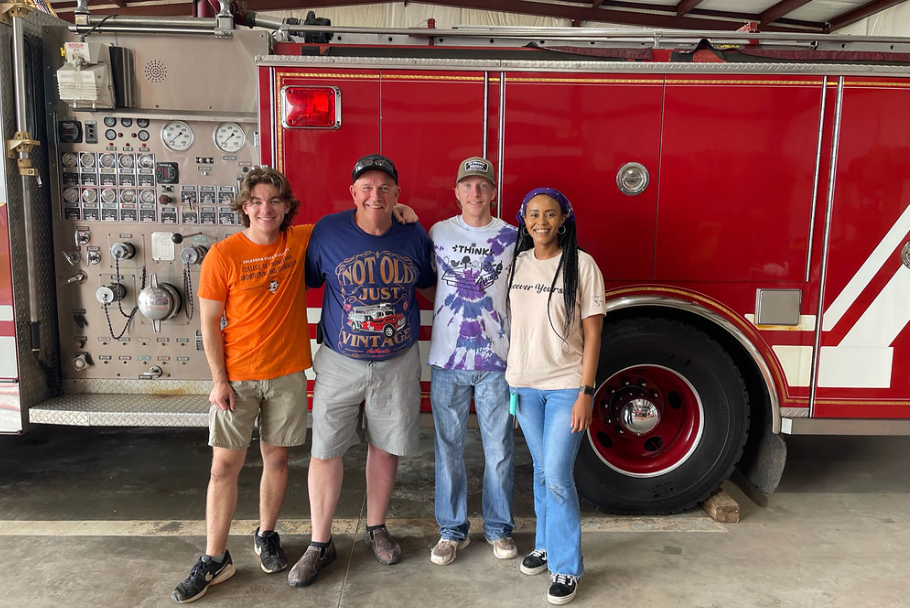
John Clemmons, Ethan Parsons and Rose Njoroge partnered with public safety officials including a firefighter from the community of Friendship, Oklahoma, (second from left) during their 2023 Rural Scholar internships. (Photo provided by the OSU Rural Renewal Initiative)
The Oklahoma State University Rural Renewal Initiative has selected participants for the new Research and Extension Experience for Undergraduates Scholars Program.
The REEU program was developed to foster interdisciplinary collaboration and address pressing challenges in rural communities.
The 11-week summer internship allows students to live in rural Oklahoma communities and collaborate with mentors on research and service projects that tackle rural issues and identify research-based solutions.
The REEU program includes a comprehensive week-long training session in May, introducing students to community capital framework, rural community development, and research methods.
The following students were recruited nationwide and will join communities across Oklahoma to begin their internships the week of May 20.
Maya Miller, a freshman at Tuskegee University, hopes to become a veterinarian and applied for REEU because of its involvement in research and agriculture.
"I would like my research to help solve the shortage of rural veterinarians," Miller said. "I would also like to uncover and solve some of the adversity rural veterinarians face today."
K-State student Madeline Drake learned about the REEU program from her advisor and is excited to discover new adventures and what Oklahoma can offer her.
"I decided to pursue this program because I am passionate about connecting with people and building strong communities," Drake said. "I wanted a non-traditional agricultural communications role where I can help others."
The REEU Scholars program is an extension of OSU's original Rural Scholars internship experience. Learn more about the summer research planned by the 2024 Rural Scholars.
REEU participants will present their research findings in October at the Rural Renewal Symposium at Lake Murray Lodge.
OSU Ag Research is Oklahoma's premier research and technology development agency in agriculture, natural resources and the life sciences.
By Laney Reasner
USDA's May World Agricultural Supply and Demand Estimates report is a first look at the new crop year's supply and demand balance sheets. However, with planting still in progress in the Northern Hemisphere and old crop harvesting still occurring in the Southern Hemisphere, projections this early in the year are highly uncertain, putting the focus on projections for ending stock levels.
For the domestic 2024/25 crop, which is currently being planted in most of the country, supply projections for most crops are based on farmer planting decisions from the March Prospective Plantings report and trend yield models. This WASDE report's projections have not taken into account slow planting progress due to wet conditions in the Midwest, which could decrease future U.S. production projections if late planting occurs.
New Crop – 2024/25 Marketing Year
Corn
For the 2024/25 marketing year, USDA projects U.S. corn ending stocks at 2.102 billion bushels, up 4% (80 million bushels) from 2023/24. The current new crop corn projection came in below industry expectations and almost 17% below estimations from the USDA Agricultural Outlook Forum in February. With the loosening domestic market, USDA projects the average market price to fall to $4.40/bushel, down 5.4% from 2023/24. Globally, we can expect corn ending stocks to hold steady in 2024/25 – falling only 0.3% due to lower production.
Overall, the corn market in 2024/25 is looking less bearish than it did when farmers were making planting decisions a few months ago. USDA raised both old crop and new crop corn demand (total use) by 100 million bushels each. Projections for total use in the 2024/25 marketing year of 14.8 billion bushels represent a 1.1 billion bushel increase over 2022/23, bouncing back to near-record levels set in 2021/22 at 14.9 billion bushels. December corn futures responded by moving 11 cents higher with positive follow through on Monday.
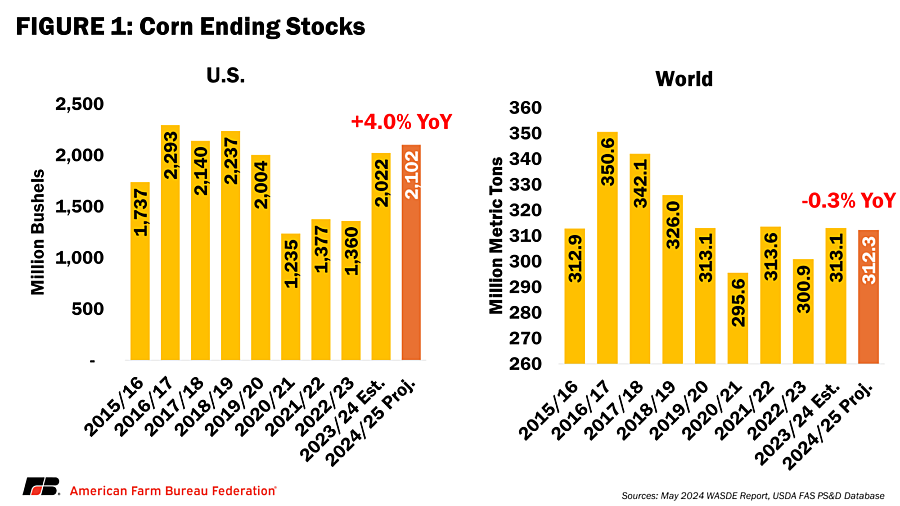
Soybeans
While the 2024/25 corn market is looking less bearish, the opposite is true for soybeans. In the upcoming marketing year, U.S. soybean ending stocks are projected at 445 million bushels, higher than both trade expectations and the USDA Agricultural Outlook Forum estimates in February. As compared to the current 2023/24 marketing year, this represents a whopping 30.8% increase. Due to this large projected increase, USDA projects prices to fall to $11.20 per bushel, a year-over-year decrease of 10.8%.
Globally, there is a similar but more muted situation for soybean ending stocks, with a year-over-year projected increase of 15%, rising up to 128.5 million metric tons (MMT). Brazilian production is projected to increase 15 MMT (9.7%) to 169 MMT in 2024/25, and Brazilian exports are projected to increase 3 MMT (2.9%) to 105 MMT.
The estimations for soybeans are heavily reliant on continued growth in soybean use, with an estimated 125-million-bushel increase in both crushings and exports, representing increases of 5.4% and 7.4%, respectively. If demand does not hold firm for soybeans, it could turn more bearish very quickly.
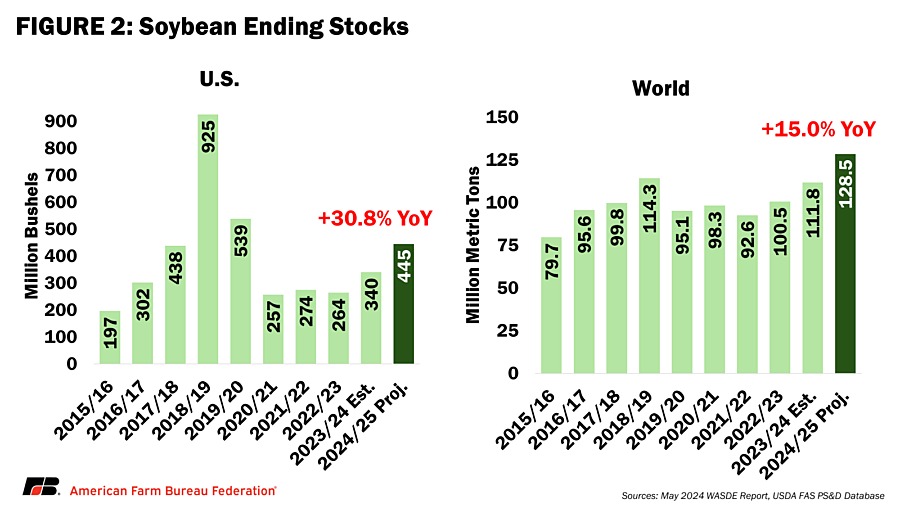
Wheat
Wheat is a bright spot of the report, with projections of a tightening global market in 2024/25. Domestically, ending stocks are projected to increase 11.4% to 766 million bushels, based on increased production (+2.5%) attributed to improved growing conditions. While domestic production is forecasted to increase in 2024/25, it will still be the eighth-lowest harvested-to-planted acre ratio for winter wheat. When compared to 2023 (second lowest on record) and 2022 (fourth lowest on record), the picture is rosier.
USDA projects global wheat to have the lowest ending stocks in eight years – falling 1.6% year-over-year to 253.6 MMT. Despite the tightening global market – U.S. average farm prices for wheat are projected to decrease to $6, a 15.5% drop from the 2023/24 marketing year.
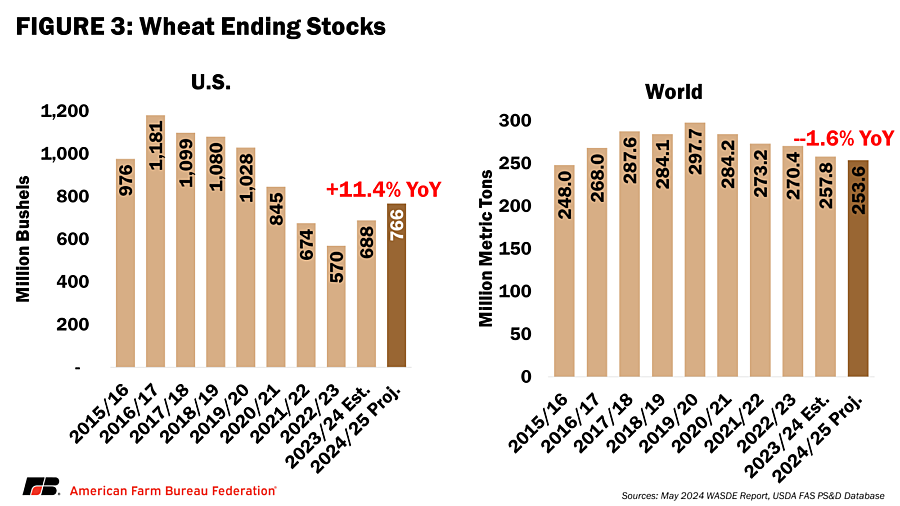
Cotton
In the 2024/25 marketing year, cotton ending stocks are projected to increase over 50% domestically to 3.7 million 480-lb bales, and 3.1% globally to 253.6 million 480-lb bales. The large increase in domestic ending stocks is attributable to a projected 32.6% increase in production. Despite the large increases in supply, the average farm price of upland cotton is only projected to fall 2 cents (2.6%) per pound.
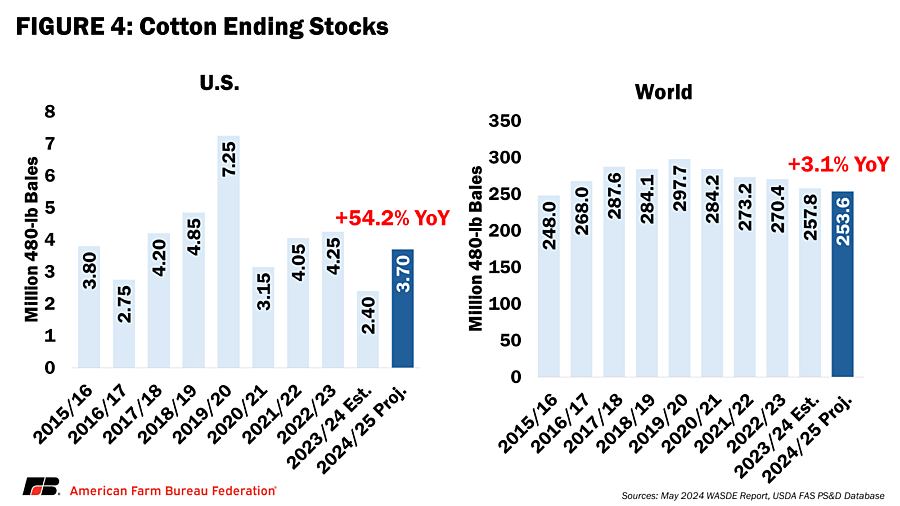
Conclusion
The 2024/25 crop year is projected to have lower average farm prices for all nine row crops with a price reported on the May 2024 WASDE. This includes medium/short grained rice (-16%), wheat (-15%), barley (-14%), soybeans (-13%), sorghum (-11%), long grained rice (-10%), oats (-10%), corn (-8%), and cotton (-3%). While there was some better-than-expected news in the May 2024 WASDE, especially for corn and wheat, overall declining prices underpin building pessimism in farm country.
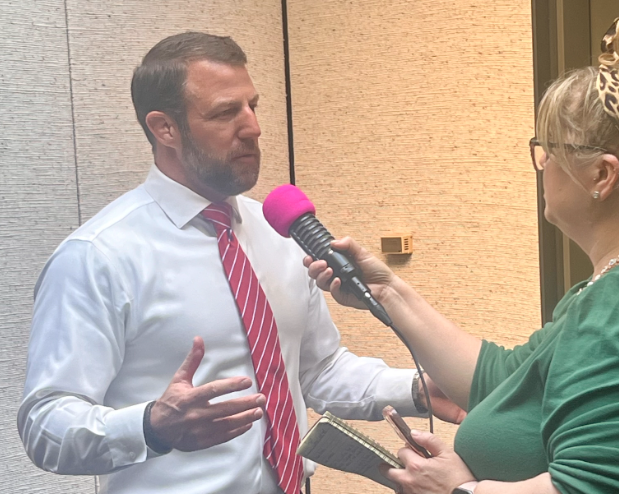
At the National Association of Farm Broadcasters (NAFB) annual Washington Watch event in Washington, D.C., Farm Director KC Sheperd had the chance to catch up with Senator Markwayne Mullin.
During the month of April, Mullin (R-OK), a member of the Senate Armed Services Committee (SASC), hosted U.S. Senator Jack Reed (D-RI), the Chairman of the Senate Armed Services Committee, on numerous Oklahoma military installations to better understand current needs and future readiness of the installations and their units. Mullin accompanied Chairman Reed on visits to Tinker Air Force Base (AFB), U.S. Army Fort Sill, and Altus AFB. They also visited the Will Rogers Air National Guard Base and McAlester Army Ammunition Plant.
"He was so impressed with Altus," Mullin said. "We talked about the hangar that was built in 1951 and the need that it has to be replaced or completely remodeled. He totally grabbed that, and in fact, we have been talking about funding for it ever since then."
Mullin said Reed was also moved by the McAlester Army Ammunition Plant and Fort Sill
"When we went to Fort Sill, it was like going home, because he actually trained there when he was a young officer," Mullin said.
To read the full press release about Mullin and Reed's visit to numerous Oklahoma military installations, CLICK HERE.
| |||||||||||||||||||||||||||||||||||||||||||||||||||||||||||||||||||||||||||||||||||||||||||||||||||||||||||||||||||||||||||||||||||||||||||||||||||||||||||||||||||||||||||||||||||||||||||||||||||||||||||||||||||||||||||
|
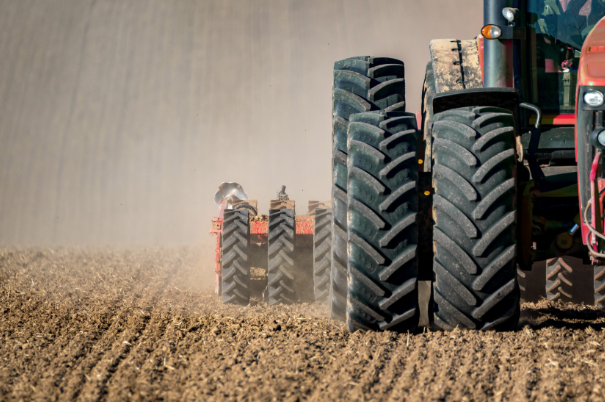
U.S. Sales of 4-Wheel-Drive tractors increased 24% in April compared to 2023, according to the new data from the Association of Equipment Manufacturers (AEM). Additionally, 4-Wheel-Drive tractor sales are up 1.9% in the U.S. year-to-date.
Unit sales of 100+ Horsepower tractors increased in the U.S. April sales rose 7.2% year-over-year, following March's jump of 3.2%. February sales were also up 2.7% compared to last year. Combines sales increased in April, growing 6.7% compared to 2023.
"The modest growth in agriculture 4-Wheel-Drive tractor sales in April 2024 is an indicator of resilience in the overall ag industry," said AEM Senior Vice President Curt Blades. "The smaller horsepower market continues to be a challenge, but we remain optimistic for the long-term strength of the ag equipment market."
Canadian sales of Combines also skyrocketed 73.5% in April compared to 2023 and are up 17.7% year-to-date. 4-Wheel-Drive tractors grew 7.2% year-over-year and 9.2% year-to-date.
The Ag Tractor and Combine reports can be found on the AEM Market Share Statistics page. The U.S. report can be downloaded from this page, while the Canadian report is available for download here.
About the Association of Equipment Manufacturers (AEM)
AEM is the North America-based international trade group representing off-road equipment manufacturers and suppliers with more than 1,000 companies and more than 200 product lines in the agriculture and construction-related industry sectors worldwide. The equipment manufacturing industry in the United States supports 2.3 million jobs and contributes roughly $316 billion to the economy every year.
Today marks the beginning of National Police Week – a week that occurs every year to appreciate and thank our law enforcement officers, as well as remember and respect those officers whose lives were taken in the line of duty.
National Police Week began in 1962 when President John F. Kennedy designated May 15 as Peace Officers Memorial Day and the week in which that date falls as National Police Week. Since then, every May, we have celebrated those who are devoted to keeping our communities safe and honored our fallen law enforcement heroes.
In Congress, National Police Week means thousands of law enforcement officers from across the nation will come visit elected officials in Washington, D.C. to highlight what we can do to best support them, honor their fallen brothers and sisters, and participate in memorials and group events. Their presence with us at our nation's Capitol will not only be a critical reminder of the important work they do, but also a reminder of the brutal violence they face and sacrifices they make.
Yet, although our brave men and women who wear the blue uniform selflessly make the choice to serve our communities knowing the dangers of the profession, there has been a spike in anti-police rhetoric in recent years. This blame of some of the faults of society on police officers as a whole is truly unacceptable, as it is not only disrespectful, but it has also resulted in a surge of violent crime against police officers across the country.
This is why, this National Police Week, my House Republican colleagues and I are bringing a series of bills forward that will reinforce our continued support for our brave law enforcement officers. H. Res. 1213 will condemn calls to defund the police, H.R. 7581 will ensure adequate data collection to address the rise in anti-police attacks, H.R. 7343 requires Immigration and Customs Enforcement (ICE) to detain any illegal immigrant who has been charged with or convicted of assaulting a police officer, H.R. 354 will allow qualified active and retired law enforcement officers to carry firearms on state, local, and private property otherwise open to the public, and more.
As the Representative for the law enforcement community in Oklahoma's Fourth District, I am proud to support these bills and our men and women in blue, not just this week, but every week. So, to those who uphold the badge and put themselves in harm's way to protect others, thank you. And to our fallen law enforcement heroes who paid the ultimate sacrifice, we can truly never do enough to honor your sacrifice and we will never forget you.
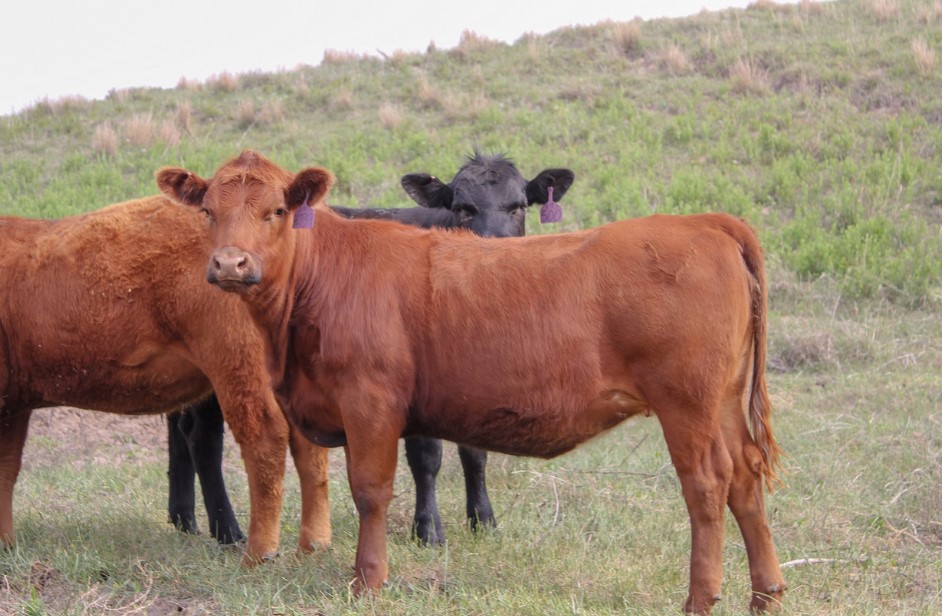
Dr. Derrell Peel, Oklahoma State University Extension Livestock Marketing Specialist, offers his economic analysis of the beef cattle industry as part of the weekly series known as the "Cow Calf Corner," published electronically by Dr. Peel and Mark Johnson. Today, Dr. Peel talks about heifer dynamics in the cattle industry.
There are numerous unique factors that make the beef cattle industry complex. Chief among those are the heifer dynamics that are central to cattle cycles. Two biological facts are critical: cows have one calf at a time in a rather slow biological process; and two, heifers can be used for current beef production or breeding for future production in a one for one trade-off. This means that when cattle numbers, specifically the cow herd, are low, retention of heifers to increase beef production makes the already short supply of beef even smaller before the cow inventory can expand and lead to increased beef production with 2–3-year lag.
Table 1 summarizes the last four cyclical beef cow herd expansions since 1975. With the exception of the truncated 2005-2006 expansion, the other three cycles have several similar characteristics. In most cases, the total increase in the cow herd from trough to peak is 2.2 to 2.9 million head, an increase of 5.8 to 9.4 percent. The corresponding increase in replacement heifers ranged from 1.1 to just over 1.2 million head in three of the four cycles. The most recent cycle, from 2014-2019, was different in that the increase in beef replacement heifers started prior to herd expansion and ended prior to the peak in herd inventory. This is likely an indication that there was pent up desire to expand that was delayed due to drought in 2011-2013.
Table 1. Cattle Cycle Herd Expansions Since 1975
| Years | Beef Cow Inventory Increase | % Change | Beef Replacement Heifer Inventory Increase |
| 1,000 Head | 1,000 Head | ||
| 1980-1982 | 2,167.8 | 5.8 | 1,080.3 |
| 1991-1996 | 2,864.0 | 8.8 | 1,168.6* |
| 2005-2006 | 171.2 | 0.5 | 355.2 |
| 2014-2019 | 2,734.3 | 9.4 | 1,228.6** |
*1991-1995; **2012-2017
The inverse relationship between heifers used for beef production and heifers retained for breeding is shown in Figure 1. The blue line (left side scale) shows heifers as a percent of total fed slaughter from 1975-2023, while the red columns (right side scale) indicate the percent change in beef replacement heifer inventory from the previous year. The green ovals highlight cyclical herd expansions in Table 1. In each case, as the beef replacement heifer inventory increases, the percentage of heifers in the fed slaughter total necessarily declines. The decline in this percentage in the most recent cycle was especially sharp, dropping below 34 percent for three years, the lowest levels in the 49 years from 1975-2023.
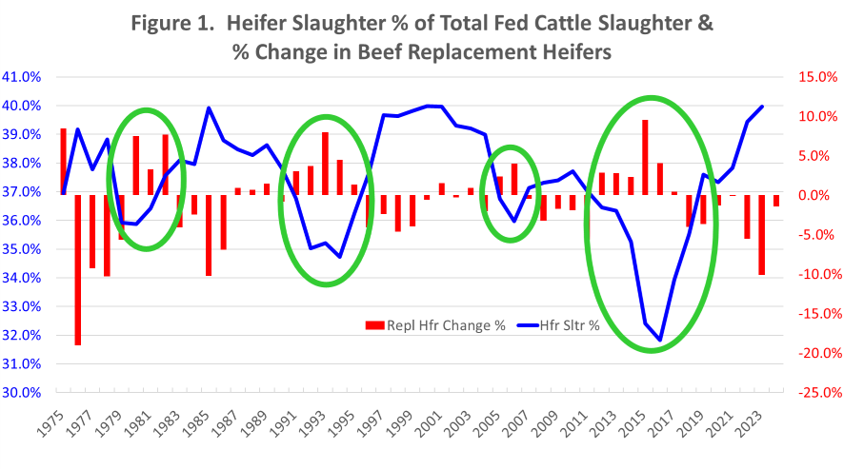
Figure 1 provides some insights into the future. The far-right side of the graph shows that heifer slaughter as a percent of fed slaughter is as high as it has ever been at 40 percent in 2023. This matches the previous high of 40 percent in 2000 and 2001. At the same time, the replacement heifer inventory has been decreasing and the beef cow herd continues to get smaller. In the first quarter of 2024, the heifer slaughter percentage was 40.5 percent, down fractionally year over year for the same period.
It is not clear if the next herd expansion will require the heifer slaughter percentage to drop as much as the 2015-2017 period, but it must drop below the long-run average of just over 37 percent and likely to the 35-36 percent range. There is no indication that is happening yet.
| Way back in the 1930s, one of the original motivations behind creating the Federal Milk Marketing Order system was to provide incentives for farmers to produce better milk. Much of the milk at the time was Grade B, which was lower quality than the Grade A milk earmarked for fluid consumption. To ensure an adequate supply of higher-quality milk, the FMMO system set up pricing that encouraged its production. It worked. U.S. milk production is now almost entirely Grade A – even for uses in which Grade B is permissible, such as in certain manufactured dairy products. And in the past quarter century, better animal care, and better science and technology, has improved milk even more in terms of its nutrition, its quality and its premium-value components. For one example – take a look at how the percentage of protein in 100 pounds of milk has evolved since 2000. |
 |
| Impressive. And just like in the 1930s, it has to do with incentives. The adoption of multiple component pricing in 2000 paid farmers for the protein content in most of their milk, just as they had long been paid for its milkfat content. That's the good news. But the bad news is that in many other ways, federal order pricing formulas that often haven't changed since 2000 don't reflect the structure of today's dairy industry. And that disrupts those incentives, to the detriment of everyone who holds a stake in dairy's success. For example, Class I differentials – designed to ensure that processors receive an adequate supply of fresh milk to produce fluid milk products – haven't been updated nationwide since 2000. Make allowances in the federal order product price formulas – which are supposed to cover the cost of converting raw milk components into finished products – have also gone a generation without adjustment, hindering processors that farmers need to thrive. Simply put, dairy as an industry can't thrive without adequate updates to federal formulas. So hooray for protein. But many current formulas still don't work for farmers and the cooperatives they own. The improved quality and availability of American milk comes from farmers' hard work. And good work should be rewarded. |
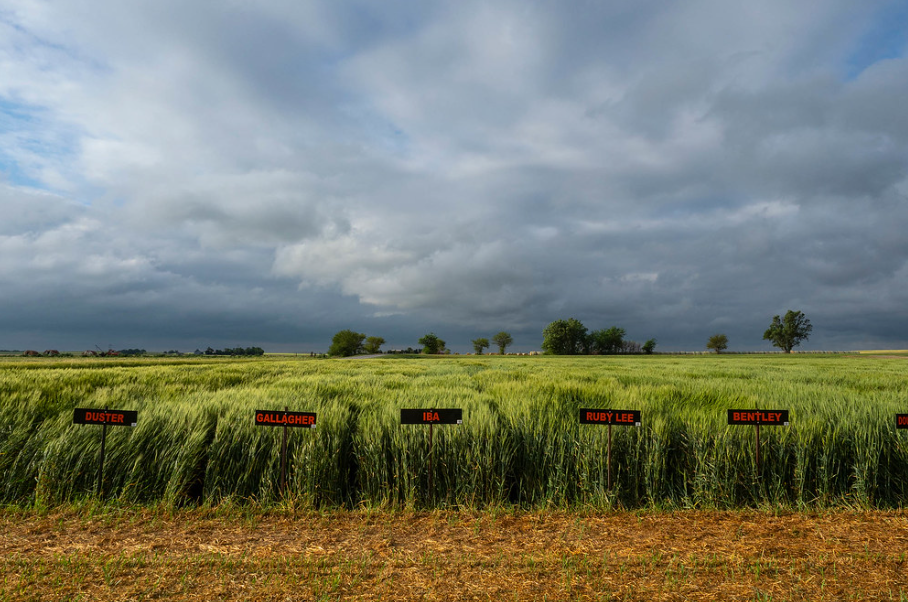
The Lahoma Wheat Field Day will be held this week at the Oklahoma State University North-Central Research Station in Lahoma. Producers will learn about wheat varieties, wheat breeding and pest and weed management. (Photo by Todd Johnson, OSU Agriculture)
Oklahoma State University Agriculture will host its annual Lahoma Wheat Field Day this week for producers to learn about wheat varieties, breeding, fertility, disease and pest and weed management.
OSU Agriculture Field Days are educational events presented by OSU Ag Research and OSU Extension to share research-based information and resources with Oklahomans. Field days showcase current agricultural research and relevant best practices through presentations, tours, hands-on workshops and discussions.
Research at OSU locations across the state is often designed for specific applications based on region.
Who: Wheat producers in north-central Oklahoma
What: OSU Agriculture Lahoma Wheat Field Day
When: 9 a.m. to 1:30 p.m. on May 17
Where: North Central Research Station near Lahoma (GPS coordinates: 36 23'21.6"N 98 06'16.3"W)
Schedule:
Check-in begins at 8:30 a.m. Continuing education units will be available. Doughnuts and coffee will be provided by the Oklahoma Wheat Growers Association, and lunch and dessert will be sponsored by Farm Credit of Western Oklahoma and Albaugh.
For more information or to register, visit the OSU Agriculture Field Days website.
OSU Agriculture is dedicated to improving the quality of life of Oklahomans through science-based information and education. It is comprised of the Ferguson College of Agriculture and two state agencies: OSU Ag Research and OSU Extension.
AAA projects 43.8 million travelers will head 50 miles or more from home over the Memorial Day holiday travel period*. This year's total number of travelers is a 4% increase over last year and comes close to matching 2005's record of 44 million Memorial Day travelers.
"We haven't seen Memorial Day weekend travel numbers like these in almost 20 years," said Paula Twidale, Senior Vice President of AAA Travel. "We're projecting an additional one million travelers this holiday weekend compared to 2019, which not only means we're exceeding pre-pandemic levels but also signals a very busy summer travel season ahead."
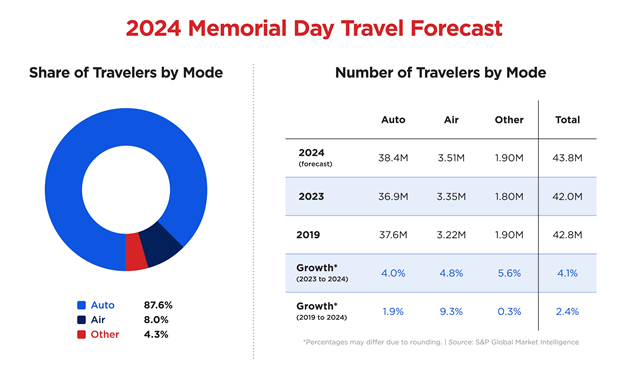
Road trips are expected to set a record. AAA projects 38.4 million people will travel by car over Memorial Day weekend, the highest number for that holiday since AAA began tracking in 2000. The number of drivers this year is up 4% compared to last year and 1.9% higher than in 2019. Traveling by car is appealing for many people because of the convenience and flexibility it provides. This Memorial Day weekend drivers can expect similar gas prices as last year when the national average was roughly $3.57. Pump prices rose this spring but have held somewhat steady in recent weeks. Prices may creep higher as the summer driving season gets underway. The wildcard remains the cost of oil, and unlike last year, there are now two wars – in the Middle East and Ukraine – that could roil the oil market.
Airports are bracing for a spike in travelers. AAA expects 3.51 million air travelers this holiday weekend, an increase of 4.8% over last year and 9% jump compared to 2019. This will be the most crowded Memorial Day weekend at airports since 2005, when 3.64 million flew for the holiday as the travel industry finally rebounded post 9/11. This Memorial Day weekend, air ticket prices are comparable to last year. AAA booking data shows a 1% to 2% increase in prices for domestic flights. Several factors play into how much travelers pay for airfare, including destination, number of stops, and fare class. For example, passengers who book nonstop flights with seat selection and carry-on bags included will likely pay more than those who select basic economy with a layover.
Nearly two million people are expected to travel by other modes of transportation, including buses, cruises, and trains. AAA projects 1.9 million people will take these other modes of transportation, an increase of 5.6% compared to last year.
"This category took the biggest hit during the pandemic with fewer people taking public transportation or not cruising at all," Twidale said. "Now – five years later – we're back to 2019 numbers. Travel demand has been soaring, and long holiday weekends create the perfect windows for getaways."
Best/Worst Times to Drive and Peak Congestion by Metro
INRIX, a provider of transportation data and insights, says drivers leaving Thursday or Friday should hit the road early to avoid mixing with commuters. Travelers going back home on Sunday or Monday should avoid the afternoon hours when return trips will peak.
"Travel times are expected to be up to 90% longer than normal. Travelers should stay up to date on traffic apps, 511 services, and local news stations to avoid sitting in traffic longer than necessary," said Bob Pishue, transportation analyst at INRIX.
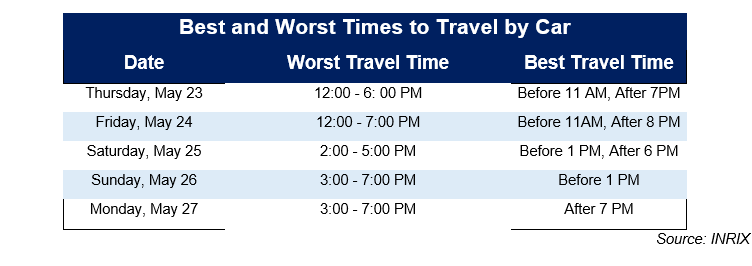
Top Destinations
This Memorial Day weekend, travelers are seeking theme parks and entertainment venues in Orlando, New York, Las Vegas, and Southern California. Seattle, Anchorage, and Vancouver rank high because of the popularity of Alaska cruises this time of year. Florida beaches and cruise ports will also be packed.
European cities dominate the international list. The top 10 domestic and international destinations below are based on AAA booking data.
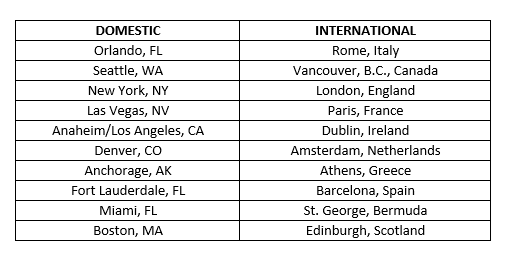
Travel Trends
As travelers make plans for summer and beyond, AAA Travel has identified the following trends:
Travel Advisor Survey
A recent survey of AAA travel advisors highlights topics travelers are frequently discussing when booking trips:
Travel Forecast
In cooperation with AAA, S&P Global Market Intelligence (SPGMI) developed a unique methodology to forecast actual domestic travel volumes. The economic variables used to forecast travel for the current holiday are leveraged from SPGMI's proprietary databases. These data include macroeconomic drivers such as employment, output, household net worth, asset prices, including stock indices, interest rates, housing market indicators, and variables related to travel and tourism, including gasoline prices, airline travel, and hotel stays. AAA and SPGMI have quantified holiday travel volumes going back to 2000.
Historical travel volume estimates come from DK SHIFFLET's TRAVEL PERFORMANCE/MonitorSM. The PERFORMANCE/MonitorSM is a comprehensive study measuring the travel behavior of U.S. residents. DK SHIFFLET contacts over 50,000 U.S. households each month to obtain detailed travel data, resulting in the unique ability to estimate visitor volume and spending, identify trends, and forecast U.S. travel behavior, all after the trips have been taken.
The travel forecast is reported in person-trips. In particular, AAA and SPGMI forecast the total U.S. holiday travel volume and expected mode of transportation. The travel forecast presented in this report was prepared the week of April 15, 2024.
*Memorial Day Holiday Travel Period
For this forecast, the Memorial Day holiday travel period is defined as the five-day period from Thursday, May 23 to Monday, May 27, 2024.
AAA Travel Agent Survey Methodology
AAA clubs distributed surveys to a random sample of their travel agents between March 18 and March 29, 2024 to understand recent traveler trends over the previous 60 days (January/February 2024). 186 AAA agent responses were collected from 13 AAA clubs (representing 97% of AAA membership overall as of February 2024).
About S&P Global
S&P Global (NYSE: SPGI) provides essential intelligence. We enable governments, businesses, and individuals with the right data, expertise, and connected technology so that they can make decisions with conviction. From helping our customers assess new investments to guiding them through ESG and energy transition across supply chains, we unlock new opportunities, solve challenges, and accelerate progress for the world. We are widely sought after by many of the world's leading organizations to provide credit ratings, benchmarks, analytics, and workflow solutions in the global capital, commodity, and automotive markets. With every one of our offerings, we help the world's leading organizations plan for tomorrow today. For more information, visit www.spglobal.com.
About DKSA
DK SHIFFLET boasts the industry's most complete database on U.S. resident travel both in the U.S. and worldwide. Data is collected monthly from a U.S. representative sample, adding over 60,000 traveling households annually, and is used daily by leading travel organizations and their strategic planning groups. DK SHIFFLET is an MMGY Global company.
About INRIX
Founded in 2004, INRIX pioneered intelligent mobility solutions by transforming big data from connected devices and vehicles into mobility insights. This revolutionary approach enabled INRIX to become one of the leading providers of data and analytics into how people move. By empowering cities, businesses, and people with valuable insights, INRIX is helping to make the world smarter, safer, and greener. With partners and solutions spanning across the entire mobility ecosystem, INRIX is uniquely positioned at the intersection of technology and transportation – whether it's keeping road users safe, improving traffic signal timing to reduce delay and greenhouse gasses, optimizing last mile delivery, or helping uncover market insights. Learn more at INRIX.com.
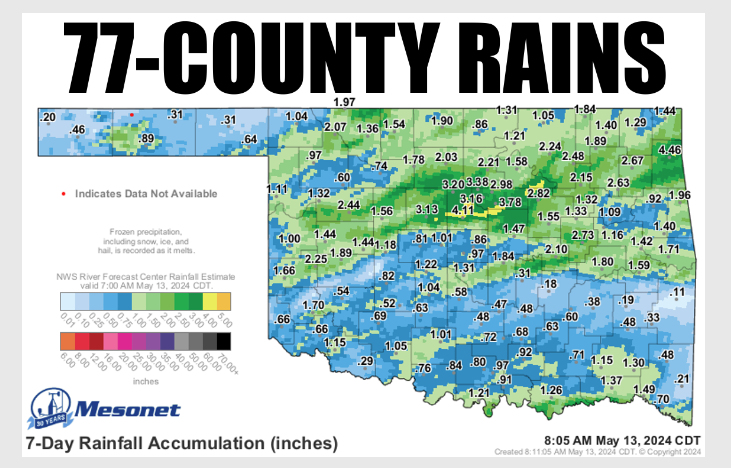
The Oklahoma Wheat needed a drink of water over the weekend, and a LOT of the state did get some rain. In fact, according to State Climatologist Gary McManus, 77 counties in Oklahoma did receive *Some* form of precipitation, but others didn't get that much "77-county rains," technically, that's correct, although some got a lot, some unfortunately still got a little. But (and that's a big "but"... you know who you are), like it says...everybody got at least a little. And we've
managed to largely reset these nasty-looking maps."
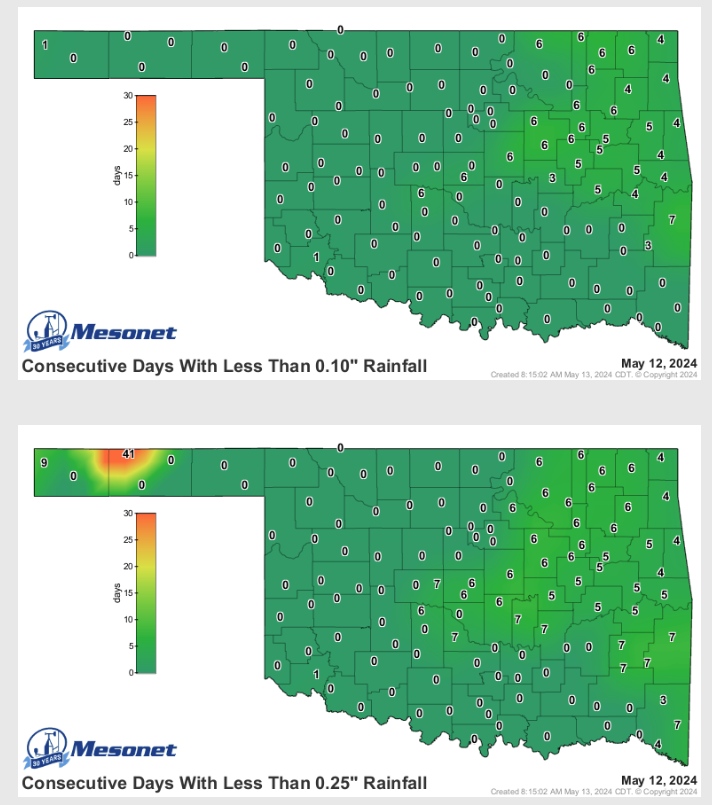
McManus says we do have some other rain opportunities this week for rain, "We're not talking massive flooding rains here (hey, Massive Flooding Rains was my band's name in Finishing School!), but some get a lot, some get a little,
but all 77 counties get something."
According to the forecast this week, there is a 50% chance of rain today across the state, and another chance of showers and thunderstorms moving in on Wednesday, Thursday, Friday, and throughout the weekend.
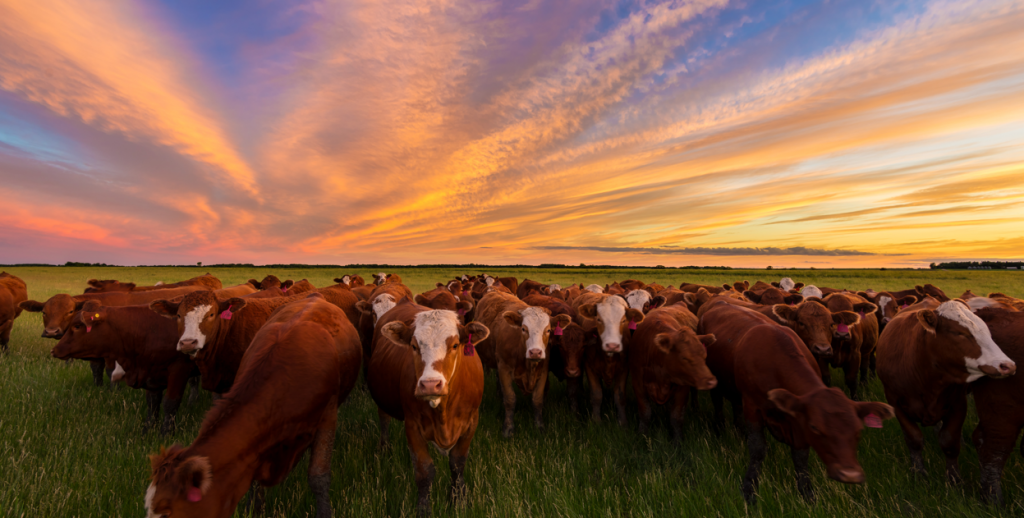
Senior Farm and Ranch Broadcaster Ron Hays is talking with Dakota Moss of Livestock Risk Services about the advantages of utilizing Livestock Risk Protection (LRP).
As the cattle markets can be described as "choppy" lately, Moss talks about factors impacting the markets and how LRP can give producers peace of mind.
"Over the past few weeks, we had that bird flu scare so to speak, which really hasn't turned into anything for the beef cattle side of the industry, but it seems like the cattle business and the cattle industry is so sensitive to any possible bad news we may have, that it just has a volatile impact with the way cattle futures is trading nowadays."
By locking in price protection with LRP, Moss said producers can ensure a good profit coming into the fall months or early next spring, regardless of events that may impact the market.
"The LRP goes off of the market every single day, so prices change with LRP every single day as soon as we get that closing price off of the feeder cattle futures and the live futures," Moss said. "The best thing a producer can do if they are utilizing LRP in their operation is to be proactive as possible, know their numbers, know their business, and be watching those prices."
For those who are looking to utilize LRP, Moss said a producer first must talk with a livestock agent who can help file an application.
"The most important thing on that application is they need to fill that out the same way they sell cattle," Moss said. "That is the most important thing. This is a USDA program, so records must match across the board."
To get in contact or find a Livestock Risk Services agent, click here.
To sign up for daily price reports, click here.
The Beef Buzz is a regular feature heard on radio stations around the region on the Radio Oklahoma Ag Network and is a regular audio feature found on this website as well. Click on the LISTEN BAR at the top of the story for today's show and check out our archives for older Beef Buzz shows covering the gamut of the beef cattle industry today.

Five students join Angus operations across the country for the summer.
Five students have been paired with Angus ranches across the United States to expand their knowledge of the cattle industry, as part of the Angus Foundation's 2024 Talon Youth Education Learning Program
The Talon Youth Education Learning Program internship is the legacy of the late Camron
"Cam" Cooper of The Talon Ranch, Twin Bridges, Montana. Cooper set up the Angus/Talon Youth Education Learning Program Endowment Fund in 2009 to be a holistic educational opportunity for undergraduate, graduate and recent college graduates who major in an agricultural field of study.
"Talon interns learn by doing," said Jaclyn Boester, executive director of the Angus Foundation. "We have an excellent group of interns for the summer, and we look forward to watching each student's personal growth during their time in the program."
Isaiah Gagnon | Mead Farms
Isaiah Gagnon, an ag management major at the University of Missouri will spend the summer at Mead Farms in Barnett, Missouri. Mead Farms has an 82-year history in the cattle business and focuses on performance traits impacting profitability. Gagnon's goal during his time with the Meads is to expand his AI knowledge, working toward a possible future as an embryologist.
Blake Long | Eleven Milliron Ranch
Eleven Milliron Ranch in Sumner, Nebraska will be home to Blake Long this summer. Long is an ag science major at Northern Oklahoma College. The ranch is owned by Greg and Teresa Ibach. Greg is a former undersecretary for marketing and regulatory programs for the USDA and a past director of the Nebraska Department of Agriculture, which aligns well with Long's goals for the program.
"I want to experience different avenues of marketing Angus cattle and see the different marketing strategies a ranch utilizes," Long said.
Autumn Chaka | Double M Ranch
Tarleton State University animal science and business major, Autumn Chaka will also spend the summer in Nebraska. Mike and Margaret Smith will host Chaka. The couple runs 600 head on their ranch, Double M, near Harrison. With Double M's diverse operation, Chaka will have the chance to assist in everything from AI to crop production.
Kennedy Walker | Bar69 Angus Ranch
With 55 years of experience in the Angus breed, Bar69 in Belle Fourche, South Dakota is no stranger to the Talon program. University of Missouri student, Kennedy Walker will be the third intern Bar69's owners, Craig and Deb Kukuchka, have taken under their wing.
"The intern is exposed to and can learn about almost everything related to running a cattle operation," Craig Kukuchka said. "We always tell them – if they don't like one thing, they'll soon get a chance to try something new."
Bryan Farkas | Audley Farm
Bryan Farkas is an ag science and ag business major at Western Illinois University – Macomb. He will spend his summer learning and working alongside Matthew Deacon of Audley Farm. Located in Berryville, Virginia, Deacon runs 1,000 head of cattle.
"We feel it is important to provide youth with chances to see and learn new things and practices," Deacon said.
Farkas grew up in the swine industry and is eager to expand his knowledge of cattle. He recently purchased four bred cows to start his herd.
– Written by Jessica Hartman, Angus Communications
RON's Dave Lanning has a pre-opening look at today's agricultural Markets.
Click the audio tab below for today's report.
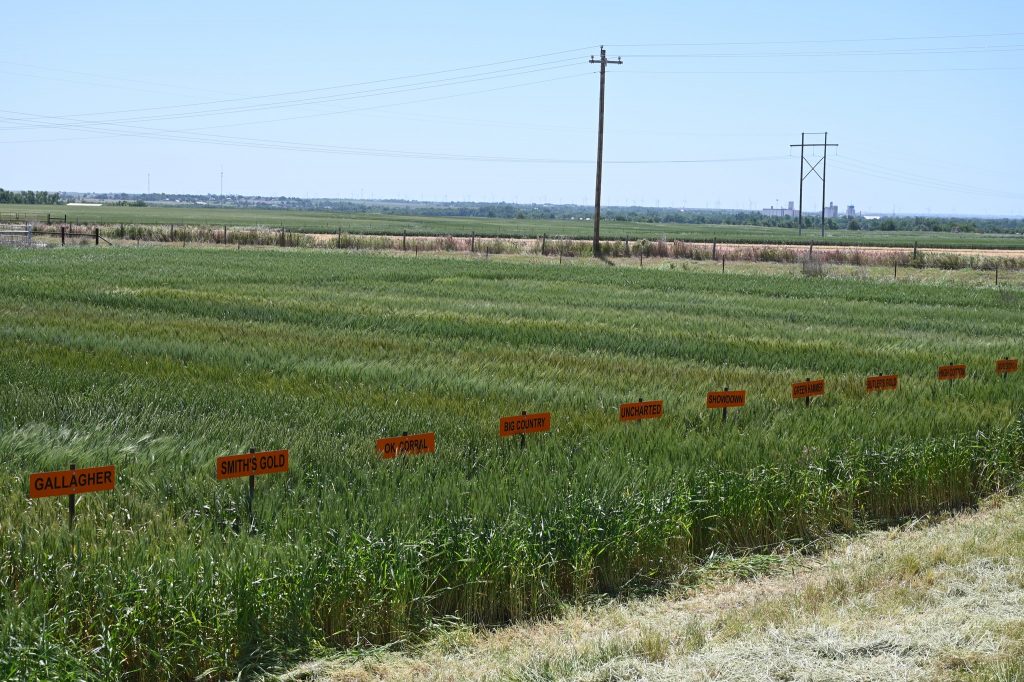
At an OSU Wheat Plot north of Kingfisher on the Danny Struck farm
There are four OSU wheat plot tours planned for this week across north central Oklahoma. First up- Oklahoma Wheat Commission board member Don Schieber will host his annual wheat tour breakfast meeting- Don writes on Facebook "Monday, May 13, is the date for the Kildare field day at Don Schieber Farm beginning with breakfast at 8am. We will have Dr Brett Carver and members of the OSU Wheat Breeding Team discussing the 25 varieties in the plot. Also here to talk about Cowboy sports will be Dave Hunziker, Coach Barry Hinson and Robert Allen who will broadcast his radio show from here starting at 10am. The First Cowboy, Darren Schrum is scheduled also. Breakfast is by DeWayne's and is always good and sponsored by Farmers Co-op Assn. Helena Chemical and OGI are sponsoring speakers."
On Thursday, there are two wheat tour stops in Blaine County- the Greenfield event will start with lunch at Wheeler Brothers at 11:30 AM followed by the plot tour. The Homestead tour is a twilight gathering with dinner followed by the plot tour. You can contact Extension Educator James Syzemore at 1-580-623-5195 for more information on these demo plots.
Friday is the annual Lahoma Wheat Field Day. According to OSU Extension
While there are challenges that remain before the combines roll in 2024 in Oklahoma- the May USDA Crop production Report released this past Friday expects a larger crop than either of the last two years. In both 2022 and 2023- Oklahoma's wheat crop was a disappointing 68 million bushel crop. The May estimate by USDA calls for a 96 million bushel crop- up 40% than those last two years.
Meanwhile in Kansas- the 2024 Wheat Quality Council is set for May 13th through the 17th- starting and ending in Manhattan. During the three days of wheat scouting, tour participants will travel six routes from Manhattan to Colby to Wichita and back to Manhattan. Last year's tour hosted 106 people from 22 U.S. states plus Mexico, Canada and Colombia, in 27 vehicles while traveling across the state.
The 2024 wheat crop in Kansas is expected to be significantly better than what was produced in 2023- USDA predicts a 267.9 million bushel wheat crop this year versus the actual 201 million bushel crop of last year. If realized, the 2024 crop will be 33% better than last year.
The PDF below shows the schedule for 2024- it's on the second page of this document:
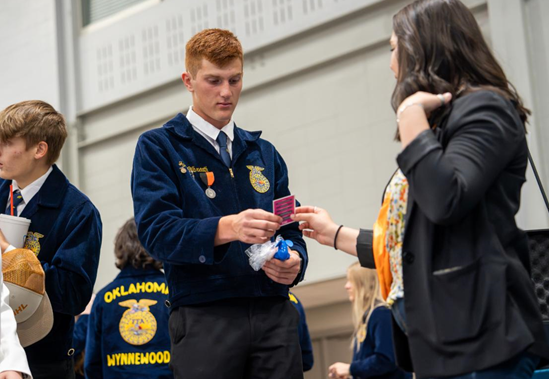
This week, the Oklahoma Pork Council team had the privilege of participating in the 2024 Oklahoma FFA Convention. With over 10,000 FFA students in attendance, this annual experience offers a valuable opportunity for Oklahoma Pork to engage with young minds.
At the convention, our team had a tradeshow booth with a focus on showcasing the diverse career opportunities within the pork industry. We were thrilled to debut an 11-question career quiz developed by past Pork Industry Group participant Madalyn Friend and her group, which was presented as their final project to the Oklahoma Pork board last fall. The "Pork Professional Test" received an overwhelming response with over 525 submissions from students eager to explore their potential in the pork industry. Take a moment to complete the career quiz for yourself!
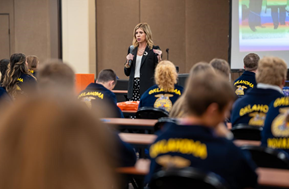
Oklahoma Pork also led one of the six Career Success Workshops, which was attended by over 100 students. Oklahoma Pork's Executive Director Kylee Deniz had an engaging session discussing the various pathways available within the pork industry. We also distributed "merch" including sunglasses, fanny packs, Eat Pork license plates, socks and backpacks. Plus, we are thrilled to congratulate show pig producer and Oklahoma Pork high school senior mentee Cooper Kline on securing a notable role on the 2024-2025 Oklahoma FFA State Officer Team. We are excited to see him excel in this leadership role!
From NMPF President & CEO Gregg Doud:
"We commend House Agriculture Committee Chairman Glenn 'GT' Thompson, R-PA, for including language in the House farm bill to restore the previous "higher of" Class I mover formula. The previous mover served dairy farmers well for decades, while the current mover has cost dairy farmers more than $1 billion in Class I skim milk revenue and continuously undermines orderly marketing of milk.
"We also are grateful for the inclusion of language to require mandatory manufacturing plant cost studies to help inform future discussions on make allowances, another critical component of the Federal Milk Marketing Order system. We are excited for the House's upcoming farm bill markup and thank the members in both parties who have supported each of these priorities."
| House Committee on Agriculture Chairman Glenn "GT" Thompson (PA-15) today released additional details on the bipartisan policies and priorities included in the 2024 Farm Bill, accompanied by an open letter to colleagues and stakeholders. To view the 2024 Farm Bill Title-by-Title Summary, click here. To view additional details as they become available, click here. To view Chairman Thompson's open letter, click here. Text of the Chairman's open letter: Dear Friends, When I became Chairman of the House Committee on Agriculture, I took seriously my mandate to protect our food supply, and bolster the viability and impact of our nation's agricultural value chain. I traveled the country, urban and rural district alike, listening to thousands of hours of passionate pleas for Congress to do its job and bring forth a farm bill that preserves and protects American agriculture. I have long been clear in my intent: any farm bill must align the farm safety net with the needs of producers, make long-term investment in locally led, voluntary, incentive-based conservation practices, expand market access and trade promotion opportunities, strengthen program operations to demand transparency and accountability to the taxpayer, revitalize rural communities and economies, and reinforce not only the importance of helping our neighbors in need, but doing so without indiscriminate expansion of our nutrition safety net. The 2024 Farm Bill was written for these precarious times and is reflective of the diverse constituency and narrow margins of the 118th Congress. Each title takes into consideration the varying opinions of all who produce as much as those who consume. It is not one-sided, it does not favor a fringe agenda, and it certainly does no harm to the programs and policies that feed, fuel, and clothe our nation. There exists a few, loud armchair critics that want to divide the Committee and break the process. A farm bill has long been an example of consensus, where both sides must take a step off the soapbox and have tough conversations. So, while the Chairman's mark is near finalized, my door remains open. We have come too far, and I will not put politics over people. Sincerely, |
 |
To view additional details on the 2024 Farm Bill as they become available, visit: agriculture.house.gov/FarmBill |
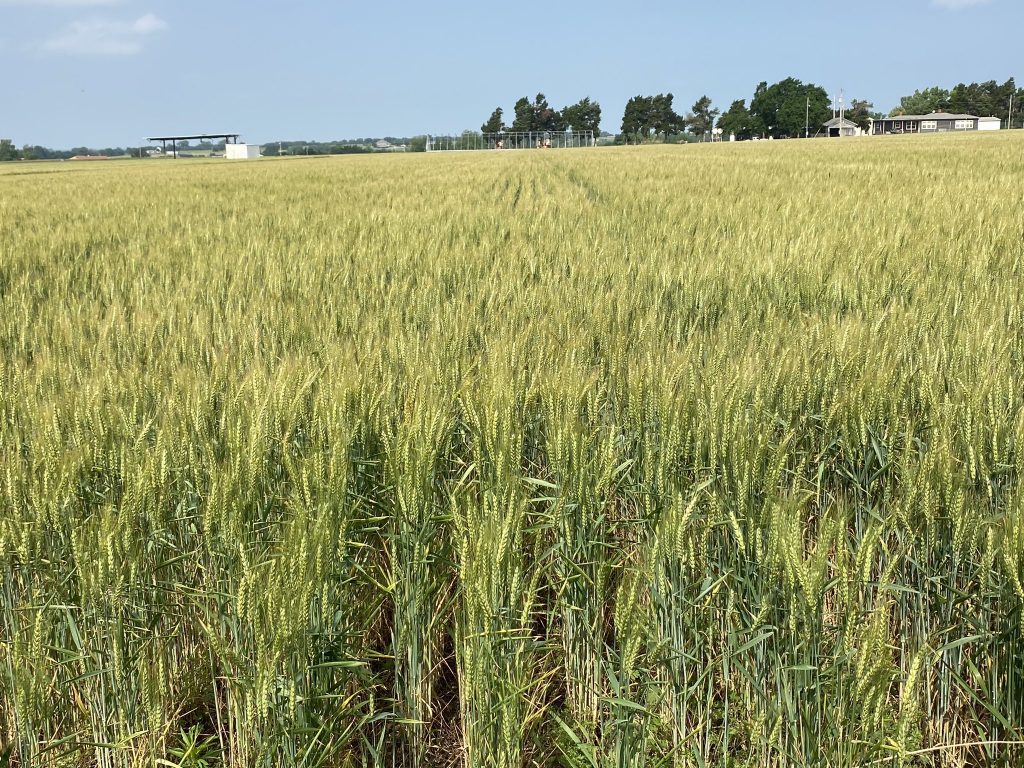
Perkins Test Plots- Wheat Headed and Starting to Turn Color- May 8th
The guessing games have begun to get a handle on the size of the 2024 hard red winter wheat crop- with USDA releasing their May first estimates in the latest USDA Crop Production report.
Oklahoma Farm Report's Ron Hays talked with state statistician Troy Marshall of the USDA's NASS after the report was released on Friday, May 10th- and you can hear their conversation by clicking on the listen bar below:
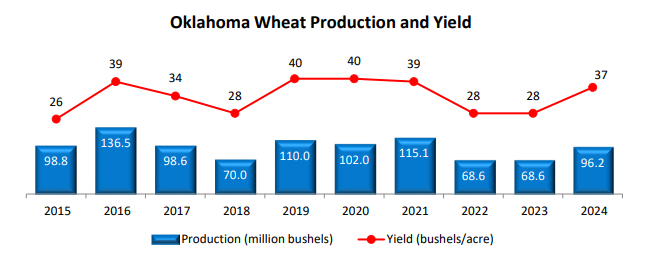
Marshall says USDA sees a 96.2 million bushel wheat crop for 2024 in Oklahoma- up 40% from a year ago. That's based on 2.6 million acres that they believe will be harvested a May first estimated 37 bushels per acre average. That compares to 68.6 million bushels produced in 2023.
Marshall says that the USDA number falls right in the middle between the two numbers that were mentioned at the Oklahoma Grain and Feed Association meeting on Tuesday. The Extension and Grain Elevator scouting reports totaled 86 million bushels while the Elevator Manager and others that were in attendance at the meeting in downtown Oklahoma City came up with a 102 million bushel guess.
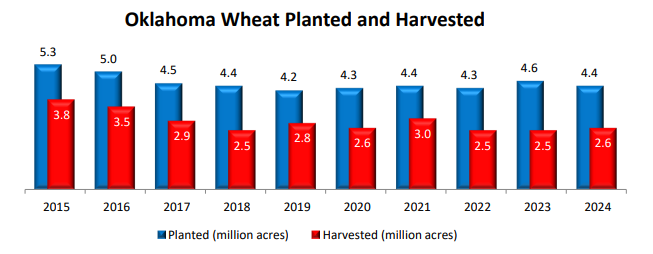
The Kansas wheat crop will also be a lot larger in the number of bushels if the USDA estimates are realized. They predict a 267.9 million bushel wheat crop in Kansas, 33% larger than the 201 million bushel wheat crop of a year ago. The Kansas crop is based on a 38 bushel per acre yield with 7.05 million acres expected to be harvested for grain this season.
Finally, our neighbors to the south in Texas are looking at a slightly smaller wheat crop in 2024 versus 2023. The May first estimate is for a production of 71.4 million bushels versus 77.7 million bushels harvested in 2023.
Click here for the USDA Crop Production report for May 2024.
In his latest effort to defend fossil fuel companies from the Biden Administration's attacks, Attorney General Gentner Drummond has filed a lawsuit asking the U.S. Court of Appeals for the District of Columbia Circuit to review and declare unlawful the Environmental Protection Agency's (EPA) recently released new rule on existing coal, natural gas and oil-fired power plants.
The rule would force power plants fueled by coal or natural gas to capture smokestack emissions or shut down. Under the rule, these plants would be regulated under the Clean Air Act and face more stringent emissions standards. The rule ignored a 2022 rebuke from the U.S. Supreme Court in West Virginia v. EPA, which warned that EPA should not use a narrow regulatory provision to force coal-fired power plants into retirement en masse.
"This is another instance of federal overreach by the Biden Administration and yet another attack on Oklahoma's oil and gas industry," Drummond said. "This rule will significantly injure businesses and harm families by cutting jobs and dramatically raising energy costs. I will never stop fighting against the Biden Administration's dangerous federal overreach, and I will always defend American oil and gas production."
He said Congress has not given EPA clear statutory authorization to remake the electricity grids, which means the agency cannot sidestep Congress to exercise broad regulatory power that would radically transform the nation's energy grids—and force states to fundamentally shift their energy portfolios away from fossil fuel-fired generation.
The suit is being led by West Virginia and Indiana. Also joining the litigation are Alabama, Alaska, Arkansas, Florida, Georgia, Idaho, Iowa, Kentucky, Louisiana, Mississippi, Missouri, Montana, Nebraska, New Hampshire, North Dakota, South Carolina, South Dakota, Tennessee, Texas, Utah, Virginia and Wyoming.
Read a copy of the petition here.
From NMPF President & CEO Gregg Doud:
"NMPF thanks Secretary Vilsack and federal leadership for effectively using their existing authorities to offer necessary assistance for dairy farmers as they meet the challenges of H5N1 in dairy cattle. Care for farm workers and animals is critical for milk producers, as is protecting against potential human health risks and reassuring the public.
"We look forward to continued collaboration and consultation with USDA and other federal agencies as we monitor, understand, and contain this outbreak, and we will do what we can to help dairy farmers understand and benefit from these initiatives as swift implementation is put into motion."
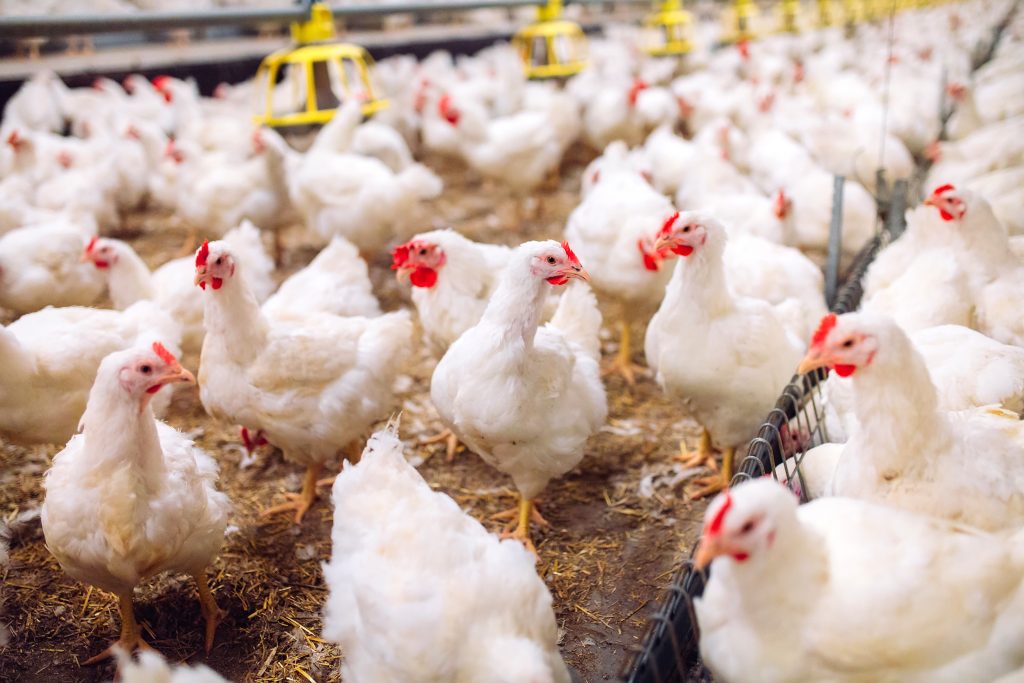
On March 25, 2024, immediately following the first detection of H5N1 in dairy cattle in the
Texas panhandle region, USDA and HHS began their work to understand the origin of the
emergence and its potential impact in bovines and humans. USDA experts also took swift action to trace animal movements, began sampling to assess the disease prevalence in herds, and initiated a variety of testing activities to confirm the safety of the meat and milk supplies alongside federal partners. On April 1, 2024, Texas reported the first and only confirmed human H5N1 infection associated with this outbreak, after confirmation by CDC. On April 24, 2024, USDA issued a Federal Order, that took effect on April 29, to limit the movement of lactating dairy cattle and to collect and aggregate H5N1 test results to better understand the nature of the outbreak.
Since the detection of H5N1 in dairy cattle, the Federal response has leveraged the latest
available scientific data, field epidemiology, and risk assessments to mitigate risks to workers and the general public, to ensure the safety of America's food supply and to mitigate risk to livestock, owners, and producers. Today, USDA is taking a series of additional steps to help achieve these goals and reduce the impact of H5N1 on affected premises and producers, and HHS is announcing new actions through the CDC and FDA to increase testing and laboratory screening and testing capacity, genomic sequencing, and other interventions to protect the health and safety of dairy and other potentially impacted food items.
USDA
Today, USDA is announcing assistance for producers with H5N1 affected premises to improve on-site biosecurity in order to reduce the spread. In addition, USDA is taking steps to make available financial tools for lost milk production in herds affected by H5N1. Building on the Federal Order addressing pre-movement testing, these steps will further equip producers with tools they can use to keep their affected herds and workers healthy and reduce risk of the virus spreading to additional herds.
Protect against the potential for spread between human and animals. Provide financial support (up to $2,000 per affected premises per month) for producers who supply PPE to employees and/or provide outerwear uniform laundering, for producers of affected herds who facilitate the participation of their workers in USDA/CDC workplace and farmworker study.
Complementary to USDA's new financial support for producers, workers who participate in the study are also eligible for financial incentives to compensate them for their time, regardless of whether the study is led by federal, state, or local public health professionals.
Support producers in biosecurity planning and implementation. Provide support (up to $1,500 per affected premises) to develop biosecurity plans based on existing secure milk supply plans. This includes recommended enhanced biosecurity for individuals that frequently move between dairy farms – milk haulers, veterinarians, feed trucks, AI technicians, etc. In addition, USDA will provide a $100 payment to producers who purchase and use an in-line sampler for their milk system.
Provide funding for heat treatment to dispose of milk in a bio secure fashion. This will provide producers a safe option for disposal of milk. Heat treatment performed in accordance with standards set by FDA is the only currently available method considered to effectively inactivate the virus in milk. If a producer establishes a system to heat treat all waste milk before disposal, USDA will pay the producer up to $2,000 per affected premises per month.
Reimburse producers for veterinarian costs associated with confirmed positive H5N1 premises. This provides support to producers to cover veterinary costs necessarily incurred for treating cattle infected with H5N1, as well as fees for veterinarians to collect samples for testing. This can include veterinary fees and/or specific supplies needed for treatment and sample collection. Veterinary costs are eligible to be covered from the initial date of positive confirmation at NVSL for that farm, up to $10,000 per affected premises.
Offset shipping costs for influenza A testing at laboratories in the National Animal Health Laboratory Network (NAHLN). USDA will pay for the cost of shipping samples to NAHLN labs for testing. USDA will pay actual shipping costs, not to exceed $50 per shipment for up to 2 shipments per month for each affected premises. Testing at NAHLN laboratories for samples associated with this event (e.g., pre-movement, testing of sick/suspect animals, samples from concerned producers) is already being conducted at no-cost to the producer.
Taken together, these tools represent a value of up to $28,000 per premises to support increased biosecurity activities over the next 120 days.
Compensate producers for loss of milk production. USDA is taking steps to make funding available from the Emergency Assistance for Livestock, Honey Bees, and Farm-raised Fish Program (ELAP) to compensate eligible producers with positive herds who experience loss of milk production. While dairy cows that have been infected with H5N1 generally recover well, and there is little mortality associated with the disease, it does dramatically limit milk production, causing economic losses for producers with affected premises. USDA can support farmers with the ELAP program to offset some of these losses. This compensation program is distinct from the strategy to contain the spread.
Work with states to limit movement of lactating cattle. Additionally, USDA will work with and support the actions of States with affected herds as they consider movement restrictions within their borders to further limit the spread of H5N1 between herds to reduce further spread of this virus.
USDA will make $98 million in existing funds available to APHIS to fund these initiatives. If
needed, USDA has the authority, with Congressional notification, to make additional funds
available.
These additional measures build on a suite of actions USDA has taken to date. This includes implementation of the Federal Order to limit spread of the disease, coordinating with federal partners to share expertise and lab capacity, doubling down on our work with producers to practice good biosecurity measures, continuing to conduct investigations to determine how the virus is spread within and between farms, and analyzing and sharing sequences alongside validated epidemiological information.
The U.S. government is addressing this situation with urgency and through a whole-of-government approach. USDA is working closely with federal partners at FDA, which has the primary responsibility for the safety of milk and dairy products, by assisting with conducting lab testing at USDA labs. USDA is also working closely with federal partners at CDC, which has the primary responsibility for public health, by encouraging producer and industry cooperation with public health officials to get vital information necessary to assess the level of risk to human health.
Additional details on how producers can access and apply for the financial tools is forthcoming.
HHS
Today, HHS announced new funding investments through CDC and FDA totaling $101 million to mitigate the risk of H5N1 and continue its work to test, prevent, and treat H5N1. Although the CDC's assessment of the risk of avian influenza infection for the general public continues to remain low at this time, these investments reflect the Department's commitment to prioritizing the health and safety of the American public.
Public and animal health experts and agencies have been preparing for avian influenza outbreak for 20 years. Our primary responsibility at HHS is to protect public health and the safety of the food supply, which is why we continue to approach the outbreak with urgency. We stood up a response team which includes four HHS agencies – CDC, FDA, NIH and ASPR – which are working closely with USDA to:
Some examples of this work include:
Today, in light of HHS' ongoing commitment to ensure the safety of the American people and food supply, HHS announced additional resources to further these efforts through CDC and FDA:
CDC announced it has identified an additional $93 million to support its current response efforts for avian influenza. Building on bipartisan investments in public health, this funding will allow CDC to capitalize on the influenza foundation that has been laid over the last two decades, specifically where CDC has worked domestically and globally to prevent, detect, and respond to avian influenza.
These investments will allow CDC to bolster testing and laboratory capacity, surveillance,
genomic sequencing, support jurisdictions and partner efforts to reach high risk populations and initiate a new wastewater surveillance pilot.
Additionally, the FDA is announcing an additional $8 million is being made available to support its ongoing response activities to ensure the safety of the commercial milk supply. This funding will support the agency's ability to validate pasteurization criteria, conduct surveillance at different points in the milk production system, bolster laboratory capacity and provide needed resources to train staff on biosecurity procedures. Additionally, these funds will help support H5N1 activities in partnership with state co-regulatory partners, who administer state programs as part of the federal/state milk safety system. It may also allow the FDA to partner with universities on critical research questions.
Additional Information:
To learn more about USDA's response to H5N1 in dairy cattle, visit
https://www.aphis.usda.gov/livestock-poultry-disease/avian/avian-influenza/hpaidetections/livestock.
To learn more about CDC's response to H5N1, visit
https://www.cdc.gov/flu/avianflu/mammals.htm.
To learn more about FDA's response to H5N1, visit
| ||||||||||||||||||||||||||||||||||||||||||||||||||||||||||||||||||||||||||||||||||||||||||||||||||||||||||||||||||||||||||||||||||||||||||||||||||||||||||||||||||||||||||||||||||||||||||||||||||||||||||||||||||||||||||
|
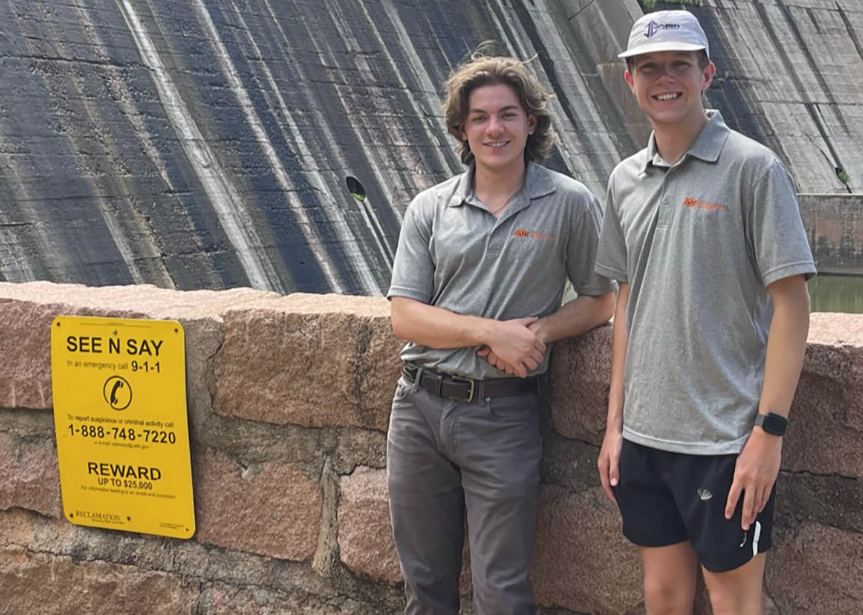
The Rural Renewal Initiative at Oklahoma State University has announced the 2024 Rural Scholars for this summer's research and service experience across the state.
The Rural Scholar internship program features 10 weeks of residency in rural Oklahoma communities where OSU undergraduate and graduate students study the top challenges of rural areas in Oklahoma and the world. Students are immersed in a rural community to conduct research, participate in service projects and support community initiatives.
Ten students completed OSU's Developing Rural Scholars course this spring semester, studying research methods and rural community development. They will begin their internships to investigate the following rural topics and communities on May 20.
"The Rural Scholars program is a unique opportunity for students to engage with rural people and places," said Linnea Harvey, coordinator of the Rural Renewal Initiative. "A big part of this experience for students is integrating into communities and investing in relationships with community members over the summer. Our students and community partners learn different perspectives from one another and apply that to research aimed at solving relevant community issues. That's what makes this experience special."
Also in 2024, OSU has launched a new rural research internship for college students nationwide.. Learn more about the first class to participate in the Research and Extension Experience for Undergraduates program.
Rural Scholar participants will present their research findings in October at the Rural Renewal Symposium at Lake Murray Lodge.
USDA on Friday released the May World Agricultural Supply and Demand Estimates (WASDE) report, which includes the first detailed forecast for the 2024-25 corn and soybean crops. USDA forecasts that farmers this spring will plant what will become a 14.86-billion-bushel corn crop and a 4.45-billion-bushel soybean crop.
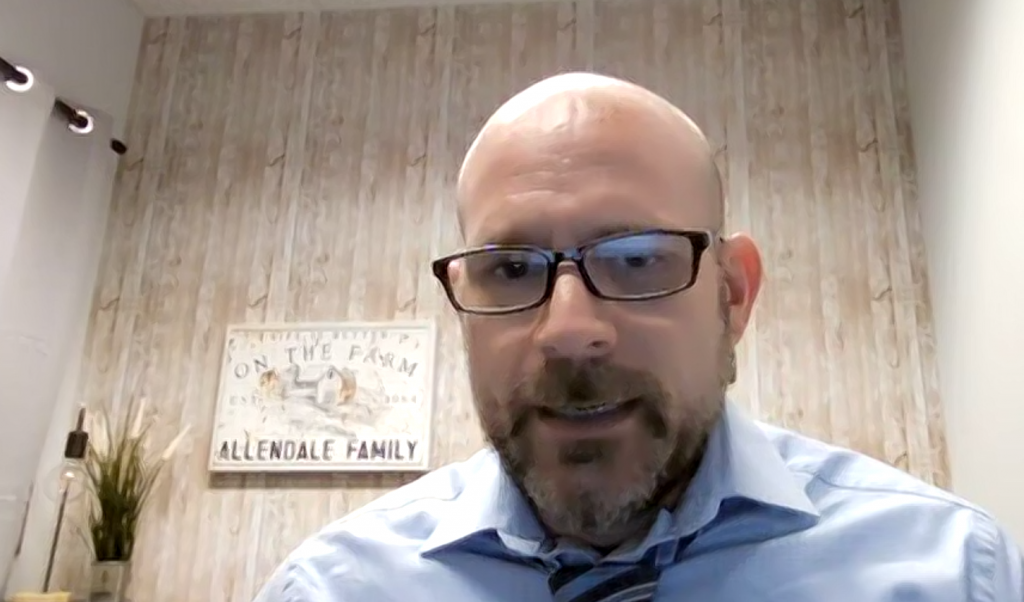
Farm Director KC Sheperd met with Allendale's Rich Nelson to discuss the latest WASDE report and its implications for the agricultural market.
Nelson noted that the report indicated slightly better news in some areas, particularly for corn, due to lower old crop balance sheets and increased demand for ethanol and exports. However, soybean stocks remained unchanged, and new crop projections were larger than expected, offering some upside for corn. Rich also emphasized the need for a risk-on summer premium in the market to help curtail supply numbers, highlighting that dryness was forecasted for the West in the coming months.
As for the Wheat Discussion, Nelson said the argument would be slightly positive, "We saw these numbers for all crops lower just a minimal amount here today now 688 million bushels. They did give us a discussion here for both all wheat production and winter wheat breakdowns. And between all that, they suggested that stocks increase to 766. The focus was not on the balance sheet. But the focus was that they now have the lowest estimate for the Russian wheat crop of anybody, and they're starting out with some pretty tight numbers for Australia as well."
Nelson said that Winter Wheat Production for Oklahoma is not as Dramatic as it could be: "Oklahoma and the prior two years had been running about 69 million bushels for a winter wheat production. Today's numbers post them at 96. It is an increase but keep in mind just this past week at one of Oklahoma wheat tours final meeting a lot of the trade participants were looking for 105 or even 115. So it is an increase. Yes, but it's not as dramatic as it could have been."
When looking at the Cotton Numbers, Nelson said the cotton balance sheet has been getting a lot of trade focus, "Keep in mind we went from 2022, which had 4.3 million bales for stocks, down to 2.4. Last year for those over now for this new crop discussion with only minimal changes in implanting expected versus last year. USDA is coming up with an ending stock number moving up to 3.7, so a return to more normal yields would put us in the middle of this tightness argument from last year. Which is very tight, and the year before, which was not too bad. So puts right in the middle of those prior two years."
Lastly, Rich suggested that livestock numbers would continue to be tight, with 2024 beef production expected to be 1.4% smaller than 2023, and that cotton stocks would also likely increase.
USDA estimated the 2024-25 corn yield will be 181 bushels per acre. The soybean crop is also projected at 52 bpa.
USDA also released its May Crop Production report on Friday.
Friday's U.S. ending stocks estimates were slightly bullish for corn and neutral for soybeans and wheat, World ending stocks estimates from USDA were bullish for corn, neutral for soybeans and slightly bullish for wheat.
You can also view the full reports here:
-- Crop Production: https://www.nass.usda.gov/...
-- World Agricultural Supply and Demand Estimates (WASDE): http://www.usda.gov/...
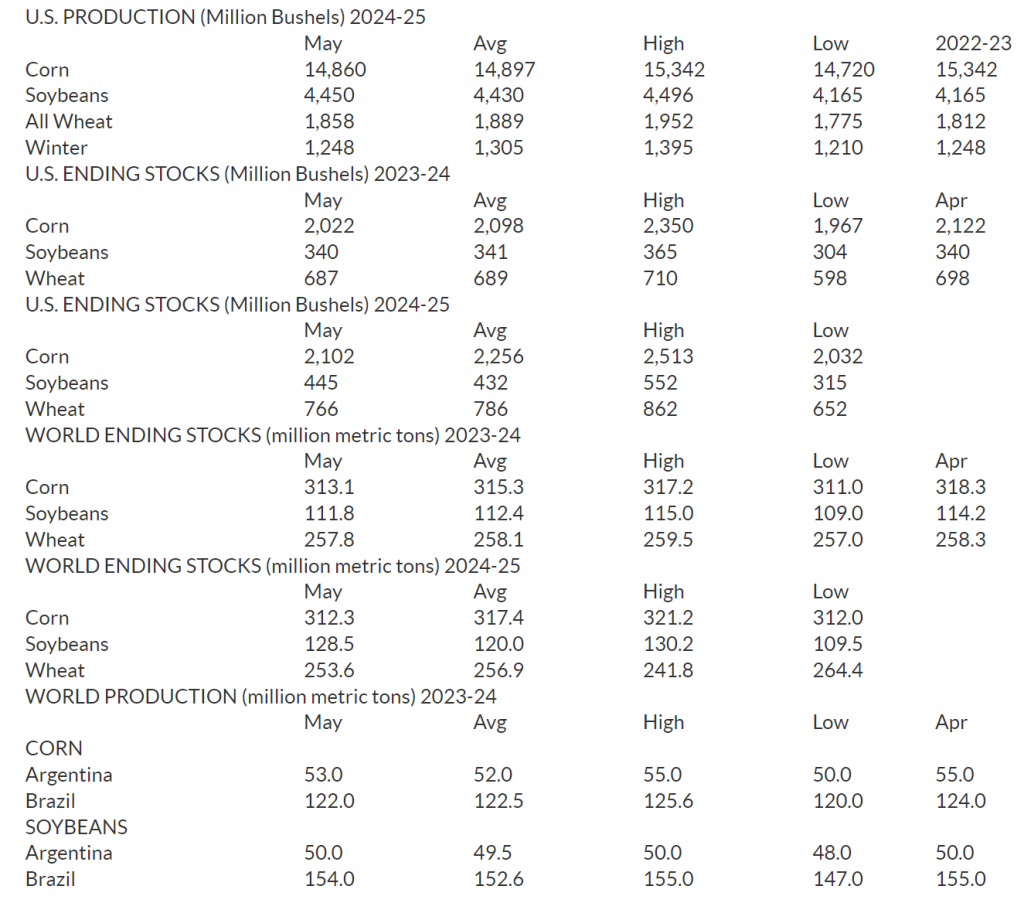
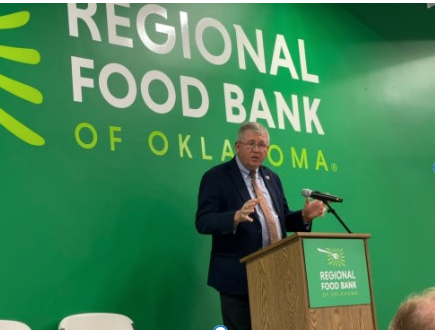
The senior member of the US House Ag Committee is relieved to see movement in the House and the Senate on the respective Committee 2024 Farm Bill proposals. In talking with Oklahoma Farm Report's Ron Hays, Lucas indicated "right now what we have seen from both Chairman Thompson in the House and Chairwoman Stabenow in the Senate are what I would call outlines of their bill proposals- so we are still waiting on hard language."
Lucas hopes the details will be coming soon and that the promised markup of the Chairman's mark in the House Ag Committee will happen before the end of the month. Click here for the outline we have at this point from Chairman Thompson.
Lucas says it's no surprise that there are differences in what has been released- regarding House Chair Glenn Thompson "GT is very focused on the production side of the equation- how we raise the food and fiber, think crop insurance, think price protection and conservation and those kind of things." Lucas adds the priorities are different for the longtime Chair in the Senate from Michigan- "Senator Stabenow has a particular focus on the nutrition side- always has- on the nutrition side- the SNAP program, what we used to call Food Stamps- so the bills that will come out of the Committee won't look exactly alike and that's just fine" as the key will be to get bills from both bodies to a Conference Committee "where we will work out our differences." Click here for the details released by Chairwoman Stabenow.
Lucas warns producers this won't be as easy as the 2018 farm bill process was- that measure was a fairly simple rewrite of the 2014 Farm Law when Lucas was chair and the farm safety net was updated in a significant way- the 2018 writers simply took what was in the 2014- added a few tweaks and they were done.
This bill needs support prices updated to reflect higher prices for crops as well as the much higher input costs that have evolved over the last decade. "As all of our producers out there know- from the safety net perspective, after the trade wars, after COVID, after inflation...the safety net is not as strong as it was six years ago and we have got to come up with a way to tighten that up if we are going to meet our obligations and feed ourselves."
Lucas says he has learned in 2014 that Senator Stabenow will be a tough negotiator when and if we get to a Conference Committee between the House and Senate. Stabenow was on the other side of the table from Lucas in 2014 when the Farm Bill that was passed into law was negotiated and included the revolutionary Title One PLC and ARC provisions.
Asking Congressman Lucas to put on his Science, Space and Technology Committee Chairman's hat- he was very pleased with the full House passing the Weather Act Authorization back on April 30th. Lucas says the measure here in 2024 is building onto the improvements in weather forecasting that was asked by Congress back in 2017- he referred to the multiple tornado event in Barnsdall, Oklahoma this month- "when the Weather Act was passed in 2017, we were trying to improve the early warning efficiency and the average time for a warning on a tornado was eleven minutes. In Barnsdall after the improvements from the 2017 Act- they had a 44 minute lead time from the first tornado warning until it hit- that was a dramatic improvement from the 11 minute average before the 2017 weather bill took a effect." He says one of the outcomes that he hopes can happen from the passage of the 2024 Weather Act would be to improve that even more and to provide the tools for the National Weather Service to improve all of the weather products that the public can utilize for public safety as well as for forecast products that help farmers and ranchers.
Lucas is hopeful that the Senate will take it up.
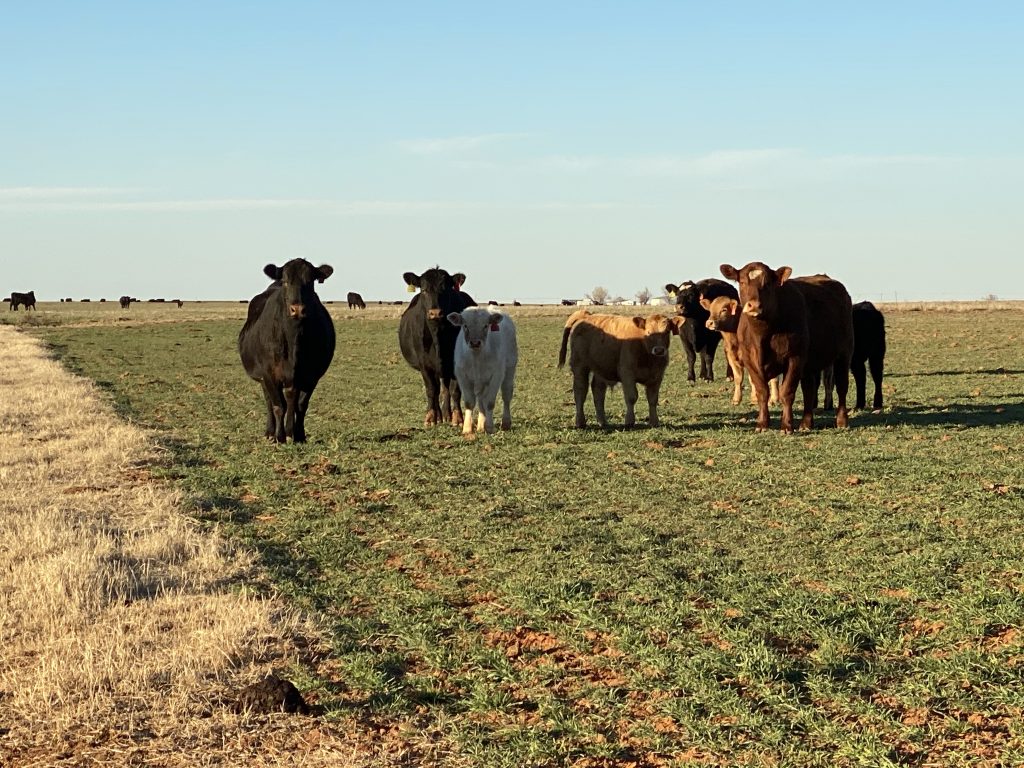
Bob Rodenberger of Stockman's Livestock Auction in Apache discussed the current state of the cattle market with Farm Director KC Sheperd, emphasizing the favorable conditions for a specific age group of steers and advising risk management strategies.
Rodenberger says the market still looks pretty strong: "This is still a good market. We were selling eight—or nine-weight cattle that none of us thought we'd have at a good figure. Our runs aren't extreme. But the percentage of the runs are kind of from eight—to nine-weight steers, which, you know, we didn't think we had any of them. The Cattle have done well on wheat, and the Market is steady."
Rodenberger says we are in a chess game with the Packers and the feeders right now. We've got to continue to sell the meat, "That goes back to the consumer: we can play pawns and chess and checkers all day with a packer and the feeder, But when it all comes down to the bottom line, it's going to be the consumer that dictates which way we go in this market. And right now, we're still moving beef, we're moving it. We're not moving the prime or the high-end cuts as quickly as we were, but it's a different time of year."
Rodenberger also expressed how important Livestock Risk Protection can be this time of year, "Everywhere in our industry or in society, you got to have insurance on everything. on your car, on your house, on everything. The bank won't even let you out of the building unless you have insurance. So we have that same protection today. Now, whether you pick the top or not, cover your margin and go fishing. I mean, it's that simple. If your margins are there, cover it and go fishing. That's just kind of way I look at it."
Lastly, they anticipated larger runs of cattle in Oklahoma City due to anticipated rainfall and stubble grazing. If you would like to visit with Rodenbger and his team at Stockman's Livestock Auction, their numbers are listed below.
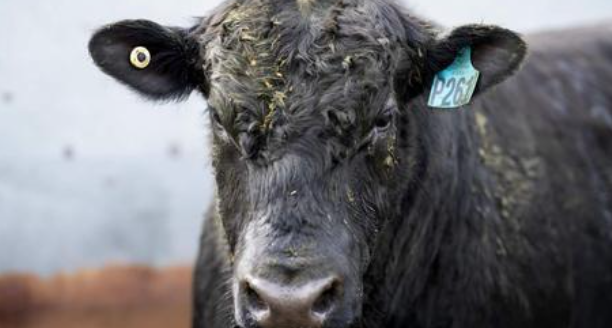
C
The U.S. has a long, successful history of preventing, containing and eradicating foreign animal diseases from the U.S. cattle herd. This success was accomplished through decades of cooperation between the Department of Agriculture and America's cattle producers.
But two decades ago, the USDA attempted to force America's cattle producers to register their premises with the federal government, to individually identify all their cattle with electronic identification (EID) eartags, and to record their animals' movements in a government database.
The USDA's onerous plan mimicked that of countries with constitutional monarchies such as Australia, Canada and the United Kingdom – countries where individual freedoms, liberties and property remain limited by government control.
But the United States shed itself of such government control centuries ago when it formed a government that both granted and respected individual freedoms, liberties and property like no other.
Unsurprisingly, American citizens resoundingly said "NO" to the USDA's onerous plan, and the USDA retreated.
Then, a decade ago, the USDA pushed what it called a "flexible solution." It promised cattle producers they could choose among a variety of animal identification devices: from low-cost devices with only printed numbers to high-cost devices with EID.
The USDA said its flexible solution was endorsed by the animal health officials charged with conducting disease programs.
In the years since implementing its flexible solution, the USDA conducted tests and found that, on average, states could conduct successful disease tracebacks of an animal shipped out of state back to the animal's state of origin in less than one hour.
That means the current "flexible solution" allows state officials to traceback an animal much faster than it typically takes for a cattle producer to gather and load a truck full of cattle from their farm or ranch!
The USDA now identifies two areas that could yet further improve this already unprecedented disease traceback time: 1) eliminate typos when the nine-digit identification number on an eartag is transcribed to a database, and 2) eliminate problems inherent to the paper records that must accompany all animals that cross state lines.
On April 26, the USDA announced its final rule that only addresses the first of the two areas it said were deficient. The final rule mandates the exclusive use of EID and eliminates the other promised forms of animal identification that the USDA's own testing shows will allow animal disease tracebacks in less than one hour.
The USDA estimates this new mandate imposed only on cattle producers will cost cattle producers tens of millions of dollars each year, without any means of recovering this mandatory cost from the marketplace.
Worse, while imposing this onerous and costly mandate on America's cattle farmers and ranchers, the USDA does not require any of the accompanying paperwork to be electronically readable, such as the interstate certificate of veterinary inspection, even though these paper records function in tandem with EID eartags and are indispensable for conducting animal disease tracebacks.
This glaring deficiency renders the EID mandate arbitrary at best. But there's more.
The final rule will not subject any more cattle to EID than are currently subject to the "flexible solution," which enables tracebacks in less than one hour. This means the final rule does nothing at all to expand the coverage of official identification devices (either low-cost nonelectronic or high-cost EIDs) in the U.S. cattle herd.
Given the final rule provides no appreciable improvement to animal disease traceability, what's really driving the USDA's EID mandate? The USDA discloses this in its official press release that accompanied its final rule announcement. It's exports that are driving this final rule.
In 2023, the U.S. did not produce enough beef to meet domestic beef consumption, though it exported 3 billion pounds of beef representing only 11 percent of the 27 billion pounds of beef produced in the United States. Thus, the final rule imposes an EID mandate on 100 percent of our nation's 622,000 remaining beef cattle producers for the benefit of the small minority of beef cattle producers whose cattle produce beef that is actually exported.
The beneficiaries of the USDA's final rule are multinational eartag manufacturers for whom the USDA is granting a guaranteed market demand for their EID products (eartags and related equipment); and the multinational beef packers whose continued access to foreign markets, whether or not a disease outbreak occurs, will be paid for annually by the hundreds of thousands of U.S. cattle producers upon whom the USDA is forcing its EID mandate. Congress must act swiftly to protect America's cattle farmers and ranchers from the USDA's excesses! If it does not, we must all question the legitimacy of our unique form of government and its ability to protect the freedoms, liberties and property of its people.
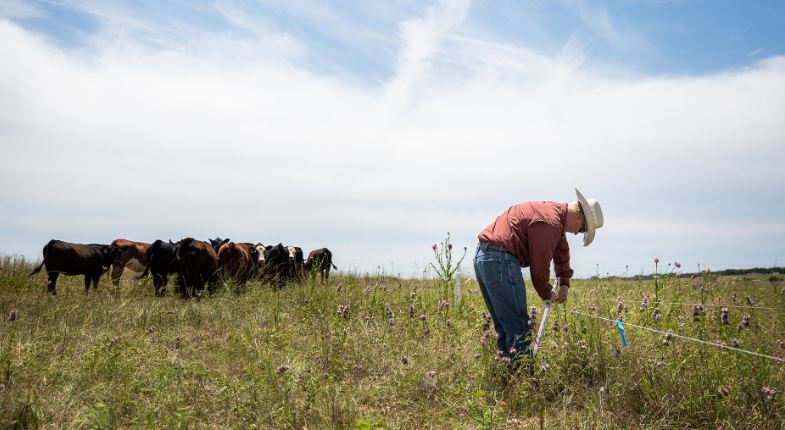
The U.S. Department of Agriculture (USDA) is seeking nominations for four positions on the Federal Advisory Committee for Urban Agriculture and Innovative Production. USDA will accept nominations from May 7, 2024, to July 7, 2024. The 12-member Committee, which first convened in March 2022, is part of USDA's efforts to increase support for urban agriculture and innovative production. Members of the Committee provide input on policy development and help identify barriers to urban agriculture as USDA works to promote urban farming and the economic opportunities it provides in cities across the country.
"The Urban Agriculture and Innovative Production Committee has already submitted more than a dozen recommendations to the Secretary of Agriculture and continues to provide direct feedback to USDA about how to better serve producers and communities," said Terry Cosby, Chief of USDA's Natural Resources Conservation Service (NRCS), which oversees USDA's Office of Urban Agriculture and Innovative Production. "These new members will provide valuable input on innovative production, higher education, the supply chain, and urban farming to guide our programs and policies."
Members of the Committee include representative from urban and innovative agricultural production, higher education or extension programs, non-profits, business and economic development, supply chain, and financing. Last year, Agriculture Secretary Tom Vilsack appointed four new members to the Committee to replace members whose terms expired. The Committee's last public meeting was held in April 2024.
USDA is seeking nominations for individuals representing a broad spectrum of expertise. Four positions are open for nominations including:
Individuals who wish to be considered for membership must submit a nomination package including the following:
Nomination packages must be submitted by email to UrbanAgricultureFederalAdvisoryCommittee@usda.gov or postmarked by July 7, 2024. If sending by mail, packages should be addressed to USDA NRCS, Attn: Brian Guse, 1400 Independence Avenue SW, Room 4083, Washington, DC 20250. Any interested person or organization may nominate qualified individuals for membership, including self-nominations.
For special accommodations, contact Markus Holliday
at UrbanAgricultureFederalAdvisoryCommittee@usda.gov. Additional details are available in the Federal Register notice.
The Office of Urban Agriculture and Innovative Production was established through the 2018 Farm Bill. It is led by NRCS and works in partnership with numerous USDA agencies that support urban agriculture and innovative production. The Committee is part of a broad USDA investment in urban agriculture and innovative production. Other efforts include:
Learn more at www.usda.gov/urban. For additional resources available to producers, download the Urban Agriculture at a Glance brochure or visit www.farmers.gov/urban.
USDA touches the lives of all Americans each day in so many positive ways. Under the Biden- Harris administration, USDA is transforming America's food system with a greater focus on more resilient local and regional food production, fairer markets for all producers, ensuring access to safe, healthy, and nutritious food in all communities, building new markets and streams of income for farmers and producers using climate smart food and forestry practices, making historic investments in infrastructure and clean energy capabilities throughout America, and committing to equity across the Department by removing systemic barriers and building a workforce more representative of America. To learn more, visit usda.gov.
USDA is an equal opportunity provider, employer and lender.
On Thursday, USDA, EPA, and FDA jointly released a plan to modernize the U.S. federal regulatory system for products of biotechnology. This long-awaited plan was welcomed by ASA and comes as a positive next step for implementing a 2022 Executive Order from the administration that aims to advance the use of biotechnology and the bioeconomy. Public feedback was used to develop the plan, including comments provided by ASA and other stakeholders.
The regulatory plan is very comprehensive and includes proposed regulatory changes for many applications of biotechnology and genetic improvement technologies, including plant gene editing, animal biotechnology, genetically engineered microbes, biomedical applications, disclosure of bioengineered products, among others. Highlights of the plan of greatest interest to soybean production include:
ASA will more thoroughly review the plan in the days ahead and plans to engage with the respective regulatory agencies to advance aspects of this plan that will enable better access to genetic innovations for farmers.
Senator James Lankford (R-OK) today issued a statement following his support of the Federal Aviation Administration (FAA) reauthorization bill:
"Oklahoma has a rich aviation history and has a unique relationship with the FAA through the Mike Monroney Aeronautical Center (MMAC). For more than 70 years, Oklahoma City has provided vital services, research, and training for the FAA. We are proud of the work they do to train air traffic control students through the FAA Academy. MMAC is also home to the Civil Aerospace Medical Institute that provides medical certification, research, education, and occupational health for the FAA. These are just a few examples of what the 133-building campus in Oklahoma City provides. The FAA reauthorization bill directs the FAA to expand the air traffic control training at MMAC, which will improve the safety of our national airspace by increasing the number of well-trained air traffic controllers in towers across the country. This bill leads us into the future of aviation, and I am proud to support it."
Oklahoma City is home to the Mike Monroney Aeronautical Center (MMAC), which is an essential part of safe and efficient air travel network coordinated by the FAA. MMAC is home to the only FAA Academy that provides the initial training for air traffic controllers. The FAA Academy provides centralized, standardized, and efficient training to about 20,000 students each year. Lankford spoke on the Senate floor in support of the FAA reauthorization and also sent a letter with the entire Oklahoma congressional delegation standing with their great work and encouraging the FAA to expand it.
RON's Dave Lanning has a pre-opening look at today's agricultural Markets.
Click the audio tab below for today's report.
Before selecting counsel to represent the Treasurer, the first request was to Attorney General Gentner Drummond's office. After offering the case to the AG, he was informed by Trebor Worthen, Chief of Staff to the AG, that he was declining to take case, but would recommend outside counsel. The Treasurer again personally approached Drummond to be his defender for the lawsuit. However, his office only engaged in recommending a different choice in counsel. At which time, the Treasurer selected his own outside counsel per his right through the 20i process.
The Treasurer stated, "When asking the Attorney General to take my case, he refused. So, I was left with no other choice but to choose who I was most comfortable representing me. My constitutional office as the State Treasurer makes me party to the lawsuit, and therefore I don't believe my decision-making authority can be removed. Certainly, I am disappointed with the outcome but have several facts for appeal. I had hoped to have the Attorney General as my defender all along."
Expressing extreme disappointment with state Treasurer Todd Russ and the treasurer's hand-picked legal counsel, Attorney General Gentner Drummond announced today he is firing the outside attorney and removing Russ from any decision-making authority in the lawsuit defending Oklahoma's anti-ESG (environmental, social and governance) law.
Drummond's actions come on the heels of an Oklahoma County District Court ruling earlier this week enjoining the Oklahoma Energy Discrimination Act of 2022 from enforcement. Russ is being sued by a retired state employee who claims the treasurer's enforcement of the law jeopardized the retiree's pension.
The law prohibits state contracts and pension system investments with financial institutions that discriminate against the oil and gas industry.
"It is extremely disappointing that the counsel hired by Treasurer Russ was unable to secure a favorable ruling in defense of Oklahoma's anti-ESG law," Drummond said. "Because of this failure, the law is now on hold and at risk of being struck down entirely. Oklahomans deserve better."
Drummond said he had initially chosen a separate firm to serve as outside counsel on the matter but deferred to Russ after the treasurer insisted on selecting his own attorney to defend the law. The Attorney General said he now regrets extending that professional courtesy.
"Treasurer Russ was insistent that he be allowed to choose his own counsel to defend the lawsuit, and I acquiesced," said Drummond. "No longer will I allow professional courtesy to influence my decisions on this matter. Effective immediately, I have terminated Treasurer Russ's hand-picked counsel and removed the treasurer from any decision-making role in the lawsuit. My office will handle all elements of the case moving forward."
In this episode of Beef Buzz, Senior Farm and Ranch Broadcaster, Ron Hays is back talking with professional writer, author and speaker, Dale Strickler about more on grazing management. Strickler operates a consulting firm, Regenerative Wisdom, which focuses on soil, pasture, crop and drought prevention consulting.
To listen to Part One of the conversation, CLICK HERE
Strickland said grazing management is not just about growing forage, as a percentage of the crop that will not harm productivity going forward also must be harvested, or in other words, covered to meat.
"When we think about harvesting a grain crop, if you leave a bushel of grain out there, that is waste," Strickler said. "With a grazing crop, if you leave half the crop standing up, we think that is waste, but that is so essential to replenishing the roots and maintaining photosynthesis. One of the biggest changes in mindset is to not think of yourself as a cattle rancher. Think of yourself as a harvester of sunlight."
Strickler said a big part of his consulting business is looking at when and where sunlight is being lost.
"Once it hits the ground, you can't get it back," Strickler said. "You can only capture that sunlight through a photosynthesizing leaf. How do we get 365 days of photosynthesis, with 100 percent coverage of that soil, with green leaves."
Strickler said most ranches operate on less than 25 percent of photosynthetic compacity. While most think rain hitting the soil is the limiting factor, Strickler said if sunlight is hitting the soil and not being used, sunlight is the limiting factor.
"It is how much can you take, and at what stage," Strickler said.
The Beef Buzz is a regular feature heard on radio stations around the region on the Radio Oklahoma Ag Network and is a regular audio feature found on this website as well. Click on the LISTEN BAR at the top of the story for today's show and check out our archives for older Beef Buzz shows covering the gamut of the beef cattle industry today.
This week on SUNUP is Oklahoma State University Extension grain market economist Kim Anderson. During this week's edition, Anderson talks about the latest in the crop markets.
"This was a good week in the markets, just like the week before," Anderson said. "Prices have continued to go up."
Anderson said forward contracts for the wheat crop got up to $6.35, corn prices have been around $4.60 despite an excess of corn, and soybeans have rallied back up to $11.50.
"It's a spring rally," Anderson said. "Nearly every spring, normally it's in April, we get a little rally in prices. People get excited the winter is over. We're getting planted. We got a better handle on planted acres of wheat, corn, beans, cotton, and what's going on. And it looks good relatively right now."
Anderson recommends watching production and stocks to use ratios.
"As those numbers change (stocks to use rations), those prices are going to change," Anderson said.
This week on SUNUP:
Each week, Beltway Beef brings you the latest policy news affecting the U.S. cattle and beef industry. Hear from subject-matter experts, producers, and industry leaders on the topics that impact the business viability of farms and ranches across the country.
On this episode, NCBA Executive Director of Government Affairs Allison Rivera joins to provide an update on the House and Senate Agriculture Committees' newly released Farm Bill frameworks. These developments come as the House Agriculture Committee is planning to markup a Farm Bill later in May. Rivera reiterates the needs of America's cattle producers in the next Farm Bill and details Congressman GT Thompson's exceptional outreach to cattle producers. Rivera also shares information on new legislation introduced by Rep. Ronny Jackson and Sen. Ted Cruz to support cattle producers who lost livestock in the recent wildfires.
Attorney General Gentner Drummond is leading a 14-state coalition in filing with the U.S. Court of Appeals for the District of Columbia Circuit a petition for review against the Environmental Protection Agency (EPA).
The petition challenges the EPA's final rule amending its Risk Management Program (RMP) under the Clean Air Act. The rule places onerous accident prevention program requirements on certain facilities that hold more than a threshold quantity of certain regulated substances. The industries that will be adversely impacted include agricultural chemical distributors and wholesalers, chemical manufacturers and wholesalers, food and beverage manufacturers, oil and gas extraction operations, petroleum and coal products manufacturers, petroleum wholesalers, water and wastewater utilities and more.
Drummond testified before a U.S. House subcommittee earlier this week about the devastating consequences the rule will have in Oklahoma.
"The amendments to the Risk Management Program are unwarranted and they contain significant security concerns," he said. "Industries in Oklahoma and the consumers they serve should not be punished because of yet another misguided and overly burdensome edict from the EPA."
The rule is slated to take effect this week and has received staunch opposition from a range of industry and trade associations, including the Agricultural Retailers Association, American Chemistry Council, American Coke and Coal Chemicals Institute, American Petroleum Institute, Alliance of Chemical Distributors, American Fuel and Petrochemical Manufacturers, Corn Refiners Association, Society of Chemical Manufacturers and Affiliates and the U.S. Chamber of Commerce.
In an April 18 letter to Congressional leaders, a coalition of the aforementioned organizations underscored that the rule will significantly increase costs without clearly demonstrating how safety will be improved.
"For example, EPA finalized new requirements to conduct a safer technology and alternatives assessment (STAA) analysis, even though EPA provided no evidence the change would reduce accidental releases," the letter states. "EPA estimates that more than 80 percent of the final rule's $256 million annual cost will come from these STAA provisions alone. Analysis of EPA's data indicates that over 90 percent of the costs of this rule will fall upon facilities that have not had any RMP-reportable accidents in the past five years."
Prior comment letters from state attorneys general challenging the rule have noted that it increases regulatory burdens without providing a sufficient return in benefits. By the EPA's own estimations, the rule will cost more than $250 million annually for businesses to comply, yet the agency has failed to demonstrate how its requirements will reduce the number of chemical accidents or improve safety.
Additionally, the rule's new information disclosure requirements raise significant national security threats by easing the flow of sensitive information to criminals and terrorists.
The petition for review asks the court to declare the rule unlawful and vacate it.
Also joining Oklahoma in the filing are attorneys general of Alabama, Arkansas, Georgia, Kansas, Kentucky, Missouri, Mississippi, Montana, Nebraska, South Carolina, Texas and Utah, as well as the Arizona legislature.
Read the petition here. The previous comments letter from attorneys general is available here and the letter from trade associations is available here.
The Local Food for Schools Program has been extended until October 31, 2024. The program has successfully increased the opportunity for select Oklahoma school districts to purchase local foods for school meal programs.
The program is designed to help school districts partner with local farmers and ranchers to give students more access to nutritious foods unique to the area they live.
Schools must participate in the National School Lunch Program to be eligible to apply for LFS. Each district will be eligible for up to $25,000.
The LFS is a cooperative agreement between the U.S. Department of Agriculture's Agricultural Marketing Service and ODAFF. The LFS is authorized by the American Rescue Plan to maintain and improve food and agricultural supply chain resiliency.
For more information about LFS and to apply, please visit https://ag.ok.gov/local-food-for-schools-program/. Questions can be directed to Brady Womack at Brady.Womack@ag.ok.gov.

Applying for federal grants can be challenging for rural communities. With limited resources and staff attention focused on day-to-day duties, dedicating time to the application process is not always feasible.
To ensure rural communities are not left out of an unprecedented opportunity to apply for federal grants for infrastructure, energy, and conservation projects through the Bipartisan Infrastructure Law (BIL) and Inflation Reduction Act (IRA), the Center for Rural Affairs has created two resources to assist with funding pursuits.
The "Grant Application Guide for Rural Communities" and "Grant Writer Resource List" are now available for download at cfra.org/rural-resources.
Val Ankeny, policy associate with the Center, said the grant application guide can serve as a valuable tool for communities that have staff time or a desire to learn more about the process.
"The guide provides tips and information for identifying grant opportunities, preparing to apply, setting a timeline, and writing and submitting an application," she said. "Additionally, the guide lists commonly used terms and phrases associated with grant application processes."
Ankeny said rural communities and organizations lacking the financial resources to hire a staff person can turn to an outside source with the time and expertise to assist them.
"A federal grant application process can be daunting and time-consuming," Ankeny said. "Grant writers are often dedicated to simplifying the process and can provide the personalized research and writing services necessary for creating a competitive application."
Agencies and organizations included in the Center's Grant Writer Resource List have experience with funding research and applications. Grant writer agreements can span from one-time application submissions to year-long contracts, including assistance with grant management and reporting requirements.
Ankeny hopes the resource guide and grant writer list can help local officials prepare competitive grant applications and secure funding.
"Grants through the BIL and IRA can bring financial stability and diversification of funding resulting in growth and increased impact," Ankeny said. "Our goal in creating the grant application guide was to demystify the process by walking community leaders through the various planning and application stages. However, we also know communities may face limitations going through the process on their own, so we wanted to offer a list of grant writer resources to connect them to services that best meet their needs."
For additional resources and information on other grant opportunities for rural communities, visit cfra.org/rural-resources.

Oklahoma Farm Reporter Maci Carter met with Professor Qing Luo to discuss the upcoming Outdoor Living Space Design workshop series.
"This design course has a series of three days of classes," said Qing Luo, an associate professor and extension specialist in landscape architecture at Oklahoma State University. "It's all about residential outdoor living space design, and it's a hands-on course, so the participants will learn how to design their yard and organize their functional areas, including their deck, patio, pools, fire pits, outdoor kitchen-shaped structures, water feature pavings, seating, and gardens."
The course is designed to be intensive and focus on main themes of design throughout the varying days, Luo said.
"This class will include all the five basic design elements that includes topography, landform paving structures water, and plants, organize all of these above elements together and then plant them into one whole outdoor living space," Luo said.
Luo added this course is open to the public and is for anyone interested in design and creativity. No prior experience is required.
"After the three days, participants will learn the most important fundamental knowledge that they can bring home and that they can spread out drawings and look at their own backyard, their neighbors or their community spaces and design and plan their own outdoor living space," Luo said.
The event is set to take place May 10, May 17 and May 24 from 10 a.m. to 4 p.m. To register for the event, visit the OSU Department of Horticulture and Landscape Architecture Facebook event page. For more information, Professor Qing Luo can be reached at qing.luo@okstate.edu.
| ||||||||||||||||||||||||||||||||||||||||||||||||||||||||||||||||||||||||||||||||||||||||||||||||||||||||||||||||||||||||||||||||||||||||||||||||||||||||||||||||||||||||||||||||||||||||||||||||||||||||||||||||||||||||||
|
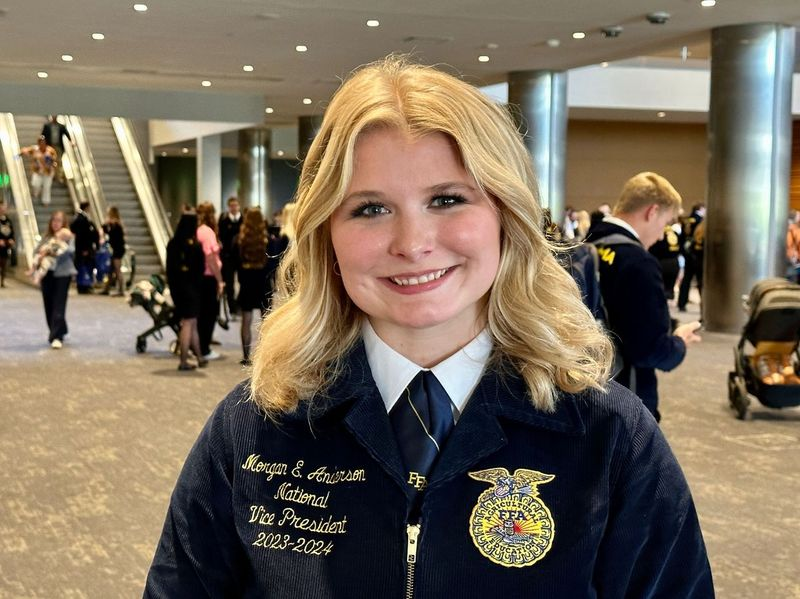
National FFA Officer Morgan Anderson
At the 2024 Oklahoma FFA Convention, Senior Farm and Ranch Broadcaster, Ron Hays had the chance to talk with a National FFA Officer and Ohio native, Morgan Anderson. Hays and Anderson converse about her FFA experiences and her time as a state Ohio FFA Officer and a National FFA Officer.
"There is something about the blue jacket and agriculture that you cannot find anywhere else," Anderson said.
Anderson has a broad background within the FFA organization, which inspired her to run for national office after serving as a state officer for Ohio.
"I knew that I didn't want to pursue a national office because it was 'the next thing you could do,'" Anderson said. "If you do that, you are going to be left with a really disappointing year with a lot of hard work if that is all you are going for. I really just wanted to find that deeper purpose again."
In her travels as a national officer, Anderson said it is fascinating to see how agriculture is different across the country.
"I wouldn't trade it for the world," Anderson said.
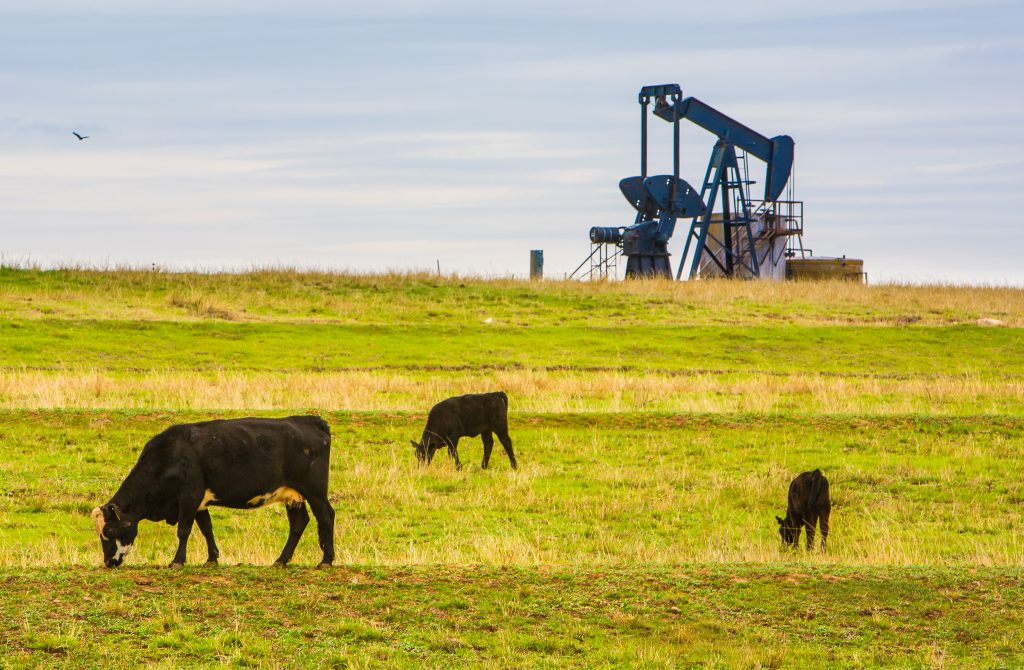
Senior Farm and Ranch Broadcaster, Ron Hays is talking with professional writer, author and speaker, Dale Strickler about grazing management. Strickler operates a consulting firm, Regenerative Wisdom, which focuses on soil, pasture, crop and drought prevention consulting.
"In no other arena in agriculture do we extract so little of the potential that is out there than in grazing management," Stricker said. "I have seen people side by side, right across the fence, and one person on one side is running a cow for every 12 acres and their grass looks like a pool table. The person on the other side is running a cow for every three acres, and they have grass that is knee-high."
Strickler said proper grazing management can mean more forage production with fewer inputs.
"It is about timing, it is about residual, it is about the movement of the livestock," Stricker said.
When one truly understands how grass grows, Strickler said a producer can manage properly to meet its needs and help it grow better. While many enjoy going out and buying new equipment for their property, Strickler said the most important piece of equipment on the farm or ranch is one's brain.
"With grazing management, the inputs are minimal," Strickler said. "That doesn't cost you a whole lot of money. Especially in this day and age. You can order books online, you can go to YouTube, you can get on Google, or you can attend sessions. It doesn't cost a lot of money to do that."
The Beef Buzz is a regular feature heard on radio stations around the region on the Radio Oklahoma Ag Network and is a regular audio feature found on this website as well. Click on the LISTEN BAR at the top of the story for today's show and check out our archives for older Beef Buzz shows covering the gamut of the beef cattle industry today.
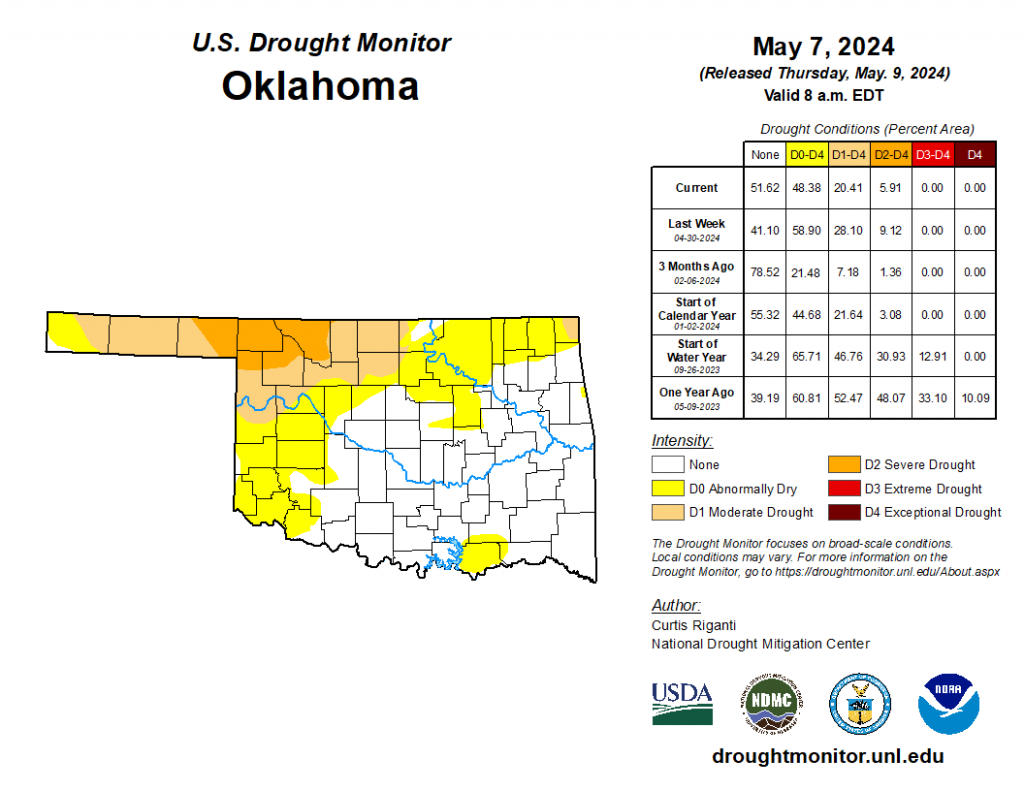
To view the latest Oklahoma drought map, CLICK HERE.
According to the latest Oklahoma drought monitor report, exceptional drought and extreme drought remain at zero percent, unchanged from the start of the calendar year.
Severe drought or worse fell to 5.5 percent, down from last week's 9.12 percent.
Moderate drought or worse is now at 20.4 percent, down from last week's 28.1 percent.
Abnormally dry or worse conditions are now at 48.3 percent, down from last week's 58.9 percent.
Meanwhile- our neighbor to the north, Kansas reports a mixed bag with severe drought edging higher to 28.8 percent from 27 percent last week- while moderate drought did shrink to 48.55 percent- dropping almost 8 percentage points versus last week.
In Texas- the numbers showed limited improvement- severe drought went from 13.4 percent to 13.2 percent while moderate drought or worse dropped from 27.4 to 26.4 percent this week.
According to the 6-to-10-day precipitation outlook map, the Oklahoma is leaning above a 33 to 40 percent chance of precipitation through May 18th.
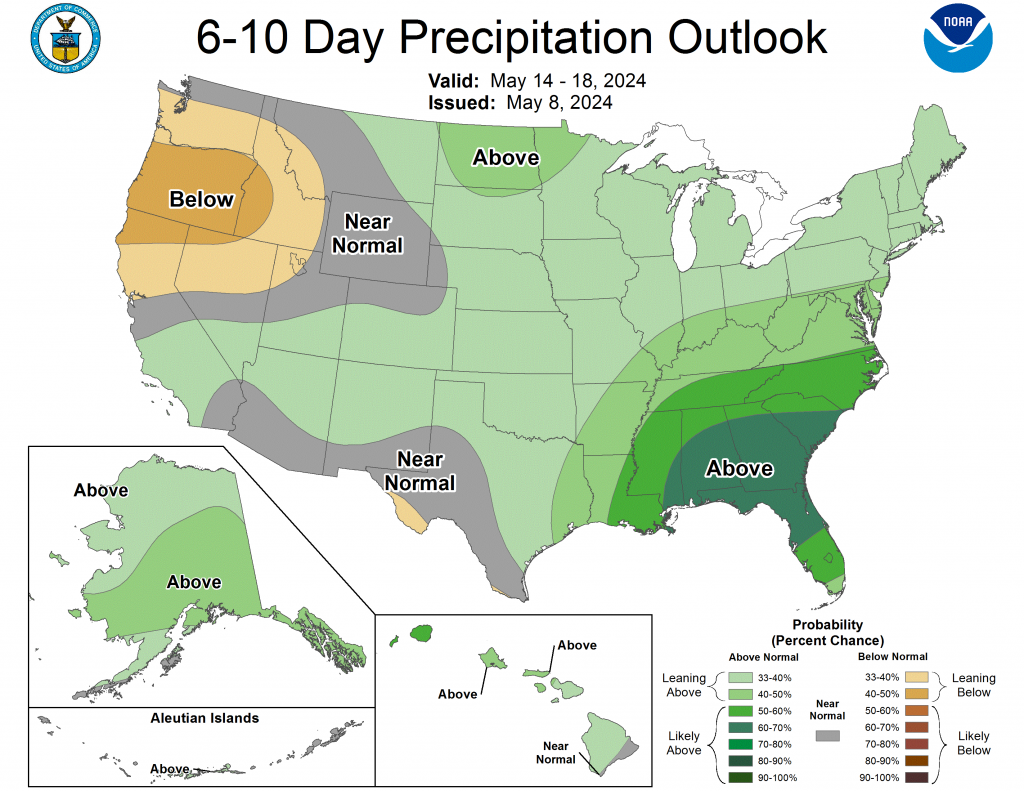
To view the United States Drought Map, click here.
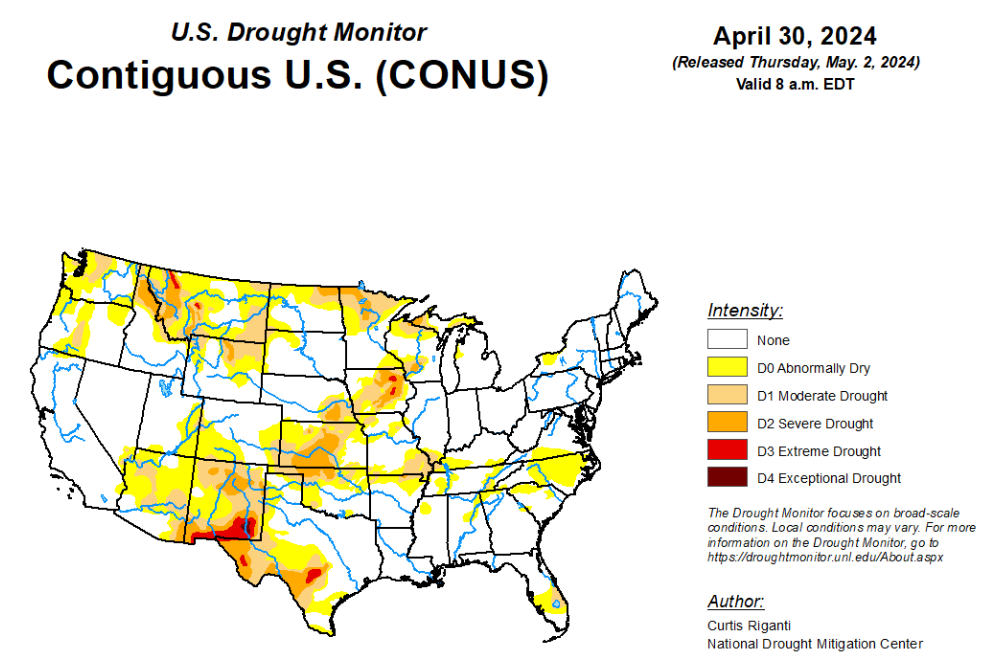
According to the latest U.S. Drought Monitor, during the late week and weekend, a large severe weather outbreak brought large hail, damaging winds and numerous intense tornadoes to parts of the central and southern Great Plains and Midwest. The storm systems responsible for the severe weather outbreak also brought widespread moderate and heavy rain amounts to the central U.S., leading to widespread improvements in drought and abnormally dry conditions. To the southwest of the heavy rainfall, in northwest Oklahoma and southwest and central Kansas, severe drought expanded as flash drought continued to take hold during a very dry late winter and early-mid spring, leading to reports of very poor wheat conditions and dust storms. Recent dry weather over the last month, combined with a mostly dry week, led to the development of more areas of abnormal dryness and moderate drought over scattered parts of the Southeast, Tennessee and southeast Kentucky. Conditions mostly remained unchanged in the western U.S., though a few improvements occurred in Colorado and Utah after recent precipitation, while conditions worsened in parts of southeast Montana and the Black Hills region of South Dakota and adjacent northeast Wyoming amid recent dry weather. Heavy rains in the northeast part of Puerto Rico eased drought and abnormal dryness there as streamflows improved and crop stress lessened.
In the Southern Plains, weather conditions varied widely across the South region this week, with heavy rain falling in parts of Oklahoma, Texas, Arkansas and Louisiana, while other areas were left mostly or completely dry. Temperatures were mostly warmer than normal across the region, especially in Oklahoma and Texas, where weekly readings came in 4-8 degrees above normal, with a few local readings even warmer than that. A few spots in central Texas and the Trans-Pecos region saw improvements to drought or abnormally dry conditions after recent rainfall. In eastern and parts of northern Oklahoma, recent heavy rainfall led to improving conditions. Meanwhile in Tennessee, short-term dryness continued, leading to the expansion of moderate drought and abnormal dryness in eastern Tennessee and the expansion of abnormal dryness in western parts of the state. Flash drought continued to worsen in parts of northwest Oklahoma and adjacent portions of the Texas and Oklahoma panhandles, where severe drought expanded amid quickly drying soils and growing short-term precipitation deficits.
In the High Plains, moderate to heavy precipitation fell across much of the High Plains region this week, excluding central and southwest Kansas and northeast Wyoming and southeast Colorado. Mostly warmer-than-normal temperatures occurred in Kansas, Colorado, Wyoming and the western Dakotas, while elsewhere, temperatures were mostly within a couple degrees of normal. While the storms responsible for the rain brought damaging hail and tornadoes in parts of the region, the rainfall helped to alleviate drought conditions in many areas. Eastern Kansas and Nebraska saw improvements in some areas, with parts of southeast Kansas seeing two-category improvements in the areas of heaviest rainfall. Meanwhile, in tandem with severe drought expansion in northwest Oklahoma, severe drought conditions expanded in central and southwest Kansas after another mostly dry week. Flash drought conditions in this region have led to dust storms and very poor wheat conditions.
In the West, weather conditions were variable across the West this week. Precipitation amounts from 0.5 to 2 inches (locally higher) fell in western parts of Washington and Oregon. Elsewhere, precipitation amounts varied from none to locally up to 2 inches, especially in some high-elevation areas. Temperatures were mostly near normal or a couple degrees below normal in Washington, Oregon, California, Arizona and western New Mexico, while near-normal or warmer-than-normal temperatures prevailed elsewhere. Drought conditions remained mostly unchanged across the region. In northeast Utah, abnormal dryness and moderate drought were reduced in coverage after recent wet weather and low evaporative demand. In southeast Montana, moderate drought grew in coverage as short-term precipitation deficits grew alongside decreasing streamflow and soil moisture.
Looking ahead, between the evening of Wednesday, May 1 (time of writing), and the evening of Monday, May 6, the National Weather Service Weather Prediction Center is forecasting moderate to heavy rain amounts from central Texas and northern Louisiana northward into the mid-Missouri and upper-Mississippi River valleys. In this region, rainfall amounts are forecast to range from a half inch to locally as high as 3 inches, especially in parts of Oklahoma, Texas and northern Louisiana. Similar precipitation amounts are also forecast in western Washington and Oregon, while some precipitation exceeding 1 inch is also forecast in parts of the northern Sierra Nevada. Mostly dry weather is forecast for eastern Colorado, New Mexico, Arizona, southwest Nevada, southern California and deep south Texas.
For May 7-11, the National Weather Service Climate Prediction Center's forecast favors colder-than-normal weather across much of the western U.S., with the highest confidence for colder-than-normal weather centered over Idaho and northern Nevada. Warmer-than-normal weather is expected in much of the southeast half of the contiguous U.S., especially from Texas northeast to the mid-Atlantic. Above-normal precipitation is favored in the northern U.S., especially eastern Montana, while below-normal precipitation is favored in coastal California, southern New Mexico and southern and western Texas, southeast Louisiana and most of Florida.
During the May 7-11 period, colder-than-normal temperatures are favored in southwest, south-central and southeast Alaska, and across all of Hawaii. All of Alaska is favored to receive above-normal precipitation, with confidence highest outside of the far west and northwest. With the exception of the Big Island, the forecast slightly favors above-normal precipitation in Hawaii.
To view the 6-10 Day Precipitation Outlook Map, click here.
To view the 6-10 Day Temperature Outlook Map, click here.
To view the Monthly Drought Outlook Map, click here.
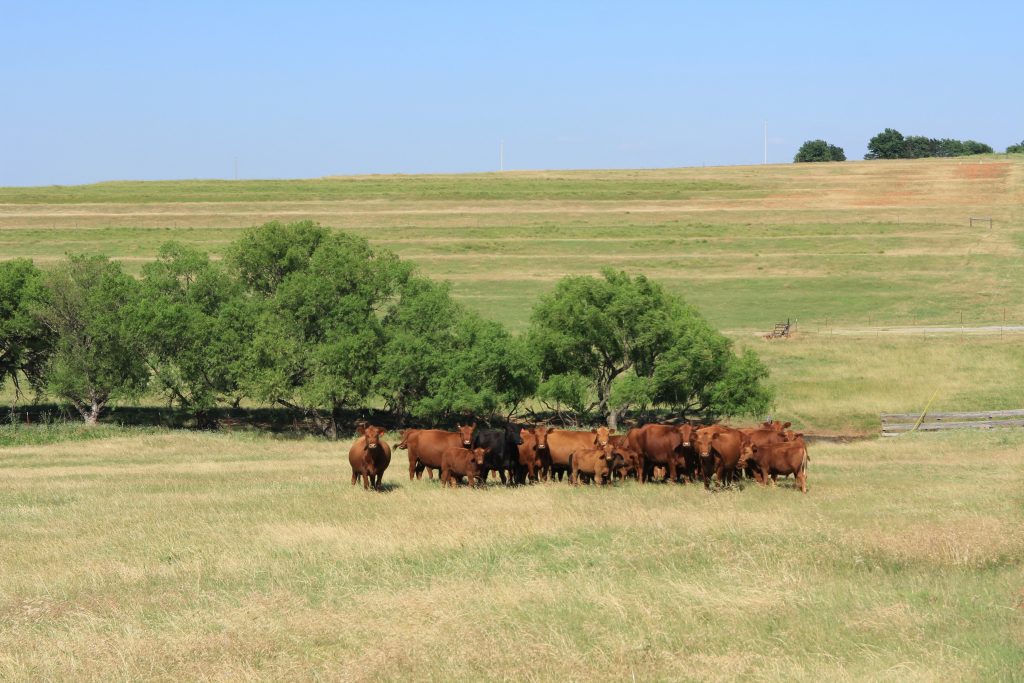
On today's Cow-Calf Corner, OSU's Mike Trammell talks about establishing native grasses.
Establishing a native grass pasture can be an intimidating process. The pros relative to native perennial pasture grasses are noteworthy – low demand for fertilizer after establishment, drought hardiness if properly grazed, diversity, and increased wildlife habitat, to list a few. On the other hand, after the cons are considered - low germination and seedling survival rate, low seedling vigor, low tolerance to competition, and general unpredictability of stand success (not to mention lower stocking rates) - few producers decide to attempt a native grass planting. However, successful establishment can occur through attention to detail during the establishment process. The following are key steps to guide producers who want to establish a new stand of native grass.
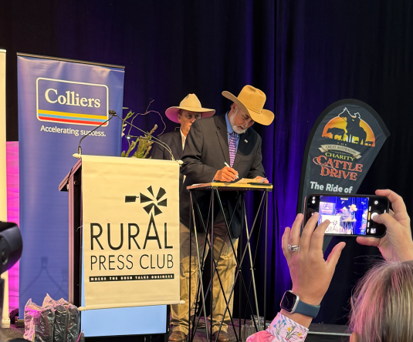
Today, leaders of the National Cattlemen's Beef Association (NCBA) and Cattle Australia (CA) signed a joint statement at the Beef 2024 convention in Rockhampton, Australia to further the two organizations' partnership on issues related to cattle health, lab-grown proteins, and sustainability.
"America's cattle farmers and ranchers stand with Australia's cattle producers and look forward to being partners in combatting foreign animal diseases, promoting sustainability, and ensuring proper oversight of lab-grown proteins," said NCBA President Mark Eisele, a Wyoming rancher. "As a rancher, I understand the importance of proactively talking about the good work we do in both countries. Cattle producers provide significant benefits to the global population, from providing safe, wholesome real beef to implementing conservation practices that conserve millions of acres of prime wildlife habitat in the United States and Australia. This joint commitment will strengthen the partnership between American and Australian producers and support our efforts to educate the public on the benefits of raising cattle."
"In signing the joint statement of priorities, we are encouraging the Australian and U.S. governments to join forces in combating devastating foreign animal diseases; promoting sustainable global trade that encourage efficient production practices; and ensuring science-based food safety and marketing regulations of emerging food technologies such as lab-grown proteins," said CA Chair Garry Edwards.
The joint statement outlines both countries' commitment to protecting cattle health and wellbeing with vaccine banks to counter the threat of foot-and-mouth disease (FMD). While FMD only impacts cloven-hoofed animals and does not pose a risk to humans, the disease can still cause immense financial harm to farmers and ranchers. The United States has been FMD-free since 1929 and Australia has been FMD-free since 1872.
The statement also addressed the emergence of lab-grown proteins. While there are no lab-grown proteins that imitate beef currently authorized for retail in the U.S., several companies are attempting to bring these products to market. It is critically important that these products are properly vetted by regulatory authorities so they do not pose a potential risk to consumer health and food safety, and it is important that they are labeled in a way that is transparent to consumers so they can choose between naturally produced beef and lab-grown proteins. Additionally, the statement supports efforts to continue sharing information on cattle industry sustainability and promoting the benefits of cattle production such as improving wildlife habitat, natural water filtration, and greenspace protection benefits.
Following the statement signing, NCBA and CA will continue engaging with their respective governments to secure policies that protect cattle health, recognize the cattle industry's sustainability, and ensure proper oversight of lab-grown protein.
View the statement here.
RON's Dave Lanning has a pre-opening look at today's agricultural Markets.
Click the audio tab below for today's report.
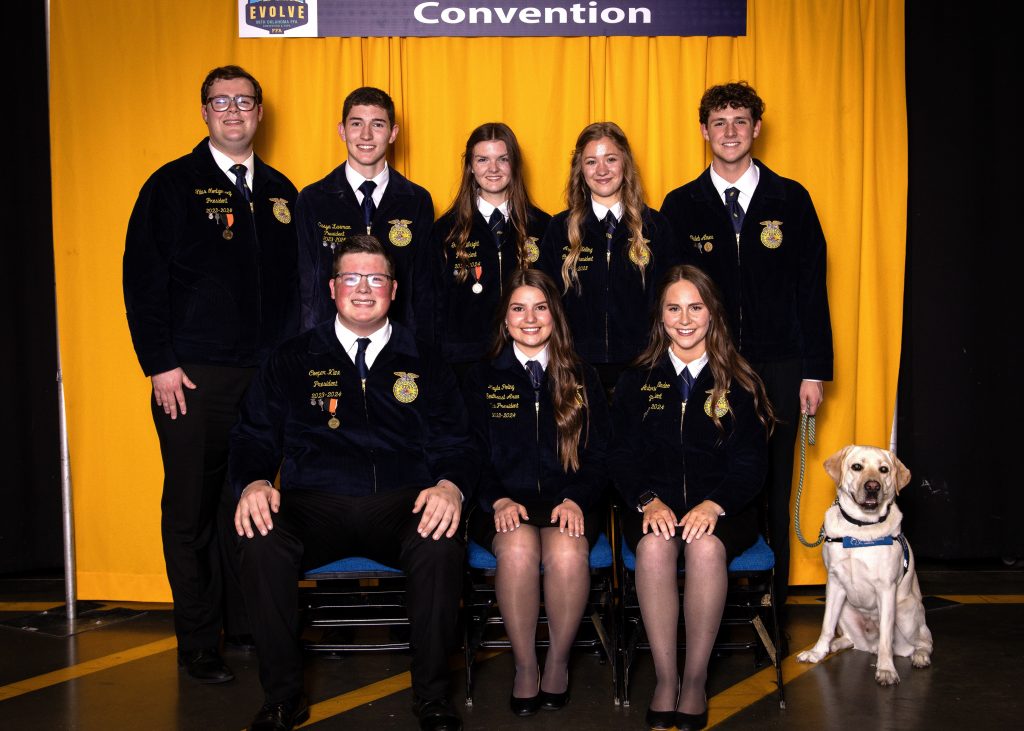
Kayla Poling (front center), member of the Silo FFA Chapter, will lead the more than 29,000 members of the Oklahoma FFA Association for 2024-25.
Members elected the 19-year-old to her presidential position during the 98th Oklahoma FFA Convention on May 8. An agricultural communications major at Oklahoma State University, Poling previously served as the 2023-24 Oklahoma FFA Southeast Area Vice President. She is the daughter of John and Daniela Poling. Poling is the ninth woman to hold the office of President for the state organization- and first to hold that office since Courtney Maye in 2011-12.
Seven additional FFA members will join Poling on the 2024-25 Oklahoma FFA Association officer team: Cooper Kline (front left), North Rock Creek FFA, secretary; Aubrie McEndoo, Stillwater FFA, reporter; Titus Montgomery (back left), Red Oak FFA, southeast area vice president; Casyn Larman, Mulhall-Orlando FFA, northwest area vice president; Grace Wright, Stratford FFA, central area vice president; Anna Jo Helling, Inola FFA, northeast area vice president; and Caleb Ames, Duke FFA, southwest area vice president.
State Secretary Cooper Kline is the first state officer from one of the newest Chapters in the state- North Rock Creek. They were chartered as a Chapter in 2019. Southeast area Vice President Caleb Ames of Duke FFA is also his chapter's first state officer. Kayla Poling became her Chapter's first state officer a year ago when she was elected as the Southeast Area Vice President in 2023.
FFA is an integral part of the Agricultural Education division in the Oklahoma Department of Career and Technology Education system. With 29,670 members and 366 chapters, the Oklahoma FFA Association is the fifth-largest state FFA association. The FFA mission is to make a positive difference in the lives of students by developing their potential for premier leadership, personal growth and career success through agricultural education. To learn more about the Oklahoma FFA, visit okffa.org.
Your coverage of the 2024 Oklahoma FFA Convention is sponsored by Hilliary Communications- who deliver the latest cutting-edge communications services supporting tens of thousands of customers across 22 counties throughout Oklahoma, Texas and Iowa. The company offers internet, voice and HilliaryTV. Hilliary Communications continuously researches the marketplace for innovations and strives to improve underserved areas, offering services that exceed customer expectations. Click here to learn more about Hilliary Communications.
For more information about the 98th Oklahoma State FFA Convention, click here.
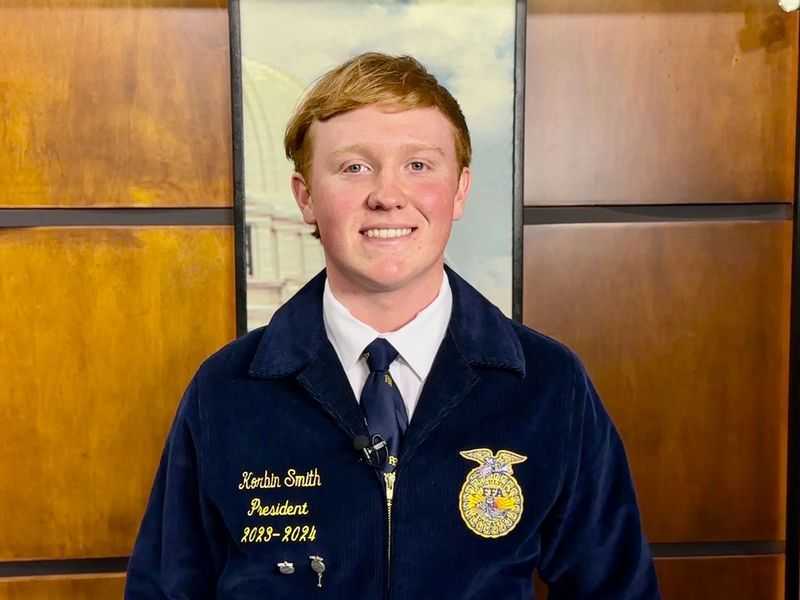
Korbin Smith
Korbin Smith of the Hydro-Eakly FFA Chapter earned the title of State Star in Agricultural Placement during the fifth session of the 98th State FFA Convention and Expo May 8 at the BOK Center.
Smith's supervised agricultural experience is working on his parents' cow-calf operation, including wheat harvesting and producing forage. Smith Farms has 2,200 acres and uses approximately 700 acres as cropland.
The cropland is used to grow rye, triticale, wheat and cover crops. The wheat produced is used to feed the farm's cattle. Smith Farms practices rotational grazing with their cattle.
"During the summer months, I'm helping out in the hay operation side," Smith said.
Smith is involved heavily in production on Smith Farms. During the summer, he focuses on cutting, raking, baling and hauling hay, and maintaining the cattle. He takes soil samples of the land and implements recommendations made by professionals to better the cropland.
"The soil test I use has lots of detail that includes nitrogen, phosphorous, potassium, micronutrients, soil pH, and also cation exchange capacity," Smith said.
During Smith's time in FFA, he has participated in numerous events, including giving the FFA Creed, prepared public speaking, livestock judging and trap shooting. After graduation Smith plans to attend Fort Hays University in Hays, Kansas, and be a member of their stockman sports team.
"I credit FFA to who I am today as a senior in high school," Smith said.
The 18 Area Stars each received a plaque and $500 cash award co-sponsored by the Masonic Charity Foundation, McDonald's of Oklahoma, The Chickasaw Nation, Blue and Gold Sausage Co., Davis Farms, Sirloin Club of Oklahoma, Noble Research Institute, and Oklahoma Farm Bureau.
As a Star in Agricultural Placement, Smith and the other State Stars over Oklahoma will each receive $30,089 in scholarships or capital grant funds through a $3.2 million gift from the Carl C. Anderson Sr. and Marie Jo Anderson Charitable Foundation. The late Carl C. Anderson, after whom the State Star awards are now named, was born in Naples, Oklahoma, in 1911. One of 10 children, he dropped out of high school to earn money and support his family. From those modest beginnings, the Anderson Corp. grew across the country as well as in Canada and South America.
FFA is an integral part of the Agricultural Education division in the Oklahoma Department of Career and Technology Education system. With more than 29,000 members and 366 chapters, the Oklahoma FFA Association is the fifth-largest state FFA association. The FFA mission is to make a positive difference in the lives of students by developing their potential for premier leadership, personal growth and career success through agricultural education. To learn more about the Oklahoma FFA, visit okffa.org.
Your coverage of the 2024 Oklahoma FFA Convention is sponsored by Hilliary Communications- who deliver the latest cutting-edge communications services supporting tens of thousands of customers across 22 counties throughout Oklahoma, Texas and Iowa. The company offers internet, voice and HilliaryTV. Hilliary Communications continuously researches the marketplace for innovations and strives to improve underserved areas, offering services that exceed customer expectations. Click here to learn more about Hilliary Communications.
For more information about the 98th Oklahoma State FFA Convention, click here.
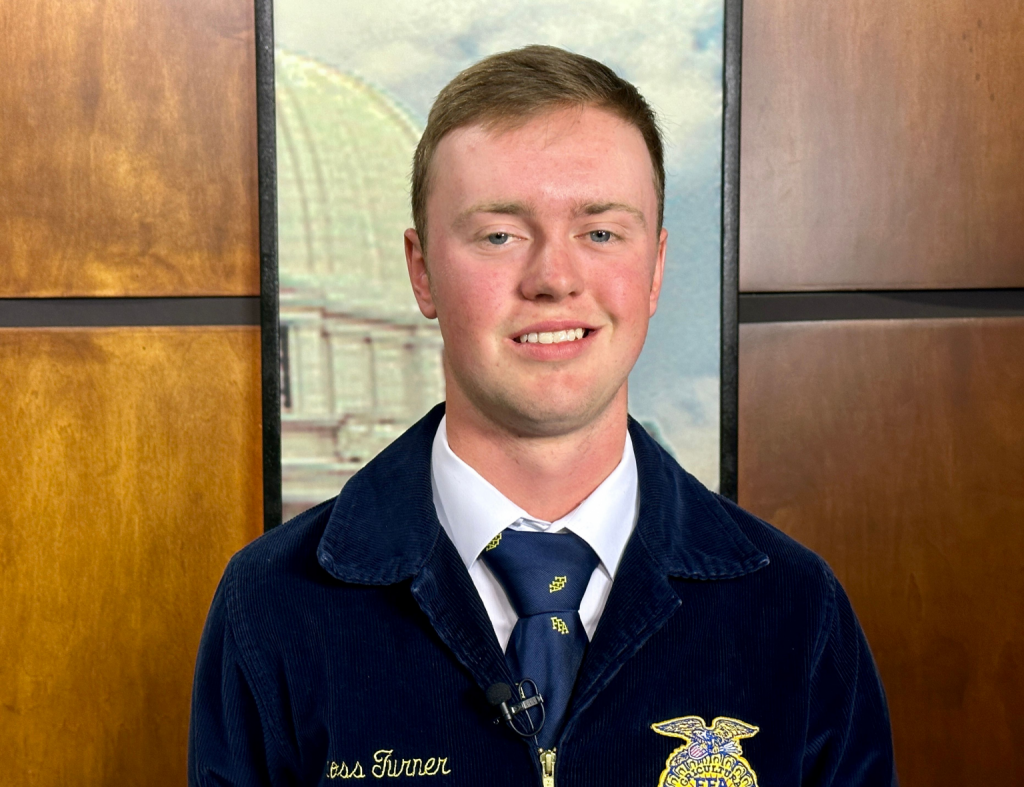
Ross Turner
Ross Turner of the Oologah FFA Chapter won the State Star in Agribusiness award at the 98th Oklahoma FFA Convention and Expo on May 8 at the BOK Center.
Turner began his agribusiness, Turner Stockdogs, in 2021, when he trained and sold his first dog. Growing up on a multi-generation cow-calf and rope horse operation, Turner was exposed to working dogs at a young age, which lead to his interest in training and working cow dogs.
Turner Stockdogs focuses primarily on cow dogs of the Border Collie breed. Along with buying and selling, Turner also breeds his own dogs. After a 2022 sale, Turner slowly began training outside dogs too, expanding his kennel capacity to 10 dogs at a time.
"The most important thing is just being able to read the dog," Turner said.
Turner said he works to teach the dogs to balance and makes sure their shoulder placement is correct. From there, he said, he continues to increase the dogs' training and pressure as they show him they can handle it.
Turner keeps each dog on a strict diet of 30% protein and 20% fat. To prioritize gut health, each dog receives probiotics three days after arrival, ensuring their transition is as smooth as possible.
Each animal is required to have strict health and vaccination records. In the event a new client does not provide such records, Turner charges $50 to properly vaccinate the dog.
"I take health protocols very seriously," Turner said. "If one dog has a contagious disease, then every dog in the kennel has been exposed."
At Turner Stockdogs, obedience training is the first step of the training process. Turner said he likes the dogs to walk on a loose lead and heel, off lead if needed, before introducing the dogs to livestock. Once the dog has mastered physical commands, Turner introduces directional voice commands and whistles.
Turner provides private lessons to clients, incorporating his trained dogs in the lessons to help clients better understand their own dogs.
Turner connects with most of his clients through online marketing by advertising on social media and his website.
"Whether you're gathering cattle horseback or with a four-wheeler, pushing steers up a roping alley, or just need some extra help when the neighbor's bull crosses the fence, I hope the first call will be Turner Stockdogs," Turner said. "I fit the dog to the handler."
The 18 Area Stars each received a plaque and $500 cash award co-sponsored by the Masonic Charity Foundation, McDonald's of Oklahoma, The Chickasaw Nation, Blue and Gold Sausage Co., Davis Farms, Sirloin Club of Oklahoma, Noble Research Institute, and Oklahoma Farm Bureau.
As a Star in Agribusiness, Sanders and the other State Stars over Oklahoma will each receive $30,089 in scholarships or capital grant funds through a $3.2 million gift from the Carl C. Anderson Sr. and Marie Jo Anderson Charitable Foundation. The late Carl C. Anderson, after whom the State Star awards are now named, was born in Naples, Oklahoma, in 1911. One of 10 children, he dropped out of high school to earn money and support his family. From those modest beginnings, the Anderson Corp. grew across the country as well as in Canada and South America.
FFA is an integral part of the Agricultural Education division in the Oklahoma Department of Career and Technology Education system. With more than 29,670 members and 366 chapters, the Oklahoma FFA Association is the fifth-largest state FFA association. The FFA mission is to make a positive difference in the lives of students by developing their potential for premier leadership, personal growth and career success through agricultural education. To learn more about the Oklahoma FFA, visit okffa.org.
Your coverage of the 2024 Oklahoma FFA Convention is sponsored by Hilliary Communications- who deliver the latest cutting-edge communications services supporting tens of thousands of customers across 22 counties throughout Oklahoma, Texas and Iowa. The company offers internet, voice and HilliaryTV. Hilliary Communications continuously researches the marketplace for innovations and strives to improve underserved areas, offering services that exceed customer expectations. Click here to learn more about Hilliary Communications.
For more information about the 98th Oklahoma State FFA Convention, click here.
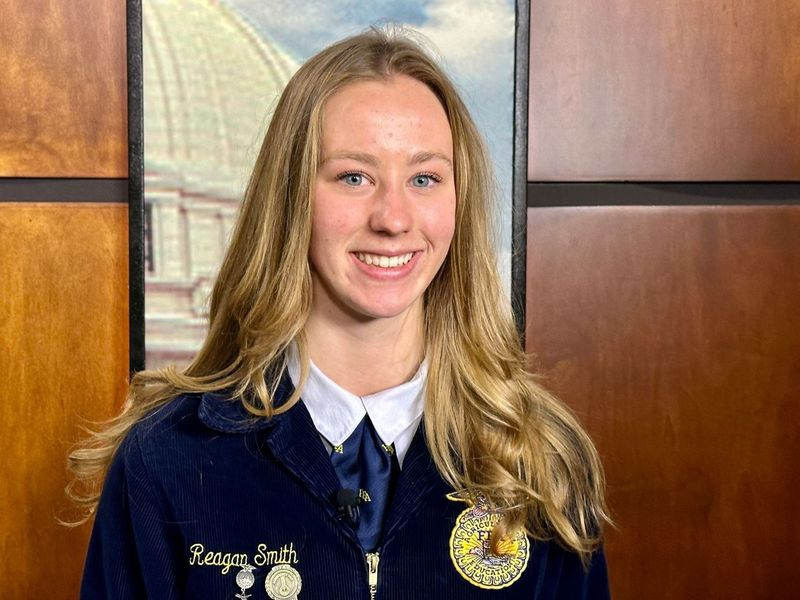
Reagan Smith
Reagan Smith of the Oologah FFA Chapter won the State Star in Agriscience award at the 98th Oklahoma FFA Convention and Expo on May 8 at the BOK Center.
The State Star in Agriscience represents the best of the best within FFA member-led research in Oklahoma.
Hailing from Oologah, Oklahoma, Smith has been an active member since her eighth-grade year. Smith discovered her passion for agriscience after joining FFA. Over the years, Smith has completed seven projects in agriscience.
She began by experimenting with storage methods for farm-fresh versus store-bought eggs to determine which provided a longer shelf-life length. She then became interested in pursuing animal reproduction after visiting Flying Cow Genetics in Welch, Oklahoma, with her agricultural education teacher.
Smith's first animal science project was testing thawed temperatures of Brahma bovine semen straws. She then moved on to observation research on the success rates of artificial insemination versus embryo transfer in caprine. Smith also conducted two experiments testing two different porcine extenders.
In her most recent project, Smith researched the effects of supplementing Vitamin C and Ashwagandha on Bovine semen production. The experiment revealed Vitamin C to be the most effective oral supplement to use for improving semen volume, sperm concentration and sperm motility, Smith said.
In addition to her research projects, Smith also competed in livestock judging, speech contests, veterinary science, quiz bowl, creed speaking, and nationally on an agricultural issues team, she said.
"FFA has given me a place," Smith said. "It has given me a passion. It has provided me with a community that supports me and lifts me up in my highest and lowest moments, and it has helped me find my voice."
The 18 Area Stars each received a plaque and $500 cash award co-sponsored by the Masonic Charity Foundation, McDonald's of Oklahoma, The Chickasaw Nation, Blue and Gold Sausage Co., Davis Farms, Sirloin Club of Oklahoma, Noble Research Institute, and Oklahoma Farm Bureau.
As a Star in Agriscience, Smith and the other State Stars over Oklahoma will each receive $30,089 in scholarships or capital grant funds through a $3.2 million gift from the Carl C. Anderson Sr. and Marie Jo Anderson Charitable Foundation. The late Carl C. Anderson, after whom the State Star awards are now named, was born in Naples, Oklahoma, in 1911. One of 10 children, he dropped out of high school to earn money and support his family. From those modest beginnings, the Anderson Corp. grew across the country as well as in Canada and South America.
FFA is an integral part of the Agricultural Education division in the Oklahoma Department of Career and Technology Education system. With more than 29,670 members and 366 chapters, the Oklahoma FFA Association is the fifth-largest state FFA association. The FFA mission is to make a positive difference in the lives of students by developing their potential for premier leadership, personal growth and career success through agricultural education. To learn more about the Oklahoma FFA, visit okffa.org.
Your coverage of the 2024 Oklahoma FFA Convention is sponsored by Hilliary Communications- who deliver the latest cutting-edge communications services supporting tens of thousands of customers across 22 counties throughout Oklahoma, Texas and Iowa. The company offers internet, voice and HilliaryTV. Hilliary Communications continuously researches the marketplace for innovations and strives to improve underserved areas, offering services that exceed customer expectations. Click here to learn more about Hilliary Communications.
For more information about the 98th Oklahoma State FFA Convention, click here.
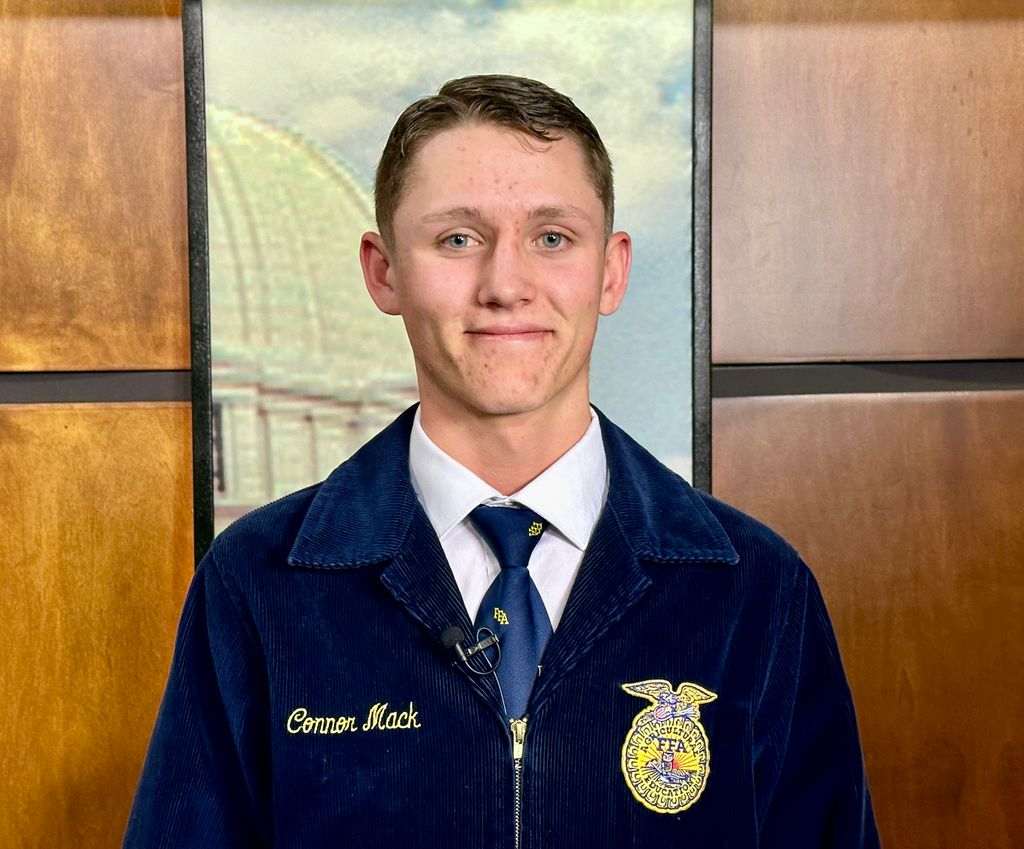
Connor Mack
Connor Mack of the Drummond FFA chapter was announced as the Oklahoma FFA State Star Farmer during the fifth session of the 98th Oklahoma FFA Convention and Expo on May 8 at the BOK Center.
Mack's supervised agricultural experience focuses on different crops and livestock within his family's farm.
"I plant several different crops including wheat, canola, milo, corn and soybeans," Mack said. "I run 50 standard Hereford commercial cows, 15 mini-Herefords, 47 stockers, and 35 dorper sheep."
Mack said he's a fifth-generation farmer, and agriculture has been part of his life from the beginning. He said he is most content when he can be in the field or with his cattle.
"The FFA has opened up my horizons allowing me several great opportunities much like this one," Mack said. "Whether it be Lead 360, Alumni Camp, or COLT Conference, the FFA has given me the leadership skills to go down any path after graduation of high school and college to be successful in any path I choose."
Mack said upon graduation from high school, he plans to attend Oklahoma State University and major in plant and soil sciences and earn a minor in animal science. After college, he plans to go back to the family farm using the knowledge he learned at OSU to continue and grow his operation as efficiently as possible.
The 18 Area Stars each received a plaque and $500 cash award co-sponsored by the Masonic Charity Foundation, McDonald's of Oklahoma, The Chickasaw Nation, Blue and Gold Sausage Co., Davis Farms, Sirloin Club of Oklahoma, Noble Research Institute, and Oklahoma Farm Bureau.
As a Star Farmer, Mack and the other State Stars over Oklahoma will each receive $30,089 in scholarships or capital grant funds through a $3.2 million gift from the Carl C. Anderson Sr. and Marie Jo Anderson Charitable Foundation. The late Carl C. Anderson, after whom the State Star awards are now named, was born in Naples, Oklahoma, in 1911. One of 10 children, he dropped out of high school to earn money and support his family. From those modest beginnings, the Anderson Corp. grew across the country as well as in Canada and South America.
FFA is an integral part of the Agricultural Education division in the Oklahoma Department of Career and Technology Education system. With more than 29,670 members and 366 chapters, the Oklahoma FFA Association is the fifth-largest state FFA association. The FFA mission is to make a positive difference in the lives of students by developing their potential for premier leadership, personal growth and career success through agricultural education. To learn more about the Oklahoma FFA, visit okffa.org.
Your coverage of the 2024 Oklahoma FFA Convention is sponsored by Hilliary Communications- who deliver the latest cutting-edge communications services supporting tens of thousands of customers across 22 counties throughout Oklahoma, Texas and Iowa. The company offers internet, voice and HilliaryTV. Hilliary Communications continuously researches the marketplace for innovations and strives to improve underserved areas, offering services that exceed customer expectations. Click here to learn more about Hilliary Communications.
For more information about the 98th Oklahoma State FFA Convention, click here.
Leading dairy representatives from the United States and Mexico met this week in Chihuahua, Mexico to renew their commitment to collaborate and advocate on mutually beneficial dairy policies. This was the sixth meeting between leading U.S. and Mexico dairy organizations since 2016.
The National Milk Producers Federation (NMPF) and U.S. Dairy Export Council (USDEC) steered the U.S. delegation, which consisted of more than 14 member companies, U.S. farmer representatives, and USDEC and NMPF staff. Delegates from Mexico's milk producers and dairy processors included:
Throughout the week, attendees discussed the most pressing issues affecting both industries, in their local respective markets and across the globe.
"Our two industries share so many similar challenges that call for us to work together," said Krysta Harden, president and CEO of USDEC. "Mexico is and will continue to be a valuable partner for U.S. dairy. These meetings help strengthen those ties and set the dairy sectors in both countries up for continued success."
"The U.S. and Mexico dairy industries are key partners in their shared mission to grow demand and protect dairy's public image," said Gregg Doud, president and CEO of NMPF. "The renewed commitment signed today further strengthens our important relationship."
As part of the meeting, attendees toured the Reny Picot Mexico plant in Chihuahua. The only demineralized whey powder producer in Mexico, Reny Picot is the largest nonfat dry milk powder importer in Mexico, importing an average of 5,000 metric tons per month.
Joint Statement:
On their Sixth annual meeting within the framework of the partnership to strengthen the milk production sector in North America, held in the city of Chihuahua, Mexico, hereby agree to:
Develop a work plan on the issues of the common agenda, with indicators and a follow-up program with scheduled meetings.
In response to President Biden's Executive Order 14081, "Advancing Biotechnology and Biomanufacturing Innovation for a Sustainable, Safe, and Secure American Bioeconomy," the U.S. Environmental Protection Agency (EPA), the U.S. Food and Drug Administration (FDA), and the U.S. Department of Agriculture (USDA) have developed a plan to update, streamline, and clarify their regulations and oversight mechanisms for products of biotechnology.
The plan helps meet the President's goals of ensuring public confidence in the biotechnology regulatory system and improving its transparency, predictability, coordination, and efficiency. Through engagement with developers and stakeholders, as well as horizon scanning for novel biotechnology products, the Agencies worked collaboratively to develop a cohesive plan. The plan incorporates processes and timelines to implement regulatory reform, such as identifying guidance and regulations to update, streamline, or clarify, and identifying the potential need for new guidance or regulations. The plan supports a whole-of-government approach to the regulation of biotechnology products.
The agencies have identified five major areas of biotechnology product regulation where these actions will focus:
EPA, the FDA and USDA intend to implement the following joint efforts:
The Federal Government established the Coordinated Framework for the Regulation of Biotechnology in 1986 and most recently updated it in 2017. It describes the comprehensive federal regulatory policy for ensuring the safety of biotechnology products, including how EPA, the FDA, and USDA share responsibility for regulating many of the products of biotechnology in the United States. The Executive Order directs the three agencies to improve how they implement the Coordinated Framework.
In response to the Executive Order, the three regulatory Agencies, in consultation with the Office of Science and Technology Policy (OSTP), issued a Request for Information (RFI) to the public to solicit information on regulatory ambiguities, gaps, uncertainties, or inefficiencies in the Coordinated Framework. The agencies received 88 distinct public comments, including a sign-on letter from over 6,000 members from biotechnology developers, producers, manufacturers, non-governmental organizations, and academia. The Agencies will continue to engage with all interested stakeholders as they implement the plan.
Visit the Unified Website for Biotechnology Regulation for additional information on modernizing the regulatory system for biotechnology products and Executive Order 14081.
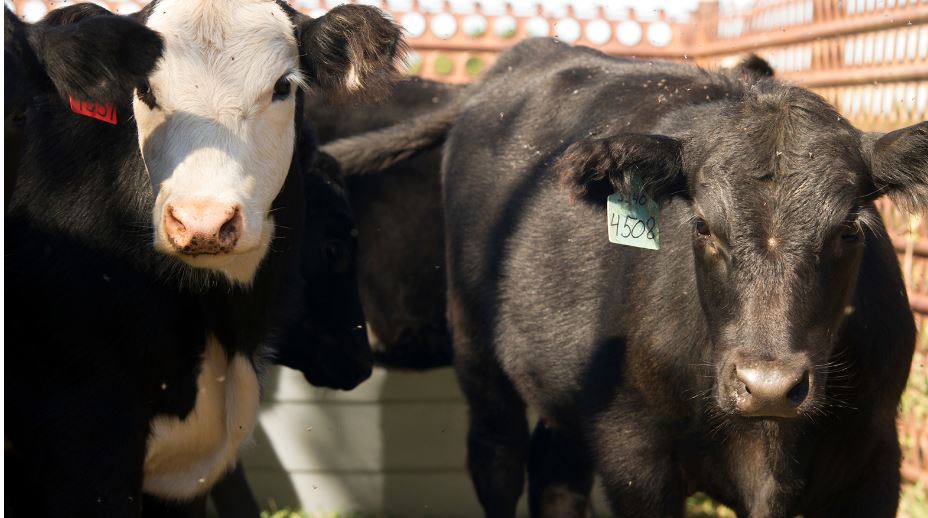
Article courtesy of Dr. Rosslyn Biggs, OSU Beef Cattle Specialist
Animal disease traceability (ADT), as defined by the United States Department of Agriculture (USDA), is knowing where diseased and at-risk animals are, where they've been, and when. ADT does not prevent disease introduction, but does allow expedited emergency response. Accurate and timely response is critical for both producers and the industry. ADT applies to diseases currently in the US, as well as foreign animal disease.
ADT allows official individual identification of animals and rapid tracing during an outbreak. One ADT system that allows individual identification is the National Uniform Eartagging System (NUES). This system has been used for decades and is familiar to many producers, although they may not know it by name. The system is utilized when USDA official tags are required, such as when adult breeding cattle moved interstate or for program disease purposes such as brucellosis vaccination or tuberculosis testing. Historically this system used primarily metal visual tags, commonly called "Bangs tags" or "Silver Bright" tags.
In more recent years, both the traditional metal visual tags and certain radiofrequency (electronic) (EID) tags have been accepted as official identification. Official USDA EID tags are a 15-digit usually round/button tag that begin the tag number with the digits 840. EID tags can be read visually and with electronic readers.
Recently the USDA finalized a rule that has been under discussion for the last several years. Significant input was received from industry leaders and animal health officials. This rule moves USDA official identification to exclusively EID tags that can be read both visually and electronically with an anticipated start date in November 2024.
It is important to recognize that this rule change does not in any way require the mandatory tagging of all cattle. This rule change only moves USDA official identification tags from the metal option to EID tags. The classes of cattle requiring official identification have not changed. USDA official identification tags are required only under certain conditions and for certain ages and classes of cattle. The two primary situations requiring official identification are program disease testing, (such as that required for brucellosis), and interstate movement.
The cattle classes requiring identification when moving interstate are listed below. Exceptions to this requirement do apply under unique movement types, such as travel for veterinary care. Feeder cattle and animals moving directly to slaughter do not require official identification for interstate movement.
Classes of cattle requiring USDA official identification for interstate movement include:
Beef Cattle & Bison
• sexually intact and 18 months or older
• used for rodeo or recreational events (regardless of age)
• used for shows or exhibitions
Dairy Cattle
• all female dairy cattle
• all male dairy cattle born after March 11, 2013
Producers can find more information about the rule change at https://www.aphis.usda.gov/news/agency-announcements/aphis-bolsters-animal-disease-traceability-united-states
Producers and veterinarians interested in incorporating EID for official identification and herd management purposes may wish to participate in a program offered by the Oklahoma Department of Agriculture, Food and Forestry (ODAFF) and USDA. ODAFF is distributing EID tags for the cost of shipping. Producers must first obtain a premise identification number and then submit an order form. The number to call for questions is ODAFF Animal Industry Division 405-522-6141. Information can also be found at https://ag.ok.gov/wp-content/uploads/2023/04/MULTI-TAG-ORDER-FORM-v8.23.pdf
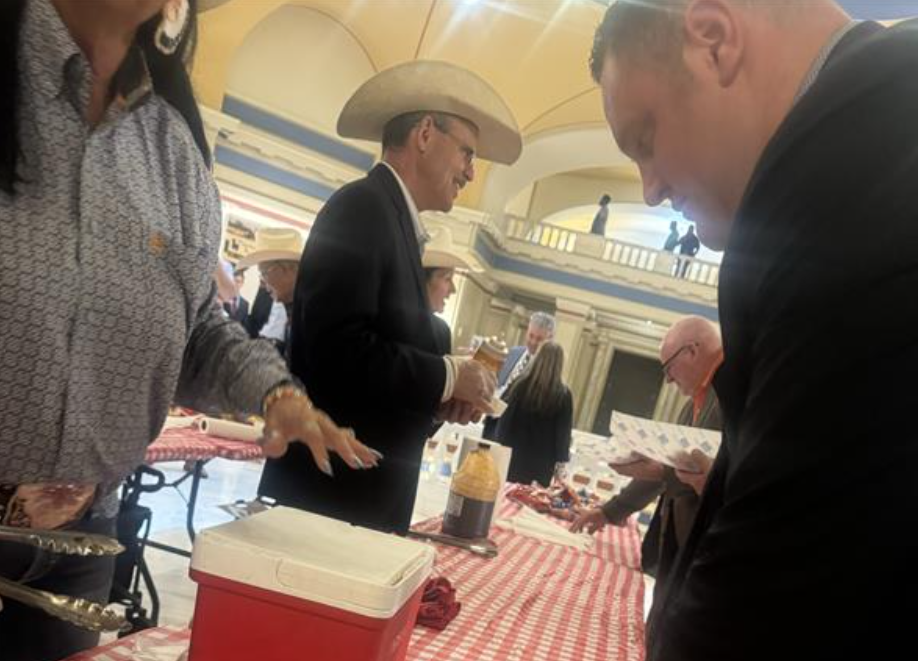
May is Beef Month in Oklahoma! At Beef Day at the Capitol in Oklahoma City, Farm Director KC Sheperd caught up with the President of the Oklahoma Cattlemen's Association Dr. Troy Shelby, and talked about the day's event. At the Capitol, Shelby said beef producers have the chance to talk with legislators and enjoy ribeye steak sandwiches courtesy of the OCA. Shelby also advocated for Oklahoma's ranchers because of their land stewardship and practices to preserve the land.
| |||||||||||||||||||||||||||||||||||||||||||||||||||||||||||||||||||||||||||||||||||||||||||||||||||||||||||||||||||||||||||||||||||||||||||||||||||||||||||||||||||||||||||||||||||||||||||||||||||||||||||||||||
|

The Botanic Garden at Oklahoma State University is a multi-disciplinary living laboratory used by scientists at OSU. It is also home to the "Oklahoma Gardening" Studio Garden and a place where families can create memories. (Photo by Todd Johnson, OSU Agriculture)
Often referred to as the best-kept secret in Stillwater, The Botanic Garden at Oklahoma State University is where scientists make discoveries and families create memories.
Situated on 100 acres between Cow Creek and Stillwater Creek on the west side of Stillwater, Oklahoma, The Botanic Garden at OSU is a multi-disciplinary living laboratory for researchers and an outdoor classroom for professors and students. It is also the studio garden for "Oklahoma Gardening," television's longest-running gardening program.
"The Botanic Garden at OSU is much more than a pretty place to visit. It's all about family," said Lou Anella, garden director. "We have focused on elements that will attract families to the garden, but it also is critical to the functionality of teaching, research and Extension programming at OSU."
Anella said the garden welcomes about 100,000 visitors per year who visit to experience everything from a children's play area, concerts and demonstration gardens to yoga, festivals and more.
"A master plan was developed in the early 2000s, including a new entrance on the south side of the garden off Highway 51. It has made the garden more accessible and increased our visibility," he said. "The garden is a beautiful place, and we want to share it with the public."
Open houses, festivals and concerts
The garden is open to the public every day from dawn to dusk, and open houses are held the first and third Saturdays of the month from May through October, featuring activities for the whole family and ambassadors onsite to answer gardening questions. OSU's Insect Adventure is hosted in the new Horticulture Education Center near the south entrance and features a variety of insects for children to explore. The garden also includes a children's train garden with G-scale model trains.
Earlier this spring, the annual Herb and Succulent Festival featured plant sales, vendors and activities for children.
Laura's Bandstand at the garden will host free concerts on select Friday evenings during the summer, and visitors can purchase pumpkins and mums while enjoying the colors of fall at GardenFest on Sept. 28.
Check out the garden calendar for more events throughout the year.
Children's activities
The Botanic Garden at OSU offers a variety of hands-on activities geared specifically for children that promote good health and learning.
Shelley Mitchell, OSU Extension senior specialist, said the garden is a wonderful place for children to enjoy the fresh air outdoors, away from electronics.
"Kids need to be out in nature, getting dirty and soaking up vitamin D. It's good for their development and mental health," she said. "Kids love the chickens at the garden, and they can purchase mealworms to feed them."
One popular children's feature is the Treewalk Village, which is a play structure built into large trees with bridges, platforms and a slide. Young visitors to the garden can enjoy the walking trail and immerse themselves in nature. The Children's Garden has a playhouse, a crawl-through tunnel and a library where they can nestle into child-size chairs for storytime. Beginning-reader sight words are also posted throughout the area to help children enhance their reading skills. Also, children can let their imaginations run free in the mud kitchen, making mud pies and cakes, in the Nature Play Area. A complete list of children's activities is available online.
New this summer, a pop-up children's museum will be held on the fourth Saturday of each month. Also, schools are invited to tour the garden. Mitchell will offer day camps this summer for youth ages 7 to 12. Contact her at shelley.mitchell@okstate.edu for more information.
"Oklahoma Gardening" Studio Garden
Gardening enthusiasts have tuned in to "Oklahoma Gardening" since 1975 for the latest gardening advice and research-based information. The show was originally filmed in Oklahoma City, then at the home of Ray Campbell, former show host and director of OSU Extension. Eventually, raised beds were built in Stillwater as a new studio garden space for "Oklahoma Gardening." This studio garden has now grown into The Botanic Garden at OSU where the award-winning show is still filmed today.
Casey Hentges, OSU Extension associate specialist and host of "Oklahoma Gardening," said there are more than a dozen different gardens within the Studio Garden.
"The Studio Garden showcases shade, sun, patio, fairy, Japanese, herb and other gardens that serve as sets for the show," she said. "We encourage people to visit and get ideas for flower and color combinations, and hardscapes they can incorporate into their landscapes."
"Oklahoma Gardening" is the longest-running gardening show on television and will celebrate its 50th anniversary next year.
"Oklahoma Gardening" airs Saturday mornings at 11 a.m. and Sunday afternoons at 3 p.m. on local OETA-TV channels. Viewers can also subscribe to the "Oklahoma Gardening" YouTube channel.
Research
Dennis Martin, OSU Extension turfgrass specialist, said the OSU turf research program develops insights into the adaptation and management of turf-type plant materials.
"Information developed by the OSU program helps Oklahomans choose the best materials for their lawns, sports fields, parks and grounds, cemeteries and rights-of-way, as well as how to manage these areas," Martin said. "In the past 23 years, OSU scientists have developed 10 improved varieties of bermudagrass that are grown on six continents."
Turf may seem like a trivial crop, but more than 40 million acres in the U.S. feature turf, and it's increasing in popularity.
"As rural areas urbanize, vegetated land with turf will continue to grow. Turf provides both human and environmental benefits because it stabilizes soil against wind and water erosion, reduces noise, moderates excess temperature and provides a safe surface for sports," Martin said. "The low-growing nature of turf allows motorists long-distance visibility and provides defensible space against wildfires. The future focus of OSU turf scientists includes varieties with more drought-tolerance and turf systems comprised of many plant species providing pollinator, human and environmental benefit."
OSU-developed turfgrass is used in many stadiums in the U.S., including the Lincoln Financial Field, Commanders Field, M&T Bank Stadium, Soldier Field, Dodgers Stadium, Churchill Downs and more.
In addition to turf research, the garden is a living laboratory for plant research. Bruce Dunn, a floriculture professor in OSU's Department of Horticulture and Landscape Architecture, has conducted plant trials at the garden for many years.
"Plant trials are important because they allow the public to see how well different species and cultivars do in an Oklahoma landscape. They can also learn more about growth habits, foliage or flower colors, which plants serve as pollinator attractants and which plants tolerate summer high and winter low temperatures," he said. "Proven Winners sends about 40 herbaceous selections each year. I also trial about 20 woody plants as part of the Garden Debut plants for Greenleaf Nursery."
This research helps ensure gardeners purchase plants that have shown their ability to thrive in Oklahoma's growing conditions.
Anella said entomology students also study insects, and professors and students have installed bluebird houses to help with avian research.
Horticulture Education Center
The new Horticulture Education Center opened in 2023 with support from OSU, industry partners and other generous donors, and a $750,000 grant from the Tobacco Settlement Endowment Trust. Located by the south entrance to the garden off State Highway 51, the new building provides many educational opportunities.
The 2,100-square-foot facility features a large classroom for student, faculty and community learning opportunities, office space and restrooms.
"TSET is interested in outdoor learning opportunities and healthy outdoor living," Anella said. "The building serves multiple purposes and allows us to form partnerships with other groups. The Payne County Master Gardeners group hosts a lecture series there and it will be used for other community events. With easy access and parking, it's another way to make partnerships easier."
Visitors to the garden are encouraged to download the PlantNet app to help them identify the flowers they encounter. Visitors can learn more about a particular plant by taking a photo and uploading it to the app.
"The Botanic Garden at OSU is a great place to share with family," Anella said. "It's always beautiful and helps foster a love of nature."
OSU Extension uses research-based information to help all Oklahomans solve local issues and concerns, promote leadership and manage resources wisely throughout the state's 77 counties. Most information is available at little to no cost.
Senior Farm and Ranch Broadcaster Ron Hays is featuring his conversation from April with Mark Johnson, Oklahoma State University Extension Beef Cattle Breeding Specialist, about the 2024 Cattlemen's Conference, coming up May 22nd and 23rd in Stillwater, Oklahoma. Anyone in the cattle industry is welcome to attend this year's event, as three main topics impacting the cattle industry will be discussed.
To listen to Part One of the conversation, CLICK HERE!
Johnson said the first panel of speakers on Wednesday, May 22nd will be discussing selection and mating relative to a marketing end point in a beef operation.
"We have known for years that reproductive traits are low in heritability and really respond to crossbreeding in a big way," Johnson said. "Growth traits are moderate in heritability, and they have moderate degrees of heterosis when we crossbreed. Carcass traits are highly heritable and don't show much benefit from crossbreeding. Relative to a commercial cow-calf operation that sells their calves at weaning or holds onto them and markets them as yearlings, or retains ownership all the way through finishing, selling them on a carcass-value basis, what are the things we should be looking at in a selection and mating program relative to creating profit potential in our operation?"
Johnson said the speakers invited to discuss this topic are extremely knowledgeable of the relationship between mating and one's marketing endpoint, as they come from a successful background in different parts of the beef industry.
"Based on this topic, Dr. Peel and I are working with scientists from the meat animal research center and taking some of that data collected up there in Nebraska over time, and are going to do an economic simulation to look at how additive genetic merit, and hybrid vigor, relative to different marketing endpoints works," Johnson said.
The first afternoon of Cattlemen's Conference will focus on the carbon footprint of beef, featuring Dr. Jayson Roundtree of Michigan State University and regenerative ranching will be discussed with Hugh Aljoe at the Noble Research Institute. Wednesday evening at the banquet, a third topic will be discussed- gene editing with Dr. Alison Van Enennaam at the University of California-Davis.
To see the full schedule of speakers for both days, CLICK HERE.
To learn more about the conference and register, CLICK HERE!
The Beef Buzz is a regular feature heard on radio stations around the region on the Radio Oklahoma Ag Network and is a regular audio feature found on this website as well. Click on the LISTEN BAR at the top of the story for today's show and check out our archives for older Beef Buzz shows covering the gamut of the beef cattle industry today.
The U.S. Department of Agriculture (USDA) is seeking nominations for four positions on the Federal Advisory Committee for Urban Agriculture and Innovative Production. USDA will accept nominations from May 7, 2024, to July 7, 2024. The 12-member Committee, which first convened in March 2022, is part of USDA's efforts to increase support for urban agriculture and innovative production. Members of the Committee provide input on policy development and help identify barriers to urban agriculture as USDA works to promote urban farming and the economic opportunities it provides in cities across the country.
"The Urban Agriculture and Innovative Production Committee has already submitted more than a dozen recommendations to the Secretary of Agriculture and continues to provide direct feedback to USDA about how to better serve producers and communities," said Terry Cosby, Chief of USDA's Natural Resources Conservation Service (NRCS), which oversees USDA's Office of Urban Agriculture and Innovative Production. "These new members will provide valuable input on innovative production, higher education, the supply chain, and urban farming to guide our programs and policies."
Members of the Committee include representative from urban and innovative agricultural production, higher education or extension programs, non-profits, business and economic development, supply chain, and financing. Last year, Agriculture Secretary Tom Vilsack appointed four new members to the Committee to replace members whose terms expired. The Committee's last public meeting was held in April 2024.
Nominations
USDA is seeking nominations for individuals representing a broad spectrum of expertise. Four positions are open for nominations including:
Individuals who wish to be considered for membership must submit a nomination package including the following:
Nomination packages must be submitted by email to UrbanAgricultureFederalAdvisoryCommittee@usda.gov or postmarked by July 7, 2024. If sending by mail, packages should be addressed to USDA NRCS, Attn: Brian Guse, 1400 Independence Avenue SW, Room 4083, Washington, DC 20250. Any interested person or organization may nominate qualified individuals for membership, including self-nominations. For special accommodations, contact Markus Holliday at UrbanAgricultureFederalAdvisoryCommittee@usda.gov. Additional details are available in the Federal Register notice.
More Information
The Office of Urban Agriculture and Innovative Production was established through the 2018 Farm Bill. It is led by NRCS and works in partnership with numerous USDA agencies that support urban agriculture and innovative production. The Committee is part of a broad USDA investment in urban agriculture and innovative production. Other efforts include:
Learn more at www.usda.gov/urban. For additional resources available to producers, download the Urban Agriculture at a Glance brochure or visit www.farmers.gov/urban. USDA touches the lives of all Americans each day in so many positive ways. Under the Biden-Harris administration, USDA is transforming America's food system with a greater focus on more resilient local and regional food production, fairer markets for all producers, ensuring access to safe, healthy, and nutritious food in all communities, building new markets and streams of income for farmers and producers using climate smart food and forestry practices, making historic investments in infrastructure and clean energy capabilities throughout America, and committing to equity across the Department by removing systemic barriers and building a workforce more representative of America. To learn more, visit usda.gov.
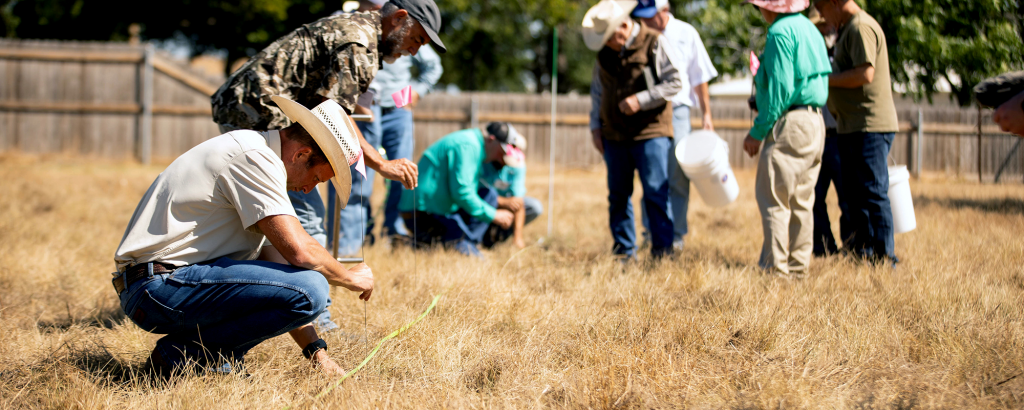
If you could increase the amount of productive land you operate by 30%, without an additional land payment or lease agreement, would you do so?
For most, the answer is a no-brainer.
Noble Research Institute Senior Regenerative Ranching Advisor Jim Johnson says it's not uncommon to have pasture with 30% bare ground, which means the increase in land capacity you seek may already be right under your nose.
"If you're able to work toward management principles that will help cover that 30%, you just earned 30% more acres to operate on for free," Johnson says. The problem is, "most people don't realize they're giving up that much production."
The best way to manage for more is to measure where you are now and where you want to go, he says.
The first step to achieving that objective may start with adding a simple, five-minute task to your spring to-do list: setting up monitoring sites or "transects" to establish a consistent location to observe and measure your land management progress.
A monitoring transect is a line between two marked points, along which you measure or take samples up and down the length of a tape measure stretched between the points. Marking a single-point monitoring location will do, also.

Whether you set up a transect or stationary point, spring is an ideal time to establish the site, Johnson says.
The most important part is selecting the site itself. Ideally, the location will be representative of the ranch or the particular pasture. That may require more than one location. If you have upland and bottom ground, or introduced and native forages, or different soil types – you may want to select monitoring locations that represent those differences.
Make sure the location you select is not impacted by gates, fence lines, water tanks, livestock trails or other factors that would influence the area you're monitoring. Consider other non-management impacts on the location – does it intermittently flood or have a pipeline running nearby?
"The key is to find a location where your management is the primary factor that has the ability to impact that land," Johnson says.
Start by making some base observations and establish the frequency you'd like to monitor the location. Some want to record observations at the height of the cool growing season and the height of the warm growing season. Others may choose quarterly monitoring, with one for each season. Johnson says he's satisfied with annual observations, "because a lot of these things we're monitoring change very slowly."
Set a reminder on your phone or note the monitoring dates on your calendar to keep you on track.

Decide how you want to mark your monitoring location. You may set a t-post, drop a GPS pin on your smartphone, or use a landmark as your reference point – say, start at the gate and step off 100 paces due north to arrive at your monitoring point.
Determine what you want to monitor at that location. The possibilities are endless, but Johnson suggests keeping it realistic and practical as to how much data you'll collect and put to good use.
Measuring bare ground is an easy place to start, and it's one pasture characteristic you might be able to make a measurable impact on within one growing season. A simple way to measure bare ground is the step method. Take 10 steps or 100 steps (these numbers make the math easy), and record if your foot is on covered soil or bare ground at each step. Then some simple math gives you the percentage of bare ground.
Other common measurements to make and record include:
Several smartphone applications can help identify plants at your monitoring location or evaluate soil coverage, but even just a shovel to look at soil and root characteristics is a good place to start. For larger landscape monitoring, such as evaluating brush encroachment over time, consider standing at your monitoring point and taking a photo toward the horizon in each cardinal direction, or capture drone footage or satellite imagery from the same height and location time after time.
Next, determine your recording method. It may simply be a notebook where you record observations and insert any data from testing results. Some ranchers find recording data points or notations on a calendar or day planner convenient, while more visual learners might choose to take photos on their cell phone and either file them into labeled folders or print the photos and insert them into the paper records.

Whatever you choose to monitor, use the information you gather as a place to start asking yourself, "If my overall goal is to improve my resources, how can I follow the soil health principles to get there?"
Johnson says that's one of the key questions he and other facilitators recommend that attendees at the Noble Land Essentials course ask themselves and apply to their management. Those who attend the course also gain access to Noble's exclusive soil health progress tracker, an Excel spreadsheet designed to help organize monitoring data.
The measurements listed above may be observations otherwise easily overlooked in the course of the daily ranching rush and to-do list.
"The fact that we're out there monitoring, observing, intentionally thinking about these things is so powerful," Johnson says. "It doesn't have to be an overly scientific process. Whatever you choose to do has to be simple and repeatable, something you'll stick with and actually do."
The monitoring data becomes part of your land management legacy, leaving a record from which future generations can learn. In a business where many factors are beyond your control, monitoring may add a much-needed sense of accomplishment as you branch out and try new management techniques, too.
"There is that little dopamine hit that comes with achieving a goal, having it in black and white, on paper, that says, 'Here's where we started, and here's where we've gone, and I know for sure I'm making progress,'" Johnson says. "That encourages us to keep going."
Story Credit: Laura Nelson, Noble Research Institute
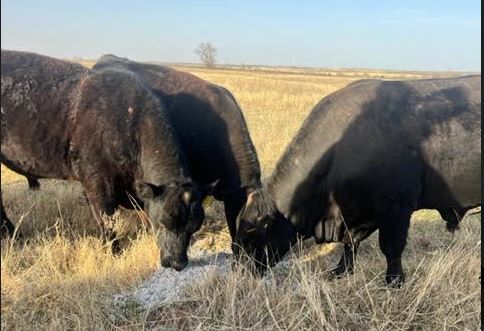
Weekly, Oklahoma State University Extension Beef Cattle Nutrition Specialist Paul Beck offers his expertise on the beef cattle industry. This is a part of the weekly series known as the "Cow-Calf Corner." Today, he talks about disadvantages of receiving bulls in a stocker program during grazing and finishing.
Intact bulls often receive price discounts at auction markets. Last week we looked at the impacts of leaving bull calves intact on performance and health during receiving (https://extension.okstate.edu/programs/beef-extension/cow-calf-corner-the-newsletter-archives/2024/april-29-2024.html). Estimates of discounts range from $5/hundred pounds up to $11.25/hundred pounds from past market survey reports. However, recent USDA livestock auction reports from the Southeast (Arkansas Department of Ag Mkt News, April 10, 2024; https://mymarketnews.ams.usda.gov/viewReport/2056) show discounts of $16.50/hundred pounds for 400 to 500 pound bulls. These discounts at auction markets signal producers to castrate male calves before marketing.
We analyzed receiving records from Mississippi, Arkansas and Oklahoma and found that bulls were 2.4-times more likely to be pulled and treated for bovine respiratory disease (BRD), 1.2-times more likely to be a chronic, and 2.3-times more likely to die from BRD than steers and gained ½ pound less per day. This made the receiving cost of bulls to be $64 per head more than steers. Bulls are less productive and more expensive to receive than steers, but how long do these impacts last?
Tracking calves after receiving onto high quality pastures showed that calves treated for BRD were lighter when they started grazing and remained lighter at the end of grazing. For instance, calves that never required treatment for BRD weighed 550 pounds at the start of grazing and gained 2.5 pounds per day compared to 2.4 pounds per day for calves treated for BRD. Calves only treated once for BRD were 18 pounds lighter (532 lbs) where calves treated twice for BRD weighed 517 pounds at turnout and calves that required a third BRD treatment weighed only 504 pounds at turnout. With no compensatory gain the differences in bodyweight due to BRD at turnout on grass were still present following grazing.
A smaller subset of calves was followed through finishing after the grazing phase. Lifetime performance from initial receiving through the stocker grazing phase and finishing was still impacted by health during receiving prior to the stocker phase many weeks earlier. This resulted in reduced bodyweight at harvest as well as reduced hot carcass weight and increased the days on feed required to reach harvest. Only calves that were deemed healthy and fully recovered from BRD after the receiving period were used in the grazing phase and were further selected for health status after grazing when followed through finishing.
Bovine respiratory disease has long-term implications on performance not only during the receiving period but also impacts BW and productivity through the stocker grazing phase and finishing. Decreased performance and carcass quality along with increased days on feed to reach similar carcass endpoints were apparent even following an extended grazing period.
The cost of bulls during the receiving period through increased health issues and reduced performance indicate that larger discounts are likely needed for equal profitability to steer calves.
RON's Dave Lanning has a pre-opening look at today's agricultural Markets.
Click the audio tab below for today's report.
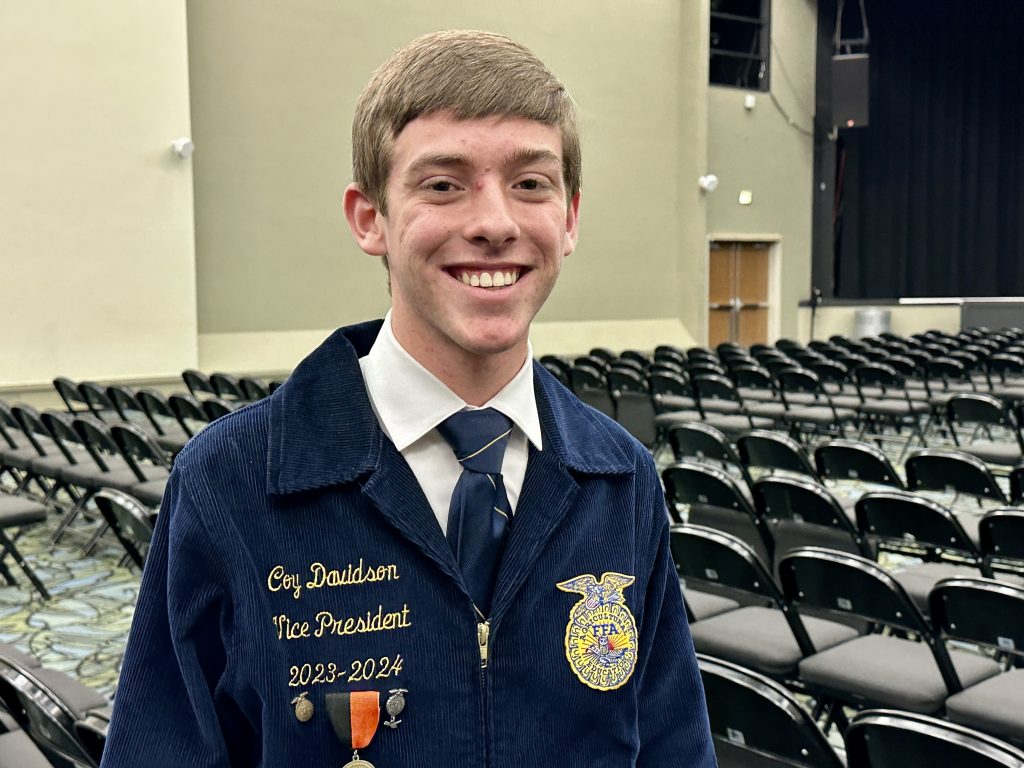
The past five days have propelled Elgin FFA's Coy Davidson into the role of a State Champion twice over- and becoming a National Contest qualifier with the opportunity to represent Oklahoma at the 97th National FFA Convention this coming October in Indianapolis.
The high school junior won the Agriscience Speech Division State Championship this past Friday in Stillwater at the Interscholastics Contests for Oklahoma FFA- which gave him one of six spots in the state finals of the Prepared Speaking Championship on Tuesday afternoon in Tulsa at the 98th Annual Convention of the Oklahoma FFA.
Coy and the other five State Champs drew for speaking order and he ended up speaking last in the contest. Whether that was the ultimate advantage or not- the five judges named him the best of the best for his speech on Ag Espionage
After the State Speech Finals- Oklahoma Farm Report's Ron Hays spoke with Coy about the contests and his speech- listen to their conversation by clicking on the link below:
Davidson said he has been working on this speech topic for a couple of years- and that it has been a fascinating topic to research, In his speech- he relates a story of FBI agents stopping Chinese nationals in their effort to smuggle hybrid seeds out of the country in order to reverse engineer the technology and produce a counterfeit product- potentially costing the company who had invested into developing the hybrid millions if not billions of dollars.
Davidson will take the summer to refine his speech with the hope of making it a national winner come October in Indianapolis. He is one of several state winners who automatically become the state's official entrant in National Contests that are held by the National FFA Organization. Oklahoma has won the National Prepared Speech Contest nine times over the years- including most recently in 2022 when current FFA President Caleb Horne was the National Champion.
The 98th State Convention of the Oklahoma FFA continues today in downtown Tulsa- and Coy Davidson will be one of many FFA members who will be honored on stage as a State Champion for 2024.
Oklahoma FFA is a top ten state in total membership nationally, with currently 29,672 members who belong to a total of 366 chapters.
Your coverage of the 2024 Oklahoma FFA Convention is sponsored by Hilliary Communications- who deliver the latest cutting-edge communications services supporting tens of thousands of customers across 22 counties throughout Oklahoma, Texas and Iowa. The company offers internet, voice and HilliaryTV. Hilliary Communications continuously researches the marketplace for innovations and strives to improve underserved areas, offering services that exceed customer expectations. Click here to learn more about Hilliary Communications.
For more information about the 98th Oklahoma State FFA Convention, click here.
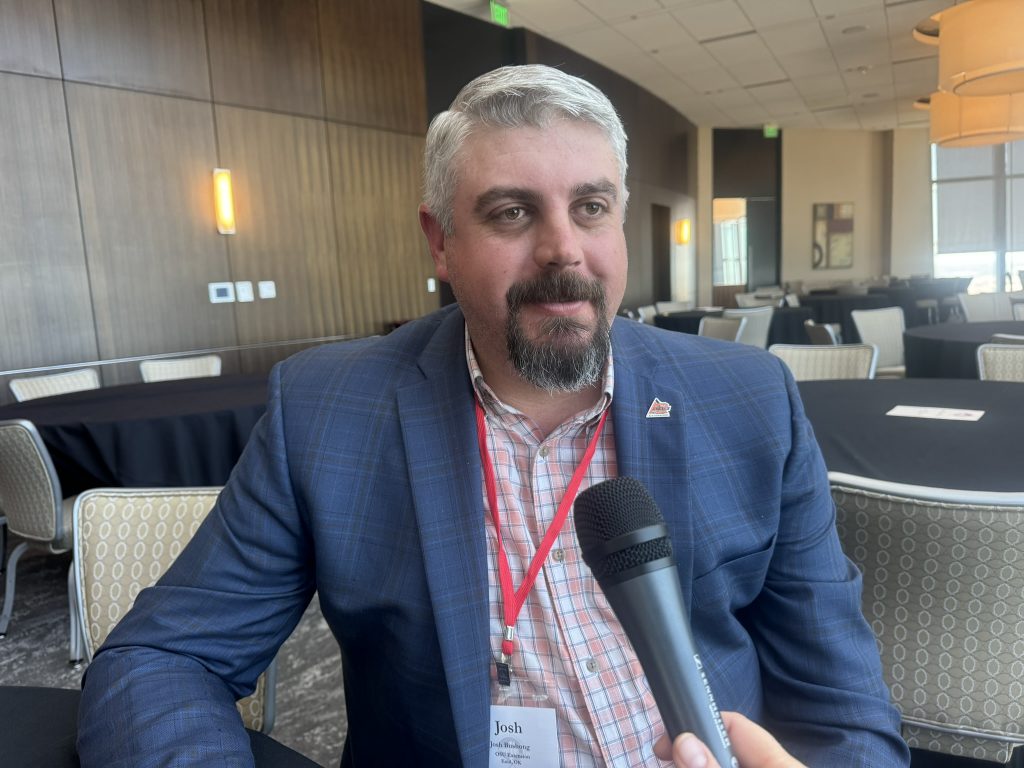
OSU's Josh Bushong
At the Oklahoma Grain and Feed Association's 126th Annual Meeting, Farm Director, KC Sheperd, had the chance to catch up with Oklahoma State University Extension Area Agronomist Specialist Josh Bushong. Bushong talks about Oklahoma's winter wheat crop, and the estimates for harvested acres, yield, and total production from OSU Extension and Oklahoma Grain and Feed Association members.
2024 wheat crop tour estimates came to 2,647,570 harvested acres, 33.68 bushels per acre, and a total production of 89.161 million bushels. The estimate from the Oklahoma Grain and Feed Association members came to 2,740,000 harvested acres, 37.3 bushels per acre, and a total production of 102.202 million bushels. It is important to note that these estimates should be perceived as a moving average.
While some parts of the states have had challenges such as stripe rust, Bushong said for the most part, Oklahoma's crop is looking well. The crop is turning fast this year, especially in Southern Oklahoma.
In general, Bushong said that in the growing season, wheat broke dormancy early in late winter, and has been 2-3 weeks ahead of schedule for most of spring.
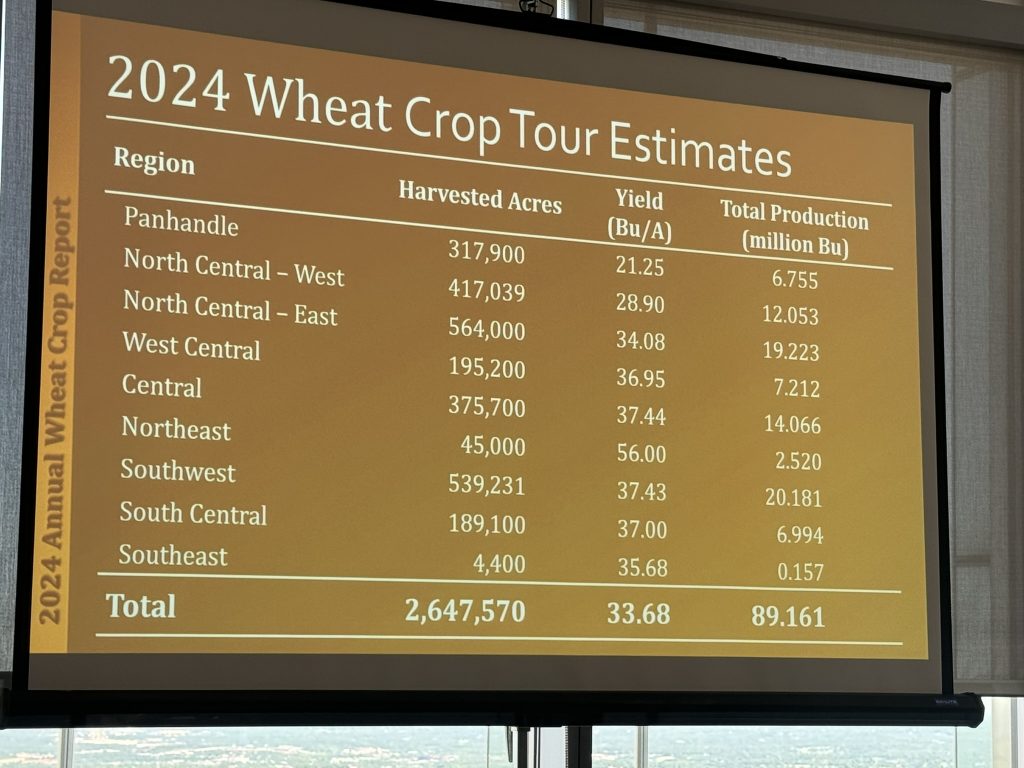
"I have been very impressed with the wheat out there," Bushong said. "Guys put money into it, they top dressed, and they protected the flag leaf with the fungicide. For the most part, average to above average on yield, acreage was pretty decent."
When comparing last year's crop to this year, Bushong said a concern last year was the ability to finish out the crop and have successful yields. This year, Bushong said the biggest concern is disease.
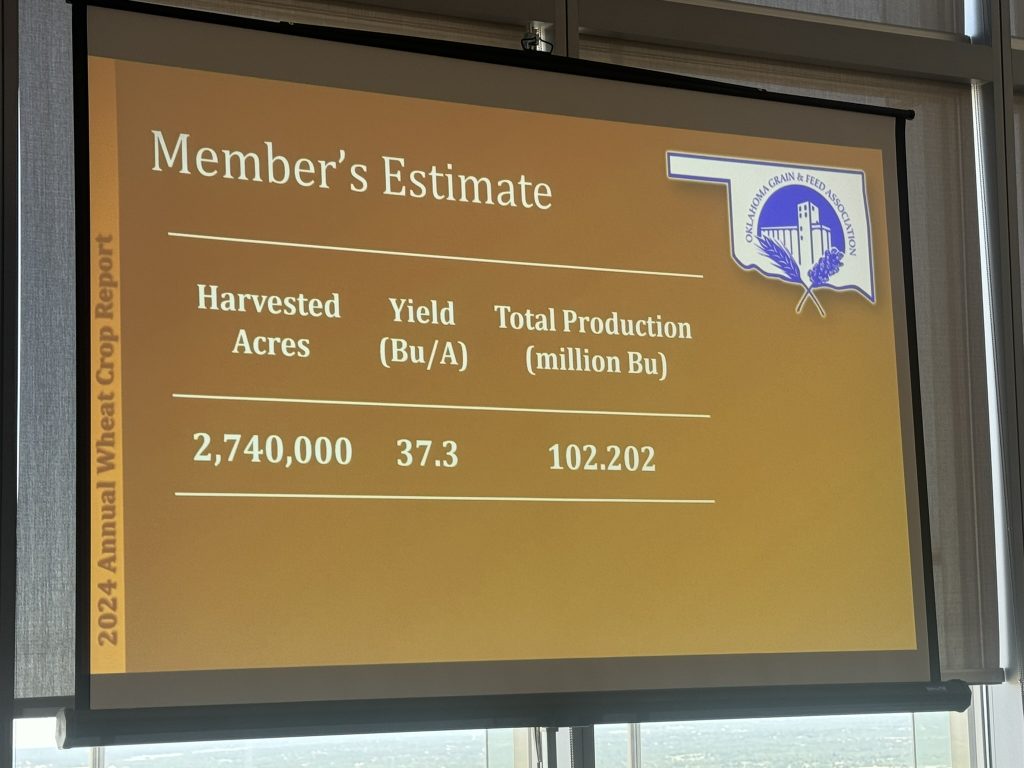
After recent storms throughout the state, Bushong said many areas have survived well.
"The nine contributors to the wheat report this year- we came in at a little less than what the Oklahoma Feed and Grain Association membership showed," Bushong said. "They think we have more acres and a little bit better yield, there were thinking four more bushels than what we were thinking as far as the state yield. We were around 33 bushels, and they were thinking maybe 37 bushels. We were thinking a total production of almost 90 million bushels for the state, and they were thinking maybe 102 million bushels."
To finish up this year's wheat crop, Bushong said some moisture and mild conditions will be critical- not too hot and not too much wind. Rainfall received in the last two weeks should help this crop finish, and acres that received fungicide applications should produce well.
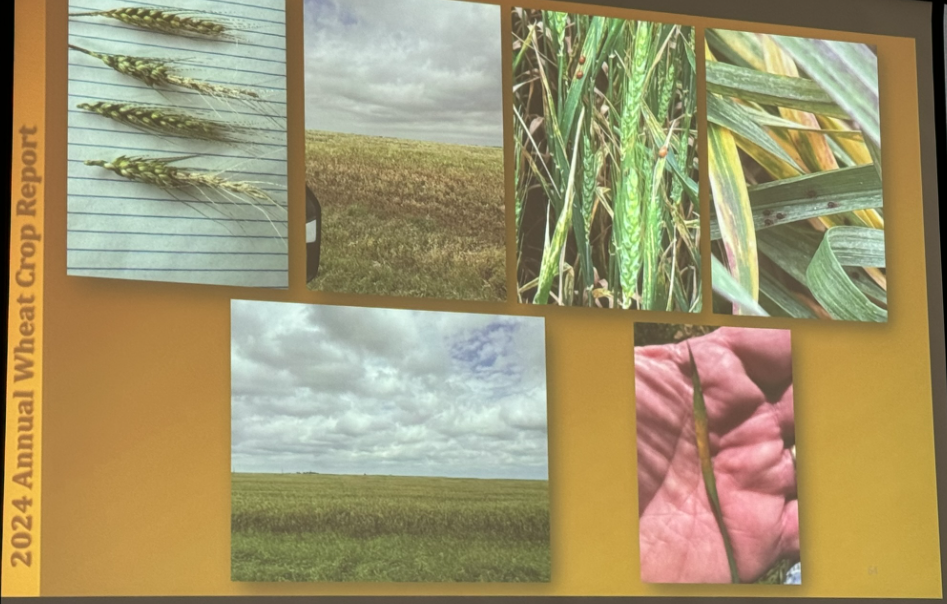
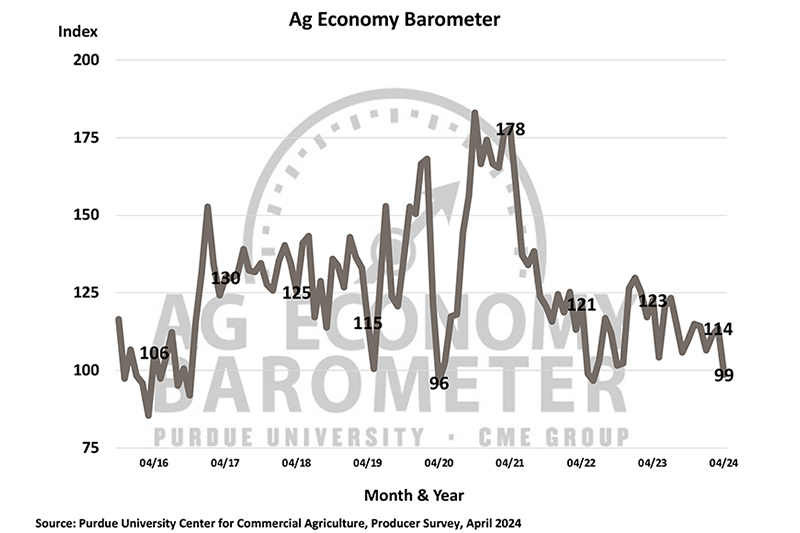
April witnessed a steep decline in U.S. farmer sentiment, as indicated by the Purdue University/CME Group Ag Economy Barometer, which fell 15 points from March to a reading of 99. Both subindexes of the barometer also saw declines: The Current Condition Index dropped by 18 points to 83, while the Future Expectations Index fell by 14 points to 106. April marked the lowest farmer sentiment reading since June 2022 and the weakest current condition rating since May 2020. The sentiment decline was driven by worries regarding the current financial situation on farms and anticipated financial challenges in the coming year. The April Ag Economy Barometer survey was conducted from April 8-12, 2024.
"Farmers' sentiment took a significant hit in April, reflecting broader concerns about financial performance and farmland values," said James Mintert, the barometer's principal investigator and director of Purdue University's Center for Commercial Agriculture.
The Farm Financial Performance Index declined to 76 in April, marking a 7-point drop from the previous month and a 21-point decrease from last fall's peak of 97. This downturn reflects farmers' growing concerns about the upcoming year's financial outlook, with fewer respondents expecting better or equal performance than last year.
Farmers' expectations regarding interest rates and farmland values shifted in April's survey. Only 24% of respondents anticipate interest rates rising over the next year, down from 32% in March. Fewer farmers this month also said they expect to see farmland values rise over the next year, despite the modest improvement in their interest rate outlook, while more farmers reported that they look for farmland values to hold steady. In the April survey, just 29% of producers said they expect farmland values to rise in the upcoming year, compared to 38% who felt that way in March. These shifts reflect farmers' concern about farm financial performance in 2024, outweighing their improved interest rate outlook.
There is growing interest in using farmland for solar energy production, and solar lease rates appear to be increasing. This month's survey revealed a 7-point uptick in respondents reporting discussions with companies about solar energy leases, reaching 19% compared to 12% in March. Specifically, discussions around solar leasing suggest demand for solar leases is increasing, with 58% of farmers reporting lease rate offers exceeding $1,000 per acre — up from 54% in March. Over one-fourth of respondents (28%) said they were offered a farmland lease rate of $1,250 or more per acre. Rising lease rates for energy production could be starting to impact farmland values, at least in some areas. Among producers who said they expect values to rise in the next year, 8% of respondents highlighted energy production as a key reason.
"Looking ahead, energy production activities could provide some support for farmland values and expectations in some regions," said Mintert.
About the Purdue University Center for Commercial Agriculture
The Center for Commercial Agriculture was founded in 2011 to provide professional development and educational programs for farmers. Housed within Purdue University's Department of Agricultural Economics, the center's faculty and staff develop and execute research and educational programs that address the different needs of managing in today's business environment.
About CME Group
As the world's leading derivatives marketplace, CME Group enables clients to trade futures, options, cash and OTC markets, optimize portfolios, and analyze data — empowering market participants worldwide to efficiently manage risk and capture opportunities. CME Group exchanges offer the widest range of global benchmark products across all major asset classes based on interest rates, equity indexes, foreign exchange, energy, agricultural products and metals. The company offers futures and options on futures trading through the CME Globex platform, fixed income trading via BrokerTec and foreign exchange trading on the EBS platform. In addition, it operates one of the world's leading central counterparty clearing providers, CME Clearing.
CME Group, the Globe logo, CME, Chicago Mercantile Exchange, Globex, and E-mini are trademarks of Chicago Mercantile Exchange Inc. CBOT and Chicago Board of Trade are trademarks of Board of Trade of the City of Chicago, Inc. NYMEX, New York Mercantile Exchange and ClearPort are trademarks of New York Mercantile Exchange, Inc. COMEX is a trademark of Commodity Exchange, Inc. BrokerTec is a trademark of BrokerTec Americas LLC and EBS is a trademark of EBS Group LTD. The S&P 500 Index is a product of S&P Dow Jones Indices LLC ("S&P DJI"). "S&P®", "S&P 500®", "SPY®", "SPX®", US 500 and The 500 are trademarks of Standard & Poor's Financial Services LLC; Dow Jones®, DJIA® and Dow Jones Industrial Average are service and/or trademarks of Dow Jones Trademark Holdings LLC. These trademarks have been licensed for use by Chicago Mercantile Exchange Inc. Futures contracts based on the S&P 500 Index are not sponsored, endorsed, marketed, or promoted by S&P DJI, and S&P DJI makes no representation regarding the advisability of investing in such products. All other trademarks are the property of their respective owners.
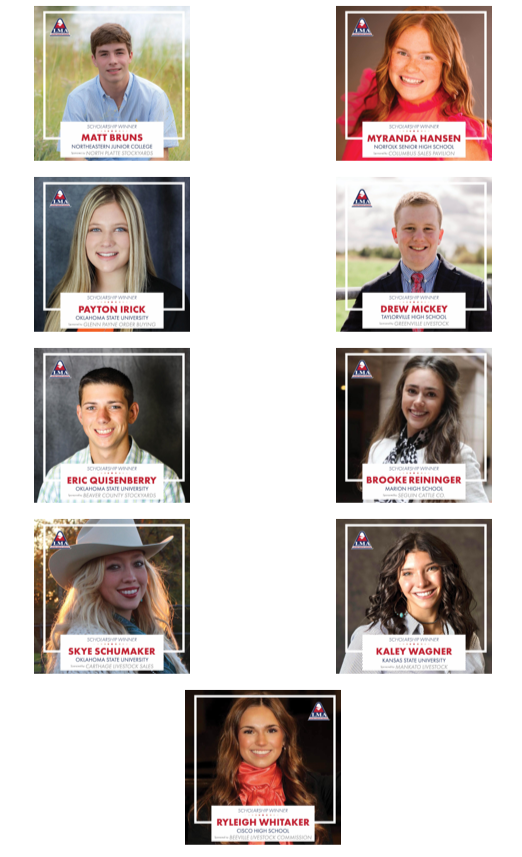
Nine students have been selected to receive $2,500 scholarships from the Livestock Marketing Association, or LMA, Scholarship Program.
The LMA Scholarship Program, now in its second year, was expanded to support more students with aspirations of using their careers to support the livestock and livestock marketing industry. Applicants must be sponsored by an LMA member livestock marketing business and answer essay questions on issues of importance to the industry.
The 2024 LMA scholarship recipients are as follows:
"The applications exceeded our expectations again this year," LMA President Mark Barnett said. "Our industry has a bright future with young people like those that applied having an interest and desire to remain involved in agriculture." For more information on the LMA Scholarship Program, visit lmaweb.com/About/scholarships or email lmainfo@lmaweb.com.
Agricultural operations in Oklahoma have been significantly impacted by recent tornadoes. The U.S. Department of Agriculture (USDA) has technical and financial assistance available to help farmers and livestock producers recover from these adverse weather events. Impacted producers should contact their local USDA Service Center to report losses and learn more about program options available to assist in their recovery from crop, land, infrastructure, and livestock losses and damages.
USDA Disaster Assistance
Producers who experience livestock deaths in excess of normal mortality or sell injured livestock at a reduced price may be eligible for the Livestock Indemnity Program (LIP). To participate in LIP, producers will have to provide acceptable documentation of death losses or evidence of reduced sales resulting from an eligible adverse weather event and must submit a notice of loss to the USDA Farm Service Agency (FSA) no later than the annual program payment application date, which is 60 calendar days following the calendar year in which the loss occurred. The LIP payment application and notice of loss deadline is March 3, 2025, for 2024 calendar year losses. Livestock producers who experience losses related to tornadoes should check with their local FSA office for LIP eligibility criteria.
Meanwhile, the Emergency Assistance for Livestock, Honeybees, and Farm-Raised Fish Program (ELAP) provides eligible producers with compensation for feed and grazing losses. For ELAP, producers are required to complete a notice of loss and an application for payment to their local FSA office no later than the annual program application deadline, Jan. 30, 2025, for 2024 calendar year losses.
"Once you are able to evaluate the impact on your operation, be sure to contact your local FSA county office to timely report all crop, livestock and farm infrastructure damages and losses," said Steve Kouplen, State Executive Director for FSA in Oklahoma. "To expedite FSA disaster assistance, you will likely need to provide documents, such as farm records, herd inventory, receipts and pictures of damages or losses."
FSA also offers a variety of direct and guaranteed farm loans, including operating and emergency farm loans, to producers unable to secure commercial financing. Producers in counties with a primary or contiguous disaster designation may be eligible for low interest emergency loans to help them recover from production and physical losses. Loans can help producers replace essential property, purchase inputs like livestock, equipment, feed and seed, cover family living expenses or refinance farm-related debts and other needs. Additionally, FSA offers several loan servicing options available for borrowers who are unable to make scheduled payments on their farm loan programs debt to the agency because of reasons beyond their control.
The Farm Storage Facility Loan Program (FSFL) provides low-interest financing so producers can build, repair, replace, or upgrade facilities to store commodities. Loan terms vary from three to 12 years. Producers who incurred damage to or loss of their equipment or infrastructure funded by the FSFL program should contact their insurance agent and their local USDA Service Center. Producers in need of on-farm storage should also contact USDA.
Risk Management
Producers who have risk protection through Federal Crop Insurance or FSA's NAP should report crop damage to their crop insurance agent or FSA office. If they have crop insurance, producers should provide a notice of loss to their agent within 72 hours of initial discovery of damage and follow up in writing within 15 days.For NAP covered crops, a Notice of Loss (CCC-576) must be filed within 15 days of the loss becoming apparent, except for hand-harvested crops, which should be reported within 72 hours.
"Crop insurance and other USDA risk management options are offered to help producers manage risk because we never know what nature has in store for the future," said James Bellmon, Director of USDA's Risk Management Agency (RMA) Regional Office that covers Oklahoma. "The Approved Insurance Providers, loss adjusters and agents are experienced and well-trained in handling these types of events."
Conservation
FSA's Emergency Conservation Program (ECP) and Emergency Forest Restoration Program (EFRP) can assist landowners and forest stewards with financial and technical assistance to restore fencing, damaged farmland or forests, and remove debris from feed stocks, water supplies and feeding areas.
USDA's Natural Resources Conservation Service (NRCS) is always available to provide technical assistance during the recovery process by assisting producers to plan and implement conservation practices on farms and working forests impacted by natural disasters. The Environmental Quality Incentives Program (EQIP) can help producers plan and implement conservation practices on land impacted by natural disasters.
"The Natural Resources Conservation Service can be a very valuable partner to help landowners with their recovery and resiliency efforts," said Jeanne Hamilton, NRCS State Conservationist in Oklahoma. "Our staff will work one-on-one with landowners to make assessments of the damages and develop approaches that focus on effective recovery of the land."
Assistance for Communities
Additional NRCS programs include the Emergency Watershed Protection (EWP) program, which assists local government sponsors with the cost of addressing watershed impairments or hazards such as debris removal and streambank stabilization.
Eligible sponsors include cities, counties, towns or any federally recognized Native American tribe or tribal organization. Sponsors must submit a formal request (by mail or email) to the NRCS state conservationist for assistance within 60 days of the natural disaster occurrence or 60 days from the date when access to the sites become available. For more information, please contact your local NRCS office.
More Information
Additional USDA disaster assistance information can be found on farmers.gov, including USDA resources specifically for producers impacted by tornadoes. Those resources include the Disaster Assistance Discovery Tool, Disaster-at-a-Glance fact sheet and Loan Assistance Tool. For FSA and NRCS programs, producers should contact their local USDA Service Center. For assistance with a crop insurance claim, producers and landowners should contact their crop insurance agent.
USDA touches the lives of all Americans each day in so many positive ways. In the Biden-Harris administration, USDA is transforming America's food system with a greater focus on more resilient local and regional food production, fairer markets for all producers, ensuring access to safe, healthy and nutritious food in all communities, building new markets and streams of income for farmers and producers using climate-smart food and forestry practices, making historic investments in infrastructure and clean energy capabilities in rural America, and committing to equity across the Department by removing systemic barriers and building a workforce more representative of America. To learn more, visit www.usda.gov
USDA is an equal opportunity provider, employer and lender.
The American Simmental Association Board of Trustees Chairman, Chris Ivie, reports that the Executive Vice President, Dr. Wade Shafer, announced his retirement at the conclusion of the April board meeting, effective June 30, 2025.
Dr. Shafer's leadership and vision have been key to positioning the American Simmental Association and International Genetic Solutions (IGS) at the forefront of the beef industry. His unwavering commitment to sound and credible science as the linchpin for commercial success is widely known. This mindset permeates the Simmental business, its breeders, and its staff, and is widely credited for the Simmental resurgence in recent decades. Dr. Shafer's stewardship of this approach, along with his humility and constant openness to collaborations with other like-minded individuals and organizations, has directly benefited the business at large and personally impacted the lives and futures of innumerable farm and ranch families.
Dr. Shafer often states that "data is our lifeblood". His institution of policies and approaches have helped establish the largest data pool and the only large-scale, multi-breed genetic evaluation in the global beef business — International Genetic Solutions. A collaborative IGS is crucial to sound science, but even more, is vital to allowing independent beef producers access to the genetic tools needed to ensure success for them and their families. The team that Dr. Shafer has assembled embraces his call to make sound, thoughtful business decisions while using that business to aid the industry at every turn. This commitment well into the future will be Dr. Shafer's Simmental legacy.
The Executive Committee serves as the search and hiring committee for the Executive Vice President position. Watch for additional details at www.simmental.org.
Founded in 1968, the American Simmental Association is headquartered in Bozeman, MT. ASA is committed to leveraging technology, education, and collaboration to accelerate genetic profitability for the beef industry. In keeping with its commitment, ASA, along with its partners, formed International Genetic Solutions — the world's largest genetic evaluation of beef cattle. Learn more at www.simmental.org.

Celebrating a remarkable milestone, the National Corn Growers Association (NCGA) proudly announced the launch of its 60th annual Yield Contest on Wednesday, May 1. This iconic event—spanning six decades—has been a testament to the ingenuity and dedication of corn growers across the nation. From humble beginnings to its current prominence, the contest continues to attract participants eager to push the boundaries of agricultural innovation.
"As we celebrate sixty years of the Yield Contest, we reflect not only on the remarkable achievements of our past winners but also on the enduring legacy of innovation and excellence that defines this event," said Minnesota grower and NCGA President Harold Wolle. "From generation to generation, this contest has not only showcased the incredible potential of American agriculture but has also fueled a spirit of camaraderie and collaboration among growers nationwide. As we look to the future, we remain committed to fostering this legacy, inspiring growers to push the boundaries of what's possible and ensuring a prosperous tomorrow for generations to come."
Open for entries from now until August 14, this year's contest promises to be another thrilling chapter in corn-growing history. Among the highlights is Class J, the Nitrogen Management Class, which enters its second year, showcasing opportunities to think differently about fertilizer management while still achieving high yields. As contestants vie for top honors, NCGA's Yield Contest stands as a testament to the relentless pursuit of excellence in American agriculture, inspiring generations of growers to achieve new heights in crop production.
Attorney General Gentner Drummond told a U.S. House subcommittee this morning how a revised rule by the Environmental Protection Agency (EPA) will have devastating consequences for Oklahoma and other states. Drummond had been invited by the House Subcommittee on Environment, Manufacturing, and Critical Materials to deliver testimony for a hearing titled "EPA's RMP Rule: Failures to Protect the American People and American Manufacturing." The subcommittee is part of the House Committee on Energy and Commerce.
Drummond told subcommittee members he has filed a number of lawsuits against the Biden Administration for federal overreach, but the agency he has litigated more than any other is the EPA.
"Unfortunately, EPA consistently promotes policies and issues rules that are bad for businesses, harmful to consumers, and outright hostile to America's oil and gas industry," he said. "The rule under review today is no exception."
Slated to take effect Friday, the expanded final rule of the EPA's Risk Management Program (RMP) will impact facilities that handle threshold quantities of specific chemicals.
"Adding to the regulatory burden of any private enterprise without providing sufficient corresponding benefit is a recipe for economic drag. The final RMP rule is a new burden that potentially applies to a wide range of businesses and facilities in my state and across the country," Drummond testified.
"The obvious and most concerning entities are petroleum refineries and chemical manufacturers, but the list does not end there. Also subject to the new rule would be chemical and petroleum wholesalers and terminals; midstream gas plants; agricultural chemical distributors; food manufacturers and packing plants; and a wide range of other businesses that use substances covered by the new rule."
While the EPA estimates that compliance to the rule will cost businesses more than $250 million annually, the Attorney General noted that American consumers will be subject to far greater costs, especially at the gas pump.
"There would have to be a very substantial benefit to justify these costs," said Drummond. "Unfortunately, the new rule provides none. It is the proverbial solution in search of a problem."
At the National Association of Farm Broadcasters (NAFB) annual Washington Watch event in Washington, D.C., Farm Director KC Sheperd talked with the American Farm Bureau Federation's Chief Economist, Roger Cryan, about the decision by USDA NASS to discontinue select 2024 data collection programs and reports.
As of April 2024, USDA's National Agricultural Statistics Service (NASS) has announced the canceling the July Cattle report and the discontinuation of the Cotton Objective Yield Survey, as well as all County Estimates for Crops and Livestock beginning with the 2024 production year. According to USDA, the decision to discontinue these surveys and reports was not made lightly but was necessary, given appropriate budget levels.
"All of those reports are important," Cryan said. "We understand there have been some cuts. Some of those are a really important reports."
Cryan said cutting the July Cattle Report, of all reports, seems incomprehensible.
"The other reports are focused on the end of the year as well, so we will have to see what happens and whether the Secretary finds some resources for this year, and Congress finds some resources for next year," Cryan said. "NASS does important work. They work hard to do it efficiently. They do need some updates on their IT stuff, but we need this data."
Regarding the 2022 Census of Agriculture that was recently released, Cryan said the piece that stuck out most to him was the number of farms lost over the past five years.
"That is one of the reasons it is so important for us to have a good Farm Bill, not just this year, but every five years," Cryan said.
The Census of Agriculture is an incredibly rich source of data, Cryan said, and anyone who is trying to tell the story of agriculture in their state, county, or congressional district can find an amazing amount of detail broken down in the report.
"It is all extremely valuable information," Cryan said.
| ||||||||||||||||||||||||||||||||||||||||||||||||||||||||||||||||||||||||||||||||||||||||||||||||||||||||||||||||||||||||||||||||||||||||||||||||||||||||||||||||||||||||||||||||||||||||||||||||||||||||||||||||||||||||||||||
|
Since assisting its very first farm family in 2006, Farm Rescue has officially helped 1,000 families stricken by unexpected crises, and Busch Light is a proud partner in these efforts. Additionally, since 2019, Busch Light has helped raise $1.2MM for the organization to date. In 2020, the release of Busch Light Corn Cans directly helped fund Farm Rescue's expansion into Kansas, and to this day, Busch Light continues to raise funds for Farm Rescue through its Corn Cans and tailored campaigns to support the farming and ranching communities that are near and dear to the brand's heart.
Through its work to spread awareness about Farm Rescue, Busch Light aims to encourage any farm or ranch family who has experienced a major illness, injury or natural disaster to apply for assistance at FarmRescue.org. With support from Busch Light, Farm Rescue is able to provide necessary equipment and/or volunteers to plant, harvest crops, as well as assist with livestock feeding.
Farmers and ranchers are truly the backbone of America, and Busch Light recognizes the impact they have on its physical product and on America's economy, so the brand wants to do everything in its power to support these farms and ranches, as well as the families that run them.
The U.S. Department of Agriculture (USDA) today announced approximately $22.3 million available to community-based and nonprofit organizations, institutions of higher education, and Tribal entities that help underserved and veteran farmers and ranchers own and operate successful farms. Funding is made through USDA's 2501 Program. This program is administered by USDA's Office of Partnerships and Public Engagement (OPPE).
"2501 Program partners are based in local communities and rural areas where they serve a critical role in maximizing USDA's outreach efforts to underserved communities," said OPPE Director Lisa Ramírez. "They provide training and technical assistance to help these agricultural producers succeed and also connect them to USDA programs and services."
For more than 30 years, and in partnership with organizations nationwide, the 2501 Program has helped reach underserved farmers and ranchers. The 2014 Farm Bill expanded the program to include assistance to veteran farmers and ranchers. The 2018 Farm Bill increased mandatory funding for the program through fiscal year 2024. With 2501 funding, organizations conduct education, training, farming demonstrations, and conferences on farming and agribusiness.
Since 2010, the 2501 Program has continued to increase access to USDA's programs and services and awarded 615 grants totaling more than $194 million. For example, FY 2023 grantee Farm to Table Guam is helping farmers in Guam with business training, financial planning, and technical assistance in crop production and distribution. Quivira Coalition is reaching rural producers in New Mexico with radio spots in English, Spanish, and Diné Bizaad (Navajo) about arid land stewardship practices and conservation.
Eligible applicants include not-for-profit organizations, community-based organizations, and a range of higher education institutions.
Applications must be submitted through grants.gov and received by Friday, July 5, 2024. Visit the 2501 Program page for more information on the 2501 funding opportunity.
Learn more through upcoming webinars:
Session 1: May 22, 2024, at 2 p.m. EDT
Session 2: June 26, 2024, at 2 p.m. EDT
Call for Peer Review Panelists
USDA seeks qualified individuals to serve as peer reviewers to evaluate 2501 program proposals for fiscal year 2024. The peer review approach brings together diverse individuals who can provide fair, expert and unbiased evaluation of proposals. The process ensures that grant projects are properly planned, competition is open and fair, proposed budgets are carefully examined, and grant awards are structured to protect the interests of the government. The entire review process will be conducted virtually for approximately three to four weeks. Selected reviewers will receive compensation. Visit the OPPE website for full details. If you are interested in serving on the peer review panel, and your affiliated organization is not applying for a 2501 grant, please send your resume and summary of qualifications to 2501grants@usda.gov no later than May 22, 2024, for consideration.
USDA touches the lives of all Americans each day in so many positive ways. In the Biden-Harris Administration, USDA is transforming America's food system with a greater focus on more resilient local and regional food production, fairer markets for all producers, ensuring access to safe, healthy, and nutritious food in all communities, building new markets and streams of income for farmers and producers using climate smart food and forestry practices, making historic investments in infrastructure and clean energy capabilities in rural America, and committing to equity across the Department by removing systemic barriers and building a workforce more representative of America. To learn more, visit www.usda.gov.
For nearly 100 years, the history of the farm bill largely tracks the history of food production in the United States as the legislation has evolved to meet the needs of farmers and consumers alike. Agriculture's role in providing food security, and in turn national security, to the United States is more important than ever. And now, work on the next farm bill continues during a period of volatility on every front – political, economic, environmental and beyond.
Farming and ranching are not for the faint of heart. Taking on a substantial amount of risk is part of the business. The year starts with a farmer making extensive investments by purchasing inputs like seed, fertilizer, equipment and its maintenance, fuel, crop protectants and pest control, which can easily total hundreds of thousands of dollars. That's just to get a crop in the ground. Those investments can be wiped out, suddenly, with a single destructive weather event, pest infestation or disease that causes a crop loss or decline in revenue. After successfully navigating mother nature, farmers who harvest a crop still face massive risk as price-takers in commodity markets with significant price volatility by the time that crop is ready to be sold.
Given historically slim, and often negative, profit margins, farmers are often reliant on lines of credit borrowed from financial institutions at the cost of interest. When all or nearly all of a crop is lost, farmers, who don't have significant cash reserves to begin with, risk defaulting on their loans and losing their farm. Without some form of risk management protection in place, the liability of farming becomes impossible to maintain. Crop insurance is not merely a safety net but a lifeline for farm businesses, the rural communities they support and the food supply. The 2024 Feeding the Economy study found that the U.S. food and agricultural sectors directly support nearly 24 million jobs (over 15% of U.S. employment) and more than $9.6 trillion of the nation's economic activity (20% of total U.S. economic output).
This article reviews the comparative cost of crop insurance and makes the case for why crop insurance is a critical tool in the toolbox, that when aligned with other Title I farm bill programs keeps U.S. farmers farming and U.S. consumers fed and fueled. An overview of crop insurance basics is provided here. Livestock and dairy risk management programs have been discussed in Livestock and the Farm Bill and Overview of Dairy Programs in the Farm Bill.
Low Federal Spending
The Federal Crop Insurance Program (FCIP) is authorized by the Agricultural Adjustment Act of 1938 and the Federal Crop Insurance Act of 1980 and operates as a public-private partnership. Through farm bills and appropriations, Congress makes changes to the program, expands coverage and directs research. USDA, through the Risk Management Agency (RMA) and the Federal Crop Insurance Corporation (FCIC), supports a portion of premiums needed for farmers to acquire insurance plans and compensates Approved Insurance Providers for the cost of administering and delivering those plans.
In February 2024, the Congressional Budget Office (CBO) projected that crop insurance expenses from 2024 to 2034 would total $124 billion, accounting for approximately one-tenth of 1% of total projected federal spending. To put this in perspective, CBO projects spending on interest to service public debt at $12.44 trillion during this same period, over 100 times larger than the cost of delivering and administering crop insurance. The entire farm bill, including the Supplemental Nutrition Assistance Program (SNAP), plus non-farm bill nutrition programs represent only 2.09% of the total federal budget. Just 2% of federal spending directly supports essential farm and nutrition programs crucial for food security, farm economic sustainability, conservation and natural resource preservation efforts.
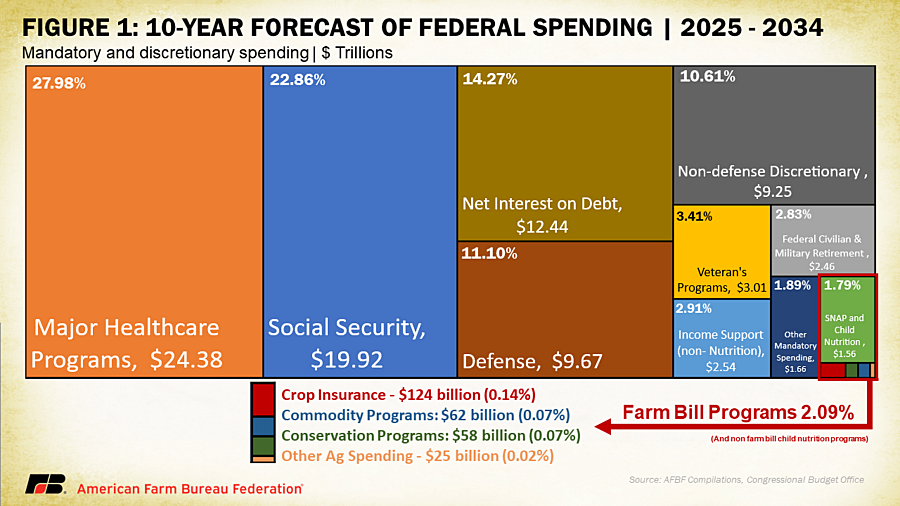
At its core, crop insurance is the farm bill program that keeps farmers farming year-to-year, maintaining a supply of domestically grown agricultural products to feed and fuel consumers at home and abroad. In the words of my grandfather, "Nothing is free." So, how much would, or should, a taxpayer pay for this service? A standard Netflix subscription is currently $15.49 a month and a Starbucks coffee ranges from $1.94 to over $4.95 per cup. Based on RMA's calculations of direct costs of the FCIP, on average, crop insurance has cost each American about $2.18 per month since 2008. Crop insurance costs have remained relatively stable since 2008 and the most recent upticks can be attributed to expanded access to the program proven by the significant increase in number of enrolled policies and increased commodity prices. Optimizing program management and execution to ensure efficient use of taxpayer dollars is vital, but exaggerating the cost of crop insurance to the federal government is detrimental to supporting a secure food supply and having fruitful budget reform.
By statute, crop insurance must be actuarily sound: over time, every dollar paid out in indemnities should match every dollar collected in premiums. Plus, premiums are adjusted as risk conditions change, similar to a driver's policy if they were in a car accident or accumulated several speeding tickets. These requirements and conditions keep program costs in check.
The Importance of Premium Support
Consider a home insurance example: If you live on the coastline in the hurricane-prone Southeast, you likely pay more for your homeowners' insurance than someone who lives in the less hurricane-prone Northeast. Likewise, if you're a newly licensed driver, your car insurance premiums are usually higher than drivers who have a safe driving record over many years. In both cases, premiums, the cost of the policy, are set in terms of risk exposure. The business of growing crops is, comparatively, riskier than driving a car or owning a home. Conditions like freezes and heavy rains rarely destroy homes and cars but can eliminate millions of acres of agricultural production, thus business revenue, in mere hours. Crop insurance offers protection for farm businesses from events completely out of their control. The cost of the premium is shared across the food system because the cost of the policy, due to the high-risk nature of farming, would be too high for farmers to make ends meet from year-to-year. Crop insurance cannot be offered by the private sector alone due to correlated risk. If I get into a car accident, it doesn't impact my neighbor's likelihood of getting into a car accident. However, if there is a severe drought in the Midwest, for example, all the farmers in the region will be impacted. This would make crop insurance products financially unattainable for farmers without government support. The premium support keeps the insurance costs from being too high for farmers to make ends meet even during good years. Premium discounts authorized by the farm bill exist to both protect the domestic food system and sustain farmer enrollment.
Premium discounts are set by Congress and are permanent until Congress changes them. Discount rates decrease as coverage levels increase and the corresponding deductible chosen by the farmer decreases. Going back to the car insurance comparison, after a car accident when a car is considered totaled, the insurance policy usually pays equal to the vehicle's actual worth minus the deductible chosen by the insured. This deductible can be anywhere from zero to a couple of thousand dollars. Even at the highest levels of crop insurance coverage, individual crop insurance plans pay a maximum of 85% of the expected value of the crop. This means 15% of the liability of a farmer's crop is lost as a deductible, which can equal tens of thousands of dollars even for the most expensive policy. Yet farmers still purchase at that level because it's so essential to their risk management. Some farmers will purchase additional supplemental and enhanced coverage options that can lift coverage levels higher, but only up to 95% of expected value, not 100% (this differs from some livestock insurance products that do offer protection of up to 100% of the expected ending value).
For most farmers, selected coverage levels are closer to the 70% range, meaning farmers must experience a 30% decline in actual revenue (under expected revenue) before crop insurance comes into play. Figure 2 displays the average per acre revenue decline farmers must absorb before crop insurance is triggered. For example, an average corn farmer must face over $204 in lost revenue per acre before crop insurance would trigger, a bit more than 31% of the total value of the crop. To put things in perspective, in 2023, the cost to grow and harvest an acre of corn in Illinois (excluding any cash rent) was estimated at $812. For a 350-acre farm this means the same farmer would have to face over $70,000 in revenue losses before crop insurance is triggered, an area of land that easily could cost $284,000 to farm.
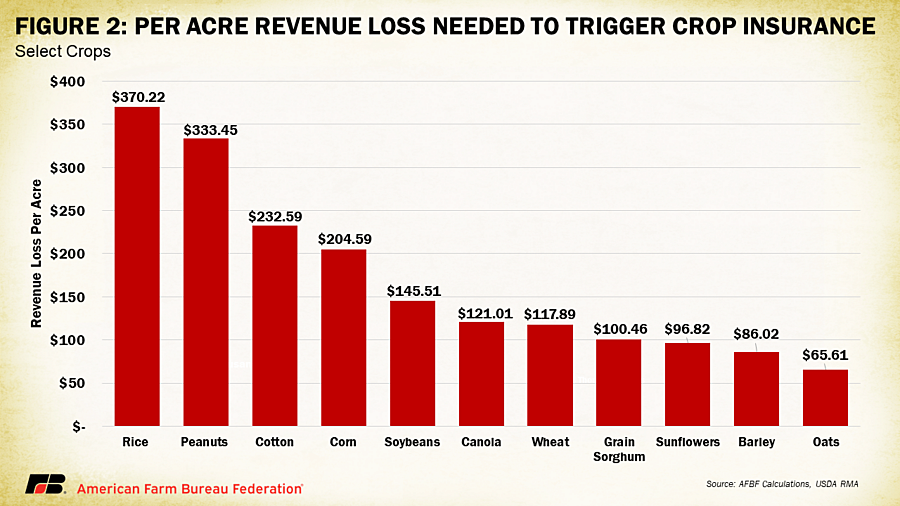
Factors Leading to Increased Indemnities
There are quite a few reasons indemnities have increased. In recent years, market conditions have driven up the prices of many crops. When the program insures farmers' crops at these higher market-driven prices, it naturally results in higher payouts in the event of crop losses or a decline in revenue. To illustrate, consider having car insurance for a 2012 model of a non-luxury car and then upgrading to a 2024 model of the same car. The value of the new car far exceeds that of the old one. If both cars were totaled, the insurance plan for the newer model would pay out more due to its higher market value. Similarly, elevated commodity prices between 2011-2012 and 2021-2022 have led to higher insured liabilities and associated indemnity payments compared to periods of lower prices in between.
Moreover, the FCIP has expanded its offerings significantly over the past two decades. From 2000 to 2023 the number of policies sold has increased from 1.94 million to 2.34 million, and insured acreage has correspondingly swelled from 206 million to 539 million acres. More coverage options for more crops incentivizes more enrollment, leading to higher overall insured liabilities and corresponding indemnities. Between 2000 and 2023, liabilities have increased from $34 billion to $181 billion. Of note, this time period also saw an increase in farmer-paid premiums from $1.59 billion to $6.78 billion. Broader participation from more farms in more locations that grow different crops and are of different sizes balances the overall risk pool and contributes significantly to the stability of the crop insurance program.
Importantly, the percentage of liabilities indemnified reveals whether losses are becoming increasingly larger. Between 2000 and 2023, an average of 8% of liabilities were indemnified under crop insurance with no upward trend in losses present. An indemnification rate of 8% was even common between 2000-2011 and 2012-2023, showing that as the program grew, payouts did not become proportionally higher. Indemnified liabilities peaked in 2012 at 15% during a massive drought. Rains in 2019 caused over 20 million acres of prevented planting, pushing indemnified liabilities up to 10%. In 2022 extreme drought pressured plans again with 11% of liabilities indemnified. Comparatively low losses in other years offsets years with major weather disasters. In 2023 indemnified liabilities were only 7%. As crop insurance options continue to become more widely available, participation will increase, which also leads to a higher likelihood of more indemnities triggered when a severe event occurs. Crop insurance works when payments are made when a qualifying loss occurs. If you receive a payment from your auto insurer after an accident that's usually a positive experience, not a negative one. A crop insurance program that effectively supports producers during times of loss is a working program.

Gaps Still Exist for Specialty Crop Growers
Critics often define crop insurance by what it doesn't cover. There are gaps that leave producers of certain crops and in certain regions with few-to-no risk management options. Specialty crops, for example, often face higher levels of risk than crops grown at substantially higher volumes. Increased sensitivity to weather, pests and diseases; increased reliance on labor; and more uncertainty in price and the ability to find buyers all increase risks for specialty crop growers. Establishing data-heavy actuarily sound crop insurance policies for products sold in thinner markets, with fewer buyers and sellers, is an uphill battle. A previous article, Specialty Crop Considerations for the Farm Bill, dives deeper into these dynamics.
Significant advances have been made in providing more coverage for fruit, vegetable and nut growers. Coverage options have expanded with over 80 commodity and sub-commodity categories added since 1989. According to RMA summary of business data, in 1989 there were 28,375 specialty crop policies sold. As of 2023, specialty crop policies sold reached over 120,000 – more than quadrupling in the past 34 years. Liabilities from specialty crop polices have increased from $9.2 billion in 2003 to $23.2 billion in 2023, which speaks to the increased number of policies and price value of the specialty crops covered. Specialty crops hold 14% of total U.S. crop insurance liabilities, but, by value, represent 21% of all crops grown in the U.S. The top specialty crops covered in these policies include almonds, grapes, apples, potatoes, orange trees and tomatoes.
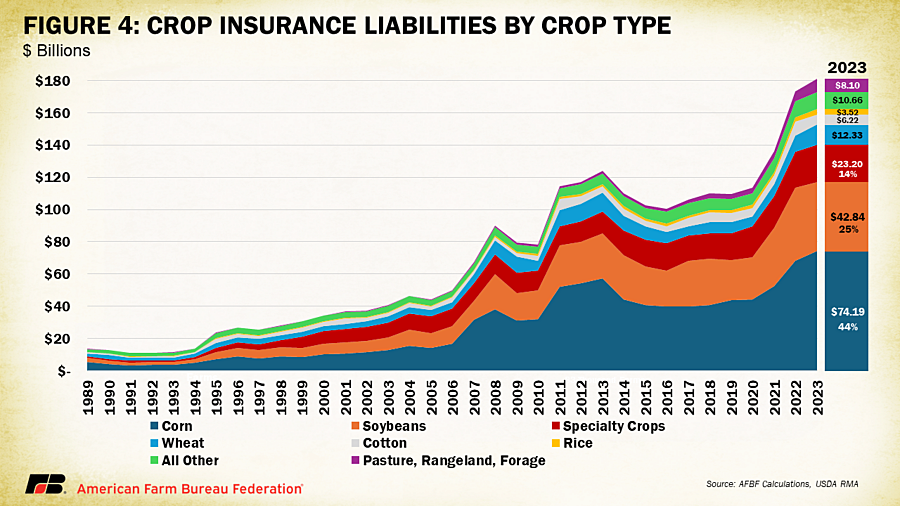
As crop insurance policies expand coverage, it reduces the gaps that need to be filled by ad hoc government assistance that generally comes at a higher price to taxpayers. Not to mention, ad hoc assistance often takes years to reach impacted producers and is not guaranteed. Options like the 508(h) submission process that allow for new crop insurance policies to be submitted and approved for sale helped expand crop insurance offerings to more producers of more specialized crops quickly. Making a comprehensive suite of effective risk management programs available to producers regardless of what crops they grow remains vital – an objective than can be reached through legislation like the farm bill and robust public-private partnerships as yielded in the 508(h) submission process.
Conclusion
Crop insurance, alongside Title I and standing disaster programs, stands as a cornerstone of agriculture's resilience, providing a vital safety net for nearly 370,000 farmers amid weather, pests and market fluctuations. Despite its critical value to farmers and ranchers, it faces significant criticism. The reality is that crop insurance is an actuarially sound government program that represents a small fraction of federal spending. It is a public-private partnership that works to secure the nation's food supply and support farmer sustainability in a way that is not entirely dependent on taxpayer funding, but instead spreads the risk of the program among farmers, private sector crop insurance companies and taxpayers. Crop insurance not only aids individual farmers in weathering the inherent risks of their profession but does so at a low per capita cost to each and every consumer. Just as every person purchases a home or automobile insurance product to mitigate risks against unforeseen events, farmers and ranchers purchase crop insurance to mitigate against the same acts of God that could wipe out their entire livelihood. Crop insurance also serves as a crucial tool for fostering agricultural innovation and investment as it enables farmers to make necessary financial commitments without fear of catastrophic losses.
While acknowledging there are gaps in coverage, particularly for specialty crop growers, it's essential to recognize the strides made in expanding coverage options and addressing these shortcomings through the farm bill and beyond. As the U.S. navigates an increasingly uncertain future, improving and enhancing crop insurance through passage of a new five-year farm bill is essential for safeguarding the livelihoods of farmers, the stability of rural economies and the reliability of our food system.
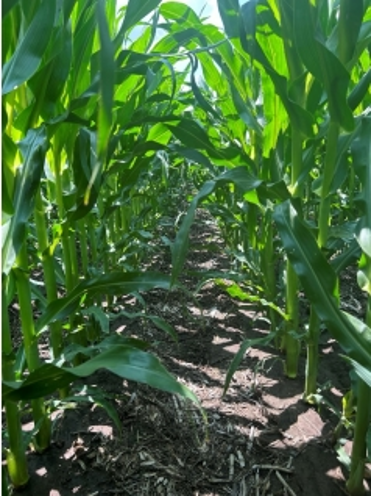
Crop canopy is one of the many important happenings during the rapid growth phase, helping with weed control and moisture retention.
Like a child going through a growth spurt, a corn plant requires a lot of nutrition during its rapid growth phase. In fact, a plant can take up 50% to 60% of its nitrogen needs during that V7 to tasseling stretch, says AgriGold Agronomist Sam McCord.
A lot happens during the phase. Corn plants are adding many leaves and lengthening internodes within the stalk, root systems are going gangbusters, and the plant is determining how many kernels it'll have down each row. Adequate and balanced nutrition is especially critical during this period of rapid growth.
Level-set before the season begins
Setting yourself up for success through the rapid growth time frame starts before seed goes in the ground. "Start with a soil test," McCord recommends. "That gives a baseline on what's available in the soil that you can build on through the season."
It's also important to set an attainable yield goal. "If you have an idea of where you want to be, it can help you determine the amount of nutrients you need to apply to reach that goal," McCord says. "Understanding what your ground can produce, what nutrients you have to begin with and what you need to add to hit that target will help you reach that goal."
Position crops to overcome weather challenges
Ideally, temperatures during the rapid growth period will be around 86 F during the day to encourage rapid growth and cool off to the 60s overnight, giving it a chance to reset, McCord says. That, plus adequate moisture, will help the crop thrive.
Obviously, you can't control the weather. But a good fertility program can help compensate for stressful conditions — such as if drought moves in.
"A plant takes up nutrients with water. If it's lacking a certain nutrient, it will pull in a lot of water as it tries to find more of that nutrient," McCord explains. "If soils have balanced and abundant fertility for the plant to take up, it will use water a lot more efficiently."
McCord typically recommends applying half to two-thirds of intended fertility ahead of or shortly after planting. "That gives you a window to come back and sidedress or make a post-application later in the season," he says. "It also gives you the flexibility to adjust your nutrient applications if detrimental weather hurts your stand and lowers your yield goals."
Macros and micros of note
Corn plants take up an abundance of nitrogen, phosphorus and potassium during the rapid growth phase, McCord says, adding that sulfur and zinc also play important roles.
"You want to be as efficient as possible with each nitrogen application. Whenever a nitrogen application occurs, I like to see sulfur go on with it," McCord says. Sulfur improves nitrogen utilization and nitrogen stabilization, which ultimately helps yields.
Another important micronutrient when it comes to nitrogen utilization is molybdenum. He explains, "You don't need a big amount, but if you can apply it with your nitrogen, you should. It can improve efficiency and uptake."
Are nutrients accessible to your corn crop?
Farmers also need to think through the nutrient balance. "Balance is one of the most challenging things to understand and apply," McCord says, noting there are some that interact and others that do not work well together.
"A soil test can give you a gauge on what's in the soil, but knowing whether they are available to the crop when it needs it is another story," he says. An AgriGold agronomist can help you understand your soil test results and put them to use.
Tissue sampling can show whether nutrients are making their way into the plant, McCord continues, noting it gives a snapshot in time of what's happening nutritionally within the plant. If farmers wait for visual evidence of a deficiency in the field to take action, they've likely already lost yield potential.
Fertility needs vary by Field GX™ family
McCord recommends farmers pay attention to the Field GX™ families their hybrids belong to. "Hybrid families play a role in terms of when and what amount of nutrients they need for optimal performance," he explains.
"Field GX Family F, for example, will benefit from later nitrogen applications that will help it flex in kernel depth," McCord explains. "Family B or Family A hybrids flex in length or girth, which means they require more nutrients earlier in the season."
His final piece of advice is to follow the four Rs of nutrient management — right source, right rate, right place and right time. McCord says, "Getting those nutrients closer to the plant when it needs it will help you get the most bang for your buck on nutrients."
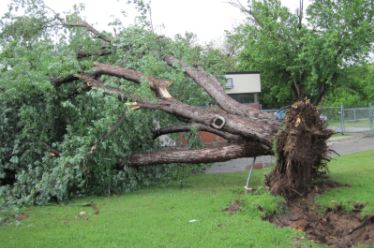
Agricultural operations in Oklahoma have been significantly impacted by recent tornadoes. The U.S. Department of Agriculture (USDA) has technical and financial assistance available to help farmers and livestock producers recover from these adverse weather events. Impacted producers should contact their local USDA Service Center to report losses and learn more about program options available to assist in their recovery from crop, land, infrastructure, and livestock losses and damages.
USDA Disaster Assistance
Producers who experience livestock deaths in excess of normal mortality or sell injured livestock at a reduced price may be eligible for the Livestock Indemnity Program (LIP). To participate in LIP, producers will have to provide acceptable documentation of death losses or evidence of reduced sales resulting from an eligible adverse weather event and must submit a notice of loss to the USDA Farm Service Agency (FSA) no later than the annual program payment application date, which is 60 calendar days following the calendar year in which the loss occurred. The LIP payment application and notice of loss deadline is March 3, 2025, for 2024 calendar year losses. Livestock producers who experience losses related to tornadoes should check with their local FSA office for LIP eligibility criteria.
Meanwhile, the Emergency Assistance for Livestock, Honeybees, and Farm-Raised Fish Program (ELAP) provides eligible producers with compensation for feed and grazing losses. For ELAP, producers are required to complete a notice of loss and an application for payment to their local FSA office no later than the annual program application deadline, Jan. 30, 2025, for 2024 calendar year losses.
"Once you are able to evaluate the impact on your operation, be sure to contact your local FSA county office to timely report all crop, livestock and farm infrastructure damages and losses," said Steve Kouplen, State Executive Director for FSA in Oklahoma. "To expedite FSA disaster assistance, you will likely need to provide documents, such as farm records, herd inventory, receipts and pictures of damages or losses."
FSA also offers a variety of direct and guaranteed farm loans, including operating and emergency farm loans, to producers unable to secure commercial financing. Producers in counties with a primary or contiguous disaster designation may be eligible for low interest emergency loans to help them recover from production and physical losses. Loans can help producers replace essential property, purchase inputs like livestock, equipment, feed and seed, cover family living expenses or refinance farm-related debts and other needs. Additionally, FSA offers several loan servicing options available for borrowers who are unable to make scheduled payments on their farm loan programs debt to the agency because of reasons beyond their control.
The Farm Storage Facility Loan Program (FSFL) provides low-interest financing so producers can build, repair, replace, or upgrade facilities to store commodities. Loan terms vary from three to 12 years. Producers who incurred damage to or loss of their equipment or infrastructure funded by the FSFL program should contact their insurance agent and their local USDA Service Center. Producers in need of on-farm storage should also contact USDA.
Risk Management
Producers who have risk protection through Federal Crop Insurance or FSA's NAP should report crop damage to their crop insurance agent or FSA office. If they have crop insurance, producers should provide a notice of loss to their agent within 72 hours of initial discovery of damage and follow up in writing within 15 days.
For NAP covered crops, a Notice of Loss (CCC-576) must be filed within 15 days of the loss becoming apparent, except for hand-harvested crops, which should be reported within 72 hours.
"Crop insurance and other USDA risk management options are offered to help producers manage risk because we never know what nature has in store for the future," said James Bellmon, Director of USDA's Risk Management Agency (RMA) Regional Office that covers Oklahoma. "The Approved Insurance Providers, loss adjusters and agents are experienced and well-trained in handling these types of events."
Conservation
FSA's Emergency Conservation Program (ECP) and Emergency Forest Restoration Program (EFRP) can assist landowners and forest stewards with financial and technical assistance to restore fencing, damaged farmland or forests, and remove debris from feed stocks, water supplies and feeding areas.
USDA's Natural Resources Conservation Service (NRCS) is always available to provide technical assistance during the recovery process by assisting producers to plan and implement conservation practices on farms and working forests impacted by natural disasters. The Environmental Quality Incentives Program (EQIP) can help producers plan and implement conservation practices on land impacted by natural disasters.
"The Natural Resources Conservation Service can be a very valuable partner to help landowners with their recovery and resiliency efforts," said Jeanne Hamilton, NRCS State Conservationist in Oklahoma. "Our staff will work one-on-one with landowners to make assessments of the damages and develop approaches that focus on effective recovery of the land."
Assistance for Communities
Additional NRCS programs include the Emergency Watershed Protection (EWP) program, which assists local government sponsors with the cost of addressing watershed impairments or hazards such as debris removal and streambank stabilization.
Eligible sponsors include cities, counties, towns or any federally recognized Native American tribe or tribal organization. Sponsors must submit a formal request (by mail or email) to the NRCS state conservationist for assistance within 60 days of the natural disaster occurrence or 60 days from the date when access to the sites become available. For more information, please contact your local NRCS office.
More Information
Additional USDA disaster assistance information can be found on farmers.gov, including USDA resources specifically for producers impacted by tornadoes. Those resources include the Disaster Assistance Discovery Tool, Disaster-at-a-Glance fact sheet and Loan Assistance Tool. For FSA and NRCS programs, producers should contact their local USDA Service Center. For assistance with a crop insurance claim, producers and landowners should contact their crop insurance agent. USDA touches the lives of all Americans each day in so many positive ways. In the Biden-Harris administration, USDA is transforming America's food system with a greater focus on more resilient local and regional food production, fairer markets for all producers, ensuring access to safe, healthy and nutritious food in all communities, building new markets and streams of income for farmers and producers using climate-smart food and forestry practices, making historic investments in infrastructure and clean energy capabilities in rural America, and committing to equity across the Department by removing systemic barriers and building a workforce more representative of America. To learn more, visit www.usda.gov
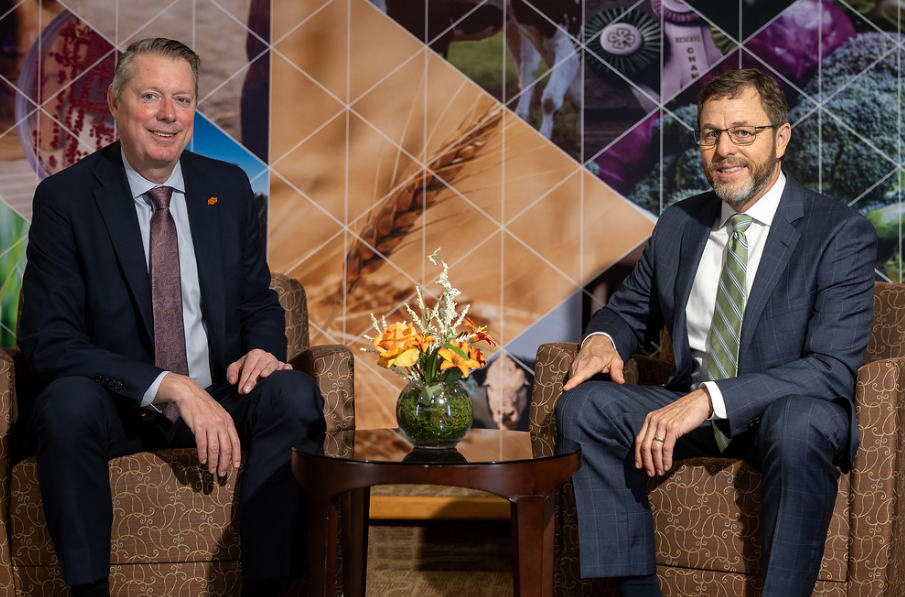
Oklahoma State University Agriculture is committed to elevating discussions about agriculture and bringing agricultural issues to the forefront through the Dean's Dialogue series.
Jayson Lusk, vice president and dean of OSU Agriculture, sat down with Steven Rhines, president and chief executive officer of Noble Research Institute, on April 29 and discussed Noble's goals and regenerative agricultural efforts.
Noble Research Institute is an independent nonprofit agricultural research organization that aims to improve land stewardship through soil health and producer profitability.
"Our purpose is to save U.S. grazing lands, and we do that by promoting land stewardship through management, building soil health, and keeping farmers and ranchers on the land," Rhines said.
Founded in 1945 by Lloyd Noble, Noble Research Institute was created to help revitalize agricultural land after the Dust Bowl. Noble is the largest nonprofit agricultural research organization in the United States.
During the past few years, Noble Research Institute underwent a strategic shift within its organization to fulfill Noble's original vision.
"We moved away from basic plant science," Rhines said. "We still have a research component, but it's incredibly applied. It works with farmers and ranchers and their challenges. All our research projects involve ranchers or producers, which I'm proud of."
Noble's research is more cause-and-effect focused, he said. Based on monitoring and measurement of the land, the intent is to provide farmers and ranchers with tools to make productive and profitable decisions based on the land and its health.
"On our ranches, we are measuring two dozen ecological indicators — above and below ground," Rhines said. "That is too many for the average producer; however, our researchers are working to get that down to two or three things that farmers or ranchers can measure, regardless of geography, that make a difference in their grazing management."
Noble Research Institute has expanded its research beyond southern Oklahoma and northern Texas to across the United States. They have partnered with several universities and organizations to help amplify their efforts and make these tools applicable nationwide.
"We are taking measurements across three incredibly different geographies — Oklahoma, Texas, Michigan, Colorado and Wyoming," Rhines said. "Measurement sites involve Noble properties, university properties and producer sites in each region. We engage those producers to join the process, whatever their grazing management style."
Noble considers different management approaches, geography and regional aridity, Rhines said. With more than a million acres in the study, the organization seeks to understand how these variables impact soil health, economics and producer well-being.
Research and ranching are only two components of Noble's operations. The emphasis is on producer education and helping farmers and ranchers increase productivity and profitability while building soil health.
Noble is offering courses and education in seven states during 2024 to help farmers and ranchers understand their land and improve its condition during grazing animal production. Later in 2024, much of its educational programming will be online to complement its in-person programs.
Michael Kelsey, executive vice president of the Oklahoma Cattlemen's Association and participant in the Dean's Dialogue, said events like this bring many opportunities to the forefront.
"These two institutions, Noble Research Institute and OSU, working together and moving forward can provide opportunities and ideas I can learn from," he said.
OSU Agriculture launched the Dean's Dialogue series in the fall of 2023 to focus on vital conversations in the agricultural industry.
"The Dean's Dialogue allows us to get together and talk in ways that will challenge us to think more broadly about some of the problems and issues we all care about," Lusk said. "We want to elevate discussions about agriculture within the Ferguson College of Agriculture and across the university, raising visibility for our programs and faculty here at home and around the country."
For a recap of the April 29 event, please view the Dean's Dialogue highlight video.

Renovo Seed is making waves in the seed industry with a first-of-its-kind test plot showcasing practical applications of cover crops, forages, and conservation seed. Producers are invited to tour the plot on Tuesday, July 2, 2024 at the Renovo Rally event in Brookings, South Dakota.
Alex Guttormsson, Team Agronomist for Renovo Seed, says the plot will help farmers and ranchers feel more confident in the decisions they make when it comes to planting alternative forages and grazing crops.
"There's not much for firm data regarding cover crops and conservation crops in terms of their agronomic impact on topics like organic matter, soil aeration, forage potential, and more. Renovo is investing in that research to take the guesswork out of diverse crop rotations for farmers and ranchers," shared Guttormsson. "We're testing things like nitrogen levels before and after cover crops and the nutritional value of dual-purpose grazing cover crops. We're collecting data to answer all the questions we typically get asked when someone is new to diverse crop rotations or wants to try something different on their operation," he continues.
Livestock producers, crop farmers, and seed dealers alike are invited to attend the Renovo Rally event on July 2, 2024 in Brookings, South Dakota to see the plot for themselves.
"We're rallying around proven, practical solutions at the Renovo Rally plot day. It's the first time we've done this event, and we will have speakers sharing about incentive programs for forage production, how to achieve year-round grazing, the agronomy of cover crops, how cover crops and forages can have a practical application on your operation, and more," shares Justin Fruechte, Ag Product Expert for Renovo Seed.
The event is happening on Tuesday, July 2, 2024 from 10 AM to 3 PM at the Millborn and Renovo Seed location in Brookings, South Dakota (2132 32nd Ave, Brookings, SD 57006). Plot and warehouse tours will be offered every hour, as well as speakers, a trade show with relevant vendors, and of course, a great lunch.
Shannon Kubik, Brand President for Renovo Seed, says this is one of many ways Renovo is committed to simplifying diverse crop rotations for farmers and ranchers.
"Renovo is all about questioning the status quo. We heard our customers say they wanted more data about cover crops and forages, so that's what we're giving them. We're committed to investing in plots like this so we can arm our customers with practical applications of forage, cover crop, and conservation seed on their farms and ranches." Registration for the Renovo Rally is encouraged. For more information and to register for the first-of-its-kind plot event, visit www.renovoseed.com/plot/.
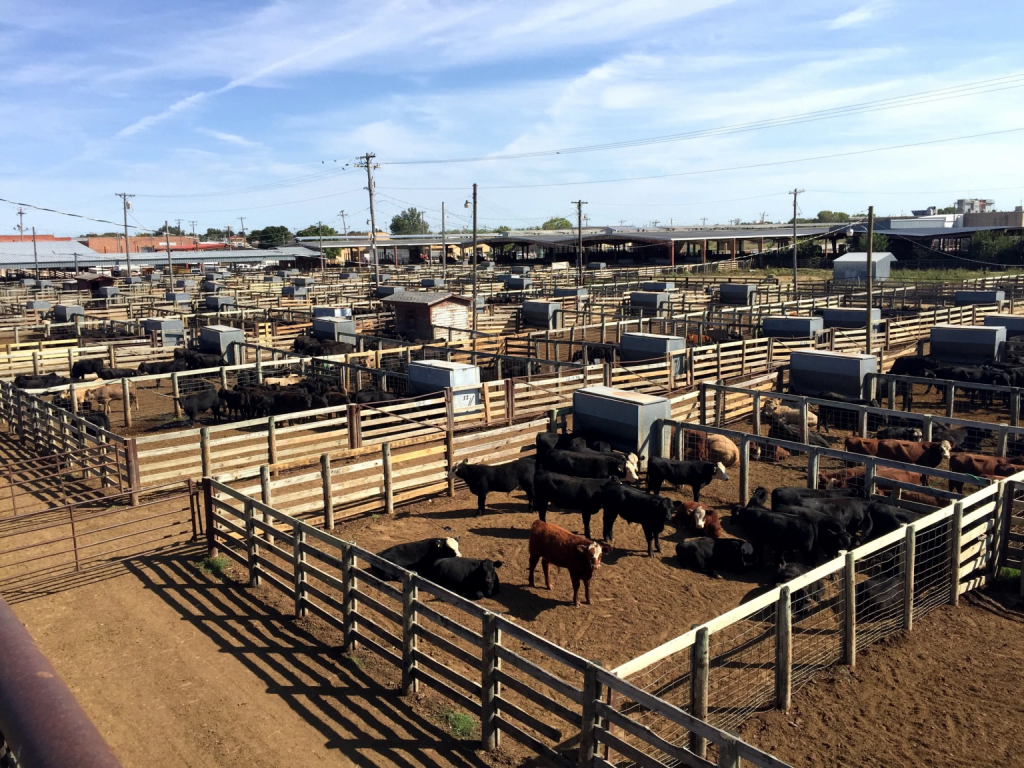
On Tuesdays, Senior Farm and Ranch Broadcaster, Ron Hays, visits with Ben Hale of Western Livestock Auctions as he talks about the latest in the markets and more. Established in 1995, Western has grown into a multi-generational family-owned and operated business and stands as a symbol of tradition, excellence, and a deep-rooted passion for the cattle industry. Western Livestock Auctions is located in Oklahoma City, Woodward, and Comanche.
Hale said runs this week were close to one week ago, just slightly lower. Hale also noted a loss of interest on grazing cattle. Runs this week are down compared to one year ago.
"That deal a week ago on Monday was so snappy and so good," Hale said. "I can see it pulling back a little bit since Friday, and yesterday had a little bit of pullback on the board."
The markets are still seeing some impacts from HPAI (Highly Pathogenic Avian Influenza), Hale added.
Regarding the yearling market, Rodenberger said cattle weighing around 700 and 800 pounds are selling exceptionally well.
"If you get down there around that tight seven-weight if they happen to be a little green, those things sure bring a lot to graze," Rodenberger said.
Looking into the next few months, Rodenberger said many people are not forced to sell cattle at the moment, so numbers selling can possibly be maintained.
Hale can be contacted at 940-631-2333.
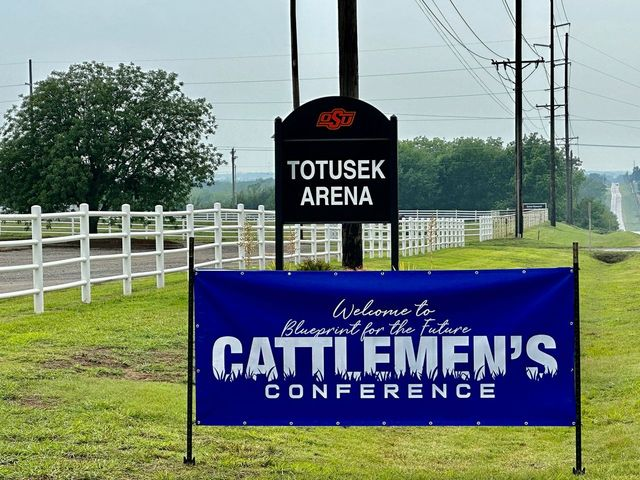
Senior Farm and Ranch Broadcaster Ron Hays is featuring his conversation from April with Mark Johnson, Oklahoma State University Extension Beef Cattle Breeding Specialist, about the 2024 Cattlemen's Conference, coming up May 22nd and 23rd in Stillwater, Oklahoma. Anyone in the cattle industry is welcome to attend this year's event, as some of the most critical topics in the industry will be discussed.
Last May, the Cattlemen's Conference, in collaboration with Oklahoma State University and the Noble Research Institute, made significant strides in the seed stock industry with the creation of 'Cattlemen's Conference: A Blueprint for the Future.' The success of last year's program, as noted by OSU's Mark Johnson, has paved the way for a much-anticipated part two of the conference.
Johnson said the objective of Cattlemen's Conference Part Two: A Blueprint for the Future is to follow up on topics that did not have the chance for in-depth discussion at last year's conference. One of those topics that Johnson said will be discussed this year is gene editing.
"This is a fascinating and interesting area that is going to impact all of us, not just in meat animals, but in humans," Johnson said. "There are going to be decisions to be made, and it is important to be informed."
Johnson said there will be two different panel discussions including industry leaders discussing new technology such as gene editing.
"All the way through, the backside of this is what is going to be the consumer's perception of this beef product that results from some of these technologies," Johnson said.
As technology is the solution to gaining sustainability, efficiency, and improving profit margins, Johnson said finding balance in consumer product acceptance is critical.
"Long term, we can produce food more efficiently," Johnson said.
To learn more about the conference and register, CLICK HERE!
The Beef Buzz is a regular feature heard on radio stations around the region on the Radio Oklahoma Ag Network and is a regular audio feature found on this website as well. Click on the LISTEN BAR at the top of the story for today's show and check out our archives for older Beef Buzz shows covering the gamut of the beef cattle industry today.
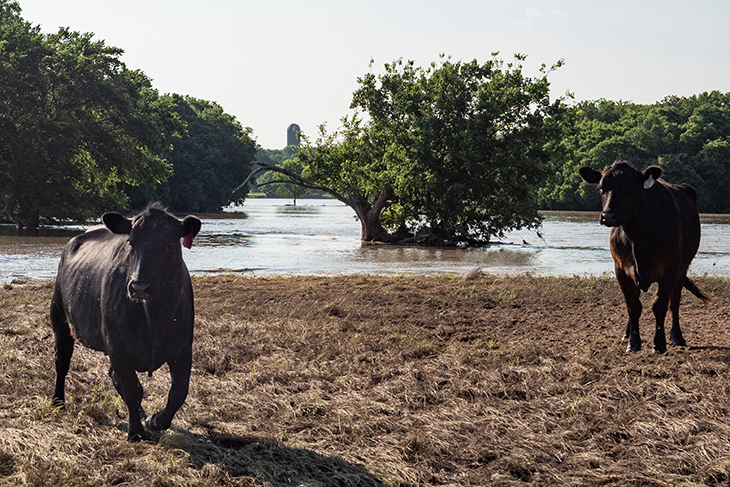
Mark Johnson, Oklahoma State University Extension Beef Cattle Breeding Specialist, offers herd health advice as part of the weekly series known as the "Cow Calf Corner," published electronically by Dr. Peel, Mark Johnson, and Paul Beck. Today, Johnson talks about
Recent rains in parts of Oklahoma have led to many beef producers seeing a high incidence of foot rot in beef herds. Foot rot is an acute or sub-acute necrotic (decaying) infectious disease which causes swelling and lameness in at least one foot. The disease can cause severe lameness, decreased weight gain and lower milk production. Lame bulls and females will be reluctant to breed. If treatment is delayed, deeper structures of the foot may become infected, leading to chronic disease and poor recovery prognosis. Severely affected animals may need to be culled. The incidence of foot rot varies according to the weather, season of the year, grazing conditions and housing environment. Approximately 20% of all diagnosed lameness in cattle is actually foot rot.
Cause
Fusobacterium necrophorum is the bacterium most often isolated from infected feet. This organism is present on healthy skin, but it needs injury or wet skin to enter the deeper tissue. F. necrophorum appears to act cooperatively with other bacteria, such as Porphyromonas levii, Staphylococcus aureus, Escherichia coli and Truperella pyogenes, thereby decreasing the infective dose of F. necrophorum necessary to cause disease. Prevotella intermedia has also been implicated as causative agent for foot rot.
Normal healthy skin will not allow the bacteria to enter the deeper tissues. Moisture, nutrient deficiency, injury or disease can result in compromised skin or hoof wall integrity, increasing the likelihood of the bacteria invading the skin. Deficiencies of zinc, selenium and copper can lead to higher frequency of foot rot infections due to the important role these trace minerals play in skin and hoof integrity as well as immune function. Injury is often caused by walking on abrasive or rough surfaces such as stony ground, sharp gravel and grazing stubble on recently mowed pasture, which may irritate the interdigital skin. Standing in pens or lots heavily contaminated with feces and urine softens the skin and provides high exposure to the causative bacteria. High temperatures and humidity will also cause the skin to chap and crack, leaving it susceptible to bacterial invasion.
Clinical Signs
Foot rot occurs in all ages of cattle, with increased incidences during wet, humid conditions. When case incidence increases in hot and dry conditions, attention must be directed to loafing areas, which are often crowded and extremely wet from urine and feces deposited in small shaded areas. The first signs of foot rot include:
Treatment
Treatment of foot rot is usually successful, especially when started early. Treatment should always begin with cleaning and examining the foot to establish that lameness is actually due to foot rot. A veterinarian may advise recommended antibiotics and dosages for each situation. Use of a non-steroidal anti-inflammatory product may be indicted for pain relief. There are multiple antimicrobial products labeled for the treatment of foot rot. These products should be used rather than using another product in an extra-label manner. A product specifically labelled for pain associated with foot rot is now available.
When possible, affected animals should be kept in dry areas until healed. If improvement is not evident within three to four days, it may be an indication that the infection has invaded the deeper tissues. Infections not responding to initial treatments need to be re-evaluated by a veterinarian in a timely manner.
Prevention
Prevention and control of foot rot begins with management of the environment. Prevention of mechanical damage to the foot caused by frozen or dried mud, brush stubble and gravel is desirable. Minimize animals' exposure to sharp plant stubble and sharp gravel. Attempt to minimize the time cattle must spend standing in wet areas. Pens should be well-drained and frequently scraped. Areas around ponds, feed bunks and water tanks should be maintained to minimize mud and manure.
Summary
Foot rot is a major cause of lameness in cattle and can have a severe economic impact on animal health, animal performance and enterprise profitability. Skin and hoof lesions allow bacteria to invade live tissue. Therefore, the most important preventive measures are centered on the protection of interdigital skin health. Important preventative measures include a well-balanced mineral nutrition program and minimizing exposure to conditions that may cause skin or hoof injury. Treatment is frequently successful if the disease is diagnosed and treated soon after symptoms develop.
Reference: Foot Rot in Cattle. OSU Cooperative Extension Fact Sheet AFS-3355
RON's Dave Lanning has a pre-opening look at today's agricultural Markets.
Click the audio tab below for today's report.
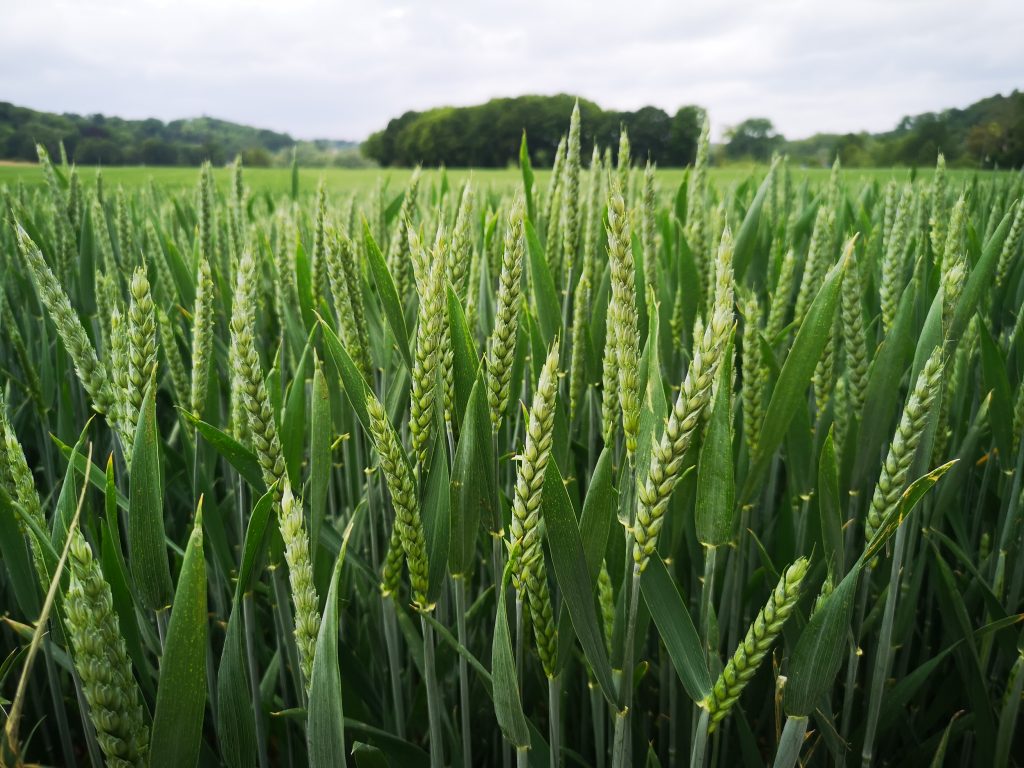
Winter wheat headed reached 43 percent, up 9 percentage points from the previous year and up 11 points from the five-year average. Winter wheat conditions rated 50 percent good to excellent, 34 percent fair, and 16 percent poor to very poor. Last week's ratings were 49 percent good to excellent, 35 percent fair, and 16 percent poor to very poor. This time last year, U.S. winter wheat conditions rated 29 percent good to excellent, 27 percent fair, and 44 percent poor to very poor.
Corn planted reached 36 percent, down 6 percentage points from the previous year and down 3 points from the five-year average. Corn emerged reached 12 percent, up 2 points from the previous year and up 3 points from the five-year average.
Soybeans planted reached 25 percent, down 5 percentage points from the previous year and up 4 points from the five-year average. Soybeans emerged reached 9 percent, up 2 points from the previous year and up 5 points from the five-year average.
Cotton planted reached 24 percent, up 4 percentage points from the previous year and the five-year average.
Sorghum planted reached 23 percent, even with the previous year, and up 1 percentage point from the five-year average.
Range and pasture conditions rated 46 percent good to excellent, 29 percent fair and 35 percent poor to very poor. This time last year, those ratings were 33 percent good to excellent, 30 percent fair, and 37 percent poor to very poor.
Winter wheat headed reached 67 percent, even with the previous year and up 1 percentage point from the five-year average. Conditions rated 52 percent good to excellent, 41 percent fair, and 7 percent poor to very poor. Last week's conditions rated 46 percent good to excellent, 40 percent fair, and 14 percent poor to very poor. This time last year, winter wheat conditions rated 7 percent good to excellent, 29 percent fair and 64 percent poor to very poor.
Sorghum planted reached 14 percent, down 5 percentage points from the previous year and up 5 points from the five-year average.
Peanuts planted reached 5 percent, up 1 percentage point from the previous year and even with the five-year average.
Livestock conditions rated 70 percent good to excellent, 25 percent fair and 5 percent poor to very poor. Last week's ratings were 72 percent good to excellent, 24 percent fair, and 4 percent poor to very poor.
Pasture and range conditions rated 52 percent good to excellent, 38 percent fair and 10 percent poor to very poor. Last week's conditions rated 44 percent good to excellent, 35 percent fair and 21 percent poor to very poor.
Kansas Crop Progress:
Winter wheat headed reached 54 percent, up 28 percentage points from the previous year and up 33 points from the five-year average. Winter wheat conditions rated 32 percent good to excellent, 35 percent fair and 33 percent poor to very poor. Last week's conditions rated 31 percent good to excellent, 38 percent fair, and 31 percent poor to very poor. This time last year, winter wheat conditions rated 11 percent good to excellent, 21 percent fair and 68 percent poor to very poor.
Corn planted reached 51 percent, up 8 percentage points from the previous year and the five-year average. Corn emerged reached 29 percent, up 12 points from the previous year and the five-year average.
Soybeans planted reached 22 percent, down 3 points from the previous year and up 7 from the five-year average. Soybeans emerged reached 5 percent, even with the previous year and up 3 points from the five-year average.
Cotton planted reached 4 percent, up 2 percentage points from the previous year and down 2 points from the five-year average.
Sorghum planted reached 4 percent, up 1 percentage point from the previous year and up 2 points from the five-year average.
Pasture and range conditions rated 37 percent good to excellent, 39 percent fair and 24 percent poor to very poor.
Winter wheat headed reached 75 percent, even with the previous year and the five-year average. Winter wheat conditions rated 48 percent good to excellent, 33 percent fair and 19 percent poor to very poor. Last week's conditions rated 48 percent good to excellent, 38 percent fair and 14 percent poor to very poor. This time last year, winter wheat conditions in Texas rated 20 percent good to excellent, 24 percent fair and 56 percent poor to very poor.
Corn planted reached 76 percent, even with the previous year and up 2 percentage points from the five-year average. Corn emerged reached 67 percent, up 1 point from the previous year and up 6 points from the five-year average.
Cotton planted reached 41 percent, up 1 percentage point from the previous year and up 18 percentage points from the five-year average.
Sorghum planted reached 71 percent, down 1 percentage point from the previous year and up 1 point from the five-year average.
Peanuts planted reached 6 percent, even with the previous year and down 1 percentage point from the five-year average.
Pasture and range conditions rated 31 percent good to excellent, 31 percent fair and 38 percent poor to very poor. Last week's conditions rated 29 percent good to excellent, 30 percent fair and 41 percent poor to very poor.
"Storms are common throughout the spring and summer, so chances are, drivers will face storm-related challenges while in their vehicles," said Rylie Fletcher, AAA Oklahoma spokesperson. "A vehicle can either be very dangerous or a place of safety, depending on the weather conditions. The key is being prepared for severe weather and reacting the right way to what Mother Nature throws at you."
Heavy Rain and Flooding
Heavy downpours make it difficult to see while driving. AAA Oklahoma recommends regularly changing windshield wiper blades to keep drivers' views as clear as possible. If visibility is severely limited during heavy rain, drivers should reduce their speed and if they can safely do so, pull off the road out of traffic lanes, turn on flashing hazard lights, and wait until the rain lightens.
If windshield wipers are on, headlights should be as well. Headlights can help drivers see better but also allow their vehicle to be seen by other drivers.
Pooling water on roadways can cause hydroplaning and loss of vehicle control, so motorists should reduce their speeds during rainy conditions. Roadways completely covered by water are a particular danger.
"Avoid driving into floodwater," warned AAA Oklahoma's Fletcher. "Flooding causes more deaths than any other storm-related event, and many of those deaths occur in vehicles. As little as 12 inches of moving water can sweep most vehicles off the road. The slogan 'Turn around, don't drown' is important to remember and follow."
Hail
Hailstorms hit with little warning and usually only last for about five minutes, but hailstones – frozen pellets of rain – can cause major damage in that short period of time.
There were nearly 7,000 major hailstorms (hail stones one inch in diameter or larger) in the U.S. in 2023, with 269 occurring in Oklahoma, according to the National Oceanic and Atmospheric Administration (NOAA). Most hailstones are about the size of a pea or marble, but they can get as large as a softball in a severe storm.
"Hail of most any size can dent your car, and larger stones can smash your windows," said Larry Finley, Senior Insurance Agent for AAA Oklahoma. "And this is not an uncommon occurrence in Oklahoma. Fortunately, hail damage to a vehicle is covered by your comprehensive auto insurance policy, which covers physical damage to your vehicle not caused by a collision."
To protect your vehicle from hailstorms, park it in a covered spot whenever possible.
If you are in your vehicle when a hailstorm hits and see a safe place close-by, such as a highway overpass or gas station or bank awning, drive to it as soon as you can. If no shelter is available and hail becomes large enough to cause damage, stop driving and pull off the road completely. Move away from car windows and cover your head with your arms and hands to protect yourself from any breaking glass.
Lightning
The National Weather Service reports that lightning strikes about 25 million times a year, killing about 20 people in the United States and severely injuring hundreds more.
If you are caught outside during a thunderstorm, seek shelter in a hard-topped vehicle, or a low area, such as a tunnel. If you are already in your car when a lightning storm begins, stay in the vehicle for shelter, but steer clear of fences, isolated trees, telephone poles, power lines and pipelines.
"Lightning-caused damage to a vehicle is typically covered under the comprehensive portion of an auto insurance policy," said AAA Oklahoma Insurance's Finley.
Thunderstorms can sometimes have other impacts to vehicles, including:
Tornadoes
It's severe weather season. As many people in this part of the country are aware, strong thunderstorms and even tornadoes can strike quickly and fiercely. Dangerous, damaging storms can catch motorists on the roads, and AAA Oklahoma is urging drivers and their passengers to be prepared and take appropriate safety precautions should they encounter severe weather while traveling in a vehicle.
NOAA reports that the United States is the most tornado-prone country in the world, with about 1,000 tornadoes touching down each year. There were more than 1,400 documented tornadoes in the United States – 74 in Oklahoma – in 2023.
Tornado warnings mean danger is imminent. If a tornado is sighted, move to the safest place possible.
"If you are in your car and a tornado is close, abandon the vehicle and seek shelter in a storm shelter or sturdy structure," said AAA Oklahoma's Fletcher. "As a last resort, if no structure is nearby, take shelter in your vehicle – seatbelt buckled; duck down below windows; cover up with a blanket to protect you from glass/debris; and protect your head with your arms."
Also, when taking cover from a tornado, stay away from trees, signs or cars/machinery and avoid seeking shelter where they could fall on or blow over onto you. Most tornadoes travel southwest to northeast, a point to consider when taking shelter.
Finally, never seek shelter from a tornado under a highway overpass or bridge, as tornadic winds become stronger and create a wind-tunnel effect, putting you in danger of being swept away or killed or injured by flying debris.
Emergency Kit
AAA recommends that motorists create a spring/summer severe weather emergency kit to carry in their cars. The kit should include items such as nonperishable food/snacks and water, tool kit, flashlight, hand-crank or battery-powered radio, extra batteries, cell phone and charger, first-aid supplies, flares or reflectors, rain coat or poncho, a towel or blanket, and rain boots or an extra pair of shoes.
About AAA:
AAA provides automotive, travel, and insurance services to more than 64 million members nationwide and more than 400,000 members in Oklahoma. AAA advocates for the safety and mobility of its members and has been committed to outstanding road service for more than 100 years. AAA is a non-stock, membership corporation working on behalf of motorists, who can map a route, find local gas prices and electric vehicle charging stations, discover discounts, book a hotel, and track their roadside assistance service with the AAA Mobile app (AAA.com/mobile) for iPhone, iPad and Android. For more information on joining or renewing a Membership, visit www.AAA.com.
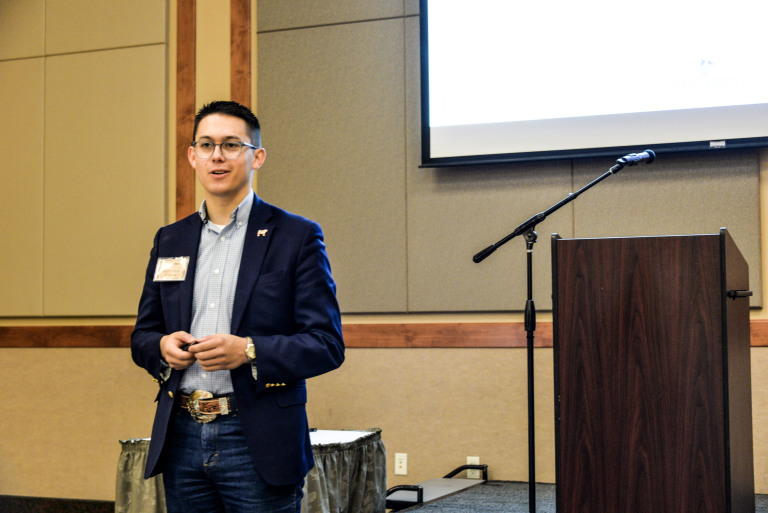
At the National Association of Farm Broadcasters Washington Watch Event, Farm Director KC Sheperd had the chance to visit with the Senior Director of Governmental Affairs at the National Cattlemen's Beef Association, Tanner Beymer. In this episode of Beef Buzz, Senior Farm, and Ranch Broadcaster Ron Hays is featuring comments from the conversation regarding the OFF (Opportunities for Fairness in Farming) Act.
The OFF ACT, which targets the Beef Checkoff, is part of a bigger effort to slow down meat consumption. To listen to Ron Hays talk with NCBA's Colin Woodall about some background on the OFF Act, CLICK HERE.
Although the OFF Act is not included in the Senate Agriculture Farm Bill proposal, there is still some concern that the supporters of the OFF Act may attempt to sneak the bill in during negotiations.
"The deceptively titled Opportunities for Fairness in Farming Act is a continuation of legislation that tends to get introduced at least once every Congress," Beymer said. "Unfortunately, because this is a Farm Bill year and because there is so much pandemonium unfolding on Capitol Hill right now, we cannot afford to take threats like this lightly. This effort has really been picked up by these radical activist animal rights groups because, if you think about it, what is the most effective marketing tool for U.S. beef in the world? It is the beef checkoff."
Fortunately, Beymer said NCBA has been able to work with allies in the livestock industry to push back on this narrative.
"We are anticipating there will be an effort made in the Farm Bill, but there was a test done during the appropriations bills that were being debated here several months ago," Beymer said. "An amendment from Victoria Spartz out of Indiana was kind of a 'test balloon' for the OFF Act. That amendment was defeated on the floor by a vote of 49 to 377. In a town that is divided as this one right now, we are going to call that a pretty good win."
In an earlier conversation with Beymer this spring, Ron Hays talked with Beymer about some of the deceptive practices animal rights groups are using to try and convince a wide array of lawmakers to support them. Beymer says, unfortunately, these groups have seen some success. To listen to this past conversation with Beymer regarding anti-animal ag groups agendas, CLICK HERE.
While liberal Democrats have been the typical base of support for anti-animal agriculture groups over the years, Beymer said recently more moderate individuals and some Republicans have also been more sympathetic to the messages being relayed.
"I think part of the reason for that is these animal rights activists have gotten more creative, and they are using some of these shell groups, and using what they think are cattle producers, and dressing them up in a costume and sending them up to Capitol Hill saying, 'I'm a farmer, and by golly, I want you to kill the Beef Checkoff,' or 'I want you to allow California to implement Prop 12.' Things that no farmer or rancher in their right mind would ever ask for."
Beymer said because this act has been promoted by Senators such as New Jersey Senator Cory Booker and many ruthless animal rights groups, educating those in Washington, D.C. about this issue is critical.
"We have to constantly be thinking about where our vulnerabilities are with folks on Capitol Hill so we can make sure we can push back on these harmful narratives," Beymer said.
The Beef Buzz is a regular feature heard on radio stations around the region on the Radio Oklahoma Ag Network and is a regular audio feature found on this website as well. Click on the LISTEN BAR for today's show and check out our archives for older Beef Buzz shows covering the gamut of the beef cattle industry today.
The pecan food show will offer competitive baking categories for youth and adults. (Photo by Todd Johnson, OSU Agriculture)
By Gail Ellis
Oklahoma State University Extension and the Oklahoma Pecan Growers Association will host the 2024 Oklahoma Pecan Growers Conference, Trade Show and Field Day May 30 through June 1.
Who:
Commercial pecan growers, pecan hobbyists, Extension educators and anyone interested in growing pecans is welcome to attend.
What and When:
1-5 p.m., May 30: Mini-pecan class offering two private applicator continuing education units, followed by a social and vendors. Learn about exhibit and sponsorship opportunities.
11 a.m. to 1:30 p.m., May 31: Awards luncheon.
8 a.m. to 5 p.m., May 31: State pecan food show, vendors and an educational program featuring industry news.
8:30 a.m. to 1 p.m., June 1: Field day for pecan producers at Buchanan Family Pecan Farm, near Dickson.
See the complete schedule.
Pecan Food Show
Bakers and cooks of all ages are welcome to enter pecan-themed products and recipes in the two-day pecan food show. Category and class winners will be recognized in adult and junior divisions.
Where:
Ardmore Convention Center, 2401 N. Rockford Rd., Ardmore.
Why:
As one of the nation's top five pecan-producing states, Oklahoma pecan growers average about 15 million pounds of pecans per year. Oklahoma also ranks second nationwide in native pecan production.
Registration:
Register online. $100 for Oklahoma Pecan Growers Association members, $150 for non-members.
For more information, contact Becky Carroll, OSU Extension pecan specialist, at 405-744-6139 or becky.carroll@okstate.edu.
OSU Extension uses research-based information to help all Oklahomans solve local issues and concerns, promote leadership and manage resources wisely throughout the state's 77 counties. Most information is available at little to no cost.
U.S. Senate Agriculture, Nutrition, and Forestry Committee Chairwoman Debbie Stabenow (D-MI) last week unveiled the Rural Prosperity and Food Security Act, which contains more than 100 bipartisan bills. The bill reflects more than two years of bipartisan work of Senators on and off the Committee to keep farmers farming, families fed, and rural communities strong.
The bill received praise as a serious proposal that puts the Farm Bill back on track to be signed into law by the end of the year. This included:
National Young Farmers Coalition:
U.S. Senate Agriculture, Nutrition, and Forestry Committee Chairwoman Debbie Stabenow (D-MI) published a detailed preview of the Rural Prosperity and Food Security Act of 2024, laying out a path forward in the extended process to secure a new Farm Bill. A product of years of dialogue, and reflecting aspects of over 100 bipartisan marker bills, this proposal is a step forward, and is thoughtfully crafted to center the needs of farmers and ranchers across the country. We welcome this progress, and applaud Chairwoman Stabenow for her leadership and ongoing work in service of our food and agriculture systems and the people who power them.
National Rural Electric Cooperative Association:
"The Farm Bill is important to America's electric cooperatives and the rural communities they serve. We appreciate Chairwoman Stabenow's Farm Bill proposal that invests in lasting, reliable high-speed rural broadband access and enhances the energy and rural development programs used by electric cooperatives to keep the lights on. NRECA looks forward to working with lawmakers and advocating for co-op priorities as the Farm Bill process continues."
National Rural Health Association:
"The National Rural Health Association (NRHA) applauds the Senate Agriculture Committee's 2024 Farm Bill framework in the Rural Prosperity and Food Security Act. NRHA is pleased to see that many proposals and bills that we advocated for are included in the legislation. We are appreciative of the significant investments in rural communities including healthcare, childcare, and broadband. This framework represents a major step towards passing a final Farm Bill that provides critical support to rural areas of the nation. NRHA looks forward to seeing the full bill text and more activity out of the Committee, as well as a bill from the House Agriculture Committee to strengthen rural communities and healthcare across the country."
National Sustainable Agriculture Coalition:
"NSAC is extremely encouraged to see a pragmatic Senate farm bill proposal that includes numerous bipartisan policies. The proposal takes meaningful steps to build a fair and accessible farm safety net for farmers and ranchers, protect conservation and climate spending, and invest in local and regional food systems. For countless farmers, ranchers, and food system stakeholders, this will jump-start a beleaguered farm bill reauthorization with workable policies that meet their needs. NSAC thanks Chairwoman Stabenow for her leadership and encourages Congressional agriculture leaders to seize the moment and work together toward a solid, bipartisan bill."
American Farm Bureau Federation:
"AFBF appreciates the House and Senate Agriculture committees' progress to enact a new, modernized farm bill this year. We're encouraged to see both proposals acknowledge that programs farmers and ranchers across the country use require additional investment in the face of falling commodity prices and increased inflation. And both proposals recognize the important role farmers and ranchers play in protecting our land, water and air through voluntary, working lands conservation programs."
"A farm bill needs bipartisan support in order to become law. I appreciate the work that the House and Senate Ag Committees have put into the current proposals. There's more work to be done to find common ground and consensus. Building a stronger farm bill coalition will provide the support necessary to pass this legislation."
"Today, Senate Chairwoman Debbie Stabenow (MI) released the Rural Prosperity and Food Security Act bill summary – a critical step forward in advancing a final farm bill. The bill summary reflects the bipartisan priorities of numerous Senators and recognizes the pivotal role the bill has in increasing investments to reduce food insecurity in America. Our neighbors facing hunger have told us in our annual Elevating Voices: Insights Report that food insecurity should be treated as an urgent crisis and Feeding America applauds the Chairwoman for releasing a strong farm bill proposal that prioritizes our neighbors by strengthening federal nutrition programs."
"NGA is pleased to see movement on a Farm Bill from both sides of the Capitol. Independent grocers are a critical partner in the SNAP program, ensuring access to a variety of foods to meet families where they are. We are thankful the Senate proposal protects retailers from burdensome fees on EBT transactions and an increase in funding and flexibility in GusNIP. We look forward to seeing more details on the House proposal."
National Association of Wheat Growers:
"It is great to see progress being made on a long-term Farm Bill. We are glad to see legislative summaries being put forward by both the Senate and House Agriculture Committees to get a Farm Bill done in the 118th Congress. NAWG will continue reviewing these Farm Bill proposals and remain in contact with committee leaders and staff."
NTCA- The Rural Broadband Association:
"The U.S. Department of Agriculture's (USDA) ReConnect Loan and Grant Program and other USDA broadband programs that would be authorized by this Farm Bill are critical to helping meet the connectivity needs of rural Americans. We appreciate Chairwoman Stabenow's focus on ensuring ReConnect is authorized as part of the bill and believe the program's broadband speed standards will help ensure rural consumers can receive the same level of service as those in urban areas, while targeting funding to areas most in need of service. NTCA members and staff have welcomed the opportunity to testify before the Senate and House Agriculture Committees to share the importance of investing in broadband networks built for the long term and encouraging coordination across federal broadband programs. We are pleased to see a commitment to these standards of service in the Chairwoman's Farm Bill. We thank Chairwoman Stabenow and other members of the Senate Agriculture Committee for their work and recognition that broadband is critically important to the future of rural America. We look forward to working with both the Senate and House Agriculture Committees to move a Farm Bill forward."
League of Conservation Voters:
"Today's proposals in the House and Senate for moving forward on the 2024 Farm Bill could not be more different. We applaud Senate Agriculture Committee Chairwoman Debbie Stabenow for her Rural Prosperity and Food Security Act that prioritizes the needs of our farmers and our families by preserving the Inflation Reduction Act's climate-smart agriculture funding to ensure farmers can be part of the climate solution. We also commend Chairwoman Stabenow for her long-standing leadership and for bringing together so many stakeholders to collaboratively craft this bill."
Rural Community Assistance Partnership:
"I am grateful that this first step has been taken toward passing the Farm Bill and am incredibly heartened that the bill includes strong investments like $200 million in mandatory funding for water and community facilities programs, as well as funding for expanded technical assistance for water cybersecurity and disaster recovery. We look forward to continuing to work with both parties to pass a final, bipartisan bill that will improve life in rural America."
National Cooperative Business Association CLUSA International (NCBA CLUSA):
"We are excited to see some truly historic policies in the Rural Prosperity and Food Security Act. By providing baseline funding for the Rural Partnership Program, the bill will for the first time guarantee mandatory funding for the Rural Development title and people in rural communities. The Rural Partnership Program will provide direct and flexible multi-year grants to every state that will support locally-led solutions under a broad umbrella of eligible entities to address rural communities' persistent and urgent needs. We also appreciate that the bill recognizes cooperatives as a tried-and-true approach for advancing the needs of rural communities – whether through utilities, agriculture, local food systems, or other community economic development strategies."
"The Farm Bill should position U.S. farmers to meet the growing demand for organic food using the climate-friendly, ecological production practices required by the organic regulations. The National Organic Coalition is thrilled with the strong commitment to growing organic signaled by the Farm Bill framework presented today by Senator Stabenow. It provides a strong foundation to grow the organic sector to address climate mitigation, human health, and ecological challenges and provides organic producers with increased support to create thriving businesses to grow food for local communities."
Specialty Crop Farm Bill Alliance:
"The Specialty Crop Farm Bill Alliance commends House Agriculture Committee Chairman Thompson and Senate Agriculture Committee Chairwoman Stabenow for their work in moving the 2024 farm bill process forward."
"Pheasants Forever and Quail Forever are thankful to see some of the organization's top priorities being addressed in Senator Stabenow's Rural Prosperity and Food Security Act. These include strengthening the Conservation Reserve Program by incorporating the provisions of the bipartisan, bicameral CRP Improvement Act, reauthorizing and funding the Voluntary Public Access and Habitat Incentive Program (VPA-HIP) and including provisions to support nationwide conservation of America's grasslands."
Save the Children:
"Save the Children strongly supports the Rural Prosperity and Food Security Act introduced by Chairwoman Stabenow because of its historic investments in rural America, directly supporting the wellbeing of children and families," said Smita Baruah, Head of Government Relations for Save the Children. "Save the Children operates programs exclusively in rural communities across the U.S. We know from experience that the policies in this bill will help rural communities access the resources they need. From streamlining the federal grant process to providing more quality child care for rural communities and improving nutrition assistance to millions of children, this legislation will have a tremendous long-term impact on children's futures in rural America. Save the Children is grateful to Senator Stabenow and looks forward to helping advance this legislation."
The Organic Trade Association:
"The trade association is specifically encouraged by Senate framework's inclusion of $50 million in authorization for continued funding of the Organic Market Development Grant Program and improved coordination for organic research in USDA's Research, Education, and Economics mission area, as well as increased Organic Certification Cost Share funding."
United Food and Commercial Workers International Union (UFCW):
"We applaud the Senate and Senator Stabenow for coming together and putting forward a Farm Bill that finally meets the essential needs of the hard-working people that keep this country fed, including our own members. This version of the Farm Bill increases vital economic aid, allotting millions of dollars to America's essential food and farmworkers, and creates badly needed labor standards for Supplemental Nutrition Assistance Program (SNAP) delivery drivers, all while ensuring that federal money goes towards good jobs. This is the right framework for an effective Farm Bill, and the UFCW urges the Senate to pass it as soon as possible so it can move forward in the House."
"MAZON applauds the visionary and powerful proposals made by Chairwoman Stabenow for our nation's nutrition safety net in her proposed Farm Bill reauthorization. Chairwoman Stabenow has articulated a vision that will set America on the road to truly ending hunger. Her proposals are comprehensive – recognizing the complexity of hunger and the lives of those who are food insecure, offering powerful support to the nation's nutrition safety net, and addressing the unique needs of diverse populations who struggle in America."
Union of Concerned Scientists:
"The Rural Prosperity and Food Security Act appears to demonstrate a serious understanding and reckoning with the challenges facing our food and farm system, and the changes necessary to build a more sustainable, resilient and equitable food system that works for everyone. This proposal should be the starting point for all future conversations about the food and farm bill."
"Indian Country is a leading force in American agriculture, with more than 80,000 individual Native producers contributing $6.4 billion to the industry. We are excited to see positive momentum in discussions surrounding the next Farm Bill, including 52 tribal-specific provisions in Senate bill. We look forward to working with Congress to further strengthen provisions that expand tribal self-determination and self-governance, prioritize tribal sovereignty, promote parity, eliminate unnecessary barriers to nutrition assistance programs, and increase access to critical USDA programs."
Corn Refiners Association:
"The next Farm Bill should be an important step forward for America's farmers and rural economic development. We are grateful to Chairwoman Stabenow for recognizing the value of biomanufacturing and look forward to helping the committee pass a bipartisan Farm Bill."
Environmental Law & Policy Center:
"The Rural Prosperity and Food Security Act is a promising development for advancing economic and climate security in rural America, and we welcome Senator Stabenow's proposals. REAP is both popular and successful because it cuts input costs, boosts profits, and advances environmental care with clean energy to strengthen our rural communities. Updating REAP with these new innovations will serve all American agriculture across sectors and size ranges, reach every state, and provide benefits for the entire nation."
National Milk Producers Federation:
"Dairy farmers are heartened that today, both House Agriculture Committee Chairman Glenn 'GT' Thompson, R-PA, and Senate Agriculture Committee Chairwoman Debbie Stabenow, D-MI, each released documents providing an overview of their farm bill priorities and plans. Dairy farmers and the cooperatives they own are better-served by the certainty provided under a five-year farm bill, and as both chairs point the way toward important dairy priorities across multiple farm bill titles, all of dairy is eager to see this process get moving."
Outdoor Industry Association:
"Outdoor recreation and the outdoor industry are key drivers of sustainable economic development in rural America. From supporting small businesses to safeguarding open spaces and enhancing outdoor access, the outdoor industry welcomes the Rural Prosperity and Food Security Act and its commitment to conservation and recreation. We extend our gratitude to Chairwoman Stabenow for her leadership and look forward to lending our support to farm bill policies that that foster the cultivation of stronger, more resilient communities while safeguarding our natural spaces for future generations."
"This Chairwoman's draft makes permanent the increased IRA funding for vital and popular conservation programs that provide farmers with the necessary resources to limit their contributions to climate change while also protecting their farms from climate change's most catastrophic impacts. Ensuring that this increased funding stays focused on climate as reflected in this draft is a key priority for our community. These programs are in high demand from farmers and in fact have been oversubscribed in the past. Making them permanent is a testament to Chairwoman Stabenow's leadership and her commitment to fighting climate change. Her draft bill lays out a strategy for the entire agricultural sector that will bolster sustainability and resilience. We hope others in Congress will join her in this forward-thinking vision for agriculture, ensuring a brighter, more sustainable future for farmers and our planet alike."
Audubon Society:
"One thing that both parties can agree on is the critical role that America's farmers and ranchers serve in conserving our land, water, and wildlife. This bill invests in nature-based solutions to the climate crisis that threatens working lands and bird species across the country and makes crucial investments in the future of conservation. We thank Chairwoman Stabenow for the work done so far, and look forward to both sides of the aisle coming together for a final bill that benefits both farmers and the environment."
"It is a welcome development to see progress toward a new and improved farm bill, and we are hopeful that meaningful, bipartisan legislation will be advanced this year. Farmers face significant headwinds – including an unfavorable farm income outlook and volatility in access to export markets – and strengthening the farm bill is more important than ever."
"After a drawn-out process unfortunately rife with partisanship, this bill summary that includes more than 100 bipartisan priorities is a step in the right direction for climate, clean water, and biodiversity. It demonstrates Senator Stabenow's unwavering support for our nation's farmers and her deep respect for science-based, sustainable, and justice-driven natural agricultural solutions."
Southern Environmental Law Center:
"From a historic investment in the South's public lands to climate smart forest policy, this framework has something for everyone to applaud, no matter how they enjoy our National Forests. Senator Stabenow and her staff have drafted a bipartisan bill that all our elected officials can get behind."
The Association of Equipment Manufacturers:
The Association of Equipment Manufacturers applauds Chairwoman Stabenow for prioritizing the adoption of precision agriculture technologies. The next farm bill is an opportunity for Congress to help farmers access the tools they need to monitor, manage, and maximize their operations while advancing climate-smart agriculture practices and protecting our environment. We appreciate the Chairwoman's steadfast efforts to bring together a broad, bipartisan coalition of stakeholders, and encourage her to continue her work in a bipartisan manner to deliver a farm bill that unlocks the full potential of climate-smart agriculture practices.
Food Research and Action Center:
"Today, Senate Agriculture Committee Chairwoman Debbie Stabenow (D-MI) released a long-awaited Farm Bill proposal aimed at strengthening benefit adequacy and equitable access for the Supplemental Nutrition Assistance Program (SNAP). Strengthening SNAP is critical to ensuring that the more than 42 million people who struggle against poverty-related hunger in this country can better afford to put food on the table and get the nutrition they need. FRAC is pleased the proposal aligns with many of our SNAP priorities for the Farm Bill, and we commend Chairwoman Stabenow for recognizing the importance of safeguarding the much-needed Thrifty Food Plan future benefit adjustment."
Center for Science in the Public Interest:
"The detailed farm bill framework released today by Senate Agriculture Committee Chair Debbie Stabenow is very much in the tradition of previous farm bills. This framework supports consumers and farmers, protects the Supplemental Nutrition Assistance Program (SNAP), and prioritizes food and nutrition security in ways that both parties should agree on. The Senate framework maintains Congress' ability to keep the Thrifty Food Plan up to date as envisioned in the bipartisan 2018 farm bill. It's important for food and nutrition security to keep SNAP benefit calculations aligned with the marketplace. It also increases funding for the Gus Schumacher Nutrition Incentive Program (GusNIP), which advances nutrition security by increasing access to fruits and vegetables and supports local farmers, all while reducing the state match requirement to lower the bar of entry so more organizations can participate. The Senate framework additionally upholds equitable nutrition access by expanding SNAP access for college students, people formerly incarcerated, and residents of Puerto Rico." CSPI added, "Sen. Stabenow's proposal stands in stark contrast to the partisan proposal under consideration in the House, which undermines Americans' food and nutrition security."
"We applaud Chairwoman Stabenow for introducing a strong Senate farm bill framework today, the Rural Prosperity and Food Security Act, that helps farmers feed our nation, combats the climate crisis, addresses food insecurity, and promotes access to healthy and nutritious food for all Americans."
"Senator Stabenow has released a Farm Bill that will promote climate-smart farming, expand nutrition programs, and protect our environment, and we hope to see the House pass the Senate version of the bill. The Farm Bill will have a huge impact not only on farming and what it will look like for at least the next five years, but also food access, forestry, land and water pollution, and our climate. We need Congress to pass a forward-looking bill that prioritizes family-sustaining jobs, small and mid-sized farmers, local food systems, and healthy communities without further delay, and Senate Agriculture Committee Chair Stabenow's framework will do just that. With unprecedented investments into Farm Bill programs through the Inflation Reduction Act to fight climate change and improve the health of our rural landscape, the Farm Bill can make a real difference in people's lives by investing taxpayer money back into the public."
"We applaud Chairwoman Stabenow's proposal to preserve the Inflation Reduction Act's climate-specific funding for conservation programs, which will help producers protect our food supply against increasingly frequent extreme weather events making it harder to farm across the country. We urge the House Agriculture Committee to follow suit."
International Economic Development Council:
"On behalf of the International Economic Development Council (IEDC) and the thousands of economic development organizations and professionals we serve across the country, I want to thank U.S. Senate Agriculture, Nutrition, and Forestry Committee Chairwoman Stabenow for her work and leadership on the Rural Prosperity and Food Security Act of 2024. This critical legislation would reauthorize many important programs under the U.S. Department of Agriculture and direct much-needed resources to rural communities across the United States. We are especially appreciative of the robust investment in the Rural Development title within the legislation including direct funding for the Rural Partnership Program. This program focuses on providing locally-led investments in rural communities that will build capacity and drive economic development opportunities for rural places and people. We commend this bill and support its passage through committee and the full Senate."
Alliance for Fair Sugar Policy:
"The Alliance for Fair Sugar Policy welcomes Chairwoman Stabenow's proposal to boost production of high-quality American sugar and create additional sugar program flexibility to ensure adequate sugar supplies are available for food and beverage manufacturers. We are also encouraged by Chairman Thompson's farm bill outline released earlier today, which includes provisions to modernize the U.S. sugar program."
National Resource Defense Council:
"This proposal protects the critical provisions we need to fight the climate crisis and support farmers making climate-smart investments. The final Farm Bill must benefit rural communities, boost crop resiliency, shield farmers from climate risks, and reduce food waste. This is an important step in the right direction toward a bipartisan deal."
National Alliance of Forest Owners:
"Advancing sustainable forestry and wood products unifies policy makers. Modern forestry brings both sides of the aisle together to support smart policies that ensures our forests continue providing clean air and water, wildlife habitat, and good-paying rural jobs. Chairwoman Stabenow's proposed legislation helps working forests, the environment, and the communities that depend on the wood products supply chain."
"By maintaining the climate-smart guardrails created by the Inflation Reduction Act, Senator Stabenow is steadfastly supporting our nation's farmers, who know all too well the real costs of extreme weather. Thank you, Senate Democrats, for defending the wildly popular climate-smart conservation programs that farmers and ranchers are already using to help combat the climate crisis, improve water and soil quality, and deliver economic benefits to rural communities. Even with the increased funding provided by the IRA, demand has broadly outstripped available funds. Farmers and ranchers are stepping up to fight the climate crisis. Now, Democrats in both chambers must hold strong to make sure Republicans don't pull the rug out from under them."
"There is broad agreement that Farm Bill conservation programs are incredibly effective and need more funding. The Senate and House Farm Bill frameworks underscore that lawmakers understand the vital role these USDA conservation programs play in helping farmers, ranchers, and foresters adopt better conservation practices by providing increased, permanent funding for those programs. We are particularly pleased to see that Senator Stabenow's proposal preserves the climate sideboards for Inflation Reduction Act funding, includes bold new provisions to protect native grasslands through a nationwide sodsaver provision, and includes new provisions to support wildlife corridors on working lands."
Ducks Unlimited:
"We appreciate Chair Stabenow releasing her outline detailing her priorities. The importance of the Farm Bill's conservation programs cannot be overstated, and we look forward to working with the Senate Agriculture Committee to pass a bipartisan Farm Bill that benefits landowners, habitat, wildlife and our communities."
Evangelical Environmental Network:
"EEN is heartened to see Chairwoman Stabenow's proposal. Our farmers today face many uncertainties, from rising input costs to increasingly extreme and unpredictable weather. Further delays towards a bipartisan farm bill agreement only add to the uncertainty. We are grateful to the Chairwoman for her leadership taking this process to the next step. America's farmers, foresters, and ranchers are among the most dedicated stewards of God's creation and are key leaders in making our family farms and food system resilient to climate shocks and in the fight to mitigate the severity of climate-fueled extreme weather. EEN especially welcomes the many bipartisan conservation provisions in the proposal, which will further empower our farmers with the resources needed to steward our land, water, and climate well and pass it down to the next generation. We encourage our leaders across Congress to continue to work together to keep progress on a bipartisan bill moving forward."
Agroforestry Coalition:
"The Rural Prosperity and Food Security Act of 2024 takes important steps to advance agroforestry to meet the needs of farmers and communities for climate resilience, farm sustainability, and economic opportunity. The draft includes an Agroforestry Pilot Program as part of the Conservation Reserve Program, which will allow owners and operators to enroll eligible land in CRP as they implement and maintain agroforestry systems that conserve and improve soil, water, and wildlife resources. The draft also includes increased funding for the National Agroforestry Center and authorization for new regional agroforestry centers, along with additional support for the Forest Farming Association and funding for agroforestry research. These programs come at a critical time when demand from farmers for support in agroforestry is at an all-time high. The public also benefits from improved soil health, water quality, wildlife habitat, and viability that successful use of trees on farms can provide. Congress should support sections in the 2024 Farm Bill that expand what's possible for US farms and forests."
Biologoical Products Industry Alliance:
"We are thankful for Chairwoman Stabenow for her unwavering commitment to championing the inclusion of biostimulant language in this pivotal legislation."
We also applaud @SenateAgDems' proposal to include greater support for forestry seedling and nursery supply chains and improve the Forest Inventory and Analysis program to better account for forest carbon removal. Chairwoman Stabenow has maintained the integrity and climate focus of IRA funding in the Farm Bill. In this draft, @SenateAgDemsprioritized the resources and investments needed for climate mitigation and carbon sequestration in conservation programs.
Plant Based Products Council:
"We are encouraged by the bipartisan support on Capitol Hill to grow the agriculture bioeconomy and appreciate Chairwoman Stabenow's work to support the manufacturers of plant-based products. PBPC is committed to supporting efforts to advance a bipartisan Farm Bill that includes policy critical for our industry."
AGree Coalition:
"Chairwoman Stabenow is leading the way by outlining policies that enhance agricultural data protection and access by creating a secure data environment accessible to approved Researchers."
Agriculture Energy Coalition:
"The Ag Energy Coalition deeply appreciates the leadership of Sen. Stabenow and
welcomes the proposed improvements to Farm Bill energy title programs. These programs have a proven track record of diversifying America's energy supply with renewable energy resources and making energy efficiency investments, helping rural communities with good paying jobs, lowering producer costs, advancing domestic manufacturing, and improving environmental quality."
National Association of Food Distribution Programs on Indian Reservations:
"The Tribal Leaders Consultation Work Group on FDPIR has long supported more effective program delivery through increased Tribal sovereignty in USDA programs like the Food Distribution Program on Indian Reservations. Their years of work has helped shape many Tribal priorities in the Senate legislation and we look forward to supporting their inclusion in the Farm Bill moving forward."
National Rural Water Association:
"NRWA testified in five separate hearings on the Rural Development Title of the Farm Bill. Our 31,000 utility members are the practitioners of these programs and initiatives, and we have been fully engaged in this process since the outset. We are delighted to see the Chairwoman included and improved many of these recommendations, which are transformational to modernizing existing programs and creating new initiatives to address current challenges better."
Coalition for Food Security Puerto Rico:
"We have been advocating for Puerto Rico's right to participate in the Supplemental Nutrition Assistance Program (SNAP), along with many allies and supporters across Puerto Rico and the states, for many years. The Farm Bill is the appropriate vehicle for transitioning Puerto Rico into SNAP. We are grateful to Senator Stabenow, Senate Majority Leader Schumer, and Senator Gillibrand, who introduced and leads on the provisions calling for Puerto Rico's inclusion in SNAP, for their steadfast leadership to provide U.S. citizens in the territory with the nutrition benefits already available in the states, D.C., Guam and USVI."
"The contrast between the House and Senate farm bill proposals could not be clearer. The Senate framework would ensure that farmers are rewarded when they take steps to reduce greenhouse gas emissions, and the House framework would not. At a time when farmer demand for climate-smart funding is growing, Congress should ensure that support for farmers offering to reduce nitrous oxide emissions from fertilizer, and methane emissions from animals and their waste, is the Department of Agriculture's top priority. Unless farmers are provided the tools to reduce nitrous oxide and methane emissions from agriculture, farming will soon be the nation's largest source of greenhouse gas emissions."
American Bird Conservancy:
"Agricultural practices are interwoven with bird conservation; Senator Stabenow's bill will not only increase our knowledge of how pesticides and other practices impact wildlife, it promotes innovative solutions which will benefit birds as much as growers."
Center on Budget and Policy Priorities:
"Chair Stabenow's proposal represents an important first step toward a farm bill that protects the vital food assistance that SNAP provides to millions of children, families, older adults, and people with disabilities. It expands access to SNAP benefits for groups that have historically been excluded from the program, ensures that benefits are adequate to provide a nutritious diet, and improves customer service for participants." "The farm bill should be an opportunity for Congress to make progress against food insecurity and hunger and tackle the glaring racial inequities in food hardship. Some 44.2 million people in 2022 lived in households experiencing food insecurity, with rates particularly high among Black, Latine, and American Indian and Alaska Native people. Critically, Chair Stabenow's proposal rejects the false premise that improvements in SNAP must come at the expense of food assistance for low-income families who count on SNAP to put food on the table. There are proposals to improve SNAP that have bipartisan and bicameral support. The Senate framework, which rejects harmful benefit cuts, should be the basis for farm bill negotiations moving forward."
Today, at the start of National Teacher Appreciation Week, Congressman Tom Cole (OK-04) released the following statement:
"As a lover of learning, former college professor in history and politics, and father of a public-school teacher, it is not lost on me the influence a teacher can have on a student's life. Teachers, principals, and educators alike care for America's children, have a large impact on the way future generations think, and educate our nation's future leaders," said Congressman Cole. "During this National Teacher Appreciation Week, we honor and celebrate America's teachers for all they do to educate, nurture, and inspire their students. They truly play such a pivotal role in our great nation, and, today, I would like to say to them – thank you."
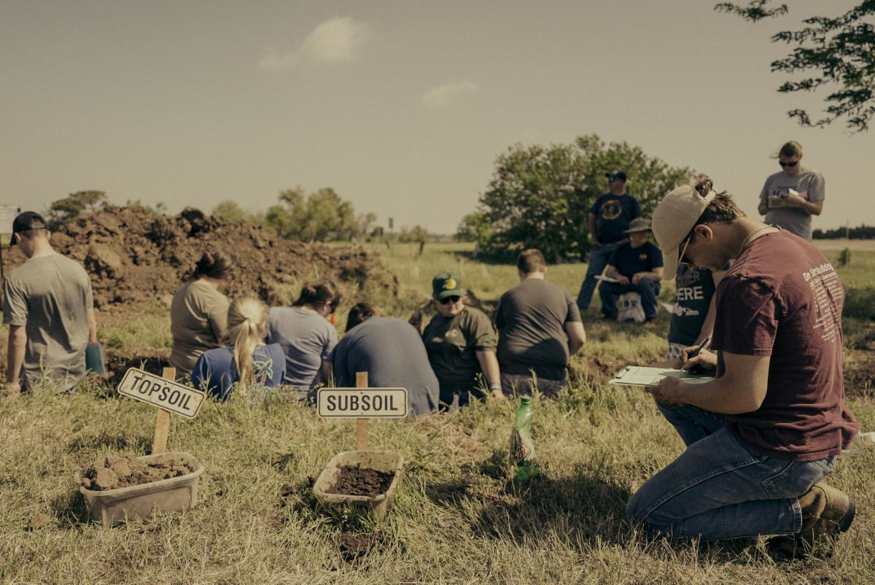
APRIL 30 - May 2, 2024 | WINNERS ANNOUNCED
Oklahoma City, Oklahoma, May 6, 2024 - The 73rd Annual National Land & Range Judging contest attracted students from across the nation to the Oklahoma City area from April 30th through May 2nd, 2024.
There were over 700 contestants, 194 teams, from 34 states.
Teams traveled from an array of states including Washington state, Maryland, New Jersey and Florida. Beyond the contest, NLRJ is a chance for high school juniors and seniors to explore continuing education and career opportunities in the field of conservation and soil science. The event reflected students as well as leaders of the next generation of conservationists.
The Oklahoma Association of Conservation Districts ( OACD ) is the primary host of the National Land and Range Judging Contest with additional sponsorship from 30 sponsors. In addition, the Natural Resources Conservation Service (NRCS) and its employees play a significant role annually in the success of the event, as does the Oklahoma Conservation Commission (OCC).
The event reflected students as well as leaders of the next generation of conservationists. The celebratory banquet included participants hearing from Oklahoma Secretary of Agriculture, Blayne Arthur, NRCS State Conservationist Jeanne Hamilton, and NRCS Chief Terry Cosby
( via video address ).
The 4H and FFA students match their skills in judging the adaptability of the land for various purposes, including farming, range management and home development. The skills the teens apply at the contest involve principles they can use in career fields such as environmental and range management, natural resource conservation, home building and construction.
The event was centered around the Canadian County Expo and Event center in El Reno, Oklahoma. Each year a different farm, ranch, company, organization or agency hosts the contest site on its land near the Oklahoma City metro area. The awards ceremony took place the evening of May 2nd at the CCEC arena.
Winners :
4-H Homesite Individual - Hunter Tounsend, Barbour County 4-H, West Virginia
4-H Team - Barbour County 4-H, West Virginia
4-H Land Individual - Griffin Hart, Barbour County 4-H, West Virginia
4-H Land Team - Barbour Country 4-H, West Virginia
4-H Range Individual - Emily Zickrick, Haakon / Bennett 4-H, South Dakota
4-H Range Team - Harken / Bennett 4-H, South Dakota
FFA Land Individual - Max Klein, Wessington Springs FFA, South Dakota
FFA Land Team - Blue River Valley FFA, Indiana
FFA Range Individual - Cooper Davis, Glen Rose FFA, Texas
FFA Range Team - Glen Rose FFA, Texas
Complete results of the 2024 National Land & Range Judging Contest as well as photos can be found at https://www.okconservation.org/nationallandrangejudging
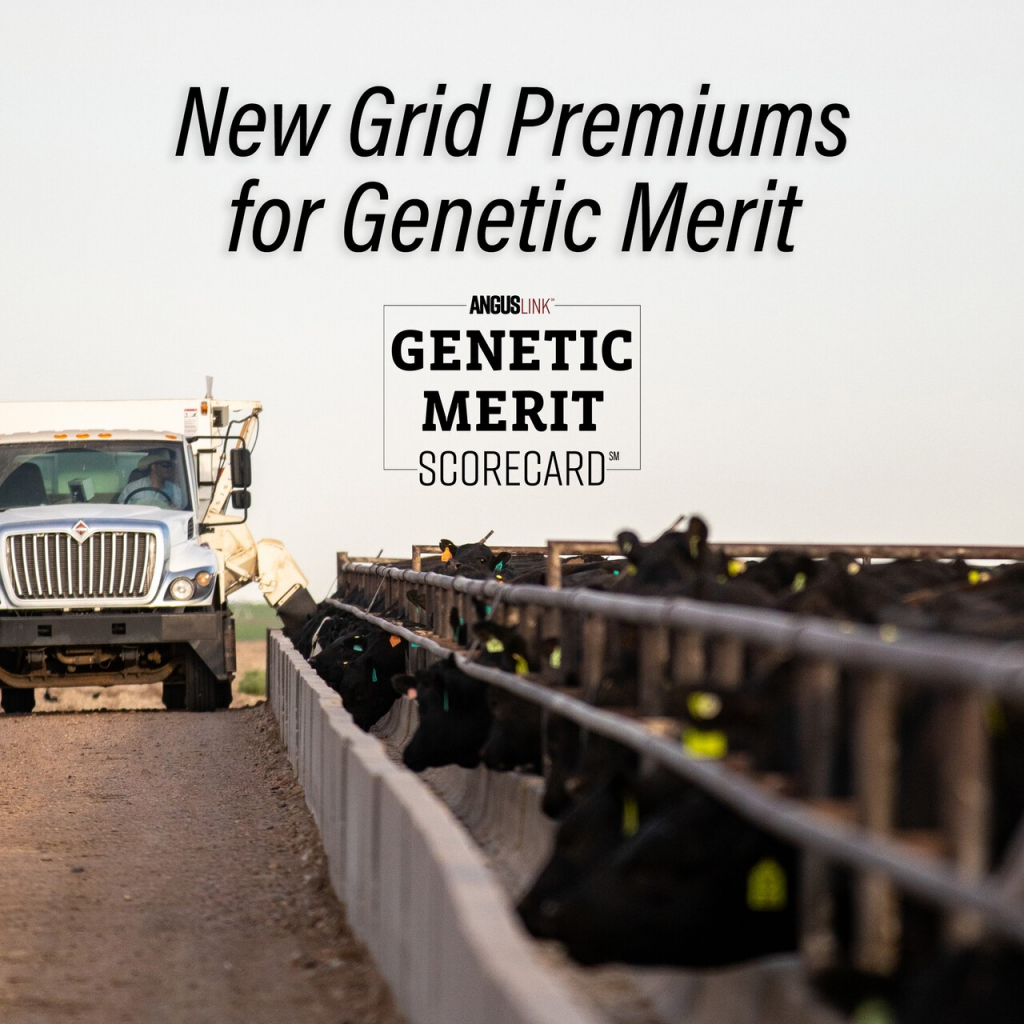
The American Angus Association®; National Beef Packing Co., LLC; IMI Global; and U.S. Premium Beef, LLC announces new grid premiums to take effect in August and December, based on genetic merit data.
For the first time, cattlemen can earn grid premiums based on the genetic merit of their cattle, stemming from their investment in superior genetics. National Beef Packing Co., LLC (NBP) announces the addition of new premiums on their U.S. Premium Beef, LLC (USPB) grid for qualified cattle based on their AngusLinkSM Genetic Merit ScorecardSM (GMS). AngusLinkSM value-added programs are administered by the American Angus Association® in partnership with IMI Global.
Effective for cattle harvested Aug. 5, a grid premium of $5 per head will be paid for cattle with a Beef Score of 100 or greater on the AngusLinkSM GMS. This will be exclusively available for cattle marketed through USPB and delivered to NBP plant locations in Liberal and Dodge City, Kansas.
On Dec. 1, a second grid premium, $10 per head for cattle with a GMS Beef Score of 150 or greater, will take effect. Those scoring 100-149 will continue to receive the $5/head premium. These premiums will be in addition to all other premiums and discounts available based on grading and carcass performance.
"National Beef is pleased to offer U.S. Premium Beef members this grid premium and new program in cooperation with the American Angus Association," said Chad Barker, vice president of cattle procurement with NBP. "We're excited to be adding another chapter to our history of creating innovative ways to reward producers for high-quality cattle."
Mark Gardiner of Gardiner Angus Ranch and chairman of the USPB board of directors said this announcement is revolutionary, and he hopes it will inspire others to feed better beef through supporting advancements in genetics.
"This is revolutionary from the standpoint that there has never been a grid incentive based upon genetic merit," Gardiner said. "We're very thankful for National Beef and U.S. Premium Beef recognizing the value of genetics as identified by the AngusLink program."
Brian Bertelsen, USPB vice president of field operations said, "For over 26 years, the USPB value-based grid has rewarded cattle that excel in carcass quality. This new program is an incentive for cattle feeders who market on the USPB grid to seek out and buy feeder cattle that are genetically designed to not only excel in carcass traits, but also growth and efficiency."
The GMS objectively describes performance potential across four areas using a range from 0 to 200, with the industry average being 100. Beef Score predicts genetic potential for feedlot performance and carcass value and is calculated using the Association database and genetic information on sires and the cow herd.
"This is a significant step for the industry and speaks to the continued evolution of value-based marketing," said Mark McCully, CEO of the Association. "National Beef understands the importance of genetics and is directly rewarding producers for their investment."
USPB also said the third-party verification provided by IMI Global was a key factor in the decision to move forward with these plans.
Doug Stanton, senior vice president of sales and business development with IMI Global, said, "This new value-added opportunity rewards commercial cow-calf producers for the superior Angus genetics they have developed over the years in their operations. The Genetic Merit Scorecard values, along with third-party Age and Source verification, provide a complete package of product predictability and traceability to the beef industry and our loyal consumers."
Cattle will need to qualify with their GMS Beef Score at least two weeks before harvesting. Most cattle currently receive a GMS prior to leaving their ranch of origin.
In addition, USPB is instituting a $1 per head premium, effective May 13, for each low-frequency EID tag that is read and assigned to a carcass ID number within each lot. No minimum number of tags will be required within a lot.
There is no additional cost associated with the GMS program, aside from IMI Global's Age and Source verification enrollment, which includes an EID tag.
Troy Marshall, director of commercial industry relations with the Association, said the timing of the announcement is beneficial for cow-calf producers.
"Not only will previously enrolled cattle be eligible starting the first part of August; but as we enter the summer video sale season, it will also provide an additional incentive and additional buyers for those cattle selling with the GMS," he said. "Cow-calf producers will have the opportunity to enroll and take advantage of this program with this year's calf crop. The investment in time and money to enroll in AngusLink is extremely small and the ROI is growing exponentially as the market continues to embrace the scorecard."
To qualify for the GMS, sires must be predominantly (50% or more) registered Angus and 75% of the bull battery must be registered.
"Obviously, this is a transformative change, but the real impact will be longer term," Marshall said. "This is a big step forward in rewarding producers for investing in genetics and will help to facilitate information flow and feedback between the segments of our business."
Bertelsen also said feeders can lease USPB delivery rights, when available, to market cattle through USPB. Those interested should please call USPB at 866-877-2525 or visit www.uspremiumbeef.com for more information.
For questions about the GMS or AngusVerifiedSM, call 816-383-5100, or contact AngusLinkSM via email at anguslink@angus.org. IMI Global can also be reached to help start an enrollment at 303-895-3002, or producers can complete its contact form to get started at www.imiglobal.com/contact.
-Written by Sarah Kocher, Angus Communications
NMPF helped lead the dairy community in responding to rapidly evolving circumstances around the spread of the H5N1 virus among dairy cows while advocating for farmers before the federal government and reassuring consumers about the safety of milk throughout April.
With the National Dairy FARM Program available as a resource for best practices and communications efforts that informed everyone from farmers in NMPF member cooperatives to consumers of national and global media, NMPF expertise was at a premium as the dairy industry, the federal government and dairy buyers navigated a landscape that changed significantly over several weeks, culminating in a Federal Order that took effect April 29 covering testing and interstate movement.
Many efforts revolved around clearly understanding the problems posed by the virus and understanding those problems for what they are, and what they are not.
"Since this virus was first discovered in cows, H5N1 in dairy cattle has been primarily an animal health concern," said NMPF President and CEO Gregg Doud in a statement released April 24, the day USDA announced testing requirements for lactating cows traveling interstate.
"USDA, FDA and scientific research has established what accumulated science indicated all along: The consumer milk supply is safe. Pasteurization renders the H5N1 virus, like other viruses, inactive, an important reminder to consumers of its value as a basic safeguard for human health. We appreciate that these agencies are sharing this message, which will help alleviate any concerns consumers may have.
"That said, the presence of this virus in dairy herds, as well as dairy farmers' own commitment to animal and human health, makes USDA's actions on testing and interstate travel appropriate. Dairy farmers stand ready to take a proactive approach to ensuring that we better understand the spread of the virus, do what we can to limit that spread, and ensure the health of our animals and workers."
As NMPF Chief Science Officer Jamie Jonker served as a go-to resource for public information in the evolving virus situation, discussing dairy-farmer actions and concerns for National Public Radio, the Washington Post, Science Magazine and other outlets, NMPF members were kept informed in real time via fast-moving member alerts.
NMPF also organized three webinars focused on different aspects of High Pathogen Avian Influenza in dairy cattle relevant to members; convened its Co-op Communicators Committee to share media strategy and make NMPF co-op resources available; and served as a shield for members as they faced often-unanswerable questions in an at-times challenging media spotlight.
In addition, NMPF's HPAI resources page was the most-viewed page on NMPF's website in April, drawing more page views than the homepage itself – the first time a page other than nmpf.org was most-viewed for the month since the launch of NMPF's Covid resources page in 2020.
April ended with the new rules on interstate cow travel and testing, while FDA tests showing the effectiveness of pasteurization in killing the H5N1 virus in milk helped allay consumer concerns. Still, HPAI as a dairy concern shows little sign of abating.
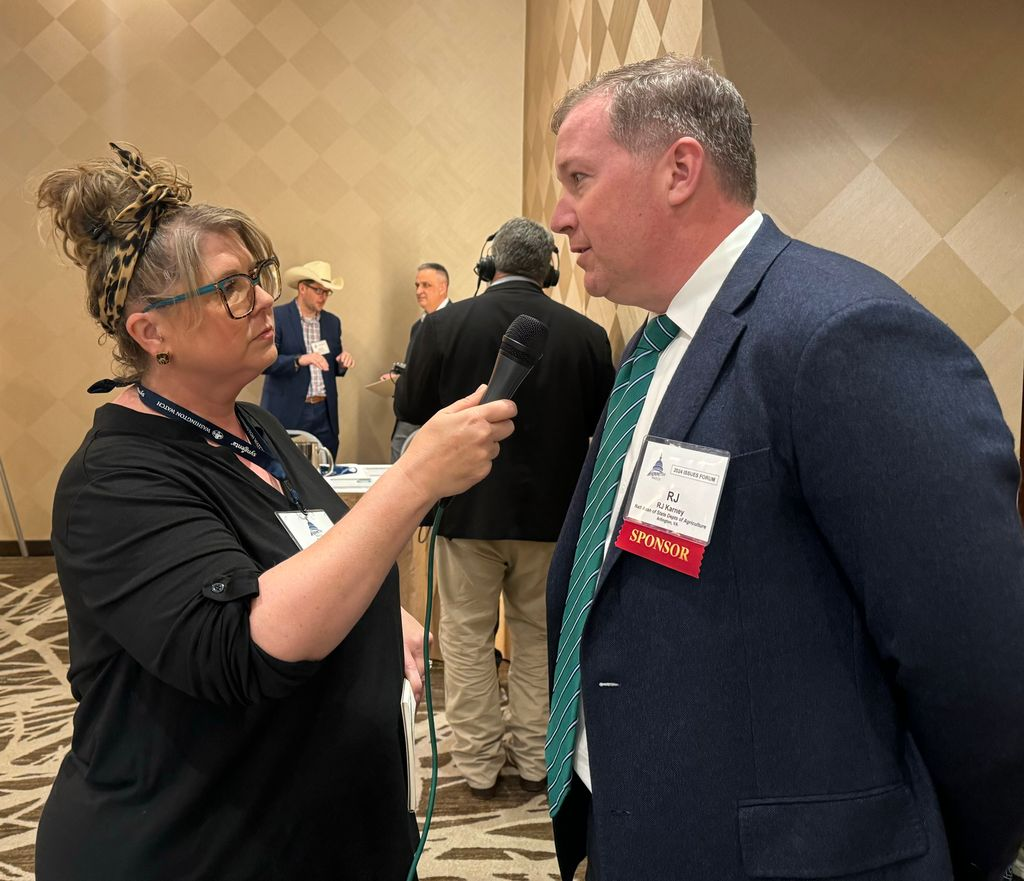
At the National Association of Farm Broadcasters (NAFB) annual Washington Watch event in Washington, D.C., Farm Director KC Sheperd had the chance to talk with the Senior Director of Public Policy at the National Association of State Departments of Agriculture (NASDA), RJ Karney, about policy and legislative updates.
"One of the main priorities for NASDA right now has been the focus and attention on Highly Pathogenic Avian Influenza in the dairy industry," Karney said. "This has been one where we have been making sure there is a lot of collaboration occurring between the states and the federal government, ensuring that we understand this is an animal issue. This is one that NASDA, our state departments of ag and our state veterinary officials, and also APHIS (Animal and Plant Health Inspection Service) are working a strong collaboration to make sure they can find workable solutions for the dairy industry and members at large."
When it comes to presenting the facts, Karney said messaging to consumers that pasteurization is effective is critical.
"That is probably what a lot of our attention has been on, but also ensuring that with the new federal order that came out- how is that going to be impactive for the dairy industry and the dairy farmers so that they understand what these new testing requirements entail. With our state department of agriculture and with our state chief veterinarian officers, how is that testing going to unfold."
Staying ahead of these issues is also important, Karney said, which is why one of NASDA's priorities is ensuring funds are available to tackle any new issues that may come forward.
Regarding the 2024 Farm Bill, Karney said the industry is looking forward to seeing Chairman GT Thompson's markup of the bill before Memorial Day. Funding is the biggest hurdle, Karney said, but that is the nature of a Farm Bill.
"What we expect is to see a text of that bill released, probably sometime around May 16th or May 17th, with a markup the following week- the week of the 23rd," Thompson said. "At this point, that is the first positive step we have seen in quite a while. However, as NASDA, our focus has been that this is a bipartisan bill and a unified bill that moves forward."
| |||||||||||||||||||||||||||||||||||||||||||||||||||||||||||||||||||||||||||||||||||||||||||||||||||||||||||||||||||||||||||||||||||||||||||||||||||||||||||||||||||||||||||||||||||||||||||||||||||||||||||||||||||
|
Dr. Derrell Peel, Oklahoma State University Extension Livestock Marketing Specialist, offers his economic analysis of the beef cattle industry as part of the weekly series known as the "Cow Calf Corner," published electronically by Dr. Peel and Mark Johnson. Today, Dr. Peel talks about the latest in the beef trade.
The latest trade data shows March beef exports down 8.2 percent year over year and down 5.9 percent for the first quarter of 2024. This follows a 14.3 percent decrease year over year in 2023 beef exports. Japan is the largest market thus far in 2024 with exports down 5.1 percent year over year in March and down 10.8 percent in the first three months of the year. Japan has a 22.7 share of total exports thus far in 2024. South Korea is the number two beef export market with a 21.8 percent share of the total. Beef exports to South Korea were down 13.7 percent in March and down 8.8 percent in the first quarter of the year. Beef exports to China/Hong Kong were down 8.2 percent in March and down 4.7 percent for the January- March period. China/Hong Kong is the third largest beef export market this year with an 18.6 percent share.
Mexico is the fourth largest beef export and the only major market growing in 2024. Beef exports to Mexico were down 5.3 percent in March but are up 11.7 percent year over year in the first quarter. Mexico was the only major market with increased beef exports in 2023 as well. Canada is the number five beef export market with exports down 4.0 percent in March and down 2.7 for the first quarter of the year. Canada has a 7.8 percent share of total beef exports thus far in 2024. Taiwan is the sixth largest beef export market with a 5.1 percent share of the total in the first quarter. Beef exports to Taiwan were down 33.3 percent in March and are down 17.3 percent year over year in the first three months of the year.
Total beef imports in March were up 10.6 percent and are up 25.0 percent year over year in the first quarter of the year. This follows a 9.9 percent year over year increase in beef imports in 2023. Canada is the largest source of beef imports and was up 20.2 percent in March and up 12.8 percent for the first three months of the year. Brazil is the number two source of beef imports with March imports down 26.6 percent year over year and the first quarter total up 24.8 percent. Australia is the third largest source of beef imports with March imports up 117.2 percent and January-March total imports up 112.9 percent. New Zealand is the number four beef import source with March imports up 7.0 percent and total first quarter imports up 32.0 percent year over year. Mexico is the fifth largest beef import source with March imports declining by 20.6 percent and a first quarter total down 18.2 percent year over year. Mexico is the only major beef import source that is decreasing in 2023. Uruguay is the number six beef imports source, up 28.6 percent in March and up 68.3 percent for the first quarter of the year.
Rabo AgriFinance, a subsidiary of the global food and agriculture bank Rabobank, today announced John Steeves as its new Head of Rural Business Economics, North America, effective May 1, 2024. Steeves, a financial services veteran with more than thirty years of experience, will relocate from Edmonton, Canada, to Rabo AgriFinance's headquarters in St. Louis, Missouri.
"John is a seasoned leader with a strong track record and drive to serve clients in the best possible way in financial services and has sharp instincts in business development that will propel the organization forward and nurture our valued culture," said Willem Boezen, incoming Head and CEO for Rabobank North America. "His expertise in comprehensive agriculture banking business will drive sustainable growth for our customers to help feed the world."
Steeves brings a hands-on approach and a wealth of experience to Rabo AgriFinance. Throughout his career, his entrepreneurial spirit and creative relationship-building skills have generated revenue growth. His focus on fostering engagement among employees and clients has helped him establish a proven track record in business development, strategic planning, change management, talent development and complex P&L management.
Most recently, Steeves served as the Executive Vice-President of Banking at Canadian Western Bank following his role as Senior Vice-President for Prairies / Northern Alberta Regions. He led the commercial, personal and cash management business for Northern Alberta and later oversaw all banking activities across Canada. His transformative leadership revamped the sales force and personal banking teams, launched a broad agriculture banking business and initiated revenue optimization strategies.
At the Canadian Imperial Bank of Commerce, Steeves supervised as the Vice-President and Region Head for Alberta and Northern Territories and held executive oversight for all commercial banking activities in the region and championed numerous strategic initiatives. Prior to this role, he held various roles at HSBC Bank Canada, including Manager and Assistant Vice President, Commercial Banking, and Account Manager, Commercial Banking.
"Over the years, I have been following Rabobank's business development progression in agriculture banking. I've been impressed by their focus on client relationships, ability to deliver innovative financial products and extensive knowledge of the global food and ag industry," Steeves said. "This approach and the commitment to serve agriculture attracted me to join the team."
Steeves added, "I look forward to collaborating with my new colleagues to support our clients' sustainability journeys and meet critical global and local commitments. Rabo AgriFinance's reputation of leadership across the entire food value chain starts with our people and I look forward to driving a differentiated employee experience while nurturing a pipeline of future talent."
Steeves succeeds the current Head of Rural Banking, Shawn Smeins, who will retire on May 15. Smeins, who began his career with Rabobank in Cedar Falls, Iowa 31 years ago, has served in several North American roles since 1993. He's held positions in operations, risk and business development. During his tenure, he spearheaded business development and growth initiatives to meet the agriculture industry's evolving financial needs. He's overseen multi-year technology transformations as well as long-term client relationships. His combination of leadership and dedication to clients has helped to grow Rabo AgriFinance into one of the largest independent commercial ag lender in the U.S.
I am grateful for my experience and opportunity to lead at Rabo AgriFinance and will think fondly of this chapter of my career," Smeins said. "I have been fortunate to work with passionate colleagues and forward-thinking clients who are transforming agribusiness. I am confident under John's leadership the business will continue to deliver unrivaled value to ag producers."
"John is a natural fit for our culture and brings a strategic vision to drive operational excellence, both of which are crucial for North America," stated Stacy Brown, Chief Human Resources Officer, Rabobank North America. "We are thankful to Shawn for setting the direction for the rural business to continue providing client-focused solutions."
Steeves holds a Bachelor of Commerce degree in finance and a Bachelor of Arts degree in economics from the Sobey School of Business, Saint Mary's University, Halifax, NS. He also attended the CIBC Executive Leadership Development Program at the Schulich School of Business, York University, Toronto, ON, and the Executive Training and Development Program from Hong Kong and Shanghai Banking Corp, Hong Kong.
"In his new role, John will drive the implementation of our rural strategic framework to support the rural business designed around farmers, ranchers and agribusinesses in North America," said David Bassett, interim CEO of Rabobank North America and Head of Wholesale Banking North America. "I look forward to working in partnership with John to move our rural business forward, ensure the business maintains control at all times and deliver on new growth opportunities."
RON's Dave Lanning has a pre-opening look at today's agricultural Markets.
Click the audio tab below for today's report.
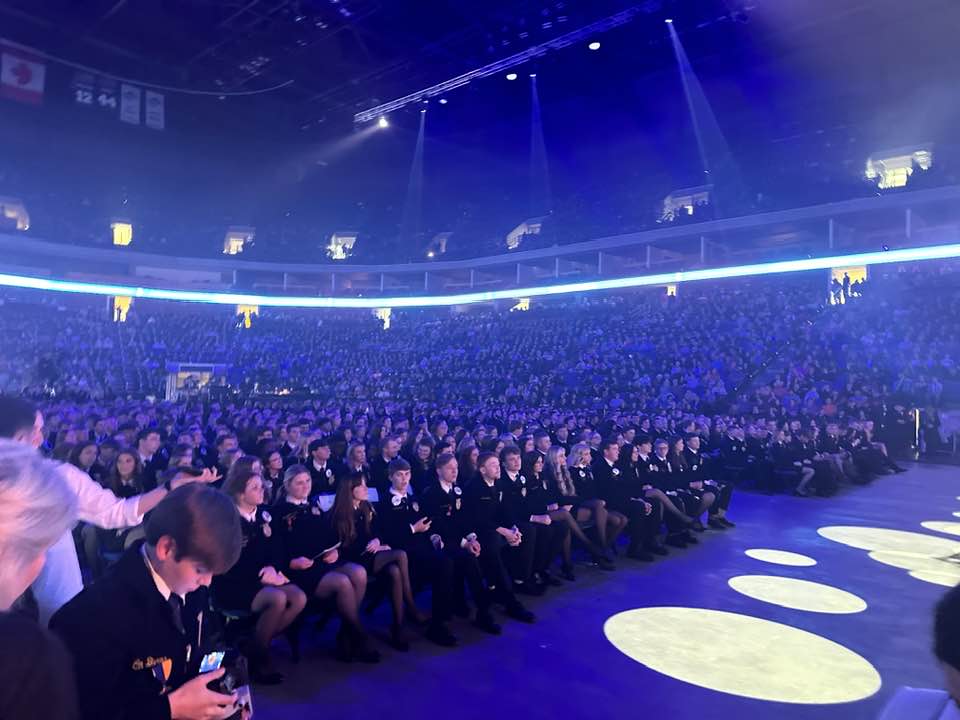
On the Convention Floor in the BOK Center- 2023 Oklahoma FFA Convention
Thousands of FFA members in their Blue and Gold will be descending on downtown Tulsa May 7th and 8th for the 98th Convention of the Oklahoma FFA. The Convention officially kicks off Tuesday morning with the Opening General Session at the BOK Center- and many of the events will also be happening at the Cox Convention Center. That includes the 2024 Career Show, with over 125 exhibitors interacting with FFA members from across the state and their Ag Education teachers.
According to Oklahoma FFA Executive Secretary Trevor Lucas, approximately 14,000 members and supporters of the organization will be in downtown Tulsa for event. Sixth Convention Sessions will be held on Tuesday and Wednesday. On the final session Wednesday evening, 713 of the best of the best Seniors in Ag Education and FFA will be awarded the State FFA Degree and those attending that session will have the chance to hear from Life Church Senior Pastor and motivational author Craig Groeschel- and to celebrate with the new State FFA officer team for 2024-2025.
The 2023-24 State Officer team is led by Caleb Horne from the Morrison FFA Chapter. Horne and his team will lead all of the Convention sessions and congratulate several hundred award winners during the Convention. The high point of those awards will come on Wednesday afternoon when the Stars over Oklahoma FFA will spotlight the Star Farmer, Star in Agribusiness, Star in Ag Placement and Star in Agriscience. Those four cream of the crop awardees will collectively receive over $120,000 for their achievements- for the third year, the Carl Anderson Innovator Awards will be given to the four stars- each of them receiving $30,089 for use as a post secondary scholarship or operating capital grant.
You can go to our Blue Green Gazette and see the stories(and listen to our interviews) of all 18 Area Stars in the four categories that are vying for the four State Star awards.
Jacey Fye, the Executive Director of the Oklahoma FFA Foundation, says the Foundation has raised $870,000 for the 2024 convention- for the event itself as well as for cash awards. In addition to the monies raised for the convention itself- the Foundation works with supporters of the Blue and Gold to offer $338,000 in scholarships to those who excel in their competitions and SAE programs. The Foundation raises money for all of the programs through the year related to Oklahoma FFA- but the convention is easily the largest single event that they support.
Ahead of the convention itself, many of the state champions in speech and other contests are being decided in the Interscholastics competition on the campus of Oklahoma State University. Team and Individual results can be reviewed by clicking here. The top winners will be walking across the stage in Tulsa this coming week.
Oklahoma FFA is a top ten state in total membership nationally, with currently 29,672 members who belong to a total of 366 chapters.
Your coverage of the 2024 Oklahoma FFA Convention is sponsored by Hilliary Communications- who deliver the latest cutting-edge communications services supporting tens of thousands of customers across 22 counties throughout Oklahoma, Texas and Iowa. The company offers internet, voice and HilliaryTV. Hilliary Communications continuously researches the marketplace for innovations and strives to improve underserved areas, offering services that exceed customer expectations. Click here to learn more about Hilliary Communications.
For more information about the 98th Oklahoma State FFA Convention, click here.
March exports of U.S. pork were steady with last year's volume and edged higher in value, according to data released by USDA and compiled by the U.S. Meat Export Federation (USMEF). Beef exports were below last March's large volume but export value was the highest since June 2023.
Pork exports totaled 260,430 metric tons (mt) in March, up 0.1% from a year ago, valued at $740.8 million – up 2% year-over-year and the seventh highest on record. Through the first quarter, pork exports increased 6% to 762,784 mt, while export value climbed 7% to $2.11 billion.
"Another strong month on the pork side, and one that illustrates the importance of export market diversification," noted USMEF President and CEO Dan Halstrom. "Shipments to Mexico cooled a bit, reflecting the earlier timing for Easter, and yet the global total remained very robust through increases to Korea, Colombia, Central America and Australia. When export value exceeds $70 per head slaughtered, that's welcome news for pork producers and the entire supply chain."
March beef exports totaled 108,218 mt, down 10% from the large volume posted a year ago but still the highest of 2024. Export value was $889.9 million, down slightly from a year ago (-0.3%) but the highest in nine months. January-March exports totaled 311,865 mt, down 4% from the first quarter of 2023, but export value increased 6% to $2.48 billion.
"Beef demand in the Caribbean was outstanding in March, and we continued to see a strong rebound in the Middle East as well as some positive signs in Korea and Japan, where the foodservice recovery is making progress," Halstrom said. "It's a challenging situation in terms of supply availability, but the value U.S. beef commands internationally is very encouraging – as evidenced by March export value climbing to more than $450 per head."
Korea shines in March as pork exports close excellent first quarter
South Korea's demand for U.S. pork continued to build momentum in March, reaching the third largest volume on record at 27,508 mt – up 44% from a year ago – while export value was the second highest on record at $90.6 million (up 54%).
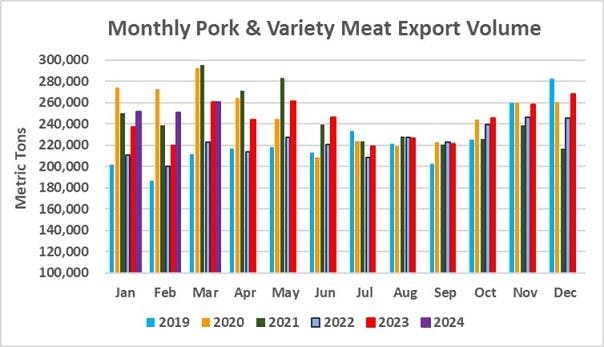
Through the first quarter, exports to Korea climbed 54% above the year-ago pace in volume (69,452 mt) and jumped 59% in value ($227.6 million). After several years in the #5 position for U.S. pork exports, Korea has surpassed Canada as the fourth largest export destination, trailing only Mexico, China and Japan.
Led by record exports to Costa Rica and Nicaragua and larger shipments to Honduras, Guatemala and Panama, March pork exports to Central America increased 28% from a year ago to 13,626 mt, while value soared 41% to $42.5 million. First quarter exports to the region were up 21% to 37,681 mt, valued at $114.8 million (up 31%). For Panama, exports are front-loaded each year because the pork safeguard is quickly triggered, meaning a higher duty on U.S. pork. This year Panama has initiated efforts to restrict overall import volumes.
March pork exports to leading market Mexico were lower year-over-year for the first time in 16 months, mainly reflecting the earlier Easter holiday. Exports fell 11% to 84,808 mt, while value was down 9% to $178.4 million. Shipments to Mexico still finished the first quarter on a record pace, up 4% from a year ago in volume (281,261 mt) and 6% higher in value ($575.1 million).
Other first quarter results for U.S. pork exports include:
March bright spots for U.S. beef include Caribbean, Middle East, Mexico
March was one of the best months ever for U.S. beef exports to the Caribbean, where shipments climbed 16% from a year ago to 3,398 mt – the third largest on record. Export value was the second highest on record, climbing 12% to $31.1 million.

This performance was led by record-large exports to the Dominican Republic, which increased 17% from a year ago to 1,238 mt. Export value to the DR soared 30% to a record $15.4 million. First quarter exports to the Caribbean increased 18% in volume (9,037 mt) and 14% in value ($76.4 million). In addition to the DR's strong performance, first quarter exports increased to the Netherlands Antilles, Leeward-Windward Islands, Cayman Islands, Barbados and Turks and Caicos Islands. Beef variety meats achieved dramatic growth in Trinidad and Tobago.
Following a down year in 2023, the Middle East region's demand for U.S. beef rebounded impressively in the first quarter. March exports totaled 5,342 mt, up 30% from a year ago, while export value climbed 22% to $22.2 million. First quarter exports to the region increased 41% from a year ago to 14,562 mt, valued at $61.5 million (up 40%). Much of this growth is attributable to larger beef variety meat shipments to Egypt, where March exports were the highest since December 2022. But muscle cut exports also increased dramatically to the United Arab Emirates, Kuwait and Qatar and trended higher to Israel, Bahrain and Jordan.
Although March beef export volume to Mexico fell below the year-ago level for the first time in 15 months, the market still posted a solid performance. March shipments to Mexico totaled 16,628 mt, down 5% from a year ago, while export value increased 3% to $100.2 million. First quarter exports to Mexico increased 12% year-over-year to 56,499 mt, while export value jumped 18% to $333.5 million. Since gaining access last year, Brazil has emerged as the second largest supplier of beef to Mexico.
Other first quarter results for U.S. beef exports include:
First quarter lamb exports lower in volume, but value trends higher
March exports of U.S. lamb were 35% below last year at 246 mt, while export value fell 5% to $1.5 million. However, this year-over-year decline was mainly due to a large volume reported for the Middle East in March 2023, as March exports to the Caribbean, Mexico and Canada all trended significantly higher than a year ago.
First quarter lamb exports fell 5% in volume to 819 mt, but value increased 19% to $4.7 million. Value growth was led by the Caribbean, Mexico and Canada, but exports also trended higher to Taiwan and the ASEAN.
Complete first quarter export results for U.S. pork, beef and lamb are available from USMEF's statistics web page.
For questions, please contact Joe Schuele or call 303-547-0030.
Oklahoma State Treasurer Todd Russ announces his office added another company to the Oklahoma State Treasurer's Restricted Financial Companies List, which is published on the treasurer's website and subject to revision annually, but not more than quarterly as needed. By law, the Treasurer is required to identify financial institutions that boycott energy companies. According to state law, 74 O.S. § 12002, 'boycott energy company' means:
Without an ordinary business purpose, refusing to deal with, terminating business activities with, or otherwise taking any action that is intended to penalize, inflict economic harm on, or limit commercial relations with a company because the company:
During his continued efforts to implement state law, Treasurer Russ has determined that Barclays PLC is another financial company ineligible for state contracts because they have publicly committed to boycott fossil-fuel companies.
Barclays PLC set project restrictions with direct financial boycotts to 'Energy Groups' against any expansion or infrastructure projects. They are targeting coal mining and power companies stating that "from 2024 we will no longer provide project finance, or other direct finance to energy companies, for new upstream oil and gas projects or related infrastructure." By January 2025, Barclays PLC "expect[s] all 'Energy Groups' to produce transition plans and decarbonization strategies" far exceeding Oklahoma's requirements.
With these examples of extreme environmental investment strategies, his office will continue to thoroughly review financial companies doing business with the State of Oklahoma whose ESG policies commit to driving unattainable expectations and demands. Oklahoman's tax dollars and State pension funds will not be used to sabotage the State's vital fossil-fuel based industries, whether those strategies target current investment policies or long-term goals.
The State Treasurer is committed to upholding the Oklahoma Energy Discrimination Elimination Act, "The third installment of this list shows progress in the state contending with companies targeting Oklahoma industry and ultimately Oklahoma jobs," said the Treasurer.
Today, the U.S. Department of Agriculture (USDA) Natural Resources Conservation Service (NRCS), the National Association of Conservation Districts (NACD), The Corps Network, and AmeriCorps announced the selection of host organizations for the Working Lands Climate Corps (WLCC), an initiative of the American Climate Corps. The WLCC will develop the next generation of conservation and climate leaders. NACD will provide participants with a virtual training program to advance careers in conservation.
"The Working Lands Climate Corps provides an opportunity for us to invest in the next generation of conservation professionals," said NACD President Kim LaFleur. "By providing opportunities for training and experience in this field, we can strengthen the pipeline of qualified professionals entering the workforce as national investments in conservation and climate-smart agriculture increase. This is an exciting time for conservation work, and it is important that we support the next generation as they join our efforts."
"America's rural communities are on the frontlines of climate change, and the Biden-Harris Administration is committed to growing and supporting a conservation workforce that can develop and implement the innovative climate solutions that this challenge demands," said USDA Deputy Secretary Xochitl Torres Small. "As part of President Biden's historic American Climate Corps, the Working Lands Climate Corps is providing a pathway for young people to enter into careers they are passionate about, like tackling climate change, advancing conservation, and helping their communities."
Selected Host Organizations
The first cohort will engage over 100 corps members serving 28 organizations in 25 states. Members will receive training in delivering critical conservation technical assistance to farmers, ranchers, and forest stewards. NACD congratulates all selected host organizations, including the following eleven that engage conservation districts as hosts or partners.
| Host Organization | Location |
| Conservation Legacy | Nationwide |
| Upper Salinas – Las Tablas Resource Conservation District | California |
| Colorado Department of Agriculture | Colorado |
| United Way of Southwest Colorado | Colorado |
| Association of Illinois Soil and Water Conservation Districts | Illinois |
| University of Maine System acting through Univ. of Maine | Maine |
| Chippewa Luce Mackinac Conservation District | Michigan |
| Minnesota Farmers Union Foundation | Minnesota |
| Sandhills Area Research Association | Texas |
| Utah State University Utah Conservation Corps | Utah |
| White River Natural Resources Conservation District | Vermont and Virgin Islands |
For a full list of host organizations, please see USDA's press release.
Call for Applications to Work with Host Organizations
Applications for WLCC members are now open. Interested applicants are invited to visit the American Climate Corps website to learn more about the host organizations, training and service opportunities, and apply for over 100 jobs in the WLCC. Through their experience with host organizations, WLCC members will work with landowners, producers, and communities to encourage the adoption of climate-smart agriculture and forestry practices that reduce greenhouse gas emissions. They will also receive on-the-job training to understand outreach, education, and technical assistance strategies.
NACD will provide members with virtual trainings covering conservation concepts, practices, and systems, with a strong emphasis on locally led initiatives and developing the partnerships needed to advance landscape scale conservation and landscape-scale practices.
Conservation districts across the country have a long history of partnership with USDA, NRCS, and the original Civilian Conservation Corps. Together, we share nearly a century of history tackling our country's most pressing conservation needs through a voluntary, locally led, incentive-based approach. NACD is pleased to serve alongside these partners in establishing the WLCC after calling upon Congress for support for more programs to inspire and prepare the next generation of conservation leaders.
To learn more about the Working Lands Climate Corps, visit https://corpsnetwork.org/programs-initiatives/workig-lands-climate-corps/.
NACD encourages those interested to apply at https://www.acc.gov/join/.
The American Farm Bureau Federation recently selected an outstanding group of leaders in agriculture as the organization's 12th Partners in Advocacy Leadership class. AFBF designed PAL to help agricultural leaders accelerate their engagement abilities and solidify their roles as advocates for agriculture.
"Being able to successfully advocate at all levels – local, state and national – for agricultural issues that benefit rural communities is more important than ever," said AFBF President Zippy Duvall. "We applaud the members of PAL Class 12 for their interest in honing the necessary skills to promote issues that are important to those in the farm-to-consumer food chain."
Members of PAL Class 12 are: Magen Allen, Arkansas; Jen Beretta, California; Amanda Durow, Minnesota; Jessica Graves, Mississippi; Jon Iverson, Oregon; Matt Moreland, Missouri; Jackie Mundt, Kansas; Linda Pryor, North Carolina; Chris Riley, Utah; and Karl Shlagel, Maryland.
PAL training involves four learning modules designed to develop specific advocacy skills while exploring components of leadership and its theories and philosophies. The modules build on one another over the two years of the program and include intense, in-person, hands-on training.
PAL graduates emerge with the experience and confidence—in everything from legislative policy making and issues management to social media and media relations—to effectively engage all critical stakeholders.
To be eligible for the PAL program, candidates must be between the ages of 30 and 45, with demonstrated leadership skills. The program is sponsored by AFBF, Syngenta, Farm Credit and Merck Animal Health.
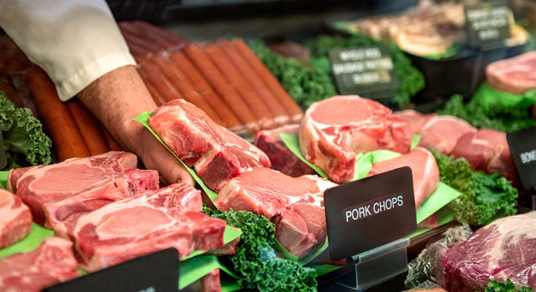
The latest research on pork has some surprising findings regarding its nutrient density, affordability, and impact on the environment.i Director of Nutrition Research, NPB, Dr. Kristen Hicks-Roof identified a gap in the science and sought out this evidence-based research for an answer that could help put fresh pork at the center of sustainable diet conversations. She states, "Given all that should be factored in an eating plan that's good for people and the planet, we aim to extend the awareness of pork's place as a planet-friendly protein."
The food sustainability framework has four domains, nutrition and health, economics, environment, and society, and to qualify as sustainable, foods need to be nutrient rich, affordable, environmentally friendly, and socially acceptable, explains Adam Drewnowski, PhD, professor of epidemiology at the University of Washington and primary author on this new study.
Pork is one of the most consumed meats globally, providing high quality protein and several priority micronutrients. In the U.S. however, understanding how the affordability and sustainability of pork intersect with its nutritional value has been missing. This new research assessed the place of pork meat protein in the sustainability framework domestically and globally.
Nearly all databases used to study nutritional characteristics, prices, or environmental footprints, group pork in with other foods, despite it having different characteristics in other forms of measurement. For example, the United States Department of Agriculture (USDA) category of protein foods includes meat, poultry, fish and seafood, eggs, beans and legumes, and nuts and seeds. But these are not equal, as they have different amino-acid profiles, different per calorie prices, and different environmental footprints, measured in terms of greenhouse gas emissions (GHGE).
Additionally, most analyses of prices of animal-source proteins combine beef, pork, and lamb into a single category of red meat. Again, beef, pork, and lamb have different nutrient profiles, different protein costs, and different impacts on the environment.
Dr. Drewnowski first untethered pork from other foods in the four domains of the food sustainability framework using nutrient composition and prices data from USDA, food balance sheets from the Food and Agriculture Organization of the United Nations (FAO), country-level incomes from the World Bank, and GHGE data for the U.S. from the scientific literature.
He realized that treating pork meat as a separate protein food category, distinct from red meat and poultry, leads to some surprising findings regarding its nutrient density, affordability, and impact on the environment.
To understand if pork has a place in a healthy and sustainable diet as part of the food sustainability framework, Dr. Drewnowski first looked at the nutritional protein quality of pork. He found that pork meat is an excellent source of high-quality protein, providing more than 20 grams of protein per 100 grams. Pork also delivers 100% of daily needs of protein for the least calories.
Next, he focused on affordability. His analysis suggests pork meat costs less per 50-gram amount of protein compared to other red meats. Pork meat has a clear price advantage over red meat and comes close to chicken in the Thrifty Food Plan market basket, or the USDA food plan that informs the Supplemental Nutrition Assistance Program as the cost to purchase groceries in an affordable, nutritious and practical way for a family of four. Dr. Drewnowski concluded that pork is an affordable source of high-quality protein.
Environment came next, where Dr. Drewnowski separated pork from other red meats in terms of sustainability data. He shows that the estimated GHGE emissions for pork meat (using U.S. data from other studies) are in fact closer to those of beans and poultry – a clear environmental advantage.
"At the National Pork Board, we understand that referencing objective data about all four domains of sustainability tells a different story than we've previously seen about food agriculture production. These four domains tie in directly the the six We Care ethical principles of animal welfare, environment, our communities, our people, food safety, and public health" explains Jamie Burr, Chief Sustainability Officer, NPB.
"We also know that cost-effective and sustainable proteins are becoming increasingly important around the world, the most consumed of which we know is pork," notes Burr. "This is why we invited experts to look more closely at the data specific to pork, which does in fact support the notion that pork could be a perfectly nutrient-dense, affordable, planet-friendly and culturally preferred protein for the future," he adds.
David Newman, PhD, SVP of Market Growth, NPB, suggests that distilling the benefits of pork in the global food supply can be exactly what farmers and producers in our industry need to see happen right now.
"This report tells us more people around the world are relying on animal protein for their nutrition because of rising incomes across lower-and middle-income countries, and this creates a growing demand for pork to replace traditional plant proteins. The data suggests there's no sign of this trend slowing down," he adds.
He continues, "Extending the reach of this powerful analysis, we intend to share this detail through all channels of our communications."
Burr further explained that while pork is an excellent source of high-quality protein and checks all the boxes when it comes to food sustainability framework, taste and cultural acceptance go without saying. "We couldn't be more excited to see pork become a part of the global nutrition and sustainability dialogue," he said.
At the National Association of Farm Broadcasters (NAFB) annual Washington Watch event in Washington, D.C., Farm Director KC Sheperd caught up with Senator James Lankford and talked about disaster relief in Oklahoma after devastating tornadoes, his border security package, and more.
"On Sunday, I was in Sulphur with the cleanup, getting the chance to visit with folks and find out what is going on," Lankford said. "We brought in the FEMA (Federal Emergency Management Agency) administrator. It is a bad day when the national FEMA administrator shows up in your state, but it also shows you that everyone sees the issue that is there. We spent a day in Marietta, then back in Sulphur again, getting the chance to talk about other locations."
After wrapping up his visit to the Sulphur area, Lankford said western Oklahoma was hit with tornadoes next.
"We are working through the emergency assistance for state and local government entities as they have got a lot of extra burden that would be on the taxpayers otherwise," Lankford said. "We are trying to help out every way we can."
Lankford talked about how these disaster events have brought up conversations relating to boosting rural healthcare resources in rural areas.
"I have got seven different bills we are working on right now to try to get passed to be able to protect our independent pharmacies to be able to keep them open," Lankford said. "If people want to do mail-order pharmaceuticals, that's fine. They are welcome to do that, but a lot of folks, especially in rural Oklahoma, want to go to a pharmacist and be able to talk to somebody."
Regarding Lankford's border security package released in February, he said many individuals are starting to have a better understanding of the issues presented in the bill.
When the bill was first released, Lanford said it was rumored that the bill allows for 5,000 illegal immigrants to cross the border daily, which is not true.
The way the bill was written changed the rules for the very first-person crossing, Lankford said, so the first person that illegally crossed every day would be detained, receive a quick screening, and then be deported. After 5,000 immigrants, Lankford said there is no screening, and individuals are deported immediately.
"The goal was to be able to change how we handle asylum, change the speed of how we actually screen people because by law, if somebody asks for asylum you have got to screen them," Lankford said. "This makes the screening much faster and much tougher, so the goal is that fewer people would ever come. Right now, anybody that comes across the border is going to get a non-screening, then get released into the country for years while they await their actual asylum hearing, then they find out at the end of it that they don't qualify for asylum, which most people don't, but they are still here, and they have been here for years, and they probably will not even show up for their hearing. Everybody knows that."
Lankford spoke on the Senate floor about the Federal Aviation Administration (FAA) reauthorization bill, which is currently being considered by the Senate.
Oklahoma City is home to the Mike Monroney Aeronautical Center (MMAC), which is an essential part of safe and efficient air travel network coordinated by the FAA. MMAC is home to the only FAA Academy that provides the initial training for air traffic controllers. The FAA Academy provides centralized, standardized, and efficient training to about 20,000 students each year. Earlier this year, Lankford sent a letter with the entire Oklahoma congressional delegation standing with their great work and encouraging the FAA to expand it.
Lankford also gave an overview of more legislation he is working on, or against for Oklahomans including issues related to air traffic control, international threats, and more. Click the listen bar above to hear the full conversation!
| |||||||||||||||||||||||||||||||||||||||||||||||||||||||||||||||||||||||||||||||||||||||||||||||||||||||||||||||||||||||||||||||||||||||||||||||||||||||||||||||||||||||||||||||||||||||||||||||||||||||||||||||||||||||||||||||||||||||||
|
Senators James Lankford (R-OK) joined Edward J. Markey (D-MA), and Ted Cruz (R-TX), in support of the AM Radio for Every Vehicle Act, whichnow has support from 60 members of the Senate. The legislation would direct the National Highway Traffic Safety Administration (NHTSA) to require automakers to maintain AM broadcast radio in their new vehicles at no additional charge. The House legislation has 246 co-sponsors.
"Emergency alerts save lives and AM radio ensures that drivers can hear them as soon as possible. If you're on a road trip or driving to work, you shouldn't be blocked from having access to news, music, sports, or weather because of the kind of car you drive. The AM Radio for Every Vehicle Act will keep AM radio in cars across America," said Lankford.
"Democrats and Republicans are tuning in to the millions of listeners, thousands of broadcasters, and countless emergency management officials who depend on AM radio in their vehicles. AM radio is a lifeline for people in every corner of the United States to get news, sports, and local updates in times of emergencies. Our commonsense bill makes sure this fundamental, essential tool doesn't get lost on the dial. With a filibuster-proof supermajority in the Senate, Congress should quickly take it up and pass it," said Markey and Cruz.
Cosponsors in the Senate include: Senators Tammy Baldwin (D-WI), John Barrasso (R-WY), Marsha Blackburn (R-TN), Richard Blumenthal (D-CT), John Boozman (R-AR), Katie Britt (R-AL), Sherrod Brown (D-OH), Ted Budd (R-NC), Maria Cantwell (D-WA), Shelley Moore Capito (R-WV), Robert Casey (D-PA), Susan Collins (R-ME), Catherine Cortez Masto (D-NV), Tom Cotton (R-AR), Kevin Cramer (R-ND), Steve Daines (R-MT), Joni Ernst (R-IA), Deb Fischer (R-NE), Kirsten Gillibrand (D-NY), Lindsey Graham (R-SC), Chuck Grassley (R-IA), Josh Hawley (R-MO), Mazie Hirono (D-HI), John Hoeven (R-ND), Cindy Hyde-Smith (R-MS), John Kennedy (R-LA), Angus King (I-ME), Amy Klobuchar (D-MN), Ben Ray Luján (D-NM), Cynthia Lummis (R-WY), Joe Manchin (D-WV), Roger Marshall (R-KS), Robert Menendez (D-NJ), Jeff Merkley (D-OR), Jerry Moran (R-KS), Markwayne Mullin (R-OK), Lisa Murkowski (R-AK), Chris Murphy (D-CT), Jon Ossoff (D-GA), Jack Reed (D-RI), Pete Ricketts (R-NE), Jacky Rosen (D-NV), Mike Rounds (R-SD), Bernie Sanders (I-VT), Rick Scott (R-FL), Jeanne Shaheen (D-NH), Kirsten Sinema (I-AZ), Tina Smith (D-MN), Dan Sullivan (R-AK), Jon Tester (D-MT), Tommy Tuberville (R-AL), J.D. Vance (R-OH), Elizabeth Warren (D-MA), Sheldon Whitehouse (D-RI), Roger Wicker (R-MS), Ron Wyden (D-OR), and Todd Young (R-IN).
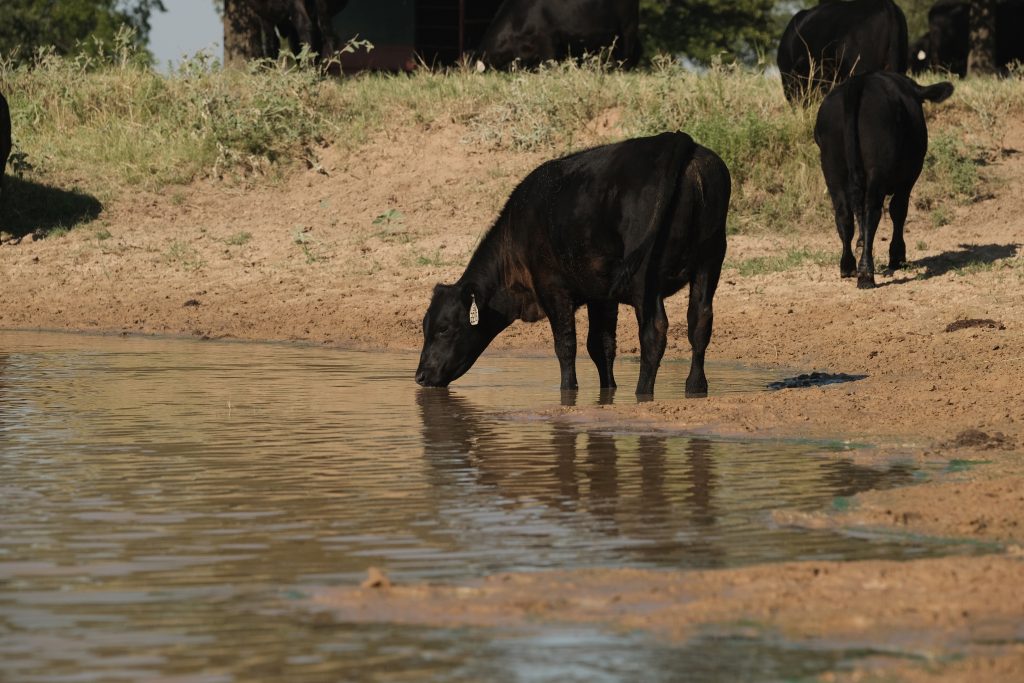
Farm Director KC Sheperd is visiting with Bob Rodenberger, a Partner with Stockman Oklahoma Livestock, as he gives the latest on the cattle markets. Rodenberger said the markets are still reacting to the Highly Pathogenic Avian Influenza situation. Although HPAI does not impact food safety, Rodenberger said it has still managed to move the markets up and down based on rumors.
In general, the feeder market has been good, Rodenberger said, along with the fat market.
"We have still got a good market," Rodenberger said. "These calves weighing 600 and down are not a bit cheaper anywhere. There is still a lot of demand. People are still trying to replace what they are selling because there is still a good margin in them."
Rodenberger also emphasized the importance of risk management and noted that there are no indications of herd expansion, only the replacement of old cattle.
"We are getting rain- that's positive," Rodenberger said. "If we can get a good start on grass and get some good hay put up, people's ponds are getting back up to at least 80 percent normal, I think we could see some people maybe looking at holding some heifers in our area. We are not seeing any of that yet."

At the National Association of Farm Broadcasters Washington Watch Event, Farm Director KC Sheperd had the chance to visit with the National Cattlemen's Beef Association's Chief Counsel of Government Affairs, Mary-Thomas Hart. In this episode of Beef Buzz, Senior Farm, and Ranch Broadcaster Ron Hays is featuring comments from the conversation regarding the latest on WOTUS (Waters of the U.S.)
Last year, the Supreme Court ruled against the Biden Administration's WOTUS rule, forcing the EPA to make major changes before the rule was approved. Hart follows up on what has happened since.
"Last summer, we got a unanimous 9-0 opinion from the Supreme Court that struck down the underlying basis of the EPA's last few WOTUS definitions, the significant nexus," Hart said. "That kind of forced EPA back to the drawing board to make some pretty significant changes to the Biden Administration's WOTUS definition, and we got that definition last September."
Hart said the Biden Administration's rule containing significant nexus, which was shot down by the Supreme Court was replaced with a rule containing "relative permanence," which means femoral features and isolated ponds and wetlands will not be regulated by the federal government.
"I think this shift really does make sure that EPA's resources and EPA's time is being put toward the water sources and water features that need the most protection," Hart said.
From NCBA's perspective, Hart said there are a few questions, but for the most part, they are satisfied with that final rule.
"We have some loose ends to tie up, specifically related to, what is the breadth of interstate waters as a category of jurisdictional waters and what features are going to be considered interstate waters," Hart said. "Also, getting some more clarity on how the EPA is going to treat femoral features or features that only carry water after a rain or snowstorm."
Hart said the NCBA looks forward to additional guidance from the EPA, Army Corps of Engineers, and the USDA as the new standard is implemented. Going forward, Hart said some additional clarity on how prior converted cropland will be treated would be appreciated as well.
"It feels like after 50 years of fighting over the definition of WOTUS, long before I was born, we can finally see a light at the end of that regulatory tunnel," Hart said.
Hart also talked about more legislation the NCBA is working on or against. Click the listen bar above to listen to the full conversation!
The Beef Buzz is a regular feature heard on radio stations around the region on the Radio Oklahoma Ag Network and is a regular audio feature found on this website as well. Click on the LISTEN BAR for today's show and check out our archives for older Beef Buzz shows covering the gamut of the beef cattle industry today.
Chloe Silka
During the month of April, the Radio Oklahoma Ag Network and Oklahoma Farm Report are spotlighting the 18 Area Stars of Oklahoma FFA, who are among the highest achievers in the organization.
The stars come from the five areas in four categories- Star in Ag Placement, Star in Agriscience, Star in Agribusiness, and Star in Agricultural Production.
This week, we spotlight the five area stars in Agricultural Production in 2024.
One Star Finalist featured in the coming days from each of the categories will be named the State Star Award Winner during the 98th Oklahoma State FFA Convention, which will take place on May 7th and 8th in Tulsa, Oklahoma.
This week, our coverage of the 2024 Oklahoma FFA Star Award Finalists concludes with Agricultural Production competitor Chloe Silka of the Locust Grove FFA chapter representing the Northeast Area.
Silka said her projects involve goat production, beef production, and small animal production
"My beef production SAE began with a herd of commercial cattle that my parents helped me purchase from a young age," Silka said. "As time grew, I went on to purchase more cattle, as well as show heifers, which are eventually retained back into my operation."
As for her goat production SAE, Silka said it began with market wethers she showed at local and state levels. Eventually, Silka said she gained an interest in the breeding side of things, which led to her own herd of breeding does.
"My small animal production SAE began with registered Border Collies that I would market on the local and state level through Facebook groups and newspapers," Silka said. "Eventually, I began buying and selling Australian Shepherds, which I have found to be a lot more consistent in terms of their sales and production rates."
Throughout her project, Silka said she has learned how to evaluate livestock and the importance of communications and marketing in the industry.
After high school graduation, Silka said she plans to attend Connors State College on a livestock judging scholarship, and then finish her bachelor's degree at Oklahoma State University. After receiving her bachelor's degree, Silka plans to attend veterinary school and specialize in both large and small animals.
Your coverage of the 2024 Oklahoma FFA Convention is sponsored by Hilliary Communications- who deliver the latest cutting-edge communications services supporting tens of thousands of customers across 22 counties throughout Oklahoma, Texas and Iowa. The company offers internet, voice and HilliaryTV. Hilliary Communications continuously researches the marketplace for innovations and strives to improve underserved areas, offering services that exceed customer expectations. Click here to learn more about Hilliary Communications.
For more information about the 98th Oklahoma State FFA Convention, click here.
Leaders of the U.S. ethanol industry are seeking to intervene in a legal challenge of the ReFuelEU Aviation Regulation, which effectively bans the use of renewable, crop-based biofuels like corn ethanol as a feedstock for decarbonizing the aviation sector. Collaborating in the intervention are the U.S. Grains Council, Growth Energy, the Renewable Fuels Association and LanzaJet. Earlier this year, LanzaJet opened the world's first ethanol-to-jet biorefinery, in Georgia.
The application to intervene in the proceedings supports a challenge brought by ePURE, a trade association representing European ethanol producers, and Pannonia Bio, one of Europe's largest ethanol producers. Their application seeks to annul the relevant provisions of the ReFuelEU Aviation Regulation, which was adopted by the EU in 2023 and is set to take effect in 2025. A similar challenge was brought against the FuelEU Maritime Regulation, and members of the U.S. ethanol industry are seeking to intervene there, as well.
With regard to the new petition, the groups argue it will have a detrimental effect on the U.S. ethanol industry.
"[T]he Contested Provisions give rise to a de facto ban on the supply of crop-based biofuels to the aviation sector in the EU," the organizations argue. "Due to the substantial difference in cost between biofuels and fossil fuels in the EU – which the Regulation expressly acknowledged – aviation fuel suppliers will not purchase biofuels instead of fossil fuels unless they are obliged or incentivised to do so. Since using crop-based biofuels will not help aviation fuel suppliers meet their obligations under the Regulation, they will not purchase those biofuels."
Tony Rice will testify this afternoon before USTR on how U.S. trade policy can strengthen supply chain resiliency and ensure that U.S. dairy continues to grow as a global leader.
The U.S. dairy industry exported more than $8 billion worth of products in 2023, supporting thousands of jobs and contributing significantly to the national economy. Rice in his testimony will highlight the need for a more proactive U.S. trade policy agenda that aggressively tackles global trade barriers and enhances market access to key partners.
"An inclusive, worker-centered trade policy should reflect the central role that comprehensive trade agreements and American exports play for the agricultural economy and the many farmers and workers throughout the supply chain who rely on it," Rice says in his prepared statement. "Expanding export sales does not only support America's farms, but also traditionally underserved workers in rural communities and in companies supplying inputs and services, in downstream food manufacturing plant jobs, and in cities with large port facilities heavily dependent on trade."
Rice also recommends that USTR incorporate dairy-specific elements in trade negotiations, drawing on the precedent set by annexes for wine in various agreements, or the broad recognition of the U.S. regulatory system for processed foods including dairy in the U.S.-Panama Trade Promotion Agreement.
"Such steps would facilitate smooth, more reliable and robust dairy supply chains with our trading partners," Rice says in his statement.
Find NMPF and USDEC's full testimony here.

The ExtensionBot tool provides information on community health, family and consumer sciences, 4-H youth development, and agricultural and natural resources from Extension systems nationwide. (Photo by Mitchell Alcala, OSU Agriculture)
A new online tool to help people quickly find factual, proven information on agriculture and Extension topics is in its final phase of development. Oklahoma State University Agriculture and the Extension Foundation are preparing the official launch of ExtensionBot, an artificial intelligence chatbot that provides expertise from Cooperative Extension systems across the country.
ExtensionBot will give Extension educators, volunteers and the public unlimited access to information in all areas of Extension. Its narrative interface combined with AI technology will also improve accessibility and use of Extension content that currently exists online. OSU Extension is a public resource for practical information on community health, family and consumer sciences, 4-H youth development, and agricultural and natural resources.
The tool will continue to modernize the Oklahoma Cooperative Extension Service and build a more robust list of resources to serve Oklahomans. ExtensionBot amplifies the reach of scientific and applied research conducted by Extension personnel to connect with residents, enrich their lives, address trending topics, and recommend methods and strategies that support a vibrant Oklahoma economy and workforce landscape.
"Our goal is to deliver trustworthy, research-based knowledge coupled with the longstanding principles and expertise of OSU Extension and other peer Extension systems," said Jayson Lusk, vice president and dean of OSU Agriculture. "ExtensionBot will improve the efficiency and effectiveness of public inquiries into Extension topics. It combines the best of our human expertise and research with AI technology to inform a national audience."
The project's developers in OSU Agriculture and other partner universities are focused on respecting the privacy of users while connecting them to local Extension systems. ExtensionBot preserves the ownership and attribution of Extension specialists and experts nationwide.
"ExtensionBot is more accurate than similar tools because the source data is curated and is much more precise than content resourced by ChatGPT and other AI services," said Damona Doye, OSU Extension associate vice president. "We use content from reliable Extension system partners. The more data we receive from Extension services, the more relevant, up-to-date and locally branded answers we can provide."
More than 20 Extension services currently source information for ExtensionBot in its pilot phase. The nationwide public launch is expected later in 2024. Anyone can explore the digital tool by clicking on the cowboy hat icon at the bottom right of extension.okstate.edu.
In partnership with land-grant universities, ExtensionBot is managed by the Extension Foundation and funded with grant money from the New Technologies for Ag Extension program, available through the U.S. Department of Agriculture's National Institute of Food and Agriculture.
OSU Agriculture is dedicated to improving the quality of life of Oklahomans through science-based information and education. It is comprised of the Ferguson College of Agriculture and two state agencies: OSU Ag Research and OSU Extension.
By Gail Ellis
Each week, Beltway Beef brings you the latest policy news affecting the U.S. cattle and beef industry. Hear from subject-matter experts, producers, and industry leaders on the topics that impact the business viability of farms and ranches across the country.
On this episode, we are joined by Executive Director of the Public Lands Council and NCBA Natural Resources Kaitlynn Glover to analyze the "Conservation and Landscape Health" rule recently finalized by the Bureau of Land Management. Glover explains why western ranchers have raised concerns about the rule and how it will impact public lands grazers. Glover also explains why all cattle producers should be paying attention to issues impacting western ranchers.
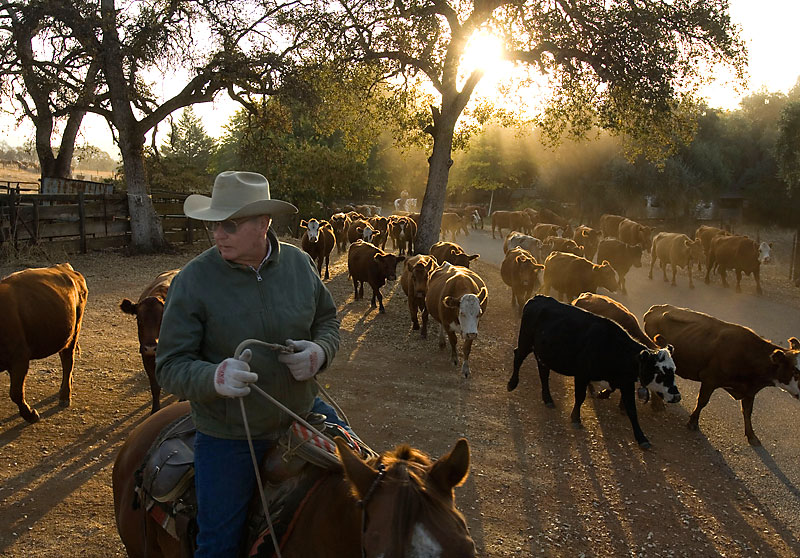
The Oklahoma Cattlemen's Association (OCA) extends its heartfelt appreciation to the Oklahoma House of Representatives and Senate for unanimously passing resolutions designating May as Beef Month in Oklahoma. This declaration serves as a testament to the vital role of beef producers in our state's economy and culture. HR 1038 by House Agriculture Committee Chairman Representative Dell Kerbs and SR 43 by Senate Agriculture Committee Chairman Senator Chris Kidd were adopted on Wednesday, May 1st.
"Beef Month is a celebration of the tireless efforts of our hardworking ranchers and producers who dedicate themselves to supplying high-quality beef to tables across Oklahoma and beyond," remarked Michael Kelsey, Executive Vice President of the OCA. "It also highlights the great tasting, nutritious and wholesome beef that Oklahomans absolutely love."
In addition to May being Beef Month in Oklahoma, May 8th is Beef Day at the Capitol. OCA is hosting the event at the State Capitol to celebrate beef and highlight beef production in Oklahoma. The 2nd Floor Rotunda will have information displays from the Noble Research Institute, Oklahoma Beef Council, Oklahoma CattleWomen, and Oklahoma State University Animal Science.
The Oklahoma Beef Council is a great source of information for beef nutrition and preparation methods at www.oklabeef.org. Great tasting and convenient beef recipes can be found at www.beefitswhatsfordinner.com. OCA invites Oklahomans to join in celebrating Beef Month by enjoying beef for lunch, dinner and even breakfast.
The OCA is the trusted voice of the Oklahoma Cattle Industry and works to protect and empower Oklahoma cattlemen today, to serve tomorrow. OCA is the only voice that speaks solely for the cattlemen of Oklahoma and represents beef producers in all 77 counties across the state. The OCA officers, board of directors and membership encourages you to join us in our advocacy efforts to ensure less government intervention, lower taxes, and a better bottom line. For more information about OCA membership, the theft reward program or activities call 405-235-4391 or visit www.okcattlemen.org.

Today, in the presence of U.S. Ambassador to the United Nations Linda Thomas-Greenfield and U.S. Department of Agriculture Deputy Secretary Xochitl Torres Small, the UN General Assembly declared 2026 as the International Year of the Woman Farmer. The resolution, and the U.S. government's efforts to generate support for it, were spearheaded by USDA and garnered more than 100 co-sponsors, underscoring the global importance of uplifting women throughout the agriculture sector.
The worldwide observance will call attention to the vital role that women play in global food and agricultural production. It will also raise global awareness of the unique challenges women in agriculture face, catalyze action to help address those challenges, and support many of the UN Sustainable Development Goals, including those focused on gender equity, food security and poverty.
"From the field to the factory, from the classroom to the boardroom, women are fundamental to the future of agriculture. As leaders, it is our responsibility to make sure the next generation of women farmers have equal access to economic, educational and leadership opportunities, and that we dismantle the unique barriers they face so they can continue to take on the challenges of meeting the world's growing food, fuel and fiber needs," Deputy Secretary Torres Small said. "USDA is proud to have led the U.S. government's efforts in support of declaring 2026 as the International Year of the Woman Farmer, and we thank the many nations that signed on in support. We look forward to working with partners worldwide to scale up efforts that empower and advance women farmers while tackling global food security in 2026 and beyond."
Women are responsible for roughly half of the world's food production, and in many countries they produce between 60 and 80 percent of the food. Yet globally, the prevalence of food insecurity is higher among women than men. By shining a spotlight on women's role in farming across the world, the International Year of the Woman Farmer will also raise awareness of constraints women face in areas including property rights and land tenure, access to credit and markets, and lack of technical and educational support. It will emphasize, as well, the importance of women in leadership roles to better ensure representation at the highest levels of decision-making.
USDA touches the lives of all Americans each day in so many positive ways. In the Biden-Harris Administration, USDA is transforming America's food system with a greater focus on more resilient local and regional food production, fairer markets for all producers, ensuring access to safe, healthy, and nutritious food in all communities, building new markets and streams of income for farmers and producers using climate smart food and forestry practices, making historic investments in infrastructure and clean energy capabilities in rural America, and committing to equity across the Department by removing systemic barriers and building a workforce more representative of America. To learn more, visit www.usda.gov.
At the behest of lobbyists representing global beef packers, Congress appropriated $15 million to buy millions of electronic identification (EID) eartags the Department of Agriculture (USDA) will now force America's cattle producers to affix to their cattle.
Let's say that another way. Global corporations just received a huge gift from Congress in the form of taxpayer dollars that will be used to force America's farmers and ranchers to help those global corporations export beef.
And, oh, I forgot to mention that Congress has been forcing American taxpayers to pay way more than $15 million to help these global corporations – the total amount is well over $150 million since this devious plan was first incepted.
Some of you might think my summation is an overexaggeration. So, I'll defend what I said.
It started over two decades ago, around 2002. Back then, the global elites (including global beef packers) determined that all nations should mandate a government-run national animal identification system (NAIS) to facilitate more trade. So, the global elites asked Congress to mandate one.
But at the time, Congress was instead helping American farmers and ranchers and consumers by forcing global beef packers to put labels on meat to inform consumers as to where the beef packers were sourcing their beef. In other words, Congress was working to require mandatory country of origin labeling (MCOOL) on beef.
The global beef packers didn't like this, but they wanted a government-mandated NAIS even more. And so, they tried to convince Congress to require NAIS as a condition for MCOOL. But Congress refused. And that's why the MCOOL statute still states, "The Secretary [of Agriculture] shall not use a mandatory identification system to verify the country of origin of a covered commodity."
Failing their global trade objective, the global elites changed their tactics, shifting their focus of NAIS away from trade and toward animal disease traceability. They breathed new life into NAIS after BSE was detected in an imported Canadian cow. And in 2004, then Secretary of Agriculture Ann Veneman announced a framework for the implementation of the National Animal Identification System or "NAIS".
For the next six years, the USDA and the global packers convinced Congress to appropriate a total of $148 million taxpayer dollars to force NAIS upon America's cattle farmers and ranchers, but they failed. And they failed because the elitists could not demonstrate the need for such a costly system that would strip America's cattle farmers and ranchers of their freedoms and liberties.
And the system would be costly. The Congressional Research Service estimated it would cost the cattle industry more than $200 million each year.
It's noteworthy that America's cattle farmers and ranchers – the last bastion of independent livestock producers – refused the government's taxpayer-funded efforts to get them to capitulate to more government control. For example, in the U.S. poultry and hog industries, which are already nearly completely controlled by multinational meat packers, from egg to plate and birth to plate, respectively, the producer sign-up for NAIS was as high as 80 percent for hogs and 95 percent for poultry. But it was only 18 percent for independent cattle producers.
And so it was that the government backed off from the cattle industry and began searching for an alternative that, while it didn't appease the global beef packers trade goal of mandating EID eartags, it did meet the needs of animal health officials who conduct disease tracebacks.
That alternative was finalized in 2013, in the form of a final rule that promised America's cattle farmers and ranchers that they would not need to register their properties or premises with the government, and they could choose among various forms of identification. In other words, they could choose to register their premises with the government and use electronic identification eartags, or they could choose not to register their premises with the government and use nonelectronic identification eartags.
And here's what the USDA said about how this nonelectronic identification mandate would impact the nation's animal health officials: the USDA said, "Our new approach to animal disease traceability provides a flexible solution that is endorsed by the animal health officials who conduct disease control programs."
But now we've all learned that we can't trust our government, as it's now back to helping give the global beef packers what they wanted all along – mandatory EID. Here's what the USDA says is the greatest benefit to their gift of a mandatory EID they just gave to the global packers: The USDA said "the most significant benefits of the rule" is to maintain foreign markets. Oh, and by the way, only 11 percent of the beef produced in the U.S. is exported. So, thank you Congress for helping the global beef packers at the expense of about 90 percent of America's cattle farmers and ranchers!
This week, the House Committee on Agriculture Chairman GT Thompson and the Senate Committee on Agriculture Chairwoman Debbie Stabenow released individual farm bill frameworks. NACD commends both Chairs for supporting NACD's top priority by calling for the incorporation of the remaining Inflation Reduction Act (IRA) conservation investments into the conservation title of the bill. NACD encourages committee leaders to continue working in a bipartisan manner to pass a farm bill that supports our producers and locally led conservation.
"NACD greatly appreciates that both Chairman Thompson and Chairwoman Stabenow's proposals would integrate IRA conservation investments into the farm bill and help more producers across the country adopt effective, locally led conservation practices over the long-term," said NACD President Kim LaFleur. "It is incredibly important for our farmers and our country's conservation efforts that Congress works together to pass a farm bill as soon as possible.
RON's Dave Lanning has a pre-opening look at today's agricultural Markets.
Click the audio tab below for today's report.
This week on SUNUP is Oklahoma State University Extension grain market economist Kim Anderson. During this week's edition, Anderson talks about the latest in the crop markets.
"We got a good rally in wheat prices," Anderson said. "They got up to around $6.10 up in northern Oklahoma for harvest-delivered wheat. You take 30 or 40 (cents) off it in southern Oklahoma and maybe 10 (cents) off it in the panhandle."
Corn had a small rally this week, Anderson said, as it is staying around $4.35 to $4.60 for harvest delivery. Soybeans had a rally as well, Anderson said, as they are now around $11.50.
Regarding when farmers should sell their wheat, Anderson said he recommends farmers sell during the June through August period. Anderson recommends staggering wheat into the market over time to average the price out.
"Overtime, it is going to average out," Anderson said. "Don't second guess your strategy."
This week on SUNUP:
Oklahoma Agriculture Starts at SUNUP!
Weekly Statewide Broadcast: Saturday at 7:30 a.m. & Sunday at 6 a.m. on OETA (PBS)
Anytime: YouTube.com/SUNUPtv
Senator James Lankford (R-OK) today spoke on the Senate floor about the Federal Aviation Administration (FAA) reauthorization bill, which is currently being considered by the Senate.
Oklahoma City is home to the Mike Monroney Aeronautical Center (MMAC), which is an essential part of safe and efficient air travel network coordinated by the FAA. MMAC is home to the only FAA Academy that provides the initial training for air traffic controllers. The FAA Academy provides centralized, standardized, and efficient training to about 20,000 students each year. Earlier this year, Lankford sent a letter with the entire Oklahoma congressional delegation standing with their great work and encouraging the FAA to expand it.
Transcript
Mr. President, this week the Senate began consideration of the FAA reauthorization bill. It's an incredibly important piece of legislation that this body takes up every few years to be able to evaluate where we are on safety of our national airspace. There's a lot of aspects that are in it. What some people may not know in this body is how incredibly important this is, not only to our national airspace and our safety, but it's also something that's talked about often in my state of Oklahoma. Oklahomans are passionate about our national airspace for many reasons.
One is we obviously love to fly and have a long heritage of flying in our state. But it's also the unique relationship that FAA has with the state of Oklahoma. There are only two FAA centers outside of Washington, DC. One of those is actually in Oklahoma City, the Mike Moroney Aeronautical Center. I would safely say to everybody that if you've been on a flight lately and it took off and landed safely, you can thank the folks in Oklahoma City for that, because Oklahoma City, that operation, the Mike Moroney Aeronautical Center, that center that's functioned for 70 years, has provided a lot of the vital services for the FAA for all seven of those decades. There were established in 1958. [It] is home to thousands of great federal employees there that serve our nation every single day to keep our airspace safe. But they do it in ways that sometimes people don't see.
Let me give you an example of that. The center houses a lot of the different components and a lot of back office things for a lot of different agencies. They're on 1,100 acres of land in Oklahoma City, with 133 buildings. And as you go through the complex, you think there's a lot going on here. Let me give you just a few examples of those things. The Civil Aerospace Medical Institute is housed in Oklahoma City. The Civil Air Space Medical Institute takes care of the medical certification, the research, education, the occupational health wing for the FAA. They conduct all the research and the studies on the human element of flight there. That's safety for pilots, flight attendants, passengers, how to be able to handle the pressurization, all those things. They do that in Oklahoma City every single day.
The Mike Maroney Center is also home to the only FAA Academy. They handle the first 60 days or so of the developmental air traffic control training before a student is actually placed in the field. So basically, when you take off and land in either communication with air traffic control anywhere in the country, it's very likely those folks were initially trained in Oklahoma City. The Oklahoma City Air Traffic Control training has geared up to be able to take on as many people as the nation needs for air traffic control. In fact, this particular bill encourages maximizing as many people as possible, actually getting through air traffic control training and the Academy in Oklahoma City is well prepared to be able to step up to the challenge of that. They have space. They have great trainers that come in from all over the country to be able to do the training there. They're fully capable and they've had a great curriculum that they've been able to train folks that have now served our nation every single day. FAA reauthorization bill expands that capacity in Oklahoma City, rightfully so. And they're fully ready to be able to do it.
They're also set a new minimum hiring target for air traffic controllers. So the maximum number of individuals can actually go through the Academy. It is very important that we train as many people as possible to be able to make them ready. Advanced air mobility is another element that's actually there at the Mike Maroney Aeronautical Center. The focus there is the next generation of what's going to happen in unmanned flight. While a lot of folks talk about that in the future, that research is actually happening on the ground in Oklahoma City every single day.
There are a lot of aspects of this bill that prepares us for the future of aviation and continues to be able to make our airspace the safest airspace in the world. Let's keep it that way. Let's continue to be able to learn what we can, and to be able to continue to advance the future of aviation in the United States. So look forward to the debate that will begin officially later on today, and we'll continue all through next week, or quite frankly, until whenever the Senate is finished in the debate on this bill, because it's important we actually get the FAA bill done in the days ahead. With that, I yield the floor.
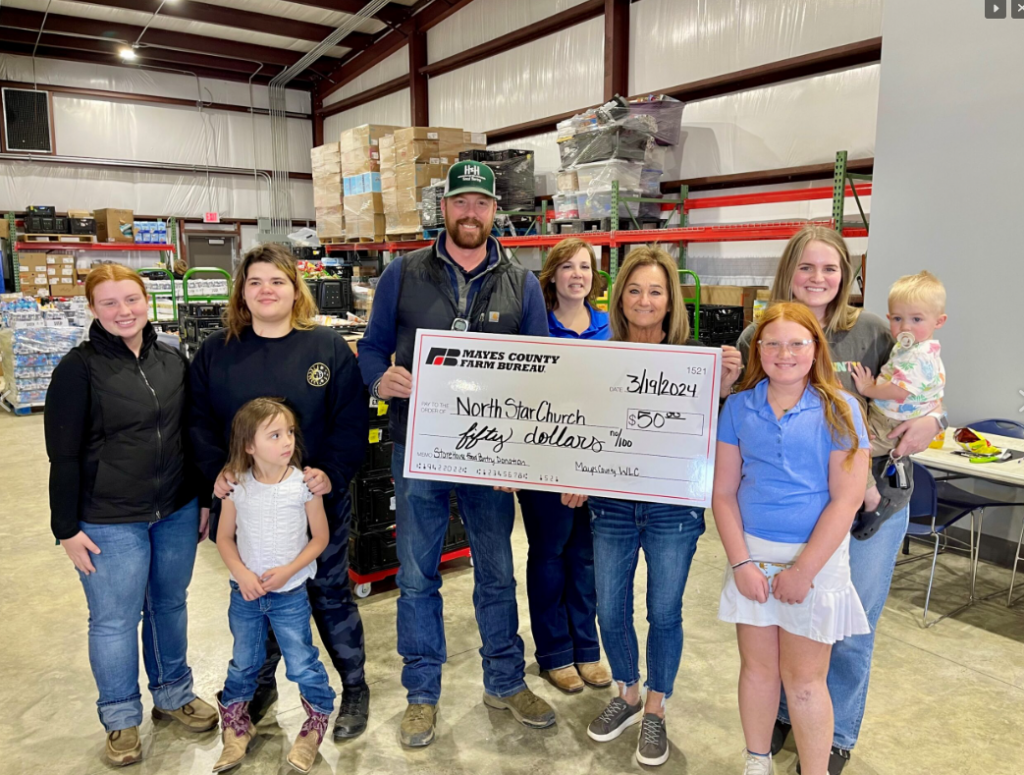
Oklahoma Farm Bureau teamed up with county Farm Bureaus to donate a total of $12,400 to food pantries and food assistance programs across the state through the 2024 Farm Bureau Cares: Community Food Donation Matching Program.
This year, more than 30 county Farm Bureaus and county Women's Leadership Committees made donations to nutrition assistance programs in their communities, including local community food banks, church meal programs, organizations helping victims of domestic violence and more.
Launched in 2021, the program encourages county Farm Bureaus to make donations of food or money to organizations that help meet the nutritional needs of local residents. OKFB matched county Farm Bureau donations up to $100, doubling the impact of the grassroots organization.
As agriculturalists, Farm Bureau members know the importance of food security, and the Farm Bureau Cares program gives Oklahoma farmers and ranchers the opportunity to uplift their communities through sharing the products they grow to feed, clothe and fuel their fellow Oklahomans every day. To view provided donation photos, visit okfb.news/4b0HFe5.
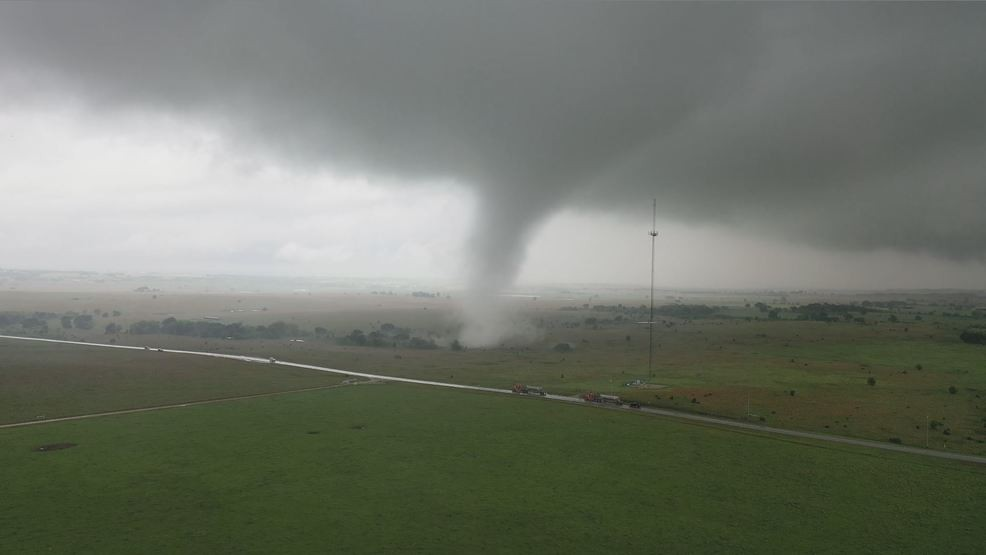
After recent wildfires and devastating tornadoes in Oklahoma, Associate Farm Editor Reagan Calk had the chance to talk with Oklahoma State University associate professor of agricultural economics, Dr. Amy Hagerman, about USDA Wildfire and Disaster Assistance programs.
"The main thing that people need to know is to do timely reporting of the damages," Hagerman said. "A lot of these programs have a bit of a time clock associated with them, so getting timely reporting of those damages and documentation is so critical for any of these programs."
Hagerman said it is also a good idea for producers to take documentation of their property before disaster strikes as well so it can be compared in the case of a disaster.
"Keep those records in your own files, because those are the things that you can turn around and use as documentation for these programs," Hagerman said. "There are a lot of different programs. I think another thing for people to realize is that there are different programs for different areas of loss. You can stack these programs on top of each other for the different areas of loss you may experience."
Some examples of loss may include livestock loss, fence line damage, hay loss, and more. After assessing the damage to their property, Hagerman said producers can then decide what programs they may be able to apply for. Examples below:
Livestock Indemnity Program (LIP): LIP provides benefits to livestock producers for livestock deaths in excess of normal mortality caused by adverse weather or by attacks by animals reintroduced into the wild by the Federal Government. LIP payments are equal to 75 percent of the average fair market value of the livestock.
Emergency Conservation Program (ECP): The Emergency Conservation Program (ECP) helps farmers and ranchers repair damage to farmlands caused by natural disasters and put in place methods for water conservation during severe drought. The ECP does this through funding and technical assistance.
Environmental Quality Incentives Program (EQIP): The Environmental Quality Incentives Program (EQIP) is NRCS' flagship conservation program that helps farmers, ranchers and forest landowners integrate conservation into working lands. EQIP provides technical and financial assistance to agricultural producers and forest landowners to address natural resource concerns,
Emergency Assistance for Livestock, Honeybees, and Farm Raised Fish (ELAP): ELAP provides financial assistance to eligible producers of livestock, honeybees and farm-raised fish for losses due to disease, certain adverse weather events or loss conditions, including blizzards and wildfires, as determined by the Secretary. ELAP assistance is provided for losses not covered by other disaster assistance programs authorized by the 2014 Farm Bill and the Bipartisan Budget Act of 2018, such as losses not covered by the Livestock Forage Disaster Program (LFP) and the Livestock Indemnity Program (LIP).
"Also, they each have different payment limitations, so applying for one program and getting a full payment for that program doesn't make you ineligible to apply for another program because it is covering a different area of loss," Hagerman said. "All of these programs require early notice of loss and reporting. None of these programs pay for 100 percent of the loss. They are either cost-share programs or they pay for some portion of the loss the producer experienced. All of them require good documentation."
Hagerman recommends producers reach out to their local Farm Service Agency office to ask questions and find out which program(s) may work best for the losses they have experienced.
| |||||||||||||||||||||||||||||||||||||||||||||||||||||||||||||||||||||||||||||||||||||||||||||||||||||||||||||||||||||||||||||||||||||||||||||||||||||||||||||||||||||||||||||||||||||||||||||||||||||||||||
|
The U.S. Department of Agriculture (USDA) seeks nominations of domestic cotton producers from Arizona, Georgia and Texas and importers of cotton and cotton-containing products for positions on The Cotton Board. The producers and importers will fill positions for seven members and seven alternates. USDA will appoint members and alternates to serve three-year terms beginning Jan. 1, 2025, to Dec. 31, 2027.
Certified producer organizations (CPOs) and certified importer organizations (CIOs) will hold caucuses to nominate two qualified persons for each open position in their respective industry segment.
Producer caucuses are scheduled as follows and all times are local times:
• Arizona: Thursday, June 27 at 10 a.m.
• Georgia: Monday, July 15 at 3 p.m.
• Texas: Thursday, July 25 at 11 a.m.
An importers caucus is scheduled for Tuesday, July 9 at 10 a.m.
Bill Gillon, President & CEO of The Cotton Board, emphasized the organization's commitment to diversity, equality, and inclusion in nominations and appointments. "Regardless of farm size, age, race, ethnicity, sex, disability, socio-economic status, religion, or sexual orientation, all qualified individuals are encouraged to participate. Further, we strongly encourage certified organizations to keep in mind the benefits that diverse membership and leadership will bring to the Cotton Research & Promotion Program, when considering individuals for nomination to The Cotton Board," said Gillon.
For nominating and caucus information, including organizations seeking certification and a list of CPOs and CIOs, contact AMS' Cotton Research and Promotion staff at (540) 361-2726 or CottonRP@usda.gov.
Today, the National Cattlemen's Beef Association (NCBA) and the Public Lands Council (PLC) reacted to the White House Council on Environmental Quality's (CEQ) final Phase 2 rule amending the National Environmental Policy Act (NEPA) which will make the process even more burdensome for livestock producers.
"In a time when the Biden Administration should be focusing on reducing regulatory burden on themselves and their partners, this new NEPA framework does the opposite. The Biden Administration largely ignored the requirements Congress passed in the Fiscal Responsibility Act that would streamline NEPA processes. Instead, this final rule changes the focus of NEPA, making it more ambiguous, less targeted, and nearly impossible to navigate," said Kaitlynn Glover, NCBA Executive Director of Natural Resources and PLC Executive Director. "This rule will make federal permitting, including for grazing permits, so much more difficult and expensive, and gives radical activists groups further license to weaponize NEPA against ranchers and rural communities."
The Texas Corn Producers, Texas Sorghum Producers and National Sorghum Producers have petitioned the Fifth Circuit for review of the fuel economy test procedures in the Environmental Protection Agency's (EPA) new Multi-Pollutant Emissions Standards for Model Years 2027 and Later Light-Duty and Medium-Duty Vehicles.
The rule lays out EPA's audacious electric vehicle mandate to which the agency expects automakers to respond by making 69% of new vehicles electric or plug-in hybrid by 2032. This move comes with a large price tag for Americans: some $870 billion in vehicle technology costs alone.
But buried inside the hundreds of pages the EPA takes to lay out the core of its electric vehicle mandate is a separate regulation setting fuel economy test procedures that arbitrarily and illegally penalize ethanol- and liquid-fueled vehicles—which ultimately penalizes the corn and sorghum farmers who contribute to U.S. ethanol production.
Thanks to ethanol's superior octane, E10 has been the standard gasoline blend for nearly two decades. But, until now, car manufacturers have continued to use E0 when certifying cars for compliance with national fuel economy and emission standards because of the way EPA penalizes vehicles tested on E10.
"EPA's regulations are bad for ethanol and perpetuate the false narrative that cars are not suited to operate on E10 or E15, let alone on E20 or E30," TCP Executive Vice President David Gibson said.
EPA proposed to update the test fuel years ago. A crucial part of this update is the R-factor, a number meant to adjust fuel economy for differences in the energy density of the test fuel. But EPA's R-factor for E10 is based on deeply flawed science and artificially lowers the fuel economy of cars tested on E10 instead of E0 as commentors, including the Texas Corn Producers, explained. EPA ignored these comments and finalized the rule anyway.
"The immediate effect of the new R-factor is to increase the stringency of national fuel economy standards, destroying demand for liquid fuels," NSP Past Chairman Kody Carson, a sorghum producer from Olton, Texas, said. "This R-factor also sets a dangerous precedent going forward. By penalizing car manufacturers for switching to a higher ethanol blend, EPA's R-factor will dampen their incentive to certify cars designed for higher blends of ethanol, such as E20.
"EPA's rule will destroy liquid fuel demand by at least 780 billion gallons by 2055. The unlawful R-factor pours salt in the wound. EPA hoped no one would notice when it reintroduced these flawed procedures. We noticed."
For nearly 100 years, the history of the farm bill largely tracks the history of food production in the United States as the legislation has evolved to meet the needs of farmers and consumers alike. Agriculture's role in providing food security, and in turn national security, to the United States is more important than ever. And now, work on the next farm bill continues during a period of volatility on every front – political, economic, environmental and beyond.
Crop insurance is exactly like it sounds: an insurance product designed to help shield farmers against a myriad of potential risks, ranging from adverse growing conditions to market fluctuations. This coverage fills crucial gaps that private insurance products may neglect or find impossible to address alone. Supported by the federal government, these policies provide financial stability for farmers, who can tailor coverage to suit their unique operational needs from a variety of policy options. Products are available for annual crops, perennial tree crops and livestock and may protect against the value of the commodity, the replacement value of a damaged or destroyed commodity, or the operating margin for a commodity.
Background & Funding
Crop insurance has its roots as part of the policy response to the Great Depression and was permanently authorized under the Agricultural Adjustment Act of 1938 and the Federal Crop Insurance Act of 1980. The Federal Crop Insurance Corporation is the agency that finances the program's functions through mandatory appropriations of "sums as necessary." The Risk Management Agency (RMA) has discretion over policy offerings, coverage and administration. The Congressional Budget Office (CBO) projects net spending each year and estimates the costs of supporting a portion of a farmers' policy premium, compensating private insurers for their administrative and operating expenses and reinsuring losses from policies sold (transferring all or part of the risk to another insurer). Projections depend partly on commodity prices. If commodity prices increase in the future, the expected value of insured crops would rise, leading to higher anticipated values for insured liability and premium discounts compared to scenarios with lower commodity prices. For marketing year 2024, the CBO projects a total program cost of $12.37 billion.
Title XI of the farm bill supports new and continued insurance products farmers may purchase through a public-private partnership. Private-sector companies known as approved insurance providers (AIPs) sell and service crop insurance policies while USDA plays critical roles in financing, regulating and reinsuring the policies. This model is essential to service farmers and ranchers and the uniqueness of each of their operations across the country as AIPs provide the boots-on-the-ground service and processing, relieving USDA of administrative burdens. Farmers work with their local crop insurance agent to select the base coverage policy that fits their farm or ranch. Additional products, or endorsements (similar to options for automobile or home insurance products), can be added to underlying policies for additional costs.
Covered Perils
Crop insurance provides protection for a limited number of events or conditions. These are called "covered perils" or "causes of loss" and include adverse weather conditions (e.g., hail, frost, drought, flooding); failure of irrigation water supply (if caused by an insured peril during the period of insurance coverage); fire (due to natural causes); plant diseases (provided the farmer followed guidance on proper application of disease control measures); and insect and wildlife damage (provided the farmer followed guidance on proper application of pest and wildlife control measures). Certain policies also insure against losses from market price declines. Crop insurance does not cover damage or loss of production due to the inability to market a crop for any reason other than actual physical damage for an insurable cause of loss.
Selecting a Crop Insurance Product
Farmers have the flexibility to customize their crop insurance to align with their farm management objectives and practices. In many cases farmers can choose to insure based on a farm's average yield, its average crop revenue, the county's average yield or the county's average revenue. Revenue protection is usually more expensive due to the higher level of risk associated with market fluctuations. Using farm-level averages is also more expensive than using county options because of the smaller risk pool.
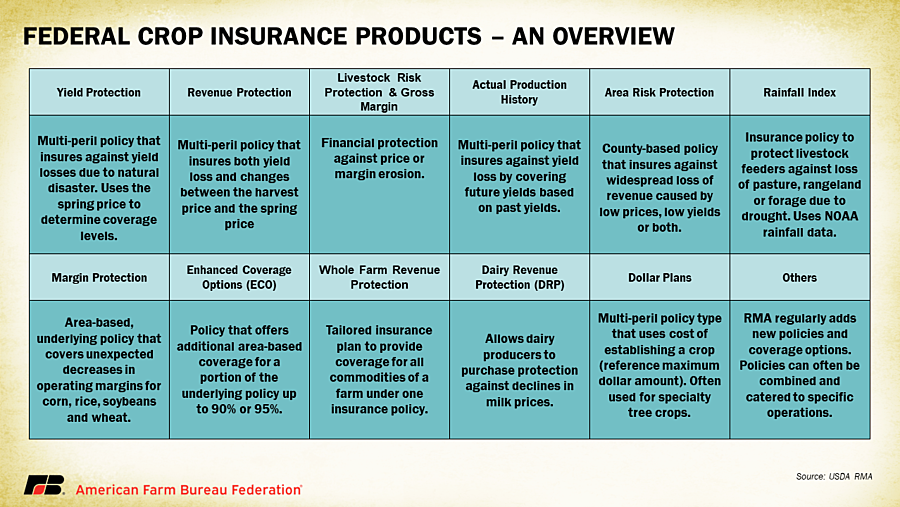
To begin, farmers must first select the level of coverage they want to purchase. The coverage level refers to the percentage of commodity value that is covered — referred to as the liability — and the corresponding loss that a farmer must incur before an indemnity payment will be made (comparable to a deductible for home or auto insurance). A coverage level of 80%, for example, would insure losses greater than 20% of the liability but provide no protection for losses less than 20% of the liability. The lower the coverage level, the more extreme the losses have to be to trigger an indemnity, which lowers the associated risk of a plan. For this reason, farmers pay a higher cost for higher coverage levels.
A CAT plan, known as catastrophic coverage, represents the minimum available coverage level and only makes indemnity payments (payouts from a triggered crop insurance plan) when a farmer loses 50% or more of their expected yields.
Farmers participating in crop insurance are required to follow USDA's guidance on good farm practices while planting, growing and harvesting their crops. This reduces risk to the program related to operator-caused crop losses. These practices vary by area but can include actions taken before planting (properly preparing a field), during the growth period (properly watering crops) and during harvest (following harvesting procedures that minimize crop losses). Failure to comply with these practices can disqualify a farmer from crop insurance. Certain operation characteristics (such as whether acreage is irrigated or not) can change the level of risk exposure farmers have regarding good farm practices and with it the cost of a policy.
Federal crop insurance adjusts for differences in land and crop ownership through five types of insured units: basic, optional, enterprise, multicounty enterprise and whole farm. As noted by the Congressional Research Service, basic units are all the insurable acreage in a county that's either owned or cash rented and planted to one crop. Optional units subdivide a basic unit by geographic boundaries and allow farmers to tailor their crop insurance coverage for differences in growing conditions within the basic unit. Enterprise units include all the insurable acreage for a crop in a county, regardless of whether the land is owned or rented by the farm operator. Multicounty enterprise units are enterprise units that include all the insurable acreage in two contiguous counties. Lastly, whole farm units must include all crops grown and all land insured for the farm, regardless of county boundaries.
Premium Support
USDA's administrative burdens for the program are reduced by providing payments to AIPs to distribute, rather than the agency directly working with hundreds of thousands of crop insurance policy holders. AIPs receive payments from USDA on behalf of farmers to offset a portion of premium costs. For most acreage policies discount rates (the portion of a crop insurance premium paid for by the government) are set by statute set in the farm bill and may vary based on the coverage level a farmer selects. USDA pays 100% of the premium rate for CAT coverage levels at 50% coverage, then the levels of support decrease as selected coverage levels increase (table 1). Beginning and veteran farmers are entitled to a 10% discount rate above the amounts listed.

In addition to premiums, farmers also pay administrative fees. For CAT coverage, farmers pay $655 per crop per county with no discount. For policies with higher coverage levels, the administrative fee is $30 per crop per county in addition to the farmer-paid premium.
Crop insurance policies are priced in a way that must be "actuarily fair" and USDA is statutorily required to operate in ways that "improve the actuarial soundness of federal multiperil crop insurance coverage." This means the total value of premiums paid over many years should be about equal to the value of indemnity payments distributed. One way USDA measures success is through a financial performance indicator known as a loss ratio defined as the indemnities paid divided by the premiums collected for policies in a given year. A loss ratio of one means indemnities equaled premiums, while a loss ratio greater than one means indemnities were higher than premiums and the opposite for a loss ratio lower than one. As of March 2024, the loss ratio for 2023 policies is 0.86, meaning that more premiums were paid for policies than indemnities paid for losses incurred.
Creating New Insurance Policies
The Federal Crop Insurance Corporation (FCIC) board of directors manages the federal crop insurance program and must approve new crop insurance policies and can do so through a process known as 508(h) submissions. New policies can be submitted by RMA or from nongovernment actors including AIPs, colleges and universities, cooperatives, trade associations and even individuals. External experts review concept proposals and full 508(h) submissions prior to consideration for adoption by the FCIC board of directors. When considering new 508(h) proposals, the FCIC board of directors must consider the interests of agricultural producers and the potential for "significant adverse impact on the crop insurance delivery system" (i.e., keeping crop insurance actuarially sound). The 508(h) proposal must also provide coverage that is likely to be "viable and marketable," address "a clear and identifiable flaw or problem in an existing policy," or provide coverage for a commodity that either could not be covered or had low participation under the existing coverage. Costs of preparing 508(h) proposals can be reimbursed by USDA if the FCIC board of directors adopts the proposal, incentivizing thoughtful and innovative submissions. From 2000 to 2023 the number of policies sold has increased from 1.94 million to 2.34 million.
Conservation Compliance Requirements
To encourage the conservation of wetlands and highly erodible lands, the Federal Crop Insurance Program requires participants to meet conservation compliance requirements. To comply, farmers must agree to maintain a minimum level of conservation on highly erodible lands and not convert wetlands to crop production. The 2014 farm bill included a provision that could eliminate crop insurance support for producers who are out of compliance with conservation requirements. The 2018 farm bill introduced new specifications that qualified certain voluntary uses of cover crops as a type of good farming practice – allowing land planted with cover crops to maintain crop insurance eligibility. Cutoff dates that applied to prevent plant acres in 2019 and 2020 were also adjusted as they may have deterred farmers from applying cover crops to prevent plant acres.
Summary
Crop insurance remains a crucial safeguard for farmers, tracing back to the Great Depression and evolving into a vital tool amidst today's market and weather volatility. Supported by a partnership among the federal government, private insurers and farmers, it offers tailored protection against diverse risks for farmers across the nation. Farmers bear a significant part of the cost themselves, and ongoing innovation in policy offerings allows more and more farmers to shield themselves from unexpected losses, bolstering the resiliency of the food system. Provisions that keep program costs in check and promote good farm practices optimize the return on investment for taxpayers. As the U.S. navigates an increasingly uncertain future, improving crop insurance through passage of a new five-year farm bill is essential for safeguarding the livelihoods of farmers, the stability of rural economies and the reliability of our food system.
Firefighters and farmers serve as the backbones of our local communities, united by a shared commitment to safety and service. As our first line of defense, firefighters face numerous risks navigating hazardous environments with smoke and carcinogens. Firefighters rely on various tools, including firefighting foam, to combat fires. However, traditional foams can pose risks, exposing them to harmful PFAS, or "forever chemicals." With farmer investment, the safer alternative, SoyFoam™, eliminates this exposure, prioritizing the well-being of our first responders. Cross Plains Solutions' SoyFoam™ TF 1122 is the first and only firefighting foam GreenScreen Certified® at the Gold level. This partnership between Cross Plains Solutions and the soy checkoff gives firefighters one less thing to worry about while keeping our communities safe. SoyFoam is 100% free of intentionally added per- and polyfluoroalkyl substances (PFAS) and is made with no fluorines. It's also certified ready biodegradable by the Organization of Economic Cooperation and Development and is certified as 84% biobased through the U.S. Department of Agriculture BioPreferred® program.
"As a farmer and former volunteer firefighter for 23 years, the various applications of SoyFoam to extinguish and control fires could protect more than 1 million firefighters in the U.S. alone," said Steve Reinhard, Ohio farmer and chair of the United Soybean Board, which administers the national soy checkoff. "One of our main priorities on behalf of the half-million U.S. soybean farmers is to create biobased alternatives safer for people and our environment. SoyFoam is just one example of creating sustainable soy solutions, and I'm proud that farmers and firefighters are coming together for the greater good."
Another benefit of SoyFoam for the soybean industry is that it's made with soy flour. While soy-based products for biofuels, adhesives, coatings, lubricants and plastics primarily use soybean oil, SoyFoam uses the meal component of the soybean. With the growth of renewable diesel aiming to decarbonize the transportation sector, finding new demand streams for the increased soybean meal crush that makes up 80% of the bean remains top of mind. Cross Plains Solutions estimates the current applications of SoyFoam™ TF 1122 have the potential to use the protein from 12 million bushels of soybeans, and new uses for the product, beyond firefighting applications, are on the horizon.
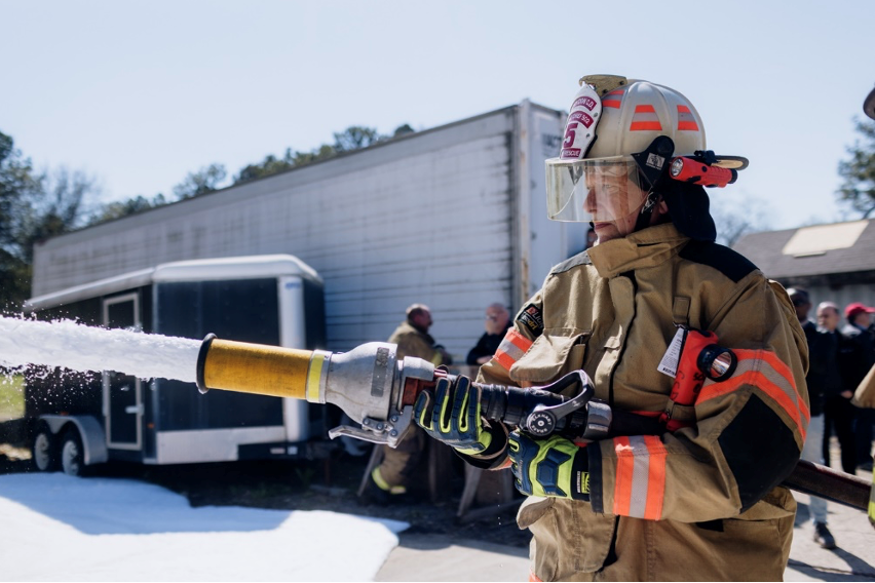
"We are proud to partner with U.S. Soy to launch this breakthrough firefighting foam for use by fire departments across the nation," said Cross Plains Solutions' Managing Partner Alan Snipes. "Our manufacturing plant in Georgia is ready to produce SoyFoam now, so fire departments can ask their suppliers to offer it. We also see demand for numerous additional applications, ranging from canisters to sprinkler systems."
The U.S. Environmental Protection Agency (EPA) reports PFAS being found in water, air, fish, and soil at locations across the nation and the globe. Exposure is linked to several adverse health effects, including certain cancers, thyroid dysfunction, changes in cholesterol and small reductions in birth weight. So, mitigating forever chemicals through soy-based products can create real impact, not only for the safety of our first responders but to maintain the integrity of our local communities' soil health, air quality and drinking water.
As we commemorate International Firefighters' Day on May 4, the soy checkoff urges local farmers to provide information to their local fire departments to use SoyFoam, not only to protect their firefighters but to safeguard their communities as well. To learn more about the product, visit crossplainssolutions.com.
For more than a month now, dairy farmers and the entire industry have been working together to manage a challenge that they didn't create and didn't bring upon themselves. As of Monday, farmers are now dealing with new federal mandates that are complicating their livelihoods, even as they're aimed toward mitigating a very real animal and potential public health risk. And because these challenges revolve around a virus, our circumstances aren't fully under our control.
But they're challenges we can meet.
Since Highly Pathogenic Avian Influenza in dairy cattle was first identified in the Texas Panhandle in late March, we at NMPF have been tirelessly monitoring, learning, and applying new information to the situation as it evolves, answering questions for our members and advocating for dairy's interests as policymakers and the general public understandably pay increased attention to dairy farms.
As farm biosecurity becomes top-of-mind, we're proud to say we've already been thinking about it, through our FARM Biosecurity initiative, which was initially developed thanks in part to a USDA cooperative agreement. As knowledge of HPAI and its effects on cattle develop, we're blessed with deep knowledge of animal care and science on our own staff. And as buyers and trade partners ask questions and federal agencies create guidelines, we've been able to address concerns and discourage over-reaction due to our credibility and demonstrated leadership in making sure that U.S. dairy is responsible, reliable and ready to reassure based on science and sound judgment.
We've also been encouraged by the collaboration we've seen throughout agriculture, not just among dairy organizations but with federal and state officials, veterinarians and our colleagues in the cattle, poultry and egg industries, as we share best practices and information on how best to confront what may become a longer-term fixture on dairy's landscape. We know from others' experiences that while HPAI may change certain practices, it's far from fatal to either public confidence or to industries affected by it. HPAI is a situation to be managed, not a cause for panic. Calm communication and coordination with others have helped us respond effectively to concerns and build confidence that our responses will succeed in steadying any disruptions we've felt.
So even in uncertainty, there's much we can do. What we can't do is declare an early victory over this challenge or predict an endpoint at which these concerns pass. The fact is, there may not be an endpoint. Again, we're dealing with a virus. Viruses mutate, they spread in ways we don't fully understand, and they prompt reactions that we can't fully control. While we are hoping that the end of the spring migration, along with stepped-up biosecurity, herd monitoring and testing, will cause HPAI in dairy cattle to fizzle out, the possibility that this virus could become an ongoing, cyclical concern for dairy farmers is real.
But we're ready. As we've learned these past few weeks, we have an ability to work together, meet challenges, and respond nimbly as circumstances evolve. We are looking forward to rising to meet whatever comes our way, knowing we have the depth, determination and expertise required to make the unexpected manageable, and seemingly daunting tasks the foundation for future success.
By:
Gregg Doud
President and CEO
National Milk Producers Federation
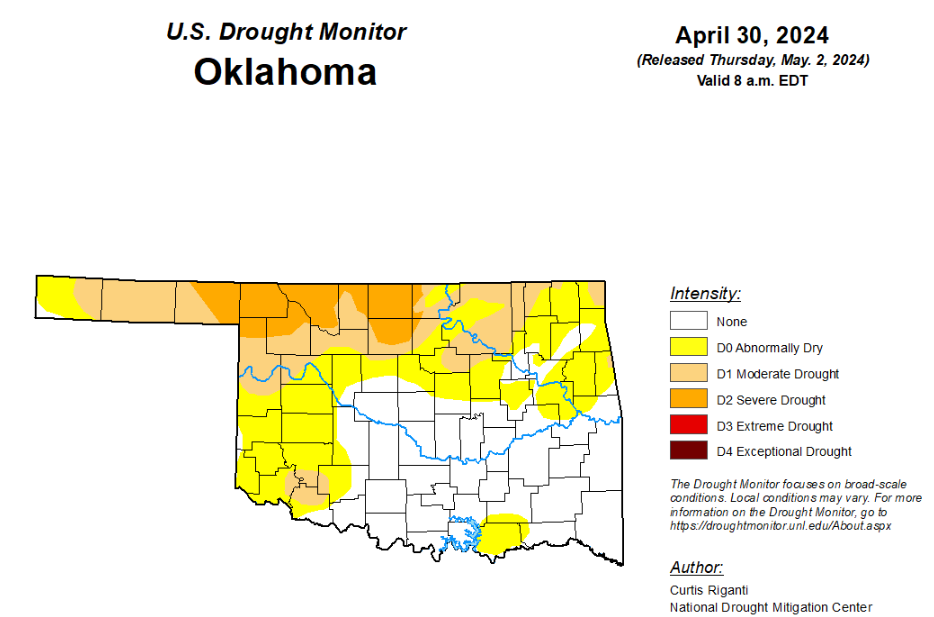
To view the latest Oklahoma drought map, CLICK HERE.
According to the latest Oklahoma drought monitor report, exceptional drought remains at zero percent, unchanged from the start of the calendar year.
Extreme drought or worse remains at zero percent, unchanged from the start of the calendar year.
Severe drought or worse is now at 9.12 percent, up from last week's 5.50 percent.
Moderate drought or worse is now at 28.10 percent, down from last week's 35.54 percent.
Abnormally dry or worse conditions are now at 58.9 percent, down from last week's 65.87 percent.
According to the 6-to-10-day precipitation outlook map, the entire state aside from a small portion of the northeast corner stands as a near normal percent chance of precipitation through May 11th. As for that northeast corner, it is leaning above a 33 to 40 percent chance of precipitation through May 11th.
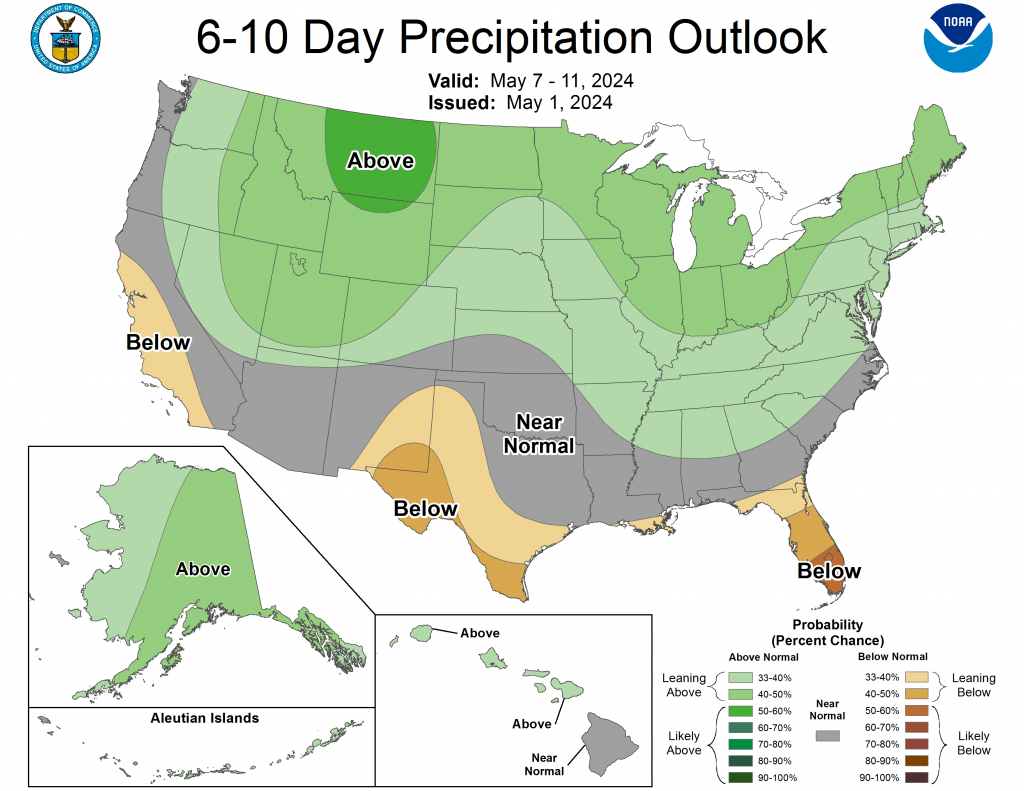
To view the United States Drought Map, click here.
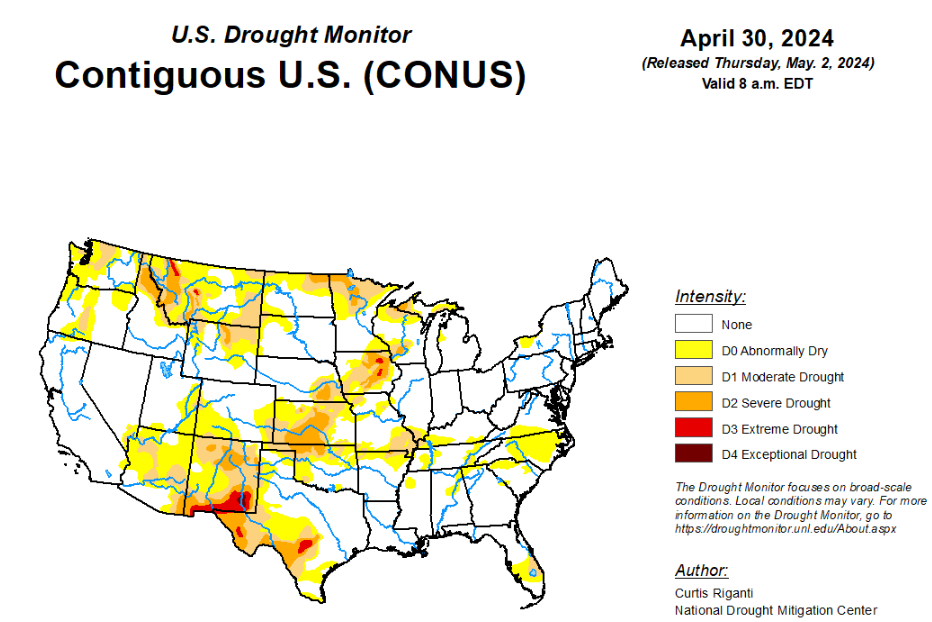
According to the latest U.S. Drought Monitor Report, during the late week and weekend, a large severe weather outbreak brought large hail, damaging winds and numerous intense tornadoes to parts of the central and southern Great Plains and Midwest. The storm systems responsible for the severe weather outbreak also brought widespread moderate and heavy rain amounts to the central U.S., leading to widespread improvements in drought and abnormally dry conditions. To the southwest of the heavy rainfall, in northwest Oklahoma and southwest and central Kansas, severe drought expanded as flash drought continued to take hold during a very dry late winter and early-mid spring, leading to reports of very poor wheat conditions and dust storms. Recent dry weather over the last month, combined with a mostly dry week, led to the development of more areas of abnormal dryness and moderate drought over scattered parts of the Southeast, Tennessee and southeast Kentucky. Conditions mostly remained unchanged in the western U.S., though a few improvements occurred in Colorado and Utah after recent precipitation, while conditions worsened in parts of southeast Montana and the Black Hills region of South Dakota and adjacent northeast Wyoming amid recent dry weather. Heavy rains in the northeast part of Puerto Rico eased drought and abnormal dryness there as streamflows improved and crop stress lessened.
In the Southern Plains, weather conditions varied widely across the South region this week, with heavy rain falling in parts of Oklahoma, Texas, Arkansas and Louisiana, while other areas were left mostly or completely dry. Temperatures were mostly warmer than normal across the region, especially in Oklahoma and Texas, where weekly readings came in 4-8 degrees above normal, with a few local readings even warmer than that. A few spots in central Texas and the Trans-Pecos region saw improvements to drought or abnormally dry conditions after recent rainfall. In eastern and parts of northern Oklahoma, recent heavy rainfall led to improving conditions. Meanwhile in Tennessee, short-term dryness continued, leading to the expansion of moderate drought and abnormal dryness in eastern Tennessee and the expansion of abnormal dryness in western parts of the state. Flash drought continued to worsen in parts of northwest Oklahoma and adjacent portions of the Texas and Oklahoma panhandles, where severe drought expanded amid quickly drying soils and growing short-term precipitation deficits.
In the High Plains, moderate to heavy precipitation fell across much of the High Plains region this week, excluding central and southwest Kansas and northeast Wyoming and southeast Colorado. Mostly warmer-than-normal temperatures occurred in Kansas, Colorado, Wyoming and the western Dakotas, while elsewhere, temperatures were mostly within a couple degrees of normal. While the storms responsible for the rain brought damaging hail and tornadoes in parts of the region, the rainfall helped to alleviate drought conditions in many areas. Eastern Kansas and Nebraska saw improvements in some areas, with parts of southeast Kansas seeing two-category improvements in the areas of heaviest rainfall. Meanwhile, in tandem with severe drought expansion in northwest Oklahoma, severe drought conditions expanded in central and southwest Kansas after another mostly dry week. Flash drought conditions in this region have led to dust storms and very poor wheat conditions.
In the West, weather conditions were variable across the West this week. Precipitation amounts from 0.5 to 2 inches (locally higher) fell in western parts of Washington and Oregon. Elsewhere, precipitation amounts varied from none to locally up to 2 inches, especially in some high-elevation areas. Temperatures were mostly near normal or a couple degrees below normal in Washington, Oregon, California, Arizona and western New Mexico, while near-normal or warmer-than-normal temperatures prevailed elsewhere. Drought conditions remained mostly unchanged across the region. In northeast Utah, abnormal dryness and moderate drought were reduced in coverage after recent wet weather and low evaporative demand. In southeast Montana, moderate drought grew in coverage as short-term precipitation deficits grew alongside decreasing streamflow and soil moisture.
Looking ahead, between the evening of Wednesday, May 1 (time of writing), and the evening of Monday, May 6, the National Weather Service Weather Prediction Center is forecasting moderate to heavy rain amounts from central Texas and northern Louisiana northward into the mid-Missouri and upper-Mississippi River valleys. In this region, rainfall amounts are forecast to range from a half inch to locally as high as 3 inches, especially in parts of Oklahoma, Texas and northern Louisiana. Similar precipitation amounts are also forecast in western Washington and Oregon, while some precipitation exceeding 1 inch is also forecast in parts of the northern Sierra Nevada. Mostly dry weather is forecast for eastern Colorado, New Mexico, Arizona, southwest Nevada, southern California and deep south Texas.
For May 7-11, the National Weather Service Climate Prediction Center's forecast favors colder-than-normal weather across much of the western U.S., with the highest confidence for colder-than-normal weather centered over Idaho and northern Nevada. Warmer-than-normal weather is expected in much of the southeast half of the contiguous U.S., especially from Texas northeast to the mid-Atlantic. Above-normal precipitation is favored in the northern U.S., especially eastern Montana, while below-normal precipitation is favored in coastal California, southern New Mexico and southern and western Texas, southeast Louisiana and most of Florida.
During the May 7-11 period, colder-than-normal temperatures are favored in southwest, south-central and southeast Alaska, and across all of Hawaii. All of Alaska is favored to receive above-normal precipitation, with confidence highest outside of the far west and northwest. With the exception of the Big Island, the forecast slightly favors above-normal precipitation in Hawaii.
To view the 6-10 Day Precipitation Outlook Map, click here.
To view the 6-10 Day Temperature Outlook Map, click here.
To view the Monthly Drought Outlook Map, click here.
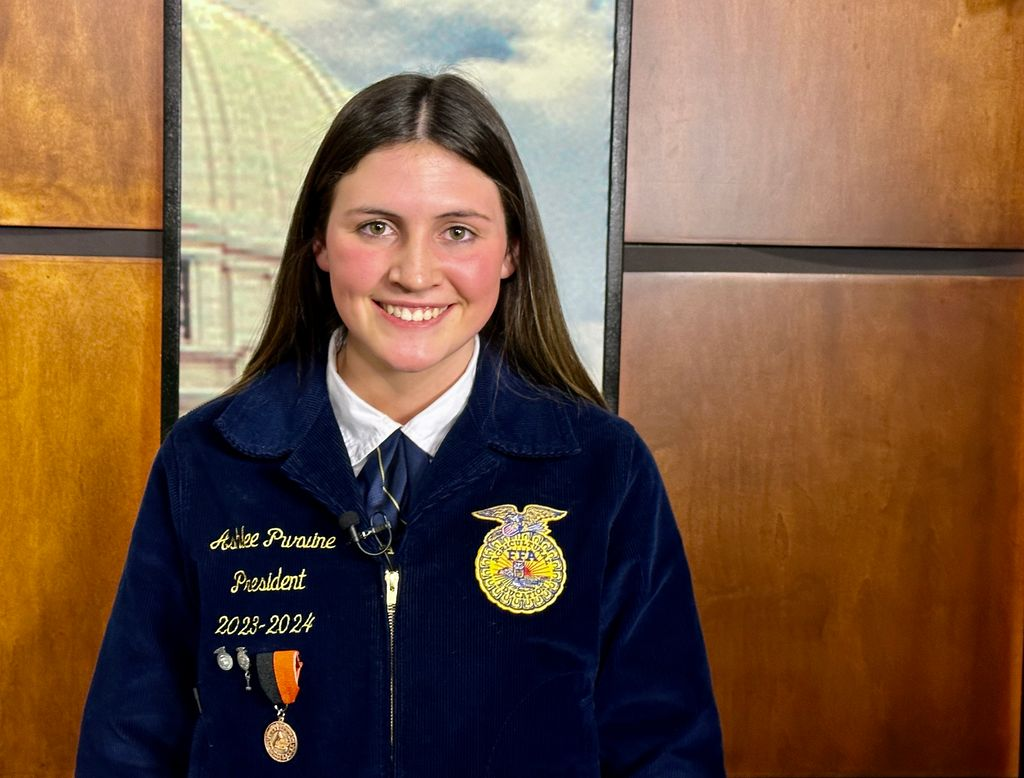
During the month of April, the Radio Oklahoma Ag Network and Oklahoma Farm Report are spotlighting the 18 Area Stars of Oklahoma FFA, who are among the highest achievers in the organization.
The stars come from the five areas in four categories- Star in Ag Placement, Star in Agriscience, Star in Agribusiness, and Star in Agricultural Production.
This week, we spotlight the five area stars in Agricultural Production in 2024.
One Star Finalist featured in the coming days from each of the categories will be named the State Star Award Winner during the 98th Oklahoma State FFA Convention, which will take place on May 7th and 8th in Tulsa, Oklahoma.
This week, our coverage of the 2024 Oklahoma FFA Star Award Finalists continues with Agricultural Production competitor Ashlee Purvine of the Thomas-Fay-Custer FFA chapter representing the Southwest Area.
"My Supervised Agricultural Experience consists of my show projects," Purvine said.
Purvine's project includes 44 cows, 21 of which are registered, 2 registered Simmental herd bulls, and an embryo enterprise consisting of 51 frozen embryos from two donor cows.
"My operation kind of started as just a group of retired show heifers, but it has quickly grown into a large foundation of Simmental and Angus genetics that I will continue to utilize for the rest of my life," Purvine said.
Because genetics play a large role in her project, Purvine said her focus on producing top-quality cattle is critical.
"Not just trying to find a great phenotypical bull to use on cows, but also trying to find a bull that has great EPDs and has the kind of numbers that a commercial producer would like to use," Purvine said. "My true goal with my operation is to increase the interest in the Simmental breed for commercial producers."
Purvine plans to expand her operation throughout the years and one day market elite show heifer prospects, embryos, and Simmental bull semen in online sales.
Your coverage of the 2024 Oklahoma FFA Convention is sponsored by Hilliary Communications- who deliver the latest cutting-edge communications services supporting tens of thousands of customers across 22 counties throughout Oklahoma, Texas and Iowa. The company offers internet, voice and HilliaryTV. Hilliary Communications continuously researches the marketplace for innovations and strives to improve underserved areas, offering services that exceed customer expectations. Click here to learn more about Hilliary Communications.
For more information about the 98th Oklahoma State FFA Convention, click here.
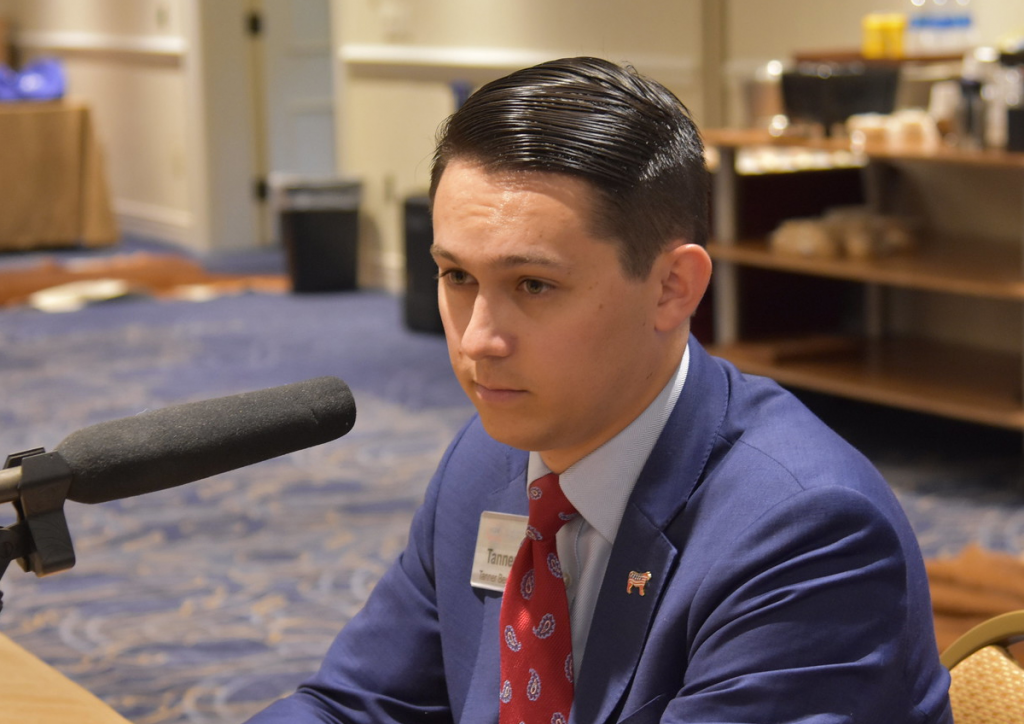
At the National Association of Farm Broadcasters Washington Watch Event, Farm Director KC Sheperd had the chance to visit with the Senior Director of Governmental Affairs at the National Cattlemen's Beef Association, Tanner Beymer. In this episode of Beef Buzz, Senior Farm, and Ranch Broadcaster Ron Hays is featuring comments from the conversation regarding the appropriations process and priorities for the cattle business.
"This is going to be a very interesting year in Washington," Beymer said. "It is an election year, and that typically means that once we get past May, not a whole lot of legislating gets done because everybody goes back to their camps, they draw battle lines, and they start lobbying insults at each other trying to convince the American elector that their party should be in control."
Looking into the full fiscal year of 2025, Beymer said it will be critical to build upon existing priorities for 2024, including successes such as funding animal disease traceability electronic identification tags so that producers do not have to pay to comply with the newly released final rule from USDA.
"We also want to build upon some of those opportunities where we didn't quite get what we wanted in the last bill by defunding USDA's harmful packers and stockyards rules," Beymer said. "We got really close to the finish line on that during this last fiscal '24 appropriations cycle. At the last second, some other groups weighed in very unhelpfully, and now all of a sudden, we are in a position where those rules are going to be allowed to take effect."
Regarding the 2024 Farm Bill, Beymer said Chairman Glenn "GT" Thompson is looking to have that moved across the finish line soon.
"In this divisive political environment, Chairman Thompson is moving forward with the Chairman's mark expected sometime before Memorial Day," Beymer said. "All of that I would say is a win in terms of where we have been and what the outlook for this Congress was at the very onset when we took 15 ballots to elect a speaker."
The Beef Buzz is a regular feature heard on radio stations around the region on the Radio Oklahoma Ag Network and is a regular audio feature found on this website as well. Click on the LISTEN BAR for today's show and check out our archives for older Beef Buzz shows covering the gamut of the beef cattle industry today.
RON's Dave Lanning has a pre-opening look at today's agricultural Markets.
Click the audio tab below for today's report.
Today, Chairwoman Debbie Stabenow (D-MI) and Chairman Glenn "GT" Thompson (R-PA-15) each released their own five-year Farm Bill proposals. The National Association of Wheat Growers (NAWG) President Keeff Felty provided the following statement in response:
"It is great to see progress being made on a long-term Farm Bill. We are glad to see legislative summaries being put forward by both the Senate and House Agriculture Committees to get a Farm Bill done in the 118th Congress. NAWG will continue reviewing these Farm Bill proposals and remain in contact with committee leaders and staff."
"NAWG continues to advocate for a bill that works for our wheat growers and rural communities. Since identifying our Farm Bill priorities in June 2022, NAWG has advocated for a strong crop safety net, which protects crop insurance and works to enhance the Title I programs and crop insurance."
"As the process continues, we urge the four corners to work together to pass a bill that can pass both chambers and get signed into law before the end of the year."
NAWG will continue to underscore the need to get a Farm Bill done, which works for wheat growers and rural America. These priorities include:
About NAWG
NAWG is the primary policy representative in Washington D.C. for wheat growers, working to ensure a better future for America's growers, the industry and the general public. NAWG works with a team of 20 state wheat grower organizations to benefit the wheat industry at the national level. From their offices on Capitol Hill, NAWG's staff members are in constant contact with state association representatives, NAWG grower leaders, Members of Congress, Congressional staff members, Administration officials and the public.
U.S. Department of Agriculture (USDA) Rural Development Oklahoma State Director Kenneth Corn announced today USDA Rural Development will be able to provide extended aid to USDA Rural Development mortgage holders in disaster areas from recent storms in Oklahoma.
The Federal Emergency Management Agency emergency declaration for the State of Oklahoma allows the Rural Development State Office to provide benefits to homeowners with USDA home loans who are impacted by this disaster. Mortgage holders with a USDA Rural Development backed loan are encouraged to call 405-742-1070 if they are impacted by this disaster. Additionally, a letter will be sent to all USDA mortgage holders in the impacted areas explaining what assistance may be available to them.
"President Biden has directed all federal agencies to provide the maximum support to those impacted by these very damaging storms," Corn said. "At our USDA Rural Development Oklahoma State Office, we are prepared to help our USDA homeowners in this devastating time and provide them with the resources that can help them rebuild."
USDA Rural Development mortgage holders who are impacted by this storm may be eligible for the following assistance:
Additionally, limited funding remains available in USDA's Rural Disaster Home Repair Loan and Grant Program. The maximum grant is $10,000 and the maximum loan is $40,000, which is available in a low interest loan. To qualify a homeowner must own the home and have qualifying income that does not exceed the very low limit in the county the house resides. Income limits are found on this website: https://www.rd.usda.gov/sites/default/files/RD-DirectLimitMap.pdf. This program will only remain available while the remaining funds are available.
USDA Rural Development mortgage holders can also call the Customer Service Center disaster hotline 888-796-0538 or 1-800-438-1832 Monday through Friday, 7 a.m. until 5 p.m. Central Time. In addition, information is available for all RD borrowers on the RD Disaster Assistance Web Site: https://www.rd.usda.gov/page/rural-development-disaster-assistance.
USDA touches the lives of all Americans each day in so many positive ways. Under the leadership of the Biden-Harris Administration, USDA is transforming America's food system with a greater focus on more resilient local and regional food production, fairer markets for all producers, ensuring access to safe, healthy and nutritious food in all communities, building new markets and streams of income for farmers and producers using climate-smart food and forestry practices, making historic investments in infrastructure and clean energy capabilities in rural America, and committing to equity across the Department by removing systemic barriers and building a workforce more representative of America. To learn more, visit https://www.rd.usda.gov/ok.
Senator James Lankford (R-OK) today participated in Senate Finance Committee Hearing entitled "Hacking America's Health Care: Assessing the Change Healthcare Cyber Attack and What's Next," with Chief Executive Officer of UnitedHealth Group Andrew Witty testifying. Lankford explained many of the challenges that Oklahomans face and called for solutions to expand healthcare access in rural areas.
Lankford has worked for years to improve healthcare access and pursue workable solutions to lower prescription drug costs. He recently called on Senate leadership to reform Pharmacy Benefit Managers (PBMs) in an effort to reduce the cost of prescription medications. He urged the Federal Trade Commission (FTC) to complete its investigation into PBMs, the healthcare industry's most powerful prescription drug middlemen.
Lankford introduced the Ensuring Access to Lower-Cost Medicines for Seniors Act which would ensure that patients can benefit from lower-cost prescription drug products instead of being forced to pay for higher-priced drugs solely because of pricing gimmicks used by PBMs, the drug pricing middlemen. Lankford proudly supported two health packages voted favorability out of the Senate Finance Committee, the Modernizing and Ensuring PBM Accountability (MEPA) Act and the Better Mental Health Care, Lower-Cost Drugs, and Extenders Act, both of which include provisions led by Lankford and work toward significant PBM transparency and reform so that seniors on Medicare have greater access to lower-priced prescription drugs. Lankford has previously pushed for accurate provider directories to enable health care plans to do their due diligence in negotiations with health providers and provide accurate information about covered services and providers to their beneficiaries.
Excerpt
Lankford: ...For an Oklahoman that lives in a rural area, she's in her mid 70s, several years ago, she used to go to her local physician. But that local physician practice has closed down because of just the administrative burden. They couldn't keep it going. So now she drives to a hospital. It's about 30-minutes away to be able to meet with a doctor there. The hospital and that physician is on her insurance. She has Medicare Advantage, but by the time she actually schedules an appointment, she actually lined up the appointment and found out they just switched it off. They're no longer on Medicare Advantage. But they were when she...originally signed up for the plan.
...When she finally goes to the doctor on that, she gets there, the doctor needs to run some tests, but she can't get the tests done that day because they have to do a prior authorization with the insurance company. So she has to drive home when it's a test that she needs. They could do that day, but they can't do that day because they're waiting on prior authorization to be able to go through. The hard part is, two years later, that hospital has just stopped taking Medicare Advantage at all, as we've had several of our hospitals do in Oklahoma, saying that just the realized reimbursement is 20 percent less than Medicare. They just can't keep up with Medicare Advantage because all the prior authorizations and because all the denial of service. So they've just stopped taking Medicare Advantage entirely, which for her really puts her in a difficult spot. She goes to a local pharmacist that she's gone to for years and finds out that there's pretty remarkable pressure on them, and they're going to have a hard time. They're not sure they're going to be able to stay open. But her insurance company tells her, 'Hey, we want you to do mail order pharmaceuticals.' But she has pretty complicated chronic diseases, and she wants to have somebody that she can talk to.
...This is not a story just on United. This is just a reality that we're facing here, especially in rural areas. And my state of 4 million people, 2 million people live in an urban area and 2 million people live in a rural area. So, it's a reality for those folks that live in a rural area of those exact challenges that I laid out, not asking you to answer all of those. I guess I'm just I'm just saying those so you'll hear it, because that really is a reality of what's happening on the ground every day in rural Oklahoma.
American Farm Bureau Federation President Zippy Duvall commented today on the House and Senate Agriculture committees releasing title-by-title overviews of the 2024 farm bill.
"AFBF appreciates the House and Senate Agriculture committees' progress to enact a new, modernized farm bill this year. We're encouraged to see both proposals acknowledge that programs farmers and ranchers across the country use require additional investment in the face of falling commodity prices and increased inflation. And both proposals recognize the important role farmers and ranchers play in protecting our land, water and air through voluntary, working lands conservation programs.
"Details are important, however, and there is still a lot of work to do. While there will inevitably be disagreements on specific provisions and funding levels of several programs, we encourage both chairs to hold a markup this month so that all members of the Agriculture committees can bring their ideas forward. We urge lawmakers on both sides of the aisle to work together in a bipartisan manner to find consensus and pass a farm bill before the extension expires this year.
"Farm Bureau stands ready to work with lawmakers in both chambers to provide insight and guidance on whether each proposal would – positively or negatively – impact the hard-working and resilient families who continue to put healthy, safe and affordable food on the table for everyone in this country and beyond."
"I would like to thank both Chairman Thompson and Chairwoman Stabenow for their leadership in introducing frameworks for the 2024 farm bill today. These are critical first steps in passing a farm bill that strengthens the competitiveness of America's farmers and ranchers, bolsters rural communities, and provides access to food for those in need. Both frameworks also include several provisions that have been priorities for farmer co-ops and their producer-owners in the farm bill. We look forward to working with members of both the House and Senate committees as the process moves forward, starting with the House markup of the bill later this month."
About NCFC
Since 1929, NCFC has been the voice of America's farmer cooperatives. Our members are regional and national farmer cooperatives, which are in turn consist of nearly 2,000 local farmer cooperatives across the country. NCFC members also include 17state and regional councils of cooperatives. Farmer cooperatives allow individual farmers the ability to own and lead organizations that are essential for continued competitiveness in both the domestic and international markets.
America's farmer-owned cooperatives provide a comprehensive array of services for their members. These diverse organizations handle, process and market virtually every type of agricultural commodity. They also provide farmers with access to infrastructure necessary to manufacture, distribute and sell a variety of farm inputs. Additionally, they provide credit and related financial services, including export financing.

U.S. Senate Agriculture, Nutrition, and Forestry Committee Chairwoman Debbie Stabenow (D-MI) Wednesday unveiled the Rural Prosperity and Food Security Act, which contains more than 100 bipartisan bills and puts the 2024 Farm Bill back on track to being signed into law by the end of the year.
Chairwoman Stabenow said: "This is a serious proposal that reflects bipartisan priorities to keep farmers farming, families fed, and rural communities strong. The foundation of every successful Farm Bill is built on holding together the broad, bipartisan coalition of farmers, rural communities, nutrition and hunger advocates, researchers, conservationists, and the climate community. This is that bill, and I welcome my Republican colleagues to take it seriously and rejoin us at the negotiating table so we can finish our work by the end of the year. Farmers, families, and rural communities cannot wait any longer on the 2024 Farm Bill."
The Rural Prosperity and Food Security Act reflects more than two years of bipartisan work on the Senate Committee on Agriculture, Nutrition, and Forestry and incorporates more than 100 bipartisan bills and the work of Senators on and off the Committee. It addresses the issue of foreign ownership of farmland, builds on our commitment to rural communities, makes meaningful investments into the farm safety net to provide certainty to all farmers, ensures that the Supplemental Nutrition Assistance Program (SNAP) keeps up with the realities of American life, and brings the historic investment in climate-smart conservation practices into the Farm Bill.
Full summaries and section-by-sections of the Rural Prosperity and Food Security Act are available through the links below.
The Rural Prosperity and Food Security Act:
A full summary of the bill is available here.
A section-by-section is available here.
A summary of each title is available below.
Pivot Bio, a leading sustainable agriculture company, announced today the appointment of industry veteran Chris Turner as Chief Commercial Officer. In this executive role, Turner will lead the company's global growth agenda and commercial sales organization. He will be a member of Pivot Bio's executive leadership team, reporting to Chris Abbott, CEO.
"Chris is a highly regarded, results-oriented leader in the ag industry, and we couldn't be more excited that he is joining our team," said Chris Abbott, CEO of Pivot Bio. "With nearly three decades of industry experience, Chris has effectively led extensive global commercial, strategic and operational teams. Chris certainly exemplifies commercial leadership with a consistent focus on performance and results. I am confident that his industry knowledge and commercial leadership experience will empower Pivot Bio in the United States, our biggest market, and globally as we expand to new markets in the near future."
Turner joins Pivot Bio from Bayer Corporation, where he has served as Head of the U.S. Crop Science division. Turner served as a member of the North America leadership team, overseeing a team responsible for the company's commercial operations nationwide. He managed the field sales teams and developed go-to-market strategies while delivering on business goals for crop protection, branded seed and Bayer's Climate FieldView. He also served as senior vice president of U.S. commercial operations. Before joining Bayer, he was with Monsanto Company for more than 20 years, serving as a business leader, establishing go-to-market strategies, execution and strategic partnership development. During his tenure, he held several other sales leadership roles within U.S. commercial operations. Prior to joining Monsanto, he was a district sales leader for FMC Corporation.
Raised on a farm in Northeast Missouri, Turner is passionate about strengthening the agriculture industry. He earned a Bachelor of Science degree in agriculture from the University of Missouri and continues to participate in the operations on his farm.
About Pivot Bio
Pivot Bio is a leading sustainable agriculture company delivering farmers patented crop nutrition technologies that harness the power of nature to reliably and productively grow the food the world needs in the face of increasing volatility. Currently available in North America and soon in Brazil, the company's products are a breakthrough innovation. They are among the industry's most promising climate solutions because they deliver nitrogen to plants without the negative impacts of synthetic fertilizer. Pivot Bio's nitrogen is weatherproof, safer to handle, and does not leach or contribute to nitrous oxide pollution. By making this possible for the first time at scale, Pivot Bio is upending the 190 billion USD nitrogen market. Pivot Bio has been recognized twice by Time magazine on its annual list of best inventions, by Fast Company on its World Changing Ideas and World's Most Innovative Companies lists, by CNBC on its Disruptor 50 list of private companies and by Fortune on its Impact 20 list of startups driving social good. The company recently announced its fourth consecutive year of growth. For more information, visit PivotBio.com.
Today, National Cattlemen's Beef Association (NCBA) Vice President of Government Affairs Ethan Lane responded to the release of Farm Bill frameworks from the House and Senate Agriculture Committees:
"We are very pleased with the Farm Bill framework released by House Agriculture Committee Chairman Glenn 'GT' Thompson. Since 2023, Chairman Thompson has gone to great lengths to meet with America's cattle producers in every region of the country and craft a Farm Bill that supports their unique needs. We are especially pleased by the Chairman's focus on voluntary conservation programs that are increasingly popular with cattle producers, animal health provisions that protect the U.S. cattle herd, and investments in food security that support our broader national security.
"Unfortunately, the Senate Agriculture Committee majority has failed to engage in the same level of outreach to real cattle producers, and their framework reflects that lack of producer input. While there are some bipartisan elements to the Senate proposal, there are many provisions which would be harmful to livestock producers. We look forward to the House Agriculture Committee's May Farm Bill markup and will continue engaging with members of the committees to advocate for the cattle industry."
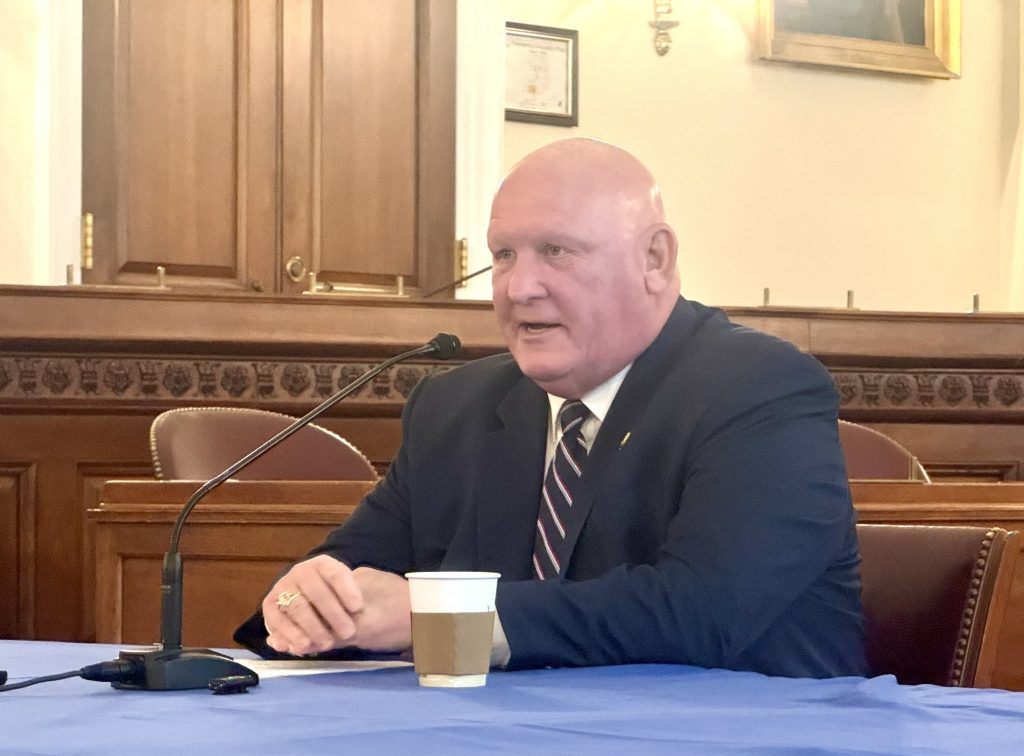
At the National Association of Farm Broadcasters Washington Watch event in Washington, D.C., Farm Director KC Sheperd had the chance to attend a group discussion with House Committee on Agriculture Chairman Glenn "GT" Thompson and NAFB members about the latest on the Farm Bill, as Thompson has released the 2024 Farm Bill overview. The House ag Committee will mark up the bill on May 23.
"We are going to get a farm bill done that is highly effective, in some regards, transformational, and certainly bipartisan, and we have built that," Thompson said. "We have built that with the travel around somewhere around 85 listening sessions across the country. Multiple times in several states. 40 states all together so far, and one territory."
Thomspon said his goal from the beginning was to write a Farm Bill that reflects the voices of agriculture outside of Washington, D.C. Thompson added that this Farm Bill will take care of the needs and priorities of those in the U.S. agriculture industry.
"In its structure, it is a strong, bipartisan bill," Thompson said.
Regarding misconceptions that there will be cuts to SNAP benefits, Thompson said there will not be any cuts made to SNAP.
"We have far too many families living in poverty today, and it has only gotten worse with inflation," Thompson said. "The other factor is the cost of living."
To read the press release from Thompson regarding the release of the 2024 Farm Bill overview, CLICK HERE.

The Made in Oklahoma Coalition (MIO) invites Oklahomans to join us in supporting and celebrating all things local by attending the inaugural MIO Market at Scissortail Park on Sunday, June 9th from 10:00am – 3:00pm. This free festival will highlight over 40 Oklahoma-made vendors who will be sampling and selling their products all-day long.
The Made in Oklahoma Market at Scissortail Park is a family friendly festival that is open to the public and free to attend. In addition to the robust selection of Made in Oklahoma products, attendees will have the opportunity to enjoy live music from the Red Dirt Rangers, play a variety of yard games, and explore a great selection of local food trucks. Throughout the day, the MIO Coalition will host giveaways of Made in Oklahoma products and will have a free gift for the first 500 attendees.
Established over 20 years ago, MIO has been promoting Oklahoma-made food and beverage products, contributing to the growth and diversification of the state's food supply chain. With over 100 local food and beverage companies as members, the mission of the coalition is to build brand awareness and consumer loyalty for locally made products. This event not only promotes local businesses but also encourages Oklahomans to support their neighbors and strengthen the local economy.
"When you make the choice to spend your dollars on a locally-made product, you are not only choosing to support your neighbor, but your dollar has a ripple effect that goes far beyond what you might think," said Emily Shuping, Executive Director of the Made in Oklahoma Coalition. "Our goal is to make it easy for Oklahomans to support local companies wherever they shop, eat, and play."
For more information about the Made in Oklahoma Market at Scissortail Park and the Made in Oklahoma Coalition, visit miocoalition.com or follow us on Instagram, Facebook, X @MIOCoalition
| Federally inspected cattle slaughter last week totaled 613,000 head, down 7,000 on the prior week. Aside from last week's downtrend, the past four weeks have averaged 611,000 head on an impressive uptick from March's abysmal 589,000 weekly average. All of the improvement in recent slaughter capacity utilization has come in the fed steer and heifer segment. Comparing the past four weeks in April to the prior four in March shows a 4.5% (21,000 head) weekly average increase. The year-over-year contrast for the two months shows quite a difference with March's slow pace totaling just 95% of a year ago while the April total was 2% larger than a year ago. |
 |
| The remaining one-fifth of federally inspected cattle harvest is comprised of cull dairy and beef cows, plus a tiny 1.5% bulls. Together, these head counts have drawn dramatically lower by 14% year to date. The trend has been sharply lower since early February when 2024 cow counts peaked at 127,000 head that week, down to the latest 109,000 head confirmed total in early April. Fed cattle prices showed resiliency last week with a slightly higher average of $183.10/cwt. Early trade in Texas at $181.91/cwt. represented the low end of the range while Iowa/Minnesota topped the market with an average of $185.49/cwt., highlighted by region's highest reported $187/cwt. Weakness in boxed beef values are currently the important theme as spring grilling demand has yet to create any signs of surge in prices. The Comprehensive USDA cutout resting at just $299/cwt. is $0.06/cwt. lower than a year ago and well below the mid-March $315/cwt. year to date high. Price spreads across the carcass quality spectrum are notably narrower at present compared to the three-year average as marbling levels and quality grades are holding at record historical levels in recent data. Combined Choice and Prime carcasses account for 84% of the carcass mix while the CAB carcass certification rate two weeks ago was 40.9%. Heavy carcass weights recently drove Prime carcass tonnage above a year ago while Choice supplies are nearly par. Latest increases in slaughter should reflect more of the same. |
| Middle Meats Lower, Ends Hold Up |
| Beef carcass cutout values have continued a precipitous decline since mid-March, tracking a 5% lower trend in that period. The is firmly against the trend charted in the previous three year average when the comprehensive cutout moved 9.5% higher in the same 6 weeks. Market observers may pin the cause on the announcement of HPAI in dairy cows for the apparent softer demand. This factor was strongly causative with the precipitous decline in Live Cattle futures contract prices beginning in late March, but is likely less correlated to the dip in boxed beef prices. Smaller weekly slaughter levels would seemingly spell higher cattle prices, especially in the spring. But larger April head counts resulted in 4.4% larger fed cattle totals than last year in the past four weeks. With fed cattle carcass weights 27 lb. heavier than a year ago as well, the resulting fed beef tonnage suddenly landed well above last year in the past month, just a few thousand head short of that period in 2022. Short term production volume is not nearly as low as it was in March. |
 |
| Another lesser-known feature of today's beef market is the price weakness of the highest valued middle meats. Ribeye and tenderloin prices have recently fallen below a year ago. Wholesale Certified Angus Beef® brand ribeyes in last week's report averaged $9.70/lb., a dollar lower than a year ago and lower than that week in any of the previous three years. Certified Angus Beef® tenderloins last week averaged $13.42/lb., $3.28/lb. lower than the record-high $16.70/lb. set that week last year. The third coveted middle meat steak item, the 0x1 strip loin, stands in contrast to the former two cuts, lately listed at $8.30/lb., a premium of $1.54/lb. higher than a year ago. Strip loin prices pressed rapidly higher from February through March, hitting the $10/lb. ceiling before pulling slightly lower in April. End users have shown greater demand for strip loins even at this spring's elevated levels, preferring to substitute them over the higher valued ribeyes. A degree of waning demand for ribeyes and tenderloins may be a sign of the times, economically, here in the U.S. This is further evidenced by stronger year-over-year prices recently for some chuck and round items, precipitated by sharply lower cull cow slaughter and lean grinding beef availability. |
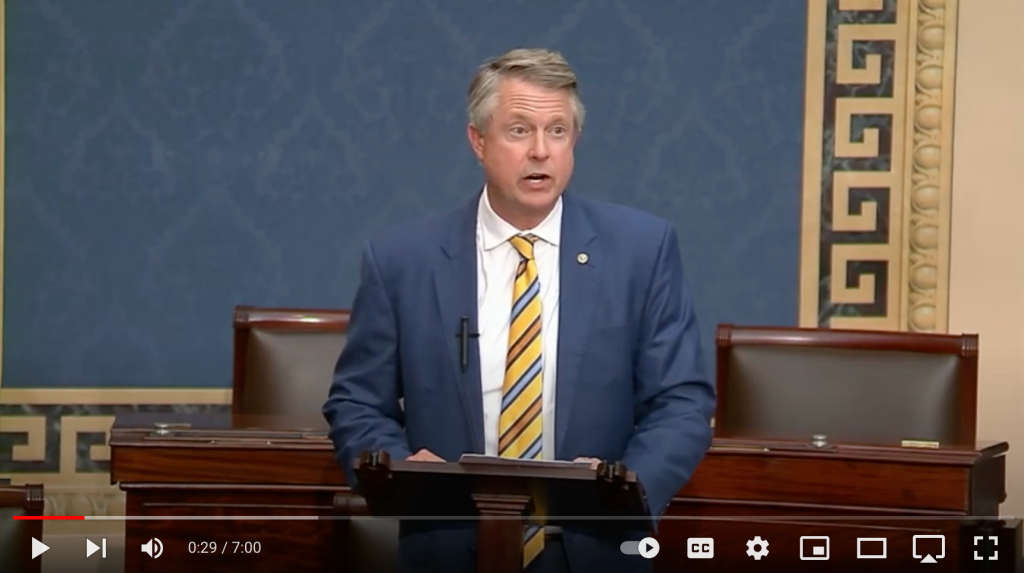
Kansas U.S. Senator Roger Marshall, M.D. led a letter to the Senate Appropriations Subcommittee on Agriculture, Rural Development, Food and Drug Administration urging leadership to include funding for a disaster program to address 2023 agricultural losses as they begin the stages of drafting the Fiscal Year 2025 funding bill.
Simultaneously, Senator Marshall introduced legislation with a specific aim to ensure proper guardrails on the funding. This legislation addresses concerns with USDA's emergency relief payment program, which applied a "progressive payment factor" that ultimately paid more to absentee landlords than full-time farm families. The legislation would require USDA to provide these funds in a manner that mirrors a previous, widely praised, program.
The American Farm Bureau Federation estimated that agricultural losses in 2023 exceeded $21 billion, with roughly half of this amount not covered by crop insurance or the noninsurance crop disaster assistance program. These severe losses significantly harm farmers, ranchers, and producers nationwide.
"The National Sorghum Producers strongly supports Senator Marshall's legislation and letter to create an Emergency Relief Program for 2023 losses," National Sorghum Producers Chairman Craig Meeker said."Farm and ranch families from across the country were hurt by natural disasters last year but perhaps none so much as those producers dealing with multiple years of losses due to severe and chronic drought. Senator Marshall's request would ensure that ERP is properly implemented so help gets to the farm and ranch families most impacted by production losses. We commend Senator Marshall for his hard work and urge his colleagues in Congress to pass this important legislation."
You may click HERE to read Senator Marshall's full bill text.
You may click HERE or read Senator Marshall's full letter below.
Dear Chair Heinrich and Ranking Member Hoeven,
We write to urge you to include robust funding for an agricultural disaster program to address 2023 agricultural losses as you begin drafting the fiscal year (FY) 2025 Agriculture, Rural Development, Food and Drug Administration, and Related Agencies Appropriations Bill. We also request that you include the attached legislative text to ensure this funding improves upon former emergency relief payment programs and provides disaster payments equitably and timely.
Recently, the American Farm Bureau Federation estimated that agricultural losses in 2023 exceeded $21 billion, with roughly half of this amount not covered by crop insurance or the noninsurance crop disaster assistance program. Although the losses reported by Farm Bureau were nationwide, large swaths of the country have endured multiple years of severe and chronic drought that has most recently resulted in one of the worst wildfires in U.S. history.
As fires continue to rage across drought-stricken grasslands every spring, the production losses are compounding for farm and ranch families living and working in these drought regions. While we had hoped the Farm Bill would be modernized and enacted in a way that strengthens the farm safety net to avoid the dramatic need for ad hoc disaster programs, our nations' farmers and ranchers simply cannot afford to wait on its stymied passage.
Given the history of funding from previous disaster programs, farm and ranch families who suffered catastrophic losses in 2022 expected similar relief to come from USDA Emergency Relief Program (ERP) payments. Unfortunately, the current USDA departed from congressional intent and made unworkable and unnecessary changes to the Emergency Relief Program. This unfair implementation deprived full-time farm families from receiving their expected relief. Despite these changes we think Congress should provide needed assistance to farmers and ranchers devastated by natural disasters in 2023. However, it must be done with appropriate guard rails dictated by Congress.
In light of all of this, we respectfully urge you to include a robust agricultural disaster program for 2023 losses in the FY2025 agricultural appropriations bill with the attached legislative text to ensure that the program is not implemented in the same inequitable manner as the 2022 program.
Sincerely,

The U.S. Department of Treasury's recent decision to adopt a modified version of the Greenhouse Gases, Regulated Emissions, and Energy Use in Transportation (GREET) model has sparked significant concern among corn growers. This model will determine the greenhouse gas emission reductions required under the Inflation Reduction Act, which offers tax credits for biofuels that can demonstrate a reduction in greenhouse gas emissions by 50% or more. Missouri Corn Growers Association (MCGA) President Brent Hoerr says dictating specific farming practices for growers to play a role in this substantial market is not feasible.
"The original GREET model was widely respected as an industry standard in measuring greenhouse gas emissions. The Department of Treasury took a complicated and technical model and made it even more convoluted by tying the future of sustainable aviation fuel to an unrealistic one-size-fits-all approach. Requiring farmers to utilize all three production practices, no-till, enhanced efficiency fertilizers, and cover crops, as a baseline to qualify for the tax credit does not work for Missouri and across the Corn Belt.
"As it stands, no Missouri ethanol plant and only a small percentage of corn acres would qualify under these requirements. Not only does this approach ignore the innovative strides corn farmers are making, but requiring specific farming practices is not practical given the different soil types and growing regions. Farmers should be able to choose the best practices on their farms.
"Corn growers have been diligently focused on ensuring corn-based ethanol qualifies for the available sustainable aviation fuels tax credits. More work must be done to ensure corn farmers have a seat at the table in the next version of the guidelines, specifically the 45Z clean fuel production tax credit. The devil is in the details, and MCGA is working to ensure farmers retain control over their farming practices and data while participating in opportunities for sustainable aviation fuel."
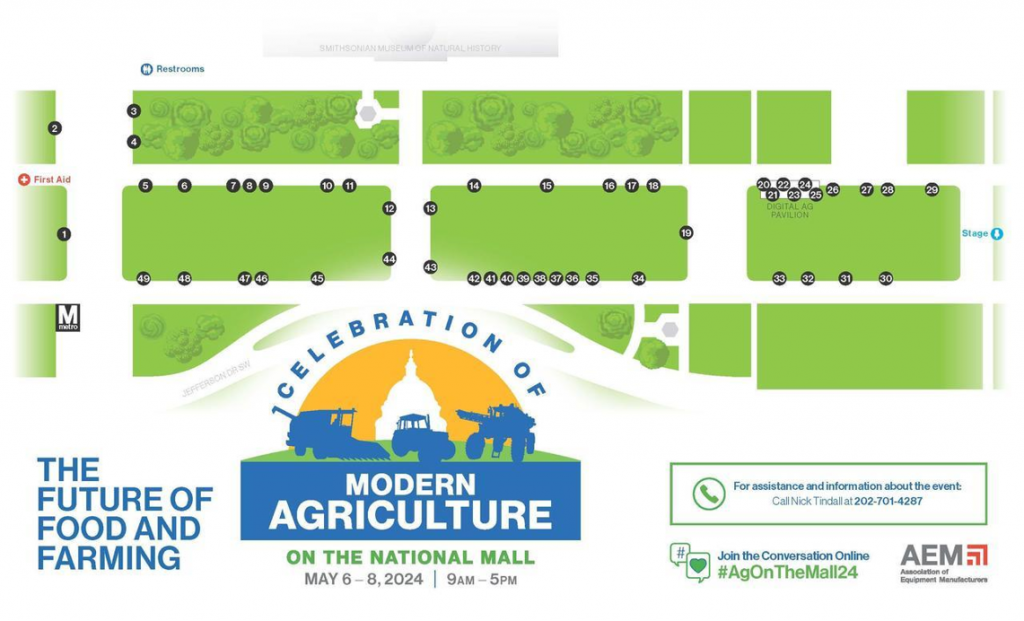
U.S. Wheat Associates (USW), North American Millers' Association (NAMA), National Association of Wheat Growers (NAWG), and American Bakers Association (ABA) are joining the "Celebration of Modern Agriculture on the National Mall" near the United States Department of Agriculture (USDA) headquarters on May 6, 7, and 8, 2024. The event is sponsored by the Association of Equipment Manufacturers as a showcase of the constant improvement in American agriculture from its farmers, ranchers, producers, equipment manufacturers, and input innovators on the cutting-edge of science and technology.
NAMA, USW, NAWG, and ABA will host an exhibit that tells the story of wheat production from field to flour to favorite wheat foods here and around the world. The exhibit will include interactive displays that tell the story of this iconic American crop and the industries it supports. During the event, leaders from all four organizations will be available to speak with the media about their organizations' participation in the event and how America's wheat industry, from grower to manufacturer, is producing wholesome, sustainable staple foods to improve food security for a growing world (see attached event map).
U.S. Wheat Associates' (USW) mission is to "develop, maintain, and expand international markets to enhance wheat's profitability for U.S. wheat producers and its value for their customers." USW activities in more than 100 countries are made possible through producer checkoff dollars managed by 17 state wheat commissions and cost-share funding provided by USDA's Foreign Agricultural Service. USW maintains 15 offices strategically located around the world to help wheat buyers, millers, bakers, wheat food processors and government officials understand the quality, value and reliability of all six U.S. wheat classes. For more information, visit www.uswheat.org.
| |||||||||||||||||||||||||||||||||||||||||||||||||||||||||||||||||||||||||||||||||||||||||||||||||||||||||||||||||||||||||||||||||||||||||||||||||||||||||||||||||||||||||||||||||||||||||||||||||||||||||||||||||||||||
|
Attorney General Gentner Drummond announced today that a series of busts in Muskogee County last week resulted in the seizure of approximately 32,000 unlawful marijuana plants, 5,000 pounds of untraceable processed pot, and six firearms. The inspections of several marijuana grow operations and dispensaries were a collaborative effort of the Attorney General's Organized Crime Task Force, the Oklahoma Medical Marijuana Authority, the Muskogee County Sheriff's Office, the Muskogee Police Department and the Muscogee (Creek) Nation Lighthorse.
Jinhe Chen, 47, was arrested on charges of aggravated manufacturing and trafficking (marijuana). In addition, multiple illegal immigrants from Central America were discovered working at an unlawful grow site but were not detained or deported by federal authorities.
"These actions are the latest example of my efforts to dismantle illegal drug trafficking operations that endanger our communities," Drummond said. "I will continue to target and prosecute anyone associated with these dangerous criminal enterprises."
He noted that the presence of undocumented workers at a grow site underscores the need for House Bill 4156, which Gov. Stitt signed into law yesterday. The bill will enable state law enforcement to arrest and incarcerate illegal immigrants.
Every person arrested or charged is presumed innocent unless and until convicted in a court of law.
From NMPF President & CEO Gregg Doud:
"Dairy farmers are heartened that today, both House Agriculture Committee Chairman Glenn 'GT' Thompson, R-PA, and Senate Agriculture Committee Chairwoman Debbie Stabenow, D-MI, each released documents providing an overview of their farm bill priorities and plans. Dairy farmers and the cooperatives they own are better-served by the certainty provided under a five-year farm bill, and as both chairs point the way toward important dairy priorities across multiple farm bill titles, all of dairy is eager to see this process get moving.
"We look forward to the House Agriculture Committee's markup of its bill on May 23. We're ready, and excited, to work with both chairs and their ranking members to complete work on a farm bill this year."
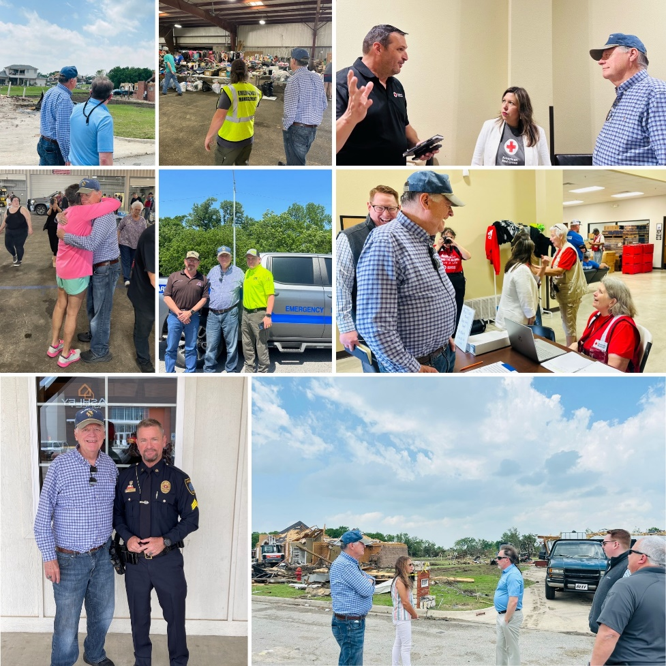
Congressman Tom Cole (OK-04) released the following statement after visiting Sulphur, Ardmore, and Marietta, Oklahoma after a series of tornadoes ripped through these areas on April 27, 2024:
"This week, I have been on the ground in Oklahoma assessing the damage from the tornadoes, getting a status update on the storm clean-up, and attending meetings to ensure my constituents get the necessary assistance needed," said Congressman Cole. "My thoughts and prayers continue to be with those who were affected by or lost a loved one as a result of the storms. I would also like to reiterate my support and gratitude for our brave first responders. As your Congressman, I will be with our local communities every step of the way as we make a full recovery."
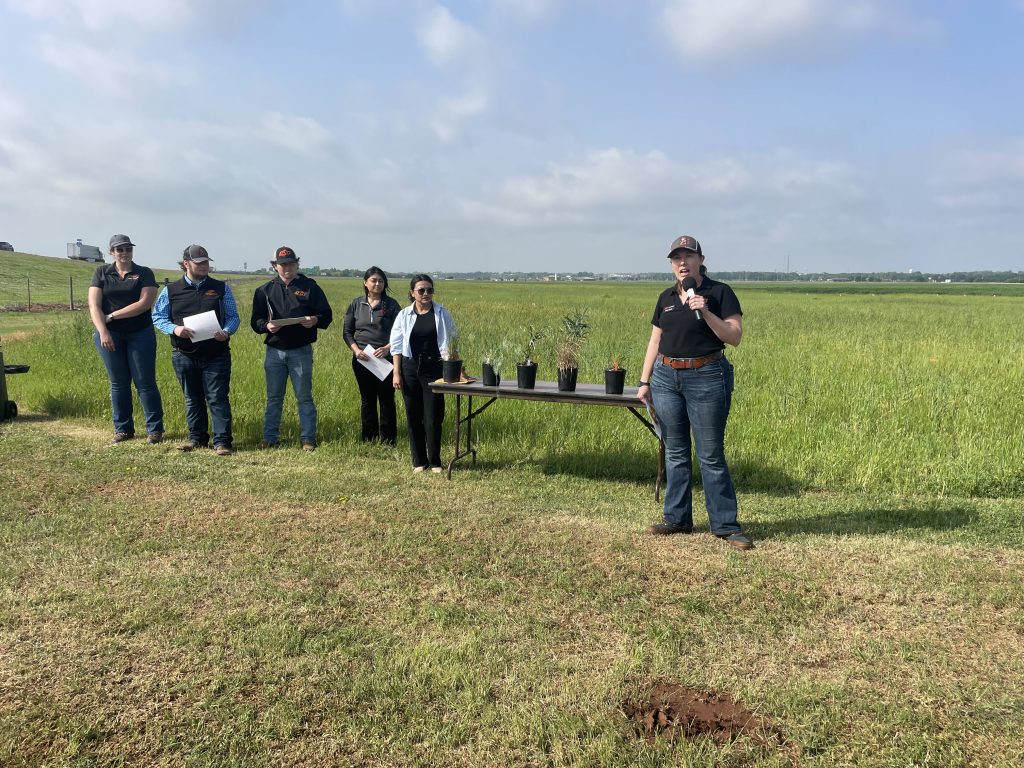
At the Oklahoma State University Wheat and Forages Field Day held in Chickasha, Associate Farm Editor Reagan Calk had the chance to talk with OSU's Dr. Liberty Galvin about herbicide resistance issues. Galvin is the extension weed scientist and precision week management at OSU.
Galvin said when talking with growers around the state, herbicide resistance in Italian ryegrass is a common complaint for wheat producers, especially those growing single-purpose wheat. While some producers plant ryegrass as a forage, Galvin said unwanted growth is an issue in the fields of many of those who are growing wheat only.
"My assumption is that we are seeing some weeds migrate from our dual-purpose fields into our wheat crops and they have become very problematic for wheat growers," Galvin said.
As producers are seeing resistance against particular herbicides towards weed control, Galvin talked about considering non-chemical control options such as crop rotation, cover crops, and fire.
"I am pretty excited about fire," Galvin said. "I know a lot of folks are very hesitant because of the safety aspect, which is completely reasonable."
With her grad students, Galvin said one of the things they are working on is the efficacy of fire when it comes to weed control. Galvin also mentioned the use of a post-harvest seed crusher to control weeds.
"This is basically a grinder," Galvin said. "You put all of your chaff through this grinder, and it just destroys all of the weed seeds that are left in the field. It is not a short-term option for killing the weeds, but it does prevent long-term deposits of the weed seeds into the seed bank."
While chemical-free options are not as efficacious as herbicides, Galvin said they will reduce the prevalence of weeds over time.
Galvin said she and a colleague are conducting a statewide survey of herbicide-resistant weeds, so if a grower believes they have a herbicide-resistant weed in their field, they can contact Galvin at 405-334-7676 or lbgalvin@okstate.edu.
"We would be more than delighted to send a grad student over in a truck to come and pick up those weeds," Galvin said. "We are trying to get growers, researchers, and everybody in the state up to speed on where those herbicide-resistant weeds are, and how diverse those populations are."

FEMA announced that federal disaster assistance is available to the state of Oklahoma to supplement recovery efforts in the areas affected by severe storms, straight-line winds, tornadoes and flooding beginning on April 25, 2024 and continuing.
The President's action makes federal funding available to affected individuals in Hughes, Love and Murray counties. Assistance can include grants for temporary housing and home repairs, low-cost loans to cover uninsured property losses and other programs to help individuals and business owners recover from the effects of the disaster.
Federal funding is also available to state, tribal and eligible local governments and certain private nonprofit organizations on a cost-sharing basis for debris removal and emergency protective measures, including direct federal assistance in Hughes, Love and Murray counties.
Federal funding is available on a cost-sharing basis for hazard mitigation measures statewide.
Benjamin Abbott has been named Federal Coordinating Officer for federal recovery operations in the affected areas. Additional designations may be made at a later date if warranted by the results of damage assessments.
Individuals and business owners who sustained losses in the designated areas can begin applying for assistance by registering online at www.DisasterAssistance.gov, by calling 1-800-621-FEMA (3362), or by using the FEMA App. If you use a relay service, such as video relay service (VRS), captioned telephone service or others, give FEMA the number for that service.

An announcement this week by the U.S. Department of Treasury regarding the final guidance on eligibility for the Sustainable Aviation Fuel tax credits enacted in the Inflation Reduction Act was met with concern from leaders at the National Corn Growers Association (NCGA) who say they are now committed to ensuring that the updated guidelines for the credit are vastly improved.
NCGA raised specific issues with the changes Treasury made to the Department of Energy's GREET model, which is used to measure greenhouse gas emissions and will be a crucial mechanism in determining who receives the tax credit.
Corn grower leaders said they are particularly troubled that the updated model requires farmers to bundle the use of no-till practices, enhanced efficiency fertilizers and cover crops for their grain to meet the standards now required to qualify for the tax credit.
"We are deeply disappointed that this updated model requires farmers to implement environmental practices that are not practical for all acres of the large and varied geographic region in which corn is grown," said Minnesota farmer and NCGA President Harold Wolle. "This requirement in GREET will significantly hinder the chances corn growers have in accessing the sustainable aviation fuel market, even as higher blends of corn ethanol offer great promise in the country's fight against greenhouse gas emissions and climate change."
Wolle noted that cover crops can be difficult, if not impossible, to grow in dryer climates, making the bundling requirement extremely unreasonable. He also noted that growers should be able to implement their own environmental practices.
"As corn growers, we already understand the environmental practices that work best for our growing conditions and climate, so it is not necessary for the government to dictate specifically how we reach an emissions reduction goal," Wolle said. "Farmers are going to have different methods depending on a variety of factors, including where their farms are located."
The Inflation Reduction Act, passed in 2022, allocates tax credits for biofuels that can demonstrate that they cut greenhouse gas emissions by 50% or more. After the law was passed, Treasury and EPA were charged with choosing a model that would measure emissions throughout the life of biofuels.
NCGA has been at the forefront of this issue, making a case about how ethanol can help the aviation sector meet the nation's environmental goals. But recent developments have made growers question the Biden administration's commitment to using ethanol as a climate solution.
"President Biden has repeatedly said that biofuels will play an important role in the decarbonization of the transportation sector," Wolle said. "Yet, this announcement and the recently finalized Multi-Pollutant Rule issued by the EPA have left corn growers across the country grasping for ideas on just how they will be able to contribute to this effort."
Wolle said NCGA and corn growers across the country will increase their advocacy efforts to improve the changes Treasury made to the GREET model as the Biden administration focuses on the next phase of the Inflation Reduction Act for passenger vehicles, referred to as the 45Z tax credit. The 45Z tax credit will take effect at the beginning of 2025. As part of the law, the aviation tax credit will be folded into the 45Z tax credit beginning on January 1, 2025.
NCGA has been concerned about the delays with the release of the sustainable aviation fuel guidance because the regulatory uncertainty is beginning to impact fuel delivery contracts already being negotiated for January of next year.
For most prescribed fire practitioners in the Southern Great Plains, burns are conducted during winter and early spring (December to March). This burning season has become commonplace because most of the fuels (grasses and leaf litter) are dead and burn easily, and a large portion of prescribed burns are conducted close to spring green-up to improve forage quality.
However, historically, the land was burned during all seasons of the year. A short burn season can make it difficult to successfully accomplish land management goals. We should consider burning during the entire year to create more opportunities for land managers to conduct prescribed burns.
It is common for burns to be postponed to another year because a short burn season and weather limitations make it difficult to conduct burns in a timely manner. Postponement allows more brush encroachment on rangelands that could negatively impact wildlife habitat and grazing quantity. The seasonality of a prescribed burn depends on fuel type and the goals for the land. As for any prescribed burn, extending the burn season requires planning.

TOOLS YOU NEED FOR A SUCCESSFUL BURN
As part of the prescribed burn planning process, managers should secure the appropriate equipment.
Following are some basic tools and equipment for conducting a prescribed burn. For more
information about prescribed fire and other essential tools needed for a successful burn, please visit noble.org/fire.
POWER EQUIPMENT
All power equipment should be checked and serviced prior to a burn. Remember to have extra fuel and oil.
HAND EQUIPMENT
For burns conducted during summer and fall, grasslands and mixed shrublands burn better than woodlands. To carry a fire during the growing season, the previous year's grass and forb growth is needed. This requires planning to ensure grazing does not remove too much plant material so burns can be conducted and are effective. Wooded areas are usually best burned during winter because wooded areas need leaves to carry fire; the longer leaves are on the ground after leaf-drop, the more difficult they are to burn. It is harder to carry a fire through wooded areas during the growing season than in December or January.
Burns conducted during summer and fall have different impacts on the plant community than burns conducted during winter and spring. Burns during the growing season typically have a bigger impact on brush species. If brush control is a land management objective, consider burning during the growing season.

It also is beneficial to wildlife to have burned areas at different times of the year to increase plant diversity, which is imperative for good wildlife habitat. Diversity is one of the 6 soil health principles for regenerative ranching. Burning multiple times of the year creates a mosaic of various plant communities in different plant successional stages to benefit many wildlife species. Diversity in burn season also improves community dynamics, one of the ecosystem processes that is important for ecological health and resilience.

Typically, weather conditions are most volatile during winter and early spring in the Southern Great Plains. Days with low humidity and high winds are not uncommon. In summer and fall, weather conditions tend to be more stable with lower wind speeds and higher humidity. Due to more consistent and safer weather conditions during summer and fall, some people prefer to burn outside the typical burn season. Burns during the growing season also tend to have fewer escapes than burns in the dormant season because green vegetation mixed with dead fuel slows down the fire.
Prescribed fire is an important ecological process for the Southern Great Plains. Our plants are adapted to and require fire, regardless of the burn season. We should consider using fire at all times of the year to accomplish our land management goals. We shouldn't limit ourselves to just a few months out of the year to burn.
Story credit: Will Moseley, Noble Research Institute.
Senators James Lankford (R-OK) and Markwayne Mullin (R-OK) along with Representatives Frank Lucas (R-OK), Tom Cole (R-OK), Kevin Hern (R-OK), Stephanie Bice (R-OK), and Josh Brecheen (R-OK) sent a letter of support to President Joe Biden to formally request disaster relief funding after 22 tornados and storms crossed the state starting on April 27, 2024. The Delegation has remained engaged on the status of the storm clean up and the necessary assistance needed. Lankford joined the FEMA Administrator in Marietta and Sulphur to show her the areas impacted by a tornado.
The Delegation wrote, "We write in support of the formal request from the State of Oklahoma, through the office of Governor Kevin Stitt, that was submitted on April 30, 2024, for a major disaster declaration, including individual and public assistance for Carter, Cotton, Garfield, Johnson, Kay, Lincoln, Okfuskee, Oklahoma, Okmulgee, Payne, Pittsburg, Pontotoc, and Wagoner Counties as well as the Chickasaw, Creek, and Choctaw Nations to recover from last weekend's weather from severe storms, tornadoes, straight-line winds, wind-driven rain, flooding, hail, and fire related to lightning strikes. An Executive Order declaring a State of Emergency in these counties (E.O. 2024-07) was issued on April 28, 2024."
President Biden granted the Major Disaster Declaration, which will bring important federal resources to the ground and allow communities to recover quickly.
Read the full letter here or below.
Dear Mr. President:
We write in support of the formal request from the State of Oklahoma, through the office of Governor Kevin Stitt, that was submitted on April 30, 2024, for a major disaster declaration, including individual and public assistance for Carter, Cotton, Garfield, Johnson, Kay, Lincoln, Okfuskee, Oklahoma, Okmulgee, Payne, Pittsburg, Pontotoc, and Wagoner Counties as well as the Chickasaw, Creek, and Choctaw Nations to recover from last weekend's weather from severe storms, tornadoes, straight-line winds, wind-driven rain, flooding, hail, and fire related to lightning strikes. An Executive Order declaring a State of Emergency in these counties (E.O. 2024-07) was issued on April 28, 2024.
Severe storms, tornadoes, straight-line winds, hail, and flooding began impacting the State of Oklahoma on the evening of Saturday, April 27 and continued to cause damage to public and private properties within the State, ultimately winding down in the early hours of April 28. As usual, Oklahomans demonstrated the Oklahoma Standard when they stepped up to help their families and neighbors as they begin the process of cleaning up the debris and repairing damage to homes, churches, and businesses.
State and local officials have informed us that this incident is of such severity and magnitude that effective response and recovery is beyond the combined capability of the state and local governments, and that federal assistance is necessary to save lives, protect property, and to ensure the safety of these communities.
As such, we respectfully urge you to approve the Governor's request for the counties listed above. We stand ready to provide any assistance needed to ensure the prompt evaluation of this request. Please reach out to our offices with any questions on this matter.

Since 2006, the International Federation of Agricultural Journalists (IFAJ) and Alltech, a global leader in agriculture and animal nutrition, have partnered to support the Young Leaders in Agricultural Journalism Awards that recognize the leadership potential of young members (under 35 years of age). As young agricultural journalists and communicators, they have the important role of sharing the stories of agriculture with the world.
IFAJ and Alltech offer 10 scholarship opportunities to attend the IFAJ Congress, held this year in Interlaken, Switzerland, in August. The winners also participate in a unique three-day professional development workshop immediately prior to the IFAJ Congress. The workshop emphasizes reporting skills and leadership training and includes agriculture tours.
The 2024 IFAJ/Alltech Young Leaders include:
"Alltech is proud to partner with IFAJ to support the Young Leaders program, as we all share a commitment to supporting journalists who give voice to farmers and producers and ensure that agriculture stories continue to be told around the world," said Jenn Norrie, North American and European communications manager at Alltech.
"The Young Leaders program has helped agricultural journalism guilds and IFAJ grow for nearly two decades," said IFAJ secretary-general, Addy Rossi. "The IFAJ/Alltech Young Leaders program is more than just an award to recognize rising young stars in our industry—it provides training, networks and contagious energy to tomorrow's guild and federation leaders."
"Many of the officers and active volunteers in national guilds and IFAJ's governing bodies have been Young Leaders," he added. "With its generous sponsorship and deep commitment to the future of agricultural journalism, Alltech has helped train a generation of world leaders."
For more information on IFAJ and the Young Leaders program, visit www.ifaj.org. For more on Alltech, visit www.alltech.com.
The U.S. Department of Agriculture's Farm Service Agency (FSA) reminds agricultural producers that Farm Loan Programs can be used to support a variety of climate-smart agriculture practices, which build on many practices that farmers and ranchers already use, like cover cropping, nutrient management and conservation tillage.
"Farmers and ranchers are already doing their part to be stewards of our land, but some may lack the financial resources to take their efforts to the next level," said FSA Administrator Zach Ducheneaux. "USDA's Farm Service Agency offers a variety of loans that can help those who would like to explore opportunities in their operations to make them more efficient and make a positive impact on our environment."
Climate-smart agricultural practices generate significant environmental benefits by capturing and sequestering carbon, improving water management, restoring soil health and more. Farm loan funding complements other tools to help producers adopt climate-smart practices, such as FSA's Conservation Reserve Program, crop insurance options that support conservation, and conservation programs offered by USDA's Natural Resources Conservation Service (NRCS).
FSA offers multiple types of loans to help farmers and ranchers start, expand or maintain a family agricultural operation. These loans can provide the capital needed to invest in climate-smart practices and equipment including the establishment of rotational grazing systems, precision agriculture equipment or machinery for conversion to no-till residue management. Additionally, for programs like Conservation Reserve Program and NRCS conservation programs where USDA and the producer share the implementation cost, a farm loan could be used for the producer's share, if consistent with the authorized loan purpose.
Some additional ways farm loans can be leveraged to invest in climate-smart agriculture practices or equipment include:
"There are a multitude of ways our portfolio of loans can be used to support climate-smart practices," Ducheneaux said. "In some cases, this may even result in lower input costs, higher yields and a positive impact to the producers' bottom line as well as our natural resources."
Visit the Climate-Smart Agriculture and Forestry webpage on farmers.gov to learn more and see detailed examples of how an FSA farm loan can support climate-smart agriculture practices.
Farm Loan Improvement Efforts
USDA's Farm Service Agency has a significant initiative underway to streamline and automate Farm Loan Program customer-facing business processes. For the over 26,000 producers who submit a Direct Loan application to FSA annually, and its 85,000 Direct Loan borrowers, FSA has made many improvements, including:
More Information
Under the Biden-Harris administration, USDA is engaged in a whole-of-government effort to combat the climate crisis and conserve and protect our Nation's lands, biodiversity and natural resources including our soil, air, and water. Through climate-smart agriculture and partnerships, USDA aims to enhance economic growth and create new streams of income for farmers, ranchers, producers, and private foresters. Successfully meeting these challenges will require USDA and our agencies to pursue a coordinated approach alongside USDA stakeholders, including State, local and Tribal governments.
USDA touches the lives of all Americans each day in so many positive ways. In the Biden-Harris administration, USDA is transforming America's food system with a greater focus on more resilient local and regional food production, fairer markets for all producers, ensuring access to safe, healthy and nutritious food in all communities, building new markets and streams of income for farmers and producers using climate smart food and forestry practices, making historic investments in infrastructure and clean energy capabilities in rural America, and committing to equity across the Department by removing systemic barriers and building a workforce more representative of America. To learn more, visit www.usda.gov.
USDA is an equal opportunity provider, employer and lender.
Today, House Agriculture Committee Ranking Member David Scott released the following statement in response to the decision by Agriculture Committee Republicans to reject a bipartisan farm bill compromise."Agriculture Committee Democrats presented a farm bill counterproposal to our Republican colleagues as part of an ongoing, years-long bipartisan process that could invest tens of billions of dollars in the farm bill safety net without cuts to SNAP benefits. Unfortunately, Republicans rejected this bipartisan approach in favor of a partisan bill with an untenable funding scheme. By insisting on poison pill policies, Republicans have turned what could have been a genuinely bipartisan bill into a messaging exercise to appease their right flank that has no chance of becoming law."
Entrepreneurs encouraged to apply for beef industry grant program through May 31.
The Texas & Southwestern Cattle Raisers Association (TSCRA) Leadership Development Foundation, a 501(c)(3) organization committed to future generations of land and livestock stewards and leaders, announced today the opening of the first-ever application window for the TSCRA Leadership Development Foundation Working Grant Program. The program will distribute financial capital to business owners with a demonstrated interest in the beef value chain.
The program is open to entrepreneurs in Texas and Oklahoma including cow-calf operations, stockers, feeders, packing plants, large animal veterinary clinics and other segments of the beef value chain.
"Entering into any sector of the beef industry today is difficult, and I truly believe we all face disadvantages and challenges," said TSCRA Leadership Development Foundation Chair Carl Ray Polk. "One of the greatest barriers is access to capital, and the TSCRA Leadership Development Foundation is proud to have a platform to address this challenge directly."
The TSCRA Leadership Development Foundation Working Grant Program was designed to support individuals establishing, operating or growing a beef business.
"By investing in these entrepreneurs, we truly are investing in the future of our nation's food supply and natural resources that are both in the hands of these stewards," said Polk. "That's the beauty of the program – each financial grant has far reaching impacts beyond the individual applicant."
To be eligible for consideration for financial assistance, applicants must operate a business in an economically depressed or blighted area in Texas or Oklahoma and face disadvantages. Eligible applicants must also demonstrate the difficulty of obtaining conventional financing because of such disadvantages.
The online application will remain open until May 31 and grantees are expected to be announced no later than August 2024.
Details about the TSCRA Leadership Development Working Grant Program including the application and eligibility requirements can be found online at tscra.org/what-we-do/leadership-development-foundation/ .
Connor Mack
During the month of April, the Radio Oklahoma Ag Network and Oklahoma Farm Report are spotlighting the 18 Area Stars of Oklahoma FFA, who are among the highest achievers in the organization.
The stars come from the five areas in four categories- Star in Ag Placement, Star in Agriscience, Star in Agribusiness, and Star in Agricultural Production.
This week, we spotlight the five area stars in Agricultural Production in 2024.
One Star Finalist featured in the coming days from each of the categories will be named the State Star Award Winner during the 98th Oklahoma State FFA Convention, which will take place on May 7th and 8th in Tulsa, Oklahoma.
This week, our coverage of the 2024 Oklahoma FFA Star Award Finalists continues with Agricultural Production competitor Connor Mack of the Drummond FFA chapter representing the Northwest Area.
Mack's project is diverse, he said, as he plants several different crops including wheat, canola, milo, corn, and soybeans. Within his livestock operation, Mack said he runs 50 standard commercial Hereford cows, 47 stockers, 15 Miniature Herefords, and 35 Dorper sheep.
"Every since I was a little kid, our family has always farmed," Mack said. "I am a fifth-generation farmer and I have always looked up to my dad, my grandpa, my brother, and my uncles and this life is all I know."
As the weather in Oklahoma can be as unpredictable as the markets, Mack said through his work on the farm he has learned about different risk protection programs for livestock and crops.
"Just learning about all of those different things along the way of how to be successful in the crops I am growing and the cattle I am raising, but also how to be successful in purchasing that insurance protection for what I do," Mack said.
After high school graduation, Mack said he plans to attend Oklahoma State University and major in Plant and Soil Sciences with a minor in Animal Science. After college, Mack said he looks forward to coming back to the family farm.
"I take a lot of pride in our family operation," Mack said.
Your coverage of the 2024 Oklahoma FFA Convention is sponsored by Hilliary Communications- who deliver the latest cutting-edge communications services supporting tens of thousands of customers across 22 counties throughout Oklahoma, Texas and Iowa. The company offers internet, voice and HilliaryTV. Hilliary Communications continuously researches the marketplace for innovations and strives to improve underserved areas, offering services that exceed customer expectations. Click here to learn more about Hilliary Communications.
For more information about the 98th Oklahoma State FFA Convention, click here.
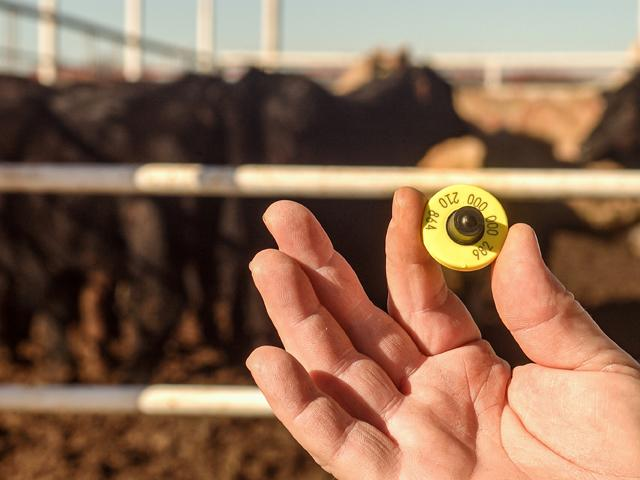
Photo credit: DTN file photo by Jim Patrico
At the National Association of Farm Broadcasters Washington Watch Event, Farm Director KC Sheperd had the chance to visit with the Vice President of Governmental Affairs at the National Cattlemen's Beef Association, Ethan Lane. In this episode of Beef Buzz, Senior Farm, and Ranch Broadcaster Ron Hays is featuring more comments from the conversation regarding EID cattle tags.
To listen to Part One of the conversation, CLICK HERE.
Lane said the final EID rule announced recently was "in line" with the proposed rule, and there were not any surprises.
"At the end of the day, I think it is important for producers that are worried about this or reading about it to understand what happened," Lane said. "The 2013 Animal Disease Traceability Rule is what sets out this class of cattle needing to be traceable across state lines and moving interstate. That is those over 18 months intact, plus dairy cattle, rodeo cattle, etcetera."
The new rule sets a standard for the technology that must be used to accomplish a visually and electronically readable tag. Lane said the rule will not go live until November.
"If producers want to get grandfathered in under the old system, they can do that," Lane said. "They can also go to their state health officials, get tags, and get tagged up under the new format. We worked hard during appropriations to make sure there was money available to cover the cost of those tags."
Because EID tags are provided by the USDA free of cost, Lane said hopefully the transition will be less difficult for producers.
"We are going to continue to work to make sure that the guidelines that our producers have set out, that this be something that moves at the speed of commerce, that it protects our producers' data, that they are not bearing the cost of, and that it serves as a nationally significant animal disease traceability program are met during this process," Lane said.
Lane emphasized that there is no interest in adding younger cattle under 18 months of age to the cattle required to have an EID tag. He says that it is not in NCBA's policy and USDA has stated multiple times they have no interest in going that direction.
To view the NCBA's comments on USDA's Traceability Rule, CLICK HERE.
The Beef Buzz is a regular feature heard on radio stations around the region on the Radio Oklahoma Ag Network and is a regular audio feature found on this website as well. Click on the LISTEN BAR for today's show and check out our archives for older Beef Buzz shows covering the gamut of the beef cattle industry today.
The Agricultural Retailers Association (ARA) President & CEO Daren Coppock released the following statement applauding the Biden Administration's announcement updating the Greenhouse gases, Regulated Emissions, and Energy use in Technology (GREET) model and including regenerative agricultural practices in the sustainable aviation fuel emissions calculation:
"ARA is pleased to hear the announcement from the Biden Administration firmly establishing a role for agriculture in the future of sustainable fuels. Updates to the GREET model and the inclusion of agricultural crops and practices in the equation to qualify for 40(b) tax credits in 2023 and 2024 opens an important door for America's farmers.
"As the Administration works to develop criteria for the 45(z) credits that will start in 2025, we look forward to more crops and more practices being included in the mix. Agriculture has much to offer, and we're pleased to see those attributes recognized.
"Decisions like this don't just happen," Coppock continued. "They're the product of months of hard work between the U.S. Department of Agriculture (USDA), the Department of Energy, White House staff and others. ARA offers our thanks and appreciation to Secretary Tom Vilsack and the team at USDA who invested time and a lot of work to show that agricultural crops can be big contributors to sustainable biofuels supply."
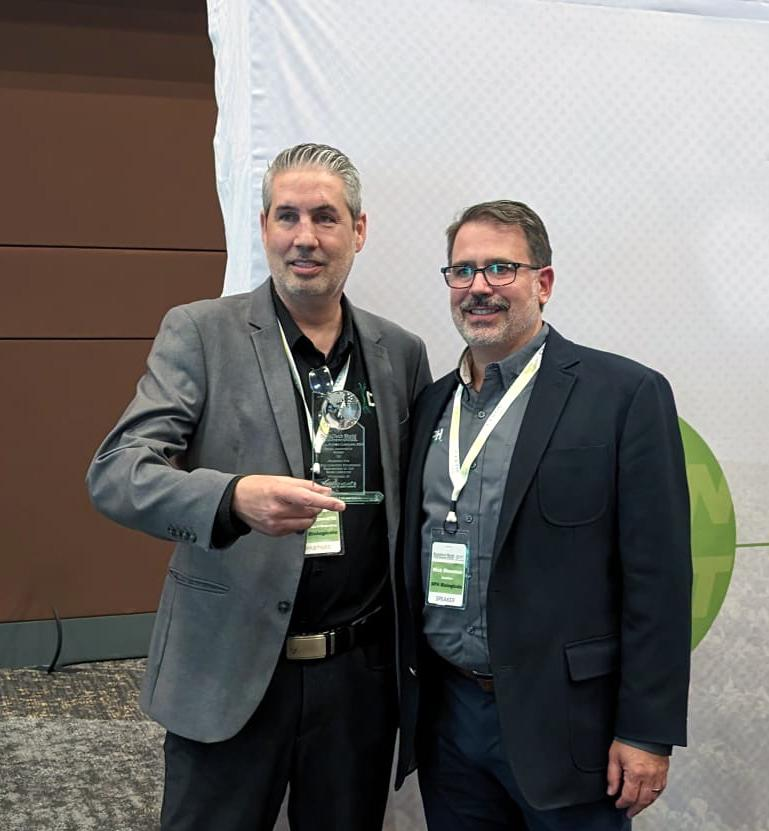
DPH Bio VP of Strategy and Marketing Brad Holzworth (left) and President and CEO Mick Messman with award at BioAgTech World Congress
DPH Biologicals' RegenAphex® received the first runner-up BioAgTech Innovator Award at the annual BioAgTech World Congress, a gathering of leaders from across the agriculture industry to share the latest technological advances in biologicals. RegenAphex, a plant-based liquid humus extract, fosters biological product innovation to improve soil and crop health by providing a superfood base of readily available organic carbon. "RegenAphex is the culmination of DPH Biological's unwavering commitment to unlocking the potential of the biological industry for improving crop production and land stewardship," said Mick Messman, president and CEO of DPH Biologicals. "We are honored to be recognized by the BioAgTech World Congress and look forward to helping increase product development to meet farmer and consumer demand for more sustainable practices."
First selected by the Congress Scientific Committee, finalists presented to a live-voting audience. During his presentation, Messman detailed RegenAphex's potential to unlock value and accelerate agriculture's transition to a more balanced biological approach through industry channel collaboration. RegenAphex is produced at DPH Bio's Illinois-based production facility using a proprietary plant-based composting and extracting process. The process preserves and extracts soluble and suspendable minerals, humus proteins, humic substances, enzymes and microbes, resulting in a safe, shelf-stable, water-based extract. The resulting biological platform is available to the market in an easy-to-use, transferable package size ranging from 2x2.5 gallon jugs to bulk tankers.
With a two-year shelf-life and leading compatibility characteristics, RegenAphex remains viable even through freeze and thaw conditions, requires no special handling, is tank-mix friendly and can be safely combined with other inputs, including conventional chemistry-based inputs.
A key component of DPH Bio's flagship biological product, SP-1® Classic, RegenAphex is commercially available for product collaborations through partnerships and private label opportunities.
The U.S. Department of Agriculture (USDA) today announced the names of individuals who hold senior staff positions in Washington, D.C.
Jeremy Adamson was promoted to Chief of Staff for Research, Education, and Economics
Most recently, Adamson served as a Senior Policy Advisor for Trade and Foreign Agricultural Affairs in the Foreign Agricultural Service where he led development and implementation of international climate efforts, including USDA's participation in the annual United Nation's Climate Conferences (COP 26, 27, and 28). He led the development of USDA's International Climate Hub and supported development and advancement of U.S.-led and co-led international initiatives and coalitions, including the Agriculture Innovation Mission for Climate. Before that, Adamson served as the Portfolio Manager for Certis Biologicals. Previously, he held roles in account management and market development with Corteva Agrisciences and worked as a Crop Consultant and Plant Health and Nutrition Specialist with Nutrien. Adamson is a native of Merrillville, Indiana, and graduated from Purdue University with a bachelor's degree from the College of Agricultural Economics.
Deidre Deculus Robert was promoted to Director of State Operations for Rural Development
Most recently, Deculus Robert served as State Director of Rural Development in Louisiana. There, she worked to support rural communities across Louisiana by administering programs for affordable housing, community facilities, and the business industry. Before that, she was Executive Counsel and General Counsel for the Louisiana Department of Transportation and the Southern University and A&M College System respectively. Prior, she served as Deputy Director of the Litigation Division of the Louisiana Department of Justice. She began her career in the Parish Attorney's Office of the City of Baton Rouge, where she worked for eleven years. She holds a JD from the Southern University Law Center and a bachelor's degree in history and classical civilizations from Louisiana State University.
Ellis Collier was promoted to Senior Policy Advisor for the Natural Resources Conversation Service
Most recently, Collier served as a Legislative Advisor in the Office of Congressional Relations. In this role, he was responsible for managing congressional engagement and Farm Bill coordination across climate, research, forestry, and conservation. Before that, he served as a Legislative Analyst and 1890 Congressional Fellow for the House Committee on Agriculture providing legislative and policy support on forestry and conservation. Prior, he was a Senior Legal Research Assistant at the Agriculture Law Education Initiative under the University of Maryland Eastern Shore Extension handling issues of heirs' property on agricultural lands. Collier also served for three years as a NRCS scholar in the 1890 National Scholars Program, which aims to bolster educational and career opportunities for students from rural communities. Collier holds a JD from the University of Arkansas and bachelor's degree from the University of Maryland Eastern Shore in agriculture.
Malikha Daniels has been named Senior Policy Advisor for the Foreign Agricultural Service
Most recently, Daniels served as a Senior Legislative Advisor for the Office of Congressional Relations. Before that, Daniels served as Subcommittee Staff Director for Biotechnology, Horticulture, and Research (BHR) at the U.S. House of Representatives Committee on Agriculture, where she oversaw biotechnology, agricultural research, and all issues in the BHR policy jurisdiction. Prior, she held roles at the Congressional Black Caucus Foundation, Office of Senator Kirsten Gillibrand, Office of Congressman Al Lawson, Office of Congressman Dwight Evans, and USDA's Agricultural Research Service. Daniels holds a Master of Public Policy from the American University School of Public Affairs and two bachelor's degrees in Biological Sciences and Spanish from the University of Illinois at Chicago.
House Committee on Agriculture Chairman Glenn "GT" Thompson (PA-15) released the following statement after sharing a title-by-title overview of the bipartisan policies and priorities included in the 2024 farm bill.
"This bill is a product of an extensive and transparent process, which included soliciting feedback from Members of both political parties, stakeholder input from across the nation, and some tough conversations. Each title of this farm bill reflects a commitment to the American farmer and viable pathways to funding those commitments, and is equally responsive to the politics of the 118th Congress. The Committee on Agriculture will markup this bill on May 23, and I hope for unanimous support in this endeavor to bring stability to producers, protect our nation's food security, and revitalize rural America."
The title-by-title document can be found here.

Participants in the Brighter Future program are learning skills that will help them on the road to higher education and other post-high school career opportunities. (Photo by Todd Johnson, OSU Agriculture)
There can be speed bumps on the road to higher education, but a program offered through Oklahoma State University and OSU Extension is helping make that road smoother.
The Brighter Future program connects freshmen through senior high school students with tools to navigate the college enrollment process or other post-high school career opportunities and succeed in life.
Steve Beck, Oklahoma 4-H Youth Development state program leader, said Brighter Future is a college and career readiness program that teaches youth valuable life lessons.
"Piloting this program through OSU Extension and 4-H is simply building on what 4-H has done so well for years – preparing youth for the future," he said. "We're not only working with the youth, but we're building a relationship with families, too. College is a big step and through Brighter Future we're going to help prepare students for the journey. Students who complete the four-year program have pre-admittance to OSU."
Beck said the program is also beneficial to students who choose to enter the workforce or pursue other educational opportunities following high school graduation.
Pittsburg County 4-H is currently piloting Brighter Future, where 4-H educator Greg Owen launched the program in 2022 with freshmen at Savanna Public Schools. The opportunity expanded to Savanna sophomores for the 2023-24 school year, and he also works with Brighter Future participants at Crowder Public Schools and Canadian Public Schools.
"Our goal is to better prepare students for career exploration. We'd love for them to come to OSU, but most importantly we're preparing them for life after high school," Owen said.
Year one of the program taught students to set goals and develop public speaking skills. The second year focuses on time management. Year three will provide valuable information regarding post-secondary tasks such as preparing a resume, filling out job applications and practicing interview skills, as well as reading and note-taking. The final year of Brighter Future will cover the college application process, scholarships, financial aid and money management.
"Everyone participating in this pilot program is gaining great information they can apply after high school, even if they don't take part in some sort of higher education," Owen said. "They're learning valuable skills needed for success."
Owen also introduces Brighter Future students to the importance of service learning and encourages them to develop a project that gives back to their communities.
"Civic engagement has always been a big part of 4-H and is a good way to get all youth involved in their communities," he said. "The skills they learn through civic engagement apply to all areas of life."
Doug Hallenbeck, OSU vice president of student affairs, said Brighter Future promotes the university's land-grand mission because of OSU Extension's presence in all 77 counties.
"Brighter Future is a way to have a conversation with students and families early on about what it takes to be a college student," he said. "We want to reach these families early in high school and provide them with the tools and information they need to make informed choices about life after high school. This program helps students instill the belief and faith that college is something they can do."
Crowder High School sophomore Solar Starr said participating in Brighter Future has helped her decide to pursue a career as a radiology technician.
"Some of the most important things I've learned from Greg (Owen) through Brighter Future are the skills he teaches such as time management, study skills and citizenship," said Starr, a member of the Crowder 4-H Club. "Brighter Future has taught me better ways to set my goals for my career, how to better communicate with others and so much more."
Natalie Hollingshead is a sophomore at Savanna High School and completing her second year in the Brighter Future program.
"I've always planned to go to college, but Brighter Future has given me a better idea of college and prepared me better," she said. "Time management has been a big takeaway for me. I've always tried to load too much in one week. The skills I've learned have helped me lessen the load so I can perform better."
Beck said 4-H Youth Development is a longtime promoter of workforce development in Oklahoma.
"Leveraging the network that is OSU Extension with a program like Brighter Future will help build a network for this up-and-coming generation to be the best they can be," he said.
The state 4-H office is developing a new position that will coordinate the Brighter Future program on a state level. For more information, contact Beck at steve.beck@okstate.edu.
The Oklahoma 4-H Youth Development program provides experiential and hands-on learning opportunities to help youth learn valuable life skills they need to become leaders within their clubs, communities, state and world. Most programming is available at little to no cost. 4-H membership is open to youth in each of Oklahoma's 77 counties where OSU Extension educators are equipped with research-based information to help all residents solve local issues, promote leadership and manage resources.
By Trisha Gedon
Growth Energy, the nation's leading biofuel trade association, reacted to new tax and carbon modeling guidelines released today by the Biden administration. The guidelines, which will be used to calculate the section 40B Sustainable Aviation Fuel (SAF) blender tax credits under the Inflation Reduction Act, are an important step forward for the bioeconomy, according to Growth Energy CEO Emily Skor, who made the following statement in response:
"This guidance crosses an important threshold in carbon modeling, recognizing for the first time that farming techniques can reduce the carbon intensity of crops, and, by extension, bioethanol production. It's also the first time Treasury has used the Argonne National Laboratory's GREET model in federal tax policy. These are promising big-picture developments and signal that agriculture is a key part of our nation's climate strategy.
"The new 40B GREET model is trending with scientific consensus when it comes to measuring indirect land use change (iLUC). Years' worth of peer-reviewed research has shown that this number has been decreasing when it comes to bioethanol production. We hope future guidance for the 45Z tax incentive follows this trend and continues to reflect the falling iLUC values for American biofuels.
"Still, the administration's restrictive all-or-nothing approach to recognizing the value of climate smart agriculture practices may ultimately limit innovation and make farmers, blenders, and producers less – not more – likely to invest in emissions-reducing technologies. America's potential SAF producers and their farm partners need flexibility to find the path that works best for them, but these rigid guidelines will leave carbon reductions on the table.
"The SAF market is just getting off the ground, and today's guidelines are only the beginning of an important journey for the bioeconomy. As the administration builds on the 40B GREET model, its guidance for the 45Z tax credit must be less prescriptive and more expansive—fully embracing the totality of innovations that, by its own admission, can demonstrably reduce carbon intensity. Only then will the incentive structure give a strong market signal to producers that they've been given the green light on SAF, and that all of their innovations on the farm and at the plant will be properly rewarded."
Senator Roger Marshall's (R-KS) introduction of the Agricultural Emergency Relief Act, and letter to the Senate Appropriations Subcommittee on Agriculture, Rural Development, Food and Drug Administration, signifies crucial and timely needed support for U.S. sorghum farmers.
National Sorghum Producers warmly commends Senator Marshall for his commitment to standing with our nation's farmers and ranchers in their hour of need. NSP Chairman Craig Meeker, a sorghum farmer from Wellington, Kansas, expressed support with the following statement:
"The National Sorghum Producers wholeheartedly endorses Senator Marshall's initiative to establish an emergency relief program for 2023 crop losses. Last year, natural disasters severely impacted farm and ranch families across the country with those enduring consecutive years of severe and persistent drought feeling the greatest strain. Senator Marshall's legislation promises meticulous implementation of the ERP, ensuring the aid reaches those farm and ranch families most affected by these production challenges. We applaud Senator Marshall for his diligent efforts and call upon his colleagues in Congress to swiftly pass this vital legislation."
The Department of Treasury first recognized soy as an eligible sustainable aviation fuel (SAF) feedstock in initial guidance last December through a Renewable Fuel Standard pathway. Now, additional guidance from Treasury goes a step further to sweeten the value for soy. It provides a second pathway for soybean oil-based SAF to qualify for the SAF tax credit (40B) and assigns the feedstock a better carbon intensity (CI) reduction score. Since the Dec. 15 news, ASA has implored USDA and other agencies to ensure a higher value can be achieved by using soybean oil than the baseline $1.25/gallon credit for SAF that meets a 50% greenhouse gas (GHG) reduction compared to traditional petroleum jet fuel.
Where the guidance from Treasury goes sideways for soy, however, is that for soybean oil to qualify through this new pathway, the soybeans must be grown using both no till and cover cropping. ASA is very supportive of using climate smart agriculture practices to improve CI reductions, but specifying only two practices out of a variety of sustainability measures will further restrict soybean oil use as a SAF feedstock. Adding to concerns, no till and cover cropping are feasible only for soybean farmers in certain parts of the soy growing region, which means regional disparity is likely.
Josh Gackle is the American Soybean Association's president and grows beans in Kulm, North Dakota: "For growers like me here in North Dakota, short growing seasons and unpredictable fall weather make the cover crop requirement alone next to impossible. Growers in the Northern Plains do so when possible. However, employing both no till and cover cropping is contrary to what Mother Nature will allow, no matter what the guidance specifies."
ASA appreciates USDA's work to ensure improved CI reduction scores for soybeans but asks that more be done to create an inclusive program—and one that considers sustainability practices that are feasible across all soy states. The Treasury Department and the ad hoc working group of agencies assigned to SAF and other transportation fuel tax credits will now begin work on the Clean Fuel Production Credit (45Z), which offers soybean growers additional opportunities to support the biofuels industry. ASA looks forward to working with USDA, EPA, and other agencies involved to ensure that 45Z offers flexibility in sustainability practices so that soybean farmers can support the administration in lower carbon emissions in the transportation sector.
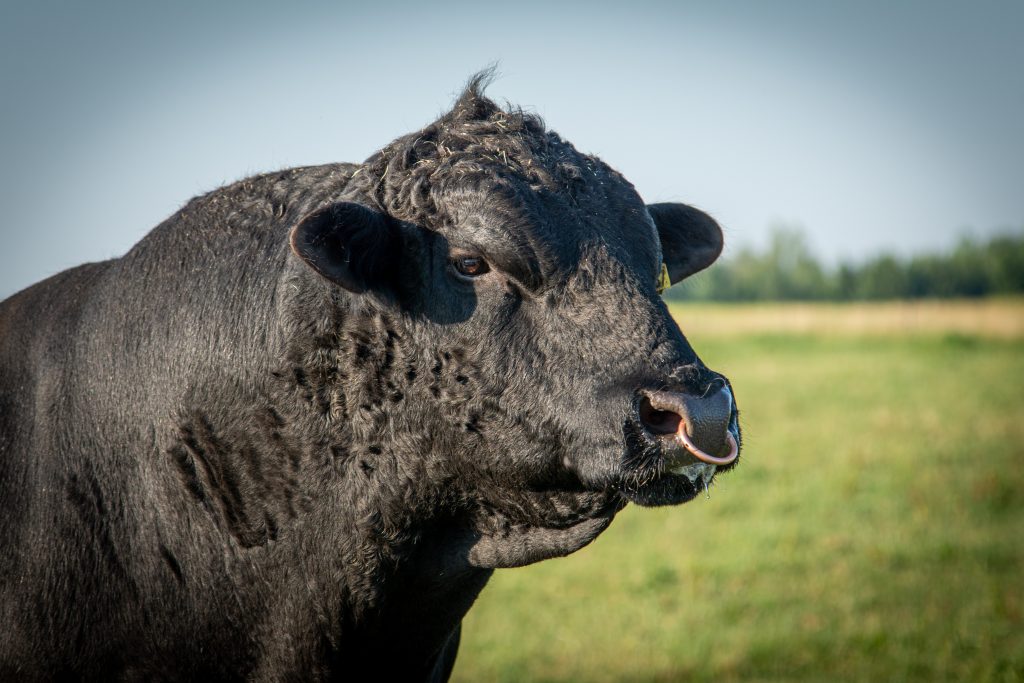
Weekly, Oklahoma State University Extension Beef Cattle Nutrition Specialist Paul Beck offers his expertise on the beef cattle industry. This is a part of the weekly series known as the "Cow-Calf Corner." Today, he talks about bulls in stocker programs.
Intact bulls often receive price discounts at auction markets, with several market survey reports showing price discounts ranging from $5/hundred pounds up to $11.25/hundred pounds. As discussed in an article by Dr. Kellie Raper the Cow-Calf Corner Newsletter (https://extension.okstate.edu/programs/beef-extension/cow-calf-corner-the-newsletter-archives/2024/april-8-2024.html) the discounts at auction markets send market signals to producers to castrate male calves before marketing. But what do intact bulls cost during receiving and how long do the impacts last?
To answer this, we compiled records from receiving cattle in Mississippi, Arkansas, and Oklahoma with over 1,965 bulls and steers to track performance and health status through receiving before a stocker program. Bulls were castrated by surgery or banding at initial processing. Calves from auction markets are often freshly weaned, unfamiliar with feed and water sources, and transported long distances. Comingling adds social stress and exposure to new diseases. Castration adds surgical stress and pain to these stresses. Calves received as intact bulls were 2.41, 2.25, 2.68, or 2.94-times more likely to have a first, second, third, and fourth treatment, respectively, than calves that were received as steers. Bulls were also 1.16-times more likely to be considered chronically morbid and 2.27-times more likely for BRD mortality than steers. The bulls in this analysis had 65% BRD morbidity, 5% were chronics and had 2.8% death loss compared with steers that had 44% BRD morbidity, 2.4% chronics, and 0.8% death loss. Average performance for calves received as bulls (1.58 lbs/day) was more than 0.5 lbs./day less than steers who gained 2.12 lbs/day during receiving.
Total cost of receiving was $64/head higher for bulls than steers when costs of BRD treatment, chronics, and death losses were included. The reduced gains of bulls during receiving also, reduced the value of bodyweight gain by $36/head compared with steers. We looked at the discounts on bulls to have equal net return at the end of receiving and found that bulls would need to be discounted $22/hundred pounds to be as profitable as steers at the end of receiving.
Recent livestock auction market reports from the Southeast (Arkansas Department of Ag Mkt News, April 10, 2024; https://mymarketnews.ams.usda.gov/viewReport/2056) shows larger discounts for bulls than the above-mentioned market survey reports would suggest with discounts of $16.50/hundred pounds for 400-to-500-pound bulls. This indicates that discounts for bulls is approaching what is necessary to achieve equivalent profits to steers for stocker cattle operations and is a sure signal to producers selling bulls that they are not desired unless deeply discounted.
RON's Dave Lanning has a pre-opening look at today's agricultural Markets.
Click the audio tab below for today's report.
Archives:
2026-11 | 2026-10 | 2026-09 | 2026-08 | 2026-07 | 2026-06 | 2026-05 | 2026-04 | 2026-03 | 2026-02 | 2026-01 | 2025-12 | 2025-11 | 2025-10 | 2025-09 | 2025-08 | 2025-07 | 2025-06 | 2025-05 | 2025-04 | 2025-03 | 2025-02 | 2025-01 | 2024-12 | 2024-11 | 2024-10 | 2024-09 | 2024-08 | 2024-07 | 2024-06 | 2024-05 | 2024-04 | 2024-03 | 2024-02 | 2024-01 | 2023-12 | 2023-11 | 2023-10 | 2023-09 | 2023-08 | 2023-07 | 2023-06 | 2023-05 | 2023-04 | 2023-03 | 2023-02 | 2023-01 | 2022-12 | 2022-11 | 2022-10 | 2022-09 | 2022-08