Ag News Archives for 2023-12

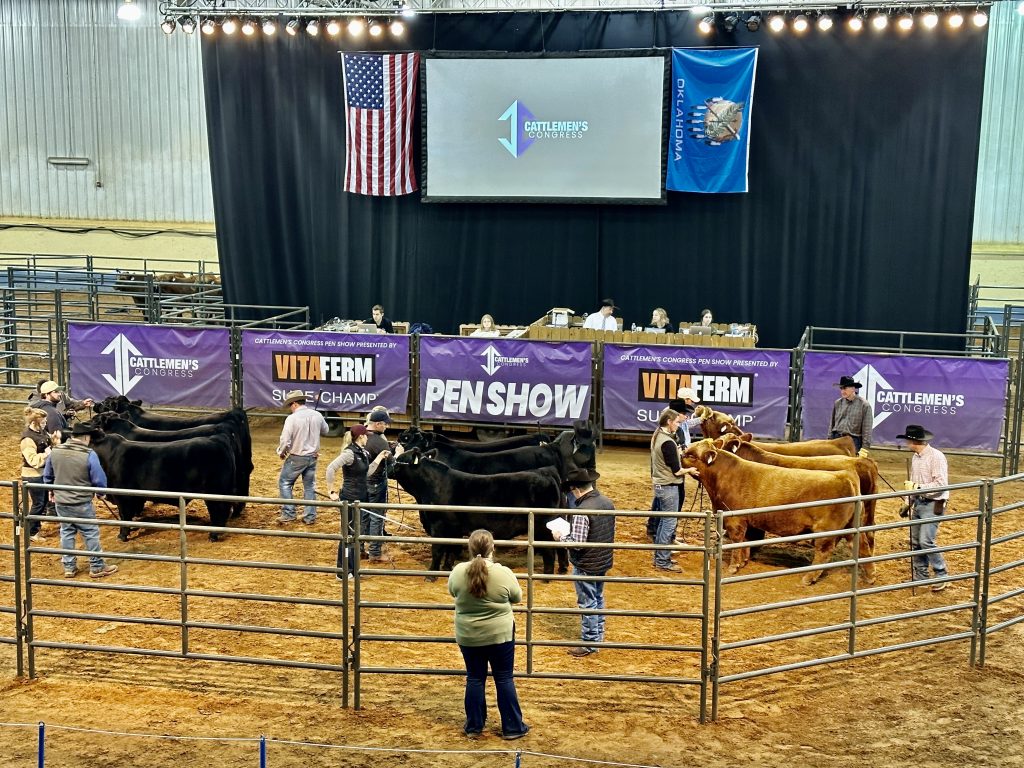
Cattlemen's Congress is Up and Running as 2024 Arrives

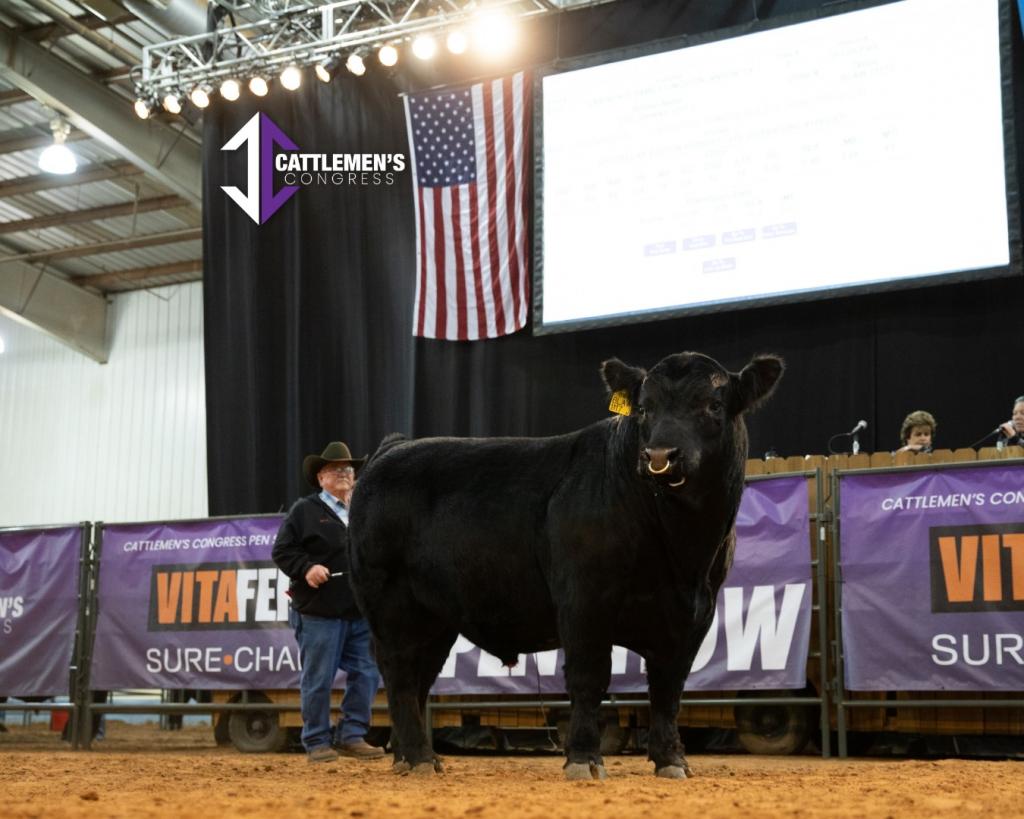
Texas Longhorns Junior Female Show- December 31, 2023 in Jim Norick Arena

Ron Hays Beef Buzzes with Bray Haven About Year Four of Cattlemen's Congress- now underway at the OKC Fairgrounds

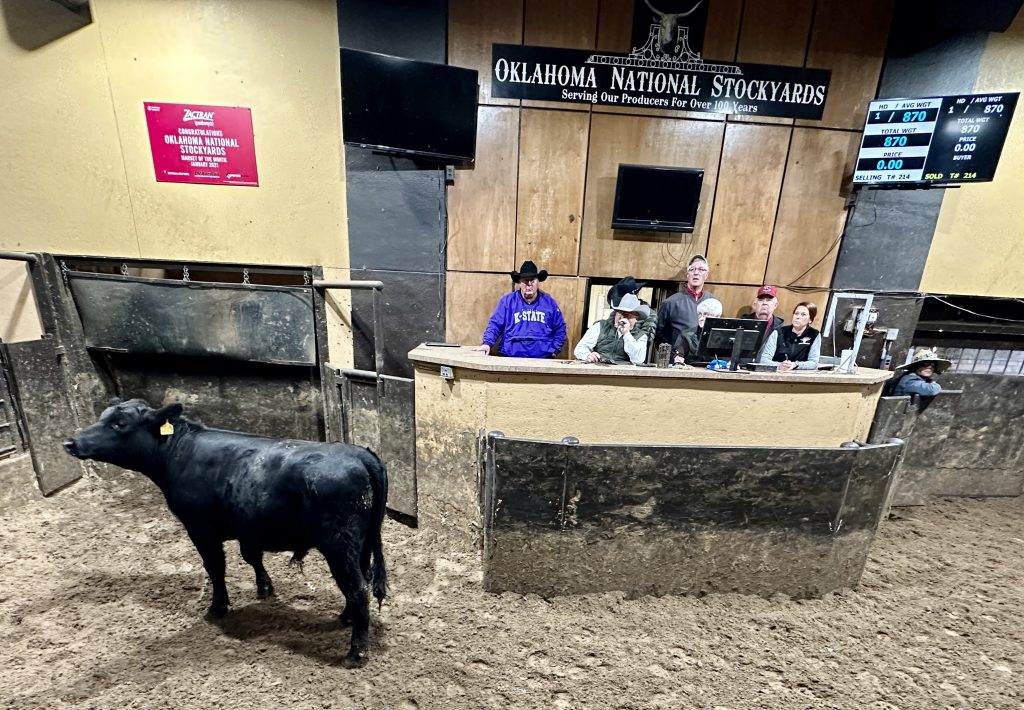
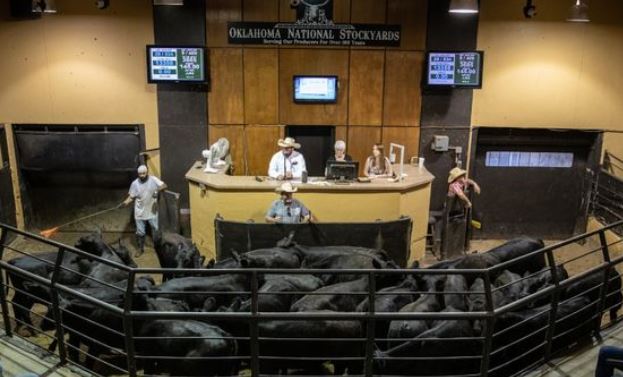
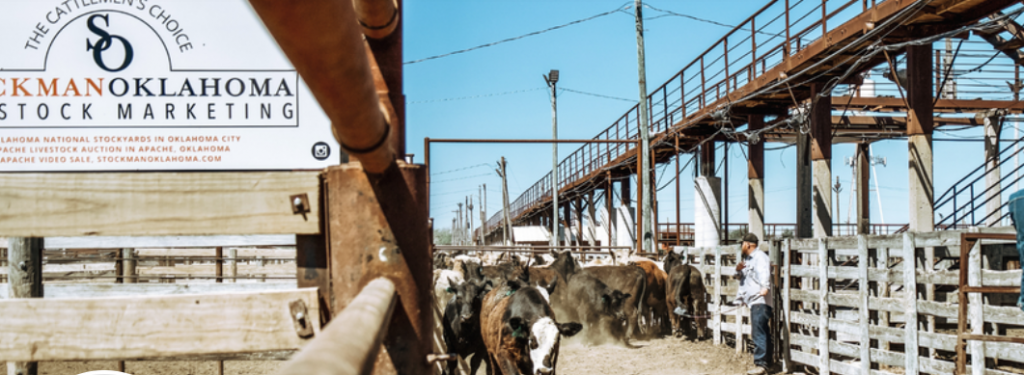
Cattlemen's Congress is back for the fourth time at the OKC Fairgrounds- and is poised to once again be easily the largest beef cattle show in North America as it gets underway for its fourth show. The numbers are impressive- over 8,000 entries spread out over 25 beef breeds with shows happening daily December 30 through January 11th- 15 sales featuring elite genetics that will generate several million dollars- not to mention the countless private treaty sales that exhibitors will be able to close back in the barns.

When it was established in 2021- Cattlemen's Congress' goal was to provide a world class event specifically designed for cattlemen and women to gather, showcase and market their elite cattle genetics. 

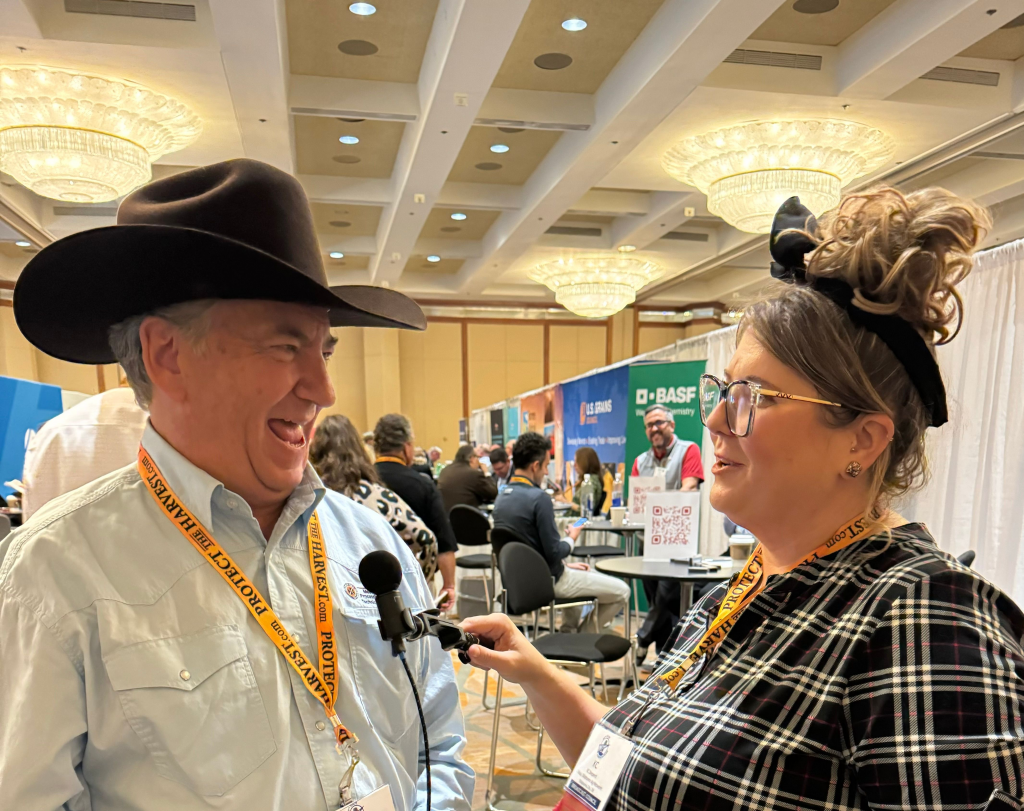
Congress is a stock show that from day one, is for cattlemen and women managed by cattlemen and women. The Fourth Cattlemen's Congress continues to follow that course. Senior Farm and Ranch Broadcaster Ron Hays talked with Executive Vice President Bray Haven on New Year's Eve as the Show was jumping into road gear- listen to their complete conversation by tapping on the Listen Bar above- and Haven says the barns are filling up and cattle producers from across the United States are excited to return to Oklahoma City and the OKC Fairgrounds for another Congress.

There are 25 breeds on display and showing this year- the newest addition being the Highland breed. One of the more recently added breeds- the Texas Longhorns- were showing on the opening weekend and experienced a thirty percent growth in numbers from year one of their show. Another breed that is growing in numbers being shown is the Speckle Park breed- they are holding their second annual National Sale at Cattlemen's Congress this year.

Haven tells Hays that another aspect of this event that continues to shine is the Trade Show- a combination of cattle industry cutting edge production technology and lots of western bling and western wear. Once again for the fourth Congress- the trade show is sold out- and he expects some visitors to Congress are coming first and foremost to check out the many trade show exhibitors on the OKC Fairgrounds.

Admission and parking is once again free for Cattlemen's Congress. You can visit the show's website by clicking here.

The Schedule of events- shows, sales and educational activities- can be seen by clicking here.

Kansas State Researchers Lower Gluten Content, Maintain Dough Quality in Bread Wheat

Breakthrough may eventually make wheat-based foods safer to those with gluten sensitivity

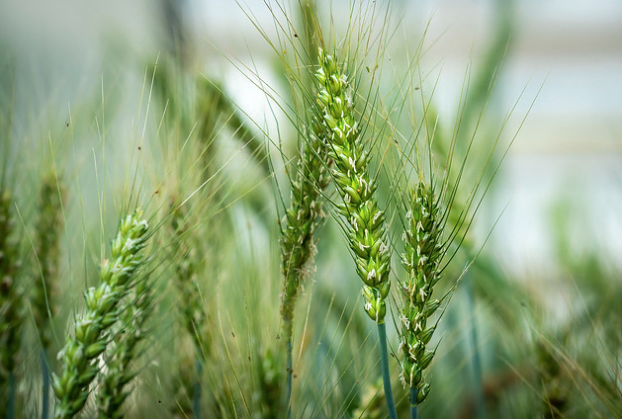
Kansas State University researchers have reported a breakthrough in developing wheat-based foods that contain lower amounts of gluten, a discovery that may lessen the adverse effects for those with celiac or other autoimmune diseases.

Scientists from K-State's Wheat Genetics Resource Center and the USDA's Agricultural Research Service -- in partnership with Kansas Wheat -- successfully used a gene editing technique known as CRISPR-Cas9 to reduce the presence of two types of gluten-coding genes called gliadins that are known to be abundant in immunoreactive peptides – the amino acid building blocks that form proteins.

Gluten is a protein often found in wheat, barley and rye. When people with celiac disease eat gluten, their body mounts an immune response that attacks the small intestine and the small, fingerlike projections known as villi that help the body absorb nutrients properly.

According to the Celiac Disease Foundation, celiac disease affects 1 in 100 people worldwide, but only about 30% are properly diagnosed.

"We were very surprised that once we edited those genes, we reduced the immunotoxicity caused by gliadin genes in wheat by 47-fold," said Eduard Akhunov, University Distinguished Professor in K-State's Department of Plant Pathology and director of the Wheat Genetics Resource Center.

Akhunov leads a group of scientists applying advanced methods of genomics, genetics and genome editing to improve wheat. In this project, the editing of gluten genes was performed by postdoctoral researcher Zitong Yu.

Akhunov said gluten likely will never be completely removed from wheat since it is important for bread-making. Gluten provides the texture, flavor and moisture in such products as bread, bagels, pastries, noodles and more.

"In our edited lines, we also found that while there was a reduction in toxicity (due to lower levels of toxic gluten molecultes), we did not have any reduction in the dough quality that is important for bread-making," Akhunov said. "That's extremely important. We achieved these two seemingly contradictory objectives – reducing toxicity, but maintaining the ability to develop quality dough."

Akhunov added that even though reduced levels of gluten achieved in this study won't make wheat immediately safe for those with severe levels of celiac disease, "it is important to step forward."

"Wheat varieties with reduced toxicity levels will help to broaden wheat-based product options for people with minor gluten-related issues," he said. "The knowledge gained in this research could eventually pave the road for developing new varieties that will be safer for people with celiac disease."

The very nature of scientific study and wheat breeding means varieties with reduced gluten content may not be available to consumers for many years. Aaron Harries, the vice president of research and operations for Kansas Wheat, said the trait would not be included in all new varieties and "most likely would be grown under contract with food manufacturers."

"Wheat research is focused on developing new varieties that meet the demands of the consumer – both domestic and international," Harries said. "Developing wheat that is safer for celiac sufferers decreases the number of consumers forced to consider wheat alternatives."

He adds: "There are many wheat farmers and members of their families in Kansas that have celiac disease. It is ironic and unfortunate that they raise wheat for a living but can't eat wheat foods. Most consumers would prefer not to give up wheat foods in their diet. Developing wheat varieties that are consumable by people with celiac disease would make their lives much easier."

CRISPR-Cas9 is a genome editing tool that is faster, cheaper and more accurate than previously used methods of genome engineering. Akhunov said his research team worked with a common wheat cultivar known as Fielder, which is amenable to genome editing.

New Year's Day Ranks Among Deadliest Days on U.S. Roadways

As many prepare for New Year's celebrations, AAA is reminding drivers and passengers alike of the dangers on the roads this New Year's holiday, which consistently ranks among the year's deadliest days for alcohol-related traffic fatalities.

"According to the National Highway Traffic Safety Administration (NHTSA) 13,384 people died in drunk driving crashes in 2021," said Rylie Fletcher, manager of Public and Government Affairs for AAA Oklahoma. "With many people celebrating the New Year and then getting behind the wheel after a night of drinking, January 1 is a particularly dangerous day on the roads. Even one death is far too many to be lost from a completely preventable crime."

Recent NHTSA data shows December drunk driving deaths are the highest in almost 15 years. There were 1,013 lives lost in drunk driving crashes in December 2021. Between 2017-2021, 4,561 people were killed in December drunk driving crashes.

In its annual Traffic Safety Culture Index the AAA Foundation for Traffic Safety noted drivers overwhelming perceived driving after drinking alcohol (94%) as very or extremely dangerous and 68% believed such a driver would be likely to be apprehended by police. However, 7% of respondents reported having engaged in this behavior in the past 30 days. This driving behavior must change in order to save lives on our roadways.

Sobering Drunk Driving Facts

  • In 2021, 13,384 people were killed in preventable, drunk driving crashes, a 145 increase from 2020. In fact, on average, more than 10,000 people die each year from drunk-driving crashes. To put it in perspective, that's equal to about 20 jumbo jets crashing each year, with no survivors. (NHTSA)
  • During the Christmas and New Year's periods in 2021, there were 304 drunk driving-related fatalities nationally. (NHTSA)
  • In Oklahoma, alcohol-related crashes injure nearly 2,500 and kill approximately 220 Oklahomans each year. (Oklahoma Highway Safety)

Responsible Behavior

To strengthen efforts to protect the public against drunk drivers and reduce alcohol-related traffic deaths, AAA Oklahoma is offering important safety advice to New Year's Eve partygoers:

  • Always plan ahead to designate a non-drinking driver before any party or celebration begins.
  • Never get behind the wheel of a car when you've been drinking alcohol – even after just one drink.
  • Never ride as a passenger in a car driven by someone who has been drinking alcohol – even after just one drink.
  • Do not hesitate to take the keys from friends or family members who may be impaired.
  • Put apps or numbers for ridesharing/local cab companies in your phone before heading out for the evening.
  • Be a responsible host in reminding guests to stay safe and always offer alcohol-free beverages.
  • If you encounter an impaired driver on the road, keep a safe distance and ask a passenger to call 911 (or pull over to a safe location to make the call yourself).
  • Remember: prescription, over-the-counter medications and illegal drugs also can impair your ability to drive safely.

Rep. Cole's Column: A Year of Accomplishments

Ahead of regaining the majority of the U.S. House of Representatives, House Republicans made several commitments to the American people. While we certainly faced a challenging year, we also delivered on these commitments and have numerous accomplishments to bring back to our constituencies.

For two years, the Biden Administration has undermined our national security by draining our strategicenergy reserves to the lowest level in almost four decades. That's why in the House's first two weeks of session in the 118th Congress, House Republicans passed two bills to protect and strengthen the Strategic Petroleum Reserve (SPR) and boost U.S. energy production. First, the Protecting America's Strategic Petroleum Reserve from China Act would block the selling of any amount of the SPR to Communist China. And the Strategic Production Response Act would prohibit non-emergency drawdowns of the Strategic Petroleum Reserve and require increases in oil and gas production on federal lands to offset future drawdowns of this reserve. The sole purpose of the SPR is to protect our country during national emergencies and is exactly what these bills would accomplish. The Lower Energy Costs Act also passed the House this year and would increase domestic energy production and put an end the Biden Administration's disastrous Green New Deal-style agenda. By unleashing U.S. energy resources, we can lower energy costs and ensure the U.S. is not reliant on others that do not have our best interests in mind.

Next, as the U.S.-Mexico border continues to be a chaotic scene of President Biden's own making, the Secure the Border Act of 2023, which passed the House this year, is a complete rejection of President Biden's border policies and purposeful inaction. The open southern border has allowed drug cartels to smuggle fentanyl across the border and destroy countless futures in just a few short years. In response,House Republicans passed the HALT Fentanyl Act which would permanently list all fentanyl-related substances on Schedule I of the Controlled Substances Act and ensures they stay off our streets.

As Bidenflation continues to crush American households,  House Republicans passed the Reduce Exacerbated Inflation Negatively Impacting the Nation (REIN IN) Inflation Act. It would require publishing the inflationary impact of executive actions projected to cause an annual gross budgetary effect of at least $1 millionbefore enacting them and require the White House to report these findings to Congress each year. During his tenure, President Joe Biden has issued an unprecedented amount of unchecked executive orders that have cost Americans nearly $1 trillion along with the additional cost of runaway inflation. While the prices of almost all goods and services continue to rise and year-over-year wage growth continues to decrease, this should serve as a wakeup call that this administration must reverse course.

The COVID-19 pandemic brought certain issues to light including the chipping away of parental rights in their children's education in some communities. By means of virtual classroom settings throughout the coronavirus pandemic, parents discovered what exactly their children were learning in school, and many were rightfully shocked to find divisive topics like Critical Race Theory and progressive gender ideology included in some curriculums. There is certainly a need to refocus curriculum to essential topics versus leftist ideology in some states. Parents knowing what is happening in classrooms is not a controversial matter, and the House-passed Parents Bill of Rights Act would ensure that parents have a voice in their children'seducation and that schools establish a direct line of communication with parents.

In the last two years due to the reckless and out-of-control spending policies of President Joe Biden and congressional Democrats, more than $6 trillion has been added to the national debt. House Republicans negotiated a responsible increase to the debt limit that is coupled with commonsense reforms. The Fiscal Responsibility Act avoided a detrimental default on our national debt while also keeping the promise to the American people of cutting spending year-over-year while giving an appropriate increase to defense spending and without cutting money for veterans. This legislation clawed back $28 billion in unspent COVID-19 pandemic relief money that was no longer needed, included major reforms to work requirementsand blocked the president's demand for $5 trillion in new taxes.

The greatest threat our country faces today is the rise of the Chinese Communist Party. I applaud former Speaker of the House Kevin McCarthy for rightly creating the Select Committee on the Chinese Communist Party. This committee works in a bipartisan manner to build consensus and develop a plan of action on the threat posed by the Chinese Communist Party including the Uyghur Genocide, aggression towards Taiwan and technological advances.

These issues are important to the American people, and House Republicans have delivered on our promises. As we return to work for the second session of the 118th Congress, I hope the Senate will come to the table and try to move some of these critical legislative items for the American people. In the interim, House Republicans remain committed to continue working to pass legislation to secure the southern border, fight inflation, reject Bidenomics and much more.

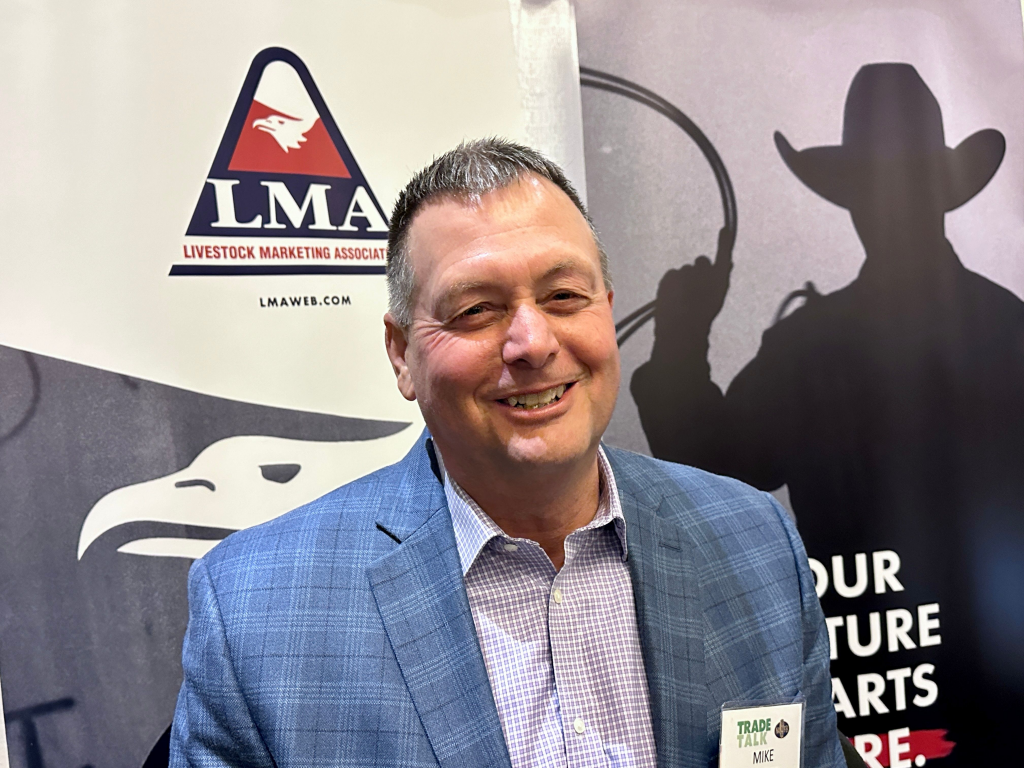
Mike Schulte Talks 2024 "To Do List" at the Oklahoma Wheat Commission

Senior Farm and Ranch Broadcaster Ron Hays talked with the Executive Director of the Oklahoma Wheat Commission, Mike Schulte, about 2024 priorities for the Commission- the body that is charged with promoting and improving demand for Oklahoma wheat.

Schulte says the Commission will continue to work to up the interest level for the most recently harvested crop in Mexico and South America. "In November, we did have great successful crop quality tours where we presented to millers and bakers in South America on the quality attributes of this crop" adding we are getting more competitive in the international markets as market factors shift as the old year ends and the new year begins.

Schulte says the wheat breeding research at OSU that is funded in part by wheat checkoff funds - and that will include continuing work on end use quality functionality of the hard red wheat lines being developed. He's also hopeful about "work with blends of soft red winter wheat(with HRW wheat) for utilization of this product in markets in South America that can be utilized for cookies, crackers and pasta lines."

Other things that Schulte is hopeful will unfold is a campaign that may be coming to replace the aging greenhouses on the OSU Research Farm- he says those structures have been used since the 1950s and they must be replaced to not lose momentum in our wheat research efforts going forward.

Listen to Hays and Schulte discuss these efforts coming in the new year by clicking on the Listen Bar above.

Learn more about the efforts of the Oklahoma Wheat Commission by clicking here.

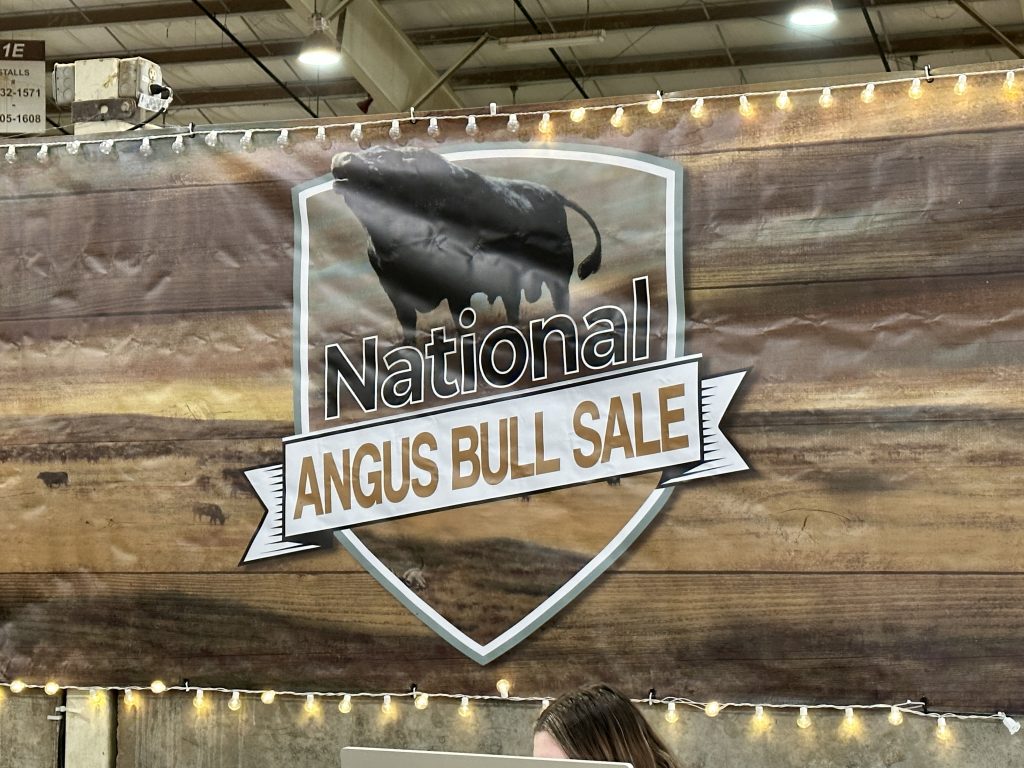
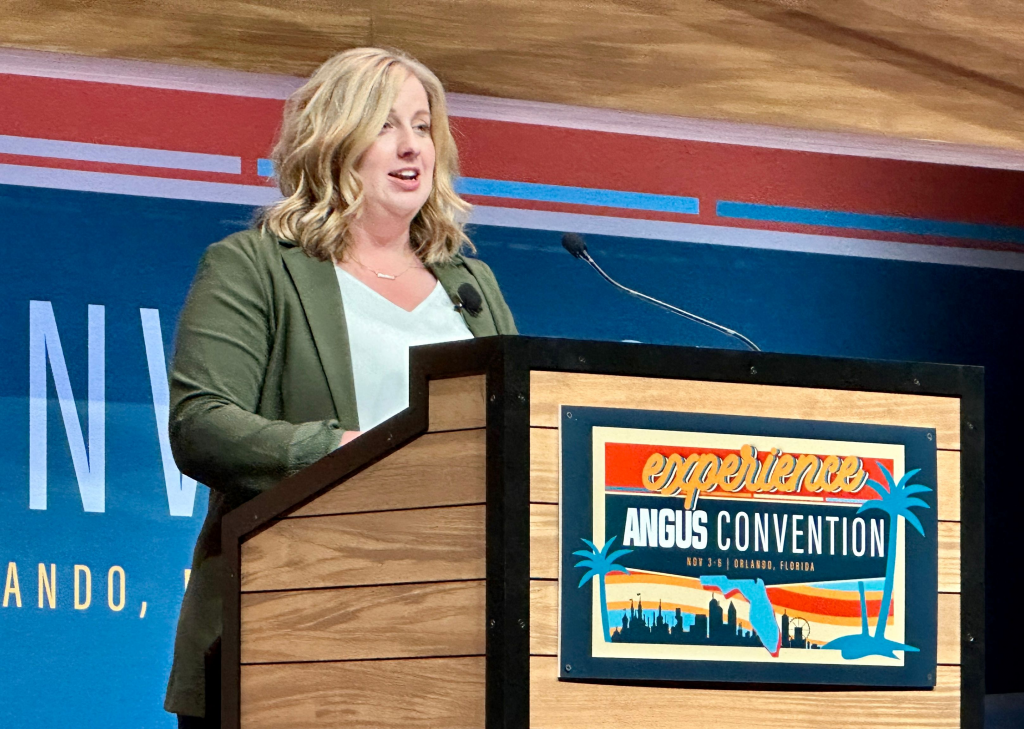
Angus Commercial Cattlemen's Day Happening January 5th At Cattlemen's Congress

 Farmers and ranchers are invited to Angus Commercial Cattlemen's Day on Friday, Jan. 5 in Oklahoma City at Cattlemen's Congress. This event, hosted by the American Angus Association®, features education, competition and fellowship.   

8:30 a.m. - Super ROV Angus Pen & Carload Show Performance Arena  

8:30 a.m. - Association Booth Opens Super Barn  

10:00 - 11:00 a.m. - "Balancing the Consumer and the Cow" by Angus University Performance Arena This is an educational program for all types of cattle producers. Moderated by Radio Oklahoma Network's Ron Hays, featured panelists include Mark Johnson of Oklahoma State University, Jesse Luckie of Snake Creek Cattle Company and Paul Dykstra of Certified Angus Beef. Dykstra will also begin with a market insights presentation before the panel discussion. Learn More  

11:30 a.m. - Angus Luncheon featuring Certified Angus Beef Performance Arena  

12:00 p.m. - National Angus Bull Sale Preview Super Barn Sale Arena  

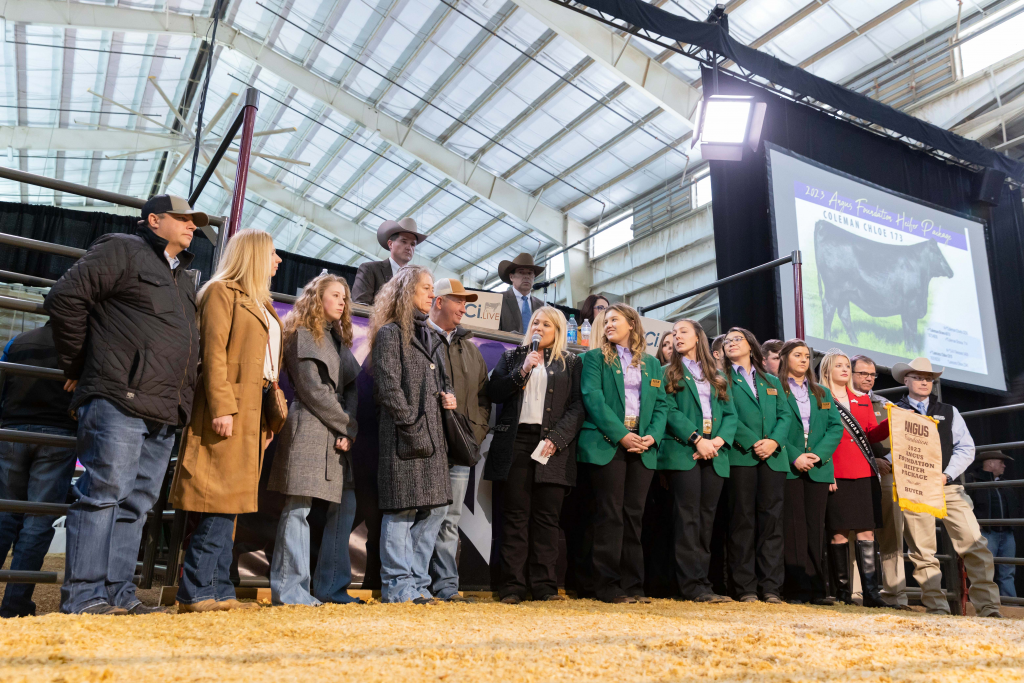
2:00 p.m. - National Angus Bull Sale Super Barn Sale Arena Immediately prior, the sale of the Angus Foundation Heifer Package will take place. This year's package is donated by Yon Family Farms of Ridge Springs, SC.   

3:45 p.m. - Social Hour at the Cattlemen's Bar Association will honor the Herdsman of the Year finalists
 
5:00 p.m. - Live Auction benefitting Angus Foundation & Herdsman of the Year Announcement

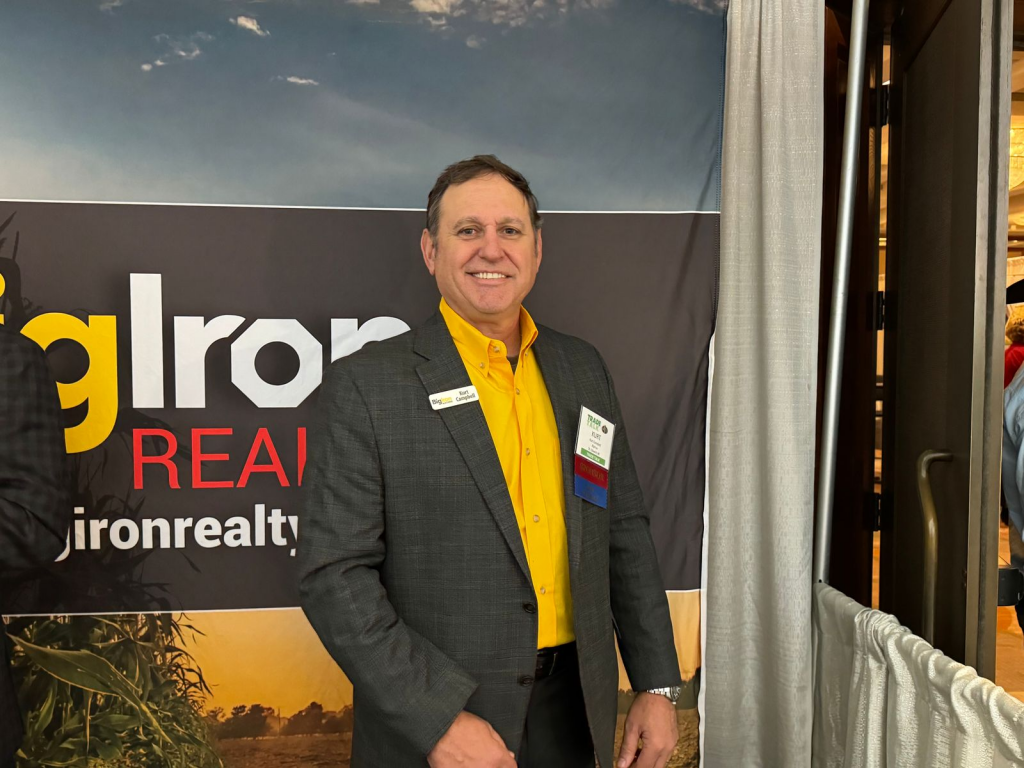
Big Iron Auctions Looking Forward to Another Year of Working with OYE Ag Mechanics Show

Listen to KC Sheperd talk with Kurt Campbell about Big Iron Auctions.

Farm Director, KC Sheperd is talking with the Vice President of Agricultural Sales at Big Iron Auctions, Kurt Campbell, about the services offered on the website and how this year has been in the ag sales realm.

Big Iron conducts online auctions to help individuals sell land, equipment, and livestock. Campbell said over 1.4 million individual IP addresses view the auction site per month.

"There are quite a few items coming up for several sellers, not only just in Oklahoma, but the surrounding states and Texas, and Arkansas, and Kansas..." Campbell said.

Campbell added that there are over 8,000 items posted on the Big Iron website for auction.

One highlight of the year Campbell mentioned is having the chance to be the platform utilized to auction off items from the Oklahoma Youth Expo ag mechanics competition.

"It has been a pleasure to work for that organization, and that auction is in March," Campbell said. "Looking forward to helping again and the items are very well made, and the prices are good. We are happy to be able to support that."

Big Iron Auctions employs local sales representatives across the country, Campbell said, so if an individual is interested in auctioning off an item on the website, they can find a sales representative in their area by contacting the main office at 1-800-937-3558.

"What is unique is that we have representatives that will come right directly to you and talk about your equipment and assets whether that be land or livestock to be able to get that information, collect it, and select the auction date and show that to the world," Campbell said.

Campbell said the sales representatives are very well-trained to photograph equipment and assets for the website.

Regarding agricultural sales this year, Campbell said there have been some record highs.

"We are still above pre-Covid prices," Campbell said. "2021 and 2022 were really strong, and we know some of the reasons for that- the limited inventory. The good quality equipment is still bringing a premium price."

Jarold Callahan Celebration of Life to be Live Streamed on Live Auctions. TV

The Celebration of Life for Jarold Callahan will be held on Friday, December 29, 2023, at 10:00 a.m. at the National Cowboy and Western Heritage Museum, at 1700 Northeast 63rd Street, Oklahoma City, OK 73111.

The service at 10 AM Central will be live streamed on the Live Auctions.TV platform- the link to utilize can be found by Clicking Here.


In lieu of flowers, the family requests donations be made to the Jarold Callahan Memorial Fund, a Lasting Legacy established with Cattlemen's Congress with the designation Callahan Memorial Fund. Contributions can be mailed to: Cattlemen's Congress, Attention: Kass Newell, 21 Land Rush St, Oklahoma City, OK 73107. 

OCA Year-in-Review with Executive Vice President Michael Kelsey

Listen to Ron Hays talk with Michael Kelsey about 2023 and 2024 in the cattle industry.

Senior Farm and Ranch Broadcaster, Ron Hays, is talking with the Executive Vice President of the Oklahoma Cattlemen's Association, Michael Kelsey, as Kelsey gives a year in review for OCA and talks about what is coming up for 2024.

Overall, Kelsey said 2023 has been a year of challenges and opportunities. In all of his years serving the cattle industry, Kelsey said 2023 has been the most unique with the mix of drought, declining cow numbers, government regulations, attacks from animal rights groups, and more.

Kelsey said he is proud of OCA members for being open to new innovations in a changing industry.

"We have a lot of members who have changed their marketing to new methods," Kelsey said. "What I mean by newer is newer to them. Communicating more actively with their marketer..."

Kelsey also applauded OCA members for continually preparing their cattle better for the market.

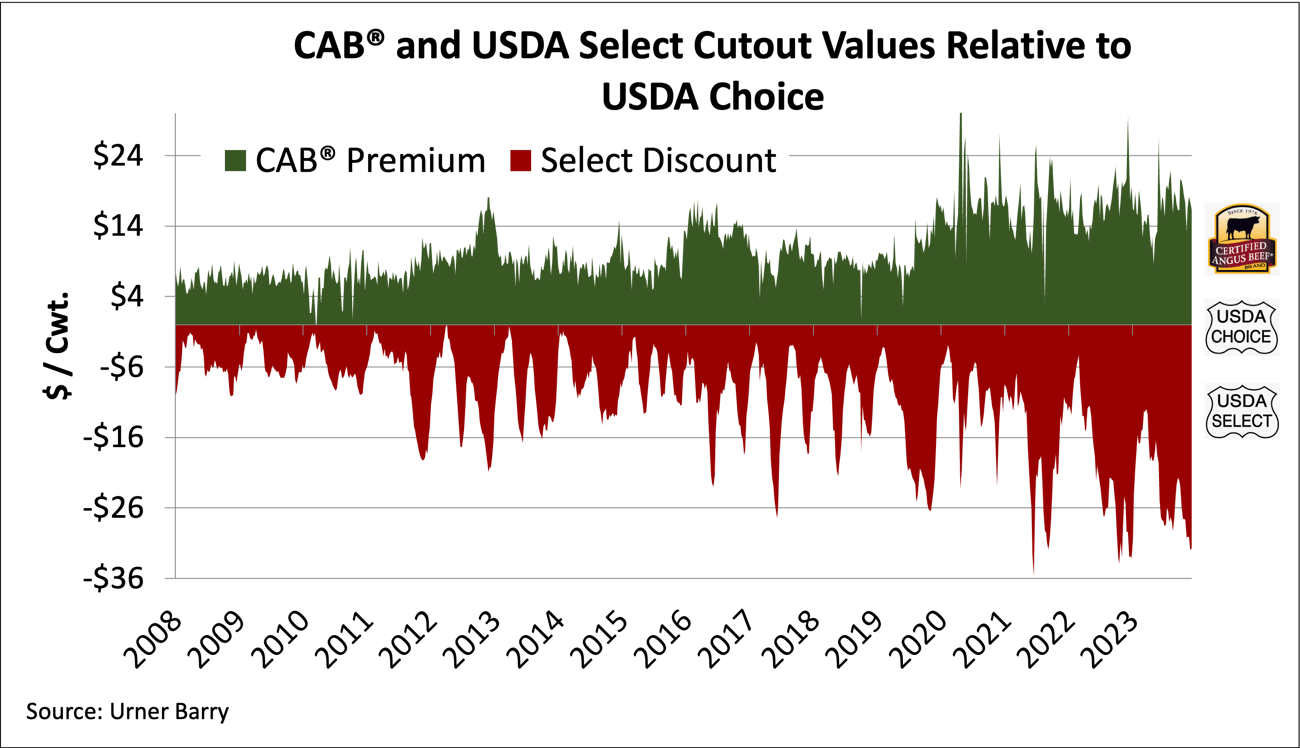
"It is almost to the point where we knew this was coming," Kelsey said. "It is not so much as a premium market anymore; It is a discounted market. There are fewer and fewer cattle that are getting discounted because people are doing a better job of preparing their cattle."

Many producers have been able to take advantage of risk management programs such as Livestock Risk Protection this year, Kelsey said, and because of this, many of those programs have seen growth.

Looking into 2024, Kelsey said promoting and defending the cattle industry will be critical as many adversaries, such as animal rights groups, aim to gain more of a foothold. On the bright side, Kelsey said there has been a decrease in the popularity of non-meat alternatives.

"Plant-based meats are just not as popular as they once were," Kelsey said. "In fact, the investment is not as profitable as it once was. Lab-based products are seeing a little bit of a resurgence, and we are seeing some companies that have bought into it or invested in it, so we will see what happens there."

In the state of Oklahoma, Kelsey said water will continue to be a major issue, along with tribal issues.

"McGirt started a sequence of events and questions that have to be answered," Kelsey said. "How that continues to grow or evolve is critical. Our board, in November, formed a task force to study and talk about OCA's role within those issues of tribal relationships, sovereignty, Indian country relations, if you will."

Aside from more priorities of 2024, Kelsey also talked about the upcoming Cattlemen's Congress and the success the show has seen so far. Click the listen bar above the story to hear the full conversation!

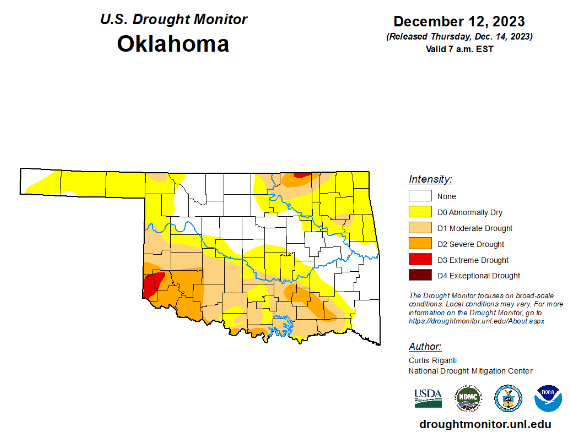
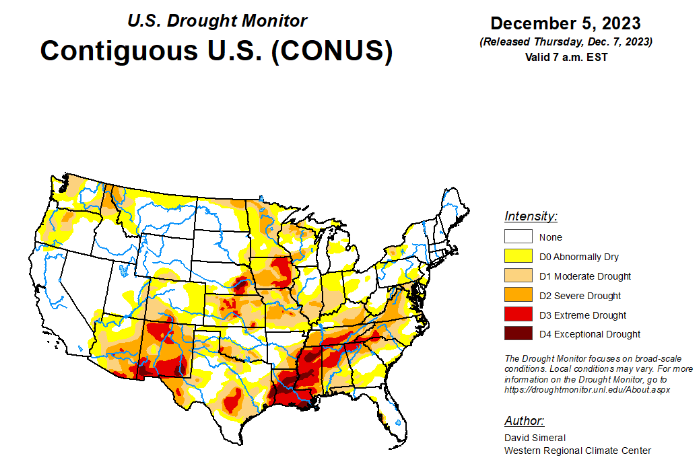
Drought Monitor Numbers Continue Improvement Across Oklahoma as 2023 Ends

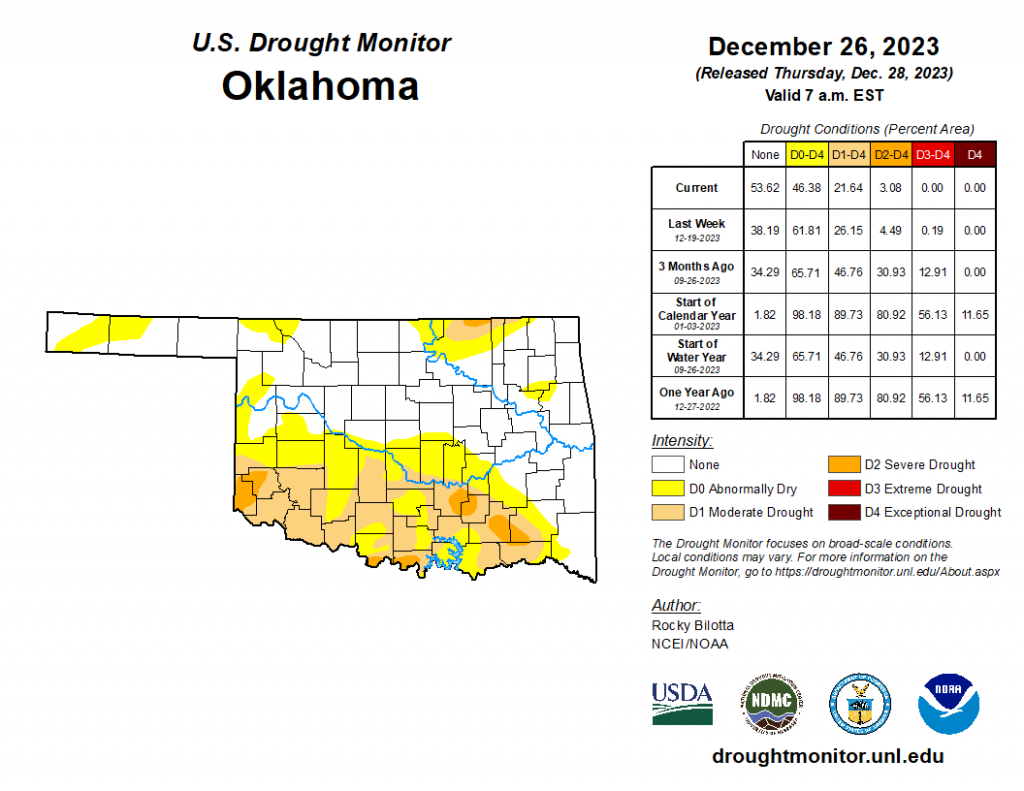
To view the latest Oklahoma drought map, CLICK HERE.

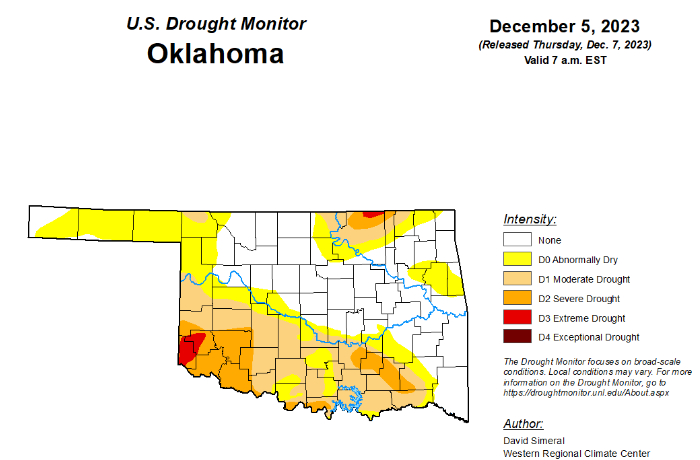
As we wind up 2023- there is zero amount of extreme or exceptional drought to be found in Oklahoma.

Severe drought now stands at 3.08 percent of the state versus 4.49% a week ago and at 80.92 percent at the end of 2022.

Moderate drought 21.64% this week- versus 26.15 % last week and 89.73% in the last report of 2022.

Abnormally dry conditions are now found in less than half of the state- at 46.38% versus 61.81% of the state last week and 98.18% of the state one year ago.

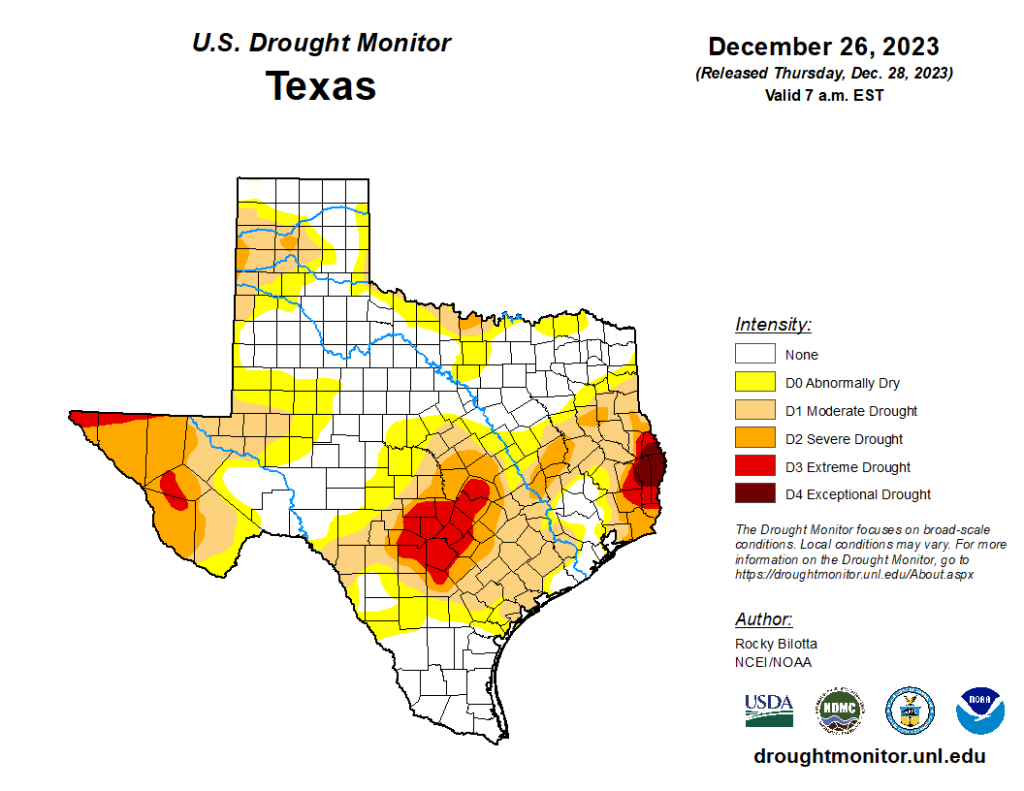
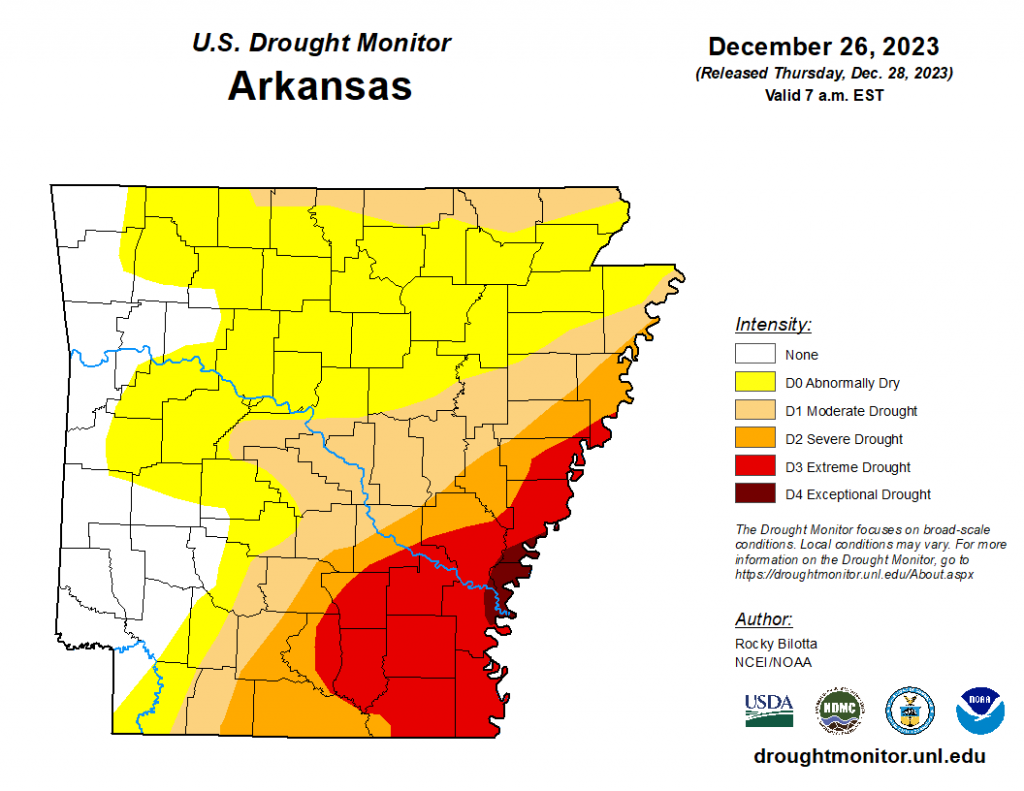
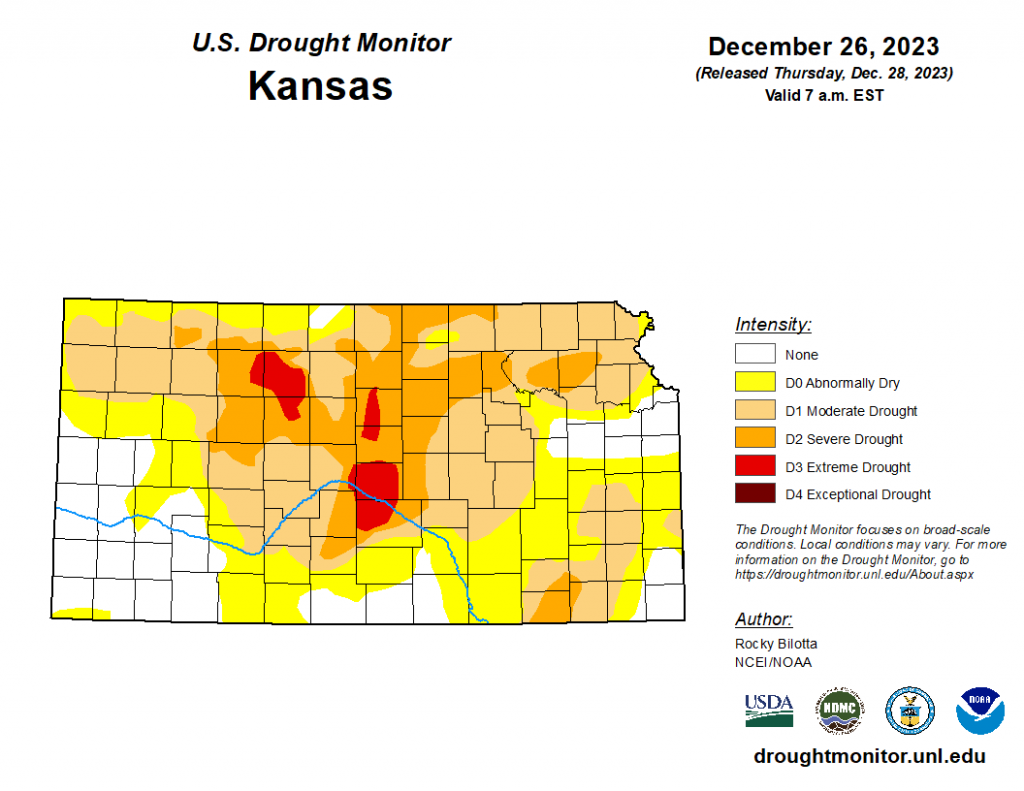
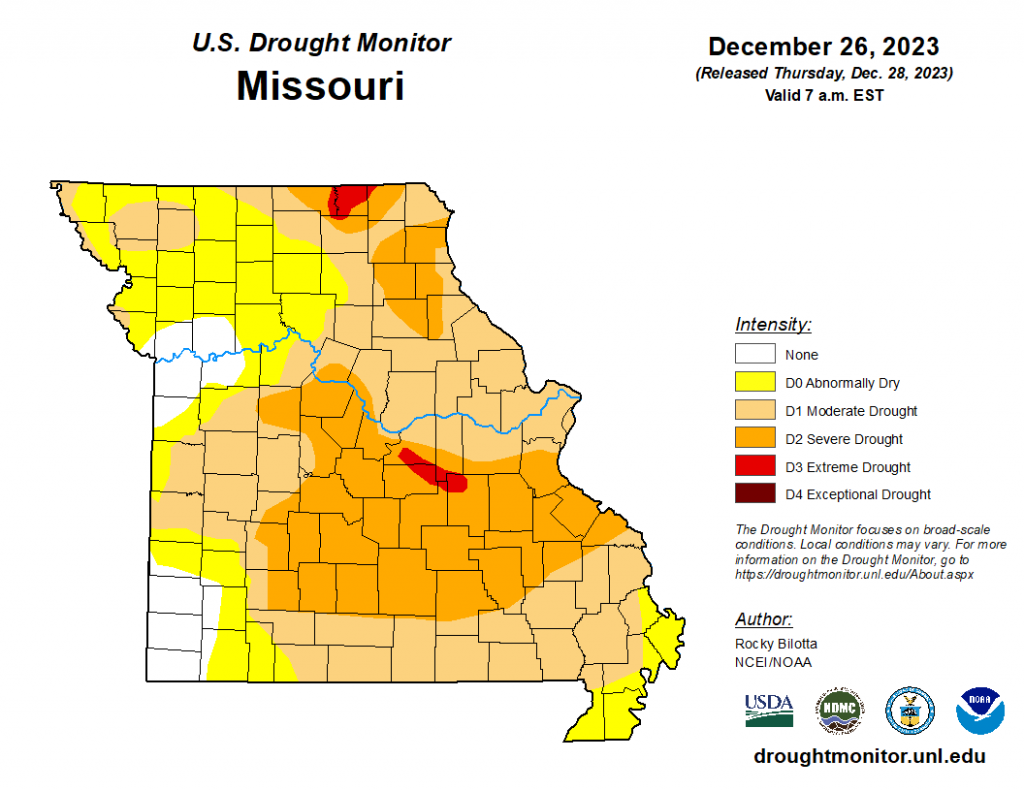
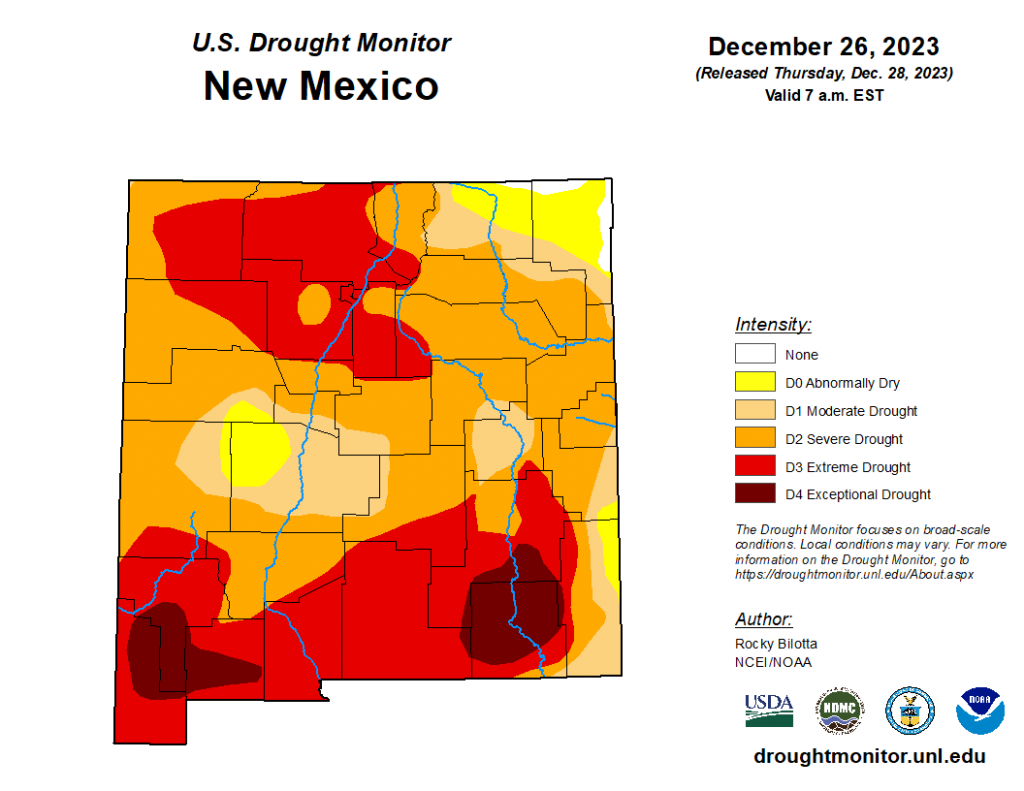
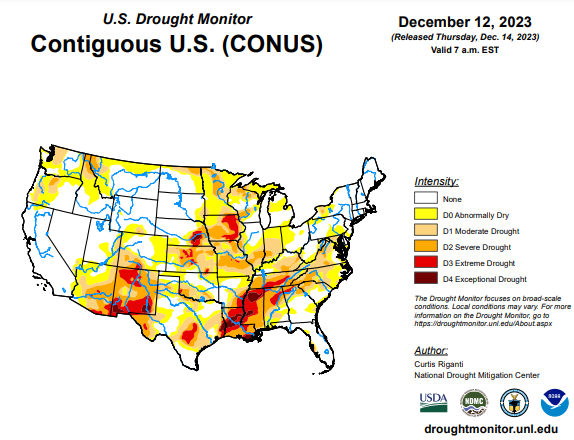
Click on the maps below for the Drought Monitor Numbers of surrounding states for this December 26th report.

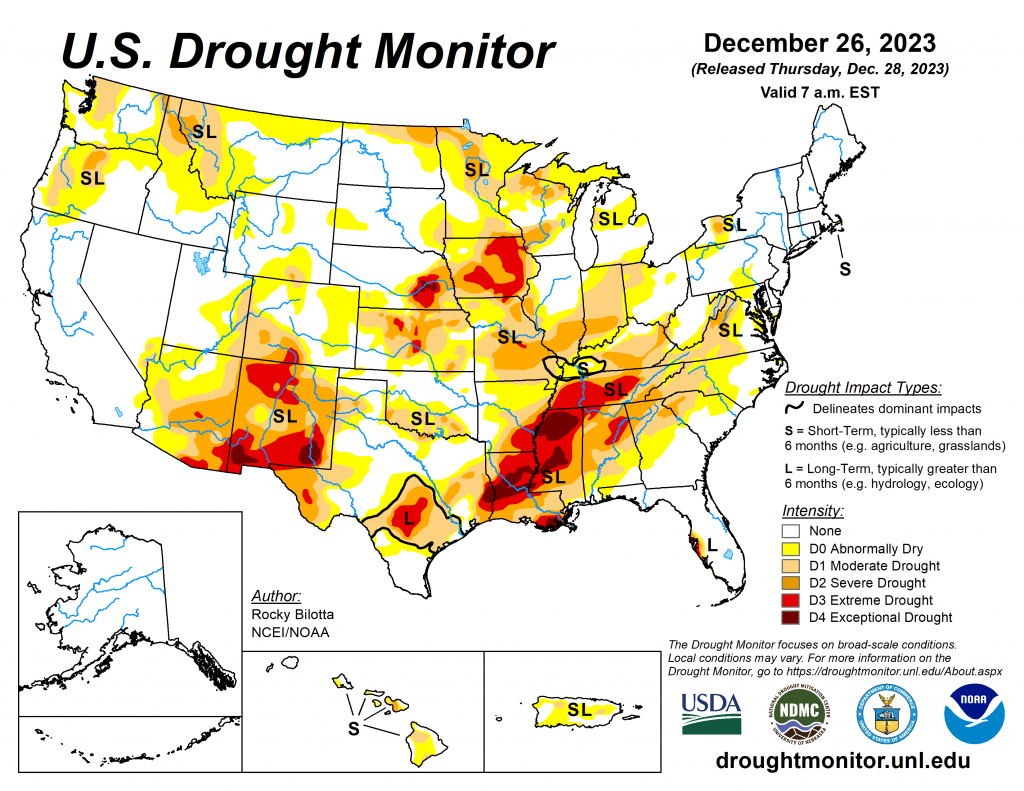
To view the latest US Drought Monitor Map with details- click here.

This Week's Drought Summary

A low pressure system developed over the central Plains in conjunction with an amplifying upper-level trough dipping into the northern Plains brought active weather across much of the central to eastern U.S. Warm and moist air from the Gulf of Mexico moved northward ahead of the developing low pressure, producing widespread moderate to heavy rainfall from Texas to Louisiana. Meanwhile, a cold air mass from Canada dipped into the northern portions of the U.S. brought blizzard conditions to portions of the Central Plains and Upper Midwest. Temperatures were above-normal across most of the U.S., by as much as 20+ degrees F above average in parts of the Upper Midwest and Northern Plains. The most widespread improvements were made to parts of central Texas, eastern Nebraska, eastern Kansas, southern Louisiana and from northern Alabama to western North Carolina, where above-normal precipitation was observed this past week. Dry conditions continued across the eastern portions of the Southern region, with degradations occurring across much of Mississippi and into Arkansas and Tennessee. Drought and abnormal dryness were also expanded or intensified in portions of the northern Rockies and in parts southern Illinois, southern Texas and in the Southeast. In Hawaii, heavy rainfall improved conditions over parts of Kauai, Oahu and the Big Island, while no changes occurred on Molokai, Lanai or Maui.

Northeast

Light precipitation fell over ¬a large portion of the Northeast this week, while precipitation totals were below-normal across much of the region this week, month-to-date totals were 150% to 400% above normal. Much of the region remains free of drought, while the above-normal precipitation has helped alleviate abnormal dryness in portions of western New York, central Pennsylvania and along parts of the Maryland-Pennsylvania border where improvements were seen in short-term indicators, streamflow and soil moisture levels. For the week, average temperatures were above normal across much of the region with departures ranging from 1 to 9+ degrees F above normal, while pockets of cooler-than-normal temperatures were observed in portions of Delaware and small parts of Maryland and West Virginia. According to the National Weather Service (NWS) National Operational Hydrologic Remote Sensing Center (NOHRSC) regional snow analysis (12/26) reports that the Northeast Region is 9.3% covered by snow with an average snow depth of 0.2 inch and with a maximum depth of 14.4 inches.

Southeast

Precipitation fell across much of the Southeast this week with the heaviest amounts of rainfall being observed in areas from central Alabama to western North Carolina. These areas reported weekly precipitation amounts were up to 600% above normal and ranged between 2 to 8 inches of rainfall. Drought reduction and improvement were based on precipitation amounts, short-term SPI/SPEI, NDMC short-term blends, and improvements to streamflow and soil moisture data. Based on these short-term indicators, extreme drought (D3) was removed from northern Georgia and improved in northeast Alabama where precipitation amounts where up to 4 inches above normal for the month. Severe drought (D2) and moderate drought (D1) were reduced in parts of Alabama, Georgia, South Carolina and North Carolina, while a small portion of moderate drought in western Virginia was improved this week. Improvements in abnormal dryness (D0) occurred in parts of southern Alabama and along the coast of Georgia and South Carolina. On the dry side, abnormal dryness and moderate to severe drought categories were expanded across parts of Alabama and Georgia, where little precipitation fell. Based on precipitation deficits and short-term indicators, severe drought was expanded in the eastern part of Alabama where precipitation was up to 3 inches below normal for the month. Moderate drought was expanded in parts of central Alabama and central Georgia, while abnormal dryness was expanded into parts of southern Alabama and central Georgia.

South

Dry conditions continued across the eastern portions of the Southern region this week while heavy precipitation fell across much of Oklahoma and over parts of central and eastern Texas. Large portions of eastern Texas and Oklahoma received between 2 inches to 5 inches of rainfall (300% to 600% above normal) this week, resulting in improvement of exceptional drought (D4) in eastern Texas while extreme drought (D3) was removed from northeast Oklahoma and improved in parts of central and eastern Texas. Improvements were also made to moderate drought (D1) to severe drought (D2) conditions, along with abnormal dryness (D0), in this part of the region. Heavy rain was reported (2 to 4 inches of rainfall) over parts of southeastern Louisiana this week, resulting in the 1-category improvement across the area. Conversely, conditions continued to deteriorate in parts of Mississippi, Arkansas and Tennessee, where precipitation totals were 2 to 4 inches below normal this month. Exceptional drought was expanded in parts of central and northern Mississippi and was introduced into eastern Arkansas, while extreme drought was expanded into the northern portions of Tennessee and in parts of Mississippi and Arkansas this week. The expansion and intensification of drought categories were based on short-term SPI/SPEI, NDMC's short-term blend, streamflow and soil moisture data.

Midwest

Average temperatures were well above normal across the Midwest, with temperatures ranging between 10 to 25 degrees F above normal this week. Much of the region also observed above-normal precipitation this week, especially along the western portions of the Midwest where the heaviest amounts totaled between 2 to 4 inches of rainfall and ranged between 1 to 3 inches (300% to 600%) above normal. Above-normal precipitation helped to alleviate longer-term precipitation deficits and improved soil moisture and streamflow impacts, resulting in improvements to abnormal dryness (D0) and all drought categories. A broad 1-category improvement was made across western Missouri, while additional improvements were made in parts of western Minnesota, northwest Iowa and western Illinois. Meanwhile, dry conditions continued to affect southern parts of Illinois this week, where precipitation is as low as 25% of normal for the month. Degradations were supported by precipitation deficits, short-term SPI/SPEI timescales, streamflow, soil moisture and groundwater data. The water table levels in Carbondale (Jackson County, IL) and near Rend Lake (Jefferson County, IL) are below normal, with both at or near record-low levels. Based on these short-term indicators, Moderate drought (D1) to severe drought (D2) was expanded in southern Illinois.

High Plains

Heavy precipitation fell over much of eastern portions of the region, where rainfall totals were greater than 600% of normal and ranged between 1 to 4 inches this week. Exceptional drought (D4) was improved in eastern Nebraska, while extreme drought (D3) was improved in eastern portions of Nebraska and Kansas where precipitation totals were up to 3 inches above normal for the week. Above-normal precipitation also led to improvements to severe drought (D2) and moderate drought (D1) over parts of eastern Kansas and northeast Nebraska. Abnormal dryness (D0) was improved along parts of the eastern border of the High Plains and in portions of western Kansas and eastern Colorado. Conversely, dry conditions persisted in portions of eastern Colorado and Wyoming where precipitation remains below normal this week. Deteriorating conditions shown in short-term SPI/SPEI, streamflow, soil moisture and snow water equivalent (SWE) data justified degradations across these states. Abnormal dryness was expanded in parts of northern Colorado and in eastern and southern Wyoming, while abnormal dryness was introduced in north-central and northeast Wyoming.

West

Much of the West remained as status quo this week. Precipitation fell across much of the region, which was enough to prevent further degradation but not enough to warrant large improvements. Heavier precipitation fell across the southern portions of Arizona and New Mexico, where rain totals were greater than 600% above normal this week. These beneficial rains, along with precipitation percentiles and short-term SPI/SPEI, soil moisture and streamflow data, resulted in abnormal dryness (D0) and moderate (D1) to extreme (D3) drought improvements along the southern border. Portions of La Paz and Yuma counties reported weekly rainfall totals up to 6 inches above normal. Conditions remained dry in northern parts of the Rockies, resulting in further deterioration across western Montana and eastern Idaho. Moderate drought and abnormal dryness were expanded in these areas based on short-term SPI/SPEI data, low snow water equivalent (SWE) percentiles and precipitation and soil moisture deficits. As for temperature this week, much of the region was above normal with well-above-normal temperatures were observed in parts of northeast Montana which were greater than 10 degrees F above normal.

Looking Ahead

During the next five days (December 26-30, 2023), An initial Plains/Midwest upper low will work to establish the eastern upper trough, and an associated surface system will spread rainfall of varying intensity over the East early-mid week along with the potential for lingering snow over the north-central Plains. Over the West, most precipitation should focus near the West Coast with a couple frontal systems tending to produce the highest totals over/near northern California. In terms of temperatures, expect unseasonably warm conditions in the East Tuesday and Wednesday ahead of the approaching frontal system. Morning lows should be particularly anomalous with readings 20-30 degrees above normal for much of the East and Upper Midwest. Warmer than normal temperatures will likely linger even longer in the Northeast through Thursday or Friday. Cooler air behind the system will initially still be on the mild side, with only slightly below normal readings over the central-southern Rockies/Plains on Tuesday. As upper troughing becomes established over the East later in the week, the Southeast and vicinity should trend cooler with temperatures dropping to 5-10 degrees or so below normal. Much of the West should see moderately above normal temperatures through the period.

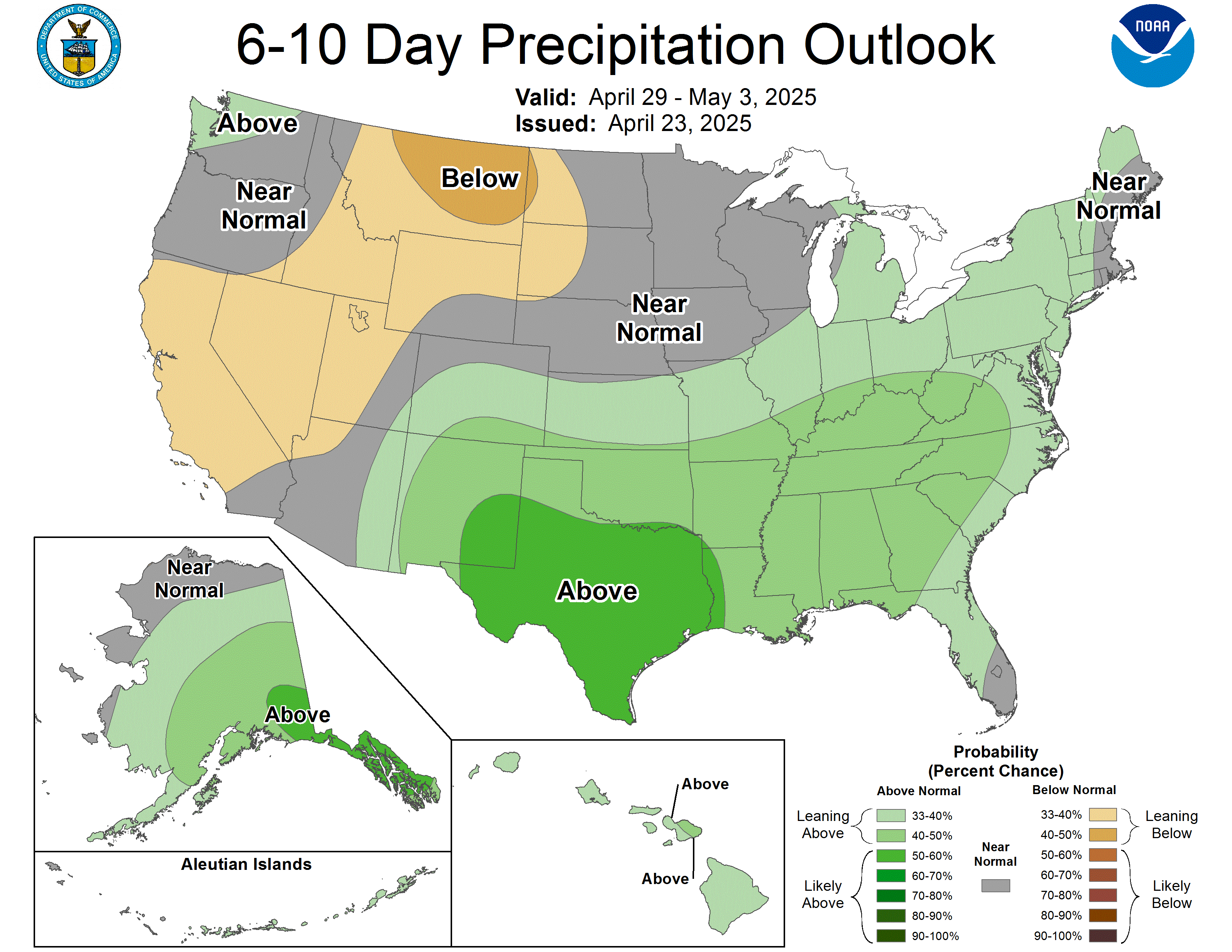
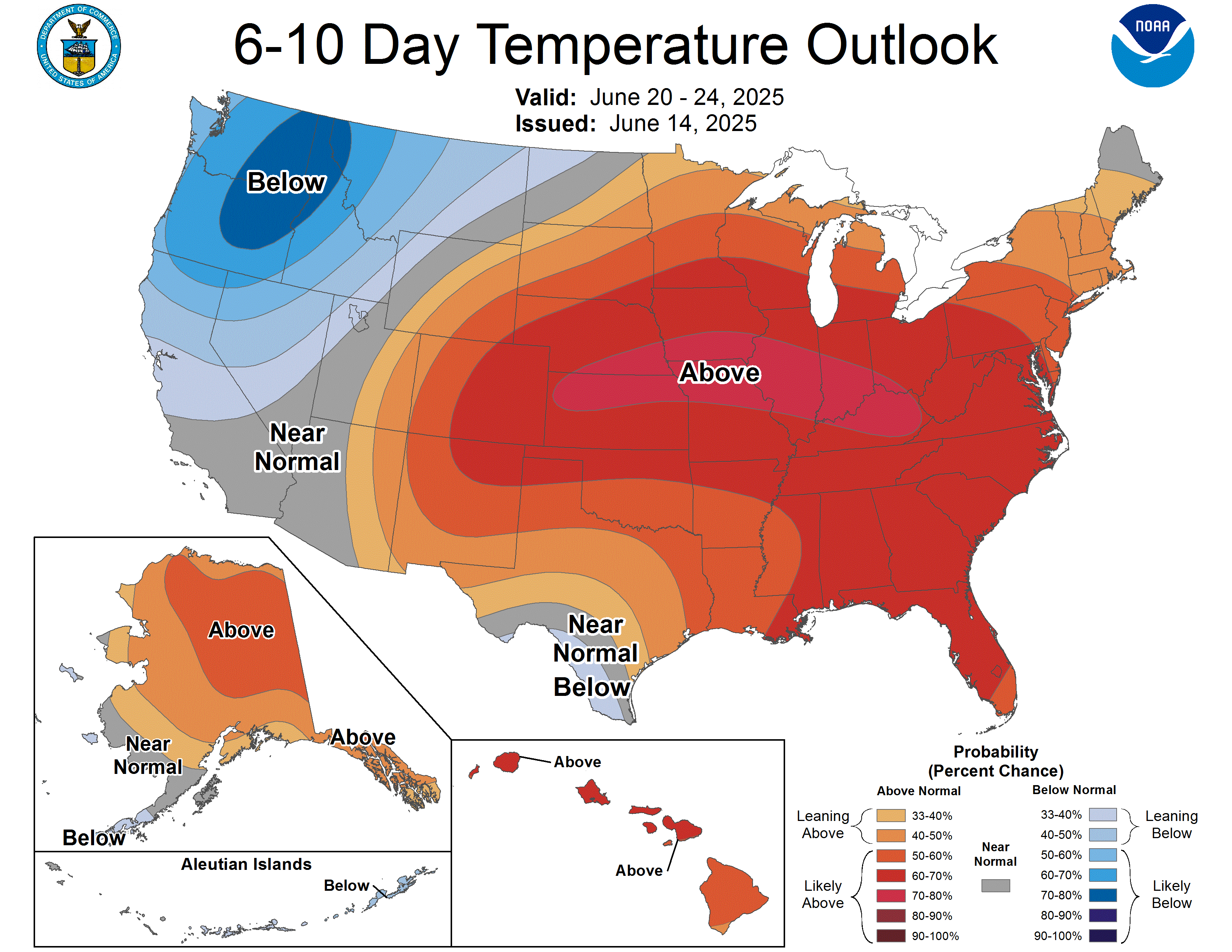
The Climate Prediction Center's 6-10 day outlook (valid December 31, 2023 – January 4, 2024) favors above-normal precipitation from California to Alabama, and across much of Alaska, with below-normal precipitation most likely from the northern Plains to the Northeast, in portions of the Northwest and Hawaii, and in parts of southern Florida and Alaska Panhandle. Increased probabilities for below-normal temperatures are forecast for much of southeastern U.S. and on the eastern islands of Hawaii, while above-normal temperatures over much of the West, along the northern tier and in parts of the southern Plains, as well as Alaska and western islands of Hawaii.

USMEF Works to Increase Volume and Value of U.S. Beef, Pork and Lamb Exports

Listen to Maci Carter talk with Randy Spronk about U.S. meat exports.

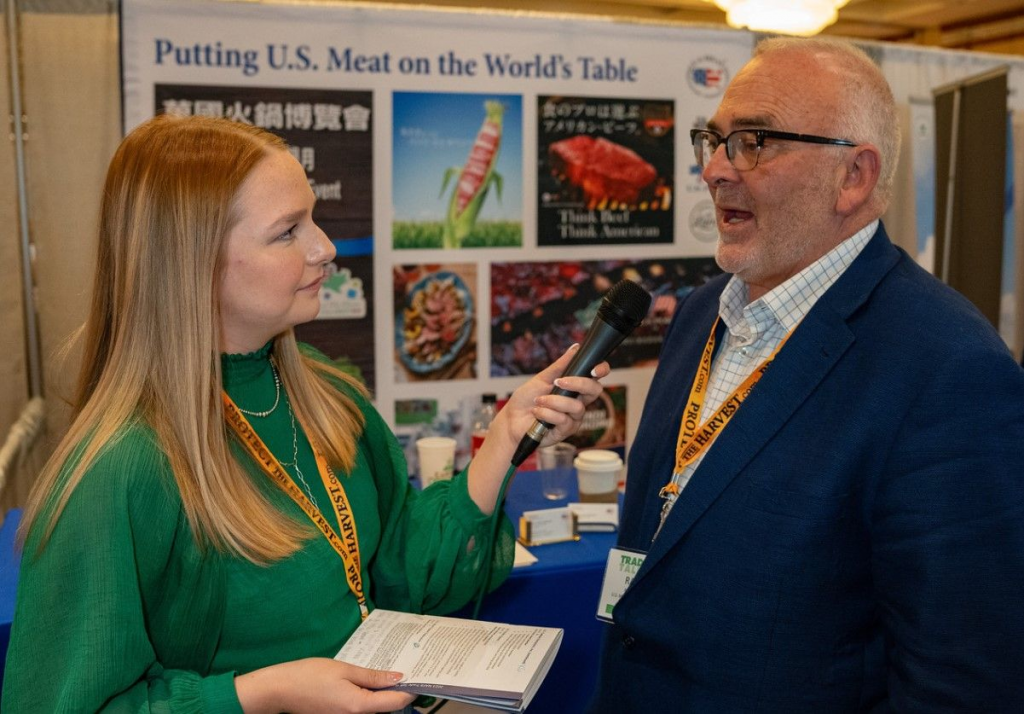
Radio Oklahoma Ag Network Intern, Maci Carter, is visiting with the Chairman of the 2023 U.S. Meat Export Federation 2024 Executive Committee, Randy Spronk, about how USMEF works to promote animal proteins around the globe.

"We go into international countries, and we market U.S protein- beef, pork, and lamb," Spronk said. "It is a really unique cooperation among many different sectors of agriculture that come together to promote beef pork and lamb worldwide."

Looking into the current U.S. meat market, Spronk said there are headwinds, and there are positives.

"From a pork standpoint, we are at record levels at volume and value," Spronk said.

As the beef cow herd in the U.S. has declined and there is less product to export, Spronk said prices have gone up.

"The exports of beef, pork, and lamb add a lot of value back to U.S. agriculture," Spronk said.

Spronk also talked about room for growth in international markets.

"You start looking at Latin America, South America, Central America; all those countries are smaller countries, and they are more difficult to get to, but you combine them and roll them all up, and they could be another Mexico," Spronk said. "They could actually match that volume and value that we do to Mexico, but it takes time to develop those markets..."

2024 to be Baseline Year for Ranch to Table CAB Program

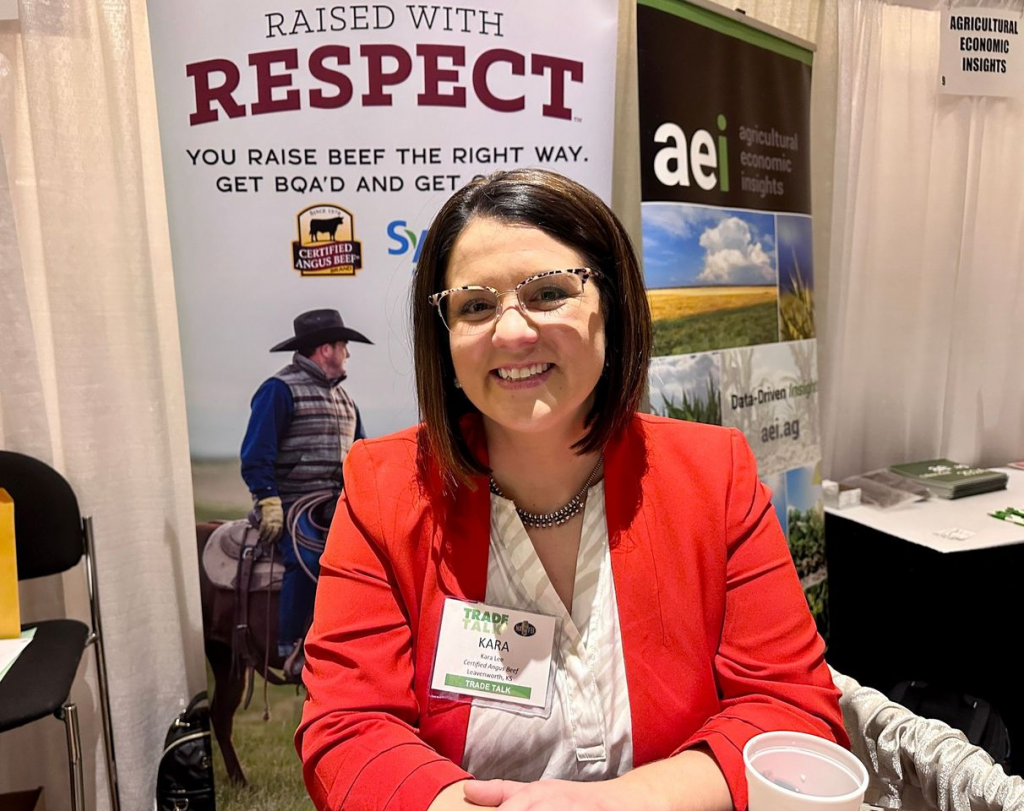
Senior Farm and Ranch Broadcaster Ron Hays talked in recent days with the Director of Producer Engagement Kara Lee about the Certified Angus Beef Ranch to Table program that was established in 2023- and is expected to gain momentum in 2024. Lee says "We really see the Ranch to Table line extension as a producer engagement effort that allows those producers who are willing to jump through the hoops- accessing grading and going through all that whole process to be able to access Certified Angus Beef branding where it makes sense."

Angus cattle producers who sell beef directly to consumers now have access to a new program called Ranch to Table, which permits them to use the Certified Angus Beef stamp to market their product. Ranch to Table is a program offered through CAB and was created to allow producers the opportunity to sell premium Angus products to their customers. 

To be eligible for the program, producers must raise cattle with registered Angus genetics, provide proof of Angus bull registrations, have current Beef Quality Assurance certification and provide standard procedures from their meat processors. Additionally, cattle must meet the CAB brand's live-animal assessment with predominantly solid-black hides.

Carcasses must also meet CAB's 10 specifications as verified by a U.S. Department of Agriculture grader. These requirements include: modest or high marbling; medium to fine marbling texture; cattle harvested at less than 30 months of age by dentition and only A-maturity lean; 10- to 16-square-inch ribeye area; 1,100 pounds of hot carcass weight or less; 1-inch or less fat thickness; superior muscling; practically free of capillary rupture; no dark cutters and no neck hump exceeding 2 inches. The burden is on licensed producers to work with their meat processor and USDA grader to ensure that brand specifications are met. 

Product reporting is required, but CAB will provide reporting templates based on whether monthly head counts are sufficient or if more detailed reporting is required. CAB requests applicants submit a marketing plan for approval to the program. It should include a consumer-targeted webpage, a customer service plan with a money-back guarantee, and a detailed sales strategy. According to the CAB website, an internal team will assess submitted marketing plans to confirm potential partnerships are favorable to both the producer and CAB.  

CAB provides a special marketing kit to help producers full of resources to with promotion of CAB's premium products. To learn more or apply for the program, click here for the Table to Ranch section of the CAB Cattle website.  

The Beef Buzz is a regular feature heard on radio stations around the region on the Radio Oklahoma Ag Network and is a regular audio feature found on this website as well. Click on the LISTEN BAR for today's show and check out our archives for older Beef Buzz shows covering the gamut of the beef cattle industry today.

On Today's Ag Perspectives Podcast- Former USDA Secretary Ann Veneman Looks Back on The Cow That Stole Christmas

Ron Hays talks with former USDA Secretary Ann Veneman about the Cow that Stole Christmas- the first case of BSE discovered in the United States in December 2003

Today's Ag Perspective's Podcast features a conversation that Senior Farm and Ranch Broadcaster Ron Hays had with former USDA Secretary of Ag Ann Veneman had about the first case of BSE that was found in the US in December 2003.

In the mid-1990s, thousands of cattle in the United Kingdom (UK) were affected by an outbreak of a fatal neurological disease, bovine spongiform encephalopathy (BSE), commonly referred to as "mad cow disease." Concern grew when it was discovered that some people who had eaten meat from infected cows had gotten a version of the disease called new variant Creutzfeldt-Jakob disease (nvCJD).

BSE, which is invariably fatal, is caused by a malformed protein that is not neutralized by high heat or other measures commonly used to kill bacteria, viruses, or other organisms. As a result of the UK outbreak, imports of British beef were banned from the United States and other countries.

However, in May 2003, the first North American case of BSE was reported in Alberta, Canada, sending shockwaves through the highly integrated North American beef supply chain. The United States, along with many other countries around the world, immediately closed its border to Canadian beef and cattle.

Despite the import bans, in late December 2003, APHIS confirmed the first U.S. case of BSE in a dairy cow that had been imported from Canada to Washington State. The 'cow that stole Christmas,' as then Veterinary Services Deputy Administrator Dr. W. Ron DeHaven put it, sent the agency into full-on emergency mode. Holiday plans were canceled, and hundreds of APHIS employees were mobilized to determine the source of the disease, ensure that no animals from the affected herd had entered the food supply, and—along with other USDA agencies and the Food and Drug Administration—implement new prevention and surveillance measures.

Secretary Veneman and Hays talk about those days twenty years ago from the USDA and Bush Administration perspective.

USDA and the State of Oklahoma Working Together to Build Resilience in Food Supply Chain

The U.S. Department of Agriculture's (USDA) Agricultural Marketing Service (AMS) today announced it has a cooperative agreement with Oklahoma under the Resilient Food Systems Infrastructure Program (RFSI). Through this agreement, USDA and Oklahoma are working together to offer over $6.3 million in competitive grant funding for projects designed to build resilience across the middle of the supply chain. Oklahoma is accepting applications for this Infrastructure Grant funding through Feb. 23, 2024.

In May 2023, USDA announced the availability of up to $420 million through RFSI to strengthen local and regional food systems. Through this program, AMS has entered into cooperative agreements with state agencies, commissions, or departments responsible for agriculture, commercial food processing, seafood, or food system and distribution activities or commerce activities in states or U.S. territories. RFSI is authorized by the American Rescue Plan.

"This partnership between USDA and Oklahoma is allowing critical funding to reach areas of the supply chain that need it most," said USDA Marketing and Regulatory Programs Under Secretary Jenny Lester Moffitt. "The projects funded through this program will create new opportunities for the region's small and midsize producers to thrive, expand access to nutritious food options, and increase supply chain resiliency."

Using RFSI funding, the Oklahoma Department of Agriculture, Food and Forestry (ODAFF) will support middle-of-the-supply-chain operations to create more economic opportunities for the state's producers, allowing them to be more profitable. Funded projects will increase cold storage, expand distribution channels for food producers, and increase the number of co-packing options. The state's priorities are informed by stakeholder engagement and outreach to underserved producers to better understand their needs.

"We're excited the RFSI Program will provide a new opportunity for the many people and businesses responsible for helping feed, fuel and clothe the world. This program should be a great resource for Oklahoma producers while also helping to benefit our food supply chain," said Oklahoma Secretary of Agriculture Blayne Arthur.

Those interested in receiving a subaward should apply directly through ODAFF by Feb. 23, 2024. AMS encourages applications that serve smaller farms and ranches, new and beginning farmers and ranchers, underserved producers, veteran producers, and underserved communities.

For more information, visit the AMS Resilient Food Systems Infrastructure webpage.

2024 Agriculture Innovation Trends From AgriThority

AgriThority is a global group based in Kansas City- and they have come up with ten trends for the new year that they believe could be a part of agriculture in the US and around the world.

As we close out 2023, we are looking toward what the new year will bring for the agriculture industry. This year has included lower investments in agriculture innovation, some bigger startups closing their doors and, as always, mergers and acquisitions. For 2024 agriculture trends, the AgriThority® team is seeing some consistency from prior years but also emerging trends.

  1. The push for biologicals, biostimulants in particular, continues. Biostimulants are today what seed treatments were in the 90s. Biostimulant development and launches are booming, and for good reason as global market growth is expected to reach 6.8 billion by 2028 and farmer biostimulant adoption is the highest globally of all the biological categories.
  2. Climate-smart farming is getting smarter. Measurements behind the carbon market are maturing. Researchers are learning how much carbon is sequestered and emitted, which will then allow companies to better measure the impact of their climate-smart farming innovation. Universities, companies and farmers are acquiring and sharing more knowledge. More ways to drive practices that minimize emissions on the farm are emerging. Innovations like those focusing on water utilization efficiency and nutrient optimization can become additional ways to drive carbon credits, which are an additional form of revenue for agriculture. Agriculture can become part of the solution for climate change.
  3. Precision ag is continuing to evolve. The onset of artificial intelligence (AI) and IoT (Internet of Things) are driving the integration of positioning, sensors and imagery into powerful analytics. Adoption, however, depends on the ability to demonstrate real benefits, especially ROI, for farmers so they can see the real benefits of all that technology.
  4. Regulatory is not evolving with the rate of innovation. Innovations are facing a growing complexity of the regulatory system for obtaining permits and registrations. In the U.S., albeit a predictable system, timelines for both permits and registrations are becoming longer. New concepts, like genetically modified microorganisms, are going through the learning phase with a higher requirements bar and changing demands. Finally, requirements regarding endangered species bring additional uncertainty to the process. In Brazil, a predictable, but long process environment, and a lack of definition for some product categories, especially biostimulants, are also a source of uncertainty. And Europe, despite efforts to generate harmonized legislation, remains complex, long, expensive and uncertain, even for biological products. Finally, important markets, such as China and India, are still not very transparent in their regulatory processes.
  5. Open innovation vs. internal research is a balancing act. The growth of biologicals is offering the opportunity for the AgChem industry to become more like pharmaceuticals where companies who do the research are acquired or their technologies are licensed. The good news for the larger crop input companies is they can focus on the development of these technologies, and the good news for the smaller companies is the increased potential to be acquired or to reach the market with stronger efforts toward adoption.
  6. Sustainability isn't going away. For the ag industry, the topic of sustainability has become as relevant as the science behind the products. Instead of using a lens of technology when developing innovations, companies are increasingly looking at technologies through the lens of sustainability: Does it support the farmer, the consumer and the planet?
  7. Soil health is evolving. Conservation tillage and cover crops aren't the only way to improve soil health. The soil health benefits of many biological products are now being shared. It's well recognized the impact soil health will have on the future of agriculture, and it's becoming more of a focus for agricultural product development. After water and air, soil is the new frontier.
  8. Artificial Intelligence (AI) will be more present in agriculture. With the nearly limitless ways to use AI, the agriculture industry is just starting to scratch the surface of what's possible in agtech development. In 2024, more possibilities will be explored.
  9. Indian companies are entering the markets around the globe. India should become an increasing relevant player in the Ag industry, both as a manufacturing hub as well as an agtech provider. The India-based UPL success story is serving as a model to other Indian players to move into the international arena.
  10. AgTech funding will remain selective. After years of very high volumes, investment funding came down to more historical averages. Averages should remain this way in the foreseeable future. Access to funds, therefore, will require not only great ideas and innovative concepts, but also detailed planning and clear execution

Overall, 2024 will be a shakeout year with companies making many strategic moves for the future. Everyone is trying to shore up business and gain new technologies. Competition in the agriculture industry is only increasing. More than 1,200 biological technologies were identified in 2023, and many more appear every day. These many new technologies aren't only overwhelming from a corporate perspective as companies are considering how to stand out in a crowded market, but growers across the globe are continuing to get inundated with new technologies, new information and new mandates.

Flower Hill Institute Provides Technical Assistance on USDA Meat and Poultry Processing and More

Listen to KC Sheperd talk with Dave Carter about the Flower Hill Institute.

Farm Director, KC Sheperd, is talking with Dave Carter about his involvement with the Flower Hill Institute. Carter is a director of the Flower Hill Institute and works to provide technical assistance to those who are working to expand and develop meat and poultry processing facilities.

Flower Hill Institute is a Native-owned, community-directed nonprofit. The objectives include preserving and enhancing cultural resources, preparing youth to inherit leadership, improving economic self-sufficiency, agriculture, food sovereignty and security, and improving outcomes to climate change.

Flower Hill also works nationally, doing outreach and providing technical assistance on the USDA Meat and Poultry Processing Technical Assistance program and the USDA Farm Service Agency Outreach, Education, & Technical Assistance program.

"We have been out working with folks all the way from Puerto Rico to the Northern Mariana Islands who are doing a whole variety of really innovative things," Carter said.

Carter said by visiting HERE, individuals can fill out a form requesting assistance from USDA's Farm Service Agency (FSA) Technical Assistance program for expansion of their meat and/or poultry processing capacities.

"We circle back with them within 24 hours to generally say, 'We need more information,'" Carter said. "We will set up a phone call or a Zoom with them to find out what they need. Then we try and connect them with the right resources."

One of the biggest challenges Carter said he has seen along the way with processing facilities is finding a qualified workforce.

"You can't take somebody off the line at a big JBS or Excel facility," Carter said. "They are an assembly line worker; they are doing one thing all day long. We need to have trained people who can be back on the harvest floor one day, in the processing room, or behind a retail counter one day. We are working to make sure that we train the workforce that can go into those plants."

Got Alfalfa Hay Available? It's a Great Supplement for Pregnant Beef Cows

On today's Cow-Calf Corner, Dr Paul Beck of OSU's Animal Science Department looks at a cost/benefit analysis of supplements for mama cows during the winter months.

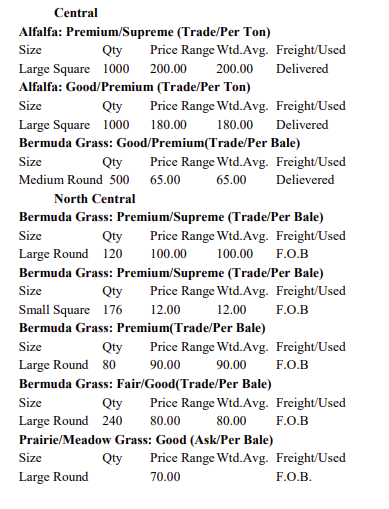
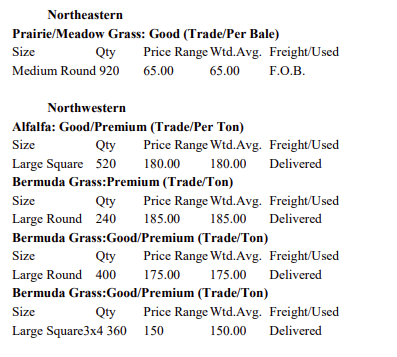
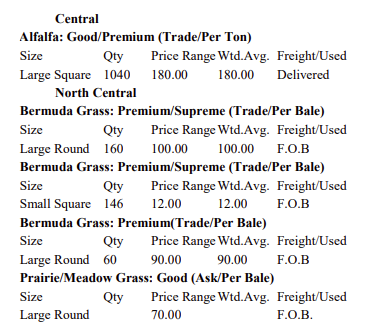
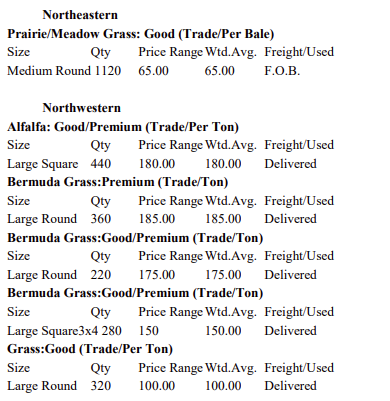
It is well past time to consider supplementation options for getting our cows through the winter while preparing them for spring calving. Although down some, feed prices do not feel like they have returned to levels we are used to. Good growing conditions have blessed us with better hay production than we have seen in the last couple of years, so using high-quality hay as a supplement can definitely be an option this winter. The USDA Oklahoma Direct Hay Market Report for December shows  (https://www.ams.usda.gov/mnreports/ams_3095.pdf) that Good/Premium grade alfalfa in 4 x 4 large square bales is pricing at $180/ton while Premium/Supreme alfalfa is pricing at $200 per ton. Compare this to 20% Range Cubes priced at $10/bag ($400 per ton). Good grade alfalfa is 18 to 20% crude protein and 58-60% total digestible nutrients. Premium grade is 20 to 22% crude protein and Supreme is >22% crude protein. These nutritive qualities make alfalfa hay an attractive option compared to feeding cubes.

Using the Cowculator Beef Cattle Nutrition Evaluation program (available at https://extension.okstate.edu/programs/cowculator.html) we see that a 1250 pound cow in the third trimester of gestation grazing stockpiled native range in January and February would need 6 pounds of supplemental 20% Range Cubes per day to meet protein and energy needs. This would cost $1.67 per cow each day.

Compare this to Premium alfalfa hay. The same cow would need 9 pounds of alfalfa per day to meet protein and energy requirements, but the daily cost decreases to $1.19/cow. Both research and past experience has shown us that alfalfa is an effective supplement for wintering beef cows.

There are several points to consider:

  • Supplementing forage will result in reduced intake of other forages, but will have less impact on forage digestion than concentrate supplements at higher feeding levels.
  • Do not feed every day, cows have been known to wait at the gate when they know that supplemental hay will be delivered daily (Dana Zook OSU NW Area Livestock Specialist calls this "Spoiled Cow Syndrome").
  • Provide supplements on alternating days or up to every 3rd day to balance distance of travel and amount of supplement required even at high supplementation rates does not appear to disrupt grazing activity during off days.
  • Dana Zook presented 'Alfalfa as a Winter Protein Supplement' as part of the Ranch's Thursday Lunchtime Webinar Series on October 21, 2021. Her slide set is available at https://extension.okstate.edu/programs/beef-extension/ranchers-thursday-lunchtime-series/site-files/docs/supplementing-alfalfa-ranchers-lunchtime-series.pdf
  • Dana's Rancher's Thursday presentation along with a presentation by Dr. Shane Gadberry, University of Arkansas, on using feed additives and probiotics for beef cows from October 21, 2021 are available by clicking here for the YouTube video

Looking Back 20 Years at the Cow That Stole Christmas with OCA's Michael Kelsey

Ron Hays Beef Buzzes with Michael as they share memories of the Cow that Stole Christmas in December 2003

2003 was in it's final days- everyone had their mind on the Christmas holiday- and then the cattle industry in the US got a hard jolt of reality about the fragile state of it's well being. Michael Kelsey is one of those who lived through the event that was coined by some in the business as the "Cow that Stole Christmas" as December 23rd brought news that BSE had been found in a dairy cow in the state of Washington.

Senior Farm and Ranch Broadcaster Ron Hays also has lived through this event- and he talks with Kelsey about the announcement of Mad Cow Disease being found in the US- and how the industry responded and what was learned from what you might call an early black swan event. Listen to their conversation by clicking on the audio button above.

Kelsey says that he and his wife were visiting family in North Carolina when the call came in. Cell service was not great where they were- and it took a call to the house phone that finally reached Kelsey. He was serving as the Executive Director of the Oklahoma Beef Council at that time and he was told that USDA was planning a news conference shortly that was expected to have serious animal disease news.

That news conference held by then USDA Secretary Ann Veneman announced a "presumptive positive" case of BSE had been found- but she stressed it was not an act of terror and that the nation's food supply was safe. Here's part of her announcement from 2003

Kelsey tells Hays that the immediate concern of the Beef Council was to assure the public of the safety of the US Beef Supply- and early interviews with the media were designed to tell that story.

He credits the job done by the issues management team of the NCBA, a contractor to the Beef Checkoff, for helping get that story successfully across to consumers. He recalled how the industry had planned for that day in light of the BSE outbreak in England in the 1990s as well as early in 2003 when a case of BSE was found in Canada.

In May 2003, the first North American case of BSE was reported in Alberta, Canada, sending shockwaves through the highly integrated North American beef supply chain. The United States, along with many other countries around the world, immediately closed its border to Canadian beef and cattle.

Despite the import bans, in late December 2003, APHIS confirmed the first U.S. case of BSE in a dairy cow that had been imported from Canada to Washington State. The 'cow that stole Christmas,' as then Veterinary Services Deputy Administrator Dr. W. Ron DeHaven put it, sent the agency into full-on emergency mode. Holiday plans were canceled, and hundreds of APHIS employees were mobilized to determine the source of the disease, ensure that no animals from the affected herd had entered the food supply, and—along with other USDA agencies and the Food and Drug Administration—implement new prevention and surveillance measures.

Kelsey says that today- even when we have the occasional atypical case of BSE in the US- it causes little concern and is barely reported in the industry trade media- and not at all in the general media.

Kelsey does believe that going through this event has helped the US livestock industry be better prepared for future animal disease threats- especially for the cattle industry and the worry of FMD- foot and mouth disease.

The Beef Buzz is a regular feature heard on radio stations around the region on the Radio Oklahoma Ag Network and is a regular audio feature found on this website as well. Click on the LISTEN BAR for today's show and check out our archives for older Beef Buzz shows covering the gamut of the beef cattle industry today.

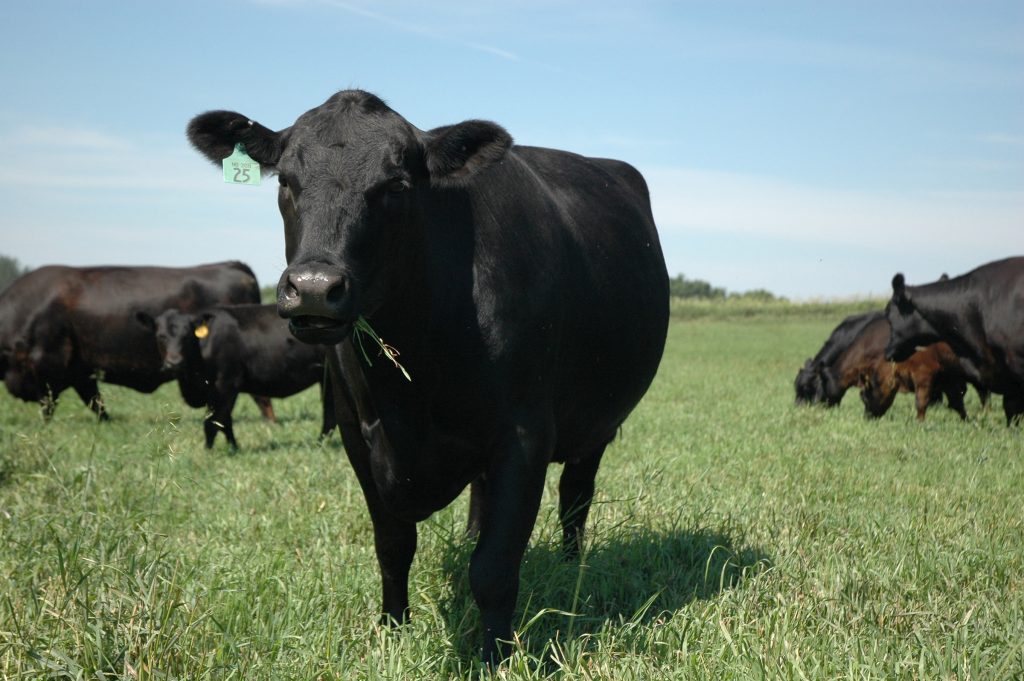
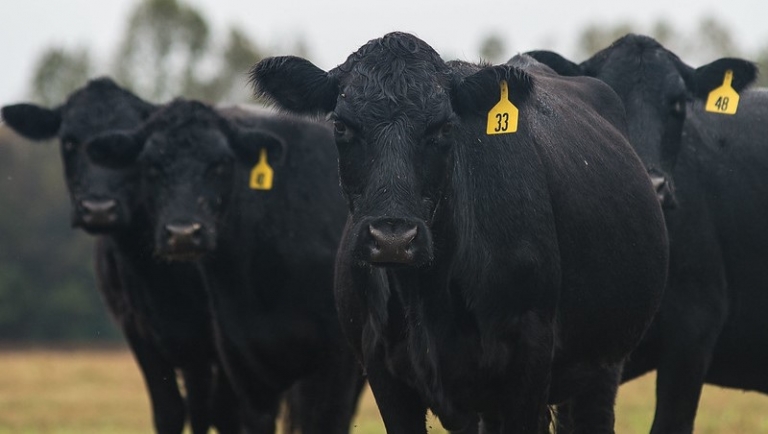
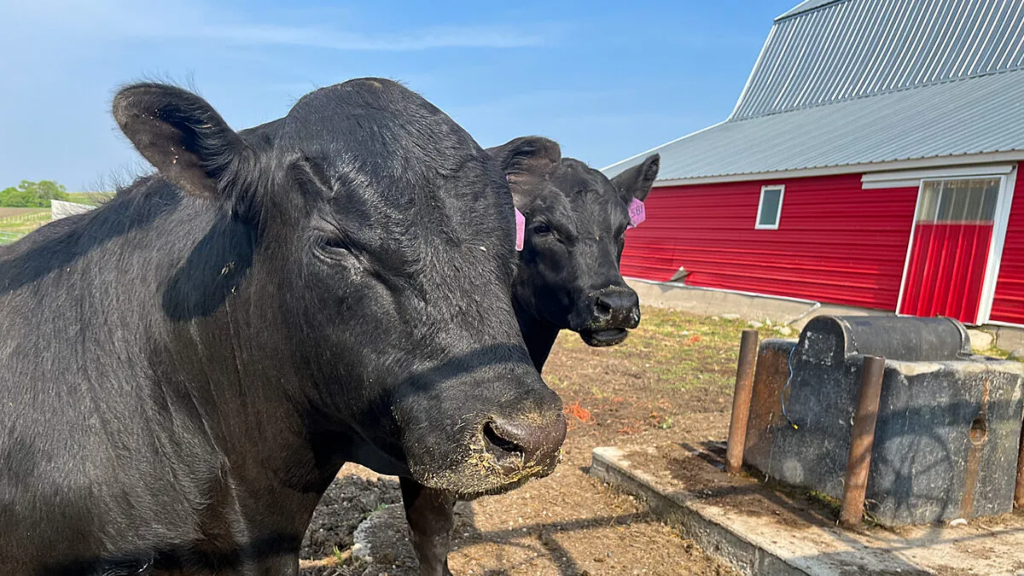
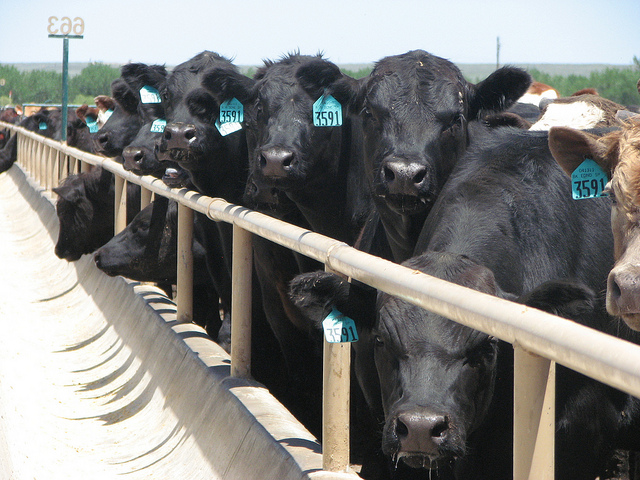
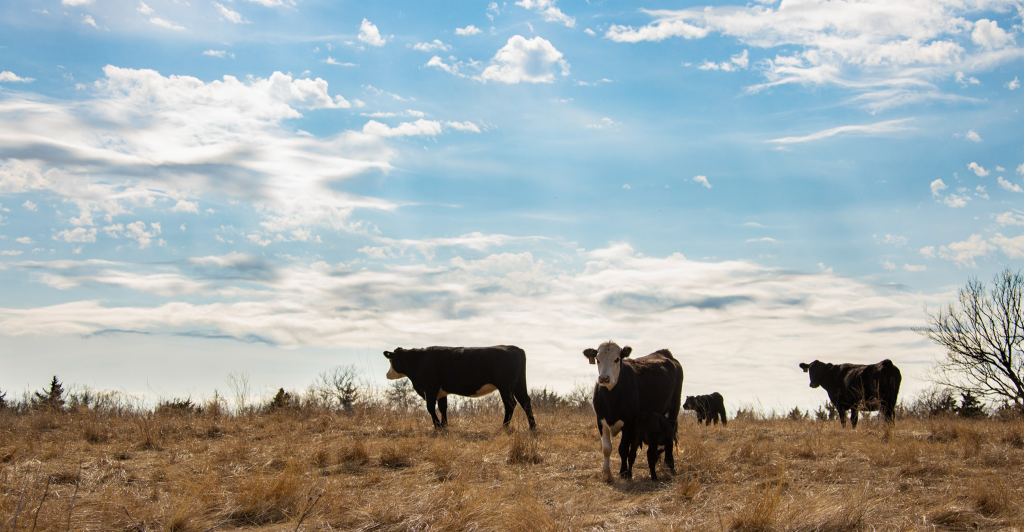
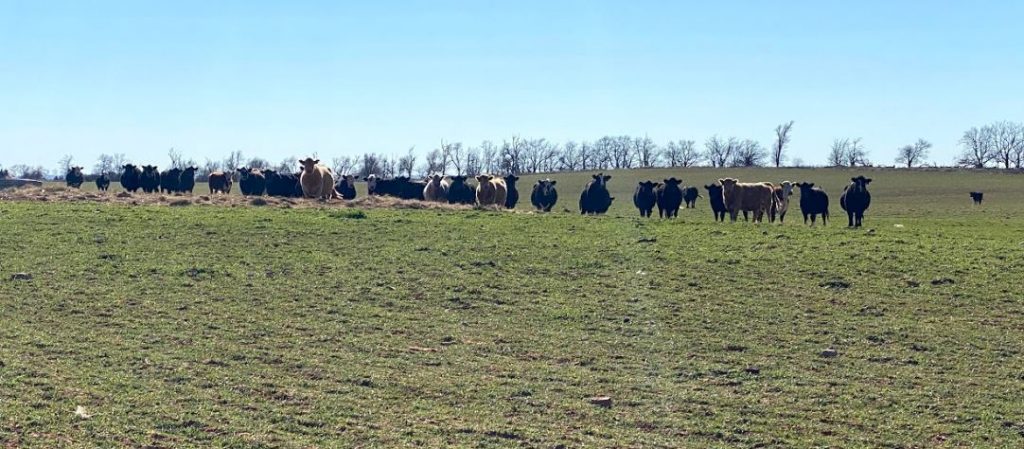
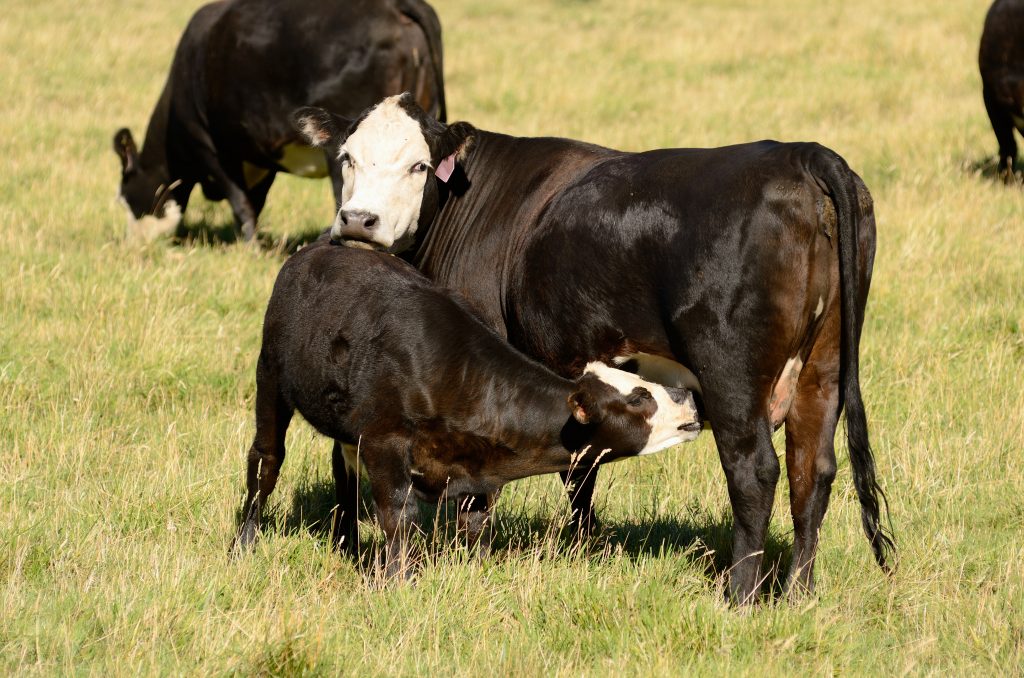
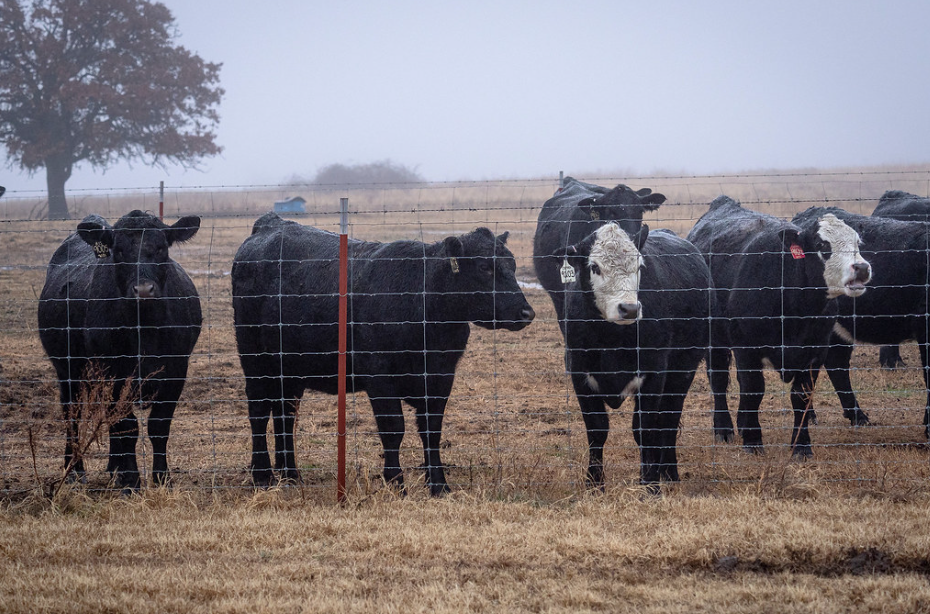
If Cow Picture at the top of the story can be seen- it's courtesy Mechanical Bull Rental Houston

Oklahoma Hog Numbers Fall Eight Percent from 2022- US Hog Inventory Flat Year Over Year

While the Oklahoma hog inventory has dropped 8% in December 2023 versus a year ago- the US hog herd is a few thousand head larger this December versus last.

Key findings in the national report include:

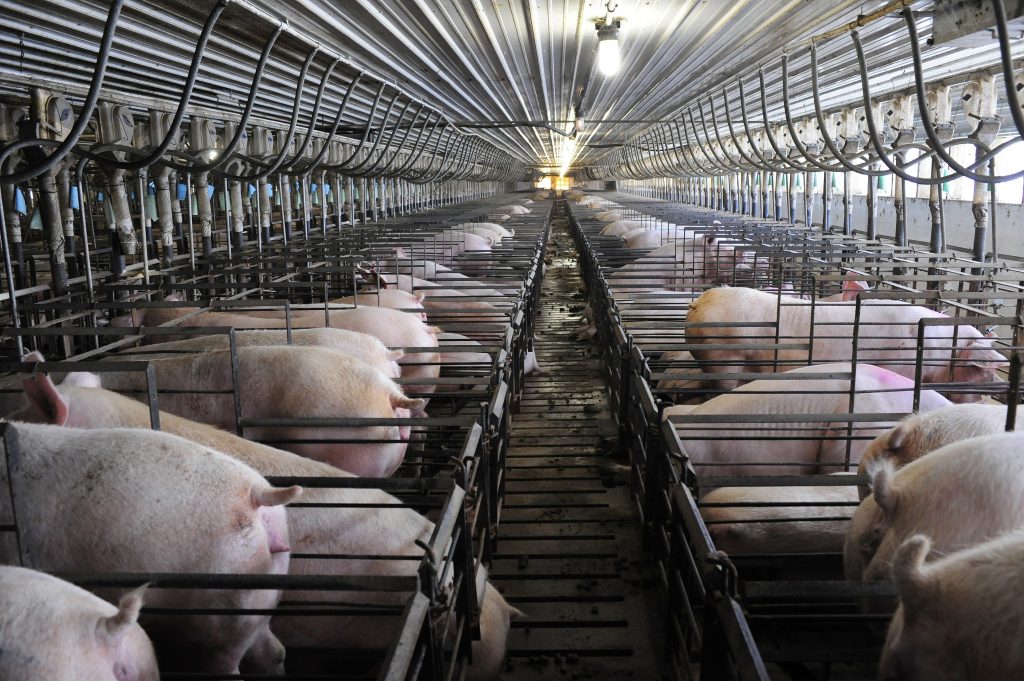
  • Of the 75.0 million hogs and pigs, 69.0 million were market hogs, while 6.00 million were kept for breeding.
  • Between September 2023 and November 2023, 34.6 million pigs were weaned on U.S. farms, down slightly from the same time period one year earlier.
  • From September 2023 through November 2023, U.S. hog and pig producers weaned an average of 11.66 pigs per litter.
  • U.S. hog producers intend to have 2.90 million sows farrow between December 2023 and February 2024, and 2.91 million sows farrow between March and May 2024.
  • Iowa hog producers accounted for the largest inventory among the states at 24.9 million head. Minnesota had the second largest inventory at 9.10 million head. North Carolina was third with 7.80 million head.

To obtain an accurate measurement of the U.S. swine industry, NASS surveyed 6,341 operators across the nation during the first half of December. The data collected were received by electronic data recording, mail, telephone, and face-to-face interviews.

For Oklahoma- the numbers are well under that of December 2022. The total hog herd in Oklahoma is down 8% from a year ago at 2.010 million head-making Oklahoma the eighth largest hog inventory state in the US.

More extreme for the Oklahoma hog story is the decline in breeding animals. A year ago, Oklahoma was tied with the fourth most sows in the US at 490,000 head. Fast forward to the latest report and USDA reports only 390,000 sows in the state- a drop of 100,000 and dropping Oklahoma to seventh place in the US ranking of breeding animals.

The complete report from USDA is available below.

NPPC Sees Need for Vaccine Bank Expansion and Immigrant Labor Reforms

Listen to Maci Carter talk with Scott Hays about the latest in the pork industry.

Radio Oklahoma Ag Network Intern, Maci Carter, is visiting with the President of the National Pork Producers Council, Scott Hays, about an update on issues in the pork industry.

Scott Hays is a fifth-generation pork producer and has been involved in many aspects of production. While owning sows and production facilities, he enjoys involvement in the family's sixth-generation swine management, swine building maintenance, and livestock hauling business operations.

Hays first gave an update on California's Proposition 12.

"We are still working on Prop 12," Hays said. "It is a problem for not only producers but for consumers as well. We are starting to get some information out of California, and I think those folks are going to have some buyer's remorse."

The price of pork in California is up as much as 27 percent, Hays said, while the rest of the country is seeing close to a 2 percent decrease in the price of pork. Hays said that issues do not stop at the price, as there are also a few availability issues.

"Prop 12 won't be fully implemented until after the 1st of the year, so we are working with Congress right now through the Farm Bill to try to get a fix," Hays said.

Regarding the Farm Bill, Hays said the main concern of NPPC is foreign animal disease and ensuring that in the event of an outbreak, APHIS is adequately prepared.

"We have done a lot of work on prevention and preparedness for foreign animal disease," Hays said.

While there is a vaccine bank for Foot and Mouth Disease, Hays said NPPC would like to see some expansion to add an African Swine Fever vaccine one day.

Overall, Hays said swine herd health has been good across the nation.

"The herd seems to be healthy this year," Hays said. "We are in a very tough economic time right now in the industry, which is always challenging, and it is just hard to watch. Producers are struggling, and it is mainly on the import cost side of things.

Hays said producers are still spending about 60 percent more to raise a pig than they did three years ago, and the meat market is not keeping pace.

Finding labor in rural areas is also a challenge, Hays said, as unemployment is lower in rural areas.

"The rural area is an aging population, and we are seeing smaller families," Hays said. "We are more reliant upon immigrant labor all the time, and we need some type of reform. I think every American understands that our immigration policy is broken."

Hays said immigration programs need to be modernized so that pork producers can access the help they need.

Drop Off Natural Christmas Tree at Oklahoma City Parks

If you put up a Real Christmas Tree this year, you have a couple of options for disposing of it this year. From December 26th to January 15th, folks can drop off their Christmas Trees at Wheeler Park (3600 Pat Murphy Dr). and Will Rogers Park.  (1120 S Western Ave)

Trees must be free of ornaments, Christmas Tree Stands, and lights.

City Officials are also asking residents to consider turning those old trees into mulch with help from the City. Mulch will be available until Jan. 15, 2024. Residents must bring their own shovels and containers. Residents of Oklahoma City may also set their natural or artificial trees at the curbside for collection with other bulky waste no later than 6 a.m. on their assigned monthly bulky waste date. But City Officials ask that you not block mailboxes, trees, shrubs, or vehicles and not to cover up your waste or natural gas Meter.

In Memory of Jarold Callahan- Details of Services This Week

The following is our post in the Daily Email we send weekday mornings about Jarold Callahan, who passed away this past Saturday. We have details of the services announced by the Callahan family:

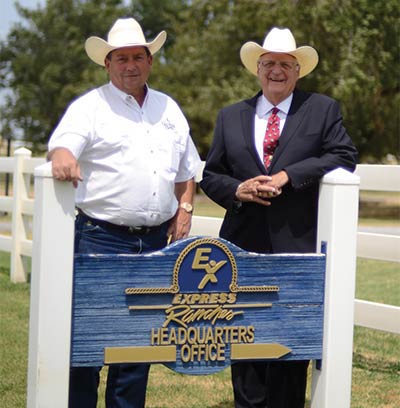
It's a sad Christmas for those of us who knew Jarold Callahan. Unexpectedly, he died on Saturday, December 23rd while visiting family in northeastern Oklahoma.   Callahan had served as the President of Express Ranches for the past 27 years- and had led the effort to give birth to Cattlemen's Congress when Covid was knocking out major cattle shows in the fall of 2020. He was serving before his passing as the Chairman of the group that is putting on the Fourth Congress in less than a week.  

Visitation for Jarold will be in Vinita on December 27th from 5 to 7 pm at the Burckhalter-Highsmith Chapel, 201 N Wilson, Vinita, OK. A Celebration of Life will be held at 10 AM this Friday, December 29th at the National Cowboy and Western Heritage Museum, 1700 Northeast 63rd Street, Oklahoma City, OK. The Obituary will be found later on the Burchhalter-Highsmith website but a suggestion for a memorial in honor of Jarold is on their site-

"Jarold's family would prefer memorials be made in his honor to Cattleman's Congress to provide financial support to ensure that future livestock industry leaders have access to the educational opportunities offered by the OSU Purebred Beef Center. If you would like to support this cause, or contribute to the cost associated with the portrait and banquet, please make checks payable to: Cattleman's Congress, Inc. with the designation Callahan Saddle and Sirloin. Contributions should be mailed to: Cattleman's Congress, Attention: Kass Newell, 21 Land Rush St, Oklahoma City, OK 73107."  

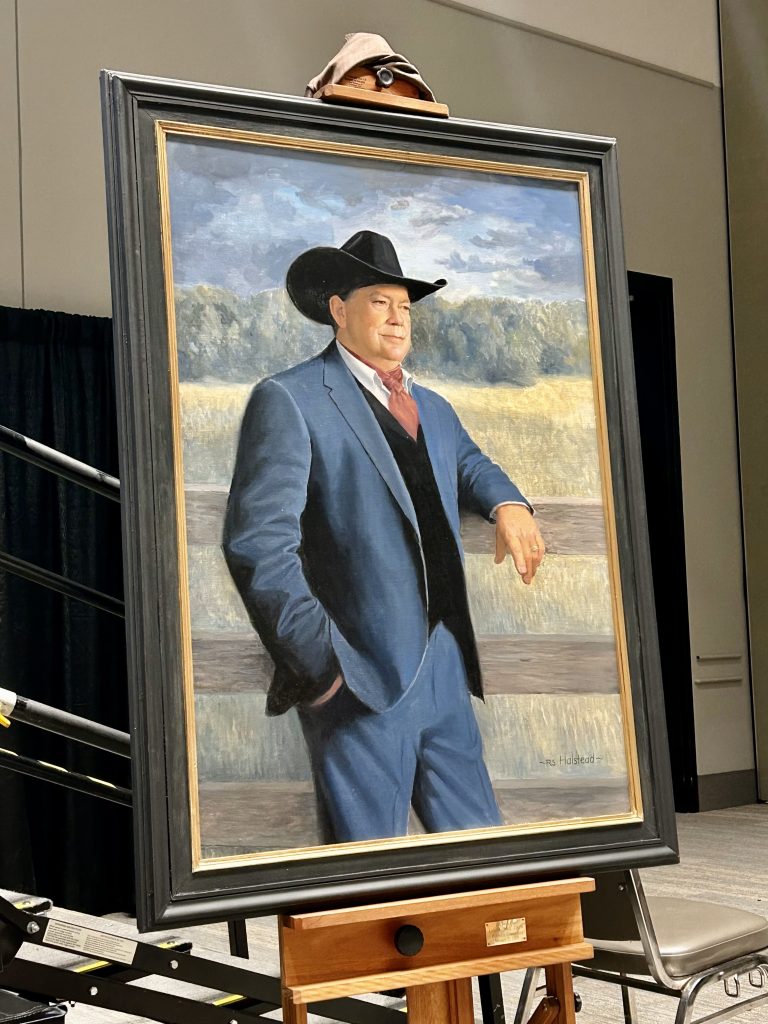
In addition to his role with Cattlemen's Congress- Jarold was also was currently serving as a member of the OSU Board of Regents. Earlier this fall- he was honored by the Saddle and Sirloin Club that's a part of the North American Livestock Expo as a Portrait honoree.  

Callahan grew up in Welch, Oklahoma and lived his life in Oklahoma- loving the cattle business and all that goes with it. He was a member of the NEO and OSU Livestock Judging teams- coached both of those teams- served as Executive Director of the Oklahoma Cattlemen's Association before taking on the job of making Express Ranches the premiere purebred ranch in the US.  

Several statements have been released- including a word from Bob Funk, Sr of Express, the staff of Cattlemen's Congress, OSU- A&M Regents, Oklahoma Cattlemen's Association, Oklahoma Beef Council, Oklahoma Angus Association as well as the American Angus Association- click on these names to jump to those tributes.  

Your Editor has done multiple interviews over the years with Jarold- often as a preview to their Big Event Cattle Sale each August, many times with him over the last four years about Cattlemen's Congress- and back a few months ago- talking about his life and career in a podcast that we produced for Cattlemen's Congress. Click on the Blue Button below for that Podcast that is a part of the Cattlemen's Congress Conversations that I have hosted in 2022 through now. The conversations we had after the interviews were over were about life and I will cherish those for the rest of my days.   We pray for Jarold's wife Jennifer, his family and those who worked with him closely-   Listen to our conversation from September of this year with Jarold Callahan about his life and involvement in the cattle industry.      

Beef Industry 2023 Year in Review- and a Look Into 2024

On today's Cow-Calf Corner, Dr. Mark Z. Johnson, Oklahoma State University Extension Beef Cattle Breeding Specialist reviews 2023 and looks ahead to the new year in the beef cattle business:

The end of 2023 arrives at a time when we, as cattle producers, have a great deal to be thankful for. Strong cattle prices and historically strong profit opportunities have made headlines in the past year. Overall, 2023 should close out as profitable year for all segments of beef cattle production (cow-calf producers, stocker operations and cattle feeders). This is historically rare. Current low cattle inventories indicate high value of cattle of all classes for the next several years. The market value of purebred seedstock should be supported in the future as the nation re-populates with cows. The drought released its grip on Oklahoma during 2023, timely rains and good management permitted recovery of grazing lands and our hay inventory ebbed back higher.

As we look forward to 2024 in the cattle business, keep the following in mind:

  1. When the nation's cow herd inventory starts to increase remains in question. What is certain however is the opportunity to "rebuild better." Sound selection and mating decisions now will enable you to regrow cow numbers with a biological type that fits your production environment, management and marketing plan. Mature cow size, level of milk, fertility and breed composition all contribute to cows that best fit your production environment.
  • It's not just the cattle, remember to manage and care for your soil and plants. Grazing ecosystems can take several years to recover from drought. At the beginning of future grazing seasons, manage to give your rangeland a competitive advantage over grazing pressure. Don't re-stock until your pasturelands are ready.
  • Low cow inventories support higher value of cattle. That being said, keep input cost, interest rates and inventories of feedstuffs in mind when making future business decisions.
  • Finally, The cattle business is based on having an available forage base that cattle can graze and turn into beef. The key to profitability is to find a long-term balance of forage produced, other input expenses and production levels. 

It is the ingenuity, perseverance, work ethic and "can do" attitude of America's cattle men and women, and ag producers that permit us to enjoy the highest quality beef produced in the world and spend a relatively small percentage of our disposable income on food. Merry Christmas and Happy New Year!  Thanks for reading and best of luck to cattlemen and women in 2024.

Placements Higher Than Trade Expected in Final Cattle on Feed Report of 2023

Ron Hays talks Cattle on Feed with OSU Ag Economist Dr. Derrell Peel

The final Cattle on Feed report for 2023 was released as the industry headed into the Christmas holiday weekend- and it was a slightly bearish report- based on more cattle being placed into feedlots compared to what the pre report guesses by the trade were.

Cattle and calves on feed for the slaughter market in the United States for feedlots with capacity of 1,000 or more head totaled 12.0 million head on December 1, 2023. The inventory was 3 percent above December 1, 2022.

Placements in feedlots during November totaled 1.87 million head, 2 percent below 2022. Net placements were 1.81 million head. During November, placements of cattle and calves weighing less than 600 pounds were 535,000 head, 600-699 pounds were 440,000 head, 700-799 pounds were 380,000 head, 800-899 pounds were 288,000 head, 900-999 pounds were 140,000 head, and 1,000 pounds and greater were 85,000 head.

Marketings of fed cattle during November totaled 1.75 million head, 7 percent below 2022. Other disappearance totaled 54,000 head during November, 5 percent below 2022.

Senior Farm and Ranch Broadcaster for the Oklahoma Farm Report, Ron Hays, talked with Extension Livestock Market Economist Dr. Derrell Peel about the numbers- and he says "It's not a big surprise like that September report was- it is on the upper end of the placement range- but there were some analysts who thought it might be at this level. " Peel does acknowledge that it is a relatively large placement number and keeps the on feed numbers above a year ago as we end 2023.

Peel says the on feed numbers have now been above a year ago since October- and this is because of bigger placement numbers.

"We have had such a strong increase in cattle markets this year- prices have been well above year ago levels- particularly for feeder cattle- we have been running 30% to 36-37% above a year earlier levels all year on average. I think a lot of producers just really wanted to take advantage of this market."

Peel believes Feeder Cattle have been pulled forward a little bit and that changes the timing but not the numbers of cattle - but it does frontload the number of cattle that will be coming out of feedlots in the first part of 2024.

Listen to Ron and Dr. Peel's complete report by clicking on the Listen Bar above.

The Beef Buzz is a regular feature heard on radio stations around the region on the Radio Oklahoma Ag Network and is a regular audio feature found on this website as well. Click on the LISTEN BAR for today's show and check out our archives for older Beef Buzz shows covering the gamut of the beef cattle industry today.

We also have Derrell Peel's weekly cattle market analysis as released on Christmas Day- it's about the Cattle on Feed Report- see what he writes:

The final Cattle on Feed report of the year showed that December feedlot inventories were 102.7 percent of last year at 12.006 million head.   Among the four largest cattle feeding states, Texas (2.91 million head) and Kansas (2.50 million head) were up the most, with Texas up four percent and Kansas inventories up seven percent year over year.  Nebraska (2.58 million head) and Colorado (1.03 million head) were both down one percent in feedlot totals compared to one year ago. The top four states represent 75.1 percent of December 1 feedlot inventories.  Feedlot inventories in number five Iowa are up two percent year over year at 640 thousand head and California, the sixth largest cattle feeding state, had a December feedlot total of 510 thousand head, up one percent over one year ago.  Oklahoma, Idaho, Washington, and Arizona round out the top ten cattle feeding states.

November feedlot placements were 98.1 percent of last year, smaller than last year after two months of year over year higher placements in September and October.  The placement total was a little larger than average expectations at the top end of pre-report estimates.  Although feedlot inventories are 2.7 percent larger than one year ago, total feedlot placements the last six months (which account for 96.2 percent of the December feedlot inventory), are down 0.3 percent from the same June-November period last year.  This means that the larger feedlot inventory now is due to a slower feedlot turnover rate and not because of increased total feedlot production.  This is reflected in the November feedlot marketings that were down 7.4 percent year over year.  A slower feedlot marketing rate raises concerns that feedlots may not be staying current in marketings.  Steer carcass weights pushed to new record levels in the past month with weekly weights at 940 pounds in late November and early December.  (Heifer carcass weights peaked at 854 pounds recently, just one pound shy of the largest weekly heifer carcass weight in January 2022.)  However, indications are that the heavier carcass weights reflect deliberate marketing intentions (feeding cattle longer) rather than a systemic lack of currentness in feedlots.

Feeder and fed cattle prices increased the week before Christmas.  The five-market cash fed price on December 22 was $170.50/cwt., up roughly $2/cwt. from the previous week.  On a weekly basis, fed cattle prices have average 22 percent above year earlier levels in 2023.  Feeder cattle prices were sharply higher in Oklahoma auctions for the final week of sales in 2023.  The price of 475 pound, medium/large, #1 steers was $317.52/cwt, up 44 percent from one year ago, and have averaged 37 percent higher year over year across all weeks this year.  The price of 775-pound steers was $225.87/cwt., up 28 percent year over year. These big feeder cattle have averaged 31 percent higher year over year on a weekly basis in 2023.

Merry Christmas and a Happy New Year to all.

Oklahoma Cattlemen's Association Mourns the Death of Jarold Callahan

The Oklahoma Cattlemen's Association is deeply saddened to hear of the untimely passing of Jarold Callahan.  Jarold served in many capacities in many organizations including Executive Vice President of the Oklahoma Cattlemen's Association from 1991-96.  His vision for our industry and cattle acumen were unequaled and he was truly a leader of leaders.  OCA extends to the Callahan family our deepest sympathies.

Oklahoma Angus Association Statement on the Passing of Jarold Callahan

Statement from the Oklahoma Angus Association in regards to the passing of visionary Angus breeder and Angus leader, Jarold Callahan.

It is with profound sadness that we extend our deepest condolences on the passing of Jarold Callahan, former President and current Executive Director of the Oklahoma Angus Association.

Jarold's support at every OAA event was something all members could count on. His innovative thinking and leadership will be deeply missed. The voids left in the Angus breed on the state, national, and global levels, will take the efforts of many people to fill. His passion and love for the Angus breed will continue to inspire us to continue the path of excellence he began.

During this time of grief, our thoughts and prayers are with Jarold's family, friends, and all those whose lives he touched. As we mourn the loss of a remarkable leader, his impact on the OAA will be a lasting legacy on the Angus business in this state.

Statement from the Oklahoma Beef Council Regarding Passing of Beef Industry Leader, Jarold Callahan

It is with profound sadness that we extend our deepest condolences on the passing of Jarold Callahan, former Chairman of the Oklahoma Beef Council and an exemplary leader in the cattle industry. His loss is deeply felt, and his legacy will forever be etched in the annals of our community.

"Jarold was more than a cattle industry leader; he was a visionary, a mentor, and a larger-than-life presence who dedicated his life to advancing the interests of not just Oklahoma, but US beef producers. His passion for the beef industry was contagious, and his tireless efforts in promoting and enhancing the well-being of our state's cattle industry were truly remarkable," said Heather Buckmaster, executive director of the Oklahoma Beef Council.

As Chairman of the Oklahoma Beef Council, Jarold Callahan exhibited unwavering commitment and leadership. His strategic vision and innovative approaches have left an indelible mark on our organization, inspiring us to continue the pursuit of excellence in all facets of our work. Jarold's impact on the Oklahoma beef community was not only profound but also enduring.

During this difficult time, our thoughts and prayers are with Jarold's family, friends, and all those whose lives he touched. As we mourn the loss of a remarkable leader, let us also celebrate the legacy he leaves behind—a legacy of dedication, passion, and a deep love for the Oklahoma cattle community.

A Conversation with Jarold Callahan- September 20, 2023

Senior Farm and Ranch Broadcaster Ron Hays sat down back on September 20, 2023 with Jarold Callahan of Express Ranches and talked with him about growing up in northeast Oklahoma and his education and career path that led him to being so successful in the purebred cattle business.

Click here if you would like to listen to this conversation with Jarold via the podcast that is part of our series for Cattlemen's Congress called Cattlemen's Congress Conversations.

You can also listen to it by clicking on the Listen Bar below.

Jarold unexpectedly passed away on Saturday, December 23, 2023.

Ron Hays talks with Jarold Callahan in his Express Ranch office on September 20, 2023

American Angus Association Posts Remembrance of Jarold Callahan

Jarold Callahan, former American Angus Association president and chairman of the board, passed away unexpectedly on Dec. 23. Jarold was visionary in the cattle industry in a variety of roles. He led not only in the boardroom, but in the classroom, showring and pasture.

He served as president of Express Ranches for the last 27 years. Under his leadership, Express Ranches has been an innovative driver of balancing genetic advancement with phenotypic quality. Express has been the Association Roll of Victory Breeder of the Year for the last 12 years in a row, bringing home thousands of purple ribbons and show wins.

Jarold was passionate about passing on his love of livestock to youth. A world-renowned livestock evaluator, he coached judging teams at both Northeast Oklahoma A&M College and Oklahoma State University. He was recognized as the National Intercollegiate Livestock Coach of the Year four times while he was at OSU. Jarold was a highly accomplished judge and evaluated countless national shows.

Along with other Oklahoma leaders, Jarold's influence led to the creation of Cattlemen's Congress in 2021 and he was serving as the board president. The event has grown to be a world-class event, drawing exhibitors from across the United States.

Jarold grew up in Welch, Oklahoma on a diversified family farm and cattle operation and personally maintained significant cow-calf and feeding interests with his wife, Jennifer. Jarold has been recognized with numerous awards and recognitions but none higher than his induction into the Saddle and Sirloin Portrait Gallery in November, one of the highest honors in the livestock industry.

Our prayers are with Jarold's family and the entire Express crew. His obituary will be posted once arrangements are made.

In Memory of Jarold Callahan- a Statement from Bob Funk, Sr.

The following statement was released on Sunday, December 24th, 2023 by Express Ranches and their owner, Bob Funk, Sr.

"A Heartfelt Message on the Loss of Our Beloved Express Ranches President, Jarold Callahan.

"It is with heavy hearts that we share the news of the passing of Jarold Callahan who served as the President of our Express Ranches for 27 years. His sudden passing will leave a profound void in our lives, and we are deeply saddened by this loss.

"Jarold was not only a dedicated leader but also a cherished friend of our family. His visionary leadership, unwavering commitment, and passion for our ranching business played a pivotal role in its success and growth. Under his guidance, we have achieved significant milestones, and his legacy will continue to inspire us in the years to come.

"During this difficult time, we want to express our gratitude for the outpouring of support and condolences we have received from the ranching community, colleagues, the educational community and friends. Your kind words have provided solace and strength during this hard time.

"As close friends of the Callahan family, we will support them in preserving Jarold's legacy and we will work together to honor the values and principles that Jarold held dear.

"At this time, we ask for your understanding and patience as we navigate through this challenging period.

:Thank you once again for your condolences and sympathies during this trying time."

Sincerely,

Bob Funk Sr.

IN MEMORIAM: Remembering Jarold Callahan

The President of Express Ranches and Chairman of Cattlemen's Congress, Jarold Callahan passed away Saturday. Funeral arrangements are yet to be determined.

The Cattlemen's Congress team issued the following statement on Sunday afternoon:

"It is with heavy hearts that we announce the passing of our esteemed Cattlemen's Congress Board Chairman, Jarold Callahan. A devout agriculturalist, life-long leader, and champion of the cattle industry, Callahan has easily become one of the most outstanding figures in the livestock world. Callahan's unparalleled vision and unwavering devotion to the cattle industry were the driving forces behind the founding of Cattlemen's Congress, evolving into the 'World's Largest and Most Elite Show.'

"As the CEO of Express Ranches, the world's largest seedstock operation, Callahan stood as one of the most influential figures in the cattle industry. His dedication extended to serving as a beacon of inspiration for the upcoming generation, urging them to think creatively and venture beyond conventional boundaries in the livestock industry.

"Callahan also served in many other prestigious roles and has received countless accolades, most recently as the 2023 inductee into the historical Saddle & Sirloin portrait gallery. Previously, after his distinguished livestock judging career, he transitioned into education, becoming an Assistant Professor of Animal Science and the Livestock Judging team coach at Oklahoma State University. Coaching multiple national champion teams and contributing to the construction of the OSU Animal Science Arena, Callahan demonstrated a deep commitment to the beef cattle industry and its future. But his involvement does not stop there.

"20 years ago, Callahan and a team of visionaries hosted a type conference focused on creating a blueprint for the right kind of cattle. In 2023, he brought the conference back, seeing a need for the industry to pivot in order to raise cattle to fit today's consumer. Callahan always strove for improvement and excellence, pushing not only his own operation, but others as well.

"Cattlemen's Congress stands as a testament to Callahan's commitment and outstanding leadership, providing cattlemen and women a platform to showcase their genetics. In tribute to his life's legacy, the show will continue to grow and provide an exceptional show experience for exhibitors, remaining as the 'Gathering Place for the Industry,' just as he would've wanted. His legacy will forever resonate in the heart of this iconic event.

"We extend our deepest condolences to Callahan's family and friends during this difficult time. Funeral details are yet to be determined, and we will share information as soon as it becomes available. Jarold Callahan's impact on the cattle industry and Cattlemen's Congress will endure as a testament to his lasting legacy."

Have You Heard About the Shouting Shepherd?

The Agrarian  way of life and the message of the Good News of the Birth of Jesus over 2,000 years ago are very much tied together- and this Christmas story from Brandon Baumgarten offers that link to what farmers and ranchers have done for centuries and the God's provision of a "perfect lamb."

Enjoy the "The Shouting Shepherd"

Have you ever tried to find the perfect livestock?

I have. Finding that right animal takes a lot of attention, experience and a good eye.

As someone who takes care of sheep, my good eye has seen everything from new lambs being born from weening a whole herd. It's a constant job, but not a glorified job. It can be lonely living out in the fields outcast from society. Raising my sheep, I don't talk much, I just mainly pay attention to my flock.

However, one night, I finally found the perfect sheep. True story. It was a late night, quiet and uneventful. The sheep were doing what they always did and we shepherds just watched, guided, and fed the herd like normal.

Then suddenly, normal began to change. Soon the silent night was broken. The uneventful night became eventful. Because in the sky appeared an angel from Heaven saying, "Do not be afraid, for behold, I bring you good tidings of great joy which will be to all people. For there is born to you this day in the city of David a Savior, who is Christ the Lord. And this will be the sign to you: You will find a Babe wrapped in swaddling cloths, lying in a manger.

And suddenly there was even more angels praising God and saying: "Glory to God in the highest, And on earth peace, goodwill toward men!"

The sight was incredible. I quickly told the other shepherds that we had to see what the angels were talking about. We hurried to Bethlehem and saw Mary, Joseph, and the Christ child lying in a manger just like the Angel said. The King of Kings had come and we lowly shepherds were the first to hear of His arrival.

I'm usually pretty quiet tending my flock, but that night, something changed in me. I felt a rush in my heart to shout and proclaim the news that Jesus, the Son of God had finally come to earth. I shouted and shared the news with everyone I could. Yes, this once silent shepherd turned into a shouting shepherd for Jesus.

When we returned home, we gave thanks and glorified God for all we had seen. As a shepherd, I have a pretty good eye when it comes to livestock and that night we saw another sheep. But it wasn't an ordinary sheep. We saw the precious lamb of God given as a gift for all the world to receive.

This story is meant give you another perspective of the nativity story. Shepherds were considered unclean in society and were not allowed to even worship in the Temple. Several Bible scholars have noted that their occupation had become so looked down upon that in the Jewish culture, their testimony would not even be counted in a court room.

However, God orchestrated it all to reveal the good news of the nativity to unclean, outcasted, and lowly shepherds. Why? Because Jesus came for the highest of people as well as the lowest of people. This Christmas, regardless of your status, I pray that you accept the gift of Christ and that something will change within you too. I pray that the silence in your heart breaks. I pray that your normal will begin to shift. I pray that you have a reason to shout.

The God who comes to save is more concerned about your heart status than He is about your societal status. Take it from once a silent shepherd who became a Shouting Shepherd because he finally spotted the perfect sheep: Jesus, the precious lamb of God.

The Shouting Shepherd by Brandon Baumgarten

Growth Energy Welcomes CBP Plan to Reopen Texas Rail Crossings

Growth Energy CEO Emily Skor issued the following statement after U.S. Customs and Border Protection (CBP) announced that it would reopen two rail crossings in Eagle Pass and El Paso, Texas:

"We're grateful to CBP for listening to the chorus of industry voices calling for a better approach, and we're grateful to our biofuels champions on the Hill who delivered our message and helped find a solution to this urgent issue. The bioethanol industry and its farm partners can rest easy knowing that their goods can again flow freely to one of our most important export markets."

NCGA Expresses Relief Over Rail Crossing Re-Opening, Emphasizes Need to Avoid Similar Situations in Future

The U.S. Customs and Border Protection announced today that it will reopen the Eagle Pass and El Paso rail crossings into Mexico. The announcement pleased leaders at the National Corn Growers Association (NCGA), who cautioned the agency against making similar decisions in the future.
 

"This is certainly a welcome relief," said NCGA President Harold Wolle. "We are very appreciative that CBP was responsive to our calls to have the border crossings re-opened, but we hope this experience serves as a cautionary tale moving forward. Rail is a key mode of transportation for our exports into Mexico, so closing rail crossings can have devastating ramifications for farmers and the economy."
 

The two rail crossings along the Texas border towns were closed on December 18 by the U.S. Customs and Border Protection as part of an effort to prevent migrants from entering the country illegally. Twenty-five percent of U.S. corn exports into Mexico go through El Paso and Eagle Pass.
 

On Thursday, the National Corn Growers Association joined other national ag groups in sending a letter to Homeland Security Secretary Alejandro Mayorkas calling for him to quickly reopen the rail crossings.

The crossings will be fully operational by 2 p.m. (EDT) today. 

USCA Hosts 16th Annual Meeting in the Lone Star State

On December 1-2, 2023, the U.S. Cattlemen's Association (USCA) hosted its 16th Annual Meeting at the Embassy Suites Hilton Downtown Fort Worth. 

Attendees discussed needed improvements to transparency and true price discovery in the cattle marketplace, advancements in truth in labeling efforts on beef and alternative protein products, developments in animal health and identification programs, and more.

Speakers included Commodity Futures Trading Commission Chairman Rostin Behnam; U.S. Department of Agriculture Undersecretary for Marketing & Regulatory Programs Jenny Moffit; USDA Farm Service Agency Administrator Zach Ducheneaux; Makenzie Billings, Manager of Agricultural & Alternative Investment Products at the CME Group; and Texas Agriculture Commissioner Sid Miller. 

Special guests included American Angus Association CEO Mark McCully, Livestock Marketing Association President Mark Barnett, Cattlemen's Beef Board CEO Greg Hanes, Texas Beef Council Executive Vice President Molly McAdams, and more. 

USCA raised over $15,000 at the annual live auction and nearly $31,000 during the organization's first drawdown raffle fundraiser. Mike Simon, of Anipro Xtraformance Nutrition, won the drawdown's grand prize - a brand new Kubota utility vehicle. 

"Thank you to those who bid on items and purchased raffle tickets, making this the most successful fundraising year on record for the organization," said USCA President Justin Tupper.

"We couldn't have done it without the support from our members and partners who believe in the mission and vision of USCA to be the most effective voice for U.S. cattle producers on Capitol Hill. We look forward to putting these dollars to work and making significant progress on the issues that matter most to our members in 2024." 

Wheat Organizations Welcome Reopening of Border Rail Crossings

U.S. Wheat Associates (USW) and the National Association of Wheat Growers (NAWG) are pleased that the U.S. Customs and Border Protection (CBP) agency reopened rail crossings in El Paso and Eagle Point today.

These rail corridors are essential gateways to many loyal flour millers and their wheat food customers in Mexico who rely on the interconnected U.S. and Mexican rail system for a reliable source of high-quality U.S. wheat. Even short disruptions in this system can have significant negative effects on both sides of the border. We trust CBP will take the steps needed to avoid rail closures in the future, and we are grateful for their efforts to maintain border security and facilitate lawful trade.

Producers See Big Payouts from LRP After Recent Drop in Cattle Prices

Listen to Ron Hays talk with Dakota Moss about LRP.

Senior Farm and Ranch Broadcaster Ron Hays is talking with Dakota Moss of Livestock Risk Services about the impacts of the recent drop in cattle prices.

Livestock Risk Protection is a nationwide price protection offered by USDA and is built for any size of operation.

"We have seen a dramatic fall in the cattle market over the last 90 days, so the producers have been utilizing the LRP program," Moss said. "I have seen significant payments on these cattle, especially for producers who turn cattle every 90 to 120 days. They insured those cattle back in September for some December maturity dates."

Depending on the coverage level those producers who insured cattle back in September selected, Moss said they are seeing payments from 20 dollars up to 44 dollars cwt.

"These are some very significant payouts for LRP, and so it has definitely shown that the program very much works as intended, especially when producers are utilizing some risk management," Moss said. "They can definitely protect themselves and pencil out kind of a budget on these cattle. Unfortunately, with this downturn, it has definitely come into play."

This dramatic fall in the cattle market, Moss said, has created an abundance of LRP claims.

"We have lost 35 dollars cwt, which is huge, in the last 90 days, so over the last two and a half months, I have seen more LRP claims than I ever have," Moss said.

That process is made faster, Moss said, when a producer has good records.

"If they are using LRP, they have to own the cattle," Moss said. "If they have sold those cattle before the LRP matures, then that sale paperwork is the perfect hard record."

For those who choose to retain ownership, Moss said producers need to make sure and have a third party, such as a lender or veterinarian, visually inspect the cattle and send a letter to Livestock Risk Services stating they have seen those cattle.

"As long as they have some good working relationships with a third party, they can work with them on getting us that documentation, and we can get that claim knocked out pretty quickly," Moss said.

Producers do not have to have the intent of immediately selling their cattle to sign up for LRP, Moss added.

For example, a cow-calf producer can ensure his calf crop for the fall and grow and background those cattle in the spring.

"As long as we can prove he owns those cattle with that third-party verification, he can go ahead and get that claim payment and retain ownership," Moss said. "(He can do) whatever he chooses with those calves once that LRP contract is done. If he wants to go ahead and cover them again after that first contract expires, he can cover them again in March or May, whenever he thinks he will have those calves ready to market on the next go-round."

To get in contact or find a Livestock Risk Services agent, click here.

To sign up for daily price reports, click here.

Bob Rodenberger Looks Back on a Tremendous Year for Cattle Producers

Listen to KC Sheperd talk with Bob Rodenberger about the cattle markets in 2023 and coming up in 2024.

Farm Director KC Sheperd is back talking with Bob Rodenberger, a partner with Stockmans Livestock Marketing, as he gives the latest on the cattle markets and looks back on the year.

"We started out the first of the year, in January, pretty much on an uptrend," Rodenberger said. "The market has been good. We just kept getting better and better."

Cow-calf producers have seen great prices for calves this year, Rodenberger said, even with shifts in the market.

"Overall, we have had a tremendous year," Rodenberger said. "The cow-calf man has had a good year; the people that sold feeder cattle before September got along tremendously."

Rodenberger said he believes the calf market will stay strong looking ahead, especially if good moisture continues.

The New Small Business Reporting Rule and Your Farm

In September of 2022, the U.S. Department of the Treasury's Financial Crimes Enforcement Network, more commonly known as "FinCEN," issued the Beneficial Ownership Information Reporting Rule[i] ("Reporting Rule") under the bipartisan Corporate Transparency Act[ii], requiring disclosure of the identity of beneficial owners of small business entities. This new rule is intended to prevent the operation of shell companies by criminal actors such as terrorism financiers, drug traffickers, human traffickers, money launderers, and the like. The Treasury Department estimates that criminal actors generate $300 billion in illicit proceeds through shell companies every year. 

It is important to note that agricultural business entities are not exempt from this Reporting Rule which requires disclosure beginning on January 1, 2024. If your farm, ranch, or agricultural operation is set up as a legal business entity (such as an LLC, LLP, business trust, corporation, etc.) created through your state corporation commission, secretary of state, or other similar office, your operation is likely subject to the new Reporting Rule. There are 23 specific entity types exempt from the Reporting Rule, largely composed of publicly traded entities, financial institutions, insurance companies, tax-exempt entities, and large operating companies, but there are no specific exemptions for agricultural entities. 

There are several online tools available to help you determine if your operation is a reporting entity as defined by the rule. If you determine that your operation is subject to the Reporting Rule, you must identify and report the beneficial owners of your farming and ranching business. A beneficial owner is any individual who exercises substantial control over the entity or who owns or controls 25% or more ownership interest in the entity. Those exercising substantial control include those who are senior officers, those with authority to appoint or terminate senior officers, important decision-makers, and those who otherwise uniquely exercise substantial control over the entity through contracts, relationships, or other agreements or arrangements. The rule provides limited exceptions for minor children, agents, employees, inheritors and creditors. Entities must report the beneficial owners' name(s), date(s) of birth, address(es), and government-issued identification(s) such as a U.S. passport or driver's license.

Entities required to report created on or after January 1, 2024 have 30 days from the entity's creation to complete the online reporting requirements. Entities created prior to January 1, 2024 will have until January 1, 2025 to complete their reporting. Once an entity is required to report, any changes in beneficial ownership must also be reported within 30 days of any such change. For instance, if a new member or partner joins the entity and/or otherwise becomes a beneficial owner as defined by the rule, that must also be reported within 30 days of the effective change.

How does this practically affect farmers and ranchers? The Reporting Rule does not affect an entity's operations, rather, its purpose is to identify those with a vested interest in the entity. The most important thing to remember is to timely comply with the filing requirements and then continue with your normal operations. The rule aims to hinder financial criminals from benefiting from their ill-gotten gains and was not implemented as a means to exercise control or oversight over your legally-run business entity.

To learn more about whether your agricultural operation is subject to the Reporting Rule and who and how you must report, visit www.fincen.gov/boi-faqs and FinCEN's Small Entity Compliance Guide.[iii]

Story Credit: Friedel, Jennifer. "The New Small Business Reporting Rule and Your Farm." Southern Ag Today 3(51.5). December 22, 2023.

Santa's Reindeer Cleared to Fly to Oklahoma

State Veterinarian, Dr. Rod Hall has given the OK for Santa and His Reindeer to fly through Oklahoma! With only three days left until Christmas Santa and the Reindeer will be getting ready to make the rounds! Special thanks to Dr. Rod Hall and the ODAFF team for getting Santa's rendeer cleared for import and arrival in Oklahoma!

Tyler Norvell Looking Forward to Year Four of Cattlemen's Congress in OKC

Pen Show- 2023 Cattlemen's Congress

Listen to Ron Hays talk with Tyler Norvell about Cattlemen's Congress.

Senior Farm and Ranch Broadcaster, Ron Hays, is talking with Tyler Norvell about the 2024 Cattlemen's Congress, coming up on December 30 through January 11 in Oklahoma City.

This coming Cattlemen's Congress will mark year four for the national cattle show. Each year, the event has made changes to become better regarding not only the schedule but infrastructure as well.

The Supreme Drive day on January 9th will be a busy one- as they have moved the Market Steer Show to that day along with the Prospect Show- all of that ahead of the Supreme Junior Female, Open Female and Open Bull Selections. The Collegiate Livestock Judging Contest which has been held that day in past years is moving to Monday, January 8th.

Improvements have been made this year to the electricity in the barns, Norvell said, which will hopefully help exhibitors not rely on generators as much.

Norvel said the sales featured at the show have continued to grow, as there are sales for everyone, from live sales to embryo sales.

"We feel like that is what has set us apart long-term is the commerce that we can bring along with the show," Norvell said.

The trade show is another feature of Cattlemen's Congress that Norvell said brings people in. Norvell said the show is not as big as Cowboy Christmas at the NFR, but it is the same type of merchandise, and visitors can expect excellent quality.

"It is a massive trade show," Norvell said.

Bringing a national cattle show into Oklahoma has fostered the support of cattlemen in the state and outside of the state, Novell added.

"You have so many people now that are coming here that are saying, 'Alright, we are going to come show in Oklahoma City, then we are going to Denver,'" Norvell said. "A handful of them are even going to Fort Worth after Denver."

As the show is centrally located, Norvell said he sees Cattlemen's Congress already becoming part of the "cycle" for cattle exhibitors' traveling to shows during this time of year.

The Beef Buzz is a regular feature heard on radio stations around the region on the Radio Oklahoma Ag Network and is a regular audio feature found on this website as well. Click on the LISTEN BAR for today's show and check out our archives for older Beef Buzz shows covering the gamut of the beef cattle industry today.

And here's the move in schedule for Cattlemen's Congress-

USDA Highlights 2023 Successes in Serving Farmers, Families and Communities

The U.S. Department of Agriculture (USDA) is marking the end of 2023 by highlighting on-the-ground projects and partnerships that are building economic prosperity for farmers, families, and communities nationwide. Thanks to President Biden's Investing in America agenda – and its record investments in rural America – USDA has been able to help tens of thousands of farmers continue their operations and increase their revenue, connected rural communities to internet access, advanced efforts to mitigate climate change, made investments that give small businesses a leg up, lowered energy costs and costs for consumers, and more.

"For too long, America's agricultural policies have encouraged farmers to get big or get out, and this in turn has weakened the communities whose local economies are tied to small and mid-sized farms. We're starting to see the impact of a new way of approaching policies and programs that are better designed for the real needs of rural communities—and the results are promising," said Agriculture Secretary Tom Vilsack. "Over the course of the Biden-Harris Administration, USDA has pushed forward with efforts to create revenue-expanding new markets for farmers, help them find opportunity while simultaneously addressing climate change, and build stronger infrastructure that leads to more prosperous farms and communities. In 2023, we saw these changes begin to take hold in tangible ways, which puts extra momentum behind the work we'll carry out in 2024."

In 2023, USDA has undertaken historic efforts to strengthen the agricultural economy and rural communities. Some of these initiatives and results include:

Support to Keep Farmers Farming

As of December 2023, USDA has helped more than 30,000 farmers and ranchers who were in financial distress stay on their farms and farming, thanks to resources provided through Section 22006 of the Inflation Reduction Act. The Inflation Reduction Act allocated $3.1 billion for USDA to provide relief for distressed borrowers with certain direct and guaranteed loans, and to expedite assistance for those whose agricultural operations are at financial risk due to factors outside their control, such as the COVID-19 pandemic. Since the law was signed in August 2022, USDA's Farm Service Agency (FSA) has provided approximately $1.7 billion and counting in immediate assistance.

At the same time, USDA has greatly improved its loan application processes to better serve farmers, in part through lessons learned from Section 22006 implementation. For example, USDA has streamlined FSA loan applications from 29 pages to 13, dramatically reducing the amount of time it takes to apply for a loan and making the process less onerous. In addition, earlier this month USDA announced an online, interactive, guided application that can simplify the direct loan process for the more than 26,000 customers who apply each year and make it more accessible for those in remote areas or who may not have time to leave their operations and visit an FSA office.

In 2023, the Risk Management Agency (RMA) helped provide the largest farm safety net in history, a record $207 billion in protection for American agriculture. At the same time, the agency continued to introduce new programs to support specialty crops, livestock, controlled environment, and shellfish producers. Additionally, RMA invested over $6.5 million dollars in cooperative agreements and partnerships to help educate undeserved producers and to create workforce opportunities for underrepresented voices in the crop insurance sector.

Connecting Rural Communities

Through the ReConnect Program, USDA has made historic investments to close the digital divide in rural America, so that more Americans can take full advantage of the opportunities provided by internet access.

In 2023, USDA awarded more than $1.8 billion for 96 projects that will help more than 250,000 people in rural communities access affordable, high-speed internet. These projects will benefit over 11,000 farms, 7,300 rural businesses and nearly 500 educational facilities, helping them access the critical resources they need to thrive in the digital age.

The vast majority of these awards were thanks to President Biden's Bipartisan Infrastructure Law (BIL), which provided funding for 89 projects totaling $1.73 billion. Through BIL funding , the ReConnect Program is helping to connect over 300,000 rural Americans in total.

Record Enrollment in Conservation and Clean Energy Programs

Through the Inflation Reduction Act, USDA has enrolled more farmers and more acres in voluntary conservation programs than at any point in history, following a backlog that has existed for years. In 2023, USDA enrolled nearly 5,300 additional producers in Natural Resources Conservation Service (NRCS) conservation programs across all 50 states. The Inflation Reduction Act provided $19.5 billion over 5 years for popular conservation programs, including the Agricultural Conservation Easement Program (ACEP), the Conservation Stewardship Program (CSP), the Environmental Quality Incentives Program (EQIP), and the Regional Conservation Partnership Program (RCPP).

Since 2021, USDA has seen a significant increase in enrollment and interest in its Conversation Reserve Program, which is a critical part of the Department's efforts to support climate-smart agriculture and forestry on working lands. In October, USDA announced it issued more than $1.77 billion to 667,000 agricultural producers and landowners for 23 million acres of private land enrolled in CRP.

Through the Rural Energy for America Program (REAP), USDA in 2023 made 2,059 investments totaling over $362 million to help farmers and rural small businesses access renewable energy systems—like solar panels and anaerobic digesters—that lower energy costs, generate new income, and strengthen the resiliency of their operations. Since its creation, REAP has consistently received more interest than funding available. Thanks to the Inflation Reduction Act, which funded 1,950 of this year's total REAP investments, USDA is helping more agricultural operations and rural small businesses access renewable energy systems and save money on energy costs.

Protecting Communities from Wildfire and Increasing Tree Canopy

In Fiscal Year 2023, USDA's Forest Service met and exceeded key milestones in addressing the wildfire crisis, restoring national forests and supporting rural communities. These benchmarks included treating 4.3 million acres of national forest system lands to reduce wildfire risk and 1.9 million acres of national forest land with prescribed fire – both were agency records and were enabled through strong partnerships with Tribes, state and local governments, conservation groups, industry and other important stakeholders. Also, the first round of Community Wildfire Defense Grant Awards was announced – investing $197 million in 100 projects in 22 states and seven tribes that were impacted or threatened by wildfires. The Bipartisan Infrastructure Law provided $1 billion for this program over 5 years. The second round of awards will be announced in 2024.

In addition to their ongoing efforts to protect communities and natural resources from the devastating impacts of wildfire, the Forest Service has also invested in the well-being and climate resilience of urban communities. USDA in September announced more than $1 billion to plant and maintain trees, combat extreme heat and climate change, and improve access to nature in cities, towns, and suburbs. Located in all 50 states, the 385 selected projects increase equitable access to trees and nature, and the benefits they provide for cooling city streets, improving air quality, and promoting food security, public health and safety.

Increased Support for Small Businesses Through USDA Food Purchases

To support nutrition programs, including school meal programs and emergency food providers such as food banks and food pantries, USDA procures foods and products from vendors nationwide. In Fiscal Year 2023, 63 percent of USDA's purchases for domestic nutrition programs came from small business, which the Small Business Administration defines as having fewer than 500 employees. This is an increase of 8 percent over Fiscal Year 2022 and shows that USDA's efforts to diversify its procurement contracts is taking hold. With this increase, USDA is creating more opportunities to bolster rural communities, support small businesses, and connect small and mid-sized farmers to new markets. 

Reducing Hunger and Promoting Health

Through its suite of federal nutrition assistance programs, USDA reached 1 in 4 Americans with healthy food, nutrition education, and other resources, from rural areas to cities and towns across the country. In 2023, USDA expanded access to school breakfast and lunch to students in an estimated 3,000 more school districts in high-need areas; provided greater convenience and access to healthy food options to tens of millions of Americans by expanding online purchasing in the Supplemental Nutrition Assistance Program (SNAP) to all 50 states and the District of Columbia; and partnered with states and territories to feed children over the summer through new summer meal service options in rural communities, such as grab-n-go or delivery. USDA also invested nearly $30 million to support school meal improvements in 264 small and rural communities—the largest targeted investment USDA has ever made for school meal programs in small and rural communities.

Leveling the Playing Field for Producers

Consistent with President Biden's Executive Order on Promoting Competition in America's Economy, USDA in 2023 continued its comprehensive approach to increase competition in agricultural markets, create a fairer playing field for small- and mid-size farmers, and help increase choices and lower costs for consumers.

In 2023, USDA invested millions to increase capacity in the meat and poultry processing industry, which strengthens regional and local food systems and provides producers more options to market their products. In total, the Biden-Harris Administration has awarded nearly $500 million in loans and grants to help over 300 businesses expand their operations.

For example, USDA awarded $98 million in grants to 36 independent processors through the Meat and Poultry Processing Expansion Program (MPPEP) in 2023. USDA also partnered with 29 lenders in 2023 to invest another $190 million to help independent meat and poultry processors start and expand businesses under the Meat and Poultry Intermediary Lending Program (MPILP).

USDA also made headway on strengthening enforcement under the Packers and Stockyards Act, finalizing a rule in November to improve transparency for farmers who have contracts with major poultry processors. This rule helps contract broiler chicken growers compete more effectively and guard against deceptive practices in their relationships with major processing companies. This is the first in a series of rules under the Packers and Stockyards Act USDA that is working to finalize. Additionally, USDA advanced other efforts to enhance competition in agricultural markets, including by standing up a Cattle Contract Library pilot program, forming a new partnership with more than 30 bipartisan State Attorneys General to address anti-competitive practices raising prices and reducing choices in food and grocery markets, piloting a new Farmer Seed Liaison Initiative, and furthering its enforcement partnership with the U.S. Department of Justice. USDA also proposed a rule to help consumers know what they're getting when they buy meat or poultry labeled "Product of USA" or "Made in the USA."

Underpinning all of this, U.S. agricultural producers continued a three-year streak of record farm income and three years of record agricultural exports. The last three years of cumulative farm income are the best in 50 years. USDA and the Biden-Harris Administration continue to take on initiatives to grow and diversify U.S. export markets, for example through the recently created Regional Agricultural Promotion Program, to maintain this momentum as much as possible in the years to come.

USDA touches the lives of all Americans each day in so many positive ways. Under the Biden-Harris Administration, USDA is transforming America's food system with a greater focus on more resilient local and regional food production, promoting competition and fairer markets for all producers, ensuring access to safe, healthy and nutritious food in all communities, building new markets and streams of income for farmers and producers using climate-smart food and forestry practices, making historic investments in infrastructure and clean energy capabilities in rural America, and committing to equity across the Department by removing systemic barriers and building a workforce more representative of America. To learn more, visit www.usda.gov.
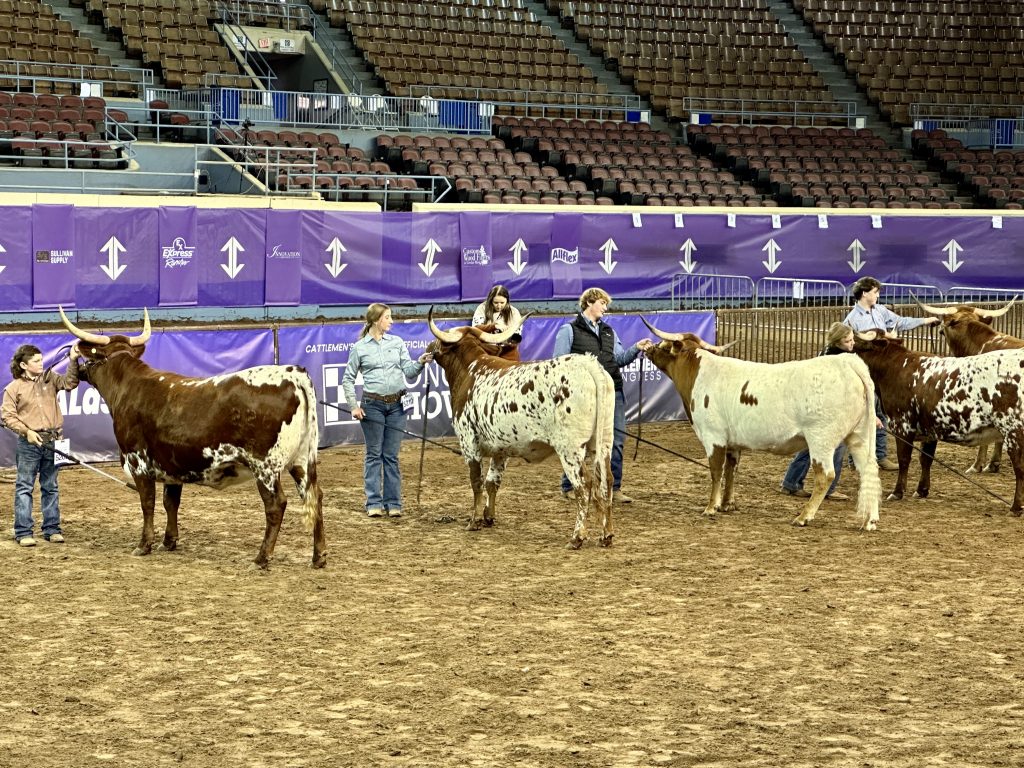
Rep. Cole's Column: Values of Faith, Giving and Gratitude

As I reflect on the significance of Christmas, I am reminded of the blessings that surround us. During this last month of the year, it is certainly easy to get swept up in the busyness of the end-of-year and holiday season to-do lists. However, we must not forget the values that unite us during this festive time. 

December is a time for family traditions, celebrations and even generosity to others, and one of the core principles of Christmas is the spirit of giving. This holiday season, let us be mindful of those less fortunate than us. Whether it is donating to local charities, volunteering at local shelters and centers or simply by reaching out to a neighbor in need, there are countless ways we can make a positive impact on the lives of others. By embodying the spirit of generosity, we reinforce the values that make our communities strong. 

We should all take time to pray for our armed forces stationed overseas during tumultuous global conflicts, far from their family, friends and loved ones. We also think of their families as they struggle with having them missing from their tables while they sacrifice so much for the safety of our citizens. And that serves true as well for our nation's first responders including law enforcement, firefighters and those serving on the front lines in the medical community. These selfless servants are who keep our country safe and moving so we can enjoy these holidays safely and in good health. 

The holiday season also provides time to reflect on the birth of our Lord and Savior, Jesus Christ. As a Christian, this holiday holds profound significance. The message of hope and love reminds us of the values that bind us as a resilient nation. Amid political differences, this season provides an opportunity to set aside our divisions and focus on what unites us all. 

May the values of faith, giving and gratitude guide us into the beginning of the next year. As your holiday celebrations continue, whether you share the same faith as myself or celebrate something else, I wish you, your family and loved one's immense joyfulness as you gather throughout the rest of this season. 

Smithfield Foods Distributes More Than 7,000 Free Holiday Hams in St. Charles, Illinois

Smithfield Foods distributed 7,300 free Smithfield Spiral Quarter Hams to brighten the holidays for individuals and families in the St. Charles, Illinois, area. "The holiday season is a time of giving, so this was the perfect time for Smithfield to give back to our local community," said Ashton Williams, plant manager of Smithfield's St. Charles food-processing facility. "On behalf of our 2,000 employees in Illinois, we are honored to have the opportunity to share the spirit of the season with our neighbors in St. Charles." 

Smithfield volunteers distributed more than 6,200 Smithfield Spiral Quarter Hams on a first-come, first-served basis at the event, which was held at Smithfield's St. Charles facility on Dec. 21. The remainder were donated to the St. Charles Fire Department, the St. Charles Police Department, Dekalb Fire and Rescue and Lazarus House, a homeless shelter in St. Charles, for distribution over the weekend.   

Since 2008, Smithfield's signature hunger relief program, Helping Hungry Homes®, has provided hundreds of millions of servings of protein all 50 U.S. states, as well as in Poland, Romania and Mexico. In 2022, Smithfield donated nearly 25 million servings of protein to food banks, disaster relief efforts and community outreach programs across the U.S. To reflect its continued commitment to fighting food insecurity, Smithfield has pledged to donate 200 million servings of protein by 2025.

For more information about Smithfield's programs to support local communities, please visit smithfieldfoods.com/helping-communities. 

Speaker McCall Files Tax Cut Legislation Ahead of Session

Oklahoma House Speaker Charles McCall, R-Atoka, has filed multiple pieces of legislation regarding personal income tax cuts ahead of the upcoming session of the Oklahoma Legislature. The bills are the latest in a series of tax cut plans that the House has filed and passed throughout the last three years.

"Everyday Oklahomans continue to feel the effects of destructive federal economic policies on their wallet, and they desperately need relief," McCall said. "The House has passed numerous tax cut bills to the Senate during multiple regular and special sessions throughout the last three years, and these new bills represent our latest attempt to get meaningful tax cuts passed and to the governor's desk. Our state is in a strong position both economically and in regards to savings, so now is the perfect time to pass tax cuts and let the citizens of Oklahoma keep more of their hard-earned money."

The bills filed by McCall are:

  • HB 2948 – Corporate income tax phase out over five years.
  • HB 2949 – Flat rate 4.25% personal income tax effective Jan. 1, 2024; rate imposed on taxable income amounts above specific figures based on filing status.
  • HB 2950 – .25% personal income tax decrease effective Jan. 1, 2024, and following tax years.
  • HB 2951 – .25% personal income tax decrease for 2024 and 2025, with rates to restore to current level (current rates and brackets) for 2026, and following tax years.
  • HB 2952 – .50% personal income tax decrease for 2024 and 2025, with rates to restore to current level (current rates and brackets) for 2026, and following tax years.

Previous tax cut legislation that has been passed by the House and is currently awaiting action in the Senate is:

  • HB 1953 – As amended – eliminates the current standard deductions and changes the personal income taxing framework from a bracket based system to a flat rate system. For tax year 2024 and 2025, sets the flat rate at 4.25%, with the rate imposed on taxable income amounts above specific figures based on filing status.
  • HB 1954 – .50% personal income tax decrease effective Jan. 1, 2024, and following tax years.

The second regular session of the 59th Oklahoma Legislature convenes on Monday, Feb. 5, 2024

EPA Reinstates Chlorpyrifos for Crops, Soy Growers Applaud

The U.S. Environmental Protection Agency announced Tuesday its decision to restore the use of the pesticide chlorpyrifos on crops, including soybeans, following a recent ruling by the U.S. Court of Appeals for the Eighth Circuit. The court found that EPA unlawfully revoked tolerances, ending use of the insecticide in 2021. ASA Director Alan Meadows (TN) spoke on behalf of the soy industry, expressing soy's satisfaction.

"U.S. soybean growers welcome the announcement that chlorpyrifos tolerances and uses will be restored, and EPA will commit to a science-based review of the pesticide, as ordered by the Eighth Circuit Court. EPA's own science has repeatedly found there are at least 11 high-benefit, safe uses of chlorpyrifos, including for soybeans—a fact of which we will continue to remind the agency throughout this process," said Meadows.  

EPA's decision aligns with the Nov. 2 ruling from the Eighth Circuit Court of Appeals, which determined that EPA neglected to consider its own scientists' findings in ending what were found to be safe uses of chlorpyrifos. The court vacated the EPA rule, restoring all agricultural uses of the pesticide.  

Farmers rely on pesticides like chlorpyrifos to protect crops and uphold conservation practices. Congress has established science-based processes to ensure safe use without harm to people or the environment.  

This decision follows a 2021 effective ban on chlorpyrifos use on food and feed crops, stemming from a Ninth Circuit Court ruling which gave EPA the choice to prohibit all uses or make a finding on residue levels from safe uses within 60 days. EPA is expected to officially reinstate chlorpyrifos use imminently, pending the ruling from the Eighth Circuit going into effect.  

Grower groups, including ASA, have voiced concerns about blanket bans on chlorpyrifos, highlighting the negative impact on crops and farmers' livelihoods when agencies disregard their own science and processes.  

While EPA allows all revoked uses of chlorpyrifos to resume, it plans to propose a new rule revoking pesticide residue tolerances for all uses except 11 specified by the court. These 11 uses, including crops like alfalfa, soybeans, citrus, peaches, and tart cherries, rely on chlorpyrifos to control various insects.  

Read ASA's media statement here.  

Lawsuit Withdrawn from State of Oklahoma and State Treasurer's Office

Yesterday, Dec. 20, attorney Collin Walke at Hall Estill, withdrew the lawsuit against the State of Oklahoma and the office of the State Treasurer, Todd Russ. The lawsuit originally filed Nov. 20, alleging a violation of the Constitution by enforcing House Bill 2034, was withdrawn exactly one month later. The lawsuit was trying to place an injunction on the Energy Discrimination Elimination Act of 2022, which in intended to protect the oil and gas industry in Oklahoma.

The office of the Oklahoma State Treasurer intends to file a counter claim for attorney fees and legal expenses against the plaintiff as allowed by law.

Speaker McCall Assigns Caldwell, Dobrinski New Committee Leadership Positions

Oklahoma House Speaker Charles McCall, R-Atoka, today assigned Rep. Trey Caldwell, R-Lawton, and Rep. Mike Dobrinski, R-Okeene, to new committee leadership positions. Caldwell will serve as Vice Chair of the House Appropriations and Budget Committee, and Dobrinski will serve as Chair of the House Utilities Committee.

"Rep. Caldwell and Rep. Dobrinski are important leaders both in our caucus, and in the House of Representatives," McCall said. "The depth of experience, and attention to detail, that they bring to these new positions will serve our members, and the citizens of our state well."

Caldwell previously served as Chair of the Utilities Committee and is excited about his new role.

"I am honored to be chosen by Speaker McCall to serve in this important role," Caldwell said. "During my time in the House, I have made it a priority to ensure that the Legislature is a good steward of taxpayer dollars. I am thankful that I will get to continue working to increase transparency and accountability in the appropriations process through this new role."

Dobrinski served as Vice Chair of the Utilities Committee, a role he believes will help him as he ascends to Chair.

"I am thankful that Speaker McCall has trusted me to lead the Utilities Committee," Dobrinski said. "As our state grows, and new businesses choose to expand into Oklahoma, it is vital that we stay ahead of utility needs that arise both now and in the future. Serving as vice chair has given me a unique perspective into the issues that will come before the committee, and I am excited for the opportunity to work with my fellow members in the upcoming session."

The leadership changes are effective immediately, and the second regular session of the 59th Oklahoma Legislature convenes on Monday, Feb. 5, 2024.

Elite offerings available in January from the Angus Foundation

Jaclyn Boester, Angus Foundation executive director, introduces the 2023 Angus Foundation Heifer Package donor, Coleman Angus of Charlo, Mont., at the National Angus Bull Sale in Oklahoma City. January brings several opportunities to support the Angus Foundation, including the 2024 heifer package donated by Yon Family Farms of Ridge Spring, S.C.

Heifer package, donation lots, and live auction to support Angus education, youth and research.

January brings a number of opportunities to support the Angus Foundation's mission to advance Angus education, youth and research. With offerings available in conjunction with both Cattlemen's Congress in Oklahoma City, and the National Western Stock Show in Denver, next month promises to set the tone for another year of Angus generosity.

Angus Foundation Heifer Package
Each year the Angus Foundation Heifer Package leads the National Angus Bull Sale. The 2024 heifer package will be donated by Yon Family Farms of Ridge Spring, South Carolina. The heifer, Yon Sarah K1233 (AAA *20450734), is a maternal sister to both Yon Top Cut G730 and Yon Saluda. Yon Sarah K1233 is safe in calf to Yon Toccoa F1054, with an anticipated due date of March 21, 2024.

The heifer package also includes an Advanced Reproductive Technology Package from Trans Ova Genetics, trucking to the buyer donated by Lathrop Livestock Transportation and 30 days of mortality insurance donated by Jeanne Conover, Livestock Insurance Agent with Conover Auction Service.

The sale starts at 2:00 p.m. on Friday, January 5, 2024, at the Cattlemen's Congress in Oklahoma City. To learn more about the Angus Foundation Heifer Package visit bit.ly/3QoKFty.

Sale lot offerings
Two Angus Foundation "Fund the Future" donation lots will sell in January. The Fund the Future program allows breeders to donate proceeds from a designated sale lot to the Angus Fund, which provides unrestricted dollars to support the breed. Lathrop Livestock Transportation has also donated complimentary trucking of these lots.

The Bases Loaded Sale, held January 2 at Heritage Place in Oklahoma City, will feature a heifer pregnancy donated by Four Sons Farm, Cynthiana, Kentucky. The pregnancy, Four Sons Blackbird 1804, is from the headlining Four Sons donor, PV Blackbird 1804 and sired by the $450,000 multi-trait highlight, GAR Fireproof. The anticipated due date is January 14, 2024. The Fund the Future donation will sell as Lot A, with 100% of the proceeds benefiting the Foundation's mission.

The Angus Foundation Female Sale at the National Western Stock Show, held January 11 in Denver, will also feature Lot A as a Fund the Future lot. Sadler Ranches, Perkins, Oklahoma, has donated 100% of yearling bull, Sadler Defender 3035 (AAA +*20707994). The Blair's External Law son is out of Coleman Donna 8113, the foundation female in the Sadler Ranches donor lineup.

Angus Herdsman Social
The Foundation will again host a celebration for the Angus family at the 2024 Cattlemen's Congress. The Angus Herdsman Social will serve as an evening of fellowship in Oklahoma City, Friday, January 5.

The doors of the Cattlemen's Bar in Barn 3 will open at 3:45 p.m. following the National Angus Bull Sale. The event will feature a group of exciting auction and raffle items to benefit the Foundation's mission, food and refreshments and the announcement of the 2024 Angus Herdsman of the Year.

Auction highlights include a women's accessory set with a ladies Stetson hat, King Ranch tote bag, scarf slide, and limited edition "150th Celebration" silk scarf; and a men's Angus silk tie set, with silk ties from the Angus Foundation's "150th Celebration" and "Varsity" collections. The offering will also feature a "Pioneer Woman Weekend" in Pawhuska, Oklahoma, among other exciting items and experiences.

Those interested in any of these offerings in January are encouraged to contact Jaclyn Boester, Angus Foundation executive director, at JBoester@Angus.org, or their regional manager. To learn more about the Angus Foundation and its mission, visit www.AngusFoundation.org.

– Written by Peyton Schmitt, Angus Communications  

National Corn Growers Association Joins Others Ag Groups in Calling for Reopening of Eagle Pass and El Paso Rail Crossings

The National Corn Growers Association is increasing pressure on U.S. officials to reopen the recently closed Eagle Pass and El Paso rail crossings into Mexico.

"These closures will have an immediate and prolonged impact on corn exports to Mexico, one of our closest and largest trading partners, during a period of high demand," NCGA President Harold Wolle said today. "We urge our federal officials to resolve this issue quickly so the flow of goods between the two countries can resume as soon as possible and minimize the damage that has already been done by these abrupt closures."
 

The two rail crossings along the Texas border towns were closed on December 18 by the U.S. Customs and Border Protection as part of an effort to prevent migrants from entering the country illegally. Twenty-five percent of U.S. corn exports into Mexico go through El Paso and Eagle Pass.

On Thursday, the National Corn Growers Association joined other national ag groups in sending a letter to Homeland Security Secretary Alejandro Mayorkas calling for him to quickly reopen the rail crossings.
 

"Each day the crossings are closed we estimate almost 1 million bushels of grain exports are potentially lost along with export potential for many other agricultural products," the letter noted.
 

The letter also argued that the closures could have long-term impacts on U.S. exports.
 

"We are aware of grain trains sitting at origin in at least six states that are unable to move, and we expect this number to grow," the letter said. "We have also heard of customers in Mexico telling U.S. suppliers they will begin to look to other countries if the U.S. cannot provide a resilient and reliable supply chain."

Mexico was the U.S.'s second largest trading partner in 2022. Mexico relies heavily on America's grains to feed livestock that is now threatened by the rail closures. Corn grower leaders plan to continue to sound the alarms until the issue is resolved.

National Farmers Union's Anne Steckel Stresses Importance of Farm Bill Sooner Rather than Later

Listen to KC Sheperd talk with Anne Steckel about the Fairness for Farmers Campaign and more.

Farm Director, KC Sheperd, is visiting with the National Farmers Union Biofuels Advisor, Anne Steckel, about the Fairness for Farmers Campaign and more.

"The National Farmers Union is a very grassroots-driven organization," Steckel said. "All of our policy starts from our farmer members at the state level."

Through the Fairness for Farmers Campaign, NFU advocates for fair agriculture markets and supports specific policy actions such as reforming the Packers and Stockyards Act, allowing for the Right to Repair equipment, and diversifying marketing opportunities and antitrust enforcement.

"It is actually exciting to see the Fairness for Farmers Campaign and kind of the evolution of it," Steckel said. "For a long time, this has been a very big issue for the National Farmers Union: having more competition and more choice for our farmers. Certainly, the folks in Oklahoma understand this and are at the forefront of it."

Looking into the Farm Bill, Steckel said NFU is focused on ensuring there is a competition title. Steckel said while NFU was happy to see an extension, there is still pressure to see a farm bill sooner rather than later.

"If we don't, it could slide into 2025, and we know that there are so many important programs within a farm bill that need to be reauthorized," Steckel said. "That is what we are doing is having our members really get out there and talk to elected officials about the importance of getting this farm bill done sooner rather than later."

Ferguson College of Agriculture faculty honored at OSU Awards Convocation

Left to right, Chris Francisco, OSU Academic Affairs/Provost and Senior Vice President, awards Karen Hickman, environmental science undergraduate program director, with the Assessment Champion for Student Success in Learning Award at OSU Convocation. (Photo by Oklahoma State University)

Faculty, staff and administrators from the Oklahoma State University Ferguson College of Agriculture were recognized earlier this month at OSU's annual University Awards Convocation.

"These recent award winners exemplify the spirit of our institution through their dedication, commitment and innovation, reflecting their hard work and showcasing the bright future for OSU Agriculture," said Jayson Lusk, vice president and dean of OSU Agriculture. "It's rewarding to work with colleagues of this caliber who are making meaningful contributions to the field."

OSU Provost Jeanette Mendez presented awards to the following members of the Ferguson College.

The Regents Distinguished Research Award recognizes faculty who have shown unusually significant achievement in their field of research.

The Regents Distinguished Teaching Award recognizes faculty who have shown unusually significant achievement in the instruction of students for an extended number of years.

  • Jon Ramsey, Agricultural Education, Communications and Leadership

The Global Education Faculty Excellence Award honors faculty who have distinguished themselves by integrating a global perspective into instruction, research and outreach.

Newly Appointed Chair and Professorship Holders

The Assessment Champion for Student Success in Learning Award honors an academic program assessment individual or team who demonstrates innovation and creativity in assessment planning and implementation for continuous improvement in support of student success. Winners of this award are recognized as leaders who contribute to the establishment of a campus-wide culture of assessment in student learning, in support of the We Are Land-Grant strategic plan.

The Advising Excellence Award provides institutional recognition for outstanding academic advising by faculty and staff.

The Regents Professor honorary title is awarded to faculty judged by peers to have made outstanding contributions to their discipline through accomplishments in instruction, research, scholarship and Extension.

The Oklahoma Foundation for Excellence statewide award recognizes and encourages academic excellence in Oklahoma public schools, including one award for teaching excellence at an Oklahoma research university.

The Distinguished Early Career Faculty Award recognizes faculty who were awarded tenure within the past three years and have demonstrated a strong potential for continued contributions to the university and their profession in the areas of instruction, research and creative activity, and/or Extension/outreach.

OSU Agriculture is dedicated to improving the quality of life of Oklahomans through science-based information and education. It is comprised of the Ferguson College of Agriculture and two state agencies: OSU Ag Research and OSU Extension.

By Gail Ellis

U.S. Grains Council Statement Regarding Rail Suspension At U.S.-Mexico Border

On Monday, Dec. 18, 2023, U.S. Customs and Border Protection (CBP) was forced to suspend rail operations at key points into and out of Mexico, specifically El Paso and Eagle Pass, Texas, to alleviate a sharp increase in illegal immigration at the border. These actions affect U.S. corn and barley at this time, two commodities the U.S. Grains Council represents. The CBP is working with the Mexican government and the Mexican rail system to remedy the situation as quickly as possible, but there is no timeline for resumption of normal operations. The U.S. Grains Council in Mexico is working with the Mexican industry and end users and monitoring the situation to ensure the least amount of disruption in services. Mexico is the top U.S. trading partner for U.S. corn, distiller's dried grains with solubles (DDGS) and barley, purchasing 16 million metric tons (MMT), 2 MMT and 317,000 metric tons, respectively, in the 2022-2023 marketing year.

"The suspensions in El Paso and Eagle Pass threaten to impact trade to our most important partner, so we are working hard in the country to help alleviate the issues as quickly as possible," said Ryan LeGrand, U.S. Grains Council president and CEO. "The trading system in North America relies on interconnectedness, and any disruption affects both the U.S. and Mexican economies, not only with corn, DDGS and barley, but it also affects processing, biofuels production, feeding livestock and more, so it is vital the situation is resolved in a timely manner for the betterment of producers, industry and consumers on either side of the border."

The Council will continue to monitor the situation.

Cow that Stole Christmas Resulted in Stronger Trade Agreements with International Markets

Listen to Ron Hays talk with Don Close for Part 2 of The Cow That Stole Christmas.

Senior Farm and Ranch Broadcaster Ron Hays is back talking with Terrain's Chief Research and Analytics Officer, Don Close, for part two about the cow that stole Christmas in 2003.

Close said the biggest impact of the first case of BSE (Bovine Spongiform Encephalopathy) in the U.S. 20 years ago was on exports.

"Exports accounted for roughly ten percent of U.S. beef production," Close said. "Far and away, our largest customer at that time was Japan. Overnight, our exports went from ten percent of production to zero, or essentially zero. We had that additional tonnage of product on the domestic market that only further compounded the erosion in the beef market."

Close said it took months of negotiations with Japan to reopen the market.
"Initially, we were aging all of the cattle, and we were implementing the 30-month rule, so there were big fights over whether we were using bone ossification for age determination, or we could use dentition," Close said.

Close added that there were also issues regarding the use of head meat.

"Packers were having to go in and remove all of that spinal cord from the split carcasses," Close said.

As trade began to open back up, Close said other countries began to conduct their own detailed inspections.

"If they would find any piece of spinal cord material in that box, then the whole load was rejected," Close said. "Then you were looking at the destruction of that load or returning it. The whole situation was complicated."

In dealing with feedback from the media, Close said groups like the National Cattlemen's Beef Association did a tremendous job with response.

"The number of interviews and the placements of interviews they were getting on the Today Show, and the evening news programs, and every opportunity they had to explain to consumers that beef was still safe that all the safety protocols were in place...," Close said.

The government also did its job in reassuring the public that beef was safe to consume as they worked on a country-to-country basis to reestablish trade.

Close said that one positive that came out of the emergency is strengthened trade agreements with other countries. In the event of another food safety issue, Close said there are negotiated procedures to be followed regarding exports.

The Beef Buzz is a regular feature heard on radio stations around the region on the Radio Oklahoma Network and is a regular audio feature found on this website as well. Click on the LISTEN BAR below for today's show and check out our archives for older Beef Buzz shows covering the gamut of the beef cattle industry today.

CLICK HERE to listen to the full conversation with Don Close about the cow that stole Christmas on the Ag Perspectives Podcast with Ron Hays.

Oklahoma Drought Conditions See Decreases in All Categories this Week

To view the latest Oklahoma drought map, CLICK HERE.

According to the latest Oklahoma drought monitor report, exceptional drought remains at zero, unchanged from the past three months.

Extreme drought or worse is now at .19 percent, down from last week's 1.15 percent.

Severe drought or worse is now at 4.49 percent, down from last week's 10.38 percent.

Moderate drought or worse is now at 26.15, down from last week's 32.88 percent.

Abnormally dry or worse conditions are now at 61.81 percent, down from last week's 67.68 percent.

According to the 6-to-10-day precipitation outlook map, the eastern half of the state and parts of western Oklahoma are leaning below a 33 to 40 percent chance of precipitation through December 30. Southwestern Oklahoma and the panhandle lean below a 40 to 50 percent chance of precipitation through that date.

To view the United States Drought Map, click here.

According to the latest U.S. Drought Monitor, moderate or heavy precipitation amounts fell in three main areas this week: central and northern California, parts of the southwestern Great Plains (especially southwest Kansas through the Oklahoma and Texas Panhandles), and along the East Coast. Warmer-than-normal temperatures occurred this week across much of the central and northern contiguous United States. For areas in drought or abnormal dryness that received heavy precipitation amounts, improvements occurred locally due to lessening precipitation deficits and increased streamflow and/or soil moisture. In areas between the southern Great Plains heavy rain and the East Coast heavy rain, deficits in streamflow, soil moisture, and precipitation worsened, leading to widespread degrading conditions. Heavier rains fell on the northeast half of Puerto Rico this week, and scattered moderate drought and abnormal dryness continued on the island. A mix of degradations and improvements occurred in Hawaii this week, with a wet trade wind pattern bringing needed rainfall to windward slopes of Oahu and Molokai. Alaska remained free of drought and abnormal dryness this week.

In the Southern Plains, a soaking rain event occurred this week in parts of the western Great Plains, especially in the Texas and Oklahoma Panhandles and adjacent western Oklahoma and western north Texas. In these areas, precipitation deficits and soil moisture improved enough for widespread improvement to abnormal dryness or drought. Recent rains from before this week led to a reassessment of conditions and some localized improvements in eastern Tennessee. Drier weather occurred in between these locations, with the exception of some rain across Louisiana (which did little to improve the situation but prevented worsening of conditions). Deficits in soil moisture, streamflow, and short- and long-term precipitation continued to locally worsen in northeast Texas, Arkansas, northern Mississippi, and western Tennessee, leading to degrading conditions in some of these areas. Other than parts of Mississippi and Louisiana, most of the region experienced warmer-than-normal temperatures this week, with western Oklahoma and parts of western north Texas and the Texas Panhandle coming in at 4 to 8 degrees above normal.

In the High Plains, in parts of southern Colorado, south-central and eastern Nebraska, and much of Kansas, moderate to heavy precipitation amounts fell this week. Improvements to ongoing drought and abnormal dryness occurred in a north-to-south band across central and western Kansas, where this week's precipitation lessened precipitation deficits and improved soil moisture. Localized improvements to drought also occurred in south-central Nebraska, where this week's rain was enough to alleviate precipitation and soil moisture deficits somewhat. Low snowpack and dry conditions for the past few months continued in northern Colorado, leading to a southward expansion of moderate drought and abnormal dryness in high elevations.

The wet weather in southern Colorado led to some improvements to drought conditions. Dryness from the past couple of months increased in eastern South Dakota and in the Black Hills, leading to abnormal dryness expanding or developing in both areas. Temperatures in Nebraska, Colorado, and Kansas were mostly 3 to 9 degrees above normal, with a few local cooler exceptions. In the Dakotas, temperatures ranging from 6 to locally 15 degrees warmer than normal were common.

In the West, coastal central and northern California, and parts of the northern Central Valley and northern Sierra Nevada, received heavier precipitation this week, exceeding 2 inches in some places. Lighter precipitation amounts fell in coastal portions of Oregon and Washington. In parts of northern and southeast New Mexico, precipitation this week was enough to improve streamflow, soil moisture and precipitation deficits sufficiently for localized improvements to drought conditions. Short-term drying in parts of east-central Utah led to a small expansion of abnormal dryness. In southwest and south-central Montana, low snowpack amounts, short-term precipitation deficits, and soil moisture deficits led to localized expansion in drought and abnormal dryness. A reassessment of short- and long-term conditions in northwest Montana, the northern Idaho Panhandle, and parts of central and western Washington led to localized improvements to ongoing drought and abnormal dryness.

Looking ahead, from Wednesday, December 20 to Christmas evening, the National Weather Service Weather Prediction Center is forecasting three areas of heavier precipitation accumulations. The first, where amounts are likely to be between 0.75 to 3 inches of precipitation, is forecast for far western Oregon and Washington. In the Southwest, 0.75 to 2 inches of precipitation is forecast from Arizona into southern California, with higher amounts possible near and northwest of Los Angeles. From the central Gulf Coast northward to the middle Missouri and Mississippi River Valleys, precipitation amounts are forecast to range from a half inch to 2 inches, with locally higher amounts possible from northeast Texas into western Arkansas, and along the Louisiana, Mississippi, and Alabama coasts.

From December 26-30, the NWS Climate Prediction Center forecast favors below-normal precipitation for most of the region from the Mississippi River and Great Lakes west to the Great Basin. Above-normal precipitation is favored along the West and East Coasts and in deep south Texas. Below-normal temperatures are favored in areas near the Louisiana and Texas coasts. Elsewhere, near- or warmer-than-normal temperatures are forecast for much of the rest of the contiguous United States. Except for southwest Alaska, above-normal precipitation is favored for much of the state. Colder-than-normal temperatures are more likely in the western third of Alaska, while the eastern third is more likely to see warmer-than-normal weather. Drier-than-normal weather is favored across Hawaii, and cooler-than-normal temperatures are favored on the Big Island and the eastern half of Maui.

To view the 6-10 Day Precipitation Outlook Map, click here.

To view the 6-10 Day Temperature Outlook Map, click here.

To view the Monthly Drought Outlook Map, click here.

Private applicators license recertification deadline is Dec. 31

Oklahoma Farm Bureau encourages farmers and ranchers who hold a private applicators license to recertify their licenses that may be up for renewal.

Holders of private applicators licenses in the state of Oklahoma who received a renewal notification letter from the Oklahoma Department of Agriculture, Food and Forestry need to recertify their licenses that are up for renewal either by mail or online process by December 31, 2023.

The notification letter shows the number of continuing education units a licensee holds, how many CEUs are needed for renewal (if any) and includes instructions for renewal.

For questions about the renewal process, producers can contact ODAFF by email at pesticide@ag.ok.gov or by phone at (405) 522-5949.

Midwest Dairy CEO Announces Retirement

Midwest Dairy, the checkoff organization representing over 4,000 dairy farmers in a ten-state region in the Midwest, would like to share that Molly Pelzer, the current Chief Executive Officer (CEO) of Midwest Dairy, has officially announced her retirement from the organization effective in March of 2024. Midwest Dairy's board has engaged a search firm to guide the selection of the next CEO for the organization.

Pelzer started her career with Midwest Dairy as a program director working with schools and health care professionals in June of 1984. Since then, she has held numerous leadership positions before accepting the role of CEO role in 2019. Prior to Midwest Dairy, she worked with the Midland Dairy Association and Dairy
Council, Inc., both former checkoff organizations that are now part of the Midwest Dairy organization. A
registered dietitian, Pelzer graduated from the University of Missouri–Columbia.

"Molly has contributed almost 40 years of experience to the dairy checkoff, and her achievements will be
celebrated. She has held leadership roles across the organization and has truly made an impact. I have
appreciated Molly's work ethic, devotion to the dairy farmers, and focus on making a difference. I wish her
nothing but the best as she enjoys her retirement," said Charles Krause, Corporate Board Chair of Midwest
Dairy.


Pelzer is the third CEO in Midwest Dairy's 23-year history. In her role as CEO, Pelzer provides strategic
guidance to Midwest Dairy's staff of more than 55 employees as they fulfill the organization's vision: to bring
dairy to life, and its mission: to give consumers an excellent dairy experience. Through her leadership, Midwest
Dairy focused on maximizing the dairy farmers' investment in the dairy checkoff by strategic collaboration with
targeted retailers, foodservice, wellness, and industry partners, as well as focusing on research that leads to
the development of solutions for industry and consumer needs.
During Pelzer's tenure, she has played a critical role in building trust and demand for the dairy industry. She is
most proud of creating the metrics scorecard developed at Midwest Dairy over the last four years. This scorecard helps clearly communicate to farmers the impact of their checkoff investment. Pelzer has also
enjoyed working closely with the farmer boards and takes great pride in checkoff being farmer-led.

"Over my time at Midwest Dairy, I have seen checkoff strategies evolve and foster new ideas that make a
difference for dairy farm families. It has been a privilege to work for dairy farmers in each of my roles in dairy
checkoff, and I will continue to be a dairy advocate in my retirement. Knowing how hard they work to produce
milk that feeds and nourishes the world is a daily inspiration. I owe my career to the dairy farm families in our
ten-state region. Thank you for what you do and for allowing me to work with you to build trust and demand for
dairy," said Pelzer.


Midwest Dairy has retained Fred Pabst, Dairy and Agriculture Search Practice Leader at Herd Freed Hartz to
lead the selection process for the next CEO. All inquiries should be directed to Pabst, who can be reached by
email at fred@herdfreedhartz.com. More information about the position can be found at midwestdairy.com

Growth Energy Statement on CBP Suspension of Rail Operations in Eagle Pass and El Paso, Texas

Growth Energy CEO Emily Skor issued the following statement regarding the ongoing suspension of rail operations by U.S. Customs and Border Protection (CBP) at two crossings in Eagle Pass and El Paso, Texas.

"Every day, millions of gallons of American bioethanol and key coproducts like high-protein animal feed are transported safely and efficiently by rail. The impact of any rail shipping closure ripples out to impact the entire North American rail system, including the routes most relied upon by American farmers and biorefiners. Mexico is also a critical export market for American bioethanol and animal feed, meaning the closures at Eagle Pass and El Paso are uniquely challenging for our industry. "CBP's concerns are important, but these closures have a severe impact on important agricultural trade with Mexico that affects the livelihood of many Americans. We urge CBP to rethink its approach and to immediately reopen these crossings before the disruption worsens and damages American agriculture, particularly during the busy holiday season."

Dairy Discovery Zone Wraps Up 2023 Tour Adding New Stops in Texas and Colorado

Dairy MAX's award-winning, interactive Dairy Discovery Zone exhibit (DDZ) has successfully completed its 2023 tour. This year, the DDZ marked new milestones by debuting at the Greeley Stampede in Colorado, the State Fair of Oklahoma and the Heart O' Texas Fair and Rodeo, alongside continued appearances at the Colorado State Fair, New Mexico State Fair and the State Fair of Texas.

The Dairy Discovery Zone continues to be an extraordinary opportunity for people of all ages to immerse themselves in the world of dairy. Whether you're a curious child or a health-conscious adult, the exhibit provides a wealth of information and fun activities related to dairy production, nutrition, sustainability and more.

"The Dairy Discovery Zone is more than just an exhibit; it's a bridge connecting the modern family to the roots of dairy farming," says Adrian Castresana, Dairy MAX's director of consumer experience and events. "Our participation at these venues have given us an incredible opportunity to educate, engage and entertain fairgoers about the journey of dairy from farm to table, and this year marked the highest number of events and public engagements in DDZ history."

The tour kicked off the second half of 2023 at the internationally acclaimed Greeley Stampede (June 22 - July 4), a festival renowned for its rich tradition, drawing over 250,000 attendees from around the world. The animatronic cow continued to be a visual favorite for TV, as seen here on Denver's NBC Channel 9 Colorado & Company.

The DDZ's journey continued through the Colorado State Fair (August 25 - September 4) held in Pueblo, to the New Mexico State Fair (September 7 - 17) in Albuquerque, collectively attracting over 950,000 fairgoers. The New Mexico State Fair has consistently been in the top five ranked fairs in the nation.

The State Fair of Oklahoma (September 14 - 24), with 900,000 annual visitors, has grown to become one of the premier State Fairs in the nation and is located only a mile from downtown Oklahoma City. Here the DDZ exhibit was highlighted in The Oklahoman and featured on NBC Channel 4, reaching an additional 25,000 people and broadcast in more than 730,000 homes. Additional media coverage was captured in Oklahoma when the DDZ made national news on Yahoo! News.

The next stop was the State Fair of Texas (September 29 - October 22) where they welcomed more than two million fairgoers. Of those two million, 46,000 visitors stopped by to experience the Dairy Discovery Zone. National Farmer's Day (October 12) continued to be a highlight of the State Fair of Texas where Dairy MAX handed out cartons of white, chocolate and strawberry milk. Running concurrently with the State Fair of Texas, Dairy MAX was able to showcase the miniature DDZ exhibit for the Heart O' Texas Fair & Rodeo in Waco, Texas (October 5 - 15). Waco's CBS Channel 10 featured the interactive exhibit and one of their reporters "milking" June, the animatronic cow, for a live morning newscast during the fair.

The Dairy Discovery Zone continues to make an impact on communities across the region, serving as a vital platform for spreading awareness about the numerous benefits of dairy and the dedication of our farmers. Through its interactive and engaging format, the exhibit not only educates the public about the nutritional value of dairy products, but also sheds light on the meticulous care and hard work farmers invest in bringing these wholesome dairy foods from their farms to our tables. By bridging the gap between consumers and the agricultural community, the DDZ plays a crucial role in fostering appreciation and understanding of the contributions dairy farmers provide to our overall health and well-being.

"We're addressing misconceptions about dairy and highlighting the care, passion and dedication of our dairy farmers towards their animals, land and communities," Castresana adds. "With strategic partnerships and increased visibility through media coverage, we are nearing a significant milestone of reaching nearly three million engaged visitors."

As the Dairy Discovery Zone prepares for the 2024 season, it continues to be a testament to Dairy MAX's commitment to connecting communities with the dairy industry. For more information on the Dairy Discovery Zone and its upcoming locations, please visit DairyDiscoveryZone.com.

Oklahoma Wheat Commission's Mike Schulte Discusses Gravity of Closed Rail Crossings on Mexican Border

Listen to Ron Hays talk with Mike Schulte about closed rail crossings and the 2024 wheat crop.

Senior Farm and Ranch Broadcaster, Ron Hays, is talking with Mike Schulte of the Oklahoma Wheat Commission about the closed rail crossings on the Mexican border putting wheat exports at risk.

"We do have two rail crossings that have now closed across the borders in the Southern Plains...," Schulte said.

U.S. Wheat Associates (USW) and the National Association of Wheat Growers (NAWG) have joined several other U.S. agricultural organizations in signing a letter encouraging U.S. Customs and Border Protection to reopen rail crossings in El Paso and Eagle Point for trade as quickly as possible.

"It is creating challenges for us on the supply side, and I think a great concern that these are really two of our largest access into the export market for Mexico and South America as we move things, whether it be bulk commodity to really any ag processed food item that goes to these regions," Schulte said. "The impact is going to be quite large."

On average, Schulte said nearly two-thirds of the U.S. agriculture exports go to Mexico via rail, making Mexico the second-largest export market overall for agriculture and the top export market for U.S. wheat.

"We are talking about 28.5 billion dollars in sales this year alone that have gone into Mexico on our exports through this region," Schulte said.

Schulte and Hays also talked about the 2024 winter wheat crop in Oklahoma. Click the listen bar above the story to hear the full conversation!

Read the press release from the U.S. Wheat Associates and the National Association of Wheat Growers commenting on the closed rail crossings on the border below:

Closed Rail Crossings on the Mexican Border Put Crucial Wheat Exports at Risk

U.S. Wheat Associates (USW) and the National Association of Wheat Growers (NAWG) have joined several other U.S. agricultural organizations in signing a letter encouraging U.S. Customs and Border Protection to reopen rail crossings in El Paso and Eagle Point for trade as quickly as possible.

Given the huge volume of U.S. wheat sales that move directly to Mexican customers by rail, the sudden decision on December 17 to close these two crucial rail crossings on the border has the potential to be a major disruption in this important trade relationship.

Mexico is historically the top export market for U.S. wheat with average annual commercial sales of almost 132 million bushels. A substantial volume of U.S. wheat is shipped by rail every year and it is estimated that at least 13 million bushels of wheat, valued at more than $114 million, per year moves through the rail corridors at the El Paso and Eagle Pass crossings that are now closed.

Mexican customers use rail to import U.S. wheat from as far away as the Northern Plains and loaded trains are currently waiting to move. This unexpected disruption puts those sales at risk, as well as the positive trading relationship our industry has built over decades as a reliable supplier of high-quality U.S. wheat to Mexican flour millers and their commercial bakery customers. Like the other national agricultural organizations signing the industry letter, USW and NAWG understand the U.S. Customs and Border Protection agency have significant challenges given the situation at the border, but a supply chain crisis in Mexico can, and should be, avoided by safely reopening the international crossings.

Animal Agriculture Alliance releases reports from 2023 animal rights conferences

Food chain - from farm to fork - urged to prepare for activism in 2024 including "open rescue," legislative campaigns, and pressure to drop meat from the menu.

The Animal Agriculture Alliance has concluded the release of reports from four prominent animal rights extremist conferences held throughout 2023. The conferences included: Direct Action Everywhere's Animal Liberation Conference (ALC) (held June 9-14), The Animal and Vegan Advocacy Summit (held July 27-30), Humane Society of the United States' Taking Action for Animals (TAFA) Conference (held August 5-6), and Animal Legal Defense Fund's Animal Law Conference (held October 20-22). The Alliance also released a report from The Reducetarian Summit (held October 27-29).

Key discussions among speakers at these conferences included: a need for increased "investigations" and "open rescues" conducted at farms and processing facilities; calls for animal rights extremists to become more engaged politically and in the legislative process; strategies to pressure restaurant, retail, and foodservice brands to reduce their sourcing of meat, dairy, poultry, eggs, and seafood; and ways the animal rights movement can tap into other key issues to gain attention such as public health and climate change.

"Monitoring the strategies and tactics of the animal rights movement, including through our release of conference reports, allows Alliance members and the broader agriculture community – from farm to fork – to be aware of how these organizations are becoming increasingly aggressive in their efforts to take meat, poultry, dairy, eggs, and seafood off of consumers' plates," said Hannah Thompson-Weeman, Alliance president and CEO. "I hope that everyone involved in raising, processing, and retailing animal protein will take the opportunity to review the main themes of these reports and implement measures to safeguard their livelihoods."

Direct Action Everywhere's (DXE) Animal Liberation Conference primarily focused on its "right to rescue" campaign, as DXE has been advocating for the legal right to conduct "open rescues," which entail entering farms and plants without permission and taking livestock and poultry. DXE extremist Alicia Santurio, who faced trial this year in charges stemming from one such incident, says DXE's version of "open rescue" is, "[W]e do go into these places of violence and if we see a sick or injured animal that really needs us, those are the ones we rescue, but I don't think that's the only reason you have to rescue an animal." Speakers at the event made their viewpoints of animal agriculture clear as Erin Wing, Animal Outlook's director of "investigations" claimed, "Animal agriculture is a complex machine refined over centuries and designed to torture and destroy all of the living beings within it."

The decision for the Supreme Court to uphold California's Proposition 12 was a key focus at several conferences, including the Animal and Vegan Advocacy Summit and the Humane Society of the United States' (HSUS) TAFA Conference. Both conferences emphasized the recent "victory" and its implications for the animal rights movement. Kate Brindle, HSUS, said, "The court's decision... not only upheld Proposition 12 and laws like it... it essentially gave a judicial green light so that we can keep working in the legislatures to free animals from suffering and extreme confinement." The Ending Agricultural Trade Suppression Act was also denounced as "the biggest threat...ever seen to animal protection." We expect to see more pressure on this proposed legislation in 2024 as several animal rights supporters, including speakers at the Animal Legal Defense Fund's Animal Law Conference have called it a "disaster for farmed animals."

Several conferences also touched on their strategies to continue pressuring restaurant, retail, and foodservice brands to reduce their sourcing of meat, dairy, poultry, eggs, and seafood. Josh Bisig with ProVeg, an organization focused on "food system change," said, "Our mission is to replace 50% of animal products globally with plant-based and cultivated foods by 2040." It was also stated that creating change at the food brand level was an effective way to force change at the farm level. Danielle Melgar, U.S. PIRG, shared an example: "We saw an opportunity to instead turn to a corporate campaign approach, so that we could get major restaurant chains to make commitments to purchasing meat that was raised without the routine use of antibiotics. This would then change what their suppliers are doing."

Animal rights groups have been using the coattails of issues of significant public interest such as climate change, public health, and social justice to reach wider audiences. David Meyer, Food Systems Innovations, put it this way: "What is it about this climate crisis that is actually a huge opportunity for the animals? Well, it's a new reason to not eat animals, but this one can't be ignored." Brian Kateman, Reducetarian Foundation, said, "We are in a room where everybody agrees that we must end factory farming and we have to reduce the size of consumption of animal products. We don't have to agree on everything in order to make progress on that one thing." All 2023 animal rights conference reports, which include accounts of speaker presentations and general observations, are available to Alliance members in the Resource Center on the Alliance website. The Alliance website also includes reports from previous years' animal rights conferences. Media wishing to obtain copies of the full report, or for all other inquiries, please contact Emily Ellis, manager, communications and content, at eellis@animalagalliance.org.

CAB Insider: Carcass Premium Spreads Continue Strength

Live Cattle futures began a recovery from their oversold position beginning Friday, December 8. The uptrend has added $6.20/cwt. to the current December contract and $5.73/cwt. to the February 2024 contract, which has settled slighly lower the past three days.

Despite confirmation that futures had finally found a bottom, cash fed cattle prices continued to slip last week with a negotiated steer average of $169.14/cwt. The negotiated trade volume wasnotably the smallest so far this year.

Wholesale cutout values drifted slightly lower last week as well with a net 4% price decline since the first of November. In the same timeline cash cattle prices are down roughly 8%.

Packer spot market margins have consequently made an important move into the black. One analyst's estimates suggest those margins range from $20/cwt. to $60/cwt. in the last five days.

Supply and demand fundamentals cannot be singularly credited for the recent cash fed cattle price degradation. However, fundamentals do come sharply into focus now that packers are profitable, at least on a cash basis. Incentive for increased weekly slaughter throughput is now back on the table which has improved supply chain currentness implications.

Last week's fed cattle slaughter was estimated at 508,000 head, a big leap forward from the 490,000 head average in the six previous weeks excluding the week of Thanksgiving. This week's head count total will be measured with the understanding that two holiday-shortened production weeks will follow.

Cutout price weakness was not severe last week but reflected adequate supplies and softer demand for some chuck items and especially round items, such as peeled knuckles and outside rounds.

Boneless CAB ribeye prices pulled slightly lower to $13.90/lb. wholesale, capping a convincing holiday run-up. Tenderloins stubbornly maintain their $18.73/lb. wholesale price, just three cents back from their recent all-time high for the period. Strip loins have traded sideways for four weeks averaging $8.38/lb. Retailers have actively substitued the lower priced premium roast alternative to it's pricier middle meat cohorts.
Carcass Premium Spreads Continue Strength
As the calendar quickly marches toward the new year, it's an opportunity to briefly review 2023 cutout value spreads.

The shift to tighter fed cattle supplies and smaller slaughter head counts pushed year to date (YTD) fed cattle prices up 22% on average for the year. Resulting smaller boxed beef volume and narrowing packer margins followed the trend to push the comprehensive cutout value up just half of the change seen in cattle prices to average 12% higher through mid-December.

A more detailed look across quality grades and CAB trends reveals a mix of predictable and unexpected price trend outcomes. First, the total USDA Choice carcass share fell a mere 0.7 percentage points below 2022 for the second half of the year. Although the decline was marginally smaller, the combined effect of that decline and a smaller year-over-year slaughter drove the Choice/Select price spread up 19% in 2023. The spread averaged $23.07/cwt. for the year. The YTD average Choice premium created a $201/head value differential above Select carcasses, up $32.60/head over the prior year without consideration to carcass weight changes.

The CAB/Choice cutout spread behaved within expectation in 2023, charting a narrower range than the prior year. Through the current week the 2023 CAB cutout premium has averaged $16.74/cwt., down 1% on the year. The widest spread of $25.45/cwt. came in early June, coinciding with active grilling season demand following the Memorial Day week that curtailed boxed beef production.
Premium Choice branded carcasses (traditional CAB, for example) have charted a 1.6 percentage point increase through early December 2023 to average 32.2% of all Choice carcasses. This improvement is a noted departure from the weaker total Choice trend noted above. This has assisted in CAB carcass supplies for the brand's traditional Premium Choice product line.

Smaller fed cattle slaughter has challenged CAB carcass supply at times in 2023. But the upward trend in Modest and higher marbling scores assisted by record-large proportions of Angus-type cattle in the mix kept product availability much healthier for Premium Choice CAB product compared to the total USDA Choice grade. Since 2020, the CAB cutout has found an annual average premium ranging between $16.37/cwt. and $17.37/cwt., a major shift from the $9 to $10/cwt. premium over Choice captured in 2018-2019.

USDA Prime and CAB Prime cutout values found exceptional premium levels above Choice carcasses in 2019, 2021 and 2022, with the pandemic narrowing that opportunity in 2020. This was largely driven on new demand and utilization in the grocery sector unlocked through broader Prime product availability. However, the 2023 Prime premium has drawn down 37% compared to 2022, averaging $35.52/cwt. with two weeks left to chart this year. Through early May, Prime carcass tonnage was 8% lower than 2022, but strong shift in the Prime grading percentage put production in line and slightly higher than 2022 for the remainder of the year. Healthy Prime product supplies for nearly 70% of the year, coupled with record-high total retail beef prices are likely drivers moving the Prime cutout premium much lower in 2023 compared to the record-wide Prime/Choice premium level marked the year before.

Commitment to Water Quality: Growers' Voluntary Efforts Bring Progress

The National Corn Growers Association (NCGA) applauds the sustained reductions in nutrient losses reaching the Gulf of Mexico and the resulting reductions in the average size of the hypoxic zone, as recently documented in the 2023 Report to Congress by the Hypoxia Task Force (HTF). NCGA commends growers for the practical conservation steps and measures they have voluntarily adopted on their farms to reduce nutrient losses and protect water quality.

"In the journey of water quality stewardship, we are encouraged by the strides made by growers," said Minnesota grower and NCGA Stewardship Action Team Chair Bryan Biegler. "The commitment to sustainable practices is clear, and despite challenging weather patterns impacting growers, we see definite progress taking form over the course of a five-year rolling average. It's a demonstration to the resilience and dedication of the agricultural community in achieving our shared vision for a healthier, more sustainable future."

According to the HTF's 2023 report, "[p]rogress to date on reducing nitrogen loads has been strong: the Task Force has met its 2025 interim target to reduce total nitrogen loads by 20 percent. However, total phosphorus loads have increased. More work is needed to reduce nitrogen and phosphorus by 48 percent to meet the HTF's 2035 goal."

While challenges remain, the commitment of the agricultural community demonstrates dedication to achieving sustainable and lasting improvements. Continued collaboration, research and proactive communication will be keys to ensuring the success of ongoing efforts to reduce the size of the Gulf Hypoxic Zone.

"This progress would not be possible without farmers' making their own private, voluntary problem-solving commitments to improve nutrient management and resource conservation on their farms," said NCGA Stewardship and Sustainability Director Rachel Orf. "But in addition to these private, self-funded efforts, federal funding also plays a key role," she added, noting that "the Bipartisan Infrastructure Law and the Inflation Reduction Act are important sources of support for farmers and the states to work together to implement nutrient reduction strategies and support climate-smart practices. Collaboration is key to achieving lasting progress as we work to address complex environmental challenges."

Established in 1997, the Hypoxia Task Force is comprised of five federal agencies, 12 states bordering the Mississippi and Ohio rivers, and the National Tribal Water Council. The 2023 report emphasizes the enormity of the task in managing water, nitrogen, and phosphorus entering the Gulf of Mexico, covering a vast area across 31 states and two Canadian provinces.

2023 Wrapped: Congressman Brecheen's Legislative Work Highlights

As we reach the conclusion of Congressman Brecheen's first year in office, here are some of the top legislative highlights of the year in case you might have missed it. 

Top Amendments:

  1. Passed an amendment to Labor, Health and Human Services, Education and Related Agencies (LHHS) Appropriations that would block a Biden rule from requiring foster care families to affirm children's LGBT identity.
  1. Passed an amendment to the Financial Services and General Government (FSGG) Appropriations bill to bring down to pre-pandemic levels the General Service Administration (GSA) Real Property Activities of the Federal Buildings Fund.

Top Bills Introduced:

  1. Introduced H.R.4727, the No Obamacare for Illegal Aliens Act, which if enacted, would save the taxpayer $136 million annually.
  1. Introduced H.R.4964, the Thrifty Food Plan Accountability Act, which if enacted, would save the taxpayer $25 billion annually.
  2. Introduced the Deregulating Restrictions on Interstate Vehicles and Eighteen-Wheelers (DRIVE) Act, which would prohibit the Federal Motor Carrier Safety Administration (FMCSA) from implementing any rule or regulation requiring vehicles over 26,000 pounds that are engaged in interstate commerce to be equipped with a speed limiting device set to a maximum speed. The bill so far has 32 cosponsors.
  1. Introduced the Patriotism Not Pride Act, which would prohibit federal agencies from using taxpayer resources to promote Pride Month or any similar event. The bill also prohibits the display of flags representing gender identity or sexual orientation by agencies on federal property. The bill so far has 21 cosponsors.
  1. Passed out of the Homeland Security Committee H.R.4467, the DHS Border Services Contracts Review Act, which demands accountability for the use of American taxpayer dollars used to fund services caused by Biden's open-border policies.
  1. Introduced H.R.6177, the No Taxpayer Funding for Researchers Who Prey on Children Act, after conducting oversight into NIH research and uncovering $30.8 million in taxpayer funded research to affirm LGBT identities in children.

Top Committee Activity:

  1. Questioned Customs and Border Protection (CBP) Director, Raul Ortiz, about President Biden's decision to stop construction of a border wall to which he admitted he disagreed with President Biden.

2. Participated in the 16-hour markup and helped pass out of the Homeland Security Committee H.R.2, the strongest border security bill ever passed by the House.

Spending Cuts:

  1. Requested $55.3 billion in cuts, voted for amendments that would cut $35.7 billion, and introduced and cosponsored bills that would cut $360 billion of annual federal spending.

Agricultural Economic Insights Predicts Softer Farmland Market in 2024

Listen to KC Sheperd talk with Randy Dickhut about about an outlook on farmland purchases for 2024.

At the Agricultural Economic Insights booth at the 2023 National Association of Farm Broadcasters Convention, Farm Director KC Sheperd had the chance to talk with Farmland Analyst Randy Dickhut about an outlook on farmland purchases for 2024.

Agricultural Economic Insights, LLC was founded in 2014 by Dr. Brent Gloy and David Widmar. Recognizing an opportunity to provide timely, in-depth analysis about key agricultural economy trends, Brent and David began by writing weekly articles focused on insights.

In addition to the Weekly Insights articles, Brent and David regularly speak at farm and agribusiness events, focusing on key trends impacting the farm economy. AEI.ag also provides the Crop Budget Outlook – forwarding looking crop budget estimates and commentary to help with key strategic and planning activities.

Dickhut's role comprises of writing various articles throughout the month, mainly on focusing on the farmland market."I think 2023 was somewhat surprising as it ends up here, because as we entered into the year, in the land market, there was less for sale, it was slower, we weren't seeing any new record prices that had been set the last couple of years, interest rates were higher, input costs were higher, farm incomes were going to be down, and so I thought, 'well, that puts some pressure on the land market,'" Dickhut said. "But really, the land market just plateaued and stabilized. There was good buying interest throughout the year, and especially this fall."

Looking into 2024, Dickhut said he believes higher interest rates could impact new land purchases where buyers are having to borrow.

"Naturally, higher interest rates raise their cost of owning that property, so they may not bid quite as much," Dickhut said. "Lower commodity prices except in the cattle market are going to lower some of those farm incomes. It is going to soften the outlook a bit."

OSU Horticulture Education Center opens to enhance community programming

Lou Anella, director of The Botanic Garden at OSU, discusses community horticulture programming during the Horticulture Education Center grand opening presentation. (Photo by Mitchell Alcala, OSU Agriculture)

The Botanic Garden at Oklahoma State University celebrated the grand opening of its new Horticulture Education Center on Dec. 19.

The 2,100-square-foot facility features a large classroom for student, faculty and community learning opportunities, as well as office space and restrooms.

"It's another memorable milestone in the history of The Botanic Garden at OSU as we celebrate the grand opening of the Horticulture Education Center," said Jayson Lusk, vice president and dean of OSU Agriculture. "This new center will further enhance participation in horticultural activities at the garden and ensure that OSU Agriculture's legacy of community will continue to evolve for future generations."

The $1.725 million project is a public-private partnership made possible with support from the OSU Department of Horticulture and Landscape Architecture, the Oklahoma Tobacco Settlement Endowment Trust, industry partners and individual contributions.

"We have wonderful donors, and we couldn't have done this without all of them working together," said Lou Anella, director of The Botanic Garden at OSU.

The facility includes special features such as a patio extension project funded by generous support from the Shamas Family Foundation.

"We're dedicated to the Stillwater community and wanted to honor the Shamas and DeBenning legacy at OSU," said Annawyn DeBenning Shamas. "This contribution to the Horticulture Education Center patio project is a tribute to the family's commitment to education and love of gardening and is a promise to cultivate a vibrant future for generations to come."

Located on the north side of State Highway 51 in Stillwater, adjacent to the OSU Agronomy Farm and across the road from the OSU Student Farm, the Horticulture Education Center is an off-campus, easily accessible site for community members, students, faculty and staff to visit.

"The center offers a comfortable experience for our guests and will be a great asset for the community," Anella said. "We're looking forward to increasing programming including children's programs, Extension educator professional development, labs for OSU students and volunteer training. Twenty-one different college classes use the garden for educational purposes."

Shelley Mitchell, OSU Extension specialist, will office at the Horticulture Education Center, and she anticipates incorporating fun and spontaneous activities for youth. A long-time horticulture instructor, Mitchell said the facility will allow her to better serve Oklahoma 4-H members, establish an afterschool teen volunteer program and incorporate more gardening knowledge into local school curriculum.

"Between botanic garden tours, training sessions and other events, I will have a captive audience to offer informal, fun lessons," Mitchell said. "I teach day camps, work with Girl Scout troops to earn badges, facilitate horticulture workshops during OSU Grandparent University and serve as the state contact for the Junior Master Gardener program. The center is a more convenient location that everyone can access any day and time without having to navigate parking on campus."

The Horticulture Education Center's programming schedule will also include other Master Gardener training sessions, Tuesday Gardening Series talks and community events throughout the year. The in-person instruction will enrich local horticulture involvement while promoting OSU horticulture degree options and career opportunities in the industry.

By Gail Ellis

OSU Agriculture is dedicated to improving the quality of life of Oklahomans through science-based information and education. It is comprised of the Ferguson College of Agriculture and two state agencies: OSU Ag Research and OSU Extension.

Feedlot Cattle Waiting for Lunch

Looking Back to Twenty Years Since the Cow That Stole Christmas

Listen to Ron Hays talk with Don Close about the cow that stole Christmas.

Senior Farm and Ranch Broadcaster Ron Hays is talking with Terrain's Chief Research and Analytics Officer, Done Close, about the cow that stole Christmas in 2003.

This coming weekend will mark 20 years since the announcement of the first case of BSE (Bovine Spongiform Encephalopathy), or Mad Cow Disease, in the United States. The U.S. cattle industry was impacted for years after the announcement of BSE in the country.

During this time, Close was in charge of risk management for Aztec Feeders in the Texas Panhandle.

"From a risk-management perspective, it was a living nightmare," Close said. "Just the uncertainty of what to do, the initial free-fall in the market. We couldn't move cattle. You didn't know what to do."

Close said Canada had its initial outbreak of BSE the May prior to the U.S. outbreak. Immediately, Close said the U.S. cut off all importation of live cattle from Canada.

Although the U.S. would not buy live cattle from Canada, Close said the U.S. was able to purchase Canadian beef at a tremendous discount.

Over in the U.S., Close said the markets were good and therefore, an abundance of cattle were going to slaughter. After BSE hit the U.S., Close said there was an immediate pause in the movement of cattle.

The Beef Buzz is a regular feature heard on radio stations around the region on the Radio Oklahoma Network and is a regular audio feature found on this website as well. Click on the LISTEN BAR below for today's show and check out our archives for older Beef Buzz shows covering the gamut of the beef cattle industry today.

CLICK HERE to listen to the full conversation with Don Close about the cow that stole Christmas on the Ag Perspectives Podcast with Ron Hays.

Just How Do Santa's Reindeer Get the Job Done?

On today's Cow-Calf Corner, Glenn Selk, Oklahoma State University Emeritus Extension Animal Scientist & Mark Z. Johnson, Oklahoma State University Extension Beef Cattle Breeding Specialist get into the holiday spirit with Reindeer talk!

It is the "most wonderful time of the year" and this week Dr. Glenn Selk joins us to address the age-old questions of what permit Reindeer to pull Santa's sleigh all over the globe on Christmas eve. 

Have you ever wondered how Santa's reindeer can make that monumental journey on Christmas Eve? Let's look into some key facts about reindeer that may help us understand how they transport Ole St. Nick on his appointed rounds over the world. First of all, historians report that reindeer have been domesticated by humans for over 5,000 years. Since Santa himself is no spring chicken, we can assume that they have worked together for quite a while. They should not have any trouble finding their way around. There is no need to worry about them getting lost. We do know that reindeer are like ruminants. They are like cattle in this regard. They have four compartments to their stomach. Of course Santa gets them filled up with hay before he leaves the North Pole, so they should have plenty of feed stored in the four compartments to make it all around the globe. Also, cattle nutritionists have known for years that hay digests more slowly than grain, therefore the big meal that the reindeer eat before the journey should last even longer. Or just like your mom says, "It'll stick to their ribs!". As for drinking water, that should be no problem whatsoever. In their homeland the water is all frozen so they are used to getting the moisture they need by eating snow. So as the sleigh is parked on snowy rooftops in cold weather cities, the reindeer can take on the moisture they need if they get thirsty. 

How do they keep warm while flying around on Christmas Eve? The fur that they have is very thick and can hold a lot of air. The "blanket" of insulation combining fur and air helps keep them warm in even the coldest of climates. Plus flying around Christmas night in many areas of the world that are warmer than they have at home should not be a problem. 

How do they fly? Well that's a tougher question, and we really do not have that one completely answered. However, let's look at what we do know about them. Reindeer are amazingly fast runners on the ground. A newborn baby reindeer at one day of age can out run the fastest person on earth. By the time that they are fully grown it is hard to tell what speeds that they could reach. Next remember those huge antlers. Antlers of adult male reindeer can be as much as 4 feet long! Just think about it. Each reindeer has 2 sets; that's 8 feet of antlers and with eight reindeer (or nine if we count Rudolph on foggy nights) that is 64 to 72 feet of total antler span. A typical small airplane only has about 20 - 30 feet of wingspan. Certainly it seems feasible those eight reindeer running that fast with all that antler span could get off the ground. 

There are a couple of myths about reindeer that we should clear up. You have probably heard the poem that says that they have tiny reindeer feet. Actually they have a very wide large hoof that they use at home to dig through the snow to find grass and moss to eat. You've got to think that those wide hooves would come in handy for sliding to rather sudden stops on the small landing sites that Santa has to work with on Christmas Eve. And you've probably heard the song about "up on the house top click, click, click". Well it is true that reindeer do make a clicking sound as they walk. They have a tendon that snaps over a bone joint and makes a clicking sound on every step. These are just a few facts about Santa's Reindeer. Maybe this will help us understand that age-old mystery that occurs every Christmas. 

 Below, in Cow-Calf Corner, Mark Johnson invites Glenn Selk back to Cow-Calf Corner to discuss the most important ruminant animals of the season: Santa's reindeer from SUNUPTV on December 27, 2021.

5 Ways To Prepare for Winter on Your Regenerative Ranch

From having a flexible grazing plan to winterizing equipment, it pays to plan and prepare for the cold winter days and weeks ahead.

Whether winter comes and stays for six months in your area, or it randomly slams your typically mild climate with six days of sleet and ice, it pays to be ready for the season.

Noble Research Institute ranch manager Paul Luna and grazing team facilitator Devlon Ford share their top tips to help keep your animals healthy and your regenerative ranch running smoothly, no matter what winter throws at you.

winter grazing

1. STUDY HYPER-LOCAL AND LARGER WEATHER PATTERNS

As a facilitator of Noble's Essentials of Regenerative Grazing course, Ford says every good decision starts with knowing your context well.

You probably know an old-timer who can forecast the whims and ways of the land and the weather he's observed for a lifetime. Only time and experience can teach some lessons. Still, if you're new to a region, just picked up a lease or a section of new land, or are in the early years of your ranching career, start observing and studying your context.

Study how your local topography and geography are affected by weather events. Does the harshest cold come from the west, or from the north? Why? Are there certain ravines that pack in with snow and others that blow clear and might provide shelter in a storm? Have weather events like flood or drought in the preceding spring and summer affected how winter moisture or snow is going to flow, blow or pack in this winter?

Then, zoom out of the hyper-local knowledge and study larger weather patterns for long-term planning, too.

"I look at the long-range forecast, and I look at the big things, like if we're going to be in the La Niña or El Niño," Luna says. Then, bring that knowledge back to your local context – how does an El Niño pattern typically affect your particular region? And how might you adjust your planting and grazing plans accordingly?

ranch eqipment/atv

2. WINTERIZE EQUIPMENT, AND STOCK UP ON SUPPLIES

It's easiest to put off the simplest tasks, but Ford and Luna suggest saving yourself from as much potential headache as possible this winter with a little preventative maintenance. If you haven't already, this is your reminder to make sure you're well stocked in antifreeze, fuel additive, a working extension cord that will connect your feeding tractor to a plug-in source, or whatever it is you and your equipment need to face the cold.

While you're at the store, pick up any extra heating elements or heat lamps you might need to plug into well houses or other locations you don't want to freeze up. If you're running electric fences on battery-powered fencers, Luna suggests getting a couple of extra batteries to swap out in case extreme cold affects their performance, as well as sweeping snow off solar chargers as needed. He stocks up on antibiotics and respiratory treatments for livestock in anticipation of weather-induced illness.

Mark a day on the calendar this month that's forecast as a sunny one and make a hit-list of all the equipment that needs to be winterized; all the corral gates, fences or equipment that need greased or otherwise maintained; and winter gear that needs organized or inventoried.

These are simple tasks, Luna and Ford agree, but they each carry their own frigid memories of the morning the tractor refused to start or the wellhouse pipes froze due to a small oversight.

"We've all been there," Luna says.

winter-feeding

3. KEEP GRAZING, AND USE YOUR HAY WISELY

Whether you're ranching on the southern plains of Texas or in the northern reaches of Montana, take time this winter to check your mentality on winter grazing. The circumstances will certainly look different from location to location, but don't let old habits disguise opportunities to use your best resources.

"Sometimes we can get stuck in that old thinking, 'If there's snow on the ground, we've got to be feeding hay,'" Luna says.

But, Ford adds: "If your grass and your range conditions are healthy enough, you may have grass growing up above that snow your animals could be foraging on, if you'll give them an opportunity to, and encourage them."

It will take time and focused effort year-round to stockpile those forages, and to train your animals away from standing at the gate waiting for a feed truck, Ford says.

"But when we get out there and make them be a cow and encourage them to make a living, they're a lot happier and a lot healthier."

If he does have to feed hay either at home or on the Noble ranch, Luna says he makes it do double duty.

"I want to use feeding hay as a way to direct those cattle to where I want them to congregate," Luna says. He suggests identifying areas that need added manure or urine for nutrients, or to target problem areas and use the congregated cattle to trample down an undesirable species.

equipment for poly wire fence

4. PREPARE TO BE EXTRA-ADAPTABLE IN YOUR GRAZING PLAN

Winter weather will likely test just how adaptable you're willing to be in an adaptive grazing plan.

"This planning really starts in the spring," Luna says, noting that part of their grazing plans is to avoid using the same pastures the same way every year. "So back in the spring, I've planned out what pastures I want to stockpile grass on for winter grazing."

Part of that planning will include which paddocks have natural shelter – tree lines, draws, etc., – and what the water setup is in terms of needing to either heat, refill or chop ice for access to water.

Even with the best preparation, Ford says, "I may still have to re-adjust my grazing plans to be able to provide them with a spot that has better shelter at just the right time, and maybe I wasn't planning on grazing there right then. But if weather's coming in, I have to be able to adapt and adjust that plan as needed."

examine grazing plan

5. WORK ON THE BUSINESS, LOOKING BACK TO PLAN AHEAD

If you planned ahead and scurried this fall to prepare for winter, congratulations! You may now have more time during the season to plan ahead for an even brighter 2024.

"This season is a perfect opportunity to come in the house, sit down and really think about your business," Ford says. "If you're in the beginning of a regenerative journey, it's a perfect opportunity to start really analyzing your books, seeing what enterprises are actually making you money, which enterprises are costing you money, and look ahead."

Consider this a time to review how well you executed your grazing plan, and start planning the next one. Are there areas that you're considering planting cover crops on next year? Do you have a drought management plan in place? What successes do you want to replicate, and what failures do you want to avoid repeating?

"We can look back at some of the practices we've traditionally followed with some questions," Ford says. "Maybe there's good reason for those, but maybe we can do a few things differently and consider what might work better, as long as it fits into our management plan and our context."

Story Credit: Laura Nelson, Noble Research Institute

R-CALF USA Commends Competition Restoring Final FTC, DOJ Merger Guidelines

 R-CALF USA applauded today's joint announcement by Jonathan Kanter, U.S. Department of Justice (DOJ) Assistant Attorney General for the Antitrust Division, and Lina Khan, Chair of the Federal Trade Commission (FTC), that they are updating federal merger review guidelines. The following is a statement by R-CALF USA CEO Bill Bullard regarding that announcement:

"The cattle industry is the single largest sector of American agriculture, generating about $67 billion in annual cash receipts and R-CALF USA is the largest U.S. trade association that exclusively represents cattle producers within the U.S. cattle industry. We are very pleased by today's announcement.

"The previous merger guidelines did not adequately address buyer power upstream in the supply chain. And far too much emphasis was placed on market efficiencies, which has resulted in the dismantling of the competitive marketing channels within our supply chain. This, in turn has hollowed-out Rural America. In addition, far too little attention was given to regional and local buyer power, where the competitiveness of regional and local markets can vary widely and harm to the supply chain can be devastating.

"The previous guidelines mistakenly presumed that the marketplace is competitive today and thus any post-merger reviews, based on changes from today to tomorrow were inherently skewed. Under the old guidelines, the trigger for antitrust scrutiny did not take into account that the market's pre-merger condition already lacked competition. New guidelines should require a comprehensive analysis of the market's preexisting competitiveness prior to the application of review triggers.

"For the cattle industry, this analysis would require a review of historical indicators of competitivities, such as the cattle industry's historical cattle cycle driven by supply and demand signals. Today, that cattle cycle has been destroyed, much like what happened to the pork and dairy cycles after the concentrated meatpackers captured their respective supply chains. Unless a determination is first made regarding the extent to which a marketplace is competitive, the assessment of a merger's potential to lessen competition would be perfunctory at best.

"Another deficiency in the old guidelines was a lack of attention to mergers in which one player has dominant control over product substitutes, in this case pork, chicken and soon, lab-grown protein. Failure to address such substitutes invites internal anticompetitive practices such as varying the output and price of substitute proteins to manipulate the demand for live cattle.

"Yet another serious deficiency in the old guidelines was their omission of factors unique to an industry that can make that industry uniquely susceptible to seemingly innocuous events. Indeed, the previous guidelines suggested that non-horizontal mergers, such as a vertical merger capturing the competitive marketing channels of the cattle supply chain, is less likely than horizontal mergers to create competitive problems. We believe that was a serious mistake.

"For example, treating the cattle supply chain as similar to the poultry or pork supply chain would ignore critical factors including that cattle have the longest biological cycle of any farmed animal, fed cattle are highly perishable, it is uneconomical to transport fed cattle long distances, and the cattle market is highly susceptible to even slight changes in supplies.

"Other factors that must be considered under new guidelines include that the cattle market is highly sensitive to shifts in procurement methods, some of which accord packers the same control as if they owned cattle outright; demand for cattle is bounded on a weekly basis, which basis is determined by the packers; and, that cattle producers are subjected to market access risk, meaning the availability of a timely market outlet, which, again, is controlled by the packers.

"In April of 2018 the Government Accountability Office (GAO) investigated the 2015 price-collapse in our industry. It found that packer concentration in any given area was associated with lower fed cattle prices in that area. The GAO surmised that some packers may have been able to exercise market power in areas with less competition. They also found that the farmer's share of the consumer beef dollar dropped from about 65% in the 70's to about 40% in 2018, suggesting to us that the present marketplace exploits producers on one end of the supply chain and consumers on the other.

"We look forward to working with both the DOJ and FTC as they begin the important process of updating the federal merger guidelines."

2024 Cotton & Rice Conference

The 27th Annual National Conservation Systems Cotton & Rice Conference, the Southern Soybean & Corn Conference, the Delta States Irrigation Conference, and the Southern Precision Ag Conference are headed to Jonesboro, AR. The conferences are Sponsored by Cotton Incorporated and US Rice Producers Association.

Producers mark your calendar for January 30 – January 31, 2024, for what will be the most important conference to attend in 2024 if you want to increase your yields and cut your costs. "This conference has the reputation as being the number one place where all producers can learn the latest production methods and techniques being utilized by the leading ag producers, researchers and the ag industry in the United States," said John LaRose, Jr., Conference Steering Committee.

The conference is fast becoming the leading source for Certified Crop Consultants to earn Continuing Education Credits (CEU's). The 2023 conference was approved for over 60 hours of CEU's by the Certified Crop Advisors Association. It is expected that similar CEU's will be offered at the 2024 conference.

Academic Co-Sponsors are: University of Arkansas, Mississippi State University, University of Missouri, University of Tennessee, LSU AgCenter, Auburn University and Texas A&M. Technical Partners are USDA-ARS centers in Oxford, MS, Stoneville, MS and

Auburn, AL.

Technical Partners are: USDA-ARS National Sedimentation Laboratory, Oxford, MS., USDA-ARS Jamie Whitten Delta States Research Center, Stoneville, MS, and USDA-ARS National Soil Dynamics Laboratory, Auburn, AL.

Corporate Co-Sponsors are: AGROCETE US • BASF Corporation • Corteva Agriscience • FMC • Gowan USA LLC • Greenway Equipment • Horizon Ag LLC 

Koch Agronomic Services LLC • NuFarm Americas, Inc. • Pinion • RiceTec, Inc. • Syngenta Crop Protection • Tiger- SUL Products, LLC • UPL • Vayda • AgroTech USA

Find registration and full details as they become finalized by visiting www.nctd.net.

U.S. Department of Agriculture Announces Key Staff Appointments

The U.S. Department of Agriculture today announced the names of individuals who will hold senior staff positions in Washington, D.C.

Georgette Furukawa has been appointed Chief of Staff for the Agricultural Marketing Service

Most recently, Georgette A. Furukawa served at the White House as an Advisor to the Asian American, Native Hawaiian, and Pacific Islander (AA & NHPI) team in the Office of the Chief of Staff where she managed domestic and foreign policy and stakeholder engagement on a variety of issues such as economic development and equity and lead interagency matrix management of subject matter experts and political leadership for priority initiatives of the Administration. Before that, she served as Director of Public Engagement at the Federal Permitting Improvement Steering Council overseeing congressional, federal, state, local, and external engagement. Furukawa brings over 20 years of demonstrated success in business, government, and non-profit sectors. She has also held senior roles at Aestival Strategies, Unibail-Rodamco-Westfield, Office of Congressional & Intergovernmental Affairs at the U.S. Department of Energy under the Obama Administration, The U.S.-Japan Council, and Sony. Furukawa has also served in the U.S. House of Representatives for former Congressman Neil Abercrombie and the State of Hawaiʻi for former Lieutenant Governor Mazie K. Hirono. She is the first of two children of immigrants and the first American-born child in her family. Furukawa is from Honolulu, Hawaiʻi and holds a Bachelor of Arts from Lewis & Clark College in Portland, Oregon.

Jayme Holliday has been appointed Senior Advisor for Food, Nutrition and Consumer Services

Previously, Jayme Holliday worked for the U.S. House of Representatives, her experience spanning several roles, most recently as Senior Policy Advisor for Representative Gregorio Kilili Camacho Sablan (CNMI). In this role, she managed the Congressman's policy work on the House Education and Workforce Committee and the Democratic Caucus Task Force on Agriculture and Nutrition in the 21st Century to include food and agriculture policy, early and higher education, and workforce development. Before, Holliday served as Professional Staff for the Education and Labor Committee under Chairman Robert C. "Bobby" Scott's leadership, where she worked on the child nutrition and school meals programs, and programs under the Older Americans Act. Holliday has also served as Legislative Director for Representatives Kathy Manning (D-NC) and Dwight Evans (D-PA). Prior to her work in Congress, Holliday was a Government Affairs Coordinator for USDA's Food and Nutrition Service. She also served as a Legislative Analyst for USDA's Office of Congressional Relations and as Confidential Assistant for USDA's Marketing and Regulatory Programs under the Obama-Biden Administration. She holds a Bachelor of Arts from the George Washington University Elliott School of International Affairs.

Sarah Dietch has been appointed Chief of Staff for Rural Development

Sarah Dietch comes to USDA from the United States Peace Corps, where she served as Director of Peace Corps Response. In this role, she led efforts to reimagine Peace Corps service developing policy, implementing programming and securing resources to provide short-term, high-impact service opportunities for Americans to serve as Peace Corps Response Volunteers and Virtual Service Pilot Participants. During her tenure, Sarah also led the second-ever domestic deployment of Peace Corps Volunteers in support of Community Vaccination Centers during the COVID-19 pandemic. Before that, Dietch was a Peace Corps Individual and Organizational Development Volunteer in Telavi, Georgia, where she developed the Kakheti Media Center's strategic vision for civic engagement activities. Dietch has also held senior roles at USDA's Rural Development, Transportation Security Administration (TSA) Office of Legislative Affairs, and Department of Homeland Security (DHS) Office of Legislative Affairs. She has a Bachelor of Arts from Simpson College and a master's in public administration from Harvard University.

Betsy Dirksen Londrigan has been appointed Administrator for the Rural Business Cooperative-Service

Betsy Dirksen Londrigan previously served as USDA's Rural Development State Director for Illinois since January 2022, and will take on this new role in mid-January upon the departure of Dr. Karama Neal, who is departing USDA and returning to Arkansas. Dirksen Londrigan has over 20 years of experience in the nonprofit sector, working with community, regional, and state leaders to effect positive change. Dirksen Londrigan is the Lead for the Illinois Basin Rapid Response Team for the Interagency Working Group (IWG) for Energy Communities. She is a lifelong resident of Springfield, Illinois, and is proud that her family members still own and operate the Centennial farm in Central Illinois where her grandmother was raised. Dirksen Londrigan graduated from the University of Illinois Urbana-Champaign and is a former Director at the University of Illinois Springfield.

Kevin Shea has been named Senior Advisor in the Office of the Deputy Secretary

Since 2013, Kevin Shea has served as the Administrator of the Animal and Plant Health Inspection Service (APHIS), where he led USDA's efforts to protect the health, safety and value of American agriculture and wildlife. He has over 40 years of experience at APHIS and has played a key role in several USDA transitions, including most recently as Acting Deputy Secretary from February 28 to July 17, 2023. President Biden appointed him as Acting Secretary of Agriculture from January 20 to February 24, 2021. Shea also was the USDA Agency Transition Director in 2016 and as the Acting Deputy Under Secretary for Marketing and Regulatory Programs for much of 2017. Before becoming the APHIS Administrator, Shea served as the Associate Administrator from 2004 to 2012, the Deputy Administrator for Policy and Program Development from 2000 to 2004, and Director of Budget and Accounting from 1992 to 2000. Shea is a graduate of the University of Maryland in College Park, Maryland and the University of Baltimore School of Law.

Dr. Michael Watson has been named Administrator of the Animal and Plant Health Inspection Service

Dr. Michael Watson has been the Associate Administrator of the Animal and Plant Health Inspection Service (APHIS) since 2018. In this role, he has worked with the Administrator to oversee the day-to-day operations of the agency in support of the mission to protect American agriculture. He has served as Acting Administrator on several occasions, including most recently when Administrator Kevin Shea was appointed Acting Deputy Secretary in February 2023. Prior to joining the Administrator's office, Dr. Watson served as the Associate Deputy Administrator for the Marketing and Regulatory Programs Business Services (MRPBS), where he also spent time as the Director of the Human Resources Division. Dr. Watson has also served in various roles with APHIS Biotechnology Regulatory Services and Plant Protection and Quarantine. While most of his career has been spent at USDA, Dr. Watson also has experience working at other federal agencies, including the Food and Drug Administration and the Environmental Protection Agency. He received his bachelor's degree in microbiology from the University of Maryland, College Park and his doctorate in plant pathology from the University of California, Davis.

Promotions

In Rural Development, Jimmy Dahman has been promoted from Acting Chief of Staff for Rural Development to Senior Advisor for Communications and External Engagement. Dahman has supported USDA's Rural Development since July 2021.

Growth Energy Statement on EPA's Latest Action on Midwestern Governors' E15 Request

Growth Energy CEO Emily Skor issued the following statement after the U.S. Environmental Protection Agency (EPA) advanced to the White House Office of Management and Budget (OMB) a rule that would grant the request of several Midwestern governors and allow them to sell E15--a fuel blend made with 15% bioethanol that can be used in 96% of cars on the road today--all year long in their states.  "This is a welcome step forward for farmers and drivers across the Midwest. We're grateful to the governors of Illinois, Iowa, Minnesota, Missouri, Nebraska, Ohio, South Dakota, and Wisconsin for pressing for uninterrupted access to low-cost, low-carbon E15, and we'll continue to call on EPA and the White House to grant year-round E15 nationwide. Biofuels like E15 are a critical part of reaching our climate goals, and we urge President Biden to swiftly approve the expanded sale of E15." 

Growers Commend Chlorpyrifos Restoration, EPA Commitment to Science-based Process

In response to the Environmental Protection Agency's latest announcement that it will restore uses of chlorpyrifos and commit to a science-based review of the pesticide, Alan Meadows, American Soybean Association director and soybean grower from Halls, Tennessee, commented on behalf of the soy industry and echoed sentiments felt by other grower groups pleased by the decision.

"U.S. soybean growers welcome the announcement that chlorpyrifos tolerances and uses will be restored and EPA will commit to a science-based review of the pesticide in the days ahead, as ordered by the Eighth Circuit Court. EPA's own science has repeatedly found there are at least 11 high-benefit, safe uses of chlorpyrifos, including for soybeans—a fact of which we will continue to remind the agency throughout this process," said Meadows.

EPA's announcement is consistent with the Nov. 2, 2023, ruling from the Eighth Circuit Court of Appeals in which the court found EPA disregarded its own scientists' findings by ending numerous uses of chlorpyrifos they determined were safe. The court vacated the EPA rule and restored agricultural uses of the tool.

Farmers rely on access to pesticides like chlorpyrifos to protect crops from destructive pests and maintain important conservation practices. Congress has established clear science and evidence-based processes to ensure these tools can be used safely and that they will not result in harm to people or the environment.

Grower groups in addition to ASA have voiced their concerns over blanket bans on chlorpyrifos and shared the detrimental consequences to their crops and farmers' livelihoods when agencies disregard the intended approval process.

Nate Hultgren, president of the American Sugarbeet Growers Association and grower from Raymond, Minnesota, said, "Sugarbeet growers welcome the return of chlorpyrifos for the upcoming growing season. While we appreciate that EPA has taken the necessary steps to ensure access for the upcoming growing season, it can't undo the economic harm that resulted from its previous revocation activity. Growers need tools like this to reduce economic harm stemming from pest and disease. We are committed to strong stewardship and safety principles and as such look forward to engaging with EPA in future rulemaking around chlorpyrifos to ensure robust grower input and science-based decision-making rule the day."

Meadows concluded by saying, "This announcement is not only about restoring uses of chlorpyrifos, but also protecting these essential, congressionally directed procedures that ensure fair, appropriate, science-driven review of pesticides. ASA likewise looks forward to working with EPA in the months ahead to ensure further review of chlorpyrifos meets these important standards and that safe uses supported by the agency's own career scientists are retained."

Lankford Applauds Senate Confirmation of Judges for Oklahoma's Northern District

Senator James Lankford (R-OK) today issued a statement after the Senate confirmed Sara Hill and John Russell for federal judgeship positions for the United States District Court for the Northern District of Oklahoma:

"With hundreds of cases in the backlog, I am grateful the Senate moved quickly to fill the vacancies on the federal court for the Northern District of Oklahoma. The two new judges for the Northern District were an agreed-upon pair with the White House. I believe Sara Hill and John Russell will protect and defend the Constitution of the United States and administer justice fairly and impartially. After months of background checks, vetting, testimony, interviews, and much more, Sara, John, and their families have finally made it through our rigorous confirmation process. I congratulate them both on earning this position of high honor and responsibility in our nation."

EPA's Decision on Year-Round Access to Higher Ethanol Blends Will Help in Climate Fight, NCGA Says

The National Corn Growers Association (NCGA) today praised a recent decision by the U.S. Environmental Protection Agency that advances the request of several Midwestern governors to allow their states to sell fuel with 15% ethanol blends year-round.

"Allowing consumers to access higher blends of ethanol year-round will play a critical role in helping the country meet the Biden administration's ambitious climate goals," said Minnesota farmer and NCGA President Harold Wolle. "We are very appreciative of the EPA for making this science-based and forward-looking decision."

Because of federal regulations, consumers have historically lost access to higher blends of ethanol during the summer months. In April 2022, eight Midwestern governors sent a letter to EPA Administrator Michael Regan asking him to provide a permanent fix to this issue by allowing retailers to sell higher blends of ethanol year-round in their states.  

This week's announcement by EPA, which was released as a proposed rule that will now advance to the Department of Management and Budget, has been eagerly awaited in the Corn Belt.

OSU introduces Oklahoma Hydronet to Improve Water Management

Researchers from Oklahoma State University and the University of Oklahoma prepare to install new soil water content sensors at an Oklahoma Mesonet site as part of the Oklahoma Hydronet initiative. The Hydronet system will also measure water stored in soil, aquifers and reservoirs. (Photo by OSU Agriculture)

Oklahoma State University researchers have partnered with other state and federal entities to improve the management of water resources across the state.

"We're trying to create a world-class water monitoring network for our state to complement what we already have, which is a world-class meteorological network with the Oklahoma Mesonet," said Tyson Ochsner, professor of plant and soil sciences in the Ferguson College of Agriculture.

Branded the Oklahoma Hydronet, the monitoring system will measure water stored in soil, aquifers and reservoirs. OSU is partnering with the National Oceanic and Atmospheric Administration, the U.S. Department of Agriculture, the Oklahoma Water Resources Center, the Oklahoma Water Resources Board and the University of Oklahoma for the project.

"Drought and flooding are always a problem in Oklahoma," said Chris Adams, monitoring coordinator with the Oklahoma Water Resources Board. "The Hydronet project is about being prepared for those things, so we can see where those water sources are at and plan accordingly. But it will also help us plan for the future."

Ochsner said whether it is managing droughts and limited irrigation water or trying to predict floods, the state needs better water system monitoring. He said many reservoirs around the state are not currently monitored for water levels.

"The amount of water stored in shallow aquifers can change quite a bit throughout the season and from year to year. I've talked to farmers who have said their crops failed because they ran out of water before their crops reached maturity," Ochsner said. "They don't know how much water will be available to their crops because we don't have that kind of water monitoring system in place across the state."

Ochsner said the first step will be to expand water level monitoring across the state for reservoirs and aquifers.

"When making streamflow forecasts for an extreme weather event, it makes a big difference whether the reservoirs are full, empty or somewhere in the middle, but we don't have that information available right now," Ochsner said. "We have a good program to monitor the aquifers once per year, but that data is not provided in a timely fashion and is not going to help those managing water in season."

The Hydronet project will install new sensors to monitor water levels and serve as a communications system for collecting and storing daily data and sharing it online. The system will also create maps and figures to help water managers and forecasters apply the data.

The Oklahoma Mesonet has had soil moisture sensors in place since 1996, but more accurate sensors will replace the outdated sensors at all Mesonet sites, and measurement depths will be extended to better represent the plant root zone.

"There will also be a research component because no one has had integrated water monitoring at this scale, so we haven't developed the science for using this type of integrative monitoring. This data will open powerful ways for us to make better forecasts for flooding or drought," Ochsner said. "Some communities rely on unmonitored groundwater aquifers or surface water reservoirs for their community water supply, so being better able to monitor and forecast those water resources will be directly relevant to many water users across the state."

Ochsner said the project has initial funding through the National Oceanic Atmospheric Association, and researchers are seeking additional funding to maintain and grow the Hydronet beyond the initial two-year installation phase. He said U.S. Rep. Frank Lucas and former Sen. Jim Inhofe played a large role in making the Hydronet project possible.

"Leaders understanding the priority and value of water and water management is key. Water is going to continue to be an important topic for the growth and future of our state," Ochsner said. "We're going to continue to find ways to develop and support this effort, so it can have a long-term impact on Oklahoma. Hopefully, the state can serve as an example for other regions that want to implement similar systems."

By Alisa Boswell-Gore

Biden-Harris Administration Announces New Agreement between Seven Federal Agencies to Implement the American Climate Corps

Seven agencies sign Memorandum of Understanding to shape President Biden's American Climate Corps Administration announces listening sessions in January to hear directly from prospective applicants.

Today, the Biden-Harris Administration is taking critical steps to advance the American Climate Corps, a landmark initiative announced by President Biden earlier this year to train the next generation of clean energy, conservation, and climate resilience workers, while putting them on a path to good-paying union jobs. As part of this commitment, today seven federal agencies – the Departments of Commerce, the Interior, Agriculture, Labor and Energy, the Environmental Protection Agency, and AmeriCorps – are formally entering into a Memorandum of Understanding (MOU) that will serve as a blueprint for the multiagency program. The MOU lays out the mission, goals, priorities, and next steps for implementing President Biden's American Climate Corps.

In addition, beginning in January, senior Administration officials will also convene a series of virtual listening sessions to hear directly from prospective American Climate Corps applicants and implementing partners, including labor unions, educational institutions, employer partners, and state, local, and Tribal governments about their priorities for the American Climate Corps. The convenings announced today will inform the implementation of this historic new initiative. More information about the virtual listening sessions can be found on the American Climate Corps page.

Earlier this month, the USDA Forest Service and AmeriCorps signed a five-year, $15 million interagency agreement to establish the Forest Corps. Forest Corps aims to connect people from diverse backgrounds with opportunities to reduce wildfire risk, support reforestation and make national forests and grasslands healthier and more resilient to threats like climate change. The first cohort of 80 members is set to start work next summer.

"Preparing our national forests and grasslands from the historic threats they face means training the next generation of forest managers and leaders to take up the mission of caring for these treasured landscapes," said Agriculture Secretary Tom Vilsack. "Thanks to the long-term vision of the Biden-Harris Administration, Forest Corps is set to take on today's conservation challenges while investing in the workforce we need for the future."

Under the MOU, agencies are agreeing to the following principles:

  • The American Climate Corps will reflect a comprehensive approach to tackling climate change;
  • The American Climate Corps will build upon and expand existing partnerships, while also initiating new partnerships in communities across the country;
  • American Climate Corps programs will compensate members to ensure the initiative is accessible to all;
  • American Climate Corps programs will provide a pathway to high-quality employment;
  • The American Climate Corps will expand workforce pathways in and led by disadvantaged communities that are marginalized, underserved, and overburdened by pollution; and
  • The American Climate Corps will serve all of America's communities by improving climate resilience, reducing climate pollution, and by creating economic opportunity in our urban, rural, suburban, and wilderness remote areas.

The MOU also establishes an Executive Committee – comprised of the Assistant to the President and National Climate Advisor, CEO of AmeriCorps, Secretary of Commerce, Secretary of the Interior, Secretary of Agriculture, Secretary of Labor, Secretary of Energy, and Administrator of the Environmental Protection Agency – that will provide leadership across the federal government for the American Climate Corps, as well as a Working Group to formally carry out and implement the initiative.

Within the first three weeks of launching the American Climate Corps, more than 40,000 people, about two-thirds of whom are ages 18-35, expressed interest in joining the initiative. The American Climate Corps is on track to establish the first cohort of members in the summer of 2024.

Certified Ag Dealers Partner with Pro Rodeo Athletes and Deliver Value to Farmers and Ranchers

Jordan Jo Hollabaugh and Clayton Sellars

Listen to Reagan Calk talk with Clayton Sellars and Jordan Jo Hollabaugh about Certified Ag Dealers

At the Certified Agriculture Dealership booth at the 2023 National Association of Farm Broadcasters Convention, Associate Farm Editor, Reagan Calk, had the chance to talk with the team about how Certified Ag Dealers are filling the gap between the agricultural buyer and the commercial automotive industry.

Certified Ag Dealerships aim to provide farmers and ranchers with a business solution built around the vehicles they purchase. Knowing the "ins and outs" of farming and ranching, their staff has completed special agriculturally focused training to become a certified business. Only Certified Agriculture Dealerships offer AgPack: a special package of cost saving benefits and partnerships that deliver value only farmers and ranchers can truly appreciate. When buying from a Certified Ag Dealer, farmers and ranchers can realize more than $32,000 in supply savings through their pickup purchases.

The Certified Ag Dealers have teamed up with pro rodeo, creating the AgTruckTrader Pro Rodeo Team to harmonize the worlds of rodeo and agriculture. The team includes bareback rider Leighton Berry, barrel racer Jackie Ganter, bull rider Clayton Sellars, breakaway roper Jordan Jo Hollabaugh, and tie-down roper Taylor Santos.

Reagan Calk talked with team members Clayton Sellars and Jordan Jo Hollabaugh about their involvement with the Certified Agriculture Dealership.

"The Certified Agriculture group is the best way to buy your ranch or farm vehicle, whether it is a truck or an SUV," Hollabaugh said. "We serve all things agriculture."

The Certified Agriculture Dealership also has an AgPack Program, Hollabaugh said, so when a farmer or rancher buys a vehicle, they will receive an AgPack ID.

"You get all sorts of incentives," Hollabaugh said. "Up to $32,000 worth of incentives from tires, to equipment, to management on your ranch and your farm; all of the things above. We are here for the farmer and rancher, trying to give back and be a program that you can stand behind."

On https://www.agtrucktrader.com/, a list of certified dealerships can be found.

"If you are going to buy a truck, you might as well use a Certified Ag Dealer, because, like Jordan Jo said, there is $32,000 worth of rebates you can get back," Sellars said.

As of now, Hollabaugh said close to 200 dealerships have become Certified Ag Dealers, and the sky is the limit.

"900,000 farmers and ranchers buy a truck every year, so I think for the company, the goal is trying to get as many rebates into farmers' and ranchers' hands as we can through our AgPack and through Ag Truck Trader.

CLICK HERE to find a Certified Agriculture Dealer near you!

CLICK HERE to read about how to become a Certified Agriculture Dealer.

Drummond launches Winter Storm Uri tipline

Attorney General Gentner Drummond has launched an online tip form where the public can report allegedly illegal conduct related to energy costs during Winter Storm Uri.

The tipline, located on the Attorney General's website (oag.ok.gov), is designed to collect information about market manipulation and any other questionable activity related to artificially inflated natural gas prices during the February 2021 winter storm.

"I encourage anyone with information about entities that may have engaged in market manipulation or other illegal activity to provide details to my office by using the tipline," Drummond said. "As attorney general, I am committed to holding accountable bad actors and to return what was taken from ratepayers."

Drummond announced earlier this year possible legal action against various entities he believes were responsible for soaring natural gas prices during the storm. The investigation is primarily focused on information obtained by individuals during the course and scope of employment or business dealings within the energy industry. 

Please note that investigators are not seeking information from household ratepayers regarding their individual gas bills at this time.

The Office of the Attorney General has partnered with the law firm of Foshee & Yaffe for the Uri case.

The tipline is available here, or by visiting www.oag.ok.gov.

2023 Wrapped: Congressman Brecheen's Top Media Hits

As we reach the conclusion of Congressman Brecheen's first year in office, here are some of the top media highlights of the year in case you might have missed it. 

Live TV:

  1. Congressman Brecheen joined Bannon's War Room to discuss Speaker of the House Mike Johnson, Israel, Ukraine, and appropriations, 11/2/23

2. Congressman Brecheen Joined NewsNation to discuss the New Speaker of the House, Mike Johnson, 10/25/23

3. Congressman Brecheen joined Fox News to discuss the government funding fight and the border crisis, 9/30/23

4. Congressman Brecheen Discusses Debt Ceiling Negotiations on Trinity Broadcasting Network, 5/16/23

5. Congressman Brecheen Discusses the Passage of the Limit, Save, Grow Act with Tony Perkins, 4/27/23

Print:

  1. Exclusive: Rep. Josh Brecheen Proposes to Scrap John Kerry's Climate Job Which Prioritizes 'Radical Climate Policy' over National Security, Breitbart, 11/8/23

2. Brecheen of Oklahoma kicks off constituent meetings across his sprawling Congressional district, City News OKC, 8/14/23

3. House Republicans want answers from Mayorkas on 'abuse of parole' at the border after fiery hearings, Fox News, 5/6/23

  1. In Oklahoma, a Freshman Republican Makes the Case for Deep Spending Cuts, New York Times, 3/7/23

2. Kevin McCarthy secures speaker post after Brecheen and other Republicans gain concessions, The Oklahoman, 1/6/23

Podcast:

  1. Rep. Scott Perry joins the Fresh Freedom Podcast to discuss leading the House Freedom Caucus, 11/2/23
  1. Rep. Thomas Massie joins the Fresh Freedom Podcast to discuss his time in Congress, 10/26/23
  1. Rep. Jim Jordan joins the Fresh Freedom Podcast to discuss the Durham hearing and weaponization of our government, 6/21/23
  1. Rep. Byron Donalds and economist Stephen Moore join the Fresh Freedom Podcast, 5/22/23

6. Representatives Brecheen, Burlison, Crane, and Ogles Launch the Fresh Freedom Podcast, 3/13/23

Top Floor Speeches:

  1. Congressman Brecheen Offers Amendment to Financial Services Appropriations Bill, 11/8/23
  1. Congressman Josh Brecheen Speaks on the Secure the Border Act of 2023, 5/10/23

3. Congressman Brecheen Speaks on Returning to the Founders' Vision of Education in America, 3/24/23

4. Congressman Josh Brecheen Urges Colleagues to Overturn Biden's Unconstitutional WOTUS Rule, 3/9/23

5. Congressman Brecheen Speaks on the Gravity of our National Debt During First House Floor Speech, 3/8/23

Anaplasmosis: An Ongoing Battle

On today's Cow-Calf Corner, Dr. Rosslyn Biggs talks about Anaplasmosis.

Bovine anaplasmosis is caused by the rickettsial bacteria, Anaplasma marginale. It invades the red blood cells leading to early signs such as fever, anemia, pale mucous membranes, weakness, and loss of appetite. As the disease progresses, excitement, jaundice, incoordination, and death may be seen. Abortions and retained placentas may also increase. It typically takes four to eight weeks following the date of infection for signs to become evident. Signs are most severe in animals greater than two years of age although cattle may be infected at any age.  

Cattle that recover from initial infection become carriers for life. Carrier animals typically do not show clinical signs and serve as a source of infection for unexposed cattle. However, carrier animals under times of significant stress, such as pregnancy, can revert to exhibiting clinical signs.    

Transmission primarily occurs through ticks and biting flies. Wildlife with infected ticks can also play a role in spreading the disease as they travel, transporting the ticks with them. Infected cows may also transmit the agent to their unborn calves. Equipment contaminated with infected blood, such as injection needles used on multiple animals is another common mechanism to transmit the bacteria. Diagnosis is through blood testing.  

Oxytetracycline and chlortetracycline are approved for control of the agent and enrofloxacin is labeled to treat initial infections in certain classes of beef cattle. Other supportive treatments may also be needed. There are currently no approved antimicrobials in the US labeled to eliminate the anaplasmosis carrier status. 

With limited options to address the disease, pharmaceutical stewardship must be considered when reaching for antimicrobials used in the treatment and control of anaplasmosis to maintain long term effectiveness of these products. There are currently no commercially available USDA approved vaccines for anaplasmosis. In some states, conditionally approved vaccines may be obtained. These vaccines may prevent anaplasmosis related deaths but do not prevent infected cattle from becoming carriers and are not protective against all anaplasmosis strains.  

Determining herd anaplasmosis status is important to developing an approach. Testing of new introductions prior to purchase or turnout is also recommended especially if animals are sourced from areas not known to be endemic for anaplasmosis. Other biosecurity measures include maintaining a closed herd and preventing reuse of contaminated equipment during processing. Producers should consult with their veterinarian regarding the best approach for treatment and control specific to their operation. 

2024 Beef Industry Politics at Play with NCBA's Ethan Lane

Listen to Ron Hays talk with Ethan Lane about politics impacting the beef industry.

Senior Farm and Ranch Broadcaster, Ron Hays is talking with the Vice President of Governmental Affairs at the National Cattlemen's Beef Association, Ethan Lane, about politics impacting the beef industry.

"Everything is in play right now," Lane said. "Obviously, everyone is watching the debates and watching those races shape up, speculating on the future of the president given his age and some of the ways he engages publicly...,"

During this time, Lane said there is a great deal of uncertainty.

"I don't know that we are going to get that clarity any time soon," Lane said. "I think from talking to some of the folks that are engaged in the election process on the ground, there is a lot of focus right now on reaching voters."

Lane also talked about the election of the new Speaker of the House, Mike Johnson, and the work he has been doing to help produce a Farm Bill.

"He didn't deal this hand of cards," Lane said. "He simply has to play them and navigate these circumstances."

Lane said he is hopeful that Johnson's "brand" of conservatism will settle the conference down and point them in the right direction.

Regarding the OFF Act (Opportunities for Fairness in Farming Act), which poses a threat to the Beef Checkoff, Lane said the bill is being pushed again this Congress, but he does not expect to see much action until there are some floor votes on the Farm Bill.

 "We are seeing a tremendous amount of money being spent by the animal rights community, by these anti-animal agriculture groups to advance this agenda...," Lane said.

The Beef Buzz is a regular feature heard on radio stations around the region on the Radio Oklahoma Network and is a regular audio feature found on this website as well. Click on the LISTEN BAR below for today's show and check out our archives for older Beef Buzz shows covering the gamut of the beef cattle industry today.

Rep. Cole's Column: The Imperative of a Robust National Defense

In an era marked by unprecedented global challenges, the necessity for a strong national defense has never been more apparent. The tumultuous events that have unfolded across our world and the threats we face in the near future stress the urgent need for a resilient common defense capable of protecting American interests and values on multiple fronts.

The ongoing conflict in Ukraine is a reminder of the importance of standing against aggression from tyrannical leaders on sovereign nations. Russia will undoubtedly not stop at Ukraine, and we cannot allow Putin to prevail. Most importantly, if Russia were to succeed in the war, it will signal to Communist China that the U.S. is not ready to help those facing aggression. In addition, as the Israeli-Palestinian conflict persists, a strong national defense will ensure the U.S. can fulfill our commitment to one of our most important allies. Israel has a right to exist and defend itself and we must support our friend and stop a brutal terrorist regime from persevering.

Finally, the increased aggression from China and North Korea on our partners and allies in the Western Pacific demands a well-equipped defense strategy. China's assertiveness in the South China Sea and North Korea's nuclear ambitions pose significant challenges to the geopolitical balance. Investing in military capabilities is essential to maintaining our strategic edge in the region, deterring potential adversaries and ensuring the safety of our allies including Taiwan, South Korea and Japan, as well as U.S. forces in the region.

During a time of global instability, I applaud the passage in both chambers of Congress and the president signing into law the National Defense Authorization Act for fiscal year 2024. This bill authorizes critical funding necessary to the modernization and readiness of the U.S. military. This NDAA authorizes $886.3 billion to adequately support national defense programs, $28 billion more than the fiscal year 2023 enacted level.

This NDAA provides a well-deserved pay raise for servicemembers at 5.2 percent, the largest pay raise in 20 years, as well as monthly bonuses for junior enlisted members. This is vital to ensuring our men and women in uniform can better keep up with inflation. This authorization also goes above and beyond in supporting military families including by authorizing funding for new construction for housing and childcare centers and providing for programs for military spouses so they can continue to provide for their families without interruption.

Indeed, this bill is not perfect — it does not go as far as I would have liked in some areas — but it represents a good-faith compromise that must be reached in divided government. I wish it would have taken bolder steps in countering the progressive ideological agenda that originated in the Pentagon. However, with the threats we face in today's world, it certainly addresses the need to modernize our military, ensure we have the battleships and aircraft needed in future conflict and strengthens our strategic deterrence, missile defense and hypersonic missile systems. I was proud to support the passage of this legislation so it can be enacted for the 62nd consecutive year.

As a nation, we must realize the symbiotic relationship between a strong national defense and the well-being of our allies and peace around the globe. Unfortunately, over the last two years we have seen a series of national security failures under the current administration, beginning with his disastrous and deadly withdrawal of U.S. troops from Afghanistan that allowed the Taliban to reemerge and retake the country. From wavering commitments to our allies in the face of emerging threats to questionable strategic decisions that have undermined our international standing, President Biden's missteps have eroded the confidence of our partners and emboldened our enemies. It is critical we reposition our approach to national security to ensure that we can once again stand as a reliable source and international leader, and my commitment to ensuring the safety and security of our nation, citizens and servicemembers remains unwavering.

R-CALF USA CEO Bill Bullard: Free Trade Distorts Domestic Cattle Prices

Commentary by Bill Bullard, CEO, R-CALF USA

Let's go over some basics: First, the value of light-weight cattle is the expected future value of the animal when it reaches slaughter weight. Second, the fed cattle cash market is the industry's price discovery market and the primary starting point used to formulate an expected future value of lighter-weight animals. 

Let's call this Rule No. 1: When prices in the fed cattle cash market rise, the price of lighter-weight cattle is likewise expected to rise. And vice versa: when fed cattle prices fall, the price of lighter-weight cattle is expected to fall.  

Third, fed cattle are perishable products and must be slaughtered soon after reaching slaughter weight. Fourth, the demand for fed cattle is bounded on a weekly basis by the available weekly shackle space (meaning the number of cattle the packers are willing to slaughter each week). Fifth, due to these factors, the weekly price of fed cattle is highly sensitive to the supply of slaughter-ready cattle.

So, here's Rule No. 2: When weekly fed cattle supplies exceed weekly shackle space, fed cattle prices can be expected to fall. And vice versa: If there are insufficient weekly cattle supplies to fill available shackle space, prices can be expected to rise.

Now sixth, imported cattle delivered for slaughter are a direct substitute for domestic cattle because beef from imported cattle is not distinguished from beef from domestic cattle with a country-of-origin label. Seventh, imported cattle arrive in the U.S. duty free, so there is no adjustment to their value to address disparities between foreign and domestic production standards and related costs or differences in currency valuations. Eighth, many, and likely most, of the packers participating in the weekly fed cattle cash market also purchase imported live cattle to increase weekly cattle supplies.

And here's Rule No. 3: Packers purchase imported cattle to increase weekly cattle supplies, and because the resultant beef is not distinguished from domestic beef, those imports displace the domestic producer's opportunity to receive higher prices and to present more cattle for sale, such as through herd expansion or new rancher entrants.

So, let's recap the three Rules: 1) The fed cattle cash market price influences the price for all weights of cattle. 2) The weekly fed cattle price is influenced by the available supply of cattle in relation to weekly slaughter volume. 3) Packers purchase imported cattle that are direct substitutes for domestic cattle even though their value is not adjusted to reflect the United States' higher production standards and higher currency valuation, with the result of displacing the domestic producer's ability to receive higher prices, expand production, or attract new entrants.

Now let's summarize the recap: Free Trade in live cattle allows packers to increase price-depressing supplies to the detriment of American cattle producers, regardless of the weight of cattle they sell.

And now let's apply this basic tenet to what we're experiencing in the cattle market today.     

Data show that fed cattle prices have been trending downward for several months, losing nearly $15 per cwt since early November. Data show that 600-weight calves lost about the same amount since July. And during the month of November, about 42,000 imported cattle were slaughtered, which compares to about 28,000 slaughtered during the same time last year, representing about a 48% year-to-year increase in imported cattle slaughter for November.

A recent CME Group report states that live cattle imports in October were up by over 76% compared to October last year, and for the first 10 months of this year, those imports were up more than 24% compared to the same period last year. The data show that while most of the increase in imports came from Mexico, there has been a substantial increase in live cattle imports from both countries from August through October.

So, it seems the law of supply and demand is at work in our U.S. cattle market, but it seems to work best for those who can manage both sides of the equation.

When tight domestic cattle supplies are supplemented with increased cattle imports that function as direct substitutes for domestic cattle, domestic cattle prices can and should be expected to fall. And they have.

And in our highly concentrated market, we see that reduced slaughter volumes and increased cattle imports, not to mention increased beef imports, correlate with falling domestic cattle prices. 

So, it seems free trade, which facilitates unlimited, tariff-free imports, works for some but not for others.

You see, it depends on where you participate in the multi-segmented beef supply chain.

If you participate in the beef segment of the supply chain, where you want to lower the cost of your primary input, which of course is cattle, then it works quite well for you. But, if you participate anywhere along the live cattle supply chain, where you want a fair, competitive price for your live cattle, well, it just doesn't work that well for you.

Experienced Agronomist Adam Darrington Teams Up with Meristem Crop Performance

Iowa agronomic professional Adam Darrington has joined Meristem Crop Performance, one of the fastest-growing crop input suppliers in America. Darrington will apply his skills as an account manager and dealer coach for Meristem in Iowa.

"We continue to gain traction with our innovative products and see more and more farmers benefit from using them in every pass they make across the field," said Mitch Eviston, Meristem founder and CEO in announcing the hire. "Adam is another great addition to our team of all-stars in Iowa and it will be exciting to see him carry our growing line of high-quality products to more farmers there."

Darrington comes to Meristem from Wyffels Hybrids where he was an Iowa district manager, working directly with growers to optimize seed genetics and advanced traits. Prior to that, he worked as area sales manager with Eldon C. Stutsman Inc. He says he's eager to apply his experience to Meristem's mission and also learn more about the impact biologicals can have on soil health and yield.

"Meristem is bringing a lot of innovation to the crop input business right now and I'm really excited to be a part of this team," says Darrington. "I have a lot of respect for Shane Brockhoff and I'm looking forward to working more closely with him." He says he's encountered the results of some of Meristem's innovation at field-level in the season just past.

"One of my seed customers does a lot of split planter trials and ran one with REVLINE® HOPPER THROTTLE™," he says. "I visited him not long after planting and one side was up out of the ground and the other was not. Same hybrid both sides. I asked him and he says, 'well, that's where that HOPPER THROTTLE was.'" Darrington says it was a key moment in better understanding the potential of biologicals.

"Keeping microbes alive all the way to their use in the field just makes sense," he says. "I've been watching biologicals over the past several years and seeing the potential. With their patented BIO-CAPSULE™, I think Meristem is really onto something."

A graduate of Iowa State University (ISU), Darrington is still closely involved in his family's grain and livestock farm in Pottawattamie County with his parents Neil and Kathy and other family members. While earning his ag degree at ISU, Darrington was also on the ISU Livestock Judging Team, leading the team to first place at Iowa Beef Expo and earning the "Best Overall" individual award.

"Meristem is bringing new energy to serving farmers with products that can help them earn a better ROI (return on investment) and doing it while reducing waste and being more efficient. That fits well with my personal mission of working to serve family farmers everywhere." 

Meristem Crop Performance Group, LLC
(www.MeristemAg.com) is one of the fastest-growing crop input companies in America. Meristem sources, formulates, licenses, and delivers high-quality crop inputs to farmers at a price point empowering them to gain real productivity by increasing yields and lowering their per unit production cost. Meristem is building a highly efficient channel to bring crop inputs to market, reducing waste and accelerating access to farm-ready innovations, such as their patented BioCapsule Technology™ and Microbilize Technology™ biological delivery systems. For more information, visit www.MeristemAg.com or follow Meristem Crop Performance on Twitter, Facebook, LinkedIn, and YouTube.

Large Cow Culling Continues

Beef cow culling normally peaks in the Fall and this year has been no exception to that.  The big surprise is just how big culling has been this Fall given a smaller cow herd.  Several reasons are probably combining to keep culling high.  Drought in many areas, including the South, high cull cow prices, and high hay costs.  Grabbing the high cull cow price today looks better than the future net returns from keeping her for another calf.  

For the year, U.S. beef cow slaughter is 11.6 percent, or 424,000 head, smaller than last year.  But, over the last 6 weeks beef cow slaughter has only been 2.4 percent below last year.  Culling for the week ending November 18th, at 83,200 head, was actually larger than the same week the year before and was the largest week in 2023.  Any week with slaughter over 80,000 head is a big week.  

The national slaughter data masks some regional differences over the last few weeks.  Beef cow slaughter in the South, Region 4 in the federally inspected slaughter data, was 2.6 percent larger than the year before. Drought is likely a factor in culling in this region.  Region 6 slaughter, which includes Texas, Oklahoma, Arkansas, and Louisiana, was 8.5 percent smaller than last year over the same period.  Much of the Corn Belt region also had cow culling above a year ago. 

Reduced dairy cow slaughter has kept total slaughter well below last year over the last few weeks which has worked to boost cull cow prices.  The normal Fall decline in price appears to be over with auction prices increasing from about $70 per cwt to $87 per cwt into mid-December.  

The next weeks will be shortened due to the Christmas and New Year's holidays.  Early in January cow slaughter tends to jump higher led by more dairy culling.  Overall, culling should continue to shrink in 2024 with higher cull cow prices.

Merry Christmas from the livestock economist gang at SAT!  

Story credit: Anderson, David, and Josh Maples. "Large Cow Culling Continues." Southern Ag Today 3(51.2). December 19, 2023. 

Biden Administration Delivers $24.1 Million in Grant Assistance to Indian Country in Oklahoma

U.S. Department of Agriculture (USDA) Rural Development and Oklahoma State Director Kenneth Corn announced today that the department is issuing grant assistance totaling more than $24.1 million to three Tribal Nations in Oklahoma to assist in high-speed internet, higher education, tribal language preservation, and STEM courses for high school students.

The grants will go to Cherokee Nation, Choctaw Nation, and College of the Muskogee Nation. Funding from these grants comes from USDA Rural Development's Distance Learning Grants Program, ReConnect High-Speed Internet Grants Program, and Distance Learning Grants Program.

"Recently, President Biden reaffirmed his commitment to our Tribal Nations in Oklahoma and across the nation, that the administration is prepared to deliver historic executive action to strengthen the understanding and respect for Tribal sovereignty," Corn said. "Through these grants we are preparing to help deliver the preservation of Native Tribal history, improve access to education for Native families and deliver meaningful high-speed internet access across Indian Country in Oklahoma."

Grants were awarded in the following areas:

  • $1 million to deliver STEM and language courses delivered through Cherokee Nation
  • $22.3 million to deliver high speed internet through Choctaw Nation
  • $558K to deliver Choctaw language courses through Choctaw Nation
  • $334K to support higher education at College of the Muskogee Nation

"The Biden-Harris Administration is bringing a historic level of funding and assistance for Tribal Communities, and I am committed to leveraging our resources within USDA to bring those investments directly to our tribal partners and friends in Oklahoma," Corn said. "Tribal Nations who are interested in how USDA can be a partner in assisting their needs are encouraged to contact our State Office at 405-742-1070 to sign up for our upcoming Oklahoma Tribal Opportunity Partnership Summit. I want every Tribal Nation in Oklahoma to have the opportunity to share in this historic level of investment and opportunities of economic growth as well."

USDA Rural Development provides loans and grants to help expand economic opportunities, create jobs and improve the quality of life for millions of Americans in rural areas. This assistance supports infrastructure improvements; business development; housing; community facilities such as schools, public safety and health care; and high-speed internet access in rural, tribal and high-poverty areas. To learn more, visit https://www.rd.usda.gov/ok.

House Schedules Annual Agency Budget Request Hearings

The Oklahoma House of Representatives is continuing its standard practice and tradition of fiscal transparency this year with upcoming agency performance reviews and budget request hearings.

Each year, House Appropriation & Budget subcommittees hold hearings prior to the legislative session in which state agencies, boards or commissions that receive state funding come before the appropriate committee to present reports on prior year spending and to detail their budget requests for the next fiscal year. House members of each subcommittee are encouraged to ask detailed questions of the agencies as they will be charged with negotiating state appropriations for each entity during the annual budget process.

The public is invited to attend every meeting or to watch online on the House website.

"These meetings, which are held each year in the House per state statute, give anyone interested a chance to hear how taxpayer dollars are appropriated to various programs that serve the needs of Oklahomans," said Rep. Kevin Wallace, R-Wellston, the chair of the House Appropriations & Budget Committee. "If the public is interested in hearing how schools used money to pay teachers or on classroom expenses, or if they want to know how transportation dollars were utilized to improve roads and bridges, or how we funded hospitals, health care and human services, or any other of the plethora of uses of state funding, then these hearings will prove invaluable."

The House each year holds performance reviews and budget hearings in the House Chamber for the agencies that receive the largest portion of state appropriations. In the past, this has included the State Department of Education and the Oklahoma Regents for Higher Education. However, this year, these agencies will present the same week along with all other A&B Education subcommittee agencies on January 10.

The House full A&B Committee will have the remaining four largest appropriated agencies present in the House Chamber. All House members are invited and encouraged to attend these meetings to ask questions of the agencies that receive the largest amount of state dollars.

These meetings also are open to the public and available to watch online.

This year, A&B subcommittee chairs will preside over the following in the House Chamber:

  • Office of Management and Enterprise Services, 1 p.m. Tuesday, Jan. 16, Rep. Judd Strom, R-Copan, chair of A&B General Government.
  • Oklahoma Health Care Authority at 9:30 a.m. Wednesday, Jan. 17, Rep. Marcus McEntire, R-Duncan, chair of A&B Health.
  • Oklahoma Department of Human Services at 1 p.m. Wednesday, Jan. 17, Rep. Mark Lawson, R-Sapulpa, chair of A&B Human Services.
  • Oklahoma Department of Transportation at 1 p.m. Thursday, Jan. 18, Rep. Nicole Miller, R-Edmond, chair of A&B Transportation.

The full schedule of A&B subcommittee performance reviews and budget request hearings are as follows:

  • A&B Natural Resources and Regulatory Services Subcommittee (presented jointly with Senate) 9 a.m. Dec. 18-19, Senate Room 535, Rep. Carl Newton, R-Cherokee, chair
  • A&B Public Safety Subcommittee, 9 a.m., Jan. 8, Room 450, Rep. Ross Ford, R-Broken Arrow, chair
  • A&B Education Subcommittee, 9 a.m. Jan. 9, 9:30 a.m. Jan. 10, Room 4S5, Rep. Mark McBride, R-Moore, chair
  • A&B General Government subcommittee, 8:30 a.m. Jan. 11, Room 206, Rep. Judd Strom, R-Copan, chair
  • A&B Transportation Subcommittee, 9 a.m. Jan. 19, Room 450, Rep. Nicole Miller, R-Edmond, chair
  • A&B Health Subcommittee, 8:30 a.m., Jan. 22, Room 206, Rep. Marcus McEntire, R-Duncan, chair
  • A&B Human Services Subcommittee, 9 a.m., Jan. 23, Room 206, Rep. Mark Lawson, R-Sapulpa, chair
  • A&B Judiciary Subcommittee, 8:30 a.m. Jan. 23, Room 4S5, Rep. Danny Sterling, R-Tecumseh, chair
  • A&B Finance Subcommittee, 2 p.m., Feb. 5, Room 450, Rep. Scott Fetgatter, R-Okmulgee, chair

Meeting times, dates and rooms are subject to change. A calendar of all meetings can be found on the House website, OKHouse.gov, under News & Media Live Events: https://sg001-harmony.sliq.net/00283/Harmony/en/View/UpcomingEvents/.

2023 Fundraiser for All American Beef Battalion Tops $57,000 at Oklahoma National Stockyards

Steer Donated by Penny Runyan Sold 27 Times for AABB Fundraiser

For the 12th time in 13 years- the folks at the Oklahoma National Stockyards stopped their final Monday sale of the year and did a special fundraiser for the All American Beef Battalion (SteaksForTroops.Com) that was founded by Bill Broadie from western Kansas- The 870 pound calf was sold 27 times midday in the sale arena- and then the calf was actually sold to raise more money for the AABB- $7.25 a pound! With additional pledges still coming in Monday evening, the 2023 tally is right at $57,000.

Senior Farm and Ranch Broadcaster Ron Hays talked with Chris Carroll of National Livestock and Ben Hale with Western Livestock Commission about the 2023 efforts- and we also reached back to 2019 when we talked with founder Bill Broadie about how this all began- click on the Listen Bar below to hear their comments.

Ron Hays talks with Ben Hale and Chris Carroll at the 2023 sale- and also features 2019 comments from Bill Broady of AABB about the fundraiser.

As a thank you to the supporters of those supporting the AABB- National Livestock hosted a ribeye steak lunch right after the fundraiser- using the same menu items that are fed to the troops- a huge tender ribeye, corn, cheesy potatoes, roll and cookie.

Before the start of the fundraiser on Monday- the eleven previous sales had generated $586,835 for the Steaks for Troops efforts. The 2023 event has pushed the cumulative total to over $640,000 since 2011. The website that is dedicated to these efforts explains the mission- "Organize and sponsor steak feeds, entertainment, programs, meetings, and projects with Service Members and their families." To date- the All American Beef Battalion has served over 425,000 steaks in 26 different states across America.

AABB came to fruition through efforts by the late Bill Broadie, who served in the U.S. Marine Corps from 1966 to 1968, earning two Purple Hearts. Broadie was also a fourth-generation cattleman and worked as a representative for Superior Livestock Auction.

Noticing a similarity in how media was portraying U.S. military members during the wars in the Middle East after the Sept. 11 terrorist attacks in 2001. Determined to not let younger generations of servicemen and servicewomen endure the same treatment many Vietnam veterans came home to; he founded AABB in 2007. On April 26, 2008, he and a group of loyal volunteers hosted the first AABB steak feed to members of the Kansas National Guard in Olathe, Kan.

By the way- if you would like to donate to the AABB, call 800-310-0220 and talk with Debbie Wedel at National Livestock Credit. You may also visit the All American Beef Battlion website and make your donation with PayPal.

The last year that Bill Broadie was able to attend this largest annual fundraiser for the group was 2019- we talked with him at length- click on the listen bar below to hear our full conversation.

Ron Hays- in 2019- talks with AABB Founder Bill Broadie

House Schedules Annual Agency Budget Request Hearings

The Oklahoma House of Representatives is continuing its standard practice and tradition of fiscal transparency this year with upcoming agency performance reviews and budget request hearings.

Each year, House Appropriation & Budget subcommittees hold hearings prior to the legislative session in which state agencies, boards or commissions that receive state funding come before the appropriate committee to present reports on prior year spending and to detail their budget requests for the next fiscal year. House members of each subcommittee are encouraged to ask detailed questions of the agencies as they will be charged with negotiating state appropriations for each entity during the annual budget process.

The public is invited to attend every meeting or to watch online on the House website.

"These meetings, which are held each year in the House per state statute, give anyone interested a chance to hear how taxpayer dollars are appropriated to various programs that serve the needs of Oklahomans," said Rep. Kevin Wallace, R-Wellston, the chair of the House Appropriations & Budget Committee. "If the public is interested in hearing how schools used money to pay teachers or on classroom expenses, or if they want to know how transportation dollars were utilized to improve roads and bridges, or how we funded hospitals, health care and human services, or any other of the plethora of uses of state funding, then these hearings will prove invaluable."

The House each year holds performance reviews and budget hearings in the House Chamber for the agencies that receive the largest portion of state appropriations. In the past, this has included the State Department of Education and the Oklahoma Regents for Higher Education. However, this year, these agencies will present the same week along with all other A&B Education subcommittee agencies on January 10.

The House full A&B Committee will have the remaining four largest appropriated agencies present in the House Chamber. All House members are invited and encouraged to attend these meetings to ask questions of the agencies that receive the largest amount of state dollars.

These meetings also are open to the public and available to watch online.

This year, A&B subcommittee chairs will preside over the following in the House Chamber:

  • Office of Management and Enterprise Services, 1 p.m. Tuesday, Jan. 16, Rep. Judd Strom, R-Copan, chair of A&B General Government.
  • Oklahoma Health Care Authority at 9:30 a.m. Wednesday, Jan. 17, Rep. Marcus McEntire, R-Duncan, chair of A&B Health.
  • Oklahoma Department of Human Services at 1 p.m. Wednesday, Jan. 17, Rep. Mark Lawson, R-Sapulpa, chair of A&B Human Services.
  • Oklahoma Department of Transportation at 1 p.m. Thursday, Jan. 18, Rep. Nicole Miller, R-Edmond, chair of A&B Transportation.

The full schedule of A&B subcommittee performance reviews and budget request hearings are as follows:

  • A&B Natural Resources and Regulatory Services Subcommittee (presented jointly with Senate) 9 a.m. Dec. 18-19, Senate Room 535, Rep. Carl Newton, R-Cherokee, chair
  • A&B Public Safety Subcommittee, 9 a.m., Jan. 8, Room 450, Rep. Ross Ford, R-Broken Arrow, chair
  • A&B Education Subcommittee, 9 a.m. Jan. 9, 9:30 a.m. Jan. 10, Room 4S5, Rep. Mark McBride, R-Moore, chair
  • A&B General Government subcommittee, 8:30 a.m. Jan. 11, Room 206, Rep. Judd Strom, R-Copan, chair
  • A&B Transportation Subcommittee, 9 a.m. Jan. 19, Room 450, Rep. Nicole Miller, R-Edmond, chair
  • A&B Health Subcommittee, 8:30 a.m., Jan. 22, Room 206, Rep. Marcus McEntire, R-Duncan, chair
  • A&B Human Services Subcommittee, 9 a.m., Jan. 23, Room 206, Rep. Mark Lawson, R-Sapulpa, chair
  • A&B Judiciary Subcommittee, 8:30 a.m. Jan. 23, Room 4S5, Rep. Danny Sterling, R-Tecumseh, chair
  • A&B Finance Subcommittee, 2 p.m., Feb. 5, Room 450, Rep. Scott Fetgatter, R-Okmulgee, chair

Meeting times, dates and rooms are subject to change. A calendar of all meetings can be found on the House website, OKHouse.gov, under News & Media Live Events: https://sg001-harmony.sliq.net/00283/Harmony/en/View/UpcomingEvents/.

U.S. Grains Council Works to Stay Ahead of Industry Issues to Aid Farmers

Listen to KC Sheperd's full conversation with the U.S. Grain Council's Andrew Brant.

Farm Director, KC Sheperd, recently had the chance to visit with the Director of Trade Policy for the U.S. Grains Council, Andrew Brant, about the latest from the Grains Council and more.

According to Brant, the U.S. Grains Council works to promote corn, sorghum, barley, and ethanol around the world to increase exports for farmer members.

"Here at the U.S. Grains Council, we are more focused on the long-term," Brant said. "The work we are doing and the programs we are executing around the world are designed to develop markets five to 15 years from now."

Brant talked about some exciting opportunities looking ahead, including the opening of a U.S. Grains office in India last year.

"As far as I know, we are the first U.S. cooperator to have an office in India," Brant said.

Africa and Southeast Asia are also areas of great opportunity, Brant said, where U.S. Grains is working to lay the groundwork for the future.

Regarding challenges in the industry, Brant said many times, decisions made by world leaders can impact farmers on the local level.

"We saw at the trade war, the impact that can have on commodity prices here in America," Brant said.

Brant also talked about an upcoming challenge that could also be an opportunity.

"The House sustainability is integrated into the agricultural supply chain as far as which country's products are deemed sustainable," Brant said. "That movement is still, I would say, in its infancy as far as where it might get to."

Brant said a solution to this could include a new product from the U.S. Grains Council called the Record of Sustainability can be attached to any export shipment of corn from the United States along with a corn sustainability insurance protocol that outlines most everything U.S. farmers do.

Sorghum Checkoff Elects Kendall Hodgson as New Chairman and Swears in New Board Members

Four new Board directors, recently appointed by U.S. Secretary of Agriculture Tom Vilsack to the United Sorghum Checkoff Program (USCP), were sworn in during the Sorghum Checkoff's annual December meeting. Additionally, two producers began their second terms, having been reappointed to their roles by Secretary Vilsack. The Board also elected Kendall Hodgson of Little River, Kansas, as the Chairman for 2024.

"I am honored to lead this organization into a new era of growth and innovation," newly elected USCP chairman Kendall Hodgson said. "Sorghum is a crop with incredible potential, and I am excited to work alongside our leaders and producers to further elevate its impact. Together, we will cultivate opportunities, foster sustainable growth and strengthen the sorghum industry."

The newly elected USCP Executive Committee and newly appointed Board Directors include:

  • Chairman - Kendall Hodgson, Little River, Kansas
  • Vice Chairman - Ethan Miller, Columbia, Missouri
  • Treasurer - Kim Baldwin, Inman, Kansas
  • Secretary - Zack Rendel, Miami, Oklahoma
  • At-Large Member - James Jay Haase, Eads, Colorado
  • At-Large Member - Ethan J. Miller, Columbia, Missouri
  • At-Large Member - Tracy Zink, Indianola, Nebraska
  • Kansas Member - David K. Schemm, Sharon Springs, Kansas
  • Texas Member - Brian Adamek, Victoria, Texas
  • Texas Member - Scott Irlbeck, Lubbock, Texas (2-Year Term)

"Amidst the challenges of the persisting drought, innovation thrives in the heart of challenges," USCP Executive Director Norma Ritz Johnson said. "We are ecstatic that this group of producers and board members embody the resilience that will steer the sorghum industry towards a horizon of groundbreaking possibilities."

Five of the newly appointed or reappointed directors to the Board will serve three-year terms and one member will serve a two-year term. The terms of the members appointed to three-year terms start December 2023 and end December 2026. The term of the member appointed to a two-year term starts immediately and ends in December 2025.

The 13-member USCP board is composed of nine sorghum farmers who represent the three states with the largest sorghum production – Kansas, Oklahoma and Texas – and four at-large national representatives. More information about the board is available on the Agricultural Marketing Service (AMS) United Sorghum Checkoff Program webpage and the board's website, sorghumcheckoff.com.

Independents Eligible to Vote in 2024 Democratic Primary Elections

State Election Board Secretary Paul Ziriax announced today that he has been notified by the Oklahoma Democratic Party that it will allow Independents to vote in its primaries and runoff primaries during the 2024-2025 election years. Meanwhile, the Oklahoma Republican Party notified the Secretary that it will keep its primaries closed to Independent voters. The Libertarian Party did not formally send a notification; therefore, by default, the Libertarian Party primaries will remain closed as designated by state law. More information about political parties is available on the State Election Board website.

Oklahoma is a closed primary state. However, every odd-numbered year between November 1 and November 30, all recognized political parties in Oklahoma must notify the Secretary of the State Election Board as to whether or not they will allow registered Independents to vote in their party's primaries and runoff primaries during the next two election years. If a party chooses to open its primaries, the deadline is extended to December 15 for the other recognized parties to respond or change their response.

The State Election Board reminds voters that whether voting in person or by absentee ballot, Independent voters must request to receive Democratic primary ballots. These cannot be automatically issued. Voters who have already requested absentee ballots for the 2024 election year can update their absentee ballot request online using the OK Voter Portal.

Voters who would like to change their party affiliation should do so before April 1, 2024. State law prohibits party affiliation changes April 1 through August 31 of even-numbered years. Party affiliation changes submitted during the closed period will be processed on September 1, 2024. Changes can be made online through the OK Voter Portal.

To learn more about Oklahoma elections visit the Oklahoma State Election Board website.

Agriculture Risk Coverage and Price Loss Coverage Programs Receive 2018 Farm Bill One Year Extension, Farmers Can Now Enroll for the 2024 Crop Year

The U.S. Department of Agriculture (USDA) today announced that agricultural producers can now enroll in the Farm Service Agency's (FSA) Agriculture Risk Coverage (ARC) and Price Loss Coverage (PLC) programs for the 2024 crop year. Producers can enroll and make election changes for the 2024 crop year starting Dec. 18, 2023. The deadline to complete enrollment and any election change is March 15, 2024. 

On Nov. 16, 2023, President Biden signed into law H.R. 6363, the Further Continuing Appropriations and Other Extensions Act, 2024 (Pub. L. 118-22), which extended the Agriculture Improvement Act of 2018 (Pub. L. 115-334), more commonly known as the 2018 Farm Bill, through September 30, 2024. This extension allows authorized programs, including ARC and PLC, to continue operating. 

"Having the Farm Bill extension in place means business as usual for Agriculture Risk Coverage and Price Loss Coverage program implementation for the 2024 crop year— nothing has changed from previous years," said FSA Administrator Zach Ducheneaux. "These programs provide critical financial protections against commodity market volatilities for many American farmers so don't delay enrollment. Avoid the rush and contact your local FSA office for an appointment because even if you are not changing your program election for 2024, you still need to sign a contract to enroll." 

2024 Elections and Enrollment

Producers can elect coverage and enroll in ARC-County (ARC-CO) or PLC, which provide crop-by-crop protection, or ARC-Individual (ARC-IC), which protects the entire farm. Although election changes for 2024 are optional, producers must enroll through a signed contract each year. Also, if a producer has a multi-year contract on the farm it will continue for 2024 unless an election change is made. 

If producers do not submit their election revision by the March 15, 2024, deadline, their election remains the same as their 2023 election for commodities on the farm. Farm owners cannot enroll in either program unless they have a share interest in the cropland. 

Covered commodities include barley, canola, large and small chickpeas, corn, crambe, flaxseed, grain sorghum, lentils, mustard seed, oats, peanuts, dry peas, rapeseed, long grain rice, medium grain rice, safflower seed, seed cotton, sesame, soybeans, sunflower seed and wheat. 

2022 Crop Year Payments

This fall, FSA issued payments totaling more than $267 million to agricultural producers who enrolled in the 2022 ARC-CO option and the ARC ARC-IC option for covered commodities that triggered a payment.

Payments through the PLC option did not trigger for the 2022 crop year. 

ARC and PLC payments for a given crop year are paid out the following fall to allow actual county yields and the Market Year Average prices to be finalized. These payments help mitigate fluctuations in either revenue or prices for certain crops. Payments for crops that may trigger for the 2023 crop year will be issued in the fall of 2024. 

Crop Insurance Considerations

ARC and PLC are part of a broader USDA safety net that also includes crop insurance and marketing assistance loans. 

Producers are reminded that ARC and PLC elections and enrollments can impact eligibility for some crop insurance products. 

Producers on farms with a PLC election can purchase Supplemental Coverage Option (SCO) through their Approved Insurance Provider; however, producers on farms where ARC is the election are ineligible for SCO on their planted acres for that crop on that farm. 

Unlike SCO, the Enhanced Coverage Option (ECO) is unaffected by an ARC election. Producers may add ECO regardless of the farm program election. 

Upland cotton farmers who choose to enroll seed cotton base acres in ARC or PLC are ineligible for the stacked

income protection plan (STAX) on their planted cotton acres for that farm. 

Web-Based Decision Tools

Many universities offer web-based decision tools to help producers make informed, educated decisions using crop data specific to their respective farming operations. Producers are encouraged to use the tool of their choice to support their ARC and PLC elections. 

More Information

For more information on ARC and PLC, producers can visit the ARC and PLC webpage or contact their local USDA Service Center. Producers can also make elections and complete enrollment online with level 2 eAuth. 

USDA touches the lives of all Americans each day in so many positive ways. In the Biden-Harris administration, USDA is transforming America's food system with a greater focus on more resilient local and regional food production, fairer markets for all producers, ensuring access to safe, healthy and nutritious food in all communities, building new markets and streams of income for farmers and producers using climate-smart food and forestry practices, making historic investments in infrastructure and clean energy capabilities in rural America, and committing to equity across the Department by removing systemic barriers and building a workforce more representative of America. To learn more, visit usda.gov.

USDA is an equal opportunity provider, employer and lender.

BASF showcases commitment to innovation in agriculture in 2023

Growers faced unprecedented challenges in 2023, including weed control, drought pressure and more. As a leader in innovation, BASF Agricultural Solutions steps up to address these challenges head on, continuing to introduce new products and solutions for growers.

From the launch of 11 new soybean seed varieties to the unveiling of new product solutions and cutting-edge technologies, innovation is the driving force behind the BASF advancements. This is further exemplified through the company's substantial investment in research and development of agricultural products.

"In the midst of agricultural uncertainties, BASF is committed to supporting farmers by bringing impactful solutions to market that will lay the foundation for future growth," said Scott Kay, Vice President of U.S. Agricultural Solutions at BASF. "2023 was a strong year for innovation and we're looking forward to further expanding our portfolio with additional solutions set to launch in 2024."

Below are some highlights of BASF innovations and initiatives from 2023:

New Product Launches & Label Updates

  • Announcement of Surtain™ herbicide[1], the first solid encapsulated premix solution on the market, pending registration, delivering unmatched weed control.
  • Introduction of Revylok™ fungicide solution for soybeans, delivering long-lasting curative and preventative control against a broad disease spectrum and extended disease pressure.
  • Introduction of Liberty® ULTRA herbicide, the first trait-enabled, resolved isomeric postemergence herbicide for broad-spectrum weed control.
  • Launch of Poncho® Votivo® Precise seed treatment to help soybean growers prevent damage from a wide range of insects and nematode species.
  • Introduction of new seed variety placement technology xarvio® SeedSelect as part of xarvio FIELD MANAGER, delivering prescriptive variety selection and field placement to improve yield potential.
  • Launch of Flo Rite® Pro 02 plantability polymer, which uses advanced polymer-based technology to maximize seed flow, optimizing singulation, seed spacing and plant population to help increase yield potential.
  • Announcement of registration for Beyond® Xtra herbicide in California, the first and only imazamox herbicide approved for use in the Clearfield® Production System and for conventional crops like dry beans and alfalfa.

Other Initiatives and Highlights

  • Stoneville® Legacy Club™, which celebrates cotton growers' high yield achievements, reached a record-setting enrollment of 179 applicants, with 34 individuals qualified by harvesting yields in the top 10% of their states.
  • Unveiling of ONE SMART SPRAY, the new global brand name for Bosch BASF Smart Farming, the joint venture between Bosch and BASF Digital Farming to globally market and sell smart farming technology.
  • Final trait approvals received for Axant™ Flex Herbicide Tolerance Technology and Axant Flex TwinLink® Plus Insect Control Technologies, supporting the planting of Axant Flex Cotton and providing growers with additional weed control options.
  • The BASF e3® Sustainable Cotton program hosted a roundtable discussion on sustainable cotton production at the United Nations headquarters with farmers from across the globe.
  • Extension of Grower Finance Program for the 2024 year, offering growers 1.99% APR on all participating BASF products through March 15, 2024.
  • Announcement of open enrollment for the FiberMax® One Ton Club™, where growers who yield a ton or more of FiberMax cotton during the season are eligible to win impressive prizes, like a two-year lease on a Ford® Super Duty® F-350 Lariat® truck.

Seed Variety News

  • Xitavo™ soybean seed demonstrated remarkable performance for the 2023 yield trials, securing more than 14 first-place rankings, 119 top-10 finishes and 403 top-30 finishes.
  • Release of 11 new Xitavo soybean seed varieties, featuring Enlist E3® technology to combat difficult weeds.                                                                                                                                                                                  

To learn more about BASF innovation, visit agriculture.basf.us.                                                                      

[1] Upon registration Surtain herbicide will be available for sale and use in the United States. This information is provided for educational purposes only and is not intended to promote the sale of this product. Any sale of this product after registration is obtained shall be based solely on the EPA-approved product label, and any claims regarding product safety and efficacy shall be addressed solely by the label.

Always read and follow label directions. Liberty, Poncho Votivo, Flo Rite, Beyond, TwinLink, Stoneville, FiberMax, InVigor and xarvio are registered trademarks of BASF Corporation. Surtain, Revylok, Axant and One Ton Club are trademarks of BASF Corporation. Xitavo is a trademark of M.S. Technologies, L.L.C., West Point, IA. Enlist, Enlist E3 and the Enlist logo are registered trademarks of Corteva Agriscience. The transgenic event in Enlist E3 soybeans is jointly developed and owned by Corteva Agriscience and M.S. Technologies, L.L.C. Ford, Super Duty and Lariat are registered trademarks of Ford Motor Company. One Ton Club is not sponsored by Ford Motor Company. © 2023 BASF Corporation. All rights reserved.

About BASF

BASF Corporation, headquartered in Florham Park, New Jersey, is the North American affiliate of BASF SE, Ludwigshafen, Germany. BASF Corporation has approximately 16,000 employees in North America and had sales of $25.7 billion in 2022. For more information about BASF's North American operations, visit www.basf.com/us.

At BASF, we create chemistry for a sustainable future. We combine economic success with environmental protection and social responsibility. More than 111,000 employees in the BASF Group contribute to the success of our customers in nearly all sectors and almost every country in the world. Our portfolio comprises six segments: Chemicals, Materials, Industrial Solutions, Surface Technologies, Nutrition & Care and Agricultural Solutions. BASF Group generated sales of €87.3 billion in 2022. BASF SE shares are traded on the stock exchange in Frankfurt (BAS) and as American Depositary Receipts (BASFY) in the United States. Further information at www.basf.com.

About BASF's Agricultural Solutions Division           

Farming is fundamental to provide enough healthy and affordable food for a rapidly growing population while reducing environmental impacts. Working with partners and agricultural experts and by integrating sustainability criteria into all business decisions, we help farmers to create a positive impact on sustainable agriculture. That's why we invest in a strong R&D pipeline, connecting innovative thinking with practical action in the field. Our portfolio comprises seeds and specifically selected plant traits, chemical and biological crop protection, solutions for soil management, plant health, pest control and digital farming. With expert teams in the lab, field, office and in production, we strive to find the right balance for success — for farmers, agriculture and future generations. In 2022, our division generated sales of €10.3 billion. For more information, please visit www.agriculture.basf.com or any of our social media channels.

Beef Cow Slaughter and Herd Culling with OSU's Derrell Peel

Dr. Derrell Peel, Oklahoma State University Extension Livestock Marketing Specialist, offers his economic analysis of the beef cattle industry as part of the weekly series known as the "Cow Calf Corner," published electronically by Dr. Peel and Mark Johnson. Today, Dr. Peel talks about beef cow slaughter rates.

As 2023 began, the January 1 inventory data showed that the number of beef heifers calving was down 5.1 percent year over year, to the lowest level since 2011.  The question of how the beef cow herd inventory would change would therefore depend on how beef cow slaughter changed throughout the year.  From the beginning, some additional beef herd liquidation was likely.  Given the low inventory of bred heifers, beef cow slaughter would have to decrease by roughly 24 percent year over year in order to hold the beef cow inventory steady.  That would have dropped the beef cow culling rate from the record 13.2 percent in 2022 to about 10.4 percent this year.  Such a dramatic decrease in beef cow slaughter was never likely.  Through early September, the year over year weekly average beef cow slaughter decrease reached a maximum of 13.8 percent down from the previous year.  If this decrease had persisted for the entire year an additional beef cow herd liquidation of roughly 1.5 percent would be possible.  This would have resulted in a beef cow culling rate of roughly 11.8 percent. 

However, Figure 1 shows that a strong seasonal increase in beef cow slaughter began in September.  The average weekly beef cow slaughter since Labor Day has been down 5.6 percent year over year and the decrease the last five weeks into early December has been down just 1.3 percent from one year ago.  The year to date decrease in beef cow slaughter is now down 11.4 percent with just four weeks of data left in the year. 

This rate of beef cow slaughter suggests that the beef cow herd decreased another 2.0-2.5 percent in 2023.  This would result in a January 1, 2024 beef cow herd of about 28.2 million head, the smallest since 1961.  The apparent beef cow culling rate for 2023 is about 12.1 percent.   

Since 2001, the USDA January estimate of beef replacement heifers has included an estimate of the number of beef heifers expected to calve (bred heifers) and, by subtraction, the number of heifer calves retained for breeding in the coming year. Looking back in history, a comparison of this estimate of heifers to be bred this year to the number of heifers calving next year implies that there are always some extra heifers bred (out of the Other Heifer inventory).  We won't know the number of bred heifers for 2024 until the Cattle report is released at the end of January.  However, the calculated inventory of heifers retained for breeding in 2023 was the lowest in the data back to 2001.  The level of heifer slaughter in 2023, down just 2.8 percent year over year, doesn't indicate a likelihood of many "extra" heifers bred in 2023.  The pool of bred beef heifers is likely to remain low going into 2024, keeping the prospects of beef cow herd growth minimal in the coming year.    

Below, Derrell Peel, OSU Extension livestock marketing specialist, explains why bigger feeder cattle numbers are declining on the Livestock Marketing segment of SUNUPTV from November 11, 2023.

Newly Appointed Farm Bureau Members to Lead National Program Committees

Farm Bureau farmer and rancher members play an important role in our communities and our organization by serving on governing boards and committees at local, state and national levels. Several newly appointed volunteers will provide leadership beginning in 2024 as members of the American Farm Bureau Federation's Young Farmers & Ranchers and Promotion & Education committees.

"Farm Bureau members bring commitment and care to their communities through engagement and advocacy at every level of our organization," said AFBF President Zippy Duvall. "These newly appointed national program committee members will focus on advancing the mission of the American Farm Bureau and working to build trust with consumers and others while sharing agriculture's story. As engaged grassroots leaders, they have a big impact."

Duvall announced the appointment of the following members to the YF&R Committee for the 2024-2026 term beginning in March: John Michael and Rachel Bearden, Arkansas (hay, beef cattle, sheep, timber and horses); Daniel Jones, California (olives, beef cattle, hay, forage crops, walnuts and almonds); Vanessa Trampel, Iowa (corn, soybeans, sheep, feeder cattle, alfalfa and grass hay); Ryan MacKay, Massachusetts (beef cattle, hogs and poultry); Gregory Dell, Maryland (grain); Paige Spory, Pennsylvania (replacement dairy heifers, corn, soybeans, oats and hay); Andy and Allison Whiten, South Carolina (corn, wheat and soybeans); and James and Bev Flatt, Tennessee (beef cattle, poultry, goats and vegetables).

The YF&R Committee is made up of 16 positions representing all regions of the U.S. An individual or couple may hold each committee appointment. Committee members are responsible for program planning which includes the coordination of YF&R competitive events during AFBF's convention each January, and the award-winning Harvest for All program.

Duvall announced the appointment of the following members to the P&E Committee for the 2024-2026 term starting in March: Steve Breeding, Delaware (beef cattle and sheep); Rebecca Harrop, Pennsylvania (dairy cattle); William Zalakar, New York (greenhouse production, agri-tourism and farm brewery); and Bonita Cremer, Montana (beef cattle). Amy Jo Estes, Missouri (hay and beef cattle) was reappointed for a two-year term.

Ten individuals representing qualifying Farm Bureau Promotion & Education states make up the P&E Committee. Its mission is to develop and centralize resources that inspire and equip Farm Bureau to convey the significance of agriculture.

National committee members are nominated by their respective state Farm Bureaus. Learn more online: Young Farmers & Ranchers and Promotion & Education.

2023 Wrapped: Congressman Brecheen and His Team Ensure Oklahoma Constituents' Voices are Heard Within "The People's House"

As we reach the conclusion of Congressman Josh Brecheen's first year in office, here are some of the top highlights of the year from our constituent engagement within Oklahoma's 2nd Congressional District, in case you might have missed it.

By the Numbers:

  1. Total Number of In-Person Town Halls: 60 in-person town halls. Congressman Brecheen held 60 town halls throughout Oklahoma's 2nd Congressional District including in Adair, Antlers, Atoka, Bartlesville, Beggs, Broken Bow, Caddo, Checotah, Chelsea, Chouteau, Claremore, Coalgate, Commerce, Dewey, Durant, Eufaula, Fairland, Fort Gibson, Grove, Hartshorne, Haskell, Heavener, Henryetta, Holdenville, Hugo, Idabel, Inola, Jay, Kansas, Krebs, Locust Grove, Madill, McAlester, Miami, Morris, Muldrow, Muskogee, Nowata, Okemah, Okmulgee, Oologah, Panama, Pocola, Poteau, Pryor, Ramona, Roland, Salina, Sallisaw, Stigler, Stilwell, Tahlequah, Talihina, Tishomingo, Verdigris, Vian, Vinita, Wagoner, Warner, and Wilburton.
  1. Total Number of Telephone Town Halls: 4 telephone town halls.
  1. Total number of drop-in visits and meetings with constituents, businesses, pastors, civic organizations, etc. by our field representatives in the district: 5,686 drop-in visits or meetings.
  1. Total number of speaking engagements by our field representatives in the district: 73 speaking engagements.
  1. Total number of satellite office days by our field representatives in the district: 10 satellite office days.
  1. Total miles traveled for drop-in visits, meetings, speaking engagements, satellite office days, and town halls in the district: 116,120 miles.
  1. Total number of commendation letters mailed to constituents in the district: 482 commendation letters.
  1. Total number of constituents and veterans helped by our caseworkers in the district: 700 constituents.
  1. Total number of speaking engagements Josh has done with chamber/civic groups/etc. in the district: 22 speaking engagements.

Dozens of Members of Congress Request More Time for Latest Packers and Stockyards Rule

The Congressional and Senate Chicken Caucuses on Friday sent letters to USDA requesting a 180-day extension to the implementation period for the department's latest Packers and Stockyards Act rule, entitled, "Transparency in Poultry Grower Contracting and Tournaments."
 
The rule, which was published in final version in the Federal Register on November 28, 2023, includes a 75-day compliance period. Thus, the implied compliance date for broiler processing companies and growers is February 12, 2024.
 
"The rule establishes numerous additional disclosure requirements, changes what provisions must be included in contracts, introduces various open-ended and novel definitions and terms, requires companies establish entire oversight systems from scratch, and injects significant ambiguity regarding compliance," the House letter said.
 
"The provisions in the rule requiring certain terms be included in contracts are so novel that it appears the industry could have to amend nearly every contract – tens of thousands in total – in just two months over three major federal holidays. By providing just 75 days to implement the rule, AMS has dramatically underestimated the number of people involved, hourly rates, and time required of compliance officers, regulatory consultants, attorneys, executives, and other services required to implement the rule. AMS also overlooks the massive disruption that will be caused if companies and growers must amend nearly every existing grower contract, especially if the same exercise must be done a second time in the event AMS issues additional Packers and Stockyards rules.
 
"As such, we respectfully request that AMS extend the implementation date of the rule no less than 180 days after its official publication in the Federal Register. Doing so would allow stakeholders and constituents time to thoroughly understand and comply with the rule's many requirements," the letter concluded.
 
The House letter, led by Congressional Chicken Caucus co-chairs Reps. Steve Womack (R, AR-3) and Jim Costa (D, CA-21), totaled 45 signatures, and can be found here. The Senate letter, led by co-chairs Sens. Chris Coons (D-DE) and Roger Wicker (R-MS), totaled 19 signatures, and can be found here.

LMA's Mike VanMaanen is Proud to Represent Cattle Auction Owners Across the U.S.

Listen to Ron Hays talk with Mike VanMaanen about LMA.

Senior Farm and Ranch Broadcaster, Ron Hays is talking with the Vice President of the Livestock Marketing Association, Mike VanMaanen, about changes in the beef cattle business he and fellow cattle auction owners have seen. LMA represents around 800 auction facilities across the United States.

VanMaanen owns an auction barn, Eastern Missouri Commission, in Bowling Green, Missouri.

"I think it has changed in the fact that smaller producers are struggling to stay in business," VanMaanen said.

In many cases, VanMaanen said it is hard to give the next generation enough incentive to come back and keep the ranch going, and he has noticed a lack of young people wanting to be involved in the cattle business.

"There are lots of job opportunities for young people that pay benefits and may not have to work as hard as ranching is these days," VanMaanen said.

Through having the chance to be part of the LMA, VanMaanen said he has found it challenging, yet interesting to represent all regions of the U.S. and help producers voice their opinions and needs.

The 2024 LMA Convention and World Livestock Auctioneer Championship is set to take place in Oklahoma City June 12-14. The WLAC will be held at the Oklahoma National Stockyards.

"It will be a great way for us to showcase what we do as an organization, but also a great way for Oklahoma City to showcase how they like to run their commission-based company...," VanMaanen said.

The Beef Buzz is a regular feature heard on radio stations around the region on the Radio Oklahoma Ag Network and is a regular audio feature found on this website as well. Click on the LISTEN BAR for today's show and check out our archives for older Beef Buzz shows covering the gamut of the beef cattle industry today.

Eat, Drink, and Be Merry? How U.S. Consumers Expect Inflation to Impact their Holiday Meals

Winter holidays are upon us, and consumers across the country are decking out their tables to celebrate. But will high food prices put a damper on all that merriment? In this post, we share results from the Gardner Food and Agricultural Policy Survey to unpack how consumers are keeping costs of their holiday meals down. Additionally, particularly relevant to farmers and ranchers, we also discuss consumers' protein preferences for Christmas meals and whether inflation is affecting these choices.

The Gardner Food and Agriculture Policy Survey is an online survey conducted quarterly. Each quarter, a new panel of approximately 1,000 participants is recruited to match the US population in terms of gender, age, annual household income, and US census region.  Results below are from the seventh wave of the survey, conducted in November 2023.

Results

'Tis the season for inflation

Inflation has been a key topic for much of the last two years. We have explored inflation's impact previously using results from this survey (e.g., farmdoc daily September 1, 2022, January 19, 2023). The latest update from the US Bureau of Labor Statistics shows that inflation continues to cool. For food prices, the report shows that prices rose 0.2% in the last month and are 2.9% higher now than 12 months ago (BLS, 2023). However, months of sticker shock combined with the increased demands of the holidays, means that not all consumers are feeling so jolly. In this survey, we asked participants who typically celebrate a winter holiday with a meal, whether they expected rising food prices to impact their meal plans. We find that over two-thirds thought their meals would be affected (see Figure 1).

Figure 1. Do US Consumers Expect Rising Food Prices Will Impact Their Holiday Meal?

For those who indicated rising food prices would impact their meal, we asked about several potential strategies they might use to manage the cost of the meal. Table 1 shows the proportion of these consumers who plan to use each strategy. Participants could select multiple strategies. The most common strategies were shopping for deals on ingredients (52.0%) and shopping ahead of time to spread out the cost (40.4%). However, reducing the number of foods and amounts of foods were also quite common. In open-responses, consumers also mentioned the potential to cut back on certain food items – most commonly desserts, appetizers, and sides.

Table 1. Percentage of Consumers (Who Expect Rising Food Prices to Impact Their Holiday Meal) That Plan to Use Each Strategy To Manage Costs

Note: This question was only asked of consumers who expected rising food prices to affect their holiday meal (n=675). Consumers could select multiple strategies; thus options will not sum to 100%.

Relevant for many farmers and ranchers, we also asked about reducing the amount of meat. We find that 16.9% of consumers who expect rising food prices to impact their holiday meal planned reduce the amount of meat they serve. In open-ended responses, some consumers mentioned scaling down the size of their proteins. For example, one person said, "Food prices will even have us substituting main course meals with something cheaper. Turkey? Probably will have to get chicken if we cannot find a deal." Another noted they planned to "buy a smaller turkey and a smaller ham."

Others, though, indicated that their traditional meal was too important to change. One said they did not plan to change anything except shopping for deals, "Not much at all. These meals are important to my family, and we always follow the same traditions when it comes to purchasing foods for these meals. We will just look for deals." Another noted, "Spending less on gifts and travel. The family meal is the most important part of the holidays."

What's for Christmas Dinner?

To further understand consumers' plans for protein this holiday season, we got a bit more specific and explored what those who typically celebrate Christmas with a meal (n=849, 83.0%) planned to serve this year. In Figure 2, we show that pork (e.g., ham) was the most common protein, with nearly half of consumers saying they planned to have it at their Christmas meal. Turkey (43.5%) and beef (34.4%) were also quite popular. Fish and other seafood, non-turkey birds (e.g., duck, goose, game hen), and lamb were all less popular. Only 7.3% of consumers said they planned to serve non-meat protein (e.g., tofu, beans) this Christmas. Importantly, only 4.4% said they planned to skip a protein altogether.

Figure 2. What Proteins Do US Consumers Plan to Serve This Christmas?

As we saw in Table 1, reducing the amount of meat or changing up the types of foods served is one way consumers are managing food costs this holiday season. In Table 2, we show Christmas protein choices across consumers who expect rising prices to impact their holiday meal and those who do not. Generally, we find that these consumers tend to have quite similar plans. In both groups, pork was most popular, followed by turkey and beef. However, turkey, non-turkey birds, lamb, and non-meat proteins were preferred at higher rates by those who expected inflation to impact their meal.

Table 2. Consumers Expected Protein for Christmas Meal across Inflation Experiences

Note: This question was only asked of consumers who typically celebrate Christmas with a meal (n=849, 83.0%). Of these, 574 said they expected inflation to impact their winter holiday meal and 275 said they did not. Consumers could select multiple proteins; thus options will not sum to 100%.

Conclusions

Using results from the Gardner Food and Agricultural Survey, we find that over two-thirds of consumers expect rising food prices to impact their holiday meal plans. However, our results show that most plan to adjust with savvy shopping habits (e.g., looking for deals, shopping early to spread out costs). Some also plan to scale down their meals or cut back on certain items (e.g., reduce the number of dishes).

Especially relevant for farmers and ranchers this season, we also explore consumers' preferences for protein and whether they are making changes in response to inflation. First, we show that some consumers are indeed reducing the amount of meat as a way to keep their costs lower, although it was not the most popular cost management strategy. Second, we looked more specifically at consumer's plans for Christmas proteins. Here, we find that although many of the top choices – ham, turkey, beef – are popular across inflation concerns, consumers who expected rising food prices to impact their holiday meal were more likely to choose birds, lamb, and non-meat proteins as their main dish.

While inflation and high food prices may again be adding fog to the holidays for many American families, the importance of the meal remains undiminished, and many seek out ways to adjust or adapt.

References

Coppess, J., M. Kalaitzandonakes and B. Ellison. "Gardner Food and Agricultural Policy Survey: 2nd Quarter, Views on Inflation." farmdoc daily (12):133, Department of Agricultural and Consumer Economics, University of Illinois at Urbana-Champaign, September 1, 2022.

Kalaitzandonakes, M., B. Ellison and J. Coppess. "How Us Consumers Say They're Coping With Rising Food Prices: Results From the Gardner Food and Agricultural Policy Survey." farmdoc daily (13):10, Department of Agricultural and Consumer Economics, University of Illinois at Urbana-Champaign, January 19, 2023.


Southern Plains Perspective: Same old thing...another year, another set of broken records

There is a new blog post out at the Southern Plains Perspective. The Southern Plains Perspective is authored by Clay Pope- who farms with his wife Sarah.  Read Below!

They say history repeats itself—it sure seems that way when it comes to the end of the year and global temperature records.  It's become almost an annual right of passage that with the turning of the calendar we start to hear about how the year-that-was saw some of the highest global temperatures in recorded history and how these subtle changes in the climate resulted in more weather-related damage.

It seems that 2023 has kept this streak alive.

An example of this was the announcement last week by the National Oceanic and Atmospheric Administration (NOAA) that 2023 has a an almost 100% chance of being the hottest year ever recorded.   This sounds very familiar to the news that came out last January about how the eight years prior to 2023 had themselves been the hottest on record.

Let's see—2023 looks to be the hottest year that mankind has recorded so far and the last eight years all rank as the hottest we've ever seen.  Yep..sure seems like there is a trend here.

Throw into the mix that NOAA announced back in August that 2023 had already set a record for the number of weather-related disasters with a price tag of $1 billion or more and you start to see that the slow, methodical effects of climate change are still marching on.

So, what do we do?

Well, when it comes to production agriculture at least there is quite a bit that can be done, and the actions that we can take can both better prepare our farms and ranches for the increase in extreme weather we are seeing while also helping to reduce some of the root causes of climate change.

Practices like no-till, cover crops and improved pasture management have all been shown to help "harden" agriculture operations to extreme weather events like droughts and floods while at the same time helping to lower greenhouse gas emissions.  They also having the added benefit of lowering input costs.

USDA has reported that by switching to no-till alone farmers can reduce their fuel use by as much as six gallons per acre per year, meaning less emissions going into the atmosphere while also saving money.   By tying no-till and cover crops together, ag producers can also increase organic matter, and with it the soil's ability to hold on to water.   Some studies have shown that just a 1% increase in organic matter can result in as much as 25 thousand gallons of water available per acre per year for growing crops and forage helping farmers and ranchers better weather drought while also reducing the impacts of flooding.  

Studies have also shown that producers can save as much as $50 an acre in fertilizer costs by switching to these "climate smart" ag practices while also opening up opportunities for additional income from grazing cover crops—and I haven't even touched on what these practices can do for carbon sequestration, soil erosion or water quality. By switching to "climate smart" or "soil health" practices ag producers can do a lot of good for themselves and the environment.  That's good news, because it sure looks like this trend of increased temperatures and more extreme weather is here to stay.

Farmer Focus: Stonyvale Farm brings family home...not just for the holidays

For Kate and Travis Fogler, nothing encourages loved ones to come home for the holidays like ... cows. 

Their home is Stonyvale Farm, a 4,200-acre, fifth-generation dairy in Exeter, Maine, that they share with 1,000 milking cows, about 200 dry cows and 800 youngstock. On top of that, they farm 2,500 acres of cropland, growing corn, alfalfa and grasses. And when relatives — and not just relatives — visit the farm for Christmas, inevitably they end up at the barn, with some bearing gifts.

"The holidays are always fun because some of our family members from farther away come to visit the farm, come to visit the calf barn — they just love to come see the cows and to reconnect with their roots," Kate Fogler said. "And there's always tons of goodies from the neighbors that end up at the barn in the break room." For the rest of the Foglers' story and others in our Farmer Focus series, check out NMPF's Sharing Our Story page.

Read the complete Farmer Focus online

AAA Oklahoma: Demand Continues to Drive Year-End Holiday Travel

A strong desire to travel has been driving holiday travel volume all year, and the end of the year holiday season is no exception. Airports across the nation will be especially busy this year with record-breaking numbers.

"If there is one thing we have seen throughout the year, it is pent-up demand for travel," says Rylie Fletcher, public affairs manager, AAA Oklahoma. "Whether people are hitting the road for a visit with friends and family, or planning a more significant getaway, there is little discouraging them."

AAA expects both the roads and the airports to be extremely busy from December 23 through New Year's Day, as they have been over most holiday weekends this year.

Nationally, AAA projects 115.2 million travelers will head 50 miles or more from home over the 10-day year-end holiday travel period. This year's total number of travelers is a 2.2% increase over last year and the second highest year-end travel forecast since AAA began tracking holiday travel in 2000.

In Oklahoma, AAA projects nearly 1.1 million Oklahomans will travel over the 10-day year-end holiday travel period. That is a 1.2% increase over last year.

Road Travel
Most holiday travelers are going by car as AAA expects nearly 104 million people will drive to their holiday destinations, an increase of 1.8% compared to 2022. Locally, it is expected that over 1 million Oklahomans will drive.

Air Travel
AAA projects 7.5 million air travlers across the country this holiday season, suprassing 2019's record of 7.3 million passengers. In Oklahoma, that number is also up this year. Over 52,000 Oklahomans will fly for the holiday.

A closer look at Oklahoma's projected year-end holiday travelers reveals lots of traffic on the road and in the air.

Gas Prices
The national gas price average has been trending downward for the better part of three months now, with prices hovering around $3.10. In Oklahoma, gas price averages are even lower, hovering around $2.60.

"As we close out 2023, holiday motorists are getting the gift of lower prices at the pump," says Fletcher.

AAA Offers Tips to Increase Safety and Reduce Stress:

  1. Work with a Trusted Travel Advisor – AAA strongly suggests working with a travel advisor who can help navigate any issues that may arise, and advise as to the best, safest options. AAA travel advisors are on-hand at all AAA Retail Locations.
  2. Book a Vehicle Checkup Today – Whether driving to your year-end destination or driving to the airport, basic vehicle maintenance reduces your risk of a breakdown or battery failure. AAA will be busy providing Emergency Roadside Service to thousands of Members forced to rethink their holiday plans because of a breakdown. This is an extremely busy time of year at AAA Car Care Centers and AAA Approved Auto Repair Facilities as vehicle owners ready their cars for winter. Make an appointment today for a bumper-to-bumper vehicle 'check-up' which may not be available if you wait until the last minute.
  3. Expect Delays and Plan Accordingly – Whether you are planning to drive or fly to your holiday destination, give yourself extra time. Drivers should travel at off-peak times if possible. Flyers should get to the airport at least two hours prior to their flights if traveling domestically, three hours if traveling internationally.
  4. Consider Travel Insurance – Travel insurance is relatively inexpensive for the peace of mind it provides in return by policies differ. AAA recommends insurance that allows travelers to 'cancel for any reason.' A recent AAA survey found that about a third of all travelers are more likely to consider purchasing travel insurance specifically because of the pandemic.
  5. Download the Airline's App – Flyers will get up-to-date information on any flight status – any delays, cancellations and even gate changes.
  6. Take Additional Precautions – Drivers should make sure their AAA Membership is up to date so what could be a minor inconvenience does not become a major disruption to their holiday plans.

"Always travel with a fully-charged cellphone and program the AAA Roadside Assistance number or download the AAA app so you always know who to contact in the event you end up on the roadside," says Fletcher.

Slow Down, Move Over

AAA reminds drivers that Move Over laws exist in all 50 states. AAA and other traffic safety advocates have been instrumental in the passage of laws to better protect tow truck drivers, road construction workers and other first responders.

Oklahoma's current Move Over law requires motorists to:

  • Move Over or Slow Down when passing an emergency vehicle on the roadside.
  • Move Over or Slow Down when passing any vehicle displaying flashing signals/lights.

Safety Recommendations for Drivers

  • Remain alert, avoid distractions and focus on the task of driving.
  • Keep an eye out for situations where emergency vehicles, tow trucks, utility service vehicles or disabled vehicles are stopped on the side of the road.
  • When you see these situations, slow down and, if possible, move one lane over and away from the persons and vehicles stopped at the roadside.

'Slow Down, Move Over' is an important message for drivers year-round, and especially at night. Data from the AAA Foundation for Traffic Safety shows that more than 75% of roadside deaths occur after dark.

Off to a Fast Start in 2023- DASNR Dean Jayson Lusk Looks Forward to 2024

It's been a non stop six months for the new Vice President and Dean of the Division of Agriculture and Natural Resources Dr. Jayson Lusk, after assuming his position at OSU in July of this year. Oklahoma Farm Report's Ron Hays caught up with Dr. Lusk at the Christmas Party hosted by Alumni of the Oklahoma Ag Leadership Program for Class XXI of OALP.

Ron Hays reviews 2023 with Dr. Jayson Lusk and they look into 2024 as well.

This is Jayson Lusk's second stint at OSU- he was professor and the WIllard Sparks Endowed Chair in Ag Economics from 2005 to 2017 in Stillwater. Starting in 2017, he served Purdue University as a distinguished professor and head of the Agricultural Economics Department before the move back to OSU this past summer.

Dr. Lusk has arrived in the middle of the building of the New Frontiers New Ag Hall building project- and he tells Hays that the race is on to get that facility complete. "The scheduled completion date is the end of July- we have classes scheduled in the building for the end of August- we better get done because I don't know where we have classes if it's not finished. But progress is well under way- it's wonderful to see that building come up- that facility is being made possible by the generosity of our many alums and donors around the state and around the country- it's just great to see the support we have out there to support the next generation of students."

Beyond the completion of the New Frontiers New Ag Hall- Dr. Lusk says of 2024 "One of our high priorities is reinvesting in the Extension Service and that will be one of our aspirations to really add resources...we are really proud to have a presence in all 77 counties and we want to continue to have that- we have to continue to find ways to afford those activities and to add more and adjust and to adapt to the modern world that we live in today and to carry the knowledge that we develop at the University out to people who need it."

Listen to Hays and Dr. Lusk talk about this and more by clicking on the Listen Bar above.

Chairwoman Stabenow Statement on Sustainable Aviation Fuel

U.S. Senator Debbie Stabenow (D-MI), Chairwoman of the Senate Committee on Agriculture, Nutrition, and Forestry, issued the following statement praising the Biden-Harris Administration's support for sustainable aviation fuel. The announcement allows the use of the Greenhouse Gases, Regulated Emissions, and Energy Use in Transportation (GREET) model to measure lifecycle emissions from sustainable aviation fuels.

"Today's announcement is great news! It is an important step to reduce the aviation sector's carbon footprint. By harnessing the power of homegrown, sustainable aviation fuel, we are creating new markets for farmers while tackling the climate crisis. I look forward to working with the Administration to ensure the updated GREET model recognizes the hard work of farmers to reduce greenhouse gas emissions. Together, we will move toward a homegrown, clean energy future."

OKFB Praises Attorney General for Defending Wage Determination Process

Oklahoma Farm Bureau applauds Attorney General Gentner Drummond for his efforts to uphold Oklahoma's constitutional process to determine fair wages through his opposition to Initiative Petition 446, which would be put to a vote of the people as State Question 832.

Drummond filed a brief Thursday with the Oklahoma Supreme Court in support of the OKFB Legal Foundation's challenge to Initiative Petition 446, which would establish the state question to raise minimum wage.

Drummond sided with the OKFB Legal Foundation in the brief, calling the measure "an unconstitutional delegation of legislative authority" with intent to delegate legislative power to a federal entity, a practice prohibited by the Oklahoma Constitution.

State Question 832 would increase the minimum wage to $15 per hour by 2029 and annually increase it starting in 2030. The increase would be based on the Consumer Price Index for Urban Wage Earners and Clerical Workers, a projection that inaccurately reflects much of Oklahoma.

"Oklahoma Farm Bureau members regularly visit with their state legislators about important agricultural and rural issues, including fair wages," said Steve Thompson, OKFB vice president of public policy. "State Question 832 takes away the state legislature's responsibility to set minimum wage and places it in the hands of a federal government agency. We appreciate Attorney General Drummond for upholding the processes already in place by the Oklahoma Constitution."The OKFB Legal Foundation weighed in on State Question 832 in late November, joining the State Chamber of Oklahoma in a formal protest against the issue. OKFB's grassroots policy, which is voted upon by Farm Bureau members, opposes increasing minimum wage through initiative petitions or referendums

Sustainable Aviation Fuel Decision Will Help Meet Sustainable Energy Goals

American Farm Bureau Federation President Zippy Duvall commented today on the Biden administration's adoption of the Greenhouse Gases, Regulated Emissions, and Energy Use in Transportation (GREET) model for the sustainable aviation fuel tax credit, which will allow crop-based feedstocks, including ethanol, to be used for sustainable aviation fuel production.

"Today's announcement to expand the types of crops that qualify for sustainable aviation fuel is good news for America's families and farmers. It recognizes agriculture's role in climate-smart production while addressing the public's growing demand for sustainable energy sources.

"Farmers answered the call to grow the food and fuel America relies on, and they will continue working to fill the tanks of the engines that move the economy forward."

COP28 Proves the World Needs American Agriculture

Following the conclusion of COP28 in Dubai, House Committee on Agriculture Chairman Glenn "GT" Thompson issued the following statement:
 
"Amid global concerns about climate change, there's a pressing need to recognize and commend the progress made by U.S. agricultural producers in addressing environmental challenges.

The U.S. agriculture industry makes up just 11% of U.S. greenhouse gas emissions and stands as the nation's lowest-emitting economic sector, and along with the nation's forest lands, wood products, and trees, offsets a significant 13% of the country's annual carbon emissions. Not to mention, Americans spend a smaller share of their disposable income on food than any other country on the planet. Still, anti-agriculture groups, including those gathered at COP28, continue to push alarmist rhetoric that our food system is broken and must be dismantled.

The world's elites, after arriving in Dubai in private planes, believe Americans should eat less meat, cows should burp less, and our way of life should cease to exist. However, over the last seven decades, the U.S. agriculture sector has achieved remarkable milestones in reducing per-unit livestock emissions, and it has done so through voluntary incentive-based, and locally led conservation efforts—not prescriptive, top-down policies or government mandates.

The solution to global climate change is not producing less of certain foods or upending the food system as we know it, its using science, technology, and innovation to continue producing more with less in the U.S., increasing American agriculture production, exporting it overseas and displacing the production of higher emitting, less environmentally friendly countries.

American agriculture stands as a beacon of innovation and sustainability. Therefore, it is vital to recognize, support, and enhance American agriculture as an integral part of the solution to climate challenges on a global scale."

NPPC Hosts Pork Action Group Meeting for Top Producers

NPPC President Scott Hays (left) interviews former Speaker of the U.S. House of Representatives John Boehner, R-OH, (right).

What happened: The country's top pork producers convened at NPPC's annual Pork Action Group (PAG) meeting in Marco Island, FL, held Dec. 13-15. The event provided a platform for insightful discussions on critical issues within the industry, featuring expert insights on retailer and foodservice dynamics, as well as the continuing challenges facing the industry throughout the value chain.

Distinguished speakers included the Animal Ag Alliance President and CEO Hannah Thompson-Weeman, C&S Wholesale Grocers Inc. Corporate Manager of Perishable Meat Purchasing Jay Pooler, and Bryan Valladares, director of sustainability for Darden Restaurant Group, one of the world's largest full-service restaurant companies, which owns Ruth's Chris Steak House, Olive Garden, LongHorn Steakhouse, and many others.

NPPC Vice President of International Affairs Maria C. Zieba moderated a panel on international trade with updates from former deputy U.S. Trade Representative Ambassador Rufus Yerxa, who now is senior adviser with McLarty Associates; and former Assistant U.S. Trade Representative of Agricultural Affairs Sharon Bomer, principal and founder of AgTrade Strategies. Brett Stuart, Founder and President of Global AgriTrends spoke about trends and issues in global red meat trade and policy.

Former Speaker of the U.S. House of Representatives John Boehner (R-OH) and retired U.S. Navy four-star admiral William McRaven, a Navy SEAL renowned for his inspirational commencement speech about making your bed — "If you can't do the little things right, you will never do the big things right" — delivered captivating keynote addresses.
 

Why it matters: The annual Pork Action Group conference brings together the diverse components of the pork industry value chain. This forum provides a unique platform for industry leaders to engage with nationally renowned experts on the pressing issues and challenges confronting the U.S. pork industry, creating an environment where collective wisdom can drive impactful solutions.

Click here to learn more.

Soy Positioned to Fly High Under New SAF Guidance

The U.S. Department of the Treasury has issued long-awaited guidance on the Sustainable Aviation Fuel Credit (40B) established by the Inflation Reduction Act (IRA), and the news is positive for U.S. soybean farmers.

"America's soybean farmers are always innovating in an effort to expand our markets and provide even more benefits to consumers," said Josh Gackle, American Soybean Association president and North Dakota soybean farmer. "We are very pleased with this guidance and the opportunities it could bring for soy. Biofuels continue to be not only a viable market but a growing market when it comes to U.S. roadways and workforce fleets. There is legislation on the table that would expand biofuels' great functionality and environmental benefits to ocean-going vessels. And now, with this guidance supporting soy and other plant-based feedstocks going into sustainable aviation fuel, the sky truly is the limit for soy."

ASA and others in the biofuels industry have pushed for use of the Argonne National Laboratory (ANL)-GREET model, updated annually, to determine eligibility for the SAF Credit. However, the Environmental Protection Agency determined ANL-GREET was insufficient on its own to satisfy the parameters set forth by the Clean Air Act to determine lifecycle GHG emissions. Instead, EPA will work with other agencies to develop a new GREET methodology to be released March 1, 2024, that incorporates all aspects of a feedstock, including Climate-Smart Agriculture Practices.

Importantly, EPA did determine that the methodology it uses for the Renewable Fuel Standard Program (RFS) does satisfy these requirements. Given that, Treasury has determined SAF that currently qualifies as biomass-based diesel (D4) or advanced biofuel (D5) under the RFS will be considered as having a 50% GHG reduction for the purposes of this credit. This action is positive for soy-based SAF, which will be eligible for the SAF Credit at the $1.25/gallon rate. The tax credit will be retroactive to January 1, 2023, and will run through December 31, 2024, before shifting to the Clean Fuel Production Credit (45Z), also established under the IRA.

No-till on the Plains Annual Conference Coming up in January

Listen to Ron Hays talk with Jimmy Emmons about the No-till on the Plains conference.

Senior Farm and Ranch Broadcaster Ron Hays recently had the chance to catch up with Western Oklahoma Farmer and Vice President of No-till on the Plains, Jimmy Emmons, about their winter conference coming up in January.

On January 22, the 28th annual conference of No-till on the Plains will take place in Wichita, Kansas. Registration is now open and early bird rates are available until January 5, 2024.

No-till on the Plains, Inc. is a 501c3 non-profit educational organization providing information for producers to adopt high-quality continuous no-till systems, and to further develop those systems. While adopting high-quality continuous no-tillage and utilizing the best agronomic practices has the potential to improve producers' efficiency and profitability greatly, many other benefits accrue to society, such as greatly reduced soil erosion of cropland, less sedimentation of rivers, lakes, and streams along with improved wildlife habitat, all while sequestering atmospheric carbon dioxide in soil organic matter.

"We have got a great conference lined up and great speakers also," Emmons said.

Jay Fuhrer of North Dakota will be the keynote speaker, Emmons said, as Fuhrer has had a long career working with NRCS before retiring as a soil health specialist.

"Jay brings such a perspective about a systems approach and years of research...," Emmons said.

The conference is designed to help the experienced no-till producer learn more and help a beginner get a good start.

The main conference is January 23 and 24- while two soil health workshops happen on January 22nd. The annual AIM Symposium- Agriculture's Innovative Minds- offers an advanced look at soil health. Click here for details.

And the Jump Start Your System features an all day look at the fundamentals of soil health- details are available here.

To register, book hotel rooms, and read more about the event, CLICK HERE.  

Clean Fuels Welcomes IRS Guidance on Sustainable Aviation Fuel Incentive

Today, Clean Fuels Alliance America welcomed guidance from the U.S. Department of the Treasury and Internal Revenue Service (IRS) on the new §40B Sustainable Aviation Fuel (SAF) Credit established by the Inflation Reduction Act (IRA). The guidance enables companies currently producing SAF under the Renewable Fuel Standard (RFS) to access the base value of the tax incentive. However, it defers allowing producers to use the Argonne National Laboratory's Greenhouse gases, Regulated Emissions, and Energy use in Transportation (GREET) model to calculate additional credit. The U.S. Department of Energy is expected next year to issue a modified GREET model for use in association with the credit.

"We appreciate President Biden recognizing that American farmers and clean fuel producers will be providing essentially all of the sustainable aviation fuel available over the next 20 years to meet the administration's Grand Challenge," said Kurt Kovarik, Vice President of Federal Affairs for Clean Fuels. "Enabling U.S. taxpayers to access a lifecycle model developed by U.S. national labs is clearly the best way to provide assurance to fuel producers and meet the demand for low-carbon fuels from airlines and passengers." Kovarik continued, "We look forward to continuing our productive working relationship with Argonne National Labs, providing real-world data on fuel production and feedstocks, and ensuring the GREET model remains up to date. We will be watching closely for any updates to the model to ensure they accurately reflect the carbon reductions that clean fuels are already achieving."

USDA Now Accepting Applications for the 1890 National Scholars Program

The U.S. Department of Agriculture (USDA) is accepting applications for the USDA 1890 National Scholars Program, which aims to encourage students at 1890 land-grant universities to pursue food and agriculture career paths. The application deadline is March 1, 2024.

Young people around the country are invited to complete and submit their applications online through an e-application. Administered through USDA's Office of Partnerships and Public Engagement (OPPE), the USDA 1890 National Scholars Program is available to eligible high school seniors entering their freshman year of college as well as rising college sophomores and juniors.

"The USDA 1890 National Scholars Program helps to create a pipeline of skilled employees for USDA and the United States agriculture sector," said Office of Partnerships and Public Engagement Director Lisa Ramirez. "By introducing young people to the array of needs and priorities in food, agriculture and natural resources, the program supports USDA's efforts to provide career opportunities for the next generation of leaders in food and agriculture."

The USDA 1890 National Scholars Program is a partnership between USDA and the 19 historically Black land-grant universities that were established in the Morrill Land Grand Act of 1890. USDA partners with these 1890 universities to provide scholarship recipients with full tuition, fees, books, and room and board. Scholarship recipients attend one of the 1890 universities and pursue degrees in agriculture, food, natural resource sciences, or related academic disciplines. The scholarship also includes work experience at USDA through summer internships. Scholars accepted into the program are eligible for noncompetitive conversion to a permanent appointment with USDA upon successful completion of their degree requirements by the end of the agreement period. The USDA 1890 National Scholars Program awarded 100 scholarships in the 2023 cohort of 1890 Scholars.

Learn more and apply online at USDA 1890 National Scholars Program. For more information, contact partnerships@usda.gov.

USDA has a long history of investing in and supporting historically Black universities, especially the 19 members of the 1890 universities system: Alabama A&M, Alcorn State University, Central State University, Delaware State University, Florida A&M University, Fort Valley State University, Kentucky State University, Langston University, Lincoln University, North Carolina A&T State University, Prairie View A&M University, South Carolina State University, Southern University and A&M College, Tennessee State University, Tuskegee University, University of Arkansas Pine Bluff, University of Maryland Eastern Shore, Virginia State University, and West Virginia State University.

USDA touches the lives of all Americans each day in so many positive ways. In the Biden-Harris Administration, USDA is transforming America's food system with a greater focus on more resilient local and regional food production, fairer markets for all producers, ensuring access to safe, healthy, and nutritious food in all communities, building new markets and streams of income for farmers and producers using climate smart food and forestry practices, making historic investments in infrastructure and clean energy capabilities in rural America, and committing to equity across the Department by removing systemic barriers and building a workforce more representative of America. To learn more, visit www.usda.gov.

Bob Rodenberger Says Runs Lighter than a year ago; No Herd Rebuilding in Sight

Listen to Reagan Calk talk with Bob Rodenberger about the latest in the cattle markets.

Associate Farm Editor, Reagan Calk, is talking with Bob Rodenberger, a partner with Stockmans Livestock Marketing, as he gives the latest on the cattle markets. 

Runs compared to a year ago are at about 1000 or less, Rodenberger said, and at Apache, he said numbers are down 12 percent from a year ago.

Rodenberger said the market has been excellent for light cattle on the grazing end.

"The feeder market is just holding its own," Rodenberger said. "It is not any better or any worse. The index is down to like 216, and that is kind of based on your area."

While there is grass and wheat potential, Rodenberger said some areas are still suffering from drought and low ponds.

"We are taking a big hit in this feeder market," Rodenberger said. "You know, 40 to 50 dollars per hundredweight, so on an eight-weight steer, you are looking at 400 dollars per head."

Rodenberger said the calf market is a little cheaper, but it has not taken the hit that the stocker operator or the fat cattle market has.

"We are still selling cattle 200 to 300 dollars higher than we were a year ago per head," Rodenberger said. "Optimistically, we are still in a good situation."

Sale Dates for the Holidays for Oklahoma National Stockyards:

December 11th–Regular Sale day

December 18–Regular Sale day and Beef Battalion Auction

Sale dates for Stockman's Livestock Auction in Apache:

The last sale is This Thursday, and we will open back up on the 4th of January.

Derrell Peel Believes Lower Cow Herd Numbers in 2024 Are Inevitable

Listen to Ron Hays talk with Derrell Peel about the cow herd numbers.

Senior Farm and Ranch Broadcaster, Ron Hays, is talking with Oklahoma State University Livestock Market Economist, Derrell Peel, about beef cow herd numbers.

The USDA will release the next set of beef cow inventory numbers in a little over a month. The expectation is that those numbers may be less than they were in January of 2023.

Peel says there is simply no way to avoid a lower beef cow herd number at the end of January 2024.

"The indications, even coming into 2023, was that we would likely see some additional herd liquidation," Peel said. "As we have gone through the year and monitored heifer slaughter and cow slaughter through the year, I have actually sort of raised my forecast of how much we will drop on January 1."

Peel said he expects to see at least a two percent decrease in the cowherd going into 2024. In fact, Peel added, that decrease could easily be 2.5 percent.

"This year's number was the smallest since the early 60s, and this will take it down even a little bit lower than that," Peel said.

Peel said that heifer numbers should be as tight or tighter going into 2024 as this past year.

"We are starting with a very low base, which means it is going to take a long time to rebuild this thing once we decide to try to rebuild it, and we are not doing that yet," Peel said.

Peel believes many producers aim to "heal up" a little bit financially, so they are selling their females along with their steers as a result.

"A lot of producers are just financially challenged right now," Peel said. "We have been in a lot of droughts. We had high input costs; high feed costs the last couple of years..."

Peel said the market will be strong for the next two to four years, so producers have a lot of time to benefit from those conditions.

"I think a lot of producers are kind of preoccupied with short-run considerations and kind of still in defensive mode," Peel said. "They are excited about the markets we have had."

 The Beef Buzz is a regular feature heard on radio stations around the region on the Radio Oklahoma Ag Network and is a regular audio feature found on this website as well. Click on the LISTEN BAR for today's show and check out our archives for older Beef Buzz shows covering the gamut of the beef cattle industry today.

House Democrats Renew Call To Investigate Ryan Walters For Impeachment

Today the House Democratic Caucus renewed their call for the Speaker of the House to create a special bipartisan committee to investigate the possible impeachment of State Superintendent of Public Instruction, Ryan Walters.

"While the Speaker has refused to act on our previous request to create a special bipartisan committee to investigate the State Superintendent, the situation has worsened," said Representative Cyndi Munson (D-Oklahoma City). "Financial mismanagement and the inability to access information to do their jobs has caused essential employees and cabinet-level officials to resign, taxpayer dollars may have been used for campaigning, and Superintendent Walters has vowed to dismantle the very agencies that help fund our public schools. Not to mention it has been reported that over 100 school districts have yet to receive final approval from OSDE on federal program funding, and jobs in our schools hang in the balance. This is clearly willful neglect of duty and incompetency – both grounds for impeachment. The time to act is now."

On August 29th, the House Democratic Caucus sent a letter requesting the Speaker create a special bipartisan House committee to investigate whether sufficient grounds exist for the House of Representatives to exercise its constitutional power to impeach State Superintendent of Public Instruction, Ryan Walters. The request was denied, therefore the Superintendent has been empowered and emboldened to continue to defund and dismantle our public education system because he knows he won't be held accountable.

"Where have all these dollars gone? The total lack of transparency is ongoing and alarming," said Representative Melissa Provenzano (D-Tulsa). "As a former school administrator, I know that the public deserves every taxpayer dollar to be accounted for when it comes to our public schools. Next session I will file legislation to require the State Department of Education to submit quarterly reports to the legislature detailing all spending made with state and federal dollars, along with the rationale for those expenditures. We must act now, though, to investigate the possible violations made by State Superintendent Walters. The longer we wait, the worse it gets."

"I have so many concerns about what is happening at the State Department of Education right now," said Rep. Trish Ranson (D-Stillwater). "Who is tracking the funding and expenditures? Who is making sure our districts get the funding owed to them? Who has oversight of the agency without a Secretary of Education? We must have answers to these questions and a bipartisan committee is the way to get those answers." 

Public Comment Period for OWRB 2024 Rule Changes Open Now

The OWRB is proposing to amend its administrative rules relating to dam safety application fees, the inspection reporting process for dam owners, and public notice for groundwater applications. New rules are being proposed to address interference with the stream water permits and operations of Tom Steed and Lugert-Altus reservoirs. The OWRB also proposes to make permanent the emergency rules related to the American Rescue Plan Act (ARPA) process.

The public comment period for proposed rules begins on December 15, 2023, and will continue to 5:00 p.m. on January 16, 2024. A public hearing will be held during the regular meeting of the OWRB beginning at 9:30 a.m. on January 16, 2024, at 3800 N. Classen Blvd., Oklahoma City, OK 73118. Questions may be directed to Chrystal Krittenbrink at Cris.Krittenbrink@owrb.ok.gov or (405) 530-8801.Learn more about the OWRB's 2024 proposed rule changes.

Growth Energy Statement on Treasury Department's Guidance for SAF Tax Credit

Today the U.S. Treasury Department issued guidance on eligibility for the Sustainable Aviation Fuel (SAF) tax credit enacted in Section 40B of the Inflation Reduction Act (IRA). Growth Energy CEO Emily Skor issued the following statement in response:


"In an important first step, the Biden administration has recognized the merits of using the GREET model in its guidance for eligibility in the 40B Sustainable Aviation Fuel (SAF) tax credit. America's biofuel producers and their farm partners continue to innovate with myriad technologies that are further reducing the carbon intensity of low-carbon bioethanol, and we are ready to lead the aviation sector into a lower-carbon future. This guidance signals our potential ability to participate in the SAF market.  

"New investments in SAF are highly dependent on the pending GREET modeling updates, however, and the industry needs more clarity around the proposed changes before we have certainty around market access. Today, under this guidance, SAF produced from other biofuels including Brazilian cane bioethanol qualifies for the 40B tax credit, but the path for American-made corn-based bioethanol remains unclear. U.S. tax policy shouldn't advantage foreign firms over domestic ones. 

"Any GREET update must follow sound science and account for the proven environmental benefits of American-made bioethanol. The Department of Energy's Argonne-GREET model —widely accepted as the gold standard carbon model by the nation's scientists, academics, and researchers—already reflects the latest science showing bioethanol's limited impact on land use and its significant reduction in greenhouse gas (GHG) emissions. The Biden administration should hold fast to this widely accepted science and ignore those who seek to limit SAF opportunities by pushing an inaccurate and outdated narrative about bioethanol. 

"We will work with the Biden administration to ensure that these GREET updates reflect the most up to date science and environmental benefits of bioethanol as we seek to meet the ambitious goals of the president's SAF Grand Challenge." 

Background 

Section 40B of the Inflation Reduction Act (IRA) provided for two years of a sustainable aviation fuel (SAF) tax credit. In 2023 and 2024 SAF will qualify for a standalone blenders credit (40B) if the fuel reduces lifecycle greenhouse gas emissions by at least 50 percent. The value of this credit is determined on a sliding scale, equal to $1.25 plus an additional $0.01 for each percentage point by which the lifecycle emissions reduction of such fuel exceeds 50 percent. 

Under the current version of the Department of Energy Argonne National Lab's Greenhouse Gases, Regulated Emissions, and Energy Use in Transportation (GREET) model for lifecycle analysis, corn-based bioethanol achieves carbon emissions reductions sufficient to qualify for Section 40B credits. Growth Energy has repeatedly engaged with various federal agencies—including the U.S. Department of the Treasury and the Internal Revenue Service—urging officials there to fully adopt the model.  

GREET presents the most accurate picture of the environmental benefits of corn-based bioethanol because it accounts for the differences in carbon intensity that biorefineries can achieve when deploying climate-smart agriculture techniques and carbon capture, usage, and sequestration technology. Growth Energy and the American biofuels industry are not alone in their support for GREET—a number of major airlines and other large companies in the aviation sector have similarly voiced support for the model to federal officials. 

Looking Back on First Year Experience in Congress and What to Expect in 2024

The following column by Congressman Josh Brecheen first appeared in The McCarville Report.

I wanted to take some time to reflect on what was a productive, and at times, challenging year and give a preview of what constituents can expect for the year ahead.

In-Person Town Halls

By far my favorite part of this year was having the opportunity to host 60 in-person town halls throughout Oklahoma's 2nd Congressional District. From Washington and Ottawa all the way down to Bryan and McCurtain counties, it has been an honor to travel throughout the district and meet so many wonderful people. Learning from the late Senator Tom Coburn, I have always believed that in-person town halls are the best way for Members of Congress to learn and hear from their constituents. While holding these town halls, I have had the opportunity to meet so many constituents from all walks of life—many of whom share the same concerns. Whether a Republican, Independent, or Democrat, constituents are understandably worried about where our nation is headed due to our nearly $34 trillion national debt, our porous Southern border, and the immoral cultural rot that has spread throughout the country. In 2024, you can count on us hosting more in-person town halls throughout the district where you can come and ask questions and have your voice heard!

Cutting Spending

As many may know by now, the significant focus of our office is to cut wasteful government spending so that we can begin to make a dent in our national debt. It is this ballooning debt that is leading the average American family to spend $1,200 more per month to buy the exact same goods and services as compared to January 2021. I am proud to say that this year I requested $55.3 billion in cuts, voted for amendments that would cut $35.7 billion, and introduced and cosponsored bills that would cut $360 billion of annual federal spending. When it comes to cutting spending, we still have a long way to go in Washington, D.C. Many politicians are not comfortable cutting spending, regardless of how small.

Securing Our Borders

As a member of the House Committee on Homeland Security, I have seen firsthand the devastating effects of our border crisis and had the opportunity to visit our Southern border back in February and in March. Not only does the Biden Administration's negligence on our border undermine our national security, but it also is punishing the American taxpayer. It is estimated that the crisis on our Southern border costs American taxpayers around $450 billion per year. I introduced the No Obamacare for Illegal Aliens Act of 2023 to protect taxpayer dollars by preventing illegal aliens from receiving taxpayer-subsidized healthcare benefits. I also introduced the DHS Border Services Contracts Review Act to ensure the federal government is spending taxpayer dollars in a responsible manner when executing government contracts at the Southern border. I am proud to say that this legislation passed in Committee.

Returning to Biblical Morality and Founding Principles

In addition to spending cuts and our border crisis, I am also laser-focused on helping our nation return to our founding principles and biblical morality. As President John Adams said back in 1798: "Our Constitution was made only for a moral and religious people. It is wholly inadequate to the government of any other." Unfortunately, America has drifted away both from God and the advice of our Founding Fathers. In my first term, I introduced several bills that can help our nation get on a better path. Just last month, I introduced the Protecting Religious Freedom for Foster Families Act, which would prohibit the Department of Health and Human Services (HHS) from implementing its proposed rule to discriminate against foster parents who do not affirm LGBTQ ideology. I am proud to say this bill got passed as an amendment to the Labor and Health and Human Services (LHHS) spending bill. I also introduced the No Taxpayer Funding for Researchers Who Prey on Children Act, which would prohibit any individual who has been a principal investigator/project leader for any study that facilitated "gender-affirming care" or affirmed a minor's identity in conflict with his or her sex from receiving federal financial assistance for future studies or experiments.

Fighting Back Against Biden's Bureaucrats

President Biden has used the Executive Branch as a weapon against the American people. Unelected bureaucrats are frequently making consequential decisions and instituting rules and regulations that impact the lives of the American people—all without the authority of elected officials in Congress. That is why one of Republicans' first acts this Congress was to fire the 87,000 IRS agents that Biden hired to target middle-class Americans. I also introduced several bills aimed at fighting back against the regulatory state. The Deregulating Restrictions on Interstate Vehicles and Eighteen-Wheelers (DRIVE) Act, which would prohibit the Federal Motor Carrier Safety Administration (FMCSA) from implementing any rule or regulation requiring vehicles over 26,000 pounds that are engaged in interstate commerce to be equipped with a speed limiting device set to a maximum speed. Additionally, I introduced the Stop Government Overreach in Ranching Act, which would reverse FDA guidance, "GFI 263," which restricts the use of commonly used livestock antibiotics, such as penicillin, LA 200/300 (oxytetracycline), sulfa-based antibiotics, gentamicin, and a host of other antibiotics that are often bought at local feed stores.

As we look to 2024, I will continue to focus on pursuing policies that cut wasteful spending, secure our borders, and help our nation return to the principles of biblical morality. It has been an honor to serve the constituents of Oklahoma's 2nd Congressional District and I look forward to 2024 and the chance to continue to work for you!

NCGA Pleased to See Treasury Embrace GREET Model

The U.S. Department of Treasury announced today that it will use a modified version of the GREET model as a measurement for determining reductions in greenhouse gas emissions as the agency allocates tax credits for sustainable aviation fuels under the recently passed Inflation Reduction Act.

The National Corn Growers Association (NCGA) said it is pleased that Treasury is embracing the model.

"Given that GREET was created by the U.S. government and is widely respected for its ability to measure reductions in greenhouse gas emissions from the farm to the plane, we are encouraged that Treasury will adopt some version of this model," said Minnesota farmer and NCGA President Harold Wolle. "At the end of the day, we are eager to help the aviation sector lower its carbon footprint, and we look forward to working with the involved agencies over the coming months to ensure the final model helps us achieve that goal."

The decision by Treasury Secretary Janet Yellen has been eagerly anticipated since the Inflation Reduction Act was passed in 2022. The law allocates tax credits for biofuels that can demonstrate that they cut greenhouse gas emissions by 50% or more.

GREET, which stands for the Greenhouse Gases, Regulated Emissions, and Energy Use in Transportation, was developed by the U.S. Department of Energy to measure greenhouse emissions from the field to the car or plane.

Growth Energy Applauds Bipartisan Letter to OMB on E15 Opt-Out Requests

A bipartisan group of lawmakers today sent a letter to the Office of Management and Budget (OMB) that urges "the swift implementation of outstanding regulatory action to remove the 1-psi volatility waiver for gasoline-ethanol blends in Midwest states."  

The letter notes that on April 28, 2022, several Midwest governors formally notified the Environmental Protection Agency (EPA) of their request to permanently remove the 1-psi volatility waiver to allow their states to sell gasoline containing 15% ethanol (E15) year-round, without restriction. Despite the fact that EPA was statutorily required to respond to the request by July 2022, the rulemaking has still not been completed.  

Emily Skor, CEO of Growth Energy—the nation's largest biofuel trade association—issued the following statement in response to the letter: 

"E15 can deliver meaningful savings to consumers at the fuel pump--a fact that only becomes more apparent during the busy holiday travel season. We're glad this bipartisan group of lawmakers is committed to lowering fuel costs by increasing access to homegrown biofuels. This letter is yet another example of how the industry and its champions are pressing the Biden Administration at every level to compel them to finally comply with the law and allow for the sale of E15 year-round in the petitioning states."  Read the full letter here.

ASA, Others Warn Against Repealing China's Trade Relations Status

The U.S. Select Committee on the Chinese Communist Party released a report this week containing recommendations to revamp trade relations between the U.S. and China, including a proposal to recategorize China's Permanent Normal Trade Relations status that could result in additional tariffs.

ASA and a coalition of other major agriculture organizations sent a letter asking that the committee not recommend that Congress revoke China's Permanent Normal Trade Relations status, outlining the damage this action would have on American farmers.

"The negative consequences for American farmers, ranchers and food producers would be profound and the economic impact on American workers and rural communities would be felt for years," the groups state in a letter sent to the committee this week.

The groups emphasize that China is now the largest buyer of U.S. food and agricultural products, purchasing 19% of the country's exports.

China is a vital market to U.S. soy, built on collaboration since 1982. Soybeans remain the United States' number one food and agricultural export to the country. China is the world's number one soy consumer and the number one importer of U.S. soy.

In the letter, the groups point to lessons learned from the 2018 and 2019 tariff increases and the devastating impacts felt by American farmers.

"Those retaliatory tariffs led to a significant reduction in U.S. agricultural exports to retaliating partners with China accounting for approximately 95% of the losses ($25.7 billion). Rural states with significant agriculture economies like Iowa, Illinois, Kansas, Minnesota, Indiana, Nebraska, and Missouri were hit the hardest," the groups write, adding that revoking China's status could open up U.S. farmers to additional retaliation from the country.

The letter was led by Farmers for Free Trade and joined by ASA and many other of the nation's leading ag organizations. Read the full letter here.

Oklahoma Ag Leadership Program Alumni Host Class XXI at Myriad Gardens Thursday

Class XXI of the Oklahoma Ag Leadership Program at the Myriad Gardens in OKC

The President of the Oklahoma Farm Bureau, Rodd Moesel, is one of more than 500 alums of the Oklahoma Ag Leadership Program(member of Class V) and he helped host Class XXI in an annual Christmas dinner at the Myriad Gardens in downtown Oklahoma City on Thursday evening. The Class is holding their fourth seminar since coming together this past August- working on Communications and Leadership.

Moesel introduced several of the Alums who have benefited from the program- and challenged the newest class that has just started their leadership journey thru OALP to invest themselves into the program- saying it will return huge dividends.

Oklahoma Farm Report's Ron Hays talked with Moesel about the program- and how it was valuable to him- and they also talked about Oklahoma Farm Bureau's highlights in 2023- and what was ahead for 2024.

Ron Hays talks OALP and a quick year end review and 2024 preview with Rodd Moesel

Looking back on 2023- "I feel real encouraged about how this year has gone- it seems like involvement level of members has been greater at the county level, area meetings and we have had more folks come to the Capitol with county visits than we have had- maybe ever- but most certainly since COVID times." He also points to the excitement of rural development outreach and "all the great partnerships across the state" and believes that can be a blessing for rural Oklahoma.

Looking ahead to 2024- Moesel says that Farm Bureau is focused on working with Congress to get a new five year farm bill- "we're excited that we have the extension but really hopeful that we can get a five year farm bill...farmers and ranchers need certainty" which he believes can happen with a new farm law.

Listen to the full conversation that Hays has with President Moesel by clicking on the Listen Bar above.

Kim Anderson Applauds the Farmers Who Feed and Clothe Us

Listen to Kim Anderson talk about what it takes to be a farmer.

This Week on SUNUP is Oklahoma State University Extension grain market economist Kim Anderson. During this week's edition, Anderson talks about what it takes to be a farmer.

"Let me tell you about what it takes to be a farmer," Anderson said. "You have got to manage land, labor and capital."

Anderson said that all land is not created equal, as each parcel of land may not allow the same productivity for every crop; therefore, farmers must select the crop that will have good productivity for the type of land it will be grown in.

"They have got to select tillage practices that will keep that land in production for a long time," Anderson said. "They have got to fight Mother Nature..."

Anderson said farmers work hard to combat many problems including insects, storms, weeds, and more.

"They have got to have knowledge about all of those topics and know how to manage them, and to produce a quality product that the market wants," Anderson said. "The knowledge and management ability of a farmer just boggles my mind. Farmers feed and clothe people in Oklahoma, the United States, and around the world. The economies in the U.S. and around the world depend on farmers and ranchers in agriculture to feed and clothe us."

This week on SUNUP:

  1. A feature story about Reed Marcum, the 4-H member from Pittsburg County who won a 2024 National Youth in Action Award. Find what motivates Reed to serve others from those who know him best, including 4-H Educator Greg Owen.
  1. In the Mesonet weather report, Gary McManus, state climatologist, brings us the latest drought monitor and looks at rainfall accumulation and the temperature outlook.
  1. Scott Frazier, OSU Extension energy management specialist, covers the pros and cons of fireplaces and woodburning stoves.
  1. Kim Anderson, OSU Extension grain marketing specialist, discusses some of the business complexities and knowledge needed to be a successful farmer.
  1. We invite everyone to participate the SUNUP's 2023 Viewership Survey.
  1. Mark Johnson, OSU Extension beef cattle breeding specialist, offers guidance on selecting optimal traits for your herd.
  1. Finally, find out why the late Lionel Bentley was selected as a distinguished alumnus in the OSU Ferguson College of Agriculture.

Watch SUNUP:

Saturday at 7:30 a.m. & Sunday at 6 a.m. on OETA (PBS)
YouTube.com/SUNUPtv

Tips for Ag Producers from the American Bankers Association

Listen to KC Sheperd talk with Ed Elfman about tips for ag producers and farm bill priorities.

Farm Director KC Sheperd recently had the chance to visit with the Senior Vice President of Agricultural and Rural Banking Policy at the American Bankers Association, Ed Elfman. Sheperd and Elfman talk about farm bill priorities and recommendations for ag producers when it comes to communicating with their bankers.

Elfman said one of the American Bankers Association's priorities is ensuring that agricultural borrowers are well represented.

"Everyone wants to talk about the runup in interest rates and where the world is going and all that, but we have got to keep looking forward for our borrowers," Elfman said. "At the end of the day, it affects us as bankers. We want to make sure we know what is coming down the pipe."

Looking into 2024, Elfman said one of the biggest issues is going to be the rising interest rate environment.

"Bankers and farmers need to be talking to each other," Elfman said. "It can't be just when you come in for renewal. You have got to have a constant conversation."

Elfman also recommends that producers make keeping documentation a priority.

Regarding the farm bill, Elfman said out of 12 titles, six of those are extremely critical for ag bankers.

"On the credit side, we want to increase the guaranteed loan programs because they are too small right now," Elfman said. "Ag is getting bigger and bigger, and we have to make sure FSA-guaranteed programs match the needs of our producers in the future."

Elfman also said there are some issues regarding beginning farmer programs. Elfman added that reducing the barrier to entry for beginning farmers and ranchers is of top priority.

What's all the Fuss about the Inflation Reduction Act?

If you were following farm bill developments over the past year, chances are you've heard a lot of chatter about the Inflation Reduction Act (IRA).  The IRA—signed into law in August 2022—provided approximately $18 billion in new, additional funding for climate-smart agriculture delivered via the existing conservation programs authorized in Title 2 of the farm bill. But, what does that have to do with the farm bill reauthorization?  As it turns out, quite a lot.

While the IRA infused $18 billion into the conservation programs, it was one-time funding. The IRA passed through Congress under a budget process known as reconciliation. While that process lowers the vote threshold in the Senate—allowing bills that might not otherwise pass to find their way through the process, typically in partisan fashion—it also requires that no spending extend beyond the 10-year budget window in the reconciliation agreement. For the IRA, that window closes in 2031. Contrast that with the farm bill, where the budget for conservation programs is assumed to continue in perpetuity.  

While the debate over the IRA has largely involved (1) quibbling over CBO's projections of IRA spending and (2) speculating if USDA will be able to obligate the entire $18 billion by 2031, both of these arguments miss the bigger point. Absent creative thinking, the IRA funding will be a one-time flash in the pan—gone by 2031—as noted in Figure 1.  

Figure 1. Historic Conservation Spending with Estimated Spending under Current Law

Sadly, like most debates in Washington, D.C., creativity often takes a backseat. The same is true of this debate.  Much of the conversation has focused on the fringe options: (1) doing absolutely nothing, despite the caution above and (2) clawing back all of the IRA funding and using it to fund deficit reduction. We don't see either of these as viable—or likely—options. In the remainder of this article, we explore the middle ground: options that deviate from the status quo but that could result in permanent increases to conservation funding.

As noted above, the farm bill differs from the IRA in that the budget for conservation programs in Title II of the farm bill is assumed to continue in perpetuity. The options that follow all involve reallocating the IRA funding within the context of the farm bill. It is complicated to be sure—and would require navigating arcane budget rules—but it is possible and would ensure that elevated funding levels for conservation extend beyond the life of the IRA. To illustrate the point, the gray area from Figure 1 is simply reallocated (in a nearly linear fashion) in Figure 2. A few key observations from this hypothetical reallocation: 

  • This option results in additional conservation funding beyond 2031, which is not an option under status quo;
  • By CBO's estimates, the IRA will result in Title II outlays reaching a maximum of $9 billion in FY2027 (Figure 1), while the hypothetical reallocation option presented in Figure 2 would reach $9 billion by 2033; and
  • Perhaps most importantly when compared to status quo, this option would result in these elevated levels in perpetuity.  In other words, rather than reaching $9 billion for a single year, it's possible to build a Title II baseline at $9 billion per year in perpetuity.

Importantly, this example is hypothetical.  The faster USDA obligates the IRA funding, the less there is available to build long-term baseline in a farm bill. In other words, the longer this drags on, the less opportunity there is to have a long-term impact.  Regardless, while this option would trim IRA spending in the near term, it would result in permanent additional baseline to Title II of the farm bill going forward.

Figure 2. Historical Conservation Spending and Hypothetical Reallocation of IRA Dollars

Of course, Congress is under no obligation to follow the hypothetical allocation presented in Figure 2. The IRA was a one-time agreement strictly limited to $18 billion.  If policymakers agree to a solution that allows for a permanent increase in Title II spending—particularly those who were opposed to the IRA in the first place—then it stands to reason that compromise may be required.  For example, some of the gray area in Figure 2 could be allocated to fund other priorities in the farm bill.  While some may be naturally opposed to this option, it could still result in long-term investments to Title II that dwarf the IRA funding. 

Where does that leave us? Supporters of status quo (i.e., those demanding that the IRA not be brought into farm bill discussions) are guaranteeing that no more than $18 billion will be added to Title II programs for carrying out climate-smart agriculture (at least not in the near term, given the political environment that appears against more spending).  While it would require some very difficult conversations about priorities and funding levels, to us this seems to present a win-win opportunity...but only if cooler heads can prevail.

Source: Bart L. Fischer, and Joe Outlaw. "What's all the Fuss about the Inflation Reduction Act?" Southern Ag Today 3(50.4). December 14, 2023.

NIAA Creates New Council to Address Animal Disease Issues and Emergency Management

The board of the National Institute of Animal Agriculture recently approved forming a new Council: the Animal Disease Issues & Emergency Management Council. The purpose of the Council is to provide a forum for animal agriculture, animal health industry, regulatory veterinarians, government agencies and academia to identify and seek solutions to issues involving emerging and emergency animal diseases of significant concern to animal agriculture or public health both domestically and globally.

Since NIAA's inception in 1916, our mission has been to convene leaders regarding important and developing topics. Councils were developed to collaborate, learn, and discuss current and emerging topics to provide platforms to exchange scientific information, find common ground, and seek resolutions across species segments.

This Council is a result of the combination of the Animal Health and Emergency Management Council and the Global Animal Health and Emerging Disease Council. Lucas Pantaleon, DVM, MS, DACVIM, MBA – DVM One Health, and Julie Smith, DVM, PhD – University of Vermont, College of Agriculture and Life Sciences, currently serve as co-chairs of the new council.

Councils within NIAA are regularly reviewed, re-affirmed, modified, or sunset to ensure relevance to current industry patterns and needs. In addition to standing Councils, NIAA members form work groups to address specific issues. Last year, at NIAA's Annual Conference, the Council  members noted increasing discussion and scrutiny about the use of mRNA vaccine technologies in animal agriculture. This resulted in a working group of industry experts in veterinary medicine, epidemiology, virology, and communications to create scientifically factual resources for animal agriculture – and its role in today's food system. An infographic and an information brief may be found at www.AnimalAgriculture.org under the resources tab.

Participation in NIAA's Councils is open to animal agriculture stakeholders. To receive information about Council programming, please visit AnimalAgriculture.org and complete the checklist for ongoing council information.

CoBank Releases 2024 Year Ahead Report – Forces That Will Shape the U.S. Rural Economy

The U.S. economy has remained remarkably steady despite an unrelenting series of shocks over the last three years. America's economic resilience was again on display throughout 2023, as the Federal Reserve continued the most aggressive round of interest rate hikes the country has seen in more than 40 years. Steadfast consumer spending has fueled the economy through much of the recent adversity. However, lingering high prices are expected to take a bigger toll on the economy in 2024, according to a comprehensive year-ahead outlook report from CoBank's Knowledge Exchange.

"By conventional measures, the U.S. economy is doing quite well," said Rob Fox, director of CoBank's Knowledge Exchange. "But consumers are increasingly feeling the pinch of higher prices for food, housing and other essential goods. People have anchored mental expectations about what prices should be and those anchors take a long time to move. Consumers are beginning to realize some prices aren't going back to where they were three years ago and changing their purchasing behaviors to reduce spending. That will create stronger headwinds for the U.S. economy in 2024."

The CoBank 2024 outlook report examines several key factors that will shape agriculture and market sectors that serve rural communities throughout the U.S.

Global Economy: Growth Rates Will Fall in the Era of Deglobalization

The decades-long era of free trade agreements was a rousing success for global economies. Since 1990, global trade has increased more than 400% and global GDP has increased by 500%. During the heyday of free trade (2000-2018), global GDP grew at an average of 5.4% annually. But those days are over as the ideological pendulum has swung towards economic protectionism and political isolationism. Global growth in 2023 is estimated at around 2.5% and the consensus is for a continued slowdown in 2024. China's economic growth rate has leveled off considerably. Business plans must account for the reality of permanently slower global economic growth moving forward.

U.S. Economy: Consumer Sentiment More Important than Economic Data

Key indicators point to the strength of the U.S. economy. Headline inflation has plummeted to 3.1%, the unemployment rate remains below 4% and inflation-adjusted wages are growing. However, large swaths of U.S. consumers remain anxious about their financial situations given high grocery prices, skyrocketing mortgage rates and other inflationary pressures. While grocery inflation is currently running at about 2%, the price of food at home has risen by 25% in the past three years. Consumer spending makes up almost 70% of the economy and consumers who are worried or angry will hold back on discretionary spending. Inflation-adjusted retail spending has fallen in 10 of the past 12 months, a trend that could carry into 2024.

U.S. Government: Vital Funding Bills Await Dysfunctional Congress

The difficulties of governing with slim majorities in both the House and Senate are in clear focus as 2024 draws near. While the House was ultimately able to pass a Continuing Resolution (CR) three days before a shutdown deadline, none of the 12 annual appropriations bills have been enacted. Until Congress can complete its work appropriating discretionary funding, little progress can be made on other major legislation like the Farm Bill. For rural America, there was a silver lining in the CR as it extended the current Farm Bill through Sept. 30, 2024. However, many reasons favor completing the new Farm Bill sooner rather than later. Cooperation will become increasingly difficult as the next election cycle begins.

U.S. Agricultural Economy: High Costs Spell Lackluster Profitability for Farm Incomes

Higher interest rates, a strong U.S. dollar and resiliency of the U.S. economy have weighed heavily on agricultural commodity prices. But the biggest problem for farm margins heading into 2024 is the elevated cost of production. While fertilizer prices have fallen, other costs of production remain stubbornly high. However, ag commodities will benefit from more upside price risk than down in 2024. Global grain and oilseed stock inventories are tight by historic measures and the northern hemisphere will likely have a strong El Nino weather pattern during the growing season for the first time since 2015. The dollar should continue its recent decline and global demand should return to its long-term growth trend.

Grains, Farm Supply & Biofuels: Renewable Diesel Will Shift More Acres to Soybeans

The renewable diesel boom and the smaller U.S. soybean harvest of 2023 will drive an expansion of soybean acreage in 2024, reducing acres available for other crops. The biofuel sector at large carries the momentum of historically large profit margins into the new year. Both ethanol producers and soybean crushers are benefiting from rising demand for biofuels. The grain and oilseed price outlook hinges largely on the value of the U.S. dollar, conditions of wheat in Russia and harvests of corn and soybeans in South America. Current 2024 futures prices suggest further price erosion across the sector in 2024.

Animal Protein: Input Costs Temper Expansion Plans, Production Growth 

Profitability for the U.S. livestock sector should improve modestly in 2024, as lower feed costs and steadfast domestic demand offset weak global export conditions. Beef packers will continue to struggle with shrinking supplies of available cattle. Tighter cattle numbers, flat pork supplies and dampened broiler availability would normally be seen as supportive to margins, but all segments have been fighting rising costs of production. With expansion plans on hold due to the high-cost environment, the industry's focus on efficiency and technology is expected to intensify and risk management will remain paramount. U.S. animal protein will remain competitive in global markets but open access to markets remains critical.

Dairy: Growth Will Continue, Exports Remain a Wild Card

The upside potential for dairy demand faces some uncertainty moving into the new year. Dairy product sales should grow, led by cheese, butter and yogurt. However, that growth will be at a slightly slower pace as U.S. consumers will be pressured by reduced household savings, growing credit card debt and higher interest rates. Ultimately, the wild card is international demand as the world's growing middle class craves more high-quality proteins. If global dairy demand picks up, the U.S. is poised to fill orders as the other major dairy export regions all show signs of static milk production growth. Lower feed costs and improved cow productivity should spur additional U.S. milk production.

Food & Beverage: Consumers Seek Value Amid Elevated Prices

Food and beverage companies' financial performance has largely relied on price increases at the expense of volume sales over the last year. That approach is rapidly running out of road, and the limits of price elasticity will slow further increases. But elevated prices will continue to impact consumer shopping behavior, even amid pockets of deflation in certain categories and expectations of lower prices in other grocery goods in the coming year. Cost-saving behaviors including purchasing from lower-cost retailers, trading down to private label brands and value shopping are likely to linger. Modest volume growth in food and beverage is likely as several factors are improving, including inflation.

Power & Energy: Global Discord Underscores Need for Energy Security

Global conflicts and geopolitical discord spanning the Middle East and Eastern Europe create significant uncertainty for commodity markets and energy prices. Complicating matters further, global suppliers are reconciling the prospect of an accelerated energy transition with the realities of today's fossil fuel-dependent economies. Nevertheless, oil prices have fallen by 5% in the fourth quarter as the economy slows and inventories rise. But it is unlikely the current market calm will persist. The World Bank asserted that if conflict-driven market disruptions escalate, oil prices could potentially blow past $150 per barrel in 2024.

Communications: Despite Tailwinds, Broadband Buildouts Face Obstacles

The broadband market will continue to be a bright spot for the U.S. economy in 2024. The amount of public and private investment flowing into the industry is unprecedented as the era of digitization continues. However, telecom operators face several obstacles to executing their network buildout plans on time and on budget. The challenges include navigating the tight labor market, tightening credit conditions and managing through the permitting process, which has proven to be a bottleneck for fiber builds. The combination of low unemployment and a significant amount of network build work scheduled for 2024 means many contractors are already booked 6 to 12 months out. Read the full report, The Year Ahead: Forces That Will Shape the U.S. Rural Economy in 2024

Lucas Votes to Secure $72 Million for Oklahoma Military Bases

Congressman Frank Lucas (OK-03) released the following statement after the U.S. House of Representatives passed the FY24 National Defense Authorization Act (NDAA). Lucas voted in favor of the legislation.  

"Once again, House Republicans have delivered on the 63-year tradition of passing a bipartisan agreement to fulfill one of Congress's most important duties: supporting America's service men and women and strengthening our national security.  

The FY 2024 NDAA will support Oklahoma installations and military families, defend our national security interests, and provide necessary oversight of funding to ensure American tax dollars are accounted for.  

I applaud House Armed Services Committee Chairman Mike Rogers for his efforts in passing this legislation and ensuring it includes critical funding for Oklahoma's Third District." 

BACKGROUND: 

  • The NDAA passed the House in July, where it then went to the Senate and differences were resolved. After passing today, it will now go to the President's desk to be signed into law. 
  • The NDAA includes: 
  • $72 million in funding for Oklahoma Air Force bases. 
  • A 5.2% increase in basic pay. 
  • Parental leave of up to 12 inactive duty-training periods for military reservists. 
  • $2.8 billion to procure 15 KC-46A tanker aircraft which Altus Air Force Base trains. 
  • Continued training program of the KC-135 program at Altus Air Force Base. 
  • Border security funds to conduct cyber operations to disrupt cartels/trafficking. 
  • Annual independent audits of the Department of Defense for the next 10 years to ensure proper oversight of funding. 

Open Meetings, Open Records seminars see record turnout

Deputy General Counsel Thomas Schneider and Oklahoma Press Association Executive Vice President Mark Thomas wrap up the Nov. 13 seminar at Eastern Oklahoma State College.

More than 900 Oklahomans attended a series of Open Meetings and Open Records seminars presented this fall by the Oklahoma Attorney General's Office and the Oklahoma Press Association in different regions of the state. 

The series, which wrapped up this week in Oklahoma City, kicked off Sept. 25 in Lawton. Other stops included Tulsa, Enid and McAlester. Deputy General Counsel Thomas Schneider and Oklahoma Press Association Executive Vice President Mark Thomas educated citizens, local government employees, state agency employees and others about some of the most important statutes in the Oklahoma Constitution.  

"The remarkable turnout and engagement at these seminars reflect how greatly Oklahomans cherish government transparency and openness," said Attorney General Gentner Drummond, "I am grateful for the hardworking professionals who created and presented this series to help educate Oklahomans."  

The seminars are an annual event. In total, 918 people attended this year's sessions, which is nearly double 2022's attendance.  

"We saw an incredible turnout at each location, and I had a lot of fun meeting people from across the state and presenting on these important statutes," Schneider said. "It was a privilege to engage with audience members about Oklahoma's Open Meeting and Open Records laws, which safeguard democracy and preserve integrity in state and local government. Rest assured, people want to get things right." 

The Attorney General's Office and the Oklahoma Press Association plan to offer a webinar version of the seminar next year. The Open Meetings and Open Records seminar slides can be viewed here. 

Ranking Member David Scott Laments No Farm Bill by December, As Promised by Speaker Mike Johnson

Today, House Agriculture Committee Ranking Member David Scott released the following statement as the first session of the 118thCongress wraps up.

"When Mike Johnson was elected speaker, he indicated he wanted to pass the farm bill in December and begin negotiating with the Senate 'as soon as possible.' Today, Republicans are going home for the holidays and leaving this critical agricultural legislation undone and without a plan to move forward. House Agriculture Committee Democrats stand ready and willing to secure a bipartisan bill that works for America's farmers, ranchers, foresters, and families.

"The failure of the House Republican leadership to support rural America was foreshadowed when they manufactured a debt default crisis, attempted to force a government shutdown, and then proposed an Agriculture Appropriations bill that was so damaging to rural development and research that it was voted down and then abandoned by their own Republican Members.

"With no commitment from the House Republican leadership to find additional funds for the House Agriculture Committee's efforts to improve the farm bill's safety net, Chairman Thompson is forced to look at cutting other agriculture programs.

"While we are willing to continue a bipartisan process to craft a bill that supports farmers, foresters, ranchers, and families across America — House Agriculture Committee Democrats have made it clear that cutting the Inflation Reduction Act funding for conservation and energy is a non-starter. We also continue to oppose in the strongest possible terms all efforts to take food away from Americans facing food insecurity, including children, seniors, people with disabilities, and veterans. 

"The farm bill is critical to farmers and the families they feed. It is shameful that the House Republican leadership does not seem to share in our commitment to advancing the interests of agriculture and rural America."

Read Speaker Johnson's promised legislative timeline here.

Read House Agriculture Committee Democrats's letters opposing cuts to the Inflation Reduction Act: link here and link here.

Cole Applauds House Passage of FY24 NDAA Conference Report

Congressman Tom Cole (OK-04), member of the House Appropriations Subcommittee on Defense, released the following statement after the U.S. House of Representatives passed H.R. 2670, the National Defense Authorization Act (NDAA) for Fiscal Year 2024, with Cole's support. The legislation authorizes funding for our nation's military personnel and families, industrial base readiness and operations, research, innovation and procurement and countering adversaries. It also includes provisions that support the missions at Tinker Air Force Base in Midwest City and Fort Sill in Lawton, located in the Fourth District of Oklahoma.

"In the last two years the world has grown increasingly dangerous with new threats emerging, and providing for our common defense in tense times deserves bipartisan support from lawmakers," said Cole. "This NDAA authorizes $886.3 billion to adequately support national defense programs, $28 billion more than the fiscal year 2023 enacted level. This level of funding authorization will allow the Pentagon to build and maintain the lethal fighting force we need to prevail on the battlefield and support our service members and military families.

"This NDAA provides a well-deserved pay raise for servicemembers at 5.2 percent, the largest pay raise in 20 years, as well as monthly bonuses for junior enlisted members. This is vital to ensuring our men and women in uniform can better keep up with inflation. This authorization also goes above and beyond in supporting military families including by authorizing funding for new construction for housing and childcare centers and providing for programs for military spouses so they can continue to provide for their families without interruption.

"Indeed, this bill is not perfect — it does not go as far as I would have liked in some areas — but it represents a good-faith compromise that must be reached in divided government. However, with the threats we face in today's world, it certainly addresses the need to modernize our military, ensure we have the battleships and aircraft needed in future conflict and strengthens our strategic deterrence, missile defense and hypersonic missile systems. I was proud to support the passage of this legislation so it can be enacted for the 62nd consecutive year."

Animal Ag Alliance Emphasizes the Importance of Being Proactive Against Animal Activist Groups

Listen to Ron Hays talk with Emily Ellis about the latest from the Animal Ag Alliance.

Senior Farm and Ranch Broadcaster, Ron Hays, is talking with Emily Ellis of the Animal Agriculture Alliance about work the group is doing to tackle issues regarding animal activist groups.

"At the Animal Agriculture Alliance, we are here to monitor animal rights groups and adversarial groups, so farmers and ranchers don't have to," Ellis said. "We know that they have a lot on their plate already, so we can do that lift for them. We can keep tabs on them and then share that information with them."

One of the issues the Alliance is focusing on now, Ellis said, includes a "Right to Rescue" campaign from a group called Direct Action Everywhere.

"This campaign they have been lobbying for very heavily over the last year is what they describe as their right to rescue," Ellis said. "We consider animal theft where, essentially, they are breaking into farms and facilities, stealing animals, and they are facing court trials across the country for these actions."

Recently, Ellis said the co-founder of Direct Action Everywhere was found guilty of animal theft in California. Ellis added that the co-founder could be sentenced to up to three and a half years in prison.

"In previous cases, we have seen them get a few not guilty verdicts, even though they had admitted to stealing the animals, so we are watching it very closely to see as these trials continue to progress," Ellis said.

As the Alliance has attended a number of animal rights conferences over the past year, Ellis said some of the biggest trends include a focus on legislation.

"Especially ballot initiatives have been huge," Ellis said. "It relies on a general lack of understanding or lack of knowledge from the public about modern animal agriculture and why we do what we do. We have been seeing them use ballot initiatives as a way to make progress towards their ultimate agenda, which is to eliminate animal agriculture and consumer choice."

There has also been a big push toward restaurant and retail groups, Ellis said, where animal activists are putting pressure on them to adopt certain policies, they claim are better for animals.

"This includes things like moving towards cage-free eggs, eliminating the use of gestation stalls in the pork community, so really trying to dictate what farmers and ranchers are doing, and their goal is to drive up the cost of farming and ranching for farmers to stay in business, but also to drive up the cost of meat, dairy, poultry and eggs in the grocery store as well, so that you and I have to make more difficult decisions...," Ellis said.

Ellis recommends that farmers and ranchers are proactive and that they are selective about who may visit their property. This can mean installing security measures, and background checking potential employees.

"If you are not sharing your story, somebody else is going to share it for you, and these animal rights groups are very happy to share their side and their perspective, so as many farmers and ranchers and people within animal ag that we can get to share those stories- the better off we will be," Ellis said.

The Beef Buzz is a regular feature heard on radio stations around the region on the Radio Oklahoma Ag Network and is a regular audio feature found on this website as well. Click on the LISTEN BAR for today's show and check out our archives for older Beef Buzz shows covering the gamut of the beef cattle industry today.

OKFB Foundation for Agriculture awards local schools with $10,000 greenhouse grants

The Oklahoma Farm Bureau Foundation for Agriculture recently selected Roland Public Schools and Navajo Public Schools to receive the $10,000 Growing with the Foundation grant.

The Growing with the Foundation grant is designed to help students learn about agriculture through assisting schools with the purchase of a teaching greenhouse.

"We are proud to award Roland and Navajo Public Schools with the Growing with the Foundation grant," said David VonTungeln, OKFB Foundation for Agriculture president. "As our society becomes further removed from the farm, we appreciate the commitment these schools have to teaching their students about where their food comes from."

Typically awarded to one school per year, this year's grant was presented to two schools thanks to the generous contributions of OKFB members during fundraising events at the organization's 82nd annual meeting in early November. For more information about the OKFB Foundation for Agriculture grant programs, visit the foundation website or contact Holly Carroll at holly.carroll@aggiving.org or at (405) 523-2300.

Cole's China Coercion Bill Clears House Foreign Affairs Committee

Congressman Tom Cole (OK-04) released the following statement after, H.R. 1135, the Countering Economic Coercion Act of 2023, legislation cosponsored along with House Foreign Affairs Ranking Member Gregory Meeks (NY-05), received a markup and passed out of the House Foreign Affairs Committee. If signed into law, this legislation would provide the executive branch new tools to provide rapid economic support to partners and allies to counter economic coercion from the People's Republic of China and hold it accountable for its actions.

"Aggression from Communist China comes in various forms, including using economic retaliation against other countries in an attempt to pressure or extort them to adopt or change polices or to exact retribution in response to sovereign decisions Beijing does not like," said Cole. "The United States cannot stand idly by and allow this nation that goes against the rules-based system to bully other nations by targeted economic coercion tactics. This can help provide an alternate path to acquiescence to Chine pressure tactics. I applaud Ranking Member Meeks, Congresswoman Kim and Congressman Bera for their assistance in crafting this legislation, as well as Chairman McCaul for his constructive leadership and assistance through committee. I look forward to continuing to work with my colleagues to getting this important legislation across the House floor."

The markup and vote in the House Foreign Affairs Committee can be found here.

Smithfield Foods Takes a Bite Out of Hunger This Holiday Season

Company Donates More than 32,000 Pounds of Protein to Northern Illinois Food Bank.

Smithfield Foods donated more than 32,000 pounds of protein, the equivalent of 130,000 servings, to the Northern Illinois Food Bank. This donation of pork products will help fight hunger and provide nutritionally important protein for Illinois families this holiday season.

"Hunger does not take a holiday break and neither do we," said Jonathan Toms, senior manager of community development for Smithfield Foods. "Together, with our more than 2,000 Illinois team members, Smithfield Foods is proud to give back in the best way that we know how this holiday season, by providing essential protein to our neighbors in need. The holiday season should be spent celebrating with loved ones, not worrying about finding food to put on the table."

Following the food donation, team members from Smithfield's St. Charles location volunteered at the food bank, sorting and packing meals for their neighbors in need.

"We are so grateful for our longstanding partners at Smithfield Foods," said Jacob Lamplough, donor development manager for Northern Illinois Food Bank. "The enduring collaboration has allowed us to strengthen our communities together. Today's generous protein donation will significantly contribute to addressing the increasing needs in our communities. As we witness a growing need, focusing on protein in our distributions becomes paramount. This support from Smithfield Foods exemplifies the power of partnerships in creating positive impacts and nourishing those who need it most."

The Northern Illinois Food Bank provides 250,000 meals per day across 13 Illinois counties by partnering with more than 900 food pantries, soup kitchens, shelters, and youth and senior feeding programs through the Feeding America Network.

Since 2008, Smithfield's signature hunger relief program, Helping Hungry Homes®, has provided hundreds of millions of servings of protein all 50 U.S. states, as well as in Poland, Romania and Mexico. In 2022, Smithfield donated nearly 25 million servings of protein to food banks, disaster relief efforts and community outreach programs across the U.S. To reflect its continued commitment to fighting food insecurity, Smithfield has pledged to donate 200 million servings of protein by 2025.

For more information about Smithfield's programs to support local communities, please visit smithfieldfoods.com/helping-communities. 

Minimal Changes Seen in This Week's Oklahoma Drought Monitor

To view the latest Oklahoma drought map, CLICK HERE.

According to the latest Oklahoma drought monitor report, exceptional drought remains at zero, unchanged from the past three months.

Extreme drought or worse remains at 1.15 percent, unchanged from last week.

Severe drought or worse remains at 10.38 percent, unchanged from last week.

Moderate drought or worse is now at 32.88 percent, up slightly from last week's 32.29 percent.

Abnormally dry or worse conditions are now at 67.68 percent, up from last week's 57.68 percent.

According to the 6-to-10-day precipitation outlook map, the southeast part of the state is leaning below a 33 to 40 percent chance of precipitation through December 23. Further west into central Oklahoma, there is a near normal chance of precipitation, and the rest of the state, excluding the panhandle is leaning above a 33 to 40 percent chance of precipitation through that December 23rd date. The panhandle is leaning above a 40 to 50 percent chance of precipitation.

To view the United States Drought Map, click here.

According to the latest U.S. Drought Monitor, heavy precipitation fell this week across parts of the Pacific Northwest, associated with an atmospheric river. While precipitation amounts were hefty, improvements to drought were primarily confined to lower elevation areas, given the higher snow levels with this system. Aside from parts of the Rockies in Colorado and southeast Idaho and northwest Wyoming, mainly drier weather occurred from the southwest United States through the Great Plains and Upper Midwest. Widespread moderate to heavy rain fell with showers and thunderstorms from southeast Texas across much of the Southeast into the Mid-Atlantic and Northeast regions. Widespread improvements to drought conditions occurred with these heavier rains, though they were somewhat tempered by ongoing long-term precipitation deficits in some areas. Northwest of the heavy rains, drought and dryness expanded in some spots in Arkansas and in parts of the Upper Great Lakes and Midwest, as short-term precipitation shortfalls grew amid lowering streamflows and soil moisture. Rainfall from last week's Kona low in Hawaii led to further improvements across parts of the state this week. For more local information, please see the regional summaries below.

In the Southern Plains, rainfall was widespread across parts of Louisiana and the southern half of Mississippi and far southeast Texas, and scattered parts of Arkansas saw heavier rain amounts. Otherwise, the rest of the region was quite dry, including most of Texas and Oklahoma. Short-term precipitation deficits worsened in parts of northeast Texas, northeast Oklahoma, and northern Arkansas, along with some reduction in soil moisture in some of these areas, leading to locally degrading conditions. In central Texas and parts of the Edwards Plateau, long-term precipitation deficits continued amid dwindling groundwater and paltry streamflow, leading to some expansions in severe and extreme drought. Conditions were reassessed in and around Midland and in the Dallas-Fort Worth Metroplex, where some minor improvements to ongoing severe drought and moderate drought were made. Farther east in the region, more significant changes occurred. The northwest-to-southeast gradient in precipitation amounts across Mississippi, Louisiana and southeast Texas led to primarily an increase of drought in southern Arkansas, northern Mississippi and east-central Texas, while conditions across other parts of Louisiana and Mississippi and southeast Texas saw improvements as short-term precipitation deficits lessened. Similar to areas farther east, long-term precipitation deficits and continued soil moisture and streamflow deficits limited these improvements.

In the High Plains, warmer-than-normal weather continued this week across the High Plains region. Temperatures ranged from mostly 4 to 12 degrees above normal, with locally higher readings. Weather across the lower elevation parts of the High Plains this week was mostly dry, which led to a few local degradations. In southeast Kansas, moderate drought expanded a bit, as streamflow and soil moisture dwindled and short-term precipitation shortages grew. Moderate drought expanded a small amount in western Kansas, where short-term precipitation shortfalls grew amid higher-than-normal atmospheric thirst. Larger changes occurred primarily in higher elevation parts of the region in Colorado and Wyoming. Conditions improved near Pueblo, Colorado and in adjacent parts of the plains, where recent snowfall alleviated short-term precipitation deficits. Low snowpack in the San Juan Mountains, on top of a drier-than-normal monsoon, led to the development of severe drought around Ouray and surrounding counties. Low snowpack in the Sangre de Cristo Range also led to the expansion of moderate drought outside of the San Luis Valley and into the high peaks east and north of Great Sand Dunes National Park. Severe drought also developed in and near parts of the Snowy Range of southern Wyoming, where the start of winter has featured much below normal snowpack. Southwest of there, recent snowfall has helped to alleviate precipitation deficits in parts of south-central Wyoming and northwest Colorado, leading to localized improvements. The northwest portion of the Wind River Mountains in Wyoming have seen much below normal snowpack to start the winter, and abnormal dryness has developed there.

In the West, a recent atmospheric river delivered widespread precipitation to the northwest United States, especially in high elevation areas, leading to local improvements to drought conditions. As this was a warmer atmospheric river, snowpack is still well below normal in some areas despite the atmospheric river, due to high snow elevation levels. Thus, improvements to drought conditions were somewhat tempered this week while the effects of this precipitation are being evaluated. Heavy rainfall doused parts of the central Oregon Pacific coast, leading to increases in streamflow and continued lessening of precipitation deficits; abnormal dryness was removed from this area. In eastern Washington, the Idaho Panhandle, and far northeast Oregon, conditions improved in lower elevation areas where streamflow increased and precipitation deficits lessened. In central Idaho, low snowpack, soil moisture and water year precipitation led to an expansion of abnormal dryness. Precipitation in central New Mexico last week lessened precipitation deficits and increased streamflow and soil moisture enough to improve severe drought to moderate drought. Temperatures in central California were mostly within a few degrees of normal. Otherwise, warmer-than-normal weather was common across the region, especially in Montana, where temperatures ranging from 8 to 16 degrees warmer than normal were typical.

To view the 6-10 Day Precipitation Outlook Map, click here.

To view the 6-10 Day Temperature Outlook Map, click here.

To view the Monthly Drought Outlook Map, click here.

Lankford Propels OK Military Missions Forward in This Year's Defense Bill

Senator James Lankford (R-OK) today voted to support the final version of the annual Fiscal Year 2024 National Defense Authorization Act, which supports Oklahoma's military installations and bolsters our national defense initiatives along with numerous priorities Lankford secured for Oklahomans. The conference report was adopted by the Senate in a vote of 87-13 and now awaits action by the House of Representatives.

"Oklahoma's military installations need the support of the American people through Congress each year to get the National Defense Authorization Act negotiated, debated, and passed into law," said Lankford. "This year's final product is a bipartisan agreement that provides critical funding, authority, and policies that assure our military can continue to keep us safe. I worked especially hard to include numerous state-specific provisions to support the missions of our Oklahoma military installations. I also pushed for important policies that prevent future Passport backlogs, provide overtime pay to our Border Patrol, and give authority for federal agencies to hire military spouses no matter where they are stationed in the US. I will never stop fighting for those who fight for us." 

The final defense bill includes funding for the following vital programs and projects at Oklahoma's military installations:

  1. Third installation of funding for the KC-46 3 Bay Depot Maintenance Hangar at Tinker Air Force Base
  2. Planning and design of their new Water Treatment Plant at McAlester Army Ammunition Plant
  3. F-35 Aircraft Oxygen Shop at Tinker Air Force Base
  4. Undergraduate Pilot Training Center at Vance Air Force Base
  5. Microgrid & Backup Power effort at Fort Sill
  6. Vehicle Maintenance Shop for the Army National Guard Ardmore
  7. National Guard Readiness Center in Shawnee
  8. B-21, T-7, T-1, KC-46, E-7, E-6 procurement, munitions procurement across all service branches, including 155-millimeter ammunition, long-range precision fires, air and missile defense, THAAD, Paladin and specifically general purpose bombs for the McAlester Army Ammunitions Plant (MCAAP)
  9. Counter-unmanned aircraft systems technology research and development, which includes an increase of $5 million for Army RDT&E that seeks to benefit OSU and their work in counter-UAS technology research and development

The bill modifies and improves the calculation of basic allowance for housing (BAH) rates with respect to junior enlisted members, which will directly benefit Altus Air Force Base and the other remote bases in Oklahoma.

Additionally, the bill includes a three-year extension of direct hire for our domestic defense industrial base facilities, Major Range and Test Facilities, and the Office of the Director of Operational Test and Evaluation, which greatly benefits Tinker Air Force Base as the headquarters of the Air Force Sustainment Center. The bill also includes my provision that requires the Air Force to maintain 16 E-3s until the Air Force can procure enough E-7s to accomplish the mission load, which belongs to the 552nd Air Control Wing at Tinker Air Force Base.

Lankford's additional wins in the defense bill include:

  1. Provides a 5.2-percent pay raise for our Armed Forces and civilian contractors
  2. Includes Lankford's Passport Act to address the eight-month delay of the passport backlog impacting 3 million Americans
  3. Adopts part of Lankford's Border Patrol Enhancement Act to provide overtime pay to Border Patrol agents
  4. Adopts Lankford's Military Spouse Employment Act to give clear authority to hire military spouses to fully remote positions to maintain careers while loved ones serve

Mullin Votes Yes on FY2024 NDAA, Secures $152 Million For Oklahoman's Military Installations

Today, U.S. Senator Markwayne Mullin (R-OK), a member of the Senate Armed Services Committee, released the following statement after voting YES on the Fiscal Year 2024 National Defense Authorization Act (NDAA). The Fiscal Year 2024 NDAA authorizes a topline of $886.3 billion for national defense programs at the Department of Defense (DOD) and the Department of Energy, and other national security priorities. Within the legislation, Senator Mullin secured $152 million for Oklahoma's military installations, and over $122 million in funding for Oklahoma's higher education aerospace programs and defense industry partners.

"It's a privilege to represent Oklahoma on the Senate Armed Services Committee and bring home substantive wins for our five world-class military installations," said Sen. Mullin. "The NDAA includes massive investments for Oklahoma's military and defense industry, secures a 5.2 percent pay increase for America's warfighters, and strengthens U.S. defense capabilities to counter foreign threats like Communist China. The NDAA is a must-pass bill for our great state and I'm proud of the work we did in our first year to get this significant bipartisan package across the finish line."

Mullin championed the following victories included in the FY2024 NDAA:

  1. $58 million for Tinker Air Force Base's 3-Bay KC-46 Depot Maintenance Hangar
  2. $5.8 million for Tinker's F-35 Aircraft Oxygen Shop 
  3. $76.65 million for Fort Sill's Microgrid and Backup Power project
  4. $8.4 million for Vance Air Force Base (AFB)'s Consolidated Undergraduate Pilot Training Center planning and design
  5. The NDAA also contains a prohibition on divesting of T-1A training aircraft until the U.S. Air Force can certify that simulators are equally or more effective than the current program, which keeps Vance AFB's flying training mission alive.
  6. $1.194 million for McAlester Army Ammunition Plant's new Water Treatment Plant planning and design
  7. $400K for The Army National Guard Ardmore Readiness Center's vehicle maintenance shop
  8. $1.8 million for the Shawnee National Guard Readiness Center
  9. $60.8 million for U.S. Army Air & Missile Defense Programs that fund OSU's Counter-UAS Center of Excellence Program
  10. $51.9 million for U.S. Air Force Manufacturing Technology Programs that fund OU's Additive manufacturing of aerospace parts research partnership
  11. $9.67 million for U.S. Army Light Tactical Vehicles Program
  12. 5.2 percent pay raise for service members to offset inflation. 
  13. Mullin amendment to improve and increase transparency for medical malpractice claims made by service members.
  14. Mullin amendment to prohibit the DOD from requiring members of the Armed Forces or civilian employees of the DOD to list their gender or pronouns in official correspondence, including email signatures.
  15. Mullin amendment to require the DOD to ensure all military accessions and promotions are based on individual merit and demonstrated performance.

Oklahoma MilCon Totals:

ArmyMcAlester Water Treatment Plant P&D$1,194,000
Air ForceTinker Oxygen Shop P&D$5,800,000
Air ForceTinker KC-46 Hanger Maintenance$58,000,000
Air ForceVance Undergrad Pilot Training Center P&D    $8,400,000
Defense Wide Fort Sill Microgrid Project$76,650,000
Army NGArdmore Vehicle Shop$400,000
Army NGShawnee Readiness Center$1,800,000

AFBF Applauds House Action to Advance Nutritious School Meals

American Farm Bureau Federation President Zippy Duvall commented today on the House of Representatives' passage of the Whole Milk for Healthy Kids Act of 2023.

"AFBF applauds the House for passing the Whole Milk for Healthy Kids Act of 2023 to ensure schools can offer additional nutritious milk options to students. In a letter to Congress, AFBF shared that milk is an important building block for America's children, but approximately 9 out of 10 children aren't consuming enough dairy to meet their nutrition needs. Unfortunately, whole and 2% milk aren't allowed in school lunch programs, limiting access to protein, calcium and vitamins at important times in children's development.

"We encourage the Senate to quickly follow the House's lead to promote healthy school meal options for America's students."

Congressman Josh Brecheen Votes in Favor of Opening Impeachment Inquiry into President Biden

Today, Congressman Josh Brecheen voted in favor of H. Res. 918, opening an impeachment inquiry into President Biden.

"I am already in favor of impeaching Biden for violating Article IV, Section 4 of the Constitution that guarantees every state protection from invasion, which he has failed to do with our open Southern border," said Congressman Josh Brecheen. "Voting to open the impeachment inquiry is an important step to legally formalize the process and prevent the Biden Administration from continuing to stonewall our efforts to expose his unlawfulness and corruption."

Bice Votes for Impeachment Inquiry

Today, the U.S. House of Representatives voted to formalize the impeachment inquiry into President Biden. This means that the Oversight, Judiciary, and Ways and Means committees will continue investigating whether sufficient grounds exist for the House of Representatives to exercise its Constitutional power to impeach President Biden. This inquiry will remove legal ambiguity and guarantee that the House has the necessary resources and tools to ensure the American people receive the answers they deserve. This step is important in the enforcement of subpoenas and allows the House to assert our Article I responsibilities.

Congresswoman Bice issued the following statement:"Impeachment is not a step to take lightly. However, let me be clear – I remain committed to accountability and transparency. The House has a solemn duty to provide oversight for the American people and to follow the facts wherever they lead. This is why I voted to support the impeachment inquiry into President Biden and his business dealings with his family. Thus far, Republicans on the House Oversight and Accountability Committee have uncovered tens of millions of dollars from foreign adversaries that were funneled to the Biden family, including direct payments from Hunter Biden to his father, Joe. The American people have a right to know whether the President is compromised and whether or not he abused his power along the way.

Lucas Statement on Biden Impeachment Inquiry

Congressman Frank Lucas (OK-03) released the following statement in response to his vote on House Resolution 918.

"The impeachment process is based on three pillars: Facts, truth, and accountability. While previous impeachment attempts have lacked these traits, House Republicans are committed to ensuring this process embraces all three," said Rep. Frank Lucas. "Furthermore, my vote today reaffirms the ongoing impeachment inquiry by House Republicans and reflects my belief that the people should have all the facts. Going forward, we are committed to the regular order of the House so that we may uncover the truth and deliver accountability." 

House Passes Biden Impeachment Inquiry Resolution

Congressman Tom Cole (OK-04) released the following statement after the U.S. House of Representatives today passed House Resolution 918, authorizing an impeachment inquiry into the President of the United States. Cole supported the resolution.

"The vote taken by the House today formalizes the inquiry process and is not a vote on whether to impeach the president," said Cole. "This will provide the House with the strongest legal standing to pursue needed information and enforce subpoenas as the existing impeachment inquiry is continued."

Cole delivered extensive remarks on the resolution while managing the rule debate on the House floor today. Video can be found here.

NMPF Applauds House Increasing Kids' Access to Critical Nutrition

The National Milk Producers Federation (NMPF) emphatically commended the House of Representatives for taking a critical step toward improving child nutrition by approving the Whole Milk for Healthy Kids Act today with a commanding 330-99 bipartisan margin. The measure, led by Representatives GT Thompson, R-PA, and Kim Schrier, D-WA, expands the tools schools can use to deliver vital nutrition to students by increasing the variety of healthful milk options school can choose to serve.

"NMPF is delighted that the House approved the bipartisan Whole Milk for Healthy Kids Act," said Jim Mulhern, President & CEO of National Milk Producers Federation. "Milk's unique nutritional profile gives it an unparalleled role in providing kids the nutrients they need. Expanding the milk schools can choose to serve to include 2% and whole is a common-sense solution that will help ensure kids have access to the same healthful milk options they drink at home. House passage is a critical step, and we urge the Senate to consider this bill immediately so it may be enacted into law."

School milk, a mainstay of lunch menus for generations, plays an especially important role in improving nutrition security as an effective, inexpensive way of providing the nutrition kids need. NMPF has been tireless in its advocacy for reinstating whole milk, which was removed from school lunch menus in 2012. Since then, advancing science on the benefits of milk at all fat levels, as well as evidence of increased food waste from current limited choices, makes its return a top nutrition priority for schoolchildren, the families who serve nutritious fuller-fat varieties at home, and the school meal professionals who strive to effectively nourish those whom they serve.  The House-approved Whole Milk for Healthy Kids Act will now be sent to the Senate, which already has its own version of the bill. The Senate measure is being led by Senators Roger Marshall, R-KS, and Peter Welch, D-VT, and has Republican, Democratic, and Independent cosponsors.

SfL Applauds Final COP 28 Agreement

By Solutions from the Land on Dec 13, 2023 12:30 pm

Solutions from the Land (SfL) applauds the central outcome of COP 28, noting that the nearly 200 countries that participated in the 28th Conference of the Parties reached historic agreement that recognizes the fundamental priority of safeguarding food security and ending hunger, and in particular the vulnerabilities of food production systems to the adverse impacts of climate change.

The highlight of COP 28 for SfL was the adoption of the Emirates Declaration on Sustainable Agriculture, Resilient Food Systems and Climate Change by over 150 countries. This is the first-ever declaration on the "profound potential of ag and food systems in driving innovative responses to climate change and unlocking shared prosperity for all." The Declaration addresses global emissions while protecting the lives and livelihoods of farmers who live on the frontlines of climate change. 

"If nations want to prevent the globe from warming more than 1.5 degrees Celsius, they cannot unless agriculture is enabled to participate in a way that just doesn't meet a climate outcome, but in a way that delivers multiple solutions to United Nations Sustainable Development Goals," said SfL President Ernie Shea.

Among other provisions in the adopted Global Stocktake Agreement under the Paris accord were calls to triple renewable energy production capacity globally by 2030; rapidly scale up the deployment of existing technologies, the fostering of innovation, and the development and transfer of new technologies in facilitating adaptation and mitigation action; and encourage the implementation of integrated, multi-sectoral solutions, such as landuse management, sustainable agriculture, resilient food systems, nature-based solutions and ecosystem-based approaches, and protecting, conserving and restoring nature and ecosystems.

"One of our COP 28 priority messages, which our delegates advanced over the course of the two-week conference, was the role of renewable biofuels and the circular bioeconomy as pathways to net zero emissions," said Shea. "SfL's farmer envoys and delegates effectively spotlighted policies and programs that can concurrently improve liquid transportation fuel quality, increase and accelerate emission reductions, improve public health, help achieve environmental justice goals, provide greater versatility, and improve reliability all at less cost." These interventions were in direct support of the call for tripling renewable energy production globally.

SfL has been participating in COP since 2009, earning official standing as a "non-party" observer in 2019.  "We've been proactively engaging in these negotiations for a long time, and we've worked hard to recruit and support a growing cadre of other agricultural organizations that want to engage," Shea said. "Sometimes it felt like we were just shouting into the wind; now, however, there is a growing awareness that agriculture is an untapped climate change solution pathway."

Going forward, SfL will continue to share our vision, across multiple UN system platforms, of a 21st Century Agricultural Renaissance, where sustainable farms, ranches and forests not only improve food and nutrition security, but concurrently deliver high-value ecosystem services. 

Sec. Arthur Endorses Letter Asking to Pause New Beef Imports Rule

Oklahoma Secretary of Agriculture Blayne Arthur added her signature to a letter urging U.S. Secretary of Agriculture Tom Vilsack to pause the implementation of a rule that would allow the importation of beef from Paraguay. Agriculture leaders from Texas, Nebraska, Missouri, Iowa, Ohio, Wyoming, and South Dakota joined Arthur in signing the letter.

The Importation of Fresh Beef From Paraguay, a final rule determined by USDA – Animal and Plant Health Inspection Service, is set to go into effect Thursday, Dec. 14.

"While trade is important to our industry, disease risks and animal health are critical considerations in the process of building a trade relationship," Arthur said.

Paraguay has been impacted by Foot and Mouth Disease in the past, most recently in 2012.

"We take foreign trade and animal health very seriously," said Arthur. "Which is why beef imports from Paraguay have been historically prohibited.

"Oklahoma is one of the nation's leaders in beef cattle production. An animal disease outbreak in the U.S. would severely impact the beef industry, taking a toll not only on consumers, but the farmers and ranchers who work to make sure we have the most affordable and safest food supply in the world.

"I join my fellow agriculture leaders in surrounding states opposing the importation of beef from Paraguay until USDA-APHIS completes a thorough and up to date inspection of Paraguay's ability to mitigate animal disease risks." 

The Oklahoma Cattlemens Association is a hundred percent behind Secretary Arthur- Executive Vice President Michael Kelsey says "USDA is basing their decision to allow beef imports from Paraguay on nine-plus year old data.  OCA's understanding from USDA's own reports is the most recent inspections in Paraguay by USDA officials were done in 2014.  Given Paraguay's longstanding challenges with foot-and-mouth disease (FMD), it is unacceptable to allow imports without more recent and up-to-date information."

2023 National Corn Yield Contest Winners Announced

The National Corn Growers Association (NCGA) is excited to announce the winners of the 2023 National Corn Yield Contest. This group of farmers put up some impressive yields and proved, once again, the ingenuity and resiliency of the U.S. farmer.  

In its 59th year, the National Corn Yield Contest saw nearly 7,000 entries from farmers in 46 states. Entrants across the 10 production categories, including the pilot category for nitrogen management, Class J, had verified yields averaging 269 bushels per acre, compared to the projected national average of 173 bushels per acre. This includes a new national record yield of 623.8439 bushels per acre from David Hula in Charles City, VA, besting the previous record of 616.1953 bushels per acre.  

"Year after year, the National Corn Yield Contest remains the most popular program for NCGA members," said Harold Wolle, president of the National Corn Growers Association. "It is an opportunity for farmers across the country to put their skills to the test and show the true craftmanship it takes to grow a successful corn crop, and the agronomic data generated by the contest each year helps provide valuable information for future success."  

The 27 national, 526 state and 3 Class J winners will be honored by NCGA at Commodity Classic in Houston, TX, February 28 – March 2, 2024.  

A complete list of the 2023 National and State winners can be found at ncga.com/ncyc.  

Plan Ahead To Meet Sheep and Goat Dietary Needs in the Dormant Season

The dormant season is meant to be a time of rest and rejuvenation for your land. It also can be a time that your livestock, especially sheep and goats, need extra care when it comes to nutrition.

With the proper preparation, you can rest assured your small ruminants will be in good nutritional shape through the dormant season. Kevin Lynch offers advice from his years of experience with sheep and goats both as a rancher and as a current Noble research associate.

COVER THE BASICS

When considering small-ruminant nutritional needs through the dormant months, start with the basics: energy, protein, vitamins and minerals, fiber, and water.

goat grazing

A rule of thumb is to allow for about 2-3% of the animal's body weight in dry matter per day, Lynch says, although that varies by breed, production goals, their proximity to feed and water, and where they are in the production cycle. Planning for winter grazing in your adaptive grazing management may account for a large part of your basic nutrition, but many ranchers will still need to provide some forms of supplement.

A native grass or prairie hay can offer moderate energy and protein for sheep and goats, and it may be the most readily available and economic option for many ranchers. A legume hay such as alfalfa can provide additional energy and protein for both sheep and goats, but must be fed with caution to avoid bloat or mastitis issues.

Your small ruminant's need for additional energy or protein supplements will depend on the severity of the weather where you ranch and their reproductive needs. Corn, oats, barley and other grains can offer a high-energy supplement, as needed, as can pelleted feeds. Remember that goats may require more supplemented energy or forage availability than sheep in the dormant season, due to a lack of brush with green leaves to browse.

If you've done a Haney soil health test, you may already have a good idea of the minerals and nutrients that should be available in your standing forage and, therefore, to your grazing animals. Consider a hay quality test to assess harvested forage, too, but, Lynch says, "If you have a good grazing system, a free-choice mineral should be all you need."

When it comes to mineral intake, he says in his experience, sheep and goat producers need to primarily monitor for selenium deficiency. A lack of this mineral can result in weak lambs at birth or just after weaning. Wool sheep are particularly sensitive to excessive copper, but the mineral needs of hair sheep and goats are similar to each other.

The most important nutritional component may be the most easily overlooked — water.

"Especially during the winter months, the water source is incredibly important," Lynch says. "It's critical, and it needs to be clean water, not dirty water. They need good access to it, all the time."

On average, an adult sheep or goat will consume a gallon or more of water per day, and more if they're in a dry-lot system, lactating or in extreme weather.    

sheep graze pasture

GRAZE WHAT YOU'VE GOT

A plan for nutritional management also should coincide with a plan for optimal land management and soil health. In a regenerative system, you're likely focused on lowering input costs and working with the resources you have. That means thinking about winter as an integral part of your adaptive grazing plan throughout the prime grazing season, allowing enough use to stimulate growth for a winter stand, but not so much as to leave bare ground exposed.

Lynch aims to graze winter pastures early enough in the growing season to allow for 8 to 10 inches of growth to regenerate and remain as standing dead forage in the dormant season. That timing will vary depending on your environment and rainfall in any given year. If you fall short of those goals and start the dormant season with spots of bare ground, consider strategically feeding hay or rolling out bedding on ground that needs its soil re-armored. This strategy can help cover the bare ground and add nutrients from the animals' manure to kick-start the next year's forage growth.

If you have a good grazing system, a free-choice mineral should be all you need.Kevin Lynch

In southern Oklahoma, where Lynch ranches along with his work at Noble, he also aims to take advantage of a final spurt of late fall growth potential with an October-planted cover crop mix of oats, wheat and rye. This offers new foraging opportunities for his spring-bred ewes and nannies over the winter.

In climates that may not offer opportunity for fall/winter growth, dial into a tightly controlled adaptive grazing plan to use the best of what you have in prime grazing time, and stockpile forage for the long winter months ahead.

goat nursing

FOCUS ON THE NEEDS OF THE MATERNAL MOMENT

A female small ruminant's nutritional needs largely depend on where she is in her production cycle. At his home ranch, Lynch runs both a fall-lambing/kidding herd and a spring-lambing/kidding herd of sheep and goats.

The spring herd's November breeding window has Lynch focused on keeping those ewes and nannies in breeding flesh with a pound of grain a day, three days a week, plus some native prairie hay to supplement their grazing on standing dormant pasture. In early December, that herd transitions to graze his cover crop.

Keep a close eye on the body condition score (BCS) of ewes and nannies in this season, he says. Lynch advises breeding females be a 3 on a 5-point BCS scale for breeding purposes, which may require special nutritional focus if you're pushing for two breeding cycles in a year. 

The fall lambing herd is also primarily grazing on standing dormant forage through parturition, with some prairie hay to supplement.

"In the later part of gestation, especially the last three to four weeks, you can back off your feed with sheep and goats," Lynch says. "If you bred on her body score, you actually need to back off the feed there at the end, or the lambs and kids will just keep getting bigger and bigger, and you could end up with mastitis problems."

After the kid or lambs are on the ground four or five days, it's time to start upping the dams' intake to support lactation.

grazing-sheep

START WITH THE END IN MIND

The breed you select will dictate your nutritional needs, too.

"In a regenerative system, I'm aiming for low inputs, soil health, and I still want a good product in the end. So I need a ewe or nanny that can make it on a pound and a half of feed during the winter, not one that takes 3 pounds," Lynch says. For him, that means a focus on hair sheep and Spanish, Kiko or Savanna goats that are genetically predisposed to efficiency.

"To me, the difference in the value that efficiency brings is huge."

Former National FFA Advisor Larry Case Applauds FFA Organization for Promoting Leaders of the Future

Listen to Ron Hays talk with Larry Case about his time with the national FFA organization and more.

Senior Farm and Ranch Broadcaster, Ron Hays, is talking with the former national advisor of the FFA organization, Dr. Larry Case about the positive impact the national FFA organization has made on the lives of youth across the United States.

Case served as the national advisor of the FFA organization from 1984 until 2010.

When talking about the difference that the FFA organization has made in the life of countless youth, Case first gives credit to the teachers.

"They are master teachers of being able to bring the best out of kids," Case said. "I think a lot of it is that we are in an aera where values are seen as being important, and those values seem to carry traditions with them."

Looking back at the progression of the FFA, Case said the 1980s brought about a change in agriculture, which impacted the organization in a negative fashion.

"We had the broaden the base in order to attract more students, and so we developed about eight pathways that could be utilized by teachers across the country to broaden their curriculum and entice more students into it," Case said.

Case emphasized the broad array of careers in agriculture, from the input side to the output side of production.

"No matter what they are pursuing, I think they get a fairly good dose of leadership preparation, and that certainly needed in the future of our country," Case said. "I wish we had more of it now."

Three Key Practices to Tackle Corn Rootworm

A persistent pest and long-standing challenge in Midwest fields, corn rootworm is still impacting yields today. Steve Crafton, an LG Seeds agronomist in northern Illinois, has been battling corn rootworm for the entirety of his 30-plus-year career. 

The damage caused by corn rootworm can lead to yield losses due to reduced nutrient uptake, lodging and compromised root systems. "Corn rootworm can cause up to three nodes of root loss — this year I saw 1 to 1.5 nodes of roots eaten off, on average," reports Crafton. 

Corn rootworm beetle damage can lead to yield losses due to reduced nutrient uptake, lodging and compromised root systems.

To help combat the pest, Crafton encourages farmers to adopt an integrated approach, utilizing three key management practices. "The three strategies I recommend are crop rotation, planting the right hybrids containing the right traits, and insecticide application if needed," he says. 

Crafton explains why these practices are necessary to control this yield-robbing pest. 

#1: Rotate to non-host crops
Continuous planting of corn in the same fields allows rootworms to thrive. "When I see big spikes in rootworm beetle counts, it's often in continuous corn fields," adds Crafton. 

Introducing a non-host crop into the rotation, such as soybeans, removes the pest's consistent food source and breeding ground, breaking the life cycle and reducing populations. 

"Corn rootworm eggs can overwinter for several seasons, so crop rotation shouldn't be your only method of management," states Crafton. 

#2: Select the right traits and hybrids
The next line of defense for managing corn rootworm, Crafton says, is planting a hybrid with rootworm defense traits for above- and below-ground protection. 

"LG Seeds offers three trait options with multiple modes of protection to defend against corn rootworm larvae: including Agrisure Duracade®, SmartStax® and SmartStaxPRO®," he shares. 

Crafton stresses the importance of selecting strong-rooted hybrids as well: "Even the most powerful trait on the market will fail if paired with a weak-rooted hybrid. LG59C72 is a good hybrid with strong roots and good tar spot tolerance and has a strong history of performance in the I-80 corridor area. LG64C20 and LG56C25 have also done very well." 

To preserve efficacy and prevent resistance, Crafton says it's imperative to rotate traits. "My suggestion is to start with hybrids containing the Agrisure Duracade® trait on your first year of corn and in your heavy rootworm infested areas. Then, switch to a hybrid containing the SmartStaxPRO® or SmartStax® trait," he explains. 

#3: Reduce populations with insecticides
While traits offer root protection, the addition of insecticides enhances control, especially in areas where rootworm pressure is high or when traits might be less effective due to resistance. 

Soil insecticides at planting or as a post-application can be effective to control corn rootworm larvae and give broad spectrum control of other soil-borne insects. "If there's a heavy beetle infestation, applying a foliar insecticide — along with your fungicide application — will help target adults and cut down populations," he says. 

Combining insecticides with other management practices for an integrated approach is more sustainable and effective in the long term. 

Work with an agronomist
Crafton suggests that farmers work with their agronomist for planting decisions and evaluating success throughout the year. 

"Have an agronomist involved in your seed plan for trait rotation and to get the right product mix," he says. "After planting, scout for rootworm beetles around pollination time and again a couple weeks later." 

The insights gained from evaluating what traits and hybrids are performing well contribute to an even better plan for the following year. 

"LG Seeds gives farmers flexibility to fight resistance through trait rotation," says Crafton. "We provide high-performing hybrids with strong roots, paired with the trait protection needed for high performance and protection against corn rootworm." 

For details on all the trait choices available from LG Seeds, visit lgseeds.com. 

House Passes Bill to Preserve the Veterinary Use of Xylazine

Legislation Combats Illicit use in Humans.

The Meat Institute today applauded the House of Representatives for passing the Support for Patients and Communities Reauthorization Act that, in part, fights the illicit use of xylazine in humans while preserving access to the drug for use in animals.

"For beef packers, xylazine is used to quickly and humanely sedate sick or injured cattle in a manner that can safely and effectively be administered by workers. Xylazine has both animal welfare and worker safety benefits at beef plants, and there are no equally safe and effective alternatives," said Meat Institute President and CEO Julie Anna Potts.

At issue is the concern that xylazine, a drug approved by the U.S. Food and Drug Administration for use in animals, is being imported illegally in powder form and added to fentanyl. Xylazine is not approved for human use.

The Combating Illicit Xylazine Act was included in the Support for Patients and Communities Reauthorization Act, H.R. 4531, approved by the House with a vote of 386-37.

"We appreciate the hard work of Congressmen Jimmy Panetta (D-CA) and August Pfluger (R-TX) and the Energy and Commerce Committee for including the xylazine measures in the bill passed by the House with strong bipartisan support," said Potts. "We now call for swift Senate consideration."

The bill will ensure the Drug Enforcement Agency (DEA) has the power to stop the illegal flow of xylazine to humans, while allowing its continued access for veterinary purposes.
 

About North American Meat Institute
The Meat Institute is the United States' oldest and largest trade association representing packers and processors of beef, pork, lamb, veal, turkey, and processed meat products. NAMI members include over 350 meat packing and processing companies, the majority of which have fewer than 100 employees, and account for over 95 percent of the United States' output of meat and 70 percent of turkey production.

Collaboration and Momentum Main Themes of Sustainable Agriculture Summit

More than 900 farmer and industry leaders gathered to discuss advancements, challenges and opportunities for scaled action.

Barbara O'Brien, president and CEO of Dairy Management Inc. and the Innovation Center for U.S. Dairy, said with a growing global population demanding more food, significant geo-political unrest, and unprecedented climate challenges, "we need to take a more thoughtful approach to building resilient food systems" and "agriculture must be at the forefront" during remarks at the Sustainable Agriculture Summit held Dec. 6-7 in Charlotte, N.C.

The Summit, in its ninth year, is co-hosted by the Innovation Center for U.S. Dairy, Field to Market: The Alliance for Sustainable Agriculture and six other national ag organizations to convene the collective food and agriculture value chain to learn, develop and advance a shared vision for a sustainable and resilient U.S. food system. This year's theme was "Scaling Collective Impact: Collaborating to Accelerate Agricultural Sustainability."

In pre-recorded keynote remarks, U.S. Secretary of Agriculture Tom Vilsack stated convenings like the Summit are critical to working toward an agricultural future that is sustainable and climate smart.

He noted the Inflation Reduction Act made nearly $20 billion available over the next five years for USDA's Natural Resources Conservation Service to address continuous high demand for the Environmental Quality Incentive Program and the Regional Conservation Partnership Program and stressed the importance of working quickly to get this money into the hands of producers.

Featured Summit sessions and discussions included:

  • the momentum that collaboration across ag sectors and their value chains can drive in order to mitigate environmental impacts;
  • exploration of partnerships and opportunities to scale solutions;
  • examination of the role of research and emerging technologies as a guiding force for agriculture's sustainable future;
  • the need for reporting and sourcing protocols to recognize sector/regional programs already in place;
  • the importance of advancing nutrient management practices; and
  • access to funding sources to implement solutions that further accelerate sustainable progress.

Food waste solutions were also highlighted since, in the United States, more than half of the produce is wasted, and 30 percent of total food production is lost before it reaches consumers.

Always a highlight of the Summit, producers across ag sectors shared how they approach sustainability on their farms, voicing their successes and challenges in making sustainability gains and the need to safeguard producer livelihood in the context of environmental stewardship.

Dairy farmers Andy Rodgers (Georgia), Brian Larson (Wisconsin), Greg Bethard (Kansas) and Steve Harnish (Pennsylvania) contributed perspectives on integrating sustainable practices and technologies through panel participation and breakout sessions. Rodgers said that, too often, those who advise on implementing sustainability practices and technologies don't know enough about the unique needs of farmers' operations to recommend solutions, and he stressed the need for that level of understanding to foster trust.

Attendees were left with these inspiring remarks by Virginia dairy farmer and National Dairy Promotion and Research Board Chair Joanna Shipp: "Sustainable agriculture isn't a far-off goal. It's a journey we have been on together. We're cultivating a legacy of positive, scalable impact that will nurture future generations."

Dairy Sustainability AllianceFall Meeting Explores U.S. Dairy Community Efforts to Advance Shared Priorities

Dairy industry leaders explored the theme of "U.S. Dairy Sustainability in Action," including ways individual dairy companies are demonstrating action and making impact towards shared U.S. dairy prioritiesduring the Dairy Sustainability Alliance Fall Meeting held in Charlotte ahead of the Sustainable Agriculture Summit.

The Dairy Sustainability Alliance, formed through the checkoff-founded Innovation Center for U.S. Dairy, convenes nearly 200 companies and organizations across the dairy community and others who want to contribute to dairy's social responsibility journey. This year's meeting boasted record attendance, with more than 340 industry stakeholders, including approximately 30 farmers.

Themes discussed included advancing commitments and action through forums like the Dairy Sustainability Alliance; transparently communicating progress to stakeholders; sustainable food production; and investments in new research, technologies and practices on-farm and throughout the supply chain that reinforce a commitment to protecting natural resources and minimizing dairy's environmental footprint - all while ensuring economic viability and uncovering new revenue opportunities for farmers and organizations.

The meeting's opening panel covered insights on how farmers are currently thinking about and adapting to the effects of climate change and the complexity that goes into making practice and technology decisions on the farm. Panelists, including dairy farmer Suzanne Vold (Minnesota), emphasized that collaboration, direct conversations with the farmers, and co-investment all along the dairy value chain are required to support progress.

In another session, Brad Anderson (California Dairies, Inc.), Nicole Ayache (National Milk Producers Federation), Jackie Klippenstein (Dairy Farmers of America) and Elena Saputo (SustainCERT) discussed the importance of working collaboratively to support the modernization of GHG accounting standards to better meet the needs of agricultural sectors, including dairy.

In addition to the Fall Meeting, attendees had the opportunity to learn more about sustainable farming practices by visiting two Charlotte-area farms: White Rock Farms and Grayhouse Farms, a 2022 winner of the U.S. Dairy Sustainability Awards. The two farms showcased modern facilities and shared how conservation, cow comfort, and water and manure management practices help enhance biodiversity and recycle nutrients.

Summing up the event, O'Brien said: "The Dairy Sustainability Alliance meetings represent collaboration at its best. They are the forum for sharing best practices and learnings and for bringing together new and varied perspectives and solutions from across the value chain."

"It's our ability to work together against common goals combined with the diverse nature and scale of U.S. dairy – from farm to retail – that gives us a unique strength and competitive advantage in a global marketplace," added O'Brien. "It is clear that we are leveraging our individual and collective strengths to advance action within those sustainability topics that are important to customers and consumers and to the future demand for dairy both domestically and globally."

For information about the industry's sustainability work and the dairy checkoff, visit www.usdairy.com.

Rain is Possible, but Chances for White Christmas are Small

Rain Showers are currently making their way across the state which is great news for the Month of December in Oklahoma! State Climatologist Gary McManus says the storm will be moving East, and then Dive South and the Rainfall pattern will mirror that movement, "We do have some pretty good totals thus far across far Western OK, especially for December."

McManus says the current totals will continue to go up over the next few days as rain will continue through Friday Morning across parts of the state.

While the December Rain is much needed across Oklahoma, McManus says that most of the state probably won't see snow for a White Christmas this year, "Now about that snow...you ain't getting any. At least most of you. But we do have a winter storm warning for Cimarron County and a traveler's advisory for Texas County, where we could see totals ranging from about 6 inches to the west to around an inch or so to the east."

McManus says after this system moves through, we will be seeing clear skies throughout the next few days, and the possibility of some more precipitation over the New Year.. " Notice that green spreading east? It does look like right around next weekend there will be another chance of moisture. LIQUID moisture, before you get too excited. Bitter cold? Ice? Snow? New Year's Eve or New Year's Day, maybe? That's how I remember Oklahoma working."

To read more from Gary McManus on his Mesonet Ticker, click here:

AFT Releases Smart Solar Recommendations to Help Policymakers Advance Solar and Strengthen Farm Viability

Today, American Farmland Trust (AFT), one of the leading non-profits working to address rural community concerns while advancing renewable energy, released policy recommendations for state and local governments to keep land in farming and strengthen farm viability as the U.S. builds out solar. This release comes on the heels of COP28 as the U.S. strives to maintain momentum in reducing greenhouse gas (GHG) emissions. Addressing community concerns about the impact of solar on food security and rural economies will be essential to getting renewable projects built, and therefore achieving climate targets, as electricity generation accounts for a quarter of U.S. emissions. 

"The question is not if solar will be developed, but how. Local—and sometimes state—governments are responsible for permitting solar projects in the U.S. It is their policies that shape what is proposed and ultimately developed," said Samantha Levy, Conservation and Climate Policy Manager for AFT. "AFT released these recommendations to guide the proactive state and local policymaking we need to achieve a solar buildout that aggressively reduces GHG emissions to slow climate change while strengthening farm communities and food security in the process." 

In 2020, the Department of Energy released the Solar Energy Futures study which projected that the U.S. will need over 10 million acres of solar to achieve the goal of decarbonizing the electric grid by 2050, 90% of which is expected to take place in rural areas. Further modeling by AFT's Farms Under Threat 2040 initiative estimated that, without policy changes, 83% of expected future solar development will take place on farmland - with nearly half of that on our country's most productive, versatile, and resilient farmland.  

"Competitive markets and policy at all levels of government are driving rapid advancements in the deployment of clean energy and solar will be critical part of this transition," said Ethan Winter, National Smart Solar Director for AFT. "As solar energy infrastructure expands, we need to ensure that we are also benefiting rural communities, engaging farmers, and protecting our best land for growing food and other crops. Getting this right is essential to achieving climate, clean energy, and farmland protection goals. Smart Solar provides a solution." 

Though solar can be an important economic opportunity for farmland owners in the form of long-term solar leases, it can also increase competition for land for farmer-renters and aspiring farmland owners. As projects trend larger—hundreds or even thousands of acres in size—they are being slowed or halted by community concerns about how large-scale conversion of farmland will impact host communities. Agrivoltaic arrays, which integrate agricultural production with solar energy generation on the same land, are a promising alternative but will require additional research and incentives to gain wider use. 

AFT developed four Smart Solar principles, which form the foundation of its state and local policy recommendations encouraging policymakers to effectively address these concerns and maximize benefits to farm communities while advancing solar by: 

  1. Empowering communities to define and steer solar development to preferred sites, like the built environment and contaminated and marginal land, in order to prevent the conversion of land well-suited for farming out of production, 
  2. Requiring that developers follow minimum standards that will safeguard soil health and productivity during construction, operation, and decommissioning, and preserve future water access and rights when siting solar on farmland, 
  3. Expanding development of agrivoltaic projects (the pairing of solar energy generation with agricultural production) through research, demonstrations, incentives, and support, and 
  4. Advancing equity and farm viability by promoting distributed solar and protecting low-income ratepayers from potential energy cost increases. 

AFT and the National Agricultural Land Network (NALN) will host a webinar on Wednesday, February 28th from 1:00-2:00 pm EST to educate state and local government officials, lawmakers, and advocates on the Smart Solar principles and policy recommendations to achieve these goals. Click here to register. 

Levy added, "Our recommendations include supporting research, best practices, examples, and other resources that will help advance this work. AFT is at the ready to assist communities as they make these critical decisions. We hope that these recommendations will help not just elected officials and policymakers, but also solar developers, clean energy buyers, advocates, and other stakeholders by identifying what they can do to address community concerns and keep land in farming while we work to achieve urgently needed GHG emissions reductions." 

In addition to recommendations for local and state policymakers, AFT developed recommendations for Congress in the next Farm Bill to invest in research and provide trusted, technical information from USDA to support communities in meeting the Smart Solar goals. Members of Congress have introduced two Farm Bill marker bills that advance this agenda, the Protecting Future Farmland Act, introduced by Senators Baldwin (D-WI) and Grassley (R-IA), and the Agrivoltaics Research and Demonstration Act, introduced by Senators Heinrich (D-NM) and Braun (R-IN). USDA also recently announced listening sessions for January 2024 to hear from agricultural producers, the public, energy stakeholders, and permitting authorities on these issues. Learn more and register for these listening sessions here. 

Beef Quality Assurance Boosts Consumer Confidence

Listen to Ron Hays talk with Kara Lee about BQA.

Senior Farm and Ranch Broadcaster, Ron Hays, is talking with Kara Lee of Certified Angus Beef about Beef Quality Assurance.

"When we look at consumer demand today, I think everyone can admit that one of the most regularly heard buzzwords today is sustainability," Lee said. "If you poll 100 different people on what sustainability means to them, you probably get at least 99 different answers."

Lee said consumers consistently continue to align sustainability with humane cattle care.

When one of Certified Angus Beef's largest partners, Sysco was looking for ways to invest in the cattle industry, Lee said the company wanted to help producers better communicate their cattle care effort to consumers.

As one of the largest animal protein providers across the nation, Lee said relaying this message to consumers is just as important to Sysco as it is for cattle producers.

"As we look at an opportunity to communicate the amount of cattle care that producers are putting into their animals, the Beef Quality Assurance program gives us a nice outlet for that," Lee said. "We have partnered with Sysco on our 'Raised with Respect' campaign, which encourages producers to update or renew their Beef Quality Assurance certification or get it for the first time if you haven't had the opportunity to do so."

While BQA is not a new program, Lee said it is important for producers to realize the level of consumer confidence that is boosted when cattle producers utilize this program.

"Roughly 70 percent of consumers say they have a heightened level of confidence in the beef they are purchasing when they know that the producer is BQA certified," Lee said.

Lee said the BQA program's main goal is to help cattle producers receive credit from the consumer for the excellent cattle care they have stewarded.

The Beef Buzz is a regular feature heard on radio stations around the region on the Radio Oklahoma Ag Network and is a regular audio feature found on this website as well. Click on the LISTEN BAR for today's show and check out our archives for older Beef Buzz shows covering the gamut of the beef cattle industry today.

OSU Agriculture Unveils Event Series to Discuss Ag Topics

Jayson Lusk, vice president and dean of Oklahoma State University Agriculture, sits down with Gabrielle (Ellie) Rubenstein, co-founder and managing partner of Manna Tree, during the inaugural Dean's Dialogue. (Photo by Mitchell Alcala, OSU Agriculture)

Oklahoma State University Agriculture launched a Dean's Dialogue series Nov. 30 focusing on vital conversations in the agricultural industry.

"The Dean's Dialogue allows us to get together and talk in ways that will challenge us to think more broadly about some of the problems and issues we all care about," said Jayson Lusk, vice president and dean of OSU Agriculture. "We want to elevate discussions about agriculture both within the Ferguson College of Agriculture and across the university, raising visibility for our programs and faculty here at home and around the country."

During the first Dean's Dialogue event, Lusk sat down with Gabrielle (Ellie) Rubenstein, co-founder and managing partner of Manna Tree. Manna Tree is a global private equity firm committed to improving human health through nutrition. The firm invests and actively partners with growth-stage companies, driven by the core belief that health, well-being and longevity are attainable through food innovation. 

Held in the OSU Student Union, numerous faculty and staff, university leaders and industry partners attended the event.

"This is a true honor," Rubenstein said. "Dr. Lusk was my capstone advisor for my master's degree, and I was honored to get to work with him. Manna Tree was inspired by my capstone research. It was started by saying food should be an asset class, and here's how you can invest in it."


Rubenstein's fascination with the food, agriculture and health sectors can be traced back to her family. Growing up, she was shaped by a mother who prioritized sourcing their food and a father who engaged in discussions about investment opportunities.

Her passion for hunting and fishing played a pivotal role in steering her toward a career as a food investor, attributing her unique perspective and love for these activities as significant factors in her professional journey.

"I am very proud of being a hunter in sourcing our food and believing in not just eating meat, but what animals and livestock do for you and the environment," Rubenstein said.

Lusk and Rubenstein covered a multitude of topics, including food and agriculture investing philosophies, trends, health concepts and research opportunities.

Rubenstein said it's important for companies like Manna Tree to partner with universities that understand livestock. She also had advice for research institutions like OSU to be more effective.

"I would say partner with private equity firms; we're desperate for knowledge," she said. "We don't have R&D arms per se; that's not what we're good at. We need academics and research, and we love partnering with research entities."

Rubenstein earned her bachelor's degree in sociology from Harvard University, where she was a varsity ski racer. She earned a master's degree in agriculture economics from Purdue University and an MBA in agribusiness from Indiana University's Kelly School of Business, where she was a Tobias Fellow.

"It was such a pleasure to have Ellie with us for the first Dean's Dialogue," Lusk said. "Her challenge to be innovative and consumer-focused is one that will continue to inspire as we plan for the future."

The Nov. 30 event is the first of many Dean's Dialogue sessions. Planning is underway for more events in 2024.

By Mandy Gross

What are the Benefits of Compensatory Gains in the Feedlot Following Grazing?

Cattle grazing on Wheat pasture.

Weekly, Oklahoma State University Extension Beef Cattle Nutrition Specialist Paul Beck offers his expertise on the beef cattle industry. This is a part of the weekly series known as the "Cow-Calf Corner." Today, he talks about supplementation for stocker cattle.

Supplementation programs for stocker cattle on pasture to improve animal performance and overall productivity and profitability of stocker programs is a common management practice. Nevertheless, it is generally perceived that increased weight gains during the stocker/backgrounder phase are negatively related to performance and efficiency during finishing, and therefore can reduce feeder calf sales price. Alternatively, reduced gains during the stocker period is perceived to allow for compensatory gains during finishing, increasing performance and efficiency.

A paper coming out in the December edition of the Applied Animal Science journal from the Oklahoma State University Department of Animal and Food Sciences (Adams and others; Applied Animal Science, volume 39, issue 6 December 2023; https://doi.org/10.15232/aas.2023-02434) is adding to our understanding of stocker cattle nutrition programs and its effect on finishing performance. objectives of this research were to evaluate the effects of pre-finishing plane of nutrition of stocker steers on subsequent feedlot performance and carcass characteristics over two years. Crossbred steers (140 head each year) grazed tall fescue/bermudagrass pastures at the OSU Eastern Research Station near Haskell without supplementation on fertilized pastures; supplemented with 2.5 lbs/day of a distiller's grains cube on fertilized pastures, or were supplemented with 0.75% of BW/day of supplemental distiller's grains cubes on unfertilized pastures to replace fertilizer and increase performance. Across years, supplemented steers gained more rapidly and were heavier at the end of the grazing season than non-supplemented steers. It was determined that extruded distiller's grains cubes are a suitable supplement for steers grazing introduced pastures, and higher supplementation rates could effectively replace N fertilization.

Steers were followed through the finishing phase in a commercial feedyard (Buffalo Feeders LLC at Buffalo, OK) to evaluate carryover effects on performance. Steers were finished in commercial scale pens with steers from treatments comingled. Steer weights were collected at feedlot entry and reimplanting. Bodyweight at slaughter were based on carcass adjusted bodyweight and was calculated based onas hot carcass weight pen average dressing percentage.

Supplementation on pasture increased initial feedlot bodyweight. Although control steers gained faster before re-implanting in both years, control steers only compensated for 40% of the difference in initial bodyweight from high supplement rate steers and had no compensatory gain compared with steers fed the low rate of supplement on fertilized pastures. Steers fed the low rate of supplement on fertilized pastures compensated for 150% of the difference in initial finishing bodyweight from steers fed the high supplement rate on unfertilized pastures. Performance from re-implant to the end of finishing were similar for all treatments. Steer harvest weight did not differ, but non-supplemented controls required more days on feed  and more total feed than steers supplemented on pasture. Overall, steers supplemented on pasture consumed less feed and had lower feed costs. Total system net returns were greater for steers supplemented on pasture than controls.

Overall, our results implied that extruded DDG cube supplementation during grazing did not negatively affect subsequent feedlot performance and tended to result in higher carcass quality grade. With fewer days on feed in the feedlot positively related to profitability, supplementing extruded DDG cubes may be a beneficial management strategy when implemented during the grazing season to maximize total system profitability. The relatively short period of compensatory gain for FC steers at the beginning of the finishing phase in both years did not elicit overall improved performance in the feedlot.

Executive Cotton Update For December, 2023

Macroeconomic Overview: The traditional holiday sales season began during the extended weekend that followed Thanksgiving (Nov 23-27, including Cyber Monday).  Initial reports suggest spending growth was nearly 8% higher year-over-year that weekend (figure from Adobe Analytics).  This was stronger than generally forecasted, with the National Retail Federation predicting 2023 spending for the entire shopping period will be 3-4% higher year-over-year.

However, the outlook for holiday spending this year is clouded by a swirl of conflicting economic influences.  Consumers may still be able to spend savings accumulated with stimulus following the pandemic, but it is unknown how much remains and how much could still be allocated towards purchases.  Although inflation continues to be a concern, it has slowed.  Prices remain at higher levels, but the inflation rate has been below the rate of wage growth since May (inflation was rising faster than wages from April 2021 through April 2022), and the labor market remains tight.  Interest rates have climbed sharply and worries that an economic slowdown could be looming have weighed on consumer confidence.

Nonetheless, the latest U.S. GDP data describe the strongest rate of quarterly growth since the stimulus-driven period after COVID (excluding figures from 2020 and 2021, the +5.2% growth rate in Q3 2023 is the strongest rate of quarterly GDP growth since 2014), and the largest contributor to this growth was consumer spending.  Forecasters have been expecting the net result of these competing factors to result in a sales season with growth near the longer-term averages (between 3-4%, as mentioned above).

Adjustment of holiday sales figures for inflation is complicated this year.  This makes figures expressed in value terms more difficult to interpret relative to what they imply for product volumes.  Higher prices could imply that the volume of goods represented by figures for spending growth could be close to flat.  However, it has been reported that retailers have been discounting earlier in the season to entice shoppers.  If widespread, these price reductions could offset some of the influence of inflation.

Regardless of the eventual result of price-related effects, many participants in supply chains would appreciate the movement of inventory to stimulate order placement.  The International Textile Manufacturers Federation (ITMF) reported that respondents to its survey on business conditions was the lowest on record (data only extends back to 2021, but it covers weakness caused by the pandemic), with widespread weakness reported across regions and each stage in apparel manufacturing.  U.S. cotton-dominant apparel imports in October (seasonally-adjusted) were -21% lower than the 2019 average.  U.S. imports have been down between -9% and -25% relative to the 2019 average every month since October of last year.

Employment: The U.S. economy is estimated to have added +199,000 new jobs in November.  Revision lowered the previous number for September -35,000 to +262,000.   The figure for October was unchanged at +150,000.  The current twelve-month average is +233,000.

The unemployment rate decreased slightly, from 3.9 to 3.7%, and remains at a historically low level.

Wage growth continues to slow.  The peak post-stimulus was +5.9% year-over-year (March 2022).  The year-over-year increase in November was +4.0%.  A figure for the overall inflation rate in November has not been released yet, but it was +3.2% in October.

Consumer Confidence & Spending: The Conference Board's Index of Consumer Confidence increased for the first time in four months in November (+2.9 points, to 102.0).  The current value is in line with figures from the holiday sales period last year (the average for the index between October and November 2022 was 101.8).

Overall consumer spending was +0.2% higher month-over-month in October.  Year-over-year, overall spending was +2.2% higher.  Spending on garments was down -0.6% month-over-month and down -0.5% year-over-year.  October marked the eighth straight month apparel spending was negative year-over-year.

Consumer Prices & Import Data: Retail prices for apparel increased +0.2% month-over-month in October.  This followed two month-over-month decreases (-0.04% in August and -1.1% in September), which may be a reflection of retailer discounting.  Year-over-year, the CPI for apparel was +3.0% higher in October.  Price levels remain above the values before the pandemic (the value in October was +5.2% higher than the average in 2019).

Average import prices for cotton-dominant apparel decreased month-over-month in seasonally-adjusted data for October (-$0.09 per square meter equivalent or SME).  The latest value is -14.9% lower than the peak set in November 2022 but is +6.6% higher than the average in 2019.

View the full report and charts

Hay Sales still Slow and Steady Across the State

Compared to the last report: The hay trade is slow to steady. Oklaho-ma has seen more movement compared to the past week. With mini-mal hay trading, we still have a larger hay inventory than usual. Which has caused the hay movement to be slower than in years past.

Trends:
Alfalfa Large squares $180-$200 a ton
Alfalfa Rounds - No Trend
Grinding hay - No Trend
Bermuda 5x6 rounds - $70-$100 a bale
Bermuda Large Squares - No Trend
Grass Hay 4x5-4x6 - $60-$70 a bale
Grass Hay 5x6 - $70-$80 a bale
The Oklahoma Mesonet Drought Monitor shows we are at 0 percent in exceptional drought, 1.15 percent in an extreme drought, 13.38 percent in severe drought, 32.29 percent in moderate, 57.68 percent in abnormally dry conditions, 42.32 percent that has no drought con-ditions.


* The next report release will be on December 22nd*

Mullin Secures Major Legislative Wins in Committee Markup of Health and Education Reauthorizations

Today, U.S. Senator Markwayne Mullin (R-OK) delivered remarks during a Senate Health, Education, Labor, and Pensions (HELP) Committee markup to consider the reauthorization of legislation to address the nation's opioid epidemic, fund cancer screening, and improve education research.

One of the bills up for consideration, the SUPPORT Act, included Senator Mullin's legislation, the 988 Lifeline Cybersecurity Responsibility Act and a provision Mullin has championed to make progress on the adoption of behavioral health IT. Additionally, Mullin's legislation, the Electronic Prescribing for Controlled Substances Act (EPCS 2.0), was offered as an amendment by Senator Hassan (D-NH). All three pieces of legislation passed out of the HELP Committee with strong bipartisan support.

"I'm proud to lead these three legislative initiatives to protect our healthcare infrastructure, coordinate patient care, and improve health outcomes," said Sen. Mullin. "The number of opioid overdose deaths in Oklahoma has increased by 600 percent since 2019, and we must do more to keep our communities safe and patients healthy. Passing the SUPPORT Act is vital to our continued effort to combat the opioid epidemic, and I am glad that the HELP Committee has moved forward in reauthorizing these important programs."

Click here to watch a full 1080p video of Mullin's support for his amendment, the Electronic Prescribing for Controlled Substances Act.

Background:

988 Lifeline Cybersecurity Responsibility Act:

  • The December 2022 cyberattack on the 988 Lifeline exposed vulnerabilities in the 988 system and individuals who tried to call the suicide prevention hotline were instead greeted with a recorded message informing them of the service outage.
  • Mullin's legislation requires coordination between the Lifeline and the Chief Information Security Officer at the U.S. Department of Health and Human Services to prevent cybersecurity attacks and eliminate known vulnerabilities. 
  • The suicide hotline's network administrator would also be required to notify the government of cybersecurity vulnerabilities and incidents within 24 hours of discovery. Lastly, the Government Accountability Office would be required to conduct a study evaluating cybersecurity risks and vulnerabilities in the 988 system.

The SUPPORT Act includes a provision directing the Office of the National Coordinator for Health Information Technology (ONC) to hold a stakeholder roundtable on behavioral health IT. This bill makes progress on the adoption of behavioral health IT, which Mullin's bill, the Behavioral Health Information Technology (BHIT) Coordination Act, directly seeks to address.

Electronic Prescribing for Controlled Substances Act (EPCS 2.0)

  • In 2018, then-Congressman Mullin worked to ensure that the Every Prescription Conveyed Securely Act was included in the first iteration of the Support Act. 
  • The bill required all schedule 2 through 5 controlled substance prescriptions to be electronically prescribed in the Medicare Part D program.
  • Since then, more than 30 states have passed e-prescribing legislation into law and the percentage of electronic prescribing of controlled substances has increased by 35 percent.
  • EPCS 2.0 expands to private insurers the existing requirement for Medicare providers to use electronic prescription for all Schedule II-IV controlled substances, while including protections for patients to choose their own pharmacy and exceptions for pharmacies with difficulty accessing internet and other technological barriers.
  • Electronic prescriptions have been shown to reduce fraud.

October 2023 Investment Report

The Office of the State Treasurer is pleased to issue the monthly investment performance report. This report is an important part of my office and commitment to disclose our economic environment and portfolio results. Portfolio Performance, Diversification, and Strategy September portfolio yielded 2.88% with a weighted average maturity of 1,000 days. Total portfolio market value of $15.5 billion, up $1.9 billion in comparison to October 2022.   Total portfolio contained 63% in U.S. Treasurys, 12% in U.S. government agencies, 17% in mortgage-backed securities, 7% money market mutual funds and 1% in state bond issues and foreign bonds, comprised the balance of funds invested.
Portfolio Performance, Diversification, and Strategy
Market Conditions The Treasury curve steepened and continued to reflect 15-year highs as investors remained focused on inflation and other key economic indicators. Bloomberg data indicated that yields for Treasury bonds increased across the yield curve for October compared to the previous month. Treasury yields at 2, 10 and 30-year maturities were higher by 0.04%, 0.36% and 0.39%, respectively.   S&P Dow Nasdaq For the month -2.2% -1.4% -2.8% Year-to-date 9.2% -0.28% 22.8% All three major stock indices ended October in negative territory. The Wall Street Journal reported the "three-month slide in stocks has coincided with a three-month pause in interest-rate increases, the longest since the Federal Reserve began boosting borrowing costs in March 2022 to slow inflation." The minutes from the Federal Reserve's recent October policy meeting were released. The minutes reflect differing opinions between officials regarding future interest rate increases and stated, "A majority of participants judged that one more increase in the target funds rate at a future meeting would likely be appropriate, while some judged it likely that no further increases would be warranted." According to CNBC, "The minutes said consumers have continued to spend, though officials worried about the impact from tighter credit conditions, less fiscal stimulus and the resumption of student loan payments."
Economic Developments The Labor Department released a strong jobs report for September as non-farm payrolls rose 336,000. The job creation number beat market expectations and was the highest since January. In addition, the previous two months' non-farm payroll numbers were upwardly revised with August increasing by 40,000 to 227,00 and July coming in at 236,000 from the previously reported 157,000. Meanwhile, the unemployment rate for October was at 3.8% and did not change from the previous month.
According to CNBC, "Wage increases, however, were softer than expected, with average hourly earnings up 0.2% for the month and 4.2% from a year ago, compared to respective estimates for 0.3% and 4.3%."

The Consumer Price Index (CPI) came in higher than anticipated at 0.4% for the month and 3.7% year-over-year. This was in comparison to core CPI at 0.3% and 4.1% from a year ago, which met expectations. Shelter costs were the primary reason for the rise in inflation, representing more than half of the rise in CPI.
According to Trading Economics, "Producer prices in the U.S. rose 0.5% month-over-month in September 2023, the least in three months, following a 0.7% rise in August, but above market forecasts of 0.3%."

Retail sales continued to beat expectations advancing 0.7% in September with the previous month being upwardly revised to 0.8% from 0.6%. On a year-over-year basis, retail sales gained 3.8%. Miscellaneous store retailers produced the largest sales gain of 3%. Motor vehicle parts and dealers, along with online sales both rose 1%. Food services added to the broad-based gains by increasing 0.9%.
Trading Economics reported, "Data continues to point to robust consumer spending despite high prices and borrowing costs."

Total existing-home sales, completed transactions that include single-family homes, townhomes, condominiums and co-ops, fell to 3.96 million in September from 4.04 million the previous month. The factors contributing to declining home sales continue to be limited inventory and reduced affordability. Foreclosures and short sales came in at 1%, unchanged from August.
The National Association of Realtors reported, "First-time buyers were responsible for 27% of sales in September, down from 29% in August 2023 and September 2022."

The third quarter numbers for gross domestic product (GDP) came in strong at a 4.9% seasonally adjusted annual rate. This was in comparison to 2.1% in the last quarter and was the highest since 2021.
The New York Times reported, the "acceleration was made possible in part by slowing inflation, which lifted purchasing power even as wage growth weakened, and a job market that has shown renewed vigor over the past three months," but "pitfalls loom in the fourth quarter, including the depletion of savings, the resumption of mandatory student loan payments and the need to refinance maturing corporate debt at higher rates"

Collateralization
All funds under the control of this office requiring collateralization were secured at rates ranging from 100% to 110%, depending on the type of investment.
Payments, Fees, and Commissions Securities were purchased or sold utilizing competitive bidding. Bank fees and money market mutual fund operating expenses are detailed in the attached pages, as is the earnings split between the State Treasurer and the master custodian bank on securities lending income.
Total Funds Invested Funds available for investment at market value include the State Treasurer's investments at $12,008,079,180 and State Agency balances in OK Invest at $3,506,733,237 for a total of $15,514,812,417.
Best regards, signature TODD RUSS
STATE TREASURER  cc: The Honorable Kevin Stitt, Governor
The Honorable Charles McCall, Speaker of the House
The Honorable Greg Treat, President Pro Tempore
The Honorable Gentner Drummond, Attorney General
The Honorable Cindy Byrd, State Auditor and Inspector View full report below. Oct_2023_Invest_Rpt.pdf

Jack Uldrich Keynote Slated for 2024 American Farm Bureau Convention

Global futurist and best-selling author Jack Uldrich will address attendees as mid general session keynote speaker during the 2024 American Farm Bureau Convention on Sunday, Jan. 21.

Uldrich is known for looking ahead in agriculture to see what trends and technologies are likely to shape the future. He weaves into his presentations insights about providing strong leadership and change management in a dynamic and sometimes unpredictable environment. His focus aligns perfectly with the theme of AFBF's 105th convention, "New Frontiers."

Uldrich's 2020 book, "Business as Unusual: A Futurist's Unorthodox, Unconventional, and Uncomfortable Guide to Doing Business," helped many navigate trends that emerged during the COVID-19 pandemic. In his most recent book, "A Smarter Farm, How Artificial Intelligence Will Revolutionize the Future of Agriculture," Uldrich describes how the integration of digital technologies into agriculture is dramatically reshaping farming.

"Jack Uldrich will challenge us to look beyond today's realities to anticipate what's coming around the corner and how we can position ourselves to successfully lead through it and ensure our members succeed," said AFBF President Zippy Duvall. "His observations are eye-opening and will be a great addition to our convention line-up, which includes inspiring speakers, big competitions and critical conversations about top priorities for agriculture."

Convention Registration

"New Frontiers" is the theme of AFBF's 105th convention, which will be held Jan. 19-24, 2024, in Salt Lake City, Utah, with Duvall giving his annual address to Farm Bureau members during the opening general session on Sunday morning, Jan. 21.

View the high-level convention agenda here. Members may register for the convention and tours through their state Farm Bureau office. Others are invited to register through AFBF. The official event hashtag is #AFBF24 and the event website is https://annualconvention.fb.org/.

Western States National Hereford Show Champions Selected

Herefords raised the stakes in Reno, Nev., Dec. 1-2, 2023, for the Western States National Hereford Show. Colyer Herefords, Bruneau, Idaho, and Paige Lemenager, Hudson, Ill., played their cards right and topped the horned show, while Brumley Farms, Orovada, Nev., and Cruz Colyer, Bruneau, Idaho, had winning hands and claimed top honors in
the polled show. Judge Jirl Buck, Madill, Okla., sorted through 145 head of Hereford cattle to find his champions.


Bull show winners
The grand champion horned bull banner went to C CJC 4264 Advance 3125 ET, exhibited by Colyer Herefords. The winning entry and champion junior bull calf is a Jan. 10, 2023, son of ECR 628 Advance 9490 ET. Taking reserve champion horned bull honors with their champion yearling was Weimer Cattle Co., Susanville, Calif., with TCW Historic 81E 201K, a
Feb. 25, 2022, son of NJW 160B 028X Historic 81E ET. In the polled show, Stellpflug Gunsmoke 222 ET, a Feb. 11, 2022, son of JDH AH Benton 8G ET, exhibited by Brumley Farms, claimed the grand champion bull title. He was also named champion yearling bull. Taking reserve champion polled bull honors was Colyer Herefords, with C 1311 Maker 3210 ET. Their entry is a Feb. 4, 2023, son of Green JCS Makers Mark 229G ET, that first won the junior bull calf division.

Female show winners
Taking grand champion horned female honors was Paige Lemenager, with KJ TWJ 907E Martini 936K ET, an Oct. 5, 2022, daughter of KLD RW Marksman D87 ET. Lemanager's entry also won the senior heifer calf division. GOHR Fashionista 2012, shown by Fallon and Gunnar Gohr, Madras, Ore., was named the reserve champion horned female and champion junior yearling. GOHR Fashionista 2012 is a Feb. 10, 2022, daughter of GOHR 0245 Payday 6026. Winning the grand champion polled female banner and spring heifer calf division was Cruz Colyer, with PSC NCC Gaia 3008 ET, a March 2, 2023, daughter of CH High Roller 756 ET. Following with reserve polled female honors were Hadley and Hannah Harrison, Montague, Calif., with HL MCKY Monroe 2206 ET, a March 10, 2022, daughter of CH High Roller 756
ET. The female was also named champion spring yearling.


Other show winners
After the selection of champions, William Cox, Pomeroy, Wash., was named horned premier exhibitor, and Cache Cattle Co., Wellsville, Utah, was named polled premier exhibitor. Horned premier breeder honors went to Colyer Herefords, and Cache Cattle Co. also claimed the polled premier breeder title. Gene and Cindy Stillahn, Cheyenne, Wyo., exhibited the best six head and the get of sire winner, sired by Churchill Big Jake 0265H ET.

Support for Hereford youth
Three National Junior Hereford Association members were honored with scholarships on Dec. 1, 2023, at the Western States Hereford Sale, held in conjunction with the Western States National Hereford Show. Lydia Shaw, Caldwell, Idaho, received the $2,000 John Ascuaga Memorial Scholarship. The $2,000 Willard Wolf Scholarship recipient was Raney Anderson, Canyon City, Ore., and Carly Wheeler, Templeton, Calif., received the $2,000 Western States Hereford Scholarship. Additionally, Lot 2, BF 8029 2020 Barbara 342L, a Feb. 18, 2023, daughter of SR Rio Bravo 8029 ET, consigned by Brumley Farms, topped the Western States Hereford Sale. Chapman Land and Cattle, Nunnelly, Tenn., bought the female for $40,000, with 50% of the proceeds going to the Hereford Youth Foundation of America to support leadership and education for Hereford youth.

For full results from the Western States National Hereford Show, visit Hereford.org.

NSP Announces 2023 Sorghum Yield Contest Winners

National Sorghum Producers is pleased to announce the winners of the 2023 National Sorghum Yield Contest, including Bin Buster awardee Chris Santini from Stewartsville, New Jersey, securing the contest's highest yield at 221.75 bushels per acre.

"The winners of the 2023 sorghum yield contest are extended warm congratulations by National Sorghum Producers," NSP Board of Directors Chairman Craig Meeker said. "Despite a demanding season with weather highs and lows, remarkable top-tier yields are evident nationwide. We applaud the winners and eagerly anticipate honoring them at the 2024 Commodity Classic in Houston."

Noteworthy yields are spotlighted across three distinct divisions spanning from the eastern to western U.S. regions, along with an overarching food grade champion. In the 2023 National Sorghum Yield Contest, first place honors go to:

  • Bibb and Nighswonger Partnership from Comanche, Kansas, in the Irrigated West division, achieving a yield of 218.64 bushels per acre - Dekalb DKS44-07;
  • Howard DeShong from Lancaster, Pennsylvania, in the Irrigated East division, achieving a yield of 168.34 bushels per acre - Pioneer 84G62;
  • David Knoll from Charles Mix, South Dakota, in the Dryland Tillage West division, achieving a yield of 183.32 bushels per acre - Pioneer 89Y79;
  • Santino Santini from Warren, New Jersey, in the Dryland Tillage East division, achieving a yield of 221.06 bushels per acre - Pioneer 85P58;
  • Mark Bloss from Pawnee, Nebraska, in the Dryland No-Till West division, achieving a yield of 181.00 bushels per acre - Pioneer 84P72;
  • Chris Santini from Warren, New Jersey, in the Dryland No-Till East division, achieving a yield of 221.75 bushels per acre - Pioneer 85P58;
  • and JnL Farms from Appanoose, Iowa, securing victory in the Food Grade division with a yield of 139.56 bushels per acre - Richardson G37.

"This year's contest results underscore the enduring resilience of sorghum," Meeker added. "While drought significantly impacted numerous growers this season, we take immense pride in the overall achievements of the industry and commend these growers for their exceptional yield accomplishments."

The national and state winners will receive further recognition in March 2024 during the Commodity Classic in Houston.

Four Hall of Fame winners will also be recognized for having achieved at least three wins at the national level. They include: 

  • Jeffrey Barlieb – Warren County, New Jersey
  • David Knoll – Hyde County, South Dakota 
  • Chris Santini – Warren County, New Jersey 
  • Santino Santini – Warren County, New Jersey 

For a comprehensive rundown of the NSP National Sorghum Yield Contest's national, state, and county outcomes, or learn more about the contest, please visit sorghumgrowers.com/yield-contest.

All-American Beef Battalion Lunch and Fundraiser Auction Planned for December 18 at the Oklahoma National Stockyards

Listen to KC Sheperd talk with Jon Fort about the AABB fundraiser coming up in OKC.

Farm Director, KC Sheperd, is visiting with the Chairman of the All American Beef Battalion, Jon Fort, about upcoming fundraisers and events of the AABB. One of those fundraisers will be taking place on December 18th at the Oklahoma National Stockyards.

The AABB is comprised of a group of individuals involved in the United States Beef Cattle Industry who are working to support troops fighting the global war on terror. Part of their mission is to organize and sponsor steak feeds, entertainment, programs, meetings and projects with service members and their families while also fostering an appreciation and respect for our Armed Forces Military Service Members. Bill Broadie, founder of AABB in 2008 and a Vietnam Veteran, passed away in January of 2021.

On Monday, December 18th, the Oklahoma National Stockyards will auction a calf for the benefit of the AABB, along with National Livestock providing lunch for those in attendance. The AABB crew is bringing their cooker and will be preparing a ribeye lunch. Lunch will begin at 11 a.m. and the actual sale will take place at 12:30 p.m. in the sale arena of the Stockyards.

"This will be the third year in a row that we actually decided as a group that we should come and show those that are making charitable contributions what we actually do for our service men and women," Fort said.

The AABB group is non-profit and 100 percent volunteer, Fort added.

The calf to be auctioned is again being donated by 3C Cattle Feeders and the Clyde Runyan family of Mill Creek, Oklahoma. A very special thanks go out to Penny, along with her sons Casey and Bear, who have donated the calf for 10 years. Clyde was with the 101st Airborne in Vietnam and always considered this as a privilege to be able to give back to the troops. Runyan passed away in 2019 and his family continues the legacy of donating the calf in his honor.

Anyone may support this effort by calling 800-310-0220 and speaking with Debbie Wedel. If you are unable to attend but would still like to support the cause, you can call Debbie for your proxy bid, or you may also visit the All American Beef Battalion website (www.steaksfortroops.com) and make your donation by PayPal. National Livestock will invoice bidders and contributors and will forward all funds to the AABB. All checks should be made payable to the All American Beef Battalion.

To learn more, visit https://www.steaksfortroops.com/ or visit the AABB Facebook at https://www.facebook.com/AllAmericanBeefBattalion.

USDA Signs Agreement with Agriculture Future of America to Prepare Young People for Careers in Agriculture

U.S. Department of Agriculture (USDA) Secretary Tom Vilsack has signed a Memorandum of Understanding (MOU) with Agriculture Future of America (AFA), formalizing a partnership to promote the common goals of strengthening the future competitiveness and sustainability of the U.S. agriculture industry by preparing more young people for careers in agriculture.

"This partnership will enhance USDA's involvement with AFA and its leadership development and education mission," said Secretary Vilsack. "This agreement reinforces USDA's commitment to preparing students for future careers in agriculture with an emphasis on federal sector employment."

USDA and AFA will continue to collaborate on leadership development efforts, and link these young leaders with career opportunities in food, agricultural science, natural resources, and related fields. Under the MOU, USDA commits to advancing opportunities for AFA delegates to participate in USDA programs, including internships. AFA will provide occasions for USDA to meet with AFA delegates to share information about these opportunities.

The MOU will be administered by USDA's Office of Partnerships and Public Engagement (OPPE), which develops and maintains partnerships focused on solutions to challenges facing rural and underserved communities and connects those communities to the education, tools, and resources available to them through USDA programs and initiatives.

"Our collaboration with USDA signifies a shared vision for the future of American agriculture," said Mark Stewart, President and CEO of AFA. "This MOU is not just a document; it's a commitment to bridging the gap between talent and opportunity. This agreement reinforces our belief that connecting young leaders with USDA initiatives will enrich their careers and contribute to a more resilient and competitive agriculture industry."

AFA builds bridges for young leaders to foster engagement and innovation in food and agriculture through premier leader and career development experiences. With program participation increasing 28% in the last five years, AFA has provided 26,000 leader development experiences to college leaders and young professionals from more than 200 colleges and universities throughout 43 states since its inception in 1996. AFA has awarded more than $11 million in academic and leader development scholarships. For more information about AFA, visit www.agfuture.org.

USDA touches the lives of all Americans each day in so many positive ways. Under the Biden-Harris Administration, USDA is transforming America's food system with a greater focus on more resilient local and regional food production, promoting competition and fairer markets for all producers, ensuring access to safe, healthy and nutritious food in all communities, building new markets and streams of income for farmers and producers using climate-smart food and forestry practices, making historic investments in infrastructure and clean energy capabilities in rural America, and committing to equity across the Department by removing systemic barriers and building a workforce more representative of America. To learn more, visitwww.usda.gov.

CBB's Greg Hanes Believes Checkoff Funded Programs Giving Consumers Permission to Enjoy Beef

Listen to Ron Hays talk with Greg Hanes about the latest from the Cattlemen's Beef Promotion Board.

Senior Farm and Ranch Broadcaster, Ron Hays, is talking with the CEO of the Cattlemen's Beef Promotion Board, Greg Hanes, about work the Beef Promotion Board is doing with education and more.

"As we see in school systems around the country, especially big school districts that are in the big cities- they don't have any kind of understanding of agriculture, any exposure to it," Hanes said. "One of the programs has really been geared towards educating those teachers and how you can use cattle production as part of that with the science and the technology behind it."

Hanes said through workshops, teachers have the chance to see the production system in the beef industry and link it to the curriculum in the classroom.

A new launch Hanes talked about called "Together We Bring More," is a three-year campaign that started off by focusing on beef's eating experience and how consumers enjoyed time together over the summer months.

To continue with the visionary reputation that sets Beef. It's What's For Dinner. apart, "Together We Bring More" is forming a deeper emotional connection with audiences by celebrating life's milestones and focusing on how beef can transform our experiences, big or small, into meaningful moments. From a first job promotion to a welcome-home party, all of these memorable events can be more valuable with beef.

"Beef doesn't have to be for big celebrations," Hanes said. "It can be just the small day-to-day enjoyment of little things we are getting and how we can tie beef to that."

Even with high beef prices, Hanes said the demand for beef has remained extremely high.

"We are at record levels for demand," Hanes said. "That doesn't just happen overnight. That is because of years and years of these checkoff programs."

The Beef Buzz is a regular feature heard on radio stations around the region on the Radio Oklahoma Ag Network and is a regular audio feature found on this website as well. Click on the LISTEN BAR for today's show and check out our archives for older Beef Buzz shows covering the gamut of the beef cattle industry today.

AAA Weekend Gas Watch: An Early Holiday Gift – Lower Gas Prices

This Week

After a one-day dalliance with a rising price, the national average for a gallon of gas resumed its steady retreat, shedding six cents since last week to $3.18. The main reason is a weaker cost for oil, which is struggling to stay above $70 per barrel.  The falling price comes just a week after OPEC+ announced voluntary production cuts of about 2 million barrels daily.  Instead of viewing it as coal in the stocking, the oil market response has thus far been a resounding "meh."

In Oklahoma, the gas average is $2.73 today, down three cents in the last week and nine cents lower than one year ago. Today's national average of $3.18 is 22 cents less than a month ago and 14 cents less than a year ago.

According to new data from the Energy Information Administration (EIA), gas demand increased slightly from 8.21 to 8.47 million b/d last week. Meanwhile, total domestic gasoline stocks increased significantly by 5.4 million bbl to 223.6 million bbl. Despite low gas demand, supply growth has helped push pump prices lower. If oil prices remain low, drivers can expect pump prices to do the same during the holiday season.

CURRENT AND PAST GAS PRICE AVERAGES

Regular Unleaded Gasoline (*indicates record high)

 12/08/23Week AgoYear Ago
National$3.18$3.24$3.32
Oklahoma $2.73 $2.76$2.82
Oklahoma City$2.61$2.69$2.84
Tulsa$2.50$2.57$2.64
Le Flore-Sequoyah$2.82$2.91$2.87
Crude Oil$71.19 per barrel (12/08/23)$74.07 per barrel (12/01/23)$71.02 per barrel (12/09/22)

The nation's top 10 least expensive markets: Texas ($2.68), Mississippi ($2.72), Oklahoma ($2.73), Missouri ($2.75), Louisiana ($2.75), Arkansas ($2.78), Kansas ($2.83), Alabama ($2.84), Tennessee ($2.85) and Iowa ($2.87).  

The Weekend

At the close of Wednesday's formal trading session, WTI decreased by $2.88 to settle at $71.19. Oil prices dropped yesterday due to market concerns that lackluster demand could continue to push supply up while prices slide through the remainder of 2023. Additionally, the EIA reported that total domestic commercial crude inventories decreased by 4.7 million bbl to 445 million bbl last week.

"Historically, crude oil tends to drop nearly 30 percent from late September into early winter with gasoline prices trailing the play," said Rylie Fletcher, AAA Oklahoma spokesperson. "More than half of all US fuel locations have gasoline below $3 per gallon. By the end of the year, the national average may dip that low as well."

AAA has a variety of resources to help motorists save on fuel:

Next Weekend Gas Watch: Friday, December 15, 2023

Experts in animal, human genetics talk innovation at Angus Convention

Cattle producers and Angus Genetics Inc. (AGI®) are not the only ones thinking about advancements in genetic selection. Genetic tools and research in fields such as aquaculture and human health are also exploring ways to improve tools and industry methods.

On November 4 at Angus Convention in Orlando, FL, a panel presentation featured Kristin Brogaard, co-founder and chief scientific officer of Inherent Biosciences; Debbie Plouffe, vice president of business development for the Center for Aquaculture Technologies; and Kelli Retallick-Riley, president of AGI®. The session was sponsored by Neogen®.

Following the convention's theme of experiencing innovation, they discussed how genomics has transformed how people think about breeding cattle today and connections seen across their research and business fields.

"In 2009, the first genomic-enhanced EPDs were released through the American Angus Association®," Retallick-Riley said. "Since that time, the rate of adoption and the rate of adoption by producers in this room has grown astronomically. Nearly 60% of [Association members'] registrations submitted in 2023 were accompanied by genotypes."

Collectively, this amounts to 1.5 million genotypes being included in Angus's weekly genetic evaluation. Both Retallick-Riley and Plouffe agree there are several reasons the agricultural industry has seen a shift toward more genetic testing.

"I think the drive towards genomic selection is really being fueled by, and agriculture is being fueled by, this desire to improve animal welfare, reduce the treatments that we're doing, and therefore improve overall productivity and sustainability of the industry," Plouffe said.

Retallick-Riley said genomically enhanced EPDs present themselves as a marketing tool but are more importantly a breeding and herd management tool. She told the audience 45% of the Association's available genotypes are from females.

"That tells me that the people in this room are not only committed to making sure commercial cattlemen have their individual information to select bulls but are using genomics to ensure they're making genetic progress on the female side as well," said Retallick-Riley.

From a research perspective, studying disease resistance through genetics is of interest to all three fields – beef cattle, aquaculture, and human health. Aquaculture has experienced some significant wins using genomics, especially with a particular viral disease that affects Atlantic salmon, rainbow trout, and all their relatives.

Plouffe said the disease was unique and rare in that it is controlled by a single gene.

"Using that information, we were able to build a genetic test that could be used to accurately predict which fish, which breeders, were going to produce animals that were resistant," she said.

The success helped aquaculture increase the technology's adoption rate for genomic testing among salmon, rainbow trout, tilapia, and more recently some shellfish species.

When it comes to human health, Brogaard said she has seen growth in her company's products, which focus on male fertility, due to how common infertility is among couples and their desire for better fertility treatment options.

"One in six couples suffer from infertility," she said. "There is usually two years of trying, $80,000 on average out-of-pocket (costs) to go through a single fertility journey. There are three times more divorces in couples seeking fertility care."

In a word, she described the typical fertility treatment process as "awful." In response, Brogaard and her colleagues have developed a sperm test, SpermQTTM for male fertility, which analyzes the expression of 1,233 genes in a sample. Test results help couples determine the best next steps for them.

"We can now very accurately predict the likelihood of artificial insemination success, pregnancy and live birth based on how your genes are being expressed, looking at those 1,233 genes," she said.

Brogaard's background is in epigenetics, which is the science where nature and nurture meet. In other words, epigenetics is influenced by the individual's environment as well as gene expression.

"What's probably the most important part of this is that those guys that we identified as having abnormal epigenetics, four out of five of them had normal semen parameters," she said. "Talking to some people last night, it sounds like that's sometimes the case in this (cattle) industry where you have semen parameters, but they're not usually predictive of fertilization outcomes. So that's interesting because we are seeing the same thing in men."

Comparing industries, Brogaard said she finds herself jealous of the volume of data and research conditions available to Retallick-Riley and Plouffe as animal genetics researchers, and she said she is excited about what epigenetics could bring to the table in their fields.

"You can just move a lot quicker," Brogaard said. "I think there's huge potential of identifying epigenetics that are important for [proper fertilization, embryo development with your embryo transfers and offspring health] for your industry, and I'm really excited about it."

Breeders utilizing contemporary groups and submitting data, especially through Inventory Reporting, help tie phenotypic and genomic information together and move the needle on industry progress.

"If we didn't have this large database, our genomic predictions wouldn't nearly be as accurate, they wouldn't be as useful, and we'd be stifled by the rate of genetic change that we can make for that reason," Retallick-Riley said. "Luckily for me, I get to work for an organization that allows us to be able to put out some of the most accurate genetic evaluations in the industry."

The trio also discussed how researching environmental impact on gene expression combined with traditional genetics research could help us understand more about complex diseases in animals and humans.

AGI® continues to work on its heart health initiative for cattle and the study of more complex traits like functional longevity. Brogaard shared Inherent Biosciences is branching out and working on detection tools for male urological cancers, while Plouffe and her team work on furthering breeding strategies using genomic selections in aquaculture, including gene editing.

Plouffe said gene editing gives them more flexibility in how they can introduce some traits. Her company's view is "responsible application of genome editing requires sterility," she said, so breeding for sterility has been another focus of their research.

"We don't see it replacing traditional selective breeding," Plouffe said. "This is just going to be another tool in the breeder's toolbox that they can use to introduce traits of interest."

She continued, "I think if you find the traits that are both interesting for the consumers and the producers, that's where you're going to be most successful."

For more stories from the 2023 Angus Convention, visit angus.org and view "News & Announcements."

– Written by Sarah Kocher, Angus Communications

Cole Announces 2023 Military Academy Nominations

Congressman Tom Cole (OK-04) today announced the names of 15 high school students from the Fourth District of Oklahoma that he has nominated for entry into one of America's prestigious military academies. The academies that receive congressionally nominated students include the U.S. Air Force Academy, the U.S. Merchant Marine Academy, the U.S. Military Academy at West Point and the U.S. Naval Academy.

The nomination process is highly competitive. Applicants are evaluated for academic performance and standing, including class rank, SAT/ACT scores and school records. Other criteria considered by Congressman Cole and the recommendation panel includes athletics, physical fitness, extracurricular activities, recommendations and leadership potential. Upon congressional nomination, students become eligible for consideration to receive an appointment to the service academy (or academies) to which they applied.

"Volunteering to serve one's country in our armed services is worthy of tremendous respect and gratitude," said Cole. "I am honored to recommend 15 of the best and brightest high school students from the Fourth District to attend one of our country's esteemed military academies. Their determination to serve this great nation is noble and truly inspiring to all Americans."

The list below includes the names, hometowns and high school information of the students, as well as the academies to which they have been nominated. Note that applications are still being considered by the selection committees for potential admission at the various academies. Many of the students received nominations to multiple academies.

U.S. Air Force Academy

Matthew Aguilar, Lawton – Lawton MacArthur High School

Alexis Evans, Moore – Southmoore High School

Grace Flanagan, Walters – Epic Charter Schools

Sadie Garnett, Elgin – Elgin High School

Bryce Graham, Oklahoma City – Christian Heritage Academy

Bethany Jeffries, Norman – Community Christian School

Owen Kinzer, Moore – Moore High School

William James Lawler, Noble – Community Christian School

Joshua Shropshire, Moore – Mount St. Mary High School

Aden Shumard, Tuttle – Newcastle High School

U.S. Military Academy at West Point

Matthew Aguilar, Lawton – Lawton MacArthur High School

Luke Blackmon, Fort Sill – Lawton MacArthur High School

Sadie Garnett, Elgin – Elgin High School

Bryce Graham, Oklahoma City – Christian Heritage Academy

Adelaide Haack, Oklahoma City – Westmoore High School

Bethany Jeffries, Norman – Community Christian School

Aden Shumard, Tuttle – Newcastle High School

U.S. Naval Academy

Matthew Aguilar, Lawton – Lawton MacArthur High School

Jackson Clark, Norman – The Academy of Classical Christian Studies

Alexis Evans, Moore – Southmoore High School

Sadie Garnett, Elgin – Elgin High School

Owen Kinzer, Moore – Moore High School

William James Lawler, Noble – Community Christian School

Anna O'Dell, Moore – Moore High School

Aden Shumard, Tuttle – Newcastle High School

Payton Thomas, Moore – Moore High School

U.S. Merchant Marine Academy

Anna O'Dell, Moore – Moore High School

How Do We Improve Percent Calf Crop Weaned?

Mark Johnson, Oklahoma State University Extension Beef Cattle Breeding Specialist, offers herd health advice as part of the weekly series known as the "Cow Calf Corner," published electronically by Dr. Peel, Mark Johnson, and Paul Beck. Today, Johnson talks about improving calf-crop weaning numbers.

The percent calf-crop weaned is of paramount economic importance in a cow-calf operation. As a follow up to my most recent topic, this week we address selection, mating and management to improve reproductive efficiency. First, take a look at the following chart. It shows the inverse relationship between heritability and heterosis.

From a standpoint of genetics and animal breeding, reproductive traits are low in heritability (typically 10% - 20%), but show high levels of heterosis in response to crossbreeding. From a practical standpoint, this means if we are going to take advantage of heterosis in one part of our commercial cow-calf operation, take advantage of maternal heterosis in your cowherd. The crossbred cow has an advantage in "reproductive fitness."

That being said, when selecting seedstock for a well-designed crossbreeding system, consider genetic values. Genetic change is cumulative and permanent. Selecting bulls with strong EPDs for reproductive traits will result in their daughters having high genetic potential for reproductive efficiency. Yes, these traits are low heritability; however, additive genetic merit pays long-term dividends. Each beef registry publishes a sire summary that includes several EPDs that fall under the "Maternal" heading. Applying selection pressure to EPDs such as Heifer Pregnancy, Maternal Calving Ease and Mature Weight or bio-economic indices like Stayability, Maternal Weaned Calf Value, Baldy Maternal Index or Brahman Influence Index enable you to genetically tailor your cowherd to fit your production environment and thereby maximize reproductive efficiency. This is by no means a complete listing of all the maternal EPDs that could be considered.

From a standpoint of management, herd health and proper nutrition are essential to maximize reproductive performance. A good working relationship with your veterinarian enables you to tailor a herd health plan best suited to your production environment and cow herd. When it comes to a proper vaccination program and parasite control an ounce of prevention is worth a pound of cure.

Past articles have stressed the importance of nutritional management and the critically important role it plays in reproductive efficiency. Cows and heifers that go into the calving season at a body condition score of 5.5 – 6.0 are optimum. This ensures they have the energy reserves to deal with the spike in nutritional requirements once lactation starts and have timely breed back. Optimum reproductive efficiency is getting ALL our cows to raise a calf to weaning in a 365 day window of time. That means the rebreeding interval needs to stay within 80-85 days of calving. Parasite control, a good vaccination program and proper nutrition all play a vital role in maintaining an optimum rebreeding interval and keeping cows bred.

Rep. Cole's Column: Getting Serious About Securing America's Borders

Throughout the last several weeks, both chambers of Congress have continued to work toward an agreement to assist Israel, Ukraine and American forces and installations in the Western Pacific, as well as provide more security for our Southern border. While supporting our allies and partners in thwarting aggression is very important to the United States' own safety, we would be remiss not to also secure our own southern border and address the national security threats this crisis presents.

Because of the Biden Administration's open border policies, we have seen record influxes of migrants, illegal and dangerous drugs and bad actors across the southern border. In fact, last week the highest total migrant encounters for a single day ever was recorded at more than 12,000. Additionally, fiscal year 2023 set another record for migrant encounters at the southern border at nearly 2.5 million. This outpaced fiscal year 2022 by almost 97,000 encounters, showing this crisis is continuing to worsen.  

These problems were not anywhere near this level during the last administration. As you may recall, on President Joe Biden's first day in office he halted construction of the border wall and later ended the Migrant Protection Protocols or "remain in Mexico" program and restarted the dangerous "catch and release" program. These misguided policies were clearly viewed as an invitation for migrants to swarm the border.

Over the last two years, the world has grown increasingly dangerous from the Taliban arising to retake Afghanistan, war in Ukraine and Israel, increased tension from China in the Western Pacific and an aggressive Iran backing terror on U.S. facilities and personnel in the Middle East. With open borders, terrorists and bad actors have certainly taken advantage of this crisis. Last month alone, 12 individuals whose names appear on the terrorist watchlist were stopped at ports of entry at the U.S.-Mexico border. And now, there has even been a significant uptick in the flow of migrants at the U.S.-Canada border as those seeking to unlawfully enter our country realize that border has security flaws as well.

The United States has a duty in situations like these to support our allies and partners in Israel, Ukraine and the Western Pacific. We learned these lessons in World War II when we also faced a rise in Europe of authoritarian, hegemonic actors who decided unilaterally to ignore and even change and eliminate state borders to their own liking and whims. Aggression and terrorism will spread and gain power if left unchecked. We cannot allow it to stand. We also cannot neglect the crisis on our own continent.

If Democrats in the Senate and the White House want to get serious about assisting those abroad in this dire time of need, which I strongly support, they should also acknowledge that our own border crisis must be addressed. As these negotiations continue, Republicans in both chambers will continue to hold Democrats' feet to the fire when it comes to much needed and long overdue border security.

Small Business Owners Pessimistic About Future Business Conditions

NFIB's Small Business Optimism Index decreased 0.1 point in November to 90.6, which marks the 23rd consecutive month below the 50-year average of 98. Twenty-two percent of owners reported that inflation was their single most important problem in operating their business, unchanged from October but 10 points lower than this time last year.

"Job openings on Main Street remain elevated as the economy saw a strong third quarter," said NFIB Chief Economist Bill Dunkelberg. "However, even with the growing economy, small business owners have not seen a strong wave of workers to fill their open positions. Inflation also continues to be an issue among small businesses."

Although state-specific data is unavailable, NFIB State Director Jerrod Shouse urged lawmakers to do no harm in the 2024 legislative session and to keep the challenges small business owners face in mind:

"Unfilled open positions and persistent inflation continue to exacerbate the challenge of owning and operating a small business. Looking to the new year and next legislative session, lawmakers should keep the plight of our job creators in mind when crafting legislation and make it easier to do business here in Oklahoma."

Key findings include:

  • Owners expecting better business conditions over the next six months increased one point from October to a net negative 42% seasonally adjusted.
  • A net negative 17% of all owners (seasonally adjusted) reported higher nominal sales in the past three months, unchanged from October and the lowest reading since July 2020.
  • Forty percent (seasonally adjusted) of owners reported job openings that were hard to fill, down three points.
  • Seasonally adjusted, a net 30% of owners plan to raise compensation in the next three months, up six points from October and the highest since December 2021.
  • The net percent of owners raising average selling prices decreased five points from October to a net 25% (seasonally adjusted).
  • The net percent of owners who expect real sales to be higher increased two points from October to a net negative 8% (seasonally adjusted).

As reported in NFIB's monthly jobs report, owners' plans to fill open positions remain elevated with a seasonally adjusted net 18% planning to create new jobs in the next three months. Overall, 54% reported hiring or trying to hire in November. Of those hiring or trying to hire, 93% of owners reported few or no qualified applicants for the positions they were trying to fill.

Sixty-one percent of owners reported capital outlays in the last six months, up four points from October. Of those making expenditures, 41% reported spending on new equipment, 23% acquired vehicles, and 17% improved or expanded facilities. Eleven percent spent money on new fixtures and furniture and 6% acquired new buildings or land for expansion. Twenty-three percent (seasonally adjusted) plan capital outlays in the next few months.

A net negative 17% of all owners (seasonally adjusted) reported higher nominal sales in the past three months, remaining the lowest reading since July 2020. The net percent of owners expecting higher real sales volumes improved two points to a net negative 8%.

The net percent of owners reporting inventory gains increased three points to a net negative 3%. Not seasonally adjusted, 14% reported increases in stocks and 16% reported reductions. A net 0% of owners viewed current inventory stocks as "too low" in November, up three points from October. By industry, shortages are reported most frequently in the retail (14%), finance (13%), and services (10%) sectors. Shortages in construction (8%) have been reduced because home sales have slowed dramatically due to higher interest rates. A net negative 3% of owners plan inventory investment in the coming months.

The net percent of owners raising average selling prices decreased five points from October to a net 25% seasonally adjusted. Twenty-two percent of owners reported that inflation was their single most important problem in operating their business, unchanged from last month. Unadjusted, 14% reported lower average selling prices and 36% reported higher average prices. Price hikes were the most frequent in finance (48% higher, 10% lower), retail (47% higher, 9% lower), construction (42% higher, 11% lower), wholesale (32% higher, 16% lower), and services (30% higher, 9% lower). Seasonally adjusted, a net 34% of owners plan price hikes.

Seasonally adjusted, a net 36% of owners reported raising compensation, unchanged from October. A net 30% (seasonally adjusted) plan to raise compensation in the next three months, up six points from October and the highest reading since December 2021. Eight percent of owners cited labor costs as their top business problem.

The frequency of reports of positive profit trends was a net negative 32%, unchanged from October. Among the owners reporting lower profits, 36% blamed weaker sales, 16% blamed the rise in the cost of materials, 14% cited labor costs, 9% cited lower prices, 6% cited the usual seasonal change, and 5% cited financing costs. For owners reporting higher profits, 60% credited sales volumes, 14% cited higher selling prices, and 11% cited usual seasonal change.

Two percent of owners reported that all their borrowing needs were not satisfied. Twenty-five percent reported all credit needs met and 63% said they were not satisfied in a loan. A net 8% reported their last loan was harder to get than in previous attempts. Five percent reported that financing was their top business problem. A net 25% of owners reported paying a higher rate on their most recent loan.

The NFIB Research Center has collected Small Business Economic Trends data with quarterly surveys since the fourth quarter of 1973 and monthly surveys since 1986. Survey respondents are randomly drawn from NFIB's membership. The report is released on the second Tuesday of each month. This survey was conducted in November 2023.

Holiday Baking Gets a Boost

Many baking recipes call for eggs. Americans love to bake, especially during the holidays. This seasonal demand typically causes a short but often sharp uptick in table egg prices around this time of year, as seen in figure 1. Egg markets also typically experience a short price spike in early Spring corresponding with the Easter holiday. These price spikes are mostly demand driven but can certainly respond to supply pressure as well. We saw this distinctly around this time of year in 2022 when the egg inventory reached a historic low as Highly Pathogenic Avian Influenza (HPAI) decimated the layer populations in the egg producing states, losing more than 43 million laying-hens and producing almost 30% fewer eggs. Concurrently, Americans were entering holiday demand. High demand with low supply almost always produces increasing prices. Prices reached as high as $5.30+ per dozen during this time. 

A quick study of figure 2 shows that the current egg inventory (red bars) has rebounded strongly and is higher than both 2020 and 2021. Conversely, it is easy to see how the inventory shortage we suffered in 2022 contributed to the aforementioned high prices. When hen numbers rebounded, and HPAI impact subsided, egg prices went from the historic highs of 2022 to historic lows of below $0.90 per dozen after Easter 2023 and have stayed relatively low up until the current typical holiday increase began. Looking at the inventories currently on hand, consumers should reasonably expect egg prices to stay within "normal" ranges for the season and likely drop quickly back to the recent lows – all assuming HPAI does not cause the great loss of hens we saw last season. 

Unfortunately, HPAI is resurging again in commercial and backyard flocks, with 47 U.S. states reporting impacts and 24 states having confirmed infections in the last month. So far, the massive laying-hen losses of 2022 have not occurred. Only 5,108,800 commercial laying hens have been impacted in 2023 at the time of this writing. However, harsh weather has yet to spur on the major migration of wildfowl, HPAI's primary vector for spreading the virus. It is yet to be seen if increased bio-security measures and ever improving quarantine procedures can keep the worst impacts at bay. But so far, holiday baking season looks to be in good shape for eggs!

Article courtesy of Dennis Brothers, Southern Ag Today, click here to see the complete article

Increase in 4-Wheel-Drive Ag Tractor Sales Continues in November

Unit sales of 4-wheel-drive agriculture tractors grew in both the U.S. and Canada in November, continuing a strong final quarter of 2023, according to the latest data from the Association of Equipment Manufacturers (AEM).

In the U.S., the November data shows that 4-wheel-drive tractors grew year-over-year 72.6 percent, the only segment to see growth for the month. Year-to-date, 4-wheel-drive tractor sales are up 38.2 percent, leading all segments in unit sales growth. In Canada, 4-wheel-drive unit sales were up 84.8 percent for the month, and 41.5 percent year-to-date.

"November is historically a slow month for tractor and combine sales," said Curt Blades, senior vice president, industry sectors and product leadership at the Association of Equipment Manufacturers. "We are happy to see the year-to-date sale's strength in the larger equipment market and remain optimistic for the long-term."

Overall unit sales of U.S. tractors are down 4.7 percent compared to sales in November 2022, while combine sales finished 11.3 percent below this time last year. Canadian tractor sales finished the month up 1.0 percent. Combines were also down for the month, falling 12.8 percent.

The full reports can be found in the Market Data section of the AEM website under Ag Tractor and Combine Reports.

U.S.:  https://www.aem.org/market-data/statistics/us-ag-tractor-and-combine-reports/

Canada:  https://www.aem.org/market-data/statistics/canadian-ag-tractor-combine-reports/  

CHS owners elect seven board members, pass bylaws Amendments

Reelected to the CHS Board of Directors were:

  • Scott Cordes, who raises corn and soybeans with his family near Wanamingo, Minn., representing Region 1 (Minnesota)
  • Cortney Wagner, a first-generation cattle and hay producer based near Hardin, Mont., representing Region 2 (Montana and Wyoming)
  • Jon Erickson, who raises small grains and oilseeds and has a cow-calf operation with his family near Minot, N.D., representing Region 3 (North Dakota)
  • Tracy Jones, who raises corn, soybeans, wheat and cattle with his family near Kirkland, Ill., representing Region 5 (Connecticut, Delaware, Illinois, Indiana, Kentucky, Ohio, Maine, Maryland, Massachusetts, Michigan, New Hampshire, New Jersey, New York, Pennsylvania, Rhode Island, Vermont, Virginia, West Virginia and Wisconsin)
  • Dan Schurr, who raises corn and soybeans with his family near LeClaire, Iowa, representing Region 7 (Iowa, Missouri, Arkansas, Louisiana, Mississippi, Alabama, Florida, Georgia, North Carolina, South Carolina, Tennessee)
  • C.J. Blew, who farms and ranches in a family partnership in south-central Kansas, representing Region 8 (Nebraska, Kansas, Colorado, New Mexico, Oklahoma, Texas)

Newly elected CHS Board member

Anthony Rossman was elected to the CHS Board to represent CHS members in Region 1 (Minnesota), succeeding Perry Meyer, who retired from the Board at the conclusion of the annual meeting. Rossman operates a diversified crop and livestock operation near Rochester, Minn., and manages genetic alliances in the beef industry.

CHS Board officer elections

The following CHS Board members were elected to one-year officer terms:

  • Dan Schurr, LeClaire, Iowa, reelected chair
  • C.J. Blew, Castleton, Kan., elected first vice chair
  • Scott Cordes, Wanamingo, Minn., elected second vice chair
  • Russell Kehl, Quincy, Wash., reelected secretary treasurer
  • Al Holm, reelected assistant secretary-treasurer

Bylaws amendments

At the Annual Meeting, CHS members also approved two amendments to the organization's bylaws. The first amendment decreases the number of representative directors in Region 1 from four to three directors and increases the number of representative directors in Region 7 from one to two directors. The second amendment modifies how dividends are treated when calculating the net income or net loss of an allocation unit from patronage business and provides the Board with increased authority to add an additional amount of patronage income, not to exceed 35%, to the capital reserve.

HOW TO HAVE AN AG DAY--OK Soybean Board

It's time for another awesome workshop!
Teachers will experience a sample Ag Day and spend the afternoon with expert Ag Day panelist! "How to have an Ag Day" Teacher Workshop sponsored by the Oklahoma Soybean Board.

WHEN:
Saturday January 13th, 2024: 10am-3pm
•WHERE:
📍Totusek Arena & Classroom
2601 West McElroy
Stillwater, Oklahoma 74074
(Next door to the Cline Equine Center)
•Catered lunch 🍽️

Sign up link below: Register now!
https://forms.gle/pwJmpGRcZiicGHpj8

HYFA Surpasses its Goal During the Season of Giving

The foundation owes a great deal of thanks to our founding members as HYFA would not be where it is today without their foresight and passion for the next generation. One of those founding members, who led the charge to lay the groundwork in 2002 for today's scholarship and leadership programs, was the late Robert D. Call. Bob and his wife, Dolores Call, Cushing, Okla., owned and operated CBY Polled Herefords and loved nothing more than supporting Hereford youth and watching them succeed.

In 2005, thanks to the generosity of Bob and Dolores, a scholarship in their name was endowed in HYFA. Since then, the CBY scholarship has been helping Hereford youth fund their college educations each fall. Dolores passed away last March, and with her passing, $125,000 was gifted from the Robert D. Call Trust to HYFA during this Season of Giving.

"HYFA has many fond memories of Bob and Dolores Call and this gift means so much to the future as we work together to carry on and honor the legacies that have built us. Bob taught me a lot about accounting and fundraising, and I still find myself going back to the Bob Call files as there is so much wisdom that he shared in his famous spreadsheets and fundraising plans," said Amy Cowan, Director of Youth Activities and Foundation for the American Hereford Association (AHA).

In addition to serving as the first president of HYFA, Bob led the host committee in Oklahoma when the first Junior National Hereford Expo (JNHE) was held 25 years ago. "As we celebrate 25 years of the JNHE this summer, we will celebrate Bob and Dolores Call and all they meant to the beginning of HYFA and all that they mean to the generations to come." Cowan added. Bob and Dolores were both active in the AHA and Bob served many years as the manager of the Oklahoma Hereford Association. He was inducted into the AHA Hall of Merit in 2010.

The final gift unwrapped during the Hereford Season of Giving was made possible by Grimmel Schaake Cattle Co., Manhattan, Kan. HYFA is so thankful for breeders like Shane Schaake and Melissa Grimmel-Schaake who recognize the impact that breed organizations had on their youth, and want to give back to continue that legacy. This gift goes towards an exciting new development for the senior showmanship contest at the Junior National Hereford Expo (JNHE), and is in partnership with the Grand Drive to 25 campaign during the JNHE's 25th anniversary celebration.

THE GRAND DRIVE TO 25

Support Mounts for Sheep Industry Investigation

Last week, Protect American Lamb, a project of the R-CALF USA Sheep Committee, supplemented its August 3 petition to U.S. Trade Ambassador Katherine Tai asking her to request the U.S. International Trade Commission to conduct a Global Safeguard Investigation for the sheep industry. The purpose of the investigation would be to determine if imported lamb and mutton are a substantial cause of serious injury to the U.S. sheep industry. The petition claims lower cost imports, mostly from Australia and New Zealand, have captured 74% of the domestic lamb and mutton market and have decimated the commercial sheep industry in the United States.

The supplement includes 16 official resolutions, proclamations, and letters from county governments in seven states urging Congress and the Administration to take action to halt the injury to the U.S. sheep industry caused by excessive imports, and several county governments further urged the establishment of permanent import relief through the enactment of tariffs and tariff rate quotas. The county governments are in the seven western states of California, Colorado, Idaho, Montana, Nevada, South Dakota, and Utah.

The supplement also includes a resolution from the Utah E&I Conservation District and two resolutions from county Farm Bureau organizations in Utah.

Also included in the supplement is a list of 115 domestic ewe/lamb producers, feeders, and packers from 16 states who endorse the petition. Though their names and contact information are omitted due to confidentiality concerns, the list demonstrates that support for the petition is from domestic sheep producers who together control about 800,000 sheep and lambs, representing over 20% of the U.S. sheep and lamb inventory in the 17 western states.

The supplement follows a bipartisan letter sent to Tai last month urging her to favorably act on the petition for investigation by the R-CALF USA Sheep Committee's Protect American Lamb project.  

R-CALF USA CEO Bill Bullard said the U.S. sheep industry is now at the breaking point due to excessive imports and because of the sheep industry's similarity to the cattle industry, in terms of biological characteristics and market structure, the sheep industry is the cattle industry's canary in the coal mine. "Where the sheep industry goes, the cattle industry will follow."  He explained that the requested investigation is critical as it will help establish the fact that unless some form of quantity control is established by Congress and the Administration, "Unlimited imports can and will destroy our nation's vital animal protein supply chains, putting America's food security at high risk."

Oklahoma, Nebraska and Texas Beef Councils Unite to Sponsor National Finals Rodeo Broadcast

Picture courtesy of Beutler and son Rodeo Company Facebook Page

The Oklahoma, Nebraska and Texas Beef Councils proudly announce their partnership as sponsors of the National Finals Rodeo (NFR) broadcast, a celebration of the best cowboys and cowgirls in the nation. The sponsorship encompasses television spots during all performances broadcast on the Cowboy Channel.  In addition, a comprehensive digital marketing effort will aim to drive consumers to explore the heritage of beef production and "Rancher Recipes" through BeefItsWhatsForDinner.com.

The NFR is more than just a sporting event; it's a time for the rodeo community to celebrate its cowboys and cowgirls.  Beef will certainly be at the center of these celebrations, reinforcing the longstanding connection between rodeo and the ranching community. This collaboration reflects pride in raising beef, celebrating ranching communities, and emphasizing the shared values with the rodeo community. The sponsorship aims to enhance the connection between beef and the NFR audience with the theme, "the spaces between us bring us together."

From small towns cheering on their local heroes to NFR watch parties, or even a cozy dinner at home, BeefItsWhatsForDinner.com offers a diverse selection of beef recipes. Whether it's a simple appetizer or the centerpiece of a meal, beef provides unparalleled taste and nutrition, making it the ideal protein for any occasion.

"This partnership truly brings us together, as beef councils and the greater beef community celebrating rodeo," said Melody Varner, OBC board chairman. "We hope everyone enjoys beef while cheering on cowboys and cowgirls at the NFR this week."

The sponsorship highlights the pride America's beef farmers and ranchers take in raising beef for consumers and the opportunity to nourish people while fostering meaningful relationships. This holiday season, the beef community is thankful for the traditions we uphold and the premium product we bring to the table—beef. For more information, please visit BeefItsWhatsForDinner.com and join us in celebrating the rich heritage of our beef and rodeo communities during the National Finals Rodeo.

Humphrey Asks AG to Examine DA Probation Fee Collection

Rep. Justin Humphrey, R-Lane, today sent a letter to Oklahoma Attorney General Gentner Drummond requesting an examination into the collection of probation fees by the states' district attorneys.

The request comes after Humphrey's own inspection of the process in which he said he "discovered issues that appear very worrisome and possibly illegal."

At issue is whether probation fees collected by district attorneys must be used for the actual act of supervision during the actual period of time the offender is on supervision, or whether the fee can be collected by the DAs if a third party is used to oversee probation.

Humphrey also takes issue with how the fees are routed through several different funds, which in his opinion is akin to money laundering.

"My fear is that the district attorney's across the state have illegally collected probation fees for approximately 11 years," Humphrey said. "The fees have never been applied to the actual act of supervision .... If my calculation is correct, that would mean district attorneys illegally have collected approximately $209 million."

Humphrey said it's his desire to ensure district attorneys are funded correctly. This is part of his larger desire to completely overhaul Oklahoma's criminal justice system.  

A copy of the full letter is attached.

Mullin Takes Up Valley Fever Bill for Western Oklahoma

Today, U.S. SenatorMarkwayne Mullin (R-OK) was announced as the Senate Republican lead for a bipartisan bill to encourage the prevention and treatment of Valley Fever—a fungal disease endemic to the Southwestern United States. If passed, this legislation would add Valley Fever to the Food and Drug Administration (FDA)'s Tropical Disease Priority Review Voucher (PRV) list.

"Humans and animals in the American Southwest are contracting Valley Fever through fungus that grows in the dirt and soil, costing the U.S. healthcare system $3.9 billion each year," said Sen. Mullin. "There are few drugs currently available to treat this disease, but PRV programs can help incentivize the development of treatment that will improve health care outcomes, lower costs, and ultimately save lives. I'm glad to join Senator Mark Kelly and Congressman Kevin McCarthy in leading this important bipartisan legislation to improve care options for Western Oklahoma."

Background:  

  • Valley fever infection rates have been steadily increasing since 2014, with Oklahoma's most prominent cases being in the Oklahoma Panhandle. 
  • Few drugs are currently available to treat certain tropical diseases given their small market or potentially limited profitability. 
  • To help provide incentives for the development of drugs for tropical diseases, Congress created PRV programs, which award PRVs to drug sponsors that develop drugs for tropical diseases. 
  • The PRV may be redeemed later to receive priority review from FDA with a targeted review time of 6 months, rather than the 10-month standard review, for a drug application of the PRV holder's choice. 
  • The PRV can also be sold to other companies and the current value of a PRV is around $80M-$130M. 
  • Some people, especially pregnant women, and people with weakened immune systems, are at risk of developing a more severe form of coccidioidomycosis which in rare instances can lead to death. 

AEM Announces Advocacy and Industry Contribution Awards

 The Association of Equipment Manufacturers (AEM) announced the 2023 recipients of the annual AEM Advocacy Award, which recognizes member companies for their outstanding contributions to the association's advocacy efforts.  

AEM honored 37 member companies with Gold Awards for their contributions to the industry's advocacy efforts. Komatsu North America was recognized with the prestigious Pillar of the Industry Award for being an exceptional champion for the equipment manufacturing industry and for winning a Gold Award five years in a row. In addition, 72 member companies earned Silver and Bronze Awards, including 48 first-time recipients.  

"The equipment manufacturing industry had a very successful year in 2023, and many of our accomplishments would not have been possible without our member companies working with us to advance key policy issues," said AEM President Megan Tanel. "We are proud to recognize these companies for their commitment to educating lawmakers about our industry and advocating for common sense pro-manufacturing policies that will keep our industry strong."  

The AEM Advocacy Award recognizes member companies that help advance the industry's policy priorities through a range of advocacy efforts, including active participation in AEM's state and federal advocacy efforts, public affairs initiatives, and AEM's award-winning national grassroots advocacy campaign, I Make America.  

"We are honored to recognize a record number of member companies for their extraordinary advocacy efforts on behalf of our association and the equipment manufacturing industry in the United States," said Kip Eideberg, AEM senior vice president of government and industry relations. "It is thanks to the close partnership with this group of member companies that we continue to successfully advance policies that help our industry create jobs and grow the economy."  

AEM announced this year's recipients of the AEM Advocacy Awards during the 2023 Annual Conference, held November 28-30 in Fort Lauderdale. Learn more about AEM at www.aem.org.  

Pillar of the Industry  

Komatsu America Corporation 

GoldSilverBronze
AGCO Corporation Bergkamp, Inc.  Allmand Bros, Inc.  
Alamo Group, Inc.  Broderson Manufacturing Corporation  Asphalt Drum Mixers, Inc.  
Allen Engineering Corporation  CLAAS of America, Inc.  Autec North America  
Astec Industries  Context Network  Barbco, Inc.  
BOMAG Americas   Crenlo Engineered Cabs  Bit Brokers International  
Calder Brothers Corporation  Eagle Crusher Company  Chemgrout, Inc.  
Caterpillar, Inc.  Felco Industries  Diamond Mowers  
Cemen Tech  Felling Trailers, Inc.  Digga North America, LLC  
CNH Industrial America, LLC  Green Mountain Lion Corporation  Digital Control, Inc.  
Conn-Weld Industries, LLC  Grote Industries  EZ-Spot-UR Rotating Attachments  
Cummins  IFP Motion Solutions, Inc.  FARESIN FORMWORK USA CORP.  
Custom Products of Litchfield, Inc.  Kuhn North America, Inc.  Federal Signal Environmental Solutions Group  
Custom Truck One Source  Lely North America  Genesis Attachments  
Deere & Company  Link-Belt Cranes  Globe Trailers Manufacturing, Inc.  
Doosan Bobcat  Manitou North America  Graepel North America, Inc.  
Dynapac North America, LLC  PRINOTH  HBC-radiomatic, Inc.  
Elliott Equipment Company  Spiradrill, Inc.  Hydra-Tech Pumps
General Kinematics Corporation  Stanley Infrastructure  Infinity Tool, Mfg.  
HCC, Inc.  Stellar Industries  JCB, Inc.  
Hitachi Global Air Power  Sullivan-Palatek Compressors  JLG Industries  
HUSCO International, Inc.  Tadano  KATO Compact Excavator Sales, LLC  
Kondex Corporation  Terramac  Keystone Plastics  
Krone NA, Inc.  The Reserve Group  KM International  
Kubota Tractor Corporation  Valley Irrigation LBX Company  
LeeBoy   Lindsay Corporation  
McElroy Manufacturing   Manitex International  
Morbark, LLC  Miller Formless  
Power Curbers Companies, LLC   Mobile Track Solutions  
Reed International, Inc.   PACCAR Winch  
Reinke Manufacturing Company, Inc.   Parker Hannifin Corporation  
Superior Industries   ProPulse, A Schieffer Company  
Terex Corporation   Ring-O-Matic  
Topcon Positioning Systems, Inc.   Road Widener, LLC  
Trimble, Inc.   Roc Equipment  
Vacuworx Global, LLC   Schwarze Industries, LLC 
Vermeer Corporation   Steelwrist, Inc.  
Volvo Construction Equipment   Summit Truck Equipment  
Weiler, Inc.  Swanson Russell  
  Taylor Pump & Lift Co., Inc.  
  Tesmec USA, Inc.  
  Texas Hydraulics, Inc.  
  Thunder Creek Equipment   
  Trail King Industries, Inc.  
  TT Technologies, Inc.  
  Versalift  
  Visionaire, Inc.  
  Volteq Equipment   
  Whelen Engineering Co., Inc. 

The Association of Equipment Manufacturers (AEM) recognized 12 companies at their annual conference Nov. 29, for achieving membership milestones. These organizations have shown their dedication to the off-road equipment industry through their longtime membership and participation in AEM.

"AEM could not achieve success without the continued active involvement from our member companies," said Paul Flemming, AEM vice president of membership & sales. ""Their continued support and participation are critical to helping our association build momentum in this industry at a global level. It is our honor to recognize the continued involvement and commitment from these milestone members."

 AEM is fortunate to have the following companies as members and looks forward to the continual success of their partnership and the industry at large:

AEM 50-Year members for 2023:

AEM 25-year members for 2023:

Dr. Amanda Silva Says This Year's Wheat Is In Much Better Shape Than Last Year

Wheat West of Lake Valley, OK, on 12/10/2023

Listen to KC Sheperd talk with Dr. Amanda Silva about this year's wheat crop and more.

Farm Director KC Sheperd is talking with Oklahoma State University small grains extension specialist Dr. Amanda Silva about this year's wheat crop and more.

"We are very excited with this fall forage growth this year, especially as we compare with last year," Silva said.

Silva said winter wheat in Oklahoma is looking good, as there has been a lot of growth, and cattle are out grazing wheat pasture.

"I haven't heard much about insect damage or disease problems, so fortunately, our fall forage production has been very good this year," Silva said.

Wheat in Candian County, Early October courtesy of the Oklahoma Wheat Commission

Last year's drought hurt forage growth significantly, Silva said, so this year is already looking up, as there have been some good rains. To see this current wheat crop across the finish line, Silva said there will need to be mild temperatures and additional moisture.

"We are in a better situation than we were last year, but still, some places haven't received as much rain in the past weeks," Silva said. "I have heard producers saying that the top layer of the soil is already getting try, so it would be beneficial to continue to receive rain in different parts of the state for sure."

Silva also talked about a project regarding late-planted winter wheat.

"We are looking at different varieties, with different maturity patterns, so including that short season wheat, but also varieties that we have grown in the state for a long time, and evaluating different seeding rates," Silva said. "We are evaluating the differences of those varieties, and what would be the best management practices we should adopt when we delay planting."

Delay panting can be due to double cropping systems, Silva said, but also the weather.

"The main goal of this research is to provide information to producers in situations where we have to delay planting, especially a month or and a month and a half away from our optimal planting date," Silva said.

Amanda Silva was also featured on the Red Dirt Agronomy Podcast,  as she gave an update on the Oklahoma wheat crop and discussed some of her research into helping future wheat crops thrive across the Southern Great Plains. To listen to the episode, CLICK HERE!

Livestock Market Economist Derrell Peel Has Bullish Outlook for 2024 Cattle Markets

Listen to Ron Hays talk with Derrell Peel about the cattle markets.

Senior Farm and Ranch Broadcaster, Ron Hays, is talking with Oklahoma State University Livestock Market Economist, Derrell Peel, about the cattle markets.

"We had such a runup in markets, both cash and futures all year, so as we got into the fall, the idea that we would see a correction wasn't really a big surprise, but what happened was a combination of a futures market correction and then geopolitical events, a bearish cattle on feed report, and it really snowballed in the futures market," Peel said.

This correction, Peel said, has impacted the cash markets for heavier-weight feeder cattle and fed cattle. As for the reason the futures markets have been hit so hard, Peel said there are a few different factors at play.

"Obviously, the big runup we had was built on a long position, and it is outside money," Peel said. "It is not really fundamentally based; it is investor-type money. After a runup like that, the idea that they are going to sell off some and take some of those profits out of the market is not a surprise."

Peel said he expects there to be a bottom in the market relatively soon, and his outlook has not changed.

"We will get back to business here and see those cash market fundamentals take hold," Peel said.

Peel said he is still very bullish for cattle markets going into 2024 and talked a little bit about past cattle on-feed reports.

"The September one came as a surprise- the bigger placements," Peel said. "We had big placements in October on a year-over-year basis, but it wasn't a surprise; it was anticipated. The fact of the matter is, even if you add these numbers up, it is not really that many cattle. It is more of a psychological impact. It does change the timing a little bit on fed cattle marketings coming out of the feedlot in the first quarter of next year, so we pulled some cattle ahead a little bit, but none of that really changes the fact that at the end of the day, we really don't have more cattle."

The Beef Buzz is a regular feature heard on radio stations around the region on the Radio Oklahoma Ag Network and is a regular audio feature found on this website as well. Click on the LISTEN BAR for today's show and check out our archives for older Beef Buzz shows covering the gamut of the beef cattle industry today.

Beef Trade Reacts as Expected

Dr. Derrell Peel, Oklahoma State University Extension Livestock Marketing Specialist, offers his economic analysis of the beef cattle industry as part of the weekly series known as the "Cow Calf Corner," published electronically by Dr. Peel and Mark Johnson. Today, Dr. Peel talks about the beef trade.

Declining cattle numbers has led to a year over year decrease in beef production and higher wholesale and retail beef prices.  Under those market conditions, beef exports are expected to decrease and beef imports should increase...exactly the outcome observed thus far in 2023.  The U.S. dollar has remained generally strong against most currencies adding additional headwinds to exports and increasing the import incentives.

The October livestock trade data showed that total beef exports were down 20.5 percent year over year, leading to a year-to-date total that is down 14.9 percent compared to the January-October period last year.  Total beef imports for October were up 17.4 percent over one year ago, pushing beef imports thus far in 2023 up 7.9 percent. 

South Korea is the largest beef export market in 2023, with total exports down 17.7 percent for the January – October period compared to last year.  Japan is a close second place with total beef exports thus far in 2023 down 21.3 percent year over year.  China/Hong Kong is the third largest market, only slightly behind Japan, with year-to-date beef exports down 18.8 percent.  Taiwan is the other major Asian market for U.S. beef at the number six place, down 5.5 percent so far in 2023.  The Asian markets combined account for 69.2 percent of year-to-date U.S. beef exports.  Mexico is the number four beef export destination and is the only major market for U.S. beef with higher exports this year.  Beef exports to Mexico are up 13.7 percent year over year.  This may reflect general recovery in the market for U.S. beef in Mexico, which has been lower since 2020, and may also be partially due to the Mexican Peso being one of the few currencies that has strengthened to the U.S. dollar recently.  Canada is the fifth largest market for U.S. beef with the 2023 total unchanged from last year for the first ten months of 2023.   The North American markets (Canada and Mexico) account for 19.0 percent of total beef exports thus far in 2023.

Canada is the largest source of beef imports, with year-to-date beef imports up 2.5 percent year over year.  Mexico is the number two beef import source, with total imports thus far in 2023 down 10.5 percent from last year.  These two North American sources account for 44.3 percent of total imports in 2023.  Australia is the third largest beef import origin and is up 52.3 percent for the first ten month of the year.  Australia has been down sharply the last two years due to reduced production in the country but has recovered significantly in 2023.  New Zealand is the number four beef import source and is up 34.2 percent year over year.  Australia and New Zealand combined account for 31.4 percent of total beef imports so far this year.  Brazil is the fifth largest source of beef imports and is down 9.6 percent from one year ago.  Brazil accounts for 12.6 percent of beef imports and combined with Uruguay and Argentina, makes the South American share of beef imports sum to 19.3 percent of total beef imports this year.

Multi-County Grand Jury indicts three in alleged illegal medical marijuana conspiracy

The Multi-County Grand Jury has indicted three men for a scheme that allegedly enabled non-Oklahomans to illegally obtain commercial licenses for medical marijuana in the state.

Prosecutors allege Kevin Paul Pham, 47, and Alex Shiang Lin Chang, 48, paid Richard Gregorio Ignacio, 36, to serve as a "straw owner" for medical marijuana grow operations in Kingfisher County and elsewhere in the state, effectively serving as a front for out-of-state individuals.

Non-state residents cannot legally be licensed by the Oklahoma Medical Marijuana Authority or registered with the Oklahoma Bureau of Narcotics and Dangerous Drugs (OBN).

The investigation was conducted by the OBN.

Attorney General Gentner Drummond said the charges in the case reflect his office's commitment to enforcing Oklahoma's criminal laws against those who allegedly exploit the state's legalization of medical marijuana.

"We cannot and will not tolerate these illegal enterprises enriching themselves at the expense of rural Oklahoma," said the Attorney General. "While there are many law-abiding participants in the state's medical marijuana industry, law enforcement has seen an influx of others who are using the situation to supply black-market marijuana throughout the country. I am proud of the Multi-County Grand Jury, the Organized Crime Task Force and the state Bureau of Narcotics and Dangerous Drugs — all of which are working diligently to rid Oklahoma of this criminal pestilence."

Pham, Chang and Ignacio are charged with conspiracy against the state and a pattern of criminal offenses. Pham and Ignacio face six counts of filing a false or forged instrument, and one count of aggravated manufacturing of a controlled dangerous substance (marijuana). 

Pham also faces one count of trafficking of a controlled dangerous substance in excess of 20 grams of methamphetamine, one count of possession of a controlled dangerous substance (marijuana) with the intent to distribute, one count of financial transactions involving proceeds of unlawful acts, and one count of possession of a firearm after former conviction of a felony.

Prosecution of the case, filed in Kingfisher County District Court, is being led by Assistant Attorney General Taylor Brown.

The indictment is available here.

Climate Change and Food Insecurity Put Global Stability at Risk

Climate change and resulting food and nutrition insecurity around the world create numerous challenges for global stability, but investments in agricultural research, development, and technology can help mitigate geopolitical risks, according to a group of experts speaking at COP28 in Dubai.

The increasing frequency of extreme weather events worldwide threatens food production, especially in lower-income countries where large proportions of the population rely on agriculture, and people often have limited capacity to adapt to greater risks. Global hunger and malnutrition have risen significantly in the past few years due to factors including climate change, conflict, and the COVID-19 pandemic, according to the United Nations. Food insecurity is linked to numerous geopolitical risks, including mass migration, radicalization, terrorist threats, and lost economic opportunity, according to a recent report commissioned by Farm Journal Foundation.

"A critical imperative to resolving the climate crisis is enhancing global food security, which is in the U.S. national interest. Food insecurity is fueling instability due to conflict and migration," said U.S. Senator Ben Cardin, Chairman of the Senate Foreign Relations Committee, who provided the keynote address at the Dec. 9 event. "The U.S. has an abundance of technical resources and advanced best practices that we must continue to share with growers around the world to strengthen food systems and enhance resilience. We have so much to offer. American generosity has been a hallmark of us leadership and the strength and effectiveness of soft power."

Speakers at the event, organized by Farm Journal Foundation, included Chairman Cardin; Ann Vaughan, Senior Advisor for Climate Change at the U.S. Agency for International Development; Alejandro Martinez, Director of Water Smart Agriculture for Latin America and the Caribbean Region at Catholic Relief Services; Jonah Smith, Vice President of Environmental Social Governance Strategy and Programs at IBM; and Doreen Ndishabandi, Chief People and Partnerships Officer at One Acre Fund, Rwanda.

"We're seeing the urgent need to adapt food systems highlighted at the highest levels of climate policy and action," said Ann Vaughan, Senior Advisor for Climate Change at the U.S. Agency for International Development. "USAID is working hard to help farmers, fishers, and pastoralists have the tools – including innovations and access to financing – they need to adapt to an increasingly unpredictable climate."

Climate change disproportionately hurts smallholder farmers in lower-income countries who rely heavily on rain-fed agriculture, making them vulnerable to volatile weather conditions including heat and drought. Smallholders also generally lack safety net programs, infrastructure, and tools and technologies to enable them to adapt to climate change. Participants in the event discussed how increasing investments in agricultural development and innovation would help promote global stability by enabling smallholders to increase their crop yields, produce more nutritious foods, and better feed themselves and their communities.

"In the face of a rapidly changing climate, the threat to land degradation has escalated, posing a dire challenge to small-scale farmers worldwide. Their struggle to meet basic needs under these conditions is not just a local issue; it's a global emergency that affects us all," said Alejandro Martinez, Director of Water Smart Agriculture for Latin America and the Caribbean Region at Catholic Relief Services. "At Catholic Relief Services, we are working across 15 countries, co-developing solutions with farmers that allow them to be more prosperous and resilient to climate risks by increasing their harvests, selling more, and strengthening their institutions. We urgently call for increased investments in these types of initiatives so that the world's small-scale farmers can thrive, even in the face of such challenges."

Hunger, malnutrition, and extreme poverty are linked to five kinds of threats to global stability, according to Farm Journal Foundation's policy paper, authored by researchers at Texas A&M University. These are socio/political threats, economic threats, nutrition and health threats, environmental threats, and cultural threats. The report recommends increasing investments in agricultural research and long-term global development, including by supporting organizations such as CGIAR and programs like Feed the Future, the U.S. government's flagship hunger initiative.

"Farmers and our global food system are under intense pressure due to climate change, and this creates numerous threats to safety and security around the world," said Tricia Beal, Chief Executive Officer of Farm Journal Foundation. "Smallholder farmers need to be able to feed and support their families and communities, even in difficult times. To achieve this, we need to increase support for agricultural research and development and ensure that farmers around the world can produce ample supplies of affordable and nutritious food for everyone."

Crop yields in many lower-income countries, especially those in Sub-Saharan Africa, trail behind global averages because farmers often lack access to basic tools and technologies, such as improved seeds tailored to their local conditions. Historically, there has been a lack of public funding for agricultural research, research capacity-building, and dissemination of research for climate adaptation solutions for food systems in lower-income countries.

"Climate change imperils the lives of the over 2 billion people who rely on smallholder farms for their food and income," said Doreen Ndishabandi, Chief People and Partnerships Officer at One Acre Fund, Rwanda. "It is estimated that smallholder farmers will see up to a 12% reduction in their yields by 2050, making their already precarious livelihoods even harder. The good news is that we already have many of the tools that smallholders need to grow their own way to food security. By delivering a set of simple yet consistent productivity solutions, such as financing, agronomic training, or access to markets, we can close the gaps that smallholders face. We see a moral imperative to act and believe that supporting food systems is the most logical, cost-effective, and sustainable solution to maintaining the social, political, and economic stability of the communities and the countries that are the most affected."

Both public and private-sector support is needed to enable farmers and food systems to adapt to climate change and ensure global stability. Ensuring that farmers have access to improved tools and technologies will be key.

"One of the best ways to address these types of systemic challenges is to empower communities," said Jonah Smith, Vice President of Environmental Social Governance Strategy and Programs at IBM. "For us, it is about working with the right local partners, and providing the right technology, accessibility and expertise to scale solutions that can empower people to tackle environmental and societal issues. That's part of what we are doing at IBM. We're working across sectors, with non-profits and farmer communities for example, to leverage technologies such as our environmental intelligence suite, geospatial analytics and AI, all to enable communities, scale solutions and multiply the positive impacts."

Dairy Defined: Whole Milk Brings the Nutrition Children Want, and Need

Much has changed about milk consumption since 2012, the year that whole and 2 percent milk varieties were no longer allowed in federal school meal programs. Since then, the body of research supporting the benefits of fuller-fat milk has grown more robust, with research showing that dairy foods at higher fat levels are linked to outcomes such as lower total body mass in kids and lower childhood obesity. Milk is, simply put, a nutrition powerhouse.  Concern over food waste has also grown, with food waste rising when kids are given meals they don't want to eat. Meanwhile, the gulf between what kids drink at home versus what they're served in schools – already gaping when the ban took effect -- has only widened.  

This is the percentage of U.S. fluid milk consumption, excluding flavored varieties, in 2012, and again in 2022. Even at the time the rules changed, keeping whole and 2 percent milk off school meal menus was out of step with what parents gave their own children, with roughly 68 percent of consumption coming from those varieties. That should have been an ominous sign for anyone who ever thought children would flock to milk that didn't taste like what they had at home.

That disconnect is even worse today. 

In 2022, whole and 2 percent milk accounted for roughly 80 percent of consumption – and still, students don't have access to the same healthy choices they almost certainly have at home. This is a lost opportunity for high-quality, affordable nutrition that kids would gladly consume. And that's why, when the House of Representatives takes up the Whole Milk for Healthy Kids Act this week, lawmakers should take heed of the choices voters make at the grocery store – decisions that align with the latest scientific research on the benefits of dairy at all fat levels as well as consumer preference. 

Having whole and 2 percent milk in school meals will nourish children and reduce food waste. And most importantly, it encourages kids to consume the nutrients they need. Taking the most popular varieties of milk out of meals was a questionable decision in 2012 – it's indefensible in 2023. NMPF has a call to action urging lawmakers to pass the bill – the bigger the margin, the more pressure on the Senate to make it law. Dairy farmers, as well as parents and educators everywhere, will be watching the House with great interest this week.  And when common sense wins, we know exactly what we'll drink at the celebration. 

New Board Members Announced for National FFA Foundation Sponsors' Board

The National FFA Foundation announced its new chair for the Sponsors' Board during the 96th National FFA Convention & Expo in Indianapolis this fall.

Mary Snapp, vice president of strategic initiatives for Microsoft, was named chair for the upcoming year. Snapp grew up in rural Kansas and joined Microsoft in 1988 as the company's first female attorney. She currently leads various strategic initiatives in the Office of the Vice Chair and President. She formerly led Microsoft's legal support for all of its product and engineering teams, as well as Microsoft's Global Philanthropies team, partnering with nonprofits and communities across the world to use technology to create a lasting positive impact.

"I am honored to serve as chair of FFA's Corporate Sponsors' Board, and to continue Microsoft's partnership with FFA on its mission to grow our next generation of leaders," said Snapp. "As digital technologies help extend agriculture's long history of innovation, it is critical that FFA continues to provide its nearly one million members with the tools and skills that they need for the future, and we are proud to support that."

The National FFA Sponsors' Board is made up of top corporate executives who wish to support agricultural education and the National FFA Organization. During their service, sponsors' board members are integral to advising the National FFA on opportunities to improve programs and secure funding for the continued development of the next generation of leaders who will change the world.

In addition to Snapp being named the board chair, six other new board members were announced. Those include Jackie Bailey, senior vice president of transportation for CHS Inc.; John Barton, chief financial officer for Ardent Mills; Mel Halkyard, vice president, global digital transformation for Elanco Animal Health; Jim Krombach, director of quality assurance for Culvers Franchising System, LLC; Clint Mefford, head of U.S. livestock communications and marketing operations for Zoetis; and Joe Michaels, senior director of product portfolio planning for Kubota North America.

These members will serve on the board for three years.

"We are incredibly grateful for the time, expertise and support that our board members provide to National FFA," said Molly Ball, president of the National FFA Foundation. "Their guidance helps us ensure FFA is preparing members to be the next generation of leaders that the industry needs while engaging new audiences in our life-changing work."

 The National FFA Organization is a school-based national youth leadership development organization of more than 945,000 student members as part of 9,163 local FFA chapters in all 50 states, Puerto Rico and the U.S. Virgin Islands.

An Update on the 2022 Emergency Relief Program from Plains Cotton Growers

Late last month, 2022 ERP payments were suspended as USDA began an investigation into the number of applications with an "underserved producer" status and/or change to a standard beneficial interest (SBI) status. That suspension has been lifted and payments are again being issued.

Today, we'll provide an update on the program's status plus Congress and industry response to such.

DEADLINES

Today, USDA issued Notice ERP-16: Emergency Relief Program Phase 1 and Phase 2 Requests Deadline.

This notice informs state and county offices that their deadline to:

  • Act on ERP Phase 1 and ERP Phase 2 requests is Dec. 13, 2023.
  • Submit ERP Phase 1 and ERP Phase 2 relief requests is DAFP by Dec. 15, 2023.

CONGRESS REACTS TO 2022 ERP

According to Jim Wiesemeyer with ProFarmer, USDA is responding to criticism from Republican lawmakers regarding their management of the Emergency Relief Program (ERP) for 2022 losses. A USDA spokesperson explained that the main issue is a lack of funding from Congress. They stated that Congress allocated only $3.2 billion to cover losses totaling over $10 billion. This funding gap forced USDA to make difficult choices to prioritize assistance for those in greatest need. The spokesperson added that if members of Congress are dissatisfied with these choices, they should advocate for more resources to enable the USDA to fully compensate farmers for their losses.

Some Republican House and Senate members have expressed their concerns to USDA Secretary Tom Vilsack, particularly regarding the new payment formula used for ERP in 2022. They believe this formula, different from the one used in 2020 and 2021, may result in significant producers receiving minimal or no assistance.

Sen. John Hoeven (R-ND), Ranking Member of the Senate Agriculture Appropriations Committee, led a group of senators this week in requesting a Government Accountability Office (GAO) review of USDA's implementation of disaster assistance for producer losses occurring in 2022.

Reps. Jodey Arrington (R-TX), and Ronny Jackson (R-TX), expressed their concern with 2022 ERP disparities in a press release issued by Arrington's office. PCG CEO Kody Bessent was also quoted, saying:

"Plains Cotton Growers Inc., strongly supports efforts led by the House, Senate and agriculture industry to rectify the recent disparities created by USDA in the implementation of the Emergency Relief Program for the 2022 crop year. USDA is operating on their own accord and against congressional intent in the application of this program, specifically in the newly developed progressive payment factor used to prorate payments inequitably and the biased method used to incorporate producer-paid insurance premiums and fees. Cotton farmers across Texas and the U.S. have been vastly impacted by concurrent events in 2022 brought on by mother nature — this is especially true in the Texas High Plains region. A correctly implemented program by USDA as Congress intended will greatly help the agriculture industry in such times of financial strain and loss. We look forward to continuing the work with Congress to swiftly correct the disparities and inadequacies created by USDA in administrating the ERP for the 2022 crop year."

The Senate Committee on Agriculture, Forestry and Nutrition also published an article discussing the ramifications of the current 2022 ERP parameters, claiming that the current structure of the program creates winners and losers out of the producers it's supposed to help.

When the official rule of the 2022 Emergency Relief Program was released by the U.S. Department of Agriculture, PCG CEO Kody Bessent addressed the disparities of the program in the October 27 issue of Cotton News. That following Monday, PCG provided a more thorough analysis of what to expect with 2022 ERP.

We continue to work with Congress to urge USDA to make corrections to the current program and will keep you apprised of our efforts.

Mark Your Calendar--OCA Policy Development Meeting Coming up in January

OCA Policy Development Meeting

January 18, 2024

Hilton Garden Inn Edmond/Oklahoma City North

2833 Conference Dr, Edmond, OK 

Share your thoughts, exercise your membership voting power and help chart the course for a successful Oklahoma beef industry!

• OCA membership is required to attend

• Registration begins at 8:30 am

• Program beginning at 9:30 am

• Lunch will be served at 12:00

• Two keynote speakers:

Attorney General Gentner Drummond

Executive Director of Oklahoma Broadband Office, Michael Sanders • Rooms must be booked by Dec. 16, 2023

Policy Proposal FormRegister NowHotel Room Block
 

115 Million Americans Expected to Travel for Year-End Holidays

Airports expected to be busiest they've ever been for the holiday season, with second highest year-end travel forecast since AAA began tracking in 2000

AAA projects 115.2 million travelers will head 50 miles or more from home over the 10-day year-end holiday travel period.* This year's total number of travelers is a 2.2% increase over last year and the second highest year-end travel forecast since 2000 when AAA began tracking holiday travel.

The record-breaking 2019 remains the busiest Christmas and New Year's travel period on record, with 119 million travelers.  Even though this forecast isn't predicted to break the record, travelers should be aware that airports are expected to be the busiest they've ever been over the Christmas and New Year's travel period. 

"This year-end holiday forecast, with an additional 2.5 million travelers compared to last year, mirrors what AAA Travel has been observing throughout 2023," said Paula Twidale, Senior Vice President of AAA Travel. "More Americans are investing in travel, despite the cost, to make memories with loved ones and experience new places."

Resized National Graphic 12.11.jpg

Holiday Road
AAA expects nearly 104 million people will drive to their holiday destinations, an increase of 1.8% compared to 2022. This year's projected number of drivers is the second highest on record after 2019, when 108 million drivers hit the road for the holidays. As 2023 comes to a close, drivers can expect to pay about the same or less for a gallon of gas than they did last holiday season, when the national average on Christmas Day and New Year's Day was $3.10 and $3.20, respectively. The national average is about a nickel below the lowest price of the year—$3.20—set back on January 1. 

Taking to the Airways
AAA projects 7.5 million air travelers this holiday season, surpassing 2019's record of 7.3 million passengers. Average ticket prices are slightly lower than last year. According to AAA booking data, the average price for a roundtrip ticket to Orlando this holiday season is $613, down from $735 last year.

"With planes likely to be packed, deals on seats could be few and far between," says Rylie Fletcher, public affairs manager, AAA Oklahoma.  "Those who have flexible schedules have the best bet at picking up a last minute deal during the holiday season."

Cruising Into 2024
The number of people traveling by other modes, like bus, train, and cruise, is projected to surpass 2019. AAA expects more than 4 million Americans will take alternative transportation over Christmas and New Year's compared to 3.66 million in 2022 and 3.89 million in 2019.

Demand for cruises in particular have skyrocketed post-pandemic, and the industry is now preparing for the wave of bookings that traditionally happens at the start of the new year. "Savvy travelers know that right after the holidays is the best time to book a cruise," Twidale said. "That's when cruise lines offer some of the best deals, and AAA members get exclusive benefits in addition to those discounts."

Best/Worst Times to Travel  

INRIX, a provider of transportation data and insights, says there will be several days of potentially bad traffic during the 10-day holiday period. Saturday, December 23, and Thursday, December 28, will be the most congested days on the road. INRIX also says Saturday, December 30, when many people will be heading back home from their holiday destinations or traveling for New Year's Eve, will see an increase in traffic compared to a normal Saturday. The best times to hit the road are before lunchtime or after 7pm.

"Nationwide, drivers could see travel times up to 20% longer this holiday season. In major metros, especially in Denver, Minneapolis, and Washington, DC, drivers could experience nearly double the typical delays," said Bob Pishue, transportation analyst at INRIX. "Avoid peak commuting hours and use traffic apps, local DOT notifications, and 511 services to minimize holiday travel traffic frustrations."

Please note that the times listed below are for the time zone in which the metro is located.

For example, Atlanta routes = ET and Los Angeles routes = PT

Best Times to Leave Year End Holidays 2023.jpg

Top Destinations
This holiday season, many travelers are heading to warm weather destinations like Florida and the Caribbean, tourist hotspots like New York and Las Vegas, and European cities like London and Rome. Here are the top domestic and international destinations based on AAA flight booking data:

Top Destinations 12-11-2-23.png

Airport Parking Tips
AAA recommends domestic travelers arrive at least two hours ahead of their departure time while international travelers should plan on arriving three hours early. With a record number of air travelers expected this holiday season, AAA recommends travelers plan ahead and take precautions when driving to the airport and parking their vehicles:

  • Reserve a parking spot ahead of time to save time and money.
  • Choose a well-lit, secure garage. 
  • On-site garages tend to be more expensive but offer convenience and peace of mind given their proximity to the terminals. 
  • If choosing off-site parking, look for reputable businesses like The Parking Spot, which is securely fenced and offers a shuttle to the airport (AAA members get a discount). 
  • Opt for covered parking if you live in an area expecting inclement weather.
  • Remove valuables from your vehicle. 
  • Lock doors and roll up windows.
  • Take a photo of your spot to remember where you parked.
  • Keep your ticket – and receipt, if you prepaid – handy to show when exiting. Take a picture of it on your phone so you have a record in case it gets misplaced.

Holiday Forecast Methodology 

Travel Forecast 
In cooperation with AAA, S&P Global Market Intelligence developed a unique methodology to forecast actual domestic travel volumes. The economic variables used to forecast travel for the current holiday are leveraged from S&P Global Market Intelligence's proprietary databases. These data include macroeconomic drivers such as employment, output, household net worth, asset prices, including stock indices, interest rates, housing market indicators, and variables related to travel and tourism, including gasoline prices, airline travel, and hotel stays. AAA and S&P Global Market Intelligence have quantified holiday travel volumes going back to 2000. 

Historical travel volume estimates come from DK SHIFFLET's TRAVEL PERFORMANCE/MonitorSM. The PERFORMANCE/MonitorSM is a comprehensive study measuring the travel behavior of U.S. residents. DK SHIFFLET contacts over 50,000 U.S. households each month to obtain detailed travel data, resulting in the unique ability to estimate visitor volume and spending, identify trends, and forecast U.S. travel behavior, all after the trips have been taken.

The travel forecast is reported in person-trips. In particular, AAA and SPGMI forecast the total U.S. holiday travel volume and expected mode of transportation. The travel forecast presented in this report was prepared the week of October 9, 2023.

*Year-End Holiday Travel Period 

For the purposes of this forecast, the year-end holiday travel period is defined as the 10-day period from Saturday, December 23, 2023 to Monday, January 1, 2024. 

El Niño Equals Storm Systems Heading Our Way

Ron Hays talks El Nino and more with Meteorologist Travis Meyer of News on 6

Oklahoma Farm Report's Ron Hays caught up with News on 6 Meteorologist Travis Meyer at the 2023 Tulsa Farm Show- and they talked the status of El Niño as we near the end of 2023. Meyer says the El Nino that we are starting to see develop out in the Pacific is what he calls a borderline strong El Nino. (Click on the audio bar above to hear their full conversation- which was aired live on KGGF 690 AM from the Tulsa Farm Show)

El Niño means Little Boy in Spanish. South American fishermen first noticed periods of unusually warm water in the Pacific Ocean in the 1600s. The full name they used was El Niño de Navidad, because El Niño typically peaks around December.

According to NOAA- the National Oceanic and Atmospheric Adminsitration- El Niño can affect our weather significantly. The warmer waters cause the Pacific jet stream to move south of its neutral position. With this shift, areas in the northern U.S. and Canada are dryer and warmer than usual. But in the U.S. Gulf Coast and Southeast, these periods are wetter than usual and have increased flooding.

Meyer says that currently- the El Nino we are dealing with is acting pretty normal. He says we are starting to see a line of storms line up out in the Pacific and are rolling in across the United States. He believes that will continue for the time being- and will result in several opportunities for rain and snow as we work our way through the winter season here in the southern plains.

As for the amount of snow that we could be saving in Oklahoma and Kansas this year- Meyer is expecting at least normal and more than likely a higher than normal amount of snow this season.

He's feeling confident that we will have more chances of precipitation this winter into next spring- which should help continue to push out drought conditions the next several months.

Oklahoma Teen's '4-H Toy Giveaway' Gives 10,000+ Toys to Kids in Need

Reed Marcum with just a few of the toys gathered for his annual 4-H Toy Giveaway

Annual Toy Drive, Organized by 4-H'er Reed Marcum, Spreads Holiday Cheer to Families Across Oklahoma, Texas, Arkansas

On Saturday, December 9, the annual 4-H Toy Giveaway organized by Reed Marcum, an 18-year-old 4-H teen from Pittsburg County, Oklahoma, distributed more than 10,000 toys to children and families in need across Oklahoma, Texas and Arkansas for the holidays.

Starting at 3:30am, cars lined up for over 3 miles near the Southeast Expo Center in McAlester, OK, where Marcum, flanked by more than 100 volunteers, provided toys, clothing, candy, and holiday cheer to families and community members waiting in the vehicle line. Santa Claus and other recognizable costumed characters also made appearances during the event. 

Marcum launched the annual toy giveaway through Oklahoma 4-H in 2016 – when he was just 11 years old – with a small walk-up event and 1,000 toys donated. Since then, he has worked with his hometown community of McAlester to give away more than 54,000 toys to date – and this year's giveaway was the largest yet.  

"I first started this project because I knew that every kid in my community deserved a present under their tree," said Marcum. "This toy drive is about more than just presents. It's about the joy of giving and helping those in our community who need it most. I'm grateful for the courage, confidence, and opportunities that 4-H has given me to stand up and make a difference for the people I care about." 

Toys Filling The Southeast Expo Center in McAlester ahead of the Givewway

The 4-H Toy Giveaway is just one of the ways that Marcum has supported his community through 4-H. Marcum's first 4-H service project—the 4-H Book Bag Giveaway – has distributed nearly 30,000 book bags to kids of all ages in his community. After a member of his community lost his life to pediatric cancer, Marcum started the Hudson Strong Foundation, a 501c3 organization which raises funds in support of pediatric cancer research and creates opportunities for other children to feel loved, develop self-confidence, and reach their full potential. 

All together, Marcum's projects have raised more than $3.5 million in funds and donated items. In recognition of his efforts, Marcum was named by National 4-H Council as a winner of the 2024 4-H Youth in Action Awards, which honors 4-H'ers who have used their 4-H experiences to create a lasting impact in their community. 

"Reed's commitment to service, his love for his community, and his remarkable leadership represent the best of 4-H," said Greg Owen, Pittsburg County 4-H Educator and Marcum's mentor. "I've been so proud to support his service projects over the years and to watch the inspiring impact he's had on our community continue to grow."  

Now a freshman at Oklahoma State University studying pre-law with an emphasis in sociology, Marcum plans to put his leadership skills to the test as a future criminal defense attorney.

"The whole McAlester community is grateful to Reed for his tireless commitment to helping our community, especially during this season of giving," said John Browne, Mayor of McAlester. "Thanks to the efforts of Reed and his team of volunteers, the holidays will be brighter and more joyful for so many families in our town and far beyond." 

For more information on the 4-H Toy Giveaway or to arrange interviews with Marcum, local 4-H leaders, or others involved in the event, please contact Elliot Levy at 4hcouncil@ssmandl.com. To contribute to the fund that supports the annual toy drive and Marcum's other service projects, click here.  

Lucas, Colleagues Draw Attention to Shortcoming in USDA Disaster Assistance

This week, Congressman Frank Lucas (OK-03) joined Rep. Jodey Arrington (TX-19), Senator Roger Marshall (R-KS), and other House and Senate colleagues on a letter to the Secretary of the United States Department of Agriculture (USDA), Tom Vilsack.

The letter urges USDA to follow Congressional intent of the Emergency Relief Program (ERP) and ensure support goes to producers who suffered drastic crop losses, not those who the USDA deems to be socially disadvantaged.

"Farm policy must follow production. Instead of picking winners and losers, the USDA must ensure the farmers and ranchers who are actually raising food and fiber are the ones receiving this disaster support," said Rep. Frank Lucas. "Furthermore, this underscores the need for a strengthened farm safety net in the next Farm Bill."

"Disasters don't discriminate against farmers based on their race or gender and neither should our government programs. The USDA's 2022 Emergency Relief Program (ERP) gives higher disaster payments to producers based on the color of their skin and biological sex - rather than targeting farmers with the greatest need," said Rep. Arrington. "This is just another example of the Biden Administration using identity politics to drive public policy. These discriminatory and divisive practices have no place in America."

BACKGROUND:

  • Nearly a year ago, Congress appropriated $3.7 billion in agriculture disaster relief to support farmers who suffered weather-related losses during the 2022 crop year. 
  • The administration rolled out the ERP 2022 program on October 30, 2023. This newest ERP methodology is deeply flawed and leaves many of those hardest hit by drought and natural disasters without the support they need. 
  • Earlier this year, Rep. Lucas joined a letter urging the USDA to revisit and amend their implementation of the second phase of the ERP 2021 program.

Rep. Lucas also questioned Secretary Vilsack about ERP 2021 Phase two in a House Agriculture Committee hearing earlier this year, which you can watch here.

2023 College Aggies Online scholarship winners announced Includes OSU's Alexis Main

Alexis Main (Photo courtesy of her facebook page)

Alexis Main, an Oklahoma State University student, and Les Voyageurs, a Louisiana State University club, took home the top prizes in the Animal Agriculture Alliance's 2023 College Aggies Online (CAO) scholarship program. Throughout the nine weeks, $20,000 was awarded in scholarships to participating students and clubs.

The 2023 CAO program had 344 registered individuals, the largest participation number in five years. Fourteen collegiate clubs registered and hosted 33 campus and community events, reaching more than 10,000 people and donating 6,440 pounds of food to local pantries.

CAO is an initiative of the Alliance that connects college students, industry experts, and social media-savvy farmers to engage online about current and emerging issues facing the animal agriculture community. Throughout the competition, students learn how to spread positive, factual information about agriculture and tell their personal stories while actively developing their professional communication skills. In the club division, students host farm tours, campus events, food drives, and more to engage with their peers about agriculture.

"This nine-week program is truly amazing for any college student interested in animal agriculture," said Alexis Main, 2023 first place individual winner. "I have come so far from two years ago with content creation, graphic design, and sharing animal agriculture's story through this program. If you are a college student or know a college student interested in animal agriculture, this is definitely the program for them and I highly encourage everyone to sign up next fall!"

The overall winners from the individual division are:

  • First place, $3,000 scholarship: Alexis Main, Oklahoma State University
  • Second place, $2,000 scholarship: Emma Zaicow, Purdue University
  • Third place, $1,500 scholarship: Breanna Selsor, Iowa State University
  • Fourth place, $1,000 scholarship: Addison Mitchell, South Central College
  • Fifth place, $500 scholarship: Ty Rich, Washington State University

The overall winners from the club division are:

  • First place, $2,000 scholarship: Louisiana State University Les Voyageurs
  • Second place, $1,000 scholarship: Oklahoma State University Collegiate Cattlewomen
  • Third place, $500 scholarship: Washington State University Animal Sciences Graduate Student Association

Overall individual and club winners will be recognized at the Alliance's 2024 Stakeholders Summit, set for May 8-9 in Kansas City, Mo. Throughout the program, students also earned smaller scholarships for having the best social media posts, blog posts, infographics, and more. Emma Zaicow was awarded the "Social Media Rockstar Award" for having the best social media post in this year's program.

Individuals who earn at least 1,200 points and clubs that submit at least three events are eligible for the "Excellence Award," which indicates their commitment to maximizing the opportunities offered by the program to develop their skills. This year's individual recipients are: Aidan Adkison, Lola Breshears, Hunter Cole, Abigail Dewert, Paige Keith, Lauren Kelly, Alexis Main, Taylor Miller, Addison Mitchell, Jami Musshafen, Anastasia Poull, Ty Rich, Catherine Schreit, Breanna Selsor, Naomi Soden, Karmen Sperr, Michelle Stangler, Jenna Stark, and Emma Zaicow. Club recipients include Louisiana State University Les Voyageurs, Oklahoma State University Collegiate Cattlewomen, Tarleton State University Block & Bridle, University of Florida Gator Collegiate Cattlewomen, and Washington State University Animal Sciences Graduate Student Association.

CAO would not be possible without the generous support of our sponsors. 2023 sponsors include: Dairy Management Inc., CHS Foundation, National Pork Industry Foundation, U.S. Poultry and Egg Association, National Corn Growers Association, Bayer, National Pork Board, Institute for Feed Education and Research, Culver Franchising System, Domino's Pizza Inc., Ohio Poultry Association, National Chicken Council, and Pennsylvania Beef Council.   To learn more about College Aggies Online and to sign up for the 2024 scholarship program, visit https://animalagalliance.org/initiatives/college-aggies-online.

U.S. Pork's Role in Global Conversations

Export Growth Across Key Markets

Throughout the first 10 months of 2023, pork exports soared, marking a 9% increase from the previous year, reaching a substantial 2.38 million metric tons (mt). October had a robust performance, with pork exports totaling 245,345 metric tons (mt), showcasing a 3% increase compared to the same period last year, marking the highest volume since June.

The demand for pork exports has been exceptional, not only within Mexico but also across global markets:

  • Record-breaking pork exports to Mexico soared to an unprecedented 100,867 mt, marking an impressive 19% increase from a year ago.
  • Central America experienced a significant increase in pork exports, with shipments to Guatemala reaching record levels and substantial growth observed in Honduras, Costa Rica, and El Salvador. The volume increased by 35% from a year ago, totaling 13,722 mt in October.
  • South Korea had an increase in October pork exports, reaching 13,427 mt, reflecting a 6% increase from the previous year and marking the highest export volume since June.
  • The Oceania region, specifically Australia and New Zealand, had a sharp uptick in pork shipments. Exports to Oceania between January and October experienced an 82% increase, with shipments doubling to New Zealand and a significant increase to Australia, totaling 63,607 mt.

Read More About Exports

Despite Rising Wage Rate, Farmers Must Rely on H-2A Program

According to data analyzed in a recent Market Intel report, H-2A usage reached new highs in fiscal year 2023, despite an increase in the Adverse Effect Wage Rate, which outpaced the hourly wage growth rate of all private employees. This increase in both demand for workers and wage rate continues to put stress on the bottom lines of farmers and ranchers.

The Market Intel, H-2A Growth Slows, But Remains Strong, details the total number of certified H-2A positions at 378,513, an increase of 2% over fiscal year 2022. While this is a slower rate of increase than in years past, the number of positions certified is still up by more than 100,000 workers compared to fiscal year 2020. This is coupled with a nearly 19% increase in the required wage rate since fiscal year 2020, causing labor to be one of the costliest aspects of doing business for farmers and ranchers.

Additionally, the Market Intel outlines the top states for H-2A positions, which mirrored usage from fiscal year 2022, and, for the first time, H-2A disclosure data from all 50 states plus Puerto Rico.

"With the availability of more data, we now also know more about the distribution of certified positions for all states," AFBF Senior Economist Veronica Nigh writes in the Market Intel. "It is worth noting that every single state and territory where AFBF has membership (all 50 states and Puerto Rico) had H-2A certified positions granted."

Data included in the H-2A Disclosure Data for fiscal year 2023 indicates that the number of certified positions increased in 37 states and decreased in 14 of the 51 states and territories. Even though the national growth rate in certified positions was just 2%, more than 10 states and territories had double-digit growth rates in fiscal year 2023 compared to fiscal year 2022.

"As wage rates continue to rise along with the demand for farmworkers, farm families are being forced to take a hard look at their balance sheets just to stay afloat," said AFBF President Zippy Duvall. "Farming and ranching is a labor intensive business, and many of our crops require skilled labor to plant, tend and harvest. But margins remain slim on the farm. This data shows how important and urgent it is that we get a workable fix for the H-2A program and the AEWR."

Read the full Market Intel here.

To have Market Intels delivered directly to your inbox, subscribe here.

Protecting Oklahomans' Economic Freedoms Against Harmful Financial Risks

The Oklahoma State Treasurer's office plans to continue improving Oklahoma's economy and public investments through time-tested strategies and Oklahoma's best industries to increase our state's growing $15.5 billion portfolio. Today's investment landscape contends with environmental, social and governance or ESG. An idea that once addressed only social responsibility, the name grew in scope and prevalence as climate change became a big part of today's narrative. Keeping ESG out of investing is necessary due to its broad goal complexity, unmanageable reporting framework and heavy-handed mandates.

ESG is not intended to create shareholder value. During the November board of trustees meeting of the Teachers' Retirement System, members voted to divest $184 million in pension funds because certain financial institutions were deemed to be supporting ESG causes negative to Oklahoma industries. Joseph Cappello, Deputy Chief Investment Officer, told the Teachers' Retirement System board, "We are very comfortable if you choose to divest." Cappello detailed the $61 million in bonds in question would cost the system roughly $34,000 or 0.17 percent to divest.1

During the Tobacco Settlement Endowment Trust Fund board of investors meeting in November, board members voted to select a new firm to manage the trust's passive large-capital growth portfolio. The divestment and management switch will cost nothing, plus provide additional benefits in reducing cost and fees to the trust by nearly 74%.

ESG is not based on investment performance. During a U.S. House Ways and Means Committee "Ensuring 'Woke' Doesn't Leave Americans Broke" hearing in November, Marlo Oaks, Utah's State Treasurer, testified about the dangers of ESG turning into a scheme that "dangerously moves the market to one view. The perspective of a small group of like-minded individuals that is generally subjective and controversial." Oaks continued, "ESG has created an uncontrollable impulse to pressure U.S. corporations to solve complex global and societal issues. These issues such as climate, income, inequality, guns and abortion to name just a few should be in the purview of a democratically elected government" and not Wall Street.

ESG is a management risk. Mason Bolay, from First Bank & Trust in Perry, Okla. also testified at the hearing on how ESG hurts two non-energy industries in Oklahoma, farming and agriculture. Bolay stated, "Government mandates imposing ESG principles, though well-intentioned, adding more environmental regulations and sustainability demands can place significant financial burdens on farmers and ranchers." Bolay continued, "Instead of government mandates imposing ESG principles ... passing a strong, improved Farm Bill would help maintain and strengthen crop insurance and ensure those sectors remain viable."

ESG is a risk betting on the future. Non-financial, "purpose-driven" investing is not based on performance and needs careful evaluation and diversification as any new factor is introduced into a market. Evaluating our state's relationship with financial institutions has proven to enhance agency partnerships with better cost and fee structures, resulting in strengthening fund growth and increasing returns to beneficiaries—not money managers, political movements or other third parties.

USDA Reflects Chinese Wheat Buys, Trade Hopes for more in Latest WASDE

Listen to KC Visit with Allendale's Rich Nelson about the latest WASDE Numbers from USDA

USDA lowered Brazilian soybean production by 2 million metric tons (mmt) to 161 mmt (5.9 billion bushels) in one of the few significant changes to crop production numbers. Despite lower production, USDA increased Brazil's exports 2 mmt to 99.5 mmt.

On Friday, USDA released the World Agricultural Supply & Demand Estimates (WASDE) for December. The report offered few changes to domestic supplies and demand.

Farm Director KC Sheperd spoke with Allendale's Rich Nelson about this latest report, who said the report was pretty quiet today as USDA often waits until the New Year to make major changes. Nelson said on the wheat side of things, USDA did lower their stock number by 25 million bushels. "Keep in mind China bought over 1 million tons this week. So kind of reflecting that. Now they have stocks at 659. They actually did have some light increases for the non US wheat producers on this on this report, some net increases. So that helped add maybe a little pressure for today's discussion as far as price action."

When it comes to the livestock numbers Nelson said the first half of 2024 may not be as dramatically tight in terms of supplies as was previously expected, "They did raise their 2024 beef production estimate, now about 26 billion pounds. So they still have a decline posted from last year but now only about 2% for the whole year. So as far as beef, we could say this kind of was expected given what's been going on the feedlots in recent months."

You can also access the full reports here:

-- Crop Production: https://www.nass.usda.gov/...

-- World Agricultural Supply and Demand Estimates (WASDE): http://www.usda.gov/...

WHEAT

USDA estimates U.S. wheat ending stocks at 659 mb, decreased from November's estimate of 684 mb.

U.S. wheat use is estimated at 1.89 bb, increased from 1.86 bb in November.

Wheat exports were estimated at 725 mb, an increase from 700 mb last month. USDA estimates the farmgate price of wheat at $7.30, also a bump up from $7.20 last month.

Wheat world ending stocks were estimated at 258.20 mmt, down from 258.69 mmt in November.

USDA pegged global wheat production at 783.01 mmt, an increase from 781.98 mmt last month.

USDA estimates wheat production in Argentina at 15.0 mmt, unchanged from the November. Brazil's production was estimated at 8.4 mmt, down from 9.4 mmt. Wheat production in Australia was estimated at 8.4 mmt, down 1 mmt from November.

USDA estimates wheat production in Russia at 90 mmt, unchanged from November. Ukraine wheat production was pegged at 22.5 mmt, also unchanged from last month.

Wheat exports from Russia were estimated at 50 mmt, left unchanged from last month, while USDA estimates Ukraine exports at 12.5 mmt, an increase from 12.0 mmt in November.

CORN

In a report with few changes, USDA increased U.S. corn exports 25 million bushels (mb) to 2.1 billion bushels (bb).

Most corn numbers held pat. U.S. production for 2023-24 crop was 15.234 bb and yield remained at 174.9 bushels per acre.

Ending stocks for the 2023-24 crop remained at 2.156 bb.

On the demand side, Feed and Residual use came in at 5.65 bb. Total 2023-24 Food, Seed and Industrial use at 6.740 bb. Ethanol use was 5.325 bb. Total domestic use is forecast at 12.39 bb. Exports for the corn crop are pegged at 2.1 bb.

The farmgate price for the 2023-24 crop remained at $4.85 a bushel.

Globally, beginning stocks for the 2023-24 new crop were raised .88 mmt to 300.1 mmt. Production globally was raised 1.28 mmt to 1,222.07 mmt. Global exports were bumped up 1.84 mmt to 201.46 mmt. Global ending stocks for the new crop are forecast at 315.22 mmt, up .23 mmt.

Ukraine's production was increased 1 mmt to 30.5 and Ukraine's exports also were increased 1 mmt to 21 mmt.

Looking at global 2022-23 crop, Brazil's production was held at 137 mmt and exports were held pat at 57 mmt. Argentina's production was held at 34 mmt and Argentina's exports were held pat at 23 mmt.

SOYBEANS

Brazilian soybean production was estimated at 161.0 mmt, a decrease from 163.0 mmt in November. Despite lower production, USDA increased Brazil's exports 2 mmt to 99.5 mmt.

Total production for U.S. soybean remained at 4.13 bb, the same as November. The yield forecast was 49.9 bushels per acre, also left unchanged from last month.

Domestic ending stocks for 2023-2024 are forecast at 245 mb, unchanged from November.

The national average farm gate price was left unchanged at $12.90 per bushel.

Globally, USDA pegged world soybean stocks at 114.21 mmt, decreased from 114.51 mmt last month.

Argentina's soybean crop is estimated at 48.0 mmt, which is unchanged from last month.

LIVESTOCK

The December WASDE report focused on stability through the end of 2023 when it comes to production levels in the beef market, but underlined the current concerns of increased 2024 production for beef production, which has already posted significant market pressure over the past few weeks. Beef production levels for the current year have been unchanged in the current report, but 2024 production levels increased 180 million pounds. This has caused a $1.75 per reduction in estimated 2023 price levels, but a significant $7 per cwt push lower in 2024 levels. Pork production levels have increased 25 million pounds in 2023 but are unchanged for 2024 estimates in the latest report. No changes developed in either 2023 or 2024 hog price levels in the latest report.

The expected beef production gain in 2024, combined with a 10-million-pound estimated increase in imports for the year from last month's report, increases total supply by 190 million pounds from Novembers report. While 2023 total supply increased only 10 million pounds from last month's report. A significant shift lower in 2024 exports of 100 million pounds from last month's report is the biggest shift, although this increased overall total use projections significantly by 125 million pounds from last month.

Overall, the report confirms weakness in the beef and cattle markets, which have for the most part already been factored into the complex. It is expected that very little significant surprises will be seen due to the report, but this report does confirm concerns of growing supplies and pork export movement in the coming year.

ASA Elects 2024 Executive Committee, Welcomes 14 New Board Members

During its annual meeting in St. Louis this week, the American Soybean Association elected the executive committee members who will lead the organization through the coming year's top advocacy priorities, including the farm bill, regulatory issues, importance of the soy checkoff, conservation, and other top policy issues for U.S. soybean farmers.

Josh Gackle (ND), who previously served as ASA vice president, will serve as 2024 ASA president. Gackle began serving on ASA's board of directors in Dec. 2017. He farms 2,800 acres of soybeans and produces corn, wheat and barley.

Immediate past president Daryl Cates (IL) moves to the role of ASA chairman. Former chairman Brad Doyle (AR) rotates off the nine-member executive committee.

The ASA board elected Caleb Ragland (KY) as ASA vice president, a role that puts him in line to serve as the association's president in 2025.

In addition, the board elected Alan Meadows (TN), Ronnie Russell (MO), Heather Feuerstein (MI), and Jim Kukowski (MN) as at-large members of the executive committee.

ASA celebrated the efforts of and said goodbye to several other directors who retired this week, including Kendell Culp (IN); Wayne Fredericks (IA); Brooks Hurst (MO); Jeff Jorgenson (IA); Monte Peterson (ND); Bill Raben (IL); Joel Schreurs (MN); Pam Snelson (OK); and Bill Wykes (IL). ASA welcomed 14 new directors who began their nine-year terms, including Tom Adam (IA); Rob Baker (MS); Paul Casper (SD); Wade Cowan (TX); Renee Fordyce (MO); Ryan Frieders (IL); Ron Kindred (IL); Keevin Lemenager (IN); Kody Leonard (OK); Randy Miller (IA); Denise Scarborough (IN); Jeffrey Sorenson (MN); Robert Stobaugh (AR); and Brad Thykeson (ND).

Ethics Commission Announces New Director

The Oklahoma Ethics Commission is excited to announce, introduce, and welcome its next Executive Director, Lee Anne Bruce Boone. She will be the 4th Executive Director to serve the Oklahoma Ethics Commission since its creation in 1990 following Directors Marilyn Hughes, Lee Slater, and Ashley Kemp.
Currently serving the State of Oklahoma as the Chief Accountability Officer with the Oklahoma State Department of Health, Bruce Boone is committed to the integrity of the mission of the Oklahoma Ethics Commission, and is excited to build relationships with those she will serve in the areas of campaign finance, the legislature, state officers, and employees.
She values a results-oriented environment, and utilizing educational opportunities to build awareness and develop rapport with those communities. Bruce Boone provides: "Striving to ensure accountability to ethical guidelines takes a measured approach, and by working proactively to establish a customer-service oriented workforce we will help to educate those regulated by the Ethics Commission. This is a critical role to all Oklahomans to ensure rules for the ethical conduct of campaigns and the public actions of state officials and employees are enforced, but with fairness and a focus on proactive continuous improvement."
Bruce Boone's first day with the Commission will be January 4, 2024.


Lee Anne Bruce Boone
Bruce Boone is an experienced attorney with both organizational management skills and investigative expertise. In her current position, she coordinates audits and investigations, as well as performs risk management review for OSDH. Previously, Bruce Boone has served as Chief of Staff at the Oklahoma Department of Human Services where she steered strategic planning and the development of key performance indicators for greater transparency, as well as assisted with the development of an executive leadership learning program. Bruce Boone also has extensive experience in fiscal management, coordinating the administration and allocation of financial resources to align with agency goals and increased needs in operations. She oversaw legislative affairs while working in Oklahoma and Tennessee, and collaborated at a high level with both federal, state, and local partners.

Lankford Raises Concerns with Emergency Relief Program for Farmers and Ranchers

Senators James Lankford (R-OK), Jerry Moran (R-KS), and Michael Bennet (D-CO), along with their colleagues in the Senate and US House of Representatives, raised concerns regarding the 2022 Emergency Relief Program (ERP) to US Department of Agriculture Secretary Thomas Vilsack.

"The 2022 crop year was challenging for many of America's farmers and ranchers who were saddled with record-high production costs, inflation, and met with historic drought conditions in the West and significant flood and freeze events in other regions of the country," the Members wrote. "In light of these challenges, we thank you for the swift assistance made to livestock producers with drought or wildfire losses in 2022. However, following the USDA's 2022 ERP rollout for qualified crop losses, we have heard from producers in our states with concerns regarding the new program."

The Members outlined several questions for Secretary Vilsack to increase transparency on how the emergency reimbursements were calculated, administered and what will be done with remaining funds.

"We recognize that ad hoc disaster assistance is costly to US taxpayers and only a band aid to issues exacerbated by extreme weather volatility," the Members continued. "It is for this reason that we believe an adequate farm safety net, including conservation investments that address persistent drought, are critical in any upcoming multi-year Farm Bill reauthorization."

Senators Thom Tillis (R-NC), John Hickenlooper (D-CO), Deb Fischer (R-NE), and Pete Ricketts (R-NE) along with Representatives Dusty Johnson (R-SD), Henry Cuellar (D-TX), Nathaniel Moran (R-TX), Lance Gooden (R-TX), Jim Costa (D-CA), Pete Sessions (R-TX), Yadira Caraveo (D-CO), Jake Ellzey (R-TX), August Pfluger (R-TX), Troy Nehls (R-TX) and Vicente Gonzalez (D-TX) also signed onto the letter.

The full letter can found here and below. 

Dear Secretary Vilsack:

We write to you concerning the US Department of Agriculture's (USDA) 2022 Emergency Relief Program (ERP). Almost a year ago, Congress passed, and the President signed into law the Disaster Relief Supplemental Appropriations Act, 2023 (P.L. 117-328), which authorized $3.74 billion in emergency financial relief through the ERP to America's farmers and ranchers who were afflicted by devasting natural disasters last year.

As you know, the 2022 crop year was challenging for many of America's farmers and ranchers who were saddled with record-high production costs, inflation, and met with historic drought conditions in the West and significant flood and freeze events in other regions of the country. In light of these challenges, we thank you for the swift assistance made to livestock producers with drought or wildfire losses in 2022. However, following the USDA's 2022 ERP rollout for qualified crop losses, we have heard from producers in our states with concerns regarding the new program.

To that end, we request your prompt response to the following questions:

1. Can you explain the economic justification of the new progressive payment factor for ERP Track 1 and Track 2 losses, recognizing that 2022 losses far exceeded the $3.7 billion disaster assistance authorization?

a. How will the progressive payment factor for ERP Track 1 and Track 2 losses translate into total payments to states?

b. Specifically, will the top states with losses in 2022 – Texas, Kansas, Nebraska, California, South Dakota, Montana, and Colorado – be the same top states with disaster payments made to producers?

c. If not, which states will likely see the most payments?

2. In the Federal Register Notice of Funds Availability (Docket ID FSA-2023-0020)1, the agency includes an additional 75 percent payment factor for all calculated Track 1 and Track 2 payments for eligible crop producers, including underserved producers. This additional reduction of 25 percent is not currently included in the publicly available program factsheet posted on USDA's website. Can you confirm that all Track 1 and Track 2 payments for eligible crop producers will see the additional 75 percent proration?

3. According to USDA estimates, ERP Track 1 benefits will reach more than 206,000 producers who received indemnities for losses covered by federal crop insurance and more than 4,500 producers who obtained Noninsured Crop Disaster Assistance Program (NAP) coverage for the 2022 crop year. What is the average payment USDA will likely issue compared to the amount of actual loss not covered through crop insurance and NAP indemnities? 

a. How much does USDA estimate to issue in total to recipients with losses under Track 1?

4. In the 2020 and 2021 ERP, producers were individually reimbursed for crop insurance or NAP premiums and fee costs. However, in the 2022 ERP, a percentage of these reimbursements will only be made available to certain producers. If USDA has leftover funds following the initial payments made, would the Department consider providing reimbursement of some of these costs for all producers in order to provide additional support to producers who have availed themselves of existing risk management tools?

5. In the Federal Register Notice of Funds Availability (Docket ID FSA-2023-0020)2, the Department indicates that if funds remain, additional payments could be made. Please outline how the Department would issue additional payments?

a. Can you specify if they would be made through Track 1, Track 2, or through crop insurance or NAP premiums and fee cost reimbursements?

6. Did USDA consider an across-the-board payment factor instead of the progressive payment factor? If so, what payment factor would have been required?

7. For natural disaster-related losses in 2020 and 2021, Congress provided $10 billion through the Extending Government Funding and Delivering Emergency Assistance Act (P.L. 117-43). These funds are available until December 31, 2023.

a. As of today, how much of the $10 billion remains unobligated?

b. How much money does the agency plan to spend by December 31, 2023?

c. How much money does the agency plan to withhold to address appeals?

8. Will the agency continue its commitment to transparency of disaster assistance and post the outlays publicly on a 2022 ERP dashboard?

As you continue to make 2022 ERP implementation decisions, we urge you to consider reimbursing crop insurance and NAP premiums as well as fee costs to some extent for all 2022 ERP-eligible producers.

We recognize that ad hoc disaster assistance is costly to US taxpayers and only a band aid to issues exacerbated by extreme weather volatility. It is for this reason that we believe an adequate farm safety net, including conservation investments that address persistent drought, are critical in any upcoming multiyear Farm Bill reauthorization.

Thank you in advance for your response to these critically important questions.

Bob Rodenberger Says Even with Challenges, we are still Better off in Cattle Market than a year Ago

Listen to KC Visit with Bob Rodenberger about this weeks market and cattle runs.

Well, the cattle markets have had many an up and down over the past few months, but Bob Rodenberger at Stockman's Livestock Auction in Apache, says We are still better off than we were a year ago, "You go back and look at a year ago, we're still selling caves $50-$100 higher we were a year ago. We're still selling feeder cattle $50 higher than we were a year ago. Fat cattle are still higher than they were a year ago. So we're in a more advantaged market than we were a year ago. Know our expenses are higher, but so is our profit comparatively."

Rodenberger says the runs have been pretty normal, if not a little bit lighter this year, "At the End of November, We were down about 10%, so that's about 9,000 cattle. Overall I think the OKC Stockyards will be down 10 to 12% like every sale barn is going to be. Because that's how much we reduced our cow herd."

Rodbenber says right now, the replacement market is also not quite back yet and that it might take a little bit for us to see that in the market. Right now, Rodenberger says producers have to have plenty of water to stay out of the drought situation. "We're still selling cows. We killed more cows in the month of November than we did a year ago. Just for that month, not the total for the year. So, the cow kill is still going on. And that equates to a smaller herd down the road. We got to remember that we've also increased this carcass size enough that it's taken up part of what we've lost in total cow numbers. You add five to 10 pounds on a carcass, and you're killing 600,000 carcasses a week. That adds up pretty quickly. So we've taken up maybe 1 or 2% of what we've reduced in cow herds in meat production."

Sale Dates for the Holidays for Oklahoma National Stockyards:

December 11th--Regular Sale day

December 18--Regular Sale day and Beef Battalion Auction

Sale dates for Stockman's Livestock Auction in Apache:

The last sale is This Thursday, and we will open back up on the 4th of January.

NCBA's Mark Eisele Emphasizes Rancher's Desire to Work as a Team with EPA

Listen to Ron Hays talk with Mark Eisele about about regulatory battles NCBA has been fighting for ranchers.

Senior Farm and Ranch Broadcaster, Ron Hays, is visiting with the President-Elect of the National Cattlemen's Beef Association, Mark Eisele, about regulatory battles NCBA has been fighting for ranchers.

"It has been a very busy year, but a very good year," Eisele said. "We had some wins in Congress, and we are fighting the good fight..."

Regarding regulatory battles NCBA has been fighting such as with the Endangered Species Act, Eisele said a big problem is that the EPA is always in danger of being sued, so sometimes regulations are not in the best interest of farmers and ranchers.

"The places they are finding endangered species and species of concern are on private ground mostly, because people already do a good job taking care of it," Eisele said.

Turning the page to the new Waters of the U.S. definition, Eisele said NCBA will be keeping an eye on how things progress. Eisele emphasized how a WOTUS rule that is easy for producers to understand, and follow is critical.

"It is a terrible burden to place on producers because it is actually open for some interpretation and that is the problem," Eisele said. "We have had examples where producers have, in good faith, made changes, gotten their permits from the state, talked to the state engineer, had technical design done by conservation districts or NRCS, and then find themselves in jeopardy facing big fines."

The Beef Buzz is a regular feature heard on radio stations around the region on the Radio Oklahoma Ag Network and is a regular audio feature found on this website as well. Click on the LISTEN BAR for today's show and check out our archives for older Beef Buzz shows covering the gamut of the beef cattle industry today.

Restoring Faith in our Elections-Column by Stephanie Bice

The right to vote is a fundamental aspect of our Democracy. Over the past few decades, confidence in our elections has been shaken. We must restore the American people's faith in our democratic system. The American Confidence in Election (ACE) Act is an important step in the right direction.

Last week, in the Committee on House Administration, I participated in a hearing, where we marked up eight pieces of legislation within the ACE Act. These eight provisions seek to strengthen American confidence in elections, especially as it relates to preventing noncitizens from voting. This is incredibly important as in recent years, many localities and cities have permitted non-citizens to vote in local elections. Additionally, many states have failed to meet federal voter list maintenance standards. Allowing non-citizens to cast ballots in any American election weakens our electoral system and the value of citizenship and sows distrust in our elections.

I am a cosponsor of the NO VOTE for Non-Citizens Act, which passed out of Committee. This legislation amends the Help Americans Vote Act (HAVA) and requires separate ballots in states that allow non-citizen voters to vote in local or municipal elections to prevent them from voting in state or federal elections for which they are ineligible. This legislation also requires that federal agencies that maintain information on the status of registered voters in federal elections must share that information with state election officials. Importantly, the bill prohibits the use of federal dollars to support any non-citizen voting in elections. Further, if a state decides to move ahead with allowing non-citizens to vote in state elections, they would incur a penalty to their HAVA funding used to support federal elections by 30%.

We also passed the Protecting American Voters Act which requires that the Department of Homeland Security and the Social Security Administration provide citizenship information concerning registered voters to a State at no cost. I do not in any way support the idea of federalizing elections, but it's important that states have the necessary tools to ensure voter rolls are accurate.   The ACE Act has three main pillars: equipping states with election integrity tools, implementing election integrity reforms in Washington, D.C., and protecting political speech and donor privacy. By granting state and county election officials the Social Security death list, we can ensure voter rolls are maintained appropriately. We must also work to strengthen Voter ID Laws and signature verification measures. When people have more confidence in our voting systems, they're more likely to participate. I remain committed to safeguarding future elections and restoring faith in our democracy.

Kim Anderson Believes Wheat Prices Have Bottomed Out

Listen to Kim Anderson talk about the crop markets on OSU's SUNUP

This Week on SUNUP is Oklahoma State University Extension grain market economist Kim Anderson. During this week's edition, Anderson talks about the latest news in the crop markets. 

Anderson said he believes wheat prices have reached a bottom, as they are at about $5.60 now.

"If you look at the average Oklahoma wheat price, it is $5.85," Anderson said. "If you look at ending stocks right now for U.S. wheat, projected to be around 700 million bushels, $8.50 is the average."

Anderson said that the U.S. and the world are below average on wheat stocks, so wheat prices should hold above $5.85.

Looking into the 2024 wheat crop, Anderson said the market is offering close to 20 or 30 cents higher than the current price.

As corn harvest is near completion, Anderson said that corn prices have also bottomed out.

"You have got corn prices up around $4.60, so they have come off of that bottom," Anderson said.

This week on SUNUP:

  1. Amy Hagerman, OSU Extension agricultural policy specialist, has information on the loan repayment plan section included in the Inflation Reduction Act.
  1. Wes Lee, OSU Extension Mesonet agricultural coordinator, takes a look at the soil moisture maps to see whether the recent rainfall made an impact. State climatologist Gary McManus predicts more rainfall is on the way.
  1. Derrell Peel, OSU Extension livestock marketing specialist, says boxed beef prices have remained strong, but that could change.
  1. Mark Johnson, OSU Extension beef cattle breeding specialist, discusses freeze branding cattle.
  1. Rosslyn Biggs, OSU Extension beef cattle specialist, explains why anaplasmosis is so hard to control in cattle herds.
  1. Kim Anderson, OSU Extension grain marketing specialist, says wheat, corn and cotton prices are all trending toward the bottom, but soybean prices are a bright spot in the markets.
  1. Finally, SUNUP joins Oklahoma Agricultural Leadership Program participants as they tour a manufacturing plant in Madill.

Watch SUNUP:

Saturday at 7:30 a.m. & Sunday at 6 a.m. on OETA (PBS)
YouTube.com/SUNUPtv

Clean Fuels, ASA, NARA Applaud Bipartisan Renewable Fuel for Ocean-Going Vessels Act

Small change to RFS rules would open marine fuel markets to biodiesel and renewable diesel.

Today, Clean Fuels Alliance America, the American Soybean Association, and the North American Renderers Association (NARA) thanked Reps. Mariannette Miller-Meeks (R-IA) and John Garamendi (D-CA) for introducing the bipartisan Renewable Fuel for Ocean-Going Vessels Act. The legislation designates renewable fuel used in ocean-going vessels as an "additional renewable fuel" (similar to jet fuel) under the Renewable Fuel Standard. This will enable companies to preserve Renewable Identification Number credits (RINs) in the program.

Joining Clean Fuels, ASA and NARA in supporting the legislation are Iowa Biodiesel Board, Iowa Soybean Association, the American Waterways Operators and other groups seeking to increase use of low-carbon fuels and reduce carbon emissions in international shipping and travel.

"International shipping companies and cruise lines are increasingly seeking low-carbon biodiesel and renewable diesel to meet climate goals and consumer demand," said Kurt Kovarik, Vice President of Federal Affairs for Clean Fuels. "This commonsense legislation will remove a regulatory roadblock and enable biodiesel and renewable diesel producers to meet the low-carbon fuel needs of shipping companies at a competitive price. It will allow refiners and blenders to keep RINs for fuel used in ocean-going vessels that are currently being sacrificed."

American Soybean Association President Daryl Cates, soybean farmer from Illinois, added, "American Soybean Association and its farmer leaders are pleased to see Reps. Miller-Meeks and Garamendi introduce this legislation that would expand the biomass-based diesel portfolio in the Renewable Fuel Standard and applaud their bipartisan effort to acknowledge marine vessels as a new and exciting market opportunity for agriculture."

"NARA lauds Reps. Miller-Meeks and Garamendi for sponsoring this important legislation to incentivize the use of biofuel and renewable fuels in ocean-going vessels," said Kent Swisher, president & CEO of the North American Renderers Association (NARA). "I bet cruise line travelers would be thrilled to learn that they are contributing to the circular economy because the used cooking oil used to fry their French fries is getting a second life as renewable fuel that powers their ship."

Background: The RFS excludes "fuel used in ocean-going vessels" from the definition of transportation fuels and from refiners' and blenders' obligations. Refiners and blenders are currently required to retire RINs from any biodiesel and renewable diesel used in vessels with Class 3 engines operating in international waters, including the Great Lakes. In the first ten months of 2023, more than 5 million D4 RINs were retired under this rule. The Environmental Protection Agency, however, allows companies to generate and use RINs for "additional renewable fuel," which includes heating oil and jet fuel. The Renewable Fuel for Ocean-Going Vessels Act would expand the RFS definition of additional renewable fuel and allow companies to use or sell the RINs associated with biodiesel and renewable diesel used in ocean-going vessels.

H-2A Growth Slows, But Remains Strong

The Department of Labor recently released full fiscal year usage data for the H-2A program. Given agriculture's ongoing struggle to recruit domestic workers and a very tight U.S. labor market overall, it should be no surprise that H-2A program usage reached new highs again in fiscal year 2023 (October 2022-September 2023), though the rate of growth was down considerably from last year.

H-2A

As highlighted in the recent article, 2024 H-2A AEWRs On Their Way (Up), the U.S. labor market remains very tight, with an unemployment rate that averaged 3.6% in fiscal year 2023, so it shouldn't be a shock that usage of the H-2A program remains high. In fiscal year 2023, DOL certified 378,513 H-2A positions, an increase of 2% over fiscal year 2022. This relatively small increase followed a very large increase in fiscal years 2021 and 2022, when the number of certified positions increased by 15% and 17%, respectively. Over 100,000 (103,083) more positions were certified in fiscal year 2023 than in fiscal year 2020, despite an increase of nearly 19% in the national average Adverse Effect Wage Rate (the minimum wage employers who participate in the H-2A program are required to pay).

The top 10 states for H-2A program utilization in fiscal year 2023 mirrored fiscal year 2022's top 10. From the largest number of certified positions to the smallest the top 10 states were: Florida (51,987), California (40,758), Georgia (37,536), Washington (35,680), North Carolina (26,146), Michigan (15,094), Louisiana (13,167), Texas (12,076), Arizona (11,301) and New York (9,919). These top 10 states, account for two-thirds of all certified positions.

In the past, we complained that H-2A program use information was unavailable for states that were not among the top 10 users. Thankfully, DOL has begun publishing H-2A Disclosure Data, which includes every H-2A application, so we now have information on program use for every state. With the availability of more data, we now also know more about the distribution of certified positions for all states. In fiscal year 2023, 10 states had fewer than 1,000 certified positions, 13 states had between 1,000 and 2,999 positions, 10 states had between 3,000 and 4,999 positions, nine states had between 5,000 and 9,999 positions, five states had between 10,000 and 24,999 positions and five states had 25,000 or more positions. It is worth noting that every single state and territory where AFBF has membership (all 50 states and Puerto Rico) had H-2A certified positions granted.

From the H-2A Disclosure Data for fiscal year 2023, we know that the number of certified positions increased in 37 states and decreased in 14 of the 51 states and territories. This was down from fiscal year 2022, in which there were increases in 48 states, no change in one and a decrease in two of the 51 states and territories. Washington (up 2,631), Georgia (up 2,562) and Florida (up 1,014), all top 10 states, had the largest increase in certified positions, but the third (North Dakota, up 714), fourth (Idaho, up 711), fifth (Nebraska, up 607), sixth (Oregon, up 573) and seventh (Arkansas, up 526) largest-increase states are not among the top 10 H-2A-utilizing states. Despite a national growth rate in certified positions of just 2%, 11 states and territories had double-digit growth rates in fiscal year 2023 compared to fiscal year 2022.

It is also worth noting that in addition to growth in the number of certified positions in fiscal year 2023, there was also a 10.5% increase in number of H-2A applications that were filed. This suggests that the number of operations that are utilizing the program is also growing, rather than the growth coming strictly from existing operations. The average number of certified positions per application in fiscal year 2023 was 20, which is down two positions from fiscal year 2022.

This new record usage of the H-2A program was in spite of a record-high U.S. Adverse Effect Wage Rate – the rate most users of the program pay workers. In calendar year 2023, the U.S. average AEWR was $17.55, up 6.8% from 2022. The 2024 AEWRs were revealed on Nov. 22 when USDA released the Farm Labor Report . At $17.55, the national average 2024 AEWR breaks the previous record by 93 cents per hour. Read more of our analysis of the 2024 AEWRs here.

Conclusion

The incredibly tight labor market is taking its toll on businesses across industries. Continued growth in the H-2A program across a wide geography, despite rapidly accelerating AEWRs, is a strong indication that the U.S. agricultural sector has been particularly hard hit. For a growing number of operations, the H-2A program is the only viable option for staffing their seasonal on-farm jobs.

Another Record Month for Pork Exports to Mexico; Beef Exports Show Modest Rebound

U.S. pork exports posted another strong performance in October, led by record-large shipments to Mexico and broad-based growth elsewhere, according to data released by USDA and compiled by the U.S. Meat Export Federation (USMEF). October beef exports remained well below last year's large totals but improved from September, led by stronger demand in Mexico and Taiwan. 

October pork exports totaled 245,345 metric tons (mt), up 3% year-over-year and the largest since June, valued at $688.2 million – down 2% from a year ago. For the first 10 months of 2023, pork exports increased 9% from a year ago to 2.38 million mt, with value up 6% to $6.66 billion. 

"At a time when the U.S. pork industry needs to maximize revenue, I run out of superlatives when talking about the remarkable demand we are seeing in Mexico," said USMEF President and CEO Dan Halstrom. "Pork exports are also achieving excellent growth across the Western Hemisphere and retaking market share in the Asia-Pacific." 

Beef exports totaled 104,446 mt in October, down 17% from a year ago but 6% above the low volume posted in September. Export value was $836 million, down 11% year-over-year but 5% higher than September. January-October exports of U.S. beef reached 1.08 million mt, down 13% from the record pace of 2022, while value fell 17% to $8.32 billion. 

"On the beef side, economic headwinds in our largest Asian markets continue to weigh on demand, as consumers trade down to lower-priced proteins," Halstrom said. "The recovery in Asia's foodservice sector has been limited, but we remain hopeful that it will accelerate in 2024. Recent efforts to jump-start economic activity in these countries and address weakened currencies could also improve the business climate."

Monster year continues for pork to Mexico; strong October rebound in Colombia

Pork exports to leading market Mexico reached a record 100,867 mt, soaring 19% from a year ago, while value climbed 9% to a record $221.1 million. January-October shipments to Mexico increased 13% over last year's record pace to 895,221 mt, with value up 16% to $1.9 billion. Pork muscle cut exports to Mexico were record-large in October at nearly 87,000 mt, which equated to 10.7% of U.S. production. Through October, pork muscle cut exports were up 11% from last year's record pace at 763,159 mt. Variety meat exports accelerated at an even faster pace – climbing 29% to 132,062 mt, valued at $248.6 million (up 38%), led by larger shipments of chilled variety meats and frozen stomachs.     

October pork exports to Colombia totaled 10,856 mt, up 35% from a year ago and the largest since June 2022. Export value climbed 42% to $30.4 million, the highest since November 2021 and third highest on record. While January-October exports to Colombia remained 11% below last year at 76,402 mt, export value edged 1% higher to $207.9 million. 

Led by record shipments to Guatemala and robust growth in Honduras, Costa Rica and El Salvador, pork exports to Central America continued to gain momentum in October, soaring 35% from a year ago in volume (13,722 mt) and 37% in value ($42.2 million). January-October exports to the region were 12% higher at 102,783 mt, while value increased 18% to $301 million. 

Other January-October results for U.S. pork exports include:

  • October exports to South Korea totaled 13,427 mt, up 6% from a year ago and the largest since June, while value was up 5% to $46.8 million. Through the first 10 months of the year, exports to Korea increased 3% to 149,943 mt, though value fell 4% to $493.7 million. U.S. pork has recently faced increased competition from Canadian, Mexican and Brazilian pork entering Korea under zero-duty tariff rate quotas (U.S. pork is duty-free under the Korea-U.S. Free Trade Agreement), but the U.S. industry continues to capitalize on growth opportunities in the home meal replacement and restaurant meal replacement sectors.    
  • Pork exports to the Dominican Republic are on a record pace in 2023, climbing 23% through October to 81,050 mt, with value up 27% to $223.2 million. October shipments to the Dominican Republic totaled 8,532 mt, the highest since April.  Brazil recently gained access to the market and reported exports totaled 325 mt in October and 1,841 mt in November. With exports also rebounding strongly to Trinidad and Tobago and increasing to the Netherlands Antilles and Leeward-Windward Islands, shipments to the Caribbean region jumped 22% to 98,264 mt, valued at $283.3 million (up 25%). 
  • With pork shipments increasing sharply to Australia and more than doubling to New Zealand, January-October exports to Oceania increased 82% to 63,607 mt, valued at $224.5 million (up 66%). While most exports to this region are raw material used for further processing, valued-added processed products from the U.S. are also popular in the retail and foodservice sectors. 
  • Pork exports to Japan are trending lower in 2023, including a 15% decline in October to 24,080 mt. For January through October, exports to Japan fell 6% from a year ago to 288,447 mt, valued at $1.17 billion (down 7%). 
  • While pork muscle cut exports to China/Hong Kong are also trending lower (down 9% through October to 149,144 mt), pork variety meat exports to the region remain 4% above last year's record pace at 280,682 mt, valued at $720.4 million (up 6%). 
  • In addition to the above-mentioned growth in Mexico and China/Hong Kong, pork variety meat exports have also accelerated to the Philippines, Vietnam, Chile, Peru, the Caribbean and Taiwan. Global exports of U.S. pork variety meat are on a record pace through October, increasing 12% year-over-year to 487,171 mt, valued at $1.15 billion (up 10%). 
  • Pork export value equated to $60.21 per head slaughtered in October, down 6% from a year ago, but the January-October average was 4% higher at $62.79. Exports accounted for 28.2% of total October pork production – down slightly from a year ago – and 24.3% for muscle cuts only, up about one percentage point. The January-October ratios were 29.3% of total production and 25.1% for muscle cuts, up from 27.2% and 23.5%, respectively, a year ago.

Bright spots for October beef exports include Mexico, Taiwan, Central America

A vibrant foodservice sector and a strong peso have combined to provide excellent momentum for U.S. beef exports to Mexico. While Mexico remains a preferred destination for underutilized cuts from the round, cuts from the chuck and rib complex are also achieving heightened demand in Mexico, where October exports increased 13% from a year ago to 18,456 mt, while value climbed 27% to $108.4 million. January-October exports to Mexico increased 15% to 171,399 mt, valued at $975.8 million – up an impressive 25%.

After a slow start to the year, Taiwan's demand for U.S. beef fared better in the second and third quarters, and October exports totaled 4,923 mt, up 10% from a year ago, while value increased 17% to $54.6 million. This performance pushed January-October volume to Taiwan to 53,004 mt, down 6% from last year's record pace, while value was down 17% to $539.5 million. The United States continues to be the dominant supplier of chilled beef to Taiwan, capturing 76% of the chilled import market. 

Led by record shipments to Costa Rica and growth in Honduras, Panama, El Salvador and Nicaragua, October beef exports to Central America climbed 23% from a year ago to 2,047 mt, while value soared 42% to $14.9 million – the highest in nearly two years. January-October shipments to the region moved 1% ahead of last year's pace at 17,087 mt, with value increasing 3% to $120.4 million. Although October exports to leading market Guatemala were below last year, January-October shipments still increased 8% from last year's record pace to 7,634 mt, valued at $59.4 million.  

Other January-October results for U.S. beef exports include: 

  • October beef export volume to the Caribbean was down slightly year-over-year at 2,094 mt, but export value still increased 16% to $18.9 million. January-October exports to the region dipped 6% to 22,303 mt, while value increased 5% to $207.3 million, with exports trending higher in both volume and value to the Dominican Republic, the Bahamas and the Netherlands Antilles.   
  • Beef exports to Africa, which are almost entirely variety meat, nearly doubled year-over-year in October, increasing 93% to 1,165 mt, while value jumped 69% to $2 million. Led by growth throughout the year in South Africa and Cote D'Ivoire and an October bump from Gabon, January-October shipments to Africa increased 58% to 18,143 mt, valued at $22.5 million (up 28%). 
  • Europe's demand for U.S. beef gained momentum in October, with combined export volume to the European Union and United Kingdom up 15% from a year ago to 1,653 mt, while value jumped 67% to $26.7 million. January-October shipments to the region increased 7% to 17,923 mt, while value was 15% higher at $247.4 million. 
  • With Hong Kong's tourism and business travel sectors recovering to some degree, beef exports have trended higher in 2023. Through October, shipments to Hong Kong increased 14% from a year ago to 32,991 mt, valued at $343.9 million (up 4%). 
  • While the positive results detailed above have offset some of the decline following the 2021-22 surge in U.S. beef's largest Asian destinations – South Korea, Japan and China – the slowdown in demand in these markets continued in October. Through the first 10 months of the year, exports to Japan fell 22% to 205,381 mt, valued at $1.52 billion (down 25%). Exports to Korea were down 16% to 207,344 mt, valued at $1.75 billion (down 25%), while exports to China fell 25% in volume (160,773 mt) and 28% in value ($13.6 billion). 
  • Beef export value equated to $389.90 per head of fed slaughter in October, down 9% from a year ago. The January-October average was $395.40, down 14%. Exports accounted for 13% of total October beef production and 10.7% for muscle cuts only, each down about 2.5 percentage points from a year ago. The January-October ratios were 14.1% of total production and 11.8% for muscle cuts, down from 15.4% and 13.2%, respectively, in the first 10 months of 2022. 

Lamb exports trend lower in October

While achieving growth in Central America, October exports of U.S. lamb trended lower overall, falling 47% from a year ago in volume (182 mt) and 28% in value ($1.13 million). Through the first 10 months of the year, lamb exports fell 11% to 2,054 mt, while value declined 12% to $10.7 million. Exports increased to Central America (driven by growth in Costa Rica and Guatemala), Japan and the Middle East, but these results were offset by lower shipments to the Caribbean, Mexico and Canada.  

Complete January-October export results for U.S. pork, beef and lamb are available from USMEF's statistics web page.

For questions, please contact Joe Schuele or call 303-547-0030.

NOTES:

  • Export statistics refer to both muscle cuts and variety meat, unless otherwise noted.
  • One metric ton (mt) = 2,204.622 pounds.
  • U.S. pork and beef currently face retaliatory duties in China. In February 2020, China announced a duty exclusion process that allows importers to apply for relief from duties imposed in response to U.S. Section 301 duties. When an application is successful, the rate for U.S. beef can decline to the MFN rate of 12% and the rate for U.S. pork can decline to 37% (the MFN rate plus the 25% Section 232 retaliatory duty, which remains in place).

Cole Announces 2023 Fourth District Congressional App Challenge Winners

Congressman Tom Cole today announced Ridwan Siddique, Rahil Pasha, Alexander Papavassiliou and Andrew Zhang from Norman North High School as the Fourth District of Oklahoma's winners of the 2023 Congressional App Challenge.

The students' app, called "Calorie Balance," was created using JavaScript and is coded for use on iOS and Android devices. The app is designed for use in recording and tracking daily nutrition and exercise.

"I am delighted to congratulate this year's winners of the Congressional App Challenge for Fourth Congressional District of Oklahoma," said Cole. "Through their incredible knowledge and impressive coding skills, these students found a way to help people live healthier lifestyles by creating a new and unique way to track nutrition intake and exercise. They certainly have bright futures ahead of them and I look forward to seeing what they accomplish next."

"We had a great time," said the winners. "The challenge motivated us to learn new techniques to build the user interface for our app."

A video demonstration of the app can be found here.

Background on the Congressional App Challenge:

Launched by the U.S. House of Representatives in 2015, the Congressional App Challenge each year invites students to create an application ("app") for desktop/PC, web, tablet, mobile, raspberry Pi or other devices using any programming language – such as C, C++, Java, JavaScript, Python, Ruby or "block code." It is designed to foster engagement and educational growth in Science, Technology, Engineering and Math (STEM) among middle and high school students. The competition is open to all students who meet the eligibility requirements, regardless of their coding experience.

Winners from each district receive an invitation to the #HouseOfCode reception, currently scheduled for April 2024, as well as have their app displayed in the U.S. Capitol building, on House.gov and on CongressionalAppChallenge.us for one year. Students will also receive a formal Certificate of Achievement, acknowledging victory in the 2023 Congressional App Challenge, and an ARTS Act Copyright Waiver, to have registration fees waived if they choose to copyright their creation.

LeGrand Talks Bioethanol Integration, Sustainable Aviation Fuel Benefits In Japan

The U.S. Grains Council (USGC) recently co-hosted a conference on U.S. ethanol for sustainable aviation fuel (SAF) in Japan. Pictured, USGC President and CEO Ryan LeGrand delivered opening remarks at the event, presenting the potential for U.S. corn ethanol for SAF production.

The Japanese government has recently become more interested in using bioethanol for the production of a new, sustainable fuel for air travel.   In response, the U.S. Grains Council (USGC) and the U.S. Department of Agriculture (USDA) hosted a conference, U.S. Ethanol for Sustainable Aviation Fuel (SAF) and Beyond, on Nov. 30 to build on burgeoning biofuel consumption in the country.   USGC President and CEO Ryan LeGrand traveled to Tokyo for the event, that attracted more than 90 key Japanese government officials, academic researchers, nonprofits and other influential industry leaders.   "I feel it's important for me to speak here and continue to show support for the growing demand for SAF in Japan," LeGrand said. "We can all see the incredible decarbonization effects of blending bioethanol into gasoline for road vehicles, and reducing the emissions of air travel is the next step we can take in creating a healthier and more sustainable future for transit."   Before the conference, LeGrand and USGC Japan Director Tommy Hamamoto took part in a series of meetings with officials and policymakers, including sessions with representatives from the Japanese Ministry of Economy, Trade and Industry (METI) and USDA Foreign Agricultural Service (FAS) specialists working at the U.S. Embassy in Tokyo.   LeGrand delivered opening remarks for the conference to present the potential of U.S. corn bioethanol for SAF production, along with Raymond Greene, deputy chief of mission at the U.S. Embassy in Tokyo; Akira Amari, member of the Japanese House of Representatives; and Johan Ullman, managing director at Marquis Energy Global.   Presentations centered on how the various stages of bioethanol production contribute to its carbon reduction benefits and the versatility of bioethanol in fuel and chemical manufacturing.   Additional programming featured speeches on the decarbonization potential of SAF in Japan and the role of U.S.-Japan cooperation in bioethanol use, key factors that affect the carbon intensity of U.S. bioethanol, land use considerations for growing corn in the U.S. and the latest on agricultural sustainability certifications.   On Dec. 1, Hamamoto met with a group of stakeholders including representatives from METI, the Japanese Ministry of Land, Infrastructure, Transport and Technology, the Japanese Ministry of Agriculture, Forestry and Fisheries, the University of Tokyo and others to follow up and discuss the benefits SAF can bring to the Japanese transport industry, SAF production specifics and implementation factors.   "All of the event participants and industry leaders we met showed tremendous interest in SAF and the overall sustainability efforts of the U.S. bioethanol value chain," Hamamoto said. "U.S. corn production is stronger than ever and is ready to support Japan and other countries in their transition to more environmentally-friendly transit options."
Read more about the Council's work in Japan.

Craig Cameron Brings a Lifetime of Horse Sense to Tulsa Farm Show

Craig Cameron Talking Gentle Horse Training at the 2023 Tulsa Farm Show

Ron Hays talks long time horse trainer Craig Cameron just ahead of his first session

He has spent a part of his December at the Tulsa Farm Show for the past 28 years- and world-renowned horse trainer Craig Cameron says he is still a student. Cameron is back for the 30th Tulsa Farm Show today through Saturday, offering twice daily sessions on connecting with young horses and starting them on the road to being ready to be a part of the ranch- or that rural lifestyle acreage.

"The whole idea with horses and horsemanship is trying to ride better today than you did yesterday," Cameron said. "That is what we will be doing today is starting some young horses that have never been saddled or rode and showing people how to work with the horse and not against the horse."

A big part of working with horses, Cameron said, is rewarding the horse when it works well and making it easy for them. The beginning days when working with a young horse, Cameron said, are sometimes the most important.

"Be aware that good horsemanship is an art form," Cameron said. "It takes time to learn, and again, I would say maybe the best advice I could give anybody is to be patient with yourself and be patient with your horse."

Cameron emphasized choosing your horse wisely for those who are just starting out and have limited experience. Cameron said an older horse or a gentler horse is always the better route than a high-spirited horse if you are a beginner.

Learning takes time for the rider, Cameron said, as well as for the horse.

"Patience is waiting without worry," Cameron said.

Even as he works with horses daily, Cameron said he still considers himself a student of the horse.

"It goes right to working really more on myself than the horse because truly, when I get good, that is when the horse gets good," Cameron said.

Oh Christmas tree, oh Christmas tree, how lovely are thy ... insects?

Inspect the limbs of fresh-cut Christmas trees to help ensure insect pests don't end up spending the holidays indoors. (Photo by Mitchell Alcala, OSU Agriculture)

There's nothing like the pine scent of a fresh-cut Christmas tree during the holiday season. The aroma and beauty of the outdoors are welcome in homes, but a freshly cut Christmas tree may harbor something within its branches that's not so welcome.

It's not likely consumers will come face to face with a squirrel like Clark Griswold did in "National Lampoon's Christmas Vacation," but dealing with a variety of insects and other arthropods isn't out of the question.

Real Christmas trees are grown outdoors and serve as a home for overwintering insects and other arthropods. These tiny creatures can remain on the limbs or under the bark after the tree is harvested and brought indoors, said Andrine Shufran, Oklahoma State University Extension specialist and director of OSU's Insect Adventure.

"In the fall, insects find places to overwinter or lay eggs in preparation for the winter weather," Shufran said. "It's not uncommon for a tree to harbor ants, bark beetles, aphids, beetle larvae, praying mantises or even spiders. They look for micro-climates where humidity is high and the temperature is warm."

While they may not be apparent before the tree is cut down, these insects become active when they warm up inside the home. Shufran said a praying mantis can lay enough eggs to fill two to three egg sacs, which contain up to 200 eggs each. Look for egg sacs on the undersides of branches, and if one is found, cut off the limb and place it in a protected area outside — it should hatch in the spring. Protecting some species of insects is important because they're beneficial and eat invasive species that can harm a landscape.

"It's important to remember that the insects or spiders that might be on the tree can be annoying to have inside the house, but they're harmless," she said. "If a family happens to find some insects on the tree, take it as an entomological learning opportunity. Talk about the life cycle of insects and beneficial insects versus harmful insects. The insects can be vacuumed up if necessary to get rid of them."

In addition to insects, some trees may have a good amount of pollen on the branches. Even though most of it will fall off during the shaking process before taking it home, consumers may consider rinsing the tree once they get it home.

David Hillock, OSU Extension consumer horticulturist, said for those visiting a tree farm or cutting their tree on open land, inspect the tree for signs of insects.

"Most insects aren't active at this time of year, so they may be hard to spot," Hillock said. "The foliage should look clean, not sticky or like an insect has been sucking on the leaves or shoots. Families don't want to wake up and find aphids on the floor or covering the gifts under the tree."

When purchasing a freshly cut tree at a tree farm, make sure the tree stays on the shaker for 20 to 30 seconds. This not only removes loose needles but also most of the insects on the limbs.

"If consumers cut their tree and don't have access to a shaker, tap the trunk of the tree on the ground multiple times to disperse loose needles and insects," Hillock said. "Another idea is to use a leaf blower or compressed air to get rid of loose needles and insects. Also, shaking the branches over a piece of white paper before cutting it down can expose possible insects."

Once the tree is home, water it properly to help keep it as fresh as possible through the holiday season. A fresh tree can use up to a quart of water per day for each inch of diameter on the cut end. For example, a tree with a 3-inch trunk diameter can use up to 3 quarts of water per day.

OSU Extension uses research-based information to help all Oklahomans solve local issues and concerns, promote leadership and manage resources wisely throughout the state's 77 counties. Most information is available at little to no cost.

By Trisha Gedon

USDA Seeks Applicants to Advance Economic Development and Create Jobs in Oklahoma

U.S. Department of Agriculture (USDA) Rural Development and Oklahoma State Director Kenneth Corn announced today that the Oklahoma State Office for Rural Development is accepting applications to advance economic development and create jobs for people in rural America.

USDA is making this funding available under the Rural Business Development Grant program to support business opportunities or business enterprise projects in rural communities. Organizations eligible to receive funding include rural towns, communities, state agencies, authorities, nonprofits, federally recognized Tribes, public colleges and non-profit cooperatives.

"This grant opportunity is an excellent way rural communities and tribal entities can grow our Oklahoma economy and create job growth," Corn said. "President Biden believes that one of the best ways to regrow our economy is to trust the ingenuity of our American entrepreneurs, and by providing this grant we can help these small businesses take a multiyear-year vision into becoming a reality in just one or two years."

Projects must be consistent with local community and economic development strategic plans. They must also support other economic development activities in the surrounding community.
Funds may be used to establish business support centers or to finance job training and leadership development in rural areas. They may also be used to repair or modernize buildings; finance feasibility studies or business plans; or purchase equipment to lease to small or emerging businesses.

In fiscal year 2024, USDA anticipates that part of the funding may be set aside for:
• Federally recognized Tribes.
• Rural Empowerment Zones/Enterprise Communities/Rural Economic Area Partnerships.
• Projects located in persistent poverty areas.
• Strategic Economic and Community Development (SECD) projects.
Eligible applicants for the persistent poverty and SECD set-aside funds must demonstrate that 100% of the benefits of an approved grant will assist beneficiaries in the designated areas. The Department expects to invite applications in winter 2024 for set-aside funding to enhance the operation of rural transportation systems.

USDA is particularly interested in applications that will advance Biden-Harris Administration priorities to:
• Reduce climate pollution and increase resilience to the impacts of climate change through economic support to rural communities.
• Ensure all rural residents have equitable access to Rural Development (RD) programs and benefits from RD-funded projects; and
• Help rural communities recover economically through more and better market opportunities and through improved infrastructure.
"The Biden-Harris Administration believes rural Oklahoma has the potential to grow our economy and coming with that is new jobs and new opportunities in our rural communities and tribal nations across Oklahoma," Corn said. "Contact our staff today at our State Office to see how Rural Development can be a partner in your community to accelerate that growth."

Oklahoma applications must be submitted to the USDA Rural Development Oklahoma State Office by 4:30 p.m. CT on Feb. 28, 2024. For more information, email okbusiness@usda.gov or call 405-742-1060.

Visit Grants.gov or see page 84123 of the Dec.4, 2023, Federal Register for additional information.

USDA Rural Development provides loans and grants to help expand economic opportunities, create jobs and improve the quality of life for millions of Americans in rural areas. This assistance supports infrastructure improvements; business development; housing; community facilities such as schools, public safety and health care; and high-speed internet access in rural, tribal and high-poverty areas. To learn more, visit https://www.rd.usda.gov/ok.

Holly Carroll Highlights Tulsa Farm Show Events and Latest OKFB Programs

Listen to Ron Hays talk with Holly Carrol about the Tulsa Farm show and OKFB programs.

At the Tulsa Farm Show, Senior Farm and Ranch Broadcaster Ron Hays caught up with Oklahoma Farm Bureau Director of Membership and OKBF Foundation for Agriculture Holly Carroll and discussed the farm show and an update on all things OKFB.

OKFB is the lead sponsor for the Tulsa Farm Show, Carroll said, as the show is a great highlight for producers around the state because of the traffic from vendors and visitors from multiple states.

"On Friday at the farm show, we are going to have a members luncheon, so if you are a member and you are here on Friday, come by and join us for lunch," Carroll said. "We have our Bridge events Friday and Saturday, and then Saturday night, we have an ag defense dinner to help raise some funds to help fight state questions or issues that may arise that we need to put some money towards."

Carrol talked about some new programs that OKFB has launched to hit more age groups and demographics of members. Carroll said one of those new programs is the Generation Bridge program.

Generation Bridge serves as a stepping stone after Young Farmers and Ranchers with an opportunity for members to get involved in OKFB beyond the county level as they work to develop connections across the state, expand their knowledge of Farm Bureau and create lasting memories.

"In the past, our Young Farmers and Ranchers program stops at age 35, and then you kind of lose some people along the way," Carroll said. "We wanted a way to keep them engaged and just connected with Farm Bureau, so we created this Bridge program."

The Generation Bridge program, Carroll said, helps to create networking opportunities for those who are over age 35 and cannot participate in the Young Farmers and Ranchers program.

"Just trying to create a networking opportunity for them, and more importantly, just a mental health space to just connect, take a break, and talk about issues together to try to protect that mental health of our farmers and ranchers," Carroll said.

Generation Bridge members will meet on December 8-9 at the Stoney Creek Hotel in Broken Arrow. Carroll said anyone is welcome to join the conference.

The conference will allow farmers and ranchers across the state to network with fellow agriculturalists, grow their professional and leadership skills, and learn more about the industry.

Cole Applauds House Passage of Resolution Overturning Biden's Latest Student Loan Forgiveness Scheme

Congressman Tom Cole (OK-04) released the following statement after the U.S. House of Representatives passed H. J. Res. 88. The resolution would nullify the Department of Education's Savings on a Valuable Education (SAVE) plan, which seeks to dramatically lower the repayment obligations for student loans and comes with an enormous price tag of $559 billion, paid for by American taxpayers.

"Although the U.S. Supreme Court has already ruled that the president cannot direct the Department of Education to forgive swaths of student loans, the administration is already planning to execute another unlawful student loan forgiveness scheme," said Cole. "This is deeply unfair to those who have already paid off their student loans, did not have student loans or did not go to college at all. In addition, experts conclude that under this proposal, 80 percent of students will never fully repay their loans, leaving taxpayers to foot the bill.

"The president cannot spend hundreds of billions of dollars without the approval of Congress. House Joint Resolution 88 will stop this debt transfer and remind the Biden Administration that there are limits to its power."

Slight Improvements Seen in Most Drought Categories this Week

To view the latest Oklahoma drought map, CLICK HERE.

According to the latest Oklahoma drought monitor report, exceptional drought remains at zero, unchanged from the past three months.

Extreme drought or worse is at 1.15 percent, down slightly from last week's 1.16 percent.

Severe drought or worse is at 10.38 percent, down from last week's 11.38 percent.

Moderate drought or worse is at 32.29 percent, down from last week's 33.99 percent.

Abnormally dry or worse conditions are at 57.68 percent, up from last week's 51.95 percent.

According to the 6-to-10-day precipitation outlook map, the northeast part of the state is leaning below a 33 to 40 percent chance of precipitation through December 16. The central part of the state is at a near-normal chance of precipitation, and the southern part of the state is leaning above a 33 to 40 percent chance of precipitation through December 16.

To view the United States Drought Map, click here.

According to the latest U.S. drought monitor report, this week saw continued improvements on the map in drought-affected areas of the South, Southeast, and Pacific Northwest. In the South and Southeast, heavy rains over the weekend impacted areas of the Mid-South, and Gulf Coast states with isolated locations in southern Louisiana and the Florida Panhandle receiving up to 7-inch accumulations. In the Pacific Northwest, a series of atmospheric rivers delivered heavy rainfall to western Oregon and Washington as well as significant mountain snow to the higher elevations of the Olympic Peninsula, Cascade Range, and the Blue Mountains of northeastern Oregon. Some of the highest precipitation accumulations (8-15+ inches liquid) were observed in the Olympic Mountains, Cascades of southwestern Washington, and in the coastal ranges of west-central Oregon. Further inland, higher elevations in central Idaho and northwestern Montana ranges, Northern Great Basin ranges, the Tetons and Wind River ranges in northwestern Wyoming, the Wasatch Range in northern Utah, and the Colorado Rockies all received significant snowfall accumulations that helped to boost snowpack levels closer to normal to above normal levels. Likewise, high-elevation snows were observed in the mountains of the Southwest including along the Mogollon Rim and Chuska Mountains of Arizona as well as in the Nacimiento and Sangre de Cristo ranges of New Mexico. In California, snowpack conditions continue to lag normal levels with the statewide snow water equivalent (SWE) at 29% of normal (12/5). According to the Natural Resources Conservation Service (NRCS) SNOTEL network (12/5), region-wide (2-digit HUCs) percent of median snow water equivalent (SWE) levels were as follows: Pacific Northwest 73%, Souris-Red-Rainy 70%, Missouri 73%, California 73%, Great Basin 102%, Upper Colorado 86%, Lower Colorado 78%, Rio Grande 65%, and Arkansas-White-Red 64%. In areas of the Midwest, Great Lakes, and northern New England, light-to-moderate snowfall accumulations (ranging from 1 to 12+ inches) were observed during the past week with the highest totals (12+ inches) reported in areas of Vermont, New Hampshire, and Maine. In areas of the Hawaiian Islands, locally heavy showers and flash flooding were observed last week in association with a Kona Low system that helped to ease drought conditions across the island chain.

In the Southern Plains, locally very heavy rainfall (up to 9 inches) was observed along the Gulf Coast regions of Texas, Louisiana, and Mississippi leading to one-category improvements in areas experiencing severe drought conditions. In Texas, areas of Extreme Drought (D3) expanded on the Edwards Plateau and South Central due to a combination of factors including long-term precipitation deficits and poor hydrologic conditions (streamflows, groundwater, and reservoir storage). Statewide reservoir conditions in Texas were at 68% full (12/6), with some poor conditions being reported including in the San Angelo area reservoirs which were at 22.9% full, according to Water Data for Texas. In northeastern Oklahoma, recent precipitation events led to some minor improvements in areas of Moderate Drought (D1) and Severe Drought (D2) while areas of Abnormally Dry (D0) were added in the Panhandle region. According to the Oklahoma Mesonet (12/5), the Panhandle region has gone 64 consecutive days with less than 0.25 inches of rainfall. In Tennessee, reductions in areas of Severe Drought (D2) and Extreme Drought (D3) were made on the map in response to precipitation during the past 14-day period. However, 4-to-8-inch precipitation deficits (60-day period) remain across the state as well as areas with poor surface water conditions.

In the High Plains, in this week's map, some widespread one-category improvements were made across southeastern Kansas in response to precipitation during the past 30-60 days. According to the USGS, streamflow levels in the southeastern and east-central part of the state are normal to above normal. Conversely, numerous stream gauges are reporting much below-normal flows (< 10th percentile) in the central part of the state. In the Dakotas, conditions on the map remained status quo. In terms of snowpack conditions, the NWS NOHRSC reports the Upper Midwest Region (which includes the Dakotas, eastern Montana, and northeastern Wyoming) is currently 4.8% covered by snow with a maximum depth of 10 inches. Average temperatures for the week were generally above normal (2 to 10+ degrees F) with the greatest departures observed in the Dakotas. Today (12/5), high temperatures in North Dakota are expected to reach near 60 degrees F.

In the West, on the map, improvements were made across areas of the Southwest and Pacific Northwest including New Mexico, Oregon, and Montana. In northern New Mexico, areas of Extreme Drought (D3) were reduced in response to recent precipitation (past 14-day period) including high-elevation snowfall in the Nacimiento and Sangre de Cristo ranges. According to the NRCS SNOTEL network (12/5), sub-basin (8-digit HUCs) percent of median SWE levels were above normal in several New Mexico sub-basins including: Rio Grande-Santa Fe 116%, Jemez 170%, Chaco 161%, Rio Puerco 212%, and Upper Gila 192%. In the Pacific Northwest, an extended atmospheric river event delivered much-needed precipitation to the region including heavy rains and high elevation snowfall in western portions of Oregon and Washington as well as in the far northwestern corner of California, leading to one-category improvements on the map. According to the USGS, streamflow levels across western Washington and Oregon are ranging from normal (southern Oregon) to well above normal (northwestern Oregon and western Washington). The highest flows, including areas with severe flooding (i.e., Skagit and Snohomish rivers), were observed in western Washington. For the week, average temperatures across the region were generally above normal (2 to 8 degrees C) with the greatest positive departures observed in central portions of Oregon and Idaho and across the eastern two-thirds of Montana.

Looking ahead, the NWS Weather Prediction Center (WPC) 7-Day Quantitative Precipitation Forecast (QPF) calls for moderate-to-heavy precipitation accumulations ranging from 2 to 5+ inches (liquid) across western portions of Washington and Oregon as well as northwestern California, while 1 to 2+ inch accumulations (liquid) are expected in areas of eastern Washington and Oregon, Idaho Panhandle, and northwestern Montana. In the Intermountain West, accumulations around an inch are expected in areas of the northern Great Basin, and the Rockies (central and northern). In the eastern tier of the conterminous U.S., accumulations of 1 to 4 inches are expected with the heaviest totals anticipated in western North Carolina. The NWS Climate Prediction Center (CPC) 6-10 Day Outlooks call for a moderate-to-high probability of above-normal temperatures across California, Arizona, Nevada, southern Oregon as well as in the northern Plains, New England, and south Florida. Conversely, temperatures are expected to be below normal across most of the Gulf Coast region, Texas, and eastern New Mexico. In terms of precipitation, below-normal precipitation is expected across most of the conterminous U.S. except for areas of Texas, Florida, and upper New England.

To view the 6-10 Day Precipitation Outlook Map, click here.

To view the 6-10 Day Temperature Outlook Map, click here.

To view the Monthly Drought Outlook Map, click here.

United Soybean Board Elects Steve Reinhard as New Chair

Farmer-leaders of the United Soybean Board (USB) elected Steve Reinhard from Ohio as the 2024 chair and 10 additional farmer-leaders to serve on the Executive Committee during the USB December meeting in St. Charles, Missouri.

"I'm honored and excited to take on the role of USB's new board chair," shares Steve Reinhard, the 2024 USB chair and Ohio farmer. "Together with the dedicated team and the support of our farmers, I look forward to continuing our commitment to sustainability and innovation in the soy industry. We'll focus on driving positive change, leveraging research and investments to meet consumer demands, and furthering the success of American soybean farmers."

The newly elected USB Executive Committee includes:

  • Steve Reinhard, Chair – Ohio
  • Ed Lammers, Vice Chair – Nebraska
  • Philip Good, Secretary – Mississippi
  • Brent Gatton, Treasurer – Kentucky
  • April Hemmes – Iowa
  • Matt Gast – North Dakota
  • Gary Berg – Illinois
  • Don Wyss – Indiana
  • Susan Watkins – Virginia
  • Lawrence Sukalski – Minnesota
  • Meagan Kaiser, Past Chair (Ex Officio) – Missouri

Reinhard brings a wealth of knowledge and leadership. He has previously held positions as treasurer and vice chair, overseeing the value alignment committee responsible for charting the strategic direction of annual checkoff investments. Additionally, he served as a former chairman of the Ohio Soybean Council.

As the new Chair, Reinhard will explore opportunities to drive demand and environmental resilience, such as new industrial uses, expansion of soil health practices and growing export markets for food and feed. He believes market development and determining the value of technology are issues facing the soybean industry today, and he is ready to take on these challenges in the coming year. 

In addition to his experience serving on the board, Reinhard's background in agriculture will be valuable. He brings firsthand knowledge and expertise to the table growing soybeans, corn and hay alongside his brother Tim. Steve was previously an agricultural education teacher and FFA advisor. He served as a county commissioner in the Ohio House of Representatives and was a volunteer firefighter for 23 years.

"Steve is a steady leader, and I'm excited to see him lead the United Soybean Board farmer-leaders as we continue our vision to deliver sustainable soy solutions to every life, every day," said Meagan Kaiser, immediate past chair of the United Soybean Board. "This past year, we've collaborated strategically with farmers to enhance the preference for U.S. Soy, and Steve brings strategic foresight to this important effort. It's without question that he'll achieve great things in the coming year." 

Along with Reinhard serving as the new chair, the United Soybean Board recently announced the addition of a new CEO, Lucas Lentsch. See more here.

Alva FFA Active picking up Awards across the State

In the past several months, the Alva FFA Chapter has been active throughout several areas of the organization. At the beginning of November, the Alva FFA had 4 former members receive their American FFA Degree, the highest degree that can be awarded to an FFA Member.

These recipients were Kate Leeper, Mattie Pettus, Jarin Shirley, and Payden Nusser. Two current members, Jansen Shirley, and Kayla Leeper, also attended the National Convention. The chapter also held the annual Alva FFA Friendsgiving Chapter Meeting and the new Alva FFA Constitution was voted in.

The Ag Literacy Committee spent an afternoon at Longfellow Elementary teaching the third graders about cattle and cattle products. On November 16, Jansen Shirley and Katelee Martin competed in the Northwest Area AFR Speech Contest. Jansen Shirley placed fourth in the Senior Agriscience Division with her speech titled "Wheat: The Grain of Life." Katelee Martin placed first in the Intermediate Agriscience division, advancing to the state contest with her speech titled "What If." On November 17, the livestock judging team attended the Fourth Annual CUTS livestock judging contest in Cherokee, Oklahoma.

In that contest, the senior FFA Team placed fifth, and Ember Sandoval placed third in the Junior FFA division. On December 2, Katelee Martin attended the State AFR Speech Contest and placed fourth in the Intermediate Agriscience division.


Also on December 2 and 3, Merritt Mantz, Kaylee Springer, Joslynn Birdshead, and Sydney Sanborn attended the first LEAD 360 conference in Sparks, Oklahoma.

The Alva FFA chapter plans to continue to stay busy with various livestock judging and committee activities as well as
livestock shows

(special thanks to Alva FFA reporter Katelee Martin for sharing this story with us!)

Agricultural Community to the International Trade Commission: Tariffs on Moroccan Fertilizers Hampering Family Farms

The National Corn Growers Association (NCGA), along with 57 agriculture organizations including 22 state corn grower groups, urged the U.S. International Trade Commission today to consider the impacts that tariffs on Moroccan shipments of fertilizers are having on family farms.

The concerns were expressed in a letter that comes after the ITC was ordered by the U.S. Court of International Trade to reconsider its determination of material injury in a decision issued earlier in September.

"Rising prices for fertilizer inputs have strained America's farmers and ranchers and have impacted availability for this critical component of nutrient and yield management," the letter said. "Without predictable options to source this product, farmers struggle to plan for the future."

The signatories noted that issues surrounding the international supply chain further complicate farmers' ability to source phosphate. The letter further explains that the ITC originally made some inferences on the ability to re-ship product that are not indicative of reality.

"Agriculture supply chains are intricate and complicated, and the premise that re-shipping product from an originally intended destination to respond to regional demand fluctuations is simply not correct," the letter said. "Instead, reliance on this incorrect premise has led to high fertilizer costs that create volatility and compromise the ability of farmers to be successful."

The issue leading to the letter stems from a decision by Commerce in 2020 that favored a petition by the U.S.-based Mosaic Company to impose duties on phosphate fertilizers imported from Morocco and Russia. Mosaic had claimed that unfairly subsidized foreign companies were flooding the U.S. market with fertilizers and selling the products at extremely low prices. Meanwhile, phosphate fertilizer prices for farmers were climbing to record highs.

Soon after the decision, NCGA launched an aggressive campaign that called on Commerce to reverse the decision and for Mosaic to withdraw its request for tariffs. Over the past three years, NCGA has led the charge to raise concerns by filing an amicus brief, sending  letters to the White House and federal agencies, and informing Members of Congress about the impact.

In November, as part of an annual review, the U.S. Commerce Department decided to reduce tariffs on the fertilizers from 19.97% to 2.12%, but that decision was retroactive and largely academic as the Moroccan company producing the fertilizers has halted shipping of all but one of its products into the U.S.

Efforts to permanently reduce the duties will involve several steps and multiple agencies over the coming months. This month, Commerce will have another opportunity to make the lower duties permanent when it considers a remand on the issue from the U.S. Court of International Trade. Then, in January, the ITC is expected to make a ruling based on another remand ordered by the court. Mosaic can appeal each decision.

In the meantime, the recent letter shows that corn growers and their allies continue to sound the alarms by outlining the economic effects of the duties.

"Farmers are the lifeblood of our food supply, contributing to our economic strength and the resilience of rural communities," the letter said. "When burdened with high input costs, farmers see ripple effects occurring in every facet of their operation. This inhibits their ability to increase market access on the global stage and satisfy both local and regional customers."

READ THE LETTER

Merck's Tim Parks Says Feeder Cattle Success Starts at the Cow-Calf Level

Listen to Ron Hays talk with Dr. Tim Parks about cattle health.

Senior Farm and Ranch Broadcaster, Ron Hays, is talking with Dr. Tim Parks of Merck Animal Health about the health profile of cattle.

This health profile, Parks said, begins at the cow-calf level.

"If we can stimulate the immune system in that baby calf and get it prepared as it starts to develop and move through production cycles, we can start to set it up to where, as we do move through the stocker phase or backgrounding phase and into the feed yard, that immune system is at least prepared for those stresses that are going to come that way," Parks said.

By vaccinating young calves and stimulating their immune systems, Parks said producers can ensure a better chance of success for those cattle further down the road.

Some illnesses, Parks said, such as Bovine Respiratory Disease (BRD), can have lifetime effects.

"We need to make sure we stimulate the immune system, and the way we do that best is by vaccination," Parks said.

The stress levels of the animal also have an impact on the immune system, Parks said, so it is critical to be aware of this when working with calves. Some management practices, such as vaccine protocol or time of weaning, can earn producers a premium, Parks added.

"It is beneficial not only to the people buying them but to the person selling them," Parks said.

Parks recommends that ranchers develop a good relationship with their veterinarian to help form a herd health program. A herd health program does not only include vaccines, Parks said, but also nutrition.

The Beef Buzz is a regular feature heard on radio stations around the region on the Radio Oklahoma Ag Network and is a regular audio feature found on this website as well. Click on the LISTEN BAR for today's show and check out our archives for older Beef Buzz shows covering the gamut of the beef cattle industry today.

Mike DeLaughter Joins Concept AgriTek Leadership Team as Director of Operations

Mike DeLaughter

Marking a year of incredible internal growth, Concept AgriTek has hired Mike DeLaughter to lead operational success and efficiency efforts in the newly created role of Director of Operations.  

As an 18-year veteran within the manufacturing, engineering, and safety industries, DeLaughter brings a wealth of experience and insight to the newly expanded manufacturing operations at Concept AgriTek's Charleston plant. Previously, DeLaughter served on the start-up team that brought the DuPont Pioneer soybean seed plant in New Madrid, MO online and has led environmental compliance efforts for Tyson Foods' Dexter, Missouri plant for the past seven years.  

"My goal, like everyone's goal at Concept AgriTek, is to better serve our customers. My role in that will be to implement processes that make our Charleston location both safer and more efficient," DeLaughter says. "The changes within this plant in the last year are truly exceptional and will allow us a lot of agility and quality with expedited process delivery going forward."  

When asked what attracted him to Concept AgriTek as a workplace, he shared that the company's mission, size, and leadership all influenced his decision to accept the position.  

"A word that is vital to me is culture. A lot of big companies like to use that word, but I don't know if they can truly achieve it. Concept AgriTek is growing, nimble and can implement changes and processes that will quickly drive productivity. This company, focused on helping farmers produce more food, that started from the ground up without losing its local roots, is the American dream," he says.  

 DeLaughter joined the team on November 27 and will be based in the Charleston manufacturing facility. 

"The experience Mike brings to our team, having worked for Fortune 100 agriculture companies for decades, will be invaluable to streamlining our production processes and ensuring that we meet our customers' needs in a timely manner during our busiest seasons," says Concept AgriTek founder and CEO, Trey Curtis.   To learn more about Concept AgriTek, visit www.conceptagritek.com.  

November 2023 Gross Receipts to the Treasury

As expected, declining revenues from oil and gas production push gross receipts slightly down. Receipts to the Treasury for the last 12 months of $17.05 billion are $312 million, or 1.8 percent, below collections from the previous year.

Revenue from the state's Gross Production Tax dropped $565 million over last 12 months, down by 29 percent for the year.

All tax sources in November total $1.3 billion. Continuing recent monthly trends, the November total receipts are down by $23 million, or 1.8 percent.

In addition, the previous month comparison shows a decline from October to November of $113 million, or 8 percent.

The Oklahoma Business Conditions Index plunged in November falling below growth neutral for the first time in three months. The November index was set at 43.2, compared to 53.0 in October. Numbers below 50 indicate the expectation of economic contraction over the next three to six months, but it should be noted that the index has been very volatile in recent months.

According to the U.S. Bureau of Labor Statistics, the October unemployment rate in Oklahoma was reported as 3.2 percent. The state's jobless rate ticked up 0.2 percent from 3.0 percent in September. Meanwhile, the U.S. unemployment rate rose to 3.9 percent in October, up 0.1 percent from the previous month. As measured by the Consumer Price Index, the U.S. Bureau of Labor Statistics reports the annual inflation rate decreased to 3.2 percent in October. The energy component of the index continued to show a decline over the year, dropping 4.5 percent, but the food index grew just above the overall inflation rate, ending the month at 3.3 percent.

Twelve-Month Revenue

Combined gross receipts for the past 12 months compared to the prior year show gross revenue totaled $17.05 billion. That amount is $311.7 million, or 1.8 percent, below the previous 12 months.

  • Income tax generated $6.04 billion, an increase of $2.5 million.
    • Individual income taxes total $5.1 billion, up by $96.3 million, or 1.9 percent.
    • Corporate taxes are $939 million, down $93.8 million, or 9.1 percent.
  • Combined sales tax and use tax produced $7.1 billion, an increase of $277.2 million, or 4.1 percent.
    • Sales tax receipts totaled $5.98 billion, up by $186.5 million, or 3.2 percent.

Use taxes generated $1.1 billion, an increase of $90.7 million, or 8.7 percent.

November Revenue

Comparing gross receipts from November 2023 to 2022 show total monthly gross revenue is $1.29 billion, down by $23.1 million, or 1.8 percent.

Income tax, a combination of individual income and corporate income taxes, generated $395.4 million, an increase of $26.3 million, or 7.1 percent.

Individual income taxes total $380.9 million, up by $29.4 million, or 8.4 percent.

Corporate taxes total $14.5 million, down by $3.1 million, or 17.8 percent.

Combined sales tax and use tax – including remittances on behalf of cities and counties – total $595 million, an increase of $1.8 million, or 0.3 percent.

Sales tax revenues are $491.6 million, down by $8.7 million, or 1.7 percent.

Use tax receipts, received on out-of-state purchases including internet sales, $103.4 million, up by $10.5 million, or 11.3 percent.

Gross production taxes on oil and natural gas total $105.8 million, a decrease of $44.9 million, or 29.8 percent.

Motor vehicle taxes produced $64.2 million, a decrease of $2.8 million, or 4.2 percent.

Other sources, composed of 60 different sources, produced $130.6 million, a decrease of $3.5 million, or 2.6 percent.

Previous Month Comparison

October 2023 compared to receipts from November 2023 show total monthly gross revenues are $1.3 billion, down by $112.7 million, or 8 percent.

Gross income tax receipts of $395.4 million are down by $100.5 million, or 20.3 percent.

Total sales and use tax generated $595.0 million, an increase of $4.7 million, or 0.8 percent.

About Gross Receipts to the Treasury

The monthly Gross Receipts to the Treasury report, developed by the State Treasurer's Office, provides a timely and broad view of the state's economy.

It is released in conjunction with the General Revenue Fund report from the Office of Management and Enterprise Services, which provides information to state agencies for budgetary planning purposes. 

The General Revenue Fund, the state's main operating account, receives less than half of the state's gross receipts with the remainder apportioned to other state funds, remitted to cities and counties, and paid in rebates and refunds.Later this month, look for the Oklahoma Economic Report, providing a broader economic overview.

View full PDF report below.

House Republicans Advance Legislation to End EPA Overreach on Consumer Choice of Vehicles

Congressman Tom Cole (OK-04) released the statement below following passage of H.R. 4468, the Choice in Automobile Retail Sales Act of 2023, in the U.S. House of Representatives. If signed into law, the legislation would prohibit the Administrator of the Environmental Protection Agency (EPA) from finalizing, implementing or enforcing a proposed rule titled "Multi-Pollutant Emissions Standards for Model Year 2027 and Later Light-Duty and Medium-Duty Vehicles." Cole supported the legislation.

"The EPA's proposed rule would set emissions standards so radical it would result in at least two-thirds of all passenger vehicles sold in the United States to be electric by 2032," said Cole. "It would do so without taking into consideration significantly higher costs for the American people and the current lack of charging infrastructure throughout the country. Bureaucrats in Washington, D.C. should not be mandating what type of vehicles Americans should own when they are fully capable of deciding what fits the needs of their families and lifestyle best."

Holiday Season is Beef Season

We can all agree that the holiday season is about being together with family and friends. And no matter who is around the table, moments together are made even better with beef! As consumers count down to the holidays, they are going to be looking for inspiration for their holiday table. This month is the perfect time to inspire and encourage consumers to choose beef as the centerpiece of their holiday table. Read more below for a few ideas to get you started.   

Let us know what you are sharing this month by tagging Beef. It's What's for Dinner. on social media, sharing your posts in the MBA Facebook group!    

Mini Meatballs with Apricot Dipping Sauce:

INGREDIENTS:

  • 1 pound Ground Beef (96% lean)
  • 1/4 cup seasoned dry bread crumbs
  • 2 egg whites or 1 egg, beaten
  • 2 tablespoons water
  • 1/4 teaspoon salt
  • 1/8 teaspoon pepper

Apricot Dipping Sauce:

  • 3/4 cup apricot preserves
  • 3/4 cup barbecue sauce
  • 2 tablespoons Dijon-style mustard

COOKING:

  1. Heat oven to 400°F. Combine Ground Beef, bread crumbs, egg whites, water, salt and pepper in large bowl, mixing lightly but thoroughly. Shape into 24 1-inch meatballs. Place on rack in broiler pan that has been sprayed with cooking spray. Bake in 400°F oven 18 to 20 minutes.
  2. Meanwhile, heat preserves, barbecue sauce and mustard in medium saucepan over medium heat. Bring to a boil; reduce heat; simmer, uncovered, 3 to 5 minutes, stirring occasionally or until sauce thickens slightly.
  3. Add cooked meatballs and continue to cook 2 to 3 minutes or until meatballs are heated through, stirring occasionally. Serve warm.

SAFE HANDLING TIPS:

  • Wash hands with soap and water before cooking and always after touching raw meat.
  • Separate raw meat from other foods.
  • Wash all cutting boards, utensils, and dishes after touching raw meat.
  • Do not reuse marinades used on raw foods.
  • Wash all produce prior to use.
  • Cook steaks and roasts until temperature reaches 145°F for medium rare, as measured by a meat thermometer, allowing to rest for three minutes.
  • Cook Ground Beef to 160°F as measured by a meat thermometer.
  • Refrigerate leftovers promptly.

For more information on degree of doneness and other cooking tips visit: https://www.beefitswhatsfordinner.com/cooking/determining-doneness

For more information on safe food handling and beef safety, see: https://www.beefitswhatsfordinner.com/cooking/food-safety

JD Strong Leaves Oklahoma Department of Wildlife Conservation- Effective Immediately

JD Strong holding bear cubs in southeast Oklahoma at Honobia Creek WMA in March, 2023 (via Facebook)

On Wednesday, Oklahoma Department of Wildlife Conservation Director J.D. Strong resigned effective immediately. The decision was accepted unanimously by the Oklahoma Wildlife Conservation Commission, the agency's advisory, administrative and policy-making body.

Strong was the Department's 18th Director and had served as Director since 2016. ODWC Assistant Director Wade Free was named Interim Director by the Commission.

Leigh Gaddis, Chairwoman of the Oklahoma Wildlife Commission released this statement in reaction to the resignation: "On behalf of The Commission and the ODWC Staff, I announce that we have accepted the resignation of our Director, J.D. Strong, effective immediately. 

"We greatly appreciate the past seven years of leadership and service that J.D. has provided during his tenure with the Department of Wildlife Conservation, and we wish he and his family all of the very best in their future endeavors.

"The Commission has every confidence in our amazing Team at the ODWC that we will continue the important work on behalf of the great citizens of Oklahoma in our successful stewardship of responsible management of our wildlife and fish resources and public lands/waters within our State as we move into this next chapter." 

*****************

Strong offered this statement as he resigned on Wednesday:

"After much prayer, and after more than 31 years of state service, I have decided to step down as Director of the ODWC, effective immediately.

"This decision is bittersweet. I have loved every minute of working alongside the wonderful people that comprise the Oklahoma Department of Wildlife Conservation, watching them passionately and skillfully nurture a better environment for our fish and wildlife, and for the Oklahomans who get to enjoy them. Our state is unquestionably better because of ODWC's dedicated team of professionals, and I thank them for the privilege of working alongside them for these past seven years.

"Having been ODWC Director for the past seven years, I'm extremely proud of what we have accomplished together. As with previous exits, I've always tried to leave with no regrets, as well as to leave the woodpile higher than I found it. My hope and belief are this is the case here.

"I still have many productive years ahead of me and want to take advantage of a couple of exciting new opportunities in the works.

"I have no doubt that ODWC's future is bright, and I will be cheering for the continued success of the Department every step of the way."

United Soybean Board Announces Lucas Lentsch as Incoming CEO

Dairy checkoff executive, former CEO at Midwest Dairy, South Dakota Secretary of Agriculture and U.S. military veteran raised on his family's farm, Lucas Lentsch will serve as United Soybean Board's incoming CEO.

The United Soybean Board (USB) is pleased to announce that Lucas Lentsch will join the organization as its Chief Executive Officer starting January 1, 2024. Lentsch currently serves on the Dairy Management Inc. (DMI) leadership team, which manages the national dairy checkoff. USB's board of farmer-leaders, representing more than 30 states, ratified the decision at its December board meeting.


"Lucas Lentsch is the right leader, at the right time, to continue the meaningful work of the soy checkoff and fulfill our vision of delivering sustainable soy solutions to every life, every day," said Meagan Kaiser, outgoing chair of the United Soybean Board and CEO Selection Committee Chair. "He is a true thought leader and collaborator with a wealth of checkoff program knowledge, deep agricultural roots, and comprehensive experience across the farm-to-food value chain."


Growing up on his family's farm in South Dakota, promoting agriculture and serving farmers has always remained Lentsch's true north. As an Executive Vice President at DMI, Lentsch liaised between national and local checkoff organizations, nationwide. He previously served as CEO at Midwest Dairy, a 10-state region. Lentsch was the South Dakota Secretary of Agriculture from 2013 to 2016 and is a proud Veteran of Operation Iraqi Freedom, serving as a Commanding Officer with the Army National Guard. Lentsch holds a Master of Business Administration from the University of Minnesota, Carlson School of Management, and a Bachelor of Science in Agriculture from South Dakota State University.


Lentsch, alongside USB board members, staff, and partners, remarks, "American agriculture has never been stronger, with soy playing a vital and proven role across sectors - be it in animal agriculture, food supply chains, or advancing energy independence through biofuels. The soy checkoff is the farmer's essential voice in the marketplace. It will be a privilege to serve America's soybean farmers and continue driving value through sustainable soy solutions."


The USB board members and staff outlined their CEO criteria, emphasizing leadership, strategic acumen, adept staff and program management, and a strong connection to agriculture and soy. In interviews with the Search and Selection Committees—comprising farmer-leaders—Lentsch surpassed these expectations. The executive search firm Kincannon & Reed facilitated the selection process. 


Lentsch is the proud father of four grown children and will relocate to the United Soybean Board's headquarters in Chesterfield, Missouri. 

CAB Insider: Misaligned cattle markets and record-high carcass weights

Weekly cash fed cattle values have dontinued to deteriorate in the wake of the oversold Live Cattle futures. Our update two weeks ago featured the idea that the two latest Cattle on Feed reports had generated an overreaction in rapidly devalued futures prices. That condition only worsened beginning on the Friday after Thanksgiving through Monday this week. Looking at the February 2023 Live Cattle contract reveals a 14% decline in value from September 1 through December 4. Both of the up-front December and February contracts were valued at $168/cwt. on Tuesday of this week.

Without getting too emotionally vested in this news, it's intuitive that the December contract is misaligned with the the cash market,established last week at $174/cwt. Certainly very few on the live cattle side of the market agree that this cash value is representative of where cash values should be today, but it's $6/cwt. more realistic, to the upside, than futures.


On a positive note it appears that high quality beef is in demand and buying interest for wholesale boxed beef held firm to slightly higher price points in the week since Thanksgiving. Price spreads are creating separation based on carcass quality as the Choice/Select spread charted $30.17/cwt. again last week and the CAB/Choice spread widened by $1.60/cwt. to average $18.15/cwt. on Urner Barry's report. Of particular interest to our readers is the Prime/Choice spread, last quoted by USDA at $28.59/cwt. A year ago the Prime cutout was wildly inflated to $67.87/cwt. over Choice.

End meats, particularly round items, are currently pulling carcass cutout values lower as seasonal price weakness is noted. Spot market attention is focused on middle meats, where most of the upward pricing pressure is observed in latest data. CAB tenderloins were quoted last week at a record-high $18.85/cwt. wholesale, $2.30/cwt. higher than a year ago. Ribeyes have regained buying interest and higher prices last week as well at a wholesale market average of $14.00/lb. Strip loins round out the middle meat trifecta, moving swiftly higher to $8.38/lb. last week since starting November at $7.48/lb.
Carcass Weights Hit Record Highs
Few things in cattle market trends are entirely predictable but the fact that carcass weights peak in November is as close to a sure bet as one could identify. The typical pattern traces weights to their annual lightest measures in late May or early June. Steer weights then increase roughly 2.3 lb. per week for 24 weeks to culminate in a 51 lb. increase to their November highs.

Annual average steer and heifer carcasses have increased 5 lb. in a decades-long series of data. That relatively stable pattern was upset in 2020 when packing disruptions and subsequent fed cattle backlog sent combined fed cattle weights 26 lb. heavier than 2019. Those of us predicting a downward correction as the backlog subsided were barely correct. Carcasses averaged 878 lb. in 2021, just 2 lb. lighter than the prior year. Even though early 2021 was still marked with heavy backlog-affected cattle, a new frontier for finished cattle weights had been charted. The industry had adjusted to previously unfathomable weights as packers, feeders and truckers adjusted facilities and management to match.

Advancing to 2023, the first four months featured lighter carcasses than the prior year, but then catching up and tracking in line with 2022 weights from May through the fall. Latest USDA data for the week of November 13th reveals new record-heavy carcass weights as the seasonal heaviest point is being sought. Steers for that week hung at an average 936 lb. and heifers pushed the scales at 854 lb. each. Steers climbed 5 lb. on the week prior and heifers jumped a tremendous 8 lb. on the week. These weights could still be bested as the lagging November data is posted in the near future.

Genetic selection for growth and advancing mature size has fueled the long-term increase in carcass weights. As well, average feedlot days on feed have slowly increased year over year. In the short term, feeder cattle replacement costs in a time of declining supplies incentivize cattle feeders to opt for more days on feed for their current inventory when breakevens show net losses in the future.

From an end-product perspective, carcass size has long passed ideal dimensions for middle meats at both restaurant and grocery stores. While ribeyes well above 14 square inches are not desired, there are clear benefits derived from more days on a high energy ration in the feeding phase. The industry as a whole has been winning stronger beef demand for years through a higher quality carcass mix offered to consumers. Premiums have increased, although not linearly, for USDA Prime and CAB carcasses such that the value differences are not to be ignored. At an even more basic level, the current $30/cwt. Choice/Select spread is not just incentive to consider pursuing marbling as an ancilary benefit. Rather, the Select carcass discount is fairly severe punishment for the feeder on grid pricing structures.

National Livestock to Auction Calf Benefiting All American Beef Battalion

Fundraiser for AABB in 2021

The National Livestock Companies are pleased to announce their support, once again, for the All American Beef Battalion (AABB). On Monday, December 18th, the Oklahoma National Stockyards will auction a calf for the benefit of the AABB, along with National Livestock providing lunch for those in attendance.

The AABB crew is bringing in their cooker and will be preparing a ribeye lunch. Lunch will begin at 11:00 a.m. and the actual sale will take place at approximately 12:30 p.m. in the sale arena of the Stockyards. The calf to be auctioned is again being donated by 3C Cattle Feeders and the Clyde Runyan family of Mill Creek, Oklahoma.

A very special thanks go out to Penny, along with her sons Casey and Bear, who have donated the calf for 10 years. Clyde was with the 101st Airborne in Vietnam and always considered this as a privilege to be able to give back to the troops. Runyan passed away in 2019 and his family continues the legacy of donating the calf in his honor.

This is the 12th year for the National Livestock companies to be involved in supporting the AABB. With the 2022 auction bringing in more than $69,000, contributors to this event have raised over $586,800 from the annual auction of a donated calf. Many organizations and individuals have joined together for this worthy cause each year. The efforts of many have made this successful and we thank all our partners and friends for their help.

Through these auctions, approximately 58,000 troops have been fed an American ribeye steak upon their return home from deployment or prior to their deployment. Anyone may support this effort by calling 800-310-0220 and speaking with Debbie Wedel.

If you are unable to attend but would still like to support the cause, you can call Debbie for your proxy bid or you may also visit the All American Beef Battalion web site (www.steaksfortroops.com) and make your donation by PayPal. National Livestock will invoice bidders and contributors and will forward all funds to the AABB. All checks should be made payable to the All American Beef Battalion.

About National Livestock

The National Livestock companies are comprised of National Livestock Commission Association, Southern Oklahoma Livestock Auction, National Feeders Service, and National Livestock Credit Corporation. The National Companies also have significant investment in Superior Livestock Auction, LLC and OKC West Livestock Market, LLC. National is dedicated to providing first-class service in the areas of marketing, purchasing, and financing cattle operations. To learn more, please visit www.nationallivestock.com

Corey Rosenbusch Sees Good Fertilizer Supply and Demand for 2024

Listen to KC Sheperd talk with Corey Rosenbusch about the fertilizer market.

Farm Director, KC Sheperd, is talking with the President and CEO of The Fertilizer Institute, Corey Rosenbusch, about an update on the fertilizer market and more.

The market softened earlier in 2023, Rosenbusch said, and he sees the market to be in a more stable place going into the growing season.

"We are watching what is going on in Israel right now," Rosenbusch said. "ICL is a major fertilizer producer. Right now, none of their operations or ports have been disrupted."

As 90 percent of fertilizer is consumed outside of the United States, Rosenbusch said when the markets are impacted internationally by geopolitical events, it impacts the U.S.

"When all of these strange trade flows happen, at the end of the day, that adds logistics cost that the farmer ends up picking up in the end," Rosenbusch said. "Even something that far away is going to have an impact on a grower here in the heartland."

Looking at top-of-mind issues for ag producers and companies, Rosenbush said logistics is a big theme, beginning with rail service. Although this is a concern, Rosenbusch said there have been improvements lately.

Demand for fertilizer should be strong in 2024, Rosenbusch said, and grain stocks-to-use ratios are still tight on a global basis.

"We are going to have the supply available, and hopefully stable pricing going forward," Rosenbusch said. "I think we are really excited to see what happens with some of these new innovative technologies going into next season."

The Fertilizer Institute has recently launched its Bio Stimulant certification program.

"It is a standard that looks at efficacy; it looks at the competition; it looks at safety of these new biological products that are on the market," Rosenbusch said. "Hopefully, it gives farmers, but mainly crop advisors, a tool to vet some of these new products that are on the marketplace so they can do their trials. It just adds another tool in the toolbelt for growers."

Cimarron Maltworks Participates in OKFB Activate Oklahoma Program to Integrate Winter Malt Barley into the State

Listen to Reagan Calk talk with Jeffery Cole about Cimarron Maltworks.

At the Oklahoma Farm Bureau Oklahoma Grassroots Rural and Ag Business Accelerators Demo Day, Associate Farm Editor Reagan Calk had the chance to visit with the owner of Cimarron Maltworks, Jeffrey Cole.

The Oklahoma Grassroots Rural & Ag Business Accelerators program is a collaborative rural development initiative from the Oklahoma Farm Bureau and national and state-level partners developing Oklahoma-based innovators creating ideas, technologies, and products creating economic Opportunities in rural Oklahoma.

Cimarron Maltworks participated in the Active Oklahoma cohort, which connects rural entrepreneurs and innovators with resources from Oklahoma's world-class business development community to build an even brighter future for rural Oklahoma. With roots in rural Oklahoma and a mission to help innovators reach new heights, Activate Oklahoma helps local hometown visionaries bring their ideas to life all across our state.

Cimarron Maltworks is an Oklahoma-based malthouse. Malting is the process of converting barley or other cereal grains into malt for use in brewing, distilling, or foods, and takes place in a malting, sometimes called a malthouse or malting floor.

"We buy raw materials, barley mainly, from the farmers, and we take it through a process called malting, so we are basically allowing the seed to germinate, and we halt the germination process while there are pink sugars within that seed, and that is what is called the malting process," Cole said. "It becomes malt. Malt is the raw material that beer producers and breweries use to make beer."

Cole said the company's main goal is to integrate winter malt barley into Oklahoma.

"Spring malt barley is on the decline in the U.S., and what we are looking at is winter malt barley," Cole said. "We have new varieties of winter malt barley that are popping up all the time and being developed around the world."

Cole also added that Oklahoma has the perfect climate to grow winter malt barley.

"What we are doing is advocating for those varieties, presenting them to farmers, and asking farmers if they are interested in growing them," Cole said.

Cole said that one incentive for farmers is extra profits for growing barley.

"We are not paying a commodity price; we are paying over commodities," Cole said.

For questions and more information about Cimarron Maltworks, contact Jeffery Cole at jeffrey.cole85@gmail.com.

Winter wheat research educates producers on short-season crop

Oklahoma State University is continuing research on seeding rates and planting dates for short-season winter wheat. A previous study showed Butler's Gold fares better when planted in December. (Photo by Mitchell Alcala, OSU Agriculture)

Oklahoma State University 2020 winter wheat variety Butler's Gold is growing more prominent on the commercial market, and researchers want to ensure that producers know when and how to plant it.

"Wheat producers are interested in the late planting system," said Amanda Silva, assistant professor and state Extension specialist for small grains. "There are producers in Oklahoma wanting to harvest cotton and soybeans in late October, so they need to delay wheat planting. It's important for them to find a variety well adapted for planting in November and December."

Silva's research shows Butler's Gold is the only short-season winter wheat variety in the U.S. In a recently completed three-year study, Silva and her master's student, Israel Cyrineu, compared the performance and seeding rate of the short-season variety with eight other varieties of winter wheat planted in October and December at two locations.

"Sometimes, producers plant late because they are trying to fit in double cropping systems, but sometimes weather or other factors prevent them from planting in time," Silva said.

She added that Oklahoma producers commonly increase the seeding rate when planting late due to having a shorter tilling period. However, more research is needed to understand optimal seeding rate at different planting dates using modern varieties.

In the previous study, Silva's team found the maturity pattern of the short-season variety was adequate for late planting and fared better when planted in December rather than October.

"Although we did not see yield differences among these varieties, the maturity differences are the most important thing with a late planting system, especially for producers who want to plant a summer crop afterward," Silva said.

After late planting, Butler's Gold grows fast and matures early before spring to avoid a delay in wheat harvest and soybean planting.

This winter, Silva and her team are comparing Showdown, Doublestop and Butler's Gold at three seeding rates for planting dates in October, November and December at separate locations.

"These varieties have different maturity patterns, so we can inform producers on how those varieties with different maturity patterns will perform when they are planted at different times," Silva said. "The more we talk about this type of research with producers, the more we find that it is very useful for them."

Wheat producers Brent and Zack Rendel in Miami, Oklahoma, provided their farm as one of the three locations for the research trial. Silva said due to having specialized equipment, the Rendel Farms location will study two wheat varieties with five seeding rates and three planting dates.

Brent Rendel said he has partnered with OSU Ag Research off and on for more than 20 years and has learned participation is the best way to collect new information about wheat production.

"I always have three to four ag research projects in any given year," Rendel said. "I value that the answers we come up with are always geared toward the questions I want to see answered as a producer. Hosting one of the research locations helps researchers get a state-wide view of the question while helping me get a local view."

OSU Ag Research is Oklahoma's premier research and technology development agency in agriculture, natural resources and the life sciences.

Senate enters unprecedented territory blocking C-234

Article courtesy of Kelvin Heppner

Senators intent on blocking Bill C-234 re-introduced an already-defeated amendment hours after a separate amendment was voted down on Tuesday.

It's the latest move by senators aligned with the Liberal government to obstruct the private member's bill that would remove the federal carbon levy from natural gas and propane used on farms.

First, Senator Lucie Moncion's proposed amendment, which would have made it more difficult for a future government to extend the exemption beyond the eight-year sunset period, was defeated by a 42 to 36 vote, with two abstentions — a result that was applauded by farm groups, including the Agriculture Carbon Alliance.

But just a few hours later, Senator Pierre Dalphond tabled an amendment that would remove the exemption for natural gas and propane used in barns from the bill — the same policy the entire Senate rejected at the report stage just three weeks earlier, on November 7th.

While it's rare to have amendments brought forward at the third reading stage in the Senate, to have an already-defeated amendment re-introduced at the final stage is unprecedented, according to multiple people on the Hill who are closely following the Senate proceedings.

It's possible political science classes will be taught about C-234 in the future as an example of senators actively blocking legislation that has been approved by the majority of MPs in the House of Commons. Ironically, the senators blocking the bill on behalf of the minority Liberal government are so-called "independent" senators appointed by Trudeau.

These senators have the ability to continue introducing last-minute amendments to delay the final vote at third reading. Each time an amendment is proposed, it only dies if there's a vote against it or if there's no debate or movement on it for 15 sitting days. Every time it gets debated or debate is adjourned, the 15-day countdown starts back at zero.

And, as has already been pointed out by C-234 sponsor Senator David Wells, Conservative ag critic John Barlow and others, if an amendment is approved by the Senate, the entire bill will have to go back to the House of Commons. Since it's a private member's bill, the government could delay it indefinitely, allowing it to die on the Order Paper when an election is called.

There's no question the government and some "independent" senators are willing to break convention to prevent this bill from becoming law. By introducing an already-defeated amendment and not coming up with a new angle, they're not even trying to disguise their actions.

As long as senators in favour of C-234 continue to show up for work to defeat these amendments, it's a question now of how long the government will want to continue investing political capital and time in delaying C-234 when it could be using those resources to advance other legislation, with polls projecting a change in government before the end of 2026.

(Story by Kevin Heppner, field editor for Real Agriculture)

U.S. Cattle Producers: Halt Import of Beef from Paraguay

(WASHINGTON) – Today, Senators Jon Tester (D-MT) and Mike Rounds (R-SD) introduced legislation to immediately halt the Paraguayan beef imports and establish a working group to evaluate the threat to food safety and animal health posed by beef imported from Paraguay. 

U.S. Cattlemen's Association (USCA) president Justin Tupper issued the following statement on the legislation:

"The U.S. cattle industry has been absolutely clear on the immediate need to halt the importation of beef from countries such as Paraguay and Brazil. There are numerous reasons to take action, including the threat to the health of the domestic cattle herd, the associated food safety risks due to government corruption within these nations, the deforestation of critical ecosystems to support industry in these countries, and the use of forced labor practices.

"Senators Tester and Rounds continue to demand accountability and transparency from countries like Paraguay and Brazil. USCA strongly urges other Members of Congress to support these efforts and join the call for the immediate half of Paraguayan and Brazilian beef imports."
Read the bill.

AGI's Kelli-Retallick Riley Sees Genetic Improvement Opportunities in Herd Rebuilding

Listen to Ron Hays talk with Kelli Retallick-Riley about genomic progress in the beef cattle industry.

Senior Farm and Ranch Broadcaster, Ron Hays, is back talking with the president of Angus Gentics, Inc. (AGI), Kelli Retallick-Riley, about genomic progress in the beef cattle industry.

One of the things Angus Genetics is working on, Retallick-Riley said, is continuing to appreciate the value of the current database and find ways to yield more information with those tools.

"The other thing we continue to hear, and probably a more practical application, is going to be trying to match these cattle to their environments," Retallick-Riley said.

As the climate conversation has been one of popularity, Retallick-Riley said there has been work towards having a methane emissions EPD eventually.

"It is not an easy trait to measure," Retallick-Riley said. "It is a hard trait to capture, and it is an expensive trait to capture, much like our feed intake data is an expensive trait to capture."

By utilizing the tools available, Retallick-Riley said the industry is interested in seeing a methane emissions EPD come to life, but it will not be easy. Retallick-Riley said this may be something the consumer will demand at some point.

"We need to make sure that as AGI, we are looking at all the potential solutions that we can position Angus breeders and commercial cattlemen in the right forefront so they can make progress if they are asked to do it," Retallick-Riley said. "I think regardless of our own personal feelings, if people are pointing at us, we want to help Angus breeders be the solution to any problem we may see down the road."

Looking ahead into the rebuilding of the cowherd, Retallick-Riley said, hopefully, producers take this as an opportunity to rebuild with even better genetics than before.

"Anytime we are faced with adversity in this industry, in the beef industry, we tend to come out better than we were before, and I see that same pattern happening as we go through this rebuilding phase," Retallick-Riley said.

The Beef Buzz is a regular feature heard on radio stations around the region on the Radio Oklahoma Ag Network and is a regular audio feature found on this website as well. Click on the LISTEN BAR for today's show and check out our archives for older Beef Buzz shows covering the gamut of the beef cattle industry today.

Tailoring Hybrid Placement Helps Farmers Reach Their Goals

Each year, one (or several) of AgriGold's Field GX™ families knock it out of the park. Two of this year's big sluggers were Field GX families A and J, reinforcing the importance of tailoring hybrid placement to reach a farmer's goals and match their management style.  

AgriGold's Field GX families consist of hybrids grouped together based on their genetic backgrounds and agronomic characteristics. AgriGold Agronomist Jacob Gehrls encourages farmers to plant hybrids from at least two families to minimize year-to-year risk. "We don't know what the weather will bring. Each family differs in how it responds to the weather and a farmer's management."  

Rains that fell on Family A hybrids like A646-30 during grain fill in the Ohio River Valley flexed big in response.  

Growing conditions in 2023 brought out the best in Family A in the Ohio River Valley and Family J in central Minnesota.  

A strong start is key for Family A
"When Family A hits a home run, they knock it out of the park," says AgriGold Agronomist Steven Heightchew of the Ohio River Valley. "Even if conditions aren't ideal, you'll still get a solid crop from this group of hybrids if it's planted in high fertility fields."  

In addition to high-fertility soil, Family A hybrids thrive when they get off to a strong start, as was the case this spring. 

Farmers can help their cause by feeding Family A hybrids nutrients upfront. "Front-load nitrogen and give Family A hybrids plenty of potash early," Heightchew advises.   

Family A showed off its flex this season
Field GX Family A "shows off when we have good grain fill conditions," according to Heightchew, adding that ear flex is its most prominent feature. "We had a dry June but caught rains during the grain fill period to fill deep kernels."   

Additionally, Heightchew says a fungicide application can extend and improve the grain fill period.  

Excellent grain quality and drydown for Family A
"Strong test weights and grain quality are a consistent quality of Family A hybrids," Heightchew says, adding they also dry down well. "This season, an extended grain fill period resulted in less-than-ideal drydown conditions in the field. Family A was still able to get that moisture out, allowing for timely harvest." 

One hybrid that "really hit the mark" this year was A646-30, a 116-day relative maturity that's expected to extend the planting zone for Family A.  

One of Family A's lesser-known advantages is a genetic background that's rarely encountered in the corn industry. That enhances farmers' ability to spread genetic risk.  

Impressive yields from the newest Field GX family
Field GX Family J hybrids made their debut in 2023 and didn't disappoint farmers in northern production areas like Minnesota, the Dakotas, and northern Iowa.  

Family J's A630-04 was a top performer in many trials in 2023, featuring great late-season plant health, stalk strength and impressive yields. 

"Farmers were pleased with Family J's yields and how it was built for the North," Gehrls reports. "They've been especially impressed with A630-04, which topped many yield trials and has impressive late-season plant health. The consistency of how it's performing across a wide range of environments has been exciting." 

Family J: Hybrids built for the North
Qualities that make Family J hybrids a great fit for northern production areas include late-season intactness, strong stands and good test weight. "This family is a match for many of the soil environments we encounter in western Minnesota," Gehrls says.  

Strong emergence is another key feature. "You can plant Family J hybrids fairly early, and they still emerge well," he says. "It's one of our better products on emergence with our cold soils." 

Family J is flexible in terms of nitrogen use and responds well to fungicides. Gehrls says, "I like to refer to this family as user friendly because it performs well in many management styles."   

Gehrls wants farmers to understand Family J has a different look compared to a lot of products. "Family J hybrids stay green later in the season and should be harvested soon after they're ready," he says. "They may be a bit greener than farmers are used to at harvest — a reflection of the good plant health that helped fill out kernels." 

Each year is different; make sure you're prepared
Next season will bring an entirely different environment that likely allows another family to rise to the top. That reality is why it's important to spread genetic risk. Reach out to your local AgriGold agronomist to learn more about diversifying your seed portfolio. 

USDA Now Accepting Applications for Farm Loans Online

 The U.S. Department of Agriculture (USDA) has launched an online application for Direct Loan customers. More than 26,000 customers who submit a Direct Loan application each year can now use an online, interactive, guided application that is paperless and provides helpful features including an electronic signature option, the ability to attach supporting documents such as tax returns, complete a balance sheet and build a farm operating plan. This tool is part of a broader effort by USDA's Farm Service Agency (FSA) to streamline its processes, improve customer service, and expand credit access. 

"The Biden-Harris Administration is working hard to make it easier for farmers and ranchers to get the loans they need to keep growing food, fiber, and fuel for our country," said Deputy Secretary Xochitl Torres Small. "Online services are commonplace in commercial lending, and with USDA Farm Service Agency's new online loan application feature, it is now easier for producers to get the financing they need to start, expand, or maintain their farming and ranching operations."

The online farm loan application replicates the support an applicant would receive when completing a loan application in person with an FSA Farm Loan Officer, while continuing to provide customers with one-on-one assistance as needed.  This tool and other process improvements allow farmers and ranchers to submit complete loan applications and reduce the number of incomplete and withdrawn applications. 

Through a personalized dashboard, borrowers can track the progress of their loan application. It can be accessed on farmers.gov or by completing FSA's Loan Assistance Tool at farmers.gov/loan-assistance-tool. To use the online loan application tool, producers must establish a USDA customer account and a USDA Level 2 eAuthentication ("eAuth") account or a Login.gov account. For the initial stage, the online application tool is only available for producers who will be, or are currently, operating their farm as an individual. FSA is expanding the tools availability to married couples applying jointly and other legal entities in 2024. 

Farm Loan Improvement Efforts 

FSA has a significant initiative underway to streamline and automate Farm Loan Program customer-facing business processes. For the over 26,000 producers who submit a Direct Loan application to FSA annually, and its 85,000 Direct Loan borrowers, FSA has made improvements this year, including: 

More Information 

FSA continues to accept and review individual requests for assistance from qualifying borrowers who took certain extraordinary measures to avoid delinquency on their direct FSA loans or those who were unable to make a recent installment or are unable to make their next scheduled installment for installments through January 15, 2024. All requests for assistance must be received by Dec. 31, 2023. For more information, or to submit a request for assistance, producers can contact their local USDA Service Center or visit farmers.gov/inflation-reduction-investments/assistance.  

The Inflation Reduction Act, a historic, once-in-a-generation investment and opportunity for agricultural communities, provided $3.1 billion for USDA to provide relief for distressed borrowers with certain FSA direct and guaranteed loans and to expedite assistance for those whose agricultural operations are at financial risk. Since October 2022, USDA has provided approximately $1.6 billion in assistance to more than 27,000 distressed direct and guaranteed FSA loan borrowers.  USDA touches the lives of all Americans each day in so many positive ways. In the Biden-Harris administration, USDA is transforming America's food system with a greater focus on more resilient local and regional food production, fairer markets for all producers, ensuring access to safe, healthy and nutritious food in all communities, building new markets and streams of income for farmers and producers using climate smart food and forestry practices, making historic investments in infrastructure and clean energy capabilities in rural America, and committing to equity across the Department by removing systemic barriers and building a workforce more representative of America. To learn more, visit www.usda.gov.
USDA is an equal opportunity provider, employer and lender.

Farmer Sentiment Improves, Producers Credit Stronger Financial Conditions

For the second month in a row, farmer sentiment improved as the Purdue University-CME Group Ag Economy Barometer climbed five points to reach an index value of 115 which left the index 12 percent higher than a year earlier. November's 12-point rise in the Current Conditions Index to a reading of 113 was primarily responsible for this month's sentiment improvement as the Index of Future Expectations only improved by 2 points. Both sub-indices exceeded their year-ago levels in November. The Current Conditions Index increased by 15% and the Future Expectations Index was up 11% when compared to November 2022. The improved perception among U.S. farmers regarding their farms' financial condition and prospects contributed to this month's more positive sentiment reading. The November Ag Economy Barometer survey was conducted from November 13-17, 2023.

Figure 1. Purdue/CME Group Ag Economy Barometer, October 2015-November 2023.
Figure 1. Purdue/CME Group Ag Econom­­­y Barometer, October 2015-November 2023.
Figure 2. Indices of Current Conditions and Future Expectations, October 2015-November 2023.
Figure 2. Indices of Current Conditions and Future Expectations, October 2015-November 2023.

The November reading of the Farm Financial Performance Index improved to 95, up 3 points compared to a month earlier. The index, which is based upon a question that asks producers to compare their farms' financial performance this year to last year, was 10% higher than at the outset of this fall's harvest in September and up 25% compared to its lowest point of 2023 back in May. Comparing responses received in May to those in the November survey highlights the change in producers' perspectives about farm income. When comparing the two surveys the biggest shift was movement toward expecting financial performance to be about the same as last year and away from expecting worse performance than a year ago. In November just 22% of respondents said they expected worse financial performance than a year earlier whereas in May the percentage expecting worse performance was 38%. At the same time, the percentage of respondents expecting financial performance to be about the same as a year earlier rose to 61% in November from 48% who felt that way in May.

Figure 3. Farm Financial Performance Index, April 2018-October 2023.
Figure 3. Farm Financial Performance Index, April 2018-October 2023.

The Farm Capital Investment Index rebounded to a reading of 42, up 7 points from October. So far in 2023, the index has ranged from a high of 45 in July to a low of 35 reached in October. Sixteen percent of respondents in this month's survey said now is a good time to make large investments, nearly matching this year's high point of 17% which was reached in July. Surveys conducted from July through November 2023 have asked respondents who think it's a good time for large investments why they feel that way. The percentage of respondents choosing "strong cash flows" has been drifting lower since summer when approximately 40% of respondents chose that as their primary reason. This month just 22% of respondents chose "strong cash flows" with "higher dealer inventories," chosen by 29% of respondents, claiming the top spot for why now is a good time to make large investments. The rise in the percentage of farmers pointing to higher dealer inventories could also be an indication that farm equipment price rises are starting to moderate.

Figure 4. Farm Capital Investment Index, October 2015-November 2023.
Figure 4. Farm Capital Investment Index, October 2015-November 2023.

When asked what their biggest concerns are for the upcoming year, producers continue to point to "higher input costs," with nearly one-third (32%) of respondents choosing that as a top concern, followed by "rising interest rates" (26% of respondents) and "lower crop and/or livestock prices" (20% of respondents). Compared to responses from the beginning of this year, fewer producers chose higher input costs while more respondents chose rising interest rates and lower crop/livestock prices.

Figure 5. Biggest Concerns for Your Farming Operation, January-November 2023.
Figure 5. Biggest Concerns for Your Farming Operation, January-November 2023.

Producers' perspective on farmland values changed very little in November compared to October. The Short-Term Farmland Values Expectation Index remained unchanged at a reading of 125, while the long-term index dropped back by 5 points to a reading of 151. The short-term index has been in a range of 125-126 since June, while the long-term index has been in a range of 151-156 over that same time frame. Over 80% of respondents who expect farmland values to rise over the next five years said the main reason for optimism is "non-farm investor demand" (59% of respondents) or "inflation" (23% of respondents).

Figure 6. Short-Term Farmland Value Expectations Index, January 2018-November 2023.
Figure 6. Short-Term Farmland Value Expectations Index, January 2018-November 2023.
Figure 7. Long-Term Farmland Value Expectations Index, January 2018-November 2023.
Figure 7. Long-Term Farmland Value Expectations Index, January 2018-November 2023.

This month's survey responses were collected the same week that Congress passed an extension of the 2018 Farm Bill to September 30, 2024. Anticipating the possibility that Congress would extend the current Farm Bill into 2024, the November survey asked survey respondents who have a corn and/or soybean enterprise which farm safety net program they would choose for 2024. Among those respondents who expressed a preference for one program over the other, just over two-thirds of them said they planned to sign up for the ARC farm program, with nearly one-third anticipating that they would enroll in the PLC program, assuming Congress extended the 2018 Farm Bill's provisions to 2024. However, for both corn and soybeans, there was a lot of uncertainty among producers concerning which program they would choose in 2024. When asked to identify the program they would choose for soybeans, just over half (52%) of respondents declined to choose either program. For the corn enterprise, over four out of ten (43%) of producers declined to choose between ARC and PLC.

Wrapping Up

Farmer sentiment in November improved for the second consecutive month as the Ag Economy Barometer climbed 5 points above the prior month. The primary driver behind this month's sentiment improvement was improved farm financial performance expectations among survey respondents. The Farm Capital Investment Index also rose during November, although respondents who said it was a good time to invest were more likely to point to rising dealer inventories of farm equipment as a reason than strong farm cash flows. Farmers continue to be relatively optimistic about future values for farmland as the short-term farmland index held steady while the long-term index drifted lower.

Early Voting Begins Thursday for December Elections

Early voting begins Thursday for the December 12 elections. Five counties have elections – Canadian, Cleveland, Comanche, Oklahoma, and one precinct in Pottawatomie County. Early voting will be held Thursday, December 7 and Friday, December 8 from 8 a.m. to 6 p.m.

Legislative seats are on the ballot for some voters.

  • In Comanche County, a Special General Election is being held to fill the unexpired term for State Senator, District 32.
  • In Oklahoma County, a Special Primary Election is being held to fill the unexpired term for State Representative, District 39. (Both the Republican and Democratic parties will have primaries.)

Voters within the City of Oklahoma City also have a nonpartisan proposition on the ballot. The election affects voters in parts of four counties – Canadian, Cleveland, Oklahoma, and one precinct in Pottawatomie County.

Voters can confirm their eligibility to vote in the election with the OK Voter Portal. (Voters who have a sample ballot available in the OK Voter Portal have an election.) The election list is available on the State Election Board website.

No excuse is needed to vote early; however, voters must vote at the early voting location in the county where they are registered to vote. A list of early voting locations is available on the State Election Board website.

Election Day is December 12. Polls are open from 7 a.m. to 7 p.m.

COP28 Panel: Nutrition Investments Should Be Part of Climate Solution

Farm Journal Foundation CEO Tricia Beal

Climate change is a major contributor to malnutrition and food insecurity around the world, but investments in research, innovation, and local capacity building can help drive solutions, according to a panel of experts who spoke today at COP28 in Dubai.

Global shocks including climate change, conflict, and COVID-19 have increased food and nutrition insecurity, with about 3 billion people now unable to afford a well-balanced, healthy diet that includes whole grains, fruits, vegetables, and animal-sourced foods, according to a new report commissioned by Farm Journal Foundation previewed at COP28. Wednesday's panel, held at the Food and Agriculture Pavilion at COP28, discussed how the international community, governments, and other important stakeholders can accelerate climate and agriculture solutions to advance global food security and nutrition outcomes. 

"With science, we can reduce the carbon footprint of food systems and design them to be sustainable, resilient and equitable, while at the same time enhancing food and nutrition security," said Dr. Ismahane Elouafi, the Executive Managing Director of CGIAR. "But to unlock the full potential of innovation, the global community must increase its investments in climate and agriculture R&D."

Speakers at the event included Dr. Elouafi of CGIAR; Dr. Tamara Cofman Wittes, Director of Foreign Assistance at the U.S. Department of State; Afshan Khan, United Nations Assistant Secretary-General and Coordinator of the Scaling Up Nutrition (SUN) Movement; Carmen San Segundo, Director of Environmental, Social, and Governance (ESG) and Sustainability at IBM; Ana Catalina Suarez Peña Senior Director, Strategy and Innovation at the Global FoodBanking Network; Tricia Beal, Chief Executive Officer of Farm Journal Foundation; and Rose Barbuto, Senior Policy Adviser of Farm Journal Foundation. A recording of the event will be available at this link.

Investments in agricultural research and development (R&D), including through institutions like CGIAR and programs like the U.S. whole-of-government Feed the Future initiative, can simultaneously help address climate change, food security, and global nutrition. The U.S. Department of State works closely with the U.S. Agency for International Development and multiple other departments and agencies to implement Feed the Future, the U.S. government's flagship hunger initiative.

"

Dr. Ismahane Elouafi, Executive Managing Director of CGIAR

The United States has long recognized the connection between the climate crisis and the global food crisis. Today, 700 million people are undernourished. Projections show global demand for food over the next 25 years will increase 50 percent. As President Biden has said, if parents cannot feed their children, nothing else matters. We have to act now," said Tamara Cofman Wittes, Director of Foreign Assistance for the U.S. Department of State. "At COP, the United States announced an additional $100 million for the CGIAR to support R&D and innovation for climate smart food systems and $50 million in support of the Vision for Adapted Crops and Soils (VACS) through the International Fund for Agricultural Development's (IFAD's) Rural Resilience Program, pending congressional notification and availability of funds."

Climate change has imposed significant burdens on global nutrition outcomes, according to Farm Journal Foundation's report, authored by food and nutrition security experts from Cornell University. The increasing frequency of extreme weather events – including droughts, floods, wildfires, heat waves, and severe storms – has a disproportionate effect on low- and middle-income countries where large proportions of the population rely on agriculture. Extreme weather can lead to crop failures, pressure from diseases and pests, lost crop and livestock productivity, and lower nutritional value of food – ultimately hurting farmers' livelihoods and leading to higher food costs for consumers. 

"Our global food system faces unprecedented pressure from climate change, and unfortunately these challenges disproportionately affect people in lower-income countries who have contributed least to global warming," said Tricia Beal, CEO of Farm Journal Foundation. "However, solutions to global nutrition and climate challenges don't have to be at odds. With more investment in agricultural research and innovations, we can help improve the sustainability of our agricultural systems and better ensure access to healthy, nutritious foods for everyone."  

At Wednesday's event, panelists spoke about the need to elevate global nutrition within broader discussions about policy, including conversations about solutions to climate change. According to Farm Journal Foundation's report, women, children, and adolescents are particularly vulnerable to food and nutrition insecurity, as they often have higher nutrient needs and generally have lower access to income compared with men.

"A transition to healthy diets and climate-resilient food systems is both achievable and necessary," said Afshan Khan, Coordinator of the Scaling Up Nutrition (SUN) Movement. "For change to occur, nutrition must be incorporated into every policy, budgetary, financing, and development consideration, much like climate change."

Increasing support for local capacity and safety-net initiatives such as food banks can help support food and nutrition security, according to Wednesday's panel. Climate change has imposed significant burdens on low- and middle-income countries in particular. This is because they often have limited capacity to adapt to climate challenges, due to a lack of social safety nets, robust infrastructure, and tools and technologies that would enable farmers to produce good crops even in the face of increasingly difficult conditions.

"Food banks are an essential part of the food system, working in improving supply chain logistics, strengthen communitarian social protection systems, public policy, and advocacy in communities and nationally, to reduce food loss and waste, which avoids emissions and supports the most vulnerable populations" said Ana Catalina Suarez Peña, Senior Director of Strategy and Innovation at The Global FoodBanking Network. "This panel brings together the connection between agriculture, global nutrition, and climate change, which is all the more relevant given that the poorest populations are the most affected by climate change and food access. We seek to support and work with communities based on their cultural diversity and capacities."

Investments in research and technology will be critical to ensuring that the world can address global nutrition security issues as well as climate change. Ensuring that farmers have access to improved tools and technologies will also be key. "The climate crisis affects all of us, but not equally," said Carmen San Segundo, Director of ESG and Sustainability at IBM. "For IBM, empowering communities means that farmers have access to skills and technologies, such as Artificial Intelligence, to face more frequent extreme weather events. We have worked with partners to empower farmers in Africa, the Americas and Asia, giving them the tools to build local resilience."

NMPF Statement on U.S. Rep. Glenn 'GT' Thompson

– Statement from NMPF President and CEO Jim Mulhern on U.S. Rep. Glenn 'GT' Thompson: "Our prayers are with our long-time friend Rep. GT Thompson and his family as they navigate his diagnosis. Rep. Thompson has always been a fighter and we know he will face this challenge head-on. We are here to support Rep. Thompson through his treatment and know that his strength and spirit will help him through a speedy recovery."

U.S. Rep. Glenn 'GT' Thompson has Prostate Cancer, Says He will Continue to Work

House Ag Chair GT Thompson with Former Chair Frank Lucas in House Ag Committee Room

The Chairman of the House Ag Committee, GT Thompson of Pennsylvania announced on Tuesday that he has a bigger fight than securing a 2024 Farm Bill- beating cancer.

Here is the statement the Chairman released yesterday:

"After a routine physical and subsequent tests, I was recently diagnosed with prostate cancer. While this diagnosis is a surprise, I feel well, and I will continue my work representing the people of Pennsylvania's 15th District.

"Anyone who's worked with me knows I am a person of faith as well as an eternal optimist, both of which will guide me as I undergo treatment. I am grateful to my medical team, my family, everyone I work with and represent in Congress.

"My faith in God is strong and I will tackle this head on. I appreciate both prayers and privacy during this time."

One statement from the ag community was released on Tuesday afternoon from Jim Mulhern- the CEO of the National Milk Producers Federation:

"Our prayers are with our long-time friend Rep. GT Thompson and his family as they navigate his diagnosis. Rep. Thompson has always been a fighter and we know he will face this challenge head-on. We are here to support Rep. Thompson through his treatment and know that his strength and spirit will help him through a speedy recovery."

Ahead of that announcement on Tuesday- we talked with his colleague and friend Congressman Frank Lucas about the farm bill process- and we asked the congressman about GT- and you can hear his comments (and hear his respect) for Chairman Thompson- click on the audio link below.

From our conversation on December 4th- Frank Lucas talks about GT Thompson as he leads efforts in the House to secure a 2024 Farm Bill

The 30th Tulsa Farm Show Kicks Off Thursday for a Three Day Run

Tulsa Farm Show at the SageNet Center

Ron Hays talks about the 30th Tulsa Farm Show with Show Manager Scott Guttormson with Midwest Farm Shows.

Starting Thursday morning at 9 AM and running until Saturday afternoon- the 2023 Tulsa Farm Show will bring area farmers and ranchers to the SageNet Center at Expo Square to view the latest in agricultural & ranching technology. Show Sponsor, Oklahoma Farm Bureau, along with right at 350 exhibitors will feature thousands of agricultural products, ranching equipment, and services, making the Tulsa Farm Show one of the country's premier agricultural events and the largest show of its kind under one roof.

Oklahoma Farm Report's Ron Hays talked with show manager Scott Guttormson just ahead of the start of the 2023 event- "We are excited to be celebrating the 30th Annual Tulsa Farm Show this year! This is a great end of year event for area farmers and ranchers, and exhibitors are eager to get in front of customers. We are happy to have the support of the
Oklahoma Farm Bureau again this year as the official show sponsor. And we e are also excited to be adding seminars hosted by OSU Extension Services. It's going to be a great 30th Annual Tulsa Farm Show!" Click on the audio link above to listen to Ron and Scott's complete conversation.


Ag producers and ranchers from Oklahoma, Kansas, Missouri, Arkansas, and Texas regularly make the Tulsa Farm Show part of their end-of-year activities. Attendees enjoy free admission and plenty of free on-site parking. The SageNet Center is the main expo facility at Tulsa's Expo Square, the area's premier event complex and host of the Tulsa State Fair. The facility is one of the largest and most versatile exhibit halls in the country, with over 350,000 square feet of
available exhibit space. As one of the largest clear-span buildings in the world, it is well-suited for big equipment and large exhibits and provides easy access for exhibitors and attendees.


Great Events at the Show
In addition to exhibits, many events, demonstrations, competitions, performances, and prize
drawings are popular attractions at the show. Renowned natural horse trainer, Craig Cameron,
will provide daily horsemanship seminars and interact with attendees throughout the show.
Craig's entertaining and interactive demonstrations have been a Tulsa Farm Show favorite for
the past 28 years.

Country singer, Rusty Rierson, will also be performing daily acoustic music
sets each day of the show.


Livestock management is also a key focus of the show and cattle producers can see the new
products put to the test in side-by-side demonstrations. Ten brands of cattle chutes will be
demonstrated with live cattle and moderated by experienced livestock industry experts. The
demos will occur twice daily in the southwest corner of the SageNet Center, adjacent to the
Behlen Country exhibit.

Before you head to the Tulsa Farm Show click here for their website and a chance to see their interactive map showing where all the exhibitors are located.

Hay Trade Slow Throughout the State

Compared to the last report: Not much has changed over the past two weeks. The hay trade is still slow. The trades that are being made arefrom long-time clients. Oklahoma has a larger hay inventory thanusual. The larger hay inventory has caused the market to be a buyer'smarket.
Trends:
Alfalfa Large squares $180-$200 a ton
Alfalfa Rounds - No Trend
Grinding hay - No Trend
Bermuda 5x6 rounds - $70-$100 a bale
Bermuda Large Squares - No Trend
Grass Hay 4x5-4x6 - $60-$70 a bale
Grass Hay 5x6 - $70-$80 a bale
The Oklahoma Mesonet Drought Monitor shows we are at 0 percent in exceptional drought, 1.16 percent in an extreme drought, 13.68 percent in severe drought, 36.34 percent in moderate, 55.65 percent in abnormally dry conditions, 44.35 percent that has no drought con-ditions.

* The next report release will be on December 8th*

December Webinars to Discuss Research on Heifer Development

Proper heifer development is critical to the health and productivity of a cattle herd. (Photo by Todd Johnson, OSU Agriculture)

The Oklahoma State University Beef Extension program will host two Rancher's Thursday Lunchtime Series sessions in December. Both hour-long webinars will focus on research updates now available on heifer development.

The Rancher's Thursday Lunchtime Series features timely information on beef production, management and marketing from the OSU Extension beef cattle team, experienced ranchers and scientists. The following sessions are free and begin at noon.

Dec. 14 – Beef Heifer Development and Lifetime Productivity

  • Rick Funston, University of Nebraska

Dec. 21 – Heifer Development Strategies

  • Dan Stein, Oklahoma State University

Registration is required. For more information, contact David Lalman at 405-744-6060 or david.lalman@okstate.edu.

OSU Extension uses research-based information to help all Oklahomans solve local issues and concerns, promote leadership and manage resources wisely throughout the state's 77 counties. Most information is available at little to no cost.

Move brush piles, dead trees and volatile vegetation away from firebreaks prior to a prescribed burn

When using prescribed fire to manage plant communities, it's important to examine the perimeters of burn units and address coarse and volatile fuels near firebreaks before they cause problems.

Fire, herbivory and rest are some of the most important ecological processes that naturally manage plant communities. Many land managers tend to be familiar with using rest and herbivory (e.g., livestock grazing), but they may be less comfortable with the use of fire.

Fire is an essential process that manages plant succession, maintains desirable species composition and sustains the health and grazeability of native grasslands. Lack of familiarity with the proper use of fire can increase the possibility of escapes.

fire break

ADDRESS COARSE AND VOLATILE FUELS NEAR FIREBREAKS

One of the most common mistakes made during site preparations for prescribed fires is leaving coarse or volatile fuels close to firebreaks, also called fireguards. Coarse fuels are materials that burn for a relatively long time, such as brush piles, snags (dead standing trees), logs or stumps. Volatile fuels in the context of prescribed burning are vegetative materials containing oils, resins, waxes or terpenes that cause them to burn more intensely. They also typically throw up more embers than similar-sized nonvolatile fuels. Examples of volatile fuels include junipers (also called cedars), pines, greenbriers, blackberries and weeping lovegrass.

During a prescribed fire, a burn crew wants the fire to burn away from a firebreak relatively quickly. The crew also wants all burning materials near the firebreak to completely extinguish so they can move on to complete the burn. Coarse fuels can burn for hours or days, requiring extra labor to monitor or extinguish them when located close to firebreaks. If not monitored or extinguished, burning coarse fuels and tall volatile fuels, such as juniper trees or brier thickets, located close to firebreaks can start spot fires that can become wildfires when embers blow across a firebreak.

Part of prescribed burn preparation involves examining the perimeter of a burn unit for coarse and relatively tall volatile fuels near firebreaks and moving them either well into the burn unit or out of the burn unit. A common mistake when using a bulldozer to prepare firebreaks through wooded vegetation is leaving brush piles along firebreaks. Cleared brush should be pushed at least 50 yards into a burn unit so it can safely burn up during a prescribed fire or moved outside a burn unit.

remove piles

REMOVE PILES OF GRASS AND LEAVES FROM EDGES OF BURN UNIT

When using a mower, rake, blower, disk or grader to prepare firebreaks, another common mistake is leaving piles of grass, leaves or mixtures of soil and vegetation along the inside edge of a burn unit. Piled or packed fine fuels, such as hay or piles of grass or leaves, cause problems similar to coarse fuels. During the preparation process, fine fuel should be moved off a firebreak and away from a burn unit or moved a considerable distance inside the burn unit away from the firebreak.

trim trees

TRIM OR CUT JUNIPERS OR PINES NEAR FIREBREAKS

Trees such as junipers or pines can be cut down and moved away from firebreaks. When planning a relatively low-intensity fire, the lower limbs and ladder fuels (e.g., greenbrier or tall grass) can be removed from the bottoms of such trees within 8 to 10 feet of the ground to prevent the fire from igniting the canopies. Most people choose to cut down eastern redcedars near firebreaks because the overabundance of this tree is a problem anyway. Greenbrier thickets near firebreaks can be cut down with a mower. The resulting brier thatch lying on the ground usually does not cause problems near firebreaks.

monitor control burn

GET HELP WHEN NEEDED WITH PRESCRIBED BURNS

For help planning a prescribed burn, contact someone with extensive prescribed burning experience and training. Such individuals usually have expertise in range, wildlife or forestry, and work at places such as state prescribed burn associations (an example is the Oklahoma Prescribed Burn Association), state extension offices, state or federal forestry services, state wildlife agencies, the U.S. Fish and Wildlife Service, The Nature Conservancy, Natural Resources Conservation Service or private consulting firms.

Story Credit: Mike Porter, Senior Ag Consultant at the Noble Research Institute

Cattle Raisers Convention & Expo opens applications for 2024 internship program

Texas & Southwestern Cattle Raisers Association opened the application window for the 2024 Cattle Raisers Convention & Expo internship held in Fort Worth, March 19-24, 2024.

This exceptional internship program allows college students to gain experience and knowledge in the beef industry while making connections with some of the industry's highest leaders. Students will build their communication and networking skills, acquaint themselves with a wide range of work departments, and get a behind-the-scenes look at hosting the largest agricultural event in the Southwest.

Applicants must submit a cover letter, resume and letter of recommendation. Submissions are due Jan. 5, 2024, to education@tscra.org. Details including submission instructions are accessible at tscra.org/what-we-do/students/.

78th Annual AFR State Speech Contest Challenges Oklahoma Youth

American Farmers & Ranchers (AFR) wrapped up its annual fall speech contest series Saturday Dec. 2 at Oklahoma State University (OSU) in Stillwater.

This marks the 78th year of the statewide contest. The event has gone through many changes over the years but has always maintained its central agricultural theme. Varying by grade level, this year's speech categories are AFR/OFU, Agricultural Policy, Agribusiness, Natural Resources, Extemporaneous and Agri-Science.

Nearly 500 students will compete in AFR district speech contests this fall, resulting in more than 160 finalists advancing to the state contest. At the state level, the top three competitors in each category receive cash awards.

AFR/OFU

Novice: 1st Jeryn Lundry, Haworth; 2nd Jamie Parson, Valliant; 3rd Kreed Campbell, Jet

Junior: 1st Brigham Bunt, Ringwood; 2nd Claire Stafford, Altus; 3rd Sutton Brown, Jenks

Intermediate: 1st Kaden James, Wellston; 2nd Attisyn Knight, Silo; 3rd Taylor Rose, Springer

Senior: 1st Leala Begley, Elgin; 2nd Dayla Connors, Silo; 3rd Claycey Rowland, Silo

Agriscience

Junior: 1st Lincoln Stafford, Altus, 2nd Jayln Lundry, Haworth; 3rd Fletcher Inman, Mulhall-Orlando

Intermediate: 1st Paxton Brown, Jenks; 2nd Paige Morris, Hydro-Eakly; 3rd Camila Carter, Perkins-Tryon

Senior: 1st Callen Veit, Morrison; 2nd Jacob Mannen, Fletcher; 3rd Gabby Cervantes, Dover

Agribusiness

Intermediate: 1st Lilly Roush, Arapaho-Bulter; 2nd Claire Meyers, Lomega; 3rd Isabella Clay, Coweta

Senior: 1st Maci Flowers, Tecumseh; 2nd Madison Walker, Red Oak; 3rd Braden Hamilton, Durant

Natural Resources

Intermediate: 1st Luke Lundry, Haworth; 2nd Meredith Pye, Mtn. View Gotebo; 3rd Ben Eddy, Lone Grove

Senior: 1st Coy Davidson, Elgin; 2nd Aubrey Rakestraw, El Reno; 3rd Darla Fesmire, Oklahoma Union

Ag Policy

Intermediate: 1st Ellie Aldridge, Perkins-Tryon; 2nd Kinna Turner, Owasso; 3rd Emma Carter, Seiling

Senior: 1st Addyson Schneberger, Hydro-Eakly; 2nd Jocelyn James, Latta; 3rd Kate Meyers, Lomega

Extemporaneous

Senior: 1st Cooper Kline, North Rock Creek; 2nd Taylor Marrs, Tecumseh; 3rd Chance Kruger, Atoka

"Public speaking is one of the most valuable skills young people can gain for their future careers," said AFR Cooperative President Scott Blubaugh. "We are honored to host the 78th Annual AFR Speech Contest, which has a long-standing tradition of fostering professionalism and confidence in Oklahoma's youth."

The AFR Annual Speech Contest is just one of many AFR Youth Program traditions. The organization also hosts a youth leadership summit, statewide scholarships, livestock judging and grading competitions, and many other development opportunities. For more information on this contest or other AFR Youth Program projects, contact AFR Youth Development Coordinator Tailor Atkinson at (405)218-5566 or tailor.atkinson@afrmic.com.

AFR Cooperative is a membership services organization established in 1905 as Oklahoma Farmers Union. AFR provides educational, legislative and cooperative programs across the state and serves as a watchdog for Oklahoma's family farmers and ranchers and rural communities. The organization is actively supportive of the state's agricultural industry and rural population with membership consisting of farmers actively involved in production agriculture and non-farmers adding their voice in support of AFR principles.

Soil Health Institute Launches Slakes: A Free Smartphone App to Measure Soil Aggregate Stability

In celebration of World Soil Day, December 5, the Soil Health Institute (SHI) announced the release of a free phone application, Slakes, to empower and engage citizens around the world to measure aggregate stability: one of the most common indicators of soil health. Soils with greater aggregate stability are more resistant to wind and water erosion, and are linked to improved water capture, infiltration, and storage, contributing to improved water management and agricultural productivity.

"Improving soil health benefits all," said Dr. Cristine Morgan, SHI's Chief Scientific Officer. "I am excited to see our team and partners make credible soil health measurement technology readily available to anyone with a smartphone." 

The Slakes app uses a smartphone camera to take a picture of three dry soil aggregates before and after exposing them to water for 10 minutes. The app then automatically calculates an aggregate stability value. Weaker aggregates will slake (or break apart) more easily, while stronger aggregates will slake less, indicating better soil aggregation and healthier soil.

"The Ida and Robert Gordon Family Foundation has been a long-time supporter of the Soil Health Institute because SHI brings us catalytic ideas that can scale," said Roberta Gordon, President & CEO of the Ida and Robert Gordon Family Foundation. "Slakes is a great example."

SHI envisions that this application will be used by the public, K-12, and college educators in their curricula, as well as conservation professionals, farmers, advisors, and industry/policy stakeholders who are interested in quantifying the impact of management on soil health.

"As one of the top commercial bank agricultural lenders in the U.S., Wells Fargo is a proud supporter of the Soil Health Institute and the development of Slakes," added Robyn Luhning, Chief Sustainability Officer at Wells Fargo. "Maintaining soil health is an important part of supporting climate resiliency for our customers and communities."

SHI recommends measuring aggregate stability using the Slakes app as part of a minimum suite of measurements to assess management induced changes in soil health. Aggregate stability index values from Slakes can be compared across management practices to measure improvements in soil health.

"Everyone should be able to analyze their soil quickly, inexpensively, and accurately" added Dr. Alex McBratney from the University of Sydney in Australia. "Which technology for doing this is more accessible and fun than a free app on your mobile phone?"

The Slakes app is available on Google Play and the App Store, and its development was made possible due to a partnership with the University of Sydney and the generous financial support from Wells Fargo Foundation and The Ida and Robert Gordon Family Foundation.

To download Slakes please visit https://soilhealthinstitute.org/our-work/initiatives/slakes/ and contact info@soilhealthinstitute.org to learn more about potential integration into your organization.

House Page Program Now Accepting Applications

The Oklahoma House of Representatives High School Page Program is now accepting applications for the Second Regular Session of the 59th Legislature, announced Program Director Rep. Brian Hill, R-Mustang.

Each year, hundreds of juniors and seniors from each corner of the state take part in the House High School Page Program at the Oklahoma State Capitol in Oklahoma City. Students have a chance to view the legislative process up close and gain experience working in state government.

Pages are assigned for one week, Monday through Thursday, during the legislative session, which runs from the first Monday in February through the last Friday in May. Students serving as a Page work in the House Chamber during daily session, assist representatives and House staff with tasks, and take part in the House Page Mock Legislature on the floor of the House Chamber.

"Working with these talented students is always a highlight of my time at the State Capitol," Hill said. "Former Pages have gone on to become teachers, lawyers, engineers, and even elected officials themselves, but whether or not Pages pursue a public service career, I hope they each walk away with an improved understanding of the civics process and remain engaged with their state government throughout their lives."

Hotel accommodations and chaperones are provided for all students. House Pages are transported to and from the Capitol daily and are closely supervised at all times.

Interested high school juniors and seniors may visit https://former.okhouse.gov/Pages/ to submit an application or contact their state representative for more information. The Second Regular Session of the 59th Legislature begins Mon., Feb. 5, 2024. 

Pro Tem Treat Releases Plans for New Senate Budget Process

Senate Pro Tem Greg Treat, R-Oklahoma City, today released the Senate's plan for more budget transparency and an estimated timeline for the Senate's new budget proposal.

The Senate appropriations subcommittee members will begin analyzing agency budgets and program performance measures beginning tomorrow in open meetings. This process will go through the end of January. All meetings will be open and livestreamed on the Senate website.

Once the Senate Appropriations Committee approves a budget, a Senate Resolution will be drafted that incorporates the approved Senate budget.

Senate Pro Tem Greg Treat said this is a new budget transparency measure that has been in the planning phase for months and will help Oklahomans see exactly where the Senate is putting its priorities.

"For years, I have heard criticisms from my Senate counterparts, and Oklahomans alike, about the overall budget process," Pro Tem Treat said. "This will allow everyone to see how the budget is discussed and how it is done in the open. My goal with this is to provide more transparency and more accountability for agencies who are funded through taxpayer dollars. These meetings will be public, and Senate members will have input. I hope this brings clarity to the process on the Senate side. Giving our members more buy-in will allow them to be able to fully explain to their constituents our priorities, and how we came to certain decisions during the process."

To view the full 2024 Oklahoma Senate budget plan timeline, click here.

Certified crop advisor credits available at upcoming Winter Crops School

The event will feature information on soil and water conservation, nutrient management, crop technology, pest management and more. (Photo by Todd Johnson, OSU Agriculture)

Oklahoma State University Extension will host its annual Winter Crops School Dec. 19-20 on the OSU campus.

Who: The event will offer producers 13 continuing education units for certified crop advisors along with one continuing education credit for Oklahoma Department of Agriculture, Food and Forestry applicators.

A certified crop advisor exam prep course will be offered Dec. 18 from noon to 5 p.m. in the Student Union.

What: Informational breakout sessions on the following topics:

  • Soil and Water Conservation
  • Crop Production and Management
  • Nutrient Management
  • Nutrient Cycling and Inoculation
  • Advancements in Crop Tech
  • Soil and Water Conservation
  • Integrated Pest Management

When: Dec. 19-20, 8 a.m. – 5 p.m.

Where: Second Floor Ballroom, OSU Student Union, 100 S. Hester St., Stillwater

Registration is $225. For questions about registration, contact Agricultural Conference Services at agconferences@okstate.edu or 405-744-6489. Accommodations are available at the Atherton Hotel on the OSU campus.

For questions regarding the Winter Crops School program, contact Brian Arnall at b.arnall@okstate.edu or 405-744-1722.

OSU Extension uses research-based information to help all Oklahomans solve local issues and concerns, promote leadership and manage resources wisely throughout the state's 77 counties. Most information is available at little to no cost.

American Angus Association Utilizes the Latest Research to Boost Genetic Progress

Listen to Ron Hays talk with Kelli-Retallick about genomics in the cattle industry.

Senior Farm and Ranch Broadcaster, Ron Hays, is talking with the president of Angus Gentics, Inc. (AGI), Kelli Retallick-Riley, about genomics in the cattle industry.

"We really hit our stride with genomics in 2010 when we incorporated genomics into our national cattle evaluations at American Angus, and quite frankly, it has been an upward trajectory of people getting involved in genotyping and continuing to phenotype their animals to really put the best most accurate genetic predictions out there for breeders and commercial cattlemen to use," Retallick-Riley said.

Retallick-Riley explained why information regarding both phenotype and genotype is critical.

"Genotype will tell me who I am related to, but if I don't know anything about those relatives, I can't draw an inference on that, so they really go hand in glove," Retallick-Riley said. "We can't have good, accurate genomic predictions without the actual performance records that our breeders are collecting."

From a strategy standpoint, Retallick-Riley said producers can receive 25 progeny equivalents worth of accuracy by genotyping animals.

"I don't know if when I started my role here in 2016, I would have thought we would be over 1.5 million genotypes inside of that genetic evaluation already," Retallick-Riley said. "In the last five to six years, our growth on the genomic side has just grown exponentially."

Retallick-Riley said that recently, the American Angus Association was excited to release the research phase of the functional longevity EPD.

"That is actually an EPD that helps us as Angus breeders and commercial cattlemen alike understand what sires are going to leave daughters that will stay in the herd for a long time and produce a calf every year," Retallick-Riley said. "We both know how economically relevant something like that trade is. Even though it is locally heritable, with genomics and good data collection, we can start to make genetic progress in a pretty complicated trait."

One trait being predicted, Retallick-Riley said, is the number of calves a female will have in her lifetime.

"That is a trait we are predicting out at year six," Retallick-Riley said. "Understanding how many more calves a sire's daughters will have by year six."

The Beef Buzz is a regular feature heard on radio stations around the region on the Radio Oklahoma Ag Network and is a regular audio feature found on this website as well. Click on the LISTEN BAR for today's show and check out our archives for older Beef Buzz shows covering the gamut of the beef cattle industry today.

Biden-Harris Administration delivers $1.9 million to support public safety in Rural Oklahoma in 2023

U.S. Department of Agriculture (USDA) Rural Development Oklahoma State Director Kenneth Corn announced today that USDA has invested more than $1.9 million in public safety sector services in communities across rural Oklahoma in 2023.

During the past fiscal year, Rural Development has funded 22 projects throughout the state totaling $1,926,935 that has been delivered to first responders and correctional services in rural Oklahoma. These projects helped fund items that supported police cars, fire trucks, fire hydrants, ambulances, severe weather warning systems, county jails and more. These funds were obligated under the Rural Development Community and Facilities Loan and Grant program.

This program provides affordable funding to develop essential community facilities in rural areas. Rural areas including cities, villages, townships and towns including Federally Recognized Tribal Lands with no more than 20,000 residents according to the latest U.S. Census Data are eligible for this program.

"The Biden-Harris Administration is committed to not only rebuilding our economy, but by also maintaining a level of health and safety, so our residents in rural Oklahoma can proudly call their community home," Corn said. "As I have traveled across Oklahoma speaking to city managers, police and fire chiefs, and our elected local officials, their message back to me is that the programs the President has delivered under USDA are a vital part of providing essential services to their Oklahoma neighbors. Without these funds many of these communities would be left with multiple coverage gaps that would impact the health, safety, and wellbeing of all too many rural Oklahomans."

Funds distributed to public safety services in Oklahoma this year included communities in:

  • Atoka County
  • City of Atoka
  • Choctaw County
  • Town of Clayton
  • Town of Clearview
  • Elmore City
  • Harmon County
  • City of Hugo
  • City of Idabel
  • City of Miami
  • Pushmataha County
  • City of Sallisaw
  • Town of South Coffeyville

"As a prior city manager, I understand how difficult it can be for rural communities to afford the essential public safety services our residents expect in a community," Corn said. "Many of these rural leaders would be left with making hard choices on how to support community without the funding President Biden is committed to provide utilizing USDA Rural Development's programs. I would strongly encourage small communities, county officials and tribal nations to speak with our staff on how Rural Development can be a part of that solution."

For more information on how to apply call 580-889-2554 ext. 116.

USDA touches the lives of all Americans each day in so many positive ways. Under the leadership of the Biden-Harris Administration, USDA is transforming America's food system with a greater focus on more resilient local and regional food production, fairer markets for all producers, ensuring access to safe, healthy and nutritious food in all communities, building new markets and streams of income for farmers and producers using climate-smart food and forestry practices, making historic investments in infrastructure and clean energy capabilities in rural America, and committing to equity across the Department by removing systemic barriers and building a workforce more representative of America. To learn more, visit https://www.rd.usda.gov/ok.

Symbiotic Aquaponic Participates in OKFB Customized Development Program to Boost Rural Oklahoma

Listen to Reagan Calk talk with Kaben Smallwood about his participation in the OKFB Customized Development program.

At the Oklahoma Farm Bureau Oklahoma Grassroots Rural and Ag Business Accelerators Demo Day, Associate Farm Editor Reagan Calk had the chance to visit with Kaben Smallwood, a participant in the Customized Development program, about his business and participation.

The Oklahoma Grassroots Rural & Ag Business Accelerators program is a collaborative rural development initiative from the Oklahoma Farm Bureau and national and state-level partners developing Oklahoma-based innovators creating ideas, technologies, and products creating economic Opportunities in rural Oklahoma.

Smallwood is the founder of Symbiotic, and he and his team participated in the Customized Development program, which provided tailored resources and mentorship plans in the form of three or four action items for companies that have already completed at least 60 percent of the work covered by existing Activate Oklahoma rural development pipeline or Cultivate Oklahoma agricultural innovation pipeline.

Symbiotic builds and operates recirculating aquaponics systems to raise fish and produce in controlled environments. Symbiotic designs both backyard and commercial aquaponics systems and offers consulting services, educational opportunities, and more.

Kaben Smallwood, founder of Symbiotic Aquaponic.

"My company specializes in building autonomous, organic farms of the future," Smallwood said. "We do this by building recirculating water systems where we raise fish and produce. We combine that with cutting-edge engineering and design."

Smallwood explained how Symbiotic Aquaponic systems are a great asset to any operation, whether commercially,  residentially, or for research.

"The systems, right now, we have in K through 12 schools, we have them with Native American tribes, we have got commercial farmers, and also research in Division 1 universities," Smallwood said.

The systems are easy to operate, Smallwood said, as they are all hooked up to a self-backwashing filter.

"We will sell the systems to Native American tribes, commercial farmers, schools, and research institutions, and then we will sell them a subscription as well for our automated services so they can have access to that advanced programming and pay us a monthly fee to access that," Smallwood said.

By using these systems, Smallwood said a positive impact can be seen on yields.

"Since we are able to tailor the hardware, the software side of things to the biological nature of aquaponics, we are able to get tremendous results," Smallwood said. "We are talking near-perfect germination rates, and we are talking the ability to grow crops faster. Coupling that with a climate-controlled environment lets the production possibilities go through the roof."

To learn more about Symbiotic Aquaponic, CLICK HERE. You can also email Kaben Smallwood at info@symbioticaquaponic.com

Association of Equipment Manufacturers Welcomes 2024 Officers and New Directors at Annual Conference

The Association of Equipment Manufacturers (AEM) announced its 2024 officers and directors elected to the AEM Board of Directors and Agriculture and Construction Equipment Sector Boards during its annual business meeting this week. in Ft. Lauderdale, Fla.

The 2024 AEM Officers:

  • Chair: Todd Stucke, President of Kubota Tractor Corporation and Executive Officer of Kubota Corporation
  • Vice Chair: Linda Hasenfratz, Executive Chair and CEO, Linamar
  • Ag Chair: Bill Hurley, VP of Global Government Affairs, AGCO
  • CE Chair: Eric Sauvage, President and CEO, LBX Company
  • Treasurer: Melvin Porter, President and CEO, Link-Belt Cranes
  • Secretary: Megan Tanel, President, AEM

"We extend a warm welcome our 2024 officers and new and returning directors and wish to publicly thank them and their companies for steadfastly supporting the Association and its goals," said AEM President Megan Tanel. "AEM's success and growth hinges on the unwavering dedication of its volunteer leadership and the active involvement of its members. Their commitment and contributions are instrumental in propelling the industry forward. Through their engagement we strive to deliver excellence and provide the most valuable service and programs for our members."

AEM's Officers and Directors provide strategic direction and guidance for Association initiatives that help members and the industry succeed. Key action areas include advocacy and public affairs, market information, exhibitions and events, and safety, regulatory and technical issues. For 2024, AEM's boards include:

2024 AEM Board of Directors:

2024 AEM Ag Sector Board:

2024 Construction Equipment Sector Board:

2024 H-2A AEWRs On Their Way (Up)

The week of Thanksgiving, USDA-National Agricultural Statistics Service's released the semi-annual Farm Labor Report (FLC). The report includes quarterly estimates of the number of hired workers, average hours worked per worker and average hourly wage rates. The report also provides an annual weighted average hourly wage rate for field workers, field and livestock workers combined, and all hired workers, based on the quarterly estimates. Of utmost importance to users of the H-2A visa program, the field and livestock workers' combined wage rate for 2023 contained in the FLR becomes the Adverse Effect Wage Rate utilized in the H-2A program in 2024. So, while the rates don't become official until they are released by the Department of Labor in the Federal Register, usually around mid-December, the rates published in the Federal Register are typically unchanged from what is published in the Farm Labor Report. Given the ongoing overall tightness in the U.S. labor market, few would be surprised that the fiscal year 2023 U.S. average field and livestock workers' combined wage rate rose, but the 5.6% fiscal year-over-fiscal year increase outpaced the 4.3% end-of-fiscal year-over-end-of-fiscal year growth in seasonally adjusted average hourly earnings of all private employees and will continue to put significant pressure on the bottom lines of farmers with significant labor needs.

Before diving into the AEWR, we'll take a quick look at the ongoing strength of the U.S. labor market. The official U.S. unemployment rate in October 2023 was 3.9%, only slightly higher than February 2020's, pre-pandemic 3.5%. Certainly, a great deal of tumult was experienced in the labor market during the pandemic, with the unemployment rate reaching a painful high of 14.7% in April 2020, but thankfully those elevated rates didn't last. The labor market settled back to 4% unemployment by January 2022. A change that does seem to have staying power, however, is an increased interest in entrepreneurship. There was a huge jump in the number of business applications in the U.S. starting around June 2020. And while the massive increase lasted about a year, the number of monthly business applications remains well above pre-pandemic levels, even in the face of rising interest rates and elevated inflation. The growth hasn't been just single employee businesses either; applications for high-propensity businesses, a subset of business applications with a high-likelihood of turning into a business with a payroll, are also up about 25% compared to pre-pandemic levels. The formation of new businesses is a good thing but adds additional competition for workers.

Now, back to the AEWR. As mentioned above, the field and livestock workers' combined wage rate is the basis for the AEWR, but the AEWR is not a national rate, rather it is set at the farm labor region as defined in the FLR. There are 15 farm labor regions, plus individual rates for California, Florida and Hawaii. So, while the 2023 U.S. average field and livestock workers' combined wage rate was $17.55 per hour, up 93 cents per hour, or 5.6%, from 2022, there are considerable differences between regions. (For the purpose of this article the average field and livestock workers' combined wage will be referred to as the wage rate.)

The U.S. national average wage rate has increased every year for the last 20 years. In fact it has more than doubled since 2005. However, the rate of that year-over-year change has varied considerably. Between 2005 and 2018, the year-over-year increase averaged 2.9%, but has increased significantly since. Since 2019, the yearly increases have averaged 5.9%, nearly double the rate of change in the earlier period.

In 2023, every state will have an AEWR in excess of $14 per hour. Last year we reported the same thing, except the dollar amount was $13 per hour. Seven states (Arkansas, Louisiana, Mississippi, Alabama, Georgia, South Carolina and Florida) will have an AEWR between $14 and $14.99. Seven states (Kentucky, Tennessee, West Virginia, Oklahoma, Texas, North Carolina and Virginia) will have an AEWR between $15 and $15.99. Eight states (Arizona, New Mexico, Idaho, Montana, Wyoming, Colorado, Nevada and Utah) will have an AEWR between $16 and $16.99. Thirteen states (Delaware, Maryland, New Jersey, Pennsylvania, Iowa, Missouri, Connecticut, Maine, Massachusetts, New Hampshire, New York, Rhode Island and Vermont) will have an AEWR between $17 and $17.99. Eleven states (Illinois, Indiana, Ohio, Hawaii, Kansas, Nebraska, North Dakota, South Dakota, Michigan, Minnesota, Wisconsin and Hawaii) will have an AEWR between $18 and $18.99. And three states (Oregon, Washington and California) will have an AEWR in excess of $19 per hour.

Like in 2022, every farm labor region and state experienced a higher average wage rate in 2023 and will subsequently have a higher AEWR in 2024. The Cornbelt II region (Iowa and Missouri) had the smallest increase in terms of dollar per hour and percentage with a 25-cents-per-hour, or 1.4%, increase. Hawaii had the largest increase, both in terms of dollar per hour and percentage – 8.6% and $1.49. Once again in 2023, California had the highest overall wage rate at $19.75 per hour. Sixty percent of states will experience an AEWR wage increase between 50 cents and 99 cents per hour in 2024. Another 20% of states will see an increase between $1 and $1.24 per hour. Nearly 50% of states will have an AEWR between $17 and $19 in 2024.

Conclusion

While the H-2A program is utilized by farmers and ranchers across the U.S. for a variety of seasonal or temporary farm work, it is most closely associated with the fruit and vegetable sector, often referred to by the short-hand phrase, specialty crops. Like all other farmers and ranchers, specialty crop growers face a 2024 growing season filled with elevated input costs from diesel fuel, electricity, seeds, fertilizer and cash rent to interest rates, just to name a few. With the release of the FLR we now know that labor costs will also be rising. With labor costs accounting for up to 38.5% of total production expenses in the fruit and tree nuts sector and 28.5% in the vegetable and melons sector (Castillo et al., 2021), this increase is no small part of the budget. Meanwhile, DOL and the Department of Homeland Security have combined to publish six new costly regulations that will have a significant impact on the H-2A community in 2023 alone. Altogether, 2024 is likely to be a doozy for farmers and ranchers with labor needs.

Farm Bill Deep-Dive with Congressman Frank Lucas

Listen to Ron Hays talk with Frank Lucas about the Farm Bill and the Weather Reauthorization Act.

Senior Farm and Ranch Broadcaster, Ron Hays, is talking with Congressman Frank Lucas about the farm bill and the Weather Reauthorization Act.

Aside from serving as the U.S. representative for Oklahoma's 3rd Congressional district, Lucas is the former chair of the House Agriculture Committee and currently chairs the Committee on Science, Space, and Technology.

Lucas first gave an update on the ag appropriations bill.

"I think the appropriators want to do not just the bill that contains the ag money, but they want to do all twelve," Lucas said. "We are operating under something called a CR: a continuing resolution to fund the government at last year's levels through essentially the end of January."

Lucas said that according to Speaker of the House Mike Johnson, if the regular appropriations order cannot be finished, it will be time to start the new appropriations process for 2025.

"He would expect some kind of bill to fund things to finish out the regular bookkeeping year, the regular fiscal year, which is the last day of September 2024," Lucas said. "We are funded, and we are going to stay funded. It is just what kind of process it is going to be that is the real question."

Lucas is pleased with the extension of the 2018 farm bill and said providing certainty to producers is critically important. There are a variety of things that must be addressed in a farm bill, Lucas said, including reference prices, crop insurance, and more.

"You have got a unique set of circumstances in that you have a Senate Ag Chairwoman, Senator Stabenow, who will retire at the end of next year's session," Lucas said. "The closer we get to the end of her term, I think, the greater the focus on her legacy, which means passing a bill."

As election day edges closer and closer, Lucas said this increases certainty that Biden will sign the farm bill.

"There is just a whole bunch of issues out there," Lucas said. "Right now, at this moment in time, as complicated as things have been up here basically for all of 2023, doing a one-year extension was in the best interest of producers, and for that matter, consumers out there."

When it comes to farm bills, Lucas said the money available impacts production.

"Farm bills are about raising food and fiber and making sure we have enough to eat in this country at an affordable price," Lucas said.

There will be many twists and turns before the final bill is produced, Lucas said, but ultimately, it will reflect the best interest of the country and the needs of rural America. At the end of the day, Lucas said the farm bill is about ensuring the country can raise and produce enough food to meet everyone's needs.

OKFB Hosts Oklahoma Grassroots Rural & Ag Business Accelerators Demo Day

Amarie Bartel welcomes members and guests to the OKFB Oklahoma Grassroots Rural & Ag Accelorators demo day.

Listen to Reagan Calk talk with Amarie Bartel about the Oklahoma Grassroots Rural & Ag Accelerators demo day.

At the Hamm Institute for American Energy, the Oklahoma Farm Bureau hosted a demo day for the Oklahoma Grassroots Rural and Ag Business Accelerators. At the event, members from the Activate Oklahoma cohort and Customized Development had the chance to present and answer questions in front of an audience of rural Oklahoma advocates and investors before receiving their certificates of graduation.

The Oklahoma Grassroots Rural & Ag Business Accelerators program is a collaborative rural development initiative from the Oklahoma Farm Bureau and national and state-level partners developing Oklahoma-based innovators creating ideas, technologies, and products creating economic Opportunities in rural Oklahoma.

Oklahoma Farm Bureau's rural economic development coordinator, Amarie Bartel, led the event and visited with associate farm editor Reagan Calk about the program's success.

Bartel said state leadership at OKFB saw a need for rural development through information gathered by the USDA Census of Agriculture.

"The census was coming back to us and letting us know that two-thirds of Oklahoma counties were experiencing a population decline," Bartel said. "The USDA also started reporting that 96 percent of farm families derive a portion of their income from an off-farm source, and then lastly, through conversations, it was discovered that less than 1 percent of venture capital is deployed in a rural community."

The program has two pipelines: Cultivate Oklahoma and Activate Oklahoma.

"The first is Cultivate Oklahoma," Bartel said. "It is an on-farm pre accelerator, so any innovation that applies directly onto the farm; that is the program for you."

Activate Oklahoma connects rural entrepreneurs and innovators with resources from Oklahoma's world-class business development community to build an even brighter future for rural Oklahoma. With roots in rural Oklahoma and a mission to help innovators reach new heights, Activate Oklahoma helps local hometown visionaries bring their ideas to life all across our state.

As OKFB began to develop the programs and take in applications, Bartel said they saw an additional need for companies who were slightly more advanced in their progress.

"We had a subset of companies that had already completed at least 60 percent of the work that we would be asking of them," Bartel said. "We knew being duplicative wouldn't be a good use of their time, but they were still coming to us needing help."

For these companies, Bartel said, Customized Development was introduced.

The Customized Development program provided tailored resources and mentorship plans in the form of three or four action items for companies that have already completed at least 60 percent of the work covered by the existing Activate Oklahoma rural development pipeline or Cultivate Oklahoma agricultural innovation pipeline.

"We really try to funnel our curriculum in a way that it is digestible," Bartel said. "So, we start by hitting everything."

The curriculum covers topics such as intellectual property, diluted property, non-diluted property, customer discovery, market opportunity, and more.

"If you are going to face it in business, we try to cover it," Bartel said. "Then, through experiential learning, we try to really take a few of those things and dive in deeper based on things we have heard that founders tend to struggle with. We take a deep dive into customer discovery where they are asked to interview their customers and get real feedback."

The program also included extensive pitch practices and extensive funding classes.

"We really do try to make it an expansive, all-encompassing program, and then we throw some mentorship on top of it," Bartel said. "So, hopefully by the end of it, they feel surrounded from all angles with any questions they may have."

Applications for the 2024 cohorts will open on January 1st and can be accessed on the Oklahoma Farm Bureau website at https://www.okfarmbureau.org/accelerator/.  

Texas Tech Researchers Awarded $4.9M to Explore Climate Smart Crops

A new study led by Texas Tech University agricultural scientists presents a unique opportunity to derive low-cost proxies for greenhouse gas emissions and establish targeted climate smart commodities to strengthen economic and environmental sustainability on the Texas High Plains.

The $4.9 million interdisciplinary project, directed by Krishna Jagadish, the Thornton Distinguished Chair and professor of crop-forage-livestock systems in the Department of Plant and Soil Science, includes 10 faculty and professional staff from across the Davis College of Agricultural Sciences & Natural Resources. Included in the five-year effort will be a diverse combination of 20 producers from 10 counties on the Texas High Plains.

"Participating producers have volunteered to be a part of this effort, which shows their desire and willingness to incorporate climate smart practices into their operations," Jagadish said.

Three key climate-smart commodities will be examined. They are sorghum-cotton rotation, no till, and multispecies cover crops.

The grant, titled "Establishing climate smart commodities with reduced greenhouse gas footprints to enhance environmental and economic sustainability in the Texas High Plains," is supported through the U.S. Department of Agriculture's Partnerships for Climate Smart Commodities, which is centered on obtaining information on production, energy and water use on diverse producer plots.

"Climate-smart commodities benefit ag producers and the environment alike," said Glen Ritchie, chair and professor of crop physiology within the Department of Plant and Soil Science. "Dr. Jagadish and the many producers who support this work are at the forefront of providing food and fiber in the most environmentally sustainable ways."

Darren Hudson, Davis College interim associate dean for research and the Larry Combest Endowed Chair, added that the project will form the cornerstone of real, problem-solving research with a major regional, as well as global impact.

"Water security and climate adaptation are key strategic areas of research for the college and Texas Tech," he said. "This research grant crosses disciplinary boundaries to address a grand challenge. This is a very important research grant success for Davis College."

Other members of the Davis College research team include:

As the project gets underway, the research team will establish a robust reference baseline and track the benefits associated with greenhouse gas reductions from these climate-smart commodities to benefit producers through carbon credits or direct monetary benefits. In addition, they'll determine economic outcomes through the adoption of these climate-smart commodities and behavioral changes needed for increased adoption of these commodities in West Texas.

"We'll use remote sensing tools to monitor crop/cover crop growth and health among participating producers and use these tools to track the rate of adoption across the entire region," Jagadish said. "Different soil moisture sensors will be installed at the Texas Tech New Deal Research Farm and on participating producers' land to assess crop water needs and develop water-conserving approaches that are practically feasible, facilitating enhanced rate of adoption of these target climate-smart practices."

In the later stages, the project will turn to the Texas Alliance for Water Conservation as a vehicle for disseminating the findings through farm walks and farm demonstrations and assist producers in adopting a combination of climate-smart commodities that best fit their operations.

"We'll be working closely with the National Sorghum Producers and the National Cotton Council to help establish newer markets for these climate-smart commodities," Jagadish added.

2024 Angus Herdsman of the Year Candidates announced Includes two Okies

While many aspire to live the life of a herdsman, the actual demands of the job are more physically and mentally challenging than what most people realize. The Herdsman of the Year Award honors Angus enthusiasts who have dedicated themselves to the management, decision making and improvement of a specific herd. Peers select the award winner through voting, hosted by the American Angus Association®.

Voting will begin December 15 and all votes must be submitted by noon CST on January 4, 2024. To be eligible to vote, exhibitors must have entered at least one of the following shows in 2023: Cattlemen's Congress, National Western Stock Show, Western National Angus Futurity, Atlantic National, American Royal or North American International Livestock Exposition. Eligible exhibitors will receive an email with a unique login and password from the Election Runner platform to vote. Only one vote per member code will be allowed.

Nominated for this year's award are Cole Atkinson, Conley Cattle; Miles Shout, Express Ranches; Dillon Stertzbach, Stertzbach Cattle Company; and Greg Van Zee, Udell Cattle Company.

More about the nominees and the voting process are included below.

Cole Atkinson | Conley Cattle
Cole Atkinson from Sulphur, Oklahoma began as a Herdsman at Conley Cattle in May of 2019.

At Conley Cattle, Atkinson is involved in all aspects of the ranch but spends most of his time managing the show barn, preparing cattle to show or sell. Conley Cattle hosts three sales a year, a fall and spring female production sale and a bull sale every February. Aside from sales, they run around 250 Angus cows.

Before starting at Conley Cattle, Atkinson received his associate degree from Northeastern Oklahoma A&M and bachelor's degree from Oklahoma State University in agricultural business.

Each year, Atkinson enjoys attending the Roll of Victory (ROV) Angus shows from Reno to Baltimore and all the majors. Recently he was honored to have the Champion and Reserve Angus females at the 2023 Cattlemen's Congress where the heifer went on to be Supreme Champion Female at the same 2023 Cattlemen's Congress show. One of Atkinson's most valued accomplishments was having the ROV Show Heifer and Show Bull of the year for the 2022-2023 season.

Atkinson says there are many driving factors in being involved in the Angus breed. "The competition in the Angus breed is the highest level and sets the bar for the other breeds."

In addition to being detail-oriented and customer-minded, he said, "I'm also very driven by helping the youth. I truly enjoy helping the kids, especially looking back at role models I had as a kid that got me involved in the Angus breed and to where I'm at today."

Atkinson said he is grateful for the support system he has had. "I truly believe the Angus breed sets the bar which is why it is such an honor and privilege to be nominated for such an award. It's something I could never have been considered for without my great crew and support system."

Miles Shout | Express Ranches
Miles Shout of Oklahoma started at Express Ranches in January of 2000 and currently works as their Yukon Cattle Manager. His role includes involvement in all aspects of the daily operations of the ranch.

Express Ranches holds six large sales yearly and exhibit cattle at all the major stock shows throughout the year. Shout has been fortunate to work with numerous champions and high-quality sale cattle for several years. Shout and his wife, Amy, have three children, Madison, Maddox and Mason, who are all involved extensively in 4-H and FFA activities and exhibit livestock at a state and national level. Shout and his wife enjoy giving back to the youth programs that helped them get to where they are today in business and in life.

"It is rewarding to see our kids follow that same path," said Shout.

Shout said he is full of gratitude – for the Angus breed's impact on him, for the community he feels in the breed and simply for the honor and privilege of being nominated.

"If it was not for family, friends and a close group of highly talented people at the ranch, as well as the great Angus breed nothing in my life would be remotely close to what I have today," he said.

Dillon Stertzbach | Stertzbach Cattle Company
Dillon Stertzbach is the herdsman at Stertzbach Cattle Company, a family-owned and operated business Stertzbach's parents started in 2004. He has been in the Angus show industry his entire life and was active in the National Junior Angus Association for a number of years. Stertzbach was born in Gallipolis, Ohio when his parents, Bruce and Amie, were the herdsmen at Champion Hill.

Stertzbach Cattle Company is known for breeding and showing Angus cattle on a regional, state and national level. The family has had heifers hold the title of grand or reserve champion at every national show. At the All-American Angus Breeder's Futurity in 2021, Stertzbach Cattle Company was selected as Master Breeder for producing high-quality Angus cattle.

"The Angus breed is called the business breed for a reason. The competitiveness of the breed drives me to work hard day in and day out. The relationships that are formed will last a lifetime. With that said this year I get to add that I want my daughter to grow up with the values and life lessons that this industry teaches you."

Stertzbach shared, "This breed is my livelihood, and I am honored to be a candidate again for the top honor of Angus herdsman of the year."

Greg Van Zee | Udell Cattle Company
Greg Van Zee is the current Show Barn Manager for Udell Cattle Company in Sioux City, Iowa. He assists with annual production sales and daily farm activities, and he talks about what continues to attract him to the Angus breed.

"The opportunity to be part of a progressive program and breed is important to me," he said. "The Angus breed offers many diverse breeding options whether it be within the Angus breed or crossing with other breeds."

Udell Cattle Company started showing Angus cattle in 2014 and has had success at every level since then.

Van Zee's passion for the Angus breed started earlier, when he was in high school and spent his summers working for Walking S Farms, a local Angus breeder. Since then, he has worked for and with some influential people in the cattle industry and found himself learning more and more about evaluation and management.

He said, "It is an honor to be nominated for Herdsmen of the Year and to be recognized by my peers."

The Association's 2024 Herdsman of the Year will be announced Jan. 5, 2024 at the beginning of the Herdsman Social event in Oklahoma City during Cattlemen's Congress. This event will be held at the Cowboy Bar in Barn 3 with doors opening at 3:45 p.m. and is free for all to attend. Visit www.angus.org for more information.

  • Written by Katelyn Engel, Angus Communications  

Rep. Cole's Column: Freezing Iran's Support for Radical Terrorism

Nearly two months have passed since Hamas' unprovoked, barbaric attack on Israel. Among those killed or taken hostage are citizens from numerous nations, including the United States. A surge in western support for the attackers, among activists and some of the media, brings focus to a lack of understanding of who the aggressors in the region are, and why they continue to carry out acts of terrorism.

The Israeli Defense Forces (IDF), alongside their countrymen, include volunteers from various religions and ethnicities among Israel's population, who are coalesced around upholding freedom, democracy and Western values. In contrast, Hamas is a terrorist organization of military-trained and government-backed soldiers whose founding document claims that Jewish people are responsible for the French Revolution, World War I and the Russian Revolution, amongst others, and indeed includes archaic language rooted in deep antisemitism and fundamentalist oppression. Hamas is not fighting by itself, however; behind them is the support of the Islamic Republic of Iran.

Iran has been a prime regional aggressor in the Middle East for decades. It continues to procure, produce and proliferate a broad range of military and related supplies, including rockets, long range missiles and unmanned aerial vehicles for themselves and their proxy fighters, such as Hezbollah in Lebanon and Syria and Hamas in the Gaza Strip. Furthermore, the groups Iran arms and finances conducts attacks against United States service members and facilities in the region. During the Biden Administration, Iranian proxies have attacked the U.S. military at least 150 times in Iraq and Syria, with as much as one-half of that occurring since the war began in Israel two months ago. The recent surge in aggression comes on the heels of the administration's unfreezing $6 billion in Iranian assets and most recently issuing a continuing waiver to certain sanctions that the Department of State issued on November 13. The effects of a lack of a clear strategy with which to contest and restrain Iran are on full display for the world to see.

Historically, the U.S. has imposed strict sanctions on Iran, and we must display strength towards such aggression around the globe. Attacks on the United States and our allies should be met with economic and military repercussions to help deter Iran from continuing aggression. Our government successfully halted Iran's aggression and nuclear program in 2019 during the maximum pressure campaign authorized by the previous executive administration. Those policies retain merit today if only we had an administration with the resolution to implement them.

In the wake of Iran's increased support of global terrorism, I am proud the U.S. House of Representatives advanced last week, with strong bipartisan support, H.R. 5961, the No Funds for Iranian Terrorism Act. There is no excuse for allowing Hamas' most important backer – Iran – to access money that can be used on weapons, training, rockets and weapons of mass destruction. By stopping billions of dollars from reaching Tehran, we can stem Iran's support of global terrorism, and if signed into law, this bill would do just that.

An emboldened Iran will only lead to more chaos across the Middle East. Our country must continue to tighten sanctions, expand the Abraham Accords and become more meaningfully engaged in the region militarily and diplomatically to prevent these acts of terror from worsening and becoming more lethal. This is the level of strength and commitment that our allies and partners expect and deserve, and if done properly, will save American lives and taxpayer dollars in the future.

Southern Plains Perspective: Are we seeing a fundamental shift in the cattle industry?

There is a new blog post out at the Southern Plains Perspective. The Southern Plains Perspective is authored by Clay Pope- who farms with his wife Sarah.  Read Below!

Sometimes when you write a blog like this you feel like a broken record.  It seems that some themes keep coming back over and over again.

Case in point—Is something fundamental happening in the U.S. cattle industry?

A little over a year ago I wrote a blog asking if beef production was at a turning point in the Southern Plains (you can check it out at https://wordpress.com/post/southernplainsperspective.wordpress.com/576 if you're interested).  In that piece I talked about how a report from Texas A&M pointed out that when ranchers were culling herds during the extreme dry conditions in 2021 and 2022, they were taking more heifers to the sale barn than they did during the drought that ran from 2011 to 2015.   The premise was that while there was a huge selloff of cattle during both droughts, more replacement heifers were maintained in 2011-15 in the hope of rebuilding herds when conditions got better.   This time, even if conditions miraculously improved, it would take longer for cattle numbers to recover just because the females needed to rebuild the herd simply weren't there.

That got me thinking—is it possible that some older cattle producers were calling it quits?    Understand, I have nothing to go on other than a gut feeling, but think about it—the average age of agriculture producers in the United States is around 57.  That means that half of all farmers and ranchers are older than that. 

If you were in your 60's or 70's during the drought of 2011-15 and made it through those record conditions (which most folks thought would be once in a generation) only to get hit with another extreme drought just a decade later, wouldn't you think twice about sticking around?  You could get out, rent (or sell) your land and try to enjoy what few golden years you have left.   If you're getting older and it looks like you're going to have to fight this battle all over again, do you really want to?

Fast forward this month to an article from Reuters talking about how we currently have the lowest cattle herd since 1962 and how meat exports from the United States continue to shrink.  On top of that, noted livestock market economist Dr. Derrell Peel was quoted this week in the Oklahoma Farm Report as saying that the beef cow herd may shrink to the lowest levels since 1961. He went on to say that there currently is no pipeline of replacement heifers and that when we do start rebuilding the herd, it will be at least a two-year process to get those heifers into production.

Now please don't get me wrong.  I am not writing off the beef industry in the Southern Plains.  Someone, somewhere will bring cattle into production to help fill the demand of the U.S. market.   That said, what if we really are seeing a shift out of the industry by many older producers?  Are we going to see a new crop of younger ranchers come forward or just more consolidation in the industry?   Will this demand be filled by beef from outside the United States? Throw into the mix the changing climate and the weather conditions that caused this sell-off in the first place (two droughts like this so close together?) and you start to see how we could be in for some real issues moving forward.

This is something policy makers at the state and federal level need to be watching.  The beef industry has a huge impact on Oklahoma and the region—we need to maintain a strong cattle production sector if for no other reason than to help our rural economy. 

Throw into the mix that we are going to have to feed around 10 billion people by mid-century.  When you consider that less than one fourth of the planet consists of dry land and that less than a quarter of that can actually be cultivated for crops humans can eat (and that a lot of our best farmland is already under our major cities) with the rest of the land only able to produce food if it's utilized by animals, it becomes obvious that beef and other livestock protein will have to be part of the solution to feed all those people. This could just be another cattle cycle—then again, we could be witnessing a paradigm shift.  Either way I think it would be helpful if policy makers and opinion shapers gave the situation some thought.

Feedlot Trends in Management and Productivity

Dr. Derrell Peel, Oklahoma State University Extension Livestock Marketing Specialist, offers his economic analysis of the beef cattle industry as part of the weekly series known as the "Cow Calf Corner," published electronically by Dr. Peel and Mark Johnson. Today, Dr. Peel talks about feedlot trends.

Feedlot production continues to develop and reflect changes in cattle genetics and feeding technology and management.  This article summarizes trends in production and productivity in Kansas feedlots over the last 15 years.  The data is from the Focus on Feedlots survey compiled by Kansas State University.  Figures 1-6 depict data as twelve-month moving averages, which smooths month-to-month and seasonal variation to focus on underlying trends.  This article focuses on steers but data on heifers indicates similar trends over time.

Figure 1 shows how feedlot placement and finishing weights have changed over time.  Average final weights the last twelve months have been 1419 pounds, up 80 pounds from the average final weight in 2010.  Average initial weights have been lower in recent years, averaging 757 pounds the last year, and down by 43 pounds from the 2010 level.  Both initial and final weights are impacted by cyclical variation in cattle numbers and by feed costs.  

The gap between initial and final weights means that the amount of cattle gain occurring at the feedlot has increased over time.  Figure 2 shows the increasing amount of total feedlot gain over time.  Total feedlot gain currently averages 123 pounds more than in 2010. About two-thirds of the increase in total feedlot gain is due to increased final weight, with the remaining one-third due to lighter placement weights.

Feedlot cattle achieve more total gain now than before due to increased days on feed.  Figure 3 shows that average days on feed has increased significantly in recent years to a current average of 187 days, up by 39 days from 2010.  More days on feed means that the resulting feedlot turnover rate has decreased from 2.46 in 2010 to 1.95 currently.  This means that feedlots can now finish slightly less than two sets of steers per year, or in other words, feedlots can maintain feedlot capacity while producing less animals per year.

Figure 4 shows that average animal performance is quite variable over time.  Average daily gain (ADG) is very seasonal and is impacted by weather, placement weight, feed markets, and cattle cycles, in addition to long-term trends. Feedlot ADG appears to have generally decreased since the peak in 2014.  Most relevant to the current situation is the sharp drop in average daily gain in the past twelve months.  Since late 2022, the twelve-month moving average of ADG has decreased by 3.4 percent to a current level of 3.46 pounds per day.

The feed/gain ratio, along with ADG, are the two most important economic indicators of feedlot profitability.  Figure 5 shows that feed efficiency in feedlots has declined over time with the feed/gain ratio trending higher.  Feedlot feed efficiency is impacted by the same list of short and long-term factors that affect ADG.  The average feed/gain ratio has increased sharply in the past year with the current feed/gain ratio at 6.33, up 2.8 percent from one year ago.

Figure 6 shows the concerning trend of higher feedlot death loss over time.  The most recent twelve-month average steer death loss rate is 1.93 percent, up 56 percent from the 2010 level. 

Feedlot productivity and management combine with underlying feed market conditions to determine feedlot cost of gain.  Figure 7 shows the monthly feedlot steer cost of gain.  After peaking at a record level of $149/cwt. in March 2023, cost of gain is declining with lower corn prices to the most recent October level of about $133/cwt.

USDA's Marcia Bunger Highlights Value of Livestock Risk Management Products

Listen to Ron Hays talk with USDA's Marcia Bunger about livestock risk management.

Senior Farm and Ranch Broadcaster, Ron Hays, is visiting with the head of USDA's risk management agency, Marcia Bunger, about livestock risk management products.

The growth of livestock risk management products, Bunger said, has been astronomical.

"When I take a look at some of the most recent data, I now believe that LRP (Livestock Risk Protection), one of the livestock products, is now in the top ten of all of the policies that we sell, which is just phenomenal," Bunger said.

The LRP program, Bunger said, is driven by the Chicago Board of Trade and can be sold by insurance agents and brokers.

"It is a revenue product, so it is protecting the bottom for producers," Bunger said. "It is relatively easy to purchase, and the broker, the agent, tracks the price, and you, the producer, if you wish to pull the trigger, you just need to get ahold of your agent, your broker. You are locking in rates for price."

While there are some requirements regarding how long livestock have been owned, Bunger said LRP can be tailored to fit an individual operation.

"Your agent is going to play a critical role in helping you understand how the product works," Bunger said. "Don't be ashamed to ask the question over and over again because it is vitally important for you, the buyer of that product, to understand how it is going to work."

Another policy, Pasture, Rangeland, and Forage (PRF) insurance, also remains popular, Bunger said, as the acreage covered by this program is now more than corn, soybeans, and wheat combined.

"Just off the press is the pilot for weaned calf," Bunger said. "So now we are looking at ways to help the cow-calf producer, and so that pilot is in a select few states including South Dakota, Nebraska, Kansas, Colorado, and Texas, I believe."

Bunger also talked about an educational effort USDA is planning- a livestock roadshow.

To see the schedule, including session dates in Oklahoma, CLICK HERE.  

"We will be going across the country," Bunger said. "We are doing both in-person and virtually and hosting educational sessions talking about all of our livestock products.

The Beef Buzz is a regular feature heard on radio stations around the region on the Radio Oklahoma Ag Network and is a regular audio feature found on this website as well. Click on the LISTEN BAR for today's show and check out our archives for older Beef Buzz shows covering the gamut of the beef cattle industry today.

Dairy MAX Launches 'Level Unlocked' to Empower Healthier Lifestyles within the Gaming Community

Dairy MAX announced the launch of Level Unlocked, a brand designed with GameSquare subsidiary ZONED Gaming to educate the gaming community on the essential role dairy plays in their overall performance. Dairy MAX is working with a diverse group of gaming creators from OpTic Gaming and Complexity Gaming, to highlight how nutrient-rich dairy keeps them energized and focused on achieving that next level victory.

In 2021, Dairy MAX became The Official Nutrition Partner of Complexity Gaming and an Official Nutrition Partner of OpTic Gaming, two prominent esports gaming organizations, with a goal to create a seamless connection between the gaming community and dairy nutrition. With over 214 million people in the U.S. playing video games and Gen Z accounting for 96% of that audience, the gaming community offers a vast, diverse and engaged audience.

"Dairy plays a pivotal role in nutrition and athletic performance - and that's a key message we're committed to sharing with athletes, fans and the entire esports industry," stated Mike Konkle, chief executive officer of Dairy MAX. "Esports offers a platform of inclusivity, attracting students who may not be involved in traditional athletic programs or school activities. This partnership gives dairy farmers the opportunity to connect with younger audiences in a virtual space where they are most receptive and deliver messaging about how dairy positively impacts their overall performance."

The launch of Level Unlocked shows the commitment of our dairy farm families in sharing the dairy experience with Gen Z and fostering healthy communities. Through Level Unlocked, Dairy MAX will leverage well-known esports athletes Repullze, DiazBiffle, Shotzzy, Dashy, Holly, Ninjayla and Sebas Beron to produce content across various social channels, focusing on their individual dietary choices and how those choices fuel their competitive gaming experience. Utilizing the individuality of each athlete, fans can follow their online communities to hear personalized dairy messaging through each athlete's Instagram, Twitter, TikTok and Twitch platform.

In an effort to leverage each athlete's fan base, Dairy MAX sponsored 2-hour Level Unlocked live streams in which each athlete incorporated their favorite dairy products to help them "unlock the next level of their potential." From chocolate milk to yogurt, ice cream and Parmesan cheese-topped pasta, each athlete showcased their favorite dairy foods and guided fans directly to a Level Unlocked Instacart page, converting to direct sales of milk, cheese and yogurt and ice cream. Dairy sales from the campaign totaled nearly $600,000, and sponsored products and display ads garnered more than two million impressions.

The global gaming industry's growth is explosive with more than three billion video game players and an esports audience predicted to grow to more than 640 million viewers worldwide by 2025. These statistics highlight how utilizing esports athletes is an increasingly prevalent marketing strategy.

The Level Unlocked brand connects the Gen Z audience to the importance of dairy in modern ways, offering valuable insights and nutrition education to the next generation of dairy lovers. Level Unlocked officially launched in July 2023 and is featured on the Dairy MAX YouTube page. For dairy recipes, visit www.dairydiscoveryzone.com/recipes, and for more information on Level Unlocked, visit LevelUnlocked.gg.

Holidays Bring Host of Not-So-Jolly Behaviors Behind the Wheel

While the holiday season is often characterized as a time of merriment and good will toward others, it can also be the season of distraction, impairment and stress behind the wheel.

"The holidays are considered a time of warmth and happiness. But those images can be marred by heavier traffic congestion, the hustle and bustle of shopping, family tensions and overwhelming expectations," said Rylie Fletcher, spokesperson for AAA Oklahoma. "When drivers bring holiday stress and heightened emotions to the roadway, the results can be deadly."

Holiday season becomes perfect storm

While shopping for gifts and enjoying time with family and friends are staples of the season, many of these components of the holidays can also contribute to greater risks for road users.

Gift of Safe Driving.png

Heightened traffic congestion, along with a whole host of human and environmental factors, can set off road rage behaviors over the holidays. This could include everything from shoppers trying to finish their gift lists to those enduring heightened financial or family tensions.

Though road rage often comes to mind, aggressive driving includes a whole host of unsafe driving behaviors, such as weaving through traffic, running traffic lights, tailgating and speeding. When aggressive driving becomes extreme or violent, road rage can erupt.

But flaring tempers aren't the only risk heightened over the holidays. Although drunk driving is a problem on our nation's roadways every day, it's more prevalent during the holidays, according to the National Highway Traffic Safety Administration (NHTSA). During the New Year's and Christmas periods in 2020, there were 209 drunk-driving-related fatalities, all 100% preventable.

While the hustle and bustle of the holidays may be enjoyed by many, the pace and expectations of the season can be a burden to others, resulting not only in aggression and higher incidences of impairment behind the wheel, but mental distraction as well. All the demands of the holiday season can cause a driver's mind to wander elsewhere, even for those who enjoy the season. Add to this the distractions of mobile devices, eating on the run and even vehicle tech and holiday lights, and distracted driving becomes a significant concern over the holidays.

 "The tragedy of these deaths and injuries is felt year-round, but for many, the pain is felt most strongly during the holidays," AAA's Fletcher said. "Whether it's running red lights, tailgating, becoming distracted behind the wheel or driving impaired, the results of poor driving behaviors can impact families for generations."

More than Half of All Drivers Engage in Dangerous Behavior

While drivers seem to be aware of the risks caused by dangerous actions behind the wheel, that does not seem to curb their inclination to practice bad driving habits during the holidays and all year long.

A new report by the AAA Foundation for Traffic Safety identifies six types of drivers by analyzing risky driving behaviors. The most common dangerous behaviors were speeding, distracted driving, and aggressive driving. The annual Traffic Safety Culture Index survey developed these six driver profiles by examining patterns of self-reported risky driving behaviors among a large group of drivers. Only 4 in 10 surveyed fall into the "Safe Drivers" category, meaning over half of drivers engage in one or more dangerous driving behaviors.

"Despite acknowledging the dangers, some drivers continue to engage in potentially deadly behaviors, particularly speeding," said Dr. David Yang, AAA Foundation for Traffic Safety president and executive director. "Understanding the different types of risky driving behaviors, and the characteristics of drivers who engage in them, is crucial for developing targeted interventions to achieve safe mobility."

While daily driving patterns and traffic volumes continue to rebound from pandemic lows, traffic fatalities remain alarmingly high. Evidence points to fewer traffic stops, but fatal crashes involving risky behaviors, like impaired driving and speeding, have become an epidemic on roadways.

The survey asked not only what driving behaviors the respondents engaged in, but also about their perceived level of danger for various driving behaviors. The majority of drivers perceived unsafe driving behaviors as very or extremely dangerous, and yet, as in past years, many admitted to doing these behaviors at least once in the previous 30 days.

According to the new Traffic Safety Culture Index (TSCI) report, fewer drivers perceive speeding as dangerous, and speeding behaviors―considered a form of aggressive driving―have the lowest perceived social disapproval of all the examined unsafe driving behaviors.

It is worth noting, however, that a motorist's need for speed consistently fails to deliver shorter travel times. It would take driving 100 miles at 80 mph instead of 75 mph to shave just 5 minutes off a trip.

The six driver profiles identified by the latest Traffic Safety Culture Index (TSCI) are:

  • Safe Drivers (41.2%) - Few in this group reported engaging in any risky driving-related behaviors. More women (57%) than men composed the Safe Drivers group.
  • Speeding Drivers (22.7%) – These drivers predominantly engaged in speeding behaviors, driving 15 mph over the speed limit on freeways and/or 10mph over the limit on residential streets. Males represented about 60% of Speeding Drivers.
  • Distracted and Aggressive Drivers (17.3%) – These drivers predominantly engaged in both distracted driving and aggressive driving behaviors.
  • TSCI graphic.png
  • Distracted Drivers (15.0%) – These drivers reported engaging in distracted driving behaviors such as texting while driving.
  • Impaired Drivers (1.3%) – This group reported they predominantly engaged in impaired driving.
  • Most Dangerous Drivers (2.4%) - While the most dangerous group of drivers consisted of only a small percentage overall, they pose a serious risk to themselves and other road users, as they reported engaging in all risky driving-related behaviors. About 60% of the Most Dangerous Drivers were male.

Give the gift of safe driving

"It isn't possible to control another driver's behavior. But being aware that the holidays can bring added stress and tension, as well as increased distractions and traffic congestion, can help keep you safer this holiday season," Fletcher added.

AAA has these tips for avoiding the risks of dangerous behavior on the roadways this holiday season:

  • Spread good will with courteous driving. Follow the rules of the road and be courteous to others. If you inadvertently make an error that affects another driver, give a wave and smile. That simple act will often defuse a potential aggressor.
  • Let the aggressor go on their merry way. If someone is tailgating you, change lanes or pull over when safe to do so and let the aggressive driver pass. They're unlikely to engage any further.
  • 'Tis the season to keep your cool. Whether it's Cousin Eddie overstaying his welcome, shopping taking its toll on your budget or simply too much to do in too little time, keep your emotions in check when driving. Carve out some time for stress relief and never get behind the wheel with heightened emotions.
  • You don't keep the naughty and nice list. Remember, you're not Santa nor are you the police. Even if a driver is doing a poor job, it is not your place to correct them. Give other drivers the benefit of the doubt and don't take their errors personally.
  • Avoid adding to the noise, noise, noise. Don't be a Grinch. Save the horn for an emergency situation or tap it lightly if you need to alert a driver to a changed traffic signal. Do not use it to "call out" the driving behaviors of others.
  • Party with a plan. If your merriment includes consuming alcohol, have a plan in place before sipping the first hot buttered rum or spiked egg nog. Arrange for a designated driver or rideshare. Never driver impaired.
  • Be realistic about your travel time. Santa has eight reindeer to guide him. Since you aren't as lucky, consider the amount of traffic you'll likely encounter and give yourself plenty of time to reach your destination without speeding or driving aggressively.
  • Enjoy the season. The holidays bring a lot of expectations, whether it's to be happier and less stressed than your reality or to accomplish an impossibly long to-do list. Feeling harried, depressed, angry or resentful can lead to aggressive or impaired driving, while having too much on your mind will cause distraction that takes your mind away from focusing on the road. Slow down and take a mental break from time to time.

"Remember, the holidays can bring a lot of stress and distraction, so keep both your to-do list and expectations realistic, while keeping your mind on your driving," said Fletcher. "Focus on enjoying the season and extend the warmth of the holidays to others through the gift of safe driving."

About the Annual Traffic Safety Culture Index (TSCI)

With a steadfast commitment to examining traffic safety, the AAA Foundation for Traffic Safety has conducted its annual TSCI survey for over a decade. As traffic safety concerns have escalated, insights from the latest TSCI shed light on public perceptions, attitudes, and engagement in unsafe driving behaviors, offering valuable guidance for developing effective countermeasures. Please refer to the full TSCI for data collection methodology and limitations.

About AAA Foundation for Traffic Safety

Established in 1947 by AAA, the Foundation for Traffic Safety is a nonprofit, publicly funded 501(c)(3) charitable research and educational organization. The AAA Foundation's mission is to prevent traffic deaths and injuries by researching their causes and by educating the public about strategies to prevent crashes and reduce injuries when they do occur. This research informs the development of educational materials for drivers, pedestrians, bicyclists, and other road users.

USDA Extends Pork Processing Line Speeds Program

The U.S. Department of Agriculture's Food Safety and Inspection Service (FSIS) announced Tuesday that it granted a 90-day extension for trials at six pork packing plants with faster harvest line speeds. The harvest capacity facilitated by higher line speeds at the six trial plants represents over three percent of national capacity. Extending and making permanent this added capacity is a major NPPC priority.

In late 2019, a new USDA rule established for processing facilities the New Swine Inspection System (NSIS), which included a provision that allowed plants to determine their own line speeds based on their ability to maintain process control. In March 2021, a U.S. District Court vacated the provision, citing a lack of safety data. At NPPC's urging, in November 2021, FSIS implemented a time-limited trial for six NSIS facilities to operate at increased slaughter line speeds for one year while collecting data to evaluate the impact of the faster speeds on worker safety. Recently, though, it was determined that the data submitted was not sufficient for such an evaluation.

In October, NPPC urged USDA to ensure line speed provisions of the trial were extended before the program's November 30 expiration. NPPC developed an economic impact analysis estimating the loss of the trial's added harvest capacity on producers and met with the Administration and Congress to emphasize the need to avoid this damage. In November, Sen. Chuck Grassley (R-IA) and Rep. Brad Finstad (R-MN) asked Agriculture Secretary Tom Vilsack requesting extension of the trial.

NPPC's take: Ensuring sufficient harvest capacity at packing plants is critical to the ability of the U.S. pork industry to provide products to consumers around the globe. Without the increased line speeds at the six trial plants – and the resulting decrease in packing capacity – some producers could have incurred an additional loss of nearly $10 a head in the first and second quarters of 2024, according to industry economists. NPPC supports expanding and making permanent the NSIS line speed provisions, which could increase packing capacity and help alleviate supply issues.


Click here for more information.

Wheat Food Council Launches U.S. Campaign Highlighting Nutritional Power Of Wheat Foods

Recognizing the increased emphasis consumers are placing on nutrition, the Wheat Foods Council (WFC) launched a social media campaign that educates fitness professionals and trainers about the benefits of incorporating wheat foods into healthy diets.

U.S. Wheat Associates and the WFC are both U.S. farmer-led organizations that promote the value and benefits of U.S. wheat. International customers of U.S. wheat are encouraged to look to the WFC for resources and ideas to increase awareness of wheat foods nutrition.

Wheat's Nutritional Role

The new WFC campaign on Facebook and Instagram officially launched Nov. 20. It provides evidence-based information on the nutritional and performance advantages of wheat foods. Among those advantages is how wheat foods serve as a reliable and efficient source of energy. The campaign also helps dispel myths about wheat foods and fosters a deeper understanding of the positive impact they have on performance and overall wellbeing.

Instagram users are able to follow the campaign on @wheatfoodscouncil. Users can post the hashtag #WonderofWheat to share and view experiences and recipes.

"By harnessing the power of social media, the campaign creates a dialogue, encourage knowledge-sharing, and inspire a paradigm shift in how the fitness industry views the role of wheat foods in a healthy lifestyle," WFC President Tim O'Connor said. "The Wheat Foods Council, along with our partners, are committed to fostering a community of educated and informed fitness professionals who understand the crucial connection between nutrition with wheat foods and fitness."

Ron Suppes, a Kansas wheat farmer and former USW Chairman, is currently Chairman of the WFC.

Ron Suppes, a Kansas wheat farmer and former USW Chairman, is currently Chairman of the WFC.

Built by Wheat Farmers

U.S. wheat farmers established the WFC in 1972 as a national non-profit organization to promote wheat-based food categories.  Baked goods, cereal, crackers, pretzels, pasta, sweet goods and tortillas make up those categories. WFC's membership is made up of state wheat commissions, millers and bakers, baking suppliers, life science companies and cereal manufacturers. Grain farmers have become actively involved over the years.

Ron Suppes, a former U.S. Wheat Associates (USW) Chairman and a wheat farmer from Kansas, is currently WFC Chair. Suppes was seated during the organization's 2023 Summer Board Meeting. Other members of the WFC officer team for 2023-24 are Vice Chair Mark Hotze, of Corbion; and Treasurer-Secretary Britany Hurst Marchant, Executive Director of the Idaho Wheat Commission.

A Large and Varied Audience

WFC develops programs and materials for various audiences. Health and nutrition professionals, educators, athletes and personal trainers, chefs and consumers use the WFC as a resource for important information.

These resources are available on the WFC website, www.wheatfoods.org. Viewers can visit the site for general information on wheat. General information on flour and baking, gluten, how wheat is grown and more is found there, too. There are also educational tool kits, infographics, recipes, and a quarterly e-magazine, "Kernels."

Biden-Harris Administration Announces Draft of the National Strategy to Reduce U.S. Food Loss and Waste

USDA, EPA and FDA release draft strategy to prevent the loss and waste of food and increase recycling of organics to support a circular economy for all, reduce greenhouse gas emissions, save households and businesses money, and build cleaner communities.

The U.S. Department of Agriculture (USDA), the Environmental Protection Agency (EPA) and the Food and Drug Administration (FDA) jointly published for public comment the Draft National Strategy for Reducing Food Loss and Waste and Recycling Organics. The Strategy outlines targeted actions by USDA, EPA and FDA to prevent food loss and waste in order to mitigate the environmental repercussions of wasted food, including its impact on climate.

"Food loss and waste poses a real challenge to agriculture, food and the climate. In order to tackle this problem, and in turn build a resilient food system and mitigate climate impacts, we must explore and implement innovative solutions," said Agriculture Secretary Tom Vilsack. "This joint effort between USDA, EPA, and FDA will enhance interagency coordination and represents a vital step towards preventing food loss and waste, increasing organic waste recycling, and promoting economic opportunity."

Today's announcement was made at COP28, the 2023 United Nations Climate Change Conference, and advances USDA's goals to enhance agriculture's ability to address global food security, manage the consequences of climate change, and engage in innovative practices.

This strategy is a deliverable in the Biden-Harris Administration's National Strategy on Hunger, Nutrition, and Health, released in conjunction with the historic White House Conference on Hunger, Nutrition, and Health in September 2022.

The draft strategy sets four objectives:

  • Preventing the loss of food where possible.
  • Preventing the waste of food where possible.
  • Increasing the recycling rate for all organic waste.
  • Supporting policies that incentivize and encourage food loss and waste prevention and organics recycling.

It builds on USDA's prior work to reduce food loss and waste, including by providing support through research and data to develop and commercialize new food innovations and technologies, implementing compost and food waste reduction grants, and increasing the number of U.S. Food Loss and Waste 2030 Champions.

For each objective, the draft strategy highlights actions that USDA, EPA, and FDA could take. Some of the priority USDA actions include:

  • Investing $30 million in the Composting and Food Waste Reduction (CFWR) Cooperative Agreements.
  • Expanding partnerships with NIFA food system programs to further develop educational materials, research and outreach for food loss and waste prevention.
  • Funding research and development on innovative new packaging technology to extend the shelf life of food and prevent loss.

USDA will also continue outreach to businesses on the liability protections afforded by the Bill Emerson Good Samaritan Food Donation Act.

USDA invites comments on the Draft National Strategy for Reducing Food Loss and Waste and Recycling Organics. The public comment period will open on Dec. 5 for 30 days. Share comments through Regulations.gov, Docket ID No. EPA-HQ-OLEM-2022-0415.

For more information about Food Loss and Waste Reduction activities visit:

USDA touches the lives of all Americans each day in so many positive ways. In the Biden-Harris Administration, USDA is transforming America's food system with a greater focus on more resilient local and regional food production, fairer markets for all producers, ensuring access to safe, healthy, and nutritious food in all communities, building new markets and streams of income for farmers and producers using climate smart food and forestry practices, making historic investments in infrastructure and clean energy capabilities in rural America, and committing to equity across the Department by removing systemic barriers and building a workforce more representative of America. To learn more, visit www.usda.gov.
Building Trust and Sales in Dairy Through Research and Promotion

Dairy farmers dedicate themselves to ensuring each drop of milk not only provides families with optimal nourishment but also reaches the consumers in the most ethical and sustainable manner. While farmers focus on production, state, regional, and national checkoff programs were created by dairy farmers to build trust and sales of dairy through research, product promotion and education.

Making Every Drop Count is a federation-wide effort to raise awareness of the dairy checkoff, its programs, and results with farmers who invest in the checkoff. It's Dairy Management Inc. (DMI), National Dairy Council (NDC), state and regional promotion organizations like Dairy MAX, and the international marketing affiliate, the U.S. Dairy Export Council (USDEC), working collaboratively to show the power of the full 15-cent impact of farmers' investment to dairy checkoff.

Over the past 30 years, the dairy checkoff has witnessed significant social shifts, prompting corresponding changes within the dairy industry and its checkoff programs. Checkoff funds have been utilized to engage consumers where they are – online and on their smartphones. Trust is cultivated through research, educational initiatives and meaningful conversations, all geared toward fostering both short-term and long-term change.

DMI and the state and regional promotion organizations operate under the principles of the Unified Marketing Plan to contribute to these efforts. A testament to this progress is the notable increase in U.S. dairy per capita consumption, rising to 661 pounds (milk equivalent, milkfat basis) in 2021, compared to 572 pounds (milk equivalent, milkfat basis) in 1995. This upward trajectory underscores the industry's resilience and its ability to meet the changing needs and preferences of consumers.

The checkoff's efforts extend into various sectors. In food service, partnerships with industry leaders like Domino's, McDonald's®, Taco Bell® and the recent collaboration with Raising Cane's focus on driving immediate sales and paving the way for innovation and growth.

According to the 2022 DMI Annual Report, these restaurants have consistently experienced a 3 percent average annual growth since the inception of these partnerships. This consistent growth has resulted in a remarkable addition of over 2.3 billion pounds annually, contributing to a total of more than 9.6 billion pounds of dairy sales per year. Additionally, in 2022 alone, these collaborations led to the introduction of 32 new dairy-based product innovations, with 21 at the national level and 11 at the local level.

On the international front, the U.S. Dairy Export Council, largely funded by the dairy checkoff, set records in dairy export volume and value, contributing significantly to the industry's growth. According to the recently released 2022 Annual Report by DMI, the United States set new records for dairy export volume reaching 2.4 million metric tons (milk solids equivalent), valued at $9.6 billion. In 2022, U.S. dairy exports accounted for a remarkable 18 percent of total U.S. production. This achievement marked the third consecutive year of record-breaking volume and the second consecutive year of value growth.

In the health and wellness sector, the National Dairy Council collaborates with Mayo Clinic to explore research and consumer outreach that improves public health and advances dairy's benefits. Specifically, this delves into understanding the potential role of full-fat dairy in cardiovascular and metabolic conditions. By exploring and supporting research in this area, the National Dairy Council and Mayo Clinic are at the forefront of advancing knowledge about the health implications of dairy choices, contributing valuable insights to public health discourse, and encouraging informed dietary decisions.

Amazon, a leading player in the e-commerce landscape, collaborates closely with DMI, relying on their expertise for natural cheese and fluid milk. This partnership serves as a cornerstone for driving consumer engagement and market understanding, crucial for boosting dairy sales. Their efforts share consumer and market insights to drive dairy purchases. In 2021, natural cheese sales on Amazon experienced a growth of 13.3 percent, while fluid milk sales saw a substantial increase of 8.3 percent.  These figures underscore the effectiveness of the strategic alliance between Amazon and the dairy checkoff, indicating a growing consumer preference for dairy products online.

The work of a dairy farmer is never done, and neither is that of the dairy checkoff. Both local and national leadership are evaluating past strategies and exploring new avenues to modernize the checkoff, guaranteeing its continued influence both domestically and internationally. Together, the dairy industry will continue to innovate and collaborate, ensuring every drop counts today, tomorrow and for generations to come.

"Dairy MAX is committed to maximizing the impact of the contribution made by our farmers," said Marty McKinzie, chief growth officer for Dairy MAX. "Continuous advances in innovation, growth and sales remain our constant focus so that dairy will always have a place on the table."

To learn more about Dairy MAX visit www.DairyMAX.org. For the latest updates on Dairy Management Inc., visit www.usdairy.com.

At Just a Month Away, Fourth Cattlemen's Congress in OKC Expects Over 8,000 Entries

Listen to Ron Hays talk with Bray Haven about the 2023 Cattlemen's Congress.

As the 2024 Cattlemen's Congress edges closer, Senior Farm and Ranch Broadcaster, Ron Hays is visiting with the Vice President of the show, Bray Haven.

The show will run from December 30, 2023, through January 11, 2024, at the Oklahoma City Fairgrounds.

"It is really hard to believe we are rolling around on number four and that the people of Oklahoma and cattlemen across the country have embraced Cattlemen's Congress like they have," Haven said.

Haven said the deadline for entries has passed, but they are still taking a few late entries. Entries right now are near 8000, Haven said, and he projects that the entries will total close to 9000 by the time of the show.

"We are right around the same numbers we have been the past several years; right around that 8000-entry mark," Haven said.

One part of Cattlemen's Congress that sets the show apart, Haven said, is the pen show. In the pen show, many individuals will bring in groups of three or more cattle to compete.

"It is a really unique atmosphere for showing cattle, having all of the open shows and juniors in the barns," Haven said. "It is a fun two weeks."

Haven said that over half of the beef breed entries at Cattleen's Congress have grown year-over-year.

"I think that is a good sign for what we are doing and the momentum that we have here," Haven said. "I credit that back to our leadership team, our board, and the vision they had for the show, and really the emphasis that we put on listening to our exhibitors and trying to make this experience better for them."

Haven also gives credit to the people of Oklahoma for the support of the show and the sales that take place. Haven said a few new sales have been added to the mix this year.

"Whether they are selling them in a sale or selling them out of the back of a barn, there are people that are coming that are interested in buying their cattle," Haven said.

Many beef breeds have merged their national shows and national sales along with Cattlemen's Congress.

"A lot of the big breeds have their sales here, but there is a sale for about anything you can imagine," Haven said. "If there is not a sale for them, I am sure there is somebody in the barn willing to sell to you, whether it is a bull or a high-quality female to take back home to your herd."

On January 4th and 5th, Haven said there will be a few different free cattlemen lunches on site. Parking and entry into the show is free.

"Come get a free ribeye steak sandwich, and come check out some cattle," Haven said.

The Beef Buzz is a regular feature heard on radio stations around the region on the Radio Oklahoma Ag Network and is a regular audio feature found on this website as well. Click on the LISTEN BAR for today's show and check out our archives for older Beef Buzz shows covering the gamut of the beef cattle industry today.

.

Wells Christmas Tree Farm Spreads Christmas Cheer Across the State

Listen to KC Sheperd visit with Jesse Wells, owner of Wells Christmas Tree Farm in Norman, OK .

Farm Director, KC Sheperd is talking with Jesse Wells about his family's Christmas Tree Farm. The Wells Christmas Tree Farm is located in Norman, Oklahoma, and offers Christmas tree cuttings, events, activities, photo opportunities, and shopping for the whole family.

Wells Christmas Tree Farm is currently open from 10 a.m. to 7 p.m. on the weekends and 4 p.m. to 7 p.m. on weekdays.

Each year, Oklahoma Forestry Services selects a Christmas tree to be displayed during the holiday season. This year, the tree was graciously donated by Wells Christmas Tree Farm in Norman, Oklahoma!

"Out here at the farm, we have food trucks and live Christmas music," Wells said. "We will have Santa Claus and (live) reindeer, and just all kinds of fun games, toys, and outdoor games for the kids to play."

While they primarily grow pine trees at their farm, Wells said they also have a variety of trees from different states because some trees grow better in the environment up north.

"We have some of the most beautiful trees around, and we also bring trees in from the northern states," Wells said.

When visitors arrive at the Wells Christmas Tree Farm, Wells said they will be greeted by one of several outstanding employees to help them with their visit.

"If they want to go cut their own tree, we will hand you a saw and a sled and send you off on your way," Wells said. "We have two acres of Virginia Pines that we grow of all sizes. It is really just a good family experience."

While the drought has been tough, Wells said the Virginia Pines grown on the farm are hearty trees that grow well on their own.

"The key is keeping the grass and weeds away from the base of them, so they have a good, full bottom on them, and trimming them," Wells said. "We have to shear them four or five times a year. We do have to spray them because you don't want spiders and bugs in them when you put them in your house. That is a necessity."

Wells said it is a guarantee that the trees at Wells Christmas Tree Farm will not bring bugs into homes.

As for the care of these trees after they are cut and taken home, Wells said the most important factor is to make sure to keep water in the stand.

"They will generally take water for two to three weeks, and then they will slow down," Wells said. "The key at that point is not to have it too hot and to not have any open vents," Well said. "Not because there is a fire hazard or anything, but just because that hot air will dry out the tree quicker."

For directions to the Wells Christmas Tree Farm, click here.

To keep up with Wells Christmas Tree Farm events on Facebook, click here.

🎄 DECEMBER 1-3 EVENTS 🎄

Christmas tree & gift shopping. Santa arrives with live reindeer for photos. Enjoy Christmas classics performed by The Sanders Family and MJ & Cody while you shop for gifts, garland, and wreaths. ⛄Plus, food trucks will be on site all weekend long and our gift shop is stocked full of holiday decor! 🎁

This weekend we are adding Midway Deli's famous fresh baked cinnamon rolls prepared daily right here on the farm. 🥧

With events happening all day and night this weekend, including live music, Santa visits and tasty food, Wells Christmas Tree Farm is THE place to embrace the Christmas magic. 💫

See you this Friday, Saturday and Sunday...bring your camera for unforgettable holiday memories! 🎄

Visits with Santa Claus are $10 for 5 minutes and you can take as many photos as you like.

Inputs And Profits: Current Conditions Prove There's Nothing Magical About Farming Math

Kitchen table math can be a chore this time of year, as U.S. wheat farmers shovel their crop production costs into calculators, hoping the numbers they scoop out next year will be magically heavier than those they tossed in this year.

But here's a secret about the math of farming: it isn't really magic.

"There's a lot of work and a lot of luck involved in making a profit in our business," is how U.S. Wheat Associates Chairman Michael Peters put it. "The numbers are rarely where you need them to be or where you want them to be."

An important thing for customers of U.S. wheat to keep in mind is that input costs and the prices farmers receive for their crops each year go a long way toward determining which crops farmers choose to plant the next year.

"The goals of a U.S. farmer are to help feed the world and to also feed our own families," said Peters, who grows wheat and raises beef cattle in Oklahoma. "We make a lot of decisions each year based on market conditions and expenses. And those are two things that tend to go up and down a lot. They are never stagnant."

This chart by USDA shows the average cost per acre to produce crops in the U.S. between 2020 and 2024. According to USDA, among the major field crops, the cost-of-production for wheat is forecast to be the lowest at $416 per acre, down 2.3%.

This chart by USDA shows the average cost per acre to produce crops in the U.S. between 2020 and 2024. According to USDA, among the major field crops, the cost-of-production for wheat is forecast to be the lowest at $416 per acre, down 2.3%.

Farming's 'Reality' Math

Although 2023 input costs have been, in general, mostly lower than the costs wheat farmers endured a year ago, a profitable 2024 is far from guaranteed. While crop production expenses have fallen a bit and are expected to remain lower compared to last year's cycle, commodity prices – including the prices paid to farmers for their wheat – are also forecasted to be lower.

That's farming's reality math.

Wheat prices have declined about 27% since the start of 2023, according to Rabobank, and now trades at levels well below those seen before the war in Ukraine began in early 2022. Lower wheat prices are attributed mostly to strong Russian wheat production and a pattern of opportunistic import purchases.

Despite lower prices, farmers appear committed to putting wheat in the ground. In its most recent forecast, USDA put the planted area for wheat that will be harvested in 2024 at 48 million acres, which would be down 1.2 million acres from the 49.6 million acres in 2023 but above the 5-year average of 46.4 million acres.

In general, the cost of putting wheat seed into the ground in 2023 saw a slight decline in many parts of the country, as fertilizer and fuel costs dropped after spiking the past two years. However, wheat prices also fell, cutting into potential farmer profits.

In general, the cost of putting wheat seed into the ground in 2023 saw a slight decline in many parts of the country, as fertilizer and fuel costs dropped after spiking the past two years. However, wheat prices also fell, cutting into potential farmer profits.

Better and Worse

In mid-2024, USDA's Economic Research Service released a cost-of-production forecast for major field crops that included updated projections for 2023 costs and the first look at estimated production expenses for 2024. Notably, input costs for the 2024 growing season are expected to be the third-highest all-time, behind only 2022's record-high and 2023's second-all-time high.

The slight downward trend in input costs does hold some promise, farmers say.

"Chemical prices are probably half of what they were and fertilizer prices are down 30% to 40%, maybe 50% in some cases, depending on the product," said North Dakota wheat farmer and USW Secretary-Treasurer Jim Pellman. "Fuel prices have moderated a little bit. So generally, major inputs have reduced the last couple of years. But at the same time, you're seeing lower prices. The best-case scenario for a farmer is low inputs and high grain prices. The worst-case scenario is high inputs and low prices. We are not seeing either of those right now. So it could be better, but it could be worse."

This chart provided by USDA shows the percentage change in farm production expenses between 2020 and 2023.

This chart provided by USDA shows the percentage change in farm production expenses between 2020 and 2023.

Some Hope for Wheat Growers?

While input costs remain relatively high, according to USDA, among the major field crops, the cost-of-production for wheat is forecast to be the lowest at $416 per acre, down 2.3%. Yet challenges remain.

"Describing the last three years of global agricultural commodity prices as volatile is an understatement," said Carlos Mera, head of agri-commodities at Rabobank. "Producers are still grappling with the after-effects of war, adverse weather, high farm input inflation and weak consumer demand, but eyeing 2024 as the return to a semblance of normality."

Winners and Losers

Rabobank predicts that prices wheat will remain subject to weather and export-related uncertainty, as it has for several years now.

"Winners and losers will emerge as agricultural commodities go through different points of the cycle next year," Mera said.

For wheat, Rabobank expects another supply deficit in the global market. There will be little relief from the Southern Hemisphere crops in the coming months, with both Argentina and Australia underperforming. El Niño could leave fields in Australia with little moisture ahead of the 2024 planting season, according to Rabobank.

U.S. wheat farmers have been through these kinds of up-and-down supply and demand cycles before. They do their best to make planting decisions based on the best information they have in the fall and spring each year.

"The difficult part for a farmer is that we have to make our planting plans far in advance, well before we know exactly what the market is going to be like at harvest time," explained Pellman. "We can't predict the weather, either. That's our world. But, we are still able to produce a high-quality crop every year."

Drought & River Transport Impact on Corn Competitiveness

For the second year in a row, drought conditions are impacting transportation on the Mississippi River at the peak shipment point of the year. Shallower river levels mean barge weight restrictions, slower barge traffic, and higher costs to ship commodities on the river. Ultimately, this translates to a relatively lower price at the farmgate and higher cost for the world buyer.

Drought Slows Grain Barge Traffic in 2022 and 2023

The Mississippi River is an important channel for commodity transportation. The USDA reports the final mode of transport was barge for 13% of U.S. grains in 2020, and 46% of exported U.S. grains[i]. There are normally two peaks in grain barge movements, one in late summer leading up to the end of the marketing year for corn and soybeans, and the other emerging in the fall harvest season and into the post-harvest months.

The impact of low water levels on grain barge movements was notable in 2023, marking the second consecutive year of drought impacting Mississippi River transportation.

By July 2022 over two-thirds of the continental U.S. was in abnormally dry or drought conditions, expanding to over 80% in October and November. Barge grain movements quickly dropped off in July and mostly stayed well below the average weekly pace through the year-end as noted by the blue shaded area in the figure above relative to the black average lines.

In 2023, drought conditions were less expansive across the entire U.S. covering about 50% to 60% of land area from June through the present time, but drought was more concentrated in the Mississippi River watershed area. Although largely a drought year, flooding from systems of heavy rains in late April slowed river traffic for a few weeks. Aside from that blip, weekly grain barge movements followed an average pace from the beginning of the year through May and then as drought area around the Mississippi River intensified, grain barge movements dropped as noted by the green shaded area in the figure above relative to the black average lines.

Corn Grain Transport Rates & Costs

As with movement of all grain, corn shipments trailed the 3-year average[ii] level for most of the past year based on movement through Lock 27 on the Mississippi River, and not by a small amount. Corn barge movements were less than half the 3-year average movement in 27 of the past 53 weeks, as illustrated by the green portion of the bar relative to the green 3-year average line in the figure below. Weekly movements of all grains with breakouts for soybeans and wheat can also be viewed relative to the total 3-year average black line.

Not only do shallower river levels mean barge weight restrictions and slower barge traffic, but also a higher cost to ship commodities due to lower capacity on the river. That cost is a factor in the price of the commodity at port, elevating price for prospective foreign buyers.

Southbound barge spot rates vary depending on where the barge begins the southbound journey, with rates typically higher at locations closer to the river source. USDA provides spot rates based on seven benchmark groups based on location. Spot rates generally peak in late October or early November of each year.

The fall 2020 and 2021 spot rates are representative of the average fall levels of the prior decade. The fall 2022 peak was extreme, exceeding double the peak spot rates of fall 2020 for every benchmark. Although spot rates were higher than what would be considered normal in fall 2023, rates didn't rise to the extreme levels of last year. But barge spot prices were still elevated compared to the norm, especially in locations closer to the mouth of the river. For example, the peak rate for the Cairo-Memphis benchmark was $53.03 in fall 2023, 69% higher than the $31.40 peak in fall 2021 and 148% above the $21.35 peak in fall 2020.

Impact on Competitiveness of U.S. Corn

The situation impacts the competitiveness of U.S. corn in the world market and reduces initial demand at the farm level.

As barge weight capacity is reduced and barge tariff slows, basis offerings are impacted translating to a lower price at the farm level that varies by location. Lower farm prices reduce incentive for farmers to make sales. Various estimates indicate farmers have sold less corn this year than the average pace.

Total transportation costs are a component of corn price at port. When river transport costs are elevated it puts upward pressure on the price of U.S. corn in the world market, especially when paired with a strong dollar value.

The U.S. Gulf Port price for corn was higher than the Brazil port price 16% of the time in 2021. In the time since drought impacts on grain barge movements began in July 2022, the US Gulf price has been higher than the Brazil port price 83% of the time. In this time the dollar value has also been strong and there are other contributing factors, including a drought-reduced 2022/23 U.S. corn crop while Brazil had record production.

Throughout November the margin between the two prices narrowed. Currently, the prices are nearly equal. In that time, grain barge movements have more closely aligned with the average pace, and barge spot rates have retreated to normal range for the time of year. Also contributing is the weaker dollar value and the U.S. flush with corn supply while Brazil is between harvest seasons.

Although the U.S. faced Mississippi River issues the past two years, transport reductions and cost impacts in other major grain transit waterways such as the Panama Canal and Amazon River have emerged in recent months and will be important to monitor along with the Mississippi River.

For now, the shift to the current equitable port price relative to Brazil removes the price barrier for export demand that has existed for most of the past 1.5 years, a positive point in the demand outlook for U.S. corn farmers.

USDA Makes Producer-Friendly Change to 2023 Notice of Loss Requirements for Two Livestock Disaster Assistance Programs

The U.S. Department of Agriculture (USDA) has waived certain notice of loss requirements for 2023 for the Emergency Assistance for Livestock, Honeybees, and Farm-raised Fish (ELAP) and Livestock Indemnity Program (LIP). In an effort to streamline assistance to support access to critical 2023 natural disaster recovery assistance, USDA's Farm Service Agency (FSA) is waiving the requirement to submit ELAP or LIP notices of loss within a pre-determined number of days for 2023. Instead, producers have the flexibility to submit 2023 notices of loss as soon as possible, once losses are realized, following a natural disaster event or no later than the established annual program application for payment deadlines for each program. FSA county committees are also being asked to re-evaluate 2023 ELAP and LIP late-filed notices of loss to determine if the waiver applies. 

"Our goal is to get producers into these disaster programs, and they are always encouraged to turn in an application if they believe they are eligible," said FSA Administrator Zach Ducheneaux. "Program improvements are only effective if we ensure producers have sufficient time and information needed to submit their application. The ELAP and LIP waivers we are announcing today, in response to historic disasters in 2023, improve efficiencies for producers and our staff, are responsive to feedback about confusion regarding program timelines and are intended to give our staff the time needed to deliver the right support to producers when they need it most. These waivers are also reflective of FSA's efforts to integrate improvements and accessibility into our policy decisions. It's critical that we increase awareness of these program flexibilities so all producers can participate." 

Emergency Assistance for Livestock, Honeybees, and Farm-raised Fish

ELAP provides recovery assistance to eligible producers of livestock, honeybee, and farm-raised fish losses due to an eligible adverse weather or loss condition, including blizzards, disease, water shortages and wildfires.

ELAP covers grazing and feed losses, transportation of water and feed to livestock and hauling livestock to grazing acres. ELAP also covers certain mortality losses for livestock including honeybees and farm-raised fish as well as honeybee hive losses. ELAP is designed to address losses not covered by other FSA disaster assistance programs. 

For 2023, FSA is waiving the regulatory requirement for producers who are eligible for ELAP to file a notice of loss with FSA within 30 calendar days from when the loss first became apparent for livestock and farm-raised fish and 15 calendar days for honeybees. Under this waiver, notices of loss are to be completed by the eligible producer and submitted to FSA no later than the annual program application deadline of January 30 following the program year in which the loss occurred. Therefore, producers who incurred ELAP-eligible losses in 2023, will need to submit a notice of loss by Jan. 30, 2024. 

Livestock Indemnity Program

LIP provides disaster recovery assistance to livestock owners and contract growers who experience livestock deaths, in excess of normal mortality caused by eligible loss conditions including adverse weather, disease and attacks by animals reintroduced into the wild by the federal government or protected by federal law, including wolves and avian predators. LIP also helps livestock owners who must sell livestock at a reduced price because of an injury from certain loss conditions. 

For 2023, FSA is waiving the regulatory requirement for producers who are eligible for LIP to file a notice of loss within 30 calendar days from when the loss first became apparent. Under this waiver, producers are still required to complete and submit the notice of loss to FSA no later than the annual program payment application date, which is 60 calendar days following the program year in which the loss occurred. The LIP payment application and notice of loss deadline is Feb. 29, 2024, for the 2023 program year. 

2023 Disapproved Applications

FSA county committees will review all notices of loss for both ELAP and LIP that were previously disapproved for the 2023 program year due to late filing and re-evaluate them to determine if the waiver applies. To receive ELAP and LIP benefits, producers will still need to file an application for payment by the established program deadline for the 2023 program year. Producers who are unsure about the status of their notice of loss or application for payment, should contact their local FSA county office as soon as possible. 

Supporting Documentation

Accurate records and loss documentation are critical following disaster events and are required when filing notices of loss with FSA. Acceptable loss documentation includes: 

  • Documentation of the number, kind, type, and weight range of livestock that have died, supplemented, if possible, by photographs or video records of ownership and losses.
  • Rendering truck receipts by kind, type, and weight - important to document prior to disposal.
  • Beginning inventory supported by birth recordings or purchase receipts.
  • Documentation from Animal Plant Health Inspection Service, Department of Natural Resources, or other sources to substantiate eligible death losses due to an eligible loss condition.
  • Documentation that livestock were removed from grazing pastures due to an eligible adverse weather or loss condition.
  • Costs of transporting livestock feed to eligible livestock, such as receipts for equipment rental fees for hay lifts and snow removal.
  • Feed purchase receipts if feed supplies or grazing pastures are destroyed.
  • Number of gallons of water transported to livestock due to water shortages.

More Information

The improvements to ELAP and LIP build on others made since 2021. This includes ELAP benefits for above normal costs for hauling feed and water to livestock and transporting livestock to other grazing acres during a qualifying drought. FSA also expanded eligible livestock under ELAP, LIP, and the Livestock Forage Disaster Assistance Program, and increased the LIP payment rate for beef, beefalo, bison, and dairy animals less than 250 pounds and most recently beef calves over 800 pounds. Learn about USDA disaster assistance programs on farmers.gov. 

On farmers.gov, the Disaster Assistance Discovery Tool, Disaster-at-a-Glance fact sheet and Loan Assistance Tool can help producers and landowners determine disaster protection and recovery program or loan options. For more information about FSA programs, contact your local USDA Service Center. 

USDA touches the lives of all Americans each day in so many positive ways. In the Biden-Harris administration, USDA is transforming America's food system with a greater focus on more resilient local and regional food production, fairer markets for all producers, ensuring access to healthy and nutritious food in all communities, building new markets and streams of income for farmers and producers using climate smart food and forestry practices, making historic investments in infrastructure and clean energy capabilities in rural America, and committing to equity across the Department by removing systemic barriers and building a workforce more representative of America. To learn more, visit usda.gov.
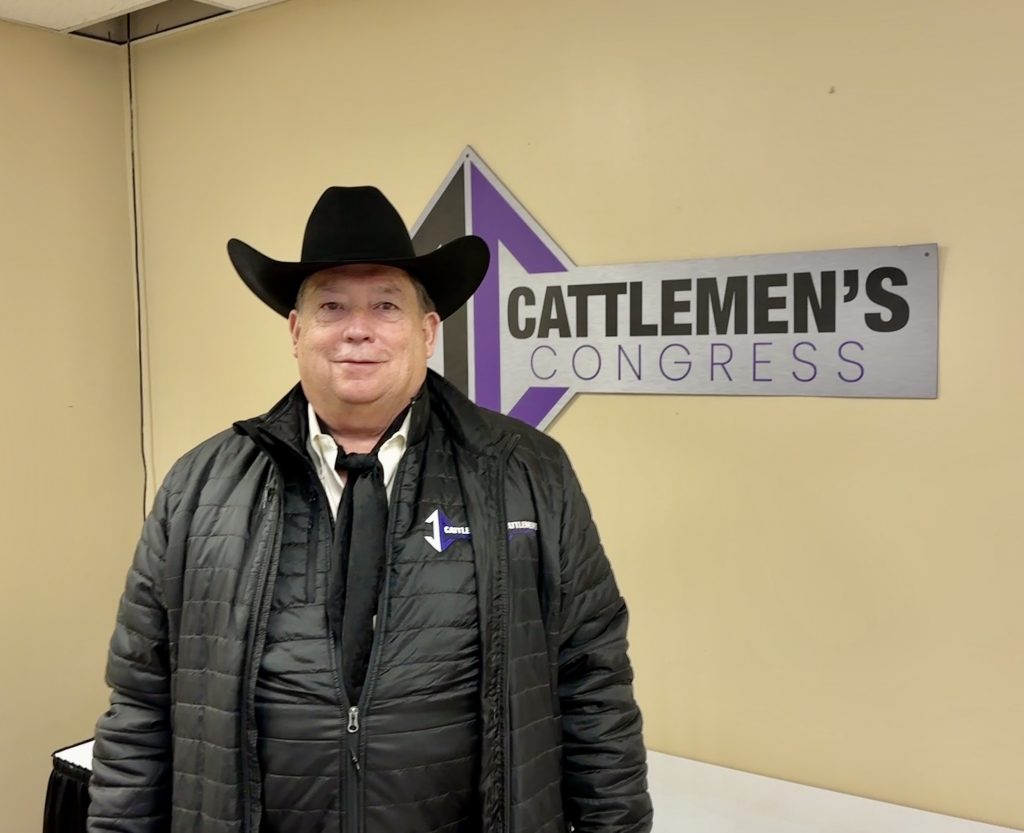
USDA is an equal opportunity provider, employer and lender.

Latest USDA Forecast: Smaller – but Still Significant – Farm Income Drop

USDA's most recent Farm Sector Income Forecast, released Nov. 30, projected a smaller – but still significant - drop in 2023 net farm income compared to August estimates. The $41.7 billion (23%) decline forecast in August was adjusted to a $31.8 billion (17%) drop for a total net farm income of $151 billion expected for 2023 (compared to $141 billion estimated in August). When adjusted for inflation, net farm income, a broad measure of farm profitability, is expected to decrease 20%, or $37.9 billion, from 2022. If realized, 2023 net farm income would be above the 2003-2022 average in inflation-adjusted dollars. The most significant factor influencing the revision is production expenses, estimated to increase 4%, or $14.9 billion, over 2022 compared to the 7%, or $29.5 billion, increase forecast in August's report for a total of $443 billion across the farm economy. Even with this adjustment, production expenses remain forecast at their highest levels to date. Net farm income reflects income after expenses from production in the current year and is calculated by subtracting farm expenses from gross farm income.


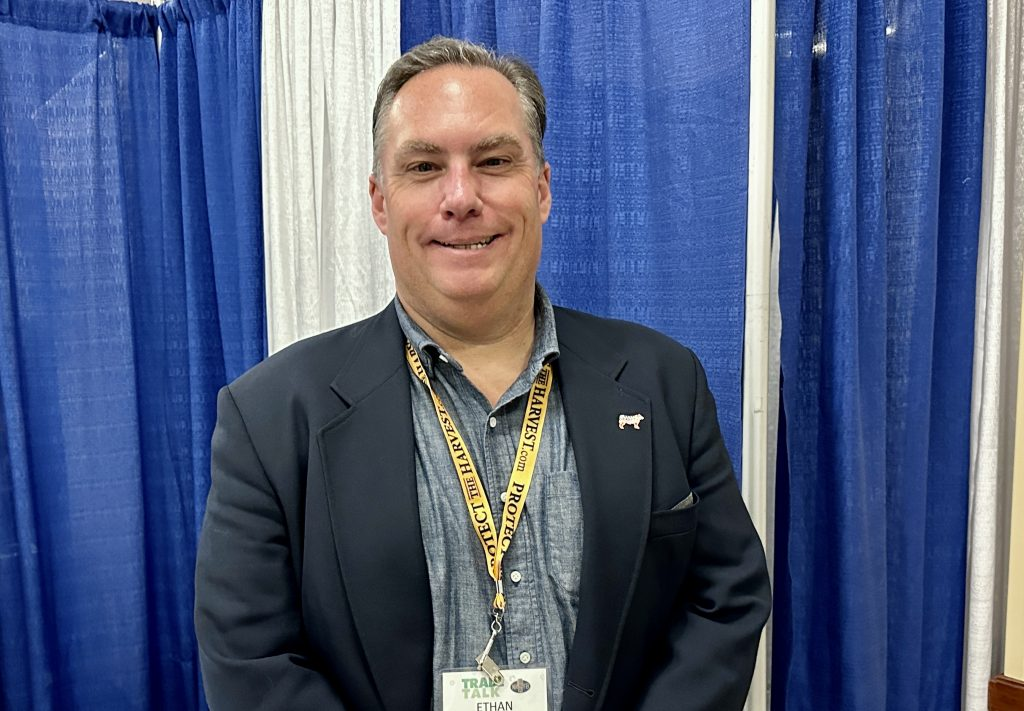

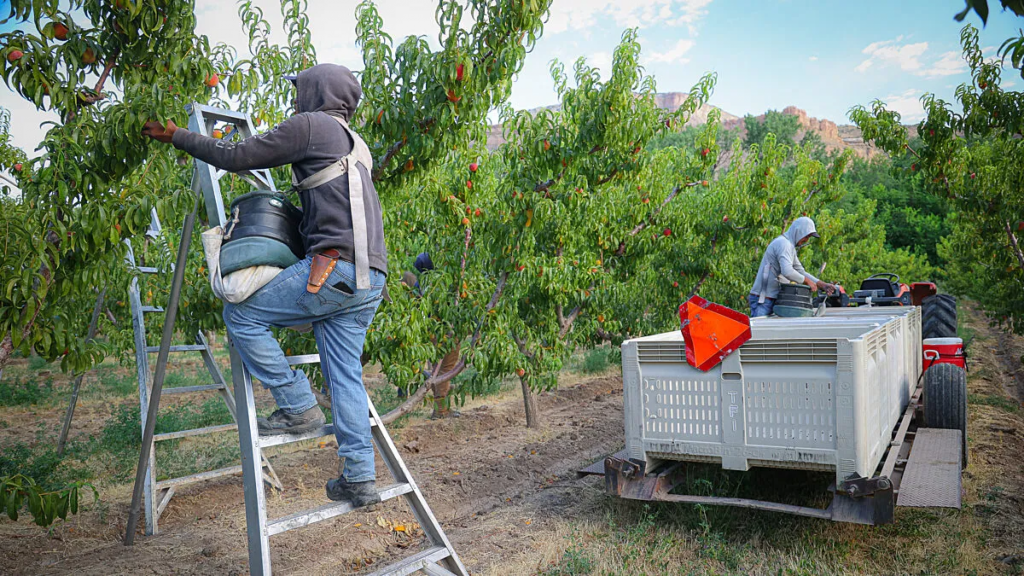
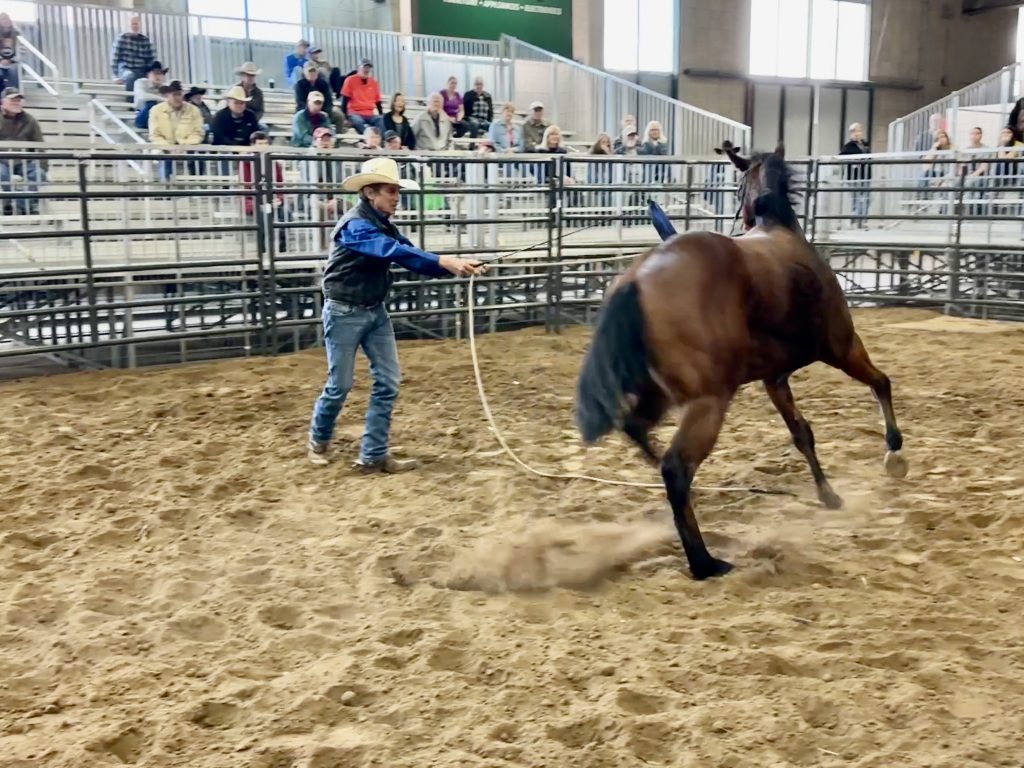
Direct government payments are estimated to decrease by $3.5 billion, or 22%, between 2022 and 2023 to $12.1 billion. This marks the third consecutive annual decrease in government payments for producers since the peak of the COVID-19 pandemic in 2020 and is lower than the $12.6 billion in payments forecast in February. Ad hoc and supplemental program payments, which include payments from the Emergency Relief Program (ERP), Quality Loss Adjustment Program and other farm bill designated-disaster programs, are expected to decrease from $11.5 billion to $6.41 billion, a 44% decline and less than the $7.4 billion in payments originally forecast in August under the category. Given the announcement of some limited additional funds to extend ERP to cover 2022 disaster losses, future estimations in this category will likely be revised upward.

Since the August release, commodity insurance indemnities were adjusted down slightly for 2023 for an expected $21.39 billion. This is a 7%, or $1.34 billion, increase over 2022's $20.06 billion, marking the highest payout of indemnities since the data series began in 2005. This increase is likely the result of increased crop insurance enrollment by those who received a Wildfire and Hurricane Indemnity Program-Plus or ERP payment and are required to purchase crop insurance or Noninsured Crop Disaster Assistance Program coverage (when crop insurance is not available) for the next two available crop years. This requirement was continued under the latest ERP announcement.

Livestock

Lower livestock receipts remain the primary culprit behind lower forecast 2023 farm receipts. In the August release, the value of livestock production (in nominal dollars) decreased $11.9 billion to $246 billion total. In the November release, livestock receipts dropped slightly more to $245 billion, a $13 billion, or 5%, drop from 2022. All top livestock categories are expected to see declines in cash receipts besides cattle and calves. Cattle and calves are expected up $14.27 billion (17%) over 2022 to $100 billion, a $1.02 billion downward revision from the August forecast. Hog receipts had the largest downward revision, moving from $27.6 billion forecast in the August release to $26.23 billion forecast in the November release, a 14% decrease from 2022. Expected receipts for broilers ($43.23 billion) and turkeys ($6.87 billion) were also down from August estimates. Dairy products and chicken egg receipts were adjusted upward. Dairy products are now forecast to decline 18% from 2022 to $46.79 billion; USDA previously estimated a 21% drop. Chicken egg receipts are forecast to decline 27% from 2022 to $14.12 billion, compared to the 32% drop previously estimated.

Earlier Market Intel reports have discussed the primary market drivers behind recent cattle, poultry and dairy prices. It is important to note that hog farmers have experienced considerable losses in 2023. Losses for farrow-to-finish farms in Iowa were estimated to be $18.52 per head in October, with negative profitability estimates in eight out of the last 10 months. While prices have remained relatively high, high input costs and production issues have been the main causes for negative returns. Overall, most livestock producers are facing reduced revenues going into 2024.

Crops

Crop receipts remain forecast down from 2022. In the August release, total crop receipts were expected to decline $9.9 billion for a total of $266 billion. In the November release, this figure was adjusted to a drop of $12.1 billion, or 4.3%, from 2022 to $264 billion. Estimates for wheat receipts remain unchanged for 2023 at $13 billion, a 3% decline from 2022. November release estimates were lower for corn, down an additional $970 million to $79 billion from the August release, and vegetables and melons, which are down $4.22 billion to $21.8 million from the August release. On the other hand, receipts for soybeans, fruits and nuts, cotton and hay were adjusted upward compared to the August release, though only fruits and nuts and hay will have receipt increases as compared to 2022. Soybean receipts are forecast down 7% to $57.8 billion from 2022, $750 million higher than the August release. Fruits and nuts are forecast up 5% to $27.9 billion from 2022, $1.92 billion higher than the August release. Cotton receipts are forecast down 7% to $7 billion from 2022, $1.5 billion higher than the August release. Hay receipts are forecast up 10% to $10.8 billion from 2022, $260 million higher than the August release. Factors impacting crop pricing dynamics have been discussed in recent Market Intels including Grain Storage Capacity Can Buffer Impact of Transportation Disruptions, September WASDE: Ringing in 50 Years with Reduced Corn, Soybean Yields and Lower Livestock Production Expectations, and Severe Weather and Low Mississippi River Levels Bring Uncertainty to Harvest. Like livestock producers, crop growers are generally working with lower sales than in 2022.

Production Expenses

The most significant forecast revision is attributable to lower production expenses, estimated to increase 4%, or $14.9 billion, over 2022 compared to the 7%, or $29.5 billion, increase forecast in August's report for a total of $443 billion across the farm economy. Production expenses are still expected to reach their highest levels on record and their sixth consecutive year of growth in 2023. Compared to the August release, all production expense categories were adjusted downward (meaning farmers are paying less than originally forecast for them) except for fuels and oil, electricity and interest expenses. Compared to 2022, however, only fertilizers, fuels and oils, pesticides and feed are forecast to decline. Fertilizers are expected to experience the largest percent decline — 14% or $5.18 billion — to $31.67 billion across the farm economy. Fuels and oils are expected to drop 11%, or $2.1 billion, to $16.39 billion in 2023, $320 million higher than the August release estimated. Pesticides are expected to drop 3%, or $750 million, to $25.66 billion. Feed is expected to decrease 2%, or $2.06 billion, to $81.59 billion, still the largest cost category.

Interest expenses and livestock/poultry purchases are expected to see the largest increases in 2023, far outpacing the declines in other categories. The cost of livestock and poultry purchases are expected to increase $6.8 billion to $41.5 billion, up 20%. Interest expenses are expected to increase a whopping $10.3 billion to $34.42 billion, a 43% jump. Other categories such as labor, marketing and transportation, and electricity are forecast up 4% in 2023.

Other farm income, which includes things like income from custom work, machine hire, commodity insurance indemnities and rent received by operator landlords, is estimated to increase by $1.4 billion, or 2.6%, from $52.3 billion in 2022 to $53.6 billion in 2023 (a $200 million downward revision from the August release). When all factors influencing income are accounted for, the resulting expectations for a net farm income decline become apparent, as illustrated in Figure 6, albeit at a less drastic decline than estimated in August.

Summary

USDA's most recent estimates for 2023 net farm income provide an updated estimate of the farm financial picture. For 2023, USDA anticipates a 17% decrease in net farm income, moving from $183 billion in 2022 to $151 billion in 2023. Much of the forecast decline in 2023 net farm income is tied to lower crop and livestock cash receipts, continued increases in production costs and a decrease in ad hoc government support. It is important to highlight the projected nature of this forecast. Net farm income numbers for 2022 were not finalized until August 2023 and have been adjusted upward over $20 billion in the eight months since the year ended. During this time USDA is digesting new information and data as it becomes available, shifting calculations from estimates to actual values. This means there is still much variability in final 2023 net farm income.

At the very least, these estimates show the relationship between, on average, falling commodity prices and rising production costs and the ultimate impact on farmers' bottom lines. Combined with weather uncertainty and a high cost of capital to operate their businesses, farmers and ranchers will be forced to adapt as they always have. Part of being able to adapt means having clarity on rules that impact their businesses' ability to operate, having access to comprehensive risk management options and being given a respected voice during formulation of vital legislation such as the farm bill, which can either complicate or streamline farmers' and ranchers' ability to sustainably contribute to a reliable and resilient U.S. food supply.

Bob Rodenberger says Runs Significantly Lower than a Year Ago and No Sign of Herd Rebuilding Soon

Listen to KC Sheperd talk with Bob Rodenberger about the latest in the livestock markets.

Farm Director, KC Sheperd, is back talking with Bob Rodenberger, a partner with Stockmans Livestock Marketing, as he gives the latest on the cattle markets. Rodenberger said it has been a wild ride since September.

"There is no black swan," Rodenberger said. "I think it has got a lot to do with outside money in our industry as far as where we lock in our margins and try to protect ourselves with these downs in this market."

Rodenberger said prices are ahead of a year ago, but there are also more expenses than a year ago.

"It is no different than what it has been the last 50 years, it is just that our margin decreased so quickly, and we were getting comfortable with that big margin," Rodenberger said.

Numbers of cattle coming through at Apache are down about 12 percent, Rodenberger said, which is not a surprise considering the number of cows that have sold over the year.

"Twelve percent at our Apache location is 1000 fewer cattle per month than what we did over the last five years," Rodenberger said.

This drop in numbers did not happen all at once, Rodenberger said, as it has been a slow and steady decrease.

"We have got to have a good spring and the start of a good summer before I think we will talk about retaining heifers to build the cow herd back or for people to get involved in buying cattle," Rodenberger said.

Taste, Tradition and Pork's Nutritional Power

Empowering African Americans to Purchase Pork  

'Don't Miss the Flavor' stands as NPB's strategic platform to elevate pork consumption among African American Millennial and Gen Z consumers. This strategic platform is all about celebrating taste and the rich cultural flavors reminiscent of soul food while emphasizing the nutritional value of pork.

The Multicultural Consumer Impact:

The multicultural consumer segment holds immense influence, responsible for 97% of U.S. population growth in the last two decades and predicted to drive 80% of the country's growth in the next 40 years.1 For African American communities, pork holds deep cultural relevance, providing an opportunity to embrace and celebrate the connection.

Closing the Gap: Processed vs. Fresh Pork:

Processed pork holds a household presence at 94%, while fresh pork is at 68%.2 The 'Don't Miss the Flavor' strategy aims to bridge this gap, introducing consumers to the deliciousness and nutritional benefits of fresh pork.

Empowering Choice with Flavor and Nutrition:

This initiative serves as a call to action for consumers to embrace pork as the go-to protein for family meals. Our research shows pork's biggest opportunity to win with consumers is taste, with flavor being the #1 reason they choose it from the meat case. Whether it's a centerpiece, ingredient or anything in between, consumers love that pork's flavor gives life to any cuisine.  

Kim Anderson says 2024 Hard Red Winter Wheat Crop is Forward Contracting for More than Current Market Price

Listen to Kim Anderson talk about the latest in the crop markets on SUNUP.

This Week on SUNUP is Oklahoma State University Extension grain market economist Kim Anderson. During this week's edition, Anderson talks about the latest news in the crop markets. 

Anderson said wheat prices are around $5.70, up about 25 cents over the last week.

"If you go back a couple of weeks, we said that prices were going to be erratic over the holiday season and that is what we saw last week," Anderson said. "Prices on wheat coming down, really no reason. There are just more sellers in the market than buyers. They came back up this week."

Anderson said that corn prices are down to around $4.40 because the U.S. harvest was higher than expected. From late October to now, Anderson said the price of corn has continued to decline.

Anderson said that soybeans have been a bright spot, as many farmers' crops turned out better than expected in yields. Soybean prices are up around $12.90, Anderson added.

The 2024 wheat crop is now forward contracting for $5.75, Anderson said, which is higher than the current price. In Southern Oklahoma, Anderson added that the forward contracting price is about 30 cents less, and in the Panhandle, the price is about five cents more.

Anderson said the 2024 corn crop is forward contracting for $4.80; in the Panhandle, that price is 60 cents higher.

Soybeans, on the other hand, Anderson said, are forward contracting a lower price than the current market price at $12.20.

This week on SUNUP: 

  • Wes Lee, OSU Extension Mesonet agricultural coordinator, discusses the cattle comfort index tool. State climatologist Gary McManus says warmer temperatures will be here soon. 
  • Barry Whitworth, OSU Extension veterinarian, explains why it's important to protect livestock from cold temperatures.
  • Kim Anderson, OSU Extension grain marketing specialist, says soybean is really the only grain that is holding strong in the markets. 
  • Finally, SUNUP meets the new national FFA president, Amara Jackson.

Watch SUNUP:

Saturday at 7:30 a.m. & Sunday at 6 a.m. on OETA (PBS)
YouTube.com/SUNUPtv

ASA Urges Senate Confirmation of Mersinger & Gooden

The Senate Ag Committee today held a hearing to consider the nominations of Dr. Basil Ivanhoe Gooden to be Under Secretary of Agriculture for Rural Development and the Honorable Summer K. Mersinger to be a Commissioner of the Commodity Futures Trading Commission.

ASA has signed letters touting the qualifications for each nominee and urges swift full Senate confirmation.

Gooden previously served as Virginia's secretary of agriculture and state USDA rural development director. In a letter to Senate Ag Committee leadership, the groups state that Gooden's experience and values will help him succeed in this vital role.

"At this critical time, particularly as Congress works to reauthorize the farm bill, strong leadership at USDA Rural Development is essential," the groups commented. "As the Rural Development portfolio has grown through recent investments through federal legislation, rural America deserves a tenured Under Secretary with on-the-ground expertise who will ensure the agency can make the greatest positive impact with its infrastructure, housing, rural business, and renewable energy programs."

Mersinger was unanimously confirmed by the U.S. Senate to be CFTC commissioner on March 28, 2022, and served out a term that has since expired. She previously served at the CFTC as director of legislative and intergovernmental affairs and, subsequently, as chief of staff to a previous commissioner. Mersinger also spent 15 years working on Capitol Hill in the both the House and Senate. "Commissioner Mersinger is well qualified to continue to serve on the Commission as it addresses a new era of developing issues, while carrying out the CFTC's mission to promote the integrity, resilience, and vibrancy of the U.S. derivatives markets through sound regulation," the groups state in a letter of support for her nomination.

We've Waited Too Long--Commentary by Bill Bullard, CEO, R-CALF USA

In 2019, the volume of fed cattle sold in the negotiated cash market fell to the lowest level in history. It fell to less than 21%. This means less than 21% of all fed cattle sales occurred in the price discovery market. More plainly, only about 100,000 cattle set the base price for the roughly 500,000 fed cattle sold each week.   

Everyone knew this was bad news for the U.S. cattle industry. So, at our and a handful of other organization's request, Congress introduced legislation to increase the percentage of cattle that must be purchased in the cash market – the industry's critical price discovery market.   

In early 2020, Sens. Chuck Grassley (R-IA) and Jon Tester (D-MT) introduced a bill requiring the four largest beef packers to purchase at least 50% of their cattle needs from the cash market.

Immediately, a loud squeal erupted from the corporate boardrooms of the multinational beef packers and all the industry trade associations that dutifully kowtow to the global packers' refrain that markets are working fine and nothing but small tweaks are needed to make them perfect.   

But the threat of serious and meaningful market reform was real ... obviously, there was now an officially introduced bill in Congress. And during that year, the cash market percentage jumped 2.5 percentage points. But the opponents were quickly devising a strategy to kill the bill.

First there was the call to reduce the required 50% cash market purchases to just 30%, and then there was an all-hands-on-deck effort to persuade the multinational packers to voluntarily increase their cash market purchases under threat of stern looks and frowns if they did not comply – and, yes, I'm mocking those efforts.

But the packer-led opposition raised such a ruckus that the Senate agriculture committee refused to even schedule a hearing on the bill, so when Congress adjourned the 116th Congressional Session, the bill died for lack of action.

Despite the corporate cry that their bill would cause the sky to fall, Sens. Grassley and Tester reintroduced their 50% bill in early 2021, but not before the corporate opponents had convinced Sen. Deb Fischer (R-NE) to introduce a compromise bill that didn't require any level of cash market purchases; instead, it delegates Congress's authority to pass laws to the U.S. Department of Agriculture (USDA) and directed it to study the market and then, if it chooses, to set minimum purchasing requirements. 

So, there it is. Three years have gone by since Congress set out to reform the structure of the U.S. cattle market by forcing the largest packers to actually compete for at least half their cattle. And today, three years later, nothing has happened. Nothing except that many U.S. ranchers were forced to liquidate cattle due to widespread drought, resulting in an extreme tight supply situation, which has at least temporarily driven cattle prices higher.

Now very recently, we've seen huge swings in the cash market, with fed cattle losing about $5 per cwt the week of November 6. Now consider this: In the third quarter of this year, the volume in the competitive cash market shrank to under 18%. 

So, here's the problem and the opportunity: The structure of the market today is worse than it was during the six-year period from 2015-2020 when cattle prices were seriously depressed, and that's because the volume in the price-discovering cash market has shrunk to dangerously low levels. The reason cattle prices have recently increased is that our industry experienced a severe God-made shock ... a widespread drought, resulting in extremely tight supplies in the face of years-long, strong beef demand. This is why prices are higher.

But because the structure of the market is actually worse than it was before the drought, when the effects of the drought are over, we can and should fully expect a dysfunctional cattle market.

Now that's the problem and here's the opportunity: The 2023 Farm Bill has now been extended into 2024. That means there's time to do what we should have done three years ago, and that is to pass legislation in the farm bill that forces the largest packers to actually compete for the cattle by requiring them to purchase at least 50% of their cattle in the price-discovering cash market.

We know with certainty that the largest packers have continued their strategy to continue shrinking the cash market. And they've been successful. It has shrunk an additional three percentage points since Sens. Grassley and Tester first introduced the 50% bill. And if you use the third quarter of 2023, the shrinkage has been nearly six percentage points. It's high time we fix the broken structure of the fed cattle market. The farm bill is the vehicle to do that. Call your members of Congress and tell them to reintroduce the Grassley-Tester bill that would force the big packers to compete for at least half the cattle they purchase each week.

Biden-Harris Administration Expanding High-Speed Internet to Seminole County

Funding is Part of President Biden's Investing in America Commitment

U.S. Department of Agriculture (USDA) Rural Development and Oklahoma State Director Kenneth Corn announced today nearly $15.2 million in grants and loans to connect thousands of rural residents, farmers and business owners across rural Seminole County to affordable high-speed internet through the ReConnect Program, funded by President Biden's Bipartisan Infrastructure Law. This program is uniquely designed to fund the most difficult high-speed internet projects in the nation, which are the most rural, remote and unserved communities.

Connecting all communities across the United States to high-speed internet is a central part of President Biden's Investing in America agenda to rebuild the economy from the bottom up and middle out by rebuilding our nation's infrastructure. This projected provided the Pottawatomie Telephone Company $7,590,406 in grant and $7,590,406 in loan. This project will serve Seminole Tribal Statistical Area and socially vulnerable communities in Seminole County.

"The President has made providing high-speed internet as one of the top priorities for USDA Rural Development to our rural and tribal communities in Oklahoma," Corn said. "Thanks to the Biden-Harris Administration we are now providing rural Oklahomans with an important lifeline to broadband services so they can conduct essential services such as healthcare, banking, educational services and more from the comfort of their home. More importantly by providing these resources many Oklahomans can stay in their rural communities, instead of feeling like they may be forced to move to bigger metro areas due to a gap in internet service."

Many residents and businesses in rural areas would not have high-speed internet service without the ReConnect Program, as the program is a key part of the Administration's Internet for All initiative to connect everyone in America to high-speed internet by 2030.

"President Biden has continued to prove that he is delivering on his promise to transform America and rebuild our economy with American ingenuity," Corn said. "I am genuinely excited to see how this project not only improves the day-to-day needs of our rural Oklahomans and tribal members, but also how it will positively impact the next generation of Oklahomans to come."

USDA Rural Development provides loans and grants to help expand economic opportunities, create jobs and improve the quality of life for millions of Americans in rural areas. This assistance supports infrastructure improvements; business development; housing; community facilities such as schools, public safety and health care; and high-speed internet access in rural, tribal and high-poverty areas. To learn more, visit https://www.rd.usda.gov/ok.


Ron salutes our daily email sponsors!
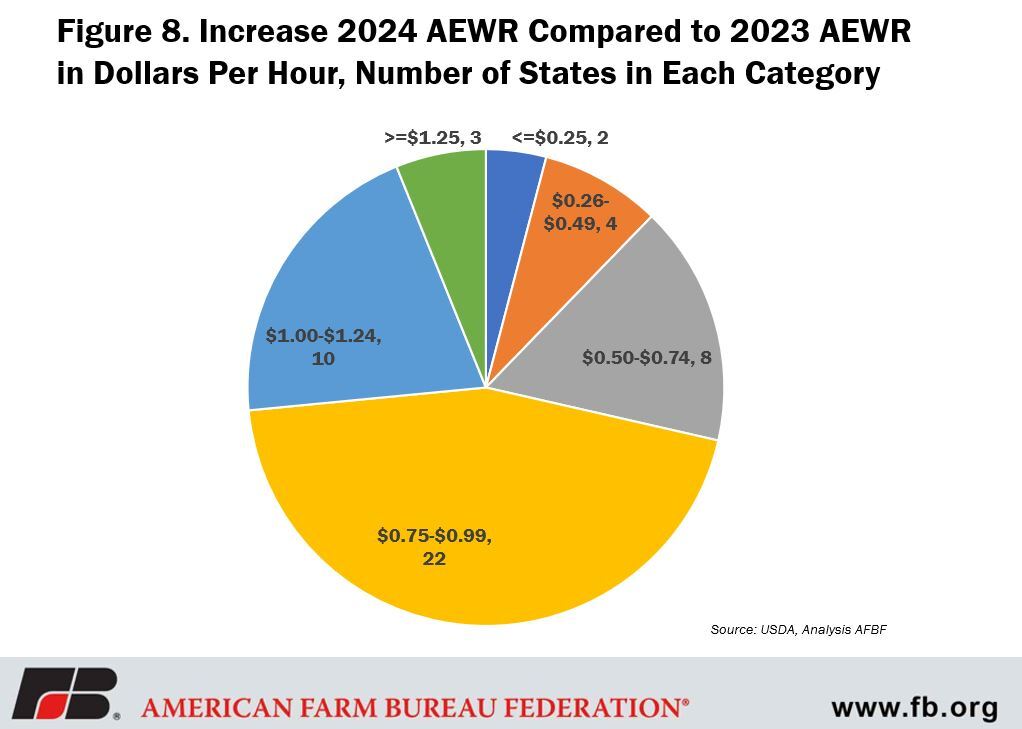
Upcoming Events

November

S M T W T F S
1 2 3 4 5 6 7
8 9 10 11 12 13 14
15 16 17 18 19 20 21
22 23 24 25 26 27 28
29 30          

Visitor Polls

Do you like the new website?
Add a Comment
(Fields are Optional)

Your email address is never published.