Ag News Archives for 2024-04

State Lawmakers Approve Bill to Require Meters for All Permitted Water Wells- Governor Promptly Vetoes- and Ag Groups Cheer

Governor Kevin Stitt wasted little time in using his veto pen to reject HB 3194 which would mandate that "The Oklahoma Water Resources Board shall require that all water wells requiring a permit to take and use groundwater from the Oklahoma Water Resources Board be equipped with water well flow meters or an alternative measuring system as defined by the Board."

According to the Governor, "House Bill 3194 is government overreach at it's finest. House Bill 3194 is an unfunded mandate which would require all permitted water wells to be equipped with a water meter that will cost thousands of dollars per meter. While forcing water meters of Oklahomans may seem innocuous, it is undoubtedly a violation of private landowners rights and emboldens the government to continue down that path.

"For these reasons, I have vetoed Enrolled House Bill 3194."

Both the Oklahoma Farm Bureau and the Oklahoma Cattlemen's Association are cheering the Veto by the Governor.

According to the Farm Bureau statement- "Oklahoma Farm Bureau asked the governor to veto the bill after it unexpectedly passed the Senate and was sent to the governor in the middle of stakeholder negotiations.

Oklahoma Farm Bureau President Rodd Moesel released the following statement today, praising the governor's veto:

"Oklahoma Farm Bureau members thank Gov. Kevin Stitt for standing up for Oklahomans' property rights today with his veto of HB 3194.

"As family farmers and ranchers who care for and rely upon our state's natural resources, Farm Bureau members recognize that groundwater is a vital private property right in Oklahoma and is essential to ensuring the security of the United States' food supply. Any changes to how those rights can be utilized should be developed through thoughtful consideration from stakeholders around the state.

"Oklahoma Farm Bureau is committed to achieving the goal of responsible water use and conservation, and we look forward to working on this shared goal with the legislature in the future."

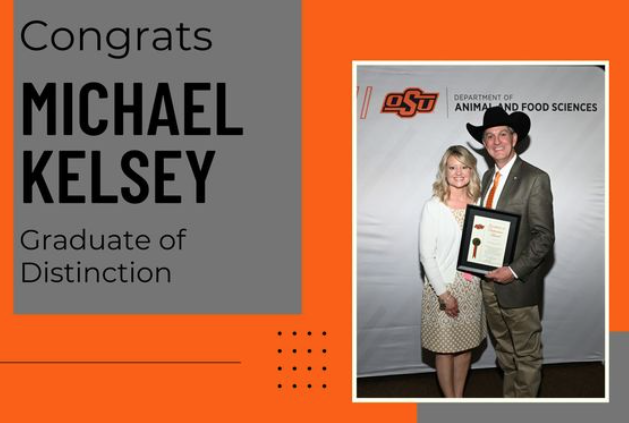
Michael Kelsey, Executive Vice President of the Oklahoma Cattlemen's Association also provided a statement to the Oklahoma Farm Report thanking the Governor for the Veto- Kelsey says "Groundwater is a fundamental private property right.  OCA appreciates the Governor's veto of HB 3194 and further agrees with his opinion that the bill is an unfunded mandate that burdens landowners.  OCA is strongly committed to the protection of the quality and the right of groundwater and we recognize that we must work cooperatively to effect sound water policy."

Senator Marshall Comprehensive Disaster Relief Bill Backed Strongly by National Sorghum Producers

Senator Roger Marshall's (R-KS) introduction today of the Agricultural Emergency Relief Act, and letter to the Senate Appropriations Subcommittee on Agriculture, Rural Development, Food and Drug Administration, signifies crucial and timely needed support for U.S. sorghum farmers.

National Sorghum Producers warmly commends Senator Marshall for his commitment to standing with our nation's farmers and ranchers in their hour of need. NSP Chairman Craig Meeker, a sorghum farmer from Wellington, Kansas, expressed support with the following statement:

"The National Sorghum Producers wholeheartedly endorses Senator Marshall's initiative to establish an emergency relief program for 2023 crop losses. Last year, natural disasters severely impacted farm and ranch families across the country with those enduring consecutive years of severe and persistent drought feeling the greatest strain. Senator Marshall's legislation promises meticulous implementation of the ERP, ensuring the aid reaches those farm and ranch families most affected by these production challenges. We applaud Senator Marshall for his diligent efforts and call upon his colleagues in Congress to swiftly pass this vital legislation."

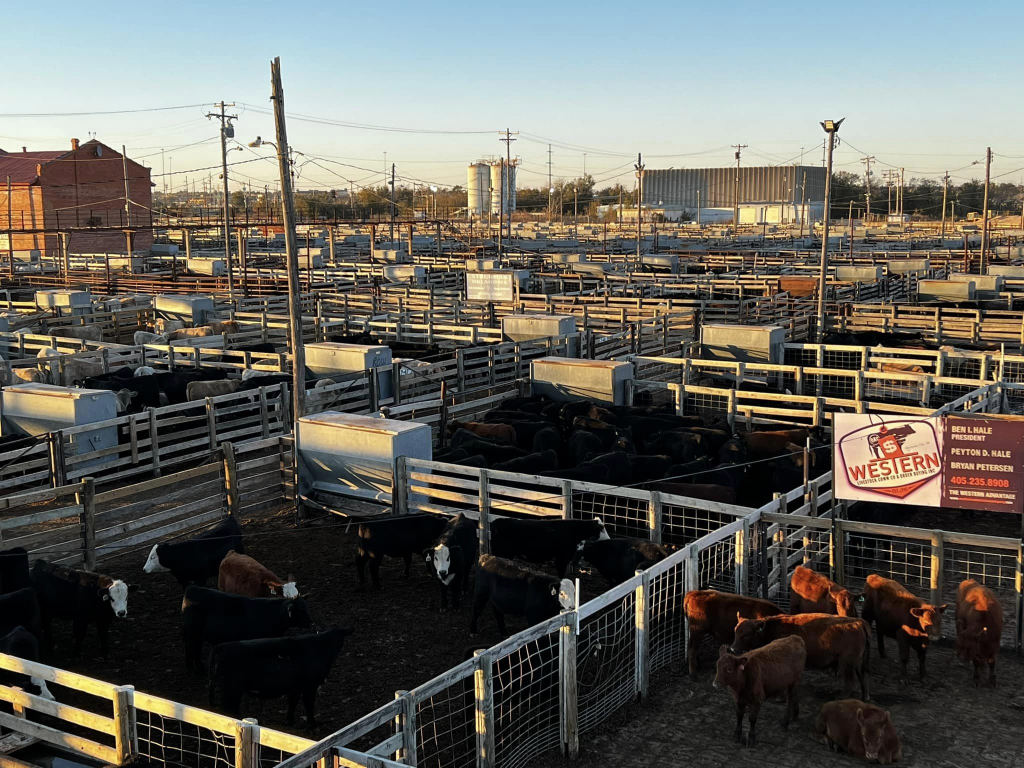
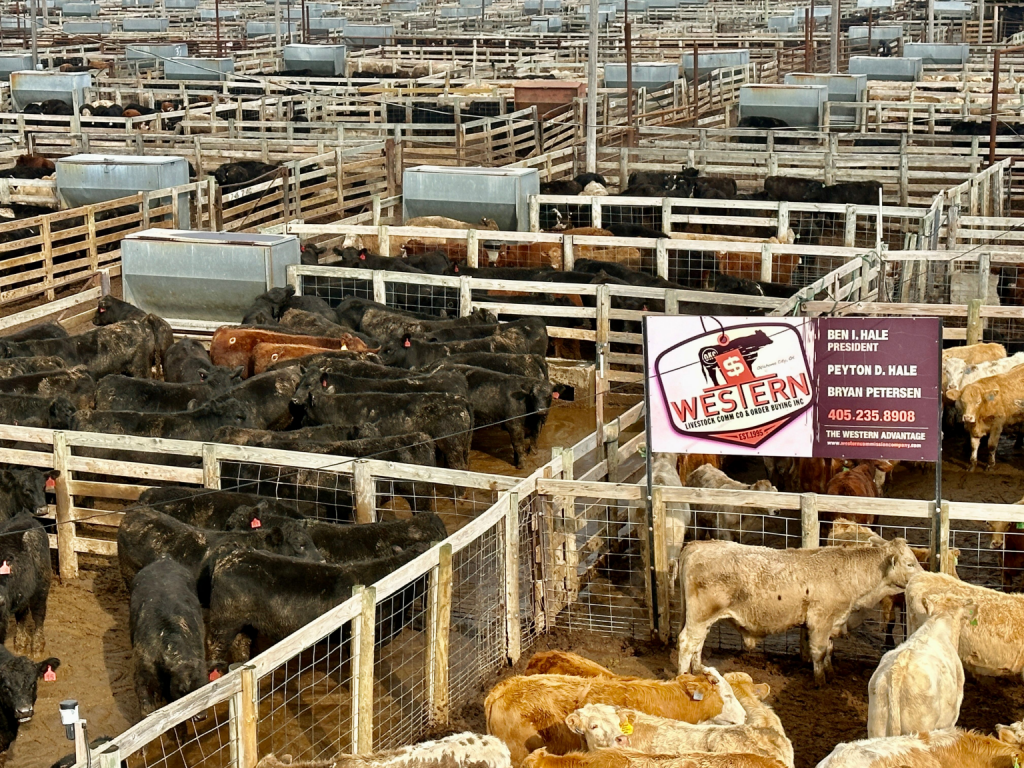
Active Markets This Week According to Western Livestock's Ben Hale

Listen to Ron Hays talk with Ben Hale about the latest in the cattle markets.

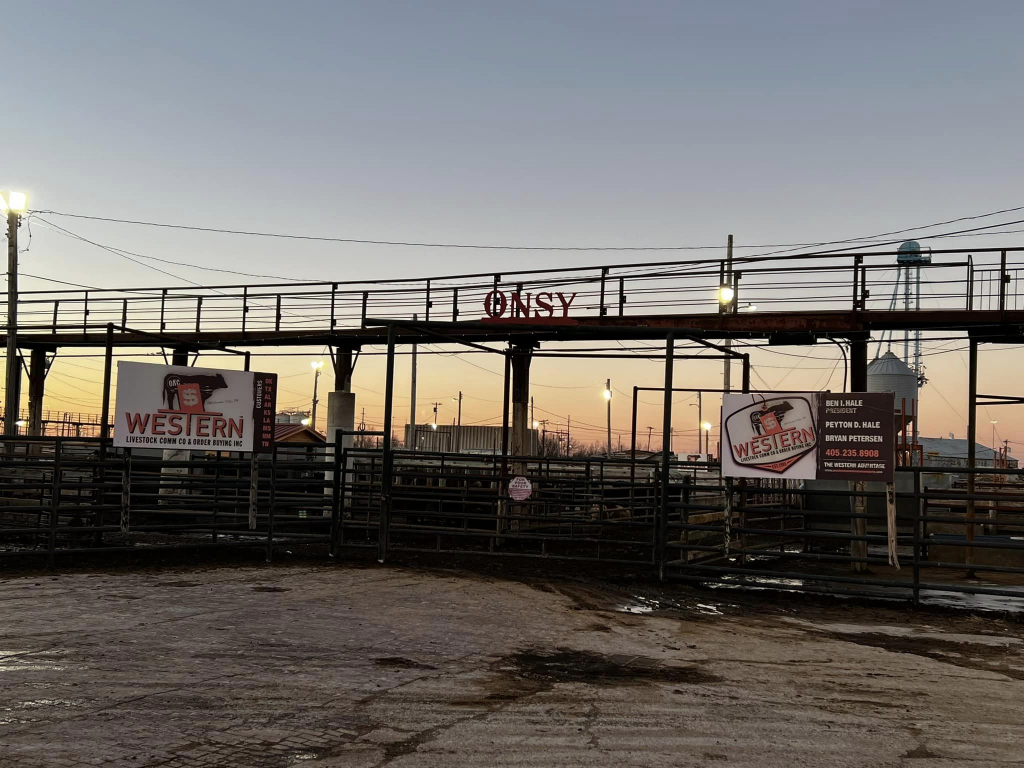
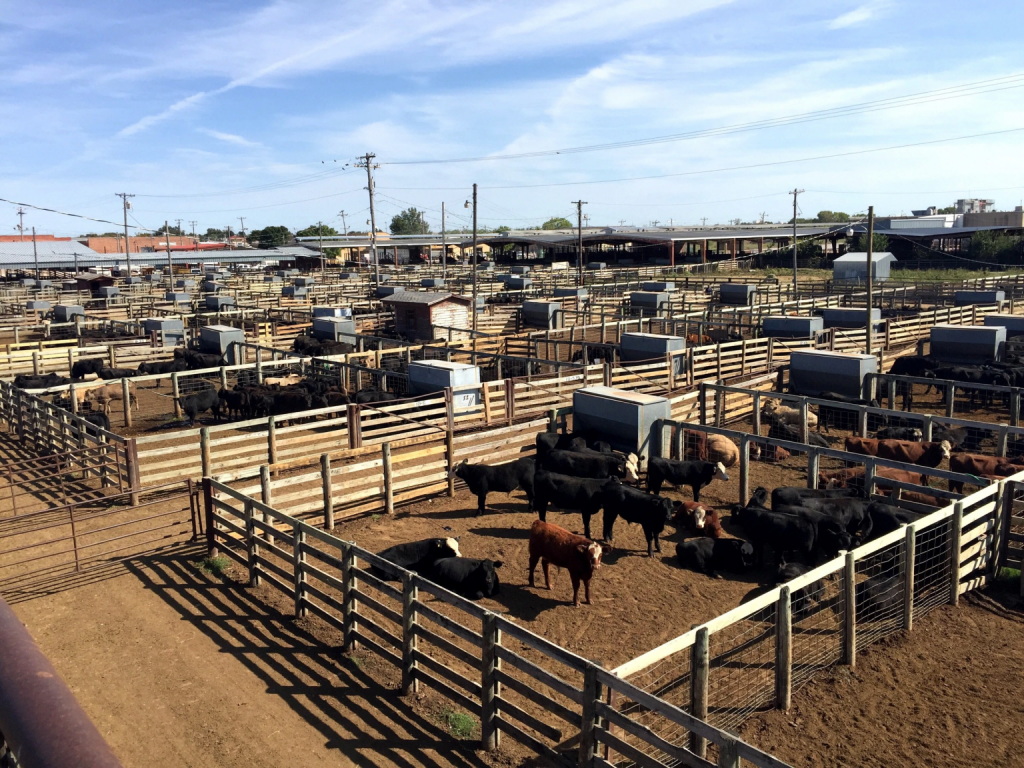
On Tuesdays, Senior Farm and Ranch Broadcaster, Ron Hays, visits with Ben Hale of Western Livestock Auctions as he talks about the latest in the markets and more. Established in 1995, Western has grown into a multi-generational family-owned and operated business and stands as a symbol of tradition, excellence, and a deep-rooted passion for the cattle industry. Western Livestock Auctions is located in Oklahoma City, Woodward, and Comanche.

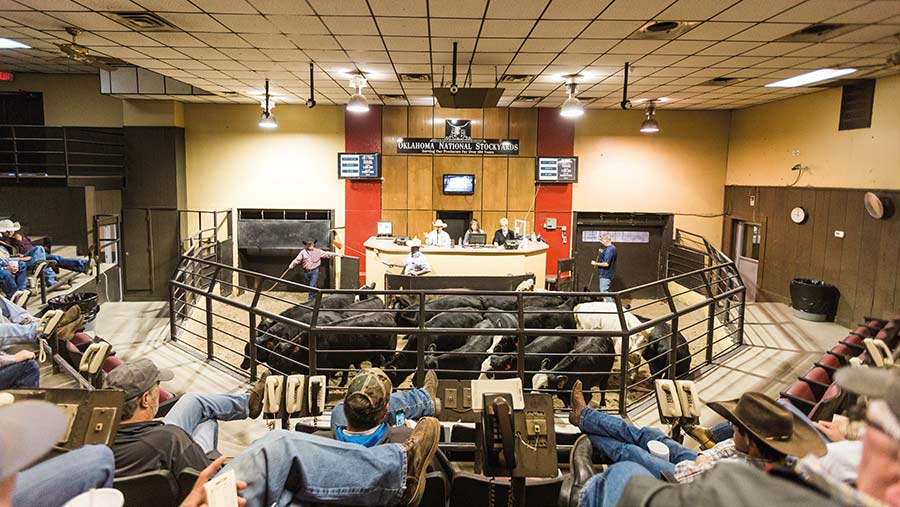
At the Oklahoma National Stockyards on Monday, Hale said there were 5900 head of cattle sold compared to around 6700 one year ago.

"I think probably the rain slowed some of that down," Hale said. "If they didn't have them up and ready to go, then they weren't going to get them out with the rain we got around central, western, and back south and east. Probably going to have a little bigger run this week coming up."

Hale said markets this week were 2.00 to 6.00 cwt higher, and the market was very active.

The action in Woodward sold around 250 cows today, Hale said, and both the Woodward and Comanche sale barns are expected to have good runs for the remainder of the week.

Hale also talked about the upcoming LMA auctioneer championship coming up in Oklahoma City on June 12-15th. To learn more about the championship, CLICK HERE.

Hale can be contacted at 940-631-2333.

Two Major Legislative Wins for Oklahomans

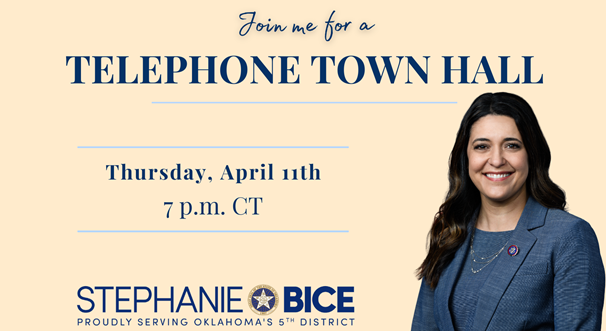
Today, the House of Representatives passed numerous pieces of legislation that Congresswoman Bice co-leads.

First, the Weather Act Reauthorization package. This package will help support critical research programs currently operating at NOAA, while also establishing new programs to advance forecasting, expands commercial data partnerships, strengthens emergency preparedness, and advances tools for farmers, ranchers, and resource managers. The legislation contains three of Congresswoman Bice's Bills: The National Oceanic and Atmospheric Administration (NOAA) Weather Radio Modernization Act, the National Mesonet Authorization Act, and the Weather Innovation for Next Generation (WING) Act.

The National Oceanic and Atmospheric Administration Weather Radio Modernization Act will help save lives by updating our emergency alert system. Specifically, it paves the way for future development and provides failsafe options, so the National Weather Radio is never down for an extended period of time thus making those outages less frequent. Next, the National Mesonet Authorization Act will work to increase the overall coverage and accuracy of the National Mesonet Program. It will provide reliable, real-time data and observations for weather prediction, severe weather warnings, and emergency response. 

The second piece of legislation is the Abandoned Well Remediation Research and Development Act, which would establish an abandoned wells research, development, and demonstration program at the Department of Energy. There are estimated to be 700,000 to 3,000,000 abandoned wells in the U.S., costing between $30,000 to $1,000,000 per well to plug. Improving the technologies and methods associated with the plugging and remediation process for abandoned wells could reduce the overall costs, improve the efficiency of remediation, mitigate environmental harms, and reduce methane emissions. Congresswoman Bice co-leads this legislation with Rep. Lee (D-PA).

Congresswoman Bice issued the following statement:

"It was great to see so many provisions and bills that will benefit Oklahoma pass the House. Over the weekend, severe weather ripped through our state, changing lives forever. Oklahomans must have the resources they need when critical weather events strike. Thankfully, the Weather Act Reauthorization will improve weather forecasting and modernize the systems we already have in place, ensuring they become more reliable and effective. This legislation also includes the NOAA Weather Radio Act which will help address the aging infrastructure in these systems and prevent outages or disruptions like those seen this weekend from occurring in the future."

"I was also pleased to see that the House passed my legislation, the Abandoned Well Remediation Research and Development Act. Oil and gas production are the heart of Oklahoma's economy. While active wells support hundreds of thousands of jobs, legacy sites, and abandoned wells can present environmental and economic problems. This legislation authorizes the Department of Energy to work to improve the data on the location of abandoned wells; the processes for plugging, reclaiming, and repurposing wells; and the ability to mitigate potential environmental impacts of leaking wells. This legislation will close the innovation gap and ultimately save federal dollars. Thank you to Representative Lee for working in a bi-partisan fashion on this bill."
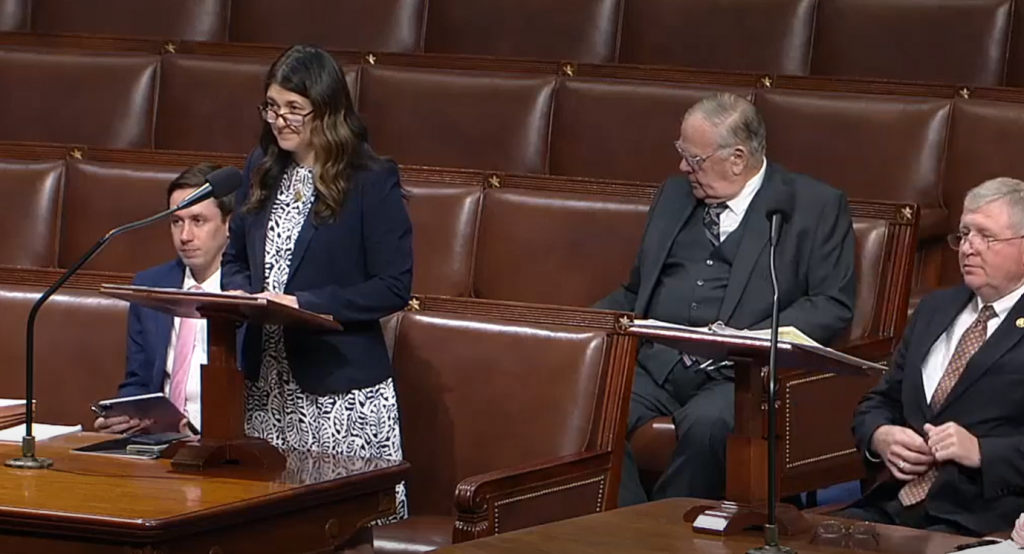
Congresswoman Bice spoke on the House Floor in support of both pieces of legislation. 

Latest Ag Trade and Labor Update from NASDA CEO Ted McKinney

Listen to KC Sheperd talk with NASDA's Ted McKinney about ag trade and labor.

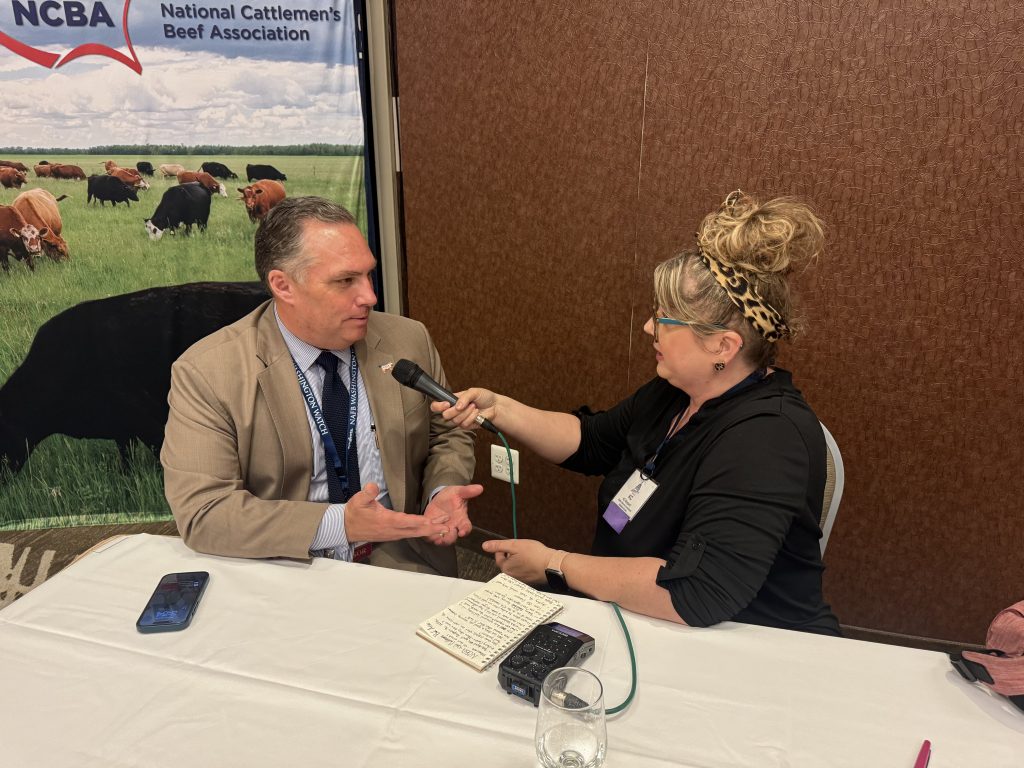
In Washinton D.C. at NAFB (National Association of Farm Broadcasters) Washington Watch, Farm Director KC Sheperd had the chance to visit with the CEO of NASDA (National Association of State Departments of Agriculture), Ted McKinney. Sheperd and McKinney talk about trade, labor, and more.

McKinney first commended Oklahoma's Ag Secretary Blayne Arthur, who serves as NASDA's 2023-2024 president.

"She is so well respected, and I hope those in Oklahoma know how well respected she is around the country," McKinney said.

Regarding trade, McKinney said NASDA is pleased that the Biden Administration is working to straighten out trade under existing rules.

"We have seen some advancement of a few products that we can sell into India and the same for Vietnam," McKinney said. "They are working on trying to fix the dairy issue in Canada, and the ridiculous corn decree in Mexico."

Currently, the biggest challenges for trade are sanitary phytosanitary issues, McKinney said, which is usually the biggest challenge year-round. Animal welfare standards are another upcoming issue, McKinney added.

"Sometimes there are bonified controls where a country does not want to lose a very important market, so they might have a tariff rate quota to bring in limited amounts," McKinney said. "The list is so long on what countries play gamesmanship with each other, and that is why you have got to go negotiate so you cut that out. You get rid of that."

In addition, McKinney said working towards a functioning world trade organization is critical.

"If we don't, it is going to be who has the most muscle, who has the biggest brawn, who can outpower the next one, and that is not a very good global relationship," McKinney said.

McKinney also talked about farm labor issues in the country.

"We just want to be able to bring guest workers in, and manage them," McKinney said. "We know where they are. We know where they go. We know how we treat them. Let's bring them in. We need flexibility so it is not just seasonal guest workers."

Daily Email for April 30, 2024


Oklahoma's Latest Farm

And Ranch News

Tuesday, April 30, 2024

 
Howdy Neighbors!

Here is Your Daily Oklahoma Farm and Ranch News Update: 


  • Latest Oklahoma HRW Wheat Conditions Slip Another 3 Points to 46 Percent Good to Excellent- Kansas falls 5 Points


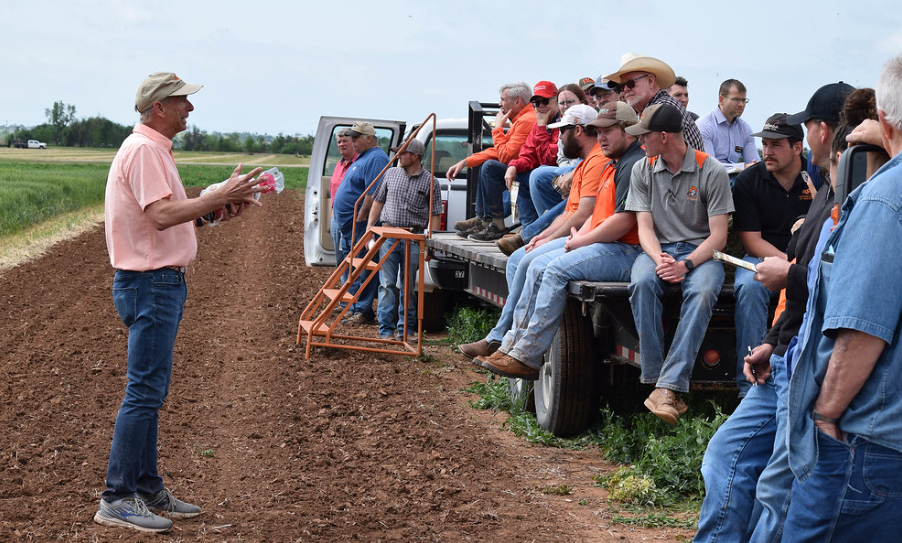
  • Brett Carver Discusses Wheat Crop and High-Performing OSU Varieties at Chickasha Field Day


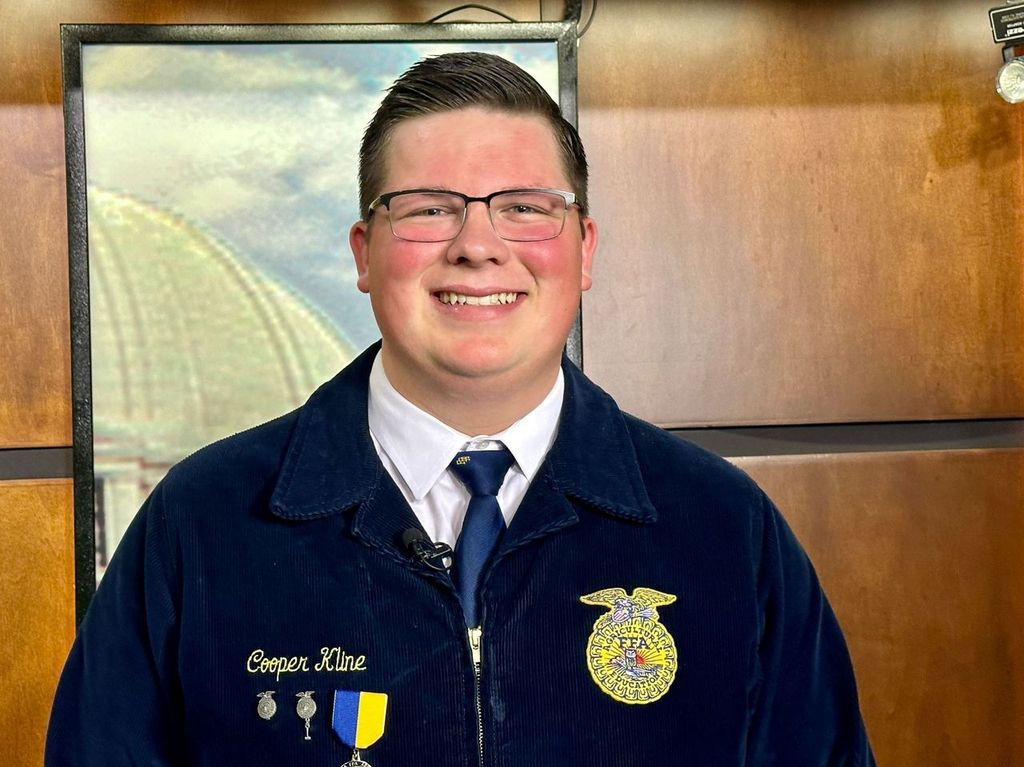
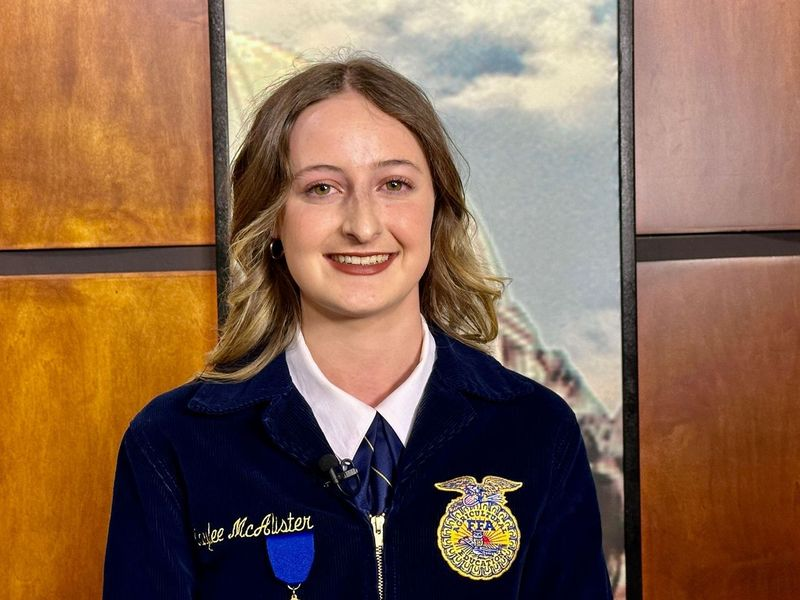
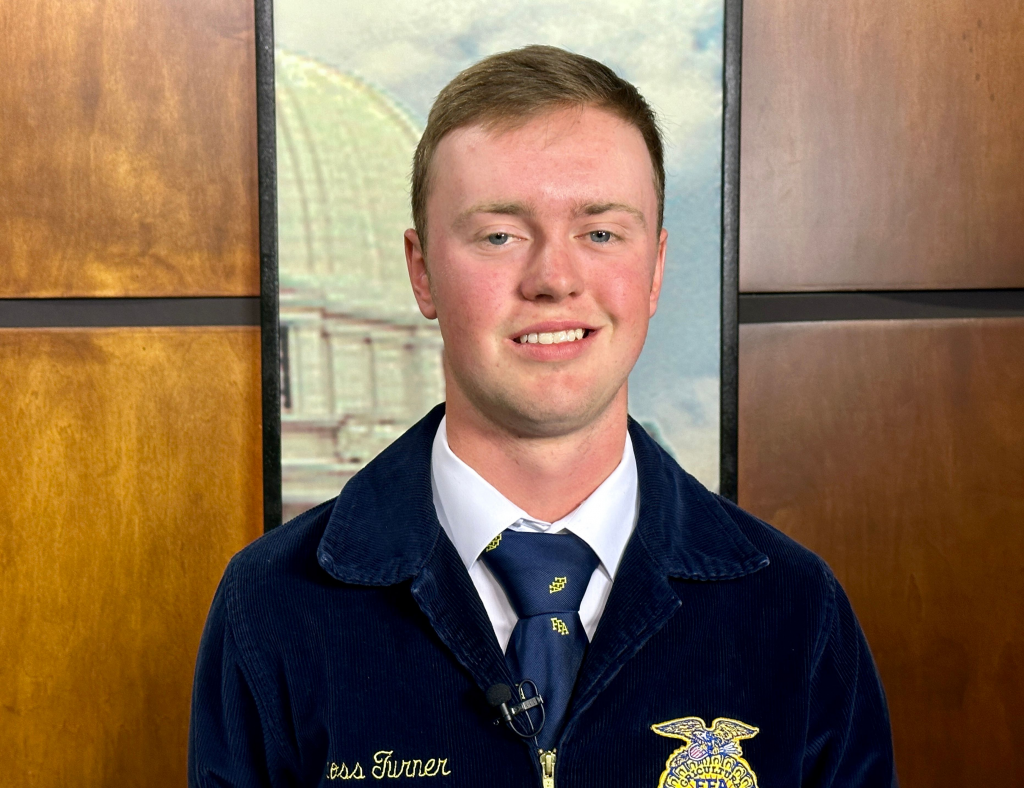
  • Introducing Cooper Kline of the North Rock Creek FFA Chapter, Your 2024 Central Area Star in Agricultural Production


  • OSU's Derrell Peel Says Cattle Markets are Back on Track


  • Noble Research Institute Fosters Regenerative Ranching Efforts Through Educational Courses


  • Oklahoma Wheat Commission to Hold District IV Election


  • DOL Tops 3,000 Pages of Regulations in 18 Months


  • Bill to Lock Oklahoma's Clock Signed Into Law By Governor Stitt

This Week's Oklahoma's Winter Wheat Conditions Slip Another Three Points to 46 Percent Good to Excellent- Kansas Falls 5 Points

In this week's USDA crop progress report, Winter wheat conditions rated 49 percent good to excellent- down one point from last week. The national corn planting number shows one fourth of the US corn crop is now planted at 27%- with the Oklahoma corn crop; now up to 40% planted which is 9 points ahead of the five year average.

Oklahoma's winter wheat conditions slipped another three points from a week ago to 46 percent good to excellent with 14% poor to very poor this week- two points worse than last week. Not to forget how bas things were in 2023- One year ago as of May 1, Oklahoma's winter wheat conditions rated 9 percent good to excellent and 61 percent poor to very poor.


Meanwhile, Kansas Winter wheat crop ratings slipped another 14% as it fell 5 points to 31% good to excellent. Perhaps the most remarkable Kansas wheat number was the heading stat that jumped from 4% a week ago to 33% this week- well ahead of the 9% a year ago and the 6% five year average. Texas Winter wheat actually improved a bit this week versus last as rose to 48% good to excellent this week.


Oklahoma range and pasture conditions rated 44 percent good to excellent, 35 percent fair and 21 percent poor to very poor. That's up two points from a week ago in the good to excellent.


It's likely we will get some improvement in the Oklahoma wheat and pasture ratings next week because of the weekend rains.

Click here to read more about this week's crop progress report.

Sponsor Spotlight


The Oklahoma Agriculture Mediation Program knows this is a hard time for farmers and ranchers. We want you to know we are still open, and we are still here for you. The Ag Mediation program is a free service that provides mediation to agriculture producers who may need help with ag-related disputes.


At Oklahoma Ag Mediation, we have been helping people in agriculture resolve conflicts since 1987. We know firsthand about working together to resolve conflicts, so you don't have to go through the court systems. Let our professional mediators help you. Mediation is allowed for lease issues, farmer/neighbor disputes, family farm transitions, and more. These services are available at no cost for Oklahoma farmers and ranchers in all 77 counties. For more information, you can go to ok.gov/mediation, or give us a call at 800 248 5465.


Brett Carver Discusses Wheat Crop and High-Performing OSU Varieties at Chickasha Field Day

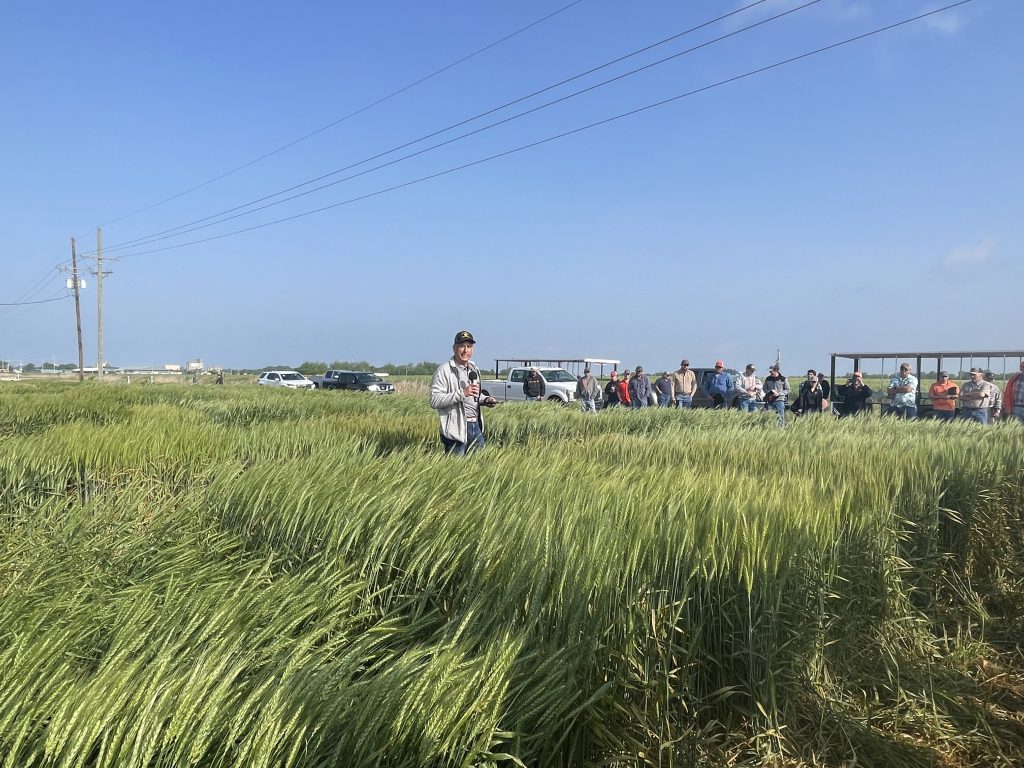
At the Oklahoma State University Wheat and Forages Field Day held in Chickasha, Associate Farm Editor Reagan Calk had the chance to talk with regents professor and wheat genetics chair in the OSU Department of Plant and Soil Sciences, Dr. Brett Carver.


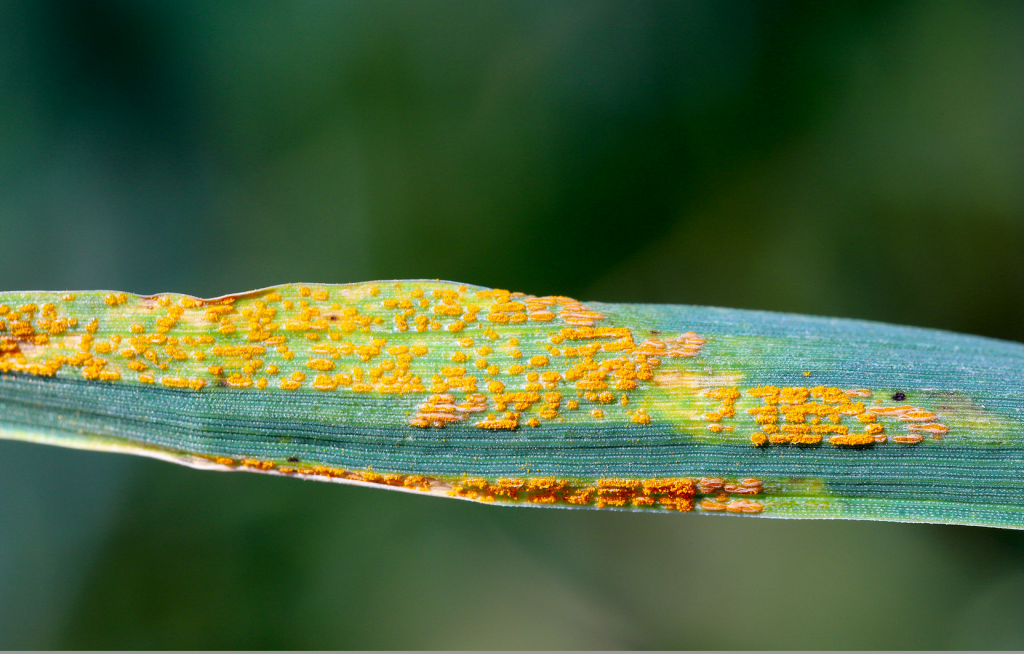
Carver first gave an update on the wheat crop throughout Oklahoma, which he said has been impacted by drought in some areas, but in other areas, not so much. In those areas that have not been impacted by drought, Carver said Stripe Rust has been extremely prevalent.


Carver said one way to be vigilant against stripe rust is to plant varieties that will respond defensively against the disease. Aside from Stripe Rust, Carver also talked about research regarding a few more diseases such as Septoria that have impacted wheat in Oklahoma.


"I can tell you, in the OSU program, Showdown does well," Carver said. "It is not the most drought-tolerant variety out there, but it seems to recover and seems to produce a good grain yield. High Cotton is another one."


To see the list of 2024 OSU Field Days, CLICK HERE.

Click here to read more and listen to Reagan Calk talk with Brett Carver about wheat crop and high-performing OSU varieties.

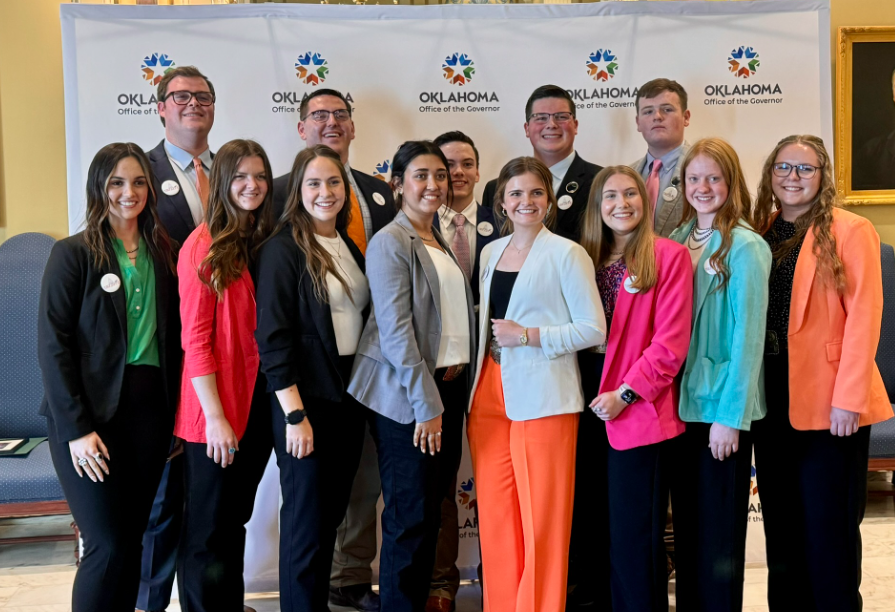
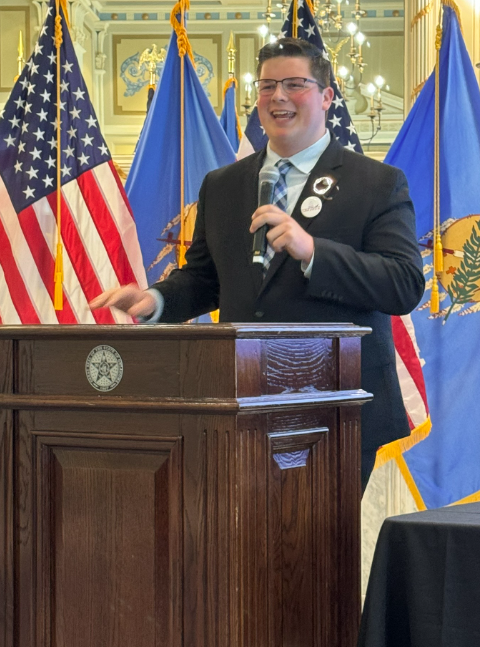
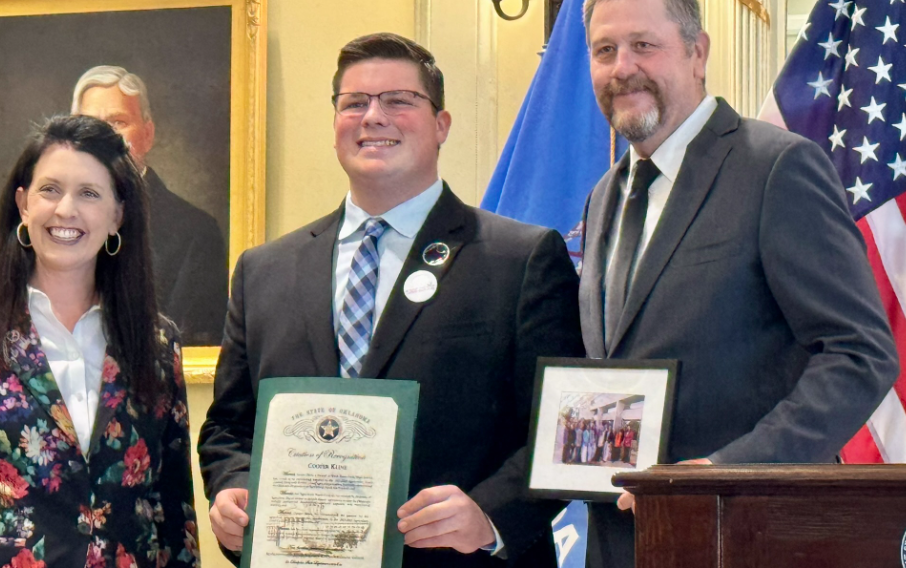
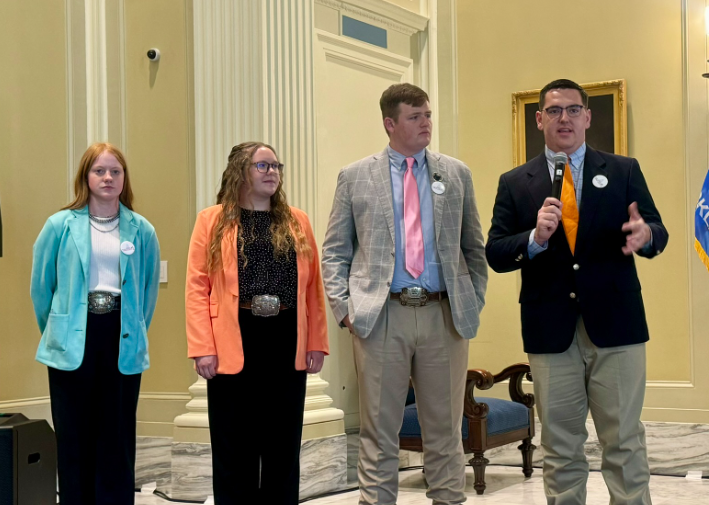
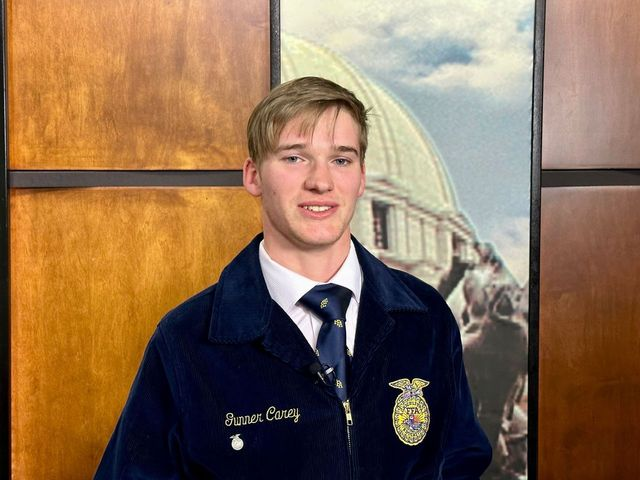
Introducing Cooper Kline of the North Rock Creek FFA Chapter, Your 2024 Central Area Star in Agricultural Production

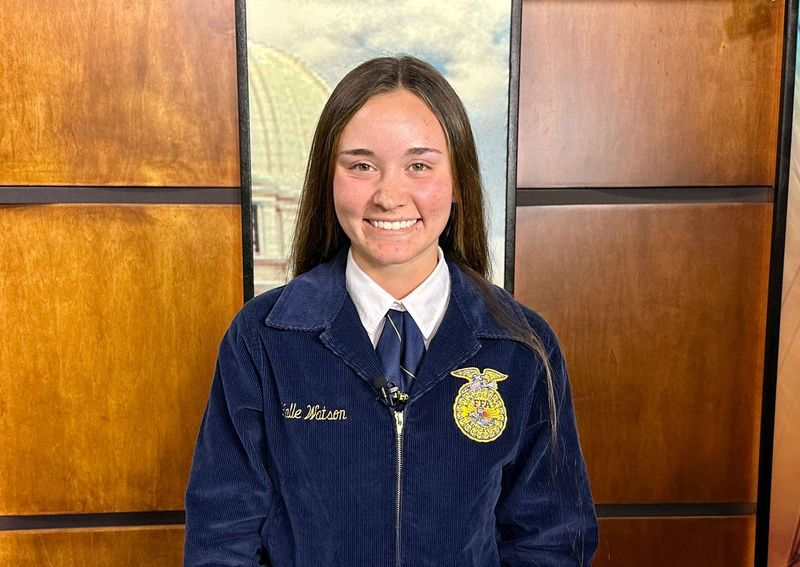
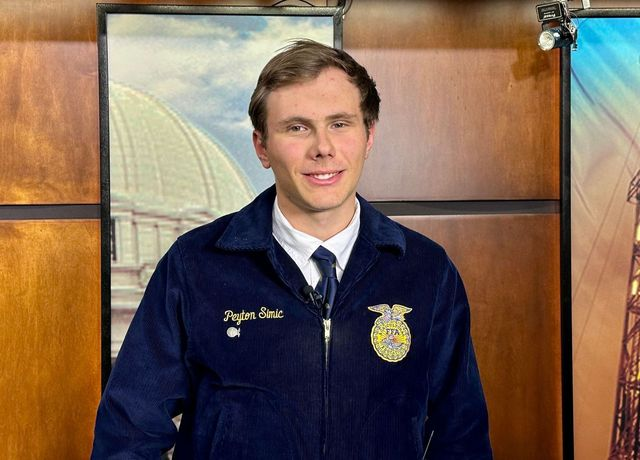
This morning, our coverage of the 2024 Oklahoma FFA Star Award Finalists continues with Agricultural Production competitor Cooper Kline of the North Rock Creek FFA chapter representing the Central Area.


Farm Director KC Sheperd interviewed all 18 Star finalists recently in Stillwater after they were judged in their respective areas- and you can hear KC talk with Cooper by clicking on the blue button at the bottom of this story.


"My current SAE is swine production, in which I run a show pig operation called Kline Swine, a boar stud (operation) called Kline Swine Sires, as well as maintaining a show pig enterprise," Kline said. "I run about 17 sows and a handful of boars from which I sell show pig prospects and semen across the country."


At this year's Oklahoma Youth Expo, Kline said he had the chance to watch some of the pigs he bred and raised compete in the show ring.


"On the boar side of things, I actually had a premium sale barrow at Houston, so that was very exciting," Kline said.


Our coverage of the Stars and the 2024 State FFA Convention is powered by Hilliary Communications.

Click here to listen to KC Sheperd talk with Cooper Kline about his achievement as the Central Area Star in Agricultural Production.
Sign Up for Our Daily Email- Free Because of Our Sponsors!

Support Our Sponsors!


KIS logo


Advertise With Us!
 

For our farmers who have either- always have had cotton on their farms- or those who have more recently have added the fiber crop to their operations- we have a daily report heard on several of our Radio Stations- It's Called Cotton Talk!

Click on the Button below to listen to our most recent report
Click here for our Latest Cotton Talk- Hosted by KC Sheperd


The latest news from the Oklahoma State Capitol is available daily on the Radio Oklahoma News Network.


Click on the blue button to hear from our State Capitol Reporter Albert Castellanos.

Click here for the latest report from the State Capitol on RON


OSU's Derrell Peel Says Cattle Markets are Back on Track

A month after cattle markets were roiled by the diagnosis of highly pathogenic avian influenza in dairy cattle, cattle futures and cash markets seem to be mostly recovered. Although there remain questions about some aspects of the disease, including exactly how the disease, now known as Bovine Influenza A virus (BIAV), is spreading between cattle, markets have settled into the knowledge that the disease has relatively minor impacts on cattle, and has no human health implications for meat or pasteurized dairy products. Baring any new surprising information, cattle markets should move on with market fundamentals.


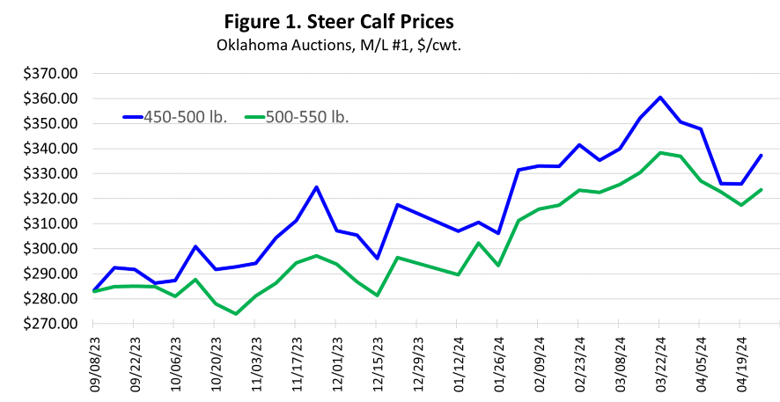
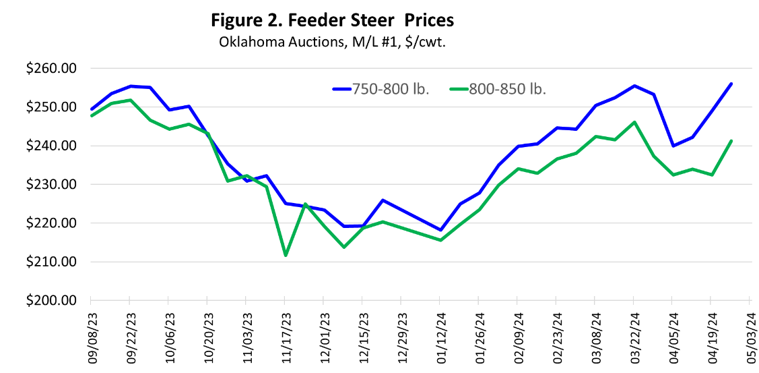
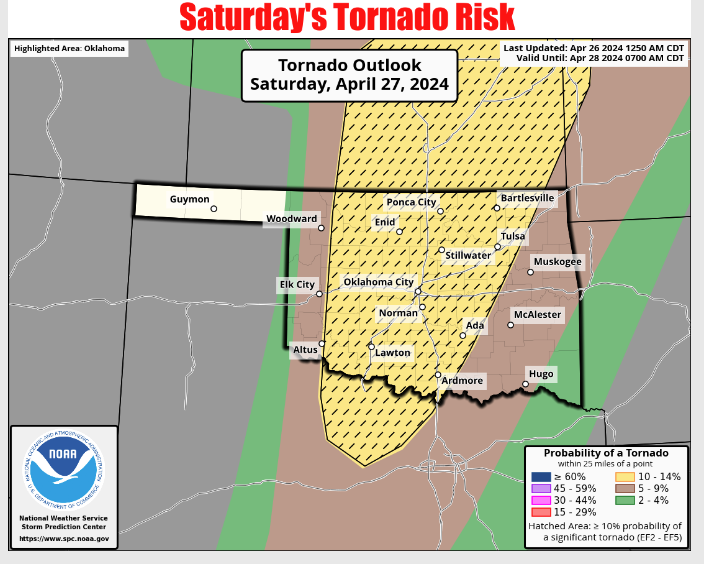
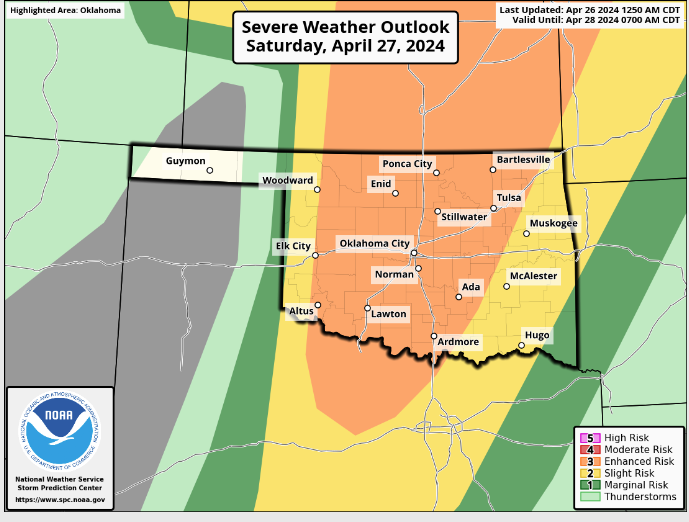
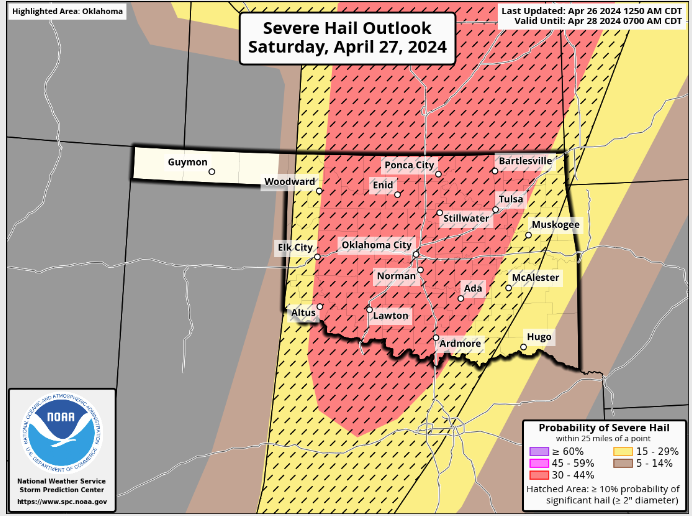
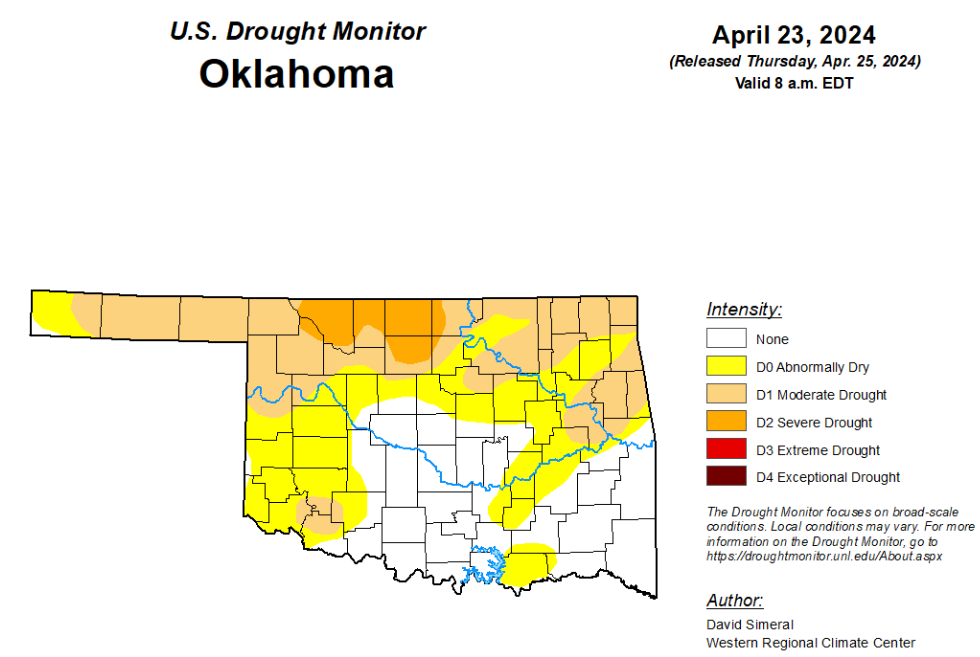
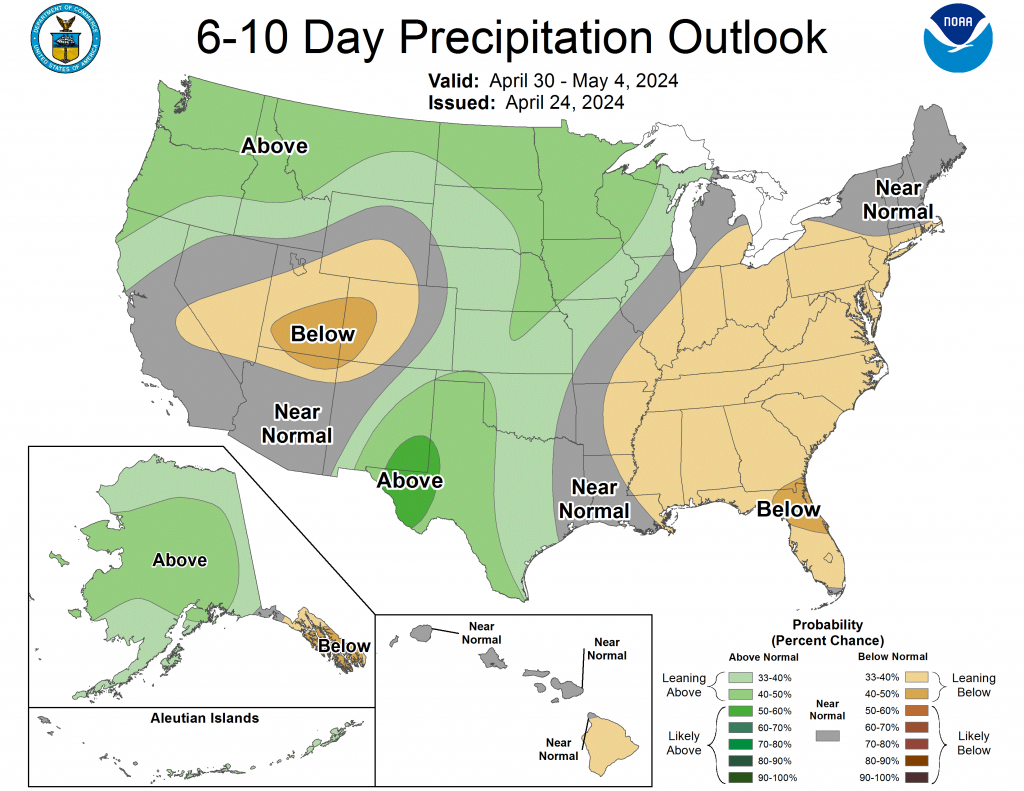
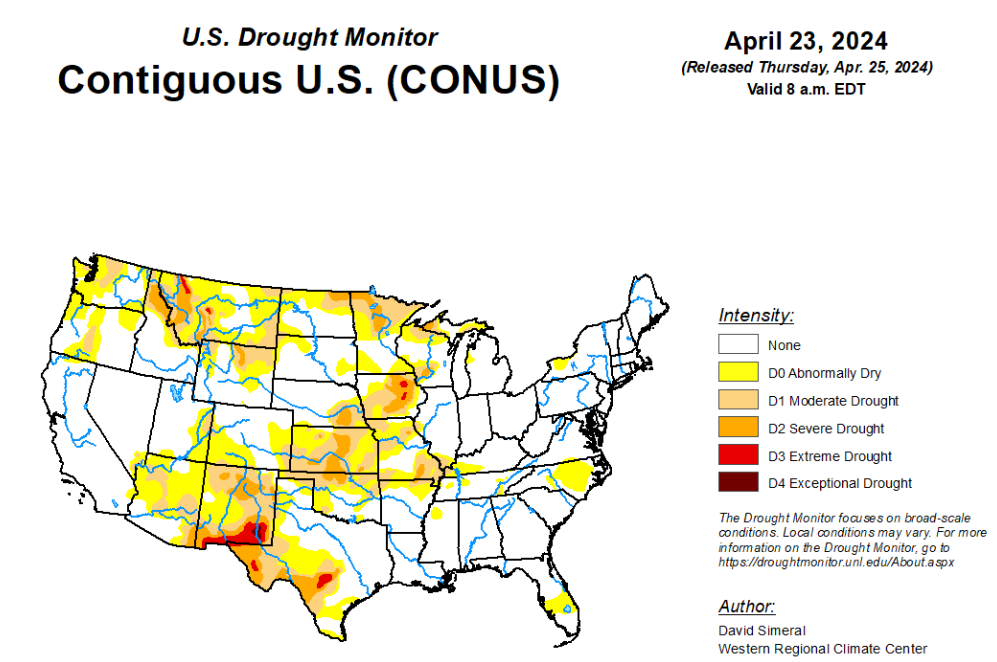
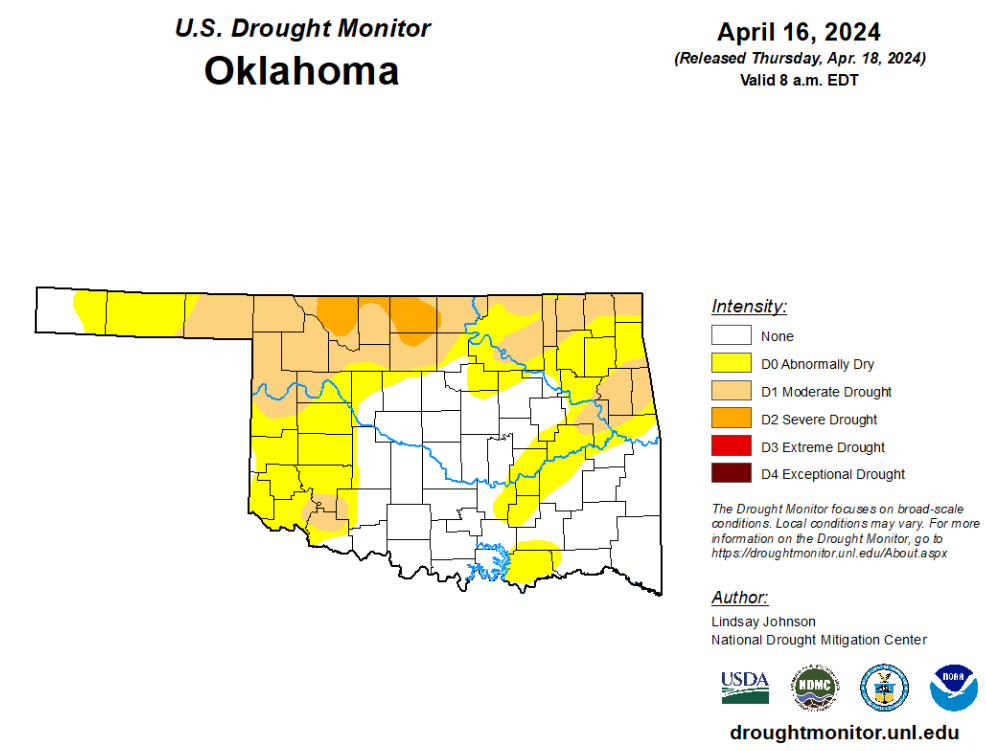
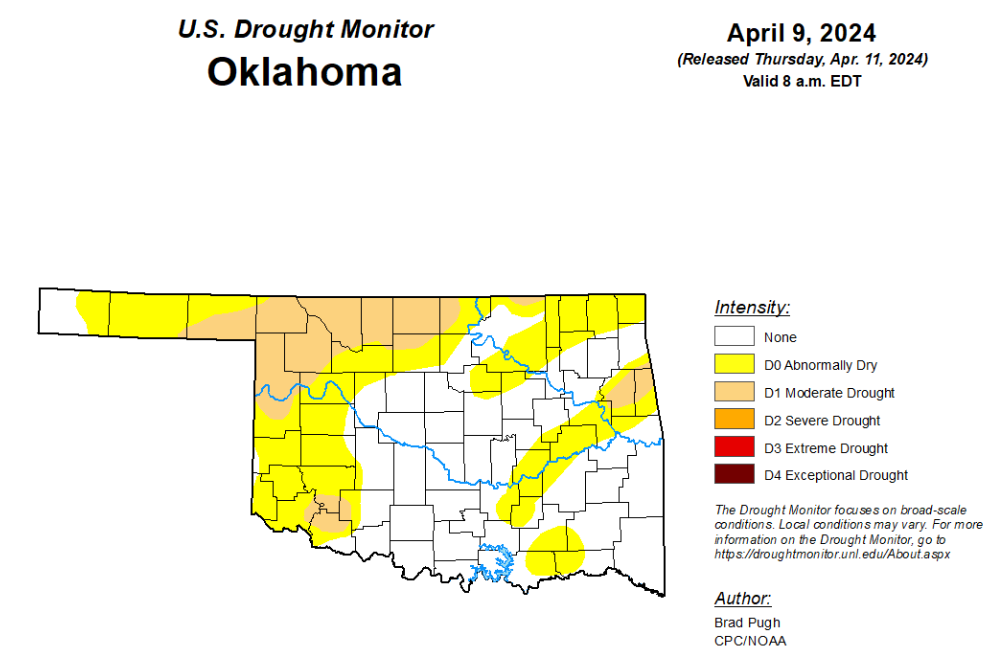
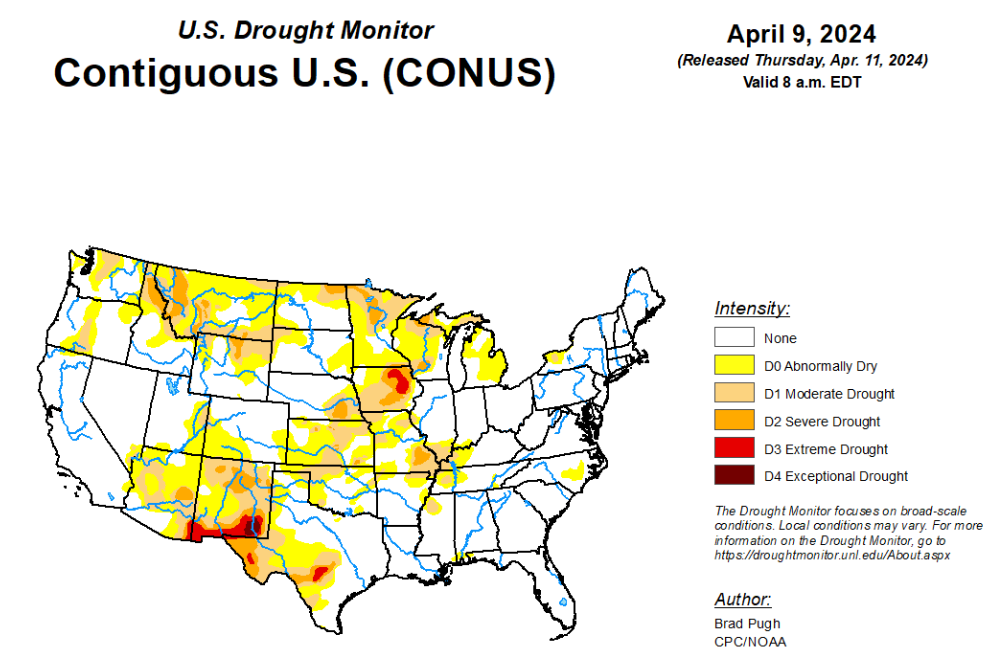
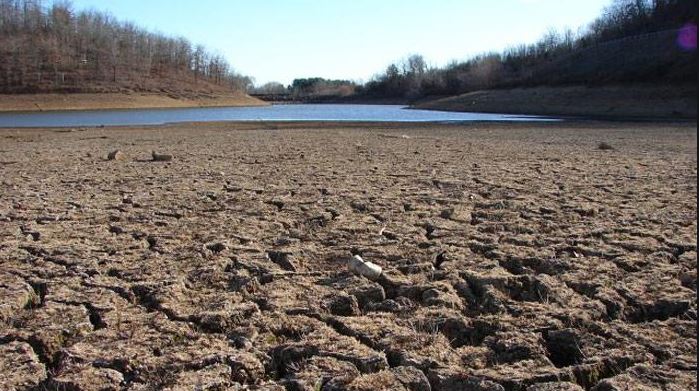
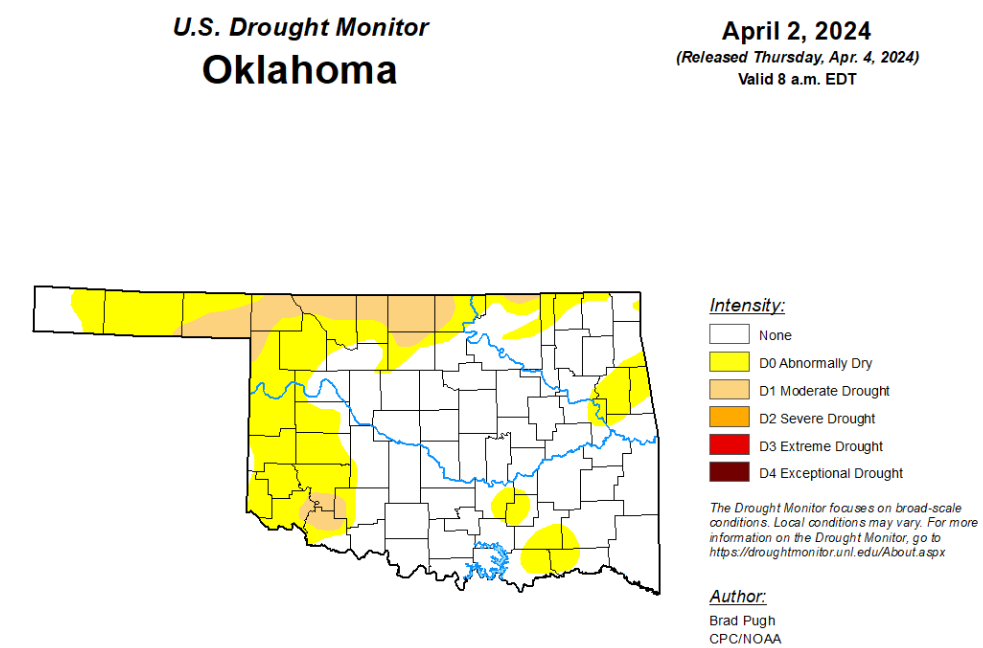
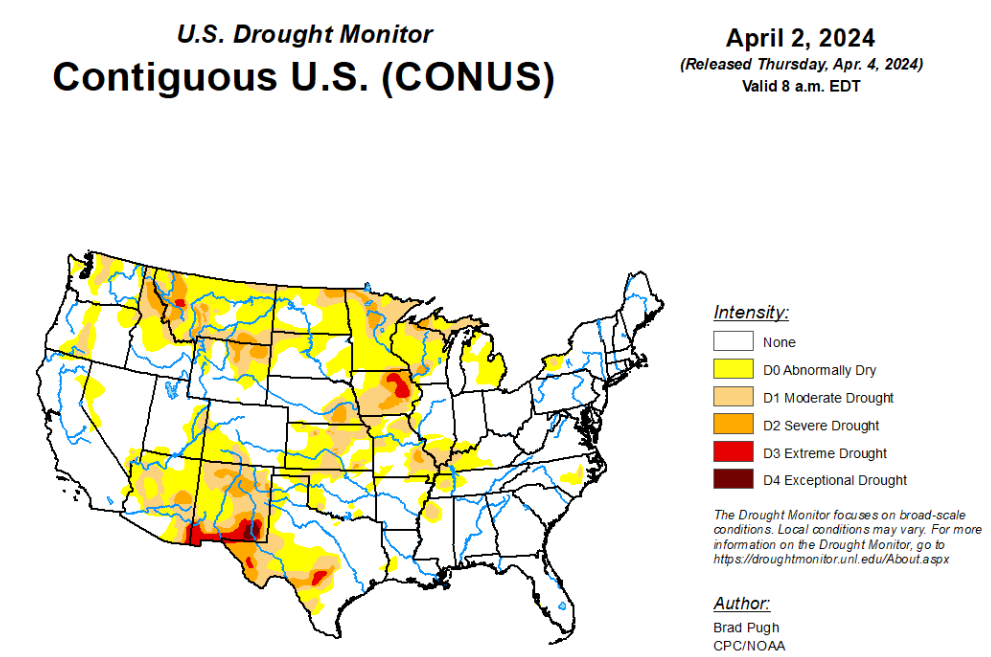
Calf prices normally reach a seasonal peak at the end of the first quarter, so steer calf prices may not recover fully to the March highs. However, the strong general uptrend in cattle markets likely means calf prices may move more sideways for a period before moving higher in the later part of the year. Concern about summer grazing conditions could temper stocker demand in the next month or so. In Oklahoma, drought conditions have been reemerging quickly, with the percentage of the state showing abnormally dry conditions or low-level drought increased from about 34 percent in March to nearly 66 percent in the most recent Drought Monitor.  However, the outbreak of storms the last weekend of April provided needed moisture in parts of the state, accompanied, unfortunately, by numerous tornados.

Click here to read more and watch Dr. Peel give an analysis on the current cattle market.

We invite you to listen to us on great radio stations across the region on the Radio Oklahoma Ag Network weekdays-

if you missed this morning's Farm News - or you are in an area where you can't hear it- click below for this morning's Farm news from Ron Hays and KC Sheperd on RON.
Listen to our latest Farm and Ranch News for Tuesday with KC Sheperd
 
 
Subscribe To the Daily Email


Sponsor Spotlight


National Livestock was founded in 1932 in Oklahoma City. National's Marketing Division offers cattle for sale weekly at the Oklahoma National Stockyards in Oklahoma City. The Finance Division lends money to ranchers across several states for cattle production. The Grazing Division works with producers to place cattle for grazing on wheat or grass pastures. 


The newest addition to the National Family is Dakota Moss- and Livestock Risk Services.


National also owns and operates other livestock marketing subsidiaries including Southern Oklahoma Livestock Auction in Ada, Oklahoma, OKC West Livestock Market in El Reno, Oklahoma, and the nation's premier livestock video sale, Superior Livestock Auction. National offers customers many services custom made for today's producer. To learn more, click here for the website or call the Oklahoma City office at 1-800-310-0220.


Noble Research Institute Fosters Regenerative Ranching Efforts Through Educational Courses

I am talking with the Director of Ranches, Outreach, and Partnerships at the Noble Research Institute, Hugh Aljoe, about establishing regenerative ranching practices on properties in southern Oklahoma and North Texas owned by Noble.


To listen to Part One of our Beef Buzz conversation with Aljoe, CLICK HERE.


By practicing regenerative agriculture on these ranches, Aljoe said soil health is improved during drought through an increase in organic matter. Aljoe also emphasized less input use, which helps to maintain positive margins.


The Noble Research Institute offers instructionally designed education courses to individuals wanting to practice regenerative ranching: The Noble Land Essentials and The Noble Grazing Essentials.


"They love the way we can deliver through this instructional design coursework. The other part of it is that it is practical. That is what we wanted to do is make sure we can get people out into the world using real examples and be able to see that for themselves."


This summer, Aljoe said Noble will be offering a course on the Essentials of Ranch Business.


To learn more about the Noble Research Institute and regenerative agriculture, visit the website by CLICKING HERE.

Click here to read more and listen to Part 2 of my conversation with Hugh Aljoe on regenerative ranching.

Oklahoma Wheat Commission to Hold District IV Election

The Oklahoma Wheat Commission will hold an election for the District IV board seat. The election will be held Thursday, May 9, 2024 commencing at 1 p.m. at the Cotton County Fair and Expo Center located at 924 W. Missouri Avenue, Walters, Oklahoma. District IV consists of Caddo, Comanche, Cotton, Greer, Harmon, Jackson, Kiowa and Tillman counties.


Candidates wishing to run in the election must be at least 25 years old, a resident of Oklahoma, engaged in growing wheat in the state for at least five years and must derive a substantial portion of his/her income from growing wheat. Three nominations will be made at the election, from which the Oklahoma Secretary of Agriculture will appoint one person to serve a five-year term with the Oklahoma Wheat Commission.


The Commission's vacancy meeting, which is open to the public, will begin at noon and the election will begin promptly at 1 p.m. (If planning to vote you must be checked in by 1:00 p.m.) Lunch will be provided at noon by the Oklahoma Wheat Growers' Association with Mike Schulte, Executive Director of the Oklahoma Wheat Commission speaking on "Wheat Research/Wheat Supply and Demand Outlook."


Every wheat producer in the district is urged to participate in this important election. For further information, contact the OWC office at (405) 608- 4350.

Click here to read more about the upcoming Oklahoma Wheat Commission District IV election.

DOL Tops 3,000 Pages of Regulations in 18 Months- AFBF Not Impressed

The U.S. Department of Labor today released yet another rule that mires farm families in excessive compliance costs while disregarding privacy concerns for farmers and their employees. With this addition, DOL sets itself apart as the agency most committed to burying farmers and other H-2A employers in a mountain of regulations. American Farm Bureau Federation President Zippy Duvall commented on today's rule and DOL's track record.


"Farmers appreciate the men and women who work on their farms, and we don't take lightly the responsibility to ensure their safety and protection. We wholeheartedly support clamping down on labor abuses, but this rule instead assumes all farmers are guilty until proven innocent and that's not right.


"With this 600-page rule, the Department of Labor has issued a stunning 3,000 pages of new regulations in just 18 months, which farmers are somehow supposed to navigate. Impossible.


"In truth, the workers most supported by DOL are the lawyers needed to interpret the tsunami of new rules that keep moving the goalposts for farmers."

Bill to Lock Oklahoma's Clock Signed into Law by the Governor

Senate Bill 1200 by Sen. Blake Cowboy Stephens, R-Tahlequah, was signed into law by Gov. Kevin Stitt Friday. The measure provides that the State of Oklahoma shall adopt permanent Daylight Saving Time (DST) upon approval of federal legislation to allow states to choose whether or not they change their clocks twice a year.


"I am incredibly appreciative of my fellow lawmakers on both sides of the rotunda who voted in favor of this measure, landing it on the governor's desk. Further, I extend my appreciation to Governor Stitt for his approval of this legislation that will give us an extra hour of daylight in the evenings during the winter months once the Sunshine Protection Act is approved by Congress," Stephens said.


Stephens also thanked the House principal author of the measure, Speaker Charles McCall, House Rules Committee Vice Chair Rep. Brian Hill, and Rep. Scott Fetgatter for their role in advancing SB 1200.


"I have long advocated for locking our clock and have spent many hours with my legislative colleagues and various organizations to discuss the benefits of adopting permanent DST. Oklahoma's future is looking even brighter now that we have this law in place, and I look forward to continuing the fight and working with our federal delegation to support the passage of the Sunshine Protection Act so we can officially lock our clocks," Stephens said.


Let's Check The Markets!
OKC West is our Market Links Sponsor- they sell cattle three days a week- Cows on Mondays, Stockers on Tuesday and Feeders on Wednesday- Call 405-262-8800 to learn more.
 
Today's First Look:
Ron on RON Markets as heard on K101  
mornings with cash and futures reviewed- includes where the Cash Cattle market stands, the latest Feeder Cattle Markets Etc.
Hear Today's First Look
 

Wholesale Boxed Beef Prices were higher- Choice Beef was up 39 cents and Select Beef was up $1.49 on Monday, 4/29/2024.


Click on the Button below for the latest report from USDA Market News

Boxed Beef Report
 

Oklahoma National Stockyards had 5,900 head on Monday, April 29, 2024.


Compared to last week: Steers over 800lbs steady to 2.00 higher. Steers under 800lbs 3.00-6.00 higher. Heifers over 800lbs 3.00-6.00 higher. Heifers under 800lbs steady to 3.00 higher. Demand good. Quality average


Click below for the complete closing report.

Oklahoma National Stockyards Market Report from 04/29/2024
 

The Joplin Regional Stockyards had a total run of 5,607 head on Monday, April 29, 2024.


Compared to last week feeder steers sold 2.00-5.00 higher with five weight steers up to 13.00 higher. Feeder heifers sold from 2.00 lower to 4.00 higher. Supply was moderate with good demand. 


Click on the button below for details of the trade as compiled by the USDA Market News Service.

 
Joplin Regional Stockyards Market from Monday 04/29/2024
 
OKC West in El Reno Cow and Bull Market Report for 4/29/2024 Cows and Bulls Steady to $1 Higher
 
 
Each afternoon we are posting a recap of that day's markets as analyzed by Justin Lewis of KIS futures - click below for the latest update on the Livestock and Grain Futures Trade..
Click Here to Listen to Justin's Commentary From
 
Okla Cash Grain:  
Daily Oklahoma Cash Grain Prices- as reported by the Oklahoma Dept. of Agriculture- The report available after the close of the Futures Trade for that day.
Read  Cash Grains Report from
 
Our Daily Market Wrapup from the Radio Oklahoma Ag Network - analyzing the Futures Markets for that trading day- as reported by KC Sheperd.
Click to Listen to Our Weekday Wrap with KC
 
Slaughter Cattle Recap: 
The National Daily Slaughter Cattle Summary- as prepared by the USDA Market News
Read Report
 
TCFA Feedlot Recap:  
Finally, here is the Daily Volume and Price Summary from the Texas Cattle Feeders Association.
Read Report
Our Oklahoma Farm Report Team!!!!
 
Ron Hays, Senior Farm/Ranch Broadcaster and Editor
 
KC Sheperd, Farm Director and Editor

Dave Lanning, Markets and Production

Reagan Calk, Farm News and Email Editor

Pam Arterburn, Calendar and Template Manager

Podcasts From Oklahoma Farm Report and More

Two of our regular reports are also podcasts that you can subscribe to- Our daily Farm and Ranch News with KC Sheperd- available here on the Apple Podcast Platform


The second is our daily Beef Buzz with Ron Hays- available here on the Apple Podcast Platform


Periodically- we offer interviews on our Ag Perspectives Podcast series- this podcast is available here.


Ron has also has a series of podcasts from interviews with newsmakers at the Cattlemen's Congress- Click here or you can find them on your favorite Podcast platform- look for them by searching for Cattlemen's Congress Conversations.


We are making plans to jump back into regular installments of what has been called the Road to Rural Prosperity- a new name and fresh content is in the works- for now- click on the blue button below for one of our favorites that is a timeless classic.

Listen to Episode 86 with Ron Hays talking with one of the legends in the Beef Cattle Business- Bob Drake of Davis, Oklahoma
 
 
Listen to Ron
Beef Buzz
 
Blue Green Gazette
Calendar
Auctions
Market Links
Facebook  Twitter  Youtube  

Our thanks to Midwest Farms Shows, P & K Equipment, Oklahoma Farm Bureau, Oklahoma Ag Mediation Program, Great Plains Kubota, Stillwater Milling Company, National Livestock Credit Corporation, Oklahoma Beef Council, Oklahoma AgCredit, the Oklahoma Cattlemens Association, Invenergy Oklahoma and  KIS Futures for their support of our daily Farm News Update.


For your convenience, we have our sponsors' websites linked here- just click on their name to jump to their website- check their sites out and let these folks know you appreciate the support of this daily email, as their sponsorship helps us keep this arriving in your inbox on a regular basis- at NO Charge!


We also appreciate our Market Links Sponsor - OKC West Livestock! 


We invite you to check out our website at the link below too that includes an archive of these daily emails, audio reports and top farm news story links from around the globe.

Head to Our Website OklahomaFarmReport.Com
God Bless!
Reach Out To Us:
Tim West
President/General Manager
Rural Oklahoma Networks

405-317-6361

***************

Mike Henderson
Director of Sales

405-615-4922

KC Sheperd
Farm Director
Radio Oklahoma Ag Network

405-443-5717

Email KC
Ron Hays
Senior Farm/Ranch Broadcaster
Radio Oklahoma Ag Network

405.473.6144
Email Ron

Alltech to distribute and sell Agolin® direct in the U.S. and Canada, partner with Feedworks USA

Alltech, a global leader in agriculture and animal nutrition, is pleased to announce that the company will serve as the primary importer and distributor of Agolin®products in the United States and Canada beginning May 1, 2024. Agolin's high-quality essential oil blends are scientifically proven to optimize feed intake and performance, including improved milk and meat production, for both ruminant and non-ruminant animals.

"We are dedicated to supporting producers with the best available nutritional technologies to achieve more milk and meat while reducing their environmental footprint," said Martha Baker, Alltech lead for Agolin.

Agolin® Ruminant was the first feed additive certified by The Carbon Trust for methane reduction in ruminants (2018). Today, Agolin Ruminant is included in the diets of more than 2 million dairy cows worldwide, and leading carbon methodology owners Verra and Gold Standard recognize it in their international climate protection project registries. Concord Agriculture Partners has also chosen Agolin Ruminant to create a new carbon inset project, which guarantees that participating dairy producers will receive an industry-leading 85% of the gross value of the carbon asset.

Dairy producers are already reaping the rewards of using Agolin products in their nutrition programs. In December 2023, U.S. dairy farmers who used Agolin Ruminant to create verified emissions reductions were awarded nearly $3 million in carbon-asset payments, in addition to the benefits of improved feed efficiency and an increase in fat and protein yield.

Feedworks USA introduced Agolin products to the North American market and has led the adoption and growth of these landmark nutritional technologies. In 2022, the company introduced the first enteric carbon project using Agolin in the U.S., not only reducing the carbon footprint of those dairies but providing a significant additional income to those farms. The Feedworks team will continue to support and distribute Agolin in partnership with Alltech.

"We are all excited to have Alltech partner with us in continuing to grow the market for these exciting products," said Peter Williams, one of the partners with Feedworks USA.  "Agolin ruminant products, in particular, are heavily researched and show productivity and efficiency benefits to U.S. dairies worth more than $10 per $1 cost. In addition, farmers can cover most of the cost with carbon credits. At present, well over half a million dairy cows are being fed Agolin Ruminant in the U.S., and this number is set to continue to grow rapidly."

"Feedworks is a valued partner to us, having established the Agolin business and distribution in the U.S. We look forward to continuing our partnership with them, as we expand access to Agolin for U.S. producers," said Baker.

Alltech acquired a majority interest in Agolin SA in May 2023. Founded in Switzerland in 2006, Agolin has developed and produced plant-based nutrition solutions that have been scientifically proven to improve herd performance, profitability and sustainability. Alltech plans to begin producing Agolin in its U.S. manufacturing facilities by mid-2025.

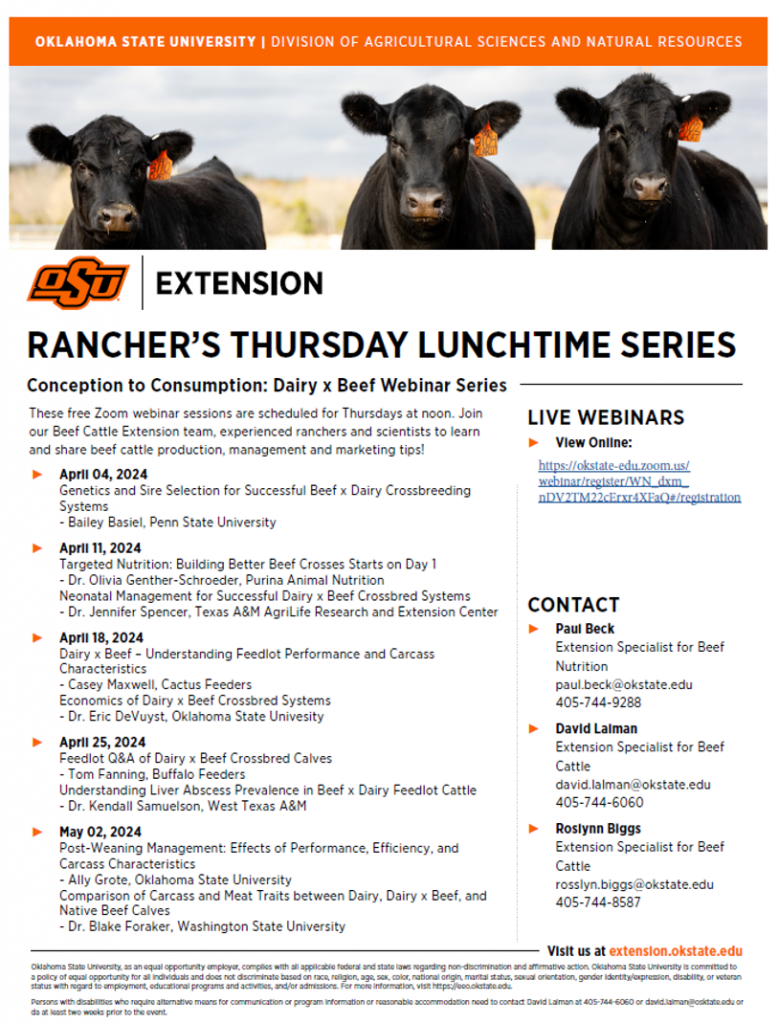
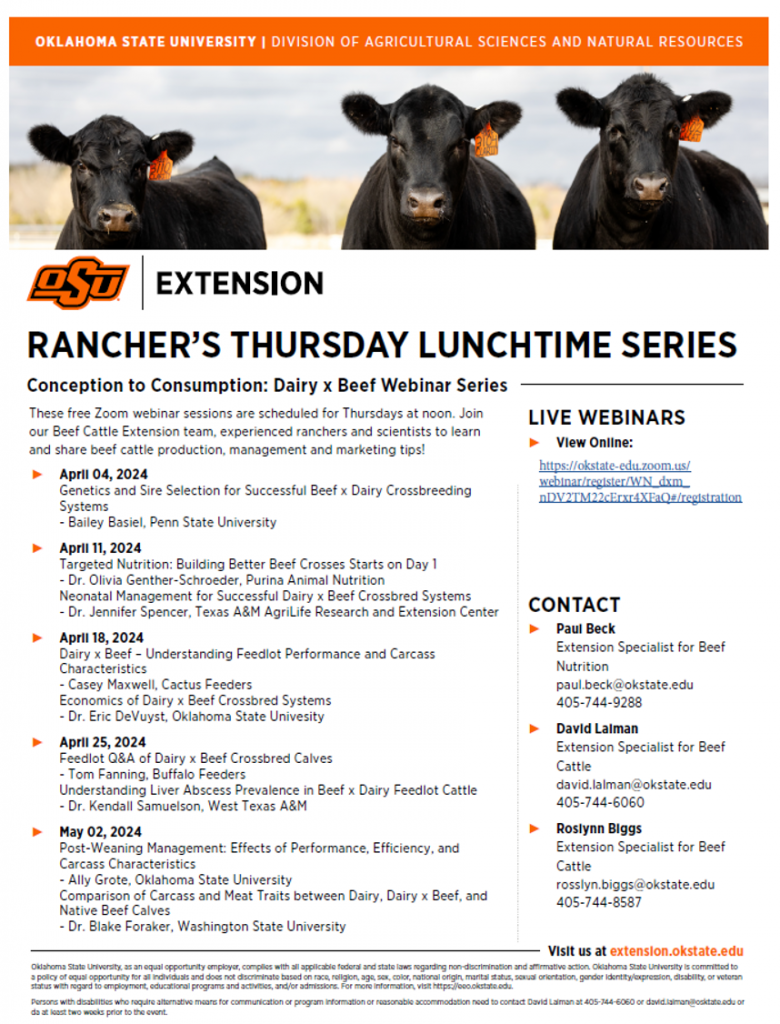
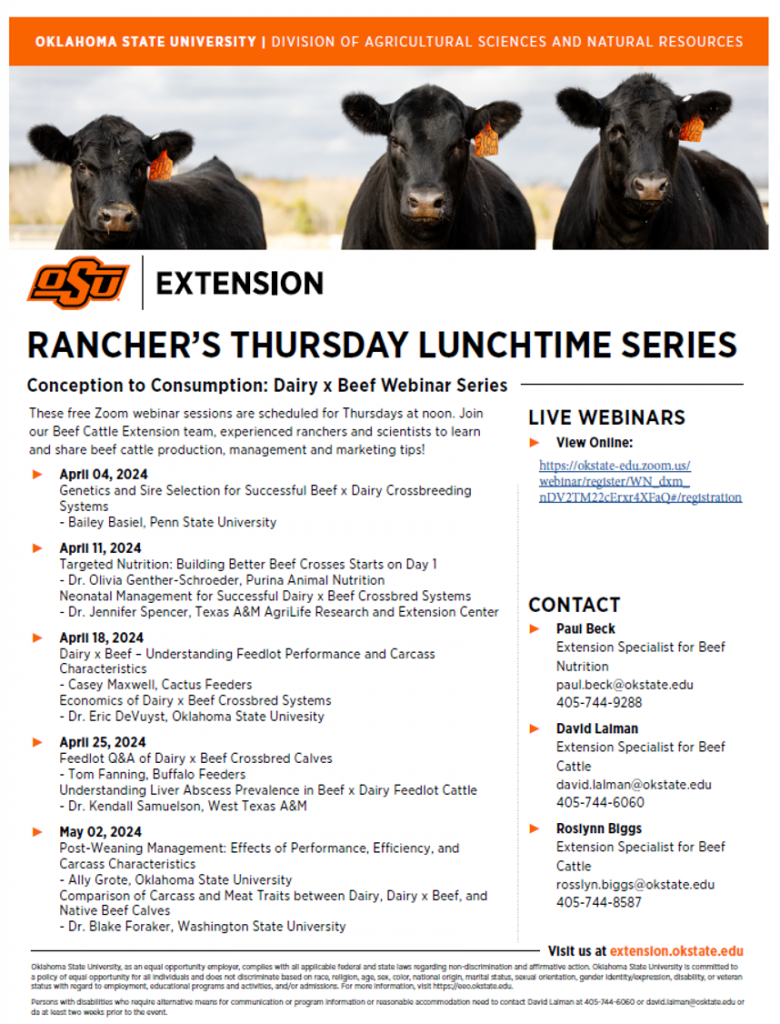
Ranchers Thursday Lunchtime Series to Conclude on May 2nd

The series will conclude on May 2nd. This Webinar covers the management of Dairy Beef crossbreds in the beef production system. There are presentations on research dealing with the effects of sire selection and early life management on finishing performance as well as management and performance of dairy-beef crosses in commercial feeding operations. Experts from across the nation cover recent research and real-world experiences in managing and marketing these unique animal resources.

Recordings of past webinars are available at https://extension.okstate.edu/programs/beef-extension/ranchers-thursday-lunchtime-series/conception-to-consumption-dairy-x-beef.html

Register for this online webinar series at https://okstate-edu.zoom.us/webinar/register/WN_dxm_nDV2TM22cErxr4XFaQ#/registration

Rural Water Systems Impacted by Oklahoma Storms May Qualify for Assistance Through USDA

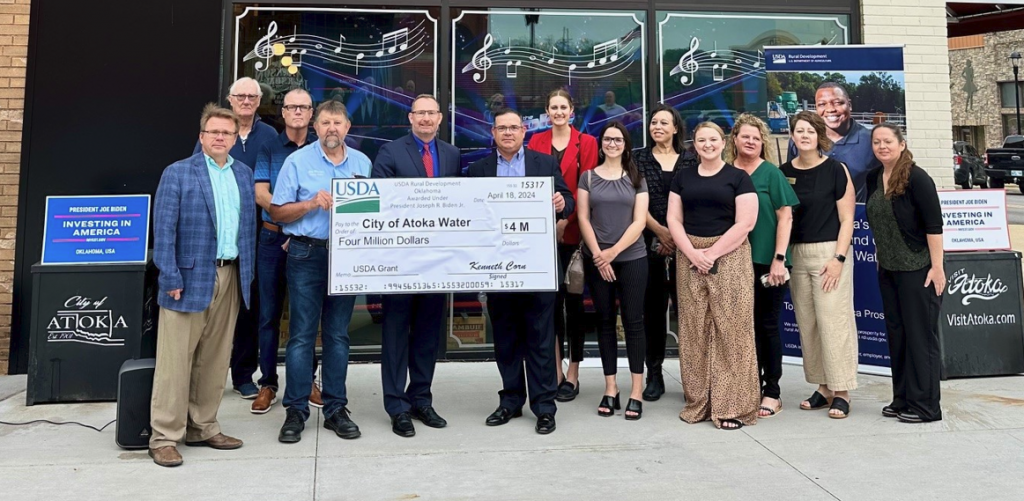
U.S. Department of Agriculture (USDA) Rural Development Oklahoma State Director Kenneth Corn announced today that the department is asking rural Oklahoma water districts who experienced damage during recent storms to contact the State Office to see if they qualify for grant assistance.

USDA Rural Development has funding utilizing the Emergency Community Water Assistance Grants, that can assist an eligible community recover from an emergency that threatens the availability of safe, reliable drinking water. This grant does not require a federal disaster declaration to have been made in order to use this program.  Water districts are encouraged to contact RD-OK-CPWaterWaste@usda.gov  or call 405-742-1070.

"President Biden has offered Gov. Stitt the full support of the federal government to support Oklahomans in need," Corn said. "USDA Rural Development Oklahoma State Office is prepared to provide the maximum support of our agency to honor the President's commitment to helping our friends and neighbors across Oklahoma deal with this incredible tragedy."

Who may apply?

  • Rurally located public bodies
  • Nonprofit organizations
  • Federally recognized tribes
  • Applicants must show that a major decline in quantity or quality of water occurred within two years of the date of the application. Grants are also awarded when a significant decline in quality and quantity of water is imminent.

What is an eligible area?

  • Rural areas and towns with populations of 10,000 or less -- check eligible addresses
  • Tribal lands in rural areas
  • Colonias

How may the funds be used?

  • Water transmission line grants up to $150,000 to construct waterline extensions, repair breaks or leaks in existing water distribution lines
  • Water source grants up to $1,000,000 for the construction of new wells, reservoirs, transmission lines, treatment plants, and/or other sources of water (water source up to and including the treatment plant)

USDA touches the lives of all Americans each day in so many positive ways. Under the leadership of the Biden-Harris Administration, USDA is transforming America's food system with a greater focus on more resilient local and regional food production, fairer markets for all producers, ensuring access to safe, healthy and nutritious food in all communities, building new markets and streams of income for farmers and producers using climate-smart food and forestry practices, making historic investments in infrastructure and clean energy capabilities in rural America, and committing to equity across the Department by removing systemic barriers and building a workforce more representative of America. To learn more, visit https://www.rd.usda.gov/ok.

Oklahoma Pork Council, Operation BBQ Relief, and Newman's Firehouse BBQ Partner and More to Provide 800 Free Pork Meals to Sulphur Community

Kylee Deniz with OK Pork hands out pork meals in Sulphur.

Following last weekend's devastating storms, the Oklahoma Pork Council, in partnership with Operation BBQ Relief and Newman's Firehouse BBQ, will distribute 800 free pork meals to the local Sulphur community on Tuesday, April 30, 2024. This is the second meal distribution Oklahoma Pork and Newman's Firehouse BBQ have conducted since the storms hit last weekend. Volunteers from the involved organizations and the local community will be present to assist with meal distribution and available for interviews.  

Ben E. Keith, and the Community Food Bank of Eastern Oklahoma, along with Operation BBQ, have arranged for an additional fresh pork product delivery to Sulphur today (happening same time, same place). The Community Food Bank of Eastern Oklahoma's CEO, Jeff Marlow, arranged for a refrigerated truck loaded with vegetables to be driven to Sulphur, arriving this later this morning and staying on site at the Walmart in Sulphur through the week.

Ben E. Keith's Emily Melton arranged for a special delivery of pork purchased by Oklahoma pig farmers via Oklahoma Pork to fill the reefer truck. Lastly, Oklahoma Pork purchased 10 cases of pork loins and 10 cases of pork butts, meaning thousands of more meals for Sulphur residents to be prepared by Operation BBQ tonight for dinner and through the balance of this week.

Oklahoma Pork and its partners appreciate the opportunity to spread the word in the Sulphur community so that residents know about this free resource on Tuesday, April 30.  

Where: Walmart Parking Lot 

2705 W Broadway Ave 

Sulphur, OK 73086 

When: April 30, 2024, from 11:00 a.m. onward 

Due to the current situation downtown, Sulphur's emergency response units are advising the public to avoid the downtown area. The event location at Walmart is on the outskirts of town, near the dispatch relief centers, accommodating better access and safety for all attendees. This location also facilitates coordination with local utilities and emergency services during this period. 

Virtual Peer Network for Oklahoma Producers Discusses Empowering Minority Farmers

Listen to the conversation during the virtual peer network Zoom meeting.

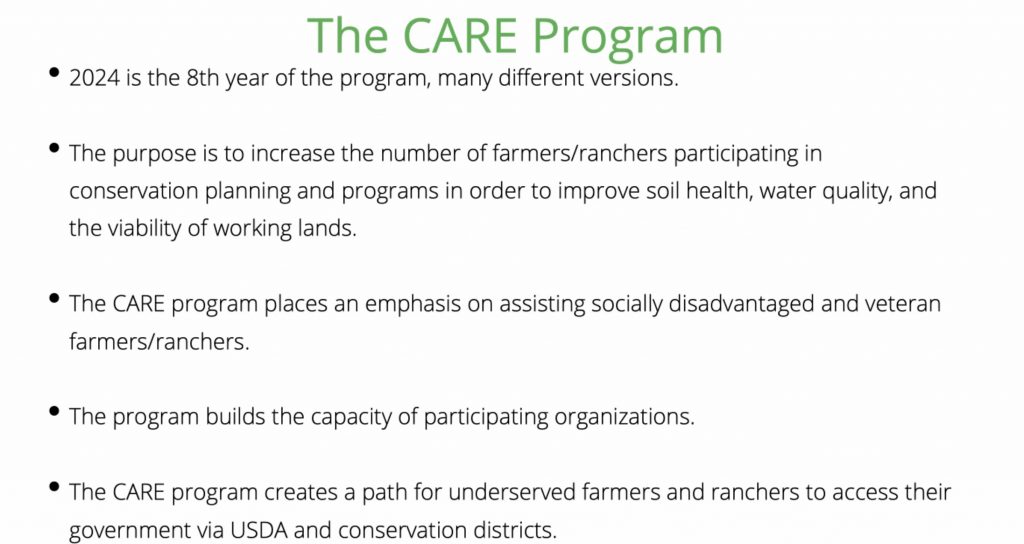
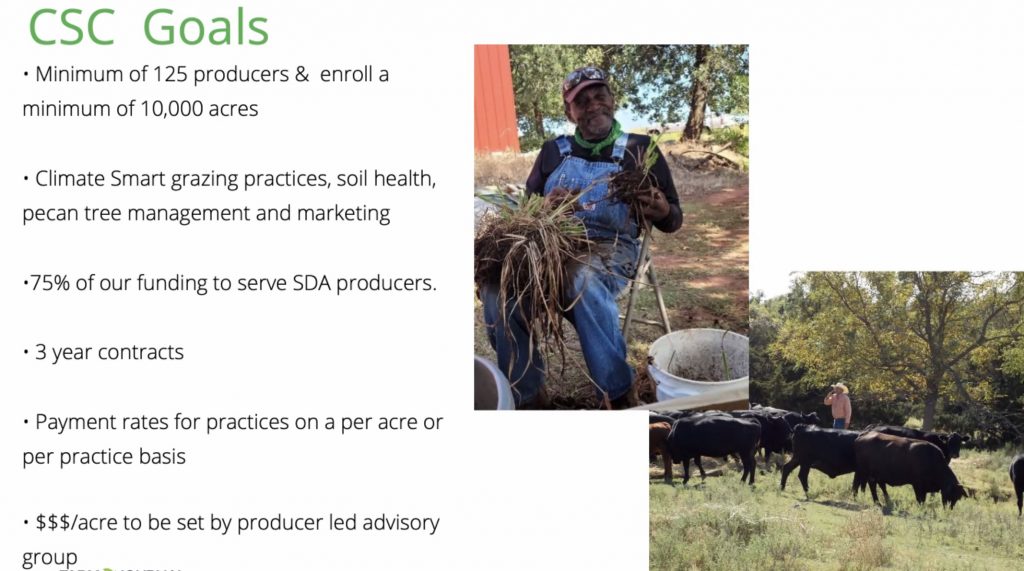
During the virtual peer network Zoom meeting last week, members of America's Conservation Ag Movement met to discuss the acceleration of climate-smart agriculture and the USDA CARES Program. To kick off the meeting, NACD's Jimmy Emmons and Farm Journal's Todd Greenwood emphasized the importance of public-private partnerships in scaling up climate-smart agriculture practices.

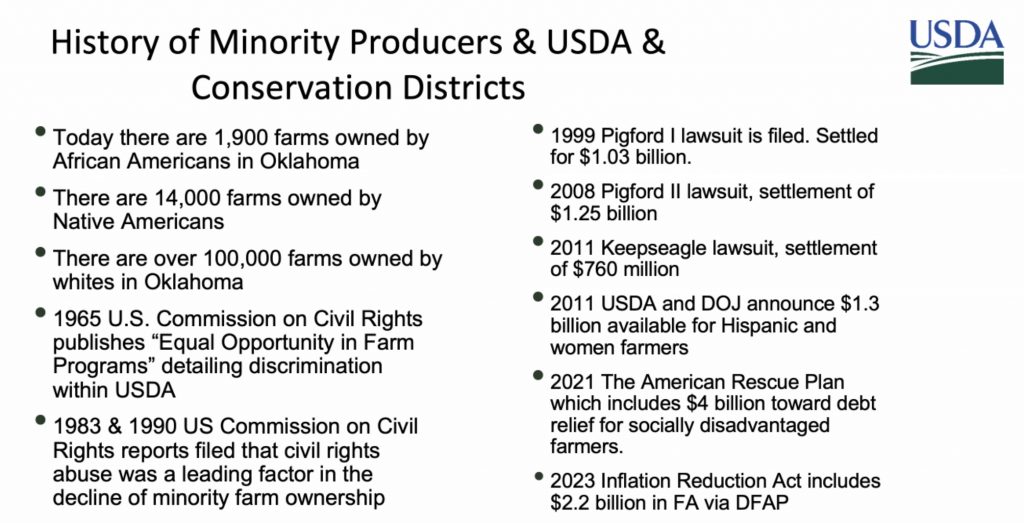
Throughout the meeting, speakers shared insights on empowering minority farmers through conservation and agriculture, with a focus on building trust and providing support for socially disadvantaged farmers and ranchers. The conversation highlighted the need for coalition building, stakeholder engagement, and education to overcome barriers to participation and achieve successful outcomes in rural development programs.

After Todd Greenwood explained the roll of conservation agriculture and bridging the gap between minority farmers and USDA programs, Sarah Blaney, the Executive Director at OACD spoke with Willard Tillman about the CARE Program, and the importance of conservation practices and their impact on future generations. They also talked about past discrimination against minority farmers and empowering individuals with knowledge of their rights and participation.

In the conversation, Blaney also discussed the importance of engaging farmers in policy decisions and highlighting their role in providing real-life stories and perspectives.

Established under the Inflation Reduction Act, USDA CARES is a customer service initiative to collaborate with USDA partners, act on what we've heard, rebuild trust, empower underserved communities and strengthen partnerships through improved access to resources.

USDA CARES is designed to better connect underserved producers and our partner organizations who serve them, sometimes known as cooperators, with relevant programs and services by increasing access to helpful resources. USDA CARES will include:

  • Resources with critical information on USDA programs and services
  • Networking and knowledge-sharing opportunities among USDA CARES partners
  • Trainings and other learning opportunities for USDA partners

To learn more about USDA CARES, CLICK HERE.

House Honors OSU 1979 National Champion Livestock Judging Team

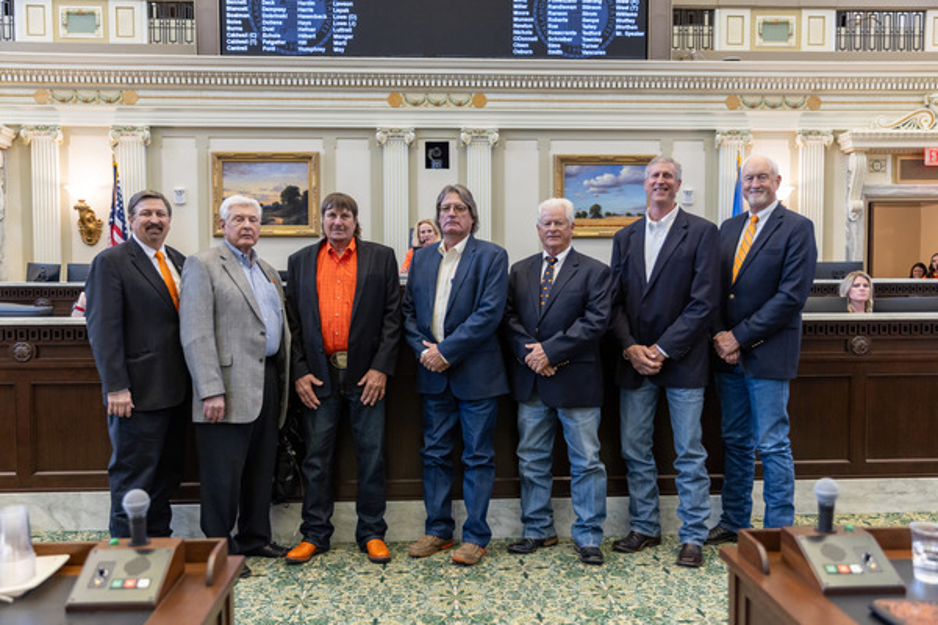
(L-R) Rep. Dick Lowe, Dr. Bob Kropp, Terry Richardson, Bill Wilkins, Stan Comer, Bill Robertson, and Tom Kissee on the floor of the Oklahoma House of Representatives. 

The Oklahoma House of Representatives recently honored Oklahoma State University's 1979 National Champion Livestock Judging team on the House floor.

The team was introduced on the floor by Rep. Dick Lowe, R-Amber, who was a member of the team while studying at OSU. Lowe introduced the team's coach, Dr. Bob Kropp, along with members Tom Kissee, Terry Richardson, Stan Comer, Bill Robertson and Bill Wilkins. The presentation was the opening event for the OSU Day celebration at the State Capitol on April 24th.

"It was an honor to recognize these outstanding gentlemen and celebrate the 45th anniversary of our national championship," Lowe said. "These guys became lifelong friends, and Dr. Kropp has always been somebody that I've not only admired but has become a mentor and friend. It was very special to celebrate this great team and the legacy of excellence in OSU's livestock judging teams."

This year marks 45 years since Lowe's team took home the national championship. OSU first won a national championship in livestock judging in 1925 and, since then, has earned more championships than any other university in the country.

AgTech PR Announces Inaugural AgTech Advisory Board

 AgTech PR, a global communications firm specializing in agriculture technology, announced today its inaugural Advisory Board composed of leaders driving transformative change in agriculture. Advisors will provide AgTech PR with industry insights and strategic guidance to help advance the organization's purpose.

"When I founded AgTech PR, I set out three objectives: to champion technology that adds tangible value to our food system; to collaborate with smart, passionate people; and to help lift up women in agriculture," said Jennifer Goldston, AgTech PR founder and CEO. "As the agtech landscape advances, the know-how and experience of these advisors will help us continue to build and protect our clients' brand reputation."

AgTech PR represents a range of start-ups and scale-ups in ag and food technology. With an ag tech-savvy team skilled in PR, marketing, and digital communications, the company remains steadfast in its commitment to supporting entrepreneurs at every stage of their journey.

"Once the technology is proven and they are poised for growth, start-ups must effectively tell their story. This is where we step in," said Goldston.

A Commitment to Diversity and Inclusion in Agriculture Comprised of four independent and diverse members representing the global agriculture and agtech community, the Advisory Board underscores AgTech PR's unwavering commitment to diversity and inclusion. As a woman-owned enterprise with a predominantly female workforce, the composition of the Advisory Board mirrors the distinct ethos of the company.

Julie Borlaug, Borlaug Foundation & Borlaug Consulting: A revered figure in agriculture, Julie Borlaug has tirelessly advocated for smallholder farmers and accessible technology for over two decades. Her multifaceted efforts across public and private sectors have propelled innovation in sustainable agriculture and fostered collaborations between diverse entities. As a distinguished public speaker on both domestic and international platforms, Julie's unwavering commitment to navigating change amid a rapidly evolving global landscape remains unparalleled.

Bonnie Brayton, Fulcrum Global Capital: A scientist and investor, Bonnie Brayton brings more than 15 years of experience in plant sciences and biotech to Fulcrum Global Capital, an early-stage ag tech venture capital fund. Her tenure at Corteva Agriscience involved developing novel technologies in doubled haploid breeding technologies for corn and sunflower, as well as scouting crop protection technologies and biological products for Corteva's R&D.

Erin Fitzgerald, Erin Fitzgerald Consulting: A global influencer, Erin Fitzgerald positioned the U.S. Farmers and Ranchers Alliance to serve as the secretariat for the Decade of Ag, a first-of-its-kind, sector-wide movement to fight climate change and build a new future for food agriculture by 2030. Erin has delivered game-changing presentations at the United Nations Food System Summit, Climate Change Conference of the Parties (COP) and World Economic Forum, presenting agriculture as a solution to climate change.

Sherry Frey, NielsonIQ: Renowned for her insights into consumer wellness trends, Sherry Frey serves as Vice President of Wellness at NielsonIQ, providing invaluable guidance to major food companies. Her extensive background in marketing and communications offers a unique consumer-centric perspective, bridging the gap between farm and fork while elucidating the "food as medicine" paradigm.

There is a great need for clarity at a time when investments are not yet in line with demand by farmers and consumers," Goldston said. "With our inaugural Advisory Board, we are creating the freedom and space to learn, adapt and grow as communicators and discover innovative ways to support the future of ag tech."

About AgTech PR

AgTech PR delivers impactful communication results consistently for agricultural entrepreneurs and ag tech startups. Our deep understanding of the food supply chain, its complex issues and the unique demands of each stakeholder segment helps ensure new ag technology is appropriately positioned and ag tech news breaks through the noise. www.agtechpr.com

NCBA's Ethan Lane Commends Animal Health Officials for HPAI Industry Updates

Listen to NCBA's Ethan Lane talk about HPAI impacts on the cattle industry.

At the National Association of Farm Broadcasters Washington Watch Event, Farm Director KC Sheperd had the chance to visit with the Vice President of Governmental Affairs at the National Cattlemen's Beef Association, Ethan Lane. In this episode of Beef Buzz, Senior Farm, and Ranch Broadcaster Ron Hays is featuring comments from the conversation regarding HPAI (Highly Pathogenic Avian Influenza) in dairy cattle.

"I think the animal health officials have done a phenomenal job of keeping the industry updated," Lane said. "We are five weeks into this thing now, and there have been regular updates. They have been consistent with their guidance. They are getting a lot of pressure, obviously, from all over the place to make sure it is safe, to make sure everything is as it should be, and to make sure the science is sound."

New test requirements have gone into effect as of April 29th for HPAI in lactating dairy cows in interstate transport. Lane said these test requirements do not have an impact on the beef cattle industry, as this is a dairy-only issue.

"So far, science is leading us to a spot where we are not concerned about this being a beef industry issue," Lane said. "This is a dairy industry issue. We are going to keep our eyes on it and make sure our producers are protected and monitor to see if it changes at any point."

Lane said it is important that the public knows that HPAI is an animal health issue, not a consumer health issue, so dairy products are completely safe to consume. He also added that the fact that there has not been any widespread misinformation about this issue proves that the facts are being utilized well.

"The media has a real role to play here in getting the right part of the story out," Lane said. "Basically, we have seen that."

The Beef Buzz is a regular feature heard on radio stations around the region on the Radio Oklahoma Ag Network and is a regular audio feature found on this website as well. Click on the LISTEN BAR for today's show and check out our archives for older Beef Buzz shows covering the gamut of the beef cattle industry today.

Plant With Harvest Goals in Mind

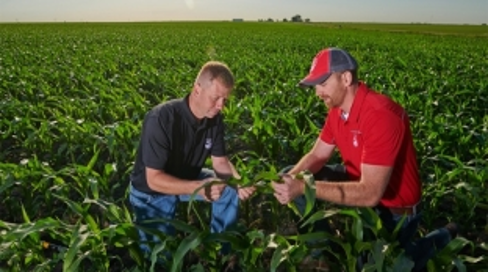
LG Seeds agronomist Jed Norman (right) encourages farmers to think through harvest goals when planning planting order but recognize field conditions can force plans to change.

Farmers are always thinking ahead and planning for the what-ifs that come with the job. That's on full display as they make decisions about planting order. 

Farmers' harvest goals and their intentions for the following crop year factor into that strategy, says Jed Norman, an LG Seeds agronomist in Iowa. "Those looking to push the needle are always thinking through how they might better their operation with strategy tweaks from season to season."

Consider the past and goals for the future
When determining planting order, Norman advises farmers to start by looking back on their game plan from the year prior. "Evaluate whether the performance was good, whether corn was dry coming out of the field and whether you were happy with late-season intactness," Norman advises. "Ask yourself if you felt good about how last season's plan played out."  

A farmer can use that assessment to tweak (or overhaul) their plan, aiming for even better results. Norman says the other major player in that planting order strategy should be the farmer's goals for the season.  

"A farmer might have a grain dryer system and want to harvest a field relatively early to push yields," Norman offers as an example. "Or a farmer with manure and limited storage for it may need to get the crop out earlier so they have acres to spread it on." 

Farmers should cater planting order and the relative maturities of their hybrids to those timelines.  

A good seedbed outweighs all
"To quote boxer Mike Tyson, 'Everybody has a plan until they get punched in the face,'" Norman says, likening spring weather to that blow. "Farmers can have the best plan, and then the weather tells them different."  

With that in mind, he encourages farmers to have a strategy for planting order but be ready to adjust it to ensure crops are planted to good seedbeds. Norman says, "Regardless of your plans for hybrid and field order, if you don't have a good seedbed and seed-to-soil contact, you'll fight an uphill battle all season."  

Farmers should pay attention to the soil temperatures and soil moisture of individual fields. "Planting before fields are fit can result in hardpan or sidewall compaction that jeopardizes final stand and yield potential," he explains.  

Spreading planting dates spreads risk
Norman also encourages farmers to spread out planting dates if operation size allows. "I'm a firm believer in spreading risk," Norman says. "If all of your crop is tasseling at the same time and a heatwave moves in, all of your acres will be hit. 

"A better strategy is to spread those planting dates as well as the relative maturities of hybrids to mitigate that risk." That can also help with time management when it comes to things like nutrient or fungicide applications, he adds.  

Additional considerations
Farmers with dual-purpose corn acres should try to align the R5 stage of development when silage is typically cut with a timeframe when they know they will have the workers, space and equipment in position to package and pack the feedstock.  

Farmers with manure to spread need to know how many acres they will need available. They should also adjust their hybrid selection and maturities to make sure they have seed solutions for capitalizing on that manure application.  

Farmers who utilize cover crops need to think through how that fits within their management plan and how that might factor into planting order and hybrid maturities.  

"The bottom line when it comes to planting order is that farmers should try to stick with their plans but be ready to adapt to whatever is thrown their way," Norman says. "At LG Seeds, we take pride in both the products and the support we provide. Whether it's strategizing planting order or adjusting those plans to account for field conditions, we'll do whatever we can to make sure our farmer customers can achieve their goals."   

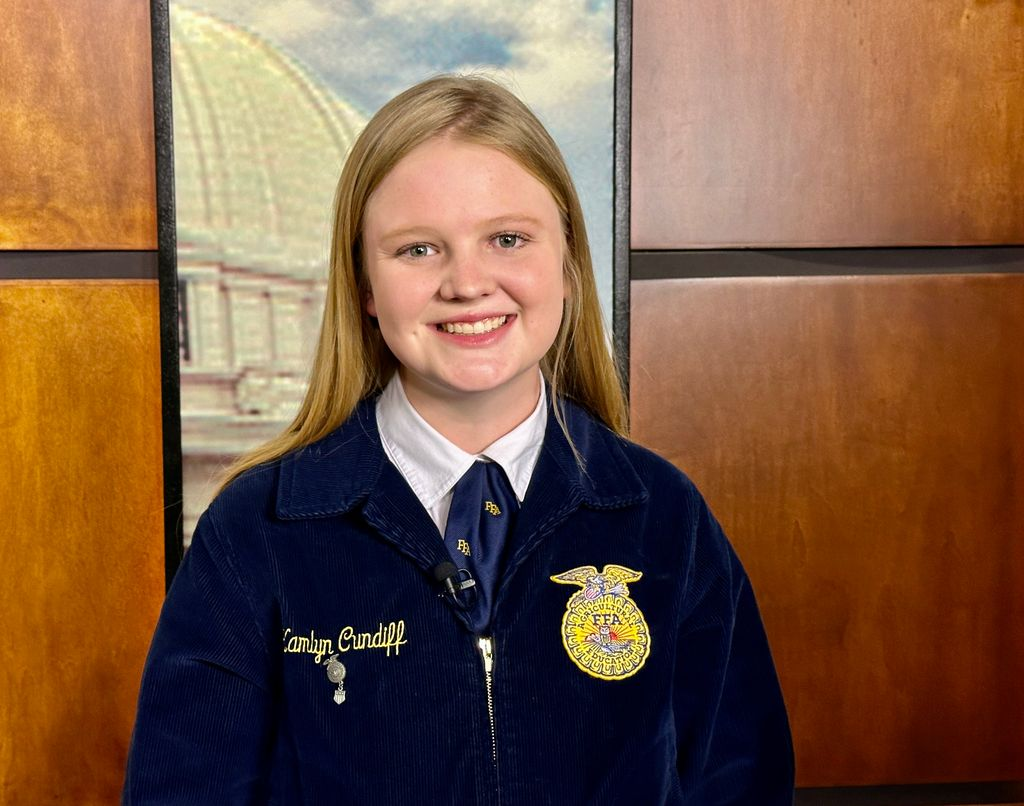
Introducing Kamlyn Cundiff of the Allen FFA Chapter, Your 2024 Southeast Area Star in Agricultural Production

Kamlyn Cundiff

Listen to KC Sheperd talk with Kamlyn Cundiff ahead of the State FFA Convention in Tulsa, Oklahoma.

During the month of April, the Radio Oklahoma Ag Network and Oklahoma Farm Report are spotlighting the 18 Area Stars of Oklahoma FFA, who are among the highest achievers in the organization.

The stars come from the five areas in four categories- Star in Ag Placement, Star in Agriscience, Star in Agribusiness, and Star in Agricultural Production.

This week, we spotlight the five area stars in Agricultural Production in 2024.

One Star Finalist featured in the coming days from each of the categories will be named the State Star Award Winner during the 98th Oklahoma State FFA Convention, which will take place on May 7th and 8th in Tulsa, Oklahoma.

This week, our coverage of the 2024 Oklahoma FFA Star Award Finalists continues with Agricultural Production competitor Kamlyn Cundiff of the Allen FFA chapter representing the Southeast Area.

Cundiff's project is goat production where she raises and sells goats to showmen across Oklahoma. Cundiff said that growing up in the livestock industry and having experience with showing and raising goats inspired her project.

"I have a love for goats and I think it is amazing to see people do great with goats I have raised," Cundiff said.

This project will continue, Cundiff said, as she plans for goat production to continue to be a part of her lifestyle.

"It is definitely a family effort," Cundiff said.

Your coverage of the 2024 Oklahoma FFA Convention is sponsored by Hilliary Communications- who deliver the latest cutting-edge communications services supporting tens of thousands of customers across 22 counties throughout Oklahoma, Texas and Iowa. The company offers internet, voice and HilliaryTV. Hilliary Communications continuously researches the marketplace for innovations and strives to improve underserved areas, offering services that exceed customer expectations. Click here to learn more about Hilliary Communications.

For more information about the 98th Oklahoma State FFA Convention, click here.

Liechtenstein Group Invests in PowerPollen To Unlock Potential for Major Food Crops

The Liechtenstein Group, known for its commitment to sustainable agriculture and innovative technologies, is leading a funding round of €22.5 million in the US company PowerPollen. PowerPollen has developed a unique pollination technology that allows pollen to be collected, preserved, and applied on-demand. This technology promises significantly better pollination and thus higher crop yields.

Pollen from wind-pollinated crops usually survives only a few minutes to hours at most. Climate change – drought, excessively high temperatures, pollinator decline, and extreme weather events – has made the pollination of these plants even more complex. PowerPollen's technology offers a contemporary solution to these challenges in commodity crops, ensuring more stability and consistency in agricultural yields.

PowerPollen's patented technology and hardware collects pollen from male plants, and then preserves the viability of the pollen up to four years for future application. Using a custom applicator, the pollen can be applied precisely at the right time and under ideal conditions in the fields. Yield improvements of over 20 percent with corn seeds significantly contribute to improving global food security. Targeted pollination "on demand" reduces the need for male plant rows, leading to reduced land use, as well as lower water and resource consumption.

In recent years, PowerPollen has proven its technology through successful partnerships with industry leaders, such as Bayer and Corteva for corn, and BASF for wheat, and underscores the value of leveraging scale-up innovation, like PowerPollen, to meet the world's goals for more sustainable food production.

"For years, our technology has proven effective in corn and continues to demonstrate strong potential for applications in other crops. With the new financing, we'll continue to advance our technology, aided by the expertise and global network of the Liechtenstein Group," said Todd Krone, Co-Founder and CEO of PowerPollen.

PowerPollen Rice Joint Venture Leverages On-Demand Pollination for Hybrid Rice

As well as taking a stake in PowerPollen's parent company, the Liechtenstein Group has also established a promising joint venture with PowerPollen, PowerPollen Rice, which focuses on the development and commercialization of the pollination technology to rice.

Hybrid rice, with a 20 percent or higher yield advantage over conventional pure line varieties, remains a cornerstone of global food security. Traditional rice cultivation poses escalating environmental and economic risks, including groundwater depletion, methane emissions and labor challenges. Enabling better hybrid rice pollination systems has the potential to increase the global rice value and sustainable production.

"We are absolutely convinced of the technology and its importance for more sustainable agriculture and global food security. For RiceTec, our rice seed company, the technology also has enormous potential to further increase the efficiency of this staple food crop for billions of people worldwide," said Johannes Meran, CEO of the Liechtenstein Group. "Through RiceTec genetics and PowerPollen's technology, we can unlock untapped efficiencies in hybrid rice production, setting the stage for a significant leap forward in global food security and climate change mitigation."

This research collaboration will result in commercialization of PowerPollen's technology for rice seed production by 2027.

About Liechtenstein Group

The Liechtenstein Group is an international group of companies and investment platform owned by the Foundation Prince Liechtenstein, operating in the areas of Food & Agriculture, Forestry, Renewable Energy and Real Estate. The Group pursues a long-term investment strategy with an international orientation, focused on its four core sectors. Through its activities, the Liechtenstein Group aims to make a positive contribution to the sustainable development of these industries. Liechtenstein Group's portfolio companies include, among others, rice seed company RiceTec, N-Drip, the LIECO Group, TESVOLT, PV-Invest, Wilfersdorf Estate and Forestry Operations, Kalwang Forest, and Liechtenstein Real Estate. Further information may be found at www.lgroup.com.

About PowerPollen PowerPollen® offers a breakthrough, scalable technology to collect, preserve and apply pollen on-demand to help improve the productivity, profitability and sustainability of modern farming practices. Following multiple seasons of year-round field trials, PowerPollen's patented pollination technology increased yield by more than 20% in commercial hybrid corn seed production fields. The company has applied its technology across thousands of commercial acres over the past several years. PowerPollen is headquartered in Iowa with additional research operations in Puerto Rico and Texas. Learn more about how PowerPollen's on-demand pollination technology works at www.powerpollen.com

Marbling- A Success Story

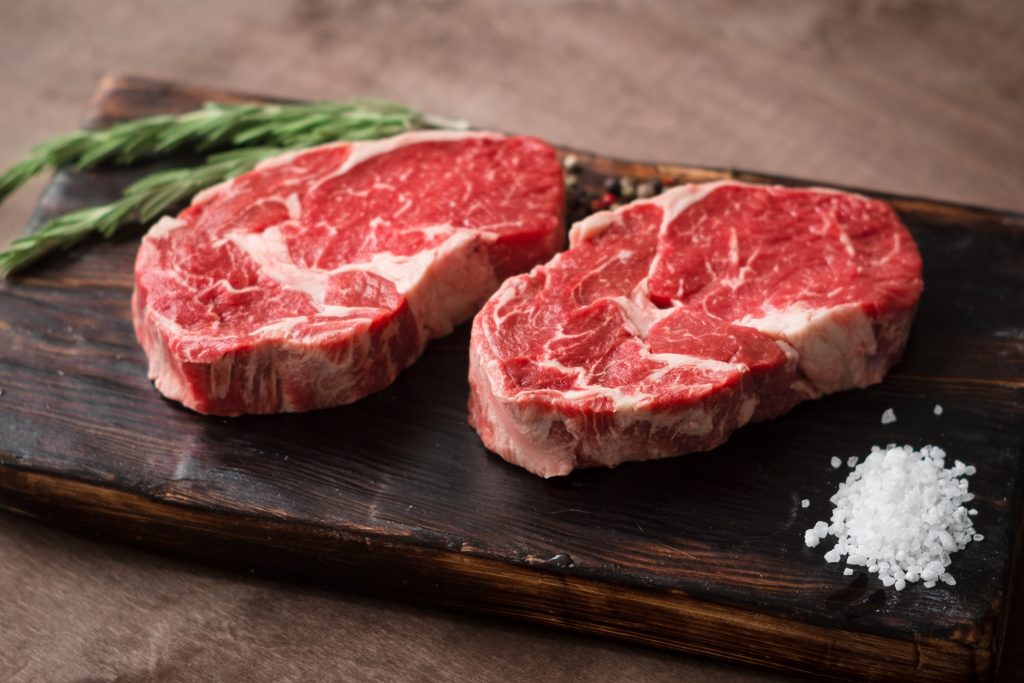
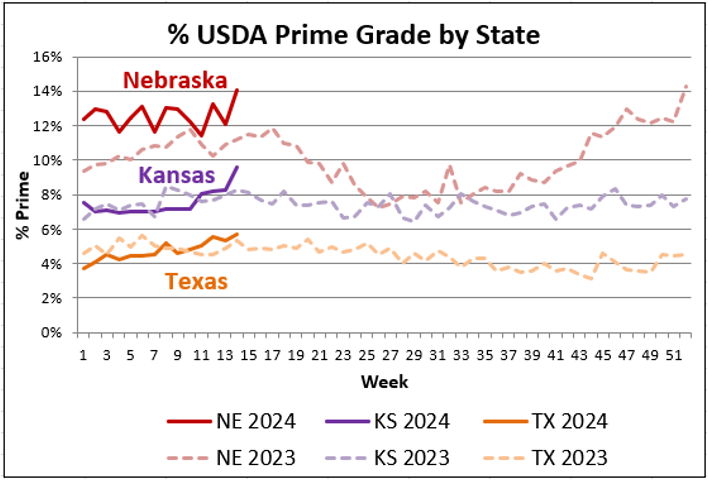
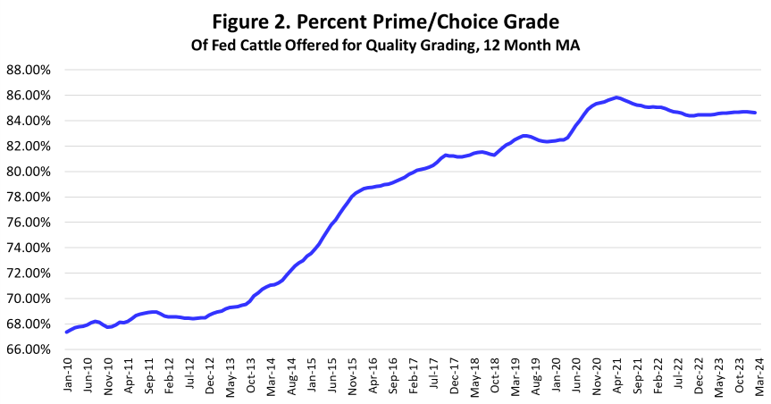
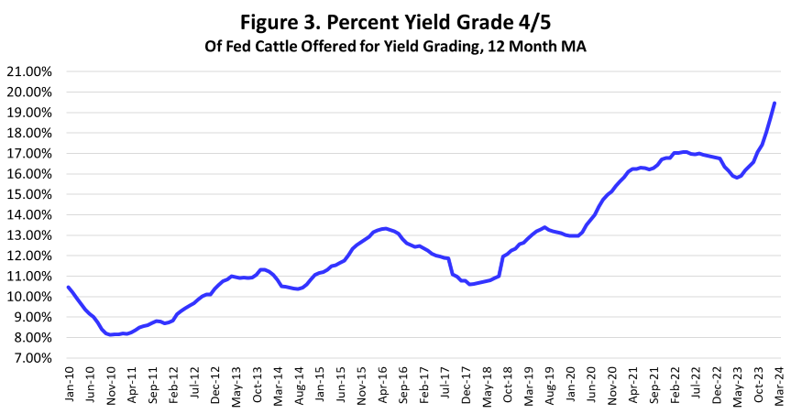
In recent years there has been a significant increase in the percentage of fed cattle in the US reaching the USDA Quality Grade of Prime. This level of quality is driven primarily by the degree of marbling in the ribeye at the 12th-13th rib interface of a beef carcass. Historically speaking, the beef industry routinely saw 1 – 2% of the youngest maturity groups of fed cattle reaching the Prime Quality Grade. It is now normal to see 8 – 10% of the weekly harvest grading Prime. The Quality Grade of Prime indicates the highest level of tenderness, juiciness and flavor of cooked beef. Prime indicates the greatest likelihood of a satisfying eating experience. This is a tremendous success story for the beef industry. It is particularly an example of a job well done by cattle breeders. Marbling is a high heritability trait and selection pressure applied to Marbling EPDs has resulted in an increased genetic potential of the US cattle population to reach this level of quality. There is no doubt that the modern norm of finishing cattle to heavier weights has helped to tap this genetic potential. That being said, the additive genetic potential had to be bred in before it could be tapped.

The past three decades has seen the cattle industry improve the consistency and quality of beef. USDA Quality Grades are the most economically significant factor influencing the value of a beef carcass. Cattlemen and Cattlewomen who retain ownership through finishing have responded to the economic signals in the market place quite successfully. This is a success story in which we should take pride. It also serves as an example of what can be accomplished when we use the modern tools available to make genetic change.

Below, Mark Johnson, OSU Extension beef cattle breeding specialist, explains how to maximize profit potential in your cattle herds on SUNUPTV from April 27, 2024.

Bill to Lock Oklahoma's Clock Signed into Law by the Governor

A historic postcard from World War I- Daylight Savings Time was established in 1918 to help save energy during World War I

Senate Bill 1200 by Sen. Blake Cowboy Stephens, R-Tahlequah, was signed into law by Gov. Kevin Stitt Friday. The measure provides that the State of Oklahoma shall adopt permanent Daylight Saving Time (DST) upon approval of federal legislation to allow states to choose whether or not they change their clocks twice a year.

"I am incredibly appreciative of my fellow lawmakers on both sides of the rotunda who voted in favor of this measure, landing it on the governor's desk. Further, I extend my appreciation to Governor Stitt for his approval of this legislation that will give us an extra hour of daylight in the evenings during the winter months once the Sunshine Protection Act is approved by Congress," Stephens said.

Stephens also thanked the House principal author of the measure, Speaker Charles McCall, House Rules Committee Vice Chair Rep. Brian Hill, and Rep. Scott Fetgatter for their role in advancing SB 1200.

"I have long advocated for locking our clock and have spent many hours with my legislative colleagues and various organizations to discuss the benefits of adopting permanent DST. Oklahoma's future is looking even brighter now that we have this law in place, and I look forward to continuing the fight and working with our federal delegation to support the passage of the Sunshine Protection Act so we can officially lock our clocks," Stephens said.

This Week's Oklahoma's Winter Wheat Conditions Rated 46 Percent Good to Excellent, Up 37 Points from One Year Ago

U.S. Crop Progress:

Winter wheat headed reached 30 percent, up 7 percentage points from the previous year and up 9 points from the five-year average. Winter wheat conditions rated 49 percent good to excellent, 35 percent fair and 16 percent poor to very poor. Last week's conditions rated 50 percent good to excellent, 34 percent fair and 16 percent poor to very poor. 

Corn planted reached 27 percent, 4 percentage points from the previous year and up 5 points from the five-year average. Corn emerged reached 7 percent, up 2 points from the previous year and up 3 from the five-year average.

Soybeans planted reached 18 percent, up 2 percentage points from the previous year and up 8 points from the five-year average.

Cotton planted reached 15 percent, up 1 percentage point from the previous year and the five-year average.

Sorghum planted reached 19 percent, down 1 percentage point from the previous year and the five-year average.

Oklahoma Crop Progress:

Winter wheat jointing reached 97 percent, up 7 points from the previous year. Winter wheat headed reached 45 percent, up 5 points from the previous year and up 4 points from normal. Winter wheat conditions rated 46 percent good to excellent, 40 percent fair and 14 percent poor to very poor. Last week's conditions rated 49 percent good to excellent, 39 percent fair and 12 percent poor to very poor. One year ago as of May 1, Oklahoma's winter wheat conditions rated 9 percent good to excellent and 61 percent poor to very poor.

Corn planted reached 40 percent, up 6 percentage points from the previous year and up 9 points from the five-year average. Corn emerged reached 12 percent, down 4 percentage points from the previous year and up 4 points from the five-year average.

Sorghum planted reached 5 percent, down 1 percentage point from the previous year.

Livestock conditions rated 72 percent good to excellent, 24 percent fair, and 4 percent poor to very poor. Last week's conditions rated 70 percent good to excellent, 24 percent fair and 6 percent poor to very poor. 

Range and pasture conditions rated 44 percent good to excellent, 35 percent fair and 21 percent poor to very poor. Last week's conditions rated 42 percent good to excellent, 37 percent fair and 21 percent poor to very poor. 

Kansas Crop Progress:

Winter wheat jointed was 84 percent, well ahead of 57 percent last year, and ahead of 65 percent for the five-year average. Headed was 33 percent, well ahead of 9 percent last year and 6 percent average. Winter wheat conditions rated 31 percent good to excellent, 38 percent fair, and 31 percent poor to very poor. Last week's conditions rated 36 percent good to excellent, 38 percent fair, and 26 percent poor to very poor. This time last year, Kansas winter wheat conditions rated 13 percent good to excellent and 64 percent poor to very poor.

Corn planted was 39 percent, ahead of 31 percent last year and 29 percent average. Emerged was 17 percent, ahead of 8 percent last year and 6 percent average.

Soybeans planted was 12 percent, near 11 percent last year, and ahead of 6 percent average.

Sorghum planted was 2 percent, near 1 percent both last year and average.

Cotton planted was 1 percent, equal to both last year and average.

Texas Crop Progress:

Winter wheat headed reached 64 percent, even with the previous year and the five-year average. Winter wheat conditions rated 48 percent good to excellent, 38 percent fair and 14 percent poor to very poor. Last week's conditions rated 46 percent good to excellent, 33 percent fair and 21 percent poor to very poor. This time last year, Texas was rated 17 percent good to excellent and 57 percent poor to very poor.

Corn planted reached 71 percent, down 2 percentage points from the previous year and up 2 points from the five-year average. Corn emerged reached 62 percent, down 2 percentage points from the previous year and up 4 points from the five-year average. Corn conditions rated 70 percent good to excellent, 28 percent fair and 2 percent poor to very poor. Last week's conditions rated 55 percent good to excellent, 33 percent fair and 12 percent poor to very poor.

Cotton planted reached 18 percent, down 1 percentage point from the previous year and even with the five-year average.

Sorghum planted reached 65 percent, down 2 percentage points from the previous year and down 1 point from the five-year average. Sorghum emerged reached 7 percent, up 7 percentage points from the previous year and down 1 point from the five-year average.

Pasture and range conditions rated 29 percent good to excellent, 30 percent fair and 41 percent poor to very poor. Last week's conditions rated 27 percent good to excellent, 33 percent fair and 40 percent poor to very poor.

Biden-Harris Administration Announces Next Slate of Economic Development Investments in Rural Partners Network Communities

U.S. Department of Agriculture (USDA) Deputy Secretary Xochitl Torres Small today announced that USDA is funding dozens of new infrastructure upgrades and clean energy projects in rural and Tribal communities participating in the Rural Partners Network (RPN). Most of today's clean energy projects are made possible by President Biden's historic Inflation Reduction Act, the largest investment in renewable energy since the New Deal. Many of these projects would not have been possible without the collaboration between community networks and on-the-ground, federal government staff through RPN.

This announcement marks two years since the Biden-Harris Administration launched RPN to ensure people in historically underserved communities receive their fair share of funding from federal agencies. Since its launch, USDA has provided more than $1 billion to support approximately 4,700 economic development projects in RPN communities.

"In just two years, the Rural Partners Network has shown that incredible progress is possible when people inside and outside government from all walks of life work together to solve problems and better serve rural people," said Agriculture Deputy Secretary Torres Small. "These latest investments underscore the impact of unprecedented resources the Biden-Harris Administration has made available so rural and Tribal people can pursue great opportunities no matter where they live."

USDA is awarding approximately $144 million in loans and grants to support 56 projects that will help RPN communities address immediate needs and carry out long-term strategies for economic growth and stability. Several of the projects will create jobs and expand business opportunities. Communities will use funding to modernize water and wastewater infrastructure, install clean energy technologies, rehab affordable homes and more.

For example:

  • Georgia Cold Storage Inc. will use a $322,550 Rural Energy for America Program grant to buy and install a 330-kilowatt solar array at a poultry farm. The company operates a warehouse to cool and store peanuts and other foods in Blakely, Georgia. It expects to save about $41,000 and replace 490,420 kilowatt hours each year through solar power.
  • In Forest County, Wisconsin, Laona Rescue Unit Inc. will use a $2 million Community Facilities grant to design and build a new emergency services station. The building will house six ambulances and enable first responders to provide improved service to six townships and the Forest County Potawatomi Reservation.
  • In Puerto Rico, Acueducto Rural Palmarito Cintron Inc. will use a $226,000 Water and Waste Disposal Grant to acquire a 30,000-volt amp electrical generator. Hurricane Maria demolished the island's power grid, and it took more than a year to restore electric power and water service in some areas. These funds will ensure clean drinking water for people in the event of future power outages.

The funding being announced today will support RPN communities in Alaska, Georgia, Kentucky, Mississippi, New Mexico, North Carolina, West Virginia, Wisconsin and Puerto Rico. One project also will benefit communities in South Carolina.

Background: Rural Partners Network

Launched in April 2022 and expanded in November 2022, RPN is now active in 36 community networks in 10 states and Puerto Rico.

Community networks receive support from full-time USDA staff who live and work locally. These staff members provide technical assistance based on each community's needs, helping them navigate federal programs, build relationships and apply for funding. In addition to USDA staff, there are staff at 24 other federal agencies supporting RPN and making resources across the government easier to access for people in rural communities.

RPN communities also benefit from coordination through other federal efforts such as the Interagency Working Group on Coal and Power Plant Communities and Economic Revitalization and President Biden's Justice40 Initiative and Investing in America agenda. The Rural Prosperity Interagency Policy Council, co-led by the White House Domestic Policy Council and USDA, advises the RPN program and ensures rural voices are heard and reflected in national policies that will benefit all people in rural communities.

For more information on RPN, visit Rural.gov.

USDA Rural Development provides loans and grants to help expand economic opportunities, create jobs and improve the quality of life for millions of Americans in rural areas. This assistance supports infrastructure improvements; business development; housing; community facilities such as schools, public safety and health care; and high-speed internet access in rural, tribal and high-poverty areas. Visit the Rural Data Gateway to learn how and where these investments are impacting rural America. To subscribe to USDA Rural Development updates, visit the GovDelivery Subscriber Page.

USDA touches the lives of all Americans each day in so many positive ways. Under the Biden-Harris Administration, USDA is transforming America's food system with a greater focus on more resilient local and regional food production, fairer markets for all producers, ensuring access to safe, healthy and nutritious food in all communities, building new markets and streams of income for farmers and producers using climate-smart food and forestry practices, making historic investments in infrastructure and clean energy capabilities in rural America, and committing to equity across the Department by removing systemic barriers and building a workforce more representative of America. To learn more, visitwww.usda.gov.

Rep. Cole's Column: Resources For Those Affected By This Weekend's Tornadoes

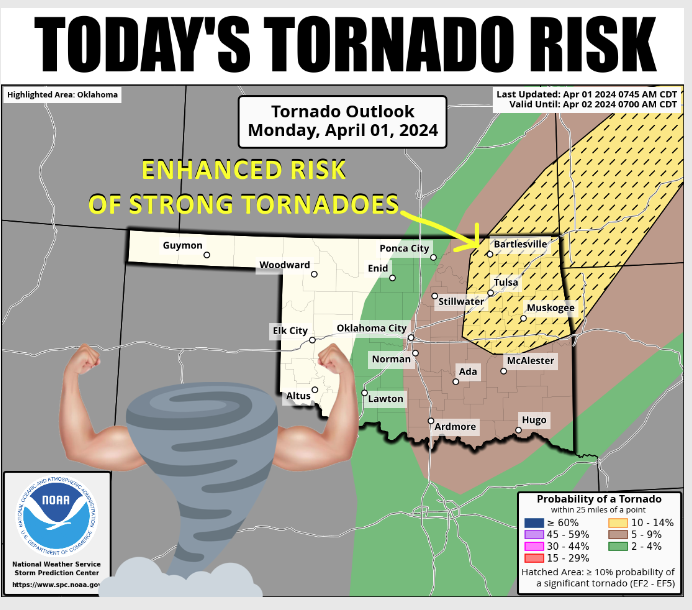
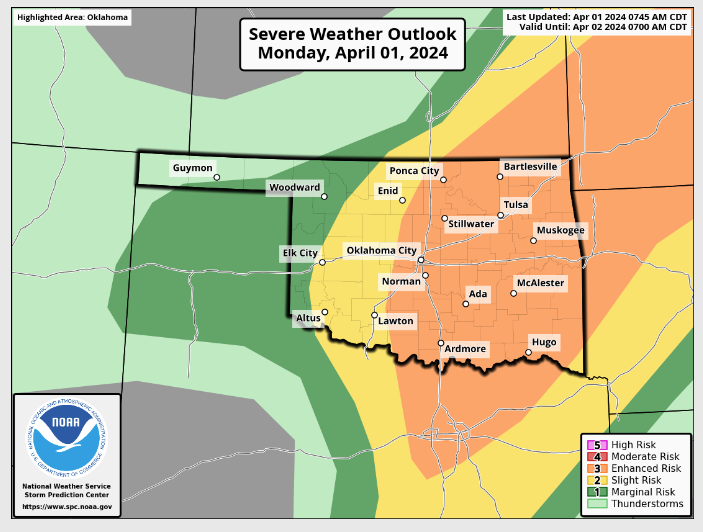
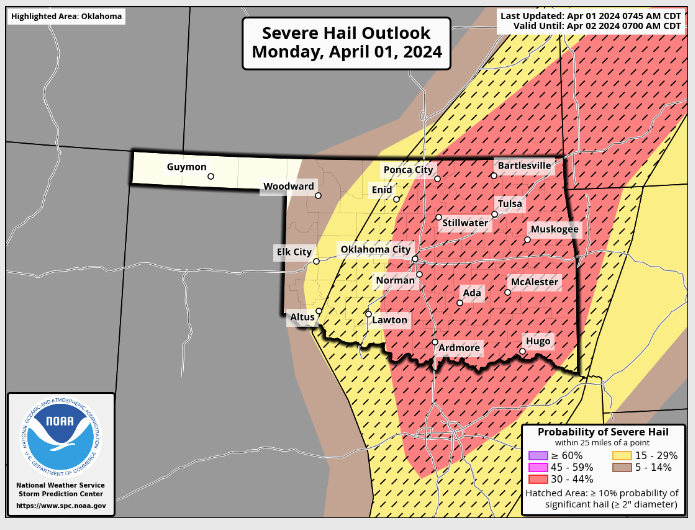
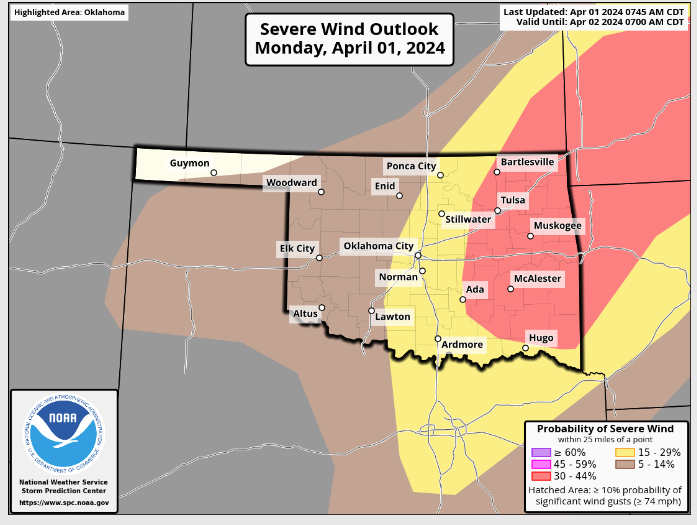
Over the weekend, 27 tornadoes ripped through Oklahoma, resulting in widespread devastation and heartbreaking loss of life.

My thoughts and prayers are with those who have been affected by or are grieving as a result of these severe tornadoes. I would also like to thank our first responders who have been on the ground responding so nobly over the past couple of days.

As the Representative for Oklahomans in the fourth district, I know that my place this week is in Oklahoma, not Washington, D.C. – and I am currently on my way back home to assess the damage and ensure my constituents get the necessary assistance they need. However, in the meantime, I want to provide those affected with some immediate resources:

Reporting Damage

It is necessary for the state of Oklahoma to complete damage assessments before the Governor submits his request for disaster declaration to the President. It is very important that Oklahomans submit their damage reports, in order for the state to know where to send teams to evaluate the damage, and, in turn, make the appropriate request to the Executive.

To report damage, click here.

Public Shelters

The American Red Cross has opened a storm shelter in Sulpher, Oklahoma. It is located at Crossway Church. The address is 2108 W. Broadway Avenue. Additionally, the Murray County Sherrif's Office designated the Crossway Church as a reunification center for those who are searching for their missing loved ones.

The Red Cross also opened another shelter in Ardmore at the Christ Community Church, which is located at 2620 Mount Washington Road.

Price Gouging Law

The Emergency Price Stabilization Act is currently in place in the twelve counties that were hit by the storms. This law prohibits unfair price hikes for necessary goods and services during this time of need. 

If you experience contractor fraud or more than a ten percent increase for the price of goods and services, call the Oklahoma Attorney General's Consumer Protection Unit at 833-681-1895.

Power Outages

According to Oklahoma Gas and Electric, over 13,000 customers lost power this weekend. In a statement, the company said it will be a "multi-day restoration event."

To report and monitor outages:

  • Submit a report online here.
  • Text OUT to 32001.
  • Call 405-272-9595 (OKC metro) or 800-522-6870 (all other areas).

Insurance Claims

The Oklahoma Insurance Department (OID) is available and ready to help Oklahomans with any difficulties they are experiencing with their insurance claims. Visit OID's website here or call them at 800-522-0071.

Mass Care

Oklahoma Southern Baptist Relief has two chainsaw teams in Morris and a mass feeding kitchen on the way to Sulpher to provide meals.

Critical Incident Stress Management-trained chaplains are also available for those affected, as well as first responders.

The Salvation Army is giving out meals to first responders, as well as determining the need for clean-up kits and other critical supplies.

Non-Emergency Information

For Oklahomans that need non-emergency or health and human service information, dial 2-1-1 from your phone. 2-1-1 services are available 24 hours a day.

The SCN Coalition Wins NAMA Award for National Nematode Day

National Nematode Day won first place in the Unique Sponsorship Campaign category at the "Best of NAMA" awards show.

The SCN Coalition's National Nematode Day campaign, sponsored by BASF, Bayer, Nufarm and Syngenta, took home first place in the Unique Sponsorship Campaign category at the National Agri-Marketing Association (NAMA) "Best of NAMA" awards show.

NAMA, the largest U.S. association for marketing and agribusiness professionals, recognized The SCN Coalition for declaring Oct. 2, 2023, the first National Nematode Day. The fully integrated campaign generated awareness and action in the weeks leading up to National Nematode Day to keep SCN top of mind as farmers and their trusted advisors geared up for fall soil testing. 

"Are you smarter than a nematode?" quizzes and sweepstakes encouraged farmer and agribusiness participation, digital and social promotions amplified the messages, and press releases and media outreach generated additional buzz.

Since its launch in 2018, The SCN Coalition's media outreach efforts have generated more than 80 million potential online and print impressions, and more than 300 million potential broadcast impressions in the ag media. By 2020, this awareness had already moved 18% more farmers to actively manage SCN, based on a soybean checkoff-funded survey of 950 farmers.

A successful public/private partnership
The SCN Coalition includes university scientists in 28 states and Ontario, grower checkoff organizations such as the North Central Soybean Research Program (NCSRP), United Soybean Board (USB) and state soybean promotion boards, as well as partners in the private sector, including BASF, Bayer, Growmark, Nufarm, Pioneer (Corteva), Syngenta, UPL Ltd., Valent and Winfield United.

"A coordinated effort from many committed partners is making a big difference for soybean farmers," says Carl Bradley, Extension plant pathologist at University of Kentucky, and one of the leaders of The SCN Coalition. "National Nematode Day was an opportunity to spread the message about the importance of active SCN management, as well as other parasitic nematodes that impact soybean production such as Southern root-knot, reniform and lesion nematodes."

George Bird, nematologist at Michigan State University and one of the leaders of The SCN Coalition, says because of the contributions from public and private partners, more soybean farmers are hearing about the importance of soil testing and active SCN management. "SCN is too big of an issue for any one organization to tackle," he said. "Together, we can make an impact on the nematode challenges farmers face."

Brett Carver Discusses Wheat Crop and High-Performing OSU Varieties at Chickasha Field Day

Brett Carver talks wheat varieties at Chickasha Field Day.

Listen to Reagan Calk talk with Dr. Brett Carver about OSU wheat varieties and more.

At the Oklahoma State University Wheat and Forages Field Day held in Chickasha, Associate Farm Editor Reagan Calk had the chance to talk with regents professor and wheat genetics chair in the OSU Department of Plant and Soil Sciences, Dr. Brett Carver.

Carver first gave an update on the wheat crop throughout Oklahoma, which he said has been impacted by drought in some areas, but in other areas, not so much. In those areas that have not been impacted by drought, Carver said Stripe Rust has been extremely prevalent.

"One way we can tell if we are going to get it (Stripe Rust) is what happens in Texas, but what happens in Texas may depend on what happens in Mexico," Carver said. "There is this cycle of inoculum that comes down along the west coast and back up through the great plains. That cycle must get started somehow and somewhere, or the inoculum has to over winter."

Carver said one way to be vigilant against stripe rust is to plant varieties that will respond defensively against the disease. Aside from Stripe Rust, Carver also talked about research regarding a few more diseases such as Septoria that have impacted wheat in Oklahoma.

Four weeks ago, good to excellent conditions in Oklahoma's winter wheat crop rated 73 percent good to excellent. Last week, those rated 49 percent good to excellent. As La Nina, the dry season, makes its way back, Carver said looking back to what worked well in 2022 and 2023 can help producers make decisions for the upcoming year.

"I can tell you, in the OSU program, Showdown does well," Carver said. "It is not the most drought-tolerant variety out there, but it seems to recover and seems to produce a good grain yield. High Cotton is another one."

When it comes to planting a variety of wheat for forage, Carver talked about varieties of wheat that can perform well for grazing and have grain potential.

"It has got to have all these things we expect in a grain variety, but it has these characteristics that make it more appealing as a graze-out wheat," Carver said.

To see the list of 2024 OSU Field Days, CLICK HERE.

To see OSU wheat variety info, CLICK HERE.

Daily Email for April 29, 2024


Oklahoma's Latest Farm

And Ranch News

Monday, April 29, 2024

 
Howdy Neighbors!

Here is Your Daily Oklahoma Farm and Ranch News Update: 


  • In the Midst of the Storm- A Million Dollar Rain


  • Animal Disease Traceability to Go Electronic by End of 2024 for Cattle Over 18 Months of Age


  • Cattle Groups React to EID Mandate from USDA


  • Introducing Hanna Schmidt of the Mulhall-Orlando FFA Chapter, Your 2024 Northwest Area Star in Agriscience


  • Dr. Rod Hall – New Test Requirements for HPAI in Lactating Dairy Cows in Interstate Transport


  • Storms Bring Multiple Tornadoes and Death to Oklahoma


  • Noble Research Institute Offers Resources for Producers to Improve Regenerative Ranching Efforts


  • OSU Agriculture Administrators Receive Top Scientific Honor


  • ASA & Others Urge Support for Farm to Fly Act in Farm Bill

In the Midst of the Storm- A Million Dollar Rain

The storms over the weekend brought death, injury and destruction to Oklahoma- but they also brought valuable rain. Back in the day- oldtimers might have called them for many locations a "million dollar rain."


But overall- for Oklahoma agriculture- it might have been a Hundred Million Dollar rain.


Just playing with the numbers- let's use wheat- which is in a very critical growth stage. The last two years we have produced a dismal wheat crop- 2.5 million acres harvested on average in 2022 and 2023 and yields of just 27 to 28 bushels per acre- total production both years at 68 million bushels. This rain gives us hope for something closer to the 100 million bushels we produced in 2021 when we had a 40 bushel per acre crop and 2.7 million acres harvested. I'm not sure it gets us there- but for argument's sake- let's say it improved us by a couple of bushels per acre on a statewide basis- and if we use the 2.7 million acre harvested number and a value of those bushels at the current wheat price of $5.90 a bushel(based on Friday prices)- you get added value of over $31 million dollars to wheat farmers.


AND- there's lots of value to beef cattle producers where the rains fell- because pasture will improve a lot in the areas that received rain- and there are a lot of ponds that will be full going into May and June(and summer) just because of these rains .


AND- while some spring planted crops might have to be replanted if rains came too hard- the overall impact of this moisture will help tremendously.


The state map above is for the last three days- takes us back to Friday morning and while a lot of western Oklahoma missed out- the areas in a lot of northcentral Oklahoma that had slipped into severe drought got significant rainfall amounts. Click on the map above and you can check details on how much was received on a Mesonet station by station basis.


Thank you Lord for the rain.

Animal Disease Traceability to Go Electronic by End of 2024 for Cattle Over 18 Months of Age

Electronic ID is set to be the standard by the end of 2024 in the cattle business. By amending and strengthening its animal disease traceability regulations for certain cattle and bison, the United States Department of Agriculture's (USDA) Animal and Plant Health Inspection Service (APHIS) is putting in place the technology, tools, and processes to help quickly pinpoint and respond to costly foreign animal diseases.


"Rapid traceability in a disease outbreak will not only limit how long farms are quarantined, keep more animals from getting sick, and help ranchers and farmers get back to selling their products more quickly – but will help keep our markets open," said Dr. Michael Watson, APHIS Administrator. 


One of the most significant benefits of the rule for farmers and ranchers will be the enhanced ability of the United States to limit impacts of animal disease outbreaks to certain regions, which is the key to maintaining our foreign markets. By being able to readily prove disease-free status in non-affected regions of the United States, we will be able to request foreign trading partners recognize disease-free regions or zones instead of cutting off trade for the entire country.


Click here to read more about the electronic ID rule and it's impact on animal disease traceability and markets.

Sponsor Spotlight


Midwest Farm Shows is proud to produce the two best Farm Shows in the State of Oklahoma annually- the Tulsa Farm Show each December and the Oklahoma City Farm Show each April.


The Tulsa Farm Show is Oklahoma's premier agricultural and ranching event- and returns to the SageNet Center (Expo Square) December, 6-7-8, 2024. 


Now is the ideal time to contact the Midwest Farm Show Office at 507-437-7969 and book space at the 2022 Tulsa Farm Show.  To learn more about the Tulsa Farm Show, click here. 


Cattle Groups React to EID Mandate from USDA

It was not a ringing endorsement by the nation's largest cattle producer group on Friday to the word from USDA that they will require an electronic ID tag on cattle over 18 months of age going across state lines.


Mark Eisele is the President of the National Cattlemen's Beef Association and he offered the following statement to the move to EID: "USDA's final traceability rule updates the existing requirement for animal identification that has been in place since 2013, switching from solely visual tags to tags that are both electronically and visually readable for certain classes of cattle moving interstate. Many producers are already familiar with using these visual tags and under the new rule, they will instead use electronic tags. NCBA has worked hard to secure $15 million in funding for producers to reduce the cost of implementing this change. We also remain committed to safeguarding producers' private data and continuing to reduce the cost of ear tags for farmers and ranchers. Our industry faces a tremendous threat from the risk of a future foreign animal disease on American soil. To avoid devastating financial losses during a potential outbreak and to help producers quickly return to commerce, we need an efficient animal disease traceability system." 


In contrast- R-Calf's Bill Bullard is mad as the dickens about EID and says they will fight USDA- "The USDA has slapped independent cattle producers, who have worked closely with the USDA in the past to very successfully control, contain, and eradicate foreign animal diseases, in the face.


"We will fight against the implementation of this disastrous rule that infringes on the freedoms and liberties of our nation's independent cattle farmers and ranchers. This is government overreach at its worst."

Introducing Hanna Schmidt of the Mulhall-Orlando FFA Chapter, Your 2024 Northwest Area Star in Agriscience

This morning, our coverage of the 2024 Oklahoma FFA Star Award Finalists continues with Agriscience competitor Hanna Schmidt of the Mulhall-Orlando FFA chapter representing the Northwest Area.


Farm Director KC Sheperd interviewed all 18 Star finalists recently in Stillwater after they were judged in their respective areas- and you can hear KC talk with Hanna by clicking on the blue button at the bottom of this story.


Throughout her FFA career, Schmidt said she has had five different agriscience projects. Schmidt has researched and studied eastern red cedar trees, the FFA New Horizons Magazine, the importance of corn to agriculture, and more.


"For my final project, I did a project over ultraviolet radiation light and how pretreating each seed of corn effects the germination rate, the coleoptile and radical length," Schmidt said.


Out of all of her projects, Schmidt said her favorite project is the one she conducted over the course of her Sophomore year of high school in which she studied how microtoxins impact the agriculture industry, specifically in corn.


After graduating high school, Schmidt said she plans to attend North Oklahoma College for two years, then transfer to Oklahoma State University to obtain a degree in Food Science.


Our coverage of the Stars and the 2024 State FFA Convention is powered by Hilliary Communications.

Click here to listen to KC Sheperd talk with Hanna Schmidt about her achievement as the Northwest Area Star in Agriscience.
Sign Up for Our Daily Email- Free Because of Our Sponsors!

Support Our Sponsors!


KIS logo


Advertise With Us!
 

For our farmers who have either- always have had cotton on their farms- or those who have more recently have added the fiber crop to their operations- we have a daily report heard on several of our Radio Stations- It's Called Cotton Talk!

Click on the Button below to listen to our most recent report
Click here for our Latest Cotton Talk- Hosted by KC Sheperd


The latest news from the Oklahoma State Capitol is available daily on the Radio Oklahoma News Network.


Click on the blue button to hear from our State Capitol Reporter Albert Castellanos.

Click here for the latest report from the State Capitol on RON


Dr. Rod Hall – New Test Requirements Go Into Effect TODAY for HPAI in Lactating Dairy Cows in Interstate Transport

Most of you are aware of the cases of Highly Pathogenic Avian Influenza virus being detected in dairy cattle. The outbreak first gained national attention in early March from dairies in the high plains of Texas and New Mexico. The outbreak has now been confirmed in 33 dairy herds in eight states. So far, we have not confirmed the virus in dairy cattle in Oklahoma.


USDA published a Federal Order on April 24 that requires lactating dairy cows moving in interstate commerce to be tested negative for HPAI virus within seven days of the movement. That order goes into effect Monday, April 29.


The most important things to know are:

  • Currently the ruling only affects lactating dairy cows
  • Lactating dairy cows moving across state lines are required to have a negative test of their milk within seven days of movement
  • Cull lactating dairy cows moved from a farm of origin directly to slaughter are not required to be tested, but they must move on a Certificate of Veterinary Inspection.
  • Cull lactating dairy cows moved to a livestock auction market in their state of origin, and then moving to a slaughter facility in another state are not required to be tested.
  • Cull lactating dairy cows moved to a livestock auction market from another state, and then moving to a slaughter facility in another state are required to have a negative milk test for HPAI.
  • Continue to check with the state of destination if there are additional requirements to move lactating dairy cattle into the state
Click here to read more about new test requirements for HPAI in lactating dairy cows.
 

We invite you to listen to us on great radio stations across the region on the Radio Oklahoma Ag Network weekdays-

if you missed this morning's Farm News - or you are in an area where you can't hear it- click below for this morning's Farm news from Ron Hays and KC Sheperd on RON.
Listen to our latest Farm and Ranch News for Monday with KC Sheperd
 
 
Subscribe To the Daily Email


Sponsor Spotlight


Great Plains Kubota is Oklahoma's family of full-line Kubota dealerships offering Kubota sales, service, and parts. As an Oklahoma Elite Kubota dealer, we have a large selection of Kubota Tractors, Kubota Mowers, Kubota Utility Vehicles, Kubota Construction Equipment and Kubota's line of Hay Tools. Give us a call today at 855-4KUBOTA or stop by any of our Kubota dealerships in Ada, Ardmore, Duncan, Edmond, Shawnee, Norman, Stillwater and our newest location serving western Oklahoma and beyond, Clinton. To schedule a DEMO with one of our Outside Salesmen, email gpsales@gpkubota.com Visit us and see why Great Plains Kubota is... the brand that serves! 


Storms Bring Multiple Tornadoes and Death to Oklahoma

Gov. Kevin Stitt issued a state of emergency declaration for 12 counties across Oklahoma.


The counties included in that declaration include Carter, Cotton, Garfield, Hughes, Kay, Lincoln, Love, Murray, Okfuskee, Oklahoma, Payne and Pontotoc counties.


The declaration was issued after storms spawned multiple tornadoes across Oklahoma on Saturday, from the mid-morning hours through overnight hours into Sunday. It suspends the rules for "size and weight permits of oversized vehicles transporting materials and supplies critical to recovery efforts, emergency relief, and power restoration."


During a press conference Sunday afternoon, Oklahoma Gov. Kevin Stitt said the damage to Sulphur was the "worst damage he's seen" during his tenure as governor, and said one person was confirmed to have been killed as a result of the tornado.


At least three additional deaths across Oklahoma have been reported from the day and evening of storms on Saturday into early Sunday morning.


Read more in our story on the website that includes reaction from Speaker Charles McCall as well as the word from AG Drummond on the Anti Price Gouging rules in effect now in the affected areas.

Click Here To Read More 

Noble Research Institute Offers Resources for Producers to Improve Regenerative Ranching Efforts 

I am talking with Hugh Aljoe of the Noble Research Institute about the latest on regenerative ranching efforts and courses offered to empower producers to improve their regenerative agriculture efforts.


"Our guys on the ranches have been tracking everything, monitoring everything from our soil health and changes over time, as well as the economics, just so we could put the whole story together," Aljoe said.


For the past two years, Aljoe said the Noble Research Institute has been working toward developing instructionally designed education courses.


There are two courses now available to ranchers through the Noble Research Institute: The Noble Land Essentials and The Noble Grazing Essentials.


Aljoe said the Land Essentials course focuses on soil health. It is a two-day, hands-on, in-person course that teaches individuals the tools needed to monitor and improve the health of their land, livestock, and livelihood.


Noble Grazing Essentials is a 3-day, hands-on, in-person course that teaches individuals the tools needed to quickly assess forage production and carrying capacity to design and implement grazing plans that work for their land and livestock.


To learn more about the Noble Research Institute and regenerative agriculture, visit the website by CLICKING HERE.

Click here to read more and listen to Hugh Aljoe give an update on regenerative ranching efforts from Noble Research Institute.

OSU Agriculture Administrators Receive Top Scientific Honor

Two members of the Oklahoma State University Agriculture administration have received one of the highest honors within the scientific community.


Jayson Lusk, vice president and dean of OSU Agriculture, and Scott Senseman, associate vice president of OSU Ag Research, have been named 2024 Honorary Fellows by the American Association for the Advancement of Science.


Lusk was awarded for "distinguished contributions to the field of agricultural economics, particularly for research and the communication and interpretation of the science underpinning predictions of consumer food demand."


Senseman was recognized for "distinguished contributions in research, teaching and administration in the field of agronomy, particularly in residue chemistry, mode of action and environmental fate of herbicides in agricultural systems."


Raj Singh, a regents professor in materials science and engineering at OSU, also received the 2024 honor for "pioneering and game-changing scientific and technological contributions to the field of materials, particularly transformative processing and manufacturing of ceramic composites leading to technology insertion into commercial jet engines."

Click here to read more about OSU agriculture administrators receiving top scientific honors.

ASA & Others Urge Support for Farm to Fly Act in Farm Bill

Agriculture groups, along with others representing the biofuels and aviation industries, are urging Congress to include meaningful sustainable aviation fuels provisions in the farm bill.


ASA and other stakeholders sent a letter to House and Senate Ag Committee leadership this week supporting inclusion of the Farm to Fly Act in the farm bill. The bipartisan legislation, which was originally introduced by Rep. Max Miller (R-OH), aims to create new markets for U.S. agricultural products and strengthen domestic energy resources. The bill focuses on fostering the development of SAF within existing USDA programs, ensuring clarity in eligibility criteria, and promoting collaboration.


"SAF, which can be produced from renewable biomass and agriculture-based feedstocks, presents an opportunity to expand U.S. markets for agricultural goods, bolster our nation's rural economy and provide a renewable, low-emission domestic energy supply for the aviation sector," the groups state in the letter.


Specifically, the Farm to Fly Act is intended to clarify eligibility for SAF within USDA Energy Programs, encourage collaboration in agency mission areas, and establish a common definition of SAF for effective contributions from U.S. crops. The legislation aligns with the aviation industry's commitment to transitioning to sustainable fuels and addresses the growing demand for SAF. Read the letter here.

Let's Check The Markets!
OKC West is our Market Links Sponsor- they sell cattle three days a week- Cows on Mondays, Stockers on Tuesday and Feeders on Wednesday- Call 405-262-8800 to learn more.
 
Today's First Look:
Ron on RON Markets as heard on K101  
mornings with cash and futures reviewed- includes where the Cash Cattle market stands, the latest Feeder Cattle Markets Etc.
Hear Today's First Look
 

Wholesale Boxed Beef Prices were mixed- Choice Beef was up 22 cents and Select Beef was down 94 cents on Friday, 4/26/2024.


Click on the Button below for the latest report from USDA Market News

Boxed Beef Report
 

Oklahoma National Stockyards had 4,847 head on the yards as of 9 PM last night. The sale will start at 8:00am this morning and they expect to start with close to 5,000 head.


According to USDA Market News Last Monday- Compared to the previous week: Feeder steers and heifers 4.00-8.00 higher. Steer and heifer calves not well tested but a sharply higher undertone is noted. Demand good. Quality average to attractive. Last Friday's COF report mixed with lower than expected On Feed and Placements. Cattle futures reacting positively and trading well in the green. 


Click below for the complete closing report.

Oklahoma National Stockyards Market Report from 04/22/2024
 

Here's our regular feature that is a part of the Monday Daily Email- market commentary from Bob Rodenberger, a partner with Stockman Oklahoma Livestock Marketing.


Bob talks Fridays with our own KC Sheperd with his commentary and is posted on our website-click here for this past Friday's story featuring Rodenberger's comments.


Learn more about Stockman Oklahoma by clicking here..

 
Listen to KC Sheperd talk with Bob Rodenberger about the cattle markets from the past week
 
 
Woodward Livestock Market from Thursday 0/5/01/2024
 
Each afternoon we are posting a recap of that day's markets as analyzed by Justin Lewis of KIS futures - click below for the latest update on the Livestock and Grain Futures Trade..
Click Here to Listen to Justin's Commentary From 4/26/2024
 
Okla Cash Grain:  
Daily Oklahoma Cash Grain Prices- as reported by the Oklahoma Dept. of Agriculture- The report available after the close of the Futures Trade for that day.
Read Cash Grains Report from 4/26/2024
 
Our Daily Market Wrapup from the Radio Oklahoma Ag Network - analyzing the Futures Markets for that trading day- as reported by KC Sheperd.
Click to Listen to Our Weekday Wrap with KC
 
Slaughter Cattle Recap: 
The National Daily Slaughter Cattle Summary- as prepared by the USDA Market News
Read Report
 
TCFA Feedlot Recap:  
Finally, here is the Daily Volume and Price Summary from the Texas Cattle Feeders Association.
Read Report
Our Oklahoma Farm Report Team!!!!
 
Ron Hays, Senior Farm/Ranch Broadcaster and Editor
 
KC Sheperd, Farm Director and Editor

Dave Lanning, Markets and Production

Reagan Calk, Farm News and Email Editor

Pam Arterburn, Calendar and Template Manager

Podcasts From Oklahoma Farm Report and More

Two of our regular reports are also podcasts that you can subscribe to- Our daily Farm and Ranch News with KC Sheperd- available here on the Apple Podcast Platform


The second is our daily Beef Buzz with Ron Hays- available here on the Apple Podcast Platform


Periodically- we offer interviews on our Ag Perspectives Podcast series- this podcast is available here.


Ron has also has a series of podcasts from interviews with newsmakers at the Cattlemen's Congress- Click here or you can find them on your favorite Podcast platform- look for them by searching for Cattlemen's Congress Conversations.


We are making plans to jump back into regular installments of what has been called the Road to Rural Prosperity- a new name and fresh content is in the works- for now- click on the blue button below for one of our favorites that is a timeless classic.

Listen to Episode 86 with Ron Hays talking with one of the legends in the Beef Cattle Business- Bob Drake of Davis, Oklahoma
 
 
Listen to Ron
Beef Buzz
 
Blue Green Gazette
Calendar
Auctions
Market Links
Facebook  Twitter  Youtube  

Our thanks to Midwest Farms Shows, P & K Equipment, Oklahoma Farm Bureau, Oklahoma Ag Mediation Program, Great Plains Kubota, Stillwater Milling Company, National Livestock Credit Corporation, Oklahoma Beef Council, Oklahoma AgCredit, the Oklahoma Cattlemens Association, Invenergy Oklahoma and  KIS Futures for their support of our daily Farm News Update.


For your convenience, we have our sponsors' websites linked here- just click on their name to jump to their website- check their sites out and let these folks know you appreciate the support of this daily email, as their sponsorship helps us keep this arriving in your inbox on a regular basis- at NO Charge!


We also appreciate our Market Links Sponsor - OKC West Livestock! 


We invite you to check out our website at the link below too that includes an archive of these daily emails, audio reports and top farm news story links from around the globe.

Head to Our Website OklahomaFarmReport.Com
God Bless!
Reach Out To Us:
Tim West
President/General Manager
Rural Oklahoma Networks

405-317-6361

***************

Mike Henderson
Director of Sales

405-615-4922

KC Sheperd
Farm Director
Radio Oklahoma Ag Network

405-443-5717

Email KC
Ron Hays
Senior Farm/Ranch Broadcaster
Radio Oklahoma Ag Network

405.473.6144
Email Ron

Dry Winter? Here's How to Deal with Herbicide Carryover

AgriGold Agronomist Jason Mefford says farmers should be on watch for herbicide carryover after a dry off-season.  

Herbicide carryover isn't something farmers have to worry about too often. But this season could be an exception for areas of the Midwest that have been dry since fall, especially west of the Mississippi River. 

"Temperatures and moisture have the biggest influence on the breakdown of chemicals," says AgriGold Agronomist Jason Mefford. "Last spring we saw a fair amount of herbicide carryover after the drier 2022 season. And we are much drier heading into the 2024 growing season."  

Farmers need to have herbicide carryover on their radar and be ready to make adjustments that limit their risk.   

Identify at-risk fields
Start by determining which fields are most at risk of herbicide carryover, Mefford advises. That largely hinges on soil type and the chemistry used.  

"Fields with lighter, sandier soils with lower cation exchange capacity (CEC) scores are more apt to have herbicide carryover amid dry conditions," Mefford says. Low organic matter also raises the risk.  

The next consideration is the chemistry used, as some modes of action are more prone to carry. Mefford is most concerned about three of them.   

His first concern is with some of the p-hydroxyphenylpyruvate dioxygenase (HPPD) herbicides used on corn. "Those Group 27 chemicals can hang out pretty easily in this dry weather," Mefford says.  

The protoporphyrinogen oxidase (PPO) inhibitors of Group 14 are another concern because some of them are sprayed on soybean fields late in the year. "If you get into a long, dry year, that chemical can persist, causing problems with corn." 

The third scenario Mefford is worried about is stacking of Group 2s, or acetolactate synthase (ALS) inhibitors. "A lot of those are used for fall burndown because they have a good residual and do a nice job cleaning up fields," he says.  

"But when it's dry, these herbicides can linger. If your 2024 chemical program for soybeans happens to have ALS, you may compound the problem," Mefford explains. "In that case, make sure you're planting sulfonylurea-tolerant soybeans (STS). You should also be mindful not to stack ALS chemistries in fields going to corn."  

Adjust your management strategy
Farmers with fields at high risk of herbicide carryover could consider switching their rotation to match what was planted last year," Mefford says. "That depends on many factors, including whether anhydrous has been applied last fall and disease history."  

Another option is to disc, diluting the layer of chemical with more soil, Mefford continues. Again, that's not an option for everyone.  

Backing off seeding populations can also help. "Giving plants extra space tends to lead to better plant health," Mefford explains. "A healthy plant will always do better than one that's struggling." 

Scout fields and manage accordingly
While Mefford doesn't anticipate herbicide carryover leading to many replant situations, impacted plants are more susceptible to stress or drought later in the season. "Weed control can also be an issue with herbicide-stunted plants," he adds.    

Herbicide carryover injury isn't something you see across a field. Mefford details, "Issues are most likely to show up at field entrances, areas where application overlaps, like corners, and lighter areas of the field, such as a hillside.  

"If farmers have at-risk fields, they may want to gauge the extent of any damage before deciding how to manage that crop moving forward," Mefford says. "Don't throw the kitchen sink at it if there's a lot of damage." 

When the plants emerge, look for signs of herbicide carryover damage. Some of the main symptoms include stunting, chlorosis (yellowing tissue) and necrosis (dead tissue). "Shortened internodes are more specific to ALS chemistry," Mefford details. "HPPD chemistries tend to lead to bleaching of the leaf, especially in soybeans." 

Evaluate your chemical plans for the 2024 season
To protect against future issues, farmers should evaluate what chemistries they're using this season and compare those to 2023. "Don't start stacking those chemistries and compounding the problem," Mefford explains.  

"Reevaluate your plans and swap things out if needed," he continues. "Even if you've already bought your chemical, this review is time well spent."  

Don't hesitate to ask for help. "As agronomists, we're always eager to help a farmer with questions on herbicide carryover or any other issues," Mefford says. "We take pride in being champions for our farmer customers." 

Oklahoma Wheat Commission to Hold District IV Election

The Oklahoma Wheat Commission will hold an election for the District IV board seat.  The election will be held Thursday, May 9, 2024 commencing at 1 p.m. at the Cotton County Fair and Expo Center located at 924 W. Missouri Avenue, Walters, Oklahoma. District IV consists of Caddo, Comanche, Cotton, Greer, Harmon, Jackson, Kiowa and Tillman counties.

            All wheat producers within District IV boundaries who are actively engaged in wheat production, have marketed wheat, and have paid a check-off fee and left that fee with the Commission for the current year

(July 1, 2023 to May 9, 2024) are eligible to vote.  It will be the responsibility of the producer to prove their eligibility to vote by providing a dated grain elevator receipt including the producer's name and amount of wheat sold, and a driver's license or some other form of identification.

            Candidates wishing to run in the election must be at least 25 years old, a resident of Oklahoma, engaged in growing wheat in the state for at least five years and must derive a substantial portion of his/her income from growing wheat.  Three nominations will be made at the election, from which the Oklahoma Secretary of Agriculture will appoint one person to serve a five-year term with the Oklahoma Wheat Commission.

            The Commission's vacancy meeting, which is open to the public, will begin at noon and the election will begin promptly at 1 p.m. (If planning to vote you must be checked in by 1:00 p.m.)  Lunch will be provided at noon by the Oklahoma Wheat Growers' Association with Mike Schulte, Executive Director of the Oklahoma Wheat Commission speaking on "Wheat Research/Wheat Supply and Demand Outlook."

Every wheat producer in the district is urged to participate in this important election.  For further information, contact the OWC office at (405) 608- 4350.

Noble Research Institute Fosters Regenerative Ranching Efforts Through Educational Courses

Listen to Ron Hays talk with Hugh Aljoe about the latest on regenerative ranching efforts from the Noble Research Institute.

Ron Hays is talking with the Director of Ranches, Outreach, and Partnerships at the Noble Research Institute, Hugh Aljoe, about establishing regenerative ranching practices on properties in southern Oklahoma and North Texas owned by Noble.

To listen to Part One of the conversation with Aljoe, CLICK HERE.

Aljoe said adjusting the stocking rate of cattle relative to the forage supply is critical when it comes to drier conditions.

"Manage for the residual, so that when we do get rain, we get adequate recovery and a lot more recovery," Aljoe said. "Then, we are also trying to make sure we have adequate rest, so we have plants ready to be grazed before we do it."

By practicing regenerative agriculture on these ranches, Aljoe said soil health is improved during drought through an increase in organic matter. Aljoe also emphasized less input use, which helps to maintain positive margins.

"We are not buying a lot of hay, and we are not buying a lot of feed," Aljoe said. "There is very little fertilizer and chemicals going out there, and those are our key direct costs into our lands."

The  Noble Research Institute offers instructionally designed education courses to individuals wanting to practice regenerative ranching: The Noble Land Essentials and The Noble Grazing Essentials.

"The instructional design lends itself to learning," Aljoe said. "They love the way we can deliver through this instructional design coursework. The other part of it is that it is practical. That is what we wanted to do is make sure we can get people out into the world using real examples and be able to see that for themselves."

This summer, Aljoe said Noble will be offering a course on the Essentials of Ranch Business.

"We really want to make sure that the people that are leaving these courses can go out and apply what they have been taught," Aljoe said.

To learn more about the Noble Research Institute and regenerative agriculture, visit the website by CLICKING HERE.

The Beef Buzz is a regular feature heard on radio stations around the region on the Radio Oklahoma Ag Network and is a regular audio feature found on this website as well. Click on the LISTEN BAR for today's show and check out our archives for older Beef Buzz shows covering the gamut of the beef cattle industry today.

2024 Western National Angus Futurity (WNAF) Super Point Roll of Victory (ROV) Show results

EXAR Frontier Gal 3681 won reserve grand champion female at the 2024 Western National Angus Futurity (WNAF) Super Point Roll of Victory (ROV) Show, April 13 in Reno, Nev. John Allison, Yukon, Okla., owns the February 2023 daughter of SCC SCH 24 Karat 838. She first claimed junior calf champion - division 3. Jason Hoffman, Thedford, Neb., evaluated the 160 entries. Photo by Next Level Images.

One hundred and sixty entries were shown at the 2024 Western National Angus Futurity (WNAF) Super Point Roll of Victory (ROV) Angus Show, April 13 in Reno, Nev. Jason Hoffman, Thedford, Neb., evaluated the 138 females, 21 bulls and one cow-calf pair before selecting champions at the 71st WNAF.

            RW Saras Dream 207 captured grand champion female for Jayce Dickerson, Paradise, Kan. The March 2022 daughter of PVF Blacklist 7077 first won junior champion.

            John Allison, Yukon, Okla., exhibited the reserve grand champion female, EXAR Frontier Gal 3681. The February 2023 daughter of SCC SCH 24 Karat 838 first won junior calf champion – division 3.

K Bar D TKC Cascade 15K claimed the grand champion bull title. Kathryn Coleman, Modesto, Calif., owns the February 2022 son of Kraye Big Country 0179 that first claimed junior champion.

            Chris and Sharon Sankey, Council Grove, Kan., and Cornerstone Ranch Inc., Fort Sumner, N.M., own the reserve grand champion bull that earlier won junior calf champion. Sankeys Black Chip 3111 is the April 2023 son of EXAR Blue Chip 1877B.

            Blairswest Erica 5H won grand champion cow-calf pair. Tymber Billman, Blackfoot, Idaho, owns the January 2020 daughter of Colburn Primo 5153. An October 2023 bull calf sired by SCC SCH 24 Karat 838 completes the winning pair.

 complete list of winners follows:

2024 WESTERN NATIONAL ANGUS FUTURITY SUPER POINT (ROV) ANGUS SHOW

RENO, NEVADA

Total number shown:   160

Judge:  Jason Hoffman, Thedford, Neb.

FEMALES   121   Shown

   Fall Heifer Calf Champion:  Kraft Ellie MV 3207

   Exhibitor:  Tyler Kraft, Fort Collins, Colo.

   Reserve Fall Heifer Calf Champion:  StreamSide Elisha 2393

   Exhibitor:  Scarlett Carney, Carbondale, Colo.

   Summer Heifer Calf Champion:  Colburn DS Sandy VA 3305

   Exhibitor:  David Smith, Boulder, Colo.

   Reserve Summer Heifer Calf Champion:   McCoy Princess 3350-1844

   Exhibitor:  Taylor Olson, La Grande, Ore.

   Junior Heifer Calf Champion – Division 1:  Lazy JB Annie Lu 362

   Exhibitor:  Avery Kimble, Montrose, Colo.

   Reserve Junior Heifer Calf Champion – Division 1:  RW Saras Dream 308

   Exhibitor:  Jayce Dickerson, Paradise, Kan.

   Junior Heifer Calf Champion – Division 2:  RW Saras Dream 306

   Exhibitor:  Jayce Dickerson, Paradise, Kan.

   Reserve Junior Heifer Calf Champion – Division 2:  KLM Missie 2368

   Exhibitor:  Kasey Meyer, Blue Hill, Neb.

   Junior Heifer Calf Champion – Division 3:  EXAR Frontier Gal 3681

   Exhibitor:  John Allison, Yukon, Okla.

   Reserve Junior Heifer Calf Champion – Division 3:  Toledo Sandy 0310 345

   Exhibitor:  Lane Toledo, Visalia, Calif.

   Senior Heifer Calf Champion:  Lakeview Sandy 2334

   Exhibitor:  Cora Habein, Bend, Ore.

   Reserve Senior Heifer Calf Champion:  EXAR Princess 2872

   Exhibitor:  John Allison, Yukon, Okla.

   Intermediate Champion Female:  RW Saras Dream 211

   Exhibitor:  Cora Habein, Bend, Ore.

   Reserve Intermediate Champion Heifer:  Conley DT Lucy 2020

   Exhibitor:  Pheiffer Rosenberger, Hayden, Idaho

   Junior Champion Heifer:  RW Saras Dream 207

   Exhibitor:  Jayce Dickerson, Paradise, Kan,

   Reserve Junior Champion Female:  3BCC Cindy's Money 825E

   Exhibitor:  Arden Franks, Grass Valley, Calif.

   Senior Champion Female:  RW Stylish Sandy 109

   Exhibitor:  Jayce Dickerson, Paradise, Kan.

   Reserve Senior Champion Female:  Gohr Sandy 1118

   Exhibitor:  Andrew Stoneberg, Shedd, Ore.

   Grand Champion Female:  RW Saras Dream 207

   Exhibitor:  Jayce Dickerson, Paradise, Kan,

   Reserve Grand Champion Female:  EXAR Frontier Gal 3681

   Exhibitor:  John Allison, Yukon, Okla.

BULLS   23   Shown

   Fall Bull Calf Champion:  TMB WSF 5H Chief 2309

   Exhibitor:  Tymber Billman, Blackfoot, Idaho

   Reserve Fall Bull Calf Champion:  LV Golden Nugget 2305

   Exhibitor:  Lake View Angus, Mead, Colo.

   Summer Bull Calf Champion:  Lazy JB QW MR Prime 3068

   Exhibitor:  Britney Creamer, Montrose, Colo.

   Reserve Summer Bull Calf Champion:  CJB WSF Humbull 2306

   Exhibitor:  Chyloh Billman, Blackfoot, Idaho

   Junior Bull Calf Champion:  Sankeys Black Chip 3111

   Exhibitor:  Chris and Sharon Sankey, Council Grove, Kan., and Cornerstone Ranch Inc., Fort

           Sumner, N.M.

   Reserve Junior Bull Calf Champion:  EXAR Hard Rock 3690B

   Exhibitor:  Express Angus Ranches, Yukon, Okla.

   Intermediate Bull Champion:  Lazy JB Westbound 2742

   Exhibitor:  H A V E Angus, Wilton, Calif.; Andrew Nunez, Healdsburg, Calif.; and Lazy JB

           Angus Montrose, Colo.

   Reserve Intermediate Bull Champion:  C Bar I Boomer 2203

   Exhibitor:  Grant Solem, Los Olivos, Calif.

   Junior Champion Bull:  K Bar D TKC Cascade 15K

   Exhibitor:  Kathryn Coleman, Modesto, Calif.

   Reserve Junior Champion Bull:  Twin Falls Abbott TF93

   Exhibitor:  Chris and Sharon Sankey, Council Grove, Kan., and Twin Falls Angus, Cheney,

          Kan.

   Senior Champion Bull:  Gohr power chip 115

   Exhibitor:  Fallon Gohr, Madras, Ore.

   Reserve Senior Champion Bull:  NONE

   Grand Champion Bull:  K Bar D TKC Cascade 15K

   Exhibitor:  Kathryn Coleman, Modesto, Calif.

   Reserve Grand Champion Bull:  Sankeys Black Chip 3111

   Exhibitor:  Chris and Sharon Sankey, Council Grove, Kan., and Cornerstone Ranch Inc., Fort

          Sumner, N.M.

COW-CALF PAIRS   1   Shown

   Grand Champion Cow-Calf:  Blairsweet Erica 5H

   Exhibitor:  Tymber Billman, Blackfoot, Idaho

   Reserve Grand Champion Cow-Calf:  NONE

GROUP CLASSES

   Best 6 Head:  Rocking W Angus, Waterford, Calif.

   Produce of Dam:  Colburn Saras Dream 7027

   Exhibitor:  Jayce Dickerson, Paradise, Kan.

   Get-of-Sire:  Silveiras Forbes 8088

   Exhibitor:  Chris and Sharon Sankey, Sankey 6N Ranch, Council Grove, Kan.

PREMIER BREEDER:  Rocking W Angus, Waterford, Calif.

HERDSMAN OF THE YEAR: Cole Page, Kalama, Wash.

Leader Munson Issues Statement After Severe Storms, Tornadoes

Oklahoma House Democratic Leader Cyndi Munson, D-Oklahoma City, issued a statement after severe weather devastated parts of Oklahoma.

"My thoughts are with those in Sulphur and all throughout Oklahoma who were affected by the devastating storms over the weekend. The lives lost and affected by these deadly storms will never be forgotten. I urge Oklahomans to take advantage of resources available to them as clean-up efforts ensue. I also encourage those who are able to help donate and provide shelter, food, water, and supplies to those in need. It is in traumatic times like these Oklahomans come together and support each other. Sending love to all." – Leader Cyndi Munson

For non-emergency disaster or health and human service information, contact your local 2-1-1.

Introducing Cooper Kline of the North Rock Creek FFA Chapter, Your 2024 Central Area Star in Agricultural Production

Listen to KC Sheperd talk with Cooper Kline ahead of the State FFA Convention in Tulsa, Oklahoma.

During the month of April, the Radio Oklahoma Ag Network and Oklahoma Farm Report are spotlighting the 18 Area Stars of Oklahoma FFA, who are among the highest achievers in the organization.

The stars come from the five areas in four categories- Star in Ag Placement, Star in Agriscience, Star in Agribusiness, and Star in Agricultural Production.

This week, we spotlight the five area stars in Agricultural Production in 2024.

One Star Finalist featured in the coming days from each of the categories will be named the State Star Award Winner during the 98th Oklahoma State FFA Convention, which will take place on May 7th and 8th in Tulsa, Oklahoma.

This week, our coverage of the 2024 Oklahoma FFA Star Award Finalists begins with Agricultural Production competitor Cooper Kline of the North Rock Creek FFA chapter representing the Central Area.

"My current SAE is swine production, in which I run a show pig operation called Kline Swine, a boar stud (operation) called Kline Swine Sires, as well as maintaining a show pig enterprise," Kline said. "I run about 17 sows and a handful of boars from which I sell show pig prospects and semen across the country."

At this year's Oklahoma Youth Expo, Kline said he had the chance to watch some of the pigs he bred and raised compete in the show ring.

"On the boar side of things, I actually had a premium sale barrow at Houston, so that was very exciting," Kline said.

While raising pigs is rewarding, Kline also talked about the challenges such as vaccinations and biosecurity, as pigs are susceptible to disease.

"I hope I get to do this until the day I die," Kline said.  "This is an industry I truly live for, and it has truly made me the person I am today. I plan to go to OSU next year, but within that, I am still going to be raising show pigs, and hopefully, whenever I get out, I can expand my operation."

Your coverage of the 2024 Oklahoma FFA Convention is sponsored by Hilliary Communications- who deliver the latest cutting-edge communications services supporting tens of thousands of customers across 22 counties throughout Oklahoma, Texas and Iowa. The company offers internet, voice and HilliaryTV. Hilliary Communications continuously researches the marketplace for innovations and strives to improve underserved areas, offering services that exceed customer expectations. Click here to learn more about Hilliary Communications.

For more information about the 98th Oklahoma State FFA Convention, click here.

Lactose-Free Milk Pilot Drives Consumption

A checkoff-led pilot in Cincinnati schools that offered lactose-free chocolate milk increased consumption and reached students who weren't drinking milk because of real or perceived lactose intolerance.

National Dairy Council (NDC) and American Dairy Association Mideast worked with Cincinnati Public Schools (CPS) to offer the country's first single-serve lactose-free chocolate milk package to six elementary and four high schools in the fourth quarter of 2023. Because of the program's success, it was expanded to include all 15 CPS high schools through June of this year.

Key findings of the pilot were that when students have the option to choose lactose-free milk, both milk selection and meal participation increase overall. When compared to the rest of the Cincinnati district, the pilot schools experienced a 16-percent increase in milk consumption and 7-percent higher meal participation.

Tracy Enslen, vice president of business development for American Dairy Association Mideast, said the pilot proved how meeting unmet demand with innovative offerings can drive consumption.

"Students wanted to drink milk but the milk being offered was not what they could consume, so meeting unmet demand was the spark," Enslen said. "Many of the students just walked by the milk every day and had to pick up water or juice as their beverage option.

"This program is offering every student, regardless of their demographic or socioeconomic status, the opportunity to have milk, and we're filling the gap where they now can get the 13 essential nutrients they need as they grow."

Lisa Hatch, vice president of business development for NDC's school channel, said while milk consumption increased, milk waste appears to have decreased during the pilot.

"We're hearing from school foodservice staff and from kids who weren't taking milk previously that not only are they choosing milk, but more of them are also finishing the container, so waste appears to have gone down," Hatch said. "We historically have seen high school kids leave the milk category at higher rates than younger students, but this pilot is bringing many back."

NDC and CPS will present the findings of this pilot during a School Nutrition Association (SNA) webinar in June. SNA is a professional organization representing nearly 50,000 members who provide high-quality, low-cost meals to students in U.S. schools.

Enslen's hope is that the program's success catches on elsewhere across the country with schools and processors. She pointed to the success of lactose-free dairy at the national retail level where volume is up 11.4 percent through April 14 compared to the same period of 2023.

"In a perfect world, my hope is that every fluid milk processor understands the opportunity to drive more milk consumption in schools with a lactose-free option, the same product they're already offering at retail," Enslen said. "I'd like to see more variety offered in schools, so students won't have to think twice about consuming milk."

To learn more about the dairy checkoff, visit www.usdairy.com.

Nine Trade Associations Ask EPA to Meet November Deadline for 2026 RFS Volumes

Today, nine trade associations representing feedstock providers, advanced biofuel producers, and low-carbon fuel customers wrote to EPA Administrator Michael Regan, urging the agency to propose and finalize robust 2026 Renewable Fuel Standard volumes by this November's statutory deadline. The letter highlights the dramatic drop in the value of RFS compliance credits (or RINs) in response to EPA's unreasonably low 2023 -2025 volumes EPA set last year. The situation prompted several production facilities to close and now threatens investments in feedstock processing capacity as well as production of sustainable aviation fuel, according to the association letter.

"Each of our industries are committed to reducing greenhouse gas emissions, and we recognize that sustainable biofuels offer some of the most substantial immediate benefits to deliver carbon reductions. The EPA should utilize the RFS to improve energy security, bolster domestic industry and manufacturing, and maintain America's leadership in developing and using sustainable, clean transportation technologies," the associations write. "While our industries will continue to make investments in producing, distributing, and using low-carbon fuels, EPA can and should send a strong signal to the market through robust RVOs."

"Transportation industries are looking for low-carbon solutions – particularly for heavy-duty engines – and clean fuels producers and feedstock suppliers are coordinating to deliver those solutions," added Kurt Kovarik, Vice President of Federal Affairs with Clean Fuels. "We are united in asking EPA to use the Renewable Fuel Standard to drive growth in the market, achieve significant near-term greenhouse gas emission reductions, and support the investments we've made. EPA must act in a timely manner on the 2026 RFS volumes to keep the program on track."

"The U.S. oilseed industry continues to meet food, feed and fuel demand and stands ready to meet higher RVOs for 2026 and beyond. March was the largest monthly crush ever reported, up 11 million bushels year over year. National Oilseed Processors Association members have made over $6 billion in investments to increase crush capacity by nearly 30 percent," said Kailee Tkacz Buller, president and CEO of NOPA. "This growth trajectory will be put in doubt risking billions in investments without certainty, clarity, and aligning RVOs to actual industry capacity from the EPA."

Joining Clean Fuels in sending the letter are American Short Line and Regional Railroad Association, American Soybean Association, American Trucking Associations, Association of American Railroads, National Energy & Fuels Institute, National Oilseed Processors Association, North American Renderers Association, and U.S. Canola Association. Read the letter on cleanfuels.org.

Ravel to Route 66 Coming up May 17th in Bristow

The Bristow Historical Society, in conjunction with the Signature Symphony String Quartet, will be hosting a free concert, "Ravel to Route 66", in Bristow on May 17, 2024 at 6 p.m. at Town Square.

This lively concert will feature a professional string quartet playing the music of the past on Bristow's Route 66 beginning with Maurice RAVEL's Sonata for Violin and Cello, Celtic highway music, Bluegrass, and Chuck Berry's "Route 66."  It's sure to please everyone's musical taste!

The Signature Symphony Quartet will be joined by Tulsa Sings! winner Rachel Miller who expertly won the Best of Broadway themed contest this spring. Mrs. Miller will be performing Oklahoma! and Bridge Over Troubled Water with the Signature Symphony String Quartet in the heart of Bristow at 1 Rail Road Place Bristow, OK.

Our volunteer team, the Signature Symphony String Quartet, and Rachel Miller can't wait to share and enjoy this musical experience with the greater Bristow community! If you would like more details please visit our Facebook page at @bristowhistoricalsociety, email us at contactus@bristowhistory.org, or use the link below to RSVP to our free event: https://facebook.com/events/s/ravel-to-route-66/1465697981025901/. Limited seating is provided at Town Square so, please feel free to bring your favorite lawn chair.

The Bristow Historical Society will begin preparing for "Voices and Votes," the exhibition from the Smithsonian, beginning May 1st. The Depot will be partially opened to the public as we begin packing each artifact in the depot for storage during the exhibition. Museum hours will vary in the coming weeks. The Bristow Historical Society will reopen for our "Voices and Votes" Smithsonian Exhibition on June 1, 2024. To schedule a Smithsonian tour, join our volunteer team, or visit the Historic FRISCO Depot and Caboose, please call (918) 367-9335 or email contactus@bristowhistory.org.

The Bristow Historical Society is excited to join our friends, family, and visitors Friday night, May 17, 2024 at 6 p.m. at our beautiful Town Square in Bristow on Route 66 to enjoy Ravel and his friends.

OSU's Derrell Peel Says Cattle Markets are Back on Track

A month after cattle markets were roiled by the diagnosis of highly pathogenic avian influenza in dairy cattle, cattle futures and cash markets seem to be mostly recovered.  Although there remain questions about some aspects of the disease, including exactly how the disease, now known as Bovine Influenza A virus (BIAV), is spreading between cattle, markets have settled into the knowledge that the disease has relatively minor impacts on cattle, and has no human health implications for meat or pasteurized dairy products.  Baring any new surprising information, cattle markets should move on with market fundamentals.

Oklahoma auction prices for steer calves have bounced off the recent lows (Figure 1).  Calf prices normally reach a seasonal peak at the end of the first quarter, so steer calf prices may not recover fully to the March highs.  However, the strong general uptrend in cattle markets likely means calf prices may move more sideways for a period before moving higher in the later part of the year.  Concern about summer grazing conditions could temper stocker demand in the next month or so.  In Oklahoma, drought conditions have been reemerging quickly, with the percentage of the state showing abnormally dry conditions or low-level drought increased from about 34 percent in March to nearly 66 percent in the most recent Drought Monitor.   However, the outbreak of storms the last weekend of April provided needed moisture in parts of the state, accompanied, unfortunately, by numerous tornados.

Heavyweight feeder cattle prices have bounced more than calf prices buoyed by recovery in Feeder futures and seasonal tendencies for higher prices from now through the middle of the year (Figure 2).  Despite the unexpected shocks that have impacted feeder markets, feeder prices are proving to be very resilient.  Feedlot demand is strong as feedlots chase limited feeder cattle supplies, spurred on by declining feedlot cost of gain.  For all feeder cattle, both calves and big feeders, the highest prices of the year are expected in the fourth quarter.

On January 1, the estimated feeder supply for the U.S. was down 4.2 percent year over year and was the lowest in data available back to 1972.  However, the Oklahoma estimated feeder supply on January 1 was up 6.7 percent year over year, reflecting better winter wheat grazing conditions and more stockers on wheat.  The weekly volume of feeder cattle in Oklahoma auctions was higher from late February through March, reflecting marketing of cattle off of dual-purpose wheat.  Auction volumes have been sharply lower in April but some additional graze-out cattle may be sold in May.  Despite the larger feeder supply in the state on January 1, the auction volume of feeder cattle for the year to date in Oklahoma is down 8.7 percent year over year. 

Below, Derrell Peel, OSU Extension livestock marketing specialist, says the March cattle on feed report shows a slight decrease in placements from last year on SUNUPTV from April 27, 2024.

Speaker McCall Issues Statement Following Severe Storms

Speaker Charles McCall, R-Atoka, issued the following statement after severe storms hit several communities in Oklahoma this weekend: 

"My prayers go out to the citizens of Sulphur, all of Murray County and those across the State of Oklahoma affected by the severe weather this weekend. As our neighbors survey the damage and begin to rebuild, my office is available to provide individuals and businesses with guidance on how to access necessary resources. Please do not hesitate to reach out if we can provide assistance throughout the cleanup and rebuilding process."

NMPF Statement on New Federal Travel and Test Order That Begins Today

From President & CEO Gregg Doud: 
 
The crossover of this H5N1 virus from birds to dairy cattle has presented some extraordinary challenges to animal and human health regulators in Washington. Throughout my regular contact with Secretary Vilsack, Undersecretary Moffitt, and officials from FDA and other agencies in recent weeks, I have seen how leadership at USDA, FDA and other federal agencies is well-equipped to get us through this challenge. 

As new rules on testing and travel take effect today, dairy farmers and their cooperatives are ready to support these efforts to protect animal health and guard against a potential human health risk. We have offered input to federal officials on how to help farmers implement these guidelines, and we will continue sharing feedback as these procedures are put into practice. We appreciate the around-the-clock efforts that federal and local authorities and experts, from USDA and other agencies to state officials and local veterinarians, have been making to get a new system up and running these past few days, and we are grateful for their dedication and commitment.

Beef Bulletin: Traceability Rule & CEO Update

NCBA CEO Colin Woodall shares the value of the partnerships NCBA builds with people important to the cattle industry from state affiliates to policymakers in Washington, D.C., to supporters of the Enviromental Stewardship Award Program. Hear from Colin about why these partnerships make our members successful!

AN UPDATE FROM OUR NATION'S CAPITAL

USDA Releases Final Traceability Rule

Last week, USDA released their final traceability rule which amends a previous 2013 rule requiring sexually intact cattle 18 months of age or older, rodeo and exhibition cattle, and dairy cattle moving interstate to have an official form of animal identification. The 2013 rule instituted visual ID tags for interstate movement. The new rule switches to use of electronic ID tags, which are easier to read and would yield a faster traceability response in the case of a foreign animal disease outbreak. Only 11% of the U.S. cattle herd will be impacted by this rule, and it will not take effect for six months to provide time for producers to prepare.

Why it matters: The U.S. cattle industry faces immense threats from foreign animal diseases, which can be carried into the country by individual travelers, on contraband products, or through regular commerce. It is estimated that a foot-and-mouth disease outbreak in the U.S. would lead to $221 billion in economic losses. To avoid devastating financial losses during a potential outbreak and to help producers quickly return to commerce, we need an efficient animal disease traceability system. NCBA worked hard to secure $15 million in funding for producers to reduce the cost of implementing this change, and NCBA remains committed to continuing to reduce the cost of ear tags as well as safeguarding the private data of cattle producers.Landmark Habitat Bill Passes Committee

The House Natural Resources Committee advanced the America's Wildlife Habitat Conservation Act out of committee, and now the bill moves to the full House of Representatives for further consideration. This legislation was introduced by Rep. Bruce Westerman (AR) and would make important investments in state-led conservation projects, delist recovered species, and support cattle producers involved in voluntary species conservation agreements.

Why it matters: This bill represents a major investment in supporting locally led conservation. Putting states and localities more in control of wildlife conservation efforts will lead to much better results because it utilizes the knowledge of producers on the ground rather than forcing stakeholders to default to what a bureaucrat in Washington, D.C., thinks is best. NCBA strongly supports the America's Wildlife Habitat Conservation Act and is urging the House for swift passage.

USDA APHIS Requirements for Interstate Shipment of Lactating Cows

Highly Pathogenic Avian Influenza (HPAI) has been confirmed in multiple lactating dairy cows across multiple states since March 25, 2024. The United States Department of Agriculture Animal and Plant Health Inspection Service has responded by issuing requirements for interstate shipment of lactating dairy cows. So far, HPAI has not been found in beef cattle and these requirements do not apply to beef cattle.

NCBA Offers Fall Semester Internships

Applications are now open for two NCBA internships that give students an opportunity to support the cattle industry and gain valuable experience. The programs include a Public Policy internship and a Meetings and Events internship. Interning at NCBA is a great way to start a career in animal agriculture and see what skills could support the U.S. cattle industry. Fall internships begin in August 2024 and end in December 2024. Applications are due by May 31, 2024.

  • The Public Policy internship, based in Washington, D.C., is held in conjunction with the Public Lands Council and gives students an opportunity to learn about government relations and advocacy on behalf of the cattle industry. Public policy interns support NCBA's Government Affairs team and assist in representing cattle producers in our nation's capital. Apply here.

The meetings and events internship, based in Denver, Colorado, provides students with the chance to learn about managing large events like NCBA's annual convention and summer business meeting. Meetings and events interns learn about event marketing, registration, sponsorship sales, supplier relations, and overall event production. Apply here.

WEEKLY WEATHER WATCH

We have had a lot of water falling across the Central U.S. and will continue to see threats of severe thunderstorms with flooding for the Southern Delta region. To the north, rainfall will continue favoring the Midwest this week.
 
Meanwhile, the High Plains and Rocky Mountain regions will need to stay diligent about ignition sources, as frequent strong wind events will increase fire dangers.

DOL Tops 3,000 Pages of Regulations in 18 Months

The U.S. Department of Labor today released yet another rule that mires farm families in excessive compliance costs while disregarding privacy concerns for farmers and their employees. With this addition, DOL sets itself apart as the agency most committed to burying farmers and other H-2A employers in a mountain of regulations. American Farm Bureau Federation President Zippy Duvall commented on today's rule and DOL's track record.

"Farmers appreciate the men and women who work on their farms, and we don't take lightly the responsibility to ensure their safety and protection. We wholeheartedly support clamping down on labor abuses, but this rule instead assumes all farmers are guilty until proven innocent and that's not right.

"With this 600-page rule, the Department of Labor has issued a stunning 3,000 pages of new regulations in just 18 months, which farmers are somehow supposed to navigate. Impossible.

"In truth, the workers most supported by DOL are the lawyers needed to interpret the tsunami of new rules that keep moving the goalposts for farmers."

Tornadoes Devastate Sulphur and Several Other Rural Oklahoma Communities

Tornado Damage in Sulphur, Oklahoma- Courtesy of News9

Gov. Kevin Stitt issued a state of emergency declaration for 12 counties across Oklahoma.

The counties included in that declaration include Carter, Cotton, Garfield, Hughes, Kay, Lincoln, Love, Murray, Okfuskee, Oklahoma, Payne and Pontotoc counties.

The declaration was issued after storms spawned multiple tornadoes across Oklahoma on Saturday, from the mid-morning hours through overnight hours into Sunday. It suspends the rules for "size and weight permits of oversized vehicles transporting materials and supplies critical to recovery efforts, emergency relief, and power restoration."

During a press conference Sunday afternoon, Oklahoma Gov. Kevin Stitt said the damage to Sulphur was the "worst damage he's seen" during his tenure as governor, and said one person was confirmed to have been killed as a result of the tornado.

At least three additional deaths across Oklahoma have been reported from the day and evening of storms on Saturday into early Sunday morning.

Speaker Charles McCall, R-Atoka, issued the following statement after severe storms hit several communities in Oklahoma this weekend: 

"My prayers go out to the citizens of Sulphur, all of Murray County and those across the State of Oklahoma affected by the severe weather this weekend. As our neighbors survey the damage and begin to rebuild, my office is available to provide individuals and businesses with guidance on how to access necessary resources. Please do not hesitate to reach out if we can provide assistance throughout the cleanup and rebuilding process." McCall has represented Sulphur during his entire tenure in the Oklahoma House.

Meanwhile- word comes from Attorney General Gentner Drummond that the state Price Gouging law has kicked in for the impacted areas.

The Emergency Price Stabilization Act is in effect in the 12 Oklahoma counties hard hit by last night's tornadoes. The counties are Carter, Cotton, Garfield, Hughes, Kay, Lincoln, Love, Murray, Okfuskee, Oklahoma, Payne and Pontotoc.

The law, also referred to as the price gouging statute, prohibits an increase of more than 10 percent for the price of goods and services and helps protect citizens from unfair price hikes. Attorney General Gentner Drummond warned that anyone who violates the Act is subject to facing legal consequences.  

"Our prayers are with the communities that have experienced such tragic loss and now face the hard work of recovery," Drummond said. "In the aftermath of these devastating storms, unscrupulous actors should know that my office will absolutely not tolerate exorbitant prices on goods and services desperately needed by Oklahomans during this difficult time."

The Attorney General's Consumer Protection Unit is placing signs in counties affected by last night's severe weather. Drummond encourages citizens to be on the lookout for contractor fraud in these areas and to report suspected fraud by calling toll free 833-681-1895. 

State Veterinarian Dr. Rod Hall - New Test Requirements Go Into Effect Monday for HPAI in Lactating Dairy Cows in Interstate Transport

Most of you are aware of the cases of Highly Pathogenic Avian Influenza virus being detected in dairy cattle.  The outbreak first gained national attention in early March from dairies in the high plains of Texas and New Mexico.  Extensive diagnostic sampling and testing was performed by private dairy practitioners with no consistent findings until on March 25, milk samples from affected cows tested positive for the HPAI virus.  The outbreak has now been confirmed in 33 dairy herds in eight states.  So far, we have not confirmed the virus in dairy cattle in Oklahoma.

Through the time of the outbreak, in almost all cases, cattle that show symptoms have been older dairy cows in mid to late lactation.  They lose their appetite, may run a fever, their milk production drops, and their milk often becomes thick and discolored.  Generally, most cows recover in about two weeks and return to normal or almost normal milk production.  The current information we have indicates that pasteurization kills the virus in milk, so meat and dairy products that have been pasteurized are safe to consume.  The virus has been found in one human recently, but CDC believes the risk to humans is low.

Tremendous amounts of work is being done to learn more about how the cattle were initially exposed, how long it lasts, how it's transmitted, and other aspects of the disease.  It does appear that the virus is being transmitted from lactating cows to other lactating cows in the same dairy, and between dairies when lactating cows are transferred from one premises to another.  Due to this fact, USDA published a Federal Order on April 24 that requires lactating dairy cows moving in interstate commerce to be tested negative for HPAI virus within seven days of the movement.  That order goes into effect Monday, April 29.

The order does not go into great detail, so USDA has issued a FAQ and a Guidance Document to add more details.  The most important things to know are:

  • Currently the ruling only affects lactating dairy cows
  • Lactating dairy cows moving across state lines are required to have a negative test of their milk within seven days of movement
  • Cull lactating dairy cows moved from a farm of origin directly to slaughter are not required to be tested, but they must move on a Certificate of Veterinary Inspection. All cattle on the CVI must have individual official identification, It must be recorded on the CVI, and it must include a statement that the cattle are both free from, and have not been exposed to, a known contagious and infectious disease
  • Cull lactating dairy cows moved to a livestock auction market in their state of origin, and then moving to a slaughter facility in another state are not required to be tested.  They must move on a CVI, their individual official ear tag or back tag must be listed on the CVI, and a statement that the cattle are both free from, and have not been exposed to, a known contagious and infectious disease must be included
  • Cull lactating dairy cows moved to a livestock auction market from another state, and then moving to a slaughter facility in another state are required to have a negative milk test for HPAI.
  • Continue to check with the state of destination if there are additional requirements to move lactating dairy cattle into the state

For the most current updates on the disease and regulations, the Federal Order, FAQ, and Guidance Document, go to the USDA web page linked here: Highly Pathogenic Avian Influenza (HPAI) Detections in Livestock | Animal and Plant Health Inspection Service (usda.gov) 

Animal Disease Traceability to Go Electronic by End of 2024 for Cattle Over 18 Months of Age

Electronic ID is set to be the standard by the end of 2024 in the cattle business. By amending and strengthening its animal disease traceability regulations for certain cattle and bison, the United States Department of Agriculture's (USDA) Animal and Plant Health Inspection Service (APHIS) is putting in place the technology, tools, and processes to help quickly pinpoint and respond to costly foreign animal diseases.

"Rapid traceability in a disease outbreak will not only limit how long farms are quarantined, keep more animals from getting sick, and help ranchers and farmers get back to selling their products more quickly – but will help keep our markets open," said Dr. Michael Watson, APHIS Administrator.  

One of the most significant benefits of the rule for farmers and ranchers will be the enhanced ability of the United States to limit impacts of animal disease outbreaks to certain regions, which is the key to maintaining our foreign markets. By being able to readily prove disease-free status in non-affected regions of the United States, we will be able to request foreign trading partners recognize disease-free regions or zones instead of cutting off trade for the entire country. Traceability of animals is necessary to establish these disease-free zones and facilitate reestablishment of foreign and domestic market access with minimum delay in the wake of an animal disease event. 

This rule is the culmination of goals established by USDA to increase traceability, one of the best protections against disease outbreaks, and enhances a rule finalized in 2013 for the official identification of livestock and documentation for certain interstate movements of livestock.

USDA is committed to implementing a modern animal disease traceability system that tracks animals from birth to slaughter using affordable technology that allows for quick tracing of sick and exposed animals to stop disease spread. USDA will continue to provide tags to producers free of charge to jumpstart efforts to enable the fastest possible response to a foreign animal disease. For information on how to obtain these free tags, please see APHIS' Animal Disease Traceability webpage.

The final rule applies to all sexually intact cattle and bison 18 months of age or older, all dairy cattle, cattle and bison of any age used for rodeo or recreation events, and cattle or bison of any age used for shows or exhibitions.

The rule requires official eartags to be visually and electronically readable for official use for interstate movement of certain cattle and bison, and revises and clarifies certain record requirements related to cattle.

A copy of this rule may be viewed today, and the rule will be published in the Federal Register in the coming weeks. This rule will be effective 180 days after publication in the Federal Register. 

To learn more about animal disease traceability and how APHIS responds to animal disease outbreaks, visit www.aphis.usda.gov.

Landowners' Right of First Refusal Bill Sent to Governor

A measure granting landowners the right of first refusal in eminent domain sales has been sent to the Governor's desk.

House Bill 3159, authored by Eric Roberts, R-Oklahoma City, would give landowners the right of first refusal if the state or any person who acquired the land through eminent domain authority decides to sell the land.

"If the state acquires land via eminent domain from a landowner and subsequently decides to sell it publicly, it's only fair that the original landowner has the right to repurchase the land before it is offered to anyone else," Roberts said. "Eminent domain shouldn't be used to transfer land from one private party to another."

Before the state can publicly sell land acquired via eminent domain, the state must offer the land back to the original landowner or the first generation of heirs. If the landowner chooses to repurchase the land, the cost would be the lower of the current market value or the amount paid to the landowner when the land was taken.

Roberts extends his appreciation to the Legislature for their support, to Senator Todd Gollihare, R-Kellyville, for carrying the measure in the Senate, and to Rep. Annie Menz, D-Norman, for her collaboration on the bill. 

HB3159 passed the House 91 – 1 in March and passed the Senate 38 – 0 this week. It now heads to the Governor's desk for final consideration.

Noble Research Institute Offers Resources for Producers to Improve Regenerative Ranching Efforts

Listen to Ron Hays talk with Hugh Aljoe about the latest on regenerative ranching efforts from the Noble Research Institute.

Senior Farm and Ranch Broadcaster, Ron Hays, is talking with Hugh Aljoe of the Noble Research Institute about the latest on regenerative ranching efforts and courses offered to empower producers to improve their regenerative agriculture efforts.

"Over the last couple of years, we have transitioned our own ranches, which is about 13,500 acres, some native grass, some introduced pasture, some we have pecans on, into what we call this regenerative ranching focus, which is just grazing land soil health focus- that's it," Aljoe said. "What we want to do is monitor all of the economics that go along with it."

Aljoe said when it comes to regenerative agriculture practices, some of the most common questions farmers and ranchers ask include how much it will cost and what the return on investment is.

"Our guys on the ranches have been tracking everything, monitoring everything from our soil health and changes over time, as well as the economics, just so we could put the whole story together," Aljoe said.

For the past two years, Aljoe said the Noble Research Institute has been working toward developing instructionally designed education courses.

"With instructionally designed courses, it is truly about education, where they realize that a person only has about 15 to 20 minutes of a true attention span," Aljoe said. "Let's take that and have an interactive engagement at these tables where the participants are at, or let's get them outside doing something that we are providing as the instruction. Let them actually experience it."

There are two courses now available to ranchers through the Noble Research Institute: The Noble Land Essentials and The Noble Grazing Essentials.

Aljoe said the Land Essentials course focuses on soil health. It is a two-day, hands-on, in-person course that teaches individuals the tools needed to monitor and improve the health of their land, livestock, and livelihood.

Noble Grazing Essentials is a 3-day, hands-on, in-person course that teaches individuals the tools needed to quickly assess forage production and carrying capacity to design and implement grazing plans that work for their land and livestock.

To learn more about the Noble Research Institute and regenerative agriculture, visit the website by CLICKING HERE.

The Beef Buzz is a regular feature heard on radio stations around the region on the Radio Oklahoma Ag Network and is a regular audio feature found on this website as well. Click on the LISTEN BAR for today's show and check out our archives for older Beef Buzz shows covering the gamut of the beef cattle industry today.

Statement on USDA's Final Rule to Require EID Eartags in Cattle

T

oday, the U.S. Department of Agriculture issued an advance copy of the agency's final rule, "Use of Electronic Identification Eartags as Official Identification in Cattle and Bison," that will soon be published in the Federal Register. The advance copy states that 180 days after such publication, all official eartags sold for or applied to cattle and bison must be readable both visually and electronically (EID).

R-CALF USA CEO Bill Bullard issued the following statement in response to the final EID rule.

"It's no surprise that while USDA claims this EID mandate is to improve disease control, it proudly discloses in the rule's accompanying press release that 'the most significant benefits of the rule' is to maintain foreign markets.

"This is because the beneficiaries of this rule are not cattle producers or consumers. Instead, this rule is intended to benefit multinational beef packers and multinational eartag manufacturers who will profit at the expense of cattle producers and consumers. In fact, because the rule is cost-prohibitive for independent cattle producers, the agency is using millions of taxpayer dollars to give millions of their unnecessary EID eartags away.

"The USDA has slapped independent cattle producers, who have worked closely with the USDA in the past to very successfully control, contain, and eradicate foreign animal diseases, in the face.

"We will fight against the implementation of this disastrous rule that infringes on the freedoms and liberties of our nation's independent cattle farmers and ranchers. This is government overreach at its worst. "Our goal will be to restore for our nation's cattle producers the flexibility the USDA promised them when they agreed to the agency's 2013 rule. That common-sense rule provided producers the flexibility to use a variety of different animal identification devices, depending on what best fit their individual operations. Among those approved devices producers could choose among were the very inexpensive metal eartags and the very costly electronic identification eartags. The USDA has robbed producers of their ability to make their own business decisions. We cannot and should not tolerate this as an industry

Letter from James Lankford

Dear Oklahoma friends and neighbors:

Last week marked the 29th anniversary of the domestic terrorist bombing of the Alfred P. Murrah Federal Building in Oklahoma City in which we tragically lost 168 of our fathers, mothers, brothers, sisters, sons, and daughters. We will always remember.

It's also time for graduation ceremonies across our great state. Students—as you go out into the world, make sure to stay engaged with your families, in our communities, and with our churches and nonprofits. Parents—soon, you can stock the fridge and freezer with all the ice cream and junk food you want because your kids won't be there to eat it. Graduation is a fun time to celebrate achievements and look forward to what's next, but it's also a time to reflect on the hard work that students and parents put in to academic success.

Ongoing War Between Israel and Gaza

It's been more than six months since October 7. The whole world was shaken as a flood, as they actually called it, an Al-Aqsa Flood, of Hamas terrorists came through the wall separating Gaza and Israel in multiple places. Over the next several hours they murdered 1,200 Israelis. They took 253 hostages, including Americans. One hundred thirty-three are still hostages today.

Over Easter, I spent a few days in Israel. I met with multiple Israeli senior leaders, and talked to people in different parts of Israel to see the effects of this war. I made it clear when I was in Israel: the people of the United States see the people of Israel.

I traveled to the southern tip of Israel, along the border with Egypt, to discuss the relationship between Israel and Egypt. I spent a few hours at the Nova Festival site where hundreds of young Israelis were murdered at an outdoor concert. I traveled to the Kibbutz on the border with Gaza that is now vacant, empty, and devastated, where hundreds of people lived just a few months ago and now every building has bullet holes or has been burned and destroyed. When they were attacked, it was 6:30 in the morning on a Jewish holiday and on the Sabbath. Many of the residents were still asleep when a group of Hamas terrorists came into their homes and murdered many in that village and took many hostages.

We traveled to northern Israel, to visit with some of the mayors right along the border with Syria and Lebanon. Towns are evacuated there because people can't survive the onslaught of artillery fire from Lebanon. 

The world watched when 330 drones, ballistic missiles and cruise missiles were fired at Israel from Iran. However, that attack was only a small part of the 12,000 rockets and missiles that have been fired at Israel since October 7. Of those, multiple have been fired from Yemen, 9,100 were fired at civilians in Israel from Gaza, 3,100 of them have been launched by Hezbollah terrorists from Lebanon, and 35 of them were fired from Syria. 

Iran and its terrorist regime have funded or supported all of the missile attacks on Israel and US forces in the region in the past six months. The Iranian regime is the biggest problem in the region because they pull the strings on all of the violent terrorist organizations in the Middle East, and they also hate America. We do not have an issue with the Iranian people; we have an issue with Iran's aggressive, terrorist regime.

On Tuesday, the Senate finally passed significant new sanctions on the Iranian regime as a part of the aid package for Israel, Ukraine, and Taiwan. We should use any leverage we have to isolate the Iranian economy to put pressure on their regime. Leader Schumer wants a change of leadership in Israel while they're in the middle of a war, I want a change in leadership in Iran.

We also cannot allow the Iranian regime to spew their hatred on US soil. Last week, the Iranian foreign minister flew to the US to speak to a group of people at the UN, and the Biden Administration gave him a visa. I called on Secretary Blinken to block the visa of someone who was a leading voice for the October 7 attack, and a member of the IRGC terror organization in Iran. Why would we give someone a platform to attack America and our ally Israel while he stands on American soil? 

We should be clear on who we support—those bringing peace or those bringing violence and hatred.

Let's pray for the peace of Jerusalem, but let's also stand by her.

CLICK HERE to read more about my letter to Secretary Blinken about calling out the Iranian foreign minister for his anti-Israel behavior.

CLICK HERE to watch my speech on the Senate floor about the ways I believe the US should continue to stand by our friend and ally, Israel.

CLICK HERE to read my opinion piece in the Tulsa World about the ways I believe the US should stand with Israel.

CLICK HERE to read my statement on aid for Israel, Ukraine, and Taiwan.

Two Major Votes in the Past Two Weeks

In the past few days, the Senate has addressed multiple issues that need some facts to go with all the fiction online.

I supported the bill to provide assistance to our allies and to stand against international terrorism. During Passover week, activists screamed hatred at Jewish students at multiple elite American universities. Their antisemitic protests caused several schools to cancel classes for the rest of the semester. While the protests raged, the Senate held a vote on American support for Israel to determine if our nation stood with the protestors or with Israel. I chose to stand with Israel. The aid bill increased sanctions on the Iranian regime, provided military support to Israel and humanitarian assistance to the civilians in Gaza.

The bill also provided military assistance to Ukraine and Taiwan, who are both facing threats from communist or socialist dictatorships. Ronald Reagan spent his presidency working to break up the Soviet Union and to isolate communism and socialism. Now, the leadership of Russia is working to reconstitute the old Soviet empire while the leadership of China continues to expand its dictatorial control over its neighbors. America cannot be engaged in every conflict worldwide, but when our friends are fighting for their freedom or their very existence, the United States should not just turn its back on them as they are murdered on their own streets.

The aid bill also forces the sale of TikTok to break the Chinese control of one of the largest media companies in America. The communist party has used TikTok to push its propaganda to our nation. The bill does not ban TikTok. It simply moves the control of content out of China to any American company.

I did have one very significant frustration with the aid bill. It included only a fraction of the serious border enforcement measures I worked on for months. The bill contained a new sanction authority on foreign entities and people who deal in fentanyl, which will slow the flow of that terrible chemical into our nation. However, all of the increased standards for asylum, the tough new border enforcement, and ending the frequent and illegal use of parole into our great nation were not included in the final bill text coming from the House. The Senate was unwilling to pass any bipartisan border enforcement measures a month ago, and the House was unable to pass any border enforcement legislation a week ago.

This is one of the great challenges of our current political climate. Some people would rather have nothing if they don't get everything they want on an issue. I am a proud conservative, but I also see the national security risk of doing nothing day after day. I worked for months to make some progress closing our wide open borders, rather than just complain about the problem and hope it magically gets better on its own after a press conference. We still have work to do, which is why I was back at it again this week to make progress on closing our open border.

The other big vote was on foreign intelligence gathering and how to protect the privacy of Americans while at the same time discovering and stopping foreign terror threats before they happen. You may have heard the term FISA, which stands for the Foreign Intelligence Surveillance Act, but you may not know that the final passage of FISA included 50 new limits on the authority, protections for Americans, and consequences on anyone who abuses the law. There were significant new civil liberty protections in the final version, which I supported.

FISA only applies to foreign intelligence. It is illegal to use that authority to spy on Americans, and the new version of the bill includes fines and jail time for any abuse. There was some debate about a new warrant requirement to even look at the database if there was any information about an American citizen included in the database. I voted against that amendment because it also included new protections for every person who is currently illegally present in the United States. I was not willing to tie the hands of law enforcement when they discovered a link between a foreign terror organization and an illegal alien currently residing in our country.

I understand that some people did not want FISA renewed, but as a member of the Intelligence Committee, I am very aware of the importance of learning about terror plots before they happen. We should not ignore the very real threats coming at our nation from foreign terror organizations, even in the past few weeks. We can protect American lives, while also protecting our civil liberties.

CLICK HERE to read my statement on the foreign aid supplemental bill.

CLICK HERE to read my statement on FISA reauthorization.

Impeachment Trial of Homeland Security Secretary Mayorkas

Last week, the House of Representatives brought their Articles of Impeachment against Department of Homeland Security Secretary Alejandro Mayorkas to the Senate. Because the House impeached Secretary Mayorkas, the Senate had a constitutional duty to hold a trial. However, for the first time in American history, Majority Leader Chuck Schumer raised a point of order that the Articles of Impeachment for Secretary Mayorkas were unconstitutional, and with a partisan majority vote they refused to even hold a trial. So the impeachment trial was over before it ever started.

There have been 22 impeachments in the history of our nation, and this is the first to ever have been rejected by the Senate as being unconstitutional. Senator Schumer and Democrats want to ignore the House and the actions they have taken because they refuse to acknowledge the chaos at our southern border.

CLICK HERE to read my full statement on the impeachment trial of DHS Secretary Mayorkas. 

Hearing from Postmaster General DeJoy Last week, the Homeland Security and Governmental Affairs Committee held a hearing with United States Postal Service Postmaster General Louis DeJoy. I used the opportunity to address several questions about the proposed changes by the Postal Service for mail in Oklahoma. Oklahomans have expressed concerns about delays in mail impacting seniors and Veterans who rely on receiving benefits and medication through the mail. We also discussed concerns raised by Tulsans about the future of the Tulsa facility and their great workforce.

Following a public meeting held by USPS at Tulsa's Hardesty Library to receive community input, I was joined by Oklahoma Senator Markwayne Mullin and Oklahoma Representatives Frank Lucas, Tom Cole, and Stephanie Bice to send a letter to DeJoy to share our concerns on the Oklahoma changes in the Delivering for America Ten-Year Plan.

I will continue to put Oklahomans' postal needs first and ensure any proposed changes from Washington, DC, are monitored closely and receive feedback from me, my staff, and Oklahomans who would be affected.

CLICK HERE to watch my Q&A with Postmaster DeJoy.

CLICK HERE to read my letter to Postmaster DeJoy on postal issues in our state.

Premium Pork Steaks Hit The Meatcase

Coppa-Style Pork Steaks Debut at Walmart   Select Walmart stores are selling a new pork cut, the Coppa-Style Steak. This cut, also known as the "ribeye of pork" is available at 151 locations across Missouri, Illinois, Iowa, Indiana and Kentucky.

NPB has partnered with Chicory, an online platform that places advertising within recipes on sites like Food Network , Taste of Home and the Kitchn, to serve ads to consumers near the select store locations. To date, more than 10,700 shoppers have added the Coppa-Style Pork Steak to their online carts!

Investing In Our Planet Every Day  Using Earth Month to Highlight Progress Made by Farmers It's no secret that we're dependent on the natural resources around us. As a result, we know we must invest in our planet every day to improve our ability to provide food with fewer resources. 
Like so many things in life, sustainability is not a one-size-fits-all situation. Yet, the pork industry is demonstrating how real data from U.S. pig farms can paint a picture of progress for farmers and the supply chain. 

Because of the data producers are tracking, the pork industry has an emerging role as a carbon sink, meaning we remove more carbon from the atmosphere than we produce. Our verifiable sustainability progress is another unique way our industry can offer partnerships to organizations with sustainability goals – proving the hard work we do on our farms and showing that we're ready to do more with the right resources.

Read more about the progress pig farmers like you are making each day on their farms in NPB CEO Bill Even's article. 

Daily Email for April 26, 2024


Oklahoma's Latest Farm

And Ranch News

Friday, April 26, 2024

 
Howdy Neighbors!

Here is Your Daily Oklahoma Farm and Ranch News Update: 


  • Drought Conditions Worsen Again This Week in Oklahoma


  • Image-Based Analysis Provides Producers with Reliable Grazing Management Solutions


  • Introducing Kyla Bonds of the Mustang FFA Chapter, Your 2024 Southwest Area Star in Agriscience


  • HB4118 Advances- But Will Have to Be Conferenced


  • Specialty Crop Tour Kicks off this Weekend


  • OSU's Kim Anderson Says It Is a Relatively Good Week For Crop Prices


  • OKFB taps six Oklahoma businesses for 2024 Activate Oklahoma rural development cohort


  • Properly Prepared Beef Remains Safe; Meat Institute Calls For Guidance to Protect Workers at Beef Facilities

Moderate Drought Now Covers More than a Third of Oklahoma

To view the latest Oklahoma drought map, CLICK HERE.


Drought continues to expand in the state. The good news is that we continue to have NO extreme or exceptional drought but severe and moderate continue to grow.


Severe drought or worse is now at 5.50 percent, up from last week's 3.05 percent. Most of that is in Woods, Alfalfa, Grant and Garfield Counties.


Moderate drought or worse is now at 35.54 percent, up from last week's 26.70 percent.


Abnormally dry or worse conditions are now at 65.87 percent, up from last week's 58.88 percent.


According to the 6-to-10-day precipitation outlook map, the majority of the state is leaning above a 33 to 40 percent chance of precipitation through May 4th. The eastern border of the state along with the southeast corner stands at a near normal percent chance of precipitation through May 4th. The panhandle and a strip of southwest Oklahoma is leaning above a 40 to 50 percent chance of precipitation through May 4th.

Click here to read more about this week's drought monitor.

Sponsor Spotlight


Invenergy is committed to Oklahoma, having completed its first project in the state in 2006. Today, Invenergy operates three wind energy centers in our state, employs over 60 Oklahomans and continues investing in our project communities. We believe building relationships is the key to being good community partners and we work to develop relationships to benefit our landowners, our employees, and our communities.


We invest in Oklahomans, and we take pride in their success. Our energy facilities provide jobs, tax revenues, landowner payments and other sources of local economic development.


For more information, visit www.InvenergyOklahoma.com

Image-Based Analysis Provides Producers with Reliable Grazing Management Solutions

I am talking with the Vice President of Producer Relations at Enriched Ag, Billy Cook, about how data and insights can improve forage recovery, reduce supplemental feed with optimized grazing, and more.


"We gather data wherever we can find it, whether that is soil data, weather data, or satellite imagery," Cook said. "Imagery is really our niche. If we can get imagery, we can make an analysis from the imagery. We started with satellite imagery- high-resolution frequent satellite imagery-with these other data sources. We bring all that data together in such a way that we can provide the insights to make grazing management decisions without having to do all of the work."


To collect accurate data for every type of operation, Cook said Enriched Ag utilizes imagery. By giving producers a "dash camera" for the vehicle they use to drive around the ranch, Enriched Ag is able to make a detailed analysis of the property based on the images captured.


Through this imagery technology used by Enriched Ag, the possibilities are endless. Cook talked about how this technology can calculate the average body condition score of cattle on the property, to the overall cover of eastern red cedar, opening up new horizons for pasture and range management.

Click here to read more and listen to Billy Cook talk about image-based analysis for farm management.

Introducing Kyla Bonds of the Mustang FFA Chapter, Your 2024 Southwest Area Star in Agriscience

This morning, our coverage of the 2024 Oklahoma FFA Star Award Finalists continues with Agriscience competitor Kyla Bond of the Mustang FFA chapter representing the Southwest Area.


Farm Director KC Sheperd interviewed all 18 Star finalists recently in Stillwater after they were judged in their respective areas- and you can hear KC talk with Kyla by clicking on the blue button at the bottom of this story.


"I have done a variety of projects in plant systems," Bonds said. "I have done projects over seeing if the metals in the soil have an effect on plant growth, testing different growth mediums for cabbage using hydroponic systems and just the normal traditional method as a control group."


This year, Bonds said her project involved 100% Aglime and a water treatment Aglime. In this project, Bonds said she tested to see which treatment is more effective in raising the pH of soils.

Bonds also talked about how she is grateful for the knowledge she has gained through her projects.


"It taught me about the agricultural community and about how much of an impact it has on the world," Bonds said.


Bonds said she plans on continuing her research at Redlands Community College, which she will attend after graduating high school.


Our coverage of the Stars and the 2024 State FFA Convention is powered by Hilliary Communications.

Click here to listen to KC Sheperd talk with Kyla Bond about her achievement as the Southwest Area Star in Agriscience.
Sign Up for Our Daily Email- Free Because of Our Sponsors!

Support Our Sponsors!


KIS logo


Advertise With Us!
 

For our farmers who have either- always have had cotton on their farms- or those who have more recently have added the fiber crop to their operations- we have a daily report heard on several of our Radio Stations- It's Called Cotton Talk!

Click on the Button below to listen to our most recent report
Click here for our Latest Cotton Talk- Hosted by KC Sheperd


The latest news from the Oklahoma State Capitol is available daily on the Radio Oklahoma News Network.


Click on the blue button to hear from our State Capitol Reporter Albert Castellanos.

Click here for the latest report from the State Capitol on RON


HB4118 Advances But Will Have to be Conferenced

Senator Brent Howard of Altus, the Senate author of HB4116, led the floor discussion of the measure on Thursday morning and agreed to "strike the title" of the bill, which ended up passing the Senate by 33 to 10 margin.


The companion bill to 4118- SB 1424 also passed the House yesterday 67 to 22- but also had it's title struck as well.


In both cases they face a conference committee and based on what Senator Howard said on the floor, some concerns remain in the minds of Senate Leadership- which resulted in the request to strike title.


Are the bills dead? No- but their future is hazy.


You might go back to our earlier story at the start of the week for a full explanation of what this bill is all about- click here for that that.


The positive of the Thursday action- the bills met the April 25th deadline of advancing out of the opposite chamber and they remain alive in the final weeks of the session.


We invite you to listen to us on great radio stations across the region on the Radio Oklahoma Ag Network weekdays-

if you missed this morning's Farm News - or you are in an area where you can't hear it- click below for this morning's Farm news from Ron Hays and KC Sheperd on RON.
Listen to our latest Farm and Ranch News for Friday with KC Sheperd
 
 
Subscribe To the Daily Email


Sponsor Spotlight


The vision of the Oklahoma Beef Council is to be a positive difference for Oklahoma's farming and ranching families and the greater beef community, and its mission is to enhance beef demand by strengthening consumer trust and exceeding consumer expectations. 


To learn more, visit www.oklabeef.org. Also, don't forget to like its Facebook page at www.facebook.com/oklabeef for stories on Oklahoma's ranching families and great beef recipes. 


And Check out this video below that helps you learn more about the Beef Checkoff- .


Specialty Crop Tour Kicks off this Weekend

Farm Director KC Sheperd is talking with Emily Ague about some fun summer events coming up hosted by Oklahoma Ag In The Classroom, including the AITC summer road trip.


"We did one in December, and we have one coming up this Saturday, April 27th, and then we will actually do a couple more throughout the summer and then during the fall," Ague said. "This Saturday, we are going to see strawberries and grapes around Oklahoma."


Ague said coming up June 4th through June 6th is the bedlam themed AITC summer road trip.


"We have several teachers that are familiar with agriculture on some sort of level that do come on the road trip, but we have several teachers that have never been around agriculture before, so there are so many things that are brand new to them," Ague said. "Of course, it is nice for us to be able to teach certain aspects of agriculture that are so important that they may not otherwise learn and be able to pass on to their students."


When it comes to implementing the resources offered on the Ag In The Classroom website, Ague recommends that teachers start small. The lessons available on the website cater to agriculture that is relevant at different times of the year.

Click here to read more about the Ag in the Classroom summer road trip.

OSU's Kim Anderson Says It Is a Relatively Good Week For Crop Prices

This week on SUNUP is Oklahoma State University Extension grain market economist Kim Anderson. During this week's edition, Anderson talks about the latest in the crop markets.


Anderson said there is good news in the crop markets this week, especially with wheat prices, which broke $5.50 this week and are now up around $5.60. The average is about $5.80, Anderson added.


When it comes to selling wheat, Anderson said there is a lot of variability in price during the summer months, and he talked about lows and highs in prices from the past few years.


There was a bit of a rally on corn prices, but Anderson said they are still moving slightly sideways.


"For harvest prices, they (corn) are knocking on that upper level and will maybe break through that," Anderson said.

As for soybeans, Anderson said he sees them starting a sideways pattern.


"This is a relatively good week for prices," Anderson said. "Cotton prices are still going down a little bit."

Click here to read more about Dr. Anderson's analysis of this week's crop markets and SUNUP.

OKFB taps six Oklahoma businesses for 2024 Activate Oklahoma rural development cohort

Oklahoma Farm Bureau has named six rural Oklahoma businesses to the 2024 Activate Oklahoma cohort, part of the organization's Oklahoma Grassroots Rural and Ag Business Accelerators program.


The accelerators program is a collaborative rural development initiative from OKFB along with national and state-level partners that develops Oklahoma-based innovators creating ideas, technologies and products creating economic opportunities in rural Oklahoma.


The members of the 2024 Activate Oklahoma cohort are Grillblazer, a company specializing in cooking torches from Chouteau; Allied Innovation Partners, a Cashion-based business that blends e-commerce with traditional commodity exchanges; Perfect Pose of Altus, a company that helps hunters capture quality photos of trophy animals; Bay Block from Corn, which has developed fall-alert devices; and The Diabetes Revolution of Salina, which provides personalized diabetes and weight-loss care. One cohort member prefers to remain anonymous.

Read more about the companies selected for 2024 Activate Oklahoma

Properly Prepared Beef Remains Safe; Meat Institute Calls For Guidance to Protect Workers at Beef Facilities

As the U.S. Department of Agriculture (USDA) issued a nationwide order including requiring lactating dairy cows to test negative for Highly Pathogenic Avian Influenza (HPAI) before interstate transport, the Meat Institute today said that properly prepared beef remains safe to eat and called for USDA and the Centers for Disease Control and Prevention (CDC) to provide worker safety guidance specific to beef processors to ensure workers are protected from infection.


"USDA and CDC are working overtime to understand the spread of the virus and to determine its effects on the health of people and animals," said Julie Anna Potts, President and CEO of the Meat Institute. "We encourage USDA and CDC to conduct additional testing and monitoring to continue to ensure properly prepared beef remains safe to eat.

"We are also calling on USDA and CDC to issue additional, specific guidance for beef processing facilities to ensure USDA inspectors and meat company workers are protected from infection."


"It is important to ensure the free flow of healthy animals to slaughter. The Meat Institute and its members will continue to work with USDA, state and local veterinarians and our cattle producer partners to both stop the spread of the virus and to ensure beef production continues.


"We call on Biden Administration officials to anticipate international trade concerns and encourage our trading partners to abide by internationally recognized scientific standards as determined by the World Organisation for Animal Health (WOAH)."


For more on today's orders and APHIS' monitoring of HPAI go here.

Click here to read more about the update from Meat Institute on HPAI.
Let's Check The Markets!
OKC West is our Market Links Sponsor- they sell cattle three days a week- Cows on Mondays, Stockers on Tuesday and Feeders on Wednesday- Call 405-262-8800 to learn more.
 
Today's First Look:
Ron on RON Markets as heard on K101  
mornings with cash and futures reviewed- includes where the Cash Cattle market stands, the latest Feeder Cattle Markets Etc.
Hear Today's First Look
 

Wholesale Boxed Beef Prices were mixed- Choice Beef was up $1.18 and Select Beef was down 76 cents on Thursday, 4/25/2024.


Click on the Button below for the latest report from USDA Market News

Boxed Beef Report
 

Weekly Cattle Auction Reports


The buttons below allow you to check out the weekly Cattle Auctions in the region that we post on our website and here in our daily email update.

Oklahoma National Stockyards Market Report from 04/22/2024
 
Tulsa Stockyards for Monday 04/22/2024
 
Joplin Regional Stockyards Market from Monday 04/22/2024
 
Oklahoma National Stockyards Cow and Bull Market Report for 04/23/2024
 
OKC West in El Reno Market Report from 04/23 and 04/24/2024
 
Woodward Livestock Market from Thursday 04/25/2024
 
Each afternoon we are posting a recap of that day's markets as analyzed by Justin Lewis of KIS futures - click below for the latest update on the Livestock and Grain Futures Trade..
Click Here to Listen to Justin's Commentary From 4/25/2024
 
Okla Cash Grain:  
Daily Oklahoma Cash Grain Prices- as reported by the Oklahoma Dept. of Agriculture- The report available after the close of the Futures Trade for that day.
Read  Cash Grains Report from 4/25/2024
 
Our Daily Market Wrapup from the Radio Oklahoma Ag Network - analyzing the Futures Markets for that trading day- as reported by KC Sheperd.
Click to Listen to Our Weekday Wrap with KC
 
Slaughter Cattle Recap: 
The National Daily Slaughter Cattle Summary- as prepared by the USDA Market News
Read Report
 
TCFA Feedlot Recap:  
Finally, here is the Daily Volume and Price Summary from the Texas Cattle Feeders Association.
Read Report
Our Oklahoma Farm Report Team!!!!
 
Ron Hays, Senior Farm/Ranch Broadcaster and Editor
 
KC Sheperd, Farm Director and Editor

Dave Lanning, Markets and Production

Reagan Calk, Farm News and Email Editor

Pam Arterburn, Calendar and Template Manager

Podcasts From Oklahoma Farm Report and More

Two of our regular reports are also podcasts that you can subscribe to- Our daily Farm and Ranch News with KC Sheperd- available here on the Apple Podcast Platform


The second is our daily Beef Buzz with Ron Hays- available here on the Apple Podcast Platform


Periodically- we offer interviews on our Ag Perspectives Podcast series- this podcast is available here.


Ron has also has a series of podcasts from interviews with newsmakers at the Cattlemen's Congress- Click here or you can find them on your favorite Podcast platform- look for them by searching for Cattlemen's Congress Conversations.


We are making plans to jump back into regular installments of what has been called the Road to Rural Prosperity- a new name and fresh content is in the works- for now- click on the blue button below for one of our favorites that is a timeless classic.

Listen to Episode 86 with Ron Hays talking with one of the legends in the Beef Cattle Business- Bob Drake of Davis, Oklahoma
 
 
Listen to Ron
Beef Buzz
 
Blue Green Gazette
Calendar
Auctions
Market Links
Facebook  Twitter  Youtube  

Our thanks to Midwest Farms Shows, P & K Equipment, Oklahoma Farm Bureau, Oklahoma Ag Mediation Program, Great Plains Kubota, Stillwater Milling Company, National Livestock Credit Corporation, Oklahoma Beef Council, Oklahoma AgCredit, the Oklahoma Cattlemens Association, Invenergy Oklahoma and  KIS Futures for their support of our daily Farm News Update.


For your convenience, we have our sponsors' websites linked here- just click on their name to jump to their website- check their sites out and let these folks know you appreciate the support of this daily email, as their sponsorship helps us keep this arriving in your inbox on a regular basis- at NO Charge!


We also appreciate our Market Links Sponsor - OKC West Livestock! 


We invite you to check out our website at the link below too that includes an archive of these daily emails, audio reports and top farm news story links from around the globe.

Head to Our Website OklahomaFarmReport.Com
God Bless!
Reach Out To Us:
Tim West
President/General Manager
Rural Oklahoma Networks

405-317-6361

***************

Mike Henderson
Director of Sales

405-615-4922

KC Sheperd
Farm Director
Radio Oklahoma Ag Network

405-443-5717

Email KC
Ron Hays
Senior Farm/Ranch Broadcaster
Radio Oklahoma Ag Network

405.473.6144
Email Ron

Severe Weather Risk Throughout the Weekend-Be Weather Aware

It looks like Oklahomans will have to be weather-aware this weekend as storms can possibly enter the state. State Climatologist Gary McManus says Saturday will be one of 'those' days in Oklahoma, "We have several ways to get severe weather tomorrow...along the dryline from Kansas down through western OK into Texas, along the warm front up north, and in the warm sector everywhere in between. Oh yeah, along an advancing cold front, too. Like the graphic says...it's complicated but also pretty simple. Just get and remain prepared throughout the day tomorrow."

McManus says storms could pop off across the state with lots if instability, "There appears to be enough recovery
during the day to really set things off, regardless of any chances of those morning showers/storms lessening the instability later that day. SPC mentions that those dryline storms could produce "strong to intense tornadoes..." for any supercells that go up and persist. Don't forget the flooding risk, either, where we see at least a 40% risk of flash flooding broadly centered across the I-35 corridor tomorrow, where 3-4 inches of rain could fall with training storms."

If we do get rain across the state, that will help to start putting a dent in the strengthening Flash Drought. "We now have more than 35% of the state BACK in drought, after having it down to just 3% about a month ago," Says McManus. Parts of the state have received rainfall, just not in the places where we need it the most.

McManus reminds everyone to be weather aware throughout the weekend and keep watch with your local media source.

Details Shaping up for American Society of Agricultural Consultants (ASAC) 2024 Annual Conference

Rusty Rumley, JD, LL.M, National Ag Law Center; Chrissy Wozniak, North American Ag; and Don Tyler, Tyler and Associates, are among the speakers slated to make presentations at the 2024 Annual Conference of the American Society of Agricultural Consultants (ASAC) in Fort Myers, Fla., November 3-5.

Rumley, back by popular demand, will give attendees an update on the ag industry's ever-changing legal and policy landscape during the Monday afternoon session, November 4.

Following her recent ASAC ShopTalk on how consultants can improve their web presence, Chrissy Wozniak, Founder of North American Ag, has been invited to cover additional business improvement strategies. As the creator of two ag industry podcasts, she will address "Leveraging Technology to Efficiently Build Your Brand" in her November 5 presentation.

After speaking at the 2023 conference on some of the challenges consultants face as business advisors, Don Tyler, Owner, Tyler & Associates, received requests from participants to provide his insights on situations where clients seek assistance with more personal matters. "How to Switch from Consultant to Counselor" is on the schedule for Monday morning.

Other presentations will include the latest on the citrus industry and its global implications, land values, the cattle industry, consulting ethics, and more. Speakers and time slots are currently being finalized and will be announced in May.

When the education sessions are finalized, the committee will turn its attention to the Tuesday afternoon ag tours.

The hotel information and reservation link for the conference room rate of $169 per night at the Crowne Plaza Fort Myers Gulf Coast can be found at https://www.agconsultants.org/2024_annual_conference.php.

Conference details, including sponsorship opportunities, will be added on this website page as they become available.

About the American Society of Agricultural Consultants (ASAC)

The American Society of Agriculture Consultants (ASAC) is a non-profit organization whose members represent a diverse range of disciplines in the agriculture industry. ASAC's membership is comprised primarily of experienced consultants boasting a wide array of expertise. Their business models range from sole proprietorships to leadership roles in larger, multi-consultant organizations, which cover a wide geographical area. To learn more about how ASAC can help you grow your agricultural consulting business, go to www.agconsultants.org.

NCBA Statement on USDA Final Traceability Rule

Today, National Cattlemen's Beef Association (NCBA) President Mark Eisele, a Wyoming rancher, issued the following statement in response to the U.S. Department of Agriculture's (USDA) final traceability rule:  
 
"USDA's final traceability rule updates the existing requirement for animal identification that has been in place since 2013, switching from solely visual tags to tags that are both electronically and visually readable for certain classes of cattle moving interstate. Many producers are already familiar with using these visual tags and under the new rule, they will instead use electronic tags. NCBA has worked hard to secure $15 million in funding for producers to reduce the cost of implementing this change. We also remain committed to safeguarding producers' private data and continuing to reduce the cost of ear tags for farmers and ranchers. Our industry faces a tremendous threat from the risk of a future foreign animal disease on American soil. To avoid devastating financial losses during a potential outbreak and to help producers quickly return to commerce, we need an efficient animal disease traceability system."  
 
Background 

The USDA final traceability rule amends a previous 2013 rule that requires sexually intact cattle 18 months of age or older, rodeo and exhibition cattle, and dairy cattle moving interstate to have an official form of animal identification. The 2013 rule, which cattle producers already comply with, instituted visual ID tags for interstate movement. The new final rule switches producers to electronic ID tags, which are easier to read and would yield a faster traceability response during a foreign animal disease outbreak. The cattle industry faces immense threats from foreign animal diseases, which can be carried into the country by individual travelers, on contraband products, or through regular commerce. It is estimated that a foot-and-mouth disease outbreak in the U.S. would lead to $221 billion in economic losses. Only 11% of the U.S. cattle herd is impacted by this final rule. The rule will not take effect for six months to provide time for producers to prepare.  

2023/24 U.S. Sorghum Crop Graded At No. 1 Certification For Fifth Year In A Row

The U.S. Grains Council (USGC) released its 2023/24 Sorghum Quality Report today and for the fifth year in a row, U.S. sorghum was, on average, graded above the necessary requirements for U.S. No. 1 certification.

"The Council's annual sorghum quality reports is an extremely important tool for defending our existing export markets and gaining market share in new ones because it shows exactly what to expect from U.S. product year-by-year," said Brent Boydston, USGC chairman. "The report is always well-received by everyone along the sorghum value chain and the Council is proud to have offered it for the last half-decade and for many years in the future."

The report, funded through the U.S. Department of Agriculture's Foreign Agricultural Service Agricultural Trade Promotion (USDA-FAS) program and the United Sorghum Checkoff Program (USCP), provides international customers and other interested parties accurate, unbiased information about the 2023/24 U.S. sorghum crop.

Data was drawn from 104 samples collected from 15 participating elevators and one participating farmer in the central and southern regions of the U.S., which represents nearly 100 percent of all U.S. sorghum exports, between July 24, 2023, and Mar. 15, 2024.

The samples were analyzed by the Amarillo Grain Exchange and the Cereal Quality Lab at Texas A&M University, where scientists calculated averages and standard deviations for each quality factor tested and reported results for the U.S. aggregate.

Total sorghum damage came in at 0.0 percent in the aggregate. Kernel diameter and hardness, indicators of maturity and resiliency, were similar to last year.

Additionally, tannins were absent from the sorghum samples for the fifth year in a row and protein, starch and oil content all increased from last year's crop.

USDA Finalizes Policy to Protect Consumers from Salmonella in Raw Breaded Stuffed Chicken Products

The U.S. Department of Agriculture's (USDA) Food Safety and Inspection Service (FSIS) today announced its final determination to declare Salmonella an adulterant in raw breaded stuffed chicken products when they exceed a specific threshold (1 colony forming unit (CFU) per gram or higher) for Salmonella contamination.

This final determination is part of FSIS' broader efforts to reduce Salmonella illnesses associated with the raw poultry supply in the United States. FSIS intends to address Salmonella contamination in other raw poultry products later this year.

"Under President Biden's leadership, USDA is taking significant steps toward keeping American consumers safe from foodborne illness," said Agriculture Secretary Tom Vilsack. "This final determination marks the first time that Salmonella is being declared an adulterant in a class of raw poultry products. This policy change is important because it will allow us to stop the sale of these products when we find levels of Salmonella contamination that could make people sick."

Under this determination, FSIS will consider to be adulterated any raw breaded stuffed chicken products that include a chicken component that tested positive for Salmonella at 1 CFU per gram or higher.

FSIS will carry out verification procedures, including sampling and testing of the raw incoming chicken component of these products prior to stuffing and breading, to ensure producing establishments control Salmonella in these products. If the chicken component in these products does not meet this standard, the product lot represented by the sampled component would not be permitted to be used to produce the final raw breaded stuffed chicken products. The determination, including FSIS' sampling and verification testing, will be effective 12 months after its publication in the Federal Register.

In determining that Salmonella is an adulterant in raw breaded stuffed chicken products, FSIS considered the best available science and data using similar criteria as in its 1994, 1999, and 2011 E. coli policymaking. When FSIS declared seven Shiga toxin-producing Escherichia coli (STEC) strains to be adulterants in select raw beef products, it relied on several factors, including the available information on serotypes linked to human illnesses, infectious dose, severity of illnesses and typical consumer preparation practices associated with a product. The breaded stuffed chicken products determination relied on the same factors.

FSIS and its public health partners have investigated 14 Salmonella outbreaks and approximately 200 illnesses associated with these products since 1998. The most recent outbreak was in 2021 and resulted in illnesses across 11 states. These products account for less than 0.15% of the total domestic chicken supply, but outbreaks linked to these products represented approximately 5% of all chicken-associated outbreaks in the U.S. during 1998-2020.

Raw breaded stuffed chicken products are pre-browned and may appear cooked, but the chicken is raw. The products are typically cooked by consumers from a frozen state, which increases the risk of the product not reaching the internal temperature needed to destroy Salmonella. Despite FSIS' and industry's efforts to improve labeling, these products continue to be associated with Salmonella illness outbreaks.

The Centers for Disease Control and Prevention (CDC) estimates that Salmonella bacteria cause over 1 million human infections in the U.S. each year. Food is the leading source of Salmonella infections and poultry products are one of the leading sources of foodborne Salmonella illnesses.

FSIS will continue to evaluate and, if necessary, refine its policies and standards related to the oversight of raw breaded stuffed chicken products as advances in science and technology related to pathogen levels, serotypes, laboratory methods and infectious dose become available.

This final determination builds on USDA's continued efforts under the Biden-Harris Administration to protect American consumers, whether to ensure food safety or prevent false and misleading label claims. Earlier this year, USDA published a final rule allowing the voluntary "Product of USA" claim to be applied only to those FSIS-regulated products that are derived from animals born, raised, slaughtered and processed in the United States. USDA is currently re-evaluating the FSIS guideline for animal-raising claims to better ensure that they are adequately substantiated.

To view the final determination, visit the FSIS Federal Register Rules webpage.

USDA touches the lives of all Americans each day in so many positive ways. In the Biden-Harris Administration, USDA is transforming America's food system with a greater focus on more resilient local and regional food production, fairer markets for all producers, ensuring access to safe, healthy, and nutritious food in all communities, building new markets and streams of income for farmers and producers using climate smart food and forestry practices, making historic investments in infrastructure and clean energy capabilities in rural America, and committing to equity across the Department by removing systemic barriers and building a workforce more representative of America. To learn more, visit www.usda.gov.

Introducing Hanna Schmidt of the Mulhall-Orlando FFA Chapter, Your 2024 Northwest Area Star in Agriscience


Listen to KC Sheperd talk with Hanna Schmidt ahead of the State FFA Convention in Tulsa, Oklahoma.

During the month of April, the Radio Oklahoma Ag Network and Oklahoma Farm Report are spotlighting the 18 Area Stars of Oklahoma FFA, who are among the highest achievers in the organization.

The stars come from the five areas in four categories- Star in Ag Placement, Star in Agriscience, Star in Agribusiness, and Star in Agricultural Production.

This week, we spotlight the five area stars in Agriscience in 2024.

One Star Finalist featured in the coming days from each of the categories will be named the State Star Award Winner during the 98th Oklahoma State FFA Convention, which will take place on May 7th and 8th in Tulsa, Oklahoma.

This week, our coverage of the 2024 Oklahoma FFA Star Award Finalists concludes with Agriscience competitor Hanna Schmidt of the Mulhall-Orlando FFA chapter representing the Northwest Area.

Throughout her FFA career, Schmidt said she has had five different agriscience projects. Schmidt has researched and studied eastern red cedar trees, the FFA New Horizons Magazine, the importance of corn to agriculture, and more.

"For my final project, I did a project over ultraviolet radiation light and how pretreating each seed of corn effects the germination rate, the coleoptile and radical length," Schmidt said.

Out of all of her projects, Schmidt said her favorite project is the one she conducted over the course of her Sophomore year of high school in which she studied how microtoxins impact the agriculture industry, specifically in corn.

"My biggest takeaway is that there is always something new to learn about and discover," Schmidt said.

Schmidt said she enjoyed the chance to problem solve and improve on various skills throughout her projects.

"No project goes smoothly," Schmidt said. "You are going to always find bumps and variables that you are not certain about how to treat. So, you do more research and consult those around you, and I found true value in that."

After graduating high school, Schmidt said she plans to attend North Oklahoma College for two years, then transfer to Oklahoam State University to obtain a degree in Food Science.

Your coverage of the 2024 Oklahoma FFA Convention is sponsored by Hilliary Communications- who deliver the latest cutting-edge communications services supporting tens of thousands of customers across 22 counties throughout Oklahoma, Texas and Iowa. The company offers internet, voice and HilliaryTV. Hilliary Communications continuously researches the marketplace for innovations and strives to improve underserved areas, offering services that exceed customer expectations. Click here to learn more about Hilliary Communications.

For more information about the 98th Oklahoma State FFA Convention, click here.

Bob Rodenberger Says Cattle Market Generally Good this week

Listen to KC and Bob Rodenberger talk about cattle markets for the week.

Farm Director KC Sheperd is visiting with Bob Rodenbgers, a Partner with Stockman Oklahoma Livestock, as he gives the latest on the cattle markets. Rodenbger started off the conversation by asking for prayers as the wife of David Gage, a longtime partner at Stockman's for many years. David's wife passed away yesterday.

Rodenberger said he saw a generally good market with higher cattle prices this week. They observed a trend of feed yards holding cattle longer, which could impact the market positively or negatively. Rodenbger also predicted a boost in the market due to a drop in numbers going to the feed yard, "Whatever's out there in the next two to three weeks is whats going to come to town. We may start seeing some bigger runs because these cattle will all have to come off wheat."

Rodengerger reported that the market was generally good: "We're selling cattle $20 to $30 higher than last year, and we get complacent. We think everything is still worth the ultimate height, and we are still at an ultimate height." Rodenberger mentioned a trend of feed yards holding cattle for longer to control supply, which could positively and negatively impact the market.

Next week, Rodenberger said we may see an increase in runs compared to what we are selling now because cattle will be coming off wheat. Once those cattle come in, Rodenberger said runs may be lighter till August but believes we can maintain the feeder market.

Spring 2024 Oklahoma Country magazine now available

The Spring 2024 issue of Oklahoma Farm Bureau's Oklahoma Country magazine, filled with stories from around Oklahoma agriculture and Farm Bureau, is headed to mailboxes and is also available online for viewing and reading. Be sure to check out the digital copy in addition to the print copy mailed to each and every OKFB member.

OKFB's Spring 2024 magazine features first-generation ranchers Jake and Kelly Decker and their story of resilience as they build their agricultural legacy. Also in the Spring issue, Roger Mills County member Jimmy Taylor recaps his year spent as the chairman of the national Cattlemen's Beef Board.

Additional magazine content includes Cherokee County members and their innovative way to connect their community while cleaning up hay net wrap; a look into foreign land ownership around the nation; ways Farm Bureau is supporting the fire-ravaged agriculture community in western Oklahoma; a look back at the 2024 American Farm Bureau Convention; and more.

Click here to see our featured content , and OKFB members can read the print edition delivered directly to their mailboxes.

ASA & Others Urge Support for Farm to Fly Act in Farm Bill

Agriculture groups, along with others representing the biofuels and aviation industries, are urging Congress to include meaningful sustainable aviation fuels provisions in the farm bill.

ASA and other stakeholders sent a letter to House and Senate Ag Committee leadership this week supporting inclusion of the Farm to Fly Act in the farm bill. The bipartisan legislation, which was originally introduced by Rep. Max Miller (R-OH), aims to create new markets for U.S. agricultural products and strengthen domestic energy resources. The bill focuses on fostering the development of SAF within existing USDA programs, ensuring clarity in eligibility criteria, and promoting collaboration.

"SAF, which can be produced from renewable biomass and agriculture-based feedstocks, presents an opportunity to expand U.S. markets for agricultural goods, bolster our nation's rural economy and provide a renewable, low-emission domestic energy supply for the aviation sector," the groups state in the letter.

Specifically, the Farm to Fly Act is intended to clarify eligibility for SAF within USDA Energy Programs, encourage collaboration in agency mission areas, and establish a common definition of SAF for effective contributions from U.S. crops. The legislation aligns with the aviation industry's commitment to transitioning to sustainable fuels and addresses the growing demand for SAF. Read the letter here.

R-Calf Weekly Address-We Import What?

Turn the clock back three decades and we'll be in 1993, the year before the United States jumped headlong into the globalization swamp. Back then the beef carcasses derived from imported cattle made up about 49 percent of total beef imports; fresh, chilled and frozen boneless beef comprised about 40 percent of the total import mix.

Now this fresh, chilled and frozen boneless beef category is where you find the lean grinding product the multinational beef packers use to mix with the high-quality trim produced by our grain fed steers and heifers to make ground beef for our fast-food restaurants.

The rest of the beef import mix included offal, tongues and livers that comprised about 1 percent of the mix; and imported carcasses, bone-in beef, processed beef and cured beef made up the remaining 9 percent or so of total beef imports.

Let's break this down because for three decades the beef industry has told America's cattle farmers and ranchers that the vast majority of imports are a lean grinding product that is needed to mix with our high-quality trim.

But this simply isn't true. The beef derived from the 1.2 million Canadian cattle imported in 1993 certainly didn't produce much lean grinding product. Those cattle are very similar to U.S. cattle. And the 1.2 million imported Mexican cattle back then were grazed and fed like U.S. cattle after their arrival, so they weren't a significant source of the lean grinding product either.

Now wait a minute, it is the beef industry that has long told cattle producers that they raise beef, not cattle. And yet it is the entire beef complex that pretends beef from imported cattle is not imported beef. We cannot have a serious discussion about trade without including the beef derived from both imported and exported cattle.

I think Americans are also surprised to learn that we imported over 45 million pounds of offal, livers and tongues back then, particularly since the beef industry has persistently stated that we export what we don't consume much of here while primarily importing that lean grinding product.

And so three decades ago, no more than about 40 percent of total beef imports consisted of the often-touted lean grinding product.

Now let's jump ahead to today or at least to last year. Total beef imports have now increased over 30 percent since 1993, and last year the beef carcasses derived from imported cattle made up about 36 percent of total beef imports; fresh, chilled and frozen boneless beef comprised about 51 percent of the total import mix (but not all of it is the lean grinding product); offal, tongues and livers now comprise about 3 percent of the mix; and imported carcasses, bone-in beef, processed beef and cured beef made up the remaining 10 percent or so of total beef imports.

It's interesting how, in just three decades, the U.S. has tripled the amount of offal, livers and tongues it imports from around the world (it's now at about 154 million pounds), particularly since the beef checkoff program continues to tout the benefits to U.S. cattle producers of exporting these less desirable products that we produce an abundance of here.   

You see, the beef checkoff program says this: "There's very minimal demand for beef variety meats like tongue, lips, liver, heart, kidney, stomach and intestine here in the U.S. Still, across the world, international consumers are eager to get their hands on these U.S. beef products – and they're willing to pay a premium for them."

And a major beef checkoff contractor, the U.S. Meat Export Federation, stated further that, "The average import value paid by Japan last year for U.S. beef tongues was $6.82 per pound – a tremendous premium over the domestic market or any other international destination. And that increases the value of U.S. cattle across the board."

So why, pray tell, did the U.S. import over 3.1 million pounds of tongues last year if there's very little demand for them here but worth $6.82 per pound elsewhere...in fact, at a total value of over $21 million elsewhere?

Do you suppose the multinational beef packers are selling these imported tongues to Japan and elsewhere as U.S. beef products without any benefit flowing to "U.S. cattle across the board"?

You might want to ask your members of Congress why your government-mandated beef checkoff dollars are being used to promote the importation of foreign beef products for which there is very minimal demand here, and which, at best, increases the supply and reduces the value of the products you produce here.    And while you're talking to your Congressional members, ask them to put a meaningful tariff on the nearly 2 million head of imported live cattle that are displacing opportunities for American cattle farmers and ranchers to profitably produce more calves, adding to the supplies of beef in the domestic supply chain, contributing to the rapid decline of America's beef cattle operations, reducing opportunities for aspiring farmers and ranchers, and contributing to the hollowing out of Rural America.

Oklahoma Pork Council Partners with the Made in Oklahoma Coalition and Uptown Grocery Co. to Provide Over 400 Free Pork Lunches to Edmond Residents

Oklahoma Pork Council, in collaboration with the Made in Oklahoma Coalition and Uptown Grocery Co., celebrated the end of Made in Oklahoma (MIO) Month with an event that provided over 400 free pork lunches to members of the Edmond community. As part of the event, Sierra Jackson, the shopper sweepstakes winner selected from more than 1,650 entries, received a seven-minute grocery spree and the opportunity to fill a grocery cart with Made in Oklahoma products.

"This Uptown Grocery event not only celebrated the rich heritage of Oklahoma's pork industry but also reinforced our ongoing commitment to supporting our local communities through meaningful partnerships and initiatives," said Kylee Deniz, Executive Director of the Oklahoma Pork Council. Deniz added, "We gave out over 400 pork sandwiches in record time today! Thank you to everyone who joined in making this exciting day happen, and congratulations to our shopping spree winner, Sierra Jackson!"

Roy Cansler, a pig farmer from Seiling and a contributing member of the Prairie Fresh team at Seaboard Foods, spoke about local pork producers' strong impact on the community.

"Each year, we strive to enhance our engagement with the community, underscoring the crucial role pig farmers play in our local economies. Witnessing the direct effects of these efforts during events like this is a privilege," he said. Cansler, who also serves on the Oklahoma Pork Council Board of Directors, continued, "I revel in seeing Prairie Fresh pork, which I help bring to the table, celebrated in our urban communities."

Today's MIO event was built upon the success of last October's collaboration with Prairie Fresh. These continued efforts highlight the Oklahoma Pork Council's commitment to community engagement and celebrating the hard work of Oklahoma's residents. Cansler added, "The mission to foster community spirit with our producers and honor the hardworking residents of Oklahoma will always be a top priority."

OSU's Kim Anderson Says It Is a Relatively Good Week For Crop Prices

Listen to Kim Anderson talk about the latest in the crop markets on OSU's SUNUP.

This week on SUNUP is Oklahoma State University Extension grain market economist Kim Anderson. During this week's edition, Anderson talks about the latest in the crop markets.

Anderson said there is good news in the crop markets this week, especially with wheat prices, which broke $5.50 this week and are now up around $5.60. The average is about $5.80, Anderson added.

When it comes to selling wheat, Anderson said there is a lot of variability in price during the summer months, and he talked about lows and highs in prices from the past few years.

There was a bit of a rally on corn prices, but Anderson said they are still moving slightly sideways.

"For harvest prices, they (corn) are knocking on that upper level and will maybe break through that," Anderson said.

As for soybeans, Anderson said he sees them starting a sideways pattern.

"This is a relatively good week for prices," Anderson said. "Cotton prices are still going down a little bit."

This week on SUNUP:

  • Derrell Peel, OSU Extension livestock marketing specialist, says the March cattle on feed report shows a slight decrease in placements from last year. 
  • Josh Lofton, OSU Extension cropping systems specialist, explains why the summer crop planting situation differs greatly from previous growing seasons.
  • Kim Anderson, OSU Extension grain marketing specialist, continues discussing the best times to sell wheat. 
  • Finally, SUNUP meets a Blaine County ranching family incorporating their values into their new business.

Watch SUNUP:

Saturday at 7:30 a.m. & Sunday at 6 a.m. on OETA (PBS)
YouTube.com/SUNUPtv

OKFB taps six Oklahoma businesses for 2024 Activate Oklahoma rural development cohort

Oklahoma Farm Bureau has named six rural Oklahoma businesses to the 2024 Activate Oklahoma cohort, part of the organization's Oklahoma Grassroots Rural and Ag Business Accelerators program.

The accelerators program is a collaborative rural development initiative from OKFB along with national and state-level partners that develops Oklahoma-based innovators creating ideas, technologies and products creating economic opportunities in rural Oklahoma.

The members of the 2024 Activate Oklahoma cohort are Grillblazer, a company specializing in cooking torches from Chouteau; Allied Innovation Partners, a Cashion-based business that blends e-commerce with traditional commodity exchanges; Perfect Pose of Altus, a company that helps hunters capture quality photos of trophy animals; Bay Block from Corn, which has developed fall-alert devices; and The Diabetes Revolution of Salina, which provides personalized diabetes and weight-loss care. One cohort member prefers to remain anonymous.

The Activate Oklahoma pipeline connects innovative rural Oklahoma businesses with numerous resources and assistance with curriculum supported by Oklahoma Small Business Development Center. The Activate Oklahoma track is designed for any rural-based business with an innovation or product that will bring economic opportunities to Oklahoma's rural communities.

The six businesses, all hailing from rural Oklahoma communities with a population of 50,000 people or less, will complete a vigorous bootcamp training and other programs in the coming months.

For more information on the accelerators program, visit okfb.news/Accelerator.

OKFB taps six Oklahoma businesses for 2024 Activate Oklahoma rural development cohort

Oklahoma Farm Bureau has named six rural Oklahoma businesses to the 2024 Activate Oklahoma cohort, part of the organization's Oklahoma Grassroots Rural and Ag Business Accelerators program.

The accelerators program is a collaborative rural development initiative from OKFB along with national and state-level partners that develops Oklahoma-based innovators creating ideas, technologies and products creating economic opportunities in rural Oklahoma.

The members of the 2024 Activate Oklahoma cohort are Grillblazer, a company specializing in cooking torches from Chouteau; Allied Innovation Partners, a Cashion-based business that blends e-commerce with traditional commodity exchanges; Perfect Pose of Altus, a company that helps hunters capture quality photos of trophy animals; Bay Block from Corn, which has developed fall-alert devices; and The Diabetes Revolution of Salina, which provides personalized diabetes and weight-loss care. One cohort member prefers to remain anonymous.

The Activate Oklahoma pipeline connects innovative rural Oklahoma businesses with numerous resources and assistance with curriculum supported by Oklahoma Small Business Development Center. The Activate Oklahoma track is designed for any rural-based business with an innovation or product that will bring economic opportunities to Oklahoma's rural communities.

The six businesses, all hailing from rural Oklahoma communities with a population of 50,000 people or less, will complete a vigorous bootcamp training and other programs in the coming months.

OSU Agriculture Administrators Receive Top Scientific Honor

OSU Agriculture Vice President Jayson Lusk and Scott Senseman, associate vice president of OSU Ag Research, are pictured at the Peanut & Cotton Field Day in Fort Cobb in September 2023. The two men were named Honorary Fellows by the American Association for the Advancement of Science for scientific and economic contributions to their fields. (Photo by Mitchell Alcala, OSU Agriculture)

Two members of the Oklahoma State University Agriculture administration have received one of the highest honors within the scientific community.

Jayson Lusk, vice president and dean of OSU Agriculture, and Scott Senseman, associate vice president of OSU Ag Research, have been named 2024 Honorary Fellows by the American Association for the Advancement of Science.

AAAS Fellows are a distinguished group of scientists, engineers and innovators who are recognized for their achievements across disciplines, including research, teaching, technology, administration in academia, industry and government, as well as excellence in communicating and interpreting science to the public.

Eligible nominees are members whose efforts to advance science or its applications are scientifically or socially distinguished. Election as an AAAS Fellow is a lifetime honor. Fellows are elected annually and are recognized at the AAAS annual meeting for their achievements.

"When OSU's faculty are recognized by national organizations as leaders in their disciplines, it shines a bright light on the university," said Kenneth Sewell, vice president for research at OSU. "Recognition by the largest scientific organization in the U.S. carries particular weight. Drs. Lusk and Senseman are true leaders in their fields at OSU and nationwide. We couldn't be prouder of them as members of the Cowboy family."

Lusk was awarded for "distinguished contributions to the field of agricultural economics, particularly for research and the communication and interpretation of the science underpinning predictions of consumer food demand."

"OSU Agriculture is leading the way with more than 50 of our scientists as members of AAAS, with some publishing significant advances in science in the organization's prestigious journal, 'Nature,'" Lusk said. "I am honored to join the ranks in an organization that, at its roots, is interested in scholarship and innovation to benefit people across the globe."

Senseman was recognized for "distinguished contributions in research, teaching and administration in the field of agronomy, particularly in residue chemistry, mode of action and environmental fate of herbicides in agricultural systems."

"This is a very special honor, and I am profoundly humbled by it," Senseman said, "This is an acknowledgment of the students who allowed me to be part of their scientific journey, the colleagues I had the opportunity to work with and learn from, and the support of my wife, Laura, during the last three decades of a demanding career. I have no doubt we will continue to accomplish unique innovations and solutions within OSU Ag Research."

Raj Singh, a regents professor in materials science and engineering at OSU, also received the 2024 honor for "pioneering and game-changing scientific and technological contributions to the field of materials, particularly transformative processing and manufacturing of ceramic composites leading to technology insertion into commercial jet engines."

Kiran Mysore, professor in the OSU Department of Biochemistry and Molecular Biology, was honored as an AAAS Fellow in 2019.

OSU Ag Research is Oklahoma's premier research and technology development agency in agriculture, natural resources and the life sciences.

By Alisa Boswell-Gore

Stawberry season is here 2024!

Strawberry season is upon us and we can't wait to see you at some of our u-pick berry locations! Bring the whole family and spend the day picking fresh strawberries! 

Below is a list of all u-pick strawberry farms in the state. Be sure to check their individual pages for opening times and dates. Happy picking!

Northeast

Joe's Farm | Bixby, OK

Whitewater Hollow Farms | Jay, OK

Central

Buffalo Creek Berry Farm | Mustang, OK

Growing Paynes | Mustang, OK

McRay Farms | Luther, OK

Southeast

Creekside Berry Farm | Red Oak, OK

Specialty Crop Tour Kicks off this Weekend

Listen to KC Sheperd talk with Emily Ague about Oklahoma Ag In The Classroom.

Farm Director KC Sheperd is talking with Emily Ague about some fun summer events coming up hosted by Oklahoma Ag In The Classroom, including the AITC summer road trip.

Ague said AITC is working on a specialty crop grant through the USDA which will help with specialty crop educator tours across the state.

"We did one in December, and we have one coming up this Saturday, April 27th, and then we will actually do a couple more throughout the summer and then during the fall," Ague said. "This Saturday, we are going to see strawberries and grapes around Oklahoma."

Ague said coming up June 4th through June 6th is the bedlam themed AITC summer road trip.

"The Oklahoma Beef Council sponsors so much of that trip, and we are so thankful to them," Ague said. "We have a group of teachers that have been chosen to attend. We had well over 125 apply for the trip, so we have narrowed that down to the 53 we can fit on the bus, and we are excited to do that."

Ague said the trip will be similar to last year. After spending one day around the Norman area, the group will head to Stillwater for a couple of days.

"We have several teachers that are familiar with agriculture on some sort of level that do come on the road trip, but we have several teachers that have never been around agriculture before, so there are so many things that are brand new to them," Ague said. "Of course, it is nice for us to be able to teach certain aspects of agriculture that are so important that they may not otherwise learn and be able to pass on to their students."

When it comes to implementing the resources offered on the Ag In The Classroom website, Ague recommends that teachers start small. The lessons available on the website cater to agriculture that is relevant at different times of the year.

"Start implementing maybe one thing a month in their classroom," Ague said.

To learn more about AITC, Ague recommended reaching out to an AITC team leader to schedule a talk about the resources available and signing up for their newsletter.

"Ask to get connected with one of us," Ague said.

To visit the Ag In The Classroom website and check out resources, lessons, and more, CLICK HERE!

Daily Email for April 25, 2024


Oklahoma's Latest Farm

And Ranch News

Thursday, April 25, 2024

 
Howdy Neighbors!

Here is Your Daily Oklahoma Farm and Ranch News Update: 


  • Derrell Peel Sees Early Indicators of Heifer Retention in Latest Cattle On Feed Report


  • USDA Actions to Protect Livestock Health From Highly Pathogenic H5N1 Avian Influenza


  • Introducing Kaylee McAlister of the Stillwater FFA Chapter, Your 2024 Central Area Star in Agriscience


  • Kaput Feral Hog Bait Approved as State Restricted Use Pesticide in Oklahoma


  • Oklahoma Historical Society to host "Spring at the Farm"


  • Match Forage Flow with Livestock Nutritional Needs to Increase Ranch Profitability


  • Express Ranches – Grass Time Sale – 04/26/2024 – Yukon, Oklahoma

Derrell Peel Sees Early Indicators of Heifer Retention in Latest Cattle On Feed Report

I am back talking with Oklahoma State University Livestock Economist Dr. Derrell Peel about heifer numbers in the April Cattle on Feed Report released on April 19, 2024.


At the start of the year, the U.S. all-cattle inventory was 87.15 million head, the smallest total inventory since 1951. The beef cow numbers are also historically small. On January 1st, the estimate was 28.22 million head, down 2.5 percent year over year—basically the smallest beef cow herd number since 1961.


Peel's analysis of the latest Cattle on Feed Report suggests a potentially significant trend that ranchers may be retaining some heifers. This could have a notable impact on the cattle industry.


"I have expected to see these feedlot inventories fall faster than they have, and everything we have just described says the feedlots have been successful up to this point at offsetting the fact that cattle numbers are smaller with other means," Peel said. "I think as we go forward, it is going to be harder for them to do that."


To view the April USDA Cattle on Feed Report, CLICK HERE.

Click here to read more and listen to Dr. Derrel Peel give his analysis on heifer retention based on the latest Cattle on Feed Report.

Sponsor Spotlight


Oklahoma AgCredit supports rural Oklahoma with reliable and consistent credit, today and tomorrow. We offer loans for land, livestock, equipment, operating costs and country homes (NMLSR #809962) to farmers, ranchers and rural businesses across 60 counties. As a cooperative, we are owned by the members we serve. Through our Patronage Program, we have returned more than $74 million to our members since 1997.


For more information on our services or to find a location near you, visit our website here.


USDA Actions to Protect Livestock Health From Highly Pathogenic H5N1 Avian Influenza

To further protect the U.S. livestock industry from the threat posed by highly pathogenic H5N1 avian influenza, USDA is sharing a number of actions that we are taking with our federal partners to help us get ahead of this disease and limit its spread. 


Mandatory Testing for Interstate Movement of Dairy Cattle


Mandatory Reporting


The novel movement of H5N1 between wild birds and dairy cows requires further testing and time to develop a critical understanding to support any future courses of action. This Federal Order is critical to increasing the information available for USDA. Requiring positive test reporting will help USDA better under this disease and testing before interstate movement will limit its spread.  


While we are taking this action today, it is important to remember that thus far, we have not found changes to the virus that would make it more transmissible to humans and between people. While cases among humans in direct contact with infected animals are possible, our partners at the U.S. Centers for Disease Control and Prevention (CDC) believe that the current risk to the public remains low. 

Click here to read more about new USDA actions to protect livestock from highly pathogenic H5N1 avian influenza.

Introducing Kaylee McAlister of the Stillwater FFA Chapter, Your 2024 Central Area Star in Agriscience

This morning, our coverage of the 2024 Oklahoma FFA Star Award Finalists continues with Agriscience competitor Kaylee McAlister of the Stillwater FFA chapter representing the Central Area.


Farm Director KC Sheperd interviewed all 18 Star finalists recently in Stillwater after they were judged in their respective areas- and you can hear KC talk with Kaylee by clicking on the blue button at the bottom of this story.


"My project that I am most inspired by is my lubricant projects that I have conducted," McAlister said.


When it comes to the best lubricant product for clipping blades used for livestock, McAlister said she found that petroleum-based products work the best as opposed to ethanol-based products. Based on her lubricant project, McAlister said she created a second project that tested how much bacterial growth takes place on livestock clippers.


"That one has the exact opposite outcome," McAlister said. "I actually found out that ethanol-based products worked better on killing all of the bacteria due to the fact they are mainly from alcohol."


McAlister said clipper blades can exceed 108 degrees in eight minutes, so it is critical to reapply the lubricant. For her final project, McAlister studied the most common types of bacteria that grow on livestock clippers.


Following high school graduation, McAlister said she plans to pursue a major in agriculture.


Our coverage of the Stars and the 2024 State FFA Convention is powered by Hilliary Communications.

Visit our websiteClick here to listen to KC Sheperd talk with Kaylee McAlister about her achievement as the Central Area Star in Agriscience.
Sign Up for Our Daily Email- Free Because of Our Sponsors!

Support Our Sponsors!


KIS logo


Advertise With Us!
 

For our farmers who have either- always have had cotton on their farms- or those who have more recently have added the fiber crop to their operations- we have a daily report heard on several of our Radio Stations- It's Called Cotton Talk!

Click on the Button below to listen to our most recent report
Click here for our Latest Cotton Talk- Hosted by KC Sheperd


The latest news from the Oklahoma State Capitol is available daily on the Radio Oklahoma News Network.


Click on the blue button to hear from our State Capitol Reporter Albert Castellanos.

Click here for the latest report from the State Capitol on RON


Kaput Feral Hog Bait Approved as State Restricted Use Pesticide in Oklahoma

The Oklahoma State Board of Agriculture voted to approve Kaput Feral Hog Bait as a state restricted use pesticide Wednesday.


Kaput Feral Hog Bait can be applied by those who are licensed in one of the three following categories: Bird and Vertebrate Animal Pests, Agricultural Plant, or private applicator. Feral swine are a non-native invasive species in Oklahoma that are detrimental to the state's natural resources, agriculture production, and a disease risk.


The Oklahoma Cattlemen's Association responded quickly after the meeting- "Feral swine are responsible for extensive damage to land and water resources, harboring and transmitting diseases and perhaps even changing the wildlife landscape by pushing out other species. Oklahoma needs as many tools as possible to address the growing problem of feral swine. OCA greatly appreciates ODAFF approval of KAPUT. We look forward working with ODAFF and the manufacturer for the responsible roll out of the product."


Kaput was initially licensed in Texas for Feral Hog control- click here for more details from the company website.


A Texas A&M study in 2023 found that this product can be effective when used correctly. "We found that the product had the ability to control feral hogs when applicators adhered to best practices, consistent with, but modified from, manufacturer instructions. In situations where applicators diligently followed our protocol, lethality of 100% was achieved among feral hogs visiting the bait site." Click here for the complete study on this warfarin based product.


We invite you to listen to us on great radio stations across the region on the Radio Oklahoma Ag Network weekdays-

if you missed this morning's Farm News - or you are in an area where you can't hear it- click below for this morning's Farm news from Ron Hays and KC Sheperd on RON.
Listen to our latest Farm and Ranch News for Thursday with KC Sheperd
 
 
Subscribe To the Daily Email


Sponsor Spotlight


Oklahoma Farm Bureau works to improve the lives of all Oklahomans by supporting our state's agriculture community. As Oklahoma's largest general farm organization led by Oklahoma farmers and ranchers, OKFB takes grassroots values and advocates for agriculture at the state Capitol and in Washington, D.C., to ensure our way of life continues for generations to come. Farm Bureau hosts leadership events, supports our state's agricultural youth and connects consumers with agriculture in order to build a brighter future for our state. Become an OKFB member today online at okfarmbureau.org/join. Together, we are rural Oklahoma.


Oklahoma Historical Society to host "Spring at the Farm"

Farm Director KC Sheperd recently had the chance to talk with Sue Teska, the Senior Historical Interpreter of the Oklahoma Historical Society and the site director at Hunter's Home in Park Hill, about museums and historical sites throughout the state, and the upcoming Spring on the Farm event set for May 4th.


"We have a lot of field sites within the historical society," Teska said.


Teska talked with Sheperd about the abundance of museums across the state and said that by joining the Oklahoma Historical Society, individuals can earn free admission.


Coming up, Teska talked about "Spring on the Farm," an 1850s living history farm, which is also the only living history site in the state of Oklahoma. Spring on the Farm will take place on May 4th from 9 a.m. to 4 p.m. at Hunter's Home in Park Hill, Oklahoma.


"We are going to be celebrating what would have been happening on a farm in the spring after waking up from the winter and starting farming processes again," Teska said.


During Spring on the Farm, there will be sheep shearing of Merino sheep, processing of sheep wool, talks about bees, cooking demonstrations, crafts and story time for children, gardening and more!

Click here to read more and listen to KC Sheperd talk with Sue Teska about Oklahoma Historical Society.

Match Forage Flow with Livestock Nutritional Needs to Increase Ranch Profitability

If you're having to supplement your livestock's nutrition four to five months out of the year, imagine what reducing those costs by even a small margin could do for the bottom line. Wells recommends taking a new look at the timing of breeding and calving/lambing/kidding seasons in order to optimize nutrition from grazing.


Charting forage flow on paper may offer a clear visual of key factors for consideration. Many ranchers carry this information in their heads, but committing it to paper can create a powerful visual tool that can benefit even the most seasoned rancher.


Next, chart the peaks and valleys of your animals' nutritional needs throughout the year, starting with your traditional calving/lambing/kidding season in mind. The animal's highest nutritional requirements coincide with peak lactation needs. For cattle, that's two to three months after calving; for sheep and goats, it's four to six weeks post-partum. It also can be breeding season if you are trying to keep cows on an annual calving interval.


Click here to read more about aligning forage flow with livestock nutritional needs.

Seminar Demonstrates New Applications for Alternative U.S. Beef Cuts in Taiwan

The U.S. is Taiwan's dominant supplier of chilled beef; USMEF continues promoting alternative cuts to importers and their end-user customers in retail, foodservice.

USMEF is working to defend U.S. beef's share of Taiwan's market, currently affected by tight supplies, inflationary pressures and increased competition. Fifty-nine Taiwanese beef importers recently attended a USMEF seminar to discuss supply issues, beef quality attributes and alternative cut options for U.S. beef. Three member suppliers also participated.


Per capita annual beef consumption continues rising in Taiwan, reaching a record 9.1 kg. (carcass weight equivalent) in 2023, up 2% from the previous record in 2022.


Consumption is up 17% from 2018 and 55% from 2013, per USMEF estimates based on data from USDA and Trade Data Monitor.


The U.S. remains the dominant supplier in Taiwan's chilled beef import market with 75% market share in 2023. The U.S. supplies over 90% of grain-fed beef, according to import data from Taiwan.


Read More  About the USMEF's Efforts in Taiwan Here

Express Ranches – Grass Time Sale – 04/26/2024 – Yukon, Oklahoma

Express Ranches is set to host their 2024 Grass Time sale at noon on April 26, 2024 on the ranch in Yukon, Oklahoma. The sale will consist of 500+ head consisting of 150 angus bulls, 15 show angus heifers, 100 commercial fall bred heifers and more! Absentee and live bidding will be offered as well as volume discounts. For more information on the sale, view the information below!


Sale day phone number: 405-350-0044


Click here to view the sale book.


Click here to view the sale videos.


Click here to view the LiveAuctions.tv page where you can watch and bid on Friday.


Click here for the Superior Livestock Grass Time Sale Page.


Click here or on the graphic above to jump to the Express Ranches website for several other tools available for the 2024 Grass Time Sale.

Let's Check The Markets!
OKC West is our Market Links Sponsor- they sell cattle three days a week- Cows on Mondays, Stockers on Tuesday and Feeders on Wednesday- Call 405-262-8800 to learn more.
 
Today's First Look:
Ron on RON Markets as heard on K101  
mornings with cash and futures reviewed- includes where the Cash Cattle market stands, the latest Feeder Cattle Markets Etc.
Hear Today's First Look
 

Wholesale Boxed Beef Prices were lower- Choice Beef was down $1.66 and Select Beef was down $2.34 on Wednesday, 4/24/2024.


Click on the Button below for the latest report from USDA Market News

Boxed Beef Report
 

OKC West in El Reno had 10,700 head on Tuesday and Wednesday of this week.


According to USDA Market News- Compared to last week: Feeder steers sold 5.00-7.00 higher with instances to 10.00 higher on lighter cattle suitable for grazing. Feeder heifers traded 2.00-5.00 higher. Demand remains good to very good despite futures closing in the red. Steer and heifer calves sold 3.00-5.00 higher. Demand good. Quality plain to average, few attractive. Rain and much cooler temperatures are in the forecast for the remainder of the week.


OKC West Manager Bill Barnhart adds these comments from the market's Facebook page- "Despite a volatile futures market and a tough close today the cash feeder market was higher. Lots of nice heavyweight feeders were offered today with an unusually large percentage of heifers. Most cattle sold 2.00-5.00 higher with spots up to 10.00 higher on middle weights suitable to graze. The graze out wheat run is now in full swing and will continue for the next few weeks. Some fat trade reported today at 182, steady with last week."


Click below for the complete closing report.

OKC West in El Reno Market Report from 04/23 and 04/24/2024
 
 
Each afternoon we are posting a recap of that day's markets as analyzed by Justin Lewis of KIS futures - click below for the latest update on the Livestock and Grain Futures Trade..
Click Here to Listen to Justin's Commentary From 4/24/2024
 
Okla Cash Grain:  
Daily Oklahoma Cash Grain Prices- as reported by the Oklahoma Dept. of Agriculture- The report available after the close of the Futures Trade for that day.
Read  Cash Grains Report from 4/24/2024
 
Our Daily Market Wrapup from the Radio Oklahoma Ag Network - analyzing the Futures Markets for that trading day- as reported by KC Sheperd.
Click to Listen to Our Weekday Wrap with KC
 
Slaughter Cattle Recap: 
The National Daily Slaughter Cattle Summary- as prepared by the USDA Market News
Read Report
 
TCFA Feedlot Recap:  
Finally, here is the Daily Volume and Price Summary from the Texas Cattle Feeders Association.
Read Report
Our Oklahoma Farm Report Team!!!!
 
Ron Hays, Senior Farm/Ranch Broadcaster and Editor
 
KC Sheperd, Farm Director and Editor

Dave Lanning, Markets and Production

Reagan Calk, Farm News and Email Editor

Pam Arterburn, Calendar and Template Manager

Podcasts From Oklahoma Farm Report and More

Two of our regular reports are also podcasts that you can subscribe to- Our daily Farm and Ranch News with KC Sheperd- available here on the Apple Podcast Platform


The second is our daily Beef Buzz with Ron Hays- available here on the Apple Podcast Platform


Periodically- we offer interviews on our Ag Perspectives Podcast series- this podcast is available here.


Ron has also has a series of podcasts from interviews with newsmakers at the Cattlemen's Congress- Click here or you can find them on your favorite Podcast platform- look for them by searching for Cattlemen's Congress Conversations.


We are making plans to jump back into regular installments of what has been called the Road to Rural Prosperity- a new name and fresh content is in the works- for now- click on the blue button below for one of our favorites that is a timeless classic.

Listen to Episode 86 with Ron Hays talking with one of the legends in the Beef Cattle Business- Bob Drake of Davis, Oklahoma
 
 
Listen to Ron
Beef Buzz
 
Blue Green Gazette
Calendar
Auctions
Market Links
Facebook  Twitter  Youtube  

Our thanks to Midwest Farms Shows, P & K Equipment, Oklahoma Farm Bureau, Oklahoma Ag Mediation Program, Great Plains Kubota, Stillwater Milling Company, National Livestock Credit Corporation, Oklahoma Beef Council, Oklahoma AgCredit, the Oklahoma Cattlemens Association, Invenergy Oklahoma and  KIS Futures for their support of our daily Farm News Update.


For your convenience, we have our sponsors' websites linked here- just click on their name to jump to their website- check their sites out and let these folks know you appreciate the support of this daily email, as their sponsorship helps us keep this arriving in your inbox on a regular basis- at NO Charge!


We also appreciate our Market Links Sponsor - OKC West Livestock! 


We invite you to check out our website at the link below too that includes an archive of these daily emails, audio reports and top farm news story links from around the globe.

Head to Our Website OklahomaFarmReport.Com
God Bless!
Reach Out To Us:
Tim West
President/General Manager
Rural Oklahoma Networks

405-317-6361

***************

Mike Henderson
Director of Sales

405-615-4922

KC Sheperd
Farm Director
Radio Oklahoma Ag Network

405-443-5717

Email KC
Ron Hays
Senior Farm/Ranch Broadcaster
Radio Oklahoma Ag Network

405.473.6144
Email Ron

Image-Based Analysis Provides Producers with Reliable Grazing Management Solutions

Billy Cook

Listen to Ron Hays talk with Billy Cook about Enriched Ag.

Senior Farm and Ranch Broadcaster Ron Hays is talking with the Vice President of Producer Relations at Enriched Ag, Billy Cook, about how data and insights can improve forage recovery, reduce supplemental feed with optimized grazing, and more.

Cook explains Enriched Ag as an agricultural tech company focusing on pasture and range management, how it impacts soil health, and ultimately, how the management of pasture and range can affect other ecosystem services that will have value in the future.

"We gather data wherever we can find it, whether that is soil data, weather data, or satellite imagery," Cook said. "Imagery is really our niche. If we can get imagery, we can make an analysis from the imagery. We started with satellite imagery- high-resolution frequent satellite imagery-with these other data sources. We bring all that data together in such a way that we can provide the insights to make grazing management decisions without having to do all of the work."

Enriched Ag is not just a grazing plan that will sit on the shelf, Cook said, but instead it is a dynamic grazing management tool which empowers producers to understand all parts of the equation such as available grazing days, recovery days, stocking rate and more. By looking at a single page, Cook said producers can confidently make quick decisions daily.

To collect accurate data for every type of operation, Cook said Enriched Ag utilizes imagery. By giving producers a "dash camera" for the vehicle they use to drive around the ranch, Enriched Ag is able to make a detailed analysis of the property based on the images captured.

"We collect images every ten seconds and GPS location every second if you are moving around that ranch," Cook said. "We can do it as frequently as you want to. We can then, turn that imagery into information and insights through machine learning and artificial intelligence."

Through this imagery technology used by Enriched Ag, the possibilities are endless. Cook talked about how this technology can calculate the average body condition score of cattle on the property, to the overall cover of eastern red cedar, opening up new horizons for pasture and range management.

"With the computing horsepower we have now, we just bring all that data," Cook said. "They can crunch all that data, and things that you might not think have any relevance to a specific question or problem can be considered and brought into that model. It has really opened my eyes."

The Beef Buzz is a regular feature heard on radio stations around the region on the Radio Oklahoma Ag Network and is a regular audio feature found on this website as well. Click on the LISTEN BAR for today's show and check out our archives for older Beef Buzz shows covering the gamut of the beef cattle industry today.

Properly Prepared Beef Remains Safe; Meat Institute Calls For Guidance to Protect Workers at Beef Facilities

As the U.S. Department of Agriculture (USDA) issued a nationwide order including requiring lactating dairy cows to test negative for Highly Pathogenic Avian Influenza (HPAI) before interstate transport, the Meat Institute today said that properly prepared beef remains safe to eat and called for USDA and the Centers for Disease Control and Prevention (CDC) to provide worker safety guidance specific to beef processors to ensure workers are protected from infection.

"USDA and CDC are working overtime to understand the spread of the virus and to determine its effects on the health of people and animals," said Julie Anna Potts, President and CEO of the Meat Institute. "We encourage USDA and CDC to conduct additional testing and monitoring to continue to ensure properly prepared beef remains safe to eat.

"We are also calling on USDA and CDC to issue additional, specific guidance for beef processing facilities to ensure USDA inspectors and meat company workers are protected from infection."

"It is important to ensure the free flow of healthy animals to slaughter. The Meat Institute and its members will continue to work with USDA, state and local veterinarians and our cattle producer partners to both stop the spread of the virus and to ensure beef production continues.

"We call on Biden Administration officials to anticipate international trade concerns and encourage our trading partners to abide by internationally recognized scientific standards as determined by the World Organisation for Animal Health (WOAH)."


Background

Dairy cows make-up 6.8 percent of total beef production in the U.S.

The Federal Meat Inspection Act of 1906 and the Poultry Products Inspection Act of 1957, along with the many regulations and policies put in place to implement those Acts, ensure the meat and poultry industry is among the most intensely regulated industries in the nation.

U.S. Department of Agriculture inspectors from the Food Safety and Inspection Service (FSIS) are present every day in meat packing plants and are trained to detect disease both prior to slaughter and after. For more information on the federal oversight of the meat and poultry industry, see the inspection information provided on FSIS's website.

Meat Institute members have robust food safety programs that incorporate key elements such as employee training, pathogen or indicator organism tracking and analysis, foreign material control and prevention, sanitation and allergen control.

USDA's Animal and Plant Health Inspection Service (APHIS) has a strong HPAI surveillance program. It tracks detections in mammals in addition to wild bird, commercial and backyard flocks. 

For more on today's orders and APHIS' monitoring of HPAI go here.

FSIS Resources on the Proper Preparation of Beef

FSIS Resources on the Proper Handling of Poultry

CDC Resources on HPAI

About the Meat Institute
The Meat Institute is the United States' oldest and largest trade association representing packers and processors of beef, pork, lamb, veal, turkey, and processed meat products. Meat Institute members include over 350 meat packing and processing companies, the majority of which have fewer than 100 employees, and account for over 95 percent of the United States' output of meat and 70 percent of turkey production.

Drought Conditions Worsen Again This Week in Oklahoma

To view the latest Oklahoma drought map, CLICK HERE.

According to the latest Oklahoma drought monitor report, exceptional drought remains at zero percent, unchanged from the start of the calendar year.

Extreme drought or worse remains at zero percent, unchanged from the start of the calendar year.

Severe drought or worse is now at 5.50 percent, up from last week's 3.05 percent.

Moderate drought or worse is now at 35.54 percent, up from last week's 26.70 percent.

Abnormally dry or worse conditions are now at 65.87 percent, up from last week's 58.88 percent.

According to the 6-to-10-day precipitation outlook map, the majority of the state is leaning above a 33 to 40 percent chance of precipitation through May 4th. The eastern border of the state along with the southeast corner stands at a near normal percent chance of precipitation through May 4th. The panhandle and a strip of southwest Oklahoma is leaning above a 40 to 50 percent chance of precipitation through May 4th.

To view the United States Drought Map, click here.

According to the latest U.S. Drought Monitor Report, this U.S. Drought Monitor (USDM) week saw improvements on the map in drought-affected areas of the Southwest, Northern Plains, and the Midwest while conditions deteriorated in areas of the Pacific Northwest, Eastern Plains of Colorado and Montana, Southern Plains, and the South. In the Pacific Northwest, a combination of factors (below-normal snowpack conditions, short-term dryness, low streamflows) led to expansion of areas of Abnormally Dry (D0) and Moderate Drought (D1) in western portions of Oregon and Washington. In Montana, poor snowpack conditions in the northwestern and west-central part of the state led to expansion of areas of Extreme Drought (D3) where some SNOTEL stations were reporting record or near-record low snow-water equivalent (SWE) levels. In the Southern Plains, drier-than-normal conditions during the past 30-90-day period in addition to low streamflows, declining soil moisture, and impacts to crops led to expansion of areas of Moderate Drought (D1) and Severe Drought (D2) in Oklahoma and Kansas. Conversely, wetter-than-normal conditions have prevailed during the past 30-60 days in portions of the Midwest leading to widespread improvements across drought-affected areas of Iowa, Minnesota, Wisconsin, and Michigan. Likewise, improvements were made on the map in areas of the Southwest (Arizona and New Mexico) in response to beneficial precipitation received across much of the region since the beginning of the Calendar Year (January 1). In California, snowpack conditions moving into late April (4/24) were near normal levels with the statewide snowpack at 97% of normal, according to the California Department of Water Resources. Elsewhere in the West, below-normal SWE levels have persisted in the mountain ranges of Washington, northern Idaho, Montana, and northeastern Wyoming. According to the Natural Resources Conservation Service (NRCS) SNOTEL network (4/23), region-level (2-digit HUCs) median SWE levels are as follows: Pacific Northwest 75%, Souris-Red-Rainy 76%, Missouri 80%, California 95%, Great Basin 108%, Upper Colorado 87%, Lower Colorado 145%, Rio Grande 78%, and Arkansas-White-Red 79%.

In the Southern Plains, in the South, light-to-moderate rainfall (up to 4 inches) was observed across isolated areas of the region during the past week with the heaviest accumulations logged in eastern Texas, northern Louisiana, southwestern Arkansas, and central Mississippi. For the week, average temperatures were near to slightly above normal in southern portions of Texas and Louisiana, while areas in the northern half of the region were generally cooler-than-normal (1 to 8 degrees F). On the map, conditions deteriorated in areas of the South Texas Plains and Edwards Plateau in response to a combination of factors including short-term dryness (past 30-90 days), low streamflows, declining soil moisture levels, and stressed vegetation. In terms of water supply, statewide reservoir conditions in Texas were at 73.9% full (4/24). However, some lingering low reservoir conditions are being reported in the western half of the state in the San Angelo and San Antonio areas, according to Water Data for Texas. In Oklahoma, dry conditions led to another round of degradations on the map across the northern portion of the state. According to the latest U.S. Department of Agriculture (USDA) Oklahoma Crop Progress and Condition report (4/21/24), the statewide soil moisture (topsoil) condition was rated 46% short to very short. In northwestern Tennessee, reductions in areas of Abnormally Dry (D0) and Moderate Drought (D1) were made in response to precipitation during the past 30-day period.

In the High Plains, on this week's map, one-category degradations were made in Kansas where precipitation has been below normal during the past 90-day period with the greatest departures (4 to 5 inches) observed in south-central and eastern Kansas. Moreover, stream gages on numerous creeks and rivers in central and eastern Kansas were reporting much below-normal flows (< 10th percentile), according to the USGS. In terms of impacts, the USDA reported (4/21/24) that 26% of the winter wheat crop in Kansas was rated in poor to very poor condition. In addition to dry conditions, average temperatures across the Plains states have been well above normal levels (ranging from 4 to 8+ degrees F) during the past 90 days with the greatest anomalies observed in far eastern portions of the region. In North Dakota Climate Division 6 (East Central Division), the December-March period was the 2nd warmest on record with an +11.6 degrees F anomaly, according to NOAA NCEI. In northeastern Nebraska and northwestern South Dakota, shorter-term improvements in drought-related conditions led to reductions in areas of Abnormally Dry (D0) and Moderate Drought (D1). For the week, average temperatures were below normal (2 to 10+ degrees F) with the greatest departures observed in western portions of the Dakotas and Nebraska as well as along the eastern plains of Wyoming and Montana. Overall, the region was generally dry during the past week except for a few areas that benefitted from isolated shower activity in northeastern Kansas, north central and northeastern Nebraska, and southwestern South Dakota.

In the West, on the map, improvements were made across areas of central and southeastern Arizona and in southern New Mexico in response to a re-assessment of overall conditions looking at numerous drought metrics at various time scales. Since January 1, much of Arizona as well as western and northern portions of New Mexico have observed precipitation levels ranging from normal to well above normal. In contrast, below-normal precipitation has prevailed across much of eastern New Mexico. Looking at SWE levels (April 1) from the NRCS SNOTEL network, all basins (6-digit HUC) within Arizona and New Mexico were above normal. Elsewhere in the region, areas of Abnormally Dry (D0) were introduced in western Oregon and Washington in response to short-term dry conditions and very low streamflow levels that have significantly dipped in recent weeks. In Montana, poor snowpack conditions led to further degradations on the map.

Looking ahead, the NWS Weather Prediction Center (WPC) 7-Day Quantitative Precipitation Forecast (QPF) calls for moderate-to-heavy precipitation accumulations ranging from 2 to 5+ inches (liquid) across western Washington and Oregon as well as eastern portions of the Southern and Central Plains and lower Midwest. Lighter accumulations (< 2 inches) are expected in areas of the Central and Northern Rockies and Upper Midwest, while isolated light shower activity is expected in portions of Northern California, the Great Basin, and the Northeast. The NWS Climate Prediction Center (CPC) 6-10 Day Outlooks call for a moderate-to-high probability of above-normal temperatures across most of the conterminous U.S., with the exception of the Far West, and the western Great Basin where cooler-than-normal temperatures are expected. In Alaska, there is a low-to-moderate probability of above-normal temperatures in the southern half of the state and below-normal temperatures north of the Brooks Range. In terms of precipitation, below-normal precipitation is expected across the Eastern Tier of the conterminous U.S. as well as out West in western Colorado, Utah, and southern Nevada. Elsewhere, there is a high probability of above-normal precipitation across the Pacific Northwest, Northern California, eastern New Mexico, Texas, the Plains states, and the Upper Midwest.

Focus on Crop Health When Fighting Fusarium

Fusarium is a disease that strikes early, flies under the radar for much of the growing season and can cause headaches during harvest. While there's no silver bullet for fusarium, there are steps you can take to protect your corn crop. 

What is fusarium?
Fusarium affects corn and a multitude of other crops around the country. It's caused by the fungus Fusarium verticillioides. 

"Once it gets in the soil, it's very difficult to get rid of," says LG Seeds Agronomist Dan Mitchell. Fusarium infects crops early, and its ultimate impact hinges in part on the health of the crop.  

Constant wet, cold weather early in the season makes corn more vulnerable to fusarium infection, as well as other diseases. "It's rarely just one issue at a time when it comes to fusarium," Mitchell explains. "Diseases tend to feed off of each other." 

Fusarium symptoms typically appear later in the season. "Generally, there's a slow dieback of the lower leaves from the bottom up," Mitchell explains. "There will be yellowing, and plants get a sickly look — almost like they've been frosted."  

A farmer might not be aware of any issue until stalk rot and/or ear rot appears late in the season. Depending on the timing of when it affects, Mitchell says the crown rot fusarium causes might lead to downed corn, issues with drydown and poor test weights.  

Fusarium can also lead to ear rot and grain quality issues, such as fumonisin contamination. These mycotoxins can negatively impact the health of livestock and humans. "If you know you have a bad ear rot issue, get that grain harvested early and keep it separate so it doesn't contaminate a whole bin," Mitchell advises.   

Planting considerations
Fusarium infections tend to happen amid cool, wet conditions early in the season. Therefore, Mitchell offers this advice: "Don't plant too early into cold soils. Struggling plants are more vulnerable."  

Also avoid overly aggressive seeding populations. "High populations put more stress on the plant itself. Spacing plants farther apart allows for healthier, girthier stalks," he explains. "A good rule of thumb may be to plant in the range of 30,000 to 35,000 seeds per acre, depending on the capacity of the soil.  

"Using a seed treatment and doing all you can to keep that plant healthy can lower your odds of an infection and increase the odds your hybrids are able to tolerate the disease," Mitchell continues. "The same can be said about fungicide use. They can help keep the corn plant healthy and protect it against other issues, giving it a better chance of tolerating fusarium."  

There is no pure genetic resistance to fusarium, Mitchell says, but some hybrids are naturally more tolerant thanks to characteristics like good early vigor or quick emergence. Using an insect-resistant trait can also help. "Anything you can do to protect the ear from insects or especially worms will help," he continues. "Open wounds on a kernel are potential avenues for infection."

Rotate crops and manage residue
Because fusarium overwinters, corn-on-corn acres and fields with limited or no tillage are at higher risk of infection. "Rotate to soybeans if you're able," Mitchell advises.  

"If you have corn-on-corn acres, residue management will be especially important," Mitchell says. "The residue needs to be tended to in the fall or even buried."     

Regarding no-till acres, Mitchell reminds it's a management system with a unique set of concerns relative to conventional tillage systems. "Managing that residue is important to protecting against fusarium and other diseases," he says.   

"It's been said that this is fusarium's world, and we're just living in it," Mitchell says. "While there's no magic potion for dealing with fusarium, farmers can limit the plant's risk of infection and keep it healthy so it's better able to tolerate an infection."   For more support protecting your crops throughout the growing season, reach out to your local LG Seeds agronomist.  

EPA Rules Will Clean OK Air

Today, the Environmental Protection Agency finalized a package of four federal rules that will cut air and water pollution from power plants across the country. The new carbon pollution standards, in particular, will impact Oklahoma power plants and the communities that have breathed in their pollution for generations. Specifically, it will reduce carbon pollution from new gas-fired power plants and – for the first time – will require existing coal-fired plants to reduce carbon pollution, addressing climate change and improving air quality for Oklahoma families. 

The carbon pollution rule will notably impact the Sooner and Muskogee coal plants operated by Oklahoma Gas & Electric (OG&E), requiring both to install carbon capture systems (CCS) if they continue operation beyond the year 2039. This will reduce the plants' significant greenhouse gas pollution, which contributes to climate change. Prior to these rules, existing coal plants across the nation have released unlimited amounts of greenhouse gas emissions year after year, and the weak standards for new coal plants were negligible. 

"Many customers are unhappy with OG&E's dirty, expensive Sooner and Muskogee coal plants polluting Oklahoma air. Here in Norman, the utility's franchise agreement has failed to win voter approval twice because they will not commit to reducing reliance on fossil fuels and performing needed infrastructure improvements," said Lew Goidell, a Norman resident, retired environmental scientist, and member of the Red Earth Group of the Sierra Club. "Across the state, we care about paying our bills, our families breathing healthy air, and actions that impact future generations of Oklahomans. The EPA's finalized carbon pollution rule will help level the playing field to clean the air and reduce climate-warming emissions for future generations. OG&E should plan now for how it will comply with this greatly needed standard and move toward a more sustainable future."

The EPA estimates that the carbon pollution standards will avoid over 1.4 billion metric tons of CO2 pollution nationwide through 2047 and will deliver up to $370 billion in net climate and public health benefits over the next 25 years. To comply with the rule, new gas plants can limit their harmful carbon pollution through installing and using CCS technology or limiting their generation. 

Details on the Four EPA Rules Announced Today
Over one million people submitted public comments on the proposals to strengthen the following federal standards.

Carbon Pollution Standards:

  • Today's final rule does not address pollution from gas plants currently in operation. In February, the EPA announced the agency is currently working on issuing a new proposal to reduce carbon pollution from those sources along with safeguards against other harmful air emissions from gas plants.

Mercury and Air Toxic Standards (MATS): 

  • These protections against heavy metals, mercury, and other hazardous emissions from coal-fired power plants will help protect vulnerable communities from some of the most dangerous types of air pollution, including cancer-causing agents and neurotoxins.
  • The final updates to MATS will require the most polluting coal-fired power plants to reduce emissions of toxins such as chromium and arsenic by adopting cost-effective, readily available pollution controls. The updates also will finally require plants that burn lignite, or brown coal – almost all of which are located in Texas and North Dakota – to comply with the same standards as other coal plants.

Effluent Limitations Guidelines (ELGs), or coal wastewater standards:

  • These updated standards will improve upon existing safeguards by requiring further reduction in toxic wastewater discharged by coal-fired power plants through cost-effective and readily available control technologies. These plants are among the largest sources of hazardous wastewater pollutants like arsenic and mercury in the nation. 
  • The final guidelines also eliminate toxic scrubber and bottom ash wastewater discharges and address sludge collected at the bottom of coal ash landfills, which is often held for years then released into nearby rivers.

Coal Ash Standards:

  • These updated standards will protect the public from millions of tons of toxic coal ash sitting in old landfills and ponds across the country previously exempt from federal regulations. 
  • The updates to federal standards for coal ash will regulate coal ash disposed of in old landfills and other fill areas at power plants, not just ash in "active" landfills. For the first time, the rule will also regulate the many coal ash ponds located at retired power plants, called legacy ponds.

Texas Farmers Sue USDA for Alleged Discrimination

A group of Texas farmers recently filed suit against the United States Department of Agriculture claiming that the USDA improperly discriminated against them in administering various disaster and pandemic relief programs. Plaintiffs in Strickland v. USDA challenge the USDA's disparate treatment for certain producers based upon race and sex. The Plaintiffs assert that the USDA violated both the Equal Protection Clause of the US Constitution and the Administrative Procedures Act.

Background

The Plaintiffs note that over the past four years, Congress appropriated $13.7 billion to USDA to implement crop and livestock disaster assistance and nearly $11.2 billion to implement disaster assistance programs for coronavirus-related relief. The USDA took these appropriated funds and implemented a number of programs to aid farmers and ranchers who lost income, crops, or livestock due to natural disasters or the pandemic.

Complaint

The Plaintiffs begin their Complaint with the following sentence summarizing their arguments: "Natural disasters do not discriminate, and neither should the USDA." The Plaintiffs claim that the USDA based the amount of financial assistance provided by programs on race and sex despite a lack of Congressional authorization to do so. Plaintiffs note that the appropriations bills passed by Congress never mention race or sex. The USDA, Plaintiffs claim, factored it in anyway.

Plaintiffs assert that USDA used two different methods for calculating the amount and type of financial assistance for farmers and ranchers. One method was used for producers falling within the following four categories: (1) veteran farmers, distinguished by having served in the armed forces; (2) beginning farmers, distinguished by being new to the profession; (3) limited-resource farmers, distinguished by having low incomes, and (4) socially disadvantaged farmers, distinguished by being of a particular race or sex. "Socially disadvantaged" farmers include American Indians or Alaskan Natives Asians or Asian-Americans, blacks or African-Americans, Hispanics or Hispanic-Americans, Native Hawaiians or other Pacific Islanders, and women. The Plaintiffs claim producers falling within these categories were paid "significant additional benefits" such as refunds of insurance premiums, refunds of fees, automatic enrollment in certain programs to cover non-insured crops, or additional financial assistance. For other farmers, the Plaintiffs claim, a second method of payment calculation was utilized.

These actions, the Plaintiffs allege, are unlawful and unconstitutional. The lawsuit claims that the USDA violated the Administrative Procedure Act by acting beyond the scope of authority granted by Congress. Additionally, the USDA allegedly violated the Equal Protection Clause of the United States Constitution by discriminating and treating similarly situated farmers differently based on race and by discriminating and treating similarly situated farmers differently based on sex. Finally, the Plaintiffs claim the USDA violated the Administrative Procedure Act by shifting its policy on processing insurance refunds to a "progressive factoring" system. By doing so, Plaintiffs claim, the USDA stopped providing refunds of federal crop insurance and NAP insurance premiums and fees to all farmers, without offering a reasoned explanation for this action as required by the APA. The Plaintiffs ask the court to hold these programs unlawful and to enter various declaratory judgments and injunctions preventing the USDA from implementing programs based on race or sex absent clear Congressional authorization.

Motion for Preliminary Injunction

A week after the Complaint was filed, the Plaintiffs filed a Motion for Preliminary Injunction seeking an injunction or stay against USDA to prevent the USDA from relying on discriminatory criteria as it issues disaster relief.

Article courtesy of Tiffany Dowell Lashmet, TX A&M AgriLife Extension

Firebolt Ag Helps Kansas Farmers Score with Crops and Carbon

Big companies paying farmers for their carbon credits to make themselves look green and good? With commodity prices headed south, Josh McClain says he's motivated to tap into that new income source – for his family as well as the farmers he serves.

McClain and his family farm in north central Kansas near the town of Norton. They also operate an independent farm-based business – Firebolt Ag, LLC – providing fertilizer, crop protection, custom application and grain merchandising – and now a local carbon market.

"I started farming when I was 17," McClain remembers. "We started with 300 acres. Now I farm just under 12,000 acres with my wife and my kids. It's mostly corn, a little bit of soybeans and a little bit of wheat." Four years ago, McClain and his family were disappointed in the level of service they were getting from ag retailers, so they started Firebolt Ag. "We certainly didn't know everything," he laughs, "but we knew how we wanted to be treated as customers, so we thought we could serve other farmers, too." Since that time, Firebolt Ag has grown to an 80-mile service radius and nearly 150,000 acres.

McClain is upfront about how strange the carbon market may seem to most farmers. He is a bit of a skeptic himself. But big companies want to sell their consumer goods as carbon neutral to please the trendy buyer, and to do that, they must buy carbon credits to offset their own CO2 emissions.

"All plants naturally sequester carbon. That's how Mother Nature intended it, so those of us who grow crops for a living are part of the solution," says McClain. "Farmers can get paid for the work they already do. For many farmers, it seems kind of strange, but in the current market, this can be just enough to keep a lot of farmers in the black." CLICK TO WATCH THE FIREBOLT AG STORY.

It may be a strange game, but it's becoming a big one. In 2022, the global carbon credit market traded value was US $978.56 billion, according to research conducted by Daedal Research, a company based in India. They see the market reaching US $2.68 trillion by 2028, at a compound annual growth rate (CAGR) of 18.23% during the forecast period of 2023-2028. McClain says these kinds of numbers caused him to study the carbon market to find the path forward for his own farm and family. Then he realized he could use that knowledge to benefit the neighbors he was already serving through Firebolt Ag.

"Think about it as just another commodity," suggests McClain. "You are selling your stored carbon and you get 75 percent of the value of what's sold from your acres." For farmers, the process starts with a four-year history of yield and practices, with the information fed into a calculator to determine a carbon sequestration base. Everything achieved above the base is what you sell. Given the great variability of farms and fields, McClain wants to be careful in setting expectations, but says in his part of Kansas, .3 to .6 tons of carbon per acre seems a reasonable estimate. With carbon prices fluctuating at $60 to $80/A., that tallies anywhere from $18 to $48 per acre, with $13.50 to $36 per acre coming to the grower.

Two years ago, McClain became a dealer for Meristem Crop Performance, after he saw the products working well on his own farm. Now he sees Meristem's products going hand in hand with sequestering carbon and bringing farmers a win-win: improved ROI and a better carbon score. "Reducing tillage is a quick way to qualify every acre, and it pays out extremely well in the carbon industry," says McClain. "So, if a farmer uses EXCAVATOR® and cuts out a tillage pass, that offsets the cost of that product plus amps up their bottom line." He says another issue is nitrogen efficiency and timing.

"Using N-GEAR® Dual Action is another way to enhance your carbon scores. It's a nitrogen stabilizer that really works well in avoiding nitrogen loss," he says. "Even without the added incentive a carbon payment brings, these are positive changes that will improve crops and boost ROI." And when it comes to carbon, it can tally up nicely.

"With Meristem, we have a portfolio enabled by BIO-CAPSULE™ and MICROBILIZE™ technologies, which are critical components of keeping biologicals alive," says Mitch Eviston, Meristem Founder and CEO. "When you can keep biologicals alive across an entire system approach, it really helps guys like Josh execute his business concept and deliver on the carbon vision."

EXCAVATOR®, REVLINE® HOPPER THROTTLE™, N-GEAR® Dual Action, and UPSHIFT® C represent the most comprehensive portfolio available to any farmer wanting to engage in regenerative agriculture, says Eviston,"whether in carbon credits or insets, NRCS programs, climate-smart energy grants or Inflation Reduction Act's 457 credits potentially through their ethanol production partners.

"More carbon comes from better plant health and higher yields," McClain says. "Those are the two biggest things that generate carbon because the healthier the plant, the more carbon it puts down and the computer model will pick that up. So, as you're increasing your yields and plant health, you are also increasing your carbon score. We aren't changing much of anything that Mother Nature does," smiles McClain, "we are just taking advantage of our role in crop production and the need for carbon."

"You can see that it's becoming the next big thing," says Jeff Jarvis, who farms in Phillips County, Kansas with his father, Rick. "Carbon is on peoples' minds, so it seems like it's here to stay. Josh makes it easy. The benefit is we don't have to make big changes to what we're doing already, and we still see some monetary benefit." He's been a Firebolt Ag customer for four years now and says he's thankful for Josh's knowledge and service-orientation. "I don't have any fear that they are not going to do what they say they'll do," he says. McClain says he knows Jarvis and other customers would rather just farm than fuss with carbon, because he felt that way, too.

"So, in the winter of 2022, we had a meeting with Indigo Ag," McClain remembers. "They wanted us in their deal, and we were able to change some things in their agreement to get us involved." The carbon credit industry Indigo represents, says McClain, is a way for farmers to generate revenue by selling to manufacturers the tons of carbon their farms sequester.

McClain says he was motivated to get involved when he saw carbon credit companies taking advantage of the farmer. "I just thought we could do it a different way. We managed to work the deal so that most of the money goes to the farmer instead of somebody else's pocket." Lower commodity prices have made the effort more important, he says, because it's revenue without additional expense.

It has worked well for Blake Kirchoff, another Firebolt Ag customer. "Josh has made it a lot simpler for us," he says. "Just him explaining it and knowing a lot more about it made the whole thing work. It seems like a no brainer to do it, really. They're paying you for these practices that you've already been doing."

Introducing Kyla Bonds of the Mustang FFA Chapter, Your 2024 Southwest Area Star in Agriscience

Kyla Bonds

Listen to KC Sheperd talk with Kyla Bonds ahead of the State FFA Convention in Tulsa, Oklahoma.

During the month of April, the Radio Oklahoma Ag Network and Oklahoma Farm Report are spotlighting the 18 Area Stars of Oklahoma FFA, who are among the highest achievers in the organization.

The stars come from the five areas in four categories- Star in Ag Placement, Star in Agriscience, Star in Agribusiness, and Star in Agricultural Production.

This week, we spotlight the five area stars in Agriscience in 2024.

One Star Finalist featured in the coming days from each of the categories will be named the State Star Award Winner during the 98th Oklahoma State FFA Convention, which will take place on May 7th and 8th in Tulsa, Oklahoma.

This week, our coverage of the 2024 Oklahoma FFA Star Award Finalists continues with Agriscience competitor Kyla Bonds of the Mustang FFA chapter representing the Southwest Area.

"I have done a variety of projects in plant systems," Bonds said. "I have done projects over seeing if the metals in the soil have an effect on plant growth, testing different growth mediums for cabbage using hydroponic systems and just the normal traditional method as a control group."

This year, Bonds said her project involved 100% Aglime and a water treatment Aglime. In this project, Bonds said she tested to see which treatment is more effective in raising the pH of soils.

Bonds also talked about how she is grateful for the knowledge she has gained through her projects.

"It taught me about the agricultural community and about how much of an impact it has on the world," Bonds said.

Bonds said she plans on continuing her research at Redlands Community College, which she will attend after graduating high school.

Your coverage of the 2024 Oklahoma FFA Convention is sponsored by Hilliary Communications- who deliver the latest cutting-edge communications services supporting tens of thousands of customers across 22 counties throughout Oklahoma, Texas and Iowa. The company offers internet, voice and HilliaryTV. Hilliary Communications continuously researches the marketplace for innovations and strives to improve underserved areas, offering services that exceed customer expectations. Click here to learn more about Hilliary Communications.

For more information about the 98th Oklahoma State FFA Convention, click here.

Resources for Managing Ponds and Water Access When Regeneratively Grazing Livestock

One of the frequent questions that comes up during our Noble Essentials courses is how to manage livestock around ponds on a ranch or farm.

Here are several articles available on Noble.org to help with everything from balancing adaptive grazing with use of natural water impoundments, to ranch watershed management, to pond fencing and design. As you explore these articles, you'll find even more resources linked in the stories themselves.

Story Credit: Noble Research Institute

Kaput Feral Hog Bait Approved as State Restricted Use Pesticide in Oklahoma

The Oklahoma State Board of Agriculture voted to approve Kaput Feral Hog Bait as a state restricted use pesticide Wednesday.

Kaput Feral Hog Bait can be applied by those who are licensed in one of the three following categories: Bird and Vertebrate Animal Pests, Agricultural Plant, or private applicator.

Feral swine are a non-native invasive species in Oklahoma that are detrimental to the state's natural resources, agriculture production, and a disease risk.

The Oklahoma Cattlemen's Association responded quickly after the meeting- "Feral swine are responsible for extensive damage to land and water resources, harboring and transmitting diseases and perhaps even changing the wildlife landscape by pushing out other species. Oklahoma needs as many tools as possible to address the growing problem of feral swine.  OCA greatly appreciates ODAFF approval of KAPUT.  We look forward working with ODAFF and the manufacturer for the responsible roll out of the product."

Kaput was initially licensed in Texas for Feral Hog control- click here for more details from the company website.

A Texas A&M study in 2023 found that this product can be effective when used correctly. "We found that the product had the ability to control feral hogs when applicators adhered to best practices, consistent with, but modified from, manufacturer instructions. In situations where applicators diligently followed our protocol, lethality of 100% was achieved among feral hogs visiting the bait site." Click here for the complete study on this warfarin based product.

Angus Auxiliary Hosts 7th Biennial Women Connected Conference

Angus women gather from across the country to network and learn more about Certified Angus Beef®.

Raising livestock is a way of life few are privileged to experience, and busy schedules and on-farm responsibilities can make it difficult for farmers and ranchers to prioritize networking and educational opportunities. On March 25-27, 33 cattlewomen from 14 states gathered to connect and learn from one another at the Certified Angus Beef Culinary Center in Wooster, Ohio, for the seventh iteration of the Women Connected Conference.

"When I applied for Women Connected, I knew it would be a group of women passionate about the Angus breed, but I wasn't sure what to expect," said Bree Hawkins, a Women Connected attendee who is just beginning her journey with the Business Breed. "After the conference I realized I had not only connected with an amazing group of women who welcomed me without question, but that I also understood more about Certified Angus Beef, the brand and the breed as a whole."

Hosted by the American Angus Auxiliary and underwritten by the Angus Foundation, the conference was started in 2012 with the purpose of bringing women involved in the Angus breed together to engage in learning about the industry and to network with other cattlewomen.

"The unrestricted Angus Fund helps make educational programs such as Women Connected possible for those who share a passion for Angus cattle," said Jaclyn Boester, executive director of the Angus Foundation. "The Foundation is proud to support this great educational and networking program for the Angus Auxiliary."

Staff and attendees kicked off the week at the Culinary Center with a welcome reception, hearing from Women Connected chairman Anne Lampe, American Angus Auxiliary president Karla Knapp and president of Certified Angus Beef John Stika. The conference program also featured an overview of the American Angus Association, the Angus Foundation and the Certified Angus Beef® brand, including the brand's programs and marketing efforts.

Moving over to the meat lab at the Culinary Center, Diana Clark, assistant director of research and education for the brand, showed attendees the science behind the sizzle. She instructed teams in hands-on training on how to break down top sirloins that would be served the following day for lunch. Clark also presented to the group, by way of a steak tasting, about the differences between USDA quality grades, Certified Angus Beef® product and Certified Angus Beef® Prime.

Throughout the event, the Culinary Center's executive chef, Venoy Rogers III, and his team featured various dishes designed to either utilize cuts of beef in unique ways or to stretch products to feed larger groups of people. Rogers also oversaw a beef cook off for conference participants. Attendees chose from various cooking methods and ingredients to create their own Certified Angus Beef® coulotte and sirloin-centered meal.

Women Connected also sampled other local wine and fare with a tasting at Troutman Winery followed by dinner at City Square Steakhouse, a Certified Angus Beef® licensee in downtown Wooster.

On the final morning of the event, discussions surrounding sustainability and protecting the brand led to roundtable brainstorming sessions, centered on what conference attendees took away from their time at Certified Angus Beef.

"This program is an opportunity to bring together women from across the United States who come from different backgrounds and demographics, but all share the common bond of Angus cattle," said Lampe, noting that the event is open to any woman within the Angus breed. "The number of qualified candidates grows each year, and we encourage any women who are interested to consider applying in 2026."

Ladies are selected, based on a written application, to attend the conference, which is held on even-numbered years in either St. Joseph, Missouri at the American Angus Association® headquarters or in Wooster at Certified Angus Beef.

For more information about the American Angus Auxiliary and for programs supported by the Angus Foundation, visit www.AngusAuxiliary.com and www.AngusFoundation.org

Seminar Demonstrates New Applications for Alternative U.S. Beef Cuts in Taiwan

The U.S. is Taiwan's dominant supplier of chilled beef; USMEF continues promoting alternative cuts to importers and their end-user customers in retail, foodservice.

USMEF is working to defend U.S. beef's share of Taiwan's market, currently affected by tight supplies, inflationary pressures and increased competition. Fifty-nine Taiwanese beef importers recently attended a USMEF seminar to discuss supply issues, beef quality attributes and alternative cut options for U.S. beef. Three member suppliers also participated.

Per capita annual beef consumption continues rising in Taiwan, reaching a record 9.1 kg. (carcass weight equivalent) in 2023, up 2% from the previous record in 2022. Consumption is up 17% from 2018 and 55% from 2013, per USMEF estimates based on data from USDA and Trade Data Monitor.

The U.S. remains the dominant supplier in Taiwan's chilled beef import market with 75% market share in 2023. The U.S. supplies over 90% of grain-fed beef, according to import data from Taiwan.

USMEF Taiwan Director Davis Wu emphasized to importers the importance of U.S. beef training for front-line personnel so they can better service their end-user customers in retail and foodservice.
Member suppliers displayed alternative cuts and were on hand to answer questions from Taiwan importers and buyers.

"U.S. beef is widely considered the premium beef in Taiwan," says USMEF Taiwan Director Davis Wu. "But our importers are looking for help in encouraging their buyers to continue their purchasing plans with U.S. beef and showing their customers how to strengthen their profitability."

USMEF has been aggressively promoting a range of alternative U.S. beef cuts in Taiwan since 2014. In 2024, the focus is on the outside round flat, a reasonably priced alternative to chuck eye roll.

Following presentations about U.S. beef production, sustainability and the quality attributes that yield superior flavor and tenderness, USMEF led a discussion about the quality and versatility of alternative cuts. Importers also learned they could recommend USDA Prime or Choice grades of cuts such as the outside round flat and the inside round beef roll as affordable options to their end-user customers.

USMEF  also collaborated with chefs from the Regent Hotel to prepare a variety of popular Taiwanese dishes featuring the two alternative cuts.  "Attendees were surprised by the tenderness and premium flavor of these affordable alternative cuts," said Wu.

Funding support for the seminar was provided by the Beef Checkoff Program.

NMPF Statement on H5N1 and Federal Order on Lactating Cows

From NMPF President & CEO Gregg Doud:

Since this virus was first discovered in cows, H5N1 in dairy cattle has been primarily an animal health concern. Today's announcements and actions underscore that continued concern and focus on the well-being of animals and those who care for them.

USDA, FDA and scientific research has established what accumulated science indicated all along: The consumer milk supply is safe. Pasteurization renders the H5N1 virus, like other viruses, inactive, an important reminder to consumers of its value as a basic safeguard for human health. We appreciate that these agencies are sharing this message, which will help alleviate any concerns consumers may have. 

That said, the presence of this virus in dairy herds, as well as dairy farmers' own commitment to animal and human health, makes USDA's actions on testing and interstate travel appropriate. Dairy farmers stand ready to take a proactive approach to ensuring that we better understand the spread of the virus, do what we can to limit that spread, and ensure the health of our animals and workers. 

Match Forage Flow with Livestock Nutritional Needs to Increase Ranch Profitability

Each year, the average rancher spends 40-60% of his or her cow costs on supplemental feeding, says Robert Wells, a Noble Research Institute senior regenerative ranching advisor.

If you're having to supplement your livestock's nutrition four to five months out of the year, imagine what reducing those costs by even a small margin could do for the bottom line. Wells recommends taking a new look at the timing of breeding and calving/lambing/kidding seasons in order to optimize nutrition from grazing.

"Our goal as good, astute managers should be to time our highest nutritional requirements of our livestock with when we've got the best quality and quantity of forage in front of that animal," he says. "If we do that, we should be able to back off that supplementation. That can be a huge cost savings."

Wells offers a handful of questions ranchers can ask themselves and considerations they can make to evaluate how well their production plan matches their forage flow.

cow and calf in field

EVALUATE YOUR ENVIRONMENT

Charting forage flow on paper may offer a clear visual of key factors for consideration. Many ranchers carry this information in their heads, but committing it to paper can create a powerful visual tool that can benefit even the most seasoned rancher.

Start by inventorying what grasses or forages are available and whether they are predominantly warm- or cool-season plants. Then, mark on a timeline when each species or category is at peak quality in terms of protein and energy value.

Most local extension offices can offer average crude protein (CP) and total digestible nutrient (TDN) content measurements for native or introduced forages in your region, along with the typical variations in those measurements throughout the season. Or, have your forage tested to get a more accurate reading on your particular situation.

Then, mark when that peak in forage quality coincides with peak quantity. 

"When I say quantity, I mean, when do you get to the point where a cow can wrap her tongue around a bunch of grass, get a mouthful, stand there and chew on it, and just move her head to get another bite that she doesn't have to walk to," Wells says. "In the spring, at first green-up, we know that grass is really high quality. But if a cow is having to take a bite and then walk 10 feet to get another bite, that's just a nibble. She's expending more energy than she's getting."

Next, mark on the timeline when your forage typically tapers off. When does grass start to harden or go to seed, if left to mature?

Charting warm-season grasses will likely look like a typical bell curve, with peak production in May, June, July or August, depending on your geographic location, while cool-season grasses may hit their peak in April, May or early June, location depending, with another smaller bump in production in the fall before frost.

Once you have a flow chart of forage quality and quantity, make note of your typical weather patterns with expected peak rainfall and seasons of extreme heat or challenging cold.

flock of sheep, ewes and lambs

KNOW YOUR ANIMALS' NEEDS

Next, chart the peaks and valleys of your animals' nutritional needs throughout the year, starting with your traditional calving/lambing/kidding season in mind. The animal's highest nutritional requirements coincide with peak lactation needs. For cattle, that's two to three months after calving; for sheep and goats, it's four to six weeks post-partum. It also can be breeding season if you are trying to keep cows on an annual calving interval.

"At the beginning of your breeding season, you want that cow's body thinking it's never going to have another bad day in its life from a nutritional standpoint," Wells says.

The second most important time frame for nutritional demand in a dam's life will be when she enters her third trimester. Nearly two-thirds of fetal growth occurs in the final trimester of pregnancy.

Finally, make note of special considerations particular to your environment. Extreme cold (temperatures below 32), or when the cow is wet and cold (at 59 degrees or less), can increase the cow maintenance requirement by 20% during the time of cold stress. That's an important factor if those extreme environmental factors coincide with times when she and the developing fetus are already under pressure.  

Now, compare the highs and lows of the natural nutrition available from forage with the nutritional needs of your livestock. Do her greatest needs correspond with the peak forage production charts? Do you see opportunities to make these charts overlap better?

cows eating hay

CALCULATE THE COSTS

If you see big gaps between the animals' nutritional needs and your forage flow at key junctures, it may be time to admit your nutritional supplementation program is, in fact, a substitution program.

Any periods when animals get the majority of their nutritional needs met from your feed truck may be the first places to look if you want to improve profitability.

"Sharpen the pencil and really look at the numbers that go with that substitution program," Wells says. If you're not familiar with calculating your animals' nutritional needs or the nutritional availability you have, get with a nutritionist and have them help you run some of these numbers. Factor in the nutrition and the costs of all additional sources of forage and feed.

Then, consider the costs and the savings of shifting the two charts to more closely align. Would a closer alignment of peak forage production and calving or lambing timing allow you to reduce what you have to supply to meet the mother's needs? What would it cost to plant a cool-season cover crop in order to fill in some nutritional gaps?

Don't forget to calculate in the cost of your time, labor, and equipment in each of these scenarios, too, Wells says. What if you could shift these seasons so you only have to supplement her feed every other day, instead of every day? Consider the potential financial savings associated with cutting labor, fuel, wear and tear on equipment, etc., in half, or even simply reducing the amount you need to feed each day.

Don't forget to calculate the opportunity cost of your home-grown hay, too, Wells says.

If you're going to put up the same amount of hay every year, but you usually feed all 1,000 bales that you grow, think about what it might look like to align your calving season with your forage flow and be able to cut the number of bales you feed in the winter to 850. Then you have 150 bales to sell to your neighbor. Or, only put 850 bales up, save wear and tear on your equipment and time in the field, and use the cattle to graze those hayfields in order to extend your grazing season and lengthen rest periods on your traditional pastures.

cow-calf pairs grazing

MAKE YOUR MARKETING CONSIDERATIONS

Every single ranch will have different answers to these questions, Wells says. The point is not to push yourself to a prescriptive change in management or to assume every ranch needs to change their production plan.

Rather, he says, it's about getting a clearer picture of why you are in the model you are, and what's driving those decisions.

"We've got to look at the whole picture," Wells says. "We can't just be asking, 'How am I going to wean the biggest calf?'"

Instead, he suggests a better question might be, "What's it going to cost to get that cow through the winter, and is that worth marketing an older calf? Or, can you sell a little lighter calf, make less per calf, but spend even less to get him there?"

In some of the economic scenarios he's played out using this line of questioning, he has seen as much as a $30-per-head cost savings per feeding season by shifting a calving window to align with forage flow more closely.

"We can't take any one of these pieces of information and develop a management plan in isolation," Wells concludes. Seeing the bigger picture "takes looking at not just the number of dollars that come into the system at marketing time, but tracking the total dollars that stay in my checking account after all the bills are paid at the end of the year."

Story Credit: Laura Nelson, Noble Research Institute

Oklahoma Historical Society to host "Spring at the Farm"

Listen to KC Sheperd talk with Sue Teska about the Oklahoma Historical Society.

Farm Director KC Sheperd recently had the chance to talk with Sue Teska, the Senior Historical Interpreter of the Oklahoma Historical Society and the site director at Hunter's Home in Park Hill, about museums and historical sites throughout the state, and the upcoming Spring on the Farm event set for May 4th.

"We have a lot of field sites within the historical society," Teska said.

Teska talked with Sheperd about the abundance of museums across the state and said that by joining the Oklahoma Historical Society, individuals can earn free admission.

Coming up, Teska talked about "Spring on the Farm," an 1850s living history farm, which is also the only living history site in the state of Oklahoma. Spring on the Farm will take place on May 4th from 9 a.m. to 4 p.m. at Hunter's Home in Park Hill, Oklahoma.

"We are going to be celebrating what would have been happening on a farm in the spring after waking up from the winter and starting farming processes again," Teska said.

During Spring on the Farm, there will be sheep shearing of Merino sheep, processing of sheep wool, talks about bees, cooking demonstrations, crafts and story time for children, gardening and more! See more info about upcoming events and activities hosted by the Oklahoma Historical Society below!

Daily Email for April 24, 2024


Oklahoma's Latest Farm

And Ranch News

Wednesday, April 24, 2024

 
Howdy Neighbors!

Here is Your Daily Oklahoma Farm and Ranch News Update: 


  • Tips for Preventing Fires on Your Property and in the Home from OK Forestry's Mark Goeller


  • OSU's Derrell Peel on April Cattle on Feed Report- Placements Down 12% and Marketings Down 14% Versus Last Year


  • Introducing Reagan Smith of the Oologah FFA Chapter, Your 2024 Northeast Area Star in Agriscience


  • Oklahoma Pecan Growers Association annual meeting kicks off May 30


  • FDA Reaffirms That Pasteurization Against HPAI is Effective- Commercial Milk Supply is Safe


  • Dr. Mark Johnson-- Quantifying the Value of Good Management


  • Drummond applauds Senate passage of anti-illegal immigration measure


  • Cattlemen's Conference Registration is Open

Tips for Preventing Fires on Your Property and in the Home from OK Forestry's Mark Goeller

Farm Director KC Sheperd recently had the chance to talk with State Forester Mark Goeller during Ag Day at the Capitol. Goeller talked about tips and resources to prevent fires on a person's property or home.


Goellar said one action one can take to prevent fires on their property is to visit firewise.org to complete an assessment that will pinpoint where a fire will most impact their home or property. Goeller also suggested keeping the grass mowed and keeping leaves and pine needles raked up and away for the home.


"The cleaner the yard and the cleaner the area around the house, the more survivable the home can be during a wildfire event," Goeller said.

Goeller said some species of plants are more fire resistant than others, so those could certainly be valuable if a fire were to occur. Goeller explained that Oklahoma has two distinct fire seasons: dormant fire season in the winter months and the growing season which is from May through the first freeze in the fall.


By visiting www.forestry.ok.gov, Goeller said individuals can check out the fire situation report to gain information on when to burn, drought information, and more. While it is important to make sure conditions will be favorable on the day of the burn, Goeller emphasized keeping a watch of conditions on the days following the burn as well.

Click here to read more and listen to KC Sheperd talk with Mark Goeller about tips for preventing wildfires.

Sponsor Spotlight


Dating back to 1891, Stillwater Milling Company has been supplying ranchers with the highest quality feeds made from the highest quality ingredients. Their full line of A & M Feeds can be delivered direct to your farm, found at their Agri-Center stores in Stillwater, Davis, Claremore and Perry or at more than 125 dealers in Oklahoma, Arkansas, Kansas and Texas. We appreciate Stillwater Milling Company's long time support of the Radio Oklahoma Ag Network and we encourage you to click here to learn more about their products and services.


OSU's Derrell Peel on April Cattle on Feed Report- Placements Down 12% and Marketings Down 14% Versus Last Year

I am talking with Oklahoma State University Livestock Market Economist, Derrell Peel about the April Cattle on Feed Report released on April 19, 2024.


"This April Cattle on Feed Report put placements in the Month of March down 12 percent from a year ago," Peel said. "Marketings in the month of March were down 14 percent from a year ago. The April 1st on feed total was 11.82 million head, which is still up 1 percent over last year's numbers."


Looking at the marketing numbers, Peel said there is a lot of seasonality to these trends. When evaluating each month as the percent of the cattle on feed for that month, Peel said the average for the last 12 months is the slowest marketing pace since 1997.


Peel said beef production is falling, but increasing carcass weights can moderate it to some extent.

"We are running about 25 pounds heavier than a year ago on steer carcass weights on average for the last four or five weeks," Peel said.


To view the April USDA Cattle on Feed Report, CLICK HERE.

Click here to read more and listen to Dr. Derrel Peel give an update on cattle placements and marketings being down.

Introducing Reagan Smith of the Oologah FFA Chapter, Your 2024 Northeast Area Star in Agriscience

This morning, our coverage of the 2024 Oklahoma FFA Star Award Finalists continues with Agriscience competitor Reagan Smith of the Oologah FFA chapter representing the Northeast Area.


Farm Director KC Sheperd interviewed all 18 Star finalists recently in Stillwater after they were judged in their respective areas- and you can hear KC talk with Reagan by clicking on the blue button at the bottom of this story.


Smith said she has studied thawing temperatures on Brahman bovine semen straws, embryo transfer versus artificial insemination, and more. Of her projects, she said her favorite is her most recent one, which studies bovine semen production with the addition of oral feed supplements.


"In my feed supplements research, I found out that Vitamin C has a huge impact on bovine semen production," Smith said.


Smith is grateful for her ag teacher's help and support during her projects. After a field trip to Flying Cow Genetics in Welch, Oklahoma, Smith said she knew she wanted to learn more about reproductive science.


After high school graduation, Smith said she plans to continue her feed supplement research at Oklahoma State University. Smith plans to become a large and small animal vet and one day, own her own veterinary clinic.


Our coverage of the Stars and the 2024 State FFA Convention is powered by Hilliary Communications.

Click here to listen to KC Sheperd talk with Reagan Smith about her achievement as the Northeast Area Star in Agriscience.
Sign Up for Our Daily Email- Free Because of Our Sponsors!

Support Our Sponsors!


KIS logo


Advertise With Us!
 

For our farmers who have either- always have had cotton on their farms- or those who have more recently have added the fiber crop to their operations- we have a daily report heard on several of our Radio Stations- It's Called Cotton Talk!

Click on the Button below to listen to our most recent report
Click here for our Latest Cotton Talk- Hosted by KC Sheperd


The latest news from the Oklahoma State Capitol is available daily on the Radio Oklahoma News Network.


Click on the blue button to hear from our State Capitol Reporter Albert Castellanos.

Click here for the latest report from the State Capitol on RON


Oklahoma Pecan Growers Association annual meeting kicks off May 30

The 2024 Oklahoma Pecan Growers Association Annual Meeting will be May 30-June 1 at the Ardmore Convention Center.


As one of the nation's top five pecan-producing states, Oklahoma pecan growers average about 15 million pounds of pecans per year. Oklahoma also ranks second nationwide in native pecan production.


Learn more about the upcoming Oklahoma Pecan Growers Association Annual Meeting on the OSU Extension calendar.

OSU Extension uses research-based information to help all Oklahomans solve local issues and concerns, promote leadership and manage resources wisely throughout the state's 77 counties. Most information is available at little to no cost.


We invite you to listen to us on great radio stations across the region on the Radio Oklahoma Ag Network weekdays-

if you missed this morning's Farm News - or you are in an area where you can't hear it- click below for this morning's Farm news from Ron Hays and KC Sheperd on RON.
Listen to our latest Farm and Ranch News for Wednesday with KC Sheperd
 
 
Subscribe To the Daily Email


Sponsor Spotlight


As the premier John Deere dealer across Oklahoma & Arkansas, P&K Equipment is proud to serve our 20 communities and the surrounding areas. From residential, small ag & hay, large ag, & compact construction equipment- the P&K team makes it easy to buy & own your John Deere equipment. You'll find transparent pricing & easy financing options on the website & in stores. You'll have technology, sales, parts, and service support long after the sale. So when you're ready to experience the ease of operating John Deere equipment- you can trust the experts at P&K Equipment.


FDA Reaffirms that Pasteurization is Effective against HPAI, Commercial Milk Supply Safe

The Food and Drug Administration (FDA) confirmed again today that pasteurization of milk consistent with the federal Grade "A" Pasteurized Milk Ordinance (PMO) destroys harmful pathogenic bacteria and other microorganisms, including Highly Pathogenic Avian Influenza (HPAI) and other viruses. The data cited by FDA is consistent with many other studies demonstrating that the legally required temperature and time for milk pasteurization will readily inactivate HPAI. Viral fragments detected after pasteurization are nothing more than evidence that the virus is dead; they have zero impact on human health. Further, the federal PMO prohibits milk from sick cows from entering the food supply chain. Milk and milk products produced and processed in the United States are among the safest in the world.


The FDA has remained consistent in its vigilance against raw milk consumption, as well. Raw milk is a key vehicle in the transmission of human pathogens, including E. coli O157:H7, Campylobacter, Listeria monocytogenes, and Salmonella, among others. As this situation continues to evolve, our dairy organizations strongly discourage the consumption of raw milk and recommend that all raw milk and raw milk components be heat treated to a temperature and duration that kills harmful pathogenic bacteria and other microorganisms, including HPAI, regardless of the product's intended use for human or animal consumption. FDA also recommends out of an abundance of caution that milk from cows in an affected herd not be used to produce raw milk cheeses.


In a statement released on Tuesday evening from the National Milk Producers Federation, they "encourage the FDA to continue to gather scientific data and information, consistent with its plans."

Quantifying the Value of Good Management

Mark Johnson, Oklahoma State University Extension Beef Cattle Breeding Specialist, offers herd health advice as part of the weekly series known as the "Cow Calf Corner," published electronically by Dr. Peel, Mark Johnson, and Paul Beck. Today, Johnson talks about management on an operation.


In comparison to the Purebred Seedstock, Stocker or Finishing segments of beef production, the Commercial Cow-calf sector shouldn't require as much day-to-day management and labor input. Well managed cow-calf operations can concentrate these inputs into short time frames focused on critical control points of production. The critical control points focus on improving herd health, reducing parasites, pregnancy checks to make sure the cost of cow maintenance is rewarded in the form of a weaned calf, and management to improve the value of calves produced.


Historically low current US cowherd inventories and limited evidence of heifer retention indicates the robust markets we currently enjoy should be sustained for at least the next couple of years. In such times, it can be easy to overlook the critical control points which result in improving the value of calves.


The value of good management has never been higher.

Click here to read more about Mark Johnson's insight on good management during this time of such robust markets.

Drummond applauds Senate passage of anti-illegal immigration measure

Attorney General Gentner Drummond today praised state senators for passing House Bill 4156 allowing state law enforcement officers to arrest and incarcerate illegal immigrants as a means of helping combat Oklahoma's numerous illegal marijuana grow operations.


Drummond had requested legislative leaders to craft the bill, which now makes its way to the governor's desk.


"The State Senate sent a clear message today that public safety is a priority in Oklahoma," Drummond said. "The Biden Administration has been utterly derelict in its duty to enforce federal law. If the president won't secure the nation's border, then our state must step in to protect Oklahomans. I appreciate President Pro Tempore Treat and Speaker McCall for their swift work on this bill and I encourage Gov. Stitt to sign it into law."


Under the bill, a first offense would be a misdemeanor punishable by up to one year in county jail and/or a maximum $500 fine. That individual would then be required to leave the state within 72 hours following his or her conviction or release from custody, whichever comes later.


Subsequent offenses or offenses committed during a crime would be a felony punishable by up to two years in prison and/or a maximum $1,000 fine. As with an initial offense, the individual would have to leave the state within 72 hours following his or her conviction or release from custody, whichever comes later.

Cattlemen's Conference Registration is Open

Oklahoma State University will host the Cattlemen's Conference – Blueprint For The Future – Part 2 at the Totusek Arena on May 22-23, 2024. The conference will provide an educational opportunity for those interested in making use of new ideas, research findings and opportunities to progressively manage their beef cattle business. Staying informed about topics like gene editing, land stewardship and the impact that your selection and mating decisions have on profit potential, enteric methane emissions and the carbon footprint of beef production is essential.


Industry leaders from across the nation will address these topics in several panel discussions over the course of the conference. The conference is a joint venture between OSU Cooperative Extension, the Cattlemen's Congress and the Noble Research Institute. The American Angus Association and American Hereford Association are sponsors of this event.


A complete schedule, how to register, the conference headquarters hotel and other useful information is included at the link below. The cost of attendance is $200 which includes all meals. OSU Extension personnel will receive a discounted registration rate of $100 by entering the coupon code: EDUCATOR.


Click here for the Cattlemen's Conference website for more on the agenda and to register.

Click here to read more about the upcoming Cattlemen's Conference.
Let's Check The Markets!
OKC West is our Market Links Sponsor- they sell cattle three days a week- Cows on Mondays, Stockers on Tuesday and Feeders on Wednesday- Call 405-262-8800 to learn more.
 
Today's First Look:
Ron on RON Markets as heard on K101  
mornings with cash and futures reviewed- includes where the Cash Cattle market stands, the latest Feeder Cattle Markets Etc.
Hear Today's First Look
 

Wholesale Boxed Beef Prices were higher- Choice Beef was up $1.47 and Select Beef was up 89 cents on Tuesday, 4/23/2024.


Click on the Button below for the latest report from USDA Market News

Boxed Beef Report
 

OKC West in El Reno had 1,500 head on Tuesday, April 23, 2024


USDA Marker News did not report from the Tuesday calf sale as of early this morning.


The estimate for the Wednesday yearling sale is for 7,000 head to be sold today- 3,500 Feeder Heifers and 3,500 Feeder Steers.


Click below for the complete closing report of last week.

OKC West in El Reno Market Report from 4/16 and 4/17/2024
 

On Tuesdays, Ron Hays gets the latest market commentary from Ben Hale of Western Livestock Auctions.


This commentary is posted on our website-click here for this Tuesday's story featuring Hale's comments.


Learn more about Western Livestock Auctions, Click Here

 
Listen to Ron Hays talk with Ben Hale about the cattle markets


Each afternoon we are posting a recap of that day's markets as analyzed by Justin Lewis of KIS futures - click below for the latest update on the Livestock and Grain Futures Trade..
Click Here to Listen to Justin's Commentary From 4/23/2024
 
Okla Cash Grain:  
Daily Oklahoma Cash Grain Prices- as reported by the Oklahoma Dept. of Agriculture- The report available after the close of the Futures Trade for that day.
Read  Cash Grains Report from 4/23/2024
 
Our Daily Market Wrapup from the Radio Oklahoma Ag Network - analyzing the Futures Markets for that trading day- as reported by KC Sheperd.
Click to Listen to Our Weekday Wrap with KC
 
Slaughter Cattle Recap: 
The National Daily Slaughter Cattle Summary- as prepared by the USDA Market News
Read Report
 
TCFA Feedlot Recap:  
Finally, here is the Daily Volume and Price Summary from the Texas Cattle Feeders Association.
Read Report
Our Oklahoma Farm Report Team!!!!
 
Ron Hays, Senior Farm/Ranch Broadcaster and Editor
 
KC Sheperd, Farm Director and Editor

Dave Lanning, Markets and Production

Reagan Calk, Farm News and Email Editor

Pam Arterburn, Calendar and Template Manager

Podcasts From Oklahoma Farm Report and More

Two of our regular reports are also podcasts that you can subscribe to- Our daily Farm and Ranch News with KC Sheperd- available here on the Apple Podcast Platform


The second is our daily Beef Buzz with Ron Hays- available here on the Apple Podcast Platform


Periodically- we offer interviews on our Ag Perspectives Podcast series- this podcast is available here.


Ron has also has a series of podcasts from interviews with newsmakers at the Cattlemen's Congress- Click here or you can find them on your favorite Podcast platform- look for them by searching for Cattlemen's Congress Conversations.


We are making plans to jump back into regular installments of what has been called the Road to Rural Prosperity- a new name and fresh content is in the works- for now- click on the blue button below for one of our favorites that is a timeless classic.

Listen to Episode 86 with Ron Hays talking with one of the legends in the Beef Cattle Business- Bob Drake of Davis, Oklahoma
 
 
Listen to Ron
Beef Buzz
 
Blue Green Gazette
Calendar
Auctions
Market Links
Facebook  Twitter  Youtube  

Our thanks to Midwest Farms Shows, P & K Equipment, Oklahoma Farm Bureau, Oklahoma Ag Mediation Program, Great Plains Kubota, Stillwater Milling Company, National Livestock Credit Corporation, Oklahoma Beef Council, Oklahoma AgCredit, the Oklahoma Cattlemens Association, Invenergy Oklahoma and  KIS Futures for their support of our daily Farm News Update.


For your convenience, we have our sponsors' websites linked here- just click on their name to jump to their website- check their sites out and let these folks know you appreciate the support of this daily email, as their sponsorship helps us keep this arriving in your inbox on a regular basis- at NO Charge!


We also appreciate our Market Links Sponsor - OKC West Livestock! 


We invite you to check out our website at the link below too that includes an archive of these daily emails, audio reports and top farm news story links from around the globe.

Head to Our Website OklahomaFarmReport.Com
God Bless!
Reach Out To Us:
Tim West
President/General Manager
Rural Oklahoma Networks

405-317-6361

***************

Mike Henderson
Director of Sales

405-615-4922

KC Sheperd
Farm Director
Radio Oklahoma Ag Network

405-443-5717

Email KC
Ron Hays
Senior Farm/Ranch Broadcaster
Radio Oklahoma Ag Network

405.473.6144
Email Ron

USDA Actions to Protect Livestock Health From Highly Pathogenic H5N1 Avian Influenza

To further protect the U.S. livestock industry from the threat posed by highly pathogenic H5N1 avian influenza, USDA is sharing a number of actions that we are taking with our federal partners to help us get ahead of this disease and limit its spread. 

Today, USDA's Animal and Plant Health Inspection Service (APHIS) announced a Federal Order requiring the following measures, effective Monday, April 29, 2024: 

Mandatory Testing for Interstate Movement of Dairy Cattle

  • Prior to interstate movement, dairy cattle are required to receive a negative test for Influenza A virus at an approved National Animal Health Laboratory Network (NAHLN) laboratory. 
  • Owners of herds in which dairy cattle test positive for interstate movement will be required to provide epidemiological information, including animal movement tracing. 
  • Dairy cattle moving interstate must adhere to conditions specified by APHIS.  
  • As will be described in forthcoming guidance, these steps will be immediately required for lactating dairy cattle, while these requirements for other classes of dairy cattle will be based on scientific factors concerning the virus and its evolving risk profile. 

Mandatory Reporting

  • Laboratories and state veterinarians must report positive Influenza A nucleic acid detection diagnostic results (e.g. PCR or genetic sequencing) in livestock to USDA APHIS. 
  • Laboratories and state veterinarians must report positive Influenza A serology diagnostic results in livestock to USDA APHIS. 

USDA has identified spread between cows within the same herd, spread from cows to poultry, spread between dairies associated with cattle movements, and cows without clinical signs that have tested positive. On April 16, APHIS microbiologists identified a shift in an H5N1 sample from a cow in Kansas that could indicate that the virus has an adaptation to mammals. Centers for Disease Control and Prevention (CDC) conducted further analysis of the specimen sequence, which did not change their overall risk assessment for the general public, because the substitution has been seen previously in other mammalian infections and does not impact viral transmission. Additionally, APHIS' National Veterinary Services Laboratories found H5N1 in a lung tissue sample from an asymptomatic cull dairy cow that originated from an affected herd and did not enter the food supply. 

The novel movement of H5N1 between wild birds and dairy cows requires further testing and time to develop a critical understanding to support any future courses of action. This Federal Order is critical to increasing the information available for USDA. Requiring positive test reporting will help USDA better under this disease and testing before interstate movement will limit its spread.  

While we are taking this action today, it is important to remember that thus far, we have not found changes to the virus that would make it more transmissible to humans and between people. While cases among humans in direct contact with infected animals are possible, our partners at the U.S. Centers for Disease Control and Prevention (CDC) believe that the current risk to the public remains low. 

Additionally, we continue to see affected cows recover after supported care with little to no associated mortality. We also continue to work with our partners in the states and industry to emphasize the critical importance biosecurity plays in limiting disease spread for all livestock and poultry. 

The Federal Order may be viewed here and is effective on Monday, April 29, 2024. 

Further, in an effort to maximize understanding and research on H5N1 in dairy cattle, on April 21, APHIS made publicly available 239 genetic sequences from the U.S. H5N1 clade 2.3.4.4b influenza virus recently found in samples associated with the ongoing HPAI outbreak in poultry and wild birds, and the recent H5N1 event in dairy cattle. APHIS has also offered virus samples to interested researchers to facilitate epidemiological study. Increasing our understanding of this disease and how it spreads is critical to stopping it. This is why APHIS is urging dairy cattle producers and those who work in or with the industry to share epidemiological information from affected farms, even if they are not planning to move cattle interstate. APHIS further urges producer participation in public health assessments to continue to confirm worker safety and monitor for any potential changes in the virus that could impact transmissibility.   

In addition, our partners in the U.S. Food and Drug Administration released an update on the ongoing work to ensure continued effectiveness of the federal-state milk safety system. It is important to emphasize that, based on the information and research available to us at this time, the U.S. Food and Drug Administration and USDA believe that our commercial milk supply is safe because of both the pasteurization process and the required diversion or destruction of milk from sick cows. Pasteurization has continuously proven to inactivate bacteria and viruses in milk. The FDA and USDA continue to work closely to collect and evaluate additional data and information specific to avian influenza in dairy cattle and to support state counterparts as this emerging disease in dairy cattle is managed.  

As USDA continues to take steps to protect the health of livestock, the Department continues to work closely with federal partners at the CDC on protecting the health of people and FDA on protecting the safety of the food supply. The U.S. government is committed to addressing this situation with urgency.  

To learn more about USDA's response to HPAI in dairy cattle, visit https://www.aphis.usda.gov/livestock-poultry-disease/avian/avian-influenza/hpai-detections/livestock.  

Identify animal ag's "big, hairy, audacious goal"

J.J. Jones, executive director of the National Institute for Animal Agriculture (NIAA), will guide attendees in identifying animal agriculture's "big, hairy, audacious goal" in the closing session of the Animal Agriculture Alliance's 2024 Stakeholders Summit. Registration for the event, set for May 8-9 in Kansas City, Mo., closes on May 3. Register here: https://bit.ly/AAA24. The Alliance is now offering a recording only pass for attendees not able to join in person.

Animal agriculture has had millennia of successes in the food system, but does it have a "big, hairy, audacious goal" (BHAG) that it's working towards? BHAGs are aspirational in format and serve to inspire innovation and creativity. During the session "Crossing the Finish Line: What is Animal Agriculture's BHAG?," Jones will round out the 2024 Summit exploring why animal agriculture needs a collective BHAG and how individuals and organizations can ensure animal agriculture continues to be a creative and innovative sector in today's food system.

"Progress in areas such as animal welfare, environmental stewardship, and responsible antibiotic use within the animal agriculture community is a journey, not a destination," said Hannah Thompson-Weeman, president and CEO, Animal Agriculture Alliance. "While we've made incredible strides in these areas already, there's always room for improvement. Identifying where we want the animal agriculture community to be years down the road takes consideration now. J.J. will start that conversation with 2024 Summit attendees who will leave with a plan to tackle those future goals."

Jones is an analytical leader, turning data and knowledge into action for today's food system. He finds his passion in working with NIAA members and stakeholders to affect positive change. Jones leads NIAA's team as they convene animal agriculture experts and allies in collaborative settings to explore, discuss, learn, and develop knowledge that fosters interdisciplinary cooperation for the improvement and continuous progress of animal agriculture. He has earned degrees from Kansas State University in animal science and industry and international agriculture.

The annual Summit is a one-of-a-kind conference attended by a diverse group of decision makers, including representatives from farms, ranches, allied industries, food processors, restaurants, grocery stores, legislatures, universities, government agencies, and media. Media registration is complimentary. Representatives of media outlets can contact Emily Ellis at eellis@animalagalliance.org for registration instructions.

Check the Summit website for the most up-to-date information and follow the hashtag #AAA24 for periodic updates about the event on social media. For general questions about the Summit please email summit@animalagalliance.org or call (703) 562-5160.

Get involved: 

Help spread the word about Summit! If you refer a friend to attend the 2024 Summit who has never attended a previous Summit and they list your name as the person who recommended them when they register for the event, you'll both be entered in a drawing to win a $100 gift card! Each referral will count as one entry and there is no limit on the number of entries for referrers. The Alliance will give away two $100 gift cards during the Summit - one drawing for referrers and one drawing for those who were referred. All registrations for the in-person event with a referral listed made until online registration closes on May 3 will be entered. Both the referrer and the person referred must be registered to claim the gift card.

Donate an item to the 2024 Silent Auction to support the 2024 College Aggies Online scholarship program by April 26. Previous auction donations have included goods and services such as artwork, quilts, jewelry, craft items, model farm equipment, gift baskets, gift certificates, food and wine, and sporting or entertainment event tickets. Fill out the request form or contact Grace Platte at gplatte@animalagalliance.org with any questions.

The 2024 Summit would not be possible without the support of our sponsors: Farm Journal, Meatingplace, Successful Farming, U.S. Poultry & Egg Association, Watt Global Media, Cargill, Zoetis, American Feed Industry Association, broadhead. + Filament, Merck, United Soybean Board, CoBank, Dairy MAX, Farm Credit Council, National Pork Producers Council, Pet Advocacy Network, Rabobank, Smithfield Foods, The Partnership, United Egg Producers, AdFarm, Agri-Pulse, American Farm Bureau Federation, American Veal Association, Cal-Maine Foods, Cobb, Edge Dairy Farmer Cooperative, Kemin, National Cattlemen's Beef Association, National Chicken Council, National Pork Board, Phileo Lesaffre Animal Care, Progressive Dairy, Protect the Harvest, Eocene Environmental Group, Trans Ova Genetics, Vivayic, Eggland's Best, and North Carolina Farm Bureau.

NCBA Offers Fall Semester Internships for Public Policy, Meetings and Events

Today, the National Cattlemen's Beef Association (NCBA) announced that applications are now open for two internships that give students an opportunity to support the cattle industry and gain valuable experience. The programs include a public policy internship and a meetings and events internship.
 
"Interning at NCBA is a great way to start your career and the work you do will have a positive impact on America's hardworking farmers and ranchers," said NCBA Vice President Gene Copenhaver, a Virginia cattle producer. "As a longtime member of NCBA, I know how important the work of this association is. We are always looking for the best and brightest to join us, and I encourage you to apply for these internship opportunities and see how your skills could support the U.S. cattle industry."
 
The public policy internship, based in Washington, D.C., is held in conjunction with the Public Lands Council and gives students an opportunity to learn about government relations and advocacy on behalf of the cattle industry. Public policy interns support NCBA's Government Affairs team and assist in representing cattle producers in our nation's capital.
 
The meetings and events internship, based in Denver, CO, provides students with the chance to learn about managing large events like NCBA's annual convention and summer business meeting. Meetings and events interns learn about event marketing, registration, sponsorship sales, supplier relations, and overall event production.
 
Both internship applications are now open and available on the careers page of ncba.org. Internships begin in August 2024 and end in December 2024. Applications are due by May 31, 2024.
 
For more information on these internship opportunities, please contact NCBA Associate Director of Human Resources and Culture Shelly Locke at slocke@beef.org.

Introducing Kaylee McAlister of the Stillwater FFA Chapter, Your 2024 Central Area Star in Agriscience

Kaylee McAlister


Listen to KC Sheperd talk with Kaylee McAlister ahead of the State FFA Convention in Tulsa, Oklahoma.

During the month of April, the Radio Oklahoma Ag Network and Oklahoma Farm Report are spotlighting the 18 Area Stars of Oklahoma FFA, who are among the highest achievers in the organization.

The stars come from the five areas in four categories- Star in Ag Placement, Star in Agriscience, Star in Agribusiness, and Star in Agricultural Production.

This week, we spotlight the five area stars in Agriscience in 2024.

One Star Finalist featured in the coming days from each of the categories will be named the State Star Award Winner during the 98th Oklahoma State FFA Convention, which will take place on May 7th and 8th in Tulsa, Oklahoma.

This week, our coverage of the 2024 Oklahoma FFA Star Award Finalists continues with Agriscience competitor Kaylee McAlister of the Stillwater FFA chapter representing the Central Area.

"My project that I am most inspired by is my lubricant projects that I have conducted," McAlister said.

When it comes to the best lubricant product for clipping blades used for livestock, McAlister said she found that petroleum-based products work the best as opposed to ethanol-based products. Based on her lubricant project, McAlister said she created a second project that tested how much bacterial growth takes place on livestock clippers.

"That one has the exact opposite outcome," McAlister said. "I actually found out that ethanol-based products worked better on killing all of the bacteria due to the fact they are mainly from alcohol. Because of the alcohol content being so high, it actually dries the clippers and causes the anti-friction layer to rub."

McAlister said clipper blades can exceed 108 degrees in eight minutes, so it is critical to reapply the lubricant. For her final project, McAlister studied the most common types of bacteria that grow on livestock clippers.

Following high school graduation, McAlister said she plans to pursue a major in agriculture.

Your coverage of the 2024 Oklahoma FFA Convention is sponsored by Hilliary Communications- who deliver the latest cutting-edge communications services supporting tens of thousands of customers across 22 counties throughout Oklahoma, Texas and Iowa. The company offers internet, voice and HilliaryTV. Hilliary Communications continuously researches the marketplace for innovations and strives to improve underserved areas, offering services that exceed customer expectations. Click here to learn more about Hilliary Communications.

For more information about the 98th Oklahoma State FFA Convention, click here.

Derrell Peel Sees Early Indicators of Heifer Retention in Latest Cattle On Feed Report


Listen to Ron Hays talk with Derrell Peel about heifer numbers in the April Cattle on Feed Report.

Senior Farm and Ranch Broadcaster, Ron Hays, is back talking with Oklahoma State University Livestock Economist Dr. Derrell Peel about heifer numbers in the April Cattle on Feed Report released on April 19, 2024.

To listen to Part One of the conversation with Dr. Peel, CLICK HERE.

At the start of the year, the U.S. all-cattle inventory was 87.15 million head, the smallest total inventory since 1951. The beef cow numbers are also historically small. On January 1st, the estimate was 28.22 million head, down 2.5 percent year over year—basically the smallest beef cow herd number since 1961.

"We have been watching this heifer on feed number as it has been running not quite record level, but it has been running very high," Peel said. "In October, I believe it was, it was exactly 40 percent of the total feedlot inventory. That was the highest number since about 2001. It dropped very slightly at less than a half percent into January 1st and it was 39.7 percent."

In this most recent report, Peel said the heifers on feed makes up 38.5 percent of the total feedlot inventory.

"It is still above average, but it is coming down, and I think maybe this is the beginning of what we will see here," Peel said. "If you think back to the last time we had tight cattle numbers and sort of a cyclical low in cattle numbers like we are approaching at least- I wouldn't say we are quite there- that heifer percentage got down to around 33 or 34 percent. We are still at 38.5 percent, so we have got a way to go, but I think maybe it is beginning to come down now."

Peel's analysis of the latest Cattle on Feed Report suggests a potentially significant trend that ranchers may be retaining some heifers. This could have a notable impact on the cattle industry.

"I have expected to see these feedlot inventories fall faster than they have, and everything we have just described says the feedlots have been successful up to this point at offsetting the fact that cattle numbers are smaller with other means," Peel said. "I think as we go forward, it is going to be harder for them to do that."

To view the April USDA Cattle on Feed Report, CLICK HERE.

The Beef Buzz is a regular feature heard on radio stations around the region on the Radio Oklahoma Ag Network and is a regular audio feature found on this website as well. Click on the LISTEN BAR for today's show and check out our archives for older Beef Buzz shows covering the gamut of the beef cattle industry today.

Oldest Cars (Ever) and Climbing Temps; AAA urges car care in advance of summer to save money, avoid breakdowns

Basic vehicle maintenance is a necessity for anyone who needs to count on their car this summer. That's the message from AAA, expressing concern that the record number of aging vehicles on U.S. roadways will intersect with summer's heat, increasing not only the risk of a breakdown but also the expense of daily driving.

"The average age of vehicles on U.S. roadways is the highest it's ever been at more than 12.5 years old," says Kevin Freeman, local manager, AAA Car Care. "Summer's heat will take its toll on batteries, tires, engines...you name it, we'll see it. Our goal is to service our Members now, saving them time and money down the road."

Previous AAA research shows that vehicles 10 years and older are twice as likely to end up stranded on the side of the road compared to newer vehicles. On top of that, the odds of needing a tow quadruples.

"During last year's relatively mild summer, AAA responded to almost 80,000 calls for Emergency Roadside Service, just in Oklahoma alone, and almost half of those calls required a tow," says Rylie Fletcher, spokesperson for AAA Oklahoma. "April is Car Care Month at AAA to ensure that all vehicles, new and old, are ready for day-to-day driving and summer travel, regardless of the temperature."

AAA's Money-Saving Tips for Drivers

  • Keep up with basic vehicle maintenance – Ensuring that your tires, battery, engine, belts, hoses and fluids are serviced in accordance with the manufacturer's recommended maintenance schedule will minimize the risk - and expense - of a breakdown. Previous AAA research indicates that putting off car care results in higher repair costs down the road.
  • Save money on gas – Car care also helps your vehicle operate at peak performance, saving money on gas which is typically most expensive during the summer.
  • Get a bumper-to-bumper 'health' check – Most AAA Car Care Centers offer FREE bumper-to-bumper health checks as time and appointments allow. Find a AAA Car Care or AAA Approved Auto Repair or Car Care location near you.
  • Take advantage of seasonal discounts – In order to ready the motoring public for safe travels this summer, AAA Car Care locations offer discounts on tires and additional services. Explore your options.
  • Budget for car repairs – New technology used by AAA Car Care technicians shows vehicle owners what repairs are needed immediately and what repairs can be put off, giving drivers time to plan and save. AAA research indicates that one in three Americans do not have the money for unexpected car repairs.

AAA's FIVE Most Important Car Care Recommendations for Older Cars

  1. Check Battery – Automotive batteries typically last between three and five years, with summer's heat pushing many batteries that are on the cusp over the edge. Last summer, battery troubles accounted for nearly 17% of AAA's Emergency Roadside Service calls in Oklahoma. To avoid an unexpected battery failure, AAA recommends drivers have their vehicle's battery tested when it reaches three years of age and on an annual basis thereafter. AAA's Mobile Battery Service offers FREE battery testing to AAA Members.
  2. Check Tires – According to the Department of Transportation, there are more than 1.2 million weather-related crashes on U.S. roadways each year. As summer approaches, AAA reminds drivers that worn tires can increase stopping distance and the risk of a crash, especially on wet roadways. AAA urges drivers to check tread depth, replace tires proactively and adjust tire pressure for warmer temperatures.
  3. Check Engine – System failures, such as the radiator, thermostat or water pump, or failure of engine parts, such as the timing belt, are most prominent in vehicles age 10 years and older.
  4. Check Fluids – Incorrect fluid levels can cause breakdowns or even serious damage. Check all fluids regularly to ensure proper vehicle function and longevity.
  5. Check Belts and Hoses – Belts and hoses are often neglected, but if they break, your trip will be interrupted. Make sure they are closely inspected and replaced if need be.

Despite advances in vehicle technology, including maintenance reminders and other dashboard alerts, drivers of newer vehicles are still at risk of a breakdown as well. 

In an effort to encourage car care, AAA is offering a variety of discounts at its local AAA Car Care Insurance and Travel (CCIT) Centers:

AAA NW OKC Car Care Center

6163 N. May Avenue

Oklahoma City, OK 73112

405-717-8200

AAA OKC – Quail Springs Car Care Center
13225 N Pennsylvania Avenue

Oklahoma City, OK 73120
405-753-9777

AAA Edmond Car Care Center

1701 S. Broadway Avenue

Edmond, OK 73013

405-348-8281

AAA Norman Car Care Center

2520 W. Main Street

Norman, OK 73069

405-360-7771

Read more about how summer's heat can affect your vehicle at AAA.com/TheExtraMile.

New Grounded In Ag Training Platform Aims to Address Significant Knowledge Gap for Organizations In Agriculture

As the business of agriculture grows increasingly more complex, acute pressure for talent is leading to an influx of professionals new to the industry. the resulting agriculture knowledge gap has never been bigger – or more consequential. Against this backdrop, communications and training firm Grounded Communications LLC is launching Grounded in AgTM a new online training platform.

The platform is tailored to meet the needs of anyone seeking a better understanding of agriculture starting with foundational topics, said Janice Person, Founder of Grounded in Ag and CEO of parent company Grounded Communications LLC.

"The goal of Grounded in Ag is to offer a new way for people to be more productive early in their tenure and help them avoid costly mistakes that jeopardize customer trust or, more importantly, their own credibility or that of their employer," Person said, noting that the audiences for the platform primarily include professionals who serve agriculture organizations, in functional areas including marketing, communications, human resources, legal, regulatory and even finance.

"While we built the platform with those new to ag in mind, this also is an excellent resource for seasoned professionals who may be moving into a new sector of agriculture, or people in other industries who need to understand agriculture to better serve their customers and bottom line. The diversity of sources and topics is incredible – we have 40 plus experts offering more than 700 years of experience in ag teaching in these courses," Person said.

Addressing an urgent need

Person is a veteran food and agriculture communicator and marketer with decades of experience working in agricultural media, agencies, as well as in corporate roles with both a small global company and a Fortune 500 corporation. Her work has ranged from marketing the intricacies of cotton seed to helping people interested in agriculture, but unfamiliar with it, understand today's farming realities.

"Working in ag for decades, I have had countless conversations with people in agriculture about the challenges of helping people new to the industry get their footing," Person said. "And even for people who are deep in one segment of ag, moving to another can mean an entire shift in vocabulary, key resources and a need to access the basics. Very few resources or organizations in the industry are addressing this need, and that's a pain point for so many people I know."

According to Person, the urgency to address this challenge is increasing for three primary reasons:

  • Agriculture is growing exponentially more complex, especially as new technologies come online.
  • The competition for talent is more intense than ever and the speed of technology is increasing, leading to the recruitment of more people without ag backgrounds to fill agriculture-centric or -critical roles.
  • Many companies are challenged in finding ways to balance workload in light of trim staffing. This can result in a perception among younger hires, who prioritize learning and support, that they are being overlooked or undervalued. 

Person said she started thinking about the knowledge gap and possible ways to address it years ago as a friend sought training help. But the challenge was daunting, so the conversation went no further.

Creating a solution

With the need and challenge clearly defined, Person and her team began building the solution. The team consulted farmers, food marketers, experts in adult learning, HR and hiring personnel, academics and other professionals to define the scope. From there, the team created a syllabus, recruited an advisory board and got to work interviewing dozens of farmers and other experts from around the U.S. to inform lessons and courses. The advisory board has been engaged and tracking the project, offering critical feedback and credibility to the platform and the quality of content it offers.

The platform includes easy-to-follow videos (most ranging from 5-20 minutes in length) augmented with a full range of curated, vetted links to resources online that can add more depth to the understanding of a given topic. In addition, downloadable PDFs are available to provide additional information and for future reference. Because applying this information to their current organization is so critical, there are other PDFs provide areas of inquiry for the employees to dig into what impacts their segment most and why. All of this coursework is paired with a community that lets people interact with peers and stay current on real-time industry developments.

The first wave of content and training consists of 10 hours of programming anchored by the following lessons and individual modules:

  • Ag 101 covers the basics of the industry through three modules:
  • Getting to Know Farmers
  • The Business of Agriculture
  • Agriculture & Sustainability
  • Focus on Crops provides content specific to crop production with two modules:
  • Growing Crops for Food, Feed, Fiber and Fuel
  • Crops Under Attack, Challenges Faced
  • Focus on Livestock provides content specific to livestock production with two modules:
  • Raising Livestock
  • Animal Care

The second wave of training, slated for release by the fall of 2024, will consist of an additional 10 hours of crop- and livestock-focused programming, including:

  • Five courses on corn, cotton, soybeans, specialty crops and wheat; and
  • Four courses on beef, dairy, pork and poultry.

People interested in the program, can get a free preview of Grounded in Ag by opting in on the site. The preview provides the "What do people get wrong? Learn from the mistakes of others." lessons from the Ag 101 course that provides pointers from eight of the experts involved in phase 1 programming. There is a special pricing offer of 20 percent off any of the course during the introductory weeks – by using the code "launch" at checkout.

Person said future lessons and modules are being considered and will be developed based on feedback from users, an assessment of unmet industry needs and other factors.

"Just as agriculture evolves in a never-ending way, the tools to support adult learning and understanding of this dynamic sector will also need to evolve," she said.

Lessons Learned After a Disaster with OSU's Rosslyn Biggs

On today's Cow-Calf corner, Rosslyn Biggs, DVM, Oklahoma State University Cooperative Extension Beef Cattle Specialist talks about disaster response.

Recently we were reminded of the devasting impacts of Mother Nature during the wildfires that destroyed parts of Oklahoma and Texas. There is a lot to learn from events of this type so that we can be better prepared in the future. Three areas to consider as we reflect include: animal welfare, record keeping, and human health.

Cattlemen and women along with their veterinarians promote animal welfare at all times, but welfare is especially important when considering animals that have been injured in disaster events. During the immediacy of an event, there is often a desire to take extraordinary measures just so an animal can live. However, unbiased health assessment is often the best option before taking on extreme and lengthy treatment. Evaluation should occur quickly to determine if it is truly in the animal's best interest to undergo treatment or if salvaging the animal is the best option.

During a disaster response, record keeping and documentation is often the last thing people want to think about. However, records are often even more critical during these periods. Records allow producers to justify eligibility if disaster funds from governmental agencies become available. For instance, maintenance of verified cattle inventories is typically necessary for response programs.

Finally, it is important not to forget the mental and physical toll taken on by impacted producers along with emergency responders during the immediate period of the event and well after. In a desire to help, many people place their own health and safety at risk. Mental fatigue and stress can also develop even in those that are seemingly the strongest. Continual exposure to grief and loss can also impact those helping with the response. It is important to support those needing health care by connecting with them and supporting the need for medical interventions.

FDA Reaffirms that Pasteurization is Effective against HPAI, Commercial Milk Supply Safe

The Food and Drug Administration (FDA) confirmed again today that pasteurization of milk consistent with the federal Grade "A" Pasteurized Milk Ordinance (PMO) destroys harmful pathogenic bacteria and other microorganisms, including Highly Pathogenic Avian Influenza (HPAI) and other viruses. The data cited by FDA is consistent with many other studies demonstrating that the legally required temperature and time for milk pasteurization will readily inactivate HPAI. Viral fragments detected after pasteurization are nothing more than evidence that the virus is dead; they have zero impact on human health. Further, the federal PMO prohibits milk from sick cows from entering the food supply chain. Milk and milk products produced and processed in the United States are among the safest in the world.
 
The FDA has remained consistent in its vigilance against raw milk consumption, as well. Raw milk is a key vehicle in the transmission of human pathogens, including E. coli O157:H7, Campylobacter, Listeria monocytogenes, and Salmonella, among others. As this situation continues to evolve, our dairy organizations strongly discourage the consumption of raw milk and recommend that all raw milk and raw milk components be heat treated to a temperature and duration that kills harmful pathogenic bacteria and other microorganisms, including HPAI, regardless of the product's intended use for human or animal consumption. FDA also recommends out of an abundance of caution that milk from cows in an affected herd not be used to produce raw milk cheeses.
 
In a statement released on Tuesday evening from the National Milk Producers Federation, they "encourage the FDA to continue to gather scientific data and information, consistent with its plans."

Cattlemen's Conference Registration is Open

Oklahoma State University will host the Cattlemen's Conference – Blueprint For The Future – Part 2 at the Totusek Arena on May 22-23, 2024. The conference will provide an educational opportunity for those interested in making use of new ideas, research findings and opportunities to progressively manage their beef cattle business. The beef industry is as complex, dynamic and ever-changing as any industry in the world. Staying informed about topics like gene editing, land stewardship and the impact that your selection and mating decisions have on profit potential, enteric methane emissions and the carbon footprint of beef production is essential. Management decisions impacting the viability of your operation should be based on the most current information, scientific evidence and emerging trends that will shape the future of the beef industry.

Industry leaders from across the nation will address these topics in several panel discussions over the course of the conference. This format facilitates questions and discussion with those in attendance. A CAB steak dinner will be served at the banquet held on Wednesday evening of the conference at the Wes Watkins Center on the OSU campus. There will be a trade show at the Totusek Arena and a drawing for door prizes after the final conference session. The conference is a joint venture between OSU Cooperative Extension, the Cattlemen's Congress and the Noble Research Institute. The American Angus Association and American Hereford Association are sponsors of this event.

A complete schedule, how to register, the conference headquarters hotel and other useful information is included at the link below. The cost of attendance is $200 which includes all meals. OSU Extension personnel will receive a discounted registration rate of $100 by entering the coupon code: EDUCATOR.

Click here for the Cattlemen's Conference website for more on the agenda and to register.

Drummond applauds Senate passage of anti-illegal immigration measure

Attorney General Gentner Drummond today praised state senators for passing House Bill 4156 allowing state law enforcement officers to arrest and incarcerate illegal immigrants as a means of helping combat Oklahoma's numerous illegal marijuana grow operations.

Drummond had requested legislative leaders to craft the bill, which now makes its way to the governor's desk.

"The State Senate sent a clear message today that public safety is a priority in Oklahoma," Drummond said. "The Biden Administration has been utterly derelict in its duty to enforce federal law. If the president won't secure the nation's border, then our state must step in to protect Oklahomans. I appreciate President Pro Tempore Treat and Speaker McCall for their swift work on this bill and I encourage Gov. Stitt to sign it into law."

Under the bill, a first offense would be a misdemeanor punishable by up to one year in county jail and/or a maximum $500 fine. That individual would then be required to leave the state within 72 hours following his or her conviction or release from custody, whichever comes later.

Subsequent offenses or offenses committed during a crime would be a felony punishable by up to two years in prison and/or a maximum $1,000 fine. As with an initial offense, the individual would have to leave the state within 72 hours following his or her conviction or release from custody, whichever comes later.

Oklahoma Pecan Growers Association annual meeting kicks off May 30

Oklahoma ranks second nationwide in native pecan production. (Photo by Todd Johnson, OSU Agriculture)

The 2024 Oklahoma Pecan Growers Association Annual Meeting will be May 30-June 1 at the Ardmore Convention Center.

As one of the nation's top five pecan-producing states, Oklahoma pecan growers average about 15 million pounds of pecans per year. Oklahoma also ranks second nationwide in native pecan production.

Learn more about the upcoming Oklahoma Pecan Growers Association Annual Meeting on the OSU Extension calendar.

OSU Extension uses research-based information to help all Oklahomans solve local issues and concerns, promote leadership and manage resources wisely throughout the state's 77 counties. Most information is available at little to no cost.

Emerald Ash Borer Confirmed in Three Oklahoma Counties

pic courtesy of EAB network

The destructive Emerald Ash Borer (EAB) is present in McCurtain, Choctaw, and Carter Counties in southern Oklahoma as confirmed by USDA Animal and Plant Health Inspection Service (APHIS).

The invasive insect is killing all species of ash trees in North America. EAB was first found in the United States in southeastern Michigan in 2002. The insect was first confirmed in Oklahoma in Delaware County October 12, 2016.

EAB lays eggs in the cracks of ash trees. Those eggs hatch and the larvae burrow into the tree and feed on the inner bark. Larvae emerge as adults in the spring and remain active until the end of summer.

EAB is present in 35 States and spreading. It is likely there are additional, undetected infestations. In addition to EAB's ability to spread on its own, people have also inadvertently spread the pest by moving infested firewood.

EAB is the primary cause of our nation's extensive ash decline. Since its discovery, EAB has killed tens of millions of ash trees and has cost municipalities, property owners, nursery operators, and forest products industries tens of millions of dollars.

The most effective way to combat a highly invasive and fast-spreading pest such as EAB is to slow the spread as best we can. This is done through chemical and biological controls as well as by continuing to urge people to NOT MOVE FIREWOOD. Buy it where you burn it.

Oklahoma Forestry Services is the state's lead wildland firefighting agency. For wildfire information, county burn ban resolutions, and the Oklahoma "Wildfire Situation Report" visit forestry.ok.gov.

Tips for Preventing Fires on Your Property and in the Home from OK Forestry's Mark Goeller

Photo credit to OSU Extension.

Listen to KC Sheperd talk with Mark Goeller about OK Forestry.

Farm Director KC Sheperd recently had the chance to talk with State Forester Mark Goeller during Ag Day at the Capitol. Goeller talked about tips and resources to prevent fires on a person's property or home.

Goellar said one action one can take to prevent fires on their property is to visit firewise.org to complete an assessment that will pinpoint where a fire will most impact their home or property. Goeller also suggested keeping the grass mowed and keeping leaves and pine needles raked up and away for the home.

"The cleaner the yard and the cleaner the area around the house, the more survivable the home can be during a wildfire event," Goeller said.

Goeller said some species of plants are more fire resistant than others, so those could certainly be valuable if a fire were to occur. Goeller explained that Oklahoma has two distinct fire seasons: dormant fire season in the winter months and the growing season which is from May through the first freeze in the fall.

"What we have to watch for is the amount of rainfall we get during that time, and if we have not received rain, even though sometimes things look green, the moisture in the plants can be low enough that they will support combustion," Goeller said.

By visiting www.forestry.ok.gov, Goeller said individuals can check out the fire situation report to gain information on when to burn, drought information, and more. While it is important to make sure conditions will be favorable on the day of the burn, Goeller emphasized keeping a watch of conditions on the days following the burn as well.

"It is very important to watch after your burn to see what the weather conditions are so everything can stay in your control," Goeller said.

Daily Email for April 23, 2024


Oklahoma's Latest Farm

And Ranch News

Tuesday, April 23, 2024

 
Howdy Neighbors!

Here is Your Daily Oklahoma Farm and Ranch News Update: 


  • Oklahoma and Kansas See Big Declines in Winter Wheat Conditions This Week


  • ORA Study Highlights the Consequences of the State's Energy Discrimination Elimination Act


  • Introducing Titus Montgomery of the Red Oak FFA Chapter, Your 2024 Southeast Area Star in Agriscience


  • An Early Look at 2024 Production Expectations for U.S. Wheat and Sorghum


  • Derrell Peel Says Fewer Cattle but More in Feedlots


  • Oklahoma Ag In The Classroom Hands Out Awards and Promotes Ag Education at the Capitol


  • An Active Forecast for the Week with Rain/Storm Chances will Determine the Wildfire Risk

Oklahoma and Kansas See Big Declines in Winter Wheat Conditions This Week

In this week's crop progress report, winter wheat headed reached 17 percent, up 1 percentage point from the previous year and up 4 points from the five-year average. Winter wheat conditions rated 50 percent good to excellent, 34 percent fair and 16 percent poor to very poor. Last week's ratings were 55 percent good to excellent, 32 percent fair and 13 percent poor to very poor. Ratings are still up from this time last year, which was 26 percent good to excellent, 33 percent poor and 41 percent poor to very poor across the 18 winter wheat states.


Across the southern HRW belt- crop conditions are falling fast as the crop is ahead of normal development and the crop is dealing with the developing drought. Oklahoma winter wheat conditions rated 49 percent good to excellent, 39 percent fair and 12 percent poor to very poor. Last week's conditions rated 60 percent good to excellent, 30 percent fair and 10 poor to very poor. Conditions are still looking much better than this time last year as the 2023 crop was historically bad by this point in April- the crop was only 6 percent in good condition and 63% poor to very poor. 


The recent weather is pushing the development of the crop with heading doubled this week from 15% to 30% and is 10 points ahead of the five year average.


Kansas winter wheat jointed was 72 percent, well ahead of 41 percent last year and 48 percent for the five-year average. Texas winter wheat headed reached 66 percent, down 2 percentage points from the previous year and up 2 points from the five-year average.

Click here to read more about this week's crop progress report.

Sponsor Spotlight


National Livestock was founded in 1932 in Oklahoma City. National's Marketing Division offers cattle for sale weekly at the Oklahoma National Stockyards in Oklahoma City. The Finance Division lends money to ranchers across several states for cattle production. The Grazing Division works with producers to place cattle for grazing on wheat or grass pastures. 


The newest addition to the National Family is Dakota Moss- and Livestock Risk Services.


National also owns and operates other livestock marketing subsidiaries including Southern Oklahoma Livestock Auction in Ada, Oklahoma, OKC West Livestock Market in El Reno, Oklahoma, and the nation's premier livestock video sale, Superior Livestock Auction. National offers customers many services custom made for today's producer. To learn more, click here for the website or call the Oklahoma City office at 1-800-310-0220.

New Oklahoma Rural Association Study Highlights the Unintended Consequences of the State's Energy Discrimination Elimination Act

Today, the Oklahoma Rural Association (ORA) released a new study examining the economic impact of the Energy Discrimination Elimination Act (EDEA) on Oklahoma's municipal bond market. The study, "Unintended Consequences of the Energy Discrimination Elimination Act in Oklahoma," which was commissioned by ORA and conducted by Dr. Travis Roach, an associate professor and chairperson of the Department of Economics at the University of Central Oklahoma and founder of the Central Policy Institute, showcases the detrimental impact of the EDEA on Oklahoma communities and taxpayers. 


Notably, the new study finds that Oklahoma's EDEA policy has resulted in: 

  • A 15.7% increase in borrowing costs for Oklahoma municipalities compared to non-EDEA adopting states. 
  • $184,777,344 in additional expenses for local municipalities since the policy's enactment, or $10,869,256 per month of the policy's tenure thus far.
  • Increased borrowing costs, which negatively impact Oklahoma municipalities through:
  • Higher taxes.
  • Reducing expenditures in other areas.
  • Delays or complete abandonment of projects intended to improve infrastructure and quality of life. 

This impact is only projected to increase if Oklahoma's EDEA policy remains in place and continues to restrict the competitive municipal bond market, further harming taxpayers. 

Click here to read more on the Oklahoma Rural Association study on the state's energy discrimination elimination act. 

Introducing Titus Montgomery of the Red Oak FFA Chapter, Your 2024 Southeast Area Star in Agriscience

This morning, our coverage of the 2024 Oklahoma FFA Star Award Finalists continues with Agriscience competitor Titus Montgomery of the Red Oak FFA chapter representing the Southeast Area.


Farm Director KC Sheperd interviewed all 18 Star finalists recently in Stillwater after they were judged in their respective areas- and you can hear KC talk with Titus by clicking on the blue button at the bottom of this story.


"My project has been one I have continued for the last three years," Montgomery said. "It is about determining the effects of Ivermectin on earthworms as it enters the soil. I have been trying to determine if it is toxic or lethal to earthworms."


Montgomery said the idea for this project stemmed from a conversation with his ag teacher about using Ivermectin and how it impacts soil health.


"Earthworms are agriculture's unsung heroes," Montgomery said. "There is not a better example. Not only do earthworms aerate the soil and provide infiltration through water systems and such, but they are also soil builders. Without soil, we don't have crops, and we don't have grass for our cattle to eat, and the world stops."


Through his project, Montgomery said he has found a passion for scientific research, which has led him to the goal of conducting graduate research at Oklahoma State University one day.


Our coverage of the Stars and the 2024 State FFA Convention is powered by Hilliary Communications.

Click here to listen to KC Sheperd talk with Titus Montgomery about his achievement as the Southeast Area Star in Ag placement.
Sign Up for Our Daily Email- Free Because of Our Sponsors!

Support Our Sponsors!


KIS logo


Advertise With Us!
 

For our farmers who have either- always have had cotton on their farms- or those who have more recently have added the fiber crop to their operations- we have a daily report heard on several of our Radio Stations- It's Called Cotton Talk!

Click on the Button below to listen to our most recent report
Click here for our Latest Cotton Talk- Hosted by KC Sheperd


The latest news from the Oklahoma State Capitol is available daily on the Radio Oklahoma News Network.


Click on the blue button to hear from our State Capitol Reporter Albert Castellanos.

Click here for the latest report from the State Capitol on RON


An Early Look at 2024 Production Expectations for U.S. Wheat and Sorghum

A key component of any market outlook for agricultural commodities is the production forecast for the upcoming year. Estimates of crop area and yield are important market drivers. The 2024 March Prospective Plantings report (survey of producers' acreage intentions for the upcoming season taken in late-February to early March) showed a decline in both wheat and sorghum acres compared to 2023. However, several other factors may come into play in 2024 that significantly impact the final production numbers.


Using the planted acreage number from the Prospective Plantings report, average percent harvested over the last 10 years, and trend line yields, we project production increases for U.S. wheat and sorghum in 2024 despite a decrease in planted area (Table 2).  For wheat, production is projected to be up 120 million bushels (+7%) and sorghum up 75 million bushels (+24%) compared to 2023.


The decline in planted acres was a major headline in media and market reports following the release of the Prospective Plantings report. The final production impact of that number is far from settled. 

Click here to read more about an early look at the 2024 production expectation for wheat and sorghum.

We invite you to listen to us on great radio stations across the region on the Radio Oklahoma Ag Network weekdays-

if you missed this morning's Farm News - or you are in an area where you can't hear it- click below for this morning's Farm news from Ron Hays and KC Sheperd on RON.
Listen to our latest Farm and Ranch News for Tuesday with KC Sheperd
 
 
Subscribe To the Daily Email


Sponsor Spotlight


The Oklahoma Agriculture Mediation Program knows this is a hard time for farmers and ranchers. We want you to know we are still open, and we are still here for you. The Ag Mediation program is a free service that provides mediation to agriculture producers who may need help with ag-related disputes.


At Oklahoma Ag Mediation, we have been helping people in agriculture resolve conflicts since 1987. We know firsthand about working together to resolve conflicts, so you don't have to go through the court systems. Let our professional mediators help you. Mediation is allowed for lease issues, farmer/neighbor disputes, family farm transitions, and more. These services are available at no cost for Oklahoma farmers and ranchers in all 77 counties. For more information, you can go to ok.gov/mediation, or give us a call at 800 248 5465.


Derrell Peel Says Fewer Cattle but More in Feedlots

Dr. Derrell Peel, Oklahoma State University Extension Livestock Marketing Specialist, offers his economic analysis of the beef cattle industry as part of the weekly series known as the "Cow Calf Corner," published electronically by Dr. Peel and Mark Johnson. Today, Dr. Peel talks about feedlot numbers and more.


The April cattle on feed report pegs feedlot inventories at 11.82 million head, up 1.49 percent from one year ago. Feedlot inventories continue to be stubbornly slow to decline despite declining cattle numbers.  


Feedlot placements in March were down 12.3 percent year over year, a larger decrease than expected. In fact, feedlot placements have been declining for many months in response to decreased feeder cattle supplies. 


How, then, can feedlot inventories be above year earlier levels as they have been for the last seven months? The answer is that feedlot marketing rates have fallen even faster than placement rates. 


Feedlots have an incentive to keep inventories as close to capacity as possible. One way is to slow down the turnover rate effectively making fewer cattle turn into larger inventories. The result is more days on feed and heavier carcass weights. Steer carcass weights have averaged 25 pounds heavier year over year for the past four weeks, with heifer carcasses over 21 pounds heavier. There are limits to how much feedlots can slow marketings, but feedlots are expected to push carcass weights as far as possible in the coming months. Feedlot inventories are expected to decline in the next few months despite feedlot actions to delay the inevitable. 

Click here to read more about Dr. Peel's latest insight to the cattle market highlighting feedlot numbers.

Oklahoma Ag In The Classroom Hands Out Awards and Promotes Ag Education at the Capitol

Oklahoma Farm Reporter Maci Carter is talking with the State Ag In the Classroom Coordinator, Melody Blosser, about Ag In The Classroom's part in Ag Day at the Capitol,


"The Ag In the Classroom portion of Ag Day is where we take the opportunity to recognize our overall contest winners," Blosser said. "We have an early childhood, elementary, middle school, high school, and photography winner. We bring their artwork to the capitol, and we recognize them."


During Ag Day at the Capitol, Blosser said they awarded the Teacher of the Year, Jackie McGolden of Fairview Public Schools. Awarded the National Excellence in Teaching about Agriculture was Jennifer Croswait from Stillwater Public Schools.


Coming soon is another resource from Oklahoma Ag In the Classroom, Blosser said, called 'Flat.'


"I am so excited to announce that Annie Davis, one of the other coordinators, has developed the most outstanding resource, and we are so excited it goes to debut here at Ag Day," Blosser said. "It is called 'Flat.' It is similar to Flat Stanley, but we have twins, Flat Aggie and Flat Annie, and they go on different adventures. Their last name is Arthur."

Click here to read more and listen to Maci Carter talk with Melody Blosser about Ag in the Classroom.

An Active Forecast for the Week with Rain/Storm Chances will Determine the Wildfire Risk

Statewide Discussion: Early weekend rainfall was held to the southern Oklahoma with dry, cold-front associated air in northern Oklahoma – a disappointing outcome for northwestern and northern counties. An active, unsettled forecast for the week ahead with rain/storm chances from Tuesday into the weekend. Fire weather will become a concern later this week in the Panhandle and northwestern counties dependent upon realized rainfall and dryline placement.


Today: Southerly winds are expected to increase today becoming quite gusty this afternoon and persisting overnight. Good overnight moisture recovery and dew point temperatures above 40° will hold afternoon relative humidity values above critical threshold in all but the western Panhandle counties.


Oklahoma Panhandle: Temperature 81°-84° under clear skies with relative humidity values 11% in Cimarron County to around 23% in Beaver County. Southerly winds will gradually increase into the afternoon when sustained southwest winds 15-22 mph gusting around 30 mph are expected.


Near-Term: While the southern tier of counties received a boost of moisture in the last rain system, the flash drought development across the northern counties intensified from abnormally-dry to moderate drought from Woods County into far western Kay County. Today is the highest fire danger day of the next three days.


The next update to the Oklahoma Wildfire Situation report will be issued Wednesday, April 24.

Click here to read more about this week's forecast and wildfire risk across the state.
Let's Check The Markets!
OKC West is our Market Links Sponsor- they sell cattle three days a week- Cows on Mondays, Stockers on Tuesday and Feeders on Wednesday- Call 405-262-8800 to learn more.
 
Today's First Look:
Ron on RON Markets as heard on K101  
mornings with cash and futures reviewed- includes where the Cash Cattle market stands, the latest Feeder Cattle Markets Etc.
Hear Today's First Look
 

Wholesale Boxed Beef Prices were higher- Choice Beef was up 26 cents and Select Beef was up $1.04 on Monday, 4/22/2024.


Click on the Button below for the latest report from USDA Market News

Boxed Beef Report
 

Oklahoma National Stockyards had 6,500 head on Monday, April 22, 2024.


Compared to last week: Feeder steers and heifers 4.00-8.00 higher. Steer and heifer calves not well tested but a sharply higher undertone is noted. Demand good. Quality average to attractive. Last Friday's COF report mixed with lower than expected On Feed and Placements. Cattle futures reacting positively and trading well in the green.


Click below for the complete closing report.

Oklahoma National Stockyards Market Report from 04/22/2024
 

The Joplin Regional Stockyards had a total run of 6,228 on Monday April 22, 2024.


Compared to last week feeder steers sold 3.00-7.00 higher. Feeder heifers sold 6.00-12.00 higher. Supply was moderate with very good demand. Supply included: 100% Feeder Cattle (51% Steers, 48% Heifers, 2% Bulls). Feeder cattle supply over 600 lbs was 59%. 


Click on the button below for details of the trade as compiled by the USDA Market News Service.

 
Joplin Regional Stockyards Market from Monday 04/22/2024
 
OKC West in El Reno Cow and Bull Market Report 04/22/2024- Cows and Bulls Were Fully Steady
 
 
Each afternoon we are posting a recap of that day's markets as analyzed by Justin Lewis of KIS futures - click below for the latest update on the Livestock and Grain Futures Trade..
Click Here to Listen to Justin's Commentary From 4/22/2024
 
Okla Cash Grain:  
Daily Oklahoma Cash Grain Prices- as reported by the Oklahoma Dept. of Agriculture- The report available after the close of the Futures Trade for that day.
Read  Cash Grains Report from 4/22/2024
 
Our Daily Market Wrapup from the Radio Oklahoma Ag Network - analyzing the Futures Markets for that trading day- as reported by KC Sheperd.
Click to Listen to Our Weekday Wrap with KC
 
Slaughter Cattle Recap: 
The National Daily Slaughter Cattle Summary- as prepared by the USDA Market News
Read Report
 
TCFA Feedlot Recap:  
Finally, here is the Daily Volume and Price Summary from the Texas Cattle Feeders Association.
Read Report
Our Oklahoma Farm Report Team!!!!
 
Ron Hays, Senior Farm/Ranch Broadcaster and Editor
 
KC Sheperd, Farm Director and Editor

Dave Lanning, Markets and Production

Reagan Calk, Farm News and Email Editor

Pam Arterburn, Calendar and Template Manager

Podcasts From Oklahoma Farm Report and More

Two of our regular reports are also podcasts that you can subscribe to- Our daily Farm and Ranch News with KC Sheperd- available here on the Apple Podcast Platform


The second is our daily Beef Buzz with Ron Hays- available here on the Apple Podcast Platform


Periodically- we offer interviews on our Ag Perspectives Podcast series- this podcast is available here.


Ron has also has a series of podcasts from interviews with newsmakers at the Cattlemen's Congress- Click here or you can find them on your favorite Podcast platform- look for them by searching for Cattlemen's Congress Conversations.


We are making plans to jump back into regular installments of what has been called the Road to Rural Prosperity- a new name and fresh content is in the works- for now- click on the blue button below for one of our favorites that is a timeless classic.

Listen to Episode 86 with Ron Hays talking with one of the legends in the Beef Cattle Business- Bob Drake of Davis, Oklahoma
 
 
Listen to Ron
Beef Buzz
 
Blue Green Gazette
Calendar
Auctions
Market Links
Facebook  Twitter  Youtube  

Our thanks to Midwest Farms Shows, P & K Equipment, Oklahoma Farm Bureau, Oklahoma Ag Mediation Program, Great Plains Kubota, Stillwater Milling Company, National Livestock Credit Corporation, Oklahoma Beef Council, Oklahoma AgCredit, the Oklahoma Cattlemens Association, Invenergy Oklahoma and  KIS Futures for their support of our daily Farm News Update.


For your convenience, we have our sponsors' websites linked here- just click on their name to jump to their website- check their sites out and let these folks know you appreciate the support of this daily email, as their sponsorship helps us keep this arriving in your inbox on a regular basis- at NO Charge!


We also appreciate our Market Links Sponsor - OKC West Livestock! 


We invite you to check out our website at the link below too that includes an archive of these daily emails, audio reports and top farm news story links from around the globe.

Head to Our Website OklahomaFarmReport.Com
God Bless!
Reach Out To Us:
Tim West
President/General Manager
Rural Oklahoma Networks

405-317-6361

***************

Mike Henderson
Director of Sales

405-615-4922

KC Sheperd
Farm Director
Radio Oklahoma Ag Network

405-443-5717

Email KC
Ron Hays
Senior Farm/Ranch Broadcaster
Radio Oklahoma Ag Network

405.473.6144
Email Ron

Rancher's Thursday Lunchtime Series Continues Through May 2nd

The Dairy x Beef webinar series will continue through May 2nd every Thursday at noon from April 25th to May 2nd. This Webinar covers the management of Dairy x Beef crossbreds in the beef production system. There will be presentations on research dealing with the effects of sire selection and early life management on finishing performance as well as management and performance of dairy-beef crosses in commercial feeding operations. Experts from across the nation will cover recent research and real-world experiences in managing and marketing these unique animal resources.

Recordings of past webinars are available at https://extension.okstate.edu/programs/beef-extension/ranchers-thursday-lunchtime-series/conception-to-consumption-dairy-x-beef.html

Register for this online webinar series at https://okstate-edu.zoom.us/webinar/register/WN_dxm_nDV2TM22cErxr4XFaQ#/registration

Ben Hale Says All Classes Of Cattle Selling Higher Than One Week Ago

Listen to Ron Hays talk with Ben Hale about the latest in the cattle markets.

On Tuesdays, Senior Farm and Ranch Broadcaster, Ron Hays, visits with Ben Hale of Western Livestock Auctions as he talks about the latest in the markets and more. Established in 1995, Western has grown into a multi-generational family-owned and operated business and stands as a symbol of tradition, excellence, and a deep-rooted passion for the cattle industry. Western Livestock Auctions is located in Oklahoma City, Woodward, and Comanche.

Hale said runs this week at the Oklahoma National Stockyards totaled around 6400 compared to about 8500 one year ago. Hale added that feeders were 4.00 to 8.00 higher.

In general, Hale said all classes of cattle sold extremely well compared to a week ago.

"Just a strong, very active market by lots of players," Hale said.

Looking into the rest of the week, Hale said he expects Tuesday's run in Woodward to total around 400 cows.

"I expect this market to keep getting better or staying where we are at, hopefully we will get a run on this board of trade and help us out," Hale said.

Hale can be contacted at 940-631-2333.

Introducing Reagan Smith of the Oologah FFA Chapter, Your 2024 Northeast Area Star in Agriscience

Reagan Smith

Listen to KC Sheperd talk with Reagan Smith ahead of the State FFA Convention in Tulsa, Oklahoma.

During the month of April, the Radio Oklahoma Ag Network and Oklahoma Farm Report are spotlighting the 18 Area Stars of Oklahoma FFA, who are among the highest achievers in the organization.

The stars come from the five areas in four categories- Star in Ag Placement, Star in Agriscience, Star in Agribusiness, and Star in Agricultural Production.

This week, we spotlight the five area stars in Agriscience in 2024.

One Star Finalist featured in the coming days from each of the categories will be named the State Star Award Winner during the 98th Oklahoma State FFA Convention, which will take place on May 7th and 8th in Tulsa, Oklahoma.

This week, our coverage of the 2024 Oklahoma FFA Star Award Finalists continues with Agriscience competitor Reagan Smith of the Oologah FFA chapter representing the Northeast Area.

"I have connected seven projects throughout my time at Oologah," Smith said. "My most interesting ones were whenever I got really into reproduction."

Smith said she has studied thawing temperatures on Brahman bovine semen straws, embryo transfer versus artificial insemination, and more. Of her projects, she said her favorite is her most recent one, which studies bovine semen production with the addition of oral feed supplements.

"In my feed supplements research, I found out that Vitamin C has a huge impact on bovine semen production," Smith said.

Smith is grateful for her ag teacher's help and support during her projects. After a field trip to Flying Cow Genetics in Welch, Oklahoma, Smith said she knew she wanted to learn more about reproductive science.

"I want to be able to help limit the stress that our producers and farmers are facing," Smith said.

After high school graduation, Smith said she plans to continue her feed supplement research at Oklahoma State University. Smith plans to become a large and small animal vet and oen day, own her own veterinary clinic.

Your coverage of the 2024 Oklahoma FFA Convention is sponsored by Hilliary Communications- who deliver the latest cutting-edge communications services supporting tens of thousands of customers across 22 counties throughout Oklahoma, Texas and Iowa. The company offers internet, voice and HilliaryTV. Hilliary Communications continuously researches the marketplace for innovations and strives to improve underserved areas, offering services that exceed customer expectations. Click here to learn more about Hilliary Communications.

For more information about the 98th Oklahoma State FFA Convention, click here.

Biden-Harris Administration Invests in Clean Energy and Domestic Biofuels to Strengthen American Farms and Small Businesses as Part of Investing in America Agenda

Today, in honor of Earth Day 2024, Agriculture Deputy Secretary Xochitl Torres Small announced that the U.S. Department of Agriculture (USDA) is funding more than 700 clean energy projects to lower energy bills, expand access to domestic biofuels and create jobs and new market opportunities for U.S. farmers, ranchers and agricultural producers. Many of the projects are funded by President Biden's Inflation Reduction Act, the nation's largest-ever investment in combating the climate crisis.

The projects advance President Biden's Investing in America agenda to grow the nation's economy from the middle out and bottom up. They will create jobs and spur economic growth in rural communities by increasing competition in agricultural markets, lowering costs and build more clean energy projects.

"The Biden-Harris Administration and USDA are committed to expanding access to modern clean energy systems and fueling options that strengthen the nation's energy independence while creating good-paying jobs and saving people money," Deputy Secretary Torres Small said. "As we celebrate Earth Day this year, we are excited to partner with hundreds more family farms and small businesses to address the impacts of climate change, grow the economy and keep rural communities throughout the country strong and resilient."

In all, USDA is providing $238 million in funding through the Rural Energy for America Program (REAP) and the Higher Blends Infrastructure Incentive Program (HBIIP).

Rural Clean Energy Production

Torres Small announced more than $194 million in loans and grants through REAP to support projects in 35 states and Puerto Rico.

The REAP program helps agricultural producers and rural small business owners expand their use of wind, solar, geothermal and small hydropower energy and make energy efficiency improvements. These innovations help them increase their income, grow their businesses, address climate change and lower energy costs for American families.

The REAP program is part of the President's Justice40 Initiative, which aims to ensure 40% of the overall benefits of certain federal climate, clean energy and other investment areas flow to disadvantaged communities that are marginalized by underinvestment and overburdened by pollution.

These investments will cut energy costs for family farms and other businesses, increasing their resiliency and allowing them to invest back into their communities by creating new jobs and other opportunities. For example:

  • In Pennsylvania, Cellar '54 LLC will use a $49,000 grant to buy and install a 48-kilowatt solar photovoltaic system for its winery in the Lake Erie wine region in the borough of North East. This project is expected to save the business approximately $4,500 annually and will generate more than 32,000 kilowatt hours per year.
  • In New Jersey, Oishii Mega Farm NJ LLC will use a $15 million loan to convert a vacant building in Phillipsburg into an energy efficient production facility to grow Omakase and Koyo strawberries. The facility will include a high-tech indoor vertical farming operation and facilities to harvest, package, ship and distribute produce. The project will create 45 new jobs and reduce operating costs by $150,000 annually by being able to grow strawberries in a more efficient and controlled environment.
  • In Tennessee, Yarbro Farms will use a $536,000 grant to install a 301.92-kilowatt ground-mounted solar array on its row crop farm in the city of Martin. The project is expected to save the family farm more than $32,000 annually. It will also save 406,900 kilowatt hours of energy per year, enough to power 34 homes.

USDA is making the REAP awards in Alabama, Arizona, Arkansas, California, Delaware, Florida, Georgia, Idaho, Illinois, Indiana, Iowa, Kansas, Louisiana, Maine, Maryland, Michigan, Minnesota, Mississippi, Missouri, Montana, Nebraska, New Jersey, New Mexico, New York, North Dakota, Ohio, Oregon, Pennsylvania, South Carolina, Tennessee, Texas, Utah, Washington, Wisconsin, Wyoming and Puerto Rico.

Since the start of the Biden-Harris Administration, USDA has invested more than $2 billion through REAP to support renewable energy and energy efficiency improvements that will help rural business owners lower energy costs, generate new income, and strengthen their resiliency of operations.

USDA continues to accept REAP applications and will hold funding competitions quarterly through Sept. 30, 2024. The funding includes a dedicated portion for underutilized renewable energy technologies. For additional information, contact a local energy coordinator.

Cleaner and More Affordable Fueling Options

USDA is also awarding more than $43 million in grants through HBIIP to business owners to increase the availability of domestic biofuels in 15 states and give Americans cleaner, more affordable fuel options.

HBIIP provides grants to fueling station and distribution facility owners, including marine, rail, and home heating oil facilities, to help expand access to domestic biofuels, a clean and affordable source of energy. These investments help business owners install and upgrade infrastructure such as fuel pumps, dispensers and storage tanks. For example:

  • In Pennsylvania, Clyde S. Walton Inc. will use a grant of more than $810,000 to install a 30,000-gallon biodiesel storage tank and loading equipment at its home heating oil distribution facility in Lansdale. This project is expected to increase the amount of biodiesel sold by more than 5 million gallons per year.
  • In Kansas, Blue River Valley LLC will use a $3 million grant to rebuild a pair of 2-million-gallon ethanol storage tanks and other equipment at a fuel distribution facility in Potwin. This project is expected to increase the amount of ethanol sold by more than 238 million gallons per year.
  • In Minnesota, Twin Cities Auto Repair & Gas LTD will use a $402,000 grant to install four E15 dispensers and two ethanol storage tanks at a fueling station in Burnsville. This project is expected to increase the amount of ethanol sold by 996,000 gallons per year.

USDA is making the HBIIP awards in California, Florida, Illinois, Iowa, Kansas, Kentucky, Michigan, Minnesota, Missouri, New York, Oklahoma, Pennsylvania, South Dakota, Texas and Wisconsin.

Since the start of the Biden-Harris Administration, USDA has invested approximately $135 million to increase access to biofuels at fueling stations. In June 2023, USDA made $450 million available in Inflation Reduction Act funding through the HBIIP to expand the use and availability of higher-blend biofuels.

USDA continues to accept applications for funding to expand access to domestic biofuels. These grants will support the infrastructure needed to reduce out-of-pocket costs for transportation fueling and distribution facilities to install and upgrade biofuel-related infrastructure such as pumps, dispensers and storage tanks. Applications are being accepted quarterly through Sept. 30, 2024.

USDA Rural Development provides loans and grants to help expand economic opportunities, create jobs and improve the quality of life for millions of Americans in rural areas. This assistance supports infrastructure improvements; business development; housing; community facilities such as schools, public safety and health care; and high-speed internet access in rural, tribal and high-poverty areas. Visit the Rural Data Gateway to learn how and where these investments are impacting rural America. To subscribe to USDA Rural Development updates, visit the GovDelivery Subscriber page.

USDA touches the lives of all Americans each day in so many positive ways. Under the Biden-Harris Administration, USDA is transforming America's food system with a greater focus on more resilient local and regional food production, fairer markets for all producers, ensuring access to safe, healthy and nutritious food in all communities, building new markets and streams of income for farmers and producers using climate-smart food and forestry practices, making historic investments in infrastructure and clean energy capabilities in rural America, and committing to equity across the Department by removing systemic barriers and building a workforce more representative of America. To learn more, visit www.usda.gov.

OSU's Derrell Peel on April Cattle on Feed Report- Placements Down 12% and Marketings Down 14% Versus Last Year

Listen to Ron Hays talk with Derrell Peel about the April Cattle on Feed Report.

Senior Farm and Ranch Broadcaster, Ron Hays, is talking with Oklahoma State University Livestock Market Economist, Derrell Peel about the April Cattle on Feed Report released on April 19, 2024.

"This April Cattle on Feed Report put placements in the Month of March down 12 percent from a year ago," Peel said. "Marketings in the month of March were down 14 percent from a year ago. The April 1st on feed total was 11.82 million head, which is still up 1 percent over last year's numbers."

Peel said feedlot inventories have been above the year-ago numbers for the seventh month in a row, but there have also been months with some surprisingly large placements.

"If you look at the last six months, on average, placements have been down about 2.5 percent if you sum them up for the whole six months, and that would explain most of the cattle that are in the feedlot right now," Peel said. "If you look at the trend over time, we are placing less cattle because there is less cattle and we know that. We have known that for quite some time."

Looking at the marketing numbers, Peel said there is a lot of seasonality to these trends. When evaluating each month as the percent of the cattle on feed for that month, Peel said the average for the last 12 months is the slowest marketing pace since 1997.

"We have slowed down the marketing pace and that means that feedlots are leaving the animals that they do have in the feedlot longer," Peel said.

Carcass weights have been impacted as well, Peel said, as they have been counter-seasonally higher, reflecting that the feedlots are maintaining their inventories by keeping those cattle longer.

Peel said beef production is falling, but increasing carcass weights can moderate it to some extent.

"We are running about 25 pounds heavier than a year ago on steer carcass weights on average for the last four or five weeks," Peel said.

To view the April USDA Cattle on Feed Report, CLICK HERE.

The Beef Buzz is a regular feature heard on radio stations around the region on the Radio Oklahoma Ag Network and is a regular audio feature found on this website as well. Click on the LISTEN BAR for today's show and check out our archives for older Beef Buzz shows covering the gamut of the beef cattle industry today.

Larson Dairy Underscores Need for FMMO Modernization

Lower milk prices and higher production costs are leaving many dairy farmers with low—or non-existent—profit margins, making modernization to the Federal Milk Marketing Order (FMMO) Program critically important to farmers across the country.

But in some regions, without changes that put dairy farms on sounder financial and competitive footing, dairy itself may not have a future, Florida dairyman Jacob Larson said. Because without policy adjustments that encourage greater profitability, no other changes—not technological advancements, nor new approaches to cow care, or better investments in environmental practices—will matter to a dairy farm's survival.

"If a farm is profitable, it most likely will continue," Larson said, calling for a milk-pricing system "that is fair and equitable to the producers, the processors and the consumers."

"Modernization has been needed for a long time and is overdue for an update."

For the rest of the Larson Dairy, Inc. story and a deeper look at FMMO in Florida, or to view other stories in our Farmer Focus series, check out NMPF's Sharing Our Story page.

Quantifying the Value of Good Management

Mark Johnson, Oklahoma State University Extension Beef Cattle Breeding Specialist, offers herd health advice as part of the weekly series known as the "Cow Calf Corner," published electronically by Dr. Peel, Mark Johnson, and Paul Beck. Today, Johnson talks about management on an operation.

In comparison to the Purebred Seedstock, Stocker or Finishing segments of beef production, the Commercial Cow-calf sector shouldn't require as much day-to-day management and labor input. Well managed cow-calf operations can concentrate these inputs into short time frames focused on critical control points of production.  The critical control points focus on improving herd health, reducing parasites, pregnancy checks to make sure the cost of cow maintenance is rewarded in the form of a weaned calf, and management to improve the value of calves produced.

The April 16, 2024 Oklahoma Market Report shows that 520 pound steers sold at an average value of $315/cwt, translating to a per head value of $1,638. A price which should result in a good profit margin beyond the annual maintenance cost of the cow that produced the calf. Historically low current US cowherd inventories and limited evidence of heifer retention indicates the robust markets we currently enjoy should be sustained for at least the next couple of years. In such times, it can be easy to overlook the critical control points which result in improving the value of calves.

Control What You Can/Manage the Manageable

The value of good management has never been higher. Consider the following:

  • The cow that breeds one heat cycle earlier and calves 21 days earlier will yield a calf approximately 40 pounds heavier the day you wean. At current prices, that is an extra $125 per cow.
  • Castrated steers bring $5 – 10/cwt more than bulls. The bigger the bull calves get, the larger the discount. The earlier in life bull calves can be castrated, the less stressful it is to the calf. Testosterone production in intact bulls is very low until puberty. Weaning weights of intact bulls are not heavier compared to steers.
  • Dehorned or naturally polled calves sell at a $5 – 10/cwt premium over calves with horns.
  • Growth implants can increase gains by 10 – 20%. For the expense of approximately $2 per implant resulting in an extra 18 pounds of added pay weight, this equates to over $55 of additional value per head. Weaning weights of growth implanted steers are often heavier than intact bull calves.
  • Preconditioning typically bundles the best management practices of castration, dehorning, deworming and bunk training with a nutritional program to accommodate a 45-day on ranch weaning period. Two rounds of vaccinations (respiratory and blackleg) which can be documented as a marketing tool. One such program is the Oklahoma Quality Beef Network (OQBN) which provides producers the opportunity to certify calves and participate in special sales. Information about the OQBN is available at:      http://www.oqbn.okstate.edu. The premiums for OQBN calves averaged approximately $13/cwt over the value of non-preconditioned calves from 2011 – 2022. The most optimum time for castration, dehorning and the first round of vaccinations in order to meet the specifications for preconditioned calves is two to four months of age. 

Oklahoma and Kansas See Big Declines in Winter Wheat Conditions This Week

U.S. Crop Progress:

Winter wheat headed reached 17 percent, up 1 percentage point from the previous year and up 4 points from the five-year average. Winter wheat conditions rated 50 percent good to excellent, 34 percent fair and 16 percent poor to very poor. Last week's ratings were 55 percent good to excellent, 32 percent fair and 13 percent poor to very poor. Ratings are still up from this time last year, which was 26 percent good to excellent, 33 percent poor and 41 percent poor to very poor.

Corn planted reached 12 percent, even with the previous year and up 2 percentage points from the five-year average. Corn emerged reached 3 percent, up 1 point from the previous year and the average.

Cotton planted reached 11 percent, even with the previous year and the five-year average.

Soybeans planted reached 8 percent, even with the previous year and up 4 percentage points from the five-year average.  

Sorghum planted reached 17 percent, even with the previous year and down 1 percentage point from the five-year average.

Oklahoma Crop Progress:

Winter wheat jointing reached 83 percent, up 4 points from the previous year and up 2 points from normal. Winter wheat headed reached 30 percent, up 2 points from the previous year and up 10 points from normal. Winter wheat conditions rated 49 percent good to excellent, 39 percent fair and 12 percent poor to very poor. Last week's conditions rated 60 percent good to excellent, 30 percent fair and 10 poor to very poor. Conditions are still looking much better than this time last year as the 2023 crop was historically bad by this point in April- the crop was only 6 percent in good condition and 63% poor to very poor.

Corn planted reached 34 percent, up 8 percentage points from the previous year and up 10 points from the five-year average.

Livestock conditions rated 70 percent good to excellent, 24 percent fair and 6 percent poor to very poor. Last week's conditions rated 63 percent good to excellent, 30 percent fair and 7 percent poor to very poor.

Pasture and range conditions rated 42 percent good to excellent, 37 percent fair and 21 percent poor to very poor. Last week's conditions rated 42 percent good to excellent, 40 percent fair and 18 percent poor to very poor. This time last year, pasture and range conditions for Oklahoma rated 13 percent good to excellent.

Kansas Crop Progress:

Winter wheat jointed was 72 percent, well ahead of 41 percent last year and 48 percent for the five-year average. Headed was 4 percent, near 2 percent last year and the 1 percent average. Winter wheat conditions rated 36 percent good to excellent, 38 percent fair and 26 percent poor to very poor. Last week's conditions rated 43 percent good to excellent, 38 percent fair, and 19 percent poor to very poor.  The 2023 crop was much worse than what we are dealing with this year with the 2023 good to excellent a year ago was 14% good to excellent.

Corn planted was 26 percent, near 22 percent last year and ahead of the 18 percent average. Corn emerged was 3 percent, near 2 percent last year and the 1 percent average.

Soybeans planted was 6 percent, near 3 percent last year and ahead of the 1 percent average.

Sorghum planted was 1 percent.

Texas Crop Progress:

Winter wheat headed reached 66 percent, down 2 percentage points from the previous year and up 2 points from the five-year average. Winter wheat conditions rated 46 percent good to excellent, 33 percent fair and 21 percent poor to very poor. Last week's conditions rated 48 percent good to excellent, 33 percent fair and 19 percent poor to very poor. A year ago- the Texas wheat crop was 14% good to excellent.

Corn planted reached 68 percent, down 2 percentage points from the previous year and up 3 points from the five-year average. Corn emerged reached 55 percent, down 4 points from the previous year and up 3 points from the average. Corn conditions rated 55 percent good to excellent, 33 percent fair and 12 percent poor to very poor.

Sorghum planted reached 60 percent, even with the previous year and the five-year average. Sorghum emerged reached 6 percent, down 2 points from the average.

Cotton planted reached 16 percent, down 1 percentage point from the previous year and even with the five-year average.

Range and pasture conditions rated 27 percent good to excellent, 33 percent fair and 40 percent poor to very poor. Last week's conditions rated 25 percent good to excellent, 32 percent fair and 43 percent poor to very poor.

New Oklahoma Rural Association Study Highlights the Unintended Consequences of the State's Energy Discrimination Elimination Act

Today, the Oklahoma Rural Association (ORA) released a new study examining the economic impact of the Energy Discrimination Elimination Act (EDEA) on Oklahoma's municipal bond market. The study, "Unintended Consequences of the Energy Discrimination Elimination Act in Oklahoma," which was commissioned by ORA and conducted by Dr. Travis Roach, an associate professor and chairperson of the Department of Economics at the University of Central Oklahoma and founder of the Central Policy Institute, showcases the detrimental impact of the EDEA on Oklahoma communities and taxpayers. 

Notably, the new study finds that Oklahoma's EDEA policy has resulted in: 

  • A 15.7% increase in borrowing costs for Oklahoma municipalities compared to non-EDEA adopting states. 
  • $184,777,344 in additional expenses for local municipalities since the policy's enactment, or $10,869,256 per month of the policy's tenure thus far.
  • Increased borrowing costs, which negatively impact Oklahoma municipalities through:
  • Higher taxes.
  • Reducing expenditures in other areas.
  • Delays or complete abandonment of projects intended to improve infrastructure and quality of life. 

This impact is only projected to increase if Oklahoma's EDEA policy remains in place and continues to restrict the competitive municipal bond market, further harming taxpayers. 

"It is clear that the EDEA has caused an unnecessary increase in municipal borrowing rates, increasing costs, harming taxpayers, and resulting in municipalities paying more for less or canceling projects altogether. These unintended consequences are causing significant harm to Oklahoma communities and our economy," said study author Dr. Travis Roach. 

ORA president Monica Collison adds, "The negative impact of the EDEA on Oklahoma taxpayers and communities, including those in rural and underserved areas, was completely avoidable and, as the research shows, a direct, negative result of these failed policies. Any tax dollar unnecessarily spent is wasteful – especially to the tune of more than $185 million. Oklahomans deserve better, and we encourage our lawmakers to right this wrong."

The EDEA, passed in 2022, prohibits certain financial institutions from doing business with public entities in Oklahoma based on specific banking policies. In compliance with the EDEA policy, Oklahoma lawmakers must maintain a list of financial institutions they deem "boycotting" the oil and gas industry. By limiting competition and tightening the competitive bond market, local governments are seeing hikes in interest rates, taxes, and an inability to complete projects. 

To read the complete study, please click here. 

To read more about the Oklahoma Rural Association, please click here.

2024 Ag in the Classroom Contest Winners

Oklahoma Ag in the Classroom recently announced overall winners for the 2024 Ag in the Classroom Contest. The five students who received overall winner awards were honored earlier this week at Ag Day at the Capitol.

The contest asked students to create and submit posters depicting the theme "Agriculture is Everywhere". PreK-12th grade students were challenged to look around at the agriculture they experience every day.

"We wanted the contest theme to create an opportunity for students to recognize the impact that agriculture plays in their own lives," said AITC Coordinator Emily Ague. "Even if a student doesn't live on a farm, they eat, wear clothing, and use numerous products every day made from agriculture."

The categories included a PreK-2nd grade coloring contest, a 3rd-12th grade poster contest, and a 9th-12th grade photography contest. The contest received 2,148 entries from across the state of Oklahoma.

"Oklahoma Ag in the Classroom provides a list of lessons and student resources for teachers to introduce the theme and contest in their classrooms," Ague said. "This helps create a foundation of agricultural knowledge for the students who participate, so they can start to see that agriculture really is everywhere. We want to continue to increase agricultural literacy in Oklahoma schools."

The First-Third Place students were recognized at their schools by state AITC Coordinators. The students received citations from their legislators, a framed version of their artwork, and a medal and gift card sponsored by the Oklahoma Beef Council.

Five overall winners were recognized with their teachers during Ag Day at the Capitol on Tuesday, April 16 at the Oklahoma State Capitol. They received citations from their legislators, a framed version of their artwork, a plaque, and a medal and gift card sponsored by the Oklahoma Beef Council.

The teachers of the overall winners received a gift card for their classroom from the Farm Bureau Women's Committee.

New York Farm Hosts Vanessa Bayer for 'Dairy Diaries'

Get ready for a fish-out-of-water journey into the world of dairy farming with Emmy-nominated sketch comedian and actress Vanessa Bayer. Brought to you by U.S. dairy farmers, processors and importers, "Dairy Diaries" premieres on April 22 exclusively on the Roku Channel in the U.S. and takes viewers behind the scenes at Beck Farms, a fourth-generation dairy in upstate New York.

Dairy Diaries follows Bayer as she is thrust into the unfamiliar world of dairy farming at Beck Farms. Through Bayer's experiences, viewers get an up-close look at the realities of modern dairy farming and the innovative sustainability and animal care practices shaping the industry's future. From the journey of milk from farm to fridge to the role of dairy in fostering a healthier, more sustainable world, Dairy Diaries delivers laughs and an enlightening exploration of today's modern dairy farm.

"As someone who consumes more dairy, and specifically cheese, than I'd like to admit, I wanted to learn about how milk gets from the farm to the store," Bayer said. "I was particularly interested to hear how the industry is working to become more sustainable because obviously, we all gotta get moo-ving in that department! While I didn't get as much free ice cream as I had hoped, I learned a lot, and I think the audience will as well."

U.S. dairy is committed to leading innovations in new products, technologies and on-farm practices that will contribute to healthier people, planet and animals. Dairies such as Beck Farms have implemented closed-loop circular processes, using their cows' manure to grow their feed on-farm, which reduces carbon emissions and helps ensure a legacy of sustainability for future generations. Thanks to increasingly modern and innovative dairy farming practices, the environmental impact of producing a gallon of milk has shrunk significantly, requiring 30% less water, 21% less land, and a 19% smaller carbon footprint than it did in 2007.

"We loved sharing our farm with Vanessa and are excited to share it with the world," says Tyler Beck, owner of Beck Farms. "We hope Dairy Diaries shows the great pride we take in our responsibility to nourish families with delicious dairy foods. So while it may seem odd to some, we wouldn't give up the 3:30 a.m. wake-ups for anything."

Throughout Dairy Diaries, viewers also will have an opportunity to meet other experts who contribute to life on the dairy farm, including Dr. Joe McFadden, associate professor of dairy cattle biology at Cornell University, and Dr. Laura Brown, a veterinarian.

Dr. McFadden explains the innovative research he is shepherding to optimize feed, such as including seaweed in cows' diets, which may help reduce their methane emissions by up to 90%. Dr. Brown details the many ways she helps keep cows and calves healthy with weekly visits to Beck Farms.

Dairy Diaries will be available to stream for free on a Roku device, the Roku mobile app, therokuchannel.com, plus Samsung Smart TV, Amazon Fire TV and Google TV.

To learn more about the dairy checkoff, visit www.usdairy.com.

OSU Extension Role Promotes Sustainable Waste Practices

Borsuah travels the state delivering waste management and watershed education to students, community leaders and policymakers. (Photo by Todd Johnson, OSU Agriculture)

Keima Borsuah, Oklahoma State University Extension assistant specialist for solid waste, brings a wealth of expertise and a deep commitment to fostering environmentally sustainable practices in managing Oklahoma's solid waste.

Borsuah, who grew up in the Republic of Sierra Leone in West Africa, said she has always had a personal connection to the environment. As a child, she remembers how issues with waste management would create breeding grounds for mosquitos, decrease water quality and harm the environment's biodiversity.

"Growing up, I experienced firsthand the effects of poor waste management," Borsuah said. "I asked how I could be a solution, and I knew I would work in this field from a young age."

Borsuah attended Njala University in Sierra Leone and received her bachelor's degree in environmental science. While at Njala University, she volunteered with organizations to preserve and increase biodiversity in Sierra Leone. She also volunteered with the university's study abroad program, where she first encountered OSU through a graduate student conducting research abroad.

In August 2015, she moved to Stillwater, Oklahoma, and graduated from OSU in 2017 with a master's of environmental science with a focus in water and watershed management. She began working with OSU Extension shortly after.

As the OSU Extension solid waste assistant specialist, Borsuah travels the state delivering waste management and watershed education to students, community leaders and policymakers. Her contributions extend beyond Oklahoma, with engagement in numerous state and national boards and organizations, including the Solid Waste Association of North America and the National Recycling Coalition Board.

In March, Borsuah helped coordinate the First Oklahoma Recycling Festival in Stillwater. She hopes the event will continue yearly to promote the community and individual benefits of recycling.

She also facilitates workshops to reduce illegal dumping, increase recycling and composting efforts, and properly dispose of waste to minimize environmental damage. The combined efforts of Borsuah and her collogues earned OSU Extension the Keep Oklahoma Beautiful environmental excellence award for higher institutions in 2023.

"I am making little changes every day," she said. "If I can change one person's mindset, it can change the world."

OSU Extension uses research-based information to help all Oklahomans solve local issues and concerns, promote leadership and manage resources wisely throughout the state's 77 counties. Most information is available at little to no cost.

Leader Munson Makes The Journal Record 21st Class of Oklahoma Achievers Under 40

House Democratic Leader Cyndi Munson, D-Oklahoma City, was awarded as one of The Journal Record's Oklahoma Achievers Under 40 for 2024.

The accolade is presented to 40 Oklahomans under the age of 40 who have made an impact on Oklahoma.

"I am honored and humbled to be recognized in this year's Achievers under 40 list from The Journal Record," Leader Munson said. "To be honored alongside my peers – incredible, young Oklahomans – who are transforming our state for the better is not something I take lightly. This list highlights what is good about Oklahoma, and I am deeply grateful for this recognition."

Leader Munson is a graduate of Youth Leadership Oklahoma Class III, Leadership Oklahoma City's LOYAL Class VIII, and Leadership Oklahoma Class 31. She is a member of Rotary Club of Oklahoma City, Club 29 – one of the largest clubs in Rotary International. In 2019, she was selected to participate in the Council of State Governments Henry Toll Fellowship Program, one of the nation's premiere leadership development programs for state government officials. She serves on the Board of Directors for the Democratic Legislative Campaign Committee, the official party committee dedicated to electing Democrats to statehouses.

Elected in September of 2015, she became the first Asian-American woman elected to the Oklahoma Legislature. In May of 2021, she was elected by her Democratic colleagues as the House Democratic Leader for the 59th Legislature and in 2023, re-elected as House Democratic Leader for the 60th Legislature. She primarily focuses on issues pertaining to children, women, working families, public education, criminal and juvenile justice reform, election and voter reform, and Alzheimer's.

This year's 40 honorees will be the 21st Class of The Journal Record's Oklahoma Achievers Under 40 list. All honorees will be recognized on May 16 at the Oklahoma History Center.

"Oklahoma's young professionals are paving the way for remarkable achievements, not only in their own careers, but for the state as a whole," said James Bennett, editor of The Journal Record, in the article announcing the honorees. "Beyond their work, this 21st class shows their dedication to volunteerism and community engagement. We have no doubt the honorees will continue to do great things in their own career and in their communities."

Archbold-Alltech research alliance results confirm environmental benefits of grazing ruminants

Alltech and Archbold formed a strategic research alliance in 2019 to jointly develop beef management approaches, specifically to increase the quality and quantity of beef produced in subtropical regions while maintaining and enhancing the environment. The Archbold–Alltech Alliance brought together scientists from two different disciplines — ecologists from Archbold and ruminant nutritionists from Alltech — to understand the impact that cattle production at Archbold's Buck Island Ranch has on the ecosystem and the ability to sequester carbon.

Over the past five years, the research alliance has created a model for estimating the ranch's carbon footprint — and the results have been astounding. On average, Buck Island Ranch sequesters more carbon each year than it emits. It is a net-carbon sink.

This research shows that grazing ruminant animals on land benefits the environment and improves carbon cycling. The results confirm that carbon-neutral — and even net-positive — beef production is possible at Buck Island Ranch, a 10,500-acre ranch in Lake Placid, Florida, and that same potential likely extends to environments around the world.

To showcase the work taking place at the Buck Island Ranch, the Archbold-Alltech Alliance have released a six-part Planet of Plenty™ video series that explores the cattle grazing carbon cycle, the role of carbon sequestration in mitigating climate change and other insights the collaborative research alliance has unveiled.

"This research alliance brings together scientists from several disciplines to collaborate on climate-change solutions and demonstrate agriculture's great potential to positively shape the future of our planet," said Dr. Mark Lyons, president and CEO of Alltech. "These exciting findings at Archbold's Buck Island Ranch prove that we capture more carbon when cows are grazing the land. That is profoundly powerful."

"Every year, we sequester 1,201 tons of CO2 equivalent at Archbold's Buck Island Ranch and all of this work is scalable to other parts of the world," said Dr. Betsey Boughton, director of agroecology at Archbold. "The narrative people have heard is that cows are bad for the environment, but grazing animals can actually change the function of grasslands. Cows are eating the grass and not allowing as much decomposition to happen on the ground. Without cows, we actually see more carbon emitted."

"We're trying to let people know that it is not just this black and white answer," she added. "It is complicated, and we need to think about the whole story."

Though it is a complex issue, the research has shown that agriculture can be one of the most powerful weapons in the fight against climate change.

This collaboration has discovered a deeper understanding of the grazing-cattle carbon cycle, one that is not solely focused on greenhouse gas (GHG) emissions from the animal but also on natural GHG emissions from the land and the sequestration of carbon in the soil. Discussions around GHGs and global warming often center around agriculture emissions, but it is important to think beyond emissions and look at the full cycle.

The soil's ability to sequester carbon is a critical part of the story. Alltech Crop Science and Ideagro, which joined the Alltech family of companies in 2023, are studying how microbial populations can enrich soil chemistry and nutrient density, leading to increased carbon sequestration in the soil. The potential to capture carbon in the soil presents a significant opportunity for the agri-food community to embrace its critical role in combatting climate change while simultaneously improving soil health, boosting crop yields and promoting biodiversity.

For more information and to watch the six-part Planet of Plenty™ video series, visit https://www.alltech.com/planet-of-plenty/stories/video/can-cattle-combat-climate-change.

Oklahoma Ag In The Classroom Hands Out Awards and Promotes Ag Education at the Capitol

Listen to Maci Carter talk with Melody Blosser about Oklahoma Ag In The Classroom.

Oklahoma Farm Reporter Maci Carter is talking with the State Ag In the Classroom Coordinator, Melody Blosser, about Ag In The Classroom's part in Ag Day at the Capitol,

"The Ag In the Classroom portion of Ag Day is where we take the opportunity to recognize our overall contest winners," Blosser said. "We have an early childhood, elementary, middle school, high school, and photography winner. We bring their artwork to the capitol, and we recognize them."

During Ag Day at the Capitol, Blosser said they awarded the Teacher of the Year, Jackie McGolden of Fairview Public Schools. Awarded the National Excellence in Teaching about Agriculture was Jennifer Croswait from Stillwater Public Schools.

"Every year on October 1, we announce our contest," Blosser said. "This year, our theme was 'Agriculture is Everywhere,' so for our early childhood students across the state, everyone is eligible to enter the coloring contest. For 3rd grade through 12th grade there is a poster contest of the same theme. A few years ago, we also added a photography contest for 9th through 12th grade- same theme."

The overall winners of the Ag In The Classroom contest had the chance to attend Ag Day at the Capitol.

Coming soon is another resource from Oklahoma Ag In the Classroom, Blosser said, called 'Flat.'

"I am so excited to announce that Annie Davis, one of the other coordinators, has developed the most outstanding resource, and we are so excited it goes to debut here at Ag Day," Blosser said. "It is called 'Flat.' It is similar to Flat Stanley, but we have twins, Flat Aggie and Flat Annie, and they go on different adventures. Their last name is Arthur."

Blosser said this new resource, Flat, will present accurate and interesting agricultural information to students in a fun fiction format.

"We think it is going to offer opportunities for us to connect with other Ag In The Classroom programs around the nation as well as teachers can connect with someone just across the state," Blosser said.

Blosser explained the value of participating in Ag In The Classroom for teachers across the state, from hundreds of lessons to professional development.

"We have some really 'tried and true,' like our summer roadtrip, and we do some one-day trips, but we also will go and have professional development for your staff of just a one-on-one Zoom meeting so you can know all of the ways you an get involved in Ag In The Classroom," Blosser said.

Ag In The Classroom is not just for agricultural educators, but it is available to educators across the state teaching Pre-K through 12th grade.

"We are for every teacher because every person needs to know where their food, fuel, and fiber come from," Blosser said. "We think that we have a big job ahead of us."

To become involved in Ag In The Classroom, visit the website by CLICKING HERE! To visit the Facebook page, CLICK HERE. For Instagram, CLICK HERE!

Daily Email for April 22, 2024


Oklahoma's Latest Farm

And Ranch News

Monday, April 22, 2024

 
Howdy Neighbors!

Here is Your Daily Oklahoma Farm and Ranch News Update: 


  • HB 4118 Edges Closer to a Senate Vote- May Happen as Early as Tuesday


  • Oklahoma Wheat Crop Update and Overview of Upcoming Variety Trials and Events from Mike Schulte


  • Introducing Korbin Smith of the Hydro-Eakly FFA Chapter, Your 2024 Southwest Area Star in Ag Placement


  • Cattle on Feed Surprise- Placements are 12% Lower Than a Year Ago


  • Oklahoma Pork Council Celebrates Earth Day with Continued Commitment to Sustainable Farming


  • 'Forever Chemical' Rule Creates Uncertainty for Farmers


  • OCA's Michael Kelsey Addresses Beef Industry Issues in Washington, D.C.


  • Governor Stitt Signs Bill to Protect Privacy of Homemade Food Producers

HB 4118 Edges Closer to a Senate Vote- May Happen as Early as Tuesday

It may well be one of the most significant bills for Oklahoma agriculture this session- HB 4118 passed the Oklahoma House two months ago- and it appears that Senate author Brent Howard is ready to ask leadership take the measure to the floor for a vote- perhaps as early as tomorrow(Tuesday)


This bill is strongly supported by multiple ag groups and would provide a legal firewall to be set up between farmers and activists who want to create havoc in the courts system by filing what some have called nuisance lawsuits. This measure has been referred to as the poultry bill and chicken litter is at the heart of the issue.


Oklahoma Farm Bureau's Vice President for Public Policy Steve Thompson told us on Friday that "it's ready to go for a vote before the full Senate and that will happen one day this week and we're excited to see where everybody stands." Thompson adds that while this directly is to help contract poultry growers- it also very much has implications that matter to pork and beef producers, too- "the same set of issues and rationale that are used to harass the poultry growers- we have seen it in other areas grow into the swine industry and beef industry because they are the same folks who don't like our business- don't like any of the livestock sectors."


Michael Kelsey, Executive Vice President of the Oklahoma Cattlemen's Association, told our Maci Carter that HB 4118 matters to the beef industry in our state. Kelsey believes "if you think about that from an agricultural standpoint, there are four animal rights lobbyists at the state capitol this year- four of them. They are not lobbying for the interests of animal agriculture. In fact, they are lobbying against us- they are very much against this bill because they want to put us out of business."


Both Thompson and Kelsey are urging their members and others supportive of animal agriculture to encourage their state senator to support HB 4118.


Click on the blue button to read a lot more on HB 4118- including what the opposition is saying about this measure- and to hear from Thompson, Kelsey and Senator Brent Howard.

Read More and Listen to our overview of HB 4118 as we near a vote 

Sponsor Spotlight


The Oklahoma Cattlemen's Association is the trusted voice of the Oklahoma Cattle Industry. With headquarters in Oklahoma City, the OCA has a regular presence at the State Capitol to protect and defend the interests of cattlemen and cattlewomen.


Their Vision Statement explains the highest priority of the organization- "Leadership that serves, strengthens and advocates for the Oklahoma cattle industry."


To learn more about the OCA and how you can be a part of this forward-looking group of cattle producers, click here for their website. For more information- call 405-235-4391.


Oklahoma Wheat Crop Update and Overview of Upcoming Variety Trials and Events from Mike Schulte

Farm Director, KC Sheperd talked Friday with Oklahoma Wheat Commission's Mike Schulte about an update on Oklahoma's wheat crop, wheat variety trials, and upcoming events pertinent to Oklahoma wheat producers.


The lack of rain has not been favorable to the wheat crop in a few parts of the state. Schulte said conditions might improve if rain comes, but without it, yields will surely suffer.


Schulte said the 2024 OSU Wheat Variety Plot Tours will evaluate different varieties with strengths related to disease and drought resistance. To see the complete schedule with times and locations across the state, visit okwheat.org. The Plot Tour dates are also available in our calendar.


On Tuesday(tomorrow), "we have a growers meeting that is going to be held by the Oklahoma Wheat Growers Association in Kingfisher, Oklahoma," Schulte said. "Congressman Lucas is going to be available for that meeting that is going to be taking place at the Cimarron Electric Cooperative Building. That will begin at 12 p.m. with lunch, and wrap up at 3:30 p.m."


Regarding the Oklahoma Grain and Feed Annual Meeting on May 6-7, Schulte said the first indications of Oklahoma crop estimates will be announced before the USDA report estimates the following week.

Click here to read more and listen to a wheat update from Mike Schulte.

Introducing Korbin Smith of the Hydro-Eakly FFA Chapter, Your 2024 Southwest Area Star in Ag Placement

This morning, our coverage of the 2024 Oklahoma FFA Star Award Finalists continues with Ag Placement competitor Korbin Smith of the Hydro-Eakly FFA chapter representing the Southwest Area.


Farm Director KC Sheperd interviewed all 18 Star finalists recently in Stillwater after they were judged in their respective areas- and you can hear KC talk with Korbin by clicking on the blue button at the bottom of this story.


For Smith's project, he is employed by Smith Farms, where he takes part in a variety of work from building fence, top-dressing wheat and rye, to sewing cover crops into wheat and rye and more. Smith Farms is family owned and operated, which Smith said is one of his biggest motivators, being the next generation of his family's farm.


Smith said the day-to-day operations vary over different seasons of the year, but currently his priorities are to maintain and keep a good eye on cattle, weed control and more. After graduating high school, Smith said he plans to compete on the shotgun sports team at Fort Hays State University in Hays, Kansas in hopes of pursuing an Agribusiness degree.


"I plan to move back home somewhere local to western Oklahoma and grow the operation and maybe call some of it my own one day," Smith said.


Our coverage of the Stars and the 2024 State FFA Convention is powered by Hilliary Communications.

Click here to listen to KC Sheperd talk with Korbin Smith about his achievement as the Southwest Area Star in Ag placement.
Sign Up for Our Daily Email- Free Because of Our Sponsors!

Support Our Sponsors!


KIS logo


Advertise With Us!
 

For our farmers who have either- always have had cotton on their farms- or those who have more recently have added the fiber crop to their operations- we have a daily report heard on several of our Radio Stations- It's Called Cotton Talk!

Click on the Button below to listen to our most recent report
Click here for our Latest Cotton Talk- Hosted by KC Sheperd


The latest news from the Oklahoma State Capitol is available daily on the Radio Oklahoma News Network.


Click on the blue button to hear from our State Capitol Reporter Albert Castellanos.

Click here for the latest report from the State Capitol on RON


Cattle on Feed Surprise- Placements are 12% Lower Than a Year Ago

Placements into the nation's feedlots fell sharply under what the trade was anticipating- with a drop of 12% for placements in the Friday report compared to one year ago.


Cattle and calves on feed for the slaughter market in the United States for feedlots with capacity of 1,000 or more head totaled 11.8 million head on April 1, 2024. The inventory was 1% above April 1, 2023, USDA NASS reported on Friday- the full report available here.


DTN Analyst ShayLe Stewart calls the report a sweet surprise to cattle market watchers. "To break the placement data down more thoroughly, there were exactly 1,746,000 head of feeder cattle placed in March of 2024, which is 12% less than a year ago, and 8% less than a month ago. When comparing Friday's data to a year ago, there wasn't one weight division that saw greater placements year over year. When comparing Friday's data to the placements seen last month, the only weight division that saw greater month-over-month placements was the feeders weighing 1,000 pounds or more. And the only states that saw greater month-over-month placements were Texas (up 3%) and Oklahoma (up 8%), which could be being influenced by feeder cattle imports from Mexico.


Review the Texas and Oklahoma numbers here.

Click here to read more about this month's USDA Cattle on Feed Report.

We invite you to listen to us on great radio stations across the region on the Radio Oklahoma Ag Network weekdays-

if you missed this morning's Farm News - or you are in an area where you can't hear it- click below for this morning's Farm news from Ron Hays and KC Sheperd on RON.
Listen to our latest Farm and Ranch News for Monday with KC Sheperd
 
 
Subscribe To the Daily Email


Sponsor Spotlight


Midwest Farm Shows is proud to produce the two best Farm Shows in the State of Oklahoma annually- the Tulsa Farm Show each December and the Oklahoma City Farm Show each April.


The Tulsa Farm Show is Oklahoma's premier agricultural and ranching event- and returns to the SageNet Center (Expo Square) December, 6-7-8, 2024. 


Now is the ideal time to contact the Midwest Farm Show Office at 507-437-7969 and book space at the 2022 Tulsa Farm Show.  To learn more about the Tulsa Farm Show, click here. 


Oklahoma Pork Council Celebrates Earth Day with Continued Commitment to Sustainable Farming

In honor of Earth Day today, April 22, the Oklahoma Pork Council proudly confirms its continued commitment to sustainable pig farming practices that nurture both the environment and the community. As stewards of the land, Oklahoma's pork producers employ advanced agricultural techniques to ensure that pork products are produced responsibly and sustainably. 


"Our dedication to sustainability has transformed our operations significantly. We now use 75% less land and 25% less water to produce a pound of pork than half a century ago," said Kylee Deniz, executive director of the Oklahoma Pork Council. "These advancements are a testament to our commitment to environmental stewardship and efficient farming." 


This Earth Day, the Oklahoma Pork Council highlights its achievement in reducing carbon emissions and improving feed efficiencies, demonstrating the pork industry's minimal environmental footprint. With pork production accounting for less than 0.3% of U.S. greenhouse gas emissions, Oklahoma Pork is motivated to enhance sustainable practices further. 


Looking ahead, Oklahoma Pork is dedicated to ongoing research and adopting sustainable technologies and practices that benefit the agricultural community and the environment. 

Click here to read more about how the pork industry is committed to sustainability.

'Forever Chemical' Rule Creates Uncertainty for Farmers

American Farm Bureau Federation President Zippy Duvall commented today on the Environmental Protection Agency's (EPA) final rule to designate perfluorooctnoic acid (PFOA) and perfluorooctanesulfonic acid (PFOS), the two most common per- and polyfluoralkyl substances (PFAS), as hazardous materials under the Comprehensive Environmental Response, Compensation, and Liability Act (CERCLA).


"America's farmers and ranchers share the goal of protecting the nation's water supplies and they believe those responsible for PFAS contamination should be held accountable. Unfortunately, farmers could be unfairly targeted even though they do not create or use any PFAS in their operations, but may have passively received the chemicals. We acknowledge that EPA is saying it does not want farmers and ranchers to be penalized for a situation they did not create, but without those assurances being expressly written into the rule, future enforcement is uncertain.


"This is a problem facing all of us. Our members, like all families in America, are completely unaware of the PFAS levels on their property until it's too late because these chemicals are coming from outside sources. As mitigation efforts move forward, it's important that farmers are not held responsible for the presence of PFAS chemicals, which they did not produce or intentionally use."

OCA's Michael Kelsey Addresses Beef Industry Issues in Washington, D.C.

In this past Friday's Beef Buzz- I am talking with the Oklahoma Cattlemen's Association's Executive Vice President, Michael Kelsey. Kelsey was in Washington at the National Cattlemen's Beef Association spring legislative conference.


During this time on Capitol Hill, Kelsey said it is an important time to educate individuals about issues impacting the beef industry and share issues being faced. The first of those issues, Kelsey said, is the Farm Bill timeline.


"The House is progressing forward, and looks like they are going to try to have something out by Memorial Day and try to keep moving forward," Kelsey said. "The Senate is a little bit different story; maybe a little slower."


Last week, Kelsey said the USDA National Agricultural Statistics Service (NASS) announced the plan to discontinue several important reports to the cattle industry.


"One of those being the July Cattle Report as well as different county reports and some crops regarding row crops and so forth," Kelsey said. "That July County report is really critical to us, especially right now as we are trying to rebuild the herd, understanding heifer numbers, those types of important data points are really critical."


Another significant issue Kelsey brought to light is the potential threat of policy discussions in the appropriations process. In the past, Kelsey revealed, the animal rights industry has attempted to attack the livestock industry through the appropriations process by injecting policy. Kelsey is excited to have the chance to work with the new Chairman of House Appropriations, Tom Cole, on such issues.

Click here to read more and listen to Michael Kelsey talk about addressing beef issues in Washington, D.C.

Gov. Signs Bill to Protect Privacy of Homemade Food Producers

Gov. Kevin Stitt on Thursday signed into law legislation that amends the Homemade Food Freedom Act to protect the private information of producers.


House Bill 2975, authored by Rep. Rick West, R-Heavener, and Sen. Warren Hamilton, R-McCurtain, will allow producers of homemade food products to obtain a registration number to affix to their product labels instead of the current requirement that they list their name, phone number and the physical address where the food is produced on all products sold. The $15 registration fee is voluntary.


"This is for the safety of the people that make food for sale in their homes," West said. "The government should have record of a producer's personal information in case there needs to be some recourse for a product sold, but the general public does not need a seller's private phone number or physical address. This also should help cut down on identity theft or fraud."


West said the idea for the legislation came from a constituent that makes and sells homemade food products at local outlets such as farmers markets and area stores.

Homemade food products for sale or distribution must still adhere to a list of safety guidelines. The product label must still list ingredients, including common allergens, as well as notice that they were produced in a private residence that is exempt from government licensing and inspection.

Let's Check The Markets!
OKC West is our Market Links Sponsor- they sell cattle three days a week- Cows on Mondays, Stockers on Tuesday and Feeders on Wednesday- Call 405-262-8800 to learn more.
 
Today's First Look:
Ron on RON Markets as heard on K101  
mornings with cash and futures reviewed- includes where the Cash Cattle market stands, the latest Feeder Cattle Markets Etc.
Hear Today's First Look
 

Wholesale Boxed Beef Prices were mixed- Choice Beef was down 13 cents and Select Beef was up $1.56 on Friday 4/19/2024.


Click on the Button below for the latest report from USDA Market News

Boxed Beef Report
 

Oklahoma National Stockyards had 5,911 head on the yards as of 9 PM last night. The sale will start at 8:00am this morning and they expect to start with close to 6,000 head.


According to USDA Market News Last Monday- Compared to the previous week: Steers over 700lbs and heifers over 650lbs steady. Steers under 700lbs and heifers under 650lbs 3.00-7.00 lower. Quality average. Demand moderate.


Click below for the complete closing report.

Oklahoma National Stockyards Market Report from 04/15/2024
 

Here's our regular feature that is a part of the Monday Daily Email- market commentary from Bob Rodenberger, a partner with Stockman Oklahoma Livestock Marketing.


Bob talks Fridays with our own KC Sheperd with his commentary and is posted on our website-click here for this past Friday's story featuring Rodenberger's comments.


Learn more about Stockman Oklahoma by clicking here.

 
Listen to KC Sheperd talk with Bob Rodenberger about the cattle markets from the past week
 
 
Woodward Livestock Market from Thursday 04/18/2024
 
Each afternoon we are posting a recap of that day's markets as analyzed by Justin Lewis of KIS futures - click below for the latest update on the Livestock and Grain Futures Trade..
Click Here to Listen to Justin's Commentary From 4/19/2024
 
Okla Cash Grain:  
Daily Oklahoma Cash Grain Prices- as reported by the Oklahoma Dept. of Agriculture- The report available after the close of the Futures Trade for that day.
Read  Cash Grains Report from 4/19/2024
 
Our Daily Market Wrapup from the Radio Oklahoma Ag Network - analyzing the Futures Markets for that trading day- as reported by KC Sheperd.
Click to Listen to Our Weekday Wrap with KC
 
Slaughter Cattle Recap: 
The National Daily Slaughter Cattle Summary- as prepared by the USDA Market News
Read Report
 
TCFA Feedlot Recap:  
Finally, here is the Daily Volume and Price Summary from the Texas Cattle Feeders Association.
Read Report
Our Oklahoma Farm Report Team!!!!
 
Ron Hays, Senior Farm/Ranch Broadcaster and Editor
 
KC Sheperd, Farm Director and Editor

Dave Lanning, Markets and Production

Reagan Calk, Farm News and Email Editor

Pam Arterburn, Calendar and Template Manager

Podcasts From Oklahoma Farm Report and More

Two of our regular reports are also podcasts that you can subscribe to- Our daily Farm and Ranch News with KC Sheperd- available here on the Apple Podcast Platform


The second is our daily Beef Buzz with Ron Hays- available here on the Apple Podcast Platform


Periodically- we offer interviews on our Ag Perspectives Podcast series- this podcast is available here.


Ron has also has a series of podcasts from interviews with newsmakers at the Cattlemen's Congress- Click here or you can find them on your favorite Podcast platform- look for them by searching for Cattlemen's Congress Conversations.


We are making plans to jump back into regular installments of what has been called the Road to Rural Prosperity- a new name and fresh content is in the works- for now- click on the blue button below for one of our favorites that is a timeless classic.

Listen to Episode 86 with Ron Hays talking with one of the legends in the Beef Cattle Business- Bob Drake of Davis, Oklahoma
 
 
Listen to Ron
Beef Buzz
 
Blue Green Gazette
Calendar
Auctions
Market Links
Facebook  Twitter  Youtube  

Our thanks to Midwest Farms Shows, P & K Equipment, Oklahoma Farm Bureau, Oklahoma Ag Mediation Program, Great Plains Kubota, Stillwater Milling Company, National Livestock Credit Corporation, Oklahoma Beef Council, Oklahoma AgCredit, the Oklahoma Cattlemens Association, Invenergy Oklahoma and  KIS Futures for their support of our daily Farm News Update.


For your convenience, we have our sponsors' websites linked here- just click on their name to jump to their website- check their sites out and let these folks know you appreciate the support of this daily email, as their sponsorship helps us keep this arriving in your inbox on a regular basis- at NO Charge!


We also appreciate our Market Links Sponsor - OKC West Livestock! 


We invite you to check out our website at the link below too that includes an archive of these daily emails, audio reports and top farm news story links from around the globe.

Head to Our Website OklahomaFarmReport.Com
God Bless!
Reach Out To Us:
Tim West
President/General Manager
Rural Oklahoma Networks

405-317-6361

***************

Mike Henderson
Director of Sales

405-615-4922

KC Sheperd
Farm Director
Radio Oklahoma Ag Network

405-443-5717

Email KC
Ron Hays
Senior Farm/Ranch Broadcaster
Radio Oklahoma Ag Network

405.473.6144
Email Ron

Blueprint for the Future Cattlemen's Conference set for May 22

 Cattle industry leaders will gather in Stillwater to discuss various beef cattle topics.(Photo by OSU Agriculture)

Oklahoma State University Agriculture will partner with Cattlemen's Congress and the Noble Research Institute to host a summit for cattle industry leaders on the OSU campus in Stillwater on May 22 and 23.

The 2024 Blueprint for the Future Cattleman's Conference will offer panel discussions and presentations on gene editing, breeding systems, regenerative ranching and sustainability. Presenters will include cattle industry professionals from OSU, TransOva Genetics, the American Angus Association, Kansas State University and the American Hereford Association.

Oklahoma is one of the top five producing states in the U.S. for beef cattle production with a total inventory of 4.6 million head (2023 – U.S. Department of Agriculture National Agricultural Statistics Service).

Register online for the two-day conference and see a complete event schedule.

OSU Extension uses research-based information to help all Oklahomans solve local issues and concerns, promote leadership and manage resources wisely throughout the state's 77 counties. Most information is available at little to no cost.

Derrell Peel Says Fewer Cattle but More in Feedlots

Dr. Derrell Peel, Oklahoma State University Extension Livestock Marketing Specialist, offers his economic analysis of the beef cattle industry as part of the weekly series known as the "Cow Calf Corner," published electronically by Dr. Peel and Mark Johnson. Today, Dr. Peel talks about feedlot numbers and more.

The April cattle on feed report pegs feedlot inventories at 11.82 million head, up 1.49 percent from one year ago.  Feedlot inventories continue to be stubbornly slow to decline despite declining cattle numbers.  The latest report included the quarterly breakdown of feedlot inventories by gender.  The number of steers on feed April 1 was 7.266 million head, up 1.7 percent year over year and the heifers on feed inventory was 4.555 million head, up 1.1 percent from last year.  Heifers made up 38.5 percent of total feedlot inventories, down from 39.7 percent in January.  While the heifer percentage in feedlots remains above the average of the past ten years, the decline from January to April is an encouraging sign that heifer feeding is perhaps slowing.  During rapid herd expansion in 2015-2017, the heifer percentage of feedlot inventories dropped below 34 percent and averaged below 33 percent for ten consecutive quarters, i.e. two and one-half years.  Heifer feeding is expected to decrease significantly more in the coming months.

Feedlot placements in March were down 12.3 percent year over year, a larger decrease than expected.  In fact, feedlot placements have been declining for many months in response to decreased feeder cattle supplies.  Figure 1 shows that average monthly feedlot placements (12 month moving average) in March were at the lowest level since April 2017.   Total placements in the last six months (October-March), which would account for the bulk of cattle currently in feedlots, is down 2.3 percent from the same period one year ago. 

How, then, can feedlot inventories be above year earlier levels as they have been for the last seven months?  The answer is that feedlot marketing rates have fallen even faster than placement rates.  Fewer cattle are staying in feedlots longer.  In the latest cattle on feed report, March marketings were down 13.7 percent year over year, with monthly marketings just 14.4 percent of the March 1 feedlot inventory.   Figure 2 shows the average (12 month moving average) feedlot marketings as a percentage of cattle on feed.  Average feedlot marketings in March were 15.4 percent of feedlot inventories for the past twelve months, below 15.5 percent for the first time in data back to 1997.

Feedlots have an incentive to keep inventories as close to capacity as possible.  One way is to slow down the turnover rate effectively making fewer cattle turn into larger inventories.  The result is more days on feed and heavier carcass weights. Steer carcass weights have averaged 25 pounds heavier year over year for the past four weeks, with heifer carcasses over 21 pounds heavier.  There are limits to how much feedlots can slow marketings, but feedlots are expected to push carcass weights as far as possible in the coming months.  Feedlot inventories are expected to decline in the next few months despite feedlot actions to delay the inevitable. 

Angus Foundation to host 23rd annual golf tournament

Sponsorship opportunities and registration now available for the July 2 event.

The Angus Foundation invites all golf and Angus enthusiasts to enjoy a day on the green at its annual golf tournament, held in conjunction with the 2024 National Junior Angus Show in Madison, Wisconsin. The event, which benefits the Foundation's mission of supporting Angus education, youth and research, will be held Tuesday, July 2 at the Pleasant View Golf Course in Middleton, Wisconsin. Registration will begin at 6:30 a.m., with a shotgun start at 7:30 a.m.

"We are excited to host the 23rd annual Angus Foundation Golf Tournament," said Jaclyn Boester, executive director of the Angus Foundation. "We are grateful to have Boviteq – Innovative IVF Solutions as the event sponsor and look forward to a great day enjoying time spent with our Angus family and supporting the future of our breed."

Sponsorship options are available for state and regional Angus associations, individuals, businesses, farms and ranches. There are promotional opportunities at eight sponsorship levels: luncheon, beverage/player cart, tournament prizes, clubhouse, hole-in-one, tee box, hole and flag. Sponsors will be recognized in the tournament program; tournament luncheon; post-event news release; Angus Journal; and the Angus Foundation website. The sponsorship deadline is June 2.

Player registration is open through June 20. Adult registration is $100, and National Junior Angus Association member registration is $75. Players receive 18 holes of golf, golf cart rental, continental breakfast and Certified Angus Beef® brand lunch. Mulligans will be available at the course for $10 each with a limit of one per player. After the registration deadline, adult player registration will be $110 and junior members will be $85.

For player registration, sponsorship opportunities or more information about the golf tournament, contact Kris Sticken or Jimmy Stickley with the Angus Foundation at 816-383-5100, or visit AngusFoundation.org.

 –    Written by Staff, Angus Communications

ZimmComm Celebrates 20th Anniversary

ZimmComm is celebrating 20 years of serving the agricultural business, marketing, and media industries in 2024.

The company was founded in 2004 by former farm broadcasters Chuck and Cindy Zimmerman with the idea of helping agribusinesses and organizations reach media outlets with their message in a new way.

"What is now social media was called 'new media' at the time," said Chuck Zimmerman. "The idea of using the internet for communications was just starting with blogs and podcasts."

First, ZimmComm created AgWired as an on-line publication for news and information from the world of agribusiness on August 14, 2004. It was the first blog targeted to agriculture, and still is a blog, which was a new term at the time that meant "web log" – a simple website that allowed users to post new messages in a chronological format.

"We became agribloggers," said Zimmerman, who adopted that name as his Twitter handle (@AgriBlogger) when the platform, now known as X, was launched in 2006. ZimmComm started the first agriculture-focused podcast in early 2005 and coined the term "farm podcasting" with the ZimmCast, which continues to include interviews from around the agribusiness world.

ZimmComm developed "Talking News Releases" as one of its first services in 2005, creating AgNewsWire.com for posting and sharing content with audio, in addition to direct distribution by email. "As former farm broadcasters, we recognized the importance of having sound bites for stories," Cindy said. "We wanted to make it easier for both the newsmakers and the news reporters to get quality audio without having to set up interviews."

The first blog dedicated to the U.S. biofuels industry was developed by ZimmComm in September 2005, just one month after the Renewable Fuel Standard (RFS) was signed into law. Called DomesticFuel.com at the time, Energy.AgWired continues to work with the industry and includes the Ethanol Report podcast, sponsored by the Renewable Fuels Association since 2008. Both the ethanol and biodiesel industry were early adopters of new media.

Also in 2005, ZimmComm began to do what they called "event blogging" which included on-site interviews and photos at industry events that were posted on the blogs and sent to media.

Since joining Flickr in 2005, ZimmComm has created the industry's largest digital collection of photos from agricultural events with over 217,000 images in over 250 albums which have been viewed more than 36 million times. Collections include more than 15 years of events such as Commodity Classic, Ag Media Summit, Cattle Industry Conference (now CattleCon), National Agri-Marketing Conference, National Biodiesel/Clean Fuels Conference, National Ethanol Conference, and many more.

The amount of audio produced and posted on ZimmComm websites includes over 6,500 files since 2015 on Libsyn and an estimated 7,000 more on the company server from prior years. "That's everything from interviews and presentations to speeches and seminars," said Chuck. "There's a lot of digital history in our archives."

ZimmComm has become known for the Gold Microphone, which made its debut at the 2007 National Agri-Marketing Conference. "It was one of three mic screens included for our new Heil microphone," said Chuck. "The choices were black, silver, or gold and we went with gold and it became our trademark."

Hundreds of people around the country and the world have become card-carrying members of the "ZimmComm Golden Mic Club" since the Zimmerman's started handing out membership cards in 2017. To celebrate the 20th anniversary, ZimmComm will be handing out Golden Mic Awards at the 2024 National Agri-Marketing Conference in Kansas City to some of the many industry members who have been interviewed over the years.

"We are very grateful to the many people in this industry who have helped us make it to this milestone," said Zimmerman.

About ZimmComm

ZimmComm is an agricultural communications company which operates the agribusiness blog AgWired, the ag news service AgNewsWire, and the renewable fuels blog Energy.AgWired, and provides content creation services for agriculture and biofuels companies and organizations.

Attorney General Drummond: No more immunity for Big Tech

Attorney General Drummond is urging the United States Supreme Court to consider a case that could dramatically limit the immunity that shields Big Tech companies from civil lawsuits. 

The case, styled as Doe v Snap, involves a young man seeking to hold Snapchat accountable for its role in his being a victim of sexual abuse. The social media platform has so far been able to use Section 230 of the Communications Decency Act to shield itself from any accountability. 

An amicus brief filed by Drummond and 22 other states argues that Section 230 has been misinterpreted by lower courts and asks the U.S. Supreme Court to take the case and realign the law with its text and intended purposes.

"Big Tech companies should not be held harmless when they fail to protect users from abuse," said Drummond. "Social media is capable of much good, but those who run these platforms must also be accountable for the negative – and dangerous – consequences to which they've turned a blind eye. I am proud to join this bipartisan coalition in urging the Supreme Court to step in and ensure justice."

In the underlying case, a 15-year-old boy was groomed by his teacher using Snapchat, which automatically deletes messages. The teacher sent the child explicit content to coerce him into a sexual relationship and drug use. The boy sued Snapchat, saying it facilitated the abuse with its defective design.

A Texas district court dismissed the suit early and a panel of the U.S. Fifth Circuit Court of Appeals affirmed, both courts indicating they were bound by precedents providing broad immunity under Section 230.

In a strong seven-judge dissent from denial of rehearing en banc, Judge Jennifer Walker Elrod wrote:

"Power must be tempered by accountability. But this is not what our circuit's interpretation of Section 230 does. On the one hand, platforms have developed the ability to monitor and control how all of us use the internet, exercising a power reminiscent of an Orwellian nightmare. On the other, they are shielded as mere forums for information, which cannot themselves be held to account for any harms that result.  This imbalance is in dire need of correction by returning to the statutory text."

In the recently filed amicus brief, the attorneys general note, "Plaintiffs have gone after platforms for their role in sex trafficking and abuse, the proliferation of child pornography, cyberbullying and harassment, terrorism, trafficking illegal drugs and guns, and more. Courts have mostly blocked such lawsuits under section 230 – largely at the pleadings stage, when a plaintiff's allegations, in all their horror, are taken as true .... As companies have racked up victory after victory, year after year, they have become increasingly brazen in condoning and aiding dangerous and illegal conduct on their platforms."

Drummond is joined in the brief by the attorneys general of Alabama, Alaska, Arkansas, Florida, Georgia, Idaho, Iowa, Kansas, Louisiana, Mississippi, Missouri, Montana, Nebraska, New Hampshire, New Mexico, North Dakota, Ohio, Pennsylvania, South Dakota, Texas, Utah and the District of Columbia.

Read the brief here.

OSU Animal and Food Sciences hands out Graduate of Distinction Awards

Michael Kelsey was recognized as a Graduate of Distinction at the 2024 Animal and Food Sciences Banquet. Michael grew up in Rush Springs, OK and graduated from Oklahoma State with a degree in Animal Science in 1992.

Since he graduated Michael has worked several different industries in Animal Science across the United States. From his first full-time job being a county extension agent for Texas Agriculture Extension, to now serving as the Executive Vice President of the Oklahoma Cattlemen's Association and Director of the Animal Science Alumni Association.

Michael has been a dedicated leader and advocate for Animal Agriculture. Thank you, Michael, for all your continuous hard work, and giving back to the animal agriculture industry. Congratulations on being named a Graduate of Distinction!

N. Malone Mitchell Jr. A has been a successful rancher and businessman in Oklahoma and Texas for over 60 years. He graduated as an Animal Science student from Oklahoma State University in 1963 and was a member of the Flying Aggies where he met his wife, Roberta. Over the years Mitchell Jr. has worked hard to acquire land and become a prominent agricultural producer. He now owns a ranch across hundreds of thousands of acres making him the largest producer south of I-40 and east of I-35. Mitchell Jr. continuously gives back to the Department of Animal and Food Sciences and Ferguson College of Agriculture.

In July 2021, the Mitchell Family established the N. Malone and Roberta Mitchell Jr. Family Endowed Scholarship for Animal Science students employed at the OSU Sheep and Goat Center, planning to return to a commercial operation upon graduation. In 2021 the Mitchell Family also became a cornerstone donor for the New Frontiers Agricultural Hall Capital Campaign naming a soils lab N. Malone Mitchelle Jr. Soils Lab to recognize the importance of soil in agricultural operations. We are so thankful for all Mr. Mitchell Jr. does for the department as well as the college and could not be more grateful to recognize him as a Graduate of Distinction.

Introducing Titus Montgomery of the Red Oak FFA Chapter, Your 2024 Southeast Area Star in Agriscience

Listen to KC Sheperd talk with Titus Montgomery ahead of the State FFA Convention in Tulsa, Oklahoma.

During the month of April, the Radio Oklahoma Ag Network and Oklahoma Farm Report are spotlighting the 18 Area Stars of Oklahoma FFA, who are among the highest achievers in the organization.

The stars come from the five areas in four categories- Star in Ag Placement, Star in Agriscience, Star in Agribusiness, and Star in Agricultural Production.

This week, we spotlight the five area stars in Agriscience in 2024.

One Star Finalist featured in the coming days from each of the categories will be named the State Star Award Winner during the 98th Oklahoma State FFA Convention, which will take place on May 7th and 8th in Tulsa, Oklahoma.

This week, our coverage of the 2024 Oklahoma FFA Star Award Finalists begins with Agriscience competitor Titus Montgomery of the Red Oak FFA chapter representing the Southeast Area.

"My project has been one I have continued for the last three years," Montgomery said. "It is about determining the effects of Ivermectin on earthworms as it enters the soil. I have been trying to determine if it is toxic or lethal to earthworms."

Montgomery said the idea for this project stemmed from a conversation with his ag teacher about using Ivermectin and how it impacts soil health.

"Earthworms are agriculture's unsung heroes," Montgomery said. "There is not a better example. Not only do earthworms aerate the soil and provide infiltration through water systems and such, but they are also soil builders. Without soil, we don't have crops, and we don't have grass for our cattle to eat, and the world stops."

Montgomery did find in his studies that particular levels of Ivermectin do have negative impacts on earthworm populations.

Through his project, Montgomery said he has found a passion for scientific research, which has led him to the goal of conducting graduate research at Oklahoma State University one day.

Your coverage of the 2024 Oklahoma FFA Convention is sponsored by Hilliary Communications- who deliver the latest cutting-edge communications services supporting tens of thousands of customers across 22 counties throughout Oklahoma, Texas and Iowa. The company offers internet, voice and HilliaryTV. Hilliary Communications continuously researches the marketplace for innovations and strives to improve underserved areas, offering services that exceed customer expectations. Click here to learn more about Hilliary Communications.

For more information about the 98th Oklahoma State FFA Convention, click here.

An active Forecast for the Week with rain/storm chances will Determine the Wildfire Risk

Statewide Discussion: Early weekend rainfall was held to the southern Oklahoma with dry, cold-front associated air in northern Oklahoma – a disappointing outcome for northwestern and northern counties where separation from wetting rains continues to limit herbaceous green-up holding fire danger concerns in place. An active, unsettled forecast for the week ahead with rain/storm chances from Tuesday into the weekend. Dryline location will determine the wildfire risk (west of the dryline) and rain/storm chances (east). Fire weather will become a concern later this week in the Panhandle
and northwestern counties dependent upon realized rainfall and dryline placement.
Today: Southerly winds are expected to increase today becoming quite gusty this afternoon and persisting overnight. Good overnight moisture recovery and dew point temperatures above 40° will hold afternoon relative humidity values above critical threshold in all but the western Panhandle counties. While ignition potential will be limited today and initial attack success is expected to remain good, any established wildfire in the high-severity fuels (CRP, un-grazed rangelands, etc.) will present resistance to control with Energy Release Component holding around the 80th percentile.

Oklahoma Panhandle: Temperature 81°-84° under clear skies with relative humidity values 11% in Cimarron County to around 23% in Beaver County will result in fine-dead fuel moisture values ranging from 2%-4% from west to east. Southerly winds will gradually increase into the afternoon when sustained southwest winds 15-22 mph gusting around 30 mph are expected. During peak burning conditions today, rangeland fuels will support head fire rates of spread 130-183 ft/min with flame lengths 11-14 ft. Relative humidity values will improve after sunset although winds remain elevated with gusts through the overnight before shifting to the north by early morning.
Northwestern/Western/North-Central Oklahoma: With dewpoint temperatures above 40° and dry-bulb temperatures 71°-81°, afternoon relative humidity values will remain above critical threshold in the 28-38% range limiting ignition potential to some extent. Although localized 5% observations cannot be ruled out, fine-dead fuel moisture will tap 6% widely across the area. Southerly winds will increase through the day sustained 19-25 mph gusting above 30 mph at times. A wildfire that becomes established in the heavily loaded fuels will exhibit head fire rates of spread 120-175 ft/min with flame lengths 10-13 ft. on average. Good overnight moisture recovery will provide good initial attack opportunity although large fire development (>300 acres) is possible.


Near-Term: While the southern tier of counties received a boost of moisture in the last rain system, the flash drought development across the northern counties intensified from abnormally-dry to moderate drought from Woods County into far western Kay County. Herbaceous green-up has been retarded with the lack of recurrent rainfall and given increasing evaporative demand as plants break dormancy there has been a drought compounding effect. The
current 7-day Quantitative Precipitation Forecast does hold some hope, especially for the north-central counties, but given recent weather system performance no drought-fixing moisture shows in the near-term forecast. In the days ahead, a bimodal weather threat will develop across Oklahoma with severe potential east of the dryline and fire weather west. Placement of the dryline will be determinant of the fire danger severity that will be focused on the Panhandle and northwestern counties. Today is the highest fire danger day of the next three days.

The next update to the Oklahoma Wildfire Situation report will be issued Wednesday, April 24.


County Burn Bans: No County Burn Bans enacted at this time.

FARM Program, NMPF Celebrate Dairy Conservation Efforts on Earth Day

The National Dairy Farmers Assuring Responsible Management (FARM) Program released findings from its Conservation Practice Questionnaire highlighting the leading stewardship of dairy farmers as FARM and the National Milk Producers Federation (NMPF) observe Earth Day. 

The questionnaire, a voluntary addition to the FARM Environmental Stewardship (ES) Program, highlights some of U.S. dairy farmers' conservation efforts, including practices and technologies that show effective water, energy and other resource stewardship. 

FARM ES launched the questionnaire in August 2022 after significant stakeholder feedback and on-farm piloting. More than 450 of them have been completed on dairy farms across 20 states since its launch, with respondents ranging in milking herd size from 17 cows to more than 15,000. The completed questionnaires offer a lens into the natural resource stewardship of the dairy farmers who participate. 

As of March 2024, questionnaires indicate that: 

  • 79% of participating dairy farmers reuse or recycle water on their farm: 76% reuse plate cooler water to flush the barn, as drinking water, or for other uses; 14% capture rainwater for cleaning or other use; and 29% reuse water for irrigation;
  • 90% of participating farms report implementing field conservation practices;
  • 68% of participating farmers use recycled manure, recycled sand or byproducts as bedding for their cows; and 
  • More than 97% of participating dairy farmers use energy saving technologies and practices.

A two-page document outlining additional findings from the questionnaire is available here.

"Dairy farmers have long been early adopters of sustainable practices and good stewards of the land," Nicole Ayache, NMPF's chief sustainability officer, said. "The findings from our Conservation Practice Questionnaire underscore the U.S. dairy industry's commitment to continuous improvement and finding new ways to be even more sustainable."

To further support dairy farmer efforts to implement conservation practice and technologies, the FARM Program launched a searchable database of technical and financial resources. Farmers and their technical advisers may use the new resource to identify support suitable to the farm's conservation goals.

The database contains information from government, non-profit, extension, state planning tools, and many other relevant financial or technical assistance providers and resources. Financial resources include grants, cost-share, loan programs and other incentives available. The database's first areas of focus are on resources for cover cropping, conservation tillage, energy efficiency, nutrient management, and pollinator habitat.  To learn more about the Conservation Practice Questionnaire, the searchable resource database, or general information about FARM ES, visit nationaldairyfarm.com

NACD Announces Grantees for the Historically Underserved Farmer-to-Farmer Outreach Program

The National Association of Conservation Districts (NACD) proudly announces the recipients of the first round of grants for the Historically Underserved Farmer-to-Farmer Outreach Program. NACD has selected two Soil and Water Conservation Districts to receive funding to implement innovative techniques that will reduce non-point source pollution in the Gulf of Mexico and to work directly with Native American and historically underserved producers to increase the sustainability and resiliency of their operations. Recognizing the urgency of addressing nutrient runoff from agricultural activities in the Mississippi River Basin, NACD, in partnership with the U.S. Environmental Protection Agency's (EPA) Gulf of Mexico Division (GMD), launched the program. Through a competitive selection process, NACD identified two outstanding grantees whose proposals demonstrated innovative strategies to address the unique needs of underserved farming populations.

The inaugural round of grantees includes: 

·     The Guadalupe Soil and Water Conservation District in New Mexico will design and install an implementation project to address the degradation of the Pintada Arroyo Watershed due to erosion and sedimentation. This project will provide an educational opportunity for underserved producers in the watershed to witness the effectiveness of erosion control projects and learn how to implement similar practices on their properties. 

·     The Marengo County Soil and Water Conservation District in Alabama will begin the implementation of climate-smart water, soil, and plant health monitoring activities to decrease agriculture input costs and increase yields on historically underserved producer farms in Marengo County, Alabama and Jackson County, Florida. This will be accomplished using unmanned aerial vehicles (UAV) and mapping software to monitor water, crop, forest, and soil health. 

"These projects are terrific examples of locally led conservation and underscore our commitment to advancing conservation for all," remarked NACD Chief Program Officer Jennifer Nelligan. "Their projects showcase inventive and impactful approaches to address non-point source pollution and the challenges faced by these communities." 

NACD is now soliciting proposals for the next round of funding to expand the program's impact. To foster new collaborations and innovations, NACD seeks initiatives that address the pressing environmental challenges faced by historically underserved farming communities. Organizations with innovative proposals focused on reaching these communities within the Non-Mississippi River Drainage Region are strongly encouraged to apply and contribute to this transformative initiative.

For more information about the Historically Underserved Farmer-to-Farmer Outreach Program and forthcoming details regarding the second round of funding, visit the program homepage.

Sorghum Legislative, Regulatory and Issue Updates

EPA To Grant E-15 Waiver

EPA is expected to announce today that it is issuing a waiver to allow the use of E15 nationwide again this summer, a move supported by National Sorghum Producers and ethanol groups. EPA previously issued waivers for 2022 and 2023. The waivers are necessary until such time that Congress and the White House enact legislation to provide permanent year-round E15 authority. Read more here.

USDA Announces $1 Billion in Foreign Food Aid Purchases Using CCC Funds 

On Thursday, the USDA committed $1 billion to purchase, ship and distribute U.S. grown commodities, in collaboration with USAID, to provide emergency food assistance with an initial round of support directed at 18 countries. The selected commodities in the initial tranche of $950 million include those that traditionally align with USAID international food programs, including U.S. sorghum, wheat, rice, lentils, chickpeas, dry peas, vegetable oil, cornmeal, navy beans, pinto beans and kidney beans. 

The CCC funded program comes after Senate Agriculture Committee Chairwoman Debbie Stabenow (D-MI) and the Ranking Member Senator John Boozman (R-AR), sent a joint request letter in August of 2023, requesting the USDA use CCC funds to bolster funding on overseas marketing and international food aid. Read the press release here. 

Six National Commodity Groups Call On U.S. International Trade Commission To Nix Petition Related To Duties On Herbicides

This week, National Sorghum Producers and five other major commodity groups sent a letter to the U.S. International Trade Commission encouraging it to vote negative in advancing a petition by Corteva Agribusiness to place antidumping and countervailing duties on imports of the herbicide 2,4-D shipped from India and China. The letter said if the U.S. International Trade Commission votes to continue the case beyond the preliminary stage, farmers across the country could soon find it difficult to access critical supplies. 

The letter also said, "The imports covered by this case are the large majority of sources of supply other than Corteva, which is the only U.S. supplier. To put it simply, America's farmers cannot rely upon a sole domestic supplier of 2,4-D to meet nearly all the market's needs, and imports are needed to meet the majority of market needs." Duties on 2,4-D imports from the two countries would intensify what is already a difficult period for many growers as key input costs continue to increase. The ITC is scheduled to vote on its preliminary determination in this case on May 17, 2024. Read more here.

EPA on Track to Meet Court-Ordered Deadlines to Reduce Impacts of Crop Protection on Endangered Species but Other Work Will Be Delayed 

EPA says it will meet court-ordered deadlines to complete strategies to reduce the impacts of herbicides and insecticides on endangered species but some other work of the agency will be delayed. Deputy Assistant Administrator for Pesticide Programs Jake Li said some delays in pesticide registrations and in IT modernization and fewer crop tours for agency staff will occur. A draft of the insecticide plan is due by July 30. A final herbicide plan is due by Aug. 30. Read more here. 

An Early Look at 2024 Production Expectations for U.S. Wheat and Sorghum

A key component of any market outlook for agricultural commodities is the production forecast for the upcoming year. Estimates of crop area and yield are important market drivers. The 2024 March Prospective Plantings report (survey of producers' acreage intentions for the upcoming season taken in late-February to early March) showed a decline in both wheat and sorghum acres compared to 2023. However, several other factors may come into play in 2024 that significantly impact the final production numbers.

First, final planted acreage numbers can deviate substantially from planting intentions (Table 1). Even in wheat, where the planted acreage number for winter wheat is pretty well known by early March, spring wheat acres account for about a quarter of the U.S. all-wheat planted area. Over the last 10 years, the final planted number for wheat compared to the prospective plantings survey has ranged from +1 million acres (2014) to -1.6 million acres (2022), and sorghum has ranged from +1.2 million (2023) to -500,000 (2016).  

Another factor impacting the production estimate is the percentage of crop planted that is harvested for grain. This is especially important in wheat and sorghum where major production regions are in the Southern Plains, areas prone to significant drought and weather impacts.  Over the last two years of drought, the harvested percentages of wheat and sorghum have been well below average. A return to average harvested percentage levels could result in planted acres being lower but harvested area increasing.

Related to the harvested area question is the yield potential of the upcoming crop. So far in 2024, national winter wheat crop condition ratings are well above last year and well above average(USDA, Crop Progress) . Better crop condition ratings bode well for an increase in harvested percentage as well as overall yield. This is notably the case in Kansas, the top wheat producing state.  The last time we saw wheat ratings this good in Kansas was 2016. That year set a record high wheat yield for Kansas (57 bushels) and the U.S. wheat crop (52.7 bushels).  The harvested percentage of acres planted that year was 88%.    

The 2016 crop season was under the influence of the El Nino weather phenomenon, as is 2024 (Figure 1).  The current El Nino is the second strongest event since the winter of 2015/16.  With current favorable crop condition ratings, wheat production in 2024 could be up significantly compared to 2023 despite a lower planted acres number.  

Interestingly, 2016 was also a record setting year for U.S. grain sorghum (Kansas is the number one producing state). The final yield that year was 77.9 bushels per acre on a harvested percentage of 93%.  

Using the planted acreage number from the Prospective Plantings report, average percent harvested over the last 10 years, and trend line yields, we project production increases for U.S. wheat and sorghum in 2024 despite a decrease in planted area (Table 2).  For wheat, production is projected to be up 120 million bushels (+7%) and sorghum up 75 million bushels (+24%) compared to 2023.

The decline in planted acres was a major headline in media and market reports following the release of the Prospective Plantings report. The final production impact of that number is far from settled. 

Table 1. Acreage (millions) and yield (bushels/acre) for U.S. wheat and sorghum, 2014-2023

 2014201520162017201820192020202120222023
WHEAT          
Prospective Plantings55.855.449.646.147.345.844.746.447.449.9
Final Acreage56.855.050.146.047.845.544.546.745.849.6
Difference1.0(0.4)0.5(0.1)0.5(0.3)(0.3)0.3(1.6)(0.3)
Harvested 46.447.343.937.539.637.436.837.135.537.3
Percent Harvested82%86%88%82%83%82%83%79%78%75%
Average Yield43.743.652.746.347.651.749.744.346.548.6
           
SORGHUM          
Prospective Plantings6.77.97.25.85.95.15.86.96.26.0
Final Acreage7.18.56.75.65.75.35.97.36.37.2
Difference0.40.6(0.5)(0.2)(0.2)0.20.10.40.11.2
Harvested 6.47.96.25.05.14.75.16.54.66.1
Percent Harvested90%93%93%89%89%89%86%89%73%85%
Average Yield67.676.077.972.172.173.073.269.041.152.0

Data Source: USDA, NASS, Prospective Plantings and Quickstats and Office of the Chief Economist, WASDE April 2024

Table 2. U.S. wheat and sorghum production (millions of bushels) in 2023 and a projection for 2024

 Wheat Sorghum
 20232024PPChange 20232024PPChange
Planted49.647.5(2.1) 7.26.4(0.8)
Harvested37.339.01.7 6.15.6(0.5)
Percent Harvested75%82%7% 85%88%3%
Yield48.649.61.0 52.069.817.8
Production 1,8121,932120 31839375

Data Sources: USDA, NASS, Prospective Plantings and author projections April 2024

Figure 1. El Nino winters since 2000

Source: El Niño/Southern Oscillation (ENSO) Diagnostic Discussion, April 15, 2024, http://www.cpc.ncep.noaa.gov/products/analysis_monitoring/enso_advisory/

Resources

NOAA, Climate Prediction Center, ENSO: Recent Evolution, Current Status, and Predictions, April 15, 2024

USDA, NASS Office of the Chief Economist, WASDE April 2024

USDA, NASS, Prospective Plantings, March 28, 2024

USDA, NASS, Quickstats, April 17, 2024

Article courtesy of J Mark Welch, Texas A&M, Southern Ag Today

HB 4118 Edges Closer to a Senate Vote- Likely to Happen This Week

Spreading Poultry litter on pasture near Poteau Oklahoma

On today's Beef Buzz- we feature the work being done by multiple ag groups at the Oklahoma state capitol to get a legal firewall set up between farmers and activists who want to create havoc in the courts system by filing what some have called nuisance lawsuits. Listen to the Beef Buzz featuring Farm Bureau's Steve Thompson, OCA's Michael Kelsey and State Senator Brent Howard by clicking on the Audio Link below:

Ron Hays Beef Buzzes with Steve Thompson, Michael Kelsey and Senator Brent Howard on HB4118

HB 4118 has been developed by lawmakers with the active support of Oklahoma Farm Bureau, Oklahoma Pork Council, Oklahoma Cattlemen, the Poultry Federation and the Oklahoma State Chamber of Commerce. The bill says "land application of poultry litter in compliance with a current Nutrient Management Plan shall not be the basis of criminal or civil liability in Oklahoma. " It defines such a Plan as "a plan approved by the Oklahoma Department of Agriculture, Food, and Forestry and not yet revoked or rescinded by the state or suspended by a more recent plan."

Sponsors include State Representative David Hardin and State Senator Brent Howard.

Oklahoma Farm Bureau's Vice President for Public Policy Steve Thompson told Senior Farm and Ranch Broadcaster Ron Hays that "it's ready to go for a vote before the full Senate and that will happen one day this week and we're excited to see where everybody stands." Thompson adds that while this directly is to help contract poultry growers- it also very much has implications that matter to pork and beef producers, too- "the same set of issues and rationale that are used to harass the poultry growers- we have seen it in other areas grow into the swine industry and beef industry because they are the same folks who don't like our business- don't like any of the livestock sectors."

Michael Kelsey, Executive Vice President of the Oklahoma Cattlemen's Association, says HB 4118 matters to the beef industry in our state and beyond because of the ability to provide protection to a livestock producer who is following government mandated regulations that are designed to protect the environment- activists can't sue that producer if they are following the management plan agreed to by the producer and the government- in this case- the Oklahoma Department of Agriculture. Kelsey adds "if you think about that from an agricultural standpoint, there are four animal rights lobbyists at the state capitol this year- four of them. They are not lobbying for the interests of animal agriculture. In fact, they are lobbying against us- they are very much against this bill because they want to put us out of business."

Both Thompson and Kelsey are urging their members and others supportive of animal agriculture to encourage their state senator to support HB 4118.

Shortly after a successful push through the Oklahoma House- Rep Hardin told the Oklahoma Farm Report that "Oklahoma farmers are worried about the potential threat of wealthy, out-of-state activists suing them to promote a liberal environmental agenda. These sue-and-settle tactics are commonly used nationwide to impose regulations, and the lawyers behind them are known for targeting those who lack the means to defend themselves, such as small-family farmers.

"Let me be clear: House Bill 4118 will only shield Oklahoma's farmers who comply with the state's nutrient management plan. Those not in compliance will face recourse, which could include litigation." Click here to read more and hear Hays and Rep Hardin discuss the legislation.

The Oklahoma passed HB 4118 by a 68 to 28 vote.

More recently, we talked with Senator Brent Howard who says this proposal is about "preserving the ability of our agricultural industry to be be able to continue their way of life without unnecessary or frivolous lawsuits being imposed as well as letting our agricultural producers be the stewards of their own land and the resources in that portion of the state."

This measure focuses on the nutrient management plans found in parts of eastern Oklahoma- "a lot of this relates to the poultry growers and integrators...any of those located in the state have to have a nutrient management plan related to how they dispose of and/or scatter and integrate their chicken litter." Senator Howard says there are groups who are opposed to raising of poultry in Eastern Oklahoma and this proposed bill protects "those who are following the rules and we want to give them assurances that they won't see unnecessary lawsuits that will come against them from outside groups that aren't really interested in protecting that agricultural industry."

One of the lead groups that has organized the opposition to HB 4118 is the Kirkpatrick Policy Group- a letter opposing the measure was sent back in March to members of the Oklahoma Senate Agriculture and Rural Affairs Committee- urging a no vote- arguing "The bill shields the entire poultry industry (integrators, growers, and waste applicators) from any criminal or civil accountability for environmental harm, provided     they adhere to a nutrient management plan (NMP), effectively removing their responsibility for pollution."

If the bill passes the Senate in it's present form- it would proceed on to the desk of Governor Kevin Stitt and would become law if he signs the measure.

BONUS AUDIO- Click on the audio bar below to hear the full conversation between Ron Hays and Steve Thompson about this week and a potential HB 4118 Vote

Ron Hays and Steve Thompson talk HB 4118 ahead of a possible vote this week

The Beef Buzz is a regular feature heard on radio stations around the region on the Radio Oklahoma Ag Network and is a regular audio feature found on this website as well. Click on the LISTEN BAR at the top of the story for today's show and check out our archives for older Beef Buzz shows covering the gamut of the beef cattle industry today.

Cattle on Feed Surprise- Placements are 12% Lower Than a Year Ago

Placements into the nation's feedlots fell sharply under what the trade was anticipating- with a drop of 12% for placements in the Friday report compared to one year ago.

Cattle and calves on feed for the slaughter market in the United States for feedlots with capacity of 1,000 or more head totaled 11.8 million head on April 1, 2024. The inventory was 1% above April 1, 2023, USDA NASS reported on Friday- the full report available here.

The inventory included 7.27 million steers and steer calves, up 2% from the previous year. This group accounted for 61% of the total inventory. Heifers and heifer calves accounted for 4.56 million head, up 1% from 2023.

Placements in feedlots during March totaled 1.75 million head, 12% below 2023. Net placements were 1.69 million head. During March, placements of cattle and calves weighing less than 600 pounds were 330,000 head, 600-699 pounds were 260,000 head, 700-799 pounds were 460,000 head, 800-899 pounds were 466,000 head, 900-999 pounds were 170,000 head, and 1,000 pounds and greater were 60,000 head.

Marketings of fed cattle during March totaled 1.71 million head, 14% below 2023.

The total number on feed and the marketings were lower than expected- the placements were sharply lower than expected.

DTN Analyst ShayLe Stewart calls the report a sweet surprise to cattle market watchers. "To break the placement data down more thoroughly, there were exactly 1,746,000 head of feeder cattle placed in March of 2024, which is 12% less than a year ago, and 8% less than a month ago. When comparing Friday's data to a year ago, there wasn't one weight division that saw greater placements year over year. When comparing Friday's data to the placements seen last month, the only weight division that saw greater month-over-month placements was the feeders weighing 1,000 pounds or more. And the only states that saw greater month-over-month placements were Texas (up 3%) and Oklahoma (up 8%), which could be being influenced by feeder cattle imports from Mexico.

"Analysts forecast total on-feed numbers to be around 102% of a year ago, but to the market's surprise, total on-feed numbers came in at 11,838,000 head, which is just 1% more than a year ago. 

Since this is a quarterly cattle on feed report- Oklahoma numbers are reported- and NASS says "

Cattle and calves on feed for slaughter market in Oklahoma feedlots with capacity of 1,000 head or more totaled
330 thousand head on April 1, 2024, up 27 percent from a year ago. Producers placed 41 thousand head in
commercial feedlots during March, down 5 percent from a year ago. Oklahoma commercial feeders marketed
40 thousand head during March, down 23 percent from 2023. Other disappearance during March totaled
1 thousand head, unchanged from a year ago."

Review the Texas and Oklahoma numbers in the PDF below:

Stripe rust reported in southwest Oklahoma wheat fields

Stripe rust disease leaves a yellow or orange stripe on the leaves of young wheat plants. (Photo by Adobe Stock)

Wheat producers in southwest Oklahoma are reporting stripe rust disease in their fields, and Oklahoma State University Extension wheat pathologist Meriem Aoun says cases have spread north to Stillwater.

In a recent segment on "SUNUP," the production agriculture television show of OSU Agriculture, Aoun advised producers across the state to scout for stripe rust now and apply fungicide as needed. Signs to look for on the plants include yellow-orange blister-like lesions on leaf blades. Typically, the lesions will form lines or stripes down the leaves.

To learn the level of resistance and susceptibility of stripe rust in different OSU wheat varieties, visit the variety characteristics page. Some varieties are only resistant during and after the flag-leaf stage of wheat plant growth, making them vulnerable to stripe rust before the adult life stage.

The OSU Extension foliar fungicides and wheat production fact sheet answers common fungicide questions regarding stripe rust.

OSU Extension uses research-based information to help all Oklahomans solve local issues and concerns, promote leadership and manage resources wisely throughout the state's 77 counties. Most information is available at little to no cost.

'Forever Chemical' Rule Creates Uncertainty for Farmers

American Farm Bureau Federation President Zippy Duvall commented today on the Environmental Protection Agency's (EPA) final rule to designate perfluorooctnoic acid (PFOA) and perfluorooctanesulfonic acid (PFOS), the two most common per- and polyfluoralkyl substances (PFAS), as hazardous materials under the Comprehensive Environmental Response, Compensation, and Liability Act (CERCLA).

"America's farmers and ranchers share the goal of protecting the nation's water supplies and they believe those responsible for PFAS contamination should be held accountable. Unfortunately, farmers could be unfairly targeted even though they do not create or use any PFAS in their operations, but may have passively received the chemicals. We acknowledge that EPA is saying it does not want farmers and ranchers to be penalized for a situation they did not create, but without those assurances being expressly written into the rule, future enforcement is uncertain.

"This is a problem facing all of us. Our members, like all families in America, are completely unaware of the PFAS levels on their property until it's too late because these chemicals are coming from outside sources. As mitigation efforts move forward, it's important that farmers are not held responsible for the presence of PFAS chemicals, which they did not produce or intentionally use."

AFBF Welcomes Summer Ethanol Blend Waiver

 American Farm Bureau Federation President Zippy Duvall commented today on the Biden administration's emergency fuel waiver to allow the sale of summer gasoline blends containing 15% ethanol (E15).

"AFBF appreciates the Biden administration recognizing the important role biofuels play in meeting America's energy needs. Families are struggling with stubbornly high prices everywhere, including at the pump. E15 gasoline gives families a more affordable choice and is part of a climate-smart solution to make America energy independent."

Oklahoma Wheat Crop Update and Overview of Upcoming Variety Trials and Events from Mike Schulte

Listen to KC Sheperd talk with Mike Schulte about variety trials, Oklahoma's wheat crop and more.

Farm Director, KC Sheperd is talking with Oklahoma Wheat Commission's Mike Schulte about an update on Oklahoma's wheat crop, wheat variety trials, and upcoming events pertinent to Oklahoma wheat producers.

"It is really kind of a mixed bag out there right now," Schulte said. "I would say this year, in some ways, is mirroring what we saw last year. Not as bad as with the drought conditions we had going into this crop as of last year because we did get some rains, certainly in the winter months."

In the panhandle region, northwest Oklahoma, and certain areas of north central Oklahoma, Schulte said there have been challenges for producers regarding wheat production due to weather and lack of moisture.

"There are areas up there that have gone 100 days without a quarter inch of rain," Schulte said.

The lack of rain has not been favorable to the wheat crop in a few parts of the state. Schulte said conditions might improve if rain comes, but without it, yields will surely suffer.

"I had a producer today tell me that three or four weeks ago, we were probably looking at a 50 to 60 bushel crop, but now they are thinking we are somewhere in the mid 20's to low 30's," Schulte said.

Schulte said there have been some losses due to hail in south central Oklahoma, but overall, that region is hopeful for a good crop this year.

"Starting next week, we do go into variety trial season," Schulte said. "We have 16 plots that are located throughout the state that kick off Monday morning, April 22nd, at 10 a.m. at Jimmy Kinder's farm in Walters, Oklahoma. On Monday afternoon at 3 p.m., we have a field tour at the OSU Southwest Research and Extension Center in Altus. Those will progress through the month of April into mid-May, where we will wrap up on May 22nd in the Balco and Hooker regions of the Panhandle."

Schulte said the 2024 OSU Wheat Variety Plot Tours will evaluate different varieties with strengths related to disease and drought resistance. To see the complete schedule with times and locations across the state, visit okwheat.org.

Regarding the production of wheat in Oklahoma as it relates to the rest of the United States, Schulte said many areas are still suffering from drought. For example, Schulte mentioned that 97 percent of Kansas is still in severe drought, according to the weekly drought monitor report.

"It really is having an impact on our crop in the region of the hard red winter wheat belt," Schulte said.

Although many places received adequate moisture in months prior, Schulte said it is vital that the wheat crop receives moisture soon to finish off the crop.

"This coming week, we actually have a growers meeting that is going to be held by the Oklahoma Wheat Growers Association in Kingfisher, Oklahoma," Schulte said. "Congressman Lucas is going to be available for that meeting that is going to be taking place at the Cimarron Electric Cooperative Building. That will begin at 12 p.m.  with lunch, and wrap up at 3:30 p.m."

At the meeting, Congressman Frank Lucas will update those in attendance on the latest efforts to pass the new Farm Bill as well as other national and international issues he is dealing with in Washington, D.C. OSU Extension Weed Specialist Dr. Liberty Galvin will share findings from the university's research around Italian Ryegrass in Oklahoma wheat fields which will be eligible for one Oklahoma Department of Agriculture Continuing Education Credit for private or commercial applicators.

For more information about the wheat growers meeting in Kingfisher, CLICK HERE.

As variety of trials progress, Schulte said a delegation from Hungary will be in attendance on the 16th and 17th of May at variety trial locations, including the research trial in Lahoma, Oklahoma.

"We are also planning on having delegations from Africa and Brazil, and those are going to be coming in at the end of June and August for wheat buyers," Schulte said.

Regarding the Oklahoma Grain and Feed Annual Meeting on May 6-7, Schulte said the first indications of Oklahoma crop estimates will be announced before the USDA report estimates the following week.

For information about the Oklahoma Grain and Feed Association's annual meeting, CLICK HERE.

Daily Email for April 19, 2024


Oklahoma's Latest Farm

And Ranch News

Friday, April 19, 2024


9:02 AM- We Will Never Forget!

 
Howdy Neighbors!

Here is Your Daily Oklahoma Farm and Ranch News Update: 


  • Severe Drought Returns to Oklahoma This Week


  • Preventing Transmission of Wildlife Disease to Livestock with Dr. Rosslyn Biggs


  • Introducing Halle Watson of the Stigler FFA Chapter, Your 2024 Southeast Area Star in Ag Placement


  • Lunch, Lucas & Learning for Wheat Growers coming up Tuesday, April 23rd


  • Why LRP Can Work For You with Clay Burtrum


  • Wheat Groups Welcome a Billion Dollars of New Funding for Food Assistance


  • Wheat & Forages Field Day slated for April 26


  • More Stories for Weekend Reading

Percentage Increases Seen in Majority of Drought Categories This Week

To view the latest Oklahoma drought map, CLICK HERE.


For the first time in months- we have a return of severe drought in the state of Oklahoma- with most of Grant and Woods Counties landing in that category this week. Moderate Drought jumped higher as well- mostly across the northern counties of the state.


Severe drought or worse is now at 3.05 percent, up from the last two week's zero percent.


Moderate drought or worse is now at 26.70 percent, up from last week's 15.41 percent.


Abnormally dry or worse conditions are now at 58.88 percent, up from last week's 50.21 percent.


According to the 6-to-10-day precipitation outlook map, the majority of the state is leaning above a 40 to 50 percent chance of precipitation through April 27th. The western majority of the panhandle along with the southeast corner of the state is leaning above a 33 to 40 percent chance of precipitation through April 27th.

Click here to read more about this week's drought monitor.

Sponsor Spotlight


The vision of the Oklahoma Beef Council is to be a positive difference for Oklahoma's farming and ranching families and the greater beef community, and its mission is to enhance beef demand by strengthening consumer trust and exceeding consumer expectations. 


To learn more, visit www.oklabeef.org. Also, don't forget to like its Facebook page at www.facebook.com/oklabeef for stories on Oklahoma's ranching families and great beef recipes. 


And Check out this video below that helps you learn more about the Beef Checkoff- .

Preventing Transmission of Wildlife Disease to Livestock with Dr. Rosslyn Biggs

Farm Reporter Maci Carter visited with Oklahoma State University Extension Beef Cattle Specialist, Dr. Rosslyn Biggs. Biggs is also the Director of Continuing Education at the OSU Center for Veterinary Medicine. Biggs talks about preventing the transmission of wildlife disease to livestock animals.


Biggs talked about some ways to establish and advance biosecurity in a livestock operation to prevent the transmission of disease from wildlife to livestock. To read Dr. Biggs' article about biosecurity approaches to mitigate wildlife disease, CLICK HERE.


Turning the page, Biggs also talked about OSU's internal parasite study, which is researching internal parasite resistance in beef cattle by testing the effectiveness of dewormers.


The study is seeking a minimum of 20 (preferably 30) animals that are within the same stage of production. For example, classes of cattle enrolled in the study could be mature cows of approximately the same age, weaned calves, purchased growing and weaned steers or stocker heifers, or replacement heifers. Good animal handling facilities are required where cattle can be restrained for safe fecal collection.

Click here to read more and listen to our Beef Buzz as Maci and  Dr. Biggs talk about all things disease prevention.

Introducing Halle Watson of the Stigler FFA Chapter, Your 2024 Southeast Area Star in Ag Placement

This morning, our coverage of the 2024 Oklahoma FFA Star Award Finalists continues with Ag Placement competitor Halle Watson of the Stigler FFA chapter representing the Southeast Area.


Farm Director KC Sheperd interviewed all 18 Star finalists recently in Stillwater after they were judged in their respective areas- and you can hear KC talk with Halle by clicking on the blue button at the bottom of this story.


"I specialize in barrel racing and compete in barrel racing," Watson said.


When talking about aspects that make a good barrel horse, Waston said a horse must be able to listen and work hard for whoever is riding it. Regarding the future of her project, Watson said she plans to continue training barrel horses in the future.


"I plan to go to the University of Arkansas-Fort Smith and get my dental hygiene degree, and then I plan to still train horses on the side," Watson said.


Watson said she is thankful for the FFA because it gave her many opportunities to learn a variety of important skills that helped to ensure success in a future career, such as public speaking.


Our coverage of the Stars and the 2024 State FFA Convention is powered by Hilliary Communications.

Click here to listen to KC Sheperd talk with Halle Watson about her achievement as the Southeast Area Star in Ag Placement.
Sign Up for Our Daily Email- Free Because of Our Sponsors!

Support Our Sponsors!


KIS logo


Advertise With Us!
 

For our farmers who have either- always have had cotton on their farms- or those who have more recently have added the fiber crop to their operations- we have a daily report heard on several of our Radio Stations- It's Called Cotton Talk!

Click on the Button below to listen to our most recent report
Click here for our Latest Cotton Talk- Hosted by KC Sheperd


The latest news from the Oklahoma State Capitol is available daily on the Radio Oklahoma News Network.


Click on the blue button to hear the latest from our Capitol Reporter Albert Castellanos.

Click here for the latest report from the State Capitol on RON


Lunch, Lucas & Learning for Wheat Growers is coming up on Tuesday, April 23rd in Kingfisher

The Oklahoma Wheat Growers Association will host a meeting for area wheat producers at noon Tuesday at Cimarron Electric Cooperative. Lunch will be provided to wheat growers courtesy of InterBank. Congressman Frank Lucas will update those in attendance on the latest efforts to pass the new Farm Bill as well as other national and international issues he is dealing with in Washington, D.C. OSU Extension Weed Specialist Dr. Liberty Galvin will share findings from the university's research around Italian Ryegrass in Oklahoma wheat fields which will be eligible for one Oklahoma Department of Agriculture Continuing Education Credit for private or commercial applicators.


"We are excited to meet with wheat producers in the region and to provide them an opportunity to hear from Congressman Lucas and offer their input on what is needed in the next Farm Bill," said OWGA Executive Director and former Oklahoma House Speaker Jeff Hickman. "Additionally, the chance for wheat growers to see OSU's latest research on ryegrass invading Oklahoma wheat fields and talk with an expert like Dr. Galvin on this challenge farmers face will be very beneficial to their farming operations."


Lunch will be served at noon and the meeting is scheduled to end no later than 3:30 p.m. For more information or to

become a member, visit www.oklahomaag.com or call OWGA at (580) 233-9516.

Click here to read more about the upcoming event provided by the Oklahoma Wheat Grower's Association providing lunch, Lucas and more.

We invite you to listen to us on great radio stations across the region on the Radio Oklahoma Ag Network weekdays-

if you missed this morning's Farm News - or you are in an area where you can't hear it- click below for this morning's Farm news from Ron Hays and KC Sheperd on RON.
Listen to our latest Farm and Ranch News for Friday with KC Sheperd
 
 
Subscribe To the Daily Email


Sponsor Spotlight


Invenergy is committed to Oklahoma, having completed its first project in the state in 2006. Today, Invenergy operates three wind energy centers in our state, employs over 60 Oklahomans and continues investing in our project communities. We believe building relationships is the key to being good community partners and we work to develop relationships to benefit our landowners, our employees, and our communities.


We invest in Oklahomans, and we take pride in their success. Our energy facilities provide jobs, tax revenues, landowner payments and other sources of local economic development.


For more information, visit www.InvenergyOklahoma.com


Why LRP Can Work For You with Clay Burtrum

Farm Director KC Sheperd is talking with the Vice President of Operations at Farm Data Services and Oklahoma cattle producer Clay Burtrum, about Livestock Risk Protection.


"If you have ever been on a rollercoaster, that is what we are on in the cattle market if you have ridden this ride since last fall," Burtrum said. "I am going to speak a little bit from personal experience. I have calves on wheat pasture that I have had insured since they were born."


When it comes to events that move the markets down, such as the recent case of Highly Pathogenic Avian Influenza found in a herd of dairy cows, Burtrum talked about how having that protection early can ensure producers still make a good profit when it comes time to sell their cattle.


Because producers know their profit potential and margins, signing up for LRP is a great way to rest easy and have those prices locked in.


Burtrum also talked about the value of annual forage sign-up as rumors of drought circle the southern plains. He recommends getting in touch with a local crop insurance agent to stay up to date on upcoming programs. Click the listen bar above the story to hear the full conversation!

Click here to read more and listen to KC Sheperd visit with Clay Burtrum about LRP.

Wheat Groups Welcome a Billion Dollars of New Funding for Food Assistance

U.S. Wheat Associates (USW) and the National Association of Wheat Growers (NAWG) are pleased that U.S. wheat farmers can help increase global food assistance under a new U.S. Department of Agriculture (USDA) funding program announced today.


USDA and the U.S. Agency for International Development (USAID) will invest $1 billion in Commodity Credit Corporation funding to provide for the purchase, shipment and distribution of U.S. wheat and other commodities for USAID international food assistance programming. 


"Additional funding for food assistance programs will help address the most urgent humanitarian needs in a generation. USW and NAWG look forward to working with USDA and other partners to ensure additional food donations generate the significant benefits where they are needed," said NAWG President Keeff Felty. "As NAWG works with Congress to reauthorize the Farm Bill, we continue to advocate for strengthening the in-kind commodity donation program and additional investments in the existing trade promotion programs."


"Wheat makes up the largest portion of emergency food assistance managed by USAID's Food for Peace office," said Amanda Hoey, Chief Executive Officer, Oregon Wheat Commission and Chair of the USW Food Aid Working Group. "It is a natural demonstration of the generosity of U.S. farmers and their ability to produce an abundance of commodities that can be shared around the world." For more information about food security and assistance, visit the USW website here, and the NAWG website here.

Click here to read more about the wheat industries response to new funding for food assistance programs.

Wheat & Forages Field Day slated for April 26 in Chickasha

Oklahoma State University Agriculture will host its annual Wheat & Forages Field Day in April in Chickasha for producers to learn about wheat varieties, wheat hay forage yield and quality studies, herbicide trials, nitrogen fertility and wheat breeding.


OSU Agriculture Field Days are educational events presented by OSU Ag Research and Extension to share research-based information and resources with Oklahomans. Field days showcase current agricultural research and relevant best practices through presentations, tours, hands-on workshops and discussions.


Research at OSU locations across the state is often designed for specific applications based on region.


Who: Wheat producers in south-central Oklahoma


What: OSU Agriculture Wheat & Forages Field Day


When: 9 a.m. to 1:30 p.m. on April 26


Where: South Central Research Station, 1105 E. Iowa Ave., Chickasha


Check-in begins at 8:30 a.m. Lunch will be provided by Oklahoma Ag Credit. Register by April 22 to be entered into a prize drawing. For more information or to register, visit the OSU Agriculture Field Days website.

Click here to read more about the upcoming Wheat and Forage Field Day in Chickasha.

More Stories for Your Weekend Reading

 
Head Over to Our Blue Green Gazette to Review All of our Area Star Finalists to Date Ahead of the 2024 State FFA Convention
 
Trade Team Season Is Here, Providing Customers Of U.S. Wheat A Professional And Personal Experience
 
Dairy Producers in Oklahoma Reminded to Enroll in 2024 Dairy Margin Coverage by April 29
 
Certified Angus Beef Insider: Share of Prime Carcasses Jumps 
 
Beltway Beef Podcast: Cattlemen Head to Capitol Hill
 
Last Call- Hemphill County Beef Conference Coming Up Next Week on April 23-24
 
Yong Cheng receives OSU Excellence in Research Mentoring Award
 
Attorney General Drummond Praises House for Approving HB 4156
Let's Check The Markets!
OKC West is our Market Links Sponsor- they sell cattle three days a week- Cows on Mondays, Stockers on Tuesday and Feeders on Wednesday- Call 405-262-8800 to learn more.
 
Today's First Look:
Ron on RON Markets as heard on K101  
mornings with cash and futures reviewed- includes where the Cash Cattle market stands, the latest Feeder Cattle Markets Etc.
Hear Today's First Look
 

Wholesale Boxed Beef Prices were lower - Choice Beef was down $1.01 and Select Beef was down $1.61 on Thursday, 4/18/2024.


Click on the Button below for the latest report from USDA Market News

Boxed Beef Report
 

Weekly Cattle Auction Reports


The buttons below allow you to check out the weekly Cattle Auctions in the region that we post on our website and here in our daily email update.

Oklahoma National Stockyards Market Report from 04/15/2024
 
Tulsa Stockyards for Monday 04/15/2024
 
Joplin Regional Stockyards Market from Monday 04/15/2024
 
Oklahoma National Stockyards Cow and Bull Market Report for 04/16/2024
 
OKC West in El Reno Market Report from 04/16 and 04/17/2024
 
Woodward Livestock Market from Thursday 04/18/2024
 
Each afternoon we are posting a recap of that day's markets as analyzed by Justin Lewis of KIS futures - click below for the latest update on the Livestock and Grain Futures Trade..
Click Here to Listen to Justin's Commentary From 4/18/2024
 
Okla Cash Grain:  
Daily Oklahoma Cash Grain Prices- as reported by the Oklahoma Dept. of Agriculture- The report available after the close of the Futures Trade for that day.
Read  Cash Grains Report from 4/18/2024
 
Our Daily Market Wrapup from the Radio Oklahoma Ag Network - analyzing the Futures Markets for that trading day- as reported by KC Sheperd.
Click to Listen to Our Weekday Wrap with KC
 
Slaughter Cattle Recap: 
The National Daily Slaughter Cattle Summary- as prepared by the USDA Market News
Read Report
 
TCFA Feedlot Recap:  
Finally, here is the Daily Volume and Price Summary from the Texas Cattle Feeders Association.
Read Report
Our Oklahoma Farm Report Team!!!!
 
Ron Hays, Senior Farm/Ranch Broadcaster and Editor
 
KC Sheperd, Farm Director and Editor

Dave Lanning, Markets and Production

Reagan Calk, Farm News and Email Editor

Pam Arterburn, Calendar and Template Manager

Podcasts From Oklahoma Farm Report and More

Two of our regular reports are also podcasts that you can subscribe to- Our daily Farm and Ranch News with KC Sheperd- available here on the Apple Podcast Platform


The second is our daily Beef Buzz with Ron Hays- available here on the Apple Podcast Platform


Periodically- we offer interviews on our Ag Perspectives Podcast series- this podcast is available here.


Ron has also has a series of podcasts from interviews with newsmakers at the Cattlemen's Congress- Click here or you can find them on your favorite Podcast platform- look for them by searching for Cattlemen's Congress Conversations.


We are making plans to jump back into regular installments of what has been called the Road to Rural Prosperity- a new name and fresh content is in the works- for now- click on the blue button below for one of our favorites that is a timeless classic.

Listen to Episode 86 with Ron Hays talking with one of the legends in the Beef Cattle Business- Bob Drake of Davis, Oklahoma
 
 
Listen to Ron
Beef Buzz
 
Blue Green Gazette
Calendar
Auctions
Market Links
Facebook  Twitter  Youtube  

Our thanks to Midwest Farms Shows, P & K Equipment, Oklahoma Farm Bureau, Oklahoma Ag Mediation Program, Great Plains Kubota, Stillwater Milling Company, National Livestock Credit Corporation, Oklahoma Beef Council, Oklahoma AgCredit, the Oklahoma Cattlemens Association, Invenergy Oklahoma and  KIS Futures for their support of our daily Farm News Update.


For your convenience, we have our sponsors' websites linked here- just click on their name to jump to their website- check their sites out and let these folks know you appreciate the support of this daily email, as their sponsorship helps us keep this arriving in your inbox on a regular basis- at NO Charge!


We also appreciate our Market Links Sponsor - OKC West Livestock! 


We invite you to check out our website at the link below too that includes an archive of these daily emails, audio reports and top farm news story links from around the globe.

Head to Our Website OklahomaFarmReport.Com
God Bless!
Reach Out To Us:
Tim West
President/General Manager
Rural Oklahoma Networks

405-317-6361

***************

Mike Henderson
Director of Sales

405-615-4922

KC Sheperd
Farm Director
Radio Oklahoma Ag Network

405-443-5717

Email KC
Ron Hays
Senior Farm/Ranch Broadcaster
Radio Oklahoma Ag Network

405.473.6144
Email Ron

NCBA Concludes Successful Legislative Conference in Washington, D.C.

Today, the National Cattlemen's Beef Association (NCBA) concluded another successful Legislative Conference in Washington, D.C. The three-day event brings cattle producers from across the country to Washington to meet with federal agencies and elected members of Congress.

"This Legislative Conference was a great opportunity to meet with our representatives in Congress and discuss issues with agencies like USDA, EPA, and the Fish and Wildlife Service," said NCBA President Mark Eisele, a Wyoming rancher. "I am thankful for the work that NCBA's team does every day in Washington, and meetings like this are so valuable for showing policymakers how the decisions they make here in Washington impact our farms and ranches thousands of miles away."

This year, more than 300 cattle producers traveled to Washington and participated in 170 meetings on Capitol Hill. Attendees also met with officials from the Animal and Plant Health Inspection Service, Natural Resources Conservation Service, Environmental Protection Agency, Food Safety and Inspection Service, Fish and Wildlife Service, and Farm Service Agency. U.S. Customs and Border Protection also shared valuable updates on the inspections that occur at ports of entry to prevent diseases and pests from entering the United States.

"The Legislative Conference is a testament to NCBA's grassroots leadership and role as a member-driven organization," said Idaho rancher and NCBA Policy Division Chair Kim Brackett. "Unlike activist-led groups that are little more than a fundraising website and a lobbyist, NCBA represents real farming and ranching families across the country. We showed that to members of Congress and agency staff, and delivered the message that policymakers need to listen to real cattle producers when making decisions that impact our livelihood. I have seen firsthand how NCBA's work in Washington benefits our industry and I encourage you to join us and support that work too."

During the event, NCBA members discussed their priorities for the next Farm Bill, including the need for animal health, disaster relief, risk management, and voluntary conservation programs. Producers also urged policymakers to reduce red tape on farms and ranches by reeling in overreaching regulations from federal agencies. Additionally, members discussed the need to protect the cattle industry from the threat of a foreign animal disease and defend the Beef Checkoff from animal rights activist attacks.

Oklahoma Pork Council Celebrates Earth Day with Continued Commitment to Sustainable Farming

In honor of Earth Day this Monday, April 22, the Oklahoma Pork Council proudly confirms its continued commitment to sustainable pig farming practices that nurture both the environment and the community. As stewards of the land, Oklahoma's pork producers employ advanced agricultural techniques to ensure that pork products are produced responsibly and sustainably. 

"Our dedication to sustainability has transformed our operations significantly. We now use 75% less land and 25% less water to produce a pound of pork than half a century ago," said Kylee Deniz, executive director of the Oklahoma Pork Council. "These advancements are a testament to our commitment to environmental stewardship and efficient farming." 

"Our sophisticated soil and manure management strategies have boosted biodiversity, reduced runoff, and cut down our reliance on commercial fertilizers," said Tom Layne, president of the Oklahoma Pork Council. "These initiatives are part of our promise to future generations—a legacy of prosperity and conscientious land management." 

This Earth Day, the Oklahoma Pork Council highlights its achievement in reducing carbon emissions and improving feed efficiencies, demonstrating the pork industry's minimal environmental footprint. With pork production accounting for less than 0.3% of U.S. greenhouse gas emissions, Oklahoma Pork is motivated to enhance sustainable practices further. 

"Responsible pig farming in Oklahoma means prioritizing what's best for people, pigs, and the planet. By embracing sustainability and continuously refining our methods, we ensure a legacy of environmental stewardship and high-quality living for our communities," said Layne. 

Looking ahead, Oklahoma Pork is dedicated to ongoing research and adopting sustainable technologies and practices that benefit the agricultural community and the environment. 

OCA's Michael Kelsey Addresses Beef Industry Issues in Washington, D.C.

Listen to Ron Hays talk with Michael Kelsey about advocating for cattle producers in Washington, D.C.

Senior Farm and Ranch Broadcaster Ron Hays is talking with the Oklahoma Cattlemen's Association's Executive Vice President, Michael Kelsey. Kelsey is currently attending the National Cattlemen's Beef Association spring legislative conference.

"We scheduled time to see all seven of our congressional representatives, and then we also took an opportunity to catch another representative from New York City and visit with him about the beef cattle industry and so forth," Kelsey said.

During this time on Capitol Hill, Kelsey said it is an important time to educate individuals about issues impacting the beef industry and share issues being faced. The first of those issues, Kelsey said, is the Farm Bill timeline.

"The House is progressing forward, and looks like they are going to try to have something out by Memorial Day and try to keep moving forward," Kelsey said. "The Senate is a little bit different story; maybe a little slower."

Last week, Kelsey said the USDA National Agricultural Statistics Service (NASS) announced the plan to discontinue several important reports to the cattle industry.

"One of those being the July Cattle Report as well as different county reports and some crops regarding row crops and so forth," Kelsey said. "That July County report is really critical to us, especially right now as we are trying to rebuild the herd, understanding heifer numbers, those types of important data points are really critical."

Kelsey underlined the cattle industry's proactive efforts to fight to retain those reports, demonstrating its commitment to maintaining crucial data.

Another significant issue Kelsey brought to light is the potential threat of policy discussions in the appropriations process. In the past, Kelsey revealed, the animal rights industry has attempted to attack the livestock industry through the appropriations process by injecting policy. Kelsey is excited to have the chance to work with the new Chairman of House Appropriations, Tom Cole, on such issues.

The Beef Buzz is a regular feature heard on radio stations around the region on the Radio Oklahoma Ag Network and is a regular audio feature found on this website as well. Click on the LISTEN BAR at the top of the story for today's show and check out our archives for older Beef Buzz shows covering the gamut of the beef cattle industry today.

Biden Administration Secures $4 Million for City of Atoka Water

U.S. Department of Agriculture (USDA) Rural Development Oklahoma State Director Kenneth Corn announced today that the Biden-Harris Administration is investing more than $4 million to support a new water system for the City of Atoka.  

Funding for these projects were made available through USDA Rural Developments Water and Wastewater Grants Native American Set Aside Grant allocation.  This investment will allow the City of Atoka to bring their water infrastructure up to today's standards and provide the community with safe and clean drinking water.

"President Biden has made replacing critical infrastructure systems, like the City of Atoka's water system, as a key priority of the administration that he has been able to deliver to the American people time and time again," Corn said. "When we invest in our rural and Tribal communities, it not only provides the necessities of day-to-day living but also creates a positive economic impact right here in Oklahoma."

The City of Atoka will use the grant funds to meet Oklahoma Department of Environmental Quality standards to ensure their public water system meets the necessary health and sanitary standards.  The set aside authority for a 100 percent was met by meeting population, income, and unemployment standards for a community with Native Americans.

"This is the third Native American set aside grant Oklahoma has been able to secure totaling nearly $16 million to preserve one of life's top necessities – water – in our rural communities," Corn said. "This is why I am grateful that President Biden is such a strong supporter of rural communities and Tribal governments across Oklahoma like the Choctaw Nation. When our Tribal communities are thriving all of Oklahoma benefits."

USDA touches the lives of all Americans each day in so many positive ways. Under the leadership of the Biden-Harris Administration, USDA is transforming America's food system with a greater focus on more resilient local and regional food production, fairer markets for all producers, ensuring access to safe, healthy and nutritious food in all communities, building new markets and streams of income for farmers and producers using climate-smart food and forestry practices, making historic investments in infrastructure and clean energy capabilities in rural America, and committing to equity across the Department by removing systemic barriers and building a workforce more representative of America. To learn more, visit https://www.rd.usda.gov/ok.

BLM Rule Threatens Multiple Use Management of Public Lands

Today, the National Cattlemen's Beef Association (NCBA) and Public Lands Council (PLC) expressed serious concerns about the Bureau of Land Management's (BLM) final "Conservation and Landscape Health" rule that reimagines the agency's requirements to manage lands for multiple uses, including livestock grazing.
 
"The BLM has a statutory responsibility to ensure multiple use on our nation's public lands, which includes livestock grazing. It is extremely concerning that this rule makes serious additions to the leasing structure for federal lands without authorization or direction from Congress. Changes that aren't based in law not only compromise the security of grazing on the landscape but make cohesive management much more challenging," said NCBA President and Wyoming rancher Mark Eisele. "Ranchers have always and will always be serious partners in conservation and sensible land management but after a year of feedback from agricultural organizations and local stakeholders, BLM has decided to move forward with the most concerning parts of this proposal."
 
The final rule runs counter to the agency's multiple use mandate under the Federal Land Policy and Management Act of 1976 (FLPMA). According to FLPMA, the BLM is required to balance the multiple uses of public lands including recreation, energy, mining, timber, and grazing. The "Conservation and Landscape Health" rule rearranges agency priorities by putting a new, single use on equal footing with long established uses that Congress explicitly directed.  The rule also places an outsized focus on the use of restrictive Areas of Critical Environmental Concern (ACEC) designations that have compromised land and water health across the West. The result is a framework that gives the BLM more restrictive land management, increased conflict on the landscape, and an increased difficulty in delivering on the agency mission and programs to stakeholders across the West.
 
"The work ranchers and permittees do every day is conservation and crucial to landscape health across the West. Our priority continues to be defending grazing across the West, and despite our repeated warnings to the BLM, the agency is forging ahead with a rule that threatens their ability to make sure even the most basic of functions can be delivered in a timely way," said PLC President Mark Roeber, a Colorado rancher and federal grazing permittee.  "The devil is in the details and what we've seen so far is a rule that makes engagement in sage grouse discussions and others so much more complicated. The timing of this rule disenfranchises permittees who are working to be good partners and engage in other conservation efforts by increasing uncertainty and liability from extremists who only want to bully livestock producers off of working landscapes."
 
NCBA, PLC, and more than 60 state and national agricultural groups previously submitted comments to the BLM highlighting concerns that this rule would upend the relationship between federal agencies and grazing permittees, opening the door for public lands grazing to be removed from the land entirely. Federal rangelands generate more than $3 billion annually in ecosystem services, which amounts to more than $20 per public acre of land grazed by cattle or sheep. When accounting for appropriated tax dollars and grazing fees paid by ranchers, that's a net return of more than $19 on each grazed acre. Ecosystem services like wildfire mitigation, cutting down on invasive species, sequestering carbon, improving wildlife habitat, and preserving open green space for recreation are essential contributions of the Western ranching industry – not to mention the $2.1 billion in economic output attributable to livestock grazing on BLM land.

House, Senate Committees & Ag Groups Press USTR for More Aggressive Trade Agenda

United States Trade Representative Katherine Tai testified before the House Committee on Ways and Means and the Senate Committee on Finance this week regarding the administration's 2024 Trade Policy Agenda.

In advance of the hearing with Senate Finance, ASA and 32 other ag stakeholder groups sent a letter to USTR urging recommitment to an aggressive trade agenda and asking USTR to hold parties accountable to commitments and improve trade enforcement mechanisms.

"Export markets are essential for our survival, and comprehensive trade agreements and elimination of tariff and non-tariff barriers help ensure that U.S. agriculture can compete on an even playing field in our export markets," groups state in the letter.

Key takeaways from the hearings:

  • Free Trade Agreements: When asked during the Senate hearing about new free trade agreements in the works, Tai said the administration is addressing existing trade barriers directly by country but not "big comprehensive agreements that are really great for ag and terrible for our industries."
  • China: Lawmakers also questioned Tai on China's failure to live up to purchase agreements made under the Phase One deal. Tai defended the administration's approach, stating that it has not caused more retaliation for U.S. farmers. "That is a really important part of our trade policy, which is to continue to improve the export opportunities for our farmers." (Learn more in Agri-Pulse)

USMCA: Facing similar criticisms and questions during the House Committee on Ways and Means hearing, Tai pointed to the work her office is doing for farmers through USMCA. USTR is currently disputing Mexico's GMO corn ban and Canada's dairy tariff rate quota allocation measures. (Learn more in Brownfield)

Debate & Disagreement are Vital to Animal Agriculture's Success

I own that on most day-to-day occasions I am "Midwest Nice."

A person bumps into my shopping cart at the grocery store because they're on their cell phone. I apologize to them even though I'm clearly not at fault.

I can't help but say hello or smile to complete strangers on the street. My spouse often asks after I say hello to someone, "Who was that"? ... "I don't know. They waived so I waived," I reply.

However, when there are topics I care deeply about – such as animal agriculture's role in a wholesome, affordable, sustainable food system, I enjoy lively conversation, discussion, and, yes, disagreement.

Why?

In the dynamic landscape of industries and organizations, debate and disagreement are not only inevitable but also crucial for growth and success. Civil discourse, characterized by respectful exchanges of differing opinions, plays a pivotal role in fostering innovation, driving progress, and ensuring long-term viability. A few thoughts for this Third Thursday Thoughts ...

At the heart of effective decision-making lies the exchange of diverse viewpoints. In industries and organizations, this exchange fuels innovation by challenging conventional wisdom and encouraging the exploration of new ideas. As Steve Jobs, the co-founder of Apple Inc., once remarked, "Innovation comes from people meeting up in the hallways or calling each other at 10:30 at night with a new idea." Debate and disagreement serve as catalysts for this process, prompting individuals to critically evaluate assumptions, identify weaknesses, and refine strategies. Without these opposing voices, organizations risk stagnation and missed opportunities for growth.

Additionally, civil discourse cultivates a culture of transparency and accountability within our sector of today's food system. When individuals feel empowered to voice dissenting opinions without fear of retribution, it fosters a climate where ideas are judged on their merit rather than the status or authority of those proposing them. This principle is echoed in the words of our immediate past Chair of the Board, Dr. Eric Moore, when he describes the National Institute for Animal Agriculture (NIAA) as a "safe space" where ALL can discuss, explore, and learn.

However, for debate and disagreement to fulfill their transformative potential, they must adhere to the principles of civil discourse. Civil discourse is characterized by several key rules:

1. Respectful Dialogue: Participants must engage in respectful dialogue, acknowledging the validity of differing perspectives and refraining from personal attacks or disparagement. As former Supreme Court Justice Anthony Scalia used to remark about his and former Justice Ruth Bader-Ginsberg's friendship that even though they disagreed vehemently on many interpretations of the law, he debated ideas not the person.

2. Active Listening: Effective communication involves active listening, where individuals seek to understand opposing viewpoints before formulating their responses. I always appreciate leadership guru, John Maxwell's advice - listen with the intent to understand not to respond.

3. Constructive Criticism: Feedback should be framed constructively, focusing on ideas rather than individuals. Critiques should be aimed at improving solutions rather than undermining credibility.

4. Evidence-Based Argumentation: Arguments should be supported by evidence and logical reasoning, rather than relying on emotional appeals or unsubstantiated claims.

5. Open-mindedness: Participants should remain open to revising their opinions in light of new information or compelling arguments, demonstrating intellectual humility.

It's essential to differentiate between healthy debate and unproductive conflict [fights]. While debate stimulates critical thinking and drives innovation, conflict characterized by personal attacks, hostility, and stubbornness stifles progress and undermines organizational cohesion. As my agricultural policy professor and mentor, the late Dr. Barry Flinchbaugh, was fond of saying, "Good policy happens between the 40-yard lines."

This is so true in many aspects of life, as he also noted, "Compromise is not a dirty word."

For over 100 years, NIAA has fostered an environment of healthy, civil discourse. We don't "fight" – a word I would personally like to see removed from the business and association lexicon. We live our mission - convening animal agriculture experts and allies in collaborative settings to explore, discuss, learn, and develop knowledge that fosters interdisciplinary cooperation for the improvement and continuous progress of animal agriculture.

Debate and disagreement are indispensable for the vitality and growth of animal agriculture. Civil discourse serves as the cornerstone of this process, promoting respectful engagement, fostering innovation, and strengthening decision-making. By upholding the principles of civil discourse, organizations can harness the power of diverse perspectives to navigate challenges, seize opportunities, and thrive in an ever-evolving landscape.

Oh, and I would propose this is most difficult via conference calls, web-based meetings, or e-mail and impossible on social media platforms. Civil discourse is best in-person.

We'll save you a seat at the next NIAA convening so you can be part of charting the future of animal agriculture!J.J. Jones
NIAA Executive Director

Youth practice STEM in the kitchen with Food, Fun, 4-H Bakes

Payne County 4-H'er Emma Armstrong will hone her cooking skills by participating in the upcoming Food, Fun, 4-H Bakes program available through the Oklahoma 4-H Youth Development program and Oklahoma State University Extension. (Photo by Mitchell Alcala, OSU Agriculture)

The popular Food, Fun, 4-H program is back in the kitchen this summer, but with a twist. In previous years, Oklahoma youth prepared main and side dishes, but this year's series will focus on baking and how STEM is involved, including a lesson on cupcake coding.

Cathy Allen, curriculum coordinator with the Oklahoma 4-H Youth Development program and    Oklahoma State University Extension, said participants in Food, Fun, 4-H Bakes will learn how ingredients such as flour, sugar, baking soda, leavening agents, yeast and eggs work together to create a delectable dish.

"This summer's program will help youth understand the function of each ingredient in a recipe and how all the ingredients come together to create something good to eat," Allen said. "Cooking and baking are like a science experiment and we're going to incorporate science, technology, engineering and math into the monthly recipes."

Participants will receive a monthly email in May, June, July and August containing recipes, step-by-step instructions and colorful photos of each completed recipe. Allen said participants will also receive directions for food science experiments they can do in the kitchen.

Food, Fun, 4-H Bakes activities will challenge up-and-coming bakers to think about how recipes are affected when using melted butter instead of softened or baking at 325 degrees Fahrenheit instead of 400.

The Food, Fun, 4-H Bakes program is free and registration is open. Participants do not have to be enrolled in 4-H to participate. New this year is the option to purchase a kit containing four high-quality kitchen tools that correlate with the recipes throughout the summer. The kit is $40 and contains a silicone spatula, mesh colander, a wooden utensil and a baking mat. A 4-H apron can be added to the utensil kit for an additional $10.

Emma Armstrong, a member of Payne County's Heritage 4-H Club, has participated in the previous Food, Fun, 4-H programs and is looking forward to this summer's baking lineup.

"It's a fun and educational experience," she said. "It's an opportunity to bring my family together to enjoy some amazing food. I also enjoy helping my younger brothers prepare the recipes."

Armstrong said another positive aspect of Food, Fun, 4-H is learning more about nutrition and the science behind baking.

The humans in the house aren't the only ones who will benefit from the recipes this summer. Tasty dog treats made from common kitchen ingredients will be featured during one of the months.

"Even families that don't have a dog are encouraged to make the dog treats and donate them to the local animal shelter," Allen said. "We encourage civic engagement in all aspects of 4-H, and this is a wonderful way to give back to your community."

Food, Fun, 4-H originated in 2020 to keep 4-H'ers engaged during the pandemic, and its popularity has continued to grow. In the summer of 2023, 1,332 participants from 766 families participated.

"The state 4-H office has received a lot of positive feedback about Food, Fun, 4-H," Allen said. "We've had parents and club members tell us about the new foods and ingredients they've tried and how these recipes are now a part of the regular meal rotation. "Our goal is to help youth become more comfortable in the kitchen and even learn how to change up the ingredients to better suit their tastes and preferences."

For more information about Food, Fun, 4-H, contact the nearest OSU Extension county office.

By Trisha Gedon

The Oklahoma 4-H Youth Development program provides experiential and hands-on learning opportunities to help youth learn valuable life skills they need to become leaders within their clubs, communities, state and world. Most programming is available at little to no cost. 4-H membership is open to youth in each of Oklahoma's 77 counties where OSU Extension educators are equipped with research-based information to help all residents solve local issues, promote leadership and manage resources.

Cattle Producers Winning the Global Marketplace: Really? Commentary by Bill Bullard, CEO, R-CALF USA

Year-to-year exports of U.S. beef and cattle were down last year, the volume of exports was down 13 percent, and the value of exports was down nearly 15 percent. And yet, the year-to-year 5-Area fed cattle steer price was nearly 22 percent higher.

So, exports went down and prices went up. That's not what you'd expect after the years of cheerleading the beef industry has done to convince U.S. cattle producers that exports are the principal determinate of their profitability.  

Let's take a look at where this notion – that exports are the determinate of profitability for domestic cattle producers – originated.

It started when the "powers that be" jumped headfirst into the swamp of globalization and promised prosperity for all under the theory of free trade. That happened three decades ago when the United States embraced globalization and entered the North American Free Trade Agreement or NAFTA. 

The promise by the global elites was that NAFTA would expand access for U.S. beef to more beef consumers abroad, and with more beef consumers abroad, the demand for U.S. beef and cattle would increase dramatically and U.S. cattle producers would roll in prosperity.

Then after NAFTA the beef industry fought for and won even more free trade agreements with even more cattle producing countries, including with Australia, Costa Rica, Honduras and Nicaragua. And they still want more, including with New Zealand.

But what of the three-decade-old promise that globalization would bring prosperity to the U.S. cattle industry?

Well, since NAFTA we've reduced our nation's beef cow herd by over 18 percent, we've lost 32 percent of all our nation's beef cattle farms and ranches, and we've lost 78 percent of our industry's marketing outlets – our feedlots. And based on data from the Department of Agriculture, during the five years prior to NAFTA, the average return to cow/calf producers on a per bred cow basis was nearly 22 percent higher than their returns during the past five years (2018-2022), a period when beef and cattle exports were higher than any time in history, averaging about 3.2 billion pounds per year during those past five years.

I would suppose that the beef industry has a different definition of prosperity that it uses to fuel its undying support for globalism's free trade. But looking at the results from the cattle producers' perspective, free trade did not bring about prosperity – not under any normal meaning of the word. Instead, it has brought about the dismantling of our U.S. cattle industry. 

So beware, the beef industry is going to try and spin the story of beef trade in an attempt to secure the public's support for the status quo, meaning to ensure that no changes are made to the United States' three-decade-old trade policy.

And here's how the beef industry will do it. The beef industry won't acknowledge that the trade in live cattle directly impacts the calculation of how much beef is actually imported and exported, so it will focus only on the trade of beef, the commodity, and not the beef that arrives in the form of live cattle.

For example, the beef industry will report the total volume of beef imports for 2023 at 3.7 billion pounds and the total volume of beef exports at 3 billion pounds, meaning the U.S. imported only about 70 million pounds more than was exported. This is based on using the USDA's trade data that is based on a 1,000-pound carcass weight.

But remember, the beef checkoff program regularly converts the commodity beef to a live cattle equivalent in order to charge importers the mandatory $1 per live animal checkoff assessment. Similarly, we must convert live cattle to the commodity beef equivalent in order to have a complete and accurate accounting of beef trade.

So, using the average 2023 carcass weight as the conversion factor, the roughly 2 million head of imported cattle would produce 1.6 billion pounds of beef. And the roughly 350,000 head of cattle we exported would have been the equivalent of about 290 million pounds of beef.

Thus, in 2023 we actually imported 5.3 billion pounds of beef while exporting only 3.3 billion pounds of beef, leaving the U.S. awash with about a 2 billion-pound deficit in the trade of beef. And, again, this is based on the widely used USDA's 1,000-pound carcass weight standard.   The importance of this discussion is this: We cannot expect to reform our nation's current trade policies that are dismantling our industry if decision makers are being provided with only a partial accounting of our beef trade. A complete and accurate accounting of beef trade reveals that the domestic cattle industry is being injured because the U.S. consistently imports more beef than it exports, leaving the U.S. awash with a price depressing trade deficit.

Texas ranch nationally recognized for environmental stewardship

G Bar C Ranch, a North Texas cattle ranch committed to sustainability, was named the national winner of the 2023 Environmental Stewardship Award Program (ESAP) for its exemplary stewardship practices and conservation achievements. The ranch, which is owned by GC and Mary Ellis and operated by their daughter Meredith and long-time ranch manager Michael Knabe, became the fifth Texas-based operation to be awarded the national title.

G Bar C Ranch was nominated by Texas & Southwestern Cattle Raisers Association to compete for the Region IV ESAP award after being named the 2023 Texas ESAP winner at the 2023 Cattle Raisers Convention & Expo. G Bar C Ranch was named the Region IV ESAP winner in February allowing the ranch to then compete alongside five other cattle operations from across the U.S. for the national title.

"Seeing G Bar C Ranch recognized through such a respected platform as the National Environmental Stewardship Award Program is a proud moment for Texas," said Texas & Southwestern Cattle Raisers Association President Carl Ray Polk Jr. "G Bar C Ranch is an outstanding example of the state's commitment to caring for the environment and protecting natural resources, and we're honored to have conservation-minded Texas & Southwestern Cattle Raisers Association members like the Ellis family."

G Bar C Ranch, located in Rosston, Texas, outside the sprawling Dallas-Fort Worth Metroplex, preserves 3,000 acres of diverse habitat supporting more than 660 catalogued species of plants, animals, birds, mosses, lichens and other ecological communities. The ranch implements an adaptive multi-paddock strategy that rotates cattle through 58 permanently fenced pastures. The ranch also prioritizes water quality, implementing stewardship practices promoting clean water that feeds into the Trinity River, a water source responsible for half of Texans' water needs. 

"More than their commitment to the land is their commitment to helping others," Polk said. "G Bar C Ranch opens its gates to research teams and ranchers from across the globe to study and learn from their operation, ultimately helping us understand new ways to care for this land."

G Bar C Ranch received the national award in Washington, D.C. during the National Cattlemen's Beef Association (NCBA) Legislative Conference.

Rep. Michael Burgess commended the Ellis family and G Bar C Ranch.

"My sincere congratulations go out to Meredith Ellis for her recognition in receiving the National Cattlemen's Beef Association's prestigious Environmental Stewardship Award," Congressman Burgess said. "I appreciate her tireless work in ensuring U.S. cattle producers and conservation organizations are set up for success. Meredith's impact toward our community is inspiring for all of Texas and will benefit many generations to come."

ESAP was established in 1991 by NCBA to recognize outstanding stewardship practices and conservation achievements of U.S. cattle producers. The program highlights stewardship and provides landowners and ranch managers with examples of stewardship that can benefit cattle operations throughout the nation.

To learn more about G Bar C Ranch and the Ellis family's commitment to the land, visit www.environmentalstewardship.org. 

Gov. Signs Bill to Protect Privacy of Homemade Food Producers

Gov. Kevin Stitt on Thursday signed into law legislation that amends the Homemade Food Freedom Act to protect the private information of producers.

House Bill 2975, authored by Rep. Rick West, R-Heavener, and Sen. Warren Hamilton, R-McCurtain, will allow producers of homemade food products to obtain a registration number to affix to their product labels instead of the current requirement that they list their name, phone number and the physical address where the food is produced on all products sold. The $15 registration fee is voluntary.

"This is for the safety of the people that make food for sale in their homes," West said. "The government should have record of a producer's personal information in case there needs to be some recourse for a product sold, but the general public does not need a seller's private phone number or physical address. This also should help cut down on identity theft or fraud."

West said the idea for the legislation came from a constituent that makes and sells homemade food products at local outlets such as farmers markets and area stores.

Homemade food products for sale or distribution must still adhere to a list of safety guidelines. The product label must still list ingredients, including common allergens, as well as notice that they were produced in a private residence that is exempt from government licensing and inspection.

Bob Rodenberger Says Bigger Runs on the Way as Cattle Start Coming Off Wheat Pasture

Photo credit: OSU Agriculture

Listen to Reagan Calk talk with Bob Rodenberger about the latest in the cattle markets.

Associate Farm Editor Reagan Calk is talking with Bob Rodenberger, a partner with Stockman Oklahoma Livestock, as he gives the latest on the cattle markets. Rodenberger said the week started out with steady volume.

Rodenberger said the calf market was steady, with strong demand for calves weighing under 650 pounds.

"Feeder cattle we saw the week before were cheaper, but we saw pretty good demand the first part of the week," Rodenberger said. "On the front end of the cattle, we saw fully steady, maybe a pinch higher."

Throughout the week, Rodenberger said he saw more optimism in the bidding, aiding in a steady flow of demand.

"They are quoting the market two to eight dollars higher around, but basically what I saw sitting in the auctions, I would still call steady because your good cattle is what is leading the market," Rodenberger said.

As the wheat starts to play out, Rodenberger said he expects those cattle to come into town within the next few weeks. Regarding moisture in the state, Rodenberger said many ponds are not full yet, so if we have a dry summer, there will be more cow reduction.

Next week, Rodenberger said he expects bigger runs as cattle come off of wheat.

Lucas Honors Memory of OKC Bombing

Congressman Frank Lucas (OK-03) released the following statement on the 29th anniversary of the bombing of the Alfred P. Murrah Federal Building in Oklahoma City, Oklahoma:

"Every year, on the 19th of April, Oklahomans and Americans everywhere reflect on the 168 innocent lives lost in a heinous act of terror. For many of us, the wounds of that day are still painful. I will never forget feeling the blast that shook the foundation of our city and the lives of so many," said Congressman Lucas. "Let's also not forget the absolute best humanity could do for each other in the response that came afterwards. I'm reminded of the army of first responders who quickly descended onto the rubble of 5th Street and the kindness fellow Oklahomans shared while answering the community's call for care. Oklahoma City will always be in my heart, and just as I do every April 19th, I pray for and remember the children, mothers, fathers, and neighbors who are no longer with us. May their memory help shape a better future for us all."

OSU's Kim Anderson Discusses the Latest Movements in the Grain Markets

This week on SUNUP is Oklahoma State University Extension grain market economist Kim Anderson. During this week's edition, Anderson talks about the latest in the crop markets. Anderson said prices this week are not moving much differently than they have for the past month.

"Wheat prices in northern Oklahoma are about $5.40 for harvest delivery, and down around $5.10 and $5.20 in southern Oklahoma and around $5.30 in the Texas panhandle," Anderson said. "Remember, your average price in Oklahoma over the harvest period is $5.80."

Regarding the best time to sell wheat, Anderson said during the June, July, and August time periods, the average price is generally around $5.83. Once September comes around, that price drops over 20 cents, Anderson added.

Corn has been moving sideways, Anderson said, as the average price is around $4.80.

"Soybeans are down to $10.80 for harvest delivered, and the soybeans have started to downtrend," Anderson said.

Anderson said cotton has lost 6-8 cents over the last few weeks.

This week on SUNUP:

  • Wes Lee, OSU Extension Mesonet agricultural coordinator, analyzes the soil moisture maps. State climatologist Gary McManus says drought is expanding.
  • Rosslyn Biggs, OSU Extension beef cattle specialist, says now is a good time to put a vaccination plan in place.
  • Kim Anderson, OSU Extension grain marketing specialist, looks back at Oklahoma's average monthly wheat prices since 2009.
  • Kris Hiney, OSU Extension equine specialist, has tips for transitioning horses from dormant grass to green pastures.

Watch SUNUP:

Saturday at 7:30 a.m. & Sunday at 6 a.m. on OETA (PBS)
YouTube.com/SUNUPtv

Leader Munson Remembers Oklahoma City Bombing, Reflects on Impact of Extremism

Today, House Democratic Leader Cyndi Munson, D-Oklahoma City, and Oklahoma House Democrats reflect on the Oklahoma City Bombing, the 168 lives lost 29 years ago, and the countless lives forever changed by the deadliest act of domestic terrorism in America.

"This day is a reminder of what the impact of sowing division and condoning extremism can have on a state and its people. We must always choose love, understanding, and tolerance. Our state is better when we embrace and accept each other. My heart goes out to all who were affected by this tragedy 29 years ago. We will never forget those we lost, who survived, and whose lives have been changed forever."

Introducing Korbin Smith of the Hydro-Eakly FFA Chapter, Your 2024 Southwest Area Star in Ag Placement

Listen to KC Sheperd talk with Korbin Smith ahead of the State FFA Convention in Tulsa, Oklahoma.

During the month of April, the Radio Oklahoma Ag Network and Oklahoma Farm Report are spotlighting the 18 Area Stars of Oklahoma FFA, who are among the highest achievers in the organization.

The stars come from the five areas in four categories- Star in Ag Placement, Star in Agriscience, Star in Agribusiness, and Star in Agricultural Production.

This week, we spotlight the five area stars in Agricultural Placement in 2024.

One Star Finalist featured in the coming days from each of the categories will be named the State Star Award Winner during the 98th Oklahoma State FFA Convention, which will take place on May 7th and 8th in Tulsa, Oklahoma.

This week, our coverage of the 2024 Oklahoma FFA Star Award Finalists concludes with Ag Placement competitor Korbin Smith of the Hydro-Eakly FFA chapter representing the Southwest Area.

For Smith's project, he is employed by Smith Farms, where he takes part in a variety of work from building fence, top-dressing wheat and rye, to sewing cover crops into wheat and rye and more. Smith Farms is family owned and operated, which Smith said is one of his biggest motivators, being the next generation of his family's farm.

Smith said the day-to-day operations vary over different seasons of the year, but currently his priorities are to maintain and keep a good eye on cattle, weed control and more. After graduating high school, Smith said he plans to compete on the shotgun sports team at Fort Hays State University in Hays, Kansas in hopes of pursuing an Agribusiness degree.

"I plan to move back home somewhere local to western Oklahoma and grow the operation and maybe call some of it my own one day," Smith said.

Your coverage of the 2024 Oklahoma FFA Convention is sponsored by Hilliary Communications- who deliver the latest cutting-edge communications services supporting tens of thousands of customers across 22 counties throughout Oklahoma, Texas and Iowa. The company offers internet, voice and HilliaryTV. Hilliary Communications continuously researches the marketplace for innovations and strives to improve underserved areas, offering services that exceed customer expectations. Click here to learn more about Hilliary Communications.

For more information about the 98th Oklahoma State FFA Convention, click here.

Cole Remembers the Oklahoma City Bombing

Today, on the 29th anniversary of the Oklahoma City Bombing, Congressman Tom Cole (OK-04) released the following statement:

"Twenty-nine years ago today, on April 19, 1995, a despicable act of domestic terror took place at the Alfred P. Murrah Federal Building in Oklahoma City that shocked not only Oklahoma, but the entire nation," said Congressman Cole. "This tragic day took 168 lives from us and will forever be imprinted in our minds."

"I will never forget the sadness, grief, and horror I felt as I watched mothers, fathers, children, and friends have their loved ones brutally taken from them on that dark day. However, I will also never forget the way that our beloved state responded so swiftly and compassionately as we were launched onto a worldwide stage without warning. In the days, weeks, and months that followed, Oklahoma truly showed strength of character, empathy, and courage, rather than panic and fear," said Congressman Cole. "So, today, as we grieve with those who lost a loved one that day, may we remember and honor the innocent lives prematurely taken from us, the hundreds injured, our brave first responders who responded so nobly, and the strong leadership shown by our governing officials. They will not be forgotten."

Wheat & Forages Field Day slated for April 26

The Wheat & Forages Field Day in Chickasha is approaching on April 26. Producers will learn about wheat varieties, wheat breeding and wheat hay forage yield and quality. (Photo by Alisa Boswell-Gore, OSU Agriculture)
 

Oklahoma State University Agriculture will host its annual Wheat & Forages Field Day in April for producers to learn about wheat varieties, wheat hay forage yield and quality studies, herbicide trials, nitrogen fertility and wheat breeding.

OSU Agriculture Field Days are educational events presented by OSU Ag Research and Extension to share research-based information and resources with Oklahomans. Field days showcase current agricultural research and relevant best practices through presentations, tours, hands-on workshops and discussions.

Research at OSU locations across the state is often designed for specific applications based on region.

Who: Wheat producers in south-central Oklahoma

What: OSU Agriculture Wheat & Forages Field Day

When: 9 a.m. to 1:30 p.m. on April 26

Where: South Central Research Station, 1105 E. Iowa Ave., Chickasha

Schedule:

  • OSU Wheat Improvement: New Leads, New Breeds – Brett Carver, professor, wheat breeding and genetics chair
  • Ryegrass Control – Liberty Galvin, assistant professor and Extension specialist, weed science; Swati Shrestha, assistant professor and weed biologist; Zachary Treadway, doctoral student
  • Discovery of New Sources of Stripe Rust Resistance in OSU Wheat – Meriem Aoun, assistant professor and small grains pathologist
  • Wheat Variety Trials – Amanda Silva, assistant professor and Extension specialist, small grains
  • Foundation Seed Update – Jeff Wright, Oklahoma Foundation Seed Stocks coordinator of production operations

Check-in begins at 8:30 a.m. Lunch will be provided by Oklahoma Ag Credit. Register by April 22 to be entered into a prize drawing. For more information or to register, visit the OSU Agriculture Field Days website.

OSU Agriculture is dedicated to improving the quality of life of Oklahomans through science-based information and education. It is comprised of the Ferguson College of Agriculture and two state agencies: OSU Ag Research and OSU Extension.

Drummond praises House for approving HB 4156

Attorney General Gentner Drummond today lauded state House members for their passage of House Bill 4156. Drummond requested the measure, which allows state law enforcement to arrest and incarcerate illegal immigrants, to assist his efforts to eliminate Oklahoma's numerous illegal marijuana grows often run by foreign nationals.

"The Oklahoma House of Representatives has taken a strong stand today in favor of public safety. President Biden's blatant refusal to follow federal law and his complete failure to secure the border are forcing states to take action," Drummond said. "I am grateful to Speaker McCall and President Pro Tempore Treat for authoring HB 4156, and I look forward to the measure becoming law."

The measure now heads to the Senate.

Under the bill, a first offense would be a misdemeanor punishable by up to one year in county jail and/or a maximum $500 fine. That individual would then be required to leave the state within 72 hours following his or her conviction or release from custody, whichever comes later.

Subsequent offenses or offenses committed during a crime would be a felony punishable by up to two years in prison and/or a maximum $1,000 fine. As with an initial offense, the individual would have to leave the state within 72 hours following his or her conviction or release from custody, whichever comes later.

Preventing Transmission of Wildlife Disease to Livestock with Dr. Rosslyn Biggs

Listen to Rosslyn Biggs talk about wildlife biosecurity.

Senior Farm and Ranch Broadcaster, Ron Hays, is featuring comments from Farm Reporter Maci Carter's visit with Oklahoma State University Extension Beef Cattle Specialist, Dr. Rosslyn Biggs. Biggs is also the Director of Continuing Education at the OSU Center for Veterinary Medicine. Biggs talks about preventing the transmission of wildlife disease to livestock animals.

Illustrating the practical importance of biosecurity, Dr. Biggs discussed the recent cases of Highly Pathogenic Avian influenza in dairy cattle, underscoring the need for vigilance in managing wildlife interactions.

"It is not just a concern from waterfowl and avian influenza; we have wildlife species right here in Oklahoma and certainly in this region of the United States," Biggs said. "Take feral hogs, for example. They are a great opportunity, unfortunately, to expose our domestic species to things like leptospirosis. They are also known to carry diseases like swine brucellosis and pseudorabies as well."

Biggs talked about some ways to establish and advance biosecurity in a livestock operation to prevent the transmission of disease from wildlife to livestock. To read Dr. Biggs' article about biosecurity approaches to mitigate wildlife disease, CLICK HERE.

"First and foremost thing is to designate a biosecurity manager on the operation," Biggs said.

The next step Biggs recommended is to get in touch with a veterinarian and talk about potential risks for disease transmission in the operation.

"Develop a plan, put it down in writing and review it, make sure everybody in the operation is familiar with it and that we are following those procedures," Biggs said.

Turning the page, Biggs also talked about OSU's internal parasite study, which is researching internal parasite resistance in beef cattle by testing the effectiveness of dewormers.

The study is seeking a minimum of 20 (preferably 30) animals that are within the same stage of production. For example, classes of cattle enrolled in the study could be mature cows of approximately the same age, weaned calves, purchased growing and weaned steers or stocker heifers, or replacement heifers. Good animal handling facilities are required where cattle can be restrained for safe fecal collection.

If you are interested in participating in this project, please fill out the interest form at https://okstatecasnr.az1.qualtrics.com/jfe/form/SV_cAtiVIHwoLyow50 or scan the QR code below. Once the interest form is received, someone from the research team will be in contact to coordinate delivery of the sampling kits and other details. Questions on the project may be directed to rosslyn.biggs@okstate.edu or david.lalman@okstate.edu .

The Beef Buzz is a regular feature heard on radio stations around the region on the Radio Oklahoma Ag Network and is a regular audio feature found on this website as well. Click on the LISTEN BAR for today's show and check out our archives for older Beef Buzz shows covering the gamut of the beef cattle industry today.

Register for NCBA's Next Webinar!

Thursday, April 25, NCBA will host a webinar discussing how to build up and empower the next generation of cattle producers. Succession planning is an important part the legacy of any farm or ranch, so join Matt Frostic, National Corn Growers Association, and Kevin Yon, Yon Family Farms, to hear about investing in the industry's next generation of leaders.

Click here to get Registered!

Wheat Groups Welcome New Funding for Food Assistance

U.S. Wheat Associates (USW) and the National Association of Wheat Growers (NAWG) are pleased that U.S. wheat farmers can help increase global food assistance under a new U.S. Department of Agriculture (USDA) funding program announced today.

USDA and the U.S. Agency for International Development (USAID) will invest $1 billion in Commodity Credit Corporation funding to provide for the purchase, shipment and distribution of U.S. wheat and other commodities for USAID international food assistance programming. 

"American wheat farmers are proud to step up to the plate to provide critical food resources to address global needs," Oklahoma wheat farmer and USW Chairman Michael Peters said. "This funding will provide wheat and other commodities to address food insecurity. These additional resources will help the U.S. wheat industry, and U.S. agriculture, continue to be a reliable source of food for the world."

USW and NAWG thank Secretary of Agriculture Tom Vilsack for releasing the new funds that will directly benefit U.S. wheat farmers and people affected by hunger in several countries. Additionally, the organizations thank Senators Debbie Stabenow (D-MI) and John Boozman (R-AR) for a letter they sent to Vilsack this past fall formally requesting additional support for food assistance.

U.S. wheat farmers have been partners in U.S. food assistance programs for more than 70 years and take pride in sharing their harvest to address critical hunger needs. Through the USDA's Food for Progress and USAID Food for Peace programs, the American people have donated more than one million metric tons of wheat annually for the past three years.

"Additional funding for food assistance programs will help address the most urgent humanitarian needs in a generation. USW and NAWG look forward to working with USDA and other partners to ensure additional food donations generate the significant benefits where they are needed," said NAWG President Keeff Felty. "As NAWG works with Congress to reauthorize the Farm Bill, we continue to advocate for strengthening the in-kind commodity donation program and additional investments in the existing trade promotion programs."

Members of the USW and NAWG Food Aid Working Group are proud of the wheat provided through these food aid programs and believe that commodity donation is an effective portion of the whole effort.

"Wheat makes up the largest portion of emergency food assistance managed by USAID's Food for Peace office," said Amanda Hoey, Chief Executive Officer, Oregon Wheat Commission and Chair of the USW Food Aid Working Group. "It is a natural demonstration of the generosity of U.S. farmers and their ability to produce an abundance of commodities that can be shared around the world." For more information about food security and assistance, visit the USW website here, and the NAWG website here.

House Republicans Vote to Protect Oklahomans from Illegal Immigration Crisis

Speaker Charles McCall, R-Atoka, today received passage of House Bill 4156 by a vote of 77-20. The legislation, aimed at addressing the illegal immigration crisis, creates the crime of impermissible occupation. Details include:

  • A person commits an impermissible occupation if the person willfully and without permission enters and remains in the State of Oklahoma without having first obtained legal authorization to enter the United States.
  • Penalties for violating the new law will be:
    • First offense – Misdemeanor punishable by imprisonment in the county jail for a term of not more than one year, or by a fine of not more than $500, or both, required to leave the state within 72 hours of being released from custody and prohibited from reentering the state at any time thereafter.
    • Second or subsequent offense – Felony punishable by imprisonment in the custody of the Dept. of Corrections for a term of not more than two years, or by a fine of not more than $1,000, or both, required to leave the state within 72 hours of being released from custody and prohibited from reentering the state at any time thereafter.
  1.  

Additionally, the legislation includes a preemption clause prohibiting municipalities from becoming 'sanctuary cities.'

"I am thankful that my Republican colleagues saw fit to address this issue and pass meaningful legislation to protect the citizens of Oklahoma from the illegal immigration crisis plaguing our country right now," said McCall. "The failure of the federal government to address this issue, and the lack of leadership by the Biden Administration, has turned every state into a border state. Those who want to work through the process of coming to our country legally are more than welcome to come to Oklahoma; we would love to have them here. Those who jump the line, and skip the process, cheapen the value of the work put in by those who went through the full legal process to become a citizen of our great country. We will not reward that behavior in Oklahoma, and we will protect our state borders."

Floor Leader Jon Echols, R-Oklahoma City, who presented the bill on the House floor, said that this is common sense legislation that allows the state to properly protect its borders and citizens.

"Anyone saying that there is not an illegal immigration crisis in our state and nation is simply ignoring reality," Echols said. "This is a common sense piece of legislation that allows Oklahoma to protect our citizens and our state borders, while also preemptively signaling to those in our country illegally that they should choose another state to migrate to. The Legislature has an obligation to ensure that the rights, privileges and safety of our citizens, authorized residents and lawfully present visitors is protected at all costs. Other states can take whatever action they see fit, but Oklahoma is now going to be less attractive for those who enter our country unlawfully."

The bill will now be sent to the Senate for consideration.

Independent Cattlemen's Association of Texas to Celebrate 50 Years

The Independent Cattlemen's Association of Texas (ICA) will host its Annual Convention & Tradeshow this July 1-3, 2024, at the Embassy Suites by Hilton San Marcos Hotel Conference Center. Established in 1974, ICA serves as the voice for independent Texas cattle producers in Austin and Washington, D.C.

The group will celebrate its 50th Anniversary with this year's convention theme of "Land and Legacy." The meeting will feature industry leaders to discuss the challenges that producers have overcome in the last fifty years, and the opportunities that are still to come. Confirmed speakers include Texas Agriculture Commissioner Sid Miller, U.S. Cattlemen's Association President Justin Tupper, Corbitt Wall of DV Auction's Feeder Flash, and ranching and genetics consultant, Dr. Joe Paschal.

Attendees will take home valuable insights into the latest production and marketing practices.  There will also be availability to earn continuing education units (CEUs) for the Agricultural Pesticide Applicator state license.

Following the business of each day, kick up your heels with the best of Lone Star entertainment! On Monday, July 1, Texas music legend Gary P. Nunn will put on an exclusive performance featuring his top hits. After a lively steak dinner on Tuesday, July 2, be sure to take a number and bid against others for handmade and hand-picked prizes in the Live & Silent Charity Auctions. Enjoying the company? Keep it going at the After-Hours Party each night in the Hospitality Suite.

Don't forget to purchase tickets for a chance to win a 2024 Can-Am Defender. During the annual drawdown raffle, all sold ticket numbers are placed in a barrel and individually drawn at random during the event. Drawn numbers are eliminated. The last ticket holder wins the grand prize! Only 500 tickets will be sold. Purchase one for $100 or two for $180. Grand prize generously donated by ICA's official powersports dealer, Velocity Powersports.

Registration can be found online at https://icatexasconvention.square.site/ or call (512) 620-0162 for more information. Sponsorship opportunities and exhibitor space are available.  To secure a drawdown raffle ticket, contact the state office, your ICA chapter director, or purchase online at check-out.

The Independent Cattlemen's Association has been representing cattlemen since 1974. As the premier representative for the cattle industry, ICA works hard to provide an effective legislative voice for farmers, ranchers, and cow/calf producers. Our objective is to promote change that supports efforts of cattlemen and their well being, while combating policy that hinders the progress of the cattle industry.

Lunch, Lucas & Learning for Wheat Growers is coming up on Tuesday, April 23rd in Kingfisher

The Oklahoma Wheat Growers Association will host a meeting for area wheat producers at noon Tuesday at Cimarron Electric Cooperative. Lunch will be provided to wheat growers courtesy of InterBank. Congressman Frank Lucas will update those in attendance on the latest efforts to pass the new Farm Bill as well as other national and international issues he is dealing with in Washington, D.C. OSU Extension Weed Specialist Dr. Liberty Galvin will share findings from the university's research around Italian Ryegrass in Oklahoma wheat fields which will be eligible for one Oklahoma Department of Agriculture Continuing Education Credit for private or commercial applicators.


"We are excited to meet with wheat producers in the region and to provide them an opportunity to hear from Congressman Lucas and offer their input on what is needed in the next Farm Bill," said OWGA Executive Director and former Oklahoma House Speaker Jeff Hickman. "Additionally, the chance for wheat growers to see OSU's latest research on ryegrass invading Oklahoma wheat fields and talk with an expert like Dr. Galvin on this challenge farmers face will be very beneficial to their farming operations."

Cimarron Electric Cooperative's Director of Safety and Compliance Justin Glazier will provide a presentation on avoiding the dangers of farming around electrical transmission lines and offering potentially life saving information for farmers and their families and employees.

OWGA President Dennis Schoenhals of Enid will also share with attendees the value of becoming an OWGA member.
Membership in OWGA is only $50 and includes membership in the National Association of Wheat Growers. OWGA members are also eligible to purchase Blue Cross Blue Shield group health insurance plans for themselves and their employees at group rates through Triangle Insurance in Enid. Wheat growers, farmers interested in planting wheat, and any other area agriculturists are welcome to attend the meeting in the seminar room at Cimarron Electric Cooperative.

Lunch will be served at noon and the meeting is scheduled to end no later than 3:30 p.m. For more information or to
become a member, visit www.oklahomaag.com or call OWGA at (580) 233-9516

Why LRP Can Work For You with Clay Burtrum

Listen to KC Sheperd talk with Clay Burtrum about Livestock Risk Protection.

Farm Director KC Sheperd is talking with the Vice President of Operations at Farm Data Services and Oklahoma cattle producer Clay Burtrum, about Livestock Risk Protection.

"If you have ever been on a rollercoaster, that is what we are on in the cattle market if you have ridden this ride since last fall," Burtrum said. "I am going to speak a little bit from personal experience. I have calves on wheat pasture that I have had insured since they were born."

When it comes to events that move the markets down, such as the recent case of Highly Pathogenic Avian Influenza found in a herd of dairy cows, Burtrum talked about how having that protection early can ensure producers still make a good profit when it comes time to sell their cattle.

"Last Friday, we were down four or five dollars, Monday we put it all back on, and today we are up two dollars, but you have to look at what the price protection looks like for your operation," Burtrum said.

When it comes to deciding if it is worth it to purchase LRP, Burtrum said producers need to ask themselves if they want to stay in business.

"We look at these prices and volatility in this up and down market, and we just have to look to the bottom line," Burtrum said.

Because producers know their profit potential and margins, signing up for LRP is a great way to rest easy and have those prices locked in.

"Lock those cattle in at the floor you want," Burtrum said. "You don't have to have a full load of cattle. It can be ten head, or it can be 1,000 head. You don't have to have all of the cattle you want at the time you want them. Lock them in as you buy them."

Burtrum also talked about the value of annual forage sign-up as rumors of drought circle the southern plains. He recommends getting in touch with a local crop insurance agent to stay up to date on upcoming programs. Click the listen bar above the story to hear the full conversation!

Daily Email for April 18, 2024


Oklahoma's Latest Farm

And Ranch News

Thursday, April 18, 2024

 
Howdy Neighbors!

Here is Your Daily Oklahoma Farm and Ranch News Update: 


  • Keeff Felty- Southwest Oklahoma Wheat Crop Looking Better Compared to Last Several Years


  • Hemphill County Beef Conference Set for Next Week


  • Meet Gunnar Carey of Webbers Falls FFA- Your Northeast Area Star in Ag Placement


  • Beth Ford of Land O'Lakes Named One of the 100 Most Influential People in the World


  • USDA to Provide Emergency Conservation Funds to Help Oklahoma Ranchers Recover from Wildfire Damage


  • Memorial Day or Bust- House Ag Committee Chair Says He Will Have His Farm Bill Out of Committee By Then


  • Meet Cooper Kline- a Member of the 2023-24 Oklahoma Ag Youth Council


  • Make 2024 Your Best Haymaking Season Yet


Keeff Felty- Southwest Oklahoma Wheat Crop Looking Better Compared to Last Several Years

During Agriculture Day at the Capitol this week, Farm Director KC Sheperd caught up with Oklahoman Keeff Felty, who serves as president of the National Association of Wheat Growers.


Felty is a fourth-generation farmer in the Altus area of Oklahoma and says "The wheat crop is doing better than it has in the last several years," Felty said.


With the right weather conditions, Felty is optimistic about this year's crop, foreseeing a promising harvest.


"This year was one of those where we had good moisture to get it up, and for the most part, it didn't have to struggle a lot," Felty said. We had timely rains the whole year. Two years ago, we got it up, then we suffered with a short crop."


Read More and Listen to KC and Keeff talk about the 2024 HRW Wheat Crop Here

Sponsor Spotlight


Oklahoma Farm Bureau works to improve the lives of all Oklahomans by supporting our state's agriculture community. As Oklahoma's largest general farm organization led by Oklahoma farmers and ranchers, OKFB takes grassroots values and advocates for agriculture at the state Capitol and in Washington, D.C., to ensure our way of life continues for generations to come. Farm Bureau hosts leadership events, supports our state's agricultural youth and connects consumers with agriculture in order to build a brighter future for our state. Become an OKFB member today online at okfarmbureau.org/join. Together, we are rural Oklahoma.


Hemphill County Beef Conference Set for Next Week

I had the chance to visit with Andy Holloway about the Hemphill County Beef Conference, which will be held next week on April 23-24 at the Jones Pavilion in Canadian, Texas.


The Tuesday and Wednesday beef cattle event has established itself as one of the nation's leading sources for cutting-edge, critical information for beef cattle producers. Andy Holloway, County Extension Agent at Texas A&M AgriLife Extension Service Hemphill County, who founded this event in 2015, said the Beef Cattle Conference has truly become a "Field of Dreams" story: "You Build, and They Will Come." 


"We are expecting 600 to 800 people from all around the nation," Holloway said. "In 2023, we had people from 11 states."


It's a busy agenda over the two days- , including Troy Applehans of Cattle Fax; Mark Makens, Atmospheric Scientist; Dr. Shannon Ferrell of Oklahoma State University; Mark Gardiner of Gardiner Angus Ranch; Kade Lawrence of Texas 4-H State Council; Dr. Loni Lucherk of West Texas A&M University; JoJo Carralles of Heart Brand Beef; Dr. Jason Smith of Texas A&M AgriLife Extension; Travis Thorne of Capital Farm Credit; Dr. Morgan Treadwell, Texas A&M AgriLife Extension; and Dallas Mount of Ranching For Profit. 


Featured keynote speaker for the 2024 Hemphill County Beef Conference, Kayleigh McEnany is the former White House press secretary and current co-host of Outnumbered on the Fox News Channel. Prior to serving in the White House, Kayleigh worked as the national press secretary for the Trump Campaign and formerly the national spokesperson for the Republican National Committee. Before joining the RNC, Kayleigh worked as a political commentator at CNN.


You can still sign up for the Conference- details are available here

Read More and Listen to Ron and Andy talk about the Hemphill County Beef Conference Here

Meet Gunnar Carey of Webbers Falls FFA- Your Northeast Area Star in Ag Placement

This morning, our coverage of the 2024 Oklahoma FFA Star Award Finalists continues with Ag Placement competitor Gunner Carey of the Webbers Falls FFA chapter representing the Northeast Area.


Farm Director KC Sheperd interviewed all 18 Star finalists recently in Stillwater after they were judged in their respective areas- and you can hear KC talk with Gunnar by clicking on the Blue Button at the bottom of this story.


"My project is working for a company named HogFather's Secret," Carey said. "It began in 2019 when my twin brother had the idea to make and sell his own skin and hair products for show pigs. He hired me in 2020."


After buying skin and hair products for their show pigs for years, Carey said his twin brother decided it was time to make their own. Through the project, Carey said he has learned how to effectively market the products and work as a team.


After high school graduation, Carey said he plans to attend a vocational-technical school to work toward an HVAC certification.


Our coverage of the Stars and the 2024 State FFA Convention is powered by Hilliary Communications.

Read more and listen to KC and Gunnar talk about his FFA program that has propelled him to the Northeast Area Star in Ag Placement
 
 
Sign Up for Our Daily Email- Free Because of Our Sponsors!

Support Our Sponsors!


KIS logo


Advertise With Us!
 

For our farmers who have either- always have had cotton on their farms- or those who have more recently have added the fiber crop to their operations- we have a daily report heard on several of our Radio Stations- It's Called Cotton Talk!

Click on the Button below to listen to our most recent report
Click here for our Latest Cotton Talk- Hosted by KC Sheperd


The latest news from the Oklahoma State Capitol is available daily on the Radio Oklahoma News Network.


Click on the blue button to hear today's report from our team at the state capitol

Click here for the latest report from the State Capitol on RON


Beth Ford of Land O'Lakes Named One of the 100 Most Influential People in the World

Earlier this week, TIME named Beth Ford, Land O'Lakes, Inc. President and CEO, to the 2024 TIME100, its annual list of the 100 most influential people in the world. The list recognizes the impact, innovation and achievement of the world's most influential individuals. 


"I am honored to be mentioned among this impressive group of people. The list recognizes influence is most critical on issues that affect everyone, like the global food supply," Beth Ford commented. "Our farmers, cooperatives and ag retailers carry the most risk in the food system. Without investment in rural America ­– its communities, its businesses, and its families ­– the interconnected global food chain is vulnerable. We all owe so much to the grit, determination and resilience of the people who feed us all."


Beth Ford has served as President and CEO of Land O'Lakes, Inc. since 2018. Land O'Lakes operates in all 50 states and more than 60 countries, touches half the harvested acres and over 10,000 rural communities in the U.S.


Read More About Beth Ford Being Named as One of the 100 Most Influential People in the World
 

We invite you to listen to us on great radio stations across the region on the Radio Oklahoma Ag Network weekdays-

if you missed this morning's Farm News - or you are in an area where you can't hear it- click below for this morning's Farm news from Ron Hays and KC Sheperd on RON.
Listen to our latest Farm and Ranch News for Thursday with KC Sheperd
 
 
Subscribe To the Daily Email


Sponsor Spotlight


Oklahoma AgCredit supports rural Oklahoma with reliable and consistent credit, today and tomorrow. We offer loans for land, livestock, equipment, operating costs and country homes (NMLSR #809962) to farmers, ranchers and rural businesses across 60 counties. As a cooperative, we are owned by the members we serve. Through our Patronage Program, we have returned more than $74 million to our members since 1997.


For more information on our services or to find a location near you, visit our website here.


USDA to Provide Emergency Conservation Funds to Help Oklahoma Ranchers Recover from Wildfire Damage

The U.S. Department of Agriculture (USDA) is opening a special disaster sign-up for $1 million in additional funding through the Environmental Quality Incentives Program for producers in Oklahoma who have been impacted by recent wildfires. Producers must submit applications to USDA's Natural Resources Conservation Service (NRCS) by May 10, 2024, to be considered for this funding opportunity.  Affected counties are Ellis, Roger Mills, Beaver, Harper, Dewey, Woods and Texas. 


"The Natural Resources Conservation Service in Oklahoma is prepared to assist landowners with their efforts to address resource concerns caused by the recent wildfires," said Jeanne Hamilton, NRCS State Conservationist in Oklahoma. "Loss of vegetation not only affects forages for livestock and wildlife habitat, but it can lead to increased soil loss due to erosion from wind and water. We know many of our Oklahoma producers were hit hard by this disaster and we are here to help." 


Assistance includes practices aimed at replacing damaged infrastructure such as fencing and water resources, as well as management and recovery of affected lands. 


Click Here Learn More about this assistance that falls under the EQIP Program

Memorial Day or Bust- House Ag Committee Chair Says He Will Have His Farm Bill Out of Committee By Then

House Ag Committee Chair Glenn Thompson says his committee will "without a doubt" mark up a farm bill before Memorial Day on May 27. After repeated delays in the farm bill process, there are media reports that Republicans on the Senate Ag committee plan to release a farm bill framework shortly after the House panel takes action.


However, Senate Ag Chair Debbie Stabenow says the Senate hasn't set a specific timeline to move the bill. A farm bill is six months overdue. Legislators say they're working hard to pass a farm bill this year despite impasses on crop subsidies, climate, and SNAP cuts. "We'll move on the bill when I know we can get it done," Stabenow says. "I do see a path to doing that."


Thompson's package will get released before the committee vote and will offer a robust farm safety net that's strengthened with money drawn from a USDA reserve.

Meet Cooper Kline- a Member of the 2023-24 Oklahoma Ag Youth Council

During Agriculture Day at the Capitol on Tuesday, Farm Director KC Sheperd had the chance to visit with Ag Youth Council member Cooper Kline of Chandler, Oklahoma about the program hosted by the Oklahoma Department of Agriculture, Food and Forestry.


The Ag Youth Council was created in 2019 by Sec. Blayne Arthur to develop future agricultural leaders by teaching professional skills, exposing members to diverse agricultural operations, and offering short-term job experience in agriculture fields.


Council members meet once a month during their year-long term, and sessions include visits to Oklahoma agricultural companies and organizations, opportunities to learn about the legislative process, and job shadows with industry professionals.


"Being able to be part of it is such an honor alongside some of my best friends," Kline said.Through his time with the Ag Youth Council, Kline said he is grateful for the connections he has made with ODAFF members, his peers, and industry professionals from across the state.


"I don't think there has been a meeting where we haven't gotten one, if not multiple notecards and business cards from different people just saying, 'call us if you need anything,'" Kline said. "I have been able to utilize some of those resources already senior year and it is something that is definitely going to help alongside my college career."


Read More and Listen to KC and Cooper talk about his time on the ODAFF Ag Youth Council Here

Make 2024 Your Best Haymaking Season Yet

Hay season, especially first cut, is one for your senses. There's nothing better than the smell of fresh cut hay, the sound of smooth-running equipment cutting, raking and baling, and finally the sight of neatly stacked bales stored away, waiting to be fed. 


To get the most out of your 2024 hay season, start with high functioning, reliable tractors and equipment and keep these handy tips in mind. Get ready, first cut will be here before you know it!


Start hay season off right by thoroughly inspecting all equipment, including tractors, mowers, tedders, rakes and balers. Fuel equipment, check belts and chains, grease fittings, and fix or replace any necessary concerns. 

If you'll be traveling on the roadway, ensure the lighting equipment, reflective material and slow-moving vehicle signs are functioning and visible to motorists. 


When it comes to getting hay equipment ready for the field, ensure all features and monitors are functioning, and be sure mower blades are sharp and new equipment is clean and free of any built-up debris. Before heading to the field, check the gearbox for fluid levels and quality and inspect bearings throughout each machine for wear; this will ensure optimal operating condition. 


Read More About Getting Ready for Hay Season Here
Let's Check The Markets!
OKC West is our Market Links Sponsor- they sell cattle three days a week- Cows on Mondays, Stockers on Tuesday and Feeders on Wednesday- Call 405-262-8800 to learn more.
 
Today's First Look:
Ron on RON Markets as heard on K101  
mornings with cash and futures reviewed- includes where the Cash Cattle market stands, the latest Feeder Cattle Markets Etc.
Hear Today's First Look
 

Wholesale Boxed Beef Prices were higher- Choice Beef was doqn $1.21 and Select Beef was down $1.76 on Wednesdasy, April 17th.


Click on the Button below for the latest report from USDA Market News

Here's the Boxed Beef Report from April 17, 2024
 

OKC West in El Reno  had 6,940 head on Tuesday and Wednesday of this week


According to USDA Market News- Compared to last week: Feeder steers sold steady. Feeder heifers traded 5.00-10.00 higher, Demand remains good for feeders. Steer and heifer calves that were long weaned with multiple rounds of shots sold steady to weak. Remainder of the offering traded 2.00-4.00 lower. Demand moderate to good. 


Meanwhile, OKC West Manager Bill Barnhart offers these comments on the Market's Facebook page: "he futures had 3 good sessions and regained some ground early this week. The market remained steady to stronger. Wheat pasture is starting to play out and feeder cattle are beginning to move. Lots of big fleshy feeders were offered this week. Fats lost 2.00 last week, mostly 182 in the south. Boxed beef is stuck just short of 3.00 but grilling season is just around the corner with better demand on the way. Packers have managed their kills but will soon have to ramp up chain speed.


Click below for the complete closing report.

 
OKC West in El Reno Market Report from 4/16 and 04/17/2024
 
 
Okla Cash Grain:  
Daily Oklahoma Cash Grain Prices- as reported by the Oklahoma Dept. of Agriculture- The report available after the close of the Futures Trade for that day.
Read  Cash Grains Report from April 17, 2024
 
Our Daily Market Wrapup from the Radio Oklahoma Ag Network - analyzing the Futures Markets for that trading day- as reported by KC Sheperd.
Click to Listen to Our Weekday Wrap with KC
 
Slaughter Cattle Recap: 
The National Daily Slaughter Cattle Summary- as prepared by the USDA Market News
Read Report
 
TCFA Feedlot Recap:  
Finally, here is the Daily Volume and Price Summary from the Texas Cattle Feeders Association.
Read Report
Our Oklahoma Farm Report Team!!!!
 
Ron Hays, Senior Farm/Ranch Broadcaster and Editor
 
KC Sheperd, Farm Director and Editor

Dave Lanning, Markets and Production

Reagan Calk, Farm News and Email Editor

Pam Arterburn, Calendar and Template Manager

Podcasts From Oklahoma Farm Report and More

Two of our regular reports are also podcasts that you can subscribe to- Our daily Farm and Ranch News with KC Sheperd- available here on the Apple Podcast Platform


The second is our daily Beef Buzz with Ron Hays- available here on the Apple Podcast Platform


Periodically- we offer interviews on our Ag Perspectives Podcast series- this podcast is available here.


Ron has also has a series of podcasts from interviews with newsmakers at the Cattlemen's Congress- Click here or you can find them on your favorite Podcast platform- look for them by searching for Cattlemen's Congress Conversations.


We are making plans to jump back into regular installments of what has been called the Road to Rural Prosperity- a new name and fresh content is in the works- for now- click on the blue button below for one of our favorites that is a timeless classic.

Listen to Episode 86 with Ron Hays talking with one of the legends in the Beef Cattle Business- Bob Drake of Davis, Oklahoma
 
 
Listen to Ron
Beef Buzz
 
Blue Green Gazette
Calendar
Auctions
Market Links
Facebook  Twitter  Youtube  

Our thanks to Midwest Farms Shows, P & K Equipment, Oklahoma Farm Bureau, Oklahoma Ag Mediation Program, Great Plains Kubota, Stillwater Milling Company, National Livestock Credit Corporation, Oklahoma Beef Council, Oklahoma AgCredit, the Oklahoma Cattlemens Association, Invenergy Oklahoma and  KIS Futures for their support of our daily Farm News Update.


For your convenience, we have our sponsors' websites linked here- just click on their name to jump to their website- check their sites out and let these folks know you appreciate the support of this daily email, as their sponsorship helps us keep this arriving in your inbox on a regular basis- at NO Charge!


We also appreciate our Market Links Sponsor - OKC West Livestock! 


We invite you to check out our website at the link below too that includes an archive of these daily emails, audio reports and top farm news story links from around the globe.

Head to Our Website OklahomaFarmReport.Com
God Bless!
Reach Out To Us:
Tim West
President/General Manager
Rural Oklahoma Networks

405-317-6361

***************

Mike Henderson
Director of Sales

405-615-4922

KC Sheperd
Farm Director
Radio Oklahoma Ag Network

405-443-5717

Email KC
Ron Hays
Senior Farm/Ranch Broadcaster
Radio Oklahoma Ag Network

405.473.6144
Email Ron

Trade Team Season Is Here, Providing Customers Of U.S. Wheat A Professional And Personal Experience

Idaho wheat farmer and USW Vice Chairman Clark Hamilton talks with members of a South American wheat trade team about his wheat fields during a past trade team visit.

Wheat buyers from Egypt, Japan the Philippines and three other countries are scheduled to visit the U.S. in coming months to seek information about the high-quality wheat crop and meet the people responsible for it.

Indeed, U.S. Wheat Associates (USW) is ready to launch another trade team season.

"Inviting, hosting and leading trade teams is a key piece of the puzzle for our market development activities," said USW Director of Programs Catherine Miller. "Each trade team season, we look for ways to help U.S. wheat customers learn more about wheat-producing states, the U.S. supply chain system and each of the six wheat classes. It all begins by collaborating with staff in our overseas offices and the state wheat commissions to identify opportunities and put together informative itineraries for the teams."

Oregon, Minnesota Hosts Egyptian Team

A group of private Egyptian wheat buyers kicks the season off in late April by visiting Oregon and Minnesota. In Oregon, the team will meet staff from USW's West Coast Office in Portland. It will also tour important export facilities and exporters in the Pacific Northwest. Meetings with the Oregon Wheat Commission and stops at the Federal Grain Inspection Service (FGIS) and the Wheat Marketing Center are also planned. In Minnesota, the team will be presented with a spring wheat update by the North Dakota Wheat Commission. Team members will then meet with exporters and with Minnesota Wheat Research and Promotion Council.

Japan Flour Millers Association to Visit D.C.

Almost simultaneously, nine senior executive members of the Japan Flour Millers Association will visit Washington, D.C., and Oregon. That trade team visit will include meetings at USW headquarters in Arlington, Va., and at USDA. The team will then travel to Oregon, where it will meet with USW, exporters, the Oregon Wheat Commission and the WMC.

The Egyptian and Japanese teams will not be visiting farms. However, the teams that follow throughout the summer are expected to explore the spring wheat crop. A Philippines Team, for example, is scheduled to visit North Dakota, Idaho, Oregon, and Washington in mid-August.

A trade team made up of members of the Japan Flour Millers Association visited Montana farmer Ed Bandel and his son, Jess, in October 2023. USW Japan Country Director Rick Nakano (shown here sharing information with the team) led that trade team.

A trade team made up of members of the Japan Flour Millers Association visited Montana farmer Ed Bandel and his son, Jess, in October 2023. USW Japan Country Director Rick Nakano (shown here sharing information with the team) led that trade team to meet farmers and see wheat research facilities.

Farmers Find Visits Rewarding

Idaho wheat farmer and USW Vice Chairman Clark Hamilton described farm visits as an important event for customers. It is valuable for farmers who host them, too.

"In Idaho, half the wheat we grow is exported, so having customers come here to see our production and our farms is very important," Hamilton, who hosted a technical trade team from South America in August 2022, said. "I found that it's a pleasure to have them on the farm and to be able to share with them what we do and how we grow wheat. Many relationships have been built during the trade team season. It's business, but it's also personal."

Goal: Promoting U.S. Wheat

USW invests funding from the USDA Foreign Agricultural Service (FAS) to bring trade teams to the U.S. Participating wheat-producing states connect customers with farmers and industry partners. The goal is straight-forward: to promote the reliability, quality, and value of all six U.S. wheat classes. The teams are shown production and farming practices, how wheat is transported and are able to see various research programs involving wheat.

The visits allow an in-person study of the U.S. wheat industry – from wheat field to export elevator.

"We are able to show our customers that our wheat and the people who supply it – from the farmers to the exporters – are dependable, and that they are focused on producing wheat sustainably," said Steve Wirsching, Vice President and Director of USW's West Coast Office.

Dairy Producers in Oklahoma Reminded to Enroll in 2024 Dairy Margin Coverage by April 29

The U.S. Department of Agriculture (USDA) is encouraging dairy producers to enroll by April 29, 2024, for 2024 Dairy Margin Coverage (DMC), an important safety net program that helps offset milk and feed price differences. This year's DMC signup began Feb. 28, 2024, and payments, retroactive to January, began in March 2024. So far, DMC payments triggered in January and February of 2024 at margins of $8.48 and $9.44 respectively.

"We encourage producers to join the 49 dairy operations in Oklahoma that have already signed up for this important safety net program in advance of the deadline," said USDA Farm Service Agency (FSA) State Executive Director Steve Kouplen in Oklahoma. "At $0.15 per hundredweight for $9.50 coverage, risk protection through Dairy Margin Coverage is a cost- effective tool to manage risk and provide security for your operations."

2024 DMC Coverage and Premium Fees

FSA revised DMC regulations to extend coverage for calendar year 2024, which is retroactive to Jan. 1, 2024, and to provide an adjustment to the production history for dairy operations with less than 5 million pounds of production. In previous years, smaller dairy operations could establish a supplemental production history and receive Supplemental Dairy Margin Coverage.

For 2024, dairy producers can establish one adjusted base production history through DMC for each participating dairy operation to better reflect the operation's current production.

For 2024 DMC enrollment, dairy operations that established supplemental production history through Supplemental Dairy Margin Coverage for coverage years 2021 through 2023, will combine the supplemental production history with established production history for one adjusted base production history.

For dairy operations enrolled in 2023 DMC under a multi-year lock-in contract, lock-in eligibility will be extended until Dec. 31, 2024. In addition, dairy operations enrolled in multi- year lock-in contracts are eligible for the discounted DMC premium rate during the 2024 coverage year. To confirm 2024 DMC lock-in coverage or opt out in favor of an annual contract for 2024, dairy operations having lock-in contracts must enroll during the 2024 DMC enrollment period.

DMC offers different levels of coverage, even an option that is free to producers, minus a $100 administrative fee. The administrative fee is waived for dairy producers who are considered limited resource, beginning, socially disadvantaged or a military veteran. To determine the appropriate level of DMC coverage for a specific dairy operation, producers can use the online dairy decision tool.

Congress passed a 2018 Farm Bill extension requiring these regulatory changes to the program. DMC is also authorized through calendar year 2024.

DMC Payments

DMC payments are calculated using updated feed and premium hay costs, making the program more reflective of actual dairy producer expenses. These updated feed calculations use 100% premium alfalfa hay.

More Information

DMC is a voluntary risk management program providing protection to dairy producers when the difference between the all-milk price and the average feed price (the margin) falls below a certain dollar amount selected by the producer. In 2023, DMC payments triggered in 11 months including two months, June and July, where the margin fell below the catastrophic level of $4.00 per hundredweight, a first for DMC or its predecessor Margin Protection Program.

USDA also offers other risk management tools for dairy producers, including the Dairy Revenue Protection (DRP) plan that protects against a decline in milk revenue (yield and price) and the Livestock Gross Margin (LGM) plan, which provides protection against the loss of the market value of milk minus the feed costs. Both DRP and LGM livestock insurance policies are offered through the Risk Management Agency. Producers should contact their local crop insurance agent for more information.

For more information on DMC, visit the DMC webpage or contact your local USDA Service Center.

USDA touches the lives of all Americans each day in so many positive ways. Under the Biden- Harris Administration, USDA is transforming America's food system with a greater focus on more resilient local and regional food production, fairer markets for all producers, ensuring access to safe, healthy and nutritious food in all communities, building new markets and streams of income for farmers and producers using climate smart food and forestry practices, making historic investments in infrastructure and clean energy capabilities in rural America, and committing to equity across the Department by removing systemic barriers and building a workforce more representative of America. To learn more, visit usda.gov.

USDA is an equal opportunity provider, employer and lender.

USDA Partners with FarmRaise to Offer Educational Tools and Resources to Promote Financial Access and Equity for Agricultural Producers

The U.S Department of Agriculture (USDA) today unveiled a new, online Livestock Indemnity Program (LIP) Decision Tool and farm loan resources available to agricultural producers and cooperators who help producers access USDA disaster assistance, farm loans and other federal farm programs.

The new LIP tool and the farm loan informational video resources were developed in partnership with FarmRaise and USDA's Farm Service Agency (FSA). These tools are now available at www.farmraise.com/usda-fsa

Drummond Urges House Passage of Bill to Address Illegal Immigration

Amid the continued failure of the Biden Administration to secure the border and obey federal law, Attorney General Gentner Drummond today urged the state House to approve a new bill that would allow state law enforcement to arrest and incarcerate illegal immigrants. 

Drummond requested the Legislature to take action on a state-based solution that would assist his efforts to eradicate the countless illegal marijuana grow operations often run by foreign nationals.

He said the measure, which is authored by House Speaker Charles McCall and Senate President Pro Tempore Greg Treat, is desperately needed due to the Biden Administration's utter failure to address the illegal immigration crisis and secure the nation's southern border.

"As members of the Legislature prepare to vote on this bill, I want them to understand that this is about promoting public safety and giving law enforcement the tools they need to protect Oklahomans," the Attorney General said. "I'm sure we will hear plenty of left-wing rhetoric from the Open Border caucus. I'm sure we will hear accusations of race-baiting and political pandering. All of that is no more than a smokescreen to cover the Biden Administration's failure to secure our border."

Drummond said he is thankful legislative leaders are advancing a bill to address the situation. 

"Where the federal government is failing, our state leaders are stepping up to solve the problem and protect Oklahomans," he said. "I am grateful to Speaker McCall and Pro Tempore Treat for advancing HB 4156. I am hopeful that it will pass both chambers and be signed by the Governor as soon as possible."

Under the bill, a first offense would be a misdemeanor punishable by up to one year in county jail and/or a maximum $500 fine. That individual would then be required to leave the state within 72 hours following his or her conviction or release from custody, whichever comes later.

Subsequent offenses or offenses committed during a crime would be a felony punishable by up to two years in prison and/or a maximum $1,000 fine. As with an initial offense, the individual would have to leave the state within 72 hours following his or her conviction or release from custody, whichever comes later.

Percentage Increases Seen in Majority of Drought Categories This Week

To view the latest Oklahoma drought map, CLICK HERE.

According to the latest Oklahoma drought monitor report, exceptional drought remains at zero percent, unchanged from the start of the calendar year.

Extreme drought or worse remains at zero percent, unchanged from the start of the calendar year.

Severe drought or worse is now at 3.05 percent, up from the last two week's zero percent.

Moderate drought or worse is now at 26.70 percent, up from last week's 15.41 percent.

Abnormally dry or worse conditions are now at 58.88 percent, up from last week's 50.21 percent.

According to the 6-to-10-day precipitation outlook map, the majority of the state is leaning above a 40 to 50 percent chance of precipitation through April 27th. The western majority of the panhandle along with the southeast corner of the state is leaning above a 33 to 40 percent chance of precipitation through April 27th.

To view the United States Drought Map, click here.

According to the latest U.S. drought monitor, heavy precipitation fell across much of the central and eastern parts of the country, bringing improvements along the Mississippi River and Great Lakes regions. There were also isolated areas of improvement in Oregon, Idaho and Montana. Extreme drought conditions were introduced in the mountainous region along the Idaho and Montana border due to concerns about low snow amounts and possible early snowmelt. Across the country in the Southeast, areas in North Carolina and southern Florida are seeing drying conditions due to low precipitation over the past few weeks. Western and southern Texas, which largely missed this week's precipitation, saw an expansion of abnormal dryness, moderate and severe drought conditions. Flash drought conditions are appearing in Oklahoma, and Kansas, with some spillovers in eastern Colorado and western Missouri. Weeks with little precipitation, warming temperatures, dry soils and low streamflow levels are leading to rapid degradations.

In the Southern Plains, heavy precipitation fell across eastern Texas, Louisiana, southern Arkansas and west-central Mississippi. This brought improvements in northeast Mississippi, leaving the state drought-free with only some lingering abnormally dry conditions. While less precipitation fell in Tennessee, the western part of the state also saw improvements. Conversely, southern Texas and Oklahoma are seeing conditions worsen as conditions continue to quickly deteriorate. Conditions in Oklahoma into Kansas are seeing rapid degradation and short-term dryness indicating flash drought conditions.

In the High Plains, the southern High Plains are in the grips of rapidly drying conditions, leading to degradations across Kansas, with conditions bleeding into eastern Colorado and southern Nebraska. Western Kansas has not seen precipitation in over two weeks, providing no relief to the rapidly drying soils and low streamflows. Conditions in Kansas into Oklahoma are seeing rapid deterioration and short-term dryness indicating flash drought conditions.

In the West, conditions remain mostly the same, with areas in the Northwest seeing some improvements. Regions along the Pacific coast received some precipitation but not in areas needing moisture. There was some improvement in southern Oregon where precipitation did fall. Southern Idaho also saw improvement with the precipitation and decent snowpack. Northern Idaho into Montana did see some degradation, with mountainous areas seeing snow at extremely low levels. Western Montana experienced improvements in the east-central part of the state.

Looking ahead, over the next 5 days (April 19-23), more heavy precipitation is expected in the Plains and Midwest. Iowa, Nebraska and South Dakota could see upwards of 2.5 inches of precipitation. Northeast Texas, southeastern Oklahoma, and western Arkansas could see 1.5 to 2 inches of precipitation. Areas of higher elevation in the Rockies of Colorado and Wyoming are also expected to see between 1-2 inches.

The National Weather Service Climate Prediction Center's 6 to10-day outlook (Valid April 22) favors above-normal precipitation for southern parts of the U.S., particularly along the eastern Gulf Coast from Texas and Louisiana into parts of Arkansas and Oklahoma. Florida is also favoring above-normal precipitation. The Northwest and Northeast are leaning towards below-normal precipitation. From the middle of Pennsylvania northward, below-normal precipitation is likely to occur. Hawaii is also leaning towards below-normal precipitation and Alaska is leaning towards above-normal precipitation. In terms of the temperature outlook, above-normal temperatures are expected from the West into the High Plains, as well as along the Gulf Coast and Florida. Utah, Nevada, northern Arizona, northern New Mexico and western Colorado are showing a 70-80% likelihood of above-normal temperatures. Eastern Alaska is also leaning towards above-normal temperatures. The Mid-Atlantic region and the eastern Midwest are leaning toward below-normal temperatures. Hawaii and western Alaska are favoring below-normal temperatures.

To view the 6-10 Day Precipitation Outlook Map, click here.

To view the 6-10 Day Temperature Outlook Map, click here.

To view the Monthly Drought Outlook Map, click here.

Alltech Announces Structural Refresh of its U.S. Marketing Team

Alltech is pleased to announce a new marketing structure designed to better serve both the company's customers and the needs of its internal teams. These new roles and responsibilities will allow for increased agility in meeting stakeholder needs while cultivating closer alignment and collaboration across Alltech's U.S. business. 

The Alltech team members taking on new marketing roles and responsibilities include (in alphabetical order by last name):

  • Nicole Bangasser, Western U.S. Marketing Specialist, Alltech

Bangasser has been with Alltech for two years. Her family has been active in many sectors of agriculture, with farms in South Dakota and Minnesota. Bangasser holds a degree in agri-business from South Dakota State University. She lives in Winnebago, Minnesota.

  • Cece Blythe, Western U.S. Marketing Manager, Alltech

Blythe joined Alltech over three years ago. She also serves as the chair of the communications committee for the U.S. Roundtable for Sustainable Beef, as her county's chair with the Kansas Livestock Association, and on several committees for the Global Roundtable for Sustainable Beef. Blythe holds a degree in agri-business and applied economics with a minor in production agriculture from Ohio State University. She lives in East Central Kansas on her husband's family's cattle ranch.

  • Anna Burnett, U.S. Dairy Marketing Lead, Alltech

Burnett has been with Alltech for four and a half years and is based at Alltech's global headquarters in Nicholasville, Kentucky. She previously served as the director of consumer affairs for the Kentucky Beef Council. A native of Central Kentucky, Burnett has had a passion for agriculture since childhood, when she showed lambs and was active in Future Farmers of America (FFA). Burnett holds both a bachelor's degree and a master's degree in science with a focus on the economics of raising dairy heifers from the University of Kentucky. She lives in Frankfort, Kentucky.

  • Leslee Burns, Western U.S. Marketing Specialist, Alltech

Burns has been with Alltech for almost 14 years out of its office in Brookings, South Dakota. She began her career at Alltech as an administrative assistant before being named the Midwest marketing assistant and, later, the regional marketing specialist for the South Dakota region. Burns grew up in Southwest Minnesota, where her family farmed and raised pigs and cattle. She holds a degree in digital arts and design from Dakota State University in Madison.

  • Zach Gilles, Eastern U.S. Marketing Specialist, Alltech

Gilles first joined Alltech eight years ago. He is highly involved with his family's diversified farming operation, where he has helped raise a herd of purebred registered Angus cattle, row-cropped corn and soybeans, and worked at his brother's farm store selling local beef, pork and poultry products. Gilles is a member of the Kentucky & Daviess County Cattlemen's Association and is also active in the state and Daviess County chapters of the Farm Bureau. He holds a degree in marketing from the University of Kentucky and lives in Owensboro, Kentucky.

  • Bailey Irick, Marketing Lead, Show-Rite

Irick has been with Alltech since September 2022. She is based in Markle, Indiana, where she was born and raised on a family farm that submersed her in agriculture and fostered her love for the show livestock industry — specifically show pigs — from a very young age. Irick was an active member of 4-H, FFA, National Junior Swine Association (NJSA) and Team Purebred during her junior career. She is actively involved in agriculture on her family's farm, in the show barn and through judging livestock shows. Irick holds a bachelor's degree in agriculture and a master's degree in business administration from Western Illinois University.

  • Mallory Minnick, U.S. Pork Marketing Lead, Alltech

Minnick joined Alltech in May 2022. She grew up on a diversified livestock and row crop farm in Logansport, Indiana, and she and her fiancé continue to be involved in the livestock industry. Minnick holds a degree in animal science from Purdue University. She lives in Lubbock, Texas.

  • Alex Morcom, Head of Marketing, Ridley Block Operations

Morcom joined Ridley Block Operations, a member of the Alltech family of companies, in March 2023. She also serves on the board of directors for the Oklahoma Cattlemen's Foundation and is an alumnus of the OCA Cattlemen's Leadership Academy. Morcom is based in Duncan, Oklahoma, where she and her husband own and operate a commercial cow-calf operation and raise cutting- and roping-bred quarter horses. In their cattle operation, Morcom and her husband focus on Angus and Angus-influenced cattle and offer ranch-raised beef direct to the consumer. Morcom holds a bachelor's degree in animal science with a minor in agriculture business from Stephen F. Austin State University.

  • Mackenzie Peters, Marketing Specialist, Global Pet and Corporate Accounts, Alltech

Peters has been with Alltech for over six years. She is also a member of the Oklahoma Farm Bureau and the Diamond Hats. Peters and her husband grow wheat for crop and cattle grazing, and they also have a cow/calf operation and breed and train registered border collie stock dogs. Peters received a bachelor's degree in interdisciplinary agriculture with a focus on business and leadership from Texas Tech University. She is based out of Union City, Oklahoma.

  • Terran Ronne, Head of Marketing, Global Pet and Corporate Accounts, Alltech

Ronne has been with Alltech for nine years and previously served as the company's Midwest marketing specialist and Western U.S. marketing manager. She is the current president of the the National Agri-Marketing Association's Northern Prairie chapter and served as the treasurer of its board for four years. Ronne holds an undergraduate degree in public relations and journalism from North Dakota State University and a master's degree in agriculture from Murray State University. She is based in the Alltech office in Brookings, South Dakota.

  • Tieggan Rouleau, Marketing Lead, Lifestyle Feeds, Alltech

Rouleau joined Hubbard Feeds, an Alltech company, in October 2022 as a lifestyle sales representative based in Wyoming. She has owned horses her entire life and continues to compete at the professional level in team roping and breakaway roping. Rouleau received a bachelor's degree in marketing and an associate's degree in marketing from Lethbridge College. A native of Canada, she now calls Buffalo, Wyoming, home.

  • Katie Stenzel, Marketing Specialist, Feed and Block, Alltech

Stenzel joined the Alltech Feed Division in March 2018. She grew up near Wells, Minnesota, where her family grew corn and soybeans and operated a beef feedlot. She still lives near Wells today on her husband's family's crop farm. Stenzel holds a bachelor's degree in agricultural communications with a minor in marketing from South Dakota State University.

  • Jena Lee Wagner, U.S. Beef Marketing Lead, Alltech

Wagner joined Alltech in February 2023. She is involved with her family's Angus cattle operation and actively participates in the Montana Angus Association. Wagner received a bachelor's degree in mass communications from Montana State University. She lives in Billings, Montana.

  • William Wallis, Eastern U.S. Marketing Manager and U.S. Poultry Marketing Manager, Alltech

Wallis has been with Alltech for 12 years. He has served as the treasurer for the Carolina/Virginia chapter of NAMA for the past seven years. Wallis holds a degree in business marketing from Barry University in Miami, Florida. He lives in Apex, North Carolina.

  • Celsey Weiss, Head of Marketing, Feed and Premix, Alltech

Weiss has served in other roles within the Alltech Feed Division over the past two years. She is also the marketing chair for Pepin County Dairy Promotion and serves on the marketing committee for the Dairy Girl Network. Weiss holds a degree in marketing communications with a minor in animal science from the University of Wisconsin-River Falls. She and her husband own and operate a 2,000-cow dairy with her husband's family in Durand, Wisconsin.

  • Shannon Zika, U.S. Digital Content Producer, Alltech

Zika has served in a variety of marketing roles for the Alltech Feed Division and its family of companies since June 2001. She holds a degree in marketing with a minor in business administration from Minnesota State University, Mankato. Zika is based in Mankato, Minnesota.

For more information, visit alltech.com.

Introducing Halle Watson of the Stigler FFA Chapter, Your 2024 Southeast Area Star in Ag Placement

Listen to KC Sheperd talk with Halle Watson ahead of the State FFA Convention in Tulsa, Oklahoma.

During the month of April, the Radio Oklahoma Ag Network and Oklahoma Farm Report are spotlighting the 18 Area Stars of Oklahoma FFA, who are among the highest achievers in the organization.

The stars come from the five areas in four categories- Star in Ag Placement, Star in Agriscience, Star in Agribusiness, and Star in Agricultural Production.

This week, we spotlight the five area stars in Agricultural Placement in 2024.

One Star Finalist featured in the coming days from each of the categories will be named the State Star Award Winner during the 98th Oklahoma State FFA Convention, which will take place on May 7th and 8th in Tulsa, Oklahoma.

This week, our coverage of the 2024 Oklahoma FFA Star Award Finalists continues with Ag Placement competitor Halle Watson of the Stigler FFA chapter representing the Southeast Area.

For Watson's project, she trains barrel horses.

"I specialize in barrel racing and compete in barrel racing," Watson said.

When talking about aspects that make a good barrel horse, Waston said a horse must be able to listen and work hard for whoever is riding it. Regarding the future of her project, Watson said she plans to continue training barrel horses in the future.

"I plan to go to the University of Arkansas-Fort Smith and get my dental hygiene degree, and then I plan to still train horses on the side," Watson said.

Watson said she is thankful for the FFA because it gave her many opportunities to learn a variety of important skills that helped to ensure success in a future career, such as public speaking.

Your coverage of the 2024 Oklahoma FFA Convention is sponsored by Hilliary Communications- who deliver the latest cutting-edge communications services supporting tens of thousands of customers across 22 counties throughout Oklahoma, Texas and Iowa. The company offers internet, voice and HilliaryTV. Hilliary Communications continuously researches the marketplace for innovations and strives to improve underserved areas, offering services that exceed customer expectations. Click here to learn more about Hilliary Communications.

For more information about the 98th Oklahoma State FFA Convention, click here.

Smithfield Foods Honored for Sustainability, Safety and Workforce Achievements

Multiple Smithfield Foods U.S. facilities and locations earned awards for environmental and safety achievements in the Meat Institute's 2023 awards program.

"It's an honor to be recognized for our achievements and progress across environmental stewardship and workplace safety initiatives," said Stewart Leeth, chief sustainability officer for Smithfield Foods. "Our company culture is founded on the value of continuous improvement, and earning a record-setting number of awards is a testament to our commitment to strive for good in all that we do."

Forty-six Smithfield U.S. locations received an environmental recognition award for their dedication to continuous environmental improvement, as developed and implemented by Environmental Management Systems. Forty-two plants achieved the highest tier possible in the category.

The environmental achievement award is given to companies that have gone beyond environmental compliance by designing and successfully executing innovative plant upgrades or environmental programs. Ten Smithfield facilities were recognized for their work in emissions reduction, energy conservation, packaging and/or food waste reduction, technological innovation and water conservation. Each facility won first place in all five categories.

Forty-three Smithfield locations earned the Meat Institute's worker safety recognition award, which honors facilities that have achieved a high level of safety performance as part of their continued efforts to reduce occupational injury and illness. This year marks the highest number of Smithfield locations recognized in a single year since the inception of the Meat Institute's worker safety recognition award.

Smithfield also received a certificate of recognition for its development and implementation of its Unity & Action program, a $15 million investment established in 2020 designed to build a diverse and inclusive workplace.

More information about Smithfield's sustainability strategies is available at smithfieldfoods.com/sustainability. The complete list of award winners may be viewed here.

$168M OCIA Bond Offering Tomorrow

– The Oklahoma Capitol Improvement Authority, the state's largest issuer of tax-backed debt, will return to the municipal bond market on Thursday for the first time since 2022. The Authority is scheduled to price nearly $168 million of fixed-rate State Facilities Revenue and Refunding Bonds, designated the Series 2024A and 2024B Bonds, to refinance outstanding bonds saving roughly $10 million over the next 10 years.

The bonds are rated AA– with a Positive Outlook by both S&P Global Ratings and Fitch Ratings. Rating analysts cite "adherence to conservative budgeting practices", a "low debt burden", and the state's strong reserve position as important factors in the state's credit rating.

The Authority was created in 1959 to provide bond funding for the construction of office buildings and other infrastructure for departments and agencies across the state. The Debt Management Division in the State Treasurer's Office provides staff to the Authority.

In addition to administration of the Authority's bond portfolio, staff oversees the new $600 million Legacy Capital Financing Fund, which was authorized by the Legislature and signed by the Governor last session. This program allows the state to self-finance authorized capital projects rather than issuing bonds and will serve as a valuable source of capital project funding in the near term, possibly replacing the need to issue bonds to finance new capital projects.

"Oklahoma's state income tax provides double tax-exemption for investors. Additionally, Oklahoma retail investors receive top priority in the purchase and allocation of the Authority's bonds," said State Treasurer, Todd Russ. "Our office is leading the state's efforts to enhance our bond rating which results in better pricing, ultimately benefiting the state agencies who are borrowers." Please contact your brokerage firm or bank to inquire about participating in the bond sale. Additional information regarding the upcoming bond sale, including the Preliminary Official Statement, rating reports, and an investor presentation can be found by visiting OCIAbonds.com.

Organizations call on Congress to increase support for rural small businesses

As work begins on the 2025 federal budget, the Center for Rural Affairs and 26 partner organizations from across the country are asking Congress for continued support of rural small businesses through the Rural Microentrepreneur Assistance Program (RMAP). 

Their letter—sent Tuesday to the chairmen and ranking members of the House and Senate Agriculture Appropriations Subcommittees—requests $8 million in funding for the program. 

Supporters said RMAP provides much-needed support for the small businesses that strengthen our nation's rural communities. Through the program, direct loans and grants are provided to Microentrepreneur Development Organizations (MDOs), such as the Center, who then offer technical assistance and distribute microloans of $50,000 or less.

"Rural entrepreneurs face the unique challenge of diminishing resources for loan capital and business training," the letter said. "RMAP has proven its ability to fill this void in many communities"

Kalee Olson, senior policy associate with the Center, said the widespread use of RMAP demonstrates the program's value and impact nationwide. Since the program was created in 2008, more than $40 million in grant funding and $103.6 million in loans have been distributed to MDOs in 45 states, the District of Columbia, and Puerto Rico, Olson said.

"Providing resources to rural entrepreneurs allows them to reinvigorate main streets and attract individuals and families to rural areas," she said. "Increased funding will help ensure business training and capital are available to more microentrepreneurs as they establish and grow their businesses."

RMAP is administered by the U.S. Department of Agriculture Rural Development. For more information, visit rd.usda.gov/programs-services/business-programs/rural-microentrepreneur-assistance-program.

Make 2024 Your Best Haymaking Year Yet

Hay season, especially first cut, is one for your senses. There's nothing better than the smell of fresh cut hay, the sound of smooth-running equipment cutting, raking and baling, and finally the sight of neatly stacked bales stored away, waiting to be fed. 

To get the most out of your 2024 hay season, start with high functioning, reliable tractors and equipment and keep these handy tips in mind. Get ready, first cut will be here before you know it!

Pre-season Prep

Start hay season off right by thoroughly inspecting all equipment, including tractors, mowers, tedders, rakes and balers. Fuel equipment, check belts and chains, grease fittings, and fix or replace any necessary concerns. 

If you'll be traveling on the roadway, ensure the lighting equipment, reflective material and slow-moving vehicle signs are functioning and visible to motorists. 

When it comes to getting hay equipment ready for the field, ensure all features and monitors are functioning, and be sure mower blades are sharp and new equipment is clean and free of any built-up debris. Before heading to the field, check the gearbox for fluid levels and quality and inspect bearings throughout each machine for wear; this will ensure optimal operating condition. Short on time or want an expert opinion? Talk to your local dealer about Kubota's baler maintenance program to ensure your equipment is field-ready.

Regularly scheduled maintenance is always the best approach to keep equipment in peak operating condition. Consult your operator's manual (available on the myKubota app) for proper maintenance and operating procedures. Planning ahead by stocking up on any parts you may need can prevent untimely interruptions. And, don't forget to reach out to your local Kubota dealer to source Kubota Genuine Parts and answer any questions before you head to the field. 

Getting your equipment field-ready ahead of hay season will ensure smooth operations and reduce unnecessary downtime or delays.

In-field Performance and Productivity

When it comes to making quality hay, you need the right equipment for the job. Consider adding the newest generation of the M7 series tractor to your lineup. Outfitted with the latest technology that's ideal for hay and livestock operations, the M7 Gen 4 series tractors offer exceptional features designed for hay season, including:

  • New Front Loader - The M7-4 Series models all feature a new LM2606 Front Loader that pushes the envelope to achieve power and efficiency in front loader performance. This new front loader provides a lifting height of up to 167 inches and a lift capacity of 5,776 pounds at the bucket pivot pin. The loader control lever is conveniently located to enable quick, smooth, and intuitive control of front loader operations.
  • Xpress Restart - This feature gives the operator the ability to come to a stop using only the brake - no clutch pedal required. With Xpress Restart on Deluxe and Premium models, the operator can stop the tractor by simply pressing the brake while the baler is being tied or wrapped and then releasing the bale. Once the bale exits the baler, the operator can remove their foot from the brake to resume working speed.
  • Mechanical Multi-Function Joystick – On Deluxe models of the M7-4, the new Mechanical Multi-Function Joystick simplifies front loader operations with ergonomically designed shift buttons, eliminating the need to frequently switch grip between the joystick, steering wheel, and shift lever. This feature is especially convenient for moving and stacking bales.
  • Multi-Speed Steering Control – This feature offers three settings to reduce fatigue by allowing the operator to set the parameters on the number of rotations of the steering wheel to achieve full turning radius.

Make 2024 your best hay season with thorough pre-season preparation and equipment maintenance. Questions? Your local Kubota dealer can help you get the most out of your hay this season

Organizations call on Congress to increase support for rural small businesses

As work begins on the 2025 federal budget, the Center for Rural Affairs and 26 partner organizations from across the country are asking Congress for continued support of rural small businesses through the Rural Microentrepreneur Assistance Program (RMAP). 

Their letter—sent Tuesday to the chairmen and ranking members of the House and Senate Agriculture Appropriations Subcommittees—requests $8 million in funding for the program. 

Supporters said RMAP provides much-needed support for the small businesses that strengthen our nation's rural communities. Through the program, direct loans and grants are provided to Microentrepreneur Development Organizations (MDOs), such as the Center, who then offer technical assistance and distribute microloans of $50,000 or less.

"Rural entrepreneurs face the unique challenge of diminishing resources for loan capital and business training," the letter said. "RMAP has proven its ability to fill this void in many communities"

Kalee Olson, senior policy associate with the Center, said the widespread use of RMAP demonstrates the program's value and impact nationwide. Since the program was created in 2008, more than $40 million in grant funding and $103.6 million in loans have been distributed to MDOs in 45 states, the District of Columbia, and Puerto Rico, Olson said.

"Providing resources to rural entrepreneurs allows them to reinvigorate main streets and attract individuals and families to rural areas," she said. "Increased funding will help ensure business training and capital are available to more microentrepreneurs as they establish and grow their businesses."

RMAP is administered by the U.S. Department of Agriculture Rural Development. For more information, visit rd.usda.gov/programs-services/business-programs/rural-microentrepreneur-assistance-program.

NPPC Announces New Hire and Staff Promotions

The National Pork Producers Council (NPPC) is pleased to announce several staff updates to enhance the organization's advocacy efforts.

Andy Curliss will join the organization as vice president of strategic engagement, effective April 22, 2024. In this new role, Curliss will lead a range of efforts focused on expanding the reach and influence of the U.S. pork industry.

"As our industry evolves due to changing policies and economic challenges, we are excited to welcome Andy back to Team Pork," said Bryan Humphreys, NPPC CEO. "With his in-depth approach and strategic insight, we are confident in his ability to help advance the industry."

Curliss, a pork industry veteran, brings a wealth of agriculture business experience to this new role. He previously held senior-level positions at the North Carolina Pork Council and Smithfield Foods. Most recently, he was director of external affairs at the SAS Institute, where he provided executive-level counsel across a range of subjects, including agriculture and life sciences. Curliss was also a longtime investigative reporter and state government editor at the Raleigh News & Observer, focusing on government affairs.

Curliss holds a bachelor's degree in communications from the University of Toledo and a master's in business administration from East Carolina University. He will be based in Washington, D.C.

Two NPPC staff members were recently promoted.
 

Having demonstrated exceptional leadership skills as interim vice president of domestic policy, Maria C. Zieba has been officially appointed vice president of government affairs. In this new role, Zieba will oversee NPPC's international affairs and domestic policy teams, leveraging her extensive expertise to advance the organization's goals here and abroad.

"Maria's promotion is well deserved and reflects her leadership and expertise over many years at NPPC and in the pork industry," said Humphreys.

Prior to joining NPPC in 2015, Zieba was a trade policy manager for the National Milk Producers Federation and the U.S. Dairy Export Council, where she worked on various non-technical trade issues affecting the dairy industry. Prior to those roles, she worked at the U.S. Department of Agriculture (USDA) Foreign Agricultural Service, managing capacity-building projects to increase U.S. agricultural exports to emerging markets.

Chase Adams has been promoted from senior director to assistant vice president of domestic policy. In this role, Adams will lead NPPC's congressional advocacy and engagement, ensuring that the pork industry's interests are effectively represented and championed on Capitol Hill.

"With Chase's proven ability to navigate the complex political landscape in Washington, I am confident that in this elevated role he will continue to be an invaluable asset to drive our advocacy initiatives and build strong relationships on Capitol Hill," said Humphreys. Before joining NPPC in 2022, Adams was senior policy and information director for the American Sheep Industry Association. From October 2012 to November 2016, he was director of communications for the National Cattlemen's Beef Association. He began his career in agriculture as a farm director for the radio station KBHB in Sturgis, South Dakota. He also practiced law for several years. Adams serves on the board of directors for the Western Resources Legal Center — a non-profit educational organization that provides law students with quality instruction to develop their legal skills in natural resources and environmental laws — and formerly served on the USDA Agricultural Technical Advisory Committee for Animals and Animal Products. He also is an alumnus of the South Dakota Agricultural and Rural Leadership program

Cooper Kline Highlights Opportunities and Growth from His Year with the Ag Youth Council

Listen to KC Sheperd talk with Cooper Kline about the Ag Youth Council.

During Agriculture Day at the Capitol on Tuesday, Farm Director KC Sheperd had the chance to visit with Ag Youth Council member Cooper Kline of Chandler, Oklahoma about the program hosted by the Oklahoma Department of Agriculture, Food and Forestry.

The Ag Youth Council was created in 2019 by Sec. Blayne Arthur to develop future agricultural leaders by teaching professional skills, exposing members to diverse agricultural operations, and offering short-term job experience in agriculture fields.

Council members meet once a month during their year-long term, and sessions include visits to Oklahoma agricultural companies and organizations, opportunities to learn about the legislative process, and job shadows with industry professionals.

"Being able to be part of it is such an honor alongside some of my best friends," Kline said.

Kline described the process to become a member of the Ag Youth Council, which starts with an application.

"There is an application process, then they will select the top 50, and we will all interview for the final spots," Kline said. "We end up with 15 kids from across the state of Oklahoma. We have kids from border to border. It is extremely interesting to be able to see how we are all different in our production ag ways, and we get to go to so many different areas of agriculture in our state."

As a swine and sheep producer, Kline said it was eye-opening to have the chance to visit different agricultural institutions across the state to diversify his knowledge of the industry.

"There are so many things within this council that opens your new horizons to agriculture as a whole," Kline said.

Through his time with the Ag Youth Council, Kline said he is grateful for the connections he has made with ODAFF members, his peers, and industry professionals from across the state.

"I don't think there has been a meeting where we haven't gotten one, if not multiple notecards and business cards from different people just saying, 'call us if you need anything,'" Kline said. "I have been able to utilize some of those resources already senior year and it is something that is definitely going to help alongside my college career."

For more information on the Agriculture Youth Council, visit https://ag.ok.gov/agriculture-youth-council/.

Daily Email for April 17, 2024


Oklahoma's Latest Farm

And Ranch News

Wednesday, April 17, 2024

 
Howdy Neighbors!

Here is Your Daily Oklahoma Farm and Ranch News Update: 


  • Representative Dell Kerbs Emphasizes Value of Agriculture Industry During Ag Day at the Capitol


  • Retail Demand Shows Positive Increase in Latest Meat Demand Monitor


  • Introducing Peyton Simic of the Garber FFA Chapter, Your 2024 Northwest Area Star in Ag Placement


  • AFBF to USDA: Restore NASS Surveys


  • John Deere Launches Nationwide Search for First-Ever Chief Tractor Officer


  • Does Your Beef Cow Selection and Mating Program Create Profit Potential?


  • Biosecurity Approaches to Mitigate Wildlife Disease

Representative Dell Kerbs Emphasizes Value of Agriculture Industry During Ag Day at the Capitol

Tuesday was Agriculture Day at the Oklahoma Capitol! At the event, Farm Director KC Sheperd visited with legislators, ag industry leaders, and more. One of the individuals Sheperd talked with at the Capitol was the Chairman of the House Ag Committee for Oklahoma, Dell Kerbs, who represents Oklahoma's 26th district.


"Ag Day is such a great time to see what the industry has, anything new, to reminisce, and to visit with old friends," Kerbs said.


In the Capitol rotunda, Kerbs said 39 booths represented agricultural groups from across the state, Made in Oklahoma products, and more.


"Ag is everywhere, every day, all the time," Kerbs said. "We live it, and we breathe it. Let's just enjoy it. Today at the Capitol, that is what we are doing here at Ag Day."


Kerbs also discussed how the event is beneficial for educating legislators and other individuals about agriculture who may not have an agricultural background.


"It is very important to have this day of recognition here at the Capitol on Ag Day so those folks remember, 'Hey, I am part of agriculture too,'" Kerbs said.

Click here to hear KC talk with Dell Kerbs at Ag Day at the Capitol.

Sponsor Spotlight


As the premier John Deere dealer across Oklahoma & Arkansas, P&K Equipment is proud to serve our 20 communities and the surrounding areas. From residential, small ag & hay, large ag, & compact construction equipment- the P&K team makes it easy to buy & own your John Deere equipment. You'll find transparent pricing & easy financing options on the website & in stores. You'll have technology, sales, parts, and service support long after the sale. So when you're ready to experience the ease of operating John Deere equipment- you can trust the experts at P&K Equipment.


Retail Demand Shows Positive Increase in Latest Meat Demand Monitor

I am visiting with Kansas State University Extension Livestock Market Economist Dr. Glynn Tonsor about results from the latest Meat Demand Monitor, which Tonsor releases each month with Kansas State University. The latest release references data for March.


Tonsor shared encouraging news for the beef industry, revealing that retail demand showed a promising increase in March compared to February. This positive trend was observed across five of the eight products tracked and examined in the monitor, with some products even surpassing the demand recorded in March 2023.


"As we have started here in 2024, retail demand has been okay, food service demand has been a little softer, and the cost of a meal has reflected elevated labor costs and other things," Tonsor said. "More and more households concerned about their budget have consumed more at home, and demand has been higher for at home."


For the average American in March, Tonsor said taste, freshness, safety, and price remain the four most important factors for consumers when purchasing protein. Conversely, Tonsor said factors such as environmental impact, origin traceability, animal welfare, and the use of hormones and antibiotics ranked much lower.


To check out the latest Meat Demand Monitor, CLICK HERE!

Click here to read more and listen to Glynn Tonsor talk about meat demand and consumer preferences.

Introducing Peyton Simic of the Garber FFA Chapter, Your 2024 Northwest Area Star in Ag Placement

This week, our coverage of the 2024 Oklahoma FFA Star Award Finalists continues with Ag Placement competitor Peyton Simic of the Garber FFA chapter representing the Northwest Area.


Farm Director KC Sheperd interviewed all 18 Star finalists recently in Stillwater after they were judged in their respective areas- and you can hear KC talk with Peyton by clicking on the Blue Button at the bottom of this story.


"I am a third-generation farmer at Simic Farms, and I have been working there my whole FFA career," Simic said. "Some of my jobs include running combines, planters, sprayers, and things like that."


Simic said he farms corn, wheat, soybeans, milo, and sesame seeds with his family at Simic Farms. A couple of valuable skills Simic said he learned through his project include time management and record keeping.


After graduating high school, Simic said he plans to attend Northern Oklahoma College in Enid to pursue an associate's degree in Agribusiness, before returning to the family farm.


"I will be coming back and will be the next generation of Simic Farms," Simic said.


Our coverage of the Stars and the 2024 State FFA Convention is powered by Hilliary Communications.

Click here to read more and listen to KC and  Peyton talk about his achievement as the Northwest Area Star in Ag Placement.
Sign Up for Our Daily Email- Free Because of Our Sponsors!

Support Our Sponsors!


KIS logo


Advertise With Us!
 

For our farmers who have either- always have had cotton on their farms- or those who have more recently have added the fiber crop to their operations- we have a daily report heard on several of our Radio Stations- It's Called Cotton Talk!

Click on the Button below to listen to our most recent report
Click here for our Latest Cotton Talk- Hosted by KC Sheperd


The latest news from the Oklahoma State Capitol is available daily on the Radio Oklahoma News Network.


Click on the blue button to hear our Capitol Reporter's latest update.

Click here for the latest report from the State Capitol on RON


AFBF to USDA: Restore NASS Surveys

The American Farm Bureau Federation today urged USDA to reverse its decision to cancel livestock and crop surveys that are crucial to the success of America's farmers and ranchers. The National Agricultural Statistics Service (NASS) recently announced it would no longer provide a July cattle inventory survey, as well as county-level estimates for crops and livestock and the objective yield survey for cotton.


AFBF President Zippy Duvall sent a letter to USDA to emphasize the importance of the surveys, particularly the July cattle report. "NASS' two reports regarding the total U.S. cattle inventory, published on Jan. 31 and in late July, give farmers, ranchers, researchers and other data users a full picture of supplies in the U.S. cattle sector at the beginning and in the middle of each year. This allows for a fair assessment of the cattle market for the next six months. Eliminating the mid-year report puts the market in the dark for the second half of the year, removes market transparency and increases market volatility. Data will only be available to those who can afford to collect it, further threatening competition in the packing sector."


Farm Bureau is disappointed in NASS' decision to discontinue these critical reporting tools and urges the department to reconsider its decision.

Click here to read more about AFBF's response to USDA's decision to discontinue some NASS reports.

We invite you to listen to us on great radio stations across the region on the Radio Oklahoma Ag Network weekdays-

if you missed this morning's Farm News - or you are in an area where you can't hear it- click below for this morning's Farm news from Ron Hays and KC Sheperd on RON.
Listen to our latest Farm and Ranch News for Wednesday with KC Sheperd
 
 
Subscribe To the Daily Email


Sponsor Spotlight


Dating back to 1891, Stillwater Milling Company has been supplying ranchers with the highest quality feeds made from the highest quality ingredients. Their full line of A & M Feeds can be delivered direct to your farm, found at their Agri-Center stores in Stillwater, Davis, Claremore and Perry or at more than 125 dealers in Oklahoma, Arkansas, Kansas and Texas. We appreciate Stillwater Milling Company's long time support of the Radio Oklahoma Ag Network and we encourage you to click here to learn more about their products and services.


John Deere Launches Nationwide Search for First-Ever Chief Tractor Officer

This isn't just a job; it's the ultimate influencer adventure! John Deere, with the help of quarterback Brock Purdy, launched an epic hunt for the company's first-ever Chief Tractor Officer (CTO) — a witty and charismatic content creator ready to help the iconic American brand celebrate farmers, contractors, groundskeepers, and brand fans.  


Just imagine- You're making stops at some of the most iconic stadiums and sporting landmarks, capturing the perfect striping in the outfield. Another day, you're at Yellowstone National Park creating a #DayInTheLife maintaining the most scenic roads in America. It's all in a day's work for the CTO.  


"Behind every part of our daily lives — from your breakfast, to your clothes, to the roads you drive on — there are unsung heroes behind the scenes with a story to tell," said Jen Hartmann, Global Director of Strategic Public Relations and Enterprise Social Media. "The role of the Chief Tractor Officer isn't just about creating content, it's about creating compelling stories about the people and industries supporting all of us."  


To apply, candidates must submit a short-form video with their pitch for the position, showing the creativity, humor, and passion they'd bring to the job. Candidates are also encouraged to publish their entries to TikTok and/or Instagram tagging @JohnDeere.   


For more information on Deere & Company, visit www.deere.com/en/news/.

Does Your Selection and Mating Program Create Profit Potential?

Mark Johnson, Oklahoma State University Extension Beef Cattle Breeding Specialist, offers herd health advice as part of the weekly series known as the "Cow Calf Corner," published electronically by Dr. Peel, Mark Johnson, and Paul Beck. Today, Johnson talks about a cattle producer's selection and mating program in relation to profit.


One of the most important decisions cattlemen and cattlewomen face today is how to engineer their selection and mating program to add value to their next calf crop. In 2024 we have more genetic information on which to base selection decisions than ever before. Pedigreed, registered seedstock animals are sold with a registration paper documenting their age, pedigree and estimates of their breeding value for over 20 traits. These estimates of breeding value, in the form of EPDs, serve as a roadmap for meeting breeding objectives, improving additive genetic merit and thereby, adding value to your next calf crop.


So what does this all mean? The intended marketing endpoint of your calf crop (at weaning, as yearlings or as fed cattle on a carcass value system) should have a profound impact on the bull selection and mating decisions you make. How you intend to use a bull (as a terminal sire or a maternal sire) should have a profound impact on your bull selection and mating decisions as well.


This topic will lead off the 2024 Cattlemen's Conference Blueprint For The Future – Part 2 at OSU on Wednesday, May 22 – 23, 2024. An economic simulation based on current input expenses, the value of calves, yearlings and fed cattle and the impact of additive genetic merit and heterosis on the traits of value at these marketing endpoints will be presented in a panel discussion featuring key industry leaders in the first session on Wednesday, May 22. https://www.cattleconference.com/presenters

Click here to read more about Mark Johnson's insight on selecting breeding mates that improve your operation.

Biosecurity Approaches to Mitigate Wildlife Disease

Biosecurity measures are critical in safeguarding livestock health and productivity by minimizing the risk of infectious diseases. Wildlife can serve as reservoirs for infectious agents that present threats to livestock health, leading to illness, economic losses, and potentially public health concerns. Implementing effective biosecurity strategies is essential to mitigate the transmission of diseases from wildlife to livestock.


Operations should select a biosecurity manager. This individual is responsible for developing a biosecurity plan in cooperation with the operation's veterinarian. This plan should be written and reevaluated at least on an annual basis. Training of the operational team should occur and, the biosecurity manager should stay in tune with any changes involving new disease identification and outbreaks.

Monitoring animal health of both domestic and wildlife species is a critical biosecurity practice. Livestock should be monitored on a daily basis and any signs of illness documented. Developing a herd health plan advised by a veterinarian, including vaccination and treatment protocols, is essential. Any abnormal or unusual signs of illness or death, including those seen in wildlife, should be reported to the operation veterinarian and animal health officials.


Protecting livestock health against wildlife-borne diseases requires an ever changing multifaceted approach that combines practical and economically feasible management strategies. By implementing operation specific biosecurity measures tailored to the risks posed by wildlife, producers can mitigate disease transmission, promote animal welfare, and create environmentally sustainable production systems.

More information about biosecurity can be found at www.bqa.org and www.securebeef.org 

Click here to read more about what Dr. Rosslyn Biggs has to say about biosecurity measures to mitigate wildlife disease.
Let's Check The Markets!
OKC West is our Market Links Sponsor- they sell cattle three days a week- Cows on Mondays, Stockers on Tuesday and Feeders on Wednesday- Call 405-262-8800 to learn more.
 
Today's First Look:
Ron on RON Markets as heard on K101  
mornings with cash and futures reviewed- includes where the Cash Cattle market stands, the latest Feeder Cattle Markets Etc.
Hear Today's First Look
 

Wholesale Boxed Beef Prices were mixed- Choice Beef was down $2.86 and Select Beef was up $1.30 on Tuesday, 4/16/2024.


Click on the Button below for the latest report from USDA Market News

Boxed Beef Report
 

OKC West in El Reno had 1,500 head for their calf sale on Tuesday, April 16, 2024.


Compared to last week: Steer and heifer calves that were long weaned with multiple rounds of shots sold steady to weak. Remainder of the offering traded 2.00-4.00 lower. Demand moderate to good. Supply included: 100% Feeder Cattle (56% Steers, 43% Heifers, 2% Bulls). Feeder cattle supply over 600 lbs was 15%.


For their yearling sale today, Wednesday 04/17/24:

Expecting 5,200

2,000 Feeder Heifers @ 9:00 AM

3,200 Feeder Steers @ 12:00 PM


Click below for the complete closing report.

OKC West in El Reno Calf Market Report for Tuesday April 16, 2024
 

On Tuesdays, Ron Hays gets the latest market commentary from Ben Hale of Western Livestock Auctions.


This commentary is posted on our website-click here for this Tuesday's story featuring Hale's comments.


Learn more about Western Livestock Auctions, Click Here.

 
Listen to Ron Hays talk with Ben Hale about the cattle markets
 
 
Okla Cash Grain:  
Daily Oklahoma Cash Grain Prices- as reported by the Oklahoma Dept. of Agriculture- The report available after the close of the Futures Trade for that day.
Read  Cash Grains Report from 04/16/2024
 
Our Daily Market Wrapup from the Radio Oklahoma Ag Network - analyzing the Futures Markets for that trading day- as reported by KC Sheperd.
Click to Listen to Our Weekday Wrap with KC
 
Slaughter Cattle Recap: 
The National Daily Slaughter Cattle Summary- as prepared by the USDA Market News
Read Report
 
TCFA Feedlot Recap:  
Finally, here is the Daily Volume and Price Summary from the Texas Cattle Feeders Association.
Read Report
Our Oklahoma Farm Report Team!!!!
 
Ron Hays, Senior Farm/Ranch Broadcaster and Editor
 
KC Sheperd, Farm Director and Editor

Dave Lanning, Markets and Production

Reagan Calk, Farm News and Email Editor

Pam Arterburn, Calendar and Template Manager

Podcasts From Oklahoma Farm Report and More

Two of our regular reports are also podcasts that you can subscribe to- Our daily Farm and Ranch News with KC Sheperd- available here on the Apple Podcast Platform


The second is our daily Beef Buzz with Ron Hays- available here on the Apple Podcast Platform


Periodically- we offer interviews on our Ag Perspectives Podcast series- this podcast is available here.


Ron has also has a series of podcasts from interviews with newsmakers at the Cattlemen's Congress- Click here or you can find them on your favorite Podcast platform- look for them by searching for Cattlemen's Congress Conversations.


We are making plans to jump back into regular installments of what has been called the Road to Rural Prosperity- a new name and fresh content is in the works- for now- click on the blue button below for one of our favorites that is a timeless classic.

Listen to Episode 86 with Ron Hays talking with one of the legends in the Beef Cattle Business- Bob Drake of Davis, Oklahoma
 
 
Listen to Ron
Beef Buzz
 
Blue Green Gazette
Calendar
Auctions
Market Links
Facebook  Twitter  Youtube  

Our thanks to Midwest Farms Shows, P & K Equipment, Oklahoma Farm Bureau, Oklahoma Ag Mediation Program, Great Plains Kubota, Stillwater Milling Company, National Livestock Credit Corporation, Oklahoma Beef Council, Oklahoma AgCredit, the Oklahoma Cattlemens Association, Invenergy Oklahoma and  KIS Futures for their support of our daily Farm News Update.


For your convenience, we have our sponsors' websites linked here- just click on their name to jump to their website- check their sites out and let these folks know you appreciate the support of this daily email, as their sponsorship helps us keep this arriving in your inbox on a regular basis- at NO Charge!


We also appreciate our Market Links Sponsor - OKC West Livestock! 


We invite you to check out our website at the link below too that includes an archive of these daily emails, audio reports and top farm news story links from around the globe.

Head to Our Website OklahomaFarmReport.Com
God Bless!
Reach Out To Us:
Tim West
President/General Manager
Rural Oklahoma Networks

405-317-6361

***************

Mike Henderson
Director of Sales

405-615-4922

KC Sheperd
Farm Director
Radio Oklahoma Ag Network

405-443-5717

Email KC
Ron Hays
Senior Farm/Ranch Broadcaster
Radio Oklahoma Ag Network

405.473.6144
Email Ron

CAB Insider: Prime Pops for Annual Quality PeakCAB Insider:

Last week's 603,000 head federally inspected harvest total marked the second consecutive week larger than 600,000 head. These head counts align with the volume harvested in the same two weeks last year, but the 2022 slaughter volume averaged 650,000 head for the period. Focusing only on fed cattle shows a two-week average of 484,500 head harvested. This is a rare occurrence in 2024 with a 2.5% increase over fed cattle totals a year ago. April 2023 fed cattle processing was notably smaller than the two years prior.
The second half of April is typified by smaller slaughter head counts and market conditions suggest no increase this week as wholesale cutout prices struggle.

Last confirmed average fed cattle carcass weights (steers and heifers) were 891 lb. each, that's 21 lb. heavier than a year ago and two lb. lighter than the week prior. Perhaps this signals a potential top in the multi-week trend which has culminated in an unseasonal 15 lb. increase from the low in late January.

The current carcass weight excess per head over a year ago continues to generate the equivalent of roughly 11,500 head of added pounds to the fed cattle processed supply.

Cash fed cattle values have struggled to find a bottom since the fallout from the Highly Pathogenic Avian Influenza (HPAI) news, now dubbed Bovine Influenza A Virus (BIAV). Since that first announcement, the April Live Cattle contract charted a $15/cwt. decline into what most observers agree is substantially oversold territory. Weekly cash fed cattle prices have retracted only $7/cwt. for the period yet the dismal futures are leading market sentiment lower.

Wholesale cutout values also continued to trade in an unevenly lower direction with Choice and Select both lower while the CAB cutout was quoted higher by Urner Barry. The spreads between these cutouts have also been dynamic and seasonally narrow at various points in the past few weeks. To recap, Choice carcass supplies seem to be adequate as total USDA Choice carcasses are tenths of a point from the record for the latest week at 74% of the total graded. The CAB spread widening as it did last week indicates healthy demand and a return to the expected range of $15 to $17/cwt. premium for CAB over USDA Choice.
Prime Pops for Annual Quality Peak
March is the month that the industry's fed steer and heifer quality grades tend to top out with the largest share of Prime, Certified Angus Beef ® brand and Choice carcasses. Reviewing the last five weeks of data shows an average of 84.7% combined for Prime and Choice carcasses. This is a six percentage point (ppt.) difference from the early September 2023 annual low of 78.7%.

Breaking out the grades individually shows the total USDA Choice category underperforming prior year trends beginning last June. In the second half of the year % Choice trailed the prior year by half of a percentage point. In the first quarter of 2024, the year-over-year gap widened to 1.5 ppt. deficit. However, the dramatic recovery in carcass weights since January has driven a recovery in the Choice category to nearly equal the record highs charted in March 2023.

The USDA Prime grade category captured the production share given up by Choice in the second half of 2023. The average annual increase of 0.78 ppt. in the Prime grade for that period over 2022 allowed Prime to average 9% of fed cattle carcasses. The fed cattle backlog in 2020 generated the record Prime rate of 10.19% for the year, followed closely with a 10.07% rate in the 2021 market year featuring similarly backed up supplies.
Jumping back into 2024, the latest Prime grade trend shows a recent spike in all three major packing states. Nebraska packers enjoyed an average 12.5% Prime grade rate through March, two points higher than a year before. This impressive trend was recently topped with the first week in April data featuring an additional two-point jump to 14% Prime in Nebraska. The multi-state regions in the eastern U.S. posted an amazing 18.6% Prime grade for the same week.

Back to the largest packing base, Kansas gained 1.3 ppt. in the Prime grade last week to average 9.6% Prime overall. This is the culmination of a longer trend in Kansas where Prime carcasses are up 2.7 points from their late January low.

Texas packers had a rough start to the year with a 3.2 ppt. deficit on the prior year creating an average of just 69.9% Choice and Prime carcasses combined. Since mid-March, however, the tide has changed to pull the Texas Choice grade to 67% of fed cattle carcasses and the Prime percentage up to 5.7%. This Prime number is the top end of the historical range for Texas packers outside of a few weeks in during the 2020 backlog. It's likely that the Texas quality grade trend has been impacted by an increase in Mexican feeder cattle imports with less genetic propensity to achieve higher marbling scores.

Kopper Kutter Joins National Sorghum Producers Industry Partner Program

National Sorghum Producers (NSP) is pleased to announce Kopper Kutter, home of the original alternative rotary rowcrop option (ARRO®) header conversion, has joined the NSP Industry Partner program as a Partner Level sponsor.

"We're excited to welcome Kopper Kutter LLC as a Partner Level sponsor," NSP Industry Relations Director Jamaca Battin said. "Kopper Kutter's ARRO® corn head conversion system offers sorghum farmers innovative solutions to streamline sorghum harvesting operations, ultimately contributing to increased productivity and cost savings for our growers."

Kopper Kutter's ARRO® corn head conversion system is a game-changer in agricultural technology, providing corn head conversions that simplify harvesting operations for grain sorghum producers. With minimal maintenance requirements and the ability to cut through various crops efficiently, ARRO® enables sorghum farmers to maximize productivity and save on operational costs.

"National Sorghum Producers represents a viable group of U.S. farmers, many who, frankly, receive limited annual rainfall across the High Plains," Kopper Kutter Marketing Manager Alan VanNahmen said. "This partnership epitomizes collaboration between industry and sorghum producers to maximize technology, particularly in an area impacted by reductions in the Ogallala Aquifer, by using Kopper Kutter ARRO® head conversions to upgrade used original equipment manufacturer corn heads to harvest more sorghum faster with better machine efficiency. It's inspiring to be involved with progressive leadership at NSP and produce positive solutions for sorghum farmers."

Kopper Kutter was formed by Kyle Kopper, Alan VanNahmen and Randy Burns in 2016 with the mindset that "necessity is the mother of invention." Their patented ARRO® conversion removes worn out parts and replaces them with ARRO® kits consisting of new deck plates, chain guides and dual disk blades rotationally driven by the existing drive sprockets, gathering chains and spring loaded idlers. Visit KopperKutter.com to learn more. Support from industry partners like Kopper Kutter helps NSP better advocate for, promote and defend sorghum farmers and the industry. For more information about the NSP Industry Partner program, contact Jamaca Battin at jamaca@sorghumgrowers.com, or visit SorghumGrowers.com/industry-partners

Synovex Choice® Receives Additional Label Indication for Dry Lot Cattle

Zoetis announced today it has received an expanded label approval from the Food and Drug Administration's Center for Veterinary Medicine (CVM) for Synovex Choice® to increase rate of weight gain in growing beef steers or heifers in the dry lot production phase. Also approved is a new implant from Zoetis, Synovex® Primer™ that will be available for the dry lot market later in 2024. 

"This approval provides beef producers with dry lot operations another tool to help them meet their production and profitability goals," said John Hallberg, DVM, PhD, U.S. director of regulatory affairs, Zoetis. "As the first trenbolone acetate (TBA) implants approved for dry lot production, steers and heifers have the opportunity to gain additional weight with the appropriate nutritional inputs."

Effective immediately, existing packages of Synovex Choice can be used in the dry lot production phase. Animal health product suppliers and cattle producers will begin seeing packaging for Synovex Choice with the updated indications by the end of 2024.

"This provides an opportunity for cattle producers with dry lot operations to incorporate a TBA implant in their program to help the cattle grow frame and put on lean muscle," said Bryan Bernhard, PhD, nutritionist with Zoetis beef strategic technical services. "Dry lot operations have two main goals: get cattle healthy and get cattle growing. By adding Synovex Choice in the dry lot phase, cattle can gain more pounds before they go to the next phase, whether it is grazing or confined feeding."

For more information on how the expanded label could fit your operation, please visit with your Zoetis sales representative. You also can visit www.Synovex.com to learn more.

Refer to individual labels for complete directions for use, precautions, and warnings. Reimplant only if and as directed in labeling.

About Zoetis As the world's leading animal health company, Zoetis is driven by a singular purpose: to nurture our world and humankind by advancing care for animals. After innovating ways to predict, prevent, detect, and treat animal illness for more than 70 years, Zoetis continues to stand by those raising and caring for animals worldwide – from veterinarians and pet owners to livestock farmers and ranchers. The company's leading portfolio and pipeline of medicines, vaccines, diagnostics and technologies make a difference in over 100 countries. A Fortune 500 company, Zoetis generated revenue of $8.5 billion in 2023 with approximately 14,100 employees. For more information, visit www.zoetis.com

Cheng receives OSU Excellence in Research Mentoring Award

Under Assistant Professor Yong Cheng's mentorship, students have received several prestigious undergraduate research fellowships. (Photo by Todd Johnson, OSU Agriculture)

Yong Cheng, assistant professor in the Oklahoma State University Department of Biochemistry and Molecular Biology, has received the 2024 OSU Excellence in Research Mentoring Award.

He was recognized at the OSU Undergraduate Research Symposium on April 16 in the Conoco-Phillips Alumni Center.

The annual honor celebrates faculty mentors for their success and impact in supervising undergraduate research students. Cheng was nominated for his breadth and depth of mentoring activities, individualized mentoring strategies for students, commitment to helping them achieve academic, career or personal growth, and modeling positive behavior.

In the past three years, nearly all of Cheng's mentees have received research fellowships, including Goldwater, Niblack, Wentz, Purdie, McNair and Ferguson College of Agriculture undergraduate scholars.

"The joy of mentoring undergraduate students in the laboratory comes from the opportunity to make a positive impact on the next generation of scientists and researchers," Cheng said. "Additionally, it contributes to the advancement of knowledge in my field. It's a privilege to be part of their academic journey and witness their growth and success along the way."

Cheng received a bachelor's degree in biotechnology and a doctorate in microbiology from Huazhong Agricultural University in China. Cheng also completed a postdoctoral fellowship at the University of Basel, Switzerland, and contributed to the development of anti-tuberculosis vaccines and diagnostic tools at the University of Notre Dame.

"Upon his arrival to OSU, Dr. Cheng immediately reached out to inquire about undergraduate research and how to get in contact with students interested in conducting a research project related to biochemistry and molecular biology, human health or disease," said Karen Hickman, director of undergraduate research in the Ferguson College and director of the environmental science undergraduate program. "Since that time, he has served as a mentor for numerous students in various majors, and in all instances, they have learned so much through their experience with Dr. Cheng, his graduate students and post-docs. He is consistently one of the most prolific mentors for our undergrad research scholars in that he can effectively mentor multiple students at a time."

OSU Agriculture is dedicated to improving the quality of life of Oklahomans through science-based information and education. It is comprised of the Ferguson College of Agriculture and two state agencies: OSU Ag Research and OSU Extension.

OSU Ag Research is Oklahoma's premier research and technology development agency in agriculture, natural resources and the life sciences.

By Gail Ellis

Synovex Choice® Receives Additional Label Indication for Dry Lot Cattle

Zoetis announced today it has received an expanded label approval from the Food and Drug Administration's Center for Veterinary Medicine (CVM) for Synovex Choice® to increase rate of weight gain in growing beef steers or heifers in the dry lot production phase. Also approved is a new implant from Zoetis, Synovex® Primer™ that will be available for the dry lot market later in 2024. 

"This approval provides beef producers with dry lot operations another tool to help them meet their production and profitability goals," said John Hallberg, DVM, PhD, U.S. director of regulatory affairs, Zoetis. "As the first trenbolone acetate (TBA) implants approved for dry lot production, steers and heifers have the opportunity to gain additional weight with the appropriate nutritional inputs."

Effective immediately, existing packages of Synovex Choice can be used in the dry lot production phase. Animal health product suppliers and cattle producers will begin seeing packaging for Synovex Choice with the updated indications by the end of 2024.

"This provides an opportunity for cattle producers with dry lot operations to incorporate a TBA implant in their program to help the cattle grow frame and put on lean muscle," said Bryan Bernhard, PhD, nutritionist with Zoetis beef strategic technical services. "Dry lot operations have two main goals: get cattle healthy and get cattle growing. By adding Synovex Choice in the dry lot phase, cattle can gain more pounds before they go to the next phase, whether it is grazing or confined feeding."

For more information on how the expanded label could fit your operation, please visit with your Zoetis sales representative. You also can visit www.Synovex.com to learn more.

Refer to individual labels for complete directions for use, precautions, and warnings. Reimplant only if and as directed in labeling.

About Zoetis

As the world's leading animal health company, Zoetis is driven by a singular purpose: to nurture our world and humankind by advancing care for animals. After innovating ways to predict, prevent, detect, and treat animal illness for more than 70 years, Zoetis continues to stand by those raising and caring for animals worldwide – from veterinarians and pet owners to livestock farmers and ranchers. The company's leading portfolio and pipeline of medicines, vaccines, diagnostics and technologies make a difference in over 100 countries. A Fortune 500 company, Zoetis generated revenue of $8.5 billion in 2023 with approximately 14,100 employees. For more information, visit www.zoetis.com.

Keeff Felty Discusses This Year's Wheat Crop During Ag Day at the Capitol

Wheat Pic courtesy of Mike Schulte, OK Wheat Commission in Central Oklahoma

Listen to KC Sheperd talk with Keeff Felty about this year's wheat crop.

During Agriculture Day at the Capitol,  Farm Director KC Sheperd caught up with Oklahoman Keeff Felty, who serves as president of the National Association of Wheat Growers.

Felty is a fourth-generation farmer in the Altus area of Oklahoma and has served time with the Oklahoma Wheat Growers Association, the Oklahoma State Support Committee Cotton Incorporated, and various commodity committees within the American Farm Bureau Federation and the Oklahoma Farm Bureau.

"The wheat crop is doing better than it has in the last several years," Felty said.

With the right weather conditions, Felty is optimistic about this year's crop, foreseeing a promising harvest.

"This year was one of those where we had good moisture to get it up, and for the most part, it didn't have to struggle a lot," Felty said. We had timely rains the whole year. Two years ago, we got it up, then we suffered with a short crop."

Regarding conditions of winter wheat in different parts of the state, Felty said he has heard rumors of dry spots North of I-40 near Enid.

"I have talked to a few growers in the last week that have missed a rain by two or three miles," Felty said.

For areas that may have not received adequate rain, Felty said there is still enough time for things to turn around.

Land O'Lakes CEO Beth Ford featured in TIME100 list of the 100 most influential people in the world

Today, TIME named Beth Ford, Land O'Lakes, Inc. President and CEO, to the 2024 TIME100, its annual list of the 100 most influential people in the world. The list recognizes the impact, innovation and achievement of the world's most influential individuals. 

"I am honored to be mentioned among this impressive group of people. The list recognizes influence is most critical on issues that affect everyone, like the global food supply," Beth Ford commented. "Our farmers, cooperatives and ag retailers carry the most risk in the food system. Without investment in rural America ­– its communities, its businesses, and its families ­– the interconnected global food chain is vulnerable. We all owe so much to the grit, determination and resilience of the people who feed us all."

Beth Ford has served as President and CEO of Land O'Lakes, Inc. since 2018. Land O'Lakes operates in all 50 states and more than 60 countries, touches half the harvested acres and over 10,000 rural communities in the U.S.

Ford, who has held senior positions in seven companies in six industries, leads not only by delivering financial performance, but also by addressing the important global issues and structural changes that can improve areas directly impacted by food and agriculture. During her tenure, Land O'Lakes has focused on its members, the technology that enables them, and on ensuring the vibrance and connection of the communities in which they live and work. Working to close the digital divide, she convened the American Connection Project and contributed to the passage of the Infrastructure Investment and Jobs Act which included $65 billion for rural connectivity. She regularly addresses issues around global food security, noting food security is national security.

Ford's acknowledgement in TIME, available here, was authored by Larry Fink, Chairman and Chief Executive Officer of BlackRock.

The full list and related tributes appear in the April 29, 2024 issue of TIME, available on newsstands on Friday, April 19, and now at time.com/time100. 

For more information on how Beth Ford and Land O'Lakes are working alongside our farmers, cooperatives and ag retailers to invest in rural communities and address issues that affect everyone, like the global food supply, please visit www.landolakesinc.com.

Follow @TIME for updates about the list on Instagram and at Facebook.com/TIME. #TIME100

Media Contact: Natalie Long: NLong@landolakes.com 

About Land O'Lakes, Inc.Land O'Lakes, Inc., one of America's premier agribusiness and food companies, is a member-owned cooperative with industry-leading operations that span the spectrum from agricultural production to consumer foods. With 2023 annual sales of $17 billion, Land O'Lakes is one of the nation's largest cooperatives, ranking 213 on the Fortune 500. Building on a legacy of more than 100 years of operation, Land O'Lakes today operates some of the most respected brands in agribusiness and food production including Land O'Lakes Dairy Foods, Animal Nutrition, WinField United and Truterra. The company does business in all 50 states and more than 60 countries. Land O'Lakes, Inc. corporate headquarters are located in Arden Hills, Minnesota.

Beltway Beef Podcast: Cattlemen Head to Capitol Hill

Each week, Beltway Beef brings you the latest policy news affecting the U.S. cattle and beef industry. Hear from subject-matter experts, producers, and industry leaders on the topics that impact the business viability of farms and ranches across the country.

On this episode, we come to you from the NCBA Legislative Conference in Washington, D.C. NCBA President and Wyoming rancher Mark Eisele joins to discuss the importance of this event and the message that cattle producers are delivering on Capitol Hill. Eisele also explains the importance of NCBA's grassroots advocacy efforts and shares his perspective on support for the Beef Checkoff, the cattle industry's Farm Bill priorities, and federal lands issues.

To listen to the latest podcast episode, CLICK HERE.

Hemphill County Beef Conference Coming Up Next Week on April 23-24

Listen to Ron Hays talk with Andy Holloway about the Hemphill County Beef Conference.

In this episode of Beef Buzz, we are featuring a "best of" edition featuring comments from Senior Farm and Ranch Broadcaster, Ron Hays' interview with Andy Holloway about the Hemphill County Beef Conference, which will be held next week on April 23-24 at the Jones Pavilion in Canadian, Texas.

The Tuesday and Wednesday beef cattle event has established itself as one of the nation's leading sources for cutting-edge, critical information for beef cattle producers. Andy Holloway, County Extension Agent at Texas A&M AgriLife Extension Service Hemphill County, who founded this event in 2015, said the Beef Cattle Conference has truly become a "Field of Dreams" story: "You Build, and They Will Come." 

In the last several years, the event has grown in stature, attracting beef cattle producers from more than 12 states, including almost one-third of the cattle in Texas. Capital Farm Credit of Texas is the Title Sponsor of the 2024 Beef Cattle Conference, a testament to the event's success. Kody King of CFC says it's one of the most important events for ranchers, landowners, and beef cattle producers in the region.

The conference began in 2016 with 16 trade-show vendors, Holloway said, and it has grown now to 104 vendors.

"We are expecting 600 to 800 people from all around the nation," Holloway said. "In 2023, we had people from 11 states and 71 of the 254 Texas counties."

The event will feature a group of dynamic speakers, including Troy Applehans of Cattle Fax; Mark Makens, Atmospheric Scientist; Dr. Shannon Ferrell of Oklahoma State University; Mark Gardiner of Gardiner Angus Ranch; Kade Lawrence of Texas 4-H State Council;  Dr. Loni Lucherk of West Texas A&M University; JoJo Carralles of Heart Brand Beef; Dr. Jason Smith of Texas A&M AgriLife Extension; Travis Thorne of Capital Farm Credit; Dr. Morgan Treadwell, Texas A&M AgriLife Extension; and Dallas Mount of Ranching For Profit. 

Featured keynote speaker for the 2024 Hemphill County Beef Conference, Kayleigh McEnany is the former White House press secretary and current co-host of Outnumbered on the Fox News Channel. Prior to serving in the White House, Kayleigh worked as the national press secretary for the Trump Campaign and formerly the national spokesperson for the Republican National Committee. Before joining the RNC, Kayleigh worked as a political commentator at CNN.

The event will also provide three beef meals, including barbeque, Akaushi Prime Rib, and Ribeye steaks, which will be served at the two-day conference. Holloway said the official chef of the Texas Beef Council, Robert Hale, will be in attendance as well. Chef Hale will be prominently on display in the New Tent featuring Texas Beef Council information, research developments with Texas Beef Checkoff Dollars, new beef products that are being promoted from Texas beef carcasses that are enhancing values, and finally, a taste-testing opportunity to try out some of the new beef products.  

Tickets are available on-line through the website at www.hemphillcotxbeef.com or call the Hemphill County Texas A&M AgriLife Extension Office at (806) 323-9114.  Credit and debit cards are accepted plus a transaction fee.  The tickets are $150/person, and a spouse ticket is available for $125 until April 15, 2024.  After that and up until the beef cattle conference the tickets go up to $175/person and spouse ticket is $150/spouse. Canada is considered "The Diamond of The Texas Panhandle." Come out and enjoy this quality event.  Andy Holloway can be reached at (806) 323-9114. 

The Beef Buzz is a regular feature heard on radio stations around the region on the Radio Oklahoma Ag Network and is a regular audio feature found on this website as well. Click on the LISTEN BAR at the top of the story for today's show and check out our archives for older Beef Buzz shows covering the gamut of the beef cattle industry today.

Introducing Gunner Carey of the Webbers Falls FFA Chapter, Your 2024 Northeast Area Star in Ag Placement

Listen to KC Sheperd talk with Gunner Carey ahead of the State FFA Convention in Tulsa, Oklahoma.

During the month of April, the Radio Oklahoma Ag Network and Oklahoma Farm Report are spotlighting the 18 Area Stars of Oklahoma FFA, who are among the highest achievers in the organization.

The stars come from the five areas in four categories- Star in Ag Placement, Star in Agriscience, Star in Agribusiness, and Star in Agricultural Production.

This week, we spotlight the five area stars in Agricultural Placement in 2024.

One Star Finalist featured in the coming days from each of the categories will be named the State Star Award Winner during the 98th Oklahoma State FFA Convention, which will take place on May 7th and 8th in Tulsa, Oklahoma.

This week, our coverage of the 2024 Oklahoma FFA Star Award Finalists continues with Ag Placement competitor Gunner Carey of the Webbers Falls FFA chapter representing the Northeast Area.

"My project is working for a company named HogFather's Secret," Carey said. "It began in 2019 when my twin brother had the idea to make and sell his own skin and hair products for show pigs. He hired me in 2020."

After buying skin and hair products for their show pigs for years, Carey said his twin brother decided it was time to make their own. Through the project, Carey said he has learned how to effectively market the products and work as a team.

After high school graduation, Carey said he plans to attend a vocational-technical school to work toward an HVAC certification.

To learn more about HogFather's Secret on Facebook, CLICK HERE.

Your coverage of the 2024 Oklahoma FFA Convention is sponsored by Hilliary Communications- who deliver the latest cutting-edge communications services supporting tens of thousands of customers across 22 counties throughout Oklahoma, Texas and Iowa. The company offers internet, voice and HilliaryTV. Hilliary Communications continuously researches the marketplace for innovations and strives to improve underserved areas, offering services that exceed customer expectations. Click here to learn more about Hilliary Communications.

For more information about the 98th Oklahoma State FFA Convention, click here.

Kopper Kutter Joins National Sorghum Producers Industry Partner Program

National Sorghum Producers (NSP) is pleased to announce Kopper Kutter, home of the original alternative rotary rowcrop option (ARRO®) header conversion, has joined the NSP Industry Partner program as a Partner Level sponsor.

"We're excited to welcome Kopper Kutter LLC as a Partner Level sponsor," NSP Industry Relations Director Jamaca Battin said. "Kopper Kutter's ARRO® corn head conversion system offers sorghum farmers innovative solutions to streamline sorghum harvesting operations, ultimately contributing to increased productivity and cost savings for our growers."

Kopper Kutter's ARRO® corn head conversion system is a game-changer in agricultural technology, providing corn head conversions that simplify harvesting operations for grain sorghum producers. With minimal maintenance requirements and the ability to cut through various crops efficiently, ARRO® enables sorghum farmers to maximize productivity and save on operational costs.

"National Sorghum Producers represents a viable group of U.S. farmers, many who, frankly, receive limited annual rainfall across the High Plains," Kopper Kutter Marketing Manager Alan VanNahmen said. "This partnership epitomizes collaboration between industry and sorghum producers to maximize technology, particularly in an area impacted by reductions in the Ogallala Aquifer, by using Kopper Kutter ARRO® head conversions to upgrade used original equipment manufacturer corn heads to harvest more sorghum faster with better machine efficiency. It's inspiring to be involved with progressive leadership at NSP and produce positive solutions for sorghum farmers."

Kopper Kutter was formed by Kyle Kopper, Alan VanNahmen and Randy Burns in 2016 with the mindset that "necessity is the mother of invention." Their patented ARRO® conversion removes worn out parts and replaces them with ARRO® kits consisting of new deck plates, chain guides and dual disk blades rotationally driven by the existing drive sprockets, gathering chains and spring loaded idlers. Visit KopperKutter.com to learn more.

Support from industry partners like Kopper Kutter helps NSP better advocate for, promote and defend sorghum farmers and the industry. For more information about the NSP Industry Partner program, contact Jamaca Battin at jamaca@sorghumgrowers.com, or visit SorghumGrowers.com/industry-partners.

Controlling Horn Flies Starts Now!

On today's Cow-Calf Corner, Dana Zook, Oklahoma State University Cooperative Extension NW Area Livestock Specialist talks about horn fly control.

Spring is my favorite time of year and I have really enjoyed what seems like an extended season this year.  Insects will also take advantage of an early spring.  One such insect that impacts on beef production is the horn fly.  Horn flies increase stress in beef cattle due to their painful bite.  Elevated stress reduces milk production, efficiency, and rate of weight gain.  A 2017 collaborative research study between Kansas State and Oklahoma State Universities determined stocker cattle with an insecticidal ear tag gained 0.21 more pounds per day compared to their counterparts with no horn fly control.  This weight gain resulted in a $12 net profit over the cost of the ear tag during a 90-day summer grazing period (Yin, 2021).  

How do you identify horn flies?  Horn flies are a small black fly that feeds on the back, sides and belly of cattle and are the most common fly in beef cattle.  During the summer months, a generation of horn flies can complete their life cycle in as little as 14 days.  Economic losses begin to occur when fly populations reach 150-200 insects per animal.  Without means of control, horn fly populations commonly exceed 300 flies/animal.

What are the options of control? Very simple control methods such as dust bags or back rubber/oilers can be utilized but placement of these systems is crucial so that every animal makes direct contact with the fly control agent.  If cattle are accustomed to gathering for a feed truck, spraying is a good option.  Pour-on products are also popular, but cattle will need to be moved through a chute or alley monthly for accurate product application. Depending on the brand, sprays and pour-on's will provide 7-21 days of control and will need to be repeated throughout the season.  Rainfall events can reduce the duration of effectiveness for spray and pour-on products.  Each product varies in terms of application rate and number of applications within a season, so as always, be sure to read and follow label instructions.

Ear tags are another proven horn fly control method.  For some producers, application of ear tags may coordinate well with timing of spring vaccination and castration measures.  Most fly tag labels suggest 4-5 months of efficacy; however, Oklahoma researchers have found that the chemical of most ear tags is effective in our state for approximately 90 days.  Tubs and feed products containing an insect growth regulator (IGR) are also a convenient option to control horn flies.  This product is effective because horn flies naturally utilize fresh manure piles to lay their eggs and IGR's work in the manure to prevent fly larvae from maturing to adult flies.  These products should be in place in early spring.  Local OSU demonstrations found that these products may work best when used in tandem with other horn fly control methods.

Rotation is important with all horn fly controls due to the potential development of resistance.  Due to the short lifespan of horn flies (as little 14 days) many generations of flies are produced in one season, potentially allowing chemical resistance to develop quickly.  To avoid this, rotate products from different chemical classes each year.  Keep in mind, that just because a product has a different name doesn't necessarily mean it contains chemicals from different chemical classes.  Seek out your OSU extension educator this spring to determine what fly control product is right for you.

References:

Yin, M. (2021). Essays on Horn Fly Control Economics in Stocker Cattle, Stocker Cattle Producer Purchasing Preferences, and Food Insecurity during Covid-19.  Doctoral dissertation, Oklahoma State University. https://hdl.handle.net/11244/337099

USDA Provides Emergency Conservation Funds to Help Oklahoma Farmers Recover from Wildfires

The U.S. Department of Agriculture (USDA) is opening a special disaster sign-up for $1 million in additional funding through the Environmental Quality Incentives Program for producers in Oklahoma who have been impacted by recent wildfires. Producers must submit applications to USDA's Natural Resources Conservation Service (NRCS) by May 10, 2024, to be considered for this funding opportunity.  Affected counties are Ellis, Roger Mills, Beaver, Harper, Dewey, Woods and Texas.  

"The Natural Resources Conservation Service in Oklahoma is prepared to assist landowners with their efforts to address resource concerns caused by the recent wildfires," said Jeanne Hamilton, NRCS State Conservationist in Oklahoma. "Loss of vegetation not only affects forages for livestock and wildlife habitat, but it can lead to increased soil loss due to erosion from wind and water. We know many of our Oklahoma producers were hit hard by this disaster and we are here to help." 

Assistance includes practices aimed at replacing damaged infrastructure such as fencing and water resources, as well as management and recovery of affected lands. Eligible practices for the wildfire disaster funding include:

For more information about applying for EQIP assistance or help with evaluating land to address concerns following the wildfire, landowners and managers should contact their local USDA Service Center.

More Information   To learn more about NRCS programs, producers can contact their local USDA Service Center.  Producers can also apply for NRCS programs, manage conservation plans and contracts, and view and print conservation maps by logging into their farmers.gov account. If you don't have an account, sign up today. 

Lankford Questions Postmaster General on Proposed Changes to Tulsa USPS Processing Facility

Senator James Lankford (R-OK) today participated in a Senate Homeland Security hearing entitled, "Oversight of the United States Postal Service (USPS)," with Postmaster General Louis DeJoy testifying. Lankford used the opportunity to address several questions regarding concerns for proposed changes by USPS, including the proposed timeline, how it will impact employees, and how mail will be processed moving forward. Many Oklahomans have expressed concern about delay in mail impacting, specifically seniors and veterans who rely on receiving benefits and medication through the mail, but also the employees at the Tulsa USPS facility.
 
Following a public meeting held by USPS at Tulsa's Hardesty Library to receive community input, Lankford, along with Senator Markwayne Mullin (R-OK), and Representatives Frank Lucas (R-OK), Tom Cole (R-OK), and Stephanie Bice (R-OK) sent a letter to DeJoy regarding their concerns on the changes in the Delivering for America Ten-Year Plan will impact Oklahoma.
 
Excerpt
 
Lankford: I do have a couple things just to be able to bring up though because as we walk through all of these different issues, I'm trying to identify when this gets better. We've talked about Richmond; we've talked about Atlanta and the decline in the service turnaround. We've talked about the increased cost on it. For the service turnaround time-period, Mr. DeJoy, I know you've said over and over again, give us a little bit more time the service will get better on it. What do you anticipate? Just take Atlanta for an example because I've got Tulsa and Oklahoma City. There's Fayetteville, there's others that impact Oklahoma. They're about to walk through this process. Is it an expectation that every one of these locations will see a decline and then it will increase as far as the delivery time-period?
 
DeJoy: ... I expect these operations to be stabilized coming into the summer. You know into the summertime there are other aspects of things that we're doing that impact this, transportation initiatives to stop running empty trucks— 50,000 empty trucks— around the country and so forth. So, there were a lot of things coming together that will prove out this model will in fact work... So, that's what I think combined with coming up on the election, I expect that we will slow down, and a lot of the moves continue with the construction site. These MPAs that we're talking about, Reno, Tulsa which are all will get investments into them— to more appropriately serve the community in package industry and package business and so forth will most likely we're collecting all the data to put our project plan to roll out these transitions around 40 locations, and most likely will not happen until the end of the first year. Nobody's going to have to commute to Boston, nobody's going to have to commute to Oklahoma City, and we're putting money into these facilities that have significant deferred maintenance. 
 
Lankford: So, give me a little more specifics on the timeline because you're saying because of the election there's going to be a pause ...?
 
DeJoy: These are 40 sites, they're smaller mail moves. We've done this in the past. This is separate than the roll out of the network of in Atlanta and so forth. This is just picking up outgoing mail moving it to a place where we can consolidate all the outgoing mail that goes around the country and refurbishing the facilities and make them more appropriate for today's business that we're going to be doing. So, these are smaller moves. We don't expect to move people. Atlanta was moving at you know like I said 1,500 people out of 10 plants.
 
Lankford: So, timeline when you said you're pausing these changes based on...
 
DeJoy: ...we will put a project plan together for all these sites and most likely the any of the mail move work will start after the first of you know after the first of the year...

AFBF to USDA: Restore NASS Surveys

The American Farm Bureau Federation today urged USDA to reverse its decision to cancel livestock and crop surveys that are crucial to the success of America's farmers and ranchers. The National Agricultural Statistics Service (NASS) recently announced it would no longer provide a July cattle inventory survey, as well as county-level estimates for crops and livestock and the objective yield survey for cotton.

AFBF President Zippy Duvall sent a letter to USDA to emphasize the importance of the surveys, particularly the July cattle report. "NASS' two reports regarding the total U.S. cattle inventory, published on Jan. 31 and in late July, give farmers, ranchers, researchers and other data users a full picture of supplies in the U.S. cattle sector at the beginning and in the middle of each year. This allows for a fair assessment of the cattle market for the next six months. Eliminating the mid-year report puts the market in the dark for the second half of the year, removes market transparency and increases market volatility. Data will only be available to those who can afford to collect it, further threatening competition in the packing sector."

Farmers are price takers not price makers and have no control over the markets in which their livestock is sold. Market transparency is essential where four companies control 85% of the cattle market.

The loss of the Objective Yield Survey for cotton may also increase the level of uncertainty throughout the summer and early fall for cotton markets, and the elimination of county yield estimates will undercut the research upon which risk management programs, including crop insurance, are based.

"Eliminating county-level yield and production data for crops and livestock will also severely impact research from our land-grant institutions and only place the U.S. farther behind its trade competitors," President Duvall wrote. "Recent research by USDA's Economic Research Service showed that the U.S. trails its global competitors in public agricultural research."

Farm Bureau is disappointed in NASS' decision to discontinue these critical reporting tools and urges the department to reconsider its decision.

Read the full letter here.

Custom Agronomics acquires BioTek Ag, expands focus on nutrient use efficiency products

Custom Agronomics, a custom formulator and manufacturer of private-label liquid plant nutrition, nutrient use efficiency, and other specialty products for the agriculture, turf, and ornamental markets, announced today that it has acquired BioTek Ag to expand its focus on nutrient use efficiency products.

BioTek Ag is a North Carolina-based agricultural company with more than three decades of experience helping farmers improve and protect crop yields. It manufactures and provides specialized nutrients, nitrogen stabilizers, and other specialty products that improve soil biology and enhance the effectiveness of crop inputs.

"BioTek Ag is a trusted provider of private label solutions that help farmers become more sustainable and profitable. This acquisition immediately enhances our portfolio of nutrient use efficiency products, expands our footprint, and strengthens our overall team," said Greg Thompson, chairman of the Custom Agronomics Board of Directors and a senior operating partner at Inverness Graham, a private investment firm that acquires innovative companies where technology is transforming traditional industry. Inverness Graham's investment in Custom Agronomics is part of its Green Light initiative that invests in businesses where environmental sustainability is a key driver of growth.

BioTek Ag will become part of Custom Agronomics.

"Custom Agronomics is an ideal partner for BioTek's next chapter of growth," said BioTek Ag founders Jim Wendling and Kim Tart. "We share a commitment to delivering exceptional products and service through private label offerings and believe there is a strong cultural fit between the two organizations. The capabilities of the combined platform will allow us to better serve customers who are focused on increasing production and maximizing their return on investment."

Financial terms of the deal are confidential.

Representative Dell Kerbs Emphasizes Value of Agriculture Industry During Ag Day at the Capitol

Listen to KC Sheperd talk with Representative Dell Kerbs at Ag Day at the Capitol.

It's Agriculture Day at the Oklahoma Capitol! At the event, Farm Director KC Sheperd visited with legislators, ag industry leaders, and more. One of the individuals Sheperd talked with at the Capitol was Representative Dell Kerbs, who represents Oklahoma's 26th district.

"Ag Day is such a great time to see what the industry has, anything new, to reminisce, and to visit with old friends," Kerbs said.

In the Capitol rotunda, Kerbs said 39 booths represented agricultural groups from across the state, Made in Oklahoma products, and more.

 "Ag is everywhere, every day, all the time," Kerbs said. "We live it, and we breathe it. Let's just enjoy it. Today at the Capitol, that is what we are doing here at Ag Day."

Kerbs also discussed how the event is beneficial for educating legislators and other individuals about agriculture who may not have an agricultural background.

"It is very important to have this day of recognition here at the Capitol on Ag Day so those folks remember, 'Hey, I am part of agriculture too,'" Kerbs said.

Representative Kerbs speaking with the Ag Youth Council at the Capital

Ben Hale Sees Lighter Runs and High Quality Cattle This Week

Listen to Ron Hays talk with Ben Hale about the latest in the cattle markets.

On Tuesdays, Senior Farm and Ranch Broadcaster, Ron Hays, visits with Ben Hale of Western Livestock Auctions as he talks about the latest in the markets and more. Established in 1995, Western has grown into a multi-generational family-owned and operated business and stands as a symbol of tradition, excellence, and a deep-rooted passion for the cattle industry. Western Livestock Auctions is located in Oklahoma City, Woodward, and Comanche.

Hale said at the Oklahoma National Stockyards, nearly 7,000 head of cattle sold on Tuesday compared to 9,000 a year ago.

 "Cattle over 700 pounds were a little better, and under 700 was a little softer, so it kind of makes you wonder if some of those grass deals are getting filled up completely," Hale said.

Regarding the market's reaction to the case of Avian Influenza found in a herd of dairy cows earlier this month, Hale said it looks like the market is starting to bounce back from the event.

"We are still getting quite a bit of dollars per head for these cattle," Hale said.

Looking at the markets in Comanche and Woodward, Hale said although lighter runs are expected, there will be good quality at both locations.

Hale can be contacted at 940-631-2333.

Daily Email for April 16, 2024


Oklahoma's Latest Farm

And Ranch News

Tuesday, April 16, 2024


Today is Ag Day At the Oklahoma Capitol

 
Howdy Neighbors!

Here is Your Daily Oklahoma Farm and Ranch News Update: 


  • Oklahoma's Good to Excellent Winter Wheat Conditions Fall Again; Down 8 Points from Last Week


  • Ag Day at the Capital Kicks Off TODAY at 9am


  • Introducing Grace Wright of the Stratford FFA Chapter, Your 2024 Central Area Star in Ag Placement


  • Carcass Weights, Quality Grade and Yield Grade with Derrell Peel


  • King Ranch Institute for Ranch Management Sustains Heritage Through Education, Innovation and Outreach


  • Statewide Beef Advocate Contest Draws Students across the State


  • Agriculture Emissions Fall to Lowest Levels in 10 Years


  • OKFB Members Elevate Voice of Agriculture in Washington, D.C.

Oklahoma's Good to Excellent Winter Wheat Conditions Fall Again; Down 8 Points from Last Week

In this week's crop progress report, winter wheat headed reached 11 percent, up 2 percentage points from the previous year and up 4 points from the five-year average. Winter wheat conditions rated 55 percent good to excellent, 32 percent fair and 13 percent poor to very poor. Last week's conditions rated 56 percent good to excellent, 32 percent fair and 12 percent poor to very poor.


Oklahoma winter wheat conditions rated 60 percent good to excellent, 30 percent fair and 10 poor to very poor. Last week's conditions rated 68 percent good to excellent, 24 percent fair and 8 percent poor to very poor. Mid April ratings a year ago were dramatically lower as we were only at 13% good to excellent and 53% poor to very poor.


Meanwhile, Kansas winter wheat slipped six points lower in the good to excellent category to 42% this week. Texas actually improved in their winter wheat ratings this week by four points to 48% good to excellent. Both Kansas and Texas are more than 30 points better in the good to excellent ratings versus this time in 2023.


All three states are ahead in crop development compared to this point in 2023.


Pasture and range conditions in Oklahoma rated 42 percent good to excellent, 40 percent fair and 18 percent poor to very poor. Last week's conditions rated 39 percent good to excellent, 42 percent fair and 19 percent poor to very poor. 

Click here to read more about this week's crop progress report.

Sponsor Spotlight


The Oklahoma Agriculture Mediation Program knows this is a hard time for farmers and ranchers. We want you to know we are still open, and we are still here for you. The Ag Mediation program is a free service that provides mediation to agriculture producers who may need help with ag-related disputes.


At Oklahoma Ag Mediation, we have been helping people in agriculture resolve conflicts since 1987. We know firsthand about working together to resolve conflicts, so you don't have to go through the court systems. Let our professional mediators help you. Mediation is allowed for lease issues, farmer/neighbor disputes, family farm transitions, and more. These services are available at no cost for Oklahoma farmers and ranchers in all 77 counties. For more information, you can go to ok.gov/mediation, or give us a call at 800 248 5465.


Ag Day at the Capital kicks off TODAY at 9am

Ag Day at the Capital Kicks off this morning at 9am.


This is always an excellent opportunity to get a great look at the many aspects of agriculture in our state.


Several vendors will be on hand at the event on the Second Floor Rotunda. There will be some tasty samples of Oklahoma products as well as the Oklahoma Cattlewomen and the Oklahoma Beef Council who will be promoting beef with their tasty samples!


The annual event celebrates agriculture's impact on Oklahoma while highlighting the many commodities grown across the state.


Oklahoma Farm Bureau, AFR, & OCA members, along with other agriculture organizations and Made in Oklahoma producers, will be sharing the story of agriculture at their booths in the rotunda of the Capitol with guests and legislators.


Ag in the Classroom will also be on hand to celebrate the Ag in the Classroom Teach of the year and the youth Contest Winners!


Introducing Grace Wright of the Stratford FFA Chapter, Your 2024 Central Area Star in Ag Placement


This week, our coverage of the 2024 Oklahoma FFA Star Award Finalists concludes with Agribusiness competitor Grace Wright of the Stratford FFA chapter representing the Central Area.


Farm Director KC Sheperd interviewed all 18 Star finalists recently in Stillwater after they were judged in their respective areas- and you can hear KC talk with Grace by clicking on the Blue Button at the bottom of this story.


"I started working for a fruit and vegetable stand when I was about 13 years old, and I have worked there for the past five summers," Wright said. "We do anything from planting and irrigating to picking and selling."


Wright said she has definitely developed a "green thumb" by learning to care for all of the plants while working with fruits and vegetables. Another great part of the job Wright mentioned was having the chance to taste the fruits of her labor, literally!

After graduating from high school, Wright said she plans to attend Oklahoma State University to pursue a degree in agricultural communications so she can continue to advocate for the agricultural industry through her writing, photography, and more.


Our coverage of the Stars and the 2024 State FFA Convention is powered by Hilliary Communications.

Click here to read more and listen to KC and Grace Wright talk about her achievement as a Central Area Star in Ag.
Sign Up for Our Daily Email- Free Because of Our Sponsors!

Support Our Sponsors!


KIS logo


Advertise With Us!
 

For our farmers who have either- always have had cotton on their farms- or those who have more recently have added the fiber crop to their operations- we have a daily report heard on several of our Radio Stations- It's Called Cotton Talk!

Click on the Button below to listen to our most recent report
Click here for our Latest Cotton Talk- Hosted by KC Sheperd


The latest news from the Oklahoma State Capitol is available daily on the Radio Oklahoma News Network.


Click on the blue button to hear News Director Ken Johnson's report.

Click here for the latest report from the State Capitol on RON


Carcass Weights, Quality Grade and Yield Grade with Derrell Peel

Dr. Derrell Peel, Oklahoma State University Extension Livestock Marketing Specialist, offers his economic analysis of the beef cattle industry as part of the weekly series known as the "Cow Calf Corner," published electronically by Dr. Peel and Mark Johnson. Today, Dr. Peel talks about carcass weights, quality grade and yield grade.


Fed carcass weights are impacted both by long term trends and current market conditions. Carcass weights have trended heavier for over 60 years with steer carcass weights increasing by an average of 4.0 pounds per year, up over 240 pounds from 660 pounds in the 1960s to over 900 pounds in recent years. Heifer carcass weights have increased by an average of 4.5 pounds per year over the same period.


Increased Prime/Choice percentage and increased Y4/5 percentage are 66 percent correlated, meaning that they tend to move together. However, the increase in Y4/5 percentage in the past year has not been associated with an increase in the Prime/Choice percentage of feedlot cattle. Feedlots will continue to have incentives to push cattle weights, aided and abetted by packers who are also seeking additional pounds of beef as cattle numbers continue to tighten. Steer and heifer carcass weights will likely average heavier in 2024.

Click here to read more about Dr. Peel's analysis of carcass weights, quality grade and yield grade.

We invite you to listen to us on great radio stations across the region on the Radio Oklahoma Ag Network weekdays-

if you missed this morning's Farm News - or you are in an area where you can't hear it- click below for this morning's Farm news from Ron Hays and KC Sheperd on RON.
Listen to our latest Farm and Ranch News for Tuesday with KC Sheperd
 
 
Subscribe To the Daily Email


Sponsor Spotlight


National Livestock was founded in 1932 in Oklahoma City. National's Marketing Division offers cattle for sale weekly at the Oklahoma National Stockyards in Oklahoma City. The Finance Division lends money to ranchers across several states for cattle production. The Grazing Division works with producers to place cattle for grazing on wheat or grass pastures.


National also owns and operates other livestock marketing subsidiaries including Southern Oklahoma Livestock Auction in Ada, Oklahoma, OKC West Livestock Market in El Reno, Oklahoma, and the nation's premier livestock video sale, Superior Livestock Auction. National offers customers many services custom made for today's producer. To learn more, click here for the website or call the Oklahoma City office at 1-800-310-0220.


King Ranch Institute for Ranch Management Sustains Ranching Heritage Through Education, Innovation and Outreach

I am talking with Rick Machen of the King Ranch Institute for Ranch Management. Machen is the institute's executive director and served the institute for many years before taking on this position.


The impact of King Ranch Institute for Ranch Management stretches from coast to coast, sustaining ranching heritage through education, innovation, and outreach.


"We were founded in 2003 when the King Ranch turned 150 years old," Machen said. "The family at the time has always been very philanthropic, and the family said they could see the need for professional ranch management for the larger and more complex ranches."


"Last year was our 20th anniversary, and we have 53 alumni scattered across the country," Machen said. Some of them manage ranches, some of them work in government agencies, some of them work in lending institutions, so we are very proud of the alumni, and we have a great 20-year heritage behind us."


Machen said part of the program consists of graduate student training, and the other part is outreach and education. All but one of the outreach and education lectureships are available online, so anyone can participate.


To visit the King Ranch Institute for Ranch Management to find out more, CLICK HERE!

Click here to read more and listen to Ron and Rick Machen talk about King Ranch Institiute and their impact through education.

Statewide Beef Advocate Contest Draws Students across the State

The Beef Advocate contest was held this past Friday at OKC West Stockyards. The contest is a statewide competition open to Oklahoma youth from grades 5th – 12th at OKC West Stockyards in conjunction with the commercial cattle grading scholarship contest.


The students were judged in several categories:

1. Media—The contestant will participate in a mock media interview. The interviewer will ask pre-determined questions and have the option to ask follow-up questions. A panel of judges will observe the interaction for knowledge, articulation, poise, and the contestant's ability to explain beef production and present the beef community in a positive manner.


2. Peer—A staged conversation between a contestant and his/her peer that includes beef production and/or nutrition. A panel of judges will observe each contestant's ability to relay to their peers appropriate and accurate information regarding the beef community and beef nutrition.


In the Senior Division, First place went to Bridger Arrington, an 11th grader at Mulhall Orlando FFA. Second place went to Allison Schneeberger, an 11th grader at Newkirk FFA, and third place went to Baylee Weatherford, a Senior at Vallient FFA.


Raylynn Parsons, a 7th grader at Valliant FFA, was first in the Junior Division. 2nd Place went to Berkley McKay, an 8th grader at Mulhall Orlando FFA, and 3rd place went to Jamie Parsons, a 5th grader from Vallient 4H.

Agriculture Emissions Fall to Lowest Levels in 10 Years

America's farmers and ranchers are leading the way in greenhouse gas emission reduction through voluntary conservation efforts and market-based incentives.The Environmental Protection Agency (EPA) released the Inventory of U.S. Greenhouse Gas Emissions and Sinks: 1990-2022. The report shows American agriculture reduced emissions by almost 2% from 2021 to 2022, the largest decrease of any economic sector.


American Farm Bureau Federation economists analyzed the data in the latest Market Intel, noting, "U.S. agriculture represents just under 10% of total U.S. emissions when compared to other economic sectors... By EPA's own methodology, emissions from agriculture totaled 634 million metric tons in CO2 equivalents, or 9.99% of all U.S. emissions, during 2022. This represents a decrease of 1.8%, or 12 million metric tons, from 2021... 2022 marks the lowest U.S. agricultural greenhouse gas emissions since 2012."


"The latest numbers demonstrate farmers' and ranchers' commitment to growing the food and fiber America's families rely on while improving the land, air and water, a benefit to the farm and the climate," said AFBF President Zippy Duvall. "The drop in agricultural emissions highlights the success and importance of voluntary and market-based programs that support farmer efforts in sustainable agriculture practices.


The latest numbers should also serve as inspiration to lawmakers who can build on this progress by passing a farm bill, which not only provides a safety net for farmers, but also helps them meet sustainability goals."

Click here to read more about the results from the latest Inventory of U.S. Greenhouse Gas Emissions and Sinks report.

OKFB Members Elevate Voice of Agriculture in Washington, D.C.

More than 50 Oklahoma Farm Bureau members traveled to Washington, D.C., April 8-12 to advocate for agriculture and learn about the latest national issues facing the industry during OKFB's 2024 Washington, D.C., Summit fly-in.


The trip included congressional briefings, industry updates, group activities and time to tour the sights of our nation's capital, allowing Oklahoma farmers and ranchers an opportunity to share their perspectives with officials and industry representatives who craft laws and oversee regulations impacting agriculture.


Lankford shared with Farm Bureau members his position on immigration and border security, the wars in Ukraine and Israel, and the progress he has seen on the farm bill. Mullin visited about budgetary appropriations and earmarks, government shutdowns and the challenges that follow, and tribal relations.


AFBF's Dave Salmonson and John Walt Boatwright shared the work the national farm organization is doing to provide relief for labor pressures facing farmers and ranchers, efforts to spur the Biden Administration to work toward new trade agreements and an update on the Environmental Protection Agency's strategies and maneuvers on restricting pesticide usage related to the Endangered Species Act along with the agency's recent ruling restricting the use of over-the-top dicamba.


Click here to read more about OKFB members in Washington D.C.
Let's Check The Markets!
OKC West is our Market Links Sponsor- they sell cattle three days a week- Cows on Mondays, Stockers on Tuesday and Feeders on Wednesday- Call 405-262-8800 to learn more.
 
Today's First Look:
Ron on RON Markets as heard on K101  
mornings with cash and futures reviewed- includes where the Cash Cattle market stands, the latest Feeder Cattle Markets Etc.
Hear Today's First Look
 

Wholesale Boxed Beef Prices were mixed- Choice Beef was up 31 cents and Select Beef was down $4.20 on Monday, 4/15/2024.


Click on the Button below for the latest report from USDA Market News

Boxed Beef Report
 

Oklahoma National Stockyards had 7,200 head on Monday, April 15, 2024.


Compared to last week: Steers over 700lbs and heifers over 650lbs steady. Steers under 700lbs and heifers under 650lbs 3.00-7.00 lower. Quality average. Demand moderate.


Click below for the complete closing report.

Oklahoma National Stockyards Market Report from 04/15/2024
 

The Joplin Regional Stockyards had a total run of 6,151 head for Monday April 15, 2024.


Compared to last week feeder steers under 625 lbs. sold 2.00-12.00 lower with heavier weights steady to 3.00 higher. Feeder heifers under 550 lbs. sold 4.00-12.00 higher with some three weight and light four weight heifers up to 20.00 higher. Heavier weights sold steady to 3.00 lower. Supply was moderate with very good demand. 


Click on the button below for details of the trade as compiled by the USDA Market News Service.

 
Joplin Regional Stockyards Market from Monday 04/15/2024
 
OKC West in El Reno Cow and Bull Market Report for 04/15/2024- Cows were $1 to $3 Lower
 
 
Each afternoon we are posting a recap of that day's markets as analyzed by Justin Lewis of KIS futures - click below for the latest update on the Livestock and Grain Futures Trade..
Click Here to Listen to Justin's Commentary From 4/15/2024
 
Okla Cash Grain:  
Daily Oklahoma Cash Grain Prices- as reported by the Oklahoma Dept. of Agriculture- The report available after the close of the Futures Trade for that day.
Read  Cash Grains Report from 4/15/2024
 
Our Daily Market Wrapup from the Radio Oklahoma Ag Network - analyzing the Futures Markets for that trading day- as reported by KC Sheperd.
Click to Listen to Our Weekday Wrap with KC
 
Slaughter Cattle Recap: 
The National Daily Slaughter Cattle Summary- as prepared by the USDA Market News
Read Report
 
TCFA Feedlot Recap:  
Finally, here is the Daily Volume and Price Summary from the Texas Cattle Feeders Association.
Read Report
Our Oklahoma Farm Report Team!!!!
 
Ron Hays, Senior Farm/Ranch Broadcaster and Editor
 
KC Sheperd, Farm Director and Editor

Dave Lanning, Markets and Production

Reagan Calk, Farm News and Email Editor

Pam Arterburn, Calendar and Template Manager

Podcasts From Oklahoma Farm Report and More

Two of our regular reports are also podcasts that you can subscribe to- Our daily Farm and Ranch News with KC Sheperd- available here on the Apple Podcast Platform


The second is our daily Beef Buzz with Ron Hays- available here on the Apple Podcast Platform


Periodically- we offer interviews on our Ag Perspectives Podcast series- this podcast is available here.


Ron has also has a series of podcasts from interviews with newsmakers at the Cattlemen's Congress- Click here or you can find them on your favorite Podcast platform- look for them by searching for Cattlemen's Congress Conversations.


We are making plans to jump back into regular installments of what has been called the Road to Rural Prosperity- a new name and fresh content is in the works- for now- click on the blue button below for one of our favorites that is a timeless classic.

Listen to Episode 86 with Ron Hays talking with one of the legends in the Beef Cattle Business- Bob Drake of Davis, Oklahoma
 
 
Listen to Ron
Beef Buzz
 
Blue Green Gazette
Calendar
Auctions
Market Links
Facebook  Twitter  Youtube  

Our thanks to Midwest Farms Shows, P & K Equipment, Oklahoma Farm Bureau, Oklahoma Ag Mediation Program, Great Plains Kubota, Stillwater Milling Company, National Livestock Credit Corporation, Oklahoma Beef Council, Oklahoma AgCredit, the Oklahoma Cattlemens Association, Invenergy Oklahoma and  KIS Futures for their support of our daily Farm News Update.


For your convenience, we have our sponsors' websites linked here- just click on their name to jump to their website- check their sites out and let these folks know you appreciate the support of this daily email, as their sponsorship helps us keep this arriving in your inbox on a regular basis- at NO Charge!


We also appreciate our Market Links Sponsor - OKC West Livestock! 


We invite you to check out our website at the link below too that includes an archive of these daily emails, audio reports and top farm news story links from around the globe.

Head to Our Website OklahomaFarmReport.Com
God Bless!
Reach Out To Us:
Tim West
President/General Manager
Rural Oklahoma Networks

405-317-6361

***************

Mike Henderson
Director of Sales

405-615-4922

KC Sheperd
Farm Director
Radio Oklahoma Ag Network

405-443-5717

Email KC
Ron Hays
Senior Farm/Ranch Broadcaster
Radio Oklahoma Ag Network

405.473.6144
Email Ron

John Deere Launches Nationwide Search for First-Ever Chief Tractor Officer

This isn't just a job; it's the ultimate influencer adventure! John Deere, with the help of quarterback Brock Purdy, launched an epic hunt for the company's first-ever Chief Tractor Officer (CTO) — a witty and charismatic content creator ready to help the iconic American brand celebrate farmers, contractors, groundskeepers, and brand fans.  

POV: You're making stops at some of the most iconic stadiums and sporting landmarks, capturing the perfect striping in the outfield. Another day, you're at Yellowstone National Park creating a #DayInTheLife maintaining the most scenic roads in America. It's all in a day's work for the CTO.  

"Behind every part of our daily lives — from your breakfast, to your clothes, to the roads you drive on — there are unsung heroes behind the scenes with a story to tell," said Jen Hartmann, Global Director of Strategic Public Relations and Enterprise Social Media. "The role of the Chief Tractor Officer isn't just about creating content, it's about creating compelling stories about the people and industries supporting all of us."  

To apply, candidates must submit a short-form video with their pitch for the position, showing the creativity, humor, and passion they'd bring to the job. Candidates are also encouraged to publish their entries to TikTok and/or Instagram tagging @JohnDeere.   

TL;DR: Know someone who's a natural storyteller, thrives in the great outdoors, and is (dare we say?) a little extra in front of and behind the camera? Send them to www.JohnDeereCTO.com to shoot their shot at scoring the best job ever...now through April 29, 2024.  

For more information on Deere & Company, visit us at www.deere.com/en/news/.

Introducing Peyton Simic of the Garber FFA Chapter, Your 2024 Northwest Area Star in Ag Placement

Listen to KC Sheperd talk with Peyton Simic ahead of the State FFA Convention in Tulsa, Oklahoma.

During the month of April, the Radio Oklahoma Ag Network and Oklahoma Farm Report are spotlighting the 18 Area Stars of Oklahoma FFA, who are among the highest achievers in the organization.

The stars come from the five areas in four categories- Star in Ag Placement, Star in Agriscience, Star in Agribusiness, and Star in Agricultural Production.

This week, we spotlight the five area stars in Agricultural Placement in 2024.

One Star Finalist featured in the coming days from each of the categories will be named the State Star Award Winner during the 98th Oklahoma State FFA Convention, which will take place on May 7th and 8th in Tulsa, Oklahoma.

This week, our coverage of the 2024 Oklahoma FFA Star Award Finalists continues with Ag Placement competitor Peyton Simic of the Garber FFA chapter representing the Northwest Area.

"I am a third-generation farmer at Simic Farms, and I have been working there my whole FFA career," Simic said. "Some of my jobs include running combines, planters, sprayers, and things like that."

Simic said he farms corn, wheat, soybeans, milo, and sesame seeds with his family at Simic Farms. A couple of valuable skills Simic said he learned through his project include time management and record keeping.

After graduating high school, Simic said he plans to attend Northern Oklahoma College in Enid to pursue an associate's degree in Agribusiness, before returning to the family farm.

"I will be coming back and will be the next generation of Simic Farms," Simic said.

Your coverage of the 2024 Oklahoma FFA Convention is sponsored by Hilliary Communications- who deliver the latest cutting-edge communications services supporting tens of thousands of customers across 22 counties throughout Oklahoma, Texas and Iowa. The company offers internet, voice and HilliaryTV. Hilliary Communications continuously researches the marketplace for innovations and strives to improve underserved areas, offering services that exceed customer expectations. Click here to learn more about Hilliary Communications.

For more information about the 98th Oklahoma State FFA Convention, click here.

Summer Program for Children and Youth to Address Food Insecurity

Summer lunch program helps families struggling with food insecurity. (Photo by Shutterstock)

Oklahoma students get more than instruction in reading, writing and arithmetic at school – it's also where they get a nutritious lunch. With the school year ending in a few weeks, families struggling with food insecurity will need to fill that gap.

More than 208,000 students in Oklahoma are grappling with food insecurity. Confusion earlier in the year about what food programs will be available has left some families feeling anxious about providing nutritious meals this summer, said Jenni Klufa, associate state specialist for youth programs through Oklahoma State University Extension's Community Nutrition Education Program.

"The Summer Food Service Program has been available for many years with nutritious meals at participating sites across the state, and it will continue during summer 2024," Klufa said. "This program enables organizations and youth programs in high-need areas to offer up to two free meals daily to children and teens age 18 and under throughout the summer."

Eligible sites must be situated in school service areas where at least 50% of students qualify for free or reduced-price school meals. A list of available sites can be found at Meals4KidsOK.org.

Krista Neal, nutrition director with Stillwater Public Schools, said summer food programs are critical, especially for families facing food insecurity.

"Through the Summer Food Service Program, we're providing well-balanced meals that include fruits and vegetables," Neal said. "The meals are hot, include whole grains and have limited sodium. Some of the rural sites may offer grab-and-go options that are available to anyone from 1 to 18 years of age. It's not based on financial need."

Klufa said children who are impacted by hunger face multiple challenges.

"We see decreased academic achievement in children who are hungry," she said. "Nutrient intake directly impacts cognitive function, memory and concentration. Studies show a positive correlation between healthy nutrition and academic success."

Diet also has a direct impact on behavioral well-being. Eating nutrient-rich foods, including those that contain omega-3 fatty acids, can improve mood and reduce behavioral issues.

A well-balanced diet also has a positive effect on athletic performance by providing optimal nutrition, including adequate hydration, balanced macronutrient intake and micronutrient support.

Klufa said it's important to help close the hunger gap outside of school.

"The ripple effects of hunger can be both endless and irreversible," Klufa said. "Hunger costs Oklahoma more than $1.5 billion each year through increased illness and decreased academic achievement."

The summer food program goes beyond food security by helping children with structure and schedules during the day. Neal said it is also beneficial to children who haven't yet started school because they become familiar with it in a social setting.

"The Summer Meals program is federally funded, and that means money is being spent in Oklahoma and we're bringing federal dollars back into the state," Neal said.

Oklahoma's state leadership opted out of the federally funded Summer Electronic Benefits Transfer Program that would have provided families with an extra $40 in electronic benefits per child per month to purchase food at grocery stores; however, multiple tribal nations are planning to make the Summer EBT Program possible to native and non-native children. The Muscogee, Chickasaw, Cherokee and Choctaw nations are participating to reduce hunger among Oklahoma children. Check with the tribal nations for more information.

"One great thing about the tribal nations participating is that they can reach a lot of children. Participants don't have to be a member of the tribe; they just need to live in the tribal areas," Neal said. "The lack of the summer EBT program got a lot of press, but food services are still available to Oklahoma families to help with food insecurity during the summer months."

OSU Extension uses research-based information to help all Oklahomans solve local issues and concerns, promote leadership and manage resources wisely throughout the state's 77 counties. Most information is available at little to no cost.

By Trisha Gedon

Retail Demand Shows Positive Increase in Latest Meat Demand Monitor

Listen to Ron Hays talk with Dr. Glynn Tonsor about the latest Meat Demand Monitor.

Senior Farm and Ranch Broadcaster Ron Hays is visiting with Kansas State University Extension Livestock Market Economist Dr. Glynn Tonsor about results from the latest Meat Demand Monitor, which Tonsor releases each month with Kansas State University. The latest release references data for March.

Tonsor shared encouraging news for the beef industry, revealing that retail demand showed a promising increase in March compared to February. This positive trend was observed across five of the eight products tracked and examined in the monitor, with some products even surpassing the demand recorded in March 2023.

"There are not major changes, but retail demand appears to be holding up pretty well, is what I would highlight there," Tonsor said. "Food service demand, however, was actually up on all examined."

Tonsor said there is other evidence that supports the idea that food service may be soft, so there is a chance of a reverse pattern next month if this proves to be true.

"As we have started here in 2024, retail demand has been okay, food service demand has been a little softer, and the cost of a meal has reflected elevated labor costs and other things," Tonsor said. "More and more households concerned about their budget have consumed more at home, and demand has been higher for at home."

Tonsor also asked consumers about what is most important to them when making meat protein buying decisions.

"We give them a list of 12 things, from taste, safety, and price to environmental impact, and ask what are the four of these 12 that are most important when you are making a protein purchasing decision and what are the four that are least important," Tonsor said.

For the average American in March, Tonsor said taste, freshness, safety, and price remain the four most important factors for consumers when purchasing protein. Conversely, Tonsor said factors such as environmental impact, origin traceability, animal welfare, and the use of hormones and antibiotics ranked much lower.

Tonsor said the Baby Boomer generation prioritizes taste, freshness, and price more than younger generations. Taste, freshness, and price are still the most important factors for the millennial generation. Comparatively, Tonsor said the millennials care more about environmental impact, social welfare, and other social issues than the Baby Boomer generation.

"The order of importance does not change across generations, but the relative importance does," Tonsor said.

To check out the latest Meat Demand Monitor, CLICK HERE!

The Beef Buzz is a regular feature heard on radio stations around the region on the Radio Oklahoma Ag Network and is a regular audio feature found on this website as well. Click on the LISTEN BAR for today's show and check out our archives for older Beef Buzz shows covering the gamut of the beef cattle industry today.

Ethanol Industry Thanks Biden, Kishida For Recognizing Ethanol As Decarbonization Solution

The U.S. ethanol industry – including the U.S. Grains Council (USGC), Growth Energy and the Renewable Fuels Association – expressed gratitude for the recent joint statement from President Biden and Japan Prime Minister Kishida on the importance of ethanol as a decarbonization solution within the transportation sectors in their respective countries.

In an April 10 joint statement, Biden and Kishida said, "We intend to advance widespread adoption of innovative new clean energy technologies, and seek to increase the globally available supply of sustainable aviation fuel or feedstock, including those that are ethanol-based, that show promise in reducing emissions."

The three ethanol entities offered in response:

"Our organizations appreciate the dedication and support of USDA's Foreign Agricultural Service (FAS), the U.S. Trade Representative and other U.S. government agencies advocating for grain-based ethanol in their international discussions. These U.S. officials continue to highlight that ethanol is a readily available, low-carbon solution that can be used immediately as a carbon mitigation tool for the on-road, aviation, maritime and biochemical sectors.

"We thank the Biden Administration for its ongoing assistance in promoting U.S. ethanol abroad. Through our continued joint efforts to showcase U.S. ethanol benefits to the global community, we are collectively leading the transition to a low-carbon economy and supporting international climate commitments for a net-zero future."

Dairy Defined Podcast: Biosecurity Top-of-Mind with HPAI

Biosecurity – what it is, and how to achieve it – is at the top of every dairy farmer's mind as cases of Highly Pathogenic Avian Influenza (HPAI) have been found in dairy cattle in several states. Every farmer can take simple, but meaningful, steps to ensure a well-protected industry, said Karen Jordan, a Doctor of Veterinary Medicine, chairwoman of the National Dairy FARM Program's animal care task force, and a member of NMPF's Board of Directors, in a Dairy Defined Podcast released today.

"When you start trying to protect against organisms that you can't see, that puts you in a whole different ballpark," said Jordan, who also raises about 200 dairy cattle in Siler City, NC. "The bright side is, we've got a disease that we don't have dead animals. We do have an economic disruption, severely. But this gives us an opportunity to really take a hard look at our farms and see what that biosecurity really needs to look like and then how we really enhance it." 

Jordan is joined in the podcast by NMPF's Chief Science Officer, Jamie Jonker, who is leading NMPF's HPAI response. The Dairy Defined podcast, you can find and subscribe to the podcast on Apple Podcasts and Spotify under the podcast name "Dairy Defined." 

To listen to the latest podcast episode, CLICK HERE.

Does Your Selection and Mating Program Create Profit Potential?

Mark Johnson, Oklahoma State University Extension Beef Cattle Breeding Specialist, offers herd health advice as part of the weekly series known as the "Cow Calf Corner," published electronically by Dr. Peel, Mark Johnson, and Paul Beck. Today, Johnson talks about a cattle producer's selection and mating program in relation to profit.

One of the most important decisions cattlemen and cattlewomen face today is how to engineer their selection and mating program to add value to their next calf crop. In 2024 we have more genetic information on which to base selection decisions than ever before. Pedigreed, registered seedstock animals are sold with a registration paper documenting their age, pedigree and estimates of their breeding value for over 20 traits.  These estimates of breeding value, in the form of EPDs, serve as a roadmap for meeting breeding objectives, improving additive genetic merit and thereby, adding value to your next calf crop.

The mating decision of whether or not to crossbreed in commercial beef herds is effectively the decision of if you want to capitalize on the benefits of heterosis or hybrid vigor. Hybrid vigor is the advantage in performance of the crossbred over the average level of performance of the purebred parents. Hybrid vigor is the result of non-additive genetic merit (or gene combination value) that is created by crossbreeding.

Reproductive traits respond to crossbreeding with high levels of heterosis. Scientific literature indicates well designed, systematic crossbreeding programs lead to crossbred cows weaning as much as 25% more pounds of calves over their lifetime. This is largely due to hybrid vigor giving the crossbred cow an advantage in fertility, reproductive fitness, longevity and maternal performance.

Growth traits are moderately heritable and show moderate levels of heterosis in response to crossbreeding. Carcass traits are highly heritable and show very little heterosis in response to crossbreeding. Marbling, in particular, is primarily the result to additive genetic merit.

So what does this all mean? The intended marketing endpoint of your calf crop (at weaning, as yearlings or as fed cattle on a carcass value system) should have a profound impact on the bull selection and mating decisions you make. How you intend to use a bull (as a terminal sire or a maternal sire) should have a profound impact on your bull selection and mating decisions as well.

This topic will lead off the 2024 Cattlemen's Conference Blueprint For The Future – Part 2 at OSU on Wednesday, May 22 - 23, 2024. An economic simulation based on current input expenses, the value of calves, yearlings and fed cattle and the impact of additive genetic merit and heterosis on the traits of value at these marketing endpoints will be presented in a panel discussion featuring key industry leaders in the first session on Wednesday, May 22. https://www.cattleconference.com/presenters

The 2024 conference is designed to give cattlemen and cattlewomen the opportunity to network with their peers, attend informative sessions, and learn from industry experts. The beef industry is as complex, ever changing and dynamic as any industry in the world. The objective of this conference is to provide you with the tools and information to thrive in the cattle business. We are hopeful attendees will take advantage of what the conference has to offer and leave feeling inspired and empowered to prepare for the future and take their cattle operation to the next level. Register today at: https://www.cattleconference.com/

Below, Mark Johnson, OSU Extension beef cattle breeding specialist, discusses the upcoming Blueprint for the Future Cattleman's Conference on SunUpTV from April 6, 2024.

Data Delivers Market Transparency, For Now

USDA, National Agricultural Statistics Service (NASS) has recently proposed to eliminate some data reports.  Reports for both livestock and crop sectors would be impacted.  Livestock and meat economists would consider some of the affected reports to be particularly important to market efficiency.  The article looks at a few of those and describes how they are used and why they are important to farmers and ranchers.  

July Cattle Inventory

USDA conducts two cattle inventory surveys per year.  The January report is the most comprehensive and includes state level cattle numbers.  The July report is smaller (it does not breakout numbers by state), but it provides a few valuable pieces of supply information: number of beef cows, heifers held for replacement, and calf crop.  One of the biggest questions in the cattle market today is when will the cattle cycle turn and expansion begin.  The beginning of herd expansion will drive calf prices even higher, will signal how long high prices will last, and how long until beef production begins to grow.  

This report will be very valuable over the next several years.  If this report had to be discontinued, now is the worst time to do it.

Cattle Inventory (January)

The proposed changes include dropping beef cow inventory in a number of states.  Total, or all, cattle would still be reported. The proposed discontinued states include Louisiana, Mississippi, North and South Carolina, and Virginia.  The South is cow-calf country and is a major supplier of feeder cattle to feedlots across the Plains.  

The number of beef cows in these states is critical to the estimation of feeder cattle supplies and the projection of prices to use in planning.

County Estimates

USDA's announcement included the elimination of the annual county estimates of beef cows and cattle.  These county estimates allow for the analysis of natural disaster impacts on agriculture such as the recent Panhandle wildfires, hurricanes, and drought in Texas.  Following hurricane Harvey, the county level data allowed us to know with some certainty that there were 1.1 million beef cows at risk in the impacted counties.  From there, upper bounds on lost cattle and grazing losses could be estimated.  This Spring, wildfires across the Texas Panhandle, including the Smokehouse Creek Fire, burned more than 1 million acres.  The county level beef cow estimates allowed for the estimation and validation of estimated cattle losses due to the fires.  

Other Livestock Data

Some other changes proposed including dropping Virginia and Maryland from state level estimates in the Chickens and Eggs report.  This state level data is important in doing research on the impact of animal diseases and the effectiveness of alternative disease controls.  Virginia and Maryland remain important poultry producing states as part of the Delmarva (Delaware, Maryland, and Virginia) region.

On Balance...

We all know USDA often faces budget cuts and they must judiciously use taxpayer resources. It is also true that USDA reports are valuable to market participants and reducing the available information will result in varying degrees of negative impacts on market efficiency.   The reports mentioned here, – including the July Cattle, County Estimates, and state level breakouts of beef cow inventory in the South – have tangible benefits to farmers and ranchers.  A good argument can be made that these reports should be kept.  If you are interested in providing comments to USDA on these, or other reports, contact your NASS State Statistician.

Article courtesy of Southern Ag Today: Anderson, David, and Josh Maples. "Data Delivers Market Transparency, For Now." Southern Ag Today 4(16.2). April 16, 2024. Permalink

Oklahoma's Good to Excellent Winter Wheat Conditions Fall Again; Down 8 Points from Last Week

U.S. Crop Progress:

Winter wheat headed reached 11 percent, up 2 percentage points from the previous year and up 4 points from the five-year average. Winter wheat conditions rated 55 percent good to excellent, 32 percent fair and 13 percent poor to very poor. Last week's conditions rated 56 percent good to excellent, 32 percent fair and 12 percent poor to very poor.

Corn planted reached 6 percent, down 1 percentage point from the previous year and up 1 point from the five-year average.

Soybeans planted reached 3 percent, even with the previous year and up 2 percentage points from the five-year average.

Cotton planted reached 8 percent, up 1 percentage point from the previous year and even with the five-year average.

Sorghum planted reached 14 percent, even with the previous year an down 2 percentage points from the five-year average.

Oklahoma Crop Progress:

Winter wheat jointing reached 75 percent, up 15 points from the previous year and up 7 points from normal. Winter wheat headed reached 15 percent, up 4 points from the previous year and up 7 points from normal. Winter wheat conditions rated 60 percent good to excellent, 30 percent fair and 10 poor to very poor. Last week's conditions rated 68 percent good to excellent, 24 percent fair and 8 percent poor to very poor. 

Livestock conditions rated 63 percent good to excellent, 30 percent fair and 7 percent poor to very poor. Last week's conditions rated 60 percent good to excellent, 31 percent fair, and 9 percent poor to very poor.

Pasture and range conditions rated 42 percent good to excellent, 40 percent fair and 18 percent poor to very poor. Last week's conditions rated 39 percent good to excellent, 42 percent fair and 19 percent poor to very poor. 

Kansas Crop Progress:

Winter wheat jointed was 52 percent, well ahead of 24 percent last year and 31 percent for the five-year average. Winter wheat conditions rated 43 percent good to excellent, 38 percent fair, and 19 percent poor to very poor. Last week's conditions rated 49 percent good to excellent, 37 percent fair and 14 percent poor to very poor. 

Corn planted was 13 percent, near 14 percent last year and 10 percent average.

Soybeans planted was 1 percent, equal to last year.

Texas Crop Progress:

Winter wheat headed reached 40 percent, up 6 percentage points from the previous year and down 12 points from the five-year average. Winter wheat conditions rated 48 percent good to excellent, 33 percent fair and 19 percent poor to very poor. Last week's conditions rated 44 percent good to excellent, 36 percent fair and 20 percent poor to very poor. 

Corn planted reached 63 percent, down 1 percentage point from the previous year and up 2 points from the five-year average. Corn emerged reached 50 percent, down 1 point from the previous year and up 3 points from the five-year average.

Cotton planted reached 13 percent, up 1 percentage point from the previous year and down 1 point from the five-year average.

Sorghum planted reached 51 percent, even with the previous year and down 3 percentage points from the five-year average. Sorghum emerged reached 5 percent, up 5 percentage points from the previous year and up 1 point from the five-year average.

Range and pasture conditions rated 25 percent good to excellent, 32 percent fair and 43 percent poor to very poor. Last week's conditions rated  22 percent good to excellent, 31 percent fair and 47 percent poor to very poor.

Agriculture Emissions Fall to Lowest Levels in 10 Years

America's farmers and ranchers are leading the way in greenhouse gas emission reduction through voluntary conservation efforts and market-based incentives.The Environmental Protection Agency (EPA) released the Inventory of U.S. Greenhouse Gas Emissions and Sinks: 1990-2022. The report shows American agriculture reduced emissions by almost 2% from 2021 to 2022, the largest decrease of any economic sector.

American Farm Bureau Federation economists analyzed the data in the latest Market Intel, noting, "U.S. agriculture represents just under 10% of total U.S. emissions when compared to other economic sectors... By EPA's own methodology, emissions from agriculture totaled 634 million metric tons in CO2 equivalents, or 9.99% of all U.S. emissions, during 2022. This represents a decrease of 1.8%, or 12 million metric tons, from 2021... 2022 marks the lowest U.S. agricultural greenhouse gas emissions since 2012."

"The latest numbers demonstrate farmers' and ranchers' commitment to growing the food and fiber America's families rely on while improving the land, air and water, a benefit to the farm and the climate," said AFBF President Zippy Duvall. "The drop in agricultural emissions highlights the success and importance of voluntary and market-based programs that support farmer efforts in sustainable agriculture practices. The latest numbers should also serve as inspiration to lawmakers who can build on this progress by passing a farm bill, which not only provides a safety net for farmers, but also helps them meet sustainability goals."

Other highlights specific to the agricultural sector in the Market Intel include:

  • 12-million-metric-ton reduction in greenhouse gas emissions;
  • 2.1% reduction in livestock GHG emissions;
  • 1.7% reduction in crop cultivation emissions; and
  • 1.2% reduction in fuel combustion emissions.

Read the full Market Intel here.

To have Market Intels delivered directly to your inbox, click here.

OKFB Members Elevate Voice of Agriculture in Washington, D.C.

More than 50 Oklahoma Farm Bureau members traveled to Washington, D.C., April 8-12 to advocate for agriculture and learn about the latest national issues facing the industry during OKFB's 2024 Washington, D.C., Summit fly-in.

The trip included congressional briefings, industry updates, group activities and time to tour the sights of our nation's capital, allowing Oklahoma farmers and ranchers an opportunity to share their perspectives with officials and industry representatives who craft laws and oversee regulations impacting agriculture.

Congressional briefings

A series of congressional briefings highlighted the 2024 Washington, D.C., Summit, and members had the chance to hear from Sens. James Lankford and Markwayne Mullin on Wednesday, April 10.

Lankford shared with Farm Bureau members his position on immigration and border security, the wars in Ukraine and Israel, and the progress he has seen on the farm bill. Mullin visited about budgetary appropriations and earmarks, government shutdowns and the challenges that follow, and tribal relations.

OKFB members made their way to Capitol Hill again on Thursday, April 11, to hear from four of Oklahoma's five house members. Rep. Stephanie Bice shared her perspective on inflation, the current administration's executive orders and foreign ownership of land.

Fellow OKFB member Rep. Frank Lucas explained the challenges and progress on the farm bill, noting his view that perfecting the farm bill should not prevent passing the farm bill.

Rep. Kevin Hern of Tulsa visited with members about stepped-up basis and farm transitions, agricultural labor challenges and the H2A visa program, the Ukrainian war's impact on the nation's wheat supply and more.

Rep. Josh Brecheen walked members through governmental spending and income tax considerations. The newest of Oklahoma's congressional delegation, Brecheen also shared his vision for food assistance reform for the farm bill's nutrition title.

Agriculture industry updates

OKFB members had the opportunity to hear several industry updates throughout the trip, including updates from representatives of American Farm Bureau, the British Embassy and both the U.S. House and Senate agriculture committees on Tuesday, April 9.

AFBF's Dave Salmonson and John Walt Boatwright shared the work the national farm organization is doing to provide relief for labor pressures facing farmers and ranchers, efforts to spur the Biden Administration to work toward new trade agreements and an update on the Environmental Protection Agency's strategies and maneuvers on restricting pesticide usage related to the Endangered Species Act along with the agency's recent ruling restricting the use of over-the-top dicamba.

Fellow Oklahoman and House agriculture committee staffer Ricky Schroeder and Senate agriculture committee staff member John Newton each provided an update on the ongoing preparatory work for the upcoming farm bill. Each focused on the current baseline budget of $1.5 trillion, $1.2 trillion of which is designated for the nutrition title, and the options for securing funding to ensure production agriculture has a reliable safety net.

British Embassy representatives spoke on the processes the British government is undertaking to expand agricultural trade for the island nation as it continues to navigate the effects of Brexit. Embassy officials also discussed the nation's efforts to improve agricultural efficiency while keeping environmental impacts in mind.

On Wednesday, April 10, Farm Bureau members heard from Rodd Snyder, senior advisor for agriculture to the EPA administrator, and Luke Tomanelli, head of North America policy and advocacy for Bayer Crop Science.

Snyder visited with members on EPA's top three agriculture issues, including pesticide policy, water policy and renewable energy. Tomanelli shared his perspective on pesticide labels, challenges with Bayer's recent glyphosate conflicts, the future of dicamba use and the rising concern about PFAS, or, "forever chemicals."

On Friday, April 12, OKFB members traveled to AFBF headquarters to learn about the national legislative and policy issues John Deere, the National Association of State Departments of Agriculture and AFBF are navigating. Discussion points included the farm bill, national animal identification proposals, animal care issues and more.

Group events

OKFB members also took time to enjoy Washington during the trip. An opening reception with congressional and AFBF staff on Monday evening fostered fellowship, and a dinner cruise on the Potomac River Wednesday night provided members with a unique perspective on our nation's capital with views of monuments, the wharf and other landmarks. A special nighttime monuments tour was led by OKFB President Rodd Moesel where members learned about the monuments and the people and events they memorialize.

Statewide Beef Advocate Contest Draws Students across the State

Senior Division Winners

The Beef Advocate contest was held this past Friday at OKC West Stockyards. The contest is a statewide competition open to Oklahoma youth from grades 5th – 12th at OKC West Stockyards in conjunction with the commercial cattle grading scholarship contest.

The students were judged in several categories:

1. Media—The contestant will participate in a mock media interview. The interviewer will ask pre-determined questions and have the option to ask follow-up questions. A panel of judges will observe the interaction for knowledge, articulation, poise, and the contestant's ability to explain beef production and present the beef community in a positive manner.

2. Peer—A staged conversation between a contestant and his/her peer that includes beef production and/or nutrition. A panel of judges will observe each contestant's ability to relay to their peers appropriate and accurate information regarding the beef community and beef nutrition.

In the Senior Division, First place went to Bridger Arrington, an 11th grader at Mulhall Orlando FFA. Second place went to Allison Schneeberger, an 11th grader at Newkirk FFA, and third place went to Baylee Weatherford, a Senior at Vallient FFA.

Raylynn Parsons, a 7th grader at Valliant FFA, was first in the Junior Division. 2nd Place went to Berkley McKay, an 8th grader at Mulhall Orlando FFA, and 3rd place went to Jamie Parsons, a 5th grader from Vallient 4H.

Junior Division Winners

Biosecurity Approaches to Mitigate Wildlife Disease

Article by Dr. Rosslyn Biggs

Biosecurity measures are critical in safeguarding livestock health and productivity by minimizing the risk of infectious diseases. Wildlife can serve as reservoirs for infectious agents that present threats to livestock health, leading to illness, economic losses, and potentially public health concerns. Implementing effective biosecurity strategies is essential to mitigate the transmission of diseases from wildlife to livestock.

Wildlife populations can harbor a variety of pathogens, including bacteria, viruses, and parasites. These infectious agents are capable of infecting domestic animals. For instance, wildlife, such as feral hogs, may carry bacteria such as Leptospira, which can cause leptospirosis in cattle, leading to reproductive issues and reduced production. Skunks and other species are well known for carrying rabies. Recently, migratory waterfowl have been identified as a potential source of avian influenza viruses in non-avian species.

In the 2022 Oklahoma State University Cow-Calf Biosecurity Survey, funded by the USDA National Animal Preparedness and Response Program, 50% of producers indicated that wild deer, elk, or antelope were found on their cattle operations. Most producers are likely able to identify multiple forms of wildlife on their operations, and depending on the species, appropriately managed species can be useful in improving environmental balance on the farm or ranch. However, it is important to understand if a disease risk is present.

When considering which practices to implement, disease risk assessments in coordination with a veterinarian should take place, and recognition of the need for biodiversity on the operation must be considered. Basic biosecurity measures can assist producers in limiting disease risks including those posed by wildlife interactions.

Operations should select a biosecurity manager. This individual is responsible for developing a biosecurity plan in cooperation with the operation's veterinarian. This plan should be written and reevaluated at least on an annual basis. Training of the operational team should occur and, the biosecurity manager should stay in tune with any changes involving new disease identification and outbreaks.

Monitoring animal health of both domestic and wildlife species is a critical biosecurity practice. Livestock should be monitored on a daily basis and any signs of illness documented. Developing a herd health plan advised by a veterinarian, including vaccination and treatment protocols, is essential. Any abnormal or unusual signs of illness or death, including those seen in wildlife, should be reported to the operation veterinarian and animal health officials.

Managing wildlife populations at appropriate levels can promote both good biosecurity and environmental health as long as disease risk is considered. Consulting with local, state, and federal wildlife entities, such as US Fish & Wildlife, USDA APHIS Wildlife Services, and state agriculture/wildlife departments, is advised to fully understand current populations and acceptable legal measures to address wildlife.

Physical separation of livestock from wildlife that present disease risks can be challenging, but must be considered. Fences often limit direct contact of livestock with certain wildlife species. Guardian animals can also deter certain wildlife species, especially predators. Managing access to livestock feed and water resources may be necessary. Producers should be careful to not inadvertently create wildlife habitats that promote disease spread. Additionally, care should also be taken to prevent wildlife access to animal disposal locations, as scavengers have the potential to spread unwanted illness. 

Protecting livestock health against wildlife-borne diseases requires an everchanging multifaceted approach that combines practical and economically feasible management strategies. By implementing operation specific biosecurity measures tailored to the risks posed by wildlife, producers can mitigate disease transmission, promote animal welfare, and create environmentally sustainable production systems.

More information about biosecurity can be found at www.bqa.org and www.securebeef.org 

Daily Email for April 15, 2024


Oklahoma's Latest Farm

And Ranch News

Monday, April 15, 2024

 
Howdy Neighbors!

Here is Your Daily Oklahoma Farm and Ranch News Update: 


  • Summertime Temps Arrive with Possible Severe Weather


  • Northern Oklahoma Farm Shifts Focus from Wheat to Flour


  • Introducing Brynna Raines of the Meeker FFA Chapter, Your 2024 Central Area Star in Agribusiness


  • OSU Biosecurity Institute Awarded $1.8 Million to Cultivate the Next Generation of Professionals


  • Callahan Grund with U.S. Cattle Trace talks Disease Traceability at the Speed of Commerce


  • Benefits of Estrus Synchronization and Artificial Insemination


  • USDA Forest Service Invests $764,330 to Support Oklahoma Schools, Roads, Other Services

Summertime Temps Arrive with Possible Severe Weather

Sunday was a summer like day across Oklahoma- with temperatures well above mid April highs. A large part of the northwest half of the state- from Osage County down to Harmon and Jackson Counties had day time highs in the 90s. Four locations recorded highs of 96 degrees- Butler, Fairview, Freedom and Seiling.(the map above is linked to the Mesonet to allow you to check on the high temp of yesterday across the state)


We can expect temps back into he 80s and even some 90s again today- ahead of a stormy night in parts of the state.

Jed Castles with News9 in Oklahoma City reported on Monday morning that the area in orange is area currently most likely to see significant storms today into the evening and even overnight hours.


There is another storm system lined up for Oklahoma by Thursday night/Friday- the severe stuff is never welcomed- but these systems do bring chances of rain- and that is very much wanted and needed for pastures, our 2024 wheat crop and the soil profile ahead of spring planting.

Read More Here

Sponsor Spotlight


Midwest Farm Shows is proud to produce the two best Farm Shows in the State of Oklahoma annually- the Tulsa Farm Show each December and the Oklahoma City Farm Show each April.


The Tulsa Farm Show is Oklahoma's premier agricultural and ranching event- and returns to the SageNet Center (Expo Square) December, 6-7-8, 2024. 


Now is the ideal time to contact the Midwest Farm Show Office at 507-437-7969 and book space at the 2022 Tulsa Farm Show.  To learn more about the Tulsa Farm Show, click here.


Northern Oklahoma Farm shifts focus from Wheat to Flour

When Steve DeWitt was experimenting with ingredients to make the perfect pancake mix, he immediately saw differences that brought to life the distinctive baking characteristics of individual wheat varieties.


DeWitt's increasing familiarity with the intricacies of flour is something he never anticipated while growing up on the family farm near Braman in north central Oklahoma. Only in recent years did he become interested in marketing his own homegrown grain in a minimally processed form.


DeWitt sells his products through an online store, but the bulk of sales are to what he calls "year-round farmers market stores" focused on local sourcing. Oklahoma City and Tulsa have several, but others have sprouted up in smaller towns like Arcadia, New Castle, Piedmont and Deer Creek.


Still, the market is changing, and DeWitt sees potential in new directions pursued by OSU's chief wheat geneticist and distinguished professor Dr. Brett Carver, who leads the wheat breeding program. He's been carefully following varietal advances for years, looking for options that combine good yield potential with environmental adaptability and desirable baking characteristics.

Click here to read more about Steve DeWitt's story of his shifting business in the wheat and flour industry.

Introducing Brynna Raines of the Meeker FFA Chapter, Your 2024 Central Area Star in Agribusiness

This week, our coverage of the 2024 Oklahoma FFA Star Award Finalists concludes with Agribusiness competitor Brynna Raines of the Meeker FFA chapter representing the Central Area.


Farm Director KC Sheperd interviewed all 18 Star finalists recently in Stillwater after they were judged in their respective areas- and you can hear KC talk with Brynna by clicking on the Blue Button at the bottom of this story.


Raines runs a pet-sitting service where she cares for all types of animals, from dogs and livestock to even snakes. Raines said she saw a need for a pet-sitting service in her community, so she created her own.


When it comes to caring for different animals, Raines said she is not afraid to use her resources to learn more about different species. Raines plans to attend Oklahoma State University to major in Agricultural Education in the fall and continue her business through college.


Raines also thanked all of those who have helped her along the way and supported her during her project and said she is excited to see her business grow in the future.


Our coverage of the Stars and the 2024 State FFA Convention is powered by Hilliary Communications.

Click here to read more and listen to KC and Brynna Raines talk about her efforts to be named the 2024 Central Area Star in Agribusiness.
Sign Up for Our Daily Email- Free Because of Our Sponsors!

Support Our Sponsors!


KIS logo


Advertise With Us!
 

For our farmers who have either- always have had cotton on their farms- or those who have more recently have added the fiber crop to their operations- we have a daily report heard on several of our Radio Stations- It's Called Cotton Talk!

Click on the Button below to listen to our most recent report
Click here for our Latest Cotton Talk- Hosted by KC Sheperd


The latest news from the Oklahoma State Capitol is available daily on the Radio Oklahoma News Network.


Click on the blue button to hear our Capitol Reporter's latest report

Click here for the latest report from the State Capitol on RON


OSU Biosecurity Institute Awarded $1.8 Million to Cultivate the Next Generation of Professionals

The Oklahoma State University Institute of Biosecurity and Microbial Forensics is offering a 2024 summer internship opportunity to Tribal Native American and Pacific Islander students interested in a career in agricultural biosecurity.


"Our goal is when the undergraduates are done with the training workshop, they will not only have a basic understanding of what agricultural biosecurity entails, but they will also have training in a specific area, such as microbiology or food safety," Ma said.


Students and faculty will research food biosecurity practices and diagnostics, food crop diagnostics, electronic programs for detecting pathogens and biosecurity costs.


Students interested in the program should email pacon@hawaii.edu or visit the PaCoN website.


Click here to read more about internship opportunities to learn more about biosecurity, connect with students at other universities and work with industry professionals.
 

We invite you to listen to us on great radio stations across the region on the Radio Oklahoma Ag Network weekdays-

if you missed this morning's Farm News - or you are in an area where you can't hear it- click below for this morning's Farm news from Ron Hays and KC Sheperd on RON.
Listen to our latest Farm and Ranch News for Monday with KC Sheperd
 
 
Subscribe To the Daily Email


Sponsor Spotlight


KIS FUTURES specializes in Futures and Options for Institutions, Commercials, Hedgers, and Individual Traders and executes trades for its clients in the following markets: Livestock, Grains, Energy, Metals, Softs, Financials, Currencies, and Stock Index Futures. For more information, please give them a call Toll Free at (800) 256-2555. Click here for their website to learn more.

And- their iPhone App, which provides all electronic futures quotes is available at the App Store- click here for the KIS Futures App for your iPhone.  


Callahan Grund with U.S. Cattle Trace talks Disease Traceability at the Speed of Commerce

At the Texas and Southwestern Cattle Raisers Convention, I talked with Callahan Grund, the Executive Director of U.S. CattleTrace. Hays is back talking with Grund today about animal identification at the speed of commerce.


To listen to Part One of the conversation, CLICK HERE.


"I think there is technology available and out there today that allows us to reach that speed of commerce, but it is connecting the dots," Callahan said. "Obviously, as we know with many different items in the cattle industry, connecting the dots may be the hardest thing we do because we are so segmented. It is the beautiful part of our industry, but it makes it a challenge on issues like this."


Grund said U.S. CattleTrace has taken the necessary precautions to ensure that producers' data remains private.


"We don't have any individual producer data," Grund said. "It is just the ID, date, time, and GPS coordinates, so where that animal may have been read at that instance, no personally identifiable information there, and the database is locked up and secured only to use in the case of a disease outbreak."


CattleTrace partner organizations include the Oklahoma Cattlemen's Association, the Kansas Livestock Association, Florida Cattlemen's Association, Texas Cattle Feeders Association, Texas and Southwestern Cattle Raisers Association and Kentucky Cattlemen's Association. To see the full list of CattleTrace partners, CLICK HERE.

Click here to read more and listen to Ron and Callahan Grund talk about animal identification and privacy safety for producers.

Benefits of Estrus Synchronization and Artificial Insemination

Mark Johnson, Oklahoma State University Extension Beef Cattle Breeding Specialist, offers herd health advice as part of the weekly series known as the "Cow Calf Corner," published electronically by Dr. Peel, Mark Johnson, and Paul Beck. Today, Johnson talks about benefits of estrus synchronization and more.


Regardless of when your calving season occurs, manipulating the reproductive process of your cow herd can result in shorter breeding and calving seasons. Accordingly, more calves born earlier in the calving season result in an older, heavier, more uniform calf crop when you wean. Shortened calving seasons permit improvements in herd health and management such as timing of vaccinations and practices that add to calf value with less labor requirements (or at the very least concentrating labor efforts into a shorter time frame). Cows that are closer to the same stage of gestation can also be fed and grouped accordingly which facilitates a higher level of management.


Estrus synchronization can be used for natural mating or breeding by Artificial Insemination (AI). Synchronization protocols permit us to concentrate the labor needed for heat detection to a few days, and in some cases eliminate the need for heat detection when cows can be bred on a timed basis. Choosing an estrous synchronization protocol which can be used with AI or natural mating can be difficult as a number of synchronization methods are available. Traditional protocols are designed to mimic or control the corpus luteum on the ovary. Newer protocols have been designed to control ovulation and/or the follicular waves that occur on the ovary during the 21-day estrous cycle. Estrus synchronization systems vary in cost, labor required, and effectiveness.  

Click here to read more and watch to Mark Johnson on this week's episode of "Cow Calf Corner" discuss estrous synchronization and AI.

USDA Forest Service Invests $764,330 to Support Oklahoma Schools, Roads and More

The U.S. Department of Agriculture's Forest Service today announced it is issuing more than $232 million to support public schools, roads and other municipal services through the agency's Secure Rural Schools program. As the Biden-Harris administration invests in ways for forests to generate more economic opportunity in rural areas, it also aims to support the quality of life in those communities through programs like Secure Rural Schools. The program was reauthorized for fiscal years 2021 through 2023 through President Biden's Bipartisan Infrastructure Law. Fiscal year 2023 funds will be paid to 745 eligible counties in 41 states and Puerto Rico.


In addition to Secure Rural Schools payments, the Forest Service is using Bipartisan Infrastructure Law and Inflation Reduction Act funding to improve forest conditions, support local economies and create jobs by investing in forest restoration projects, road and trail maintenance, recreation opportunities and wood innovation development.


Over the past 10 years, the Forest Service has distributed $2.4 billion through the Secure Rural Schools program.


The Forest Service retains some of the funding to support projects that improve forest conditions and support jobs in rural communities. Resource advisory committees made up of residents representing varied interests and areas of expertise review and recommend the projects that meet their local needs. This year's payments to states are below:


For payment information by county, visit Secure Rural Schools – Payments | US Forest Service.

Click here to read more about USDA forest service investing to support Oklahoma schools, roads and more in alignment with national agenda.
Let's Check The Markets!
OKC West is our Market Links Sponsor- they sell cattle three days a week- Cows on Mondays, Stockers on Tuesday and Feeders on Wednesday- Call 405-262-8800 to learn more.
 
Today's First Look:
Ron on RON Markets as heard on K101  
mornings with cash and futures reviewed- includes where the Cash Cattle market stands, the latest Feeder Cattle Markets Etc.
Hear Today's First Look
 

Wholesale Boxed Beef Prices were higher- Choice Beef was up $2.20 and Select Beef was up 39 cents on Friday 11/20/2020.


Click on the Button below for the latest report from USDA Market News

Boxed Beef Report
 

Oklahoma National Stockyards had 6,515 head on Sunday night as of 9 PM- today's sale will start at 6:30 AM.


Last Monday- April 8th- Compared to the previous week: Feeder steers and heifers 8.00-12.00 lower, some better quality type cattle mostly steady to 3.00 lower. Steer and heifer calves 10.00-15.00 lower. Demand moderate. Cattle futures ended last week again sharply lower and most of the feeder futures trading back in the red today. Quality mostly average


Click below for the complete closing report.

Oklahoma National Stockyards Market Report from 04/08/2024
 

Here's our regular feature that is a part of the Monday Daily Email- market commentary from Bob Rodenberger, a partner with Stockman Oklahoma Livestock Marketing.


Bob talks Fridays with our own KC Sheperd with his commentary and is posted on our website-click here for this past Friday's story featuring Rodenberger's comments.


Learn more about Stockman Oklahoma by clicking here.

 
Listen to KC Sheperd talk with Bob Rodenberger about the cattle markets from the past week
 
Woodward Livestock Market from Thursday 04/11/2024
 
Each afternoon we are posting a recap of that day's markets as analyzed by Justin Lewis of KIS futures - click below for the latest update on the Livestock and Grain Futures Trade..
Click Here to Listen to Justin's Commentary From 4/12/2024
 
Okla Cash Grain:  
Daily Oklahoma Cash Grain Prices- as reported by the Oklahoma Dept. of Agriculture- The report available after the close of the Futures Trade for that day.
Read  Cash Grains Report from 4/12/2024
 
Our Daily Market Wrapup from the Radio Oklahoma Ag Network - analyzing the Futures Markets for that trading day- as reported by KC Sheperd.
Click to Listen to Our Weekday Wrap with KC
 
Slaughter Cattle Recap: 
The National Daily Slaughter Cattle Summary- as prepared by the USDA Market News
Read Report
 
TCFA Feedlot Recap:  
Finally, here is the Daily Volume and Price Summary from the Texas Cattle Feeders Association.
Read Report
Our Oklahoma Farm Report Team!!!!
 
Ron Hays, Senior Farm/Ranch Broadcaster and Editor
 
KC Sheperd, Farm Director and Editor

Dave Lanning, Markets and Production

Reagan Calk, Farm News and Email Editor

Pam Arterburn, Calendar and Template Manager

Podcasts From Oklahoma Farm Report and More

Two of our regular reports are also podcasts that you can subscribe to- Our daily Farm and Ranch News with KC Sheperd- available here on the Apple Podcast Platform


The second is our daily Beef Buzz with Ron Hays- available here on the Apple Podcast Platform


Periodically- we offer interviews on our Ag Perspectives Podcast series- this podcast is available here.


Ron has also has a series of podcasts from interviews with newsmakers at the Cattlemen's Congress- Click here or you can find them on your favorite Podcast platform- look for them by searching for Cattlemen's Congress Conversations.


We are making plans to jump back into regular installments of what has been called the Road to Rural Prosperity- a new name and fresh content is in the works- for now- click on the blue button below for one of our favorites that is a timeless classic.

Listen to Episode 86 with Ron Hays talking with one of the legends in the Beef Cattle Business- Bob Drake of Davis, Oklahoma
 
 
Listen to Ron
Beef Buzz
 
Blue Green Gazette
Calendar
Auctions
Market Links
Facebook  Twitter  Youtube  

Our thanks to Midwest Farms Shows, P & K Equipment, Oklahoma Farm Bureau, Oklahoma Ag Mediation Program, Great Plains Kubota, Stillwater Milling Company, National Livestock Credit Corporation, Oklahoma Beef Council, Oklahoma AgCredit, the Oklahoma Cattlemens Association, Invenergy Oklahoma and  KIS Futures for their support of our daily Farm News Update.


For your convenience, we have our sponsors' websites linked here- just click on their name to jump to their website- check their sites out and let these folks know you appreciate the support of this daily email, as their sponsorship helps us keep this arriving in your inbox on a regular basis- at NO Charge!


We also appreciate our Market Links Sponsor - OKC West Livestock! 


We invite you to check out our website at the link below too that includes an archive of these daily emails, audio reports and top farm news story links from around the globe.

Head to Our Website OklahomaFarmReport.Com
God Bless!
Reach Out To Us:
Tim West
President/General Manager
Rural Oklahoma Networks

405-317-6361

***************

Mike Henderson
Director of Sales

405-615-4922

KC Sheperd
Farm Director
Radio Oklahoma Ag Network

405-443-5717

Email KC
Ron Hays
Senior Farm/Ranch Broadcaster
Radio Oklahoma Ag Network

405.473.6144
Email Ron

Ag Day at the Capital kicks off Tuesday at 9am

Ag Day at the Capital Kicks off Tomorrow morning at 9am.

This is always an excellent opportunity to get a great look at the many aspects of agriculture in our state.

Several vendors will be on hand at the event on the Second Floor Rotunda. There will be some tasty samples of Oklahoma products as well as the Oklahoma Cattlewomen and the Oklahoma Beef Council who will be promoting beef with their tasty samples!

The annual event celebrates agriculture's impact on Oklahoma while highlighting the many commodities grown across the state.

Oklahoma Farm Bureau, AFR, & OCA members, along with other agriculture organizations and Made in Oklahoma producers, will be sharing the story of agriculture at their booths in the rotunda of the Capitol with guests and legislators.

Ag in the Classroom will also be on hand to celebrate the Ag in the Classroom Teach of the year and the youth Contest Winners!

Follow along with us on social media @oklahomaagriculture and share your own photos with #OKAgDay

Drummond leads national coalition opposing new EPA methane rule

Attorney General Gentner Drummond and a coalition he is leading have filed a motion to stay the Environmental Protection Agency's (EPA) new methane emissions rule. Filed Friday in the U.S. Court of Appeals for the District of Columbia Circuit, the motion follows a petition introduced last month by Drummond and the coalition of 24 state attorneys general and a state legislature. 

"The new methane emissions rule is yet another attack on our oil and gas industry by the Biden Administration," Drummond said. "I am honored to work with my colleagues from across the country to stop the economic turmoil of these rules before it's too late."

The motion asks the court to stay the rule while it decides the petition for review, noting that the states are likely to succeed on the merits and that they are likely to suffer irreparable harm unless it's granted. 

The petition asks the D.C. Circuit to vacate the final rule issued March 8 by the EPA entitled "Standards of Performance for New, Reconstructed, and Modified Sources and Emissions Guidelines for Existing Sources: Oil and Natural Gas Sector Climate Review." Coalition states argue that the rule exceeds the EPA's statutory authority, is an abuse of discretion and is otherwise not in accordance with the law.

According to the filing, the rule imposes expensive and unjustified new technology and monitoring requirements; imposes new storage and transportation requirements; adds new source performance standards; and creates a "Super Emitter" program that third-party environmental advocacy groups can use to harass producers.

Also signing the motion to stay are the attorneys general of Alabama, Alaska, Arkansas, Florida, Georgia, Idaho, Indiana, Iowa, Kansas, Kentucky, Louisiana, Mississippi, Missouri, Montana, Nebraska, North Dakota, Ohio, South Carolina, Tennessee, Utah, Virginia, West Virginia and Wyoming, as well as the Arizona state legislature.

The motion can be read here.

Lankford, Mullin, Lucas, Cole & Bice Question Postmaster General on Proposed Changes to Tulsa USPS Processing Center

Senators James Lankford (R-OK), Markwayne Mullin (R-OK), and Representatives Frank Lucas (R-OK), Tom Cole (R-OK), and Stephanie Bice (R-OK) sent a letter to the United States Postal Service Postmaster General Louis DeJoy regarding reports regarding a proposal to have mail from Tulsa, Oklahoma to go through a processing center in Oklahoma City. The Members are concerned on how the changes in the Delivering for America Ten-Year Plan will impact Tulsa USPS employees.

The Members wrote, "We commend USPS for holding a public meeting on March 7, 2024 at Tulsa's Hardesty Library to receive community input and to discuss the Delivering for America Ten-Year Plan, including the status of its Mail Processing Center Review of the Tulsa P&DC. As part of the presentation, USPS officials stated that there will be no career employee layoffs, and the Tulsa P&DC will not be closed. Rather, the Tulsa facility will be repositioned as a Local Processing Center and modernized to improve sorting and delivery. However, at this meeting, it was also indicated that 21 craft career positions and 5 management career positions may be reassigned, which caused concern and uncertainty among USPS employees in Tulsa."


"We are writing to confirm the facts about the Delivering for America Ten-Year Plan and to learn more about USPS communications to help reduce confusion and ensure that USPS provides timely and accurate information to its employees, customers, and Congress," the Members continued.


Read the full letter here or below: 

Dear Postmaster General DeJoy:

We support United States Postal Service (USPS) efforts to improve infrastructure and services while also achieving cost savings. We are writing to gather more information about these modernization efforts and to ensure that USPS is appropriately communicating to Oklahomans, both customers and employees, how these changes will impact the work and services offered by USPS. Our hope is that USPS can achieve the goals set out in the Delivering for America Ten-Year Plan without unintended hardship for either postal employees or postal customers.

Specifically, we understand from media reports and other sources that USPS is proposing a change that would cause mail from the Tulsa, Oklahoma and Fayetteville, Arkansas regions to first go through a processing center in Oklahoma City before reaching its final destination. We also understand USPS is planning to close its mail processing centers in Tulsa and Fayetteville and combine them with the center serving the Oklahoma City region. USPS employees at the Tulsa Processing & Distribution Center (P&DC) are uncertain and concerned about whether they may be laid off or reassigned to the Oklahoma City Regional P&DC as part of this plan.

We commend USPS for holding a public meeting on March 7, 2024 at Tulsa's Hardesty Library to receive community input and to discuss the Delivering for America Ten-Year Plan, including the status of its Mail Processing Center Review of the Tulsa P&DC. As part of the presentation, USPS officials stated that there will be no career employee layoffs, and the Tulsa P&DC will not be closed. Rather, the Tulsa facility will be repositioned as a Local Processing Center and modernized to improve sorting and delivery. However, at this meeting, it was also indicated that 21 craft career positions and 5 management career positions may be reassigned, which caused concern and uncertainty among USPS employees in Tulsa.

We are writing to confirm the facts about the Delivering for America Ten-Year Plan and to learn more about USPS communications to help reduce confusion and ensure that USPS provides timely and accurate information to its employees, customers, and Congress. Please provide written responses to the below questions:

  1. Under the Delivering for America Ten-Year Plan, what are USPS's specific plans for the Oklahoma City Regional P&DC and consolidating and/or re-routing services provided by the Tulsa Post Office and P&DC and Fayetteville, Arkansas Post Office, including changes in the operations and services of each facility, and closures or construction/renovation of any facility?
  2. As part of this plan, how many employees at the Tulsa Post Office and P&DC will be: (a) fired; (b) laid off; (c) reassigned to the Oklahoma City Regional P&DC; or (d) re-assigned or re-located to another USPS location? For (d), please identify the specific location(s) where they will be re-assigned.
  3. What are the specific timelines for implementation of this plan in Oklahoma, including timelines for any planned lay-offs or reassignments, and any facility closures, renovation, or openings?

Thank you in advance for your prompt responses. We look forward to discussing further these matters with you.

Sincerely,

King Ranch Institute for Ranch Management Sustains Ranching Heritage Through Education, Innovation and Outreach

Listen to Ron Hays talk with Rich Machen about the King Ranch Institute for Ranch Management.

Senior Farm and Ranch Broadcaster Ron Hays is talking with Rick Machen of the King Ranch Institute for Ranch Management. Machen is the institute's executive director and served the institute for many years before taking on this position.

The impact of King Ranch Institute for Ranch Management stretches from coast to coast, sustaining ranching heritage through education, innovation, and outreach.

"We were founded in 2003 when the King Ranch turned 150 years old," Machen said. "The family at the time has always been very philanthropic, and the family said they could see the need for professional ranch management for the larger and more complex ranches."

At its inception, Machen said the institute's sole purpose was to train men and women to manage large and complex ranching operations.

"Last year was our 20th anniversary, and we have 53 alumni scattered across the country," Machen said. Some of them manage ranches, some of them work in government agencies, some of them work in lending institutions, so we are very proud of the alumni, and we have a great 20-year heritage behind us."

Machen said part of the program consists of graduate student training, and the other part is outreach and education. All but one of the outreach and education lectureships are available online, so anyone can participate.

The King Ranch Institute for Ranch Management also has an annual symposium which takes place in November each year.

To visit the King Ranch Institute for Ranch Management to find out more, CLICK HERE!

Introducing Grace Wright of the Stratford FFA Chapter, Your 2024 Central Area Star in Ag Placement

Listen to KC Sheperd talk with Grace Wright ahead of the State FFA Convention in Tulsa, Oklahoma.

During the month of April, the Radio Oklahoma Ag Network and Oklahoma Farm Report are spotlighting the 18 Area Stars of Oklahoma FFA, who are among the highest achievers in the organization.

The stars come from the five areas in four categories- Star in Ag Placement, Star in Agriscience, Star in Agribusiness, and Star in Agricultural Production.

This week, we spotlight the five area stars in Agricultural Placement in 2024.

One Star Finalist featured in the coming days from each of the categories will be named the State Star Award Winner during the 98th Oklahoma State FFA Convention, which will take place on May 7th and 8th in Tulsa, Oklahoma.

This week, our coverage of the 2024 Oklahoma FFA Star Award Finalists begins with Ag Placement competitor Grace Wright of the Stratford FFA chapter representing the Central Area.

"I started working for a fruit and vegetable stand when I was about 13 years old, and I have worked there for the past five summers," Wright said. "We do anything from planting and irrigating to picking and selling."

Wright said she has definitely developed a "green thumb" by learning to care for all of the plants while working with fruits and vegetables. Another great part of the job Wright mentioned was having the chance to taste the fruits of her labor, literally!

Some of the biggest struggles in Wright's project, she said, were pests and Oklahoma weather. One of the fruits Wright helped grow was peaches, which she said grows extra well in Stratford.

"Peach trees are very sensitive to weather, but we always overcame it," Wright said.

After graduating from high school, Wright said she plans to attend Oklahoma State University to pursue a degree in agricultural communications so she can continue to advocate for the agricultural industry through her writing, photography, and more.

Your coverage of the 2024 Oklahoma FFA Convention is sponsored by Hilliary Communications- who deliver the latest cutting-edge communications services supporting tens of thousands of customers across 22 counties throughout Oklahoma, Texas and Iowa. The company offers internet, voice and HilliaryTV. Hilliary Communications continuously researches the marketplace for innovations and strives to improve underserved areas, offering services that exceed customer expectations. Click here to learn more about Hilliary Communications.

For more information about the 98th Oklahoma State FFA Convention, click here.

2022 EPA Emissions Inventory Highlights Agriculture's Sustainability Strides

On April 11, the Environmental Protection Agency published the latest edition of the Inventory of U.S. Greenhouse Gas Emissions and Sinks: 1990-2022. The report has been published annually since 1990 and provides an annual estimate of all man-made greenhouse gas emission sources in the U.S. as well as estimates of the amount of carbon trapped in forest and vegetation soil. This report is submitted to the United Nations as part of the United Nations Framework Convention on Climate Change reporting guidelines on annual inventories, which is part of a global standardized process for reporting greenhouse gas emissions. Previous Market Intel articles have reviewed the emissions for 2017 (Agriculture and Greenhouse Gas Emissions), 2018 (Agriculture's Greenhouse Gas Emissions and Sinks), 2019 (Previewing 2019 Agricultural Emissions), 2020 (2020 EPA Emissions Inventory Demonstrates Agriculture's Advancements in Sustainability) and 2021 (2021 EPA Emissions Inventory Demonstrates Agriculture's Continuing Advancements in Sustainability), as well as trends in carbon sequestration (Reviewing U.S. Carbon Sequestration).

U.S. agriculture represents just under 10% of total U.S. emissions when compared to other economic sectors. Overall U.S. greenhouse gas emissions increased from 2021 to 2022 by 1.3%, though agricultural emissions dropped 1.8% - the largest decrease of any economic sector. The aggregate nationwide emissions increase in 2022 was likely a result of the continued return of economic activity after the COVID-19 pandemic; with the slow return of food service, entertainment and travel came the emissions associated with those activities. Agricultural production remained vital throughout the COVID-19 disruptions and lockdowns as the world still required food. Net emissions were 17% below 2005 levels.

The nearly 2% drop in U.S. agricultural emissions from 2021 to 2022 highlights the success and continued importance of voluntary, market- and incentive-based conservation practices that help farmers and ranchers access finances for the research and technology needed to take ever-better care of our natural resources. 2022 marks the lowest U.S. agricultural greenhouse gas emissions since 2012.

This article provides an overview of 2022 emissions as detailed in EPA's Inventory of U.S. Greenhouse Gas Emissions and Sinks: 1990-2022 report. It is important to note, each year EPA updates the methodologies used for their estimations and retroactively applies this updated methodology to all years since 1990. This means that data in this iteration of the report is not comparable to the values reported last year.

2022 Emissions and Sinks

In 2022, EPA reports, total U.S. emissions from all man-made sources was 6.34 billion metric tons in CO2 equivalents, which is a 14-million-metric-ton increase compared to 2021 when U.S. emissions totaled 6.32 billion metric tons in CO2 equivalents. Land use, land-use changes and forestry (LULUCF) trapped 854 million metric tons of carbon in the soils, representing 13% of total U.S. emissions. 2022 net emissions, which combine total U.S. greenhouse gas emissions with the sequestered greenhouse gas emissions, totaled 5.5 billion metric tons, up 1.3% from 2021. Again, this increase is likely linked to the continued rebound of economic activity after initial COVID-19 economic disruptions.

The largest emissions source was the transportation sector, representing 28% of total emissions and totaling 1.8 billion metric tons. Transportation emissions declined 0.2%, or 4 million metric tons, from the prior year. Following transportation, electricity generation represented 25% of total emissions at 1.57 billion metric tons. Emissions from the electric power industry were down 0.4% from 2021 after a 6.9% increase between 2020 and 2021. The industrial sector, which includes the production of iron and steel, as well as other input materials like cement, represented 23% of all emissions at 1.45 billion metric tons. Emissions from the industrial sector declined 0.2% compared to 2020. The commercial and residential sectors and U.S. territories represented 14% of all U.S. emissions, increasing a significant 4.8% compared to 2021. Emissions in this category are heavily linked to building-related activities such as heating, cooling and cooking. U.S. territory emissions, including emissions from American Samoa, Guam, Puerto Rico, the U.S. Virgin Islands and Northern Mariana Islands, make up only 0.4% of total emissions.

Agricultural Emissions in 2022

By EPA's own methodology, emissions from agriculture totaled 634 million metric tons in CO2 equivalents, or 9.99% of all U.S. emissions, during 2022. This represents a decrease of 1.8%, or 12 million metric tons, from 2021. This follows a 0.9%, or 6-million-metric-ton, increase between 2020 and 2021 and a 3.2%, or 21-million-metric-ton, drop between 2019 and 2020. EPA further categorizes agricultural emissions by crop cultivation, livestock and fuel combustion. In 2022, crop cultivation emissions totaled 319 million metric tons, down 1.7%, or 6 million metric tons, from 2021 and just over 5% of total emissions. At 4.3% of total emissions, livestock emissions were 274 million metric tons, down 2.1%, or 6 million metric tons, from 2021. This is likely linked to smaller livestock inventories, particularly beef cattle, which were liquidated at higher rates in 2022 due to drought conditions. Fuel combustion utilized by the agricultural sector contributed 41 million metric tons in 2022, down 1 million metric tons, or 1.2%, from 2021, a mere 0.64% of total emissions.

For livestock categories specifically, enteric emissions from beef cattle sat at 2.19% of total U.S. emissions in 2022, or 137 million metric tons of the 6.34 billion metric ton total. This is a 2.43%, or 3.3-million-metric-ton, decline from 2021. Dairy cattle contributed only 0.77% of total emissions or 49 million metric tons – a 451,000-metric-ton decrease from 2021. Swine, sheep and horses were a mere 0.05%, 0.02% and 0.02% of the total, respectively.

EPA also estimates agricultural emissions using a second methodology consistent with that of the Intergovernmental Panel on Climate Change. By this measure, U.S. agricultural emissions for 2022 totaled 593 million metric tons, down 1.9%, or 11 million metric tons, from 2021, representing 9.3% of all U.S. greenhouse gas emissions. This methodology breaks down agriculture into additional categories not considered in the base methodology. In this data set, the largest source of U.S. agricultural emissions was agricultural soil management, e.g., fertilizer applications or tillage practices, at 290 million metric tons, a 7.2-million-metric-ton, or 2.4%, decrease. Agricultural soil management represents approximately 50% of all agricultural emissions, but only 4.6% of total U.S. emissions.

Following agricultural soil management, livestock-related emissions from enteric fermentation and manure management contributed 192 million metric tons and 82 million metric tons, respectively, to total U.S. emissions. These two emission sources represented 46% of agricultural emissions, but only 4.3% of total U.S. emissions. Other agricultural emission sources include methane from rice cultivation at 19 million metric tons, CO2 from urea fertilization at 5.3 million metric tons, CO2 from liming at 3.3 million metric tons, and CO2 from field burning at 0.8 million metric tons. Combined, these remaining categories represented less than 5% of agricultural emissions and 0.4% of U.S. emissions.

Agricultural Productivity and Emission Trends

A comparison of 2022 emissions to 1990 emissions shows U.S. agricultural emissions have increased by 6.4%. However, that's not the full story. Productivity is increasing, as it must to keep feeding a growing global population, and emissions are on the decline relative to this productivity and population increase. Innovation and advancements in technology have allowed farmers and ranchers to increase their productivity while using the same amount of inputs. Compared to 1948, farmers and ranchers are producing nearly three times more in output per unit of input they use, according to USDA-Economic Research Service's estimations of farm output, input and total factor productivity (Agricultural Productivity in the U.S.). Even more impressive, productivity – and production – is rising while agricultural land used is declining. Acreage in operation has declined by 323 million acres since 1950, almost double the size of Texas. This means that farmers and ranchers continue to produce more using fewer resources and the additional decrease in agricultural emissions shows that voluntary, market-based incentives are helping farmers and ranchers accomplish this.

Production of food is important not just for farmers and ranchers, but also for the millions of families in the U.S. and around the world that U.S. agriculture feeds. Agriculture's sustainable intensification through productivity gains, in addition to the adoption of practices that further shrink farmers and ranchers' environmental footprint, has had remarkable results in crop yields and animal nutrition and breeding. It's important to note the public and private agricultural research that drives these gains, which are critical to the sustainability of U.S. agriculture and its contribution to meeting the world's food, clothing and energy needs.

Consider two examples: milk production and red meat production, which includes cattle, swine and sheep raised for meat. Between 1990 and 2022, U.S. dairy farmers have increased milk output by 53%, going from 148 billion pounds to 226 billion pounds to meet increasing global demand for products like cheese, butter and dairy powders. During this same timeframe, emissions from enteric fermentation from dairy cattle per billion pounds of milk produced have dropped 26%, going from 293 million metric tons to 216 million metric tons per billion pounds of milk produced. Similarly, global demand for red meat products continues to rise and farmers have met the challenge in a more efficient manner. In 1990, U.S. farmers produced 39 billion pounds of red meat; this grew 44% to 55.6 billion pounds in 2022. In the same timeframe, greenhouse gas emissions from enteric fermentation from beef cattle dropped 28%, going from 3.5 million metric tons to 2.5 million metric tons per billion pounds produced. This shows how livestock producers have embraced technological innovation and production practices that increase output while reducing associated emissions.

Not only have producers focused on improvements to production and sustainability, but they have also focused on feeding more families, both at home and abroad. Since 1990, U.S. agricultural emissions have increased by 6.4% while the U.S. population increased 33%, adding over 83 million people in three decades. This means U.S. agriculture has been called upon to feed more people than ever before. With the advancements in innovation and technology, agricultural emissions per capita have declined 20% since 1990. Adjusting for productivity gains within the sector, the 6.4% increase in agricultural emissions drops to a 25% decline since 1990 (latest available productivity data is 2021).

Summary and Policy Conclusions

During 2022, U.S. greenhouse gas emissions from all man-made sources totaled 6.34 billion metric tons in CO2 equivalents, an increase of 0.2% from 2021, according to the methodology used by the Environmental Protection Agency. When taking into consideration carbon trapped in the soils through forestry, grasslands, wetlands and cropland, U.S. greenhouse gas emissions were reduced by 13% to a net emissions level of 5.5 billion metric tons. Emissions related to agriculture totaled 634 million metric tons during 2022, down 1.8% from the previous year.

Based on Intergovernmental Panel on Climate Change methodology, U.S. agricultural emissions totaled 593 million metric tons in 2022, a 1.9% decrease compared to 2021. As a percentage of total U.S. emissions, U.S. agriculture continues to be just under 10% of all greenhouse gas emissions, with livestock-related emissions about 3%.

When factoring in productivity and population gains, however, both per unit and per capita agricultural emissions are declining. That means U.S. agriculture is producing more food, fiber and renewable fuel for more people while using fewer resources and emitting fewer greenhouse gases. Additionally, the adoption of conservation practices through voluntary, market-based incentives has helped farmers and ranchers trap 854 million metric tons of carbon in the soil.

With conversations on a new farm bill gaining momentum, it is vital that investments in conservation are maintained to assist farmers in further improving efficiency. Ensuring that the United States leads in agricultural research that allows farmers and ranchers to be part of cutting-edge plant and animal technologies that increase productivity, capture more carbon in the soil and reduce livestock-related emissions even more, among many other environmental benefits, is also vital.

EPA's Inventory of Greenhouse Gas Emissions and Sinks shows that when agriculture is recognized as a partner in reducing greenhouse gas emissions, farmers and ranchers have more opportunities to utilize voluntary, market-based incentives that work to reduce agriculture's environmental footprint while helping farmers and ranchers economically produce the food, fiber and renewable fuel U.S. families, and the world, rely on.

Story credit: American Farm Bureau Federation

2024 Young Cattlemen's Conference Angus representative selected

2024 Young Cattlemen's Conference Angus representative selected
Leister selected to represent the Angus breed at the NCBA's Young Cattlemen's Conference.

The Angus Foundation selected Jeremy Leister of Fairmont, Oka. to represent the Angus breed at this year's National Cattlemen's Beef Association's (NCBA) Young Cattlemen's Conference (YCC). Each year, the Foundation selects and sponsors an individual to attend the conference, held in June.

Leister is the Ranch Manager at Pollard Farms. He and his wife, Summer, also own and operate Miami Creek Cattle Co. Leister has demonstrated his passion for not only the Angus breed, but the cattle industry. He has prioritized volunteering at local, regional and national events. Leister has served as Director at-Large for the Oklahoma Angus Association and sits on the OSU Animal Science Alumni Board. Leister believes it is important to participate and be well-versed in the many facets of the beef industry to be a strong advocate.

"It is imperative to consistently apprise lawmakers and legislators of the challenges faced within the industry," said Leister in his application. "The approach to necessary changes must be thoughtful, weighing the need for adaptation against the effectiveness of the current system."

Those who know Leister well say his dedication to the breed and ability to communicate effectively across all age groups makes him an outstanding representative.

"His perpetual dedication to research and continuous efforts to enhance the Angus herd under his care reflect his commitment to improvement," said Kirk Stierwalt of Stierwalt Cattle and Clinics. "Personally, I admire, honor, and am grateful to call him a friend."

Leister will join an elite group of cattlemen who have graduated from the YCC program which provides young leaders with a comprehensive understanding of all aspects of the industry, from cattle and beef production to the consumer, including exposure to the national grassroots process.

"The Angus Foundation is honored to have Jeremy Leister as the 2024 YCC Candidate," said Jaclyn Boester, Angus Foundation executive director. "He has a vast knowledge of the Angus breed and the agricultural industry, and we are excited to see what he takes away from this opportunity."


— Written by Jessica Hartman, Angus Communications


Farm Bill Update from National Farmers Union

Spring is in the air and so are murmurs of farm bill progress! 

A couple of key developments this week give us some indications that the House and Senate Agriculture Committees are ramping up their farm bill discussions. 

First, Senator John Hoeven (R-ND) introduced a proposal making changes to crop insurance, the FARMER Act. His bill would increase premium support for the highest levels of coverage and reduce producer deductibles. This action follows a January letter from Senate Agriculture Committee Chairwoman Debbie Stabenow (D-MI) outlining her priorities for improving crop insurance and other farm bill programs. 

Later last week, House Agriculture Committee Chairman Glenn 'GT' Thompson (R-PA) stated that he's aiming to have the farm bill out of his committee by Memorial Day. This is the most specific timeline for farm bill action the Chairman has stated thus far. We're encouraged by these recent actions, and Farmers Union is well-positioned to take advantage of this farm bill momentum! Next week, a robust group of emerging Farmers Union leaders from across the country will visit D.C. for Advocacy Training, where they will learn strategies to best advocate for Farmers Union's priorities and then put their knowledge to action in meetings with their members of Congress. A handful of other state Farmers Union leaders and delegations are also planning to make trips to Capitol Hill this spring. During these visits, our grassroots policy priorities will take center-stage and with so much recent activity on the farm bill, we're striking while the iron's hot!

New scam targets Oklahomans

Attorney General Gentner Drummond is warning Oklahomans about a new scam where imposters are calling citizens to tell them they have won money. The caller claims to be an agent with the Attorney General's office and tells recipients they need to pay a fee to collect their winnings.

Drummond said the Attorney General's office does not distribute monetary winnings and does not demand payment over the phone for any reason.

"It is important for Oklahomans to know that the Attorney General's office exists to protect consumers, not to scam them out of money," Drummond said. "My office will never contact you to say you've won money, and we never demand payment over the phone. I implore Oklahomans to stay vigilant in protecting their personal and financial information from imposters."

This scam has included calls from a 918 area code as well as "unknown" caller ids. One recent report indicates the perpetrators spoofed the official telephone number of the Attorney General's office. No citizens have reported losing money to this scam to date, but Drummond urges Oklahomans to be aware and stay on guard.

Citizens can protect themselves from government phone scams by following this advice from the Federal Trade Commission:

  • Don't wire money or use gift cards, cryptocurrency or a payment app to pay someone who claims to be with the government. Scammers insist you can only pay using these methods because it's hard to track that money, and just as hard to get it back. They will take your money and disappear.
  • Don't give your financial or personal information to someone who calls, texts, emails or messages you on social media and claims to be with the government. If you think a call or message could be real, stop. Hang up the phone and call that government agency directly at a number you know is correct. If the call is a robocall, don't press any numbers. Pressing numbers could lead to more calls.
  • Don't trust your caller ID. Your caller ID might show the government agency's real phone number or name — like "Social Security Administration." But caller ID can be faked. It could be anyone calling from anywhere in the world.
  • Don't click on links in unexpected emails, texts or social media messages. Scammers send emails and messages that look like they're from a government agency but are designed to steal your money and personal information. Don't click on any link, and don't pass it on to others. Just delete the message.

Carcass Weights, Quality Grade and Yield Grade with Derrell Peel

Dr. Derrell Peel, Oklahoma State University Extension Livestock Marketing Specialist, offers his economic analysis of the beef cattle industry as part of the weekly series known as the "Cow Calf Corner," published electronically by Dr. Peel and Mark Johnson. Today, Dr. Peel talks about  carcass weights, quality grade and yield grade.

Fed steer carcass weights decreased from 937 to 909 pounds the first five weeks of 2024, the result of winter weather in December and January.  Since the beginning of February, steer carcass weights increased counter-seasonally to 924 pounds before declining by one pound in the most recent weekly data (Figure 1).  The current steer carcass weight is 25 pounds heavier than one year earlier.  Carcass weights may decrease seasonally in the next few weeks but are expected to remain higher year over year for the remainder of the year. Heifer carcasses show a similar pattern and are currently 19 pounds heavier than one year ago.

Fed carcass weights are impacted both by long term trends and current market conditions.  Carcass weights have trended heavier for over 60 years with steer carcass weights increasing by an average of 4.0 pounds per year, up over 240 pounds from 660 pounds in the 1960s to over 900 pounds in recent years.  Heifer carcass weights have increased by an average of 4.5 pounds per year over the same period.

Carcass weights are further boosted at the current time by decreasing cattle numbers, which increases incentives to feed cattle longer as they try to maintain feedlot inventories.  Decreasing corn prices adds additional incentive to feed cattle longer.  Kansas feedlot data shows that steers are currently averaging 190 days on feed, up 9 days from one year ago and about 40 days longer than a decade ago.  Increasing carcass weights are the result of more days on feed combined with changing cattle genetics and use of feeding technology, such as implants, ionophores and beta agonists.

One of the outcomes attributable to longer feeding periods is an increase in quality grading.  Figure 2 shows the general increase in the percentage of Prime and Choice cattle over the past 15 years, from about 68 percent in 2010 to current levels near 85 percent.  The average Choice and higher percentage has been steady the past four years.

However, longer feeding periods also result in a decrease in yield grading.  Figure 3 shows that the percentage of yield grade 4 and 5 cattle has generally increased over the past 15 years, from less than nine percent to an average of nearly 20 percent currently.  The average increase in yield grade 4 and 5 cattle has been especially pronounced in the last year.  Thus far in 2024, the Y4/5 percentage has averaged 23.7 percent. 

Increased Prime/Choice percentage and increased Y4/5 percentage are 66 percent correlated, meaning that they tend to move together.  However, the increase in Y4/5 percentage in the past year has not been associated with an increase in the Prime/Choice percentage of feedlot cattle. Feedlots will continue to have incentives to push cattle weights, aided and abetted by packers who are also seeking additional pounds of beef as cattle numbers continue to tighten. Steer and heifer carcass weights will likely average heavier in 2024.

Mullin Welcomes Senate Armed Services Committee Chairman Jack Reed to Tour Oklahoma's Military Installations

Over the weekend, U.S. Senator Markwayne Mullin (R-OK), a member of the Senate Armed Services Committee (SASC), hosted U.S. Senator Jack Reed (D-RI), the Chairman of the Senate Armed Services Committee, on numerous Oklahoma military installations to better understand current needs and future readiness of the installations and their units.

On Friday, Senator Mullin accompanied Chairman Reed on visits to Tinker Air Force Base (AFB), U.S. Army Fort Sill, and Altus AFB. On Saturday, Senator Mullin and Chairman Reed visited Will Rogers Air National Guard Base and McAlester Army Ammunition Plant.

"The Senate Armed Services Committee often represents the best of Congress," said Senator Mullin. "While Chairman Reed and I don't agree on every policy issue, he is a reliable and trustworthy leader who sets the tone for strong bipartisan work on behalf of our men and women in uniform. It was a pleasure to have Chairman Reed in Oklahoma today to see firsthand how our state is training world-class Airmen, National Guardsmen, and Soldiers, equipping our national defense efforts, and modernizing our armed forces. As we work to appropriate funds in our annual defense bill, I'm confident that the Chairman not only understands Oklahoma's defense needs but sees the value of investing in Oklahoma's installations to strengthen our military communities and our nation. I look forward to working alongside Chairman Reed over the coming months to support and protect Oklahoma's proud military legacy."  

"I appreciate Senator Mullin hosting me to see the remarkable work being done at Tinker, Ft. Sill, Altus, and McAlester Army Ammunition Plant. Oklahoma has a long history of bolstering U.S. national security, and it was an honor to speak with the exceptional military servicemembers and civilian personnel we met today. I salute Senator Mullin for his bipartisan commitment to America's warfighters. When it comes to equipping our defense industrial base, Oklahoma will always be a vital partner," said Senator Reed, a West Point graduate and Army veteran who served as an infantry officer in the 82nd Airborne Division.

Senators Mullin and Reed began their Oklahoma tour at Tinker AFB, where they received a briefing on the Air Logistics Complex and update on the KC-46 alongside Brig. Gen. Brian Moore, Col. Abigail Ruscetta, and Col. Kenneth Voigt. They also visited with the 552nd Air Control Wing to discuss E-3 operations and preparations for fielding the upcoming E-7.  

The Senators then toured Fort Sill, where they spoke about lessons from the ongoing Ukraine conflict and how the Army is working to support the U.S. defense industrial base. They also got an update on 434th Field Artillery Brigade (FAB) basic training and witnessed live fire demonstrations. They concluded the visit at Joint Counter UAS University (JCU) to discuss modernization efforts and how the military is training future warfighters to combat emerging threats. Senators Mullin and Reed were joined by Maj. Gen. Winston P. Brooks, Command Sgt. Maj. Neil H. Sartain, Mr. Joe Gallagher, Deputy to the Commanding Gen., and Brig. Gen. Curtis W. King, as well as Col. John M. Barefield, and Brig. Gen. Shane P. Morgan.

Senator Mullin and Chairman Reed ended their Friday visits at Altus AFB, where they received an 97th Air Mobility Wing mission brief and visited Hanger 285 and KC-46 Static. They spoke with Altus leadership, including Col. Jeffery M. Marshall, Col. Adam H. Rosado, and Chief Master Sgt. Justin R. Brundage about their continued support for Air Mobility assets and KC-46 manpower.

On Saturday, after spending the morning at Will Rogers Air National Guard Base, the Senators had a productive visit at McAlester Army Ammunition Plant (MCAAP). They toured 813 Outload operations and were briefed on the B175 and 117B. Senators Mullin and Reed then traveled to the MCAAP Multi-Purpose Load Facility (MPLF) for a mission overview, followed by a HAWK Missile tour.

2024 Young Cattlemen's Conference Angus Representative Selected

The Angus Foundation selected Jeremy Leister of Fairmont, Oka., to represent the Angus breed at the 2024 National Cattlemen's Beef Association's Young Cattlemen's Conference

Leister selected to represent the Angus breed at the NCBA's Young Cattlemen's Conference.

The Angus Foundation selected Jeremy Leister of Fairmont, Oka. to represent the Angus breed at this year's National Cattlemen's Beef Association's (NCBA) Young Cattlemen's Conference (YCC). Each year, the Foundation selects and sponsors an individual to attend the conference, held in June.

Leister is the Ranch Manager at Pollard Farms. He and his wife, Summer, also own and operate Miami Creek Cattle Co. Leister has demonstrated his passion for not only the Angus breed, but the cattle industry. He has prioritized volunteering at local, regional and national events. Leister has served as Director at-Large for the Oklahoma Angus Association and sits on the OSU Animal Science Alumni Board. Leister believes it is important to participate and be well-versed in the many facets of the beef industry to be a strong advocate.

"It is imperative to consistently apprise lawmakers and legislators of the challenges faced within the industry," said Leister in his application. "The approach to necessary changes must be thoughtful, weighing the need for adaptation against the effectiveness of the current system."

Those who know Leister well say his dedication to the breed and ability to communicate effectively across all age groups makes him an outstanding representative.

"His perpetual dedication to research and continuous efforts to enhance the Angus herd under his care reflect his commitment to improvement," said Kirk Stierwalt of Stierwalt Cattle and Clinics. "Personally, I admire, honor, and am grateful to call him a friend."

Leister will join an elite group of cattlemen who have graduated from the YCC program which provides young leaders with a comprehensive understanding of all aspects of the industry, from cattle and beef production to the consumer, including exposure to the national grassroots process.

"The Angus Foundation is honored to have Jeremy Leister as the 2024 YCC Candidate," said Jaclyn Boester, Angus Foundation executive director. "He has a vast knowledge of the Angus breed and the agricultural industry, and we are excited to see what he takes away from this opportunity."

-Written by Jessica Hartman, Angus Communications

Smithfield Foods Unveils Sustainability Achievements and Progress in 22nd Annual Report

Smithfield Foods released its 22nd annual sustainability impact report detailing sustainability goal achievements and renewed commitments that continue to drive the production of safe, wholesome and nutritious food responsibly.

"Despite the difficult industry environment our company and industry faced in 2023, Smithfield remained resilient and made significant progress on our sustainability journey," said Stewart Leeth, chief sustainability officer for Smithfield Foods. "We have a clear path forward that builds momentum on our 22-year commitment of being good stewards, doing good work and producing good food."

Highlights of Smithfield's sustainability impact report include:

Good Stewards

Animal care: Smithfield farm operations had an average performance score of 95% for internal audits and 98% on third-party audits in 2023, while its processing facilities' average score was 99.57% on third-party audits.

Creating clean, renewable energy: In 2023, Smithfield completed a $150 million renewable natural gas (RNG) project, the largest of its kind, installing manure-to-energy technology on nearly all company-owned hog finishing farms in Missouri. The company is on track to achieve its target to install biogas systems on 90% of finishing farms for U.S. company and contract locations by 2030.

Reducing emissions: By using alternative feed ingredients, Smithfield reduced greenhouse gas emissions associated with feed by more than 100,000 tons from a 2010 baseline.

Reducing landfill waste: Smithfield reduced its production-weighted solid waste to landfills by approximately 60% compared with a 2010 baseline. Through its bakery upcycling program, the company produced 3,500 tons of bakery meal per week, diverting more than 179,000 tons of food waste from landfills in 2023 and more than 1.1 billion pounds since January 2021.

Reducing food loss and waste: Smithfield participates in USDA's U.S. Food Loss and Waste 2030 Champions initiative and has reduced food waste at its distribution centers by 30% through improvements to inventory management and product handling.

Good Work

Giving back: Smithfield donated more than 30 million protein servings to food banks, disaster relief efforts and community outreach programs, made nearly $37 million in cash and in-kind contributions and awarded more than $969,000 in need-based educational scholarships globally.

Diversity, culture and engagement: In 2023, Smithfield's production facility spending with minority-owned businesses topped $83 million.

Supporting farmers: All of Smithfield's U.S. company-owned sow farms were converted to group housing several years ago, and the company supports contract farmers interested in converting their facilities to group housing. Currently 42% of U.S. contract farmers are operating group housing systems. The company's agronomics program, SmithfieldGro, helps farmers in its supply chain reduce crop inputs and improve crop yields by investing in carbon reduction and conservation methods.

Worker safety: Smithfield achieved safety incident rates below industry averages again in 2023.

Good Food

Food safety: Smithfield's U.S. facilities had zero product recalls in 2023.

Health and wellness: Smithfield remains on track to increase transparency of food nutrition through cleaner labels and is committed to reducing added sugars and sodium by 10% across its entire U.S. product line by 2025.

Smithfield was the first major protein company to adopt and publicly report sustainability efforts, beginning with its first sustainability impact report in 2001. The company's sustainability program is guided by the Global Reporting Initiative (GRI) Standards, the IFRS Foundation's SASB Standards (SASB) and the UN's Sustainable Development Goals, and is grounded in seven pillars organized according to its principles for doing good.

Smithfield's 2023 sustainability impact report is available at smithfieldfoods.com/2023sustainabilityreport. To view Smithfield's previous 21 annual sustainability impact reports, please visit smithfieldfoods.com/sustainability/resource-center/archive/.

Cole Announces Changes to His D.C. Staff

Today, Congressman Tom Cole (OK-04) announced new staff changes to his D.C. staff.

With Congressman Cole's current Chief of Staff beginning a new role with the House Appropriations Committee, Will McPherson will be promoted to become Congressman Cole's Chief of Staff. Will, a University of Oklahoma alumni and former Governor Fallin staffer, started his career in Congressman Cole's office in 2015 as a field representative for the northern part of the Fourth District of Oklahoma. Then in 2019, he was promoted to District Director and served in that role for four years. In early 2023, Will moved to Washington, D.C. and was promoted to Congressman Cole's State Policy Advisor.

"I have had the pleasure of working with Will for many years. His success in all his various roles in my office, particularly as a policy director in my D.C. office, cannot be overstated enough. He has been a reliable, dedicated, knowledgeable, and invaluable member on my staff, and I am certain he will demonstrate these same skills as my Chief of Staff," said Congressman Cole. "As I continue my role representing Oklahoma's fourth district here in Congress, I have substantial work to do. I need the finest staff there is to ensure I am delivering for the American people – I am confident Will is up for this important task."

"I would like to congratulate my good friend and colleague, Will, on his promotion. Will's knowledge of both Congress and Oklahoma's fourth district is unmatched. In fact, he will be the first Chief of Staff for Congressman Cole that has begun as an intern and worked his way all the way up to the top post – proving his dedication and hard work. He is truly a diligent and trusted team player, and I am so proud to have him succeed me as Congressman Cole's Chief of Staff," said former Chief of Staff, Josh Grogis.

Additionally, Harper Pickering joined Congressman Cole's D.C. staff as his Legislative Correspondent in February. Harper previously served as the Staff Assistant for the House Rules Committee.

"Throughout his time working at the House Rules Committee, Harper demonstrated he is an incredibly hard worker, who is passionate about the issues that matter. He brings invaluable knowledge and experience from his time with the Rules Committee to my team. I am confident in Harper's ability to be a successful Legislative Correspondent and I am excited to have him on my staff," said Congressman Cole.

Introducing Brynna Raines of the Meeker FFA Chapter, Your 2024 Central Area Star in Agribusiness

Listen to KC Sheperd talk with Brynna Raines ahead of the State FFA Convention in Tulsa, Oklahoma.

During the month of April, the Radio Oklahoma Ag Network and Oklahoma Farm Report are spotlighting the 18 Area Stars of Oklahoma FFA, who are among the highest achievers in the organization.

The stars come from the five areas in four categories- Star in Ag Placement, Star in Agriscience, Star in Agribusiness, and Star in Agricultural Production.

This week, we spotlight the three area stars in Agribusiness in 2024.

One Star Finalist featured in the coming days from each of the categories will be named the State Star Award Winner during the 98th Oklahoma State FFA Convention, which will take place on May 7th and 8th in Tulsa, Oklahoma.

This week, our coverage of the 2024 Oklahoma FFA Star Award Finalists concludes with Agribusiness competitor Brynna Raines of the Meeker FFA chapter representing the Central Area.

Raines runs a pet-sitting service where she cares for all types of animals, from dogs and livestock to even snakes. Raines said she saw a need for a pet-sitting service in her community, so she created her own.

"If you name it, I have probably taken care of it," Raines said. "I am a traveling pet-sitting service, so I go to people's homes. I don't bring animals to my home."

When it comes to caring for different animals, Raines said she is not afraid to use her resources to learn more about different species. Raines plans to attend Oklahoma State University to major in Agricultural Education in the fall and continue her business through college.

Raines also thanked all of those who have helped her along the way and supported her during her project and said she is excited to see her business grow in the future.

Your coverage of the 2024 Oklahoma FFA Convention is sponsored by Hilliary Communications- who deliver the latest cutting-edge communications services supporting tens of thousands of customers across 22 counties throughout Oklahoma, Texas and Iowa. The company offers internet, voice and HilliaryTV. Hilliary Communications continuously researches the marketplace for innovations and strives to improve underserved areas, offering services that exceed customer expectations. Click here to learn more about Hilliary Communications.

For more information about the 98th Oklahoma State FFA Convention, click here.

Daily Email for April 12, 2024


Oklahoma's Latest Farm

And Ranch News

Friday, April 12, 2024

 
Howdy Neighbors!

Here is Your Daily Oklahoma Farm and Ranch News Update: 


  • Moderate Drought Almost Doubles in this Week's Drought Monitor


  • U.S. Ending Stocks Estimates Bearish for Soybeans, Corn and Wheat


  • Introducing Laney McAlester of the Wilburton FFA Chapter, Your 2024 Southeast Area Star in Agribusiness


  • Congressman Josh Brecheen on Inflation, and His Healthy SNAP Bill


  • U.S. CattleTrace: The Producer-Led Animal Disease Traceability Initiative


  • Kim Anderson says Commodity Markets Continue to Trade in a Narrow Range


  • EPA Water Regulations Unfairly Target Rural America


  • Southwest Ranchers Bull Sale Happening Saturday April 13 in Chickasha

Moderate Drought Almost Doubles in this Week's Drought Monitor

To view the latest Oklahoma drought map, CLICK HERE.


According to the latest Oklahoma drought monitor report, exceptional drought remains at zero percent, unchanged from the start of the calendar year.


Extreme drought or worse remains at zero percent, unchanged from the start of the calendar year.


Severe drought or worse is now at zero percent, unchanged from last week.


Moderate drought or worse is now at 15.41 percent, up from last week's 8.47 percent.


Abnormally dry or worse conditions are now at 50.21 percent, up from last week's 37.86 percent.


According to the 6-to-10-day precipitation outlook map, the eastern half of the state is leaning above a 40 to 50 percent chance of precipitation through April 20, and the western half of the state is leaning above a 33 to 40 percent chance of precipitation through April 20.

Click here to read more about this week's drought monitor.

Sponsor Spotlight


Invenergy is committed to Oklahoma, having completed its first project in the state in 2006. Today, Invenergy operates three wind energy centers in our state, employs over 60 Oklahomans and continues investing in our project communities. We believe building relationships is the key to being good community partners and we work to develop relationships to benefit our landowners, our employees, and our communities.


We invest in Oklahomans, and we take pride in their success. Our energy facilities provide jobs, tax revenues, landowner payments and other sources of local economic development.


For more information, visit www.InvenergyOklahoma.com


U.S. Ending Stocks Estimates Bearish for Soybeans and Slightly Bearish for Corn and Wheat

Farm Director KC Sheperd had the chance to talk with Allendale's Rich Nelson about this month's WASDE Report. Nelson said it is important to note that this month's report only covers the old crop, as the new crop balance sheets will begin in next month's report on May 10th.


Stocks for old crop corn were lowered by 50 million bushels, Nelson said, and soybean numbers were raised by 25 million bushels. Overall, Nelson said corn, soybean and wheat numbers were lightly disappointing in today's discussion.


"On the wheat side of things, we did see a moderate increase in numbers today at 25 million bushels on this report," Nelson said. "That was a little larger than the trade expected to see. Given the fact there is nobody really harvesting wheat right now except India, it looks like there were no production changes across the board there."

While the numbers in this month's report are very different what the trade expected, Nelson noted that this is a mid-year report and USDA does not have to provide the complete "truth" in this report.


USDA increased soybean ending stocks for the 2023-24 marketing year to 340 mb, up 25 mb from March's estimate, reflecting changes to exports, seed and residual usage. USDA left production and beginning stocks unchanged, but trimmed its forecast for imports to 25 mb, a 5 mb cut. Crush was left unchanged at 2.3 billion bushels, while exports were trimmed by 20 mb from last month. Soybean use for seed declined by 2 mb to 100 mb, reflecting lower acreage estimates for the 2024 season. Residual use was cut from 22 mb to 13 mb.

Click here to read more about this month's WASDE report and Listen to KC and Rich Nelson discuss the USDA report.

Introducing Laney McAlester of the Wilburton FFA Chapter, Your 2024 Southeast Area Star in Agribusiness

This week, our coverage of the 2024 Oklahoma FFA Star Award Finalists continues with Agribusiness competitor Laney McAlester of the Wilburton FFA chapter representing the Southeast Area.


Farm Director KC Sheperd interviewed all 18 Star finalists recently in Stillwater after they were judged in their respective areas- and you can hear KC talk with Laney by clicking on the Blue Button at the bottom of this story.


McAlester's project, a testament to her passion and hard work, involves stocker cattle management and operation. She purchases cattle weighing around 500 pounds and feeds them until they are ready for the next segment of the industry, the feedlot.


The operation is a family operation, McAlister said, and through her time, she has learned that some of the most important factors for success include a good vaccine protocol, a processing protocol, and keeping the cattle healthy in a stress-free environment.


Our coverage of the Stars and the 2024 State FFA Convention is powered by Hilliary Communications.

Click here to read more and listen to KC and  Laney McAlester talk about her efforts to be named the 2024 Southeast Area Star in Agribusiness.
Sign Up for Our Daily Email- Free Because of Our Sponsors!

Support Our Sponsors!


KIS logo


Advertise With Us!
 

For our farmers who have either- always have had cotton on their farms- or those who have more recently have added the fiber crop to their operations- we have a daily report heard on several of our Radio Stations- It's Called Cotton Talk!

Click on the Button below to listen to our most recent report
Click here for our Latest Cotton Talk- Hosted by KC Sheperd


The latest news from the Oklahoma State Capitol is available daily on the Radio Oklahoma News Network.


Click on the blue button to hear the report from our State Capitol Reporter.

Click here for the latest report from the State Capitol on RON


Congressman Josh Brecheen on Inflation, and His Healthy SNAP Bill

Farm Director KC Sheperd is talking with Congressman Josh Brecheen about rising costs for agricultural producers, the U.S. Farm Bill, the Federal budget, work requirements, and more.


In Brecheen's travels across the state, he said the most common concern from farmers and ranchers is high input costs and higher cost of living. When comparing the cost of living for a family of four in January 2021 to now, Brecheen said the average family of four is spending $1300 more per month to afford the same goods and services.


"That is $15,000 over the course of a year," Brecheen said.


Regarding the Farm Bill, Brecheen said he does not expect it to be completed in 2024 due to budgeting issues and more.


Brecheen talked about his bill called Healthy SNAP, proposing reforms to the SNAP Program. Brecheen also advocated for a change to the social safety net, suggesting that work requirements should be implemented to cap the number of years an individual can receive food stamps. He also proposed that spending on food stamps should be directed towards healthier food options to combat issues such as obesity and its connection to poverty.

Click here to read more about Josh Brecheen's take on inflation and his healthy SNAP bill.
 

We invite you to listen to us on great radio stations across the region on the Radio Oklahoma Ag Network weekdays-

if you missed this morning's Farm News - or you are in an area where you can't hear it- click below for this morning's Farm news from Ron Hays and KC Sheperd on RON.
Listen to our latest Farm and Ranch News for Friday with KC Sheperd
 
 
Subscribe To the Daily Email


Sponsor Spotlight


The vision of the Oklahoma Beef Council is to be a positive difference for Oklahoma's farming and ranching families and the greater beef community, and its mission is to enhance beef demand by strengthening consumer trust and exceeding consumer expectations. 


To learn more, visit www.oklabeef.org. Also, don't forget to like its Facebook page at www.facebook.com/oklabeef for stories on Oklahoma's ranching families and great beef recipes. 


And Check out this video below that helps you learn more about the Beef Checkoff- .


U.S. CattleTrace: The Producer-Led Animal Disease Traceability Initiative

At the Texas and Southwestern Cattle Raisers Convention, I talked with Callahan Grund, the Executive Director of U.S. CattleTrace. Hays and Grund discussed disease traceability in the cattle industry.


Grund said U.S. CattleTrace started in 2018 with a few pilot projects before becoming one producer-led organization. The goal of the U.S. CattleTrace is to develop a national infrastructure for disease traceability and encourage private industry's use of the infrastructure for individualized management practices.


"The premise behind it is a voluntary animal disease traceability system that can work on behalf of producers, built by producers, and managed by and for producers to work with animal health officials in case a disease outbreak ever were to occur," Grund said.


One tool to help with disease traceability is electronic tagging, Grund said, as there has been some good momentum and progress on this front.


"It looks like with the proposed amendment at USDA, and some of the murmurs we have heard across the industry, that we are going to transition those to requiring EID tags for those classes of cattle," Grund said.


Whenever that transition does take place, Grund said feeder cattle are not required to possess a form of EID, but other classes of cattle will. Grund also talked about the speed of commerce and said it is a necessity for a producer-led initiative.

Click here to read more and listen to Callahan Grund talk about disease traceability.

Kim Anderson says Commodity Markets Continue to Trade in a Narrow Range

This week on SUNUP is Oklahoma State University Extension grain market economist Kim Anderson. During this week's edition, Anderson talks about the latest in the crop markets. For all practical purposes, Anderson said prices are still trading in a relatively narrow range.


Wheat prices have been trading sideways, Anderson said, from $5.00 to $5.50 in the last couple of weeks. Anderson said wheat prices may go up in the next few months.

"Corn was trading at a $4.40 to $4.50 range," Anderson said. "It widened that out a couple of weeks ago from $4.35 to $4.55, but that is still a narrow range, and sideways prices just like wheat."


Soybeans are trading in an especially narrow range, Anderson said, from $11.00 to $11.25.


"Something is going to happen to get these prices moving again," Anderson said.


Regarding the wheat crop conditions, Anderson said things are looking much better than last year, with slightly fewer acres planted. Anderson added that the 90-day weather forecast is calling for average to above-average temperatures.


"There is some talk in northwestern Oklahoma and western Kansas about it getting dry and the wheat under stress," Anderson said. "One report said we were switching from El Nino to El Nina, switching from wet to dry, and some people are concerned about that."

Click here to read more and listen to Dr. Anderson's analysis of the commodity market.

EPA Water Regulations Unfairly Target Rural America

American Farm Bureau Federation President Zippy Duvall commented today on the Environmental Protection Agency's final National Primary Drinking Water Regulation, which sets maximum contaminant levels at 4 parts per trillion for PFOA and PFOS and 10 parts per trillion for PFNA, PFHxS and HFPO-DA.


"Rural America shares the goal of ensuring the water we use to raise our families and grow our crops is healthy. Unfortunately, EPA's National Primary Drinking Water Regulation will disproportionally impact small communities, which lack the resources of large metropolitan systems, but will still be on the hook to pay the exorbitant costs of treating their water for PFAS chemicals.


"While we acknowledge the effort EPA has made in providing flexibility and support to small and rural systems, more needs to be done to lessen the burden of this rulemaking. We all want clean drinking water, but there are households that will not be able to afford this."

Southwest Ranchers Bull Sale Happening Saturday April 13 in Chickasha

The Southwest Ranchers are hosting their sixth annual bull sale April 13 in Chickasha, OK. The sale will start at 12:30 p.m. at the Wheeler's Farm Sale Facility.


They're set to sell 148 lots total including 113 bulls and 35 females. The sale will be made up of 94 registered Angus bulls, 17 registered Hereford bulls, 1 registered red angus bull, 1 registered Charolais bull, 25 registered Angus open heifers, and 25 registered Angus open heifers.


Click here for the sale book.


Click here for the sale videos


Attend the sale in person or bid via LiveAuctions.TV


Featuring lots from:

Brink Angus

Terry & Ellen Brink

580.335.4126

Frederick, OK


Brookshire Farms

Johnny & Azalea Brookshire

580.515.0380

Cyril, OK


Wheeler Farms

Will Wheeler

405.274.1799 or

Joe Devine

918.557.9087

Chickasha, OK


Sale Management

Matt C. Sims Auction (MCS)

405.641.6081

P.O. Box 1219

Edmond, OK 73083

matt@mcsauction.com

www.mcsauction.com

Let's Check The Markets!
OKC West is our Market Links Sponsor- they sell cattle three days a week- Cows on Mondays, Stockers on Tuesday and Feeders on Wednesday- Call 405-262-8800 to learn more.
 
Today's First Look:
Ron on RON Markets as heard on K101  
mornings with cash and futures reviewed- includes where the Cash Cattle market stands, the latest Feeder Cattle Markets Etc.
Hear Today's First Look
 

Wholesale Boxed Beef Prices were higher- Choice Beef was up 14 cents and Select Beef was down 87 cents on Friday 11/20/2020.


Click on the Button below for the latest report from USDA Market News

Boxed Beef Report
 

Weekly Cattle Auction Reports


The buttons below allow you to check out the weekly Cattle Auctions in the region that we post on our website and here in our daily email update.


Oklahoma National Stockyards Market Report from 04/08/2024
 
Tulsa Stockyards for Monday 04/08/2024
 
Joplin Regional Stockyards Market from Monday 04/08/2024
 
Oklahoma National Stockyards Cow and Bull Market Report for 04/09/2024
 
OKC West in El Reno Market Report from 04/09 and 04/10/2024
 
Woodward Livestock Market from Thursday 04/11/2024
 
Each afternoon we are posting a recap of that day's markets as analyzed by Justin Lewis of KIS futures - click below for the latest update on the Livestock and Grain Futures Trade..
Click Here to Listen to Justin's Commentary From 4/11/2024
 
Okla Cash Grain:  
Daily Oklahoma Cash Grain Prices- as reported by the Oklahoma Dept. of Agriculture- The report available after the close of the Futures Trade for that day.
Read  Cash Grains Report from 4/11/2024
 
Our Daily Market Wrapup from the Radio Oklahoma Ag Network - analyzing the Futures Markets for that trading day- as reported by KC Sheperd.
Click to Listen to Our Weekday Wrap with KC
 
Slaughter Cattle Recap: 
The National Daily Slaughter Cattle Summary- as prepared by the USDA Market News
Read Report
 
TCFA Feedlot Recap:  
Finally, here is the Daily Volume and Price Summary from the Texas Cattle Feeders Association.
Read Report
Our Oklahoma Farm Report Team!!!!
 
Ron Hays, Senior Farm/Ranch Broadcaster and Editor
 
KC Sheperd, Farm Director and Editor

Dave Lanning, Markets and Production

Reagan Calk, Farm News and Email Editor

Pam Arterburn, Calendar and Template Manager

Podcasts From Oklahoma Farm Report and More

Two of our regular reports are also podcasts that you can subscribe to- Our daily Farm and Ranch News with KC Sheperd- available here on the Apple Podcast Platform


The second is our daily Beef Buzz with Ron Hays- available here on the Apple Podcast Platform


Periodically- we offer interviews on our Ag Perspectives Podcast series- this podcast is available here.


Ron has also has a series of podcasts from interviews with newsmakers at the Cattlemen's Congress- Click here or you can find them on your favorite Podcast platform- look for them by searching for Cattlemen's Congress Conversations.


We are making plans to jump back into regular installments of what has been called the Road to Rural Prosperity- a new name and fresh content is in the works- for now- click on the blue button below for one of our favorites that is a timeless classic.

Listen to Episode 86 with Ron Hays talking with one of the legends in the Beef Cattle Business- Bob Drake of Davis, Oklahoma
 
 
Listen to Ron
Beef Buzz
 
Blue Green Gazette
Calendar
Auctions
Market Links
Facebook  Twitter  Youtube  

Our thanks to Midwest Farms Shows, P & K Equipment, Oklahoma Farm Bureau, Oklahoma Ag Mediation Program, Great Plains Kubota, Stillwater Milling Company, National Livestock Credit Corporation, Oklahoma Beef Council, Oklahoma AgCredit, the Oklahoma Cattlemens Association, Invenergy Oklahoma and  KIS Futures for their support of our daily Farm News Update.


For your convenience, we have our sponsors' websites linked here- just click on their name to jump to their website- check their sites out and let these folks know you appreciate the support of this daily email, as their sponsorship helps us keep this arriving in your inbox on a regular basis- at NO Charge!


We also appreciate our Market Links Sponsor - OKC West Livestock! 


We invite you to check out our website at the link below too that includes an archive of these daily emails, audio reports and top farm news story links from around the globe.

Head to Our Website OklahomaFarmReport.Com
God Bless!
Reach Out To Us:
Tim West
President/General Manager
Rural Oklahoma Networks

405-317-6361

***************

Mike Henderson
Director of Sales

405-615-4922

KC Sheperd
Farm Director
Radio Oklahoma Ag Network

405-443-5717

Email KC
Ron Hays
Senior Farm/Ranch Broadcaster
Radio Oklahoma Ag Network

405.473.6144
Email Ron

Callahan Grund with U.S. Cattle Trace talks Disease Traceability at the Speed of Commerce

Listen to Ron Hays talk with Callahan Grund about disease traceability at the speed of commerce.

At the Texas and Southwestern Cattle Raisers Convention, Senior Farm and Ranch Broadcaster Ron Hays talked with Callahan Grund, the Executive Director of U.S. CattleTrace. Hays is back talking with Grund today about animal identification at the speed of commerce.

To listen to Part One of the conversation, CLICK HERE.

"I think there is technology available and out there today that allows us to reach that speed of commerce, but it is connecting the dots," Callahan said. "Obviously, as we know with many different items in the cattle industry, connecting the dots may be the hardest thing we do because we are so segmented. It is the beautiful part of our industry, but it makes it a challenge on issues like this."

Grund said the achievability of the speed of commerce in a traceability system is rapidly progressing. With the progression of technology, Grund said reaching the speed of commerce is very obtainable.

"I think we are at a fork in the road, because we have tried this for about 20 to 25 years," Grund said. "We can only cuss and discuss items for so long before we start either looking for solutions or saying, 'we are just going to sit back and wait for this thing to come, then we will deal with it when it comes.'"

When looking at traceability and the current classes of cattle covered by the government, Grund said it would not take much for the government to mandate a system for feeder cattle as well.

"We are against mandates at U.S. CattleTrace, but we are for providing solutions," Grund said. "I think we have an opportunity to be proactive hopefully and go down that other fork in the road, build a system that works for us as producers before anything would come so we can say, 'hey government, we have got it taken care of on this voluntary animal disease traceability side of things.'"

Grund said U.S. CattleTrace has taken the necessary precautions to ensure that producers' data remains private.

"We don't have any individual producer data," Grund said. "It is just the ID, date, time, and GPS coordinates, so where that animal may have been read at that instance, no personally identifiable information there, and the database is locked up and secured only to use in the case of a disease outbreak."

CattleTrace partner organizations include the Oklahoma Cattlemen's Association, the Kansas Livestock Association, Florida Cattlemen's Association, Texas Cattle Feeders Association, Texas and Southwestern Cattle Raisers Association and Kentucky Cattlemen's Association. To see the full list of CattleTrace partners, CLICK HERE.

The Beef Buzz is a regular feature heard on radio stations around the region on the Radio Oklahoma Ag Network and is a regular audio feature found on this website as well. Click on the LISTEN BAR for today's show and check out our archives for older Beef Buzz shows covering the gamut of the beef cattle industry today.

USDA Forest Service Invests $764,330 to Support Oklahoma Schools, Roads, Other Services as Part of Investing in America Agenda

The U.S. Department of Agriculture's Forest Service today announced it is issuing more than $232 million to support public schools, roads and other municipal services through the agency's Secure Rural Schools program. As the Biden-Harris administration invests in ways for forests to generate more economic opportunity in rural areas, it also aims to support the quality of life in those communities through programs like Secure Rural Schools. The program was reauthorized for fiscal years 2021 through 2023 through President Biden's Bipartisan Infrastructure Law. Fiscal year 2023 funds will be paid to 745 eligible counties in 41 states and Puerto Rico.

"National forests and grasslands cover more than 193 million acres, including across rural counties that are important partners in helping sustainably manage resources," said Agriculture Secretary Tom Vilsack. "Thanks to President Biden's Bipartisan Infrastructure Law, the Secure Rural Schools program is able to contribute to the economic vitality and well-being of the communities intertwined with our forests."

"The Secure Rural Schools program is just one of the ways the Forest Service supports communities nationwide," said Forest Service Chief Randy Moore. "This funding aids schools and roads, reimburses counties for national forest emergency services, and assists in creating community wildfire protection plans – all critical programs designed to enhance the quality of life in these communities."

In addition to Secure Rural Schools payments, the Forest Service is using Bipartisan Infrastructure Law and Inflation Reduction Act funding to improve forest conditions, support local economies and create jobs by investing in forest restoration projects, road and trail maintenance, recreation opportunities and wood innovation development.

Over the past 10 years, the Forest Service has distributed $2.4 billion through the Secure Rural Schools program.

The Forest Service retains some of the funding to support projects that improve forest conditions and support jobs in rural communities. Resource advisory committees made up of residents representing varied interests and areas of expertise review and recommend the projects that meet their local needs. This year's payments to states are below:

For payment information by county, visit Secure Rural Schools - Payments | US Forest Service.

Background:

In the years after the Forest Service was established in 1905, the national forest system tripled in size, growing from 56 million in 1905 to 172 million acres in 1908. To compensate counties for potential losses of tax revenue from this early growth, Congress ratified the Act of May 23, 1908. The Act allowed the Forest Service to distribute a portion of agency revenues from timber sales, mineral leases, recreation, grazing and other sources to those states and counties containing national forests and grasslands.

Agency revenues from these activities declined in the late 20th century. In response, Congress passed the Secure Rural Schools and Community Self-Determination Act of 2000 to help stabilize fiscal support for rural county services. In 2021, the Bipartisan Infrastructure Law reauthorized Secure Rural Schools payments through fiscal year 2023.

Each state's Secure Rural School payment amount is determined by various factors established in the law, including the number of counties that elect to share in a state's payment. Payments to states are distributed after the Forest Service collects revenue to accommodate those counties electing to continue participation in revenue sharing rather than the Secure Rural School payment.

The mission of the USDA Forest Service is to sustain the health, diversity, and productivity of the nation's forests and grasslands to meet the needs of present and future generations. The agency manages the 193 million acres of National Forest System land, provides stewardship assistance to non-federal forest landowners, and maintains the largest forestry research organization in the world. USDA touches the lives of all Americans each day in so many positive ways. Under the Biden-Harris Administration, USDA is transforming America's food system with a greater focus on more resilient local and regional food production, fairer markets for all producers, ensuring access to safe, healthy and nutritious food in all communities, building new markets and streams of income for farmers and producers using climate-smart food and forestry practices, making historic investments in infrastructure and clean energy capabilities in rural America, and committing to equity across the Department by removing systemic barriers and building a workforce more representative of America. To learn more, visit www.usda.gov

Bob Rodenberger Talks Seasonally Lower Cattle Markets

Photo credit: OSU Agriculture

Listen to KC Sheperd talk with Bob Rodenberger about the latest in the cattle markets.

Farm Director KC Sheperd is back talking with Bob Rodenberger, a partner with Stockman Oklahoma Livestock, as he gives the latest on the cattle markets. Rodenberger said runs this week were larger than last week, but prices were lower.

"It is the time of year where seasonally we are starting to get cheaper," Rodenberger said. "It doesn't matter how many cattle are out there to come. They are all going to come basically at the same time because wheat runs out in Oklahoma at the same time. It starts a week earlier to two weeks earlier in the South. As it works North, all of the wheat is getting ready, and all of those cattle have got to move."

Rodenberger said cattle are not moving out of feed yards quickly because the cost of gain is cheaper, so they are holding them a little longer.

"You throw all of that together, and you have cattle not moving out of the yard as quickly as they should be, and you have all the cattle coming available moving as they should be, and they meet, and we are in a box here for a minute," Rodenberger said.

Rodenberger said the markets are not expected to be any better next week, as they have been steady at best.

"It is that time of year, and they are probably going to take it further down than we want it, but that is the ebb and flow of the market, and if we have got protection, you just get up, go do what you do best, and put it to bed," Rodenberger said. "The market is the market. Your basis is your basis."

Be Weather Aware on Monday, As Severe Weather a Probability

Spring has sprung in Oklahoma, Which means Severe weather season is upon us. According to State Climatologist Gary McManus, Monday looks to be a pretty good chance of seeing storms, ' Things are still on track to have a significant severe weather event somewhere in Oklahoma on Monday. The locations and time frames will change and become better refined over the next few days...let's say that this significant severe weather event falls apart or shifts away from us."

Sunday, the temperatures will get into the upper 80's before the system moves in on Monday. The possibility of Large Hail, damaging winds and a tornado threat will all be present.

McManus urges everyone to stay weather-aware and start taking precautions.


McManus also wants to remind producers of ways that you can help track drought throughout the state of Oklahoma by completing a survey, " The CMOR system, managed by the National Drought Mitigation Center, collects
reports of local weather conditions and impacts around the country. Your report will become part of the permanent record. It will appear immediately on an interactive map visible to the public, including authors of the U.S. Drought
Monitor and the media. The Drought Monitor is used by the U.S. Department of Agriculture to trigger disaster declarations and eligibility for low-interest loans and assistance programs. State and local decision makers also use the map to implement drought response activities."

The Survey can be found HERE:

he CMOR system, managed by the National Drought Mitigation Center, collects reports of local weather conditions and impacts around the country. Your report will become part of the permanent record. It will appear immediately on an
interactive map visible to the public, including authors of the U.S. Drought Monitor and the media. The U.S. Department of Agriculture uses the Drought Monitor to trigger disaster declarations and eligibility for low-interest
loans and assistance programs. State and local decision-makers also use the map to implement drought response activities.

CMOR reports are one piece of supporting evidence used in the development of the Drought Monitor each week, providing on-the-ground information used by authors of the Drought Monitor to better understand local conditions.
Observations shared via CMOR will not be used as sole justification to change an area's drought classification.

The information incorporated in a CMOR report includes current moisture conditions and how they compare to typical conditions as perceived by the observer. The system allows users to also note impacts on different sectors, such as crop and livestock production, municipal water supply, recreation, and public health. Citizens are encouraged to submit photos along with their reports to illustrate conditions in their community.

You can submit reports as frequently as you'd like. Frequent reporting is particularly useful during times of rapid change and extreme weather, but we encourage users to participate year-round to provide an ongoing comparison of
wet, dry, and normal conditions.

To learn more about CMOR, in English and Spanish, and how you can become an observer, check out https://go.unl.edu/cmor_drought .

Critical Fire Weather in the Western Panhandle Today

Statewide Discussion: Critical fire weather in the western Panhandle today with elevated fire weather over dry fuels across the Panhandle into northwestern Oklahoma where some locations remain +90 days separated from wetting rains. Wildfire concerns in the northwest continue into the weekend ahead of a potent weather system Monday afternoon into the early morning hours on Tuesday. Saturday and Sunday will bring temperatures +15°-20° above normal with very dry air in the Panhandle/northwestern counties. At this time, fire weather inputs may register just below critical criteria although fuels will be approaching the 90th percentile with Energy Release Component translating to increased resistance to control. In the northwest, we have repeatedlyexperienced suppression difficulty due to wind-driven fires with well above normal fuel loading and potential for suppression difficulty compounded by resistance to control will pose significant challenges on the fireground with any established wildfire in those high-severity fuels.

Today: Red Flag Warning in effect today in Cimarron County from 1:00 PM through 9:00 PM. Elevated to near-critical fire weather will extend across the Panhandle into northwestern Oklahoma as warmer/drier pattern intensifies through the weekend. With this area missing out on meaningful rainfall earlier this week, the already dry, heavily-loaded fuelscape will be subjected to intensified drying. Direr air will overspread the state today posing increased initial attack potential although recent rains and ongoing green-up should provide very good initial attack opportunity. While initial attack efforts are expected to be successful today, large fire potential increases tomorrow with significant fire potential building.

Warned Area (Cimarron County): A cool start with good overnight moisture recovery will give way to temperature warming into the 79°-82°range with afternoon relative humidity values 9-11% under clear skies. Fine-dead fuel moisture values at 3% will be quite receptive. South-southwest winds sustained 11-18 mph with higher gusts will support potential for moderate to rapid rates of fire spread. Rangeland fuels will generally express head fire rates of spread 120-150 ft/min with +/- 11 ft. flame lengths during peak burning conditions. Fuels in the mesa country will exhibit ROS 40-62 ft/min and FL +/- 8 ft. In those brush and sparse timbe fuels, firefighters should anticipate single/group tree torching and short-range spotting. Overnight moisture recovery will be marginal at best leading to an extended burning period.
Oklahoma Panhandle/Northwest Oklahoma: Respectable overnight moisture recovery and cool temperatures this morning will rapidly give way to temperatures in the 80°'s under clear skies. Relative humidity values this afternoon at 15-25% will support receptive 1 Hr. fuels at 3% in the PH counties and 4% in the NW counties. Calm winds this morning will become southwest sustained 11-15 mph with some higher gusts. Rangeland fuels will support head fire rates of spread 95-140 ft/min with flame lengths 10-13 ft.

North-Central Oklahoma: Several prescribed fires and controlled burns were conducted yesterday and more of the same is anticipated today. Temperature will warm into the mid-to upper 70°'s with relative humidity values dipping in to the 22-27% range (approx. -10% from yesterday). This will lead to fine-dead fuel moisture values tapping 4% in some locations and intensified fire behavior from yesterday's observations. South winds sustained 6-12 mph with limited gusts will hold head fire rates of spread in grass-dominated fuels to around 90 ft/min noting that quicker rates of spread are likely on fully established head fires.


Near-Term: Fire danger will gradually increase each day this weekend ahead of a storm system entering the Southern Plains Monday afternoon. The Probability of Significant Fire graphic to the right identifies the most likely area of concern noting that placement of the dryline on Monday will dictate the location and intensity of concerns.
This graphic will be updated as our forecast confidence increases. Current forecast models are struggling with the resolution of placement at this time. A more westward oriented dryline will lessen concern in northwest Oklahoma while a more eastward placement both broadens and increases concern and probability. Nonetheless, firefighters should anticipate increased resistance to control coupled with problematic fire behavior leading to extreme fire behavior potential.


County Burn Bans: Click HERE for the most current burn ban information.

Growth Energy Applauds Congressional Letters Calling for E15 Emergency Waiver

Growth Energy, the nation's largest biofuel trade association, commended a bipartisan group of senators and representatives today after they sent two letters to the Biden administration calling for an emergency waiver that would permit the sale of E15—a fuel blend made with 15% bioethanol—this summer.

Twenty six lawmakers from the House of Representatives signed onto a letter calling on the administration to "expeditiously take action to permit the nationwide sale of gasoline blended with up to 15 percent ethanol (E15) fuel during the 2024 summer driver season." Growth Energy CEO Emily Skor issued the following statement in response:

"The planet benefits and consumers save money when they can fill up their cars with E15. In the absence of a federal legislative fix, we need EPA to act now to provide an emergency waiver, so that retailers have enough time to ensure their supplies of this more affordable, earth-friendly fuel won't be interrupted this summer. We thank Representatives Craig, Smith, Pocan, and Johnson for leading the charge on this critical issue, and hope this letter spurs the EPA into taking action on behalf of American drivers."

A full copy of the House letter is available here.

Meanwhile, in the Senate, 20 lawmakers signed onto a letter to the administration, noting that "American biofuels remain a straightforward, no-cost solution to shoring up our energy supply and reducing consumer costs, and issuing a waiver for the 2024 summer driving season remains in the public's best interest." Skor said the following in response:

"All of the conditions that made an E15 waiver so important in past years are still present. If EPA doesn't take action, American motorists would lose access to a more affordable fuel option this summer. We can't afford to wait any longer – we need EPA to act now. We commend Senator Thune, Senator Durbin, and other bipartisan Senate biofuel champions for pushing the administration to do the right thing and allow E15 to be sold this summer."

A full copy of the Senate letter is available here.

Kim Anderson says Commodity Markets Continue to Trade in a Narrow Range

Listen to Kim Anderson talk about the crop markets on OSU's SUNUP.

This week on SUNUP is Oklahoma State University Extension grain market economist Kim Anderson. During this week's edition, Anderson talks about the latest in the crop markets. For all practical purposes, Anderson said prices are still trading in a relatively narrow range.

Wheat prices have been trading sideways, Anderson said, from $5.00 to $5.50 in the last couple of weeks. Anderson said wheat prices may go up in the next few months.

"Corn was trading at a $4.40 to $4.50 range," Anderson said. "It widened that out a couple of weeks ago from $4.35 to $4.55, but that is still a narrow range, and sideways prices just like wheat."

Soybeans are trading in an especially narrow range, Anderson said, from $11.00 to $11.25.

"Something is going to happen to get these prices moving again," Anderson said.

Regarding the wheat crop conditions, Anderson said things are looking much better than last year, with slightly fewer acres planted. Anderson added that the 90-day weather forecast is calling for average to above-average temperatures.

"There is some talk in northwestern Oklahoma and western Kansas about it getting dry and the wheat under stress," Anderson said. "One report said we were switching from El Nino to El Nina, switching from wet to dry, and some people are concerned about that."

This week on SUNUP: 

  • Eric DeVuyst, OSU Extension farm and ranch management specialist, discusses whether replacement heifers will be profitable with high cattle prices.
  • Wes Lee, OSU Extension Mesonet agricultural coordinator, explains why the wind, coupled with humidity, can impact wildfire conditions. State climatologist Gary McManus says drought is expanding and rain keeps missing the places that need it the most. 
  • Kim Anderson, OSU Extension grain marketing specialist, explains what time of the year is best to sell wheat. 
  • Finally, we head to the recent 2024 OKC Farm Show to see what brings folks back every year. 

Watch SUNUP:

Saturday at 7:30 a.m. & Sunday at 6 a.m. on OETA (PBS)
YouTube.com/SUNUPtv

John Deere Equipment and Technology on Display at the National Mall

Join John Deere May 6-8 in Washington, D.C., as the agriculture industry celebrates Ag on the Mall – The Future of Food and Farming. From autonomy to precision technology, John Deere will showcase the versatility of the agriculture industry and how equipment and technology solutions help farmers feed, fuel and clothe the world more efficiently than ever before.

This is the second year John Deere has joined AEM to bring this event to our nation's capital, supporting American agriculture and helping ensure the needs of rural America are clearly understood by lawmakers and regulators.

This year, John Deere will feature the following equipment and technology. Experts will be on hand to speak with the media, agency officials and the public:

8R Autonomous Tractor
Farmers never have a shortage of work to do on any given day. Autonomy increases overall farm productivity, enabling more acres to be covered by extending the day or unlocking 24/7 operation without adding help. This technology frees up time for the farmer to focus and manage other tasks or areas of the business. The John Deere fully autonomous tractor leverages technology such as cameras, AI, sensors and ultra-fast GPU processors to detect and interpret 360-degree changes around them and gather more information to grow smarter. These capabilities all work to navigate a tractor throughout the field autonomously.

S7 900 Combine
Launched in February at Commodity Classic, the new S7 combine helps farmers perform at the maximum to make the most of the season's efforts. These combines were designed for efficiency, harvest quality and operator friendliness. With the S7 Series, farmers can reasonably expect productivity gains of up to 20%, with 10% less fuel used. This machine demonstrates how innovative solutions from John Deere help bring farmers more precision, efficiency and profitability to their work. Technology on display on the S7 combine includes harvest settings automation and predictive ground speed automation.

See & Spray™ Ultimate Sprayer
See & Spray™ Ultimate enables targeted spraying of nonresidual herbicide on weeds among corn, soybean and cotton plants. The targeted spray technology can help farmers gain cost efficiency with more than a two-thirds reduction in spray volume that can significantly lower herbicide costs and result in fewer tendering stops and more acres covered per day. See & Spray Ultimate provides a dual product solution system/split tank, offering farmers the prime opportunity to combat herbicide resistance by using two independent tank mixes in one pass. 

GUSS Autonomous Sprayer and Smart Apply®
GUSS autonomous sprayers combine autonomous technology and precision application to complete the orchard and vineyard spray job quickly and efficiently. By using a proprietary autonomous software tech stack, GPS, LiDAR and vehicle sensors, one person can operate up to eight GUSS sprayers on a laptop from the comfort of their vehicle. Available in four models: Orchard GUSS, Mini GUSS, Herbicide GUSS and Electric GUSS. 

Smart Apply® is a precision upgrade kit that elevates the performance of virtually any air-blast sprayer, new or used. By utilizing LiDAR technology to digitally map individual trees or vines in orchards and vineyards, as well as their density, the Smart Apply system precisely applies the correct product amount required. It intelligently avoids spraying empty spaces, leading to an average chemical reduction of up to 50%, without impacting yield. Additionally, it collects application data for regulatory reporting and ensures accurate, thorough and efficient job completion.

Precision Agriculture Technology
The John Deere Operations Center™ is an online farm management system that enables farmers to create optimized work plans, monitor job quality, and analyze and receive insights from data anytime and anywhere. Operations Center allows farmers to manage their operation more efficiently, do a better job on every pass, reduce costs and improve profitability. The platform's new Sustainability Tools provide farmers with actionable and personalized insights into key aspects of their operations, including carbon intensity, soil health and fuel emissions. The platform enables farmers to leverage a range of sustainability-focused features, enroll in voluntary revenue-generating programs, and share resulting insights seamlessly with trusted advisors.

Connectivity is crucial to a farm's operation; however, most farms are in rural communities where connectivity challenges persist. The John Deere partnership with SpaceX will provide improved connectivity via satellites. Farmers will be able to work more efficiently and productively, reduce downtime, and coordinate among machines for more efficient use of resources.

John Deere precision upgrades provide farmers with a unique opportunity to adopt the latest technology to their current fleet. Precision Upgrades can add precision, productivity, and value to their fleet, helping get the most from their equipment.

USGC Conducts Ethanol, Vehicle Compatibility Workshop In Costa Rica

As part of the U.S. Grains Council's (USGC's) strategy to support the initiation of the ethanol-gasoline blending program in Costa Rica, USGC Regional Ethanol Consultant Federico Salcedo participated in a technical workshop in San Jose, Costa Rica, that focused on ethanol and vehicle compatibility.   "The significance of this workshop, held at the behest of the Costa Rican authorities, is that it opened a constructive dialogue among key stakeholders. The automotive sector, one of the sectors that had initially opposed the ethanol-gasoline blending program, has now shown a positive shift primarily due to the dissemination of accurate information about the negligible negative impact of ethanol on vehicle performance," said Salcedo.  

The workshop was hosted by the Ministry of Environment and Energy in Costa Rica (MINAE), the University of Costa Rica and the Inter-American Institute for Cooperation and Agriculture (IICA). In addition to Salcedo, speakers at the workshop included the Vice Minister of Energy of Costa Rica Ronny Rodriguez; Brian West of West Energy and Environment Associates; Juan Felipe Bedoya, CEO of Porsche/VW Colombia; and Roberto Urcuyo of the University of Costa Rica.   "During the workshop, international experiences on ethanol use and vehicle performance were presented, including the cases of the United States and Colombia, as well as presentations on the environmental, economic and technical benefits of blending ethanol with gasoline, especially considering the conditions of the Costa Rican and Latin American vehicle fleet," said Salcedo.   Rodriguez, who spoke about the Government of Costa Rica's plan to begin blending ethanol with gasoline, outlined the benefits and motivations for the country to start using the biofuel.   "Costa Rica is opting for a 10 percent ethanol blend in gasoline, initially oriented to premium gasoline, which accounts for 54 percent of the fuel consumption so that this 10 percent blend is the equivalent of taking more than 30,000 vehicles off the road," Rodriguez said.  

Rodriguez also mentioned that progress has been made on a regional biofuels standard that, in addition to Costa Rica, covers the other countries that are part of the Central American Integration System (SICA).   Brian West of West Energy and Environment Associates shared with workshop attendees the U.S. experience with ethanol blends, including the Department of Energy Mid-Level Ethanol Blends Program, which contributed to showing how the U.S. safely moved from E10 to E15, as well as his more recent high-octane fuels work for United States corn growers.   Costa Rica has announced the initiation of 10 percent ethanol blends in premium gasoline by December 2024, with the plan to expand to all gasoline by 2025. During the event, Salcedo highlighted the importance and relevance of ethanol use for a country like Costa Rica that has ambitious greenhouse gas emission (GHG) reduction goals and, at the same time, is a net importer of fuels, and reiterated the Council's interest and support to Central American countries that are currently initiating or exploring the start of a blending program.   "Following the workshop, several representatives and Costa Rican Vehicle Association members expressed their satisfaction with the information received and their increased understanding of the ethanol-to-gasoline program," Salcedo said. USGC Conducts Ethanol, Vehicle Compatibility Workshop In Costa Rica
Read more about the Council's work in Latin America.

CoBank Quarterly: Sticky Inflation Puts Federal Reserve on the Horns of a Dilemma

Strong labor and consumer spending metrics have led most market participants to dismiss earlier recession concerns, but there are still some worrying signs for the U.S. economy. While inflation rates are trending in the right direction, they remain higher than ideal. The Federal Reserve has assured interest rate cuts are coming this year. However, it also appears to be admitting inflation will take longer to subside than it had hoped for earlier and interest rates will not return to their pre-pandemic lows in the foreseeable future.

According to a new quarterly report from CoBank's Knowledge Exchange, the Fed is likely keeping a wary eye on consumer spending, new job growth and wages, but recognizes rate cuts are needed to ensure the economy does not stall out. Given that inflation is still too high and the economy is showing some signs of stress, the report indicates the Fed will wait at least until June before launching the next rate-cutting campaign.

"Inflation is proving to be more difficult to tamp down than expected," said Rob Fox, director of CoBank's Knowledge Exchange. "But the Fed doesn't want to crash land the economy after avoiding a recession for this long. Fed officials reiterated in March that three rate cuts totaling 75 basis points are still likely in 2024, despite the uptick in various inflation measures seen in the first quarter."

After the best three-year stretch for farm incomes in history, the coming year will be challenging for row crop producers due to ample domestic stocks and the relentlessly strong U.S. dollar. Even more problematic for American farmers is the loss of global export market share as policy makers have eschewed trade agreements that would improve international market access. U.S. farmers are at an ever-increasing disadvantage to export competitors as a result.

While commodity markets have steadily trended lower over the past two years, natural gas prices have completely bottomed out and are flirting with all-time lows. Low natural gas prices are problematic for the industry, but a boon for American consumers as well as for businesses that use natural gas to produce basic materials such as steel, concrete and fertilizer.

The 118th Congress is one of the least productive in history and the farm bill remains in a state of flux amid highly partisan divides. To date, neither the House of Representatives nor the Senate Agriculture committees have released text to reauthorize the farm bill. The shrinking majority in the House makes passing any legislation extremely difficult. In the short term, further Congressional inaction seems a safe bet.

Grains, Farm Supply & Biofuels

Grain and oilseed prices continued their descent last quarter under the pressure of a strengthening U.S. dollar, the arrival of the South American harvest and ample domestic inventories. USDA's Prospective Plantings report indicated farmers will be cutting back on planted acreage this spring. Corn, grain sorghum, barley and oats all saw major reductions since last year, while USDA is projecting increases for soybeans, cotton, spring wheat and durum wheat this year. The strong U.S. dollar remains a headwind to U.S. grain and oilseed exports, and low water levels on the Mississippi River could slow shipments ahead.

Ag retailers and distributors could see slightly lower demand for fertilizer and other inputs during the spring agronomy season due to an anticipated decrease in total plantings of principal crops. Tighter farm balance sheets could also limit any increase in spending on inputs in 2024. Farmers trying to get ahead by applying spring fertilizer faced difficulties obtaining supplies. Urea ammonia nitrate inventories started off the year low and remained tight heading into April. Anhydrous ammonia applications in late fall emptied stocks on hand, and the quick start this spring continues to use up limited supplies.

The ethanol outlook for 2024 remains positive as plants capitalize on lower corn prices and improved margins. The EPA will allow eight Midwestern states to use E15 year-round starting in 2025 but will still require waivers this summer. Rising E15 and E85 blending enables the ethanol industry to hold the line in an otherwise declining gasoline market. Renewable diesel continues to provide solid demand for soybean oil and other feedstocks including animal fats and corn oil.

Animal Protein & Dairy

Strong consumer demand for beef and a dwindling beef cow herd have resulted in record-high prices across the board. Fed cattle futures have jumped into the $180s per cwt. The boxed beef cutout averaged a 7.6% premium year-over-year during the first quarter. And retail beef prices were up 8% in February compared to a year ago. All indications continue to point towards tighter beef supplies for U.S. consumers, not only for 2024, but in the years to come. Producers have welcomed the sharp drop in feed costs, but weak pasture conditions have slowed herd rebuilding. Beef prices should remain sky high.

Pork production has returned to profitability after 17 consecutive months in the red. Margins are improving for wean and farrow-to-finish operations. Iowa State estimates wean-to-finish operations were about $5.50 per head in the black for February after a $39 loss a year earlier. While declining feed costs are a positive for hog producers, domestic and foreign demand has improved as well. U.S. pork exports grew by 7.5% in 2023, and the USDA forecast suggests another 4% in growth for 2024. The bottom line for pork margins is that the trend appears to be headed in the right direction.

After surviving weaker demand and elevated input costs in 2023, the U.S. broiler industry is poised for success in 2024. Input costs are easing, and broiler prices have been appreciating. Foreign demand growth has been sluggish for U.S. chicken, with cumulative export volume down 3% in the most recently reported 6-month period. Highly Pathogenic Avian Influenza continues to threaten access to foreign markets, despite limited instances in domestic broiler flocks. Fortunately, domestic markets are clamoring to value protein, and leg quarter values are up more than 30% year-over-year.

Futures prices indicate 2024 could be the third-highest milk price year on record. However, sluggish international dairy trade and tepid domestic demand have been slowing growth in dairy product sales. The prospect of new processing plant capacity coming online, and more cheese trying to find a home later this year, has been putting downward pressure on Class III milk prices. On the flip side, strong butter demand has lifted Class IV milk prospects higher. Together, cheese and butter prospects have inverted the Class III to Class IV price relationship. The situation could persist throughout 2024, delivering lower milk prices to farmers in high cheese-production regions such as the Upper Midwest.

Cotton, Rice, Sugar & Specialty Crops

Cotton prices rose 15% last quarter, fundamentally changing the outlook for planting this spring. USDA projects cotton acreage to expand 4.3% year-over-year. Tight domestic inventories following last year's small harvest drove the recent price rally. The scarcity of supplies has curbed the U.S. cotton export program. Brazil is now on its way to replace the U.S. as the world's largest cotton exporter. The prospects of expanded cotton acreage in both the U.S. and Brazil portend a price war later in the year as they compete for global market share.

Rice prices fell 8.4% last quarter, succumbing to the downward trend across the grain complex. Despite the recent drop in prices, rice still holds a historically large price premium over soybeans. U.S. rice inventories totaled 100.5 million cwt. on March 1, rising 31% year-over-year due to last fall's bigger harvest. The pace of disappearance also jumped 30% thanks to a swift export program that preceded the arrival of the Brazilian harvest. Strong rice exports have underpinned U.S. prices, enticing more planted rice acres this spring.

El Nino has ravaged sugar production in key growing regions such as Brazil, India and Mexico, causing international sugar prices to continue climbing 8.8% last quarter. The resulting drop in Mexican raw sugar imports into the U.S. has tightened the stocks-to-use ratio for the 2023/24 marketing year. As a result, USDA announced it would expand the tariff rate quota to increase the amount of raw sugar that can be imported under low tariffs. The collapse of the Francis Scott Key bridge in Baltimore may have the greatest impact on sugar compared to other agricultural commodities. In 2023, Baltimore was the top port for handling sugar, accounting for 21% of all U.S. sugar imports.

A poor 2023 cocoa harvest coupled with lower expectations for 2024 continues to hit futures prices, which have nearly doubled since January. Cocoa exports from the Ivory Coast are reportedly down by one-third in recent months. The challenges in pricing come as cocoa grindings in North America have been falling steadily on a quarterly basis for the better part of two years. Smaller chocolate producers have reported incidents of canceled cocoa supply contracts. Meanwhile, chocolate brands including Hershey are featuring more sugar confectionery products.

Food & Beverage

Inflation has abated for food at home, where prices grew just 1% over the past 12 months, according to the Labor Department's Consumer Price Index. However, inflation for food-away-from-home grew 4.5%, outpacing the overall inflation rate. Consumers are trading down from restaurants to eat at home as a result. They are also pivoting to lower-cost, private label brands at the grocery store. Research from the Private Label Manufacturers Association and market researcher Circana finds private label notched a 4.7% increase in dollar sales across the U.S. in 2023, rising to $236 billion.

Power, Water & Communications

The exceedingly warm winter has left natural gas inventories brimming, with end-of-March levels sitting at the third highest ever recorded. Average spot gas deliveries at Henry Hub were just $1.49/MMBtu in March, establishing a new end-of-season floor. If the absence of heating demand were not enough to crater prices, the slow deceleration in production also contributed to the market glut. 2024 is charting a course for natural gas prices to hit bargain basement territory, underscoring the sentiment that this is the last hurrah for low-cost shale gas.

Growth in the data center market, driven largely by investments related to artificial intelligence, continues to exceed expectations. Data centers running AI applications consume a considerable amount of power, and the impact this is having on electricity load growth has the potential to overwhelm the system. Despite the challenging market dynamics, there will be no shortage of capital being deployed over the next several years to acquire land, build new data centers and make grid-related investments to meet the growing power needs of the industry.

Read The Quarterly. Each CoBank Quarterly provides updates and an outlook for the Macro Economy and U.S. Agricultural Markets; Grains, Biofuels and Farm Supply; Animal Protein; Dairy; Cotton and Rice; Specialty Crops; Food & Beverage industries and Rural Infrastructure.

Sorghum Joins WIC National Food Package: USCP Celebrates Enhanced Nutrition Accessibility for Children in Expanded Offerings

The United States Department of Agriculture (USDA) recently announced the finalized updates to the Special Supplemental Nutrition Program for Women, Infants and Children (WIC) to better reflect dietary and cultural preferences of its participants. Additions include sorghum, marking a significant milestone in the nutritional landscape for American children and families.

The WIC program plays a critical role in ensuring access to nutritious foods for low-income pregnant, postpartum and breastfeeding women, as well as infants and children up to the age of five. With the addition of sorghum to the expanded whole grain options for the national list of approved foods, participants will now have access to the versatile and nutrient-rich grain.

The Sorghum Checkoff remains committed to advancing the understanding and utilization of sorghum as The Resource Conserving Crop® that contributes to agricultural diversity and food security. The inclusion of sorghum in the updated national WIC food package is expected to benefit over 6.6 million mothers, infants and children across the United States.

"This expansion will provide mothers and babies with nutrients essential for their growth and development. Due to its versatility, sorghum can be enjoyed in a variety of ways to accommodate food preferences, developmental stages and dietary patterns of mothers and children. Sorghum's inclusion in expanded whole grain offerings for the updated national WIC food package highlights its significance as a nutrient-rich grain option reflective of the global foodways enjoyed in kitchens across the country," Sorghum Checkoff Director of Nutrition & Food Innovation, Lanier Dabruzzi, MS, RD, LD, said.

Last year, the Sorghum Checkoff submitted formal comments for consideration as the Food and Nutrition Service revised and updated the food package. This announcement reflects a culmination of efforts to promote sorghum as a versatile and nutrient-rich grain suitable for inclusion in public nutrition programs.

Sorghum, a naturally gluten-free whole grain, is a robust source of nutrition, providing  nutrients such as fiber, plant-based protein and antioxidants. Its recognition as a whole grain option by the WIC program aligns with USCP's mission to promote the nutritional advantages of sorghum and support its integration into various food programs and initiatives. For additional information, including farm-to-school curriculum and kid-friendly recipes, please visit SorghumCheckoff.com/educators/.

Northern Oklahoma Farm shifts focus from Wheat to Flour

When Steve DeWitt was experimenting with ingredients to make the perfect pancake mix, he immediately saw differences that brought to life the distinctive baking characteristics of individual wheat varieties.

"Butler's Gold makes amazing flour," he observed recently. "When I tested it in pancakes, they would get three-quarters-of-an inch tall. It's such a strong flour, a strong dough."

As founder and owner of Willow Creek Farms Pantry, DeWitt sells 3-pound bags of stoneground flour made from two Oklahoma State University wheat varieties, Butler's Gold and Big Country, a hard white wheat. He also grows and mills Turkey Red, the ancestral grain brought from Russia to the Central Plains by Mennonite immigrants 150 years ago.

Some of his customers are finding Butler's Gold flour ideal for pizza crust. Others have used it to make the dark-colored "Bushman bread" popularized by Outback Steakhouse chain. A small pasta shop in Wichita raved about the results. 

Big Country makes exceptional flour too. The light bran and buttery, sweet flavor complement the nutty robustness of Turkey Red in DeWitt's newest product, a dry-bagged heritage pancake and waffle mix. It's the first exclusively Made-in-Oklahoma product distributed by Oklahoma-based DJ's Fundraising, alongside sausage, bacon, chicken strips and other food items. Sales of the product have been used to benefit FFA chapters across Oklahoma, Kansas, Colorado and New Mexico. 

From farm to flour

DeWitt's increasing familiarity with the intricacies of flour is something he never anticipated while growing up on the family farm near Braman in north central Oklahoma. Only in recent years did he become interested in marketing his own homegrown grain in a minimally processed form.

He admits he didn't think much about the connection between soil health, food quality and human health until he started attending conservation tillage conferences in the region.

"The no-till movement has grown beyond no-till to soil health and regenerative practices. It's all evolved together," he said.

Several years ago, he joined a nonprofit called Great Plains Regeneration, which sought to shorten the supply chain from field to fork and make whole grain flour available to more customers. The group explored several custom milling possibilities, including at Panhandle Milling near Hereford, Texas, but found processing and shipping costs prohibitive.

Then, in 2021, Enid entrepreneur Brady Sidwell launched Chisholm Trail Milling Company by bringing in two hand-crafted artisan stone mills. 

With a milling venture now just 80 miles away, DeWitt saw an opportunity.

"When the project I was working on with Great Plains Regeneration didn't pan out, I got in contact with Brady Sidwell," he said. "His willingness to do some 'toll' milling for me was the key to my getting started. I probably would not have done it otherwise."

Since one horizontal stone mill and sifter box can cost as much as $25,000, commercial milling equipment is unaffordable for most small-scale marketers like him, DeWitt said.

In addition, without a commercial kitchen of his own, he also needed a co-packer to expand into dry mixes. Eventually he found Deep Fork Foods, an award-winning condiment and snack company specializing in spices and sauces. He uses the same co-packer, located at an eastern Oklahoma pecan orchard, to bring in authentic Vermont maple syrup in bulk and individually heat, package and label it.

DeWitt sells his products through an online store, but the bulk of sales are to what he calls "year-round farmers market stores" focused on local sourcing. Oklahoma City and Tulsa have several, but others have sprouted up in smaller towns like Arcadia, New Castle, Piedmont and Deer Creek.

This spring he promoted his products at a large regional farmers market in Caldwell, hosted by Shop Kansas Farms, an outreach of Kansas Farm Bureau. The event coincided with formation of the Border Queen Harvest Hub, a community engagement effort aimed at promoting items produced on farms in southern Kansas and northern Oklahoma.

"I think there's more interest all the time in products like mine, especially as more small markets and market hubs like these develop," DeWitt said.

Small but growing

DeWitt estimates over the past year he direct-marketed the equivalent of roughly four acres of production, but expects to double that in 2024.

"Per acre, it's much more profitable than anything else on my farm," he said. "But it's low volume. It's hard to do enough volume with something like this to have a livelihood."

"I knew starting out it wouldn't be a way to market all the farm's production," he added. "The volume is growing, but it's a slow process. If you're a 2,000 or 3,000-acre farmer, you've got to be in the commodity market. But, with a sideline like this, you might be able to bring a child back to the farm with the extra income stream."

DeWitt's dad, Garold, is actively farming at age 81. DeWitt has coupled his work on the farm with a successful career in agribusiness, currently working for Koch Industries. His sons have multiple interests, but grew up working on the farm and share an appreciation for land stewardship and healthy food.

Dane, the oldest, is a mechanical engineer in Ponca City but lives on one of the family's farms. Drew is a technician with P&K Equipment at Edmond. Dylan, currently a student at Northern Oklahoma College in Tonkawa, plans to eventually transfer to OSU. He works for Helena Chemical.

They all share ownership in the family cowherd.

"I don't know if my boys will have the opportunity to be full-time farmers," DeWitt reflects. "But if they can be part-time farmers, with a value-added business like this as part of their enterprises, they'll be able to stay involved in agriculture."

It's not an easy path getting identity-preserved, minimally processed food to consumers at an affordable price, he said. 

One limitation is lack of population in rural areas, another is lack of processing and distribution.

Still, the market is changing, and DeWitt sees potential in new directions pursued by OSU's chief wheat geneticist and distinguished professor Dr. Brett Carver, who leads the wheat breeding program. He's been carefully following varietal advances for years, looking for options that combine good yield potential with environmental adaptability and desirable baking characteristics.

An experimental plot 25 miles from his home allows him to evaluate varieties side-by-side in the field on land provided by Ponca City-area seed grower and research cooperator Don Schieber.

Schieber's annual spring field day is scheduled for May 13 at 8 a.m. A full schedule of upcoming test plot tours is posted online by the Oklahoma Wheat Commission at OKWheat.org.

"Having a public wheat breeding program gives us great access to new varieties," DeWitt said. "Since OSU conducts test plots in our growing area, we can see how the varieties perform right where we live."

Carver is now in the process of breeding wheat with innovative consumer-health traits, including purple antioxidants, high fiber content and slower digesting carbohydrates. A new genetic line with enhanced protein strength and functionality is also undergoing testing in large-scale bakery trials.

"If these varieties bring higher value for the miller and baker, then hopefully at some point the farmer can share in that," DeWitt said. "And maybe it will bring a resurgence of interest in utilizing locally grown wheat by our regional mills."

Article courtesy of Candace Krebs

Lankford Advocates for Physician-Owned Hospitals to Expand Healthcare Access for Oklahomans

Senator James Lankford (R-OK) participated in a Senate Finance Committee hearing entitled, "Bolstering Chronic Care through Medicare Physician Payment," where he talked about the importance of encouraging more physician-owned hospitals (POHs) to allow for greater access to healthcare across Oklahoma. 

CLICK HERE to watch a video of the hearing.

Witnesses included: Patricia L. Turner, MD, MBA, FACS, Executive Director and Chief Executive Officer of the American College of Surgeons and a clinical professor at the University of Chicago; Melanie Matthews, MSN, Chief Executive Officer of Physicians of Southwest Washington; Dr. Amol Navathe, Associate Professor, Perelman School of Medicine and The Wharton School, University of Pennsylvania; Steven Furr, MD, FAAP, MD, President, American Academy of Family Physicians 

POHs represent less than five percent of the 5,700 hospitals nationwide. However, POHs have a successful track record of providing individualized and innovative quality care, and they meet a growing demand for health care services, especially in rural areas. Seventy-three percent of POHs with a Centers for Medicare & Medicaid Services (CMS) overall hospital quality star rating earned three or more stars in the program; 26 percent of them have earned five stars.

Lankford introduced the Patient Access to Higher Quality Health Care Act,which removes the Affordable Care Act's (ACA) ban on the creation and expansion of new POHs and allows POHs to participate in Medicare and Medicaid. Lankford and Dr. Brian J. Miller published an opinion piece in the Wall Street Journal about the importance of including physician-owned hospitals in the litany of quality nonprofit and community-based health care options available to Oklahomans and people around the nation.

Senator Lankford also today discussed the difficulties many rural Oklahoma health providers experience with Medicare Advantage plans' frequent use of prior authorization, Medicare savings potential with the use of Alternative Payment Models, such as Accountable Care Organizations, of which Oklahoma has 34, and the existing loopholes in the Medicare hospice payment system.

Excerpt

Lankford: We have not talked about physician-owned hospitals, but that continues to be an issue, long term, with allowing physicians and hospitals to continue to be able to grow and to be able to take care of their patients. I do want to talk a little bit about this prior authorization, doctor. You've mentioned this a couple of times as well. We have hospitals in my state that are just no longer taking Medicare Advantage because of the prior authorization, an issue on that. How does that get resolved? What do you see as a solution to that?

Dr. Furr: And you're seeing physicians refusing to take them along with that. And it's a huge hassle. It takes a huge amount of time. I think physicians need to be at a practice and again, it's for big budget items. We don't I don't have a problem with prior authorization. But when it comes to basic drugs and basic things we need to do, just to give you a perfect example. If I get a patient with acute abdomen, it's easier to send them to the emergency room because they don't have to get a prior authorization to do their CT scan. Then for me to do it in my office, because it could take me a day or two to get that done. So the prior authorizations, which control calls in many ways, are actually increasing cost. And sometimes the best drug might be a more expensive drug, but it's better for the patient because it might lower their cardiovascular risk along with taking care of their diabetes or their hypertension. So those are all issues with prior authorization that keep us from providing the best care that we can and actually drive up cost.

U.S. Ending Stocks Estimates Bearish for Soybeans and Slightly Bearish for Corn and Wheat; Trade Surprised By This Month's Numbers

Listen to KC Sheperd talk with Rich Nelson about the latest WASDE report.

Farm Director KC Sheperd had the chance to talk with Allendale's Rich Nelson about this month's WASDE Report. Nelson said it is important to note that this month's report only covers the old crop, as the new crop balance sheets will begin in next month's report on May 10th.

Stocks for old crop corn were lowered by 50 million bushels, Nelson said, and soybean numbers were raised by 25 million bushels. Overall, Nelson said corn, soybean and wheat numbers were lightly disappointing in today's discussion.

"On the wheat side of things, we did see a moderate increase in numbers today at 25 million bushels on this report," Nelson said. "That was a little larger than the trade expected to see. Given the fact there is nobody really harvesting wheat right now except India, it looks like there were no production changes across the board there."

While the numbers in this month's report are very different what the trade expected, Nelson noted that this is a mid-year report and USDA does not have to provide the complete "truth" in this report.

Nelson also talked about the winter wheat crop, and said the weather this summer will play a large role.

"There is still a lot of parts moving," Nelson said.

To listen to KC's full conversation with Rich Nelson talking about cotton numbers, livestock and more, click the listen bar above!

USDA on Thursday lowered domestic corn ending stocks slightly due to higher-than-anticipated ethanol use for the corn crop.

Corn ending stocks were lowered 50 million bushels (mb) to 2.122 billion bushels (bb), which was still higher than the average pre-report analysts' estimate.

USDA left Brazilian soybean production unchanged at 155 million metric tons (mmt), matching the high end of pre-report estimates. Argentine soybean production was also untouched at 50 mmt.

On corn, Brazilian production was estimated at 124 mmt, also unchanged from last month, while Argentina's production was trimmed by 1 mmt to 55 mmt.

USDA released its April Crop Production and World Agricultural Supply and Demand Estimates (WASDE) reports on Thursday.

You can also access the full reports here:

-- Crop Production: https://www.nass.usda.gov

-- World Agricultural Supply and Demand Estimates (WASDE): http://www.usda.gov/...

WHEAT

USDA increased U.S. wheat ending stocks for the 2023-2024 season at 698 million bushels up from 673 million in March. USDA cut total use by 30 million bushels, coming from a cut in feed and residual use.

Average wheat farm gate price was estimated at $7.10 per bushel, a drop from $7.15 last month.

Globally, old-crop wheat ending stocks were estimated at 258.3 million metric tons, down from 258.8 mmt in the March estimate.

In South America, USDA estimates Argentina's ending stocks at 3.32 mmt. That's increased from 2.82 mmt in March. Brazil's ending stocks are estimated at 1.0 mmt, a decrease from 1.12 mmt in March.

Ukrainian ending stocks are estimated at 1.58 mmt, a decrease from 3.28 mmt in March. Russian ending stocks were left unchanged at 12.44 mmt.

USDA estimates Ukraine's exports at 17.5 mmt, an increase from 16.0 mmt in March. Russian exports are estimated at 52.0 mmt, an increase from 51.0 mmt in March.

CORN

USDA lowered ending stocks 2023-24 corn crop to 2.122 billion bushels (bb), down 50 million bushels (mb).

Total 2023-24 Feed and Residual use was increased 25 mb to 5.7 bb. Ethanol use is forecast at 5.4 bb, also up 25 mb. Total domestic use is forecast at 12.505 billion bushels, up 50 mb based on the changes in demand.

Exports for the corn crop are pegged at 2.1 bb, which was left unchanged from the March report.

The farmgate price was $4.70 a bushel, down 5 cents from last month.

Globally, beginning stocks for the 2023-24 new crop were raised 0.57 million metric tons (mmt) to 302.19 mmt.

Global ending stocks for the 2023-24 crop were lowered 1.35 mmt to 318.28 mmt.

Despite changes with Conab estimates, USDA held pat on Brazil's corn production at 124 mmt and exports remain pegged at 52 mmt.

Argentina's production was lowered 1 mmt to 55 mmt and export volume remained at 42 mmt.

Ukraine's production was held pat at 29.5 mmt and exports remained at 24.5 mmt.

SOYBEANS

USDA increased soybean ending stocks for the 2023-24 marketing year to 340 mb, up 25 mb from March's estimate, reflecting changes to exports, seed and residual usage. USDA left production and beginning stocks unchanged, but trimmed its forecast for imports to 25 mb, a 5 mb cut. Crush was left unchanged at 2.3 billion bushels, while exports were trimmed by 20 mb from last month. Soybean use for seed declined by 2 mb to 100 mb, reflecting lower acreage estimates for the 2024 season. Residual use was cut from 22 mb to 13 mb.

The average farm-gate price declined by a dime to $12.55 per bushel.

Globally, USDA made only minor revisions to supply and demand, dropping ending stocks by 0.05 mmt to 114.22 mmt. Brazilian soybean production was unchanged at 155 mmt, as was Argentine production at 50 mmt.

LIVESTOCK

Thursday's WASDE report was supportive of both the cattle and beef markets, said DTN Livestock Analyst ShayLe Stewart. Beef production for 2024 grew by 130 million pounds from last month's projection as carcass weights are heavier and processing speeds are projected to run more aggressively than originally assumed.

The continued interest in beef products mixed with tight supplies also favored quarterly steer price projections as all three quarters remaining in 2024 saw price increases from March's WASDE projection. The second quarter of 2024 is now expected to average $185 (up $2), the third quarter is expected to average $184 (up $2) and the fourth quarter is expected to average $190 (up $4). 2024 imports remained unchanged at 4,175 million pounds, but 2024 beef exports grew by 20 million pounds.

Thursday's WASDE report was supportive of both the hog and pork markets. Pork production for 2024 was increased by 180 million pounds as packers have been running processing speeds more aggressively than originally assumed, Stewart said. The market's current pork demand has also helped increase hog prices and all three of the remaining quarters of 2024 saw a price increase from last month's projection. Hog prices in the second quarter of 2024 are expected to average $68 (up $3), third-quarter prices are expected to average $72 (up $5) and the fourth quarter is expected to average $57 (up $1). 2024 pork imports grew by 20 million pounds, but exports also grew by 210 million pounds.

Congressman Josh Brecheen on Inflation, and His Healthy SNAP Bill

Listen to KC Sheperd talk with Congressman Josh Brecheen about inflation, farm bill and more.

Farm Director KC Sheperd is talking with Congressman Josh Brecheen about rising costs for agricultural producers, the U.S. Farm Bill, the Federal budget, work requirements, and more.

In Brecheen's travels across the state, he said the most common concern from farmers and ranchers is high input costs and higher cost of living. When comparing the cost of living for a family of four in January 2021 to now, Brecheen said the average family of four is spending $1300 more per month to afford the same goods and services.

"That is $15,000 over the course of a year," Brecheen said.

Regarding the Farm Bill, Brecheen said he does not expect it to be completed in 2024 due to budgeting issues and more.

"I am a former state FFA president, and yes, I graduated from a college of ag, but for me to vote 'yes' on a Farm Bill, we are going to have to change the fact that 80 percent of our Farm Bill is food stamps," Brecheen said.

Brecheen talked about his bill called Healthy SNAP, proposing reforms to the SNAP Program. Brecheen also advocated for a change to the social safety net, suggesting that work requirements should be implemented to cap the number of years an individual can receive food stamps. He also proposed that spending on food stamps should be directed towards healthier food options to combat issues such as obesity and its connection to poverty.

To read about Brecheen's Healthy SNAP bill, CLICK HERE.

"We have got a problem," Brecheen said. "It is not just for inflation, but for anybody trying to run a business or trying to find somebody to help you on the ranch. Good luck, unless you can hire the kid in high school whose mom and dad have taught him work ethic, it is so hard to find somebody to help."

Brecheen emphasized that a large portion of discretionary spending goes towards mandatory programs like food stamps, Medicaid, and social security, which leaves little funding for other initiatives.

"I am willing to go back to what worked in the 90s when we were having people get off the Welfare rolls," Brecheen said. What compromise is there when 1 in 8 people are on food stamps and 1 in 4 are receiving Medicaid?"

More than 50 percent of U.S. births in 2023 were Medicaid births paid for by taxpayers, Brecheen added. He also pointed out that the entire discretionary budget for the previous year was borrowed money and that reforming mandatory programs is crucial to free up funds for other necessary changes.

Congressman Josh Brecheen will be hosting a telephone town hall on April 11th at 7 PM CT. 

During the call, Congressman Brecheen will provide an update on some of the most pressing policy issues facing our country, including our more than $34 trillion national debt, and answer live questions from constituents.

Congressman Brecheen will also be hosting 14 in-person town halls from April 2nd to 4th. For times and locations, please click here.

Details for participating in the telephone town hall are below:

Date: Thursday, April 11, 2024

Time: 7:00-8:00 p.m. CT

Dial-in Number: 888-480-3675

Constituents should dial 888-480-3675 on April 11th at 7 PM CT if they would like to participate in the call. To watch a live stream of the call, constituents can visit our Facebook page here.

Daily Email for April 11, 2024


Oklahoma's Latest Farm

And Ranch News

Thursday, April 11, 2024

 
Howdy Neighbors!

Here is Your Daily Oklahoma Farm and Ranch News Update: 


  • Congressman Tom Cole Named Appropriations Committee Chairman- First Oklahoman Ever in that Post


  • OSU's Mark Johnson Discusses Schedule and Speakers for 2024 Cattlemen's Conference


  • Introducing Ross Turner of the Oologah FFA Chapter, Your 2024 Northeast Area Star in Agribusiness


  • Senator Chris Kidd announces His Retirement from the Oklahoma Senate


  • Lucas: Final SEC Climate Rule will Hit U.S. Farmers and Ranchers


  • Marketing Bulls as Feeder Calves? The Market will Charge You for It


  • Do What You Can for Wild Turkey Habitat With Your Ranch Management Choices


  • Rancher's Thursday Webinar: Management of Beef on Dairy Crossbreds in Beef Production

House Republican Steering Committee Elects Cole to be Appropriations Committee Chairman

The process has moved quickly this week as Republicans have selected Oklahoma Congressman Tom Cole to be the Chairman of the powerful House Appropriations Committee- the first Oklahoman ever to serve in that role.


I had the chance to talk with President of the Oklahoma Farm Bureau, Rodd Moesel, about Congressman Cole's new position of leadership. Moesel is currently in Washington D.C. with a group of farm bureau members from Oklahoma.


"We are overjoyed for Congressman Cole and overjoyed for the state of Oklahoma, and really for our whole country," Moesel said. "Tom is one of the brightest minds in all of Congress and probably understands government appropriations better than any person I have ever met in my lifetime. To have an Oklahoman in that key role is a huge feather in the cap of our state and I am very confident that Tom will make really great decisions for not only our state but for our country."


Congressman Cole's has spent many years dedicating time to understanding the agriculture industry and making those connections, Moesel said, which makes him a great asset for the country and for rural Oklahoma.


Moesel also talks with Hays about the Chris Kidd announcement to not run for another term in the Oklahoma Senate- and he provides an update Oklahoma Farm Bureau leaders in Washington this week meeting with the Oklahoma delegation and more.

Click here to read more and Listen to Ron and Rodd Moesel offer reaction to Tom Cole being named the House Appropriations Chair
Congressman Frank Lucas Also Congratulates New Appropriations Commiteee Chairman Tom Cole

Sponsor Spotlight


Oklahoma AgCredit supports rural Oklahoma with reliable and consistent credit, today and tomorrow. We offer loans for land, livestock, equipment, operating costs and country homes (NMLSR #809962) to farmers, ranchers and rural businesses across 60 counties. As a cooperative, we are owned by the members we serve. Through our Patronage Program, we have returned more than $74 million to our members since 1997.


For more information on our services or to find a location near you, visit our website here.


OSU's Mark Johnson Discusses Schedule and Speakers for 2024 Cattlemen's Conference

I am back talking with Mark Johnson, Oklahoma State University Extension Beef Cattle Breeding Specialist, for part three of a preview for the 2024 Cattlemen's Conference, which will be held on May 22nd and 23rd at the Totusek Arena in Stillwater, Oklahoma.


Johnson said the first panel of speakers on Wednesday will be discussing selection and mating relative to the marketing endpoint in a beef operation.


The next conference discussion will feature Dr. Jason Rowntree of Michigan State University, who will talk about beef's carbon footprint. Regenerative ranching will be discussed with Hugh Aljoe of the Noble Research Institute.


Wednesday will conclude with a banquet featuring remarks from Dr. Alison Van Eenennaam, a Cooperative Extension Specialist in Animal Genomics and Biotechnology at the University of California, Davis. As the keynote speaker of the conference, Eenennaan will discuss gene editing.

Click here to read more and listen to Ron and Dr. Johnson talk about the schedule for the 2024 Cattlemen's Conference.

Introducing Ross Turner of the Oologah FFA Chapter, Your 2024 Northeast Area Star in Agribusiness

This week, our coverage of the 2024 Oklahoma FFA Star Award Finalists begins with Agribusiness competitor Ross Turner of the Oologah FFA chapter representing the Northeast Area.


Turner is the owner and operator of Turner Stock Dogs, where he trains dogs on a month-to-month basis. His operation primarily consists of Border Collie dogs, but he also works with other breeds.


After working with a few different cow dog breeds, Turner said he enjoys Border Collie dogs for their quickness, strength, and intelligence. Turner added that part of his strategy is he does not turn dogs out on stock until they are around one year old.


"I find they are a little more mature by that point, where they can handle some training and some criticism without getting their feelings hurt and giving out on you," Turner said.


Turner is the first of 18 FFA Area stars we will be profiling as we lead up to the 2024 State FFA Convention- we will have one a day here in our daily email- and they will be found in our Blue Green Gazette section of our website.

Click here to read more about Ross Turner and his achievement as the Northeast Area Star in Agribusiness.
Sign Up for Our Daily Email- Free Because of Our Sponsors!

Support Our Sponsors!


KIS logo


Advertise With Us!
 

For our farmers who have either- always have had cotton on their farms- or those who have more recently have added the fiber crop to their operations- we have a daily report heard on several of our Radio Stations- It's Called Cotton Talk!

Click on the Button below to listen to our most recent report
Click here for our Latest Cotton Talk- Hosted by KC Sheperd


The latest news from the Oklahoma State Capitol is available daily on the Radio Oklahoma News Network.


Click on the blue button to hear our daily Capitol report.

Click here for the latest report from the State Capitol on RON


Senator Chris Kidd announces his retirement from the Oklahoma Senate

With a legacy of dedicated service and significant legislative achievements, Senator Chris Kidd, R-Waurika, has announced his intention not to seek reelection and retire from the Oklahoma Senate in November, at the end of his current term. Senator Kidd, a fifth-generation Oklahoman with deep roots in the state's agricultural community, leaves behind a record of impactful legislation and community development.


"Working for the citizens of Oklahoma has been one of the most rewarding, fulfilling, and humbling experiences of my life," said Kidd. "I take great pride in the accomplishments we made for our state during my tenure, but now I look forward to spending more time at home with my family."


On Wednesday afternoon- I talked with Oklahoma Farm Bureau President Rodd Moesel about the word that Senator Kidd will not run for reelection- hear his comments in the story on our website- click ont he link the blue button below


As he steps down to focus on his family and ranch, Senator Kidd's legacy of service, advocacy, and leadership will undoubtedly continue to benefit Oklahoma for years to come.

Click here to read more and listen to Ron and Rodd Moesel talk about Senator Chris Kidd and his retirement from the Oklahoma Senate.

We invite you to listen to us on great radio stations across the region on the Radio Oklahoma Ag Network weekdays-

if you missed this morning's Farm News - or you are in an area where you can't hear it- click below for this morning's Farm news from Ron Hays and KC Sheperd on RON.
Listen to our latest Farm and Ranch News for Thursday with KC Sheperd
 
 
Subscribe To the Daily Email


Sponsor Spotlight


Oklahoma Farm Bureau works to improve the lives of all Oklahomans by supporting our state's agriculture community. As Oklahoma's largest general farm organization led by Oklahoma farmers and ranchers, OKFB takes grassroots values and advocates for agriculture at the state Capitol and in Washington, D.C., to ensure our way of life continues for generations to come. Farm Bureau hosts leadership events, supports our state's agricultural youth and connects consumers with agriculture in order to build a brighter future for our state. Become an OKFB member today online at okfarmbureau.org/join. Together, we are rural Oklahoma.


Lucas: Final SEC Climate Rule will Hit U.S. Farmers and Ranchers

At today's House Financial Services Committee hearing, Congressman Frank Lucas (OK-03) highlighted the detrimental effects of the SEC's climate disclosure rule. On March 6, 2024, the Securities and Exchange Commission (SEC) adopted the Climate Rule, introducing sweeping changes to existing disclosure obligations for public companies. Despite modifications made to the initial proposal, the final rule presents massive challenges that will impact the entire economy.

Click here to watch Rep. Lucas highlight flaws in SEC's climate rule.

Marketing Bulls as Feeder Calves? The Market will Charge You for It

In this week's Cow Calf Corner, Kellie Curry Raper, Oklahoma State University Extension Livestock Marketing Specialist, talks about data collection on OQBN and non-OQBN cattle as it relates to the market.


An important aspect of the Oklahoma Quality Beef Network is detailed data collection on OQBN sale dates for both OQBN and non-OQBN cattle. And one thing that data is telling us is that more lots of uncastrated males have come through the sale ring as of late. The charts below illustrate data from the 2019-2023 fall sale seasons and indicates a sharp increase in the number of bulls marketed as feeder calves beginning in 2021. Note that OQBN certified cattle are required to be castrated and healed prior to marketing, so this increase in bulls is coming from non-program cattle.


In fact, the proportion of bull lots nearly tripled from 8.7% in 2019 to 24.4% in 2023, while the proportion of bulls as measured by head more than doubled from 4.3% to 10% over the same time period. These numbers reflect an overall increase in the proportion of bulls coming through feeder calf sales.


Research indicates multiple animal performance benefits linked to earlier castration (birth to 3 months), including shorter initial weight loss periods, lower disease susceptibility, and higher post-weaning ADGs. Additionally, the process is less stressful for calves at younger ages when the calves are lighter, posing less risk of harm to both the calf and the producer.

Click here to read more about marketing bulls as feeder calves.

Do What You Can for Wild Turkey Habitat With Your Ranch Management Choices

For the majority of the last 50 years, wild turkeys served as a great North American comeback story. Populations went from nearly non-existent to covering every part of the contiguous United States. Until recently.


"Turkeys were the great success story for wildlife departments all across the nation," says Josh Gaskamp, Noble Research Institute regenerative ranching advisor and manager. But today, many wild turkey populations, particularly those in the Southern Great Plains, are in steep decline. The "why" is unclear, but theories include loss of habitat, disease and climate events – both drought and excessive rain.


Kansas, Oklahoma, and Nebraska – states that boasted big turkey numbers and the associated recreational opportunities over the past several decades – have seen wild-turkey populations declining up to 50% in the past 15 years, according to state wildlife agencies. As these population numbers drop, so have hunting bag limits, tag numbers and even hunting seasons. Kansas canceled its 2023 fall season after its wild turkey population hit a 15-year low.


Researchers in these states and others have launched studies into why turkey production has taken such a dive. A joint study by Oklahoma State University and Texas A&M seeks a comprehensive understanding of the turkeys' nesting behavior, reproductive success and survival of different life stages to determine if a decline is occurring.

Click here to learn more about helping wild turkey habitats with ranch management choices.

Rancher's Thursday Webinar: Management of Beef on Dairy Crossbreds in Beef Production

Later today at 12 noon central- the second in a series of webinars will be held by OSU to consider beef on dairy in the beef cattle production scheme. Click here for the registration for today and the entire series through early May.


The Rancher's Thursday Lunchtime Webinar Series focusing on use of Beef on Dairy crossbreds in beef production started last week with a presentation by Bailey Basiel from Penn State University discussing how sire breeds and selection within a breed affects performance and carcass quality from beef on dairy crosses. The recording of the presentations will be posted on the OSU Beef Extension website at https://extension.okstate.edu/programs/beef-extension/ranchers-thursday-lunchtime-series/


The series will continue through May 2nd every Thursday at noon from April 11th to May 2nd. This Webinar covers the management of Dairy Beef crossbreds in the beef production system. There will be presentations on research dealing with the effects of sire selection and early life management on finishing performance as well as management and performance of dairy-beef crosses in commercial feeding operations. Experts from across the nation will cover recent research and real-world experiences in managing and marketing these unique animal resources. Register for this online webinar series at https://okstate-edu.zoom.us/webinar/register/WN_dxm_nDV2TM22cErxr4XFaQ#/registration

Let's Check The Markets!
OKC West is our Market Links Sponsor- they sell cattle three days a week- Cows on Mondays, Stockers on Tuesday and Feeders on Wednesday- Call 405-262-8800 to learn more.
 
Today's First Look:
Ron on RON Markets as heard on K101  
mornings with cash and futures reviewed- includes where the Cash Cattle market stands, the latest Feeder Cattle Markets Etc.
Hear Today's First Look
 

Wholesale Boxed Beef Prices were lower- Choice Beef was down $3.86 cents and Select Beef was down $3.88 on Wednesday, 4/10/2024.


Click on the Button below for the latest report from USDA Market News

Boxed Beef Report
 

OKC West in El Reno had 5,464 head on Tuesday and Wednesday of this week.


According to USDA Market News-Compared to last week: Feeder steers sold 4.00-8.00 higher. Feeder traded steady to 2.00 higher. Demand very good for feeders. Quality average to mostly attractive. Steer and heifer calves sold fully steady to firm. Demand good. 


Meanwhile- OKC West Manager Bill Barnhart offers these comments on the market Facebook page: With the futures weak at the knees and wobbling the cash feeder market remained steady with instances of higher prices on top quality cattle. Most of the interest in the market is coming from northern buyers. The futures have had a hard time finding any firm footing. Lately, every time it looks like we may have bottomed the board gets overwhelmed like today, down 3.00. No fat trade as of yet this week but packers will use the negative action to their advantage.


Click below for the complete closing report.

OKC West in El Reno Market Report from 04/09 and 04/10/2024
 
 
Each afternoon we are posting a recap of that day's markets as analyzed by Justin Lewis of KIS futures - click below for the latest update on the Livestock and Grain Futures Trade..
Click Here to Listen to Justin's Commentary From 4/10/2024
 
Okla Cash Grain:  
Daily Oklahoma Cash Grain Prices- as reported by the Oklahoma Dept. of Agriculture- The report available after the close of the Futures Trade for that day.
Read  Cash Grains Report from 4/10/2024
 
Our Daily Market Wrapup from the Radio Oklahoma Ag Network - analyzing the Futures Markets for that trading day- as reported by KC Sheperd.
Click to Listen to Our Weekday Wrap with KC
 
Slaughter Cattle Recap: 
The National Daily Slaughter Cattle Summary- as prepared by the USDA Market News
Read Report
 
TCFA Feedlot Recap:  
Finally, here is the Daily Volume and Price Summary from the Texas Cattle Feeders Association.
Read Report
Our Oklahoma Farm Report Team!!!!
 
Ron Hays, Senior Farm/Ranch Broadcaster and Editor
 
KC Sheperd, Farm Director and Editor

Dave Lanning, Markets and Production

Reagan Calk, Farm News and Email Editor

Pam Arterburn, Calendar and Template Manager

Podcasts From Oklahoma Farm Report and More

Two of our regular reports are also podcasts that you can subscribe to- Our daily Farm and Ranch News with KC Sheperd- available here on the Apple Podcast Platform


The second is our daily Beef Buzz with Ron Hays- available here on the Apple Podcast Platform


Periodically- we offer interviews on our Ag Perspectives Podcast series- this podcast is available here.


Ron has also has a series of podcasts from interviews with newsmakers at the Cattlemen's Congress- Click here or you can find them on your favorite Podcast platform- look for them by searching for Cattlemen's Congress Conversations.


We are making plans to jump back into regular installments of what has been called the Road to Rural Prosperity- a new name and fresh content is in the works- for now- click on the blue button below for one of our favorites that is a timeless classic.

Listen to Episode 86 with Ron Hays talking with one of the legends in the Beef Cattle Business- Bob Drake of Davis, Oklahoma
 
 
Listen to Ron
Beef Buzz
 
Blue Green Gazette
Calendar
Auctions
Market Links
Facebook  Twitter  Youtube  

Our thanks to Midwest Farms Shows, P & K Equipment, Oklahoma Farm Bureau, Oklahoma Ag Mediation Program, Great Plains Kubota, Stillwater Milling Company, National Livestock Credit Corporation, Oklahoma Beef Council, Oklahoma AgCredit, the Oklahoma Cattlemens Association, Invenergy Oklahoma and  KIS Futures for their support of our daily Farm News Update.


For your convenience, we have our sponsors' websites linked here- just click on their name to jump to their website- check their sites out and let these folks know you appreciate the support of this daily email, as their sponsorship helps us keep this arriving in your inbox on a regular basis- at NO Charge!


We also appreciate our Market Links Sponsor - OKC West Livestock! 


We invite you to check out our website at the link below too that includes an archive of these daily emails, audio reports and top farm news story links from around the globe.

Head to Our Website OklahomaFarmReport.Com
God Bless!
Reach Out To Us:
Tim West
President/General Manager
Rural Oklahoma Networks

405-317-6361

***************

Mike Henderson
Director of Sales

405-615-4922

KC Sheperd
Farm Director
Radio Oklahoma Ag Network

405-443-5717

Email KC
Ron Hays
Senior Farm/Ranch Broadcaster
Radio Oklahoma Ag Network

405.473.6144
Email Ron

Hummingbirds Arriving Soon!

Prepare for hummingbird season by planting bird-friendly plants and hanging hummingbird feeders in the landscape. (Photo by Shutterstock)

Warmer weather means flowers will soon bloom, but it is not only colorful plants and shrubs that will appear in the landscape. Hummingbirds are expected to arrive in Oklahoma at any time.

Hummingbirds are not only fun to watch, but they're also great pollinators, said David Hillock, Oklahoma State University Extension consumer horticulturist.

"While there are several species of hummingbirds that find their way to the Great Plains every year, the ruby-throated hummingbird is the most common," he said. "Maintaining a garden with native trees, shrubs and herbaceous plants will create a natural habitat the birds find attractive. They are especially fond of red tubular and trumpet-shaped flowers."

Bird-friendly plants

Plants such as trumpet vine, trumpet honeysuckle, bee balm and the red cardinal flower are a few good choices. Planting nectar-rich flowers that bloom from spring through fall will help ensure the hummingbirds remain throughout the season. These fast flyers need a constant and diverse supply of flowers to feed on through the fall.

"Native plants not only provide nectar for the hummingbirds, but they also attract insects that are a crucial part of a hummingbird's diet," Hillock said. "In addition to plants, water and shelter are two key elements that are essential for the well-being of the hummingbirds. Also, avoid using insecticides in areas where the hummingbirds congregate."

Those who may not have an outdoor space in which to plant a garden can still enjoy the presence of hummingbirds by hanging feeders, said Tim O'Connell, wildlife ecologist in OSU's Department of Natural Resource Ecology and Management.

Feeding hummingbirds

"Hummingbirds are migrating from the Yucatan Peninsula, and it takes them 18 hours to make it to the Gulf Coast," O'Connell said. "They put down about 10 miles in from the coast and, amazingly, they can do this long journey. They don't glide like other birds. They're flapping the whole way here, and they're exhausted. It's an amazing physiological feat."

To help replenish their energy and encourage them to hang around for the season, O'Connell suggests placing feeders strategically throughout the landscape.

"Hummingbirds are territorial birds. Even if putting out a feeder with multiple ports, you'll likely have only one hummingbird at a time. As soon as one starts feeding, another will fly in and try to run off the other," he said. "Bird enthusiasts should set up several single-port feeders and space them out in the landscape."

O'Connell also suggests using a feeder that has a wide opening. This makes the feeder easier to fill, and more importantly, easier to clean. If reusing feeders from previous years, make sure they're clean. Soak them in a bleach/water solution to eliminate any mold from all parts of the feeder. Rinse thoroughly and refill them.

It's easy to make hummingbird nectar at home with a mixture of four parts water to one part sugar. Mix until the sugar is dissolved. Avoid adding red food coloring to the mixture. The red color of the feeder is enough to attract the hummingbirds. They don't have an acute sense of smell and rely on eyesight to find food sources.

Extra nectar can be stored in the refrigerator for a couple of weeks, but the feeders need to be cleaned every few days, especially in the heat of the summer.

Hummingbirds are prone to injury due to collisions with windows. To protect the birds, streak the outside of windows with bar soap to break up the reflection. Learn more about the research OSU is conducting on bird/window collisions.

With warmer weather on the way, Hillock said families can get a lot of enjoyment from learning about the various birds in yards, gardens and green spaces.

"Check out a bird book from the library and spend time together as a family observing and learning about the various birds in your landscape," he said.

OSU Extension offers additional information on attracting birds to the landscape.

OSU Extension uses research-based information to help all Oklahomans solve local issues and concerns, promote leadership and manage resources wisely throughout the state's 77 counties. Most information is available at little to no cost.

Sorghum Joins WIC National Food Package: USCP Celebrates Enhanced Nutrition Accessibility for Children in Expanded Offerings

The United States Department of Agriculture (USDA) recently announced the finalized updates to the Special Supplemental Nutrition Program for Women, Infants and Children (WIC) to better reflect dietary and cultural preferences of its participants. Additions include sorghum, marking a significant milestone in the nutritional landscape for American children and families.

The WIC program plays a critical role in ensuring access to nutritious foods for low-income pregnant, postpartum and breastfeeding women, as well as infants and children up to the age of five. With the addition of sorghum to the expanded whole grain options for the national list of approved foods, participants will now have access to the versatile and nutrient-rich grain.

The Sorghum Checkoff remains committed to advancing the understanding and utilization of sorghum as The Resource Conserving Crop® that contributes to agricultural diversity and food security. The inclusion of sorghum in the updated national WIC food package is expected to benefit over 6.6 million mothers, infants and children across the United States.

"This expansion will provide mothers and babies with nutrients essential for their growth and development. Due to its versatility, sorghum can be enjoyed in a variety of ways to accommodate food preferences, developmental stages and dietary patterns of mothers and children. Sorghum's inclusion in expanded whole grain offerings for the updated national WIC food package highlights its significance as a nutrient-rich grain option reflective of the global foodways enjoyed in kitchens across the country," Sorghum Checkoff Director of Nutrition & Food Innovation, Lanier Dabruzzi, MS, RD, LD, said.

Last year, the Sorghum Checkoff submitted formal comments for consideration as the Food and Nutrition Service revised and updated the food package. This announcement reflects a culmination of efforts to promote sorghum as a versatile and nutrient-rich grain suitable for inclusion in public nutrition programs.

Sorghum, a naturally gluten-free whole grain, is a robust source of nutrition, providing  nutrients such as fiber, plant-based protein and antioxidants. Its recognition as a whole grain option by the WIC program aligns with USCP's mission to promote the nutritional advantages of sorghum and support its integration into various food programs and initiatives. For additional information, including farm-to-school curriculum and kid-friendly recipes, please visit SorghumCheckoff.com/educators/.

New Farm Bill Curriculum Available to High School Students

The OSU Extension Farm Bill curriculum covers the history, development, content and processes of the Farm Bill and related ag policy. (Photo by Mitchell Alcala, OSU Agriculture)

Oklahoma State University Extension has launched a curriculum to educate high school and 4-H students about the Farm Bill.

"There are bits and pieces of policy curriculum taught in high schools," said Amy Hagerman, OSU Extension specialist for agriculture and food policy. "But a Farm Bill-centered youth curriculum didn't exist in the country."

OSU Extension initially developed online videos on Farm Bill basics in 2019. When Hagerman and her team learned the videos were being used in high school and college classrooms, they identified the need for a customized Farm Bill curriculum.

The course is offered in a self-paced online format for 4-H youth as well as a traditional classroom environment for high school students.

Both learning options focus on the history, development, content and processes of the Farm Bill. The high school curriculum extends to careers in ag policy, titles of the Farm Bill and how youth projects are affected by Farm Bill policy.

The information, activities and assignments created by Hagerman and other OSU Extension specialists provide turn-key curriculum for high school agriculture education classrooms, home-schooled youth, college students studying policy or agriculture, or others interested in learning about the Farm Bill.

Once the 2018 Farm Bill has been updated with new legislation, OSU Extension will update its Farm Bill webpage and educational resources with the latest policy information.

Course materials and other ag policy-related resources can be found on the OSU Extension website. Learn more by emailing amy.hagerman@okstate.edu.

OSU Extension uses research-based information to help all Oklahomans solve local issues and concerns, promote leadership and manage resources wisely throughout the state's 77 counties. Most information is available at little to no cost.

Introducing Laney McAlester of the Wilburton FFA Chapter, Your 2024 Southeast Area Star in Agribusiness

Listen to KC Sheperd talk with Laney McAlester ahead of the State FFA Convention in Tulsa, Oklahoma.

During the month of April, the Radio Oklahoma Ag Network and Oklahoma Farm Report are spotlighting the 18 Area Stars of Oklahoma FFA, who are among the highest achievers in the organization.

The stars come from the five areas in four categories- Star in Ag Placement, Star in Agriscience, Star in Agribusiness, and Star in Agricultural Production.

This week, we spotlight the three area stars in Agribusiness in 2024.

One Star Finalist featured in the coming days from each of the categories will be named the State Star Award Winner during the 98th Oklahoma State FFA Convention, which will take place on May 7th and 8th in Tulsa, Oklahoma.

This week, our coverage of the 2024 Oklahoma FFA Star Award Finalists continues with Agribusiness competitor Laney McAlester of the Wilburton FFA chapter representing the Southeast Area.

McAlester's project, a testament to her passion and hard work, involves stocker cattle management and operation. She purchases cattle weighing around 500 pounds and feeds them until they are ready for the next segment of the industry, the feedlot.

The operation is a family operation, McAlister said, and through her time, she has learned that some of the most important factors for success include a good vaccine protocol, a processing protocol, and keeping the cattle healthy in a stress-free environment.

McAlister said one of the practices she is passionate about within the operation is keeping the cattle in their natural environment to ensure they are stress-free. An example she discussed is worming the cattle when they are out on feed.

"There is no sense in bringing them back up and worming them through the chute line," McAlister said. "Really just keeping them in their natural environment as much as possible and not having to get them up into the working facilities and pens. They are going to stay healthier and less stressed keeping them in that environment as long as possible."

Looking ahead, McAlister plans to continue to be an integral part of her family's stocker cattle operation. After graduating high school, McAlister aims to attend Southwestern Oklahoma State University to pursue a major in pre-pharmacy, with the goal of specializing in veterinary pharmacy.

Your coverage of the 2024 Oklahoma FFA Convention is sponsored by Hilliary Communications- who deliver the latest cutting-edge communications services supporting tens of thousands of customers across 22 counties throughout Oklahoma, Texas and Iowa. The company offers internet, voice and HilliaryTV. Hilliary Communications continuously researches the marketplace for innovations and strives to improve underserved areas, offering services that exceed customer expectations. Click here to learn more about Hilliary Communications.

For more information about the 98th Oklahoma State FFA Convention, click here.

EPA Water Regulations Unfairly Target Rural America

American Farm Bureau Federation President Zippy Duvall commented today on the Environmental Protection Agency's final National Primary Drinking Water Regulation, which sets maximum contaminant levels at 4 parts per trillion for PFOA and PFOS and 10 parts per trillion for PFNA, PFHxS and HFPO-DA.

"Rural America shares the goal of ensuring the water we use to raise our families and grow our crops is healthy. Unfortunately, EPA's National Primary Drinking Water Regulation will disproportionally impact small communities, which lack the resources of large metropolitan systems, but will still be on the hook to pay the exorbitant costs of treating their water for PFAS chemicals.

"While we acknowledge the effort EPA has made in providing flexibility and support to small and rural systems, more needs to be done to lessen the burden of this rulemaking. We all want clean drinking water, but there are households that will not be able to afford this."

Bird Flu Times Concentration-Commentary by Bill Bullard, CEO, R-Calf

Avian influenza, or bird flu, has been around for a long time. The Centers for Disease Control states it was originally diagnosed in Italy in 1878, which was just over a decade after the end of the Civil War.

There are two major classifications of bird flu: low pathogenic avian influenza and highly pathogenic avian influenza. The difference between them is based on the severity of the disease in poultry. 

But we'll focus only on the highly pathogenic avian influenza (HPAI), which is the disease category in the news today.

In 2014, the U.S. reported HPAI in wild birds in several states and the next year it was reported in commercial poultry flocks in the U.S. and Canada.

This year, HPAI was reported for the first time in goat kids on a farm where a poultry flock was known to be infected, and now it's being reported in some dairy cow herds in six states.

This month, a person in Texas tested positive for HPAI and this would be the first reported cow-to-human spread of the disease. This person reportedly had exposure to infected dairy cows and reported eye redness, or conjunctivitis (also known as pink eye), as their only symptom and is recovering. 

The Department of Agriculture states that, "While cases among humans in direct contact with infected animals are possible, this indicates that the current risk to the public remains low." And it states that "[t]here continues to be no concern that this circumstance poses a risk to consumer health, or that it affects the safety of the commercial milk supply because products are pasteurized before entering the market."

This week, the American Association of Bovine Practitioners stated that the HPAI "disease syndrome in cattle does not cause high morbidity or mortality as it does in birds." In dairy cattle, the symptoms include loss of appetite and reduced milk production. So, to make it clear to the public that the disease responds differently in cattle, the veterinary association will begin referring to this disease as Bovine Influenza A Virus (BIAV).

What we know is that HPAI has evolved. It's moved to different species, and it's showing different symptoms in different animals. The dairy cattle form of the disease has not been reported in beef cattle, and yet the beef cattle market has panicked, and American cattle ranchers are experiencing reduced prices for their cattle. So why is the beef cattle market overreacting?

The answer is because it can. The cattle market is so highly concentrated and so void of meaningful competition that any hiccup, whether true or fabricated, can send prices tumbling...and it has.

Now this unjustified market panic should cause us to look at something else that we've been warning America about for decades. And that is that the concentration, centralization, and industrialization of our meat production system is inherently unsustainable and is putting our nation's food security at risk.

A little over a generation ago, there were 185,000 dairy farms with more than 10 head of dairy cows located all across the U.S. and they milked more than 10.6 million cows. This means their average herd size was under 58 cows per farm. Because they were smaller, family-sized operations and because they were more numerous and spread out over a huge geographic area, they were inherently less vulnerable to any localized disease outbreak, and the U.S. milk supply was inherently secure.

But today, after wiping out nearly 90% of our dairy farms, there are only about 23,000 dairy farms left in the U.S. with a herd size of more than 10 dairy cows, and they milk about 9.3 million dairy cows. This means their average herd size is now over 400 cows per farm.

It's clear that the concentration, centralization, and industrialization of our U.S. dairy industry puts our milk supply at greater risk as it's now inherently more susceptible to a disease outbreak or any other unexpected shock.  

And what about our chicken industry that had to euthanize over 50 million chickens due to HPAI since 2015, with as many as 5 million euthanized at a single industrialized mega farm?

Today there are only about 43,000 chicken farms in the U.S., and they raise 1.7 billion chickens for meat. This means the average flock size is now about 40,000 chickens per farm.

This is a case where the concentration, centralization, and industrialization of our poultry industry has left our nation with all its eggs in one basket – an inherently risky proposition.

But Congress is now working on the 2024 Farm Bill, which is an opportunity to begin disaggregating our meat production by substituting corporate command and control with competitive market forces.  Whether Congress has the will to provide opportunities for more family-scale farms and ranches is really up to you. You need to call them and tell them what it is you want

Round 3 Meetings begin Next week! 2025 State Water Plan

The Oklahoma Water Resources Board is pleased to announce the third in a series of stakeholder input meetings, at locations across the state, focused on the 2025 update of Oklahoma's Comprehensive Water Plan (OCWP). While anyone may attend, we request participation from local officials, water utility suppliers, regulated industry, commercial agricultural producers, economic development entities, and representing organizations. 

** Round 3 Focus Points **

    •  
  • updated local water supply and demand projections thru 2075,
  • water quality trends
  • drilling down on local issues.

*Round 3 in-person meetings will be held from 1:00 - 4:00 pm as follows:

April 15 | SW - Quartz Mountain State Park Lodge,
                    22469 Lodge Rd., Lone Wolf, OK 73655  |  Lodge Ballroom (map)                    Present data on the West Central, Southwest, Beaver-Cache, and Lower Washita Planning Regions

April 16 | SE - Choctaw Nation: Antlers Community Center, SW 2nd St., Antlers, OK 74523
                    Present data on the Blue-Boggy and Southeast OCWP Planning Regions

April 18 | NW - High Plains Technology Center, 3921 34th St., Woodward, OK 73801
                    Present data on Panhandle OCWP Planning Region

April 19 | NE – OSU-Tulsa, 700 N Greenwood Ave., Tulsa, OK 74106   
                    North Hall (BS Roberts Rm -#151)  (campus map)
                    Present data on the Middle Arkansas, Grand, Eufaula, and Lower Arkansas OCWP Planning Regions

   May 3 | Central – Aloft,  209 N Walnut Ave, Oklahoma City, OK 73104 (Aloft Parking Garage FREE for participants)
                     Present data on the Upper Arkansas and Central OCWP Planning Regions

   Virtual | April 22,   10:00 am - noon - Can't make other meetings? - statewide - Join us online here!

*** Future Rounds will be held in other locations TBA ***

AGENDA (detailed Agenda will be posted on our Public Meetings page later this week)

  • Provide a general OCWP update.
  • Provide state and region summaries of water demand, water supply, and water quality data. Regions to be covered in each meeting are identified above.
  • Facilitate up to four concurrent breakout sessions to present regional level data and discuss local challenges.
          Regions to be covered in each meeting are identified above.
  • Provide summary of each breakout group's discussion.
  • Discuss upcoming OCWP activities.

Moderate and Abnormally Dry or Worse Conditions Significantly Higher in this Week's Drought Monitor

To view the latest Oklahoma drought map, CLICK HERE.

According to the latest Oklahoma drought monitor report, exceptional drought remains at zero percent, unchanged from the start of the calendar year.

Extreme drought or worse remains at zero percent, unchanged from the start of the calendar year.

Severe drought or worse is now at zero percent, unchanged from last week.

Moderate drought or worse is now at 15.41 percent, up from last week's 8.47 percent.

Abnormally dry or worse conditions are now at 50.21 percent, up from last week's 37.86 percent.

According to the 6-to-10-day precipitation outlook map, the eastern half of the state is leaning above a 40 to 50 percent chance of precipitation through April 20, and the western half of the state is leaning above a 33 to 40 percent chance of precipitation through April 20.

To view the United States Drought Map, click here.

According to the latest U.S. Drought Monitor, following the El Nino winter and an active early spring pattern, drought coverage is at its lowest since the spring 2020. A strengthening low pressure system and trailing cold front progressed east from the Mississippi Valley to the East Coast at the beginning of April. This storm brought heavy snow (6 to 18 inches, locally more than 2 feet) to the Upper Peninsula of Michigan, Wisconsin, and northern New England. The recent precipitation (rain and snow) during the past few weeks continued to ease drought conditions across the Upper Midwest. From April 5 to 7, a strong storm system tracked east from the Rockies to the Great Plains. Heavy snowfall (6 to 12 inches, locally more) occurred across parts of Idaho, Montana, and Wyoming. Total precipitation amounts of 1 to 2 inches, liquid equivalent, resulted in drought improvement from the north-central Rockies to western South Dakota. Drought continued to develop or intensify across parts of the southern Great Plains and lower Ohio Valley along with Hawaii. Please note that heavy rainfall across the South, occurring after April 9th at 8am EDT, will be considered in next week's U.S. Drought Monitor.

In the Southern Plains, major drought relief, associated with El Nino, occurred this past winter across the lower Mississippi Valley. Precipitation from April 2-8 led to a small decrease in abnormal dryness (D0) and moderate drought (D1) to parts of this region. Heavy precipitation that occurred after 7am CT Tuesday, April 9th, will be factored into next week's depiction. A strengthening low pressure system on April 6 and 7 brought high winds and elevated wildfire danger to the southern Great Plains which dried out topsoil, especially across northwestern Oklahoma. 30 to 90-day SPEI along with the lack of vegetation green up supported an expansion of D0 and D1 across parts of Oklahoma. Northern Arkansas and northwestern Tennessee also had an increase in D0 and D1 coverage as short-term precipitation deficits became larger dating back to 60 days.

In the High Plains, widespread rain and snow (1 to 2 inches of precipitation, liquid equivalent) on April 7 led to a 1-category improvement across parts of northeastern Wyoming and western South Dakota. Despite the recent heavy precipitation, 6-month SPI along with 28-day average streamflow support a continuation of moderate drought (D1) across the High Plains. Following another week of precipitation along with considerations of soil moisture and SPI values of neutral to positive, abnormal dryness (D0) coverage was reduced throughout the Dakotas. A strengthening low pressure system on April 6 and 7 brought high winds to the Great Plains which dried out topsoil especially across Kansas and southeastern Colorado. A reassessment of SPIs at various time scales and given snow water equivalent is slightly above average, D1 coverage was reduced for southern Colorado.

In the West, as a low pressure system shifted inland, widespread precipitation (rain and high-elevation snow) overspread the West from April 3 to 6. Heavy precipitation (more than 1.5 inches, liquid equivalent) along with snow water equivalent (SWE) amounts near average supported a 1-category improvement to western Idaho and northeastern Oregon. Parts of western Montana also had a 1-category improvement due to a wet week and considerations such as SWE and SPIs at various time scales. The current depiction of moderate to severe drought across Idaho and western Montana lines up well with the 6 to 9-month SPI. On April 5 and 6, a major storm developed across the northern Rockies and high Plains with precipitation amounts exceeding 1.5 inches (liquid equivalent) across southern Montana. Based on this heavy precipitation and lack of support from SPIs at various time scales, a 1-category improvement was made to this region. Neutral to positive SPIs at multiple time scales and SWE near to slightly above normal supported the removal of D0 (abnormal dryness) from western Nevada and adjacent areas of California. Farther to the north, low snowpack resulted in a second week of D0 and D1 expansion across north-central and northeastern Washington. Although it was a mostly dry week for the Southwest, a reassessment of SPIs at various time scales led to targeted improvements for parts of New Mexico.

Looking ahead, during the next five days (April 11-15, 2024), a low pressure system and trailing cold front will move offshore of the East Coast on April 11th. Locally heavy rainfall (more than 1 inch) is forecast to accompany this cold front. From April 12 to the 14th, much drier weather is forecast throughout the eastern and central U.S. By April 14th, another low pressure system is expected to track inland to the West with additional rain and high-elevation snow. Later on April 15th, another round of wet weather is anticipated for the northern Great Plains and Midwest.

The Climate Prediction Center's 6-10 day outlook (valid April 16-20, 2024) favors above-normal temperatures across the eastern and southern contiguous U.S. (CONUS) with below-normal temperatures most likely across the northern Great Plains, northern to central Rockies, and Pacific Northwest. Increased above-normal precipitation probabilities are forecast for most of the eastern and central CONUS excluding Florida where below-normal precipitation is slightly favored. Below-normal precipitation is also more likely along the West Coast.

To view the 6-10 Day Precipitation Outlook Map, click here.

To view the 6-10 Day Temperature Outlook Map, click here.

To view the Monthly Drought Outlook Map, click here.

U.S. CattleTrace: The Producer-Led Animal Disease Traceability Initiative

Listen to Ron Hays talk with Callahan Grund about U.S. CattleTrace.

At the Texas and Southwestern Cattle Raisers Convention, Senior Farm and Ranch Broadcaster Ron Hays talked with Callahan Grund, the Executive Director of U.S. CattleTrace. Hays and Grund discussed disease traceability in the cattle industry.

Grund said U.S. CattleTrace started in 2018 with a few pilot projects before becoming one producer-led organization. The goal of the U.S. CattleTrace is to develop a national infrastructure for disease traceability and encourage private industry's use of the infrastructure for individualized management practices.

"The premise behind it is a voluntary animal disease traceability system that can work on behalf of producers, built by producers, and managed by and for producers to work with animal health officials in case a disease outbreak ever were to occur," Grund said.

One tool to help with disease traceability is electronic tagging, Grund said, as there has been some good momentum and progress on this front.

"It looks like with the proposed amendment at USDA, and some of the murmurs we have heard across the industry, that we are going to transition those to requiring EID tags for those classes of cattle," Grund said.

Whenever that transition does take place, Grund said feeder cattle are not required to possess a form of EID, but other classes of cattle will. Grund also talked about the speed of commerce and said it is a necessity for a producer-led initiative.

"We have to look at solutions that make this a speed of commerce contact tracing system for animal disease traceability, otherwise it just doesn't work for us as producers," Grund said.

CattleTrace partner organizations include the Oklahoma Cattlemen's Association, the Kansas Livestock Association, Florida Cattlemen's Association, Texas Cattle Feeders Association, Texas and Southwestern Cattle Raisers Association and Kentucky Cattlemen's Association. To see the full list of CattleTrace partners, CLICK HERE.

The Beef Buzz is a regular feature heard on radio stations around the region on the Radio Oklahoma Ag Network and is a regular audio feature found on this website as well. Click on the LISTEN BAR for today's show and check out our archives for older Beef Buzz shows covering the gamut of the beef cattle industry today.

OSU Biosecurity Institute Awarded $1.8 Million to Cultivate the Next Generation of Professionals

The NextGen program will be a two-month paid summer internship to teach undergraduate students about biosecurity through microbiology and food pathogens and safety. (Photo by Mitchell, Alcala, OSU Agriculture)

The Oklahoma State University Institute of Biosecurity and Microbial Forensics is offering a 2024 summer internship opportunity to Tribal Native American and Pacific Islander students interested in a career in agricultural biosecurity.

"The idea is that we will create a progression of people interested in biosecurity issues," said Francisco Ochoa Corona, professor and researcher at the institute. "Biosecurity is an important field because of the possibility of disruption to major industries, such as wheat, fruits and vegetables, by pathogens and micro-organisms contaminating our agricultural industries and ecosystems."

The Cultivating the Next Generation of Diverse Food and Agriculture Professionals Program focuses on supporting and preparing students for careers in food, agriculture, natural resources and human sciences across research, education and Extension with an emphasis on the federal government sector. Students from underserved communities are encouraged to apply. The USDA-National Institute of Food and Agriculture also funds the program at the University of Hawaii at Manoa and University of Hawaii Leeward Community College.

"We have had a lot of collaborations with other universities, so this was just a natural step for us," said Maria Ma, a biosecurity expert at the institute. "The institute has been building a foundation for collaborative education in biosecurity since our founding director, Jacque Fletcher, established what the institute now has to offer."

Ma said the program is a passion project for her, Ochoa Corona and assistant professor Andres Espindola because of the historic need for more biosecurity scientists. Biosecurity is increasingly important due to the growing dangers of foreign pathogens in global trading.

The NextGen program will be a two-month paid summer internship for 10 undergraduate students interested in learning about biosecurity. NextGen will also offer a two-day workshop to 10 high school students to learn the basics of biosecurity and tour biosecurity facilities.

"Our goal is when the undergraduates are done with the training workshop, they will not only have a basic understanding of what agricultural biosecurity entails, but they will also have training in a specific area, such as microbiology or food safety," Ma said.

The institute is also seeking master's and doctoral students to join the biosecurity program in the fall of 2024. Doctoral students will have an opportunity to work internships in Australia and New Zealand.

"The idea is they make connections with biosecurity professionals in other countries, so they can compare what we have in the U.S. to what they have in other countries with advanced biosecurity systems and learn from those differences in the future," Ochoa Corona said.

Through the NextGen program, Espindola will train graduate students on cutting-edge sequencing technologies and bioinformatics and artificial intelligence for rapid and accurate pathogen detection and biosecurity measures.

"Our institute has a remarkable track record in bioinformatics, having developed the Microbe Finder (MiFi), a powerful pathogen detection tool that has piqued the interest of stakeholders both nationally and internationally," Espindola said.

The program will be offered for four years starting in 2024 and alternating between host sites at the University of Hawaii and OSU, where it kicks off this summer. Students must be Native Hawaiian and Pacific Islander or Tribal Native American.

Students and faculty will research food biosecurity practices and diagnostics, food crop diagnostics, electronic programs for detecting pathogens and biosecurity costs.

"There will be a lot of exchange between our Hawaiian students and Oklahoma students," Ochoa Corona said. "Biosecurity is regionally dependent, so Hawaii has unique challenges that are different to the biosecurity challenges of Oklahoma."

Students interested in the program should email pacon@hawaii.edu or visit the PaCoN website.

OSU Agriculture is dedicated to improving the quality of life of Oklahomans through science-based information and education. It is comprised of the Ferguson College of Agriculture and two state agencies: OSU Ag Research and OSU Extension.

This material is based upon work supported by the National Institute of Food and Agriculture of the U.S. Department of Agriculture under award number USDA-NIFA-ARPAED-009362 for $1.9 million. Any opinions, findings, conclusions or recommendations expressed in this publication are those of the author(s) and do not necessarily reflect the view of the U.S. Department of Agriculture.

WHAT THEY ARE SAYING: Biden-Harris Administration Announces Finalized Science-Driven Updates to Foods Provided Through WIC

On Tuesday, April 9, the U.S. Department of Agriculture's (USDA) Food and Nutrition Service (FNS) announced finalized updates to the foods prescribed to participants in the Special Supplemental Nutrition Program for Women, Infants and Children, known as WIC.

Nutrition leaders and mothers from across the country praised USDA's finalized updates to the WIC food package and the positive implications it will have for women, infants, and young children who rely on this vital program. Here's what they're saying:

Solianna Meaza, Acting Initiative Director of 1,000 Days: "Nutrition plays a foundational role in a child's development, with good nutrition in a child's first 1,000 days setting them up for a healthy, fulfilled, and productive life. WIC is crucial to the nutrition security of millions of women, infants, and children across the country. USDA's updates to the WIC food package allows millions of parents to access more nutritious food and introduce a much greater variety of healthy foods to their young children. We're pleased that these science-based updates especially focus on strengthening nutritional quality and value, which will enhance WIC's efforts to build a foundation of healthy eating for millions of participants nationwide."

Lauri Wright, RDN, 2023-2024 President, Academy of Nutrition and Dietetics: "WIC changes the lives of millions of participants for the better every day. WIC improves health outcomes by providing nutritious foods, nutrition education and referrals to health care, supporting healthy pregnancies and breastfeeding. The changes announced in the updated food packages will help ensure that pregnant women, mothers, babies and children have access to foods with important nutrients to improve diet quality while acknowledging cultural food preferences and customs."

Bruce Schactler, Director, Alaska Seafood: "The Alaska Seafood Marketing Institute (ASMI) has been eagerly anticipating the release of the proposed rule updating the WIC packages. This is the first update since 2009 and will go a long way to improving nutrition equity and access to health-promoting seafood for all WIC participant groups." (Full Statement)

Aligning for Health: "Today, the @USDA announced that it has finalized updates to the #WIC food packages to align with the latest dietary science. We look forward to seeing the impact this step will have on the health and well-being of the 6.6 million moms, babies, and young children in WIC!"

Eric Mitchell, President, Alliance to End Hunger: "Alliance to End Hunger applauds USDA's issuance of updated regulations for WIC food packages. This move, which includes making permanent the impactful increases in WIC's fruit and vegetable benefits, will deliver big results for millions of families. The new food packages build on the best nutrition science to strengthen WIC's impressive food security and health impacts, ensuring children a strong start in life. Ultimately, this worthwhile investment will benefit us all since WIC reduces future health care burdens."

Benjamin Hoffman, MD, FAAP, President, American Academy of Pediatrics: "Pediatricians know first-hand the importance of the WIC program in providing nutritious, healthy foods for mothers, babies, and young children, regularly referring our own patients to the program. The WIC program and its science-based food packages have proven benefits that provide children with a healthy start at life. The American Academy of Pediatrics applauds USDA for taking steps to update the food packages so they reflect the best available science and can most effectively support the lifelong health of families enrolled in the program."

Rasma I. Zvaners, Vice President, Government Relations, American Bakers Association: "The 2009 update to include whole grain bread in WIC food packages has significantly improved health outcomes for infants, children, and mothers. Notably, the addition has increased whole grain consumption and reduced childhood obesity among WIC-enrolled toddlers. By prioritizing science-based approaches and aligning federal feeding programs with national dietary guidelines, WIC can continue to improve the health outcomes of vulnerable populations across the United States."

Nancy Brown, CEO, American Heart Association: "WIC has a proven track record when it comes to promoting the health and development of pregnant, post-partum and breastfeeding people and young children. The USDA's updated food package will build on the program's long history of success in advancing maternal and child health and ensure that all children get a healthy start in life."

Georges C. Benjamin, MD, Executive Director, American Public Health Association: "Programs like WIC have a proven record of increasing nutrition security for vulnerable women, children and families. Access to healthy food is a key social determinant of health with a direct impact on the health and wellbeing of individuals and communities. APHA wholeheartedly supports the updates to the WIC food package made in USDA's final rule that would increase access to healthy food for families across the nation."

Tim D. McGreevy, CEO, USA Pulses (American Pulse Association, USA Dry Pea and Lentil Council, U.S. Pea, and Lentil Trade Association): "The U.S. pulse industry extends our congratulations to USDA on publishing their final rule to revise the WIC food packages. We're pleased to see the USDA continue to acknowledge the unique role of pulse crops (beans, peas, lentils, and chickpeas) in providing key nutrients to women, infants, and children."

Kevin Schalinske, PhD, President, American Society for Nutrition: "The American Society for Nutrition supports USDA's efforts to better align the WIC food package with current nutrition science and the Dietary Guidelines for Americans. The WIC food package plays a fundamental role in improving public health for so many women, infants, and children."

Josh Gackle, President, American Soybean Association: "As a high-quality, plant-based protein, U.S. soy can play an integral role in strengthening diets and food security. Soyfoods are low in saturated fat and cholesterol free, which provides a nutritious and satisfying addition to any diet. ASA supports improving nutrition and food security at home and abroad by expanding access to soy protein in foods and beverages, including foods used in federal nutrition programs like WIC."

Ashley Oviatt, Mother from California: "As a mom of three, WIC is essential to my family's health and nutrition. I've had gestational diabetes during each of my pregnancies, requiring me to follow a strict diet to reduce my risk of birth defects or miscarriage. Without WIC, I would not be able to afford the nutritious options I need. I would likely need to skip meals or rely on junk food to feed myself and my children. But because of WIC's support, I'm able to keep fresh fruits and vegetables and whole grains on my family's table. This program has a huge impact for so many families like mine, and I'm thrilled that the new improvements will make it even stronger."

Jamie Stang, PhD, MPH, RDN, Past-President, Association of Public Health Nutritionists (ASPHN): "Nearly half of US infants and more than one in four US children participate in the WIC program. WIC program food packages are tailored to optimize the participants' dietary intake, including the provision of fruits and vegetables, seafood, and legumes, which most infants and children lack in their diets. Given the critical role that nutrition in early childhood plays in brain development, it is imperative that the WIC program be expanded to assure that all eligible infants and children are provided with the foods and nutrients they need to reach their potential."

Christi Mackie, Vice President, Community Health and Prevention, Association of State and Territorial Health Officials: "The Special Supplemental Nutrition Program for Women, Infants, and Children (WIC) is an essential program that expands nutrition security and improves the health and well-being for low-income families. Investing in WIC's science-based efforts improves dietary quality and flexibility for WIC recipients, providing access to foods that unlock a healthy future."

Becky Adams, DrPH, RD, LD, CDCES, President, Association of State Public Health Nutritionists (ASPHN): "As the voice for state public health nutrition leaders across the nation, ASPHN supports the WIC Program's food package rule. Healthy eating is the foundation for good health and disease prevention. The WIC Program's science-based standards are designed and implemented to guide and support WIC families in the incorporation of healthier foods, especially fruits and vegetables. As our nation grapples with a vegetable and fruit consumption crisis—where roughly 90 percent of Americans do not meet the recommended daily servings for fruits and vegetables—the food package rule will enhance the impact of WIC to achieve a vital public health priority through significant system change."

Heather Taylor, Managing Director, Bread for the World: "Bread for the World strongly supports USDA's proposed rule to revise food packages issued through the Special Supplemental Nutrition Program for Women, Infants, and Children (WIC). For decades, WIC has provided benefits for healthy foods and nutrition services that reach millions of pregnant and postpartum women, infants, and children across the country every year." (Full Statement)

Karen Farley, RDN, IBCLC, Executive Director, California WIC Association: "The release of the updated WIC food package is great news as we celebrate WIC's fiftieth anniversary! The food package, based on science and medicine, supports continued improved population health outcomes, a hallmark of WIC's success. Grocery stores and farmer's markets have healthy WIC foods to provide their communities, including the favorite, fruits and vegetables! Shoppers have lots of choices and more options for cultural food ways. Medical providers can be confident that WIC foods align with nutrition recommendations for pregnancy and postpartum, infancy and childhood. Families will be supported for a healthy start that can last for generations. Good news all around!" (Full Statement)

Cara Brumfield, Director of the Public Benefits Justice Team, Center for Law and Social Policy (CLASP): "The WIC program is an essential resource for families who need nutritional support and lack access to healthy and affordable food. Special thanks to the USDA for updating the WIC food packages. We especially applaud the added flexibility to accommodate participants' personal and cultural food preferences. We are hopeful that the updates to the food packages will make the program stronger and better able to meet the diverse needs of families."

Dr. Peter Lurie, Executive Director, President, Center for Science in the Public Interest: "The updates to the WIC food package–particularly the increase in fruit and vegetable benefits and stronger nutrition standards–will help millions of women, infants, and children participating in the program get the nutrition they need while maintaining participant choice and honoring cultural food preferences. We applaud USDA for prioritizing evidence-based updates that promote good health."

Sharon Parrott, President, Center on Budget and Policy Priorities: "Making the increased fruit and vegetable benefit permanent and providing greater flexibility to accommodate participants' cultural food preferences and other needs will bolster WIC's strong track record of improving the nutrition and health of low-income families with young children. These evidence-based updates paired with Congress' commitment to fully fund WIC and efforts to connect more eligible families to WIC can help drive better outcomes for young children and their parents."

Stephanie Ettinger de Cuba, Executive Director, Children's HealthWatch: "At Children's HealthWatch our research has shown time and time again the incredible impact WIC has on the health and well-being of young children including more young children with healthier weights, children that are more likely to be food secure, and a reduction in developmental delays. But we know there is still work to be done. The evidence-based improvement made by the USDA will boost families' ability to provide their young children with a variety of healthy foods to meet their nutritional needs."

Deborah Weinstein, Executive Director, Coalition on Human Needs: "The Coalition on Human Needs is pleased that the USDA has moved forward with this important update to the WIC food package. CHN believes that WIC is uniquely suited to help millions of families cope with the rising costs of food and our community has rallied in support of protecting and strengthening WIC. Over the past year, CHN engaged our network of more than 100 national organizations representing human service providers, faith groups, policy experts, and labor, civil rights and other advocates concerned with meeting the needs of people with low incomes to work with anti-hunger leaders to push Congress to prioritize full funding for WIC in FY 2024 appropriations, while our grassroots network sent more than 165,000 emailed letters to Congress. With 13.5 percent of people with children reporting just a month ago that they did not always have enough to eat, these science-based changes to provide more flexibility for parents to purchase nutritious foods such as fruits and vegetables and a wider range of whole grains are just what families need now."

Senator Cory Booker (NJ): "The @USDA is making sure WIC benefits evolve with our understanding of nutrition science. Great to see this update of the food package."

Rep. Robert C. Scott (VA-03), Ranking Member, Education & The Workforce Committee: "The Special Supplemental Nutrition Program for Women, Infants, and Children (WIC) program is vital for the healthy development of infants, children, and pregnant and postpartum women. The final rule, released by the Department of Agriculture today, will help improve WIC participants access to healthy food by better aligning the food available to participants with the latest science-backed dietary guidelines. The final rule also ensures that supplemental foods can be tailored to accommodate cultural food preferences and special dietary needs. This is particularly important given that the WIC program is in a unique position to improve the health outcomes of low-income families and communities of color, who are often disproportionally impacted by food insecurity and diet-related chronic disease."

Naomi Fener, NP, MPH, Director, Population Health, Families USA: "Families USA is thrilled to see the Administration's prioritization of evidence-based changes to improve the WIC program. Nutrition is an important driver of health, and for years WIC has demonstrated positive impacts on maternal and child health, including giving birth to healthier infants and reducing the risk of adverse birth outcomes. This is especially important for Black families, where WIC has demonstrated a greater reduction in infant mortality than in other populations. WIC is a vital program to further improve the overall health of parents, infants, and children."

Bruce Lesley, President, First Focus on Children: "USDA's final update to the WIC food package provides science-backed changes that set children up for success from the start. WIC improves the health outcomes and lives of millions of pregnant people, babies, and toddlers. This rule codifies a bump in the fruit and vegetable benefit, which has successfully increased the amount of fruit and vegetables that toddlers eat. We applaud USDA for taking these steps to keep our children nourished and healthy."

Peter Matz, Director, Food & Health Policy, The Food Industry Association: "FMI – The Food Industry Association applauds USDA's commitment to permanently increasing the monthly cash-value voucher/benefit (CVV/B) amounts for fruit and vegetable purchases in the WIC program to reflect 50% of the Dietary Guidelines' recommended fruit and vegetable intake for mothers and children. We also appreciate USDA's approval of new substitution patterns and package size flexibility, which will improve participant access to and utilization of WIC foods, and expect both rule changes will result in measurable benefits for mothers and young children."

Kelly Horton, Chief Program Officer, Food Research & Action Center (FRAC): "FRAC applauds the U.S. Department of Agriculture for its final rule revising the food package for WIC. The updated food package, including a permanent increase in the value of the fruit and vegetable benefit, will have a longstanding positive impact on program participation and health outcomes for WIC participants. We look forward to working with states as they implement this new rule over the next year."

Cathy Burns, CEO, International Fresh Produce Association: "The International Fresh Produce Association is thrilled with the updated food package, which will improve the overall healthfulness of the WIC program and secure fruit and vegetable access for millions of children and their moms nationwide. The fruit and vegetable benefit is a critical source of nutrition for WIC participants, and IFPA will continue to work with USDA to strengthen the program and safeguard the health and nutrition of some of our nation's most vulnerable families."

Lauren Hunter, Mother from Missouri: "My daughter was born prematurely and from the start, she's struggled to eat and gain weight. WIC has made a tremendous difference in helping us get her on the right growth curve. This program means a lot to my family, and I'm grateful the USDA is taking these actions to strengthen it. I'm especially thrilled that the revised food packages will enhance WIC's support for fresh produce. Today, my daughter is a toddler who loves fruits and veggies, which I know provide essential nutrients as she grows and develops. But these items are expensive and too often inaccessible for families like mine. These revisions will mean a lot for us and so many other families with young children."

Representative Linda Sánchez (CA-38): "I've always fought hard to support WIC because it provides healthy food to women & children. Today it's great to see new WIC changes that will allow participants to accommodate dietary needs & cultural preferences, provide a cash bump for fruits & vegetables, & much more!"

Abby J. Leibman, President and CEO, MAZON: A Jewish Response to Hunger: "USDA's recent changes to the WIC program underscore the effectiveness of federal nutrition assistance programs, which provide critical support to millions of families around the country. The actions of the Biden-Harris Administration build on the longstanding success of WIC, and they will improve and strengthen the program. We are particularly pleased to see a permanent increase to the value of WIC, an enhanced WIC shopping experience, and support for different needs of the diverse WIC population with a greater range of culturally and religiously-appropriate food options. The expansion of seafood, whole grain, and fruit and vegetable options are of particular benefit to populations that face unique barriers to food security including Native American and Alaska Native households, currently serving military families, and single mothers and their children. Making permanent these evidence-based changes to WIC is a vital part of strengthening our country's safety net and advancing bold solutions to improve the systems that allow hunger to persist."

Kristin Rowe-Finkbeiner, Executive Director and CEO, MomsRising: "Moms applaud the new updates to WIC because they will mean many more young families can access healthy food and that our economy will be boosted. At this time when the cost of healthy food has skyrocketed, too many are being forced to rely on cheap options that don't provide the nutrients their children need to thrive. We applaud the USDA's actions to boost the critical support WIC provides for fruits and vegetables, while enhancing flexibility and choice. These updates will provide a meaningful boost to children's and families' health and to our economy as a whole."

Jennifer McGuire, MS, RDN, Dietitian, National Fisheries Institute: "NFI commends USDA for updating the WIC food packages to reflect longstanding Dietary Guidelines for Americans recommendations. According to USDA, nearly 90 percent of Americans do not eat the recommended 2-3 weekly servings of seafood. But clearly people want to eat more seafood – it has one of the highest redemption rates among all WIC-approved foods. Providing seafood to more WIC participants will help low-income families to eat more fish – an important source of nutrients such as protein and omega-3s – while adding variety and value to the food packages and responding to WIC participants' requests."

Stephanie Johnson, RDN, Vice President, Government Relations, National Grocers Association: "The WIC program serves as an essential nutrition safety net for families facing hardship. Independent community grocers across America have long been valuable collaborators with federal and state government agencies in the implementation of WIC. NGA supports USDA's efforts to modernize the WIC Food Package to allow for flexibility that caters to the needs and preference of consumers, while streamlining the shopping process to benefit both retailers and, most importantly, WIC participants. NGA applauds the inclusion of a permanent increase in fruit and vegetable provisions, which will enhance WIC families' access to nutritious fresh produce, alongside flexibility in pack sizes for certain foods."

Cheri Nemec, RDN, CD, CLS, IBC, WIC Project Director, National Indigenous and Native American WIC Coalition / Great Lakes Inter-Tribal Council: "The updates to the WIC food packages will have a significant impact on our communities. Making permanent the increase in fruit and vegetable benefits allows families to incorporate the foods that were vital in the diets of our ancestors. We are most excited about the addition of cultural grains. These foods are a representation of culture and health. We believe the foods that our families eat today will impact the health of generations to come. This is truly "food is medicine" in action."

Georgia Machell, Interim President and CEO, National WIC Association: "For more than 50 years, WIC food packages have served as the cornerstone of good health for millions of women, infants, and young children. The National WIC Association applauds USDA for adhering to an independent, science-based review process that led to these stronger standards, and we urge swift implementation." (Full Statement)

Mary J. Novak, Executive Director, NETWORK Lobby for Catholic Social Justice: "NETWORK Lobby for Catholic Social Justice applauds the Biden Administration for taking concrete action to ensure that more than 6 million pregnant people, mothers and their infants, and young children will have greater access to the nutritious food they need to thrive. By increasing resources for cash vouchers, this rule helps families cope with the high cost of healthy food and ensures great health equity. This rule will have a transformative impact on countless lives and affirms our faith's call to prioritize the well-being of vulnerable families."

Nicole Flateboe MPH, RDN, Executive Director, Nutrition First: "We urge our elected officials to allow the final rule to move forward without interference from lobbyists and commercial interests. We anticipate that some in specific food industries will push back on these changes, but we remain hopeful that the decision makers will not give in. Across the aisle, we trust that it can be agreed that the only special interest group that deserves an accommodation is the low-income women, infants and children that participate in this program. We will be closely monitoring the final rule's progress and look forward to its adoption without changes so that the WIC program can continue to demonstrate improved health outcomes with increased choice."

Amelie Ramirez, Ph.D., Director, Salud America! National Latino Health Equity Program at UT Health San Antonio: "The new WIC food package rule is based on strong scientific evidence. WIC remains one of the nation's most successful, cost-effective public health nutrition programs. WIC participants, including those who are Hispanic/Latino, are more likely to have a more nutritious diet and better health outcomes, with participation tied to fewer infant deaths, fewer premature births, increased birth weights, and lower health care costs, according to research."

Sasheena Salvador, Mother from Florida: "I'm a first-time mom, and WIC is a critical source of support for my family. The resources WIC provides are the reason I'm able to eat a balanced diet and incorporate fruits and vegetables into my daily routine, and as my daughter transitions to solid foods, I'm thrilled to instill those habits for her as well. Money is very tight, and WIC has taken a lot of stress off my shoulders. I know firsthand that these improvements will boost the financial security, physical health, and mental health of families across the country."

Christy Gleason, Vice President of Policy, Advocacy and Campaigns, Save the Children: "Save the Children supports the U.S. Department of Agriculture's final rule on the Special Supplemental Nutrition Program for Women, Infants, and Children (WIC) food packages, knowing that the enhanced benefits will better support children and families across the U.S. This rule makes permanent the recent increase in fruit and vegetable benefits and provides greater choice and flexibility among products in the WIC food packages. These changes will help to increase access to more nutritious foods and improve health outcomes for children, especially for those living in rural areas."

Jason Gromley, Senior Director of Government Relations and Advocacy, Share Our Strength: "Permanently increasing the WIC Cash Value Benefit is a victory for families. This means more young kids can access the fresh fruits and vegetables they need during a crucial time of development. Participants see the CVB as one of the most valuable benefits in the program, and this improvement reaffirms WIC as an investment in pregnant women, new moms and their young kids. We need to continue to ensure that all eligible families can access these vital nutrition benefits and services."

Representative Suzanne Bonamici (OR-01): "These updates to WIC— which I advocated for—will help moms, pregnant women & children access the healthy and nutritious food they need."

Trust for America's Health: "TFAH applauds @USDA for finalizing updates to the WIC package which will ensure parents and young children can more easily access fruits and vegetables and culturally appropriate foods."

Carmen M. Feliciano, J.D., Vice President of Policy and Advocacy, UnidosUS: "UnidosUS applauds the USDA for finalizing science-based updates to the WIC food packages. These updates, firmly grounded in nutrition science, will enhance access to healthy, affordable foods for millions of low-income families, including many Latino households. By increasing the availability of fruits, vegetables, and whole grains, the revised WIC food packages will help combat diet-related diseases that disproportionately impact Latino communities, such as diabetes and obesity. This rule is a critical step towards advancing health equity and ensuring that all families, regardless of income or background, have the opportunity to make healthier food choices. UnidosUS strongly supports the USDA's evidence-based approach to updating the WIC food packages and urges swift implementation of these much-needed improvements."

Zakela Mickens, Mother from Florida: "WIC has played a crucial role in my life as well as the lives of others in my community, family, and around the country. As a WIC peer counselor who supports other moms enrolled in the program, I know how essential WIC is for my wider community. The rising cost of fresh food has caused real hardship for many of the families I support, making this program more critical than ever. Especially in rural and urban communities where there may be food desserts. Not having access to affordable fresh fruit and vegetables is detrimental to the livelihood of members of my community. WIC helps moms meet their breastfeeding goals, keep fresh, healthy food on the table, and stay afloat financially. I'm thankful the improved food packages will enhance each of these efforts."

Miriam Calderon, Chief Policy Officer, ZERO TO THREE: "Good nutrition in the earliest and most formative years of a child's life is critical for healthy development. State of Babies Yearbook data show that 14% of young children in America have low or very low food security and our nation must continue to take steps to eliminate food insecurity. WIC consistently serves as a critical support for pregnant people and very young children and is proven to improve nutrition and health. The new rule published by the USDA will have a tremendous impact on families supported by WIC. ZERO TO THREE applauds the administration for taking action on this critical issue."
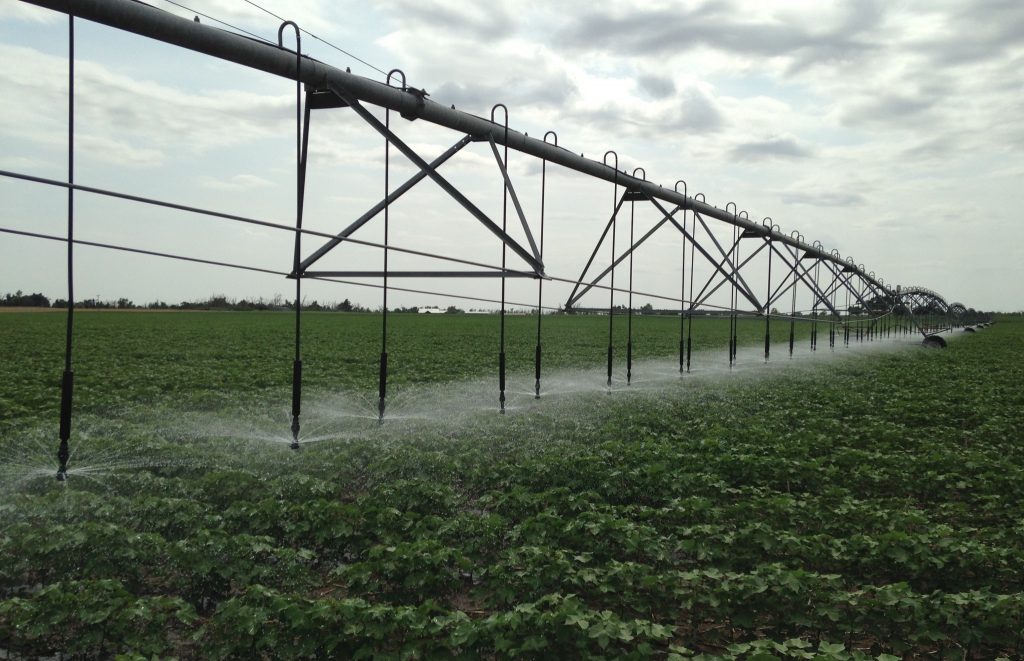
Ethanol Industry Submits Joint Comments Seeking Permanent Removal Of Brazilian Tariff On Imported U.S. Ethanol

This week, Growth Energy, the U.S. Grains Council, and the Renewable Fuels Association, jointly submitted comments within the Brazilian Chamber of Foreign Trade (CAMEX) regarding the Brazilian tariff on imported U.S. ethanol.


Background:

In October 2023, ABICOM (the Brazil association of fuel importers) formally requested to drop the ethanol duties because data showed the tariff raised fuel costs for domestic consumers.

In anticipation of this open comment period, the U.S. Grains Council, Growth Energy and the Renewable Fuels Association mobilized a diverse set of stakeholders - including government agencies - to seek a permanent removal of the Brazilian tariff on imported U.S. ethanol. As of January 1, 2024, the current duty stands at 18% on all incoming U.S. ethanol, while Brazilian ethanol imported into the U.S. enjoys free access within the U.S. market.
Joint Comments:

The three organizations' joint comments, submitted in Portuguese, included the following:

"Considering this significant discrepancy in our historically productive commercial relationship between countries, we would like to stress that the U.S. industry will continue to advocate for restrictive measures to entry for Brazilian ethanol into the U.S., in the case that the Brazilian government does not rethink the current tariff policies.... Despite the promising opportunities emerging new ethanol export markets could bring to both countries, we stress that we are not willing to cooperate with Brazil in any possible partnerships, nor with technology transferring or within new uses for ethanol such as SAF, in case the market is not completely open for free trade for ethanol. We strongly consider the permanent reinstatement of the duty-free access for ethanol as a window of opportunity to strengthen the bilateral agenda and stimulate trade cooperation between Brazil and the United States."

Our organizations will continue to monitor the situation and report back to our respective members as we learn more after the comment period.

Stephanie Bice Town Hall Coming up Thursday

Since being elected, I have regularly hosted Telephone Town Halls in an effort to provide updated information on what's happening in Congress and to hear directly from constituents. 

Join me for my next Telephone Town Hall on Thursday, April 11th at 7 p.m. CT. I'll provide a brief update, then we will open the phone lines to take your questions. 

To call in to the town hall, dial: (833) 305 1731

I look forward to hearing from you!

Senator Chris Kidd Announces His Retirement from the Oklahoma Senate- Updated with Reaction from Rodd Moesel

"I leave with a heart full of gratitude for the opportunity to make a difference in the lives of Oklahomans."

With a legacy of dedicated service and significant legislative achievements, Senator Chris Kidd, R-Waurika, has announced his intention not to seek reelection and retire from the Oklahoma Senate in November, at the end of his current term. Senator Kidd, a fifth-generation Oklahoman with deep roots in the state's agricultural community, leaves behind a record of impactful legislation and community development.

On Wednesday afternoon- Oklahoma Farm Report's Ron Hays talked with Oklahoma Farm Bureau President Rodd Moesel about the word that Senator Kidd will not run for reelection- hear his comments in the listen bar below:

Ron Hays talks with Rodd Moesel about Senator Chris Kidd not seeking a final term in the Oklahoma Senate

"Working for the citizens of Oklahoma has been one of the most rewarding, fulfilling, and humbling experiences of my life," said Kidd. "I take great pride in the accomplishments we made for our state during my tenure, but now I look forward to spending more time at home with my family."

Throughout his tenure, Senator Kidd has been a tireless advocate for economic prosperity, public health, education, and the well-being of military families in Oklahoma. Notable among his legislative accomplishments is the Oklahoma Research and Development Attractions Act, an innovative measure designed to invigorate the state's economy by attracting research and development companies through a grant program managed by the Oklahoma Center for the Advancement of Science and Technology (OCAST).

As chairman of the Senate Agricultural and Rural Affairs Committee, Senator Kidd has overseen the passage of countless policies to help rural Oklahoma and ensure the state's agriculture industry continues to thrive.

In a move to support military families, Senator Kidd extended a sales tax exemption to spouses of service members killed in action, demonstrating his commitment to those who have made the ultimate sacrifice for their country. The state now celebrates Oklahoma State Aviation and Aerospace Day on Aug. 19 each year after he passed a bill during the 2017 legislative session to commemorate Oklahoma's second-largest industry.   

Furthermore, Senator Kidd's legislation enabling county health departments to form "health districts" stands as a testament to his dedication to enhancing health care access and outcomes across Oklahoma counties. He also showed his commitment to our public schools when he championed legislation to ensure school support staff were paid even if their district was closed due to the COVID-19 pandemic.

Senator Kidd's efforts have directly contributed to historic investments in Oklahoma's public education, including securing funds to expand nursing programs at Cameron University and the Great Plains Technology Center. He also sponsored legislation in 2023 to create the Oklahoma State University Veterinary Medicine Authority. This helped ensure a dependable source of funding for OSU's veterinary medicine education programs.

His advocacy for the elimination of the state's grocery tax and the expansion of broadband access further highlights his commitment to improving the quality of life for all Oklahomans.

In recognition of his contributions, Senator Kidd was honored as the County Commissioner Legislator of the Year in 2022, a fitting accolade for his work in strengthening county governance and services.

Prior to his election to the Senate in 2016, Senator Kidd's diverse career spanned roles in economic development with the Chickasaw Nation, banking, and education, in addition to his ongoing involvement in the agricultural sector alongside his family. As a devoted husband and father of three daughters, his commitment to his family and community has been paramount.

Senator Kidd expressed his gratitude to the people of Oklahoma for their trust and support, stating, "It has been the honor of my lifetime to serve the great state of Oklahoma. I am proud of what we have achieved together, and I leave with a heart full of gratitude for the opportunity to make a difference in the lives of Oklahomans."

As he steps down to focus on his family and ranch, Senator Kidd's legacy of service, advocacy, and leadership will undoubtedly continue to benefit Oklahoma for years to come.

Kidd was first elected to the Oklahoma Senate in 2016.

Navigate Animal Welfare vs. Animal Rights at 2024 Summit

The Animal Agriculture Alliance's 2024 Stakeholders Summit will feature panelists from Protect the Harvest, American Kennel Club, and CloverLeaf Animal Welfare Systems who will share their experience navigating animal rights activism and how to chart a winning path to continuous improvement in animal welfare – independent of the influence of animal rights extremists. The 2024 event, themed "Ready, Set, Solve! Advancing Animal Agriculture," is set for May 8-9 in Kansas City, Mo. Register and reserve your hotel room by April 12 to secure discounted rates: https://bit.ly/AAA24.

Animal rights groups are frequently attempting to force change for farmers, ranchers, processors, and food brands through the lens of animal welfare. In reality, these efforts have little to do with enhancing animal welfare – a scientific concept regarding the physical and mental state of the animal. Instead, animal rights activist organizations are seeking to further their agenda to remove meat, dairy, poultry, eggs, and seafood as options on the menu by driving up production costs and elevating the legal and societal status of animals to have the same basic rights as people. In the session "Protecting Animal Ag's Place on the Podium: Animal Rights vs. Animal Welfare," attendees will hear from experts including Protect the Harvest's Mike Siemens, PhD; American Kennel Club's Sheila Goffe; and CloverLeaf Animal Welfare Systems' Jason McAlister as they share their first-hand experiences with navigating activist campaigns, how to work toward continuous improvement in animal welfare, and how to safeguard against upcoming trends in activism.

"It's a common tactic for animal rights activist organizations to attempt to blur the lines between animal welfare and animal rights, however, there should be no mistake that their true intentions are much more extreme as they seek to eliminate consumer choice and take away a nutritious food group," said Abby Kornegay, manager, issues and engagement, Animal Agriculture Alliance. "It's vital for partners along the food supply chain to be able to differentiate between experts looking to improve animal welfare and extremist groups looking to 'liberate' animals and raise their legal status."

The annual Summit is a one-of-a-kind conference attended by a diverse group of decision makers, including representatives from farms, ranches, allied industries, food processors, restaurants, grocery stores, legislatures, universities, government agencies, and media. Media registration is complimentary. Representatives of media outlets can contact Emily Ellis at eellis@animalagalliance.org for registration instructions.

Check the Summit website for the most up-to-date information and follow the hashtag #AAA24 for periodic updates about the event on social media. For general questions about the Summit please email summit@animalagalliance.org or call (703) 562-5160.

Get involved: 

Help spread the word about Summit! If you refer a friend to attend the 2024 Summit who has never attended a previous Summit and they list your name as the person who recommended them when they register for the event, you'll both be entered in a drawing to win a $100 gift card! Each referral will count as one entry and there is no limit on the number of entries for referrers. The Alliance will give away two $100 gift cards during the Summit - one drawing for referrers and one drawing for those who were referred. All registrations for the in-person event with a referral listed made until online registration closes on May 3 will be entered. Both the referrer and the person referred must be registered to claim the gift card.

Maximize your brand visibility and impact by becoming a sponsor of the 2024 Summit today! For more information on sponsorship opportunities still available, contact Logan Hall at lhall@animalagalliance.org.

Donate an item to the 2024 Silent Auction to support the 2024 College Aggies Online scholarship program. Previous auction donations have included goods and services such as artwork, quilts, jewelry, craft items, model farm equipment, gift baskets, gift certificates, food and wine, and sporting or entertainment event tickets. Fill out the request form or contact Grace Platte at gplatte@animalagalliance.org with any questions. The 2024 Summit would not be possible without the support of our sponsors: Farm Journal, Meatingplace, Successful Farming, U.S. Poultry & Egg Association, Watt Global Media, Cargill, Zoetis, American Feed Industry Association, broadhead. + Filament, Merck, United Soybean Board, CoBank, Dairy MAX, Farm Credit Council, National Pork Producers Council, Pet Advocacy Network, Rabobank, Smithfield Foods, The Partnership, United Egg Producers, AdFarm, American Farm Bureau Federation, American Veal Association, Cal-Maine Foods, Cobb-Vantress, Inc., Edge Dairy Farmer Cooperative, Kemin, National Cattlemen's Beef Association, National Chicken Council, National Pork Board, Phileo Lesaffre Animal Care, Progressive Dairy, Protect the Harvest, Eocene Environmental Group, Trans Ova Genetics, Eggland's Best, North Carolina Farm Bureau, and Vivayic.

Lucas: Final SEC Climate Rule will Hit U.S. Farmers and Ranchers

At today's House Financial Services Committee hearing, Congressman Frank Lucas (OK-03) highlighted the detrimental effects of the SEC's climate disclosure rule. On March 6, 2024, the Securities and Exchange Commission (SEC) adopted the Climate Rule, introducing sweeping changes to existing disclosure obligations for public companies. Despite modifications made to the initial proposal, the final rule presents massive challenges that will impact the entire economy.

Ethanol Industry Submits Joint Comments Seeking Permanent Removal Of Brazilian Tariff On Imported U.S. Ethanol

This week, the U.S. Grains Council, Growth Energy and the Renewable Fuels Association, jointly submitted comments within the Brazilian Chamber of Foreign Trade (CAMEX) regarding the Brazilian tariff on imported U.S. ethanol.

Background:

In October 2023, ABICOM (the Brazil association of fuel importers) formally requested to drop the ethanol duties because data showed the tariff raised fuel costs for domestic consumers.

In anticipation of this open comment period, the U.S. Grains Council, Growth Energy and the Renewable Fuels Association mobilized a diverse set of stakeholders - including government agencies - to seek a permanent removal of the Brazilian tariff on imported U.S. ethanol. As of January 1, 2024, the current duty stands at 18% on all incoming U.S. ethanol, while Brazilian ethanol imported into the U.S. enjoys free access within the U.S. market.

Joint Comments:

The three organizations' joint comments, submitted in Portuguese, included the following:

"Considering this significant discrepancy in our historically productive commercial relationship between countries, we would like to stress that the U.S. industry will continue to advocate for restrictive measures to entry for Brazilian ethanol into the U.S., in the case that the Brazilian government does not rethink the current tariff policies.... Despite the promising opportunities emerging new ethanol export markets could bring to both countries, we stress that we are not willing to cooperate with Brazil in any possible partnerships, nor with technology transferring or within new uses for ethanol such as SAF, in case the market is not completely open for free trade for ethanol. We strongly consider the permanent reinstatement of the duty-free access for ethanol as a window of opportunity to strengthen the bilateral agenda and stimulate trade cooperation between Brazil and the United States."

Our organizations will continue to monitor the situation and report back to our respective members as we learn more after the comment period.

Do What You Can for Wild Turkey Habitat With Your Ranch Management Choices

Regenerative ranching and grazing practices promote the plant diversity wild turkeys need to thrive on your land. As populations decline, they need our help.

For the majority of the last 50 years, wild turkeys served as a great North American comeback story. Populations went from nearly non-existent to covering every part of the contiguous United States. Until recently.

"Turkeys were the great success story for wildlife departments all across the nation," says Josh Gaskamp, Noble Research Institute regenerative ranching advisor and manager. But today, many wild turkey populations, particularly those in the Southern Great Plains, are in steep decline. The "why" is unclear, but theories include loss of habitat, disease and climate events – both drought and excessive rain.

Kansas, Oklahoma, and Nebraska – states that boasted big turkey numbers and the associated recreational opportunities over the past several decades – have seen wild-turkey populations declining up to 50% in the past 15 years, according to state wildlife agencies. As these population numbers drop, so have hunting bag limits, tag numbers and even hunting seasons. Kansas canceled its 2023 fall season after its wild turkey population hit a 15-year low.

Researchers in these states and others have launched studies into why turkey production has taken such a dive. A joint study by Oklahoma State University and Texas A&M seeks a comprehensive understanding of the turkeys' nesting behavior, reproductive success and survival of different life stages to determine if a decline is occurring.

turkeys in field

WHAT RANCHERS AND LANDOWNERS CAN DO

There are ways ranchers and landowners can work to enhance turkey habitat in order to develop or improve a hunting enterprise while at the same time pursuing their regenerative ranching goals.

"They are an economic driver," Gaskamp says of wild turkeys, "not just for the value of a hunting or recreational enterprise, but also in increasing the overall value of your land."

Fortunately, wild turkeys are generalists when it comes to habitat requirements. There's not one specific type of environment they need to survive, he says, but there are specific requirements they have at different life stages.

turkeys in field

THREE HABITAT REQUIREMENTS FOR WILD TURKEYS

Ranchers who want to increase their turkey habitat can focus on providing the three key requirements wild turkeys need to succeed:

1. Trees with clear understories for roosting. The ideal roost trees are 40-50-feet tall, have open crowns and plenty of horizontal limbs. Almost as important as the trees turkeys need to roost is the state of the tree's understory. Turkeys want to be able to see clear ground, free of predators, when they are ready to leave the roost.

"They can't roost in areas that are overgrown with brush and cedar, especially in areas taken over by eastern red cedar, because they can't see the forest floor," Gaskamp says. "They want to fly down and land on clear ground in the morning."

2. Ground cover in which to nest. For nesting habitat, the birds need enough cover to hide and protect the next generation. The biggest threats to wild turkeys are mid-level predators like racoons or skunks that plunder eggs out of the nest.

"We can help mitigate that by creating good habitat for those nests," namely diverse native grasslands, Gaskamp says. "Bermudagrass monocultures – or any monoculture, really – are just not going to provide the kind of cover birds need to nest in."

3. Diversity for food, shelter. Wild turkeys – and most ground-nesting birds that indicate the presence of healthy grassland ecosystems – need landscape diversity to thrive, Gaskamp says. That should be encouraging to ranchers who are aiming for regenerative management.

"If a rancher is truly managing regeneratively, and they're providing adequate rest and recovery for their grasses, they're creating a mosaic pattern of management on the ranch," he says. "They're grazing in a way that allows full recovery, so the landscape is dotted with late-successional plants here, early successional plants there, moderate-succession over here."

hunters walking

FOUR MANAGEMENT TIPS TO IMPROVE TURKEY HABITAT

If a regenerative ranch management approach that is good for both livestock grazing and gobblers is your goal, keep these management tips in mind.

1. Diversity demands disturbance. One of the primary ways to increase the diversity that wildlife and healthy soils need to thrive is controlled disturbances. Intentional disturbance followed by adequate rest and recovery creates opportunities for cool- and warm-season annual plants to fill the mosaic of successional stages.

"Disturbance – events like grazing, but not overgrazing; fire, but not all at once – reverts land to earlier successional states, which allows for forbs to come in," Gaskamp says. "Forbs have flowers, which attracts insects like caterpillars and grasshoppers. That's what young poults need to eat until they mature and shift their diets to more grain."

2. Don't forget your riparian areas. Historically, many conservation-minded ranchers and land managers have received the message that water-rich riparian areas are a 'do-not-disturb' zone. This hands-off approach can lead to a thick, unruly understory that may do more harm than good. Rather, Gaskamp suggests aiming for targeted management to enhance habitat on riparian areas while also increasing land utilization and efficiency.

"We need to create disturbances in those riparian areas, but they don't need to be intense disturbances," he says. "They need to be short-duration grazes to help limit the brush encroachment and clear out that understory."

That has the triple-benefit of boosting bird-roosting habitat, creating healthier waterways and increasing land utilization for livestock.

3. Consider your impact on predator/prey relationships. Every action creates a cascading effect, so if you want a healthier, more robust turkey population, look beyond the birds themselves.

On a pathway to more regenerative management, many ranchers look to reduce inputs and put their management more in tune with natural remedies, both to save expenses and boost soil health. Another benefit to fewer chemical inputs may be more robust wildlife populations.

"A lot of those pesticides kill the insects the turkeys need to feed on, and the herbicides kill the forbs those insects need to exist there," Gaskamp says. "And then we work really hard to eliminate apex predators like coyotes or wolves, while less people are trapping those smaller, fur-bearing predators these days. That leaves those mid-level predator populations unchecked."

The right management balance in these areas is unique to every ranch and situation, so he simply suggests being more cognizant of the cascading impact of every decision.

4. Know what's in your control, and what's only moderately in your control. The two primary drivers of wild turkey populations come down to habitat and weather.

"As managers, we can really only have a strong influence on one of those," Gaskamp says, but don't underestimate your habitat's ability to create resiliency in the face of uncontrollable weather.

Extreme drought can damage wildlife populations, but management that aims at increasing soil health also builds more resilient grasslands with deeper roots and more water holding capacity. That helps on the inverse of extreme weather, too.

"What we've seen more of in the past few years is poor nesting success because of heavy rain in early spring. If our soil isn't in good shape, it's not infiltrating water, and those nests are sitting in puddles that should be absorbed by the soil. The eggs can't survive underwater."

That's why, Gaskamp says, ground-nesting birds of all species – wild turkeys, quail, pheasants, prairie chickens and more – are known symbols of healthy grassland ecosystems.

"If these birds are present on your ranch, it's a signature of your good grassland management," he says.

Story credit: Laura Nelson, Noble Research Institute

OSU's Mark Johnson Discusses Schedule and Speakers for 2024 Cattlemen's Conference

Panel of speakers at 2023 Cattlemen's Conference.

Listen to Ron Hays talk with OSU's Mark Johnson about the 2024 Cattlemen's Conference.

Senior Farm and Ranch Broadcaster Ron Hays is back talking with Mark Johnson, Oklahoma State University Extension Beef Cattle Breeding Specialist, for part three of a preview for the 2024 Cattlemen's Conference, which will be held on May 22nd and 23rd at the Totusek Arena in Stillwater, Oklahoma.

Johnson said the first panel of speakers on Wednesday will be discussing selection and mating relative to the marketing endpoint in a beef operation.

"We have known for years that reproductive traits are low in heritability and really respond to crossbreeding in a big way," Johnson said. "Growth traits are moderate in heritability, and they have moderate degrees of heterosis when we crossbreed. Carcass traits are highly heritable and don't show much benefit from crossbreeding."

Whether an operation sells its calves at weaning, holds onto them, markets them as yearlings, or retains ownership through finishing, Johnson said the discussion will focus on which factors to prioritize in a selection in a mating program to create profit potential within the operation.

"We have got speakers coming in on this topic that are doing some really different things as far as selection, mating, and the breeds that are involved, and that are involved in different marketing end-points, so you have a variety of ideas that are proven to be very successful based on this topic," Johnson said.

Johnson said he and OSU livestock marketing economist Dr. Derrell Peel are working with scientists from the meat animal research center to utilize data to make an economic simulation to study additive genetic merit and hybrid vigor relative to different marketing endpoints.

The next conference discussion will feature Dr. Jason Rowntree of Michigan State University, who will talk about beef's carbon footprint. Regenerative ranching will be discussed with Hugh Aljoe of the Noble Research Institute.

Wednesday will conclude with a banquet featuring remarks from Dr. Alison Van Eenennaam, a Cooperative Extension Specialist in Animal Genomics and Biotechnology at the University of California, Davis. As the keynote speaker of the banquet, Eenennaan will discuss gene editing.

"Alison will talk about what is going on globally, and not just in farm animals we think of, but globally in meat animal species as far as gene editing," Johnson said. "That leads into those panel discussions the second day- two different panel discussions there."

Johnson said the second day of the conference will include speakers from the National Cattlemen's Beef Association, breed registries, other protein sources, and more talking about gene editing and more.

To listen to Part 1 of the conversation, CLICK HERE! To listen to Part 2, CLICK HERE!

To learn more about the conference and register, CLICK HERE!

Drummond files first lawsuits from soaring natural gas prices in Winter Storm Uri

Alleging artificially inflated natural gas prices that preyed on Oklahomans in the wake of Winter Storm Uri, Attorney General Gentner Drummond today filed litigation against Enable entities (ET Gathering & Processing successor by merger to Enable Midstream Partners, Enable Oklahoma Intrastate Transmission, Enable Gas Transmission and Enable Energy Resources) and Symmetry Energy Solutions LLC.

During that devastating 2021 winter storm, Enable and Symmetry marketed natural gas and operated intrastate natural gas pipelines throughout Oklahoma. Among their customers was the Grand River Dam Authority (GRDA), the state's largest public power utility. Many of Oklahoma's public schools, cities, counties and hospitals are directly supplied natural gas by Symmetry.

While the Federal Energy Regulatory Commission bars interstate pipeline operators from owning the commodity they transport and sell, there is no such prohibition on intrastate pipelines. Many states have imposed restrictions on intrastate pipeline owners to mirror the federal rules, but Oklahoma is not among them – a circumstance that, according to the lawsuit, leaves the state ripe for market manipulation and anti-competitive behavior.

According to the litigation, Enable and Symmetry employed "a variety of tactics to drive up the index prices, including reduction of supply and submitting trades at unconscionable price levels" to charge GRDA exorbitant fees "dictated by the artificially inflated index prices."

Drummond said his office will pursue additional litigation against other companies that he said engaged in market manipulation.

"I believe the level of fraud perpetrated on Oklahomans during Winter Storm Uri is both staggering and unconscionable," said the Attorney General. "While many companies conducted themselves above board during that trying time, our analysis indicates that some bad actors reaped billions of dollars in ill-gotten gains. It is important that we do everything in our power to hold bad actors accountable for their actions."

Uri roared through Oklahoma in mid-February of 2021. Before it eventually exited the continental United States, the punishing mix of ice, snow and record-breaking cold caused hundreds of deaths and more than $200 billion in damages throughout the southern part of the country.

It also spurred desperate need for additional natural gas.

According to the lawsuits, Enable and Symmetry had counted on higher demand with the arrival of Winter Storm Uri and schemed to artificially reduce supply.

"They knew that it would bring sustained below-freezing temperatures, and that it would increase demand for natural gas. Armed with this knowledge, Defendants used that time to prepare, but not in the way that was rightfully expected from them," state the lawsuits.

"Instead of ensuring adequate natural gas supplies to GRDA, upon information and belief Defendants spent the weeks and days before Winter Storm Uri's arrival in Oklahoma taking deliberate steps, which continued after Winter Storm Uri's arrival, to reduce the availability of natural gas in Oklahoma. They did so with the objective of driving natural gas prices — and their resulting profits — exponentially higher, to the detriment of GRDA and everyone else in Oklahoma."

Enable and Symmetry "reaped billions of dollars in extra profit from their wrongful conduct and the resulting surge in prices during the storm," according to the lawsuits filed today in Osage County District Court.

The lawsuit against ET Gathering & Processing, Enable Oklahoma Intrastate Transmission and Enable Energy Resources claims violations of the Oklahoma Antitrust Reform Act, violations of the Oklahoma Common Carrier statute, breach of contract, unjust enrichment, fraud, constructive fraud, bad faith breach of contract, civil conspiracy and negligence.

The lawsuit against Symmetry claims violations of the Oklahoma Antitrust Reform Act, breach of contract, unjust enrichment, fraud, constructive fraud, bad faith breach of contract, negligence, and breach of fiduciary duty.

The petitions can be read here and here.

Daily Email for April 10, 2024


Oklahoma's Latest Farm

And Ranch News

Wednesday, April 10, 2024

 
Howdy Neighbors!

Here is Your Daily Oklahoma Farm and Ranch News Update: 


  • Oklahoma's Farmers and Ranchers Advocate for Agriculture During AFR Day at the Capitol


  • NCBA, Oklahoma Cattlemen and OSU's Derrell Peel Agree- USDA Made a Mistake


  • Cattlemen's Conference to Discuss Next Chapter of Innovation to Boost Cattle Industry


  • Cowboy Hats in the Capitol: LMA Members Gather for Annual Washington D.C. Fly-In


  • USDA Designates Oklahoma & Texas Counties as a Primary Natural Disaster Area


  • OSU Partners with U.S. Pork Center of Excellence


  • Nutrien Ag Solutions Announces Commitment to the National FFA Organization

Oklahoma's Farmers and Ranchers Advocate for Agriculture During AFR Day at the Capitol

During AFR (American Farmers and Ranchers) Day at Oklahoma's Capitol, Farm Director KC Sheperd had the chance to catch up with AFR President Scott Blubaugh. Sheperd and Blubaugh talk about a few bills that AFR has focused on recently that impact agriculture in the state. Talking points for AFR members included responsible water policy, farm to school, House Bill 1860, Processing capacity, House Bill 3801 and more.


"Today is our big day here at AFR; we bring our membership in to learn how to lobby basically and to meet with our Senators or Representatives, talk about issues that are important to them, issues that our policy process developed over the last year, and just remind these folks up here that we have a large membership of about 61,000 members here in Oklahoma that we represent."


First and foremost, Blubaugh said AFR is excited for the chance to congratulate the legislature on the passage of House Bill 1006, which grants 4-H students an excused school absence when participating in an approved activity.


Blubaugh said the discussion on water metering throughout Oklahoma is also a big topic, and he is looking forward to hearing from legislators about finding solutions to water issues around the state.

Click here to read more and listen to Scott Blubaugh talk about AFR Day at the Capitol.

Sponsor Spotlight


Dating back to 1891, Stillwater Milling Company has been supplying ranchers with the highest quality feeds made from the highest quality ingredients. Their full line of A & M Feeds can be delivered direct to your farm, found at their Agri-Center stores in Stillwater, Davis, Claremore and Perry or at more than 125 dealers in Oklahoma, Arkansas, Kansas and Texas. We appreciate Stillwater Milling Company's long time support of the Radio Oklahoma Ag Network and we encourage you to click here to learn more about their products and services. 


NCBA, Oklahoma Cattlemen and OSU's Derrell Peel Agree- USDA Made a Mistake

On Tuesday, the U.S. Department of Agriculture announced that due to budget constraints- they have made the decision to cancel the July Cattle Report and discontinue the County Estimates for Crops and Livestock, among other changes.


The National Cattlemen's Beef Association's Ethan Lane quickly denounced the move saying "It is disingenuous for the same agency which touts its commitment to transparency in livestock markets to arbitrarily cease publication of reports which provide just that. While it may be politically expedient to blame appropriators in Congress for today's decision, cattle producers know better than to believe discontinuing a handful of reports will result in substantive cost savings for the Department."


The Oklahoma Cattlemen's Association are also upset- They offer this statement: "OCA is in full agreement with NCBA calling for USDA to reinstate these important reports. The cattle industry needs robust information in order to understand accurate feeder cattle numbers and movement. Of critical importance right now is heifer retention as we grapple with how and when herd rebuilding will take place."


Oklahoma Farm Report also reached out to Oklahoma State University Extension Livestock Market Economist Dr. Derrell Peel, who says that OCA's statement is a worry. Dr. Peel texted us that this decision means "no indication of heifer retention until January. Likewise, no estimate of feeder supplies. Seems kind of important in the current situation."

Click here to read more on Ethan Lane and Derrel Peel's perspective of USDA's latest announcement.

2024 Cattlemen's Conference to Discuss Next Chapter of Technology and Innovation to Boost American Cattle Industry

I am back talking with Mark Johnson, Oklahoma State University Extension Beef Cattle Breeding Specialist, about the 2024 Cattlemen's Conference, which will be held on May 22nd and 23rd in Stillwater, Oklahoma.


After the success of last year's conference, Johnson said this year the objective is to follow up on a few of the topics that did not receive enough attention last year due to available time.


One of those topics that will be a large part of the second conference, Johnson said, is gene editing.


"This is a fascinating and interesting area that is going to impact all of us, not only in meat animals but in humans," Johnson said. "There are going to be decisions to be made; it is important to be informed. We are going to have a great set of panelists to come in, and we are going to talk about the evolution of technology."


Johnson said there would be two different panel discussions on gene editing, each consisting of around ten industry leaders who are knowledgeable about the topic. Another important component of the discussion, Johnson mentioned, is the consumer's perspective on gene editing.


To learn more about the conference and register, CLICK HERE!

Click here to read more and listen to Ron and Mark Johnson give an insight of what's to come for this year's Cattlemen's Conference.
Sign Up for Our Daily Email- Free Because of Our Sponsors!

Support Our Sponsors!


KIS logo


Advertise With Us!
 

For our farmers who have either- always have had cotton on their farms- or those who have more recently have added the fiber crop to their operations- we have a daily report heard on several of our Radio Stations- It's Called Cotton Talk!

Click on the Button below to listen to our most recent report
Click here for our Latest Cotton Talk- Hosted by KC Sheperd


The latest news from the Oklahoma State Capitol is available daily on the Radio Oklahoma News Network.


Click on the blue button to hear Capitol reporter Albert Castellanos with his latest report.

Click here for the latest report from the State Capitol on RON


Cowboy Hats in the Capitol: LMA Members Gather for Annual Washington D.C. Fly-In

Nearly two dozen Livestock Marketing Association members and staff met with members of both the House of Representatives and Senate, agriculture staff, and U.S. Department of Agriculture officials March 20-22, during the association's 18th D.C. Fly-In. The event offered an opportunity for livestock auction market owners to share their stories and connect with elected officials.


Throughout the visit, LMA members advocated for the passage of the Amplifying Processing of Livestock in the United States, or A-PLUS Act (H.R. 530), and its Senate companion the Expanding Local Meat Processing Act (S. 813), to end an outdated prohibition and allow an auction owner to own or invest in a small or medium packer. These bills would provide an avenue to increase packing competition and capacity. At the same time, the bills maintain necessary safeguards by prohibiting the largest packers from owning auctions.


The auction market owners also urged Congress to update Packers and Stockyards Act prompt payment requirements in light of slowing mail service and a desire to incentivize electronic payment as the more efficient and secure method. Finally, livestock auction market owners at the Fly-In pushed to ensure that any upcoming rule requiring electronic identification for cattle is not an unfunded mandate.

Click here to read more about LMA member's fly in event at Washington D.C.

We invite you to listen to us on great radio stations across the region on the Radio Oklahoma Ag Network weekdays-

if you missed this morning's Farm News - or you are in an area where you can't hear it- click below for this morning's Farm news from Ron Hays and KC Sheperd on RON.
Listen to our latest Farm and Ranch News for Wednesday with KC Sheperd
 
 
Subscribe To the Daily Email


Sponsor Spotlight


As the premier John Deere dealer across Oklahoma & Arkansas, P&K Equipment is proud to serve our 20 communities and the surrounding areas. From residential, small ag & hay, large ag, & compact construction equipment- the P&K team makes it easy to buy & own your John Deere equipment. You'll find transparent pricing & easy financing options on the website & in stores. You'll have technology, sales, parts, and service support long after the sale. So when you're ready to experience the ease of operating John Deere equipment- you can trust the experts at P&K Equipment.


USDA Designates Oklahoma & Texas Counties as a Primary Natural Disaster Area

This Secretarial natural disaster designation allows the United States Department of Agriculture (USDA) Farm Service Agency (FSA) to extend much-needed emergency credit to producers recovering from natural disasters through emergency loans. Emergency loans can be used to meet various recovery needs including the replacement of essential items such as equipment or livestock, reorganization of a farming operation, or to refinance certain debts. FSA will review the loans based on the extent of losses, security available, and repayment ability. 


According to the U.S. Drought Monitor, these counties suffered from a drought intensity value during the growing season of 1) D2 Drought-Severe for 8 or more consecutive weeks or 2) D3 Drought-Extreme or D4 Drought-Exceptional. 


Impacted Area: Oklahoma


Triggering Disaster: Drought (Fast Track) 


Application Deadline: November 25, 2024 


Primary Counties Eligible: Atoka, Beckham, Choctaw, Coal, Greer, Harmon, Hughes, Jackson, Osage, Pontotoc, Pushmataha, and Washington


Texas: Childress, Collingsworth, Hardeman, Lamar, Red River, Wheeler, and Wilbarger 


 Kansas: Chautauqua, Cowley, and Montgomery

Click here to read more about counties that are eligible for emergency natural disaster loans.

OSU Partners with U.S. Pork Center of Excellence

The Oklahoma Pork Council is excited about a recent partnership established between the U.S. Pork Center of Excellence (USPCE) and Oklahoma State University to continue connecting OSU Animal and Food Sciences degree seeking students with the pork industry.


Following a recent visit to Oklahoma by USPCE representatives Dr. Maynard Hogberg and Bill Winkelman, OSU Animal and Food Sciences Department has become a new USPCE university sponsor. This partnership focuses on talent development, education, and scholarship programs for the pork industry to help identify and train new and existing needs at all levels – including production, research, education and extension.


"The opportunity to work with the Oklahoma Pork Council and Oklahoma State University for undergraduate and postgraduate students is a great benefit for the youth and the industry in developing awareness and interest in career opportunities," Winkelman said.


Read more about this partnership

Nutrien Ag Solutions Announces Multi-Year Commitment to the National FFA Organization

Nutrien Ag Solutions recently announced a multi-year commitment of nearly $850,000 to the National FFA Organization in support of its commitment to shape future agriculture leaders.


The yearly donation of $282,500 supports a variety of National FFA Organization programs and events during the three years (from 2024 to 2026), including supporting Future Farmers of America (FFA) members in competitive events, assisting FFA advisors in their professional development, as well as providing National FFA Officers with a $10,000 scholarship at the end of their year of service. In addition, the donations will also support alumni chapter grants.


National FFA and Nutrien Ag Solutions look forward to continued collaboration to ensure an even greater impact in the upcoming years.


"Nutrien Ag Solutions has been a proud sponsor of the National FFA Organization for 45 years, and we are excited to continue our support for this integral organization for agricultural education," said Spencer Harris, senior vice president at Nutrien Ag Solutions. "As an FFA alumni, I am excited to be part of this investment that will help give students the same opportunities that shaped my career in agriculture today. There are over 300 different career possibilities in agriculture, and FFA provides students with critical skills such as public speaking, hands-on research experience, collaboration with a team, as well as many other skills that they will carry with them for the rest of their academic and professional careers."

Click here to read more about Nutrien Ag Solutions multi-year commitment to supporting the National FFA.
Let's Check The Markets!
OKC West is our Market Links Sponsor- they sell cattle three days a week- Cows on Mondays, Stockers on Tuesday and Feeders on Wednesday- Call 405-262-8800 to learn more.
 
Today's First Look:
Ron on RON Markets as heard on K101  
mornings with cash and futures reviewed- includes where the Cash Cattle market stands, the latest Feeder Cattle Markets Etc.
Hear Today's First Look
 

Wholesale Boxed Beef Prices were mixed- Choice Beef was up 2 cents and Select Beef was down 37 cents on Tuesday, 4/9/2024.


Click on the Button below for the latest report from USDA Market News

Boxed Beef Report
 

OKC West in El Reno had 1,200 head of calves on Tuesday, April 9th.


Compared to last week: Steer and heifer calves sold fully steady to firm. Demand good. Supply included: 100% Feeder Cattle (46% Steers, 42% Heifers, 12% Bulls). Feeder cattle supply over 600 lbs was 17%. 


For today- April 10th- Expecting 4,000

1,800 Feeder Heifers @ 9:00am

2,200 Feeder Steers @ 12:00pm


Click below for the Tuesday report.

OKC West in El Reno Calf Market Report from 04/09/2024
 
 
Each afternoon we are posting a recap of that day's markets as analyzed by Justin Lewis of KIS futures - click below for the latest update on the Livestock and Grain Futures Trade..
Click Here to Listen to Justin's Commentary From 4//9/2024
 
Okla Cash Grain:  
Daily Oklahoma Cash Grain Prices- as reported by the Oklahoma Dept. of Agriculture- The report available after the close of the Futures Trade for that day.
Read  Cash Grains Report from 4/9/2024
 
Our Daily Market Wrapup from the Radio Oklahoma Ag Network - analyzing the Futures Markets for that trading day- as reported by KC Sheperd.
Click to Listen to Our Weekday Wrap with KC
 
Slaughter Cattle Recap: 
The National Daily Slaughter Cattle Summary- as prepared by the USDA Market News
Read Report
 
TCFA Feedlot Recap:  
Finally, here is the Daily Volume and Price Summary from the Texas Cattle Feeders Association.
Read Report
Our Oklahoma Farm Report Team!!!!
 
Ron Hays, Senior Farm/Ranch Broadcaster and Editor
 
KC Sheperd, Farm Director and Editor

Dave Lanning, Markets and Production

Reagan Calk, Farm News and Email Editor

Pam Arterburn, Calendar and Template Manager

Podcasts From Oklahoma Farm Report and More

Two of our regular reports are also podcasts that you can subscribe to- Our daily Farm and Ranch News with KC Sheperd- available here on the Apple Podcast Platform


The second is our daily Beef Buzz with Ron Hays- available here on the Apple Podcast Platform


Periodically- we offer interviews on our Ag Perspectives Podcast series- this podcast is available here.


Ron has also has a series of podcasts from interviews with newsmakers at the Cattlemen's Congress- Click here or you can find them on your favorite Podcast platform- look for them by searching for Cattlemen's Congress Conversations.


We are making plans to jump back into regular installments of what has been called the Road to Rural Prosperity- a new name and fresh content is in the works- for now- click on the blue button below for one of our favorites that is a timeless classic.

Listen to Episode 86 with Ron Hays talking with one of the legends in the Beef Cattle Business- Bob Drake of Davis, Oklahoma
 
 
Listen to Ron
Beef Buzz
 
Blue Green Gazette
Calendar
Auctions
Market Links
Facebook  Twitter  Youtube  

Our thanks to Midwest Farms Shows, P & K Equipment, Oklahoma Farm Bureau, Oklahoma Ag Mediation Program, Great Plains Kubota, Stillwater Milling Company, National Livestock Credit Corporation, Oklahoma Beef Council, Oklahoma AgCredit, the Oklahoma Cattlemens Association, Invenergy Oklahoma and  KIS Futures for their support of our daily Farm News Update.


For your convenience, we have our sponsors' websites linked here- just click on their name to jump to their website- check their sites out and let these folks know you appreciate the support of this daily email, as their sponsorship helps us keep this arriving in your inbox on a regular basis- at NO Charge!


We also appreciate our Market Links Sponsor - OKC West Livestock! 


We invite you to check out our website at the link below too that includes an archive of these daily emails, audio reports and top farm news story links from around the globe.

Head to Our Website OklahomaFarmReport.Com
God Bless!
Reach Out To Us:
Tim West
President/General Manager
Rural Oklahoma Networks

405-317-6361

***************

Mike Henderson
Director of Sales

405-615-4922

KC Sheperd
Farm Director
Radio Oklahoma Ag Network

405-443-5717

Email KC
Ron Hays
Senior Farm/Ranch Broadcaster
Radio Oklahoma Ag Network

405.473.6144
Email Ron

Rancher's Thursday Webinar: Management of Beef on Dairy Crossbreds in Beef Production

The Rancher's Thursday Lunchtime Webinar Series focusing on use of Beef on Dairy crossbreds in beef production started last week with a presentation by Bailey Basiel from Penn State University discussing how sire breeds and selection within a breed affects performance and carcass quality from beef on dairy crosses. The recording of the presentations will be posted on the OSU Beef Extension website at https://extension.okstate.edu/programs/beef-extension/ranchers-thursday-lunchtime-series/

The series will continue through May 2nd every Thursday at noon from April 11th to May 2nd. This Webinar covers the management of Dairy Beef crossbreds in the beef production system. There will be presentations on research dealing with the effects of sire selection and early life management on finishing performance as well as management and performance of dairy-beef crosses in commercial feeding operations. Experts from across the nation will cover recent research and real-world experiences in managing and marketing these unique animal resources. Register for this online webinar series at https://okstate-edu.zoom.us/webinar/register/WN_dxm_nDV2TM22cErxr4XFaQ#/registration

USDA Designates 21 Oklahoma Counties as Primary Natural Disaster Areas for Drought

This Secretarial natural disaster designation allows the United States Department of Agriculture (USDA) Farm Service Agency (FSA) to extend much-needed emergency credit to producers recovering from natural disasters through emergency loans. Emergency loans can be used to meet various recovery needs including the replacement of essential items such as equipment or livestock, reorganization of a farming operation, or to refinance certain debts. FSA will review the loans based on the extent of losses, security available, and repayment ability.

According to the U.S. Drought Monitor, these counties suffered from a drought intensity value during the growing season of 1) D2 Drought-Severe for eight or more consecutive weeks or 2) D3 Drought-Extreme or D4 Drought-Exceptional.

Triggering Disaster: Drought

Application Deadline: 11/25/2024

Impacted Area: Oklahoma

Primary Counties Eligible: Atoka, Beckham, Choctaw, Coal, Greer, Harmon, Hughes, Jackson, Osage, Pontotoc, Pushmataha, Washington

Contiguous Counties Eligible:
Oklahoma: Bryan, Custer, Garvin, Johnston, Kay, Kiowa, Latimer, Le Flore, McClain, McCurtain, McIntosh, Murray, Noble, Okfuskee, Pawnee, Pittsburg, Pottawatomie, Roger Mills, Seminole, Tillman, Tulsa, Washita
Kansas: Chautauqua, Cowley, Montgomery
Texas: Childress, Collingsworth, Hardeman, Lamar, Red River, Wheeler, Wilbarger

Triggering Disaster 2: Drought

Application Deadline: 11/25/2024

Impacted Area: Kansas

Primary Counties Eligible: Barton, Chautauqua, Clay, Cloud, Decatur, Dickinson, Elk, Ellis, Ellsworth, Geary, Gove, Graham, Harvey, Jewell, Lincoln, McPherson, Marshall, Mitchell, Montgomery, Ness, Norton, Osborne, Ottawa, Phillips, Pratt, Reno, Republic, Rice, Riley, Rooks, Rush, Russell, Saline, Sheridan, Smith, Strafford, Trego, Washington, Wilson.

Contiguous Counties Also Eligible:
Kansas: Allen, Barber, Butler, Cowley, Edwards, Finney, Greenwood, Hodgeman, Kingman, Kiowa, Labette, Lane, Logan, Marion, Nemaha, Neosho, Pawnee, Pottawatomie, Rawlins, Scott, Sedgwick, Thomas, Wabausee, Woodson.

Nebraska: Franklin, Furnas, Gage, Harlan, Jefferson, Nuckolls, Pawnee, Red Willow, Thayer, Webster.
Oklahoma: Nowata, Osage, Washington,

Triggering Disaster 3: Drought

Application Deadline: 11/25/2024

Impacted Area: New Mexico

Primary Counties Eligible: Bernalillo, Catron, Chaves, Cibola, Colfax, Curry, De Baca, Dona Ana, Eddy, Grant, Guadalupe, Harding, Hidalgo, Lea, Lincoln, Los Alamos, Luna, McKinely, Mora, Otero, Quay, Rio Arriba, Roosevelt, Sandoval, San Juan, Santa Fe, Sierra, Socorro, Taos, Torrance, Union, Valencia,

Contiguous Counties Also Eligible:
Arizona: Apache, Cochise, Greenlee
Colorado: Archuleta, Baca, Conejos, Costilla, La Plata, Las Animas, Montezuma
Oklahoma: Cimarron
Texas: Andrews, Bailey, Cochran, Culberson, Dallam, Deaf Smooth, El Paso, Gaines, Hartley, Hudspeth, Loving, Oldham, Parmer, Reeves, Winkler, Yoakum
Utah: San Juan

More Resources
On farmers.gov, the Disaster Assistance Discovery Tool, Disaster Assistance-at-a-Glance fact sheet, and Loan Assistance Tool can help you determine program or loan options. To file a Notice of Loss or to ask questions about available programs, contact your local USDA Service Center.

USDA is an equal opportunity provider, employer and lender.

National Sorghum Producers Seeks New Leaders for Board of Directors

National Sorghum Producers has opened applications for two positions on the 2024 board of directors. NSP is looking for new producer leaders who are passionate about advancing the crop and shaping the future of the sorghum industry.

"Today, the sorghum industry stands at a crossroads of tradition and innovation, and as your board chairman and a fellow farmer, I'm reaching out to those among you who are driven to make a meaningful difference," NSP Chairman Craig Meeker said. "We are eager to welcome new voices, ideas and perspectives that will help usher in a new era for our industry. If you have a passion for advocacy and a vision for sustainability, I encourage you to apply."

Board members are instrumental in advancing policies and building relationships that benefit sorghum farmers and the industry. Candidates should be NSP members passionate about advocacy and fundraising, with a vision to advance the industry. No prior board experience is necessary to apply.

"We are looking for proactive leaders eager to drive the sorghum industry forward," NSP CEO Tim Lust said. "Our farmer-led board of directors plays a crucial role in advocating for sorghum farmers and ensuring NSP's strong representation in Washington, D.C. It's about advocacy, vision and making an impact."

Applications are due Friday, May 10, 2024, at 5 p.m. central time. After the application deadline, the NSP Nominating Committee will review all applications before making nominations to the NSP Board of Directors for consideration and election during the August summer board meeting. Selected members will serve a three-year term, beginning October 1, 2024—the start of NSP's fiscal year.

For the application and more information, visit SorghumGrowers.com/leadership/. 

Lucas Congratulates Chairman Tom Cole

Congressman Frank Lucas (OK-03) released the following statement after Congressman Tom Cole's (OK-04) appointment to become chairman of the House Committee on Appropriations. The Republican Steering Committee unanimously endorsed Chairman Cole late Tuesday night, with the GOP Conference ratifying it this morning. "I'd like to congratulate my fellow Oklahoman and long-time friend, Tom Cole, for his appointment as chairman of the House Committee on Appropriations," said Congressman Frank Lucas. "Chairman Cole has the distinct privilege of being the first Oklahoman to ever serve in this incredibly important and influential position. This stands as a landmark day in the history of our state's congressional representation, and I join my fellow Oklahomans in celebrating this momentous achievement. I look forward to continuing to work with Chairman Cole in advancing priorities that benefit communities across the state and nation."

Beltway Beef Podcast: Insights from the U.S. – E.U. Collaboration Platform on Agriculture

Each week, Beltway Beef brings you the latest policy news affecting the U.S. cattle and beef industry. Hear from subject-matter experts, producers, and industry leaders on the topics that impact the business viability of farms and ranches across the country.

On this episode, we discuss NCBA's involvement in the U.S. – E.U. Collaboration Platform on Agriculture and the first event with European agriculture officials held in the United States. Idaho rancher and NCBA Policy Division Chair Kim Brackett joins to share information on her participation in the Collaboration Platform on Agriculture as a panelist discussing the cattle industry's commitment to sustainability and animal welfare. NCBA Chief Counsel Mary-Thomas Hart served as a moderator at the U.S. – E.U. meeting and offers her perspective on the conversations occurring between American and European agriculture leaders. Finally, NCBA Executive Director of Government Affairs Kent Bacus joins the conversation to explain the importance of these international meetings, NCBA's work to promote the U.S. cattle industry overseas, and our relationship building with European agriculture officials.

Custom Agronomics appoints new CEO

Custom Agronomics, a leading provider of private-label liquid plant nutrition and other specialty products for the agriculture, turf, and ornamental markets, announced today that Tom Snipes has been appointed CEO.

"Tom brings a valuable combination of agricultural experience and business expertise to Custom Agronomics. He has a track record of innovation and growth that will enable us to continue expanding our presence and product line," said Greg Thompson, chair of Custom Agronomics' Board of Directors.

Snipes most recently served as CEO of Plant Response Inc., a global plant biotechnology company specializing in nutrient use efficiency, plant innate immunity and plant physiology. Under his leadership, the company successfully completed substantial fundraising and portfolio expansion and experienced rapid growth as a result of aggressive commercialization efforts and strategic acquisitions. Plant Response was acquired by The Mosaic Company in 2022 and is now part of Mosaic Biosciences.

"The emphasis on sustainability and improving plant health has presented strong market opportunities for Custom Agronomics. The company is already an industry leader in liquid nutrients and custom formulations, and I'm excited about capitalizing on opportunities to drive its next stage of growth," Snipes said.

Snipes previously worked in leadership roles at Pinnacle Agricultural Holdings and Koch Industries. In those roles, he led business development efforts, implemented growth strategies, and identified acquisition targets.

He is a graduate of the University of South Carolina and has completed executive education programs at the University of Michigan and Texas A&M University.

Introducing Ross Turner of the Oologah FFA Chapter, Your 2024 Northeast Area Star in Agribusiness

Listen to KC Sheperd talk with Ross Turner ahead of the State FFA Convention in Tulsa, Oklahoma.

During the month of April, the Radio Oklahoma Ag Network and Oklahoma Farm Report are spotlighting the 18 Area Stars of Oklahoma FFA, who are among the highest achievers in the organization.

The stars come from the five areas in four categories- Star in Ag Placement, Star in Agriscience, Star in Agribusiness, and Star in Agricultural Production.

This week, we spotlight the three area stars in Agribusiness in 2024.

One Star Finalist featured in the coming days from each of the categories will be named the State Star Award Winner during the 98th Oklahoma State FFA Convention coming up on May 7th and 8th in Tulsa, Oklahoma.

This week, our coverage of the 2024 Oklahoma FFA Star Award Finalists begins with Agribusiness competitor Ross Turner of the Oologah FFA chapter representing the Northeast Area.

Turner is the owner and operator of Turner Stock Dogs, where he trains dogs on a month-to-month basis. His operation primarily consists of Border Collie dogs, but he also works with other breeds.

"The most important thing I have figured out is to be patient and read each dog individually," Turner said. "I compare it to how a teacher can read their students in figuring out what exactly that dog needs, how much pressure you can put on that dog, and what kind of pressure the dog needs to get to where you want them to be."

After working with a few different cow dog breeds, Turner said he enjoys Border Collie dogs for their quickness, strength, and intelligence. Turner added that part of his strategy is he does not turn dogs out on stock until they are around one year old.

"I find they are a little more mature by that point, where they can handle some training and some criticism without getting their feelings hurt and giving out on you," Turner said.

Turner plans to continue his operation through college and then grow his business in terms of his breeding program and the number of outside dogs he takes in each month. Turner added that he is grateful for the help and inspiration he has received from so many along the way.

After graduating high school, Turner will attend Connors State College on a livestock judging scholarship, then after his time there he plans to finish his bachelor's degree in agribusiness at a four-year college.

Your coverage of the 2024 Oklahoma FFA Convention is sponsored by Hilliary Communications- who deliver the latest cutting-edge communications services supporting tens of thousands of customers across 22 counties throughout Oklahoma, Texas and Iowa. The company offers internet, voice and HilliaryTV. Hilliary Communications continuously researches the marketplace for innovations and strives to improve underserved areas, offering services that exceed customer expectations. Click here to learn more about Hilliary Communications.

For more information about the 98th Oklahoma State FFA Convention, click here.

National Sorghum Producers Seeks New Leaders for Board of Directors

National Sorghum Producers has opened applications for two positions on the 2024 board of directors. NSP is looking for new producer leaders who are passionate about advancing the crop and shaping the future of the sorghum industry.

"Today, the sorghum industry stands at a crossroads of tradition and innovation, and as your board chairman and a fellow farmer, I'm reaching out to those among you who are driven to make a meaningful difference," NSP Chairman Craig Meeker said. "We are eager to welcome new voices, ideas and perspectives that will help usher in a new era for our industry. If you have a passion for advocacy and a vision for sustainability, I encourage you to apply."

Board members are instrumental in advancing policies and building relationships that benefit sorghum farmers and the industry. Candidates should be NSP members passionate about advocacy and fundraising, with a vision to advance the industry. No prior board experience is necessary to apply.

"We are looking for proactive leaders eager to drive the sorghum industry forward," NSP CEO Tim Lust said. "Our farmer-led board of directors plays a crucial role in advocating for sorghum farmers and ensuring NSP's strong representation in Washington, D.C. It's about advocacy, vision and making an impact."

Applications are due Friday, May 10, 2024, at 5 p.m. central time. After the application deadline, the NSP Nominating Committee will review all applications before making nominations to the NSP Board of Directors for consideration and election during the August summer board meeting. Selected members will serve a three-year term, beginning October 1, 2024—the start of NSP's fiscal year.

For the application and more information, visit SorghumGrowers.com/leadership/. 

Ag in the Classroom Speciality Crop Tour

We hope you will join us for a ONE day Specialty Crop Educational bus tour. We will be visiting a farm that grows strawberries, a vineyard, and end the day at a winery to learn about how grapes are processed and turned into wines! The tour will begin at 8:00 am and conclude by 4:00 pm. LUNCH is provided. You will receive a confirmation email within 72 hours - we do have a cap on the number that can attend, so register ASAP!

We will be sending out a detailed schedule a week before the tour, but you will need to meet the bus the morning of the tour at the Oklahoma Department of Agriculture, Food, and Forestry (address below). Please arrived between 7:40 - 7:55 am. The bus will leave promptly at 8:00 am. Restrooms will be available at ODAFF that morning, but only if you arrive by 7:55 am! :) 

REGISTER HERE

Oklahoma Department of Agriculture, Food, and Forestry

2800 N Lincoln Blvd

Oklahoma City, OK

Please reach out to Emily Ague with any questions! emily.ague@ag.ok.gov

House Republican Steering Committee Elects Cole to be Appropriations Committee Chairman

Congressman Tom Cole with OkFB President Rodd Moesel at 2023 Leadership Conference.

Listen to Ron Hays talk with Rodd Moesel about Congressman Cole's new elected position and more.

Today, Congressman Tom Cole (OK-04) released the following statement after being selected by the House Republican Steering Committee to be the next Chairman of the House Appropriations Committee. Tomorrow morning, the House Republican Conference will vote to ratify him as the new Chairman.

Senior Farm and Ranch Broadcaster, Ron Hays, had the chance to talk with President of the Oklahoma Farm Bureau, Rodd Moesel, about Congressman Cole's new position of leadership. Moesel is currently in Washington D.C. with a group of farm bureau members from Oklahoma.

"We are overjoyed for Congressman Cole and overjoyed for the state of Oklahoma, and really for our whole country," Moesel said. "Tom is one of the brightest minds in all of Congress and probably understands government appropriations better than any person I have ever met in my lifetime. To have an Oklahoman in that key role is a huge feather in the cap of our state and I am very confident that Tom will make really great decisions for not only our state but for our country."

Congressman Cole's has spent many years dedicating time to understanding the agriculture industry and making those connections, Moesel said, which makes him a great asset for the country and for rural Oklahoma.

Moesel also talked about State Senator Chris Kidd announcing his retirement from the Oklahoma Senate, and more about OKFB members' trip to Washington D.C. this week. Click the listen bar above to hear the full conversation!

Commentary from Congressman Cole below:

"I am honored to be chosen by the Republican Steering Committee to succeed Congresswoman Kay Granger as Chair of the House Appropriations Committee. I would like to thank the Steering Committee, as well as my fellow Appropriations Committee members, for their support. It means a great deal to have the confidence of these well-respected Members, and I am deeply humbled to be entrusted with this duty," said Congressman Cole.

"There is substantial work to be done, and I care deeply about our mission. I will be utilizing my expertise and years of service on this Committee to responsibly guide us forward and fight for conservative, Republican priorities. I look forward to hitting the ground running tomorrow and am committed to engaging with the entire Conference to deliver the necessary appropriations bills in a timely manner. Everything I do will be in pursuit of fulfilling our fiscal commitments no matter the obstacles we face," said Congressman Cole.

"Challenges must always be met with leadership, and I have had the opportunity to learn from the best. I want to thank Chairwoman Granger for all her splendid work throughout her long and distinguished career. This Committee is exceptionally rich in representatives who have held this position before, and I am very lucky to have not just one, but two, Republican Chairs Emeriti on the Committee. I will rely on both Chairwoman Kay Granger and Chairman Hal Rodgers throughout my tenure," said Congressman Cole. "Now, let's get to work for the American people!"

Complementary press release regarding Cole's newly elected position below:

House Republican Conference Ratifies Cole as Chairman of House Appropriations Committee

Today, Congressman Tom Cole (OK-04) released the following statement after the full House Republican Conference ratified him as Chairman of the House Appropriations Committee:

"I am proud to announce that I was ratified by the House Republican Conference this morning as the new Chairman of the House Appropriations Committee. I would like to thank the Conference for their support and ensure them that I am committed to conversing with them all to make sure that we are working to benefit their constituents, as well as properly utilizing our budget to defend our country and meet legitimate domestic needs," said Congressman Cole. "I am excited to hit the ground running and get to work for this great nation."

Marketing Bulls as Feeder Calves? The Market will Charge You for It

In this week's Cow Calf Corner, , Kellie Curry Raper, Oklahoma State University Extension Livestock Marketing Specialist, talks about data collection on OQBN and non-OQBN cattle as it relates to the market.

An important aspect of the Oklahoma Quality Beef Network is detailed data collection on OQBN sale dates for both OQBN and non-OQBN cattle. And one thing that data is telling us is that more lots of uncastrated males have come through the sale ring as of late. The charts below illustrate data from the 2019-2023 fall sale seasons and indicates a sharp increase in the number of bulls marketed as feeder calves beginning in 2021. Note that OQBN certified cattle are required to be castrated and healed prior to marketing, so this increase in bulls is coming from non-program cattle.

The numbers in Figure 1 indicate that the share of bulls as a percent of male feeder calves increased - both in terms of number of lots and as measured by head count.

Figure 1. Bulls as Percent of Male Feeder Calves, 2019-2023

In fact, the proportion of bull lots nearly tripled from 8.7% in 2019 to 24.4% in 2023, while the proportion of bulls as measured by head more than doubled from 4.3% to 10% over the same time period. These numbers reflect an overall increase in the proportion of bulls coming through feeder calf sales.

Research indicates multiple animal performance benefits linked to earlier castration (birth to 3 months), including shorter initial weight loss periods, lower disease susceptibility, and higher post-weaning ADGs. Additionally, the process is less stressful for calves at younger ages when the calves are lighter, posing less risk of harm to both the calf and the producer. Figure 2 takes a closer look at how the increase in bull lots is distributed across weight classes.

The far right segment of each bar represents steers as a proportion of all male feeder calf lots in that year, falling from 91% in 2019 to only 76% in 2023. Note that the bar truncates at 25% to provide a closer look at how the proportion of bulls has changed across weight classes. In 2019, the highest proportion of bull lots in the OQBN data were 4- and 5-weight lots. This holds true as the proportion of bull lots in all weight categories increased in general by 2023. However, the accompanying increase in the other weight classes, including 6- and 7-weights, is substantial.

Perhaps some of the increase in the number of bull feeder calf lots can be explained by weather events. Management protocols may get delayed or discarded because of extended periods of extreme cold stress during calving season, such as in 2021. Drought-induced marketing decisions may prioritize the urgent need to move cattle over implementation of typical management practices. Beyond weather, the enticement of higher feeder calf prices may also play a role in that producers are satisfied with earning revenue substantial enough to be willing to 'take the money and run' rather than taking time to castrate those bull calves. Even so, calves coming to the sale ring as bulls are discounted by buyers. An analysis of recent OQBN data puts that value at $11.25/cwt. That's over $56/head for a 500 pound animal. Whatever the reason, if you are marketing uncastrated bulls as feeder calves, the market will charge you for it.

Declining Livestock Inventories Contribute to Drop in Meat in Cold Storage

Cold storage, particularly for red meat and poultry, is an important part of the protein supply chain, with meat in cold storage coming from a variety of sources and used in both domestic and global markets. This Market Intel evaluates USDA-National Agricultural Statistics Survey's March Cold Storage report, released on March 25, and analyzes overall supply and demand for animal proteins in 2024.

What's in the report?

USDA's monthly Cold Storage report measures reserve food supplies held in commercial and public warehouses. All stocks in the March report represent inventory in cold storage on Feb. 29, 2024. Red meat in freezers was estimated to be 1.05 billion pounds, down 4% from February 2023 and the lowest it has been in 23 years (Figure 1). Frozen poultry stocks, a separate measure from red meat, were 1.03 billion pounds in February 2024, down just 1% from last year. These changes were somewhat expected since nearly all animal protein sectors are experiencing or will experience lower inventories in 2024 and beyond. When the supply of any commodity falls, it's common for market volatility to increase. When demand simultaneously remains strong, prices typically move higher.

Beef

Also published on March 25, USDA's monthly Cattle on Feed report indicates that there were 11.8 million head of cattle on feed on Mar. 1, up 1% from the same time in 2023. Farmers placed 1.89 million head of cattle on feed in February, up 10% from 2023 and the highest on record for any February. This indicates that there is still more liquidation occurring in the U.S. cattle industry.

While this elevated number of cattle on feed will help keep beef prices at the grocery store suppressed, it's important to consider the declining cattle inventory and the decreasing quantity of beef in cold storage. When placements begin to fall, there won't be cattle available to replace them. A drop in the supply of beef will follow, resulting in smaller amounts of beef held in freezers. USDA's estimate of beef in cold storage on Feb. 1 was 442.75 million pounds, the lowest in a decade.

Pork

USDA's Quarterly Hogs and Pigs report, released March 28, contains data from 16 major production states including total inventory, farrowings, farrowing intentions, pigs per litter, and pig crop for each respective quarter of the year. The first quarter sets the tone for the year.

The total inventory of hogs and pigs in the United States on March 1 was 74.6 million head, up 1% from 74.14 million head in 2023. The breeding inventory was 6.02 million head, down 2% from 6.15 million head in 2023. The December 2023-February 2024 pig crop totaled 33.1 million head, up 2% from the first quarter of 2023. Sows farrowing were 2.88 million, down 3% from 2023. Pigs per litter was record high at 11.53, up from 11.02 during the first quarter of 2023. This is the seventh consecutive record-high quarter for pigs per litter and is convincing evidence that increases in production efficiency are offsetting any culling that may be happening in breeding hogs.

The report indicates that producers intend to farrow 2.92 million sows during the second quarter of 2024, just 1% below the second quarter of 2023. If production efficiency continues, the pig crop for the second quarter will increase (Figure 2).

On the demand side of things, domestic demand for U.S. pork is expected to increase in 2024. Wholesale cutout value is expected to be supported by high prices for substitutes such as beef, which is expected to hit record-low levels in 2024. Total 2024 pork production is estimated at 27.9 billion pounds, up 2.2% from 2023. Exports are forecasted at 7.1 billion pounds, up 4.6% from 2023 due to higher production, and less global competition from a regulatory, cost-driven drop in production in the European Union. It is typical for U.S. meat demand to pick up as spring turns to summer and grilling season gets underway. This will provide price support for all meat sectors, including pork.

Proposition 12

California's Proposition 12 continues to contribute to uncertainty and price volatility in the pork markets. USDA livestock mandatory reporting (LMR) differentiates between Prop-12-compliant and non-compliant products. Prop-12-compliant volumes reported in USDA's LMR initially jumped to about 4% of U.S. pork production by volume in January 2024 before falling to 1.5% in February. Since then, compliant production has slowly risen to about 2%. Estimates suggest Prop-12-compliant pork volumes need to be near 6% of all U.S. production to meet California demand. Current Prop-12-compliant production falls far short of this benchmark.

According to a recent study by the University of California Giannini Foundation of Agricultural Economics, the initial price impacts of Prop 12 are much stronger than initially expected. Average retail prices for bacon in California are 16% above the U.S. national average, rib prices are about 17% above the national average, and loin prices are about 41% above the national average.

Poultry & Eggs

Frozen poultry stocks, addressed earlier in this article, are down 1% from 2023. Increased broiler production is largely responsible for maintaining 2024 frozen poultry stocks while turkey production is expected to fall. Data from USDA's March Chicken and Egg report indicates broiler-type chicks hatched in February are 789 million, up 3% from February 2023. February egg production was 8.62 billion eggs, up 5% from 2023. This includes nearly 7.4 billion table eggs. Egg-type chicks hatched in February totaled 55.7 million, up 7% from 2023. This increase in production is a reflection of the efforts of poultry growers to combat highly pathogenic avian influenza and keep poultry prices affordable for consumers.

Highly Pathogenic Avian Influenza

The H5N1 HPAI strain has affected millions of birds since the outbreak began in February 2022. Detections are higher in both the spring and the fall as migratory birds make their way to their seasonal homes at that time. Farmers and brood stock producers have been diligent in keeping strong biosecurity protocols in place that have allowed growers to rebuild inventories, as demonstrated in USDA's chicken and egg report. Spring migratory bird movement typically lasts into May, along with the risk of higher detection rates. Increased detections of HPAI could lead to increased price volatility, especially in the egg sector. Most recently, an egg producer in Texas announced the culling of 1.6 million egg laying hens due to HPAI. A slight rise in egg prices followed. The combined regional average price for a dozen Grade A large eggs increased 11%, from $2.24 on March 22 to $2.49 on April 5.

Recently, USDA, the Food and Drug Administration ) and the Centers for Disease Control and Prevention (CDC), as well as state veterinary and public health officials, began investigating an illness primarily found in older dairy cows. Dairy herds have tested positive for HPAI in Texas, Kansas, New Mexico, Michigan, Idaho and Ohio. The CDC has released a statement that the risk to the public is low and milk is safe to consume. Milk from sick animals is not permitted to enter the supply chain. As an added precaution, pasteurization kills both bacteria and viruses, including HPAI. HPAI will be discussed further in a future Market Intel.

Conclusions

While changes in food animal inventories are normal, it is abnormal for all of them to decline at the same time. Beef, pork and poultry held in freezers are all below year-ago levels, with beef falling to levels not seen in a decade. All these protein inventories are declining for different reasons. Frozen beef supplies are declining due to overall herd liquidation. Pork is facing profitability issues along with market segmentation complications caused by Proposition 12. Lastly, the poultry sector is continuing to battle HPAI. These obstacles have resulted in a drop in frozen supplies in all three categories. When supplies fall and demand remains strong, prices rise. Rising prices are an obstacle not only to maintaining domestic demand, but global demand as well.

Executive Cotton Update from Cotton Incorporated

Macroeconomic Overview: The U.S. labor market continues to add jobs at a solid pace, with the latest addition coming in above projections.  Recent inflation readings have also been coming in above expectations.  The Federal Reserve's mandate requires the pursuit of both low unemployment and the maintenance of inflation near two percent.

Since the labor market has consistently been adding jobs, the unemployment rate has been able to maintain historically low values below four percent.  Meanwhile, inflation has been above two percent.  The latest reading (February) for the core price deflator targeted by the Federal Reserve indicated prices were rising +2.8% year-over-year.

With unemployment low and inflation above the target, there may be room for the Federal Reserve to pressure the labor side of its mandate in order to pursue the inflation portion of its objectives.  In terms of policy, this suggests little rush to lower rates.  Comments from Federal Reserve officials suggest thinking has been migrating away from rate decreases, with several voting members of the Fed's Open Market Committee recently stating that it may be too soon for cuts.  There have also been comments expressing concern about the potential for inflation to start increasing again, which introduces the possibility of interest rate increases.

This contrasts with expectations just a few months ago, when many were predicting four or more rate cuts in 2024, with decreases potentially beginning as soon as the first quarter of this year.  Those forecasts have been tamped down, with fewer and smaller rate cuts now expected.  There may also be an increased possibility of no cuts in 2024.   Nonetheless, in the Summary of Economic Projections report released in late March (where forecasts from Federal Reserve officials are summarized), the median projection suggested three rate cuts of 0.25 points this year.

Higher interest rates maintained for a longer period of time imply headwinds for the U.S. economy could be stronger for longer.  However, recent data on spending and GDP have been surprisingly positive.  The labor market remains tight, and wages continue to grow at levels above inflation, which can signal increased consumer spending power.

Employment: The U.S. economy is estimated to have added +303,000 new jobs in March.  Revisions to previous months were mixed, with the figure for February dropping -5,000 to +270,000 and the figure for January rising +27,000 to +256,000.  The current twelve-month average is +244,000.

The unemployment rate decreased marginally from 3.9% to 3.8% month-over-month.  The unemployment rate is the ratio of the number of employed people over the number in the labor force (people willing and able to work).  In March, the unemployment rate decreased despite a sizeable increase in the estimated number of people wanting to work (+469,000 workers month-over-month).

Wages increased +4.1% year-over-year in March.  The rate of wage growth has been shifting lower since the post-stimulus peak of +5.9% was set in March 2022.  However, wage increases had been holding near +4.3% in recent months.  The current figure is the lowest in the post-COVID-stimulus era (since the second half of 2021), but it remains higher than recent readings for inflation.  CPI data are not yet available for March, but the year-over-year increase for aggregate prices (overall CPI, different from the core deflator targeted by the Fed) was +3.2% in February.

Consumer Confidence & Spending: The Conference Board's Index of Consumer Confidence was nearly unchanged month-over-month in March (-0.1 points).  The current value of 104.7 is near the middle of the range between 95 and 115 that has contained values since the third quarter of 2021.

In inflation-adjusted terms, overall consumer spending increased +0.4% month-over-month in February.  This followed a -0.2% decrease in January.  Year-over-year, overall spending was +2.4% higher in February.

After strong month-over-month growth in apparel spending between November and January, when gains were +1.1% (Nov), +1.3% (Dec), and +0.6% (Jan), there was a pullback in February (-1.5% month-over-month decrease).  Year-over-year, spending on clothing in February was +0.6% higher.  The annual rate of change in apparel spending was positive in November (+1.5%), December (+2.3%), and January (+1.0%), but this followed a period with year-over-year decreases from March to October 2023.

Consumer Prices & Import Data: The CPI for garments increased +0.3% in February.  Year-over-year, retail apparel prices were marginally lower -0.2%.  Average import costs, represented by the price per square meter equivalent (SME) of cotton-dominant apparel, decreased -2.3% month-over-month in February.  Year-over-year import prices were down -10.6%.  Relative to the average in 2019, sourcing costs for cotton-dominant apparel in February were +8.5% higher.

USDA Designates Oklahoma & Texas Counties as a Primary Natural Disaster Area

This Secretarial natural disaster designation allows the United States Department of Agriculture (USDA) Farm Service Agency (FSA) to extend much-needed emergency credit to producers recovering from natural disasters through emergency loans. Emergency loans can be used to meet various recovery needs including the replacement of essential items such as equipment or livestock, reorganization of a farming operation, or to refinance certain debts. FSA will review the loans based on the extent of losses, security available, and repayment ability. 

According to the U.S. Drought Monitor, these counties suffered from a drought intensity value during the growing season of 1) D2 Drought-Severe for 8 or more consecutive weeks or 2) D3 Drought-Extreme or D4 Drought-Exceptional. 

Impacted Area: Oklahoma

Triggering Disaster: Drought (Fast Track) 

Application Deadline: November 25, 2024 

Primary Counties Eligible: Atoka, Beckham, Choctaw, Coal, Greer, Harmon, Hughes, Jackson, Osage, Pontotoc, Pushmataha, and Washington

 Contiguous Counties Also Eligible: 

Texas: Childress, Collingsworth, Hardeman, Lamar, Red River, Wheeler, and Wilbarger 

 Kansas: Chautauqua, Cowley, and Montgomery

Louisiana: Beauregard, Caddo, Calcasieu, Cameron, De Soto, Sabine, and Vernon

New Mexico: Curry, Dona Ana, Eddy, Lea, Otero, Quay, and Roosevelt

More ResourcesOn farmers.gov, the Disaster Assistance Discovery Tool, Disaster Assistance-at-a-Glance fact sheet, and Loan Assistance Tool can help you determine program or loan options. To file a Notice of Loss or to ask questions about available programs, contact your local USDA Service Center. 

USDA is an equal opportunity provider, employer and lender.

NCBA, Oklahoma Cattlemen and OSU's Derrell Peel Agree- USDA Made a Mistake

On Tuesday, the U.S. Department of Agriculture announced that due to budget constraints- they have made the decision to cancel the July Cattle Report and discontinue the County Estimates for Crops and Livestock, among other changes.

The National Cattlemen's Beef Association's Ethan Lane quickly denounced the move saying "It is disingenuous for the same agency which touts its commitment to transparency in livestock markets to arbitrarily cease publication of reports which provide just that. While it may be politically expedient to blame appropriators in Congress for today's decision, cattle producers know better than to believe discontinuing a handful of reports will result in substantive cost savings for the Department,"

The Oklahoma Cattlemen's Association are also upset- They offer this statement: "OCA is in full agreement with NCBA calling for USDA to reinstate these important reports.  The cattle industry needs robust information in order to understand accurate feeder cattle numbers and movement.  Of critical importance right now is heifer retention as we grapple with how and when herd rebuilding will take place."

Oklahoma Farm Report also reached out to Oklahoma State University Extension Livestock Market Economist Dr. Derrell Peel, who says that OCA's statement is a worry. Dr. Peel texted us that this decision means "no indication of heifer retention until January. Likewise, no estimate of feeder supplies. Seems kind of important in the current situation."

NCBA's Lane adds "NCBA calls on USDA-NASS to immediately reverse this decision and continue delivering on its stated mission of providing timely, accurate, and useful statistics in service to U.S. agriculture."

Click here for the USDA statement- released earlier today.

NCBA Urges USDA to Reverse Decision to End Reporting of Critical Cattle Industry Data

 Today, the National Cattlemen's Beef Association (NCBA) criticized the U.S. Department of Agriculture National Agricultural Statistics Services' (USDA-NASS) decision to cancel the July Cattle Report and discontinue the County Estimates for Crops and Livestock, among other changes. These reports provide critical data and the decision to end them is completely misguided.

"It is disingenuous for the same agency which touts its commitment to transparency in livestock markets to arbitrarily cease publication of reports which provide just that. While it may be politically expedient to blame appropriators in Congress for today's decision, cattle producers know better than to believe discontinuing a handful of reports will result in substantive cost savings for the Department," said NCBA Vice President of Government Affairs Ethan Lane. "NCBA calls on USDA-NASS to immediately reverse this decision and continue delivering on its stated mission of providing timely, accurate, and useful statistics in service to U.S. agriculture."

Oklahoma's Farmers and Ranchers Advocate for Agriculture During AFR Day at the Capitol

Listen to KC Sheperd talk with Scott Blubaugh during AFR Day at the Capitol.

During AFR (American Farmers and Ranchers) Day at Oklahoma's Capitol, Farm Director KC Sheperd had the chance to catch up with AFR President Scott Blubaugh. Sheperd and Blubaugh talk about a few bills that AFR has focused on recently that impact agriculture in the state. Talking points for AFR members included responsible water policy, farm to school, House Bill 1860, Processing capacity, House Bill 3801 and more.

"Today is our big day here at AFR; we bring our membership in to learn how to lobby basically and to meet with our Senators or Representatives, talk about issues that are important to them, issues that our policy issue developed over the last year, and just remind these folks up here that we have a large membership of about 61,000 members here in Oklahoma that we represent."

First and foremost, Blubaugh said AFR is excited for the chance to congratulate the legislation on the passage of House Bill 1006, which grants 4-H students an excused school absence when participating in an approved activity.

Blubaugh said the discussion on water metering throughout Oklahoma is also a big topic, and he is looking forward to hearing from legislators about finding solutions to water issues around the state.

"I will tell you, we kind of have a divided camp on water," Blubaugh said. "I think most of the organizations have a divided camp on water. We have some who want metering throughout the state, we have some who want it under certain circumstances, and we have some members who don't want it at all.

Blubaugh said that with aquifers drying up more and more, a solution will eventually have to be found regarding the management of water in the state.

"It is a tough discussion, and like I said, it is completely different in different regions of the state," Blubaugh said. "Tough issue with water."

Lastly, Blubaugh talked about House Bill 4118, which works to protect poultry companies from water pollution lawsuits.

"There are some really good things in that poultry bill," Blubaugh said. There are some things in there that we support and are in our policy, but there are also some things we have concerns with, and we think the bill could be better."

Blubaugh said AFR has some proposed amendments to House Bill 4118.

"I don't know if they will get put in or not, but we would like to see them make that bill better, not only to maintain that water quality at the status quo but actually work for long-term improvement to that water quality," Blubaugh said.

Daily Email for April 9, 2024


Oklahoma's Latest Farm

And Ranch News

Tuesday, April 9, 2024

 
Howdy Neighbors!

Here is Your Daily Oklahoma Farm and Ranch News Update: 


  • Oklahoma's Winter Wheat Conditions Drop While Pasture and Range Sees Improvements in This Week's Crop Progress


  • Celebrate MIO Month by Showing Support for Made In Oklahoma Products!


  • Cattlemen's Conference Part Two Set for May 22nd and 23rd in Stillwater, Oklahoma


  • Beef Trade Update from OSU's Derrell Peel


  • AGCO Launches PTx, a Precision Ag Portfolio to Accelerate Technology Transformation


  • Oklahoma Cattlemen's Association Supports Registration of Feral Swine Control Bait


  • New OSU Extension Role Supports Beginning Farmers and Ranchers


Oklahoma's Winter Wheat Conditions Drop While Pasture and Range Sees Improvements in This Week's Crop Progress

In this week's crop progress report, U.S. winter wheat headed reached 6 percent, down one percentage point from the previous year and up one point from the five-year average. Winter wheat conditions rated 56 percent good to excellent, 32 percent fair and 12 percent poor to very poor. Last week's conditions rated 56 percent good to excellent, 33 percent fair and 11 percent poor to very poor.


Oklahoma winter wheat conditions rated 68 percent good to excellent, 24 percent fair and 8 percent poor to very poor. Last week's conditions rated 73 percent good to excellent, 23 percent fair and 4 percent poor to very poor. 


Meanwhile- Kansas improved by one point this week versus last to 49% good to excellent while Texas dropped two points to 44% goof to excellent.


All three states are in much better shape than a year ago with their 2024 wheat crop- Oklahoma 48 points better, Kansas 36 points better and Texas 27 points better on their good to excellent stats than at this point in 2023.


Pasture and range conditions in Oklahoma rated 39 percent good to excellent, 42 percent fair and 19 percent poor to very poor. Last week's conditions rated 38 percent good to excellent, 43 percent fair and 19 percent poor to very poor. 

Click here to read crop progress summaries for the U.S., Kansas and Oklahoma and to access this week's reports

Sponsor Spotlight


National Livestock was founded in 1932 in Oklahoma City. National's Marketing Division offers cattle for sale weekly at the Oklahoma National Stockyards in Oklahoma City. The Finance Division lends money to ranchers across several states for cattle production. The Grazing Division works with producers to place cattle for grazing on wheat or grass pastures. 


The newest addition to the National Family is Dakota Moss- and Livestock Risk Services.


National also owns and operates other livestock marketing subsidiaries including Southern Oklahoma Livestock Auction in Ada, Oklahoma, OKC West Livestock Market in El Reno, Oklahoma, and the nation's premier livestock video sale, Superior Livestock Auction. National offers customers many services custom made for today's producer. To learn more, click here for the website or call the Oklahoma City office at 1-800-310-0220.


Celebrate MIO Month by Showing Support for Made In Oklahoma Products!

April is MIO (Made In Oklahoma) Month! Associate Farm Editor Reagan Calk had the chance to visit with the Executive Director of the Made In Oklahoma Coalition, Emily Shuping, about all of the exciting things happening this month to showcase MIO Coalition members and their products.


"The Made In Oklahoma Coalition is a public/private partnership between the Oklahoma Department of Agriculture, Food, and Forestry, and Oklahoma food and beverage companies," Shuping said. "We work to raise awareness for Made In Oklahoma products and increase consumer loyalty for products made right here in the state of Oklahoma."


Every dollar spent on MIO products creates a positive impact in the lives of Oklahomans by boosting the state's economy and increasing the number of local jobs available throughout the state and community while expanding the state's GDP.


Click here to read more and listen to Reagan Calk talk with Emily Shuping about MIO month.
 

Cattlemen's Conference Part Two Set for May 22nd and 23rd in Stillwater, Oklahoma

In this episode of Beef Buzz, I am talking with Mark Johnson, Oklahoma State University Extension Beef Cattle Breeding Specialist, about the Cattlemen's Conference, which will be held on May 22nd and 23rd in Stillwater, Oklahoma.


Last May, the Cattlemen's Conference, in collaboration with Oklahoma State University and the Noble Research Institute, made significant strides in the seedstock industry with the creation of 'Cattlemen's Conference: A Blueprint for the Future'. The success of last year's program, as noted by OSU's Mark Johnson, has paved the way for a much-anticipated part two of the conference.


Johnson recapped topics from last year's conference, including integrity, ethics, marketing, genetic trends, beef cattle photography, and more.

"Some really successful breeders and marketers that came and set in sat in on those panel discussions gave our audience the opportunity to react with those industry leaders and ask questions."


By focusing on the development of the right kind of cattle, the Cattlemen's Conference provides a unique opportunity for attendees to gain insights and diverse perspectives from industry leaders. This knowledge exchange is designed to not only enhance individual understanding but also contribute to the overall improvement of the industry.


Part two of our conversation in tomorrow's email with Dr. Johnson will look at the objective of the 2024 edition of Cattlemen's Conference.

Click here to read more and listen to Ron Hays talk with OSU's Mark Johnson about Cattlemen's Conference.
 
 
Sign Up for Our Daily Email- Free Because of Our Sponsors!

Support Our Sponsors!


KIS logo


Advertise With Us!
 

For our farmers who have either- always have had cotton on their farms- or those who have more recently have added the fiber crop to their operations- we have a daily report heard on several of our Radio Stations- It's Called Cotton Talk!

Click on the Button below to listen to our most recent report
Click here for our Latest Cotton Talk- Hosted by KC Sheperd


The latest news from the Oklahoma State Capitol is available daily on the Radio Oklahoma News Network.


Click on the blue button to hear Capitol reporter Albert Castellanos with his latest report.

Click here for the latest report from the State Capitol on RON


Beef Trade Update from OSU's Derrell Peel

Dr. Derrell Peel, Oklahoma State University Extension Livestock Marketing Specialist, offers his economic analysis of the beef cattle industry as part of the weekly series known as the "Cow Calf Corner," published electronically by Dr. Peel and Mark Johnson. Today, Dr. Peel talks about beef trade.


U.S. beef trade continues to evolve in the face of a unique domestic cattle market situation. Beef exports in February were down 1.3 percent year over year with the two-month total thus far in 2024 down 2.6 percent. This follows a 2023 year over year decrease of 14.3 percent from record 2022 beef exports. Beef exports in the first two months of the year are down year over year from most of the top markets; including number one Japan, down 13.5 percent; number two South Korea, down 5.5 percent; and number three China/Hong Kong, down 2.6 percent. 


Additionally, Canada, the number five market is down 2.0 percent thus far in 2024, along with number six Taiwan, down 7.5 percent year over year. Mexico, which had been the number three market as recently as 2019, is currently the number four market but recovering. Beef exports to Mexico are up 20.7 percent in January-February, following a 12.2 percent year-over-year increase in 2023.

Click here to read the full beef trade update from Dr. Derrell Peel
 

We invite you to listen to us on great radio stations across the region on the Radio Oklahoma Ag Network weekdays-

if you missed this morning's Farm News - or you are in an area where you can't hear it- click below for this morning's Farm news from Ron Hays and KC Sheperd on RON.
Listen to our latest Farm and Ranch News for Tuesday with KC Sheperd
 
 
Subscribe To the Daily Email


Sponsor Spotlight


The Oklahoma Agriculture Mediation Program knows this is a hard time for farmers and ranchers. We want you to know we are still open, and we are still here for you. The Ag Mediation program is a free service that provides mediation to agriculture producers who may need help with ag-related disputes.


At Oklahoma Ag Mediation, we have been helping people in agriculture resolve conflicts since 1987. We know firsthand about working together to resolve conflicts, so you don't have to go through the court systems. Let our professional mediators help you. Mediation is allowed for lease issues, farmer/neighbor disputes, family farm transitions, and more. These services are available at no cost for Oklahoma farmers and ranchers in all 77 counties. For more information, you can go to ok.gov/mediation, or give us a call at 800 248 5465.


AGCO Launches PTx, a Precision Ag Portfolio to Accelerate Technology Transformation

AGCO Corporation (NYSE: AGCO), a global leader in the design, manufacture and distribution of agricultural machinery and precision ag technology, today announced the launch of PTx, a new brand representing its precision ag portfolio. PTx combines precision ag technologies from the cornerstones of AGCO's tech stack: Precision Planting and its newest joint venture (JV), PTx Trimble.


The strategic alignment of these brands will facilitate the rapid growth of AGCO's technology transformation and will support the future development and distribution of next-generation ag technologies for farmers and original equipment manufacturers (OEMs).


PTx will serve farmers around the world through three go-to-market approaches. Specialized precision ag dealers will help farmers retrofit almost any make or vintage of equipment they already own with the latest technologies. PTx will also expand its relationships with more than 100 OEM partners that can integrate products from the PTx portfolio directly at the factory. Similarly, new machines from AGCO's leading brands – Fendt, Massey Ferguson and Valtra – will also offer factory-fit technology from the PTx portfolio.

Click here to read about PTx company leaders and more

New OSU Extension Role Supports Beginning Farmers and Ranchers

Josh Campbell has become the first Oklahoma State University Extension state specialist for beginning farmers and ranchers. The position was created to expand and stabilize programs and efforts that support new and beginning producers in Oklahoma.


Campbell moved to Oklahoma from Arkansas as a child and said agriculture has always been part of his life through experiences on his grandparents' farms. In college, he learned about different agricultural career opportunities and became interested in Extension. "I was drawn to the possibility of a job that combined my love of agriculture with my interest in education and community service," Campbell said.


He previously served OSU Extension as a county educator for nine years in the areas of horticulture and agriculture. Campbell's current role allows him to apply his expertise for new producers. "Having served as a county Extension professional, I have worked with many beginning farmers and ranchers," Campbell said. "I'm aware of the many challenges they face."

Read more about Josh Campbell joining OSU as the New Beginning Farmers and Ranchers Specialist

Oklahoma Cattlemen's Association Supports Registration of Feral Swine Control Bait

The Oklahoma Cattlemen's Association (OCA) has made an official request to the Oklahoma Department of Agriculture, Food and Forestry (ODAFF) to register KAPUT Feral Hog Bait for use in Oklahoma. 


The OCA request letter says, "Feral swine cause millions of dollars of damage to Oklahoma property through their destructive behaviors destroying range, pasture and hay lands. OCA members share experiences of overnight loss of entire hay fields due the rooting behaviors of feral swine. Additionally, improved crops that could be used directly or harvested for forage are destroyed by feral swine."


"Feral swine are known to carry diseases and parasites that can negatively impact cattle," said Dr. Troy Shelby, President of OCA and a veterinarian. Dr. Shelby continued, "Oklahoma farmers, ranchers and landowners need more tools to control feral swine."


On February 1st of this year, Texas registered KAPUT for use by licensed pesticide applicators. Oklahoma, like Texas, has seen an explosion in the population of feral swine. "According to the Noble Foundation," said Michael Kelsey, Executive Vice President of OCA, "unless we control 70% of the population annually, feral swine numbers will continue to increase. Trapping, hunting, and fencing are just not enough to push back against this very invasive species."

Click here to read more about OCA's stance on KAPUT Feral Hog Bait for use in Oklahoma
Let's Check The Markets!
OKC West is our Market Links Sponsor- they sell cattle three days a week- Cows on Mondays, Stockers on Tuesday and Feeders on Wednesday- Call 405-262-8800 to learn more.
 
Today's First Look:
Ron on RON Markets as heard on K101  
mornings with cash and futures reviewed- includes where the Cash Cattle market stands, the latest Feeder Cattle Markets Etc.
Hear Today's First Look
 

Wholesale Boxed Beef Prices were higher- Choice Beef was up $4.90 and Select Beef was up $5.57 on Monday 04/08/2024.


Click on the Button below for the latest report from USDA Market News

Boxed Beef Report
 

Oklahoma National Stockyards had 6,800 head on Monday, April 8th.


Compared to last week: Feeder steers and heifers 8.00-12.00 lower, some better quality type cattle mostly steady to 3.00 lower. Steer and heifer calves 10.00-15.00 lower. Demand moderate. Cattle futures ended last week again sharply lower and most of the feeder futures trading back in the red today. Quality mostly average. 


Click below for the complete closing report.

Oklahoma National Stockyards Market Report from 04/08/2024
 

The Joplin Regional Stockyards had a total run of 6,619 head on Monday April 8th.


Compared to last week feeder steers sold from 10.00-20.00 lower with the most loss on weights under 525 lbs. Feeder heifers sold from 8.00 -15.00 lower. Supply and demand was moderate.


Click on the button below for details of the trade as compiled by the USDA Market News Service.

 
Joplin Regional Stockyards Market from Monday 04/08/2024
 
OKC West in El Reno Cow and Bull Market Report for 04/08/2024- Cow and Bulls $2 to $3 Lower
 
 
Each afternoon we are posting a recap of that day's markets as analyzed by Justin Lewis of KIS futures - click below for the latest update on the Livestock and Grain Futures Trade..
Click Here to Listen to Justin's Commentary From 04/08/2024
 
Okla Cash Grain:  
Daily Oklahoma Cash Grain Prices- as reported by the Oklahoma Dept. of Agriculture- The report available after the close of the Futures Trade for that day.
Read  Cash Grains Report from 04/08/2024
 
Our Daily Market Wrapup from the Radio Oklahoma Ag Network - analyzing the Futures Markets for that trading day- as reported by KC Sheperd.
Click to Listen to Our Weekday Wrap with KC
 
Slaughter Cattle Recap: 
The National Daily Slaughter Cattle Summary- as prepared by the USDA Market News
Read Report
 
TCFA Feedlot Recap:  
Finally, here is the Daily Volume and Price Summary from the Texas Cattle Feeders Association.
Read Report
Our Oklahoma Farm Report Team!!!!
 
Ron Hays, Senior Farm/Ranch Broadcaster and Editor
 
KC Sheperd, Farm Director and Editor

Dave Lanning, Markets and Production

Reagan Calk, Farm News and Email Editor

Pam Arterburn, Calendar and Template Manager

Podcasts From Oklahoma Farm Report and More

Two of our regular reports are also podcasts that you can subscribe to- Our daily Farm and Ranch News with KC Sheperd- available here on the Apple Podcast Platform


The second is our daily Beef Buzz with Ron Hays- available here on the Apple Podcast Platform


Periodically- we offer interviews on our Ag Perspectives Podcast series- this podcast is available here.


Ron has also has a series of podcasts from interviews with newsmakers at the Cattlemen's Congress- Click here or you can find them on your favorite Podcast platform- look for them by searching for Cattlemen's Congress Conversations.


We are making plans to jump back into regular installments of what has been called the Road to Rural Prosperity- a new name and fresh content is in the works- for now- click on the blue button below for one of our favorites that is a timeless classic.

Listen to Episode 86 with Ron Hays talking with one of the legends in the Beef Cattle Business- Bob Drake of Davis, Oklahoma
 
 
Listen to Ron
Beef Buzz
 
Blue Green Gazette
Calendar
Auctions
Market Links
Facebook  Twitter  Youtube  

Our thanks to Midwest Farms Shows, P & K Equipment, Oklahoma Farm Bureau, Oklahoma Ag Mediation Program, Great Plains Kubota, Stillwater Milling Company, National Livestock Credit Corporation, Oklahoma Beef Council, Oklahoma AgCredit, the Oklahoma Cattlemens Association, Invenergy Oklahoma and  KIS Futures for their support of our daily Farm News Update.


For your convenience, we have our sponsors' websites linked here- just click on their name to jump to their website- check their sites out and let these folks know you appreciate the support of this daily email, as their sponsorship helps us keep this arriving in your inbox on a regular basis- at NO Charge!


We also appreciate our Market Links Sponsor - OKC West Livestock! 


We invite you to check out our website at the link below too that includes an archive of these daily emails, audio reports and top farm news story links from around the globe.

Head to Our Website OklahomaFarmReport.Com
God Bless!
Reach Out To Us:
Tim West
President/General Manager
Rural Oklahoma Networks

405-317-6361

***************

Mike Henderson
Director of Sales

405-615-4922

KC Sheperd
Farm Director
Radio Oklahoma Ag Network

405-443-5717

Email KC
Ron Hays
Senior Farm/Ranch Broadcaster
Radio Oklahoma Ag Network

405.473.6144
Email Ron

ASI and NCBA Release Guidance Criteria for Livestock Grazing on Public Lands During FMD Outbreak

Managing livestock grazing on federal public lands in a foot-and-mouth disease (FMD) outbreak will pose unique challenges for ranchers and animal health officials. That is why the American Sheep Industry Association (ASI) received USDA National Animal Disease Preparedness and Response Program (NADPRP) funding to work with the National Cattlemen's Beef Association (NCBA) and other stakeholders to develop movement decision criteria guidance that addresses the unique scenarios that would arise for federal lands grazers. Resources are now available on the Secure Sheep and Wool Supply and Secure Beef Supply websites under the Public Land Grazing pages.

"With about half of the U.S. ewe inventory that seasonally graze on permitted federal grazing lands, this project provides needed information for ranchers and decision makers," said ASI President Brad Boner. "The rancher's and other stakeholder involvement on the Advisory Group is greatly appreciated. Their input helped ensure the guidance created represented the realities and capabilities of this important sector of our industry."

"Having raised cattle on both public and private land for almost my entire life, I know firsthand how important Western cattle production is to the national industry, and how complicated disease preparedness can be when we start talking about federal grazing allotments," said NCBA President Mark Eisele. "For the first time, there are now resources that specifically consider those unique challenges and give detailed guidance to producers ranching on federal lands."

An effective FMD response involving federal public lands will require interagency collaboration. Together, ASI and NCBA assembled an Advisory Group of federal public land grazing stakeholders. Guidance that is now posted on the websites above was developed through two years of virtual and in person meetings with sheep and cattle producers who hold federal grazing permits, the Public Lands Council, State Animal Health Officials, Bureau of Land Management, U.S. Forest Service, U.S. Fish and Wildlife Service, USDA Wildlife Services, and USDA Animal and Plant Health Inspection Service (APHIS).

This guidance provides resources to livestock producers to voluntarily prepare before an FMD outbreak. Using "real time" scenario exercises, guidance was improved to provide decision makers with necessary information to ensure animal needs and response goals are met. Some decision criteria include assessing adequate feed/water, mitigating interactions with wildlife, and implementing just-in-time biosecurity. More information is available in the Movement Decision Criteria for Industry and Regulatory Officials Managing Cattle and Sheep Grazing Federal Public Lands during an FMD Outbreak document.

A webinar, hosted by USDA, will be held on May 13 at 2pm EST with presentations by ASI and NCBA describing this project and resources. Register today at: https://www.zoomgov.com/j/1601496343

ASI and NCBA appreciate the time and effort put in by the Advisory Group as well as Dr. Danelle Bickett-Weddle, consultant with Preventalytics, in the creation of materials. ASI and NCBA each provide unique resources for sheep and cattle producers to prepare for, respond to, and enhance their resiliency for an FAD event. This collaboration across the sheep and cattle industries with state and federal partners demonstrates impactful results to secure business continuity and a safe food supply.
 
Background
The U.S. is currently free of the FMD virus. The Secure Sheep and Wool Supply (SSWS) Plan and Secure Beef Supply (SBS) Plan for continuity of business provides opportunities for industry partners to voluntarily prepare before an FMD outbreak. If FMD were found in U.S. livestock, regulatory officials will limit the movement of animals and animal products to try and control the spread of this very contagious animal disease. During this time, control areas will be established around infected premises and movement restrictions will be implemented. Given the nature of federal lands grazing, containment of livestock and mitigation of risk will require different strategies than private land containment measures. When the control areas encompass part or all of a public land grazing allotment, in one or more states, there are unique challenges for sheep and cattle producers to mitigate disease exposure risks. FMD is not a threat to public health or food safety.

Tough Week for Cattle Markets, but Ben Hale Expects Upward Movement Soon

Listen to Ron Hays talk with Ben Hale about the latest in the cattle markets.

On Tuesdays, Senior Farm and Ranch Broadcaster, Ron Hays, visits with Ben Hale of Western Livestock Auctions as he talks about the latest in the markets and more. Established in 1995, Western has grown into a multi-generational family-owned and operated business and stands as a symbol of tradition, excellence, and a deep-rooted passion for the cattle industry. Western Livestock Auctions is located in Oklahoma City, Woodward, and Comanche.

Following two bad crashes the past two weeks, Hale said it has been a tough week for the cattle markets.

"They finally took quite a few off of these feeders," Hale said. "Before, they hadn't taken that much. We had about 6500 yesterday compared to 4800 a year ago, and they sure called it cheaper yesterday."

While it might take a bit for the markets to recover, Hale said feeder cattle are still selling well, as the better end of the feeders were only down 3.00 to 4.00 cwt. Regarding the cattle out on wheat pasture, Hale said he expects some heavy cattle to be coming to town.

"These cattle have had extremely good gains," Hale said.

Hale said good runs are expected in Woodward and Comanche, and thanks to recent moisture, there is opportunity for people to turn some cattle out on grass.

Hale can be contacted at 940-631-2333.

Shield Your Herd: University Products Leads the Charge with Premier Bovine Anaplasmosis Vaccine

-- As Anaplasmosis continues to extend its infectious reach beyond the southeastern United States, University Products remains at the forefront of defense. Traditionally confined to certain regions, anaplasmosis now poses a major endemic threat to cattle across the nation due to constant seasonal tick and horsefly infestations, exacerbated by interstate cattle markets.

Rising Threat: Anaplasmosis Expands Across the U.S.

Anaplasmosis in cattle is primarily spread from the bites of infected ticks and horseflies. The process begins when the parasites feed on an infected animal and acquire the Anaplasma marginale bacteria. The organism then completes part of its life cycle in the tick's gut before moving to the salivary glands and being transmitted to other animals through repeated bites. Similarly, horseflies can spread the disease for up to two hours after feeding on an infected host.

The second way that the infection spreads is by blood contaminated equipment, improperly cleaned and used between animals. Reusing needles spreads Anaplasmosis and many other blood borne diseases

Symptoms in infected animals appear 2-6 weeks post-infection, varying from mild anemia (marked by fever, depression, and isolation) to severe cases in adults, showing jaundice, abortions and other symptoms, with all potentially leading to death.

Early diagnosis is especially difficult in young animals who, when infected, may only show fever and increased breathing rates – due to their body's faster red blood cell regeneration. This situation creates chronic carriers that often do not show signs unless they are immune compromised, infecting many others along the way before those signs are ever apparent.

Limitations and Challenges of Traditional Mitigation

Traditional mitigation strategies for this disease are costly and far from perfect, or even particularly effective. Combating parasitic pests is a difficult and never-ending task, while long-acting antibiotic injectables like oxytetracyclines or antibiotic-dosed cattle feed both require prescriptions from veterinarians.

"And despite widespread industry use, antibiotics were never meant to be a routine preventative cure," said Gene Luther from University Products. "What you wind up getting is major antibiotic resistance. Or worse, the very real possibility of creating disease strains that are a far greater threat than the original."

A New Line of Defense: University Products' Anaplasmosis Vaccine

Given the FDA's stricter guidance on antibiotic use in feed-producing animals, the industry faces increased pressure to find sustainable and compliant disease management strategies. And University Products' Anaplasmosis vaccine remains the optimal choice.
Key features include:

  • Twenty Five years of providing real protection for cattle producers.
  • Cost-Effective: Much more affordable than alternative treatments, reducing budget strain for small and mid-sized farmers who are the most financially vulnerable.
  • Ease of Use: Requires only two doses in the first year followed by an annual booster, with no restrictions based on the stage of bovine pregnancy.

"In the face of rampant anaplasmosis spread, our vaccine offers a cost-effective and labor-efficient solution compared to other options," said Gene Luther. "It allows producers to focus on other critical aspects of their operations, rather than constant, often futile pest control and symptom management."

A detailed description of the vaccine and its method of administration is publicly available for PDF download. For more information on vaccine availability for ranchers and veterinarians, please contact University Products directly.

Cowboy Hats in the Capitol: LMA Members Gather for Annual Washington D.C. Fly-In

Nearly two dozen Livestock Marketing Association members and staff met with members of both the House of Representatives and Senate, agriculture staff, and U.S. Department of Agriculture officials March 20-22, during the association's 18th D.C. Fly-In. The event offered an opportunity for livestock auction market owners to share their stories and connect with elected officials.

Throughout the visit, LMA members advocated for the passage of the Amplifying Processing of Livestock in the United States, or A-PLUS Act (H.R. 530), and its Senate companion the Expanding Local Meat Processing Act (S. 813), to end an outdated prohibition and allow an auction owner to own or invest in a small or medium packer. These bills would provide an avenue to increase packing competition and capacity. At the same time, the bills maintain necessary safeguards by prohibiting the largest packers from owning auctions.

The auction market owners also urged Congress to update Packers and Stockyards Act prompt payment requirements in light of slowing mail service and a desire to incentivize electronic payment as the more efficient and secure method. Finally, livestock auction market owners at the Fly-In pushed to ensure that any upcoming rule requiring electronic identification for cattle is not an unfunded mandate.

Their visit to D.C. coincided with a busy and historic week in Congress. There is an active effort by Congress to overturn an administrative rule that would allow fresh beef imports from Paraguay. The Senate voted on a Congressional Review Act resolution that if becomes law, would prevent the rule from taking effect.

Livestock Marketing Association and other cattle industry groups agree that given Paraguay's history of food and mouth disease the rule poses a significant risk to our nation's beef herd. The same day members asked Senators to support the resolution, the Senate voted 70-25 for the resolution to overturn the rule. The vote was the largest margin on a Congressional Review Act resolution ever recorded in the Senate.

Brody Peak, LMA board member and chairman of the government and industry affairs committee, said it was a productive trip and he's grateful for all who took part.

"I know how difficult it is to take time away from your business and family to travel across the country, especially in the spring." he said. "But the impact a visit like this has on the industry is significant. Developing and maintaining relationships with those making federal policy decisions is key to ensuring the interests of livestock marketers are considered. Those who visited can take pride in protecting our beef industry and given the vote in the Senate, being a part of history."

Members who participated in the fly-in were Joe Don, Brecklynn, Jett and Marly Eaves from Tulsa Stockyards Inc.; Lindsey and Julie Grant from McAlester Union Stockyards; Ben Hale from Western Livestock Commission Company & Order Buying, Inc. and Woodward Livestock Auction Inc; Jim Akers from Bluegrass Stockyards; Brody Peak from Emporia Livestock; Rich Robertson from Crawford Livestock Market; Todd Eberle from Broken Bow Livestock and Burwell Livestock Market; John Willis from Columbia Livestock Market of Lake City; Chad McNew from Greencastle Livestock Market Inc.; Kale McGuinness from Stockland Livestock Auction; Larry Schnell from Stockmen's Livestock Exchange Inc.; Giles and Kelly Brown from Kinder Livestock Auction; and Mandy Geistweidt from Gillespie Livestock Company.

Nutrien Ag Solutions Announces Multi-Year Commitment to the National FFA Organization

Nutrien Ag Solutions recently announced a multi-year commitment of nearly $850,000 to the National FFA Organization in support of its commitment to shape future agriculture leaders.

The yearly donation of $282,500 supports a variety of National FFA Organization programs and events during the three years (from 2024 to 2026), including supporting Future Farmers of America (FFA) members in competitive events, assisting FFA advisors in their professional development, as well as providing National FFA Officers with a $10,000 scholarship at the end of their year of service. In addition, the donations will also support alumni chapter grants.

National FFA and Nutrien Ag Solutions look forward to continued collaboration to ensure an even greater impact in the upcoming years.

"We are honored to receive this donation from Nutrien Ag Solutions," said Molly Ball, president of the National FFA Foundation and chief marketing officer of the National FFA Organization. "Throughout our years of collaboration, Nutrien Ag Solutions has been unwavering in its support and continues to see the potential leaders in our members and advisors. Their generosity allows us to reach more members and continue providing new opportunities that help feed the talent pipeline while supporting the hard work of our FFA advisors."

"Nutrien Ag Solutions has been a proud sponsor of the National FFA Organization for 45 years, and we are excited to continue our support for this integral organization for agricultural education," said Spencer Harris, senior vice president at Nutrien Ag Solutions. "As an FFA alumni, I am excited to be part of this investment that will help give students the same opportunities that shaped my career in agriculture today. There are over 300 different career possibilities in agriculture, and FFA provides students with critical skills such as public speaking, hands-on research experience, collaboration with a team, as well as many other skills that they will carry with them for the rest of their academic and professional careers."

Days 1-28 Are Critical for Building Corn Yield

The first 28 days after planting are critical to building a corn crop's yield factory. "We know slower emerging corn plants make fewer bushels than early emerging plants. That's been proven," says AgriGold Agronomist Leslie Lloyd. "If you get off to a slow start, you can still produce an average to above-average crop, but it'll be an uphill battle."

He offers advice for optimizing the first 28 days, positioning farmers to unlock the full potential of their acres.   

AgriGold Agronomist Leslie Lloyd encourages farmers to pay attention to growing degree unit (GDU) accumulation. These twin rows of corn planted in northern Florida have accumulated 190 GDUs.   

Let GDUs guide planting decisions
Each season, Lloyd says corn farmers are faced with a dilemma: Planting early usually pays dividends in yield, but it also comes with an elevated risk of cool, wet soil leading to uneven emergence.  

"Farmers have less room for error this season, so it's even more critical not to make mistakes like planting a day too early or when the field is too wet," Lloyd says. "Pay attention to details and err on the side of caution."  

To mitigate risks associated with early planting, Lloyd advises paying attention to the accumulation of growing degree units (GDUs). "It takes about 120 GDUs for a corn plant to emerge," Lloyd explains. "If you're debating whether to plant, look at the GDU accumulation for the last three days and the next three days. If it's not accumulating the 120 GDUs that corn plant needs, don't plant."  

Don't plant too shallow
When it comes to emergence, a farmer wants the time from when the first plant shoot emerges to the last one appears to be as short as possible. How do we get more of those plants out of the ground early? "A lot of that comes down to planting depth," Lloyd says.   

"Farmers go to huge expense with their planters to get perfect everything in terms of seed singulation and drop for ideal spacing," Lloyd says. "But what the planter cannot do is set to the ideal depth when you first pull into the field for things like variation in tillage, field size or crop rotation. As planting technology advances, we often forget the basics, like the fact soil temperatures and moisture are more uniform deeper into the soil." 

Farmers aren't making a mistake by planting deeper, Lloyd says, referencing his studies on the topic. "A far more common mistake and reason for replanting is planting too shallow," he says.   

"There's a lot of temperature fluctuation in the top 1.5 inches to 2.0 inches of soil," Lloyd says, noting he's used infrared thermometers to precisely track temperatures at various soil depths. "But soil temperatures at a depth of 2.5 inches to 3.0 inches are relatively consistent." 

Make sure soils are dry enough and scout fields for issues
Another major planting consideration is making sure fields are sufficiently dried out. "Saturated soils aren't just sticky and difficult to plant; they also prevent the corn seed from getting the oxygen it needs," Lloyds says. "Low oxygen creates anaerobic conditions for the corn seed, leading to replants."  

Anaerobic conditions associated with cold, wet soils can also foster seedling diseases like phytophthora and rhizoctonia. When scouting for those threats, Lloyd encourages farmers to carefully dig up a few plants and examine root development. "Roots should be crisp, white and clean when you cut them with a knife," he says. "If not, you may have some root issues that are difficult to outgrow."  

Farmers, especially those in the Upper Midwest, should also be on the lookout for corkscrewing resulting from imbibitional chilling that can occur when a cold rain or cold snap comes soon after planting.   

Feed corn the nutrition it needs, where it needs it
"A fast, uniform stand is critical. And then keeping that stand growing uniformly until V6 [around the 28-day mark] is important," Lloyd says. "That's where fertility comes in."  

Farmers need to make sure corn plants have sufficient fertility by the V2 to V3 stage, before they hit the V6 stage when it's setting the number of kernels around, according to Lloyd.  

Nutrient placement also matters. "More and more farmers are moving to strip tillage and strip fertility, getting the nutrients where the corn roots are located in the first 28 days," he says. "That's a win for the environment, a win for the pocketbook and a win for the development of the corn plant."  

"Achieving uniform emergence and then feeding it correctly in that first 28 days goes a long way for corn crops," Lloyd observes. That goes beyond nitrogen. "Our research and tissue sampling protocol underscored the importance of nitrogen, phosphorous, potassium, sulfur and zinc to plant development."  

Lloyd encourages farmers to do trials on their farms, which can provide critical insights. "Reach out to your local AgriGold agronomist for help getting your corn crop off to a strong start," he says.  

2024 Cattlemen's Conference to Discuss Next Chapter of Technology and Innovation to Boost American Cattle Industry

Listen to Ron Hays talk with Mark Johnson about the upcoming Cattlemen's Conference.

Senior Farm and Ranch Broadcaster Ron Hays is back talking with Mark Johnson, Oklahoma State University Extension Beef Cattle Breeding Specialist, about the 2024 Cattlemen's Conference, which will be held on May 22nd and 23rd in Stillwater, Oklahoma.

To listen to Part 1 of the conversation, CLICK HERE!

After the success of last year's conference, Johnson said this year the objective is to follow up on a few of the topics that did not receive enough attention last year due to available time.

"We literally began 30 minutes after the conclusion of last year's conference," Johnson said. "My late friend Jarold Callahan and I were sitting out there at the arena, and from the feedback and discussions we'd had over the last two days, Hugh Aljoe from Noble Research Institute, Mark McCully from American Angus, and Jack Ward from the American Hereford Association; we had all spoken about it, talked and decided we need a part two."

One of those topics that will be a large part of the second conference, Johnson said, is gene editing.

"This is a fascinating and interesting area that is going to impact all of us, not only in meat animals but in humans," Johnson said. "There are going to be decisions to be made; it is important to be informed. We are going to have a great set of panelists to come in, and we are going to talk about the evolution of technology."

Johnson said there would be two different panel discussions on gene editing, each consisting of around ten industry leaders who are knowledgeable about the topic. Another important component of the discussion, Johnson mentioned, is the consumer's perspective on gene editing.

"Long term, we can produce food more efficiently," Johnson said. "In this country, we have been blessed for over 200 years by the ability to produce food. The American consumer spends a smaller percentage of their disposable income on food than any other country in the world. Long-term success story."

To learn more about the conference and register, CLICK HERE!

The Beef Buzz is a regular feature heard on radio stations around the region on the Radio Oklahoma Ag Network and is a regular audio feature found on this website as well. Click on the LISTEN BAR at the top of the story for today's show and check out our archives for older Beef Buzz shows covering the gamut of the beef cattle industry today.

Benefits of Estrus Synchronization and Artificial Insemination

Mark Johnson, Oklahoma State University Extension Beef Cattle Breeding Specialist, offers herd health advice as part of the weekly series known as the "Cow Calf Corner," published electronically by Dr. Peel, Mark Johnson, and Paul Beck. Today, Johnson talks about benefits of estrus synchronization and more.

Regardless of when your calving season occurs, manipulating the reproductive process of your cow herd can result in shorter breeding and calving seasons.  Accordingly, more calves born earlier in the calving season result in an older, heavier, more uniform calf crop when you wean.  Shortened calving seasons permit improvements in herd health and management such as timing of vaccinations and practices that add to calf value with less labor requirements (or at the very least concentrating labor efforts into a shorter time frame).  Cows that are closer to the same stage of gestation can also be fed and grouped accordingly which facilitates a higher level of management.

Estrus synchronization can be used for natural mating or breeding by Artificial Insemination (AI). Synchronization protocols permit us to concentrate the labor needed for heat detection to a few days, and in some cases eliminate the need for heat detection when cows can be bred on a timed basis.  Choosing an estrous synchronization protocol which can be used with AI or natural mating can be difficult as a number of synchronization methods are available.  Traditional protocols are designed to mimic or control the corpus luteum on the ovary.  Newer protocols have been designed to control ovulation and/or the follicular waves that occur on the ovary during the 21-day estrous cycle.  Estrus synchronization systems vary in cost, labor required, and effectiveness.  Management decisions regarding synchronization should be based on answers to the following questions:

  1. Do you have adequate labor and facilities to successfully implement the management practices involved?  Most synchronization protocols will require at least two trips through the chute, plus at least one more if breeding by AI.  Heat detection will require labor for several hours, twice a day to observe standing heats.  Labor will be required to sort cows.
  2. Do you have an AI technician available for the duration of time you will be AI breeding cows?
  3. Cost of synchronization protocols can vary significantly. Is the cost justified? Whatever method you determine best fits your operation, be sure to use the correct synchronization product at the recommended time and follow Beef Quality Assurance practices when administering the product.  
  4. Have you identified an AI sire(s) offering the genetic potential to increase your profit potential relative to your intended marketing endpoint or use of calves sired?

Use of AI permits us to get more cows bred to genetically superior sires for traits of economic importance to our operation's production and marketing goals.  Synchronization at the onset of breeding season, results in more cows having heats in the first 18 – 25 days of breeding season.  Female's return heats will remain synchronized to a degree, which gives a second chance to AI each female in the early part of breeding season.  Without any synchronization, herd managers are faced with a 21 days of continual estrus detection and typically only one opportunity for AI in most females.

Bottomline: estrus synchronization can be an important management tool to get cows settled as early in the breeding season as possible and get cows bred to bulls with highest possible genetic value.  A defined breeding season is important to permit meaningful record keeping, timely management and profit potential.  Maintaining a 60 to 75 day breeding and calving season can be one of the most important management tools for cow calf producers. 

Below, Mark Johnson, OSU Extension beef cattle breeding specialist, discusses the benefits of estrus synchronization in cattle herds on SunUpTV from March 23, 2023.

NMPF, IDFA Concerned with Final WIC Rule Reducing Access to Dairy

The National Milk Producers Federation (NMPF) and the International Dairy Foods Association (IDFA) expressed disappointment in the final rule released today to update the Special Supplemental Nutrition Program for Women, Infants and Children (WIC), which maintained the proposed rule's cuts to dairy in the WIC food packages. WIC is a vital program ensuring that pregnant women, new mothers, infants, and children have access to key nutrients that may be lacking in their diets, so decreasing the amount of dairy decreases the nutrients they are accessing through it. 

"NMPF is disturbed by the decision to reduce access to the essential nutrients dairy adds to the diet," said Gregg Doud, NMPF president and CEO. "Nutrition science demonstrates that dairy products like milk, yogurt and cheese are especially important for women, infants, and children; meanwhile, nearly 90% of Americans don't meet the number of dairy servings recommended by the 2020-2025 Dietary Guidelines for Americans. This rule works against the WIC Program's goal of ensuring all Americans have consistent and equitable access to healthy, safe, and affordable foods."

Milk, cheese, and yogurt are three of the five top redeemed items through WIC. They also provide three of the four nutrients of public health concern identified in the 2020 guidelines.  

"At a time of rising food costs, it's important to focus on increasing access to a wide variety of healthful, nutrient-dense, and affordable foods, including dairy products," Doud said. "It's disappointing that the final rule limits WIC family purchasing power for nutritious dairy foods."

While disappointed in the cuts to the dairy allotments in the WIC packages, NMPF and IDFA appreciate the rule's requirement that states offer lactose-free milk and a wider selection of product package sizes. These changes will help make dairy products more accessible for all WIC participants. 

Speaking for IDFA, President and CEO Michael Dykes, D.V.M., said, "This final rule cuts the amount of milk that can be purchased by up to 3 gallons per family per month at a time of high food prices, stubborn inflation, and rising hunger rates, and harms nutrition security by disregarding the Dietary Guidelines' findings that dairy items in the WIC food package are under-consumed. IDFA has polled WIC participants and 35% say they will need to use non-WIC funds to cover purchases of milk and dairy due to these cuts. Another 33% say the cuts will make their shopping for milk and dairy products harder. Some may decide not to reenroll in WIC because of the cuts. Partners like state WIC agencies, local health clinics, and anti-hunger groups will be forced to explain USDA's WIC cuts to 6 million low-income mothers and children under the age of five. 

"We do, however, recognize and appreciate how the final rule authorizes purchases of lactose-free milk and offers new flexibilities for yogurt and cheese that make it easier for WIC participants to access nutritious dairy foods that meet their family's dietary needs. For example, IDFA has worked for many years to create flexibility what allows WIC participants to swap a portion of their milk allotment for reasonably sized portions of yogurt (such as 4 oz., 5.3 oz., and 6 oz. cups) totaling up to 32 ounces, rather than one 32-ounce tub. With that change in place, WIC participants will have greater access to a nutrient-dense food that helps participants meet the program's nutrient recommendations. We look forward to the opportunity to collaborate with USDA to encourage states to fully utilize the rule's provisions that expand options for yogurt and cheese, and to mitigate the cuts to milk benefits," said Dykes. 

Biden-Harris Administration Announces Finalized Science-Driven Updates to Foods Provided Through WIC

Secretary of Agriculture Tom Vilsack announced today that USDA's Food and Nutrition Service (FNS) has finalized updates to the foods prescribed to participants in the Special Supplemental Nutrition Program for Women, Infants and Children, known as WIC. These science-based revisions incorporate recommendations from the National Academies of Science, Engineering, and Medicine (NASEM) and the Dietary Guidelines for Americans, 2020-2025.

Today's announcement follows the Biden-Harris Administration's successful efforts to ensure that WIC was fully funded for FY 2024, including an extra $1 billion for the Special Supplemental Nutrition Program for Women, Infants, and Children. The Administration was able to secure in total over $7 billion in critical funding to provide nearly seven million pregnant women, new mothers, infants, and young children with critical nutritional assistance they need and deserve.

"WIC has a half-century track record of caring for young families. USDA and the Biden-Harris Administration are committed to ensuring that moms, babies and young children continue to thrive through WIC," said Secretary Vilsack. "These participant-centered changes will strengthen WIC by ensuring the foods participants receive reflect the latest nutrition science to support healthy eating and the brightest futures."

The WIC food packages are prescribed foods and beverages specifically designed to supplement the foods and beverages participants already consume and fill in key nutritional gaps to support healthy growth and development. FNS proposed changes in November 2022 to align the food packages with the latest nutrition science and support equitable access to nutritious foods during critical life stages. This effort finalizes the changes in consideration of feedback received through public comment.

These improvements to the WIC food packages support fruit and vegetable consumption by increasing the amount provided and the varieties available for purchase. FNS has made permanent a significant boost to the fruit and vegetable benefit provided to WIC participants, providing participants with up to four times the amount they would otherwise receive.

Other enhancements include, but are not limited to:

  • Expanding whole grain options to include foods like quinoa, blue cornmeal, and teff to reflect dietary guidance and accommodate individual or cultural preferences.
  • Providing more convenience and options within the dairy category, including flexibility on package sizes and non-dairy substitution options such as plant-based yogurts and cheeses and requiring lactose-free milk to be available.
  • Including canned fish in more food packages, creating more equitable access to this under-consumed food.
  • Requiring canned beans to be offered in addition to dried.
  • Adding more flexibility in the amount of infant formula provided to partially breastfed infants to support moms' individual breastfeeding goals.

The changes will provide participants with a wider variety of foods to support healthy dietary patterns and allow WIC state agencies more flexibility to tailor the food packages to accommodate personal and cultural food preferences and special dietary needs, making the program more appealing for current and potential participants. WIC state agencies will have two years to implement these changes, allowing time to engage with key partners on how best to tailor the new food packages to meet the needs of participants.

"For the 6.6 million moms, babies and young children who participate in WIC – and the millions more eligible to participate – these improvements to our food packages have the potential to make positive, life-long impacts on health and well-being," said Food and Nutrition Service Administrator Cindy Long.

WIC - Building Healthy Foundations Infographic

WIC is one of the most powerful, evidence-based public health programs available, with a 50-year history of improving health and developmental outcomes for children. Participants receive specialized nutrition, key resources – including nutrition education, breastfeeding support and immunization screening – and referrals to health and social services.

WIC is also uniquely positioned to help reduce racial disparities in maternal and child health outcomes. WIC participation rates are highest among WIC-eligible Hispanic and non-Hispanic Black individuals, and the previous updates to the WIC food packages were shown to help increase access to healthier foods for Hispanic and Latino WIC participants. Given the program's proven benefits, FNS is committed to modernizing WIC to maximize its impact throughout participants' entire period of eligibility. To learn more, visit the WIC Modernization & Innovation webpage.

The updated standards build on the momentum from the historic White House Conference on Hunger, Nutrition and Health, where the Biden-Harris administration unveiled a national strategy to end hunger and reduce diet-related disease by 2030. The conference also supported focus areas to increase food and nutrition security for better health outcomes. USDA touches the lives of all Americans each day in so many positive ways. In the Biden-Harris Administration, USDA is transforming America's food system with a greater focus on more resilient local and regional food production, ensuring access to healthy and nutritious food in all communities, building new markets and streams of income for farmers and producers using climate smart food and forestry practices, making historic investments in infrastructure and clean energy capabilities in rural America, and committing to equity across the Department by removing systemic barriers and building a workforce more representative of America. To learn more, visit www.usda.gov

NFU's Beginning Farmer Institute

NFU's Beginning Farmer Institute is a free, online, 10-week intensive program intended to improve the health of your farm or ranch business. The program is open to producers ages 18 and up and is inclusive of all operation types and scales of production. 

Each cohort is selected through a competitive application process, and applications are now open at www.nfu.org/bfi! 

If accepted, you will attend online seminars, network with peers, pursue independent learning activities, and receive one-on-one technical assistance. Participants who complete all the necessary requirements will be considered for an additional in-person session, which will include additional trainings, farm tours, and networking with Farmers Union leadership. 

The program is structured around weekly online trainings led by experts in business management. Over the course of 10 weeks, participants will be expected to watch 30-60 minutes of video trainings each week, followed by participation in weekly, 2 hour Q&As with subject-matter experts.  We encourage everyone to share the application link on social media, as well as posts we already have up on Facebook and Instagram!

OSU Partners with U.S. Pork Center of Excellence

U.S. Pork Center of Excellence Executive Director Bill Winkelman and Oklahoma Pork Council's Kylee Deniz enjoyed talking all things pork during a recent visit to Oklahoma State University.

The Oklahoma Pork Council is excited about a recent partnership established between the U.S. Pork Center of Excellence (USPCE) and Oklahoma State University to continue connecting OSU Animal and Food Sciences degree seeking students with the pork industry.

Following a recent visit to Oklahoma by USPCE representatives Dr. Maynard Hogberg and Bill Winkelman, OSU Animal and Food Sciences Department has become a new USPCE university sponsor. This partnership focuses on talent development, education, and scholarship programs for the pork industry to help identify and train new and existing needs at all levels - including production, research, education and extension.

"The opportunity to work with the Oklahoma Pork Council and Oklahoma State University for undergraduate and postgraduate students is a great benefit for the youth and the industry in developing awareness and interest in career opportunities," Winkelman said.

In addition to fostering university partnerships, USPCE is dedicated to educating the next generation at the high school level with its exceptional curriculum offering, Destination Pork. Destination Pork is one of the great talent development tools and education programs to expose high school students to pork industry career opportunities. The curriculum is intended to fill the gap of instruction and enhance the curriculum of the standard classroom setting.

 Oklahoma Pork is excited about the partnership with OSU and USPCE to continue attracting and retaining our workforce at all levels. We encourage you to share this resource with your local high school teachers, helping to inspire and educate future leaders in the pork industry.

Creating Torchbearers for Agriculture with Rhett Laubach

Professional speaker and presentations coach Rhett Laubach has motivated more than two million individuals over his 25+ year career. Much of his work has focused on helping leaders understand how to more effectively create Torchbearers.

A Torchbearer is an actively engaged ambassador that attracts mission-critical attention and resources. The goal of this webinar is to sharpen your ability to do the same. Rhett's presentation style in-person and via a digital platform is interactive, engaging and focused on making the best use of everyone's time and attention. Throughout this webinar you are going to be challenged to answer these questions (and more); each question is hitched to one of the five key roles leaders play to be and to create Torchbearers for agriculture and the beef industry.

  1. The Observer - What are our techniques for paying attention to what matters most?
  2. The Storyteller - How do we best share the good news in ways that are both memorable and relatable?
  3. The Connector - In what ways are we bringing people together who struggle to find common ground?
  4. The Protector - How are we defending the beef industry and the agriculture community's core values?
  5. The Facilitator - What are the positive changes we are creating and why?

Register today for an exclusive, live webinar designed for you as an MBA graduate and beef advocate. Registrations are limited, sign up today!

Corn Demand Takes a Hit in EPA's New Tailpipe Rule | EP 9 Maize Market Minute

Motor gasoline use is expected to decline in the future even under a baseline case, but new tailpipe emissions rules really put the pedal to the metal – rapidly accelerating that process. This would be a major shock on demand for corn used to produce ethanol spurring potentially devastating impacts on farmers and the rural economy.

The New Tailpipe Emissions Rule

The Environmental Protection Agency recently released its final rule for multi-pollutant emissions standards for model years 2027 and later light-duty and medium-duty vehicles with heavy reliance on the use of electric vehicles. The ruling dictates that sales of non-electric vehicles will drop from over 92% of new vehicle sales in 2023[i] to under 30% of new vehicle sales in 2032. In the EPA central scenario, that translates to a 6.9-billion-gallon reduction in motor gasoline use in 2032, a 5.7% decline from the baseline projection for that year. Motor gasoline use is expected to decline in the baseline, but the new tailpipe emissions rule expedites the decline as illustrated in the image below.

Analysis of Impact on Corn Use

The United States Energy Information Administration provides a baseline outlook for motor gasoline use through 2050. While the EPA rule focuses on change through 2032, it also provided a long-term analysis with targets for reductions in emissions and the associated reductions in finished motor gasoline use through 2055. Finished motor gasoline includes ethanol blends, so calculations are needed to evaluate the impact on ethanol and corn[i]. Excluding ethanol used in higher blends (E85), an average 10% blend rate in the remaining finished motor gasoline would be 13.5 billion gallons made from approximately 4.5 billion bushels of corn in 2024. The rule's requirement that drivers migrate to electric vehicles much faster than the market-driven adoption curve reflected in the baseline results in major declines in corn demand in a short period of time. U.S. corn growers would lose more than 550 million bushels of demand from 2027 to 2032 as compared to the baseline for E10 blends. As illustrated below, the annual loss in corn demand is over 1B bushels per year by 2041. That's a loss of nearly a quarter of the total expected corn use in E10/E15 ethanol blends for this year.

By 2041, U.S. corn farmers could realistically produce an extra 1 billion bushels of corn on the same land area as 2023 with yield driver increases in productivity. Losing greater than 1 billion bushels of corn demand annually at a time when production is increasing would be doubly detrimental to U.S. corn farmers and the rural economy.

The cumulative loss in corn demand grows to reach 18.3 billion bushels of lost corn demand by 2050. For reference, the U.S. produced a record-setting corn crop of 15.3 billion bushels in 2023. In short, the loss in corn demand through 2050 would exceed the entire U.S. corn production of a record-setting year.

The National Corn Growers Association has been advocating for movement to nationwide E15. While this wouldn't change the tailpipe emissions ruling impact, it would provide much-needed relief to corn farmers. In fact, the move would increase corn used in E10/E15 blends by more than 2 billion bushels in 2027 and provide a long-term offset to the rule's otherwise devastating hit to corn demand. It would also offer consumers lower fuel prices at the pump and provide a lower emissions product that can protect the environment during the vehicle transition.

Summary

As motor gasoline use declines, so does demand for ethanol and for the corn used to produce it – causing potentially devastating impacts on farmers and the rural economy. The new EPA tailpipe standard overlooks the readily available solutions that biofuels like ethanol offer. This accentuates the need for higher ethanol blends that allow for decarbonizing the internal combustion engines on the road today with infrastructure already in place.


[i] Data Note: The motor gasoline reductions in the final rule were used for years specified. The relative trend in the EPA Regulatory Impact Analysis is used to estimate years not specified. The annual reductions in total motor gasoline were applied to finished motor gasoline in the EIA long-term baseline. Then annual E85 use was removed and remaining finished motor gasoline is assumed at an average of 10% ethanol in the blend. An example with an average 15% ethanol blend on the remining finished motor gasoline is also included.

Oklahoma's Winter Wheat Conditions Drop While Pasture and Range Sees Improvements in This Week's Crop Progress

U.S. Crop Progress:

Winter wheat headed reached 6 percent, down one percentage point from the previous year and up one point from the five-year average. Winter wheat conditions rated 56 percent good to excellent, 32 percent fair and 12 percent poor to very poor. Last week's conditions rated 56 percent good to excellent, 33 percent fair and 11 percent poor to very poor.

Corn planted reached 3 percent, even with the previous year and up one percentage point from the five-year average.

Cotton planted reached 5 percent, even with the previous year and down one point from the five-year average.

Sorghum planted reached 13 percent, even with the previous year and down one point from the five-year average.

Oklahoma Crop Progress:

Winter wheat jointing reached 55 percent, up 13 points from the previous year and up 3 points from normal. Winter wheat conditions rated 68 percent good to excellent, 24 percent fair and 8 percent poor to very poor. Last week's conditions rated 73 percent good to excellent, 23 percent fair and 4 percent poor to very poor. 

Livestock conditions rated 60 percent good to excellent, 31 percent fair and 9 percent poor to very poor. Last week's conditions rated 66 percent good to excellent, 28 percent fair and 6 percent poor to very poor. 

Pasture and range conditions rated 39 percent good to excellent, 42 percent fair and 19 percent poor to very poor. Last week's conditions rated 38 percent good to excellent, 43 percent fair and 19 percent poor to very poor. 

Kansas Crop Progress:

Winter wheat jointed was 30 percent ahead of 15 percent last year and 17 percent for the five-year average. Winter wheat conditions rated 49 percent good to excellent, 37 percent fair and 14 percent poor to very poor. Last week's conditions rated 48 percent good to excellent, 37 percent fair and 15 percent poor to very poor. 

Corn planted reached 4 percent, near 5 percent last year and the 3 percent average.

Texas Crop Progress:

Winter wheat headed reached 27 percent, down 3 percentage points from the previous year and up 2 percentage points from the five-year average. Winter wheat conditions rated 44 percent good to excellent, 36 percent fair and 20 percent poor to very poor. Last week's conditions rated 44 percent good to excellent, 38 percent fair and 18 percent poor to very poor.

Sorghum planted reached 47 percent, even with the previous year and down one percentage point from the five-year average.

Corn planted reached 59 percent, down one percentage point from the previous year and up 2 points from the five-year average. Corn emerged reached 34 percent, down 3 percent from the previous year and up 1 percent from the five-year average.

Cotton planted reached 8 percent, down 2 percentage points from the previous year and the five-year average.

Range and pasture conditions rated 22 percent good to excellent, 31 percent fair and 47 percent poor to very poor.

Roberts Appointed to Energy & Environment Committee for CSG Southern Office

Rep. Eric Roberts, R-Oklahoma City, was recently appointed to the Energy & Environment Committee for the Council of State Governments (CSG) Southern Office by House Speaker Charles McCall, R-Atoka.

Roberts was elected to the Oklahoma House of Representatives in 2020 after nearly three decades as a business owner and developer. He served on the MAPS 3 Oversight Committee of Oklahoma City and the Board of Ozarks Teen Challenge.

"Energy is a critical driver in Oklahoma's economy," Roberts said. "I'm glad to be part of a group that will give me the opportunity to highlight the industry's contributions while balancing environmental concerns."

Established in 1947, the CSG Southern Office is the largest of four regions operating under the Council of State Governments. They aim to promote and strengthen intergovernmental cooperation among 15 member states: Alabama, Arkansas, Florida, Georgia, Kentucky, Louisiana, Mississippi, Missouri, North Carolina, Oklahoma, South Carolina, Tennessee, Texas, Virginia, and West Virginia.

The Energy & Environment Committee exchanges ideas for effective legislation and organizes programs to create strategies to address shared energy and environmental concerns. The committee is comprised of state officials from all levels of government.

Long-time American Angus Association employee retires

Long-time American Angus Association employee, Jerry Cassady, retires April 30.

Jerry Cassady's name became synonymous with service long before he took up the helm in the Member Services department at the American Angus Association®.

"Serving the members, over the years, has been a highlight and primary focus," said Cassady. "It truly has been where my passion lies; making sure their needs are being met and working to promote the Angus breed."

The long-time employee will retire at the end of April.

"I truly appreciate Jerry's three decades of service and dedication to the breed and the members," said Mark McCully, chief executive officer of the American Angus Association®. "Jerry's leadership and professionalism in both his role as Regional Manager and Director of Member Services has been integral to the success of the organization."

Cassady began his career with the Association in 1992 as a regional manager for Illinois, Indiana, Michigan and Wisconsin.

During a time when the role was expanding and regional managers were finding their schedules booked up, Cassady was dedicated to connecting with and assisting as many breeders as possible. He offered a new option to members: local and regional educational sessions.

"There were a lot of small producers in the region I was covering," recalled Cassady, "and when they had the opportunity for some type of collaboration with other breeders with like minds and common goals it always tended to lead to really good interaction, networking and exchanging of ideas."

During his time in the field, Cassady spent many weekends helping at junior events. As a 4-H and FFA Alum, Cassady recognized the tremendous value derived from time spent in the show ring at a young age.

"You watch them grow up to become future leaders of our industry at state, regional and national levels, which is rewarding," Cassady told the Angus Journal in a 2004 article.

Cassady became Director of Member Services in 2016. During his tenure, Cassady helped facilitate organizational changes that have helped the Association more effectively serve members.

"When I started, the folks on the Member Services team were very specialized," said Cassady. "Today, with efficiency for members in mind, we've undertaken enormous cross-training efforts so we can provide the services that the member needs with just one phone call."

McCully commended Cassady for his dedication to the members.

"Jerry's deep institutional knowledge and understanding of Association rules and policies was always coupled with his commitment to providing the best service to all members," remarked McCully.

With Cassady's retirement, Levi Landers has been promoted to Director of Member and Field Services.

The combined role will allow Landers to lead services from all touchpoints. Landers joined the Association in 2019 as a regional manager for Colorado and Nebraska. He was promoted to Director of Field Services in April 2023 and moved to the Association's main office.

"The combination of my roles will only serve the members of the American Angus Association® even better," said Landers. "The leadership that Jerry Cassady provided the organization was unmeasurable. I hope to continue down the path that Jerry has provided for the members during his career."

-Written by Jessica Hartman, Communication Specialist

Ranchers Slam Regressive Endangered Species Act Rulemakings

Today, the National Cattlemen's Beef Association (NCBA) and the Public Lands Council (PLC) condemned the Biden Administration's three finalized Endangered Species Act (ESA) rulemakings that significantly expand federal overreach and roll back reforms that previously provided some relief to farmers and ranchers.

"The Biden Administration's goal should be to improve the broken ESA process, and to leverage partnerships with cattle producers and landowners to conserve healthy habitat. Instead, these rules drastically increase the regulatory burden on farmers and ranchers," said NCBA President and Wyoming rancher Mark Eisele. "Producers in the West are usually the most impacted by Endangered Species Act listings and habitat designations, but these rules now put every farmer and rancher in the country under the threat of a potential habitat designation, even if we are talking about private land and areas where a listed species has never lived before."

This slate of rulemakings also reinstates the blanket 4(d) rule, a one-size-fits-all approach that creates more restrictions and red tape for ranchers trying to continue normal agriculture operations and carry out voluntary conservation activities around threatened species.

"These rules threaten the efficient operation of farms and ranches across the West, and they get in the way of the extensive, voluntary conservation work already happening on our public lands," said PLC President and Colorado rancher Mark Roeber. "By reinstating the blanket 4(d) rule, allowing critical habitat designations in areas where the species can't even live, and disregarding the economic impact of ESA decisions, the Biden Administration is further weaponizing the Endangered Species Act against ranchers and working lands in general."

Biden Administration Invests $12 Million with Indian Electric Cooperative

U.S. Department of Agriculture (USDA) Rural Development Oklahoma State Director Kenneth Corn announced today that the Biden-Harris Administration is investing $12 million with Indian Electric Cooperative to assist qualified consumers implement energy efficiency measures.

Funding is made available through USDA's Rural Energy Savings Program, which provides loans to rural utilities and other companies who provide energy efficiency loans to qualified consumers to implement durable cost-effective energy efficiency measures. Consumers serviced by Indian Electric Co-op in Creek, Kay, Noble, Osage, Pawnee, Payne and Tulsa Counties will be able to apply with the electric provider to get a low interest loan that assists with energy efficiency, renewable energy, energy storage or energy conservation measures. Eligible consumers include rural homeowners and small businesses.

"President Biden is committed to reducing the inflationary impacts many rural families and small businesses have shouldered in the past," Corn said. "This energy savings program helps families with lower electric bills and lowers the grid burden for Indian Electric Co-op especially during peak demand seasons."

Electric co-ops have utilized the funds in the past to help consumers finance items like heat pumps, weatherization of homes, windows, insulation and other energy efficiency programs with a low-interest loan. The intent of the program is to allow for monthly energy savings to offset a part or all of the household's loan and provide long-term savings in the future.

"USDA's Rural Energy Savings Program is an outstanding way electric providers can work with their customers to make improvements to their home they more than likely intended to do, but just couldn't afford with traditional financing terms offering higher interest costs," Corn said. "This is why I am grateful that President Biden believes all Americans regardless of their zip code deserve the opportunity to help invest in themselves to better their future household finances."

USDA touches the lives of all Americans each day in so many positive ways. Under the leadership of the Biden-Harris Administration, USDA is transforming America's food system with a greater focus on more resilient local and regional food production, fairer markets for all producers, ensuring access to safe, healthy and nutritious food in all communities, building new markets and streams of income for farmers and producers using climate-smart food and forestry practices, making historic investments in infrastructure and clean energy capabilities in rural America, and committing to equity across the Department by removing systemic barriers and building a workforce more representative of America. To learn more, visit https://www.rd.usda.gov/ok.

Celebrate MIO Month by Showing Support for Made In Oklahoma Products!

Listen to Reagan Calk talk with Emily Shuping about MIO month.

April is MIO (Made In Oklahoma) Month! Associate Farm Editor Reagan Calk had the chance to visit with the Executive Director of the Made In Oklahoma Coalition, Emily Shuping, about all of the exciting things happening this month to showcase MIO Coalition members and their products.

"The Made In Oklahoma Coalition is a public/private partnership between the Oklahoma Department of Agriculture, Food, and Forestry, and Oklahoma food and beverage companies," Shuping said. "We work to raise awareness for Made In Oklahoma products and increase consumer loyalty for products made right here in the state of Oklahoma."

Every dollar spent on MIO products creates a positive impact in the lives of Oklahomans by boosting the state's economy and increasing the number of local jobs available throughout the state and community while expanding the state's GDP.

"There are so many benefits that come along with being a member of the Made In Oklahoma Coalition, and we do a lot of marketing and promotion for our member companies with our grocery store partners as well as restaurants throughout the state of Oklahoma," Shuping said. "We are constantly working to help facilitate business to business relationships between our Oklahoma-owned businesses and sales outlets for those businesses."

MIO membership is exclusive to advanced Oklahoma food producers and processors who have met certain criteria. Members have multiple opportunities to participate in cost-share activities and marketing promotions through a range of media outlets.

"MIO companies employ over 50,000 Oklahomans and provide a lot of jobs here in our state, so every time that you support local, you are helping support another family and another small business right here in our state," Shuping said.

To visit the MIO Coalition's website, CLICK HERE.

"We have thousands of recipes (online) that showcase all sorts of MIO ingredients that you can find at your local grocery store, so that is a really fun way that you can support local this month by finding a great recipe online and buying those products at the grocery store," Shuping said. "We have a restaurant listing that has over 1,000 Made in Oklahoma restaurants statewide, and those restaurants are all restaurants the utilize MIO products on their menu."

On the MIO website, Shuping said there is a listing of MIO members. In the works is a retail section of the site to help consumers find places to purchase Made In Oklahoma products, Shuping added.

To celebrate MIO month, Shuping said there are a variety of deals and discounts available from MIO members, along with giveaways on Facebook for products and more.

"There are lots of fun opportunities for you to win great prizes, and we are even doing a shopper sweepstakes in Oklahoma City at Uptown Grocery in Edmond on April 25, so you can enter to win up to $1,000 of free groceries," Shuping said.

To enter to win free groceries during MIO month, CLICK HERE!

For those interested in becoming a member of the Made In Oklahoma Coalition, Shuping said individuals can apply at the MIO website. To apply and learn more, CLICK HERE!

To visit the MIO Coalition's Facebook page, CLICK HERE.

To visit the MIO Coalition's Instagram, CLICK HERE.

Cattlemen's Conference Part Two Set for May 22nd and 23rd in Stillwater, Oklahoma

Listen to Ron Hays talk with OSU's Mark Johnson about Cattlemen's Conference.

Senior Farm and Ranch Broadcaster Ron Hays is talking with Mark Johnson, Oklahoma State University Extension Beef Cattle Breeding Specialist, about the Cattlemen's Conference, which will be held on May 22nd and 23rd in Stillwater, Oklahoma.

Last May, the Cattlemen's Conference, in collaboration with Oklahoma State University and the Noble Research Institute, made significant strides in the seedstock industry with the creation of 'Cattlemen's Conference: A Blueprint for the Future '. The success of last year's program, as noted by OSU's Mark Johnson, has paved the way for a much-anticipated part two of the conference.

"Out of all the topics we got into last year, we talked about land stewardship, and we were just coming out of a drought," Johnson said. "A year ago in May, we were hoping we got back to normal rainfall, which fortunately we did. We were talking about late-day morbidity in feedlot cattle that was becoming an increasing problem. We had some of the foremost experts that had dealt with that, and we continue to move forward on that topic and learn more."

Johnson also recapped topics from last year's conference, including integrity, ethics, marketing, genetic trends, beef cattle photography, and more.

"Some really successful breeders and marketers that came and set in sat in on those panel discussions gave our audience the opportunity to react with those industry leaders and ask questions," Johnson said.

By focusing on the development of the right kind of cattle, the Cattlemen's Conference provides a unique opportunity for attendees to gain insights and diverse perspectives from industry leaders. This knowledge exchange is designed to not only enhance individual understanding but also contribute to the overall improvement of the industry.

To learn more about the conference and register, CLICK HERE!

We will have details on the 2024 edition of the conference tomorrow with Dr. Johnson.

The Beef Buzz is a regular feature heard on radio stations around the region on the Radio Oklahoma Ag Network and is a regular audio feature found on this website as well. Click on the LISTEN BAR at the top of the story for today's show and check out our archives for older Beef Buzz shows covering the gamut of the beef cattle industry today.

AGCO Launches PTx, a Precision Ag Portfolio to Accelerate Technology Transformation

AGCO Corporation (NYSE: AGCO), a global leader in the design, manufacture and distribution of agricultural machinery and precision ag technology, today announced the launch of PTx, a new brand representing its precision ag portfolio. PTx combines precision ag technologies from the cornerstones of AGCO's tech stack: Precision Planting and its newest joint venture (JV), PTx Trimble.

The strategic alignment of these brands will facilitate the rapid growth of AGCO's technology transformation and will support the future development and distribution of next-generation ag technologies for farmers and original equipment manufacturers (OEMs).

PTx will serve farmers around the world through three go-to-market approaches. Specialized precision ag dealers will help farmers retrofit almost any make or vintage of equipment they already own with the latest technologies. PTx will also expand its relationships with more than 100 OEM partners that can integrate products from the PTx portfolio directly at the factory. Similarly, new machines from AGCO's leading brands – Fendt, Massey Ferguson and Valtra – will also offer factory-fit technology from the PTx portfolio.

Seth Crawford, Senior Vice President and General Manager PTx, will lead the new organization as an industry-leading, mixed-fleet precision ag platform serving farmers globally.

"We believe technology should give farmers the flexibility to work their way across brands and throughout the crop cycle," said Crawford. "Through the PTx portfolio offerings within Precision Planting and PTx Trimble, we'll provide seamlessly compatible, powerfully simple precision ag solutions. We know farming is easier when platforms speak to each other – and when those systems are designed and supported by experts who understand farmers. That's what PTx is promising our customers around the world."

The name PTx is rooted in AGCO's heritage: precision agriculture (P) and advanced technologies (T) that multiply (x) the impact it creates for farmers through seamless, intelligent and farmer-centric technologies.

The symbol represents the precise rows and fields in agriculture and tells a story of global connection. To present a unified offering to the market, Precision Planting's visual identity is evolving as part of the new PTx brand portfolio while retaining the brand's well-known corn plant as a nod to its rich heritage. The PTx Trimble visual identity mirrors that of the PTx leading brand.

AGCO completed the JV transaction with Trimble on April 1, 2024, to form PTx Trimble. Andrew Sunderman has been named General Manager of PTx Trimble. Sunderman's 12 years of experience in various global AGCO roles, including most recently leading the JV integration team, position him well to run this business.

"Farmers rely on precision ag technologies to increase yields, decrease waste and maximize their resources," said Sunderman. "The launch of PTx and the start of the PTx Trimble JV enable us to better serve farmers, offering them retrofit and factory-fit solutions to achieve their financial and operational goals."

Keith Crow will continue to lead Precision Planting as General Manager.

PTx joins AGCO's leading global brand portfolio including Fendt, Massey Ferguson, GSI and Valtra. To learn more about PTx, visit www.ptxag.com.

About AGCO
AGCO (NYSE: AGCO) is a global leader in the design, manufacture and distribution of agricultural machinery and precision ag technology. AGCO delivers value to farmers and OEM customers through its differentiated brand portfolio including core brands like Fendt®, GSI®, Massey Ferguson®, PTx and Valtra®. AGCO's full line of equipment, smart farming solutions and services helps farmers sustainably feed our world. Founded in 1990 and headquartered in Duluth, Georgia, USA, AGCO had net sales of approximately $14.4 billion in 2023. For more information, visit www.AGCOcorp.com. For company news, information, and events, please follow us on X: @AGCOCorp. For financial news on X, please follow the hashtag #AGCOIR.

Oklahoma Cattlemen's Association Supports Registration of Feral Swine Control Bait

The Oklahoma Cattlemen's Association (OCA) has made an official request to the Oklahoma Department of Agriculture, Food and Forestry (ODAFF) to register KAPUT Feral Hog Bait for use in Oklahoma. 

The OCA request letter says, "Feral swine cause millions of dollars of damage to Oklahoma property through their destructive behaviors destroying range, pasture and hay lands.  OCA members share experiences of overnight loss of entire hay fields due the rooting behaviors of feral swine.  Additionally, improved crops that could be used directly or harvested for forage are destroyed by feral swine." 

"Feral swine are known to carry diseases and parasites that can negatively impact cattle," said Dr. Troy Shelby, President of OCA and a veterinarian. Dr. Shelby continued, "Oklahoma farmers, ranchers and landowners need more tools to control feral swine."

On February 1st of this year, Texas registered KAPUT for use by licensed pesticide applicators.  Oklahoma, like Texas, has seen an explosion in the population of feral swine.  "According to the Noble Foundation," said Michael Kelsey, Executive Vice President of OCA, "unless we control 70% of the population annually, feral swine numbers will continue to increase. Trapping, hunting, and fencing are just not enough to push back against this very invasive species."

The OCA is the trusted voice of the Oklahoma Cattle Industry and works to protect and empower Oklahoma cattlemen today, to serve tomorrow. OCA is the only voice that speaks solely for the cattlemen of Oklahoma and represents beef producers in all 77 counties across the state. The OCA officers, board of directors and membership encourages you to join us in our advocacy efforts to ensure less government intervention, lower taxes and a better bottom line. For more information about OCA membership, the theft reward program or activities call 405-235-4391 or visit www.okcattlemen.org.

Daily Email for April 8, 2024


Oklahoma's Latest Farm

And Ranch News

Monday, April 8, 2024


Eclipse Path- Put Your Zip Code In to Get Your When and How Dark

 
Howdy Neighbors!

Here is Your Daily Oklahoma Farm and Ranch News Update: 


  • OKFB's Steve Thompson Says Most Ag Groups at the Capitol Pleased to See HB 4118 Advance


  • Western Oklahoma Wildfire Data Shows $32.9 Million Loss to Land, Cattle and Infrastructure


  • February Pork Exports Remain Robust; Strong Month for Beef Export Value


  • Hemphill County Beef Conference Set for April 23-24


  • OCA 40th Annual Ranch Rodeo Announces the 2024 Participating Ranch Teams


  • Coalition Created to Advocate for Farmers' Access to Critical Crop Protection Tools


  • American Farmland Trust Launches Advanced Soil Health Training for Influencers


  • Congrats to Dr. Brad and Missy Morgan- Inducted into the OSU Animal Science Hall of Fame as Chairback Honorees


  • Is Your Farm or Ranch Secure Ahead of Eclipse Madness?

OKFB's Steve Thompson Says Most Ag Groups at the Capitol Pleased to See HB 4118 Advance

I am talking with Oklahoma Farm Bureau Vice President of Public Policy Steve Thompson about the latest from the 2024 state legislative session. 


"It was a very busy week at the State Capitol for Farm Bureau and really all of the ag groups," Thompson said.


Thompson underscored the significance of House Bill 4118 for OKFB, which aims to establish liability protections and introduce practical amendments to the law for poultry growers. HB 4118 passed the Senate Ag Committee last Monday by an 8 to 1 vote.


"We have seen a number of egregious lawsuits against growers and companies that were doing what the Department of Ag asked them to do but still got drug into court and had a lot of trouble," Thompson said. "We saw some questionable things happen from a judicial standpoint, so we are seeking to establish a principle that should have been common sense in the way the law was applied all along."


Thompson said Poultry growers who are following nutrient management plans and are in compliance with the Department of Agriculture, and inspections should not be sued for anything that happens outside of their control.

Click here to read more and listen to Ron and Steve Thompson talk about legislative battles and wins for the agricultural industry.

Sponsor Spotlight


Great Plains Kubota is Oklahoma's family of full-line Kubota dealerships offering Kubota sales, service, and parts. As an Oklahoma Elite Kubota dealer, we have a large selection of Kubota Tractors, Kubota Mowers, Kubota Utility Vehicles, Kubota Construction Equipment and Kubota's line of Hay Tools. 


Give us a call today at 855-4KUBOTA or stop by any of our Kubota dealerships in Ada, Ardmore, Duncan, Edmond, Shawnee, Norman, Stillwater and our newest location serving western Oklahoma and beyond, Clinton. To schedule a DEMO with one of our Outside Salesmen, email gpsales@gpkubota.com Visit us and see why Great Plains Kubota is... the brand that serves! 


Western Oklahoma Wildfire Data Shows $32.9 Million Loss to Land, Cattle and Infrastructure

Wildfires that scorched the Oklahoma and Texas panhandles in late February ravaged livestock forage, destroyed homes, barns and other structures, and killed hundreds of animals.


Oklahoma State University Extension specialists and members of the Disaster Assistance Response Team have gathered data over the past month to grasp the impact of 16 fires that burned within three days.


The Smokehouse Creek Fire claimed an estimated 1,059,570 acres in Texas and Oklahoma and was the largest recorded fire in Texas history. It burned an estimated 31,596 acres Roger Mills and Ellis counties. On the same day, the Catesby Fire scorched 90,699 acres in Ellis County, and the Slapout Fire burned an estimated 26,048 acres in Beaver County. Total damages from all western county fires are estimated at $32.9 million.


"These damages are mainly focused on land that is currently in agricultural use, and Ellis County had the highest number of burned acres," said Amy Hagerman, OSU Extension specialist in agriculture and food policy.


One of the largest cost categories is the cost of fencing, and Hagerman said about $6.7 million in fencing repair and replacement costs is expected for Ellis County.

Click here to read more about data reports from wildfires in western Oklahoma.

February Pork Exports Remain Robust; Strong Month for Beef Export Value

Fueled by growth in the Western Hemisphere, South Korea and Australia, U.S. pork exports posted another excellent performance in February, according to data released by USDA and compiled by the U.S. Meat Export Federation (USMEF). Beef export volume was slightly lower year-over-year, but export value climbed by 10%. 


February pork exports increased 14% from a year ago to 250,930 metric tons (mt), while value jumped 15% to $685.1 million. Through the first two months of 2024, exports increased 10% in both volume (502,354 mt) and value ($1.37 billion). 


"Coming off a record value year, it's great to see broad-based momentum for pork exports continue globally into 2024," said USMEF President and CEO Dan Halstrom. "While Mexico is certainly at the forefront, we are seeing excellent growth in markets like Colombia, Chile, El Salvador and the Caribbean, and demand has rebounded impressively in Korea and Australia." 


Beef exports reached 103,883 mt in February, down 1% from a year ago, but export value increased 10% to $830.4 million. January-February exports were also down 1% to 203,647 mt, with export value climbing 9% to $1.59 billion. 

Click here to read more about February beef and pork exports.
Sign Up for Our Daily Email- Free Because of Our Sponsors!

Support Our Sponsors!


KIS logo


Advertise With Us!
 

For our farmers who have either- always have had cotton on their farms- or those who have more recently have added the fiber crop to their operations- we have a daily report heard on several of our Radio Stations- It's Called Cotton Talk!

Click on the Button below to listen to our most recent report
Click here for our Latest Cotton Talk- Hosted by KC Sheperd


The latest news from the Oklahoma State Capitol is available daily on the Radio Oklahoma News Network.


Click on the blue button as Albert Castellanos reports from the Oklahoma State Capitol

Click here for the latest report from the State Capitol on RON


Hemphill County Beef Conference Set for April 23-24 

I am talking with Andy Holloway about the Hemphill County Beef Conference, which will be held on April 23-24 at the Jones Pavilion in Canadian, Texas.


The Tuesday and Wednesday beef cattle event has established itself as one of the nation's leading sources for cutting-edge, critical information for beef cattle producers. Andy Holloway, County Extension Agent at Texas A&M AgriLife Extension Service Hemphill County, who founded this event in 2015, said the Beef Cattle Conference has truly become a "Field of Dreams" story: "You Build, and They Will Come." 


In the last several years, the event has grown in stature, attracting beef cattle producers from more than 12 states, including almost one-third of the cattle in Texas. Capital Farm Credit of Texas is the Title Sponsor of the 2024 Beef Cattle Conference, a testament to the event's success. Kody King of CFC says it's one of the most important events for ranchers, landowners, and beef cattle producers in the region.

Click here to read more and listen to Ron and Andy Holloway talk about the Hemphill County Beef Conference on the Beef Buzz.

We invite you to listen to us on great radio stations across the region on the Radio Oklahoma Ag Network weekdays-

if you missed this morning's Farm News - or you are in an area where you can't hear it- click below for this morning's Farm news from Ron Hays and KC Sheperd on RON.
Listen to our latest Farm and Ranch News for Monday with KC Sheperd
 
 
Subscribe To the Daily Email


Sponsor Spotlight


Midwest Farm Shows is proud to produce the two best Farm Shows in the State of Oklahoma annually- the Tulsa Farm Show each December and the Oklahoma City Farm Show each April.


The OKC Farm Show was awesome- and thanks to all who stopped by and visited us in our booth!


The Tulsa Farm Show is Oklahoma's premier agricultural and ranching event- and returns to the SageNet Center (Expo Square) December, 6-7-8, 2024. 


Now is the ideal time to contact the Midwest Farm Show Office at 507-437-7969 and book space at the 2022 Tulsa Farm Show.  To learn more about the Tulsa Farm Show, click here.

OCA 40th Annual Ranch Rodeo Announces the 2024 Participating Ranch Teams

The Oklahoma Cattlemen's Association (OCA), in partnership with the Oklahoma Ford Dealers is preparing for the 40th Annual OCA Ranch Rodeo on August 16 and 17 at the Lazy E Arena in Guthrie, Okla. Today, OCA is announcing the teams that will be competing in the event. The OCA Ranch Rodeo consists of twelve ranch teams of 'real ranch' cowboys that compete in five different events mirroring many of the activities of daily ranch life. 


The 2024 participating ranches include: A Bar Ranch, Claremore; Barron-Highsmith Cattle Co. & Short Ranches, Oologah; Drummond Land & Cattle Co., Pawhuska; Stuart Ranch, Waurika; Daube Cattle Co. & 3C Cattle Co., Ardmore; McPhail Land & Cattle Co., Medicine Park; Buford Ranches, Hominy; Gray G Bar Ranch, Shidler; Quarter Circle 99 Ranch & Double R Operations, Loco; Lazy Rafter Slash Ranch, Lenapah; Trentman Ranch & Steirwalt Ranch, Pawhuska and Shidler; Whitmire Ranch & Sumner Ranch, Delaware(the 2023 overall Champs).


The competition is fierce, but the cowboys do not take home much more than bumps and bragging rights. They participate with one goal: to support the Children's Health Foundation (CHF). 


Click here to read more about the OCA 40th Annual Ranch Rodeo.

Coalition Created to Advocate for Farmers' Access to Critical Crop Protection Tools

Grower and industry groups from across the country have joined together to support a new coalition, the Modern Ag Alliance, to protect American farmers' access to critical crop protection tools farmers need to ensure a robust and affordable food supply. Working alongside federal and state policymakers, more than 60 diverse agriculture organizations, led by Bayer, have aligned to voice their support for legislative solutions that ensure consistency in labeling and the continued domestic availability of innovations for farming.


The Modern Ag Alliance is working with agricultural partners and policymakers across the country to reinforce the importance of science-based regulation. Specifically, the need to ensure any pesticide registered with the EPA – and sold under a label consistent with the EPA's own determinations – is sufficient to satisfy requirements for health and safety warnings.​


"We need to protect the critical role safe, approved crop protection tools play in sustainably feeding a growing world. Farmers need legislative certainty that enables them to have confidence in the access of these important crop protection tools. While states have the option to build on the federal government's baseline regulations, we're looking to ensure that any provisions do not directly conflict with the scientific findings of the EPA," said Renee Fordyce, President of the Missouri Soybean Association.

Click here to read more about coalition created to advocate for farmers' access to critical crop protection tools.

American Farmland Trust Launches Advanced Soil Health Training for Influencers

American Farmland Trust today calls for agricultural influencers working in corn, soy, wheat, cotton, and dairy systems to apply for the opportunity to attend AFT's Advanced Soil Health Training, a one-year training course, made up of four two-day in-person in-region training sessions in the Midwest, Southeast, Mid-Atlantic, New York, and New England.


Influencers are soil-health successful farmers and other agricultural professionals who are ready to become Soil Health Advisors to farmers looking to implement climate-smart practices on their farms. The goal of the training is to scale up adoption of climate-smart practices by establishing trained leaders in farming communities who can provide trusted technical guidance and facilitate peer-to-peer learning and networking whereby information gets shared broadly over time and support mechanisms facilitate successful adoption.


Such influencers will be selected with a specific focus on identifying and engaging underserved producers and will include soil health successful farmers, retailers, consultants, trainers and community leaders, non-profit staff and other agricultural services providers.

Click here to read more about American Farmland launching advanced soil health training for influencers.

Congrats to Dr. Brad Morgan- Honored by OSU Animal Science this Past Weekend

Dr. Brad and Missy Morgan were honored on Saturday as the 2024 OSU Animal Science Alumni Association Chairback Honorees during the Animal Science celebration in Stillwater.


Watch the video Brad and Missy and others that showcased his journey in the world of meat science.

Is your Farm or Ranch Secure for This Afternoon's Eclipse?

While the path of total darkness from the eclipse only cuts through a small part of Little Dixie- a large part of Oklahoma will be almost blacked out for a short time between 1:40 and 1:55 PM this afternoon.


Idabel, Broken Bow and even Hugo are in the path of totally- with Idabel set to experience just over four minutes of blackout from 1:45 to 1:49 pm.


With central Oklahoma set to have 93% darkness in that time- will lots of "outsiders" cause trouble on your farm or ranch?


Well- while there's not a lot of time to finalize your security plan- we have posted a list from Ag Daily of things you should be doing to lock down your operation ahead of eclipse craziness.


Stay safe- make sure you have proper eye protection and enjoy the show.

Let's Check The Markets!
OKC West is our Market Links Sponsor- they sell cattle three days a week- Cows on Mondays, Stockers on Tuesday and Feeders on Wednesday- Call 405-262-8800 to learn more.
 
Today's First Look:
Ron on RON Markets as heard on K101  
mornings with cash and futures reviewed- includes where the Cash Cattle market stands, the latest Feeder Cattle Markets Etc.
Hear Today's First Look
 

Wholesale Boxed Beef Prices were mixed- Choice Beef was up 2 cents and Select Beef was down $1.35 on Friday, 4/5/204.


Click on the Button below for the latest report from USDA Market News

Boxed Beef Report
 

Oklahoma National Stockyards had 6,209  head as of 9 pm on Sunday evening. Today's sale will start at 6:30 AM.


According to USDA Market News last Monday- Compared to the previous week- Bulk of supply mostly plain in quality and sold steady. Steers and heifers of good quality 4.00-8.00 higher in a light. Demand good to very good. Lighter receipts due to the Easter holiday. 


Click below for the complete closing report.

Oklahoma National Stockyards Market Report from 04/01/2024
 

Here's our regular feature that is a part of the Monday Daily Email- market commentary from Bob Rodenberger, a partner with Stockman Oklahoma Livestock Marketing.


Bob talks Fridays with our own KC Sheperd with his commentary and is posted on our website-click here for this past Friday's story featuring Rodenberger's comments


Learn more about Stockman Oklahoma by clicking here.

 
Listen to KC Sheperd talk with Bob Rodenberger about the cattle markets from the past week
 
Each afternoon we are posting a recap of that day's markets as analyzed by Justin Lewis of KIS futures - click below for the latest update on the Livestock and Grain Futures Trade..
Click Here to Listen to Justin's Commentary From 4/5/2024
 
Okla Cash Grain:  
Daily Oklahoma Cash Grain Prices- as reported by the Oklahoma Dept. of Agriculture- The report available after the close of the Futures Trade for that day.
Read  Cash Grains Report from 4/5/2024
 
Our Daily Market Wrapup from the Radio Oklahoma Ag Network - analyzing the Futures Markets for that trading day- as reported by KC Sheperd.
Click to Listen to Our Weekday Wrap with KC
 
Slaughter Cattle Recap: 
The National Daily Slaughter Cattle Summary- as prepared by the USDA Market News
Read Report
 
TCFA Feedlot Recap:  
Finally, here is the Daily Volume and Price Summary from the Texas Cattle Feeders Association.
Read Report
Our Oklahoma Farm Report Team!!!!
 
Ron Hays, Senior Farm/Ranch Broadcaster and Editor
 
KC Sheperd, Farm Director and Editor

Dave Lanning, Markets and Production

Reagan Calk, Farm News and Email Editor

Pam Arterburn, Calendar and Template Manager

Podcasts From Oklahoma Farm Report and More

Two of our regular reports are also podcasts that you can subscribe to- Our daily Farm and Ranch News with KC Sheperd- available here on the Apple Podcast Platform


The second is our daily Beef Buzz with Ron Hays- available here on the Apple Podcast Platform


Periodically- we offer interviews on our Ag Perspectives Podcast series- this podcast is available here.


Ron has also has a series of podcasts from interviews with newsmakers at the Cattlemen's Congress- Click here or you can find them on your favorite Podcast platform- look for them by searching for Cattlemen's Congress Conversations.


We are making plans to jump back into regular installments of what has been called the Road to Rural Prosperity- a new name and fresh content is in the works- for now- click on the blue button below for one of our favorites that is a timeless classic.

Listen to Episode 86 with Ron Hays talking with one of the legends in the Beef Cattle Business- Bob Drake of Davis, Oklahoma
 
 
Listen to Ron
Beef Buzz
 
Blue Green Gazette
Calendar
Auctions
Market Links
Facebook  Twitter  Youtube  

Our thanks to Midwest Farms Shows, P & K Equipment, Oklahoma Farm Bureau, Oklahoma Ag Mediation Program, Great Plains Kubota, Stillwater Milling Company, National Livestock Credit Corporation, Oklahoma Beef Council, Oklahoma AgCredit, the Oklahoma Cattlemens Association, Invenergy Oklahoma and  KIS Futures for their support of our daily Farm News Update.


For your convenience, we have our sponsors' websites linked here- just click on their name to jump to their website- check their sites out and let these folks know you appreciate the support of this daily email, as their sponsorship helps us keep this arriving in your inbox on a regular basis- at NO Charge!


We also appreciate our Market Links Sponsor - OKC West Livestock! 


We invite you to check out our website at the link below too that includes an archive of these daily emails, audio reports and top farm news story links from around the globe.

Head to Our Website OklahomaFarmReport.Com
God Bless!
Reach Out To Us:
Tim West
President/General Manager
Rural Oklahoma Networks

405-317-6361

***************

Mike Henderson
Director of Sales

405-615-4922

KC Sheperd
Farm Director
Radio Oklahoma Ag Network

405-443-5717

Email KC
Ron Hays
Senior Farm/Ranch Broadcaster
Radio Oklahoma Ag Network

405.473.6144
Email Ron

Beef Trade Update from OSU's Derrell Peel

Dr. Derrell Peel, Oklahoma State University Extension Livestock Marketing Specialist, offers his economic analysis of the beef cattle industry as part of the weekly series known as the "Cow Calf Corner," published electronically by Dr. Peel and Mark Johnson. Today, Dr. Peel talks about beef trade.

U.S. beef trade continues to evolve in the face of a unique domestic cattle market situation.  Beef exports in February were down 1.3 percent year over year with the two-month total thus far in 2024 down 2.6 percent.  This follows a 2023 year over year decrease of 14.3 percent from record 2022 beef exports.  Beef exports in the first two months of the year are down year over year from most of the top markets; including number one Japan, down 13.5 percent; number two South Korea, down 5.5 percent; and number three China/Hong Kong, down 2.6 percent.  Additionally, Canada, the number five market is down 2.0 percent thus far in 2024, along with number six Taiwan, down 7.5 percent year over year.  Mexico, which had been the number three market as recently as 2019, is currently the number four market but recovering.  Beef exports to Mexico are up 20.7 percent in January-February, following a 12.2 percent year over year increase in 2023.

Beef imports in February were up 23.8 percent year over year and are up 31.9 percent in the first two months of the year.  This follows a 9.9 percent year over year increase in beef imports in 2023.  Beef imports this year are led by Brazil, who jumps out strongly to fill the "other country" quota early in the year, with shipments moderating after two or three months in the face of the over-quota tariff.  Imports from Brazil are up 41.8 percent year over year thus far in 2024.  Imports from Australia are up sharply so far this year, with a year over year increase of 111.3 percent, still narrowly the number three country as a beef import source.  Canada is the number two import source, slightly ahead of Australia and up 9.0 percent year over year.  New Zealand is the number four beef import source and is up 48.6 percent thus far in 2024.  Mexico is the fifth largest source of beef imports, down 16.9 percent in January-February after decreasing 12.4 percent year over year in 2023.  Uruguay is the number six beef import source and is up 90.9 percent year over year thus far in 2024.

Beef exports continue to face headwinds as beef production decreases and beef prices increase in the U.S. market.  A generally strong U.S. dollar adds additional headwinds, making U.S. beef imports more expensive to international customers.  At the same time, decreasing domestic beef supplies in the U.S., coupled with higher prices, attracts additional beef imports, with the strong dollar adding additional incentive for beef imports.  As is typical, beef imports are heavily dominated by imports of lean processing beef to supplement decreasing supplies of nonfed beef in the U.S.  Decreasing lean beef supplies, coupled with strong ground beef demand in the U.S. is pushing 90 percent lean prices (and ground beef prices) to record levels.  Fed beef (steer and heifer) production is declining, but the large percentage of yield grade 4 and 5 in feedlot cattle means that the supply of fatty (50 percent lean) trimmings is high relative to lean beef supplies and stimulating strong demand for domestic and imported lean processing beef to increase ground beef production.

OWRB to host third round of stakeholder input meetings in April and May

The Oklahoma Water Resources Board is set to host the third round of stakeholder input meetings in April and May. As the largest user of water in Oklahoma, it is crucial for agriculture to have a voice in these meetings.

The stakeholder meetings will center on the impending updates to Oklahoma's Comprehensive Water Plan with discussions on water policy, future water supply and demand, water challenges and more.

Registration is not required to attend the in-person meetings. For more information on the stakeholder input meetings and OCWP changes, visit the OWRB website.

Upcoming meeting dates

All meetings are scheduled for 1-4 p.m.

April 15

Quartz Mountain State Park Lodge
22469 Lodge Rd., Lone Wolf, OK 73655
Present data on the West Central, Southwest, Beaver-Cache, and Lower Washita Planning Regions

April 16

Choctaw Nation: Antlers Community Center
SW 2nd St., Antlers, OK 74523
Present data on the Blue-Boggy and Southeast OCWP Planning Regions

April 18

High Plains Technology Center
3921 34th St., Woodward, OK 73801
Present data on Panhandle OCWP Planning Region

April 19

Oklahoma State University – Tulsa
700 N Greenwood Ave., Tulsa, OK 74106
Present data on the Middle Arkansas, Grand, Eufaula, and Lower Arkansas OCWP Planning Regions

May 3

Aloft Hotel
209 N Walnut Ave, Oklahoma City, OK 73104
Present data on the Upper Arkansas and Central OCWP Planning Regions

Virtual meeting

A virtual meeting will be held online on Monday, April 22 from 10 a.m. to noon. Join the virtual meeting here.

OKFB Foundation for Ag Watermelon Challenge sign-ups open through April 19

Second-grade teachers can now enroll their classrooms in a watermelon-growing contest through the Oklahoma Farm Bureau Foundation for Agriculture's fourth-annual Watermelon Challenge.

During the challenge, students will grow their very own watermelon from seeds provided by the foundation for a chance to win prizes. The challenge illustrates the hard work and effort Oklahoma farmers and ranchers undertake when growing and raising food.

Schools participating in the challenge will receive watermelon seed packets, an activity book and resources with lessons for each student in their classroom. After teachers work through the provided lessons, students and their families are encouraged to plant the watermelon seeds at home.

Watermelon seeds can be planted from late-April to mid-May, but the soil temperature must be 70 degrees for the seeds to germinate. To find soil temperatures in your area, visit the Oklahoma Mesonet system.

Oklahoma's state vegetable requires a long growing season of 80 days. After students harvest the melon, they will need to submit a photo of themselves holding it to complete the challenge.

Teachers can sign up their second-grade classroom before April 19 through the online form available at okfb.news/MelonSignup24. The packets will be sent upon receiving registration information.

The OKFB Foundation for Agriculture will recognize three winners from among students who successfully grow watermelons each with a $100 prize. Photo submissions of students' fully grown watermelon should be emailed to Holly Carroll by September 15 to be considered for prizes.

Farm Bureau Ag Innovation Challenge Contestants Vie for $100K

The American Farm Bureau Federation, in partnership with Farm Credit, is seeking entrepreneurs to apply online by June 15 for the 2025 Farm Bureau Ag Innovation Challenge. Now in its 11th year, this national business competition showcases U.S. startup companies developing innovative solutions to challenges faced by America's farmers, ranchers and rural communities.

The overall winner of the competition will receive $100,000 in startup funds, the runner-up will be awarded $25,000 and two additional business owners who advance to the final four round will receive $10,000.

"Imagine what $100,000 could do for your business," said AFBF President Zippy Duvall. "We've doubled the prize and doubled the impact."

Farm Bureau is offering a total of $145,000 in startup funds throughout the course of the competition. After the application period closes, 10 semi-finalist teams will be selected and announced on Sept. 3. Next, the 10 semi-finalist teams will pitch virtually to compete for a spot in the final four round of the contest.

The final four teams will be awarded $10,000 each and participate in a live pitch competition in front of Farm Bureau members, investors and industry representatives at the AFBF Convention in January 2025 in San Antonio, Texas, to win:   

  • Farm Bureau Ag Innovation Challenge Winner, $90,000 (total of $100,000)
  • Farm Bureau Ag Innovation Challenge Runner-up, $15,000 (total of $25,000)

Farm Bureau is proud to recognize these innovative businesses, in partnership with sponsors Farm Credit, Bayer Crop Science, John Deere, Farm Bureau Bank, Farm Bureau Financial Services and T-Mobile.

Recent winners of the Ag Innovation Challenge include Barn Owl Precision Agriculture, a company that manufactures a fully autonomous robot that supports farmers as they plant crops, control weeds and collect soil samples (2024 Ag Innovation Challenge Winner) and NORDEF, a company that developed technology to produce diesel exhaust fluid at the point of use (2023 Ag Innovation Challenge Winner). Other examples of successful Ag Innovation Challenge participants, as well as detailed eligibility guidelines and the competition timeline, can be found at fb.org/challenge.

Entrepreneurs must be members of a county or parish Farm Bureau within their state of residence to qualify as top 10 semi-finalists. Applicants who are not Farm Bureau members can visit https://www.fb.org/about/get-involved#join to learn about becoming a member.

Applications must be received by 11:59 p.m. Eastern Daylight Time on June 15.

Dairy Defined Podcast: Economists Confident in NMPF Milk-Pricing Plan

The briefs are in, and now it's up to USDA to consider the arguments and craft a proposed modernization for Federal Milk Marketing Orders, which govern milk pricing. NMPF economists Peter Vitaliano and Stephen Cain said they're confident in the strength of NMPF's proposals in a Dairy Defined Podcast released today. 

"If you were to read through our brief, I think you'd be struck by the fact that it is an integrated, well-reasoned, constructive proposal for doing some long overdue maintenance on the federal order program to position it for many more years of effective operation," said Vitaliano, vice president for economic policy and market research at NMPF. "We're very confident that when we see what USDA comes up with in a recommended decision in early July, we're very confident that we've made a good enough case, that a lot of it will be adopted."

More on NMPF's federal order efforts can be found on nmpf.org. The Dairy Defined podcast, you can find and subscribe to the podcast on Apple Podcasts and Spotify under the podcast name "Dairy Defined." 

CLICK HERE to listen online!

Smithfield Foods Celebrates First Anniversary of Free Tuition for U.S. Employees

Smithfield Foods is celebrating the first anniversary of providing free tuition for its full- and part-time U.S. employees.

After one year, more than 85 graduates have completed a high-quality degree or certificate program, and more than 950 employees are currently enrolled and nearing graduation.

"We provide our employees with career growth opportunities that empower them to reach their full potential," said Jay Bennett, chief human resources officer of Smithfield Foods. "This milestone anniversary underscores our commitment to investing in employees through value-added experiences that help build a fulfilling, long-lasting career at Smithfield. We congratulate our recent graduates on their accomplishments and look forward to seeing even more employees take the next steps in their careers."

Smithfield, in partnership with Guild, offers eligible employees access to learning and career growth with more than 200 degree and certificate programs that align with Smithfield's career pathway opportunities. All programs are offered through vetted universities and education providers designed especially for working adults.

Under Smithfield's 100% tuition covered program, U.S. employees have access to one-on-one personalized education support and career coaching as well as coverage for required textbooks and course fees.

For more information on Smithfield's Guild program, visit smithfield.guildeducation.com.

Preparing for the 2024 Solar Eclipse

On Monday, a rare total solar eclipse will be seen in a belt from southwest Texas to New York. The biggest concern will be the traffic, with lots of tourists driving unfamiliar roads and clogged towns during the many festivals planned this weekend.

The eclipse's path will then move through the United States, entering Texas and traveling across Oklahoma, Arkansas, Missouri, Illinois, Kentucky, Indiana, Ohio, Pennsylvania, New York, Vermont, New Hampshire, and Maine. Additionally, small parts of Tennessee and Michigan will experience the total solar eclipse.

Airbnb's Hotels and campgrounds have all been booked for months leading up to this event, with campers and viewers worldwide waiting to get a look. Nasa has provided an interactive Map that viewers can look at to gauge the location of the eclipse and learn more about the visitiblity to see it. Some ag producers have opened up their farms for viewing opportunities, while others have taken precautions to make sure their farmland is not disrupted during the eclipse viewing.

Check out the 2024 Eclipse Explorer Here:

This was After 3pm on Sunday afternoon for visibility report.

According to Ag Daily, there are some tips on how Farmers can Prepare for the Solar Eclipse:

1. Secure the farm property.

Farm and farmstead security has been the topic of many discussions as it relates to the upcoming solar eclipse. Depending on traffic congestion and proximity of fields, barn lots, and homesteads, visiting motorists may just pull off the road wherever they are at the time the eclipse begins.  This could lead to wandering around of uninvited guests both young and old. Farmers and farmland owners can take several steps to secure the property and prevent access.

  • First, walk around the farm with someone who has a fresh set of eyes, such as a relative, a neighbor, or a non-farm friend.  Have them help identify potential dangers that would appear open, interesting, or attractive to an uninvited guest on the farm.  This can be helpful, as we become desensitized to dangers that we see daily and we tend to overlook them. 
  • Take inventory of all equipment and equipment locations prior to April 8th.  Remove keys and lock cabs for all equipment in a non-secured building, if possible, or if not possible, remove battery cables off batteries or install a battery disconnect switch. 
  • Special care should be taken with anhydrous ammonia tanks.  Do not leave nurse tanks sitting in fields, and remove hoses when they are not in use.   
  • Lock all shops and storage buildings, especially areas where pesticides are stored. 
  • Secure all ladders to grain bins, silos, hay lofts, etc.
  • Restrict entry to drives, pits, and lagoons with gates and barricades. 
  • Livestock operations should not have high biosecurity concerns since eclipse viewers are likely to be "low risk visitors" who do not interact with other livestock facilities.  But to avoid biosecurity concerns and reduce the risk of introductions of new diseases, keep livestock inside and keep barns and gates locked.
  • Post "No Trespassing" signs at all points of entry to barn yards and fields.   
  • Finally, an added measure to help you in case of an incident or claim is to document what you've done by taking notes, pictures and/or videos of all areas you've secured.

2. Understand trespass laws.

Trespassers can create problems for farmland owners, and It's common for landowners to want to protect their property from trespassers.  Likewise, landowners don't want to live in fear of being liable for harm a trespasser suffers on the property. 

It's important for landowners to understand the rights and responsibilities our trespass laws establish.

  • Be proactive and post warnings or notices of potential dangers and perils on the property.
  • Install barriers around dangerous conditions where possible, or complete elimination of the dangers when possible is ideal.
  • Deter trespassers by posting "No Trespassing" signs and "Warning" signs on property boundaries.  
  • Do not set any type of trap that could cause intentional harm to a trespasser.
  • Do not pursue or attack a trespasser or hold a trespasser against their will unless the person has committed a felony, such as murder.
  • Do not use excessive or deadly force against a trespasser who is not endangering a person.
  • If the situation warrants, call law enforcement rather than escalating a trespassing situation.  Be aware that law enforcement response times may be slower than normal due to the increased population and traffic in the area.

3. Know the responsibilities of invited guests.

If a farmland owner is considering inviting guests onto the farm to view the eclipse, participate in eclipse events, or camp or stay overnight, three major areas raise legal and safety concerns: liability, insurance, licensing, and permits.  

Landowners are encouraged to deal with dangerous conditions, look into their state's immunity laws, and check with their insurance agents. If you're serving food, you'll need to check with local zoning and the health department to verify if permits are required and how to acquire proper licensing. Then, make sure invited vendors are properly licensed.

4. Plan ahead for farming activities.

Many agencies are advising people, regardless of whether they live in rural or urban areas, to prepare as if a winter storm is approaching due to the anticipated disruptions caused by the upcoming solar eclipse. Cell phone service may be impacted, travel is expected to be affected, and services like deliveries and repair technicians may experience delays. The extent of the event's impact on specific areas and farms will depend on weather forecasts and the travel patterns of visitors.

This "eclipse storm" is expected to coincide with a critical period for spring farming activities. Overnight travel by spectators to prime viewing locations is anticipated to occur over the weekend of April 6-7. Visitors staying for the weekend or making day trips to these areas are likely to depart immediately after the event concludes on April 8. If weather and field conditions permit, farming activities may be underway during these times, potentially causing delays. Farmers may also have to contend with increased traffic and disruptions on rural roads due to the influx of visitors.

5. Be prepared to react to an incident.

We all know that the best preparation can reduce risk, but there's still the possibility of an incident occurring.  If there is an incident during the solar eclipse period, a farmer must also be prepared to react to the incident.  Doing so can minimize the risk of harm or liability.

Farms might consider making a list of actions to take such as calling local law enforcement or emergency services if necessary, having a first aid kit on hand for minor injurities, and making sure you call the insurance agency in the event of property damage or liability. 

New OSU Extension Role Supports Beginning Farmers and Ranchers

Josh Campbell previously served nine years as a county educator in the areas of horticulture and agriculture. (Photo by Todd Johnson, OSU Agriculture)

In late 2023, Josh Campbell became the first Oklahoma State University Extension state specialist for beginning farmers and ranchers. The position was created to expand and stabilize programs and efforts that support new and beginning producers in Oklahoma.

Campbell moved to Oklahoma from Arkansas as a child and said agriculture has always been part of his life through experiences on his grandparents' farms. In college, he learned about different agricultural career opportunities and became interested in Extension.

"I was drawn to the possibility of a job that combined my love of agriculture with my interest in education and community service," Campbell said.

He previously served OSU Extension as a county educator for nine years in the areas of horticulture and agriculture. Campbell's current role allows him to apply his expertise for new producers.

"Having served as a county Extension professional, I have worked with many beginning farmers and ranchers," Campbell said. "I'm aware of the many challenges they face."

He will develop educational opportunities for beginning farmers of any age, gender or background, help them navigate challenges and assist in implementing resources that support agricultural entrepreneurship.

"I would also like to build strong collaboration and partnerships between OSU Extension and beginning farmer and rancher-serving organizations across the state, Campbell said. "Then we can develop collaborative educational initiatives."

He plans to assist young farmers, those just beginning their agricultural pursuits, those with small operations and farmers with various ethnic backgrounds. From land costs and accessing capital to establishing viable business plans, Campbell believes the position will help new producers better understand the OSU Extension resources that are available.

"New and beginning farmers represent the next generation of our food production system," Campbell said. "Supporting them is crucial for the future strength of American agriculture."

OSU Extension uses research-based information to help all Oklahomans solve local issues and concerns, promote leadership and manage resources wisely throughout the state's 77 counties. Most information is available at little to no cost.

OKFB's Steve Thompson Discusses Legislative Battles and Wins for the Agriculture Industry During Session

Listen to Ron Hays talk with Steve Thompson about the latest from the 2024 state legislative session.

Senior Farm and Ranch Broadcaster Ron Hays is talking with Oklahoma Farm Bureau Vice President of Public Policy Steve Thompson about the latest from the 2024 state legislative session. 

"It was a very busy week at the State Capitol for Farm Bureau and really all of the ag groups," Thompson said.

Thompson underscored the significance of House Bill 4118 for OKFB, which aims to establish liability protections and introduce practical amendments to the law for poultry growers.

"We have seen a number of egregious lawsuits against growers and companies that were doing what the Department of Ag asked them to do but still got drug into court and had a lot of trouble," Thompson said. "We saw some questionable things happen from a judicial standpoint, so we are seeking to establish a principle that should have been common sense in the way the law was applied all along."

Thompson said Poultry growers who are following nutrient management plans and are in compliance with the Department of Agriculture, and inspections should not be sued for anything that happens outside of their control.

"That has been a major issue for us this session, and we feel like on behalf of all agriculture in Oklahoma, particularly livestock agriculture, this principle is critically important because we know that there are sorts of folks who do not like that we raise livestock for food consumption and they do not understand how it works," Thompson said. "We are going to have to defend ourselves more and more in the future."

After many attacks from anti-agriculture groups in Oklahoma City and Tulsa, Thompson said he is proud that the Senate Ag Committee passed House Bill 4118 by an eight-to-one vote. Next, Thompson said the bill must make it through the full Senate in the next week to ten days.

"I encourage everybody to reach out and visit with their Senators about the importance of agriculture in Oklahoma," Thompson said.

Thompson also discussed a few other bills that are important to the agriculture industry in Oklahoma, including funding for the removal of eastern red cedars.

"There are still a lot of budget things to work out," Thompson said. "The House and Senate are still fairly early even though we are more than halfway through the session. Their dance back and forth to build a budget is still in the early stages."

Turning the page, Thompson talked about the 50 Oklahoma Farm Bureau leaders and staff who will be visiting Washington, D.C., for five days to meet with representatives from the American Farm Bureau Federations, The House and Senate committee staff, and other industry organizations.

"We are very excited to bring a little bit of Oklahoma to Washington, D.C. next week," Thompson said.

February Pork Exports Remain Robust; Strong Month for Beef Export Value

Fueled by growth in the Western Hemisphere, South Korea and Australia, U.S. pork exports posted another excellent performance in February, according to data released by USDA and compiled by the U.S. Meat Export Federation (USMEF). Beef export volume was slightly lower year-over-year, but export value climbed by 10%. 

February pork exports increased 14% from a year ago to 250,930 metric tons (mt), while value jumped 15% to $685.1 million. Through the first two months of 2024, exports increased 10% in both volume (502,354 mt) and value ($1.37 billion). 

"Coming off a record value year, it's great to see broad-based momentum for pork exports continue globally into 2024," said USMEF President and CEO Dan Halstrom. "While Mexico is certainly at the forefront, we are seeing excellent growth in markets like Colombia, Chile, El Salvador and the Caribbean, and demand has rebounded impressively in Korea and Australia." 

Beef exports reached 103,883 mt in February, down 1% from a year ago, but export value increased 10% to $830.4 million. January-February exports were also down 1% to 203,647 mt, with export value climbing 9% to $1.59 billion. 

"Tight beef supplies are definitely a challenge for exporters, and that situation isn't going to change anytime soon," Halstrom said. "But on a positive note, we are seeing more opportunities for underutilized beef cuts, including the round, shoulder clod and variety meat, in the global marketplace. Demand is strong throughout the Western Hemisphere and the foodservice and hospitality sectors are finally gaining some momentum in key Asian markets such as Korea, where the post-COVID recovery has been slower than anticipated." 

Mexico still the pacesetter, but pork export growth widespread

Pork exports to leading market Mexico remained on a remarkable roll in February, increasing 21% from a year ago to 94,272 mt – the eighth highest on record – while value jumped 22% to $189.5 million. Through February, shipments to Mexico totaled 196,453 mt, 12% above last year's record pace, while value increased 15% to $396.8 million. 

Demand for U.S. pork continues to rebound in Korea, where shipments have accelerated significantly since late 2023. February exports reached 21,217 mt, soaring 71% above last year, while export value increased 74% to $69.3 million. Through February, exports to Korea increased 61% in volume (41,944 mt) and 62% in value ($137 million).

Pork exports to South America are off to a strong start in 2024. February shipments increased 58% from a year ago to 13,132 mt, while value climbed 65% to $37.9 million. Through February, exports to the region increased 56% to 24,596 mt, valued at just under $70 million. Exports to Colombia came on strong in the fourth quarter of 2023 and that momentum has continued, with January-February exports up 56% in volume (21,710 mt) and 70% in value ($59.5 million).  February exports to Colombia were the fourth highest on record at 11,262 mt, up 56% year-over-year, valued at $31.4 million (up 71%). January-February shipments to Chile climbed 87% to 2,317 mt, with value also up 70% to $8 million. 

Other January-February results for U.S. pork exports include: 

  • Led by outstanding growth in El Salvador, Costa Rica, Nicaragua, and Panama, pork exports to Central America remain very strong. Through the first two months of the year, shipments to the region were 17% above last year at 24,055 mt, valued at $72.4 million – up 26% from the record value pace of 2023. Export volume to leading markets Honduras and Guatemala were modestly lower through February, though export value still trended higher. 
  • Last year's pork export growth to the Caribbean was mostly driven by the Dominican Republic, where shipments set an annual record. Exports to the DR have remained strong in 2024, but have pulled back to some degree from last year's large volumes. However, demand from other Caribbean destinations pushed January-February exports 3% above last year's pace at 22,328 mt, valued at $63 million (up 2%), with growth led by Trinidad and Tobago, the Leeward-Windward Islands, Cuba and the Netherlands Antilles.   
  • January-February pork exports to Australia more than tripled from a year ago, climbing 232% to 17,553 mt, valued at $62.9 million (up 229%). Due to import restrictions, most U.S. pork shipped to Australia is raw material for further processing, but value-added processed U.S. products have also gained traction in the market. 
  • Malaysia continues to emerge as a promising growth market for U.S. pork. Through February, shipments to Malaysia totaled 844 mt, up 848% over last year's low volumes. Export value increased 734% to $2.5 million. 
  • Despite the persistently weak yen and other economic headwinds, pork exports to Japan have held fairly steady in 2024. Through February, exports were 1% below last year's pace in both volume (56,234 mt) and value ($228.3 million). 
  • January-February exports of pork variety meat were 5% above last year's record pace at 100,192 mt, though value fell 3% to $215.4 million. Volume growth was led by Mexico, Canada, the Philippines, Korea, Central and South America, the Caribbean and Japan, offsetting a decline in demand from China. 
  • February pork export value equated to $62.37 per head slaughtered, up 4% from a year ago. The January-February average was $61.16 per head, also up 4%. Exports accounted for 29.4% of total February pork production and 25.4% for muscle cuts, up from 28.3% and 23.8%, respectively, last February. The January-February ratios were 28.8% of total production and 24.8% for muscle cuts, each about one percentage point higher than a year ago. 

Beef export value climbs in many key regions

Mexico continues to be bright spot for U.S. beef exports, with February shipments climbing 27% from a year ago to 19,760 mt. Export value soared 32% to $120.5 million – the seventh highest on record. Through February, exports to Mexico increased 21% in volume (39,871 mt) and 25% in value ($233.3 million), including impressive growth for both muscle cuts and variety meat. Bolstered by the strong peso, Mexico's demand for U.S. beef has strengthened at both foodservice and retail. 

While February beef export volume to Korea was lower than a year ago (down 7% to 18,074 mt), export value climbed 12% to $172.3 million. January-February exports followed a similar trend, falling 4% to 36,863 mt while value increased 12% to $342.8 million. The Korean government recently announced measures aimed at easing food price increases, which have been especially sharp for fruits and vegetables. Rising prices have made Korea's post-COVID foodservice recovery even more challenging, but U.S. beef continues to find success in the home meal replacement and restaurant meat replacement segments.

February beef exports to the Caribbean were the largest on record at 2,955 mt, up 25% from a year ago, while value was fourth highest at $24.5 million (up 24%). Exports to the Dominican Republic were the fifth highest on record in both volume (993 mt, up 22%) and value ($10.8 million, up 40%). Through February, shipments to the Caribbean increased 20% from a year ago in volume (5,639 mt) and 15% in value ($45.3 million), led by muscle cut growth in the Netherlands Antilles and the Leeward-Windward Islands and strong variety meat demand in Trinidad and Tobago. 

Other January-February results for U.S. beef exports include: 

  • After a slow January, beef exports to Taiwan improved significantly in February, climbing 15% from a year ago (and 58% from January) to 5,091 mt. Export value was $56.3 million, up 36% from a year ago and 56% higher than in January. The U.S. is Taiwan's dominant supplier of chilled beef, and USMEF continues to familiarize importers, distributors and consumers with alternative cuts that offer a high-quality dining experience at affordable prices. 
  • Led by a rebound in Egypt's demand for beef livers and strong muscle cut growth in the United Arab Emirates, Kuwait, Qatar and Bahrain, exports to the Middle East increased 48% from a year ago through February, reaching 9,220 mt. Export value climbed 52% to $39.3 million. While safety concerns in the Red Sea and Gulf of Aden have not dramatically impacted U.S. beef volumes entering the region, the situation has increased shipping costs and transit times and heightened buyers' concerns about product availability. 
  • Beef exports to South America climbed 23% from a year ago through February, reaching 3,734 mt, while value increased 8% to $18.9 million. Muscle cut exports to Colombia had slowed the previous month but rebounded in February, while beef variety meat demand strengthened in both Peru and Chile. 
  • Fueled by growth in Guatemala and Panama, January-February beef exports to Central America increased 16% from a year ago to 3,957 mt. Export value climbed 15% to $27.2 million.  
  • February beef exports to China were slightly below last year in volume (15,219 mt, down 2%) but still trended higher in value at $133.8 million (up 2%). Through February, exports to China were down 7% to just under 27,000 mt, with value down 2% to $235.9 million. After a 2023 rebound, beef exports to Hong Kong continue to strengthen this year, with January-February exports up 13% in volume (5,655 mt) and 35% in value ($65.9 million). 
  • While Japan is the leading volume destination for U.S. beef in 2024, exports through February were down 11% year-over-year to 41,280 mt. Export value was down 2% to $301.2 million. Beef variety meats – mostly tongues and skirts – are a bright spot in Japan, with export volume up 4% to 7,284 mt and value climbing 22% to just under $10 million. 
  • January-February exports of beef variety meat totaled 46,381 mt, up 8% from a year ago, while value climbed 10% to $177.4 million. In addition to the aforementioned growth in Mexico, Japan, Egypt, Peru, Chile and Trinidad and Tobago, volumes also trended higher to China, Korea, Canada, Gabon, Cote d'Ivoire, Morocco, Guatemala and El Salvador. 
  • February beef export value equated to $412.79 per head of fed slaughter, up 5% from a year ago. The January-February average was $385.78 per head, up 7%. Exports accounted for 14% of total February beef production and 11.6% for muscle cuts, down from 14.6% and 12.4%, respectively, in February 2023. The January-February ratios were 13.3% of total production (down from 13.6% a year ago) and 11.1% for muscle cuts (down from 11.6%). 

February lamb exports well above year-ago totals

U.S. lamb exports followed a strong January with another robust performance in February, climbing 11% from a year ago to 270 mt. Export value increased 18% to $1.5 million. Through February, lamb exports increased 19% from a year ago to 573 mt, with value up 34% to $3.2 million, led by growth in the Bahamas, the Leeward-Windward Islands and Canada. Exports to Mexico trended lower in volume but still climbed 26% in value to just under $600,000. 

Complete January-February export results for U.S. pork, beef and lamb are available from USMEF's statistics web page.

For questions, please contact Joe Schuele or call 303-547-0030.

Coalition Created to Advocate for Farmers' Access to Critical Crop Protection Tools

Grower and industry groups from across the country have joined together to support a new coalition, the Modern Ag Alliance, to protect American farmers' access to critical crop protection tools farmers need to ensure a robust and affordable food supply. Working alongside federal and state policymakers, more than 60 diverse agriculture organizations, led by Bayer, have aligned to voice their support for legislative solutions that ensure consistency in labeling and the continued domestic availability of innovations for farming.

The Modern Ag Alliance is working with agricultural partners and policymakers across the country to reinforce the importance of science-based regulation. Specifically, the need to ensure any pesticide registered with the EPA – and sold under a label consistent with the EPA's own determinations – is sufficient to satisfy requirements for health and safety warnings.​

"We need to protect the critical role safe, approved crop protection tools play in sustainably feeding a growing world. Farmers need legislative certainty that enables them to have confidence in the access of these important crop protection tools. While states have the option to build on the federal government's baseline regulations, we're looking to ensure that any provisions do not directly conflict with the scientific findings of the EPA," said Renee Fordyce, President of the Missouri Soybean Association.

These crop protection tools are also essential for farmers looking to adopt and implement new regenerative agriculture practices designed to reduce the environmental impact of farming. Practices like no-till and planting cover crops deliver key benefits such as increased soil health and reduced wind and water erosion while improving water infiltration to the soil.

"Farmers require a realm of science-based tools to effectively manage their operations. By providing us with a combination of conservation practices, new technology, and innovative approaches we can address the challenges faced in today's rapidly changing agricultural landscape," stated Jolene Riessen, Iowa Corn Growers Association President and a farmer from Ida Grove. "Farmers rely on science-based tools to sustainably grow their crops. When we embrace new technology in agriculture and utilize advancements in tools available, we can optimize our productivity, reduce costs, and minimize the environmental impact of our farms."

Safe, effective pesticides are essential to modern agriculture, and so is ensuring a framework that supports farmers' predictable access to these products. For nearly half a century glyphosate – the most widely used U.S. herbicide – has served as farmers' top defense against invasive weeds that threaten crop yields and also help protect American's wallets with food inflation at a 30-year high.

"We stand with these grower groups to support the need for legislative certainty for these science-based tools," said Jess Christiansen, Head of Crop Science Communications for Bayer. "Farmers need these critical innovations now more than ever – and certainty to ensure the continued long-term availability of products like glyphosate. We look forward to working with our partners in the Alliance to advance this important work."

About The Modern Ag Alliance

Led by Bayer and a diverse group of key agricultural stakeholders, Modern Ag Alliance is an organization that is fighting to protect U.S. farmers' access to the crop protection tools they need to ensure we have a robust and affordable domestic food supply. To learn more, visit controlweedsnotfarming.com.

Daily Email for April 5, 2024


Oklahoma's Latest Farm

And Ranch News

Friday, April 5, 2024


OKC Farm Show Continues Today and Saturday!

 
Howdy Neighbors!

Here is Your Daily Oklahoma Farm and Ranch News Update: 


  • Midwest Shows Looks Back on 20 Years of Producing the Oklahoma City Farm Show


  • Parts of State See Relief in This Week's Drought Monitor, While Dry Conditions Linger in Others


  • Beef Checkoff Strategy to Boost Domestic Beef Demand Proves Effective


  • Oklahoma's Digital Promise Plan Approved


  • Staying Ahead of Cotton Disease with BASF's Kenny Melton


  • OSU's Kim Anderson Discusses USDA Planted Acreage Estimates and Latest Market Prices


  • Cantrell-Grissom Cattle Co. Bull & Female Production Sale – 04/06/2024 – Seminole, Oklahoma


  • More stories for your weekend reading!

Midwest Shows Looks Back on 20 Years of Producing the Oklahoma City Farm Show

At the Oklahoma City Farm Show, I had the chance to talk with one of the founders of Midwest Shows, John Riles, about his experience producing the OKC Farm Show for the past 20 years.


In addition to the OKC Farm Show and the Tulsa Farm Show, Midwest Shows also holds farm trade shows in states such as Iowa, South Dakota, and Illinois. Riles said one of his favorite parts of traveling to produce different farm shows across the Midwest is hearing from farmers and ranchers in different regions.


"It is fun to experience the different environments and what people are interested in," Riles said. "They are talking about droughts in different places and different reasons- one for raising crops, and the other is for feeding cattle and that sort of thing. It is a fun experience to travel both markets."


The technology at this year's OKC Farm Show is impressive and Riles talked about how he has the chance to see technology such as drones grow in the agriculture industry.


"Now you can see how they have adapted some of these drones, and the size of these drones is a little intimidating," Riles said.


The Oklahoma City Farm Show continues today and tomorrow- Show hours at 9 AM to 5 PM today and 9 AM to 4 PM on Saturday. Admission and parking are free.

Click here to read more and listen to Ron and John Riles talk about the OKC Farm Show.
Visit Our Sponsors at the Annual OKC Farm Show April 4-6!

Sponsor Spotlight


The vision of the Oklahoma Beef Council is to be a positive difference for Oklahoma's farming and ranching families and the greater beef community, and its mission is to enhance beef demand by strengthening consumer trust and exceeding consumer expectations. 


To learn more, visit www.oklabeef.org. Also, don't forget to like its Facebook page at www.facebook.com/oklabeef for stories on Oklahoma's ranching families and great beef recipes. 


And Check out this video below that helps you learn more about the Beef Checkoff- .


Parts of State See Relief in This Week's Drought Monitor, While Dry Conditions Linger in Others

To view the latest Oklahoma drought map, CLICK HERE.


According to the latest Oklahoma drought monitor report, exceptional and extreme drought remains at zero percent, unchanged from the start of the calendar year.


Severe drought or worse is now at zero percent, improved from last week's .19 percent.


Moderate drought or worse is now at 8.47 percent, improved slightly from last week's 8.83 percent.


Abnormally dry or worse conditions are now at 37.86 percent, up from last week's 33.76 percent.


All aspects of drought in the state are much better shape than one year ago- at this time in 2023- over 53% of Oklahoma was in Moderate Droought or Worse. Thirty eight percent was in extreme drought or worse and 15% was in exceptional drought.

Click here to read more about this week's drought monitor.

Beef Checkoff Strategy to Boost Domestic Beef Demand Proves Effective

I am talking with the CEO of the Cattlemen's Beef Promotion Board, Greg Hanes, about the domestic strategy for building demand for U.S beef.


To listen to Part 1 of my conversation with Greg Hanes talking about the use of Beef Checkoff dollars, CLICK HERE.


Herd liquidation over the last several years has meant tighter beef supplies ahead, which is detrimental to international beef demand. The herd liquidation has not only impacted international markets, but also domestic markets.

Hanes said the domestic marketing strategy for U.S. consumers includes finding ways to encourage them to include beef in their meal plans.


"I think now there is probably more options here for the consumers in the U.S. just with ground beef and other items we have available that are not as expensive as your traditional meal meats," Hanes said. "There has been a lot of educational work on those, like showing how to prepare all of these dishes, how to buy it, cook it, and all of that."


Building demand for beef is not a one-year job, Hanes said, as the effort is decades in the making. This long-term approach ensures the sustainability of the beef industry, and the continuous supply of the protein consumers want.

Click here to read more and listen to Ron and Greg Hanes talk about boosting domestic beef demand on our latest Beef Buzz.
Sign Up for Our Daily Email- Free Because of Our Sponsors!

Support Our Sponsors!


KIS logo


Advertise With Us!
 

For our farmers who have either- always have had cotton on their farms- or those who have more recently have added the fiber crop to their operations- we have a daily report heard on several of our Radio Stations- It's Called Cotton Talk!

Click on the Button below to listen to our most recent report
Click here for our Latest Cotton Talk- Hosted by KC Sheperd


The latest news from the Oklahoma State Capitol is available daily on the Radio Oklahoma News Network.


Click on the blue button to hear our RON Team report.

Click here for the latest report from the State Capitol on RON


Oklahoma's Digital Promise Plan Approved

The Oklahoma Broadband Office (OBO) is moving quickly on several fronts to ensure successful integration of high-speed internet service throughout the state. The National Telecommunications and Information Administration (NTIA) recently approved the state's DE Plan to fulfill Oklahoma's Digital Promise.


While other programs administered by the OBO expand broadband infrastructure, this plan focuses on ensuring Oklahomans of all walks of life have the resources and digital education needed to take full advantage of the benefits of high-speed internet.


The plan will be initially used by the OBO to apply for grant funds from NTIA, including the recently announced Capacity Grant. Awarded funds will be used to narrow the digital divide by encouraging and facilitating partnerships, offering targeted grants to communities and organizations, and by supporting communities' digital planning and programming.


Among the communities served will be aging Individuals, veterans, racial and ethnic minorities, people with disabilities, rural residents, incarcerated individuals, those with low incomes, and individuals with language barriers.


The plan can be viewed here.


We invite you to listen to us on great radio stations across the region on the Radio Oklahoma Ag Network weekdays-

if you missed this morning's Farm News - or you are in an area where you can't hear it- click below for this morning's Farm news from Ron Hays and KC Sheperd on RON.
Listen to our Friday morning farm and ranch news with KC Sheperd
 
 
Subscribe To the Daily Email


Sponsor Spotlight


Invenergy is committed to Oklahoma, having completed its first project in the state in 2006. Today, Invenergy operates three wind energy centers in our state, employs over 60 Oklahomans and continues investing in our project communities. We believe building relationships is the key to being good community partners and we work to develop relationships to benefit our landowners, our employees, and our communities.


We invest in Oklahomans, and we take pride in their success. Our energy facilities provide jobs, tax revenues, landowner payments and other sources of local economic development.


For more information, visit www.InvenergyOklahoma.com


Staying Ahead of Cotton Disease with BASF's Kenny Melton

Farm Director KC Sheperd is talking with BASF's Western Region Agronomic Manager, Kenny Melton, about planting disease-resistant cotton varieties and products that can boost cotton production and mitigate disease.


Melton first discussed the main diseases cotton producers need to be aware of during the growing season, emphasizing the importance of planning and being aware of past issues in specific fields. As producers look into what varieties of cotton they will be planting this year, Melton said it is critical to consider past issues in those fields because diseases typically recur in the same fields.


Another issue Melton discussed is bacterial blight in cotton. While bacterial blight may not be an issue every year, more humid conditions can support development.


"Actually, all of the FiberMax, say, one of our new ones, is actually resistant to bacterial blight, so we have got a good portfolio in terms of handling that disease," Melton said.


Regarding root-knot nematodes, Melton said they typically occur at the same time as Verticillium wilt. For those impacted areas, Melton said it is best to dig up the roots and not just pull them out of the ground.


Melton said BASF offers a prime seed treatment with enhanced rates of some key fungicides to offer some protection against particular diseases.


To learn more about BASF, CLICK HERE.

Click here to read more and listen to KC and Kenny Milton talk about staying ahead of cotton disease.

OSU's Kim Anderson Discusses USDA Planted Acreage Estimates and Latest Market Prices

This week on SUNUP is Oklahoma State University Extension grain market economist Kim Anderson. During this week's edition, Anderson talks about the USDA's Prospective Plantings release and the crop prices.


"Those numbers set the foundation for the '24 and '25 marketing year for all of the crops," Anderson said. "When we get the planted acres estimate, that limits the top side of production and it also sets a boundary for the bottom side, so it is a starting point. It is a starting point we have to have."


Compared to the 2023 report, Anderson said the estimated acreage for corn in Oklahoma was slightly lower. For soybeans, Anderson said the estimates were higher.


Hard red winter wheat saw an increase in planted acres in the U.S. and in Oklahoma, Anderson added. Cotton saw an increase in estimated planted acreage as well.


Anderson said the numbers in the Prospective Plantings report did not have much of an impact on prices.


"Really no movement at all in the crop prices," Anderson said.


Watch SUNUP:

Saturday at 7:30 a.m. & Sunday at 6 a.m. on OETA (PBS)

YouTube.com/SUNUPtv

Click here to read more and listen to Dr. Anderson talk about planted acreage estimates and latest market prices

Cantrell-Grissom Cattle Co. Bull & Female Production Sale Set for Saturday April 6th in Seminole, Ok

Cantrell-Grissom Cattle Co. is hosting a bull and female production sale! The sale will take place Saturday, April 6 at 12:30 p.m. at Blackjack Farms Sale Facility in Seminole, Oklahoma.


The sale will consist of 75 Yearling Registered Black Angus Bulls, 15 – 18-Month-Old Registered Black Angus Bulls, 12 – 2-Year- Old Charlais Bulls and 70-Pen Commercial Replacement Heifers.


Click here for the sale catalog


Click here for the sale videos

Bid Online: LiveAuctions.TV


Matt Sims Cell/Text 405.641.6081


matt@mcsauction.com


www.mcsauction.com

More stories for your weekend reading!

ALO -Blessings of the Field Fundraiser Set for April 10th in OKC
 
Ohio has been added to the List of HPAI in Dairy States- Here is the APHIS Page to Read More
 
US Wheat Associates- New USDA Report Estimates Less Wheat Planting, More Ending Stocks
 
Register for the Upcoming Rancher's Thursday Webinar Series Focusing on Management of Beef on Dairy Crossbreds in Beef Production
 
Certified Angus Beef  Insider: Carcass Weights Buoy Production
 
USDA Makes $1.5 Billion Available to Help Farmers Advance Conservation and Climate-Smart Agriculture
 
National Sorghum Producers 2024 Yield Contest Open for Entry
Let's Check The Markets!
OKC West is our Market Links Sponsor- they sell cattle three days a week- Cows on Mondays, Stockers on Tuesday and Feeders on Wednesday- Call 405-262-8800 to learn more.
 
Today's First Look:
Ron on RON Markets as heard on K101  
mornings with cash and futures reviewed- includes where the Cash Cattle market stands, the latest Feeder Cattle Markets Etc.
Hear Today's First Look
 

Wholesale Boxed Beef Prices were lower- Choice Beef was down $4.15 and Select Beef was down 87 cents on Thursday, 4/4/2024.


Click on the Button below for the latest report from USDA Market News

Boxed Beef Report
 

Weekly Cattle Auction Reports


The buttons below allow you to check out the weekly Cattle Auctions in the region that we post on our website and here in our daily email update.

Oklahoma National Stockyards Market Report from 04/01/2024
 
Tulsa Stockyards for Monday 04/01/2024
 
Joplin Regional Stockyards Market from Monday 04/01/2024
 
Oklahoma National Stockyards Cow and Bull Market Report for 04/02/2024
 
OKC West in El Reno Market Report from 04/02 and 04/03/2024
 
Woodward Livestock Market from Thursday 04/01/2024
 
Each afternoon we are posting a recap of that day's markets as analyzed by Justin Lewis of KIS futures - click below for the latest update on the Livestock and Grain Futures Trade..
Click Here to Listen to Justin's Commentary From 4/4/24
 
Okla Cash Grain:  
Daily Oklahoma Cash Grain Prices- as reported by the Oklahoma Dept. of Agriculture- The report available after the close of the Futures Trade for that day.
Read  Cash Grains Report from 4/4/24
 
Our Daily Market Wrapup from the Radio Oklahoma Ag Network - analyzing the Futures Markets for that trading day- as reported by KC Sheperd.
Click to Listen to Our Weekday Wrap with KC
 
Slaughter Cattle Recap: 
The National Daily Slaughter Cattle Summary- as prepared by the USDA Market News
Read Report
 
TCFA Feedlot Recap:  
Finally, here is the Daily Volume and Price Summary from the Texas Cattle Feeders Association.
Read Report
Our Oklahoma Farm Report Team!!!!
 
Ron Hays, Senior Farm/Ranch Broadcaster and Editor
 
KC Sheperd, Farm Director and Editor

Dave Lanning, Markets and Production

Reagan Calk, Farm News and Email Editor

Pam Arterburn, Calendar and Template Manager

Podcasts From Oklahoma Farm Report and More

Two of our regular reports are also podcasts that you can subscribe to- Our daily Farm and Ranch News with KC Sheperd- available here on the Apple Podcast Platform


The second is our daily Beef Buzz with Ron Hays- available here on the Apple Podcast Platform


Periodically- we offer interviews on our Ag Perspectives Podcast series- this podcast is available here.


Ron has also has a series of podcasts from interviews with newsmakers at the Cattlemen's Congress- Click here or you can find them on your favorite Podcast platform- look for them by searching for Cattlemen's Congress Conversations.


We are making plans to jump back into regular installments of what has been called the Road to Rural Prosperity- a new name and fresh content is in the works- for now- click on the blue button below for one of our favorites that is a timeless classic.

Listen to Episode 86 with Ron Hays talking with one of the legends in the Beef Cattle Business- Bob Drake of Davis, Oklahoma
 
 
Listen to Ron
Beef Buzz
 
Blue Green Gazette
Calendar
Auctions
Market Links
Facebook  Twitter  Youtube  

Our thanks to Midwest Farms Shows, P & K Equipment, Oklahoma Farm Bureau, Oklahoma Ag Mediation Program, Great Plains Kubota, Stillwater Milling Company, National Livestock Credit Corporation, Oklahoma Beef Council, Oklahoma AgCredit, the Oklahoma Cattlemens Association, Invenergy Oklahoma and  KIS Futures for their support of our daily Farm News Update.


For your convenience, we have our sponsors' websites linked here- just click on their name to jump to their website- check their sites out and let these folks know you appreciate the support of this daily email, as their sponsorship helps us keep this arriving in your inbox on a regular basis- at NO Charge!


We also appreciate our Market Links Sponsor - OKC West Livestock! 


We invite you to check out our website at the link below too that includes an archive of these daily emails, audio reports and top farm news story links from around the globe.

Head to Our Website OklahomaFarmReport.Com
God Bless!
Reach Out To Us:
Tim West
President/General Manager
Rural Oklahoma Networks

405-317-6361

***************

Mike Henderson
Director of Sales

405-615-4922

KC Sheperd
Farm Director
Radio Oklahoma Ag Network

405-443-5717

Email KC
Ron Hays
Senior Farm/Ranch Broadcaster
Radio Oklahoma Ag Network

405.473.6144
Email Ron

American Farmland Trust Launches Advanced Soil Health Training for Influencers

American Farmland Trust today calls for agricultural influencers working in corn, soy, wheat, cotton, and dairy systems to apply for the opportunity to attend AFT's Advanced Soil Health Training, a one-year training course, made up of four two-day in-person in-region training sessions in the Midwest, Southeast, Mid-Atlantic, New York, and New England.

Influencers are soil-health successful farmers and other agricultural professionals who are ready to become Soil Health Advisors to farmers looking to implement climate-smart practices on their farms. The goal of the training is to scale up adoption of climate-smart practices by establishing trained leaders in farming communities who can provide trusted technical guidance and facilitate peer-to-peer learning and networking whereby information gets shared broadly over time and support mechanisms facilitate successful adoption.

Such influencers will be selected with a specific focus on identifying and engaging underserved producers and will include soil health successful farmers, retailers, consultants, trainers and community leaders, non-profit staff and other agricultural services providers.

"American Farmland Trust's Advanced Soil Health Training program is designed for farmers and farm advisors who share an interest in improving soil health," said Dr. Bianca Moebius-Clune, AFT Climate and Soil Health Director. "We are excited to bring the best in agricultural education through our expert trainers, and to give participants the necessary tools and cohort to grow their own learning, share knowledge and inspire and guide change within their networks."

The training will be balanced between classroom and field education, to educate participants on real-world applications of soil health concepts at visits to farms in their region. Leading agricultural training professionals Barry Fisher, Brandon Smith and Dennis Chessman will facilitate the trainings.

Participants can expect to strengthen their skills in 4 core areas:

  1. The science of soil health.
  2. Soil health practices in the field including cover crop management, no-till/strip-till/mulch-till and others.
  3. How to troubleshoot and adapt management to a variety of regionally relevant conditions.
  4. How to effectively communicate about practice adoption and grow a supportive and engaged network.

Regional trainings will be held in the Midwest, Southeast, New England, New York state and the Mid-Atlantic beginning in the summer of 2024 and continuing through the summer of 2025 and 2026. The crops eligible for this training are wheat, corn, milk, cotton, and soy.

AFT's Advance Soil Health Training web page provides further details and the application for potential participants.

AFT is offering this Advanced Soil Health Training under the  Scaling Mechanisms for Agriculture's Regenerative Transformation (SMART) grant, a part of the USDA's Partnership for Climate-Smart Commodities program.

This material is based upon work supported by the U.S. Department of Agriculture, under agreement NR233A750004G016. USDA is an equal opportunity provider, employer and lender.

Farm Bureau Honors 20th Women's Communications Boot Camp Graduates

Fifteen farm and ranch women leaders graduated from the spring session of Women's Communications Boot Camp hosted by the American Farm Bureau Federation.

The agricultural leaders completed an intensive four-day course that featured hands-on sessions focused on public speaking, working with the media and messaging. Program graduates will use their training to strategically support Farm Bureau's priority issues. This includes participating in local media opportunities, sharing information with elected officials and joining social media campaigns that spotlight modern agriculture.

"Boot Camp class members are 'all-in' when it comes to teamwork, supporting one another, networking and thoughtfully considering how what they've learned relates to agricultural advocacy," said Isabella Chism, an Indiana row crop farmer and chair of the AFB Women's Leadership Committee. "They've been both fully present in this training and forward thinking about how to apply their skills to benefit agriculture's future."

Boot Camp graduates are Gracelynn Dale and Deanne Frieders, Illinois; Corina Brant, Indiana; Rachel Duncan, Louisiana; Jodie Drange, Montana; Victoria Lee, Michelle Shooter and Shavon Via, North Carolina; Kim Miller, New Mexico; Katie Glaser and Katie Iverson, Oregon; Jennifer Marshall, Paige Norton and McKayla Shannon, Utah; and Morgan Washburn, Virginia.

"From engaging with elected officials to consumers, agricultural advocacy is a cornerstone of Farm Bureau," said AFBF President Zippy Duvall. "We're proud to recognize the women farmers and ranchers who completed this training and congratulate them for taking this next step in their leadership journey."

This is the 20th Boot Camp hosted by AFBF. The program has 299 graduates and is open to all women involved in Farm Bureau.

"I feel empowered after completing this training," said Corina Brant, an Indiana corn, soybean and beef cattle farmer. "I'm also more confident about taking my skills to the next level, which will help me to advance in leadership."

The American Farm Bureau Women's Leadership Committee, in partnership with AFBF staff, hosts and provides training for Women's Communications Boot Camp biannually. Applications open in June for the next fall session of Boot Camp, slated for Oct. 14-17, 2024.

Photos from this event may be downloaded at https://fb.org/spring24bootcamp.

Western Oklahoma Wildfire Data Reports Significant Loss to Land, Cattle and Infrastructure

Wildfires that scorched the Oklahoma and Texas panhandles in late February ravaged livestock forage, destroyed homes, barns and other structures, and killed hundreds of animals.

Oklahoma State University Extension specialists and members of the Disaster Assistance Response Team have gathered data over the past month to grasp the impact of 16 fires that burned within three days.

The Smokehouse Creek Fire claimed an estimated 1,059,570 acres in Texas and Oklahoma and was the largest recorded fire in Texas history. It burned an estimated 31,596 acres Roger Mills and Ellis counties. On the same day, the Catesby Fire scorched 90,699 acres in Ellis County, and the Slapout Fire burned an estimated 26,048 acres in Beaver County. Total damages from all western county fires are estimated at $32.9 million.

"These damages are mainly focused on land that is currently in agricultural use, and Ellis County had the highest number of burned acres," said Amy Hagerman, OSU Extension specialist in agriculture and food policy.

One of the largest cost categories is the cost of fencing, and Hagerman said about $6.7 million in fencing repair and replacement costs is expected for Ellis County.

"Cattle producer losses are estimated at $5.8 million in Ellis County for recovery costs, and this doesn't include cattle that died in the fires or had to be sold at a loss on the market," she said. "A total of 674 head of cattle perished, and 15,000 were estimated to have been displaced and had to be fed."

The following statistics detail losses in Beaver, Ellis and Roger Mills counties and estimates preliminary losses for Texas, Harper, Woods and Custer counties combined.

"These estimates may increase as more comprehensive assessments of the damages are completed," said Hagerman. "The losses incurred in the fires will have significant and long-lasting financial impacts on operations and families affected."

Derrell Peel, OSU Extension livestock marketing specialist, said no lasting market impacts on livestock prices at the regional or national levels are expected, but the events may exacerbate the low availability of replacement heifers.

Beaver County

  • Acres burned: 26,048
  • Cattle deaths: 504
  • Cattle displaced: 725
  • Hay bales lost: 35,000
  • Miles of fence lost: 86
  • Miles of repairable fence: 37
  • Structures lost: 16
  • Estimated total damages: $8.73 million or $335 per burned acre

Ellis County

  • Acres burned: 112,139
  • Cattle deaths: 674
  • Cattle displaced: 15,000
  • Hay bales lost: 40,000
  • Miles of fence lost: 337
  • Miles of repairable fence: 224
  • Structures lost: 65
  • Estimated total damages: $22.76 million or $203 per burned acre

Roger Mills County

  • Acres burned: 10,000
  • Cattle deaths: 19
  • Cattle displaced:324
  • Hay bales lost: 24
  • Miles of fence lost: 18
  • Miles of repairable fence: 17
  • Structures lost: 5
  • Estimated total damages: $1.07 million or $107 per burned acre

Beaver, Custer, Ellis, Harper, Roger Mills, Texas and Woods Counties Combined

  • Acres burned: 152,615
  • Cattle deaths: 1,180
  • Cattle displaced: 16,203
  • Hay bales lost: 75,024
  • Miles of fence lost: 431
  • Miles of repairable fence: 274
  • Structures lost: 86
  • Estimated total damages: $32.9 million or $215 per acre

Those affected by the western Oklahoma fires are encouraged to apply for recovery assistance available through the U.S. Department of Agriculture. Hagerman said the Emergency Conservation Program can help with fence replacement costs, and the Livestock Indemnity Program can provide financial assistance to replace cattle lost. The Emergency Assistance for Livestock, Honey Bees, and Farm-raised Fish is also an option when funding is needed to transport hay to wildfire-stricken regions.

For more information about wildfire impact data or federal disaster assistance programs, please contact email amy.hagerman@okstate.edu.

Watch Hagerman discuss the Ellis County destruction and other wildfire statistics on "SUNUP," the agricultural production television show of OSU Agriculture.

OSU Extension uses research-based information to help all Oklahomans solve local issues and concerns, promote leadership and manage resources wisely throughout the state's 77 counties. Most information is available at little to no cost.

Hemphill County Beef Conference Set for April 23-24

Listen to Ron Hays talk with Andy Holloway about the Hemphill County Beef Conference.

Senior Farm and Ranch Broadcaster Ron Hays is talking with Andy Holloway about the Hemphill County Beef Conference, which will be held on April 23-24 at the Jones Pavilion in Canadian, Texas.

The Tuesday and Wednesday beef cattle event has established itself as one of the nation's leading sources for cutting-edge, critical information for beef cattle producers. Andy Holloway, County Extension Agent at Texas A&M AgriLife Extension Service Hemphill County, who founded this event in 2015, said the Beef Cattle Conference has truly become a "Field of Dreams" story: "You Build, and They Will Come." 

In the last several years, the event has grown in stature, attracting beef cattle producers from more than 12 states, including almost one-third of the cattle in Texas. Capital Farm Credit of Texas is the Title Sponsor of the 2024 Beef Cattle Conference, a testament to the event's success. Kody King of CFC says it's one of the most important events for ranchers, landowners, and beef cattle producers in the region.

The conference began in 2016 with 16 trade-show vendors, Holloway said, and it has grown now to 104 vendors.

"We are expecting 600 to 800 people from all around the nation," Holloway said. "In 2023, we had people from 11 states and 71 of the 254 Texas counties."

The event will feature a group of dynamic speakers, including Troy Applehans of Cattle Fax; Mark Makens, Atmospheric Scientist; Dr. Shannon Ferrell of Oklahoma State University; Mark Gardiner of Gardiner Angus Ranch; Kade Lawrence of Texas 4-H State Council;  Dr. Loni Lucherk of West Texas A&M University; JoJo Carralles of Heart Brand Beef; Dr. Jason Smith of Texas A&M AgriLife Extension; Travis Thorne of Capital Farm Credit; Dr. Morgan Treadwell, Texas A&M AgriLife Extension; and Dallas Mount of Ranching For Profit. 

Featured keynote speaker for the 2024 Hemphill County Beef Conference, Kayleigh McEnany is the former White House press secretary and current co-host of Outnumbered on the Fox News Channel. Prior to serving in the White House, Kayleigh worked as the national press secretary for the Trump Campaign and formerly the national spokesperson for the Republican National Committee. Before joining the RNC, Kayleigh worked as a political commentator at CNN.

The event will also provide three beef meals, including barbeque, Akaushi Prime Rib, and Ribeye steaks, which will be served at the two-day conference. Holloway said the official chef of the Texas Beef Council, Robert Hale, will be in attendance as well. Chef Hale will be prominently on display in the New Tent featuring Texas Beef Council information, research developments with Texas Beef Checkoff Dollars, new beef products that are being promoted from Texas beef carcasses that are enhancing values, and finally, a taste-testing opportunity to try out some of the new beef products.  

Tickets are available on-line through the website at www.hemphillcotxbeef.com or call the Hemphill County Texas A&M AgriLife Extension Office at (806) 323-9114.  Credit and debit cards are accepted plus a transaction fee.  The tickets are $150/person, and a spouse ticket is available for $125 until April 15, 2024.  After that and up until the beef cattle conference the tickets go up to $175/person and spouse ticket is $150/spouse. Canada is considered "The Diamond of The Texas Panhandle." Come out and enjoy this quality event.  Andy Holloway can be reached at (806) 323-9114. 

Bob Rodenberger Anticipates Upcoming Changes in Cattle Markets and Discusses Avian Influenza Outbreak

Listen to KC Sheperd talk with Bob Rodenberger about the latest in the cattle markets.

Farm Director KC Sheperd is back talking with Bob Rodenberger, a partner with Stockman Oklahoma Livestock, as he gives the latest on the cattle markets. Rodenberger discussed a recent light run on the market, highlighting that it remained steady until it took a sudden nosedive due to the news of an avian flu outbreak in dairy. He clarified that the outbreak didn't affect food products or milk but emphasized the general perception that it could potentially be a problem, leading to rumors and news affecting the business.

"This wheat is starting to joint out, and if we get back to 80-degree weather with this 30-mph wind, this graze-out wheat is going to be done," Rodenberger said. "We are going to start seeing cattle move, possibly a little early. We have got to get some rain."

Despite the market's stability, Rodenberger highlighted the significant disruption caused by the news of the avian influenza outbreak in dairy.

"That is what I think broke the market in general," Rodenberger said.

Regarding the lighter cattle numbers in Oklahoma and in the U.S. in general, Rodenberger said a large amount of beef can still be produced with fewer cattle.

"We have increased these genetics so much since 1990; we went from an 800-pound carcass to a 900-pound carcass today," Rodenberger said. "Based on our kills and the way these cattle yield today, that equates to an extra 65,000 kill cattle per week over that time period."

Bob also noted the impact of economic breakdowns on consumer behavior and demand for different types of meat. He suggested that while demand within the industry is good, the broader market and consumer trends must also be considered. He also mentioned that despite lower prices, margins were still to be locked in for those who had grass, water, and forage.

OCA 40th Annual Ranch Rodeo Announces the 2024 Participating Ranch Teams

The Oklahoma Cattlemen's Association (OCA), in partnership with the Oklahoma Ford Dealers is preparing for the 40th Annual OCA Ranch Rodeo on August 16 and 17 at the Lazy E Arena in Guthrie, Okla. Today, OCA is announcing the teams that will be competing in the event. The OCA Ranch Rodeo consists of twelve ranch teams of 'real ranch' cowboys that compete in five different events mirroring many of the activities of daily ranch life. 

The 2024 participating ranches include:  A Bar Ranch, Claremore; Barron-Highsmith Cattle Co. & Short Ranches, Oologah; Drummond Land & Cattle Co., Pawhuska; Stuart Ranch, Waurika; Daube Cattle Co. & 3C Cattle Co., Ardmore; McPhail Land & Cattle Co., Medicine Park; Buford Ranches, Hominy; Gray G Bar Ranch, Shidler; Quarter Circle 99 Ranch & Double R Operations, Loco; Lazy Rafter Slash Ranch, Lenapah; Trentman Ranch & Steirwalt Ranch, Pawhuska and Shidler; Whitmire Ranch & Sumner Ranch, Delaware.

The competition is fierce, but the cowboys do not take home much more than bumps and bragging rights.  They participate with one goal: to support the Children's Health Foundation (CHF). 

"The Oklahoma Cattlemen's Association's Ranch Rodeo has a close relationship with the Children's Health Foundation (CHF) and entails raising more than $630,000," said Kent Trentman, Ranch Rodeo Committee Chair. 

The event has affectionately been called, 'Cowboys Helping Kids' because of our long-standing relationship with Children's Health Foundation.

"We've hosted many 'Miracle Children' over the years and met their families.  Those connections make our mission real and heart-felt for the participating cowboys and the committee that works to coordinate the event," Trentman continued.

CHF funds children's medical research and treatment for children right here in Oklahoma.  The funds raised for CHF in Oklahoma, stay in Oklahoma. 

According to Trentman, the Oklahoma Ford Dealers have supported the OCA Ranch Rodeo since the beginning as the presenting sponsor. 

"The Oklahoma Ford Dealers believe in our mission and have been extremely loyal and generous over the years," Trentman said.

The OCA is the trusted voice of the Oklahoma Cattle Industry and works to protect and empower Oklahoma cattlemen today, to serve tomorrow. OCA is the only voice that speaks solely for the cattlemen of Oklahoma and represents beef producers in all 77 counties across the state. The OCA officers, board of directors and membership encourages you to join us in our advocacy efforts to ensure less government intervention, lower taxes and a better bottom line. For more information about OCA membership, the theft reward program or activities call 405-235-4391 or visit www.okcattlemen.org.

Ergo, the Sky Will Fall, Commentary by Bill Bullard, R-Calf

One of the regulatory fights in Washington, D.C., right now is whether independent ranchers will be afforded the protections granted them over 100 years ago when Congress passed the Packers and Stockyards Act of 1921. It should surprise no one that the multinational meatpackers are lined up on one side of the fight – as they are who will be regulated by the Act – and organizations like R-CALF USA on the other – organizations that represent the independent cattle and sheep producers who are to be protected by the Act.

What brings this to the forefront today is that the Meat Institute, which is the largest trade association representing packers and processors of beef, pork, lamb, veal and poultry; and the National Cattlemen's Beef Association and National Pork Producers Council, both of which have some of the same packers and processors seated on their governing boards, have recently circulated a joint white paper in Washington, D.C., as a lobbying tactic to support the packers' position.

It's important to note at the outset that collectively these three groups lobbying to win this fight on behalf of the packers' interests receive tens of millions of government-mandated checkoff dollars each year.

So here's what the fight is about: Before the Packers and Stockyards Act was passed in 1921 to specifically protect ranchers from actions by the packers that harmed their individual operations as well as the broader livestock industry as a whole, Congress had already passed three antitrust laws to protect competition within our entire U.S. economy to prevent the formation of monopolies and the conduct that monopolists are known to engage in – the most commonly known of which is price fixing. These earlier antitrust laws include the Sherman Act, Clayton Act, and Federal Trade Commission Act.

But Congress found these three earlier antitrust acts were lacking when it came to independent, family-scale livestock producers who had little choice but to market their livestock into a highly concentrated meatpacking industry.

Only one conclusion can be drawn. And that is that Congress recognized that ranchers needed more specialized protections against the potential market abuses of the highly concentrated meatpackers than the three preexisting antitrust laws could provide.

A key standard established for these three preexisting antitrust laws is that to prove a violation the alleged action must cause, or be likely to cause, harm to competition or the competitive process. This means that unless the alleged action harmed competition within the entire industry, a violation is unlikely to be found.

Another way to view this is that if a packer were to treat an individual rancher unfairly or deceptively, causing the rancher to suffer financial ruin, there would be no remedy if he or she could not first prove that the competitiveness of the entire industry had been harmed. This of course, is an untenable burden for individual ranchers who are subjected to targeted market abuses.

Now, I'll bet you can guess that it is the concentrated meatpackers that want the Packers and Stockyards Act to be enforced in the very same way as the earlier three antitrust statutes. And that's why the meatpackers and groups with meatpackers on their governing boards do not want the Department of Agriculture (USDA) to write rules that would protect the individual rancher from targeted market abuses inflicted only upon them.

And that's why it's "fight on" right now. The USDA is in the process of writing a rule that will make clear that when Congress stated meatpackers could not engage in unfair, deceptive, or unjustly discriminatory actions, it meant actions against both individual ranchers and the industry at large.

But the meatpackers argue that protecting individual ranchers from abusive market power, by enabling them to enforce the Packers and Stockyards Act, will incite litigation and create uncertainty throughout the supply chain.

Now shouldn't we try something different rather than continuing to kowtow to the meatpackers "the sky will fall" scare tactics?

After all, we've lost 655,000 cattle ranchers during just the past four decades, with 107,000 of them quitting during just the past five years. We've also lost 31,000 sheep ranchers in four decades, and 12,500 of them just in the past five years. And remember too, during the past five years consumers have been paying record prices for beef. Clearly, the current system is broken.

Do you think ranchers are quitting because their industry is competitive and provides them with the opportunity to be profitable? Or do you think their inability to preserve competition in the face of unprecedented concentration and market power is a very real reason our nation's food security has been severely weakened?

Call Congress and tell them to help the USDA implement strong, enforceable rules to level the playing field between the highly concentrated packers and independent ranchers.

Texas & Southwestern Cattle Raisers Association leaders participate in wildfire hearings

Two Texas & Southwestern Cattle Raisers Association leaders gave a voice to Texas ranchers and landowners this week during hearings held by a Texas House Investigative Committee on the Panhandle Wildfires. The hearings explored factors contributing to the largest wildfire in Texas history, the effectiveness of wildfire disaster preparedness and response and coordination between local, state and federal governmental entities.

Texas & Southwestern Cattle Raisers Association Directors James Henderson and Joe Leathers both participated in the three-day event held in Pampa.

Henderson, a rancher from Childress, was one of two public members appointed to the committee by Speaker Dade Phelan to serve alongside Chairman Ken King and Reps. Dustin Burrows and Todd Hunter.

Leathers, general manager for the 6666 Ranch and member of the TSCRA Executive Committee, was invited to testify on the impact of these fires on the ranching community. Throughout his testimony, Leathers noted the impact this has on ranchers and landowners.

"We have people coming out of this wildfire that will not be able to come back into ranching," said Leathers.  

Leathers testified that it is incorrect to categorize these wildfires, including many previous wildfires, as a natural disaster. He notes that recent wildfires are the result of human error, including a failure by businesses and industries to maintain and monitor their infrastructure.

Findings from the investigative hearings will be published in a report set to be released in May.

40th Annual OCA Ranch Rodeo Teams Announced

The Oklahoma Cattlemen's Association (OCA), in partnership with the Oklahoma Ford Dealers is preparing for the 40th Annual OCA Ranch Rodeo on August 16 and 17 at the Lazy E Arena in Guthrie, Okla. Today, OCA is announcing the teams that will be competing in the event. The OCA Ranch Rodeo consists of twelve ranch teams of 'real ranch' cowboys that compete in five different events mirroring many of the activities of daily ranch life. 

The 2024 participating ranches include:  A Bar Ranch, Claremore; Barron-Highsmith Cattle Co. & Short Ranches, Oologah; Drummond Land & Cattle Co., Pawhuska; Stuart Ranch, Waurika; Daube Cattle Co. & 3C Cattle Co., Ardmore; McPhail Land & Cattle Co., Medicine Park; Buford Ranches, Hominy; Gray G Bar Ranch, Shidler; Quarter Circle 99 Ranch & Double R Operations, Loco; Lazy Rafter Slash Ranch, Lenapah; Trentman Ranch & Steirwalt Ranch, Pawhuska and Shidler; Whitmire Ranch & Sumner Ranch, Delaware.

The competition is fierce, but the cowboys do not take home much more than bumps and bragging rights.  They participate with one goal: to support the Children's Health Foundation (CHF). 

"The Oklahoma Cattlemen's Association's Ranch Rodeo has a close relationship with the Children's Health Foundation (CHF) and entails raising more than $630,000," said Kent Trentman, Ranch Rodeo Committee Chair. 

The event has affectionately been called, 'Cowboys Helping Kids' because of our long-standing relationship with Children's Health Foundation.

"We've hosted many 'Miracle Children' over the years and met their families.  Those connections make our mission real and heart-felt for the participating cowboys and the committee that works to coordinate the event," Trentman continued.

CHF funds children's medical research and treatment for children right here in Oklahoma. The funds raised for CHF in Oklahoma, stay in Oklahoma.
According to Trentman, the Oklahoma Ford Dealers have supported the OCA Ranch Rodeo since the beginning as the presenting sponsor.

"The Oklahoma Ford Dealers believe in our mission and have been extremely loyal and generous over the years," Trentman said.

The OCA is the trusted voice of the Oklahoma Cattle Industry and works to protect and empower Oklahoma cattlemen today, to serve tomorrow. OCA is the only voice that speaks solely for the cattlemen of Oklahoma and represents beef producers in all 77 counties across the state. The OCA officers, board of directors and membership encourages you to join us in our advocacy efforts to ensure less government intervention, lower taxes and a better bottom line. For more information about OCA membership, the theft reward program or activities call 405-235-4391 or visit www.okcattlemen.org.

OSU's Kim Anderson Discusses USDA Planted Acreage Estimates and Latest Market Prices

Listen to OSU's Kim Anderson talk about the latest in the grain markets on SUNUP.

This week on SUNUP is Oklahoma State University Extension grain market economist Kim Anderson. During this week's edition, Anderson talks about the USDA's Prospective Plantings release and the crop prices.

"Those numbers set the foundation for the '24 and '25 marketing year for all of the crops," Anderson said. "When we get the planted acres estimate, that limits the top side of production and it also sets a boundary for the bottom side, so it is a starting point. It is a starting point we have to have."

Compared to the 2023 report, Anderson said the estimated acreage for corn in Oklahoma was slightly lower. For soybeans, Anderson said the estimates were higher.

Hard red winter wheat saw an increase in planted acres in the U.S. and in Oklahoma, Anderson added. Cotton saw an increase in estimated planted acreage as well.

Anderson said the numbers in the Prospective Plantings report did not have much of an impact on prices.

"Really no movement at all in the crop prices," Anderson said.

This week on SUNUP: 

  • Wes Lee, OSU Extension Mesonet agricultural coordinator, discusses soil moisture levels and how the latest storms impacted them. State climatologist Gary McManus says drought is expanding in northern and western Oklahoma. 
  • Amy Hagerman, OSU Extension agricultural policy specialist, puts a dollar amount on the recent wildfires. 
  • Rosslyn Biggs, OSU Extension beef cattle specialist, explains why animal stewardship is important to the cattle industry. 
  • Finally, Kris Hiney, OSU Extension equine specialist, has tips for transitioning horses from dormant to green pastures. 

 Watch SUNUP:

Saturday at 7:30 a.m. & Sunday at 6 a.m. on OETA (PBS)
YouTube.com/SUNUPtv

Midwest Shows Looks Back on 20 Years of Producing the Oklahoma City Farm Show

John Riles

Listen to Ron Hays talk with John Riles about this year's OKC Farm Show.

At the Oklahoma City Farm Show, Senior Farm and Ranch Broadcaster Ron Hays had the chance to talk with one of the founders of Midwest Shows, John Riles, about his experience producing the OKC Farm Show for the past 20 years.

In addition to the OKC Farm Show and the Tulsa Farm Show, Midwest Shows also holds farm trade shows in states such as Iowa, South Dakota, and others. Riles said one of his favorite parts of traveling to produce different farm shows across the Midwest is hearing from farmers and ranchers in different regions.

"It is fun to experience the different environments and what people are interested in," Riles said. "They are talking about droughts in different places and different reasons- one for raising crops, and the other is for feeding cattle and that sort of thing. It is a fun experience to travel both markets."

The technology at this year's OKC Farm Show is impressive and Riles talked about how he has the chance to see technology such as drones grow in the agriculture industry.

"Now you can see how they have adapted some of these drones, and the size of these drones is a little intimidating," Riles said.

Drone at 2024 OKC Farm Show.

Riles also talked about shifts in rhythm since the COVID-19 pandemic. He added it is good to see businesses and vendors at the farm shows back to normal.

In addition to a variety of vendors and equipment to check out, Riles said that for the second year in a row, the OKC Farm Show is working with OSU Extension to lead seminars for attendees.

"People can come out here and get free coffee and rolls in the morning," Riles said. "They can sign up for the $1000 show bucks drawing that we give away each day at 1 o'clock."

Parking and admission are free, Riles added, and the show is open for anyone to attend.


The Oklahoma City Farm Show runs April 4, 5 & 6 at the Bennett Event Center, located on the OKC Fairgrounds Complex in Oklahoma City. Show hours are 9AM-5PM on Thursday and Friday, and 9AM4PM Saturday. The OKC Fairgrounds complex is located off NW 10th Street in Oklahoma City, between I-44 and May Avenue. For more information on the Bennett Event Center and the OKC Fairgrounds, visit OKStateFair.com. For more information on the Oklahoma City Farm Show, including the most current event schedules, visit OklahomaCityFarmShow.com.

New USDA Report Estimates Less Wheat Planting, More Ending Stocks

On March 28, the United States Department of Agriculture (USDA) released its yearly Prospective Plantings and quarterly Grains Stocks reports. The reports provide crucial insights to U.S. wheat importers as we enter the concluding months of the 2023/24 marketing year and look ahead to the 2024 harvest. This article will analyze USDA's recent reports on wheat planting and stocks and their implications as we look ahead to 2024/25.

Seeding Less

USDA estimates put the total U.S. wheat area at 47.5 million acres (19.2 million hectares), marking a 4% reduction from the previous year.

Breaking down the estimates by class, the area for winter wheat fell by 7% to 34.4 million acres (13.9 million hectares), with Hard Red Winter (HRW) wheat plantings decreasing by 5% on the year, Soft Red Winter (SRW) falling by 15%, and white wheat (winter and spring) decreasing by 2%. Meanwhile, the Hard Red Spring (HRS) area is expected to increase by 2%, while durum may rise by up to 22%.

Bar chart showing seeded area of 5 wheat classes between 15/16 and 24/25.

The 2024 wheat area is forecast at 47.5 million acres (10.2 million hectares), down 4% from 2023 but 500,000 acres (202,350 hectares) higher than the USDA Outlook Forum Estimates. The area consists of 24.3 million acres of HRW (approximately 9.83 million hectares), 6.26 million acres for SRW (about 2.53 million hectares), and 4.2 million acres of white wheat (roughly 1.7 million hectares). The HRS area is projected to reach 10.7 million acres (around 4.33 million hectares), while durum is estimated at 2.0 million acres (approximately 0.81 million hectares). The wheat area is forecast at 47.5 million acres (10.2 million hectares), down 4% from 2023 but 500,000 acres (202,350 hectares) higher than the USDA Outlook Forum Estimates. The area consists of 24.3 million acres of HRW (approximately 9.83 million hectares), 6.26 million acres for SRW (about 2.53 million hectares), and 4.2 million acres of white wheat (roughly 1.7 million hectares). The HRS area is projected to reach 10.7 million acres (around 4.33 million hectares), while durum is estimated at 2.0 million acres (approximately 0.81 million hectares).

When the 2023 U.S. winter wheat crop was seeded in 2022, income potential looked favorable, with prices still elevated by Russia's invasion of Ukraine. As a result, total seeded wheat area for 2023 was up 8% from the prior year. With current prices falling in line with pre-war trends, and input prices lagging, profit margins have tightened, placing additional pressure on farmers and driving the downward shift in acres. Although the 2024 wheat area is down from last year, the overall area remains 2% higher than the five-year average and represents the second-largest area since the 2018/19 season.

Though the spring wheat and durum is not yet planted, favorable prices for durum relative to spring wheat may incentivize producers to substitute durum acres for HRS, particularly in non-traditional durum growing areas. As of April 3, the average country elevator bid for durum sits at $9.88/bu, a significant jump from an average bid of $5.92 for HRS. The favorable price spreads may push durum area as high as 2.0 million acres (810,000 hectares). If realized this would be the largest durum area since 2018/19.

Crop Competition

Profitability continues to drive crop competition, but an increasing reliance on crop rotations is moderating the impact. Farmers use rotations to reduce price risk and control disease cycles, making them less inclined to make significant acreage adjustments based on price alone.

According to USDA's estimates, soybean area is anticipated to rise 3% to 86.5 million acres (approximately 34.99 million hectares), aligning with traders' expectations. Meanwhile, the estimated corn area has decreased 5% to 90.0 million acres (about 36.42 million hectares), falling short of the anticipated 91.7 million acres (226.6 million hectares). However, when considering grain and oilseed acres in the context of all principal field crops, the share of acreage planted with wheat, corn, and soybeans remains relatively stable. Wheat and corn account for 15% and 29% of all acres, consistent with the ten-year average, while the proportion of acres planted with soybeans sits about 1% above the long-term average at 28%.

Line chart shows the number of acres planted to corn, soybeans and wheat annually from 15/16 to 24/25.

The combined area planted with corn, soy, and wheat decreased by 2% to 224 million acres (90.6 million hectares), down from the near-record 228.1 million acres (92.3 million hectares) from the previous year. Even so, the share of acreage planted with corn, soybeans, and wheat remains in line with the five- and ten-year averages. Source: USDA Prospective Planting s Report

Stocks: Up But Still Tight

Also released on March 28, the quarterly USDA Grain Stocks report put total wheat stocks at 29.6 MMT, as of March 1. On-farm stocks were estimated at 7.4 MMT, up 16% from last year, while off-farm stocks came in at 22.2 MMT, up 14% from the year prior. The increased stock levels bolster USDA's ending stocks estimate of 18.3 MMT, marking an 18% rise from 2023/24 and the first increase since 2015/16. Increased ending stocks helps relieve short term pressure on the U.S. balance sheet.

Moreover, even as planted area is forecast to decrease, the prospects for increased yields and greater wheat production are optimistic as drought conditions improve across the U.S. Southern Plains. The first USDA Crop Progress report of the year indicates that 56% of winter wheat is in good to excellent condition, a significant improvement from 28% at the same time last year. Increased production will help loosen the U.S. balance sheet and diminish supply related price pressures.

Bar chart shows the annual U.S. wheat ending stocks level from 14/15 to 23/24.

On-farm stocks were estimated at 7.4 MMT, up 16% from last year, while off-farm stocks came in at 22.2 MMT, up 14% from last year. The increased stock levels help confirm higher ending stocks for 2023/24. As exports remain lackluster and domestic demand steady, the USDA ending stocks are expected to grow 18% to 18.3 MMT. Source: World Agricultural Supply and Demand Estimates

Nevertheless, underlying tightness remains. U.S. stocks still sit at one of the lowest levels since 2013/14, and with global wheat consumption surpassing production, the global stocks-to-use ratio (excluding China) has dropped to 20%, the lowest point since the 2007/08 season.

More to Come

With a looser balance sheet in the short term tempered by decreased acres, the recent 2024 crop reports provided a mixed sentiment. It is also important to note that USDA's estimates are based on surveys of U.S. farmers current intensions and may be subject to change as planting ramps up in the coming weeks. With spring wheat planting only 1% completed and winter wheat 4% headed, a definitive statement regarding the 2024 crop is yet to be written.

Moving forward, the May 2024 World Agricultural Supply and Demand Estimates (WASDE) will provide further insights into the 2024/25 marketing year and the July 2024 WASDE will give the initial by-class wheat production estimates. Also, make sure to follow the weekly and monthly reports from USW and USDA on crop conditions, harvest, and production. As always, U.S. Wheat Associates remains committed to offering information and support as we transition into the 2024/25 marketing year.

By USW Market Analyst Tyllor Ledford.

Daily Email for April 4, 2024


Oklahoma's Latest Farm

And Ranch News

Thursday, April 4, 2024


Come See Us at the 2024 OKC Farm Show- Today thru Saturday!

 
Howdy Neighbors!

Here is Your Daily Oklahoma Farm and Ranch News Update: 


  • Farmer Sentiment Improves As Interest Rate Expectations Shift


  • Beef Checkoff Finds Ways to Keep Programs Level in Times of Lower Cattle Numbers


  • Visit Our Sponsors at the Annual OKC Farm Show April 4-6!


  • Volunteers Fill an Important Role in OSU Extension


  • CHS Reports Second Quarter Fiscal Year 2024 Earnings


  • Don't Forget Your Horses When Making Regenerative Grazing Plans


  • Crabgrass: A weed can be a forage


Farmer Sentiment Improves As Interest Rate Expectations Shift

U.S. farmers' perspective on the future improved in March helping to push the Purdue University-CME Group Ag Economy Barometer up 3 points from February to a reading of 114. The Index of Current Conditions at 101 was 2 points below a month earlier while the Index of Future Expectations reached 120, 5 points higher than in February.


The split between the current and future indices was driven primarily by farmers' perception that their financial condition has deteriorated over the last year while they expect their financial situation to improve modestly in the next 12 months. The March Ag Economy Barometer survey was conducted from March 11-15, 2024.


Farmer sentiment improved modestly in March with the rise primarily attributable to producers expecting financial conditions on their farms to improve in the year ahead. The improvement in farmers' financial outlook was buttressed by an improved interest outlook with nearly half of this month's respondents saying they expect interest rates to decline over the next 12 months.


Farmers' short-run outlook for farmland values also improved this month as the short-run farmland index climbed 9 points above its February reading. Interest in using farmland for solar energy production and sequestering carbon appears to be on the rise with 12% of respondents discussing solar energy leases and 18% saying they or their landowners were approached about possible Carbon Capture Utilization and Storage on farmland.

Click here to read more from the latest CME/Purdue Ag Economy Barometer

Sponsor Spotlight


Oklahoma Farm Bureau works to improve the lives of all Oklahomans by supporting our state's agriculture community. As Oklahoma's largest general farm organization led by Oklahoma farmers and ranchers, OKFB takes grassroots values and advocates for agriculture at the state Capitol and in Washington, D.C., to ensure our way of life continues for generations to come.


Farm Bureau hosts leadership events, supports our state's agricultural youth and connects consumers with agriculture in order to build a brighter future for our state. Become an OKFB member today online at okfarmbureau.org/join. Together, we are rural Oklahoma.


Beef Checkoff Finds Ways to Keep Programs Level in Times of Lower Cattle Numbers

I am talking with the CEO of the Cattlemen's Beef Promotion Board, Greg Hanes, about planning for the year ahead with fewer Checkoff dollars available.


While high cattle prices are cause for celebration, Hanes said the cattle numbers are much lower, and it doesn't look like the rebuilding phase will begin anytime soon. To learn more about the work underway from the Beef Checkoff, visit drivingdemandforbeef.com.


"That does make it a challenge on the Checkoff side because with less cattle we have less Checkoff dollars," Hanes said. "On the positive side to that, the last few years as we were kind of going through more liquidation, we were actually getting higher collections than we anticipated during those few years, so we were able to hold some back in anticipation that this would be happening."


Due to higher collections in years prior, Hanes said the Checkoff has been able to spread out funding across several programs and keep them level.

Click here to read more and listen to Ron and Greg Hanes on our latest Beef Buzz.

Visit Our Sponsors at the Annual OKC Farm Show April 4-6!

This is the Opening Day for the 20th Annual Oklahoma City Farm Show- and the Show is set to feature the latest agricultural machinery, equipment, technology, and services from hundreds of exhibitors representing more than 1000 products and services. Indoor exhibits will fill the Bennett Event Center, along with outdoor exhibits located directly in front of the event center. The show is free to attend and there is plenty of free parking at the OKC Fairgrounds complex.


To visit the OKC Farm Show website to see more information, CLICK HERE.


Come and check out some of our Oklahoma Farm Report sponsors who will be at the show!

  • Oklahoma Ag Credit (Booth 2087)
  • Oklahoma Farm Bureau (Booth 4035)
  • Stillwater Milling Company (Both 4048/4055)
  • P&K Equipment (Booth 6057)
  • Great Plains Kubota (Booth 4109)
  • National Livestock (Booth 4083)
  • Oklahoma Cattlemen's Association (Booth 5102)
  • Stockman Oklahoma (Booth 5058)
  • Western Livestock (Booth 5100)


AND- plan on stopping by and saying howdy to Ron and KC at the Radio Oklahoma Ag Network Booth in space 6032!!!!


And- you can also stop by the Show Headquarters and offering a big thank you to Midwest Shows for being our longest running sponsor of our daily farm and ranch news email!!!


Sign Up for Our Daily Email- Free Because of Our Sponsors!

Support Our Sponsors!


KIS logo


Advertise With Us!
 

For our farmers who have either- always have had cotton on their farms- or those who have more recently have added the fiber crop to their operations- we have a daily report heard on several of our Radio Stations- It's Called Cotton Talk!

Click on the Button below to listen to our most recent report
Click here for our Latest Cotton Talk- Hosted by KC Sheperd


The latest news from the Oklahoma State Capitol is available daily on the Radio Oklahoma News Network.


Click on the blue button to hear our latest report.

Click here for the latest report from the State Capitol on RON


Volunteers Fill an Important Role in OSU Extension

April is National Volunteer Month and there's no better time to shine a spotlight on the thousands of volunteers who bring life to programs offered through Oklahoma State University Extension. 


For 110 years, OSU Extension has been working to make the lives of Oklahomans better. With experts providing research-based information, more than 5,000 volunteers statewide help disseminate that information through a variety of methods, including 4-H clubs, Master Gardeners and Oklahoma Home and Community Education activities such as demonstration gardens, camps, workshops, school enrichment programs and more. OSU Extension also benefits from the thousands of people who volunteer at fairs, contests and other activities.


In 2023, adult and youth volunteers spent 232,000 hours enhancing the quality of life in Oklahoma. Through these efforts, OSU Extension is providing education for everyone everywhere.

Volunteers are valuable partners in the OSU Extension mission and devote their time annually to programming, teaching, and facilitating events and activities. No matter what is happening in OSU Extension, a volunteer has some role in ensuring success.

Click here to read more about volunteers playing an important role in Oklahoma State Extension.

We invite you to listen to us on great radio stations across the region on the Radio Oklahoma Ag Network weekdays-

if you missed this morning's Farm News - or you are in an area where you can't hear it- click below for this morning's Farm news from Ron Hays and KC Sheperd on RON.
Listen to our Thursday morning farm and ranch news with KC Sheperd
 
 
Subscribe To the Daily Email


Sponsor Spotlight


Oklahoma AgCredit supports rural Oklahoma with reliable and consistent credit, today and tomorrow. We offer loans for land, livestock, equipment, operating costs and country homes (NMLSR #809962) to farmers, ranchers and rural businesses across 60 counties. As a cooperative, we are owned by the members we serve. Through our Patronage Program, we have returned more than $74 million to our members since 1997.


For more information on our services or to find a location near you, visit our website here.


CHS Reports Second Quarter Fiscal Year 2024 Earnings

CHS Inc., the nation's leading agribusiness cooperative, today released results for its second quarter ended Feb. 29, 2024. The company reported quarterly net income of $170.3 million and revenues of $9.1 billion compared to net income of $292.3 million and revenues of $11.3 billion in the second quarter of fiscal year 2023. For the first six months of fiscal year 2024, the company reported net income of $693.2 million and revenues of $20.5 billion compared to record net income of $1.1 billion and record revenues of $24.1 billion in the first half of fiscal year 2023.


Second quarter fiscal year 2024 highlights:

  • Performance was solid across our segments, although earnings were down from the record second quarter of fiscal year 2023.
  • In our Ag segment, earnings rose as agronomy markets were stronger compared to the prior year and grain and oilseed margins were stable.
  • In our Energy segment, margins declined from the highs in the prior year due to changing market conditions including the impact of a historically warm winter.
  • Equity method investments continued to perform well, led by our CF Nitrogen investment.


"The first six months of our fiscal year have delivered overall good financial results," said Jay Debertin, president and CEO of CHS Inc. "Our supply chain investments and well-diversified portfolio, empowered by our people and technology, are helping us perform well as we connect farmers and local cooperatives with the inputs and services they need to help feed the world."

Click here to read more about CHS reporting their second quarter fiscal year 2024 earnings.

Don't Forget Your Horses When Making Regenerative Grazing Plans

Perhaps the most challenging part of managing horses' grazing is the fact that for most, the herd size is sometimes just one or a handful of horses. With these differences in mind, here are the top five lessons Joe Pokay learned while incorporating his horses into a regenerative grazing plan:


1. Create stock density, even with small numbers. As with ruminant animals, the key when grazing horses is still to create opportunity for adequate plant rest and recovery. With small numbers on small acreage, that often means creating many very small paddocks.


2. Consider mechanical harvest if the horses are too choosy.  Even with a high stock density, he doesn't always get the even graze he desires.


3. Use smart solutions to keep water from being your limiting factor. An advantage of building small grazing cells close to a house or other outbuildings when possible can be the presence of convenient water hydrants. To take advantage of this, Pokay mounted a float onto the side of a heavy-duty, two-wheeled hand cart. Now it's a portable water tank he can reach with simple garden hoses to fill, then easily dump and roll on to the next paddock.


4. Get creative with paddock shapes, sizes for back-grazing success. Even with a convenient, mobile watering system, Pokay still uses back-grazing to keep horses moving to fresh grass without having to move equipment constantly. Back-grazing allows animals to return to a previously grazed area, usually in order to return to a fixed point of water or shade.


5. Regain overused areas with variation, focused recovery. In some cases, he's built a travel lane that leads animals back to shade or water, creating what he admits is a short-term sacrifice.

Click here to learn more about incorporating regenerative management practices into your herd of horses.

Crabgrass: A weed can be a forage

On today's Cow-Calf Corner, Mike Trammell, Oklahoma State University Southeast Regional Forage Agronomist, talks about the grazing value of crabgrass.


Crabgrass is an annual, warm-season grass that is fast growing, easy to establish, and capable of natural and prolific reseeding, all of which allows it to excel as a "weed."

Despite its bad reputation, crabgrass was originally used in Europe as fodder before being introduced into the United States, likely around the mid-1800s, as a forage for grazing livestock. During the past 30 years or so, there has been an enormous change in the perception of crabgrass with forage and livestock producers. It is now considered a legitimate forage crop.


Crabgrass works well when planted following small grains such as cereal rye or wheat. The small grains provide forage for late fall into spring and the crabgrass fills in during the summer and early fall to provide high-quality forage. Light tillage is recommended when the cereal forage is done being grazed or harvested in the spring. This improves seed germination and promotes better volunteer crabgrass stands for the summer.

Click here to read more about using crabgrass as a forage.
Let's Check The Markets!
OKC West is our Market Links Sponsor- they sell cattle three days a week- Cows on Mondays, Stockers on Tuesday and Feeders on Wednesday- Call 405-262-8800 to learn more.
 
Today's First Look:
Ron on RON Markets as heard on K101  
mornings with cash and futures reviewed- includes where the Cash Cattle market stands, the latest Feeder Cattle Markets Etc.
Hear Today's First Look
 

Wholesale Boxed Beef Prices were lower- Choice Beef was down $2.86 and Select Beef was down $2.07 on Wednesday, 4/3/2024.


Click on the Button below for the latest report from USDA Market News

Boxed Beef Report
 

OKC West in El Reno had 4,904 head this week..


According to USDA Market News- Compared to last week: Feeder steers weighing under 900 lbs sold 8.00-12.00 lower, over 900 mostly steady to 1.00 lower. Feeder heifers traded 4.00-8.00 lower. Demand light to moderate. Several days of sharp declines on both the CME Feeder and Live Cattle boards have buyers being cautious. Steer and heifer calves were to lightly tested for a trend, however a lower undertone was noted. Demand moderate. Heavy rainfall fell across much of the trade area over night hampering livestock movement.


OKC West Manager Bill Barnhart offers these additional comments ont he market's Facebook page- "Sharply lower prices at the feeder sale this week as the market has lost all momentum. Feeder futures have now lost 20.00/cwt since late February. Fundamentals have not changed but commodity traders attitudes have, trading off of fear and panic. Packers will take advantage and try to buy cattle cheaper this week. April Live is now 5.00 discount to last week's cash sales. Light runs will continue."
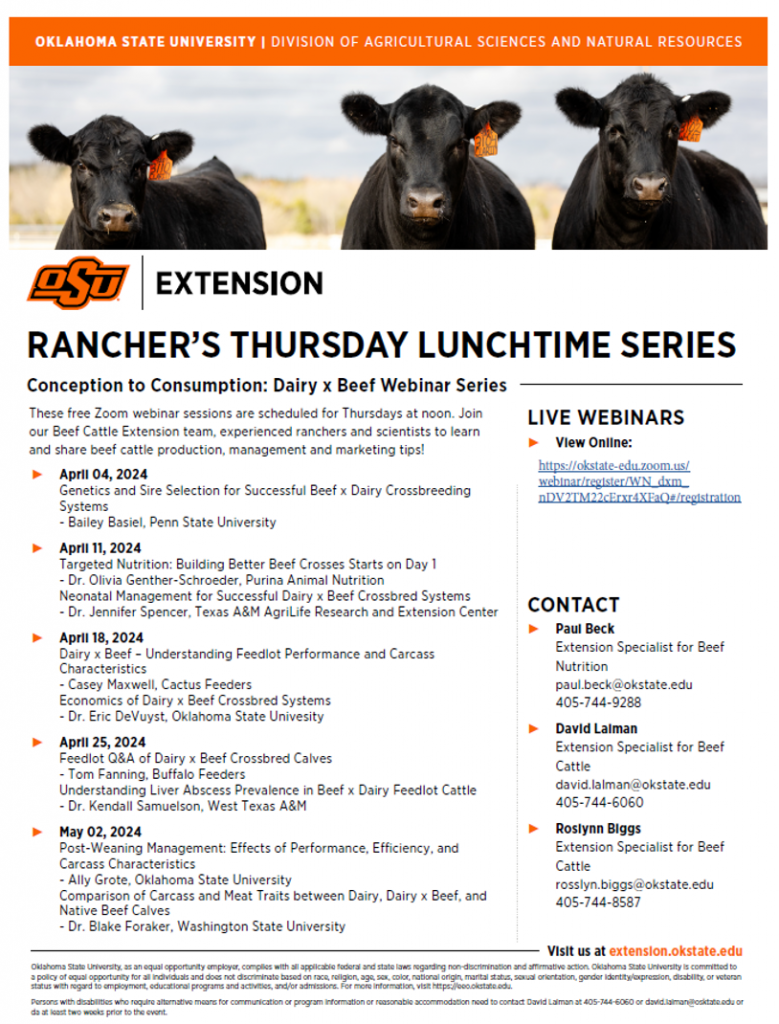

Click below for the complete closing report.

OKC West in El Reno Market Report from 04/02 and 04/03/2024
 
 
Each afternoon we are posting a recap of that day's markets as analyzed by Justin Lewis of KIS futures - click below for the latest update on the Livestock and Grain Futures Trade..
Click Here to Listen to Justin's Commentary From 4/3/2024
 
Okla Cash Grain:  
Daily Oklahoma Cash Grain Prices- as reported by the Oklahoma Dept. of Agriculture- The report available after the close of the Futures Trade for that day.
Read  Cash Grains Report from 4/3/2024
 
Our Daily Market Wrapup from the Radio Oklahoma Ag Network - analyzing the Futures Markets for that trading day- as reported by KC Sheperd.
Click to Listen to Our Weekday Wrap with KC
 
Slaughter Cattle Recap: 
The National Daily Slaughter Cattle Summary- as prepared by the USDA Market News
Read Report
 
TCFA Feedlot Recap:  
Finally, here is the Daily Volume and Price Summary from the Texas Cattle Feeders Association.
Read Report
Our Oklahoma Farm Report Team!!!!
 
Ron Hays, Senior Farm/Ranch Broadcaster and Editor
 
KC Sheperd, Farm Director and Editor

Dave Lanning, Markets and Production

Reagan Calk, Farm News and Email Editor

Pam Arterburn, Calendar and Template Manager

Podcasts From Oklahoma Farm Report and More

Two of our regular reports are also podcasts that you can subscribe to- Our daily Farm and Ranch News with KC Sheperd- available here on the Apple Podcast Platform


The second is our daily Beef Buzz with Ron Hays- available here on the Apple Podcast Platform


Periodically- we offer interviews on our Ag Perspectives Podcast series- this podcast is available here.


Ron has also has a series of podcasts from interviews with newsmakers at the Cattlemen's Congress- Click here or you can find them on your favorite Podcast platform- look for them by searching for Cattlemen's Congress Conversations.


We are making plans to jump back into regular installments of what has been called the Road to Rural Prosperity- a new name and fresh content is in the works- for now- click on the blue button below for one of our favorites that is a timeless classic.

Listen to Episode 86 with Ron Hays talking with one of the legends in the Beef Cattle Business- Bob Drake of Davis, Oklahoma
 
 
Listen to Ron
Beef Buzz
 
Blue Green Gazette
Calendar
Auctions
Market Links
Facebook  Twitter  Youtube  

Our thanks to Midwest Farms Shows, P & K Equipment, Oklahoma Farm Bureau, Oklahoma Ag Mediation Program, Great Plains Kubota, Stillwater Milling Company, National Livestock Credit Corporation, Oklahoma Beef Council, Oklahoma AgCredit, the Oklahoma Cattlemens Association, Invenergy Oklahoma and  KIS Futures for their support of our daily Farm News Update.


For your convenience, we have our sponsors' websites linked here- just click on their name to jump to their website- check their sites out and let these folks know you appreciate the support of this daily email, as their sponsorship helps us keep this arriving in your inbox on a regular basis- at NO Charge!


We also appreciate our Market Links Sponsor - OKC West Livestock! 


We invite you to check out our website at the link below too that includes an archive of these daily emails, audio reports and top farm news story links from around the globe.

Head to Our Website OklahomaFarmReport.Com
God Bless!
Reach Out To Us:
Tim West
President/General Manager
Rural Oklahoma Networks

405-317-6361

***************

Mike Henderson
Director of Sales

405-615-4922

KC Sheperd
Farm Director
Radio Oklahoma Ag Network

405-443-5717

Email KC
Ron Hays
Senior Farm/Ranch Broadcaster
Radio Oklahoma Ag Network

405.473.6144
Email Ron

NCGA Leader Warns International Trade Commission Against Placing Duties on Imports of Key Herbicide

Saying growers need reliable access to essential farming tools, the National Corn Growers Association (NCGA) President Harold Wolle warned the U.S. International Trade Commission today of the consequences for America's farmers if the agency grants a petition to levy tariffs on imported 2,4-D, an often-used herbicide that has been on the market for decades.

"The scenario under consideration has the potential to limit imports of an important product, raise its price, and create a supply shortage, all while raising the cost of production in an already tight market," Wolle said. "Farmers are price takers, not makers in selling our commodities, and closely managing our production costs is crucial to our success. Thus, tariffs on these products would create an even more difficult economic scenario for me, my family, and the farmers I represent."

Wolle's testimony comes after Corteva Inc. filed antidumping and countervailing duty petitions with the ITC on March 14 over India and China's trade practices involving the herbicide.

Herbicides are one of the most significant inputs for raising crops, and 2,4-D-based products are widely used herbicides for corn and soybeans.

NCGA, citing data showing that the bulk of imported 2,4-D comes from Asia, said the duties on these products could place a hardship on America's growers who may struggle to gain access to the herbicide or see prices for the product become virtually unaffordable.

The petition couldn't come at a worse time, Wolle noted, as the price of corn has declined by more than 40% over the last two years, and the average cost of producing corn was higher than the average selling price of corn in 2023.

Farmers are expecting that margin of loss to be even worse in 2024—even before taking this new trade case into account.

NCGA noted companies like Corteva Inc. provide valuable innovations to farmers but that it is important that growers have access to imported products as well.  

"We are thankful companies like Corteva have invested in new technologies, including seed traits and herbicides, that allow us to continue producing more effectively and efficiently every year," said Wolle. "However, farmers simply cannot rely upon a sole supplier for nearly all of our 2,4-D needs. That will undoubtedly lead to shortages and delays in an industry that must have timely delivery."

Within the next 45 days, the ITC will determine if there is a reasonable indication that the imports are injuring or threatening to injure the U.S. industry. If the ITC finds that this standard is met, the cases will move to the Department of Commerce, which will calculate the preliminary anti-dumping and countervailing duty margins.

READ THE TESTIMONY

AEM Invites Submissions for 2024 Hall of Fame

The Association of Equipment Manufacturers (AEM) is now accepting nominations for its 2024 Hall of Fame, which honors the trailblazers, inventors, and leaders whose work has left a legacy on the off-road equipment industry. Nominations are open until June 14, 2024, and can be submitted here.

"Let's face it, the world we know today would not be possible without the pioneers, inventors and innovators who created the equipment that builds, powers, and feeds us all across the globe," said AEM President Megan Tanel. "Through the AEM Hall of Fame, we recognize the important contributions of individuals who continue to make a difference and improve our quality of life."  
Nominees for the AEM Hall of Fame are judged on four key guiding principles:

  1. Innovation
  2. Industry Contributions
  3. Leadership
  4. Corporate Citizenship/Social Responsibility

Last year's inductees were Akio Takeuchi, founder of Takeuchi Manufacturing, and Susanne Cobey, CEO of Eagle Crusher.

Founder of Takeuchi Manufacturing, Takeuchi's career in the construction industry spans six decades. The Takeuchi Way embraces the spirit of creation, challenge and cooperation. When a local business partner asked Takeuchi to create a new machine that would help his employees do their jobs faster, easier and with less manual labor, he listened. The result was the world's first compact excavator. Since then, Takeuchi Manufacturing has presented more innovations, including the first offset boom excavator and the first compact track loader. 

Susanne Cobey joined Eagle Crush Company, Inc. in 1974, advancing through the ranks to eventually become President & CEO in 1990. Under Cobey's bold vision, the plant took crushing to a new level with its abilities to process high volumes of aggregate, concrete and RAP. These improvements saved innumerable tons of concrete and asphalt from landfills. A whole line of portable horizontal impactor plants soon followed, creating a boon for the aggregate crushing, the recycled concrete and the RAP markets.

The AEM Hall of Fame has been recognizing luminaries in the agriculture and construction equipment manufacturing industry since 1993, and includes such names as Benjamin Holt (Caterpillar), Joseph Cyril Bamford (JCB), Jerome Increase Case (CNH Industrial), John Deere (Deere & Co.), Gus Ramirez (HUSCO International) and Mary Andringa (Vermeer). The induction of Takeuchi and Cobey brings the total number of inductees to 69.

The AEM Hall of Fame is accepting nominations for 2024 until June 14. To submit a nomination for consideration, click here to fill out the form.

About the Association of Equipment Manufacturers (AEM)

AEM is the North America-based international trade group representing off-road equipment manufacturers and suppliers with more than 1,000 companies and more than 200 product lines in the agriculture and construction-related industry sectors worldwide. The equipment manufacturing industry in the United States supports 2.3 million jobs and contributes roughly $316 billion to the economy every year.

Staying Ahead of Cotton Disease with BASF's Kenny Melton

Listen to KC Sheperd talk with Kenny Melton about BASF solutions to cotton disease and more.

Farm Director KC Sheperd is talking with BASF's Western Region Agronomic Manager, Kenny Melton, about planting disease-resistant cotton varieties and products that can boost cotton production and mitigate disease.

Melton first discussed the main diseases cotton producers need to be aware of during the growing season, emphasizing the importance of planning and being aware of past issues in specific fields. As producers look into what varieties of cotton they will be planting this year, Melton said it is critical to consider past issues in those fields because diseases typically recur in the same fields.

For example, Melton said Verticillium wilt is a disease that stays within the field and may increase slightly year over year.

"We at FiberMax have many varieties that have very good tolerance to Verticillium wilt," Melton said. "There is not anything totally immune to Verticillium wilt out there, but we have some of the best varieties out in the market today in terms of tolerance for Verticillium wilt."
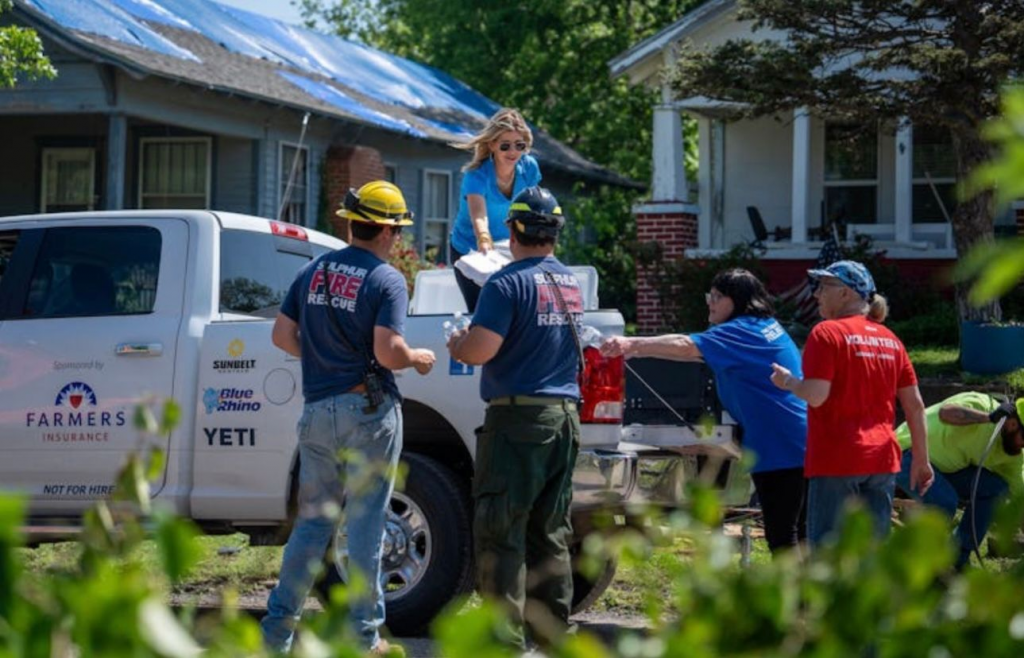
Another issue Melton discussed is bacterial blight in cotton. While bacterial blight may not be an issue every year, more humid conditions can support development.

"Actually, all of the FiberMax, say, one of our new ones, is actually resistant to bacterial blight, so we have got a good portfolio in terms of handling that disease," Melton said.

Regarding root-knot nematodes, Melton said they typically occur at the same time as Verticillium wilt. For those impacted areas, Melton said it is best to dig up the roots and not just pull them out of the ground.

Melton said BASF offers a prime seed treatment with enhanced rates of some key fungicides to offer some protection against particular diseases.

"There is just a complex of those early seedling diseases," Melton said. "When you get cool, wet weather, those things can really devastate a stand and really reduce it to where it causes you to have a replant, even."

Melton also introduced the company's transition to a new herbicide technology, Axant Flex. This technology includes genes for glyphosate, Liberty, and Dicamba tolerance and a gene for Alite 27 herbicide tolerance, although it is still awaiting EPA approval.

"We are working with the EPA to get the label for the Alite 27," Melton said. "We hope to have that by the end of this year, but it is more likely sometime in 2025."

To learn more about BASF, CLICK HERE.

Oklahoma's Digital Promise Plan Approved

The Oklahoma Broadband Office (OBO) is moving quickly on several fronts to ensure successful integration of high-speed internet service throughout the state. The National Telecommunications and Information Administration (NTIA) recently approved the state's DE Plan to fulfill Oklahoma's Digital Promise.

While other programs administered by the OBO expand broadband infrastructure, this plan focuses on ensuring Oklahomans of all walks of life have the resources and digital education needed to take full advantage of the benefits of high-speed internet.

The plan will be initially used by the OBO to apply for grant funds from NTIA, including the recently announced Capacity Grant. Awarded funds will be used to narrow the digital divide by encouraging and facilitating partnerships, offering targeted grants to communities and organizations, and by supporting communities' digital planning and programming.

Among the communities served will be aging Individuals, veterans, racial and ethnic minorities, people with disabilities, rural residents, incarcerated individuals, those with low incomes, and individuals with language barriers.

The plan can be viewed here

Parts of State See Relief in This Week's Drought Monitor, While Dry Conditions Linger in Others

To view the latest Oklahoma drought map, CLICK HERE.

According to the latest Oklahoma drought monitor report, exceptional drought remains at zero percent, unchanged from the start of the calendar year.

Extreme drought or worse remains at zero percent, unchanged from the start of the calendar year.

Severe drought or worse is now at zero percent, improved from last week's .19 percent.

Moderate drought or worse is now at 8.47 percent, improved slightly from last week's 8.83 percent.

Abnormally dry or worse conditions are now at 37.86 percent, up from last week's 33.76 percent.

According to the 6-to-10-day precipitation outlook map, the entire state is leaning above a 40 to 50 percent chance of precipitation through April 13th.

To view the United States Drought Map, click here.

According to the latest U.S. Drought Monitor, an active early springtime pattern continued through late March and into the beginning of April. A pair of low pressure systems and trailing cold fronts tracked across the east-central contiguous U.S. (CONUS). A swath of 1 to 3 inches of precipitation supported improvements extending from parts of the Midwest to southeastern Kansa and northeastern Oklahoma. However, moderate drought (D1) was introduced to the lower Ohio Valley which has missed out on precipitation during the late winter and early spring. Increasing short-term dryness and periods of enhanced winds led to expansion of abnormal dryness (D0) and moderate drought (D1) in southwestern Kansas, northwestern Oklahoma, and western Texas. March was relatively wet across Arizona where additional improvements were warranted before a drier time of year sets in later this spring. Below-normal snowpack supported an increase in D1 across the northern Cascades of Washington. 7-day (March 26 to April 1) temperatures averaged below (above)-normal across the western and north-central (eastern) CONUS. Alaska remains drought-free, while leeward sides of Hawaii had a broad 1-category degradation. Following recent improvement across much of Puerto Rico, no changes were made this past week.

In the Southern Plains, major drought relief, associated with El Nino, occurred this past winter across the lower Mississippi Valley. However, there remains a lingering long-term drought across parts of western Tennessee and northern Mississippi. On April 1, locally heavy rainfall (more than 1.5 inch) resulted in small improvements to northeastern Oklahoma. Farther to the west across the southern high Plains, short-term dryness is increasing. Enhanced winds, elevated wildfire risk, and blowing dust have been quite frequent the past few weeks due to low pressure systems forming to the lee of the Rockies. Based on 30 to 60-day SPI, an expansion of abnormal dryness (D0) and moderate drought (D1) was warranted for parts of northwestern Oklahoma and western Texas.

In the High Plains, the northern to central Great Plains along with the central Rockies remained either status quo this week or had a 1-category improvement. Locally heavy precipitation (more than 1 inch) led to targeted improvements across southeastern Kansas. Lighter precipitation (0.25 to 1 inch) supported minor improvements to South Dakota. Based on SPIs at various time scales along with snow water equivalent close to average, improvements were necessary for parts of northern Colorado and southern Wyoming. 30-day SPEI and GRACE-based soil moisture supported a large increase in abnormal dryness (D0) across southwestern Kansas along with a slight expansion of moderate drought (D1) to the west of Wichita.

In the West, multiple low pressure systems and enhanced onshore flow resulted in above-average precipitation for much of Arizona, Utah, Nevada, and California from March 26 to April 1. According to the California Department of Water Resources on April 2, snow water equivalent (SWE) averaged at or slightly above normal for the Sierra Nevada Mountains. A relatively wet March and widespread precipitation amounts of 0.5 to 1 inch, liquid equivalent, this past week supported improvements for Arizona. Given the recent precipitation, the drought impact was modified to reflect only long-term drought for most of Arizona. This region will be reevaluated next week and additional revisions may be warranted. Eastern and southern New Mexico have remained mostly dry during the past 30 days. According to USDA's National Agricultural Statistics Service, 81 percent of New Mexico topsoil moisture is rated as short to very short. Washington, northern Idaho, and western Montana have below-normal SWE heading into early April. Abnormal dryness (D0) and moderate drought (D1) was expanded across the northern Cascade Mountains of Washington due to this low snowpack.

Looking ahead, during the next five days (April 4-8, 2024), drier weather is forecast to overspread the Midwest and East behind a cold front. Another low pressure system is forecast to track inland to the West with another round of rain and high-elevation snow from California east to the north-central Rockies. Later on April 8, precipitation is expected to develop across the southern Great Plains and lower Mississippi Valley.

The Climate Prediction Center's 6-10 day outlook (valid April 9-13, 2024) depicts a pattern change by mid-April with a drying trend for the West. Below-normal precipitation is favored for this region along with the northern Great Plains. Elsewhere, across the central to southern Great Plains, Midwest, and East, above-normal precipitation is more likely. Above-normal temperatures are favored for much of the lower 48 states except for parts of New Mexico and western Texas where increased below-normal temperature probabilities are forecast.

To view the 6-10 Day Precipitation Outlook Map, click here.

To view the 6-10 Day Temperature Outlook Map, click here.

To view the Monthly Drought Outlook Map, click here.

Beef Checkoff Strategy to Boost Domestic Beef Demand Proves Effective

Listen to Ron Hays talk with Greg Hanes about building domestic beef demand.

Senior Farm and Ranch Broadcaster, Ron Hays, is talking with the CEO of the Cattlemen's Beef Promotion Board, Greg Hanes, about the domestic strategy for building demand for U.S beef. To listen to Part 1 of Ron's conversation with Greg Hanes talking about the use of Beef Checkoff dollars, CLICK HERE.

Herd liquidation over the last several years has meant tighter beef supplies ahead, which is detrimental to international beef demand. The herd liquidation has not only impacted international markets, but also domestic markets.

Hanes said the domestic marketing strategy for U.S. consumers includes finding ways to encourage them to include beef in their meal plans.

"I think now there is probably more options here for the consumers in the U.S. just with ground beef and other items we have available that are not as expensive as your traditional meal meats," Hanes said. "There has been a lot of educational work on those, like showing how to prepare all of these dishes, how to buy it, cook it, and all of that."

Building demand for beef is not a one-year job, Hanes said, as the effort is decades in the making. This long-term approach ensures the sustainability of the beef industry, and the continuous supply of the protein consumers want.

"Now, with these kind of conditions we are facing, you really see that impact and the benefits of what the Checkoff has been able to do," Hanes said. "We are at 30-year highs for beef demand, and retail prices are at record highs, but people are still paying that, and that really shows that they want to eat beef compared to all these other proteins, and that has taken years and years to ensure people are getting that protein they want- and it is beef."

Hanes also talked about how today's beef demand is proof of the Beef Checkoff's success over the years. The Beef Checkoff will be contracting a Return-on-Investment study, Hanes said, and the results will be released at the next National Cattlemen's Beef Association summer business meeting in San Diego, California.

"Thirty-year highs on demand are pretty impressive," Hanes said.

The Beef Buzz is a regular feature heard on radio stations around the region on the Radio Oklahoma Ag Network and is a regular audio feature found on this website as well. Click on the LISTEN BAR for today's show and check out our archives for older Beef Buzz shows covering the gamut of the beef cattle industry today.

Register for the Upcoming Rancher's Thursday Webinar Series Focusing on Management of Beef on Dairy Crossbreds in Beef Production

A new Rancher's Thursday Lunchtime Webinar Series will run every Thursday at noon from April 4th to May 2nd. This Webinar will cover the management of Dairy Beef crossbreds in the beef production system. There will be presentations on research dealing with the effects of sire selection and early life management on finishing performance as well as management and performance of dairy-beef crosses in commercial feeding operations. Experts from across the nation will cover recent research and real-world experiences in managing and marketing these unique animal resources.

Register for this online webinar series at https://okstate-edu.zoom.us/webinar/register/WN_dxm_nDV2TM22cErxr4XFaQ#/registration.

Volunteers Fill an Important Role in OSU Extension

Volunteers play a vital role within Oklahoma State University Extension. Randy Freeland has been a Payne County Master Gardener for 17 years and volunteers his time for a variety of projects that make his community a better place to live. (Photo by Mitchell Alcala, OSU Agriculture)

April is National Volunteer Month and there's no better time to shine a spotlight on the thousands of volunteers who bring life to programs offered through Oklahoma State University Extension. 

For 110 years, OSU Extension has been working to make the lives of Oklahomans better. With experts providing research-based information, more than 5,000 volunteers statewide help disseminate that information through a variety of methods, including 4-H clubs, Master Gardeners and Oklahoma Home and Community Education activities such as demonstration gardens, camps, workshops, school enrichment programs and more. OSU Extension also benefits from the thousands of people who volunteer at fairs, contests and other activities.

In 2023, adult and youth volunteers spent 232,000 hours enhancing the quality of life in Oklahoma. Through these efforts, OSU Extension is providing education for everyone everywhere.

Volunteers are valuable partners in the OSU Extension mission and devote their time annually to programming, teaching, and facilitating events and activities. No matter what is happening in OSU Extension, a volunteer has some role in ensuring success.

"I am very grateful for the volunteers who expand the capacity and impact of Extension programs," said Damona Doye, associate vice president of OSU Extension. "With limited funding and personnel, they are absolutely essential to Extension's efforts to improve our communities, our state and our world."

Oklahoma 4-H Youth Development

The Oklahoma 4-H Youth Development program is the youth segment of OSU Extension. With an office in all 77 counties and offering more than 60 project areas, 1,176 adult volunteers and 500 youth volunteers play a key role in helping 4-H'ers develop life skills through hands-on learning opportunities.

Karla Knoepfli, OSU Extension associate specialist in the state 4-H office, said volunteers are the backbone of the 4-H Youth Development program.

"Our volunteers help us foster healthy youth-adult partnerships and positive youth development," Knoepfli said. "4-H values service to others and our volunteers play a key role in modeling that behavior for our 4-H members. Through their willingness to share their time and talents, they continue to make the best better."

An educator by trade and at heart, Alicia Brents saw the 4-H program as a way to further her students' education. Not only did she teach in the classroom, but she also volunteered in 1972 to become the Swink Public Schools 4-H volunteer leader. Fifty-two years later, she continues to serve Choctaw County youth as the leader of the Fort Towson 4-H Club.

"Being a teacher and a 4-H volunteer leader go hand in hand, and back then I was looking for ways to further my students' education by getting them involved in different 4-H projects," Brents said. "4-H has so much to offer, and it all relates to classroom learning in some fashion."

Brents said her students weren't the only ones learning along the way. When she volunteered to be the land-judging coach, she took time to expand her knowledge.

"I studied and learned along with my students and club members," she said. "These experiences enhanced their school education and improved their public speaking skills. I enjoy getting a student who is timid and seeing them excel at these contests."

Brents, who was named the 2023 4-H Lifetime Volunteer of the Year, said she believes in the power of volunteerism and feels fortunate to work alongside other dedicated volunteers who give positive opportunities to youth.

Oklahoma Home and Community Education

From its inception in 1935, members of Home Demonstration clubs, now known as Oklahoma Home and Community Education, have worked hard to improve the lives of state residents. Steeped in traditional lessons of food preservation, family relations, and safe and healthy meal preparation, group members continue to embrace these time-honored values while meeting the needs of community members in modern times.

Suzette Barta, community engagement coordinator for OSU's College of Education and Human Sciences – Extension, Engagement and Continuing Education, said nearly 2,700 women and men comprise 244 Oklahoma Home and Community Education groups in 73 counties across Oklahoma.

"Our group members are doing great work all across the state and making a positive impact in their communities," Barta said. "They work with OSU Extension to identify issues in their communities and find solutions."

Kathie Tanner has been a member of the Lunch Bunch Oklahoma Home and Community Education group in Payne County for four years, after retiring from a 26-year career at OSU.

"Sometimes people think of us as a group that just does cooking and sewing activities, but we do all kinds of things that benefit the community," Tanner said. "We've organized coat drives for the schools. The Lunch Bunch volunteers for the Perkins for Kids Christmas Shop, and we also donate items the kids can shop for so they will have gifts for their family members. And, OHCE members are famous for the pies we make during the Payne County Fair."

One of her favorite activities, one in which all six Payne County Oklahoma Home and Community Education groups participated, was making bibs and lap blankets for nursing home residents in Payne and Pawnee counties. Some group members continue to keep nursing homes supplied with the homemade items.

"The OHCE members across the state are a great bunch of people who all work hard to help make their communities better," Tanner said. "I love being a part of this organization."

Master Gardeners

Gardening has long been a popular activity, with interest continuing to grow every year. While OSU Extension has several horticulture experts across the state who provide research-based information to gardening enthusiasts, the Oklahoma Master Gardeners serve as an additional pipeline to extend that knowledge to the public.

David Hillock, OSU Extension consumer horticulturist and statewide Extension Master Gardener Volunteer program coordinator, said there are nearly 1,250 volunteers in 23 counties.

"Master Gardeners are an active group and immerse themselves within their communities in various ways," Hillock said. "They teach workshops, plant demonstration gardens, set up booths at home and garden shows, participate in farmers markets and are involved in elementary school programs. Master Gardeners are a valuable resource to OSU Extension and the state."
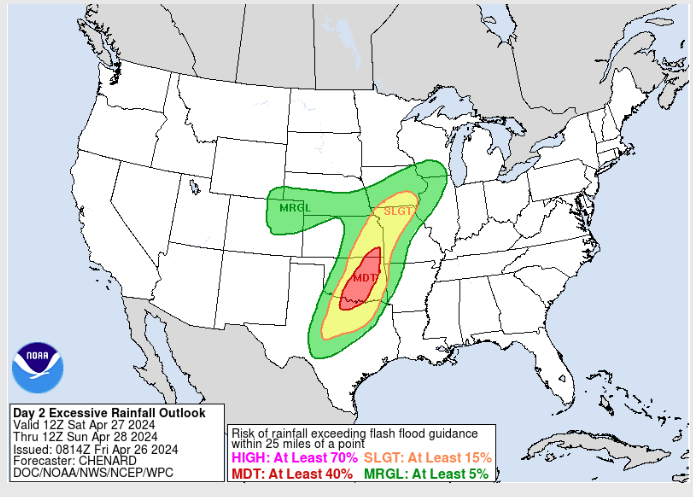
Randy Freeland has been a Master Gardener in Payne County for 17 years. He has always had an interest in gardening, but after retiring in 2007 from the Natural Resources Conservation Service, he returned to Stillwater and joined the Master Gardener program.

"My house is in 100% shade, and I didn't know a lot about gardening in the shade," Freeland said. "I was going into the Extension office and reading fact sheets to learn more. I always enjoyed growing vegetables, but now it's more shade plants, shrubs and flowers."
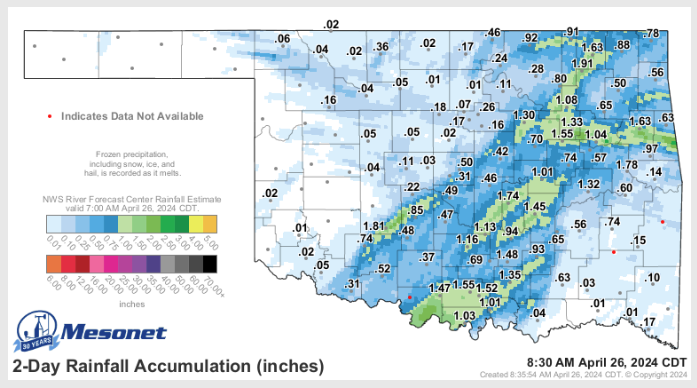
Being involved with the Master Gardeners keeps Freeland busy. He said they participate in the United Way Day of Caring, serve in various ways at the Payne County Fair and regularly present educational workshops at The Botanic Garden at OSU.

"My favorite thing about being a Master Gardener is the one-on-one interaction I get during on-site visits working with gardeners. I can step in and help out Laura Payne, the Payne County Extension horticulture educator, when she's out of town and the office is getting questions from the public," he said. "The Master Gardeners are truly an outreach and extension of the county Extension office."
Hillock said in addition to the 87,174 volunteer hours documented in 2023, Master Gardeners across the state have produced and donated 22,850 pounds of fresh fruits and vegetables to local food pantries, shelters and other organizations to help put food on the tables of Oklahoma families dealing with food insecurity.

Whether it be through 4-H, Oklahoma Home and Community Education or Master Gardeners, part of OSU Extension's success is directly tied to the generosity and willingness of its volunteers.

OSU Extension uses research-based information to help all Oklahomans solve local issues and concerns, promote leadership and manage resources wisely throughout the state's 77 counties. Most information is available at little to no cost.

By Trisha Gedon

Drummond, multistate coalition find success opposing Biden attack on oil, gas industry

In one of Attorney General Gentner Drummond's many efforts to push back against the Biden Administration's ceaseless attacks on the oil and gas industry, a federal judge on Monday blocked a highway emissions rule that sought to drive gas-powered cars off the road. Drummond and 20 other state attorneys general had joined Kentucky in challenging a Federal Highway Administration (FHWA) rule that sought to force the reduction of CO2 emissions on roadways.

If the FHWA rule had not been struck down, it would have required states to set targets to reduce greenhouse gas emissions from on-road sources. Multiple states noted the FHWA rule would spur the elimination of future economic development and job creation projects. 

"Oklahomans cannot afford the high cost of the Biden Administration's war against the oil and gas industry," said Drummond. "I am thankful for our recent victory against the Biden Administration, and I look forward to continuing my fight against federal overreach."

Drummond joined Kentucky Attorney General Russell Coleman in the FHWA suit alongside attorneys general from Alabama, Alaska, Arkansas, Florida, Idaho, Indiana, Iowa, Kansas, Mississippi, Montana, Nebraska, North Dakota, Ohio, South Carolina, South Dakota, Utah, Virginia, West Virginia and Wyoming. 

The FHWA dustup is the latest front in Drummond's ongoing work guarding against federal overreach that threatens an industry responsible for hundreds of thousands of Oklahoma jobs.

Last month, the Attorney General and a coalition of 15 other state attorneys general filed suit against President Biden and the U.S. Department of Energy (DOE) over their unlawful decision to ban new liquefied natural gas (LNG) exports. The suit was filed March 21 in U.S. District Court for the Western District of Louisiana. 

In January, Biden and the DOE halted all new approvals of LNG exports to non-Free-Trade Agreement countries, effective immediately. That decision ignores clear text of the Natural Gas Act and departs from decades of agency policy. Just six months ago, the DOE had even acknowledged that "there is no factual or legal basis" for halting approval of LNG exports.

Biden's decision causes serious harm to plaintiff states and local communities that count on LNG-related investments and the energy sector itself. The ban would also disrupt the development and production of natural gas.

In July 2023 Drummond joined 24 attorneys general challenging the Environmental Protection Agency's (EPA) radical regulation on tailpipe emissions. In its efforts to boost EV sales, the Biden Administration was attempting to phase out gas-powered vehicles, a move that would adversely affect all Oklahomans. 

The following month, Drummond joined a coalition of 21 states opposing the EPA's rule on existing coal-, natural gas- and oil-fired power plants. This rule would impose overbearing and unnecessarily strict emission standards. 

Read the order from the U.S. District Court for the Western District of Kentucky here.

CAB Insider: Carcass Weights Buoy Production

Last week's federally inspected cattle slaughter was 12,000 head lower than the prior week at 586,000 head. The Good Friday holiday curtailed that day's production total by about 10,000 head, as compared to the prior two Fridays that averaged 87,000 head per day.

Highly Pathogenic Avian Influenza (HPAI), discovered in dairy cattle in Texas on March 25,has since been the bane of the beef market complex. Other sources, including the Centers for Disease Control and Prevention, have posted extensive information on the topic for comprehensive reference.

Despite the fact that there is no known threat of infection through the food supply, Live and Feeder Cattle futures contracts plummeted last Tuesday with a $3/cwt. dip in the April 2024 Live Cattle contract. On Monday of this week, news about a Texas dairy worker diagnosed with the virus sent the contract down another $5/cwt. upon the day's close.
Fed cattle market fundamentals held the spot cash cattle trade a bit higher in last week's average steer price of $187.39/cwt. This was a firm setback from the prior week's $189.26/cwt. price point but a small victory considering that cash didn't follow futures further lower. From a cattle feeder's perspective, it's extremely frustrating to watch futures sentiment, led by emotion rather than logic, disrupt a market previously building into a needed spring rally.

Boxed beef cutout values traded unevenly lower last week with the Choice/Select spread average for the week widening to $14.40/cwt. in Urner Barry's numbers. The CAB/Choice price spread narrowed from the leap it had made the prior week at $17.48/cwt. to last week's more expected average of $14.08/cwt.

The quoted prices and spreads from a week ago are already stale as boxed beef values continue their pullback this Monday and Tuesday. Cutout values are in the range of $0.25/lb. or 9% higher than a year ago. Wholesale beef buyers are thus taking a cautionary attitude as spring grilling demand is not yet in gear. Rib demand has stalled following Easter, but strip loin values are cruising higher with latest wholesale values at $10.05/lb.
Carcass Weights Buoy Production
Fed cattle carcass weight trends have given us plenty of fodder for discussion in the past four months. Late December marked the record-heaviest steer carcass weights at 942 lb. each. This was an uncharacteristically late seasonal high driven by excellent weather conditions in major cattle feeding areas, badly deteriorated spot cattle prices and reduced slaughter. The December high, 22 lb. heavier than a year prior, quickly collapsed by 33 lb. to late January's 909 lb. low after severe storms stalled feedlot performance for the month.

Another rapid turnaround toward warmer weather and improving pen conditions (on average) shot feedlot performance and carcass weights well above the seasonal expectation through mid-March with a 13 lb. increase in 6 weeks. That's impressive given that "improving pen conditions" were far short of "good" pen conditions particularly in the northern feeding region. Latest steer weights are 23 lb. heavier than a year ago at 922 lb. each, record-high for the first two weeks in March.
A recovery in weights and performance was expected as weather conditions improved following January. Yet the magnitude of the weight rally is larger than anticipated, not only posting a recovery but creating an unseasonal sharp higher trend line in a period when weights historically trend lighter each week into May or June.Beef supply ramifications from the current carcass weight anomaly are not insignificant. With a 466,000-head weekly average of fed cattle slaughter for the past month and the combined steer/heifer weight increase of 24 lb. per head, there is additional weekly production equivalent to 12,538 head of carcasses.
The Choice/Select price spread has narrowed this week with Tuesday's USDA report showing a $5.21/cwt. spread and Urner Barry reporting an $11.24/cwt. value. Although the two are notably different, each represents an abrupt pullback from a week ago. This is not abnormal for this early spring period when the fed cattle carcass mix tends to be its richest with Choice and Prime carcasses, currently combined for 85% of the carcass share. CAB carcass certification rates tend to top out similarly and the mid-March high of 42.2% of brand-eligible carcasses is three-tenths of a point below the March 2021 record-high.The strong seasonal grade trend combined with exeptionally heavy carcass weights is underpinning total carcass tonnage in the premium grades and brands. This is not erasing the shortfall in weekly slaughter head counts which are down 10% compared to a year ago in the past four weeks. Estimated Choice carcass tonnage is down in recent weeks by an estimated 4% in the same comparison. CAB carcasses are 6% fewer in total head count for the last month but heavier carcasses pull the deficit down to just a 3.7% lower in carcass tonnage.

Taranis and Steward Link Team to Deliver Conservation Opportunity to Farmers

Taranis and Mississippi-based Steward Link have teamed to provide farmers with simplified application and practice validation opportunities for USDA conservation funding programs.

Taranis, the global leader in AI-powered crop intelligence, is at the forefront of agricultural innovation, creating engagement and transparency within the agricultural production value chain. To better serve ag retailers and farmers, the Taranis-Steward Link partnership helps present a complete and comprehensive picture of what's happening on a designated acreage, creating a higher quality and more complete program application.

Steward Link founder, Nick Thomas, shares his excitement for the partnership and notes the results the high-quality applications are yielding farmers.

"I couldn't be happier with our relationship with Taranis," Thomas says. "With 2024 being the first year, what we are seeing is a high-level of technology and practice adoption amongst Taranis customers. Technology and documentation position them well for many conservation opportunities. The technology has also helped us to open the door for new programs, and the applications we have been able to complete for Taranis customers have been extremely high-quality."

Launched in 2015, Steward Link is a nationwide initiative founded by Nick Thomas, a former USDA Natural Resources Conservation Services employee who witnessed the opportunities farmers were missing to apply for private, federal, and state-level conservation funding because of timing and cumbersome paperwork processes. The company works to understand what a farmer is currently doing within their operation and then matches those practices to the federal, state, and private funding opportunities that exist.

"Farmers often don't know about all of the programs available," Thomas says. "We make it our job to know about every program and then to streamline the application process by taking on the practice alignment and paperwork burden. Steward Link's mission is to find and secure the best opportunities available for farming, ranching, and forestry operations."

Opher Flohr, Taranis CEO, explains that partnerships that advance the financial and stewardship positions of the farmer are a win for the entire value chain and an outcome Taranis, as a company, seeks to advance.

"Taranis is redefining how crop input and management decisions are made on the farm. Our service aligns perfectly with USDA's mission to promote conservation, while maximizing profitability for growers, and therefore we have an edge on obtaining funding from USDA programs for our growers," Flohr explains. "I believe this is just the start—as USDA continues to add funding for precise application practices that are unlocked by technologies like Taranis, we will be vigilant to make sure our growers are first in line to receive those funds." 

To learn more about Taranis and Steward Link and begin a conversation on how your farming operation may align with current opportunities, visit taranis.com/conservation.

USDA Makes $1.5 Billion Available to Help Farmers Advance Conservation and Climate-Smart Agriculture as Part of President Biden's Investing in America Agenda

Agriculture Secretary Tom Vilsack today announced the availability of an historic $1.5 billion in fiscal year 2024 to invest in partner-driven conservation and climate solutions through the Regional Conservation Partnership Program (RCPP) as part of President Biden's Investing in America agenda. The U.S. Department of Agriculture (USDA) is accepting project proposals now through July 2, 2024, that will help farmers, ranchers, and forest landowners adopt and expand conservation strategies to enhance natural resources while tackling the climate crisis. These projects in turn can save farmers money, create new revenue streams, and increase productivity.

The investments in climate-smart agriculture that USDA has made since the beginning of the Biden-Harris Administration, and will continue to make through the Inflation Reduction Act and Partnerships for Climate-Smart Commodities, are estimated to support over 180,000 farms and over 225 million acres in the next 5 years.

Today's investment is made available through the Farm Bill and the Inflation Reduction Act, the largest climate investment in history, which has enabled USDA's Natural Resources Conservation Service (NRCS) to boost funding for RCPP. Additionally, NRCS is announcing progress on its effort to streamline and simplify RCPP and improve processes and implementation.

"We had unprecedented demand for the Regional Conservation Partnership Program last year, showing the robust interest in conservation from farmers and ranchers," Secretary Vilsack said. "Through the increase in funding from President Biden's Inflation Reduction Act, we're able to invest even more this year in this important program, increasing our impact across the landscape. We're looking forward to seeing what the more streamlined and customer-oriented Regional Conservation Partnership Program can do to get more conservation on the ground in the coming months and years."

There are two separate funding opportunities being announced today: RCPP Classic and RCPP Alternative Funding Arrangements (AFA). RCPP Classic projects are implemented using NRCS contracts and easements with producers, landowners and communities in collaboration with project partners. Through RCPP AFA, the lead partner works directly with agricultural producers to support the development of innovative conservation approaches that would not otherwise be available under RCPP Classic. NRCS will set aside $100 million for Tribal-led projects to be used between both funding opportunities.

The 2024 RCPP funding priorities are climate-smart agriculture, urban agriculture, conservation, and environmental justice. This funding advances President Biden's Justice40 Initiative, which aims to ensure that 40 percent of the overall benefits of certain climate, clean energy, and other federal investments flow to disadvantaged communities marginalized by underinvestment and overburdened by pollution. Today's action also advances President Biden's America the Beautiful initiative, a 10-year, locally led and nationally scaled conservation initiative that includes the voluntary efforts of farmers, ranchers and private landowners.

NRCS encourages proposals led by historically underserved entities or Indian tribes.

Project proposals for RCPP are being accepted through the RCPP portal. Details on the RCPP Classic and RCPP AFA funding opportunities are available on Grants.gov.

NRCS will be hosting four webinars to provide additional information. Learn how to participate at the RCPP website.

More about RCPP

RCPP is a partner-driven approach to conservation that funds solutions to natural resource challenges on agricultural land. By leveraging collective resources and collaborating on common goals, RCPP demonstrates the power of public-private partnerships in delivering results for agriculture and conservation.

In November 2023, NRCS announced more than $1 billion for 81 RCPP projects across the country. View the interactive map of awarded projects here.

Since the beginning of the Biden-Harris Administration, NRCS has invested a total of $1.8 billion in 256 RCPP projects covering 49 states and territories.

More about the RCPP Improvement Effort

Through a concerted effort in 2023 using feedback and expertise from partners, employees, leadership and stakeholders, NRCS identified several improvements to RCPP that the agency has implemented and will continue to implement in the months and years ahead. In fiscal year 2024, NRCS is:

  • Streamlining RCPP agreement negotiation to allow simultaneous execution of program partnership and supplemental agreements;
  • Updating policy and business tools to streamline the development of RCPP agreement deliverables and reducing the need for nationally approved waivers;
  • Conducting annual comprehensive training for state program managers and support staff; and
  • Delegating additional authority to State Conservationists to support locally led projects.

NRCS will continue to invest in creating a new business tool to support greater automation of RCPP agreement development, obligating funding to partners, and quicker processing of payments.

NRCS is working on model easement deeds to streamline implementation of RCPP easements that use common deed terms for specific land uses.

This year, NRCS aims to reduce negotiation time from 15 months to 6 months, with the goal to reduce the time even further in future years.

For the full list of RCPP improvements NRCS has identified, please visit our website.

In addition to improving RCPP, NRCS is also working to make improvements to its Agricultural Conservation Easement Program and Conservation Stewardship Program to make them function better for producers, partners and staff.

More about the Inflation Reduction Act

These two RCPP funding opportunities include Farm Bill and Inflation Reduction Act funds.

In total, the Inflation Reduction Act provides $19.5 billion over five years to support USDA's oversubscribed conservation programs, including $4.95 billion for RCPP over five years. The Inflation Reduction Act, part of President Biden's Investing in America agenda, represents the single largest investment in climate and clean energy solutions in American history. Learn more about NRCS' Inflation Reduction Act investments in fiscal year 2023.

USDA touches the lives of all Americans each day in so many positive ways. In the Biden-Harris administration, USDA is transforming America's food system with a greater focus on more resilient local and regional food production, fairer markets for all producers, ensuring access to safe, healthy and nutritious food in all communities, building new markets and streams of income for farmers and producers using climate smart food and forestry practices, making historic investments in infrastructure and clean energy capabilities in rural America, and committing to equity across the Department by removing systemic barriers and building a workforce more representative of America. To learn more, visit www.usda.gov.

Daily Email for April 3, 2024


Oklahoma's Latest Farm

And Ranch News

Wednesday, April 3, 2024

 
Howdy Neighbors!

Here is Your Daily Oklahoma Farm and Ranch News Update: 


  • OKC Farm Show Set to Open for 20th Year on Thursday


  • USDA NASS Releases More 2022 Census of Agriculture Products


  • Donnell Brown Sees Opportunity to Improve Cattle Health and Wellbeing Through Gene Editing


  • Cattlemen's Conference – Blueprint For The Future: Part Two


  • Add Idaho to the List of Dairy Farms Hit by Bird Flu- 12 Herds in 5 States Involved


  • Corteva Agriscience Introduces Tolvera™ Herbicide With New Active Ingredient for the Cereals Market


  • 2024 Alltech Agri-Food Outlook shares global feed production survey data and influential trends in agriculture


  • OSU Wheat Varieties are the Most Planted in Oklahoma
 

OKC Farm Show Set to Open for 20th Year on Thursday April 4th

Opening day for the 20th Annual Oklahoma City Farm Show is Thursday April fourth- and the Show is set to feature the latest agricultural machinery, equipment, technology, and services from hundreds of exhibitors representing more than 1000 products and services. Indoor exhibits will fill the Bennett Event Center, along with outdoor exhibits located directly in front of the event center.


Ahead of the start of the show- I caught up with Penny Swank as exhibitors were busy moving in on Tuesday. Swank says that she is excited that 74 new companies will have exhibits at the 2024 show. You can listen to our conversation by clicking the blue button below.


OSU Extension seminars will be featured on Thursday and Friday at 11:00am and 1:30pm. OSU Area Agronomist, Mike Trammell, will present "How to Save Money by Calibrating Your Sprayer" at 11:00am Thursday 1:30pm Friday. On Thursday at 1:30, OSU Small and Beginning Farms Specialist, Josh Campbell, will present "Producing Eggs for Your Family and Others." And on 11:00am Friday, OSU Farm Management Specialist and Bee Group Advisor, Courtney Bir will present "Raising Honey Bees."


The Oklahoma City Farm Show runs April 4, 5 & 6 at the Bennett Event Center, located on the OKC Fairgrounds Complex in Oklahoma City. Show hours are 9AM-5PM on Thursday and Friday, and 9AM to 4PM Saturday. 

Read More and listen to Ron and Penny Swank talk about the 2024 OKC Farm Show 

Sponsor Spotlight


As the premier John Deere dealer across Oklahoma & Arkansas, P&K Equipment is proud to serve our 20 communities and the surrounding areas. From residential, small ag & hay, large ag, & compact construction equipment- the P&K team makes it easy to buy & own your John Deere equipment. You'll find transparent pricing & easy financing options on the website & in stores. You'll have technology, sales, parts, and service support long after the sale. So when you're ready to experience the ease of operating John Deere equipment- you can trust the experts at P&K Equipment.


USDA NASS Releases More 2022 Census of Agriculture Products

On March 27th, the United States Department of Agriculture (USDA) National Agricultural Statistics Service (NASS) released the 2022 Census of Agriculture State and County profiles and the State Market Value of Agriculture Products rankings.


"The State and County profiles and State Market Values rankings give a very viewable look into the 2022 Census of Agriculture at the State and County level," said NASS Oklahoma State Statistician Troy Marshall. "The county profiles are very useful to data users trying to understand the importance of agriculture to a local county area."

Click here to see your 2022 State and County Profile.


These updated profiles and rankings will be the from the 2022 Census of Agriculture and can be used to compare back to older iterations of the same release to show agricultural trends at a more local level.


Click here to read more about USDA NASS releasing 2022 census information.

Donnell Brown Sees Opportunity for Improving Cattle Health and Wellbeing Through Gene Editing

In part two of our Beef Buzz series with Texas rancher Donnell Brown- we talk gene editing. Click here for Part One which focused on EPDs.


"The gene editing front is exciting, we have got new things coming along on those fronts, and we are able to edit multiple traits," Brown said. "We have changed a couple of bulls from Black Angus to Red Angus, building an identical clone that was a Black Angus and now a Red Angus, so we are excited about those things."


Brown said he believes the most exciting part of gene editing is the ability to improve the health and wellness of cattle.


"What a huge advantage that can be to the industry, especially as consumers are saying, 'Hey, I want to make sure that if I can get cattle without antibiotics, that I feel better,'" Brown said. "Even though we are judicious users of safe and healthy use of antibiotics just like we are with our families, we are with our livestock."


If gene editing can help increase productivity, longevity and overall health of cattle, Brown said the value is something that cannot be overlooked. On the gene editing front, Brown said research is being conducted on diseases such as Bovine Viral Diarrhea (BVD), and Bovine Respiratory Disease (BRD).

Click here to read more and listen to Donnell Brown talk about gene editing in the beef industry.
Sign Up for Our Daily Email- Free Because of Our Sponsors!

Support Our Sponsors!


KIS logo


Advertise With Us!
 

For our farmers who have either- always have had cotton on their farms- or those who have more recently have added the fiber crop to their operations- we have a daily report heard on several of our Radio Stations- It's Called Cotton Talk!

Click on the Button below to listen to our most recent report
Click here for our Latest Cotton Talk- Hosted by KC Sheperd


The latest news from the Oklahoma State Capitol is available daily on the Radio Oklahoma News Network.


Click on the blue button to hear News Director Ken Johnson's report.

Click here for the latest report from the State Capitol on RON


Cattlemen's Conference – Blueprint For The Future – Part 2

Mark Johnson, Oklahoma State University Extension Beef Cattle Breeding Specialist, offers herd health advice as part of the weekly series known as the "Cow Calf Corner," published electronically by Dr. Peel, Mark Johnson, and Paul Beck. Today, Johnson talks about Cattlemen's Conference coming up in May.


Oklahoma State University will host the Cattlemen's Conference – Blueprint For The Future – Part 2 at the Totusek Arena on May 22-23, 2024. Staying informed about topics like gene editing, land stewardship and the impact that your selection and mating decisions have on profit potential, enteric methane emissions and the carbon footprint of beef production is essential.


The cost of attendance is $200 which includes all meals. OSU Extension personnel will receive a discounted registration rate of $100 by entering the coupon code: EDUCATOR

Register for the conference at the link below:

 Cattlemen's Conference » Cattlemen's Congress (cattlemenscongress.com)

Click here to read more about the 2024 Cattleman's Conference.

We invite you to listen to us on great radio stations across the region on the Radio Oklahoma Ag Network weekdays-

if you missed this morning's Farm News - or you are in an area where you can't hear it- click below for this morning's Farm news from Ron Hays and KC Sheperd on RON.
Listen to our Wednesday morning farm and ranch news with KC Sheperd
 
 
Subscribe To the Daily Email


Sponsor Spotlight


Dating back to 1891, Stillwater Milling Company has been supplying ranchers with the highest quality feeds made from the highest quality ingredients. Their full line of A & M Feeds can be delivered direct to your farm, found at their Agri-Center stores in Stillwater, Davis, Claremore and Perry or at more than 125 dealers in Oklahoma, Arkansas, Kansas and Texas. 


We appreciate Stillwater Milling Company's long time support of the Radio Oklahoma Ag Network and we encourage you to click here to learn more about their products and services.


HPAI Confirmed in Idaho Dairy Herd- Making 12 Herds in Five States Positive with the Disease

The U.S. Department of Agriculture (USDA) Animal and Plant Health Inspection Service (APHIS) has confirmed the detection of highly pathogenic avian influenza (HPAI) in a dairy herd in Idaho. APHIS shared on Friday, March 29 that its National Veterinary Services Laboratories (NVSL) in Ames, Iowa, was working to confirm presumptive positive test results from an Idaho herd; this announcement is a follow up to that information. 


This marks the first known case of HPAI in cattle in Idaho. To date, USDA has confirmed the detection of HPAI in dairy herds in Texas (7) Kansas (2), Michigan (1), and New Mexico (1). With Idaho- dairy cows in 12 herds have tested positive for HPAI.


The NVSL is currently performing confirmatory tests on presumptive positive results from Kansas, New Mexico, Ohio and Texas. 


On Monday April 1, CDC reported that a dairy worker in Texas has tested positive for HPAI A(H5N1) virus- this case was apparently the spark that caused the sharp selloff in Live Cattle and Feeder Cattle Futures in the final minutes of the day's trade. The market partially recovered on Tuesday.

Read the latest HPAI Statement from APHIS as of Tuesday afternoon

Corteva Agriscience Introduces Tolvera™ Herbicide With New Active Ingredient for the Cereals Market

The U.S. Environmental Protection Agency has registered Tolvera™ herbicide for effective broadleaf and grass weed control in spring and winter wheat, durum and barley. The product features two modes of action – tolpyralate, an active ingredient new to the cereals market, and bromoxynil – to help combat the spread of resistant weeds while providing flexibility in application and crop rotation. Tolvera herbicide will be available for the 2025 season. 


A proven weed control tool for corn growers, tolpyralate is an HPPD inhibitor (Group 27) with less known resistance than some other herbicide groups. Tolvera herbicide provides farmers with tank-mix flexibility for ease of use, along with excellent control of many challenging weeds, including all common herbicide-resistant biotypes of kochia, Russian thistle, waterhemp, green and yellow foxtail, and barnyardgrass.


"Tolvera herbicide offers growers a new, effective tool to manage hard-to-control weeds and expands their choices for crop rotation options the following season," said Drew Clark, Corteva Agriscience Cereal Herbicide Product Manager. "We're excited to deliver a new active ingredient to the cereals market, expanding farmers' access to effective crop management tools."


To learn more, visit Corteva.us/Tolvera or contact your local Corteva territory manager.

Click here to read more about Corteva Agriscience new Tolvera herbicide.

2024 Alltech Agri-Food Outlook shares global feed production survey data and influential trends in agriculture

Global animal feed production remained steady in 2023 at 1.29 billion metric tons (BMT), a slight decrease of 2.6 million metric tons (MMT) — or 0.2% — from 2022's estimates, according to the 2024 Agri-Food Outlook, released today by Alltech. The annual survey, now in its 13th year, includes data from 142 countries and more than 27,000 feed mills.


The overall lower demand for feed was due, in part, to the more efficient use of feed made possible by intensive production systems that focus on using animal nutrition, farm management and other technologies to lower feed intake while producing the same amount of protein, or more. A slowdown in the overall production of animal protein, in response to tight margins experienced by many feed and animal protein companies, also contributed to lower feed demand. Changing consumption patterns caused by inflation and dietary trends, higher production costs and geopolitical tensions also influenced feed production in 2023.

Click here to read more about 2024 Alltech Agri-Food outlook sharing global production survey data.

OSU Wheat Varieties are the Most Planted in Oklahoma

The top seven wheat varieties planted in Oklahoma in 2024 were developed at Oklahoma State University, according to the USDA-National Agricultural Statistics Service's annual report. This is the 10th consecutive year that OSU varieties have ranked in the top seven varieties planted statewide.


"The adoption of OSU wheat varieties across the state highlights the value that the OSU Wheat Improvement Team brings to the industry," said Wade Thomason, head of the OSU Department of Plant and Soil Sciences. "Dr. Brett Carver's pursuit of excellence generates varieties that provide the highest level of performance while thriving in Oklahoma's challenging environment. As a public breeding program, OSU can focus on the needs of the Oklahoma wheat grower and deliver varieties that provide the most value now and into the future."


"As producers find more efficient ways to manage operations, they look at varieties that have good yield characteristics and strong disease resistance. The OSU wheat research team also places strong emphasis on these attributes," said Mike Schulte, executive director of the Oklahoma Wheat Commission. "These key components and main-stay attributes continue to be important when giving producers choices for making variety selection decisions."

Click here to read more about OSU wheat varieties in Oklahoma.
Let's Check The Markets!
OKC West is our Market Links Sponsor- they sell cattle three days a week- Cows on Mondays, Stockers on Tuesday and Feeders on Wednesday- Call 405-262-8800 to learn more.
 
Today's First Look:
Ron on RON Markets as heard on K101  
mornings with cash and futures reviewed- includes where the Cash Cattle market stands, the latest Feeder Cattle Markets Etc.
Hear Today's First Look
 

Wholesale Boxed Beef Prices were lower- Choice Beef was down $1.58 cents and Select Beef was down $2.80 on Tuesday April 3, 2024.


Click on the Button below for the latest report from USDA Market News

Boxed Beef Report
 

OKC West in El Reno had 1,200 calves on Tuesday, April 2nd.


Compared to last week: Steer and heifer calves were to lightly tested for a trend, however a lower undertone was noted. Demand moderate. Heavy rainfall fell across much of the trade area over night hampering livestock movement. 


For the yearling sale- Wednesday 04/03/24

Expecting 3,500

1,500 Feeder Heifers

2,000 Feeder Steers


Click below for the complete closing report.

OKC West in El Reno Calf Market Report from 4/2/2024
 

On Tuesdays, Ron Hays gets the latest market commentary from Ben Hale of Western Livestock Auctions.


This commentary is posted on our website-click here for this Tuesday's story featuring Hale's comments.


Learn more about Western Livestock Auctions, Click Here.

 
Listen to Ron Hays talk with Ben Hale about the cattle markets


Each afternoon we are posting a recap of that day's markets as analyzed by Justin Lewis of KIS futures - click below for the latest update on the Livestock and Grain Futures Trade..
Click Here to Listen to Justin's Commentary From 4/2/2024
 
Okla Cash Grain:  
Daily Oklahoma Cash Grain Prices- as reported by the Oklahoma Dept. of Agriculture- The report available after the close of the Futures Trade for that day.
Read  Cash Grains Report from 4/2/2024
 
Our Daily Market Wrapup from the Radio Oklahoma Ag Network - analyzing the Futures Markets for that trading day- as reported by KC Sheperd.
Click to Listen to Our Weekday Wrap with KC
 
Slaughter Cattle Recap: 
The National Daily Slaughter Cattle Summary- as prepared by the USDA Market News
Read Report
 
TCFA Feedlot Recap:  
Finally, here is the Daily Volume and Price Summary from the Texas Cattle Feeders Association.
Read Report
Our Oklahoma Farm Report Team!!!!
 
Ron Hays, Senior Farm/Ranch Broadcaster and Editor
 
KC Sheperd, Farm Director and Editor

Dave Lanning, Markets and Production

Reagan Calk, Farm News and Email Editor

Pam Arterburn, Calendar and Template Manager

Podcasts From Oklahoma Farm Report and More

Two of our regular reports are also podcasts that you can subscribe to- Our daily Farm and Ranch News with KC Sheperd- available here on the Apple Podcast Platform


The second is our daily Beef Buzz with Ron Hays- available here on the Apple Podcast Platform


Periodically- we offer interviews on our Ag Perspectives Podcast series- this podcast is available here.


Ron has also has a series of podcasts from interviews with newsmakers at the Cattlemen's Congress- Click here or you can find them on your favorite Podcast platform- look for them by searching for Cattlemen's Congress Conversations.


We are making plans to jump back into regular installments of what has been called the Road to Rural Prosperity- a new name and fresh content is in the works- for now- click on the blue button below for one of our favorites that is a timeless classic.

Listen to Episode 86 with Ron Hays talking with one of the legends in the Beef Cattle Business- Bob Drake of Davis, Oklahoma
 
 
Listen to Ron
Beef Buzz
 
Blue Green Gazette
Calendar
Auctions
Market Links
Facebook  Twitter  Youtube  

Our thanks to Midwest Farms Shows, P & K Equipment, Oklahoma Farm Bureau, Oklahoma Ag Mediation Program, Great Plains Kubota, Stillwater Milling Company, National Livestock Credit Corporation, Oklahoma Beef Council, Oklahoma AgCredit, the Oklahoma Cattlemens Association, Invenergy Oklahoma and  KIS Futures for their support of our daily Farm News Update.


For your convenience, we have our sponsors' websites linked here- just click on their name to jump to their website- check their sites out and let these folks know you appreciate the support of this daily email, as their sponsorship helps us keep this arriving in your inbox on a regular basis- at NO Charge!


We also appreciate our Market Links Sponsor - OKC West Livestock! 


We invite you to check out our website at the link below too that includes an archive of these daily emails, audio reports and top farm news story links from around the globe.

Head to Our Website OklahomaFarmReport.Com
God Bless!
Reach Out To Us:
Tim West
President/General Manager
Rural Oklahoma Networks

405-317-6361

***************

Mike Henderson
Director of Sales

405-615-4922

KC Sheperd
Farm Director
Radio Oklahoma Ag Network

405-443-5717

Email KC
Ron Hays
Senior Farm/Ranch Broadcaster
Radio Oklahoma Ag Network

405.473.6144
Email Ron

125 Scholarship Awards for Rural Nurses to Earn Continuing Nursing Education with AgriSafe

AgriSafe is pleased to announce that applications are open for the 2024 Nurse
Scholar program, and that there are scholarships available for 125 individuals. The deadline to
apply for a scholarship is April 8, 2024.

To be eligible to receive a scholarship, nurses must:

• Be employed by a rural health clinic, FQHC, government agency, non-profit hospital or organization, or work in academia
• Demonstrate an interest and ability to integrate learnings into their practices
• Work in a rural and medically underserved area, as defined by the Health Resources & Services Administration

"Rural nurses are the backbone of healthcare in remote areas, often serving as the first point of contact for individuals and families," said AgriSafe's CEO, Natalie Roy. "They provide essential care for rural Americans. By supporting their continued education, we are ensuring they stay rooted in their communities."

Individuals living in rural areas are more likely to die from heart disease, cancer, unintentional injury, chronic lower respiratory disease, and stroke than those in urban areas. In fact, in 2019, death rates for rural Americans were 19% higher for males and 21% higher for females compared to their urban counterparts (NCHS Data Brief, 2021).


Despite the higher rates of death per population in rural areas, there are fewer healthcare professionals to be found. In 2021, there were 63.9 Registered Nurses and 8.4 Nurse Practitioners per 10,000 people in rural areas, compared to 95.3 Registered Nurses and 10.4 Nurse Practitioners per 10,000 people in urban areas (HRSA, Area Health Resource Files, 2021 2022).


AgriSafe launched the Nurse Scholar program in 2018 to address these gaps and prepare nurses working in rural communities to meet the occupational health needs of farmers and ranchers. Since 2018, AgriSafe has trained 274 nurses across 41 states. Based on a 2022 program evaluation, 91% of Nurse Scholar participants reported an intent to make a change to their practice and/or personal life after completing the program. These changes will result in better
care for rural communities.

AgriSafe is grateful to CHS, Bayer, and Kroger for funding the Nurse Scholar program. If you're interested in supporting AgriSafe's programming, email Allison Flynn (aflynn@agrisafe.org). For media inquiries, contact Laura Siegel (lsiegel@agrisafe.org).

National Sorghum Producers 2024 Yield Contest Open for Entry

National Sorghum Producers will now accept entries for the 2024 National Sorghum Yield Contest. State and national winners are selected from contestants split into East and West regions for the Irrigated, Dryland No-Till and Dryland Tillage divisions, and one overall winner is selected for Food Grade.

The entry deadline for the 2024 National Sorghum Yield Contest is November 26, 2024. A complete field of 10 or more continuous acres, planted in the sorghum seed variety named on the entry form, will be designated as the contest field. NSP reminds growers, contestants are no longer required to wait 10 days after entering the contest to harvest. Contestants must harvest and report at least 1.5 continuous acres. Harvest reports will be made available to entered contestants beginning May 1, 2024, and all completed forms must be received at the NSP office no later than December 3, 2024. 

"With improvements to the contest and the continuous evolution of sorghum seed genetics, I'm confident we're setting the stage for unprecedented achievements in sorghum production," NSP CEO Tim Lust said. "I encourage growers to join us in this journey toward sustainable excellence and look forward to celebrating the yield accomplishments in the forthcoming growing season."

The goal of the National Sorghum Yield Contest is to increase grower yields, transfer knowledge between growers to enhance management and identify sorghum producers who excel in each state and throughout the country. In order to enter, contestants must pay or be an existing member of NSP. More than one member of a family may enroll, but each member must have a separate membership. All entries will be reviewed and divisions will be placed off of yield only. National and state winners will be recognized at the 2025 Commodity Classic in Denver, Colorado.

To find the entry form, 2024 yield contest rules and more information, interested growers can visit SorghumGrowers.com/yieldcontest or contact NSP directly at 806-749-3478 or yieldcontest@sorghumgrowers.com.

Visit Our Sponsors at the Annual OKC Farm Show April 4-6!

Opening day for the 20th Annual Oklahoma City Farm Show is Thursday April fourth- and the Show is set to feature the latest agricultural machinery, equipment, technology, and services from hundreds of exhibitors representing more than 1000 products and services. Indoor exhibits will fill the Bennett Event Center, along with outdoor exhibits located directly in front of the event center. The show is free to attend and there is plenty of free parking at the OKC Fairgrounds complex.

To visit the OKC Farm Show website to see more information, CLICK HERE.

Come and check out some of our Oklahoma Farm Report sponsors who will be at the show!

  • Oklahoma Ag Credit (Booth 2087)
  • Oklahoma Farm Bureau (Booth 4035)
  • Stillwater Milling Company (Booth 4048/4055)
  • P&K Equipment (Booth 6057)
  • Great Plains Kubota (Booth 4109)
  • National Livestock (Booth 4083)
  • Oklahoma Cattlemen's Association (Booth 5102)
  • Stockman Oklahoma (Booth 5058)
  • Western Livestock (Booth 5100)
  • Big Iron Auction (Booth 5046)

AND- plan on stopping by and saying howdy to our team at the Radio Oklahoma Ag Network Booth in space 6032!!!!

And- you can also stop by the Show Headquarters and offering a big thank you to Midwest Shows for being our longest running sponsor of our daily farm and ranch news email!!!

The Oklahoma City Farm Show runs April 4, 5 & 6 at the Bennett Event Center, located on the OKC Fairgrounds Complex in Oklahoma City. Show hours are 9AM-5PM on Thursday and Friday, and 9AM- 4PM Saturday. The OKC Fairgrounds complex is located off NW 10th Street in Oklahoma City, between I-44 and May Avenue. For more information on the Bennett Event Center and the OKC Fairgrounds, visit OKStateFair.com. For more information on the Oklahoma City Farm Show, including the most current event schedules, visit OklahomaCityFarmShow.com.

CHS Reports Second Quarter Fiscal Year 2024 Earnings

CHS Inc., the nation's leading agribusiness cooperative, today released results for its second quarter ended Feb. 29, 2024. The company reported quarterly net income of $170.3 million and revenues of $9.1 billion compared to net income of $292.3 million and revenues of $11.3 billion in the second quarter of fiscal year 2023. For the first six months of fiscal year 2024, the company reported net income of $693.2 million and revenues of $20.5 billion compared to record net income of $1.1 billion and record revenues of $24.1 billion in the first half of fiscal year 2023.

Second quarter fiscal year 2024 highlights:

  • Performance was solid across our segments, although earnings were down from the record second quarter of fiscal year 2023.
  • In our Ag segment, earnings rose as agronomy markets were stronger compared to the prior year and grain and oilseed margins were stable.
  • In our Energy segment, margins declined from the highs in the prior year due to changing market conditions including the impact of a historically warm winter.
  • Equity method investments continued to perform well, led by our CF Nitrogen investment.

"The first six months of our fiscal year have delivered overall good financial results," said Jay Debertin, president and CEO of CHS Inc. "Our supply chain investments and well-diversified portfolio, empowered by our people and technology, are helping us perform well as we connect farmers and local cooperatives with the inputs and services they need to help feed the world."

Energy
Pretax earnings of $51.6 million for the second quarter of fiscal year 2024 represent a $213.2 million decrease versus the prior year period and reflect:

  • Decreased refining margins due to lower market prices and less favorable pricing on heavy Canadian crude oil, partially offset by a lower cost for renewable fuel credits
  • Lower margins for propane due to global market conditions
  • Reduced demand for propane and refined fuels, primarily driven by warm weather conditions across much of our trade territory

Ag
Pretax earnings of $56.9 million represent a $138.4 million increase versus the prior year period and reflect:

  • Improved margins for our wholesale and retail agronomy products due to improved market conditions
  • Increased margins for our grain and oilseed product category due to the timing impact of market adjustments
  • Higher grain and oilseed volumes due to improved efficiencies and a more balanced global supply and demand environment

Nitrogen Production
Pretax earnings of $37.0 million represent a $44.7 million decrease versus the prior year period and reflect lower equity income from CF Nitrogen attributed to decreased market prices of urea and UAN.

Corporate and Other
Pretax earnings of $40.2 million represent a $7.8 million decrease versus the prior year period, primarily reflecting lower equity income from Ventura Foods, which experienced less favorable market conditions for edible oils.

CHS Inc. Earnings*
by Segment
(in thousands $)
Three Months EndedSix Months Ended
February 29, 2024February 28, 2023February 29, 2024February 28, 2023
Energy$          51,579$        264,822$        318,414$        661,416
Ag56,851(81,566)226,571205,733
Nitrogen Production37,00981,73373,468178,606
Corporate and Other40,21948,03384,05184,737
Income before income taxes185,658313,022702,5041,130,492
Income tax expense15,32520,9748,80355,528
Net income170,333292,048693,7011,074,964
Net income (loss) attributable to noncontrolling interests26(273)47145
Net income attributable to CHS Inc. $        170,307$        292,321$        693,230$     1,074,919
*Earnings is defined as income (loss) before income taxes.

CHS Inc. (www.chsinc.com) creates connections to empower agriculture. As a leading global agribusiness and the largest farmer-owned cooperative in the United States, CHS serves customers in 65 countries and employs nearly 10,000 people worldwide. We provide critical crop inputs, market access and risk management services that help farmers feed the world. Our diversified agronomy, grains, foods and energy businesses recorded revenues of $45.6 billion in fiscal year 2023. We advance sustainability through our commitment to being stewards of the environment, building economic viability and strengthening community and employee well-being.  

Don't Forget Your Horses When Making Regenerative Grazing Plans

Several years before Joe Pokay started as general ranch manager at Noble Research Institute, he experimented with adaptively grazing his working horses, moving them from one part of the pasture to another to help the grass.

"I just knew I never liked the way the horse traps looked, and they're usually right by your house," Pokay says. "When I first started, I didn't really understand what I was doing with the rest periods and all that," he says, but as he fully adopted adaptive multi-paddock grazing, he found that "a horse pasture doesn't have to be 'sacrificial' land."

"Every acre matters," Pokay says. "If I apply the same principles to the 25 acres my horses graze as I do to the rest of the ranch, it'll benefit from the same positive effects: fresh grass, better nutrition, better health for the animals, better health for the soil, and I'm all about that."

horses grazing in field

SAME SOIL HEALTH PRINCIPLES, DIFFERENT EXPECTATIONS

If you want to apply regenerative practices to every acre, start by simply recognizing the ways your horses are, in fact, going to differ from your commodity livestock.

"If a cow falls off, loses condition, doesn't get bred back, she's pretty primed to be culled. But I'm not going to do that with my horses," Pokay says. "I'm not going to wreck a good horse by trying to graze them too tight. There are some concessions I'll make to keep a good horse around. But I'm not going to wreck my soil to do it."

It is true that because of their top teeth, horses tend to graze closer to the ground. That can be especially damaging to tender, new growth.

"The hardest part of grazing horses is to just keep them moving fast enough to maintain condition, applying enough density, and allowing the tender stuff a chance to come back and regenerate after that first bite," he says.

Plants may need a longer recovery period after a horse graze than a ruminant graze, but Pokay says the key is to pay close attention to the plants, no matter the animals you're using.

"You can't just wholesale apply a certain management to all horses, because some horses handle grazing differently than others," he says. With regenerative management, always use frequent observations of the animals, plants, and land as your guide.

Perhaps the most challenging part of managing horses' grazing is the fact that for most, the herd size is sometimes just one or a handful of horses. With these differences in mind, here are the top five lessons he's learned while incorporating his horses into a regenerative grazing plan:

small paddock

1. Create stock density, even with small numbers. As with ruminant animals, the key when grazing horses is still to create opportunity for adequate plant rest and recovery. With small numbers on small acreage, that often means creating many very small paddocks.

At times, Pokay has used paddocks of less than one-tenth of an acre, equating to roughly 100,000 pounds of stock density with his five horses. He saves that heavy density for high-impact grazing, like in the middle of summer to knock down tall, warm-season plant growth. He moves his horses through very small grazing cells quickly in order to make an impact and give the grazed grass a long recovery time. When new grass emerges early in the season, he grazes larger paddocks and tries to keep the horses moving to avoid potentially damaging the tender plants.

It might sound like a lot of work to build so many small paddocks, but Pokay says at those sizes, it's a simple task.

"Remember at this scale, you're building fence in feet, not miles," he says.

field with horses

2. Consider mechanical harvest if the horses are too choosy.  Even with a high stock density, he doesn't always get the even graze he desires.

"Horses can be a little more picky, so sometimes I end up with tall plants that are oxidizing," he says. When he sees leftover, dead growth piling up, he has followed grazing with a brush hog (rotary cutter) to create thatch and ground cover. Be prepared to let the land fully recovery after a mechanical harvest like this, he says. Depending on local conditions and weather, it might take up to 200 to 250 days for the forage to grow to grazing height.

He has also had success with brush-hogging before a light graze, laying the grass down for the horses to eat clippings off the ground.

water bucket

3. Use smart solutions to keep water from being your limiting factor. An advantage of building small grazing cells close to a house or other outbuildings when possible can be the presence of convenient water hydrants. To take advantage of this, Pokay mounted a float onto the side of a heavy-duty, two-wheeled hand cart. Now it's a portable water tank he can reach with simple garden hoses to fill, then easily dump and roll on to the next paddock.

4. Get creative with paddock shapes, sizes for back-grazing success. Even with a convenient, mobile watering system, Pokay still uses back-grazing to keep horses moving to fresh grass without having to move equipment constantly. Back-grazing allows animals to return to a previously grazed area, usually in order to return to a fixed point of water or shade.

 "The problem is, when you're back-grazing to water, it's really hard to not let that area around the water get way more impact than anywhere else," Pokay says.

Over years of experimentation, what he's liked most is an inverted-triangle paddock, with water in the middle of the wide, triangle base. As he moves animals away from the water source to the triangle point, the paddock sizes get incrementally smaller.

He creates the same effect using a lane design that back-grazes to water or shade by varying the amount of newly allocated grass each day.

"By the time I get to the end, I might be only giving them five feet of fresh grass at the end of the fence, whereas at the beginning they got 50 feet. But that five-foot area grazed for one day gets the same impact as the big, 50-foot area near the water that might have had five days' worth of grazing on it." 

horses grazing in field

5. Regain overused areas with variation, focused recovery. In some cases, he's built a travel lane that leads animals back to shade or water, creating what he admits is a short-term sacrifice.

"Especially one summer, during the drought, when it was so hot I had this one permanently fenced trap they had to come back to for shade, so it looked like a dry lot," Pokay says.

But that fall, he spread old hay over the area and broadcast a combination of rye, wheat and winter pea seed. With good winter moisture and 200 days of rest, an abundant crop reclaimed the bare ground.

"That stuff was over 8 inches tall, and I grazed it three or four times with the horses after that," Pokay says. "So, you can reclaim ground, and you can fix those problem areas, if you apply the principles."

horses grazing in field

THE RESULTS? HAPPIER HORSES, HEALTHIER SOIL.

Now a couple years into grazing this land, Pokay says he's beginning to see more diversity in the native grasses.

"There's an area right behind my house that was all johnsongrass when I moved in, and just last fall, I started seeing some big bluestem come in again. That's really encouraging to me."

The quick moves between paddocks when flies are hatching help keep the fly load down, he's noticed, and reduce the need for a de-worming treatment to once a year. The goal he continues to work toward with his horses, as well as with all livestock on the Noble Ranches, is to graze them year-round.

"So, it's good for the horses and their well-being, and it's good for the soil, and my ultimate goal is to improve the soil," he says.

Story Credit: Laura Nelson, Noble Research Institute

A Seed Strategy That Maintains Top Yield Potential and Limits Risk

What constitutes a perfect season varies from hybrid to hybrid. That's why it's important to incorporate a mix of genetics and traits on your farm, says LG Seeds Agronomist Bryant Luers. 

The easy way isn't always the best way. Case in point: An "easy" way to choose (and sell) seed is to pick the top one or two plot performers. "That approach isn't going to help anyone out in the long run," warns LG Seeds Agronomist Bryant Luers.

Why? For one, dealer test plots typically feature high-quality soil and the best management practices, which may or may not reflect farmers' reality. A seed choice based solely on plot results doesn't account for variations in management styles, soil type or drainage from farm to farm. And using just one or two hybrids doesn't adequately protect a farmer against weather, disease, weed and pest threats.  

"The best results start with a detailed look at each field and how to manage for the top yield potential on each while guarding against downside risk," says Luers. That's where diverse genetics and LG Seeds' Plant Three Initiative come in.  

Using diverse genetics to safeguard crops
"Genetic diversity is more important than ever before," Luers says, noting the weather extremes farmers have encountered in recent years. "Planting at least three hybrids with distinct genetic backgrounds safeguards farmers against downside risk while also maintaining upside potential."  

If a farmer's portfolio consisted of just one or two offensive hybrids and he or she encounters drought stress, the downside risk could be huge, Luers says. He explains, "Planting a mix of offensive and defensive hybrids spreads the farmer's risk while still leaving open the possibility of upside potential if conditions are ideal."  

The Plant Three Initiative has proven an "excellent tool driving that conversation about genetic diversity and its benefits — namely, maintaining consistent profits," Luers says.  

It has also been well received by farmers. "Almost every farmer can think of real-life examples where using genetic diversity benefited or would have benefited their operation," he says. "And many of those experiences are fresh in their memory."  

Diverse genetics help ensure an ill-timed wind event doesn't wipe out your entire crop.  

Resistance protection, too
Genetic and trait diversity are increasingly a priority when making seed choices, according to Luers.  

"An uptick in corn rootworm pressure in recent seasons has made trait diversity a bigger focus," he continues. After relying on the same trait to control corn rootworm for the past decade-plus, Luers says resistance against that mode of action is mounting.  

"We're having more conversations about other, less heavily used modes of action like DuracadeViptera™ or SmartStax® PRO," Luers says. "Pairing our one-of-a-kind genetics with traits has given farmers the ability to go out with more confidence and rotate traits, solidifying their defenses against corn rootworm. Trait rotation will help us tremendously over the long run." 

One size does not fit all
When choosing which three (or more) hybrids to plant, Luers encourages a thorough examination of each farm and its needs over a one-size-fits-all approach." 

"Reach out to your local LG Seeds agronomist if you need support making those decisions," Luers advises. "We get looks at corn hybrids and soybean varieties across a broad geography, in multiple different scenarios every year. That gives us a good idea how various seed products fit on farms.  

"That helps us support farmers in picking out the best three or four hybrids for their operation to maximize yield potential while also minimizing downside risk," he continues. "That's a win-win."    

Strongest Fire Weather today in North-central and Northeastern Oklahoma

Statewide Discussion: Recent rains, some in locations where it was much needed, have served to provide a boost in composite fuel moisture while also encouraging expansion of herbaceous green-up. While most locations did receive rainfall, some locations in western Oklahoma continue to extend their separation from wetting rains. Much drier air will overspread Oklahoma today and tomorrow accelerating drying conditions. Elevated fire weather conditions today in northern and central Oklahoma should largely be offset by recent moisture. Although, the strength of drying leading into the weekend coupled with an unsettled weather pattern bringing rain and storm chances over much of the state will also come with a return of near-critical to potentially critical fire weather in the Panhandle and far-western counties on Saturday.

Today: The strongest fire weather today will occur in north-central and northeastern Oklahoma where the highest rainfall amounts occurred Monday. The boost in fuel moisture and ongoing herbaceous green-up should serve to limit ignition potential and moderate fire behavior potential. Nonetheless, new wildfires should provide good initial attack opportunity while prescribed/controlled burning efforts will have reduced escape potential.

North-Central/Northeastern Oklahoma: Some sprinkles/light rain in areas this morning is possible although skies will clear. Temperature will warm into the low-60°'s with relative humidity values bottoming out around 4:00 PM at 24-28%. Given the recent rains, fine-dead fuel moisture will be a bit delayed in response although 6% observations are likely this afternoon. Northwest winds increasing into the afternoon sustained 15-19 mph with some gusts topping 30 mph will support potential for moderate rates of head fire spread in rangeland fuels 114-166 ft/min and flame lengths averaging 15 ft. Winds do calm after sunset coupled with delayed moisture recovery. Overall initial attack efforts will be successful noting that some large fire potential exists.

Oklahoma Panhandle / Western Oklahoma: Wheat fields and areas of green-up along roadsides and heavily grazed areas are providing some breaks in the fuelscape although the rangeland fuels continue to support active fire behavior. Temperatures will warm into the mid- to upper-60°'s with a 70° observation in some areas under mostly-clear skies. Relative humidity values will register 18-29% this afternoon yielding fine-dead fuel moisture at 6% noting that some 5% observations are likely. Northerly winds will increase into the afternoon sustained 15-20 mph with some higher gusts. Rangeland fuels where grazing/haying have been absent have potential to exhibit head fire rates of spread 113-160 ft/min with flame lengths around 12 ft during peak burning conditions. Fire weather elements do relax following sunset.

Near-Term: Strong drying conditions today through Friday will bring an expected increase new wildfire occurrence noting that the burn periods remain diurnal providing good initial attack probability of success. A large fire or two cannot be ruled out although significant fire potential remains limited. Accelerated drying in the coming days will prime fuels in the Panhandle and far western Oklahoma where green-up lags behind areas further east. Saturday will present near-critical to potentially critical fire weather raising wildfire potential. Increased initial attack activity and enhanced large fire potential seems likely although significant fire potential (>5,000 acres) will remain low given current weather and fuels inputs.

County Burn Bans: Click HERE for the most current burn ban information.

Despite Risks, Drivers Continue to Feed their Need for Speed

From city streets to rural highways, speeding has become a growing threat on America's roadways. Crash data shows passengers, pedestrians and drivers of other vehicles are being put at risk as well as the speeding driver. For the past two decades, speeding has been a factor in about one-third of all motor vehicle fatalities, according to the National Highway Traffic Safety Administration (NHTSA).

While speeding is considered a form of aggressive driving, its causes aren't limited to rage behind the wheel.

"Too many drivers think speeding is harmless. They habitually drive above the posted speed limit and don't see the dangers of speeding through red lights and crosswalks or racing past roadside workers," says Rylie Fletcher, public affairs manager, AAA Oklahoma. "But the lives lost due to speeding-related traffic crashes are a horrific reminder of what can result when motorists exchange safe driving for potentially reaching their destination a few minutes early. It can be a deadly and costly trade."

Research confirms many motorists don't see going over the posted speed limit as bad driving behavior or at least not a habit that threatens the safety of other road users.

The most recent AAA Foundation for Traffic Safety's Traffic Safety Culture Index found that while a majority of respondents believe driving through a red light (83%) or driving aggressively (89%) is very or extremely dangerous, that wasn't the case when the same question was posed about speeding.

In contrast to other bad driving behaviors, fewer drivers saw speeding as a dangerous activity, with just 61% of respondents believing that driving 10 mph over the speed limit on residential streets is very or extremely dangerous. Only 47% of respondents believed speeding 15 mph over the speed limit on freeways is very or extremely dangerous.

The problems speeding causes are not limited to one state or region, according to national crash data. Out of the 42,939 traffic fatalities across the nation in 2021, NHTSA data shows that 29% of them were due to speeding-related crashes. The agency considers a traffic crash to be speeding-related if any driver in the crash was charged with a speeding-related offense or if a police officer indicated that racing, driving too fast for conditions, or exceeding the posted speed limit was a contributing factor in the crash.

Effects of the pandemic
The International Institute of Highway Safety (IIHS) believes the problem with speeding can be traced back to the pandemic. The absence of rush-hour traffic prompted drivers to lean harder on the gas pedal with a clear lane ahead. Unfortunately, national statistics show the habit of speeding stuck around even after traffic returned to pre-pandemic levels. Higher travel speeds have persisted, along with other forms of risky driving.

NHTSA analysis confirms that speeding has become both more common and more extreme since the public health emergency declaration in March 2020. Average speeds increased during the last three quarters of that year, and extreme speeds of 20 miles per hour or more above the posted speed limit became more prevalent. In addition, speeding-related fatalities rose by an estimated 11%.

NHTSA also reports that the difference in speed between the fastest 1% of vehicles on the road and the slowest 1% narrowed from approximately 10 mph in 2019 to less than 5 mph after March 2020. In addition, the speed of the fastest 1% of vehicles was higher during the study period of January through June 2021 than during 2019, both in urban as well as rural areas.

Rural and urban roadways
While it may seem logical that the greater incidence of speeding-related fatalities occur on highways, where posted speed limits are already higher than on urban streets, research shows that isn't necessarily the case.

A study released by the AAA Foundation for Traffic Safety in 2022 found speeding-related fatalities on urban roadways have been trending upward as far back as 2010, with nearly half of speeding-related urban fatalities occurring on streets with speed limits of 35 mph or lower and one out of five fatalities involving angle collisions. The study also found 38% of speeding-related fatalities occurred near interchange areas.

AAA's research found that a majority of victims were drivers of the speeding vehicle, with male and/or young adults overrepresented. However, other road users were often injured fatally as well, including pedestrians, bicyclists, passengers in speeding vehicles, and occupants in other vehicles. Fatalities that occurred in other vehicles involved in a speeding-related crash tended to occur on higher-speed roads, while non-motorist fatalities occurred most often on lower-speed roads.

One of the factors contributing to the increased number of speeding-related fatalities on urban roadways is the death of pedestrians and other non-motorized road users. In addition to the victim's age, the speed at which a vehicle is traveling when it strikes a pedestrian has a profound impact on survivability. AAA Foundation for Traffic Safety research found that the average risk of severe injury to a pedestrian struck by a vehicle jumps from 24% at 23 mph to 90% at 46 mph. The risk of death climbs from 10% at 23 mph to 50% at 42 mph.

A NHTSA study released in 2023 confirmed urban and rural areas suffer nearly the same level of speeding-related fatalities, with 28% of speed-related fatalities occurring in rural areas and 29% happening in urban areas, according to analysis of 2021 vehicle crash data.

Why the need for speed?
Research from AAA and NHTSA point to a number of factors that likely contribute to speeding:
• Changes in driving behaviors. As noted previously, a number of poor driving behaviors, including speeding, became more common during the pandemic, when fewer drivers were on the road. Unfortunately, those bad behaviors continue today.
• Running late. Drivers often excuse their behavior with the excuse that they have a long list of places to go and are running late to their next appointment or activity, so they speed in an effort to "make up the time." In reality, they are likely only to shave off a few minutes in reaching their destination, at best.
• Anonymity. Within the confines of their vehicles, some drivers feel detached from the outside world. This can leave them less concerned with the safety of others and overconfident in their own driving skills.
• Traffic congestion. Slowdowns are annoying for all, but some drivers become angry, leading to a whole host of aggressive driving behaviors, including speeding as well as tailgating and abrupt lane changes.
• Disregard for the law. As human behaviors behind the wheel continue to evolve, it can become more commonplace to have less regard for law enforcement and fellow citizens, as drivers "look out for number one."

"Drivers should consider whether any of these scenarios are contributing to their own habit of driving above the speed limit and if so, take action to correct it," Fletcher says. "Speeding is not a harmless driving behavior and the consequences can be grave."

Avoiding speeding-related crashes
Although it isn't possible to control another driver's behavior, there are steps you can take to avoid becoming a victim of a speeding-related crash. AAA has these tips when encountering speeding motorists:
• Let the vehicle pass. It isn't your job to police other drivers. If you are in the left lane and a vehicle is tailgating you, move over when safe to do so and let them pass.
• Give speeding drivers plenty of space. Going over the speed limit or driving too fast for conditions reduces a driver's ability to safely maneuver their vehicle. Give speeding drivers plenty of room because they can lose control of their vehicle more easily, potentially striking other vehicles and pedestrians.
• Adjust your driving accordingly. Speeding is tied to aggressive driving. If a speeding driver is tailgating you or trying to engage you in risky driving, safely steer your vehicle out of the way and let them move on.
• Call 911 if you're threatened. Drivers who are speeding can be reported to local police, but if a driver threatens or attacks you, call 911 immediately. As with any aggressive driving situation, do not make eye contact or engage in any way. Drive to the nearest police station, fire station, convenience store or other public location with witnesses. Never drive home with an aggressor following you.

"Speeding is considered a form of aggressive driving behavior. While habitual speeders may believe their actions are harmless, the number of lives lost each year from speeding-related crashes tells us otherwise," says Fletcher. "Keep your focus on the road and the posted speed limit. Also, be sure you slow down further during inclement weather so you can safely control your vehicle when road surfaces and visibility are less than ideal."

Beef Checkoff Finds Ways to Keep Programs Level in Times of Lower Cattle Numbers

Listen to Ron Hays talk with Greg Hanes about Beef Checkoff dollars at work.

Senior Farm and Ranch Broadcaster, Ron Hays, is talking with the CEO of the Cattlemen's Beef Promotion Board, Greg Hanes, about planning for the year ahead with fewer Checkoff dollars available.

While high cattle prices are cause for celebration, Hanes said the cattle numbers are much lower, and it doesn't look like the rebuilding phase will begin anytime soon. To learn more about the work underway from the Beef Checkoff, visit drivingdemandforbeef.com.

"That does make it a challenge on the Checkoff side because with less cattle we have less Checkoff dollars," Hanes said. "On the positive side to that, the last few years as we were kind of going through more liquidation, we were actually getting higher collections than we anticipated during those few years, so we were able to hold some back in anticipation that this would be happening."

Due to higher collections in years prior, Hanes said the Checkoff has been able to spread out funding across several programs and keep them level.

"As we are contracting for these programs, you have got staff, and all this, not knowing what your budgets are going to be or if they are going to drop really low in one year, or if you are going to have to get rid of people, and I think this will help keep things a lot more stable and keep those programs going along at a pretty consistent level," Hanes said.

One benefit of higher interest rates, Hanes said, is that the Checkoff has been able to generate extra revenue during this time of lower cattle numbers. Regarding headwinds in the international markets, Hanes said the biggest challenge in Asian markets is exchange rates.

"Our beef is probably 30 percent more expensive just from exchange rate if you compare it to several years ago, plus with lower demand and higher beef prices, that kind of compounds it," Hanes said.

In markets like Mexico, for example, Hanes said they are starting to pick up the pace and grow. While exports are down from one or two years ago, those years were record export years.

"We are down from the highs of all-time, but it is still pretty good," Hanes said. "If you compare to five or six years ago, we are still beating all of that."

The Beef Buzz is a regular feature heard on radio stations around the region on the Radio Oklahoma Ag Network and is a regular audio feature found on this website as well. Click on the LISTEN BAR for today's show and check out our archives for older Beef Buzz shows covering the gamut of the beef cattle industry today.

Farmer Sentiment Improves As Interest Rate Expectations Shift

U.S. farmers' perspective on the future improved in March helping to push the Purdue University-CME Group Ag Economy Barometer up 3 points from February to a reading of 114. The Index of Current Conditions at 101 was 2 points below a month earlier while the Index of Future Expectations reached 120, 5 points higher than in February. The split between the current and future indices was driven primarily by farmers' perception that their financial condition has deteriorated over the last year while they expect their financial situation to improve modestly in the next 12 months. The March Ag Economy Barometer survey was conducted from March 11-15, 2024.

Figure 1. Purdue/CME Group Ag Economy Barometer, October 2015-March 2024.
Figure 2. Indices of Current Conditions and Future Expectations, October 2015-March 2024.
Figure 2. Indices of Current Conditions and Future Expectations, October 2015-March 2024.
Figure 3. Farm Financial Performance Index, April 2018-March 2024.
Figure 3. Farm Financial Performance Index, April 2018-March 2024.

Producers' expectations for interest rates have shifted which could help explain why producers look for financial conditions to improve. This month nearly one-half (48%) of respondents said they look for the U.S. prime interest rate to decline over the next year. That's up from 35% of farmers who said they expect rates to decline the last time this question was posed in December 2023. And just one-third (32%) of respondents in March said they expect interest rates to increase in the next 12 months compared to 43% of respondents who were looking for rates to rise in the upcoming year when polled in December. Just 20% of respondents this month said the risk of rising interest rates was a top concern, down from 24% who chose it as a top concern in December. Producers remain focused on high input costs as their number one concern, chosen by 36% of respondents in this month's survey.

Figure 4. Biggest Concerns for Your Farming Operation, January 2023-March 2024.
Figure 4. Biggest Concerns for Your Farming Operation, January 2023-March 2024.

The Farm Capital Investment Index rose 7 points in March to a reading of 41 as the percentage of producers who said it's a good time for large investment rose to 15%, up from 11% in the last 2 months. Among producers who said it's a good time for large investments, 17% pointed to strong cash flows as a primary reason which was lower than recent months while higher dealer inventories for farm machinery was cited by 26% of respondents. Producers who feel it's a bad time to invest continue to point to high machinery and construction costs along with high interest rates as the top two reasons for feeling it's a bad time to invest.

Figure 5. Farm Capital Investment Index, October 2015-March 2024.
Figure 5. Farm Capital Investment Index, October 2015-March 2024.

Producers' short-run outlook on farmland values improved in March as the Short-Term Farmland Values Index rose to a reading of 124, 9 points higher than in February. This month 38% of respondents said they look for farmland values to increase in the year ahead compared to 31% of farmers who said they expected values to rise in both the January and February surveys. The shift in producers' interest rate outlook might have been a contributing factor to the improved outlook for farmland values although that was not reflected in the follow-up question posed to respondents who said they expect values to increase. When asked why they expect farmland values to increase more producers this month pointed to inflation expectations as a supporting factor than last month (24% of respondents in March vs. 18% of respondents in February). There was also a small increase in the percentage of respondents choosing strong cash flows (8% of respondents in March vs. 6% of respondents in February) as a supportive factor. There was a modest decline in the percentage of producers who pointed to non-farm investor demand as a key factor affecting the farmland market, although with 57% of producers citing it as a key factor it was by far and away the number one reason cited for their bullish outlook on farmland values.

Figure 6. Short-Term Farmland Value Expectations Index, January 2018-March 2024.
Figure 6. Short-Term Farmland Value Expectations Index, January 2018-March 2024.

Interest on the part of companies desiring to use farmland for either sequestering carbon or solar energy production appears to be rising. This month's survey asked respondents if either they or one of their landowners have been approached about possible Carbon Capture Utilization and Storage (also referred to as CCUS) on farmland and nearly one out of five (18%) of respondents responded yes. In a follow-up to a question posed in the February survey, 12% of this month's respondents said that, in the last six months, they have engaged in discussions with companies interested in leasing farmland for a solar energy project. That percentage compares to 10% of respondents in February who reported solar energy project discussions taking place recently. When asked about the long-term farmland lease rates offered by solar energy companies, 54% of respondents this month said they were offered a lease rate of $1,000 or more per acre and just over one-fourth of respondents (27%) said they were offered a lease rate of $1,250 or more per acre.

Figure 7. Percentage of Respondents Reporting Discussions with Companies About Carbon Capture, Utilization & Storage or Solar Leasing, March 2024.
Figure 7. Percentage of Respondents Reporting Discussions with Companies About Carbon Capture, Utilization & Storage or Solar Leasing, March 2024.

The March barometer survey included several questions focused on farmers' policy expectations following the fall 2024 elections. Eighty percent of this month's respondents said they are concerned that, following the fall 2024 elections, there will be government policy changes affecting their farms in the years ahead. Forty-three percent of respondents said they think regulations impacting agriculture will be more restrictive following the elections while just 18% said they expect a less restrictive operating environment. Four out of ten producers (39%) said they think taxes impacting agriculture will rise following the fall 2024 election while half of respondents said they expect no change in agriculture's tax environment.

Wrapping Up

Farmer sentiment improved modestly in March with the rise primarily attributable to producers expecting financial conditions on their farms to improve in the year ahead. The improvement in farmers' financial outlook was buttressed by an improved interest outlook with nearly half of this month's respondents saying they expect interest rates to decline over the next 12 months. Consistent with expectations for an improvement in financial conditions on their farms, more producers said this is a good time to make large investments helping to push the Farm Capital Investment Index up 7 points compared to a month earlier. Farmers' short-run outlook for farmland values also improved this month as the short-run farmland index climbed 9 points above its February reading. Interest in using farmland for solar energy production and sequestering carbon appears to be on the rise with 12% of respondents discussing solar energy leases and 18% saying they or their landowners were approached about possible Carbon Capture Utilization and Storage on farmland.

Crabgrass: A weed can be a forage

On today's Cow-Calf Corner, Mike Trammell, Oklahoma State University Southeast Regional Forage Agronomist, talks about the grazing value of crabgrass.

Crabgrass is an annual, warm-season grass that is fast growing, easy to establish, and capable of natural and prolific reseeding, all of which allows it to excel as a "weed."

Despite its bad reputation, crabgrass was originally used in Europe as fodder before being introduced into the United States, likely around the mid-1800s, as a forage for grazing livestock. During the past 30 years or so, there has been an enormous change in the perception of crabgrass with forage and livestock producers. It is now considered a legitimate forage crop.

In 1988, the Noble Research Institute was the first to publicly release a crabgrass cultivar, which was named Red River. During its history, Red River crabgrass became the main commercial cultivar, promoting the use of crabgrass as an important warm-season annual grass for forage and livestock operations. This initially occurred in the southern Great Plains but now has spread throughout the southern United States. Since then a handful of new forage crabgrass cultivars have been developed and released.

These improved crabgrass varieties are not weeds' but high-producing, high-quality forages that are broadly adapted. The nutritive value of crabgrass is often superior to other warm-season forage options during summer for both haying and grazing. Forage crabgrass has high crude protein (8-14%) and high digestibility, which promotes average daily gains of livestock that can easily reach 2 pounds per head per day. It is also an excellent choice in many double-cropping systems, especially with winter annual forages like wheat, to extend the grazing period.

Crabgrass is widely adapted and can be used in both till and no-till forage production systems and is often managed in many livestock grazing operations as a reseeding crop, thereby reducing the cost of seed and other annual costs. In addition, crabgrass can also be used as a component in warm-season annual and perennial forage systems. It is particularly productive in dryland situations, but it also performs well under irrigation and across a range of soil pH levels (5 to 7.5). It can be used for silage or hay production and is an excellent choice for conservation purposes. It covers critical areas quickly due to its rapid growth and establishment.

Crabgrass seed is light and fluffy which can interfere with its ability to flow through a seed drill. Crabgrass seeds are rough in texture, resulting in individual seeds sticking together to form large clumps. The clumps not only cause problems when drilling but with the broadcasting of seed as well. To overcome these issues, crabgrass seed is sometimes mixed with a carrier, such as a fertilizer, to aid in seed flow through the machine when planting. Planting coated seed is also an option. Coated seed can also improve establishment results by adding bulk and weight to the seed, allowing it to be easily drilled or broadcast.

For best results, plant crabgrass mid-spring to early summer for the best forage production. Since yield is dependent on rainfall, avoid planting after mid-summer. Seeding rates should range from 4 to 6 pounds of pure live seed (PLS) per acre and planting depth should be 1/4-inch deep. Crabgrass' excellent ability to reseed makes re-establishment each year easy, which can potentially reduce costs; however, it is recommended to add low rates of additional seed annually to the production system. Adequate fertility must be provided for improved forages to be successful, and crabgrass is no exception. Always soil test and apply nitrogen, phosphorus and potassium accordingly.

Crabgrass works well when planted following small grains such as cereal rye or wheat. The small grains provide forage for late fall into spring and the crabgrass fills in during the summer and early fall to provide high-quality forage. Light tillage is recommended when the cereal forage is done being grazed or harvested in the spring. This improves seed germination and promotes better volunteer crabgrass stands for the summer.

In the summer, begin grazing crabgrass stands when plants are 4 to 6 inches tall, which typically occurs 30-40 days after seedling emergence. For hay production, cut crabgrass pastures in the boot to heading stage (normally 18 to 24 inches high), which will allow for at least two harvests per year. Regrowth is supported by remaining leaves and not by stored root and crown reserves, so avoid cutting crabgrass pastures lower than 3 inches.

Crabgrass has been building momentum in the last couple of years, and I suspect that it is due to those producers willing enough to try something "off the wall." Afterall, this weed has great potential to extend the grazing season and provide nutrient-dense forage to grazing livestock.

Oklahoma City Farm Show Set to Open Thursday April Fourth for it's 20th Year

Great Plains Kubota Returns as Show Bucks Sponsor at 2024 OKC Farm Show

Opening day for the 20th Annual Oklahoma City Farm Show is Thursday April fourth- and the Show is set to feature the latest agricultural machinery, equipment, technology, and services from hundreds of exhibitors representing more than 1000 products and services. Indoor exhibits will fill the Bennett Event Center, along with outdoor exhibits located directly in front of the event center. The show is free to attend and there is plenty of free parking at the OKC Fairgrounds complex.

Ahead of the start of the show- Oklahoma Farm Report's Ron Hays caught up with Penny Swank as exhibitors were busy moving in on Tuesday- click on the Listen Bar below to hear their quick conversation about the 2024 event:

Ron Hays talks 2024 OKC Farm Show details with Show Manager Penny Swank of Midwest Farm Shows

Swank says that she is excited that 74 new companies will have exhibits at the 2024 show.

Attendees can stay up to date on the event and view the interactive show floor plan at the event website, OklahomaCityFarmShow.com. The interactive floor plan provides the most up-to-date exhibitor information, along with contact information and exhibit location. Social media users can also stay informed of daily event announcements and interact with fellow attendees and exhibitors by following the show at facebook.com\OklahomaCityFarmShow.

In addition to more than 150,000 square feet of agricultural and ranching exhibits, the show kicks off each morning with complimentary coffee and rolls until 10:00 AM. Early attendees can also take advantage of the opportunity to sign up for the daily $1,000 Showbucks prize drawing, sponsored by Great Plains Kubota. The Showbucks drawing will be held each day at 1:00PM. Showbucks can be used as cash to purchase products from show exhibitors. Attendees can sign up for the drawing at the Great Plains Kubota exhibit.


OSU Extension seminars will be featured on Thursday and Friday at 11:00am and 1:30pm. OSU Area Agronomist, Mike Trammell, will present "How to Save Money by Calibrating Your Sprayer" at 11:00am Thursday 1:30pm Friday. On Thursday at 1:30, OSU Small and Beginning Farms Specialist, Josh Campbell, will present "Producing Eggs for Your Family and Others." And on 11:00am Friday, OSU Farm Management Specialist and Bee Group Advisor, Courtney Bir will present "Raising Honey Bees." Coffee and cookies will be provided for seminar attendees.

Returning this year, country singer, Rusty Rierson, will perform daily acoustic shows inside the Bennett Event Center. Rusty is a native of Kansas and has produced eight albums and performed across the country. Rusty always pays tribute to George Strait, Don Williams, and some of his other heroes, as well as his own music.


The Oklahoma City Farm Show runs April 4, 5 & 6 at the Bennett Event Center, located on the OKC Fairgrounds Complex in Oklahoma City. Show hours are 9AM-5PM on Thursday and Friday, and 9AM4PM Saturday. The OKC Fairgrounds complex is located off NW 10th Street in Oklahoma City, between I-44 and May Avenue. For more information on the Bennett Event Center and the OKC Fairgrounds, visit OKStateFair.com. For more information on the Oklahoma City Farm Show, including the most current event schedules, visit OklahomaCityFarmShow.com.

HPAI Confirmed in Idaho Dairy Herd- Making 12 Herds in Five States Positive with the Disease

The U.S. Department of Agriculture (USDA) Animal and Plant Health Inspection Service (APHIS) has confirmed the detection of highly pathogenic avian influenza (HPAI) in a dairy herd in Idaho.  APHIS shared on Friday, March 29 that its National Veterinary Services Laboratories (NVSL) in Ames, Iowa, was working to confirm presumptive positive test results from an Idaho herd; this announcement is a follow up to that information. 

This marks the first known case of HPAI in cattle in Idaho. To date, USDA has confirmed the detection of HPAI in dairy herds in Texas (7) Kansas (2), Michigan (1), and New Mexico (1). 

The NVSL is currently performing confirmatory tests on presumptive positive results from Kansas, New Mexico, Ohio and Texas. It is important to note that, while these samples are from cattle with at least some clinical signs in common with other cattle diagnosed with HPAI, the presence of HPAI should not be considered confirmed until the NVSL analysis is complete. 

APHIS has created a landing page with recent announcements pertaining to HPAI detections in livestock, as well as biosecurity information and other resources. Going forward, APHIS will post confirmed detections of HPAI in livestock on that landing page by 4:00 p.m. ET each day. 

APHIS continues to work closely with the Food and Drug Administration (FDA) and Centers for Disease Control and Prevention (CDC), as well as state veterinary and public health officials, to investigate and diagnose the illness in dairy cows causing decreased lactation, low appetite, and other clinical signs.

USDA and federal and state partners will continue to share additional updates as information becomes available. APHIS has also prepared a Frequently Asked Questions document, which can be accessed here as well as a document with recommendations for state animal health officials, veterinarians, and producers, which may be found here. 

On April 1, CDC reported that a person in Texas has tested positive for HPAI A(H5N1) virus; the CDC also stated in its announcement that this infection does not change the A(H5N1) bird flu human health risk assessment for the U.S. general public, which CDC considers to be low. However, people with close or prolonged, unprotected exposures to infected birds or other animals (including livestock), or to environments contaminated by infected birds or other animals, are at greater risk of infection. CDC has interim recommendations for prevention, monitoring, and public health investigations of HPAI A(H5N1) viruses.

Federal and state agencies continue to conduct additional testing in swabs from sick animals and in unpasteurized clinical milk samples from sick animals, as well as viral genome sequencing, to assess whether HPAI or another unrelated disease may be underlying any symptoms.

The NVSL has also confirmed that the strain of the virus found in subsequent states is very similar to the strain originally confirmed in cattle in Texas and Kansas that appears to have been introduced by wild birds (H5N1, Eurasian lineage goose/Guangdong clade 2.3.4.4b).  Initial testing has not found changes to the virus that would make it more transmissible to humans. While cases among humans in direct contact with infected animals are possible, this indicates that the current risk to the public remains low.

There continues to be no concern that this circumstance poses a risk to consumer health, or that it affects the safety of the commercial milk supply because products are pasteurized before entering the market. Dairies are required to send only milk from healthy animals into processing for human consumption; milk from impacted animals is being diverted from the commercial milk tank or destroyed so that it does not enter the human food supply. In addition, pasteurization has continually proven to inactivate bacteria and viruses, like influenza, in milk. Pasteurization is required for any milk entering interstate commerce for human consumption. FDA's longstanding position is that unpasteurized, raw milk can harbor dangerous microorganisms that can pose serious health risks to consumers, and FDA is reminding consumers of the risks associated with raw milk consumption in light of the HPAI detections.

Because of the limited information available about the transmission of HPAI in raw milk, the FDA recommends that industry does not manufacture or sell raw milk or raw/unpasteurized milk cheese products made with milk from cows showing symptoms of illness, including those infected with avian influenza or exposed to those infected with avian influenza.  By exposure, FDA generally means cattle located on a premises with cattle with suspected or confirmed H5N1. Given the variety of premises sizes and the potential for state requirements, FDA recommends producers consult with state regulatory officials and their veterinarian for further guidance. At this time, the FDA is not aware that any milk or dairy product from symptomatic cows is entering interstate commerce. Furthermore, on farms where HPAI has been confirmed, or is suspected, if milk is intended to be used to feed calves or other animals (including pets), FDA strongly encourages that it be pasteurized or otherwise heat treated to kill harmful bacteria and viruses, such as influenza, before feeding to livestock or other animals. FDA posted a document with questions and answers regarding milk safety during HPAI outbreaks. Additional food safety information from FDA, including information about the sale and consumption of raw milk, can be found here. 

Milk loss resulting from symptomatic cattle to date is too limited to have a major impact on supply and there should be no impact on the price of milk or other dairy products. Further, the U.S. typically has a more than sufficient milk supply in the spring months due to seasonally higher production.

Federal agencies are also working with state and industry partners to encourage producers and veterinarians to report cattle illnesses quickly so that we can monitor potential additional cases and minimize the impact and risk to farmers, farmworkers, consumers and other animals. Producers are urged to work with their veterinarian to report cattle illnesses quickly and practice enhanced biosecurity measures.

OSU Wheat Varieties are the Most Planted in Oklahoma

: In 2024, Oklahoma State University wheat varieties are the most planted wheat in Oklahoma for the 10th consecutive year. (Photo by Mitchell Alcala, OSU Agriculture)

The top seven wheat varieties planted in Oklahoma in 2024 were developed at Oklahoma State University, according to the USDA-National Agricultural Statistics Service's annual report. This is the 10th consecutive year that OSU varieties have ranked in the top seven varieties planted statewide.

"The adoption of OSU wheat varieties across the state highlights the value that the OSU Wheat Improvement Team brings to the industry," said Wade Thomason, head of the OSU Department of Plant and Soil Sciences. "Dr. Brett Carver's pursuit of excellence generates varieties that provide the highest level of performance while thriving in Oklahoma's challenging environment. As a public breeding program, OSU can focus on the needs of the Oklahoma wheat grower and deliver varieties that provide the most value now and into the future."

Doublestop CL Plus remains the most planted wheat variety in the state for the third consecutive year and has been a top three variety since 2019. Smith's Gold has remained in the top four since 2020, moving up to the third most planted variety in 2024.

The following OSU wheat varieties are the top seven planted varieties in the state in 2024:

  • Doublestop CL Plus at 9.6% of seeded acres identified by name – up from 8.5% in 2023
  • Green Hammer at 7% – up from 5.3%
  • Smith's Gold at 6.6%
  • Gallagher at 5.1%
  • Showdown at 3.3% – up from 2.1%
  • Endurance at 3.3% – up from 2.1%
  • OK Corral at 2.1 % – up from 1.6%

OSU varieties Iba, Strad CL Plus, Bentley, Uncharted, OK Bullet, Butler's Gold, Duster and Garrison were also planted in Oklahoma this year.

"As producers find more efficient ways to manage operations, they look at varieties that have good yield characteristics and strong disease resistance. The OSU wheat research team also places strong emphasis on these attributes," said Mike Schulte, executive director of the Oklahoma Wheat Commission. "These key components and main-stay attributes continue to be important when giving producers choices for making variety selection decisions."

In 2023, the OSU Wheat Improvement Team released a new variety called High Cotton, a dual-purpose wheat that has broad disease resistance and significantly raises yield. The variety was released to seed producers in summer 2023 with limited commercial grain production expected to begin in fall 2024.

OSU Ag Research is Oklahoma's premier research and technology development agency in agriculture, natural resources and the life sciences.

By Alisa Boswell-Gore

Amicus brief filed supporting landowners in key dispute over ownership of groundwater at Texas Supreme Court

Following the filing of an amicus brief at the Texas Supreme Court by Texas & Southwestern Cattle Raisers Association (TSCRA) in Cactus Water Services, LLC v. COG Operating, LLC., TSCRA President Carl Ray Polk Jr. issued the below statement:

"Perhaps no private property right is as important in this generation as the longstanding principle of groundwater ownership. In the case of Cactus vs. COG, the Texas Supreme Court has an opportunity to clarify and reassert important principles regarding the landowner's ownership of groundwater. Texas & Southwestern Cattle Raisers Association and its more than 28,000 members look to the court to continue its tradition of upholding fundamental private property rights and believe that this amicus brief will provide important policy background on the issues as well as the implications of the decision by the court."

Background:

• Beginning in 2005, Collier and Balmorhea Ranches, Inc. entered certain oil and gas leases with COG Operating, LLC. The oil and gas leases did not convey any rights of ownership to the groundwater underlying the property, allowing only the extraction of oil, gas, and hydrocarbons and limited rights to use groundwater from a newly drilled well to aid in the extraction and production process.
• In 2019, Collier and Balmorhea Ranches leased the ownership rights to all water on and underlying the property to Cactus Water Services, LLC. COG Operating filed suit against Cactus Water, and both parties sought competing declaratory judgments regarding the ownership of the produced water.
• A trial court previously ruled that COG owns the produced water that comes up during oil and gas operations. On appeal, the Eighth Court of Appeals affirmed the trial court and agreed that COG owns the produced water resulting from its operations. Cactus Water filed a Petition for Review with the Texas Supreme Court where the case is now under review.
• TSCRA believes groundwater has and should continue to be owned by the surface owner. In response to the rulings, TSCRA filed a brief in support of Cactus Water reiterating the important property rights at stake in this litigation, arguing the Court of Appeals' decision significantly undermines private property rights in Texas and erodes a landowner's right to negotiate and contract for one's own assets, including water.

Ben Hale Discusses Recent Cattle Market Shifts and Shorter Numbers

Listen to Ron Hays talk with Ben Hale about the latest in the cattle markets.

On Tuesdays, Senior Farm and Ranch Broadcaster, Ron Hays, visits with Ben Hale of Western Livestock Auctions as he talks about the latest in the markets and more. Established in 1995, Western has grown into a multi-generational family-owned and operated business and stands as a symbol of tradition, excellence, and a deep-rooted passion for the cattle industry. Western Livestock Auctions is located in Oklahoma City, Woodward, and Comanche.

On Monday, April 1st, at Oklahoma National Stockyards, Hale said runs were around 3500 compared to 7540 one year ago. Hale said the lower numbers may be due to the Easter holiday, but plenty of grass and wheat are available to support tighter cattle numbers.

"It will be interesting to see what we wind up with next week to see if we are just going to continue these shorter numbers," Hale said.

Hale also talked about the drop in the cattle markets that occurred after Avian Influenza was detected in a dairy worker who had contact with HPAI (Highly Pathogenic Avian Influenza) infected cattle in Texas. Today, the market has seen some recovery, but Hale said it is not back to where it was.

In the Comanche and Woodward markets, Hale expects decent runs this week, larger than last week's.

Hale can be contacted at 940-631-2333.

USDA NASS Releases More 2022 Census of Agriculture Products

On March 27th, the United States Department of Agriculture (USDA) National Agricultural Statistics Service (NASS) released the 2022 Census of Agriculture State and County profiles and the State Market Value of Agriculture Products rankings.

"The State and County profiles and State Market Values rankings give a very viewable look into the 2022 Census of Agriculture at the State and County level," said NASS Oklahoma State Statistician Troy Marshall. "The county profiles are very useful to data users trying to understand the importance of agriculture to a local county area."

Click here to see your 2022 State and County Profile


These updated profiles and rankings will be the from the 2022 Census of Agriculture and can be used
to compare back to older iterations of the same release to show agricultural trends at a more local
level.

"The county profiles allow data users to see a counties rank, based on economic sales, within the
state and within all counties within the United States," Marshall said.


The 2022 Census of Agriculture State and County profiles and the State Market Value of Agriculture
Products rankings are more products from the 2022 Census of Agriculture series. On May 15, 2024,
NASS will be releasing the 2022 Census of Agriculture Congressional District Profiles and Rankings. On June 28, 2024, the Race, Ethnicity, and Gender Profiles are scheduled to be released.

All Census of Agriculture related reports are available at www.nass.usda.gov/agcensus.

For more information on NASS products, visit www.nass.usda.gov or call the NASS Southern Plains
Regional Field Office at (800) 626-314

Update to USDA Entity-Scale Greenhouse Gas Methods Report Available

The U.S. Department of Agriculture today published the second edition of Quantifying Greenhouse Gas Fluxes in Agriculture and Forestry: Methods for Entity Scale Inventory. The report provides farmers, ranchers, and forest landowners with the methods and tools needed to assess the greenhouse gas (GHG) footprint of their operations. The 2024 report improves upon the methods outlined in the original 2014 report to increase their accuracy, provides new methods that allow users to better quantify the GHG benefits of additional management practices, and introduces several improvements to make the report more user-friendly.

"USDA's updated greenhouse gas methods report represents a critical scientific consensus which ensures confidence in the benefits from climate-smart agriculture and forestry," said Agriculture Secretary Tom Vilsack. "This report will help guide conservation efforts, improve our greenhouse gas estimation on U.S. farms, and support markets for carbon and climate-smart products nationwide."

Section 2709 of the Food, Conservation, and Energy Act of 2008 directed USDA to "establish technical guidelines that outline science-based methods to measure the environmental service benefits from conservation and land management activities in order to facilitate the participation of farmers, ranchers, and forest landowners in emerging environmental services markets."

These estimation methods are the foundation for COMET-Farm, an online farm and ranch carbon and greenhouse gas accounting system developed by USDA and Colorado State University. It helps farmers and ranchers create a farm-scale GHG inventory and provides them with a range of management scenarios that, if implemented, could reduce GHG emissions from their operations.

The update ensures the report and USDA's entity-scale GHG accounting tools continue to reflect the best available science, providing guidance to farmers, ranchers and forest landowners interested in quantifying the GHG benefits of management changes in their operation. The guidance and tools will also help USDA assess the benefits of current and future conservation programs and initiatives.

The 2024 update is the result of four years of work by a team of more than 60 authors, including USDA scientists, university researchers, and experts from nongovernment environmental organizations and research institutions, who have developed consistent metrics for estimating changes in GHG emissions and carbon sequestration for farm, ranch, and forest operations. The updates to the report were reviewed by more than two dozen scientists, other federal agencies, the public, and a panel of interdisciplinary experts to ensure it meets the criteria established by the White House Office of Management and Budget for highly influential scientific assessments (HISA), a designation reserved for the most influential science published by the federal government. The HISA review can be found on OCE's Peer Review website.

USDA has been a leader in conducting regional and national GHG inventories for decades, and its scientists have a long history of collaborative research with universities to advance the scientific understanding of agriculture's role in helping to mitigate and adapt to climate change.

The report is available online at www.usda.gov/oce/entity-scale-ghg-methods.

USDA touches the lives of all Americans each day in so many positive ways. Under the Biden-Harris Administration, USDA is transforming America's food system, with a greater focus on more resilient local and regional food production, fairer markets for all producers, ensuring access to safe, healthy and nutritious food in all communities, building new markets and streams of income for farmers and producers using climate smart food and forestry practices, making historic investments in infrastructure and clean energy capabilities in rural America, and committing to equity across the Department by removing systemic barriers and building a workforce more representative of America. To learn more, visit www.usda.gov.

Daily Email for April 2, 2024


Oklahoma's Latest Farm

And Ranch News

Tuesday, April 2, 2024

 
Howdy Neighbors!

Here is Your Daily Oklahoma Farm and Ranch News Update: 


  • USDA Crop Report Rates Good to Excellent U.S. Winter Wheat 28 Percent Higher than Last Year's Report


  • Oklahoma Senate Ag Committee Approves "Do Pass" of HB4118 on April First


  • Utilizing EPDs to Increase Profitability with RA Brown's Donnell Brown


  • Slaughter Cows and Ground Beef with OSU's Derrell Peel


  • Unique Summer Cicada Emergence to Provide Environmental Benefits to Eastern Oklahoma


  • Beef and Pork Exports Brought Significant Returns to Corn and Soybean Producers in 2023


  • TSCRA Disaster Relief Fund continues to accept applications from cattle raisers impacted by wildfires


  • April First Brings Severe Weather (and Rainfall) to Parts of Oklahoma

First USDA Crop Report of the Season Rates Good to Excellent U.S. Winter Wheat 28 Percent Higher than Last Year

U.S. winter wheat condition was rated 56 percent good to excellent as of Sunday, March 31, up significantly from 28 percent at the same time last year, according to USDA NASS' first weekly national Crop Progress report of the year released Monday. Aside from Kansas, the Southern Plains (Oklahoma and Texas) have improved winter wheat crop conditions since last week by a few percent.


Oklahoma's Winter wheat conditions rated 73 percent good to excellent, 23 percent fair and 4 percent poor to very poor. Last week's conditions rated 70 percent good to excellent, 24 percent fair and 6 percent poor to very poor. 


Our neighbors to the south also saw an improvement in wheat conditions- Texas has their wheat crop rated 44% good to excellent versus 41% last week. Meanwhile- Kansas wheat conditions fell this week with their 2024 crop now at 48% good to excellent versus 53% last week.


Meanwhile- Pasture and range conditions in Oklahoma rated 38 percent good to excellent, 43 percent fair and 19 percent poor to very poor. Last week's conditions rated 41 percent good to excellent, 41 percent fair and 18 percent poor to very poor. 

Click here to read more about the results from the latest USDA crop report.

Sponsor Spotlight


The Oklahoma Agriculture Mediation Program knows this is a hard time for farmers and ranchers. We want you to know we are still open, and we are still here for you. The Ag Mediation program is a free service that provides mediation to agriculture producers who may need help with ag-related disputes.


At Oklahoma Ag Mediation, we have been helping people in agriculture resolve conflicts since 1987. We know firsthand about working together to resolve conflicts, so you don't have to go through the court systems. Let our professional mediators help you. Mediation is allowed for lease issues, farmer/neighbor disputes, family farm transitions, and more. These services are available at no cost for Oklahoma farmers and ranchers in all 77 counties. For more information, you can go to ok.gov/mediation, or give us a call at 800 248 5465.


Oklahoma Senate Ag Committee Approves "Do Pass" of HB4118 on April First

Back on February 19th, the Oklahoma House of Representatives passed HB 4118– a measure that offers protection to poultry growers from litigation as the result of application of poultry litter that is handled under a nutrient management plan approved by the Oklahoma Department of Agriculture.


The bill says "land application of poultry litter in compliance with a current Nutrient Management Plan shall not be the basis of criminal or civil liability in Oklahoma."


That measure has moved to the Oklahoma Senate- and the Senate Ag and Rural Affairs Committee gave a "Do Pass" approval to the same measure by an eight to one vote on Monday, April first. The lead sponsor on the Senate side is the Chief Presiding Officer of the Oklahoma Senate- Senator Brent Howard of Altus.


Senator Howard says this proposal is about "preserving the ability of our agricultural industry to be be able to continue their way of life without unnecessary or frivolous lawsuits being imposed as well as letting our agricultural producers be the stewards of their own land and the resources in that portion of the state."

Click here to read more and listen to Ron and Brent Howard talk about HB4118 after it passed the Senate Ag Committee.

Utilizing EPDs to Increase Profitability with RA Brown's Donnell Brown

I am talking with Donnell Brown, rancher at the R.A. Brown in Throckmorton, Texas, about Expected Progeny Differences (EPD's). At the 2024 Texas and Southwestern Cattle Raisers Convention, Brown led a session on the value of EPD's.


Brown said his passion for utilizing EPD's to make better selections and breed better cattle goes back to his teenage years.


"To me, bull selection is almost as important as spouse selection," Brown said. "Am I just going to take what they look like, or am I going to take into account what life is going to be like with them?"


When selecting bulls, Brown said he considers how a bull will add value and profit to the ranch.


"An extra 20 pounds of weaning weight can mean a lot of dollars," Brown said. "Most bulls are going to produce at least 100 calves in their lifetime, and when you look at dollars per calf produced, what we realize on a bull is that a bull is an investment, not a cost. You get what you pay for. Let's analyze what this bull is bringing to me genetically so that I can make a smart business decision."

Click here to read more and listen to Ron and Donnell Brown talk about utilizing EPDs.
Sign Up for Our Daily Email- Free Because of Our Sponsors!

Support Our Sponsors!


KIS logo


Advertise With Us!
 

For our farmers who have either- always have had cotton on their farms- or those who have more recently have added the fiber crop to their operations- we have a daily report heard on several of our Radio Stations- It's Called Cotton Talk!

Click on the Button below to listen to our most recent report
Click here for our Latest Cotton Talk- Hosted by KC Sheperd


The latest news from the Oklahoma State Capitol is available daily on the Radio Oklahoma News Network.


Click on the blue button to hear News Director Ken Johnson's report.

Click here for the latest report from the State Capitol on RON


Slaughter Cows and Ground Beef with OSU's Derrell Peel

Dr. Derrell Peel, Oklahoma State University Extension Livestock Marketing Specialist, offers his economic analysis of the beef cattle industry as part of the weekly series known as the "Cow Calf Corner," published electronically by Dr. Peel and Mark Johnson. Today, Dr. Peel talks about cow slaughter and more.


One of the principal ingredients in many ground beef formulations is 90 percent lean beef trimmings (90s). The wholesale price of 90s reached a record level of $338.56/cwt. the last week of March and appears to still be moving higher. Nonfed beef (cull cows and bulls) is the source of 90s. Fed beef (fed steers and heifers) produce fatty trimmings, commonly reported as 50 percent lean trimmings. The current wholesale price of 50s is $102.84/cwt. A reference formulation of ground beef consists of a 5:1 ratio of 90s to 50s, that is, five pounds of 90s and one pound of 50 percent lean, producing an 83.3 percent lean ground beef product. This wholesale ground beef formulation is currently priced at $299.27/cwt., also a record level.

Click here to read more of Dr. Peel's analysis on slaughter cows and ground beef.
 

We invite you to listen to us on great radio stations across the region on the Radio Oklahoma Ag Network weekdays-

if you missed this morning's Farm News - or you are in an area where you can't hear it- click below for this morning's Farm news from Ron Hays and KC Sheperd on RON.
Listen to our Tuesday morning farm and ranch news with KC Sheperd
 
 
Subscribe To the Daily Email


Sponsor Spotlight


National Livestock was founded in 1932 in Oklahoma City. National's Marketing Division offers cattle for sale weekly at the Oklahoma National Stockyards in Oklahoma City. The Finance Division lends money to ranchers across several states for cattle production. The Grazing Division works with producers to place cattle for grazing on wheat or grass pastures. 


The newest addition to the National Family is Dakota Moss- and Livestock Risk Services.


National also owns and operates other livestock marketing subsidiaries including Southern Oklahoma Livestock Auction in Ada, Oklahoma, OKC West Livestock Market in El Reno, Oklahoma, and the nation's premier livestock video sale, Superior Livestock Auction. National offers customers many services custom made for today's producer. To learn more, click here for the website or call the Oklahoma City office at 1-800-310-0220.


Unique Summer Cicada Emergence to Provide Environmental Benefits to Eastern Oklahoma

In the eastern half of the U.S., a rare emergence of both 13-year and 17-year periodical cicadas will begin as early as late April, and eastern Oklahoma will notice the abundant, loud insects. Associate Farm Editor, Reagan Calk, had the chance to talk with Wyatt Hoback, a professor in the Oklahoma State University Department of Entomology and Plant Pathology about this unique event and what people in eastern Oklahoma should know prior.


Hoback explained that there are two different types of periodical cicadas: 13-year periodical cicadas and 17-year periodical cicadas.


"They are named that because it takes 13 years or 17 years of living under ground before these cicadas will come to the surface and fly around, make noise, and be adult cicadas," Hoback said. "They are different than the normal cicadas that people see which come out in August. Those are called annual or dog day cicadas. They come out every single year in lower numbers, and they show up in August versus the periodical cicadas that show up in May or June."


This year, eastern Oklahoma will be seeing the 13-year periodical cicadas, which last emerged in 2011. Hoback said the cicadas will be around for close to three weeks after emergence, then they will not be seen again for 13 more years.

Click here to read more and listen to Reagan and Wyatt Hoback talk about this year's cicada emergence.

Beef and Pork Exports Brought Significant Returns to Corn and Soybean Producers in 2023

Beef and pork exports of $18.1 billion in 2023 had a significant impact on the corn and soybean industries, according to an independent study conducted by The Juday Group and released by the U.S. Meat Export Federation (USMEF). The study quantified the returns that beef and pork exports brought to corn and soybean producers nationally and on a state-by-state level for leading corn and soybean-producing states.


Nationally, U.S. pork and beef exports contributed an estimated total economic impact of 14.6% per bushel to the value of corn and 13.9% per bushel to soybeans in 2023, according to the study.


"We've been charting the impact of red meat exports on corn and soybean value since 2016. Despite the international headwinds the red meat industry faced in 2023, red meat exports contributed substantially to the bushel values of U.S. corn and soybeans," says Dave Juday of The Juday Group.


Click here to read more about beef and pork exports bringing significant returns to corn and soybean producers.

TSCRA Disaster Relief Fund continues to accept applications from cattle raisers impacted by wildfires

Texas & Southwestern Cattle Raisers Association (TSCRA) announced applications for financial aid through the TSCRA Disaster Relief Fund remain open for those cattle raisers impacted by wildfires in the Texas Panhandle and Western Oklahoma.


The TSCRA Disaster Relief Fund, a 501(c)(3) nonprofit supporting ranchers and landowners impacted by disasters, will distribute financial assistance to reduce the economic burdens incurred by cattle raisers from recent wildfire damages that were not covered through insurance or other means of aid.


"We activated the Disaster Relief Fund within 48 hours of cattle raisers being impacted by wildfires," said Carl Ray Polk Jr., Texas & Southwestern Cattle Raisers Association president. "We've received more than 1,300 donations that exceeded $1.3 million to date, with more donations still coming in."


Ranchers and landowners from disaster-declared counties impacted by recent wildfires are eligible to apply in the open application period. The current application period does not have a set close date, and it will remain open to ensure applicants can access funding. However, individuals are encouraged to apply within the first 60 days of the damage. Applicants are not required to be a member of Texas & Southwestern Cattle Raisers Association to qualify for aid.

Click here to read more about TSCRA accepting applicants from cattle raisers impacted by wildfires.

April First Brings Storms and Rain to Oklahoma

Severe weather impacted Oklahoma on Monday, including tornadoes. News9 and News on 6 report some of the roughest weather happened in Kingfisher and Osage Counties- where reports of tornadoes were reported.


Those storms delivered hail and also the most significant rainfall. Both the Kingfisher and Foraker(in Osage County) Mesonet stations reported more than 2 inches of rain as seen on the graphic above.


With this system now through the state- rain chances are pretty much zero until this coming weekend


Wednesday morning will be the coolest time of this week with freezing temps possible in the Panhandle.


Click on the Mesonet graphic of Oklahoma to check out the real time precipitation amounts in your area.

Let's Check The Markets!
OKC West is our Market Links Sponsor- they sell cattle three days a week- Cows on Mondays, Stockers on Tuesday and Feeders on Wednesday- Call 405-262-8800 to learn more.
 
Today's First Look:
Ron on RON Markets as heard on K101  
mornings with cash and futures reviewed- includes where the Cash Cattle market stands, the latest Feeder Cattle Markets Etc.
Hear Today's First Look
 

Wholesale Boxed Beef Prices were lower- Choice Beef was down 98 cents and Select Beef was down $1.64 on Monday, 4/1/2024.


Click on the Button below for the latest report from USDA Market News

Boxed Beef Report
 

Oklahoma National Stockyards had 3,500 head on the Monday after Easter 2024.


Compared to last week: Bulk of supply mostly plain in quality and sold steady. Steers and heifers of good quality 4.00-8.00 higher in a light. Demand good to very good. Lighter receipts due to the Easter holiday. Supply included: 100% Feeder Cattle (54% Steers, 44% Heifers, 1% Bulls). Feeder cattle supply over 600 lbs was 63%. 


Click below for the complete closing report.

Oklahoma National Stockyards Market Report from 04/01/2024
 

The Joplin Regional Stockyards had a total run of 5,431 head on Monday, April first.


Compared to last week feeder steers under 525 lbs. sold 10.00-30.00 higher with heavier weights selling 2.00-10.00 higher. Feeder heifers sold from 6.00 lower to 10.00 higher. The steer calf market was on fire with 11 head weighing 517 lbs. selling for 375.00. Supply was moderate with very good demand.


Click on the button below for details of the trade as compiled by the USDA Market News Service.

 
Joplin Regional Stockyards Market from Monday 12/18/2023
 
OKC West in El Reno Cow and Bull Market Report from 04/01/2024- Cows and Bulls were $2 to $5 Higher
 
Each afternoon we are posting a recap of that day's markets as analyzed by Justin Lewis of KIS futures - click below for the latest update on the Livestock and Grain Futures Trade..
Click Here to Listen to Justin's Commentary From 4/1/2024
 
Okla Cash Grain:  
Daily Oklahoma Cash Grain Prices- as reported by the Oklahoma Dept. of Agriculture- The report available after the close of the Futures Trade for that day.
Read  Cash Grains Report from 4/1/2024
 
Our Daily Market Wrapup from the Radio Oklahoma Ag Network - analyzing the Futures Markets for that trading day- as reported by KC Sheperd.
Click to Listen to Our Weekday Wrap with KC
 
Slaughter Cattle Recap: 
The National Daily Slaughter Cattle Summary- as prepared by the USDA Market News
Read Report
 
TCFA Feedlot Recap:  
Finally, here is the Daily Volume and Price Summary from the Texas Cattle Feeders Association.
Read Report
Our Oklahoma Farm Report Team!!!!
 
Ron Hays, Senior Farm/Ranch Broadcaster and Editor
 
KC Sheperd, Farm Director and Editor

Dave Lanning, Markets and Production

Reagan Calk, Farm News and Email Editor

Pam Arterburn, Calendar and Template Manager

Podcasts From Oklahoma Farm Report and More

Two of our regular reports are also podcasts that you can subscribe to- Our daily Farm and Ranch News with KC Sheperd- available here on the Apple Podcast Platform


The second is our daily Beef Buzz with Ron Hays- available here on the Apple Podcast Platform


Periodically- we offer interviews on our Ag Perspectives Podcast series- this podcast is available here.


Ron has also has a series of podcasts from interviews with newsmakers at the Cattlemen's Congress- Click here or you can find them on your favorite Podcast platform- look for them by searching for Cattlemen's Congress Conversations.


We are making plans to jump back into regular installments of what has been called the Road to Rural Prosperity- a new name and fresh content is in the works- for now- click on the blue button below for one of our favorites that is a timeless classic.

Listen to Episode 86 with Ron Hays talking with one of the legends in the Beef Cattle Business- Bob Drake of Davis, Oklahoma
 
 
Listen to Ron
Beef Buzz
 
Blue Green Gazette
Calendar
Auctions
Market Links
Facebook  Twitter  Youtube  

Our thanks to Midwest Farms Shows, P & K Equipment, Oklahoma Farm Bureau, Oklahoma Ag Mediation Program, Great Plains Kubota, Stillwater Milling Company, National Livestock Credit Corporation, Oklahoma Beef Council, Oklahoma AgCredit, the Oklahoma Cattlemens Association, Invenergy Oklahoma and  KIS Futures for their support of our daily Farm News Update.


For your convenience, we have our sponsors' websites linked here- just click on their name to jump to their website- check their sites out and let these folks know you appreciate the support of this daily email, as their sponsorship helps us keep this arriving in your inbox on a regular basis- at NO Charge!


We also appreciate our Market Links Sponsor - OKC West Livestock! 


We invite you to check out our website at the link below too that includes an archive of these daily emails, audio reports and top farm news story links from around the globe.

Head to Our Website OklahomaFarmReport.Com
God Bless!
Reach Out To Us:
Tim West
President/General Manager
Rural Oklahoma Networks

405-317-6361

***************

Mike Henderson
Director of Sales

405-615-4922

KC Sheperd
Farm Director
Radio Oklahoma Ag Network

405-443-5717

Email KC
Ron Hays
Senior Farm/Ranch Broadcaster
Radio Oklahoma Ag Network

405.473.6144
Email Ron

NAWG Hires Director of Communications and Partnerships

The National Association of Wheat Growers (NAWG) welcomes Elizabeth Rivera as the new Director of Communications and Partnerships. Elizabeth comes to NAWG with experience on Capitol Hill, interning with the U.S. House of Representatives Committee on Rules and serving as Deputy Press Secretary for U.S. Senator Debbie Stabenow and the U.S. Senate Committee on Agriculture, Nutrition, and Forestry. Elizabeth is from Sacramento, California, and attended the University of Oregon to earn her Bachelor of Science degree. She is eager to continue advocating for our nation's producers and rural communities in her position at NAWG.

"Elizabeth's experience on Capitol Hill will be a great asset for NAWG," said NAWG CEO Chandler Goule. "Her work will be essential in continuing NAWG's work with industry partners and advocating for wheat priories in Washington, DC. We are excited to have her join our team."

In addition to other organizational duties, Elizabeth will be responsible for sending out press releases and will act as NAWG's point of contact for all media inquiries.

"I am excited and honored to join the National Association of Wheat Growers. I look forward to the opportunity to advocate for wheat farmers in the United States," said Elizabeth Rivera.

Details Matter When Pushing to New Yield Levels

Farmers need to shift from a blanket approach to more targeted management by field or field zone if they want to push yields to new levels.

Success pushing corn yields to new levels hinges on the details, says AgriGold Agronomist Nick Frederking. It requires a shift in mindset and recognition that not every field is the same. Farmers working to elevate yields need to improve their precision in three areas:

  • Management intensity
  • Planter pass complexity
  • Nutrient levels

Honing farm management
Most farmers take a blanket approach to farm management, meaning there's not much change in fertility or planting population from field to field, according to Frederking. To move yields to the next level, farmers need to manage by field, which means knowing differences in soil type, pest pressures and geography. Frederking adds, "A full understanding of a field can help dictate what strengths farmers' hybrid selections play to."  

Targeting 300-bushel-an-acre corn yields requires an even more detail-oriented approach. "You break that 40-acre field into 40 different zones, identify where your limiting factors are within those zones and address those issues," Frederking explains. Grid sampling, tissue sampling and drone technology can guide analysis and troubleshooting.  

"Start with soil sampling. Look at water movement through a field by zone. Vary planting populations and nutrient applications by field zone. Analyze tissue samples and whether that data aligns with soil samples," Frederking advises. "At the end of the season, pull harvest data from those individual zones and identify where the limiting factors are and where they're not."  

Planter technology can also add bushels
"Another way to increase yield is with the planter," Frederking says, noting those yield gains once again hinge on the details. Seeding depth and plant spacing are major considerations.  

"Our research has shown that depth control, even emergence and giving each plant the individual space it needs adds yield," Frederking says. "The more even you can make that spacing, the more success you'll have." Optimal spacing encourages even root mass throughout the field, and it means farmers won't have two plants competing for nutrients, light and CO2.  

"When you're targeting the 300-bushel-an-acre mark, you're talking about a near flawless planter," Frederking says. "The seeding depth is right, the planter spacing is optimal. You're covering the rows correctly, and the planter doesn't create any sidewall compaction." 

Newer planter technology can make quite a difference in yield, according to Frederking. "It's tough to believe, but I see better plant spacing with high-speed planters cruising along at 10 miles an hour than I do with older planters moving at 4.5 miles per hour." 

Downforce control has made a major difference with seeding depth, he says. Two inches deep is a good rule of thumb with corn. "Shallow planting for the sake of seeing seed emerge in seven to 10 days is the wrong move," he warns.   

Whatever the yield target, Frederking says farmers need to make sure they're getting out of the tractor and checking that what's happening in the field matches what they see from the cab.  

Just one management change (a planter-applied fungicide) boosted green tissue and plant production, upping yields by 16 bushels an acre.

Diving deeper on nutrients
The final focus area for pushing yields to new levels is with more intense nutrient management. Most farmers are paying attention to the pH of their soil and feeding nitrogen (N) to their crops. "But if they want to climb the graph to the 250-bushel-an-acre yield level, farmers need to take a more detailed look at macronutrients and zinc," Frederking says.  

"Insufficient phosphorus (P) can prevent crops from taking the next jump in yield levels, so that's a nutrient critical to the success of a crop," he says. Potassium (K) also deserves attention, especially in Frederking's territory of southern Illinois that is prone to deficiencies in the macronutrient. Just as important as N, P and K is sulfur, he continues.  

Zinc, which is technically a micronutrient, can also add bushels when used in small amounts. "We can apply zinc with the planter in a liquid form and have found it's low-hanging fruit for a few extra bushels," Frederking says.   

To take yields to the 300-bushel-an-acre level everyone dreams about, Frederking says farmers can't skimp on any nutrients. They may also need to consider microbes and micronutrients few are applying.  

"To run at optimum levels, we might take multivitamins to supplement what's already in our diet," Frederking says. "The crop is no different. It will respond if we give it everything it needs."  

Determining what the crop needs is an exercise in and of itself. "You can't just take a whole bottle of multivitamins in a day and expect great results," Frederking says. "There are ratios to keep in mind with all these nutrients and, of course, it all goes back to what soil and tissue samples show a field or field zone needs."  

Phase-in changes and don't be afraid to ask for help
A farmer shouldn't change everything up at once. "In my first year as an agronomist, I made the mistake of looking through the 12 nutrients provided by a tissue sample and recommending steps for addressing each," Frederking shares. "We did have success, but we couldn't measure where it was coming from since we had thrown everything at the crop."  

Farmers committed to pushing their yields to the next level should start by evaluating tissue and soil samples and establishing a baseline for what they're already doing, Frederking says. "From there, they can start making one or two changes each year, with the goal of gradually moving the needle on yields." 

With so many variables and details to consider in the technologically advanced world of farming, it's easy to get intimidated. The best thing you can do in that scenario is reach out to your local agronomist.  

Farmers don't have to go about it alone, Frederking says. "When you buy seed from AgriGold, you're also getting service, and this is part of that service. We're happy to take that weight off your shoulders and put our resources to use to help you identify what's holding back your yields."   

2024 Alltech Agri-Food Outlook shares global feed production survey data and influential trends in agriculture

Global animal feed production remained steady in 2023 at 1.29 billion metric tons (BMT), a slight decrease of 2.6 million metric tons (MMT) — or 0.2% — from 2022's estimates, according to the  2024 Agri-Food Outlook, released today by Alltech. The annual survey, now in its 13th year, includes data from 142 countries and more than 27,000 feed mills.

The overall lower demand for feed was due, in part, to the more efficient use of feed made possible by intensive production systems that focus on using animal nutrition, farm management and other technologies to lower feed intake while producing the same amount of protein, or more. A slowdown in the overall production of animal protein, in response to tight margins experienced by many feed and animal protein companies, also contributed to lower feed demand. Changing consumption patterns caused by inflation and dietary trends, higher production costs and geopolitical tensions also influenced feed production in 2023.

Top 10 countries:

The top 10 feed-producing countries are China (262.71 MMT, +0.76%), the U.S. (238.09 MMT, ‑1.13%), Brazil (83.32 MMT, +1.84%), India (52.83 MMT, +13.43%), Mexico (40.42 MMT, +0.02%), Russia (35.46 MMT, +3.83%), Spain (27.53 MMT, -11.88%), Vietnam (24.15 MMT, -9.63%), Japan (23.94 MMT, -1.15%) and Türkiye (23.37 MMT, -11.48%). Together, the top 10 countries produced 63.1% of the world's feed production (same as in 2022), and almost half of the world's global feed production is concentrated in four countries: China, the U.S., Brazil and India.

Notable species results and outlook:

  • Poultry experienced an increase in broiler feed production (385.04 MMT, +13.10 MMT, +3.5%) and remained steady with a slight increase for layers (170.88 MMT, +0.01 MMT, 0%).
    • Broiler feed now accounts for 29.9% of the total feed tonnage in the world thanks to a 3.5% increase in overall tonnage in 2023. While this growth was not uniform across all regions, the poultry sector is poised to keep holding strong in 2024 thanks to a combination of regional successes and global market dynamics. Some of the biggest factors that will contribute to the resilience of the broiler sector include reduced costs for inputs, such as feed and energy, and increases in margins and profitability.
    • For layers, there are industry-wide efforts to optimize feed efficiency and to keep pace with changing dietary trends and new purchasing power. Some markets around the globe were significantly impacted by macroeconomic challenges and disease outbreaks, which can disrupt production cycles. Still, the general outlook for the layer industry remains positive thanks to its resilience in the face of difficult circumstances, when other protein sectors often struggle to adapt.
    • The poultry sector is poised for continued strength, driven by a blend of regional successes and global market dynamics. The broiler forecast remains optimistic thanks to lower input costs, increased industrial margins and shifting consumer behaviors. For layers, challenges persist, but there are pockets of resilience and growth.
  • The global pig feed production sector faced many challenges in 2023, which led to an overall decrease in pig feed production of 1.23% (320.80 MMT, -4.01 MMT).
    • Latin America stood out as the only region that achieved an increase in pig feed production in 2023, while Europe, Asia-Pacific and North America — which have traditionally been the top pig feed-producing regions in the world — all faced challenges. African swine fever (ASF) continues to wreak havoc on pig production in China and Southeast Asia, where repopulation efforts are slowly proceeding.
    • The trends highlight the complex relationship between economic factors, supply dynamics and disease management in the global pig feed industry. Addressing these challenges will be crucial for sustaining animal agriculture and ensuring food security.
  • Dairy feed tonnage decreased by 2.3% (126.23 MMT, -2.28%), primarily due to the high cost of feed combined with low milk prices, which led farmers to make strategic adjustments that included reducing their cow numbers and/or relying more on non-commercial feed sources.
    • In Europe, dairy producers will continue to grapple with stricter environmental policies in the years ahead, and they will need to find new ways to continue growing.
    • Asia-Pacific managed to buck the downward trend and emerged as the only region that increased its dairy feed tonnage in 2023. This growth was fueled by a continued increase in the consumption of milk products there, as well as an expansion of feed production in co-operatives.  
    • This shift reflects the delicate balance between economic factors and the need to sustain dairy production. Lower feed costs and higher milk prices would help right the ship.
  • Beef feed production decreased by 4.36% (117.49 MMT, -5.35 MMT) globally — the most pronounced downward change among all species sectors last year. Changes in cattle cycles in the United States and stricter sustainability policies in Europe had major impacts, with the Asia-Pacific beef sector notably surpassing Europe's in 2023.
    • The substantial decline in North America was the result of lingering droughts and high production costs, among other issues.
    • While the European and North American beef industries are expected to continue declining in 2024, growth is expected in China, Brazil and Australia — highlighting the complex dynamics and landscape of beef feed production around the world.
  • The aquaculture sector experienced a decline of 4.4% (52.09 MMT, -2.42 MMT).
    • This decline was driven in part by a significant drop in China's supply of aqua feed due to lower fish prices, which had a far-reaching impact.
    • Latin America grew by 0.27 MMT (3.87%). Despite adverse weather conditions in that region, the demand for aqua products is still strong in Latin America, which helped aqua producers there remain resilient.
  • The global pet feed industry continues to grow, albeit at a slower pace of 0.74% (34.96 MMT, +0.26 MMT) in 2023. Demand for high-quality pet products and services remains high from pet owners who want only the best for their animal companions.
    • The Latin American and North American markets were the primary drivers of this growth, with the pet food sector in North America surpassing Europe's this year.
    • Europe was the only market experiencing a decline in pet food production in 2023. Supply-chain disruptions and inflationary pressures were the key factors contributing to this decrease.
  • The equine feed industry experienced a decrease of 3.9% (7.98 MMT, -0.32 MMT) in 2023.
    • The top challenges in the equine sector include high labor and material prices.
    • The top technologies impacting the sector are biosecurity, microchipping, genetics and nutritional solutions.
    • Survey respondents said the biggest opportunities for nutritional solutions are gut health management and feed efficiency.
    • Equine feed is expected to decrease both in price and in volume during the coming year.

Notable regional results:

  • North America saw a decrease of 2.8 MMT (259.26 MMT, -1.1%), with beef feed tonnage down significantly. The pig and dairy sectors also slipped slightly, but the broiler, layer and pet sectors more than made up the difference. Feed tonnage in the broiler sector was up nearly 2.9%.
  • Latin America experienced growth in 2023 by 2.46 MMT (200.67 MMT, +1.24%). Despite high production costs, geopolitical tensions and changing consumer behavior due to economic reasons, the region continues to lead global growth, mainly because of its export-driven aquaculture, poultry and pork markets.
  • Europe continued its downward trend in feed production, with a decrease of 10.07 MMT (253.19 MMT, -3.82%) due to issues that included the invasion in Ukraine and the spread of animal diseases such as African swine fever (ASF) and avian influenza (AI).
  • Asia-Pacific led feed production growth in 2023, with an increase of 6.54 MMT (475.33 MMT, +1.4%). Feed production growth in the region's ruminant sectors offset a setback in the aqua sector. The region is home to several of the top 10 feed-producing countries, including China, India, Vietnam and Japan.
  • Africa experienced continued but slower growth with an increase of 1.95%, nearly 1 MMT to total 51.42 MMT.
  • The Middle East saw a slight decrease of 0.12 MMT (35.93 MMT, -0.32%).
  • Oceania had the third-highest growth, 3.71% or 0.39 MMT to total 10.78 MMT.

Alltech works together with feed mills and industry and government entities around the world to compile data and insights to provide an assessment of feed production each year. Compound feed production and prices were collected by Alltech's global sales team and in partnership with local feed associations in the first quarter of 2024. These figures are estimates and are intended to serve as an information resource for industry stakeholders.

To access more data and insights from the 2024 Alltech Agri-Food Outlook, including an interactive global map, visit alltech.com/agri-food-outlook.

FMMO Modernization Must Put Farmers First

This week the arduous process of modernizing the Federal Milk Marketing Order system reached another milestone, with participating organizations submitting their final statements summing up their arguments for why USDA should adopt their proposals as part of a new federal order. 

NMPF continues its leadership, offering the most detailed, comprehensive plan to USDA. This process has never been about who has the louder voice. From the very start it has been about putting in the work to understand the purpose and function of federal orders and painstakingly assembled the consensus support and careful approach that any plan needs to succeed. 

It's also because we've crafted our plan following principles that align thoroughly with the FMMO mission and purpose. In upcoming weeks, as USDA considers competing proposals, we expect that some of our opponents will attempt to muddy the waters, offering "solutions" that are incompatible with how federal milk marketing orders are meant to function – or, even worse, offering ideas that intentionally undermine core principles of the FMMO system. So, some principles for everyone to keep in mind as USDA moves forward. 

The FMMO system is designed and intended to put farmers first. This isn't just NMPF, the nation's largest dairy-farmer organization, touting its own interests. It's the literal legal language of a landmark interpretation of the Agricultural Marketing Agreement Act, which authorizes federal milk marketing orders. Under this statute, the "principal purposes" of the system is "to raise the price of agricultural products and to establish an orderly system for marketing them." Court language further emphasizes that the law's purpose is to protect milk producers. Specifically, the "'essential purpose" of FMMOs is "to raise producer prices" and thus "ensure that the benefits and burdens of the milk market are fairly and proportionately shared by all dairy farmers."

This principle is fundamental to every other consideration. Any revamp of orders must focus on producers, and it needs to benefit all producers fairly. That's been the bedrock of our proposals, and its mission is well-served by the balance we've achieved.

The FMMO system is meant to encourage the orderly marketing of milk. Emphasizing the need for an "orderly system" – a well-functioning market is meant to benefit both milk producers and consumers. Again, the Agricultural Marketing Agreement Act allowing federal orders is established to "provide, in the interests of producers and consumers, an orderly flow of the supply thereof to market ... to avoid unreasonable fluctuations in supplies and prices."

That's important to remember when considering approaches to the make-allowance, the Class I price surface, component pricing, and the other parts of our proposal. Along with the first priority of helping farmers, NMPF's plans ensure an orderly market that serves consumers well without being unduly disruptive of any one component or adding disproportionate hardship to other key actors on the milk marketing system. 

Arguments that boil down to "whatever gets me the most money" don't seriously build consensus.  And consensus is a necessity. 

NMPF's proposals for modernization were the most carefully balanced proposals presented at the hearing, but they were only about one-quarter of all proposed amendments to the order. Several competing proposals had some merit, especially from the perspectives of the organizations submitting them. What set our proposals apart was a genuine attempt to make separate pieces work together for the collective benefit of all dairy farmers – other proposals fell short in achieving that. 

Even more disappointing were processor-led proposals that had no consistency or principle other than boosting processor bottom lines – a direct contradiction of the FMMO mission. These short-sighted ideas would, in many instances, lead to the unnecessary failure of numerous dairy farms and create disorderly markets. 

And following on that, one final observation:

Dragging out modernization any further does nothing to help farmers. Anyone who thinks it doesn't matter, remember: Farmers first. 

Having witnessed the unnecessarily drawn-out hearing in Carmel, IN, it's hard not to wonder if foot-dragging is a strategic choice in some circles. What's a few months of million-dollar legal fees when a faulty Class I mover alone has cost farmers $1.2 billion since 2019? Who exactly benefits from a few more months of inaccurate component pricing that ensures farmers aren't fairly compensated for the quality of their milk? 

The original targeted timeline for a modernization vote was set for this fall, but now the spring of 2025 is more likely. Assuming that USDA adopts a plan that's aligned with the key points above, it's imperative that the entire dairy community, for the sake of the farmers the FMMO system is designed to serve, support timely approval and implementation. Drawn-out hearing-room banter is one thing – the prosperity of dairy farmers who have waited patiently long enough is more important than profiting from further delay. 

Since this effort began in earnest in the wake of the COVID-19 outbreak, NMPF has taken seriously its role as the policy leader for U.S. dairy farmers and the cooperatives they own. We continue to draw on the strength of our members throughout our united effort – that's the foundation of success. We've taken another big step this week. We continue to look forward to its successful conclusion. 


Gregg Doud
President and CEO
National Milk Producers Federation

Corteva Agriscience Introduces Tolvera™ Herbicide With New Active Ingredient for the Cereals Market

The U.S. Environmental Protection Agency has registered Tolvera™ herbicide for effective broadleaf and grass weed control in spring and winter wheat, durum and barley.  The product features two modes of action – tolpyralate, an active ingredient new to the cereals market, and bromoxynil – to help combat the spread of resistant weeds while providing flexibility in application and crop rotation. Tolvera herbicide will be available for the 2025 season. 

A proven weed control tool for corn growers, tolpyralate is an HPPD inhibitor (Group 27) with less known resistance than some other herbicide groups. Tolvera herbicide provides farmers with tank-mix flexibility for ease of use, along with excellent control of many challenging weeds, including all common herbicide-resistant biotypes of kochia, Russian thistle, waterhemp, green and yellow foxtail, and barnyardgrass.

"Tolvera herbicide offers growers a new, effective tool to manage hard-to-control weeds and expands their choices for crop rotation options the following season," said Drew Clark, Corteva Agriscience Cereal Herbicide Product Manager. "We're excited to deliver a new active ingredient to the cereals market, expanding farmers' access to effective crop management tools."

With Tolvera herbicide, cereals growers can rotate to the crop that best improves profitability potential. It offers a nine-month plant-back rotation to many important crops in the Northern Plains and Pacific Northwest regions, including field peas, lentils, canola, chickpeas, soybeans and sunflower.

As an emulsifiable concentrate (EC) formulation, Tolvera herbicide is tank-mix-friendly and compatible with many grass and broadleaf herbicides, including Quelex® herbicide with Arylex™ active, OpenSky® herbicide, Pixxaro® EC herbicide with Arylex active, Stinger® HL herbicide or Tarzec® herbicide with Arylex active from the Corteva Agriscience cereal portfolio.

Growers can apply Tolvera herbicide to spring and winter wheat, durum and barley starting at the one-leaf stage all the way up through the jointing phase. This provides growers a wide window to apply the product and achieve maximum control of actively growing weeds less than 4 inches tall.

To learn more, visit Corteva.us/Tolvera or contact your local Corteva territory manager.

Donnell Brown Exhibits Excitement for Improving Cattle Health and Wellbeing Through Gene Editing Technology

Listen to Ron Hays talk with Donnell Brown about gene editing technology.

Senior Farm and Ranch Broadcaster, Ron Hays, is talking with Donnell Brown, a past president of the National FFA Organization and rancher at the R.A. Brown Ranch out of Throckmorton, Texas. Brown talks with Hays about gene editing in the beef industry.

"The gene editing front is exciting, we have got new things coming along on those fronts, and we are able to edit multiple traits," Brown said. "We have changed a couple of bulls from Black Angus to Red Angus, building an identical clone that was a Black Angus and now a Red Angus, so we are excited about those things."

Brown said he believes the most exciting part of gene editing is the ability to improve the health and wellness of cattle.

"What a huge advantage that can be to the industry, especially as consumers are saying, 'Hey, I want to make sure that if I can get cattle without antibiotics, that I feel better,'" Brown said. "Even though we are judicious users of safe and healthy use of antibiotics just like we are with our families, we are with our livestock."

If gene editing can help increase productivity, longevity and overall health of cattle, Brown said the value is something that cannot be overlooked. On the gene editing front, Brown said research is being conducted on diseases such as Bovine Viral Diarrhea (BVD), and Bovine Respiratory Disease (BRD).

"I believe there are some exciting things in the future coming ahead in the gene editing front in that frontier," Brown said.

Gene editing is not the same as genetically modifying, Brown said, because it uses the same genes an animal already has and moves them around.

"We are simply reorganizing an animal's own DNA to kind of rewrite its code," Brown said. "For example, if you spell thumbtack 'TAC,' you take those same exact three letters and you reverse them and come up with 'CAT.' Same three letters, but totally different meaning. That is what we are doing with those animal's DNA at a microscopic level, and it is amazing what we can do."

The Beef Buzz is a regular feature heard on radio stations around the region on the Radio Oklahoma Ag Network and is a regular audio feature found on this website as well. Click on the LISTEN BAR for today's show and check out our archives for older Beef Buzz shows covering the gamut of the beef cattle industry today.

Taranis and Steward Link Team to Deliver Conservation Opportunity to Farmers

Taranis and Mississippi-based Steward Link have teamed to provide farmers with simplified application and practice validation opportunities for USDA conservation funding programs. 

Taranis, the global leader in AI-powered crop intelligence, is at the forefront of agricultural innovation, creating engagement and transparency within the agricultural production value chain. To better serve ag retailers and farmers, the Taranis-Steward Link partnership helps present a complete and comprehensive picture of what's happening on a designated acreage, creating a higher quality and more complete program application. 

Steward Link founder, Nick Thomas, shares his excitement for the partnership and notes the results the high-quality applications are yielding farmers. 

"I couldn't be happier with our relationship with Taranis," Thomas says. "With 2024 being the first year, what we are seeing is a high-level of technology and practice adoption amongst Taranis customers. Technology and documentation position them well for many conservation opportunities. The technology has also helped us to open the door for new programs, and the applications we have been able to complete for Taranis customers have been extremely high-quality."  Launched in 2015, Steward Link is a nationwide initiative founded by Nick Thomas, a former USDA Natural Resources Conservation Services employee who witnessed the opportunities farmers were missing to apply for private, federal, and state-level conservation funding because of timing and cumbersome paperwork processes. The company works to understand what a farmer is currently doing within their operation and then matches those practices to the federal, state, and private funding opportunities that exist.

Opher Flohr, Taranis CEO, explains that partnerships that advance the financial and stewardship positions of the farmer are a win for the entire value chain and an outcome Taranis, as a company, seeks to advance. 

"Taranis is redefining how crop input and management decisions are made on the farm. Our service aligns perfectly with USDA's mission to promote conservation while maximizing profitability for growers, and therefore, we have an edge on obtaining funding from USDA programs for our growers," Flohr explains. "I believe this is just the start—as USDA continues to add funding for precise application practices that are unlocked by technologies like Taranis, we will be vigilant to make sure our growers are first in line to receive those funds."   To learn more about Taranis and Steward Link and begin a conversation on how your farming operation may align with current opportunities, visit taranis.com/conservation. 

Cattlemen's Conference – Blueprint For The Future – Part 2

Mark Johnson, Oklahoma State University Extension Beef Cattle Breeding Specialist, offers herd health advice as part of the weekly series known as the "Cow Calf Corner," published electronically by Dr. Peel, Mark Johnson, and Paul Beck. Today, Johnson talks about Cattlemen's Conference coming up in May.

Oklahoma State University will host the Cattlemen's Conference – Blueprint For The Future – Part 2 at the Totusek Arena on May 22-23, 2024. The conference will provide an educational opportunity for those interested in making use of new ideas, research findings and opportunities to progressively manage their beef cattle business. The beef industry is as complex, dynamic and ever-changing as any industry in the world. Staying informed about topics like gene editing, land stewardship and the impact that your selection and mating decisions have on profit potential, enteric methane emissions and the carbon footprint of beef production is essential. Management decisions impacting the viability of your operation should be based on the most current information, scientific evidence and emerging trends that will shape the future of the beef industry.

Industry leaders from across the nation will address these topics in several panel discussions over the course of the conference. This format facilitates questions and discussion with those in attendance. A CAB steak dinner will be served at the banquet held on Wednesday evening of the conference at the Wes Watkins Center on the OSU campus. There will be a trade show at the Totusek Arena and a drawing for door prizes after the final conference session. The conference is a joint venture between OSU Cooperative Extension, the Cattlemen's Congress and the Noble Research Institute. The American Angus Association and American Hereford Association are sponsors of this event.

A complete schedule, how to register, the conference headquarters hotel and other useful information is included at the link below. The cost of attendance is $200 which includes all meals. OSU Extension personnel will receive a discounted registration rate of $100 by entering the coupon code: EDUCATOR

Register for the conference at the link below:

 Cattlemen's Conference » Cattlemen's Congress (cattlemenscongress.com)

U.S. Cotton Mills are Rapidly Closing

There were nearly 900 U.S. cotton mills operating around the 1890s. That number is today around 100, the National Cotton Council estimates.

Bloomberg's Ilena Peng reported Saturday that cotton's "demand from U.S. manufacturers is on an unrelenting — and accelerating — decline. There were nearly 900 U.S. cotton mills operating around the time of the Chicago expo (in 1893). That number is today around 100, the National Cotton Council estimates, after eight closed in the last five months of 2023 alone."

"With domestic textile manufacturing nearly gone, cotton farmers who are this month starting to sow millions of acres from California to the Carolinas are less likely than ever to find a buyer for their next harvest at home," Peng reported.

 Covered in Cotton: How a farm family turned a crisis into comfort

Why demand is low and mills are closing

Farm Progress' John McCurry reported in early March that "changing trade deals, particularly NAFTA, wreaked havoc on the industry."

"Manufacturing leaders are blaming the recent precipitous closings of several mills on de minimis, a term which by definition means insignificant or negligible, but in this case means anything but," McCurry wrote. "It refers to a trade policy loophole that keeps imports under $800 free from taxes. The National Council of Textile Organizations says with the proliferation of ecommerce, 'the de minimis mechanism is now being aggressively used allowing millions of products in the U.S. market duty free that otherwise would be subject to tariffs.'" 

"The NCTO blames de minimis on the loss of eight plants over the past three months," McCurry reported. "Prominent shutterings include 1888 Mills in Georgia, a National Spinning plant in North Carolina, a Gildan yarn plant in North Carolina and a Hanesbrands hosiery plant in Clarksville, Ark." 

In addition, Peng reported that, "in other sectors, a recent push for re-shoring has brought a new wave of manufacturing back to the U.S., especially when it can help relieve shipping snags and geopolitical tensions — think semiconductors or industrial metals important for developing a domestic electric-vehicle supply chain. But textiles aren't seen as having 'the same criticalness as a chip or certain minerals,' said Erin McLaughlin, a senior economist at the Conference Board, a nonprofit think tank — even if the urgent need for protective equipment like masks during the pandemic highlighted the importance of a U.S. industry."

Cotton mill use lowest since 1885

The United States Department of Agriculture Economic Research Service reported that "U.S. cotton mill use — the volume of raw cotton processed into textiles—is estimated at 1.9 million bales for the 2023/2024 marketing year (August–July). If realized, cotton used by U.S. textile mills would fall to its lowest level in more than 100 years—since the 1884/85 marketing year, when approximately 1.7 million bales were used."

Graph of U.S. cotton mill use estimates
COURTESY OF USDA ERS

"U.S. cotton mill use rose, peaking again in the mid-1990s, before the World Trade Organization (WTO) Agreement on Textiles and Clothing began phasing out quotas on developed countries' textile and apparel product imports," the USDA ERS wrote. "By the early 2000s, cotton mill use in several countries — particularly China — expanded to take advantage of the phased-out quotas on cotton product exports to the United States. Although U.S. raw cotton exports benefited from increased foreign mill demand, U.S. cotton mill use weakened, and the downward trend led to the near historically low 2023/2024 U.S. cotton mill use projection."

Peng reported that "more than three-fourths of U.S. cotton supply this year will be exported, government data show, the highest share on record. That outsized reliance on export demand leaves farmers more susceptible to geopolitics and other disruptions, said Gary Adams, CEO of the National Cotton Council."

U.S. cotton mills rapidly closing was originally published by farmdoc.

The Now and Later of Feedlot Inventories

USDA released the latest monthly cattle on feed report on Friday, the 22nd after anticipation about how much higher February placements would be compared to January placements. February placements (cattle entering the feedlot) were 10 percent higher than a year ago and 5.5 percent higher than cattle placed in January 2024. Several factors played a role in this increase such as harsh winter conditions early in the year making for unfavorable pen conditions for cattle in January, an extra day in February due to it being a leap year, and record high cattle prices incentivizing producers to sell cattle. 

Prices for 450-500 pound steers in Florida are 46.8 percent higher than a year ago and prices for heifers of the same weight are 41 percent higher. Recent high calf prices have encouraged selling heifers, expecially by those with hay bills to pay from feeding through much of last year.  But, the growing expectation of even higher prices to come will encourage holding heifers to expand cow herds.

However, the increase in cattle on feed, specifically heifers, is a short-term situation. Heifers and cull cows entering feedlots and packing plants are directly contributing to beef production now, rather than being bred so they could indirectly contribute to beef production through their offspring later. The result is that cattle supplies will become even more limited than they are now and will affect long-term beef production in the coming years. This outcome can already be seen by calculating feeder cattle supply (the number of calves outside of feedlots) from the Cattle Inventory report using the following formula: (number of heifers not intented for replacement (other) + steers >500 pounds + calves <500 pounds) – cattle on feed. As of January 2024, feeder cattle supplies total at 24.2 million head, down 9 percent since the last herd peak in 2019 and the smallest since 1972 according to available data. Feedlots will soon not be able to continue maintaining current inventory levels. 


Article courtesy of: Baker, Hannah. "The Now and Later of Feedlot Inventories." Southern Ag Today 4(14.2). April 2, 2024. Permalink

USDA Confirms Highly Pathogenic Avian Influenza in Dairy Herd in New Mexico

The U.S. Department of Agriculture (USDA) Animal and Plant Health Inspection Service (APHIS) has confirmed the detection of highly pathogenic avian influenza (HPAI) in a dairy herd in New Mexico, as well as 5 additional dairy herds in Texas.  APHIS shared on Fri., March 29 that its National Veterinary Services Laboratories (NVSL) in Ames, Iowa, was working to confirm presumptive positive test results from New Mexico, Texas and Idaho herds; this announcement is a follow up to that information. 

This marks the first known case of HPAI in cattle in New Mexico, and adds to the two detections in Texas that were first announced on Monday, March 25.  To date, USDA has confirmed the detection of HPAI in dairy herds in Texas (7) Kansas (2), Michigan (1), and New Mexico (1). The presumptive positive test results for the Idaho herd are still pending analysis at NVSL.

APHIS continues to work closely with the Food and Drug Administration (FDA) and Centers for Disease Control and Prevention (CDC), as well as state veterinary and public health officials, to investigate and diagnose activities regarding the illness in dairy cows causing decreased lactation, low appetite, and other clinical signs.

USDA and federal and state partners will continue to share additional updates as information becomes available. APHIS has also prepared a Frequently Asked Questions document, which can be accessed here.

In addition, today, the CDC reported that a person in Texas has tested positive for HPAI A(H5N1) virus; the CDC also stated in its announcement that this infection does not change the A(H5N1) bird flu human health risk assessment for the U.S. general public, which CDC considers to be low. However, people with close or prolonged, unprotected exposures to infected birds or other animals (including livestock), or to environments contaminated by infected birds or other animals, are at greater risk of infection. CDC has interim recommendations for prevention, monitoring, and public health investigations of HPAI A(H5N1) viruses.

Federal and state agencies continue to conduct additional testing in swabs from sick animals and in unpasteurized clinical milk samples from sick animals, as well as viral genome sequencing, to assess whether HPAI or another unrelated disease may be underlying any symptoms.

The NVSL has also confirmed that the strain of the virus found in subsequent states is very similar to the strain originally confirmed in cattle in Texas and Kansas that appears to have been introduced by wild birds (H5N1, Eurasian lineage goose/Guangdong clade 2.3.4.4b).  Initial testing has not found changes to the virus that would make it more transmissible to humans. While cases among humans in direct contact with infected animals are possible, this indicates that the current risk to the public remains low.

There continues to be no concern that this circumstance poses a risk to consumer health, or that it affects the safety of the commercial milk supply because products are pasteurized before entering the market. Dairies are required to send only milk from healthy animals into processing for human consumption; milk from impacted animals is being diverted from the commercial milk tank or destroyed so that it does not enter the human food supply. In addition, pasteurization has continually proven to inactivate bacteria and viruses, like influenza, in milk. Pasteurization is required for any milk entering interstate commerce for human consumption. FDA's longstanding position is that unpasteurized, raw milk can harbor dangerous microorganisms that can pose serious health risks to consumers, and FDA is reminding consumers of the risks associated with raw milk consumption in light of the HPAI detections.

Because of the limited information available about the transmission of HPAI in raw milk, the FDA recommends that industry does not manufacture or sell raw milk or raw/unpasteurized milk cheese products made with milk from cows showing symptoms of illness, including those infected with avian influenza or exposed to those infected with avian influenza.  At this time, the FDA is not aware that any milk or dairy product from symptomatic cows is entering interstate commerce.  Furthermore, if milk from cows showing symptoms of illness or exposed to those infected with avian influenza, is intended to be used to feed calves or other animals, FDA strongly encourages that it be pasteurized or otherwise heat treated to kill harmful bacteria or viruses, such as influenza, before calf feeding. Food safety information from FDA, including information about the sale and consumption of raw milk, can be found here. 

Milk loss resulting from symptomatic cattle to date is too limited to have a major impact on supply and there should be no impact on the price of milk or other dairy products. Further, the U.S. typically has a more than sufficient milk supply in the spring months due to seasonally higher production.

Federal agencies are also working with state and industry partners to encourage producers and veterinarians to report cattle illnesses quickly so that we can monitor potential additional cases and minimize the impact and risk to farmers, farmworkers, consumers and other animals. Producers are urged to work with their veterinarian to report cattle illnesses quickly and practice enhanced biosecurity measures. 

Oklahoma Senate Ag Committee Approves "Do Pass" of HB4118 on April First

Back on February 19th, the Oklahoma House of Representatives passed HB 4118- a measure that offers protection to poultry growers from litigation as the result of application of poultry litter that is handled under a nutrient management plan approved by the Oklahoma Department of Agriculture.

The bill says "land application of poultry litter in compliance with a current Nutrient Management Plan shall not be the basis of criminal or civil liability in Oklahoma. " It defines such a Plan as "a plan approved by the Oklahoma Department of Agriculture, Food, and Forestry and not yet revoked or rescinded by the state or suspended
by a more recent plan."

That measure has moved to the Oklahoma Senate- and the Senate Ag and Rural Affairs Committee gave a "Do Pass" approval to the same measure by an eight to one vote on Monday, April first. The lead sponsor on the Senate side is the Chief Presiding Officer of the Oklahoma Senate- Senator Brent Howard of Altus.

Oklahoma Farm Report's Ron Hays talked with Senator Howard after the Committee vote- saying he is pleased that it has cleared this next step after discussions with members of the Committee. Listen to their conversation by clicking on the Listen Bar below:

Ron Hays talks with Senator Brent Howard about HB4118 after it passed the Senate Ag Committee

Senator Howard says this proposal is about "preserving the ability of our agricultural industry to be be able to continue their way of life without unnecessary or frivolous lawsuits being imposed as well as letting our agricultural producers be the stewards of their own land and the resources in that portion of the state."

This measure focuses on the nutrient management plans found in parts of eastern Oklahoma- "a lot of this relates to the poultry growers and integrators...any of those located in the state have to have a nutrient management plan related to how they dispose of and/or scatter and integrate their chicken litter." Senator Howard says there are groups who are opposed to raising of poultry in Eastern Oklahoma and this proposed bill protects "those who are following the rules and we want to give them assurances that they won't see unnecessary lawsuits that will come against them from outside groups that aren't really interested in protecting that agricultural industry."

Senator Howard says the eight to one vote in the Senate Ag Committee is a result of several one on one conversations to dispel false statements about what this bill will accomplish- and he is hopeful that with more education with members of the Senate- it can be successfully passed on the Senate floor.

Howard says there are a lot of political groups who have joined as allies to oppose this bill and he says that when he has had one on one conversations about this measure that protects farmers who are doing the right thing in following a ODAFF approved nutrient management plan- most of the lawmakers he has talked to have come on board to support the House passed measure.

Back in February- Hays talked with the House author of the bill, David Hardin. Hear that conversation and read more in that story by clicking here.

TSCRA Disaster Relief Fund continues to accept applications from cattle raisers impacted by wildfires

Texas & Southwestern Cattle Raisers Association (TSCRA) announced applications for financial aid through the TSCRA Disaster Relief Fund remain open for those cattle raisers impacted by wildfires in the Texas Panhandle and Western Oklahoma.

The TSCRA Disaster Relief Fund, a 501(c)(3) nonprofit supporting ranchers and landowners impacted by disasters, will distribute financial assistance to reduce the economic burdens incurred by cattle raisers from recent wildfire damages that were not covered through insurance or other means of aid.

"We activated the Disaster Relief Fund within 48 hours of cattle raisers being impacted by wildfires," said Carl Ray Polk Jr., Texas & Southwestern Cattle Raisers Association president. "We've received more than 1,300 donations that exceeded $1.3 million to date, with more donations still coming in."

Ranchers and landowners from disaster-declared counties impacted by recent wildfires are eligible to apply in the open application period. The current application period does not have a set close date, and it will remain open to ensure applicants can access funding. However, individuals are encouraged to apply within the first 60 days of the damage. Applicants are not required to be a member of Texas & Southwestern Cattle Raisers Association to qualify for aid.

"It's our goal as an organization, that as long as we have funds available and wonderful people are making these donations, we will get funding to ranchers and landowners in need of financial support," Polk said.

To apply for funding, individuals must submit an online application detailing loss or damages because of the fires. Applicants should attach documentation, which may include insurance policies and claims, inventory records, photographs and other reports.

Donations continue to be accepted to support ranchers and landowners impacted by this disaster.

To learn more about the TSCRA Disaster Relief Fund, including information on how to donate or apply for funds, visit tscra.org/disaster-relief-fund/. 

First USDA Crop Report of the Season Rates Good to Excellent U.S. Winter Wheat 28 Percent Higher than Last Year's Report

U.S. winter wheat condition was rated 56 percent good to excellent as of Sunday, March 31, up significantly from 28 percent at the same time last year, according to USDA NASS' first weekly national Crop Progress report of the year released Monday. Aside from Kansas, the Southern Plains (Oklahoma and Texas) have improved winter wheat crop conditions since last week by a few percent.

U.S. Crop Progress:

Winter wheat headed reached 4 percent, down 1 percentage point from the previous year and up 2 points from the five-year average. Winter wheat conditions rated 56 percent good to excellent, 33 percent fair and 11 percent poor to very poor. Conditions at this time last year rated 28 percent good to excellent, 36 percent fair and 36 percent poor to very poor.

Corn planted for the U.S. reached 2 percent, even with the previous year and up 1 percentage point from the five-year average.

Cotton planted reached 3 percent, even with the previous year, and down 1 percentage point from the five-year average.

Sorghum planted reached 11 percent, down 1 percentage point from the previous year and down 2 points from the five-year average.

Oklahoma Crop Progress:

Winter wheat jointing reached 45 percent, up 13 points from the previous year and up 7 points from normal. Winter wheat conditions rated 73 percent good to excellent, 23 percent fair and 4 percent poor to very poor. Last week's conditions rated 70 percent good to excellent, 24 percent fair and 6 percent poor to very poor. 

Livestock conditions rated 66 percent good to excellent, 28 percent fair and 6 percent poor to very poor. Last week's conditions rated 61 percent good to excellent, 33 percent fair and 6 percent poor to very poor.

Pasture and range conditions rated 38 percent good to excellent, 43 percent fair and 19 percent poor to very poor. Last week's conditions rated 41 percent good to excellent, 41 percent fair and 18 percent poor to very poor. 

Kansas Crop Progress:

Winter wheat joined was 16 percent, ahead of 8 percent last year and 6 percent for the five-year average. Winter wheat conditions rated 48 percent good to excellent, 37 percent fair and 15 percent poor to very poor. Last week's conditions rated 53 percent good to excellent, 34 percent fair, and 13 percent poor to very poor. 

Corn planted was 2 percent, near 1 percent both last year and average.

Texas Crop Progress:

Winter wheat headed reached 20 percent, down 8 percentage points from the previous week and down 2 points from the five-year average. Winter wheat conditions rated 44 percent good to excellent, 38 percent fair and 18 percent poor to very poor. Last week's conditions rated 41 percent good to excellent, 35 percent fair and 14 percent poor to very poor. 

Sorghum planted reached 42 percent, down 2 percentage points form the previous year and the five-year average.

Cotton planted reached 5 percent, even with the previous year and down one percentage point from the five-year average.

Corn planted reached 57 percent, up one percentage point from the previous year and up 4 points from the five-year average.

Range and pasture conditions rated 21 percent good to excellent, 34 percent fair and 45 percent poor to very poor. Last week's conditions rated 21 percent good to excellent, 37 percent fair and 42 percent poor to very poor. 

Slaughter Cows and Ground Beef with OSU's Derrell Peel

Dr. Derrell Peel, Oklahoma State University Extension Livestock Marketing Specialist, offers his economic analysis of the beef cattle industry as part of the weekly series known as the "Cow Calf Corner," published electronically by Dr. Peel and Mark Johnson. Today, Dr. Peel talks about cow slaughter and more.

One of the principal ingredients in many ground beef formulations is 90 percent lean beef trimmings (90s).  The wholesale price of 90s reached a record level of $338.56/cwt. the last week of March and appears to still be moving higher.  Nonfed beef (cull cows and bulls) is the source of 90s. Fed beef (fed steers and heifers) produce fatty trimmings, commonly reported as 50 percent lean trimmings. The current wholesale price of 50s is $102.84/cwt.  A reference formulation of ground beef consists of a 5:1 ratio of 90s to 50s, that is, five pounds of 90s and one pound of 50 percent lean, producing an 83.3 percent lean ground beef product.  This wholesale ground beef formulation is currently priced at $299.27/cwt., also a record level.

Cull cows and bulls contribute to nonfed beef production, which is calculated as cow slaughter multiplied by cow carcass weight plus bull slaughter multiplied by bull carcass weight.  Monthly average nonfed beef production peaked cyclically in January 2023 and has dropped 8.1 percent in the last 14 months.  By contrast, fed beef production has decreased 4.4 percent since the recent cyclical peak in 2022.  Thus, the supply of nonfed beef is tightening faster than that of fed beef.

Cull cow prices are increasing in response to the demands of the nonfed beef market.  The price of average dressing Boning cows in Oklahoma auctions the last week of March was $133.96/cwt., a new record high.  Cull cow prices the same week ranged from $139.02/cwt. for high dressing Breaking cows to $118.08/cwt. for low dressing Lean cows.  Total cow slaughter is down 12.8 percent year over year for the first 11 weeks of the year, with dairy cow slaughter down 14.2 percent and beef cow slaughter down 11.3 percent thus far in 2024.  Beef cow slaughter is expected to decrease more sharply if herd rebuilding conditions are favorable this year.  This will further decrease nonfed beef production and add to the imbalance between 90s and 50s in the ground beef market.

Each fed steer and heifer produces roughly 150 pounds of 50 percent lean trimmings.  In average terms, the 5:1 ground beef ratio therefore requires 750 pounds of 90s to produce ground beef from one fed steer or heifer.  This is more or less the boneless trimmings from two head of cull cows.  Domestic nonfed beef production is only enough lean to match a fraction of the 50s produced in fed beef production.  Imported beef trimmings are used to augment domestic lean beef supplies and utilize more 50s to increase the total ground beef supply.  Imported beef trimmings are increasing in response to declining lean beef supplies in the U.S. Current prices for 90s (and, indirectly, cull cows) in the U.S reflects the net impact of imported beef on U.S. market values. Declining total beef production is pushing beef prices generally higher.  Ground beef is even more important in this high beef price environment, but ground beef supplies are declining even faster.  Beef supplies will continue to decline, led by decreasing nonfed beef supplies and leading to still higher beef prices ahead

Below, Derrell Peel, OSU Extension livestock marketing, looks at the inventory numbers in the 2022 Ag Census on SunUpTV from March 24, 2024.

Statewide Candidate Filing Begins April 3

The statewide candidate filing period is scheduled for April 3, 4, and 5, Oklahoma State Election Board Secretary Paul Ziriax announced today. Candidate filing hours are 8 a.m. to 5 p.m. during the three-day period. Candidates filing for federal, state, and legislative offices will file with the Secretary of the State Election Board at the State Capitol, located at 2300 N. Lincoln Boulevard, Oklahoma City. Filing will take place on the ground floor of the State Capitol. Candidates filing for county offices will file at their local County Election Board office.

Candidate filing packets for all offices are available on the State Election Board website. Packets may also be obtained in person at election board offices.

Ziriax said candidates should thoroughly review all instructions, forms, and qualifications which are included in the candidate filing packet and on the State Election Board website. A candidate filing checklist is included in each packet for the convenience of candidates.

New this year, state, legislative, and county candidates will be required to include a Voter Registration Verification Form with their Declaration of Candidacy. The Voter Registration Verification Form can be obtained through the OK Voter Portal by selecting the "Reports" button or from the voter's County Election Board or the State Election Board.

For more information about candidate filing, visit the 2024 Candidate Filing page on the State Election Board website or contact the State Election Board at (405) 521-2391 or info@elections.ok.gov.

URL Guide
County Election Board: https://oklahoma.gov/elections/about-us/county-election-boards.html
Candidate Filing Packets: https://oklahoma.gov/elections/candidates/2024-candidate-filing-information.html
OK Voter Portal:  https://oklahoma.gov/elections/ovp.html
2024 Candidate Filing Page: https://oklahoma.gov/elections/candidates/2024-candidate-filing-information.html
State Election Board: https://oklahoma.gov/elections/about-us/contact-us.html

NACD Leads Letter Supporting Technical Assistance and Conservation Programs in Federal Spending Bill

On March 29, the National Association of Conservation Districts (NACD) and a coalition of agriculture and conservation organizations sent a letter to the leaders of the U.S. House and Senate appropriations committees requesting at least $1.2 billion for NRCS Conservation Operations and full authorized funding for farm bill conservation programs in Fiscal Year 2025 (FY25). More than 85 conservation and agriculture groups signed the letter to support the requests. Conservation Operations funds Conservation Technical Assistance (CTA), which facilitates the implementation of on-the-ground conservation by supporting our conservation workforce, conservation planning, and the extension of specialized technical assistance to producers.

"Funding for NRCS Conservation Operations was reduced in the final Fiscal Year 2024 spending bill, so it is critical that we make a strong case for reversing course as Congress develops FY25 appropriations bills," said NACD President Kim LaFleur. "Nearly one hundred conservation and agriculture groups signing this letter sends a clear message to Congress that increasing funding for CTA is vital to supporting our conservation delivery system and putting effective conservation practices on the ground in all parts of the country."   Providing strong funding for CTA is now more important than ever as NRCS and partners work to administer historic investments in voluntary conservation programs, including the Environmental Quality Incentives Program and Conservation Stewardship Program. The letter also urges Congress to reject any reductions in mandatory spending for these important USDA conservation programs. Maintaining funding is required to reduce persistent backlogs in these programs and help an increasing number of producers voluntarily implement conservation of their lands.

NIAA will host HPAI roundtable with industry experts at Annual Conference

The National Institute for Animal Agriculture (NIAA) will host the 2024 Annual Conference – Next Generation of Animal Agriculture from April 8 to April 10 in Kansas City, MO.

With the recent announcements of Highly Pathogenic Avian Influenza (HPAI) infections in goats and mature dairy cows, animal agriculture is faced with a new disease affecting animal health. Due to the increased concern of zoonotic disease, NIAA will host a panel and roundtable discussion about the new infections and how they are being researched and explored. The current panel slate includes:

  • Brandon Treichler, DVM – Select Milk Producers
  • Bud Dinges, DVM – Texas Animal Health Commission

Additional subject matter experts from within NIAA also will join the panel.

In addition to the HPAI panel and roundtable discussion, the Annual Conference agenda will explore the current and future state of innovation in animal agriculture and will feature capstone presentations from Cohort 2 of our Advanced Training for Animal Agriculture Leaders. Annual Conference also dedicates time for Councils to meet, discuss current issues, and vote on Council resolutions. 

In the spirit of the conference theme, The Next Generation of Animal Agriculture, Annual Conference will feature dynamic keynotes as we explore, discuss, learn, and develop knowledge that fosters interdisciplinary cooperation with our colleagues from across all aspects of the food system.
Keynotes presentations include:

  • Leading Next Generation Innovation Ecosystems in Animal Agriculture
    William Weldon, Ph.D. – WCW Animal Health Consulting, LLC
    Weldon has more than 30 years of animal health and nutrition experience and his career has focused on successfully bringing innovation to the global animal health and nutrition market. He has been involved in the approval and/or introduction of over 20 new products over the course of his career. Bill spent nearly 22 years at Elanco Animal Health, ultimately leading the company's global research, development, and regulatory organizations as well as the commercial team in Western Europe and Elanco's global customer knowledge solutions team. After leaving Elanco, Bill has consulted with numerous companies and served COO and CSO of small companies focused on the animal microbiome.
  • Data's Value Toward Innovation in Food Animal Agriculture
    Daniel Foy – Co-founder and CEO of AgriGates
    Daniel grew up in rural Ireland, where he was immersed in livestock farming and food production from an early age. He earned a degree in Applied Pharmacology within a Human dietetics, nutrition, and biological sciences department from Queen Margaret University in Edinburgh, Scotland. After graduating, Daniel worked exclusively with startups, where he held various roles focused on innovation in the food and AgriTech industries. He has collaborated with well-known, global food companies working on various projects, and his expertise has been instrumental in driving innovation and growth using novel technologies. In 2017, Daniel moved to the US to explore the application of livestock wearables in the North American market. Through this, he became passionate about using the Internet of Things (IoT) and big data to improve animal welfare and the sustainability of livestock production systems at the farm level, leading to his current endeavor as the Co-founder and CEO of AgriGates.

Join fellow animal agriculture leaders for the day and a half conference starting with the opening reception. For more information about the 2024 Annual Conference and to see the full agenda, please visit AnimalAgriculture.org. Media is welcome with complementary registration. Standard registration rates end April 2. For assistance or a media pass, please contact Morgan Young, Director of Communications and Outreach for NIAA at morgan.young@animalagriculture.org.

Enhanced Severe Weather Risk Today, Be Weather Aware

Its one of those days in Oklahoma, according to State Climatologist Gary McManus, "EVERYBODY should be aware of the enhanced severe weather risk today, with large hail being a very likely hazard today, as well as the above-mentioned.
(in the graphic) tornadoes and severe winds. Sure, tornadic winds are also severe, but remember not all severe winds are tornadic. Also, remember tornadic winds suck, but so do severe winds."

Right now, the timing is unsure of when/if these storms will make their way across the State, but McManus said most likely it will be later this afternoon and into this evening, "Basically, a mid-afternoon start, with storms rapidly going severe. The threat for severe hail will start almost immediately, and then we'll see that tornado threat ramp up later in the evening. That hail outlook is concerning. I mean, the Storm Prediction Center keeps mentioning "occasional significant to gigantic hailstones" for crying out loud, which is a danger to property AND life."

McManus reminds everyone to be weather aware today, " These storms will be hauling along at over 50 mph in some cases, so you won't have as long to prepare when storms do fire, so go ahead and prepare early. Rainfall could be better, and there might be some flooding, but if you're in SW OK behind the dryline, wildfires will be a concern. So be on the lookout for smoke and report anything you see."

To read more from State Climatologist, Gary McManus on his daily ticker, click here:

Cotton Prices: Will They Hold Up?

Purchases outside of China are driven more by mill-demand, and the steep year-over-year decreases indicate global mill purchasing has been weak this crop year.

The USDA releases the first official estimates for a crop year in May. As the crop year has progressed, forecasts for global cotton mill-use have fallen due to slow downstream orders. It remains to be see if downward trend has reached a bottom/

Unique Summer Cicada Emergence to Provide Environmental Benefits to Eastern Oklahoma

Listen to Reagan Calk talk with Wyatt Hoback about the upcoming cicada emergence.

In the eastern half of the U.S., a rare emergence of both 13-year and 17-year periodical cicadas will begin as early as late April, and eastern Oklahoma will notice the abundant, loud insects. Associate Farm Editor, Reagan Calk, had the chance to talk with Wyatt Hoback, a professor in the Oklahoma State University Department of Entomology and Plant Pathology about this unique event and what people in eastern Oklahoma should know prior.

Hoback explained that there are two different types of periodical cicadas: 13-year periodical cicadas and 17-year periodical cicadas.

"They are named that because it takes 13 years or 17 years of living under ground before these cicadas will come to the surface and fly around, make noise, and be adult cicadas," Hoback said. "They are different than the normal cicadas that people see which come out in August. Those are called annual or dog day cicadas. They come out every single year in lower numbers, and they show up in August versus the periodical cicadas that show up in May or June."

This year, eastern Oklahoma will be seeing the 13-year periodical cicadas, which last emerged in 2011. Hoback said the cicadas will be around for close to three weeks after emergence, then they will not be seen again for 13 more years.

"Oklahoma also has a 17-year cicada, but it is not coming out this year," Hoback said. "The next time that one will come out will be 2032."

The 17-year cicada emergence that will occur in 2032 will be much larger across the state of Oklahoma, as opposed to the 13-year emergence that will happen this year, which will only be in eastern Oklahoma.

"Nationally, these cicadas come out in about 30 states total," Hoback said. "In Illinois, both the 13 and the 17-year cicadas are coming out at the same time. That is what makes it unusual."

The next time the 13 and 17-year cicadas will be out at the same time is in 2070, Hoback added. Hoback also said that cicadas are not to be confused with locusts, as a locust is a type of grasshopper.

"Cicadas are insects that feed by drinking through a straw, so they actually drink plant juice, and they don't cause any harm to our plants or to our crops," Hoback said. "The adults don't hardly feed at all."

When a cicada brood emerges, Hoback said in a localized area there can be millions. Hoback added the male cicadas are the ones that make the loud singing noise.

"The adults will only live for two or three weeks, so this period of cicadas will go away fast," Hoback said. "While they are out, they are really good food sources for a lot of animals. Everything from birds, turkeys, even deer and racoons."

Overall, Hoback said the cicadas are very beneficial for the environment and will not cause harm. Similar to the solar eclipse coming up on April 8th, Hoback said the only preparation to be made is to go where the emergence will happen for those who want to see it.

"People should know that these cicadas are just plant feeders, so they don't feed on humans or animals," Hoback said. "They can't cause any harm at all. They are just a really neat organism that comes out in mass numbers, and it is pretty special that 2024 has a double brood emergence."

Daily Email for April 1, 2024


Oklahoma's Latest Farm

And Ranch News

Monday, April 1, 2024


Day of Severe Weather in Parts of Oklahoma- Stay Vigilant!

 
Howdy Neighbors!

Here is Your Daily Oklahoma Farm and Ranch News Update: 


  • Terry Stuart Forst Named 2024 Agriculture Hall of Fame Inductee


  • From the Big House to the New House- Which Now Has a Name- OG&E Coliseum


  • OSU's Dr. Rodney Holcomb Discusses Using 3D Eye Tracking Technology to Advance Retail Marketing


  • More HPAI Found in Dairy- USDA, FDA and CDC Offer Update


  • Severe Storm Potential in the Forecast for Monday


  • NCBA's Tanner Beymer Believes OFF Act Would Harm US Beef Industry


  • Robotics Industry to hit $218 Billion in 2030; Will Help Ag Sector Tackle Climate Change and Labor Shortages


  • Ag Leadership of Oklahoma Hosting Blessings From the Field April 10th

Terry Stuart Forst Named 2024 Agriculture Hall of Fame Inductee

Terry Stuart Forst, a fifth generation Oklahoman who owns and manages the state's oldest and most continuous family-operated ranch, has been named the 2024 recipient of Governor Stitt's Outstanding Achievement in Agriculture Award. Forst is the 27th inductee into the Oklahoma Agriculture Hall of Fame and becomes the first woman to earn the state's most prestigious agricultural honor.


"I have a tremendous amount of respect for Terry Stuart Forst as a rancher, a leader and an Oklahoman," said Sec. of Agriculture Blayne Arthur. "Having had the chance to visit her operation and watch Terry and her family work side-by-side to build and continue the success of their business, I know first-hand how deserving she is of this award. Terry is incredibly accomplished and has already received several accolades, so it's very fitting that she is the latest inductee into the Oklahoma Agriculture Hall of Fame."


Forst's leadership of the 7S Stuart Ranch has left a profound impact on the agriculture industry in Oklahoma. The 45,000-acre cattle and horse operation represents a model of best management practices and has become one of the most elite ranches in the Southwest.


Forst strives to improve all facets of her ranch while maintaining practices designed to conserve resources and shares learned experiences with the community. Forst continually devotes her talent and time by consulting on beef production methods and volunteering her own assets for workshops and demonstrations.

Click here to read more about Terry Stuart Forst being the next Agriculture Hall of Fame inductee.

Sponsor Spotlight


Midwest Farm Shows is proud to produce the two best Farm Shows in the State of Oklahoma annually- the Tulsa Farm Show each December and the Oklahoma City Farm Show each April. 


THIS WEEK- the Oklahoma's premier spring agricultural and ranching event with returns to the OKC Fairgrounds April 4-5-6, 2024.


THERE ARE STILL A FEW BOOTH SPACES LEFT- contact the Midwest Farm Show Office at 507-437-7969 and book space at the 2024 Oklahoma City Farm Show.  To learn more about the Oklahoma City Farm Show, click here. 


From the Big House to the New House- Which Now Has a Name- OG&E Coliseum

The official name of the arena that will turn sixty years old next year on the OKC Fairgrounds is the Jim Norick Arena- but most folks out across Oklahoma know it as the Big House. It has housed hundreds of horse shows, events annually at the State Fair, high school basketball and wrestling and of course, livestock events. For the past twenty years, it has been a key part of the "world's largest livestock show" otherwise known as the Oklahoma Youth Expo. And it has been the main show arena for what was become the largest Purebred Beed Cattle Show in the US- Cattlemen's Congress.


But it's time will soon be done. The shows will continue here in 2024 and likely in the first few months of 2025 before the New House (what OYE's Tyler Norvell called it when we talked about the transition back during the 2024 Cattlemen's Congress) takes its place.


There will almost certainly be one more Cattlemen's Congress in the Norick Arena and very likely one more OYE- but then it's hello New House- which was given a name this past week. For the first ten years of it's use starting later in 2025- the Maps 4 Arena at the OKC Fairgrounds will be known as the OG&E Coliseum.

Read more about the construction of the new OG&E Coliseum at the OKC Fairgrounds- due to be finished in April 2025.

OSU's Dr. Rodney Holcomb Discusses Using 3D Eye Tracking Technology to Advance Retail Marketing Efforts

After the Farm Bureau Target training in Columbus, Ohio, Oklahoma Farm Reporter Maci Carter recently had the chance to talk with Dr. Rodney Holcomb, an Oklahoma State University professor of Agricultural Economics. Holcomb discussed the research he has conducted using 3D eye-tracking technology with his graduate student, Nicholas Scribner.


"When it comes to any kind of food marketing, whether it is national, or regional or local, it really comes down to the concepts of supply and demand, and if there is no demand, supply is irrelevant," Holcomb said. "No matter what you as a small producer may be growing, you really need to figure out what does the consumer want, what catches the consumers attention, and what makes them buy your product versus somebody else's product."


Using the Cowboy Meats Retail Store within OSU's Food and Agricultural Products Center as an example, Holcomb said they looked into expansion by marketing more products on and off campus. The first step in this process, Holcomb said, is finding ways to set the product apart from others.


Cowboy Meats is an OSU product, so Holcomb said consumers are purchasing these products because of that marketing piece. Just as the target audience of Cowboy Meats is OSU supporters, Holcomb said for any product, it is critical to identify that target audience so the marketing can appeal to them.

Click here to read more about OSU research surrounding advancing retail marketing.
Sign Up for Our Daily Email- Free Because of Our Sponsors!

Support Our Sponsors!


KIS logo


Advertise With Us!
 

For our farmers who have either- always have had cotton on their farms- or those who have more recently have added the fiber crop to their operations- we have a daily report heard on several of our Radio Stations- It's Called Cotton Talk!

Click on the Button below to listen to our most recent report
Click here for our Latest Cotton Talk- Hosted by KC Sheperd


The latest news from the Oklahoma State Capitol is available daily on the Radio Oklahoma News Network.


Click on the blue button to hear News Director Ken Johnson's report.

Click here for the latest report from the State Capitol on RON


More HPAI Found in Dairy- USDA, FDA and CDC Offer Update

A week ago- the agencies confirmed the detection of highly pathogenic avian influenza (HPAI) in two dairy herds in Texas and two dairy herds in Kansas that had cattle exhibiting these symptoms.  


USDA's National Veterinary Services Laboratories (NVSL) has now also confirmed the presence of HPAI in a Michigan dairy herd that had recently received cows from Texas. Presumptive positive test results have also been received for additional herds in New Mexico, Idaho, and Texas; USDA will share updates if those tests are confirmed positive by NVSL. Federal and state agencies continue to conduct additional testing in swabs from sick animals and in unpasteurized clinical milk samples from sick animals, as well as viral genome sequencing, to assess whether HPAI or another unrelated illness may be underlying any symptoms.


The NVSL has also confirmed that the strain of the virus found in Michigan is very similar to the strain confirmed in Texas and Kansas that appears to have been introduced by wild birds (H5N1, Eurasian lineage goose/Guangdong clade 2.3.4.4b). Initial testing has not found changes to the virus that would make it more transmissible to humans. While cases among humans in direct contact with infected animals are possible, this indicates that the current risk to the public remains low.


Spread of symptoms among the Michigan herd also indicates that HPAI transmission between cattle cannot be ruled out; USDA and partners continue to monitor this closely and have advised veterinarians and producers to practice good biosecurity, test animals before necessary movements, minimize animal movements, and isolate sick cattle from the herd. Among the dairies whose herds are exhibiting symptoms, the affected animals have recovered after isolation with little to no associated mortality reported.

Click here for the latest from USDA, FDA and CDC on HPAI in Dairy Animals

We invite you to listen to us on great radio stations across the region on the Radio Oklahoma Ag Network weekdays-

if you missed this morning's Farm News - or you are in an area where you can't hear it- click below for this morning's Farm news from Ron Hays and KC Sheperd on RON.
Listen to our Monday morning farm and ranch news with KC Sheperd
 
 
Subscribe To the Daily Email


Sponsor Spotlight


The Oklahoma Cattlemen's Association is the trusted voice of the Oklahoma Cattle Industry. With headquarters in Oklahoma City, the OCA has a regular presence at the State Capitol to protect and defend the interests of cattlemen and cattlewomen.


Their Vision Statement explains the highest priority of the organization- "Leadership that serves, strengthens and advocates for the Oklahoma cattle industry."


To learn more about the OCA and how you can be a part of this forward-looking group of cattle producers, click here for their website. For more information- call 405-235-4391.


Severe Storm Potential in the Forecast for Monday

With Temperatures warming up across the state and spring-like conditions, that always means a possibility of severe weather in Oklahoma. According to State Climatologist Gary McManus, storms on this April first could be a possibility: "Looks like we'll see a classic springtime setup for Oklahoma, with a front and dryline, moisture return from the Gulf, and then it's shake, rattle, and roll."


Early this morning- Jed Castles with News9 in Oklahoma City confirms that the setup talked about by McManus before the Easter weekend began is still on track and is developing early this morning. There are already some rain showers happening out in western Oklahoma- with Gulf moisture flowing up into the state- and add to that a significant storm system out in the southwest heading straight at us- rain and hail chances jump higher by the afternoon into the early evening hours.


The graphic above says tomorrow but that was released last last night so it is all about Monday.


Check in with the weather provider of your choice as the day unfolds- this system looks like it could potent. And the cold front will drop our temps 20 to 30 degrees by overnight into Tuesday- northwestern Oklahoma could flirt with freezing temps by Tuesday and Wednesday mornings.

NCBA's Tanner Beymer Believes OFF Act Would Harm US Beef Industry

I am back talking with the Senior Director of Government Affairs at the National Cattlemen's Beef Association, Tanner Beymer about the OFF Act, Farm Bill, changes to the Packers and Stockyards Act, and more.


"That OFF Act is something that just keeps getting introduced like a bad penny," Beymer said. "Luckily for us, it has never been seriously considered for independent floor action in either the House or the Senate. It is usually an amendment to a Farm Bill."


Beymer said he does not expect to see a Farm Bill for the remainder of this Congress. In fact, Beymer added he believes it will be 2025 before a completed Farm Bill is seen.


"At the time that happens, there is going to be floor action, and this (OFF Act) will be an amendment to the Farm Bill," Beymer said. "We are going to have to work closely as all of agriculture to make sure we are pushing back against these false narratives about commodity checkoff programs so we can keep these harmful amendments at bay."


One piece of the OFF Act is the prohibition of any lobbying ties to groups that may be associated with the Beef Checkoff.


"That is very transparently aimed at NCBA, since we do have the policy and federation divisions and that big firewall between them to make sure there is no co-mingling of funds and resources," Beymer said. "We are not the only organization in agriculture that is structured like that. It is very narrow and short-sided because that would also apply to subcontractors as well."

Click here to read more about Tanner Beymer's concerns with legislation and their impact on the beef industry.

Robotics Industry to hit $218 billion in 2030; Will Help Agri Sector Tackle Climate Change and Labor Shortages

The global agriculture sector faces various challenges, including the impacts of climate change and labor shortages. Robotics can help agriculture companies tackle these challenges by automating machines and supporting vertical farming. Against this backdrop, the robotics industry is set to grow at a compound annual growth rate (CAGR) of 17% from $63 billion in 2022 to to $218 billion in 2030, forecasts GlobalData, a leading data and analytics company.


GlobalData's latest Thematic Intelligence report, "Robotics in Agriculture," reveals how robotics is helping to achieve precision agriculture and support workers in a new agricultural revolution. Precision agriculture involves using agrochemicals in a prescriptive manner to minimize waste and pollution. It is particularly important given the simultaneous issues of increased demand for food and rising labor and agricultural input prices.


Holly Anness-Bradshaw, Associate Thematic Intelligence Analyst at GlobalData, comments: "Robots can carry out the strenuous and monotonous tasks that lead to injuries and fatigue. The agriculture industry is investing and innovating in many parts of the robotics industry, including drones, field robots, and robotics intelligence. Robots can be found on vineyards, with Burro's robots helping workers carry up to 500 pounds of crops around fields and back to sorting houses."


The future of agriculture will be underpinned by robots that augment the industry's workforce. Robots will assist workers in the agriculture sector, not replace them.


Read more about how Robotics will be a part of the ag scene over the next 5 to 10 years

ALO- the Alumni of Oklahoma Ag Leadership Program Holding Blessings From the Field Event April 10th

Alumni of the Oklahoma Ag Leadership Program are hosting a special event this month to spotlight many of the products produced in Oklahoma- grown by our state's farmers and ranchers. Here's details from ALO President Maggie Adcock:


Agricultural Leadership of Oklahoma (ALO) is a nonprofit that is hosting our annual Blessings from the Field at the Capitol View Event Center in Oklahoma City on April 10, 2024 5:30 – 8 PM. We have an extraordinary chef, Aaron Ware, lined up for the evening as well as live music from Carly Nash and plenty of Oklahoma silent auction items to claim!


Key Motivational Speaker Barry Hinson former OSU Associate Athletic Director and current OSU Name Image and Likeness (NIL) Director, will also be addressing the gathering. You don't want to miss out on the fun supporting ALO and Oklahoma! 


Tickets are still available- click on the blue button below for more info and to buy your tickets!!!

Click here to read more about Blessings From the Field Coming April 10th
Let's Check The Markets!
OKC West is our Market Links Sponsor- they sell cattle three days a week- Cows on Mondays, Stockers on Tuesday and Feeders on Wednesday- Call 405-262-8800 to learn more.
 
Today's First Look:
Ron on RON Markets as heard on K101  
mornings with cash and futures reviewed- includes where the Cash Cattle market stands, the latest Feeder Cattle Markets Etc.
Hear Today's First Look
 

Wholesale Boxed Beef Prices were mixed- Choice Beef was down $1.64 and Select Beef was up $2.26 on Friday, 3/29/2024.


Click on the Button below for the latest report from USDA Market News

Boxed Beef Report
 

Oklahoma National Stockyards We currently have 2,848 head on the yards as of 9 PM. The sale will start at 8:00 am. We are expecting to start with 2,800 to 3,000. .


 According to USDA Market News on March 25th- Compared to the previous week: Feeder steers 3.00-6.00 lower. Feeder heifers 4.00-8.00 lower. Steers calves steady to 5.00 lower. Heifer calves steady to 2.00 lower. Demand moderate to good. Quality mostly average. it appears some of the grass buyers have pulled out of the market as some of the tight 7 weight steers and 6 weight heifers that would normally go to grass are selling sharply lower.


Click below for the complete closing report.

Oklahoma National Stockyards Market Report from 03/25/2024
 

Here's our regular feature that is a part of the Monday Daily Email- market commentary from Bob Rodenberger, a partner with Stockman Oklahoma Livestock Marketing.


Bob talks Fridays with our own KC Sheperd with his commentary and is posted on our website-click here for this past Friday's story featuring Rodenberger's comments.


Learn more about Stockman Oklahoma by clicking here.

 
Listen to KC Sheperd talk with Bob Rodenberger about the cattle markets from the past week


Our Daily Market Wrapup from the Radio Oklahoma Ag Network - analyzing the Futures Markets for that trading day- as reported by KC Sheperd.
Click to Listen to Our Weekday Wrap with KC
 
Slaughter Cattle Recap: 
The National Daily Slaughter Cattle Summary- as prepared by the USDA Market News
Read Report
 
TCFA Feedlot Recap:  
Finally, here is the Daily Volume and Price Summary from the Texas Cattle Feeders Association.
Read Report
Our Oklahoma Farm Report Team!!!!
 
Ron Hays, Senior Farm/Ranch Broadcaster and Editor
 
KC Sheperd, Farm Director and Editor

Dave Lanning, Markets and Production

Reagan Calk, Farm News and Email Editor

Pam Arterburn, Calendar and Template Manager

Podcasts From Oklahoma Farm Report and More

Two of our regular reports are also podcasts that you can subscribe to- Our daily Farm and Ranch News with KC Sheperd- available here on the Apple Podcast Platform


The second is our daily Beef Buzz with Ron Hays- available here on the Apple Podcast Platform


Periodically- we offer interviews on our Ag Perspectives Podcast series- this podcast is available here.


Ron has also has a series of podcasts from interviews with newsmakers at the Cattlemen's Congress- Click here or you can find them on your favorite Podcast platform- look for them by searching for Cattlemen's Congress Conversations.


We are making plans to jump back into regular installments of what has been called the Road to Rural Prosperity- a new name and fresh content is in the works- for now- click on the blue button below for one of our favorites that is a timeless classic.

Listen to Episode 86 with Ron Hays talking with one of the legends in the Beef Cattle Business- Bob Drake of Davis, Oklahoma
 
 
Listen to Ron
Beef Buzz
 
Blue Green Gazette
Calendar
Auctions
Market Links
Facebook  Twitter  Youtube  

Our thanks to Midwest Farms Shows, P & K Equipment, Oklahoma Farm Bureau, Oklahoma Ag Mediation Program, Great Plains Kubota, Stillwater Milling Company, National Livestock Credit Corporation, Oklahoma Beef Council, Oklahoma AgCredit, the Oklahoma Cattlemens Association, Invenergy Oklahoma and  KIS Futures for their support of our daily Farm News Update.


For your convenience, we have our sponsors' websites linked here- just click on their name to jump to their website- check their sites out and let these folks know you appreciate the support of this daily email, as their sponsorship helps us keep this arriving in your inbox on a regular basis- at NO Charge!


We also appreciate our Market Links Sponsor - OKC West Livestock! 


We invite you to check out our website at the link below too that includes an archive of these daily emails, audio reports and top farm news story links from around the globe.

Head to Our Website OklahomaFarmReport.Com
God Bless!
Reach Out To Us:
Tim West
President/General Manager
Rural Oklahoma Networks

405-317-6361

***************

Mike Henderson
Director of Sales

405-615-4922

KC Sheperd
Farm Director
Radio Oklahoma Ag Network

405-443-5717

Email KC
Ron Hays
Senior Farm/Ranch Broadcaster
Radio Oklahoma Ag Network

405.473.6144
Email Ron

Fastest Growing Pet Food Segment Reflects Consumer Interest in Health, Wellness

Younger generations of U.S. pet owners are fueling growth of the fresh pet food category, opting for frozen or refrigerated products with wellness claims or attributes similar to the foods they buy for themselves. Millennials and GenZ are beginning to dominate the pet owner landscape and are now as likely to have a pet as older generations. While dry foods still account for the bulk of the market, the younger generation of pet owners is gravitating to products positioned as fresher, healthier or more natural.

Sales growth among the pet food category segments demonstrates consumers' willingness to pay a premium for pet foods perceived as providing specific health benefits. Since 2021, dollar sales of fresh dog and cat food have increased 86% and 54%, respectively. Volume sales have outperformed the category as a whole, with unit sales of fresh dog food increasing by 47% and fresh cat food climbing 20% over the last two years.

According to a new report from CoBank's Knowledge Exchange, brands in the pet food category have the potential to further utilize wellness-oriented attributes that resonate with younger consumers, extending into the areas of weight control, healthy aging and calmness. Continued growth in the fresh pet food segment is expected to usher in new market entrants and may create opportunities for new ingredient suppliers.

"Today's pet owners are treating their pets as well as, or better than, themselves," said Billy Roberts, senior food and beverage economist for CoBank. "As human health trends increasingly inform pet nutrition innovations, new ways to support pets' overall well-being will continue to emerge, whether in the form of foods, treats or supplements for their pets' physical and behavioral health."

U.S. consumer spending on pet foods has grown steadily higher over the last several years. Dollar sales increased nearly 12% in 2023 and since 2011, the average annual spending on pet foods has risen 54%. While the past year did see slight volume attrition due to price inflation, category growth rates should stabilize as inflation moderates, particularly in segments focused on animal health and wellbeing.

Consumer research firm Mintel found that more than half of U.S. pet food buyers perceive freshly prepared foods to be healthy, and 79% are willing to pay more for healthier pet food products. Two of the top trends currently fueling the U.S. pet food and treat market are humanization and health/wellness. That has led to an increase in products boasting of a variety of functional benefits, including dental health, weight management and life stage-specific benefits.

Roberts said the market potential for pet food and ancillary pet products shows signs of expanding even beyond its considerable growth of recent years. And that is especially true for fresh pet foods, as younger generations advance in their careers and income levels.

"Consumers generally equate fresh options, particularly refrigerated products, with foods that are natural, and, by further extension, healthier, and such leaps of logic will likely continue to fuel growth in the foods people are buying for their pets," said Roberts.

While humanization is already driving much of the innovation in the pet food and treat space, the trend may have only just begun. Consumers are dedicating more time and money to their pets, transforming the human-animal bond into something more reminiscent of that between a parent and child. Read the report, Seeking Wellness, Younger Pet "Parents" Spur Pet Food Growth Trends

Utilizing EPDs to Increase Profitability with RA Brown's Donnell Brown

Listen to Ron Hays talk with Donnell Brown about EPDs.

Senor Farm and Ranch Broadcaster Ron Hays is talking with Donnell Brown, rancher at the R.A. Brown in Throckmorton, Texas, about Expected Progeny Differences (EPD's). At the 2024 Texas and Southwestern Cattle Raisers Convention, Brown led a session on the value of EPD's.

Brown said his passion for utilizing EPD's to make better selections and breed better cattle goes back to his teenage years.

"To me, bull selection is almost as important as spouse selection," Brown said. "Am I just going to take what they look like, or am I going to take into account what life is going to be like with them?"

When selecting bulls, Brown said he considers how a bull will add value and profit to the ranch.

"An extra 20 pounds of weaning weight can mean a lot of dollars," Brown said. "Most bulls are going to produce at least 100 calves in their lifetime, and when you look at dollars per calf produced, what we realize on a bull is that a bull is an investment, not a cost. You get what you pay for. Let's analyze what this bull is bringing to me genetically so that I can make a smart business decision."

Brown said that in addition to the income side of the profit equation, expenses must also be considered. With the help of new various EPDs, Brown said a large quantity of data can be accessed to help make these decisions.

"Those open cows are expensive, and if I can keep more of those cows pregnant every year and calving generally, that is more pounds returned per acre to the ranch," Brown said.

With an abundance of information available today, Brown said he likes to simplify things by examining a handful of traits in the percentile rank tables of EPDs that rank the cattle.

"For example, milk and mature size on my replacement females- I don't want to be in the top 1 percent," Brown said. "I want 'Goldilocks' cows. Not too big, not too small, but just right. That middle-of-the-road section is a lot safer place for me when it comes to cow size and feed intake, and things like that."

The Beef Buzz is a regular feature heard on radio stations around the region on the Radio Oklahoma Ag Network and is a regular audio feature found on this website as well. Click on the LISTEN BAR for today's show and check out our archives for older Beef Buzz shows covering the gamut of the beef cattle industry today.

Beef and Pork Exports Brought Significant Returns to Corn and Soybean Producers in 2023

Beef and pork exports of $18.1 billion in 2023 had a significant impact on the corn and soybean industries, according to an independent study conducted by The Juday Group and released by the U.S. Meat Export Federation (USMEF). The study quantified the returns that beef and pork exports brought to corn and soybean producers nationally and on a state-by-state level for leading corn and soybean-producing states.

Nationally, U.S. pork and beef exports contributed an estimated total economic impact of 14.6% per bushel to the value of corn and 13.9% per bushel to soybeans in 2023, according to the study.

"We've been charting the impact of red meat exports on corn and soybean value since 2016. Despite the international headwinds the red meat industry faced in 2023, red meat exports contributed substantially to the bushel values of U.S. corn and soybeans," says Dave Juday of The Juday Group.

The quality of U.S. corn and soybeans as feed inputs is a key differentiator for U.S. red meat in international markets, says USMEF Chair Randy Spronk, a pork and grain producer from Edgerton, Minn.

"Our production practices and the quality of our feed inputs is an important part of the story that USMEF promotes to international customers," says Spronk. "How we raise our soybeans, how we raise our corn, how we process our feed and the efficiencies we strive for ‒ those are sustainable practices that help differentiate us from other beef and pork exporters."

Key findings from the study, which utilized 2023 statistics provided by USDA's National Agricultural Statistics Service and data compiled by The Juday Group, include:

Exporting corn through U.S. beef and pork

  • Beef and pork exports accounted for 512.7 million bushels of U.S. corn usage, which equated to a market value of $3.05 billion (at an average 2023 corn price of $5.95 per bushel).
  • Beef and pork exports accounted for 3.07 million tons of DDGS usage, equating to $671.62 million (at an average price of $219 per ton).
  • Beef and pork exports contributed an estimated total economic impact of 14.6%, or $0.87, of bushel value at an average price of $5.95 per bushel.

Exporting soybeans through U.S. pork

  • Pork exports accounted for 96.8 million bushels of U.S. soybean usage, which equated to a market value of $1.36 billion (at an average price of $14.07 per bushel).
  • Pork exports contributed an estimated total economic impact of 13.9% of bushel value, or $1.95, at an average price of $14.07 per bushel.

Handouts detailing the impact of red meat exports at the national level and on the leading corn-producing and soybean-producing states are available from the USMEF website.

NMPF FMMO Modernization Comments Put Farmers First

The National Milk Producers Federation, the largest U.S. dairy-farmer organization and the industry's premier policy voice in Washington, submitted its final, formal legal "brief" on their behalf for Federal Milk Marketing Order (FMMO) modernization to USDA.

The NMPF brief, which was submitted March 29 and hand-delivered to USDA today, emphasized that those farmers are the reason the system exists -- and that, by law, their priorities are pre-eminent in USDA consideration of a final plan. 

"Our proposed package of proposals to the Federal Milk Marketing Order align thoroughly with its mission and purpose, which were intended to put farmers first," said Gregg Doud, president and CEO of NMPF. "We've spent nearly three years painstakingly assembling the broad consensus among dairy farmers that modernization needs to succeed. Our approach is careful and comprehensive, and it benefits farmers of all regions and types of operations."

NMPF's proposals include:

  • Returning to the "higher of" Class I mover;
  • Discontinuing the use of barrel cheese in the protein component price formula;
  • Extending the current 30-day reporting limit to 45 days on forward priced sales on nonfat dry milk and dry whey to capture more exports sales in the USDA product price reporting;
  • Updating milk component factors for protein, other solids and nonfat solids in the Class III and Class IV skim milk price formulas;
  • Developing a process to ensure make-allowances are reviewed more frequently through legislation directing USDA to conduct mandatory plant-cost studies every two years;
  • Updating dairy product manufacturing allowances contained in the USDA milk price formulas; and
  • Updating the Class I differential price system to reflect changes in the cost of delivering bulk milk to fluid processing plants.

In contrast to proposals driven by narrow self-interest, NMPF's package of proposals reflect its broad-based membership and consensus-driven approach, which resulted in unanimous approval from its Board of Directors last year. With that unity unbroken, Doud said he looked forward to USDA's consideration of NMPF's solid hearing record which was built along with its recently submitted brief, as well as the department's recommended decision expected at the beginning of July. 

"NMPF has taken seriously its role as the policy leader for U.S. dairy farmers and the cooperatives they own, and we continue to draw on the strength of our members," he said. "Today we've taken another big step toward modernization. We continue to look forward to its successful conclusion."  

AFBF Market Intel: Let's Get Going, 2024!

A look at prospective plantings and grain stocks as we enter planting season

With ARC/PLC selections made, crop insurance sales closing dates passed and now the annual Prospective Plantings Report published – the 2024/25 planting season has officially arrived. Between Feb. 28 and March 16, USDA surveyed nearly 72,000 farms about planting intentions. As expected, due to softening commodity prices, farmers are intending to plant fewer acres of corn this year – moving to soybeans, cotton and other crops.

Principal Crops

USDA's definition of principal crops includes 22 crops ranging from corn to potatoes to proso millet. USDA surprised analysts and farmers alike by estimating total acres of principal crops at only 313.3 million acres, down 6.3 million acres (2%) from 2023 planted acres. The 2% drop in prospective planting crop acres is the largest to date in the eight years since the metric was introduced in 2017.

As depicted in Figure 1, if total planted acres come in above planting intentions, history suggests it tends to be a small increase of under 1%. Total principal crop prospective acres can be significantly above planted acres in years with significant weather events leading to more acres being enrolled in prevented planting. We will have to wait and see where those 6.3 million acres end up. Are they shifting toward unaccounted for crops? Are they being put into conservation programs? Is it land now being used for non-farming purposes, like residential or solar development? Will these acres show back up in later reports? Only time will tell.

Kansas and Texas lost the most acres, losing 1.3 and 1.2 million acres representing 5% of each states' principal crop planted acres, respectively. Losses in the southern plains, including Kansas, Oklahoma, Texas and New Mexico, account for half (3.15 million) of the acres lost, and could be reflective of exceptional drought the region has faced in recent years. While recent wildfires could also be a factor, they do not account for the high levels of lost acres. Most impacted acres were grassland/pasture and USDA estimates only 18,700 acres of crops were within the Texas wildfire perimeters.

On a percentage basis, New Mexico and South Carolina lost the most acres, each losing 7% each of their planted acreage. If realized, South Carolina, Georgia and Pennsylvania will have a record-low number of principal crops planted acres. Of the 49 states included in the survey, 37 lost acreage. Of the 12 states that gained acreage, Montana gained the most (57,000) and Massachusetts had the highest percentage increase at 18%, representing an additional 12,000 acres. Alaska is on track to have a record number of acres in principal crops, reaching 29,000 acres.

Corn

The headline of the prospective plantings report was a larger-than-expected reduction in corn acreage. In 2024, farmers intend to plant 90 million acres of corn – a 4.9% year-over-year reduction, and approximately 1 million acres below industry expectations headed into the report. Thirty-eight out of 48 surveyed states (79.1%) saw a reduction in corn acreage, with the Mississippi Delta region and the South in general having the largest reduction on a percentage basis. Minnesota had the largest reduction in corn acres, falling 700,000 acres (8.1%). Corn prices have been on a steady decline, falling 26.6% from $6.54 to $4.80 per bushel between the 2022 and 2023 crop years. Projections from the USDA Agriculture Outlook Forum forecast a further decline in 2024, falling an additional 8.3% to $4.40 per bushel.

Soybeans

As expected, farmers intend to plant more soybeans in 2024 – adding 2.9 million acres and increasing acreage by 3.5%. This is driven by soybeans being a lower-cost crop to produce compared to corn with lower input requirements. Also, in times of uncertain commodity prices and liquidity concerns, soybeans are often viewed as a sensible, less-risky alternative. Of 29 soybean producing states, 22 (76%) intend to increase soybean acreage in 2024. North Dakota had the largest intended increase, planting an additional 700,000 acres of soybeans representing an 11.3% year-over-year increase. Soybean prices have also been on a steady decline, falling 10.9% from $14.20 to $12.65 per bushel between the 2022 and 2023 crop years. Projections from the USDA Agriculture Outlook Forum forecast a further decline in 2024, falling an additional 11.4% to $11.20 per bushel.

Crop Mix

While corn is the largest factor in declining acres with a loss of 4.6 million acres, winter wheat (2.6 million), hay (1.3 million), sorghum (800,000) and barley (535,000) each have declines of more than half-a-million acres. Among crops gaining acres, soybeans dominate – gaining 2.9 million acres, followed by cotton (443,000) and durum wheat (352,000). On a percentage basis, durum wheat (+21.0%) and sunflowers (-27.2%) showed the largest swings among all principal crops.

Quarterly Grain Storage Report

In addition to prospective plantings, USDA released its Quarterly Grain Stocks report. The report is built on two surveys capturing both on- and off-farm grain storage. Corn stocks totaled 8.35 billion bushels on March 1, 2024 – up 13% from March 1, 2023. This increase in stock is entirely driven by on-farm storage, with off-farm stocks decreasing by 1%. Soybeans are in a similar position, with a year-over-year increase of 9% reaching 1.85 billion bushels on March 1, 2024, again entirely driven by on-farm storage. All wheat stocks have increased 16% year-over-year, with 1.09 billion bushels of wheat in storage on March 1, 2024. For wheat, stock increases were recorded in both on-farm (20%) and off-farm (14%) storage.

Compared to industry expectations going into the report, corn stocks were on the low end, soy stocks were on the high end and wheat stocks were above all forecasts.

Looking Ahead

The March 28 reports were bullish for corn, with both stocks and acreage coming in below industry expectations. This was reflected in the markets – with May corn futures (old crop) up 15 cents to $4.42 per bushel and December corn futures (new crop) up 16 cents to $4.78 per bushel on the day the report was released. The report proved neutral for soybeans, with more limited market movement.

Moving forward, the most significant story from these reports will be the loss of principal crop acreage. If it holds true, meaning there isn't an increase in acreage in the June plantings report, it could be indicative of a retraction in acres due to a myriad of reasons. If planted acres end up higher than current intentions, it is still a marked sign of pessimism among farmers as we enter the 2024/25 growing season.

Story credit: Betty Resnick, American Farm Bureau Federation

Don't Get April Fooled by Wobbling Gas Prices

The Week

After an early spring surge, the national average for a gallon of gas spent the past week drifting up and down by a fraction of a cent before settling equal at $3.53. However, the break may be temporary, as gas pump prices will likely resume a spring increase.

In Oklahoma, the gas average is $3.17 today, down four cents in the last week and 14 cents more expensive than one year ago. Today's national average of $3.53 is 22 cents more than a month ago and seven cents more than a year ago.

According to new data from the Energy Information Administration (EIA), gas demand dipped slightly from 8.81 to 8.72 million b/d last week. Meanwhile, total domestic gasoline stocks increased by 1.3 million bbl to 232.1 million bbl. Lower demand would typically contribute to pushing pump prices lower or slowing increases, but rising oil prices have kept them elevated instead.

CURRENT AND PAST GAS PRICE AVERAGES

Regular Unleaded Gasoline (*indicates record high)

 3/29/24Week AgoYear Ago
National$3.53$3.53$3.46
Oklahoma$3.17$3.21$3.03
Oklahoma City$3.14$3.24$3.07
Tulsa$3.21$3.27$2.89
Lawton$3.10$3.12$2.89
Le Flore-Sequoyah$3.19$3.18$3.02
Crude Oil$83.17 per barrel (3/28/24)$80.63 per barrel (3/22/24)$75.67 per barrel (3/31/23)

At the close of Thursday's formal trading session, WTI increased by $2.54 cents to settle at $83.17. Oil prices fell after the EIA reported that total domestic commercial crude stocks increased by 3.2 million bbl to 448.2 million bbl last week. Although stocks increased when compared to a year ago, the current stock level is 25.5 million bbl lower than at the end of March 2023.  

The Weekend

"Uncertainty of the impact of Ukraine's targeting of Russia's oil infrastructure likely spiked oil prices recently," said Rylie Fletcher, AAA Oklahoma spokesperson. "But those concerns have abated somewhat for now, and gas prices are settling into a pattern similar to last year when the usual seasonal increase was slow and steady."   

AAA has a variety of resources to help motorists save on fuel:

Next Weekend Gas Watch: Friday, April 5, 2024


Ron salutes our daily email sponsors!

Upcoming Events

November

S M T W T F S
1 2 3 4 5 6 7
8 9 10 11 12 13 14
15 16 17 18 19 20 21
22 23 24 25 26 27 28
29 30          

Visitor Polls

Do you like the new website?
Add a Comment
(Fields are Optional)

Your email address is never published.