Ag News Archives for 2024-02

Kim Anderson Says Wheat Markets Are Near Normal After Covid and Russian-Ukraine War Impacts

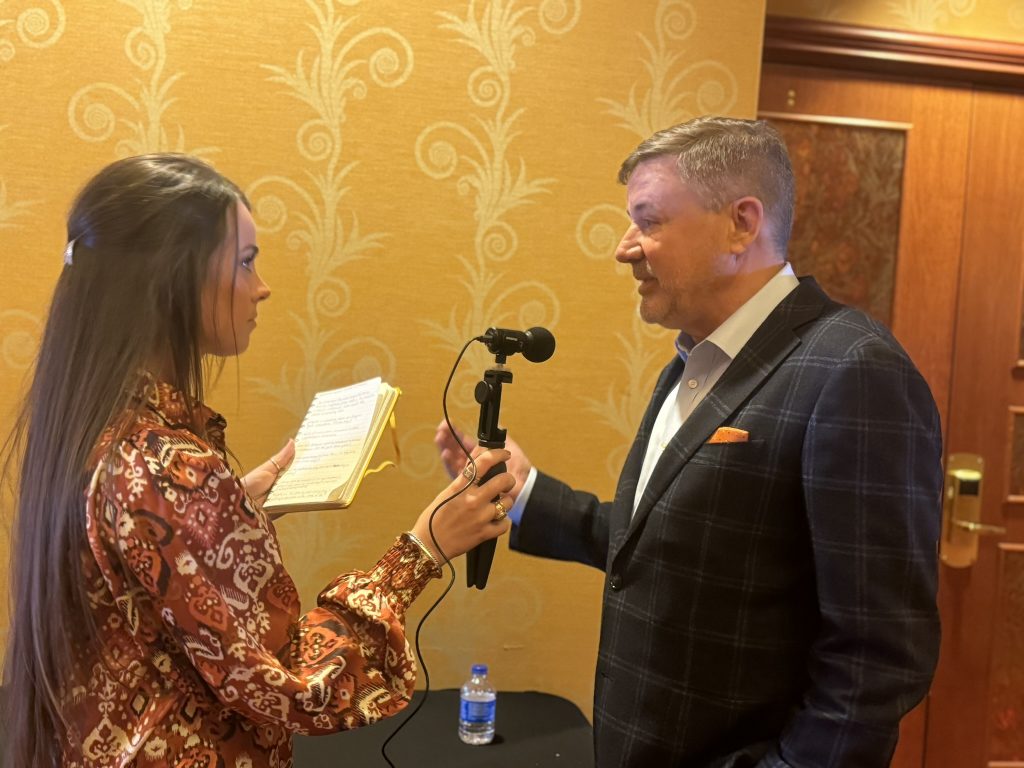
This Week on SUNUP is Oklahoma State University Extension grain market economist Kim Anderson. During this week's edition, Anderson discusses prices in the grain markets.

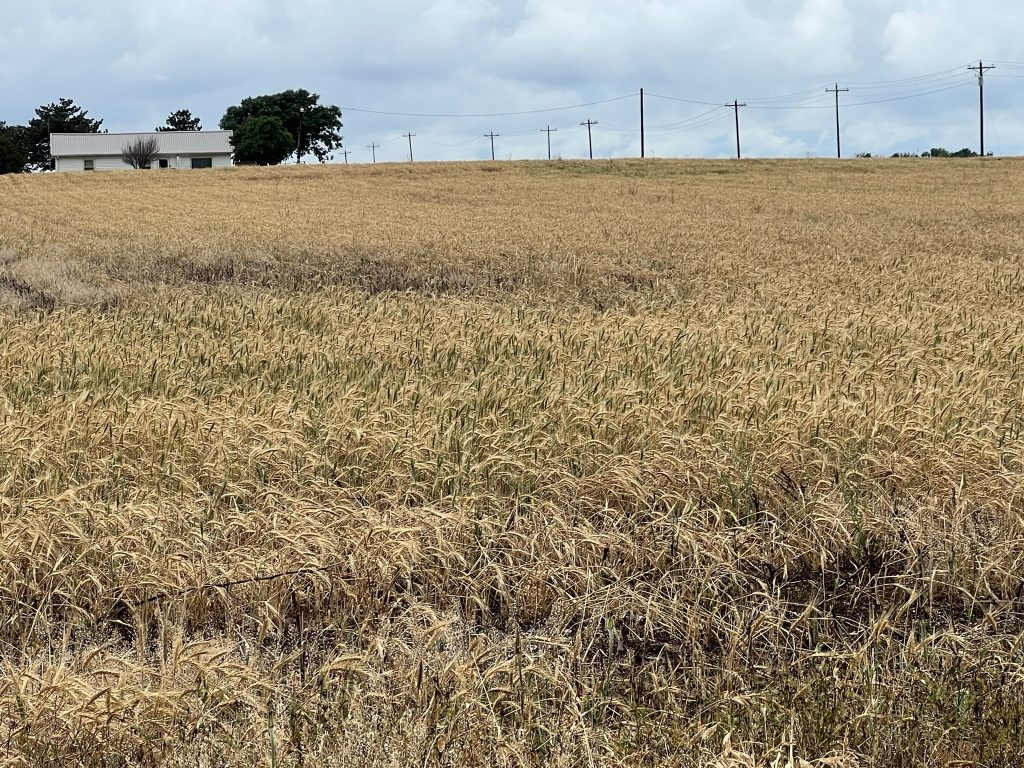
Now that the impacts of COVID-19 and the Russian and Ukraine war are out of the picture, Anderson said the prices for wheat are back to normal- now at $5.80. Ending stocks are average as well, he added.

 "Right now, you can forward contract in Pond Creek for $5.30," Anderson said. "You can forward contract in southern Oklahoma for 40 cents less than that. They only put about a 15-cent risk factor in there, so that gets you up around $5.40 or $5.45."

Corn prices are right at $4.00 now, Anderson said, up from the previous price of $3.85. Anderson said corn can be forward contracted for $4.40 in northern Oklahoma and close to $4.30 in the Weatherford area.

Anderson said the average ending stocks for corn is currently at 11.6 percent and is projected to be 17 percent.

"You can expect below-average prices, and that is what they are offering right now," Anderson said.

This Week on SUNUP:

  • David Lalman and Rosslyn Biggs, OSU Extension beef cattle specialists, discuss the aftermath of Oklahoma's wildfires. They offer guidance on feeding livestock that have lost forage sources, caring for wounded animals, animal wellbeing, the importance of documenting loss, and managing farm stress. If you or someone you know is experiencing extreme stress, contact Oklahoma's Mental Health Helpline anytime by calling or texting 9-8-8.
  • Amy Hagerman, OSU Extension ag policy specialist, has a brief overview of disaster relief programs.
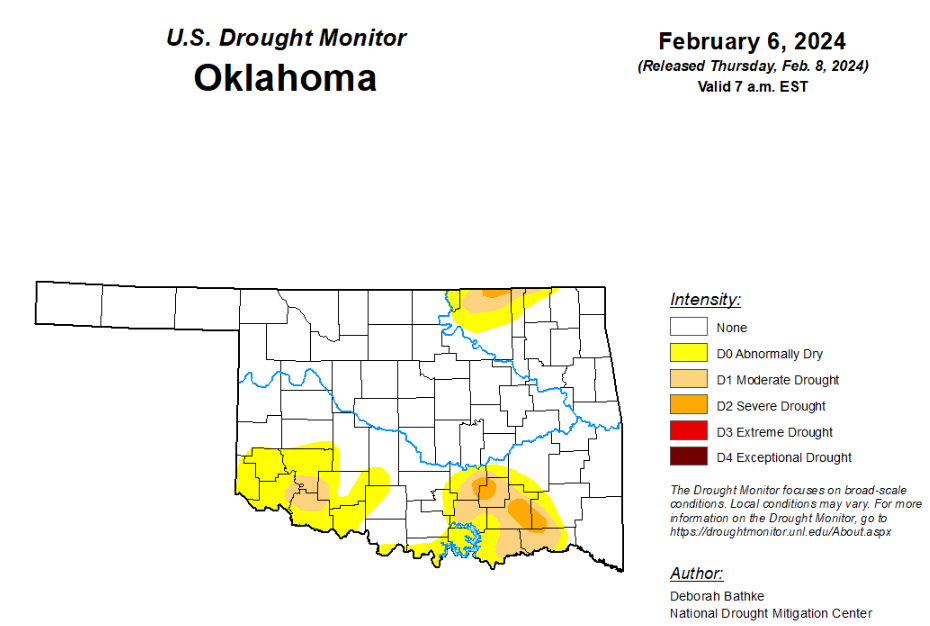
  • Wes Lee, OSU Extension Mesonet agricultural coordinator, discusses the recent cold temperatures. State Climatologist Gary McManus analyzes the drought monitor and rainfall accumulation.
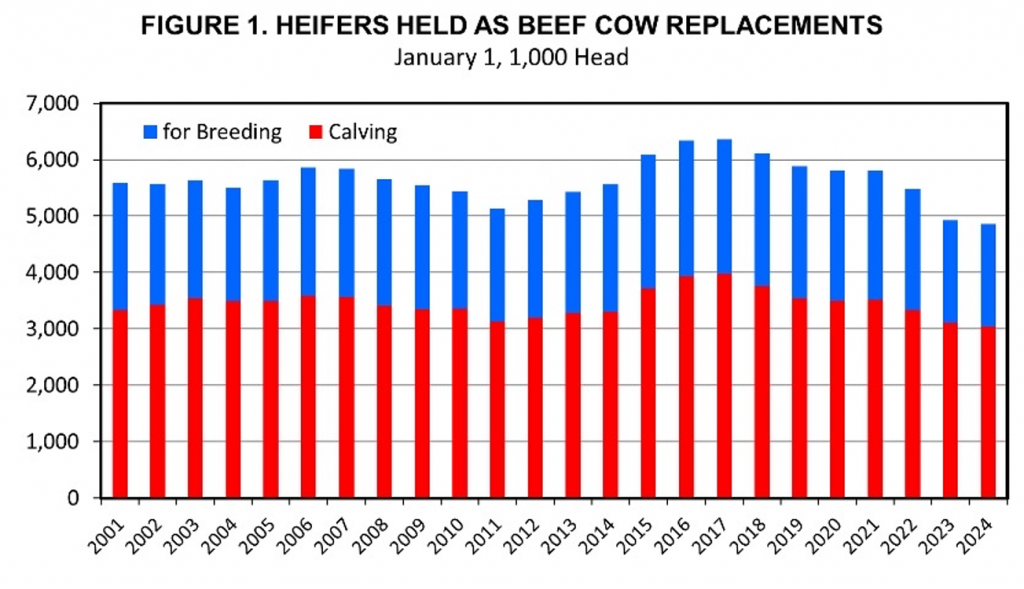
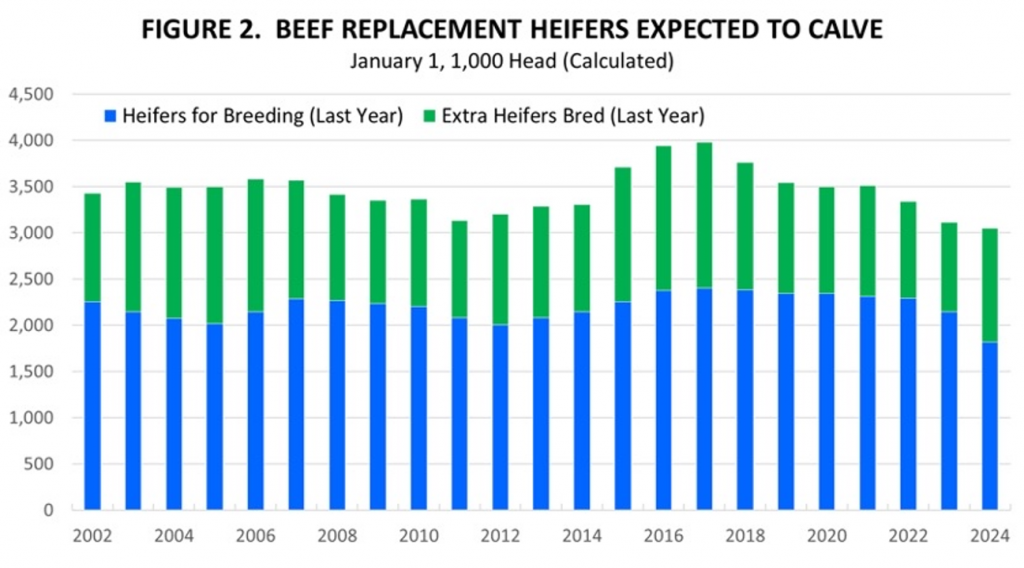
  • Mark Johnson, OSU Extension beef cattle breeding specialist, helps producers decide whether to keep or cull replacement heifers.
  • Kim Anderson, OSU Extension grain marketing specialist, looks back at the average wheat prices over the past 15 years. He also makes projections for 2024 harvested wheat and has information for producers planning to plant summer crops.

Watch SUNUP:

Saturday at 7:30 a.m. & Sunday at 6 a.m. on OETA (PBS)
YouTube.com/SUNUPtv

Farm Credit of Western Oklahoma Returns a Record of $13 Million Back to Customers in 2024

Customers of Farm Credit of Western Oklahoma (FCWO) will soon be receiving their patronage refund payments totaling $13 million.

"We experienced another solid year of financial performance and are excited to return record amounts to our stockholders.  Patronage continues to be the foundation of our cooperative business model and is what sets us apart from other lenders," said Greg Livingston, FCWO Chief Executive Officer.

According to Livingston, since 1998, a total of $88,400,000 has been returned to FCWO customers in patronage refunds. 

"Our ag lenders know agriculture and they are experts in customer service.  We offer long-term and short-term fixed rate loans that are tailor-made for each customer," Livingston said.   "Decisions are made locally and quickly, allowing us to get money out the door."

Giving back is built into our cooperative structure, but the giving back does not stop with patronage refunds. "We take a lot of pride in giving back to our rural communities by supporting local events, fire departments, schools, food pantries, youth organizations and economic development programs," Livingston said.  "That is something I'm proud of and really proud to be a part of!"

FCWO services 6,200 loans in Western, Central and Southwestern Oklahoma with nine locations in Altus, Alva, Anadarko, Clinton, Enid, Elk City, Guymon, Tuttle, and Woodward. Field offices in Beaver, Boise City and Chattanooga.

Farm Credit of Western Oklahoma is a member of the Farm Credit System and comprised of Federal Land Bank Associations and Production Credit Associations financing all types of farms, ranches, and other agriculture needs.  Farm Credit of Western Oklahoma is an equal opportunity lender and equal housing lender.  Learn more at farmcreditloans.com.

Post-Election Audits Confirm Results of Recent Legislative Races

Recent Legislative Races

The State Election Board announced today that post-election audits conducted last week confirmed the results of the recent State Senator, District 32 Special General Election and State Representative, District 39 Special Primary Election and Special General Election.

Oklahoma County Election Board audited the following:

February 13, 2024 Special General Election (State Representative, District 39)

  • Precinct 337
  • Precinct 342
  • Mail absentee ballots

December 12, 2023 Special Primary Election (State Representative, District 39)

  • Precinct 335 (Democratic Primary)
  • Precinct 369 (Republican Primary)
  • Mail absentee ballots (both Republican and Democratic primaries)

The audits confirmed the results of the special general election and both special primaries, with no difference in the vote counts.

Comanche County Election Board audited the following:

December 12, 2023 Special General Election (State Senator, District 32)

  • Precinct 42
  • In-person absentee ("early voting") ballots

The audit confirmed the results of the special general election, with no difference in the vote counts.

Secretary of the State Election Board, Paul Ziriax, said post-election audits have consistently proved that Oklahoma elections are safe and secure. "The accuracy of Oklahoma election results has been confirmed, time and time again, through both manual post-election audits and candidate-requested recounts. The recent special legislative races are no exception. With time-tested laws and procedures, and very accurate voting devices, Oklahomans can feel confident in their elections," Ziriax said.

Precincts for audits in both counties were selected randomly and election totals were confirmed through a manual examination of the ballots. The final post-election audit report is available on the State Election Board website.

Post-election audits were enacted by the State Legislature and implemented by the State Election Board in 2022 "for the purpose of maintaining the security of the election system by ensuring that voting devices and software used in a particular election correctly tabulated votes." Post-elections audits are defined as "a manual or electronic examination of a limited number of ballots." Additional post-election audit reports can be found on the State Election Board website.

Post-Election Audits Confirm Results of Recent Legislative Races

The State Election Board announced today that post-election audits conducted last week confirmed the results of the recent State Senator, District 32 Special General Election and State Representative, District 39 Special Primary Election and Special General Election.

Oklahoma County Election Board audited the following:

February 13, 2024 Special General Election (State Representative, District 39)

  • Precinct 337
  • Precinct 342
  • Mail absentee ballots

December 12, 2023 Special Primary Election (State Representative, District 39)

  • Precinct 335 (Democratic Primary)
  • Precinct 369 (Republican Primary)
  • Mail absentee ballots (both Republican and Democratic primaries)

The audits confirmed the results of the special general election and both special primaries, with no difference in the vote counts.

Comanche County Election Board audited the following:

December 12, 2023 Special General Election (State Senator, District 32)

  • Precinct 42
  • In-person absentee ("early voting") ballots

The audit confirmed the results of the special general election, with no difference in the vote counts.

Secretary of the State Election Board, Paul Ziriax, said post-election audits have consistently proved that Oklahoma elections are safe and secure. "The accuracy of Oklahoma election results has been confirmed, time and time again, through both manual post-election audits and candidate-requested recounts. The recent special legislative races are no exception. With time-tested laws and procedures, and very accurate voting devices, Oklahomans can feel confident in their elections," Ziriax said.

Precincts for audits in both counties were selected randomly and election totals were confirmed through a manual examination of the ballots. The final post-election audit report is available on the State Election Board website.

Post-election audits were enacted by the State Legislature and implemented by the State Election Board in 2022 "for the purpose of maintaining the security of the election system by ensuring that voting devices and software used in a particular election correctly tabulated votes." Post-elections audits are defined as "a manual or electronic examination of a limited number of ballots." Additional post-election audit reports can be found on the State Election Board website.

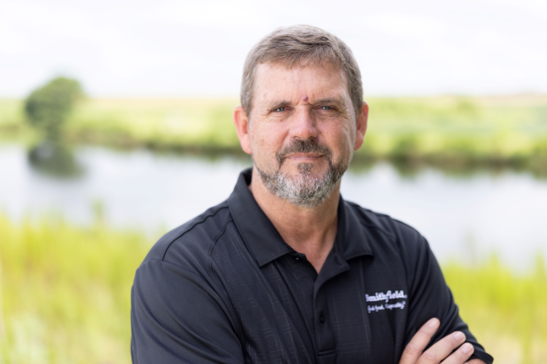
Oklahoman Keeff Felty Elected as President of National Association of Wheat Growers

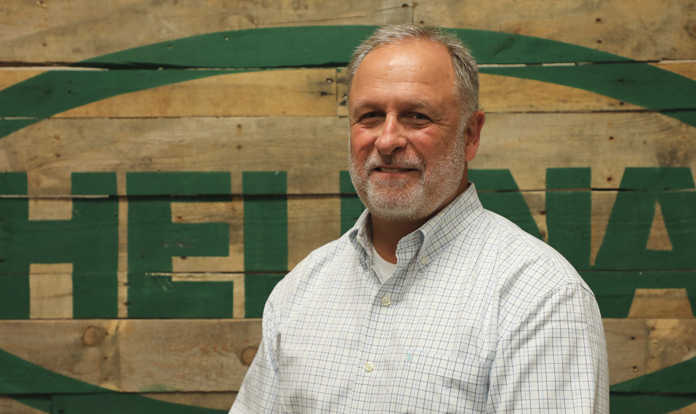
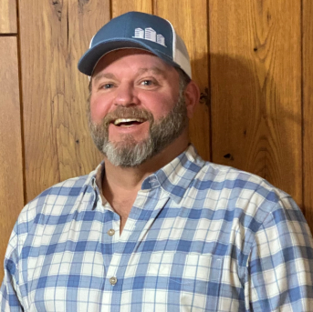
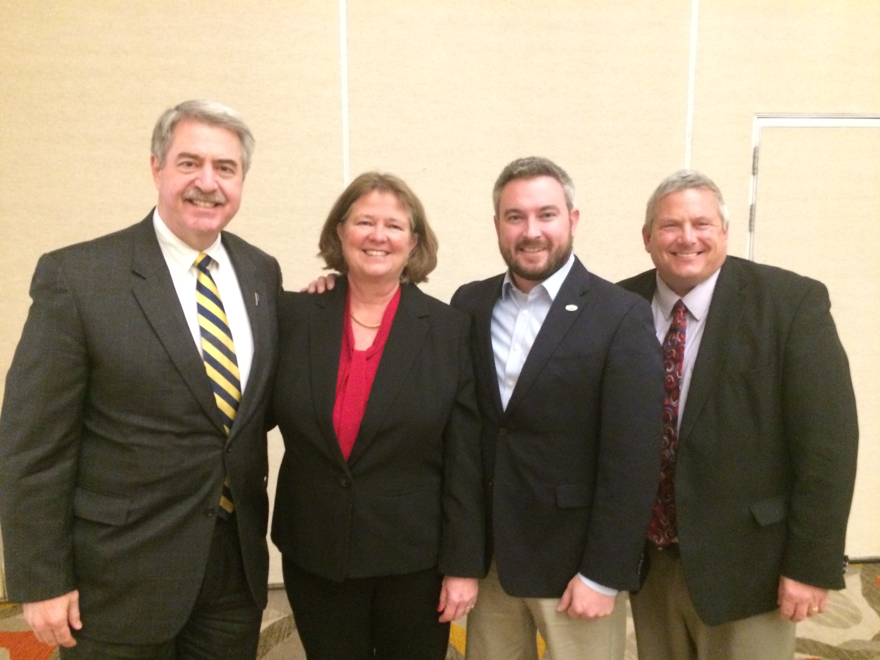
 New National Assoc of Wheat Growers' officer team just elected at NAWG Annual Meeting at Commodity Classic in Houston, including new president Keeff Felty of Altus.
L to R: Secretary Nathan Keane, Montana; Treasurer Jamie Kress, Idaho; VP Pat Clements, Kentucky; President Felty; Past President Brent Cheyne, Oregon.

Listen to Ron Hays talk with Keeff Felty, President of NAWG.

The Commodity Classic is underway, during which Oklahoman Keeff Felty has been elected as the president of the National Association of Wheat Growers. Senior Farm and Ranch Broadcaster Ron Hays had the chance to catch up with Felty and talk about his priorities for 2024 as NAWG president.

Felty has moved through the different chairs in NAWG leadership to reach this point, starting with his position as NAWG secretary in 2020.

"When I started my journey as secretary in March of 2020, it was two weeks before the big shutdown (COVID-19), so that allowed us another year; everybody stayed put for that year, so I got an extra year as secretary," Felty said.

As NAWG president, Felty will be leading the effort to see a completed farm bill as soon as possible.

"It is so important that we get this farm bill finished, as we are in a one-year extension, which is good because it keeps everything going, provided they keep the appropriations process and keep the government funded, which is really the hold up on the whole thing on the farm bill at this point," Felty said. "The primary parties on both sides of the aisle in Washington are extensively ready to go, is my understanding. We have to get his funding mechanism straightened out first."

Felty said he is hopeful to see a farm bill completed in 2024, but that cannot happen until appropriations are taken care of.

"One of our asks at the National Association of Wheat Growers is an increase in the reference price to better reflect today's current economics and production environment," Felty said.

To increase the reference price, Felty said it would take somewhere between 80 billion and 100 billion dollars.

Looking into 2024, Felty said one of his top priorities as President of NAWG, aside from the farm bill, is overall unity and keeping the wheat industry progressive.

"Wheat is one of the original cereal grains and food stocks," Felty said. "it is something you can work with on your own. It is self-stable; it has a really good history and a good story."

72,000 lbs.: Multi-County Grand Jury indicts Oklahoma man for marijuana trafficking

The Multi-County Grand Jury has indicted a Tulsa County resident in connection to a large-scale marijuana seizure recently conducted by the Attorney General's Organized Crime Task Force (OCTF).

Bobby Lee Hailey, 41, faces one count of aggravated manufacturing of a controlled dangerous substance (marijuana) and one count of aggravated trafficking of a controlled dangerous substance (marijuana) in connection to a November 2023 seizure of more than 72,000 pounds of black-market marijuana. OCTF agents uncovered the marijuana inside a metal barn in Wagoner County. The seizure was among the largest in state history. Hailey was arrested yesterday.

Homeland Security Investigations, the Oklahoma Medical Marijuana Authority (OMMA), the Wagoner County Sheriff's Office, Wagoner County Commissioners and the Wagoner County Emergency Management office assisted in the operation.

Aggravated manufacturing is punishable by no less than 20 years in prison and no more than life, as well as a $50,000 fine. Aggravated trafficking is punishable by no more than 20 years in prison and no less than a $100,000 fine.

Attorney General Gentner Drummond praised the work of the Organized Crime Task Force as well as the many law enforcement agencies with whom it routinely partners.

"This indictment is only the latest of many actions taken by my office to dismantle drug trafficking organizations in Oklahoma," he said. "I am grateful for the tremendous partnerships we have with the Oklahoma Bureau of Narcotics, OMMA, and a host of Tribal, federal, state and local law enforcement agencies. Together, we will continue targeting and prosecuting anyone involved in this dangerous and illegal conduct."

Citizens with information about suspected illegal grow operations can submit a tip to the Office of the Oklahoma Attorney General. A complaint form is available at oag.ok.gov by clicking on the "Illegal Marijuana Tipline" tab. Tips also can be sent to illegalgrow@oag.ok.gov and reporters can remain anonymous.

Every person arrested or indicted is presumed innocent unless and until convicted in a court of law.

The indictment is available here.

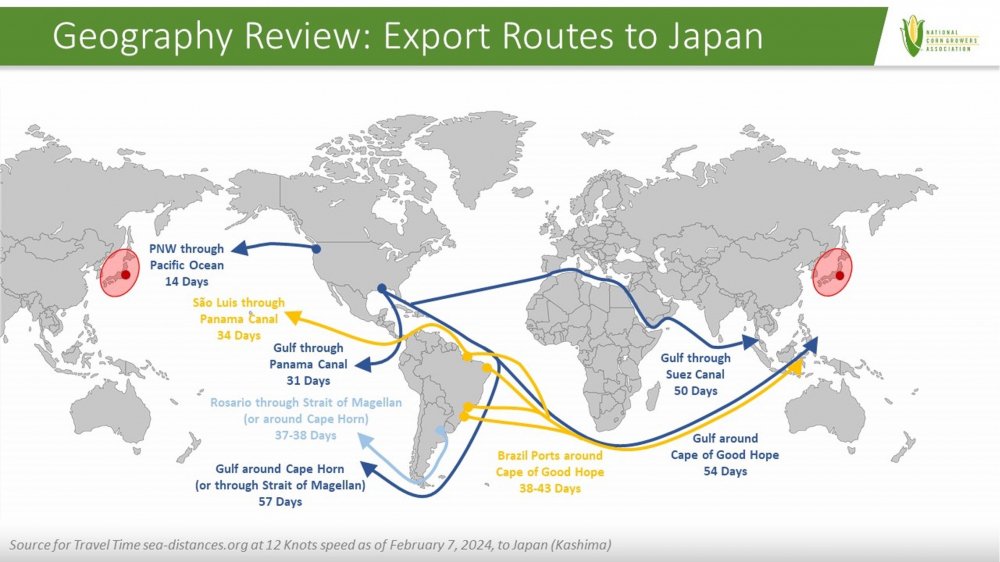
Corn Congress Passes Consensus Encouraging Expanded Access to Foreign Markets

Saying U.S. farmers depend on the strong demand that comes with expanded market access, the National Corn Growers Association's Corn Congress today passed a consensus statement encouraging federal officials to pursue trade opportunities and invest in foreign market development to ensure that the U.S. remains a global leader in corn production and trade.

"Building demand for U.S. corn is a top priority for NCGA and its state affiliates," said Harold Wolle, NCGA president. "International markets are crucial to the overall demand for U.S. corn, and actions that restrict access to foreign markets will hurt both U.S. farmers and the broader U.S. economy."

The full text of the consensus is as follows:

"Whereas, market access is critical for U.S. farmers to be successful and support the nation's economy.

Whereas, market access could be negatively impacted by retaliation that targets U.S. farmers.

Whereas, U.S. farmers depend on robust and expanded market access for exporting food and agricultural products in order to ensure that the U.S. remains a global leader in corn production.

"Therefore, we the assembled voting delegates of the National Corn Growers Association, support improved market access including the reduction of tariff and non-tariff barriers so that U.S. corn growers have many opportunities to increase demand from foreign trading partners."

WOTUS Hearings Lack Substance

The Waters Advocacy Coalition commented today on the Environmental Protection Agency (EPA) and Army Corps of Engineers listening sessions held this month to identify issues that may arise from the Waters of the United States Rule.

"The listening sessions held by the Corps and EPA on implementing the definition of WOTUS were disappointing, to say the least. Missing was any meaningful exchange of information or even answers to basic questions. In order for stakeholders of all kinds to ensure effective protection of water quality, there must be a consistent, predictable and durable WOTUS definition. Together with commonsense permitting reform, we can lay a foundation to meet ambitious infrastructure and climate goals. Our associations call on the agencies to engage with us and other stakeholders to provide the clarity needed both for compliance with the law and to effectively address these important national issues." The Waters Advocacy Coalition includes nearly 50 organizations representing agriculture, energy, infrastructure, construction and real estate, manufacturing, mining, specialty pesticides, state departments of agriculture and many other job creators

NFU President Rob Larew Emphasizes Taking Action to Preserve Rural Communities

Listen to KC Sheperd talk with Rob Larew about current NFU priorities and more.

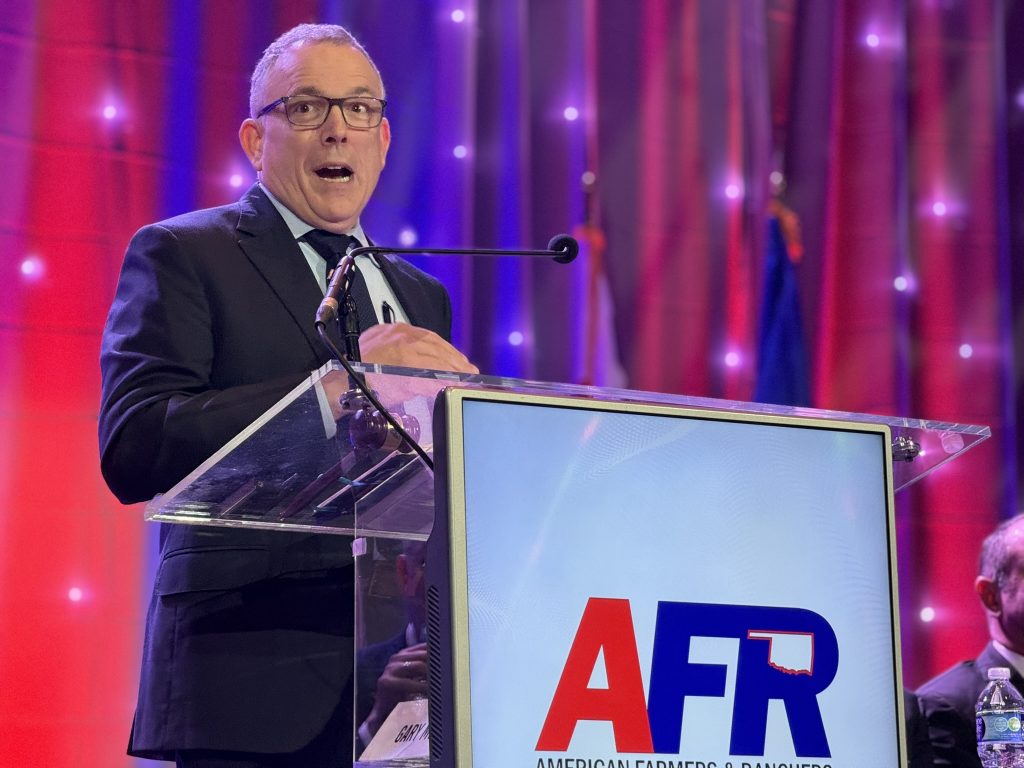
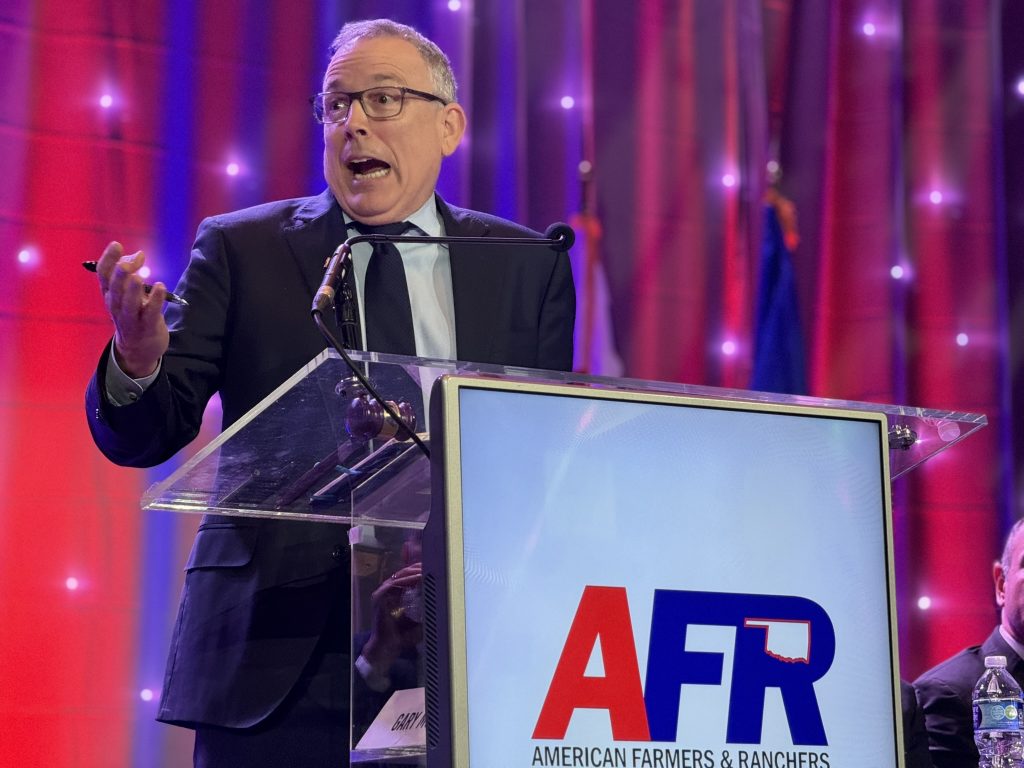
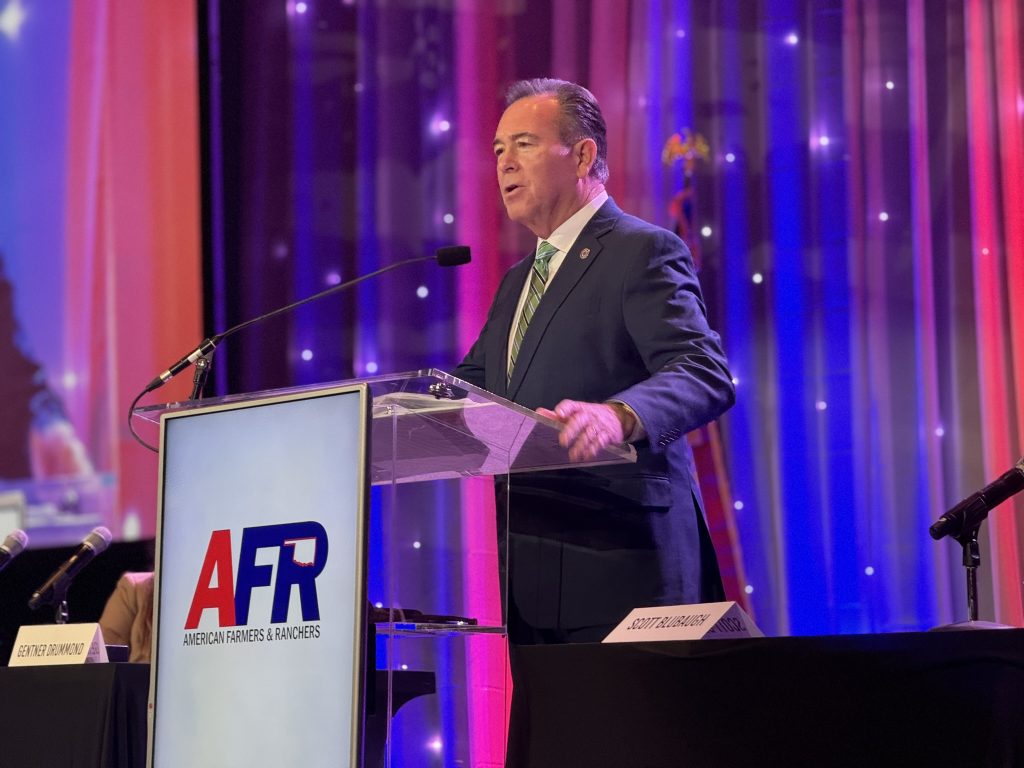
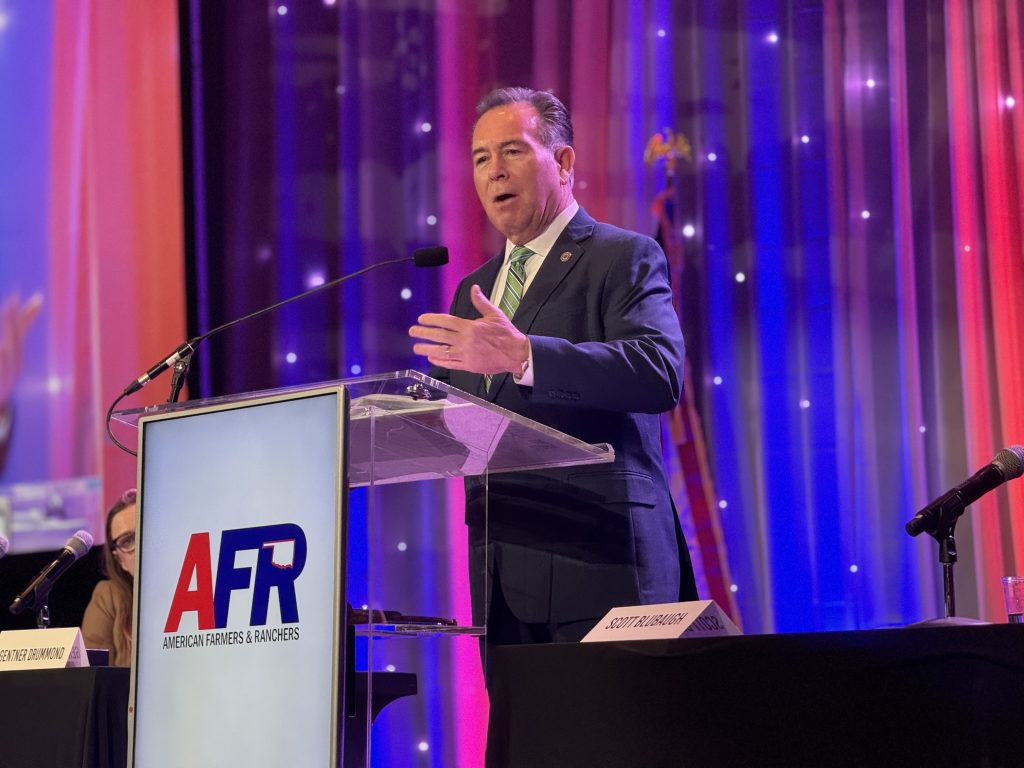
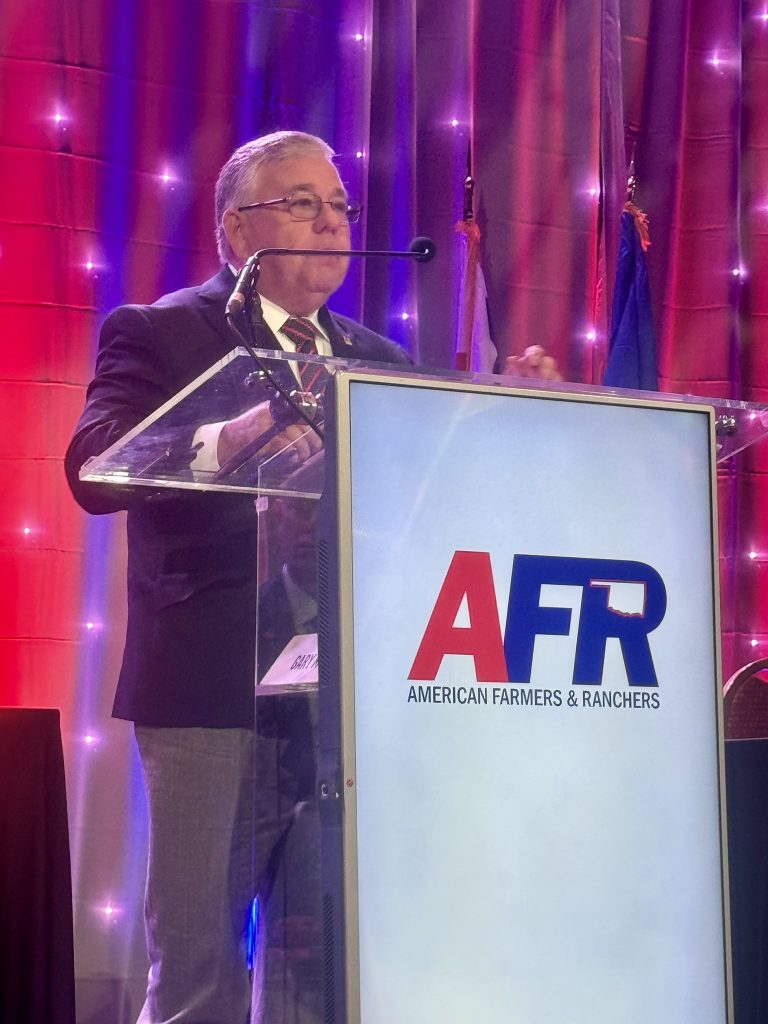
At the 2024 American Farmers and Ranchers Convention in Oklahoma City, Farm Director KC Sheperd caught up with the National Farmers Union President Rob Larew about current NFU priorities and more.

As Larew was recently appointed to the White House Advisory Committee for Trade Policy, he said he is looking forward to being a voice for farmers and ranchers. Function in Washington, D.C. has been difficult during this administration, Larew added, which is why there has not been much progress with the farm bill.

"Time is running out to get a farm bill done this year, and of course, there are already predictions that we might see changes in the House and the Senate," Larew said.

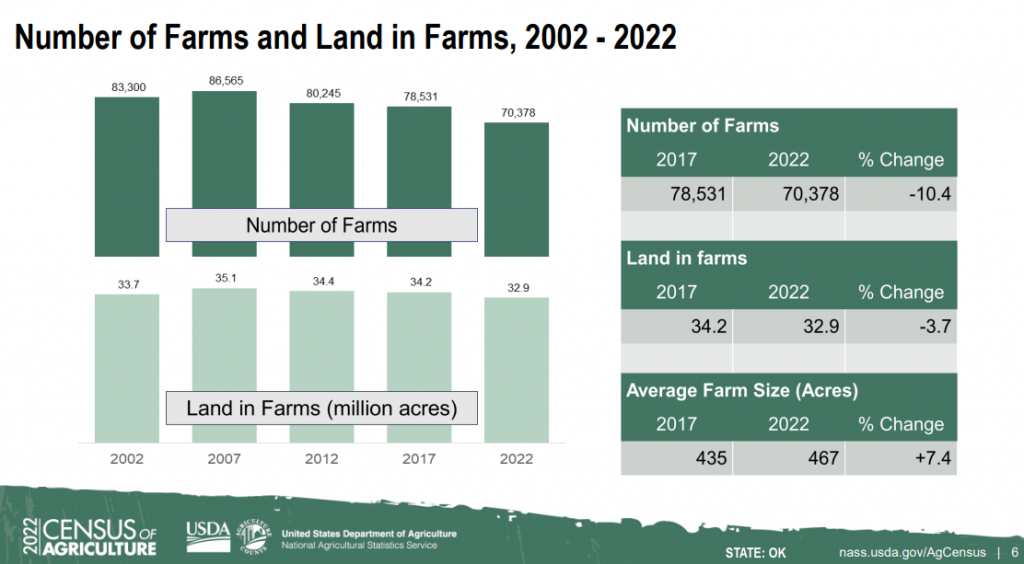
Now that the 2022 Census of Agriculture data has been released, Larew said some of the trends are positive, but one negative part of the release is the fact that farmers, on average, are getting older.

"Some of that is probably just the natural course of things, but from the Farmers Union's point of view, our members want to make sure we are not artificially driving farms to keep getting bigger and bigger and that we are still able to support our communities, and that farmers of the family size can have a fair shake in the market place and don't have to get extraordinarily large out there," Larew said.

One positive from the report Larew mentioned is more recognition of women in agriculture.

"I think that is a really positive thing, and we are beginning to see an uptick in some younger farmers as well," Larew said.

Because the average age of farmers in the U.S. is getting older, Larew emphasized the importance of succession plans so that the future of agriculture can be a successful one.

"It is not just about making sure we are going to have farmers to grow the food and so forth," Larew said. "Somebody must step into that- you will have big monopolies farming the land if you have to. It is really about going back to those communities and whether we are going to have enough folks in and around these communities to keep small businesses in town and to keep schools operating so we can keep families in those towns and want to raise life in a rural setting as we all enjoy."

Regarding the upcoming NFU convention in Scottsdale, Arizona on March 10-12, Larew said there will be panel discussions about the farm bill and connecting with those in agriculture to solve challenges in rural communities and more. Next year, Larew said NFU will be holding its national convention in Oklahoma City.

"Plans are well underway for it, and we are looking forward to it," Larew said.

Daily Email for February 29, 2024


Oklahoma's Latest Farm

And Ranch News

Thursday, February 29, 2024

 
Howdy Neighbors!

Here is Your Daily Oklahoma Farm and Ranch News Update: 


  • OCA's Mariah Reimer on OCF Wildfire Disaster Relief Fund - Plus Details from OkFB & TSCRA on How to Help


  • Since Monday- Wildfires have Swept Across a Million Acres in Texas & Oklahoma- Blayne Arthur Provides Update


  • Todd Russ Applauds Oklahoma's Financial State and Discusses Latest Initiatives


  • Sorghum Checkoff's Vision for a Sustainable Future Comes to Life with Newly Designed Web Pages


  • Commodity Classic Underway in Houston- USDA's Vilsack and EPA's Regan to Address General Session Friday


  • Beef Checkoff Research Shows Positive Headway in Consumers' Perspective


  • New Resource Helps Cattle Producers Maximize Profitability


  • The Value of Calving Distribution

OCA's Mariah Reimer on OCF Wildfire Disaster Relief Fund - Plus Details from OkFB & TSCRA on How to Help

On Wednesday afternoon, Farm Director KC Sheperd talked with the Executive Director of the Oklahoma Cattlemen's Foundation, Mariah Reimer, about the OCF Wildfire Disaster Relief Fund that is open for donations for farmers and ranchers affected by the wildfires plaguing the home state. Established in 2017, the OCF Disaster Relief Fund is a year-round fund set in place to help producers in times of need. (The picture above is from Oklahoma Ag Secretary Blayne Arthur- she says its hard to tell- but those piles of ashes were Round Bales before fire arrived)


Reimer said on the Oklahoma Cattlemen's Foundation website, visitors can click the Wildfire Disaster Relief button on the homepage to access a hub of links for Texas and Oklahoma.


For more ways to help contact Mariah Reimer at Mreimer@okcattlemen.org or 405.308.3030.


View our Disaster Relief Fund page at https://www.oklahomacattlemensfoundation.com/giving.


To visit the Oklahoma Cattlemen's Foundation Wildfire Disaster Relief page, CLICK HERE.


OKFB Foundation

The OKFB Foundation for Agriculture is now accepting donations for wildfire relief efforts. Up to $10,000 of donations will be matched by the foundation, OKFB, and Oklahoma Farm Bureau Insurance. Donate online today through March 15: https://okfb.news/FireRelief24


Make your donation to the OKFB Foundation for Agriculture 2024 Oklahoma Wildfire Relief efforts online via PayPal by March 15.

Donate today to the 2024 Oklahoma Wildfire Relief efforts on PayPal


TSCRA

Texas & Southwestern Cattle Raisers Association is urging donors to give to the TSCRA Disaster Relief Fund amid widespread wildfires impacting the Texas Panhandle and Western Oklahoma. Donations will go on to aid victims of the ongoing natural disasters.


For more information, including how to donate and how to apply for funding visit tscra.org/disaster-relief-fund/ or contact TSCRA at 800-242-7820. Additional resources for victims impacted by these wildfires are also available tscra.org/disaster-relief-fund/ . 

Click here to read more and listen to Mariah Reimer talk about how Oklahoma Cattlemen's Foundation is supporting those affected by the wildfires.
Click here to read more about OKFB collecting donations to support those affected by the wildfires.
Click here to read more about TSCRA collecting donations to support those affected by the wildfires in the Texas Panhandle and Western Oklahoma.

Sponsor Spotlight


Oklahoma AgCredit supports rural Oklahoma with reliable and consistent credit, today and tomorrow. We offer loans for land, livestock, equipment, operating costs and country homes (NMLSR #809962) to farmers, ranchers and rural businesses across 60 counties. As a cooperative, we are owned by the members we serve. Through our Patronage Program, we have returned more than $74 million to our members since 1997.


For more information on our services or to find a location near you, visit our website here.


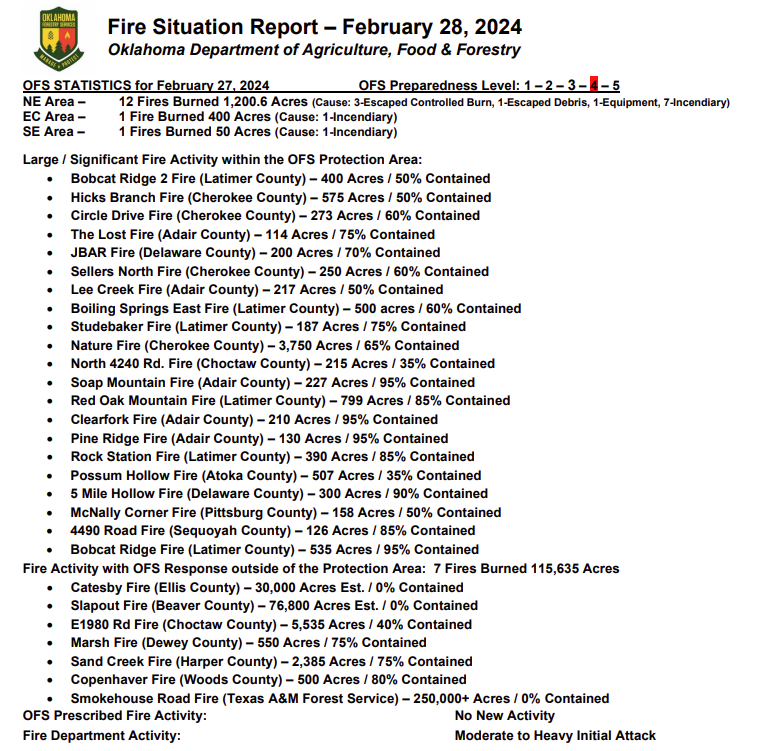
Wildfires Have Burned a Million Acres Across Texas and Oklahoma Since Monday- Blayne Arthur Provides Update

Oklahoma State Secretary of Ag Blayne Arthur was out in northwest Oklahoma on Wednesday looking at the damage already done in Oklahoma this week (with some fires still burning) on Wednesday night.


We traded messages and she sent us some pics she captured before dark on Wednesday- and we share a few with you now- like the left behind stock trailer that the fire swallowed up (above). Or the calf that tried to get away but could not. (Below)

Secretary Arthur says "Here is some info from our team:

"Aerial mapping of the fires was done Wednesday. Individual fire sizes are as follows:

"Slapout Fire (Beaver County) - 26,048 acres

"Catesby Fire (Ellis County) - 90,570 acres

"Smokehouse Creek (Ellis/Roger Mills County) - 31,590 acres (Note: this fire originated in Texas and burned into Oklahoma late yesterday afternoon. Acres listed reflect only the Oklahoma portion of that incident)

"Oklahoma Forestry Services firefighting resources will return to the incidents this morning to resume control efforts.

"Total of these three fires is 148,208." (These are the largest fires in Oklahoma but several thousand more acres have burned in smaller blazes)


MEANWHILE in Texas- a news release from Texas Ag Commissioner Sid Miller reports The Smokehouse Creek Fire, one of five active fires scorching the region, has become the state's second largest in history, having burned over 500,000 acres with minimal containment. Additionally, several grain and seed operations have reported total losses." 


Bottom line from both states- over a million acres have burned since Monday (One more pic from Blayne below- a couple of ladies packing lunches at the Gage Fire Department on Wednesday- firefighters gotta eat)

Click here for the latest status reports from the Oklahoma Department of Emergency Management

Todd Russ Applauds Oklahoma's Financial State and Discusses Latest Initiatives

At the 2024 American Farmers and Ranchers Convention in Oklahoma City, Farm Director KC Sheperd had the chance to visit with State Treasurer Todd Russ about Oklahoma's January 2024 Investment Report, some initiatives he has been working on while in office, and more.


Regarding the latest investment report, Russ said Oklahoma is looking good and can only get better.

"Oklahoma is in as good of shape as it has ever been in history, and everything is pointing north, and it looks like it is going to continue to be that way for quite a while," Russ said.


Russ discussed many financial accomplishments he has achieved so far for the state while in office that have resulted in more revenue. When it comes to bringing money into the state, Russ talked about how events like Cattlemen's Congress play a vital role.


"All the things that we stand for have become quite attractive for much of the nation," Russ said. "I used to say it was one of the best-kept secrets, and now I say it has gotten out because people are moving into Oklahoma. A lot of attention, a lot of amazing, great things..."


One issue Russ has been tackling while in office is Environmental, Social, and Governance, or ESG. Russ said international banks have begun to put restrictions on entities that do not follow ESG criteria.

Click here to read more and listen to Todd Russ talk about Oklahoma's financial state and initiatives he's working on.
 
Sign Up for Our Daily Email- Free Because of Our Sponsors!

Support Our Sponsors!


KIS logo


Advertise With Us!
 

For our farmers who have either- always have had cotton on their farms- or those who have more recently have added the fiber crop to their operations- we have a daily report heard on several of our Radio Stations- It's Called Cotton Talk!

Click on the Button below to listen to our most recent report
Click here for our Latest Cotton Talk- Hosted by KC Sheperd


The latest news from the Oklahoma State Capitol is available daily on the Radio Oklahoma News Network.


Click on the blue button to hear News Director Ken Johnson's report.

Click here for the latest report from the State Capitol on RON


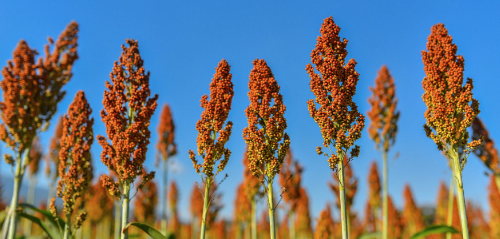
Sorghum Checkoff's Vision for a Sustainable Future Comes to Life with Newly Designed Web Pages

The United Sorghum Checkoff Program (USCP) is reiterating its dedication to highlighting and promoting sorghum's pivotal role in sustainability efforts with the launch of a newly designed web page focusing on this topic. This initiative aims to inform, educate and engage both producers and consumers in understanding the environmental benefits of The Resource Conserving Crop®.


The updated web page offers a comprehensive overview of sorghum's sustainability story, emphasizing the contributions of sorghum farmers toward environmental conservation. By spotlighting key facts and data points, users can dive deeper into the intricate narrative of sorghum's sustainability, linking out to additional research and information available on the platform. 


"The sorghum crop embodies sustainability, addressing critical concerns such as water conservation, soil preservation and wildlife protection," Sorghum Checkoff Executive Director Norma Ritz Johnson said. "Our industry recognizes the pressing need to amplify the message of sustainable agriculture, catering to diverse audiences including producers, consumers and industry stakeholders."

Click here to read more about Sorghum Checkoff's vision.
 

We invite you to listen to us on great radio stations across the region on the Radio Oklahoma Ag Network weekdays-

if you missed this morning's Farm News - or you are in an area where you can't hear it- click below for this morning's Farm news from Ron Hays and KC Sheperd on RON.
Listen to our Thursday morning farm and ranch news with KC Sheperd
 
 
Subscribe To the Daily Email


Sponsor Spotlight


Oklahoma Farm Bureau works to improve the lives of all Oklahomans by supporting our state's agriculture community. As Oklahoma's largest general farm organization led by Oklahoma farmers and ranchers, OKFB takes grassroots values and advocates for agriculture at the state Capitol and in Washington, D.C., to ensure our way of life continues for generations to come. Farm Bureau hosts leadership events, supports our state's agricultural youth and connects consumers with agriculture in order to build a brighter future for our state. Become an OKFB member today online at okfarmbureau.org/join. Together, we are rural Oklahoma.


Commodity Classic Underway in Houston- USDA's Vilsack and EPA's Regan to Keynote General Session on Friday

United States Department of Agriculture Secretary Thomas Vilsack and Environmental Protection Agency Administrator Michael Regan will keynote the General Session of the 2024 Commodity Classic in Houston. The General Session is Friday, March 1, 8:30-10:30 a.m. (CST) at the George R. Brown Convention Center.


The 2024 show, entitled "New Frontiers in Agriculture," will also feature Mike Massimino in the esteemed General Session speaker lineup. Massimino is a former NASA astronaut, New York Times bestselling author, and Columbia University professor, in addition to media and television personality. Retaining a longstanding crowd-pleaser, the session will again include a panel discussion with leaders of the five associations that present Commodity Classic each year: American Soybean Association, National Corn Growers Association, National Association of Wheat Growers, National Sorghum Producers, and the Association of Equipment Manufacturers.


Classic is a massive ag event- with lots of educational sessions- a huge trade show and more- underway today through Saturday.


More details on this year's Commodity Classic are available here.


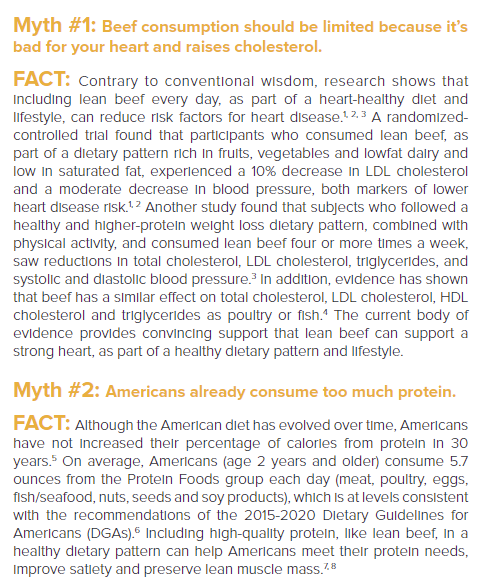
Beef Checkoff Research Shows Positive Headway in Consumers' Perspective of Tenderness and Eating Experience

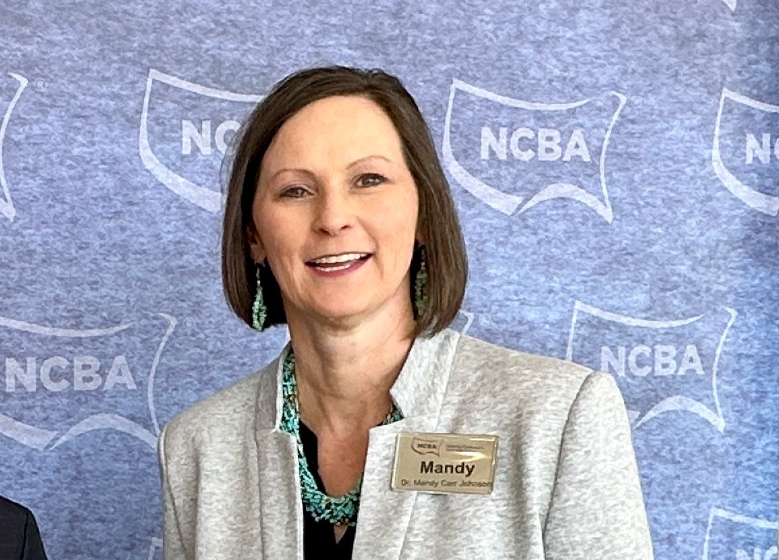
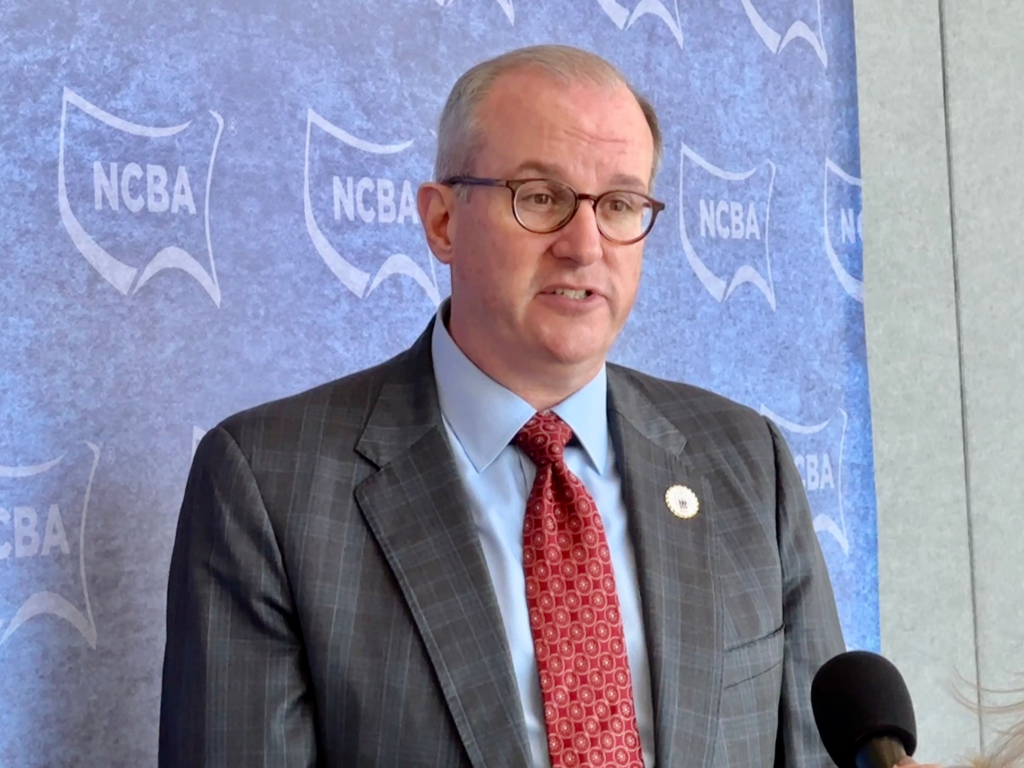
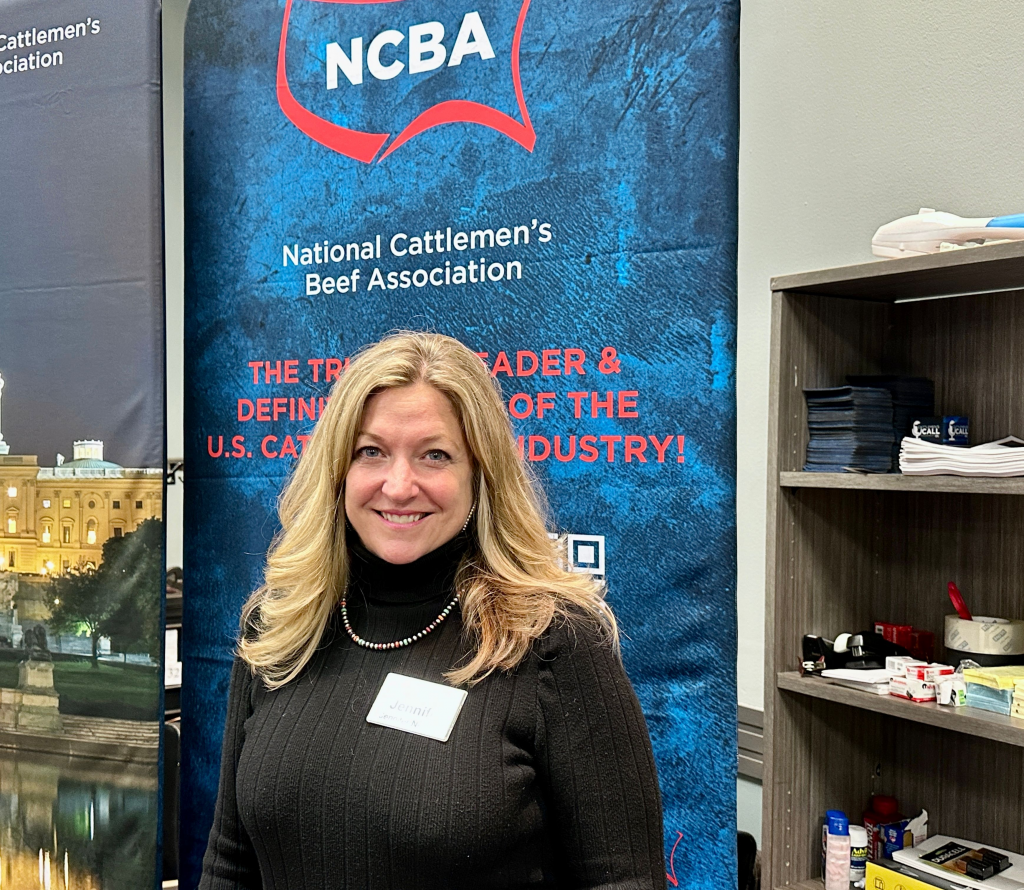
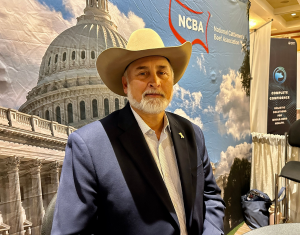
I had the chance to talk with the Senior Executive Director of Scientific Affairs at the National Cattlemen's Beef Association, Dr. Mandy Carr Johnson, about research funded by the Beef Checkoff.


Carr oversees all cattle industry research efforts funded under the Beef Checkoff, including beef safety, the mind of the consumer, and more. Carr said it is key to keep up with what the consumer is thinking when it comes to beef.


"Something we are seeing is that in the last two years, really the elevation of consumers wanting to know more about how cattle are raised and grown for food, and also nutrition," Carr said. "Consumers are looking at how to have a healthy and well-balanced life, and how does food fit into that and how does beef in particular fit it."


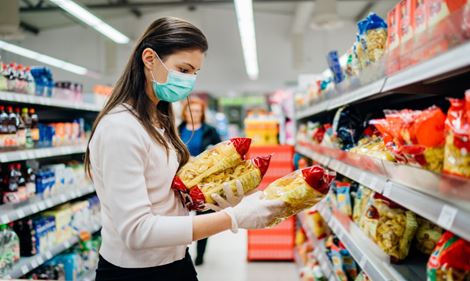
Carr said there have been shifts in buying patterns, such as using a mobile app for grocery pickup. After COVID-19, Carr said they have also seen some trends level off that should be long-term, such as food service.


"Many of us, during COVID, didn't have food service restaurants available- they were closed or gradually worked until they could have takeout," Carr said. "We got tired of cooking. We were excited as consumers to have that opportunity to have a restaurant in the food service, and restaurants are a key component of making beef available to consumers. We are seeing that coming back to where it was pre-COVID, which is a great thing for the industry."

Click here to read more and listen to Mandy Carr talk about research funded by the Beef Checkoff.

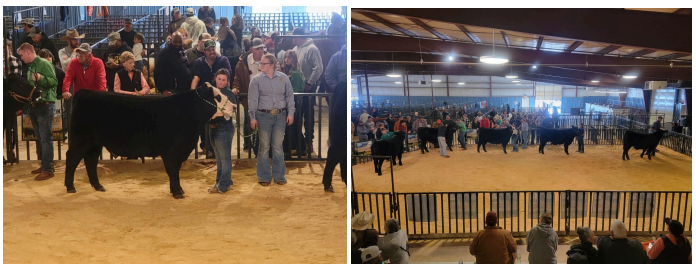
New Resource Helps Cattle Producers Maximize Profitability

A new resource developed by the National Cattlemen's Beef Association and CattleFax helps cattle producers maximize profitability from their culling decisions. "Right Way. Right Time. – A Guide to Cull Cattle Management" is now available at www.ncba.org. 


With effective planning, cull cattle can be a significant source of revenue and should not be overlooked. In essence, cull cattle are market cattle. This new document addresses key problem areas, provides strategies for making timely culling decisions to prioritize animal welfare, and is designed to help producers capture more value through effective management regarding cull cattle.


"Cull animals can contribute significantly to the profitability of the ranch," said Dr. Trey Patterson, president/CEO of Padlock Ranch Company. "We spend extensive time and money adding replacement cattle to our herd, so it is imperative that we capture good value for cull cattle to offset these expenses."


For cattle producers across the country, whether beef or dairy, cull cattle are part of doing business. Animals age, they no longer breed back, and their health deteriorates. Incorporating culling decisions into an operation's best management practices benefits both animal welfare as well as the producer's bottom line.

Click here to learn about a new resource that helps cattle producers maximize profitability.

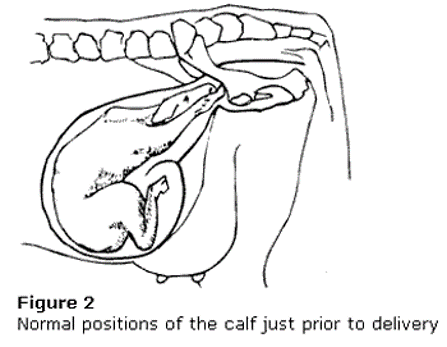
The Value of Calving Distribution

On today's Cow-Calf Corner, Scott Clawson, OSU Cooperative Extension NE Area Agriculture Economics Specialist writes about the value of calving distribution.


Commercial cow-calf producers can face an overwhelming number of records, data, and ratios that promise to boost the bottom line. Hidden in these options is one simple measure that can provide useful information about the cowherd's performance that we can start tracking today. That measure is our calving distribution. Calving distribution is simply tracking when our calves are born within our calving season.

This measure is useful in three areas.


  1. There is a litany of research that emphasizes the improved individual animal performance of calves born early in the calving season. Better weaning weights, stronger feedlot/carcass performance, and improved reproductive efficiency of retained heifers are all well documented research.
  2. It helps us identify which females are excelling within our environment and management by settling early in the breeding season.
  3. It can help us identify which cows are making the largest annual profit contribution to the ranch. It is common to discuss annual cow cost or cost per cow. This is a bit misleading in the sense that we manage the herd not the individual. As a result, the cows all share an equal part of the annual cost. The cows that calve early in the season will bring in more revenue (via older and generally heavier calves) than the late calving cows that share the same portion of the cost.
Click here to read more about Scott Clawson's take of the value of calving distribution.
Let's Check The Markets!
OKC West is our Market Links Sponsor- they sell cattle three days a week- Cows on Mondays, Stockers on Tuesday and Feeders on Wednesday- Call 405-262-8800 to learn more.
 
Today's First Look:
Ron on RON Markets as heard on K101  
mornings with cash and futures reviewed- includes where the Cash Cattle market stands, the latest Feeder Cattle Markets Etc.
Hear Today's First Look
 

Wholesale Boxed Beef Prices were higher- Choice Beef was up $1.29 and Select Beef was up $2.54 on Wednesday, 2/28/2024.


Click on the Button below for the latest report from USDA Market News

Boxed Beef Report
 

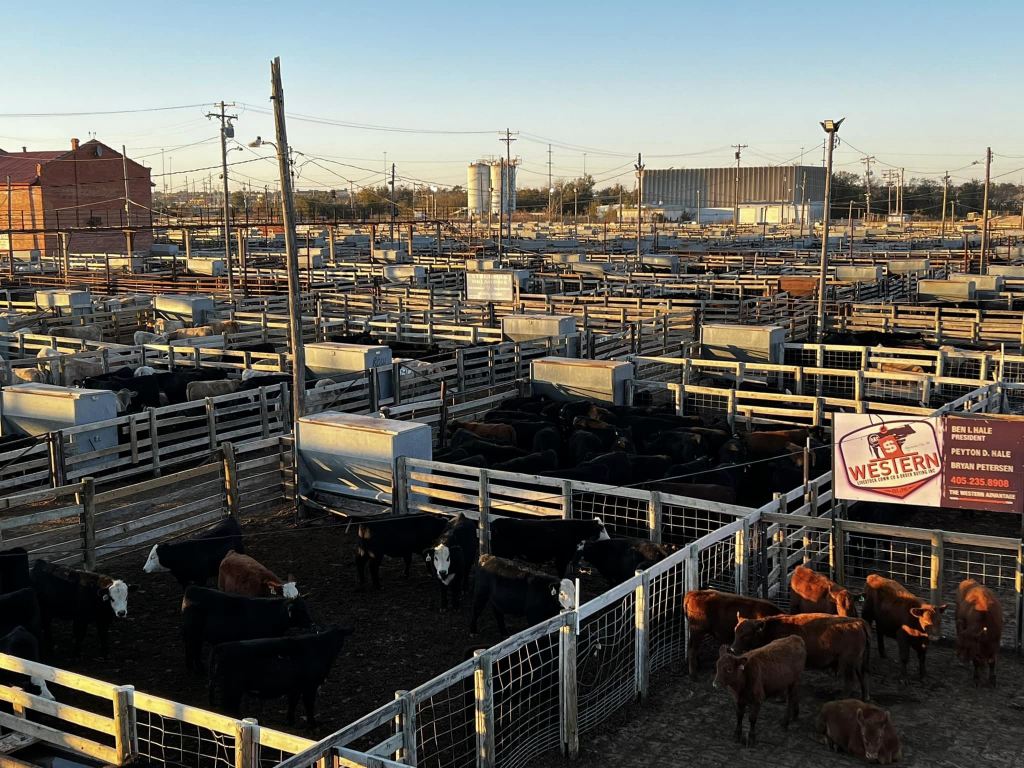
OKC West in El Reno had 9,110 head of cattle on Tuesday and Wednesday of this week.


According to USDA Market News- Compared to last week: Feeder steers steady to 5.00 higher, least advance on 700-750 lb feeder steer. Feeder heifers 3.00-5.00 higher, instance to 10.00 higher. Steer calves steady to 4.00 higher. Heifer calves mostly steady to 5.00 lower. Demand moderate to good for calves. Several nice loads of cattle available off winter graze-out. Quality average to many attractive.


OKC West Manager Bill Barnhart also weighs in on the cattle sold this week via the market's Facebook page: "The market remained strong on all classes despite the futures being down hard today. Fats traded late last week at 182-183 and are out bidding 182 today. No trade reported yet. A nice run of quality feeder cattle were offered Wednesday. Producers are doing an exceptional job raising cattle as most today were calf crops weaned in the fall and grazed on wheat pasture. The quality of the run top to bottom was the best in my time here. Good runs will continue for the next few weeks."


Click below for the complete closing report.

 
OKC West in El Reno Market Report from 02/27 and 02/28/2024
 
Each afternoon we are posting a recap of that day's markets as analyzed by Justin Lewis of KIS futures - click below for the latest update on the Livestock and Grain Futures Trade..
Click Here to Listen to Justin's Commentary From 2/28/2024
 
Okla Cash Grain:  
Daily Oklahoma Cash Grain Prices- as reported by the Oklahoma Dept. of Agriculture- The report available after the close of the Futures Trade for that day.
Read  Cash Grains Report from 2/28/2024
 
Our Daily Market Wrapup from the Radio Oklahoma Ag Network - analyzing the Futures Markets for that trading day- as reported by KC Sheperd.
Click to Listen to Our Weekday Wrap with KC
 
Slaughter Cattle Recap: 
The National Daily Slaughter Cattle Summary- as prepared by the USDA Market News
Read Report
 
TCFA Feedlot Recap:  
Finally, here is the Daily Volume and Price Summary from the Texas Cattle Feeders Association.
Read Report
Our Oklahoma Farm Report Team!!!!
 
Ron Hays, Senior Farm/Ranch Broadcaster and Editor
 
KC Sheperd, Farm Director and Editor

Dave Lanning, Markets and Production

Reagan Calk, Farm News and Email Editor

Pam Arterburn, Calendar and Template Manager

Podcasts From Oklahoma Farm Report and More

Two of our regular reports are also podcasts that you can subscribe to- Our daily Farm and Ranch News with KC Sheperd- available here on the Apple Podcast Platform


The second is our daily Beef Buzz with Ron Hays- available here on the Apple Podcast Platform


Periodically- we offer interviews on our Ag Perspectives Podcast series- this podcast is available here.


Ron has also has a series of podcasts from interviews with newsmakers at the Cattlemen's Congress- Click here or you can find them on your favorite Podcast platform- look for them by searching for Cattlemen's Congress Conversations.


We are making plans to jump back into regular installments of what has been called the Road to Rural Prosperity- a new name and fresh content is in the works- for now- click on the blue button below for one of our favorites that is a timeless classic.

Listen to Episode 86 with Ron Hays talking with one of the legends in the Beef Cattle Business- Bob Drake of Davis, Oklahoma
 
 
Listen to Ron
Beef Buzz
 
Blue Green Gazette
Calendar
Auctions
Market Links
Facebook  Twitter  Youtube  

Our thanks to Midwest Farms Shows, P & K Equipment, Oklahoma Farm Bureau, Oklahoma Ag Mediation Program, Great Plains Kubota, Stillwater Milling Company, National Livestock Credit Corporation, Oklahoma Beef Council, Oklahoma AgCredit, the Oklahoma Cattlemens Association, and  KIS Futures for their support of our daily Farm News Update.


For your convenience, we have our sponsors' websites linked here- just click on their name to jump to their website- check their sites out and let these folks know you appreciate the support of this daily email, as their sponsorship helps us keep this arriving in your inbox on a regular basis- at NO Charge!


We also appreciate our Market Links Sponsor - OKC West Livestock! 


We invite you to check out our website at the link below too that includes an archive of these daily emails, audio reports and top farm news story links from around the globe.

Head to Our Website OklahomaFarmReport.Com
God Bless!
Reach Out To Us:
Tim West
President/General Manager
Rural Oklahoma Networks

405-317-6361

***************

Mike Henderson
Director of Sales

405-615-4922

KC Sheperd
Farm Director
Radio Oklahoma Ag Network

405-443-5717

Email KC
Ron Hays
Senior Farm/Ranch Broadcaster
Radio Oklahoma Ag Network

405.473.6144
Email Ron

Alltech continues partnership of mentorship program for women in food and agriculture

Alltech is proud to continue to partner with the Women in Food & Agriculture (WFA) Mentorship Program.  Applications are now open for new mentors of any gender and for female mentees from across the global food and agriculture sector. Now in its fourth year, the free-to-join program is dedicated to supporting women across the global food and agriculture sector by providing invaluable mentorship opportunities and has proven to be a beacon of support for women seeking guidance, advice and networking opportunities in their careers.

Findings from the WFA survey and ongoing feedback from all levels of the food and agriculture sector consistently suggest that a hurdle to greater success for women in the global agri-food industry is a lack of mentorship opportunities. To tackle this issue, WFA launched its Mentorship Program.

WFA matches applicants based on their preferences, which can include gender of mentor, areas of expertise, language and industry sector, and offers opportunities for women in food and agriculture to develop meaningful industry connections. Since the inception of the program, WFA has received an overwhelming response, with 3,051 applications from individuals seeking mentorship and 1,691 industry professionals offering their mentorship services. This remarkable level of engagement underscores the program's significance in addressing the need for mentorship opportunities within the food and agriculture sector.

To date, the program has facilitated over 562 pairings, connecting mentees with experienced mentors who provide invaluable insights and support. These pairings have spanned various roles and sectors within the industry, ranging from CEOs of agribusinesses to small-scale farmers, academics, and ag-tech professionals.

"Our partnership with the Women in Food & Agriculture mentorship program is an investment not only in the lives of women, but in the future of agriculture as the industry most integral to the nourishment and vitality of our planet," said Dr. Mark Lyons, president and CEO of Alltech.

Elisabeth Mork-Eidem, global chair of WFA, expressed her enthusiasm for the program's continued success, stating, "We are delighted to see the overwhelming response to the WFA Mentorship Program, which underscores the importance of mentorship in empowering women in the food and agriculture industry. With Alltech's ongoing support, we are confident that the program will continue to make a positive impact, fostering diversity and inclusion across the sector."

Orla McAleer, chief culture officer at Alltech, reiterated the company's commitment to the program, stating, "I am excited to reaffirm our support and sponsorship of the WFA Mentorship Program in 2024. We believe in championing the advancement of women in this vital sector and helping to cultivate a more vibrant, equitable and diverse agricultural community. As a mentor and advisor to the program, I understand the value and impact the mentorship connection brings to everyone involved."

Alltech believes that inclusion cultivates creativity, drives innovation and is essential to the company's purpose of Working Together for a Planet of PlentyTM. In 2019, Alltech selected Gender Equality as one of the nine United Nations Sustainable Development Goals to which the company committed to advancing.

Applications are now open for the 2024 WFA Mentorship Program, supported by Alltech, to individuals seeking mentorship as well as industry professionals interested in offering their mentorship services. The program welcomes applications from across the global food and agriculture sector, and applicants will be personally matched based on their preferences and professional objectives. For more information and to apply to be a mentor or mentee, visit https://wfa-initiative.com/mentorship-program/.

Understanding Generation Z Purchasing Patterns to Promote Sell of Beef

Listen to Ron Hays talk with David Freelander about marketing to different generations.

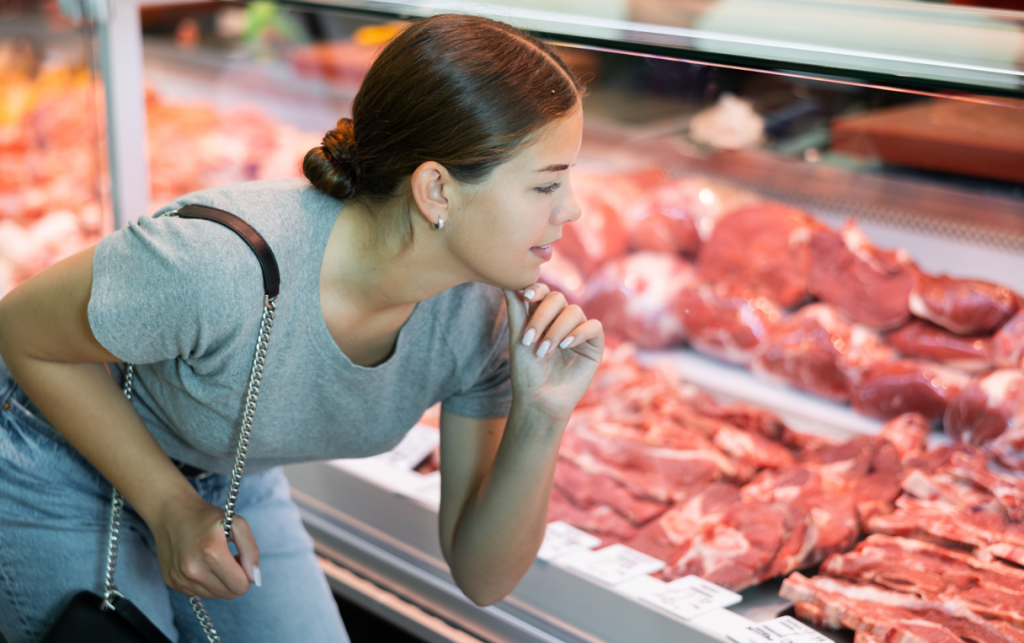
Senior Farm and Ranch Broadcaster Ron Hays is talking with the National Cattlemen's Beef Association's Senior Director for Market Research, David Freelander, about generational trends when it comes to purchasing beef.

"It is interesting because there is a lot in the media right now that talks about some of the younger generations, Gen Z specifically, avoiding beef proteins and staying away from that as a product," Freelander said. "One thing we are very curious about is how much of that is marketplace, how much of that is media, and how much is reality. Our data is actually suggesting it is more a feature of pocketbook and where they are in terms of life-stage as opposed to a preference to some of the other meat proteins, specifically."

Freelander said Generation Z is ages 18 to 26.

"We are seeing them not necessarily having a steak, but having ground (beef), or perhaps having chicken, or pork right now is a relatively inexpensive alternative if you are looking for a meat protein," Freelander said.

As Generation Z grows older, Freelander said he expects them to purchase more beef products. As a group, Freelander said Generation Z is concerned with the sustainability of products they purchase, giving back to the marketplace, and they like diversity.

"If you look at the number of farmers, ranchers, and producers around that beef industry, so many of them are local," Freelander said. "The percentage of income that goes into those farmers and ranchers goes right back into your local community whether it is your hired help or whether it is your feed."

The Beef Buzz is a regular feature heard on radio stations around the region on the Radio Oklahoma Ag Network and is a regular audio feature found on this website as well. Click on the LISTEN BAR at the top of the story for today's show and check out our archives for older Beef Buzz shows covering the gamut of the beef cattle industry today.

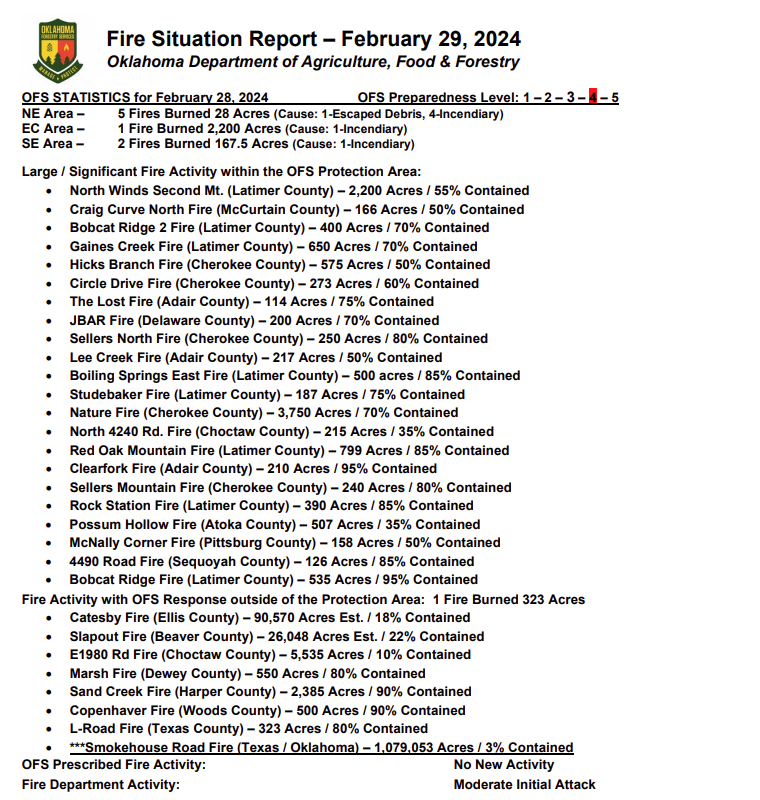
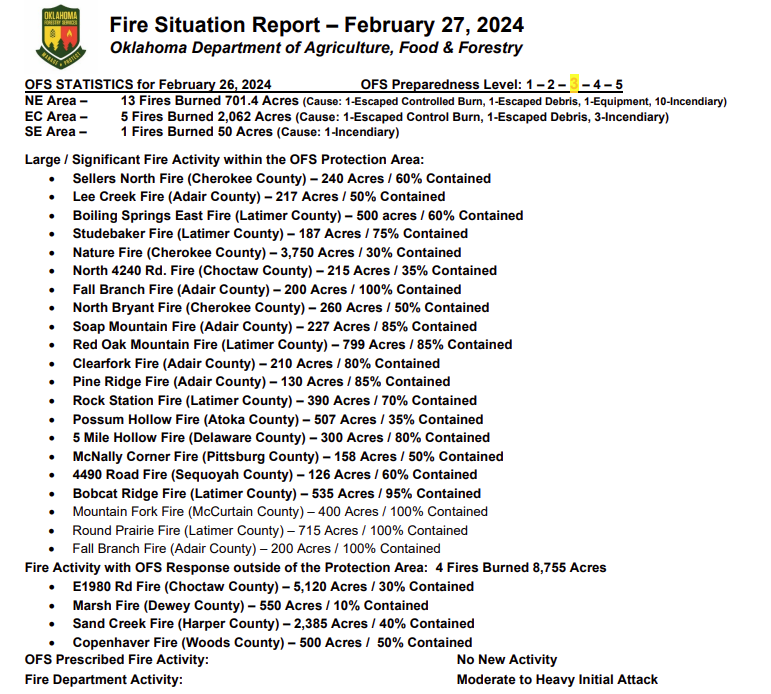
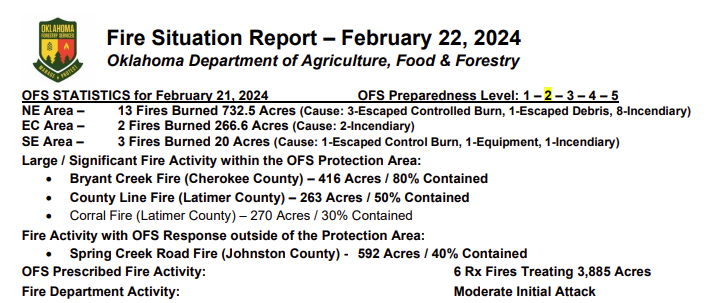
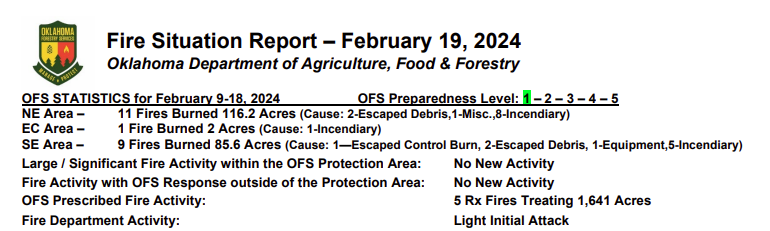
Reduced Fire Danger Today with Rain Chances

Statewide Discussion: Reduced fire danger today with some precipitation chances (very light totals expected) will offer
opportunity to improve containment on the over 30 large wildfires currently on the Oklahoma landscape. Initial attack activity is expected to be light today, although fire danger will quickly rebound into the weekend with another fire-effective weather pattern over dry, dormant fuels Saturday though Monday emphasizing another round of significant fire potential on Sunday focused in western/northwestern Oklahoma.

Today: Rain chances, generally cloudy skies and elevated relative humidity will facilitate reduced fire danger today. Reduced fire danger is a very welcomed pause this episode of significant fire occurrence, although it will be short-lived. Rainfall totals are not expected to total 0.10" for most location with realized observations more likely a few hundredths of an inch.


• Northwest Oklahoma / Oklahoma Panhandle - Temperatures hovering around or below freezing this morning will
gradually warm into the 44°-55° range with some low rain chances this afternoon over parts of northwestern Oklahoma
while the Panhandle counties are expected to remain dry. 1-hr. fuel moisture is not expected to dip below 7% today given
elevated relative humidity values and sky cover limiting potential for new fire starts. Any new fire activity will exhibit fire
manageable fire behavior with rates of spread in rangeland fuels generally less than 75 ft/min.


• Along & North of I-44 – Ample sky cover this afternoon, rain chances and elevated relative humidity values will serve to
pause potential for new fire starts today. Rain chances are highest in the southern portion of this area although amounts
will generally be negligible. Any fire activity occurring today should be easily suppressed.


• South & East of I-44: Rain chances increase into the afternoon and evening and while some locations may receive
around one-tenth of an inch, wetting rains are unlikely. New fire starts today, if there are any, should be easily suppressed.

Near-Term: Following an opportunity to improve containment on current wildfires and equipment rehab today, fire danger ramps up into the weekend. Dryline intrusion, above normal temperatures, an approaching cold front form a synoptic pattern supporting increasing concern for significant fire occurrence in northwestern/western Oklahoma. Sunday will present the most concerning alignment in the fire environment for significant fire development given any ignition.

Current 7-Day Quantitative Precipitation Forecast does not hold much hope for wetting rains over the majority of Oklahoma – especially northwestern and western Oklahoma where concern is greatest for additional significant fire occurrence in the coming days. While it is on the edge of predictability confidence, we are also eyeing potential for another fire-effective weather system later next week, OFS Resources Mobilized: Resource Hotline (800) 800-2481


• Slapout Fire (Beaver County) - Suppression Group (TFLD/Engines/Dozers)
• Catesby Fire (Ellis County) – 2 Suppression Groups (DIVS/Engines/Dozers)
• OFS resources remain committed to a number of fires as reflected above in the fire activity report.
Burn Bans: (None currently in effect) Refer to: bit.ly/OKBans for the most current burn ban information and links to specific burn ban proclamations.

FFA Members Selected to Participate in March's Next Gen Conference

National FFA developed the Next Gen Conference to give students across the country the opportunity to explore a variety of career paths before they graduate high school. Next Gen Conferences go in-depth in a different subset of the more than 350 careers in agriculture each year. This year, from March 5-8 in Dallas/Ft. Worth, Texas, the Next Gen Conference: Agricultural Communications will engage high school students in hands-on sessions, round tables, and tours to explore emerging trends, issues, and opportunities in the field of agricultural communications.

Oklahoma has one participant, Brooklyn Matlock of the Cyril FFA Chapter!

During the week, students will also develop a road map that will serve as a blueprint to guide them in taking their next steps after high school graduation. 

"The Next Gen Conferences were developed to give our members an opportunity to explore future careers in agriculture," said Ashli Weinrich, program specialist, advocacy, literacy, and ag-based experiences, National FFA Organization. "This spring conference will help us cultivate future leaders in the communication industry through a week of experiential learning, relevant education, and networking." 

Participants include:

Arizona
Haleigh O'Donnal
Dawson Rice
Peter Groseta
Trenton Castro
California
Jayne LaVigne
Colorado
Maranda Mason
Erin Tempel
Natalie Diaz
Claudia Rhoades
Idaho
Isabelle Penuelas
Joshua Nelson
Illinois
Jasmin Leon
Indiana
Emily Recker
Ellie Taylor
Sophia Shannon
Lauren Argotte
Iowa
Trell Amoss
Katrina Hageman
Natalie Schroeder
Cora Berends
Kansas
Kourtney Dibben
Kentucky
Laney Pease
Elly Hampton
Mollie Goode
Michigan
Myleigh Rohner
Sophia Barnum
Amelia Barnum
Minnesota
Grace Bayerl
Morgan Marketon
Chloe Haack
Missouri
Jaylynn Zerr
Avery Ridgley
Colton Whitney
Meah McCoy
Cash Honeycutt
Preston McMillian
Sophie Geppert
Callie Jennings
Nebraska
Emily Holz
New Mexico
Zia Miller
New York
Breanna Craven
Jack Beyer
North Carolina
Morgan Harrington
North Dakota
Bailey Urlacher
Samantha Burchill
Ohio
Katie Bryant
Jessica Campbell
Emma Brandenburg
Kaylee Jennings
Jill Garland
Addison Roller
Taylor Johnson
Joanna Hamilton
Oklahoma
Brooklyn Matlock
Pennsylvania
Frances Weaver
Remington Weaver
Tennessee
Leilah Crawford
Ariana Mota
Evalena Giles
Alyssa Calamia
Ellie Anderson
Troy Wiliams
Texas
Ryan Stanley
Whitney Kennedy
Ella Allison
Linda Beth Norwood
Tyler Bailey
Wisconsin
Josie Bailey
Sonya Merritt
Abigail Sauvola
Morgan Van Schyndle
Jordan Lamb
Elisha Vogel
Wyoming
Carla Navarro
Hannah Steele

Open to high school sophomores, juniors and seniors, participants were selected through a competitive application process. There will be two additional Next Gen Conferences this year: 
Next Gen: Food Products and Processing Systems – June 25-29, 2024, in Minneapolis, Minn
Next Gen: Environmental Services and Natural Resources Systems – Sept. 10-14, 2024, in Salt Lake City, Utah.

The National FFA Organization is a school-based national youth leadership development organization of more than 945,000 student members as part of 9,163 local FFA chapters in all 50 states, Puerto Rico and the U.S. Virgin Islands.

Major Disasters and Severe Weather Caused Over $21 Billion in Crop Losses in 2023

AFBF's Market Intel team has created a series highlighting agricultural losses incurred due to weather disasters and the disaster assistance programs meant to help mitigate their impacts. Previous articles include: 2020 Disasters Reveal Gaps in Ad Hoc Aid Legislation; Continuing Resolution Extends Disaster Coverage for Most 2020 and 2021 Losses; Kentucky, Arkansas Tornadoes, Midwest Derecho Renew Calls for Timely Disaster Assistance; 2021 Disaster Estimations Reveal at Least $12.5 Billion in Crop and Forage Losses; From WHIP+ to ERP: A New Name for 2020-2021 Ad Hoc Disaster Assistance; New Estimates Reveal Major 2022 Weather Disasters Caused Over $21 Billion in Crop Losses; Severe Weather and Low Mississippi River Levels Bring Uncertainty to Harvest; and Farmers Can Expect Limited Disaster Support from the Latest ERP Reboot.

AFBF has calculated crop and rangeland damage estimates since 2021 to provide a window into the impacts of natural disasters on domestic food production. This Market Intel updates total crop loss estimates across major weather events for 2023. Methodologies between 2022 and 2023 were changed slightly to cover more disaster events. Totals between years are not directly comparable. The methodology for these calculations is described at the end of this article.

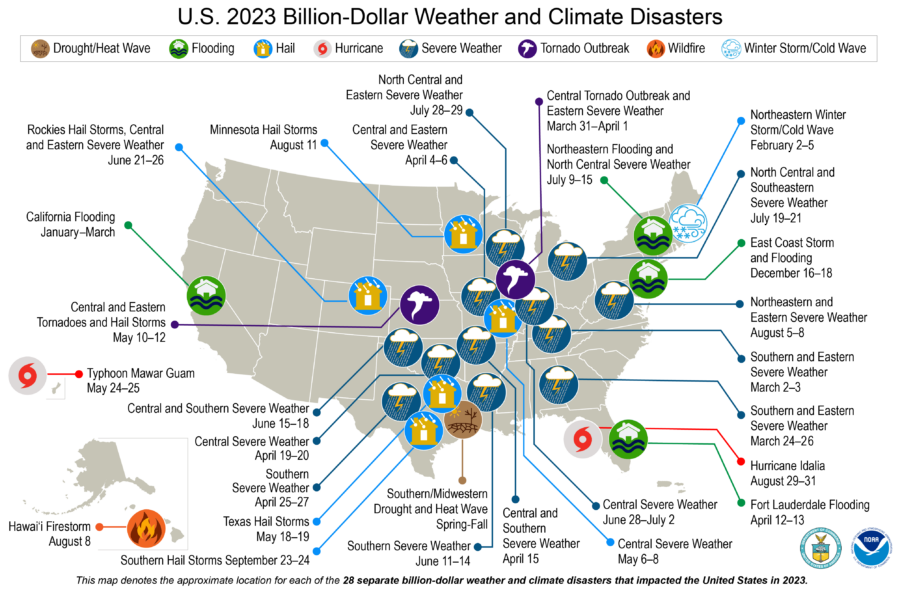
Weather-associated production risk is a part of life for farmers and ranchers. Through heavy rain, hail, snow, winds and drought, farming families prepare land, plant and harvest knowing their livelihoods are reliant on local weather conditions. In 2023, 28 weather disasters, each with damages exceeding $1 billion, struck the U.S. coast-to-coast. The National Oceanic and Atmospheric Administration (NOAA) reported that 2023 ranked ninth in terms of the total inflation-adjusted economic impact of these events, with industries across the economy experiencing an estimated $92.9 billion hit (compared to $178.9 billion in 2022). With over 490 lives lost, these disasters will haunt impacted communities for years to come.

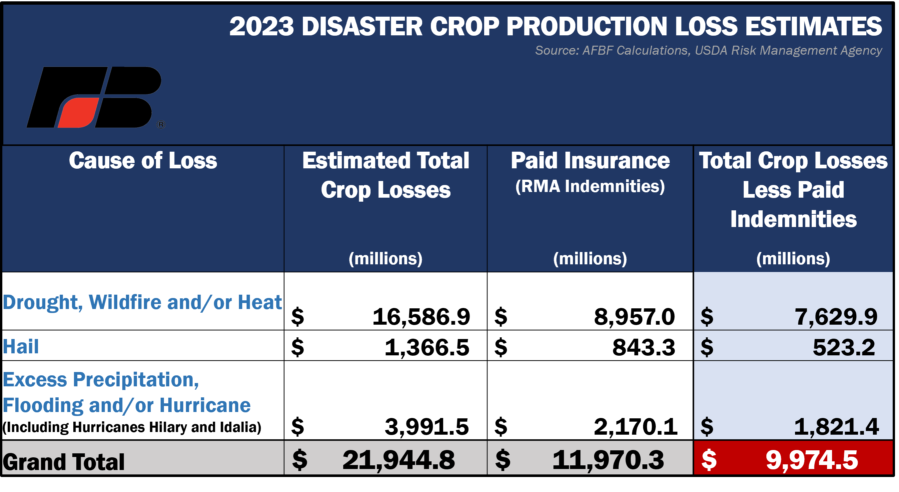
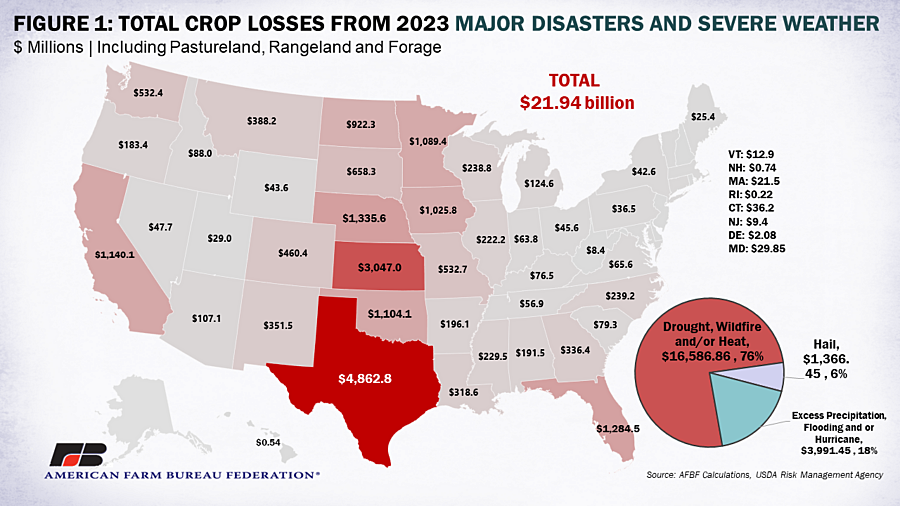
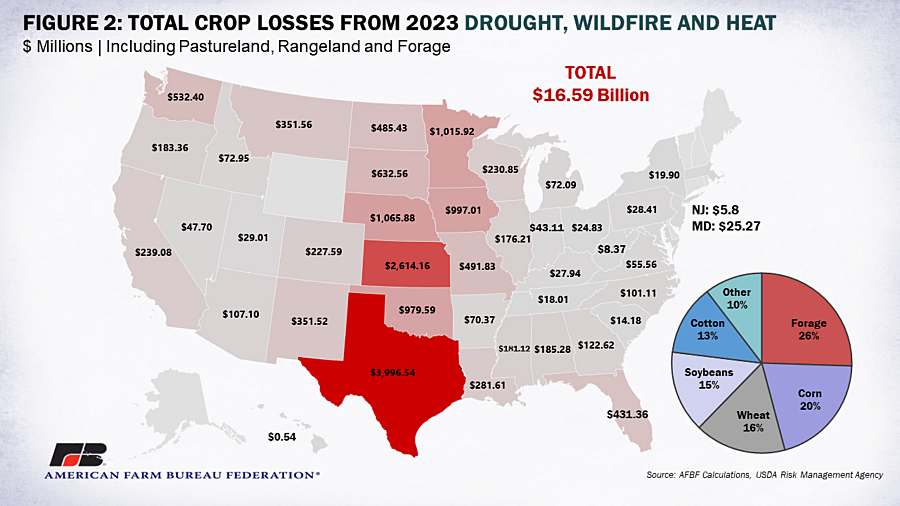
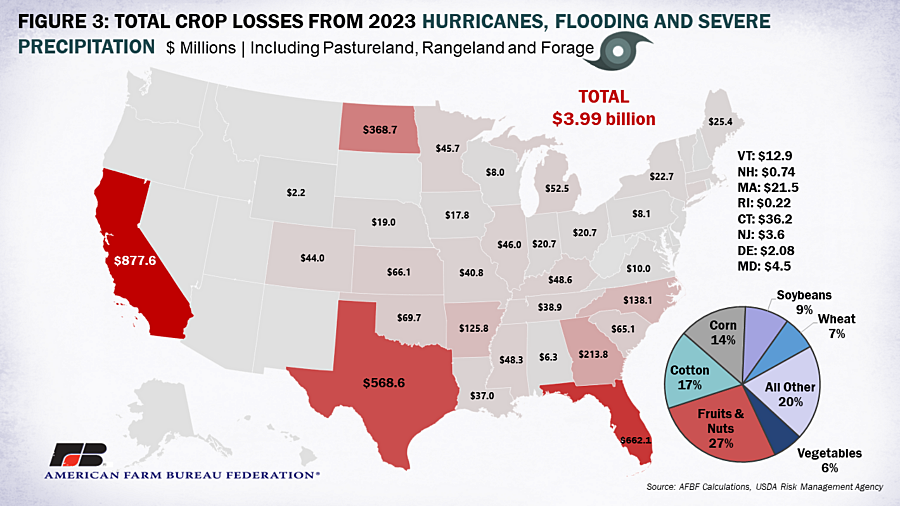
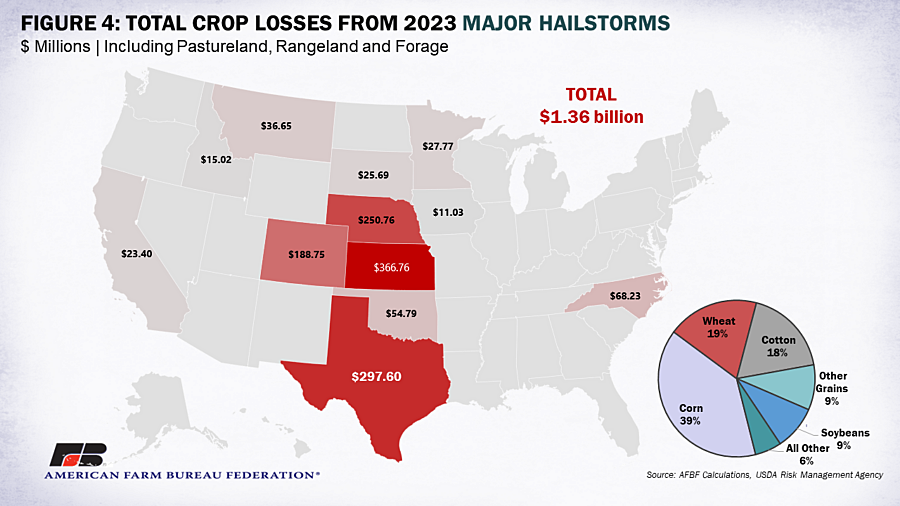
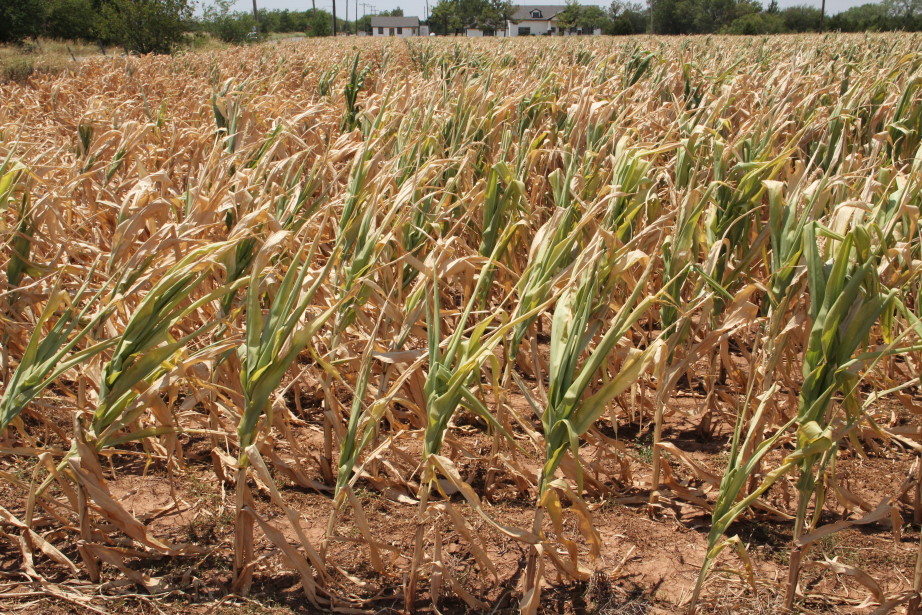
Updated crop and rangeland damage estimations for 2023 show the impacts of natural disasters on domestic farm production. The assessment puts total crop and rangeland losses from major 2023 disasters at over $21.94 billion, or 23.6% of NOAA's total economic impact figure. Of that figure, nearly $12 billion in losses were covered by existing Risk Management Agency (RMA) programs as of February 2024. Nearly $10 billion in losses were not insured through RMA, existed outside policies' coverage levels, or did not qualify under an existing risk management program. Drought, excessive heat and wildfires alone accounted for over $16.59 billion in total crop losses; $3.99 billion was linked to excessive precipitation, flooding and hurricane events; and $1.37 billion was caused by hailstorms.

AFBF crop loss estimates do not include infrastructure damage, livestock losses, complete horticulture crop losses or timber losses associated with the selected weather events. Estimates should be viewed as a minimum baseline since data to estimate these other categories are not readily available. More comprehensive analysis on individual storms may be available from local land-grant universities. For instance, Louisiana State University estimated $1.69 billion in agricultural losses from excessive heat and drought in the state, which was linked to more granular survey data and far exceeds our estimated $318 million Louisiana total. LSU's estimate includes comprehensive livestock, timber and more accurate specialty crop baselines that aren't included in this analysis.

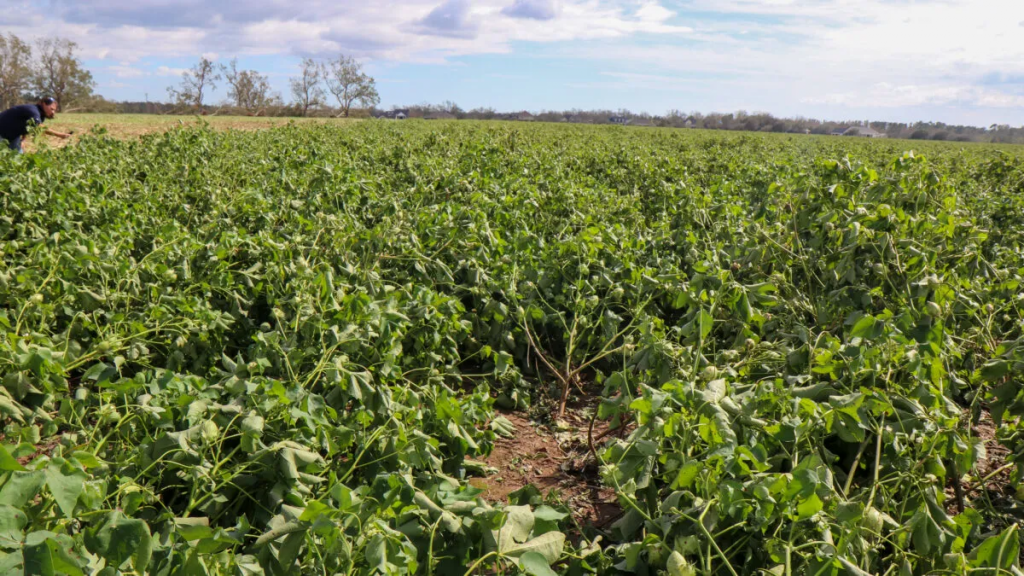
In 2023, Texas suffered the most significant hit for the second year in a row, with over $4.8 billion in incurred losses primarily made up of $2.3 billion in damages to cotton, $1.5 billion in damages to forage and rangeland and $408 million in wheat damage. Close to 80% of Texas losses were attributed to widespread exceptional drought conditions and the remainder were linked to Tropical Storm Harold, flooding and hailstorms. Kansas ranked second with over $3.04 billion in incurred losses, mainly from drought conditions and hailstorms. Kansas wheat losses totaled over $1 billion, followed by $780 million in soybean losses. Corn valued at nearly $605 million also succumbed to drought conditions in Kansas. Nebraska's losses mirrored those of its southern neighbor, with damages totaling more than $1.3 billion, over $900 million of which was linked to drought and $250 million of which was linked to hailstorms in May. Florida ranked fourth in 2023, claiming over $1.2 billion in crop losses. Losses linked to Hurricane Idalia, flooding and other precipitation events in the state accounted for over 65% of Florida's calculation. This included over $430 million in fruits and nuts, $130 million in vegetables and $214 million in nursey losses. Drought and extreme heat conditions also contributed to losses in Florida. Figures 2, 3 and 4 show state-by-state crop losses by cause of loss category.

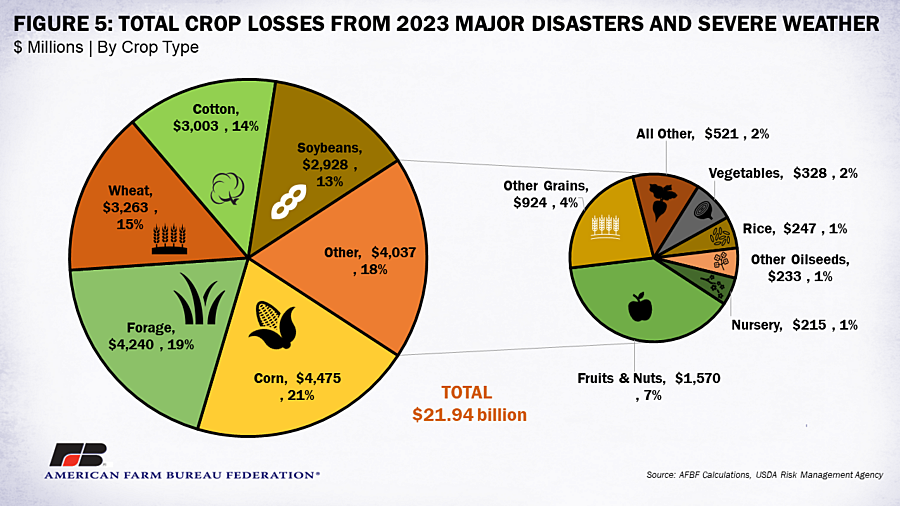
Figure 5 displays overall crop losses by type across all major weather events in 2023. The other grains category includes crops like oats and sorghum, the other oilseeds category includes canola, mustard, flaxseed, etc. and the all other category includes miscellaneous crops like tobacco, sugarcane, sugar beets and mint. As the geographic footprint of drought conditions shifted between 2022 and 2023, so did the impact on crops. In 2022, drought plagued much of the Western U.S., resulting in more pasture and rangeland losses ($6.3 billion in 2022 compared to $4.2 billion in 2023). In 2023, drought shifted and was more prevalent across the central Plains and down to the Gulf Coast, moving corn losses into the first-place spot over forage and bumping soybeans losses up by about $740 million. Wheat losses increased by about $620 million, primarily driven by drought in Kansas, Oklahoma and Texas. Cotton losses remained a bit above $3 billion as drought persisted in Texas' cotton-growing regions. Hurricane impacts on both California and Florida moved fruit and nuts losses from $400 million in 2022 to nearly $1.6 billion in 2023. This included over $350 million in orange losses primarily in Florida, over $220 million in California grape and table grape losses and over $200 million in California almond losses.

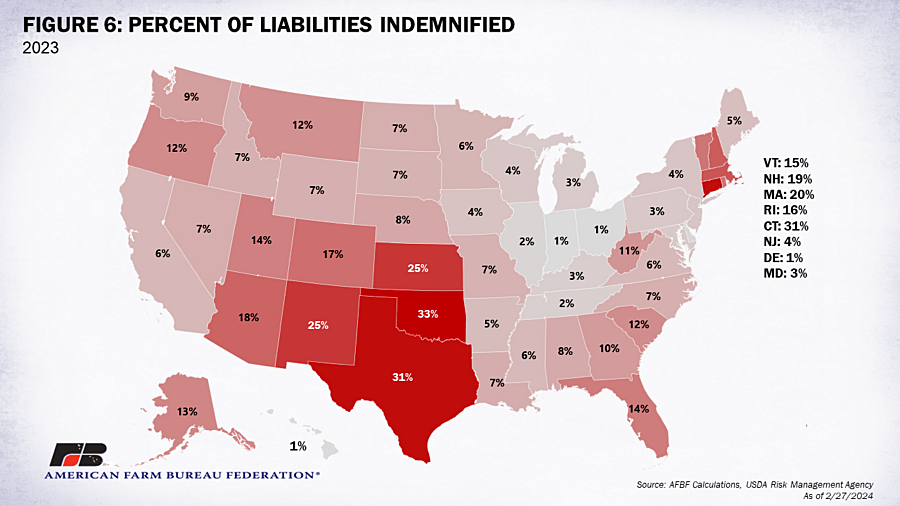
An understanding of the impact of weather disasters on U.S. agricultural production can be gained through several other statistics. The first is the percentage of total liabilities indemnified in each state. Liabilities indemnified refers to the percent of the value of crops insured that was paid out through insurance claims. A lower percentage implies lower production losses that year or very high insured acreage values, while a higher percentage implies higher production losses or very low insured acreage values. Nationally, in 2023, 7% of insured liabilities were indemnified (compared to 11% in 2022 and 7% in 2021). Figure 6 shows the variation in liabilities indemnified by state, revealing which regions had the largest percentage of their insured acreage impacted by weather events. Oklahoma and Texas led with over 30% of liabilities indemnified linked to drought. New England states like Connecticut, Massachusetts, Vermont and New Hampshire ranked very high – a result of extreme flooding that battered the region and a larger percentage of their production in July 2023.

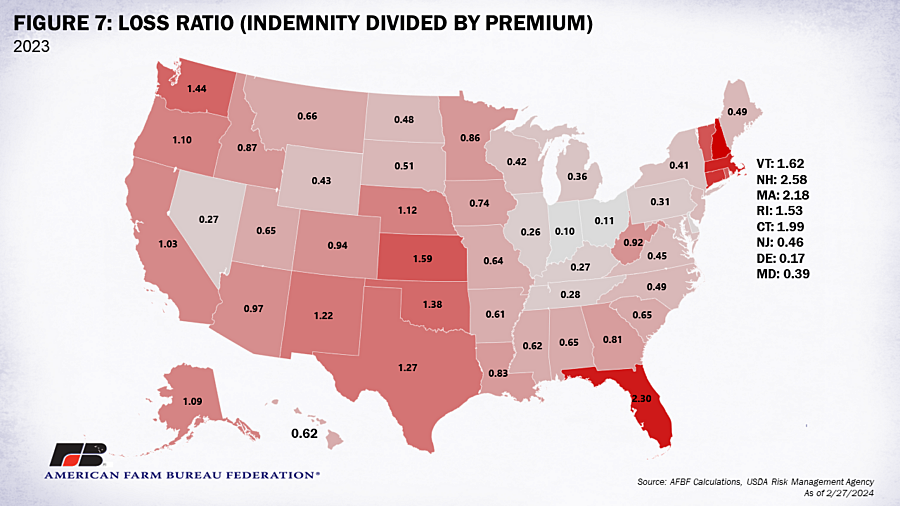
The loss ratio, or the comparison of premiums received by insurers versus payments they made for claims, highlights the performance of insurance plans in a region. As of February 2024, the national loss ratio for 2023 was 0.83, meaning for every $1 spent on premiums, insurers were paying out 83 cents – a positive return for insurers. In 2022, the national loss ratio was 1.05 meaning for every $1 spent on premiums insurers were paying out $1.05 – a negative return for insurers. States with the highest loss ratios in 2023 signal where weather disasters resulted in significant insurance payouts. New England faced the highest loss ratios for the year, with New Hampshire at 2.58 and Massachusetts at 2.18. Florida was the only other state with a loss ratio over 2 in 2023. It is important to note in a national loss ratio that the substantial acreage concentrated in states with lower loss ratios (Indiana, Illinois, Ohio) balances out states that have fewer acres of protected ag land but may have faced higher proportional losses.

Traditionally, federal crop insurance programs are the preferred mechanism for managing risk associated with weather-related disasters for most agricultural products. These policies provide protection from yield losses, increased costs and revenue declines, as well as very timely payment. Unanticipated disaster situations like large-scale weather events pose the optimal test for these programs as disaster relief, designed as they are to provide targeted risk management under more probable and common loss conditions. Losses that occur outside the scope of these conditions and the specified terms of a policy complicate farmers' ability to qualify for indemnity payments. For some specialty crops, like strawberries, lettuce and hazelnuts, RMA options are unavailable and other programs, like the Noninsured Crop Disaster Assistance Program, often fall short.

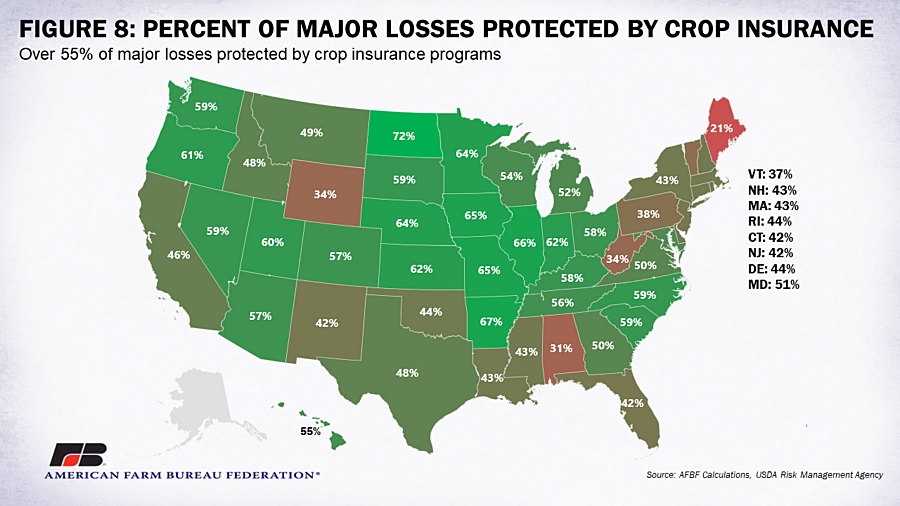
Notably, in 2023 over 55% of crop losses from the analyzed disasters were protected through crop insurance. This ranged from a low of 21% in Maine to a high of 72% and 67% in South Dakota and Arkansas, respectively. States with a higher concentration of row crop production generally benefit from better access to crop insurance options, resulting in more acreage being insured at higher coverage levels. States with more specialty crops and/or weaker assumed familiarity with crop insurance options had much lower rates of insured acreage and lower protection in place generally (Figure 6). Gaps in coverage highlight opportunities for improvements to crop insurance and disaster assistance programs.

Congress has often responded through ad hoc disaster assistance programs to fill gaps in existing risk management programs during periods of extreme disasters. On Oct. 27, 2023, USDA announced that some commodity and specialty crop producers impacted by natural disasters in 2022 would be eligible to receive emergency relief payments to offset crop yield and value losses through a modified continuation of the Emergency Relief Program (ERP). The allocation of $3 billion in funds, however, pales in comparison to the $10.4 billion gap in crop loss coverage estimated by AFBF for 2022 losses, meaning many farmers will go without assistance until support is expanded. Additionally, the program's new progressive factoring methodology reallocates support to a small percentage of operations, a puzzling approach when natural disasters devastate operations of all types. No ad hoc support has been allocated thus far for farmers who faced losses in 2023, meaning the waiting continues. Further discussion of existing farm bill disaster programs and recent ad hoc authorizations can be found here.

Conclusion

Weather-related disasters in 2023 pummeled farms and ranches across the United States, leaving over $21.9 billion in crop and rangeland losses in their wake. Over half of those losses were effectively protected under existing risk management programs, with the remainder highlighting the importance of inclusive protections for growers of all crops in all regions of the nation. Not to mention, the full extent of damage across the sector is likely far higher when livestock, infrastructure, timber and other ag-related factors are considered. The stability of U.S. farms and ranches relies on their ability to be resilient under an array of  weather conditions. The farm bill provides lawmakers a chance to fill gaps in existing risk management programs, providing similar risk management opportunities for farmers regardless of what they grow. The sure and timely payments associated with crop insurance and other farm bill programs are often critical for farm-level stability, and ultimately for a safe and secure domestic food supply.

Methodology

To begin, AFBF economists compiled a list of states impacted by weather events in 2023 that would have qualified for ERP. All D2-D4 droughts, hurricanes and wildfires were included. This year, hailstorms and excessive precipitation events were also included given their role in many of NOAA's billion-dollar weather disasters. Affected states were selected using the National Drought Mitigation Center's U.S. Drought Monitor and the Federal Emergency Management Agency's presidential disaster list. States that had any form of D2-D4 drought were automatically included in the analysis. States that suffered one or more of the weather events that qualify for ERP, had a billion-dollar weather disaster as reported by NOAA and or had a presidential-declared disaster were also included in the analysis.

The analysis utilizes RMA crop insurance data to estimate losses if all crop acreage was insured with complete (100%) protection. Methodologies mimic those used by NOAA's National Climatic Data Center to estimate losses in their annual "Billion Dollar Climate and Weather Disasters" reports (first described in Smith, Katz 2011).

RMA reports on total indemnities (total insurance compensation) paid for each cause of loss (drought, hurricane, flooding, fire, excess moisture, hot wind, etc.) in a given month for each crop type by state. Each storm is defined with a set of cause of loss types based on the weather event and its related conditions covered by ERP. For instance, for hurricanes, the following causes of loss filters were included: excess moisture/precipitation/rain, flooding, hurricane/tropical depression and wind/excess wind. Data was also filtered by the month(s) the storm impacted each state. Once indemnity payments for crops were totaled, adjustments were made for losses outside insured acreage and coverage levels.

This is achieved by first calculating the percent of insured acres in each state (using 2022 data from USDA's National Agricultural Statistics Service and 2023 RMA summary of business data). It is assumed all acreage of a given crop within a state has been equally impacted by a particular disaster. Then RMA coverage level data is used to find the average coverage rate for each crop in each state. Based on these stats, a factor approach defined as 1/ [(% acres insured) (average coverage level %)] is utilized to come up with a multiplier to estimate 100% of losses. This was repeated for crops in each affected state and totaled.

Using a real-life example: In Florida, 56% of pepper acreage was insured in 2020. Of the covered pepper acreage in Florida, insurance covered an average of 62% of losses. Following the formula described above, Florida pepper indemnities were multiplied by 1/(0.56*0.62), or 2.88, to estimate 100% of losses.

Additional related loss estimates were calculated using reported indemnities paid out under code 55, or the "ARPI/SCO/STAX/MP/HIP WI Crops Only" RMA cause of loss category. RMA is unable to differentiate the cause of loss for indemnities paid out under code 55, therefore it is assumed all losses to "pasture, rangeland, forage" were due to a qualifying disaster in the month(s) the disaster took place. Pasture, rangeland and forage acreage coverage was calculated using national Natural Resources Conservation Service private rangeland estimates.

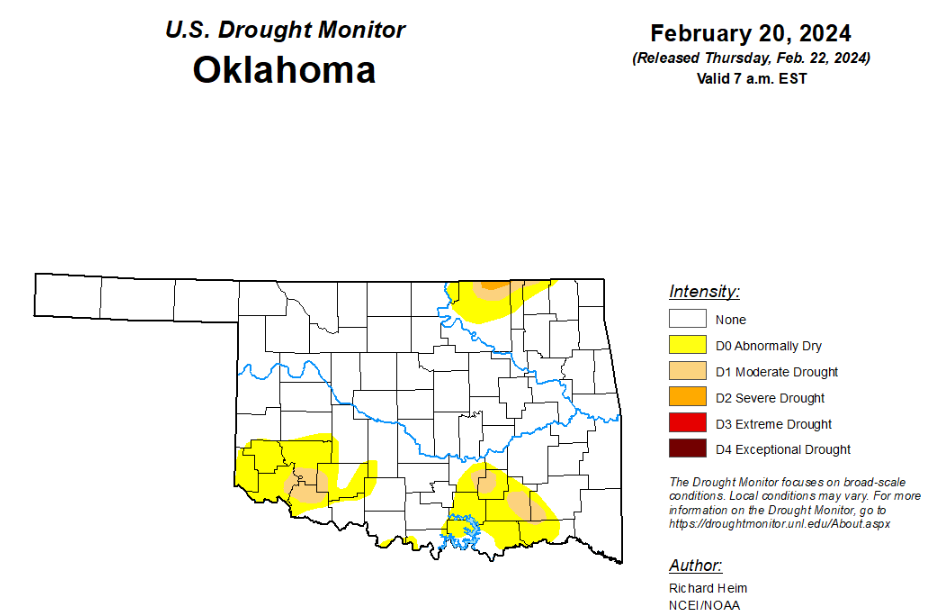
Most of Oklahoma's Drought Map Stands Still While Abnormally Dry or Worse Conditions See Big Jump

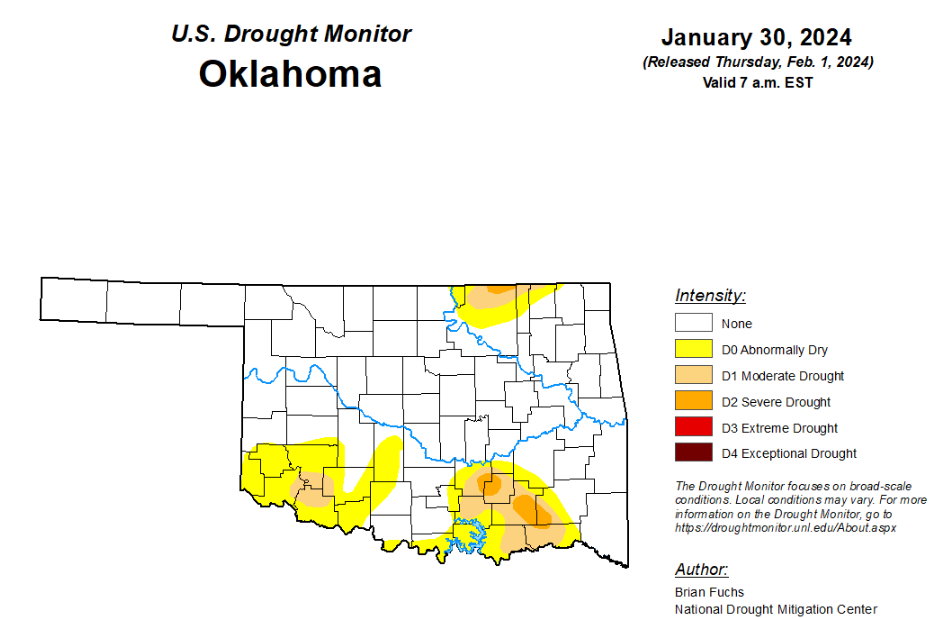
To view the latest Oklahoma drought map, CLICK HERE.

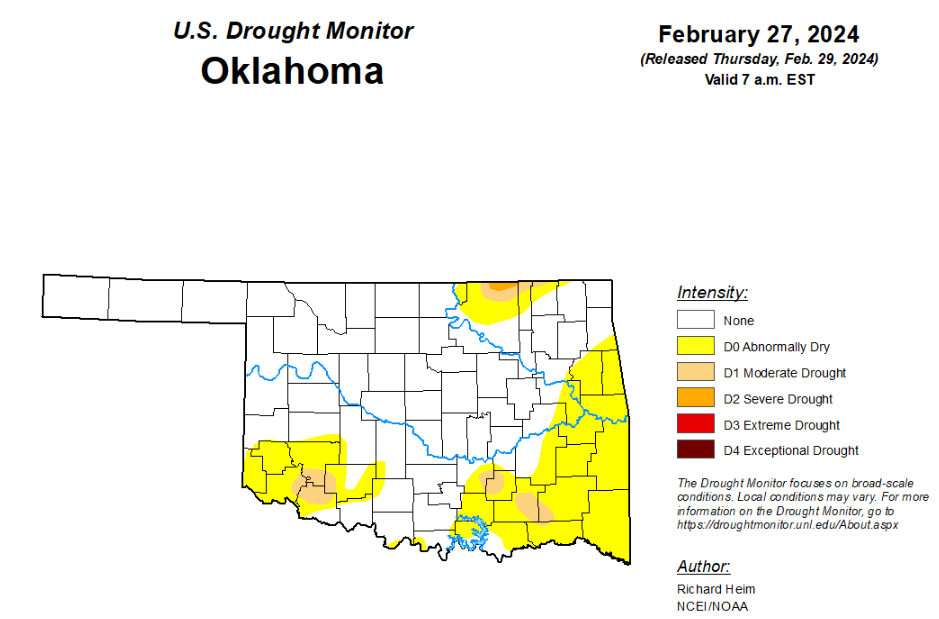
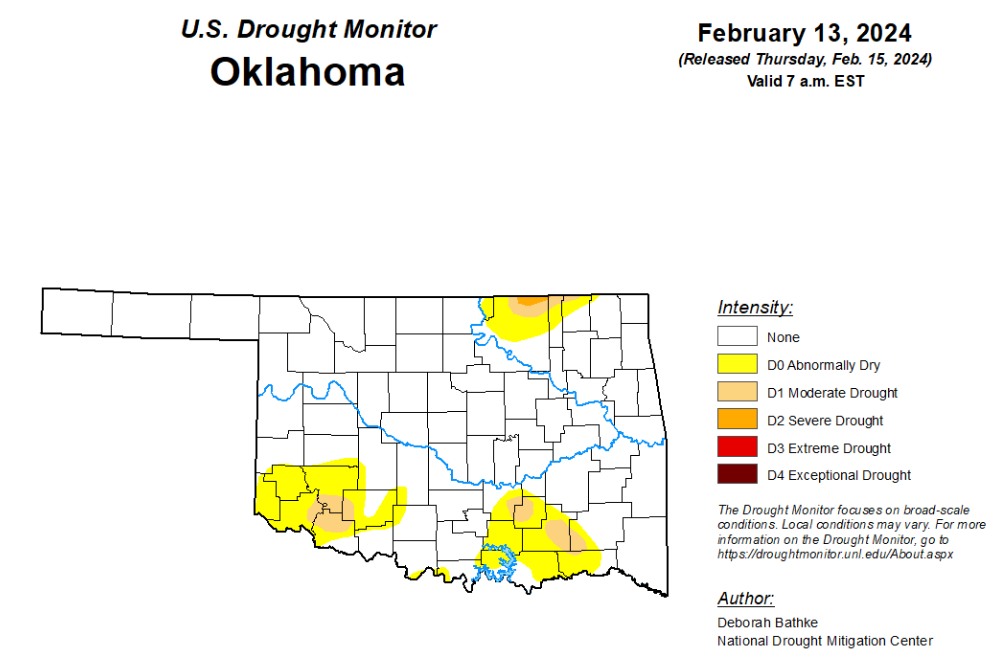
According to the latest Oklahoma drought monitor report, exceptional drought remains at zero percent, unchanged from the start of the calendar year.

Extreme drought or worse remains at zero percent, unchanged from the past nine weeks.

Severe drought or worse is unchanged from the past two weeks at .19 percent.

Moderate drought or worse is unchanged from the past two weeks at 3.23 percent.

Abnormally dry or worse conditions have increased from last week's 16.61 percent to 30.80 percent.

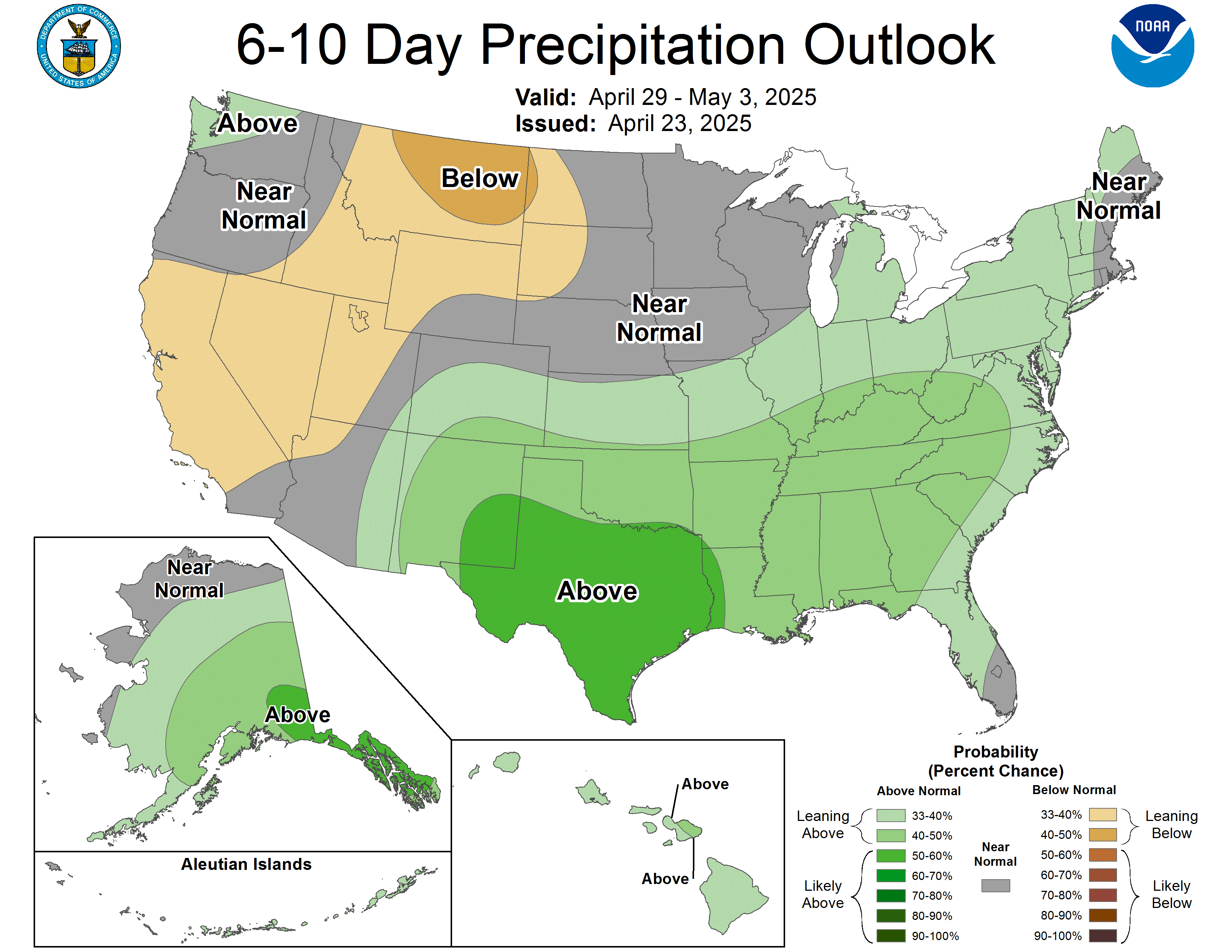
According to the 6-to-10-day precipitation outlook map, the Panhandle is likely above a 50 to 60 percent chance of precipitation through March 9, and the rest of the state is leaning above a 40 to 50 percent chance of precipitation through that date.

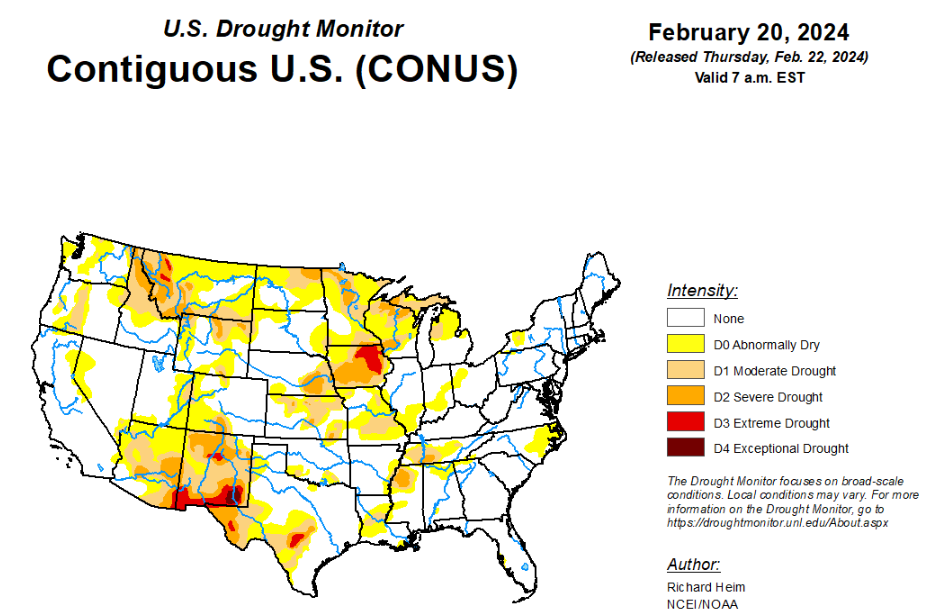
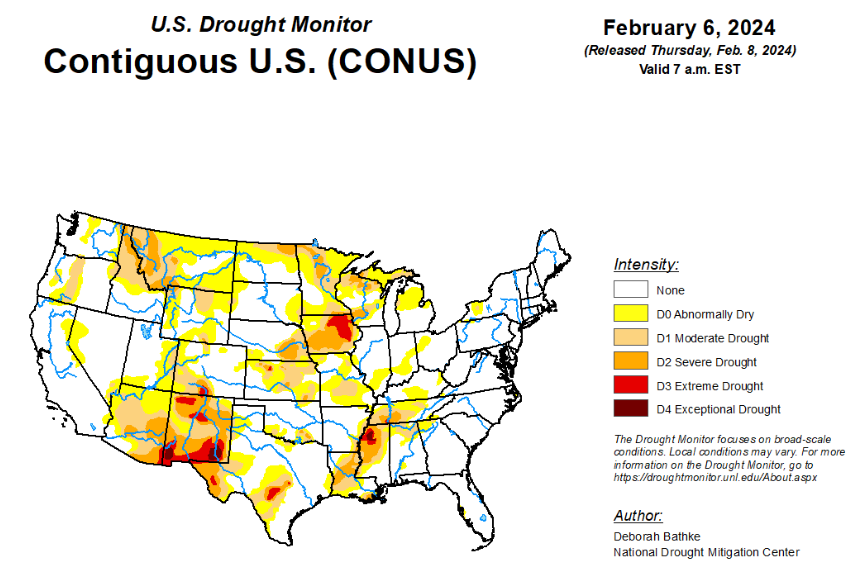
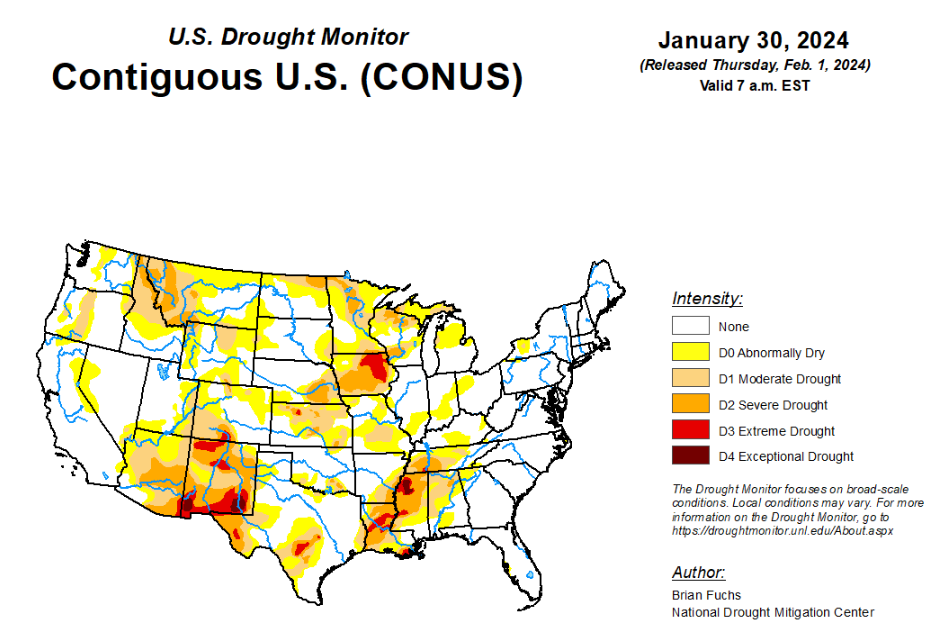
To view the United States Drought Map, click here.

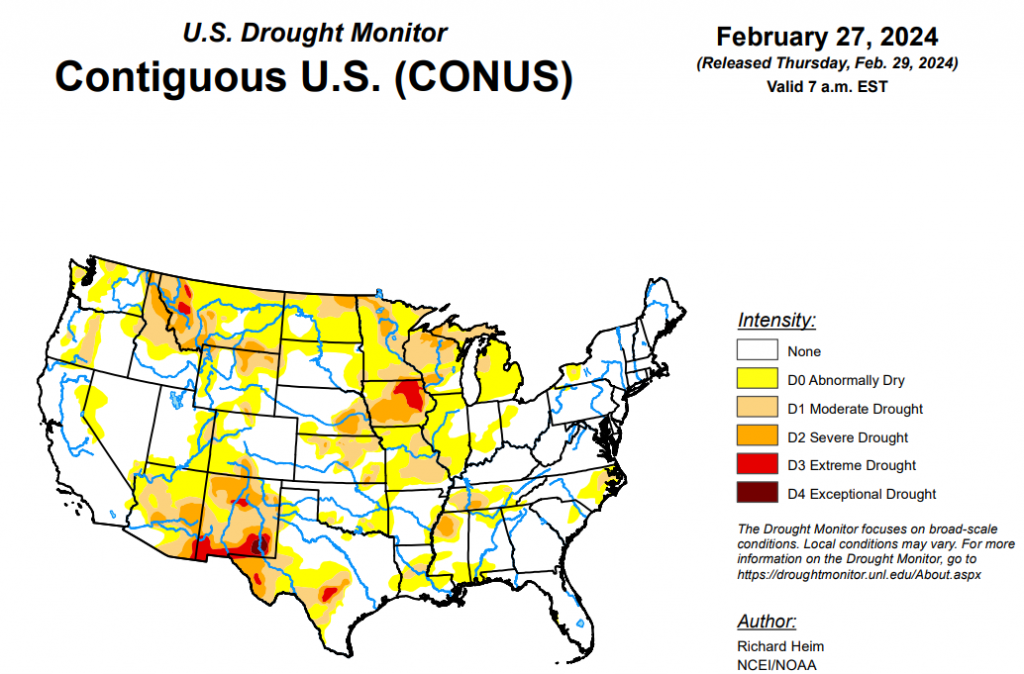
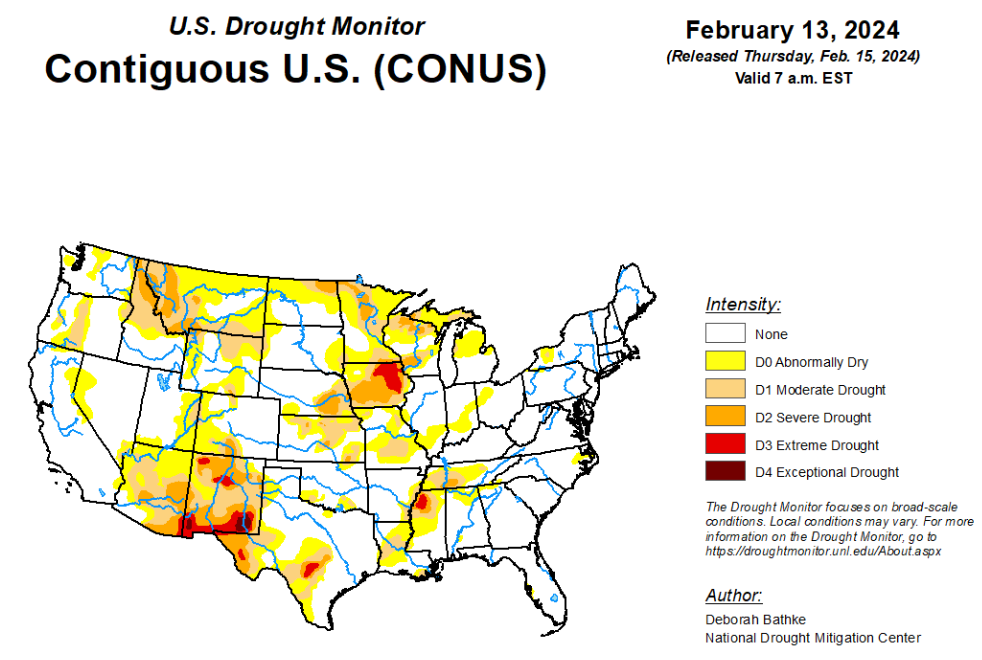
According to the latest U.S. Drought Monitor Report, several weather systems moved across the contiguous U.S. (CONUS) during this U.S. Drought Monitor (USDM) week (February 21-27). Their fronts and surface lows spread rain and snow across parts of the West at the beginning and end of the week, and over the Tennessee to Ohio Valleys and Appalachians at mid-week. These systems were associated with an upper-level circulation pattern that consisted of low-pressure troughs just off the west coast and east coast, with a high-pressure ridge over the central part of the country. The ridge brought above-normal temperatures to much of the CONUS, from the Rocky Mountains to Appalachian Mountains, with weekly temperatures averaging 15-20 degrees F above normal from Texas to the northern Plains and Upper Mississippi Valley. Temperatures averaged near to cooler than normal in parts of the interior West to Pacific Coast and along the Eastern Seaboard. The ridge also inhibited precipitation from the Rockies to Mississippi Valley. The precipitation in the West was mainly over mountain ranges but was not enough to improve drought conditions. The precipitation in the Midwest was enough to prevent further drought expansion or intensification where it was wetter than normal for the week. In other areas, drought or abnormal dryness expanded or intensified in parts of the Plains and Midwest, and a few parts of the Pacific Northwest, Gulf of Mexico coast, and Mid-Atlantic coast.

In the Southern Plains, northern parts of Tennessee received 0.5-1.5 inches of precipitation this week, but most of the South region was dry with no precipitation occurring. Much warmer-than-normal temperatures accompanied the dryness, with daytime maximum temperatures in excess of 90 degrees F recorded in Texas. Dallas/Fort Worth reached 94 on February 26, which was a daily record and 31 degrees above normal. The hot temperatures increased evapotranspiration which drew moisture out of the soils. The recent dry weather, accompanied by low relative humidity and windy conditions, contributed to an outbreak of wildfires across parts of the region. D0 expanded in southwest Texas where air temperatures were hot, soils were hot and dry, and the last 3 months were drier than normal. Dry 1- to 3-month SPI values prompted expansion of D0 in eastern Oklahoma and adjacent parts of northeast Texas and western Arkansas. Dead fields in Sebastian County, Arkansas, were reported via the CMOR (Condition Monitoring Observer Reports) reporting system. D0 expanded in southern Mississippi, adjacent parts of Louisiana, and southeast Texas where SPI was dry, streamflow was low, and some soil moisture indicators showed dryness, and D0 expanded in southeast Tennessee where 1- to 2-month SPEI (Standardized Precipitation Evapotranspiration Index) showed dry conditions. A reassessment of data resulted in the deletion of the relic D0 along the southeast Louisiana coast.

In the High Plains, were a few areas of half an inch to locally 2 inches of precipitation in the High Plains region this week – in North Dakota and parts of Colorado and Wyoming. But the rest of the region had little to no precipitation. Daily high temperatures reached into the 80s F some days in Kansas and up to the 50s and 60s in the Dakotas. Weekly temperatures averaged 10 to 20 degrees above normal across most of the region, increasing evapotranspiration (ET). Since this is February and vegetation is still dormant, the above-normal ET had little effect on vegetation, but soil temperatures were well above freezing in southern parts of the region and the high ET helped to dry soils. D0 expanded in the Dakotas, and D1 crept into northwest North Dakota, to reflect the 1- to 2-month dryness and unusually warm temperatures, and D0 expanded in eastern Kansas where recent precipitation has been low and soils were drying. In Wyoming, very low mountain SWE (snow water content) and dry 1- to 4-month SPI values prompted the expansion of D0-D2.

In the West, two to locally 5 inches of precipitation fell in the Oregon and Washington Cascade and Coastal mountains this week, with half an inch to locally 2 inches in the northern and central Rockies and southern California, and 0.5 to 1.5 inches in the Sierra Nevada and parts of coastal California. Outside of these areas, precipitation was generally less than a fourth of an inch, with rainshadow areas and the Southwest (Four Corners States) mostly dry. The precipitation was above normal for the week in some areas, particularly parts of the Cascades, Rockies, and southern California. But amounts were not enough to bring month-to-date totals to near normal values, with these areas still well below normal for the month. And snowpack improved little, with just a few inches of new snow added to most Cascade and Coastal mountain SNOTEL sites. Mountain snowpack and SWE values were still well below normal to near-record low in Washington, Oregon, Idaho, and Montana. In California, as of February 27, mountain SWE was 94% of normal in the northern Sierra Nevada Mountains, 78% of normal in the Central Sierra, and 76% of normal in the southern Sierra. In Washington, D0-D1 was expanded in the northern Cascades and D1 added to the Olympic Mountains to reflect the low snowpack and subnormal precipitation. Low SWE and 1- to 4-month SPEI values resulted in expansion of D0-D3 in parts of Montana.

Looking ahead, in the two days since the Tuesday valid time of this USDM, Pacific moisture continued to move across the Coastal and Cascade ranges in the Pacific Northwest, with precipitation falling in areas east of the Mississippi River and in parts of the southern Plains. For February 29-March 5, a ridge over the eastern CONUS will bring warmer-than-normal temperatures to much of the country east of the Rockies while a trough contributes to cooler-than-normal temperatures in the West. Forecast models predict a wet period for much of the West, in the Upper Rio Grande Valley, and from the Lower Mississippi Valley to the East Coast, as low-pressure systems and fronts bring locally heavy precipitation. The Coastal, Cascade, and Sierra Nevada mountain ranges could see 5 to 10 inches of precipitation, or locally more, while the central to northern Rockies could receive 2 to 4 inches of precipitation. Parts of southern New Mexico and western Texas could receive up to an inch of rain. An inch or more of precipitation is predicted from southern Louisiana to southern New England. Outside of these wet areas, up to half an inch of moisture could fall in the lower elevations of the West, across the northern and southern Plains, and Midwest to Northeast. Areas that could miss out on the precipitation stretch from southern California to the central Plains, where little to no precipitation is expected, and the southern Plains and Mid-Mississippi Valley to eastern Great Lakes, where less than a fourth of an inch may fall.

For much of the next 2 weeks, the atmospheric circulation is expected to continue an upper-level trough over the western CONUS and a ridge over the eastern two-thirds of the country, with Pacific weather systems migrating through the trough/ridge pattern. The Climate Prediction Center's (CPC) 6-10 Day Outlook (valid March 4-8) and 8-14 Day Outlook (valid March 6-12) favor a fairly stable pattern of warmer-than-normal temperatures from the Plains to East Coast and cooler-than-normal temperatures over the West and Alaska. The outlook is for above-normal precipitation over eastern and southern Alaska and much of the CONUS, especially east of the Mississippi River, with odds favoring near to below-normal precipitation over the northern Rockies to northern Plains and over the west coast of Alaska.

To view the 6-10 Day Precipitation Outlook Map, click here.

To view the 6-10 Day Temperature Outlook Map, click here.

To view the Monthly Drought Outlook Map, click here.

Early Voting Begins!

Early voting begins today for voters across the state! Early voting locations will be open Thursday, February 29 and Friday, March 1 from 8 a.m. to 6 p.m. Early voting will also be available Saturday, March 2 from 8 a.m. to 2 p.m. No excuse is need to vote early, but you must vote at an early voting location within the county where you are registered to vote. A list of early voting locations is available on the State Election Board website.

As a reminder, Oklahoma has three presidential primary elections – Republican, Democratic, and Libertarian. Some voters will also have local elections on the ballot. The election list is available on the State Election Board website. You can view a sample ballot by logging in to the OK Voter Portal.

For the 2024-2025 election years, the Democratic Party has opened its primaries to Independent voters. However, the Republican and Libertarian parties have chosen to keep their primaries closed – meaning only registered voters of a party may vote in that party's primary election. Independent voters who wish to participate in the Democratic Party primary, must request a primary ballot from election workers.

Voters should be sure to check the OK Voter Portal or the election list for non-partisan elections and/or propositions on the ballot. Voters do not have to participate in a primary election in order to vote a non-partisan ballot. 

Voters should be prepared to show a valid form of identity when checking in with election officials at their early voting location. More information on proof of identity can be found on the State Election Board website.

Those with questions should contact their County Election Board or the State Election Board at (405) 521-2391 or info@elections.ok.gov. 

Council And Cooperators Announce Partnership To Support Ethanol-Based Cooking, Transport In Mozambique

On February 29, the U.S. Grains Council (USGC) convened high-level U.S. and Mozambican government officials, industry professionals and other stakeholders to discuss the benefits and challenges of using ethanol biofuel to meet the country's clean energy goals in both cooking and transportation. During the event, the USGC, Pivot Clean Energy Co (Pivot) and the Mozambique Ministry of Mineral Resources and Energy (MIREME) signed a memorandum of understanding (MOU) in the presence of U.S. Department of Agriculture (USDA) Deputy Secretary of Agriculture Xochitl Torres Small and U.S. Ambassador Peter H. Vrooman. The MOU establishes a cooperative partnership to exchange technical expertise and best practices related to the biofuels industry and clean energy policy development.

"Today's conversation is critical to helping families in Mozambique use a healthier cooking fuel, which in turn provides cleaner air for everyone," Small said. "Using biofuels in cooking is one of many great examples of how agriculture provides real solutions to everyday challenges. As all of us face increased disaster, drought and other climate change impacts, USDA is committed to making a difference through viable, climate smart practices and sharing them with partners around the globe."

Participants included Mozambique governmental representatives from the energy, environment and agriculture sectors, along with representatives from local fuel distributors, technology companies, national refineries, agro-industrial industries, oil and gas, finance, logistics and transportation.

"Through this MOU signing, the Council supports the Mozambique government in its pursuit of ethanol blending initiatives and clean cooking development," said Mohamed Salah Bouthour, USGC deputy regional director – Africa. "This MOU seeks to further strengthen the relationship between biofuels experts from the United States and Mozambique governmental and private stakeholders. We offer a sincere thank you to MIREME, Pivot, the USDA's Foreign Agriculture Service, local embassy staff and the U.S Department of Commerce for their continued partnership in this endeavor."

The event – "Fueling Forward to Sustainable Energy" – focused on the use of ethanol (alcohol) for clean cooking. In pursuing ethanol burning stoves for household cooking that produce no soot or smoke, users can limit air-borne health risks and air pollution. Also discussed were topics including ethanol's role in the global energy transition; ethanol's contribution to greenhouse gas (GHG) reduction; the ethanol production chain; ethanol pathways for domestic production; local clean cooking initiatives and standards applications, and regional challenges and opportunities towards ethanol policy.

"This partnership shows the initiative of the Mozambican government to meet the goals established in their Economic Stimulus Measures Package (PAE reforms) around biofuels development. We are pleased to see momentum gaining in this area and look forward to working with multiple parties to support solutions for clean energy in the transportation and clean cooking sectors that will have widespread benefits in many adjacent sectors, including the potential to lower carbon emissions, improve health outcomes and increase local, green jobs," said Alicia El Mamouni, executive director of Pivot.

In recent months, Mozambique has discussed strategies for producing clean energy to reduce pollution and costs in the import of fossil fuel. While the government of Mozambique has mandated that ethanol and biodiesel be blended with gasoline and diesel, it is still developing its standards and blending regulations. A 10% ethanol mandate exists in Mozambique and the country has planned development of a strong oil and agriculture economy that expects to use biofuels to facilitate this growth.

Biofuel blending reforms will reduce the country's reliance on fuel imports and create a market for Mozambique's large agricultural sector to meet growing demand for biofuels. "The Council is delighted to collaborate with Mozambique and Pivot to share our experiences from the U.S. ethanol industry and provide technical assistance," Bouthour said. "This partnership will underpin growth of the ethanol industry in Mozambique and across the region."

Bayer Carbon Program Expands Eligibility, Creates New Potential Revenue Streams for Thousands of US Farmers

Bayer announced today several enhancements to its Bayer Carbon Program that provide all-new opportunities for more U.S. farmers to earn incentives for implementing regenerative agriculture practices that sequester carbon while promoting soil health. Within these enhancements includes the addition of Oklahoma into the Bayer Carbon Program.


The updates include expanded enrollment eligibility that gives more farmers access to potential new revenue streams for participating. In addition, an extended historical performance period for fields with eligible practice changes and a new Nitrogen Management Program could increase a farmer's per-acre payment potential.1

The Bayer Carbon Program is part of ForGround by Bayer, Bayer's digital platform of resources and program options, designed to help U.S. farmers realize the soil health benefits of regenerative agriculture practices, like reducing tillage and planting cover crops. The carbon program creates a mutually beneficial model that pays farmers for their efforts to sequester carbon through regenerative agriculture practices. 


Farmers who enroll eligible fields, perform their selected regenerative agriculture practices and pass practice verification, have the potential to earn an annual payment of up to $12 per acre. If a farmer participates in the Nitrogen Management Program, that payment could be as high as $16 per acre in years when the enrolled field is planted with corn.2 Plus, depending on when the selected practices were adopted, farmers could receive a one-time historical practices payment of up to $48 per acre for implementing cover crops and select reduced tillage practices beginning on or after August 1, 2019.1


Unlike some other carbon-based sustainability programs that incentivize farmers, the Bayer Carbon Program bases revenue potential on the practices performed, instead of how many tons of carbon are captured. This simple and certain approach reduces the farmer's risk by communicating upfront at the time of enrollment how many dollars per acre they will be paid if they meet all program requirements. Farmers can choose the eligible cash crops and practices they want to adopt, while Bayer provides agronomic support, performs soil sampling and helps with data collection and verification.


These new enhancements not only open the Bayer Carbon Program to thousands of additional farmers across the U.S., but also introduce more opportunities for them to earn. These include:

  • Additional States: Expanding geographic footprint to 28 total states.3
  • Eligible Practices: Program accepts no-till/strip-till and/or cover crop practices rewarded at $6 per acre, per practice.4 Plus, the addition of a new Nitrogen Management Program, rewarded at $4 per acre.2
  • Expanded Cash Crops: In addition to corn, soybeans and wheat, the following crops will now be eligible: barley, sorghum, oats, rye, millet, dry beans, lentils, chickpeas and peas.
  • Early Adoption and Historical Payment: New this year, fields with practice change on or after August 1, 2019, may be eligible to participate, with the potential to receive up to four years of historical practices payment.4
  • Renewal Potential: Adjusting program performance period to five years, with the potential to be renewed for up to three additional five-year periods. As always, practices must continue to be performed during the 10-year retention period.
  • Renewal Bonus: Potential to receive a one-time renewal bonus of $6 per acre, per practice, if the program performance period is renewed for an additional five-year renewal period.1

These updates will be supported with the launch of a simplified web experience designed to make enrolling in the Bayer Carbon Program easier.


"We listened to feedback from farmers who are already enrolled in the program and concentrated on the enrollment process to make it even simpler to understand and navigate," said Bastos.


The new web experience streamlines the enrollment process with field-by-field enrollment and securely stores all relevant documents. Farmers can explore multiple eligibility options at once to check if they qualify for additional incentives that may be able to be stacked on top of their Bayer Carbon Program payment. Personalized assistance from Bayer experts will be just a few clicks away if a farmer needs support during the enrollment process.


For full details about the Bayer Carbon Program, visit www.bayerforground.com/carbon. To learn more about Bayer's commitment to driving innovation in sustainable agriculture, visit https://www.bayer.com/en/agriculture.


About Bayer
Bayer is a global enterprise with core competencies in the life science fields of health care and nutrition. Its products and services are designed to help people and the planet thrive by supporting efforts to master the major challenges presented by a growing and aging global population. Bayer is committed to driving sustainable development and generating a positive impact with its businesses. At the same time, the Group aims to increase its earning power and create value through innovation and growth. The Bayer brand stands for trust, reliability and quality throughout the world. In fiscal 2022, the Group employed around 101,000 people and had sales of 50.7 billion euros. R&D expenses before special items amounted to 6.2 billion euros. 

HELM Crop Nutrition Americas and SUL4R-PLUS Announce Exclusive Marketing and Distribution Partnership

When premium quality crop nutrition unites with a robust and well-organized delivery network, the entire crop supply chain benefits. So is the case with the announcement of a strategic partnership between HELM Crop Nutrition Americas and SUL4R-PLUS. HELM, a fertilizer storage and distribution company with assets across North America, will be the exclusive distributor of SUL4R-PLUS, a granular calcium-sulfate fertilizer proven to improve plant and soil health.  

The partnership stems from increased retailer interest for quality fertilizer products like SUL4R-PLUS and the resulting growth required to meet volume and availability demands throughout the year. With customer profiles that overlapped and shared commitments to reliably deliver best-in-class products and services, the partnership is a natural opportunity for both companies.  

"We are excited to bring a unique product like SUL4R-PLUS to our customers," said Michael Peyton, president, HELM Crop Nutrition Americas. "Our 20 terminals strategically located across the country will ensure ag retail customers have this added-value crop nutrition option to deliver to their customers."  

"The exclusive partnership with HELM is a perfect match for SUL4R-PLUS," said Terry Gill, President/CEO of SUL4R-PLUS. "We know our product is the highest quality calcium-sulfate available, and with HELM now distributing it, we elevate the consistency of product availability and improve sales support to our customers."  

As farmers continually demand high-quality fertilizer products that can support their efforts to improve soil health and maximize crop performance, ag retailers are looking for greater reliability and accessibility to the supply of these products. This partnership will provide logistics and distribution expertise that will create consistent added value for North American ag retailers and their growers. Further, the two companies are aligned in providing strategic growth and support to customers.     

"Both HELM and SUL4R-PLUS are family owned and family operated," Peyton said. "The care and attention we provide our respective customers are the foundation of our businesses. With HELM's sight set on expanding our portfolio of value-added crop nutrition products, SUL4R-PLUS was a simple choice for us. The opportunities and advantages this product provides ag retailers made it a smart business decision for HELM."  

"SUL4R-PLUS has been gaining traction in the marketplace for several years because of the quality of the granule and the results in the field," Gill said. "We are adding manufacturing capabilities in southern Illinois in 2025, which will increase our production volume to 300,000 tons of product once completed. Having a partner like HELM who is proficient in logistics and dedicated to supplying customers with high-quality products in a timely manner is a perfect fit to expand the footprint for SUL4R-PLUS."  

Ag retailers can expect to work with the same HELM and SUL4R-PLUS sales representative as before. SUL4R-PLUS is currently available for retailers to meet spring demand.   

For more information about SUL4R-PLUS, visit sul4r-plus.com. To see more about the capabilities and locations of HELM, visit us.helmcrop.com.    


R-CALF USA to Celebrate 25th Anniversary Convention, Trade Show June 19-21

R-CALF USA will host its 2024 national convention and trade show June 19-21, 2024, at the Lodge at Deadwood.

The event will commemorate R-CALF USA's 25th anniversary convention, as the group celebrates 25 years of fighting for America's cattle and sheep industries and the families that steward them. The group hopes to reflect on and celebrate its achievements, applying them to present context, motivating and building momentum among members, event attendees, and fellow producers.

Preconvention activities and meetings will kick off Wednesday afternoon, June 19, with committee and policy development meetings and an affiliate council meeting. Wednesday evening will host a welcome reception with appetizers, drinks, and early registration check-in and trade show access.

On Thursday, June 20, and Friday, June 21, attendees will hear presentations on current hot-button issues and reforms, legislative updates, and more from numerous industry speakers and government officials.

Confirmed convention speakers thus far include international journalist Alex Newman, U.S. Rep. Harriet Hageman (R-WY), Department of Agriculture Senior Advisor for Fair and Competitive Markets Andy Green, USDA Farm Service Agency Administrator Zach Ducheneaux, and Global Roundtable for Sustainable Beef expert Tracy Hunt. A full convention agenda will be released at a later date. Sponsor and trade show vendor spots are available, the deadline to register is May 1. Applications for the Kimmi Lewis Memorial Convention Scholarship are now open, the deadline to apply is May 1. The scholarship is available to any new or existing R-CALF USA member who has never had the opportunity to attend the annual convention. Early bird attendee registration is open; registration prices will increase by $50 on June 1. To view details, find hotel accommodations, and register to attend or sponsor the event, visit www.RCALFconvention.com.

NPPC Commends NSIS Line Speed Expansion

The National Pork Producers Council (NPPC) commended the U.S. Department of Agriculture's Food Safety and Inspection Service (FSIS) for again extending the New Swine Inspection System line speed trials through Jan. 15, 2025. Processing facilities will enroll in a modified time limited trial, which will include a study to evaluate the impact of increased line speeds on worker safety.


"We appreciate USDA and FSIS for listening to the pork industry and taking another step toward making permanent these increased line speeds, which totals more than three percent of national harvest capacity," said NPPC President and Missouri pork producer Scott Hays. "These actions give pork producers more certainty in an uncertain time."


NPPC has advocated for increased line speeds since 2019, and in 2021, FSIS permitted increased line speeds at six pork packing plants while simultaneously gathering data to evaluate potential worker impacts.


In December 2023, NPPC applauded FSIS's 90-day extension of the trials. After the results were collected, FSIS yesterday announced a swine study was needed and again extended the trials.


According to industry economists, without the increase in line speeds – and the resulting decrease in packing capacity – some pork producers could have incurred an additional loss of nearly $10 a head in the first and second quarters of 2024.


NPPC has regularly met with FSIS to underscore the importance of these trials and supports expanding and making permanent the line speed provisions to boost packing capacity and help alleviate supply issues.
Read more on NPPC's actions here.

OCA's Mariah Reimer Talks Details of Wildfire Disaster Relief Fund and Resource Hub to Donate

Pic courtesy of OKFB Rodd Moesel

Listen to KC Sheperd talk with Mariah Reimer about the OCF Wildfire Disaster Relief Fund and more.

Farm Director KC Sheperd is talking with the Executive Director of the Oklahoma Cattlemen's Foundation, Mariah Reimer, about the OCF Wildfire Disaster Relief Fund that is open for donations for farmers and ranchers affected by the wildfires plaguing the home state. Established in 2017, the OCF Disaster Relief Fund is a year-round fund set in place to help producers in times of need.

Reimer said on the Oklahoma Cattlemen's Foundation website, visitors can click the Wildfire Disaster Relief button on the homepage to access a hub of links for Texas and Oklahoma. This page will be updated within the next 24 hours, Reimer added.

Pic courtesy of Greenville Fire-Rescue, TX

"You will be able to find links of exact places for drop-offs for hay and resources such as feed," Reimer said.

There will also be a list of those whom the wildfires have impacted, Reimer added, all on the OCF website.

"You need to be proactive," Reimer said. "You need to be taking pictures of your current operations. You need to take pictures of the fire damage, you need to take pictures, if viable, of the ear tags of brands, and have beginning and ending inventory before and after the fire."

Having documentation prepared is a great way for farmers and ranchers to be proactive so that when these resources from the Wildfire Disaster Relief Fund become available, they are ready to apply for those.

Reimer added that this fund is current and ongoing, so if more natural disasters are to occur, The Oklahoma Cattlemen's Foundation will provide a hub of information to aid in the event.

To visit the Oklahoma Cattlemen's Foundation website, CLICK HERE.

To visit the Oklahoma Cattlemen's Foundation Wildfire Disaster Relief page, CLICK HERE.

Pic courtesy of OK forestry Service

See the press release from the OCF below:

The Oklahoma Cattlemen's Foundation Wildfire Disaster Relief Fund is taking donations for those impacted in the Texas and Oklahoma areas

The Oklahoma Cattlemen's Foundation Wildlife Disaster Relief Fund is open for donations for farmers and ranchers affected by the wildfires plaguing home state. Established in 2017, the OCF Disaster Relief Fund is a year-round fund set in place to help our producers in times of need.

"While these sudden and tragic wildfires take place OCF is working to prepare to assist those impacted" said OCF Executive Director Mariah Reimer. "While it hits part of our state we all see a need to preserve and protect our ranching family."

To donate to our Disaster Relief Fund click the button below, or visit our office at 2500 Exchange Ave, Oklahoma City 73108. All contributions to the OCF Disaster Relief Fund are tax deductible.

For more ways to help contact Mariah Reimer at Mreimer@okcattlemen.org or 405.308.3030. View our Disaster Relief Fund page at https://www.oklahomacattlemensfoundation.com/giving

The Oklahoma Farm Bureau Foundation for Ag is also accepting donations to help those impacted by wildfires through March 15th. Read the press release from OKFB below:

OKFB Foundation for Ag collecting Wildfire donations through March 15

Our heart breaks for farmers, ranchers and rural Oklahomans affected by wildfires that are ongoing in our state. OKFB members know the terrible impact natural disasters have on our agriculture community, and the OKFB Foundation for

Agriculture is now accepting donations for wildfire relief efforts. Up to $10,000 of donations will be matched by the foundation, OKFB, and Oklahoma Farm Bureau Insurance. Donate online today through March 15: https://okfb.news/FireRelief24

Oklahoma Farm Bureau members know the road to recovery after wildfires is a long, ongoing process stretching from initial response by emergency crews to replacing lost fencing and structures. The OKFB Foundation for Agriculture takes a long-term view of wildfire relief, making sure that farmers and ranchers affected by wildland fires have the relief resources needed to make a full recovery.

Join us and donate today as we step up to the plate to support Oklahoma's agriculture community.

See the most recent list of Oklahoma Fires on The Oklahoman's fire database.

Donate to Oklahoma Wildfire Relief online today via PayPal

Make your donation to the OKFB Foundation for Agriculture 2024 Oklahoma Wildfire Relief efforts online via PayPal by March 15.

Donate today to the 2024 Oklahoma Wildfire Relief efforts on PayPal

The link above opens a new window to donate on PayPal's website.


Mail your donation

If you would prefer to mail a check, please make it to the Oklahoma Farm Bureau Foundation for Agriculture and denote it is for 2024 Oklahoma Wildfire Relief.

Mail checks made out to Oklahoma Farm Bureau Foundation for Agriculture:

Oklahoma Farm Bureau Foundation for Agriculture
Attn: Holly Carroll
2501 N. Stiles Ave.
Oklahoma City, OK 73105

CAB Insider: 2023 Carcass Primal Premiums Review

ast week's cattle harvest was notably smaller with the President's Day holiday that shortened Monday's fed cattle harvest by 20% compared to the following weekdays. Regardless of the holiday, packers continue reducing hours to regain leverage given the sector's estimated recent losses.

Last week, fed cattle prices increased again on strong February Live Cattle contract prices and increasing boxed beef values.

Carcass weights posted a correction to the upside in the week of February 12 as steer carcasses added 3 lb. to average 912 pounds each. Steer weights landed at 10 pounds heavier than the same week last year even as they've shed a net 30 pounds since their December highs. The 912 pound average is still nearly 7 pounds lighter than the records for the period, marked in 2021 and 2022.
Last Friday's Cattle on Feed report indicated a slightly larger January placement number than analysts' pre-report estimates had guessed. However, the January number was just 92.6% compared to last January and the smallest in decades. The month's severely inclement weather was a factor in feedyards opting to place fewer cattle.

The boxed beef market saw strong increases in prices last week with restricted supply yet again a driver. Discussion about softening demand or customer pushback at recent price levels is nullified by the evidence of boxed beef values marching higher. The current price rally is reminiscent of a year ago even though late February beef demand is typically quiet.

Chuck and round prices are quite firm as consumers move toward value-priced items. Earlier this week, the cutout report shows very strong support for multiple beef cuts from each of the subprimals, adding credibility to further upward price moves to follow last week's generous increases.

There is a bit of a juxtaposition in the price position of several cuts versus this period a year ago. Ribeyes, tenderloins and 0x1 strip loins are cheaper than a year ago whereas many of the lower priced cuts from the chuck, round and skirts are higher.
2023 Carcass Primal Premiums Review
In the brand's continued effort to track carcass premiums, there is logically a tendency to focus on total carcass cutout values. In other words, the weighted average price of each subprimal cut from the carcass summarized into a singular price for the entire carcass. Comparing cutout values across USDA quality grades and Certified Angus Beef® brand carcasses provides the quality pricing component of fed cattle values for grid and many formula sales.

Last November, we focused on CAB chuck and round primal price differences between the Certified Angus Beef® brand, USDA Choice and USDA Select carcasses. That study revealed a trend where CAB chuck primals increased 285% over Choice since 2018. Slightly less dramatically, CAB round primal premiums 170% compared to Choice. The combined chuck and round CAB premiums increased by 223% over five years while the CAB cutout total increased 39% for the period. The per-head value addition changed from $20.66 in 2018 to $48.99 in 2023. This compares to the $17.84 premium for USDA Choice chuck and round primals over Select in 2023.

Looking at the other major primals it's easy to see that the largest value gains in the middle meat rib and loin primals are achieved moving from USDA Select to Choice. More moderate gains are achieved upgrading from Choice to CAB as the Choice middle meats already command a significant premium. Even so, moving to the higher quality CAB rib and loin primals generates another $84 per carcass.
Historically the widest Choice/Select cutout spread of $204.51 per head (basis an 880 lb. hot carcass weight), achieved in 2023, set the general tone for increasing demand for higher quality grade and premium branded carcasses. Yet the CAB premium added $147.05 per head, on top of Choice, for brand-qualified carcasses.

Carcass cutout values are not equivalent to grid payment prices for fed cattle, with packers keeping a share of the premium and passing a portion back to the feeder. As well, we tend to see premiums tighten when cattle supplies shrink, as they are currently. This is likely to create a pricing scenario where all cattle are priced at, or near, record-high levels yet the premium outcome may pause or retreat some as was the case in 2014-2015.     

However, the message from our customers and consumers has strengthened the votes for higher qualty carcasses in the 2023 cutout data. Preference for highly marbled beef with added specifications under a brand with a reputation for quality will not fade even if the magnitude of premiums does.

John Deere Introduces New S7 Series Combines

John Deere (NYSE: DE) introduces the new S7 Series of combines, a family of harvesters designed for efficiency, harvest quality and operator friendliness. Harvest time is no time to let up in the chase for efficiency. The new S7 Series of combines helps farmers and custom operators perform at the maximum to make the most of the season's efforts.

"While we've made very visible updates to the cab and exterior styling, the real performance, efficiency and harvest-quality improvements come from the new engines, updated residue-handling, grain-handling and loss-sensing systems, new automation options and more," said Bergen Nelson, John Deere go-to-market manager for harvesters. "With the S7 Series, farmers can reasonably expect productivity gains of up to 20%, with 10% less fuel used."

The new S7 Series combine family includes four models:

  • S7 600: 333hp/249kw rated power; 367hp/274kw max power
  • S7 700: 402hp/300kw rated power; 460hp/343kw max power
  • S7 800: 473hp/353kw rated power; 540hp/402kw max power
  • S7 900: 543hp/405kw rated power; 617hp/460kw max power

New engines, new grain-handling and new residue management features

New S7 Series combines will be equipped with either the JD14 13.6L engine, or the JD9 9L engine, both in Final Tier 4 configuration, from John Deere Power Systems. Designed to produce higher power at lower RPMs, these powerhouses offer improved all-conditions performance and advanced diagnostics capabilities to help keep the S7 Series combines running strong, all day long.

"Farmers are under growing pressure to operate in both an economically and environmentally sustainable manner," Nelson said. "The improvements we've made to these engines, from the new sensor design to the improved fuel dosing and EGR systems, will help bring emissions down to Final Tier 4 standards and reduce fuel consumption, all while helping increase uptime during critical harvest windows."

The S7 Series combines also offer a new high-efficiency residue management system. Featuring straight knives, a mechanical tailboard drive, and the available Premium PowerCast™ tailboard, the S7 Series combines can more consistently size and spread fine- or extra-fine cut residue up to 45 feet, while drawing up to 15 fewer hp for residue management functions.

"Spring tillage begins with fall harvest," Nelson said. "It's critical for residue to be sized and spread properly to promote fast breakdown. The residue management system on the S7 Series combine can be configured with a range of tailboards and knives, so farmers can get the chop they need, regardless of crop."

Once the grain carts start rolling, operators can be sure those hard-earned bushels are going into the cart and not on the ground, thanks to the new adjustable unloading spout. After the grain tank is emptied, the new cross-auger shutoff feature completely empties the unloading system, reducing weight in the unloading auger and reducing wear on the associated belts.

The new S7 Series combines also feature an improved grain loss monitoring system in base equipment.

"The new loss-sensing system detects grain loss at the rear of the cleaning shoes and the separator and is up to three times more accurate than the previous system," Nelson said. "The loss rate is shown clearly on the in-cab display, so operators can quickly make any adjustments necessary."

The S7 Series combine: corner-office comfort

Because a comfortable operator is a more productive operator, John Deere designed the S7 Series combines to be among the most comfortable ever produced. The new operator's station offers more storage space, more cupholders, more heat for the feet, a more comfortable seat and more glass for better visibility – all designed for the operator to remain alert and focused through even the longest days of harvest.

"We've even redesigned the cab ladder," Nelson said. "We increased its angle to make entry and exit easier and more comfortable, while also keeping the combine within transport width limits."

Along with the operator comfort upgrades, John Deere will equip base S7 Series combines with the G5PLUS CommandCenterTM, an Integrated StarFireTM 7500 receiver, a JDLink™ modem, and a new corner post display.

"The new cab features and updates serve two purposes," Nelson said. "The technology solutions pave the way for the new automation features and functionality, and the comfort and convenience updates help reduce distractions that can take the operator's attention away from the task at hand. This is a win for farmers, custom harvesters, and their operators."

Automated settings help keep operators focused

As every farmer knows, finding experienced combine operators can be a challenge. To help new operators become more productive in less time, the new S7 Series combines offer automation packages that allow operators to concentrate on the task at hand, with less worry over settings and ground speed. The Model-Year 2025 S7 Series and X9 Series combines are available with three technology packages operators can choose from – select, premium and ultimate. Available options in the ultimate package include:

  • Ground Speed Automation, a dynamic ground speed control feature that helps maintain a consistent feed rate by automatically adjusting the combine's ground speed based on operator inputs and operator-defined limits on variables such as grain loss, engine power and rotor pressure.
  • Harvest Settings Automation helps operators get into the field faster by automatically setting concave clearance, fan speed, rotor speed, sieve clearance and chaffer clearance, all based on the combine model, crop type and geolocation. After the operator selects limits for grain loss, foreign material and broken grain, the system automatically adjusts the five initial settings to stay within the selected limits. 
  • Predictive Ground Speed Automation controls the combine's ground speed based on crop height and biomass measurements taken pre-harvest from satellite scans and from on-the-go measurements made by cab-mounted cameras.

"These automation packages will help relieve pressure on newer operators while providing new conveniences and efficiencies for those with more experience," Nelson said. "They'll contribute to a faster, higher-quality harvest; allow farmers to put their more experienced labor into higher-value roles; and help reduce overall labor costs and equipment depreciation through faster harvest.

"Taken together, these updates make the S7 Series combines some of the most efficient, capable and operator-friendly machines we've ever produced, and will be game-changers for custom harvesters and farmers of all scales."

To learn more about the new S7 Series combines, visit JohnDeere.com or contact your local John Deere dealer.

About Deere & Company
Deere & Company (www.JohnDeere.com) is a global leader in the delivery of agricultural, turf, construction, and forestry equipment. We help our customers push the boundaries of what's possible in ways that are more productive and sustainable to help life leap forward. Our technology-enabled products including the John Deere Autonomous 8R Tractor, See & Spray™, and E-Power Backhoe are just some of the ways we help meet the world's increasing need for food, shelter, and infrastructure. Deere & Company also provides financial services through John Deere Financial.

For more information on Deere & Company, visit us at www.deere.com/en/news/.

Todd Russ Applauds Oklahoma's Financial State and Discusses Latest Initiatives

Listen to KC Sheperd's full conversation with State Treasurer Todd Russ.

At the 2024 American Farmers and Ranchers Convention in Oklahoma City, Farm Director KC Sheperd had the chance to visit with State Treasurer Todd Russ about Oklahoma's January 2024 Investment Report, some initiatives he has been working on while in office, and more.

Regarding the latest investment report, Russ said Oklahoma is looking good and can only get better.

"Oklahoma is in as good of shape as it has ever been in history, and everything is pointing north, and it looks like it is going to continue to be that way for quite a while," Russ said.

Russ discussed many financial accomplishments he has achieved so far for the state while in office that have resulted in more revenue. When it comes to bringing money into the state, Russ talked about how events like Cattlemen's Congress play a vital role.

"All the things that we stand for have become quite attractive for much of the nation," Russ said. "I used to say it was one of the best-kept secrets, and now I say it has gotten out because people are moving into Oklahoma. A lot of attention, a lot of amazing, great things..."

One issue Russ has been tackling while in office is Environmental, Social, and Governance, or ESG. Russ said international banks have begun to put restrictions on entities that do not follow ESG criteria.

"Agriculture and oil and gas are the two main targets that they have," Russ said. "They are really zeroing in, trying to choke that off. That is one of the biggest things we need to be watching for. The tools we have are highly limited because these are multi-trillion-dollar organizations that you have to have enough size to really get their attention."

Russ said to face these ESG issues, State Treasurers in energy and agriculture states must come together.

Turning the page to the grocery tax elimination, Russ said he is looking forward to this change.

"Every time we cut a tax, the economy responds with more robust productivity," Russ said. "Actually, our revenues go up, which is absolutely phenomenal. I have heard lots and lots of people who are just excited about the relief on their grocery bill."

The Oklahoma Cattlemen's Foundation Wildfire Disaster Relief Fund is taking donations for those impacted in the Texas and Oklahoma areas

The Oklahoma Cattlemen's Foundation Wildlife Disaster Relief Fund is open for donations for farmers and ranchers affected by the wildfires plaguing home state. Established in 2017, the OCF Disaster Relief Fund is a year-round fund set in place to help our producers in times of need.

"While these sudden and tragic wildfires take place OCF is working to prepare to assist those impacted" said OCF Executive Director Mariah Reimer. "While it hits part of our state we all see a need to preserve and protect our ranching family."

To donate to our Disaster Relief Fund click the button below, or visit our office at 2500 Exchange Ave, Oklahoma City 73108. All contributions to the OCF Disaster Relief Fund are tax deductible.

For more ways to help contact Mariah Reimer at Mreimer@okcattlemen.org or 405.308.3030. View our Disaster Relief Fund page at https://www.oklahomacattlemensfoundation.com/giving

OKFB Foundation for Ag collecting Wildfire donations through March 15

Our heart breaks for farmers, ranchers and rural Oklahomans affected by wildfires that are ongoing in our state. OKFB members know the terrible impact natural disasters have on our agriculture community, and the OKFB Foundation for

Agriculture is now accepting donations for wildfire relief efforts. Up to $10,000 of donations will be matched by the foundation, OKFB, and Oklahoma Farm Bureau Insurance. Donate online today through March 15: https://okfb.news/FireRelief24

Oklahoma Farm Bureau members know the road to recovery after wildfires is a long, ongoing process stretching from initial response by emergency crews to replacing lost fencing and structures. The OKFB Foundation for Agriculture takes a long-term view of wildfire relief, making sure that farmers and ranchers affected by wildland fires have the relief resources needed to make a full recovery.

Join us and donate today as we step up to the plate to support Oklahoma's agriculture community.

See the most recent list of Oklahoma Fires on The Oklahoman's fire database.

Donate to Oklahoma Wildfire Relief online today via PayPal

Make your donation to the OKFB Foundation for Agriculture 2024 Oklahoma Wildfire Relief efforts online via PayPal by March 15.

Donate today to the 2024 Oklahoma Wildfire Relief efforts on PayPal

The link above opens a new window to donate on PayPal's website.


Mail your donation

If you would prefer to mail a check, please make it to the Oklahoma Farm Bureau Foundation for Agriculture and denote it is for 2024 Oklahoma Wildfire Relief.

Mail checks made out to Oklahoma Farm Bureau Foundation for Agriculture:

Oklahoma Farm Bureau Foundation for Agriculture
Attn: Holly Carroll
2501 N. Stiles Ave.
Oklahoma City, OK 73105

Daily Email for February 28, 2024


Oklahoma's Latest Farm

And Ranch News

Wednesday, February 28, 2024


Quartermaster Creek Bull Sale Today

 
Howdy Neighbors!

Here is Your Daily Oklahoma Farm and Ranch News Update: 


  • Marty and Crystal Williams Named 2023 Leopold Conservation Award Winners


  • Gentner Drummond Cracks Down on Illegal Marijuana in Oklahoma with Organized Crime Taskforce


  • Express Spring Bull Sale to Feature Fresh, New Genetics This Friday


  • Congressman Josh Brecheen Holds Town Halls Listening to Constituents' Concerns


  • Massive Smokehouse Creek Wildfire Crosses Into Oklahoma- Over 30,000 Acres Burned in Oklahoma


  • Selection of Replacement Heifers with OSU's Mark Johnson


  • AFR Holds Annual Convention, Elects Leadership


  • FFA Alumni Give Back to Your Roots and Legacy Grants are due March 1

Marty and Crystal Williams Named 2023 Leopold Conservation Award Winners

Marty Williams of Red Rock is the recipient of the 2023 Oklahoma Leopold Conservation Award.


The award honors farmers, ranchers, and forestland owners who go above and beyond in their management of soil health, water quality and wildlife habitat on working land.


Marty, a farmer from Noble County, was revealed as the award recipient at the Oklahoma Association of Conservation Districts' Annual Meeting on February 26. He and his wife Crystal receive $10,000 for being selected.


After Marty and family were honored on stage- he talked with Senior Farm and Ranch Broadcaster Ron Hays about his operation- his love for conservation and the journey he and Crystal have taken in implementing soil health, cover cropping and more in their Red Rock operation.


Sand County Foundation and national sponsor American Farmland Trust present the Leopold Conservation Award to private landowners in 27 states. In Oklahoma the award is presented annually with ITC Great Plains, Noble Research Institute, Oklahoma Conservation Commission, Oklahoma Farm Bureau Foundation for Agriculture, and the U.S. Department of Agriculture's Natural Resources Conservation Service.

Click here to read more about Marty Williams winning the Oklahoma Leopold Conservation Award.

Sponsor Spotlight


Dating back to 1891, Stillwater Milling Company has been supplying ranchers with the highest quality feeds made from the highest quality ingredients. Their full line of A & M Feeds can be delivered direct to your farm, found at their Agri-Center stores in Stillwater, Davis, Claremore and Perry or at more than 125 dealers in Oklahoma, Arkansas, Kansas and Texas. We appreciate Stillwater Milling Company's long time support of the Radio Oklahoma Ag Network and we encourage you to click here to learn more about their products and services. 


Gentner Drummond Cracks Down on Illegal Marijuana in Oklahoma with Organized Crime Taskforce

At the 2024 American Farmers and Ranchers Convention in Oklahoma City, Associate Farm Editor Reagan Calk had the chance to visit with Attorney General Gentner Drummond about his latest battles with illegal marijuana grow operations in Oklahoma and the Environmental Protection Agency.


During his remarks at the convention, Drummond stated that the most impactful thing that has happened in Oklahoma since 2018 is the invasion of foreign nationals due to the marijuana industry.

"When we passed medical marijuana, we didn't put good rules and laws in place," Drummond said. "What happened is the bad guys figured that out, and they invaded Oklahoma."


With over 12,000 marijuana grow operations in the state of Oklahoma, Drummond said over 11,000 of those operations were illegal. Drummond added that Chinese syndicated crime organizations and Sinaloa Mexican drug cartels populated these illegal operations.


At the convention, Drummond informed audience members that his "agents of 75 strong work every day to drive out illegal grow operations in the state of Oklahoma." In fact, Drummond said they have been averaging shutdowns of 15 illegal operations per day for the last 12 months.

Click here to read more and listen to Gentner Drummond talk about cracking down on illegal marijuana.
 

Express Spring Bull Sale to Feature Fresh, New Genetics This Friday

As the 2024 spring bull sale at Express Ranches is coming up later this week, I had the chance to talk with the Vice President of Operations at Express Ranches, Kevin Hafner, about the sale. The 2024 sale will be held at the ranch in Yukon, Oklahoma, on Friday, March 1.


When it comes to helping customers decide what bulls will fit best into their individual operations, Hafner said the first step is building relationships with the customers. Hafner said it helps to know a customer's operation so they can match them with a bull that will help meet their needs and marketing goals.


As each operation is different, Hafner said particular EPDs will be more important to one buyer than the next. Because of this, Hafner said Express Ranch staff spends a significant amount of time working with customers on which livestock will work best for their operation based on the numbers available.


At this year's sale, there will be 443 Angus bulls available and 53 Hereford bulls.


"We have got some new sires that we are kind of highlighting this year that are new to us," Hafner said. "One bull that comes to mind is a 'cover the bases' bull that we sold a couple of years ago. He is a high carcass bull, really high marbling, but sure above average muscle. He is one that doesn't look like a high-marbling bull. This bull has got some thickness and stoutness, and we are offering about 25 to 30 of those sons in this sale."

Click here to read more and listen to Kevin Hafner talk about the upcoming Express Spring Bull Sale.
 
Sign Up for Our Daily Email- Free Because of Our Sponsors!

Support Our Sponsors!


KIS logo


Advertise With Us!
 

For our farmers who have either- always have had cotton on their farms- or those who have more recently have added the fiber crop to their operations- we have a daily report heard on several of our Radio Stations- It's Called Cotton Talk!

Click on the Button below to listen to our most recent report
Click here for our Latest Cotton Talk- Hosted by KC Sheperd


The latest news from the Oklahoma State Capitol is available daily on the Radio Oklahoma News Network.


Click on the blue button to hear News Director Ken Johnson's report.

Click here for the latest report from the State Capitol on RON


February Town Hall Recap: Congressman Josh Brecheen Holds 18 In-Person Town Halls

In case you missed it, Congressman Josh Brecheen held 18 in-person town hall meetings with 1,017 constituents this February while traveling 1,068 miles visiting McAlester, Checotah, Wagoner, Pryor, Oologah, Bartlesville, Grove, Miami, Vinita, Chouteau, Fort Gibson, Claremore, Okmulgee, Eufaula, Muskogee, Tahlequah, Sallisaw, and Poteau.


Check out this highlight video here:

Early Voting in Oklahoma Presidential Primary Starts Tomorrow

Early voting for Oklahoma's March 5 Presidential Preferential Primary begins Thursday at 8 a.m. for voters across the state. Early voting will be held Thursday, February 29 and Friday, March 1 from 8 a.m. to 6 p.m. and Saturday, March 2 from 8 a.m. to 2 p.m. A list of early voting locations is available on the State Election Board website. Voters must vote in the county where they are registered to vote.


Three primary elections will take place – Republican, Democratic, and Libertarian. This is the first time the Libertarian Party has qualified for a Presidential Preferential Primary Election. Some voters will also have local elections on the ballot.


More details are available here


We invite you to listen to us on great radio stations across the region on the Radio Oklahoma Ag Network weekdays-

if you missed this morning's Farm News - or you are in an area where you can't hear it- click below for this morning's Farm news from Ron Hays and KC Sheperd on RON.
Listen to our Wednesday morning farm and ranch news with KC Sheperd
 
 
Subscribe To the Daily Email


Sponsor Spotlight


It's time to gain the Advantage with P&K Equipment's inspection & maintenance specials. As the premier John Deere dealer across Oklahoma & Arkansas, the P&K team will keep your equipment on the cutting edge. With service specials on tractors, combines, sprayers, hay equipment, construction equipment, turf equipment, & more, you'll save big at P&K! And when you book two inspections, you'll get a third inspection for FREE! Now through February 28th, P&K is also offering free pickup & delivery options. Schedule your John Deere equipment inspections & maintenance at PKEQUIPMENT.COM/ADVANTAGE.


Massive SmokeHouse Creek Fire Spreads Into Oklahoma- 30,000 Acres Burned in Multiple Okla. Fires

Wildfires have hit northwestern Oklahoma hard in the last 18 hours- even as we watch one wildfire cross three counties in the Texas Panhandle and reach into Oklahoma(Roger Mills County) by yesterday afternoon late. The SmokeHouse Creek fire has blackened 300,000 acres- has caused several communities to be evacuated- including Canadian, Texas.


Meanwhile, Oklahoma has seen 30,000 acres burn with multiple fires- here's a list from the Oklahoma Department of Emergency Management and the Oklahoma Forestry Services:


Ellis County Emergency Management reported a large fire that began near Catesby caused multiple fire warnings with multiple evacuations including the towns of Gage and Shattuck. Three structures burned. This fire later merged with the fire near Slapout in Beaver County. (One report shows the Catesby Fire covering 76,000 acres)


Beaver County Emergency Management reported two large fires including one that started near Slapout. Multiple fire warnings were issued and evacuations were ordered for residents on the northern side of Slapout.


Roger Mills County Emergency Management reported the Smokehouse Creek Fire in Texas crossed the state line and moved into the county. A fire warning was issued and Durham and Crawford were evacuated as a result of the fire.


Texas County Emergency Management reported the Road L Fire caused evacuations earlier today. A temporary shelter was set up at the Texas County Emergency Management Office in Guymon. The evacuation order has been lifted and all fire departments were released.


Additional fires were reported in Alfalfa, Dewey, Kay, Logan, Major, Mayes, Okfuskee, Pittsburg, Pottawatomie, Wagoner, and Woods counties.


The hope is that air support can be used today after we get daylight- winds were too high to allow that to happen yesterday across northwest Oklahoma.


(Picture above from Facebook post by Texas Department of Ag)

Click Here for the complete Wildlife Situation Report as of 7:30 PM Tuesday

Selection of Replacement Heifers with OSU's Mark Johnson

Mark Johnson, Oklahoma State University Extension Beef Cattle Breeding Specialist, offers herd health advice as part of the weekly series known as the "Cow Calf Corner," published electronically by Dr. Peel, Mark Johnson, and Paul Beck. Today, Johnson talks about selecting replacement heifers.


Low cow herd inventories, historically high calf prices, looking for the first hollow stem, breeding season just a month or two away and the recent USDA Cattle Inventory report shows a tight supply of beef replacement heifers. All leading to the topic of selection criteria for replacement heifers. Selecting the heifers that will have the optimum mature size and milk level to fit our production system, breed quickly, wean a calf annually and have longevity is important. What should we consider when selecting yearling heifers as replacements?


Mark Johnson goes on to break down how to select replacement heifers based on milking ease, growth rate, calving ease and more.

Click here to read more on Mark Johnson's insights on selecting replacement heifers.

AFR Holds Annual Convention, Elects Leadership

American Farmers & Ranchers/Oklahoma Farmers Union (AFR/OFU) hosted the organization's 119th annual state convention at the Embassy Suites & Conference Center – Norman Feb. 23-25. The event features educational speakers and entertainment, the annual business meeting of Oklahoma Farmers Union and American Farmers & Ranchers Mutual Insurance Company, discussion and adoption of AFR legislative policy and officer elections. This year's convention theme is "Serving Through the Storm."


"This year's convention theme speaks to our history as an organization, always doing what we can to help rural people during troubled times," said AFR Cooperative President Scott Blubaugh.


This year, member delegates voted on one contested seat on the AFR Board of Directors—District 2 Southwest Independent Director. Two additional seats were up for reelection, with candidates running unopposed—District 1 Northwest Agent Director and District 4 Southeast Agent Director. In addition, the AFR Cooperative held a contested election for its vice president. In the race for District 2 Southwest Independent Director, incumbent Brett Morris, Ninnekah, was defeated by challenger Barry Squires, Alfalfa. Squires will begin his first three-year term.


Squires is a long-time AFR member and has practiced law in rural southwest Oklahoma for 30 years. He is currently the senior partner at Buzbee, Upchurch, Squires & Eastwood in Anadarko, where he focuses on real estate, estate planning and solving rural business challenges. Squires and his family grow irrigated corn and cotton and raise livestock through their cow-calf and stocker operations.


Click here to read more about the AFR Convention an newly elected leadership.

FFA Alumni Give Back to Your Roots and Legacy Grants are Due March 1

Give Back to Your Roots grants, sponsored by Nutrien Ag Solutions, can be used to fund FFA student chapter affiliation fees, plant science-based educational opportunities or to purchase necessary supplies and materials for local agricultural education programs. 2024 Grant deadlines are March 1, June 1 and Sept. 1; each grant application can receive up to $5,000.

Apply Now


Legacy Grants, sponsored by Tractor Supply Company, can be used to create an FFA Alumni and Supporters Chapter, improve the quality of existing FFA Alumni and Supporters Chapters or to provide more opportunities for partnership between FFA Chapters and Alumni and Supporters Chapters. Preference will be given to new applicants and projects with sustainable and impactful items. The 2024 Grant deadlines are March 1, June 1 and Sept. 1.

Apply Now Creating

Apply Now Improving

Apply Now Partnering

Click here to learn more about FFA Alumni grant opportunities and more.
Let's Check The Markets!
OKC West is our Market Links Sponsor- they sell cattle three days a week- Cows on Mondays, Stockers on Tuesday and Feeders on Wednesday- Call 405-262-8800 to learn more.
 
Today's First Look:
Ron on RON Markets as heard on K101  
mornings with cash and futures reviewed- includes where the Cash Cattle market stands, the latest Feeder Cattle Markets Etc.
Hear Today's First Look
 

Wholesale Boxed Beef Prices were mixed- Choice Beef was down 5 cents and Select Beef was up $2.41 on Tuesday 02/27/2024.


Click on the Button below for the latest report from USDA Market News

Boxed Beef Report
 

OKC West in El Renos had 3,000 calves on Tuesday, February 27th.


Compared to last week: Feeder steers sold 3.00-10.00 higher. Feeder heifers sold unevenly steady. Demand good. Steer calves under 550 lbs traded sharply higher, instances 14.00-32.00 higher.


For the yearling sale today- Wednesday 02/27/24

Expecting 6,000

2,200 Feeder Heifers @ 9:00

3,800 Feeder Steers @ 12:00


Click below for the complete closing report.

OKC West in El Reno Calf Market Report from 02/27/2024
 

On Tuesdays, Ron Hays gets the latest market commentary from Ben Hale of Western Livestock Auctions.


This commentary is posted on our website-click here for this Tuesday's story featuring Hale's comments.


Learn more about Western Livestock Auctions, Click Here.

 
Listen to Ron Hays talk with Ben Hale about the cattle markets
 
 
Each afternoon we are posting a recap of that day's markets as analyzed by Justin Lewis of KIS futures - click below for the latest update on the Livestock and Grain Futures Trade..
Click Here to Listen to Justin's Commentary From 02/27/2024
 
Okla Cash Grain:  
Daily Oklahoma Cash Grain Prices- as reported by the Oklahoma Dept. of Agriculture- The report available after the close of the Futures Trade for that day.
Read  Cash Grains Report from 02/27/2024
 
Our Daily Market Wrapup from the Radio Oklahoma Ag Network - analyzing the Futures Markets for that trading day- as reported by KC Sheperd.
Click to Listen to Our Weekday Wrap with KC
 
Slaughter Cattle Recap: 
The National Daily Slaughter Cattle Summary- as prepared by the USDA Market News
Read Report
 
TCFA Feedlot Recap:  
Finally, here is the Daily Volume and Price Summary from the Texas Cattle Feeders Association.
Read Report
Our Oklahoma Farm Report Team!!!!
 
Ron Hays, Senior Farm/Ranch Broadcaster and Editor
 
KC Sheperd, Farm Director and Editor

Dave Lanning, Markets and Production

Reagan Calk, Farm News and Email Editor

Pam Arterburn, Calendar and Template Manager

Podcasts From Oklahoma Farm Report and More

Two of our regular reports are also podcasts that you can subscribe to- Our daily Farm and Ranch News with KC Sheperd- available here on the Apple Podcast Platform


The second is our daily Beef Buzz with Ron Hays- available here on the Apple Podcast Platform


Periodically- we offer interviews on our Ag Perspectives Podcast series- this podcast is available here.


Ron has also has a series of podcasts from interviews with newsmakers at the Cattlemen's Congress- Click here or you can find them on your favorite Podcast platform- look for them by searching for Cattlemen's Congress Conversations.


We are making plans to jump back into regular installments of what has been called the Road to Rural Prosperity- a new name and fresh content is in the works- for now- click on the blue button below for one of our favorites that is a timeless classic.

Listen to Episode 86 with Ron Hays talking with one of the legends in the Beef Cattle Business- Bob Drake of Davis, Oklahoma
 
 
Listen to Ron
Beef Buzz
 
Blue Green Gazette
Calendar
Auctions
Market Links
Facebook  Twitter  Youtube  

Our thanks to Midwest Farms Shows, P & K Equipment, Oklahoma Farm Bureau, Oklahoma Ag Mediation Program, Great Plains Kubota, Stillwater Milling Company, National Livestock Credit Corporation, Oklahoma Beef Council, Oklahoma AgCredit, the Oklahoma Cattlemens Association, and  KIS Futures for their support of our daily Farm News Update.


For your convenience, we have our sponsors' websites linked here- just click on their name to jump to their website- check their sites out and let these folks know you appreciate the support of this daily email, as their sponsorship helps us keep this arriving in your inbox on a regular basis- at NO Charge!


We also appreciate our Market Links Sponsor - OKC West Livestock! 


We invite you to check out our website at the link below too that includes an archive of these daily emails, audio reports and top farm news story links from around the globe.

Head to Our Website OklahomaFarmReport.Com
God Bless!
Reach Out To Us:
Tim West
President/General Manager
Rural Oklahoma Networks

405-317-6361

***************

Mike Henderson
Director of Sales

405-615-4922

KC Sheperd
Farm Director
Radio Oklahoma Ag Network

405-443-5717

Email KC
Ron Hays
Senior Farm/Ranch Broadcaster
Radio Oklahoma Ag Network

405.473.6144
Email Ron

John Deere Announces See & Spray™ Premium Availability on 2025 Hagie STS Sprayers

John Deere (NYSE: DE) announces the expanded availability of one of its premier technology solutions - See & Spray™ Premium – on model-year 2025 Hagie STS sprayers. Already available as a precision upgrade on select John Deere sprayers, See & Spray Premium is an AI-powered weed-sensing system that activates individual spray nozzles when target weeds are "seen" by boom-mounted cameras.

"The availability of See & Spray Premium on Hagie STS sprayers means that more farmers and more custom applicators will have access to one of the most powerful tools available for maximizing cost-efficiency and in-field productivity," said Tim Deinert, John Deere go-to-market manager for application equipment.

With See & Spray Premium, farmers and custom applicators have the ability to pay for the technology when they need it, making their investment directly connected to their operational needs. This approach offers a customizable solution for operations of any type. Additionally, through improved data and farmer feedback, John Deere can enhance the technology through software updates and ultimately provide operational efficiencies as well as incremental value over the lifetime of the equipment.

Reduce post-herbicide use by more than 50%

See & Spray Premium uses a system of boom-mounted cameras to scan over 2,100 square feet of crop per second as the sprayer is in motion. On-board processors then determine whether an individual plant is crop or weed. Those processors send commands to individual ExactApply™ nozzles, which deliver a precise dose of herbicide only where the weed is recognized.

"Used in conjunction with a good residual herbicide, the ability to selectively spray only targeted weeds – without spraying an entire field – can potentially reduce postemergence herbicide use by more than 50%," Deinert said. "At the same time, we're reducing the number of water stops and lowering crop stress, all while increasing efficiency, profitability, and delivering cleaner fields with better yields. But as revolutionary as See & Spray Premium has been, its greatest value may be in the level of documentation it enables."

In combination with John Deere Operations Center™, the system collects data from each application, showing precisely where spray solution was applied as well as the volume of chemical saved.

"After spraying, application data is sent to John Deere Operations Center," Deinert said. "From there, farmers and their trusted advisors, including agronomists and crop consultants, can view layered maps showing where individual inputs were applied, and the chemical savings compared with a broadcast application. See & Spray Premium not only saves on input costs, but paired with the John Deere Operations Center, it also shows you the receipts."

Improving the operator experience

In addition to See & Spray Premium, model-year 2025 Hagie STS sprayers will be available with the John Deere G5PLUS display and Integrated StarFire™ 7500 receiver, enabling the use of the most advanced John Deere guidance, documentation and automation products while offering a larger, faster, higher-definition operator interface.

"Taken together, the G5PLUS display and Integrated StarFire 7500 receiver can help save farmers and applicators real time," Deinert said. "The faster processor in the display can import and export large guidance files in half the time of previous displays, and provides faster boot times, while the Integrated StarFire 7500 receiver with optional SF-RTK offers greater accuracy and repeatability, so boundaries and lines don't shift from season to season."

A game-changing innovation

With input costs rising, See & Spray Premium can be a game-changer for farmers and applicators who need to make the most of their time and chemical investment.

"Since the first self-propelled sprayers came to market nearly 80 years ago, this is where spray technology has been headed," Deinert said. "See & Spray Premium is an exciting product, and we're proud to continue our history of offering class-leading solutions to the industry."

To learn more about Hagie STS sprayers, visit JohnDeere.com or contact your local John Deere dealer.

About Deere & Company
Deere & Company (www.JohnDeere.com) is a global leader in the delivery of agricultural, turf, construction, and forestry equipment. We help our customers push the boundaries of what's possible in ways that are more productive and sustainable to help life leap forward. Our technology-enabled products including the John Deere Autonomous 8R Tractor, See & Spray™, and E-Power Backhoe are just some of the ways we help meet the world's increasing need for food, shelter, and infrastructure. Deere & Company also provides financial services through John Deere Financial.

For more information on Deere & Company, visit us at www.deere.com/en/news/.

Sorghum Checkoff's Vision for a Sustainable Future Comes to Life with Newly Designed Web Pages

The United Sorghum Checkoff Program (USCP) is reiterating its dedication to highlighting and promoting sorghum's pivotal role in sustainability efforts with the launch of a newly designed web page focusing on this topic. This initiative aims to inform, educate and engage both producers and consumers in understanding the environmental benefits of The Resource Conserving Crop®.

The updated web page offers a comprehensive overview of sorghum's sustainability story, emphasizing the contributions of sorghum farmers toward environmental conservation. By spotlighting key facts and data points, users can dive deeper into the intricate narrative of sorghum's sustainability, linking out to additional research and information available on the platform. 

"The sorghum crop embodies sustainability, addressing critical concerns such as water conservation, soil preservation and wildlife protection," Sorghum Checkoff Executive Director Norma Ritz Johnson said. "Our industry recognizes the pressing need to amplify the message of sustainable agriculture, catering to diverse audiences including producers, consumers and industry stakeholders."

The updated landing page will feature The Sorghum Checkoff's recently integrated video series, enhancing the user experience by providing dynamic insights into the sustainability practices of sorghum. Housed within the platform, these videos serve as a testament to sorghum's standing as The Resource Conserving Crop®.

"Our investment in this updated platform signifies our commitment to serving as the central resource for information on sustainable agriculture," Director of Communications Clint White said. "Through engaging content and interactive components, we aim to captivate both producers and consumers and inspire them to explore the benefits of sorghum's sustainability."

With a user-friendly interface and engaging visuals, the revamped web page serves as a gateway to understanding sorghum's sustainability story. As the industry continues to evolve, the United Sorghum Checkoff Program remains steadfast in its dedication to promoting sustainability and fostering a greener future for agriculture.The updated webpage can be located by visiting SorghumCheckoff.com/impact.

New Resource Helps Cattle Producers Maximize Profitability

Culling Decisions Impact Animal Welfare and Bottom Line

A new resource developed by the National Cattlemen's Beef Association and CattleFax helps cattle producers maximize profitability from their culling decisions. "Right Way. Right Time. – A Guide to Cull Cattle Management" is now available at www.ncba.org. 

With effective planning, cull cattle can be a significant source of revenue and should not be overlooked. In essence, cull cattle are market cattle. This new document addresses key problem areas, provides strategies for making timely culling decisions to prioritize animal welfare, and is designed to help producers capture more value through effective management regarding cull cattle.

"Cull animals can contribute significantly to the profitability of the ranch," said Dr. Trey Patterson, president/CEO of Padlock Ranch Company. "We spend extensive time and money adding replacement cattle to our herd, so it is imperative that we capture good value for cull cattle to offset these expenses."

For cattle producers across the country, whether beef or dairy, cull cattle are part of doing business. Animals age, they no longer breed back, and their health deteriorates. Incorporating culling decisions into an operation's best management practices benefits both animal welfare as well as the producer's bottom line. 

"Managing cull cattle to be in good condition, sound and fit to transport will increase their value significantly," said Patterson. "The animals leaving our ranching operations are not only a valuable financial resource, but they also constitute a class of cattle that need and deserve as much care as any other animal on the operation."

According to the 2022 National Beef Quality Audit, the market cow and bull sector provides an alternative product and a secondary value to animals once their original purpose is no longer suitable. When it comes to product fabrication, market cows and bulls are typically associated with ground beef production. However, over time, the industry has realized that some market cows and bulls have the potential to yield valuable primals to be fabricated and sold as retail cuts and to the restaurant trade.

For more information or to access the resource online, visit www.ncba.org/producers. 

Beef Checkoff Research Shows Positive Headway in Consumers' Perspective of Tenderness and Eating Experience

Listen to Ron Hays talk with Mandy Carr Johnson about Beef Checkoff reserach.

Senior Farm and Ranch Broadcaster Ron Hays is talking with the Senior Executive Director of Scientific Affairs at the National Cattlemen's Beef Association, Dr. Mandy Carr Johnson, about research funded by the Beef Checkoff.

Carr oversees all cattle industry research efforts funded under the Beef Checkoff, including beef safety, the mind of the consumer, and more. Carr said it is key to keep up with what the consumer is thinking when it comes to beef.

"Something we are seeing is that in the last two years, really the elevation of consumers wanting to know more about how cattle are raised and grown for food, and also nutrition," Carr said. "Consumers are looking at how to have a healthy and well-balanced life, and how does food fit into that and how does beef in particular fit it."

Carr said there have been shifts in buying patterns, such as using a mobile app for grocery pickup. After COVID-19, Carr said they have also seen some trends level off that should be long-term, such as food service.

"Many of us, during COVID, didn't have food service restaurants available- they were closed or gradually worked until they could have takeout," Carr said. "We got tired of cooking. We were excited as consumers to have that opportunity to have a restaurant in the food service, and restaurants are a key component of making beef available to consumers. We are seeing that coming back to where it was pre-COVID, which is a great thing for the industry."

Another piece of research Carr talked about is a benchmarking research project focused on increasing the acceptability of beef products by consumers.

"Every five years, as a benchmarking research project since 1980, we have had the national beef tenderness survey, so it really is a report card on the industry of the tenderness of beef over time," Carr said. "We know if you look back in the 80s and even the 90s, one in four steaks were not acceptable to consumers because of tenderness. "

Carr said since that time, much work has been done in the beef industry by producers to make genetic selection decisions to address tenderness, quality grades, aging, managing the supply chain, and more.

"We can say now that we have great acceptability of the product for tenderness and eating experience, which is the number one thing that consumers say keep them coming back is a great eating experience," Carr said.

Going forward, Carr said an important focus would be highlighting the value of a good beef-eating experience, whether that is a steak or ground beef.

"We like all different kinds of products, from our steaks to our burgers," Carr said. "We want all of those to be an acceptable experience."

The Beef Buzz is a regular feature heard on radio stations around the region on the Radio Oklahoma Ag Network and is a regular audio feature found on this website as well. Click on the LISTEN BAR at the top of the story for today's show and check out our archives for older Beef Buzz shows covering the gamut of the beef cattle industry today.

Investing in OSU Agriculture and Students with Wade Thomason

Listen to KC Sheperd talk with Dr. Wade Thomason about new OSU facilities and more.

At the OCIA/OGI Meeting in Oklahoma City, Farm Director KC Sheperd had the chance to talk with Dr. Wade Thomason, a professor of plant and soil sciences at Oklahoma State University.

"I am excited to see the investment the university is making in agriculture with New Frontiers Ag Hall with the new facilities at the agronomy farm and the opportunities we are going to have to talk with students about the investments that are being made and how much we want to see them there and be a part of the cowboy culture," Thomason said.

Moving from facilities built in the 1950s to state-of-the-art labs, Thomason talked about the anticipation many at the university are feeling.

"The front steps on ag hall are the place where you can socialize, and this new building is completely designed around a student center focus, so I feel like we are going to have a lot more students who feel a lot more at home in the building," Thomason said. "Hopefully, that ties into more time with us and a greater affinity for the entire process."

As a leading agricultural state, Thomason said he is proud to have the chance to talk with students at OSU about the opportunities within Oklahoma in the agriculture industry.

"Look at the investment that is being made going forward," Thomason said. "It is not what we were, but what we aspire to be. I think we are making the investments to fulfill that."

Environmental Leaders Honored Nationwide

Individuals from across the nation have been recognized by the second annual Environmental Leader Awards, an independent project administratively supported by the Center for Rural Affairs and made possible by the Walton Family Foundation.

"We are thrilled to continue to be the stewards of this program," said Anna Johnson, farm and community manager with the Center for Rural Affairs. "Environmental justice is a central focus for the 2023 awards recipients. We are grateful to be able to share this award with them."

Nominees for the 2023 award were identified within the three geographic areas of focus for the Walton Family Foundation Environment Program: the Mississippi River, the Colorado River, and oceans and sustainable fisheries.

The eight 2023 awards recipients include:

Yvette Arellano, Houston. Arellano leads Fenceline Watch, an organization that works for environmental and racial justice, focused on ending petrochemical pollution and its impact on human health and working to remedy harms caused to vulnerable communities.

Yolanda Badback, White Mesa, Utah. Badback leads White Mesa Concerned Community, a grassroots group that seeks to end and reverse toxic contamination of her community's water, air, and land from the White Mesa Uranium Mill and nuclear waste storage.

Dr. Karletta Chief, Tucson, Arizona. Dr. Chief (Diné) is a Distinguished Outreach Faculty and professor and extension specialist in environmental science at the University of Arizona. She  works to bring relevant water science to Native American communities in a culturally sensitive manner. As director of the Indigenous Resilience Center, she aims to facilitate efforts of UArizona climate/environment researchers, faculty, staff, and students working with Native Nations to build resilience to climate impacts and environmental challenges.

Other awardees opted not to be named.

Award recipients are offered $25,000 in award funds to honor their past environmental work.

A Cart for Every Operation: John Deere Announces New C-Series Air Cart Line

John Deere (NYSE: DE) announces the new C-Series air cart line, providing new options for farmers focused on seeding-time productivity, quality and accuracy.

Available in a wide range of capacities and configurations, the new C-Series offers reduced maintenance and improved seeding accuracy. Features include: 

  • Corrosion-resistant AccuRateTM stainless steel, electronically controlled meters
  • Faster calibrations and improved seeding confidence from the start with the industry-exclusive EZCalTM calibration system
  • The ability to know how many acres you have left using the tank scales

In addition, the John Deere ActiveCalTM in-cab calibration system is now available on all carts in the lineup.

"With all of these new features, farming operations of all sizes can benefit from the latest air cart technologies with multiple machine formats," said Anthony Styczinski, John Deere go-to-market manager for planters and seeders.

The new C-Series model numbers, capacities, configurations and tank splits include:

  • C350L/C350T: 350 bushels (160/190 bu), leading and trailing
  • C400L/C400T: 400 bushels (160/50/190 bu), leading and trailing
  • C500L/C500T: 500 bushels (190/90/220 bu), leading and trailing
  • C550L/C550T: 550 bushels (190/90/50/220 bu), leading and trailing
  • C650L/C650T: 650 bushels (50/260/130/210 bu), leading and trailing
  • C850T: 850 bushels (50/260/130/410 bu), trailing only

Replacement cost savings with new corrosion-resistant AccuRate meters

The C-Series air carts start returning on the investment almost immediately due to the AccuRate stainless-steel electric meter. The AccuRate meter is constructed of stainless steel and composite materials, creating a corrosion- and wear-resistant system that stands up to seed treatments and abrasive granular fertilizers.

"On average, customers replace their standard meters approximately every three years," Styczinski said. "For a four-tank cart, that replacement cost could be $50,000 or more, saving you money right from the start."

The new AccuRate meter bank contains up to eight individually controlled meters per tank. With the ability to change the speed and volume of each meter, customers are now able to run higher-resolution prescriptions.

"All together, the individually controlled meters allow higher-resolution Curve Compensation and SectionCommand Pro, which provide farmers up to 8x more precision in their seeding practices," Styczinski said. "For an operation of any size, it will help provide savings on inputs."

Save time and effort with new calibration and blower automation

To help farmers make the most of short seeding windows, the C-Series air carts also feature the new industry-exclusive EZCal system, a push-button calibration system that is up to 75% faster than the current manual bag calibration system. This can save over 100 walking steps and prevent the operator from having to crawl under the cart during calibration.

"The more often you calibrate your equipment, the more accurate it will be," Styczinski said. "That's the great thing about the ActiveCal system – you can calibrate throughout the day from the cab so that as your conditions change, so will your MDV, and you don't have to worry about over- or undermetering."

In addition, all new C-Series carts feature blower automation, allowing the operator to set a target blower speed from the cab. Blower speed is maintained and adjusted as the conditions change throughout the day.

"This kind of technology is a big help for newer, less experienced operators," Styczinski said. "Features like these allow the operator to focus on the seeding task at hand without having to worry as much about calibration or blower adjustment."

C-Series carts under 550bu are completely new with big features

Lower-acreage farmers who need efficiency and productivity but may not require the larger C-Series air carts of the past don't get left behind with the new C-Series line. The under 550bu air carts feature the same meters, tank scales and calibration system as its larger counterparts, with the addition of a low-profile hopper, featuring more than double the filling space of current models. A new conveyor/auger also allows the hopper to stay in one spot while filling all four tanks and fills up to 75% faster than the current conveyor. Finally, the G5e cart-side display reduces calibration time by eliminating trips between the tractor cab and the cart.

"When developing these solutions, we recognized there are farmers of all sizes, each with different priorities," Styczinski said. "Whether you need speed, accuracy, cost efficiency, ease of use or all of the above, the C-Series can help you get there."

For more information, visit JohnDeere.com, or see your local John Deere dealer.

About Deere & Company
Deere & Company (www.JohnDeere.com) is a global leader in the delivery of agricultural, turf, construction, and forestry equipment. We help our customers push the boundaries of what's possible in ways that are more productive and sustainable to help life leap forward. Our technology-enabled products including the John Deere Autonomous 8R Tractor, See & Spray™, and E-Power Backhoe are just some of the ways we help meet the world's increasing need for food, shelter, and infrastructure. Deere & Company also provides financial services through John Deere Financial.

For more information on Deere & Company, visit us at www.deere.com/en/news/.

Lessons learned at Noble Ranches in our first year with guardian donkeys

Donkeys can be an economical way to protect small herds of sheep from predators, depending on your context.

Two of the guardian animals protecting sheep on Noble Ranches stand quite a bit taller than the seven dogs guarding the other small ruminants on Noble Research Institute properties.

Ruby and Thelma are jenny guardian donkeys that Noble added to its regenerative grazing operations last May to protect sheep from predators. Ruby watches over the 29 hair-sheep ewes and their lambs on the Conrad-McMillan Pecan Farm outside Madill, Oklahoma, along with Ranch Facility Manager David Miller.

Thelma's assignment is protecting the 44 ewes and lambs just outside the west city limits of Ardmore, Oklahoma, on the Noble Pasture Demonstration Facility (known as PDF), where Brooks Braunagel is ranch foreman.

In the time since the first sheep were introduced to Noble Ranches in spring 2021, the small-ruminant herd has grown to 550 sheep and goats rotationally grazing and browsing on four of the six ranches. It's been three years of numerous learning experiences for a ranch management team mostly used to cattle, says Joe Pokay, Noble general ranch manager, including some admittedly tough lessons in this first year with donkeys.

donkeys in pasture

LESSONS LEARNED WHILE GIVING DONKEYS A TRY

As Noble prepared to put sheep on PDF for the first time last spring, Pokay and the team figured it would be easier to contain a guardian donkey than guardian dogs in a setting so close to town and other small properties, with lots of people and dogs in the immediate area. They also wanted to experiment with donkeys to hold down costs, as they are cheaper to acquire and feed than dogs.

They started with a pair of jennies at PDF, Thelma and Louise, who had been trained to protect calves by their owners. Braunagel says they tended to stick together more than bond with the sheep. They also were rather stirred up at the beginning, which unfortunately resulted in Louise running during a move, stepping off the road into a hole and breaking her leg. She had to be euthanized.

"Everyone was just starting to get along," Braunagel says, "but if I could do it again, I would have just picked up one donkey. They seem to bond with the sheep better when they don't have another donkey to hang out with."

He says that he expected Thelma to want to be near the horse he keeps there, "but if she has the option, she'll want to go back to her sheep."

The other hard lesson at PDF came, they believe, from a combination of its near-town location, being a 1,000-acre ranch surrounded by small 20- and 30-acre properties, no one living on the ranch, and the time of year they were lambing.

"We had some predation at PDF because we are lambing out of sync with nature," Pokay says. To take advantage of a good market for grass-finished lambs, "we are lambing in the fall to have a more consistent supply of lambs to sell. So, we were having baby lambs in the fall when there's not a lot of other things for predators to eat."

Pokay and Braunagel believe it's likely that packs of dogs, more than coyotes, were coming in and taking the lambs at night, as they had been doing with cats and chickens in the neighborhood. Braunagel moved the ewes and lambs so he could pen them up at night. With the sheep penned up and closer to the shop on the ranch, the predation slowed.

"Who's to say without the donkey we might have lost more?" Braunagel wonders. They may consider switching to spring lambing at PDF or try adding guardian dogs to assist Thelma if predation continues to be an issue.

donkey in pasture with sheep

BETTER LUCK (MOSTLY) AT CONRAD-MCMILLAN LOCATION

Using donkeys as guardians went better for Miller at the Conrad-McMillan location, where the sheep graze in small paddocks in the pecan orchards as well as in small, open grazing areas on a ranch surrounded by other big ranches. He didn't lose any lambs to predators, but he did lose Ruby's partner jenny, Lucille, who died.

"When we started with two (donkeys), they were standoffish from the sheep," Miller recalls. But since losing Lucille, "the remaining donkey has been with the sheep just like one of the flock. I would say she has to be doing some good, 'cause surely I would've lost something by now, especially with the lambs."

Miller says he thinks context has a lot to do with how well donkeys do as guardian animals. Where he is, neighboring ranchers keep the coyote population down; there aren't so many dogs around; and Ruby has a good line of vision in open terrain to watch for predators.

donkey grazes in pasture with sheep

WHERE GUARDIAN DONKEYS MIGHT FIT BEST

As mentioned before, economics is one of several reasons to consider using donkeys as guardians.

Kevin Lynch, a Noble research associate who has raised small ruminants for years and uses and trains guardian dogs, says while buying a trained dog at six months of age can cost from $300 to $1,000, a donkey may only cost $100 to $250. And donkeys will graze with the sheep, costing maybe $200 each in feed for a year, while maintaining dogs can mean a few hundred dollars in veterinary bills plus feeding purchased dog food that has been climbing in price.

"On a small herd, that's what we were worried about," Pokay says. "You can feed your way out of having a profit."

Lynch says he thinks small operators who have 20-30 head of sheep should pen them at night for safety, especially if they live on their property, as guardian dogs may be too expensive as well as harder to manage close to a town and other dogs. A donkey or a llama could also be a consideration.

"I think a lot of it falls back into your context," Braunagel agrees. "If you live on the place and you have 20 acres, I don't think it's a bad idea at all to put a donkey out there."

Donkeys also have a long life span – up to 25 to 30 years. Still, the team agrees, the key is finding a donkey that knows how to be a good guardian, same as with choosing a guardian dog.

"Probably my favorite thing about my donkey is she remembers where all the gates are. I'll let the gate down, and then I'll go get behind them, and Thelma will kind of lead the way," Braunagel says. "The sheep have some trust in her when they get to a gate – otherwise, they're kind of funny about going through it sometimes."

Miller is rather fond of Ruby, too.

"I'm not ready to give up on the donkey yet out here. I've had good enough luck that I'd like to keep going."

Story credit: Marilyn Cummins, Noble Research Institute.

TSCRA urges donations amid devastating Texas and Oklahoma wildfires

Texas & Southwestern Cattle Raisers Association is urging donors to give to the TSCRA Disaster Relief Fund amid widespread wildfires impacting the Texas Panhandle and Western Oklahoma. Donations will go on to aid victims of the ongoing natural disasters.

"A fire is one of the most tragic events that can impact ranches, and a natural disaster such as the widespread wildfires in Texas and Oklahoma can result in financial hardships and deep impacts to our ranching communities," said TSCRA President Arthur Uhl. "Texas & Southwestern Cattle Raisers Association is here to help through means of financial assistance and we're encouraging those who can to donate to the TSCRA Disaster Relief Fund."

The TSCRA Disaster Relief Fund is a 501(c)(3) nonprofit that provides support for cattle raisers in Texas and Oklahoma who are victims of a natural disaster. All contributions to the TSCRA Disaster Relief Fund are tax deductible.

For more information, including how to donate and how to apply for funding visit tscra.org/disaster-relief-fund/ or contact TSCRA at 800-242-7820. Additional resources for victims impacted by these wildfires are also available tscra.org/disaster-relief-fund/ . 

Fire Danger Still a concern, even with Cooler Temps

Statewide Discussion: Impactful fire occurrence yesterday in northwestern Oklahoma with extreme conditions. Fire activity elsewhere in the state was also notable given the volume of wildfire activity in recent days requiring resource commitment. Oklahoma Forestry Services will continue to work alongside local fire department, county and emergency management organizations in the days to come while we also prepare for another round of escalating fire danger across western Oklahoma through the weekend ahead.


Today: Much cooler temperatures today in the post-frontal environment although fire danger remains a concern given very dry conditions and low relative humidity values. Winds will much less intense today offering opportunity to improve perimeter control of the going wildfire incidents.

• Northwest Oklahoma / Oklahoma Panhandle - Very cold conditions this morning in the post-frontal environment will
eventually warm into low-50°'s under mostly clear skies. Relative humidity values, however will again fall into the 14-23%
range given very low dew point temperatures supporting receptive fine-dead fuel moisture values at 5% across most of
the area. Stronger winds overnight, will begin diminish some as northerly winds begin to become variable in the afternoon transitioning to southerly flow overnight. Variable winds generally 10 mph or less with some higher gusts will support rates of fire spread much less challenging than yesterday. Rangeland fuels will exhibit head fire rates of spread generally around 90 ft/min with flame lengths averaging 9 ft.

• Along & North of I-44 – On the heels of a chilly start, temperatures will gradually warm into the 47°-52° under mostly
clear skies with afternoon relative humidity values 16-24%. Fine-dead fuel moisture values 5-6% yielding receptive
dormant fuels. Northerly winds will diminish some from this morning into the afternoon when north winds sustained 5-11 mph are expected. Rangeland fuels will support head fire rates of spread at a manageable 65-89 ft/min with flame lengths 7-9 ft. offering very good probability of successful initial attack efforts.

• South & East of I-44: Recent warm temperatures combined with adequate soil moisture has supported areas of early,
localized cool season green up offering some barriers to fire spread. Nonetheless, dormant vegetation dominates the
landscape. Temperatures will warm into the upper-40°'s to low-50°'s with afternoon relative humidity values 17-22%.
Under clearer skies north, 5% fine-dead fuel moisture observations will occur while 6% observations will occur further
south where afternoon cloud cover slides in. North winds will be strongest during the morning hours slacking of a bit into
the afternoon sustained 7-11 mph with some gusts above 15 mph. In grass-dominated, dormant fuels, head fire rates of
spread will top out around 90 ft/min with flame lengths maxing out at 12 ft. Timber-litter will exhibit ROS 10-20 ft/min and FL around 4.5 ft. Initial attack efforts are expected to be successful.


Near-Term: On the heels of an impactful wildfire, we are preparing for another round of significant fire weather over dry, heavily loaded fuelscapes. Yes, some precipitation potential creeps into the forecast for tomorrow (Thursday) although amounts are negligible and will have little, if any influence o the fuels moving into the weekend. Beginning today we will see another warming trend pushing temperatures again plu-20° above-normal coupled with fire-effective weather. Fire danger concern will begin to again ramp back up tomorrow spiking on Sunday with a dryline intrusion west and an approaching cold front. This translates into a strong potential for critical fire weather over heavily loaded, dormant vegetation west and some storm potential east.


OFS Resources Mobilized: Resource Hotline (800) 800-2481
• Slapout Fire (Beaver County) - Suppression Group (TFLD/Engines/Dozers)
• Catesby Fire (Ellis County) – 2 Suppression Groups (DIVS/Engines/Dozers)
• OFS resources remain committed to a number of fires as reflected above in the fire activity report.
Burn Bans: (None currently in effect) Refer to: bit.ly/OKBans for the most current burn ban information and links to specific burn ban proclamations.

Run Faster, Run Easier: John Deere Announces New 9RX Tractor Models Including 830 Horsepower Option and Model-Year 2025 Updates

John Deere (NYSE: DE) announced today its new lineup of high-horsepower four-track tractors, including an industry-leading 830 horsepower option. With weather patterns shifting, the labor pool shrinking and input costs rising, the ability to prep the field, plant and harvest faster, and at a lower cost per acre, has never been more critical. The new 2025 lineup of high-horsepower four-track tractors from John Deere features three new models with new engine and hydraulic options, new technology packages, cab updates and more.

"These aren't just incremental improvements," said Michael Porter, go-to-market manager for the John Deere tractor line. "These are from-the-ground-up redesign. We have three new models and a host of new features, all newly designed to return real benefits in terms of operating speeds, in-field efficiency and future-proofing the farm."

The new tractor lineup includes three new high-horsepower four-track models: the 9RX 710, the 9RX 770 and the 9RX 830.

Autonomy-ready option

To help farmers prepare their equipment and their farms for autonomous operation, wheeled and four-track MY25 8 Series and 9 Series tractors will offer an autonomous-ready option that will allow them to quickly and easily make the switch to fully autonomous operation when it's right for their own farm.

"The autonomous-ready package offers all the hardware, software and safety features that we know today will be required for autonomous operation in the future," Porter said.

The new autonomous-ready package will include rear implement ethernet, new visibility features, a back-up alarm, a 330-amp alternator, a brake controller and valve, and all the necessary connectors, controllers and harnesses. The only additional item a farmer will need to add in the future to complete autonomous operations will be the perception system. The perception system consists of cameras and vision processing units needed for autonomous operation.

"The move to autonomous operations should be deliberate and well-planned," Porter said. "But when it's time to make the switch, we want our customers to be ready to convert quickly and easily."

New engines and hydraulic power options

The three new 9RX models will be powered by the JD18 engine from John Deere Power Systems. This Final Tier 4/Stage V-compliant 18-liter engine meets emissions requirements using exhaust-gas recirculation technology, eliminating the need for diesel exhaust fluid (DEF), and potentially saving farmers the cost of hundreds of gallons of DEF per season.

In combination with the new engine, an optional, new 168-GPM triple-pump hydraulic system gives farmers the confidence to pull wider and heavier air-seeding trains over the ground while maintaining tractor and fan speed.

"With up to 830 horsepower, 168 gallons per minute of hydraulic capacity, and up to 84,000 pounds of ballast, the new 9RX models are tailor-made for big jobs and big acreage and will help farmers prep the field and plant faster, while reducing overall operating costs," Porter said.

CommandViewTM 4 Plus cab upgrades

New updates aren't just under the hood. The new CommandViewTM 4 Plus cab offers a 15% increase in floor space and a 20% improvement in visibility from the right-hand side, increasing storage capacity, comfort and confidence. Operators are protected from bumps, ruts and noise by the new cab suspension with a full 3 degrees of motion and an isolated subframe.

"Driving a tractor for 10-plus hours per day can put a strain on even the most experienced operators," Porter said. "With the additional floor space and enhanced visibility, operators can work more comfortably, have more room for food or drink storage, and have a clearer view."

Advanced technology package

The new 9RX models continue the John Deere tradition by offering the highest levels of standard technology features, including the G5Plus CommandCenter™ Display and Integrated StarFireTM 7500 receiver. An optional G5 Advanced technology package with SF-RTK offers the ultimate in precision capabilities.

"The combination of the G5Plus display and the optional G5 Advanced technology package gives farmers access to virtually the entire portfolio of intelligence and productivity features," Porter said. "This includes AutoTrac Turn Automation, AutoTrac Implement Guidance, AutoPath planning and more. With the John Deere Operations Center and JDLink connectivity, you have a total technology package that allows access to field and machine data anytime, anywhere."

It all adds up

"We love to talk about numbers and specifications," Porter said. "But ultimately, these new machines are built to help farmers meet critical seeding, planting and field prep windows. For corn and soybean farmers, the 9RX models allow them to pull wider implements and reduce the number of spring and fall passes. For small grain farmers, the higher engine and hydraulic power mean they can pull fully loaded air seeders over virtually any type of terrain without slowing down. And regardless of what crops are planted, the machine will be ready for autonomous operations when the time comes to implement it on the farm."

The new MY25 high-horsepower 9RX models will be available for order starting mid-March. Additional model-year updates are available for 7 and 8 Series tractors.

For more information, visit JohnDeere.com, or see your local John Deere dealer.

About Deere & Company
Deere & Company (www.JohnDeere.com) is a global leader in the delivery of agricultural, turf, construction, and forestry equipment. We help our customers push the boundaries of what's possible in ways that are more productive and sustainable to help life leap forward. Our technology-enabled products including the John Deere Autonomous 8R Tractor, See & Spray™, and E-Power Backhoe are just some of the ways we help meet the world's increasing need for food, shelter, and infrastructure. Deere & Company also provides financial services through John Deere Financial.

For more information on Deere & Company, visit us at www.deere.com/en/news/.

The Value of Calving Distribution

On today's Cow-Calf Corner, Scott Clawson, OSU Cooperative Extension NE Area Agriculture Economics Specialist writes about the value of calving distribution.

Commercial cow-calf producers can face an overwhelming number of records, data, and ratios that promise to boost the bottom line. Hidden in these options is one simple measure that can provide useful information about the cowherd's performance that we can start tracking today. That measure is our calving distribution. Calving distribution is simply tracking when our calves are born within our calving season.

This measure is useful in three areas.

  1. There is a litany of research that emphasizes the improved individual animal performance of calves born early in the calving season. Better weaning weights, stronger feedlot/carcass performance, and improved reproductive efficiency of retained heifers are all well documented research.
  • It helps us identify which females are excelling within our environment and management by settling early in the breeding season.
  • It can help us identify which cows are making the largest annual profit contribution to the ranch. It is common to discuss annual cow cost or cost per cow. This is a bit misleading in the sense that we manage the herd not the individual. As a result, the cows all share an equal part of the annual cost. The cows that calve early in the season will bring in more revenue (via older and generally heavier calves) than the late calving cows that share the same portion of the cost.

The collection of information to do this is simple. Start by tracking the dates that calves are born and split your calving season into segments. The by the book method is to use 21-day increments. Take the number of calves born in that segment and divide it by the total calves born. The answer will provide the percentage of calves born in that period. The target is to get as many cows calving in the initial 21-days as feasibly possible.

While making progress can be slow, diagnosing our current distribution and finding cost effective ways to front load our calving season can have significant financial benefits. In the commercial cow-calf setting, calving distribution is a go-to production measure for its ease and the information it provides. It highlights that while she needs to have a calf every year, that calf needs to hit the ground earlier rather than later.

Speaker McCall Celebrates Signing of House Grocery Tax Bill

Speaker Charles McCall, R-Atoka, today issued a statement following Gov. Stitt's signing of House Bill 1955, by McCall, which eliminates the state's portion of the grocery tax.

"Today is a day that has been a year in the making and it could not have come soon enough for the citizens of Oklahoma," McCall said. "House Bill 1955 eliminates the state portion of the grocery tax, which sits at 4.5%, and will save Oklahomans hundreds of dollars each year on their grocery bills. Inflation is higher than at almost any other point in our nation's history, and Oklahomans are feeling that the most through the price of their groceries. I am proud of the House for leading this effort to cut the grocery tax, and thankful that Oklahomans are close to receiving the relief they so desperately need."

The bill, which will go into effect 90 days after sine die adjournment of the Legislature, cuts the state's portion of the grocery tax and includes a two-year moratorium on local grocery and sales taxes that prohibits cities from increasing those through June 2025.

"Eliminating the state's portion of the grocery tax is a good first step towards helping ease the burden of inflation on Oklahomans, but it is not the only step needed to truly help our citizens," McCall said. "The Senate is currently in possession of a number of House bills that would cut income taxes and change the tax structure of our state to be more favorable to our taxpayers. These bills are equally as important, if not more so, than cutting the grocery tax, and they deserve to be heard and put up for a vote in the Senate. In addition to bills already sent to the Senate, I have filed a number of tax relief measures this year that the House will be sending over as well. The Senate passed the grocery tax cut by a vote of 42-2. To me, that signals that the members of that body are supportive of tax relief for Oklahomans. If that is the case, they should put these other important tax relief bills up for a vote and send them to the governor's desk immediately."

ASA Celebrating 2024 Conservation Legacy Award Winners

The American Soybean Association congratulates this year's regional winners of the 2024 Conservation Legacy Award.

  • Brad and Joyce Doyle, Weiner, Arkansas (Southern Region)
  • Jacob Kaderly, Monticello, Wisconsin (Upper Midwest Region)
  • Donald Morse, Birch Run, Michigan (Northeast Region)
  • Chris Von Holten, Walnut, Illinois (Midwest Region)

These impressive winners will be recognized at the annual ASA Awards Celebration during Commodity Classic on March 1, 2024. During the event, one of the regional winners will be announced as the national winner.

The Conservation Legacy Award is a national program designed to recognize the outstanding environmental achievements of soybean farmers, which help produce more sustainable U.S. soybeans.

A national selection committee, composed of soybean farmers, conservationists, agronomists and natural resource professionals, evaluated nominees based on their on-farm environmental and economic plans and contributions to the conservation community. The program is sponsored by ASA, BASF, Bayer, Nutrien, the United Soybean Board/Soy Checkoff and Valent USA.

Brad and Joyce Doyle, Weiner, Arkansas (Southern Region)

The conservation story of Brad and Joyce Doyle's Arkansas farm, which began with water management and reservoir construction, is far from its final chapter. With sustainability efforts evident throughout the farm, the Doyles want their work to prosper for the next generation.

Brad Doyle was two generations removed from farming before he married Joyce, but the agronomist and crop consultant fit right in with the Berger family's multi-faceted farm business. Joyce, a third-generation farmer, brought her husband back home to Northeast Arkansas, where they joined the family operation.

Together with Joyce's brother, the Doyles continue Joyce's family legacy and farm soybeans, rice and wheat in the Mississippi River Delta. There, they work to increase the conservation efforts that were started by Joyce's father and grandfather. As an irrigated operation, the Doyles face unique challenges.

"At the end of the day, we must make good, wise management decisions to be profitable," Brad says. "I think conservation can be a part of that on most farms."

But that doesn't stop the Doyle's from going above and beyond on their farm and in their community.

"As we have learned, it is possible to improve the soil, attract more animals, save water and watch the yields climb," Brad points out. "We want to make it easy for the next generation to be profitable and happy." Read more.

Jacob Kaderly, Monticello, Wisconsin (Upper Midwest Region)

Jacob Kaderly credits his passion for land stewardship to his father's management practices on the family farm and his service on the Wisconsin State Conservation Board during the 1970s.

Today, no-till and cover crops are the foundation of Kaderly's conservation legacy on his south-central Wisconsin farm.

"Every trip across the field costs you; it's not good for the soil, and it's expensive," Kaderly says.

With a background as a certified crop adviser, Kaderly has the expertise to create a unique strategy of diverse practices to maximize long-term profitability and productivity on his farm. A fertility-focused approach has helped him reap the benefits of his efforts.

"I have seen better water infiltration, less erosion and better soil health," Kaderly says of his practices. "Conservation and land stewardship are important for the future to produce high-quality food and to preserve the ability of the land to keep producing high-yielding crops." Read more.

Donald Morse, Birch Run, Michigan (Northeast Region)

In 1975, Michigan farmer Don Morse put conservation tillage to the test on his 3,100 acres. With a keen interest in getting out of the soil what he put into it, Morse had one clear goal: to leave the land better and more sustainable for the future.

Raised in a household where conservation was the conversation, the veteran farmer continues to make that his mission today.

Morse's resiliency and foresight are what led his daughter, Allison, to nominate him for the Conservation Legacy Award.

"Farming is constantly evolving," Allison says. "He is always looking and learning about new developments in the ag industry and trying to find ways to implement them on his farm."

While Morse has always had conservation and soil preservation at heart, he admits fine-tuning no-till farming has been a process. From different planters and attachments to herbicide programs and cover crop selection, his stewardship strategy has evolved over the years.

"How does it affect your bottom line?" Morse remarks about his farming practice decisions. "If you can raise your organic matter in the soil, you're increasing water-holding capacity, you're increasing the amount of organic nitrogen that gets released, which means you don't have to buy as much synthetic fertilizer." Read more.

Chris Von Holten, Walnut, Illinois (Midwest Region)

In the 1980s, teenager Chris Von Holten watched as heavy rains washed away precious soil on his family farm and later as a drought reduced yields. These events inspired Von Holten's farming management to focus intensely on soil preservation.

"I think that's the key to why we started going no-till and cover crops, to try and prevent that kind of damage again," Von Holten explains.

With between eight and 10 soil types on most of the fields Von Holten farms, he says cover crops have helped raise performance levels on some of the poorer soils he farms. Variable fertility rates and seeding capabilities also aid Von Holten in managing wide variations in productivity.

"Only time will tell if we made the right choices," Von Holten says, "but I think we are on the right path to making our farm and our rented farms better for the next generation." Read more.

Watch for a special insert about this year's winners in the February issue of Farm Journal or click here to see videos and articles on each farmer's operation.

AFR Holds Annual Convention, Elects Leadership

American Farmers & Ranchers/Oklahoma Farmers Union (AFR/OFU) hosted the organization's 119th annual state convention at the Embassy Suites & Conference Center – Norman Feb. 23-25. The event features educational speakers and entertainment, the annual business meeting of Oklahoma Farmers Union and American Farmers & Ranchers Mutual Insurance Company, discussion and adoption of AFR legislative policy and officer elections. This year's convention theme is "Serving Through the Storm."

"This year's convention theme speaks to our history as an organization, always doing what we can to help rural people during troubled times," said AFR Cooperative President Scott Blubaugh.

This year, member delegates voted on one contested seat on the AFR Board of Directors—District 2 Southwest Independent Director. Two additional seats were up for reelection, with candidates running unopposed—District 1 Northwest Agent Director and District 4 Southeast Agent Director. In addition, the AFR Cooperative held a contested election for its vice president. In the race for District 2 Southwest Independent Director, incumbent Brett Morris, Ninnekah, was defeated by challenger Barry Squires, Alfalfa. Squires will begin his first three-year term.

Squires is a long-time AFR member and has practiced law in rural southwest Oklahoma for 30 years. He is currently the senior partner at Buzbee, Upchurch, Squires & Eastwood in Anadarko, where he focuses on real estate, estate planning and solving rural business challenges. Squires and his family grow irrigated corn and cotton and raise livestock through their cow-calf and stocker operations.

Incumbent John Porter, Edmond, ran unopposed for the District 1 Northwest Agent Director seat. Porter is a third-generation AFR Insurance agent with more than 35 years with AFR. He served as AFR Cooperative Vice President from 2010 to 2021, was a member of the Oklahoma National Guard, has been inducted into the Oklahoma Softball Hall of Fame as a player, and is a retired Oklahoma High School basketball and football referee.

Ryan Plemmons, Battiest, ran unopposed for the District 4 Southeast Agent Director seat. Plemmons has been an AFR Insurance agent for 23 years with a combined 28 years' experience in the industry; he owns Plemmons Insurance Agency in Broken Bow. Plemmons served as AFR Cooperative Vice President from 2021 to 2024, has previously served as president of the AFR Agents Association and has chaired the AFR Policy Committee.

The race for the Cooperative Vice President seat was contested with two candidates vying for the seat—Terrell Coffey, Hinton, and Toby Wallace, Stonewall. Wallace won the seat and will begin a three-year term. As an AFR Insurance agent, Wallace owns Wallace Insurance in Wapanucka. He has also managed several large cattle ranches over the course of the past 25 years and has a cow/calf operation locally. He has served on the National Farmers Union (NFU) Policy Committee and as president of the AFR Agents Association. He is the current president of the Stonewall Public School Board.

In addition to elections, 2024 AFR State Convention attendees learned about rural economic and environmental issues, connected with the next generation of AFR members during the youth program, learned about new membership benefit opportunities available through the AFR Cooperative and much more.

The three-day event featured presenters such as Oklahoma Attorney General Gentner Drummond; Oklahoma State Treasurer Todd Russ; Oklahoma State Climatologist Gary McManus; National Farmers Union President Rob Larew; National Association of Mutual Insurance Companies Senior Vice President of Federal and Political Affairs Jimi Grande; National Farmers Union Counsel Dave Velde; OSU Division of Agricultural Sciences and Natural Resources Vice President and Dean Jayson Lusk; KOSU General Manager Rachel Hubbard; Oklahoma Association of Electric Cooperatives Director of Member Services Stacy Howeth; The Nature Conservancy Partnership and External Affairs Manager Clay Pope; and more.

This year's convention banquet was one to be remembered. The evening's keynote speaker— Cherokee Nation Principal Chief Chuck Hoskin, Jr.—gave a rousing speech in which he shared Cherokee history and addressed the Cherokee Nation's priorities in agriculture and natural resource conservation. Following Hoskin's speech, the AFR Cooperative presented him with a medallion of friendship signifying the organization's desire to continue building a positive relationship with the Cherokee Nation.

AFR Cooperative is a membership services organization established in 1905 as Oklahoma Farmers Union. AFR provides educational, legislative and cooperative programs across the state and serves as a watchdog for Oklahoma's family farmers and ranchers and rural communities. The organization is actively supportive of the state's agricultural industry and rural population with membership consisting of farmers actively involved in production agriculture and non-farmers adding their voice in support of AFR principles.

Clean Fuels, Members Applaud Bipartisan Renewable Fuel for Ocean-Going Vessels Act

Today, Clean Fuels Alliance America and its members thanked Sens. Pete Ricketts (R-NE) and Sherrod Brown (D-OH) for introducing the bipartisan Renewable Fuel for Ocean-Going Vessels Act. The legislation designates renewable fuel used in ocean-going vessels as an "additional renewable fuel" (similar to jet fuel) under the Renewable Fuel Standard. This will enable biodiesel and renewable diesel producers to preserve Renewable Identification Number credits (RINs) in the RFS program, when the fuel is used in ocean-going shipping.

"This legislation will drive demand for biofuels and provide more opportunities for Nebraska farmers who have played a crucial role creating a strong renewable diesel economy," stated Sen. Ricketts. "These kinds of solutions strengthen American energy independence, support American jobs, and reduce emissions."

"Ohio can be a leader in producing more sustainable marine fuels – creating new markets for Ohio farmers," said Sen. Brown. "From ships crossing the Atlantic to vessels delivering goods to ports along Lake Erie, Ohio soybean farmers can produce the renewable fuel of the future that drives this industry. This bill is a win for Ohio farmers and producers."

Joining Clean Fuels in supporting the legislation are the Nebraska Soybean Association, the Ohio Soybean Association, the Illinois Soybean Association, the Michigan Soybean Association, and other groups seeking to increase use of low-carbon fuels and reduce carbon emissions in international shipping and travel.

"The international shipping industry is seeking to decarbonize and clean fuels like biodiesel and renewable diesel are available today to help," said Kurt Kovarik, Vice President of Federal Affairs for Clean Fuels. "This commonsense legislation will enable biodiesel and renewable diesel producers to meet the low-carbon fuel demand from shipping companies operating on both coasts and the Great Lakes. It will open new markets to American clean fuel producers and their farmer partners."

"Nebraska's soy farmers have helped build a robust, rapidly growing biodiesel and renewable diesel industry. This legislation will open new market opportunities for Nebraska's farmers and clean fuels producers, who can provide ocean-going shipping vessels a better, cleaner fuel today." – Doug Bartek, Chairman, Nebraska Soybean Association.

"Ohio soybean farmers are producing feedstocks for cleaner, better low-carbon fuels like biodiesel and renewable diesel. Our partners in the shipping industry are ready to transition to these fuels today. Senator Brown's legislation is a win for farmers, a win for the economy and a win for the environment." – Rusty Goebel, President, Ohio Soybean Association.

"Illinois soybean farmers are doing their part in producing a low carbon feedstock for marine fuel. Allowing biodiesel to generate RINs on ocean-going vessels is vitally important for the industry to reduce carbon emissions now, because biodiesel is a better, cleaner drop-in alternative to petroleum fuels. ISA applauds this legislation as it is a step in the right direction not only for agriculture, but for the environment as well" - Ron Kindred, Chairman, Illinois Soybean Association.

"Michigan's soybean farmers welcome the opportunity to help provide better, cleaner fuels to the international shipping industry. Using soy-based biodiesel and renewable diesel in ships will help improve air quality on the Great Lakes and near Michigan's ports and reduce greenhouse gas emissions." – Larry Phelps, President, Michigan Soybean Association.

"Indiana farmers can help make the state a leader in producing sustainable fuels for the shipping industry. This can be a big win for Indiana's ports and the entire Great Lakes region." – Courtney Kingery, CEO, Indiana Corn and Soybean Alliance.

Background: The RFS excludes "fuel used in ocean-going vessels" from the definition of transportation fuels and from refiners' and blenders' obligations. Refiners and blenders are currently required to retire RINs from any biodiesel and renewable diesel used in vessels with Class 3 engines operating in international waters, including the Great Lakes. In 2023, 6.8 million D4 RINs were retired under this rule. The Environmental Protection Agency, however, allows companies to generate and use RINs for "additional renewable fuel," which includes heating oil and jet fuel. The Renewable Fuel for Ocean-Going Vessels Act would expand the RFS definition of additional renewable fuel and allow companies to use or sell the RINs associated with biodiesel and renewable diesel used in ocean-going vessels.

Drummond demands answers from Biden Administration on migrant child trafficking

Attorney General Gentner Drummond has sent a letter demanding the U.S. Department of Homeland Security (DHS), U.S. Department of Health and Human Services (HHS) and FBI address a recent HHS Office of Inspector General (OIG) report that found unaccompanied migrant children in the custody of the federal government are being released into unsafe situations, including into human trafficking.

"It is inexcusable that the Biden Administration is failing to provide proper oversight and protection for tens of thousands of vulnerable children," Drummond said. "The situation along the nation's southwest border is clearly out of control. The disastrous policies that have led to this chaos have devastating consequences for vulnerable migrant children. The failure to secure our border and enforce the laws passed by Congress endangers public safety in Oklahoma, and now we know this failure endangers the welfare of children as well."

Attorneys general from 21 other states joined the letter, which expresses concern over the White House's recent revelation that it cannot locate 85,000 migrant children for which it is responsible. The letter cites a February 2023 New York Times report that states many of these children have been forced into laboring for debilitating hours under dangerous conditions, often in violation of child-labor laws and resulting in grave injury and death. Others, the letter notes, are being sex trafficked. 

The Times investigation revealed that the federal government knowingly allowed these unaccompanied minors into the country and released them out of federal custody without conducting proper vetting and safety checks and in fact, "regularly ignored obvious signs of labor exploitation."

In a report issued this month, HHS' OIG confirms and documents many of the issues found in the newspaper's investigation, admitting that more than one-third of children's case files were flagged with safety concerns. In some instances, "address checks conducted by case managers yielded results such as vacant houses or nonresidential addresses, but no home studies were conducted before children were released to these sponsors."

The attorneys general note that Iowa Sen. Chuck Grassley, recognizing this problem more than three months ago, asked the Department of Homeland Security for its plan to address this growing crisis but has not received a response.  Now, the coalition of attorneys general are demanding the administration account for these reports in writing by May 1. 

"Our states have a strong interest in enforcing state and federal law within our borders," the letter states. "We are also dedicated to fighting against human trafficking and are outraged that victims now include children that were in the federal government's care. Missing children must be identified and potential sponsors must be vetted."

Attorneys general from the following states also joined the letter: Alabama, Arkansas, Georgia, Idaho, Indiana, Iowa, Kansas, Louisiana, Mississippi, Missouri, Montana, Nebraska, North Dakota, Ohio, South Carolina, South Dakota, Tennessee, Texas, Utah, Virginia and West Virginia.

Read the letter here.

Early Voting Begins Thursday for Oklahoma's Presidential Primary

Early voting for Oklahoma's March 5 Presidential Preferential Primary begins Thursday at 8 a.m. for voters across the state. Early voting will be held Thursday, February 29 and Friday, March 1 from 8 a.m. to 6 p.m. and Saturday, March 2 from 8 a.m. to 2 p.m. A list of early voting locations is available on the State Election Board website. Voters must vote in the county where they are registered to vote.

Three primary elections will take place – Republican, Democratic, and Libertarian. This is the first time the Libertarian Party has qualified for a Presidential Preferential Primary Election. Some voters will also have local elections on the ballot.

For the 2024-2025 election years, the Democratic Party has opened its primaries to Independent voters. However, the Republican and Libertarian parties have chosen to keep their primaries closed – meaning only registered voters of a party may vote in that party's primary election. Independent voters who wish to participate in the Democratic Party primary, must request a primary ballot from election workers.

Voters should be sure to check the OK Voter Portal or the election list for non-partisan elections and/or propositions on the ballot. Voters do not have to participate in a primary election in order to vote a non-partisan ballot. A link to the OK Voter Portal and the election list are available on the State Election Board website.

Polls wills be open statewide on Election Day – Tuesday, March 5 from 7 a.m. to 7 p.m. Voters with questions should contact their County Election Board or the State Election Board at (405) 521-2391 or info@elections.ok.gov for more information.

Ben Hale Talks Big Runs in this Week's Sales as He Believes Producers Are Pulling Cattle Ahead

Listen to Ron Hays talk with Ben Hale about the latest in the cattle markets.

On Tuesdays, Senior Farm and Ranch Broadcaster, Ron Hays, visits with Ben Hale of Western Livestock Auctions as he talks about the latest in the markets and more. Established in 1995, Western has grown into a multi-generational family-owned and operated business and stands as a symbol of tradition, excellence, and a deep-rooted passion for the cattle industry. Western Livestock Auctions is located in Oklahoma City, Woodward, and Comanche.

"We had about 11,400 on Monday," Hale said. "Stronger again on all classes of feeder cattle. The grazing deal was extremely strong. I think they wound up calling it steady, but in some places, it looked extremely strong to me. Still a lot of optimism"

When talking with ranchers, Hale said most believe the outlook in general is good.

"Lots of demand out there and the cattle are getting along extremely well in all sales," Hale said.

Many producers are utilizing risk protection recently, Hale said, to lock in some profit and have protection in the case that the market dips lower.

Hale said he expects to have a good run in Commanche and Woodward on Wednesday and Thursday.

"Woodward is shaping up to be good again on Thursday," Hale said. "We had, I think, 4,060 last week and got a lot of nice cattle up there again for this Thursday."

With these large numbers of cattle coming to town, Hale said he believes producers are pulling cattle ahead.

"We are still seeing a lot of 4 to 6-weight steers and heifers that are weaned and ready to go to turn out," Hale said.

Hale can be contacted at 940-631-2333.

Gentner Drummond Cracks Down on Illegal Marijuana in Oklahoma with Organized Crime Taskforce

Listen to Reagan Calk talk with Gentner Drummond about shutting down illegal marijuana grow operations and more.

At the 2024 American Farmers and Ranchers Convention in Oklahoma City, Associate Farm Editor Reagan Calk had the chance to visit with Attorney General Gentner Drummond about his latest battles with illegal marijuana grow operations in Oklahoma and the Environmental Protection Agency.

During his remarks at the convention, Drummond stated that the most impactful thing that has happened in Oklahoma since 2018 is the invasion of foreign nationals due to the marijuana industry.

"When we passed medical marijuana, we didn't put good rules and laws in place," Drummond said. "What happened is the bad guys figured that out, and they invaded Oklahoma."

With over 12,000 marijuana grow operations in the state of Oklahoma, Drummond said over 11,000 of those operations were illegal. Drummond added that Chinese syndicated crime organizations and Sinaloa Mexican drug cartels populated these illegal operations.

At the convention, Drummond informed audience members that his "agents of 75 strong work every day to drive out illegal grow operations in the state of Oklahoma." In fact, Drummond said they have been averaging shutdowns of 15 illegal operations per day for the last 12 months.

One interesting fact Drummond mentioned is that 60 percent of marijuana consumed in New York City is grown in Oklahoma.

"The Department of Justice called me and said, 'Drummond, you are killing us,'" Drummond said.

Oklahoma is the number one exporter of marijuana, and the number one producer of fentanyl, Drummond added, but not for long.

"We have been shutting them down and pushing them out," Drummond said. "We are down to just under 2800 grows in Oklahoma. We believe about 1800 of them are illegal."

Drummond said Oklahomans can help the effort by anonymously reporting suspicious behavior they have seen or heard of at https://www.oag.ok.gov/illegal-marijuana-growbusiness-tipline.

"In 2021 we had 52 fentanyl overdoses," Drummond said. "Last year we had over 800. To the listener, if you are consuming a pill that did not come from a pharmacy, you need to throw it away because every pill out there can kill. They are putting fentanyl in virtually everything. They have got presses now, the pill presses that make it look like an oxycontin, but it is instead laced with fentanyl."

Regarding Drummond's battles with the EPA over issues impacting rural Oklahoma, Drummond said the Fish and Wildlife Department has designated the Lesser Prairie Chicken as a threatened species.

"They want farmers and ranchers to report their grazing and stocking plans to the federal government, and I am fighting that," Drummond said. "I am not going to let that happen under my watch. The farmer and the rancher know best how to stock and rotate his crops. We don't need the federal government and the Biden Administration telling us."

Daily Email for February 27, 2024


Oklahoma's Latest Farm

And Ranch News

Tuesday, February 27, 2024


Fire Danger Day Across Wide Area- Be Aware!

 
Howdy Neighbors!

Here is Your Daily Oklahoma Farm and Ranch News Update: 


  • State Climatologist Gary McManus says Increased Frequency of Extreme Weather on the Horizon- PLUS Fire Danger Details


  • Producers Have Until 3/15 to Enroll in USDA's Key Commodity Safety Net Programs for 2024


  • R.A. Brown's Tucker Brown Advocates for Beef Industry as a Trailblazer


  • Ogallala Aquifer's Future to be Discussed March 18-19 in Liberal, Kansas


  • End of February Winter Wheat Crop Ratings Look Promising for 2024 Crop Year


  • The Growing Role of the U.S. Feedlot Industry


  • OCIA's Robert Calhoun Discusses Fundamentals of Seed Transfer and More


  • Quartermaster Creek 20th Annual Spring Bull Sale Coming Up February 28

State Climatologist Gary McManus says Increased Frequency of Extreme Weather Conditions is on the Horizon

At the 2024 American Farmers and Ranchers Convention in Oklahoma City, Associate Farm Editor Reagan Calk had the chance to visit with State Climatologist Gary McManus about recent weather patterns and a weather outlook.


Due to above-normal temperatures lately, McManus mentioned the chance of a false spring.


"That is what you worry about when you get this above-normal temperature regime setting in, and then in March or early April, even, you get this big-time freeze event, and then, of course, that does a lot of damage to the wheat crop, it does a lot of damage to our orchards and things of that nature," McManus said. "It is something to keep an eye on."


McManus said El Nino is expected to fade out by the summer, then La Nina is expected to form quickly.


"We will just have to wait and see on the strength," McManus said. "Strength does matter with La Nina, of course, as it does with El Nino."


McManus said this event will certainly tilt the odds towards more drought if there is another full year of La Nina.


As for TODAY- it's all about Fire Danger across the Region. Red Flag and/or Fire Weather Warnings stretch from the Oklahoma and Texas Panhandles all across the body of Oklahoma and into western Arkansas. Click here for the latest situation report from the Oklahoma Dept of Ag- and click here for a regional map showing where fires are burning across the southern plains(from the Oklahoman)


We are looking for 70s and 80s today- then the cold front headed our way will drop temps 30 to 40 degrees before we have another warm up by this coming weekend. It's a hold onto your hat kind of a day!

Click here to read more and listen to Gary McManus share his predictions for extreme weather in the future.

Sponsor Spotlight


National Livestock was founded in 1932 in Oklahoma City. National's Marketing Division offers cattle for sale weekly at the Oklahoma National Stockyards in Oklahoma City. The Finance Division lends money to ranchers across several states for cattle production. The Grazing Division works with producers to place cattle for grazing on wheat or grass pastures. 


The newest addition to the National Family is Dakota Moss- and Livestock Risk Services.


National also owns and operates other livestock marketing subsidiaries including Southern Oklahoma Livestock Auction in Ada, Oklahoma, OKC West Livestock Market in El Reno, Oklahoma, and the nation's premier livestock video sale, Superior Livestock Auction. National offers customers many services custom made for today's producer. To learn more, click here for the website or call the Oklahoma City office at 1-800-310-0220.


Agricultural Producers Have Until March 15 to Enroll in USDA's Key Commodity Safety Net Programs for the 2024 Crop Year

Agricultural producers who have not yet enrolled in the Agriculture Risk Coverage (ARC) or Price Loss Coverage (PLC) programs for the 2024 crop year have until March 15, 2024, to revise elections and sign contracts. Both safety net programs, delivered by USDA's Farm Service Agency (FSA), provide vital income support to farmers who experience substantial declines in crop prices or revenues for the 2024 crop year. In Oklahoma producers have completed 23,292 contracts to date, representing 49% of the more than 47,000 expected contracts.     


"Agriculture Risk Coverage or Price Loss Coverage programs provide excellent risk protection, for market declines, at no cost to the producer. While we always hope for strong markets, anyone involved in production agriculture knows, the only thing certain is uncertainty," said Steve Kouplen, State Executive Director for FSA in Oklahoma. "Many producers may be holding off on making your program elections pending planting decisions or maybe you're working with a local advisor to consider how changes in the effective reference price might impact your election decisions. Please contact your local FSA county office as soon as possible to set an appointment so you're on the books well in advance of the March 15 deadline."   

Click here to read more about the USDA's Key Commodity Safety Net Programs.
 

R.A. Brown's Tucker Brown Advocates for Beef Industry as a Trailblazer

At the 2024 CattleCon held in Orlando, Florida, I had the chance to talk with beef advocate and sixth-generation cattle rancher from Throckmorton, Texas, Tucker Brown.


Our coverage from the 2024 Cattle Industry Convention and NCBA Trade Show in Orlando is being powered by Farm Data Services of Stillwater.


Brown is part of the second group of Trailblazers, a program developed by the National Cattlemen's Beef Association (NCBA), a contractor to the Beef Checkoff, that takes advocacy to an unprecedented level by giving participants the tools and training they need to promote beef to new audiences while addressing and correcting myths. 


"Really, what I see it as is a response team," Brown said. "A response team for the beef industry, for NCBA, and for the cattle industry as a whole for when there are questions for the consumers, we have a team ready to answer that and to be able to reach the number of people we can reach quickly."


As social media plays a large role in promoting and defending beef to various audiences, Brown said part of the program includes social media training to teach participants how to post and use the correct terminology.

Click here to read more and listen to my conversation with Tucker Brown. 
 
Sign Up for Our Daily Email- Free Because of Our Sponsors!

Support Our Sponsors!


KIS logo


Advertise With Us!
 

For our farmers who have either- always have had cotton on their farms- or those who have more recently have added the fiber crop to their operations- we have a daily report heard on several of our Radio Stations- It's Called Cotton Talk!

Click on the Button below to listen to our most recent report
Click here for our Latest Cotton Talk- Hosted by KC Sheperd


The latest news from the Oklahoma State Capitol is available daily on the Radio Oklahoma News Network.


Click on the blue button to hear News Director Ken Johnson's report.

Click here for the latest report from the State Capitol on RON


Ogallala Aquifer's Future to be Discussed March 18-19 in Liberal, Kansas

A proverbial Who's Who of water management is expected for the 2024 Ogallala Aquifer Summit, set for March 18-19 in Liberal, Kansas.


The conference marks the third time that a group of water specialists, users, regulators and others from eight states will gather to discuss the condition of the mighty Ogallala, a vast underground reservoir that covers 174,000 square miles and touches parts of South Dakota, Wyoming, Nebraska, Colorado, Kansas, Oklahoma, New Mexico and Texas.


The Ogallala Aquifer is critical to the economies of the regions it touches. It is estimated that 95% of groundwater pumped from the aquifer each year is for irrigated agriculture, though it also supports livestock and municipal needs. The aquifer supports approximately $35 billion in crop production.


But the Ogallala Aquifer is rapidly depleting; some estimates indicate that in 50 years, 70% of the aquifer will be depleted.

Click here to read more about the 2024 Ogallala Aquifer Summit.
 

We invite you to listen to us on great radio stations across the region on the Radio Oklahoma Ag Network weekdays-

if you missed this morning's Farm News - or you are in an area where you can't hear it- click below for this morning's Farm news from Ron Hays and KC Sheperd on RON.
Listen to our Tuesday morning farm and ranch news with Ron Hays
 
 
Subscribe To the Daily Email


Sponsor Spotlight


The Oklahoma Agriculture Mediation Program knows this is a hard time for farmers and ranchers. We want you to know we are still open, and we are still here for you. The Ag Mediation program is a free service that provides mediation to agriculture producers who may need help with ag-related disputes.


At Oklahoma Ag Mediation, we have been helping people in agriculture resolve conflicts since 1987. We know firsthand about working together to resolve conflicts, so you don't have to go through the court systems. Let our professional mediators help you. Mediation is allowed for lease issues, farmer/neighbor disputes, family farm transitions, and more. These services are available at no cost for Oklahoma farmers and ranchers in all 77 counties. For more information, you can go to ok.gov/mediation, or give us a call at 800 248 5465.


Hard Red Winter Wheat Crop Condition Ratings Look Promising for End of February

According to the latest Oklahoma Crop Progress and Condition Report released on February 26th, winter wheat conditions rated 70 percent good to excellent, 24 percent fair, and 6 percent poor to very poor. The January summary for winter wheat in Oklahoma showed the crop at 63% good to excellent.


In Kansas this week- the 2024 wheat crop stands at 57% good to excellent- that's versus 54% good to excellent a month ago.


In Texas- the 2024 wheat crop is now at 46% good to excellent


Pasture and range conditions in Oklahoma rated 29 percent good to excellent, 51 percent fair, and 20 percent poor to very poor. In January- pasture/range ratings were at 31% good to excellent.


The Texas Pasture and Range conditions for this week are at 20% good to excellent.


Regular weekly crop progress reports begin officially next week.


Picture above is from Brian Arnall @OSU_NPK on X- a field he was measuring mid February with a N-Rich Wheat Strip.

The Growing Role of the U.S. Feedlot Industry

Dr. Derrell Peel, Oklahoma State University Extension Livestock Marketing Specialist, offers his economic analysis of the beef cattle industry as part of the weekly series known as the "Cow Calf Corner," published electronically by Dr. Peel and Mark Johnson. Today, Dr. Peel talks about the latest Cattle on Feed report.


The latest Cattle on Feed report pegged the February 1 feedlot inventory at 11.8 million head, just fractionally above year ago levels. Feedlot inventories are declining after rising above year-earlier levels last October. Feedlot placements in January were 92.5 percent of last year, above the pre-report average estimate but within the range of estimates by some analysts. Some analysts were expecting a larger negative impact on placements from the winter storms in January. January marketings were even with one year ago. 


The February Cattle on Feed report also includes a summary of 2023 final feedlot numbers and feedlot industry structure. Total feedlot capacity was reported at 17.1 million head, up from 16.5 million head in 2000. Feedlot capacity as a percent of total cattle inventories has increased over the past 25 years to a record level of 19.6 percent in 2024 (Figure 1). On average feedlot inventories have averaged about 83 percent of total feedlot capacity over the past 25 years. Feedlot capacity utilization is lower during cyclical expansions and higher during liquidation periods. For example, during herd expansion from 2014-2017, average feedlot inventories were 76.3 percent of capacity, while during herd liquidation from 2020-2024, January feedlot inventories were an average of 84.8 percent of total feedlot capacity.

Click here to read more about Dr. Peel's insight on the latest Cattle on Feed report.

OCIA's Robert Calhoun Discusses Fundamentals of Seed Transfer and More

At the OCIA/OGI Meeting in Oklahoma City, Oklahoma Farm Reporter Maci Carter had the chance to visit with the Executive Director of Oklahoma Crop Improvement, Robert Calhoun. Carter and Calhoun talk about seed transfer, the Oklahoma Crop Improvement Association, and more.


"A seed transfer is the movement of a certified seed class from a grower to an approved retail facility that can, in turn, resell that seed to an end-user, to one of our farmers," Calhoun said.


Certified seed is a premium product of seed varieties that are protected through the Plant Protection Act. Because of this, Calhoun said these varieties must be handled in a certain way.


"When we move the seed, we need to make sure that it is going to someone that is an approved facility to handle that seed, and they know how to properly take care of it and reduce any type of chances for contamination," Calhoun said. "One of the things they need to have is a transfer form. This is the official documentation that will follow the seed to the location so that the seed is documented and accounted for."


To partake in this program, Calhoun said organizations must be members of the Oklahoma Crop Improvement Association.

Click here to read more and listen to Robert Calhoun discuss the fundamentals of seed transfer.

Quartermaster Creek 20th Annual Spring Bull Sale Coming Up February 28

The Quartermaster Creek 20th Annual Spring Bull Sale is coming up on February 28th in Leedey, Oklahoma. There will be 157 two-year old bulls for sale and some commercial females.


Click here for the sale catalog.


Click here for the sale videos


For more information:


Mike & Annie Switzer - Cell: 580-445-8275

Click here for more information on the Quartermaster Creek Bull Sale.
Let's Check The Markets!
OKC West is our Market Links Sponsor- they sell cattle three days a week- Cows on Mondays, Stockers on Tuesday and Feeders on Wednesday- Call 405-262-8800 to learn more.
 
Today's First Look:
Ron on RON Markets as heard on K101  
mornings with cash and futures reviewed- includes where the Cash Cattle market stands, the latest Feeder Cattle Markets Etc.
Hear Today's First Look
 

Wholesale Boxed Beef Prices were higher- Choice Beef was up $1.18 and Select Beef was up $1.68 on Monday, 2/26/2024.


Click on the Button below for the latest report from USDA Market News

Boxed Beef Report
 

Oklahoma National Stockyards had 11,400 head on Monday, February 26, 2024


Compared to last week: Feeder steers steady to 2.00 higher, over 850 lbs up to 5.00 higher. Feeder heifers 2.00-4.00 higher. Steer and heifer calves mostly steady. Demand very good for all classes. Last Friday's Cattle on Feed report somewhat of a disappointment as January placements came in some 5-6 percent above the the estimate. Live cattle futures traded back in the green while feeder futures closed lower. Quality average to attractive, but several cattle coming off wheat in medium to fleshy conditions. Spring like temperatures Monday and Tuesday, but we will quickly be reminded it is still winter come Wednesday with temps back in the 40's. Supply included: 100% Feeder Cattle (59% Steers, 39% Heifers, 2% Bulls). Feeder cattle supply over 600 lbs was 67%.


Click below for the complete closing report.

Oklahoma National Stockyards Market Report from 02/26/2024
 

The Joplin Regional Stockyards had a total run of 12,173 head for Monday February 26th.


Compared to last week feeder steers under 625 lbs. sold 3.00-12.00 higher with some 4 weight steers selling 20.00 higher. Heavier weights sold steady to 2.00 higher. Feeder heifers under 625 lbs. sold 7.00-14.00 higher with heavier weights steady to 3.00 higher. Supply was heavy with very good demand. Supply included: 100% Feeder Cattle (52% Steers, 46% Heifers, 2% Bulls). Feeder cattle supply over 600 lbs was 61%.


Click on the button below for details of the trade as compiled by the USDA Market News Service.

 
Joplin Regional Stockyards Market from Monday 02/26/2024
 
OKC West in El Reno Cow and Bull Market Report from 02/26/2024- Cows were $3 to $6 Higher
 
 
Each afternoon we are posting a recap of that day's markets as analyzed by Justin Lewis of KIS futures - click below for the latest update on the Livestock and Grain Futures Trade..
Click Here to Listen to Justin's Commentary From 2/26/2024
 
Okla Cash Grain:  
Daily Oklahoma Cash Grain Prices- as reported by the Oklahoma Dept. of Agriculture- The report available after the close of the Futures Trade for that day.
Read  Cash Grains Report from 2/26/2024
 
Our Daily Market Wrapup from the Radio Oklahoma Ag Network - analyzing the Futures Markets for that trading day- as reported by KC Sheperd.
Click to Listen to Our Weekday Wrap with KC
 
Slaughter Cattle Recap: 
The National Daily Slaughter Cattle Summary- as prepared by the USDA Market News
Read Report
 
TCFA Feedlot Recap:  
Finally, here is the Daily Volume and Price Summary from the Texas Cattle Feeders Association.
Read Report
Our Oklahoma Farm Report Team!!!!
 
Ron Hays, Senior Farm/Ranch Broadcaster and Editor
 
KC Sheperd, Farm Director and Editor

Dave Lanning, Markets and Production

Reagan Calk, Farm News and Email Editor

Pam Arterburn, Calendar and Template Manager

Podcasts From Oklahoma Farm Report and More

Two of our regular reports are also podcasts that you can subscribe to- Our daily Farm and Ranch News with KC Sheperd- available here on the Apple Podcast Platform


The second is our daily Beef Buzz with Ron Hays- available here on the Apple Podcast Platform


Periodically- we offer interviews on our Ag Perspectives Podcast series- this podcast is available here.


Ron has also has a series of podcasts from interviews with newsmakers at the Cattlemen's Congress- Click here or you can find them on your favorite Podcast platform- look for them by searching for Cattlemen's Congress Conversations.


We are making plans to jump back into regular installments of what has been called the Road to Rural Prosperity- a new name and fresh content is in the works- for now- click on the blue button below for one of our favorites that is a timeless classic.

Listen to Episode 86 with Ron Hays talking with one of the legends in the Beef Cattle Business- Bob Drake of Davis, Oklahoma
 
 
Listen to Ron
Beef Buzz
 
Blue Green Gazette
Calendar
Auctions
Market Links
Facebook  Twitter  Youtube  

Our thanks to Midwest Farms Shows, P & K Equipment, Oklahoma Farm Bureau, Oklahoma Ag Mediation Program, Great Plains Kubota, Stillwater Milling Company, National Livestock Credit Corporation, Oklahoma Beef Council, Oklahoma AgCredit, the Oklahoma Cattlemens Association, and  KIS Futures for their support of our daily Farm News Update.


For your convenience, we have our sponsors' websites linked here- just click on their name to jump to their website- check their sites out and let these folks know you appreciate the support of this daily email, as their sponsorship helps us keep this arriving in your inbox on a regular basis- at NO Charge!


We also appreciate our Market Links Sponsor - OKC West Livestock! 


We invite you to check out our website at the link below too that includes an archive of these daily emails, audio reports and top farm news story links from around the globe.

Head to Our Website OklahomaFarmReport.Com
God Bless!
Reach Out To Us:
Tim West
President/General Manager
Rural Oklahoma Networks

405-317-6361

***************

Mike Henderson
Director of Sales

405-615-4922

KC Sheperd
Farm Director
Radio Oklahoma Ag Network

405-443-5717

Email KC
Ron Hays
Senior Farm/Ranch Broadcaster
Radio Oklahoma Ag Network

405.473.6144
Email Ron

February Town Hall Recap: Congressman Josh Brecheen Holds 18 In-Person Town Halls Listening to Constituents' Concerns on the National Debt, Border Crisis, & More

In case you missed it, Congressman Josh Brecheen held 18 in-person town hall meetings with 1,017 constituents this February while traveling 1,068 miles visiting McAlester, Checotah, Wagoner, Pryor, Oologah, Bartlesville, Grove, Miami, Vinita, Chouteau, Fort Gibson, Claremore, Okmulgee, Eufaula, Muskogee, Tahlequah, Sallisaw, and Poteau.

Check out this highlight video here:

Ranking Member David Scott Congratulates Dr. Basil Ivanhoe Gooden on Confirmation as Under Secretary of Rural Development

"I would like to extend my congratulations to Dr. Basil Ivanhoe Gooden on his Senate confirmation as Under Secretary of Rural Development at the U.S. Department of Agriculture. Revitalizing rural America is a key principle for House Agriculture Democrats as we continue working on the farm bill. From bringing billions of dollars in investments in renewable energy to rural communities to ensuring a strong farm and food safety net for our Nation's producers and rural families, we are committed to championing the needs of rural America. "Dr. Gooden's extensive experience touches on many issues important to rural communities, including affordable housing, wealth development in distressed communities, and improving infrastructure. His tenure as Secretary of Agriculture and Forestry for the Commonwealth of Virginia and most recently as Director of State Operations for USDA's Office of Rural Development make him a remarkably qualified candidate for the role of Under Secretary of Rural Development."

Heifers on Feed and Feedlot Demographics

Last Friday, the USDA released its monthly cattle on feed (COF) report. While some COF categories/numbers are reported consistently each month, the USDA also sprinkles in unique quarterly and annual numbers in these monthly reports. Last week's report included two items that were unique, "Cattle on Feed by Class on 1,000+ Capacity Feedlots and Quarter – States and United States: 2023", and "Feedlots, Inventory, and Marketings by Size of Feedlot – United States: 2022 and 2023". 

The Cattle on Feed by Class on 1,000+ Capacity Feedlots and Quarter data offers insights that are more in-depth than January 1 estimates. It shows the quarterly estimations of heifers and heifer calves, by major fed cattle state, by quarter. On October 1, 2023, there was a total of 4.64 million females on feed. Two weeks ago, Southern Ag Today highlighted the reduced number of heifers being retained as replacements (Griffith, 2024). Figure 1 contains the number of heifers on feed for each quarter of 2023, by state. In Oklahoma, the reports indicate that females on feed were decreasing until the last quarter (October 1). In Texas, quarter 2 (April 1), peaked in terms of number of females in all fed states but also with most females on feed in 2023, then maintained throughout the last two quarters of the year. The number of heifers on feed are historically large.  While the January 1, 2024, number of heifers on feed are not reported by state, more heifers were reported on feed on January 1, 2024 (4.735 million head) compared to January 1, 2023 (4.66 million head). 

Figure 1. Heifer and Heifer Calves on Feed by Class on 1,000+ Capacity Feedlots and Quarter (Source: USDA)

Figure 2 contains the number of feedlots by head capacity (over 1,000 head) in 2022 and 2023.  The cattle on feed report only includes feedlots with 1,000 or more head on feed.  The February cattle on feed report and the annual cattle inventory report provide some insight into the number of head on feed in smaller feedyards.  Feedlots with fewer that 1,000 head decreased in number from 24,000 in 2022 to 23,000 in 2023.  While those smaller yards had a few more head on feed than the year before, their total marketings in 2023 declined 4.5 percent in 2023 compared to 2022.  

Figure 2. Feedlots by Size of Feedlot – United States: 2022 and 2023 (Source: USDA)

The total number of feedlots decreased from 26,093 in 2022, to 25,103 in 2023.  Tighter feeder cattle supplies might be expected to reduce the number of feedyards.  The feedlots with capacities of 1,000-1,999, 8,000-15,999, 16,000-23,999, and 32,000-49,999 increased in total numbers compared to the previous year. Whereas feedlots with capacities of 2,000-3,999, 24,000-31,999, and 50,000 and over decreased in total numbers compared to the prior year. 

Tighter feeder cattle supplies, made even tighter by herd expansion, over the next few years will likely stress feedlots numbers. Although the long-term trend of feeding a larger percentage of total cattle for longer periods of time will help.


Article courtesy o f our friends at Southern Ag, Martinez, Charley. "Heifers on Feed and Feedlot Demographics." Southern Ag Today 4(9.2). February 27, 2024. Permalink

2024 GROWMARK Foundation Scholarship Application Now Open

The GROWMARK Foundation is pleased to offer fifty-five scholarships once again, totaling $2,000 each, to students pursuing agriculture and business-related degrees or certificates at colleges, universities, and technical schools in the United States and Ontario, Canada.

At the time of application, students must be high school seniors or equivalent, enrolled in a university, community college, or technical school for the Fall semester of 2024, or enrolled and in good standing at a university, community college, or technical school.

"At GROWMARK, we want to support students who are pursuing careers in agriculture or business-related fields," said GROWMARK CEO Mark Orr. "These students will be the future labor force in the agriculture industry, and we believe it's important to help them achieve their academic goals."

Scholarship applications can be accessed here and are due April 15, 2024. Students who are awarded a scholarship will be notified on May 15, 2024.

GROWMARK is an agricultural cooperative serving almost 400,000 customers across North America, providing agronomy, energy, facility engineering and construction, and logistics products and services, as well as grain marketing and risk management services. Headquartered in Bloomington, Illinois, GROWMARK owns the FS trademark, which is used by member cooperatives. More information is available at GROWMARK.com.

Marty and Crystal Williams Named 2023 Leopold Conservation Award Winners

Marty Williams of Red Rock is the recipient of the 2023 Oklahoma Leopold Conservation Award®.

The award honors farmers, ranchers, and forestland owners who go above and beyond in their management of soil health, water quality and wildlife habitat on working land.

Marty, a farmer from Noble County, was revealed as the award recipient at the Oklahoma Association of Conservation Districts' Annual Meeting on February 26. He and his wife Crystal receive $10,000 for being selected.

After Marty and family were honored on stage- he talked with Senior Farm and Ranch Broadcaster Ron Hays about his operation- his love for conservation and the journey he and Crystal have taken in implementing soil health, cover cropping and more in their Red Rock operation.

Ron Hays talks with Marty Williams after he and his family were awarded the 2024 Leopold Conservation Award for Oklahoma.

Sand County Foundation and national sponsor American Farmland Trust present the Leopold Conservation Award to private landowners in 27 states. In Oklahoma the award is presented annually with ITC Great Plains, Noble Research Institute, Oklahoma Conservation Commission, Oklahoma Farm Bureau Foundation for Agriculture, and the U.S. Department of Agriculture's Natural Resources Conservation Service.

Given in honor of renowned conservationist Aldo Leopold, the award recognizes farmers and forestland owners who inspire others with their dedication to environmental improvement. In his influential 1949 book, A Sand County Almanac, Leopold called for "a land ethic," an ethical relationship between people and the land they own and manage.

Oklahoma landowners were encouraged to apply (or be nominated) for the award early last year. Applications were reviewed by an independent panel of agricultural and conservation leaders. The first Oklahoma Leopold Conservation Award was presented to Jimmy and Ginger Emmons of Leedey in 2017. Last year's award was presented to Smith Family Farms of Elk City.

The Leopold Conservation Award in Oklahoma is made possible thanks to the generous contributions from American Farmland Trust, ITC Great Plains, Noble Research Institute, Oklahoma Conservation Commission, Oklahoma Farm Bureau Foundation for Agriculture, U.S. Department of Agriculture's Natural Resources Conservation Service, Sand County Foundation, the Emmons Family, Oklahoma State University, Oklahoma Association of Conservation Districts, and McDonald's.

For more information on the award, visit www.leopoldconservationaward.org.

Watch the video that was shown Monday night as Marty and family received the award

ABOUT MARTY WILLIAMS

Marty Williams' journey has long been intertwined with his land ethic.

Growing up in Noble County, his father instilled in him the importance of sustainable agriculture. Marty's academic pursuits in plant and soil science at Oklahoma State University further fueled his desire to make a difference as a sixth-generation farmer. His upbringing and education taught him that soil rich in biodiversity is good for both crops and a balanced ecosystem.

Upon graduating, Marty and his wife Crystal rented land and equipment from his father and formed Frontier Farms. Early on, Marty made the bold and strategic choice to embrace no-till farming practices while growing a rotation of wheat, corn, soybeans, and grain sorghum.

The traditional practice of tilling soil disrupts soil structure, exposes it to erosion, and releases carbon. Over time he coupled no-till with growing cover crops to further revitalize the soil. Instead of leaving the soil bare between traditional cash crops, the presence of cover crops like cow peas, oats, and canola provides a protective blanket to the soil that retains moisture and prevents erosion, while enriching it with organic matter. 

Marty's commitment to enhancing soil health goes beyond traditional measures. His envisions a future where soil teems with life, from the largest worms to the smallest microbes each playing its role in a nutrient cycle. This belief has led him to convert marginal farmland back to its indigenous grassy state.

Beef cattle are grazed at Frontier Farms. After Crystal saw an opportunity to begin selling beef directly to customers, she headed up that effort and grew it into an important diversified revenue stream - further proof that innovation and adaptability are more than just buzzwords for the Williamses. 

One achievement that stands out at Frontier Farms is the conversion of 320 acres of farmland into a protected wetland. By collaborating with the Natural Resources Conservation Service to reestablish native flora, the wetland provides habitat for waterfowl and other wildlife. This transformation reveals Marty's understanding that conservation is not just about preserving, but regenerating nature to its most functional form.

Marty's integration of state-of-the-art precision agriculture technology allows him to assess plant health in real time and apply nutrients with incredible accuracy, ensuring that crops receive just what they need and nothing more. His farming practices and strategies have piqued the interest of agricultural experts from as far away as China.

From the start of his career in agriculture, Marty's leadership was evident. He has served notable stints with the Noble County Conservation District Board and the Oklahoma Farm Bureau. He donates his land, equipment, and time to research with Oklahoma State University's Department of Soil Sciences where he mentors the next generation of agriculturalists.

Marty also serves as a strategic advisor for the Gulch Foundation's Rainmaker Farm, which documents the benefits of implementing regenerative practices on 160 acres of diverse crops, rotationally grazed pastures, and pollinator gardens.

Perhaps what's most telling about his true nature is the unique support group he helped form for fellow farmers and ranchers dealing with the fiscal and mental struggles caused by turbulent commodity markets and unpredictable weather. 

Marty admits his own path has not been without challenges, yet he has positively shaped the contours of Oklahoma's landscape with his farming practices while touching countless lives through his teachings, guidance, and a commitment to better his community.

ACCOLADES

"Marty and Crystal Williams of Frontier Farms have a true passion for land stewardship. Their land management practices provide continual improvement of their lands across multiple land resource uses," said Hugh Aljoe, Noble Research Institute Director of Producer Relations. "The Williams's contributions include serving as leaders in their local community, as well as across the state, and inspiring others to be better conservationists and land stewards."

"Responsible land stewardship is something all successful farmers and ranchers implement in their operations, but few understand it as deeply as Marty Williams" said David VonTungeln, Oklahoma Farm Bureau Foundation for Agriculture President. "His embodiment of agriculture's greatest traditions and his care and respect for the land and natural resources with which he has been entrusted are an example for agricultural landowners both in Oklahoma and across the country."

"Frontier Farms has gone above and beyond in their implementation of conservation practices and contributions to conservation education," said Jeanne Hamilton, Oklahoma State Conservationist for the USDA-Natural Resources Conservation Service. "Marty and Crystal Williams' dedication to exploring new conservation practices is inspiring, and their willingness to host hands-on demonstration events at their farm is helping Oklahoma farmers and ag students alike see the value of these conservation programs in practice."

"Stewardship of the land, water, wildlife, and young people of Oklahoma come naturally to Marty and Crystal Williams. Marty has served many years on the Noble County Conservation District Board. He and Crystal's public service spans many farm and family organizations," said Trey Lam, Oklahoma Conservation Commission Executive Director. "They will most assuredly leave their farm and Oklahoma better than they found it."

"ITC Great Plains congratulates Marty Williams for being selected as the 2023 Oklahoma Leopold Conservation Award recipient," said Dusky Terry, ITC Great Plains President. "Our longtime commitment to supporting land stewardship and conservation efforts provides us with the opportunity to work collaboratively to benefit the communities we serve. We applaud Marty for his dedication to environmental responsibility. Marty's work embodies the fundamentals of the Leopold Conservation Award and we're proud to help recognize his commitment."

"These award recipients are examples of how Aldo Leopold's land ethic is alive and well today. Their dedication to conservation shows how individuals can improve the health of the land while producing food and fiber," said Kevin McAleese, Sand County Foundation President and CEO.

"As the national sponsor for Sand County Foundation's Leopold Conservation Award, American Farmland Trust celebrates the hard work and dedication of the Williams family," said John Piotti, AFT President and CEO. "At AFT we believe that conservation in agriculture requires a focus on the land, the practices and the people and this award recognizes the integral role of all three."

# # #

LEOPOLD CONSERVATION AWARD is a competitive award that recognizes landowner achievement in voluntary conservation. Sand County Foundation presents the award in California, Colorado, Illinois, Iowa, Kansas, Kentucky, Maryland, Missouri, Montana, Nebraska, New Mexico, New York, North Carolina, North Dakota, Oklahoma, Pennsylvania, South Carolina, South Dakota, Texas, Utah, Wisconsin, and in New England (Connecticut, Maine, Massachusetts, New Hampshire, Rhode Island, and Vermont). www.leopoldconservationaward.org

Selection of Replacement Heifers with OSU's Mark Johnson

Mark Johnson, Oklahoma State University Extension Beef Cattle Breeding Specialist, offers herd health advice as part of the weekly series known as the "Cow Calf Corner," published electronically by Dr. Peel, Mark Johnson, and Paul Beck. Today, Johnson talks about selecting replacement heifers.

Low cow herd inventories, historically high calf prices, looking for the first hollow stem, breeding season just a month or two away and the recent USDA Cattle Inventory report shows a tight supply of beef replacement heifers. All leading to the topic of selection criteria for replacement heifers. Selecting the heifers that will have the optimum mature size and milk level to fit our production system, breed quickly, wean a calf annually and have longevity is important.  What should we consider when selecting yearling heifers as replacements?

Early Puberty

The younger a heifer begins to cycle, the better her chances of conceiving in time to calve by 24 months of age. Early puberty is moderately to highly heritable and positively related to future reproductive efficiency. Reproductive tract scoring can be used to evaluate puberty status. Typically, reproductive tract scoring is done four to six weeks prior to breeding season and serves as a tool to indicate reproductive readiness to conceive. 

Fertility

Heritability estimates of fertility are extremely. But because reproduction is so economically important, it should be a priority in heifer selection. Realistic goals for heifers would be 60-70% first service conception rate and 90-95% bred after a 60-65 day breeding season. Heifers should be held accountable and culled if they don't meet these standards. Keep in mind, early preg checking of replacement heifers permits opens to be marketed at yearling prices. Over time, culling the heifers that don't get pregnant in a defined breeding season will result in a cowherd with more fertility. Furthermore, heifers that calve in the first 21 days of calving season have increased longevity and wean more pounds of calves over their lifetime. Keeping 5 – 10% more heifers than needed for breeding, permits you to cull the sub-fertile heifers and maintain adequate replacement heifer inventory moving forward.

Milking Ability

Research clearly indicates the optimum level of milk production in a beef herd is relative to the forage/feed resources available in their production environment. Milking ability is low in heritability. The most effective means of selecting for an optimum milk level is through the use Milk EPDs on the sire. Keeping heifers from heavy milking cows comes with the risk of heifers getting overly fat prior to weaning. When this happens, the heifers subsequent milk production may suffer due to fat deposits in the developing mammary system.

The Mammary System

While difficult to assess the mammary system of virgin heifers, it is important to avoid heifers with teats that are barely visible and appear embedded in hair or fatty tissue. When possible consider the udder and teat structure of the dam who produced the heifer.

Disposition

Disposition is reported to be moderate to highly heritable. Culling heifers with bad dispositions will improve the ease of herd management, producer safety and conception rates.    

Body Type/Fleshing Ability/Muscle Thickness/Structural Soundness

Heifers that are easy fleshing typically are structurally sound, have a wider structural frame and a body type of more rib shape and depth. Heifers with this body type will be heavier muscled. Evaluating replacement heifers for structural soundness should include the evaluation of feet, legs and eyes as soundness contributes to longevity in production. Fleshing ease equates to breeding females that better maintain body condition and energy reserves on a given amount of feed.

Growth Rate

Heifers with good growth rate and of moderate frame size should make the best cows. Those that are extremely light, extremely heavy or too large framed at a given age should be culled. Commercial cow-calf producers sell pay weight and replacement heifers with more growth should transmit this advantage. That being stated, much like milk, there is an optimum mature cow size relative to the production environment. Keep in mind, puberty is a function of age and weight. The target weight of yearling heifers is 65% of their mature size.

Calving Ease

Measuring the Pelvic Area (PA) of yearling heifers and considering the Calving Ease Maternal (CEM) EPD of sire can be used as selection tools to reduce dystocia. PA is typically measured in square centimeters. As general rule of thumb, dividing the yearling PA by 2.1 indicates the size of calf (in pounds) she should be able to deliver unassisted. For example: a yearling heifer with a PA of 175/2.1 = 83, indicating she should be able to deliver a calf of up to 83 pounds. CEM EPDs predict the likelihood of a bull's daughters delivering their first calf unassisted. For example: a heifer sired by a bull with a CEM of 15 is 11% more likely to calf unassisted than if sired by a bull with a CEM of 4.

As importantly, sire selection of the bulls to mate to virgin heifers is of paramount importance in reducing the incidence of dystocia. Calving ease bulls will have lower Birth Weight (BW) and higher Calving Ease Direct (CED) EPDs within their respective breed.

Final Thoughts

Selecting the oldest heifers has long been considered an effective method of identifying replacements produced by the earliest calving cows. Heifers born late in the calving season or less than 13 months old at the onset of their first breeding season will be more challenged to breed quickly.       

References:

https://www.iowabeefcenter.org/bch/ReplacementHeiferSelection.pdf

https://www.angus.org/Nce/SireEvaluation

https://jasbsci.biomedcentral.com/articles

USDA Announces Progress on Newly Authorized Climate Programs

Today, the U.S Department of Agriculture (USDA) published the report, Intent to Establish the Greenhouse Gas Technical Assistance Provider and Third-Party Verifier Program (PDF, 248 KB), authorized under the Growing Climate Solutions Act (GCSA). The GCSA was signed into law on December 29, 2022, as part of the Consolidated Appropriations Act of 2023.

This report justifying the Secretary's intent to establish the program follows USDA's earlier publication of A General Assessment of the Role of Agriculture and Forestry in U.S. Carbon Markets, which found that voluntary carbon markets offer a promising tool to achieve greenhouse gas reductions from the agriculture and forest sectors and support producer livelihoods. By adopting science-based practices to reduce emissions or sequester carbon on their land, farmers, ranchers, and private landowners can access a new income stream through carbon credit sales while also combatting climate change.

"Farmers, ranchers, and forest landowners are part of the solution to climate change, and they need trusted information to navigate emerging carbon market options," said Agriculture Secretary Tom Vilsack. "This new program will provide resources for producers and landowners, helping them pursue opportunities to generate revenue while benefiting the environment. It also builds on USDA's comprehensive approach to create value and multiple income streams for all producers and communities, including through innovative, climate-smart agricultural practices."

Today's report explains how the Greenhouse Gas Technical Assistance Provider and Third-Party Verifier Program will facilitate farmer, rancher, and private forest landowner participation in voluntary carbon markets. The program will provide a list of qualified technical assistance providers and third-party verifiers who work with producers to generate carbon credits, enabling USDA to share trusted information and reduce market confusion. Under the program, USDA will also list widely accepted voluntary carbon credit protocols designed to ensure consistency, reliability, effectiveness, efficiency, and transparency.

USDA will work towards formal establishment of the program in 2024, following today's release of the report and additional preparatory steps, as outlined in the authorizing legislation. As a first step, USDA will soon solicit information on protocols to be evaluated for inclusion in the list to be published as part of the program. Concurrently to seeking public input, USDA will establish the charter for the program's advisory council and seek membership nominations in Summer 2024.

USDA is using all available tools to support climate-smart practices and working lands conservation. The SUSTAINS Act, also signed into law as part of the Consolidated Appropriations Act of 2023, grants USDA the authority to accept contributions of private funds to conservation programs. USDA has taken steps to begin implementing the law. Over the next several months, USDA will seek feedback by engaging stakeholders on the best way to leverage the SUSTAINS Act through new conservation-oriented public-private partnerships.

USDA touches the lives of all Americans each day in so many positive ways. Under the Biden-Harris Administration, USDA is transforming America's food system with a greater focus on more resilient local and regional food production, fairer markets for all producers, ensuring access to safe, healthy and nutritious food in all communities, building new markets and streams of income for farmers and producers using climate-smart food and forestry practices, making historic investments in infrastructure and clean energy capabilities in rural America, and committing to equity across the Department by removing systemic barriers and building a workforce more representative of America. To learn more, visit www.usda.gov.

Very High Fire Danger Present Today across Oklahoma

Statewide Discussion: Verry-high fire danger will be present across Oklahoma today with extreme fire risk in far western
Oklahoma. A cold front this evening will cool tings off for Wednesday and provide some precipitation potential on Thursday, although another warming trend and concerning fire danger comes back in the spotlight this weekend.

Today: A Red Flag Warning is in effect today through this evening for a large portion of Oklahoma. The highest fire danger indices of the year will develop today ahead of a strong cold front. Firefighters will need to remain ware of the frontal timing in their area if working a fire due to the shift in fire spread direction and erratic fire behavior. Initial attack efforts have proven challenging with increasing occurrence of large fires (>300 acres) on the landscape. Today, significant fire (>5,000) acres) potential ramps up across northwestern Oklahoma while suppression difficulty also ramps up across the state.


• Northwest Oklahoma / Oklahoma Panhandle - Marginal overnight moisture recovery, a warm start and increasing
winds will support an early start to active burning conditions. Unlike yesterday, clear skies will enable solar radiation to
further heat fuels as temperatures top 70°-80° with relative humidity values 13-18% drive fine-dead fuel moisture to 3%.
West-southwest winds sustained 30-38 mph with some gusts topping 50 mph will drive extreme fire spread potential. The approaching cold front will progress through the Panhandle counties around 5:00 PM and move through northwestern Oklahoma by 7:00 PM with the associated clockwise shift in winds to the north placing emphasis on the south and east flanks of any going fire. Rangeland fuels will exhibit extreme rates of fire spread on established wildfires with head fire rates of spread 360-430 ft/min (+/- 4.2 mph) with flame lengths 18-22 ft. Frontal assault should be avoided!


• Along & North of I-44 – Persistent sky cover yesterday limited fine- fuels receptiveness to some extent, and more of the
same is expected today. Nonetheless, temperature will register 79°-84° with afternoon relative humidity values 17-23%
yielding very receptive fine fuels at 4% across most of the area. Southwest winds will increase to 23-30 mph with gusts
around 40 mph driving rapid rates of fire spread. Rangeland fuels will exhibit head fire rates of spread 270-340 ft/min (+/-
3.4 mph) with flam lengths 16-20 ft. Anticipate problematic fire behavior including torching and short-range spotting in
brush and juniper fuels. The frontal boundary and associated clockwise shift to northerly winds will arrive at the I-44
corridor around 9:00 PM. Monitor wind direction changes and anticipate erratic fire behavior as the cold front approaches placing specific emphasis on the south and east flanks of any going fire.


• South & East of I-44: Temperature will move into the 83°-87° range this afternoon with areas of clouds (especially south) and afternoon relative humidity values generally 20-24% yielding wild spread fine-dead fuel moisture observations of 4- 5%. Southwest winds will be strongest nearer to the I-44 corridor with southwest winds sustained 14-25 mph and gusts 25-35 mph. Grass-dominated fuels will exhibit head fire rates of spread 160-220 ft/min with flame lengths around 20 ft. Timber fuel types will exhibit ROS 22-35 ft/min with FL 4-6 ft. Mixed fuels will exhibit ROS 60-94 ft/min with FL 11-14 ft. The frontal boundary will push through the area after peak burning between 9:00 PM North to around 11:00 PM South.


Near-Term: Behind this cold front, temperatures will be much cooler on Wednesday (50°'s) with lighter winds, but dry conditions persist. Some precipitation chances are in the mix for Thursday although another warming trend will move us into the weekend with a notable dryline intrusion on Sunday supporting fire danger concern west and some severe potential east. OFS Resources Mobilized: Resource Hotline (800) 800-2481


• Marsh Fire (Dewey County) - Suppression Group (TFLD/Engines/Dozers)
• Sand Creek Fire (Harper County) – Suppression Group (DIVS/Engines/Dozers)
o All resources will continue securing firelines today, working to become available for new fire dispatch this
afternoon.
Burn Bans: (None currently in effect) Refer to: bit.ly/OKBans for the most current burn ban information and links to specific burn ban proclamations.

Marty Williams Receives Oklahoma Leopold Conservation Award

Marty Williams of Red Rock is the recipient of the Oklahoma Leopold Conservation Award®.

The award honors farmers, ranchers, and forestland owners who go above and beyond in their management of soil health, water quality and wildlife habitat on working land.

Marty, a farmer from Noble County, was revealed as the award recipient at the Oklahoma Association of Conservation Districts' Annual Meeting on February 26. He and his wife Crystal receive $10,000 for being selected.

Sand County Foundation and national sponsor American Farmland Trust present the Leopold Conservation Award to private landowners in 27 states. In Oklahoma the award is presented annually with ITC Great Plains, Noble Research Institute, Oklahoma Conservation Commission, Oklahoma Farm Bureau Foundation for Agriculture, and the U.S. Department of Agriculture's Natural Resources Conservation Service.

Given in honor of renowned conservationist Aldo Leopold, the award recognizes farmers and forestland owners who inspire others with their dedication to environmental improvement. In his influential 1949 book, A Sand County Almanac, Leopold called for "a land ethic," an ethical relationship between people and the land they own and manage.

Oklahoma landowners were encouraged to apply (or be nominated) for the award early last year. Applications were reviewed by an independent panel of agricultural and conservation leaders. The first Oklahoma Leopold Conservation Award was presented to Jimmy and Ginger Emmons of Leedey in 2017. Last year's award was presented to Smith Family Farms of Elk City.

The Leopold Conservation Award in Oklahoma is made possible thanks to the generous contributions from American Farmland Trust, ITC Great Plains, Noble Research Institute, Oklahoma Conservation Commission, Oklahoma Farm Bureau Foundation for Agriculture, U.S. Department of Agriculture's Natural Resources Conservation Service, Sand County Foundation, the Emmons Family, Oklahoma State University, Oklahoma Association of Conservation Districts, and McDonald's.

For more information on the award, visit www.leopoldconservationaward.org.

ABOUT MARTY WILLIAMS

Marty Williams' journey has long been intertwined with his land ethic.

Growing up in Noble County, his father instilled in him the importance of sustainable agriculture. Marty's academic pursuits in plant and soil science at Oklahoma State University further fueled his desire to make a difference as a sixth-generation farmer. His upbringing and education taught him that soil rich in biodiversity is good for both crops and a balanced ecosystem.

Upon graduating, Marty and his wife Crystal rented land and equipment from his father and formed Frontier Farms. Early on, Marty made the bold and strategic choice to embrace no-till farming practices while growing a rotation of wheat, corn, soybeans, and grain sorghum.

The traditional practice of tilling soil disrupts soil structure, exposes it to erosion, and releases carbon. Over time he coupled no-till with growing cover crops to further revitalize the soil. Instead of leaving the soil bare between traditional cash crops, the presence of cover crops like cow peas, oats, and canola provides a protective blanket to the soil that retains moisture and prevents erosion, while enriching it with organic matter. 

Marty's commitment to enhancing soil health goes beyond traditional measures. His envisions a future where soil teems with life, from the largest worms to the smallest microbes each playing its role in a nutrient cycle. This belief has led him to convert marginal farmland back to its indigenous grassy state.

Beef cattle are grazed at Frontier Farms. After Crystal saw an opportunity to begin selling beef directly to customers, she headed up that effort and grew it into an important diversified revenue stream - further proof that innovation and adaptability are more than just buzzwords for the Williamses. 

One achievement that stands out at Frontier Farms is the conversion of 320 acres of farmland into a protected wetland. By collaborating with the Natural Resources Conservation Service to reestablish native flora, the wetland provides habitat for waterfowl and other wildlife. This transformation reveals Marty's understanding that conservation is not just about preserving, but regenerating nature to its most functional form.

Marty's integration of state-of-the-art precision agriculture technology allows him to assess plant health in real time and apply nutrients with incredible accuracy, ensuring that crops receive just what they need and nothing more. His farming practices and strategies have piqued the interest of agricultural experts from as far away as China.

From the start of his career in agriculture, Marty's leadership was evident. He has served notable stints with the Noble County Conservation District Board and the Oklahoma Farm Bureau. He donates his land, equipment, and time to research with Oklahoma State University's Department of Soil Sciences where he mentors the next generation of agriculturalists.

Marty also serves as a strategic advisor for the Gulch Foundation's Rainmaker Farm, which documents the benefits of implementing regenerative practices on 160 acres of diverse crops, rotationally grazed pastures, and pollinator gardens.

Perhaps what's most telling about his true nature is the unique support group he helped form for fellow farmers and ranchers dealing with the fiscal and mental struggles caused by turbulent commodity markets and unpredictable weather. 

Marty admits his own path has not been without challenges, yet he has positively shaped the contours of Oklahoma's landscape with his farming practices while touching countless lives through his teachings, guidance, and a commitment to better his community.

ACCOLADES

"Marty and Crystal Williams of Frontier Farms have a true passion for land stewardship. Their land management practices provide continual improvement of their lands across multiple land resource uses," said Hugh Aljoe, Noble Research Institute Director of Producer Relations. "The Williams's contributions include serving as leaders in their local community, as well as across the state, and inspiring others to be better conservationists and land stewards."

"Responsible land stewardship is something all successful farmers and ranchers implement in their operations, but few understand it as deeply as Marty Williams" said David VonTungeln, Oklahoma Farm Bureau Foundation for Agriculture President. "His embodiment of agriculture's greatest traditions and his care and respect for the land and natural resources with which he has been entrusted are an example for agricultural landowners both in Oklahoma and across the country."

"Frontier Farms has gone above and beyond in their implementation of conservation practices and contributions to conservation education," said Jeanne Hamilton, Oklahoma State Conservationist for the USDA-Natural Resources Conservation Service. "Marty and Crystal Williams' dedication to exploring new conservation practices is inspiring, and their willingness to host hands-on demonstration events at their farm is helping Oklahoma farmers and ag students alike see the value of these conservation programs in practice."

"Stewardship of the land, water, wildlife, and young people of Oklahoma come naturally to Marty and Crystal Williams. Marty has served many years on the Noble County Conservation District Board. He and Crystal's public service spans many farm and family organizations," said Trey Lam, Oklahoma Conservation Commission Executive Director. "They will most assuredly leave their farm and Oklahoma better than they found it."

"ITC Great Plains congratulates Marty Williams for being selected as the 2023 Oklahoma Leopold Conservation Award recipient," said Dusky Terry, ITC Great Plains President. "Our longtime commitment to supporting land stewardship and conservation efforts provides us with the opportunity to work collaboratively to benefit the communities we serve. We applaud Marty for his dedication to environmental responsibility. Marty's work embodies the fundamentals of the Leopold Conservation Award and we're proud to help recognize his commitment."

"These award recipients are examples of how Aldo Leopold's land ethic is alive and well today. Their dedication to conservation shows how individuals can improve the health of the land while producing food and fiber," said Kevin McAleese, Sand County Foundation President and CEO.

"As the national sponsor for Sand County Foundation's Leopold Conservation Award, American Farmland Trust celebrates the hard work and dedication of the Williams family," said John Piotti, AFT President and CEO. "At AFT we believe that conservation in agriculture requires a focus on the land, the practices and the people and this award recognizes the integral role of all three."

LEOPOLD CONSERVATION AWARD is a competitive award that recognizes landowner achievement in voluntary conservation. Sand County Foundation presents the award in California, Colorado, Illinois, Iowa, Kansas, Kentucky, Maryland, Missouri, Montana, Nebraska, New Mexico, New York, North Carolina, North Dakota, Oklahoma, Pennsylvania, South Carolina, South Dakota, Texas, Utah, Wisconsin, and in New England (Connecticut, Maine, Massachusetts, New Hampshire, Rhode Island, and Vermont). www.leopoldconservationaward.org

AMERICAN FARMLAND TRUST is the only national organization that takes a holistic approach to agriculture, focusing on the land itself, the agricultural practices used on that land, and the farmers and ranchers who do the work. AFT launched the conservation agriculture movement and continues to raise public awareness through its No Farms, No Food message. Since its founding in 1980, AFT has helped permanently protect over 6.8 million acres of agricultural lands, advanced environmentally sound farming practices on millions of additional acres, and supported thousands of farm families. www.farmland.org

ITC GREAT PLAINS is a transmission-only utility operating in the Southwest Power Pool region. The company operates approximately 470 circuit miles of transmission lines in Kansas and Oklahoma. ITC Great Plains maintains regional offices in Dodge City, Topeka and Wichita, Kansas, and Oklahoma City, Oklahoma. ITC Great Plains is a subsidiary of ITC Holdings Corp.' the largest independent electric transmission company in the U.S. For further information, visit www.itc-holdings.com. ITC is a subsidiary of Fortis Inc., a leader in the North American regulated electric and gas utility industry.

NOBLE RESEARCH INSTITUTE LLC is an independent nonprofit agricultural research organization dedicated to delivering solutions to great agricultural challenges. Headquartered in Ardmore, Oklahoma, Noble's goal is to achieve regenerative land stewardship in grazing animal production with lasting producer profitability. Achievement of this goal will be measured by farmers and ranchers profitably regenerating hundreds of millions of acres of U.S. grazing lands. Noble aims to remove, mitigate or help producers avoid the barriers that deter the lasting use of regenerative, profitable land management practices in grazing animal production. www.noble.org

OKLAHOMA CONSERVATION COMMISSION provides assistance to Oklahoma's 84 conservation districts and the public to foster a sense of stewardship and conservation management of Oklahoma's renewable natural resources. This is accomplished through soil and water conservation, land use planning, small watershed upstream flood control, abandoned mine land reclamation, water quality monitoring, environmental education, and wetlands conservation. www.ok.gov/conservation/ 

OKLAHOMA FARM BUREAU FOUNDATION FOR AGRICULTURE was formed to enhance awareness and understanding of agriculture's contribution and importance to the state of Oklahoma. www.okfbfoundationforagriculture.org

SAND COUNTY FOUNDATION inspires and empowers a growing number of private landowners to ethically manage natural resources in their care, so future generations have clean and abundant water, healthy soil to support agriculture and forestry, plentiful habitat for wildlife and opportunities for outdoor recreation. www.sandcountyfoundation.org

USDA NATURAL RESOURCES CONSERVATION SERVICE (NRCS) is a federal agency committed to helping private landowners care and make healthy choices for the land and water, while using them productively. Through voluntary incentive-based programs, the NRCS works directly with farmers, ranchers, forest owners and other land stewards to provide technical expertise and financial assistance to make conservation work on private lands. https://www.nrcs.usda.gov/wps/portal/nrcs/site/ok/home/
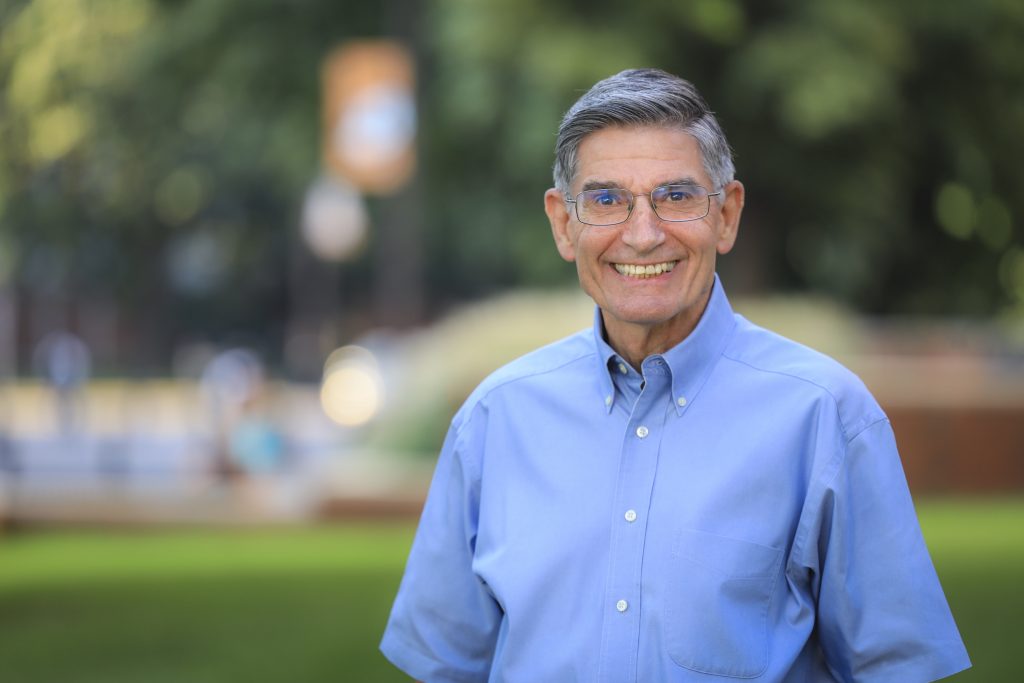
Express Spring Bull Sale to Feature Fresh, New Genetics This Friday

Listen to Ron Hays talk with Kevin Hafner about the 2024 Spring Bull Sale at Express Ranches.

As the 2024 spring bull sale at Express Ranches is coming up later this week, Senior Farm and Ranch Broadcaster Ron Hays is talking with the Vice President of Operations at Express Ranches, Kevin Hafner, about the sale. The 2024 sale will be held at the ranch in Yukon, Oklahoma, on Friday, March 1.

When it comes to helping customers decide what bulls will fit best into their individual operations, Hafner said the first step is building relationships with the customers. Hafner said it helps to know a customer's operation so they can match them with a bull that will help meet their needs and marketing goals.

As each operation is different, Hafner said particular EPDs will be more important to one buyer than the next. Because of this, Hafner said Express Ranch staff spends a significant amount of time working with customers on which livestock will work best for their operation based on the numbers available.

At this year's sale, there will be 443 Angus bulls available and 53 Hereford bulls.

"We have got some new sires that we are kind of highlighting this year that are new to us," Hafner said. "One bull that comes to mind is a 'cover the bases' bull that we sold a couple of years ago. He is a high carcass bull, really high marbling, but sure above average muscle. He is one that doesn't look like a high-marbling bull. This bull has got some thickness and stoutness, and we are offering about 25 to 30 of those sons in this sale."

Beyond what will be sold in the 2024 bull sale at Express Ranches, Hafner said he is excited about new genetics coming down the pipeline for next year.

"We try to keep fresh, new genetics, and keep this thing moving forward," Hafner said. "Don't get off in any fads or any trends, and try to keep good, sound, functional cattle that work in a lot of environments and a lot of geographical areas. That is a challenge we deal with, and we try to put together strings of bulls for people who go out and work to add value for them."

To check out the sale book for this year's bull sale, CLICK HERE.

To see videos, CLICK HERE.

The Beef Buzz is a regular feature heard on radio stations around the region on the Radio Oklahoma Ag Network and is a regular audio feature found on this website as well. Click on the LISTEN BAR at the top of the story for today's show and check out our archives for older Beef Buzz shows covering the gamut of the beef cattle industry today.

Oklahoma Winter Wheat Crop Rates 70 Percent Good to Excellent This Week

Photo by Todd Johnson, OSU Agricultural Communications Services

According to the latest Oklahoma Crop Progress and Condition Report released on February 26th, winter wheat conditions rated 70 percent good to excellent, 24 percent fair, and 6 percent poor to very poor.

Pasture and range conditions rated 29 percent good to excellent, 51 percent fair, and 20 percent poor to very poor.

Livestock conditions in Oklahoma rated 67 percent good to excellent, 30 percent fair, and 3 percent poor to very poor.

Rainfall totals in Oklahoma averaged 0.01 inches. According to the February 20th US Drought Monitor Report, drought conditions were rated 17 percent abnormally dry to exceptional drought, down 64 points from last year. Additionally, 3 percent of the state was in the moderate drought to exceptional drought categories, down 72 points from the previous year. Statewide, temperatures averaged in the lower to upper 50's. Topsoil moisture and subsoil moisture conditions were rated short to adequate. There were 6.8 days suitable for fieldwork.

Small Grains: In the Central part of the state small grains were looking good. Winter wheat grazed reached 57 percent, down 6 points from the previous year but unchanged from normal. Rye grazed reached 46 percent, up 6 points from the previous year. Oats grazed reached 8 percent, down 30 points from the previous year.

To view the full report, CLICK HERE.

USCA Urges Support of CRA Resolution to Halt Beef Imports from Paraguay

The United States Cattlemen's Association (USCA) issued the following response regarding Senators Jon Tester (D-MT) and Mike Rounds (R-SD) introducing the Congressional Review Act (CRA) resolution to overturn the US Department of Agriculture's recent decision to lift its animal health restrictions on imported fresh beef from Paraguay. 

The CRA will rescind the Animal and Plant Health Inspection's Service (APHIS) Importation of Fresh Beef From Paraguay final rule. The rule, which was finalized in November 2023, was opposed by USCA when originally issued, a stance made clear in comments submitted in opposition to the proposed rule in May 2023.

USCA President Justin Tupper issue the following statement: "The CRA introduced by Senators Jon Tester and Mike Rounds acknowledges the rigorous health and safety standards that are adhered to within all sectors of the U.S. beef industry."

"USCA has maintained a strong policy against importation of fresh beef from countries who have had known cases of FMD. The nature of Paraguay's beef production system, and its close ties with its neighbor Brazil, are reason enough to call for a halt of any action to allow fresh beef products into the US."

"We are grateful to Senators Jon Tester and Mike Rounds for their leadership and look forward to working with Members of the US Senate and House to advance this bill forward.  This is a bi-partisan effort that would continue a ban on beef imports in Paraguay.  We urge cattle producers and consumers alike to weigh in and urge swift passage of this bill."

The Growing Role of the U.S. Feedlot Industry

Dr. Derrell Peel, Oklahoma State University Extension Livestock Marketing Specialist, offers his economic analysis of the beef cattle industry as part of the weekly series known as the "Cow Calf Corner," published electronically by Dr. Peel and Mark Johnson. Today, Dr. Peel talks about the latest Cattle on Feed report.

The latest Cattle on Feed report pegged the February 1 feedlot inventory at 11.8 million head, just fractionally above year ago levels.  Feedlot inventories are declining after rising above year-earlier levels last October.  Feedlot placements in January were 92.5 percent of last year, above the pre-report average estimate but within the range of estimates by some analysts.  Some analysts were expecting a larger negative impact on placements from the winter storms in January.  January marketings were even with one year ago. 

The February Cattle on Feed report also includes a summary of 2023 final feedlot numbers and feedlot industry structure.  Total feedlot capacity was reported at 17.1 million head, up from 16.5 million head in 2000.  Feedlot capacity as a percent of total cattle inventories has increased over the past 25 years to a record level of 19.6 percent in 2024 (Figure 1).  On average feedlot inventories have averaged about 83 percent of total feedlot capacity over the past 25 years.  Feedlot capacity utilization is lower during cyclical expansions and higher during liquidation periods.  For example, during herd expansion from 2014-2017, average feedlot inventories were 76.3 percent of capacity, while during herd liquidation from 2020-2024, January feedlot inventories were an average of 84.8 percent of total feedlot capacity.

The total U.S. feedlot inventory on January 1, 2024 was 14.42 million head.  The feedlot inventory as a percent of the total inventory of cattle in the country has continued to increase over time.  The total feedlot inventory was a record level of 16.5 percent of the inventory of all cattle and calves on January 1, 2024.  This level compares to 14.3 percent 25 years ago. 

The total U.S. feedlot inventory on January 1 of 14.42 million head was 120.9 percent of the January monthly cattle on feed inventory of 11.93 million head.  Monthly cattle on feed surveys cover only feedlots with a one-time capacity of 1000 head or more.  In the past 25 years, the total January on-feed total has averaged 122.7 percent of the monthly on-feed total.  Stated another way, monthly feedlot inventory totals on average represent 81-82 percent of the total cattle on feed in the country.   This relationship has not changed in the past 25 years and has varied from a low of 80 percent to a high of 82.7 percent.

The January 1 estimate of feeder supplies outside of feedlots was 24.2 million head, down 4.2 percent year over year and the lowest total in data available back to 1972.  The current feedlot inventory is a record 59.6 percent of feeder supplies.  Stated another way, this means that there are just 1.68 head of feeder cattle for every head of cattle currently in feedlots.  The current feedlot turnover rate is about 1.93, which means that there are not sufficient feeder cattle to maintain feedlot inventories in the coming year.  Feedlot inventories will inevitably decrease in the coming months.

Below, listen to Derrell Peel, OSU Extension livestock marketing specialist, discuss the cattle markets on SunUpTV from February 24, 2024.

State Climatologist Gary McManus says Increased Frequency of Extreme Weather Conditions is on the Horizon

Listen to Reagan Calk talk with Gary McManus about the latest weather updates and outlooks for Oklahoma.

At the 2024 American Farmers and Ranchers Convention in Oklahoma City, Associate Farm Editor Reagan Calk had the chance to visit with State Climatologist Gary McManus about recent weather patterns and a weather outlook.

Due to above-normal temperatures lately, McManus mentioned the chance of a false spring.

"That is what you worry about when you get this above-normal temperature regime setting in, and then in March or early April, even, you get this big-time freeze event, and then, of course, that does a lot of damage to the wheat crop, it does a lot of damage to our orchards and things of that nature," McManus said. "It is something to keep an eye on."

McManus said El Nino is expected to fade out by the summer, then La Nina is expected to form quickly.

"We will just have to wait and see on the strength," McManus said. "Strength does matter with La Nina, of course, as it does with El Nino."

McManus said this event will certainly tilt the odds towards more drought if there is another full year of La Nina.

Looking ahead, McManus said there will be more heat waves and more intense precipitation events. Extreme weather events will be more common, McManus added, so there will be longer periods between rains, but when it does rain there will be more at once.

"One of the things we are going to be watching for with the increase of temperatures over the next couple of decades or so would be an increase in drought severity," McManus said. "So, you take a normal drought, and you transform that into a more severe drought."

Oklahoma's Observed Temperature and Precipitation Trends (from Gary McManus Presentation)

Temperature:

  • Annual average temperatures have increased 1-2F since early 20th century
  • Much of that warming has occurred in the winter months, and in minimum temperatures
  • Not much change during summer yet, however...
  • Increase in frequency, duration, and intensity of extreme heat events, but with a reduction in extreme cold events.

Precipitation:

  • Winters have gotten wetter, "spring" rainy season has shifted/extended later into summer
  • Less snow, but when it snows, it can REALLY snow
  • The frequency and intensity of significant precipitation events have increased over the last few decades.

Temperature and Precipitation Projections for Oklahoma In the Next Few Decades (from Gary McManus Presentation)

Temperature:

  • Extreme heat will become more common. Temperatures like the summer of 2011 will become increasingly likely to occur.
  • Summer becomes longer and spring weather arrives earlier
  • Winters warm- longer frost-free periods and a longer growing season
  • Annual average temperatures in the Southern Great Plains are project3ed to increase by 3.6-5.1 degrees F by the mid-21st century (10 degrees by the end of the century)

Precipitation:

  • Small changes in annual rainfall, but wetter winters and drier summers
  • Precipitation frequency will continue to increase, but period between rain events will also increase
  • Fewer soaking rains (more time to dry out between events)
  • Less snow

Daily Email for February 26, 2024


Oklahoma's Latest Farm

And Ranch News

Monday, February 26, 2024

 
Howdy Neighbors!

Here is Your Daily Oklahoma Farm and Ranch News Update: 


  • Scott Blubaugh Highlights Hot Topics Discussed at 119th AFR Convention


  • Derrell Peel- Cattle on Feed Numbers Even With Year Ago - Smaller Numbers Ahead


  • OSU's Scott Senseman Emphasizes Value of OSU Field Days and Improvements to University Ag Facilities


  • Jackie McGolden of Fairview Named 2024 Ag in the Classroom Teacher of the Year


  • Firestone Ag Helps Farmers Make the Most Out of Their Tire Investment


  • Gain a New View of Your Pastures' Forage Potential


  • OPSU Performance Bull Sale Coming Up February 27th


  • Pic of the Week- FFA Day at the State Capitol

Scott Blubaugh Highlights Hot Topics Discussed at 119th AFR Convention

On Saturday, February 24, at the 2024 American Farmers and Ranchers convention held in Norman, Oklahoma, Farm Director KC Sheperd had the chance to talk with AFR President Scott Blubaugh about topics discussed at this year's convention.


Blubaugh said topics of conversation in policy meetings included a focus on agricultural markets, enforcing anti-monopoly and trust laws, farm bill, and more.


"We are a general farm organization, so our policy book is rather thick, and we touch a lot on different issues throughout the state," Blubaugh said.


One issue Blubaugh said he foresees to be discussed heavily at the state level this year is water.


"We are running out of water in the Ogallala Aquafer, and we are seeing many of our farmers out in the Panhandle there that rely on that aquifer; those wells are drying up at least around the edges of the aquifer," Blubaugh said. "They are having to change their cropping patterns and raise different crops that require less water than corn does."


Blubaugh is especially proud of an announcement that has come from the National Farmers Union- they are planning their National Convention in 2025 in Oklahoma City. The dates that have been announced are March 9-11, 2025.

Listen to KC Sheperd talk with Scott Blubaugh about the 2024 AFR Convention

Sponsor Spotlight


Great Plains Kubota is Oklahoma's family of full-line Kubota dealerships offering Kubota sales, service, and parts. As an Oklahoma Elite Kubota dealer, we have a large selection of Kubota Tractors, Kubota Mowers, Kubota Utility Vehicles, Kubota Construction Equipment and Kubota's line of Hay Tools. Give us a call today at 855-4KUBOTA or stop by any of our Kubota dealerships in Ada, Ardmore, Duncan, Edmond, Shawnee, Norman, Stillwater and our newest location serving western Oklahoma and beyond, Clinton. To schedule a DEMO with one of our Outside Salesmen, email gpsales@gpkubota.com Visit us and see why Great Plains Kubota is... the brand that serves!  .


Derrell Peel- Cattle on Feed Numbers Even With Year Ago Inventory- Smaller Numbers Ahead

Oklahoma State University Extension Livestock Market Economist Dr. Derrell Peel believes the February USDA Cattle on Feed Report is an indicator of smaller feedlot inventories ahead for the foreseeable future.


I talked with Dr. Peel on Friday afternoon after the release of that report.


According to USDA- The total number of cattle on feed as of February first was basically even with a year ago- 40,000 head larger. Placements were seven percent less than a year ago (versus a pre report guess of 12% under last year) and the marketings were 100% of a year ago.


Dr. Peel says "Starting last fall, we had three or four months of big placements that pulled the numbers back above year ago levels but that was a short term thing- I think that was a function of drought conditions and high prices that encouraged people to sell but the fact of the matter is the tighter numbers and the overall inventory situation says that these feedlot inventories are going to come down and we are starting to see that now."


Peel adds that we have arrived at a point where "I think we are here now where we will see these numbers tighten up appreciably" and he believes "we are liable to pull down these feedlot inventories down a million head in the next few months."


Click here to read more and listen to Ron and Dr. Derrell Peel talk about the report and what it may mean to the start of rebuilding the US Beef Cow Herd
 

OSU's Scott Senseman Emphasizes Value of OSU Field Days and Improvements to University Ag Facilities

At the OCIA/OGI Meeting in Oklahoma City, Farm Director KC Sheperd had the chance to talk with Dr. Scott Senseman, associate vice president of research for the Division of Agricultural Sciences and Natural Resources at Oklahoma State University. Senseman and Sheperd talk about upcoming OSU field days and more.


"It is a real chance for any producer to come and really talk with other producers, but also the key investigators that are really getting down to the key aspects of what it is that they are finding hot off the press," Senseman said. "From our standpoint, it is a great opportunity to share information, gather together..."


These field events are not only for wheat, Senseman said, as multiple crops are covered. Senseman said along with producers and OSU researchers, these events are also a great place for state leadership to come and see what is going on with agriculture across the state.


Looking into 2024, Senseman said he is most excited about the New Frontiers Ag Hall building, which he believes will foster a collaborative spirit in both students and faculty. Secondly, Senseman said he is looking forward to enhancing programs for wheat improvements through a new agronomy farm.

Click here to read more and listen to Dr. Scott Senseman talk about OSU field days and improvements for the agricultural college.
Sign Up for Our Daily Email- Free Because of Our Sponsors!

Support Our Sponsors!


KIS logo


Advertise With Us!
 

For our farmers who have either- always have had cotton on their farms- or those who have more recently have added the fiber crop to their operations- we have a daily report heard on several of our Radio Stations- It's Called Cotton Talk!

Click on the Button below to listen to our most recent report
Click here for our Latest Cotton Talk- Hosted by KC Sheperd


The latest news from the Oklahoma State Capitol is available daily on the Radio Oklahoma News Network.


Click on the blue button to hear News Director Ken Johnson's report.

Click here for the latest report from the State Capitol on RON


Jackie McGolden of Fairview Named 2024 Ag in the Classroom Teacher of the Year

Oklahoma Ag in the Classroom is excited to announce Mrs. Jackie McGolden as the 2024 Teacher of the Year.


"After watching Jackie interact with her students through the years, it is evident her passion for teaching about agriculture is not limited to one day or even one thematic unit, but she infuses agriculture into every part of the year," said State AITC Coordinator, Melody Blosser. "Her students have hands-on opportunities with production agriculture on a regular basis.


McGolden has taught at Fairview Public Schools for 25 years and has been a teacher for 38 years.


"Last summer, a past student told her younger brother he would be in my class next year," McGolden said. "She couldn't wait to tell her brother that I would soon be his teacher and he would get to visit the Sale Barn. This interaction made me wonder how past students viewed me, and then I realized that is exactly how I want to be viewed."

Click here to read more about Mrs. Jackie McGolden winning 2024 Teacher of the Year.
 

We invite you to listen to us on great radio stations across the region on the Radio Oklahoma Ag Network weekdays-

if you missed this morning's Farm News - or you are in an area where you can't hear it- click below for this morning's Farm news from Ron Hays and KC Sheperd on RON.
Listen to our Monday morning farm and ranch news with KC Sheperd
 
 
Subscribe To the Daily Email


Sponsor Spotlight


Midwest Farm Shows is proud to produce the two best Farm Shows in the State of Oklahoma annually- the Tulsa Farm Show each December and the Oklahoma City Farm Show each April. 


They would like to thank all of you who participated in their 2023 Tulsa City Farm Show. 


Up next will be the Oklahoma City's premier spring agricultural and ranching event with returns to the State Fair Park April 4-5-6, 2024.


Now is the ideal time to contact the Midwest Farm Show Office at 507-437-7969 and book space at the 2024 Oklahoma City Farm Show.  To learn more about the Oklahoma City Farm Show, click here. 


Firestone Ag Helps Farmers Make the Most Out of Their Tire Investment

On February 14th, a Fuel Savings Field Clinic was hosted by Firestone Ag in Enid, Oklahoma. The clinic discussed a variety of topics for farmers, including how to spend less time in the field, maximizing tire traction, how to cut fuel costs, and more. Farm Director KC Sheperd had the chance to visit with Firestone Ag Field Engineer Austin Fischer about the highlights from the clinic.


"What we are trying to do is to create these opportunities to interact directly with producers," Fischer said.


The biggest way that agricultural producers can focus on saving money when it comes to tires is to keep the proper inflation pressure in the tire. To do this, Fischer said the producer must know what their axle loads are.


"That can be very difficult on the farm because, for the same tractor, you can use it for planting, you can use it to side-dress, you can use it to spray, or you can use it in running a grain cart," Fischer said. "There are so many applications that we can use the tractor for that can make that difficult."


Ideally, Fischer said a producer would know the weights that each implement applies on the tractor. This may not always be feasible, Fischer added, so setting the tire pressures according to the maximum weight that the tractor sees is another option.

Click here to read more and listen to KC and  Austin Fischer talk about the highlights from the Fuel Savings Field Clinic. 

Gain a New View of Your Pastures' Forage Potential

Noble Research Institute regenerative ranching advisors Will Moseley and Steve Swaffar say a grazing exclosure – a small, fenced area inside a grazing unit that livestock cannot access that gives the rancher a direct view of what and how much was grazed around it – is perhaps the simplest method to help see the potential of our land's production.  


Here, Swaffar and Moseley offer several ways to use an exclosure as a powerful assessment of your grazing potential:  


1. Potential forage production and animal consumption: At the end of the grazing event, measure the amount of forage standing in the exclosure against what's left outside, and you'll have a quick assessment of what your animals consumed. 


2. What your livestock actually eat: Count and note the number and types of plant species within the grazing exclosure, and compare that observation with what you see outside the exclosure after a grazing event. 


3. Regrowth potential in grazing versus haying: If one of your goals is to reduce fuel inputs and tractor time by allowing livestock to harvest more of what you grow rather than taking it for hay, a grazing exclosure could quantify varying rates of regrowth.


4. Compare the grazing habits of different livestock: Use an exclosure to help observe the differences in grazing patterns and preferences between species and classes of livestock in similar pasture conditions.  


Click here to read more about Noble Research Institute's insight on how to gain an understanding of your pastures' forage potential.

OPSU Performance Bull Sale Coming Up February 27th

The Oklahoma Panhandle State University's 72nd Annual Performance Bull Sale is coming up on February 27th in Goodwell, Oklahoma. There will be 54 performance tested bulls for sale, and of those bulls, 46 are registered Angus and 8 are registered Red Angus.


Click here for the sale catalog.


For more information:


Dr. Crystal Tolle – Assistant Professor of Animal Science/Bull Test Supervisor at 580.349.1507 or 580.273.5060.


Denton Ward – OPSU Farm Manager at 307.575.3276


Matt C Sims Auction, Inc. at 405.641.6081

Click here to access the bull test packet and OAA letter

Pic of the Week- FFA Day at the Oklahoma State Capitol

It was as great day at the State Capitol this past week for FFA day during National FFA week- the Governor, Ag Secretary Blayne Arthur and several lawmakers invested their time in interacting with FFA members from several chapters.

Let's Check The Markets!
OKC West is our Market Links Sponsor- they sell cattle three days a week- Cows on Mondays, Stockers on Tuesday and Feeders on Wednesday- Call 405-262-8800 to learn more.
 
Today's First Look:
Ron on RON Markets as heard on K101  
mornings with cash and futures reviewed- includes where the Cash Cattle market stands, the latest Feeder Cattle Markets Etc.
Hear Today's First Look
 

Wholesale Boxed Beef Prices were higher- Choice Beef was up 82 cents and Select Beef was up 50 cents on Friday 2/23/2024.


Click on the Button below for the latest report from USDA Market News

Boxed Beef Report
 

Oklahoma National Stockyards had 10,146 head number of cattle at the yards on Sunday evening as of 9 PM. Today's sale will start at 6:30 AM with at 10,500 to 11,000 head.


On Monday, February 19th- Compared to last week: Feeder steers and heifers sold fully steady. Steer and heifer calves that are weaned with multiple rounds of shots sold mostly 2.00-5.00 higher compared to last week's sharply higher market. Demand remains good, very good for grazing cattle suitable for the Osage and Flint Hills.


Click below for the complete closing report.

Oklahoma National Stockyards Market Report from 02/19/2024
 

Here's our regular feature that is a part of the Monday Daily Email- market commentary from Bob Rodenberger, a partner with Stockman Oklahoma Livestock Marketing.


Bob talks Fridays with our own KC Sheperd with his commentary and is posted on our website-click here for this past Friday's story featuring Rodenberger's comments


Learn more about Stockman Oklahoma by clicking here..

 
Listen to KC Sheperd talk with Bob Rodenberger about the cattle markets from the past week
 
 
Woodward Livestock Market from Thursday 02/22/2024 All Classes of Feeder and Stockers Higher Last Thursday
 
Okla Cash Grain:  
Daily Oklahoma Cash Grain Prices- as reported by the Oklahoma Dept. of Agriculture- The report available after the close of the Futures Trade for that day.
Read  Cash Grains Report from 2/23/2024
 
Our Daily Market Wrapup from the Radio Oklahoma Ag Network - analyzing the Futures Markets for that trading day- as reported by KC Sheperd.
Click to Listen to Our Weekday Wrap with KC
 
Slaughter Cattle Recap: 
The National Daily Slaughter Cattle Summary- as prepared by the USDA Market News
Read Report
 
TCFA Feedlot Recap:  
Finally, here is the Daily Volume and Price Summary from the Texas Cattle Feeders Association.
Read Report
Our Oklahoma Farm Report Team!!!!
 
Ron Hays, Senior Farm/Ranch Broadcaster and Editor
 
KC Sheperd, Farm Director and Editor

Dave Lanning, Markets and Production

Reagan Calk, Farm News and Email Editor

Pam Arterburn, Calendar and Template Manager

Podcasts From Oklahoma Farm Report and More

Two of our regular reports are also podcasts that you can subscribe to- Our daily Farm and Ranch News with KC Sheperd- available here on the Apple Podcast Platform


The second is our daily Beef Buzz with Ron Hays- available here on the Apple Podcast Platform


Periodically- we offer interviews on our Ag Perspectives Podcast series- this podcast is available here.


Ron has also has a series of podcasts from interviews with newsmakers at the Cattlemen's Congress- Click here or you can find them on your favorite Podcast platform- look for them by searching for Cattlemen's Congress Conversations.


We are making plans to jump back into regular installments of what has been called the Road to Rural Prosperity- a new name and fresh content is in the works- for now- click on the blue button below for one of our favorites that is a timeless classic.

Listen to Episode 86 with Ron Hays talking with one of the legends in the Beef Cattle Business- Bob Drake of Davis, Oklahoma
 
 
Listen to Ron
Beef Buzz
 
Blue Green Gazette
Calendar
Auctions
Market Links
Facebook  Twitter  Youtube  

Our thanks to Midwest Farms Shows, P & K Equipment, Oklahoma Farm Bureau, Oklahoma Ag Mediation Program, Great Plains Kubota, Stillwater Milling Company, National Livestock Credit Corporation, Oklahoma Beef Council, Oklahoma AgCredit, the Oklahoma Cattlemens Association, and  KIS Futures for their support of our daily Farm News Update.


For your convenience, we have our sponsors' websites linked here- just click on their name to jump to their website- check their sites out and let these folks know you appreciate the support of this daily email, as their sponsorship helps us keep this arriving in your inbox on a regular basis- at NO Charge!


We also appreciate our Market Links Sponsor - OKC West Livestock! 


We invite you to check out our website at the link below too that includes an archive of these daily emails, audio reports and top farm news story links from around the globe.

Head to Our Website OklahomaFarmReport.Com

God Bless!

Reach Out To Us:

Tim West
President/General Manager
Rural Oklahoma Networks

405-317-6361

***************

Mike Henderson
Director of Sales

405-615-4922

KC Sheperd
Farm Director
Radio Oklahoma Ag Network

405-443-5717

Email KC

Ron Hays

Senior Farm/Ranch Broadcaster

Radio Oklahoma Ag Network

OklahomaFarmReport.Com


405.473.6144

Email Ron

Rep. Cole's Column: Combatting the Biden Administration's Inflation Crisis

Throughout the past three years in office, President Biden has embarked on spending spree after spending spree. First, just two months after inauguration, he signed the $1.9 trillion American Rescue Plan Act, initiating a spike in prices on consumers just days after the bill was signed into law. Then, in November of 2021, he ran up the federal credit card again by signing the $1.2 trillion "infrastructure" legislation into law, which had fewer than one of every four dollars for what most Americans would consider to be actual infrastructure. Additionally, that same month, the White House signed a massive social spending bill, including $369 billion for radical climate initiatives, $80 billion to hire more IRS agents, and $64 billion to expand wasteful Obamacare subsidies.

Through signing these bills, among others, into law, the President himself has made it very clear – lowering spending, and in turn lowering inflation, is not a matter of concern for this administration. In fact, since President Biden took office, inflation has increased 17.9 percent overall. Not to mention, the recent "hotter-than-expected" Consumer Price Index (CPI) report, showing that inflation rose again this past January, indicates this administration has no plans to change course and ease the economic pain.

Consequently, the American people have experienced higher prices, lower real wages, and tighter budgets. As a matter of fact, since President Biden took office, food prices have gone up on the consumer by nearly 20 percent, electricity prices have risen on the ratepayers by 28.6 percent, prices at the gas pump have increased 37.8 percent, mortgage rates have reached a two-decade high, and monthly savings are down 79.3 percent. In total, Americans are spending over $1,000 more a month than they were three years ago.

The numbers do not lie – President Biden's economic policies are truly crushing American families.

This is why we must pass a full year appropriations deal, which will allow us to reverse some of this excessive spending and reallocate the funding from far-Left, Green New Deal initiatives to important issues like the border, national security, made-in-America energy, and veterans.

As a fiscal conservative and Vice Chairman of the House Appropriations Committee, it is not lost on me the duty I have to ensure that the taxpayer dollar is being spent wisely. I am committed to passing a full year appropriations deal that not only combats the Biden Administration's inflationary policies, but also allots necessary government funding towards addressing the real issues of today.

San Antonio to Host CattleCon 2025

San Antonio, Texas, will host CattleCon 2025, the largest cattle industry event in the country, Feb. 4-6, 2025. Thousands of cattlemen and women will gather to learn, conduct business, network and have fun. 

San Antonio is known for adventure, a city rich in history, culture and craveable cuisines. From The Alamo to the River Walk and beyond, San Antonio will create memorable experiences for CattleCon attendees. 

CattleCon 2025 will feature popular events such as Cattlemen's College, CattleFax Outlook Session, D.C. Issues Update, Cattle Feeders Hall of Fame Banquet, Environmental Stewardship Regional Awards, and Beef Quality Assurance Awards, along with a few new surprises to be announced. 

The award-winning NCBA Trade Show will be one of the largest ever with several acres of displays as well as live cattle handling demonstrations, educational sessions and entertainment. Trade show exhibitors will feature the latest advancements, from equipment and technology to pharmaceuticals and feed supplements, all conveniently located under one roof.
 
Registration opens August 19, and additional information will be available soon at convention.ncba.org.

OCIA's Robert Calhoun Discusses Fundamentals of Seed Transfer and More

Listen to Maci Carter talk with Robert Calhoun about the Oklahoma Crop Approvement Assoc. and more.

At the OCIA/OGI Meeting in Oklahoma City, Oklahoma Farm Reporter Maci Carter had the chance to visit with the Executive Director of Oklahoma Crop Improvement, Robert Calhoun. Carter and Calhoun talk about seed transfer, the Oklahoma Crop Improvement Association, and more.

"A seed transfer is the movement of a certified seed class from a grower to an approved retail facility that can, in turn, resell that seed to an end-user, to one of our farmers," Calhoun said.

Certified seed is a premium product of seed varieties that are protected through the Plant Protection Act. Because of this, Calhoun said these varieties must be handled in a certain way.

"When we move the seed, we need to make sure that it is going to someone that is an approved facility to handle that seed, and they know how to properly take care of it and reduce any type of chances for contamination," Calhoun said. "One of the things they need to have is a transfer form. This is the official documentation that will follow the seed to the location so that the seed is documented and accounted for."

To partake in this program, Calhoun said organizations must be members of the Oklahoma Crop Improvement Association.

"You become a member, your facilities are inspected, your equipment is inspected, and you have the understanding and the responsibility of properly maintaining the quality of the seed," Calhoun said.

The seed must be Oklahoma-certified, Calhoun said, and must have documents.

"Different states have seed laws, so whatever we are going to sell, transfer in, and then resale must meet the Oklahoma state seed law standards," Calhoun said. "That seed will need to be retested in Oklahoma and be issued an Oklahoma-certified tag for sales."

Transferring seed out of the state begins with calling the OCI office, Calhoun said, and requesting transfer forms.

"We, in turn, reach out to our counterparts in the other state, make sure the seed is eligible for transportation and that it is going to a facility that is capable of handling that seed properly," Calhoun said.

For more information, visit http://okcrop.okstate.edu/.

DWEA Applauds RAISE Initiative to Quadruple Farm Distributed Wind Projects

Today, the Distributed Wind Energy Association (DWEA) applauded the launch of the Rural and Agricultural Income & Savings from Renewable Energy (RAISE) Initiative. Through this initiative, the U.S. Department of Agriculture (USDA) and Department of Energy (DOE) aim within five years to support 400-plus farm or rural small business distributed wind projects under the Rural Energy for American Program (REAP). The launch was announced by Agriculture Secretary Tom Vilsack at Distributed Wind 2024, DWEA's annual conference.

"DWEA and its members appreciate the commitment of Secretary Vilsack, USDA and the Department of Energy to provide technical assistance and grant funding to help small and mid-sized farmers plan and install distributed wind projects," said Mike Bergey, President & CEO of Bergey Windpower Co. and DWEA Board President. "Thousands of small and medium-sized farms could lower operating costs or generate revenue by installing a wind turbine and there are robust new federal incentives for them to do so. The new USDA-DOE initiative will help get the word out and greatly accelerate the use of distributed wind systems."

Lloyd Ritter, policy director for DWEA, added, "These projects provide reliable, affordable and sustainable energy to farmers and rural small businesses; they can even be a potential source of revenue for farmers who sell electricity to the grid. Vastly expanding the number of distributed wind energy systems over the next five years will be a big win for rural America, American manufacturing, and the climate."

USDA will provide technical assistance to support applications for the use of $144.75 million in REAP grant funding reserved for underutilized technology projects. USDA and DOE will launch a new National Distributed Wind Network and Resource Hub in March 2024.

In addition, DOE is announcing a total of $4 million in related funding, including $2.5 million under the Distributed Wind Competitiveness Improvement Project (CIP) to support testing, certification and commercialization of the latest distributed wind technologies. DOE will also provide $1.5 million in technical assistance grants to identify and develop new business models for farmers to save money and earn income by deploying these technologies. DOE has identified advances in distributed wind technology that have opened a significant market opportunity.

NREL studies over the past several years have quantified the huge untapped potential for distributed wind. With just over 1 GW of current installed capacity, there is the potential to add 1,400 GW of economically viable capacity at 49 million sites. New technology, much of it developed with DOE support, has lowered costs, and made distributed wind systems much more competitive. Distributed wind energy systems' levelized cost has been reduced by 60% in recent years.

Department of Agriculture, Department of Energy Launch Initiative to Help Farmers Reduce Costs with Underutilized Renewable Technologies as part of President Biden's Investing in America Agenda

The U.S. Department of Agriculture (USDA) and the U.S. Department of Energy (DOE) today are launching a new initiative to help farmers cut costs and increase income using underutilized renewable technologies including smaller-scale wind projects. Through the Rural and Agricultural Income & Savings from Renewable Energy (RAISE) initiative, USDA is setting an initial goal of helping 400 individual farmers deploy smaller-scale wind projects using USDA's Rural Energy for America Program (REAP). This goal is only possible because of President Biden's Inflation Reduction Act which provided more than $144 million in grant funding for underutilized technologies through the REAP program.

Additionally, today DOE is announcing a total of $4 million in related funding, including $2.5 million to support the testing, certification and commercialization of the latest distributed wind technologies including for the agricultural sector, and $1.5 million to support outreach and the identification and development of new business models for farmers to save money and earn income deploying these technologies.

"Today's announcement furthers the Biden-Harris Administration's commitment to rebuild our nation's economy from the middle out and bottom up by increasing income and opportunities for the small and mid-sized farmers that keep rural main streets vibrant," USDA Secretary Tom Vilsack said. "By strengthening our longstanding partnership with DOE through the RAISE initiative, USDA is ensuring farmers and hardworking Americans everywhere have the opportunity to save money and earn income from smaller-scale, distributed renewable energy technologies. These investments will create long-lasting economic benefits for their families, businesses and communities for years to come."

"There is a huge opportunity to power the American heartland with distributed wind resources, and President Biden's Investing in America agenda is tapping into that potential so that all Americans can reap the benefits of the clean transition," said U.S. Secretary of Energy Jennifer M. Granholm. "DOE is raising the bar with our partners at USDA—creating jobs, lowering costs and increasing energy independence for farmers and those in rural communities."

Operating under an existing memorandum of understanding, USDA and DOE have a joint working group overseeing an action plan for the RAISE initiative. DOE has identified advances in certified distributed wind technology that have opened a significant market opportunity, enabling cost-effective investments for farmers and rural communities.

Initial RAISE initiative activities, focused on smaller-scale or distributed wind, are expected to include:

  • USDA providing additional technical assistance to support applications for the use of the $144.75 million in grant funding from the Inflation Reduction Act for REAP underutilized technology projects, including but not limited to farmer-owned smaller-scale wind projects, small-scale hydropower, geothermal, biomass-based and other clean energy. DOE also intends to prioritize technical assistance for smaller-scale wind projects through various programs.
  • DOE's Wind Energy Technologies Office funding $1.5 million for research into and outreach on new business models for collaborations of farmers to earn income from distributed wind, including through farm associations that could administer it with fee-for service models.
  • DOE's Wind Energy Technologies Office calling for proposals for up to $2.5 million under the Distributed Wind Competitiveness Improvement Project (CIP), which funds distributed wind technology development, testing, certification, and commercialization. CIP provides support to U.S. component suppliers and manufacturers of small- and medium-sized wind turbines. For the first time, this round of CIP funding includes a specific focus on commercialization of distributed wind turbines for the agricultural sector in support of the RAISE initiative.
  • USDA and DOE hosting a joint webinar series to provide information to farmers, rural electric cooperatives, farm associations, and small-scale, distributed wind providers about our programs and how to use them to develop place-based wind projects. The first webinar in the series will launch a new National Distributed Wind Network and Resource Hub on March 14, 2024.
  • USDA and DOE developing a farmers guide to distributed wind power that will include technical, economic, and geospatial analysis regarding distributed wind technologies and applications as well as ways to finance smaller-scale wind projects.

Background:

There are many small-scale underutilized technologies that farmers and rural communities can benefit from. USDA and DOE are working together through the RAISE initiative to increase education, outreach, research and technical assistance to help small and mid-sized farmers save money and earn income from underutilized technologies.

Distributed wind includes, for example, a single wind turbine to meet a farm's energy demand and save and stabilize electricity costs. It could also include a few wind turbines across several farms to support a local electricity utility, thereby earning a revenue stream for the hosting farms.

Distributed clean energy projects can create cost savings and income for farmers and rural small businesses. They also support energy independence, local electric grid reliability, and enhance resilience by providing back up power, especially when it is paired with energy storage. These projects also create jobs and investments in rural economies, with approximately a third of a renewable energy project value usually invested in the local communities through construction jobs and maintenance. These projects also give farmers, rural electric coops, and food companies the opportunity to address climate change.

DOE has worked with industry partners and its national labs to develop a new generation of reliable, high performing and cost-effective distributed wind technologies that are certified to national performance standards and that represent significant improvements over prior generations of distributed wind technology.

DOE works to ensure America's security and prosperity by addressing its energy, environmental, and nuclear challenges through transformative science and technology solutions. Learn more about DOE's efforts to advance distributed wind and sign up for the Wind Energy Technologies Office's newsletter.

USDA Rural Development provides loans and grants to help expand economic opportunities, create jobs and improve the quality of life for millions of Americans in rural areas. This assistance supports infrastructure improvements; business development; housing; community facilities such as schools, public safety and health care; and high-speed internet access in rural, tribal and high-poverty areas. Visit the Rural Data Gateway to learn how and where these investments are impacting rural America. To subscribe to USDA Rural Development updates, visit the GovDelivery Subscriber Page.

USDA touches the lives of all Americans each day in so many positive ways. To learn more, visit www.usda.gov.

Dairy Defined: Raw Milk Doesn't Define Dairy

The activist claims are unfounded. The proposed laws endanger public health. And raw milk does not define dairy. 

Much like the anti-vaccination movement (with whom it shares many advocates), raw milk proponents make various claims that may seem at least somewhat plausible but fall apart on closer scrutiny. The arguments, and the suspect reasoning behind them, have popped up in state legislatures for years, and for the most part they may not seem to require that much scrutiny – until someone gets sick, which happens all too often.

But with new laws being considered in more states, the tiny niche of raw milk has the potential to disrupt the dairy industry far beyond its actual market. Long touted by its devotees as superior to pasteurized milk and the key to saving dairy farms, in practice it undoes generations of public health success that has won consumer trust and made commercially sold milk one of the safest products available. 

To cite the science: Raw milk does not contain more or superior nutrition to pasteurized milk. Raw milk's record on gut health shows how greater harm works against any perceived benefits. Raw milk does not "cure" lactose intolerance. And so on, and so on. 

What raw milk does do is contain pathogens that make people sick. The current patchwork of local regulations has proven why raw milk is a public health threat: Places where raw milk sales are available to the public see much greater milk-related illness outbreaks than places where such sales are prohibited. That's why pasteurization was invented in the first place – not as a conspiracy against consumers or farmers, but as a public health measure that has saved thousands of lives over  generations. 

Those are just a few of the reasons why the Centers for Disease Control and Prevention and the Food and Drug Administration support raw milk restrictions. As with routine vaccinations, in which a decline has led to deadly, and absolutely unnecessary, illness outbreaks, pasteurization has been so effective, for so long, that many people no longer remember how this technology improved lives in the first place.

Another popular raw-milk argument is that what consenting adults choose to buy and sell is their own business. With all due respect to absolutist libertarians, the world doesn't work that way, as every consumer-safety regulation in the universe attests. The world especially doesn't work that way when a product bought by consenting adults is then given to children. The vaccination comparison holds: Even though personal-conscience and religious belief exemptions exist, good luck enrolling children in a public school without a polio vaccine. There's a reason for that. Ask your grandparents. 

Another argument in raw milk's favor is that it will "save the farm." It's certainly possible that revenues from small-scale sales may help a dairy farm here and there. But it's even more certain that foodborne outbreaks that weaken consumer confidence in milk (and unfortunately, many consumers won't distinguish between raw and pasteurized milk when hearing a radio news report on a highway) harm the tens of thousands of dairy farmers who sell in the commercial marketplace. 

Dairy farmers have spent generations building a reputation for safety and quality. No "alternative" testing protocol will ensure the same level of safety as decades of experience with pasteurization, and no assurance that raw milk sellers will do the right thing and ensure safety on their own will take the place of a surefire technology that is universally applied. 

So, to any state legislator who is contemplating loosening restrictions on raw milk sales: The National Milk Producers Federation, the largest organization of dairy farmers in the United States, representing small, medium and large farms, more than 95 percent of them family-owned and operated, in every region of the country, stands opposed to the legislation you are considering. It's bad for families, it's bad for farmers, and it's based on bad science. 

The suspect evidence and faulty reasoning has gone on long enough. It needs to stop.       

AFBF Applauds Opening of Dairy Margin Coverage

The American Farm Bureau Federation applauds the U.S. Department of Agriculture's announcement today that the Dairy Margin Coverage program will begin enrollment following publication of the rule in the Federal Register next week.

The program will be retroactive to Jan. 1 of this year, and coverage will be available through December. AFBF previously sent a letter to Deputy Under Secretary Gloria Montaño Greene and Farm Service Agency Administrator Zach Ducheneaux urging them to open enrollment for the Dairy Margin Coverage program as soon as possible.

"AFBF is pleased that FSA listened to our concerns and will soon open enrollment for this critical farm safety net program," said AFBF President Zippy Duvall. "Dairy farming comes with unique challenges, and vital farm bill programs like Dairy Margin Coverage help farmers weather the storm in tough times. Any further delay in opening the program could have challenged the resilience of many farms, especially the most vulnerable. We look forward to the speedy implementation of the DMC program and efficient processing of claims."

Dairy Margin Coverage is a risk management tool offered through the farm bill that provides support to farmers when the price of milk falls below the cost of supplies. Implementation delays resulted from adjustments to the program made when the 2018 farm bill was extended, and necessary technical updates.

USDA's February milk production reports show that between 2018 and 2023 the number of licensed dairy herds has declined by 9,546 across the United States, with losses of over 2,000 herds in Wisconsin, 1,200 herds in Pennsylvania, 980 herds in New York and 945 herds in Minnesota alone. This loss of dairy farms is one of the reasons AFBF has advocated for reforms to the Federal Milk Marketing Order system, and for efficient and timely implementation of farm safety net programs.

"Timely administration of farm bill programs is vital to ensuring a stable farm economy that provides food security to millions of consumers domestically and abroad," AFBF Vice President of Public Policy Sam Kieffer wrote in the February 6 letter.

To learn more about Dairy Margin Coverage, read Market Intel.

NPPC Meets with Tennessee Lawmakers on mRNA Vaccines

Dr. Ashley Johnson (right, center) and Andrew Beardslee (far left) speak on the
importance of mRNA vaccine technology access

NPPC staff met with members of the Tennessee Legislature on issues related to the use of messenger ribonucleic acid (mRNA) vaccine technology in animal agriculture. Currently, there are nearly two dozen bills in 10 states that would either require labels for meat from vaccinated animals, allow "mRNA-free" labels for unvaccinated animals, or ban the use of mRNA vaccines entirely.

In meetings with leadership of Tennessee Senate and House committees, NPPC's Director of Food Policy Dr. Ashley Johnson and Director of State Policy Drew Beardslee, as well as NPPC member Dr. Seth Krantz, veterinarian for Tosh Farms, affirmed the safety and efficacy of mRNA technology and raised concerns about labeling. Also in attendance were Tennessee Pork Producers Association Executive Director Phyllis Ferguson and representatives from Tennessee's Department of Agriculture, the University of Tennessee College of Veterinary Medicine, and the Tennessee Farm Bureau. 

NPPC's take: NPPC supports using vaccine technologies, such as mRNA vaccines, as a tool for combating endemic and foreign animal diseases. Recently, the American Farm Bureau Federation and the National Association of State Departments of Agriculture approved policies supporting mRNA vaccine technology in livestock. 

Why it matters: Vaccines are critical to preserving animal health and well-being, keeping the food supply safe, and protecting U.S. livestock from emerging and foreign animal diseases. Additionally, mRNA vaccines, unlike traditional vaccines, can be designed swiftly, manufactured quickly at a lower cost, and produced in a more standardized manner – with fewer production errors – which can improve responsiveness to pathogen outbreaks.

Agricultural Producers Have Until March 15 to Enroll in USDA's Key Commodity Safety Net Programs for the 2024 Crop Year

Agricultural producers who have not yet enrolled in the Agriculture Risk Coverage (ARC) or Price Loss Coverage (PLC) programs for the 2024 crop year have until March 15, 2024, to revise elections and sign contracts. Both safety net programs, delivered by USDA's Farm Service Agency (FSA), provide vital income support to farmers who experience substantial declines in crop prices or revenues for the 2024 crop year. In Oklahoma producers have completed 23,292 contracts to date, representing 49% of the more than 47,000 expected contracts.      

"Agriculture Risk Coverage or Price Loss Coverage programs provide excellent risk protection, for market declines, at no cost to the producer. While we always hope for strong markets, anyone involved in production agriculture knows, the only thing certain is uncertainty," said Steve Kouplen, State Executive Director for FSA in Oklahoma. Many producers may be holding off on making your program elections pending planting decisions or maybe you're working with a local advisor to consider how changes in the effective reference price might impact your election decisions. Please contact your local FSA county office as soon as possible to set an appointment so you're on the books well in advance of the March 15 deadline."       

Producers can elect coverage and enroll in ARC-County or PLC, which provide crop-by-crop protection, or ARCIndividual, which protects the entire farm. Although election changes for 2024 are optional, producers must enroll, with a signed contract, each year. If a producer has a multi-year contract on the farm, the contract will continue for 2024 unless an election change is made.     

If producers do not submit their election revision by the March 15, 2024, deadline, the election remains the same as their 2023 election for eligible commodities on the farm. Also, producers who do not complete enrollment and sign their contract by the deadline will not be enrolled in ARC or PLC for the 2024 year and will not receive a payment if one is triggered. Farm owners can only enroll in these programs if they have a share interest in the commodity.    

Producers are eligible to enroll farms with base acres for the following commodities:  barley, canola, large and small chickpeas, corn, crambe, flaxseed, grain sorghum, lentils, mustard seed, oats, peanuts, dry peas, rapeseed, long grain rice, medium and short grain rice, safflower seed, seed cotton, sesame, soybeans, sunflower seed and wheat.    

Web-Based Decision Tools      

Many universities offer web-based decision tools to help producers make informed, educated decisions using crop data specific to their respective farming operations. Producers are encouraged to use the tool of their choice to support their ARC and PLC elections.    

Crop Insurance Considerations    

Producers are reminded that enrolling in ARC or PLC programs can impact eligibility for some crop insurance products offered by USDA's Risk Management Agency (RMA). Producers who elect and enroll in PLC also have the option of purchasing Supplemental Coverage Option (SCO) through their Approved Insurance Provider, but producers of covered commodities who elect ARC are ineligible for SCO on their planted acres.    

Unlike SCO, RMA's Enhanced Coverage Option (ECO) is unaffected by participating in ARC for the same crop, on the same acres. You may elect ECO regardless of your farm program election.    

Upland cotton farmers who choose to enroll seed cotton base acres in ARC or PLC are ineligible for the stacked income protection plan, or STAX, on their planted cotton acres.      

More Information        

For more information on ARC and PLC, producers can visit the ARC and PLC webpage or contact their local USDA Service Center. Producers can also prepare maps for acreage reporting as well as manage farm loans and view other farm records data and customer information by logging into their farmers.gov account. If you don't have an account, sign up today.  

USDA touches the lives of all Americans each day in so many positive ways. Under the Biden-Harris administration, USDA is transforming America's food system with a greater focus on more resilient local and regional food production, fairer markets for all producers, ensuring access to safe, healthy and nutritious food in all communities, building new markets and streams of income for farmers and producers using climate smart food and forestry practices, making historic investments in infrastructure and clean energy capabilities in rural America, and committing to equity across the Department by removing systemic barriers and building a workforce more representative of America. To learn more, visit usda.gov. 

USDA is an equal opportunity provider, employer and lender.

Ogallala Aquifer's Future to be Discussed March 18-19 in Liberal, Ks

Map courtesy of the Museum on Main Street

Event will draw participants from eight states to discuss water management issues

 A proverbial Who's Who of water management is expected for the 2024 Ogallala Aquifer Summit, set for March 18-19 in Liberal, Kansas.

The conference marks the third time that a group of water specialists, users, regulators and others from eight states will gather to discuss the condition of the mighty Ogallala, a vast underground reservoir that covers 174,000 square miles and touches parts of South Dakota, Wyoming, Nebraska, Colorado, Kansas, Oklahoma, New Mexico and Texas.

The Ogallala Aquifer is critical to the economies of the regions it touches. It is estimated that 95% of groundwater pumped from the aquifer each year is for irrigated agriculture, though it also supports livestock and municipal needs. The aquifer supports approximately $35 billion in crop production.

But the Ogallala Aquifer is rapidly depleting; some estimates indicate that in 50 years, 70% of the aquifer will be depleted.

Some topics on this year's agenda include:

  • New opportunities with conservation-related legislation.
  • Understanding water risk as part of climate risk and economic risk.
  • Advances in science and data application.
  • The power of peer networks.
  • Workforce and leadership development.

Registration is available online at www.irrigationinnovation.org/2024-ogallala-summit. The cost is $150, which includes meals and all conference sessions.

Jackie McGolden of Fairview Named 2024 Ag in the Classroom Teacher of the Year

Oklahoma Ag in the Classroom is excited to announce Mrs. Jackie McGolden as the 2024 Teacher of the Year.

"After watching Jackie interact with her students through the years, it is evident her passion for teaching about agriculture is not limited to one day or even one thematic unit, but she infuses agriculture into every part of the year," said State AITC Coordinator, Melody Blosser. "Her students have hands-on opportunities with production agriculture on a regular basis."

McGolden has taught at Fairview Public Schools for 25 years and has been a teacher for 38 years.

"Last summer, a past student told her younger brother he would be in my class next year," McGolden said. "She couldn't wait to tell her brother that I would soon be his teacher and he would get to visit the Sale Barn. This interaction made me wonder how past students viewed me, and then I realized that is exactly how I want to be viewed."

Over the years, McGolden has faithfully participated in everything Ag in the Classroom has to offer, such as On the Road with Ag in the Classroom. She attended the National Ag in the Classroom Conference and presented at the State Ag in the Classroom Conference.

"Teaching agriculture to my students is second nature to me," McGolden said. "Having been raised on the farm all my life, I have a deep understanding about its importance. I want my students to learn all they can about agriculture, but more importantly, I want to instill in them an appreciation for agriculture."

McGolden won numerous honors and awards including Fairview Teacher of the Year and Elgin Teacher of the Year. She received the State FFA Honorary Degree and FFA Honorary Degrees from the Fairview and Elgin Chapters. Last year, she received an Excellence in Education Merit Award from Professional Oklahoma Educators.

"I love teaching about agricultural topics and exposing my students to new things both in our rural area and in the world around us," McGolden said. "I believe if we do not teach them about the importance of agriculture, someone else will teach them inaccurate information."

Fairview Public Schools Superintendent, Craig Church, said students benefit from their teacher's love for ag.

"Many of Mrs. McGolden's students are growing up in a rural setting and these students are excited to see what ag tie-in she has in store for them each week," Church said. "The students from more of an urban setting are enamored with getting to see live baby sheep or what a fresh cut cotton field looks like."

McGolden is to be honored by the Oklahoma Department of Agriculture, Food and Forestry as part of the state's annual Oklahoma Ag Day celebration on Tuesday, April 16.

"Mrs. McGolden made a lasting impact on her students because she truly goes above and beyond to connect and nurture," Church said. "Mrs. McGolden walks into games and events like a hero because the vast majority of our students had her as their Pre-K teacher."

Teacher of the Year sponsors include Oklahoma Ag Credit, Oklahoma Beef Council, Oklahoma Farm Bureau Women and ODAFF.

To learn more about Ag in the Classroom curriculum and resources, visit www.agclassroom.org/ok or contact Emily Ague at (405) 885-1851 or emily.ague@ag.ok.gov.

Scott Blubaugh Highlights Hot Topics Discussed at 119th AFR Convention

Listen to KC Sheperd talk with Scott Blubaugh about the 2024 AFR Convention.

On Saturday, February 24, at the 2024 American Farmers and Ranchers convention held in Norman, Oklahoma, Farm Director KC Sheperd had the chance to talk with AFR President Scott Blubaugh about topics discussed at this year's convention.

Blubaugh said topics of conversation in policy meetings included a focus on agricultural markets, enforcing anti-monopoly and trust laws, farm bill, and more.

"We are a general farm organization, so our policy book is rather thick, and we touch a lot on different issues throughout the state," Blubaugh said.

One issue Blubaugh said he foresees to be discussed heavily at the state level this year is water.

"We are running out of water in the Ogallala Aquafer, and we are seeing many of our farmers out in the Panhandle there that rely on that aquifer; those wells are drying up at least around the edges of the aquifer," Blubaugh said. "They are having to change their cropping patterns and raise different crops that require less water than corn does."

Blubaugh said the amount of water that is being pumped out of the ground is unknown, so there is an effort in the state this year to implement metering devices on commercial water wells. According to the policy passed during this year's AFR convention, Blubaugh said AFR members support metering of irrigation wells.

"We know in the future it is going to be more and more difficult to have adequate water," Blubaugh said. "We are going to have to figure out how to ration it."

AFR saw several legislative wins this past year, Blubaugh said, especially in the medical marijuana industry with regulations.

"For the last several years, there have been all kinds of crazy stuff going on out in the countryside with organized crime, moving into our rural communities, folks we are not used to seeing out there, and all of that," Blubaugh said. "Some of the legislation that we have gotten passed really reins in medical marijuana, which we think is a good thing. The Attorney General is enforcing those laws and really starting to crack down on that illegal activity out there. It is making a difference."

Blubaugh was also proud to announce that the National Farmers Union convention will be held in Oklahoma City in March of 2025. Dates announced by NFU are for March 9-11, 2025.

"Next March, all of the farmers union states from all over the country will be here and we will put on a nice show downtown," Blubaugh said.

Reps. Smith and Rick West Hold Meetings with Rural Fire Coordinators

Reps. David Smith, R-Arpelar, and Rick West, R-Heavner, held a meeting Feb. 21 with 11 rural fire coordinators from across the state who voiced concerns about new mandatory training requirements from the state fire marshal in accordance with state statutes.

The meeting was standing room only in Smith's Capitol office.

"Volunteer rural firefighters are rural Oklahoma's first line of defense," Smith said. "They're upset because of some of the rumors they are hearing about what might be required of them going forward. It was important to us that we heard their concerns. Now, we are focused on helping facilitate discussions between the coordinators, fire chiefs and the state fire marshal so everyone can be on the same page about the new training requirements."

Smith said the next meeting will include State Fire Marshal Keith Bryant as well as fire chiefs and rural fire coordinators from across the state.

The meeting will be public for anyone that wishes to attend, space allowing. It is set for 10 a.m. in Room 450 in the State Capitol, 2300 N Lincoln Blvd., Oklahoma City. 

Smith and West also are discussing holding a potential interim study to examine incentives to help recruit and retain rural firefighters.

"These are volunteer positions, but they are vital for the safety of all who live and work in rural Oklahoma," West said. "I'm glad we're going to be able to get everyone around the table to discuss ways to improve conditions for these volunteer firefighters and those they serve."

Gun Safety Bill Passes Committee

Rep. Nick Archer, R-Elk City, passed a bill out of the Appropriations & Budget Committee on Thursday that would encourage responsible gun ownership.

Starting from the tax year 2025, House Bill 3427 proposes to provide a tax credit equal to 50% of the purchase price of a gun safe or other qualified lockable storage device, up to a maximum of $1,000.

"The idea is to incentivize individuals to store firearms safely," Archer said. "House Bill 3427 is a proactive measure designed to promote responsible gun ownership while preventing firearm accidents, theft and unauthorized access."

Archer said the National Rifle Association and the Oklahoma Rifle Association, as well as Everytown for Gun Safety, agree on the measure, a topic that typically divides opinions.

"This unified commitment to responsible gun ownership bridges the gap between staunch defenders of Second Amendment rights and advocates for gun violence prevention," Archer said. "I was glad this measure passed easily and look forward to seeing it widely supported on the House floor."

HB3427 passed the committee with bipartisan support, with one legislator, a Republican, voting against the measure. It is now eligible to be heard on the House floor.

Attorney General's Office analysis of digital evidence on pace to double in 2024

The Office of the Attorney General is witnessing steady growth in its work uncovering digital evidence. In 2023, the office processed and analyzed 828 pieces of technology representing 219 separate cases. Collectively, that amounts to 258.44 terabytes of data – roughly the equivalent of 861,636,960 books.

Two digital forensics agents in the Attorney General's office are tasked with acquiring and analyzing data on seized devices – including cell phones, tablets, laptop and desktop computers, and storage devices – to determine the existence of criminal evidence.

Attorney General Gentner Drummond praised the work of the agents.

"The fast pace of technological advances makes digital analysis more critical than ever before, particularly in criminal conspiracies and child pornography cases," he said. "As the AI revolution is certain to make this work all the more challenging, I am proud of how this unit of the Attorney General's Office is fighting crime."

The digital forensics agents assist numerous state and local entities ranging from local police and sheriffs' offices to federal and tribal law enforcement agencies. As a recent example, an agent with the Attorney General's office responded with the Blaine County Sheriff's Office on Feb. 9 to investigate a case of internet crimes against children. While on scene, the agent analyzed a cellular phone and located images on the device that resulted in the arrest of a suspect and a 4-year-old child being removed from the home for safety.

While forensics evidence in crimes against children and marijuana trafficking comprise the bulk of the agents' work, types of cases processed also encompass murder, unattended death, fraud and other forms of drug trafficking.

The Attorney General's office anticipates that digital evidence analysis will double, at minimum, for 2024. So far this year, the agents have worked 62 cases with 122 devices processed and analyzed.

Beltway Beef Podcast: Meet NCBA's New Policy Officers

Each week, Beltway Beef brings you the latest policy news affecting the U.S. cattle and beef industry. Hear from subject-matter experts, producers, and industry leaders on the topics that impact the business viability of farms and ranches across the country.

On this episode, we meet NCBA's new policy division officers including Policy Division Chair Kim Brackett from Idaho and Policy Division Vice Chair Skye Krebs from Oregon. Brackett and Krebs discuss their involvement in the cattle industry, including leadership in state affiliate organizations and national partners like the Public Lands Council. The officers also discuss the policy priorities they are most concerned about including reauthorization of the Farm Bill and pushing back on radical animal rights activists. As public lands ranchers, Brackett and Krebs also discuss some of the unique challenges that Western ranchers face.

Derrell Peel- Cattle on Feed Numbers Even With Year Ago Inventory- Smaller Numbers Ahead

Oklahoma State University Extension Livestock Market Economist Dr. Derrell Peel believes the February USDA Cattle on Feed Report is an indicator of smaller feedlot inventories ahead for the foreseeable future.

Senior Farm and Ranch Broadcaster Ron Hays talked with Dr. Peel on Friday afternoon after the release of that report.

Ron Hays talks Cattle on Feed and More with OSU's Dr. Derrell Peel

According to USDA- "Cattle and calves on feed for the slaughter market in the United States for feedlots with capacity of 1,000 or more head totaled 11.8 million head on February 1, 2024. The inventory was slightly above February 1, 2023(Forty thousand head).

"Placements in feedlots during January totaled 1.79 million head, 7 percent below 2023. Net placements were
1.71 million head. During January, placements of cattle and calves weighing less than 600 pounds were 370,000 head,
600-699 pounds were 395,000 head, 700-799 pounds were 475,000 head, 800-899 pounds were 377,000 head,
900-999 pounds were 105,000 head, and 1,000 pounds and greater were 70,000 head.

"Marketings of fed cattle during January totaled 1.84 million head, slightly below 2023."

Dr. Peel says the report did come in as the trade expected- although the placement numbers were higher than the higher trade guess of 12% fewer placements than a year ago. The actual drop was 7%.

"Starting last fall, we had three or four months of big placements that pulled the numbers back above year ago levels but that was a short term thing- I think that was a function of drought conditions and high prices that encouraged people to sell but the fact of the matter is the tighter numbers and the overall inventory situation says that these feedlot inventories are going to come down and we are starting to see that now."

Peel adds that we have arrived at a point where "I think we are here now where we will see these numbers to tighten up appreciably" and he believes "we are liable to pull down these feedlot inventories down a million head in the next few months."

Tight feedlot supplies ahead suggests that there will be incentives in the market for the rebuilding of the US beef cow herd. Peel believes interest will start picking up to add beef cows back into the herd here in 2024- assuming weather will allow adequate forage supplies to be available across the heart of cattle country. Hays and Peel talk about that in the conversation that can be heard in this story.

The February report provides expanded state numbers- allowing us to see the Oklahoma stats. USDA reports "Cattle and calves on feed for slaughter market in Oklahoma feedlots with capacity of 1,000 head or more totaled
330 thousand head on February 1, 2024, up 20 percent from a year ago. Producers placed 35 thousand head
in commercial feedlots during January, down 5 percent from a year ago. Oklahoma commercial feeders
marketed 39 thousand head during January, up 8 percent from 2023. Other disappearance during January
totaled 1 thousand head, unchanged from a year ago."

With these February first numbers- Oklahoma ranks 8th in cattle in feedlot numbers in the US.

The Beef Buzz is a regular feature heard on radio stations around the region on the Radio Oklahoma Ag Network and is a regular audio feature found on this website as well. Click on the LISTEN BAR at the top of the story for today's show and check out our archives for older Beef Buzz shows covering the gamut of the beef cattle industry today.

St. Patrick's Day Parade, March 16 in Historic Stockyards City

Come to Historic Stockyards City, in Oklahoma City, on Saturday, March 16th for the annual St. Patrick's Parade! It is a celebration of Oklahoma Irish heritage and the western culture of Stockyards City! This family friendly event begins at 10:00 a.m. You won't want to miss this!

The parade will be led by the Slash O Ranch Longhorns. You can see St. Patrick, bagpipes, Irish dancers, the Shriners, cool cars, community groups, equestrian entries and much more.

This year's Grand Marshal is Anita La Cava Swift, John Wayne's granddaughter. Ms. Swift is a life-long, passionate supporter of the Western way of life and Stockyards City.

Following the parade, McTeggart Irish Dancers will be performing at Rodeo Cinema, 2221 Exchange Avenue. The McTeggart School of Irish dance is Oklahoma's first accredited school of Irish dance. They have countless dancers who have competed at the regional, national and world championship level.

Some fun activities for kids will be held, such as balloon art, face painting, and a photo booth.

Admission to the event is free. Come to Stockyards City for the St. Pats fun and stay for the day! Visit the shops, have a great meal, and enjoy the authenticity of the area.

The parade route begins at the intersection of Exchange Avenue and Pennsylvania Avenue, it will head west to Agnew Avenue and then go south to S.W. 15th Street.

NMPF Urges DMC Signup as USDA Announces Enrollment

Statement from NMPF President & CEO Gregg Doud:

"Dairy farmers are pleased to finally have the certainty of knowing when the Dairy Margin Coverage (DMC) program signup is beginning, and NMPF urges every dairy farmer to strongly consider signing up. DMC itself is improved from the previous farm bill, thanks to the permanent incorporation of updated production histories in the program, and recent low producer margins underscore just how critical DMC is for dairy farms of all sizes. We thank Congress for making this important change and are grateful for USDA's work in rolling out this updated program for farmers.

"NMPF is eager to assist producers in any way they can with this program. We also look forward to working to ensure that farmers receive what they need even more – a new farm bill that provides certainty for the next several years, and not just 2024." 

USDA announced today that the 2024 Dairy Margin Coverage sign-up will open Feb. 28 and run through April 29. For more NMPF resources related to the DMC program and other federally backed risk management programs, visit here.

Firestone Ag Helps Farmers Make the Most Out of Their Tire Investment

Click here to listen to KC Sheperd talk with Austin Fischer about Firestone Ag.

On February 14th, a Fuel Savings Field Clinic was hosted by Firestone Ag in Enid, Oklahoma. The clinic discussed a variety of topics for farmers, including how to spend less time in the field, maximizing tire traction, how to cut fuel costs, and more. Farm Director KC Sheperd had the chance to visit with Firestone Ag Field Engineer Austin Fischer about the highlights from the clinic.

"What we are trying to do is to create these opportunities to interact directly with producers," Fischer said.

The biggest way that agricultural producers can focus on saving money when it comes to tires is to keep the proper inflation pressure in the tire. To do this, Fischer said the producer must know what their axle loads are.

"That can be very difficult on the farm because, for the same tractor, you can use it for planting, you can use it to side-dress, you can use it to spray, or you can use it in running a grain cart," Fischer said. "There are so many applications that we can use the tractor for that can make that difficult."

Ideally, Fischer said a producer would know the weights that each implement applies on the tractor. This may not always be feasible, Fischer added, so setting the tire pressures according to the maximum weight that the tractor sees is another option.

Fischer also talked about how traction comes into play when a producer is trying to save money throughout the year.

"The less traction you have, the longer you are going to spend in the field, which equates to higher fuel cost, higher cost to pay potential employees you are using to work the ground or plant, or whatever," Fischer said.

If the tread on a tire is worn down below 20 percent of what the depth was when the tire was new, Fischer said that is when a producer should start looking into purchasing new tires.

"Any time you see a bubble developing or a crack or cut that is getting down into the cords that comprise the tire structure, then that is also another indication that it is time," Fischer said. "When it is time, there are several different things or technologies that we offer."

For producers with questions about Firestone tires, Fischer recommends they contact their local certified Firestone agricultural tire dealer. Fischer said there is also a hotline that producers can call to connect with a Firestone Ag field engineer at 1800-847-3364.

To learn more about Firestone Ag educational field clinics, CLICK HERE.

Daily Email for February 23, 2024


Oklahoma's Latest Farm

And Ranch News

Friday, February 23, 2024

 
Howdy Neighbors!

Here is Your Daily Oklahoma Farm and Ranch News Update: 


  • Jimmy Emmons Believes Trust in Beef Initiative Will Accelerate Adoption of Regenerative Practices


  • Mike Schulte Says Oklahoma Wheat Commission Proud to Support OSU Wheat Breeding Success


  • State Representative David Hardin Defends HB4118


  • Kim Anderson Expects Wheat Prices to Rebound- Eventually


  • Coming to a Grocery Store Near You This August- No State Sales Tax on Most Food Items


  • Oklahoma Drought Levels at Standstill from Last Week's Monitor


  • How Wheat's First Hollow Stem Phase Affects Profits


  • Growth Energy Welcomes Finalized EPA Rule on Year-Round E15 for Eight Midwestern States


  • More Stories for Your Weekend Reading

Jimmy Emmons Believes Trust in Beef Initiative Will Accelerate Adoption of Regenerative Practices

I had the chance to catch up with nationally recognized no-till farmer, regenerative rancher and soil-health expert Jimmy Emmons about a new program led by Farm Journal, called Trust In Beef.


Back in 2023, Emmons was named the senior vice president of climate-smart programs. Emmons is leading Trust In Food's Partnerships for Climate-Smart Commodities Connected Ag Project, America's Conservation Ag Movement, and Trust In Beef, coalition-driven conservation programs developed to accelerate the adoption of conservation agriculture at scale.


Trust In Beef works across two program streams to secure a sustainable future for beef including empowerment of producers on their journey and connecting consumers to beef's sustainable story.


"We want to get everybody up to speed to understand that it can be for you, and it can be extra ROI if you do this right," Emmons said. "Part of the Trust In Beef initiative is to get that learning curve out there and to show producers the key things they need to be focused on."

Click here to read more and listen to Ron and Jimmy Emmons talk about the new program Trust in Beef.

Sponsor Spotlight


The vision of the Oklahoma Beef Council is to be a positive difference for Oklahoma's farming and ranching families and the greater beef community, and its mission is to enhance beef demand by strengthening consumer trust and exceeding consumer expectations. 


To learn more, visit www.oklabeef.org. Also, don't forget to like its Facebook page at www.facebook.com/oklabeef for stories on Oklahoma's ranching families and great beef recipes. 


And Check out this video below that helps you learn more about the Beef Checkoff- it's the January 2024 Edition of the Drive in Five 

Mike Schulte Says Oklahoma Wheat Commission Proud to Support OSU Wheat Breeding Success

At the OCIA/OGI Meeting in Oklahoma City, Oklahoma Farm Reporter Maci Carter had the chance to talk with the Director of the Oklahoma Wheat Commission, Mike Schulte, about his priorities for 2024.


"The OCIA, Oklahoma Genetics Incorporated annual meeting is really a priority because I think it allows us to kick start things off for the year and let producers know what we are doing in regards to research and innovation and the things we are working on with our research programs that the Oklahoma Wheat Commission is funding, and then the market development issues and priorities that we have moving into the future as we go into this year," Schulte said.


As Oklahoma State University plays a large role in wheat breeding and genetic innovation across the state, Schulte said there had been a plethora of wheat varieties from the OSU research program over the last few years that have performed extremely well.


"If you look at USDA reports from last year, the top four wheat varieties in the state are OSU wheat varieties that are actually on planted acreage, and another three of those varieties actually made it up into the top nine," Schulte said.


While producers in Oklahoma have their reliable favorites from OSU, Schulte said there has been an increase in production of newer varieties in the state as well, such as Showdown and OK Corral.

Click here to read more and listen to Mike Shulte talk all things wheat with Maci Carter.
 

State Representative David Hardin Defends HB4118

I talked on Thursday with Rep. David Hardin, R-Stilwell about his bill that has passed the Oklahoma House earlier this week, HB 4118, getting his response to the spread of false information about legislation he has sponsored that can protect law-abiding farmers and landowners from sue-and-settle tactics. 


Rep. Hardin also released a statement on Thursday defending his proposal: "Oklahoma farmers are worried about the potential threat of wealthy, out-of-state activists suing them to promote a liberal environmental agenda. These sue-and-settle tactics are commonly used nationwide to impose regulations, and the lawyers behind them are known for targeting those who lack the means to defend themselves, such as small-family farmers.


"Let me be clear: House Bill 4118 will only shield Oklahoma's protein farmers who comply with the state's nutrient management plan. Those not in compliance will face recourse, which could include litigation.


"In Oklahoma, there are strict laws and regulations in place for poultry growers. They must follow a state-approved nutrient management plan that provides guidelines for responsibly handling poultry waste. These plans ensure poultry growers protect soil and water resources as they produce affordable food and responsibly use the byproducts to benefit other agriculture commodities around the state."

Click here to read more and listen to Ron and David Hardin talk about House Bill 4118.
Sign Up for Our Daily Email- Free Because of Our Sponsors!

Support Our Sponsors!


KIS logo


Advertise With Us!
 

For our farmers who have either- always have had cotton on their farms- or those who have more recently have added the fiber crop to their operations- we have a daily report heard on several of our Radio Stations- It's Called Cotton Talk!

Click on the Button below to listen to our most recent report
Click here for our Latest Cotton Talk- Hosted by KC Sheperd


The latest news from the Oklahoma State Capitol is available daily on the Radio Oklahoma News Network.


Click on the blue button to hear News Director Ken Johnson's report.

Click here for the latest report from the State Capitol on RON


Kim Anderson Expects Wheat Prices to Move Back Up- Eventually

This Week on SUNUP is Oklahoma State University Extension grain market economist Kim Anderson. During this week's edition, Anderson talks about the change in wheat prices and more


"Wheat is just continuing to go in the tank," Anderson said. "You go back a month ago, or not quite a month, we were up at $5.81 for wheat prices. We got down to $5.17 last week and the first of this week, then we gained a few cents to get it up about $5.30."


Looking at forward contracting for June and July 2024 delivery of winter wheat, Anderson said prices are at about $5.25.


"They have continued to go down," Anderson said.


Although wheat prices have not been the greatest lately, Anderson said he does expect them to move back up eventually.


"I still think we are going to get back up into that $5.60-$5.70 range," Anderson said. "If you look at the average Oklahoma price for June, July and August, it is $5.80. If you look at the stocks to use ratio for the world, for the U.S. for hard red winter wheat, they are all at average, and average stocks to use implies average prices."


With great wheat being produced across the state, Anderson recommends produces take it easy for now, because a lot will happen between now and harvest in the markets.

Click here to read more and listen to Dr. Kim Anderson on SUNUP.
 

We invite you to listen to us on great radio stations across the region on the Radio Oklahoma Ag Network weekdays-

if you missed this morning's Farm News - or you are in an area where you can't hear it- click below for this morning's Farm news from Ron Hays and KC Sheperd on RON.
Listen to our Friday morning farm and ranch news with KC Sheperd
 
 
Subscribe To the Daily Email


Sponsor Spotlight


KIS FUTURES specializes in Futures and Options for Institutions, Commercials, Hedgers, and Individual Traders and executes trades for its clients in the following markets: Livestock, Grains, Energy, Metals, Softs, Financials, Currencies, and Stock Index Futures. For more information, please give them a call Toll Free at (800) 256-2555. Click here for their website to learn more.

And- their iPhone App, which provides all electronic futures quotes is available at the App Store- click here for the KIS Futures App for your iPhone.  


Coming to a Grocery Store Near You This August- No State Sales Tax on Groceries

The House had passed a bill to remove state sales tax from most food items sold at grocery stores some time ago- the Senate- led by Pro Tem Greg Treat- embraced that bill and passed it Thursday- and the Governor issued this unique statement (seen above)yesterday afternoon.


It's the top story of our daily State Capitol News Report that we are posting on our website from Ken Johnson- you can listen here.


NOT everything that you buy at the grocery store will be eligible for the zero state sales tax- food prepared in the store deli or the store bakery will be subject to state sales tax- just like the food you buy down the street at a restaurant or stand alone bakery business.


Oklahoma Drought Levels at Standstill from Last Week's Monitor

To view the latest Oklahoma drought map, CLICK HERE.


According to the latest Oklahoma drought monitor report, exceptional drought remains at zero percent, unchanged from the start of the calendar year.


Extreme drought or worse remains at zero percent, unchanged from the past eight weeks.


Severe drought or worse is unchanged from last week's .19 percent.


Moderate drought or worse is unchanged from last week's 3.23 percent.


Abnormally dry or worse conditions are unchanged from last week's 16.61 percent.


According to the 6-to-10-day precipitation outlook map, the western part of the panhandle and the eastern half of the state are both standing at a near-normal percent chance of precipitation through March 2. The eastern side of the panhandle and the central part of the state, including western Oklahoma, is leaning below a 33 to 40 percent chance of precipitation through March 2.


Click here to read more from this week's drought monitor. 

How Wheat's First Hollow Stem Phase Affects Profits


Wheat producers across the state are closely monitoring fields for signs of first hollow stem, the maturity stage of the plant that indicates the time to stop grazing cattle. Reports from earlier this week suggested some wheat fields have reached first hollow stem- although those fields that have been grazed are likely behind that level of development.


Timing is crucial in late winter and early spring. If stocker calves are pulled off grazing fields too early, producers risk losing the weight gain on their livestock. If calves are left on pastures too long after first hollow stem, wheat profit potential will drop.


OSU Extension agricultural economist Eric DeVuyst said research shows producers should remove cattle from grazing fields before first hollow stem.


DeVuyst said grazing just one day after first hollow stem could cost $6.26 per acre in wheat yield loss. Producers could see a loss of $41 per acre if fields are grazed one week after first hollow stem.

Learn more about the impact on profits of grazing past First Hollow Stem

Growth Energy Welcomes Finalized EPA Rule on Year-Round E15 for Eight Midwestern States

Growth Energy, the nation's largest biofuel trade association, applauded the U.S. Environmental Protection Agency (EPA) today after it finalized a rule granting the request made by eight midwestern states to sell E15 year-round. Growth Energy CEO Emily Skor issued the following statement in response:


"We commend EPA for finalizing its rule, and we thank the eight midwestern governors who have now successfully secured a future for year-round E15 in their states. This is a win for the residents of Illinois, Iowa, Minnesota, Missouri, Nebraska, Ohio, South Dakota, and Wisconsin, and a win for biofuel producers and fuel retailers.


"While this is great news, drivers will need a solution for this summer to minimize disruptions and make sure they have the same access to E15 that they've had for the past five summers."


"E15 saves drivers money while helping them lower their carbon emissions. We look forward to working with policymakers to ensure that consumers can have permanent access to these benefits all year long."

Click here to read more about Growth Energy welcoming the new EPA rule.

More stories for your weekend reading! Click on the Blue Buttons to Read More

Coming This Weekend- AFR Cooperative Announces 119th Annual Convention
Panama Canal Traffic Delays Threaten Southern Ag Global Supply Chains
The Basics of Wheat Pasture Frothy Bloat
Applications open for Texas & Southwestern Cattle Raisers Association Leadership Launch
Senator James Lankford Applauds Competitive Federal Grant Awards for Tulsa, Stillwater Airports
Sorghum Checkoff searching for Class VII of leadership program participants.
Texas culinary duo to host surprise guests at their kitchen table during the 2024 Cattle Raisers Convention & Expo
Oklahoma lawmakers eye new Industrial Hemp Task Force
Let's Check The Markets!
OKC West is our Market Links Sponsor- they sell cattle three days a week- Cows on Mondays, Stockers on Tuesday and Feeders on Wednesday- Call 405-262-8800 to learn more.
 
Today's First Look:
Ron on RON Markets as heard on K101  
mornings with cash and futures reviewed- includes where the Cash Cattle market stands, the latest Feeder Cattle Markets Etc.
Hear Today's First Look
 

Wholesale Boxed Beef Prices were higher- Choice Beef was up $1.99 and Select Beef was up $1.35 on Thursday, 2/22/2024.


Click on the Button below for the latest report from USDA Market News

Boxed Beef Report
 

Weekly Cattle Auction Reports


The buttons below allow you to check out the weekly Cattle Auctions in the region that we post on our website and here in our daily email update.


Oklahoma National Stockyards Market Report from 02/19/2024
 
Tulsa Stockyards for Monday 02/19/2024
 
Joplin Regional Stockyards Market from Monday 02/19/2024
 
Oklahoma National Stockyards Cows and Bulls Sold Tuesday 02/20/2024
 
OKC West in El Reno Market Report from 02/20/2024 and 02/21/2024
 
Woodward Livestock Market from Thursday 02/22/2024
 
Each afternoon we are posting a recap of that day's markets as analyzed by Justin Lewis of KIS futures - click below for the latest update on the Livestock and Grain Futures Trade..
Click Here to Listen to Justin's Commentary From 2/22/2024
 
Okla Cash Grain:  
Daily Oklahoma Cash Grain Prices- as reported by the Oklahoma Dept. of Agriculture- The report available after the close of the Futures Trade for that day.
Read  Cash Grains Report from 2/22/2024
 
Our Daily Market Wrapup from the Radio Oklahoma Ag Network - analyzing the Futures Markets for that trading day- as reported by KC Sheperd.
Click to Listen to Our Weekday Wrap with KC
 
Slaughter Cattle Recap: 
The National Daily Slaughter Cattle Summary- as prepared by the USDA Market News
Read Report
 
TCFA Feedlot Recap:  
Finally, here is the Daily Volume and Price Summary from the Texas Cattle Feeders Association.
Read Report
Our Oklahoma Farm Report Team!!!!
 
Ron Hays, Senior Farm/Ranch Broadcaster and Editor
 
KC Sheperd, Farm Director and Editor

Dave Lanning, Markets and Production

Reagan Calk, Farm News and Email Editor

Pam Arterburn, Calendar and Template Manager

Podcasts From Oklahoma Farm Report and More

Two of our regular reports are also podcasts that you can subscribe to- Our daily Farm and Ranch News with KC Sheperd- available here on the Apple Podcast Platform


The second is our daily Beef Buzz with Ron Hays- available here on the Apple Podcast Platform


Periodically- we offer interviews on our Ag Perspectives Podcast series- this podcast is available here.


Ron has also has a series of podcasts from interviews with newsmakers at the Cattlemen's Congress- Click here or you can find them on your favorite Podcast platform- look for them by searching for Cattlemen's Congress Conversations.


We are making plans to jump back into regular installments of what has been called the Road to Rural Prosperity- a new name and fresh content is in the works- for now- click on the blue button below for one of our favorites that is a timeless classic.

Listen to Episode 86 with Ron Hays talking with one of the legends in the Beef Cattle Business- Bob Drake of Davis, Oklahoma
 
 
Listen to Ron
Beef Buzz
 
Blue Green Gazette
Calendar
Auctions
Market Links
Facebook  Twitter  Youtube  

Our thanks to Midwest Farms Shows, P & K Equipment, Oklahoma Farm Bureau, Oklahoma Ag Mediation Program, Great Plains Kubota, Stillwater Milling Company, National Livestock Credit Corporation, Oklahoma Beef Council, Oklahoma AgCredit, Oklahoma Pork Council, the Oklahoma Cattlemens Association, and  KIS Futures for their support of our daily Farm News Update.


For your convenience, we have our sponsors' websites linked here- just click on their name to jump to their website- check their sites out and let these folks know you appreciate the support of this daily email, as their sponsorship helps us keep this arriving in your inbox on a regular basis- at NO Charge!


We also appreciate our Market Links Sponsor - OKC West Livestock! 


We invite you to check out our website at the link below too that includes an archive of these daily emails, audio reports and top farm news story links from around the globe.

Head to Our Website OklahomaFarmReport.Com
God Bless!
Reach Out To Us:
Tim West
President/General Manager
Rural Oklahoma Networks

405-317-6361

***************

Mike Henderson
Director of Sales

405-615-4922

KC Sheperd
Farm Director
Radio Oklahoma Ag Network

405-443-5717

Email KC
Ron Hays
Senior Farm/Ranch Broadcaster
Radio Oklahoma Ag Network

405.473.6144
Email Ron

OSU's Scott Senseman Emphasizes Value of OSU Field Days and Improvements to University Ag Facilities

Listen to KC Sheperd talk with Dr. Seneseman about OSU field days and more.

At the OCIA/OGI Meeting in Oklahoma City, Farm Director KC Sheperd had the chance to talk with Dr. Scott Senseman, associate vice president of research for the Division of Agricultural Sciences and Natural Resources at Oklahoma State University. Senseman and Sheperd talk about upcoming OSU field days and more.

"It is a real chance for any producer to come and really talk with other producers, but also the key investigators that are really getting down to the key aspects of what it is that they are finding hot off the press," Senseman said. "From our standpoint, it is a great opportunity to share information, gather together..."

These field events are not only for wheat, Senseman said, as multiple crops are covered. Senseman said along with producers and OSU researchers, these events are also a great place for state leadership to come and see what is going on with agriculture across the state.

Looking into 2024, Senseman said he is most excited about the New Frontiers Ag Hall building, which he believes will foster a collaborative spirit in both students and faculty. Secondly, Senseman said he is looking forward to enhancing programs for wheat improvements through a new agronomy farm.

"The building itself (New Frontiers Ag Hall) has another environment that we have never had, I don't think, at Oklahoma State in the Ag Hall we are in now," Senseman said. "There is a lot more collaborative space; there is a dairy bar where people can sit down and have some ice cream and cinnamon rolls; there is just going to be a lot more areas for people to get together formally and informally."

Ag Perspectives Podcast- Ron Hays Talks With Kevin Hafner of Express Ranches Ahead of Their 30th Spring Bull Sale

Senior Farm and Ranch Broadcaster Ron Hays talked a week ahead of the 30th Annual Spring Bull Sale of Express Ranches with Kevin Hafner, the Vice President for Operations for the ranch.

The sale is Friday, March 1, 2024 at 12 noon at the ranch in Yukon, Oklahoma. Details are available on their website, ExpressRanches.Com. They have the sale book, a bull sorter for their Angus bulls and sale videos all online.

R.A. Brown's Tucker Brown Advocates for Beef Industry as a Trailblazer

Listen to Ron Hays talk with Tucker Brown about advocating for the beef industry.

At the 2024 CattleCon held in Orlando, Florida, Senior Farm and Ranch Broadcaster Ron Hays had the chance to talk with beef advocate and sixth-generation cattle rancher from Throckmorton, Texas, Tucker Brown.

Our coverage from the 2024 Cattle Industry Convention and NCBA Trade Show in Orlando is being powered by Farm Data Services of Stillwater.

Brown is part of the second group of Trailblazers, a program developed by the National Cattlemen's Beef Association (NCBA), a contractor to the Beef Checkoff, that takes advocacy to an unprecedented level by giving participants the tools and training they need to promote beef to new audiences while addressing and correcting myths. 

"Really, what I see it as is a response team," Brown said. "A response team for the beef industry, for NCBA, and for the cattle industry as a whole for when there are questions for the consumers, we have a team ready to answer that and to be able to reach the number of people we can reach quickly."

As social media plays a large role in promoting and defending beef to various audiences, Brown said part of the program includes social media training to teach participants how to post and use the correct terminology.

Brown said he believes social media allows consumers to put a face to the beef industry, which helps to build trust. Another advantage of social media, Brown said, is the ability to reach millions of consumers and teach them things about the beef industry they would have never known.

"An ounce of prevention is worth a pound of cure, so I really appreciate the vision that NCBA has with this," Brown said.

Brown said growing up on his family's ranch helped him to learn what the cattle industry is all about, but he still believes there is always more to learn.

"I also do want to connect with the consumer," Brown said. "If we don't tell our story, somebody else will. I want to do my part in telling my story from a place that is true and authentic. I think people want today where there are more fake things in front of us than ever. We yearn for that authenticity and truth. I love sharing that."

As Brown has grown up knowing the importance of keeping the ranch in the family and the family in the ranch, he said he is grateful for the chance to combine opportunities in ranching and technology for added success.

"I am really thankful that they do appreciate and understand the importance of continuing to move forward, and where we can combine technology and tradition is where success is," Brown said.

The Beef Buzz is a regular feature heard on radio stations around the region on the Radio Oklahoma Ag Network and is a regular audio feature found on this website as well. Click on the LISTEN BAR at the top of the story for today's show and check out our archives for older Beef Buzz shows covering the gamut of the beef cattle industry today.

Bob Rodenberger Says Cow-Calf Producers Are in the Driver's Seat

Photo from OSU agriculture.

Listen to KC Sheperd talk with Bob Rodenberger about the latest in the cattle markets.

Farm Director KC Sheperd is back talking with Bob Rodenberger, a partner with Stockman Oklahoma Livestock, as he gives the latest on the cattle markets.

Rodenberger said he saw great runs this week in Oklahoma City and Apache, with plenty of demand and high prices. With calf prices so high, Rodenberger said cow-calf producers are in the driver's seat.

"Even at what these calves are costing today, if you have got grass to go to after wheat, or you have grass to go to with what you are weaning and can carry them over and hit that August deal, with some risk management, there is a big margin in these cattle," Rodenberger said.

In the last few weeks, Rodenberger said that the biggest change he has seen in the markets is the increasing demand for cattle going to grass.

"We thought they were high 60 days ago, and they are even that much higher today," Rodenberger said.

Looking into next week, Rodenberger said he expects to see good runs and great markets.

"It is going to start fading out because there are just not as many cattle around us," Rodenberger said. "As we get back into May, there is going to be more graze-out cattle than I think all of us thought there would be. With five or six-dollar wheat, they make more by running cattle than they do combining the wheat."

Cattle Group Applauds Resolution Disapproving Paraguayan Beef Imports

On Tuesday, U.S. Reps. Ronny Jackson (R-TX) and Yadira Caraveo (D-CO) introduced a joint resolution of disapproval, H.J. Res. 115, to oppose the U.S. Department of Agriculture (USDA) Animal and Plant Health Inspection Service's (APHIS) final rule that allows the importation of fresh beef from Paraguay.

Historically, the U.S. has not engaged in trading beef with Paraguay because APHIS has considered it to be a country affected by the highly contagious foot-and-mouth disease (FMD). The USDA estimates that an outbreak of FMD in the United States would cost between $37 billion to $42 billion over a 15-year period.

Despite this, on November 14, 2023, USDA finalized a rule allowing the importation of fresh chilled or frozen beef from Paraguay. The USDA has not conducted an on-site evaluation of Paraguay's animal health and food safety infrastructure since 2014.

"We are grateful Representatives Jackson and Caraveo have intervened to prevent a potential catastrophe and we urge all of Congress to support this legislation," said R-CALF USA CEO Bill Bullard.

"Maintaining the health and safety of our U.S. cattle herd and ensuring the safety of our food supply in the face of imports should be a top priority for USDA, but approving beef imports from Paraguay, a country not free of FMD, without having conducted an on-site evaluation for nearly a decade has potentially elevated the risk of introducing a foreign animal disease into the U.S.," Bullard continued.

"Congress must stop this irresponsible ruling, otherwise, U.S. cattle producers will be forced to promote high-risk Paraguayan beef under the mandatory beef checkoff program, which does not allow producers to earmark their contributions for any particular country's beef," said Bullard.

The legislation is cosponsored by Reps. Frank Lucas (R-OK), Doug LaMalfa (R-CA), David Rouzer (R-NC), Don Bacon (R-NE), Mike Bost (R-IL), Randy Feenstra (R-IA), Mary Miller (R-IL), Barry Moore (R-AL), Brad Finstad (R-MN), John Rose (R-TN), Lori Chavez-DeRemer (R-OR), Troy Nehls (R-TX), Stephanie Bice (R-OK), Ralph Norman (R-SC), Brian Babin (R-TX), Mike Lawler (R-NY), Mike Flood (R-NE), and August Pfluger (R-TX). The resolution follows Sens. Mike Rounds (R-SD) and Jon Tester's (D-MT) Senate Bill S.3386 to suspend beef imports from Paraguay introduced in December 2023, also endorsed by R-CALF USA.

OMES receives OG&E rebate for Energy-efficient Lighting project

The Office of Management and Enterprise Services is proud to have received a $42,000 rebate check from Oklahoma Gas and Electric Company (OG&E) last month for completing a lighting retrofit project for the Oklahoma Department of Transportation. At the ODOT facility, OMES Facilities Management replaced aging fluorescent light bulbs with LEDs, resulting in energy and cost savings for the state. By routinely assessing maintenance needs and opting for the most energy-efficient products, OMES is helping modernize state buildings, reduce the state's utility consumption and save taxpayer dollars.

The lighting retrofit project at ODOT saves 131,364 kilowatt hours over the course of a year and reduces the state's electrical demand by 50 kilowatts annually. This translates to saving $8,000 in annual electric costs. Swapping 25- to 32-watt fluorescent light bulbs with 8.9-watt LED plug-and-play bulbs not only contributes to sustainability but also aligns with the OFM team's dedication to responsible resource management.

"We are thrilled to have completed this project for our partners at ODOT and to have received acknowledgment from OG&E," said Nathan Wald, administrator of the OMES Capital Assets Management division, which houses the Facilities Management team. "This achievement underscores our agency's commitment to excellent customer service, energy efficiency and smart financial decisions for the good of our state."

Facilities Management maintains all the state-owned buildings on the Capitol Campus, including the State Capitol, Governor's Mansion and agency offices. Tasked with balancing high standards of operations with cost- and energy-efficient strategies, the team aims to provide comfortable and safe working environments for state employees and the citizens they serve while getting the best value for Oklahoma. One way they reach that goal is by participating in OG&E's Government Energy Efficiency Program, which rewards public entities that consume energy responsibly.

"Controlling utility usage is one of our most challenging goals, as it directly impacts our ability to make additional improvements to buildings as costs continue to rise," said David John, director of Facilities Management. "We are in the process of changing out lighting in all Facilities Management-maintained buildings as we continue our efforts to use taxpayer money in the most effective way possible."

John and his team accepted the rebate check on Jan. 12 at OG&E's inaugural Big Check Presentation Ceremony. To learn more about Facilities Management's work for the State of Oklahoma, visit the OMES website

Farmers Ask for Stability in Milk Prices

The American Farm Bureau Federation and National Farmers Union sent a letter today requesting that USDA bring stability to Class I milk prices. The letter, sent jointly by AFBF President Zippy Duvall and NFU President Rob Larew, asks Secretary Tom Vilsack to issue an interim final decision to return the Class I mover formula to the "higher of" the Class III or IV calculations, as it was before the 2018 farm bill.

The letter states, "Dairy farmers remain stuck with current pricing regulations until USDA publishes a final rule. Current market dynamics underscore the need for expedited return to the 'higher-of' Class I mover. The current Class I mover was a well-intentioned but misguided policy that has reduced dairy farmer income. Emergency implementation of the 'higher-of' Class I mover formula will staunch persistent losses associated with a policy that has left dairy farmers struggling to make ends meet."

The 2018 farm bill included a provision that swapped the higher-of the advanced Class III or IV skim milk price formula for the simple average-of advanced Class III and IV skim milk formulas plus 74 cents. Farmers addressed the challenges of the formula in a Federal Milk Marketing Forum organized by AFBF in 2022, identified the issue in a special order of business at the 2023 NFU Convention, and testified in USDA hearings that began in 2023. "The current formula was based on a quick legislative decision and not based on a hearing record of demonstrated need," the letter continues. "It has also not turned out to be revenue neutral for dairy farmers. A return to the 'higher-of' is supported by the record in the current hearing, as well as by the rulemaking at the time it was first established in 2000." Read the full letter here

Gain a New View of Your Pastures' Forage Potential

Five ways to maximize the power of a simple grazing exclosure to help truly know what you can grow.

It's all too easy to bypass what we see – or fail to see – in the places we see the most.  

Noble Research Institute regenerative ranching advisors Will Moseley and Steve Swaffar say a grazing exclosure – a small, fenced area inside a grazing unit that livestock cannot access that gives the rancher a direct view of what and how much was grazed around it – is perhaps the simplest method to help see the potential of our land's production.  

"We get in our routine, we overlook things, or don't see what's really out there," Moseley says. "But once we stop and put an exclosure up and take a fresh look at what's going on there, you can learn a lot." 

How to build a grazing exclosure 

An exclosure can be as large or small as the materials you have available dictate, but Moseley recommends fencing off an area at least 3 feet by 3 feet. It doesn't need to be any bigger than 6 by 6. Build it with whatever you have available – four cattle panels work well, or try a 16-foot hog panel bent into a square or circle, anchored by a t-post. 

Whatever you use, be sure it's tall enough that your livestock – be they cattle, sheep, goats or other species – can't reach over the top or access forage below or through the fencing. Sunlight also needs to penetrate the exclosure to allow photosynthesis.  

Select a location in your pasture that is a good representation of the forage growing there – not the best, but not the worst — and near a regularly trafficked area. Be sure to avoid actual pathways to the water tank or gates or close to a fence line, and set up the exclosure before you graze the surrounding pasture or paddock.  

Putting your exclosure to work 

The observations you might gather from a simple exclosure are as varied as the materials you can use to build it. Here, Swaffar and Moseley offer five ways to use an exclosure as a powerful assessment of your grazing potential:  

1. Potential forage production and animal consumption: At the end of the grazing event, measure the amount of forage standing in the exclosure against what's left outside, and you'll have a quick assessment of what your animals consumed. This is the biggest reason for an exclosure, Swaffar says. "You really want to know, what was the potential forage production in that pasture, and did I actually take the best advantage of it?"

2. What your livestock actually eat: Count and note the number and types of plant species within the grazing exclosure, and compare that observation with what you see outside the exclosure after a grazing event. 

"If you're seeing certain plants inside the exclosure not occurring outside, that's probably telling you that your animals are selecting for that species. They're grazing it out," Moseley says. If it's a desirable species, consider changing the timing of that grazing event to allow those plants to more fully express themselves before they are grazed, or give that pasture more recovery time to allow it to establish a stronger population.  

3. Regrowth potential in grazing versus haying: If one of your goals is to reduce fuel inputs and tractor time by allowing livestock to harvest more of what you grow rather than taking it for hay, a grazing exclosure could quantify varying rates of regrowth.

Swaffar recounts a producer who set up two exclosures in the same pasture. Once the producer was finished grazing, he used a weed eater to cut the second exclosure's forage to mark an equivalent to haying it. He could then compare plant growth and recovery among three scenarios: no harvest, livestock harvest and mechanical harvest. 

4. Compare the grazing habits of different livestock: Use an exclosure to help observe the differences in grazing patterns and preferences between species and classes of livestock in similar pasture conditions.  

5. Understand the role wildlife pressure plays in pasture potential: If you're new to planting a cover crop, or working to re-establish native grasses in a pasture previously cultivated for introduced species and the seeding success rate is disappointing, a grazing exclosure will answer the question: did it fail because the seeds didn't germinate, or did wildlife graze it out before you had a chance to see it flourish?  

Keeping track of your observations 

In all of these scenarios, record-keeping matters. How you do it is dictated by your personality and desire. At minimum, Swaffar recommends recording how many different species you see inside the exclosure and outside the exclosure, and how much forage is growing. That can be noted by a visual assessment, or it can be as scientific as a clip-and-weigh measurement to know exactly what your potential was.  

That might look like keeping a notebook on the pickup dash, typing a note on your phone, or photographing the exclosure from the same direction and distance at minimum before, during, and after the grazing event. His experience says once you've set up one exclosure, you'll probably want more.  

"What's really fun about this is that once you set one up, you start to get curious and excited about it," Swaffar says. "You'll find you might make an excuse to go by there and just see, next thing you know, you're there on a weekly basis going, 'Huh. That's interesting, wonder what's happening there?'  

"It really piques your curiosity, and that's a good thing. That's why it's such a powerful observational tool." 

Story credit: Laura Nelson, Noble Research Institute

Illinois river in eastern Oklahoma

State Representative David Hardin Defends HB4118

Illinois River

Senior Farm and Ranch Broadcaster Ron Hays talked on Thursday with Rep. David Hardin, R-Stilwell about his bill that has passed the Oklahoma House earlier this week, HB 4118, getting his response to the spread of false information about legislation he has sponsored that can protect law-abiding farmers and landowners from sue-and-settle tactics.  Listen to Hays and Rep. Hardin by clicking on the Listen Bar below:

Ron Hays talked with Rep David Hardin about HB4118 that provides protection to poultry farmers who follow a Nutrient Management Plan in handling poultry litter.

Rep. Hardin also released a statement on Thursday defending his proposal: "Oklahoma farmers are worried about the potential threat of wealthy, out-of-state activists suing them to promote a liberal environmental agenda. These sue-and-settle tactics are commonly used nationwide to impose regulations, and the lawyers behind them are known for targeting those who lack the means to defend themselves, such as small-family farmers.

"Let me be clear: House Bill 4118 will only shield Oklahoma's protein farmers who comply with the state's nutrient management plan. Those not in compliance will face recourse, which could include litigation.

"In Oklahoma, there are strict laws and regulations in place for poultry growers. They must follow a state-approved nutrient management plan that provides guidelines for responsibly handling poultry waste. These plans ensure poultry growers protect soil and water resources as they produce affordable food and responsibly use the byproducts to benefit other agriculture commodities around the state. Recently, I spoke with Blayne Arthur, Oklahoma's Secretary of Agriculture, where I requested an increase in the budget for more poultry inspectors to implement better testing and preventative measures.

"Oklahoma's poultry producers and the industries that support them have demonstrated their dedication to maintaining clean water for decades. Their diligence in following nutrient management plans has contributed to a more than 50% decline in phosphorus levels in the Illinois River watershed since 2002. Nearly 1.8 million tons of poultry litter has been transported out of the Illinois River watershed since 2005, and even the Oklahoma Tourism Department continues to rave about the pristine water in the Illinois River and Lake Tenkiller.

"It is crucial to protect Oklahoma's family farmers and ranchers now more than ever, as we have lost over 8,000 farms since 2017. These farmers and ranchers work hard every day to provide a healthy and affordable food supply for people worldwide. I am committed to doing everything in my power to ensure that they can continue to do so for generations to come, even if it means taking a stand against radical groups who seek to mislead Oklahomans."

HB4118 passed the House 68-28 on Monday and now moves to the Senate.

Click here for our earlier story about the passage of HB 4118 on Monday, February 19.

OMES receives OG&E rebate for energy-efficient lighting project

Facilities Management team members stand holding rebate check from OG&E in front of the Department of Transportation building.

The Office of Management and Enterprise Services is proud to have received a $42,000 rebate check from Oklahoma Gas and Electric Company (OG&E) last month for completing a lighting retrofit project for the Oklahoma Department of Transportation. At the ODOT facility, OMES Facilities Management replaced aging fluorescent light bulbs with LEDs, resulting in energy and cost savings for the state. By routinely assessing maintenance needs and opting for the most energy-efficient products, OMES is helping modernize state buildings, reduce the state's utility consumption and save taxpayer dollars.

The lighting retrofit project at ODOT saves 131,364 kilowatt hours over the course of a year and reduces the state's electrical demand by 50 kilowatts annually. This translates to saving $8,000 in annual electric costs. Swapping 25- to 32-watt fluorescent light bulbs with 8.9-watt LED plug-and-play bulbs not only contributes to sustainability but also aligns with the OFM team's dedication to responsible resource management.

"We are thrilled to have completed this project for our partners at ODOT and to have received acknowledgment from OG&E," said Nathan Wald, administrator of the OMES Capital Assets Management division, which houses the Facilities Management team. "This achievement underscores our agency's commitment to excellent customer service, energy efficiency and smart financial decisions for the good of our state."

Facilities Management maintains all the state-owned buildings on the Capitol Campus, including the State Capitol, Governor's Mansion and agency offices. Tasked with balancing high standards of operations with cost- and energy-efficient strategies, the team aims to provide comfortable and safe working environments for state employees and the citizens they serve while getting the best value for Oklahoma. One way they reach that goal is by participating in OG&E's Government Energy Efficiency Program, which rewards public entities that consume energy responsibly.

"Controlling utility usage is one of our most challenging goals, as it directly impacts our ability to make additional improvements to buildings as costs continue to rise," said David John, director of Facilities Management. "We are in the process of changing out lighting in all Facilities Management-maintained buildings as we continue our efforts to use taxpayer money in the most effective way possible."

John and his team accepted the rebate check on Jan. 12 at OG&E's inaugural Big Check Presentation Ceremony.

To learn more about Facilities Management's work for the State of Oklahoma, visit the OMES website.

Kim Anderson Expects Wheat Prices to Move Back Up Eventually

Listen to Kim Anderson talk about the latest in the grain markets.

This Week on SUNUP is Oklahoma State University Extension grain market economist Kim Anderson. During this week's edition, Anderson talks about the change in wheat prices and more

"Wheat is just continuing to go in the tank," Anderson said. "You go back a month ago, or not quite a month, we were up at $5.81 for wheat prices. We got down to $5.17 last week and the first of this week, then we gained a few cents to get it up about $5.30."

Looking at forward contracting for June and July 2024 delivery of winter wheat, Anderson said prices are at about $5.25.

"They have continued to go down," Anderson said.

Although wheat prices have not been the greatest lately, Anderson said he does expect them to move back up eventually.

"I still think we are going to get back up into that $5.60-$5.70 range," Anderson said. "If you look at the average Oklahoma price for June, July and August, it is $5.80. If you look at the stocks to use ratio for the world, for the U.S. for hard red winter wheat, they are all at average, and average stocks to use implies average prices."

With great wheat being produced across the state, Anderson recommends produces take it easy for now, because a lot will happen between now and harvest in the markets.

This week on SUNUP:

  • Josh Bushong, OSU Extension area agronomist, discusses the U.S. District Court in Arizona's recent decision to vacate three registration labels for dicamba products.
  • Wes Lee, OSU Extension Mesonet agricultural coordinator, says even though soil moisture levels are great, warmer days and no moisture mean things will start to dry out. State climatologist Gary McManus says this dry pattern could last a little longer.
  • Derrell Peel, OSU Extension livestock marketing specialist, says beef prices are likely to remain high for consumers.
  • Mark Johnson, OSU Extension beef cattle breeding specialist, continues his discussion on how to assist when needed during the calving season.
  • Kim Anderson, OSU Extension grain marketing specialist, explains why all of Oklahoma's grain prices have taken a hit.
  • Finally, SUNUP finds out what makes Eddie Fields a 2023 Ferguson College of Agriculture Distinguished Alumnus.

Watch SUNUP:

Saturday at 7:30 a.m. & Sunday at 6 a.m. on OETA (PBS)
YouTube.com/SUNUPtv

Applications open for Texas & Southwestern Cattle Raisers Association Leadership Launch

Texas & Southwestern Cattle Raisers Association is now accepting applications for the 2024 TSCRA Leadership Launch held May 30-31 in Austin, Texas.

The two-day conference for high school juniors and seniors introduces 15 young leaders to the agricultural industry and public policy. Participants will meet industry leaders and elected officials, gain an understanding of the legislative process and learn more about issues impacting the agricultural industry.

Eligible participants must be a junior or senior level high school student at the time of application, and should have an interest in private property rights, natural resources or the beef industry.

To apply, students are required to email an online application, resume, short video and two letters of recommendation to education@tscra.org before the April 1 deadline. A $150 registration fee is required for accepted participants. Additional details including submission instructions are accessible at tscra.org/what-we-do/students/.

Growth Energy Welcomes Finalized EPA Rule on Year-Round E15 for Eight Midwestern States

Growth Energy, the nation's largest biofuel trade association, applauded the U.S. Environmental Protection Agency (EPA) today after it finalized a rule granting the request made by eight midwestern states to sell E15 year-round. Growth Energy CEO Emily Skor issued the following statement in response:

"We commend EPA for finalizing its rule, and we thank the eight midwestern governors who have now successfully secured a future for year-round E15 in their states. This is a win for the residents of Illinois, Iowa, Minnesota, Missouri, Nebraska, Ohio, South Dakota, and Wisconsin, and a win for biofuel producers and fuel retailers.

"While this is great news, drivers will need a solution for this summer to minimize disruptions and make sure they have the same access to E15 that they've had for the past five summers.

"E15 saves drivers money while helping them lower their carbon emissions. We look forward to working with policymakers to ensure that consumers can have permanent access to these benefits all year long."

About E15

E15 is a fuel blend made of gasoline and 15% bioethanol. EPA has approved its use in all cars, trucks, and sport utility vehicles (SUVs) made in model year 2001 and newer—representing more than 96% of all vehicles on the road today. E15 can be found at over 3,400 gas stations across the country and to date, Americans have driven more than 100 billion miles on this fuel blend. Last summer drivers saved an average of 15 cents per gallon by filling up with E15 compared to regular, or E10. In some areas, E15 saved drivers as much as $.60 per gallon at the pump.

Learn more about E15 here.

ABOUT GROWTH ENERGY
Growth Energy is the leading voice of America's biofuel industry. Our members operate and support biomanufacturing facilities at the heart of America's bioeconomy, delivering a new generation of plant-based energy and climate solutions. For more information, visit us at GrowthEnergy.org, follow us on X (formerly Twitter) at @GrowthEnergy, or connect with us on Facebook.

Ranking Member David Scott Applauds Release of USDA Equity Commission's Final Report

Today, House Agriculture Committee Ranking Member David Scott released the following statement in response to the publication of the final report by the U.S. Department of Agriculture (USDA) Equity Commission, which lists 66 final recommendations for advancing equity across the department.  "This report, and indeed the very existence of the USDA Equity Commission, is a historic step toward addressing systemic inequities whose lingering effects can still be felt today. Our Black, Latino, Asian American, and Tribal producers and ranchers, rural communities, and others who avail themselves of USDA programs, will benefit from the implementation of the Equity Commission's final recommendations. The final report helps put the USDA on a proper footing toward improving its services and programs for all Americans. The American farm economy is, at its foundation, sustained by the grit and hard work of people who do not ask for much more than a fair shake. These recommendations are not a silver bullet, and challenges are sure to arise during the implementation process. By eliminating barriers to and increasing fairness in USDA programs, we not only advance equity—we advance the interests of American agriculture."

Kansas State University wheat breeder Dr. Allan K. Fritz

Farmer-Backed Heartland Plant Innovations Helps Unlock Wheat's Genetic Potential

Six sets of seven chromosomes make the wheat genome five times larger than the human genome. This complexity makes wheat breeding even more difficult, but technology like double haploid breeding has helped public and private researchers unlock potential agronomic, quality and even nutritional traits. Key to this work is a farmer-backed, for-profit plant services company housed at the Kansas Wheat Innovation Center — Heartland Plant Innovations (HPI).

Starting with Synergy

Technology for crop improvement experienced a boom in the early 2000s, but applying those techniques was focused on corn and soybeans. The push to start HPI was the result of the industry's recognition that wheat was being left behind when it came to applying innovative breeding tools.

"We were just trying to bring the message that we needed to make sure that wheat stayed relevant in the United States compared to other crops," said HPI President/CEO Dusti Gallagher. "We wanted to let them know producers, specifically in Kansas and HRW (hard red winter wheat) producers, were really interested in bringing innovations and technology to the forefront with wheat because, at the time, we were losing a little ground to other crops."

Photo of Dusti Gallagher, President/CEO of Heartland Plant Innovations.

Dusti Gallagher

The industry faced another significant challenge at the time — a lack of synergy and collective focus. As a result, a core group brought together representatives from across the industry, including producers representing the Kansas Wheat Commission and the Kansas Association of Wheat Growers, Kansas State University, the University of Kansas (K-State) and private companies.

"It started with communication. At that time, there was very little communication between the public and private sectors on wheat breeding; everybody was doing their own thing," Gallagher said. "So, it started with bringing everybody to the same table to talk about what our common interests were. And once we did that, it started falling into place."

Heartland Plant Innovations was officially formed in 2009. Kansas farmers, through state organizations, have majority ownership in HPI, and other members include private companies, universities and individual shareholders. The company started in Throckmorton Hall but quickly recognized that their work to amp up breeding technology required lab space, growth rooms, greenhouse space and other spaces to mix soil, plant pots, thresh heads and more. As a result, the early success of HPI helped provide the spark that led to the construction of the Kansas Wheat Innovation Center, where the company is now housed.

Today, HPI has seven full-time staff drawn from all over the world for their unique expertise, including agronomy, molecular biology, botany and biotechnology. In addition, two to three part-time students gain hands-on experience by assisting with harvesting, threshing, caring for plants and more.

Doubling Down on Double Haploids

Instead of competing with public and private wheat breeding programs, Heartland Plant Innovations was built around the idea of providing additional bandwidth and applying very specific technologies to assist those programs. The first — and still primary — of these tools is the production of double haploids, which essentially cuts half the time out of the wheat breeding process.

"We're basically taking only the genetic material from one of the parents, the female parent, and we're keeping those genetics and rebuilding that plant to where it can be a mature seed-producing plant," Gallagher said. "And so, there's a lot of steps along the way."

The goal of the double haploid process is to create a population of plants that all have the same genetics across all their chromosomes, something that takes generations of traditional breeding to achieve but can be accomplished in a single year with the double haploid process.

Image shows a researchers hands removing male parts of wheat plant spikelets to allow fertilization of plants in the double haploid breeding process.

The doubled haploid process rapidly yields true-breeding lines that can reliably be tested and selected for specific, desirable improvements. Conventional plant breeding techniques achieve the same objective but over a much longer time. For winter wheat, the doubled haploid process delivers true breeding wheat lines in just one year, as compared to about six years for conventional methods. Source: Heartland Plant Innovations.

"We're basically rescuing a very tender, very delicate haploid embryo and culturing it and taking care of it until it becomes a viable seedling," Gallagher said. "Then we double its chromosomes through a process that we've created and that we've refined here at HPI. And that doubling process then creates a double haploid plant."

The seeds from these plants then go back to wheat breeding programs, where breeders know the exact genetic material and can more efficiently evaluate lines in their programs.

"When they take it to the field, and they grow it, and they start evaluating it, they know its genotype, then they can make better decisions, and they can either advance that line quickly through their program, or they can make a decision that they need to do more crossing with it," Gallagher said. "So, the double haploid process is a tool that allows a better-quality line to go through the process, and breeders can advance it quickly, and they can make better decisions based on that very pure genetic line that we provide to them."

Heartland Plant Innovations has capacity to produce 20,000 double haploids a year and works with customers from all over the United States, from wheat breeders to public and private crop improvement programs. The process is fee-for-service, so it is open to the entirety of the wheat breeding pipeline.

"Over the last couple of years, we've seen the first seeds that have gone through our program," Gallagher said. "They've been released to producers, and so they've been very good, healthy varieties that have proven to be profitable for producers."

In addition to double haploid production, HPI also provides technical expertise using other advanced plant breeding tools, including genotyping and marker-assisted selection as well as supporting traditional wheat breeding programs and proprietary projects. Every piece of the business, however, is built on partnerships.

"The producers are really the foundation for all of this," Gallagher said. "Everything that we do is driven toward making a better opportunity for those producers to have better varieties to be able to improve their bottom lines."

Photo of Bob Dole wheat variety - Courtesy Kansas Wheat

The end result of breeding research at the Kansas Wheat innovation Center – Heartland Plant Innovations is new high-yielding, high-quality wheat varieties for farmers and their milling and baking customers around the world.

More to Come

From uncovering the dense nutrients for improving wheat as a food crop to bringing in trails from wheat's wild relatives or improving agronomic traits, Gallagher told Harries there is still more to unlock in the wheat genome.

"I really don't believe that we have tapped the genetic potential of wheat," Gallagher said. "We're just now getting to the point where we've mapped the wheat genome, and there's still so much in there that we need to help discover, and that takes time."

"Investment in wheat research is critical to us continuing to uncover the vast benefits wheat has to offer," Gallagher said. "Continue to support universities and checkoffs because it's those wheat research dollars that are really going to make an impact. We just need to keep doing what we're doing, but also looking at new opportunities and new technologies — and that's what we're here to do at HPI."

Julia Debes wrote this article for Kansas Wheat, a member of U.S. Wheat Associates (USW). Gallagher recently sat down with Aaron Harries, Kansas Wheat Vice President of Research and Operations, on the Kansas Wheat "Wheat's on Your Mind" podcast to discuss HPI's positive impact on the wheat breeding pipeline.

Oklahoma Wheat Commission's Mike Schulte Discusses High-Points for Wheat Industry and 2024 Priorities

Click here to listen to Maci Carter talk with Mike Schulte about the Oklahoma wheat industry.

At the OCIA/OGI Meeting in Oklahoma City, Oklahoma Farm Reporter Maci Carter had the chance to talk with the Director of the Oklahoma Wheat Commission, Mike Schulte, about his priorities for 2024.

"The OCIA, Oklahoma Genetics Incorporated annual meeting is really a priority because I think it allows us to kick start things off for the year and let producers know what we are doing in regards to research and innovation and the things we are working on with our research programs that the Oklahoma Wheat Commission is funding, and then the market development issues and priorities that we have moving into the future as we go into this year," Schulte said.

As Oklahoma State University plays a large role in wheat breeding and genetic innovation across the state, Schulte said there had been a plethora of wheat varieties from the OSU research program over the last few years that have performed extremely well.

"If you look at USDA reports from last year, the top four wheat varieties in the state are OSU wheat varieties that are actually on planted acreage, and another three of those varieties actually made it up into the top nine," Schulte said.

While producers in Oklahoma have their reliable favorites from OSU, Schulte said there has been an increase in production of newer varieties in the state as well, such as Showdown and OK Corral.

"Producers, when they are looking for varieties that are mainstays that are going to do well overall for specific regions in the Southern Plains, they do look at the OSU public research program, and we are excited about that," Schulte said. "I do think that Dr. Carver does have some things in mind to be released here in the future."

Going forward, Schulte said he sees a focus on the consumer perspective and what Oklahoma wheat can offer to millers and bakers in regard to functionality and more.

"As we move forward, our goal is going to be providing wheat varieties that are still going to have those yields that producers want to put in the driver's seat whenever they are growing in the field," Schulte said.

To meet consumer demands, Schulte said work is being done on the domestic market to research health and wellness, high-fiber wheat, high-antioxidant wheat, and more. Schulte said today's consumer is concerned with a clean label and knowing where their product comes from, so moving forward, providing those consumers with what they desire is a top priority.

"We have been doing a lot of work with the Oklahoma Academy of Registered Dieticians in the state by bringing them on research tours at the research farms at Oklahoma State University, following everything from drill to mill in that aspect, and then also taking them into the end-use quality application process at the Food and Ag Products Center at Oklahoma State University and showing them how millers and bakers make their decisions in large-scale industry settings to be able to provide a safe and consistent food supply," Schulte said.

Right now, as far as production goes, Schulte said things are looking favorable for the 2024 winter wheat crop.

"I don't want to get ahead of myself, but it looks much different in the field today than it did two years ago at this time because we were in a long-term drought," Schulte said.

Schulte also talked about headwinds in the wheat industry regarding wars in the Middle East, transportation issues, the upcoming election, and more. Click the listen bar above the story to hear the full conversation!

Daily Email for February 22, 2024


Oklahoma's Latest Farm

And Ranch News

Thursday, February 22, 2024


Superior Livestock Video Sale- 50,455 to Sell Starting at 8 AM

 
Howdy Neighbors!

Here is Your Daily Oklahoma Farm and Ranch News Update: 


  • Dr. Brett Carver Looks Forward to Advancements in Wheat Genetics


  • Colin Woodall Confident about NCBA's Strength in Handling Anti-Animal Ag Groups


  • Lucas Stands Up for Oklahoma Beef Producers


  • Pro Tem Greg Treat Announces Senate to Vote This Morning on State Grocery Sales Tax Cut


  • Dan Halstrom Expects Revival of Food Service for US Beef Exports


  • Get Out of 'Defense Mode' with Your Next Grazing Plan


  • ASA Survey Paints Harsh Reality of ESA Herbicide Strategy on Soy Farmers


  • National Cotton Council Names 2024 Directors, Includes Joe Gribble of Altus

Dr. Brett Carver Looks Forward to Advancements in Wheat Genetics to Promote Healthy Diets

At the OCIA/OGI Meeting in Oklahoma City, Farm Director KC Sheperd had the chance to catch up with regents professor and wheat genetics chair in the Oklahoma State University Department of Plant and Soil Sciences, Dr. Brett Carver.


In a panel discussion at the meetings, Carver discussed how being different can add value to the wheat produced here in Oklahoma.


"There are a lot of people producing wheat outside of America, and we have some pretty stiff competition," Carver said. "The only way we are going to top that competition is to be different. Be yield relevant, but different."


Being different, Carver said, means having the ability to connect to a consumer base that wants to see something different in the grocery store. Carver said one area for growth in the consumer connections department is on the gluten side of things.


"We are not changing the gluten to make it less problematic to those who are sensitive to it," Carver said.


While conversations surrounding gluten are a big trend, Carver said the biggest trend is conversations about the carbohydrates found in wheat products.

Click here to read more and listen to an interview with Dr. Brett Carver about making wheat a healthy choice.

Sponsor Spotlight


Oklahoma Farm Bureau works to improve the lives of all Oklahomans by supporting our state's agriculture community. As Oklahoma's largest general farm organization led by Oklahoma farmers and ranchers, OKFB takes grassroots values and advocates for agriculture at the state Capitol and in Washington, D.C., to ensure our way of life continues for generations to come.


Farm Bureau hosts leadership events, supports our state's agricultural youth and connects consumers with agriculture in order to build a brighter future for our state. Become an OKFB member today online at okfarmbureau.org/join. Together, we are rural Oklahoma.


Colin Woodall Confident about NCBA's Strength in Handling Anti-Animal Ag Groups

At the 2024 CattleCon held in Orlando, Florida, I had the chance to talk with National Cattlemen's Beef Association CEO Colin Woodall. In part 2 of the conversation, Woodall talks about anti-animal agriculture groups and more.


Our coverage from the 2024 Cattle Industry Convention and NCBA Trade Show in Orlando is being powered by Farm Data Services of Stillwater.


"What they do is try to convince the average American that they are helping local pet shelters, that they are helping dogs and cats, and they are not," Woodall said. "If you take ASPCA (American Society for the Prevention of Cruelty to Animals), for example, their commercials are on television every single day. Less than two percent of the money they raise actually goes to helping local shelters."


Using the "one bite at a time" strategy, anti-animal agriculture groups have made it their mission to chip away at animal agriculture.


"That is why they supported Prop 12, that is why they supported Waters of the United States because they knew if Waters of the United States was going to go through, it was going to make it harder for us to actually do what we do," Woodall said.

Click here to read more and listen to Ron and Collin Woodall discuss anti-animal agriculture groups. 
 

Lucas Stands Up for Oklahoma Beef Producers

On Wednesday, Congressman Frank Lucas (OK-03) joined an effort to halt the Biden Administration's rule allowing for the importation of fresh Paraguayan beef, which has historically been affected by the viral foot-and-mouth disease. The USDA's most recent inspection of cattle in Paraguay was nearly a decade ago. 


Congressman Lucas (OK-03) joined Rep. Ronny Jackson's (TX-13) joint resolution of disapproval under the Congressional Review Act today to halt the rule. In December, Lucas also joined Rep. Tracey Mann (KS-01) and others in sending a letter urging U.S. Secretary of Agriculture Tom Vilsack to pause the implementation of this rule until more recent data is procured.


"The Biden Administration is irresponsibly allowing the importation of fresh beef from a country historically plagued by foot-and-mouth disease. We must protect the American cattle herd from devastating foreign diseases, which is why I've called on the USDA to use recent, reliable data in its decision-making," said Rep. Frank Lucas. "Until then, this reckless rule must be halted immediately in order to protect not just our Oklahoma beef producers, but the entire American beef industry."\

Click here to read more of Michael Kelsey's letter regarding Congressman Lucas' effort to support Oklahoma beef producers.
 
Sign Up for Our Daily Email- Free Because of Our Sponsors!

Support Our Sponsors!


KIS logo


Advertise With Us!
 

For our farmers who have either- always have had cotton on their farms- or those who have more recently have added the fiber crop to their operations- we have a daily report heard on several of our Radio Stations- It's Called Cotton Talk!

Click on the Button below to listen to our most recent report
Click here for our Latest Cotton Talk- Hosted by KC Sheperd


The latest news from the Oklahoma State Capitol is available daily on the Radio Oklahoma News Network.


Click on the blue button to hear News Director Ken Johnson's report.

Click here for the latest report from the State Capitol on RON


Pro Tem Treat Says Senate to Vote on State Grocery Sales Tax Cut This AM

Senate Pro Tem Greg Treat, R-Oklahoma City, announced the Senate will put the grocery sales tax cut up for a vote on the Senate floor this morning. The Floor Agenda shows that the Senate will meet at 9 AM this morning and the top item to be considered is HB1955, already passed by the Oklahoma House, designed to "providing for zero rate of state sales tax on certain food items."


It appears that if the Senate approves the measure- it will head to the Governor's desk and if he keeps his word from the State of the State- it will be signed into law. The State Sales Tax rate is 4.5%. Local Sales Tax on food items will remain in place.


"I have long been an advocate for giving Oklahomans relief at the grocery store," Pro Tem Treat said. "Our caucus had a robust, and lengthy debate over where and how to cut taxes for Oklahomans. While there were many good ideas and different ways to cut taxes we discussed, the caucus has collectively coalesced around cutting the state portion of the grocery tax. Once signed into law and after it takes effect, this will give Oklahomans relief every time they purchase groceries. This legislation is common sense and will help everyone.


"To be clear – this is the only tax relief the Senate will be seeking this year. To ensure state services and recent critical investments in education and infrastructure remain intact in the long and short term, there is no way to do more at this time."


The measure is expected to pass easily and will have the support of the Democrats in the Chamber. Senator Kay Floyd who leads the minority says "Senate Democrats have supported and continue to support cutting the state portion of the sales tax on groceries, giving relief to hard-working Oklahomans and their families.

Click here to read more about Pro Tem Treat's announcement about the grocery tax cut. 
 

We invite you to listen to us on great radio stations across the region on the Radio Oklahoma Ag Network weekdays-

if you missed this morning's Farm News - or you are in an area where you can't hear it- click below for this morning's Farm news from Ron Hays and KC Sheperd on RON.
Listen to our Thursday morning farm and ranch news with KC Sheperd
 
 
Subscribe To the Daily Email


Sponsor Spotlight


Oklahoma AgCredit supports rural Oklahoma with reliable and consistent credit, today and tomorrow. We offer loans for land, livestock, equipment, operating costs and country homes (NMLSR #809962) to farmers, ranchers and rural businesses across 60 counties. As a cooperative, we are owned by the members we serve. Through our Patronage Program, we have returned more than $74 million to our members since 1997.


For more information on our services or to find a location near you, visit our website here.


Dan Halstrom Expects Resurgence of Food Service in 2024 for US Beef Exports

Farm Director KC Sheperd visited with the CEO of the United States Meat Export Federation, Dan Halstrom this week, about beef and pork exports in 2023 and an outlook for 2024.


"We ended out the year with a real boost in December both on beef and pork," Halstrom said.


Although export numbers were down year over year on the beef side, Halstrom said December was the largest month since August at 108,000 tons.


"We had the usual momentum around Latin America that we have had for several months now," Halstrom said. "Mexico was up big, Central America was up big, so Latin America continues to really hang in there and do quite well on the beef side."


Halstrom said there were a few markets in Asia that rebounded. He added that Korea was up 15 percent, China was up 20 percent on value and up 16 percent on volume.

"It was quite encouraging on the beef side to see some activity or some renewed energy," Halstrom said.


Although Covid has ended, Halstrom said many Asian countries are still seeing the impacts.


"In China and Japan in particular, I don't think the consumer is by any means back to normal at food service," Halstrom said. "Tourism, while rebounding, is not back to normal yet. We could see some tailwinds, I think, on demand. We hope that we see some tailwinds here in 2024 when we get a little bit extra boost from the food service segment."

Click here to read more and listen to Dan Halstrom talk about beef exports in 2023 and an outlook for 2024.

Get out of 'defense mode' with your next grazing plan

Plan the work, then work the plan to achieve more on your regenerative ranch.


Most ranchers carry a good grazing plan in their heads, executing with a combination of intuition built on experience, an understanding of regional trends and an adaptivity to circumstances.


But if you need to solve a significant problem or are ready to take aim at a new ideal like regenerative or adaptive grazing, it's time put a proactive grazing plan on paper, Noble Research Institute Regenerative Ranching Advisor Steve Swaffar says.


"There is a heavier commitment to reach a goal you've written down," he says. Writing a grazing plan on paper can feel uncomfortable, but "frankly, a good goal should make you nervous."


For a more experienced rancher, building an ambitious grazing plan may be the slight push you need to make progress in the year ahead. For a beginning rancher or someone grazing a new piece of land, it's an offensive plan to help navigate the unknown.


Either way, Swaffar says, "When you start putting the plan to paper, it opens all these 'ah-ha' moments."

Click here to read more about Steve Swaffar's tips for improving your grazing plan.

ASA Survey Paints Harsh Reality of ESA Herbicide Strategy on Soy Farmers

The Environmental Protection Agency has proposed pesticide registration plans to meet its Endangered Species Act obligations that could significantly affect farmers' livelihoods. With U.S. soybean farmers concerned over the impacts of these proposals, which include the Vulnerable Species Pilot Program and a draft Herbicide Strategy, the American Soybean Association sought a clearer picture of the potential costs the Herbicide Strategy could have—both financially and otherwise—if left unchanged. In Dec., ASA conducted a survey of its farmer board members and a sample of soy growers from affiliate state soy organizations, analysis of which can be found in this Economist's Angle by ASA Chief Economist Dr. Scott Gerlt and Director of Government Affairs Kyle Kunkler, and summarized below.


EPA's proposed Herbicide Strategy is meant to bring herbicide registrations into compliance with the Endangered Species Act. While the agency's proposal provides a framework for this goal, it does not estimate the ability of producers to comply with potential regulations. Similar to the VSPP, the picture painted by the ASA grower survey clearly indicates the Herbicide Strategy's requirements for pesticide application most likely would vastly and negatively alter agricultural production.

Click here to read more about the results of ASA's survey results and reality of ESA Herbicide Strategy.

National Cotton Council Names 2024 Directors Includes Joe Gribble of Altus

The National Cotton Council directors for 2024 were announced at the NCC's recent 2024 annual meeting in Orlando, Florida. Elected to the NCC Board during segment caucuses were:


Producers – David Dunlow, Gaston, N.C.; Lewis Everett, Capron, Va.; Gerald Rovey, Buckeye, Ariz.; Nathan Reed, Marianna, Ark.; and Jon Whatley, Odem, Texas.


Ginners – Steve Sterling, Tuscumbia, Ala.; J. Bradley Williams, Burlison, Tenn.; Larry Black, Roscoe, Texas; Tom Pires, Riverdale, Calif.; and Richard Lindsey, Centre, Alabama.


Warehousers – Coalter Paxton, III, Wilson, N.C.; Ray Doroff, Memphis, Tenn.; Joe Tillman, Cordova, Tenn.; Eric Wanjura, Lubbock, Texas; and Robert Swize, Corpus Christi, Texas.


Merchants – John C. King, III, Richardson, Texas; Ernie Schroeder, Bakersfield, Calif.; Azeez Syed, Richardson, Texas; Tommy Hayden and Krista Rickman, both of Cordova, Tennessee.


Cottonseed – Aaron Pena, Harlingen, Texas; Fred Serven, Chattanooga, Tenn.; Joe Gribble, Altus, Okla.; John Chisum, Lubbock, Texas; and Brad Chapman, Tipton, Iowa.


Cooperatives – Jeff Thompson, Prattville, Ala.; Kevin Brinkley, Lubbock, Texas; Paul Bush, Glendale, Ariz.; Wayne Boseman, Garner, N.C.; and David Camp, Greenwood, Mississippi.


Manufacturers – Anderson Warlick and James Martin, both of Gastonia, N.C.; Dan Sistrunk, Spartanburg, S.C.; William Bowen, Jr., Inman, S.C.; and Marc Doyon, Salisbury, North Carolina.

Click here to read more about the 2024 National Cotton Council Directors.
Let's Check The Markets!

OKC West is our Market Links Sponsor- they sell cattle three days a week- Cows on Mondays, Stockers on Tuesday and Feeders on Wednesday- Call 405-262-8800 to learn more.

 
Today's First Look:
Ron on RON Markets as heard on K101  
mornings with cash and futures reviewed- includes where the Cash Cattle market stands, the latest Feeder Cattle Markets Etc.
Hear Today's First Look
 

Wholesale Boxed Beef Prices were mixed- Choice Beef was up 43 cents and Select Beef was down $3.36 on Wednesday, 2/21/2024. The Choice-Select spread ballooned out to $13.34


Click on the Button below for the latest report from USDA Market News

Boxed Beef Report for 2/21/2024
 

OKC West in El Reno  had 11,777 head on on Tuesday and Wednesday of this week.


According to USDA Market News- Compared to last week: Feeder steers sold 2.00-6.00 higher. Feeder heifers traded 1.00-3.00 higher. Demand moderate to good. Steer calves under 550 lbs traded sharply higher, instances 15.00-25.00 higher. Heavier weight steers and heifer calves mostly 8.00-12.00 higher. Demand very good for all classes. 


Meanwhile- Manager Bill Barnhart offered his take on this week's market action on the Facebook page of OKC West: "We had another barn burner of a calf market Tuesday. Demand has driven prices straight up with some classes 20.00/cwt higher than last week. Everyone participating is betting on a big jump in feeder prices this spring. After last week's setback on feeders the market Wednesday rallied back. Most classes were 2.00-5.00 higher. Packers have cut kills and are trying to manage their way through tighter numbers. The USDA cattle on feed report is due out Friday and should show sharply less placements for January.

On a sad note, we lost Karen Barnard, our office manager, last Saturday to ALS. She worked for OKC West for 33yrs and has been my right arm and run my office for the last several years. She was the epitome of a great employee and cared for all of those around her. She will be dearly missed by her OKC West family."


Click below for the complete closing report.

OKC West in El Reno Market Report from 02/20 and 02/21/2024
 
 
Each afternoon we are posting a recap of that day's markets as analyzed by Justin Lewis of KIS futures - click below for the latest update on the Livestock and Grain Futures Trade..
Click Here to Listen to Justin's Commentary From 2/21/2024
 
Okla Cash Grain:  
Daily Oklahoma Cash Grain Prices- as reported by the Oklahoma Dept. of Agriculture- The report available after the close of the Futures Trade for that day.
Read  Cash Grains Report from 2/21/2024
 
Our Daily Market Wrapup from the Radio Oklahoma Ag Network - analyzing the Futures Markets for that trading day- as reported by KC Sheperd.
Click to Listen to Our Weekday Wrap with KC
 
Slaughter Cattle Recap: 
The National Daily Slaughter Cattle Summary- as prepared by the USDA Market News
Read Report
 
TCFA Feedlot Recap:  
Finally, here is the Daily Volume and Price Summary from the Texas Cattle Feeders Association.
Read Report
Our Oklahoma Farm Report Team!!!!
 
Ron Hays, Senior Farm/Ranch Broadcaster and Editor
 
KC Sheperd, Farm Director and Editor

Dave Lanning, Markets and Production

Reagan Calk, Farm News and Email Editor

Pam Arterburn, Calendar and Template Manager

Podcasts From Oklahoma Farm Report and More

Two of our regular reports are also podcasts that you can subscribe to- Our daily Farm and Ranch News with KC Sheperd- available here on the Apple Podcast Platform


The second is our daily Beef Buzz with Ron Hays- available here on the Apple Podcast Platform


Periodically- we offer interviews on our Ag Perspectives Podcast series- this podcast is available here.


Ron has also has a series of podcasts from interviews with newsmakers at the Cattlemen's Congress- Click here or you can find them on your favorite Podcast platform- look for them by searching for Cattlemen's Congress Conversations.


We are making plans to jump back into regular installments of what has been called the Road to Rural Prosperity- a new name and fresh content is in the works- for now- click on the blue button below for one of our favorites that is a timeless episode.

Listen to Episode 86 of the Road to Rural Prosperity with Ron Hays talking with one of the legends in the Beef Cattle Business- Bob Drake of Davis, Oklahoma
 
 
Listen to Ron
Beef Buzz
 
Blue Green Gazette
Calendar
Auctions
Market Links
Facebook  Twitter  Youtube  

Our thanks to Midwest Farms Shows, P & K Equipment, Oklahoma Farm Bureau, Oklahoma Ag Mediation Program, Great Plains Kubota, Stillwater Milling Company, National Livestock Credit Corporation, Oklahoma Beef Council, Oklahoma AgCredit, Oklahoma Pork Council, the Oklahoma Cattlemens Association, and  KIS Futures for their support of our daily Farm News Update.


For your convenience, we have our sponsors' websites linked here- just click on their name to jump to their website- check their sites out and let these folks know you appreciate the support of this daily email, as their sponsorship helps us keep this arriving in your inbox on a regular basis- at NO Charge!


We also appreciate our Market Links Sponsor - OKC West Livestock! 


We invite you to check out our website at the link below too that includes an archive of these daily emails, audio reports and top farm news story links from around the globe.

Head to Our Website OklahomaFarmReport.Com
God Bless!
Reach Out To Us:
Tim West
President/General Manager
Rural Oklahoma Networks

405-317-6361

***************

Mike Henderson
Director of Sales

405-615-4922

KC Sheperd
Farm Director
Radio Oklahoma Ag Network

405-443-5717

Email KC
Ron Hays
Senior Farm/Ranch Broadcaster
Radio Oklahoma Ag Network

405.473.6144
Email Ron

Jimmy Emmons Says Trust in Beef Initiative Accelerates Adoption of Regenerative Practices

Listen to Ron Hays talk with Jimmy Emmons about Trust In Beef.

Senior Farm and Ranch Broadcaster, Ron Hays, had the chance to catch up with nationally recognized no-till farmer, regenerative rancher and soil-health expert Jimmy Emmons about a new program led by Farm Journal, called Trust In BeefTM.

Trust in Beef is led by Farm Journal's social purpose initiative, Trust In Food, and its industry-leading beef brand, Drovers. Recently, Farm Journal welcomed Emmons as senior vice president of climate-smart programs. Emmons is leading Trust In Food's Partnerships for Climate-Smart Commodities Connected Ag Project, America's Conservation Ag Movement, and Trust In Beef, coalition-driven conservation programs developed to accelerate the adoption of conservation agriculture at scale.

Trust In Beef works across two program streams to secure a sustainable future for beef including empowerment of producers on their journey and connecting consumers to beef's sustainable story.

"We want to get everybody up to speed to understand that it can be for you, and it can be extra ROI if you do this right," Emmons said. "Part of the Trust In Beef initiative is to get that learning curve out there and to show producers the key things they need to be focused on."

As consumers demand more traceability and sustainability in beef products, Emmons said there is room to add value to the beef product with methods such as record keeping, adopting grazing plans, becoming BQA (Beef Quality Assurance) certified, and more.

Regarding a focus on helping producers with grazing management concepts, Emmons said avoiding overgrazing can promote soil health, water filtration, and more.

"Being able to manage that and take advantage of that really is the key thing that we need to focus on," Emmons said.

In 2024, Emmons said Trust In Beef will be unveiling a Sustainable Ranchers Tour featuring five events in Texas, Oklahoma, Nebraska, South Dakota, and North Dakota. Stay up to date by visiting https://www.trustinbeef.com/.

The Beef Buzz is a regular feature heard on radio stations around the region on the Radio Oklahoma Network and is a regular audio feature found on this website as well. Click on the LISTEN BAR below for today's show and check out our archives for older Beef Buzz shows covering the gamut of the beef cattle industry today.

How Wheat's First Hollow Stem Phase Affects Profits

Despite wheat fields looking promising right now, experts advise not grazing cattle past first hollow stem. (Photo by Todd Johnson, OSU Agriculture)

What to know for the 2024 season

Wheat producers across the state are closely monitoring fields for signs of first hollow stem, the maturity stage of the plant that indicates the time to stop grazing cattle. Paul Beck, Oklahoma State University Extension beef cattle specialist, said first hollow stem is right around the corner.

Timing is crucial in late winter and early spring. If stocker calves are pulled off grazing fields too early, producers risk losing the weight gain on their livestock. If calves are left on pastures too long after first hollow stem, wheat profit potential will drop.

OSU Extension agricultural economist Eric DeVuyst said research shows producers should remove cattle from grazing fields before first hollow stem.

By the numbers

DeVuyst said grazing just one day after first hollow stem could cost $6.26 per acre in wheat yield loss. Producers could see a loss of $41 per acre if fields are grazed one week after first hollow stem.

According to DeVuyst, Oklahoma-grown wheat would need to bring $2 per bushel and stocker calves would need to produce $1.90 per pound at finishing weight for producers to break even at harvest. Wheat would need to sell for $5.50 per bushel and stockers would require a market price of $5 per pound to justify grazing past first hollow stem.

For more information, catch Paul Beck on "SUNUP," the production agriculture television show of OSU Agriculture. Eric DeVuyst also discusses the financial aspects of grazing first hollow stem in a recent "SUNUP" segment.

OSU Extension uses research-based information to help all Oklahomans solve local issues and concerns, promote leadership and manage resources wisely throughout the state's 77 counties. Most information is available at little to no cost.

By Macy Shoulders

Alltech partners with Farmers Assuring Responsible Management (FARM) Program to develop free, certified bilingual dairy training resources

Alltech has recently partnered with the National Dairy Farmers Assuring Responsible Management (FARM) Program to develop a free, certified training course, offered online and in person and available in both English and Spanish. The training modules have been designed to help dairy farm employees better understand best practices for cow handling and calf care and count toward annual FARM Animal Care continuing education requirements.

"The dairy industry is dependent on a labor force that is more efficient and effective at their jobs when they are given education and training," Jorge Delgado, the on-farm dairy specialist responsible for Alltech's Training, Talent Development and Retention Program, said. "Better education and training protect milk markets and assure consumers that the industry is protecting animals by providing training for workers."  

"FARM Animal Care training and continuing education standards promote the health and safety of both workers and animals on farms and demonstrate that our dairy industry has a commitment to staying current with the best animal care practices. Active engagement in ongoing learning creates a support system for all to execute best management practices," Emily Yeiser Stepp, executive director of the National Dairy FARM Program, said. "The FARM Program is thankful that Alltech maintains relevant resources and training opportunities that meet various Animal Care continuing education requirements, and for Alltech's continued support of both the FARM Program and the U.S. dairy industry."

Alltech has created a series of training modules: Low Stress Cow Handling, Newborn Calf Care, and Calving and Obstetrics. Upon completion of the training program, the employee will receive a certified diploma from Alltech.

"Education satisfies an employee's drive to comprehend and is critical for dairy employees to be capable of doing their jobs correctly. No matter the experience level, proper training improves skills and reduces mistakes or actions based on either misinformation or a general lack of information," Delgado said.  

For more information about FARM, visit nationaldairyfarm.com, and for more information about Alltech's on-farm dairy support program, visit alltech.com/dairy-on-farm-support.

Speaker McCall Praises Final Passage of House Grocery Tax Bill

Speaker Charles McCall, R-Atoka, today issued a statement following the final passage of House Bill 1955, by McCall, which eliminates the state's portion of the grocery tax, through the Oklahoma Senate by a vote of 42-2. The bill was passed by the House 11 months ago, and has been awaiting a vote in the Senate along with an income tax cut.  

"This is a truly historic day. With the passage of House Bill 1955, the Legislature has managed to give Oklahomans the largest single year tax cut in state history, returning $411 million to our citizens at a time when they need it the most," McCall said. "I would like to give a tremendous amount of credit to my colleagues in the House who have fought through both regular and special sessions over the past three years to cut taxes and provide relief to the citizens of Oklahoma. Their persistence and willingness to come in on weekends, holidays and during the interim to do the work of the people has led to a policy that will help all Oklahomans."

McCall said that the legislation's passage also would not have been possible without the support of Gov. Kevin Stitt and the House's colleagues in the Oklahoma Senate.

"I would like to thank Gov. Stitt for his leadership throughout this process and his unwavering support in cutting taxes. He has been an ally and vocal proponent of getting tax relief legislation to his desk, and I am glad the Senate is finally delivering to him a bill that will help all Oklahomans," McCall said. 

"I would also like to thank President Pro Temp Greg Treat and our colleagues in the Senate for finally voting this legislation through to the governor's desk. The delay in the vote cost Oklahomans an estimated additional $374 million in taxes, and the lack of an emergency to immediately put the cuts in place will cost our citizens another $200M, but Senate leadership did their best to at least secure passage. The House has sent several tax cuts to the Senate over the last three years only to have them stall and not be heard. Thankfully this legislation has finally passed after 332 days of waiting. Oklahomans are currently facing some of the worst inflation of the last three decades, and the Senate's vote today means that help is finally on the way."

McCall added that while passage of the grocery tax cut is a good first step, it is not the final step needed to truly help Oklahomans.

"There is continued work to be done to give Oklahomans back more of their hard-earned money. While the grocery tax is a good first step, it is not the only action needed to accomplish that goal. The House always knew this legislation would pass if put up for a vote, and we feel the same way about the .25% income tax cut. The House would still like to see a vote taken on the income tax cut legislation that was passed to the Senate in special session, and will continue to explore every opportunity to lower the tax burden for all Oklahomans."

Congressman Josh Brecheen in The American Conservative: To Solve Inflation, Heed the Founding Fathers' Advice

In case you missed it, Congressman Josh Brecheen penned the below op-ed in The American Conservative.

"Earlier this month, the Congressional Budget Office (CBO) reported that, at our current rate of spending, annual interest payments on the debt are expected to exceed the cost of our nation's entire defense budget in 2024. The CBO also predicts that the annual deficit will reach $2.6 trillion by 2034, and the national debt will exceed $50 trillion. This comes six months after one of the major credit rating agencies, Fitch Ratings, downgraded our nation's debt for only the second time in history.

And here are some more frightening facts about America's financial health:

  • The federal government has a spending rate of over $186,263 per second.
  • The current debt crisis means that each citizen now owes the federal government a check for over $101,000. Each taxpayer owes the government over $264,000.
  • Thanks to the increase in mandatory spending, the Social Security Trust Fund is now expected to become insolvent by 2033. Further, the Medicare Part A Trust Fund is expected to become insolvent by 2031 unless Congress gets its act together and steps up to the plate.
  • The U.S. debt-to-GDP ratio is one of the highest of all developed countries, falling short of only Japan (254 percent), Greece (193 percent), and Italy (148 percent). The University of Pennsylvania's Wharton Business School's Budget Model predicts that the debt-to-GDP ratio will be over 225 percent by 2050. 
  • The Peter G. Peterson Foundation predicts that if spending continues its current pace, by 2052, 40 percent of federal spending will be on interest payments alone.

Our nation has been headed down a path to fiscal ruin because of repeated congressional decisions to live beyond our means. The impact of inflation has disrupted nearly every aspect of American life, from home ownership to the cost of groceries. The devaluation of our currency has resulted in the average family of four spending an additional $1,200 per month to buy the exact same goods and services they were buying in January 2021. Inflation continues because the Washington establishment is incapable of saying "no" to heightened spending.

While Pelosi, Schumer, and Biden's nonstop money-printing has had predictable inflationary effects, House Republicans have missed a huge opportunity to push discretionary spending back down to pre-pandemic levels, which would save us $380 billion annually.

Failing to cut discretionary spending has allowed the majority of Democrats' harmful priorities to remain in place in the federal government, including the Environmental Protection Agency's radical "climate change" initiatives that have crippled American energy, the Bureau of Alcohol, Tobacco, Firearms and Explosives overreach that has harassed law-abiding gun owners, and the Department of Justice that has unlawfully targeted Catholics and political opponents. House Republicans can stop Democrats' destructive agenda in the coming year if we simply have the will to defund it.

In his 1796 Farewell Address, George Washington highlighted the importance of paying off our Revolutionary War debt. His words should be a lesson for us today. He called on Congress to make debt retirement a priority in peacetime, instead of "ungenerously throwing upon posterity the burdens which we ourselves ought to bear."

The last time our debt-to-GDP ratio was at 100 percent or more was during the Second World War. Unlike the current generation, the Greatest Generation heeded Washington's advice and paid off the costs of the war instead of leaving it for their children. Their spirit of sacrifice for the next generation is badly needed today.

Cutting spending significantly will be hard, but its difficulty will pale in comparison to the sovereign debt crisis that looms ahead if we don't alter course. I urge my Republican colleagues to rise to the occasion and truly put America's future ahead of our own political futures. Now is the time to cut spending and give our children liberty. Thomas Jefferson once warned of such a time, saying "the forehorse of this frightful team is public debt. Taxation follows that, and in its train wretchedness and oppression."

Leader Munson Releases Statement On Grocery State Sales Tax Cut

Oklahoma House Democratic Leader Cyndi Munson, D-Oklahoma City, released a statement regarding the Oklahoma Senate's decision to pass HB 1955, which cuts the state portion of the grocery sales tax.

"I am pleased the Oklahoma State Senate has finally taken action on what we already know will help so many Oklahoma families. For the past several legislative sessions, including special sessions, the House Democratic Caucus has filed legislation to eliminate the state sales tax on groceries to provide immediate tax relief for working Oklahomans each time they go to the grocery store. It has always been our priority – and will remain a priority – for us to protect our revenue base while also advocating for policies that will lower costs for Oklahoma families who need it the most. By eliminating the state sales tax on groceries, we are accomplishing a goal House Democrats have been working on and supported for many years."

Lankford Applauds Competitive Federal Grant Awards for Tulsa, Stillwater Airports

S

enator James Lankford (R-OK) applauded a $12.5 million competitive federal grant award at the Tulsa International Airport for construction of a new air traffic control tower and a $4.5 million award at the Stillwater Regional Airport for construction of a new terminal.

"The Tulsa Airport has desperately needed a new control tower for years," said Lankford. "The existing structure is one of the oldest in the country with several safety concerns. I have toured the more than half-a-century-old structure and worked for years to ensure the safety issues are addressed. I am grateful they will finally have a proper facility. As Stillwater continues to grow, the regional airport also won support for its new terminal project, which means more travelers and more business for the region. These awards are great wins for their communities and the product of years of work with more to come. I look forward to continuing to ensure these and other airports around our state have what they need to keep Oklahomans and air travelers safe and moving."

Lankford has worked directly with the Tulsa Airport and their partners for years to ensure the safety and facility concerns at the tower were addressed. Lankford sent a letter of support last October for Stillwater's grant application for the award they received.

This award from the Federal Aviation Administration (FAA) "funds approximately 25 percent of the construction costs of a new replacement Airport Traffic Control Tower, which has three identified line of sight impediments and is not ADA compliant or accessible. Funding for this phase focuses on the vertical build construction." According to the announcement, the award to Stillwater's airport "funds approximately 20 percent of construction of eligible areas for the airport's new terminal building. The new terminal will include larger gate hold areas for increased operational efficiency and capacity."

Oklahoma Drought Levels at Standstill from Last Week's Monitor

To view the latest Oklahoma drought map, CLICK HERE.

According to the latest Oklahoma drought monitor report, exceptional drought remains at zero percent, unchanged from the start of the calendar year.

Extreme drought or worse remains at zero percent, unchanged from the past eight weeks.

Severe drought or worse is unchanged from last week's .19 percent.

Moderate drought or worse is unchanged from last week's 3.23 percent.

Abnormally dry or worse conditions are unchanged from last week's 16.61 percent.

According to the 6-to-10-day precipitation outlook map, the western part of the panhandle and the eastern half of the state are both standing at a near-normal percent chance of precipitation through March 2. The eastern side of the panhandle and the central part of the state, including western Oklahoma, is leaning below a 33 to 40 percent chance of precipitation through March 2.

To view the United States Drought Map, click here.

According to the latest U.S. Drought Summary, an atmospheric river of Pacific storm systems slammed parts of the West Coast with heavy precipitation during this U.S. Drought Monitor (USDM) week (February 14-20). The weather systems dried out as they crossed the western mountains, then produced anemic precipitation amounts east of the Rockies. Parts of the Midwest and Northeast received limited precipitation amounts from passing cold fronts, and heavier rain fell along the Texas coast and across Florida from another frontal system, but much of the country east of the Rockies, as well as the southwestern U.S., received little to no precipitation. The weather systems distorted the upper-level circulation over the contiguous U.S. (CONUS), which otherwise consisted of a high-pressure ridge over western North America and a low-pressure trough over the east. The end result of this distortion was a temperature anomaly pattern that consisted of warmer-than-normal weekly temperatures in the Upper Midwest and parts of the interior West, and below-normal temperatures in the Pacific Northwest, Rockies, and southern tier states, with near-normal temperatures elsewhere. An upper-level ridge over the Caribbean brought generally dry and warmer-than-normal weather to Puerto Rico and the U.S. Virgin Islands, while ridges also kept Alaska mostly drier and warmer than normal and Hawaii drier than normal this week. Drought or abnormal dryness expanded or intensified this week in parts of the Pacific Northwest, northern Rockies, northern Plains, Upper Midwest, Middle Mississippi Valley, Rio Grande Valley, eastern North Carolina, and much of Hawaii. Drought or abnormal dryness contracted or reduced in intensity in parts of the Four Corners states and Lower Mississippi Valley.

In the Southern Plains, half an inch or more of precipitation fell across parts of the Texas coast, and there were a few areas of up to half an inch of precipitation in Arkansas and Tennessee, but otherwise the South region received no precipitation this week. D0 and D1 were expanded in west Texas along the Rio Grande Valley to reflect dry conditions over the last 7 days to 3 months, low streams, drying soils, and stressed vegetation indicated by satellite. D0 was contracted in South Texas and D1 contracted slightly in central Texas (Bell County). No change was made in Oklahoma, where reservoir levels remain historically low. A reassessment of conditions resulted in the removal of the D3 (extreme drought) and trimming of D2 in northwest Mississippi, trimming of D0-D1 in Arkansas, Louisiana, and Mississippi, and trimming of D0 in Tennessee. Precipitation is near to above normal in these areas for the last 1 to 4 months, streamflow is near to above normal, and surface soil moisture has been recharged. In Louisiana, stock ponds mostly refilled. The remaining D0-D2 is sufficient to reflect the longer-term dryness which shows up most severely at the 6- to 12-month time scales.

In the High Plains, half an inch to locally 2 inches of precipitation fell this week over the Colorado mountains into adjacent Wyoming, and over western Wyoming. A band of precipitation extended across South Dakota, with locally up to half an inch falling. Otherwise, the High Plains region received little to no precipitation. D0 was expanded in the Dakotas, and D1 expanded in North Dakota, where the last 3 months have been dry and the lack of snow cover has exposed bare ground. D0 and D1 were adjusted in north central and southwest Colorado where recent precipitation resulted in local improvements and continued dryness caused local expansion. D2 was introduced in north central and northeastern Wyoming.

In the West, five inches or more of precipitation fell along the California coast, across much of northern California, and in southwestern coastal Oregon, with 2 inches or more inland to the Sierra Nevada, Oregon Cascade mountain range, and over southwestern coastal Washington. Half an inch to an inch of precipitation fell across southern parts of the Pacific Northwest inland to the Rockies and a few areas to the north, with up to 2 inches falling from the Great Salt Lake area to Yellowstone National Park. Another area of 1 to 2 inches of precipitation occurred over the Colorado Rockies into adjacent Wyoming. Parts of California have received over 10 inches of precipitation during February and the Sierra Nevada range has received 1 to 3 feet of new snow since the end of January. But even with a wet February, much of the Sierra Nevada still has a below-normal snowpack. As of February 16, the northern Sierra snow water content (SWE) was 83% of normal, the central Sierra SWE was 74% of normal, and the southern Sierra SWE was 72% of normal. So, the D0 along the California-Nevada border was left unchanged.

While this week was dry across New Mexico, precipitation from the last 2 weeks to 3 months prompted the elimination of the D4 in southwestern New Mexico and the northwest D2, and contraction of the D3 in north central and D2 in southwestern parts of the state.

In northern parts of the West, precipitation for the water year to date (October 1, 2023-February 18, 2024) has been largely below normal and the winter snowpack is significantly below normal. Parts of the northern Rockies have record low SWE values, according to SNOTEL data. D0 expanded in parts of Idaho, Oregon, and Washington; spots of severe drought (D2) were added in north central and northeast Wyoming; and D2 was expanded and new D3 added in parts of Montana, especially the western and southern mountains, where the last 3 to 4 months have been dry and SWE values are record low.

Looking ahead, in the two days since the Tuesday valid time of this USDM, Pacific moisture continued to move across parts of the West, with little precipitation falling east of the Rockies. For February 22-27, one weather system will move across the eastern CONUS, while another moves into the West by the end of the period. The first is forecast to drop 0.5 to 1.5 inches of precipitation across the Tennessee Valley and southern Appalachians northward to the southern Great Lakes and central Appalachians, with half of an inch or less over the Northeast and even less over the Southeast. The second is expected to bring an inch or more of precipitation to the central and northern Rockies, coastal ranges of the Pacific Northwest, and Sierra Nevada, with up to 3 or 4 inches in the Washington Cascades. Other areas of the West are forecast to receive less than half an inch of precipitation, with little to no precipitation over the Southwest and to the lee of the Cascades in Washington. For the Great Plains to Mississippi Valley, little to no precipitation is predicted. Temperatures are expected to be warmer than normal, with the warmest anomalies across the Plains and Mississippi Valley due to upper-level ridging.

For much of the next 2 weeks, the atmospheric circulation is expected to consist of an upper-level trough over the western CONUS and a ridge over the eastern two-thirds of the country, with Pacific weather systems migrating through the trough/ridge pattern. The Climate Prediction Center's (CPC) 6-10 Day Outlook (valid February 27-March 2) and 8-14 Day Outlook (valid February 29-March 6) favor a fairly stable pattern of warmer-than-normal temperatures from the Plains to East Coast and cooler-than-normal temperatures over the West and Alaska. The outlook is for above-normal precipitation over much of the CONUS, especially along the West Coast and Great Lakes, with odds favoring near to below-normal precipitation across the Plains and over most of Alaska.

To view the 6-10 Day Precipitation Outlook Map, click here.

To view the 6-10 Day Temperature Outlook Map, click here.

To view the Monthly Drought Outlook Map, click here.

Cargill Elevate™ Grain Marketing Solutions Empower Farmers to Make Informed Decisions Tailored to Their Farm

Cargill is raising the bar in grain marketing, helping farmers unlock enhanced profitability with Cargill Elevate™ a mix of market insights, pricing solutions, world-class expertise and access to robust farm management platforms that give farmers the flexibility and control they need to make informed decisions to stay competitive in the marketplace. 

"Our grain representatives actively listen to farmers and understand that no two farmers have the exact same needs. Cargill's industry-leading portfolio of pricing solutions empowers farmers to take charge and execute their individual grain marketing plans to meet their individual goals," said Ryan Dwyer, Cargill Elevate program leader. 

The Cargill Elevate™ grain marketing solutions portfolio offers farmers:

· Market Insights – Cargill will offer all farmers free access to condensed updates on market developments, cultivated across the company's view of global supply chains. Subscribers will receive relevant details empowering them to make more informed and savvy business decisions.

· Pricing Solutions – Building a grain marketing plan also requires diversification, which is an important strategy for managing risk and getting better returns. Cargill offers a wide variety of contracts tailored to a grower's desired level of control, cash flow, grain movement needs and overall risk tolerance. Growers can diversify their grain marketing options to match different market conditions with Cargill's unique selection of grain contracts including Price Contracts, Insure Contracts and Enhance Contracts.

· Cargill Elevate+ This enhanced service will offer more in-depth market insights and tailored cash grain recommendations to assist growers in creating more competitive and profitable grain-selling strategies. Cargill Elevate+ customers will also receive access to leading farm management software, Bushel Farm™ which provides a ground-level and big picture view of their farm's operational and financial performance. Cargill Elevate+ will be available starting in summer 2024.

For more information about how to grow with Cargill visit CargillAg.com or visit Cargill during the upcoming Commodity Classic event, taking place February 28-March 2 at the George R. Brown Convention Center in Houston, Texas. Find a representative to learn more about Cargill Elevate grain marketing solutions and other programs for the 2024-25 growing season including Cargill RegenConnect®.

About Cargill

Cargill is committed to providing food, ingredients, agricultural solutions, and industrial products to nourish the world in a safe, responsible, and sustainable way. Sitting at the heart of the supply chain, we partner with farmers and customers to source, make and deliver products that are vital for living.

Our 160,000 team members innovate with purpose, providing customers with life's essentials so businesses can grow, communities prosper, and consumers live well. With 159 years of experience as a family company, we look ahead while remaining true to our values. We put people first. We reach higher. We do the right thing—today and for generations to come. For more information, visit Cargill.com and our News Center.

January 2024 Investment Report from Oklahoma State Treasurer Todd Russ

PORTFOLIO PERFORMANCE, DIVERSIFICATION, AND STRATEGY

January portfolio yielded 3.12% with a weighted average maturity of 1,002 days.

Total portfolio market value of $16.2 billion, up $1.7 billion in comparison to January 2023.

Total portfolio contained 68% in U.S. Treasurys, 7% in U.S. government agencies,

16% in mortgage-backed securities, 8% money market mutual funds, 0.3% in certificates of deposit,and 0.6% in state bond issues and foreign bonds, comprising the balance of funds invested.

TOTAL FUNDS INVESTED Funds available for investment at market value include the State Treasurer's investments at $12,587,938,228 and State Agency balances in OK Invest at $3,654,967,354 for a total of $16,242,905,582.

MARKET CONDITIONS

The 10-year treasury closed the month of January up 3.3 basis points to 3.91%. January saw the 10-year rate break the key 4% figure prior to the Federal Reserve's January 31 meeting. The 2-year rate ended the month down 4.2 basis points to 4.21%, whereas the 30-year jumped 13.9 basis points to 4.17%.

The three major indexes began the year in the green, but only with modest gains. The S&P 500, Nasdaq, and Dow closed with earnings of 1.6%, 1.0%, and 1.2%, respectively. January was off to a much more optimistic start prior to the Federal Reserve's meeting. Despite recent woes, the US economy is still following a theme of resilience, with the S&P once again reaching record highs.

The Federal Reserve left interest rates unchanged while the federal funds rate sits at a 22-year high of 5.25%- 5.5%. Federal Reserve Chair Jerome Powell noted that it is not appropriate to reduce the target range until more data confirms a downward trend in the rate of inflation towards the target of 2%. Powell acknowledged positive inflation progress but warned that cutting rates too soon could be highly consequential.

ECONOMIC DEVELOPMENTS

The unemployment rate for December held at 3.7% in contrast to market forecasts of 3.8%. The nonfarm payroll increased by 216,000, which compares to a downwardly revised 173,000 for November. Nonfarm payroll also exceeded forecasts, which estimated an increase of 170,000.

The consumer price index (CPI) increased 0.3% in December and 3.4% over the last 12 months. Core CPI (all items less energy and food) increased 0.3% and 3.9% annualized. Most of the increase can be attributed to shelter costs, which rose 6.2% on an annual basis.

According to CNBC, "Fed officials largely expect shelter costs to decline through the year as renewed leases reflect lower rents." Food was up 0.2%, the same as the prior month. Energy rose 0.4% compared to a 2.3% decrease in November. The producer price index (PPI) unexpectedly fell 0.1% for December and ended the year up 1%. Core PPI increased by 0.2%, level with November's rise.

Retail sales continued to show strength climbing 0.6% in December, which was the largest increase in 3 months. Core retail sales, which exclude autos, gas, building materials and food services, gained 0.8% being the most since July.

Existing-home sales, which are comprised of completed transactions that include single-family homes, townhomes, condominiums, and co-ops, fell 1% to a seasonally adjusted annual rate of 3.78 million in December. In comparison to December 2022 sales declined 6.2%.

In 2023 existing-home sales were at 4.09 million, reflecting a 30-year low. On the flip side, the median price reached a record high of $389,800.

The fourth quarter real gross domestic product (GDP) increased at an annual rate of 3.3%. This reflected a decrease from the previous quarter which gained 4.9%. On an annualized basis, GDP grew at 3.1%. The fourth quarter gains were attributed to household and government spending.

COLLATERALIZATION

All funds under the control of this office requiring collateralization were secured at rates ranging from 100% to 110%, depending on the type of investment.

PAYMENTS, FEES AND COMMISSIONS

Securities were purchased or sold utilizing competitive bidding. Bank fees and money market mutual fund operating expenses are detailed in the attached pages, as is the earnings split between the State Treasurer and the master custodian bank on securities lending income.

Best regards,

View the full report below:

TL_J24.pdf

The Basics of Wheat Pasture Frothy Bloat

On this episode of Cow-Calf Corner, Dana Zook, Oklahoma State University Cooperative Extension NW Area Livestock Specialist, discusses bloat in cattle.

Bloat can be a prominent issue this time of year for cattle grazing small grains pasture.   Environment, weather, forage growth stage and forage quality all play a role in the occurrence of bloat.  Even though we understand why it occurs, bloat can be hard to predict.

What is frothy bloat?  Frothy bloat refers to the digestion of high-quality forages and the formation of a stable matrix within the forage mat floating on top of the rumen contents.  Frothy bloat is not only specific to wheat pasture. It can occur in cattle consuming alfalfa, legume type forage, and other small grains.  Due to fermentation occurring in a ruminant's digestive tract, gases are a natural part of the digestive process.  However, the nature of these forages creates conditions where excess gas can be an issue.  When the gases work their way up through the liquid in the rumen and get caught in that matrix, a dense foam can develop.  This foam blocks the gas from being released through the esophagus.  Without treatment, cattle can expire very quickly due to intense pressure on the lungs and heart. 

Why is bloat common in calves grazing small grains?  Small grains forage is high in protein and low in fiber which makes it highly digestible.  Many other factors contribute to this high quality feed to play a role in the occurrence of bloat.

An increase in growing degree days in February and March can cause bloat.  Pastures grazed through December and January may be clipped down and when temperatures increase and moisture is available, growth rate increases.  This immature fast-growing stage of the plant is the main contributor to bloat.  Consumption rates may also be very high due to the high level of water content within the plant. 

Frost is also a big factor.  Frost disrupts the cells of the growing plant making those soluble nutrients even more available.  This time of year, frequent frost may cause a large percentage of calves to exhibit signs of bloat just after their morning grazing session. 

Intense bouts of bloat don't typically last the whole grazing season, being limited to times when the forage is immature and growing quickly.  As the forage matures, bloat will become less prevalent due to increased plant fiber content.  More fiber in the forage will require more digestive activity therefore alleviating most bloat issues.  Activity such as mastication (chewing), saliva production, and muscle contraction of the rumen will break up the matrix and reduce the foam.  

What are some things that can be done to manage bloat in cattle?  Decades of research by Oklahoma State University Animal Scientists have provided the industry with tools to manage and treat bloat.  The first line of defense is providing a basic free choice mineral.  The mineral should contain 15-20% calcium, 0.5-1% magnesium, and minimal phosphorus.  Calcium is needed for proper rumen muscle contraction during digestion making it the most important mineral to supplement on wheat pasture.  The assumption that magnesium or "Hi-Mag" is crucial on wheat pasture should be limited to mature beef cows who are prone to grass tetany when grazing lush growing forages.  Research shows a basic non-medicated free choice wheat pasture mineral manages bloat and can boost performance 0.25 pounds daily.  

The second line of defense is the addition of monensin (Rumensin®) in free choice mineral or small package energy supplements.  Research has proven that monensin reduces the severity of bloat in addition to improving efficiency and boosting weight gain. 

The final defense is the treatment of bloat when it occurs.  Severe bouts of bloat can be treated effectively with paloxalene (Bloat Guard®) which can be found as a feed additive and in pressed blocks.  It is good practice to have a supply of paloxalene on hand in case of severe bloat.  This product is somewhat expensive and may be most cost effective to treat bloat rather than provide the entire grazing season. 

This article is a summary of a recent episode of the Extension Experience Podcast.  You can find this podcast on your smart phone on Spotify, Apple Podcast, or Google Podcast Apps.  You can also access the podcast by visiting http://spotlight.okstate.edu/experience/podcast/.

Panama Canal Traffic Delays Threaten Southern Ag Global Supply Chains

The Panama Canal, a linchpin of global maritime trade, faces its most severe drought in history, resulting in unprecedented restrictions on vessel transits. Currently, hundreds of cargo vessels and tankers are stuck in front of the channel, with average wait times exceeding three weeks. This crisis is a major engineering challenge and a stark reminder of how vulnerable the global trade system is to weather shifts. At the heart of the Panama Canal drought lies the El Niño weather phenomenon, exacerbated by the broader issue of climate change. El Niño induces substantial weather anomalies, including reduced rainfall in Central America, directly affecting the water levels crucial for the canal's operation. Climate change amplifies these effects further, resulting in more frequent and severe drought conditions.

Under normal circumstances, the Panama Canal can accommodate about 35 ship crossings daily. However, the drought has caused a more than 30 percent reduction in vessel transits, limiting daily crossings to around 24 ships, as shown in Figure 1. This reduction is not just a logistical challenge but a substantial economic setback for Panama. Canal administrators anticipate a staggering loss of $500 million to $700 million in revenue for fiscal year 2024. The first quarter of fiscal year 2024 alone witnessed a 20 percent decrease in cargo volume, leading to 791 fewer ships than the previous year.

Figure 1: Daily vessel transit through the Panama Canal plummets by 30 percent.

Note. Daily average Panama Canal transits by vessel type obtained from the Panama Canal Authority (2024). Data is current as of January 18, 2024. Panamax and Neopanamax refer to vessel size limits at the Panama Canal. Panamax dimensions are set by the original locks, allowing vessels up to 110 feet in width, 1,050 feet in length, and 41.2 feet in depth. Neopanamax, on the other hand, is defined by the newer locks, accommodating ships up to 180 feet in width, 1,401 feet in length, and 60 feet in depth.

The United States heavily relies on the Panama Canal for its agricultural exports, especially to Asian markets, facing profound repercussions due to this crisis. Figure 2 shows that grains and oilseeds are the major agricultural transit goods in volume. Last year, about 26 percent of U.S. soybean and 17 percent of corn exports passed through the Panama Canal. Due to the disruptions, U.S. agricultural exporters grapple with rising shipping costs and extended transit times. These additional expenses will translate into higher prices for agricultural products in Asian markets. For some perishable goods, shipping delays can impact market value due to compromised quality.

Figure 2: Panama Canal handles over 26 percent of U.S. soybean and 17 percent of corn exports.

Note. Agricultural transit volume data for fiscal years 2021 to 2023 come from Panama Canal Authority (2024). The fiscal year runs from October 1 to September 30. The figure shows the major agricultural exports by tonnage for the shipments on the Atlantic to Pacific route.

The trajectory of the Panama Canal's operational capacity in 2024 hinges mainly on environmental factors that are out of human control. While the impending rainy season might offer temporary relief, broader concerns surrounding climate change and the persistence of El Niño suggest the possibility of recurring droughts. In response, the Panama Canal Authority started to explore different water management techniques and new water sources to sustain both the canal's functionality and Panama's domestic needs.

Looking into the future, U.S. agricultural exporters may need to reassess their logistical strategies, including exploring alternative shipping routes, adjusting shipping schedules, and potentially diversifying export markets to mitigate risks associated with the canal's reduced capacity. The situation unfolding in the Panama Canal shows the vulnerability of global trade to environmental changes. It underscores the necessity for resilience and adaptability in international trade practices in the face of climatic challenges. This challenge calls for collaboration among global trade stakeholders to alleviate the impacts of these disruptions and strengthen the resilience of the international trading system.


Article Courtesy of Southern Ag Today: Lim, Sunghun, Sandro Steinbach, and Xiting Zhuang . "Panama Canal Traffic Delays Threaten Southern Ag Global Supply Chains." Southern Ag Today 4(8.4). February 22, 2024. Permalink

Dry Conditions Result in Uptick in Fire Activity

Statewide Discussion: Very dry conditions yesterday across much of Oklahoma resulted in a noticeable uptick in initial attack activity as single digit Rh's in western Oklahoma, very warm temperatures and some breezy conditions developed ahead of a predominantly dry cold front. That cold front will continue to push across Oklahoma from the northwest today with dry conditions continuing. Some wetting rain occurred in far northeastern Oklahoma overnight while the rest of the state remained dry and will continue with dry conditions through the weekend and early next week driving persistent and increasing fire danger concern.


Today: Temperature will be noticeably cooler across most of Oklahoma as a cold front continues to progress. Southeastern Oklahoma will remain very warm with the frontal boundary not reaching the area until later this afternoon. Behind the frontal boundary, however, winds will increase in intensity with some gusts around 30 mph this afternoon. Fortunately, afternoon relative humidity values will hold above the critical threshold and not nearly as dry as was observed yesterday.
• Oklahoma Panhandle/Northwestern Oklahoma- Given cooler temperatures and respectable overnight moisture
recovery, the active burning period will be delayed and shorter in duration than yesterday. Temperatures around 60° to
64°under mostly clear skies and afternoon relative humidity values 28-34% will yield fine-dead fuel moisture values at 6% (much improved over yesterday). North winds sustained 13-21 with some gusts around 30 mph will support moderate to rapid rates of fire spread this afternoon. Rangeland fuels will exhibit head fire rates of spread 115-170 ft/min and flame
lengths 10-13 ft. In areas where much heavier than normal herbaceous loading is present, expect ROS to be nearer to
195 ft/min.
• Western Oklahoma – Cooler temperature today with highs topping out in the mid-60°'s north to 72° along the Red River. Clear skies will be present today although relative humidity values will only tap the 29-38% range holding fine-dead fuel moisture at 6% with some 7% observations nearer to I-35. Post-frontal north winds sustained 18-23 mph with some gusts topping 30 mph, rapid rates of fire spread are possible on fully established wildfires. Rangeland fuels will support head fire rates of spread 158-187 ft/min with flame lengths around 12 ft.
• Central/Northeastern Oklahoma: A noticeable uptick in fire activity will result in a number of resources committed to
mopping up and holding control lines from yesterday. As the cold front progresses south and east, winds will switch
clockwise to the northwest by this afternoon. Temperatures will top out at 68°-74°under mostly-clear skies with afternoon relative humidity values generally around 35% yielding fine-dead fuel moisture values teetering between 6% and 7%. The post frontal winds will be northerly sustained 13-20 mph with higher gusts. Grass-dominated fuels will support potential for rapid rates of fire spread on fully established fires as head fire rates of spread 115-175 ft/min are likely with flame lengths +15 ft. Timber-litter will exhibit ROS 20-25 ft/min with FL 3.5-6 ft.
• Southeastern Oklahoma: The cold front will likely reach southeastern Oklahoma during peak burning conditions.
Firefighters are reminded to be aware of the approaching front and associated clockwise shift in winds from southerly to
northerly placing emphasis on securing the south and east flanks of going wildfires. Temperatures will warm into the mid-70°'s to near 80° prior to the front arriving with afternoon relative humidity values 32-37% yielding fine-dead fuel moisture at 6% during peak burning conditions. Following the front, northerly winds sustained 11-18 mph gusting above 20 mph will drive moderate to rapid rates of fire spread. Mixed fuels (Timber/Grass) will exhibit head fire rates of spread 44-65 ft/min with flame lengths 7-11 ft. Expect some problematic fire behavior in the mix as well.
Near-Term: Dry conditions will hold fire danger in place throughout the week and into the weekend. Southwesterly winds return Saturday coupled with another warming trend that will support increasing fire danger into the Monday/Tuesday timeframe ahead of another, stronger, cold front. Monday and Tuesday, initially appear to be concerning with temperatures well-above normal and stout southwest winds ushering in very dry air again.

Burn Bans: (None currently in effect) Refer to: bit.ly/OKBans for the most current burn ban information and links to specific burn ban proclamations.

False Ideals-Commentary by Bill Bullard, CEO R-Calf USA

In the early 80s, just over a generation ago, the U.S. faced an agricultural recession marked by a severe cost-price squeeze. The price farmers and ranchers received for their cattle was insufficient to cover their cost of production. During the 80s, America lost well over a quarter of its beef cattle producers. Over 350,000 of them exited the industry.

Congress struggled to find a solution and thought it had found one. It was called free trade, and it was going to solve the economic cost-price squeeze plaguing America's cattle and other agricultural sectors. The promise to the cattle industry was this: Free trade would increase market access abroad and this would build demand for USA beef. And with this newfound beef demand, America's cattle producers would become prosperous.

Now you've all heard the age-old argument that fueled the free trade ideal. The proponent's drumbeat was that 95% of the world's population lives outside the U.S., so we must have free trade agreements to sell to them.

In short order, the U.S. entered into free trade agreements with 20 countries. And while it's true that exports did increase, what was hidden for decades was that imports increased more and they increased faster, far outpacing exports. If we look at our closest free trade partners, Canada and Mexico, it's clear to see why the free trade promise never materialized. The U.S. is now importing three times the volume of beef and cattle from Canada and Mexico than it exports to them. And, on the world stage, the U.S. has maintained a trade deficit in the trade of cattle and beef every year for the past three decades, averaging well over a billion pounds per year.

But in Washington, bad ideas die slowly, so we still see free trade activists trying to salvage their false ideal, even in the face of losing millions of domestic manufacturers, good-paying jobs, and hundreds of thousands more cattle and sheep farmers and ranchers.

So, Washington decision-makers are at it again, struggling to find a solution to the continual exodus of America's farmers and ranchers that is putting our nation's food security at risk. When 74% of the lamb consumed in America is produced in foreign countries, we have to ask just how dependent on foreign countries for our food are we willing to become? And five years ago, we hit a new milestone. America became a net food importer, importing more food than it exports.

So, Washington is pursuing a new ideal, this one having to do with climate change. Since our agricultural markets are broken by the unbridled market power of highly concentrated food processors who continue to use cheaper imports to leverage down domestic prices, farmers and ranchers now need a new source of income.

And that new source of income will be thin air. You see, it's contemplated that farmers and ranchers will receive a credit for not emitting, or for sequestering carbon dioxide or other so-called greenhouse gas emissions. Reports indicate one credit is equal to one ton of carbon dioxide or some other emission.

Now the value of the farmer or rancher's credit will be determined by those who need the credits to offset their contribution to greenhouse gas emissions. 

Let's say, for example, that the government tells the airline industry that it must reduce its greenhouse gas emissions by X, but let's say the airline industry falls short by 100 tons of emissions. So, under this new scheme, the airline industry can purchase 100 credits from a farmer or rancher, thus enabling it to meet whatever mandate the government has imposed on it. 

Does anyone see any problems with this new scheme? Not the least of which is that it will likely put the production of food as a secondary goal of farming and ranching, particularly if their markets remain broken and more income can be derived from selling carbon credits. And, imagine the regulatory control the government must secure over both the reducers and emitters of greenhouse gases.

Now it's possible I have this wrong. But it seems to me we're at the threshold of yet another failed ideal that will take us decades to figure out just how much damage it has caused to our children and grandchildren. A better way to solve the problem of losing too many farmers and ranchers is to reverse the forces that caused them to exit the industry in the first place. For example, the government should enforce our antitrust laws and undo the mergers and acquisitions that violated those laws when the massive corporations took dominion over our nation's agriculture markets. Then we should undo the failed free trade agreements that burden our domestic industries with huge deficits, and we should reestablish a tariff system to eliminate the importer's unfair trade advantage.

ASA Survey Paints Harsh Reality of ESA Herbicide Strategy on Soy Farmers

The Environmental Protection Agency has proposed pesticide registration plans to meet its Endangered Species Act obligations that could significantly affect farmers' livelihoods. With U.S. soybean farmers concerned over the impacts of these proposals, which include the Vulnerable Species Pilot Program (more details below) and a draft Herbicide Strategy, the American Soybean Association sought a clearer picture of the potential costs the Herbicide Strategy could have—both financially and otherwise—if left unchanged. In Dec., ASA conducted a survey of its farmer board members and a sample of soy growers from affiliate state soy organizations, analysis of which can be found in this Economist's Angle by ASA Chief Economist Dr. Scott Gerlt and Director of Government Affairs Kyle Kunkler, and summarized below.

EPA's proposed Herbicide Strategy is meant to bring herbicide registrations into compliance with the Endangered Species Act. While the agency's proposal provides a framework for this goal, it does not estimate the ability of producers to comply with potential regulations. Similar to the VSPP, the picture painted by the ASA grower survey clearly indicates the Herbicide Strategy's requirements for pesticide application most likely would vastly and negatively alter agricultural production.

Approximately 99% of the producers who responded to ASA's survey would have compliance obligations under the Herbicide Strategy: The news was not good. When soybean producers were asked about their ability to meet the proposed Herbicide Strategy obligations, a striking number were not meeting the compliance requirements of the proposal. Data indicates approximately 80% of producers would be incompliant with the proposal and would face moderate to extreme costs to become compliant. Given herbicide resistance issues and a lack of comparable options reported by survey respondents, farmers would be forced to adopt pricy mitigations, accept lower yields due to weed pressure, or need to stop growing crops requiring herbicides with high efficacy point requirements. The survey indicates significant, harmful impact on U.S. agriculture if the proposal is adopted in its current form.

Looking at herbicide usage among survey respondents for active ingredients EPA identified in a case study within its proposal, the herbicides listed were used by nearly all producers participating in the survey. Those respondents indicated they would face significant challenges in altering the mix they are currently using. Herbicide-resistant weeds are becoming a big challenge for growers, with 41% rating it as a major issue. Only 11% do not have at least moderate problems with herbicide resistance. Largely as a result of herbicide resistance, growers have limited flexibility to change their herbicide mix. Nearly all respondents (93%) stated they could not easily remove these products from their lineup. In other words, swapping or removing herbicides to lower the efficacy point requirements under the Herbicide Strategy is difficult.

Looking at eligible mitigations currently used on respondents' farms, over half the participating farmers used no-till or reduced tillage on all or most of their acres. Less than 10% did not use either conservation tillage. Beyond tillage, most of the mitigations are either scarcely utilized or unavailable, as no other option exceeded 50% adoption for respondents. For 11 of the 18 mitigations listed in the survey, over half the respondents did not utilize the mitigation on their fields.

While understanding mitigation adoption is useful, it only tells part of the story. More important to Herbicide Strategy implementation is whether the mitigations will be adequate to meet the efficacy point requirements for herbicide usage. ASA utilized location data, herbicide usage reported, and crops grown to determine potential efficacy points needed for each respondent. This was compared against the efficacy points generated based upon current practices (see Economist's Angle for list of assumptions made during this analysis).

The results were disheartening: Only 21% of respondents would meet the efficacy point requirements for their farm with practices currently in place. Nearly half (48%) of those surveyed lack five or more points. In short, if the Herbicide Strategy were implemented today, most producers would be unable to use herbicides they deem necessary for crop production. This analysis did not consider producers' ability to obtain points through application rate reductions, but even if that were an option for these producers and permitted by the pesticide label, they would need a 50% or higher reduction from what they might be using currently. This could risk the effectiveness of their weed management or worsen herbicide resistance pressures.

While the potential point deficit here is based upon implementation with current practices, the survey followed up by asking how costly the producer would expect adoption of new practices to be. Nearly half (46%) expected their adoption to be moderately costly, with another 38% saying it would be extremely costly. Only 13% expected adoption to be slightly costly, with 3% expecting it not to be costly at all.

Survey Background: The survey asked for respondent location, crops grown, herbicides used, current mitigation practices, among other information, and covered much of the soybean growing region. Given the non-random selection of participants and sample size, survey results should not be treated as statistically significant, definitive evidence. However, given the geographic dispersion of producers (24 states), range of farm size (320 to 9,000 acres) and number of commodities grown (15), coupled with a lack of alternative attempts to quantify the Herbicide Strategy compliance ability of growers, results from these 75 persons provide the best snapshot to date of potential impacts.

Herbicide Strategy Background: While the VSPP is focused on protecting a small list of endangered species, the Herbicide Strategy paints with a much wider brush by applying to herbicides more broadly and including over 900 listed species. Two types of areas are defined in the Herbicide Strategy: one "generalist species" area including endangered species that do not have a dependent (obligated) relationship with a specific plant and a second area including endangered species that do have a dependent relationship with a specific plant. These latter species fall under Pesticide Use Limitation Areas (PULAs), which have more stringent herbicide requirements. PULAs are smaller than "general" areas—but can still be, say, the size of the state of Iowa. And, almost all cropland acres fall into one of these two areas and thus are affected.

EPA gives some flexibility in the runoff/erosion mitigations that can be used to meet compliance requirements. Herbicide users have a total number of points they must meet for a given herbicide, crop and area. They can choose from potential options that generate points toward that total. Producers have different ways of obtaining points, such field characteristics, reduced herbicide application, in-field measures, field-adjacent measures, water retention systems and combining multiple categories. If a producer is already using a measure, it will apply toward the necessary points. Several potential exemptions to the point requirements are in the proposal, including implementing a mitigation plan from a conservation expert, subsurface drainage into a retention pond or saturation buffer zone and including at least 1,000 feet between the field and habitat for listed species.

ASA Responses to Draft Herbicide Strategy: During the public comment period for the Herbicide Strategy proposal, ASA and 225 other groups submitted a letter to EPA raising significant concerns with the proposal. Among those concerns, the draft Herbicide Strategy would require growers to implement costly runoff conservation practices on their operations and adopt large downwind spray buffers to reduce runoff and spray drift risks to endangered species. The proposal would likely require billions of dollars for farmers across the country to implement and could prevent some farmers from using certain herbicides entirely. ASA also circulated a petition to growers, applicators, and other agricultural stakeholders around the country that drew nearly 1,500 signatures calling for withdrawal of the proposal.

Soy growers were pleased that EPA announced mid-March the deadline to finalize the Herbicide Strategy has been extended three months to August 30. EPA requested the extension "so the Agency will have more time to consider public comments on the draft Herbicide Strategy and the input the Agency continues to receive about implementing ESA mitigation measures, particularly on ensuring that measures are practical and effective." ASA looks forward to continuing to work with EPA, other regulators, and stakeholder groups to address the challenges in the proposal and encourage changes that address the concerns raised in ASA's survey. ASA plans to attend a meeting of the Interagency Working Group authorized to develop solutions for bringing EPA's pesticide program into ESA compliance to offer feedback and raise concerns with the draft Herbicide Strategy, VSPP, and other ESA-proposals that stand to greatly affect U.S. soybean growers. Further background on the Vulnerable Species Pilot Program can be found in a previous Economist's Angle. That analysis found that, similar to the draft Herbicide Strategy, the VSPP could be prohibitively expensive for soybean growers in affected areas.

Pro Tem Treat Announces Senate Agreement on Grocery Tax Cut

Senate Pro Tem Greg Treat, R-Oklahoma City, today announced the Senate will put the grocery tax cut up for a vote on the Senate floor tomorrow. 

"I have long been an advocate for giving Oklahomans relief at the grocery store," Pro Tem Treat said. "Our caucus had a robust, and lengthy debate over where and how to cut taxes for Oklahomans. While there were many good ideas and different ways to cut taxes we discussed, the caucus has collectively coalesced around cutting the state portion of the grocery tax. Once signed into law and after it takes effect, this will give Oklahomans relief every time they purchase groceries. This legislation is common sense and will help everyone.

"To be clear - this is the only tax relief the Senate will be seeking this year. To ensure state services and recent critical investments in education and infrastructure remain intact in the long and short term, there is no way to do more at this time. I appreciate my Senate colleagues who have worked on this issue for months and who also agree this is the best path forward. We have done a tremendous job of holding the line and not giving in to cheap political wins or rhetoric that would have put the state on the wrong fiscal path."

Eliminating the state portion of the grocery tax will save Oklahoma taxpayers nearly $400 annually. If signed into law, the anticipated effective date would around the end of August.

According to estimates, eliminating the grocery tax would save average Oklahomans 5.5 times more money than a 0.25% income tax cut.  

"This is the most beneficial piece of legislation that will impact the most Oklahomans in our state," Pro Tem Treat continued. "This gives real relief this year. I look forward to voting on this measure tomorrow morning and seeing the governor sign it into law."

Get out of 'defense mode' with your next grazing plan

Plan the work, then work the plan to achieve more on your regenerative ranch.

Most ranchers carry a good grazing plan in their heads, executing with a combination of intuition built on experience, an understanding of regional trends and an adaptivity to circumstances.

But if you need to solve a significant problem or are ready to take aim at a new ideal like regenerative or adaptive grazing, it's time put a proactive grazing plan on paper, Noble Research Institute Regenerative Ranching Advisor Steve Swaffar says.

"There is a heavier commitment to reach a goal you've written down," he says. Writing a grazing plan on paper can feel uncomfortable, but "frankly, a good goal should make you nervous."

For a more experienced rancher, building an ambitious grazing plan may be the slight push you need to make progress in the year ahead. For a beginning rancher or someone grazing a new piece of land, it's an offensive plan to help navigate the unknown.

Either way, Swaffar says, "When you start putting the plan to paper, it opens all these 'ah-ha' moments."

planning grazing goals

1. START WITH YOUR GOALS IN MIND

Every good grazing plan begins with a specific goal or goals.

If you worry every year about buying an unsustainable amount of hay, spend too much money on external inputs, or see an invasive species reducing your forage production, Swaffar says it's time to meet the problem head-on by starting with a grazing goal and plan.

"These are the questions that have to stop us and make us ask, 'How am I going to get through this?'" Swaffar says. "Well, I've got to sit down and make a plan, set some goals to solve the problem." Along the way, you may uncover new opportunities as well.

Are you prepared to take advantage of an exceptionally favorable year with additional forage? Can you diversify your income with a new class or species of livestock? Could aligning your animals' production cycle to match their environment reduce your labor requirements? What would your bottom line look like if you could sustainably produce X pounds of beef per acre?

Be realistic with these goals, Swaffar says, but remember that many good opportunities are missed due to a lack of preparation.

Finally, consider goals that will help shift your focus to create the business and life you want, Swaffar says. "Part of these goals could be, 'My family wants to take a vacation in July.' So where do my animals need to be to make it possible for us to be away? Build a plan from there."

planning in field

2. TAKE STOCK OF WHERE YOU'LL START

Once you set your goal(s), record a basic inventory of resources. You no doubt know your water sources and have a good idea of their quality and quantity, but writing it down may help address nagging, predictable problems (the well that comes up dry half the time, or the windmill that needs to be fixed every year).

"This inventory is where you can start to ask, 'Where can I manage animals so that they're most efficient, not walking over a mile to get to water? What opportunities do I have to create more paddocks and use this grass more efficiently?'" Swaffar says.

Next, evaluate your forage availability for the season ahead.

"If you're a 'trust your gut' kind of guy, it's still important to spot-check yourself from time to time," Swaffar says. Use a forage stick or a clip-and-weigh method in multiple pasture locations to accurately assess your forage production.

Then, fill in dates critical to your business and the goal in mind. Calculate nutritional needs for breeding season, facility needs for calving, strengths and weaknesses in the resource inventory you have, and any other infrastructure that needs attention.

planning work

3. PLAN THE WORK, THEN WORK THE PLAN

Once you have the critical information committed to black and white, you probably have some set dates and movements in mind or a paddock configuration that's worked in the past. Swaffar suggests challenging your own assumptions.

If you've grazed one pasture from May 1 to June 15 for the past decade, try moving it to July. If you always set your paddocks up in long, skinny rectangles, try one fat square or triangles this year. Consider grazing a piece for a shorter or longer duration than you've ever grazed it before. Nature needs diversity to thrive, but without an intentional plan, human nature tends to fall back on 'whatever I did last year.'

Swaffar advises making any major changes in a 'safe-to-learn' environment. Start small enough that if it goes wrong, it won't be a crisis or create critical damage to land, livestock or livelihood.

"Consider making these changes in smaller, controlled areas, then observe, how did the animals and the plants react to that change? Did it get me closer to my goals?" Then, jot down some notes to establish a performance baseline.

"Some people are really numbers-driven, so they might want to see results in a soil test or see exactly how their stocking rates have changed in relation to weather patterns," Swaffar says. "Other people monitor success by what they see – how many species of plants do I have here? How many species of invertebrates and vertebrates do I see? How are my animals behaving here? Others have 30 years of training their eye to their land, and they know from experience that they can make an accurate assessment of their land's health."

Whichever category you're in, take a moment to write down those markers and observations. Even if you don't think you need to write it down, future generations or land managers will be grateful to inherit the historic knowledge, and you'll be able to compare season to season and find concrete reasons to celebrate your success.

Your grazing plan may be charted in bar graphs or handwritten in bullet points. Others may use a map of proposed grazing paddocks with key dates and goals written in. Tech-driven ranchers might have an app they use or simply store the plan in their phone's 'notes' feature. What matters is what gets recorded, Swaffar says.

monitor land

4. ADAPT TO THE UNEXPECTED; MONITOR AND MEASURE

The plan might not play out exactly as you wrote it –it's likely not to – but the point is to increase situational awareness by identifying strengths, weaknesses, opportunities and threats so you are prepared to make thoughtful decisions in an often unpredictable business.

As the grazing season progresses, check in and adjust accordingly on a weekly, or at least bi-weekly, basis. Evaluate the state of your forage in response to actual growing conditions.

Note how the animals respond to the actions in your grazing plan and to changes to their historic grazing patterns. As Noble Ranches moved to intense rotations with more frequent livestock moves, ranch staff expressed an understandable concern for animal performance.

"There were some animals that had to be transitioned off the place – they just didn't handle the frequent moves. That elimination was just part of the process," Swaffar said. "But when we look at the animals that held up, our ranch staff have been quite impressed. Our fly loads are less, they're not walking as long a distance to water, so they don't have to seek shade as often. Watching that animal behavior is a big way to monitor the success of your grazing plan."

For most, the ultimate measure of a grazing plan's success will be found in their bottom line. Each of these measurements – the soil, the forage, the animals, and your lifestyle – culminates to ask the final questions: Am I spending less to produce the same? Are these decisions resulting in sustainable profitability?

These questions can't often be answered in one grazing season or one year, another reason to record goals at the start and your progress or challenges along the way.

"This grazing plan is a part of a bigger business plan, and we can't be successful in the management of the land or the animals if we don't treat it as a business," Swaffar says.

For more information and assistance with grazing management, consider attending a Noble Grazing Essentials course near you. 

Story credit: Laura Nelson, Noble Research Institute

Dan Halstrom Expects Resurgence of Food Service in 2024 and Commends International Markets for Seeing the value of U.S. Beef

Listen to KC Sheperd talk with Dan Halstrom about beef exports.

Farm Director KC Sheperd recently had the chance to visit with the CEO of the United States Meat Export Federation, Dan Halstrom, about beef exports in 2023 and an outlook for 2024.

"We ended out the year with a real boost in December both on beef and pork," Halstrom said.

Although export numbers were down year over year on the beef side, Halstrom said December was the largest month since August at 108,000 tons.

"We had the usual momentum around Latin America that we have had for several months now," Halstrom said. "Mexico was up big, Central America was up big, so Latin America continues to really hang in there and do quite well on the beef side."

Halstrom said there were a few markets in Asia that rebounded. He added that Korea was up 15 percent, China was up 20 percent on value and up 16 percent on volume.

"It was quite encouraging on the beef side to see some activity or some renewed energy," Halstrom said.

Although Covid has ended, Halstrom said many Asian countries are still seeing the impacts.

"In China and Japan in particular, I don't think the consumer is by any means back to normal at food service," Halstrom said. "Tourism, while rebounding, is not back to normal yet. We could see some tailwinds, I think, on demand. We hope that we see some tailwinds here in 2024 when we get a little bit extra boost from the food service segment."

Halstrom said that 2023 ended with a high value per head, which means the consumer is still recognizing the value of U.S. beef in key markets.

"We were at 431 dollars per head in the month of December, and that brought last year's average up to just under 400 dollars per head," Halstrom said. "We all know that we are going to be a little shorter supply for the next couple of years, so I think this is a good sign."

Regarding opportunities for 2024, Halstrom said he is seeing trends in the demand for convenience. Halstrom said this trend helps to add more value into the equation and take it away from commodity aspect of some products.

"Korea is of course the leader in this area with home meal replacement, restaurant meal replacement with online activities that are intermingled or combined with those concepts," Halstrom said. "I think we are seeing more of that pick up in other markets. We are seeing it in China, we are seeing it in Mexico for that matter. We are seeing it in Japan."

With expectations going forward for a lower supply while U.S. ranchers rebuild the cowherd, Halstrom said the number one question international markets are asking is when there will be more availability.

"To me, that is a very good sign because they understand or are better at understanding the quality definition of U.S. beef and the value involved," Halstrom said.

Harris Sworn in to Serve Oklahoma House District 39

Rep. Erick Harris, R-Edmond, was sworn into the Oklahoma House of Representatives on Wednesday, February 21, to represent House District 39. Vice Chief Justice Dustin P. Rowe administered the oath of office.

Harris won a February 13 special general election to fill a vacancy in the west Edmond district.

"It is an honor for me to represent the people of House District 39," Harris said. "I look forward to working with my colleagues to pass legislation that will benefit our schools, enhance public safety, support small businesses, and provide other services to my district and the state."

Harris graduated from Tuskegee University with a Bachelor of Arts in Political Science and was student body president. Afterward, he earned a law degree from the University of Oklahoma College of Law, where he was editor-in-chief of the Oklahoma Journal of Law and Technology. He also earned a Master's in Public Administration from the University of Oklahoma.

Harris serves as Vice President for Legal Services for a family-owned trucking company headquartered in Oklahoma City. Before entering private practice, he worked as an Assistant Attorney General for the Oklahoma Attorney General's Office where he prosecuted elder and caretaker abuse and Medicaid fraud. Harris is licensed to practice law in all Oklahoma state and federal district courts and the 10th Circuit Court of Appeals. He also was an adjunct professor of political science for the University of Central Oklahoma for nearly a decade.

He serves on Tuskegee University's board of trustees and previously served on the board of directors for the Oklahoma Department of Corrections as an appointee of Speaker Charles McCall. Additionally, he is a proud member of the Muscogee Nation of Oklahoma and a member of Kappa Alpha Psi Fraternity, Inc. He previously served on the board of directors for Junior Achievement OKC and the board of trustees for the Oklahoman Humanities Council.

Harris is a lifelong Oklahoma resident and resides in Edmond with his wife, Melissa, and their daughter, Olivia.

Daily Email for February 21, 2024


Oklahoma's Latest Farm

And Ranch News

Wednesday, February 21, 2024


It's National FFA Week!!!

 
Howdy Neighbors!

Here is Your Daily Oklahoma Farm and Ranch News Update: 


  • Life Cycle Assessment Shows U.S. Soy's Carbon Footprint Has Considerably Decreased


  • State of the Cattle Industry with NCBA CEO Colin Woodall


  • National Cotton Council's Dr. Jody Campiche Offers 2024 World Cotton Outlook


  • OSU's Mark Johnson on How to Assist with Calving


  • Support Young Cattlemen at the Okfuskee County Carcass Contest


  • Hilbert Passes State Agency Callback Bill through House


  • Ivan Goh Returning to US Wheat as Biscuit/Bakery and Noodle Technologist


  • Celebrating National FFA Week with Pics of KC and Ron

Life Cycle Assessment Shows U.S. Soy's Carbon Footprint Has Considerably Decreased

A newly released Life Cycle Assessment (LCA) found the U.S. soybean industry's global warming potential (GWP) profile decreased considerably in 2021 for whole soybeans, soybean meal, and soy oil compared to previously reported findings in 2015 and 2010. Commissioned by the United Soybean Board (USB) and the National Oilseed Processors Association (NOPA), the study assessed the main drivers of the environmental impact, including soybean cultivation and harvesting (e.g., herbicides, field operations and fertilizer), transportation, and energy usage in processing.


"USB's mission is to create value for U.S. soybean farmers by investing in research, education and promotion of U.S. Soy," says Lucas Lentsch, United Soybean Board CEO. "This body of research helps farmers better assess and understand soy's contribution to the environmental impacts throughout the life cycle of the entire soybean value chain. Ultimately this data can competitively position our downstream products such as human foods, animal feeds, biofuels and other industrial applications."

Click here to read more about the U.S. soybean industry decreased carbon footprint according to the Life Cycle Assessment.

Sponsor Spotlight


It's time to gain the Advantage with P&K Equipment's inspection & maintenance specials. As the premier John Deere dealer across Oklahoma & Arkansas, the P&K team will keep your equipment on the cutting edge. With service specials on tractors, combines, sprayers, hay equipment, construction equipment, turf equipment, & more, you'll save big at P&K!


And when you book two inspections, you'll get a third inspection for FREE! Now through February 28th, P&K is also offering free pickup & delivery options. Schedule your John Deere equipment inspections & maintenance at PKEQUIPMENT.COM/ADVANTAGE.


State of the Cattle Industry with NCBA CEO Colin Woodall

At the 2024 CattleCon held in Orlando, Florida, I had the chance to talk with National Cattlemen's Beef Association CEO Colin Woodall about the state of the cattle industry.


Our coverage from the 2024 Cattle Industry Convention and NCBA Trade Show in Orlando is being powered by Farm Data Services of Stillwater.


"Compared to where we were a year ago, the markets are in a very good spot," Woodall said. "Demand is absolutely through the roof both domestically and internationally. Those who have a little grass growing are able to make some decisions to grow their herd. As we see more rain and snow, hopefully throughout the rest of this winter and into the spring, and hopefully some consistent moisture, we will start to see a rebuilding of this herd."


Aside from the high points in the cattle industry, Woodall said there are also a few challenges regarding regulations from the Biden administration, slow movement of Congress, and more.


"We know that we can win in battling this administration, but we have to be very vocal," Woodall said. "We would really like to see more out of Congress, but Congress continues to be plagued with the funding bills. Until the funding bills are finalized for the rest of this fiscal year, it is going to be hard to get any major piece of legislation done."

Click here to read more and listen to Ron and Collin Woodall talk about the state of the cattle industry.
 

National Cotton Council Releases 2024 World Cotton Outlook

National Cotton Council's Dr. Jody Campiche (former Ag Economist at Oklahoma State) points to a few key factors that will shape the U.S. cotton industry's 2024 economic outlook. Given significant uncertainty in the global economy, this past year can be characterized as a year when an anticipated recovery in cotton demand has been slow to materialize. Weak demand has translated to pressures throughout the supply chain.


The outlook for the world cotton market will, in part, be determined by continued expansion in economic activity. Modest economic growth is projected for the next two years, but the projected growth rates are still well below the recent historical average. In her analysis of the NCC Annual Planting Intentions survey results, Dr. Jody Campiche, the NCC's vice president, Economics & Policy Analysis, said the NCC projects 2024 U.S. cotton acreage to be 9.8 million acres, 3.7 percent less than 2023. Growers are facing difficult planting decisions as current prices fall short of production costs for many producers.


As compared to average futures prices during the first quarter of 2023, all commodity prices were lower during the survey period, but cotton had the smallest decline. As a result, the price ratios of cotton to corn and soybeans were higher than in 2023. Based on historical price relationships, this would generally suggest an increase in cotton acreage. However, the 2024 crop year could go against that relationship due to high production costs relative to current prices.

Click here to read more about the National Cotton Council's outlook for 2024 world cotton.
 
Sign Up for Our Daily Email- Free Because of Our Sponsors!

Support Our Sponsors!


KIS logo


Advertise With Us!
 

For our farmers who have either- always have had cotton on their farms- or those who have more recently have added the fiber crop to their operations- we have a daily report heard on several of our Radio Stations- It's Called Cotton Talk!

Click on the Button below to listen to our most recent report
Click here for our Latest Cotton Talk- Hosted by KC Sheperd


The latest news from the Oklahoma State Capitol is available daily on the Radio Oklahoma News Network.


Click on the blue button to hear News Director Ken Johnson's report.

Click here for the latest report from the State Capitol on RON


OSU's Mark Johnson on How to Assist with Calving

Mark Johnson, Oklahoma State University Extension Beef Cattle Breeding Specialist, offers herd health advice as part of the weekly series known as the "Cow Calf Corner," published electronically by Dr. Peel, Mark Johnson, and Paul Beck. Today, Johnson talks about calving.


When you come upon that cow or heifer in the process of calving and followed the timelines given in the Cow-Calf Corner article "When to Assist With Calving" from the February 12, 2024 newsletter, how do you proceed? The steps to examining and assisting heifers or cows in need during the calving process is the topic of this article.


This article outlines what to do when preparing to assist with calving, a list of equipment that may be needed, a step by step outline in how to assist, figures, references and a video from the Cow Calf Corner explaining when it's time to step in.

Click here to read more from Mark Johnson on how to best assist with calving.
 

We invite you to listen to us on great radio stations across the region on the Radio Oklahoma Ag Network weekdays-

if you missed this morning's Farm News - or you are in an area where you can't hear it- click below for this morning's Farm news from Ron Hays and KC Sheperd on RON.
Listen to our Wednesday morning farm and ranch news with KC Sheperd
 
 
Subscribe To the Daily Email


Sponsor Spotlight


Dating back to 1891, Stillwater Milling Company has been supplying ranchers with the highest quality feeds made from the highest quality ingredients. Their full line of A & M Feeds can be delivered direct to your farm, found at their Agri-Center stores in Stillwater, Davis, Claremore and Perry or at more than 125 dealers in Oklahoma, Arkansas, Kansas and Texas. We appreciate Stillwater Milling Company's long time support of the Radio Oklahoma Ag Network and we encourage you to click here to learn more about their products and services.


Support Future Cattlemen and Women at the 2024 Okfuskee County Carcass Contest and Beef Auction

The Okfuskee County Cattleman's Association (OCCA) would like to invite everyone to attend and participate in their February 29, 2024, Carcass Contest and Beef Auction at 6 p.m. at the Okfuskee County Fairgrounds. No membership is required to attend, and a 10-ounce New York Strip steak dinner is provided for all in attendance.


Associate Farm Editor, Reagan Calk, had the chance to talk with the President of the Okfuskee County Cattlemen's Association, Buck Rich, about the contest and auction.


Nine students from area schools are competing for the coveted belt buckle, cash prizes, and awards as well as 100% of the proceeds from auctioning their beef to the donors in the audience. The Okfuskee County Cattleman's Association is happy to provide this contest for their community for young cattlemen to learn, practice, and evaluate different feeding and finishing techniques. Young men and women weigh their cattle in September and keep a log of their costs to raise the beef for butcher. The meat is evaluated and presented at the Carcass Contest on February 29 and those in attendance have the opportunity to make a donation to the child for their half of a beef.

Click here to read more and listen to Reagan and Buck Rich talk about how to support the future cattlemen and women of Okfuskee. 

Hilbert Passes State Agency Callback Bill through House

Legislation requiring certain state agencies to implement a callback system in a push to provide improved customer service has passed the Oklahoma House.


Speaker Pro Tempore Kyle Hilbert, R-Bristow, said he authored House Bill 3285 after overhearing a mom at his daughter's dance class complaining that she had been on hold with a state agency for over an hour for the second time that week.


"People dread wading through the slog of their state government, and for good reason," Hilbert said. "We are wasting countless hours of Oklahomans' lives by forcing them to wait on hold for hours on end to receive basic customer service. The very least we can do is provide a callback system to better serve our constituents. When Oklahomans want to talk to a person instead of a computer, they should be able to do so."


The bill exempts state agencies with under 500 employees but applies to agencies that use toll-free numbers.


HB3285 passed the House 86-0 and now moves to the Senate, where it is authored by Sen. Ally Seifried, R-Claremore.

Ivan Goh Returning to USW as Biscuit/Bakery and Noodle Technologist

A familiar face with an extraordinary skillset returns to U.S. Wheat Associates (USW) this month as Biscuit/Bakery and Noodle Technologist in the South and Southeast Asia market.


Ivan Goh, who held the position from 2018 to 2022, has extensive experience in flour milling, bakery technical service and wheat food ingredients. He will work closely with USW staff, leading USW training courses throughout the region.


USW Vice President for South and Southeast Asia Joe Sowers said Goh, who will be based in Singapore, will take on the additional responsibility of running courses at the UFM Baking and Cooking School in Bangkok, Thailand.


"Ivan has remarkable technical abilities and is very familiar with the training programs U.S. Wheat Associates conducts," Sowers said. "He understands the wheat foods industry in South and Southeast Asia, having experience with USW and private industry throughout the region. He is also familiar with other markets, having collaborated with staff in our Manila, Seoul, Taipei, Beijing, Casablanca, and Latin American offices. USW's technical specialists are more effective thanks to their global perspective. They share their skills and expertise with each other across all parts of the world. Ivan has the tools and experience to demonstrate the quality benefits of using U.S. wheat to industry partners."

Click here to read more about Ivan Goh's return to the U.S. Wheat Associates as Biscuit/Bakery and Noodle Technologist.

Celebrating National FFA Week- Here's a couple of Pics from KC and Ron

KC has been singing all of her life- and she's darn good- she sang in many different venues as a FFA member- and she's still singing- and will be a couple of times at this weekend's AFR Convention in Norman.

I grew up the son of an Ag Teacher and was active in the Future Farmers in Kentucky as I grew up- his love for the Blue and Gold has translated into a career of interviewing FFA members and supporting the Blue and Gold in a lot of ways- and that translated into receiving the National FFA VIP Citation in 2011. I was excited to receive this award at the National Convention- but more excited to have it presented by the National President at the time- Riley Pagett of northwest Oklahoma.


I love the way that former State President Brent Kisling (and current Chair of the State FFA Foundation) describes FFA- the best work development program in the state of Oklahoma. Those comments were captured in our coverage of the 2024 I Believe Gala- available here. FFA gets folks ready for life- and our parent company, Hilliary and our entire team at the Oklahoma Farm Report are proud to salute FFA and the thousands of members all across the state during National FFA Week!!!

Let's Check The Markets!
OKC West is our Market Links Sponsor- they sell cattle three days a week- Cows on Mondays, Stockers on Tuesday and Feeders on Wednesday- Call 405-262-8800 to learn more.
 
Today's First Look:
Ron on RON Markets as heard on K101  
mornings with cash and futures reviewed- includes where the Cash Cattle market stands, the latest Feeder Cattle Markets Etc.
Hear Today's First Look
 

Wholesale Boxed Beef Prices were higher- Choice Beef was up 28 cents and Select Beef was up 42 cents on Tuesday 2/20/2024.


Click on the Button below for the latest report from USDA Market News

Boxed Beef Report
 

OKC West in El Reno had 4,000 head of calves on Tuesday, February 20th..


Compared to last week: Steer calves under 550 lbs traded sharply higher, instances 15.00-25.00 higher. Heavier weight steers and heifer calves mostly 8.00-12.00 higher. Demand very good for all classes. Supply included: 100% Feeder Cattle (45% Steers, 1% Dairy Steers, 48% Heifers, 5% Bulls, 1% Dairy Heifers). Feeder cattle supply over 600 lbs was 34%.


Looking ahead to today's Yearling Sale- OKC West is expecting 7,800

3,000 Feeder Heifers @ 9:00 am

4,800 Feeder Steers @ 1:00 pm


Click below for the complete closing report.

OKC West in El Reno Calf Market Report from 02/20/2024
 

On Tuesdays, Ron Hays gets the latest market commentary from Ben Hale of Western Livestock Auctions.


This commentary is posted on our website-click here for this Tuesday's story featuring Hale's comments.


Learn more about Western Livestock Auctions, Click Here

 
Listen to Ron Hays talk with Ben Hale about the cattle markets


Okla Cash Grain:  
Daily Oklahoma Cash Grain Prices- as reported by the Oklahoma Dept. of Agriculture- The report available after the close of the Futures Trade for that day.
Read  Cash Grains Report from 2/20/2024
 
Our Daily Market Wrapup from the Radio Oklahoma Ag Network - analyzing the Futures Markets for that trading day- as reported by KC Sheperd.
Click to Listen to Our Weekday Wrap with KC
 
Slaughter Cattle Recap: 
The National Daily Slaughter Cattle Summary- as prepared by the USDA Market News
Read Report
 
TCFA Feedlot Recap:  
Finally, here is the Daily Volume and Price Summary from the Texas Cattle Feeders Association.
Read Report
Our Oklahoma Farm Report Team!!!!
 
Ron Hays, Senior Farm/Ranch Broadcaster and Editor
 
KC Sheperd, Farm Director and Editor

Dave Lanning, Markets and Production

Reagan Calk, Farm News and Email Editor

Pam Arterburn, Calendar and Template Manager

Podcasts From Oklahoma Farm Report and More

Two of our regular reports are also podcasts that you can subscribe to- Our daily Farm and Ranch News with KC Sheperd- available here on the Apple Podcast Platform


The second is our daily Beef Buzz with Ron Hays- available here on the Apple Podcast Platform


Periodically- we offer interviews on our Ag Perspectives Podcast series- this podcast is available here.


Ron has also has a series of podcasts from interviews with newsmakers at the Cattlemen's Congress- Click here or you can find them on your favorite Podcast platform- look for them by searching for Cattlemen's Congress Conversations.


We are making plans to jump back into regular installments of what has been called the Road to Rural Prosperity- a new name and fresh content is in the works- for now- click on the blue button below for one of our favorites that is a timeless classic.

Listen to Episode 86 on the Road to Rural Prosperity with Ron Hays talking with one of the legends in the Beef Cattle Business- Bob Drake of Davis, Oklahoma
 
 
Listen to Ron
Beef Buzz
 
Blue Green Gazette
Calendar
Auctions
Market Links
Facebook  Twitter  Youtube  

Our thanks to Midwest Farms Shows, P & K Equipment, Oklahoma Farm Bureau, Oklahoma Ag Mediation Program, Great Plains Kubota, Stillwater Milling Company, National Livestock Credit Corporation, Oklahoma Beef Council, Oklahoma AgCredit, Oklahoma Pork Council, the Oklahoma Cattlemens Association, and  KIS Futures for their support of our daily Farm News Update.


For your convenience, we have our sponsors' websites linked here- just click on their name to jump to their website- check their sites out and let these folks know you appreciate the support of this daily email, as their sponsorship helps us keep this arriving in your inbox on a regular basis- at NO Charge!


We also appreciate our Market Links Sponsor - OKC West Livestock! 


We invite you to check out our website at the link below too that includes an archive of these daily emails, audio reports and top farm news story links from around the globe.

Head to Our Website OklahomaFarmReport.Com
God Bless!
Reach Out To Us:
Tim West
President/General Manager
Rural Oklahoma Networks

405-317-6361

***************

Mike Henderson
Director of Sales

405-615-4922

KC Sheperd
Farm Director
Radio Oklahoma Ag Network

405-443-5717

Email KC
Ron Hays
Senior Farm/Ranch Broadcaster
Radio Oklahoma Ag Network

405.473.6144
Email Ron

Biden-Harris Administration Announces Over $770 Million for Rural Infrastructure Projects During Investing in America Tour

During a visit to Edgecombe, N.C., a Rural Partners Network community, U.S. Department of Agriculture (USDA) Secretary Tom Vilsack and White House Domestic Policy Advisor Neera Tanden today announced that USDA is funding 216 projects in 45 states, Puerto Rico, and the Northern Mariana Islands to bring high-speed internet, clean water, state-of-the-art infrastructure and economic growth to rural communities as part of President Biden's Investing in America agenda.

The new projects, totaling $772.6 million in investments, will benefit more than 1 million people living in remote areas of the country by providing reliable high-speed internet access, clean, safe water and a range of support for rural families, agricultural producers and small businesses.

Secretary Vilsack and Neera Tanden announced the awards during the Rural Prosperity town hall at Edgecombe Community College as part of the Biden-Harris Administration's fourth Investing in America tour. Many of the projects announced today were made possible through historic investments from President Biden's Bipartisan Infrastructure Law and the Inflation Reduction Act. Today's announcement comes just months after USDA announced a Distance Learning and Telemedicine Grant to equip 10 telemedicine stations throughout Edgecombe County.

"President Biden's Investing in America agenda is transforming our country for the better – reaching communities in every corner of the United States, including those that have too often been left behind," Secretary Vilsack said. "The investments I'm announcing today will help us build our economy from the middle out and bottom up by bringing high-speed internet, clean water, modern infrastructure and good-paying jobs to communities in rural areas, in turn making it more possible for young people to build a good life in the communities they love, and for more Americans to find new opportunity in rural communities."

High-Speed Internet Awards

USDA is investing in $51.7 million to expand access to high-speed internet for people in rural areas across the country through the Reconnect Program and the Broadband Technical Assistance Program.

Under the Broadband Technical Assistance Program, USDA is providing $9.7 million to help 24 organizations deliver or receive technical assistance to expand high-speed internet access for people in rural and Tribal communities across 17 states. This funding will also develop and expand broadband cooperatives in rural areas.

This program is made possible by President Biden's historic Bipartisan Infrastructure Law, which provides $65 billion to expand reliable, affordable, high-speed internet to all communities across the U.S.

Awards will benefit people living in Alaska, California, Idaho, Kansas, Kentucky, Louisiana, Michigan, Mississippi, Nebraska, Nevada, North Carolina, Oregon, South Carolina, Texas, Virginia, Washington and Wyoming.

For example:

  • In the Midwest, Merit Network Inc. is receiving $997,000 to develop a connectivity and digital equity strategy to promote the expansion of high-speed internet in eight communities across Muskegon, Roscommon, Van Buren, Ogemaw and Saginaw counties in Michigan.
  • In the South, HarvestBeam Inc. is receiving a $199,000 award to promote the expansion of high-speed internet in 13 communities across Pitt, Lenoir, Craven, Greene, Beaufort, Washington and Jones counties in North Carolina.

USDA is also providing $42 million in grants through the ReConnect Program to bring high-speed internet to rural, remote and underserved communities in Florida.

For example:

  • The Suwannee Valley Electric Cooperative Inc. is receiving a $17.8 million ReConnect Program grant to benefit 19,000 people, 480 businesses, 650 farms and 42 educational facilities in Columbia, Hamilton and Suwannee counties.
  • IBT Group USA LLC is receiving a $24.2 million ReConnect Program grant to benefit more than 8,600 people, 230 businesses, 11 farms and 34 educational facilities in DeSoto County. IBT Group USA LLC will also make high-speed internet affordable by participating in the Federal Communications Commission's Lifeline Program and Affordable Connectivity Program.

Since the beginning of the Biden-Harris Administration, USDA has invested $3.7 billion in 338 ReConnect projects, financed in part by the Bipartisan Infrastructure Law, that will bring high-speed internet access to more than 485,000 people in the hardest to reach communities of rural America.

ReConnect Program Round 5

In addition to today's high-speed internet investments, Secretary Vilsack also announced that USDA will begin accepting applications on March 22, 2024 for its fifth round of funding for the ReConnect Program to connect millions of people in rural America to affordable high-speed internet.

In order to continue connecting rural families, business owners and agricultural producers to reliable, affordable high-speed internet, USDA is making several program improvements under Round 5. This will further increase the availability of funding in rural areas where residents and businesses lack access to affordable, high-speed internet.

For a full list of program improvements, and program and application requirements, visit www.usda.gov/reconnect or see page 13036 of the Feb. 21, 2024, Federal Register.

Rural Partners Network Awards

USDA is funding a variety of projects in underserved communities participating in the Rural Partners Network (RPN), including some made possible by the Inflation Reduction Act. These investments will expand access to jobs, business opportunities, quality health care, clean water and renewable energy.

About $76.6 million of the funding announced today will support 32 projects in Alaska, Georgia, Kentucky, New Mexico, North Carolina, West Virginia and Wisconsin. These projects will benefit small towns and cities, family farms and small businesses in RPN communities and neighboring communities in Tennessee.

For example:

  • In North Carolina, Northampton County will use a $5 million Community Facilities Grant to build a 15,000-square-foot addition to the courthouse to provide critical services to residents and businesses. The new facility will house offices for the county manager, taxes, register of deeds, finance, human resources and information technology.
  • In Wayne County, West Virginia, Brunetti's Italian Bakery will use a $150,000 Rural Energy for America Program grant to buy and install a 167-kilowatt array that will save the business nearly $14,000 a year in energy costs.

Since RPN's launch in April 2022, the Biden-Harris Administration has provided approximately $2.6 billion to carry out a variety of economic development projects in RPN communities across 10 states and Puerto Rico. Federal agencies partnering with USDA have also provided more than $80 million to RPN communities during that same period.

Rural Drinking Water and Wastewater Infrastructure

Today, USDA is also awarding $644.2 million to help 158 rural utilities provide clean drinking water and sanitary wastewater systems for 913,000 people in rural areas. This funding builds on the $5.8 billion in Bipartisan Infrastructure Law funding for clean water from the Environmental Protection Agency that Vice President Harris announced yesterday in Pittsburgh.

The Department is making investments through the Solid Waste Management Grants Program to help organizations provide technical assistance and training for rural communities and utilities to improve solid waste facilities. The assistance helps communities protect their local watersheds and the health of people living in rural areas.

USDA is also financing projects through the Water and Waste Disposal Loan and Grant Program to help state and local governments, private nonprofits and federally recognized Tribes build and improve rural wastewater systems. The funding enables rural communities to expand access to clean and reliable drinking water, sanitary waste disposal and stormwater drainage.

For example:

  • In the Northeast, the town of Hancock, Maryland, will use funding to rehabilitate and upgrade its wastewater treatment system, protect the health of approximately 1,500 people and safeguard the Potomac River and Chesapeake Bay watersheds.
  • In the Midwest, Regional Water will use funding to protect the health of 521 rural residents by building 12.25 miles of rural potable water piping infrastructure to two housing developments under construction in rural Pottawattamie County, Iowa.

These water infrastructure projects will benefit families and businesses in Alabama, Alaska, Arkansas, California, Colorado, Delaware, Hawaii, Iowa, Idaho, Illinois, Indiana, Kansas, Kentucky, Maryland, Massachusetts, Michigan, Minnesota, Missouri, Mississippi, Montana, Nebraska, New Hampshire, New Jersey, New Mexico, New York, Nevada, North Carolina, North Dakota, Ohio, Oklahoma, Oregon, South Carolina, South Dakota, Tennessee, Texas, Utah, Vermont, Virginia, West Virginia, Wisconsin, Puerto Rico and the Northern Mariana Islands.

A full list of projects from today's announcement is available online.

USDA's most recent Rural America at a Glance report, published in November 2023, signals that the Biden-Harris Administration's investments in rural American infrastructure, jobs and overall recovery are working. Specifically, the report found that the rural population is growing after a decade of overall population loss, with growth of approximately a quarter percent from 2020 to 2022. It also showed that rural employment levels and annual growth rates have nearly returned to those seen in the years prior to the pandemic. In particular, the emergence of the clean energy economy is a growing employment sector, with clean energy jobs employing more than 243,000 workers in nonmetropolitan counties in 2021, and those jobs have continued to grow through the Biden-Harris Administration's investments since. The rural population is also experiencing a decline in poverty. In 2021, 9.7 percent fewer nonmetropolitan counties experienced persistent poverty (county-level poverty rates of 20 percent or higher over the last 30 years) compared with a decade earlier.

USDA Rural Development provides loans and grants to help expand economic opportunities, create jobs and improve the quality of life for millions of Americans in rural areas. This assistance supports infrastructure improvements; business development; housing; community facilities such as schools, public safety and health care; and high-speed internet access in rural, tribal and high-poverty areas. Visit the Rural Data Gateway to learn how and where these investments are impacting rural America.

USDA touches the lives of all Americans each day in so many positive ways. Under the Biden-Harris Administration, USDA is transforming America's food system with a greater focus on more resilient local and regional food production, fairer markets for all producers, ensuring access to safe, healthy and nutritious food in all communities, building new markets and streams of income for farmers and producers using climate-smart food and forestry practices, making historic investments in infrastructure and clean energy capabilities in rural America, and committing to equity across the Department by removing systemic barriers and building a workforce more representative of America. To learn more, visit www.usda.gov.

Colin Woodall Confident about NCBA's Strength in Handling Anti-Animal Ag Groups

Listen to Ron Hays talk with NCBA's Colin Woodall about anti-animal agriculture groups.

At the 2024 CattleCon held in Orlando, Florida, Senior Farm and Ranch Broadcaster Ron Hays had the chance to talk with National Cattlemen's Beef Association CEO Colin Woodall. In part 2 of the conversation, Woodall talks about anti-animal agriculture groups and more.

Our coverage from the 2024 Cattle Industry Convention and NCBA Trade Show in Orlando is being powered by Farm Data Services of Stillwater.

"What they do is try to convince the average American that they are helping local pet shelters, that they are helping dogs and cats, and they are not," Woodall said. "If you take ASPCA (American Society for the Prevention of Cruelty to Animals), for example, their commercials are on television every single day. Less than two percent of the money they raise actually goes to helping local shelters."

Using the "one bite at a time" strategy, anti-animal agriculture groups have made it their mission to chip away at animal agriculture.

"That is why they supported Prop 12, that is why they supported Waters of the United States because they knew if Waters of the United States was going to go through, it was going to make it harder for us to actually do what we do," Woodall said.

By using ballot initiatives, Woodall said these groups are supporting any type of legislation that will make life harder for animal agriculture.

There are also producer groups who are unhappy with the NCBA's ties to the Beef Checkoff. Woodall says it's important to understand that the organization is a contractor for the Checkoff- one of nine checkoff contractors and is not the checkoff itself. And he adds that there is a robust firewall between checkoff funded work and the policy side of the organization. Government oversight by USDA enforces that line.

Of those groups who are critical of NCBA, "One thing they fail to understand is that this association (NCBA) is driven by its membership, and its membership are cattle producers," Woodall said. "In fact, we are the oldest and largest national trade association representing this industry. We are now starting our 126th year in existence, and it is because it belongs to the producers. Cattle producers lead this organization, cattle producers debate the issues, and they set the policy we then use. That is why we are able to be effective in Washington, D.C., in a way that no other group in this space has been able to replicate."

When it comes to legislation such as the OFF Act, which is aimed at slowing down meat consumption, Woodall talked about the threat of this legislation to the Beef Checkoff.

"This would fundamentally change the checkoff in a way that would take contractors like NCBA out of the game," Woodall said. "NCBA is a contractor of the checkoff. We are not the checkoff. Unfortunately, a lot of people do not understand that."

To listen to Ron Hays talk about the proponents of the OFF Act in a previous conversation with Colin Woodall, CLICK HERE.

The Beef Buzz is a regular feature heard on radio stations around the region on the Radio Oklahoma Network and is a regular audio feature found on this website as well. Click on the LISTEN BAR below for today's show and check out our archives for older Beef Buzz shows covering the gamut of the beef cattle industry today.

Dr. Brett Carver Looks Forward to Advancements in Wheat Genetics to Promote Healthy Diets

Listen to KC Sheperd talk with Dr. Brett Carver about adding value to Oklahoma wheat.

At the OCIA/OGI Meeting in Oklahoma City, Farm Director KC Sheperd had the chance to catch up with regents professor and wheat genetics chair in the Oklahoma State University Department of Plant and Soil Sciences, Dr. Brett Carver.

In a panel discussion at the meetings, Carver discussed how being different can add value to the wheat produced here in Oklahoma.

"There are a lot of people producing wheat outside of America, and we have some pretty stiff competition," Carver said. "The only way we are going to top that competition is to be different. Be yield relevant, but different."

Being different, Carver said, means having the ability to connect to a consumer base that wants to see something different in the grocery store. Carver said one area for growth in the consumer connections department is on the gluten side of things.

"We are not changing the gluten to make it less problematic to those who are sensitive to it," Carver said.

While conversations surrounding gluten are a big trend, Carver said the biggest trend is conversations about the carbohydrates found in wheat products.

"We are so much more in tune now with our gut health, and we need to address that in every food product we consume," Carver said. "If we can make our gut happy, I think our bodies are going to be happy overall."

What is the wheat industry's role in gut health? Carver said it begins with looking at different kinds of starches, and fiber solutions.

"We know we have the genetics for potentially a better fiber product, but we don't have the test yet to say it is definitely a better fiber product," Carver said. "That, I will know within the next six months. I think given what we have genetically and what has already been proven with other genetics, I think we have it, and I think we have a good fiber solution."

As fiber is a necessary component in the healthy digestion of foods, Carver said wheat is an important part of the puzzle.

"There are a lot of options out there in terms of how we might make wheat a more health-promotive part of our diet, so I am just trying to grab some of that low-hanging fruit," Carver said. "The lowest hanging fruit to me is in the carbohydrates."

Ag Census Reveals Fewer Beef Cow Farms

In the previous SAT livestock article, Dr. Griffith asked about the girls' whereabouts. Last week, the USDA/NASS released the 2022 Agricultural Census. Every five years, the Census takes a snapshot of U.S. agricultural operations. There is a wealth of interesting insights in the census data.  The data also sheds light on the structural changes in beef cow operations. The decrease in beef cow ranches could slow future herd expansion. 

Figure 1 highlights the decline in beef and milk cow farms. Between 2017 and 2022, 106,844 beef cow ranches disappeared, a 15 percent drop. In the same period, milk cow farms decreased by 34 percent. In contrast to the 2012 drought, we have fewer beef cow ranches to rebuild the herd, making it more challenging to find our girls. The contractions in cow farms are steeper than the overall number of farmers, which has declined by 6.9 percent, according to USDA/NASS. 

Figure 1 – Number of Cow Farms: 2002 – 2022.

Source: 2022 USDA/NASS Census

Although there has been a decline in beef cow farms, the Census has reported an increase of 1,034 ranches with more than 500 head (Fig. 2). From 2017 to 2022, the beef cow herd has decreased by 2.5 million head. However, there has been an increase of 839,603 head in farms with more than 500 head. It indicates industry consolidation, providing insights into where we may find our girls.   

Figure 2 – Number of Beef Cow Farms by Herd Size: 2017 – 2022.

Source: 2022 USDA/NASS Census

Beef cow farms shrunk across all farm size categories (Fig. 3). Most beef cow ranches are between 10 and 49.9 acres. Between 2017 and 2022, this category displayed the smallest drop, 9 percent, showing its resilience. But, during this period, the extremes recorded the most significant declines, producers with 1 to 10 acres declined by 23 percent, and 1000 to 2000 acres ranches declined by 20 percent. Regardless of the production scale, environmental, and economic factors affected beef cow ranches' survivorship.

Figure 3 – Number of Beef Cow Farms by Herd Size: 2017 – 2022.

Source: 2022 USDA/NASS Census

The 2022 USDA/NASS Agricultural Census reported a decline in beef cow operations from 2017 to 2022.  The census also reported some growth in larger operations.  The effect of fewer total operations on the speed of herd rebuilding remains to be seen.

Article Courtesy of Calil, Yuri. "Ag Census Reveals Fewer Beef Cow Farms." Southern Ag Today 4(8.2). February 20, 2024. Permalink

Lucas Stands Up for Oklahoma Beef Producers

Today, Congressman Frank Lucas (OK-03) joined an effort to halt the Biden Administration's rule allowing for the importation of fresh Paraguayan beef, which has historically been affected by the viral foot-and-mouth disease. The USDA's most recent inspection of cattle in Paraguay was nearly a decade ago. 

Congressman Lucas (OK-03) joined Rep. Ronny Jackson's (TX-13) joint resolution of disapproval under the Congressional Review Act today to halt the rule. In December, Lucas also joined Rep. Tracey Mann (KS-01) and others in sending a letter urging U.S. Secretary of Agriculture Tom Vilsack to pause the implementation of this rule until more recent data is procured.

"The Biden Administration is irresponsibly allowing the importation of fresh beef from a country historically plagued by foot-and-mouth disease. We must protect the American cattle herd from devastating foreign diseases, which is why I've called on the USDA to use recent, reliable data in its decision-making," said Rep. Frank Lucas. "Until then, this reckless rule must be halted immediately in order to protect not just our Oklahoma beef producers, but the entire American beef industry."

"USDA is basing their decision to allow beef imports from Paraguay on nine-plus year old data. OCA's understanding from USDA's own reports is the most recent inspections in Paraguay by USDA officials were done in 2014. Given Paraguay's longstanding challenges with foot-and-mouth disease (FMD), it is unacceptable to allow imports without more recent and up-to-date information. We sincerely appreciate the proposal to pause this erroneous rule until more up to date data can be collected." 

-Michael Kelsey, President of Oklahoma Cattleman's Association 

National Cotton Council Names 2024 Directors Includes Altus Native Joe Gribble

he National Cotton Council directors for 2024 were announced at the NCC's recent 2024 annual meeting in Orlando, Florida. Elected to the NCC Board during segment caucuses were:

Producers – David Dunlow, Gaston, N.C.; Lewis Everett, Capron, Va.; Gerald Rovey, Buckeye, Ariz.; Nathan Reed, Marianna, Ark.; and Jon Whatley, Odem, Texas.

Ginners – Steve Sterling, Tuscumbia, Ala.; J. Bradley Williams, Burlison, Tenn.; Larry Black, Roscoe, Texas; Tom Pires, Riverdale, Calif.; and Richard Lindsey, Centre, Alabama.

Warehousers – Coalter Paxton, III, Wilson, N.C.; Ray Doroff, Memphis, Tenn.; Joe Tillman, Cordova, Tenn.; Eric Wanjura, Lubbock, Texas; and Robert Swize, Corpus Christi, Texas.

Merchants – John C. King, III, Richardson, Texas; Ernie Schroeder, Bakersfield, Calif.; Azeez Syed, Richardson, Texas; Tommy Hayden and Krista Rickman, both of Cordova, Tennessee.

Cottonseed – Aaron Pena, Harlingen, Texas; Fred Serven, Chattanooga, Tenn.; Joe Gribble, Altus, Okla.; John Chisum, Lubbock, Texas; and Brad Chapman, Tipton, Iowa.

Cooperatives – Jeff Thompson, Prattville, Ala.; Kevin Brinkley, Lubbock, Texas; Paul Bush, Glendale, Ariz.; Wayne Boseman, Garner, N.C.; and David Camp, Greenwood, Mississippi.

Manufacturers – Anderson Warlick and James Martin, both of Gastonia, N.C.; Dan Sistrunk, Spartanburg, S.C.; William Bowen, Jr., Inman, S.C.; and Marc Doyon, Salisbury, North Carolina.

As the unifying force of the U.S. cotton industry, the Memphis-based NCC brings together industry representatives from the 17 cotton-producing states to establish policies reflecting the common interests and promoting mutual benefits for its broad membership and ancillary industries. The NCC's mission is ensuring the ability of all industry segments to compete effectively and profitably in the raw cotton, oilseed and U.S.-manufactured product markets at home and abroad.

Pivot Bio Growers Receive $6M+ since FY2022 for Improved Nitrogen Management

Pivot Bio, a leading sustainable agriculture company, today announced that its sustainability program, N-OVATORTM, has paid over $6 million to growers for implementing better nitrogen management practices since its launch in 2022. N-OVATOR™ provides prompt, annual payments to growers and is the first insetting program to focus on nitrous oxide emissions.

Repeatable by design and flexible by nature, the Pivot Bio N-OVATOR™ program compensates farmers every crop cycle for using a more reliable form of nitrogen by connecting them with companies looking to achieve Scope 3 emissions reduction goals. The growing list of N-OVATOR™ partners includes major consumer packaged goods companies, ingredient suppliers, spirit producers and grain buyers who are working to improve the sustainability of their agricultural supply chains. 

This year, downstream companies participating in N-OVATORTM's insetting partnerships made payments to reward Pivot Bio growers for their practice change following the 2023 harvest.

The largest transaction to date was the sale of 100,000 nitrogen credits to a global food and beverage company. The credits from this transaction represent 100,000 metric tons of carbon dioxide equivalent that was avoided by over 450 farmers across 300,000 acres within the company's supply shed. In total, the growers in this insetting partnership replaced over 10 million pounds of synthetic fertilizer.

"The size and scope of N-OVATORTM's partnerships represent a major shift in how companies are investing in sustainable agriculture," said Karsten Temme, chief innovation officer of Pivot Bio. "By partnering directly with growers in their supply sheds, companies are taking impactful steps to improve their environmental footprint while reducing their Scope 3 emissions."

Participating growers receive revenue for the sustainability benefits generated on their farms as a result of using PROVEN® 40 – a microbial nitrogen that can replace up to 25% of growers' total nitrogen needs – ultimately helping them earn a higher return on investment for more efficient nitrogen management.

"By providing growers with a tool to measure the impact of their nitrogen management practices and serving as a bridge to companies that want to partner with them directly, we're creating a new, low-risk revenue stream for our customers, while delivering a scalable solution to companies with ambitious climate objectives," said Temme.

In 2022, N-OVATORTM recorded the avoidance of more than 80,000 metric tons of CO2equivalent by replacing synthetic nitrogen fertilizer with PROVEN 40 on 725,000 acres. That's roughly the same amount of CO2e generated from the annual electricity use of 15,000 households.

The full results of the FY2023 program will be shared once all 2023 insetting partnerships are complete in the spring of 2024. We expect to see the impact of the program grow significantly and are in partnership discussions with numerous other global companies that are looking for ways to meet their climate objectives.

Pivot Bio will seek to enroll more growers, acres and corporate partners in the 2024 program this spring. Learn more about how to participate in the N-OVATOR™ program by visiting www.pivotbio.com/novator-program.

Passport Tips & Tricks

Calling all Oklahomans! If you're planning to travel internationally this year, the first item on your checklist should be your passport. The United States Department of State faced significant backlogs and delays in passport processing in 2023, leaving many travelers frustrated. In the new year, it is time to plan ahead so that you aren't left stranded. My office is here to guide you through the confusing process of the passport system with some tips and best practices.

Before you plan your trip outside the country, take a moment to check your passport's expiration date. If it's nearing expiration, or within six months of your travel date, set aside time to apply for a renewal. To be allowed entry in most countries, your passport cannot expire within 6 months of arrival. While the processing time has improved for new passports and renewals, the standard waiting time is still 6-8 weeks on average. The expedited version is available at an additional cost of $60, generally reducing the waiting time to 2-3 weeks.

When applying for your passport renewal, stay informed about the processing times. The State Department's website (https://travel.state.gov/content/travel/en/passports/how-apply/processing-times.html)  provides real-time updates on routine and expedited processing. This can save you both time and stress.

In the event of an emergency or urgent circumstances, don't panic. You can call the National Passport Information Center (NPIC) at 1-877-487-2778 to schedule an appointment in person before your trip. Be mindful that these appointments are limited, so act swiftly. NPIC is also your go-to for updating applications or upgrading processing – they are there to assist you. While we can't guarantee a certain outcome, my office is committed to helping you navigate the passport process. If you encounter any issues or have questions, feel free to contact us at 405-300-6890 or submit a required privacy release form online here: https://bice.house.gov/services/help-federal-agency. We can reach out to the department on your behalf and provide you with a status update. Whether you're a seasoned traveler or a first-time applicant, proper planning and attention to detail will help you obtain or renew your passport smoothly. Safe travels!

The Basics of Frost Seeding Clover

On today's Cow-Calf Corner, Mike Trammell, Oklahoma State University Cooperative Extension SE Area Extension Forage Agronomist, discusses the establishment of frost seeding clover.

Legumes are an essential part of a strong and healthy pasture ecosystem. Legumes form a symbiotic relationship with Rhizobium bacteria in which the bacteria fix nitrogen (N) from the air into a plant available form. Legumes, such as clovers, may be used in much of central and eastern Oklahoma as a means of extending the length of grazing season, increasing the nutritional plane of grazing livestock, reducing the amount of N fertilizer required in a forage production program and/or limiting the effect of fescue toxicosis. There are several techniques for introducing or reintroducing clover into pastures including no-till seeding, minimum tillage, and frost seeding. Of these techniques, frost seeding requires the least amount of equipment and is the simplest to implement. Frost seeding is accomplished by broadcasting clover seed onto existing pastures or hayfields late winter – early spring and allowing the freezing and thawing cycles to incorporate the seed into the soil. Frost seeding is not foolproof but will normally succeed if moisture is favorable for establishment, insect populations have been reduced by frosts, and pastures are closely grazed prior to seeding to minimize grass competition.  

Here are a few tips to ensure the best chance of getting clover established from a frost-seeding. This method works best with crimson, red and white/ladino clover. It is NOT recommended for alfalfa.

  1. Address soil fertility needs. Get a current soil test and apply the needed nutrients. Clovers need a soil pH of 6.5 to 7 and adequate or better levels of phosphorus and potassium. Do not apply additional N except for that supplied from diammonium phosphate (DAP) if used to supply the needed P. But get the soil tested; anything else is just a guess.
  • Select a good variety. Choose an improved variety with known performance and genetics. Choosing a better red or white/ladino clover variety can mean additional hay tonnage, improved forage quality and longer stand life. Spread enough seed. Oklahoma State University Fact sheet PSS-2585, Forage Legumes for Oklahoma, recommends broadcast seeding rates of 6 to 8 pounds for crimson and red clover and 3 to 4 pounds per acre for white/ladino clover. If mixing the red and white clover when seeding, apply the minimum seeding rate of red clover (6 lb./A) mixed with 1 lb./A of white/ladino clover. This will put over 50 seeds per square foot on the pasture (about 37 red and 18 white).
  • Make sure seed lands on bare soil. Excess grass or thatch must be grazed and/or disturbed until there is some bare ground showing prior to overseeding. The biggest cause of seeding failure with frost seedings is too much ground cover. Judicious cattle traffic or dragging with a chain harrow can accomplish this.
  • Get good soil-seed contact. With frost seeding, we are depending on the rain and snow or freeze-thaw action of the soil surface to work the clover seed into the top ¼ inch of soil. A corrugated roller can also be used soon after seeding to ensure good soil contact.

5)    Control competition next spring. Do not apply additional N on overseeded fields next spring and be prepared to do some timely mowing if grass or spring weeds get up above the clover. Clover is an aggressive seeding but will establish faster and thicker if grass and weed competition is controlled.

Encouraging Actions Highlight Need to Focus on Financial Return

By State Treasurer Todd Russ

Firstly, I want to commend J.P. Morgan Chase, State Street and BlackRock for leaving Climate Action 100+.  This group required big investors like Blackrock to act like climate regulators. Climate Action 100+ asked its members to cause radical changes throughout the economy for the goal of reducing greenhouse gas emissions.[1] These changes included pressuring utilities to shut down their natural gas and coal plants,[2] while pressuring energy companies to produce less oil and natural gas. Such radical consequences would damage Oklahoma's jobs, economy, tax base, and pensions. To regain the trust necessary to manage the state's money, firms like Blackrock should focus only on financial return, and depart from any other climate groups that require using client money to pursue ESG goals.

As Oklahoma's Treasurer, my duties include safeguarding our state's financial health. State law directs me to make sure our states money is not used to subsidize firms boycotting key industries supporting our economy, our government, our pensions and ultimately, our families. Last week, J.P. Morgan Chase management reached out to me personally concerning the breaking news of their exit from Climate Action 100+. After a lengthy and open discussion, they stated no plans to exit the other climate groups and had no conflicting statements to offer them as continuing member in the Glasgow Financial Alliance for Net Zero ("GFANZ"), the Net Zero Managers Initiative, and the Net-Zero Banking Alliance. This is confusing at best. The latest public statements by J.P. Morgan Chase were impressive and indicate a renewed interest in protecting the oil and gas interests of Oklahomans as well as America. Sadly, when pressed about their continued memberships with the other alliances, J.P. Morgan Chase could not offer any statements that indicate they are proposing different views or goals as remaining members with the other climate activist groups.

Over the last year, I have spoken with each bank or asset manager on our Restricted Financial Company List. In each conversation, I clearly stated the need to withdraw from groups where membership requires actions that violate our state law. These groups include Climate Action 100+, the Glasgow Financial Alliance for Net Zero ("GFANZ"), the Net Zero Managers Initiative, and the Net-Zero Banking Alliance.

Membership in a group like the Net Zero Banking Alliance (NZBA) requires banks to pressure their customers to reduce their greenhouse gas emissions until those companies meet rigid and extreme targets for net zero emissions. For example, banks like J.P. Morgan Chase have made recent statements contrary to the goals and mandates of Climate Action 100+. However, they—J.P. Morgan Chase in addition to the other banks and money managers on the restricted list—agreed to "[t]ransition the operational and attributable greenhouse gas (GHG) emissions from their lending and investment portfolios to align with pathways to net-zero by 2050 or sooner."[3] J.P. Morgan Chase and other NZBA members followed this commitment with targets for specific industries.[4] Clearly, the only way to meet these targets is to either de-bank companies unaligned with net zero, or use the threat of redirecting investing to force companies to change. Both of these actions violate our boycott laws.

Reaching net zero requires companies to make dramatic and unprofitable changes that will cost somewhere between $125 trillion and $275[5] trillion globally. As a group of agriculture commissioners[6] recently noted, reaching net zero in agriculture requires Americans to cut their red meat consumption by 50%, stop using fertilizer, and electrify farm equipment. Net zero in electricity generation means cutting fossil-fuel based generation from 61% to 2%,[7] and reducing total electricity generation while the world population doubles.[8]

Forcing companies to align with net zero would devastate not just Oklahoma's economy and tax base but, becomes a national security issue for the entire country and a world health issue for the entire universe.[9] Financial institutions managing state money have no business asking companies to boycott industries providing Oklahoma and America our jobs, supporting our economy, creating national security and funding state finances, all things to which I am entrusted with protecting.

The prerequisite for change is acknowledging change needs to occur in the first place. "Don't just tell me, show me" is my new moto. Abandoning Climate Action 100+ shows me the largest financial institutions recognize it is wrong to use their market share to pressure companies to meet ESG goals like net zero greenhouse gas emissions. Leaving the Glasgow Financial Alliance for Net Zero, the Net Zero Asset Managers Initiative and the Net Zero Banking Alliance must be next in their action sequence to tell me they really mean what they say.

Financial institutions that want to do business with Oklahoma need to show they have only one goal: Making Money for our State and Pensioners.

BASF Safety Scouts program returns for its second year, supporting farm safety for families

BASF Agricultural Solutions is continuing its commitment to farm safety with the return of the BASF Safety Scouts program.The initiative promotes safety as a top priority from a young age. 

The BASF Safety Scouts program will provide 2,000 safety kits to farm families throughout the U.S. free of charge available throughout the season. Kits will also be available at the BASF booth at Commodity Classic, while supplies last.

"BASF is committed to supporting the next generation of farmers and promoting safety to farmers of all ages," said Scott Kay, Vice President of U.S. Agricultural Solutions at BASF. "We are thrilled to continue the BASF Safety Scouts program for a second year and hope these kits inspire children to become passionate about farm safety year-round."

The BASF Safety Scouts program offers two kits. The BASF Safety "Scout" kit is designed for children six years of age and younger, and the BASF Safety "Captain" kit encourages children seven years of age and older to take an active role in supporting safety on their farms. All kits include: 

  • A letter to the child, welcoming them to the program as a BASF Safety Scout or Captain​
  • A welcome letter for parent(s)​
  • A BASF kid-sized safety vest, CSA Z96-15 compliant​
  • A BASF Safety Scout/Captain member certificate​
  • A BASF Safety Scout/Captain pledge, sticker, name bag for their safety vest, and activity sheets​

Since its launch, the BASF Safety Scouts program has supported families to engage children in learning about the value and importance of farm safety, in an interactive and fun way. With an ever-present need for awareness around farm safety, the BASF Safety Scouts program is another way BASF is supporting farmers doing The Biggest Job on Earth. To learn more about the BASF Safety Scouts program and register to receive a free kit, visit https://agriculture.basf.us/crop-protection/about-basf/community-relations/safety-scouts.html. 

Safety Scouts and Safety Captains can share pictures, videos, drawings and safety tips by tagging @basf_agproducts on Instagram using the hashtag #BASFSafetyScouts.

About BASF's Agricultural Solutions division 

Farming is fundamental to provide enough healthy and affordable food for a rapidly growing population while reducing environmental impacts. Working with partners and agricultural experts and by integrating sustainability criteria into all business decisions, we help farmers to create a positive impact on sustainable agriculture. That's why we invest in a strong R&D pipeline, connecting innovative thinking with practical action in the field. Our portfolio comprises seeds and specifically selected plant traits, chemical and biological crop protection, solutions for soil management, plant health, pest control and digital farming. With expert teams in the lab, field, office and in production, we strive to find the right balance for success – for farmers, agriculture and future generations. In 2022, our division generated sales of €10.3 billion. For more information, please visit www.agriculture.basf.com or any of our social media channels. 

About BASF

BASF Corporation, headquartered in Florham Park, New Jersey, is the North American affiliate of BASF SE, Ludwigshafen, Germany. BASF has approximately 16,000 employees in North America and had sales of $25.7 billion in 2022. For more information about BASF's North American operations, visit www.basf.com/us. 

At BASF, we create chemistry for a sustainable future. We combine economic success with environmental protection and social responsibility. More than 111,000 employees in the BASF Group contribute to the success of our customers in nearly all sectors and almost every country in the world. Our portfolio comprises six segments: Chemicals, Materials, Industrial Solutions, Surface Technologies, Nutrition & Care and Agricultural Solutions. BASF generated sales of €87.3 billion in 2022. BASF shares are traded on the stock exchange in Frankfurt (BAS) and as American Depositary Receipts (BASFY) in the United States. Further information at www.basf.com.

Cole, Davids Host Event on the Importance of Investigating Indian Boarding Schools

Last week, Co-Chairs of the Congressional Native American Caucus, Congressman Tom Cole (R-OK-04) and Congresswoman Sharice Davids (D-KS-03), hosted and spoke at a lunch and learn presented by the National Native American Boarding School Healing Coalition.

At the event, the Representatives spoke about the importance of their legislation, H.R. 7227, the Truth and Healing Commission on Indian Boarding School Policies Act of 2024, which would establish a formal commission to investigate, document, and report on the histories and injustices of Indian Boarding Schools, as well as the impacts they had on Native communities. Moses Brings Plenty, who plays "Mo" on Yellowstone, Kaniehtiio Horn, who plays "Deer Lady" on Reservation Dogs, and Chief Benjamin Barnes of the Shawnee Tribe also spoke and shared their own personal stories about the abuses they or their family members experienced at Indian Boarding Schools, of which nearly 83 percent of Native children were attending by 1926.

"It was an honor to not only spread awareness about Indian Boarding Schools, but also provide a venue for survivors and organizations like the National Native American Boarding School Healing Coalition to share their stories and important work. As Co-Chair of the Congressional Native American Caucus and member of the Chickasaw Nation of Oklahoma, it is not lost on me the duty I have to educate and fight for these issues and to bring light to this dark chapter in our nation's history. Establishing this Commission will hopefully bring these communities one step closer to healing and peace for themselves, their families, and future generations," said Congressman Cole.

"Last week's event honoring our ancestors brought together survivors, Tribal leaders, and advocates to help inform policy-makers and congressional staff about the devastating impacts of Indian boarding schools. As Co-Chairs of the Congressional Native American Caucus, Rep. Cole and I are working hard to ensure our colleagues in Congress hear directly from Native communities about these traumas. If children were able to endure and survive the Indian boarding school era, then we should be able to find it in ourselves to fully investigate what happened to our relatives and work towards a brighter path for the next seven generations," said Congresswoman Davids.

To watch the presentations from the event, click here.

To read more about the Truth and Healing Commission on Indian Boarding School Policies Act of 2024, click here.

Sorghum Checkoff Launches Search for Class VII of Leadership Program Participants

The United Sorghum Checkoff Program is now accepting applications for Leadership Sorghum Class VII, a program designed to cultivate the next generation of sorghum leaders.

The Sorghum Leadership Program is a 14-month journey designed for industry professionals and farmers eager to make a lasting impact on this dynamic industry. Through a blend of hands-on experiences, classroom learning and valuable networking opportunities, gaining a deep understanding of every aspect of sorghum, from seed to market and beyond.

"The design of the program is centered around farmers who are passionate and are looking for opportunities to grow in this industry," Sorghum Checkoff Executive Director Norma Ritz Johnson said. "This investment in the program is not just an investment into individual class members, but the U.S. sorghum industry as a whole. Those who choose to participate will walk away armed with the skills, knowledge and understanding to be the next generation that takes the sorghum industry to new heights."

Eligible applicants must be actively engaged in sorghum production within the U.S. and U.S. citizens. Fifteen growers will be accepted into the program's seventh class. More information on the class schedule and program criteria can be found at Leadership Sorghum.

"Watching each class member grow, learn and experience new things has been so fulfilling," Director of Emerging Markets & Grower Leader Development Shelee Padgett said. "We are equipping each Leadership Sorghum class with the tools to advocate for sorghum, take new-found knowledge back to their communities and further the industry by becoming involved in leadership positions across the industry."

Full consideration will be given to all applicants regardless of age, gender, race or occupation. Every effort will be made to select a class, based on the applicant pool, which is representative of the entire sorghum industry, its diversity and rural community interests.

Applications for the program are available at Leadership Sorghum Class VII Application and are due by 5:00 pm CST on September 13, 2024. The accompanying reference forms must be submitted by the 5:00 pm CST September 27 deadline, as well. Following the application deadline, all applications and references will be reviewed by a selection committee. Finalists may be contacted via phone to arrange an interview. 

Life Cycle Assessment Shows U.S. Soy's Carbon Footprint Has Considerably Decreased

A newly released Life Cycle Assessment (LCA) found the U.S. soybean industry's global warming potential (GWP) profile decreased considerably in 2021 for whole soybeans, soybean meal, and soy oil compared to previously reported findings in 2015 and 2010. Commissioned by the United Soybean Board (USB) and the National Oilseed Processors Association (NOPA), the study assessed the main drivers of the environmental impact, including soybean cultivation and harvesting (e.g., herbicides, field operations and fertilizer), transportation, and energy usage in processing.

"USB's mission is to create value for U.S. soybean farmers by investing in research, education and promotion of U.S. Soy," says Lucas Lentsch, United Soybean Board CEO. "This body of research helps farmers better assess and understand soy's contribution to the environmental impacts throughout the life cycle of the entire soybean value chain. Ultimately this data can competitively position our downstream products such as human foods, animal feeds, biofuels and other industrial applications."

As a major commodity crop, soybean production continues to increase over time, contributing $124 billion to the U.S. economy. Global output went from fewer than 50 million tons in 1970 to more than 350 million tons in 2020. The U.S. is one of the commodity's largest producers and is the second-largest exporter. Soybeans also comprise about 90% of U.S. oilseed production in the agricultural sector.

The LCA study, conducted by Sustainable Solutions Corporation (SSC), analyzed soybean cultivation data from 454 farms across 16 states for 2020 and 2021. In addition, it analyzed operations data (for soybean meal, crude soy oil, and refined soy oil) from 52 soybean processors and 27 soy oil refiners across 18 states for 2021. The study found that the soybean industry's carbon footprint decreased considerably in 2021 for all U.S. Soy commodities compared to 2015, including a 19% decrease for U.S. soybeans, a 6% decrease for U.S. soybean meal, a 22% decrease for U.S. crude soy oil and an 8% decrease for U.S. refined soy oil (from co-located processing and refineries).[1]

"U.S. soybean processors have committed to efficiencies across plant operations, manufacturing and transportation processes to improve environmental outcomes amid skyrocketing output," says Kailee Tkacz Buller, NOPA president and CEO. "The findings of the study align the industry's improvements with positive environmental outcomes, demonstrating how soy processing has succeeded and allowing us to engage in new ways to maintain that upward trajectory. We look forward to a continued partnership with the soy supply chain to further enhance our commitment to environmental stewardship and lower carbon intensity in our operations."

Factors contributing to a decrease in global warming potential, include:

  • Land Management: Improving soil health and water quality
  • Land Efficiency: Advances and improvements in seed quality have contributed to a 24% increase in yields since 2015
  • Pesticide Application and Energy Consumption: Changing farming practices, such as decreased chemical application, implementation of no-till and expanded cover crops
  • Manufacturing: Improving technologies and efficiencies at oilseed processing operations, such as switching from coal to natural gas fuel sources

"The results from the LCA conducted for the United Soybean Board and National Oilseed Processors Association demonstrate what can happen when organizations prioritize stewardship and sustainable collaboration," said Tad Radzinski, president, Sustainable Solutions Corporation. "LCA is a key tool for continuous improvement through identifying and addressing key impact drivers."

To view the full LCA report visit nopa.org.

Daily Email for February 20, 2024


Oklahoma's Latest Farm

And Ranch News

Tuesday, February 20, 2024

 
Howdy Neighbors!

Here is Your Daily Oklahoma Farm and Ranch News Update: 


  • Bray Haven Plans for Bigger and Better 2025 Cattlemen's Congress


  • Farm Strategy President Andrew Hoelscher Discusses Trials and New Growth in Wheat Industry


  • Noble Research Helps Pecan Growers Minimize Inputs and Maximize Profits


  • Oklahoma House Passes Bill to Protect Poultry Growers Using Nutrient Management Plan


  • Record Calf Prices and More with Derrell Peel


  • Warm and Dry Condition's equals Possible Fire Danger this Week


  • NCC Survey Suggests U.S. Producers to Plant 9.8 Million Acres of Cotton in 2024- Oklahoma to Plant 6.9% Less


  • Local Communities Support FFA Leaders Through Zoetis Support Program
 

Bray Haven Plans for Bigger and Better 2025 Cattlemen's Congress in Oklahoma City

I'm back talking about next year's Cattlemen's Congress in Oklahoma City with the Executive Vice President of the show, Bray Haven.


"We are not going to be complacent," Haven said. "We are going to be continuing to look at ways that we can encompass more people and encompass the general producers across Oklahoma."


Haven said the show is looking into implementing new ideas to attract more international producers in 2025.


"Already had some post-show meetings with our state government, the Oklahoma Department of Agriculture Food and Forestry," Haven said. "Obviously, the leadership there and even the Governor of our state, he has bought into what we are doing here, so really some of the governmental side and maybe trying to engage the university side."


Haven said Cattlemen's Congress has had good interest from Mexican cattle producers as well as growth in interest from producers in South America, too.


"Those people are interested in all breeds of cattle, not just some of the ones you might expect," Haven said. "Not just necessarily the American breeds, but they are interested in all breeds."

Click here to read more and listen to Bray Haven discuss plans next year's Cattlemen's Congress.

Sponsor Spotlight


The Oklahoma Agriculture Mediation Program knows this is a hard time for farmers and ranchers. We want you to know we are still open, and we are still here for you. The Ag Mediation program is a free service that provides mediation to agriculture producers who may need help with ag-related disputes.


At Oklahoma Ag Mediation, we have been helping people in agriculture resolve conflicts since 1987. We know firsthand about working together to resolve conflicts, so you don't have to go through the court systems. Let our professional mediators help you. Mediation is allowed for lease issues, farmer/neighbor disputes, family farm transitions, and more. These services are available at no cost for Oklahoma farmers and ranchers in all 77 counties. For more information, you can go to ok.gov/mediation, or give us a call at 800 248 5465.


Farm Strategy President Andrew Hoelscher Discusses Trials and New Growth in Wheat Industry

At the OCIA/OGI Meeting in Oklahoma City, Oklahoma Farm Reporter Maci Carter had the chance to visit with the president of Farm Strategy, Andrew Hoelscher.


"We at Farm Strategy build ingredient-based supply chains, so we work with those downstream-based customers, the mills, and the bakers, and we figure out what quality wheat is worth to them, and how do we drive that value all the way back down to the producer and the seedsman to improve the industry overall," Hoelscher said.


Farm Strategy conducts multiple bakery trails, Hoelscher said, with goals stemming from removing additives, improving bread quality, and more. Hoelscher said that Dr. Brett Carver, regents professor, and wheat genetics chair in the Oklahoma State University Department of Plant and Soil Sciences, has played a significant role in these trials.


"What Dr. Carver has developed is definitely driving value in the industry and building good supply chains in the future," Hoelscher said.


Hoelscher also discussed a cost stack breakdown regarding the wheat industry,


Click here to read more and listen to Andrew Hoelscher talk with Maci Carter at the OCIA/OGI Meeting.
 

Noble Research Institute Helps Pecan Growers Minimize Input Costs and Maximize Profits

At the American Pecan Council and American Pecan Promotion Board Meetings in Dallas, I had the chance to visit with the manager of pecan systems at the Noble Research Institute, Charles Rohla.


"Right now, we are focusing on developing courses," Rohla said. "We have been approved to start working on developing regenerative pecan courses and research related to pecans and also silvopasture, which involves any kind of tree."


Beginning in March, Rohla said the Noble Research Institute is going to start working on meeting with growers focusing on soil health management. Rohla said he plans to have discussions with growers to learn more about the different soil health management principles they are implementing on their properties.


"Also, for me, the big question is why they are going away from traditional management and what has pushed them," Rohla said. "A lot of them have mentioned input costs, but also, a lot of growers are more focused on the health of their soil, realizing that our typical management has led to problems, and their thoughts are that a lot of those problems are because of the type of management they have used in the past."


When it comes to regenerative management, Rohla said producers can still be extremely profitable.

Click here to read more and listen to Charles Rohla talk about being a profitable pecan grower.
 
Sign Up for Our Daily Email- Free Because of Our Sponsors!

Support Our Sponsors!


KIS logo


Advertise With Us!
 

For our farmers who have either- always have had cotton on their farms- or those who have more recently have added the fiber crop to their operations- we have a daily report heard on several of our Radio Stations- It's Called Cotton Talk!

Click on the Button below to listen to our most recent report
Click here for our Latest Cotton Talk- Hosted by KC Sheperd


The latest news from the Oklahoma State Capitol is available daily on the Radio Oklahoma News Network.


Click on the blue button to hear News Director Ken Johnson's report.

Click here for the latest report from the State Capitol on RON


House Passes Bill to Protect Poultry Growers Using Nutrient Management Plan

The Oklahoma House of Representatives passed HB 4118 on Monday with the final vote 68 to 28- it's a measure that offers protection to poultry growers from litigation as the result of application of poultry litter that is handled under a nutrient management plan approved by the Oklahoma Department of Agriculture.


The bill says "land application of poultry litter in compliance with a current Nutrient Management Plan shall not be the basis of criminal or civil liability in Oklahoma. " It defines such a Plan as one that "a plan approved by the Oklahoma Department of Agriculture, Food, and Forestry and not yet revoked or rescinded by the state or suspended by a more recent plan."


HB4118, offered by Assistant Majority Whip David Hardin of District 86 in the northeastern corner of the state, is in response to court cases brought against some poultry operations. I talked with Oklahoma Farm Bureau's Steve Thompson about the legislation ahead of the Monday vote- you can listen to Thompson's description of the measure by going to our story found in the link below.


Read More and Listen to Ron and Steve Thompson talk about the Farm Bureau's support for HB4118
 

We invite you to listen to us on great radio stations across the region on the Radio Oklahoma Ag Network weekdays-

if you missed this morning's Farm News - or you are in an area where you can't hear it- click below for this morning's Farm news from Ron Hays and KC Sheperd on RON.
Listen to our Tuesday morning farm and ranch news with Ron Hays
 
 
Subscribe To the Daily Email


Sponsor Spotlight


National Livestock was founded in 1932 in Oklahoma City. National's Marketing Division offers cattle for sale weekly at the Oklahoma National Stockyards in Oklahoma City. The Finance Division lends money to ranchers across several states for cattle production. The Grazing Division works with producers to place cattle for grazing on wheat or grass pastures. 


The newest addition to the National Family is Dakota Moss- and Livestock Risk Services.


National also owns and operates other livestock marketing subsidiaries including Southern Oklahoma Livestock Auction in Ada, Oklahoma, OKC West Livestock Market in El Reno, Oklahoma, and the nation's premier livestock video sale, Superior Livestock Auction. National offers customers many services custom made for today's producer. To learn more, click here for the website or call the Oklahoma City office at 1-800-310-0220.


Record Calf Prices and More with Derrell Peel

Dr. Derrell Peel, Oklahoma State University Extension Livestock Marketing Specialist, offers his economic analysis of the beef cattle industry as part of the weekly series known as the "Cow Calf Corner," published electronically by Dr. Peel and Mark Johnson. Today, Dr. Peel talks about the cattle markets and more.


 The first week of February 2024, 500-pound steers (M/L #1) in Oklahoma posted a new weekly record price of $321.34/cwt., surpassing the previous high of $312.72/cwt. in November 2014. For the first three weeks of February, the price of these 500 pounds steers has averaged $323.64/cwt. For the 800 pound (M/L #1) steers, prices in February have averaged $235.36/cwt., still below the September 2023 record of $253.58/cwt., which exceed the previous high in October 2014 of $241.79/cwt. The overdone feeder market correction in late 2023 took the price of 800-pound steers to a low of $216.47 in December with the feeder price rallying back some $19/cwt. thus far in 2024. Oklahoma feeder auction volume thus far in 2024 is down 14.6 percent year over year.


The pending February Cattle on Feed is expected to show lower January placements but with a February 1 feedlot total still higher than one year ago. Feedlots are quite full in many cases and are dealing with muddy conditions and lost performance due to winter weather in December and January. The sluggish pen conditions resulted in sluggish cash fed market conditions with fed prices dropping back about a $1.00/cwt this past week to $180/cwt. As feedlots clean up pens, on-feed numbers are expected to tighten up in the coming months as the reality of limited feeder supplies becomes apparent. Estimated feeder supplies were down 4.2 percent year over year in the January Cattle report, the lowest level in data back to 1972. The key once again is the question of heifer retention. If and when heifer retention begins, feedlot inventories will drop more sharply.

Click here to read more from Dr. Derrell Peel regarding record calf prices and more.

Warm and Dry Condition's Equals Possible Fire Danger this Week

Statewide Discussion: Warm and dry conditions will dominate the forecast this week, although looming fire danger concern will remain largely at bay with the lack of strong, fire-effective weather systems. Initial attack activity is expected to increase although large fire activity potential is limited given good composite fuel moisture values and the lack of critical fire weather. Private land and agency prescribed fire implementation is likely to increase this week with favorable conditions forecasted.


Today: A weak cold front will dip into Oklahoma from the north this morning and may spur some very light precipitation in the far northern counties. That front will stall out along the I-35 corridor with northerly winds west and southerly winds east. Afternoon relative humidity values will remain above 30% over the bulk of the state reserving the drier air for the Panhandle and western tier counties. Overall, new wildfires will exhibit moderate for season fire behavior offering good opportunity for successful initial attack efforts. As the front settles across the area, northwest winds sustained 8-14 mph with some higher gusts should be expected thisafternoon.


Burn Bans: (None currently in effect)

Click here to read more about fire danger across Oklahoma this week.

National Cotton Council Survey Suggests U.S. Producers to Plant 9.8 Million Acres of Cotton in 2024- Oklahoma to Plant 6.9% Less

U.S. cotton producers intend to plant 9.8 million cotton acres this spring, down 3.7 percent from 2023, according to the National Cotton Council's 43rd Annual Early Season Planting Intentions Survey. (see table attached)


Upland cotton intentions are 9.6 million acres, down 4.3 percent from 2023, while extra-long staple (ELS) intentions of 202,000 acres represent a 37.7 percent increase. The detailed survey results were announced today during the 2024 National Cotton Council Annual Meeting.


Dr. Jody Campiche, the NCC's vice president, Economics & Policy Analysis, said, "Planted acreage is just one of the factors that will determine supplies of cotton and cottonseed. Ultimately, weather and agronomic conditions are among the factors that play a significant role in determining crop size."

Using ten-year average abandonment rates along with a few state-level adjustments to account for current moisture conditions, Cotton Belt harvested area totals 8.1 million acres for 2024 with a U.S. abandonment rate of 17.9 percent. Using the five-year average yield for the Southeast and the Midsouth and the 10-year average yield for the Southwest and the West generates a cotton crop of 14.6 million bales, with 14.0 million upland bales and 538,000 ELS bales. 


Growers in the Southwest intend to plant 5.2 percent less cotton. Kansas growers expect to plant 0.8 percent less cotton, while Oklahoma producers expect to reduce cotton acreage by 6.9 percent. Texas acreage is expected to decline by 5.1 percent. Southwest respondents indicated an increase in corn, sorghum and wheat for 2024.  


That Oklahoma acreage estimate for 2024 falls under 400,000 acres to 391,000, according to the National Cotton Council.

Click here to read more about the results from the NCC Cotton Survey.

Local Communities Support Future Agriculture Leaders Through Zoetis Industry Support Program

Veterinarians and animal health distributors continue to show support to the next generation of agriculture through the Zoetis Industry Support Program. From Feb. 1 through April 30, 2024, customers may designate a portion of sales from eligible Zoetis Cattle and Equine products to their local FFA chapters. Last year, more than $375,000 was donated to 1,175 FFA chapters with over 25,000 students benefiting from the contributions.


FFA chapters use the program funds in a variety of ways from helping to defray travel and event costs to funding community projects and scholarships. Christy Schuler, an FFA advisor in Bridgeport, Nebraska, used funds to purchase FFA jackets for new student members. "It's a special way to welcome members into the chapter and show them the opportunities that they have in FFA and agriculture. They will make so many memories wearing those jackets."


"As an organization, we are committed to supporting the next generation of agriculture and recognize the vital role that FFA plays in shaping tomorrow's leaders," said Jared Shriver, Senior Vice President, Head of Livestock, Equine and Platinum Performance at Zoetis. "The Industry Support Program provides our customers a unique way to support this mission in their own backyard. We're proud to have continued this program with the National FFA Foundation and our customers for over 15 years."


Schuler echoed the importance of community engagement and support. "The community is what built the [FFA] program and the community is what keeps it going."

Click here to read more about how Zoetis is looking to support the next generation of agricultural leaders through their Industry Support Program.
Let's Check The Markets!
OKC West is our Market Links Sponsor- they sell cattle three days a week- Cows on Mondays, Stockers on Tuesday and Feeders on Wednesday- Call 405-262-8800 to learn more.
 
Today's First Look:
Ron on RON Markets as heard on K101  
mornings with cash and futures reviewed- includes where the Cash Cattle market stands, the latest Feeder Cattle Markets Etc.
Hear Today's First Look
 

Wholesale Boxed Beef Prices were higher- Choice Beef was up 89 cents and Select Beef was up 74 cents on Monday 2/19/2024.


Click on the Button below for the latest report from USDA Market News

Boxed Beef Report
 

Oklahoma National Stockyards had 12,000 on hand for their Monday, February 19th sale.


Compared to last week: Feeder steers and heifers sold fully steady. Steer and heifer calves that are weaned with multiple rounds of shots sold mostly 2.00-5.00 higher compared to last week's sharply higher market. Demand remains good, very good for grazing cattle suitable for the Osage and Flint Hills. Supply included: 100% Feeder Cattle (56% Steers, 43% Heifers, 1% Bulls). Feeder cattle supply over 600 lbs was 67%.


Click below for the complete closing report.

Oklahoma National Stockyards Market Report from 02/19/2024
 

The Joplin Regional Stockyards had a total run of 15,769 on Monday February 19th.


Compared to last week feeder steers sold steady to 10.00 higher. Feeder heifers sold 3.00-15.00 higher. Supply was heavy with very good demand. A large crowd was on hand for this Presidents' Day auction. 21 head of 375 lb. steers sold for 405.00. 15,769 quality feeder cattle went thru the ring today. 


Click on the button below for details of the trade as compiled by the USDA Market News Service.

 
Joplin Regional Stockyards Market from Monday 02/19/2024
 
OKC West in El Reno Cow and Bull Market Report from 02/19/2024 Cows and Bulls Were $3 to $7 Higher
 
 
Our Daily Market Wrapup from the Radio Oklahoma Ag Network - analyzing the Futures Markets for that trading day- as reported by KC Sheperd.
Click to Listen to Our Weekday Wrap with KC
 
Slaughter Cattle Recap: 
The National Daily Slaughter Cattle Summary- as prepared by the USDA Market News
Read Report
 
TCFA Feedlot Recap:  
Finally, here is the Daily Volume and Price Summary from the Texas Cattle Feeders Association.
Read Report
Our Oklahoma Farm Report Team!!!!
 
Ron Hays, Senior Farm/Ranch Broadcaster and Editor
 
KC Sheperd, Farm Director and Editor

Dave Lanning, Markets and Production

Reagan Calk, Farm News and Email Editor

Pam Arterburn, Calendar and Template Manager

Podcasts From Oklahoma Farm Report and More

Two of our regular reports are also podcasts that you can subscribe to- Our daily Farm and Ranch News with KC Sheperd- available here on the Apple Podcast Platform


The second is our daily Beef Buzz with Ron Hays- available here on the Apple Podcast Platform


Periodically- we offer interviews on our Ag Perspectives Podcast series- this podcast is available here.


Ron has also has a series of podcasts from interviews with newsmakers at the Cattlemen's Congress- Click here or you can find them on your favorite Podcast platform- look for them by searching for Cattlemen's Congress Conversations.


We are making plans to jump back into regular installments of what has been called the Road to Rural Prosperity- a new name and fresh content is in the works- for now- click on the blue button below for one of our favorites that is a timeless classic.

Listen to Episode 86 on the Road to Rural Prosperity with Ron Hays talking with one of the legends in the Beef Cattle Business- Bob Drake of Davis, Oklahoma
 
 
Listen to Ron
Beef Buzz
 
Blue Green Gazette
Calendar
Auctions
Market Links
Facebook  Twitter  Youtube  

Our thanks to Midwest Farms Shows, P & K Equipment, Oklahoma Farm Bureau, Oklahoma Ag Mediation Program, Great Plains Kubota, Stillwater Milling Company, National Livestock Credit Corporation, Oklahoma Beef Council, Oklahoma AgCredit, Oklahoma Pork Council, the Oklahoma Cattlemens Association, and  KIS Futures for their support of our daily Farm News Update.


For your convenience, we have our sponsors' websites linked here- just click on their name to jump to their website- check their sites out and let these folks know you appreciate the support of this daily email, as their sponsorship helps us keep this arriving in your inbox on a regular basis- at NO Charge!


We also appreciate our Market Links Sponsor - OKC West Livestock! 


We invite you to check out our website at the link below too that includes an archive of these daily emails, audio reports and top farm news story links from around the globe.

Head to Our Website OklahomaFarmReport.Com
God Bless!
Reach Out To Us:
Tim West
President/General Manager
Rural Oklahoma Networks

405-317-6361

***************

Mike Henderson
Director of Sales

405-615-4922

KC Sheperd
Farm Director
Radio Oklahoma Ag Network

405-443-5717

Email KC
Ron Hays
Senior Farm/Ranch Broadcaster
Radio Oklahoma Ag Network

405.473.6144
Email Ron

Ben Hale says High Cattle Prices and Good Rains Raise Optimism in the Cattle Industry

Listen to Ron Hays talk with Ben Hale about the latest in the cattle markets.

On Tuesdays, Senior Farm and Ranch Broadcaster, Ron Hays, visits with Ben Hale of Western Livestock Auctions as he talks about the latest in the markets and more. Established in 1995, Western has grown into a multi-generational family-owned and operated business and stands as a symbol of tradition, excellence, and a deep-rooted passion for the cattle industry. Western Livestock Auctions is located in Oklahoma City, Woodward, and Comanche.

Estimated at 12,000 head this week at Oklahoma National Stockyards, Hale talked about the great quality of the cattle.

"Lots of great quality yesterday," Hale said. "Several heifers that could have gone back to the country to be bred but weren't. Good showing at about 12,000 compared to about 8200 a year ago."

Hale said by the looks of it, there should be plenty of wheat available for graze-out. As for grazing calves, Hale said prices are high, and there is plenty of demand.

With the next USDA Cattle on Feed report coming out this Friday, Hale said the placement numbers are estimated at 92 percent, which has producers optimistic.

Hale can be contacted at 940-631-2333.

Biden-Harris Administration Announces $500 Million to Confront the Wildfire Crisis as Part of Investing in America Agenda

Today, Agriculture Secretary Tom Vilsack announced that the Biden-Harris Administration is investing nearly $500 million from President Biden's Investing in America agenda to expand work on the USDA Forest Service's Wildfire Crisis Strategy to reduce risk to communities, critical infrastructure and natural resources from the nation's ongoing wildfire crisis, which is exacerbated by climate change.

These funds bring the total investment in this comprehensive strategy to an historic $2.4 billion thanks to President Biden's Inflation Reduction Act and Bipartisan Infrastructure Law. The announcement also advances the Administration's National Climate Resilience Framework to help expand and accelerate nationally comprehensive, locally tailored, and community-driven resilience strategies.

"As climate change exacerbates the challenges our communities, forests and infrastructure face from catastrophic wildfires, our answer to those challenges have to match the scale of the threat," said Secretary Vilsack. "We have already made progress, but there is still much to be done. This additional investment, thanks to President Biden's Investing in America agenda, will help deliver the tools and resources our employees, partners and communities need to protect lives and livelihoods across a vast, shared landscape."

Approximately $400 million of the Inflation Reduction Act and Bipartisan Infrastructure Law funds will be allocated to ongoing efforts on the 21 designated priority landscapes identified in the strategy, making the total investment to date $1.6 billion. An additional $100 million will be allocated under a new program established by the Forest Service - the Collaborative Wildfire Risk Reduction Program - to expand work outside these landscapes. Inspired by past example and success of programs such as the Collaborative Forest Landscape Restoration Program, the new program expands work in high-risk wildfire areas outside the 21 priority landscapes.

The Collaborative Wildfire Risk Reduction Program will use hazardous fuels funds from the Inflation Reduction Act to treat areas outside the 21 priority landscapes in high-risk wildfire areas where national forests and grasslands meet homes and communities, known as the Wildland-Urban Interface. The program allows national forests, in collaboration with Tribes, communities and partners in 24 qualifying states, to build local capacity for projects to reduce wildfire risk and improve forest health to protect communities, infrastructure, water quality and adjacent landowners.

A list of the qualifying states and criteria for eligible areas and projects can be found on the program webpage.

This announcement is part of President Biden's Investing in America agenda to increase the resilience of lands facing the threat of catastrophic wildland fires and to better support federal wildland firefighters. The Bipartisan Infrastructure Law included $1.4 billion for the USDA Forest Service in wildfire risk reduction funds. The Inflation Reduction Act provided an additional $1.8 billion to reduce the risk of wildfire to neighborhoods, infrastructure, watersheds, and the many other benefits forests provide. All these investments will help strengthen long-term fire preparedness, reduce catastrophic wildland fire risk across states, and invest in supporting the wildland firefighter workforce.

In January 2022, the Forest Service launched the Wildfire Crisis Strategy with the goal of safeguarding communities and the resources they depend on by increasing hazardous fuels treatments to reduce wildfire risk. This work includes the treatment of more than a million acres across the 21 priority landscapes that is beginning to reduce wildfire risk for some 550 communities, 2,500 miles of power lines, and 1,800 watersheds that supply drinking water to millions of Americans.

These landscapes and efforts to expand the work under the Wildfire Crisis Strategy are determined using scientific research and analysis, water source protection, risk to community infrastructure, at-risk species, wildlife corridors and equity. Investments in the Wildfire Crisis Strategy are also part of President Biden's Justice40 Initiative, which aims to see 40% of certain federal investments flow to disadvantaged communities.

"This important work is already in motion – we've seen the impact on reducing wildfire exposure to communities, as well as critical infrastructure, critical watersheds, socially vulnerable communities, and carbon stocks," said USDA Under Secretary for Natural Resources and the Environment Dr. Homer Wilkes.

"We are pleased with the record-setting pace and scale accomplished by Forest Service employees, partners, Tribes and communities," said Forest Service Chief Randy Moore. "These investments will allow critical work to continue in the 21 priority landscape areas and begin intensively in other high-risk areas across the country that will be determined through new program."

In 2023, the Forest Service and a wide-range of partners, communities, and Tribes accomplished more than 4.3 million acres of hazardous fuels reduction, including nearly two million acres of prescribed burning, on national forests and grasslands across the nation - both are record highs in the agency's 119-year history and over a million acres more accomplished than the previous year.

USDA touches the lives of all Americans each day in so many positive ways. Under the Biden-Harris administration, USDA is transforming America's food system with a greater focus on more resilient local and regional food production, promoting competition and fairer markets for all producers, ensuring access to safe, healthy and nutritious food in all communities, building new markets and streams of income for farmers and producers using climate-smart food and forestry practices, making historic investments in infrastructure and clean energy capabilities in rural America, and committing to equity across USDA by removing systemic barriers and building a workforce more representative of the Nation. To learn more, visit www.usda.gov.

Sorghum Checkoff Launches Search for Class VII of Leadership Program Participants

The United Sorghum Checkoff Program is now accepting applications for Leadership Sorghum Class VII, a program designed to cultivate the next generation of sorghum leaders.

The Sorghum Leadership Program is a 14-month journey designed for industry professionals and farmers eager to make a lasting impact on this dynamic industry. Through a blend of hands-on experiences, classroom learning and valuable networking opportunities, gaining a deep understanding of every aspect of sorghum, from seed to market and beyond.

"The design of the program is centered around farmers who are passionate and are looking for opportunities to grow in this industry," Sorghum Checkoff Executive Director Norma Ritz Johnson said. "This investment in the program is not just an investment into individual class members, but the U.S. sorghum industry as a whole. Those who choose to participate will walk away armed with the skills, knowledge and understanding to be the next generation that takes the sorghum industry to new heights."

Eligible applicants must be actively engaged in sorghum production within the U.S. and U.S. citizens. Fifteen growers will be accepted into the program's seventh class. More information on the class schedule and program criteria can be found at Leadership Sorghum.

"Watching each class member grow, learn and experience new things has been so fulfilling," Director of Emerging Markets & Grower Leader Development Shelee Padgett said. "We are equipping each Leadership Sorghum class with the tools to advocate for sorghum, take new-found knowledge back to their communities and further the industry by becoming involved in leadership positions across the industry."

Full consideration will be given to all applicants regardless of age, gender, race or occupation. Every effort will be made to select a class, based on the applicant pool, which is representative of the entire sorghum industry, its diversity and rural community interests.

Applications for the program are available at Leadership Sorghum Class VII Application and are due by 5:00 pm CST on September 13, 2024. The accompanying reference forms must be submitted by the 5:00 pm CST September 27 deadline, as well. Following the application deadline, all applications and references will be reviewed by a selection committee. Finalists may be contacted via phone to arrange an interview. 

Hilbert Passes State Agency Callback Bill through House

Legislation requiring certain state agencies to implement a callback system in a push to provide improved customer service has passed the Oklahoma House.

Speaker Pro Tempore Kyle Hilbert, R-Bristow, said he authored House Bill 3285 after overhearing a mom at his daughter's dance class complaining that she had been on hold with a state agency for over an hour for the second time that week.

"People dread wading through the slog of their state government, and for good reason," Hilbert said. "We are wasting countless hours of Oklahomans' lives by forcing them to wait on hold for hours on end to receive basic customer service. The very least we can do is provide a callback system to better serve our constituents. When Oklahomans want to talk to a person instead of a computer, they should be able to do so."

The bill exempts state agencies with under 500 employees but applies to agencies that use toll-free numbers.

HB3285 passed the House 86-0 and now moves to the Senate, where it is authored by Sen. Ally Seifried, R-Claremore.

State of the Cattle Industry with NCBA CEO Colin Woodall

Listen to Ron Hays talk with Colin Woodall about the state of the cattle industry.

At the 2024 CattleCon held in Orlando, Florida, Senior Farm and Ranch Broadcaster Ron Hays had the chance to talk with National Cattlemen's Beef Association CEO Colin Woodall about the state of the cattle industry.

Our coverage from the 2024 Cattle Industry Convention and NCBA Trade Show in Orlando is being powered by Farm Data Services of Stillwater.

"Compared to where we were a year ago, the markets are in a very good spot," Woodall said. "Demand is absolutely through the roof both domestically and internationally. Those who have a little grass growing are able to make some decisions to grow their herd. As we see more rain and snow, hopefully throughout the rest of this winter and into the spring, and hopefully some consistent moisture, we will start to see a rebuilding of this herd."

Aside from the high points in the cattle industry, Woodall said there are also a few challenges regarding regulations from the Biden administration, slow movement of Congress, and more.

"We know that we can win in battling this administration, but we have to be very vocal," Woodall said. "We would really like to see more out of Congress, but Congress continues to be plagued with the funding bills. Until the funding bills are finalized for the rest of this fiscal year, it is going to be hard to get any major piece of legislation done."

While Woodall said he believes there will be a farm bill, he said it is hard to say when it will be completed. One highlight from 2023, Woodall said, is victory over the Waters of the U.S. rule after close to 20 years of back-and-forth legislation and litigation.

"To be able to capitalize on the Supreme Court decision that struck down the significant nexus test last summer really gave us the win we were looking for," Woodall said. "That means stock tanks, cattle ponds, and water features are not going to be covered under WOTUS."

Woodall also talked about the implications of California's Proposition 12. Although the proposition pertains to the hog industry, similar efforts in the future could cause headwinds for the beef industry.

"This is not just a pork issue," Woodall said. "This is a precedent-setting issue for everybody, regardless of whether or not you are in agriculture. If you are just a small business manufacturing some product, that could impact you as well."

The Beef Buzz is a regular feature heard on radio stations around the region on the Radio Oklahoma Ag Network and is a regular audio feature found on this website as well. Click on the LISTEN BAR at the top of the story for today's show and check out our archives for older Beef Buzz shows covering the gamut of the beef cattle industry today.

Support Future Cattlemen and Women at the 2024 Okfuskee County Carcass Contest and Beef Auction

Listen to Reagan Calk talk with Buck Rich about the upcoming Okfuskee County Carcass Contest and Beef Auction.

The Okfuskee County Cattleman's Association (OCCA) would like to invite everyone to attend and participate in their February 29, 2024, Carcass Contest and Beef Auction at 6 p.m. at the Okfuskee County Fairgrounds. No membership is required to attend, and a 10-ounce New York Strip steak dinner is provided for all in attendance.

Associate Farm Editor, Reagan Calk, had the chance to talk with the President of the Okfuskee County Cattlemen's Association, Buck Rich, about the contest and auction.

Nine students from area schools are competing for the coveted belt buckle, cash prizes, and awards as well as 100% of the proceeds from auctioning their beef to the donors in the audience. The Okfuskee County Cattleman's Association is happy to provide this contest for their community for young cattlemen to learn, practice, and evaluate different feeding and finishing techniques. Young men and women weigh their cattle in September and keep a log of their costs to raise the beef for butcher. The meat is evaluated and presented at the Carcass Contest on February 29 and those in attendance have the opportunity to make a donation to the child for their half of a beef.

"The contest is all county-bred steers shown by 4-H and FFA kids from Okfuskee County," Rich said. "They have to start out with a calf either raised by themselves or from an Okfuskee County Cattlemen's Association member in our county. They have to take their steers and weigh in at the free fair in September, and that gives them a starting weight."

After weighing in their steers, contestants keep a record book to record what they feed, what medicines are administered, and more. Students will weigh out their steers at the county show in February and show in the carcass contest steer division.

Students are judged on daily rate of gain, their record books, grade on the rail, and their carcass contest steer division rank in the county show. After a Grand Champion and Reserve Champion are awarded, Rich said all steers in the contest will sell in the beef auction in ranking order.

During the night of the event, guests will enjoy a steak dinner courtesy of the OCCA, presentations about each beef from the students, get to meet the producers, and bid on beef for their own freezer. Eighteen halves of beef will be up for auction. RingMaster House of Meats LLC in Bristow will be processing the animals. Local experts will be grading the meat for the contest. Buyers will be responsible for the processing costs and pickup from the processor of their auction winnings.

"The buyers just need to show, support the kids, and hopefully get some good beef at the end," Rich said. "If not, they will at least get to meet them, and talk it over with the kids and get a free steak dinner."

Rich said the contest helps participants gain real-life experience in the cattle business.

"We are trying to make this as real-life as possible," Rich said. "We are trying to make it to where these kids can make mistakes and still come out at least even or make some money."

Because the contestants are only feeding one steer, they are not able to save money by purchasing feed in bulk. Rich said hopefully the auction allows the contestants to earn a premium to they may experience success with their projects.

"They know at the end of the day what they have put in, and to me that is the important part, is seeing what money has gone out," Rich said.

See additional information about the event below:

Applications open for 2024 Cattle Raisers Convention & Expo youth and graduate contests

Texas & Southwestern Cattle Raisers Association announced student opportunities available during the 2024 Cattle Raisers Convention & Expo including a graduate research poster showcase and a youth photo contest.  

The contests provide opportunities for emerging leaders to engage at the largest cattle industry gathering in the Southwest.

Through the graduate poster showcase, select students present research to industry leaders, Texas & Southwestern Cattle Raisers Association members and affiliates. Graduate students from accredited universities in Texas and Oklahoma are invited to participate. All research posters must relate to livestock, natural resources, land trends, or other topic directly tied to the beef industry. Winning posters are eligible for prizes of up to $750.

Young photographers are invited to submit original photographs through the youth photography contest. Applicants must be ages 5-18. Winning photographs are eligible for prizes of up to $250 as well as a feature in The Cattleman magazine.

These contests are one of many ways Texas & Southwestern Cattle Raisers Association engages with emerging leaders. In addition to free student memberships, Texas & Southwestern Cattle Raisers Association is offering free admission to the 2024 Cattle Raisers Convention & Expo by using the code STUDENT24.

Application deadline for both the graduate poster showcase and youth photo contest is March 1, 2024.

To learn more about contest, student opportunities and to register, visit cattleraisersconvention.com/student-opportunities.  

Coldstream Farms Finds Success in Continuous Improvement

For Galen Smith, a financial decision as simple as replacing a pickup truck is made with sustainability in mind. 

"We try to find something with a little bit better fuel mileage that matches our needs so that, again, we can have a win for us and a win for the environment," Smith said. "There's always small-scale stuff that we try to improve on." There's bigger stuff, too. 

Roughly a 20-minute drive from the U.S. border with Canada, Coldstream Farms is just outside of Deming, WA. The family-owned dairy covers approximately 1,500 acres with 1,800 milking cows and about 4,000 total animals, including dry cows and youngstock. The farm was started by Jeff and Vickie Rainey in 1978, but over time their daughter, Laura, and their son-in-law, Galen Smith, have become majority owners, with other family members as partners.  For the rest of the Coldstream Farms story and others in our Farmer Focus series, check out NMPF's Sharing Our Story page.

Ivan Goh Returning to USW as Biscuit/Bakery and Noodle Technologist

A familiar face with an extraordinary skillset returns to U.S. Wheat Associates (USW) this month as Biscuit/Bakery and Noodle Technologist in the South and Southeast Asia market.

Ivan Goh, who held the position from 2018 to 2022, has extensive experience in flour milling, bakery technical service and wheat food ingredients. He will work closely with USW staff, leading USW training courses throughout the region.

USW Vice President for South and Southeast Asia Joe Sowers said Goh, who will be based in Singapore, will take on the additional responsibility of running courses at the UFM Baking and Cooking School in Bangkok, Thailand.

"Ivan has remarkable technical abilities and is very familiar with the training programs U.S. Wheat Associates conducts," Sowers said. "He understands the wheat foods industry in South and Southeast Asia, having experience with USW and private industry throughout the region. He is also familiar with other markets, having collaborated with staff in our Manila, Seoul, Taipei, Beijing, Casablanca, and Latin American offices. USW's technical specialists are more effective thanks to their global perspective. They share their skills and expertise with each other across all parts of the world. Ivan has the tools and experience to demonstrate the quality benefits of using U.S. wheat to industry partners."

Goh earned a bachelor's degree in food science and technology from the University of Putra Malaysia and is fluent in several languages spoken in the region. Importantly, Goh was mentored by USW Bakery Consultant Roy Chung, one of the longest serving USW staff members. In fact, Goh's initial introduction to USW came when Chung conducted a USW baking workshop at FFM Berhad a decade ago. A year later, in 2015, Goh participated in a USW baking course Chung developed and led at the UFM Baking and Cooking School.

Goh joined USW in March 2018. He left USW and the Biscuit/Bakery and Noodle Technologist position in late 2022 and has since worked in private industry, building further on his skills and experience.

Ivan Goh Returning to USW as Biscuit/Bakery and Noodle Technologist

Ivan Goh (in blue shirt), shares information about U.S. wheat while teaching a baking course at the UFM Baking and Cooking School in Bangkok, Thailand.

A familiar face with an extraordinary skillset returns to U.S. Wheat Associates (USW) this month as Biscuit/Bakery and Noodle Technologist in the South and Southeast Asia market.

Ivan Goh, who held the position from 2018 to 2022, has extensive experience in flour milling, bakery technical service and wheat food ingredients. He will work closely with USW staff, leading USW training courses throughout the region.

USW Vice President for South and Southeast Asia Joe Sowers said Goh, who will be based in Singapore, will take on the additional responsibility of running courses at the UFM Baking and Cooking School in Bangkok, Thailand.

"Ivan has remarkable technical abilities and is very familiar with the training programs U.S. Wheat Associates conducts," Sowers said. "He understands the wheat foods industry in South and Southeast Asia, having experience with USW and private industry throughout the region. He is also familiar with other markets, having collaborated with staff in our Manila, Seoul, Taipei, Beijing, Casablanca, and Latin American offices. USW's technical specialists are more effective thanks to their global perspective. They share their skills and expertise with each other across all parts of the world. Ivan has the tools and experience to demonstrate the quality benefits of using U.S. wheat to industry partners."

Goh earned a bachelor's degree in food science and technology from the University of Putra Malaysia and is fluent in several languages spoken in the region. Importantly, Goh was mentored by USW Bakery Consultant Roy Chung, one of the longest serving USW staff members. In fact, Goh's initial introduction to USW came when Chung conducted a USW baking workshop at FFM Berhad a decade ago. A year later, in 2015, Goh participated in a USW baking course Chung developed and led at the UFM Baking and Cooking School.

Goh joined USW in March 2018. He left USW and the Biscuit/Bakery and Noodle Technologist position in late 2022 and has since worked in private industry, building further on his skills and experience.

National Cotton Council Releases 2024 World Cotton Outlook

National Cotton Council economists point to a few key factors that will shape the U.S. cotton industry's 2024 economic outlook. Given significant uncertainty in the global economy, this past year can be characterized as a year when an anticipated recovery in cotton demand has been slow to materialize. Weak demand has translated to pressures throughout the supply chain.

The outlook for the world cotton market will, in part, be determined by continued expansion in economic activity. Modest economic growth is projected for the next two years, but the projected growth rates are still well below the recent historical average. In her analysis of the NCC Annual Planting Intentions survey results, Dr. Jody Campiche, the NCC's vice president, Economics & Policy Analysis, said the NCC projects 2024 U.S. cotton acreage to be 9.8 million acres, 3.7 percent less than 2023. Growers are facing difficult planting decisions as current prices fall short of production costs for many producers.

As compared to average futures prices during the first quarter of 2023, all commodity prices were lower during the survey period, but cotton had the smallest decline. As a result, the price ratios of cotton to corn and soybeans were higher than in 2023. Based on historical price relationships, this would generally suggest an increase in cotton acreage. However, the 2024 crop year could go against that relationship due to high production costs relative to current prices.

Between the survey period and mid-February, cotton prices have increased, while corn and soybean prices have both declined resulting in an increase in the cotton-to-corn and cotton-to-soybean price ratios. The recent improvement in the price ratios could result in final cotton acreage higher than reported in the NCC survey.

Using ten-year average abandonment rates along with a few state-level adjustments to account for current moisture conditions, Cotton Belt harvested area totals 8.1 million acres for 2024 with a U.S. abandonment rate of 17.9 percent. Using the five-year average yield for the Southeast and the Midsouth and the 10-year average yield for the Southwest and the West generates a cotton crop of 14.6 million bales, with 14.0 million upland bales and 538,000 ELS
bales.

U.S. mills are expected to consume 1.85 million bales in 2024/25 as compared to 1.75 million bales in 2023/24. U.S. textile manufacturing remains under pressure from weaker Western Hemisphere trade due to concerns about the impacts of increased U.S. textile imports under de minimis provisions. Between August and December 2023, eight U.S. textile
manufacturing facilities shutdown operation. For the 2024/25 marketing year, world consumption is projected to increase by 2.6 percent to 115.3 million bales. The projected increase in world consumption along with a larger
U.S. supply results in a larger U.S. export projection as compared to 2023/24. U.S. ending stocks are projected to increase slightly to 2.9 million bales in 2024/25.

Campiche said world production is estimated to increase to 115.1 million bales in 2024/25 due to an increase in harvested acreage. Overall, the outlook for world cotton demand for the 2024/25 marketing year takes on a more positive tone as the economic outlook has improved in the past month. With expanded consumption in key importing countries, world trade is projected to increase to 43.4 million bales in 2024/25. For the 2024/25 marketing year, higher
world production, consumption, and trade result in a slight decline in ending stocks to 83.5 million bales.

While the U.S. is projected to remain the largest exporter in 2024/25, Brazil is just slightly behind the U.S. in export sales. The U.S. will continue to face very strong export competition from Brazil. Given the recent trends in exports from the two countries, Brazil is on track to become the largest cotton exporter in the very near future. Current economic projections for the U.S. and global economies should be viewed with caution given the continued impacts of tighter monetary policy, high interest rates, and geopolitical tensions.

Additional details of the 2024 Cotton Economic Outlook are on the NCC's website at
http://www.cotton.org/econ/reports/annual-outlook.cfm.

Pivot Bio Growers Receive $6M+ since FY2022 for Improved Nitrogen Management

Hundreds of growers participating in the company's N-OVATORTM program receiving payments from Pivot Bio's partnership with leading companies.

A global food and beverage company purchased nitrogen credits from the FY2023 program representing the avoidance of 100,000 metric tons of CO2e and additional co-benefits across 300,000 acres.

Pivot Bio, a leading sustainable agriculture company, today announced that its sustainability program, N-OVATOR™, has paid over $6 million to growers for implementing better nitrogen management practices since its launch in 2022. N-OVATOR™ provides prompt, annual payments to growers and is the first insetting program to focus on nitrous oxide emissions.

Repeatable by design and flexible by nature, the Pivot Bio N-OVATOR™ program compensates farmers every crop cycle for using a more reliable form of nitrogen by connecting them with companies looking to achieve Scope 3 emissions reduction goals. The growing list of N-OVATOR™ partners includes major consumer packaged goods companies, ingredient suppliers, spirit producers and grain buyers who are working to improve the sustainability of their agricultural supply chains. 

This year, downstream companies participating in N-OVATOR™'s insetting partnerships made payments to reward Pivot Bio growers for their practice change following the 2023 harvest.

The largest transaction to date was the sale of 100,000 nitrogen credits to a global food and beverage company. The credits from this transaction represent 100,000 metric tons of carbon dioxide equivalent that was avoided by over 450 farmers across 300,000 acres within the company's supply shed. In total, the growers in this insetting partnership replaced over 10 million pounds of synthetic fertilizer.

"The size and scope of N-OVATOR™'s partnerships represent a major shift in how companies are investing in sustainable agriculture," said Karsten Temme, chief innovation officer of Pivot Bio. "By partnering directly with growers in their supply sheds, companies are taking impactful steps to improve their environmental footprint while reducing their Scope 3 emissions."

Participating growers receive revenue for the sustainability benefits generated on their farms as a result of using PROVEN® 40 – a microbial nitrogen that can replace up to 25% of growers' total nitrogen needs – ultimately helping them earn a higher return on investment for more efficient nitrogen management.

"By providing growers with a tool to measure the impact of their nitrogen management practices and serving as a bridge to companies that want to partner with them directly, we're creating a new, low-risk revenue stream for our customers, while delivering a scalable solution to companies with ambitious climate objectives," said Temme.

In 2022, N-OVATOR™ recorded the avoidance of more than 80,000 metric tons of CO2equivalent by replacing synthetic nitrogen fertilizer with PROVEN 40 on 725,000 acres. That's roughly the same amount of CO2e generated from the annual electricity use of 15,000 households.

The full results of the FY2023 program will be shared once all 2023 insetting partnerships are complete in the spring of 2024. We expect to see the impact of the program grow significantly and are in partnership discussions with numerous other global companies that are looking for ways to meet their climate objectives.

Pivot Bio will seek to enroll more growers, acres and corporate partners in the 2024 program this spring. Learn more about how to participate in the N-OVATOR™ program by visiting www.pivotbio.com/novator-program.

About Pivot Bio Pivot Bio is a leading sustainable agriculture company delivering farmers patented crop nutrition technologies that harness the power of nature to reliably and productively grow the food the world needs in the face of increasing volatility. Currently available in North America and soon in Brazil, the company's products are a breakthrough innovation. They are among the industry's most promising climate solutions because they deliver nitrogen to plants without the negative impacts of synthetic fertilizer. The company's nitrogen is weatherproof, safer to handle, and does not leach or contribute to nitrous oxide pollution. By making this possible for the first time at scale, Pivot Bio is upending the 190 billion USD nitrogen market. Pivot Bio has been recognized twice by Time magazine on its annual list of best inventions, by Fast Company on its World Changing Ideas and World's Most Innovative Companies lists, by CNBC in its Disruptor 50 list of private companies, and by Fortune on its Impact 20 list of startups driving social good. The company recently announced its fourth consecutive year of growth. For more information, visit PivotBio.com.

Does Your Hybrid Flex by Girth, Length or Kernel Depth?

AgriGold defines ear flex in a unique way, telling farmers how hybrids flex their ear — by girth, length or kernel depth. "We do that because knowing how ears flex helps farmers manage the product better," explains AgriGold Agronomist Kevin Gale. "Whether it's fertilizer placement, seeding populations or fungicide use, those management decisions should be catered to ear-flex type.

"Today's farmers want information they can use to better manage the products they plant and increase yields," Gale says. "Flex type gives them more insight on how to optimally manage their hybrids and boost their return on investment." 

Ear flex type: Girth
"Start by identifying when a hybrid is doing the heavy lifting in terms of determining ear girth, ear length or kernel depth," advises AgriGold Agronomist Josh Johnston. "Then, make sure you're doing all you can to make that corn plant feel like it's sitting on a beach drinking a piña colada during that period." 

For hybrids that flex by girth (kernels around), that key "piña colada" period is around the V5 growth stage. A common threat at that point is cool, wet soils — conditions that can make it difficult for the corn plant to take up nutrition.  

"Early-season fertility is a really big player for girth-flexing hybrids," Johnston says. "A good starter fertilizer can function like an IV for the plant, feeding it the nutrition it needs and positively impacting girth," he continues. If weather is especially poor heading into that critical girth-setting stage, it may be worth trying a foliar feed.  

Hybrids that flex by girth typically don't have as long of an ear, so those products may have a yield response when seeded at higher planting populations, according to Gale.

Ear flex type: Length
Ear length is determined over a relatively long period, stretching from a few weeks prior to tassel to a few weeks after tassel. "We have the most influence over ear length because of that long window," Johnston observes. "If a couple weeks are bad environmentally, but three weeks were good, you can overcome the bad stretch," he adds.  

Effective management of length-flexing hybrids requires planning ahead since the height of the crop at midseason limits application options. "Think through what you can do to build the plant factory up," Johnston recommends. "If that factory isn't strong heading into the tasseling timeframe, you'll leave bushels on the table. But if the plant is well fertilized and actively growing, it should be able to overcome periods of stressful weather."  

Assess how much nutrition the crop will need and how it should be placed, Johnston says. "Think of your fertility strategy as a baton race, making sure there are no gaps in application coverage," he advises. Johnston also encourages farmers to be on alert for foliar disease and perhaps consider a Y-drop or foliar fertilizer application for high-yield zones during the V12 to V14 timeframe.  

Length-flexing hybrids typically don't like in-row competition, Gale points out, adding they perform well in the West where lower populations are the norm. "They also do well under irrigation," he adds. If a length-flexing hybrid does encounter stress immediately after pollination, kernels on the tip of the ear can abort, resulting in a nose on the tip of the ear. 

Ear flex type: Kernel depth
The ears of hybrids that flex by kernel depth are typically the same size, regardless of the planting population, according to Gale. "The yield comes from the massive kernels — more specifically, the weight of the kernel," he details. "Grain fill is extremely important for kernel-depth products. The last two weeks of the growing season are critical." 

Late-season availability of water and nutrients along with plant health influence kernel flex, Gale says. "Kernel-depth products have the highest potential to respond to two applications of fungicide if the environment is conducive to disease development."  

In addition to making sure plants have what they need to thrive all the way to black layer, farmers need to focus on keeping season-ending diseases like Goss's wilt, southern rust and tar spot at bay, Johnston adds. He has conducted studies showing that a premature death of three days can cost farmers up to 12% in yield.  

"Farmers' No. 1 strategy with kernel flex hybrids should be using a high-quality fungicide to preserve your yield potential," Johnston says. "From there, adding boron and other micronutrients can make those kernels even heavier." 

Many hybrids on the market today fall into the kernel-depth flex type, a shift from previous decades. "These kernel flex hybrids might not look the best on Aug. 1, but they pack on the yield late in the season," Gale explains.  

"Farmers should start by picking the right genetics for a given acre, and then adjust their management strategy to that hybrid," Gale says. "This ear flex piece is one more piece of the puzzle farmers can use to maximize their performance in the field."  

Reach out to your local AgriGold agronomist for support getting the most out of your seed.   

Rep. Cole's Column: The Biden Administration's Self-Made Border Crisis

In January of 2021, President Biden assumed the presidency with an aggressive immigration agenda. In just his first 100 days in office, he took 94 executive actions, including removing Title 42 and Remain in Mexico, halting border wall construction, and reinstating Catch-and-Release, in an attempt to make it easier for immigrants to illegally enter and stay in our nation.

These calculated actions have resulted in a raging illegal immigration disaster. Massive surges of illegal migrants have swarmed our border, creating a serious national security crisis. In fact, since President Biden assumed office, there have been over 8.5 million illegal crossings nationwide – including hundreds of individuals whose names appear on the terrorist watchlist and thousands of "special interest aliens" from countries including Iraq, Pakistan, Yemen, and Afghanistan - and over 1.8 million known "gotaways" who have evaded U.S. Border Patrol.

Additionally, this administration's radical open-border policies have given the cartels free reign to push deadly fentanyl into every community throughout the United States, driving an unprecedented opioid epidemic that is killing far too many Americans. Oklahomans know the fentanyl crisis firsthand. According to the Oklahoma State Department of Health, fentanyl overdose deaths in Oklahoma have increased significantly, from 50 deaths in 2019 to 609 in 2022.

The evidence is clear – this is the worst border crisis in our nation's history. I will not stand by and watch as these open-border policies put our homeland in danger. This is exactly why I supported articles of impeachment against Department of Homeland Security Secretary Alejandro Mayorkas last week. He abandoned his fundamental vow to keep the homeland safe and failed his constitutional duty, but I will not.

I am committed to bringing this border crisis to an end. It is time to reverse the Biden administration's harmful immigration policies and send a strong message to the world: the United States of America's border is strong and secure.

Kraig Westerbeek Named President, Smithfield Hog Production

Smithfield Foods has named Kraig Westerbeek as president of its hog production operations effective Feb. 29, reporting to President and Chief Executive Officer Shane Smith.

"Kraig has been an extremely valuable asset to Smithfield Foods throughout his career," said Shane Smith, chief executive officer for Smithfield. "His extensive experience in our hog production division has helped keep Smithfield on the forefront of our industry, and I look forward to his continued leadership."

Westerbeek brings more than 30 years of industry experience to his new role. His career with Smithfield began in 1993 as environmental manager for Quarter M Farms, which later merged with Murphy Family Farms. He held leadership roles of increasing responsibility throughout his career, serving as environmental compliance director for eight years before being named assistant vice president of environment, health and safety compliance in 2010. From 2014 to 2017, he served as vice president, support operations for Smithfield Hog Production, where he managed more than 100 employees and was responsible for environmental compliance, engineering, construction, feed manufacturing, transportation and animal welfare. 

Westerbeek also played a leading role in the formation of Smithfield Renewables, the company's carbon reduction and renewable energy platform. He led Smithfield Renewables from its introduction in 2017, managing manure-to-energy investments as well as grain supply chain and energy and production efficiency projects, until 2022, when he was named chief development officer of Monarch Renewables, a joint venture between Smithfield Foods, Roeslein Alternative Energy and TPG Rise Climate. Monarch projects capture methane from manure and convert it into carbon-negative renewable natural gas to power homes, vehicles and businesses. 

Westerbeek is a past member of the board of directors of the North Carolina Pork Council and the National Pork Producers Council (NPPC) and is a current member of NPPC's environmental committee, which he previously chaired. He also was formerly chairman of the Duplin County Health Board and is a current member.

Farmer Focus: Coldstream Farms Finds Success in Continuous Improvement

For Galen Smith, a financial decision as simple as replacing a pickup truck is made with sustainability in mind.

"We try to find something with a little bit better fuel mileage that matches our needs so that, again, we can have a win for us and a win for the environment," Smith said. "There's always small-scale stuff that we try to improve on." There's bigger stuff, too.

Roughly a 20-minute drive from the U.S. border with Canada, Coldstream Farms is just outside of Deming, WA. The family-owned dairy covers approximately 1,500 acres with 1,800 milking cows and about 4,000 total animals, including dry cows and youngstock. The farm was started by Jeff and Vickie Rainey in 1978, but over time their daughter, Laura, and their son-in-law, Galen Smith, have become majority owners, with other family members as partners.

The Northwest Dairy Association member-owner is always looking for ways to maximize efficiencies, especially to enhance environmental stewardship and conservation practices. "It fits the industry," Galen Smith said. "We've long been the ultimate recyclers and stewards of the land. I think we've always been doing things to protect the environment, but farming practices have improved, so I think we all have to look at ourselves and say, 'Can we do better?'"

That approach has spurred numerous investments on the farm both large and small. Situated in the pacific northwest, Coldstream Farms can see at least 60-70 inches of rain each year. With such a wet climate, the farm decided to invest in drystack storage—essentially a concrete bunker with a roof where manure solids can be stored until they can be used. "With the drystack storage now, we don't have to go out and put the manure in the fields at an adverse time, and we can really use our nutrients as a valuable resource to progressive and regenerative farming," Smith said.

Other manure equipment investments have made the farm much more efficient. Investing in dragline or splashline systems, Coldstream Farms worked with neighbors to get agreements to put miles of pipelines underneath the more than 1,500 acres they farm to apply to fields more efficiently and not have trucks going up and down the road. "The reduced exhaust, emissions, time, and liability – they're wins for us, and they're also wins for the environment, so we continue to find ways to be more efficient in that realm."

At Coldstream Farms, technology and practices that enhance sustainability are also compatible with economic success. Part of that comes from balancing the new large projects under consideration, like building a methane digester, with smaller investments that can be enacted more quickly.

"We have to be realistic about finances," Smith said. "I like to look at the farm's operations as a three-legged stool. We have our environment, we have our animals and our people, and we have the cost structure. At the end of the day, if we're not financially successful, we don't have a business. And so we have to look at each one of those legs and decide: What is best? What can we afford to do? When can we afford to do it?"

As with most things, the largest impact comes from teamwork. Coldstream Farms has participated in the Washington State Conservation Commission's Conservation Reserve Enhancement Program (CREP), which takes some of the acres that are no longer useful as farmland and returns them to environmental habitat.

The farm also works closely with the Whatcom Land Trust, a local conservation organization, to find mutually beneficial solutions for land use, such as planting new trees and shrubs for conservation areas that border farmland in a way that doesn't create sharp corners that farm equipment can't maneuver. Coldstream Farms also farms several hundred acres of Whatcom Land Trust property for them.

"We aren't the land owners, but they're asking for our opinions and saying 'we want farming to be practical as part of land preservation, how should we go about this in a way that works for you and still meets our goals?' and then we do the same thing in return when we roll some of our property into CREP, and things like that," Smith said.

Smith also serves on the boards for CHS Northwest, and a local organization called Whatcom Family Farmers, an organization dedicated to protecting farmland and the environment in Whatcom County.

"We are our best when we approach everything with the positive and passionate desire to ask how we can be better stewards—not only for the land, but also for our cattle, for our employees and for the community," Smith said. "I think when we look for those opportunities, we find common ground amongst each other and within our business to be successful."

Taranis Board Welcomes Accomplished Syngenta Executive Vern Hawkins

Taranis, the global leader in AI-powered crop intelligence, announces the appointment of Vern Hawkins to its Board of Directors, effective February 15, 2024. Hawkins, currently serving as Syngenta's President of Crop Protection and Regional Director of North America, brings extensive international agricultural leadership to Taranis.

Taranis is at the forefront of agricultural innovation, creating engagement and transparency between ag retailers and growers to unlock opportunity on every acre. To do so, the company looks to its Board of Directors for the vision and guidance needed to meet the demands of rapid acreage expansion while ensuring the company continues to develop products and services that meet the needs of the entire agricultural value chain, including machinery companies, seed and chemistry manufacturers, ag retailers and their growers. Hawkins' extensive understanding of the crop production sector both domestically and internationally makes him a tremendous asset to the team of industry leaders on Taranis' Board of Directors.

"Taranis' commitment to providing leaf-level insights to ag retailers, co-ops and farmers is a boon the agriculture industry needs to continue advancing farm productivity. They are committed to showing every acre of the farm in a way the industry has never seen before," says Hawkins. "I'm excited to be a voice in guiding this service for the betterment of the agriculture industry and on-farm profitability. Any time you have a market-leading portfolio grounded in strong partnerships, the result is increased opportunity—for the industry, the channel and ultimately, the grower."

A native of Indiana, Hawkins brings more than 35 years of experience, supported by international agricultural leadership and a strong agronomic background to his seat on the Taranis Board of Directors. He has led multiple business sectors for Syngenta and its predecessor, Zeneca/ICI Americas, and was central to the introduction of azoxystrobin, a fungicide solution now used on more than 130 crops grown in more than 100 different countries.

"The agriculture industry is at a crossroads of data collection and meaningful application that will equate to tremendous customer value," said Zvika Orron, Taranis' Chairman of the Board. "Taranis is scaling its crop intelligence and conservation services across millions of acres, with deep partnerships and new growth engines. Vern is joining at the right time and will be instrumental in harnessing this momentum and driving us forward ."

Taranis CEO Opher Flohr adds his excitement for the future of the company and the appointment of Hawkins, noting that as Taranis continues to grow, the insight of industry thought-leaders such as Hawkins will remain paramount.

"Taranis has made the technological breakthrough with AI and leaf-level resolution that allows our ag retailers and growers to make data-driven crop input and management decisions in season and year over year. Visionary leadership with vast industry experience will be key in the development of additional products and services that solve the problems growers are facing today and tomorrow," Flohr said.

For more information about Taranis and its crop intelligence solutions, visit taranis.com.

OSU's Mark Johnson on How to Assist with Calving

Mark Johnson, Oklahoma State University Extension Beef Cattle Breeding Specialist, offers herd health advice as part of the weekly series known as the "Cow Calf Corner," published electronically by Dr. Peel, Mark Johnson, and Paul Beck. Today, Johnson talks about calving.

When you come upon that cow or heifer in the process of calving and followed the timelines given in the Cow-Calf Corner article "When to Assist With Calving" from the February 12, 2024 newsletter, how do you proceed? The steps to examining and assisting heifers or cows in need during the calving process is the topic of this article.

Preparing to Assist

Before starting the exam, it is critical to be as clean as possible. Even when the calf is saved, longer term the reproductive performance of the cow may suffer if bacteria is introduced into the cow from the hands and arms of the person assisting or the equipment used. Following is the suggested list of equipment to have on hand (if possible) when assisting in the birth process:

  • A clean, well-lighted barn or shelter
  • A chute, head catch or halter to restrain the cow
  • 2 clean buckets with water (disinfectant in 2nd bucket)
  • Soap (for cleaning you and the cow)
  • Disinfectant
  • Obstetrical lube
  • Paper towels
  • Calving chains and handles (in the bucket with water and disinfectant)
  • Calf puller
  • Plastic sleeves
  • The phone number of your Veterinarian

Steps in Assisting

Scrub the area around the cow's vulva, rectum and tail with soapy water. Rinse and dry with paper towels. Wash your hands and arms. Wear plastic sleeves and use lubricant for the examination.

Start the exam by determining if the cervix is fully dilated. Feel for the cervix, if it is not dilated, it will feel like your hand is passing through a through or along a firm, tubular or circular structure. If the female is fully dilated, you should not feel the cervical edge.

From there, can you put your hand on the calf? Is the calf presentation normal? If the presentation is normal and the water bag is still intact around the calf you can allow the cow to continue to labor for up to an hour. If the water bag has broken and the cervix is fully dilated, the calf needs to be delivered sooner. Figures 1 and 2 (shown below) give an idea of what you might feel during examination indicating the type of presentation. A normal presentation is a green light to proceed with assistance. An abnormal presentation increases the likelihood that the assistance of your Veterinarian will be required.

If the presentation is normal, try to determine the calf size relative to the birth canal. If the calf is too large and head and feet are still in birth canal, the opportunity for a caesarean section birth exists.

If the presentation is normal and your examinations indicates the calf fetus should fit, proceed by  attaching chains to each of the front legs. Attach the obstetrical handles and pull gently alternating pull on one leg at a time. Proceed to mechanical calf puller if necessary. Permanent damage to calf and cow can result from improper use of a calf puller.  

More details on proper techniques of getting calves pulled safely can be found in the articles referenced below.

References:

https://www.thebeefsite.com/articles/802/assisting-the-beef-cow-at-calving-time-2

https://www.iowabeefcenter.org/calving/processdelivery.html

https://fyi.extension.wisc.edu/wbic/files/2011/03/3-Stages-of-Parturition3.pdf

Below, Mark Johnson, OSU Extension beef cattle breeding specialist, explains when it's time to assist during calving on SunUpTV from February 17, 2024.

Oklahoma House Passes Bill With Protections to Poultry Growers Following Best Management Plans

The Oklahoma House of Representatives passed HB 4118 on Monday- a measure that offers protection to poultry growers from litigation as the result of application of poultry litter that is handled under a nutrient management plan approved by the Oklahoma Department of Agriculture.

The bill says "land application of poultry litter in compliance with a current Nutrient Management Plan shall not be the basis of criminal or civil liability in Oklahoma. " It defines such a Plan as one that "a plan approved by the Oklahoma Department of Agriculture, Food, and Forestry and not yet revoked or rescinded by the state or suspended
by a more recent plan."

HB4118, offered by Assistant Majority Whip David Hardin of District 86 in the northeastern corner of the state, is in response to court cases brought against some poultry operations. Senior Farm and Ranch Broadcaster Ron Hays talked with Oklahoma Farm Bureau's Steve Thompson about the legislation ahead of the Monday vote- you can listen to Thompson's description of the measure below:

Ron Hays talks with Steve Thompson about HB4118

The bill was debated and voted on Monday on the floor of the House- it passed 68to 28. It heads now to the Senate, where it is sponsored by Senator Brent Howard.

NE Oklahoma City Leaders to March Against NE Jail Site Proposal Wednesday Morning

In response to NE 23rd and Coltrane being added to the Oklahoma County Commissioners agenda for potential sites for selection for the new jail, NE Oklahoma City leaders will march from the proposed site back to downtown Oklahoma City to shed light on how far away the site is from the services people who are detained at the jail need. The over 2-hour march will stop briefly at service provider facilities, like the Diversion Hub and the City's Bus Station, on their way to the Oklahoma County Courthouse where marchers will attend the Commissioners' meeting at 9:00 AM to oppose the effort.

Marchers will gather at 6:00 AM Wednesday, February 21 at NE 23rd and Coltrane and make brief remarks before starting the march at 6:30 AM.

"My community has been very clear with the Commissioners—we are strongly opposed to the jail being built on the NE side of town. To say we are upset that our community has again been targeted is an understatement." – Rep. Jason Lowe

WHAT:        March and County Commissioner Meeting

WHEN:        Wednesday, February 21, 2024 – 6 AM

WHERE:     NE 23rd and Coltrane to 320 Robert S. Kerr Ave

Oklahoma State University Launches National Campaign to Spur Growth in Groundwater Industry

Oklahoma State University, in collaboration with the Groundwater Foundation, has launched a national campaign to bring awareness to groundwater access, education and industry training. 

At the center of the campaign is a televised public service announcement and resource-filled website that illustrate both the vitality of clean water and how populations often take it for granted.  

"Our current groundwater professionals have done such a great job providing clean water to homes and municipalities across the nation, that many people don't know where their drinking water comes from. But we are experiencing a major workforce shortage in groundwater careers," said Dr. Caitlin Barnes, director of NGWA University Powered by OSU.  

"I've talked with groundwater drillers across the nation, and they all say the same thing: they can't find anyone to run the rigs. Hopefully, this PSA will inspire people to learn more about groundwater access and showcase the many careers we need filled to provide the nation with drinking water." 

Since 2020, NGWA University Powered by OSU — a partnership between the National Ground Water Association and OSU's College of Arts and Sciences — has been addressing the predicted shortfall in groundwater industry personnel through K-12 curriculum and professional development courses. Those efforts, combined with the PSA, ask important questions while also offering solutions.  

"We need to get current and future generations excited about groundwater — not only as a possible career, but for the sake of our collective health and prosperity," said Dr. Todd Halihan, interim head of OSU's Boone Pickens School of Geology. "NGWA University has started training groundwater students and professionals from around the world, but there's a need to grow. The resources and passion for groundwater are here at OSU, so we invite everyone to come explore what makes groundwater so crucial." 

Terry Morse, CEO of the Groundwater Foundation and the National Ground Water Association, said it's through these academic and industry partnerships that lasting changes will take place. 

"We all play a part in making sure our communities have access to clean water," Morse said. "The more we can have groundwater at the forefront of people's minds — be that through education, professional training or just general awareness — the greater the generational impact will be. This PSA campaign is one more example of how our organizations are leading the way in groundwater."   

Watch the PSA on YouTube, download it from the Public Service Network PSA bank, and learn more about groundwater at groundwater.okstate.edu. 

NGWA University Powered by OSU (NGWAU) is a workforce development program established through an industry partnership between the National Ground Water Association and the College of Arts and Sciences at Oklahoma State University. Together, NGWA and OSU have created professional development training and K-12 extension activities related to groundwater. Learn more at groundwater.okstate.edu.  

The Groundwater Foundation is a part of the National Ground Water Association, a not-for-profit professional society and trade association for the global groundwater industry. The Groundwater Foundation connects people, businesses and communities through local education and action programs to provide solutions for clean, sustainable groundwater for generations to come. To learn more, visit groundwater.org. 

Oklahoma State University is a premier land-grant university that prepares students for success, engages communities, and empowers servant-leaders to meet society's most pressing challenges. OSU is the largest university system in Oklahoma and has more than 34,000 students across its five-campus system. Established in 1890, OSU has graduated more than 280,000 students to serve the state of Oklahoma, the nation and the world. Learn more at okstate.edu. 

Texas culinary duo to host surprise guests at their kitchen table during the 2024 Cattle Raisers Convention & Expo

Texas & Southwestern Cattle Raisers Association announced the renowned culinary duo, Lisa and Tom Perini, will welcome surprise guests to the kitchen table for a not-to-be-missed main stage session Saturday, March 23 at the 2024 Cattle Raisers Convention and Expo in downtown Fort Worth.

Alongside Deborah Ferguson, co-anchor of NBC 5 Today, Lisa and Tom will offer attendees a glimpse into their own extraordinary experiences while they serve up great conversations about cattle, beef and the people who bring us together.

Lisa and Tom, who own and operate Perini Ranch Steakhouse in Buffalo Gap, Texas, are recognized as culinary legends, bringing over 40 years of experience to the stage. They have established themselves as an award-winning couple serving "Real Texas Food" and leaving a lasting mark on the culinary and cattle industries.

They have been recognized by prestigious institutions such as the James Beard Foundation, TODAY Show, Good Morning America and the Rachel Ray Show. Not only have they served beef to ranchers, but their culinary expertise has also graced the tables of U.S. presidents and celebrities.

This main-stage event is part of the 2024 Cattle Raisers Convention & Expo. To explore the full slate of speakers at the 2024 Cattle Raisers Convention & Expo and to register, visit www.cattleraisersconvention.com.

Breaking Down 5 Projections in the USDA 2024 Corn Outlook

USDA released the Grains and Oilseeds Outlook this week providing an initial look at the 2024/25 marketing year projections that include lower production, greater domestic use, increased exports, and higher ending stocks as compared to the current 2023/24 market years.

Yield

Corn yield is projected at 181 bushels per acre. Yield projections depend on the modeling approach and time series used. While a 3.7 bushel per acre increase over the 2023 record 177.3 bushels per acre may seem like a stretch, a regression on annual yields from 2023 to several different historical points including 1934, 1980, and 1996 all predict 2024 yields within about one bushel of the USDA projection.

Trendline yields are a reasonable expectation at this point. Adverse weather is generally thought to have a negative impact on yields but in 2023 a record yield was achieved in a year with widespread drought in the growing season. That may influence in-season expectations for the impact of adverse weather on yields going forward.  On the other hand, optimal environmental conditions in the growing season could support above-trend yields. It's been more than a decade since there has been significant deviation in U.S. corn yield from the trendline – either above or below. 

Acres

USDA left the expected corn planted area at 91.0M acres and harvested area at 83.1M acres, both unchanged from long-term projections released in November. The projection for 2024 corn acres is 3.6M acres less than farmers planted in 2023, but 2.4M acres greater than 2022 planted acres.

The USDA projection doesn't always align with what farmers do. We saw that last year, when farmers planted 94.6M acres of corn, well above USDA's February 2023 projection of 91M acres for the year. Aside from market signals, farmers weigh factors like agronomic advantages of rotation, farm yield of specific crops relative to the average, timing of seeding and harvest, and general management practices when they decide what to plant.

Production

Corn production is projected at 15,040 million bushels. This would be the third highest production, behind 2016, and the new record 15,341 million bushels set in 2023. Here are two examples to show what it would take to break that record, one keeping the harvested acres projection and one keeping the yield projection.

With 83.1 million harvested acres, a 184.6 bushel per acre yield would be needed to break the 2023 production record. With a 181 bushel per acre yield, 84.8 million harvested acres are needed, corresponding to about 91.1 million planted acres.  

Demand

Total U.S. corn use is forecast higher in 2024/25 due to growth in all three of the leading use categories: feed, ethanol, and exports.

Although the cattle inventory is at the lowest level since 1951 and likely to decline further in 2024 putting a damper on beef production in 2024, increased production is expected for the hog sector and broiler meat production is forecast at a record level. Positive movement in production in some livestock segments, larger corn supply, and lower corn prices push feed demand to increase about 1% to 5.75 billion bushels.

Ethanol is forecast to use 5.4 billion bushels of corn, with expectations of modestly higher motor gasoline consumption and continued strength in ethanol exports. The expectation for modest global trade growth pushes corn exports 50 million bushels higher to 2.15 billion bushels.

Price

The forecast market year average price for 2024/25 is $4.40, forty cents lower than the $4.80 market year average price expected for 2023/24 and more than $2 lower than the $6.54 price for 2022/23.

Using the USDA cost of production forecast for corn and the 181 bushel per acre yield projection, the average cost of production is $4.80 per bushel for the 2024 crop. Lower yields would mean an even higher per-unit cost of production.

The average cost of production for corn drops just 6.2% from 2022 to the 2024 forecast, while the market year average price for corn drops 32%.  

Summary

The latest USDA projections for corn include a record yield and the third-highest production, despite a forecast drop in acres. The forecast for rising domestic and export demand is positive but growing production results in plentiful supply and lower prices. Cost of production isn't a factor in market price, but it's certainly important to U.S. corn farmers. The fall in corn price has been five times greater than the slight relief in cost of production. The USDA March Prospective Plantings Report will be out in six weeks providing greater insight into what farmers intend to plant that could change the outlook.

NRCS Seeks Public Comment on 8 Conservation Practices

USDA's Natural Resources Conservation Service (NRCS) is seeking public comment on proposed revisions to eight national conservation practice standards. Comments are due March 4, 2024.

Proposed revisions to the national conservation practice standards include:

  • Field Border (Code 386);
  • Filter Strip (Code 393);
  • Grazing Management (Code 528);
  • Hedgerow Planting (Code 422);
  • Mulching (Code 484);
  • Seasonal Water Management for Wildlife (Code 646);
  • Structure for Water Control (Code 587); and
  • Wetland Restoration (Code 657).

Proposed text can be found on this NRCS webpage. Changes are included in this notice on the Federal Register. Comments should be submitted via regulations.gov or via mail by March 4, 2024.

NRCS regularly reviews all national conservation practices to seek opportunities to increase flexibility and incorporate new technologies to help the nation's farmers, ranchers, and private forest landowners better protect natural resources on their working lands. NRCS's conservation practices offer guidelines for planning, installing, operating and maintaining conservation practices nationwide.

Noble Research Institute Helps Pecan Growers Minimize Input Costs and Maximize Profits

Listen to Ron Hays talk with Charles Rohla about regenerative agriculture in the pecan industry.

At the American Pecan Council and American Pecan Promotion Board Meetings in Dallas, Senior Farm and Ranch Broadcaster Ron Hays had the chance to visit with the manager of pecan systems at the Noble Research Institute, Charles Rohla.

"Right now, we are focusing on developing courses," Rohla said. "We have been approved to start working on developing regenerative pecan courses and research related to pecans and also silvopasture, which involves any kind of tree."

Beginning in March, Rohla said the Noble Research Institute is going to start working on meeting with growers focusing on soil health management. Rohla said he plans to have discussions with growers to learn more about the different soil health management principles they are implementing on their properties.

"Also, for me, the big question is why they are going away from traditional management and what has pushed them," Rohla said. "A lot of them have mentioned input costs, but also, a lot of growers are more focused on the health of their soil, realizing that our typical management has led to problems, and their thoughts are that a lot of those problems are because of the type of management they have used in the past."

When it comes to regenerative management, Rohla said producers can still be extremely profitable.

"The challenges I see with a lot of producers is we have been taught year after year to maximize our production," Rohla said.

Being regenerative, Rohla said, means growers must minimize inputs while maximizing profitability. For pecan growers, Rohla said a good start would be following soil health principles, minimizing tillage, implementing diverse cover crops or forage, minimizing disturbance, and integrating livestock to add microbes into the soil.

"Focus on soil health and build that population of microbes that can feed our trees," Rohla said. "For so many years, we have been managing pecans or any kind of orchards as a row crop. A row crop is usually a grass species that wants more bacteria in the soil. Trees want fungi."

Rohla said integrating livestock into native pecan orchards in Oklahoma is a great way to diversify an operation and generate more revenue.

"That is how we are going to be sustainable going forward," Rohla said.

Rohla said the Noble Research Institute has a pecan research team that is conducting long-term research with growers in Texas and Oklahoma, looking at how the producer's management impacts soil health.

"We have producers that are managing their orchards regeneratively, following soil health principles, and producers that are grazing, some that are not grazing, but also highly chemical or input related orchards and seeing how that management impacts the health of the soil and their economics," Rohla said.

Daily Email for February 19, 2024


Oklahoma's Latest Farm

And Ranch News

Monday, February 19, 2024


Happy President's Day!

 
Howdy Neighbors!

Here is Your Daily Oklahoma Farm and Ranch News Update: 


  • President's Day- Including a Reminder of the Albrecht-Penz Production Sale


  • Steve Thompson Discusses Legislative Work to Tackle Water Issues in Oklahoma


  • Recap of Fourth Cattlemen's Congress with Executive Vice President Bray Haven


  • Terri Krag Retires from Oklahoma Cattlemen's Association After 28 years


  • Oklahoma Rural Development State Office Announces $2 Million in Business Development Grants


  • January 2024 4-Wheel-Drive Ag Tractor Sales Increase Slightly in the U.S.


  • AFR Cooperative Announces 119th Annual Convention
 

We Welcome President's Day and the Albrecht- Penz Production Sale

Welcome to the 2024 version of President's Day holiday- which is being celebrated by the Federal Government and many states- including Oklahoma. With the Feds taking the day off- don't expect mail delivery and don't try to visit your local FSA or NRCS office. And the stock market and ag futures markets are closed on Monday. HOWEVER- our cattle auctions will be operating as usual across the region- note the numbers estimated for the Oklahoma National Stockyards in the right hand column on our email. (Over 11,000 on hand to sell today)


It's full speed ahead for state lawmakers on President's Day- click here for what's happening in the House today- and click here for the Senate Committee links for today and this week and click here for the Floor Agenda for Monday in the State Senate.


Most places of businesses will be operating as usual today- the notable exception being banks- most banks are closed for President's Day and will reopen tomorrow.


One Purebred cattle sale will be happening at noon today- the President's Day Albrecht/Penz Angus Bull and Female Sale.


It's slated to happen at 12 noon at the Clay Freeny Ranch in Caddo, Oklahoma. They will be selling 200 Angus Bulls and over 100 Registered and Commercial Angus Females.


You can attend the sale in person or participate remotely on the Superior Livestock platform- click here for their landing page.


Check out details of the offering at the Albrecht Ranch website- and the Penz Angus Ranch website.


Both sites have the sale catalog, sale videos and more.

Sponsor Spotlight


Midwest Farm Shows is proud to produce the two best Farm Shows in the State of Oklahoma annually- the Tulsa Farm Show each December and the Oklahoma City Farm Show each April. 


They would like to thank all of you who participated in their 2023 Tulsa City Farm Show. 


Up next will be the Oklahoma City's premier spring agricultural and ranching event that returns to the State Fair Park April 4-5-6, 2024.


Now is the ideal time to contact the Midwest Farm Show Office at 507-437-7969 and book space at the 2024 Oklahoma City Farm Show.  To learn more about the Oklahoma City Farm Show, click here. 

OKFB's Steve Thompson Discusses Legislative Work to Tackle Water Related Issues in Oklahoma and More

With two weeks of the general legislative session in Oklahoma under our belt, I caught up with Oklahoma Farm Bureau Vice President of Public Policy, Steve Thompson to talk about the latest policy impacting producers in the state of Oklahoma.


As there has been some movement on particular bills in the 2024 state legislative session, and Thompson said he feels that this year's pace is historically fast.


"Everybody is truly scrambling to make sure there is not something that anyone has missed or that your bases are covered," Thompson said.


The number one issue right now, Thompson said, has to do with water.


"We have had probably four or five predominant bills kind of geared at western Oklahoma," Thompson said. "We have lived through multiple years of drought. We were reading today about the drought map and how good it looks relative to where we have been, and one of the reasons we noticed that is because of what we are used to, unfortunately, for the last few years."


There are a few more water-related issues impacting the rest of the state, but Thompson said the predominant bill concerns western and southwest Oklahoma. Thompson said this bill is aimed at the Upper Red River Basin.

Click here to read more and listen to Steve Thompson discuss policy to tackle water related issues.
 

Recap of Fourth Cattlemen's Congress with Executive Vice President Bray Haven

I had the chance to recap the fourth year of Cattlemen's Congress in Oklahoma City with the Executive Vice President of the show, Bray Haven.


"Cattlemen's Congress is kind of set on as the destination for seedstock producers from around North American to come showcase their genetics and have the opportunity to come sell and trade and those kinds of things," Haven said. "We are really settling in as that and I think as we grow into year five and look to the future of Cattlemen's Congress, what we are really looking to do now is get buy-in from the local producers and let them know there is something here for them as well."


At the 2024 Cattlemen's Congress, Haven said there was an outstanding number of exhibitors with over 8700 entries and over 25 breeds represented.


"It is really tremendous, even if you look across the globe at what cattle shows have to offer, just the sheer number of cattle we had on the ground," Haven said.


Haven said from the feedback he has received, the exhibitors have thoroughly enjoyed their time at Cattlemen's Congress. The fifth Cattlemen's Congress will be held January 4-16, 2025.


"I think our goal is to continue to get input from them, continue to make Cattlemen's Congress more amenable to them, and because those are the things they like about Cattlemen's Congress," Haven said.

Click here to read more and listen to Bray Haven talk all things Cattlemen's Congress.
 
Sign Up for Our Daily Email- Free Because of Our Sponsors!

Support Our Sponsors!


KIS logo


Advertise With Us!
 

For our farmers who have either- always have had cotton on their farms- or those who have more recently have added the fiber crop to their operations- we have a daily report heard on several of our Radio Stations- It's Called Cotton Talk!

Click on the Button below to listen to our most recent report
Click here for our Latest Cotton Talk- Hosted by KC Sheperd


The latest news from the Oklahoma State Capitol is available daily on the Radio Oklahoma News Network.


Click on the blue button to hear News Director Ken Johnson's report.

Click here for the latest report from the State Capitol on RON


Terri Krag Retires from Oklahoma Cattlemen's Association after 28 years of Service

After years of exceptional service, their incredible office manager, Terri Krag is stepping into a well-deserved retirement.


OCA will be hosting a come and go reception on February 21st from 1-3pm. You are invited to share your well wishes and express your gratitude. Let's make this a memorable send-off for Terri as she embarks on her new journey.


Come by and say thank you to Terri and wish her well in her retirement!


We invite you to listen to us on great radio stations across the region on the Radio Oklahoma Ag Network weekdays-

if you missed this morning's Farm News - or you are in an area where you can't hear it- click below for this morning's Farm news from Ron Hays and KC Sheperd on RON.
Listen to our Monday morning farm and ranch news with KC Sheperd
 
 
Subscribe To the Daily Email


Sponsor Spotlight


Great Plains Kubota is Oklahoma's family of full-line Kubota dealerships offering Kubota sales, service, and parts. As an Oklahoma Elite Kubota dealer, we have a large selection of Kubota Tractors, Kubota Mowers, Kubota Utility Vehicles, Kubota Construction Equipment and Kubota's line of Hay Tools. Give us a call today at 855-4KUBOTA or stop by any of our Kubota dealerships in Ada, Ardmore, Duncan, Edmond, Shawnee, Norman, Stillwater and our newest location serving western Oklahoma and beyond, Clinton. To schedule a DEMO with one of our Outside Salesmen, email gpsales@gpkubota.com Visit us and see why Great Plains Kubota is... the brand that serves!  


Oklahoma Rural Development State Office Announces $2 million in Business Development Grants

U.S. Department of Agriculture (USDA) Rural Development Oklahoma State Director Kenneth Corn announced this past week that the Biden-Harris Administration is investing more than $2 million to support small or emerging businesses in Oklahoma via the USDA Rural Development Rural Business Development Grant (RBDG). This program promotes economic development and job creation projects through the awarding of grant funds to eligible entities. Applications will compete in two separate categories, business opportunity grants and business enterprise grants, for use in funding various business and community projects that serve rural areas.


This past year Oklahoma has funded 12 projects in the following counties: Caddo, Cherokee, Cleveland, Custer, Garfield, Harper, Logan, Jackson, Osage, Payne, and Pittsburg.


"Assisting small businesses grow is a priority for President Joe Biden, because he understands that rural communities need small business owners to thrive in order to grow our economy," Corn said. "This is why under the Biden Administration, he is focusing his efforts on Main Streets across America by utilizing USDA's programs to leverage that assistance for small business owners and their employees to not just survive but thrive by trusting their expertise to grow America's economy."


Eligible applicants for USDA's RBDG are a Public Body/Government Entity, an Indian Tribe, or a Nonprofit entity primarily serving rural areas. These funds can be utilized to grow a business, creating incubators, long-term planning, revolving loan funds for start-ups and working capital, training and technical assistance, technology-based economic development and much more. 

Click here to read more about the USDA Rural Development Rural Business Development Grants.

January 2024 4-Wheel-Drive Ag Tractor Sales Increase Slightly in the U.S.

Unit sales of 4-wheel-drive agriculture tractors grew slightly in the U.S. during the first month of 2024, according to the latest data from the Association of Equipment Manufacturers (AEM).


In the U.S., January data shows 4-wheel-drive tractors increased year-over-year 1.4 percent, the only segment to show growth in the month. In Canada, 4-wheel-drive tractor sales remained unchanged at 49 units in January compared to 2023.


"This slight gain in U.S. 4-wheel-drive tractors is positive news as 2024 kicks off," said AEM Senior Vice President Curt Blades. "While overall sales fell in both the U.S. and Canada compared to January 2023 sales, we remain optimistic about future long-term growth."


Overall unit sales of U.S. tractors are down 21.2 percent compared to January 2023 sales, while combine sales finished 4.9 percent under. Canadian tractor sales finished 29.9 percent under 2023's data. Combines were also down in January, falling 9.5 percent.


The Ag Tractor and Combine reports can be found on the AEM Market Share Statistics page.

AFR Cooperative Announces 119th Annual Convention

American Farmers & Ranchers/Oklahoma Farmers Union (AFR/OFU) will host its 119th annual state convention at the Embassy Suites & Conference Center – Norman Feb. 23-25. This year's convention theme is "Serving Through the Storm."


This year's three-day event features speakers like Oklahoma Attorney General Gentner Drummond; Cherokee Nation Principal Chief Chuck Hoskin, Jr.; Oklahoma State Treasurer Todd Russ; Oklahoma State Climatologist Gary McManus; National Farmers Union President Rob Larew; National Association of Mutual Insurance Companies Senior Vice President of Federal and Political Affairs Jimi Grande; National Farmers Union Counsel Dave Velde; OSU Division of Agricultural Sciences and Natural Resources Vice President and Dean Jayson Lusk; KOSU General Manager Rachel Hubbard; Oklahoma Association of Electric Cooperatives Director of Member Services Stacy Howeth; The Nature Conservancy Partnership and External Affairs Manager Clay Pope; and more. Convention attendees will learn about timely legislative issues, such as inflation in agriculture, industry economic trends and much more.


Convention attendees will also hear from state winners of the annual AFR Speech Contest and will honor those cooperative members who have passed in the last calendar year. In addition to special guests, the convention features the annual business meeting of Oklahoma Farmers Union and AFR Mutual Insurance Company, as well as discussion and adoption of AFR/OFU legislative policy.

Click here to read more about the 119th annual American Farmers & Ranchers/Oklahoma Farmers Union convention.
Let's Check The Markets!
OKC West is our Market Links Sponsor- they sell cattle three days a week- Cows on Mondays, Stockers on Tuesday and Feeders on Wednesday- Call 405-262-8800 to learn more.
 
Today's First Look:
Ron on RON Markets as heard on K101  
mornings with cash and futures reviewed- includes where the Cash Cattle market stands, the latest Feeder Cattle Markets Etc.
Hear Today's First Look
 

Wholesale Boxed Beef Prices were mixed- Choice Beef was up 90 cents and Select Beef was down $1.33 on Friday 2/16/2024.


Click on the Button below for the latest report from USDA Market News

Boxed Beef Report
 

Oklahoma National Stockyards reported 11,084 head on the yards at 9 pm Sunday night. The sale will start at 6:30 am. The best weather conditions in two weeks are welcome on this President's Day sale..


On February 12th- Compared to last week: Feeder steers and heifers sold mostly steady to weak. Steer and heifer calves traded 2.00-4.00 higher from last week's sharply higher market. Demand good for all classes. Quality plain to average. A winter storm fell across the trade area over the evening bring heavy snow and rain. Warmer temperatures are in the forecast for the remainder of the week. Supply included: 100% Feeder Cattle (53% Steers, 46% Heifers, 1% Bulls). Feeder cattle supply over 600 lbs was 57%.


Click below for the complete closing report.

Oklahoma National Stockyards Market Report from 02/12/2024
 

Here's our regular feature that is a part of the Monday Daily Email- market commentary from Bob Rodenberger, a partner with Stockman Oklahoma Livestock Marketing.


Bob talks Fridays with our own KC Sheperd with his commentary and is posted on our website-click here for this past Friday's story featuring Rodenberger's comments


Learn more about Stockman Oklahoma by clicking here..

 
Listen to KC Sheperd talk with Bob Rodenberger about the cattle markets from the past week
 
Each afternoon we are posting a recap of that day's markets as analyzed by Justin Lewis of KIS futures - click below for the latest update on the Livestock and Grain Futures Trade..
Click Here to Listen to Justin's Commentary From 2/16/2024
 
Okla Cash Grain:  
Daily Oklahoma Cash Grain Prices- as reported by the Oklahoma Dept. of Agriculture- The report available after the close of the Futures Trade for that day.
Read  Cash Grains Report from 02/16/2024
 
Our Daily Market Wrapup from the Radio Oklahoma Ag Network - analyzing the Futures Markets for that trading day- as reported by KC Sheperd.
Click to Listen to Our Weekday Wrap with KC
 
Slaughter Cattle Recap: 
The National Daily Slaughter Cattle Summary- as prepared by the USDA Market News
Read Report
 
TCFA Feedlot Recap:  
Finally, here is the Daily Volume and Price Summary from the Texas Cattle Feeders Association.
Read Report
Our Oklahoma Farm Report Team!!!!
 
Ron Hays, Senior Farm/Ranch Broadcaster and Editor
 
KC Sheperd, Farm Director and Editor

Dave Lanning, Markets and Production

Reagan Calk, Farm News and Email Editor

Pam Arterburn, Calendar and Template Manager

Podcasts From Oklahoma Farm Report and More

Two of our regular reports are also podcasts that you can subscribe to- Our daily Farm and Ranch News with KC Sheperd- available here on the Apple Podcast Platform


The second is our daily Beef Buzz with Ron Hays- available here on the Apple Podcast Platform


Periodically- we offer interviews on our Ag Perspectives Podcast series- this podcast is available here.


Ron has also has a series of podcasts from interviews with newsmakers at the Cattlemen's Congress- Click here or you can find them on your favorite Podcast platform- look for them by searching for Cattlemen's Congress Conversations.


We are making plans to jump back into regular installments of what has been called the Road to Rural Prosperity- a new name and fresh content is in the works- for now- click on the blue button below for one of our favorites that is a timeless episode.

Listen to Episode 86 with Ron Hays on the Road to Rural Prosperity talking with one of the legends in the Beef Cattle Business- Bob Drake of Davis, Oklahoma
 
 
Listen to Ron
Beef Buzz
 
Blue Green Gazette
Calendar
Auctions
Market Links
Facebook  Twitter  Youtube  

Our thanks to Midwest Farms Shows, P & K Equipment, Oklahoma Farm Bureau, Oklahoma Ag Mediation Program, Great Plains Kubota, Stillwater Milling Company, National Livestock Credit Corporation, Oklahoma Beef Council, Oklahoma AgCredit, Oklahoma Pork Council, the Oklahoma Cattlemens Association, and  KIS Futures for their support of our daily Farm News Update.


For your convenience, we have our sponsors' websites linked here- just click on their name to jump to their website- check their sites out and let these folks know you appreciate the support of this daily email, as their sponsorship helps us keep this arriving in your inbox on a regular basis- at NO Charge!


We also appreciate our Market Links Sponsor - OKC West Livestock! 


We invite you to check out our website at the link below too that includes an archive of these daily emails, audio reports and top farm news story links from around the globe.

Head to Our Website OklahomaFarmReport.Com
God Bless!
Reach Out To Us:
Tim West
President/General Manager
Rural Oklahoma Networks

405-317-6361

***************

Mike Henderson
Director of Sales

405-615-4922

KC Sheperd
Farm Director
Radio Oklahoma Ag Network

405-443-5717

Email KC
Ron Hays
Senior Farm/Ranch Broadcaster
Radio Oklahoma Ag Network

405.473.6144
Email Ron

Record Calf Prices and More with Derrell Peel

Dr. Derrell Peel, Oklahoma State University Extension Livestock Marketing Specialist, offers his economic analysis of the beef cattle industry as part of the weekly series known as the "Cow Calf Corner," published electronically by Dr. Peel and Mark Johnson. Today, Dr. Peel talks about the cattle markets and more.

 The first week of February 2024, 500-pound steers (M/L #1) in Oklahoma posted a new weekly record price of $321.34/cwt., surpassing the previous high of $312.72/cwt. in November 2014.  For the first three weeks of February, the price of these 500 pounds steers has averaged $323.64/cwt.  For the 800 pound (M/L #1) steers, prices in February have averaged $235.36/cwt., still below the September 2023 record of $253.58/cwt., which exceed the previous high in October 2014 of $241.79/cwt.  The overdone feeder market correction in late 2023 took the price of 800-pound steers to a low of $216.47 in December with the feeder price rallying back some $19/cwt. thus far in 2024.  Oklahoma feeder auction volume thus far in 2024 is down 14.6 percent year over year.

The pending February Cattle on Feed is expected to show lower January placements but with a February 1 feedlot total still higher than one year ago.  Feedlots are quite full in many cases and are dealing with muddy conditions and lost performance due to winter weather in December and January.  The sluggish pen conditions resulted in sluggish cash fed market conditions with fed prices dropping back about a $1.00/cwt this past week to $180/cwt.  As feedlots clean up pens, on-feed numbers are expected to tighten up in the coming months as the reality of limited feeder supplies becomes apparent.  Estimated feeder supplies were down 4.2 percent year over year in the January Cattle report, the lowest level in data back to 1972.  The key once again is the question of heifer retention.  If and when heifer retention begins, feedlot inventories will drop more sharply,

Beef production is projected to decrease roughly 5 percent year over in 2024.  This follows a 4.7 percent decrease in 2023 from record 2022 levels. In the first few weeks of 2024, beef production is down 4.2 percent year over year.  Cattle slaughter will decrease this year with fewer steers and heifers and decreased beef cow slaughter.  Thus far in 2024, steer and heifer slaughter is down 3.3 percent year over year with beef cow slaughter down 15.7 percent from last year.  Steer and heifer carcass weights have dropped sharply in recent weeks as a result of earlier winter weather.  Current steer carcass weights are close to year ago levels at 909 pounds, having dropped from highs of 942 pounds in late December.    Although carcass weights dropped slightly on an annual basis in 2023, there is a good chance that carcass weights will increase modestly this year with cheaper cost of gain in feedlots and both cattle feeders and packers having incentives to find pounds of beef wherever they can in the face of decreasing cattle supplies.

Choice boxed beef prices the past four weeks have averaged $296.03/cwt., nearly 10 percent higher than one year ago.  The January retail all-fresh beef price was $7.81/lb., up 8.5 percent year over year.  Cattle and beef market supply fundamentals continue to tighten up and prices are higher for cattle and beef at all levels.

Farm Strategy President Andrew Hoelscher Discusses Trials and New Growth in Wheat Industry

Listen to Maci Carter talk with Andrew Hoelscher about growth in the wheat industry.

At the OCIA/OGI Meeting in Oklahoma City, Oklahoma Farm Reporter Maci Carter had the chance to visit with the president of Farm Strategy, Andrew Hoelscher.

"We at Farm Strategy build ingredient-based supply chains, so we work with those downstream-based customers, the mills, and the bakers, and we figure out what quality wheat is worth to them, and how do we drive that value all the way back down to the producer and the seedsman to improve the industry overall," Hoelscher said.

Farm Strategy conducts multiple bakery trails, Hoelscher said, with goals stemming from removing additives, improving bread quality, and more. Hoelscher said that Dr. Brett Carver, regents professor, and wheat genetics chair in the Oklahoma State University Department of Plant and Soil Sciences, has played a significant role in these trials.

"What Dr. Carver has developed is definitely driving value in the industry and building good supply chains in the future," Hoelscher said.

One of Hoelscher's talking points at the meeting was a cost-stack regarding the wheat industry.

Looking into a producer's ability to produce grain, Hoelscher said the producer is typically paid per pound. Other parts of the supply chain add value to that product, Hoelscher added.

"As we build out that cost-stack, that additive market that is currently added to our flour that we produce on the farm is of tremendous value at about 29 billion dollars globally," Hoelscher said. "So, if we can take some of that value and push it back down to the production system, so we are providing via an ingredient, something that eliminates additives from them, then we become a clean label source. We become additive reduction sources. We become that supplier of choice to build the long-term supply chain that is needed."

Hoelscher said one of the biggest issues right now in the supply chain is communication.

"Historically, the seedsman has sold a seed that is based upon yield to a farmer, and that farmer can do with it whatever he wants," Hoelscher said. "With these unique genetics that drive value at the end-use, we have to be able to control where that wheat goes to, and we have to make sure the person downstream from us is very good at how they store it and that they are very clear on how they are going to use it or not use it and that they are going to pay us for the value that is created by it."

Hoelscher also talked about the collaboration between OSU and Kansas State on wheat genetics. Currently, OSU's Brett Carver is working on a wheat variety that is a high-protein soft wheat that acts like a hard wheat.

"In general, soft wheats hold the protein looser than hard wheats," Hoelscher said. "The ability to take a soft wheat and separate the starch from the protein or something like that has potential when you look at maybe some plant-based protein stuff; maybe there are some functionality pieces that are out there, so utilizing that difference to figure out how we create value with it."

Bray Haven Plans for Bigger and Better 2025 Cattlemen's Congress in Oklahoma City

Listen to Ron Hays talk with Bray Haven about the 2025 Cattlemen's Congress.

Senior Farm and Ranch Broadcaster, Ron Hays, is back talking about next year's Cattlemen's Congress in Oklahoma City with the Executive Vice President of the show, Bray Haven.

"We are not going to be complacent," Haven said. "We are going to be continuing to look at ways that we can encompass more people and encompass the general producers across Oklahoma."

Haven said the show is looking into implementing new ideas to attract more international producers in 2025.

"Already had some post-show meetings with our state government, the Oklahoma Department of Agriculture Food and Forestry," Haven said. "Obviously, the leadership there and even the Governor of our state, he has bought into what we are doing here, so really some of the governmental side and maybe trying to engage the university side."

Haven said Cattlemen's Congress has had good interest from Mexican cattle producers as well as growth in interest from producers in South America, too.

"Those people are interested in all breeds of cattle, not just some of the ones you might expect," Haven said. "Not just necessarily the American breeds, but they are interested in all breeds."

Looking into the numbers of which breeds have seen growth at Cattlemen's Congress, Haven said breeds such as Brangus, Brahman, Beefmaster, Santa Gertrudis and more have seen improved numbers. Next year, Haven said he is hoping to have someone host a sale for those breeds.

Regarding the sales at the 2024 Cattlemen's Congress, Haven said the numbers were strong, grossing over 5 million dollars.

"On-site, we had over 15 sales," Haven said. "That was live cattle through our sale ring that we have really tried to improve, and also have some online sales that take place on-site during the show."

There were also multiple off-site sales, Haven said, at hotels and other different venues across Oklahoma City.

"Over 10 million dollars' worth of cattle traded in Oklahoma City during our couple of weeks here in OKC, so really, that is phenomenal," Haven said.

The fifth Cattlemen's Congress will be held January 4-16, 2025.

The Beef Buzz is a regular feature heard on radio stations around the region on the Radio Oklahoma Ag Network and is a regular audio feature found on this website as well. Click on the LISTEN BAR at the top of the story for today's show and check out our archives for older Beef Buzz shows covering the gamut of the beef cattle industry today.

USGC Winter Meeting Concludes With Board Of Delegates Meeting, New Organization Bylaws

Members of the U.S. Grains Council (USGC) wrapped up the Council's 21st International Marketing Conference and 64th Annual Membership Meeting, held Feb. 14-16, in Guatemala City, Guatemala with its board of delegates meeting and panels highlighting the Council's work in aquaculture and the latest information on critical markets for U.S. agriculture exports.

USGC Chairman Brent Boydston moderated the day's agenda, which included a summary of the conference's highlights thus far and administrative and financial reporting on the Council's activities to promote transparency and organizational health well into the future.

"Trade is a long game, and as my chairman's theme, Growing the Future, demonstrates, the Council has a long history of playing the long game to the benefit of the American farmer and for our generations to come," Boydston said.

USGC Senior Director of Global Strategies Kurt Shultz then moderated a panel featuring USGC Regional Director in Southeast Asia Caleb Wurth, USGC Regional Director of Europe, the Middle East and Africa Ramy Taieb and USGC Senior Marketing Manager in Mexico Patricia Esqueda that gave attendees an overview of the Council's aquaculture programming around the world.

A follow-up panel, moderated by USGC Vice President Cary Sifferath and including USGC Director in Mexico Heidi Bringenberg, USGC Regional Director in South Asia Reece Cannady and USGC Director in China Manuel Sanchez, discussed topical issues in some of U.S. agriculture's largest and most complex export markets.

Lastly, Council delegates voted on a set of bylaw changes and members and staff who recently reached milestones of service to the organization were recognized for their accomplishments. Additionally, the Council's Advisory Teams (A-Teams) presented the results of their discussions at the meeting and USGC President and CEO Ryan LeGrand gave a closing address.

"We are ready, we are willing, and we are already doing the hard work it takes to keep established markets open, open new markets and maintain robust trade for the commodities you grow as we head into a bright future beyond today, this year and for years to come," LeGrand said. "You deserve it, your families deserve it, and our collective generations deserve the bright future we can start providing today."

More from the meeting is available on social media using the hashtag #Grains24 or through the website.

Growth Energy Applauds Lawmakers for Supporting GREET Model in Latest Letter to Administration

Growth Energy, the nation's largest biofuel trade association, commended a large bipartisan, bicameral group of lawmakers today for urging the Biden administration to finalize its revisions to the Department of Energy's Greenhouse Gases, Regulated Emissions and Energy Use in Technologies (GREET) model. The lawmakers' letter also pushes the administration to ensure that the model makes American biofuel producers eligible for tax credits under the Inflation Reduction Act (IRA).  

"As the March 1 deadline for the final version of the Sustainable Aviation Fuel (SAF) tax credit approaches, this letter reflects broad support from across the country to include biofuels in the SAF opportunity," said Growth Energy CEO Emily Skor. "GREET is the most accurate model and the only one that accounts for all of the climate-smart innovations happening on farms across America's heartland. By embracing GREET we can secure a win for both our environment and for the rural economy, as we begin to chart a course forward for American-made sustainable aviation fuel." 

"We applaud this bipartisan group of lawmakers for protecting the interests of biofuel producers and their farm partners, and for their commitment to using sound science as the basis for awarding tax credits under the IRA," Skor added.  

The full letter is available here. 

BASF hosts Canola Renewable Fuels Summit

BASF welcomed over 50 representatives from the canola and renewable fuels industries to the BASF Center for Sustainable Agriculture on February 6 for the Canola Renewable Fuels Summit. The summit featured speakers from BASF, S&P Global, ADM, Marathon Petroleum, U.S. Canola Association, North Dakota State University and the Canadian Oilseed Processors Association. Attendees discussed the future of renewable fuels and how this growing market will shape the outlook for the canola industry. 

"BASF is proud to host the Canola Renewable Fuels Summit as we continue to examine best practices in pursuit of a sustainable future," said Bryan Perry, Head of U.S. Seeds and Traits for BASF. "Hosting so many passionate and knowledgeable professionals from across the canola and renewable fuels industries will help us better understand the trajectory of these markets and the role each of our organizations can play."

Canola retailers from across the United States were also in attendance at the Canola Renewable Fuels Summit. Greg Engel, a territory seed representative with Wilbur-Ellis Company in Minot, North Dakota, attended the summit to gather insight and connect with industry partners.

"I was really impressed with how many different segments of the industries were present," Engel said. "The information that was shared is integral to the direction of the canola and renewable fuels markets, and the thought and energy everyone is putting into planning for the future is really encouraging."

BASF is committed to helping farmers doing the Biggest Job on Earth with a canola portfolio that includes InVigor®canola, chemical and biological crop protection products and digital farming tools. With InVigor canola, farmers across the northern tier of the United States have more options to overcome growing and harvesting challenges, fight disease pressure and improve profitability. As an industry leader in Canola, BASF is investing in the importance of driving renewable fuels forward. 

R-Calf Weekly Address: Going, Going, Soon Gone

Commentary by Bill Bullard, CEO, R-CALF USA

The 2022 Agricultural Census was just released. We use census data to track the trajectories of the critical infrastructure needed to maintain a viable domestic cattle and sheep industry. It's unfortunate but we have to wait every five years for the publication of a new census to gather the necessary data.

The news from this newest census is not good, but it's what we expected given that neither the Department of Agriculture nor Congress has taken any meaningful steps to protect independent cattle and sheep producers from the abusive market power emanating from the highly concentrated meat packing industry and from globalization that has allowed concentrated meat packers to source cheaper beef and lamb from around the world, which displaces beef and lamb produced exclusively in the United States.

Let's start with cattle.

We've lost another 107,000 independent beef cattle farmers and ranches in just the past five years! That's a loss of over 21,000 cattle producers per year during the past five years. And, we've lost another 2.5 million mother cows, representing an 8% reduction of our nation's mother cow herd in five years, with a loss rate of half a million mother cows per year.

And lest you think these losses can be attributed to the recent drought, consider that for the 37-year period prior to the 2017 census, we lost well over half a million cattle farmers and ranchers, with an average loss rate of over 15,000 farms and ranches per year for 37 years.

That means the ongoing loss of cattle producers cannot be attributed to drought as we certainly did not have drought conditions during the entirety of the past four decades. But it's clear that during the past five years the loss rate was worse, at over 21,000, so some of those increased losses can be attributed to drought. But the long-term downward spiral in the number of U.S. cattle farms and ranches informs us that our industry is in a severe crisis that won't be reversed unless Congress and the USDA begin taking meaningful actions to preserve what's left of our U.S. cattle industry.

And let's put this in perspective, we've now lost 665,000 cattle farmers and ranchers and have only 622,000 left, which is a loss of over half of our nation's beef cattle farmers and ranchers in just 42 years, which is only slightly longer than a single generation. Remember also, we're talking about the largest segment of American Agriculture, which means our cattle industry is vital to the economic well-being of Rural America.

And if you think this fast-paced downward trajectory for the number of cattle producers can't possibly continue, consider this: Today we have fewer cattle producers than we had hog farmers four decades ago, at which time there were 667,000. But today there are only 61,000 hog farmers left. We wiped out over 90% of them in four decades. The same will happen in our cattle industry unless we implement needed reforms such as mandatory country of origin labeling for beef, limiting imports with tariffs, and forcing the concentrated packers to compete for cattle.

Now let's turn to sheep, the canary in the coal mine for cattle. The new census tells us the U.S. sheep inventory is now the lowest in history, at only about 5 million head. And the number of full-time sheep producers, which we conservatively consider as those with a flock size of at least 100 ewes, is now down to only 6,376 sheep producers in the entire nation. This means during the past five years we've lost nearly 500 more sheep producers. And this is an industry much smaller than the cattle industry, but yet, vitally important to the wellbeing of rural communities all across the West. And now through concentration and globalization, we've wiped out 63% of our nation's hard-working sheep producers in just four decades.

This new information is alarming and poses a grave risk to our nation's food security. Here's why: If the U.S. is to feed itself, and not be dependent on foreign supply chains that are prone to disruption, then we must maintain three elements essential to ensuring a viable domestic supply chain. We must maintain supply chain participants, but we're fast losing our farmers and ranchers; we must maintain our factory, but we're fast losing our mother cows and ewes; and we must maintain our marketing outlets, but we're losing our marketing outlets, our cattle and sheep feedlots and packing facilities. In fact, we're losing all three of these essential competitive infrastructure elements at an alarming rate.

America's food security is at risk and Congress and the Administration need to wake up.

Call your members of Congress at (202) 224-3121 and tell them to reform our marketplace and our trade policies before our domestic meat production supply chain is gone.

Warm and Dry Condition's equals Possible Fire Danger this Week

Statewide Discussion: Warm and dry conditions will dominate the forecast this week, although looming fire danger concern will remain largely at bay with the lack of strong, fire-effective weather systems. Initial attack activity is expected to increase although large fire activity potential is limited given good composite fuel moisture values and the lack of critical fire weather. Private land and agency prescribed fire implementation is likely to increase this week with favorable conditions forecasted.


Today: A weak cold front will dip into Oklahoma from the north this morning and may spur some very light precipitation in the far northern counties. That front will stall out along the I-35 corridor with northerly winds west and southerly winds east. Afternoon relative humidity values will remain above 30% over the bulk of the state reserving the drier air for the Panhandle and western tier counties. Overall, new wildfires will exhibit moderate for season fire behavior offering good opportunity for successful initial attack efforts. As the front settles across the area, northwest winds sustained 8-14 mph with some higher gusts should be expected thisafternoon.


• Oklahoma Panhandle/Western Tier Counties – Following a cool start and good overnight moisture recovery,
temperature will rebound into the low-60°'s (NW/PH) to the upper-60°'s further south along the OK/TX border. Warm
conditions under mostly-clear skies and afternoon relative humidity values 16%-26% will yield fine-dead fuel moisture
values at 5% with some 4% observations in the western Panhandle counties. As the front settles across the area,
northwest winds sustained 8-14 mph with some higher gusts should be expected this afternoon. During peak burning
conditions, rangeland fuels will support head fire rates of spread 95-140 ft/min with flame lengths 9-11 ft. Winds will settle overnight while becoming southerly by morning.


• Western Oklahoma – Warmer temperatures under mostly clear skies and a dry forecast will support moderate fire danger with initial attack efforts most likely successful. Temperature will warm into the low- to mid-60°'s under mostly-clear to clear skies. Relative humidity values this afternoon will register around 25% west to 36% nearer to I-35 yielding fine-dead fuel moisture values 5-6%. Winds will be somewhat gusty this morning becoming northwest this afternoon sustained 10- 14 mph with some higher gusts. Grass-dominated fuels will exhibit head fire rates of spread 90-125 ft/min with flame lengths 9-11 ft. fire danger will relax into the evening hours supporting successful initial attack efforts.


• Along & East of I-35: The front that will bring northwest winds to western Oklahoma this afternoon will stall along I-35
holding southerly winds in place this afternoon sustained 9-15 mph with some higher gusts late afternoon. Temperature
will warm into the low- to mid-60°'s under mostly-clear skies with relative humidity values 30-39% yielding fine-dead fuel
moisture values at 6% across most of the area and 7% observations further north. Grass-dominated fuels will exhibit head fire rates of spread 90-130 ft/min with flame lengths 12-15 ft. in areas with heavy fuel loading. ROS in lighter grass loading 60-85 ft/min. Timber-litter will exhibit ROS 13-20 ft/min with FL 3-5 ft.


Near-Term: A warming trend into midweek will support increasing fire danger although critical fire weather/fuels thresholds are not likely to be met. Initial attack activity is expected to be successful. A few large fires cannot be ruled out although significant fire potential will remain very low. Prescribed burning and controlled burning activities are expected to increase this week given good conditions for effective burning. Of note, we are keeping an eye on the potential for elevated fire danger concern on Wednesday preceding a cold front on Thursday. Again, forecast data does not suggest critical fire weather and composite fuel moisture remains elevated suppressing potential. Overall, dry conditions will persist through the week and into the weekend. Further out, a pattern change next week may support some precipitation chances.


Burn Bans: (None currently in effect)

Vilsack Urges Congress to Fix California's Proposition 12

What happened: In wide-ranging testimony before the House Agriculture Committee, Agriculture Secretary Tom Vilsack said Congress needs to fix California Proposition 12.

Prop. 12 bans in the state the sale of pork from hogs born to sows raised anywhere in the world in housing that fails to meet California's arbitrary standards.

"When each state has the ability to define for itself and for its consumers, exactly what farming techniques or practices are appropriate," Vilsack testified, "It does create the possibility of 50 different sets of rules and regulations."

The agriculture secretary said there will be "chaos in the marketplace" unless congressional lawmakers address Prop. 12.

NPPC's take: NPPC has fought against Prop. 12 for the past five years, including challenging it before the U.S. Supreme Court, and is working with members of Congress on a solution to the problems created by the law.

Why it matters: Pork producers across the country who do not comply with Prop. 12 must forgo selling into the California market of 40 million people who consume nearly 15% of all pork sold domestically. With producers losing an average of $30 — sometimes exceeding $40 to $60 — on each hog marketed in 2023 and with continued challenges expected in 2024, most can't afford the millions of dollars it would cost for a new sow barn or to retrofit an existing one. The negative effects of Prop. 12 would be compounded if other states were to adopt similar restrictive laws and regulations.

American Heart Month, Myth Vs. Facts about lean Beef

As Americans think about eating for a healthy heart, many feel they're forced to choose between a healthy diet and their love of beef. But, contrary to some misinformation on this topic, you can have both! Numerous research studies have shown that incorporating lean beef in a heart-healthy diet can help maintain healthy cholesterol and blood pressure levels.

This month we encourage you to highlight the story of beef and heart health through your advocacy efforts. Read more below for tips on joining these conversations this month.

Share these tips to help others incorporate lean beef into their lifestyle:

  • Choose lean beef at the meat counter. There are more than 36 cuts of beef that meet government guidelines for lean. A tip for finding lean beef cuts is to look for the terms "round" or "loin" (e.g.: Sirloin, Tenderloin, or Eye of Round).
  • Keep portion size in mind. A sensible and satisfying 3 ounces cooked serving of lean beef is about the size of a deck of cards.

Trim away any visible fat from cooked beef before serving.

Bice Introduces Bill to hold Secretary Mayorkas Accountable for Late Border Numbers

Congresswoman Stephanie Bice (OK-05) recently spoke with the Daily Wire about her new bill, the Timely Reporting Act, which would force Secretary Alejandro Mayorkas to release the border encounter numbers within the first 7 days of the month. If he misses the deadline the office of the Secretary of Homeland Security will receive a 25% salary cut.  

EXCLUSIVE: Bill Would Slash Mayorkas' Salary Unless Border Crossing Numbers Reported On Time 

By Spencer Lindquist | Daily Wire 

New legislation set to be introduced in Congress would set a deadline for the Department of Homeland Security to release monthly border encounter statistics, and slash the salary of the agency's secretary if it's not met, The Daily Wire has learned. 

While border encounters have spiked to all-time highs, DHS under the recently impeached Alejandro Mayorkas has routinely failed to release border encounter statistics in a timely manner — in the past six months, encounter figures have been kept secret up to three weeks after the end of last month, and are almost always dumped on Fridays or Saturdays, when the unflattering figures are less likely to be widely reported in the media. 

The new legislation from Congresswoman Stephanie Bice (R-OK), however, would require the agency to release monthly border encounter numbers within seven days of the end of each month. Failure to release the figures on time would result in a 25% decrease in the salary of the Office of the Secretary of the Department of Homeland Security the following month. 

"In an attempt to hide the monthly illegal crossings, they consistently withhold information until late on Fridays or even the weekends to attempt to hide the truth from Americans," Bice told The Daily Wire on Thursday. "Our border is out of control and the lack of accountability is fostering chaos. My legislation, the Timely Reporting Act, restores transparency and forces the Biden Administration to report illegal migration data in a timely fashion." 

"If they fail to do their job, they will be held accountable and face cuts to their salaries," Bice said. 

Mayorkas, who currently makes a salary of $203,500 a year, could theoretically see his annual salary decline by over $50,000 if he missed the deadline for 12 consecutive months. 

The embattled DHS Secretary has been accused of intentionally delaying border encounter figure releases to hide the true extent of the border crisis. "By strategically holding the release of these numbers until the Friday before Christmas, Department of Homeland Security Secretary Alejandro Mayorkas is unabashedly showing the full measure of his duplicity," Chairman of the House Homeland Security Committee Mark Green (R-TN) charged after the November 2023 figures were released just days before Christmas. 

Mayorkas' delayed release of the figures was not unique to November.  In 2023, the figures for August weren't released until Friday, September 22nd; the September figures were released Saturday, October 21st; and the December 2023 figures weren't released until Friday, January 26th. All the releases showed near record-breaking immigration levels and caused a wave of negative headlines for the administration. 

Bice's office says the Timely Reporting Act already has 22 Republican co-sponsors.

Congresswoman Bice's Timely Reporting Act comes as the United States has faced an unprecedented crisis, with over 10 million crossing the border since Joe Biden took office including an estimated 1.7 million illegal immigrant gotaways. The increased figures include a record-breaking number of Chinese nationals and a 1,000% increase in illegal immigration from Afghanistan, Ethiopia, and the Dominican Republic, among other countries.  The article can also be found on Daily Wire here.

NCC Survey Suggests U.S. Producers to Plant 9.8 Million Acres of Cotton in 2024

U.S. cotton producers intend to plant 9.8 million cotton acres this spring, down 3.7 percent from 2023, according to the National Cotton Council's 43rd Annual Early Season Planting Intentions Survey. (see table attached)

Upland cotton intentions are 9.6 million acres, down 4.3 percent from 2023, while extra-long staple (ELS) intentions of 202,000 acres represent a 37.7 percent increase. The detailed survey results were announced today during the 2024 National Cotton Council Annual Meeting.
 
Dr. Jody Campiche, the NCC's vice president, Economics & Policy Analysis, said, "Planted acreage is just one of the factors that will determine supplies of cotton and cottonseed. Ultimately, weather and agronomic conditions are among the factors that play a significant role in determining crop size."

Using ten-year average abandonment rates along with a few state-level adjustments to account for current moisture conditions, Cotton Belt harvested area totals 8.1 million acres for 2024 with a U.S. abandonment rate of 17.9 percent. Using the five-year average yield for the Southeast and the Midsouth and the 10-year average yield for the Southwest and the West generates a cotton crop of 14.6 million bales, with 14.0 million upland bales and 538,000 ELS bales. 

The NCC questionnaire, mailed in mid-December 2023 to producers across the 17-state Cotton Belt, asked producers for the number of acres devoted to cotton and other crops in 2023 and the acres planned for the coming season. Survey responses were collected through mid-January.
Campiche noted, "History has shown that U.S. farmers respond to relative prices when making planting decisions. As compared to average futures prices during the first quarter of 2023, all commodity prices were lower during the survey period, but cotton had the smallest decline. As a result, the price ratios of cotton to corn and soybeans were higher than in 2023. Based on historical price relationships, this would generally suggest an increase in cotton acreage. However, the 2024 crop year could go against that relationship due to high production costs relative to current prices."

Southeast respondents indicate a 4.8 percent decline in cotton acreage to 2.1 million acres. In Alabama, the survey responses indicate an 8.8 percent decrease in cotton acreage. In Florida, respondents indicated 6.2 percent less cotton. Georgia growers expect to plant 0.6 percent less cotton, while the survey indicates a 12.6 percent decline in North Carolina's cotton area. South Carolina growers expect to plant 3.3 percent less cotton, with Virginia growers reducing cotton acreage by 9.6 percent. According to the survey responses, the expected decline in cotton acres is due to an increase in corn, soybeans, and peanuts. 

Mid-South growers intend to plant 1.6 million acres, a decline of 2.4 percent from the previous year. In Arkansas, acreage is expected to decline by 7.3 percent, while Louisiana growers expect to plant 5.0 percent less cotton. In Mississippi, cotton acreage is expected to increase by 1.3 percent. Missouri growers expect to plant 0.3 percent more cotton, while Tennessee acreage is expected to decline by 0.8 percent. Survey responses suggest an increase in soybeans and 'other crops'.

Growers in the Southwest intend to plant 5.2 percent less cotton. Kansas growers expect to plant 0.8 percent less cotton, while Oklahoma producers expect to reduce cotton acreage by 6.9 percent. Texas acreage is expected to decline by 5.1 percent. Southwest respondents indicated an increase in corn, sorghum and wheat for 2024.  

In the West, upland cotton acreage is expected to increase by 21.5 percent. Upland cotton acreage is expected to increase by 3.7 percent in Arizona, 62.9 percent in California, and 46.9 percent in New Mexico. According to the survey responses, the expected increase in upland cotton acres is due to a decrease in corn and 'other crops'.

ELS acreage is expected to increase by 37.7 percent in 2024. Arizona growers expect to plant 14.3 percent more ELS cotton, while California growers expect to plant 62.2 percent more ELS cotton. More normal weather conditions are expected to play a role in the increased acreage as excessively wet conditions in 2023 prevented some acres from being planted. New Mexico ELS cotton acreage is expected to decline by 42.1 percent, while Texas growers expect to plant 22.0 percent more ELS cotton. Overall, U.S. cotton growers intend to plant 202,000 ELS acres in 2024. 

NCC delegates were reminded the expectations are a snapshot of intentions based on market conditions at survey time with actual plantings influenced by changing market conditions and weather. Producers will continue to monitor changes in commodity prices and input costs before finalizing their 2024 acreage decisions. Since the survey period, cotton prices have increased while corn and soybean prices have further declined. The change in the price ratios could result in higher cotton acreage than reported on the NCC survey.

Local Communities Support Future Agriculture Leaders Through Zoetis Industry Support Program

Veterinarians and animal health distributors continue to show support to the next generation of agriculture through the Zoetis Industry Support Program. From Feb. 1 through April 30, 2024, customers may designate a portion of sales from eligible Zoetis Cattle and Equine products to their local FFA chapters. Last year, more than $375,000 was donated to 1,175 FFA chapters with over 25,000 students benefiting from the contributions.

FFA chapters use the program funds in a variety of ways from helping to defray travel and event costs to funding community projects and scholarships. Christy Schuler, an FFA advisor in Bridgeport, Nebraska, used funds to purchase FFA jackets for new student members. "It's a special way to welcome members into the chapter and show them the opportunities that they have in FFA and agriculture. They will make so many memories wearing those jackets."

"As an organization, we are committed to supporting the next generation of agriculture and recognize the vital role that FFA plays in shaping tomorrow's leaders," said Jared Shriver, Senior Vice President, Head of Livestock, Equine and Platinum Performance at Zoetis. "The Industry Support Program provides our customers a unique way to support this mission in their own backyard. We're proud to have continued this program with the National FFA Foundation and our customers for over 15 years."

Schuler echoed the importance of community engagement and support. "The community is what built the [FFA] program and the community is what keeps it going."

"These contributions make it possible for FFA to provide teachers and advisors with resources that have a lasting impact," added Lori Randle, Senior Regional Director of the National FFA Foundation. "The Industry Support Program is a great example of building support for local FFA chapters and supporting the next generation of leaders in agriculture."

The 2024 Industry Support Program started Feb. 1, 2024, and will conclude April 30, 2024. Zoetis customers have until May 5, 2024, to enroll and designate their preferred FFA chapters. To learn more about the program and how to contribute, please contact your local Zoetis representative or visit ZoetisUS.com/IndustrySupport.

See attached for high-res images of Christy Schuler and the Bridgeport FFA chapter.

Welcome to President's Day- What's Closed and What's Not

Many State Offices are closed for President's Day- but the State Legislature meets today- business as usual there.

Welcome to the 2024 version of President's Day holiday- which is being celebrated by the Federal Government and many states- including Oklahoma. With the Feds taking the day off- don't expect mail delivery and don't try to visit your local FSA or NRCS office. And the stock market and agricultural futures markets are closed on Monday.

HOWEVER- our cattle auctions will be operating as usual across the region- for example, the Oklahoma National Stockyards in Oklahoma City has over 11,000 head to sell today- starting at 6:30 AM.

It's full speed ahead for state lawmakers on President's Day- click here for what's happening in the House today- and click here for the Senate Committee links for today and this week and click here for the Floor Agenda for Monday in the State Senate.

Most places of businesses will be operating as usual today- the notable exception being banks- most banks are closed for President's Day and will reopen tomorrow.

Our reports from the Radio Oklahoma Ag Network are airing as normal today across our five state footprint.

On This Ag Perspectives Podcast- Ron Hays Gets a Legislative Update from Steve Thompson

After two weeks of the general legislative session in Oklahoma, Senior Farm and Ranch Broadcaster, Ron Hays, caught up with Oklahoma Farm Bureau Vice President of Public Policy, Steve Thompson to talk about the latest policy impacting producers in the state of Oklahoma.

Ron Hays talks with Steve Thompson of Oklahoma Farm Bureau

As there has been some movement on particular bills in the 2024 state legislative session, and Thompson said he feels that this year's pace is historically fast.

"Everybody is truly scrambling to make sure there is not something that anyone has missed or that your bases are covered," Thompson said.

The number one issue right now, Thompson said, has to do with water.

"We have had probably four or five predominant bills kind of geared at western Oklahoma," Thompson said. "We have lived through multiple years of drought. We were reading today about the drought map and how good it looks relative to where we have been, and one of the reasons we noticed that is because of what we are used to, unfortunately, for the last few years."

There are a few more water-related issues impacting the rest of the state, but Thompson said the predominant bill concerns western and southwest Oklahoma. Thompson said this bill is aimed at the Upper Red River Basin.

Thompson said this bill would completely rewrite the way Oklahoma water law works.

"It has some dangerous implications as written that would take away some groundwater rights, particularly in the northern end of that basin, and comingle some of that with surface water rights, which we handle totally differently," Thompson said.

There are many other ideas that are being explored in several bills involving water in Oklahoma concerning issues such as water metering, measurement, and trying to gauge how much water is being used in permitted wells, irrigation, and more.

Thompson said with permitted water, it is currently somewhat of an honor system with no verification of how much water is actually being used. There is also discussion about water wells that are not metered but should be.

When it comes to measuring how much water is being used, Thompson said producers he has had the chance to speak with are open to the idea, but more concerned with how much this technology will cost.

"Make no mistake, these are significant potential policy changes in Oklahoma," Thompson said.

Hays and Thompson also talked about Eastern Oklahoma water issues- especially as it relates to the poultry industry. Thompson also offered an updated on the 13 year old court case that has recently been ruled in favor of the state of Oklahoma versus several poultry companies, legislation to help implement the efforts of the legislature last year to allow younger drivers to get limited licenses for driving to and from town legally and more.

Click on the link above to listen to their full conversation.

AFR Cooperative Announces 119th Annual Convention

American Farmers & Ranchers/Oklahoma Farmers Union (AFR/OFU) will host its 119th annual state convention at the Embassy Suites & Conference Center – Norman Feb. 23-25. This year's convention theme is "Serving Through the Storm."

This year's three-day event features speakers like Oklahoma Attorney General Gentner Drummond; Cherokee Nation Principal Chief Chuck Hoskin, Jr.; Oklahoma State Treasurer Todd Russ; Oklahoma State Climatologist Gary McManus; National Farmers Union President Rob Larew; National Association of Mutual Insurance Companies Senior Vice President of Federal and Political Affairs Jimi Grande; National Farmers Union Counsel Dave Velde; OSU Division of Agricultural Sciences and Natural Resources Vice President and Dean Jayson Lusk; KOSU General Manager Rachel Hubbard; Oklahoma Association of Electric Cooperatives Director of Member Services Stacy Howeth; The Nature Conservancy Partnership and External Affairs Manager Clay Pope; and more. Convention attendees will learn about timely legislative issues, such as inflation in agriculture, industry economic trends and much more.

Convention attendees will also hear from state winners of the annual AFR Speech Contest and will honor those cooperative members who have passed in the last calendar year. In addition to special guests, the convention features the annual business meeting of Oklahoma Farmers Union and AFR Mutual Insurance Company, as well as discussion and adoption of AFR/OFU legislative policy.

"Our annual state convention is a great time of year," said AFR Cooperative President Scott Blubaugh. "It is a time to fellowship with other AFR members and direct the future of our organization."

American Farmers & Ranchers Cooperative is a membership services organization established in 1905 as Oklahoma Farmers Union. AFR provides educational, legislative and cooperative programs across the state and serves as a watchdog for Oklahoma's family farmers and ranchers and rural communities. The organization is actively supportive of the state's agricultural industry and rural population with membership consisting of farmers actively involved in production agriculture and non-farmers adding their voice in support of AFR principles.

Oklahoma lawmakers eye new Industrial Hemp Task Force

Industrial hemp's uses include producing paper, biofuel and fiber for cloth, according to the Virginia Cooperative Extension.

Senate Bill 1422 creates a group to study industrial hemp and the measure sailed through Oklahoma's Senate Agriculture Committee on Monday.

Ten lawmakers voted for the bill and there was one abstention.

One of the bill's authors, state Sen. Roland Pederson (R-Burlington), said people already know industrial hemp is a viable crop for Oklahoma because it was grown throughout the U.S. during the 1940s.

"I think we could produce it as good as anybody in the nation as far as climate and everything goes," Pederson said.

Oklahoma legalized hemp in 2019, shortly after the nation made it legal in 2018.

Pederson helped conduct an interim study on the crop last year and he said one of the recommendations of that study included creating a task force to create supply chains, address legislative barriers and look at coordinating state and federal rules.

"One of the main things we need to do, I think, is distinguish between industrial hemp and medical marijuana," Pederson said.

State lawmakers and agencies would appoint members to the group. Also, there would be appointees from Oklahoma State University College of Agriculture and University Oklahoma College of Architecture.

The task force won't be looking at the production of hemp flowers for therapeutic reasons like medical marijuana or CBD, "which require separate licenses for approval," Pederson said.

Article courtesy of KOSU-Anna Pope

AFR Cooperative Announces 119th Annual Convention

American Farmers & Ranchers/Oklahoma Farmers Union (AFR/OFU) will host its 119th annual state convention at the Embassy Suites & Conference Center – Norman Feb. 23-25. This year's convention theme is "Serving Through the Storm."

This year's three-day event features speakers like Oklahoma Attorney General Gentner Drummond; Cherokee Nation Principal Chief Chuck Hoskin, Jr.; Oklahoma State Treasurer Todd Russ; Oklahoma State Climatologist Gary McManus; National Farmers Union President Rob Larew; National Association of Mutual Insurance Companies Senior Vice President of Federal and Political Affairs Jimi Grande; National Farmers Union Counsel Dave Velde; OSU Division of Agricultural Sciences and Natural Resources Vice President and Dean Jayson Lusk; KOSU General Manager Rachel Hubbard; Oklahoma Association of Electric Cooperatives Director of Member Services Stacy Howeth; The Nature Conservancy Partnership and External Affairs Manager Clay Pope; and more. Convention attendees will learn about timely legislative issues, such as inflation in agriculture, industry economic trends and much more.

Convention attendees will also hear from state winners of the annual AFR Speech Contest and will honor those cooperative members who have passed in the last calendar year. In addition to special guests, the convention features the annual business meeting of Oklahoma Farmers Union and AFR Mutual Insurance Company, as well as discussion and adoption of AFR/OFU legislative policy.

"Our annual state convention is a great time of year," said AFR Cooperative President Scott Blubaugh. "It is a time to fellowship with other AFR members and direct the future of our organization."

American Farmers & Ranchers Cooperative is a membership services organization established in 1905 as Oklahoma Farmers Union. AFR provides educational, legislative and cooperative programs across the state and serves as a watchdog for Oklahoma's family farmers and ranchers and rural communities. The organization is actively supportive of the state's agricultural industry and rural population with membership consisting of farmers actively involved in production agriculture and non-farmers adding their voice in support of AFR principles.

State agriculture officials to address trade opportunities between the U.S and Cuba

WHO: National Association of State Departments of Agriculture CEO, several NASDA members and a NASDA industry guest will host a press conference to discuss learned opportunities and challenges to agricultural trade between the U.S. and Cuba on Feb. 21, 2024, following a NASDA-led trade mission to the country.
 
Press Conference Participants:

  • Ted McKinney, CEO, NASDA
  • Amanda Beal, Commissioner, Maine Department of Agriculture, Conservation & Forestry
  • Bryan Hurlburt, Commissioner, Connecticut Department of Agriculture
  • Christy Clark, Director, Montana Department of Agriculture
  • Don Lamb, Director, Indiana State Department of Agriculture
  • Hugh Weathers, Commissioner, South Carolina Department of Agriculture
  • Mike Strain, Commissioner, Louisiana Department of Agriculture & Forestry
  • Thom Petersen, Commissioner, Minnesota Department of Agriculture
  • Ernesto Baron, FTA International, USA Poultry and Egg Export Council Representative (NASDA industry guest)

WHERE & WHEN: The press conference will be held in Havana, Cuba, at the Grand Aston La Habana starting at 4:30pm ET.

HOW: Please email Sarah Grace Fowler (Sarah.Fowler@nasda.org) by 5 p.m. ET Tuesday, Feb. 20 to attend.

WHAT: NASDA's mission in visiting Cuba is to identify and address trade barriers for U.S. agricultural products, gain a better understanding of trade rules and regulations as well as the political and economic environment in order to strengthen the United States' trade relationship with Cuba. While in-country, NASDA will meet with government officials as well as industry and private sector leaders to learn more about how the U.S. and Cuba can collaborate in the future. The delegation will consist of 13 people including NASDA members, an industry representative, supporting NASDA staff and Paul Johnson with FocusCuba. The delegation will be in-country Feb. 18-22, 2024.

Follow NASDA on Instagram, X, LinkedIn and Facebook to follow along with the NASDA delegation as they discuss and tour Cuban food and agricultural businesses.

USGC Winter Meeting Concludes With Board Of Delegates Meeting, New Organization Bylaws

Members of the U.S. Grains Council (USGC) wrapped up the Council's 21st International Marketing Conference and 64th Annual Membership Meeting, held Feb. 14-16, in Guatemala City, Guatemala with its board of delegates meeting and panels highlighting the Council's work in aquaculture and the latest information on critical markets for U.S. agriculture exports.

USGC Chairman Brent Boydston moderated the day's agenda, which included a summary of the conference's highlights thus far and administrative and financial reporting on the Council's activities to promote transparency and organizational health well into the future.

"Trade is a long game, and as my chairman's theme, Growing the Future, demonstrates, the Council has a long history of playing the long game to the benefit of the American farmer and for our generations to come," Boydston said.

USGC Senior Director of Global Strategies Kurt Shultz then moderated a panel featuring USGC Regional Director in Southeast Asia Caleb Wurth, USGC Regional Director of Europe, the Middle East and Africa Ramy Taieb and USGC Senior Marketing Manager in Mexico Patricia Esqueda that gave attendees an overview of the Council's aquaculture programming around the world.

A follow-up panel, moderated by USGC Vice President Cary Sifferath and including USGC Director in Mexico Heidi Bringenberg, USGC Regional Director in South Asia Reece Cannady and USGC Director in China Manuel Sanchez, discussed topical issues in some of U.S. agriculture's largest and most complex export markets.

Lastly, Council delegates voted on a set of bylaw changes and members and staff who recently reached milestones of service to the organization were recognized for their accomplishments. Additionally, the Council's Advisory Teams (A-Teams) presented the results of their discussions at the meeting and USGC President and CEO Ryan LeGrand gave a closing address.

"We are ready, we are willing, and we are already doing the hard work it takes to keep established markets open, open new markets and maintain robust trade for the commodities you grow as we head into a bright future beyond today, this year and for years to come," LeGrand said. "You deserve it, your families deserve it, and our collective generations deserve the bright future we can start providing today."

More from the meeting is available on social media using the hashtag #Grains24 or through the website.

OKFB's Steve Thompson Discusses Legislative Work to Tackle Water Related Issues in Oklahoma and More

Listen to Ron Hays talk with Steve Thompson about latest policy impacting producers in the state of Oklahoma.

After two weeks of the general legislative session in Oklahoma, Senior Farm and Ranch Broadcaster, Ron Hays, caught up with Oklahoma Farm Bureau Vice President of Public Policy, Steve Thompson to talk about the latest policy impacting producers in the state of Oklahoma.

As there has been some movement on particular bills in the 2024 state legislative session, and Thompson said he feels that this year's pace is historically fast.

"Everybody is truly scrambling to make sure there is not something that anyone has missed or that your bases are covered," Thompson said.

The number one issue right now, Thompson said, has to do with water.

"We have had probably four or five predominant bills kind of geared at western Oklahoma," Thompson said. "We have lived through multiple years of drought. We were reading today about the drought map and how good it looks relative to where we have been, and one of the reasons we noticed that is because of what we are used to, unfortunately, for the last few years."

There are a few more water-related issues impacting the rest of the state, but Thompson said the predominant bill concerns western and southwest Oklahoma. Thompson said this bill is aimed at the Upper Red River Basin.

Thompson said this bill would completely rewrite the way Oklahoma water law works.

"It has some dangerous implications as written that would take away some groundwater rights, particularly in the northern end of that basin, and comingle some of that with surface water rights, which we handle totally differently," Thompson said.

There are many other ideas that are being explored in several bills involving water in Oklahoma concerning issues such as water metering, measurement, and trying to gauge how much water is being used in permitted wells, irrigation, and more.

Thompson said with permitted water, it is currently somewhat of an honor system with no verification of how much water is actually being used. There is also discussion about water wells that are not metered but should be.

When it comes to measuring how much water is being used, Thompson said producers he has had the chance to speak with are open to the idea, but more concerned with how much this technology will cost.

"Make no mistake, these are significant potential policy changes in Oklahoma," Thompson said.

This will be a long process, Thompson said, but the next two weeks are going to be critical.

There has also been a focus on water application in eastern Oklahoma, Thompson said, as poultry producers are big players in water usage. Thompson said if producers are following the law, there is no reason they should be sued because of things that are happening outside of their farm or ranch.

"There are many sources that impact the water supply in eastern Oklahoma, and a lot of times, it is things outside of our state," Thompson said.

Hays and Thompson also talked about politics in Oklahoma's poultry industry, potential income tax cuts, the amount of money available to lawmakers, and other legislation important to rural Oklahoma. Click the LISTEN BAR above the story to hear the full conversation.

Daily Email for February 16, 2024


Oklahoma's Latest Farm

And Ranch News

Friday, February 16, 2024

 
Howdy Neighbors!

Here is Your Daily Oklahoma Farm and Ranch News Update: 


  • Lucas: USDA fails to deliver Support to Oklahoma Farmers


  • Long-Term Moisture Deficits Across the State Finally See Improvements


  • Dr. Jayson Lusk Looks Forward to More Improvements to OSU's Ag Facilities As New Frontiers Nears Completion


  • Speaker McCall: Inflation relief for Oklahomans available immediately


  • USDA Funding Programs Provide Resources to Improve International Trade


  • Kim Anderson Reviews Crop Prices- and Takes a Look at 2024 USDA Ag Outlook Numbers


  • The Simple Economics of Extended Wheat Grazing and Why it's a Bad Idea


  • Bledsoe Farms Production Sale Set for Saturday Feb. 17


  • More Stories for Your Weekend Reading
 

Lucas: USDA fails to deliver Support to Oklahoma Farmers

At this week's House Agriculture Committee hearing, Congressman Lucas questioned Secretary of Agriculture Tom Vilsack over the Biden Administration's failed Emergency Relief Program (ERP).


Congressman Lucas noted that producers in Oklahoma were feeling the negative affects of the ERP 2022 program. Secretary Vilsack questioned this claim, prompting Congressman Lucas to defend his constituents.


Watch the video clip with Congressman Lucas and Secretary Vilsack talked ERP by clicking on the picture of Congressman Lucas above.


BACKGROUND:  A year ago, Congress appropriated $3.7 billion in agriculture disaster relief to support farmers who suffered weather-related losses during the 2022 crop year.  The administration rolled out the ERP 2022 program on October 30, 2023. This newest ERP methodology is deeply flawed and leaves many of those hardest hit by drought and natural disasters without the support they need.  In December, Rep. Lucas joined a letter urging Secretary Vilsack to follow Congressional intent of the Emergency Relief Program (ERP) and ensure support goes to producers who suffered drastic crop losses, not those who the USDA deems to be socially disadvantaged. 

Sponsor Spotlight


The Oklahoma Cattlemen's Association is the trusted voice of the Oklahoma Cattle Industry. With headquarters in Oklahoma City, the OCA has a regular presence at the State Capitol to protect and defend the interests of cattlemen and cattlewomen.


Their Vision Statement explains the highest priority of the organization- "Leadership that serves, strengthens and advocates for the Oklahoma cattle industry."


To learn more about the OCA and how you can be a part of this forward-looking group of cattle producers, click here for their website. For more information- call 405-235-4391.


Long-Term Moisture Deficits Across the State Finally See Improvements

According to the latest Oklahoma drought monitor report, exceptional drought remains at zero percent, unchanged from the start of the calendar year.


Extreme drought or worse remains at zero percent, unchanged from the past seven weeks.


Severe drought or worse is now at .19 percent, down from last week's 1.36 percent.


Moderate drought or worse is now at 3.23 percent, down from last week's 7.18 percent.


Abnormally dry or worse conditions are now at 16.61 percent, down from last week's 21.48 percent.


According to the 6-to-10-day precipitation outlook map, the panhandle and the northern border of Oklahoma are leaning below a 33 to 40 percent chance of precipitation through February 24th. The remaining part of the state is leaning below a 40 to 50 percent chance of precipitation through February 24th.


To view this week's Oklahoma drought percentages and more, click the map above the story.

Click here to read a national drought summary and see this week's charts and graphs
 

Dr. Jayson Lusk Looks Forward to More Improvements to OSU's Ag Facilities As New Frontiers Nears Completion

At the OCIA/OGI Meeting in Oklahoma City, Oklahoma Farm Reporter Maci Carter had the chance to visit with the Oklahoma State University Agricultural Sciences & Natural Resources Vice President and Dean Dr. Jayson Lusk.


Regarding the construction of the New Frontiers Ag Hall, Lusk said that thanks to the help of many generous donors, the building will be ready for classes next fall.


"Construction is nearing completion," Lusk said. "We should be finished by the end of July, and we have classes scheduled for the new building in August. I was in the building on Friday, and I can tell you it is moving along nicely. They are already putting furniture in some parts of the buildings."


Lusk also talked about future improvements to the agronomy research stations at OSU.


"Now that New Frontiers Ag Hall is near completion, it allows us to look toward the future and see what is next," Lusk said. "High on our priority list is the agronomy farm and the research that happens out there. If you look for example, in Oklahoma, about 70 percent of the acres planted to wheat in Oklahoma are planted with a variety that was created at Oklahoma State University at the agronomy farm. Unfortunately, many of those facilities were built in the 1940s and are aging. If we want to position ourselves for the future and continue to have the impacts that we need for the future, we are going to continue to make some investments out there."

Listen to Maci Carter talk with Dr. Jayson Lusk about the latest from OSU Ag and More


Sign Up for Our Daily Email- Free Because of Our Sponsors!

Support Our Sponsors!


KIS logo


Advertise With Us!
 

For our farmers who have either- always have had cotton on their farms- or those who have more recently have added the fiber crop to their operations- we have a daily report heard on several of our Radio Stations- It's Called Cotton Talk!

Click on the Button below to listen to our most recent report
Click here for our Latest Cotton Talk- Hosted by KC Sheperd


The latest news from the Oklahoma State Capitol is available daily on the Radio Oklahoma News Network.


Click on the blue button to hear News Director Ken Johnson's report.

Click here for the latest report from the State Capitol on RON


Speaker McCall: Inflation relief for Oklahomans available immediately

Speaker Charles McCall, R-Atoka, issued a statement on Thursday regarding tax relief for Oklahomans in response to President Pro Tempore Greg Treat's latest press release on grocery tax cuts. 


"I am encouraged by Pro Temp. Treat's latest press release, and instant relief is available to Oklahomans as soon as the Senate takes action on legislation already available in their chamber," McCall said. "The House has passed two measures, HB1955, the grocery tax cut which has an emergency in place, and HB1002XXX, the income tax cut, that, once voted on by the Senate, would immediately go to the Governor for signature and could provide immediate relief to Oklahomans by eliminating the state portion of the grocery tax and lowering the state's income tax by .25%."


McCall said that both bills are available to be heard by the Senate immediately. 


"The House has explored, and passed, legislation of every kind to provide relief to hardworking Oklahomans. I urge the Senate to do the same by putting these measures up for a vote so we can get Oklahomans the inflation relief they desperately need." 


We invite you to listen to us on great radio stations across the region on the Radio Oklahoma Ag Network weekdays-

if you missed this morning's Farm News - or you are in an area where you can't hear it- click below for this morning's Farm news from Ron Hays and KC Sheperd on RON.
Listen to our Friday morning farm and ranch news with KC Sheperd
 
 
Subscribe To the Daily Email


Sponsor Spotlight


The vision of the Oklahoma Beef Council is to be a positive difference for Oklahoma's farming and ranching families and the greater beef community, and its mission is to enhance beef demand by strengthening consumer trust and exceeding consumer expectations. 


To learn more, visit www.oklabeef.org. Also, don't forget to like its Facebook page at www.facebook.com/oklabeef for stories on Oklahoma's ranching families and great beef recipes. 


And Check out this video below that helps you learn more about the Beef Checkoff- it's the January 2024 Edition of the Drive in Five .


USDA Funding Programs Provide Resources to Improve International Trade

At the 2024 CattleCon held in Orlando, Florida, I talked with the president and CEO of the United States Meat Export Federation, Dan Halstrom, about the value of MAP (Market Access Program) and FMD (Foreign Market Development) funding for foreign beef exports.


Our coverage from the 2024 Cattle Industry Convention and NCBA Trade Show in Orlando is being powered by Farm Data Services of Stillwater.


There has been much discussion during this farm bill cycle about the need to update MAP and FMD spending levels for commodity programs, including for USMEF efforts to promote beef and pork exports. Halstrom said additional funding would be put to work right away.


"The potential is huge with additional investment," Halstrom said.


Halstrom said a new program that is being rolled out, the Regional Agriculture Promotion Program (RAPP), follows a similar concept to MAP and FMD regarding what those funds can be used for.


"It can increase our presence of the industry globally whether it is beef or pork," Halstrom said. "We can go into some newer regions of the world..."

Click here to read more and listen to Dan Halstrom talk about foreign beef exports

Kim Anderson Talks Current Crop Prices and USDA 2024 Commodity Outlook Report

This Week on SUNUP is Oklahoma State University Extension grain market economist Kim Anderson. During this week's edition, Anderson talks about crop prices and the USDA 2024 Commodity Outlook Report.


On average, Anderson said wheat in Oklahoma is around $5.30. That price is slightly lower in the panhandle, and in central Oklahoma and southern Oklahoma, the price is about $5.00 even.


To forward contact wheat for harvest delivery, Anderson said the price is around $5.20. The average wheat price over time, Anderson added, is around $5.80.


Looking at corn, Anderson said corn prices in December were around $4.70 and are now around $4.10 or $4.13. Corn can be forward contract for 2024 delivery at around $4.40.


"Soybeans was our poster child until we got into that November and December time period," Anderson said. "Peaked out around $13.25. We have knocked two dollars off the bean prices, especially over the last month and a half. We are down to around $11.25 for beans now."


Separately- Dr. Anderson has provided us with his take on the USDA Outlook Conference Crop Projections for 2024- click here to read those- his conclusion- by the way- if you don't want to click to our story- there's a lot that can happen between now and when those crops are harvested- those numbers are just nice conversation starters.

Click here to listen to Kim Anderson talk about the latest in the crop markets and see the lineup for this week on SUNUP

The Simple Economics of Extended Wheat Grazing and Why it's a Bad Idea

On this week's Cow-Calf Corner, Eric A. DeVuyst, Professor and Rainbolt Chair, Department of Agricultural Economics at Oklahoma State University talks about extended wheat grazing.


With the current above average temperatures, first hollow stem in wheat pastures will likely be here earlier than is usual. So, it's a good time to look at the benefits and costs of grazing wheat past first hollow stem.


There are two Oklahoma studies that looked at the impact of extended wheat grazing on wheat grain yield.


Assuming 35 bushel wheat grain yield (without extended grazing), one day of extended grazing is a loss of 1.75 bushels. At $6 per bushel, that's $10.50 per acre in lost grain. Next, let's calculate the value of one day of extended stocker grazing. Assuming a stocking rate of 0.64 head per acre, $1.80 value of gain, and 3 pounds per day gain, one day of extended grazing generates $3.46 per acre in added revenue. The difference in returns per acre from one day of extended grazing is -$7.04 per acre.


If wheat price is $6 per bushel, the stocker value of gain would need to be $5 per pound to roughly breakeven on extended grazing. Alternatively, at $1.80 value of stocker gain, wheat price would need to be about $2 per bushel to roughly breakeven on extended grazing. 


The economics are clear: don't graze past first hollow stem if you intend harvest wheat grain.


Click here to read more and see the chart of how much grain loss happens for each day we go past First Hollow Stem

Bledsoe Farms Angus Bull Sale Set for Tomorrow

The seedstock Production Sale Season is spinning up quickly- and one sale that we want to call your attention to is happening on Saturday, February 17th.


The Bledsoe Farms Angus Production Sale will be held on Saturday, February 17, 2024 at the Payne County Stockyards, 2405 W 116th (Highway 33) in Perkins, Oklahoma. (Perkins Livestock)


They will be selling 87 lots including

45 Registered Angus Bulls

30 Registered Open Yearling Heifers

12 Registered Spring Calving Cows


The Catalog is available at mcsauction.com- sale videos are also there as well.


You can Participate in the auction in person or bid via DVAuction.Com


Check out the Bledsoe Farms Website by clicking here.


More Stories for Your Weekend Reading

Terri Krag Retires from Oklahoma Cattlemen's Association after 28 years of Service
 
January 2024 4-Wheel-Drive Ag Tractor Sales Increase Slightly in the U.S.
 
Certified Angus Beef Insider: Quality Grades Diverge
 
New Census Shows Cattle and Sheep Industries Continue Steep Declines
 
Cole Votes to Protect the American Energy Industry
 
National Cotton Council Applauds EPA Existing-Stocks Order
 
 
Let's Check The Markets!
OKC West is our Market Links Sponsor- they sell cattle three days a week- Cows on Mondays, Stockers on Tuesday and Feeders on Wednesday- Call 405-262-8800 to learn more.
 
Today's First Look:
Ron on RON Markets as heard on K101  
mornings with cash and futures reviewed- includes where the Cash Cattle market stands, the latest Feeder Cattle Markets Etc.
Hear Today's First Look
 

Wholesale Boxed Beef Prices were higher- Choice Beef was up $1.30 and Select Beef was up $3.97 on Thursday 02/15/2024.


Click on the Button below for the latest report from USDA Market News

Boxed Beef Report
 

Weekly Cattle Auction Reports


The buttons below allow you to check out the weekly Cattle Auctions in the region that we post on our website and here in our daily email update.


Oklahoma National Stockyards Market Report from 02/12/2024
 
Tulsa Stockyards for Monday 02/12/2024
 
Joplin Regional Stockyards Market from Monday 02/12/2024
 
Oklahoma National Stockyards Cows and Bulls Sold Tuesday 02/13/2024
 
OKC West in El Reno Market Report from 02/13/2024 and 02/14/2024
 
Woodward Livestock Market from Thursday 02/15/2024
 
Each afternoon we are posting a recap of that day's markets as analyzed by Justin Lewis of KIS futures - click below for the latest update on the Livestock and Grain Futures Trade..
Click Here to Listen to Justin's Commentary From 02/15/2024
 
Okla Cash Grain:  
Daily Oklahoma Cash Grain Prices- as reported by the Oklahoma Dept. of Agriculture- The report available after the close of the Futures Trade for that day.
Read  Cash Grains Report from 02/15/2024
 
Our Daily Market Wrapup from the Radio Oklahoma Ag Network - analyzing the Futures Markets for that trading day- as reported by KC Sheperd.
Click to Listen to Our Weekday Wrap with KC
 
Slaughter Cattle Recap: 
The National Daily Slaughter Cattle Summary- as prepared by the USDA Market News
Read Report
 
TCFA Feedlot Recap:  
Finally, here is the Daily Volume and Price Summary from the Texas Cattle Feeders Association.
Read Report
Our Oklahoma Farm Report Team!!!!
 
Ron Hays, Senior Farm/Ranch Broadcaster and Editor
 
KC Sheperd, Farm Director and Editor

Dave Lanning, Markets and Production

Reagan Calk, Farm News and Email Editor

Pam Arterburn, Calendar and Template Manager

Rural Oklahoma is full of some of the greatest success stories throughout the entire state and is a big reason why Oklahoma is on track to become a top 10 state. 


The Road to Rural Prosperity dives into these stories, bringing you stories covering rural life, agriculture, energy, healthcare, tourism, and politics affecting rural America. 


The Road to Rural Prosperity is here to tell stories about rural America, for rural America.

Cattle Industry Leader Bob Drake sits down and talks with Ron Hays about his lifetime of service in the cattle business. Drake has served as the President of the Oklahoma Cattlemen's Association, the last President of the old National Cattlemen's Association and Vice President of the Oklahoma Farm Bureau.


He loves politics and being a change agent for the cattle producer back up at the fork of the creek. Drake had a front row seat as the Beef Checkoff was approved by cattle producers and he believes it's way past time to find a way to get a second dollar at the national level.


Search for Road to Rural Prosperity and subscribe on your favorite Podcast platform.


To hear this podcast, you can click here or tap below:

Listen to Episode 86 with Ron Hays talking with one of the legends in the Beef Cattle Business- Bob Drake of Davis, Oklahoma
 
 
Listen to Ron
Beef Buzz
 
Blue Green Gazette
Calendar
Auctions
Market Links
Facebook  Twitter  Youtube  

Our thanks to Midwest Farms Shows, P & K Equipment, Oklahoma Farm Bureau, Oklahoma Ag Mediation Program, Great Plains Kubota, Stillwater Milling Company, National Livestock Credit Corporation, Oklahoma Beef Council, Oklahoma AgCredit, Oklahoma Pork Council, the Oklahoma Cattlemens Association, and  KIS Futures for their support of our daily Farm News Update.


For your convenience, we have our sponsors' websites linked here- just click on their name to jump to their website- check their sites out and let these folks know you appreciate the support of this daily email, as their sponsorship helps us keep this arriving in your inbox on a regular basis- at NO Charge!


We also appreciate our Market Links Sponsor - OKC West Livestock! 


We invite you to check out our website at the link below too that includes an archive of these daily emails, audio reports and top farm news story links from around the globe.

Head to Our Website OklahomaFarmReport.Com
God Bless!
Reach Out To Us:
Tim West
President/General Manager
Rural Oklahoma Networks

405-317-6361

***************

Mike Henderson
Director of Sales

405-615-4922

KC Sheperd
Farm Director
Radio Oklahoma Ag Network

405-443-5717

Email KC
Ron Hays
Senior Farm/Ranch Broadcaster
Radio Oklahoma Ag Network

405.473.6144
Email Ron

Cattle Markets Higher than 45 Days Ago, says Bob Rodenberger

Listen to KC Sheperd talk with Bob Rodenberger about the latest in the cattle markets.

Farm Director KC Sheperd is back talking with Bob Rodenberger, a partner with Stockman Oklahoma Livestock, as he gives the latest on the cattle markets.

Rodenberger said the weather did not impact the markets this week at the Oklahoma National Stockyards, but it did impact the numbers moving through.

"We got eight to ten inches of snow between Carnegie and Apache," Rodenberger said. "They got way more snow than we got up in this country."

As a whole, Rodenberger, the entire cattle market is higher than it was 45 days ago.

"Salvage value on cows is as high as I have ever seen it, so if you have got cows that you need to cull, you need to be looking at getting rid of them," Rodenberger said. "This would be the extreme high, but you have got a 1500-pound cow that was open, and you turned her out on wheat and got her back in shape; they bring from $1.00 to $1.15 per pound. I bet those cows, when they bought them, didn't cost that much per head."

In general, Rodenberger said many producers are still needing a little bit more rain to fill up ponds completely.

"We need some pond water for everything to be just perfect," Rodenberger said.

Cultivating Resilience and Innovation in US Specialty Crop Economics: Navigating Market Dynamics, Labor Challenges, and Global Realities

Part 1: Cultivating Resilience and Innovation in US Specialty Crop Economics: Navigating Market Dynamics, Labor Challenges, and Global Realities

The economics of the ever-evolving landscape of the US specialty crop industry demands a comprehensive understanding of the factors influencing competitiveness. In this article, the author identifies key economic drivers impacting the sector and emphasizes the imperative for resilience, innovation, and strategic choices as opportunities available that may improve sustainability of specialty crop stakeholders in the United States.

Distinct Economic Factors Shaping US Specialty Crop Industry Competitiveness

Dynamic Market Windows

The market for specialty crops is characterized by its fast-paced nature and a continuous narrowing of windows for product availability. Compounded by a widening gap between processed and fresh produce prices, growers face the additional challenge of meeting retailer demands for product homogeneity and year-round supplies. This underscores the need for agility and responsiveness in the face of evolving market dynamics.

Labor Costs and Dynamics

A significant demand for farm workers in the production, harvesting, and packing of fresh, higher-valued crops is evidenced by the increase in H2A certifications from approximately 48,000 in FY 2005 to 370,000 in FY 2022 (Figure 1). Despite this shift, total employment across produce operations has seen minimal growth in recent years. The surge in H2A certifications, particularly in southern states, highlights the industry's dependence on seasonal labor. Addressing labor challenges continues to be a critical factor for maintaining economic viability.

Perishable and Seasonal Challenges

Limited access to land and water suitable for high-value fruit and vegetable production poses a substantial challenge. Genetic packages for many fresh vegetables prioritizing shipping and storage needs and disease and pest pressure reductions, and while crucial concerns, may come at the cost of product quality and nutritional value, further reducing consumer demand.

Consumption Trends and Health Implications

US consumers' declining consumption of fruits and vegetables over the past two decades, coupled with a shortfall in meeting recommended dietary guidelines, raises concerns for public health (Figure 2). Strategies to bridge this gap involve not only production considerations but also consumer education to expand palates and encouragement to add produce to their diets to support health and wellness.

Global Network Exposure:

The heightened supply chain risks, driven by regulatory changes and increasing costs related to carbon emissions, underscore the industry's vulnerability. The lag in grower adoption of automation technologies highlights the need for the industry to embrace innovation for increased efficiency and competitiveness. Researchers and educators need to find ways to improve knowledge of the value added from tech solutions and, more importantly, function as intermediaries to bring producer and market needs back to the tech developers.

Stay Tuned for Party to from Kimberly MorganUF Extension. Article Courtesy of Southern Ag Today

Oklahoma Rural Development State Office Announces $2 million in Business Development Grants

U.S. Department of Agriculture (USDA) Rural Development Oklahoma State Director Kenneth Corn announced today that the Biden-Harris Administration is investing more than $2 million to support small or emerging businesses in Oklahoma via the USDA Rural Development Rural Business Development Grant (RBDG). This program promotes economic development and job creation projects through the awarding of grant funds to eligible entities. Applications will compete in two separate categories, business opportunity grants and business enterprise grants, for use in funding various business and

community projects that serve rural areas.

This past year Oklahoma has funded 12 projects in the following counties: Caddo, Cherokee, Cleveland, Custer, Garfield, Harper, Logan, Jackson, Osage, Payne, and Pittsburg.

"Assisting small businesses grow is a priority for President Joe Biden, because he understands that rural communities need small business owners to thrive in order to grow our economy," Corn said. "This is why under the Biden Administration, he is focusing his efforts on Main Streets across America by utilizing USDA's programs to leverage that assistance for small business owners and their employees to not just survive but thrive by trusting their expertise to grow America's economy."

Eligible applicants for USDA's RBDG are a Public Body/Government Entity, an Indian Tribe, or a Nonprofit entity primarily serving rural areas. These funds can be utilized to grow a business, creating incubators, long-term planning, revolving loan funds for start-ups and working capital, training and technical assistance, technology-based economic development and much more. Potential applicants for this program can visit https://www.rd.usda.gov/programs-services/business-programs/rural-business-development-grants to learn more about what programs qualify for the grant.

This year the Oklahoma State Office awarded grants to:

  • Rural Enterprises, Inc. $100,000
  • Friends of Fairfax, Inc. $687,523
  • Main Street Altus, Inc. $25,000
  • Good Samaritan Outreach, $56,524
  • Cherokee Nation, $500,000
  • Rural Enterprises, Inc., $128,351
  • Enid Regional Development Alliance, Inc., $42,923
  • Enid Regional Development Alliance, Inc., $108,437
  • Logan County Economic Development Council, $55,000
  • Logan County Economic Development Council, $65,426
  • Southwest Intermediary Finance Team, $29,940
  • Harper County Development Authority, $199,850

The Oklahoma State Office for Rural Development is currently accepting  applications through Feb. 28, 2024. Additionally, potentail applicants can email okbuisness@usda.gov for more information.

"Oklahoma is home to many unique and inspiring entrepreneurs, who are challenging the status quo that rural Oklahoma is in decline," Corn said. "With these grant opportunities provided through the Biden-Harris Administration not only are these businesses and nonprofits proving that narrative is false, but they are also leading in innovation and economic development to help grow Oklahoma's economy from the bottom up and middle out."

USDA touches the lives of all Americans each day in so many positive ways. Under the leadership of the Biden-Harris Administration, USDA is transforming America's food system with a greater focus on more resilient local and regional food production, fairer markets for all producers, ensuring access to safe, healthy and nutritious food in all communities, building new markets and streams of income for farmers and producers using climate-smart food and forestry practices, making historic investments in infrastructure and clean energy capabilities in rural America, and committing to equity across the Department by removing systemic barriers and building a workforce more representative of America. To learn more, visit https://www.rd.usda.gov/ok.

Recap of Fourth Cattlemen's Congress with Executive Vice President Bray Haven

Listen to Ron Hays talk with Bray Haven about the fourth year of Cattlemen's Congress.

Senior Farm and Ranch Broadcaster, Ron Hays, is recapping the fourth year of Cattlemen's Congress in Oklahoma City with the Executive Vice President of the show, Bray Haven.

"Cattlemen's Congress is kind of set on as the destination for seedstock producers from around North American to come showcase their genetics and have the opportunity to come sell and trade and those kinds of things," Haven said. "We are really settling in as that and I think as we grow into year five and look to the future of Cattlemen's Congress, what we are really looking to do now is get buy-in from the local producers and let them know there is something here for them as well."

At the 2024 Cattlemen's Congress, Haven said there was an outstanding number of exhibitors with over 8700 entries and over 25 breeds represented,

"It is really tremendous, even if you look across the globe at what cattle shows have to offer, just the sheer number of cattle we had on the ground," Haven said.

Haven said from the feedback he has received, the exhibitors have thoroughly enjoyed their time at Cattlemen's Congress. The fifth Cattlemen's Congress will be held January 4-16, 2025.

"I think our goal is to continue to get input from them, continue to make Cattlemen's Congress more amenable to them, and because those are the things they like about Cattlemen's Congress," Haven said.

While many breeds have rotations for their national show, Haven said a number of breeds have chosen to host their national show in OKC each year.

"Really and truly, we have received buy-in from every aspect of the breed associations working with their staffs and their show committees, all the way down not their members and who they represent," Haven said. "We are really just trying to make sure we give them the best possible opportunity to do things that they enjoy and give them a good atmosphere to do that in."

The Beef Buzz is a regular feature heard on radio stations around the region on the Radio Oklahoma Ag Network and is a regular audio feature found on this website as well. Click on the LISTEN BAR at the top of the story for today's show and check out our archives for older Beef Buzz shows covering the gamut of the beef cattle industry today.

EmGenisys Announces EmVision Enrollment for Cattle Producers

EmGenisys, Inc., an animal health company improving success rates of embryo transfer (ET) and in vitro fertilization (IVF) for cattle producers, announces open enrollment for EmVisionTM .

EmVisionTM analyzes the viability and health of embryos at the microscope, giving producers and embryologists objective data to make strategic decisions on transferring embryos. The software will identify the 5-20% of embryos that are already dead or dying to help improve pregnancy rates.

"We can help producers manage their breeding strategy by showing them which embryos are alive and healthy," said Dr. Cara Wells, founder and CEO. "It's also helping IVF labs because they can make sure their embryos are growing at the right rate and use it to boost the production of all the embryos that they make."

EmGenisys is currently enrolling users for EmVisionTM in a limited time special offer for a 30-day subscription. This allows the users to have access to the software and work with EmGenisys team members to implement the procedures easily into their embryo transfer workflow.

Enroll now by contacting Dr. Wells, at cara@emgenisys.com and become a part of 'Breeding Something Epic.'

Kim Anderson on 2024 USDA Outlook Crop Predictions- His Conclusion- A Lot Will Happen Between Now and Harvest

Wheat Harvest from 2022

The following is an analysis of the USDA projections for the 2024/25 crop years from OSU Grain Marketing Economist Emeritus Dr. Kim Anderson:

At the USDA's 2024 Annual Outlook Forum, the USDA released projections for the 2024/25 crop years. These projections differ from the monthly WASDE (World Agricultural Supply and Demand Estimates). The WASDE report estimates are the result of surveys. The projections for the Outlook Forum are generated with computer models.

After the projections were released, commodity futures prices for wheat, corn, and soybean 2024 harvest prices all closed lower. The July24 hard red winter wheat contract price was down 12.5 cents, the Dec24 corn contract price was down 7.5 cents, and the Nov24 soybean contract price was down 14.25 cents.

All U.S. wheat planted acres are projected to be 47.0 million acres (ma) compared to 49.6 ma for 2023 and an average trade estimate of 47.5 ma. Wheat production was projected to be 1.9 billion bushels (bb) compared to 1.812 bb in 2023 and an average trade estimate of 1.886 bb. Wheat ending stocks were projected to increase from 658 million bushels (mb) to 769 mb and the average trade estimate was 717 mb. The USDA wheat projections were all above trade expectations.

The USDA projects the 2024/25 wheat marketing year average price to be $6 compared to the WASDE estimate of $7.20 for the 2023/24 wheat marketing year. This implies that 2024/25 marketing year prices are expected to $1.20 less than 2023/24 prices.

Wheat may be forward contracted for 2024 harvest delivery in Pond Creek, Oklahoma for $5.09. The Altus Oklahoma forward contract price is $4.84.

I personally believe 2024 Oklahoma June prices will average in the $5.50 range. I've been wrong before.

The USDA projected 2024 corn planted acres to be 91 million acres (ma) compared to 94.6 ma in 2023. This is below the trades' 91.8 ma estimate.

U.S. corn production was projected to be 15.04 billion bushels (bb) compared to 15.3 bb last year and a trade estimate of 15.15 bb. Corn ending stocks were projected to increase from 2.172 bb to 2.532 bb. The USDA estimate was below the trades' 2.594 estimate. The Dec24 corn futures contract closed 6 cents lower. With USDA's corn ending stocks estimate below the trade estimate, you would expect a neutral corn price reaction.

Corn may be forward contract for 2024 harvest delivery in Pond Creek for $4.32. The well above average projected corn ending stocks does imply below average corn prices.

The USDA did project the 2024/25 corn marketing year average price to be $4.40 compared to $4.80 for the 2023/24 corn marketing year. The projected corn ending stocks supports the $4.40 price.

USDA's soybean planted acres, production and ending stocks estimates were all above the trade's estimates and last year's numbers. Yet, soybean prices on the Nov24 soybean futures contract were only down 10 cents.

The USDA projects the U.S 2024/25 soybean marketing year price to be $11.20 compared to $12.63 for 2023/24. Soybeans may be forward contracted for harvest delivery in Pond Creek for $10.66.

The estimates provided at the 2024 Annual Outlook Forum are the first estimates of the 2024/25 marketing year. These estimates are probably the best available but, it's a long time before harvest and nothing has been said about the world supply and demand situations.

A lot will happen between now and harvest.

Cole Votes to Protect the American Energy Industry

Today, Congressman Tom Cole (OK-04) released the following statement after voting in favor of H.R. 7176, the Unlocking our Domestic LNG Potential Act, which removes restrictions on the import and export of natural gas, as well as prohibits trade with a person or foreign nation under sanction or listed as a state sponsor of terrorism. This legislation comes after President Biden announced plans to pause all pending and future applications of liquified natural gas (LNG) export terminals.

"The Biden administration's short-sighted decision to limit U.S. LNG exports is nothing more than a political move to placate environmentalists at the expense of the American people and our economic and national security. It will increase already skyrocketing energy costs on the ratepayers, and, at the same time, push our allies directly into the hands of Russia, Iran, and Communist China to keep their lights on and heat their homes," said Congressman Cole. "I cannot, and will not, stand by and watch as this administration pushes this detrimental policy. The Unlocking our Domestic LNG Potential Act will stop President Biden's latest attempt at hampering the American energy industry, and I am proud to have voted in support of this legislation on the House floor today."

Kim Anderson Discusses Crop Prices and USDA 2024 Commodity Outlook Report

Listen to Kim Anderson talk about the latest in the crop markets.

This Week on SUNUP is Oklahoma State University Extension grain market economist Kim Anderson. During this week's edition, Anderson talks about crop prices and the USDA 2024 Commodity Outlook Report.

On average, Anderson said wheat in Oklahoma is around $5.30. That price is slightly lower in the panhandle, and in central Oklahoma and southern Oklahoma, the price is about $5.00 even.

To forward contact wheat for harvest delivery, Anderson said the price is around $5.20. The average wheat price over time, Anderson added, is around $5.80.

Looking at corn, Anderson said corn prices in December were around $4.70 and are now around $4.10 or $4.13. Corn can be forward contract for 2024 delivery at around $4.40.

"Soybeans was our poster child until we got into that November and December time period," Anderson said. "Peaked out around $13.25. We have knocked two dollars off the bean prices, especially over the last month and a half. We are down to around $11.25 for beans now."

Anderson said beans can be forward contracted for harvest delivery for around $10.90.

Regarding the USDA 2024 Commodity Outlook report, Anderson said 47.5 million acres of winter wheat are projected to be planted compared to 48.8 last year. Anderson said production is estimated at about 1.9 billion bushels compared to 1.8 last year.

"Ending stocks are projected to go up from 658 million bushels to 720 million bushels, so lower wheat prices," Anderson said.

This week on SUNUP:

  • Rosslyn Biggs, OSU Extension beef cattle specialist, says an OSU study is underway to see whether antibiotic resistant parasites are becoming an issue in Oklahoma cattle herds.
  • Wes Lee, OSU Extension Mesonet agricultural coordinator, discusses Mesonet's First Hollow Stem Advisor and shows how it can assist dual-purpose producers determine when to pull cattle off of wheat pasture.
  • Eric DeVuyst, OSU Extension agricultural economist, crunches the numbers to determine whether it's worth it to harvest wheat pasture for grain or graze it out for cattle in a season with good wheat prospects and high beef prices.
  • Josh Bushong, OSU Extension west area agronomist, has more information on OSU Extension tools available to producers who need to make timely management decisions.
  • Finally, Marley Beem, OSU Extension aquaculture specialist, discusses problems that can arise in ponds.

Watch SUNUP:

Saturday at 7:30 a.m. & Sunday at 6 a.m. on OETA (PBS)
YouTube.com/SUNUPtv

Dr. Jayson Lusk Looks Forward to More Improvements to OSU's Ag Facilities As New Frontiers Nears Completion

Listen to Maci Carter talk with Dr. Jayson Lusk about the latest from OSU Ag and More.

At the OCIA/OGI Meeting in Oklahoma City, Oklahoma Farm Reporter Maci Carter had the chance to visit with the Oklahoma State University Agricultural Sciences & Natural Resources Vice President and Dean Dr. Jayson Lusk.

Regarding the construction of the New Frontiers Ag Hall, Lusk said thanks to the help of many generous donors, the building will be ready for classes next fall.

"Construction is nearing completion," Lusk said. "We should be finished by the end of July, and we have classes scheduled for the new building in August. I was in the building on Friday, and I can tell you it is moving along nicely. They are already putting furniture in some of the buildings."

Lusk also talked about future improvements to the agronomy research stations at OSU.

"Now that New Frontiers Ag Hall is near completion, it allows us to look toward the future and see what is next," Lusk said. "High on our priority list is the agronomy farm and the research that happens out there. If you look for example, in Oklahoma, about 70 percent of the acres planted to wheat in Oklahoma are planted with a variety that was created at Oklahoma State University at the agronomy farm. Unfortunately, many of those facilities were built in the 1940s and are aging. If we want to position ourselves for the future and continue to have the impacts that we need for the future, we are going to continue to make some investments out there."

Lusk said the board of regents at OSU has approved the beginning of the process to improve the agronomy farm, so he is looking forward to what is next.

Oklahoma State University unveiled a new strategic plan close to two years ago, Lusk said, and some of those priorities within the plan involve the Ferguson College of Agriculture.

"We need to ask where the areas are where we really need to focus our attention and our resources so we can be well positioned for the future," Lusk said. "We are at the early stages of that, doing an environmental scan and starting to really ask those questions of what are the top three or four things we can do and really be world-class."

Daily Email for February 15, 2024


Oklahoma's Latest Farm

And Ranch News

Thursday, February 15, 2024

 
Howdy Neighbors!

Here is Your Daily Oklahoma Farm and Ranch News Update: 


  • 2022 Census of Agriculture Results with USDA State Statistician Troy Marshall


  • AFBF Reaction- New Census Shows Alarming Loss of Family Farms


  • American Pecan Council and Promotion Board CEO Emphasizes Strategic Plan to Boost U.S. Pecan Industry


  • How Much Water Do Cows Really Need During Cold Weather?


  • USMEF's Dan Halstrom Sees Food Service Demand Improving in 2024 for Asian Market US Beef Exports


  • USGC Members Arrive In Guatemala For International Marketing Conference And Annual Membership Meeting


  • State Agriculture Officials Commend EPA for Issuing Order on Dicamba


  • Burns Introduces Bill to Create Rural Hospital Replacement Grant Program
 

2022 Census of Agriculture Results with USDA State Statistician Troy Marshall

The 2022 Census of Agriculture data has been released, and Associate Farm Editor, Reagan Calk, had the chance to talk with USDA's Troy Marshall about the results and how that data compares to the 2017 Census of Agriculture.


Marshall said one of the biggest highlights from the census was 10.4 percent decrease in farm numbers compared to 2017. In Oklahoma, that equates to a loss of over 8,000 farms to 70,378 reported in the 2022 census.


"Every farm is important, not only here in Oklahoma, but across the country," Marshall said. "We did see a little bit of a decline in the actual land that is farmed, but that number of farms that we had was really one that was impacted."


Even with less farms, Marshall said there was an increase in the value of marketed product, and a billion dollars more of agricultural product was produced in 2022 than 2017 in Oklahoma.


"We know that some of that is due to those higher prices, but we also experience a lot of higher input costs as well," Marshall said.


The census saw an increase in the average age of agricultural producers, Marshall said, now at 57.7 years of age. Regarding internet usage on farms, Marshall said there was an increase in Oklahoma, showing that 78 percent of farmers have access to the internet.

Click here to read more and hear from Troy Marshall about the new census. 

Sponsor Spotlight


Oklahoma AgCredit supports rural Oklahoma with reliable and consistent credit, today and tomorrow. We offer loans for land, livestock, equipment, operating costs and country homes (NMLSR #809962) to farmers, ranchers and rural businesses across 60 counties. As a cooperative, we are owned by the members we serve. Through our Patronage Program, we have returned more than $74 million to our members since 1997.


For more information on our services or to find a location near you, visit our website here.


AFBF Reaction- New Census Shows Alarming Loss of Family Farms

New agriculture census data released by USDA today is cause for concern as the number of farms operating in the United States and the number of farm acres have both fallen significantly. The 2022 Census of Agriculture reports 141,733 fewer farms in 2022 than in 2017. The number of farm acres fell to 880,100,848, a loss of more than 20 million acres from just five years earlier.


"The latest census numbers put in black and white the warnings our members have been expressing for years," said AFBF President Zippy Duvall. "Increased regulations, rising supply costs, lack of available labor and weather disasters have all squeezed farmers to the point that many of them find it impossible to remain economically sustainable.


"Family farms not only help drive the economy, they allow the rest of the nation the freedom to pursue their dreams without worrying about whether there will be enough food in their pantries. We urge Congress to heed the warning signs of these latest numbers. Passing a new farm bill that addresses these challenges is the best way to help create an environment that attracts new farmers and enables families to pass their farms to the next generation."


American Pecan Council and Promotion Board CEO Emphasizes Strategic Plan to Boost U.S. Pecan Industry

At the American Pecan Council and American Pecan Promotion Board Meetings in Dallas, I had the chance to visit with the CEO of both groups, Anne Warden.


"It is a real honor to be able to work for pecan growers in the industry," Warden said. "I have a deep passion for being able to work for farmers. I have a big belief in the importance of making sure consumers understand where their food comes from, but the reason I came to the pecan industry is because we are sitting on this goldmine of a food product that is chocked full of nutrition that has this incredible taste that consumers love and has so many more versatile uses than many other products. We have a ton of potential to grow, and I want to be a part of that."


Warden said it is an advantage as a commodity to have both the American Pecan Council and the American Pecan Promotion Board working toward the same goals.


"The American Pecan Council has the ability to promote American pecans, particularly in key export markets," Warden said. "We have programs in India now thanks to the reduced tariffs there, in China as well as Europe, countries that really have an opportunity for expansion that consume a lot of nuts but are not currently consuming a lot of pecans."

Click here to read more and hear Anne Warden talk about boosting the pecan industry.
 
Sign Up for Our Daily Email- Free Because of Our Sponsors!

Support Our Sponsors!


KIS logo


Advertise With Us!
 

For our farmers who have either- always have had cotton on their farms- or those who have more recently have added the fiber crop to their operations- we have a daily report heard on several of our Radio Stations- It's Called Cotton Talk!

Click on the Button below to listen to our most recent report
Click here for our Latest Cotton Talk- Hosted by KC Sheperd


The latest news from the Oklahoma State Capitol is available daily on the Radio Oklahoma News Network.


Click on the blue button to hear News Director Ken Johnson's report.

Click here for the latest report from the State Capitol on RON


How Much Water do Cows Really Need During Cold Weather?

On today's Cow-Calf Corner, Dana Zook, NW Area Livestock Specialist talks about water requirements for cattle.


It's no surprise that the main topic of conversation in the winter is how to help cows maintain condition through cold temperatures.  Supplementation and feeding are always on producers' minds, but one often overlooked topic during cold weather is water.  How much water do cows really need during cold weather?  


Growing up in Nebraska, our cows were always grazing crop residues during the winter and there was rarely a natural water source.  Because of this, water was hauled.  Some Oklahomans look at me aghast when I tell them this, but I can honestly say it was just part of the job.   Instead of supplementing cows with feed most of the winter, we hauled water. 


A fact of beef production is that decreased temps increase the need for additional energy.  This extra energy often comes in the form of dry feeds such as hay, byproduct cubes, or commodity blends.  Water is essential to helping cows digest this additional feed.  Limiting water will in turn compromise feed intake and make it very hard for cows to maintain weight.  

Click here to read more about Dana Zook's input on water requirements for cattle.
 

We invite you to listen to us on great radio stations across the region on the Radio Oklahoma Ag Network weekdays-

if you missed this morning's Farm News - or you are in an area where you can't hear it- click below for this morning's Farm news from Ron Hays and KC Sheperd on RON.
Listen to our Thursday morning farm and ranch news with KC Sheperd
 
 
Subscribe To the Daily Email


Sponsor Spotlight


Oklahoma Farm Bureau works to improve the lives of all Oklahomans by supporting our state's agriculture community. As Oklahoma's largest general farm organization led by Oklahoma farmers and ranchers, OKFB takes grassroots values and advocates for agriculture at the state Capitol and in Washington, D.C., to ensure our way of life continues for generations to come.


Farm Bureau hosts leadership events, supports our state's agricultural youth and connects consumers with agriculture in order to build a brighter future for our state. Become an OKFB member today online at okfarmbureau.org/join. Together, we are rural Oklahoma.


USMEF's Dan Halstrom Expects Food Service Demand Tailwinds in 2024 for Asian Market Beef Exports

At the 2024 CattleCon held in Orlando, Florida, I talked with the president and CEO of the United States Meat Export Federation, Dan Halstrom, about beef exports in 2024.


Our coverage from the 2024 Cattle Industry Convention and NCBA Trade Show in Orlando is being powered by Farm Data Services of Stillwater.


While 2023 may have been a challenge for U.S. beef exports, Halstrom said he believes 2024 will yield better results. Halstrom said the number one struggle in 2023 was the lack of food service rebound in Asia.


"The first half of 2023, there was no official tourism policy for all of these countries," Halstrom said. "That has since changed, and we are starting to see that rebound."


Halstrom said he has seen the food service turning a corner in Korea in a recent trip, so it is only a matter of time before food service picks up the pace.


"What we have been working on and the industry has been working on is talking about other parts of the carcass," Halstrom said. "What can we do with the inside round, or the knuckle, or the top sirloin, and maybe getting more familiarity with parts of the carcass they traditionally haven't used."

Click here to read more and hear Dan Halstrom talk about beef exports in 2024.

USGC Members, Staff In Guatemala For 21st International Marketing Conference And 64th Annual Membership Meeting

Members of the U.S. Grains Council (USGC) gathered in Guatemala City, Guatemala, for the first day of the Council's 21st International Marketing Conference and 64th Annual Membership Meeting, held Feb. 14-16, to discuss the current state of feed grain and biofuel markets around the world and update attendees on the Council's plans for 2024 and beyond.


USGC Chairman Brent Boydston opened the event with a welcome address and an overview of his tenure thus far. Boydston then introduced the day's first speaker, Deputy Chief of Mission for the U.S. Embassy in Guatemala Patrick Ventrell.


"My theme for this year, Growing the Future, reflects both the opportunities and challenges of the current trade environment," Boydston said. "At this meeting, we gather to discuss issues facing our industry and explore future demand for feed grains, distiller's dried grains with solubles and ethanol around the world."


Chief Agricultural Negotiator from the Office of the United States Trade Representative Doug McKalip addressed attendees later in the morning, highlighting the importance of his office's work in Guatemala and Central America. Farm Broadcast colleague Tony St. James is at the conference and provided the audio of Ambassador's McKalip's remarks- click here to listen:


Wednesday's agenda also included a discussion on the U.S. Department of Agriculture's Regional Agricultural Promotion Program (RAPP), which is designed to reimburse nonprofit agricultural trade organizations for their work in international markets. USGC President and CEO Ryan LeGrand, USGC Vice President Cary Sifferath and USGC Senior Director of Global Strategies Kurt Shultz explained what RAPP will mean for the Council and the scope of its work in the future.

Click here to read more about USGC members in Guatemala for marketing conference and membership meeting.

Ag Community Pleased with EPA Order Allowing Use of Existing Stocks of Dicamba

On Feb. 6, 2024, the U.S. District Court of Arizona issued a ruling that vacated the registration of dicamba for use in agriculture.


Since that time- Ag groups and associations have called on EPA to allow farmers to use existing stocks here in 2024. Yesterday- they did just that- click here for the order.


Among the reaction- NASDA CEO Ted McKinney issued this statement:


"As co-regulatory partners with EPA committed to preserving environmental stewardship, protecting the rural economy and securing a healthy food supply chain, NASDA commends EPA on issuing an existing stocks order for dicamba that is inclusive of products that are in the possession of growers or in the channels of trade. Today's action will prevent severe detrimental impacts to our food, fuel and fiber availability." NASDA CEO Ted McKinney.


American Farm Bureau's Zippy Duvall is also pleased: "We are grateful to EPA for hearing farmers' and ranchers' concerns and addressing them quickly to ensure we have access to the critical tools needed to protect our crops this season. Without EPA stepping in, farmers and ranchers across the country were facing uncertainty and financial risk."

Several other groups reacted to the EPA order- we have compiled their comments in this story on our website

Burns Introduces Bill to Create Rural Hospital Replacement Grant Program

Sen. George Burns, R-Pollard, introduced a measure aimed at addressing healthcare needs in rural communities. Senate Bill 1269 creates the Rural Hospital Replacement Grant Program under the State Department of Health, providing vital funding to support the construction of new hospitals to replace qualifying rural hospitals.


"Access to quality healthcare is essential for all Oklahomans, especially those in rural areas," Burns said. "This bill underscores our commitment to ensuring that residents in underserved communities have access to the medical services they need."


The proposed Rural Hospital Replacement Grant Program defines a qualifying rural hospital as a licensed facility located in a county with a population of 50,000 or less and a poverty rate of not less than 19 percent. The Department of Health will establish an application process and scoring criteria to determine eligibility for grant funding.


Furthermore, the measure establishes the Rural Hospital Replacement Revolving Fund, which will consist of monies appropriated by the Legislature to support the program's initiatives.


SB 1269 is available to be considered.

Let's Check The Markets!
OKC West is our Market Links Sponsor- they sell cattle three days a week- Cows on Mondays, Stockers on Tuesday and Feeders on Wednesday- Call 405-262-8800 to learn more.
 
Today's First Look:
Ron on RON Markets as heard on K101  
mornings with cash and futures reviewed- includes where the Cash Cattle market stands, the latest Feeder Cattle Markets Etc.
Hear Today's First Look
 

Wholesale Boxed Beef Prices were higher- Choice Beef was up $1.73 and Select Beef was up $1.28 on Wednesday 2/14/2023.


Click on the Button below for the latest report from USDA Market News

Boxed Beef Report
 

OKC West in El Reno had 7.131 this week on Tuesday and Wednesday.


According to USDA Market News- Compared to last week: Feeder steers sold 3.00-6.00 lower. Feeder heifers traded 2.00-5.00 lower. Sharp declines on both the CME Live and Feeder Cattle contracts has buyers being cautious. Demand light to moderate for feeders. Steer and heifer calves sold 3.00-6.00 higher. Demand very good


Meanwhile, OKC West Manager Bill Barnhart offers this commentary on the market's Facebook page- "Wet conditions limited receipts this week. 2600 sold Tuesday to a higher market again. Grazers need cattle now and are willing to pay up for them. In contrast, the feeder market Wednesday was lower reacting to the futures. Buyers became cautious as the board was down 4.00 during the session. 182 was achieved late last week in the fat trade. Packers are bidding lower so far this week with several selling today 2.00 lower."


Click below for the complete closing report.

OKC West in El Reno Market Report from 02/13 and 02/14/2024
 
 
Each afternoon we are posting a recap of that day's markets as analyzed by Justin Lewis of KIS futures - click below for the latest update on the Livestock and Grain Futures Trade..
Click Here to Listen to Justin's Commentary From 2/14/2023.
 
Okla Cash Grain:  
Daily Oklahoma Cash Grain Prices- as reported by the Oklahoma Dept. of Agriculture- The report available after the close of the Futures Trade for that day.
Read  Cash Grains Report from 2/14/2024.
 
Our Daily Market Wrapup from the Radio Oklahoma Ag Network - analyzing the Futures Markets for that trading day- as reported by KC Sheperd.
Click to Listen to Our Weekday Wrap with KC
 
Slaughter Cattle Recap: 
The National Daily Slaughter Cattle Summary- as prepared by the USDA Market News
Read Report
 
TCFA Feedlot Recap:  
Finally, here is the Daily Volume and Price Summary from the Texas Cattle Feeders Association.
Read Report
Our Oklahoma Farm Report Team!!!!
 
Ron Hays, Senior Farm/Ranch Broadcaster and Editor
 
KC Sheperd, Farm Director and Editor

Dave Lanning, Markets and Production

Reagan Calk, Farm News and Email Editor

Pam Arterburn, Calendar and Template Manager

Rural Oklahoma is full of some of the greatest success stories throughout the entire state and is a big reason why Oklahoma is on track to become a top 10 state. 


The Road to Rural Prosperity dives into these stories, bringing you stories covering rural life, agriculture, energy, healthcare, tourism, and politics affecting rural America. 


The Road to Rural Prosperity is here to tell stories about rural America, for rural America.

Cattle Industry Leader Bob Drake sits down and talks with Ron Hays about his lifetime of service in the cattle business. Drake has served as the President of the Oklahoma Cattlemen's Association, the last President of the old National Cattlemen's Association and Vice President of the Oklahoma Farm Bureau.


He loves politics and being a change agent for the cattle producer back up at the fork of the creek. Drake had a front row seat as the Beef Checkoff was approved by cattle producers and he believes it's way past time to find a way to get a second dollar at the national level.


Search for Road to Rural Prosperity and subscribe on your favorite Podcast platform.


To hear this podcast, you can click here or tap below:

Listen to Episode 86 with Ron Hays talking with one of the legends in the Beef Cattle Business- Bob Drake of Davis, Oklahoma
 
 
Listen to Ron
Beef Buzz
 
Blue Green Gazette
Calendar
Auctions
Market Links
Facebook  Twitter  Youtube  

Our thanks to Midwest Farms Shows, P & K Equipment, Oklahoma Farm Bureau, Oklahoma Ag Mediation Program, Great Plains Kubota, Stillwater Milling Company, National Livestock Credit Corporation, Oklahoma Beef Council, Oklahoma AgCredit, Oklahoma Pork Council, the Oklahoma Cattlemens Association, and  KIS Futures for their support of our daily Farm News Update.


For your convenience, we have our sponsors' websites linked here- just click on their name to jump to their website- check their sites out and let these folks know you appreciate the support of this daily email, as their sponsorship helps us keep this arriving in your inbox on a regular basis- at NO Charge!


We also appreciate our Market Links Sponsor - OKC West Livestock! 


We invite you to check out our website at the link below too that includes an archive of these daily emails, audio reports and top farm news story links from around the globe.

Head to Our Website OklahomaFarmReport.Com
God Bless!
Reach Out To Us:
Tim West
President/General Manager
Rural Oklahoma Networks

405-317-6361

***************

Mike Henderson
Director of Sales

405-615-4922

KC Sheperd
Farm Director
Radio Oklahoma Ag Network

405-443-5717

Email KC
Ron Hays
Senior Farm/Ranch Broadcaster
Radio Oklahoma Ag Network

405.473.6144
Email Ron

USDA Funding Programs Provide Resources to Improve International Trade

Listen to Ron Hays talk with Dan Halstrom about foreign beef exports.

At the 2024 CattleCon held in Orlando, Florida, Senior Farm and Ranch Broadcaster Ron Hays talked with the president and CEO of the United States Meat Export Federation, Dan Halstrom, about the value of MAP (Market Access Program) and FMD (Foreign Market Development) funding for foreign beef exports.

Our coverage from the 2024 Cattle Industry Convention and NCBA Trade Show in Orlando is being powered by Farm Data Services of Stillwater.

There has been much discussion during this farm bill cycle about the need to update MAP and FMD spending levels for commodity programs, including for USMEF efforts to promote beef and pork exports. Halstrom said additional funding would be put to work right away.

"The potential is huge with additional investment," Halstrom said.

Halstrom said a new program that is being rolled out, the Regional Agriculture Promotion Program (RAPP), follows a similar concept to MAP and FMD regarding what those funds can be used for.

"It can increase our presence of the industry globally whether it is beef or pork," Halstrom said. "We can go into some newer regions of the world..."

Halstrom also discussed why disease traceability methods in the U.S. provide a marketing opportunity for exploring different countries.

"If we had a more robust system, or at least the parts of the system that are effective, we will be the first ones to return on trade," Halstrom said. "That is the crisis management side that has to be taken into consideration."

Trading partners are interested in more disease traceability, Halstrom said, as prepping now is better than prepping after a crisis.

"Without a doubt, that should be, and is in the bullseye of our focus going forward to do what we can to enhance those systems prior," Halstrom said.  

The Beef Buzz is a regular feature heard on radio stations around the region on the Radio Oklahoma Ag Network and is a regular audio feature found on this website as well. Click on the LISTEN BAR at the top of the story for today's show and check out our archives for older Beef Buzz shows covering the gamut of the beef cattle industry today.

Long-Term Moisture Deficits Across the State Finally See Improvements

To view the latest Oklahoma drought map, CLICK HERE.

According to the latest Oklahoma drought monitor report, exceptional drought remains at zero percent, unchanged from the start of the calendar year.

Extreme drought or worse remains at zero percent, unchanged from the past seven weeks.

Severe drought or worse is now at .19 percent, down from last week's 1.36 percent.

Moderate drought or worse is now at 3.23 percent, down from last week's 7.18 percent.

Abnormally dry or worse conditions are now at 16.61 percent, down from last week's 21.48 percent.

According to the 6-to-10-day precipitation outlook map, the panhandle and the northern border of Oklahoma are leaning below a 33 to 40 percent chance of precipitation through February 24th. The remaining part of the state is leaning below a 40 to 50 percent chance of precipitation through February 24th.

To view the United States Drought Map, click here.

According to the latest U.S. Drought Summary, last week, another round of Pacific storms swept across the West, bringing rain and mountain snow. Storms left over 3 feet of snow in the northern Arizona mountains before dropping more than a foot of snow in the mountains of Colorado and New Mexico. After a slow start to the year, basin snowpack in the Southwest has returned to near-normal conditions. Southwestern states saw improvements to short- and long-term drought conditions. In the Northwest, basin snowpack remains below normal with some of the worst conditions in the northern Rocky Mountains. The lack of snow led to the expansion of drought conditions. The wet pattern continued in the South and Southeast. In the last 30 days, rainfall totals of more than 10 inches (200 to 400 percent of normal) fell in parts of the South and Southeast.

The excess rain brought additional one- and two-category improvements to drought. The Northern Plains and Upper Midwest stayed relatively dry, with temperatures well above normal for the second week in a row. States in the Southern Plains saw pockets of improvements as long-term moisture deficits are finally showing signs of improvement. The winter storm that brought heavy snow to the Northeast on Wednesday occurred at the data cutoff for this week's map.

In the Southern Plains, another round of wet weather brought 2 to 4 inches of rain to parts of Louisiana, Mississippi, and Tennessee. The continued wet weather left a band, stretching from east Texas to northeast Alabama, with rainfall totals of 6 to 12 inches — 200 to 400 percent of normal —over the last 30 days. Much of the region saw 1- and even 2-category improvements to drought conditions. All exceptional drought (D4) has been eliminated. Moderate (D1), severe (D2), and extreme (D3) drought remain in the region where drought signals can still be found in long-term indicators. Despite the record-breaking rainfall over the last several weeks, deficits of 4 to 10 inches over the last six months remain over parts of many parts of the region. Groundwater levels and deeper soil moisture also remain historically low for this time of year in some places. West Texas was the only area where drought expanded. Moderate drought (D1) was added in response to growing long-term moisture deficits and impacts to soil moisture, groundwater, and vegetation.

In the High Plains, high temperatures averaged about 8 to more than 20 degrees above normal. Precipitation of less than 0. 5 inches fell across much of the Dakotas, Nebraska, and Kansas. Southwest Nebraska, Kansas, and eastern Colorado saw 1-category improvements to long-term drought areas. Short-term moisture deficits have largely been eliminated. A dry signal remains in Nebraska and Kansas at timescales longer than about 6 months and moisture deficits linger in deeper soil levels and ground water. Moderate drought (D1) expanded in western South Dakota, near the Black Hills, and northeast Wyoming due to a lack of snow and below-normal soil moisture levels.

In the West, pacific storms swept across the West again this week, bringing rain and mountain snow. Over 3 feet of snow fell in the northern Arizona mountains. The mountains of Colorado and New Mexico saw over a foot in some locations. The recent storms brought some of the best snowfall totals to date for this year's snow season. Basin snowpack in the Southwest has returned to near-normal conditions, prompting improvements to areas of moderate (D1), severe (D2), extreme (D3), and exceptional (D4) drought. The largest improvements occurred in New Mexico and southwest Colorado. In the Northwest, basin snowpack remains below normal with some of the worst conditions in the northern Rocky Mountains. This lack of snow led to the expansion of D1 across southern Montana, northern Wyoming, central Idaho, and south-central Oregon. D2 expanded in eastern Idaho and western Montana. D1 improved in southern Washington and northern Oregon where above-normal precipitation over the last six months has helped reduce long-term moisture deficits.

Looking ahead, the National Weather Service Weather Prediction Center forecast (valid February 15 – 17, 2024) calls for another round of rainfall to push into the West Coast, bringing heavy rain and high elevation snow to the Cascades, Sierra Nevada, and the Northern Rockies. Polar air from Canada is expected to bring cold, dry air into the Northern Plains. Snow is expected across the Central Plains and Ohio Valley. Heading into the weekend, the extended forecast (valid February 17 - 21, 2024) calls for increased chances of multiple atmospheric river events for parts of central and southern California. Areas of lighter precipitation may spread across other parts of the west. The Upper Midwest and Northeast may see some snowfall. Storms tracking across the Gulf of Mexico may bring rain to Florida. The Climate Prediction Center's 6-to-10-day outlook (valid February 20 – 24, 2024) calls for an increased probability of above-normal temperatures across most of the continental U.S. (CONUS) and Alaska. Temperatures across southern California, the East Coast, and northern Alaska are expected to be near to below normal. Increased precipitation is expected across California, the interior West, southern Alaska, and the Northeast. Much of the remaining CONUS, northern Alaska, and the Big Island of Hawaii are expected to have below- or near-normal precipitation.

To view the 6-10 Day Precipitation Outlook Map, click here.

To view the 6-10 Day Temperature Outlook Map, click here.

To view the Monthly Drought Outlook Map, click here.

Speaker McCall: Inflation relief for Oklahomans available immediately

Speaker Charles McCall, R-Atoka, today issued a statement regarding tax relief for Oklahomans in response to President Pro Tempore Greg Treat's latest press release on grocery tax cuts. 

"I am encouraged by Pro Temp. Treat's latest press release, and instant relief is available to Oklahomans as soon as the Senate takes action on legislation already available in their chamber," McCall said. "The House has passed two measures, HB1955, the grocery tax cut which has an emergency in place, and HB1002XXX, the income tax cut, that, once voted on by the Senate, would immediately go to the Governor for signature and could provide immediate relief to Oklahomans by eliminating the state portion of the grocery tax and lowering the state's income tax by .25%."

McCall said that both bills are available to be heard by the Senate immediately. 

"The House has explored, and passed, legislation of every kind to provide relief to hardworking Oklahomans. I urge the Senate to do the same by putting these measures up for a vote so we can get Oklahomans the inflation relief they desperately need." 

Terri Krag Retires from Oklahoma Cattlemen's Association after 28 years of Service

After years of exceptional service, the incredible office manager, Terri Krag is stepping into a well-deserved retirement.

OCA will be hosting a come and go reception on February 21st from 1-3pm. You are invited to share your well wishes and express your gratitude. Let's make this a memorable send-off for Terri as she embarks on her new journey.

Come by and say thank you to Terri and wish her well in her retirement!

January 2024 4-Wheel-Drive Ag Tractor Sales Increase Slightly in the U.S.

Unit sales of 4-wheel-drive agriculture tractors grew slightly in the U.S. during the first month of 2024, according to the latest data from the Association of Equipment Manufacturers (AEM).

In the U.S., January data shows 4-wheel-drive tractors increased year-over-year 1.4 percent, the only segment to show growth in the month. In Canada, 4-wheel-drive tractor sales remained unchanged at 49 units in January compared to 2023.

"This slight gain in U.S. 4-wheel-drive tractors is positive news as 2024 kicks off," said AEM Senior Vice President Curt Blades. "While overall sales fell in both the U.S. and Canada compared to January 2023 sales, we remain optimistic about future long-term growth."

Overall unit sales of U.S. tractors are down 21.2 percent compared to January 2023 sales, while combine sales finished 4.9 percent under. Canadian tractor sales finished 29.9 percent under 2023's data. Combines were also down in January, falling 9.5 percent.

The Ag Tractor and Combine reports can be found on the AEM Market Share Statistics page. The U.S. report can be downloaded from this page, while the Canadian report is available for download here.

ASA Applauds EPA Existing Stocks Order for Dicamba Ahead of Soy Planting

With millions of dollars of product on the line and few fast alternatives available before spring planting, the American Soybean Association is exceptionally appreciative of the Environmental Protection Agency's swift actions to issue an existing stocks order and allow farmers planning to use dicamba product for 2024 to receive and use it this season.

Josh Gackle, ASA president and soybean farmer from North Dakota, said, "The court's decision on dicamba instantly left tens of millions of acres of U.S. farmland in limbo—and in limbo a matter of weeks before spring planting. We appreciate the certainty EPA's existing stocks order provides to farmers from North Dakota where I farm all the way to Florida and everywhere in between. This ruling potentially affects more than 50 million acres of dicamba-tolerant soybeans and cotton—an area larger than the state of Nebraska—so again, we are very appreciative of EPA's decision to let us get through the 2024 growing season by using any product already in the delivery pipeline."

EPA has declared farmers can accept "existing stocks"—previously registered pesticide products currently in the United States that were packaged, labeled, and released for shipment prior to February 6 (the effective date of the District of Arizona's vacatur of dicamba registrations). The existing stocks order also clarified that dicamba product already in the possession of distributors, co-ops, and other parties for sale before that date can be sold and distributed, within set guidelines outlined in the order.

ASA is the national advocacy organization for the industry and led a letter to EPA last week signed by 26 soy state affiliates asking the administration for help following a dicamba ruling in a federal district court in Arizona. The court ruled EPA made a procedural error in issuing 2020 dicamba registrations for over-the-top (OTT) use on dicamba-tolerant soybeans and cotton. Because EPA did not offer a public notice and comment period before issuing the registrations, the court ruled the agency was in violation of the Federal Insecticide, Fungicide, and Rodenticide Act and vacated 2020 registrations for XtendiMax, Enginia, and Tavium.

FIFRA gives EPA the authority to issue existing stocks orders for products that are cancelled, which is now a major priority for the soybean industry. ASA also asks for the administration's support of an appeal of the ruling and help in seeking to stay the ruling from taking effect pending appeal. In 2023, ASA, its 26 state soy affiliates, and several cotton associations submitted an amicus brief to the District Court of Arizona in this case urging the judge to avoid vacatur.

NCC Applauds EPA Existing-Stocks Order

The National Cotton Council appreciates the timely action by EPA to issue an existing-stocks order to give producers better clarity for the planting season already underway. We commend them for recognizing that growers had already committed to the seeds and crop protection products for the coming year, and no viable alternatives would have been available to meet the needs of U.S. producers. Under the circumstances, EPA's order will provide much-needed relief for growers already facing difficult economic conditions.

New Census Shows Cattle and Sheep Industries Continue Steep Declines

Yesterday's release of the 2022 Census of Agriculture by the Department of Agriculture reveals that two agricultural industries vital to the economic well-being of Rural America, particularly western Rural America, are in steep decline.

The new cattle and calves census shows America lost nearly 107,000 beef cattle farms and ranches during the past five years, representing a loss rate of over 21,000 cattle producers per year. It also shows the U.S. beef cow herd has declined another 2.5 million cows, representing an 8% reduction in the beef cow herd since 2017, and resulting in the smallest beef cow herd in decades. 

As for the sheep industry, the new sheep and lambs census reveals that nearly 500 full-time sheep producers (those with a herd size of at least 100 head) have exited the industry since 2017, and the U.S. sheep inventory, at only 5.1 million head in 2022, likewise represents the smallest U.S. sheep herd in decades.

"While the U.S. experienced widespread drought beginning in mid-2020, the drought only contributed to the cattle and sheep industries' steep decline that started four decades ago," said R-CALF USA CEO Bill Bullard.

Bullard said the U.S. lost nearly 558,000 beef cattle operations from 1980 until the previous 2017 census, representing a loss rate of over 15,000 producers per year. And now it's lost nearly 665,000 through 2022.

"That means we've now lost well over half of all U.S. beef cattle farms and ranches in just over a generation and more than 5 of every 10 beef cattle farmers and ranchers in business in 1980 are gone today," continued Bullard.

He said the situation in the sheep industry is worse. "We've now lost more than 6 of every 10 full-time sheep producers that were in business just over a generation ago."

Bullard said these long-term losses pose a grave danger to U.S. food security. "We are fast centralizing our production supply chains for beef and lamb, making them much more vulnerable to disease, climate, and geopolitical events.

"Our members have been offering solutions to reverse these negative trajectories for decades, but so far neither Congress nor the USDA has taken any meaningful steps to address this serious problem," he continued.

Bullard said the cattle industry needs an infusion of competitive forces that can only materialize if consumers can distinguish beef exclusively produced in the U.S. with a mandatory country of origin label. He said Congress or USDA needs to eliminate anticompetitive cattle procurement tools such as unpriced forward contracts; and that both the cattle and sheep industries need relief from unlimited imports that allow multinational meat packers to source cheaper beef and lamb from around the world that then displace domestically produced beef and lamb. "The alarming contraction of our cattle and sheep industries are a serious threat to our nation's food security and we're hopeful Congress will respond with meaningful solutions in the 2024 Farm Bill," Bullard concluded.  

The Simple Economics of Extended Wheat Grazing and Why it's a Bad Idea

On today's Cow-Calf Corner, Eric A. DeVuyst, Professor and Rainbolt Chair, Department of Agricultural Economics at Oklahoma State University talks about extended wheat grazing.

With the current above average temperatures, first hollow stem in wheat pastures will likely be here earlier than is usual. So, it's a good time to look at the benefits and costs of grazing wheat past first hollow stem. Let's start with the research.

There are two Oklahoma studies that looked at the impact of extended wheat grazing on wheat grain yield. Fieser et al. (2006) looked at grazing stockpiled wheat forage, where Redmon et al. (1996) looked at wheat pasture that was grazed over the winter months. So, when looking at Fieser et al., the results show far less wheat loss from extended grazing. Meaning, if wheat pastures have been grazed over the winter months or are behind normal growth, Redmon et al. results are where we should focus.

In Table 1, wheat yield losses are given as a percentage of wheat yield. Assuming 35 bushel wheat grain yield (without extended grazing), one day of extended grazing is a loss of 1.75 bushels. At $6 per bushel, that's $10.50 per acre in lost grain. Next, let's calculate the value of one day of extended stocker grazing. Assuming a stocking rate of 0.64 head per acre, $1.80 value of gain, and 3 pounds per day gain, one day of extended grazing generates $3.46 per acre in added revenue. The difference in returns per acre from one day of extended grazing is -$7.04 per acre. The losses increase quickly as extended grazing continues. By just three days past first hollow stem, extending grazing has a net return (value of stocker gain less wheat grain loss) of -$21.13 per acre. At seven past first hollow stem, the loss is over $45 per acre. This is before charging opportunity cost to the stocker enterprise. 

The results are robust to changes in wheat prices and stocker gains. If wheat price is $6 per bushel, the stocker value of gain would need to be $5 per pound to roughly breakeven on extended grazing. Alternatively, at $1.80 value of stocker gain, wheat price would need to be about $2 per bushel to roughly breakeven on extended grazing. 

The economics are clear: don't graze past first hollow stem if you intend harvest wheat grain.

Table 1. Wheat yield grain yield loss from extended grazing*

Days past first hollow stemWheat grain losses
0 
15%
210%
315%
420%
524%
629%
733%

*Derived from Redmon et al. (1996).

References

Fieser, B.G., G.W. Horn, J.T. Edwards, and E.G. Krenzer, Jr.  "Timing of Grazing Termination in Dual-Purpose Winter Wheat Enterprises."  The Professional Animal Scientist 22(2006):210-216.

Redmon, L.A., E.G. Krenzer Jr., D.J. Bernardo, and G.W. Horn.  "Effect of Wheat Morphological Stage at Grazing Termination on Economic Return."  Agronomy Journal 88(1996):94-97.

Ag Groups Cheer EPA Moving Forward with Existing Stocks Rule for Dicamba

Several groups were quick to praise word from EPA that the agency was implementing an Existing Stocks Order for use of Dicamba this growing season.

Here's a sampling as of Wednesday evening:

American Farm Bureau

American Farm Bureau Federation President Zippy Duvall today commented on the Environmental Protection Agency's decision to allow farmers to use existing stocks of dicamba for the upcoming planting season. AFBF sent a letter to EPA earlier this week following a recent federal court ruling in Arizona, which vacated the registration of three dicamba products, critically important tools for farmers in fighting resistant weeds.

"We are grateful to EPA for hearing farmers' and ranchers' concerns and addressing them quickly to ensure we have access to the critical tools needed to protect our crops this season. Without EPA stepping in, farmers and ranchers across the country were facing uncertainty and financial risk."

American Soybean Association

With millions of dollars of product on the line and few fast alternatives available before spring planting, the American Soybean Association is exceptionally appreciative of the Environmental Protection Agency's swift actions to issue an existing stocks order and allow farmers planning to use dicamba product for 2024 to receive and use it this season.

Josh Gackle, ASA president and soybean farmer from North Dakota, said, "The court's decision on dicamba instantly left tens of millions of acres of U.S. farmland in limbo—and in limbo a matter of weeks before spring planting. We appreciate the certainty EPA's existing stocks order provides to farmers from North Dakota where I farm all the way to Florida and everywhere in between. This ruling potentially affects more than 50 million acres of dicamba-tolerant soybeans and cotton—an area larger than the state of Nebraska—so again, we are very appreciative of EPA's decision to let us get through the 2024 growing season by using any product already in the delivery pipeline."

EPA has declared farmers can accept "existing stocks"—previously registered pesticide products currently in the United States that were packaged, labeled, and released for shipment prior to February 6 (the effective date of the District of Arizona's vacatur of dicamba registrations). The existing stocks order also clarified that dicamba product already in the possession of distributors, co-ops, and other parties for sale before that date can be sold and distributed, within set guidelines outlined in the order.

Ag Retailers of America

The Agricultural Retailers Association (ARA) President and CEO Daren Coppock released the following statement following the U.S. Environmental Protection Agency (EPA) update related to the Existing Stocks Order for dicamba product registrations:

"ARA is extremely grateful for the quick action taken by EPA to issue an Existing Stocks Order for the dicamba product registrations vacated by the federal court in Arizona on February 6, 2024. This order will allow for the continued distribution, sale, and use of these products within the channels of trade and growers' possession consistent with the FIFRA approved labels. 

"As EPA noted in the order, ARA's consistent position has been that, absent an EPA order allowing for the limited sale, distribution, and use of existing stocks, there will be unnecessary chaos and economic harm to agricultural retailers, distributors, and the farmers they serve." 

ARA's grassroots advocacy along with other agricultural organizations working with senior EPA officials shows the value of industry stakeholder involvement in shaping public policy.

National Council of Farmer Coops

The following statement is from Chuck Connor, CEO of the NCFC:

"I would like to express our appreciation for the U.S. Environmental Protection Agency's action today in issuing an existing stock order for dicamba products whose registration was vacated last week by a federal court in Arizona. By moving quickly and allowing use of product already in the supply chain, EPA is providing some level of certainty for cotton and soybean producers across the country. NCFC and its members will continue to analyze the order in the coming days and we look forward to engaging further with EPA on questions we have on specifics."

"Farmers are committed to the safe use of all crop protection tools, and many had already made planting decisions with dicamba-tolerant crop systems in place for the season. We rely on science-based guidance from EPA, and we appreciate the agency standing by farmers and science in this decision today."

State agriculture Officials commend EPA for issuing Order on Dicamba

NASDA CEO Ted McKinney issued a statement today following the EPA's order on the use of existing stocks of the herbicide dicamba.  
 
"As co-regulatory partners with EPA committed to preserving environmental stewardship, protecting the rural economy and securing a healthy food supply chain, NASDA commends EPA on issuing an existing stocks order for dicamba that is inclusive of products that are in the possession of growers or in the channels of trade. Today's action will prevent severe detrimental impacts to our food, fuel and fiber availability." NASDA CEO Ted McKinney
 
Background:
Last week at the organization's Winter Policy Conference, NASDA members passed an action item encouraging EPA to immediately use all available discretion regarding existing stocks to ensure channels of trade are not disrupted in light of the Feb. 6, 2024 U.S. District Court of Arizona decision on dicamba. 

Lucas: USDA fails to deliver Support to Oklahoma Farmers

At today's House Agriculture Committee hearing, Congressman Lucas questioned Secretary of Agriculture Tom Vilsack over the Biden Administration's failed Emergency Relief Program (ERP).

Congressman Lucas noted that producers in Oklahoma were feeling the negative affects of the ERP 2022 program. Secretary Vilsack questioned this claim, prompting Congressman Lucas to defend his constituents. Click here or on the image below to watch the full exchange.

HIGHLIGHTED QUOTES:   Lucas: "Based on the reports I am hearing from my producers back in Oklahoma, ERP 2022 has proven to be no better than its' predecessor at delivering support to those who suffered the greatest crop losses..."  
Vilsack: "When you give us 30% of what we asked for – when we tell you that the damages are $10-12 billion, and you basically appropriate $3 billion – you put us at a tough spot."  
Lucas: "But, Mr. Secretary, when you change the programs where that you screw up the delivery and screw up the 30%, it makes it difficult to come back and ask for the other 70%."  
Vilsack: "It didn't screw up at all..."  
Lucas: "But my producers back home who are actually raising the food the fiber to feed our country... tell me resources are not going to production."  
Vilsack: "That's not true..."  
Lucas: "I know, Mr. Secretary, what my producers are telling me."
BACKGROUND:   A year ago, Congress appropriated $3.7 billion in agriculture disaster relief to support farmers who suffered weather-related losses during the 2022 crop year.    The administration rolled out the ERP 2022 program on October 30, 2023. This newest ERP methodology is deeply flawed and leaves many of those hardest hit by drought and natural disasters without the support they need.    In December, Rep. Lucas joined a letter urging Secretary Vilsack to follow Congressional intent of the Emergency Relief Program (ERP) and ensure support goes to producers who suffered drastic crop losses, not those who the USDA deems to be socially disadvantaged.   Also last year, Lucas joined a letter urging the USDA to revisit and amend their implementation of the second phase of the ERP 2021 program.   Rep. Lucas also questioned Secretary Vilsack about ERP 2021 Phase two in a House Agriculture Committee hearing last year, which you can watch here.  

Statement of NCFC President Chuck Conner on US EPA Dicamba Order

I would like to express our appreciation for the U.S. Environmental Protection Agency's action today in issuing an existing stock order for dicamba products whose registration was vacated last week by a federal court in Arizona. By moving quickly and allowing use of product already in the supply chain, EPA is providing some level of certainty for cotton and soybean producers across the country. NCFC and its members will continue to analyze the order in the coming days and we look forward to engaging further with EPA on questions we have on specifics."

About NCFC

Since 1929, NCFC has been the voice of America's farmer cooperatives. Our members are regional and national farmer cooperatives, which are in turn consist of nearly 2,000 local farmer cooperatives across the country.  NCFC members also include 17state and regional councils of cooperatives. Farmer cooperatives allow individual farmers the ability to own and lead organizations that are essential for continued competitiveness in both the domestic and international markets.

America's farmer-owned cooperatives provide a comprehensive array of services for their members. These diverse organizations handle, process and market virtually every type of agricultural commodity.  They also provide farmers with access to infrastructure necessary to manufacture, distribute and sell a variety of farm inputs. Additionally, they provide credit and related financial services, including export financing.

State agriculture officials commend EPA for issuing order on dicamba

NASDA CEO Ted McKinney issued a statement today following the EPA's order on the use of existing stocks of the herbicide dicamba.  
 
"As co-regulatory partners with EPA committed to preserving environmental stewardship, protecting the rural economy and securing a healthy food supply chain, NASDA commends EPA on issuing an existing stocks order for dicamba that is inclusive of products that are in the possession of growers or in the channels of trade. Today's action will prevent severe detrimental impacts to our food, fuel and fiber availability." NASDA CEO Ted McKinney
 
Background:
Last week at the organization's Winter Policy Conference, NASDA members passed an action item encouraging EPA to immediately use all available discretion regarding existing stocks to ensure channels of trade are not disrupted in light of the Feb. 6, 2024 U.S. District Court of Arizona decision on dicamba. 

American Pecan Council and Promotion Board CEO Emphasizes Strategic Plan to Boost U.S. Pecan Industry

Listen to Ron Hays talk with Anne Warden about the Strategic Plan to Boost the U.S. Pecan Industry.

At the American Pecan Council and American Pecan Promotion Board Meetings in Dallas, Senior Farm and Ranch Broadcaster Ron Hays had the chance to visit with the CEO of both groups, Anne Warden.

"It is a real honor to be able to work for pecan growers in the industry," Warden said. "I have a deep passion for being able to work for farmers. I have a big belief in the importance of making sure consumers understand where their food comes from, but the reason I came to the pecan industry is because we are sitting on this goldmine of a food product that is chocked full of nutrition that has this incredible taste that consumers love and has so many more versatile uses than many other products. We have a ton of potential to grow, and I want to be a part of that."

Warden said it is an advantage as a commodity to have both the American Pecan Council and the American Pecan Promotion Board working toward the same goals.

"The American Pecan Council has the ability to promote American pecans, particularly in key export markets," Warden said. "We have programs in India now thanks to the reduced tariffs there, in China as well as Europe, countries that really have an opportunity for expansion that consume a lot of nuts but are not currently consuming a lot of pecans."

The American Pecan Promotion Board is a valuable tool, as it allows for domestic marketing because of importer assessment and the support of U.S. pecan producers.

"Every pecan that is brought over the border into the U.S. pays an assessment, and we use those funds to not only market here to consumers in the U.S., but we can also invest in critical research, nutrition research, product research, agricultural sciences, to really fuel the messages that we can deliver around pecans," Warden said.

With at least 20 other national state and regional pecan groups at play, Warden said it is important that everyone is on the same team.

"After talking for four months with growers and others in the industry, really recognizing that it is not just a matter of growing demand, but we really need to focus on the profitability of the pecan industry," Warden said. "I know we have had some challenging years, and it has made it very difficult for these businesses to stay afloat, so in order for me to stay successful, I need to find marketing practices that are going to bring more value to pecans, and that is going to help support a sustainable price."

Warden, her team and pecan industry leaders are working to bring what they are calling the "Unified Pecan Promotion Plan" on line. The program, otherwise known as UPPP, is designed to help producers of pecans and others who help deliver pecans to consumers improve their profitability.

Warden says they plan to talk with stakeholders at regional and state events in the next couple of months to get input on the plan and get buy in from the pecan industry at all levels here in 2024.

In order to ensure success in the pecan industry, Warden said one of the main focuses is on promoting the nutrition of pecans. Another priority is creating new occasions for producers to purchase pecans besides holidays and special occasions.

"We have a very nutritious and unique product to sell," Warden said.

Warden also emphasized focusing on exports.

"The more pecans we can ship overseas, the better price we will have at home," Warden said. "We are really going to focus on new and emerging markets like India that are 40 percent vegetarian, that have a real desire for exotic nuts, which they consider pecans to be and have a ton on exponential growth potential."

Lastly, Warden said it is critical that the pecan industry in the U.S. is doing a good job of marketing itself.

"We are going to be focused on bringing market insights and support to different companies across the chain so that everyone can help market more effectively," Warden said.

Editor's Note: Ron Hays is the "Public" member of the American Pecan Council.

Burns Introduces Bill to Create Rural Hospital Replacement Grant Program

Sen. George Burns, R-Pollard, introduced a measure aimed at addressing healthcare needs in rural communities. Senate Bill 1269 creates the Rural Hospital Replacement Grant Program under the State Department of Health, providing vital funding to support the construction of new hospitals to replace qualifying rural hospitals.

"Access to quality healthcare is essential for all Oklahomans, especially those in rural areas," Burns said. "This bill underscores our commitment to ensuring that residents in underserved communities have access to the medical services they need."

The proposed Rural Hospital Replacement Grant Program defines a qualifying rural hospital as a licensed facility located in a county with a population of 50,000 or less and a poverty rate of not less than 19 percent. The Department of Health will establish an application process and scoring criteria to determine eligibility for grant funding.

Furthermore, the measure establishes the Rural Hospital Replacement Revolving Fund, which will consist of monies appropriated by the Legislature to support the program's initiatives.

SB 1269 is available to be considered.

USDA Releases Updated Equity Action Plan

Today, as we near the first anniversary of President Biden's Executive Order on Further Advancing Racial Equity and Support to Underserved Communities Through the Federal Government, Agriculture Secretary Tom Vilsack announced the release of the U.S. Department of Agriculture's (USDA) Updated Equity Action Plan. The plan outlines the actions USDA will take to advance equity and improve access to its programs and services for all stakeholders and communities.

"USDA is committed to improving access to our programs, equipping people with the resources they need, and improving America's food system to create more, better, and fairer markets for producers and consumers alike," said Secretary Vilsack. "I am proud of the work we have done and will continue to do. The Equity Action Plan Update reinforces USDA's commitment to ensuring that the People's Department is responsive and reflective of the needs of all communities and all Americans."

The Department's first Equity Action Plan, released in April 2022, described a subset of the hundreds of actions the Department is taking, spotlighting those with a high potential impact for underserved farmers and ranchers, families, children, and rural communities. In addition to the Department's overarching plan, each agency has developed its own Equity Action Plan tailored to its unique responsibilities and stakeholders. Since the release of these plans, mission areas and staff offices have made great strides in integrating equity into farm, family, community, and food programs that touch every American's life, every day.

This 2024 update to the Equity Action Plan builds on the strong foundation of the 2022 plan and follows the lead of President Biden's Executive Orders 13985 and 14091, which regularize equity action planning and insist that federal agencies use all the policy levers available to make progress. The Department engaged in hundreds of engagements with customers and would-be customers through listening sessions, requests for information, outreach events, tribal consultations, and advisory committees. This includes USDA's Equity Commission, an independent body with 41 Commission and Subcommittee members charged with evaluating USDA programs and services and developing recommendations to reduce barriers for USDA customers.

"Equity takes a willingness to speak up and find solutions when resources aren't reaching people who need them most," said Agriculture Deputy Secretary Torres Small. "The Equity Commission is doing the hard work of identifying ways USDA can best support farmers, farm workers, and a food system that serves us all. I am honored to work with the Commission and its Agriculture and Rural Community Economic Development Subcommittees to build a legacy at USDA that will benefit people across our country for generations to come."

These engagements helped inform which of the improvements in the 2022 plan are working, and which need further refinement and adjustment. As a result, USDA has identified seven refined equity strategies and four methods to operationalize these goals that the department will focus on over the year.

Updated Equity Strategies

  1. Ensure agricultural resources and assistance are broadly accessible, while creating more, new, and better market opportunities so USDA's policies and programs advance agriculture for or all who want to participate, not just a few.
  2. Promote rural prosperity and economic security by connecting business owners to new markets, empowering people with modern infrastructure, and supporting community-driven opportunities and solutions to build brighter futures in rural America.
  3. Promote nutrition security and health equity through USDA's nutrition assistance programs to ensure all Americans have access to the nutrition they need.
  4. Ensure equitable access to forest resources, funding opportunities, and outdoor experiences, and target wildfire prevention and conservation investments where they are most needed.
  5. Advance equity in federal procurement by providing underserved and disadvantaged businesses tools and resources to increase access to funding opportunities, and by helping promote safe and secure provision of services and supplies.
  6. Empower Tribal sovereignty and uphold treaty responsibilities to Tribes by removing barriers to access USDA programs and incorporating indigenous values and perspectives in program design and delivery.
  7. Commit unwaveringly to civil rights by improving tools, skills, capacity, and processes to enforce them more effectively and efficiently.

Methods to Operationalize Strategic Goals

  • Directing USDA programs to those who need them the most.
  • Reducing administrative, economic, historical, and other barriers to program access, and ensuring our programs include processes to assess, understand, and remove or mitigate such barriers.
  • Partnering with trusted technical assistance providers to ensure that underserved producers and communities have the support they need to access USDA programs.
  • Operating transparently and accountably, providing the information on Department programs that Congress, stakeholders, and the general public need to hold us to account on our equity agenda, and working systematically to collect and incorporate public feedback, including input from underserved communities.

USDA is also focused on creating an organization that systematically places diversity, equity, inclusion, and accessibility (DEIA) at the center of how to support USDA's workforce and performance. Since 2023, the Department has been implementing the DEIA Strategic Plan (USDA Strategic Plan for Fiscal Years 2022 – 2026 (PDF, 1.2 MB)).

USDA touches the lives of all Americans each day in so many positive ways. Under the Biden-Harris administration, USDA is transforming America's food system with a greater focus on more resilient local and regional food production, fairer markets for all producers; ensuring access to safe, healthy, and nutritious food in all communities; building new markets and streams of income for farmers and producers using climate smart food and forestry practices; making historic investments in infrastructure and clean energy capabilities throughout America, and committing to equity across the Department by removing systemic barriers and building a workforce more representative of America. To learn more, visit www.usda.gov.

CAB Insider: Quality Grades Diverge

The fed cattle market posted a strong upward move last week with prices $3 to $4/cwt. higher than the week prior. This was the culmination of cattle values recovering for multiple weeks, following the severely oversold December futures market.

February 2024 Live Cattle futures charted as many negative days as positive since the December 7 contract low through last Friday. Even so, the contract recovered $22/cwt. for the period to touch last Friday's $184.62/cwt. high for the period's rally. This week began on a softer note for the February contract but its premium to last week's cash (including that of the April contract) is briefly supportive to the weekly negotiated cash trade.
With the challenge of deteriorated pen conditions and a resulting significant loss in feedlot performance during January, carcass weights have plunged.

Latest confirmed carcass weights for the week of January 22 indicate a combined steer/heifer carcass average of 878 lb., 28 lb. lighter than the December high. If head counts were equal on a weekly 490,000 head fed cattle slaughter, for example, the carcass weight change represents a 15,626 head decline in production volume. The impact to cattle price is similarly not insignificant.

Carcass cutout values have been under pressure so far in February following an increasing trend through the supply-challenged January market. Packer margins are negative and their need to push boxed beef values higher has been met with some resistance from buyers. February beef demand is lower than many other months and consumer beef prices are outpacing a year ago by a wide margin. With this being said, buyers will need to step in to begin securing beef needs relativley soon as the calendar marches on toward spring. Grilling demand is a few months off but the door will soon close for buyers looking to secure inventory at current price levels on popular grilling cuts.
Quality Grades Diverge
Extreme January weather conditions impacting a large portion of cattle feeding regions have been widely impactful to cattle feeders and the beef supply chain. Without discounting the seriousness of this, let's focus momentarily on concurrent carcass outcomes.

In typical "very cold" weather periods carcass quality grades have a tendency to improve, rather than decline. However, this is not obvious in the January data where the percent USDA Choice carcass grade declined 1.47 percentage points compared to January 2023 (actually the first five weeks of the year). The seemingly small difference is large enough to be noted in the supply chain as a reversal of the quality improvement trend. It also draws into question the impact of cold weather events on carcass marbling scores, noted above as beneficial.
A closer look at the January data shows the percent USDA Prime grade, however, increasing by 0.94 percentage points for the same first five weeks of the year. This only confuses the issue, especially when the percent USDA Select also increased 2.42 percentage points, on average, for the period. The "Other" grade category (essentially "No Roll" carcasses) also increased by 0.05 percentage points for the same period versus 2023. The bottom line is that the "middle" grade USDA Choice declined while both Prime and Select grades showed measurable increases. This presents an interesting trend that's difficult to explain.A rearview look into the 2023 data shows that the USDA Choice quality grade percentage has underperformed in all but one week since early September 2023. The average difference each week was 0.71 percentage points. Again, USDA Prime outperformed the year prior for this period, but USDA Select was marginally lower by 0.24 percentage points.
The bottom line is that the January weather impact may have had some impact to the total Choice quality grade. There's no reason to argue against it. However, the pattern of the total Choice grade underperforming expectations had been in place in the four months prior to the weather event.

The resilience in the Prime grade percentage is the data point that especially intriguing and hard to analyse at first look. In fact, Prime grade performance in Nebraska has been 12.5% since January 1st, compared to 8.5% for the period in 2023. Eastern Nebraska, home to some of the richest-grading cattle in the country, was especially hard hit by January blizzards. These outcomes are a curiosity, at the least, and challenge some assumptions if taken only at face value.

USGC Winter Meeting Kicks Off With Speakers On Latin American Grain, Biofuel Markets

Members of the U.S. Grains Council (USGC) gathered in Guatemala City, Guatemala, for the first day of the Council's 21st International Marketing Conference and 64th Annual Membership Meeting, held Feb. 14-16, to discuss the current state of feed grain and biofuel markets around the world and update attendees on the Council's plans for 2024 and beyond.

USGC Chairman Brent Boydston opened the event with a welcome address and an overview of his tenure thus far. Boydston then introduced the day's first speaker, Deputy Chief of Mission for the U.S. Embassy in Guatemala Patrick Ventrell.

"My theme for this year, Growing the Future, reflects both the opportunities and challenges of the current trade environment," Boydston said. "At this meeting, we gather to discuss issues facing our industry and explore future demand for feed grains, distiller's dried grains with solubles and ethanol around the world."

Chief Agricultural Negotiator from the Office of the United States Trade Representative Doug McKalip addressed attendees later in the morning, highlighting the importance of his office's work in Guatemala and Central America. Farm Broadcast colleague Tony St. James is at the conference and provided the audio of Ambassador's McKalip's remarks- click on the audio button below to listen:

Doug McKalip at the USGC Conference in Guatemala City

Panels featuring deep dives into Guatemala's feed grain and ethanol markets followed, beginning with a discussion moderated by Juan Antonio Assante, grain procurement manager at CMI Alimentos.

Renatto Tible, president of the Renewable Fuels Association of Guatemala, was next to moderate a panel centered on the challenges and opportunities for the future of the Guatemalan ethanol market. USGC Regional Director in Latin America Marri Tejada then took the stage to detail the Council's programming and strategy in the region.

Wednesday's agenda also included a panel on the U.S. Department of Agriculture's Regional Agricultural Promotion Program (RAPP), designed to reimburse nonprofit agricultural trade organizations for their work in international markets. USGC President and CEO Ryan LeGrand, USGC Vice President Cary Sifferath and USGC Senior Director of Global Strategies Kurt Shultz took the stage to explain what RAPP will mean for the Council and the scope of its work in the future.

"The amount of engagement this money will allow the Council to achieve is simply unprecedented," LeGrand said. "The budget increases that cooperators have requested for so long will finally become a reality and the size and scope of our organization will be forever changed."

On Thursday, members will split into their respective A-Teams for detailed discussions about the commodities and markets relevant to U.S. farmers.

The meeting will conclude on Friday with the Council's Board of Delegates meeting, where A-Team and sector commodity reports will be presented and delegates will vote on a new set of bylaws for the Council.

More from the meeting is available on social media using the hashtag #Grains24 or through the website. You can also jump over to the landing page that Tony St. James has established with multiple interviews he has conducted at the conference- click here for that.

Lowe Announces Press Conference On Newly Proposed Legislation Amid Ongoing Oklahoma County Jail ‎Selection Crisis

As Oklahoma County residents have strongly expressed a desire to build the new Oklahoma County Detention Center at or near its current location in Downtown OKC, Representative Jason Lowe, D-OKC, will join with other officials and community leaders to express strong opposition to HB 3758, which will effectively remove the current jail site from consideration. Rep. Lowe believes that HB 3758 seeks to arbitrarily expand the distance between new detention centers and schools.

"This bill isn't addressing a problem that exists. The current jail is within 2000 feet of two schools and we have never, ever had a problem. This is an effort to remove the current downtown location from consideration and pave the way for new commercial development of that property. This isn't about protecting schools or children." – Rep. Jason Lowe

WHAT: Press Conference

WHO:

  • Jason Lowe, State Representative (HD 97–NE OKC)
  • Claudia Browne, Del City, City Council (Ward 3)
  • Jess Eddy, Community Organizer, Oklahoma City

WHEN: Wednesday, February 14, 2024 – 2:00 PM

Daily Email for February 14, 2024


Oklahoma's Latest Farm

And Ranch News

Wednesday, February 14, 2024


Happy Valentines Day!

 
Howdy Neighbors!

Here is Your Daily Oklahoma Farm and Ranch News Update: 


  • At OkFB Leadership Conference- Blayne Arthur Hopes for Farm Bill Breakthrough in DC


  • American Pecan Council Works to Market and Build Demand for U.S. Pecans


  • NCBA's Mark Eisele to Producers- Get Serious about Transition Planning


  • With New Inflation Report, Pro Tem Treat Doubles Down on Grocery Tax Cut


  • Ten Oklahoma Lawmakers Are Honored by Oklahoma Farm Bureau at Legislative Conference


  • John Deere and GUSS Automation Unveil Electric Option and Smart Apply Upgrade


  • OSU's Mark Johnson- When to Assist With Calving


  • Oklahoma CattleWomen Promote Beef At Tulsa Women's Expo
 

At OkFB Leadership Conference- Blayne Arthur Hopes for Farm Bill Breakthrough

At the Oklahoma Farm Bureau Leadership Conference, Oklahoma Farm Reporter Maci Carter had the chance to visit with the Oklahoma Secretary of Agriculture, Blayne Arthur, about some of her biggest priorities at the federal level.


"I would say number one, certainly, is the farm bill," Arthur said. "That has been on everyone's mind for a long time now, and we are appreciative of the extension but hopeful to get some resolution to that this year."


Within the farm bill, Arthur said she is paying close attention to matters that will be important for producers in Oklahoma, including agricultural research, animal health, conservation efforts, and more.


"It is a little bit of a stalemate at the federal level," Arthur said. "I think we are very fortunate in Oklahoma that we have someone like Congressman Lucas who is absolutely the expert on the farm bill and those programs and how they benefit producers. We are hopeful that compromise will happen in D.C. It is important to all of our ag producers because, living in Oklahoma, the weather can be very challenging, so if it is on the livestock side of things or the crop production side of things, a lot of those safety net programs in the farm bill are incredibly important, and we hope we get to a good place with this farm bill."

Click here to read more and listen to Maci Carter talk with Blayne Arthur about her priorities for Oklahoma agriculture.

Sponsor Spotlight


Dating back to 1891, Stillwater Milling Company has been supplying ranchers with the highest quality feeds made from the highest quality ingredients. Their full line of A & M Feeds can be delivered direct to your farm, found at their Agri-Center stores in Stillwater, Davis, Claremore and Perry or at more than 125 dealers in Oklahoma, Arkansas, Kansas and Texas. We appreciate Stillwater Milling Company's long time support of the Radio Oklahoma Ag Network and we encourage you to click here to learn more about their products and services.


American Pecan Council Works to Market and Build Demand for U.S. Pecans

At the American Pecan Council Board Meeting in Dallas, I caught up with Pecan Council Board Member and Oklahoma pecan producer, Mike Spradling.


The first in-person meeting of the American Pecan Council was held in 2016, Spradling said, and the group is now the oversight of the federal marketing order for pecans. The American Pecan Council represents 17 states in the United States.


Spradling said most of the pecans in the world are produced in the Southern U.S.


"There are probably over 50 marketing orders for all commodities in the U.S., and pecans are one of the newest ones," Spradling said.


Because the American Pecan Council oversees federal marketing for pecans, Spradling said the group did not have the power to assess foreign markets. Because of this, the American Pecan Promotion Board was developed to provide a Checkoff for domestic as well as for foreign pecans entering the U.S.


One thing that is being marketed aggressively, Spradling said, is the health aspect of pecans. There has been research that shows that pecans lower the A1C levels for individuals with diabetes, as it has already been proven to lower those levels for animals with diabetes.

Click here to read more and listen to Ron and  Mike Spradling talk about the American pecan industry.
 

NCBA's Mark Eisele to Producers- Get Serious about Transition Planning

At the 2024 CattleCon held in Orlando, Florida, I talked with the President of the National Cattlemen's Beef Association, Mark Eisele. In this episode of Beef Buzz, Hays is back talking with Eisele about his priorities for the next year.


Our coverage from the 2024 Cattle Industry Convention and NCBA Trade Show in Orlando is being powered by Farm Data Services of Stillwater.


"I really want to focus on this tax issue," Eisele said. "The estate tax and the death tax, and the elimination of some of the deductions and the write-offs that we currently use. Those are valuable not just for producers obviously, but also local economies..."


Eisele said he is encouraging producers to get serious about their estate planning and their transition plans, which may mean getting in contact with professionals to help with those processes.


"You can't be reactive to this," Eisele said. "You have got to be proactive."

Click here to read more and listen to Ron and Mark Eisele talk about his priorities as NCBA president
 
Sign Up for Our Daily Email- Free Because of Our Sponsors!

Support Our Sponsors!


KIS logo


Advertise With Us!
 

For our farmers who have either- always have had cotton on their farms- or those who have more recently have added the fiber crop to their operations- we have a daily report heard on several of our Radio Stations- It's Called Cotton Talk!

Click on the Button below to listen to our most recent report
Click here for our Latest Cotton Talk- Hosted by KC Sheperd


The latest news from the Oklahoma State Capitol is available daily on the Radio Oklahoma News Network.


Click on the blue button to hear News Director Ken Johnson's report.

Click here for the latest report from the State Capitol on RON


With New Inflation Report, Pro Tem Treat Doubles Down on Grocery Tax Cut

Senate Pro Tem Greg Treat, R-Oklahoma City, highlighted the January report from the U.S. Bureau of Labor Statistics released today showing food prices rose nearly 4% over the last year.


Pro Tem Treat's Senate Bill 1283 aims to eliminate the state portion of the grocery sales tax. According to estimates, eliminating the grocery tax would save average Oklahomans 5.5 times more money than a 0.25% income tax cut. 


"This new report further highlights Oklahomans need help feeding their families," Pro Tem Treat said. "With the average Oklahoman spending nearly $300 per trip to the grocery store and prices continuing to rise, we need to do what we can to help Oklahomans now. Cutting the state portion of the grocery tax makes sense and will provide relief to all Oklahomans. The governor has already publicly committed to signing a grocery tax cut bill. I am hoping my colleagues will come together on this plan and we can pass it, get it signed and get Oklahomans immediate relief every time they buy groceries for their families."


The pro tem's Senate Bill 1283 is currently in the Senate Rules Committee. No date to hear the bill has been set. 


We invite you to listen to us on great radio stations across the region on the Radio Oklahoma Ag Network weekdays-

if you missed this morning's Farm News - or you are in an area where you can't hear it- click below for this morning's Farm news from Ron Hays and KC Sheperd on RON.
Listen to our Wednesday morning farm and ranch news with KC Sheperd
 
 
Subscribe To the Daily Email


Sponsor Spotlight


It's time to gain the Advantage with P&K Equipment's inspection & maintenance specials. As the premier John Deere dealer across Oklahoma & Arkansas, the P&K team will keep your equipment on the cutting edge. With service specials on tractors, combines, sprayers, hay equipment, construction equipment, turf equipment, & more, you'll save big at P&K! And when you book two inspections, you'll get a third inspection for FREE! Now through February 28th, P&K is also offering free pickup & delivery options. Schedule your John Deere equipment inspections & maintenance at PKEQUIPMENT.COM/ADVANTAGE.


Oklahoma Farm Bureau Award Ten Lawmakers With Their Champion Award

Ten Oklahoma lawmakers were honored last night with the 2023 Oklahoma Farm Bureau Champion award at the organization's annual leadership conference in Oklahoma City.


The OKFB Champion award is presented to state lawmakers who serve as exemplary advocates for Oklahoma agriculture, going above and beyond for the state's farmers and ranchers during the 2023 legislative session.


Champion award recipients were Oklahoma House Speaker Charles McCall, Atoka; Rep. John Pfeiffer, Orlando; Rep. Dell Kerbs, Shawnee; Rep. David Hardin, Stilwell; Rep. Anthony Moore, Clinton; Sen. Brent Howard, Altus; Sen. Lonnie Paxton, Tuttle; Sen. Darcy Jech, Kingfisher; Sen. Chris Kidd, Waurika; and Sen. Chuck Hall, Perry.


"As Oklahomans, we are fortunate to have state legislators who understand the important role agriculture plays in our state," said Rodd Moesel, OKFB president. "We are proud to honor these individuals for their service to agriculture and rural Oklahoma through their work at the state Capitol." Award winners were nominated by county Farm Bureau members and the OKFB board of directors. Recipients received a plaque in recognition of their services to agriculture and rural Oklahoma.


John Deere and GUSS Automation Unveil Electric Option and Smart Apply Upgrade

Today, John Deere and GUSS Automation debuted the world's first and only fully electric autonomous herbicide orchard sprayer, Electric GUSS, at the 2024 World Ag Expo in Tulare, California. Building on the success of the autonomous GUSS herbicide sprayer launched in 2023, this fully electric and autonomous sprayer enables growers to control multiple sprayers from a remote source. The intelligent sprayer increases productivity, optimizes and upskills labor, and enables farming operations to meet their sustainability goals with lower emissions and enhanced application precision.


"This launch with GUSS Automation reaffirms our commitment to helping high-value crop growers meet their needs through innovative solutions like electrification and autonomy," said Sean Sundberg, John Deere business integration manager. "The all-new electric GUSS will provide farmers with reliable and powerful performance, with added benefits to help increase productivity and profitability."


The newly unveiled machine includes a spot spraying weed detection system that identifies chlorophyll in the weeds and only sprays where they are detected. This detection technology significantly reduces the overall application amount used, resulting in up to 90% savings in materials depending on weed pressure. It also leads to decreased operating costs, reduced material drift, increased sustainability, and contributes to enhanced employee safety.

Click here to read more about John Deere and Guss Automation's new electric option and smart apply upgrade.

When to Assist With Calving

Mark Johnson, Oklahoma State University Extension Beef Cattle Breeding Specialist, offers herd health advice as part of the weekly series known as the "Cow Calf Corner," published electronically by Dr. Peel, Mark Johnson, and Paul Beck. Today, Johnson talks about when to assist with calving.


There are three stages of bovine parturition. Stage 1, dilation of the cervix is variable in length and can occur over hours or days. During Stage 1, you may or may not notice a mucus string hanging from the vulva, cows with less appetite or cows separating themselves from herd mates. Stage 2 is the delivery of the calf. Stage 2 officially begins with the appearance of the placenta (water bag) at the vulva. Deciding when/if to provide assistance to a female is based on what you observe at the onset and during stage 2 of the birth process. Stage 3 is the delivery of the placenta or afterbirth, typically happening within a few hours after delivery of the calf. Understanding the birth process, the normal timelines associated with Stage 2 and what a normal presentation of the calf fetus looks like are all critical in making the judgement call of when to offer assistance during calving. Intervening in the calving process too soon or too late can lead to a bad outcome. Unusual disturbance or stress too early in the process can slow down contractions and delay calving. Don't jump the gun! Give the natural birth process time to run its course before intervening. By that same token, waiting too long to assist can lead to weakened or dead calves.

Click here to read more about when Mark Johnson suggests to assist with calving.

Oklahoma CattleWomen Promote Beef At Tulsa Women's Expo

The Oklahoma CattleWomen (OCW) participated in the Women's Cares Expo at the Tulsa Expo Center in Tulsa, Oklahoma. It was a packed weekend with over 3000 in attendance who were eager to ask questions and learn where their food comes from.


The event offered the opportunity for the Oklahoma CattleWomen to visit with urban consumers to help promote beef while sharing the nutritional values that beef has to offer.


The mission of the Oklahoma CattleWomen is to promote efficient production of beef, educate consumers on the nutritional values of beef, and communicate goodwill within the communities and state. Participating in these types of events is the very heart of what OCW does and our members enjoyed speaking one on one with our industry's consumers.


OCW president Connie Tabor and Ashley Lawson took to the chef's stage on Saturday to showcase a beef recipe that highlights the ease of preparation and delicious, nutritious protein as part of a well-balanced diet.


OCW is looking forward to presenting another cooking demo in March at an OHCE event in Glenpool, as well as participating in Ag Day at the Capitol in April.

Let's Check The Markets!
OKC West is our Market Links Sponsor- they sell cattle three days a week- Cows on Mondays, Stockers on Tuesday and Feeders on Wednesday- Call 405-262-8800 to learn more.
 
Today's First Look:
Ron on RON Markets as heard on K101  
mornings with cash and futures reviewed- includes where the Cash Cattle market stands, the latest Feeder Cattle Markets Etc.
Hear Today's First Look
 
Wholesale Boxed Beef Prices were higher- Choice Beef was up 65 cents and Select Beef was up $1.09 on Friday 11/20/2020.

Click on the Button below for the latest report from USDA Market News
Boxed Beef Report
 

OKC West in El Reno had 2,800 head of calves on Tuesday, February 13, 2024.


Compared to last week: Steer and heifer calves sold 3.00-6.00 higher. Demand very good. 


For Wednesday- February 14th-

EXPECTING 4,000

1,500 Feeder Heifers @ 9:00

2,500 Feeder Steers @ 11:30


Click below for the complete closing report.

OKC West in El Reno Calf Market Report from 02/13/2024
 

On Tuesdays, Ron Hays gets the latest market commentary from Ben Hale of Western Livestock Auctions.


This commentary is posted on our website-click here for this Tuesday's story featuring Hale's comments.


Learn more about Western Livestock Auctions, Click Here

 
Listen to Ron Hays talk with Ben Hale about the cattle markets


Each afternoon we are posting a recap of that day's markets as analyzed by Justin Lewis of KIS futures - click below for the latest update on the Livestock and Grain Futures Trade..
Click Here to Listen to Justin's Commentary From 02/13/2024
 
Okla Cash Grain:  
Daily Oklahoma Cash Grain Prices- as reported by the Oklahoma Dept. of Agriculture- The report available after the close of the Futures Trade for that day.
Read  Cash Grains Report from 02/13/2024
 
Our Daily Market Wrapup from the Radio Oklahoma Ag Network - analyzing the Futures Markets for that trading day- as reported by KC Sheperd.
Click to Listen to Our Weekday Wrap with KC
 
Slaughter Cattle Recap: 
The National Daily Slaughter Cattle Summary- as prepared by the USDA Market News
Read Report
 
TCFA Feedlot Recap:  
Finally, here is the Daily Volume and Price Summary from the Texas Cattle Feeders Association.
Read Report
Our Oklahoma Farm Report Team!!!!
 
Ron Hays, Senior Farm/Ranch Broadcaster and Editor
 
KC Sheperd, Farm Director and Editor

Dave Lanning, Markets and Production

Reagan Calk, Farm News and Email Editor

Pam Arterburn, Calendar and Template Manager

Rural Oklahoma is full of some of the greatest success stories throughout the entire state and is a big reason why Oklahoma is on track to become a top 10 state. 


The Road to Rural Prosperity dives into these stories, bringing you stories covering rural life, agriculture, energy, healthcare, tourism, and politics affecting rural America. 


The Road to Rural Prosperity is here to tell stories about rural America, for rural America.

Cattle Industry Leader Bob Drake sits down and talks with Ron Hays about his lifetime of service in the cattle business. Drake has served as the President of the Oklahoma Cattlemen's Association, the last President of the old National Cattlemen's Association and Vice President of the Oklahoma Farm Bureau.


He loves politics and being a change agent for the cattle producer back up at the fork of the creek. Drake had a front row seat as the Beef Checkoff was approved by cattle producers and he believes it's way past time to find a way to get a second dollar at the national level.


Search for Road to Rural Prosperity and subscribe on your favorite Podcast platform.


To hear this podcast, you can click here or tap below:

Listen to Episode 86 with Ron Hays talking with one of the legends in the Beef Cattle Business- Bob Drake of Davis, Oklahoma
 
 
Listen to Ron
Beef Buzz
 
Blue Green Gazette
Calendar
Auctions
Market Links
Facebook  Twitter  Youtube  

Our thanks to Midwest Farms Shows, P & K Equipment, Oklahoma Farm Bureau, Oklahoma Ag Mediation Program, Great Plains Kubota, Stillwater Milling Company, National Livestock Credit Corporation, Oklahoma Beef Council, Oklahoma AgCredit, the Oklahoma Cattlemens Association, and  KIS Futures for their support of our daily Farm News Update.


For your convenience, we have our sponsors' websites linked here- just click on their name to jump to their website- check their sites out and let these folks know you appreciate the support of this daily email, as their sponsorship helps us keep this arriving in your inbox on a regular basis- at NO Charge!


We also appreciate our Market Links Sponsor - OKC West Livestock! 


We invite you to check out our website at the link below too that includes an archive of these daily emails, audio reports and top farm news story links from around the globe.

Head to Our Website OklahomaFarmReport.Com
God Bless!
Reach Out To Us:
Tim West
President/General Manager
Rural Oklahoma Networks

405-317-6361

***************

Mike Henderson
Director of Sales

405-615-4922

KC Sheperd
Farm Director
Radio Oklahoma Ag Network

405-443-5717

Email KC
Ron Hays
Senior Farm/Ranch Broadcaster
Radio Oklahoma Ag Network

405.473.6144
Email Ron

2022 Census of Agriculture Results with USDA State Statistician Troy Marshall

Listen to Reagan Calk talk with Troy Marshall about the 2022 Census of Agriculture results.

The 2022 Census of Agriculture data has been released, and Associate Farm Editor, Reagan Calk, had the chance to talk with USDA's Troy Marshall about the results and how that data compares to the 2017 Census of Agriculture.

Marshall said one of the biggest highlights from the census was 10.4 percent decrease in farm numbers compared to 2017.

"Every farm is important, not only here in Oklahoma, but across the country," Marshall said. "We did see a little bit of a decline in the actual land that is farmed, but that number of farms that we had was really one that was impacted."

Even with less farms, Marshall said there was an increase in the value of marketed product, and a billion dollars more of agricultural product was produced in 2022 than 2017.

"We know that some of that is due to those higher prices, but we also experience a lot of higher input costs as well," Marshall said.

The census saw an increase in the average age of agricultural producers, Marshall said, now at 57.7 years of age. Regarding internet usage on farms, Marshall said there was an increase in Oklahoma, showing that 78 percent of farmers have access to the internet.

Marshall said another big highlight of the census results was increased revenue from agritourism in Oklahoma.

"While we didn't see an increase in the number of farms that are actually doing that (agritourism) from 2017 to 2022, we did see a significant increase in the amount of income that comes from that source," Marshall said.

According to the data, agritourism income in Oklahoma is up 71 percent from 2017.

"When we look at tillage practices, we saw some increases in those that are adopting no-till practices, and then also the number of acres that is being put towards cover crops, so those conservation practices that we have kind of talked about or seen from some of our sister agencies with USDA or some of the state specific ones in Oklahoma," Marshall said. "Those efforts have seen improvements based off of those acres out of the data we were able to collect in 2022."

Marshall gave a thanks to producers who took the time to fill out the census, as the data will be used for the next five years to positively impact the agricultural industry and showcase the great things happening in Oklahoma.

"Whether that is in Washington, D.C., trying to decide on funding levels or new programs, or it could be here in Oklahoma City as we look across the state for some things we need to emphasize on or defend, or it could be in a local area," Marshall said. "We have seen data be requested in local counties, being able to defend that ag community and what they are doing and show the economic impact they have."

To view a statement by Agriculture Secretary Tom Vilsack about the 2022 Ag Census, CLICK HERE.

View the full data release below:

OSU's Karen Hickman selected president of Society for Range Management

As president of the Society for Range Management, Hickman will help promote sustainable, science-based rangeland management for the benefit of plants, animals and humans. (Photo by Mitchell Alcala, OSU Agriculture)

Karen Hickman, professor of natural resource ecology and management and director of the environmental science program in the Oklahoma State University Ferguson College of Agriculture, is the new president of the Society for Range Management.

Hickman began her year of service on Jan. 30 after serving as second vice president in 2022 and first vice president in 2023. She was also a member of the Society for Range Management's board of directors from 2016 to 2019.

The international organization advocates for the management and preservation of rangelands, which include 47% of the earth's land area. The Society for Range Management supports using rangeland for livestock grazing, water management, wildlife habitat, aesthetic value and recreational purposes.

Hickman has been a faculty member in the OSU Ferguson College of Agriculture for 20 years while leading projects focused on proper grazing management, prescribed fire, invasive forages and wildlife habitat.

As president of the Society for Range Management, Hickman will help promote sustainable, science-based rangeland management for the benefit of plants, animals and humans. The organization also oversees collaboration with federal land management agencies to offer training and development opportunities. Rangelands are managed for multiple uses, including grazing, clean air and water, healthy soil and fire protection to support native systems and economic growth.

Hickman said the industry's biggest challenge involves educating citizens worldwide on rangeland diversity and how range management is a viable career field. As the shortage of range management specialists continues to grow globally, the organization works closely with land management agencies to recruit the next generation of rangeland professionals.

"Range management specialists are considered a mission-critical position within the federal government," she said. "All national parks, federal lands and millions of acres of public lands are managed by rangeland specialists. One of our goals is to elevate that career path for high school and university students."

An Oklahoma native, Hickman received her undergraduate degree from OSU in biomedical sciences and a doctorate in biology from Kansas State University.

The Society for Range Management has a strong North American presence with members from Canada, the U.S. and Mexico as well as a large international representation; members from 17 countries attended the organization's annual meeting in January.

The Society for Range Management plans to increase awareness and promotion of the field to coincide with the International Year of Rangelands and Pastoralists in 2026, designated by the United Nations.

"The society has a goal to increase rangeland awareness on a global scale by promoting the ways responsible rangeland stewardship is vital to healthy ecosystems," Hickman said.

By Gail Ellis

OSU Agriculture is dedicated to improving the quality of life of Oklahomans through science-based information and education. It is comprised of the Ferguson College of Agriculture and two state agencies: OSU Ag Research and OSU Extension.

Oklahoma Turnpike Authority Joins Disability Caucus Meeting

Oklahoma House Representative and Co-Chair of the Disability Caucus Ellyn Hefner, D-OKC, said the Oklahoma Turnpike Authority joined the first meeting for the Disability Caucus.

"It was great to have OTA at the first Disability Caucus to explain the Mobility Management Program and how it helps Oklahomans who have a disability," Rep. Hefner said. "Meeting every other week and listening to experts with legislators in the room helps us work on better legislation for Oklahoma." The Disability Caucus is co-chaired by Rep. Hefner, Rep. Nicole Miller, and Sen. Jo Anna Dossett. The caucus is a bicameral, bipartisan caucus focused on disability issues and priorities.

Biden-Harris Administration Invests $20M for Indigenous Communities to Access Emerging Climate Markets as part of Investing in America Agenda

Agriculture Deputy Secretary Xochitl Torres Small announced today that the Biden-Harris Administration is investing $20 million to support federally recognized Tribes and Alaska Native corporations and villages as part of President Biden's Investing in America agenda. The funding, made possible by President Biden's Inflation Reduction Act and distributed through competitive grants administered by the USDA Forest Service, will help recipients access emerging private markets for forest resilience, climate mitigation, water quality, carbon sequestration and more.

"Tribal practices support resilient forests and land management for the benefit of future generations," said Agriculture Deputy Secretary Xochitl Torres Small. "Thanks to funding from President Biden's Inflation Reduction Act, Tribes and Alaska Native corporations and villages will have broader access to markets that will help address the climate crisis, support Indigenous Knowledge, and strengthen local economies. This is just one of the many ways USDA is partnering with Tribes to reduce barriers and better serve Tribal people and communities."

Deputy Secretary Torres Small made the announcement during a meeting of the National Congress of American Indians in Washington. The non-profit National Congress is the oldest, largest, and most representative American Indian and Alaska Native organization serving the interests of Tribal governments and communities.

This announcement is part of President Biden's Investing in America agenda to generate economic opportunity and build a clean energy economy nationwide. The funding is made possible by President Biden's Inflation Reduction Act, the largest climate investment in history.

These investments fund work on tribal lands and complement USDA's commitment to advance co-stewardship of national forests and grasslands. In fiscal year 2023, the USDA Forest Service and Tribes executed more than 120 co-stewardship agreements, representing a total investment of $68 million, more than triple the investments from fiscal year 2022. Agreements include $37 million in 12 self-determination agreements -- up by nearly 90% compared to fiscal year 2022. The Forest Service also made notable policy adjustments (PDF, 949 KB), recognizing the importance of Indigenous Knowledge and providing Tribes with improved access to USDA programs.

This announcement also advances environmental justice and President Biden's Justice40 Initiative, which set the goal that 40% of the overall benefits of certain Federal climate, clean energy, and other covered investments flow to disadvantaged communities – including all Federally Recognized Tribes and Tribal entities.

Proposals for this new grant opportunity may be submitted through Aug. 21, 2024, at grants.gov. These grants are in addition to a $2 million direct award to the National Indian Carbon Coalition, a project of the Indian Land Tenure Foundation, as well as a $13 million agreement with the Denali Commission, which includes $10 million for grants to support Alaska Native landowners and $3 million for grant application and management support. Grants may support activities such as development of forest management plans, reforestation, establishment of demonstration sites, and biodiversity protection. The core purpose of the funds is to support participation in emerging private markets for climate mitigation or forest resilience.

For more on Forest Service grant opportunities, visit the landowner support page. For more on how the Forest Service works with states, Tribes, and communities, visit the Forest Service private landowners page.

The Forest Service remains committed to embracing its federal trust responsibility, honoring treaty rights, and supporting Tribal self-determination principles. The agency continues to adopt policies and educate staff on the importance of recognizing and incorporating Indigenous Knowledge about forests, grasslands, natural resources and wildlife management. The work is outlined in Strengthening Tribal Consultations and Nation-to-nation Relationships: A USDA Forest Service Action Plan.

USDA touches the lives of all Americans each day in so many positive ways. Under the Biden-Harris administration, USDA is transforming America's food system with a greater focus on more resilient local and regional food production, promoting competition and fairer markets for all producers, ensuring access to safe, healthy and nutritious food in all communities, building new markets and streams of income for farmers and producers using climate-smart food and forestry practices, making historic investments in infrastructure and clean energy capabilities in rural America, and committing to equity across USDA by removing systemic barriers and building a workforce more representative of the Nation. To learn more, visit www.usda.gov.

Ranking Member David Scott Opening Statement at Hearing with Agriculture Secretary Tom Vilsack

House Agriculture Committee Ranking Member David Scott today delivered the following statement at a full Committee hearing with U.S. Secretary of Agriculture Tom Vilsack. Watch the full hearing here.

[As prepared for delivery]

Thank you, Mr. Chairman, for holding this hearing today. The last time Secretary Vilsack sat before this Committee as a witness in March of last year, I spoke of beginning the farm bill process in earnest.

Nearly one year later, we are still working towards our shared goal of passing a strong, effective, and bipartisan farm bill. I hope that the testimony Secretary Vilsack provides today will help us get closer to that shared goal.

Changes in Republican leadership, potential government shutdowns, and the inability to pass the Agriculture Appropriations bill have each injected uncertainty into the process and unfortunately slowed our work.

I do not envy you, Mr. Chairman. You are doing what you can to navigate these turbulent waters, and to your credit, you have continued to meet and discuss policy priorities with me, House Agriculture Democrats, and our staff.

To aid these efforts and reinforce that House Democrats want to get a farm bill done, we published our farm bill principles last week.

Our principles should not surprise anyone who has been following the work of this Committee. We want to reduce hunger, strengthen America's farmers, invest in sustainable agriculture, revitalize rural America, lower costs for farmers and families, and improve equity.

I know we can do this by working together because I know you care just as much about our Nation's farmers as I do.

So, let's put aside the proposal to cut SNAP benefits. Whether you call it a "cut" or a "reduction of future benefits," Democrats oppose it. I understand my Republican colleagues are concerned about spending, at least when it comes to SNAP, but because the economy has improved, benefits and need for the program has decreased. The CBO is now expecting SNAP to cost $67 billion less over the next decade than originally expected.

Let's also put aside the proposal to take IRA conservation or energy funding away from its intended purpose. Robbing Peter to pay Paul is not going to result in an effective farm bill. These IRA programs are oversubscribed, so we should not take funding from them to pay for other farm bill priorities.

Let me close by saying that we do want a bipartisan bill. We want to see our bipartisan priorities funded. But we need to continue the funding discussion. Over the past 20 years, bipartisan farm bills have succeeded when Republican and Democratic leadership made the farm bill a priority and provided outside resources to the Agriculture Committee.

I look forward to hearing from you, Mr. Secretary, and to working with my colleague and friend, Chairman Thompson, on building a bipartisan bill that strengthens safety net programs for our farmers and the hungry families they feed.

It's a tall task, but one that we can accomplish together.I yield back.

Helena Expands Enzyme Use to Improve Nutrient Management

Stabilized enzyme technology is ready for its debut in side-dress fertilizer applications in 2024. Helena Agri-Enterprises is announcing today the expansion of its Zypro® soil amendment label to include the common practice, which produced an 83 percent win rate and 5.8 bushel/acre yield increase in research trials in corn. Mike Powell, Senior Brand Manager of BioScience with Helena Products Group, says the label revision is intended to help farmers improve nutrient management on more acres.

"We've been testing this application of Zypro for several years because we know a lot of row crop farmers rely on side-dress as a way to efficiently deliver nitrogen early in the season," says Powell. "By adding Zypro, you're not only placing fertilizer in the right place at the right time, but you're also using enzyme technology to create a more productive soil environment. This has a direct impact on how effective your roots are at feeding the growing crop."

The United States Department of Agriculture cites enzymes as a key indicator of soil health. While native enzymes only survive in the soil for a few days, the stabilized phospholipase enzymes in Zypro produce chemical reactions in the soil for up to 60 days. They optimize the microbial community and improve nutrient cycling in the soil to enhance root effectiveness and strengthen early-season development and yield potential.

"Enzymes are known to boost natural processes in the soil," says Powell. "What we offer with Zypro is a consistent way to produce those benefits using VersaShield® Formulation Technology. Through this patented production process, the enzymes in Zypro are stabilized to work with a variety of different products in all types of growing conditions and last longer in the soil."

In fertilizer applications, VersaShield Formulation Technology enables Zypro to start working immediately, dispersing quickly through the soil for maximum effect in the root zone. It creates formulation longevity for a longer shelf life and extended application window. It also makes Zypro compatibile with other common tank-mix partners like fungicides and insecticides. According to Powell, the process provides a "seamless, cost-effective way to get more out of your side-dress fertilizer applications."

Zypro has been used on over four million acres since its introduction in 2018. In addition to side-dress, Zypro can be applied through drip or flood irrigation and in-furrow applications. For more fertilizer recommendations and to make Zypro a part of your side-dress applications this season, visit HelenaAgri.com to find your local Helena representative.

About Helena Agri-Enterprises, LLC

Helena Agri-Enterprises, LLC is a complete agronomic solutions provider headquartered outside of Memphis in Collierville, Tennessee. Helena is a multi-faceted retailer and distributor in the production agriculture and specialty markets, offering innovative products and services to improve productivity for greater customer returns. This includes crop protection and crop production products, seed and seed treatments, AGRIntelligence® tools, professional application, financial services, and chemical formulation. Helena is driven by a belief in People... Products... Knowledge®... Through knowledgeable and dedicated people, superior products, and the latest, proven technologies, Helena is committed to helping customers succeed.

BASF announces EPA approval of Surtain herbicide

 Surtain™ herbicide, ™ the first solid encapsulated premix formulated product on the market, has received registration from the U.S. Environmental Protection Agency (EPA) and is now approved for use, subject to state approvals. Surtain herbicide's innovative technology offers growers a wide application window ranging from pre-plant through early post-emergence with control or suppression of 79 key broadleaf and grass weeds.

Surtain herbicide is a first-of-its-kind offering in field corn, using the latest technology and innovations focusing on residual endurance to deliver application flexibility for post-emergence applications up to three weeks after planting. Strong residual control is key to managing today's tough-to-control weeds, and Surtain herbicide features novel solid encapsulation technology and long-lasting residual capabilities.

"Every year growers spend millions of dollars to control weeds in corn fields due to increased herbicide resistance," said Scott Kay, Vice President of U.S. Agricultural Solutions at BASF. "Surtain herbicide's unique chemistry targets weeds at their most vulnerable state, providing excellent control of even the most troublesome weeds facing corn growers today."

Surtain herbicide was developed for corn acres where troublesome weeds like Palmer amaranth, waterhemp, giant ragweed and grasses threaten crop revenue potential. It provides early-season residual control of small- and large-seeded broadleaf weeds and grasses for up to eight weeks, providing growers with non-HPPD residual control and flexibility during the busy spring season.

Surtain also provides growers with a sustainable option, requiring fewer applications and reducing carbon emissions, and promotes tank-mix flexibility to ensure a custom fit for each field. Surtain is the next generation of BASF herbicides, helping growers doing the Biggest Job on Earth.

About BASF's Agricultural Solutions division
Farming is fundamental to provide enough healthy and affordable food for a rapidly growing population while reducing environmental impacts. Working with partners and agricultural experts and by integrating sustainability criteria into all business decisions, we help farmers to create a positive impact on sustainable agriculture. That's why we invest in a strong R&D pipeline, connecting innovative thinking with practical action in the field. Our portfolio comprises seeds and specifically selected plant traits, chemical and biological crop protection, solutions for soil management, plant health, pest control and digital farming. With expert teams in the lab, field, office and in production, we strive to find the right balance for success – for farmers, agriculture and future generations. In 2022, our division generated sales of €10.3 billion. For more information, please visit www.agriculture.basf.com or any of our social media channels.

About BASF 

BASF Corporation, headquartered in Florham Park, New Jersey, is the North American affiliate of BASF SE, Ludwigshafen, Germany. BASF has approximately 16,000 employees in North America and had sales of $25.7 billion in 2022. For more information about BASF's North American operations, visit www.basf.com/us.

At BASF, we create chemistry for a sustainable future. We combine economic success with environmental protection and social responsibility. More than 111,000 employees in the BASF Group contribute to the success of our customers in nearly all sectors and almost every country in the world. Our portfolio comprises six segments: Chemicals, Materials, Industrial Solutions, Surface Technologies, Nutrition & Care and Agricultural Solutions. BASF generated sales of €87.3 billion in 2022. BASF shares are traded on the stock exchange in Frankfurt (BAS) and as American Depositary Receipts (BASFY) in the United States. Further information at www.basf.com.

NACD Honors National Award Winners at 78th Annual Meeting

Yesterday, the National Association of Conservation Districts (NACD) recognized winners of national service awards at the closing event of the association's 78th Annual Meeting in San Diego, CA. 

Hugh Hammond Bennett National Awards for Conservation Excellence 

The National Conservation Planning Partnership's (NCPP) Hugh Hammond Bennett Awards for Conservation Excellence honor the legacy of Hugh Hammond Bennett, known as "The Father of Soil Conservation." National awards were presented to one planner and one producer who demonstrated commitment to conservation planning, pioneered new approaches to planning, and advanced soil health adoption through civic engagement. 

The Hugh Hammond Bennett Conservation Planner Award was presented to Mark Lefebvre of Waite Park, MN. As Stearns County Soil and Water Conservation District's Conservation Planning Team Manager, Lefebvre leads a team of four in assisting hundreds of farmers and landowners with addressing their natural resource concerns. After working for the district for 18 years, he is known for his patience, understanding, and empathy while he works with farmers and rangers one-on-one with conservation planning, implementing conservation practices, and showcasing farmers' work. He has also served as an advisor, board member, past president, and expert for multiple councils and teams, including the Minnesota Irrigation Program Advisory Committee, the 4R Nutrient Stewardship Sustainability Council, and more. 

The Hugh Hammond Bennett Conservation Producer Award was presented to Ryan and Michael Hough of Barnesville, MN. The Hough brothers walked into their local soil and water conservation district office ten years ago, when they were only 22 and 24 years old. Since then, they've adopted various conservation and soil health incentive programs on their farm and help other farmers in their own regenerative farming journey. They enjoy connecting with others and exchanging ideas, whether this be through a quick phone call or small group tours for prospective farmers and ranchers to discuss solutions to the hiccups of transitioning to a new farming system. Their willingness to learn and share their story makes these brothers leaders in their farming community.  

Hugh Hammond Bennett Regional Awards for Conservation Excellence 
Region Planner Awardee Producer Awardee 
Pacific  Phil Kaspari  Delta Junction, AK Jenny Webster  Kaunakakai, HI 
Northern Plains  Doug Spencer  Salina, KS Keith, Sandy, Karl, and Becca Bartholomay  Sheldon, ND 
Southwest Jerry Archuleta  Pagosa Springs, CO Terry Spackman  Salt Lake City, UT 
South Central Sherri DeGraphenreed  Little Rock, AR Carroll Collier  Chico, TX 
North Central Mark Lefebvre  Waite Park, MN Ryan and Michael Hough  Barnesville, MN 
Northeast  Melissa Erdman  Mifflintown, PA Lindsay Napolitano and Johann Rinkens  Frenchtown, NJ 
Southeast Jeff Kastle  Watkinsville, GA Caroline Lewallen  Clarksville, GA 
Olin Sims Conservation Leadership Award 

The Olin Sims Conservation Leadership Award was established in partnership between NACD and the Natural Resources Conservation Service (NRCS) and is presented to an individual, district, or organization that has gone above and beyond to promote private lands conservation.  Sims, a rancher from McFadden, WY, was a longstanding leader in NACD who dedicated his life to volunteer service and conservation.  The award serves as a testament to the memory and legacy of Sims. 

The Olin Sims Award was presented to Anthony Mallott of southeast Alaska. As part Lingít of the Tsaagweidí, the Killer Whale Clan, and part Koyukon Athabascan Caribou Clan, Mallott has spent his life caring for the lands that provide sustenance, medicine, and culture upon which Alaska Natives have thrived for millennia. Since taking the lead of Sealaska in 2014, he has ensured the conservation of the corporation's own forest lands in the region and has helped other private landowners achieve forest management success. He has inspired the expansion of local and tribal led work that prioritizes environmental stewardship and local economies in the region—all while still hunting and fishing to feed his family and connect with the traditions and people of southeast Alaska.  

 
NACD Friend of Conservation Award 

NACD's Friend of Conservation Award recognizes an individual, business, organization, or agency outside the association for outstanding contributions to the conservation of our nation's natural resources. 

The Friends of Conservation Award was presented to Jon Jackson of Comfort Farms in Milledgeville, GA. After completing six deployments in Iraq and Afghanistan, Jackson, a fourth-generation farmer, created Comfort Farms, a 38-acre regenerative, a working farm that helps veterans in crisis. Comfort Farms helps veterans through opportunities to care for the garden, raise animals, run the on-site market, and build needed structures. The farm provides hands-on learning through programs like soil health, composting, water conservation, and raising animals and serves as a safe place for veterans to find passion and joy in a structured, friendly, and creative work environment.  

NACD Distinguished Service Award 

The NACD Distinguished Service Award recognizes an individual within the association, a conservation district, or a state association that has made significant contributions to the conservation and proper management of our nation's natural resources. 

The Distinguished Service Award was presented to Shelli Lamb of Riverside, CA. Lamb has worked at her conservation district for over 45 years and has been district manager since 1984. Lamb has led the development of award-winning programs in stewardship education and habitat conservation. She was first in developing new programs and funding mechanisms for permanently protecting habitat lands through conservation easements, fee title ownership, and an in-lieu-fee program. She was also the first in Southern California to be awarded an in-lieu-fee program with the Army Corps of Engineers and now sits on the National In-Lieu-Fee Team, joining representatives from across the country to focus on the continuing issues and needs for these programs.  

NACD President's Award 

The President's Award, given yearly by NACD's President to an individual or organization that has been especially dedicated to advancing conservation during the president's term, was given to NACD Chief Operating Officer Karla Maldonado-Mitchell from Washington, D.C.

National Conservation District Employees Association (NCDEA) Awards 

Cliff Lane of McKean County Conservation District in Pennsylvania was recognized as a recipient of the National Conservation District Employees Association's (NCDEA) Outstanding Conservation District Board Member Award. In the last 20 years, Lane's vision has transformed districts, built leaders, and inspired change. His legacy is one of passion, leadership, and an unwavering commitment to preserving natural resources. 

Henrietta Taylor of Lawrence County Soil and Water Conservation District in Alabama was awarded NCDEA's Outstanding Conservation District Professional Award.  Taylor has been the heartbeat of her local conservation district for 23 years. Her legacy spreads from local partnerships to the grand stage of national conservation efforts. 

 
NACD + NRCS Earth Team Award 

During the Tuesday Banquet, NRCS Assistant Chief Kenneth Walker and NACD President Kim LaFleur presented the Harford Soil Conservation District from Harford, MD with the NACD + NRCS Earth Team Award.  

USMEF's Dan Halstrom Expects Food Service Demand Tailwinds in 2024 for Asian Market

Listen to Ron Hays talk with Dan Halstrom about beef exports in 2024.

At the 2024 CattleCon held in Orlando, Florida, Senior Farm and Ranch Broadcaster Ron Hays talked with the president and CEO of the United States Meat Export Federation, Dan Halstrom, about beef exports in 2024.

Our coverage from the 2024 Cattle Industry Convention and NCBA Trade Show in Orlando is being powered by Farm Data Services of Stillwater.

While 2023 may have been a challenge for U.S. beef exports, Halstrom said he believes 2024 will yield better results. Halstrom said the number one struggle in 2023 was the lack of food service rebound in Asia.

"The first half of 2023, there was no official tourism policy for all of these countries," Halstrom said. "That has since changed, and we are starting to see that rebound."

Halstrom said he has seen the food service turning a corner in Korea in a recent trip, so it is only a matter of time before food service picks up the pace.

"What we have been working on and the industry has been working on is talking about other parts of the carcass," Halstrom said. "What can we do with the inside round, or the knuckle, or the top sirloin, and maybe getting more familiarity with parts of the carcass they traditionally haven't used."

Regarding the strategy for success in 2024, Halstrom said the number one priority is maintaining the momentum in Latin America from 2023.

"Mexico, while it didn't set a record, was close in the face of higher cutout prices," Halstrom said.

Latin American countries are paying the price, Halstrom said, because they understand the quality. With a combined focus on Latin America, food service in Asia, and potential growth in new regions, Halstrom said things are looking up for 2024.

The Beef Buzz is a regular feature heard on radio stations around the region on the Radio Oklahoma Ag Network and is a regular audio feature found on this website as well. Click on the LISTEN BAR at the top of the story for today's show and check out our archives for older Beef Buzz shows covering the gamut of the beef cattle industry today.

Cole Acts to Impeach Secretary Mayorkas

Congressman Tom Cole (OK-04) released the following statement after voting to impeach Homeland Security Secretary Alejandro Mayorkas (H. Res. 863) and hold him accountable for his purposeful refusal to uphold his oath of office, the laws of the United States, and responsibility to the American people:

"The raging crisis at our southern border was calculated. Secretary Mayorkas relentlessly subverted the laws of our land and abandoned his fundamental vow to keep the homeland safe. The fallout has been an egregious breach of public trust and the empowerment of cartels, human smugglers, and drug traffickers," said Congressman Cole. "Secretary Mayorkas has failed his constitutional duty, but I will not. Congress has the solemn obligation to impeach—and we've been left with no other option but to exact needed oversight and accountability."

Last week, Congressman Cole delivered opening remarks on the resolution before the House Rules Committee, which can be read here.

Oklahoma Lawmakers vote to Impeach Secretary Mayorkas

Congressman Tom Cole (OK-04) released the following statement after voting to impeach Homeland Security Secretary Alejandro Mayorkas (H. Res. 863) and hold him accountable for his purposeful refusal to uphold his oath of office, the laws of the United States, and responsibility to the American people:

"The raging crisis at our southern border was calculated. Secretary Mayorkas relentlessly subverted the laws of our land and abandoned his fundamental vow to keep the homeland safe. The fallout has been an egregious breach of public trust and the empowerment of cartels, human smugglers, and drug traffickers," said Congressman Cole. "Secretary Mayorkas has failed his constitutional duty, but I will not. Congress has the solemn obligation to impeach—and we've been left with no other option but to exact needed oversight and accountability."

Last week, Congressman Cole delivered opening remarks on the resolution before the House Rules Committee, which can be read here.

Last week, Congresswoman Bice spoke on the House Floor in favor of impeaching Secretary Alejandro Mayorkas. Now that the articles of impeachment have passed the House, the Senate must hold a formal impeachment trial. 

Click here or below to view Congresswoman Bice's remarks.

Rep. Stephanie Bice: Thank you Mr. Speaker.  

I rise today in support of the impeachment of Secretary Alejandro Mayorkas.  

This is one of the most solemn and consequential actions the U.S. House of Representatives can take, and I do not take it lightly. 

However, under the watch of Secretary Mayorkas, we have witnessed the degradation of our border security and the willful and consistent refusal to comply with and enforce federal immigration laws.  

Today, fentanyl is the leading cause of death for those aged 18-45, terrorists on the FBI watchlist are being released into the interior of the country, and the cartels are a multi-billion dollar business.  

The crisis we face today is a threat to every single American, causing our communities to be less safe, and it is a direct result of the Secretary's actions. 

A clear message must be sent to the executive branch that they no longer get to break the law without consequences. 

Secretary Mayorkas must be held accountable. 

Thank you and I yield back. 

Congressman Josh Brecheen voted on the House floor for the second time to impeach Department of Homeland Security Secretary Alejandro Mayorkas. This time the vote passed the House of Representatives.

"The situation at our border is a crisis of Secretary Mayorkas' own making. Mayorkas has thumbed his nose at the Constitution (Article IV, Section 4) since day one and there are at least seven known statues of federal law that he is willfully ignoring. I now urge the Senate to take immediate action and convict him," said Congressman Josh Brecheen.

Border Stats:

Agriculture Secretary Vilsack Statement on the Release of the 2022 Census of Agriculture

Agriculture Secretary Tom Vilsack offered the following statement today, following the release of the 2022 Census of Agriculture.  

"Today's Census of Agriculture Report underscores it's imperative that we continue to deliver agriculture policies that create multiple streams of income and new, more competitive models for small- and mid-sized farms. A combination of trade wars, the pandemic and policies that furthered a 'get big or get out' mentality pushed more people out of farming in the five years since the last Census, than in any other Census period this century. America, and especially our rural communities, cannot afford this trajectory toward larger, but fewer, farms.  

"In response to those challenges, the Biden-Harris Administration has undertaken historic efforts to grow independent meat and poultry processing capacity in nearly every state, to bolster local and regional food systems so that farmers can sell directly to customers within their communities, and to create new revenue streams through renewable energy and ecosystem markets, the impacts of which are not yet captured in today's report. All of these actions are enabling America's farmers to be less reliant on a few large, consolidated monopolies, making farming more viable for the next generation, and making our food system more resilient for everyone who eats.   "There are some early signs that this approach is working: over the first three years of the Biden-Harris Administration, the United States experienced the highest net farm income on record, and we've also seen growth in the rural population for the first time in a decade. There is more work to do to ensure we maintain strong momentum in terms of farm income, and to make sure that income is equitably distributed among farms of all sizes so more can stay in business and contribute to their local economies. Today's report is a wake-up call to everyone who plays a role in agriculture policy or who shares an interest in preserving a thriving rural America – we are at a pivotal moment, in which we have the opportunity to hold tight to the status quo and shrink our nation's agriculture sector further, or we can choose a more expansive, newer model that creates more opportunity, for more farmers."  

New Census Shows Alarming Loss of Family Farms

New agriculture census data released by USDA today is cause for concern as the number of farms operating in the United States and the number of farm acres have both fallen significantly. The 2022 Census of Agriculture reports 141,733 fewer farms in 2022 than in 2017. The number of farm acres fell to 880,100,848, a loss of more than 20 million acres from just five years earlier.

"The latest census numbers put in black and white the warnings our members have been expressing for years," said AFBF President Zippy Duvall. "Increased regulations, rising supply costs, lack of available labor and weather disasters have all squeezed farmers to the point that many of them find it impossible to remain economically sustainable.

"Family farms not only help drive the economy, they allow the rest of the nation the freedom to pursue their dreams without worrying about whether there will be enough food in their pantries. We urge Congress to heed the warning signs of these latest numbers. Passing a new farm bill that addresses these challenges is the best way to help create an environment that attracts new farmers and enables families to pass their farms to the next generation."

While it's encouraging that the number of beginning farmers increased, the latest census numbers show the number of farmers over the age of 65 is outpacing younger farmers. Almost 1.3 million farmers are now at or beyond retirement age, while just 300,000 farmers are under the age of 35. AFBF has long-established policies supporting beginning farmers, including through farm bill programs focused on new and beginning farmers.

Read the full 2022 Census of Agriculture here.

Yield10 Bioscience Grants Global License to VISION Bioenergy Oilseeds for Herbicide Tolerant Camelina Cultivated for the Production of Biofuel Feedstock

Yield10 Bioscience, Inc. (Nasdaq:YTEN) ("Yield10" or the "Company"), an agricultural bioscience company, and VISION Bioenergy Oilseeds, LLC ("VISION"), a U.S. agricultural company focused on commercial production of ultra-low carbon biofuel feedstock, today announced that Yield10 has granted to VISION a global license to certain proprietary varieties of Camelina sativa ("Camelina") for the production of feedstock oil for biofuels. By facilitating the large-scale commercial production of herbicide tolerant Camelina, this license agreement is intended to empower farmers to capitalize on the growing biofuel market while advancing the decarbonization goals of aviation, maritime, and heavy-duty transport industries.  Commercial production of Camelina is currently ramping up in North America as a source of ultra-low carbon feedstock oil for the biofuel industry. In consideration for the license and completion of certain deliverables, VISION will make cash payments to Yield10 totaling $3 million. 

Yield10 will supply VISION with certain spring and winter Camelina varieties including varieties exhibiting herbicide tolerance to spray application of broadleaf herbicide glufosinate and tolerance to soil residual Group 2 herbicides. Under the license, VISION will have a three-year period of exclusivity to commercialize the licensed traits and varieties for use in biofuels. Once that period elapses, the license granted to VISION will convert to non-exclusive status worldwide. Yield10 retains the right to sublicense these Camelina traits and varieties, as well as to continue to utilize and develop these Camelina varieties to produce omega-3 oil and other Camelina oil and meal products.  

Yield10 is a leader in the development of elite Camelina, including herbicide tolerant varieties. In November of 2023, USDA-APHIS determined that Yield10's glufosinate tolerant Camelina as well as its stacked herbicide tolerant Camelina may be planted and bred in the United States in response to two Requests for Regulatory Status Review ("RSRs") packages submitted by Yield10. An application to add Camelina to a glufosinate label is pending with the U.S. Environmental Protection Agency.

"Yield10 has done outstanding work developing leading herbicide technology in Camelina, and acquiring these rights and access to seed will enable us to accelerate our commercial activities," said Don Panter, CEO of VISION. "Herbicide tolerance is critical to enable a ramp up in commercial production of Camelina. With this license, we'll be able to significantly expand our contract production of Camelina suited for use as a cover crop or in rotation with other commercial crops. In 2024, we plan to sample this herbicide tolerance system with some of our key Camelina growers, while simultaneously building planting seed supply to support a potential commercial launch in 2025." 

"We believe that VISION is well positioned to support ramp-up of commercial acres of Camelina and delivery of feedstock oil to their energy partner for biofuels," said Oliver Peoples, Ph.D, CEO of Yield10 Bioscience. "With this license in place to our partner Vision providing a path to scale and market our Camelina technology in biofuels, we believe this is the best way to enable the value chain for Camelina as a valuable crop at very large scale. As the scale of production grows, we believe the value of our advanced trait technologies can be accessed through future partnership or licensing agreements. We plan to intensify our commercial focus on the development of engineered Camelina as a platform for producing and commercializing omega-3 oils building on our recent successful scale up of the omega-3 Camelina line EPA8 in Chile, for use of the omega-3 oils in aquaculture, animal feed and human nutrition."

How Much Water do Cows Really Need During Cold Weather?

On today's Cow-Calf Corner, Dana Zook, NW Area Livestock Specialist talks about water requirements for cattle.

It's no surprise that the main topic of conversation in the winter is how to help cows maintain condition through cold temperatures.  Supplementation and feeding are always on producers' minds, but one often overlooked topic during cold weather is water.  How much water do cows really need during cold weather?  

Growing up in Nebraska, our cows were always grazing crop residues during the winter and there was rarely a natural water source.  Because of this, water was hauled.  Some Oklahomans look at me aghast when I tell them this, but I can honestly say it was just part of the job.   Instead of supplementing cows with feed most of the winter, we hauled water. 

A fact of beef production is that decreased temps increase the need for additional energy.  This extra energy often comes in the form of dry feeds such as hay, byproduct cubes, or commodity blends.  Water is essential to helping cows digest this additional feed.  Limiting water will in turn compromise feed intake and make it very hard for cows to maintain weight.  Another factor that affects water need is the stage of production.  The need for water will increase with the demands of production.  For example, lactating cows will require more water than pregnant, dry cows.  Water intake data collected by OSU and other research institutions has provided baseline water intake data for all production stages of cattle so that people hauling water or building new water infrastructure can estimate total water needs by cattle.  

So how much water do they need? Water requirement guidelines are listed in OSU factsheet AFS-3299 "Estimating Water Requirements for Mature Beef Cows".  This factsheet reports 1300-pound cows experiencing 40°F require approximately 9-15 gallons of water daily.   The lower end of that scale would apply to open or pregnant, non-lactating cows while the upper limits apply to lactating cows. 

Further research evaluating this range of water intake is currently being collected by Dr. Dave Lalman and his research team.  In the current study, 5-year-old cows weighing an average of 1363 pounds with calves at side have been consuming an average of 15 gallons since mid-November.  Consumption by the calves is included in this average but Dr. Lalman said it would be accurate to assume they are drinking 1-2 gallons of this total amount.  That brings up a good point about the importance of water for calves.  To ensure calves get enough to drink, fill tanks high enough so shorter animals can reach the water level.  Natural water sources should be chopped so that calves can access the water source safely.

Water is usually a "hot weather" topic, but its importance should not be overlooked in the winter.   Dehydration is an added stress for cows in cold weather.  Help cows deal with winter stress and maintain their body condition by ensuring they have adequate water.  

Oklahoma Farm Bureau Award Ten Lawmakers With Their Champion Award

Ten Oklahoma lawmakers were honored with the 2023 Oklahoma Farm Bureau Champion award at the organization's annual leadership conference on Tuesday, Feb. 13, in Oklahoma City.

One of Ten State Lawmakers honored by Oklahoma Farm Bureau at their annual Leadership Conference- Senator Brent Howard speaking to group in 2023

The OKFB Champion award is presented to state lawmakers who serve as exemplary advocates for Oklahoma agriculture, going above and beyond for the state's farmers and ranchers during the 2023 legislative session.

Champion award recipients were Oklahoma House Speaker Charles McCall, Atoka; Rep. John Pfeiffer, Orlando; Rep. Dell Kerbs, Shawnee; Rep. David Hardin, Stilwell; Rep. Anthony Moore, Clinton; Sen. Brent Howard, Altus; Sen. Lonnie Paxton, Tuttle; Sen. Darcy Jech, Kingfisher; Sen. Chris Kidd, Waurika; and Sen. Chuck Hall, Perry.

"As Oklahomans, we are fortunate to have state legislators who understand the important role agriculture plays in our state," said Rodd Moesel, OKFB president. "We are proud to honor these individuals for their service to agriculture and rural Oklahoma through their work at the state Capitol." Award winners were nominated by county Farm Bureau members and the OKFB board of directors. Recipients received a plaque in recognition of their services to agriculture and rural Oklahoma.

Lowe Announces Press Conference On Newly Proposed Legislation Amid Ongoing Oklahoma County Jail ‎Selection Crisis

As Oklahoma County residents have strongly expressed a desire to build the new Oklahoma County Detention Center at or near its current location in Downtown OKC, Representative Jason Lowe, D-OKC, will join with other officials and community leaders to express strong opposition to HB 3758, which will effectively remove the current jail site from consideration. Rep. Lowe believes that HB 3758 seeks to arbitrarily expand the distance between new detention centers and schools.

"This bill isn't addressing a problem that exists. The current jail is within 2000 feet of two schools and we have never, ever had a problem. This is an effort to remove the current downtown location from consideration and pave the way for new commercial development of that property. This isn't about protecting schools or children." – Rep. Jason Lowe

WHAT: Press Conference

WHO:

  • Jason Lowe, State Representative (HD 97–NE OKC)
  • Claudia Browne, Del City, City Council (Ward 3)
  • Jess Eddy, Community Organizer, Oklahoma City

WHEN: Wednesday, February 14, 2024 – 2:00 PM

WHERE: Capitol Press Room, G5

Blayne Arthur Discusses Priorities and Highlights for Oklahoma Agriculture at OKFB Leadership Conference

Listen to Maci Carter talk with Blayne Arthur about her priorities for Oklahoma agriculture.

At the Oklahoma Farm Bureau Leadership Conference, Oklahoma Farm Reporter Maci Carter had the chance to visit with the Oklahoma Secretary of Agriculture, Blayne Arthur, about some of her biggest priorities at the federal level.

"I would say number one, certainly, is the farm bill," Arthur said. "That has been on everyone's mind for a long time now, and we are appreciative of the extension but hopeful to get some resolution to that this year."

Within the farm bill, Arthur said she is paying close attention to matters that will be important for producers in Oklahoma, including agricultural research, animal health, conservation efforts, and more.

"It is a little bit of a stalemate at the federal level," Arthur said. "I think we are very fortunate in Oklahoma that we have someone like Congressman Lucas who is absolutely the expert on the farm bill and those programs and how they benefit producers. We are hopeful that compromise will happen in D.C. It is important to all of our ag producers because, living in Oklahoma, the weather can be very challenging, so if it is on the livestock side of things or the crop production side of things, a lot of those safety net programs in the farm bill are incredibly important, and we hope we get to a good place with this farm bill."

At the conference, Arthur discussed the chemical PFOS and conversations at the national level about the potential dangers of this chemical. Arthur said PFOS can be found in many things, from plastics to fabrics and more.

"There are lots of questions that need to be answered within the long-term impacts potentially of PFOS and how that impacts us both as producers and the landscape as well," Arthur said.

Looking at the attitude of producers throughout Oklahoma, Arthur said there has been optimism relating to the recent moisture. Arthur said there has been discussion about making the Emergency Drought Commission more permanent.

"There are several different bills here at the legislature at the state level right now for that drought commission to do the work that needs to happen," Arthur said. "That comes from an executive order from the Governor. Lots of discussion about if it needs to be a continuing commission because we know in Oklahoma there is probably going to be a drought in one part of the state or another at different times."

Arthur also talked about calling on the EPA to fix the Dicamba dilemma for the 2024 growing season.

"From Oklahoma's perspective, we did send a letter to EPA to use their ability and discernment of enforcing that to allow a product that is already out in retail and out in the supply chain to go out to producers so we can get through this growing season," Arthur said.

USGC Members, Staff Arrive In Guatemala For 21st International Marketing Conference And 64th Annual Membership Meeting

U.S. Grains Council (USGC) members are touching down for the 21st International Marketing Conference and 64th Annual Membership in Guatemala City for the first time since the meeting was held there in 2009.

The event will provide members with an overview of the Council's strategy for the coming year and include several Advisory Team (A-Team) sessions, where experts in various agricultural commodities and markets will come together to conduct market and commodity-specific deep-dives and share experiences relevant to their industry for this year.

USGC Chairman Brent Boydston will begin Wednesday's proceedings and welcome both Chief Agricultural Negotiator from the Office of the United States Trade Representative Doug McKalip and Deputy Chief of Mission for the U.S. Embassy in Guatemala Patrick Ventrell. Panel discussions on the state of feed grain and ethanol markets in Guatemala, as well as the Council's overall work in Latin America, will follow Ventrell's address.

Wednesday's agenda will also include a discussion on the U.S. Department of Agriculture's Regional Agricultural Promotion Program (RAPP), which is designed to reimburse nonprofit agricultural trade organizations for their work in international markets. USGC President and CEO Ryan LeGrand, USGC Vice President Cary Sifferath and USGC Senior Director of Global Strategies Kurt Shultz will explain what RAPP will mean for the Council and the scope of its work in the future.

On Thursday, members will split into their respective A-Teams for detailed discussions about the commodities and markets relevant to U.S. farmers.

The meeting will conclude on Friday with the Council's Board of Delegates meeting, where A-Team and sector commodity reports will be presented and delegates will vote on a new set of bylaws for the Council.

More from the meeting is available on social media using the hashtag #Grains24 or through the website.

Oklahoma CattleWomen Promote Beef At Tulsa Women's Expo

The Oklahoma CattleWomen (OCW) participated in the Women's Cares Expo at the Tulsa Expo Center in Tulsa, Oklahoma. It was a packed weekend with over 3000 in attendance who were eager to ask questions and learn where their food comes from.

The event offered the opportunity for the Oklahoma CattleWomen to visit with urban consumers to help promote beef while sharing the nutritional values that beef has to offer.

The mission of the Oklahoma CattleWomen is to promote efficient production of beef, educate consumers on the nutritional values of beef, and communicate goodwill within the communities and state. Participating in these types of events is the very heart of what OCW does and our members enjoyed speaking one on one with our industry's consumers.

OCW president Connie Tabor and Ashley Lawson took to the chef's stage on Saturday to showcase a beef recipe that highlights the ease of preparation and delicious, nutritious protein as part of a well-balanced diet.

OCW is looking forward to presenting another cooking demo in March at an OHCE event in Glenpool, as well as participating in Ag Day at the Capitol in April.

USGC Members, Staff Arrive In Guatemala For 21st International Marketing Conference And 64th Annual Membership Meeting

U.S. Grains Council (USGC) members are touching down for the 21st International Marketing Conference and 64th Annual Membership in Guatemala City for the first time since the meeting was held there in 2009.

The event will provide members with an overview of the Council's strategy for the coming year and include several Advisory Team (A-Team) sessions, where experts in various agricultural commodities and markets will come together to conduct market and commodity-specific deep-dives and share experiences relevant to their industry for this year.

USGC Chairman Brent Boydston will begin Wednesday's proceedings and welcome both Chief Agricultural Negotiator from the Office of the United States Trade Representative Doug McKalip and Deputy Chief of Mission for the U.S. Embassy in Guatemala Patrick Ventrell. Panel discussions on the state of feed grain and ethanol markets in Guatemala, as well as the Council's overall work in Latin America, will follow Ventrell's address.

Wednesday's agenda will also include a discussion on the U.S. Department of Agriculture's Regional Agricultural Promotion Program (RAPP), which is designed to reimburse nonprofit agricultural trade organizations for their work in international markets. USGC President and CEO Ryan LeGrand, USGC Vice President Cary Sifferath and USGC Senior Director of Global Strategies Kurt Shultz will explain what RAPP will mean for the Council and the scope of its work in the future.

On Thursday, members will split into their respective A-Teams for detailed discussions about the commodities and markets relevant to U.S. farmers.

The meeting will conclude on Friday with the Council's Board of Delegates meeting, where A-Team and sector commodity reports will be presented and delegates will vote on a new set of bylaws for the Council.

More from the meeting is available on social media using the hashtag #Grains24 or through the website.

Ben Hale says Producers Remain Cautiously Optimistic Through Strong Cattle Markets

Listen to Ron Hays talk with Ben Hale about the latest in the cattle markets.

On Tuesdays, Senior Farm and Ranch Broadcaster, Ron Hays, visits with Ben Hale of Western Livestock Auctions as he talks about the latest in the markets and more. Established in 1995, Western has grown into a multi-generational family-owned and operated business and stands as a symbol of tradition, excellence, and a deep-rooted passion for the cattle industry. Western Livestock Auctions is located in Oklahoma City, Woodward, and Comanche.

"We had about 7500 or a little more yesterday in Oklahoma City, compared to about 9900 a year ago," Hale said.

Hale said feeders have been steady, and grazing cattle have been two to four dollars higher per hundredweight.

As the market has moved steadily higher since the beginning of this year, Hale said producers are cautiously optimistic.

"We are going to have a strong market tomorrow at Commanche," Hale said. "We have got 300 yearlings off one deal. A really nice home-raised deal. There will be some light yearlings to go to grass as well as some mid-weight yearlings and upper feeder cattle."

Hale said Woodward is expected to have a good run as well this week.

Daily Email for February 13, 2024


Oklahoma's Latest Farm

And Ranch News

Tuesday, February 13, 2024

 
Howdy Neighbors!

Here is Your Daily Oklahoma Farm and Ranch News Update: 


  • Planned and Impulse Heifer Breeding with OSU's Derrell Peel


  • Second Smallest Monarch Numbers on Record Means Few Will be Seen this Summer in Parts of the U.S.


  • NCBA Works for Producers to Help in the Event of Animal Disease Outbreak  


  • Fake Meat Investments Tumble in 2023


  • Sec. Arthur Represents Oklahoma at National Agriculture Policy Conference


  • Pro Tem Treat Announces Sen. McCortney as Pro Tem Designee


  • FACA Sees Opportunities in New USDA Workforce Development Initiative

Planned and Impulse Heifer Breeding with OSU's Derrell Peel

Dr. Derrell Peel, Oklahoma State University Extension Livestock Marketing Specialist, offers his economic analysis of the beef cattle industry as part of the weekly series known as the "Cow Calf Corner," published electronically by Dr. Peel and Mark Johnson. This week, Dr. Peel talks about heifer breeding.


The January Cattle report from USDA-NASS has included the inventory of beef replacement heifers since 1920.  The latest USDA Cattle report pegged the January 1, 2024 beef replacement heifer inventory of 4.86 million head, down 1.4 percent year over year.  However, the latest report revised the initial estimates of the 2023 inventory from 5.16 million head down to 4.93 million head.  This means that the 2024 beef replacement heifer total is down 11.4 percent from 2022. With the revisions, the 2023 inventory, along with the 2024 beef replacement heifer inventory are below 5 million head and are the smallest January 1 inventories since 1950.


Since 2001, USDA has provided an additional breakdown of beef replacement heifers into the number expected to calve (bred heifers) and the residual of heifers retained for breeding.  This emphasizes that the replacement heifer total consists of heifers from two different calf crops: coming two-year-olds that will calve this year and yearling heifers, from last year, in development for breeding (Figure 1).

Click here to read more about Dr. Derrel Peel's analysis on heifer breeding from the "Cow Calf Corner".

Sponsor Spotlight


National Livestock was founded in 1932 in Oklahoma City. National's Marketing Division offers cattle for sale weekly at the Oklahoma National Stockyards in Oklahoma City. The Finance Division lends money to ranchers across several states for cattle production. The Grazing Division works with producers to place cattle for grazing on wheat or grass pastures. 


The newest addition to the National Family is Dakota Moss- and Livestock Risk Services.


National also owns and operates other livestock marketing subsidiaries including Southern Oklahoma Livestock Auction in Ada, Oklahoma, OKC West Livestock Market in El Reno, Oklahoma, and the nation's premier livestock video sale, Superior Livestock Auction. National offers customers many services custom made for today's producer. To learn more, click here for the website or call the Oklahoma City office at 1-800-310-0220.

Second Smallest Monarch Numbers on Record Means Few Will be Seen this Summer in Parts of the U.S.

Authorities in Mexico City have announced that the size of the eastern monarch butterfly population that overwinters in Mexico is the second smallest on record. Associate Farm Editor, Reagan Calk, had the chance to talk with Chip Taylor, the founding director of Monarch Watch at the University of Kansas about factors that impact the monarch population.


In 1992, Taylor founded Monarch Watch, an education, conservation, and research program that focuses on the monarch butterfly, its habitat, and its spectacular fall migration. Monarch Watch is based at KU within the Kansas Biological Survey & Center for Ecological Research.


Taylor said the monarch butterflies that are still in Mexico City must make it through the rest of the winter before migrating about 800 miles north to Texas. The path the monarchs will be taking north is currently in drought, he added, which means less nectar and water availability, which is essential for their migration.


"Then what we have to have is good timing when they arrive and good numbers," Taylor said. "If the timing and numbers are good, and the March temperatures are average, the population will grow nicely. If the March temperatures are too hot, which they have been getting too hot lately, then I wouldn't put any bet on how fast this population will come back.

Click here to read more and listen to Reagan Calk talk with Chip Taylor about the small monarch population.
 

NCBA Works for Producers to Help in the Event of Animal Disease Outbreak  

At the 2024 CattleCon held in Orlando, Florida, I talked with the President of the National Cattlemen's Beef Association, Mark Eisele. Eisele and I talked about disease traceability and what electronic identification has to offer for the beef industry.


Our coverage from the 2024 Cattle Industry Convention and NCBA Trade Show in Orlando is being powered by Farm Data Services of Stillwater.


Eisele runs a cow-calf and yearling operation in the southeast corner of Wyoming on both public and private lands. When asked why he felt the calling to run for NCBA President, Eisele said he wants to give back to those who have made his way of life possible.


One of the big conversations at CattleCon this year was animal disease traceability. If disease made its way into the United States, Eisele said many do not understand the heavy implications.


"It is right on our doorstep," Eisele said. "We are going to start accepting imports from Paraguay and Brazil which we have fought vehemently but haven't got accomplished."


Eisele said if there is an animal disease outbreak anywhere in the U.S., there will instantly be a 72-hour freeze of all livestock.

Click here to read more and listen to Mark Eisele talk about disease traceability and electronic identification.
 
Sign Up for Our Daily Email- Free Because of Our Sponsors!

Support Our Sponsors!


KIS logo


Advertise With Us!
 

For our farmers who have either- always have had cotton on their farms- or those who have more recently have added the fiber crop to their operations- we have a daily report heard on several of our Radio Stations- It's Called Cotton Talk!

Click on the Button below to listen to our most recent report
Click here for our Latest Cotton Talk- Hosted by KC Sheperd


The latest news from the Oklahoma State Capitol is available daily on the Radio Oklahoma News Network.


Click on the blue button to hear News Director Ken Johnson's report .

Click here for the Latest Report from the State Capitol from RON


Fake Meat Investments Tumble in 2023

The last 12 months have been challenging for cultivated meat and seafood companies trying to raise capital.


For example, AGFunderNews.com says Finless Foods is making cutbacks to conserve cash, New Age Eats running out of funds, and GOOD Meat getting sued by its bioreactor supplier over allegedly unpaid bills.


As AgFunder runs the numbers, preliminary data shows that funding for cultivated meat startups peaked at $989 million in 2021, dipped slightly to $807 million in 2022, and then dropped sharply last year, falling 78 percent to $177 million against a backdrop of a 50 percent drop in agrifood tech investing overall in 2023.


It's not just the lab grown meat folks that are in trouble of running out of money- the plant based protein segment is spiraling as well- Beyond Meat in particular, which analysts now say is in "survival mode" as sales in its core US retail market continue to decline, despite more promising figures in some international markets.


They have debt of over a billion dollars which those same analysts are saying won't be repaid when due in December 2026.


Alt Meat may still survive- but for now- consumers aren't buying what they are selling.


We invite you to listen to us on great radio stations across the region on the Radio Oklahoma Ag Network weekdays-

if you missed this morning's Farm News - or you are in an area where you can't hear it- click below for this morning's Farm news from Ron Hays and KC Sheperd on RON.
Listen to our Tuesday morning farm and ranch news with Ron Hays
 
 
Subscribe To the Daily Email


Sponsor Spotlight


The Oklahoma Agriculture Mediation Program knows this is a hard time for farmers and ranchers. We want you to know we are still open, and we are still here for you. The Ag Mediation program is a free service that provides mediation to agriculture producers who may need help with ag-related disputes.


At Oklahoma Ag Mediation, we have been helping people in agriculture resolve conflicts since 1987. We know firsthand about working together to resolve conflicts, so you don't have to go through the court systems. Let our professional mediators help you. Mediation is allowed for lease issues, farmer/neighbor disputes, family farm transitions, and more. These services are available at no cost for Oklahoma farmers and ranchers in all 77 counties. For more information, you can go to ok.gov/mediation, or give us a call at 800 248 5465.


Sec. Arthur Represents Oklahoma at National Agriculture Policy Conference

Oklahoma Secretary of Agriculture Blayne Arthur is back in Oklahoma following a productive week at the NASDA 2024 Winter Policy Conference in Washington, D.C. Arthur, who is the President of the National Association of State Departments of Agriculture, led meetings and discussions about agricultural policies that impact Oklahomans, as well as the rest of the United States.


"Ag policy is incredibly important for all of our farmers and ranchers," Arthur said. "The chance to sit around the table and carry forward a message from our home states to the federal level will hopefully have a positive impact on ag policy."


One of the biggest policy priorities discussed at the conference was the passage of a unified farm bill. An updated bill is critical to farmers, the rural economy, and communities of every size. The bill must ensure that farmers have a reliable safety net and consumers have access to safe and affordable food.


"There's a lot of opportunity in the farm bill to bring priority to ag research and animal health," Arthur said. "Another big piece that we've worked on in Oklahoma is supporting local producers to have more resiliency in the food supply chain."


In addition to the farm bill, Arthur and NASDA members discussed many other policies including pesticide regulation, food safety, animal health, and farm labor.

Click here to read more about Sec. Blayne Arthur representing Oklahoma at the NASDA Winter Policy Conference.

Pro Tem Treat Announces Sen. McCortney as Pro Tem Designee

Senate Pro Tem Greg Treat, R-Oklahoma City, today announced the Senate Republican Caucus convened and voted for Sen. Greg McCortney, R-Ada, to be the Pro Tem Designee after Pro Tem Treat terms out of office in November of this year. 


Pro Tem Treat was elected in a special election in 2011 to represent District 47. He has been the leader of the Senate since 2019 and was re-elected Senate President Pro Tem in 2021 and 2023.


"I am proud of my time as a Senator and for my time as the leader of the Oklahoma Senate," Pro Tem Treat said. "It has been an honor of a lifetime to serve in this position and something I will never forget or take for granted. We've been able to achieve a lot of things in my time as pro tem including constitutional carry; protecting women's sports; creating LOFT as the legislative watchdog; landmark school choice; unprecedented investment in public education; ending abortion on demand; creating record savings; and, ending the Developmental Disabilities Services Waiting List – just to name a few. I still have a lot that I want to accomplish as I attempt to finish strong. I'm pleased that our caucus choose Senator McCortney as the Pro Tem Designee and I'll continue to work closely with him to help him prepare for this role. I am forever grateful that former Pro Tem Mike Schulz set a great example and did that for me."

Click here to read more about Pro Tem Treat announcing Sen. McCortney as Pro Tem Designee.

FACA Sees Opportunities in New USDA Workforce Development Initiative

The Food and Agriculture Climate Alliance (FACA) welcomes the launch of a new USDA workforce development initiative aimed at building the next generation of conservation delivery providers.


The Working Lands Climate Corps is a promising opportunity to provide on-the-ground education and training to develop the skillset needed to address natural resource challenges. Climate Corps fellows, working with state and local organizations, will gain the skills needed to provide conservation technical assistance to agricultural producers who are voluntarily making climate-smart investments on their operations. 


FACA appreciates USDA's commitment to building the next generation of boots on the ground, but we also acknowledge the immediate need for more capacity today. We encourage USDA to continue to prioritize ongoing capacity-building and recruitment efforts. These two efforts are complementary and necessary to build a robust workforce to scale conservation delivery.  


FACA members are united in support of climate policies that are voluntary, market-based and scientifically sound. Learn more about FACA policy recommendations and see the full list of member organizations at agclimatealliance.com.

Let's Check The Markets!
OKC West is our Market Links Sponsor- they sell cattle three days a week- Cows on Mondays, Stockers on Tuesday and Feeders on Wednesday- Call 405-262-8800 to learn more.
 
Today's First Look:
Ron on RON Markets as heard on K101  
mornings with cash and futures reviewed- includes where the Cash Cattle market stands, the latest Feeder Cattle Markets Etc.
Hear Today's First Look
 

Wholesale Boxed Beef Prices were higher- Choice Beef was up 4 cents and Select Beef was up $1.94 on Monday 2/12/2024.


Click on the Button below for the latest report from USDA Market News

Boxed Beef Report
 

Oklahoma National Stockyards had 7,500 head on Monday, February 12, 2024.


Compared to last week: Feeder steers and heifers sold mostly steady to weak. Steer and heifer calves traded 2.00-4.00 higher from last week's sharply higher market. Demand good for all classes. Quality plain to average. A winter storm fell across the trade area over the evening bring heavy snow and rain. Warmer temperatures are in the forecast for the remainder of the week. Supply included: 100% Feeder Cattle (53% Steers, 46% Heifers, 1% Bulls). Feeder cattle supply over 600 lbs was 57%.


Click below for the complete closing report.

Oklahoma National Stockyards Market Report from 02/12/2024
 

The Joplin Regional Stockyards had a total run of 13,125 head on Monday, February 12, 2024.


Compared to last week feeder steers sold 4.00-9.00 higher. Feeder heifers sold 4.00-12.00 higher. Supply was heavy with very good demand. 13,125 head of feeders followed last week's record of 15,578 head. Supply included: 100% Feeder Cattle (59% Steers, 39% Heifers, 2% Bulls). Feeder cattle supply over 600 lbs was 63%.


Click on the button below for details of the trade as compiled by the USDA Market News Service.

 
Joplin Regional Stockyards Market from Monday 02/12/2024
 
OKC West in El Reno Cow and Bull Market Report from 02/12/2024- Cows and Bulls Mostly Steady
 
 
Each afternoon we are posting a recap of that day's markets as analyzed by Justin Lewis of KIS futures - click below for the latest update on the Livestock and Grain Futures Trade..
Click Here to Listen to Justin's Commentary From 2/12/2024
 
Okla Cash Grain:  
Daily Oklahoma Cash Grain Prices- as reported by the Oklahoma Dept. of Agriculture- The report available after the close of the Futures Trade for that day.
Read  Cash Grains Report from 2/12/2024
 
Our Daily Market Wrapup from the Radio Oklahoma Ag Network - analyzing the Futures Markets for that trading day- as reported by KC Sheperd.
Click to Listen to Our Weekday Wrap with KC
 
Slaughter Cattle Recap: 
The National Daily Slaughter Cattle Summary- as prepared by the USDA Market News
Read Report
 
TCFA Feedlot Recap:  
Finally, here is the Daily Volume and Price Summary from the Texas Cattle Feeders Association.
Read Report
Our Oklahoma Farm Report Team!!!!
 
Ron Hays, Senior Farm/Ranch Broadcaster and Editor
 
KC Sheperd, Farm Director and Editor

Dave Lanning, Markets and Production

Reagan Calk, Farm News and Email Editor

Pam Arterburn, Calendar and Template Manager

Rural Oklahoma is full of some of the greatest success stories throughout the entire state and is a big reason why Oklahoma is on track to become a top 10 state. 


The Road to Rural Prosperity dives into these stories, bringing you stories covering rural life, agriculture, energy, healthcare, tourism, and politics affecting rural America. 


The Road to Rural Prosperity is here to tell stories about rural America, for rural America.

Cattle Industry Leader Bob Drake sits down and talks with Ron Hays about his lifetime of service in the cattle business. Drake has served as the President of the Oklahoma Cattlemen's Association, the last President of the old National Cattlemen's Association and Vice President of the Oklahoma Farm Bureau.


He loves politics and being a change agent for the cattle producer back up at the fork of the creek. Drake had a front row seat as the Beef Checkoff was approved by cattle producers and he believes it's way past time to find a way to get a second dollar at the national level.


Search for Road to Rural Prosperity and subscribe on your favorite Podcast platform.


To hear this podcast, you can click here or tap below:

Listen to Episode 86 with Ron Hays talking with one of the legends in the Beef Cattle Business- Bob Drake of Davis, Oklahoma
 
 
Listen to Ron
Beef Buzz
 
Blue Green Gazette
Calendar
Auctions
Market Links
Facebook  Twitter  Youtube  

Our thanks to Midwest Farms Shows, P & K Equipment, Oklahoma Farm Bureau, Oklahoma Ag Mediation Program, Great Plains Kubota, Stillwater Milling Company, National Livestock Credit Corporation, Oklahoma Beef Council, Oklahoma AgCredit, Oklahoma Pork Council, the Oklahoma Cattlemens Association, and  KIS Futures for their support of our daily Farm News Update.


For your convenience, we have our sponsors' websites linked here- just click on their name to jump to their website- check their sites out and let these folks know you appreciate the support of this daily email, as their sponsorship helps us keep this arriving in your inbox on a regular basis- at NO Charge!


We also appreciate our Market Links Sponsor - OKC West Livestock! 


We invite you to check out our website at the link below too that includes an archive of these daily emails, audio reports and top farm news story links from around the globe.

Head to Our Website OklahomaFarmReport.Com
God Bless!
Reach Out To Us:
Tim West
President/General Manager
Rural Oklahoma Networks

405-317-6361

***************

Mike Henderson
Director of Sales

405-615-4922

KC Sheperd
Farm Director
Radio Oklahoma Ag Network

405-443-5717

Email KC
Ron Hays
Senior Farm/Ranch Broadcaster
Radio Oklahoma Ag Network

405.473.6144
Email Ron

John Deere and GUSS Automation Unveil Electric Option and Smart Apply Upgrade

Today, John Deere and GUSS Automation debuted the world's first and only fully electric autonomous herbicide orchard sprayer, Electric GUSS, at the 2024 World Ag Expo in Tulare, California. Building on the success of the autonomous GUSS herbicide sprayer launched in 2023, this fully electric and autonomous sprayer enables growers to control multiple sprayers from a remote source. The intelligent sprayer increases productivity, optimizes and upskills labor, and enables farming operations to meet their sustainability goals with lower emissions and enhanced application precision.

"This launch with GUSS Automation reaffirms our commitment to helping high-value crop growers meet their needs through innovative solutions like electrification and autonomy," said Sean Sundberg, John Deere business integration manager. "The all-new electric GUSS will provide farmers with reliable and powerful performance, with added benefits to help increase productivity and profitability."

The newly unveiled machine includes a spot spraying weed detection system that identifies chlorophyll in the weeds and only sprays where they are detected. This detection technology significantly reduces the overall application amount used, resulting in up to 90% savings in materials depending on weed pressure. It also leads to decreased operating costs, reduced material drift, increased sustainability, and contributes to enhanced employee safety.

"We have been asked countless times about making GUSS electric. An electric herbicide sprayer made the most sense to us, given that the battery life can last an entire shift while performing this critical orchard task. Combining the battery's electric benefits of low operating costs and zero tailpipe emissions with spot spraying weed detection technology makes Electric GUSS a winner," said Gary Thompson, COO at GUSS Automation.

The Electric GUSS utilizes Kriesel batteries that run and spray for a full shift when fully charged. Using a combination of GPS, Light Detection and Ranging (LiDAR) and proprietary technology for accurate coverage, a single employee can operate and monitor up to eight GUSS machines from the safety of their vehicle using a laptop computer, reducing the opportunity for operator exposure. The autonomous capability also includes multiple safety features to avoid hazards and automatically pauses the spray operation when individuals are in close proximity.

The sprayer measures 23'6" long, 6'4" tall and with an operational width of 8'4"-19' wide. The hydraulic-controlled height-adjustable spray booms accommodate 18'-22' row spacing that can be tilted upward for berm spraying. The unique design also incorporates breakaway booms to help prevent damage to trees and crops during operator use.

Electric GUSS will soon be available for ordering at select John Deere dealer locations across North America and Australia.

In addition, the diesel-powered Orchard GUSS and mini GUSS autonomous blast sprayers now have an option to add the Smart Apply Intelligent Spray Control System™. Acquired by John Deere in 2023, Smart Apply delivers precision application, precision data and analytics, and can elevate the performance of blast sprayers. By sensing the presence of individual trees and vines and automatically adjusting spray volume based on tree size and foliage density, Smart Apply helps optimize protection and avoid over-spraying, resulting in up to 50% chemical and water savings on average. Smart Apply paired with GUSS brings farmers the efficiency of an automated blast sprayer and the accuracy and ease of an intelligent application system.

"It's the best of both worlds," said Greg Christensen, John Deere go-to-market manager. "The labor optimization benefits of GUSS, now combined with the input optimization benefits of Smart Apply, will be available both as a factory installed option and as a Precision Upgrade for existing Orchard and mini GUSS machines."

Smart Apply, Orchard GUSS, and mini GUSS are all available now through select John Deere dealer locations across North America and Australia.

American Pecan Council Works to Market and Build Demand for U.S. Pecans

Listen to Ron Hays talk with Mike Spradling about the American pecan industry.

At the American Pecan Council Board Meeting in Dallas, Senior Farm and Ranch Broadcaster Ron Hays caught up with Pecan Council Board Member and Oklahoma pecan producer, Mike Spradling.

The first in-person meeting of the American Pecan Council was held in 2016, Spradling said, and the group is now the oversight of the federal marketing order for pecans. The American Pecan Council represents 17 states in the United States.

Spradling said most of the pecans in the world are produced in the Southern U.S.

"There is probably over 50 marketing orders for all commodities in the U.S., and pecans are one of the newest ones," Spradling said.

Because the American Pecan Council oversees federal marketing for pecans, Spradling said the group did not have the power to assess foreign markets. Because of this, the American Pecan Promotion Board was developed to provide a Checkoff for foreign pecans entering the U.S.

One thing that is being marketed aggressively, Spradling said, is the health aspect of pecans. There has been research that shows that pecans lower the A1C levels for individuals with diabetes, as it has already been proven to lower those levels for animals with diabetes.

"If we can ever prove that it will lower A1C, we will never be able to produce enough pecans," Spradling said.

In the 2023 growing season, Spradling said Oklahoma started out with a potentially tremendous pecan crop. Spradling said it was estimated earlier in the season that Oklahoma will yield around 30 million pounds, which is large for Oklahoma.

"We still probably will have a very good crop," Spradling said.

Now, those estimates have lowered, Spradling said, due to weather and market prices. When the weather keeps producers from harvesting, Spradling said yields are lowered because of wildlife and other factors.

Oklahoma will still have a good crop, but Spradling said prices are not what many have hoped they would be.

Spradling also said Oklahoma is unique because of the large number of native pecans grown in the state.

"Native is generally a pecan that God planted, and the improved varieties are what we planted," Spradling said.

With New Inflation Report, Pro Tem Treat Doubles Down on Grocery Tax Cut

Senate Pro Tem Greg Treat, R-Oklahoma City, highlighted the January report from the U.S. Bureau of Labor Statistics released today showing food prices rose nearly 4% over the last year.

Pro Tem Treat's Senate Bill 1283 aims to eliminate the state portion of the grocery sales tax. According to estimates, eliminating the grocery tax would save average Oklahomans 5.5 times more money than a 0.25% income tax cut. 

"This new report further highlights Oklahomans need help feeding their families," Pro Tem Treat said. "With the average Oklahoman spending nearly $300 per trip to the grocery store and prices continuing to rise, we need to do what we can to help Oklahomans now. Cutting the state portion of the grocery tax makes sense and will provide relief to all Oklahomans. The governor has already publicly committed to signing a grocery tax cut bill. I am hoping my colleagues will come together on this plan and we can pass it, get it signed and get Oklahomans immediate relief every time they buy groceries for their families."

The pro tem's Senate Bill 1283 is currently in the Senate Rules Committee. No date to hear the bill has been set.  

NCBA's Mark Eisele to Producers- Get Serious about Transition Planning

Listen to Ron Hays talk with Mark Eisele about his priorities as NCBA president.

At the 2024 CattleCon held in Orlando, Florida, Senior Farm and Ranch Broadcaster Ron Hays talked with the President of the National Cattlemen's Beef Association, Mark Eisele. In this episode of Beef Buzz, Hays is back talking with Eisele about his priorities for the next year.

Our coverage from the 2024 Cattle Industry Convention and NCBA Trade Show in Orlando is being powered by Farm Data Services of Stillwater.

"I really want to focus on this tax issue," Eisele said. "The estate tax and the death tax, and the elimination of some of the deductions and the write-offs that we currently use. Those are valuable not just for producers obviously, but also local economies..."

Eisele said he is encouraging producers to get serious about their estate planning and their transition plans, which may mean getting in contact with professionals to help with those processes.

"You can't be reactive to this," Eisele said. "You have got to be proactive."

Regarding the rebuilding of the cow herd, Eisele said he is hoping to see a vibrant industry that can pull its own weight and be sustainable environmentally and financially.

"Weather and markets are always a challenge, but I think we will rise to the occasion," Eisele said. "A lot of our folks are very adaptable and smart, and they are innovative."

To listen to Part 1 of the conversation with Mark Eisele, CLICK HERE.

The Beef Buzz is a regular feature heard on radio stations around the region on the Radio Oklahoma Ag Network and is a regular audio feature found on this website as well. Click on the LISTEN BAR at the top of the story for today's show and check out our archives for older Beef Buzz shows covering the gamut of the beef cattle industry today.

How Farmers Grew a Record Corn Crop in a Season Marked by Dryness

Good weather to start and end the growing season, along with a timely July rain, helped farmers in southern Illinois bring in a truly impressive crop. Featured hybrid is LG68C18.

"If you would've told anybody we'd produce a record corn crop in the middle of June, people would have thought you were crazy," says Brian Weihmeir, LG Seeds agronomist for the southern half of Illinois. He wasn't alone. Agronomists around the Corn Belt marveled at the crop's ability to yield in the face of dryness, a testament to the dramatic gains in hybrids' stress tolerance. 

"2023 taught us that no matter how doom-and-gloom the outlook or how bad the crop looks, it's not over until the combines roll through," Weihmeir says. "Those who stuck with their game plan saw it pay off huge."  

Ideal weather to start and end the season bolstered Illinois' corn crop
Yields were fantastic and well above expectations for farmers in southern Illinois. Weihmeir says a lot can be attributed to the start of the growing season. "Many farmers had a 10- to 14-day window to get their crop in," Weihmeir explains. "Because we had such a wide window, farmers weren't pushing the envelope. They were able to take their time, make sure soil conditions were fit and then hit the ground running. They set themselves up for a very good growing season."  

June was hot and dry, but there was no sidewall compaction to limit root growth. "Roots were able to find soil moisture and hold up during those stressful conditions," Weihmeir explains. And while the corn crop looked rough and curled tightly each afternoon, temperatures cooled overnight, giving crops a breather. And timely rains arrived just before the Fourth of July.

A smooth harvest also contributed to 2023's bumper Illinois crop. "Many farmers were worn out by the end of the season because once combines started going, they never stopped," Weihmeir says. Farmers were able to move through harvest quickly and roll right into fieldwork and then projects like laying tile, setting themselves up for success in 2024.

"The big lesson from 2023 was to never give up on a corn crop," Weihmeir says. Amid the stress, some pulled back nitrogen applications and cut out fungicide. But those who stuck with their plans and did all they could to mitigate stress were rewarded, he says.  

As farmers prepare for 2024, Weihmeir advises incorporating practices and products that have worked well historically into their plans. "Make sure you're considering factors that go beyond yield when it comes to hybrids, considering things like stress tolerance, emergence scores and agronomic health," he elaborates.  

Weihmeir also urges farmers to consider new hybrids that bring something new to the table — the biggest one being yield, but also plant health and agronomic strength. "Choosing the right seed and placing it on the right acre is even more important when margins tighten," he says. 

Wide planting window and genetic advances helped crops in the Mid-South
Results varied across the Mid-South, but the region's corn crop was generally better than anticipated with near-average yields, according to LG Seeds Agronomist Dan Mitchell. His territory stretches from southern Indiana to Tennessee. Heat and dryness during pollination had less of an impact on yields than feared. Mitchell credits some of that to the "ever improving" genetics of the crop.  

A wide planting window and farmers' use of varying relative maturities also spread risk, limiting the impact of the ill-timed stress, Mitchell says. "Farmers are also doing a much better job waiting for good weather and soil conditions to plant," he continues.  

"One thing we've learned over the past three or four years is that corn is not as precise on its maturity as we thought," Mitchell says. "We've seen hybrids pull some magic late in the season to fill and dry down in years where we didn't think we'd get the crop in." In other words, don't give up on it.  

Mitchell encourages farmers to be open minded when it comes to hybrids, inputs and practices. As budgets tighten, he says it's critical to make decisions grounded in logic, not emotions.   

Rain from July forward upped yields (and mold) in Michigan
Short plants and a dry start to the season had many farmers in Michigan expecting an average corn crop. Yields topped expectations, but Gibberella ear rot turning into vomitoxin tempered enthusiasm, reports LG Seeds Agronomist Justin Schneider.  

"Michigan was dry from April 25 to July 1. It finally started raining around the Fourth of July, and it kept falling through fall," Schneider says. "Strong yields are a testament to the stress tolerance breeders have developed over the past decade."

Schneider encourages farmers to stick with their rotations in 2024, noting, "You can't put all your eggs in one basket." That's also an argument for a multi-hybrid approach. Michigan farmers are seasoned in this. "Most farmers plant at least three hybrids because they've seen the benefits of spreading that risk with genetic diversity," he says. 

Another 2023 takeaway for Schneider was the importance of protecting the crop from start to finish. "Those who applied fungicide at tassel saw lower vomitoxin levels and yield bumps," he says.  

"Make sure you finish out that kernel through maturity, making sure the crop has what it needs nutritionally to finish strong," he advises. "Babying the crop with late-season fungicides and split applications of nitrogen delivers bigger benefits than we've seen in the past. Hybrids are flexing kernel depth in response and pushing yields."  

Snowfall came in clutch for the Upper Midwest
Corn yields were better than expected in North Dakota and northwest Minnesota, reports LG Seeds Agronomist Tim Beninga. "The 2022 growing season was dry, and we had even less rain in 2023," he reports. "Snow was our saving grace."  

"All the snow we received late last fall insulated the ground," Beninga explains. "Our ground never froze beyond the first few inches, which allowed our snowpack to soak into the ground rather than running off." While an April snowstorm delayed planting, it also added moisture. "We got by with late planting and crops did well," Beninga says.  

Farmers in the northern Corn Belt should be on alert for corn rootworm heading into 2024, according to Beninga. Last year's shallow freeze resulted in a big corn rootworm hatch that was particularly devastating for corn-on-corn acres. "For rotated acres, I recommend farmers add some insecticide in-furrow with their fertilizer," he says. "Those planting corn-on-corn need to use hybrids with SmartStax®, SmartStax® PRO or Agrisure Duracade® traits." 

Beninga's other piece of advice is not to get stuck planting the same hybrids over and over. "Try to plant four to five hybrids, and make sure to include some new ones along with your favorites," he says. "Genetics are rapidly evolving, with some of the 80- and 90-day maturity products ushering in new yield levels."  

For support choosing the best seed for your acres, reach out to your local LG Seeds agronomist.  

When to Assist With Calving

Mark Johnson, Oklahoma State University Extension Beef Cattle Breeding Specialist, offers herd health advice as part of the weekly series known as the "Cow Calf Corner," published electronically by Dr. Peel, Mark Johnson, and Paul Beck. Today, Johnson talks about when to assist with calving.

There are three stages of bovine parturition. Stage 1, dilation of the cervix is variable in length and can occur over hours or days. During Stage 1, you may or may not notice a mucus string hanging from the vulva, cows with less appetite or cows separating themselves from herd mates. Stage 2 is the delivery of the calf. Stage 2 officially begins with the appearance of the placenta (water bag) at the vulva. Deciding when/if to provide assistance to a female is based on what you observe at the onset and during stage 2 of the birth process. Stage 3 is the delivery of the placenta or afterbirth, typically happening within a few hours after delivery of the calf. Understanding the birth process, the normal timelines associated with Stage 2 and what a normal presentation of the calf fetus looks like are all critical in making the judgement call of when to offer assistance during calving. Intervening in the calving process too soon or too late can lead to a bad outcome. Unusual disturbance or stress too early in the process can slow down contractions and delay calving. Don't jump the gun! Give the natural birth process time to run its course before intervening. By that same token, waiting too long to assist can lead to weakened or dead calves.

When to Assist?

"Start your clock" at the appearance of the water bag at the beginning of Stage 2. Normally, at this point, the fetus has entered the birth canal, a portion of the water bag can be observed and the heifer/cow is usually lying down. Uterine contractions occur every couple of minutes and are accompanied by contractions of the diaphragm and abdominal muscles. Surrounded by the water bag, the calf's front feet and possibly nose are beginning to protrude from the vulva. After the nose is exposed, the dam exerts maximum straining to push the shoulders and chest through the pelvic girdle. 

Once the shoulders have passed, the abdominal muscles of the calf relax and its hips and legs extend back to permit easier passage of the hip region. At this point, the water bag has ruptured and the calf is calf is normally free of fetal membranes, because they remain attached to the cotyledons of the uterus. This ensures an oxygen supply for the calf during birth. Upon passing though the vulva, the umbilical cord breaks, respiration begins, filling the lungs with air and the lungs become functional. 

Although the time intervals presented here may vary among types and breeds of cattle, and among individuals of the same breed, most recent research indicates healthy heifers, calving for the first time and with a normal presentation of the calf should calve unassisted within 60 minutes of the appearance of the water bag. Healthy cows with normal calf presentation typically calve in less than 30 minutes after the onset of stage 2. 

Deciding when to offer assistance is a judgment call and good judgement is the result of experience. Obviously when we come upon a heifer or cow with the front feet and nose of the calf showing, and water bag ruptured but don't know how long they have been trying, it can lead to anxious moments. When cows are lying down and having contractions and no water bag or calves feet can be seen, it can be a sign of an abnormal presentation or a very large calf. When you don't know when stage two started, or it is apparent no progress is being made, or all signs are normal but the timelines mentioned are expiring, you will need to conduct a vaginal exam to determine what is going on and if help is needed.

Reference:

https://fyi.extension.wisc.edu/wbic/files/2011/03/3-Stages-of-Parturition3.pdf

Pro Tem Treat Announces Sen. McCortney as Pro Tem Designee

Senate Pro Tem Greg Treat, R-Oklahoma City, today announced the Senate Republican Caucus convened and voted for Sen. Greg McCortney, R-Ada, to be the Pro Tem Designee after Pro Tem Treat terms out of office in November of this year. 

Pro Tem Treat was elected in a special election in 2011 to represent District 47. He has been the leader of the Senate since 2019 and was re-elected Senate President Pro Tem in 2021 and 2023.

"I am proud of my time as a Senator and for my time as the leader of the Oklahoma Senate," Pro Tem Treat said. "It has been an honor of a lifetime to serve in this position and something I will never forget or take for granted. We've been able to achieve a lot of things in my time as pro tem including constitutional carry; protecting women's sports; creating LOFT as the legislative watchdog; landmark school choice; unprecedented investment in public education; ending abortion on demand; creating record savings; and, ending the Developmental Disabilities Services Waiting List – just to name a few. I still have a lot that I want to accomplish as I attempt to finish strong. I'm pleased that our caucus choose Senator McCortney as the Pro Tem Designee and I'll continue to work closely with him to help him prepare for this role. I am forever grateful that former Pro Tem Mike Schulz set a great example and did that for me.

"No one is better fit to serve in this role than my friend Sen. Greg McCortney. I have entrusted him with many things as a member of my leadership team, and he has proven himself an effective leader and can navigate difficult political waters. Sen. McCortney has been a trusted confidant and someone I consider a true friend."

Born and raised in Ada, Oklahoma, Sen. McCortney is a third generation Oklahoman. He was elected to the Senate in 2016. In 2021, Sen. McCortney was appointed Majority Floor Leader, the second-highest leadership position in the Senate. As Majority Floor Leader, he serves as an ex-officio member of all committees along with the President Pro Tempore. 

Sen. McCortney holds a bachelor's degree from Oklahoma City University and a master's of divinity from Asbury Theological Seminary.

Prior to his election to the Senate, McCortney was a city councilman in Ada, and served two terms as mayor. 

"Pro Tem Treat is one of the most effective leaders I have ever worked with," Sen. McCortney said. "He has been a great friend and has taught me from early on what true leadership looks like. I am beyond humbled and honored to be elected by my peers to serve in this role. I appreciate the members of the Senate Republican Caucus who voted for me, and even those who didn't. I want to continue to unite our party and work toward our common goals. While I know there will be challenges and difficulties ahead, we all want the same thing – what is best for all Oklahomans. While I am in this position, I will never stop fighting to uphold this promise and do what it takes to make Oklahoma the best state possible." 

To read more about Sen. Greg McCortney, click here.

NACD Announces 2023 Photo, Poster Contest Winners

Today, the National Association of Conservation Districts (NACD) announced the winners of the 2023 Photo and Poster Contests during the association's 78th Annual Meeting in San Diego, CA. 

The photo contest, open to amateur photographers in both youth and adult divisions, attracted entries of images reflecting the themes of "Agriculture and Conservation Across America," "Close-Up Conservation," "Conservation in Action," and "Conservation Practices." 

The poster contest, open to students from kindergarten through 12th grade, celebrated the 2023 NACD Stewardship Week theme, "One Water." 

"These photos and posters thoughtfully and creatively capture this year's One Water theme," said NACD President Kim LaFleur. "The 2023 contest winners truly showcased the importance of healthy water and soils in protecting the continued health of our communities." 

The winners will receive cash prizes and all contest participants will receive a certificate of participation. View all of the winning photos and posters on NACD's Flickr page. 

2023 Photo Contest First Place Winners:  

Photo Winners Adult Division Youth Division 
Agriculture and Conservation Across America Rebecca Railey   Georgia - Alapaha Conservation District See photo here.Leah Pozen  Indiana - Lake County Soil & Water Conservation District   See photo here. 
 Close-Up Conservation Troy Bishop  New York – Northern Neck Soil & Water Conservation District  See photo here. Lillyan Kiehne  Minnesota - Fillmore Soil & Water Conservation District   See photo here. 
Conservation in Action Lynne Huffman   Indiana – Wells County Soil & Conservation District  See photo here. Gage Rolfe   Kansas – Franklin County Conservation District   See photo here. 
Conservation Practices Lisa Shaw  Wyoming – Niobrara Conservation District  See photo here. Jersey Ristau   Minnesota - Fillmore Soil & Water Conservation District  See photo here.  

 
2023 Poster Contest First Place Winners: 

Poster Winners   
K-1 Anakin Knox  Delaware – New Castle 
Conservation District  See poster here.
2-3 Stetson Sawatzky   Oklahoma – Custer County Conservation District  See poster here. 
4-6 Pearl Carriveau  Wisconsin – Portage County Conservation District See poster here.  
7-9 Abigail Ostrander  Wyoming - Converse County 
Conservation District  See poster here. 
10-12 Betty Neff  Michigan– Tuscola Conservation District  See poster here. 
Digital Artwork Category Winners  
7-9 Annabelle Hochstedler  Delaware – Sussex Conservation District  See poster here. 
10-12 Genevieve Fritsch  Delaware – New Castle Conservation District See poster here.  

Sec. Arthur Represents Oklahoma at National Agriculture Policy Conference

Oklahoma Sec. of Agriculture Blayne Arthur speaks at the NASDA Winter Policy Conference in Washington, D.C. on February 6, 2024.

Oklahoma Secretary of Agriculture Blayne Arthur is back in Oklahoma following a productive week at the NASDA 2024 Winter Policy Conference in Washington, D.C. Arthur, who is the President of the National Association of State Departments of Agriculture, led meetings and discussions about agricultural policies that impact Oklahomans, as well as the rest of the United States.

"Ag policy is incredibly important for all of our farmers and ranchers," Arthur said. "The chance to sit around the table and carry forward a message from our home states to the federal level will hopefully have a positive impact on ag policy."

Oklahoma Sec. of Agriculture Blayne Arthur and other NASDA members meet with U.S. Senate Committee on Agriculture, Nutrition, & Forestry Chairwoman Debbie Stabenow (D-Michigan) in Washington, D.C. on February 8, 2024.

One of the biggest policy priorities discussed at the conference was the passage of a unified farm bill. An updated bill is critical to farmers, the rural economy, and communities of every size. The bill must ensure that farmers have a reliable safety net and consumers have access to safe and affordable food.

"There's a lot of opportunity in the farm bill to bring priority to ag research and animal health," Arthur said. "Another big piece that we've worked on in Oklahoma is supporting local producers to have more resiliency in the food supply chain."

In addition to the farm bill, Arthur and NASDA members discussed many other policies including pesticide regulation, food safety, animal health, and farm labor.

Arthur's visit to Washington also included a trip to Capitol Hill where she delivered Oklahoma's policy priorities to legislators including U.S. Sen. Markwayne Mullin, and staff members for U.S. Rep. Stephanie Bice and U.S. Rep. Josh Brecheen.

"I'm always very happy to discuss our state's agricultural priorities with legislators," Arthur said. "Oklahoma is full of wonderful farmers and ranchers who make it very easy to advocate on their behalf. It was a productive week and I look forward to seeing what we can accomplish in the coming months."

Rep. Cole's Column: Biden Throttles American-Made Energy

President Biden has progressives alongside the likes of dictators from Russia and Iran to Communist China celebrating. The White House has given them a "Green New Deal" gift by announcing a moratorium on pending and new application permits for liquefied natural gas (LNG) export terminals across the country. The move directly targets American-made energy. It will sacrifice jobs, economic growth, and energy security here at home, while also punishing our allies abroad.

Devoid of reality, the policy won't help tackle climate change. In fact, this targeting of LNG will likely make greenhouse emissions worse. This is a point sorely missed by the climate activists, TikTok influencers, and billionaire donors pushing this effort.

While the administration won't admit it, we can support both productivity and sustainability for the future. Natural gas is a critical component of that objective. The United States is the top producer and exporter of natural gas in the world, and Oklahoma proudly supports that supply. We are the fifth-largest natural gas producing state in the country, with millions of residents, nearly 350,000 jobs, and billions of dollars of economic impact bolstered by the industry in our communities alone.

The economic and developmental gains aren't the only advantages. The growing use of U.S. natural gas has brought our carbon dioxide (C02) emissions to generational lows, according to the U.S. Energy Information Administration. From 2005 to 2019, natural gas accounted for more than 60% of C02 emissions reductions from the U.S. power sector.

Blatantly ignoring these realities certainly does not follow the science. However, it will hurt American families and punish our allies—all while bankrolling Putin's war against the West and enriching the world's worst polluters. American LNG has been a lifeline to our European partners. We've provided a critical alternative to Russian energy exports and reduced natural gas prices in Europe by over 83% from 2022 levels. And let us not overlook that U.S. LNG is more than 40% cleaner than Russian natural gas.

President Biden's decision to limit our exports will force our friends in Europe and Asia to turn to Russia, Iran, and China to keep their lights on and houses heated. Putting a geopolitical tool in the hands of our enemies is reckless, and we've sent a dangerous signal that the U.S. is not a reliable partner.

I will not stand idle as these harmful energy policies empower tyrants at the expense of hardworking Americans and our national and economic security. I'm committed to promoting an all-of-the-above energy approach that lowers prices for families and strengthens America's position as a leader in energy production. It's exactly why I have supported legislation to unleash domestic production, increase job opportunities, lower energy costs for consumers, and restore our energy independence. It's also why I'll be supporting the Unlocking Domestic LNG Potential Act, legislation to end President Biden's efforts to hamper U.S.-led LNG, as it comes to the House floor.

We all want an energy future that makes us safer and stronger in the future. Ceding American leadership to our adversaries won't get us there. It's time to reverse these harmful policies and send an unmistakable message to the world: Sustained U.S. LNG production means greater security, lower prices for families, and America leading in energy innovation.

Drummond assumes control, dismisses meritless lawsuit against ClassWallet

Attorney General Gentner Drummond today filed an entry of appearance and assumed control of a State lawsuit that Gov. Kevin Stitt has pursued against a company that the Governor has incorrectly blamed for the misuse of hundreds of thousands of dollars in education relief funds. Drummond also dismissed the litigation. 

"I have been clear and consistent in communicating with the Governor on this matter," said Drummond. "I will not allow taxpayer funds and State resources to be wasted in pursuit of this meritless lawsuit."

The Attorney General, who last year dismissed a similar lawsuit brought against the same vendor, has long maintained that state actors, not Florida-based ClassWallet, are responsible for the misspent federal relief dollars intended to help families with educational expenditures during the pandemic.

Last month, Drummond denied Gov. Stitt's request to refile the suit, noting that it would be a "futile exercise in poor judgement" given that state officials failed to use the controls available to them to manage the funds.

An audit by the U.S. Department of Education Office of Inspector General (OIG) found questionable expenditures and processes surrounding $31 million in Governor's Education Emergency Relief (GEER) funds. A separate audit from State Auditor and Inspector Cindy Byrd confirmed the deep concerns regarding state actors' lack of oversight and responsibility for these funds. Auditor Byrd's report identifies 39,634 items, including video game consoles, home appliances, furniture, and Christmas trees, totaling $1,707,377, that were improperly purchased and did not have an educational purpose. 

In a response letter to the Governor, Drummond said these findings would undermine any lawsuit against ClassWallet because the State rejected internal controls and oversight, failed to use ClassWallet's available controls, and failed to develop any written monitoring policies and procedures. 

"The overwhelming evidence shows no oversight and no control measures and suggests that no one in your administration tried to shut off the spigot of these improper expenditures," Drummond wrote in the Jan. 12 letter. 

In his entry of appearance, Drummond said the lawsuit leaves the State open to paying hundreds of thousands in defendant's attorney fees.

"As the guardian of the State's interests, I will not sit idly by while taxpayer funds are threatened by frivolous suits for political cover," he wrote in the filing.

In August 2022, then-Attorney General John O'Connor, a Gov. Stitt appointee, filed an initial lawsuit against ClassWallet claiming the company was culpable for the misspent money. That litigation sat idle for 179 days — one day shy of the maximum permitted before a case is dismissed for lack of service — before being dismissed by Drummond during his first month in office.

The letters from Gov. Stitt to the Attorney General and the letter in response are available here and here. The filings can be read here and here.

Valley View Agri-Systems Expands Farm & Commercial Team

Marc Wilson brings almost 35 years of experience to Team VVA.

Valley View Agri-Systems (VVA) is pleased to announce that Marc Wilson has joined Team VVA as Account Manager, Farm and Commercial Bins and Buildings.

"Marc's over three decades in the bin business are an invaluable addition to Team VVA," says Jeff Fjelstul, Vice President, Outside Sales. "He not only understands building grain systems, he also knows the ins and outs of designing a system custom-built around each individual customers' needs."

Wilson grew up in the bin business with his dad, who started in 1970. "I grew up doing everything from the dirt work up," he says. "Then over the years I got into the manufacturing side and then back to the dealer side, so I understand every aspect of what it takes for a build."

After his father closed the business, Wilson's career includes time with Lambton Conveyor, Creamer Metal, Kittler Construction, Southern Bin Company (Sioux Steel), B&J Construction, Farco and AP Fabricating. He added to his robust knowledge base, even designing and building a full milling complex from start to finish. 

"I take pride in being able to facilitate farm and commercial systems from dirt work 'til finish in over 530 different customers, with many of those customers being loyal repeat relationships," Wilson says.

The transition to Valley View is a natural extension of an already-rich career, and Team VVA was an appealing move for Wilson. "The concept of having an entire inside team behind you, and how much better you can then help and serve your customers, was a very exciting part of coming to Valley View," he says.

Born and raised in Wynne, Arkansas, Wilson and his wife, Tonya, have four children and four grandchildren. Any spare time he finds revolves around faith, family and every once in a while, hunting and fishing.

Wilson can be reached at 870-761-9642 or marc.wilson@valleyviewagri.com.

Second Smallest Monarch Numbers on Record Means Few Will be Seen this Summer in Parts of the U.S.

Listen to Reagan Calk talk with Chip Taylor about the monarch butterfly migration and population.

Authorities in Mexico City have announced that the size of the eastern monarch butterfly population that overwinters in Mexico is the second smallest on record. Associate Farm Editor, Reagan Calk, had the chance to talk with Chip Taylor, the founding director of Monarch Watch at the University of Kansas about factors that impact the monarch population.

In 1992, Taylor founded Monarch Watch, an education, conservation, and research program that focuses on the monarch butterfly, its habitat, and its spectacular fall migration. Monarch Watch is based at KU within the Kansas Biological Survey & Center for Ecological Research.

Taylor said the monarch butterflies that are still in Mexico City must make it through the rest of the winter before migrating about 800 miles north to Texas. The path the monarchs will be taking north is currently in drought, he added, which means less nectar and water availability, which is essential for their migration.

"Then what we have to have is good timing when they arrive and good numbers," Taylor said. "If the timing and numbers are good, and the March temperatures are average, the population will grow nicely. If the March temperatures are too hot, which they have been getting too hot lately, then I wouldn't put any bet on how fast this population will come back.

Currently, Taylor said it appears that the number of monarchs coming back into the United States will be lower than they have been in 20 years, which is not a good sign. However, Taylor said the monarch butterfly is resilient and has a high productive rate.

Taylor said weather and habitat availability play a big role in the long-term view of the monarch numbers.

"The drought really extended into Mexico in an unusual way, and much further into Mexico than we had ever seen drought dip before," Taylor said. "The drought extended into an area the butterflies use all the time."

This year's butterfly numbers are less than half of last year's, Taylor said, at .9 hectares, or 2.47 acres. The numbers are measured by the amount of trees that are covered in butterflies, Taylor added.

"Now, we have to cross our fingers that the conditions will be right when they come back in terms of the weather," Taylor said. "At the same time, because we are losing a lot of habitats across the country, maybe a million acres a year of grasslands and, of course, loss due to urban development and urban sprawl, we are losing a lot. If we don't compensate for those losses, we will eventually lose this migration."

To help with the recovery of the monarch butterfly, Taylor said the Monarch Waystation Program was born.

Monarch Waystations are places that provide resources necessary for monarchs to produce successive generations and sustain their migration. Without milkweeds throughout their spring and summer breeding areas in North America, monarchs would not be able to produce the successive generations that culminate in the migration each fall. Similarly, without nectar from flowers, these fall migratory monarch butterflies would be unable to make their long journey to overwintering grounds in Mexico.

To recover, monarchs will need an abundance of milkweeds and nectar sources. There will need to be more milkweed and nectar plants in the ground.

More information about the low population numbers can be found on the Monarch Watch Blog (https://monarchwatch.org/blog).

For more information and resources, visit https://monarchwatch.org/

Daily Email for February 12, 2024


Oklahoma's Latest Farm

And Ranch News

Monday, February 12, 2024

 
Howdy Neighbors!

Here is Your Daily Oklahoma Farm and Ranch News Update: 


  • Producers Interested in Adding Value to their Commodity Can Apply Now for USDA Grants


  • Commercial Cow-Calf Producers Can See Significant Benefit in Utilizing Genomic Technology


  • Ag Secretary Blayne Arthur Sends Letter to EPA Over Dicamba Court Ruling


  • State Departments of Agriculture Urge Federal Support for State Meat Inspection Programs


  • Oklahoma Farm Bureau's Legislative Conference Coming Tuesday- OGI Meets Thursday


  • USDA Rallies Partners to Help with the Conservation Reserve Program-Transition Incentives


  • NIAA Board Adopts New Strategic Plan


  • From the National Sorghum Producers Weekly Report- Is the Window to Debating a 2024 Farm Bill Closing?

Producers Interested in Adding Value to their Commodity Can Apply Now for USDA Grants

Farm Director KC Sheperd is talking with USDA State Director Kenneth Corn about upcoming USDA value-added producer grants.


Corn said three Oklahomans were awarded these nationally competitive grants this year. Those applicants included American Heritage Beef, Jackson Angus Beef, and Miller Pecan Company.


"They are going to be able to use this grant to help their business continue to grow and to prosper," Corn said.


Corn said any ag producer with a product or commodity is welcome to apply for value-added grants.


"Once you get the commodity in a position where you can turn it into something else, which gets the term, 'value-added,' then at that point, we can potentially help you do marketing, packaging, and some working capital," Corn said. "Anybody out there who is doing anything in the ag-related area as a producer that has a commodity, they want to turn into a product, they are eligible for this grant."

Click here to read more and listen to Kenneth Corn talk about USDA value-added producer grants.

Sponsor Spotlight


Great Plains Kubota is Oklahoma's family of full-line Kubota dealerships offering Kubota sales, service, and parts. As an Oklahoma Elite Kubota dealer, we have a large selection of Kubota Tractors, Kubota Mowers, Kubota Utility Vehicles, Kubota Construction Equipment and Kubota's line of Hay Tools. 


Give us a call today at 855-4KUBOTA or stop by any of our Kubota dealerships in Ada, Ardmore, Duncan, Edmond, Shawnee, Norman, Stillwater and our newest location serving western Oklahoma and beyond, Clinton. To schedule a DEMO with one of our Outside Salesmen, email gpsales@gpkubota.com Visit us and see why Great Plains Kubota is... the brand that serves! 


Commercial Cow-Calf Producers Can See Significant Benefit in Utilizing Genomic Technology

At the 2024 CattleCon held in Orlando, Florida, I had the chance to talk with Dr. Daniel Tracy of Zoetis about navigating the rebuilding of the cowherd.


Our coverage from the 2024 Cattle Industry Convention and NCBA Trade Show in Orlando is being powered by Farm Data Services of Stillwater.


"The consideration we need to make is there is a lot depending on these heifers because they make up the history of the herd moving forward," Tracy said. "They set the pace of the herd moving forward, so we want to select heifers more towards the beginning of the calving season because we know they stay in the herd longer. We know their offspring outperform reproductively, and on the steer end, production-wise, too."


Tracy emphasized the value of taking advantage of new technologies, such as genomics, to identify replacements earlier. Zoetis offers genetic testing for commercial cattle- details are available here


"Now the data is to where we have abilities now to be able to identify, even on the commercial side of things, traits we would like to carry forward in those heifers," Tracy said.

Click here to read more and listen to Daniel Tracy of Zoetis talk about rebuilding the herd.
 

Ag Secretary Blayne Arthur Sends Letter to EPA Over Dicamba Court Ruling- So Does Zippy Duvall with AFBF

EPA Administrator Michael Regan is getting a lot of mail over the Federal Court Ruling this past week regarding Dicamba. Among the letters he is getting is one from Oklahoma Secretary of Ag Blayne Arthur. Here's the text of the letter sent by Arthur, who is also the President of the National Association of State Departments of Ag:


I am deeply concerned about the recent order in Central for Biological Diversity, et.al, v. U.S. Environmental Protection Agency, et.al. issued by the U.S. District Court of Arizona that vacates the registration for over-the-top (OTT) applications of dicamba on dicamba-tolerant soybeans and cotton.


The vacate order includes dicamba products Xtendimax (Bayer), Engenia (BASF), and Tavium (Syngenta), all of which are important tools that help Oklahoma farmers protect their crops. This order could not have come at a worse time for cotton and soybean producers."


Secretary Arthur adds "I am asking EPA to issue an existing stock order that ensures dicamba products are available to producers through the upcoming growing season. This would provide much needed clarity to farmers who intend to use these products.


Click here to read the complete letter sent by Secertary Arthur.


Another letter has gone in from American Farm Bureau Federation President Zippy Duvall also asking EPA to allow farmers to use existing stocks of dicamba for the upcoming planting season. Earlier this week, a federal court in Arizona vacated the registration of three dicamba products, which are critically important tools for farmers in fighting resistant weeds.


"Many farmers have already made planting decisions to use dicamba-tolerant crop systems and have planned to use dicamba products in the very near future," wrote President Duvall. "These farmers invested substantial sums in the dicamba-resistant seeds in reliance on EPA's prior approval of dicamba on these crops. Without these products, not only are these substantial investments at risk, but farmers do not know how they will protect their crops."


AFBF is asking EPA to issue an existing stock order to ensure dicamba remains available to farmers throughout the growing season. Farmers should be allowed to continue the use of the product in accordance with current labels.


Click here for the full letter from AFBF.
 
Sign Up for Our Daily Email- Free Because of Our Sponsors!

Support Our Sponsors!


KIS logo


Advertise With Us!
 

For our farmers who have either- always have had cotton on their farms- or those who have more recently have added the fiber crop to their operations- we have a daily report heard on several of our Radio Stations- It's Called Cotton Talk!

Click on the Button below to listen to our most recent report
Click here for our Latest Cotton Talk- Hosted by KC Sheperd


The latest news from the Oklahoma State Capitol is available daily on the Radio Oklahoma News Network.


Click on the blue button to hear News Director Ken Johnson's report .

Click here for the latest report from the State Capitol on RON


State Departments of Agriculture Urge Federal Support for State Meat inspection Programs

During the 2024 Winter Policy Conference this past week, National Association of State Departments of Agriculture members passed an action item emphasizing the need to resume full federal cost-share for state meat and poultry inspection programs.


"To continue supporting and expanding the meat processing industry and the livestock sector, Congress and USDA must ensure consistent and reliable funding is available to sustain state meat and poultry inspection programs," NASDA President Oklahoma Agriculture Secretary Blayne Arthur said. "State meat inspection programs provide services necessary for meat processors in many states. Recent funding shortfalls are detrimental to the resilience of state programs and must be immediately addressed."


With the new action item, NASDA members will urge Congress to require USDA's Food Safety Inspection Service to provide at least 50 percent funding match to state departments of agriculture to ensure the viability of state meat and poultry inspection programs. NASDA will likewise advocate for an increase in federal appropriations to the USDA Food Safety Inspection Service to ensure the agency can adequately fund these important state programs.

Click here to read more about the need for federal cost-share for state meat and poultry inspection programs.
 

We invite you to listen to us on great radio stations across the region on the Radio Oklahoma Ag Network weekdays-

if you missed this morning's Farm News - or you are in an area where you can't hear it- click below for this morning's Farm news from Ron Hays and KC Sheperd on RON.
Listen to our Monday morning farm and ranch news with KC Sheperd
 
 
Subscribe To the Daily Email


Sponsor Spotlight


Midwest Farm Shows is proud to produce the two best Farm Shows in the State of Oklahoma annually- the Tulsa Farm Show each December and the Oklahoma City Farm Show each April. 


They would like to thank all of you who participated in their 2023 Tulsa City Farm Show. 


Up next will be the Oklahoma City's premier spring agricultural and ranching event with returns to the State Fair Park April 4-5-6, 2024.


Now is the ideal time to contact the Midwest Farm Show Office at 507-437-7969 and book space at the 2024 Oklahoma City Farm Show.  To learn more about the Oklahoma City Farm Show, click here. 


Happening This Week- OkFB Leadership Conference and OGI/Oklahoma Crop Improvement Meetings

Oklahoma Farm Bureau are headed to OKC for the 2024 Leadership Conference Tuesday, Feb. 13, at the Embassy Suites Downtown Medical Center in Oklahoma City.


The one-day event will give Farm Bureau members the opportunity to hone their leadership skills, hear about the latest Farm Bureau news, and learn about legislative and regulatory issues that affect agriculture from lawmakers, state officials and leaders from around the state. The evening will conclude with a legislative reception and awards dinner.


Featured speakers and guests include Oklahoma Secretary of Agriculture Blayne Arthur, NonDoc Editor in Chief Tres Savage, AFBF Economist Danny Munch and more.


More details are available here.


*****************************************

On Thursday- the joint meeting of the Oklahoma Crop Improvement Association and Oklahoma Genetics is happening at the Northwest OKC Embassy Suites on Northwest Expressway.


Joint educational sessions include an OSU update from DASNR leadership- including Vice President and Dean Dr. Jayson Lusk as well as Dr. Scott Senseman and Dr. Wade Thomason.


After lunch- OSU Wheat breeder Dr. Brett Carver will lead a discussion about some of the cutting edge wheat breeding research he has been leading in novel traits for HRW wheat in the southern plains.


Dr. Kelly Chamberlin will offer a USDA-ARS update and Mike Schulte with the Oklahoma Wheat Commission will update those at the meeting on marketing and promotion efforts for Oklahoma wheat.


USDA Rallies Partners to Help with the Conservation Reserve Program-Transition Incentives Program

The U.S. Department of Agriculture (USDA) is investing almost $1.8 million in cooperative agreements with six partner organizations for outreach and technical assistance to promote awareness and understanding of the Conservation Reserve Program-Transition Incentives Program among agricultural communities. This includes a partnership with Trustees of Indiana University that focuses on Oklahoma producers.


USDA's Farm Service Agency (FSA) offers the program as an important tool to help beginning, veteran and socially disadvantaged farmers access land, as well as keep agricultural lands in production. These partnerships build on other efforts by USDA to increase equity in program delivery and broaden the reach of its programs to underserved producers. 


"The Conservation Reserve Program-Transition Incentives Program creates opportunities to ensure expiring Conservation Reserve Program contracts are used to support the next generation of producers by incentivizing transfer of land access and ownership. Connecting Conservation Reserve Program contract holders to beginning, veteran and underserved farmers and ranchers, as well as making sure landowners understand the program, its benefits and potential for positive, generational impact, is an ongoing challenge," said FSA Oklahoma State Director, Steve Kouplen.

Click here to read more about the Conservation Reserve Program-Transition Incentives Program.

National Institute for Animal Ag Board Adopts New Strategic Plan

To ensure the National Institute for Animal Agriculture (NIAA) continues to meet its mission, the board of directors adopted the NIAA 2024 – 2026 Strategic Plan during their January 24, 2024, meeting. Adoption of the strategic plan culminates the work of NIAA elected leaders, members, partners, and staff who began work on the latest strategic plan in November 2023.


"Our organization has seen considerable growth because of the NIAA 2020 – 2023 Strategic Plan. Fellow board members and I are looking forward to implementing these new strategic pillars and build on the achievements from the past four years," shared NIAA Chair, Dr. Eric Moore with Norbrook, Inc.


The 2024 – 2026 plan celebrates past successes while continuing key programs and activities of NIAA. Additionally, a few new focus areas that align with the NIAA mission have been added. All components tie to the NIAA mission – to convene animal agriculture experts and allies in collaborative settings to explore, discuss, learn, and develop knowledge that fosters interdisciplinary cooperation for the improvement and continuous progress of animal agriculture.

Click here to read more about the NIAA board's new strategic plan.

From the National Sorghum Producers Newsletter- Is the Window to Debate a 2024 Farm Bill Closing??

From this past Friday's National Sorghum Producers E-Newsletter:


Both the House and Senate had bumpy weeks as the chambers grappled with the ongoing reality of slim majorities trying to tackle thorny issues. In the Senate, lawmakers considered and rejected a package that tied southern border security changes with supplemental appropriations for Israel, Taiwan, Ukraine. This caused the Senate to pivot back to 'Plan A', with the chamber beginning the process of considering the supplemental appropriations package sans changes to border and immigration policy. Senators from both parties are pushing for the consideration of divisive amendments to the package. At least 60 senators will have to stand in lockstep against inclusion of any poison pill amendment that would threaten the measure's ultimate passage.


Meanwhile, the House this week failed to advance two measures, one to impeach Homeland Security Secretary Alejandro Mayorkas, and another standalone bill for Israel. While the legislation to provide over $17 billion in support for Israel reached 250 votes, it did not clear the two-thirds majority threshold needed for passage under suspension of the rules. Although the House is expected to recover its fumble on the Mayorkas vote next week when House Majority Leader Steve Scalise (R-LA) returns from cancer treatment, these ongoing hiccups have sparked concerns about the future of the FY 2024 Appropriations process.


While topline funding levels have been allocated to each of the twelve appropriations bills, many key leaders have expressed concern that other issues, including controversial policy riders, will present challenges to completing the measures in the coming weeks. March 1 is the deadline to complete four appropriations bills, including Agriculture, and March 8 is the deadline to complete the other eight. March 7 is also the President's State of the Union Address, and the President's FY 2025 Budget is expected to be released on March 11.


All of this activity plus an early Easter recess – to say nothing of ongoing disputes within the Agriculture Committees – on how to pay for investments in the farm safety net means broader Congressional focus on the Farm Bill is likely delayed. 

Let's Check The Markets!
OKC West is our Market Links Sponsor- they sell cattle three days a week- Cows on Mondays, Stockers on Tuesday and Feeders on Wednesday- Call 405-262-8800 to learn more.
 
Today's First Look:
Ron on RON Markets as heard on K101  
mornings with cash and futures reviewed- includes where the Cash Cattle market stands, the latest Feeder Cattle Markets Etc.
Hear Today's First Look
 

Wholesale Boxed Beef Prices were mixed- Choice Beef was down 97 cents and Select Beef was up 96 cents on Friday 2/9/2024.


Click on the Button below for the latest report from USDA Market News

Boxed Beef Report
 

Oklahoma National Stockyards had 7313 head on the yards as of 9 PM last night. The sale will start at 8:00 am. We are expecting to start with 7,500 to 7,800 head. It will be a sloppy day at ONSY with rain and wet snow fell on Sunday into the nighttime hours. Temps this morning are just above freezing at 33 degrees at the weather stations closest to the Stockyards.


Compared to the previous week: Feeder steers and steer calves steady to 4.00 higher. Feeder heifers 5.00-10.00 higher. Heifer calves 1.00-5.00 higher. Demand continues very good despite cattle futures trading in the red today. Some 6 and 7 weight cattle already being bought for grass. Muddy conditions continue with rains falling over the weekend.


Click below for the complete closing report.

Oklahoma National Stockyards Market Report from 02/5/2024
 

Here's our regular feature that is a part of the Monday Daily Email- market commentary from Bob Rodenberger, a partner with Stockman Oklahoma Livestock Marketing.


Bob talks Fridays with our own KC Sheperd with his commentary and is posted on our website-click here for this past Friday's story featuring Rodenberger's comments


Learn more about Stockman Oklahoma by clicking here.

 
Listen to KC Sheperd talk with Bob Rodenberger about the cattle markets from the past week
 
 
Each afternoon we are posting a recap of that day's markets as analyzed by Justin Lewis of KIS futures - click below for the latest update on the Livestock and Grain Futures Trade..
Click Here to Listen to Justin's Commentary From 2/9/2024
 
Okla Cash Grain:  
Daily Oklahoma Cash Grain Prices- as reported by the Oklahoma Dept. of Agriculture- The report available after the close of the Futures Trade for that day.
Read  Cash Grains Report from 2/9/2024
 
Our Daily Market Wrapup from the Radio Oklahoma Ag Network - analyzing the Futures Markets for that trading day- as reported by KC Sheperd.
Click to Listen to Our Weekday Wrap with KC
 
Slaughter Cattle Recap: 
The National Daily Slaughter Cattle Summary- as prepared by the USDA Market News
Read Report
 
TCFA Feedlot Recap:  
Finally, here is the Daily Volume and Price Summary from the Texas Cattle Feeders Association.
Read Report
Our Oklahoma Farm Report Team!!!!
 
Ron Hays, Senior Farm/Ranch Broadcaster and Editor
 
KC Sheperd, Farm Director and Editor

Dave Lanning, Markets and Production

Reagan Calk, Farm News and Email Editor

Pam Arterburn, Calendar and Template Manager

Rural Oklahoma is full of some of the greatest success stories throughout the entire state and is a big reason why Oklahoma is on track to become a top 10 state. 


The Road to Rural Prosperity dives into these stories, bringing you stories covering rural life, agriculture, energy, healthcare, tourism, and politics affecting rural America. 


The Road to Rural Prosperity is here to tell stories about rural America, for rural America.

Cattle Industry Leader Bob Drake sits down and talks with Ron Hays about his lifetime of service in the cattle business. Drake has served as the President of the Oklahoma Cattlemen's Association, the last President of the old National Cattlemen's Association and Vice President of the Oklahoma Farm Bureau.


He loves politics and being a change agent for the cattle producer back up at the fork of the creek. Drake had a front row seat as the Beef Checkoff was approved by cattle producers and he believes it's way past time to find a way to get a second dollar at the national level.


Search for Road to Rural Prosperity and subscribe on your favorite Podcast platform.


To hear this podcast, you can click here or tap below:

Listen to Episode 86 with Ron Hays talking with one of the legends in the Beef Cattle Business- Bob Drake of Davis, Oklahoma
 
 
Listen to Ron
Beef Buzz
 
Blue Green Gazette
Calendar
Auctions
Market Links
Facebook  Twitter  Youtube  

Our thanks to Midwest Farms Shows, P & K Equipment, Oklahoma Farm Bureau, Oklahoma Ag Mediation Program, Great Plains Kubota, Stillwater Milling Company, National Livestock Credit Corporation, Oklahoma Beef Council, Oklahoma AgCredit, Oklahoma Pork Council, the Oklahoma Cattlemens Association, and  KIS Futures for their support of our daily Farm News Update.


For your convenience, we have our sponsors' websites linked here- just click on their name to jump to their website- check their sites out and let these folks know you appreciate the support of this daily email, as their sponsorship helps us keep this arriving in your inbox on a regular basis- at NO Charge!


We also appreciate our Market Links Sponsor - OKC West Livestock! 


We invite you to check out our website at the link below too that includes an archive of these daily emails, audio reports and top farm news story links from around the globe.

Head to Our Website OklahomaFarmReport.Com
God Bless!
Reach Out To Us:
Tim West
President/General Manager
Rural Oklahoma Networks

405-317-6361

***************

Mike Henderson
Director of Sales

405-615-4922

KC Sheperd
Farm Director
Radio Oklahoma Ag Network

405-443-5717

Email KC
Ron Hays
Senior Farm/Ranch Broadcaster
Radio Oklahoma Ag Network

405.473.6144
Email Ron

FACA Sees Opportunities in New USDA Workforce Development Initiative

The Food and Agriculture Climate Alliance (FACA) welcomes the launch of a new USDA workforce development initiative aimed at building the next generation of conservation delivery providers.

The Working Lands Climate Corps is a promising opportunity to provide on-the-ground education and training to develop the skillset needed to address natural resource challenges. Climate Corps fellows, working with state and local organizations, will gain the skills needed to provide conservation technical assistance to agricultural producers who are voluntarily making climate-smart investments on their operations. 

FACA appreciates USDA's commitment to building the next generation of boots on the ground, but we also acknowledge the immediate need for more capacity today. We encourage USDA to continue to prioritize ongoing capacity-building and recruitment efforts. These two efforts are complementary and necessary to build a robust workforce to scale conservation delivery.  

FACA members are united in support of climate policies that are voluntary, market-based and scientifically sound. Learn more about FACA policy recommendations and see the full list of member organizations at agclimatealliance.com.

Dan Halstrom Discusses Latest U.S. Pork and Beef Export Details

Listen to Dan Halstrom discuss export market details for U.S. pork and beef.

Led by a record-shattering performance in Mexico and broad-based growth in other markets, U.S. pork exports set a value record in 2023, according to year-end data released by USDA and compiled by USMEF. While 2023 beef exports were below the record totals posted the previous year, December exports were the largest since August and December export value increased 10% year-over-year. 

In this audio report,U.S. Meat Export Federation (USMEF) President and CEO Dan Halstrom details the markets that have led growth in 2023 and shares how the export markets have benefited U.S. pork and beef producers.

December pork exports climbed nearly 10% from a year ago to 268,399 metric tons (mt), the largest since May 2021 and the eighth largest on record. Export value increased 11% to $765.8 million, also the highest since May 2021 and the third highest on record. While December exports trended higher in many key markets, Mexico was once again the star performer, setting records for both volume (105,451 mt) and value ($233.8 million). 

The strong December results pushed 2023 export value to a record $8.16 billion, up 6% from 2022. Export value per head slaughtered also set an annual record of nearly $64, with more than $11 per head attributed to variety meat exports. Export volume was 2.91 million mt, up 8% year-over-year and the third largest on record. 

Pork exports set annual volume and value records in Mexico, the Dominican Republic and Malaysia, as well as value records in Central America and Colombia. Exports to South Korea were the third largest on record and second highest in value, while shipments to Oceania were the largest since 2020.

December exports of U.S. beef totaled 108,497 mt, down 4% year-over-year but the largest since August. Export value was also the highest since August and climbed 10% year-over-year to $860.8 million. Beef export value per head of fed slaughter was $431.50 in December, the highest since April. The full-year 2023 average was $397.04 per head.

2023 beef exports totaled 1.29 million mt, down 12% from the 2022 record. While export value fell 15% to just under $10 billion, this was still the third highest annual value for beef exports.

Additional details are available from the USMEF website.

Planned and Impulse Heifer Breeding with OSU's Derrell Peel

Dr. Derrell Peel, Oklahoma State University Extension Livestock Marketing Specialist, offers his economic analysis of the beef cattle industry as part of the weekly series known as the "Cow Calf Corner," published electronically by Dr. Peel and Mark Johnson. Today, Dr. Peel talks about heifer breeding.

The January Cattle report from USDA-NASS has included the inventory of beef replacement heifers since 1920.  The latest USDA Cattle report pegged the January 1, 2024 beef replacement heifer inventory of 4.86 million head, down 1.4 percent year over year.  However, the latest report revised the initial estimates of the 2023 inventory from 5.16 million head down to 4.93 million head.  This means that the 2024 beef replacement heifer total is down 11.4 percent from 2022. With the revisions, the 2023 inventory, along with the 2024 beef replacement heifer inventory are below 5 million head and are the smallest January 1 inventories since 1950.

Since 2001, USDA has provided an additional breakdown of beef replacement heifers into the number expected to calve (bred heifers) and the residual of heifers retained for breeding.  This emphasizes that the replacement heifer total consists of heifers from two different calf crops: coming two-year-olds that will calve this year and yearling heifers, from last year, in development for breeding (Figure 1).

The average number of beef heifers calving since 2001 has been 3.46 million head, an average of 11.1 percent of the beef cow inventory.  This compares to the average herd culling rate (beef cow slaughter as a percent of the beef cow inventory) of 10.0 percent over the same period. Year by year the relative percentages of heifers calving and cow culling determines whether the beef cow herd increases or decreases.  The inventory of bred heifers for 2024 is the smallest in data available since 2001.

Yearling heifers saved for breeding this year become bred heifers next year.  However, on average, the calculated yearling heifer total is only 64 percent of the bred heifer total for the following year.  The remaining 36 percent of bred heifers is assumed to be impromptu heifer breeding in the previous year in which producers decide to breed heifers not previously identified as replacement heifers. These extra heifers bred are presumed to be sourced from the other heifer inventory.  This means that planned heifer breeding accounts for roughly two-thirds of heifers calving with the remaining one-third the result of impulse (unplanned) heifer breeding (Figure 2).   

Not surprisingly, impulse heifer breeding is more variable than planned heifer breeding.  Statistically, impulse heifer breeding is about 80 percent more variable than planned heifer breeding.  Therefore, impulse heifer breeding plays an important role in the dynamics of cattle cycles.  For example, in the cyclical herd expansion from 2014 to 2019, impulse heifer breeding was the first to expand, increasing in 2014 by three times more than planned heifer breeding.  As herd expansion slowed near the 2019 peak, impulse heifer breeding decrease first and more rapidly compared to planned heifer breeding.  The data available now allows a more detailed accounting of heifer breeding and quantifies commonly described behavior when producers decide to increase or decrease heifer breeding in an impromptu manner.

The 2024 inventory of bred heifers is down 1.9 percent year over year and consists of yearling heifers bred last year, which was down 15.1 percent year over year and a 27.3 percent increase in extra heifers bred (impulse breeding).  In other words, while planned heifer breeding decreased to a record low level (data back to 2001), impulse breeding of heifers increased sharply in 2023, nearly offsetting the decrease in planned heifer breeding.  Is this increase in impulse heifer breeding the first sign of industry attempts to begin herd expansion?  Maybe...although it is not clear yet.  When both planned and unplanned heifer breeding are increasing it will be more certain what producers' intentions are.  It will depend on evolving producer expectations as well as weather that will determine what is possible in 2024 and beyond.  Stay tuned.

Okfuskee County Cattlemen's Association Carcass Contest Coming up on February 29th

The Okfuskee County Cattleman's Association (OCCA) would like to invite everyone to attend and participate in their February 29, 2024 CARCASS CONTEST AND BEEF AUCTION at 6 p.m. at the Okfuskee County Fairgrounds. No membership is required to attend and a 10 ounce New York Strip steak dinner is provided for all in attendance.

Nine students from area schools are competing for the coveted belt buckle, cash prizes, and awards as well as 100% of the proceeds from auctioning their beef to the donors in the audience. The Okfuskee County Cattleman's Association is happy to provide this contest for their community for young cattlemen to learn, practice, and evaluate different feeding and finishing techniques. Young men and women weigh their cattle in September and keep a log of their costs to raise the beef for butcher. The meat is evaluated and presented at the Carcass Contest on February 29 and those in attendance have the opportunity to make a donation to the child for their half of a beef.

During the night of the event, guests will enjoy a steak dinner courtesy of the OCCA, presentations about each beef from the students, get to meet the producers, and bid on beef for their own freezer. Eighteen halves of beef will be up for auction. RingMaster House of Meats LLC in Bristow will be processing the animals. Local experts will be grading the meat for the contest. Buyers will be responsible for the processing costs and pickup from the processor of their auction winnings.

If you or your business would like to make a cash donation for prizes or provide a door prize, please contact Tom Goode at (940) 393-9815 for more information. We look forward to seeing you all at our CARCASS CONTEST AWARDS AND BEEF AUCTION February 29th as well as our quarterly meetings on June 8, September 28, and November 16 at 6 p.m. at the Okfuskee County Fairgrounds in Okemah. Join our group on Facebook at Okfuskee County Cattlemen's Association for up to date information.

As part of President Biden's American Climate Corps, USDA Launches New Working Lands Climate Corps to Train Future Conservation and Climate Leaders on Climate-Smart Agriculture

USDA program will place at least 100 young people in jobs across the country.

The U.S. Department of Agriculture (USDA) today announced a new effort to train the next generation of conservation and climate leaders. As part of President Biden's historic American Climate Corps initiative, the Working Lands Climate Corps will provide technical training and career pathway opportunities for young people, helping them deliver economic benefits through climate-smart agriculture solutions for farmers and ranchers across the country, now and in the future. The Working Lands Climate Corps, in its first cohort, will aim to create service opportunities for more than 100 young people. USDA's Natural Resources Conservation Service (NRCS) is working in partnership with AmeriCorps, The Corps Network and the National Association of Conservation Districts (NACD) in this effort. Deputy Secretary of Agriculture Xochitl Torres Small made the announcement at the National Association of Conservation Districts annual meeting in San Diego. To date, more than 50,000 people have expressed interest in joining the American Climate Corps – and over the past several weeks, 2,200 people have participated in American Climate Corps listening sessions.

"As part of President Biden's historic American Climate Corps initiative, USDA's new Working Lands Climate Corps will train a new generation of Americans to help tackle climate change in rural communities across the country," said Deputy Secretary of Agriculture Xochitl Torres Small. "This program will provide a pathway to continue to build a workforce of people who understand these programs and their promise to support the delivery of billions of dollars in climate-smart agriculture funding made available through President Biden's Inflation Reduction Act, putting them on a pathway into good paying careers at the US Department of Agriculture."

"From the Heartland to the coasts, President Biden's American Climate Corps is mobilizing the next generation of Americans to tackle the climate crisis while putting young people on pathways to good-paying careers," said Ali Zaidi, President Biden's National Climate Advisor. "USDA's Working Lands Climate Corps demonstrates how the President's historic initiative is on the frontlines of addressing some of the most urgent challenges facing our agricultural communities, ensuring that farmers and ranchers continue to play a central and growing role in developing innovative climate solutions. Through the President's pathbreaking initiative, the Biden-Harris Administration will empower the next generation of climate-smart agriculture leaders while strengthening our commitment to working hand-in-hand with America's rural and agricultural communities."

"Born amid the Dust Bowl crisis of the 1930s, the Civilian Conservation Corps revitalized farmlands across the nation. Today, farmers are facing new a threat — climate change and droughts," said Michael D. Smith, CEO, AmeriCorps. "With equity at its core, President Biden's American Climate Corps is addressing this new crisis by training a new generation for good-paying jobs in climate resilience and clean energy. AmeriCorps is proud to partner with USDA, The Corps Network, and the National Association of Conservation Districts to launch the Working Lands Climate Corps — a new American Climate Corps program — which will mobilize Americans across the country to restore soil health, promote sustainable farming practices, and tackle the disproportionate impacts that climate change has on the farming industry and our food."

"Managing and protecting our natural resources is a shared responsibility. The work NRCS does in collaboration with partners to improve the resilience of private lands is increasingly important as we see the mounting effects of climate change," said Mary Ellen Sprenkel, President and CEO of The Corps Network. "Engaging young adults in this work through a Corps model offers a way to expand the reach of NRCS, train future workers in climate-smart agriculture practices, and develop a new generation of climate and community leaders. The Corps Network is proud to work with the Biden Administration to stand up the Working Lands Climate Corps, a new initiative through the American Climate Corps that will help deliver on critical workforce and climate priorities. From four decades of experience working at the intersection of conservation, service, and workforce development, we know this initiative has the potential to have an important impact on our lands and in developing the climate-ready workforce we need."

"Conservation Districts have a long history of partnership with the USDA and original Civilian Conservation Corps that dates back to the Dust Bowl era," said National Association of Conservation Districts President Kim LaFleur. "The new Working Lands Conservation Corps allows us to renew and strengthen this partnership, while offering important conservation career developmental opportunities to young adults across the country. We are thrilled to provide training that will support the voluntary, locally led conservation delivery system and supplement 'boots on ground' training programs."

The Working Lands Climate Corps is part of the American Climate Corps, a workforce training and service initiative that is working to ensure more young people have access to the skills-based training needed for good paying careers in the clean energy and climate resilience economy.

The Corps Network, National Association of Conservation Districts, AmeriCorps, and USDA will hold webinars on Feb. 15 at 2 p.m. ET and Feb. 20 at 11 a.m. ET to provide additional information for organizations interested in applying. To learn more, visit www.corpsnetwork.org/WLCC.

The request for proposals is available at www.corpsnetwork.org/WLCC. The deadline to apply is Friday, March 8, 2024, at 5 p.m. ET.

The National Association of Conservation Districts will be a core partner in supporting the program, organizing and structuring trainings for the members of the Working Lands Climate Corps. This will include mentorship opportunities, on-the-job training, and job experience needed to prepare Working Lands Climate Corps members for careers in climate-smart agriculture and conservation.

The Corps Network is also announcing an initial investment for the Working Lands Climate Corps from the Platform for Agriculture and Climate Transformation and will continue to leverage additional and critical philanthropic funds.

More Information about the Working Lands Climate Corps

Members will receive technical skills training, education awards and career pathway opportunities. They will conduct outreach and education around the availability of climate-smart agriculture assistance and support conservation technical assistance and resilient planning activities for working farms and ranches.

Through the first cohort of members, more than 100 young people will serve with state and local host organizations across the country, receiving on-the ground experience and training with partners and organizations who conduct programming to support the adoption of climate-smart agriculture practices and systems.

Eligible host organizations, who can apply through the request for proposal, may include organizations that operate at the state and local level in cooperation with NRCS to provide conservation assistance and other climate-smart agriculture programs, including outreach and education to reach new farmers and ranchers across the country.

Projects proposed by organizations based in the communities they serve, as well as those in partnership with existing Service and Conservation Corps or Soil Conservation Districts, are encouraged to apply.

The Corps Network will review applications and will award subgrants to selected organizations to host the first class of Working Lands Climate Corps members across the country, who will also be part of the first class of the American Climate Corps.

The National Association of Conservation Districts will organize, and structure trainings provided to all Working Lands Climate Corps members, including information on climate-smart agriculture practices, conservation and resilience planning, environmental justice, outreach with farmers and rural communities, leadership development, and more. Trainings will be provided through a variety of forums including meetings, online resources and support through host organizations.

More Information About the American Climate Corps and the USDA

President Biden launched the American Climate Corps to train young people in high-demand skills for jobs in the clean energy economy. The American Climate Corps will put a new generation of Americans to work conserving our lands and waters, bolstering community resilience, advancing environmental justice, deploying clean energy, implementing energy efficient technologies, and tackling climate change. American Climate Corps members will gain the skills necessary to access good-paying jobs that are aligned with high-quality employment opportunities after they complete their paid training or service program.

USDA is one of the seven agencies that signed a memorandum of understanding to shape the American Climate Corps, which will serve as a blueprint for the multiagency program. The memorandum of understanding lays out the mission, goals, priorities, and next steps for implementing the American Climate Corps.

The American Climate Corps will also focus on equity and environmental justice – prioritizing communities traditionally left behind, including through outreach and climate-smart agriculture assistance, leveraging the talents of all members of our society and prioritizing projects that help meet the Administration's Justice40 goal. The American Climate Corps also delivers on the President's America the Beautiful Initiative by training the next generation of land and waters stewards.

Recent listening sessions highlighted the demand for American Climate Corps opportunities from young people across the country, including in climate-smart agriculture.

USDA touches the lives of all Americans each day in so many positive ways. Under the Biden-Harris administration, USDA is transforming America's food system with a greater focus on more resilient local and regional food production, promoting competition and fairer markets for all producers, ensuring access to safe, healthy and nutritious food in all communities, building new markets and streams of income for farmers and producers using climate-smart food and forestry practices, making historic investments in infrastructure and clean energy capabilities in rural America, and committing to equity across USDA by removing systemic barriers and building a workforce more representative of the Nation. To learn more, visit www.usda.gov.

NCBA Works for Producers to Help in the Event of Animal Disease Outbreak

Listen to Ron Hays talk with Mark Eisele about disease traceability.

At the 2024 CattleCon held in Orlando, Florida, Senior Farm and Ranch Broadcaster Ron Hays talked with the President of the National Cattlemen's Beef Association, Mark Eisele. Hays and Eisele talk about disease traceability and what electronic identification has to offer for the beef industry.

Our coverage from the 2024 Cattle Industry Convention and NCBA Trade Show in Orlando is being powered by Farm Data Services of Stillwater.

Eisele runs a cow-calf and yearling operation in the southeast corner of Wyoming on both public and private lands. When asked why he felt the calling to run for NCBA President, Eisele said he wants to give back to those who have made his way of life possible.

One of the big conversations at CattleCon this year was animal disease traceability. If disease made its way into the United States, Eisele said many do not understand the heavy implications.

"It is right on our doorstep," Eisele said. "We are going to start accepting imports from Paraguay and Brazil which we have fought vehemently but haven't got accomplished."

Eisele said if there is an animal disease outbreak anywhere in the U.S., there will instantly be a 72-hour freeze of all livestock.

"You can't get to pasture, you can't get to packing plant from the feedlot, you can't market your calves, you can't do anything," Eisele said. "If you have disease traceability, you can move. If you are not in an affected area, you will get a pass to be able to move. That is critical."

Another detrimental impact of animal disease breakout in the United States is a loss of export markets.

"Those markets go away, and it is very difficult to get them back," Eisele said.

The solution, Eisele said, is moving forward with voluntary traceability, or electronic identification.

"Other countries are doing it now," Eisele said. "The United States is actually behind. We want to have the USDA give us some funding to help get producers into that system and make it work. We want a private third party holding data. Confidentiality is a part of that. I think if we can do those things and bring it into the fold, I think producers will accept it, and it will be very useful."

The Beef Buzz is a regular feature heard on radio stations around the region on the Radio Oklahoma Ag Network and is a regular audio feature found on this website as well. Click on the LISTEN BAR at the top of the story for today's show and check out our archives for older Beef Buzz shows covering the gamut of the beef cattle industry today.

USDA Announces Complete Lineup of Plenary Sessions for the 100th Agricultural Outlook Forum

The United States Department of Agriculture announced today the full lineup of plenary sessions for its 100th Annual Agricultural Outlook Forum, titled "Cultivating the Future," scheduled to take place on February 15-16, 2024 in Arlington, Virginia.

"The Agricultural Outlook Forum provides an all-encompassing look into American agriculture and its extraordinary diversity," said Agriculture Secretary Tom Vilsack. "In this vein, the plenary sessions in this year's edition of the Forum will provide insight into key current and emerging topics and trends in the food and agriculture sector."

Plenary speakers and topics on the first day of the 2024 forum will focus on solutions to cultivating the future of agriculture, with opening comments by Agriculture Deputy Secretary Torres Small, followed by the unveiling of USDA's 2024 Outlook for the domestic agricultural economy and trade by Chief Economist Seth Meyer. Keynote remarks by Secretary Vilsack will underscore USDA's progress in creating a more resilient food system and structures that allow future generations to keep farming and build a good life in the communities they love. The latter half of the morning program will include a moderated panel with Amanda Beal, Commissioner of the Maine Department of Agriculture, Conservation and Forestry; Dr. Tim Boring, Director of the Michigan Department of Agriculture and Rural Development; and Rick Pate, Commissioner of the Alabama Department of Agriculture and Industries for a discussion on the future of agriculture, challenges producers are facing, and state experiences implementing USDA investments in food and agriculture on the ground. Additionally, a panel of producers and industry experts will discuss how science, technology, and innovation are positioning farmers and ranchers to prosper. Concluding the day's plenary sessions will be a conversation with Raj Shah, President of the Rockefeller Foundation, about the challenges facing agriculture and the planet in the years ahead, and the big ideas needed to move forward. Following concurrent sessions on a range of topics, Dr. Wendy Wintersteen, President of Iowa State University, will close out the day with remarks on innovating agriculture's future.

The second day's plenary speakers will explore ways to foster diverse opportunities for U.S. ag exports in the global marketplace. Secretary of State Antony Blinken will provide virtual remarks on current U.S. foreign policy aimed at shaping and protecting U.S. interests and delivering results for the American people, while U.S. Trade Representative Katherine Tai will address the current global trade policy landscape and discuss bilateral and multilateral engagement to increase export market opportunities for the U.S. agricultural sector. To close out the morning plenary programming, Secretary Vilsack will host Ambassador MaryKay L. Carlson, U.S. Ambassador to the Philippines, and Ambassador Marc E. Knapper, U.S. Ambassador to Vietnam, for a panel discussion on U.S. government efforts on market promotion, trade policy, capacity building, and other ongoing engagements to expand U.S. agricultural exports. Additional concurrent sessions will be hosted for the rest of the day.

The Agricultural Outlook Forum is USDA's largest and premier annual gathering. As the Department's longest-running annual event, it aims to facilitate information sharing among stakeholders and generate transparency that supports more, better, and fairer markets for producers and consumers. The breadth and timeliness of the programs have consistently drawn a diverse group of participants, including producers, processors, policymakers, government officials, and non-governmental organizations. It routinely attracts upwards of 1,800 people in person and 4,000-5,000 virtual attendees from the U.S. and around the world.

For more information about the program and registration, visit the Agricultural Outlook Forum website. Follow the conversation at #AgOutlook100 on USDA's Instagram, X, and Facebook.

USDA touches the lives of all Americans each day in many positive ways. In the Biden-Harris Administration, USDA is transforming America's food system with a greater focus on more resilient local and regional food production and fairer markets for all producers. USDA is dedicated to ensuring access to safe, healthy, and nutritious food in all communities and building new markets and streams of income for farmers and producers. To achieve these goals, USDA encourages the use of climate-smart food and forestry practices. USDA is making historic investments in infrastructure and clean energy capabilities in rural America and is committed to equity across the Department by removing systemic barriers and building a workforce more representative of America. To learn more, visit www.usda.gov.

February WASDE: Small but Bearish Changes for Corn, Soy

USDA's January World Agricultural Supply and Demand Estimates (WASDE) held big surprises with increases in U.S. production from the 2023-24 crop year. Comparatively the February WASDE, released on Feb. 8, is quite boring. For corn and soybeans, the most relevant changes come from Brazilian production and U.S. demand estimates.

South American Corn & Soy Production

There has been much speculation about the Brazilian corn and soybean crop this year, with a keen focus on drought and high temperature's impacts on production. USDA's estimates remain high for both crops as compared to private estimates, with a decline of only 1 million metric tons (MMT, -0.6%) in soybeans and 3 MMT in corn (-2.4%) compared to the January WASDE. The corn reduction is in line with industry expectations, and the soybean reduction is slightly smaller than pre-report industry estimates. Somewhat surprisingly, USDA's estimates for the 2022/23 Brazilian soybean crop had a larger change than the 2023/24 crop, increasing 2 MMT (+1.3%) from previous estimates.

Conab, Brazil's government entity that publishes production forecasts, also published new estimates only a few hours before USDA (Figure 1). While both countries estimated declines in Brazilian soy and corn production, Conab dropped their monthly forecast further on a percentage basis for both corn and soybeans. Conab also estimates a larger percentage decrease in corn year-over-year estimates, and a similar percentage decrease in soybean year-over-year estimates. USDA consistently projects or estimates larger Brazilian corn and soybean crops than Conab.

Looking beyond Brazil, the only changes in South American production was a 1 MMT increase (+2.9%) in Argentina's 2022/23 corn crop and a 0.3 MMT increase (+3.1%) in Paraguay's 2022/23 soybean crop. Despite decreases in Brazil's production, Argentina's rebound from a disastrous crop last year will ensure that South American production in major exporting countries increases year-over-year (Figure 2).

The outcome in South America is still dynamic. Brazil is currently harvesting its soybeans, and simultaneously planting its safrinha (second) corn crop, which currently accounts for 75-80% of its annual corn production. Over 7 million acres of soybeans were replanted in Brazil this year, which will potentially eliminate the possibility of planting the safrinha on those acres. Headed into their production season, Argentina was experiencing pristine conditions with plenty of soil moisture. However, an extended dry spell at critical production times cast doubt on whether Argentina will reach what one Argentina government official called a "super harvest."

Reductions to U.S. Demand

Domestic consumption projections for both corn and soybeans were reduced – subsequently increasing ending stocks. For corn, a 10-million-bushel decrease (-0.1%) in food, seed and industrial use was mirrored in a 10-million-bushel increase (+0.5%) in domestic corn ending stocks. The change in soybeans was larger. A 35-million-bushel decrease (-2.0%) in soybean exports, coupled with an offsetting marginal increase in seed and decrease in residual use, led to a 35-million-bushel increase (+12.5%) in domestic soybean ending stocks. This substantial percentage increase in stocks pushes ending stocks above the 300-million-bushel threshold, to 315-million-bushels. The average farm price per bushel decreased by 10 cents to $12.65 (-0.8%).

Both corn and soybean stock-to-use ratios edged up in this report, increasing by 0.1 percentage points to 14.9% for corn and 0.9 percentage points to 7.6% for soybeans (Figure 3). The increasing stock-to-use ratio is indicative of a loosening of supply for both corn and soybeans, which is playing out in the market with decreasing prices, with corn and soybean prices at or near three-year lows. The February WASDE report gave no reason for prices to turn around.

Takeaways & Looking Ahead

The February WASDE report continued a bearish trajectory for corn and soybeans. USDA refrained from decreasing Brazilian production significantly, and reduced domestic corn and soybean use. The report overall is more bearish for soybeans than for corn, with an increase in global ending stocks of soybeans and a decrease in global ending stocks of corn.

The market will have to continue to wait and see what production finally comes out of South America. This report will be a quick blip in the news cycle, as a peek into 2024/25 U.S. demand and supply projections will be published next week at the USDA's 100th Annual Agricultural Outlook Forum in Washington, D.C.

As we start to think about the 2024/25 marketing year, another thing to pay close attention to is the El Niño–Southern Oscillation (ENSO) cycle. We are currently in a Super El Niño cycle and are forecast to head into an ENSO-neutral between April and June. Also on Feb. 8, the National Weather Service Climate Prediction Center issued a La Niña watch, which means we have an over 50% chance of entering into a La Niña cycle this summer. A La Niña cycle typically brings drier conditions to Brazil, Argentina and the U.S., having major impacts on all three countries' agriculture production.

Story Credit: Betty Resnick, AFBF Market Intel

Dairy Defined Podcast: FMMO's Next Steps Begin

Its Federal Milk Marketing Order (FMMO) hearing now concluded, USDA is now considering more than 12,000 pages of testimony as it formulates its plan for FMMO modernization. NMPF is still doing what it can to ensure that proposal best reflects the interest of dairy farmers and their cooperatives, two NMPF economists said in a Dairy Defined podcast.

The key to successful modernization is a comprehensive approach that addresses the complexity of federal orders in a way that respects the entire dairy industry while keeping in mind that orders most fundamentally must work for farmers, Dr. Peter Vitaliano, Vice President for Economic Policy and Market Research, and Stephen Cain, Senior Director for Economic Research and Analysis at NMPF. That's always been the bedrock principle behind NMPF proposals on areas ranging from returning to the "higher-of" Class I mover to updating milk composition factors.

 "What separates National Milk's proposals from processor groups is more of our holistic approach," Cain said. "You can't look at the federal order system having not been updated in 20 years and not address all facets of the industry, right? You can't say in good faith that Class I differentials need to be updated because costs have gone up without also conceding the fact that make allowances need to go up for the same reason. So we took that holistic approach. That is going to help move the industry forward together." Cain and Vitaliano also discuss USDA's decision-making timeline, and why July could be the key moment for FMMO modernization. The full podcast is here.

Oklahoma Ag Secretary Blayne Arthur Calls on EPA to Fix the Dicamba Dilemma for the 2024 Growing Season

EPA Administrator Michael Regan is getting a lot of mail over the Federal Court Ruling this past week regarding Dicamba. Among the letters he is getting is one from Oklahoma Secretary of Ag Blayne Arthur. Here's a copy of the letter sent by Arthur, who is also the President of the National Association of State Departments of Ag. She calls for an existing stock order to allow producers in Oklahoma and across the country to use Dicamba this growing season:

OSU's Dr. Karen Hickman Becomes Society for Range Management President

At the Society for Range Management's 77th Annual Meeting in Sparks, Nevada last week, Dr. Karen Hickman was installed as the Society's President. Dr. Hickman is a professor and Director of the Environmental Science program in the Ferguson College of Agriculture at Oklahoma State University, and serves as the Director of Undergraduate Research, Honors and Academic Assessment for Ferguson College of Ag. She also farms and ranches on her family's land in northwest Oklahoma with her nephew.

"It is an honor to serve as the SRM President for 2024 and I look forward to maintaining the momentum we have in addressing several issues within the rangeland profession," she said. "One of my priorities will be to work with our fellow land management agencies to identify opportunities for us to increase the number of graduates meeting the requirements for rangeland management specialists. Also, I look forward to championing the UN's International Year of Rangelands and Pastoralists coming up in 2026. My goal is for 'rangelands' to be a household phrase."

Dr. Hickman has been a SRM member since 1996 and served on the Board of Directors from 2017 through 2019. Over the past 25 years, she has attended nearly every Annual Meeting and countless field tours where she met ranchers, land managers, scientists, agency personnel, educators, young professionals, students, SRM lifetime members, and many others engaged in promoting the Society. "Through these experiences, I became aware of how important and influential our organization is in national and global landscapes," Dr. Hickman said. "SRM must continue to be ever-present and involved in issues that at times are controversial, yet essential to bring reliable science and on-the-ground experience to the management and promotion of rangelands."

Dr. Hickman said she also looks forward to focusing energy on continuing to support rangeland students and
facilitating their transition into active SRM members, growing the membership of the organization. She said her
passion for rangelands and dedication to science will drive her in her leadership role. "It is my vision that rangeland professionals consider SRM as their 'community' and are driven to contribute in their own unique way to the stewardship of rangelands," she concluded

USDA Rallies Partners to Help with Outreach to Beginning, Veteran and Socially Disadvantaged Producers in Oklahoma on the Conservation Reserve Program-Transition Incentives Program

The U.S. Department of Agriculture (USDA) is investing almost $1.8 million in cooperative agreements with six partner organizations for outreach and technical assistance to promote awareness and understanding of the Conservation Reserve Program-Transition Incentives Program among agricultural communities. This includes a partnership with Trustees of Indiana University that focuses on Oklahoma producers.

USDA's Farm Service Agency (FSA) offers the program as an important tool to help beginning, veteran and socially disadvantaged farmers access land, as well as keep agricultural lands in production. These partnerships build on other efforts by USDA to increase equity in program delivery and broaden the reach of its programs to underserved producers. 

"The Conservation Reserve Program-Transition Incentives Program creates opportunities to ensure expiring Conservation Reserve Program contracts are used to support the next generation of producers by incentivizing transfer of land access and ownership. Connecting Conservation Reserve Program contract holders to beginning, veteran and underserved farmers and ranchers, as well as making sure landowners understand the program, its benefits and potential for positive, generational impact, is an ongoing challenge," said FSA Oklahoma State Director, Steve Kouplen. "FSA is partnering with organizations like Trustees of Indiana University to increase enrollment in the Conservation Reserve Program-Transition Incentives Program by providing outreach and technical assistance to the agricultural community with a focus on increasing awareness about the program and a primary goal of connecting landowners and land seekers interested in program participation." 

About the Project

  • Trustees of Indiana University– The project will build a clearer national understanding of the Transition Incentives Program's social and agro-ecological effects on the ground, and opportunities to dissolve barriers to participation for underserved farmers and farmers interested in ecologically sustainable farming practices. The project will focus on 18 priority Transition Incentives Program states: Alabama, Colorado, Idaho, Illinois, Iowa, Kansas, Maryland, Mississippi, Missouri, Montana, New Mexico, North Carolina, North Dakota, Oklahoma, South Dakota, Texas, Virginia and Washington. The project will look at who participates in the Transition Incentives Program, what takes place on Transition Incentives Program land, how lands convert from the Conservation Reserve Program to production, and how the Transition Incentives Program affects participating farmers' and ranchers' entry into – and success in – agriculture. It will also clarify impediments to the Transition Incentives Program in places

where the Conservation Reserve Program is prevalent, and opportunities to dissolve those impediments, by learning directly from farmers who do not participate in the Transition Incentives Program. 

Read for a full list of projects

About the Conservation Reserve Program-Transition Incentives Program

The Conservation Reserve Program-Transition Incentives Program provides assistance for landowners or operators to transition land expiring from the Conservation Reserve Program to a beginning, veteran or socially disadvantaged farmer or rancher for sustainable grazing or transition to crop production. The program pays owners or operators of land enrolled in an expiring Conservation Reserve Program contract up to two additional annual Conservation Reserve Program payments if they sell or lease their expiring Conservation Reserve Program land to an eligible non-family member. The producer gaining access or ownership to the land must return the land to production using sustainable grazing or crop production methods and be provided the opportunity to re-enroll some or all of the land into Conservation Reserve Program or enroll in the Natural Resource Conservation Service's Conservation Stewardship Program or Environmental Quality Incentives Program. 

  • A beginning farmer or rancher is one who has farmed or ranched 10 years or less, and materially and substantially participates in the operation. 
  • A socially disadvantaged farmer or rancher is a farmer or rancher who is a member of a group whose members have historically been subjected to racial or ethnic prejudice because of their identity as a member of that group without regard to their individual qualities. For this program, gender is not included among these groups. 
  • A veteran farmer or rancher is a person who served in the Armed Forces and who has obtained status as a veteran during the most recent 10-year period, or who has not operated a farm or ranch, or operated a farm or ranch for no more than 10 years. 

More Information

Landowners enrolled in the Conservation Reserve Program are encouraged to contact FSA through their local USDA Service Center to learn more about the Conservation Reserve Program -Transition Incentives Program. Beginning, veteran and socially disadvantaged producers interested in learning more about the Conservation Reserve Program-Transition Incentives Program or other resources to help them start or grow their farm operation are also encouraged to contact FSA at their local USDA Service Center. 

USDA touches the lives of all Americans each day in so many positive ways. In the Biden-Harris administration, USDA is transforming America's food system with a greater focus on more resilient local and regional food production, fairer markets for all producers, ensuring access to safe, healthy and nutritious food in all communities, building new markets and streams of income for farmers and producers using climate smart food and forestry practices, making historic investments in infrastructure and clean energy capabilities in rural America, and committing to equity across the Department by removing systemic barriers and building a workforce more representative of America. To learn more, visit www.usda.gov.

Producers Interested in Adding Value to their Commodity Can Apply Now for USDA Grants

Listen to KC Sheperd talk with Kenneth Corn about value-added USDA grants for producers.

Farm Director KC Sheperd is talking with USDA State Director Kenneth Corn about upcoming USDA value-added producer grants.

Corn said three Oklahomans were awarded these nationally competitive grants this year. Those applicants included American Heritage Beef, Jackson Angus Beef, and Miller Pecan Company.

"They are going to be able to use this grant to help their business continue to grow and to prosper," Corn said.

Corn said any ag producer with a product or commodity is welcome to apply for value-added grants.

"Once you get the commodity in a position where you can turn it into something else, which gets the term, 'value-added,' then at that point, we can potentially help you do marketing, packaging, and some working capital," Corn said. "Anybody out there who is doing anything in the ag-related area as a producer that has a commodity, they want to turn into a product, they are eligible for this grant."

One example Corn talked about is grant recipient American Heritage Beef, which is packaging and selling pasture grazed, grain-finished beef through wholesale and retail. From selling honey from bees or eggs from chickens, Corn explained there are plenty of ways to take advantage of these value-added producer grants.

"In some respects, this can be a business that is already doing some of these things, so basically, you are lessening your cost," Corn said.

For producers with questions about applying for these value-added grants, Corn said they can get in touch with the USDA Rural Development in Stillwater, Oklahoma at 405-742-1067.

"They can tell you how to start the application," Corn said. "It is not necessary to have a grant writer. Some folks choose to do that, but some folks choose to do it on their own. We have got a guide, and we are certainly willing to answer questions to help you put it together."

Applicants must apply for the USDA Value-Added Grants by April 16th. Read the full press release below!

Rural Development Announces Half Million Dollar Investment to Support Producers in Oklahoma

U.S. Department of Agriculture (USDA) Rural Development Oklahoma State Director Kenneth Corn announced today that the Biden-Harris Administration is investing $533,000 to support the growth of three agriculture producers in Oklahoma expand business operations via the USDA Rural Development Value-Added Producer grant. The Value-Added Producer Grant program helps agricultural producers enter value-added activities to generate new products, create and expand marketing opportunities, and increase producer income.

This investment in Oklahoma will support American Heritage Beef, Jackson Angus Beef and Millar Pecan.  

"Oklahoma is home to some of the finest produced USDA-graded beef and pecan production in the nation, so I am excited this grant program will allow consumers to buy these products direct from the producers themselves," Corn said. "President Biden is a strong supporter of agriculture producers in Oklahoma and through USDA's Value-Added Producer Grant it allows producers to have greater control of how their produce is sold and maximizes profits for family farm and ranch operations."

The three recipients from Oklahoma for the Value-Added Producer Grant, will utilize their investment in the following manner:

American Heritage Beef, $250,000

This Rural Development investment will assist American Heritage Beef Company with working capital allowing them to process, cut, and vacuum seal their fresh meat to be sold as quality, pasture-raised, grain-finished beef through wholesale/retail sales within the northeast region of Oklahoma. They hope to fill a void in their local rural economy through their rural business model which allows them to expand their sales by creating an online ordering platform. This also will allow them to open their very own delivery service.

Jackson Angus Beef, $102,000

This Rural Development investment will provide working capital funds to allow Jackson Angus Ranch to enter a new phase of processed beef. This investment will assist with their processing expenses, improving their marketing, and increasing their sales and distributions. Their goal is to expand their sales of beef sold directly to consumers through their storefront. Through COVID, many local consumers gained a new appreciation for local foods. They want to expand on that and target those local consumers through better marketing.

Miller Pecan, $181,000

This Rural Development investment will assist Miller Pecan Company with working capital allowing them to enter a new market for their one pound packaged Native Pecans. As one of the only producers in US that handles their pecans in each step from planting through marketing, this expansion will not only assist them increase their brand awareness, but also attract more distributors and retailers. This project will help develop a rural economy and grow the workforce in Ottawa County.

The Oklahoma State Office for Rural Development is currently accepting paper applications through April 16, 2024. Information on eligibility for producers and grant matching requirements are available to view at: https://www.rd.usda.gov/programs-services/business-programs/value-added-producer-grants#overview. Additionally, producers can email okbuisness@usda.gov for more information.

"The Biden-Harris Administration is a firm believer in uplifting the economic prosperity of rural America," Corn said. "There are few programs like the value-added program, which can strengthen the economic engine of the family farm or ranch operation to become a firm employer and proud producer for a community. I strongly recommend any producer in the Sooner State to take a moment to see if this grant opportunity is right for them and contact our State Office today."

USDA touches the lives of all Americans each day in so many positive ways. Under the leadership of the Biden-Harris Administration, USDA is transforming America's food system with a greater focus on more resilient local and regional food production, fairer markets for all producers, ensuring access to safe, healthy and nutritious food in all communities, building new markets and streams of income for farmers and producers using climate-smart food and forestry practices, making historic investments in infrastructure and clean energy capabilities in rural America, and committing to equity across the Department by removing systemic barriers and building a workforce more representative of America. To learn more, visit https://www.rd.usda.gov/ok.

Daily Email for February 9, 2024


Oklahoma's Latest Farm

And Ranch News

Friday, February 9, 2024

 
Howdy Neighbors!

Here is Your Daily Oklahoma Farm and Ranch News Update: 


  • Thursday's New-Crop U.S. Ending Stocks Bearish for Corn and Soybeans but Neutral for Wheat


  • U.S. Pork Export Value Sets Annual Record; Strong Finish for Beef Exports


  • Beef Checkoff Digital Marketing Reaches Broad Audience to Promote Beef Consumption


  • Making Economic Decisions to Generate More Profit with OSU's Kim Anderson


  • Students, Higher Education Representatives Gather at State Capitol for Higher Education Day


  • Not Much Movement in Oklahoma's Drought Numbers After Last Week's Large Improvements


  • ASA to EPA: We Need a Dicamba Existing Stocks Order Stat!


  • More stories for your weekend reading!


Thursday's New-Crop U.S. Ending Stocks Bearish for Corn and Soybeans but Neutral for Wheat

USDA on Thursday released its February World Agricultural Supply and Demand Estimates (WASDE) and Crop Production reports.


Farm Director, KC Sheperd, had the chance to talk with Allendale's Rich Nelson about this month's report. For now, Nelson said the focus is on U.S. demand and South American production.

In this report, Nelson said U.S. corn was lowered by 10 million bushels, which was not a big surprise.


"They did recognize some problems with the Brazilian corn crop, down about three million tons, which was on the trade expectations," Nelson said. "The real concern for us today was a little bit of pushback on soybean demand."


Nelson said USDA raised ending stocks for soybeans by 280 million bushels last month. Now USDA has raised ending stocks for soybeans to 315 million bushels, he added.


While USDA did recognize some export concerns for soybeans, Nelson said it was surprising that USDA did not raise domestic U.S. soybean crush.


On the wheat side, Nelson said U.S. wheat export sales are doing quite well.


"We can do very slack, almost half the normal pace from here through May to meet USDA's export goals," Nelson said. "Sales are doing fine. The concern is with this shipment issue, which is now going on three months in a row of almost 25 percent below last year."


Click here to read more and listen to KC Sheperd talk with Rich Nelson about the latest WASDE report.

Sponsor Spotlight


The vision of the Oklahoma Beef Council is to be a positive difference for Oklahoma's farming and ranching families and the greater beef community, and its mission is to enhance beef demand by strengthening consumer trust and exceeding consumer expectations. 


To learn more, visit www.oklabeef.org. Also, don't forget to like its Facebook page at www.facebook.com/oklabeef for stories on Oklahoma's ranching families and great beef recipes. 


And Check out this video below that helps you learn more about the Beef Checkoff- it's the January 2024 Edition of the Drive in Five .

U.S. Pork Export Value Sets Annual Record; Strong Finish for Beef Exports

Led by a record-shattering performance in Mexico and broad-based growth in other markets, U.S. pork exports set a value record in 2023, according to year-end data released by USDA and compiled by the U.S. Meat Export Federation (USMEF). While 2023 beef exports were below the record totals posted the previous year, December exports were the largest since August and December export value increased 10% year-over-year. 


December pork exports climbed nearly 10% from a year ago to 268,399 metric tons (mt), the largest since May 2021 and the eighth largest on record. Export value increased 11% to $765.8 million, also the highest since May 2021 and the third highest on record. While December exports trended higher in many key markets, Mexico was once again the star performer, setting records for both volume (105,451 mt) and value ($233.8 million). 


The strong December results pushed 2023 export value to a record $8.16 billion, up 6% from 2022. Export value per head slaughtered also set an annual record of nearly $64. Export volume was 2.91 million mt, up 8% year-over-year and the third largest on record. 


"2023 saw tremendous growth in global demand for U.S. pork, and it came at a time when the U.S. industry needed it most," said USMEF President and CEO Dan Halstrom. "The expansion of U.S. pork's presence in Mexico has been remarkable but the great news certainly doesn't end there. We are very encouraged by the robust demand we've seen throughout the Western Hemisphere and in a number of Asia-Pacific markets as well." 

Click here to read more about U.S. pork and beef exports.
 

Beef Checkoff Digital Marketing Reaches Broad Audience to Promote Beef Consumption

At the 2024 CattleCon held in Orlando, Florida, I had the chance to talk with the National Cattlemen's Beef Association's Senior Vice President of Global Marketing and Research, Jennifer Nealson. In part two of my conversation with Nealson, we discuss beef messaging through digital platforms.


Our coverage from the 2024 Cattle Industry Convention and NCBA Trade Show in Orlando is being powered by Farm Data Services of Stillwater.


In May of 2023, Nealson said the national advertising campaign for Beef. It's What's for Dinner. was launched.


"That campaign is called, 'Together, We Bring More,'" Nealson said. "It is all focused on how beef transforms everyday gatherings into meaningful moments. We all know that when you are doing something special or even doing something ordinary, you want to have beef on the grill, and you want to have beef there at the center of your holiday table too. No matter what the occasion, we believe beef brings people together and is the meaningful protein that people associate good times with."


Within the campaign, Nealson said there have been 8 to 10 different commercials on digital platforms, including streaming television.

Click here to read more and listen to Jennifer Nealson talk about promote beef to consumers.
 
Sign Up for Our Daily Email- Free Because of Our Sponsors!

Support Our Sponsors!


KIS logo


Advertise With Us!
 

For our farmers who have either- always have had cotton on their farms- or those who have more recently have added the fiber crop to their operations- we have a daily report heard on several of our Radio Stations- It's Called Cotton Talk!

Click on the Button below to listen to our most recent report
Click here for our Latest Cotton Talk- Hosted by KC Sheperd


Making Economic Decisions to Generate More Profit with OSU's Kim Anderson

This Week on SUNUP is Oklahoma State University Extension grain market economist Kim Anderson. During this week's edition, Anderson talks about making decisions when it comes to nitrogen application and more.


Producers are going to be top-dressing wheat over the next few weeks, and Anderson said there are some decisions to be made to know whether to top-dress or not, and how much Nitrogen to apply.


"Producers need to know the price of wheat, the price of the Nitrogen, on the particular farm or plot, they need to know the potential yield and they need to have their target yield," Anderson said.


To get the price of wheat, Anderson recommends that producers call their local elevator and see wheat they are forward contracting for harvest delivery.


For fertilizer prices, Anderson recommends that producers call their local fertilizer dealer.


"If you go to Northern Oklahoma, Pond Creek, Medford area, it is about $5.50 per bushel," Anderson said. "Go down in Southern Oklahoma in Snyder, Altus, take off about 30 cents."

Click here to read more and listen to Kim Anderson on SUNUP.
 

We invite you to listen to us on great radio stations across the region on the Radio Oklahoma Ag Network weekdays-

if you missed this morning's Farm News - or you are in an area where you can't hear it- click below for this morning's Farm news from Ron Hays and KC Sheperd on RON.
Listen to our Friday morning farm and ranch news with KC Sheperd
 
 
Subscribe To the Daily Email


Sponsor Spotlight


KIS FUTURES specializes in Futures and Options for Institutions, Commercials, Hedgers, and Individual Traders and executes trades for its clients in the following markets: Livestock, Grains, Energy, Metals, Softs, Financials, Currencies, and Stock Index Futures. For more information, please give them a call Toll Free at (800) 256-2555. Click here for their website to learn more.

And- their iPhone App, which provides all electronic futures quotes is available at the App Store- click here for the KIS Futures App for your iPhone.  


Students, Higher Education Representatives Gather at State Capitol for Higher Education Day

Students and personnel from Oklahoma's state system institutions gathered at the state Capitol today to demonstrate the value and importance of higher education in the state.


Speakers included Governor Kevin Stitt, Speaker Charles McCall, Sen. Adam Pugh, Rep. Mark McBride, State Regents chair Jack Sherry, and Chancellor Allison D. Garrett.


"Students, faculty and staff from Oklahoma's public colleges and universities came together today at our State Capitol to highlight the value of a college degree," said Garrett. "Over half of the top 100 occupations identified as critical for our state require an associate degree or higher, including the top 29 highest paying jobs. Investing in higher education drives economic opportunity for individual Oklahomans and strengthens the workforce pipeline for our vibrant business community."


Three students also spoke at the event. Blake Janssen, Redlands Community College; Asa Robbins, Northeastern State University; and Dante Specht, Oklahoma City Community College, shared how pursuing higher education at Oklahoma's public college and universities has positively impacted their lives.

Click here to read more about students and Oklahoma's state system personnel gathering for Higher Education Day.

Not Much Movement in Oklahoma's Drought Numbers After Last Week's Large Improvements

According to the latest Oklahoma drought monitor report, exceptional drought remains at zero percent, unchanged from the start of the calendar year.


Extreme drought or worse remains at zero percent, unchanged from the past six weeks.


Severe drought or worse remains at 1.36 percent, unchanged from last week.


Moderate drought or worse conditions remain at 7.18 percent, unchanged from last week.


Abnormally dry or worse conditions are now at 21.8 percent, improved slightly from last week's 22.45 percent.


According to the 6-to-10-day precipitation outlook map, the northeastern part of Oklahoma is leaning below a 33 to 40 percent chance of precipitation through February 17th. The northern part of the panhandle, down through central Oklahoma and into the southeast corner, is at a "near normal" chance of precipitation through February 17th. The southwestern part of the state and the southern half of the panhandle is leaning above a 33 to 40 percent chance of precipitation through that February 17th date.

Click here to read more about the latest Oklahoma drought monitor.

ASA to EPA: We Need a Dicamba Existing Stocks Order Stat!

The American Soybean Association—the national advocacy organization for the industry—and 26 soy state affiliates have sent a letter to the Environmental Protection Agency asking the administration for help following a dicamba ruling in a federal district court in Arizona. The court ruled EPA made a procedural error in issuing 2020 dicamba registrations for over-the-top (OTT) use on dicamba-tolerant soybeans and cotton. Because EPA did not offer a public notice and comment period before issuing the registrations, the court ruled the agency was in violation of the Federal Insecticide, Fungicide, and Rodenticide Act and vacated 2020 registrations for XtendiMax, Enginia, and Tavium.


The ruling appears to affect every state in which the products are registered and thus could impact more than 50 million acres of dicamba-tolerant soybeans and cotton—an area larger than the state of Nebraska.


Josh Gackle, ASA president and soybean farmer from North Dakota, said, "We are clearly disappointed with the court's dicamba ruling, but more pressing, soybean and other farmers are exceptionally concerned about what this means as we approach 2024 planting season. If the administration does not issue an existing stocks order so we can use the millions of dollars of product already ordered for spring planting, we are in a world of hurt."

Click here to read more about the ASA letter to the EPA about dicamba.

More stories for your weekend reading!

Kelli Retallick-Riley talks Bovine Congestive Heart Failure at 2024 CattleCon
Shane Robinson selected as head of Department of Agricultural Communications, Education and Leadership at OSU
Record Drop in Farm Income Expected in 2024
State Departments of Agriculture Urge Federal Support for State Meat inspection Programs 
NASDA members urge U.S. agencies to collaborate on strategies to address agricultural Labor shortages
Oklahoma Gardening Plants Seeds of Excitement in New Season
Guidance on Safely Rebuilding the Cow Herd
How Election Years Impact the Grain Markets
Dairy Checkoff Partnership Introduces Hot Chocolate Milk Program in Schools
Let's Check The Markets!
OKC West is our Market Links Sponsor- they sell cattle three days a week- Cows on Mondays, Stockers on Tuesday and Feeders on Wednesday- Call 405-262-8800 to learn more.
 
Today's First Look:
Ron on RON Markets as heard on K101  
mornings with cash and futures reviewed- includes where the Cash Cattle market stands, the latest Feeder Cattle Markets Etc.
Hear Today's First Look
 

Wholesale Boxed Beef Prices were mixed- Choice Beef was up 3 cents and Select Beef was down $1.30 on Thursday, 2/8/2024.


Click on the Button below for the latest report from USDA Market News

Boxed Beef Report
 

Weekly Cattle Auction Reports


The buttons below allow you to check out the weekly Cattle Auctions in the region that we post on our website and here in our daily email update.


OKC West in El Reno Market Report from 101/30 and 01/31/2024


Woodward Livestock Market from Thursday 02/01/2024


Oklahoma National Stockyards Market Report from 02/05/2024
 
Tulsa Stockyards for Monday 02/05/2024
 
Joplin Regional Stockyards Market from Monday 02/05/2024
 
Oklahoma National Stockyards Cows and Bulls Sold Tuesday 02/06/2024
 
OKC West in El Reno Market Report from 02/06 and 02/07/2024
 
Woodward Livestock Market from Thursday 02/08/2024
 
Each afternoon we are posting a recap of that day's markets as analyzed by Justin Lewis of KIS futures - click below for the latest update on the Livestock and Grain Futures Trade..
Click Here to Listen to Justin's Commentary From 2/8/2024
 
Okla Cash Grain:  
Daily Oklahoma Cash Grain Prices- as reported by the Oklahoma Dept. of Agriculture- The report available after the close of the Futures Trade for that day.
Read  Cash Grains Report from 2/8/2024
 
Our Daily Market Wrapup from the Radio Oklahoma Ag Network - analyzing the Futures Markets for that trading day- as reported by KC Sheperd.
Click to Listen to Our Weekday Wrap with KC
 
Slaughter Cattle Recap: 
The National Daily Slaughter Cattle Summary- as prepared by the USDA Market News
Read Report
 
TCFA Feedlot Recap:  
Finally, here is the Daily Volume and Price Summary from the Texas Cattle Feeders Association.
Read Report
Our Oklahoma Farm Report Team!!!!
 
Ron Hays, Senior Farm/Ranch Broadcaster and Editor
 
KC Sheperd, Farm Director and Editor

Dave Lanning, Markets and Production

Reagan Calk, Farm News and Email Editor

Pam Arterburn, Calendar and Template Manager

Rural Oklahoma is full of some of the greatest success stories throughout the entire state and is a big reason why Oklahoma is on track to become a top 10 state. 


The Road to Rural Prosperity dives into these stories, bringing you stories covering rural life, agriculture, energy, healthcare, tourism, and politics affecting rural America. 


The Road to Rural Prosperity is here to tell stories about rural America, for rural America.

Cattle Industry Leader Bob Drake sits down and talks with Ron Hays about his lifetime of service in the cattle business. Drake has served as the President of the Oklahoma Cattlemen's Association, the last President of the old National Cattlemen's Association and Vice President of the Oklahoma Farm Bureau.


He loves politics and being a change agent for the cattle producer back up at the fork of the creek. Drake had a front row seat as the Beef Checkoff was approved by cattle producers and he believes it's way past time to find a way to get a second dollar at the national level.


Search for Road to Rural Prosperity and subscribe on your favorite Podcast platform.


To hear this podcast, you can click here or tap below:

Listen to Episode 86 with Ron Hays talking with one of the legends in the Beef Cattle Business- Bob Drake of Davis, Oklahoma
 
 
Listen to Ron
Beef Buzz
 
Blue Green Gazette
Calendar
Auctions
Market Links
Facebook  Twitter  Youtube  

Our thanks to Midwest Farms Shows, P & K Equipment, Oklahoma Farm Bureau, Oklahoma Ag Mediation Program, Great Plains Kubota, Stillwater Milling Company, National Livestock Credit Corporation, Oklahoma Beef Council, Oklahoma AgCredit, Oklahoma Pork Council, the Oklahoma Cattlemens Association, and  KIS Futures for their support of our daily Farm News Update.


For your convenience, we have our sponsors' websites linked here- just click on their name to jump to their website- check their sites out and let these folks know you appreciate the support of this daily email, as their sponsorship helps us keep this arriving in your inbox on a regular basis- at NO Charge!


We also appreciate our Market Links Sponsor - OKC West Livestock! 


We invite you to check out our website at the link below too that includes an archive of these daily emails, audio reports and top farm news story links from around the globe.

Head to Our Website OklahomaFarmReport.Com
God Bless!
Reach Out To Us:
Tim West
President/General Manager
Rural Oklahoma Networks

405-317-6361

***************

Mike Henderson
Director of Sales

405-615-4922

KC Sheperd
Farm Director
Radio Oklahoma Ag Network

405-443-5717

Email KC
Ron Hays
Senior Farm/Ranch Broadcaster
Radio Oklahoma Ag Network

405.473.6144
Email Ron

Farmers Need Access to Important Crop Protection Tools

American Farm Bureau Federation President Zippy Duvall sent a letter to the Environmental Protection Agency asking EPA to allow farmers to use existing stocks of dicamba for the upcoming planting season. Earlier this week, a federal court in Arizona vacated the registration of three dicamba products, which are critically important tools for farmers in fighting resistant weeds.

"Many farmers have already made planting decisions to use dicamba-tolerant crop systems and have planned to use dicamba products in the very near future," wrote President Duvall. "These farmers invested substantial sums in the dicamba-resistant seeds in reliance on EPA's prior approval of dicamba on these crops. Without these products, not only are these substantial investments at risk, but farmers do not know how they will protect their crops."

AFBF is asking EPA to issue an existing stock order to ensure dicamba remains available to farmers throughout the growing season. Farmers should be allowed to continue the use of the product in accordance with current labels.

"Our farmer and rancher members are committed to the safe use of all crop protection tools," the letter continues. "However, responsible farmers that have invested in – and often taken loans out to purchase – dicamba-resistant products for the current growing season should not bear the financial burden caused by this legal dispute."

To read the full letter, click here.

Climate, Conflict and Currency Impact Cost Competitiveness for U.S. Corn Exports

A combination of climate, conflict, and currency values are factors in cost competitiveness that impacts transits and overall U.S. corn exports.

Climate

Climate conditions brought widespread drought to the United States Corn Belt in 2023. Dry conditions in the Mississippi River basin led to record low water levels. As a result, barge weight and traffic restrictions were imposed, and the 7.7 million tons of corn moved by barge on the Mississippi River in 2023 was 30% lower than 2022 and 54% lower than 2021. Ultimately, the cost of added time and weight restrictions were factors contributing to a higher corn price at port but also meant pace of getting grain to the port was slowed.

Climate-induced waterway challenges for U.S. corn don't end at the Gulf. Extreme drought has forced substantial scaleback of shipping through the Panama Canal, a key global maritime channel. The Panama Canal Authority (ACP) has reduced traffic to 24 ships a day, about two-thirds of the normal traffic, and forecasts that traffic will stay at the current reduced levels for about three more months. That forecast assumes the timely start of the normal rainy season.

Normally, 18% of U.S. corn exports travel through the Panama Canal, which offers the most efficient route from the Gulf ports to Asian nations. Together China and Japan have received about one-quarter of U.S. corn exported to date in the 2023/24 marketing year.

Conflict

War-related Houthi attacks in the Red Sea impact transits through the Suez Canal, another major global shipping channel. Consider the potential paths to transport corn from the U.S. to Kashima, Japan's leading port for receiving corn imports. Although the 50-day route through the Suez Canal is considerably longer than 31 days through the Panama Canal, it is the next most efficient pathway to Japan from the U.S. Gulf. Due to a combination of safety considerations and added canal fees, transits in the Suez Canal have dropped. The International Monetary Fund PortWatch considers both canals major chokepoints, each with January 2024 transits 36% lower than January 2023.

The next best alternative pathways are the 54-day trip around the Cape of Good Hope at the southern tip of Africa and the 57-day trip around Cape Horn or through the Strait of Magellan at the southern tip of South America, approaching double the time in transit compared to through the Panama Canal. Alternatively, corn could be shipped from the U.S. Pacific Northwest (PNW) ports with just 14 days transit time. That is effective for corn grown in the northwestern U.S. but moving grain from the Midwest to the PNW has logistic and cost implications.

Although the Panama Canal is the shortest route from Brazil to Japan, grain from Brazil's ports can reach Japan around the Cape of Good Hope at the southern tip of Africa in about 10 to 15 fewer days as compared to shipments from the U.S. Gulf. Exports from Argentina's primary grain port have a similar advantage in transit time over the U.S. Those time differences have implications for cost competitiveness.

Currency

The U.S. broad dollar index is a trade-weighted index measuring the value of the U.S. dollar relative to other world currencies. The nominal broad dollar index is well above the long-term average, and the higher average of the last recent ten years. For the past six months, the inflation-adjusted real broad dollar index has been at the highest point of the dataset, aside from the peak in 2022.

When the U.S. dollar value is high relative to foreign currency, U.S. products are less attractive to buyers in other nations. This is an important factor for agriculture commodity export markets. For most of the period from mid-2022 through the end of 2023, the price for U.S. corn was higher than the Brazil price, at times more than $1 higher, partially driven by the strong dollar. Since late 2023, the prices have converged and tracked closer despite the still-strong dollar. That remains a factor, but localized fundamental dynamics of each nation are also coming into play in relative price. In the U.S., farmers just harvested a record corn crop and stocks are plentiful putting downward pressure on price. At the same time, weather threatens Brazil's corn planted area and production for 2023/24 putting upward pressure on price.

While the current fundamental dynamics are giving the U.S. a lower cost in the world market that has attracted demand, the strong dollar's negative effect on commodity cost competitiveness will be more evident if the fundamental situation changes. Soybeans provide an example of the alternative fundamental situation; the oilseed is currently about $1.50 per bushel more costly in the U.S. than Brazil. Domestic soybean stocks are tighter than corn, and despite weather challenges, Brazil is still on track to produce a substantial soybean crop.  

Summary

The cost competitiveness of U.S. corn and other agricultural commodities has faced a triple whammy from climate, conflict, and currency values. The impact of climate and conflict over the past year has had a greater impact on the U.S. than major export competitor Brazil. At the same time a strong dollar has made it hard to draw demand in the global marketplace. U.S. corn exports were down 33% from 2021/22 to 2022/23. Recent seasonal and supply side differences between the U.S. and Brazil have contributed to a lower U.S. price in recent months that has helped attract demand for U.S. corn from other nations and domestically but at the cost of lower prices for the U.S. corn farmer. The National Corn Growers Association is prioritizing the need for growing demand for U.S. corn that supports use of corn at prices above cost of production for the U.S. corn farmer.

Commercial Cow-Calf Producers Can See Significant Benefit in Utilizing Genomic Technology

Listen to Ron Hays talk with Daniel Tracy about utilizing technologies to rebuild the cowherd.

At the 2024 CattleCon held in Orlando, Florida, Senior Farm and Ranch Broadcaster Ron Hays had the chance to talk with Daniel Tracy of Zoetis about navigating the rebuilding of the cowherd.

Our coverage from the 2024 Cattle Industry Convention and NCBA Trade Show in Orlando is being powered by Farm Data Services of Stillwater.

"The consideration we need to make is there is a lot depending on these heifers because they make up the history of the herd moving forward," Tracy said. "They set the pace of the herd moving forward, so we want to select heifers more towards the beginning of the calving season because we know they stay in the herd longer. We know their offspring outperform reproductively, and on the steer end, production-wise, too."

Tracy emphasized the value of taking advantage of new technologies, such as genomics, to identify replacements earlier.

"Now the data is to where we have abilities now to be able to identify, even on the commercial side of things, traits we would like to carry forward in those heifers," Tracy said.

For those who are unsure of where to start with utilizing genomic technology to advance the quality of their cow herd, Tracy said a veterinarian or a Zoetis representative is a great person to start that conversation with.

"We have something to be proud of, so when we have these technologies, we need to continue to move that forward, because that just increases the reliability and trustworthiness of our product," Tracy said.

Tracy said the U.S. beef industry has a big reputation for holding when it comes to the safety and quality of the products American ranchers produce. As producers become more profitable and continue to make decisions regarding the efficiency of their herds, Tracy said it pays dividends for the future of the cattle industry in the U.S. to utilize the technologies to help with those decisions.

Zoetis has tools for commercial cattle producers who are interested in the genetics of heifers they are considering in rebuilding their herd. Learn more at beefgenetics.com.

The Beef Buzz is a regular feature heard on radio stations around the region on the Radio Oklahoma Ag Network and is a regular audio feature found on this website as well. Click on the LISTEN BAR at the top of the story for today's show and check out our archives for older Beef Buzz shows covering the gamut of the beef cattle industry today.

Bob Rodenberger says Great Market For Cattle Going to Graze Out

Listen to KC Sheperd talk with Bob Rodenberger about the latest in the cattle markets.

Farm Director KC Sheperd is back talking with Bob Rodenberger, a partner with Stockman Oklahoma Livestock, as he gives the latest on the cattle markets.

After two weeks of slow runs due to the weather, Rodenberger said things have finally picked up.

"Everybody has had good seasonal runs compared to the last year," Rodenberger said. "The market is tremendous."

There has been a lot of interest in buying calves to go out on wheat pasture, Rodenberger said, and those calves are selling high. Regarding the low cattle inventory numbers across the U.S., Rodenberger said it is part of the cycle.

"Oklahoma reduced more cows in pretty much every state in the union," Rodenberger said.

There is a chance for snow that may impact the auctions the week of February 12th.

Students, Higher Education Representatives Gather at State Capitol for Higher Education Day

Students and personnel from Oklahoma's public colleges and universities celebrated Higher Education Day at the State Capitol Feb. 8, 2024.

Students and personnel from Oklahoma's state system institutions gathered at the state Capitol today to demonstrate the value and importance of higher education in the state.

Speakers included Governor Kevin Stitt, Speaker Charles McCall, Sen. Adam Pugh, Rep. Mark McBride, State Regents chair Jack Sherry, and Chancellor Allison D. Garrett.

"Students, faculty and staff from Oklahoma's public colleges and universities came together today at our State Capitol to highlight the value of a college degree," said Garrett. "Over half of the top 100 occupations identified as critical for our state require an associate degree or higher, including the top 29 highest paying jobs. Investing in higher education drives economic opportunity for individual Oklahomans and strengthens the workforce pipeline for our vibrant business community."

Three students also spoke at the event. Blake Janssen, Redlands Community College; Asa Robbins, Northeastern State University; and Dante Specht, Oklahoma City Community College, shared how pursuing higher education at Oklahoma's public college and universities has positively impacted their lives.

During the program, the following recipients of the Distinguished Service Award for Higher Education were recognized for their steadfast leadership and support of public higher education in the 2023 legislative session:

  • Sen. Chuck Hall
  • Sen. Brent Howard
  • former Sen. John Michael Montgomery
  • Sen. Adam Pugh
  • Sen. Dave Rader
  • Sen. Ally Seifried
  • Sen. Roger Thompson
  • Rep. Steve Bashore
  • Rep. Kylie Hilbert
  • former Rep. Ryan Martinez
  • Rep. Anthony Moore
  • Rep. Cyndi Munson
  • Rep. Kevin Wallace
  • Mike Jackson, former Director, Legislative Office of Fiscal Transparency

"These legislative leaders are dedicated to advancing Oklahoma's higher education system and the students we serve," said State Regents Chair Jack Sherry. "We value our collaborative relationships with legislators and deeply appreciate their investment in our shared goal to meet current and future workforce needs and help individual Oklahomans achieve their dreams."

The State Regents are requesting $9.5 million for FY25 to fund the Inspired to Teach program and expand concurrent enrollment. Public higher education's budget request also includes strategic investments that align with Oklahoma's projected workforce demand in STEM (science, technology, engineering, and math) and healthcare and focus on increasing adult degree completion. The State Regents seek $41.5 million for critical workforce development initiatives, including funds to increase enrollment and graduation in STEM disciplines, expand nursing education program and medical residency capacity to address the state's shortage of nurses and doctors, and provide additional scholarships for adult students nearing completion of a college degree or pursuing an industry-recognized micro-credential or certificate.

The State Regents also seek $71.4 million in FY25 to fund performance-based institutional allocations to meet operational needs, address rising risk management costs, strengthen college access and academic success services for students, and fund strategic collaborations and shared services to drive long-term efficiencies across the state system. The budget request includes one-time capital funding for deferred maintenance and system and structure upgrades to enhance campus safety and cybersecurity.

Another priority for the State Regents in the current legislative session is refining Oklahoma's Promise to reduce administrative barriers to scholarship access and participation. Strategies may include streamlining high school course requirements and developing an appeal process to assist students facing unique circumstances to ensure no qualified student is excluded.

Recognized by the Southern Regional Education Board as one of the top promise scholarship programs in the nation, Oklahoma's Promise is considered a national model that combines emphases on academic preparation and financial support for college. More than 105,000 students have earned college tuition scholarships through Oklahoma's Promise since the program's inception. For more information about Oklahoma's Promise or to apply online, visit www.okpromise.org.

Making Economic Decisions to Generate More Profit with OSU's Kim Anderson

Click here to listen to Kim Anderson on OSU's SUNUP.

This Week on SUNUP is Oklahoma State University Extension grain market economist Kim Anderson. During this week's edition, Anderson talks about making decisions when it comes to nitrogen application and more.

Producers are going to be top-dressing wheat over the next few weeks, and Anderson said there are some decisions to be made to know whether to top-dress or not, and how much Nitrogen to apply.

"Producers need to know the price of wheat, the price of the Nitrogen, on the particular farm or plot, they need to know the potential yield and they need to have their target yield," Anderson said.

To get the price of wheat, Anderson recommends that producers call their local elevator and see wheat they are forward contracting for harvest delivery. For fertilizer prices, Anderson recommends that producers call their local fertilizer dealer.

"If you go to Northern Oklahoma, Pond Creek, Medford area, it is about $5.50 per bushel," Anderson said. "Go down in Southern Oklahoma in Snyder, Altus, take off about 30 cents."

Around Weatherford, Anderson said winter wheat can be forward contracted for about $5.30.

"I called around and Nitrogen costs just under 60 cents per bushel," Anderson said.

This week on SUNUP:

  1. Paul Beck, OSU Extension beef cattle specialist, says now is the time for producers who have cattle out on wheat pasture to begin scouting for first hollow stem. He also explains why cases of bloat are beginning to show up in the state.
  1. Wes Lee, OSU Extension Mesonet agricultural coordinator, discusses the soil moisture maps and says the state is in good shape overall. State climatologist Gary McManus explains why the chances for a La Nina weather pattern next winter could increase.
  1. Derrell Peel, OSU Extension livestock marketing specialist, says cattle inventories have reached a 73-year low.
  1. Mark Johnson, OSU Extension beef cattle breeding specialist, has some important tips for purchasing bulls.
  1. Finally, SUNUP learns out what makes Gary Clark a 2023 Distinguished OSU Alumni.

Watch SUNUP:

Saturday at 7:30 a.m. & Sunday at 6 a.m. on OETA (PBS)
YouTube.com/SUNUPtv

State Departments of agriculture urge federal support for State Meat inspection Programs to stabilize costs and Maintain Processing capacity

During the 2024 Winter Policy Conference today, National Association of State Departments of Agriculture members passed an action item emphasizing the need to resume full federal cost-share for state meat and poultry inspection programs.
 
"To continue supporting and expanding the meat processing industry and the livestock sector, Congress and USDA must ensure consistent and reliable funding is available to sustain state meat and poultry inspection programs," NASDA President Oklahoma Agriculture Secretary Blayne Arthur said. "State meat inspection programs provide services necessary for meat processors in many states. Recent funding shortfalls are detrimental to the resilience of state programs and must be immediately addressed."
 
With the new action item, NASDA members will urge Congress to require USDA's Food Safety Inspection Service to provide at least 50 percent funding match to state departments of agriculture to ensure the viability of state meat and poultry inspection programs. NASDA will likewise advocate for an increase in federal appropriations to the USDA Food Safety Inspection Service to ensure the agency can adequately fund these important state programs.
 
State departments of agriculture play a central role in leading outreach to local processors and hold regulatory authority over state inspected meat processing facilities. Twenty-nine state departments of agriculture operate state meat and poultry inspection programs and NASDA emphasizes the essential collaboration between state and federal meat inspection programs in both intrastate and interstate commerce, as outlined in NASDA's policy.

Record Drop in Farm Income Expected in 2024

Farmers can expect the largest recorded year-to-year dollar drop in net farm income in 2024. Income is estimated to be nearly $40 billion lower this year compared to 2023, down more than 25%. American Farm Bureau Federation economists analyzed the latest USDA data in a Market Intel.

Net farm income is the profit farmers see after paying for operating expenses. Two major factors are impacting income forecasts – lower prices paid to farmers for crops and livestock, and increased costs for supplies. While these are early estimates and they could change throughout the year, USDA anticipates a decrease in net farm income, moving from $156 billion in 2023 to $116 billion in 2024.

"Farm families are suffering through the same economic hardships as all families in America," said AFBF President Zippy Duvall. "High inflation is making the food farmers grow more expensive to produce, and is cutting into the income farm families rely on to pay bills, provide an education for their children, and reinvest in their community. We urge Congress to focus on bringing costs down and passing a new farm bill, both of which will help ensure farmers can continue meeting the needs of a growing nation."

The Market Intel explains, "Cash receipts for crop and livestock sales are expected to move from $507 billion in 2023 to $486 billion in 2024 for a loss of $21 billion (4%). The forecast decline in crop receipts explains nearly 80% of this difference, signaling a weaker incoming year for row crop prices."

Production expenses remain stubbornly high as well. Transportation, labor, pesticide and fertilizer costs are all hitting farmers' bottom line. Production expenses are estimated to increase 4%, or $16.7 billion, in 2024, totaling $455 billion in 2024.

Read the full Market Intel here.

U.S. Grains Council Corn Sustainability Program: Year In Review

Feb. 15, 2023, marked an important milestone for the U.S. Grains Council (USGC). It was on this day the organization officially embarked on its journey to align two key components of its mission of developing international markets and enabling trade with the continuously evolving sustainability requirements emerging across international supply chains.

The first step taken involved corn and the launching of two baseline tools, the Corn Sustainability Assurance Protocol (CSAP) and the Sustainable Corn Exports (SCE) web platform, to engage with international stakeholders on sustainability. In the past year, the Council has made a strong push to create awareness and drive adoption of these tools and is proud to communicate that stakeholders have responded positively to these efforts. Looking forward, the Council's work on sustainability is likely to expand, as sustainability requirements continue to increase and commodities including barley and sorghum also move to respond to these challenges.

Corn sustainability baseline: operationalized for international markets

The CSAP and the SCE web platform were developed by the Council to support corn growers and the industry in addressing sustainability requirements across international supply chains. The CSAP was created with the goal of providing international stakeholders the full scope of the laws and regulations that underpin sustainable production in U.S. origin corn and its associated products, across multiple impact categories.

The SCE web platform leverages the CSAP's definition of U.S. sustainable corn volumes allowing exporters and importers of U.S. corn products to issue shipment-specific documentation to satisfy sustainability requirements in international markets. These documents are called Records of Sustainability, which U.S. exporters provide to international customers at no cost, to satisfy current entry-level sustainability requirements.

Creating awareness and driving adoption

Over the last year, the Council has led more than 15 major engagements with supply chain stakeholders across the world, which included in-person, hybrid and virtual events, as well as in-country agendas with direct engagements with major customers in prioritized markets. The result of these programs allowed the Council to directly reach more than 1,600 stakeholders across key geographies, further amplified by the reach of communications through social and traditional media.

The results of the Council's engagements to promote its sustainability programs and tools are tangible. The SCE web platform has more than 110 registered users, including all major U.S. exporters (16), as well as U.S. corn and corn product importers and supply chain users from more than 20 countries. In total, in the last 12 months there have been more than 130 Records of Sustainability issued for 11 countries, covering more than one million metric tons (39.36 million bushels) of U.S. corn products, or around $192 million in value.

Achieving recognition and laying the foundations for supply chains partnerships

The Council recognizes its tools are only as useful as its clients find them to be, particularly regarding their sustainability requirements, policies and methodologies. It is for this reason the Council also took on the task of benchmarking the CSAP against the Sustainable Agriculture Alliance (SAI) Platform's Farm Sustainability Assessment (FSA). This process led to the addition of a significant number of assurances within the body of the CSAP document, pertaining to the laws and regulations U.S. corn farmers already comply with. This allowed the Council's sustainability scheme to achieve gold-level equivalence under the FSA benchmarking process, which is incredibly significant as the CSAP can now be more easily incorporated within the sustainable procurement processes of major food and beverage companies that recognize SAI Platform.

As the Council's sustainability program and its tools enter their second year of operation, the focus will continue to be on achieving awareness, recognition and driving the adoption of the tools among key buyers and stakeholders across international markets, so that U.S.-origin corn is recognized and valued for the sustainable production practices associated with it. This process will involve an intense exercise of direct engagements with customers to collaboratively address emerging sustainability requirements and develop solutions that allow for the leveraging and differentiation that U.S.-origin corn has from producers' past, present and future investments in sustainability.

ASA to EPA: We Need a Dicamba Existing Stocks Order Stat!

The American Soybean Association—the national advocacy organization for the industry—and 26 soy state affiliates have sent a letter to the Environmental Protection Agency asking the administration for help following a dicamba ruling in a federal district court in Arizona. The court ruled EPA made a procedural error in issuing 2020 dicamba registrations for over-the-top (OTT) use on dicamba-tolerant soybeans and cotton. Because EPA did not offer a public notice and comment period before issuing the registrations, the court ruled the agency was in violation of the Federal Insecticide, Fungicide, and Rodenticide Act and vacated 2020 registrations for XtendiMax, Enginia, and Tavium.

The ruling appears to affect every state in which the products are registered and thus could impact more than 50 million acres of dicamba-tolerant soybeans and cotton—an area larger than the state of Nebraska.

Josh Gackle, ASA president and soybean farmer from North Dakota, said, "We are clearly disappointed with the court's dicamba ruling, but more pressing, soybean and other farmers are exceptionally concerned about what this means as we approach 2024 planting season. If the administration does not issue an existing stocks order so we can use the millions of dollars of product already ordered for spring planting, we are in a world of hurt. Not only is there immediate financial loss from not being able to use the product we've ordered, but the decision puts tremendous weight on this season's yield capabilities. If we cannot quickly access dicamba or acquire viable alternatives, we'll likely have lower production this year from uncontrolled weeds—and that means even greater revenue loss."

It is unclear whether the ruling will take effect immediately. Most farmers have already placed orders for herbicide and herbicide-tolerant seed. And, there are few alternative products available to cover the capacity of a nationwide switch.

FIFRA gives EPA the authority to issue existing stocks orders for products that are cancelled, which is now a major priority for the soybean industry. ASA also asks for the administration's support of an appeal of the ruling and help in seeking to stay the ruling from taking effect pending appeal. In 2023, ASA, its 26 state soy affiliates, and several cotton associations submitted an amicus brief to the District Court of Arizona in this case urging the judge to avoid vacatur. Neither ASA nor the other grower groups are parties to the Arizona case, however.

Beltway Beef Podcast: Updates from NCBA CEO Colin Woodall

Each week, Beltway Beef brings you the latest policy news affecting the U.S. cattle and beef industry. Hear from subject-matter experts, producers, and industry leaders on the topics that impact the business viability of farms and ranches across the country.

On this episode, NCBA CEO Colin Woodall joins to explain the NCBA grassroots policy process that was on display at CattleCon24 in Orlando. Woodall also discusses NCBA's work pushing back on tax changes that could harm cattle producers. Finally, Woodall shares the value of joining NCBA and having representation in Washington, D.C.

U.S. Pork Export Value Sets Annual Record; Strong Finish for Beef Exports

Led by a record-shattering performance in Mexico and broad-based growth in other markets, U.S. pork exports set a value record in 2023, according to year-end data released by USDA and compiled by the U.S. Meat Export Federation (USMEF). While 2023 beef exports were below the record totals posted the previous year, December exports were the largest since August and December export value increased 10% year-over-year. 

December pork exports climbed nearly 10% from a year ago to 268,399 metric tons (mt), the largest since May 2021 and the eighth largest on record. Export value increased 11% to $765.8 million, also the highest since May 2021 and the third highest on record. While December exports trended higher in many key markets, Mexico was once again the star performer, setting records for both volume (105,451 mt) and value ($233.8 million). 

The strong December results pushed 2023 export value to a record $8.16 billion, up 6% from 2022. Export value per head slaughtered also set an annual record of nearly $64. Export volume was 2.91 million mt, up 8% year-over-year and the third largest on record. 

"2023 saw tremendous growth in global demand for U.S. pork, and it came at a time when the U.S. industry needed it most," said USMEF President and CEO Dan Halstrom. "The expansion of U.S. pork's presence in Mexico has been remarkable but the great news certainly doesn't end there. We are very encouraged by the robust demand we've seen throughout the Western Hemisphere and in a number of Asia-Pacific markets as well." 

December exports of U.S. beef totaled 108,497 mt, down 4% year-over-year but the largest since August. Export value was also the highest since August and climbed 10% year-over-year to $860.8 million. 

2023 beef exports totaled 1.29 million mt, down 12% from the 2022 record. While export value fell 15% to just under $10 billion, this was still the third highest annual value for beef exports. 

"There is no question that 2023 was a challenging year for U.S. beef exports, especially in our largest Asian markets where economic conditions have weighed on foodservice demand," Halstrom said. "Of course, we were also challenged on the supply side, with less product available for export. But nevertheless, U.S. beef achieved excellent growth in Mexico, Central America and the Caribbean, and we are encouraged by the December uptick in demand in South Korea and China. It was also great to see such strong per-head export value in December, topping $430."

2023 pork highlights included record exports to Mexico, Central America, DR

December was another outstanding month for pork exports to Mexico, which climbed 17% year-over-year to 105,451 mt, breaking the previous monthly record (October 2023) by 5%. Export value increased 18% to $233.8 million, topping the previous record (November 2023) by 6%. 

2023 exports to Mexico were record-large in both volume (1.1 million mt, up 14%) and value ($2.35 billion, up 15%). While pork muscle cuts accounted for more than 85% of the export volume to Mexico, pork variety meats posted impressive gains in 2023, climbing 28% to 159,508 mt, valued at $302 million (up 34%).

Fueled by robust growth in Honduras, Guatemala, El Salvador, Nicaragua and Costa Rica, December pork exports to Central America climbed 20% to a record 18,121 mt, valued at a record $53.3 million (up 19%). 2023 exports were the second largest on record at 137,469 mt, up 15% from 2022 and down just 1.5% from the 2021 record.  Export value increased 20% year-over-year to $405.7 million, an annual record. 

Although December pork exports to the Dominican Republic were below the large year-ago totals, 2023 exports still reached new highs for both volume (99,610 mt, up 16% from 2022) and value ($276.2 million, up 18%). Domestic production challenges related to African swine fever (ASF) have definitely provided a tailwind for U.S. exports to the DR. But pork demand has also surged at both retail and foodservice, buoyed by an impressive post-COVID rebound in tourism. 

Other 2023 results for U.S. pork exports include: 

  • Despite a slight decline in shipments to leading market China, pork variety meat exports reached new heights in 2023, climbing 9% year-over-year to 585,806 mt, valued at $1.37 billion (up 7%). In addition to outstanding growth in Mexico (see above), variety meat exports also increased impressively to the ASEAN, Canada, Central and South America, the Caribbean and Taiwan. China remained the largest destination for variety meat shipments at 335,591 mt (down 1% from 2022), valued at $854.6 million (up 1%). 
  • December pork exports to South Korea surged 64% from a year ago to 23,912 mt – the largest in more than four years. Export value climbed 69% to $81.9 million, the highest in more than five years and the third highest on record. These results pushed 2023 exports 9% above the previous year at 191,262 mt, the third largest on record. Export value increased 4% to $633.4 million, the second highest on record. 
  • Led by excellent growth in Chile and Peru and a fourth quarter rebound in leading market Colombia, pork exports to South America increased 2% in volume (118,660 mt) and 10% in value ($340.6 million) over 2022. After a slow start to the year, shipments to Colombia regained momentum and reached 98,876 mt, down 3% year-over-year, while value increased 10% to a record $272 million. Exports to Chile climbed 39% to 15,733 mt, valued at $53.1 million (up 11%), while shipments to Peru increased 23% to 2,298 mt, valued at $6.5 million (up 17%).   
  • With shipments nearly doubling to both Australia and New Zealand, pork exports to Oceania rebounded strongly in 2023. Exports to the region were the largest since 2020, increasing 98% year-over-year to 79,718 mt, while value climbed 79% to $283.5 million. Due to product restrictions, most pork shipments to Oceania are raw material for further processing. However, the region also has a growing appetite for value-added U.S. processed products. 
  • Led by higher volumes to the Philippines and Vietnam and surging demand in Malaysia, pork exports to the ASEAN reached 64,158 mt in 2023, up 22% year-over-year. Export value declined slightly, falling 4% to $150 million. Exports to Malaysia, where ASF has weighed heavily on domestic production, soared by nearly 1,700% to 5,170 mt, valued at $16.3 million (up more than 1,500%). Malaysia's imports of European pork were also record-large, topping 44,000 mt through November. 
  • Though pork exports to Japan trended modestly lower in 2023, December shipments increased 9% year-over-year to 26,826 mt, valued at $111.5 million (up 11%). For the full year, exports declined 4% to 342,163 mt. While export value fell 5% to $1.4 billion, Japan is the second highest value destination for U.S. pork, trailing only Mexico. 
  • December pork export value equated to $70.74 per head slaughtered, up 6% year-over-year and the third highest on record, trailing only April and May 2020, when demand from China was surging. The full-year average was a record $63.76 per head, up 4% from 2022. Pork variety meat export value equated to a record $11.09 per head slaughtered, up 9% (or 93 cents) from 2022. December exports accounted for 31.9% of total pork production and 28% for muscle cuts, up from 30.6% and 25.6%, respectively, in December 2022. The full year ratios were a record 29.6% of total production (up from 27.6% in 2022) and 25.4% for muscle cuts (up from 23.8%).

Beef exports closed 2023 on encouraging note as per-head value exceeded $430

Mexico's demand for U.S. beef continued to strengthen in December, with shipments increasing 14% from a year ago to 21,325 mt. Export value climbed 19% to $111.9 million. With interest in U.S. beef soaring among both retail and foodservice customers, 2023 exports increased 14% to 210,567 mt, the highest since 2019, while value surged 23% to $1.19 billion, the second highest value on record. While Mexico is an outstanding market for beef muscle cuts, especially those derived from the round and chuck, it is also the leading volume destination for U.S. beef variety meat. In 2023, variety meat exports increased 16% year-over-year to 109,084 mt, while value increased 19% to $318 million.

While December beef exports to leading market South Korea remained lower than a year ago in volume (23,327 mt, down 4%), export value climbed 14% to $220.6 million – the highest in 18 months. For 2023, exports to Korea fell 16% below the 2022 record but still reached 248,562 mt. Export value was down 22% but still reached $2.13 billion, marking the third consecutive year that exports to Korea topped $2 billion. On another high note, the U.S. industry captured a record 68% of Korea's chilled beef imports in 2023. 

December beef exports to China also showed some renewed momentum, with export value increasing 19% from a year ago to $126 million – the highest since September. Export volume increased 16% to 14,289 mt, similar to the previous two months. For the full year, exports to China declined 22% to 189,191 mt, valued at $1.6 billion (down 25%). The news was more encouraging in Hong Kong, where business travel and tourism continue to rebound from the impact of prolonged COVID-related restrictions. In 2023, beef exports to Hong Kong increased 14% year-over-year to 39,506 mt, valued at $415 million – up 6%. 

Other 2023 results for U.S. beef exports include: 

  • December exports of beef variety meats improved from a year ago, climbing 5% to 25,197 mt, while export value jumped 12% to $101 million. Both volume and value were the highest since June. For the full year, beef variety meat exports were down 4% year-over-year to 285,486 mt, while value fell 9% to $1.13 billion. 
  • Beef exports to Central America closed 2023 on a high note, with December shipments climbing 31% from a year ago to 2,041 mt, valued at $13.9 million (up 47%). These results pushed 2023 export volume to a record 21,068 mt, up 4% from a year ago, while value increased 7% to $149.3 million – also a record. Export volume and value were record-large to leading market Guatemala and to Honduras, while shipments to El Salvador set a volume record. 
  • December beef shipments to the Dominican Republic increased 14% from a year ago to 1,142 mt, while value soared 26% to $11.8 million. These results pushed 2023 exports 2% higher than a year ago in volume (9,673 mt) and 10% higher in value ($107.4 million) – both annual records. Similar to pork, the DR's demand for U.S. beef has been bolstered by a robust rebound in tourism and heightened interest from retail consumers. 
  • Although beef exports to Taiwan were below the record levels posted in 2022, demand proved more resilient than in other major Asian markets. Shipments to Taiwan totaled 60,310 mt, down 7% year-over-year, while value fell 16% to $625.5 million. By emphasizing the value and quality of alternative beef cuts, the U.S. maintained its dominant position in Taiwan's chilled beef sector, capturing 75% market share. 
  • While beef exports to South America declined in 2023, Peru decidedly bucked this trend. Shipments to Peru rebounded 20% year-over-year to 7,613 mt, while value climbed 13% to $31 million. Muscle cut exports to Peru were steady with the previous year at 1,509 mt, but variety meat exports increased significantly – climbing 27% in volume (6,104 mt) and 14% in value ($11 million).  Peru is the third largest destination for U.S. beef liver exports, of which export volume was up 17% from 2022 at 4,843 mt, with value up slightly at $6.5 million. 
  • Despite a December slowdown, beef exports to Africa increased 49% in 2023, reaching 20,464 mt. Export value climbed 22% to $25.4 million. Shipments to leading market South Africa increased 69% to 13,142 mt, valued at $14.1 million (up 31%) as beef variety meat shipments rebounded strongly and were the second largest after 2020.  South Africa is the top destination for U.S. beef kidney exports and the second largest destination for liver exports. 2023 exports also increased to Cote D'Ivoire, Gabon, Morocco and Tunisia.    
  • Beef export volume to Japan remained subdued in December, reaching just 18,530 mt (down 25% year-over-year). Export value fared somewhat better, falling 6% to $141.5 million. For the full year, exports to Japan dropped 22% to 243,019 mt, while value declined 23% to $1.8 billion. The weak yen, Japan's high import duties and declining disposable incomes have hurt Japan's beef demand, but the recent rebound in tourism is driving some optimism in the foodservice sector.     
  • December beef export value equated to $431.50 per head of fed slaughter, up 11% from a year ago and the highest since April. The 2023 average was $397.04 per head, down 11% from the record level ($448.57) posted in 2022. Exports accounted for 14.4% of total December beef production and 11.9% for muscle cuts, each down about one-half percentage point from a year ago. For 2023, these ratios were 14% of total production and 11.7% for muscle cuts – down from the record 15.2% and 13%, respectively, in 2022. 

Lamb exports declined in 2023, but December shipments edged higher

Led by growth in Mexico, the Bahamas and the Netherlands Antilles, December exports of U.S. lamb totaled 186 mt, up 13% year-over-year, while export value climbed 16% to $1.1 million. For 2023, exports declined 16% to 2,355 mt, while value fell 15% to $12.6 million. Full-year exports increased to Central America, the Netherlands Antilles and the Bahamas, but declined to Mexico and Canada.

Complete 2023 export results for U.S. pork, beef and lamb are available from USMEF's statistics web page.

For questions, please contact Joe Schuele or call 303-547-0030.

NOTES:

  • Export statistics refer to both muscle cuts and variety meat, unless otherwise noted.
  • One metric ton (mt) = 2,204.622 pounds.
  • U.S. pork and beef currently face retaliatory duties in China. In February 2020, China announced a duty exclusion process that allows importers to apply for relief from duties imposed in response to U.S. Section 301 duties. When an application is successful, the rate for U.S. beef can decline to the MFN rate of 12% and the rate for U.S. pork can decline to 37% (the MFN rate plus the 25% Section 232 retaliatory duty, which remains in place).

Net Farm Income in 2024 Forecast to Be Down 25% from Last Year

On Feb. 7, USDA released the first insights into net farm income expectations for 2024. The latest report anticipates a decrease from 2023's forecast of $155 billion to $116 billion – a drop of nearly $40 billion, or 25.5%, and the largest recorded year-to-year dollar decrease in net farm income. The decline marks the second consecutive drop since record-high farm income levels in 2022 ($185.5 billion). When adjusted for inflation, net farm income, a broad measure of farm profitability, is expected to decrease 27%, or $43 billion, from 2023. If realized, 2024 net farm income would be below the 20-year average (2003-2022) in inflation-adjusted dollars. A $21 billion expected drop in cash receipts for agricultural goods and a $17 billion expected increase in production expenses explain 95% of the forecast decline.

The forecast for 2023 net farm income in this report was also updated from December's report, increasing marginally from $151 billion to $156 billion. Net farm income reflects income after expenses from production in the current year and is calculated by subtracting farm expenses from gross farm income. A year-to-year drop of this magnitude parallels a recent decline in general farmer sentiment as lower expectations set in for commodity prices in 2024. Importantly, this is still a very early measure of farm financial health. Countless factors will shape supply and demand conditions over the course of the next 11 months.

Direct government payments are estimated to decrease by $1.9 billion, or 16%, between 2023 and 2024 to slightly over $10 billion and about 9% of net farm income. This marks the fourth consecutive annual decrease in government payments for producers since the peak of the COVID-19 pandemic in 2020 and would represent the lowest value since 2014, even without adjusting for inflation. Ad hoc and supplemental program payments, which include payments from the Emergency Relief Program (ERP), Quality Loss Adjustment Program and other farm bill designated-disaster programs, are expected to decrease from $6.54 billion to $5.84 billion, an 11% decline and $5.49 billion less than paid out during 2024. The previous announcement of limited additional funds to extend ERP to cover 2022 disaster losseshave reduced expected payments in this category, which is reflected in the lower values. Pandemic era programs that contributed to as much as 48% of net farm income in 2020 no longer contribute to farmers' cash flow.

Commodity insurance indemnities, included for comparison to ad hoc disaster programs, are forecast down slightly in 2024, moving from $21.77 billion to $20.78 billion but remaining well above the prior 10-year average of $12.72 billion. The number of crop insurance programs has increased and along with it the total value of liabilities across sold crop insurance policies. Increased participation and difficult weather have resulted in higher-than-average indemnity payments the past several years. Additionally, ERP still requires those who receive payments to enroll in crop insurance or Noninsured Crop Disaster Assistance Program coverage (when crop insurance is not available) for the next two available crop years. This pushes up crop insurance participation further, contributing to additional indemnities as more farmers are encouraged to manage their risks.

Crops

Cash receipts for crop and livestock sales are expected to move from $507 billion in 2023 to $486 billion in 2024 for a loss of $21 billion (4%). The forecast decline in crop receipts explains nearly 80% of this difference, signaling a weaker incoming year for row crop prices. Receipts for all crops are forecast to drop to $16.7 billion (6%). Corn receipts are forecast down $11.3 billion (14%) and are responsible for much of the expected crop receipts decline. Corn futures prices have recently dropped to a three-year low on expectations of high global supplies. Soybean receipts are expected down $6 billion (10%), hay receipts down $800 million (8.3%) and wheat and vegetable and melon receipts .5% or less. Cash receipts for fruits and tree nuts and cotton buck the trend of crop-related income declines. Fruit and tree nut receipts are expected to increase $800 million (2.8%) and cotton receipts are forecast to increase by $100 million (1.6%). Heavily traded grain commodities face strong supply dynamics that have weakened price outlooks for the year, substantially contributing to the $16.7 billion expected difference between 2023 and 2024.

Livestock

Cash receipts for livestock are also forecast down between 2023 and 2024, though not to the same magnitude as crops. Total animal product receipts are expected to decrease $4.6 billion (1.9%) from $244 billion to $239 billion. After several years of gains, receipts for cattle and calves are expected down $1.6 billion (1.6%) – the largest drop among the livestock categories. With the smallest cattle inventories in the U.S. in 73 years, prices for beef will likely be strong but largely offset by limited production. Turkey producers are expected to face a rough year, according to these numbers. Cash receipts for turkeys are expected down $1.4 billion (21%). Growing flocks less impacted by avian influenza and weaker-than-expected consumer demand may explain this grim outlook. Similarly, cash receipts for chicken eggs are expected down $1.7 billion (12%) for likely similar reasons. Receipts for dairy products and milk are expected down $900 million (2%) primarily linked to lower expected prices. Growing inventories of cold stored cheeses and larger supplies globally create downward pressures against strengthening Class prices. Broilers and hogs are the only categories expected to see increases, up $700 million and $300 million respectively. Though any positive number is welcome, hog producers faced record losses in 2023 that will not be substantially offset by a $300 million across industry gain. Strong demand from consumers for chicken meat continues to boost prices in the broiler arena. For most livestock categories, the forecast difference in cash receipts between 2023 and 2024 is quite small especially as compared to the difference from 2022. This suggests that many livestock producers can expect similar pricing dynamics to 2023 for 2024 (aside from turkey and egg producers).

Production Expenses

Behind a drop in cash receipts, the most significant contributor to an expected farm income drop is attributable to higher production expenses, estimated to increase 4%, or $16.7 billion, over 2023 for a total of $455 billion across the farm economy. This marks the sixth consecutive year of production expense increases and fourth consecutive year production expenses hit a new record high. Production expenses are expected up across almost all categories.

These rising production expenses have left many farmers exposed in 2023 and beyond to the limitations of farm programs that are focused on fixed reference prices, or slowly adjusting price and revenue histories, which are among the issues up for discussion in the current farm bill debate.

The largest percent increases between 2023 and 2024 are expected between marketing, storage and transportation (up 12%), the cost of labor (up 7.5%) and the cost of pesticides (up 7.2%). After a year of declines for fertilizer, USDA expects a 4.3% increase between 2023 and 2024 (from $30.4 billion to $31.7 billion) though still quite a bit lower from the $36.8 billion spent in 2022. Even with improving inflationary conditions, interest expenses are expected up $230 million (about 1%), meaning relief around the cost of capital and servicing that capital is not expected for much of 2024. The Federal Reserve has held the federal funds effective rate at 5.33% since August 2023 with indications that lower rates could be many months away. This dynamic is reflected in USDA's estimations that interest expenses will increase for farmers and ranchers. The only main expense category forecast to decrease is fuels and oils, expected to drop over 7% ($1.21 billion) across the farm economy as fuel prices continue to recede from record levels in 2022. Farmers and ranchers will see no relief on the expense side of their balance sheet, according to these early numbers.

Other farm income, which includes things like income from custom work, machine hire, commodity insurance indemnities and rent received by operator landlords, is estimated to decrease by $100 million, from $54.1 billion in 2023 to $54 billion in 2023. When all factors influencing income are accounted for, the resulting expectations for a sharp net farm income decline become apparent, as illustrated in Figure 6.

Summary

USDA's most recent estimates for 2024 net farm income provide a very early forecast of the farm financial picture. For 2024, USDA anticipates a decrease in net farm income, moving from $155 billion in 2023 to $116 billion in 2024, a decrease of 25.5%. Much of the forecasted decline in 2024 net farm income is tied to lower crop and livestock cash receipts and continued increases in production costs. It is important to highlight the early nature of this forecast. For example, net farm income numbers for 2023 will not be finalized until August 2024 and have already been adjusted by over $18 billion since the first estimates were released in February 2022. USDA digests new information and data as it becomes available, shifting calculations from estimates to actual values. This means there is still much uncertainty in final 2024 net farm income. Numerous supply and demand conditions must unfold before economists can have confident expectations for the year's farm income.

With an early expectation of significant revenue declines, though, it becomes all the more important for producers to have clarity on rules that impact their businesses' ability to operate and for producers to have access to comprehensive risk management options. Farmers and ranchers will have a resounding voice, as they should, in the formulation of vital legislation such as the farm bill, which can either complicate or streamline their ability to contribute to a reliable and resilient U.S. food supply.

Thursday's New-Crop U.S. Ending Stocks Bearish for Corn and Soybeans but Neutral for Wheat

Listen to KC Sheperd talk with Rich Nelson about the latest WASDE Report.

USDA on Thursday released its February World Agricultural Supply and Demand Estimates (WASDE) and Crop Production reports.

Farm Director, KC Sheperd, had the chance to talk with Allendale's Rich Nelson about this month's report. For now, Nelson said the focus is on U.S. demand and South American production.

In this report, Nelson said U.S. corn was lowered by 10 million bushels, which was not a big surprise.

"They did recognize some problems with the Brazilian corn crop, down about three million tons, which was on the trade expectations," Nelson said. "The real concern for us today was a little bit of pushback on soybean demand."

Nelson said USDA raised ending stocks for soybeans by 280 million bushels last month. Now USDA has raised ending stocks for soybeans to 315 million bushels, he added.

While USDA did recognize some export concerns for soybeans, Nelson said it was surprising that USDA did not raise domestic U.S. soybean crush.

On the wheat side, Nelson said U.S. wheat export sales are doing quite well.

"We can do very slack, almost half the normal pace from here through May to meet USDA's export goals," Nelson said. "Sales are doing fine. The concern is with this shipment issue, which is now going on three months in a row of almost 25 percent below last year."

To listen to KC's full conversation with Rich Nelson, click the listen bar above!

USDA trimmed Brazilian corn and soybean production forecasts, although not as deeply on soybeans as some had predicted. Soybean production was lowered 1 million metric tons (mmt) from last month to 156 mmt. Corn production dropped 3 mmt to 124 mmt.

At the same time, USDA raised U.S. soybean ending stocks to 315 million bushels (mb), just above the range of pre-report expectations, with changes to export expectations accounting for much of the difference.

You can also access the full reports here:

-- Crop Production: https://www.nass.usda.gov/...

-- World Agricultural Supply and Demand Estimates (WASDE): http://www.usda.gov/...

WHEAT

USDA estimates for 2023-2024 domestic wheat ending stocks were increased to 658 million bushels, from 648 mb in January. USDA estimated wheat exports at 725 mb, unchanged from last month.

The average U.S. farmgate price for wheat was pegged at $7.20 per bushel, unchanged from the January report.

Total use was estimated at 1.869 bb, a slight decrease from 1.879 bb in January.

USDA estimates world wheat production at 785.74 million metric tons, a slight increase from 784.91 mmt last month. World wheat ending stocks were estimated at 259.44 mmt, a decrease from 260.0 mmt in January.

Wheat production in Australia was estimated at 25.5 mmt, unchanged from January.

USDA estimates Ukraine exports at 15.0 mmt, a slight increase from 14 mmt in January. Wheat exports from Russia were left unchanged at 51.0 mmt.

CORN

The biggest changes in corn numbers were globally where USDA lowered corn production estimates for Brazil by 3 million metric tons.

U.S. production for 2023-24 crop was pegged at 15.342 billion bushels (bb), the same as January with the national corn yield at 177.3 bushels per acre (bpa), also the same as last month.

Ending stocks for the 2023-24 crop increased 10 mb to 2.172 billion bushels.

On the demand side, total 2023-24 Food, Seed and Industrial use is pegged at 6.78 bb, down 10 mb from January. Ethanol use is forecast at 5.375 bb. Total domestic use is forecast at 12.455 billion bushels, down 10 mb from last month.

Exports for the corn crop are pegged at 2.1 bb.

The farmgate price for the 2023-24 crop is $4.80 a bushel.

Globally, beginning stocks for the 2023-24 new crop were 300.25 mmt, down slightly. Production globally was lowered by 3.16 mmt to 1,232.57 mmt. Global exports came in at 200.82 mmt, down slightly from January. Global ending stocks for the 2023-24 crop are forecast at 322.06 mmt, down 3.16 mmt from January.

USDA dropped Brazil's production at 124 mmt, down 3 mmt from last month. USDA also lowered Brazil's exports 2 mmt to 52 mmt as well. Argentina's production was held pat at 55 mmt and export volume held pat at 41 mmt.

Ukraine's production was held pat at 30.5 mmt.

SOYBEANS

USDA increased ending stocks for the 2023-24 marketing year to 315 million bushels, up 35 mb from last month's estimate. The change was the result of a 35-mb cut to exports. USDA increased seed use by 1 mb while trimming the residual category by the same amount. The national average farm gate price dropped a dime to $12.65.

Globally, ending stocks climbed to 116.03 million metric tons, up 1.63 mmt from last month. The change was largely a result of higher beginning stocks, as USDA revised Brazil's 2022-23 production up 2 mmt to 162 mmt on higher yield and acreage. For the 2023-24 crop, which is currently being harvested, Brazil's estimate was lowered to 156 mmt, 1 mmt lower than last month. Production in Argentina was left unchanged at 50 mmt.

LIVESTOCK

Thursday's WASDE report was rather encouraging for the cattle and beef markets in 2024. Beef production for 2024 was increased by 75 million pounds from a month ago, as the second half of the year's slaughter pace is expected to be more aggressive than originally thought. Quarterly steer prices were encouraging as all four quarters of 2024 saw a price increase from January's report. Steer prices in the first quarter of 2024 are now expected to average $176, which is $1 higher than a month ago. The second quarter is expected to average $180, which is $3 higher than a month ago. Third-quarter prices are expected to average $180, which is $2 higher than a month ago. And the fourth quarter of 2024 is expected to average $184, which is $1 higher than last month's prediction. 2024 imports were raised by 355 million pounds, as the reduced cow herd leaves fewer cattle to be marketed from our domestic herd. Oceania is expected to supply more imports. Exports for 2024 remained unchanged from January's data.

Daily Email for February 8, 2024


Oklahoma's Latest Farm

And Ranch News

Thursday, February 8, 2024


Superior Livestock Video Sale Today- with 50,876 to Sell

 
Howdy Neighbors!

Here is Your Daily Oklahoma Farm and Ranch News Update: 


  • Beef Checkoff Works to Keep Beef on the Menu Amid Inflation


  • USDA Projects SHARP Drop in Net Farm and Net Cash Farm Numbers for 2024


  • Stitt's State of the State projects positive outlook for agriculture, rural Oklahoma


  • Checking in on the Beef Checkoff- Telling the Next Generation of Dieticians About Beef


  • Federal Court Rules Against Dicamba Registration- Could Be a Disaster for Soybean and Cotton Farmers


  • Championship Sunday Menu: Football, Food and Farming


  • What are the Financial Implications of Debt-Financed Heifer Purchases?


  • Agriculture Committee Democrats Release Principles for the Next Farm Bill


  • Thousands of Farmers Caution Biden Administration- Don't Focus Solely on Electric Vehicles at Expense of Biofuels


  • Regenerative Resources: What We're Reading and Listening to at Noble
 

Beef Checkoff Works to Keep Beef on the Menu Amid Inflation

At the 2024 CattleCon held in Orlando, Florida, I had the chance to talk with the National Cattlemen's Beef Association's Senior Vice President of Global Marketing and Research, Jennifer Nealson. Nealson is the lead when it comes to marketing efforts for the Beef Checkoff.


Our coverage from the 2024 Cattle Industry Convention and NCBA Trade Show in Orlando is being powered by Farm Data Services of Stillwater.


Nealson says one thing the Checkoff is very mindful of is the retail price of beef and how that impacts consumers.


"Everybody knows that consumer prices for beef are up, and the consumer price index just came out for November-November," Nealson said. "Food inflation rose three percent. Within that, there is only a 1.7 percent increase in retail for beef, so the good news, I guess, is that it is indexing lower than the average at three percent. Dining is up three percent. There are inflationary pressures out there."


Nealson said another thing that is softening the market is the willingness of the consumer to pay higher prices- specifically for steak. People's willingness to pay is about nine dollars per pound for steak, she added.

Click here to read more and listen to Jennifer Nealson talk about marketing efforts for Beef Checkoff.

Sponsor Spotlight


Oklahoma Farm Bureau works to improve the lives of all Oklahomans by supporting our state's agriculture community. As Oklahoma's largest general farm organization led by Oklahoma farmers and ranchers, OKFB takes grassroots values and advocates for agriculture at the state Capitol and in Washington, D.C., to ensure our way of life continues for generations to come.


Farm Bureau hosts leadership events, supports our state's agricultural youth and connects consumers with agriculture in order to build a brighter future for our state. Become an OKFB member today online at okfarmbureau.org/join. Together, we are rural Oklahoma.


USDA Projects a Sharp Drop in 2024 Net Farm and Net Cash Farm Income Versus 2023 and 2022

USDA's broad measure of profits, net farm income, is forecast to drop 25.5% from 2023. That's nearly 41% lower than 2022's record when adjusted for inflation.


USDA forecast net farm income to be $116.1 billion. That's 1.7% lower than the 20-year average.


Net cash farm income is expected to fall significantly below the long-run average. Net cash income measures cash farm-related income from the year minus cash expenses and excludes changes in inventory, depreciation and rental income from dwellings.


USDA expects net cash farm income to decline by 24.1% from 2023 to $121.7 billion in 2024. That's 13.7% lower than the 2003-2022 average and 43.2% below 2022. Lower cash receipts, lower direct government payments and higher production expenses all play a role in declining farm incomes.


USDA Secretary Tom Vilsack offered the Administration's view on why the federal government needs to step and offer more regulation to offset this downturn predicted by the agency's economists as the U.S. Department of Agriculture's (USDA) Economic Research Service released its annual Farm Sector Income Forecast report for 2024.  Read his comments by clicking on the Blue Button. 

Read more on sharp drop in Net Farm and Net Cash Farm Measures predicted for 2024 by USDA
 

Stitt's State of the State projects positive outlook for agriculture, rural Oklahoma

Monday, Feb. 5, marked the start of the second regular session of the 59th Oklahoma legislature with Gov. Kevin Stitt's annual State of the State address.


In his speech, Stitt emphasized his determination to make Oklahoma the most business-friendly state in the nation, and OKFB is playing a part in that very mission through the newly founded Oklahoma Grassroots Rural and Ag Business Accelerators program. The accelerators program spurs agricultural and rural innovation through providing an opportunity for rural entrepreneurs and business owners to grow their ideas and bring their businesses to life, creating economic opportunities in rural Oklahoma.


Stitt also reiterated the importance of a strong education system – something that Farm Bureau members know is crucial to the continued vibrance of rural Oklahoma. While Stitt highlighted the formation of more charter schools in Monday's address, Farm Bureau members stand firm in the importance of strong rural schools that give students the same opportunities for education and career tracks after high school, whether students attend school in Broken Arrow or Balko.

Click here to read more about Govenor Stitt's State of the State address.
 
Sign Up for Our Daily Email- Free Because of Our Sponsors!

Support Our Sponsors!


KIS logo


Advertise With Us!
 

For our farmers who have either- always have had cotton on their farms- or those who have more recently have added the fiber crop to their operations- we have a daily report heard on several of our Radio Stations- It's Called Cotton Talk!

Click on the Button below to listen to our most recent report
Click here for our Latest Cotton Talk- Hosted by KC Sheperd


Checking in on the Beef Checkoff- Telling the Next Generation of Dieticians About Beef

I talked with Heather Buckmaster of the Oklahoma Beef Council about their long standing work with dieticians in training from OSU, OU and OCO.


This past year- that investment into new students has widened to include the Keith and Associates Distance Dietician Internship. Through two tours, 40 dietetic interns from across the US had the opportunity to participate in a ranch tour and learn more about the beef community- everything from beef nutrition, cattle nutrition, cattle care, beef sustainability and beef safety.


Learn more about the Beef Checkoff in Oklahoma by checking our Cattlemen's Corner- available here. At the national level- check out DrivingDemandforDemand.Com.

Click here to listen to Heather Buckmaster talk about informing dieticians on beef.
 

We invite you to listen to us on great radio stations across the region on the Radio Oklahoma Ag Network weekdays-

if you missed this morning's Farm News - or you are in an area where you can't hear it- click below for this morning's Farm news from Ron Hays and KC Sheperd on RON.
Listen to our Thursday morning farm and ranch news with KC Sheperd
 
 
Subscribe To the Daily Email


Sponsor Spotlight


Oklahoma AgCredit supports rural Oklahoma with reliable and consistent credit, today and tomorrow. We offer loans for land, livestock, equipment, operating costs and country homes (NMLSR #809962) to farmers, ranchers and rural businesses across 60 counties. As a cooperative, we are owned by the members we serve. Through our Patronage Program, we have returned more than $74 million to our members since 1997.


For more information on our services or to find a location near you, visit our website here.


Federal Court Presents Ag Community with a Possible Dicamba Disaster

The Chief Executive Officer of the Agricultural Retailers Association, Darren Coppock, has expressed dismay at the ruling this week of a federal court in Arizona that seems to ignore a science based process on whether an agricultural chemical should be registered or not. Here is the statement from ARA and Coppock:


"On Tuesday a federal District Court in Arizona vacated the registration for over-the-top (OTT) applications of dicamba on dicamba-tolerant soybeans and cotton. OTT dicamba products Xtendimax (Bayer), Engenia (BASF) and Tavium (Syngenta) were all included in the decision

which is national in scope.


"ARA disagrees with this decision. It removes a determination that should be made by a science based regulatory agency to a federal court, and the timing of the decision will be extremely disruptive to ag retailers, distributors, manufacturers and farmers who made plans to use these products in 2024.


"People have different opinions about whether OTT dicamba should be registered and used. But

surely we can agree that we're all better off – including consumers and the environment – if these decisions are made by regulators with scientific expertise during the registration review process rather than by the federal courts or activist litigators which lack that expertise."

Click here for the full statement from the Ag Retailers on the Dicamba Court Ruling

Championship Sunday Menu: Football, Food and Farming

Regardless of which team you're rooting for, your football party will be the real winner this Sunday thanks to a team of 2 million farm families working on your behalf. Pro football championship Sunday ranks among the top days of the year for food consumption in the United States. As you watch your favorite team and eat your favorite snacks, here are some facts about how that food makes it to your home.


  • Almost 1.5 billion chicken wings are consumed during the big game, according to the National Chicken Council. More than 164,000 farms raise chickens and eggs.
  • More than 8 million pounds of corn tortilla chips will be eaten during the game. The United States is the world's largest corn producer, at more than 15 billion bushels a year.


  • Pizza ranks in the top three of all gameday snacks. Where does the crust come from? Farmers plant almost 50 million acres of wheat every year, which is also used in breads, cookies, pretzels and cakes.
  • America's families purchase more than 25 million pounds of cheese for the big game, according to estimates by Dairy Farmers of Wisconsin. Dairy cows produce more than 226 billion pounds of milk every year.


Click here to read more about how your Championship Sunday is impacted by agriculture. 

What are the Financial Implications of Debt-Financed Heifer Purchases?

On today's Cow-Calf Corner, Eric A. DeVuyst, Professor and Rainbolt Chair of Agricultural Economics, Oklahoma State University talks about herd rebuilding and more.


December and January precipitation greatly improved soil conditions across much of the US southern plains, including Oklahoma. The US Drought Monitor (https://droughtmonitor.unl.edu/CurrentMap/StateDroughtMonitor.aspx?OK) showed over 67% of Oklahoma is drought free as of January 25, 2024. Encouragingly, none of the state is in the extreme or exceptional drought. In comparison, just over 2% of the state was drought free in January 2023 with almost 58% of the state in extreme or exceptional drought.


With improved soil moisture and ponds refilled, Oklahoma cow-calf producers are looking to restock drought-diminished herds. However, there are reasons for caution before jumping into the heifer replacement market. Heifer prices are high, very high. At OKC on January 30, 625# heifers sold for nearly $238 per cwt, or nearly $1500 per head. There are reports of production sales with bred heifers going for over $2500 per head. These prices make financing of replacements risky for many producers.

Click here to read more about Dr. Eric DeVuyst's insight on financial implications of rebuilding a herd.

Agriculture Committee Democrats Release Principles for the Next Farm Bill

Yesterday, House Agriculture Committee Ranking Member David Scott and Committee Democrats published a memo laying out the principles the next farm bill should include to win the support of the House Democratic Caucus. The principles are distilled from farm bill priorities submitted by Democratic Members across the Caucus and represent the shared values of House Democrats, including protecting historic Inflation Reduction Act climate investments and SNAP.


"After months of Republican discord and disorder delaying the passage of the farm bill, the principles document presents an honest assessment of where House Democrats are on farm bill policy and offers our Republican colleagues an unambiguous and straightforward path to passing a strong, effective, and bipartisan farm bill," said Ranking Member David Scott.


"Americans are counting on Congress to get a Farm Bill done, it's America's safety net. It bolsters our agricultural economy and ensures no American goes hungry. These principles reflect an effective roadmap that will grow the global competitiveness of American agriculture," said Rep. Jim Costa, Ranking Member of the Livestock, Dairy, and Poultry Subcommittee.


Click here to read more about the Democrat's memo laying out the principles the next farm bill should include

Thousands of Farmers Across the Country Caution Biden Administration Against Solely Focusing on Electric Vehicles at Expense of Biofuels in Climate Fight

A letter signed by 3,466 farmers from across the country was sent to President Biden today expressing concern that his administration is taking a short-sighted approach to addressing climate change by prioritizing the use of electric vehicles over biofuels, such as corn ethanol, as it works to drastically lower the nation's greenhouse gas emissions.


"If we are going to address climate change and meet our sustainability goals, we are going to have to take a multi-pronged approach, that includes tapping into higher levels of biofuels, such as corn ethanol, which offers an immediate climate solution," the letter said.


The letter, which drew thousands of signatures in less than a week, comes as the U.S. Environmental Protection Agency prepares to release its light- and medium-duty vehicle tailpipe emissions standards for 2027-2032. To help meet the standards, the president has set a goal that 50% of all vehicle sales will be electric by 2030. A similar rulemaking is also being considered through the National Highway Traffic Safety Administration.

Click here to read more about thousands of farmers concerns against electric vehicle political priority in climate fight.

Regenerative Resources: What We're Reading and Listening to at Noble

Looking for a good book or podcast to learn more about regenerating your soils and grazing lands or managing your operation? We've collected an intriguing set of titles and programs suggested by the ranching advisors, course facilitators, ranch managers and even our CEO at Noble.


When we asked folks at Noble Research Institute what books and podcasts they turn to for education and inspiration about regenerative agriculture and more, we got a wide range of answers. Some are the latest titles and programs from innovative ranchers, livestock producers and scientists; others are classics about conservation, food issues and even how our land was settled in the first place.


We invite you to check out the following books and podcasts, listed alphabetically, suggested by Noble's regenerative ranching advisors, course facilitators, ranch managers and our president and CEO, Steve Rhines.


Click here to read more about books and podcasts suggested by Noble Research Institute.
Let's Check The Markets!
OKC West is our Market Links Sponsor- they sell cattle three days a week- Cows on Mondays, Stockers on Tuesday and Feeders on Wednesday- Call 405-262-8800 to learn more.
 
Today's First Look:
Ron on RON Markets as heard on K101  
mornings with cash and futures reviewed- includes where the Cash Cattle market stands, the latest Feeder Cattle Markets Etc.
Hear Today's First Look
 

Wholesale Boxed Beef Prices were higher- Choice Beef was up 91 cents and Select Beef was up 82 cents on Wednesday, 2/7/2024.


Click on the Button below for the latest report from USDA Market News

Boxed Beef Report
 

OKC West in El Reno had 11,675 head for their stocker and tearling sales this week.


According to USDA Market News- Compared to last week: Feeder steers sold 2.00-6.00 higher. Feeder heifers traded 2.00-4.00 higher. Demand good for feeders. Steer and heifer calves sold 3.00-6.00 higher following last weeks sharply higher market. Demand very good for calves. Muddy pen conditions continue especially in the Northern Plains. 


Bill Barnhart, manager of OKC West, offers this additional commentary via the market's Facebook page: "The march higher continued at the auction this week. Stocker weights on Tuesday were higher again reaching levels we have not seen. Demand is excellent on cattle in grazing flesh even up to #700 for graze out wheat and grass both. Those producers who held their calf crops over from last fall are getting paid handsomely. With the fat market headed towards 180 Wednesdays feeder cattle were higher also. Though not as wild as the stocker market we had solid gains on most classes. Another good run expected next week."


Click below for the complete closing report.

 
OKC West in El Reno Market Report from 02/06 and 02/07/2024
 
Each afternoon we are posting a recap of that day's markets as analyzed by Justin Lewis of KIS futures - click below for the latest update on the Livestock and Grain Futures Trade..
Click Here to Listen to Justin's Commentary From 2/7/24
 
Okla Cash Grain:  
Daily Oklahoma Cash Grain Prices- as reported by the Oklahoma Dept. of Agriculture- The report available after the close of the Futures Trade for that day.
Read  Cash Grains Report from 2/7/24
 
Our Daily Market Wrapup from the Radio Oklahoma Ag Network - analyzing the Futures Markets for that trading day- as reported by KC Sheperd.
Click to Listen to Our Weekday Wrap with KC
 
Slaughter Cattle Recap: 
The National Daily Slaughter Cattle Summary- as prepared by the USDA Market News
Read Report
 
TCFA Feedlot Recap:  
Finally, here is the Daily Volume and Price Summary from the Texas Cattle Feeders Association.
Read Report
Our Oklahoma Farm Report Team!!!!
 
Ron Hays, Senior Farm/Ranch Broadcaster and Editor
 
KC Sheperd, Farm Director and Editor

Dave Lanning, Markets and Production

Reagan Calk, Farm News and Email Editor

Pam Arterburn, Calendar and Template Manager

Rural Oklahoma is full of some of the greatest success stories throughout the entire state and is a big reason why Oklahoma is on track to become a top 10 state. 


The Road to Rural Prosperity dives into these stories, bringing you stories covering rural life, agriculture, energy, healthcare, tourism, and politics affecting rural America. 


The Road to Rural Prosperity is here to tell stories about rural America, for rural America.

Cattle Industry Leader Bob Drake sits down and talks with Ron Hays about his lifetime of service in the cattle business. Drake has served as the President of the Oklahoma Cattlemen's Association, the last President of the old National Cattlemen's Association and Vice President of the Oklahoma Farm Bureau.


He loves politics and being a change agent for the cattle producer back up at the fork of the creek. Drake had a front row seat as the Beef Checkoff was approved by cattle producers and he believes it's way past time to find a way to get a second dollar at the national level.


Search for Road to Rural Prosperity and subscribe on your favorite Podcast platform.


To hear this podcast, you can click here or tap below:

Listen to Episode 86 with Ron Hays talking with one of the legends in the Beef Cattle Business- Bob Drake of Davis, Oklahoma
 
 
Listen to Ron
Beef Buzz
 
Blue Green Gazette
Calendar
Auctions
Market Links
Facebook  Twitter  Youtube  

Our thanks to Midwest Farms Shows, P & K Equipment, Oklahoma Farm Bureau, Oklahoma Ag Mediation Program, Great Plains Kubota, Stillwater Milling Company, National Livestock Credit Corporation, Oklahoma Beef Council, Oklahoma AgCredit, Oklahoma Pork Council, the Oklahoma Cattlemens Association, and  KIS Futures for their support of our daily Farm News Update.


For your convenience, we have our sponsors' websites linked here- just click on their name to jump to their website- check their sites out and let these folks know you appreciate the support of this daily email, as their sponsorship helps us keep this arriving in your inbox on a regular basis- at NO Charge!


We also appreciate our Market Links Sponsor - OKC West Livestock! 


We invite you to check out our website at the link below too that includes an archive of these daily emails, audio reports and top farm news story links from around the globe.

Head to Our Website OklahomaFarmReport.Com
God Bless!
Reach Out To Us:
Tim West
President/General Manager
Rural Oklahoma Networks

405-317-6361

***************

Mike Henderson
Director of Sales

405-615-4922

KC Sheperd
Farm Director
Radio Oklahoma Ag Network

405-443-5717

Email KC
Ron Hays
Senior Farm/Ranch Broadcaster
Radio Oklahoma Ag Network

405.473.6144
Email Ron

Retallick-Riley talks Bovine Congestive Heart Failure at 2024 CattleCon

Kelli Retallick-Riley, president of Angus Genetics Inc., presents recent research on Bovine Congestive Heart Failure at the 2024 National Cattlemen's Beef Association's annual convention and trade show in Orlando, Florida.

Cattle feeders who lose livestock to Bovine Congestive Heart Failure (BCHF) know the impact of the disease firsthand. Ready to hear about the latest research on BCHF, feeders and others industry professionals attended a Cattlemen's College session presented by Kelli Retallick-Riley, president of Angus Genetics Inc. (AGI®). The session took place February 1 at the 2024 National Cattlemen's Beef Association's annual convention and trade show in Orlando, Florida.

While not a veterinarian, Retallick-Riley excels in the field of quantitative genetics and is interested in finding ways to combat BCHF from a genetic perspective. She said research, so far, shows heart health (based on heart scores) is heritable, giving her and her team hope that genetic tools can be developed to reduce risk of the disease in cattle.

Retallick-Riley said she also knows there are other elements outside of genetics, like management practices and the health of other organs, to be considered.

"Because of its low incidence rate, only evaluating cattle dying from the disease is too limiting," she said.

Recent research has focused on identifying animals more prone to BCHF. At the same time, the frequency of the disease has been increasing. She said this increase could mean either there really are more cases of BCHF occurring, the industry is getting better at diagnosing it, or a combination of the two factors. Ultimately, the direct cause or causes of BCHF are not yet understood.

Besides the obvious loss of life, what is particularly painful about BCHF is the cattle dying of it inflict a larger economic impact than those lost at earlier stages in life. According to the feedlot studies referenced by Retallick-Riley, affected cattle were dying of BCHF at an average of 110 days on feed with individual deaths taking place at points across a large swath of the feeding phase.

She shared a few other known pieces to the disease's puzzle, including a connection to respiratory health.

"When animals were culled and treated for [acute interstitial pneumonia (AIP)], they had a higher probability or a higher rate of succumbing to bovine congestive heart failure," she said.

Researchers have also studied cattle in the complex disease category, meaning they have been treated for at least one other disease. Retallick-Riley said of these cattle, "they also had a higher probability or a higher rate of being called a heart disease death."

Without complete information on animals' health, it is difficult to know if some of these were misdiagnosed and treated for AIP or complex disease without any advantage.

When looking at beef-type cattle, beef x dairy type, versus dairy-type cattle and their crosses, she said there are similar ratios for instance of disease. Across the board, she and research partners are seeing high to modest genetic correlations between heart scores and performance traits including hot carcass weight, with little to no correlation to marbling score in a study presented by Colorado State University.

Looking more at the prevalence of BCHF, from 2017-2019 "less than 1% of cattle placed on feed were dying of this disease," Retallick-Riley said, and the call to research the disease came about as a grassroots effort among producers.

A consistent theme since that time, as with most research efforts, is the need for quality data.

Relying on records from producers and researchers alike – heart scores, genetic testing and phenotypic data – all continue to be important for better understanding BCHF.

"Animals that are dying of congestive heart failure deaths, those are the ones that never make it to the processing plant," Retallick-Riley said. "That also means that good data recording in the field is crucial as well."

When looking at heart scores in particular, preliminary results of current research efforts show a 23% incidence rate of BCHF when hearts score as a 3 or 4. As a reminder, there are no 5s at the packer in the recent data collected by AGI, because those hearts have already given out under the pressure of the disease.

When studying this disease, Retallick-Riley said she tries to think of the whole animal as a system rather than just focusing on the heart.

"Heart score genetic tools could potentially help us reduce the caseload, but I doubt that it's going to eliminate the disease entirely," Retallick-Riley said. "Colorado State's research has preliminary heritability estimates of about 0.28. What about the other 72%?"

She said, "If we put direct selection process on heart score alone, we could create cattle with less heart remodeling. We may also decrease the carcass weight on these cattle based on initial reports."

Retallick-Riley said her team at AGI® and partners on the project have thought about developing some type of multi-trait index, but more research is needed to identify the best tools for widespread use.

"One of the things that we need to continue to think about is how we're going to use this at the end of the road, how we're going to use this to impact production and selection decisions," she said.

For more information on BCHF and related research efforts, visit https://bit.ly/BCHF-WorkContinues.

Written by Sarah Kocher, Angus Communications

NIAA Board Adopts New Strategic Plan

To ensure the National Institute for Animal Agriculture (NIAA) continues to meet its mission, the board of directors adopted the NIAA 2024 – 2026 Strategic Plan during their January 24, 2024, meeting. Adoption of the strategic plan culminates the work of NIAA elected leaders, members, partners, and staff who began work on the latest strategic plan in November 2023.

"Our organization has seen considerable growth because of the NIAA 2020 – 2023 Strategic Plan. Fellow board members and I are looking forward to implementing these new strategic pillars and build on the achievements from the past four years," shared NIAA Chair, Dr. Eric Moore with Norbrook, Inc.

The 2024 – 2026 plan celebrates past successes while continuing key programs and activities of NIAA. Additionally, a few new focus areas that align with the NIAA mission have been added. All components tie to the NIAA mission – to convene animal agriculture experts and allies in collaborative settings to explore, discuss, learn, and develop knowledge that fosters interdisciplinary cooperation for the improvement and continuous progress of animal agriculture.

In addition to ensuring the ongoing operational success of NIAA, the strategic plan focuses on four (4) Strategic Pillars:

  • Convening: NIAA serves as the leading forum to convene diverse thought leaders to discuss and address emerging and relevant issues affecting animal agriculture.
  • Leadership Development: Empower animal agriculture leaders to positively affect the future of animal agriculture in the U.S. and around the world.
  • Communications & Marketing: Disseminate resources to industry, meeting the needs of membership and engaging those who are not yet members through executing timely and pertinent communication strategies to demonstrate the value of NIAA.
  • Fostering Innovation in Animal Agriculture: Facilitate awareness of innovative technologies and practices that are economically viable and scientifically sound to improve efficiency, food security, and profitability – focusing on labor, environmental stewardship, and animal welfare.

"As a staff member of NIAA, it is rewarding to see the guidance and work of our membership come together in our latest strategic plan. The 2024 -2026 strategic plan provides a solid 'road map' for volunteer leaders and professional staff to carry out day-to-day activities," said NIAA executive director, J.J. Jones.  

A virtual NIAA membership meeting will be held on Thursday, February 29 to further discuss the newly adopted strategic plan and explore how members may continue to benefit from active participation in NIAA. To learn more about NIAA and register for the virtual meeting, visit www.AnimalAgriculture.org.

Beef Checkoff Digital Marketing Reaches Broad Audience to Promote Beef Consumption

Listen to Ron Hays talk with Jennifer Nealson about Beef Checkoff Marketing efforts.

At the 2024 CattleCon held in Orlando, Florida, Senior Farm and Ranch Broadcaster Ron Hays had the chance to talk with the National Cattlemen's Beef Association's Senior Vice President of Global Marketing and Research, Jennifer Nealson. In part two of Hays' conversation with Nealson, they discuss beef messaging through digital platforms.

Our coverage from the 2024 Cattle Industry Convention and NCBA Trade Show in Orlando is being powered by Farm Data Services of Stillwater.

In May of 2023, Nealson said the national advertising campaign for Beef. It's What's for Dinner. was launched.

"That campaign is called, 'Together, We Bring More,'" Nealson said. "It is all focused on how beef transforms everyday gatherings into meaningful moments. We all know that when you are doing something special or even doing something ordinary, you want to have beef on the grill, and you want to have beef there at the center of your holiday table too. No matter what the occasion, we believe beef brings people together and is the meaningful protein that people associate good times with."

Within the campaign, Nealson said there have been 8 to 10 different commercials on digital platforms, including streaming television.

"What we are seeing is incredible results," Nealson said.

According to the analysis, Nelson said 70 percent of the people who see the commercial or video for the "Together We Bring More" campaign will watch the entire duration.

"I believe that the reason this has been so successful is because consumers can really see themselves and associate with beef and how it transforms their regular everyday moments into something special when you are serving beef," Nealson said. "We are very excited about these results and are going to keep the campaign going."

With plenty of channels for communication, Nelson said the Beef Checkoff can reach a wide audience with campaign material.

"Seventy percent of U.S. consumers eat beef once a week," Nelson said.

The goal now, Nealson said, is to increase that frequency.

"If we can, again, inspire them to eat new kinds of dishes and value cuts and identify things that compete with some of these other proteins that are maybe about the same price, then we are going to get people to eat more often, and we think that is a key driver to continuing to drive big demand.

CLICK HERE to listen to Part 1 of Ron's conversation with Jennifer Nealson about Beef Checkoff efforts.

The Beef Buzz is a regular feature heard on radio stations around the region on the Radio Oklahoma Ag Network and is a regular audio feature found on this website as well. Click on the LISTEN BAR at the top of the story for today's show and check out our archives for older Beef Buzz shows covering the gamut of the beef cattle industry today.

A Resolution for Better Access to Healthcare for all Oklahomans

By Kenneth Corn

It's a new year! This is the time of the year we all make the "New Year's" resolutions that always includes trying to live a healthier life. While it's always a good opportunity to reset the fitness and health clock, the beginning of the new year is also an opportune time to examine how we can improve healthcare access in our state.

I know first-hand the need for healthcare access.  I lost both my parents at a relatively young age. My father was 68 and my mother was 59 when they passed at an age way too young.  I am convinced that had they had the access to the same level of healthcare that I have been blessed to have had from my career that my parents would have lived much longer, healthier and happier lives. More importantly my fellow siblings and I may still have had our mom and dad around to help ring in 2024.

It has been my mission to improve healthcare for people of my beloved Oklahoma! My proudest legislative achievement in the Oklahoma Legislature was getting 100 percent healthcare coverage for Oklahoma Education personnel.  Now, as the State Director of USDA Rural Development, I am excited about the possibilities that President Biden's Administration is providing through the Telemedicine Grant Program. Through this vital program I have a small part I get to play in the partnership that will kick open the doors to quality, accessible healthcare in rural parts of our great state.

Just this last month, I announced a grant to the University of Oklahoma Health Science Center to provide the technology that will allow a patient having a stroke to have access to a neurologist immediately at 23 different rural hospitals across the state.  Why this is important is that patients seeking care at these rural hospitals will now have access to the same expert medical treatment immediately just like the patients in Oklahoma City or Tulsa would. Having this access for towns like Coalgate or Hobart means that there are better outcomes for the patient and reduces the cost for the patient by eliminating unnecessary travel and hospital transfers.

USDA Rural Development also recently announced a grant that is making access to orthopedic care in some rural communities possible by providing telemedicine capabilities that allows the surgeon in Oklahoma City to do most of the preparation needed for treatment without the patient making long and sometimes nerve-racking drives to the metro.  Dr. Paul Jacob's use of the grant award at the Oklahoma Joint Reconstruction Institute in Oklahoma City will allow access to badly need specialty care to patients in the Oklahoma panhandle who cannot afford the time away from the agriculture activities, businesses and families.  This opens the door to allow people to continue to live in rural communities instead of abandoning their way of life that they value.

I will also be announcing two more grants totaling over $1.5 million, which will be awarded to McAlester Regional Hospital and Coal County Hospital to expand service of specialty care to nine Southeast Oklahoma counties.  These services will range from providing direct care from a provider, nursing care, behavioral healthcare and social services where needed.  The efforts of these healthcare systems through the partnership with USDA Rural Development will grant greater access to care where it has been lacking for decades.

I am also extremely excited about the efforts being made by the citizens in Tillman County to re-open their local hospital, so that the healthcare desert no longer exists and provides emergency and preventive care for the people who call that county home. The team effort of the local citizens led by Representative Trey Caldwell, Congressman Tom Cole and staff, Association of South Central Oklahoma Governments, the Oklahoma Department of Commerce, Comanche Memorial and the Oklahoma Legislature's wise use of the President Biden's American Recovery Act funding with the assistance of the staff of USDA Rural Development here in Oklahoma has made the possibility of opening this hospital go from a mere dream to possibly a real reality.

So, as we start the new year, lets resolve to make what President Biden says that your zip code shouldn't determine your access to care a reality.  For the work of revitalizing Oklahoma's rural communities renews and our cause for quality access continues with the mission of USDA Rural Development as your partner to grow rural Oklahoma!

USDA to Issue $306 Million in Final Payments to Producers Impacted by 2020 and 2021 Natural Disasters

 The U. S Department of Agriculture (USDA) is issuing final Emergency Relief Program (ERP) payments totaling approximately $306 million to eligible commodity and specialty crop producers who incurred losses due to natural disasters in 2020 and 2021. USDA's Farm Service Agency (FSA) will begin issuing these additional payments to eligible producers this week.

"In the natural disaster recovery process, every little bit of available assistance helps offset the financial toll that these catastrophic events have taken on agricultural producers, their families, and their operations," said FSA Administrator Zach Ducheneaux. "With remaining funds after initial factoring, USDA was able to put additional money back in the hands of the producers as we strive for the most fair and equitable distribution of available funds to as many producers as possible."

Recipients of the additional payment are limited to those producers who received ERP Phase One payments from FSA that were calculated based on crop insurance indemnities. Initially, ERP Phase One payments to producers who were indemnified through Federal crop insurance, were subject to a 75% payment factor. FSA has since determined that adequate funding exists to provide an additional 3.5% ERP Phase One payment to producers who had crop insurance increasing the overall payment factor to 78.5%. These additional ERP Phase One payments are subject to FSA payment limitation provisions as outlined in the ERP Phase One fact sheet. 

Because ERP Phase One payments to producers of noninsured crops covered by FSA NAP policies were originally paid at 100%, there will be no additional payments issued to these producers for 2020 and 2021 losses. 

The Extending Government Funding and Delivering Emergency Assistance Act, 2021 (P.L. 117-43) provided $10 billion in assistance to agricultural producers impacted by wildfires, droughts, hurricanes, winter storms and other eligible disasters experienced during calendar years 2020 and 2021. In 2022, FSA implemented ERP Phase One, which delivered $7.5 billion in payments to commodity and specialty crop producers. For Phase One, ERP used a streamlined process with pre-filled application forms, leveraging crop insurance indemnities or Noninsured Crop Disaster Assistance Program (NAP) payments on file with USDA.   

Separately, through the Disaster Relief Supplemental Appropriations Act, 2023 (P.L. 117-328) Congress allocated approximately $3.2 billion in funding to cover necessary expenses related to losses of revenue, quality or production losses of crops. Enrollment is ongoing for ERP 2022, which covers losses to crops, trees, bushes and vines due to qualifying, calendar year 2022 natural disaster events including wildfires, hurricanes, floods, derechos, excessive heat, tornadoes, winter storms, freeze (including a polar vortex), smoke exposure, excessive moisture, qualifying drought and related conditions. 

USDA touches the lives of all Americans each day in so many positive ways. In the Biden-Harris administration, USDA is transforming America's food system with a greater focus on more resilient local and regional food production, fairer markets for all producers, ensuring access to healthy and nutritious food in all communities, building new markets and streams of income for farmers and producers using climate smart food and forestry practices, making historic investments in infrastructure and clean energy capabilities in rural America, and committing to equity across the Department by removing systemic barriers and building a workforce more representative of America. To learn more, visit usda.gov.

USDA is an equal opportunity provider, employer and lender.

NASDA members urge U.S. agencies to collaborate on strategies to address agricultural Labor shortages

At the 2024 Winter Policy Conference, members of the National Association of State Departments of Agriculture encouraged federal agencies to develop strategies that address agricultural labor shortages across the country.
 
The action item aims to encourage the United States Department of Agriculture, the United States Department of Labor and the United States Department of Homeland Security to immediately collaborate on a strategy to secure the labor force and ensure the success of the nation's agricultural industry. NASDA simultaneously urges Congress to pass comprehensive immigration reform to ease agricultural workforce challenges.
 
"Labor shortages in the agricultural industry affect the entire supply chain, making it more difficult for the country to compete in the global marketplace and threatening our overall food and national security," NASDA CEO Ted McKinney said. "With many changes in wage rates and proposed regulations in the past few months and years, NASDA members are navigating this issue in their states as farmers and ranchers operate in a complex regulatory environment. Our producers need federal agencies who oversee the H-2A and H-2B process, specifically the Department of Labor and Department of Homeland Security, to work collaboratively with USDA to develop a long-term strategy for addressing these challenges." 
 
Read more about NASDA's work to seek labor reform at nasda.org.

Guidance on Safely Rebuilding the Cow Herd

Guidance to rebuild the cow herd safely after drought

One of the greatest challenges for cows in drought conditions is that forage quality and quantity is suboptimal, said Phillip Kesterson, DVM, with Zoetis beef technical services. Based in Bridgeport, Nebraska, Dr. Kesterson has seen drought cycles and their effects several times over the years with his clients.

"As areas begin to recover from a drought, we need to remember that the cow herd may have had insufficient nutrients critical for immune response, for reproduction, and for development of the unborn calf," Dr. Kesterson said. "Drought can change plant physiology and nutrient bioavailability so the cow's needs may not be met, thus routine practices like vaccinations, synchronization protocols, and parasite control may not yield the expected results."

Dr. Kesterson recommends taking a close look at the herd to ensure the body condition of the cows is adequate and improving as the pastures recover. It is critical to make sure the remaining cow herd's needs are met before considering replenishing cow numbers.

As pastures are restored back to productivity, cow/calf producers will once again be ready to rebuild cow numbers. There are three main approaches to rebuilding cow herd numbers:

  • Buying open replacement heifers
  • Buying bred heifers or cows from a known source private treaty
  • Buying bred heifers or cows through a sale/auction barn

"As we bring new cattle into the herd, the biggest concern is with the health and well-being of your current cow herd," Dr. Kesterson said. "You are exposing them to other disease pathogens and challenging their immune systems. Following basic biosecurity measures, like quarantining new cattle, can help protect your cow herd."

Dr. Kesterson breaks down the concerns with each approach to expanding the herd:

  • Buying open replacement heifers
    • This situation can be ideal or potentially problematic, depending on timing between purchase and breeding, potentially limiting vaccination options.
    • A solid vaccination strategy is two doses of a modified-live vaccine, such as Bovi-Shield GOLD FP® 5 VL5, before breeding. The first dose should be given after the heifers have reached maturity (as evidenced by cycling). Allow a three- to eight-week interval and administer the second dose, timed at least 30 days prior to breeding; 45 days is possibly more ideal.
    • If you are less than 30-days from breeding, CattleMaster GOLD FP® vaccines are a strategically sound alternative option because they can be safely administered to any animal at any time.
    • Additionally, a complete health program, including parasite control, is critical to breeding success.
  • Buying bred heifers or cows from a known source private treaty
    • The best situation is sourcing animals from a solid modified-live vaccination program with proper timing of administration, ideally at prebreeding.
    • Less ideal are animals from a program utilizing vaccines not labeled for fetal protection or where vaccinations are inappropriately timed.
  • Buying bred heifers or cows through a sale/auction barn
    • This significantly increases the risk compared to buying privately in the country due to greater pathogen exposure based on the volume of cattle that sell through the auction barn.
    • Comingling presents an increased risk of exposure to pathogens not only to the cow or heifer but also to their unborn calf. They also have increased risk of stress or injury with loading and unloading, sorting on concrete and going through processing facilities.
    • If vaccination history is unknown, utilize CattleMaster GOLD FP 5 , the only commercially available inactivated vaccine that provides fetal protection.  
    • It is critical to observe a six-week quarantine period before commingling new additions with the established herd.  One of the greatest risks is bringing in an animal persistently infected (PI) with bovine viral diarrhea (BVD) virus that could put the herd at risk. A testing strategy for BVD would be well worth the money anytime you bring new additions into the herd.
    • The greatest risk of introducing a BVD PI animal in your herd is purchasing a pregnant animal that is carrying a BVD persistently infected unborn calf. The only way to identify a BVD PI fetus is to test the calf as soon as possible after birth.

"The ideal situation is to quarantine the purchased cattle until calves are born and offspring is tested BVD-free, then you can commingle with little worry," Dr. Kesterson said. "If you are unable to keep them separate, it elevates the importance of a robust modified-live prebreeding vaccination program in the resident cow herd."

Dr. Kesterson added that challenges producers face as they start rebuilding the herd are not only the cost of replacement females, but also availability of animals meeting the producer's criteria. "We come to a fork in the road if we can't source ideal replacements, we need to evaluate other uses for the land," Dr. Kesterson said. "We could run yearlings or take in cow/calf pairs. We need to make calculated decisions and realize the consequences of those decisions especially if we choose to buy less-than-ideal replacement females."

One last reminder from Dr. Kesterson is that as cows are commingled, even adult animals  are more susceptible to other health challenges such as respiratory disease. "One of the first things we think when a dead cow appears in the pasture is poisoning," Dr. Kesterson said. "Necropsies are critical to determine the cause of death. Mature cows are masters at hiding their symptoms."

Dr. Kesterson encourages producers to have realistic expectations as they repopulate herds with cattle from outside sources. He said the best approach is to consult your veterinarian to assess the risks and develop a plan prior to adding animals back to the herd. For more herd health information, visit BuildingHealthyHerds.com.   

Do not use in pregnant cattle (abortions can result) unless they were vaccinated, according to label directions, with any Bovi-Shield GOLD FP or PregGuard GOLD FP vaccine prebreeding initially and within 12 months thereafter. Do not use in calves nursing pregnant cows unless their dams were vaccinated within the past 12 months as described above. To help ensure safety in pregnant cattle, heifers must receive at least 2 doses of any Bovi-Shield GOLD FP or PregGuard GOLD FP vaccine with the second dose administered approximately 30 days prebreeding.

About Zoetis

As the world's leading animal health company, Zoetis is driven by a singular purpose: to nurture our world and humankind by advancing care for animals. After innovating ways to predict, prevent, detect, and treat animal illness for more than 70 years, Zoetis continues to stand by those raising and caring for animals worldwide — from veterinarians and pet owners to livestock farmers and ranchers. The company's leading portfolio and pipeline of medicines, vaccines, diagnostics and technologies make a difference in over 100 countries. A Fortune 500 company, Zoetis generated revenue of $8.1 billion in 2022 with approximately 13,800 employees. For more information, visit www.zoetis.com.

Not Much Movement in Oklahoma's Drought Numbers After Last Week's Large Improvements

To view the latest Oklahoma drought map, CLICK HERE.

According to the latest Oklahoma drought monitor report, exceptional drought remains at zero percent, unchanged from the start of the calendar year.

Extreme drought or worse remains at zero percent, unchanged from the past six weeks.

Severe drought or worse remains at 1.36 percent, unchanged from last week.

Moderate drought or worse conditions remain at 7.18 percent, unchanged from last week.

Abnormally dry or worse conditions are now at 21.8 percent, improved slightly from last week's 22.45 percent.

According to the 6-to-10-day precipitation outlook map, the northeastern part of Oklahoma is leaning below a 33 to 40 percent chance of precipitation through February 17th. The northern part of the panhandle, down through central Oklahoma and into the southeast corner, is at a "near normal" chance of precipitation through February 17th. The southwestern part of the state and the southern half of the panhandle is leaning above a 33 to 40 percent chance of precipitation through that February 17th date.

To view the United States Drought Map, click here.

According to the latest U.S. Drought Summary, last week, a strong Pacific storm system brought flooding rains to California and heavy snow to the mountain ranges of Northern California and the Sierra Nevada. Parts of the state saw nearly a foot of rain from this storm, breaking long-standing records. Moisture from this system also brought rain and snow to the Pacific Northwest and inland regions of the West. Most states in the region saw pockets of improvement despite the heaviest precipitation missing many of the West's persistent drought areas. Another round of showers and thunderstorms passed through the South and Southeast. In the last two weeks, rainfall totals of more than 10 inches fell in parts of East Texas, Louisiana, and Mississippi. The excess rain brought one and two category improvements to drought. The Northern Plains, Upper Midwest, and Northeast stayed relatively dry, with well above normal temperatures last week. Concerns continue to grow over the lack of snow this season.

In the Southern Plains, another round of wet weather brought more than 3 inches of rain to parts of Texas, Louisiana, and Mississippi. Totals less than 0.25 inches fell in parts of Tennessee and Texas. The continued wet weather left parts of Alabama with 200 to more than 400% of normal rainfall for the last two weeks. Much of the state saw 1- and 2-category improvements to drought conditions. While the drought developed rapidly over the summer, improvements are slower to happen. Rainfall deficits of more than 10 inches over the last six months remain over parts of Louisiana and Mississippi. Streamflow, groundwater levels, and deeper soil moisture also remain historically low for this time of year. The fact that drought signals are still present shows how dry it was during earlier months.

In the High Plains, temperatures averaged about 8 to more than 20 degrees above normal. Precipitation of less than 0.25 inches fell across much of the Dakotas, eastern Nebraska, and southwest Kansas. The rest of the region recorded totals ranging from about 0.25 inches to just over 1 inch. Moderate drought (D1) improved in eastern South Dakota in response to above normal precipitation during the month of January. South-central Nebraska and northern and central Kansas also saw 1-category improvements to long-term drought areas. While short-term moisture deficits have largely been eliminated, a dry signal remains at timescales longer than about 6 months. Precipitation deficits of nearly 10 inches over the last year remain in drought areas in these states and impacts to deeper soil moisture levels and groundwater continue to linger.

In the West, strong storm system brought flooding rains to California and heavy snow to the mountain ranges of Northern California. Parts of the state recorded totals of 10 to 15 inches during the week, more than 600% of normal (for the same 7-day period). Moisture from this system also brought rain and snow to the Pacific Northwest and inland regions of the West. Outside of California, precipitation mostly totaled less than 3 inches. Pockets of improvements occurred in Idaho and western Montana, where recent precipitation has helped reduce drought signals in the short and longer terms. Central Arizona, the Four Corners region, and Colorado also saw improvements. A lack of snow in eastern Montana and western North Dakota led to the expansion of abnormal dryness (D0).

Looking ahead, the National Weather Service Weather Prediction Center forecast (valid February 7 – 10, 2024) calls for another round of rainfall to sweep across California and into the Desert Southwest. High elevation snow is expected over mountains in the West with a wintry mix (freezing rain, sleet, and snow) over the northern Plains and upper Midwest. Heading into the weekend, the extended forecast (valid February 10 - 14, 2024) calls for a band of heavy rain across the South and Southeast. High temperatures are expected remain above average across central and eastern parts of the country. The Climate Prediction Center's 6-to-10-day outlook (valid February 13 – 17, 2024) calls for an increased probability that observed temperatures, averaged over this 7-day period, will be above normal across the Upper Midwest, the west Coast, and Alaska. Temperatures across the remaining parts of the country are expected to be near to below normal. The pattern of increased precipitation across California and the southern tier of the continental U.S. (CONUS) is expected to continue, while much of the remaining CONUS, eastern Alaska, and the Big Island of Hawaii are expected to have below or near-normal precipitation.

To view the 6-10 Day Precipitation Outlook Map, click here.

To view the 6-10 Day Temperature Outlook Map, click here.

To view the Monthly Drought Outlook Map, click here.

ARA Statement on Dicamba Registration Vacatur

On Tuesday a federal District Court in Arizona vacated the registration for over-the-top (OTT)
applications of dicamba on dicamba-tolerant soybeans and cotton. OTT dicamba products
Xtendimax (Bayer), Engenia (BASF) and Tavium (Syngenta) were all included in the decision
which is national in scope.

ARA disagrees with this decision. It removes a determination that should be made by a science
based regulatory agency to a federal court, and the timing of the decision will be extremely
disruptive to ag retailers, distributors, manufacturers and farmers who made plans to use these
products in 2024.

People have different opinions about whether OTT dicamba should be registered and used. But
surely we can agree that we're all better off – including consumers and the environment – if
these decisions are made by regulators with scientific expertise during the registration review
process rather than by the federal courts or activist litigators which lack that expertise.

The timing of the decision is problematic. Farmers have already made their decisions about
what varieties of cotton and soybean seed they want to plant in 2024, and retailers are already
stocking not only the seed but also the herbicides these growers will need for their systems. A
grower who chooses dicamba-tolerant seed is also choosing to use a dicamba product in their
weed control program; otherwise they would not buy dicamba-tolerant seed. This court
decision, issued after those plans have been made and while retailers are procuring the products
necessary to fulfill them, comes at the worst possible time in the season.

ARA encourages EPA and the registrants to continue the defense of science-based pesticide
regulation in the federal courts by appealing the decision and requesting a stay of the decision
during the appeal. Flexibility in emergency labels and cancelation orders will be necessary to
minimize chaos and economic harm in the supply chain to retailers, distributors and the farmers
whom they serve.

State agriculture officials support Association of American Feed Control Officials' Model Regulations for Pet Food and Specialty Pet Food

At today's 2024 Winter Policy Conference, the National Association of State Departments of Agriculture members voted to support consistency and transparency on pet food labels.
 
This action item encourages state feed regulatory programs with authority over pet food to adopt the Association of American Feed Control Officials' Model Regulations for Pet Food and Specialty Pet Food swiftly and uniformly while respecting individual state legal authorities and regulatory processes.
 
"Pet food labels, like any other food label, should be clear and easy to understand so pet owners can make informed decisions about what they feed their pets," NASDA President Oklahoma Agriculture Secretary Blayne Arthur said. "State feed regulatory programs agree to utilize enforcement discretion in the review of pet food labels. This action item showcases NASDA members' commitment to transparent and consistent pet food labels across the United States. It prioritizes a seamless transition to the AAFCO model regulations adopted by its membership and agreed to by the pet food industry. NASDA looks forward to working with AAFCO and industry representatives."
 
Since 2015, AAFCO has been working collaboratively with stakeholders to modernize regulations for pet food labeling, seeking to provide consumers and regulators with labeling information that is easy to understand and in a format familiar to consumers. AAFCO recently approved its new Model Regulations for Pet Food and Specialty Pet Food, and the next step is for states to implement regulations according to their own rulemaking process.
 
AAFCO and the pet food industry have agreed to a grace period of six years, during which state regulatory programs are urged to exercise enforcement discretion in reviewing pet food labels. NASDA supports this effort to achieve a seamless transition to the new labels. The Association of American Feed Control Officials is an affiliate of NASDA.

NASDA members adopt Policy to support farm safety Through Outreach and Education

Members of the National Association of State Departments of Agriculture adopted policy today at NASDA's Winter Policy Conference to increase advocacy for farm safety and minimize injury to those who work in the agriculture industry.  
The new policy marks the first policy dedicated specifically to farm safety. It states, "NASDA supports initiatives for comprehensive outreach and education to the agriculture community, farm owners and farmworkers to reduce the number of agriculture-related injuries and fatalities."
 
NASDA CEO Ted McKinney shared his thoughts on the need to increase outreach and education efforts to ensure farmers are staying safe and healthy.
 
"Taking care of our farmers and farmworkers' health and wellbeing is always our highest priority," McKinney said. "From my own experiences growing up on a farm, I can affirm that improving farm safety is critical for all  agricultural sectors, which is why we believe it is important to elevate this issue."
 
On-farm jobs in the agriculture industry can be dangerous, especially those that require operating heavy equipment. According to the U.S. Bureau for Labor Statistics, the farming, fishing and ranching sector had  the highest rate of injury and fatality in 2022 and ranks as one the most dangerous occupations.
 
"We look forward to bringing states, federal agencies and industry together to serve farmers and ranchers, as effective farm safety training benefits everyone," McKinney said.

EPA Outlines Implementation Approaches for Endangered Species Act Pesticide Policies

Today, the U.S. Environmental Protection Agency (EPA) announced the latest steps to incorporate stakeholder feedback and collaboration with federal partners, ensuring the Agency's work to protect endangered species from pesticides is practical, flexible, and supports the agricultural community. Assistant Administrator Michal Freedhoff described these steps in a speech to the National Association of State Departments of Agriculture. 

"Protecting endangered species and ensuring we have a safe and abundant food supply can go hand in hand," said Assistant Administrator for the Office of Chemical Safety and Pollution Prevention Michal Freedhoff. "The steps we're announcing today are designed to meet this dual obligation of providing the agricultural community with the tools and flexibility they need while ensuring pesticides aren't harming endangered species." 

When registering pesticides under the Federal Insecticide, Fungicide, and Rodenticide Act (FIFRA), EPA must also comply with the Endangered Species Act (ESA) to ensure pesticides do not harm endangered species or their critical habitats. For most of EPA's history, the Agency has almost never met these duties for its FIFRA decisions. This has resulted in considerable litigation against the Agency, creating uncertainty for farmers and other pesticide users, unnecessary expenses and inefficiencies for EPA, and delays in the protection of endangered species.

In April 2022, EPA released its ESA Workplan, which establishes strategies and actions to adopt those protections while ensuring farmers, public health authorities, and others have access to pesticides. In addition to other actions, EPA proposed a vulnerable species pilot and draft herbicide strategy in 2023. Stakeholders have expressed concerns related to the implementability of these strategies and urged EPA to make needed adjustments before finalizing the approaches.  

Today, EPA announced its plans to address key concerns, expand its partnership with the U.S. Department of Agriculture (USDA) and seek additional stakeholder engagement in the coming months as it continues to address this decades-old challenge of protecting endangered species from pesticide exposure.

Improved Species Maps

In June 2023, EPA announced draft mitigations for 27 species that are part of the Agency's Vulnerable Species Pilot project, an effort to protect species that are particularly vulnerable to pesticides. EPA received feedback that some of the maps included areas that endangered species do not live in, and that the areas in which pesticide mitigations would be required under the Pilot were thus overly broad.

Today, EPA announced that it will not implement the Vulnerable Species Pilot protections for a species until a more refined map of its habitat is developed. EPA is also announcing that it is working with the U.S. Fish and Wildlife Service (FWS), USDA, the University of Georgia, and other stakeholders to develop maps that better reflect where these species actually live and where protections from pesticides are needed. In April, EPA plans to hold a workshop to facilitate and prioritize the development of these maps, and EPA will also develop guidelines that the public can use to develop and submit refined maps for hundreds of other endangered species.

Credit for using Voluntary USDA Conservation Practices

USDA's Natural Resources Conservation Service (NRCS) helps farmers carry out voluntary practices that improve environmental health and quality, many of which also reduce pesticide drift and runoff, which could benefit endangered species. Yesterday, EPA signed an MOU with USDA describing how EPA can include NRCS conservation practices on pesticide labels as one way growers who voluntarily perform those practices can use them to help fulfill pesticide label requirements. EPA and USDA are planning meetings and workshops in the coming months to further discuss the MOU and gain input from producers about mitigation options that may count toward fulfilling pesticide label requirements.

Regarding the MOU, Robert Bonnie, USDA Under Secretary for Farm Production and Conservation, said, "Farmers who use strong conservation practices developed by NRCS should be given credit for all of the benefits these practices provide, including reducing the off-site movement of pesticides. NRCS's programs remain entirely voluntary and producers will not need NRCS approval. Collaboration between USDA and EPA through efforts such as this MOU and additional stakeholder conversations will help to keep safe, effective pest management tools in farmers' hands."  

This effort responds to suggestions received on EPA's July 2023 draft herbicide strategy and would also apply to other ESA initiatives. This would provide more flexibility for growers on the type of practices they can use to protect endangered species and ensure EPA's proposed mitigations can practically be implemented. For example, EPA is already considering which mitigations, if any, are needed on land that is dry or flat or both.

Online Mitigation Menu

Currently, if EPA needs to add new mitigations to pesticide labels, the Agency must update hundreds or thousands of paper labels every time the menu of mitigation options is expanded – a process that can take years. EPA will launch its first online mitigation menu that will allow the Agency to quickly add new mitigation measures options, thus ensuring that growers can use those new options promptly. This year, the Agency plans to release a draft online menu for public comment, and then update that menu based on feedback later this year.

Offsets for Endangered Species Protections

EPA is working with stakeholders to determine how to use "offsets" when avoiding or minimizing pesticide exposure to an endangered species is impossible or impractical. In those situations, it may be possible to offset the impact to the species through activities like funding habitat restoration for the species, contributing to a captive rearing project at a zoo for the species, or other steps to conserve the species. EPA, other federal agencies, and stakeholders are participating in a workshop later this month to discuss how to bring offsets into EPA's ESA-FIFRA work. This initiative should give pesticide registrants and users more flexibility to meet label requirements to protect endangered species, while directly contributing to recovering those species.

Learn more about EPA's ESA work.

Federal Court Presents Ag Community with a Possible Dicamba Disaster

Cotton Bolls Harvest Ready- photo courtesy of Texas AgriLife

The Chief Executive Officer of the Agricultural Retailers Association, Darren Coppock, has expressed dismay at the ruling this week of a federal court in Arizona that seems to ignore a science based process on whether an agricultural chemical should be registered or not. Here is the statement from ARA and Coppock:

"On Tuesday a federal District Court in Arizona vacated the registration for over-the-top (OTT)
applications of dicamba on dicamba-tolerant soybeans and cotton. OTT dicamba products
Xtendimax (Bayer), Engenia (BASF) and Tavium (Syngenta) were all included in the decision
which is national in scope.

"ARA disagrees with this decision. It removes a determination that should be made by a science based regulatory agency to a federal court, and the timing of the decision will be extremely
disruptive to ag retailers, distributors, manufacturers and farmers who made plans to use these
products in 2024.

"People have different opinions about whether OTT dicamba should be registered and used. But
surely we can agree that we're all better off – including consumers and the environment – if
these decisions are made by regulators with scientific expertise during the registration review
process rather than by the federal courts or activist litigators which lack that expertise.

"The timing of the decision is problematic. Farmers have already made their decisions about
what varieties of cotton and soybean seed they want to plant in 2024, and retailers are already
stocking not only the seed but also the herbicides these growers will need for their systems. A
grower who chooses dicamba-tolerant seed is also choosing to use a dicamba product in their
weed control program; otherwise they would not buy dicamba-tolerant seed. This court
decision, issued after those plans have been made and while retailers are procuring the products
necessary to fulfill them, comes at the worst possible time in the season.

"ARA encourages EPA and the registrants to continue the defense of science-based pesticide
regulation in the federal courts by appealing the decision and requesting a stay of the decision
during the appeal. Flexibility in emergency labels and cancelation orders will be necessary to
minimize chaos and economic harm in the supply chain to retailers, distributors and the farmers
whom they serve."

USDA Projects a Sharp Drop in 2024 Net Farm and Net Cash Farm Income Versus 2023 and 2022


USDA's broad measure of profits, net farm income, is forecast to drop 25.5% from 2023. That's nearly 41% lower than 2022's record when adjusted for inflation.

USDA forecast net farm income to be $116.1 billion. That's 1.7% lower than the 20-year average.

Net cash farm income is expected to fall significantly below the long-run average. Net cash income measures cash farm-related income from the year minus cash expenses and excludes changes in inventory, depreciation and rental income from dwellings.

USDA expects net cash farm income to decline by 24.1% from 2023 to $121.7 billion in 2024. That's 13.7% lower than the 2003-2022 average and 43.2% below 2022. Lower cash receipts, lower direct government payments and higher production expenses all play a role in declining farm incomes.

USDA Secretary Tom Vilsack offered the Administration's view on why the federal government needs to step and offer more regulation to offset this downturn predicted by the agency's economists as the U.S. Department of Agriculture's (USDA) Economic Research Service released its annual Farm Sector Income Forecast report for 2024.  

"After the three highest consecutive years on record in 2021-2023, the first farm income forecast of 2024 indicates net farm income this year will return to prior levels. During this period of record farm income, U.S. farmers rose to the occasion by producing strong harvests and increasing commodity stocks while the U.S. economy recovered more quickly and more robustly than that of the global economy from COVID-19. As a result, while we have rebuilt the global supply, we are seeing a decreased demand for U.S. commodities and commodity prices are coming down. At the same time, while some production costs have come down, others, including labor, pesticides, and livestock purchases, have increased. This brings us to the slightly below historic levels for farm income forecasted today.    

"The forecast underscores the critical importance of USDA's ongoing work to help foster prosperity for producers and the communities they love by supporting an economy that grows from the bottom up and the middle out, and by creating new market opportunities that promote competition in the marketplace that can help combat low prices and high input costs.    

"Under the Biden-Harris Administration, USDA has taken unprecedented actions to level the playing field so small and mid-sized farmers can get a fair price for their products, while making billions of dollars in transformative investments through the American Rescue Plan and Inflation Reduction Act to create new markets and new income opportunities for family farmers. USDA will continue to focus its efforts on enhancing economic resiliency and robust price competition, increasing farmers' and ranchers' earnings, increasing the ability to compete, and keeping farming viable and rural communities thriving."  

Championship Sunday Menu: Football, Food and Farming

Regardless of which team you're rooting for, your football party will be the real winner this Sunday thanks to a team of 2 million farm families working on your behalf. Pro football championship Sunday ranks among the top days of the year for food consumption in the United States. As you watch your favorite team and eat your favorite snacks, here are some facts about how that food makes it to your home.

  • Almost 1.5 billion chicken wings are consumed during the big game, according to the National Chicken Council. More than 164,000 farms raise chickens and eggs.
  • More than 8 million pounds of corn tortilla chips will be eaten during the game. The United States is the world's largest corn producer, at more than 15 billion bushels a year.
  • Pizza ranks in the top three of all gameday snacks. Where does the crust come from? Farmers plant almost 50 million acres of wheat every year, which is also used in breads, cookies, pretzels and cakes.
  • America's families purchase more than 25 million pounds of cheese for the big game, according to estimates by Dairy Farmers of Wisconsin. Dairy cows produce more than 226 billion pounds of milk every year.
  • Veggie trays are the lowest calorie snack among the favorites, with tomatoes often featured. The average person in America consumes 31.4 pounds of tomatoes per year. It's the second-most consumed vegetable, behind potatoes.
  •  

Farmers are meeting the food needs of America's families while continually improving the land and water for future generations. They have voluntarily enrolled 140 million acres in conservation programs. That's more than the size of California and New York combined.

"Farmers are proud to grow the food America's families rely on for Championship Sunday, and every other day of the year," said American Farm Bureau Federation President Zippy Duvall. "We all benefit from one of the most affordable and abundant food supplies in the world. It's made possible by hardworking farm families and supported by strong agricultural policies in the farm bill. As we all enjoy this year's big game, we encourage lawmakers to get a new farm bill past the goal line and bring a win home to every family in America."

Championship Sunday Menu: Football, Food and Farming

Regardless of which team you're rooting for, your football party will be the real winner this Sunday thanks to a team of 2 million farm families working on your behalf. Pro football championship Sunday ranks among the top days of the year for food consumption in the United States. As you watch your favorite team and eat your favorite snacks, here are some facts about how that food makes it to your home.

  • Almost 1.5 billion chicken wings are consumed during the big game, according to the National Chicken Council. More than 164,000 farms raise chickens and eggs.
  • More than 8 million pounds of corn tortilla chips will be eaten during the game. The United States is the world's largest corn producer, at more than 15 billion bushels a year.
  • Pizza ranks in the top three of all gameday snacks. Where does the crust come from? Farmers plant almost 50 million acres of wheat every year, which is also used in breads, cookies, pretzels and cakes.
  • America's families purchase more than 25 million pounds of cheese for the big game, according to estimates by Dairy Farmers of Wisconsin. Dairy cows produce more than 226 billion pounds of milk every year.
  • Veggie trays are the lowest calorie snack among the favorites, with tomatoes often featured. The average person in America consumes 31.4 pounds of tomatoes per year. It's the second-most consumed vegetable, behind potatoes.
  •  

Farmers are meeting the food needs of America's families while continually improving the land and water for future generations. They have voluntarily enrolled 140 million acres in conservation programs. That's more than the size of California and New York combined.


"Farmers are proud to grow the food America's families rely on for Championship Sunday, and every other day of the year," said American Farm Bureau Federation President Zippy Duvall. "We all benefit from one of the most affordable and abundant food supplies in the world. It's made possible by hardworking farm families and supported by strong agricultural policies in the farm bill. As we all enjoy this year's big game, we encourage lawmakers to get a new farm bill past the goal line and bring a win home to every family in America."

USDA Announces $270 Million Awarded to Build Food Supply Chain Resiliency

U.S. Agriculture Secretary Tom Vilsack announced today that the U.S. Department of Agriculture (USDA), to date, has awarded over $270 million through cooperative agreements with state departments of agriculture to build resilience across the middle of the food supply chain and strengthen local and regional food systems. The funding is being awarded through the Resilient Food Systems Infrastructure program which is administered by USDA's Agricultural Marketing Service (AMS). Through a competitive grant process, states and territories will issue subawards of Infrastructure Grants to agricultural producers or processors, nonprofit organizations, local government entities, tribal governments, and institutions such as schools, universities, or hospitals. In addition to Infrastructure Grants, some states will use funding to support supply chain coordination and technical assistance to increase resiliency within the food system.

At the National Association of State Departments of Agriculture's 2024 Winter Policy Conference, Secretary Vilsack announced Colorado, Connecticut, Delaware, Kentucky, Louisiana, Utah, and West Virginia have now opened their Request for Applications for the Resilient Food Systems Infrastructure program, joining the 28 states that are already offering grant funding for projects that support supply chain infrastructure. Currently, there is $230 million available in Infrastructure Grant funding across the country.

"These unprecedented investments into our nation's supply chain infrastructure will not only benefit consumers by ensuring they have dependable access to fresh and locally produced food, the investments will benefit producers and rural communities by providing more options and creating more, new and better markets for small and mid-size producers," Secretary Vilsack said. "USDA also recognizes that the work through the Resilient Food Systems Infrastructure program is made possible by the strong partnerships we maintains with state agricultural agencies."

In May 2023, USDA announced the availability of up to $420 million through the Resilient Food Systems Infrastructure program, to create food systems infrastructure to support competitive and profitable market access for domestic farm products and create more economic opportunities for communities, allowing them to retain more of the value chain dollar. The program is also supporting the creation of new, safe job opportunities with fair wages that keep profits within rural communities. The Resilient Food Systems Infrastructure program is authorized by the American Rescue Plan.

Through the Resilient Food Systems Infrastructure program, the seven states announced today, Colorado, Connecticut, Delaware, Kentucky, Louisiana, Utah, and West Virginia, will fund projects that expand capacity for the aggregation, processing, manufacturing, storing, transporting, wholesaling, and distribution of food products. This can include specialty crops, dairy, grains, aquaculture, and more, but excluding meat and poultry.

  • Colorado, $4.1 million awarded, $3 million available in Infrastructure Grants.
  • Connecticut, $2.7 million awarded, $2.1 million available in Infrastructure Grants.
  • Delaware, $2.1 million awarded, $1.7 million available in Infrastructure Grants.
  • Kentucky, $8.6 million awarded, $7 million available in Infrastructure Grants.
  • Louisiana, $6.2 million awarded, $4.6 million available in Infrastructure Grants.
  • Utah, $3 million awarded, $2.3 million available in Infrastructure Grants.
  • West Virginia, $4.5 million awarded, $3.6 million available in Infrastructure Grants.

Those interested in receiving a subaward should apply directly through their respective state department of agriculture. Updates for each state's Request for Applications for the Resilient Food Systems Infrastructure program are available on the AMS website.

Through the program and in addition to the Infrastructure Grant funding, the states will support supply chain coordination and technical assistance to farmers and food businesses operating in processing, aggregation and distribution.

For more information, visit the AMS Resilient Food Systems Infrastructure webpage.

USDA touches the lives of all Americans each day in so many positive ways. In the Biden-Harris administration, USDA is transforming America's food system with a greater focus on more resilient local and regional food production, fairer markets for all producers, ensuring access to safe, healthy and nutritious food in all communities, building new markets and streams of income for farmers and producers using climate smart food and forestry practices, making historic investments in infrastructure and clean energy capabilities in rural America, and committing to equity across the Department by removing systemic barriers and building a workforce more representative of America. To learn more, visit www.usda.gov.

Checking in on the Beef Checkoff- Telling the Next Generation of Dieticians About Beef

Ron Hays talks with Heather Buckmaster about how the Oklahoma Beef Council works with dietetic students and helps them learn about cattle production and the nutrition story of beef.

Ron Hays talks with Heather Buckmaster of the Oklahoma Beef Council about their long standing work with dieticians in training from OSU, OU and OCO.

This past year- that investment into new students has widened to include the Keith and Associates Distance Dietician Internship. Through two tours, 40 dietetic interns from across the US had the opportunity to participate in a ranch tour and learn more about the beef community- everything from beef nutrition, cattle nutrition, cattle care, beef sustainability and beef safety.

Learn more about the Beef Checkoff in Oklahoma by checking our Cattlemen's Corner- available here. At the national level- check out DrivingDemandforDemand.Com.

Thousands of Farmers Across the Country Caution Biden Administration Against Solely Focusing on Electric Vehicles at Expense of Biofuels in Climate Fight

A letter signed by 3,466 farmers from across the country was sent to President Biden today expressing concern that his administration is taking a short-sighted approach to addressing climate change by prioritizing the use of electric vehicles over biofuels, such as corn ethanol, as it works to drastically lower the nation's greenhouse gas emissions.

"If we are going to address climate change and meet our sustainability goals, we are going to have to take a multi-pronged approach, that includes tapping into higher levels of biofuels, such as corn ethanol, which offers an immediate climate solution," the letter said.

The letter, which drew thousands of signatures in less than a week, comes as the U.S. Environmental Protection Agency prepares to release its light- and medium-duty vehicle tailpipe emissions standards for 2027-2032. To help meet the standards, the president has set a goal that 50% of all vehicle sales will be electric by 2030. A similar rulemaking is also being considered through the National Highway Traffic Safety Administration.

A recent survey, sponsored by the National Corn Growers Association and conducted by Morning Consult, showed that Americans have concerns on a range of issues involving electric vehicles, including the accessibility of charging stations, and an overwhelming majority say vehicles that are compatible with biofuels should remain available to consumers.

In January, thousands of auto dealers from across the country signed on to a similar letter to the president noting that electric vehicles were not selling quickly and were piling up on dealer lots.

In the most recent letter, the farmers said it could take years before EVs become popular with consumers, which means the administration must expand its focus and efforts to address GHGs with solutions that are available now.
 

"As a low-carbon, clean energy source and an affordable, homegrown fuel, ethanol serves as a critical pathway for agriculture and rural America to contribute to a sustainable future," the letter noted. "We hope you will join us in fully embracing this technology as we all do our best to fight the causes and effects of climate change."

The letter noted that California, one of the most prominent states in the push for electrification has spent years at the forefront of the transition to EVs, spending enormous political capital and billions of dollars to encourage its citizens to embrace these vehicles. Yet, by the end of 2022, only 2.6% of the state's light-duty vehicles were electrified.

Gas stations nationwide currently carry fuel with at least 10% ethanol blends, though selling higher blends of ethanol through the summer months currently requires a waiver by EPA.

Corn growers have urged Congress to pass legislation that would allow for higher levels of ethanol blends year-round. NCGA is also pushing to advance the Next Generation Fuels Act, which would lower fuel prices, reduce carbon emissions and help shore-up America's energy security.

Regenerative Resources: What We're Reading and Listening to at Noble

Looking for a good book or podcast to learn more about regenerating your soils and grazing lands or managing your operation? We've collected an intriguing set of titles and programs suggested by the ranching advisors, course facilitators, ranch managers and even our CEO at Noble.

When we asked folks at Noble Research Institute what books and podcasts they turn to for education and inspiration about regenerative agriculture and more, we got a wide range of answers. Some are the latest titles and programs from innovative ranchers, livestock producers and scientists; others are classics about conservation, food issues and even how our land was settled in the first place.

We invite you to check out the following books and podcasts, listed alphabetically, suggested by Noble's regenerative ranching advisors, course facilitators, ranch managers and our president and CEO, Steve Rhines.

book icon

BOOKS

"A Bold Return to Giving a Damn" by Will Harris

"Dirt to Soil: One Family's Journey Into Regenerative Agriculture" by Gabe Brown

"Farmacology: Total Health From the Ground Up" by Daphne Miller

"For the Love of Soil: Strategies to Regenerate Our Food Production Systems" by Nicole Masters

"Green Grass in the Spring: A Cowboy's Guide to Saving the World" by Tony Malmberg

"Healthy Land, Happy Families and Profitable Businesses" by David Pratt

"Land, Livestock and Life: A Grazier's Guide to Finance" by Allan Nation

"Mycorrhizal Planet: How Symbiotic Fungi Work with Roots to Support Plant Health and Build Soil Fertility" by Michael Phillips

"Nourishment: What Animals Can Teach Us About Rediscovering Our Nutritional Wisdom" by Fred Provenza

"The Omnivore's Dilemma: A Natural History of Four Meals" by Michael Pollan

"One-Straw Revolutionary: The Philosophy and Work of Masanobu Fukuoka" by Larry Korn

"A Sand County Almanac" by Aldo Leopold

"Undaunted Courage: Meriwether Lewis, Thomas Jefferson, and the Opening of the American West" by Stephen E. Ambrose

"The Unsettling of America: Culture and Agriculture" by Wendell Berry

"Why We Get Sick: The Hidden Epidemic at the Root of Most Chronic Disease — and How to Fight It" by Benjamin Bikman

"Your Successful Farm Business: Production, Profit, Pleasure" by Joel Salatin

headphones icon

PODCASTS

ATTRA "Voices from the Field" podcast

"The Business of Agriculture Podcast" with Damian Mason

CALF News "Price Point" and "Daily Cattle Current" podcasts with Wes Ishmael

"Cover Crop Strategies" podcast

"Grazing Grass Podcast" with Cal Hardage

"Herd Quitter" podcast with Jared Luhman

"No-Till Farmer Podcast"

"Ranching Reboot" with Red Hills Rancher

"Regenerative Agriculture Podcast"

"Sowing Prosperity" with Logan Duvall

"The Wisdom Underground Podcast" with Didi Pershouse

"Working Cows Podcast" with Clay Conry

Have books and podcasts you'd like to recommend? We'd love to hear about them — let us know in the comments.

Story Credit: Marilyn Cummins, Noble Research Institute

Daily Email for February 7, 2024


Oklahoma's Latest Farm

And Ranch News

Wednesday, February 7, 2024

 
Howdy Neighbors!

Here is Your Daily Oklahoma Farm and Ranch News Update: 


  • Weakened Commodity Prices Cast a Shadow on Farmer Sentiment in CME/Purdue Ag Barometer


  • Michael Kelsey Talks Disease Traceability Policy Put in Place at 2024 CattleCon


  • Identifying The Right Bull for Your Operation


  • NCC Highlights Chicken Industry's Efforts to Reduce Food Waste


  • Great Plains Manufacturing Provides Farmers With Sustainable and Regenerative Solutions to Agriculture


  • AFBF Market Intel Addresses Cattle Inventory Numbers


  • NASDA Remembers Former NASDA President and Longtime Industry Leader Bill Northey


  • USDA Issuing $306 Million in Final Disaster Payments This Week Under ERP


  • We Welcome Ben Hale to Our Lineup of Market Analysts
 

Weakened Commodity Prices Cast a Shadow on Farmer Sentiment

The most recent findings from the Purdue University/CME Group Ag Economy Barometer reveal a downturn in farmer sentiment at the start of 2024.


The January barometer fell to a reading of 106, 8 points lower than in December. Producers expressed a more pessimistic perspective about their farms' current situation and future prospects. The Current Conditions Index fell 9 points, and the Future Expectations Index dropped by 7, both compared to December. The anticipation of weaker farm income in 2024 contributed to the overall decline, reflected in the Farm Financial Performance Index at 85, a 12-point decrease from the previous month. This month's Ag Economy Barometer survey was conducted from Jan. 15-19.


"The number of producers pointing to lower commodity prices and lower farm income in 2024 significantly influenced the decline across all indices," said James Mintert, the barometer's principal investigator and director of Purdue University's Center for Commercial Agriculture.


There was an increase in the proportion of producers anticipating a decline in financial performance for the upcoming year, with the figure rising from 20% in December to 31% in January. Concurrently, the percentage of those expecting income levels to remain stable decreased from 63% to 53%.

Click here to read more about a downturn in farmer sentiment.

Sponsor Spotlight


It's time to gain the Advantage with P&K Equipment's inspection & maintenance specials. As the premier John Deere dealer across Oklahoma & Arkansas, the P&K team will keep your equipment on the cutting edge. With service specials on tractors, combines, sprayers, hay equipment, construction equipment, turf equipment, & more, you'll save big at P&K! And when you book two inspections, you'll get a third inspection for FREE! Now through February 28th, P&K is also offering free pickup & delivery options. Schedule your John Deere equipment inspections & maintenance at PKEQUIPMENT.COM/ADVANTAGE.


Michael Kelsey Talks Disease Traceability Policy Put in Place at 2024 CattleCon

At the 2024 CattleCon held in Orlando, Florida, I caught up with the Executive Vice President of the Oklahoma Cattlemen's Association, Michael Kelsey, about animal disease traceability.


Our coverage from the 2024 Cattle Industry Convention and NCBA Trade Show in Orlando is being powered by Farm Data Services of Stillwater.


There was wide discussion regarding support for enhanced animal disease traceability systems at the 2024 CattleCon, and Kelsey said one particular measure could be a big part of the solution.


One proposal not adopted at the end of the day aimed to have disease traceability measures in place for all cattle by 2024, breeding cattle over 18 months, and feeder and stocker cattle by 2026.


"The final result is a really good piece of policy," Kelsey said. "In our opinion, it matched OCA policy very well. It takes out all the feeder cattle. We are not going to talk about feeder cattle, yearling cattle, any of those cattle right now under this policy."


Kelsey said the policy passed focused on sexually intact 18-month-old and older cattle. In Oklahoma, Kelsey said many producers have already begun to utilize EID tags.

Click here to read more and listen to Michael Kelsey talk about disease traceability. 
 

Identifying The Right Bull for Your Operation

Mark Johnson, Oklahoma State University Extension Beef Cattle Breeding Specialist, offers herd health advice as part of the weekly series known as the "Cow Calf Corner," published electronically by Dr. Peel, Mark Johnson, and Paul Beck. Today, Johnson talks about how to select a good bull for your operation.


This week I address some questions received in response to my two most recent Cow-calf Corner Articles.

What is considered a "Good Bull"?


The article outlined the following criteria to meet "Good Bull" status:


  • A bull that sells with a registration paper which includes pedigree information and a complete set of genetic values (including EPDs and Bio-economic indices) to be considered in the selection process.
  • A bull that has passed a Breeding Soundness Exam (BSE) and selling with a breeding soundness warranty (terms will vary).


In addition, it is important to identify the right bull for your operation. Bull selection is not a "one size fits all" proposition. Whether you are buying out of a live auction or private treaty it is critical to access your own unique operation in order to determine the attributes your next bull needs to add value to the calf crop he will sire. This needs to be done before you go bull shopping. 

Click here to read more from Mark Johnson on how to select a good bull for your operation
 
Sign Up for Our Daily Email- Free Because of Our Sponsors!

Support Our Sponsors!


KIS logo


Advertise With Us!
 

For our farmers who have either- always have had cotton on their farms- or those who have more recently have added the fiber crop to their operations- we have a daily report heard on several of our Radio Stations- It's Called Cotton Talk!

Click on the Button below to listen to our most recent report
Click here for our Latest Cotton Talk- Hosted by KC Sheperd


NCC Highlights Chicken Industry's Efforts to Reduce Food Waste

In comments submitted to the Environmental Protection Agency, the National Chicken Council (NCC) outlined the many ways in which chicken producers reduce food waste, recycle byproducts and utilize products that would otherwise be destined for landfills. The comments were in response to the agency's proposed Draft National Strategy for Reducing Food Loss and Waste and Recycling Organics.


In its comments, NCC emphasized several important points and areas for enhancing the National Strategy, including:


  • The Use of Byproducts. A perfect example of minimizing food waste is the use of various byproducts in chicken feed, including bakery meal, animal proteins/fats, distillers dried grains with solubles (DDGS), and peanut meal. By nature, chickens are excellent at upcycling as they can readily digest these byproducts that would otherwise go to waste and turn them into protein for energy.


Click here to read more about the NCC's outline of reducing food waste.
 

We invite you to listen to us on great radio stations across the region on the Radio Oklahoma Ag Network weekdays-

if you missed this morning's Farm News - or you are in an area where you can't hear it- click below for this morning's Farm news from Ron Hays and KC Sheperd on RON.
Listen to our Wednesday morning farm and ranch news with KC Sheperd
 
 
Subscribe To the Daily Email


Sponsor Spotlight


Dating back to 1891, Stillwater Milling Company has been supplying ranchers with the highest quality feeds made from the highest quality ingredients. Their full line of A & M Feeds can be delivered direct to your farm, found at their Agri-Center stores in Stillwater, Davis, Claremore and Perry or at more than 125 dealers in Oklahoma, Arkansas, Kansas and Texas. We appreciate Stillwater Milling Company's long time support of the Radio Oklahoma Ag Network and we encourage you to click here to learn more about their products and services.


Great Plains Manufacturing Provides Farmers With Sustainable and Regenerative Solutions to Agriculture

Oklahoma Farm Reporter Maci Carter is talking with James Shurts of Great Plains Manufacturing about providing farmers with sustainable solutions to agriculture.


"We are a strong ag brand, but we are actually part of a much bigger organization," Shurts said. "Back in 2007, we created a relationship with Kubota, a comarketing agreement, and a lot of people don't realize we have been part of the Kubota family since 2016."


While they are a completely different brand, Shurts said they reap the benefits of tapping into a global base of technology research.


"What we do is we provide agronomic solutions to farmers," Shurts said. "Not only in the U.S., but globally. Whether it is focusing on box drill solutions or tillage solutions, we really provide probably the most complete offering out there of any of the short line manufacturers."


Shurts said Great Plains Manufacturing was one of the first entities to dive into sustainable agriculture. In the 80s, no-till soybean drill was unheard of, Shurts said, and Great Plains Manufacturing was the first to market the practice.

Click here to read more and listen to Maci Carter talk with James Shurts of Great Plains Manufacturing.

AFBF Market Intel Addresses Cattle Inventory Numbers

U.S. Cattle Inventory Smallest in 73 years


USDA's January and July Cattle Inventory reports, released toward the end of each respective month, provide the total inventory of beef cows, milk cows, bulls, replacement heifers, other steers and heifers, and the calf crop for the current year. With drought and high input costs compelling farmers to market a higher-than-normal percentage of female cattle, the most recent cattle inventory dropped to lows not seen in decades. This Market Intel will provide analysis of the Jan. 1 inventory, which will set the tone for cattle markets in 2024.


The Report


This is a bullish report. All cattle and calves in the United States on Jan. 1, 2024, were 87.2 million head, 2% lower than this time in 2023. This is the lowest Jan. 1 inventory since USDA's 82.08 million estimate in 1951 (Figure 1). The calf crop is estimated at 33.6 million head, down 2% from last year and the smallest calf crop since 33.1 million in 1948.


To understand the implications of this report we need to break down the individual inventories including all beef cattle and beef heifers for replacement (Figure 2). The inventory of all U.S. beef cattle on Jan. 1, 2024, was 28.2 million head, down 2%, or 700,000 head, from Jan. 1, 2023. The 2024 decline follows a 4% drop in the beef herd inventory from 2022 to 2023. This is the smallest U.S. beef herd since 1951.

Click here to read more about the AFBF cattle industry report.

NASDA commemorates the loss of former NASDA president and longtime industry leader Bill Northey

NASDA sends our deepest condolences to the family of Bill Northey, CEO of Iowa Association of Agribusiness, who recently passed. As former Iowa Secretary of Agriculture, Bill was a NASDA member from 2007 – 2018 and served as NASDA President from 2011 – 2012.


NASDA CEO Ted McKinney and NASDA President, Oklahoma Secretary of Agriculture, Blayne Arthur reflected on the personal impact Bill made in their lives and for the industry.


"Bill Northey was my good friend as he was to so very many others. We have lost a titan in U.S. agriculture. All of NASDA expresses sorrow for his loss and our love and support go out to his wife Cindy and his family. As a lifelong leader in the industry, Bill had an immense depth of knowledge and experience that he shared to benefit all of agriculture," McKinney said.


"Bill was well known for his care for others, love of learning and deep appreciation for agriculture and those who work to feed the world. His heart and experience as a fourth-generation farmer made him a one-of-a-kind leader for agriculture," Arthur said.


Iowa Secretary of Agriculture and NASDA member Mike Naig also released a statement sharing his sentiments.

Click here to read more about NASDA's commemoration of Bill Northey.

USDA to Issue $306 Million in Final Payments to Producers Impacted by 2020 and 2021 Natural Disasters

The U. S Department of Agriculture (USDA) is issuing final Emergency Relief Program (ERP) payments totaling approximately $306 million to eligible commodity and specialty crop producers who incurred losses due to natural disasters in 2020 and 2021. USDA's Farm Service Agency (FSA) will begin issuing these additional payments to eligible producers this week.


"In the natural disaster recovery process, every little bit of available assistance helps offset the financial toll that these catastrophic events have taken on agricultural producers, their families, and their operations," said FSA Administrator Zach Ducheneaux. "With remaining funds after initial factoring, USDA was able to put additional money back in the hands of the producers as we strive for the most fair and equitable distribution of available funds to as many producers as possible."


Recipients of the additional payment are limited to those producers who received ERP Phase One payments from FSA that were calculated based on crop insurance indemnities. Initially, ERP Phase One payments to producers who were indemnified through Federal crop insurance, were subject to a 75% payment factor. FSA has since determined that adequate funding exists to provide an additional 3.5% ERP Phase One payment to producers who had crop insurance increasing the overall payment factor to 78.5%. 


Read the full release from USDA on the latest ERP Payments

We Welcome Ben Hale to Our Lineup of Market Analysts

Ben Hale with Western Livestock Auctions will be giving us his perspective on the cattle markets on a weekly basis- starting this morning in our Markets Section of the email on the right hand column of our daily email. Ben and his family operate the Western Livestock Commission Firm at the Oklahoma National Stockyards where they sell cattle on Mondays and Tuesdays. They sell cattle at the Comanche Livestock Auction on Wednesdays and Thursdays at the Woodward Livestock Auction. We will be talking with Ben to get his take on the cattle market on Tuesdays which will be posted on our website and that conversation will be available Wednesdays here in our email.


Other Market analysts that can be read and/or heard via our email include:


Justin Lewis with KIS Futures offers a DAILY review of the futures markets- posted in the afternoons on the web and each morning here in the email.


Bill Barnhart with OKC West offers his commentary on their weekly market and the big picture of the cattle market each Thursday morning in our daily email's OKC West Market Report.


Bob Rodenberger with Stockman Oklahoma and the Apache Livestock Auction is featured each Friday on our website as he talks with KC Sheperd about that week's markets- and his comments are then available to you in the Monday email weekly.

Let's Check The Markets!
OKC West is our Market Links Sponsor- they sell cattle three days a week- Cows on Mondays, Stockers on Tuesday and Feeders on Wednesday- Call 405-262-8800 to learn more.
 
Today's First Look:
Ron on RON Markets as heard on K101  
mornings with cash and futures reviewed- includes where the Cash Cattle market stands, the latest Feeder Cattle Markets Etc.
Hear Today's First Look
 

Wholesale Boxed Beef Prices were higher- Choice Beef was up 59 cents and Select Beef was up 83 cents on Tuesday, 2/6/2024.


Click on the Button below for the latest report from USDA Market News

Boxed Beef Report
 

OKC West in El Reno had 4,500 head of Calves on Tuesday.


Compared to last week: Steer and heifer calves sold 3.00-6.00 higher following last weeks sharply higher market. Demand very good for calves. Both Live and Feeder Cattle contracts on the CME closed sharply higher today. Supply included: 100% Feeder Cattle (48% Steers, 50% Heifers, 2% Bulls). Feeder cattle supply over 600 lbs was 27%.


For Wednesday 2/7/24

Expecting 7,000 head

2,800 Feeder Heifers @ 9:00

4,200 Feeder Steers @ 12:30


Click below for the complete closing report.

OKC West in El Reno Calf Market Report from 02/06/2024
 

Here's our BRAND NEW regular feature that will be a part of the Wednesday Daily Email- market commentary from Ben Hale of Western Livestock Auctions.


Hale talks on Tuesdays with Ron Hays with his commentary and is posted on our website-click here for this Tuesday's story featuring Hale's comments.


Learn more about Western Livestock Auctions, Click Here

 
Listen to Ron Hays talk with Ben Hale about the cattle markets


Each afternoon we are posting a recap of that day's markets as analyzed by Justin Lewis of KIS futures - click below for the latest update on the Livestock and Grain Futures Trade..
Click Here to Listen to Justin's Commentary From 2/6/2024
 
Okla Cash Grain:  
Daily Oklahoma Cash Grain Prices- as reported by the Oklahoma Dept. of Agriculture- The report available after the close of the Futures Trade for that day.
Read  Cash Grains Report from 2/6/2024
 
Our Daily Market Wrapup from the Radio Oklahoma Ag Network - analyzing the Futures Markets for that trading day- as reported by KC Sheperd.
Click to Listen to Our Weekday Wrap with KC
 
Slaughter Cattle Recap: 
The National Daily Slaughter Cattle Summary- as prepared by the USDA Market News
Read Report
 
TCFA Feedlot Recap:  
Finally, here is the Daily Volume and Price Summary from the Texas Cattle Feeders Association.
Read Report
Our Oklahoma Farm Report Team!!!!
 
Ron Hays, Senior Farm/Ranch Broadcaster and Editor
 
KC Sheperd, Farm Director and Editor

Dave Lanning, Markets and Production

Reagan Calk, Farm News and Email Editor

Pam Arterburn, Calendar and Template Manager

Rural Oklahoma is full of some of the greatest success stories throughout the entire state and is a big reason why Oklahoma is on track to become a top 10 state. 


The Road to Rural Prosperity dives into these stories, bringing you stories covering rural life, agriculture, energy, healthcare, tourism, and politics affecting rural America. 


The Road to Rural Prosperity is here to tell stories about rural America, for rural America.

Cattle Industry Leader Bob Drake sits down and talks with Ron Hays about his lifetime of service in the cattle business. Drake has served as the President of the Oklahoma Cattlemen's Association, the last President of the old National Cattlemen's Association and Vice President of the Oklahoma Farm Bureau.


He loves politics and being a change agent for the cattle producer back up at the fork of the creek. Drake had a front row seat as the Beef Checkoff was approved by cattle producers and he believes it's way past time to find a way to get a second dollar at the national level.


Search for Road to Rural Prosperity and subscribe on your favorite Podcast platform.


To hear this podcast, you can click here or tap below:

Listen to Episode 86 with Ron Hays talking with one of the legends in the Beef Cattle Business- Bob Drake of Davis, Oklahoma
 
 
Listen to Ron
Beef Buzz
 
Blue Green Gazette
Calendar
Auctions
Market Links
Facebook  Twitter  Youtube  

Our thanks to Midwest Farms Shows, P & K Equipment, Oklahoma Farm Bureau, Oklahoma Ag Mediation Program, Great Plains Kubota, Stillwater Milling Company, National Livestock Credit Corporation, Oklahoma Beef Council, Oklahoma AgCredit, Oklahoma Pork Council, the Oklahoma Cattlemens Association, and  KIS Futures for their support of our daily Farm News Update.


For your convenience, we have our sponsors' websites linked here- just click on their name to jump to their website- check their sites out and let these folks know you appreciate the support of this daily email, as their sponsorship helps us keep this arriving in your inbox on a regular basis- at NO Charge!


We also appreciate our Market Links Sponsor - OKC West Livestock! 


We invite you to check out our website at the link below too that includes an archive of these daily emails, audio reports and top farm news story links from around the globe.

Head to Our Website OklahomaFarmReport.Com
God Bless!
Reach Out To Us:
Tim West
President/General Manager
Rural Oklahoma Networks

405-317-6361

***************

Mike Henderson
Director of Sales

405-615-4922

KC Sheperd
Farm Director
Radio Oklahoma Ag Network

405-443-5717

Email KC
Ron Hays
Senior Farm/Ranch Broadcaster
Radio Oklahoma Ag Network

405.473.6144
Email Ron

Drummond urges Congress to assist crime victims, cautions of potentially dire consequences

Attorney General Gentner Drummond is leading a pair of efforts – one a bipartisan group of attorneys general across the nation, and the other an Oklahoma coalition of tribal leaders and district attorneys – asking Congress to provide adequate funding to the Crime Victims Fund so states can properly serve victims of crime.

In one letter sent today to U.S. House and Senate leadership, Drummond and 41 other attorneys general asked Congress to ensure the Victims of Crime Act of 1984's Crime Victims Fund (VOCA Fund) is replenished to support crime victims, victim service providers and public safety.

Revenue for the VOCA Fund is generated from federal crime offenders, not from taxes. Compared to 2023, the fund balance is projected to be 41 percent lower this year with a $700 million shortfall.

"A decline of that magnitude will have devastating consequences for victims of crime," the letter states. "Without prompt action to support the VOCA Fund, many victim service programs throughout the country may be forced to close, and the victims those programs serve could be left without services and support, endangering their safety and wellbeing. These burdens are likely to fall disproportionately on the most vulnerable victims, including members of rural, underserved, or impoverished communities."

Drummond said short-term funding will sustain critical services for victims while the fund is replenished by criminal fines, forfeited bail bonds, penalties and special assessments.

"Many victims depend on this funding for medical care, legal advocacy, lost wages and temporary housing," Drummond said. "Congress needs to ensure that victims of crimes are supported, which is critical for states' abilities to prosecute criminals and uphold public safety."

In a second letter, the Attorney General joined with Oklahoma tribal leaders and Oklahoma prosecutors detailing the impact of the funding shortfall on the state, especially on tribal citizens.

In 2019, Oklahoma tribes received a subgrant totaling $2.61 million from the VOCA grant awarded to the State of Oklahoma to provide direct services to victims. Since that time, grants to Oklahoma have steadily diminished, which has resulted in significantly fewer resources for the state. In 2022, for example, tribes received just under $1 million. Last year, tribes received just $406,246.

"Without sufficient funding, tribal citizens in Oklahoma, especially women, are at a heightened risk of being denied critical victim services during times of great need," said Drummond.

Joining Drummond in leading the National Association of Attorneys General letter were the Wisconsin, Illinois and Ohio attorneys general. Others signing the letter included Alaska, Arizona, Arkansas, California, Colorado, Connecticut, Delaware, the District of Columbia, Florida, Georgia, Guam, Hawaii, Iowa, Kentucky, Maine, Maryland, Massachusetts, Michigan, Minnesota, Nevada, New Hampshire, New Jersey, New York, North Carolina, Northern Mariana Islands, Oregon, Pennsylvania, Puerto Rico, Rhode Island, South Dakota, Tennessee, Texas, the U.S. Virgin Islands, Utah, Vermont, Virginia, Washington and Wyoming.

Read the letters here and here.

Stitt's State of the State projects positive outlook for agriculture, rural Oklahoma

Monday, Feb. 5, marked the start of the second regular session of the 59th Oklahoma legislature with Gov. Kevin Stitt's annual State of the State address.

Now in his sixth year in office, Gov. Stitt has taken the podium each February to shed light on Oklahoma's triumphs and challenges as well as to share his vision for the future of the state. Several of Stitt's key points in his 2024 address coincide with the policies set by Oklahoma Farm Bureau members and the work of the grassroots farm organization.

In his speech, Stitt emphasized his determination to make Oklahoma the most business-friendly state in the nation, and OKFB is playing a part in that very mission through the newly founded Oklahoma Grassroots Rural and Ag Business Accelerators program. The accelerators program spurs agricultural and rural innovation through providing an opportunity for rural entrepreneurs and business owners to grow their ideas and bring their businesses to life, creating economic opportunities in rural Oklahoma.

Stitt also reiterated the importance of a strong education system – something that Farm Bureau members know is crucial to the continued vibrance of rural Oklahoma. While Stitt highlighted the formation of more charter schools in Monday's address, Farm Bureau members stand firm in the importance of strong rural schools that give students the same opportunities for education and career tracks after high school, whether students attend school in Broken Arrow or Balko.

Stitt called for increased jurisdictional clarity in light of the United States Supreme Court's 2020 McGirt ruling, which labeled much of eastern Oklahoma as a tribal reservation under the Major Crimes Act and removed the state's jurisdictional authority to prosecute criminal cases that occur in Indian Country. The McGirt decision is concerning to many farmers, ranchers and landowners in eastern Oklahoma as it has created jurisdictional uncertainty for the prosecution of criminal acts committed by and against tribal members and nonmembers alike.

Stitt commended the Oklahoma Bureau of Narcotics and the Oklahoma Medical Marijuana Authority for their work to rein in Oklahoma's marijuana industry since the passage of State Question 788 in 2018. Farm Bureau members are appreciative of the state's work to get a firm grasp on the processes and regulations in place to restore order in an industry that took rural Oklahoma by storm.

Throughout his address, Stitt underscored his resolve to pass tax cuts for hardworking Oklahomans, including the elimination of the state income tax. While Farm Bureau members have long supported lowering taxes, OKFB maintains a strong stance against new or increased ad valorem taxes, which inequitably impact farmers and ranchers, to recoup any lost revenue incurred from lowering or eliminating other taxes.

In Stitt's words, the state of Oklahoma is the strongest it has ever been, and OKFB members look forward to the opportunity to participate in another legislative session to ensure continued success and prosperity for all Oklahomans.

Beef Checkoff Works to Keep Beef on the Menu Amid Inflation

Listen to Ron Hays talk with Jennifer Nealson about Beef Checkoff efforts.

At the 2024 CattleCon held in Orlando, Florida, Senior Farm and Ranch Broadcaster Ron Hays had the chance to talk with the National Cattlemen's Beef Association's Senior Vice President of Global Marketing and Research, Jennifer Nealson. Nealson is the lead when it comes to marketing efforts for the Beef Checkoff.

Our coverage from the 2024 Cattle Industry Convention and NCBA Trade Show in Orlando is being powered by Farm Data Services of Stillwater.

Nealson says one thing the Checkoff is very mindful of is the retail price of beef and how that impacts consumers.

"Everybody knows that consumer prices for beef are up, and the consumer price index just came out for November-November," Nealson said. "Food inflation rose three percent. Within that, there is only a 1.7 percent increase in retail for beef, so the good news, I guess, is that it is indexing lower than the average at three percent. Dining is up three percent. There are inflationary pressures out there."

Nealson said another thing that is softening the market is the willingness of the consumer to pay higher prices- specifically for steak. People's willingness to pay is about nine dollars per pound for steak, she added.

"The price right now, on average from across the country, is ten dollars," Nealson said. "There is a one-dollar difference there, so we are seeing a decline in the volume sold of beef, generally speaking."

Because of this decline in the volume of beef sold, Nealson said a big priority of the Checkoff is looking at ways to inspire the purchase of beef. A key strategy, Nealson added, is to show consumers how they can stretch their beef-buying dollars.

Nealson said part of that strategy includes showing consumers ways they can swap out cuts and use a less expensive cut for the same recipe they are accustomed to.

"Looking at value cuts, particularly ground beef, the U.S. consumer loves ground beef, so the more we can share with them (including) recipes and ways to use ground beef, we think that will continue to keep the sales flat if not even increase in some of the areas of cuts," Nealson said.

Nealson said several different programs have been rolled out by the Beef Checkoff to help in the effort to keep consumers choosing beef. One of those programs is "Tips and Tricks" videos, which are videos featuring influencer chefs talking about how to select a cut at the beef counter and prepare it.

"Sometimes when prices are a little higher, and people's confidence isn't so high with the preparation, that becomes an issue," Nealson said. "We are really focused on getting their confidence up, and the inspiration."

The Beef Checkoff also works with other organizations within the supply chain, such as food service and retail, to help keep beef on the menu, Nealson added.

"What we are seeing is that people are still going to restaurants, they do plan to eat more at home, so we want to support them with recipes, but when they go to restaurants, they are saving on other things besides the center of the plate," Nealson said. "They are not having as much on the beverage side, they are not having appetizers, and they are retaining their protein choice, which, as we all know, most often times, is beef when it comes to dining out."

Nelson said levels of dining out are back to pre-pandemic levels; however, when asking consumers if they plan to dine out over the next year, they say that they plan to eat more at home due to inflation.

The Beef Buzz is a regular feature heard on radio stations around the region on the Radio Oklahoma Ag Network and is a regular audio feature found on this website as well. Click on the LISTEN BAR at the top of the story for today's show and check out our archives for older Beef Buzz shows covering the gamut of the beef cattle industry today.

What are the Financial Implications of Debt-Financed Heifer Purchases?

On today's Cow-Calf Corner, Eric A. DeVuyst, Professor and Rainbolt Chair of Agricultural Economics, Oklahoma State University talks about herd rebuilding and more.

December and January precipitation greatly improved soil conditions across much of the US southern plains, including Oklahoma. The US Drought Monitor (https://droughtmonitor.unl.edu/CurrentMap/StateDroughtMonitor.aspx?OK) showed over 67% of Oklahoma is drought free as of January 25, 2024. Encouragingly, none of the state is in the extreme or exceptional drought. In comparison, just over 2% of the state was drought free in January 2023 with almost 58% of the state in extreme or exceptional drought.

With improved soil moisture and ponds refilled, Oklahoma cow-calf producers are looking to restock drought-diminished herds. However, there are reasons for caution before jumping into the heifer replacement market. Heifer prices are high, very high. At OKC on January 30, 625# heifers sold for nearly $238 per cwt, or nearly $1500 per head. There are reports of production sales with bred heifers going for over $2500 per head. These prices make financing of replacements risky for many producers.

First, lets consider financial position as measured by current ratio, debt-to-equity (D./E), and debt-to-assets (D/A). These measures help measure a farm's ability to withstand financial shocks. Current ratio is the ratio of current assets to current liabilities. When buying replacement heifers, the producer increases longer-term assets (more breeding stock) while decreasing current assets (cash) and increasing current and longer-term debt. The means the current ratio drops. The producer is less able to generate cash in a timely manner. So, unanticipated expenses (e.g., equipment breakdowns or higher feed bills) or decreased revenues (e.g., disease outbreaks or breeding failure) can put the business in increased financial risk.

The D/E ratio is relative proportion of debt financing to owner financing. The D/A ratio is the percent of the farm's assets "owned" by creditors. Both are important measures of credit reserve. Healthy D/E and D/A ratios (lower values are better) indicate the business can replace longer-term assets (equipment, building, breeding stock) as needed. And healthy ratios indicate the business has a buffer to withstand lower revenue and higher expenses as the firm can borrow against their asset base if necessary.

What this means for cow-calf producers is that borrowing to buy replacement heifers increases D/E and D/A, reducing the firm's credit reserve. This reduces the firm's ability replace other longer-term assets as needed and the firm's ability to withstand shocks.

Second, lets consider cash flow demands. Debt financing increases cash outflows for debt service. Current replacement heifer notes will not self-liquidate unless a large downpayment is applied, maybe as high 75% down depending on loan terms. So, most producers will need other sources of unencumbered cash inflows to make principal and interest payments. Before committing to buy high-priced replacements, those sources need to be identified.

What the current conditions mean for financially struggling producers is that waiting to rebuild herds maybe the best financial option. If excess forage is available by delaying replacement purchases, the producer has options. Calves can be weaned onto grass to add pounds and revenue. Forage can be stockpiled to reduce feeding hay to cows in the fall and winter. Pastures can be leased to neighbors until needed. Hay can be baled and sold. Each of these options may result in healthier (i.e., less risky) financial positions and better cash flow balances.

NCC Expresses Disappointment with Dicamba Ruling

The National Cotton Council is extremely disappointed in a ruling by the Arizona Federal court that vacates the label for over-the-top use of dicamba products for the 2024 crop. The impacts of this ruling will be felt across the Cotton Belt as dicamba-tolerant varieties account for more than 75% of U.S. cotton acres.

The ruling comes at an especially problematic time of the year as many producers have already made their cropping decisions, secured seed, and are doing preparatory field work. The timing of this ruling also will not allow for the production of seed with alternative herbicide technology in time for 2024 planting. Without widely available alternatives, losing the foundational herbicides in the dicamba-tolerant weed control system will put millions of acres in jeopardy of reduced production. The loss of over-the-top dicamba products exacerbates an already difficult economic situation with current prices below the costs of production. We urge EPA to immediately appeal the ruling. If allowed to stand, the court's decision is another blow that will stifle the development and adoption of new technologies that not only increase productivity but bring forth environmental benefits such as the reduction of greenhouse gas emissions. In addition, we urge EPA to move quickly in exploring all available options to mitigate the economic damage that will result if growers do not have access to this critical crop protection product

BASF hosts Ingage Advisory Council Meetings with growers and retailers

BASF held a pair of Ingage Advisory Council meetings in January to bring together growers and retailers from across the United States to explore challenges and opportunities facing the cotton and soy industries. Attendees provided guidance and feedback on industry topics, market challenges, products, services and other issues significant both to BASF and the industries as a whole. The feedback provided will help BASF identify opportunities to better align with industry needs and help growers doing The Biggest Job on Earth.

The Ingage Cottonseed Advisory Council meeting took place from January 15-18 and was attended by 22 growers from across the U.S. Growers in attendance were asked to provide feedback, perspectives and advice on product offerings, service levels and industry challenges.

Andrew Adams, who farms 1,000 acres of cotton in Lubbock, Texas, attended the Ingage Cottonseed Advisory Council and felt the meetings allowed him a space to have his voice heard.

"It was great to have farmers from across the country in one place, since we all have unique challenges," Adams said. "It was an excellent opportunity for all of us to voice our comments and learn from each other, and it was encouraging that a company like BASF created a space to listen."

The Ingage Soybean Summit took place from January 22-25 and welcomed a group of 22 retailers from across the soy industry. The spelling of "Ingage" was inspired by the purpose of the meeting: to gather insights about the industry, unveil new BASF innovations and allow retailers a space to engage with other professionals and BASF leadership.

Rich Carr, a retailer from Rice Lake, Wisconsin, attended the Ingage Soybean Summit and was impressed with the product innovations discussed during the meeting.

"The innovation side of where BASF is going in the seed industry is really going to set us up for success in the future," Carr said. "It's going to set a new standard for our growers to have products like these on the market. It feels like BASF has been listening to us, and that they want to listen."

Dialogue with growers and retailers drives innovation at BASF, and meetings like the Ingage Advisory Council help BASF continue to spearhead solutions that bring real value to growers and retailers everywhere.

About BASF's Agricultural Solutions division

Farming is fundamental to provide enough healthy and affordable food for a rapidly growing population while reducing environmental impacts. Working with partners and agricultural experts and by integrating sustainability criteria into all business decisions, we help farmers to create a positive impact on sustainable agriculture. That's why we invest in a strong R&D pipeline, connecting innovative thinking with practical action in the field. Our portfolio comprises seeds and specifically selected plant traits, chemical and biological crop protection, solutions for soil management, plant health, pest control and digital farming. With expert teams in the lab, field, office and in production, we strive to find the right balance for success – for farmers, agriculture and future generations. In 2022, our division generated sales of €10.3 billion. For more information, please visit www.agriculture.basf.com or any of our social media channels.

About BASF 

BASF Corporation, headquartered in Florham Park, New Jersey, is the North American affiliate of BASF SE, Ludwigshafen, Germany. BASF has approximately 16,000 employees in North America and had sales of $25.7 billion in 2022. For more information about BASF's North American operations, visit www.basf.com/us.

At BASF, we create chemistry for a sustainable future. We combine economic success with environmental protection and social responsibility. More than 111,000 employees in the BASF Group contribute to the success of our customers in nearly all sectors and almost every country in the world. Our portfolio comprises six segments: Chemicals, Materials, Industrial Solutions, Surface Technologies, Nutrition & Care and Agricultural Solutions. BASF generated sales of €87.3 billion in 2022. BASF shares are traded on the stock exchange in Frankfurt (BAS) and as American Depositary Receipts (BASFY) in the United States. Further information at www.basf.com.

Texas & Southwestern Cattle Raisers Association announces inaugural Giving Day

Texas & Southwestern Cattle Raisers Association, the oldest and largest livestock association in the Southwest, today announced it will hold its first-ever Giving Day Feb. 15.

The 24-hour fundraising effort is scheduled in conjunction with the association's founding date and will raise funds to support the Special Ranger Foundation and the newly established Leadership Development Foundation.

"The generosity of ranchers and landowners can be transformative," said Texas & Southwestern Cattle Raisers Association President Arthur Uhl. "Charitable gifts allow TSCRA and its supporting foundations the ability to continue to support TSCRA law enforcement efforts and the next generation of ranchers and landowners."

Each charitable entity supports TSCRA's mission to advance and protect stewards and land of the Southwest. These entities include:

Special Ranger Foundation – Special rangers annually conduct more than 1,000 investigations and recoup more than $5 million recovered or accounted for livestock and property. The Special Ranger Foundation serves as the sole provider for all the essential equipment and training needed by special rangers to protect those involved in agriculture.

Leadership Development Foundation – The Leadership Development Foundation, launched Feb. 2024, benefits future generations of land and livestock stewards and leaders. The programs and resources provide education, professional development and financial assistance to both students and emerging cattle raisers.

Feb. 15, 1877, holds a significant meaning to Texas & Southwestern Cattle Raisers Association. This date marks the anniversary of when TSCRA was founded by forty cattlemen committed to combatting the rise of cattle theft and crime across the Southwest. Today, TSCRA celebrates 147 years.

"While our association has expanded to embrace the future, we continue to remain true to our core values," Uhl said. "Well-supported charitable entities like these help fulfill the mission of Texas & Southwestern Cattle Raisers Association and I encourage those who are able to lend their financial support."

To donate, visit tscra.org/givingday2024.

Dairy Margin Coverage Delays Cause Concern

The American Farm Bureau Federation sent a letter today to U.S. Department of Agriculture Under Secretary Gloria Montaño Greene and Farm Service Agency Administrator Zach Ducheneaux urging the agencies to open enrollment for the Dairy Margin Coverage program as soon as possible.

Enrollment has been delayed by regulatory challenges and necessary software updates, yet enrollment for many other risk programs opened on Dec. 18, 2023, leaving the dairy sector open to risk not faced by other types of farmers.

"...concerns related to delayed payments and their impact on farm cash flow are escalating among many of our dairy farmer members. DMC program payments are triggered when margins are at their worst; and timely payments are critical to helping farmers manage through those bad times," Sam Kieffer, AFBF vice president of public policy, said in the letter. "Delayed DMC payments jeopardize the resilience of many farms, especially the most vulnerable."

Dairy Margin Coverage is a risk management tool offered through the farm bill that provides farmers with price support when the difference between the all milk price and the average feed price falls below a certain dollar amount.

"Timely administration of farm bill programs is vital to ensuring a stable farm economy that provides food security to millions of consumers domestically and abroad," Kieffer continued in the letter. "We urge the Farm Service Agency to do all in its power to publish necessary rules, make necessary software updates and open DMC enrollment as soon as possible."

To read the full letter click here. To learn more about Dairy Margin Coverage, read Market Intel.

Oklahoma Gardening Plants Seeds of Excitement in New Season

Casey Hentges, host of "Oklahoma Gardening," talks with Lou Anella, director of The Botanic Garden at Oklahoma State University, as preparations are made for the start of the new season on Feb. 10. (Photo by Mitchell Alcala, OSU Agriculture)

Snow and ice gripped much of Oklahoma for several days in January, but never fear, gardening season is near. The crew at "Oklahoma Gardening" is busy preparing for the new season that will begin Feb. 10.

Casey Hentges, Oklahoma State University Extension associate specialist and host of the popular gardening show, said part of this season will focus on how gardening helps create a healthy lifestyle.

"Gardening is a great way to improve overall physical and mental health," she said. "It can be as relaxed or as vigorous as you want it to be."

Gardening is a good muscle-strengthening activity and one of the physical activities with the lowest injury rates.

The show will feature information on physical activity in the garden, nutrition, mental health and the importance of staying hydrated. Special cooking segments will feature healthy recipes using fresh ingredients from the garden.

Also on tap for the season will be a series of videos highlighting the service the Robert M. Kerr Food and Agricultural Products Center on the OSU campus offers to Oklahomans. Hentges said she will work with FAPC specialists to take basil from the garden and turn it into a marketable dry herb product.

"Native plants are growing in popularity, and I'll showcase a variety of them," she said. "Topics related to growing native plants will include renovating a traditional landscape to a native landscape, as well as native plant maintenance, where to purchase native plants and what a native garden looks like throughout the different seasons."

As construction continues on New Frontiers Agricultural Hall on campus, Hentges said she will follow its phases from landscape planning to the installation of plants. The new building is slated to open for the fall 2024 semester.

"As we've done in previous years, we'll continue to provide gardening enthusiasts information on new plants and gardening tips and tricks," said Hentges, who begins her ninth year as host of the show. "The home garden tours remain popular, and we'll continue those this season."

"Oklahoma Gardening" airs Saturday mornings at 11 a.m. and Sunday afternoons at 3 p.m. on local OETA-TV channels across the state. Viewers can also subscribe to the "Oklahoma Gardening" YouTube channel to see full shows or search for specific segments.

Check out the "Oklahoma Gardening" website for video clips, links to gardening resources, featured recipes and more. "Oklahoma Gardening" can also be found on Facebook, Twitter and Instagram.

The Botanic Garden at OSU is the home of the "Oklahoma Gardening" studio garden and is located west of Stillwater on the north side of Highway 51. The show is produced by OSU Extension, OSU's Department of Horticulture and Landscape Architecture and the OSU Agriculture Office of Communications and Marketing.

By Trisha Gedon

OSU Extension uses research-based information to help all Oklahomans solve local issues and concerns, promote leadership and manage resources wisely throughout the state's 77 counties. Most information is available at little to no cost.

Agriculture Committee Democrats Release Principles for the Next Farm Bill

Today, House Agriculture Committee Ranking Member David Scott and Committee Democrats published a memo laying out the principles the next farm bill should include to win the support of the House Democratic Caucus. The principles are distilled from farm bill priorities submitted by Democratic Members across the Caucus and represent the shared values of House Democrats, including protecting historic Inflation Reduction Act climate investments and SNAP.

"After months of Republican discord and disorder delaying the passage of the farm bill, the principles document presents an honest assessment of where House Democrats are on farm bill policy and offers our Republican colleagues an unambiguous and straightforward path to passing a strong, effective, and bipartisan farm bill," said Ranking Member David Scott.

"Americans are counting on Congress to get a Farm Bill done, it's America's safety net. It bolsters our agricultural economy and ensures no American goes hungry. These principles reflect an effective roadmap that will grow the global competitiveness of American agriculture," said Rep. Jim Costa, Ranking Member of the Livestock, Dairy, and Poultry Subcommittee.

"For years, we've worked to gather input from producers on the ground in districts like mine in Virginia and get a bipartisan Farm Bill across the finish line. As a committee, we've engaged in good-faith negotiations to make sure our efforts are responsive to the needs of crop and livestock producers across our country. As the Ranking Member of the Subcommittee on Conservation, Research, and Biotechnology, I share our firm commitment to protecting historic conservation funding, strengthening opportunities for producers, and moving a strong, bipartisan Farm Bill to the President's desk. We have made clear all along the necessary steps to accomplish this goal — and we are united at the negotiating table," said Rep. Abigail Spanberger, Ranking Member of the Conservation, Research, and Biotechnology Subcommittee.

"It's time to get to work and pass a farm bill that moves America forward. House Democrats are ready to listen, negotiate, and work constructively to finish the job. In support of a productive process, we've outlined our principles, including reducing hunger and improving equity. Where we stand is very clear. The farm bill matters for people in every county in this country and there is no more time to waste," said Rep. Shontel Brown, Ranking Member of the General Farm Commodities, Risk Management, and Credit Subcommittee. 

"As a proud Representative of many rural communities in Colorado, I am strongly pushing for more and better opportunities for our rural communities. From basic services like healthcare and education to developments on rural broadband and infrastructure, we need to make sure our rural communities have the opportunity to thrive. As I work with my colleagues on a strong, effective, and bipartisan farm bill, I am eager to work on creating opportunities for rural communities and ensuring no American is left with underserved essential services," said Rep. Yadira Caraveo, Raking Member of the Commodity Markets, Digital Assets, and Rural Development Subcommittee.

"For the past several months, I have met with farmers and rural stakeholders across Oregon's Sixth District about their priorities for the farm bill. What my colleagues and I have laid out today is a direct product of those conversations. Taken together, these principles represent a clear-cut, no-nonsense path to getting this legislation across the finish line with bipartisan support. Now, it is my hope that we can come together and finally pass a robust farm bill that includes these and many other top priorities for Oregonians," said Rep. Andrea Salinas, Ranking Member of the Forestry Subcommittee.

According to the Democratic principles, "a strong, effective, and bipartisan farm bill must:"

·        Reduce hunger.

·        Strengthen America's farmers.

·        Invest in sustainable agriculture.

·        Revitalize rural America.

·        Lower costs for farmers and families.

·        Improve equity.

·        Support renewable and bioenergy.Read the full memo of House Democratic principles for the next farm bill here.

Drummond warns Biden export pause jeopardizes national security

A Biden administration pause on the export of liquified natural gas (LNG) will embolden Iran and Russia and hamper the U.S.'s ability to protect itself, according to a letter penned by Attorney General Gentner Drummond and several state attorneys general.

In a letter today to President Biden and the U.S. Department of Energy, Drummond and 22 attorneys general said the pause is unlawful, damaging to the economy and harmful to national security.

"The United States is the largest producer of LNG. If the market for American LNG evaporates, consumers will be forced to turn to other suppliers—namely, Russia, Iran, and China—the next largest producers of LNG," the letter states. "At best, these countries do not share our interests or values; at worst, they actively seek to harm us and our allies."

Drummond said the Department of Energy lacks the authority to issue blanket denials for export permits without an act of Congress, and that the Department of Energy did not allow anyone the chance to weigh in on the regulatory change.

"Our national security should be the president's top priority," Drummond said. "Rather than looking out for our best interests and addressing our real energy challenges, the Biden administration is continuing to advance its wrongheaded environmental agenda."

In the letter, the attorneys general urge Biden to immediately end the temporary pause on LNG exports.

In addition to Oklahoma, the letter, led by Kansas, Indiana, Louisiana and West Virginia, was signed by Alabama, Alaska, Arkansas, Georgia, Idaho, Kentucky, Mississippi, Missouri, Montana, Nebraska, Ohio, South Carolina, South Dakota, North Dakota, Tennessee, Texas, Utah and Wyoming.

Read the letter here.  

Robinson selected as head of Department of Agricultural Communications, Education and Leadership

Shane Robinson has served as a professor in the Ferguson College since 2007 and associate director of the Institute for Teaching and Learning Excellence at OSU since 2013. (Photo by Mitchell Alcala/OSU Agriculture)

By Sophia Fahleson

The Oklahoma State University Ferguson College of Agriculture has selected Shane Robinson to serve as head of the Department of Agricultural Education, Communications and Leadership, pending approval from the Oklahoma A&M Board of Regents at its next meeting in March.

Robinson has served as an agricultural education professor in the Ferguson College since 2007 and associate director of the Institute for Teaching and Learning Excellence at OSU since 2013. He received a bachelor's and master's degree in agriculture education from the Ferguson College and received his doctorate in agricultural education from the University of Missouri.

Current agricultural education, communications and leadership department head Rob Terry has served in the role since 2010.

"My plan is to continue to build on the legacy that Dr. Terry and others have established over the history of our program's existence," Robinson said. "We have always been, and will continue to be, student-focused in our work and hope to extend the department's reach to stakeholders and constituents across all 77 counties in Oklahoma."

Robinson said he will seek ways to elevate teaching, research and Extension through student engagement and impactful research addressing relevant societal problems.

"Advancing the land-grant mission is in Dr. Robinson's wheelhouse," said Jayson Lusk, vice president and dean of OSU Agriculture. "His enthusiasm and effective leadership skills will serve him well as the new department head."

Robinson said he is eager to continue working with students in his new role as department head.

"We offer a high-quality educational experience for our students, and we will strive to provide a culture where students feel welcomed, appreciated and connected to the Agricultural Education, Communications and Leadership community," he said.

OSU Agriculture is dedicated to improving the quality of life of Oklahomans through science-based information and education. It is comprised of the Ferguson College of Agriculture and two state agencies: OSU Ag Research and OSU Extension.

USDA to Issue $306 Million in Final Payments to Producers Impacted by 2020 and 2021 Natural Disasters

The U. S Department of Agriculture (USDA) is issuing final Emergency Relief Program (ERP) payments totaling approximately $306 million to eligible commodity and specialty crop producers who incurred losses due to natural disasters in 2020 and 2021. USDA's Farm Service Agency (FSA) will begin issuing these additional payments to eligible producers this week.

"In the natural disaster recovery process, every little bit of available assistance helps offset the financial toll that these catastrophic events have taken on agricultural producers, their families, and their operations," said FSA Administrator Zach Ducheneaux. "With remaining funds after initial factoring, USDA was able to put additional money back in the hands of the producers as we strive for the most fair and equitable distribution of available funds to as many producers as possible."

Recipients of the additional payment are limited to those producers who received ERP Phase One payments from FSA that were calculated based on crop insurance indemnities. Initially, ERP Phase One payments to producers who were indemnified through Federal crop insurance, were subject to a 75% payment factor. FSA has since determined that adequate funding exists to provide an additional 3.5% ERP Phase One payment to producers who had crop insurance increasing the overall payment factor to 78.5%. These additional ERP Phase One payments are subject to FSA payment limitation provisions as outlined in the ERP Phase One fact sheet. 

Because ERP Phase One payments to producers of noninsured crops covered by FSA NAP policies were originally paid at 100%, there will be no additional payments issued to these producers for 2020 and 2021 losses. 

The Extending Government Funding and Delivering Emergency Assistance Act, 2021 (P.L. 117-43) provided $10 billion in assistance to agricultural producers impacted by wildfires, droughts, hurricanes, winter storms and other eligible disasters experienced during calendar years 2020 and 2021. In 2022, FSA implemented ERP Phase One, which delivered $7.5 billion in payments to commodity and specialty crop producers. For Phase One, ERP used a streamlined process with pre-filled application forms, leveraging crop insurance indemnities or Noninsured Crop Disaster Assistance Program (NAP) payments on file with USDA.   

Separately, through the Disaster Relief Supplemental Appropriations Act, 2023 (P.L. 117-328) Congress allocated approximately $3.2 billion in funding to cover necessary expenses related to losses of revenue, quality or production losses of crops. Enrollment is ongoing for ERP 2022, which covers losses to crops, trees, bushes and vines due to qualifying, calendar year 2022 natural disaster events including wildfires, hurricanes, floods, derechos, excessive heat, tornadoes, winter storms, freeze (including a polar vortex), smoke exposure, excessive moisture, qualifying drought and related conditions. 

Michael Kelsey Talks Disease Traceability Policy Put in Place at 2024 CattleCon

Listen to Ron Hays talk with Michael Kelsey about animal disease traceability.

At the 2024 CattleCon held in Orlando, Florida, Senior Farm and Ranch Broadcaster Ron Hays caught up with the Executive Vice President of the Oklahoma Cattlemen's Association, Michael Kelsey, about animal disease traceability.

Our coverage from the 2024 Cattle Industry Convention and NCBA Trade Show in Orlando is being powered by Farm Data Services of Stillwater.

There was wide discussion regarding support for enhanced animal disease traceability systems at the 2024 CattleCon, and Kelsey said one particular measure could be a big part of the solution.

One proposal not adopted at the end of the day aimed to have disease traceability measures in place for all cattle by 2024, breeding cattle over 18 months, and feeder and stocker cattle by 2026.

"The final result is a really good piece of policy," Kelsey said. "In our opinion, it matched OCA policy very well. It takes out all the feeder cattle. We are not going to talk about feeder cattle, yearling cattle, any of those cattle right now under this policy."

Kelsey said the policy passed focused on sexually intact 18-month-old and older cattle. In Oklahoma, Kelsey said many producers have already begun to utilize EID tags.

"Our policy is very clear that the data that these tags will generate must be secure," Kelsey said. "There is just no question. It must be secure and be in private hands."

Kelsey said putting that data in government hands is simply unacceptable. Kelsey also added that this is not a law, but a policy on EID tags.

The Beef Buzz is a regular feature heard on radio stations around the region on the Radio Oklahoma Ag Network and is a regular audio feature found on this website as well. Click on the LISTEN BAR at the top of the story for today's show and check out our archives for older Beef Buzz shows covering the gamut of the beef cattle industry today.

Daily Email for February 6, 2024


Oklahoma's Latest Farm

And Ranch News

Tuesday, February 6, 2024

 
Howdy Neighbors!

Here is Your Daily Oklahoma Farm and Ranch News Update: 


  • Governor Stitt Says He Will Sign ANY Tax Cut that Crosses His Desk


  • Randy Blach Applauds Cattle Producers for Managing Risk in Tough Times


  • Derrell Peel- U.S. Cattle Inventory Reaches 73 Year Low


  • USDA Celebrates 10 Years of Climate Hubs as Biden-Harris Administration Leads Historic Climate Agenda


  • Pro Tem Senator Greg Treat Pushing for State Sales Tax Exemption for Groceries


  • SPECIAL EDITION Lankford Letter – Securing Our Southern Border


  • Registration Open for OSU Pecan Pest Management Workshop


  • BONUS- A Pic of Where the Cows Are Across Our Great Land
 

Governor Stitt Says He Will Sign ANY Tax Cut that Crosses His Desk

Game On! The 2024 Oklahoma Legislative Session is underway with the State of the State Address given by Governor Kevin Stitt.


In listening to the Governor- there was not a lot for the agricultural community to hang their hat on. Non Doc reports "In a wide-ranging speech that repeatedly emphasized Christian principles, getting "government out of the way" and business recruitment goals, Gov. Kevin Stitt kicked off Oklahoma's 2024 regular legislative session with a call for "flat budgets across state government" and a pledge to "sign any tax cut that comes to my desk."


"To be clear, I'm not advocating for cutting core services. What I am advocating for is a sustainable amount of growth where we are funding needs not wants," Stitt said.


There were a few things that jumped out at me:

The income tax cut talk has the Governor and the House angling for a way to get Senator Leader Greg Treat on board. The Governor dreams of a zero personal income tax rate down the road and Speaker Charles McCall and the House agree a small tax cut is needed. But for Senator Treat- not so much.


The Governor loves Charter Schools- sees the need for consolidation for some of our colleges and Universities(no specifics) and did NOT mention Career Tech when he was talking workforce development skills needing to be taught.


He did tip his hat to the efforts of the Oklahoma Medical Marijuana Authority and the Oklahoma Bureau of Narcotics for getting a lot of the illegal grow operations in mostly rural Oklahoma shut down- saying the numbers of medical marijuana grow licenses are down over 70 percent.


Tribal leaders did not seem impressed with Governor Stitt's discussion of the impact of the Supreme Court McGirt case- and his ideas of how to work with them going forward. That remains a massive challenge for the remaining years as Governor. 


Read More Here

Sponsor Spotlight


The Oklahoma Agriculture Mediation Program knows this is a hard time for farmers and ranchers. We want you to know we are still open, and we are still here for you. The Ag Mediation program is a free service that provides mediation to agriculture producers who may need help with ag-related disputes.


At Oklahoma Ag Mediation, we have been helping people in agriculture resolve conflicts since 1987. We know firsthand about working together to resolve conflicts, so you don't have to go through the court systems. Let our professional mediators help you. Mediation is allowed for lease issues, farmer/neighbor disputes, family farm transitions, and more. These services are available at no cost for Oklahoma farmers and ranchers in all 77 counties. For more information, you can go to ok.gov/mediation, or give us a call at 800 248 5465.


Randy Blach Applauds Cattle Producers for Managing Risk in Tough Times

At the 2024 CattleCon held in Orlando, Florida, I had the chance to talk with the President and CEO of CattleFax, Randy Blach, about the USDA Cattle Inventory Report released on January 31, 2024.


Our coverage from the 2024 Cattle Industry Convention and NCBA Trade Show in Orlando is being powered by Farm Data Services of Stillwater.


Blach said he didn't see too many surprises in the latest Cattle Inventory Report, as it lined up well with his expectations.


"We haven't been able to really see nationwide heifer expansion or retention any time through 2023, so we weren't surprised by the smaller numbers the USDA presented through the industry," Blach said.


Hopefully, Blach said, the industry will start to see heifer retention soon, along with a slow-down in cow harvest levels. While drought was the main factor contributing to cow herd liquidation, Blach said labor, economy, and ranchers' age are also at play.

Click here to read more and listen to Randy Blach of CattleFax.
 

U.S. Cattle Inventory Reaches 73 Year Low

Dr. Derrell Peel, Oklahoma State University Extension Livestock Marketing Specialist, offers his economic analysis of the beef cattle industry as part of the weekly series known as the "Cow Calf Corner," published electronically by Dr. Peel and Mark Johnson. Today, Dr. Peel talks about the U.S. cattle inventory.


Not many ranchers active today will remember the last time the U.S. cattle industry was this small. On January 1, 2024, the All Cattle and Calves inventory was 87.15 million head, the smallest total inventory since 1951. The All Cattle and Calves inventory is 1.9 percent smaller year over year and is the fifth consecutive year of declining cattle inventories, a total decrease of 7.65 million head or 8.1 percent since the most recent peak in 2019. The 2023 calf crop was 33.6 million head, down 2.5 percent year over year and the smallest calf crop since 2014.


The inventory of beef replacement heifers on January 1, 2024 was 4.86 million head, down 1.4 percent year over year. However, the 2023 beef replacement heifer inventory was revised down by 4.5 percent from the initial value reported one year ago. Thus, the 2024 inventory of beef replacement heifers is down 11.4 percent from the 2022 inventory and is the smallest beef replacement heifer total since 1950.  Since 2001, USDA has provided the portion of beef replacement heifers that are expected to calve in the coming year. The current inventory of these bred beef heifers is 3.05 million head, the smallest in the data back to 2001.

Click here to read more and watch Dr. Peel give insight on the beef cattle industry economy.


Sign Up for Our Daily Email- Free Because of Our Sponsors!

Support Our Sponsors!


KIS logo


Advertise With Us!
 

For our farmers who have either- always have had cotton on their farms- or those who have more recently have added the fiber crop to their operations- we have a daily report heard on several of our Radio Stations- It's Called Cotton Talk!

Click on the Button below to listen to our most recent report
Click here for our Latest Cotton Talk- Hosted by KC Sheperd


USDA Celebrates 10 Years of Climate Hubs as Biden-Harris Administration Leads Historic Climate Agenda

Today marks 10 years since the U.S. Department of Agriculture (USDA) created regional Climate Hubs, which were established to help support the agricultural producers and rural communities make climate-informed decisions.


One of the ten is the Southern Plains Climate Hub at the Oklahoma and Central Plains Ag Research Center at Ft. Reno in Canadian County. (Pictured above- an aerial shot of the Ft Reno campus)


The Climate Hubs are an important piece of USDA's agenda to address climate change, complementing investments of $19.5 billion through President Biden's Inflation Reduction Act, the largest-ever climate investment, to help agricultural producers adopt climate-smart practices, $1 billion to the Urban and Community Forestry Program to combat extreme heat and climate change, and $3.1 billion to expand markets for climate-smart commodities through the Partnerships for Climate-Smart Commodities.


"When we announced the creation of the Regional Hubs for Risk Adaptation and Mitigation to Climate Change 10 years ago, our goal was to address the risks posed by intensifying climate change," said USDA's Tom Vilsack. "Today, as those risks are increasingly prevalent across the nation and the globe, the need for science-based, climate information and assistance is more important than ever. The Biden-Harris administration is committed to tackling the climate crisis and meeting the urgent and critical need for climate adaptation and mitigation, and USDA is continuing to support those efforts by guiding climate solutions for working lands."

Click here to read more from the USDA about celebrating 10 years of climate hubs.
 

We invite you to listen to us on great radio stations across the region on the Radio Oklahoma Ag Network weekdays-

if you missed this morning's Farm News - or you are in an area where you can't hear it- click below for this morning's Farm news from Ron Hays and KC Sheperd on RON.
Listen to our Tuesday morning farm and ranch news with Ron Hays
 
 
Subscribe To the Daily Email


Sponsor Spotlight


National Livestock was founded in 1932 in Oklahoma City. National's Marketing Division offers cattle for sale weekly at the Oklahoma National Stockyards in Oklahoma City. The Finance Division lends money to ranchers across several states for cattle production. The Grazing Division works with producers to place cattle for grazing on wheat or grass pastures. 


National also owns and operates other livestock marketing subsidiaries including Southern Oklahoma Livestock Auction in Ada, Oklahoma, OKC West Livestock Market in El Reno, Oklahoma, and the nation's premier livestock video sale, Superior Livestock Auction. National offers customers many services custom made for today's producer. To learn more, click here for the website or call the Oklahoma City office at 1-800-310-0220.


Senate Pro Tem Greg Treat Pushing Idea of Eliminating State Sales Tax on Groceries

Senate Pro Tem Greg Treat, R-Oklahoma City, today said the time to cut the state portion of the grocery tax is now. 


Pro Tem Treat's Senate Bill 1283, filed in December, would eliminate the state's portion of the grocery tax. According to recent data average Oklahomans spend nearly $300 per trip to the grocery store, putting the state in the top 10 in the nation for highest grocery bill per week. 


"Eliminating the grocery tax would provide Oklahomans immediate relief and savings they would see every time they go to the grocery store," Pro Tem Treat said. "I have long been an advocate of eliminating the state portion of the grocery tax, and it's why I have filed another bill this year to get rid of it. I hope this session we can get it done to benefit all Oklahoma families." 


According to estimates, eliminating the grocery tax would save average Oklahomans 5.5 times more money than a 0.25% income tax cut. 


The data indicates that cutting the state portion of the grocery tax, depending on individual household spending, would save Oklahomans around $700 per year, while a 0.25% income tax cut would save most Oklahomans around $110 at the end of every year after they file their taxes. 

Click here to read Pro Tem Treat's Senate Bill 1283.

SPECIAL EDITION Lankford Letter – Securing Our Southern Border

Dear Oklahoma friends and neighbors:


It is time to close the wide open southern border now. 


From the first week they came into office, the Biden Administration invited the world to cross our border, and the world came—not just from Mexico, Guatemala, or El Salvador, but from China, Russia, Mauritania, Iran, Syria, Pakistan, and more. There is no question that President Biden has failed to use all the authorities at his disposal to secure our porous border. But it is also true that our border security laws are weak and out of date. 


No matter who is in the White House, we need laws in place that will require enforcement and deportation. We cannot allow the border to stay open now or for any president in the future. 


In the last three years, there have been more illegal border crossings at our southern border than the previous 12 years combined. Last September was the highest number of illegal crossings of any September. October was the highest number of illegal crossings of any October. November was the highest number of illegal crossings of any November. And December was not only the highest number of illegal crossings of any December, it had the highest single day of illegal crossings (over 12,000).


Only seven days in the past four months have had fewer than 5,000 people crossing illegally. 

Click here to read the rest of Senator James Lankford's letter regarding the southern border.

Registration Open for OSU Pecan Pest Management Workshop

The Oklahoma Pecan Management Program offered through Oklahoma State University Extension will host a free pecan workshop on Feb. 22 to help growers with pest management. The event will also offer producers five continuing education units for a private pesticide applicator license.


Who:

Pecan growers, OSU Extension specialists and county educators


What:

One-day workshop covering new pest management options, current and best practices for pest control, and opportunities to receive continuing education units for a private pesticide applicator license.


Program highlights and presenters include:

  • Partnership for success: Opportunities for grower-academia partnerships in managing emerging pecan disease frontiers, Mustafa Jibrin, OSU assistant professor
  • Opportunities and challenges for microbial biopesticides in pecan weevil control, Kelly Seuhs, OSU associate Extension specialist
  • View the story to read more.
Click here to read more about upcoming OSU Pecan Pest Management Workshop.

BONUS Pic of Cows Per Capita Across the USA

This pic was developed by John Newton, who is the Economist for the ranking member of the Senate Ag Committee- John Boozman of Arkansas.


Oklahoma is one of nine states with more cows than people. Our state has 116 cows per 100 people.

Let's Check The Markets!
OKC West is our Market Links Sponsor- they sell cattle three days a week- Cows on Mondays, Stockers on Tuesday and Feeders on Wednesday- Call 405-262-8800 to learn more.
 
Today's First Look:
Ron on RON Markets as heard on K101  
mornings with cash and futures reviewed- includes where the Cash Cattle market stands, the latest Feeder Cattle Markets Etc.
Hear Today's First Look
 

Wholesale Boxed Beef Prices were higher- Choice Beef was up 40 cents and Select Beef was up 30 cents on Monday 02/05/2024.


Click on the Button below for the latest report from USDA Market News

Boxed Beef Report
 

Oklahoma National Stockyards had 12,500 head on Monday, February 5, 2024


Compared to last week: Feeder steers and steer calves steady to 4.00 higher. Feeder heifers 5.00-10.00 higher. Heifer calves 1.00-5.00 higher. Demand continues very good despite cattle futures trading in the red today. Some 6 and 7 weight cattle already being bought for grass. Muddy conditions continue with rains falling over the weekend.


Click below for the complete closing report.

Oklahoma National Stockyards Market Report from 12/18/2023
 

The Joplin Regional Stockyards  had an estimated 15,000 head on Monday, February 5th.


Compared to last week feeder steers are selling steady to 4.00 lower with feeder heifers steady to 5.00 higher. Supply included: 100% Feeder Cattle (53% Steers, 45% Heifers, 2% Bulls). Feeder cattle supply over 600 lbs was 58%.


Click on the button below for details of the trade as compiled by the USDA Market News Service.

 
Joplin Regional Stockyards Market from Monday 02/05/2024
 
OKC West in El Reno Cow and Bull Market Report for 02/05/2024- Cows Were Steady
 
 
Each afternoon we are posting a recap of that day's markets as analyzed by Justin Lewis of KIS futures - click below for the latest update on the Livestock and Grain Futures Trade..
Click Here to Listen to Justin's Commentary From 2/5/2024
 
Okla Cash Grain:  
Daily Oklahoma Cash Grain Prices- as reported by the Oklahoma Dept. of Agriculture- The report available after the close of the Futures Trade for that day.
Read  Cash Grains Report from 2/5/2024
 
Our Daily Market Wrapup from the Radio Oklahoma Ag Network - analyzing the Futures Markets for that trading day- as reported by KC Sheperd.
Click to Listen to Our Weekday Wrap with KC
 
Slaughter Cattle Recap: 
The National Daily Slaughter Cattle Summary- as prepared by the USDA Market News
Read Report
 
TCFA Feedlot Recap:  
Finally, here is the Daily Volume and Price Summary from the Texas Cattle Feeders Association.
Read Report
Our Oklahoma Farm Report Team!!!!
 
Ron Hays, Senior Farm/Ranch Broadcaster and Editor
 
KC Sheperd, Farm Director and Editor

Dave Lanning, Markets and Production

Reagan Calk, Farm News and Email Editor

Pam Arterburn, Calendar and Template Manager

Rural Oklahoma is full of some of the greatest success stories throughout the entire state and is a big reason why Oklahoma is on track to become a top 10 state. 


The Road to Rural Prosperity dives into these stories, bringing you stories covering rural life, agriculture, energy, healthcare, tourism, and politics affecting rural America. 


The Road to Rural Prosperity is here to tell stories about rural America, for rural America.

Cattle Industry Leader Bob Drake sits down and talks with Ron Hays about his lifetime of service in the cattle business. Drake has served as the President of the Oklahoma Cattlemen's Association, the last President of the old National Cattlemen's Association and Vice President of the Oklahoma Farm Bureau.


He loves politics and being a change agent for the cattle producer back up at the fork of the creek. Drake had a front row seat as the Beef Checkoff was approved by cattle producers and he believes it's way past time to find a way to get a second dollar at the national level.


Search for Road to Rural Prosperity and subscribe on your favorite Podcast platform.


To hear this podcast, you can click here or tap below:

Listen to Episode 86 with Ron Hays talking with one of the legends in the Beef Cattle Business- Bob Drake of Davis, Oklahoma
 
 
Listen to Ron
Beef Buzz
 
Blue Green Gazette
Calendar
Auctions
Market Links
Facebook  Twitter  Youtube  

Our thanks to Midwest Farms Shows, P & K Equipment, Oklahoma Farm Bureau, Oklahoma Ag Mediation Program, Great Plains Kubota, Stillwater Milling Company, National Livestock Credit Corporation, Oklahoma Beef Council, Oklahoma AgCredit, Oklahoma Pork Council, the Oklahoma Cattlemens Association, and  KIS Futures for their support of our daily Farm News Update.


For your convenience, we have our sponsors' websites linked here- just click on their name to jump to their website- check their sites out and let these folks know you appreciate the support of this daily email, as their sponsorship helps us keep this arriving in your inbox on a regular basis- at NO Charge!


We also appreciate our Market Links Sponsor - OKC West Livestock! 


We invite you to check out our website at the link below too that includes an archive of these daily emails, audio reports and top farm news story links from around the globe.

Head to Our Website OklahomaFarmReport.Com
God Bless!
Reach Out To Us:
Tim West
President/General Manager
Rural Oklahoma Networks

405-317-6361

***************

Mike Henderson
Director of Sales

405-615-4922

KC Sheperd
Farm Director
Radio Oklahoma Ag Network

405-443-5717

Email KC
Ron Hays
Senior Farm/Ranch Broadcaster
Radio Oklahoma Ag Network

405.473.6144
Email Ron

Weakened Commodity Prices Cast a Shadow on Farmer Sentiment

The most recent findings from the Purdue University/CME Group Ag Economy Barometer reveal a downturn in farmer sentiment at the start of 2024.

The January barometer fell to a reading of 106, 8 points lower than in December. Producers expressed a more pessimistic perspective about their farms' current situation and future prospects. The Current Conditions Index fell 9 points, and the Future Expectations Index dropped by 7, both compared to December. The anticipation of weaker farm income in 2024 contributed to the overall decline, reflected in the Farm Financial Performance Index at 85, a 12-point decrease from the previous month. This month's Ag Economy Barometer survey was conducted from Jan. 15-19.

"The number of producers pointing to lower commodity prices and lower farm income in 2024 significantly influenced the decline across all indices," said James Mintert, the barometer's principal investigator and director of Purdue University's Center for Commercial Agriculture.

There was an increase in the proportion of producers anticipating a decline in financial performance for the upcoming year, with the figure rising from 20% in December to 31% in January. Concurrently, the percentage of those expecting income levels to remain stable decreased from 63% to 53%.

"For the first time, the percentage of producers choosing lower commodity prices as a top concern matched the percentage of producers who chose higher input costs. This alignment indicates that U.S. farmers are worried about a possible cost/price squeeze leading to lower farm incomes," Mintert said.

The Farm Capital Investment Index fell to 35, 8 points lower than in December. This month, a shift occurred as fewer producers attributed their hesitation to make large investments to rising interest rates, which reversed a trend observed through much of 2023. Instead, more farmers cited high machinery and construction prices as reasons to defer investments. Meanwhile, among those deeming it a favorable time for large investments, an increased number pointed to expansion opportunities, while fewer referenced the rise in dealers' farm machinery inventories as a motivating factor for investment.

This year, a greater number of producers expect their operating loan size to remain steady compared to last year, with fewer anticipating a larger loan. Of those expecting an increase, 61% cite rising input costs, down from 80% last year, while 23% attribute it to farm expansion, up from 15% in 2023.

While the Short-Term Farmland Value Expectations Index declined to 115, indicating reduced optimism on the part of producers, the long-term index held steady at 150, suggesting enduring optimism. Notably, the proportion of producers anticipating a decline in farmland values for the upcoming year rose to 16%, up from 10% just three months ago, with a simultaneous drop in those expecting higher values from 35% to 31%.

Additionally, the January survey reveals a consistent interest in carbon capture, as 8% of respondents reported engaging in discussions about carbon contracts. Among those, 61% were offered payment rates below $10 per metric ton, and 12% were offered a rate of $30 or more per ton.

About the Purdue University Center for Commercial Agriculture
The Center for Commercial Agriculture was founded in 2011 to provide professional development and educational programs for farmers. Housed within Purdue University's Department of Agricultural Economics, the center's faculty and staff develop and execute research and educational programs that address the different needs of managing in today's business environment.

About CME Group
As the world's leading derivatives marketplace, CME Group enables clients to trade futures, options, cash and OTC markets, optimize portfolios, and analyze data — empowering market participants worldwide to efficiently manage risk and capture opportunities. CME Group exchanges offer the widest range of global benchmark products across all major asset classes based on interest rates, equity indexes, foreign exchange, energy, agricultural products and metals. The company offers futures and options on futures trading through the CME Globex platform, fixed income trading via BrokerTec and foreign exchange trading on the EBS platform. In addition, it operates one of the world's leading central counterparty clearing providers, CME Clearing.

CME Group, the Globe logo, CME, Chicago Mercantile Exchange, Globex, and E-mini are trademarks of Chicago Mercantile Exchange Inc. CBOT and Chicago Board of Trade are trademarks of Board of Trade of the City of Chicago, Inc. NYMEX, New York Mercantile Exchange and ClearPort are trademarks of New York Mercantile Exchange, Inc. COMEX is a trademark of Commodity Exchange, Inc. BrokerTec is a trademark of BrokerTec Americas LLC and EBS is a trademark of EBS Group LTD. The S&P 500 Index is a product of S&P Dow Jones Indices LLC ("S&P DJI"). "S&P®", "S&P 500®", "SPY®", "SPX®", US 500 and The 500 are trademarks of Standard & Poor's Financial Services LLC; Dow Jones®, DJIA® and Dow Jones Industrial Average are service and/or trademarks of Dow Jones Trademark Holdings LLC. These trademarks have been licensed for use by Chicago Mercantile Exchange Inc. Futures contracts based on the S&P 500 Index are not sponsored, endorsed, marketed, or promoted by S&P DJI, and S&P DJI makes no representation regarding the advisability of investing in such products. All other trademarks are the property of their respective owners.

About Purdue University 

Purdue University is a public research institution demonstrating excellence at scale. Ranked among top 10 public universities and with two colleges in the top four in the United States, Purdue discovers and disseminates knowledge with a quality and at a scale second to none. More than 105,000 students study at Purdue across modalities and locations, including nearly 50,000 in person on the West Lafayette campus. Committed to affordability and accessibility, Purdue's main campus has frozen tuition 13 years in a row. See how Purdue never stops in the persistent pursuit of the next giant leap — including its first comprehensive urban campus in Indianapolis, the new Mitchell E. Daniels, Jr. School of Business, and Purdue Computes — at https://www.purdue.edu/president/strategic-initiatives. 

Ben Hale with Western Livestock Auctions Says Feeder Cattle Market is Bouncing Back

Listen to Ron Hays talk with Ben Hale about the latest in the cattle markets.

Today starts a weekly visit with Ben Hale of Western Livestock Auctions as he talks with Senior Farm and Ranch Broadcaster Ron Hays about the latest in the markets and more. Established in 1995, Western has grown into a multi-generational family-owned and operated business and stands as a symbol of tradition, excellence, and a deep-rooted passion for the cattle industry.

Located in Oklahoma City, Woodward, and Comanche, Hale said Western Livestock will have its 29th anniversary on February 20th.

 "It has been a pleasure to be able to do what we love to do every day in cattle business marketing," Hale said.

Hale said about 12,500 cattle ran through the sale at the Oklahoma City Stockyards this week. While the feeder market was tough in the fall, Hale said it is bouncing back.

"We have had a good run," Hale said. "Feeder steer deal was sure steady to 4 (cwt) higher. Feeder heifers could have been 5 to 10 (cwt higher) ... it has sure been climbing every day."

Looking ahead, Hale said there is a lot of opportunity in the next few months in the calf and feeder cattle markets. Hale said he is cautiously optimistic going forward.

For more information, contact Ben Hale at 940-631-2333. Find Western Livestock Auctions on Facebook HERE.

Great Plains Manufacturing Provides Farmers With Sustainable and Regenerative Solutions to Agriculture

Listen to Maci Carter talk with James Shurts about Great Plains Manufacturing.

Oklahoma Farm Reporter Maci Carter is talking with James Shurts of Great Plains Manufacturing about providing farmers with sustainable solutions to agriculture.

"We are a strong ag brand, but we are actually part of a much bigger organization," Shurts said. "Back in 2007, we created a relationship with Kubota, a comarketing agreement, and a lot of people don't realize we have been part of the Kubota family since 2016."

While they are a completely different brand, Shurts said they reap the benefits of tapping into a global base of technology research.

"What we do is we provide agronomic solutions to farmers," Shurts said. "Not only in the U.S., but globally. Whether it is focusing on box drill solutions or tillage solutions, we really provide probably the most complete offering out there of any of the short line manufacturers."

Shurts said Great Plains Manufacturing was one of the first entities to dive into sustainable agriculture. In the 80s, no-till soybean drill was unheard of, Shurts said, and Great Plains Manufacturing was the first to market the practice.

"We were the first into a truly regenerative agriculture," Shurts said. "So, a tool that can manage your residue and keep your soil healthy and provide an adequate seed bed- that is what we do, is just providing solutions for farmers."

Going forward, Shurts said Great Plains Manufacturing continues to focus on helping producers through a variety of trials, such as labor shortages, maximizing yields, and more.

"A lot of it is going to come through technology, and technology is in areas you haven't thought of before," Shurts said.

When it comes to sustainability, Shurts said the first thing to remember is that tillage is not a bad thing.

"Regenerative is the process," Shurts said. "Sustainability is the path. We really look at tools that minimize the disturbance but provide optimal seedbed preparation, soil conditioning, and sizing of residue so you can maximize your yield. If you can get that biomass up and increase your yield, you are also increasing your carbon capture."

There is not just one route to sustainability, Shurts said, as it takes a systems approach.

"If you don't reset that profile and really start with a foundational base and manage it through your cropping cycles, you are not going to get the maximum benefits," Shurts said.

Cole, Davids Introduce Bipartisan Bill to Seek Healing for Native Communities Affected by Boarding School Policies

This week, Representatives Tom Cole (R-OK-04) and Sharice Davids (D-KS-03), Co-Chairs of the Congressional Native American Caucus, reintroduced the Truth and Healing Commission on Indian Boarding School Policies Act of 2024 — legislation to investigate, document, and report on the histories of Indian boarding schools, Indian boarding school policies, and long-term impacts on Native communities. Cole, a member of the Chickasaw Nation of Oklahoma and longest-serving Native American in the U.S. House of Representatives, and Davids, a member of the Ho-Chunk Nation in Wisconsin and one of the first two Native women elected to Congress, are committed to investigating the abuses at these institutions, which are connected to an estimated 500 student deaths.

"For too long, the stories of Native children stripped of their heritage, families, and lives were hidden. We must bring the light of truth to this dark chapter in our nation's history and establishing this commission is imperative to that," said Congressman Cole, Member of the Chickasaw Nation of Oklahoma and Co-Chair of the Congressional Native American Caucus. "It will provide needed answers and build a pathway to healing for survivors and tribal families. Turning acknowledgment into action will help ensure the harms of the past are never repeated."

"My grandparents are survivors of Indian Boarding Schools, but many other children never returned to their families or their communities. Those that did lost generations worth of cultural knowledge, stories, and traditions," said Congresswoman Sharice Davids, Member of the Ho-Chunk Nation in Wisconsin and Co-Chair of the Congressional Native American Caucus. "Establishing a Truth and Healing Commission would bring survivors, experts, federal partners, and Tribal leaders to the table to fully investigate what happened to our relatives and work towards a brighter path for the next seven generations."

The bipartisan Truth and Healing Commission on Indian Boarding School Policies Act of 2024 would:

  • Establish a formal commission to investigate, document, and acknowledge past injustices of the federal government's Indian Boarding School Policies.
    • This includes attempts to terminate Native cultures, religions, and languages; assimilation practices; and human rights violations.
  • Develop recommendations for federal entities to aid in healing the historical and intergenerational trauma passed down in Native families and communities.
  • Provide a forum for victims to speak about personal experiences tied to these human rights violations.

There were 76 federal Indian boarding schools in Oklahoma, which accounts for 19 percent of the total amount of boarding schools known to have existed across the nation. Federal Indian boarding schools in Oklahoma were often overflowed due to intentionally mixing more than 30 different tribes in attempts to unsettle relations and prevent the speaking of common languages.

There were 14 federal Indian boarding schools in Kansas, including the Shawnee Indian Manual Labor School in Kansas' Third District. Located in Fairway, Kansas, it is now preserved as the Shawnee Indian Mission State Historic Site. According to the Kansas State Historical Society, the school operated from 1838 to 1862 and at its largest enrolled nearly 200 children.

This bill has been endorsed by the National Native American Boarding School Healing Coalition (NABS) and National Congress of American Indians (NCAI).

Speaker McCall Mourns Loss of Toby Keith

Speaker Charles McCall, R-Atoka, released the following statement regarding the passing of country music superstar and native Oklahoman, Toby Keith:

"Today is a sad day for Oklahoma as we mourn the passing of one of our native sons, Toby Keith. His contributions to Oklahoma go far beyond his music, as he was well known for his philanthropy and giving back to the state he loved so dearly. He helped promote our state both nationally and internationally, and his love for our troops and our country is something we should all seek to emulate. My thoughts and prayers are with his family during this difficult time. He will be missed."

Cole Statement on the Passing of Toby Keith

Congressman Tom Cole (OK-04) released the following statement on the passing of legendary singer-songwriter and proud Oklahoman Toby Keith:

"Toby Keith was a homegrown music legend whose love of America and Oklahoma was ever-present. He never failed to show up for our military, embarking on multiple USO tours for our troops. In fact, after a visit to Iraq, where he came under fire at a forward operating base, the House of Representatives passed a resolution commending him for his courage and support of our men and women in uniform. Not surprisingly, he continued performing during the attack," said Cole. "He brought that same vigor to our community. Toby actually grew up a few blocks from where my grandmother lived in the Southgate neighborhood of Moore. He never forgot his hometown. After every tornado or local disaster, he was always there to help with a concert and generous donations to local charities. His name is on a local water tower for a reason. Toby Keith loved Moore, Oklahoma—and its citizens loved him right back. He'll be sorely missed, but his words will live on through every song played. I know those ballads will be loud at home. Please join me in lifting the Keith family in prayer."

Senator Mullin to Host Telephone Town Hall Tonight

– U.S. Senator Markwayne Mullin (R-OK) will host a live telephone town hall event for all Oklahomanstoday, Tuesday, February 6th at 6:30pm CT. During the call, Mullin will provide a quick legislative update before opening the phones to take questions from constituents.

"Tonight's telephone town hall event will be a great way for thousands of Oklahomans across the state to receive a timely update on our work in Washington and speak with me directly about the issues that matter most to them," said Senator Mullin. "We'll be discussing the latest on U.S. border security, the economy, America's response to emerging threats overseas, and other priorities for this year. I encourage everyone to join our important conversation, and I look forward to speaking with as many Oklahomans as possible."

Details for participating in the call are below:

Date: Tuesday, February 6th, 2024

Time: 6:30pm CT

Dial In: (855) 614-0277

Note: Due to the anticipated size of this event, all participating Oklahomans are encouraged to dial into the telephone town hall at least 5-10 minutes early to get connected. For all press inquiries regarding this event, please contact: Kate_Currie@mullin.senate.gov or Grace_Farmer@mullin.senate.gov. The telephone town hall will also stream live and be available for playback on Senator Mullin's Facebook page. 

Identifying The Right Bull for Your Operation

Mark Johnson, Oklahoma State University Extension Beef Cattle Breeding Specialist, offers herd health advice as part of the weekly series known as the "Cow Calf Corner," published electronically by Dr. Peel, Mark Johnson, and Paul Beck. Today, Johnson talks about how to select a good bull for your operation.

This week I address some questions received in response to my two most recent Cow-calf Corner Articles.

What is considered a "Good Bull"?

The article outlined the following criteria to meet "Good Bull" status:

  • A bull that sells with a registration paper which includes pedigree information and a complete set of genetic values (including EPDs and Bio-economic indices) to be considered in the selection process.
  • A bull that has passed a Breeding Soundness Exam (BSE) and selling with a breeding soundness warranty (terms will vary).

In addition, it is important to identify the right bull for your operation. Bull selection is not a "one size fits all" proposition. Whether you are buying out of a live auction or private treaty it is critical to access your own unique operation in order to determine the attributes your next bull needs to add value to the calf crop he will sire. This needs to be done before you go bull shopping. There are approximately two dozen genetic values in most beef breeds available to consider, in reality only a few can be prioritized when identifying your next herd sire. Selection pressure and your bull buying budget are both precious commodities, don't squander either on traits that are not economic priorities in your operation.  

Do You Intend to Keep Daughters to Develop as Herd Replacements?

At this point in the cattle cycle, many producers will be retaining heifers to grow their cowherd. If this pertains to you, the maternal EPDs of your next herd sire will have a long-term economic impact in your operation. The Heifer Pregnancy (HP) EPD is a selection tool to improve fertility in your cow herd. Higher values indicate higher pregnancy rates in replacement heifers during their first breeding season. The Calving Ease Maternal (CEM) EPD is a selection tool to increase the likelihood of unassisted births of the replacement heifers your next herd bull will sire. Milk EPDs indicate the milk level in the form of pounds of calf cows will wean based on the nutrition provided. Higher Milk EPDs not only result in daughters weaning heavier calves but also in higher nutritional requirements in the cow herd so there is an optimum value depending on your production environment. Mature Weight (MW) EPDs indicate the mature size of a bull's daughters. Optimums in mature cow weight also depend on your production environment. Dr. Paul Beck's article in this newsletter on January 29th, 2024 is an excellent summary of the impact of mature cow size. The Sire Search feature at angus.org indicates considerable variation in MW EPDs among sires combining better than average genetic values for Calving Ease Direct, Weaning Weight, Yearling Weight, HP, CEM Milk and Marbling.

Will You be Using Your Next Bull on Cows or Virgin Heifers?

No one wants to pull calves. That being said, there is an extremely low incidence of dystocia in mature cows. Selection for calving ease bulls in the form of higher Calving Ease Direct (CED) and low Birth Weight (BW) EPDs is a priority when bulls will be used on heifers.

What Else Should Be Considered?

  • Marketing endpoint of your calf crop should influence selection priorities when bulls are used as terminal sires.
  • Your existing cowherd. Breed composition, disposition and body type, mature size, percent calf crop weaned and percent of mature weight weaned all should impact what you prioritize in bull selection.

Summary

Every operation should establish a budget for herd sire purchases. The return on this genetic investment is based on identifying the right bull (or bulls) that offer the best fit for your operation. Over time, 80 – 90% of genetic improvement is the result of sire selection. Herd bulls will either increase or restrict the profit potential of your operation.  

Below, Dr. Mark Johnson discusses the value of a good bull in 2024 on SunUp TV from January 27, 2024.

References:

https://www.angus.org.

Cow-Calf Corner Newsletter January 29, 2024. Are Your Cows Too Large? Dr. Paul Beck. Oklahoma State University Cooperative Extension. https://extension.okstate.edu/programs/beef-extension/cow-calf-corner-the-newsletter-archives/2024/january-29-2024.html

NCC Highlights Chicken Industry's Efforts to Reduce Food Waste

In comments submitted to the Environmental Protection Agency, the National Chicken Council (NCC) outlined the many ways in which chicken producers reduce food waste, recycle byproducts and utilize products that would otherwise be destined for landfills. The comments were in response to the agency's proposed Draft National Strategy for Reducing Food Loss and Waste and Recycling Organics.

In its comments, NCC emphasized several important points and areas for enhancing the National Strategy, including:

  • The Use of Byproducts. A perfect example of minimizing food waste is the use of various byproducts in chicken feed, including bakery meal, animal proteins/fats, distillers dried grains with solubles (DDGS), and peanut meal. By nature, chickens are excellent at upcycling as they can readily digest these byproducts that would otherwise go to waste and turn them into protein for energy.
  • Rendering. Rendering is the process of using high heat and pressure to turn various meat and poultry byproducts into reusable, nutrient-dense items for consumption by livestock and pets or into organic fertilizer. Poultry processing facilities across the U.S. use rendering facilities to process inedible parts of the bird or those parts that do not meet standards for human consumption. One of the most common byproducts from the poultry industry is feather meal. Feathers are collected at the processing plants, ground, and dried and made into a slow-release, organic fertilizer or a feed additive for livestock.
  • Automation and Transportation. Technological expansions in poultry processing plants have greatly reduced food waste. Automated technologies help ensure chicken is cut into parts more accurately thereby minimizing miscuts, downgrades and products that may be sent to rendering. These technologies have greatly improved yield, ensuring that more meat is removed from the bone and enters the food supply. As artificial intelligence develops and technologies are perfected, the industry will continue to minimize food waste from chicken production, ensuring that everything from the bird is yielded and little goes to waste. 

Unfortunately, several current and pending regulatory policies either do or would contribute to food waste in the chicken industry, and NCC is urging FDA and USDA to reevaluate these policies.

The first is for FDA to allow surplus hatchery eggs into the breaking egg market that would reduce waste and decrease costs. Due to fluctuating market conditions, broiler hatcheries, in some instances, have more eggs on hand than what they want to hatch. These are known as "surplus" hatching eggs. Prior to 2009 when FDA implemented new rules that changed the temperature requirements for storage, broiler producers were able to sell these surplus eggs to egg processors, known as "breakers," to be pasteurized (cooked) and used as ingredients in products such as salad dressings, bread, cake mix, pasta, pancake mix, mayonnaise, ice cream, pie crusts, sauces, and many other everyday food products.

But unfortunately, FDA's policy forces the broiler industry to send perfectly nutritious and safe eggs to landfills instead of American's tables – the very definition of wasting food.

The second is a proposed Salmonella Framework being pushed by USDA's Food Safety and Inspection Service (FSIS), which is being drafted with the goal of improving food safety – decreasing Salmonella on raw poultry products, specifically – but is not based on scientific data nor is it associated with any known public health outcomes.

This regulation will likely result in entire days of production being wasted, farmers having extended out times, delayed shipments of birds and chicks and grocery stores and restaurants being delayed fresh product. If any test comes back positive, processing facilities will be forced to either cook, render or throw away the chicken, when it is perfectly safe to eat when properly cooked and handled.  As a low estimate, if just one percent of the over 46 billion pounds of chicken produced each year were discarded or rendered, this would lead to over 460 million pounds of fresh chicken being wasted annually.

"Without spending additional resources, agencies can take action to not only reduce waste but also decrease food prices while increasing their availability for consumers," NCC's comments concluded. "By working cooperatively towards achieving this goal, innovative solutions can be found."

AFBF Market Intel Addresses Cattle Inventory Numbers

U.S. Cattle Inventory Smallest in 73 years

USDA's January and July Cattle Inventory reports, released toward the end of each respective month, provide the total inventory of beef cows, milk cows, bulls, replacement heifers, other steers and heifers, and the calf crop for the current year. With drought and high input costs compelling farmers to market a higher-than-normal percentage of female cattle, the most recent cattle inventory dropped to lows not seen in decades. This Market Intel will provide analysis of the Jan. 1 inventory, which will set the tone for cattle markets in 2024.

The Report

This is a bullish report. All cattle and calves in the United States on Jan. 1, 2024, were 87.2 million head, 2% lower than this time in 2023. This is the lowest Jan. 1 inventory since USDA's 82.08 million estimate in 1951 (Figure 1). The calf crop is estimated at 33.6 million head, down 2% from last year and the smallest calf crop since 33.1 million in 1948.

To understand the implications of this report we need to break down the individual inventories including all beef cattle and beef heifers for replacement (Figure 2). The inventory of all U.S. beef cattle on Jan. 1, 2024, was 28.2 million head, down 2%, or 700,000 head, from Jan. 1, 2023. The 2024 decline follows a 4% drop in the beef herd inventory from 2022 to 2023. This is the smallest U.S. beef herd since 1951.

Heifers kept as beef cow replacements were estimated at 4.86 million head, down 1% from 2023. While the inventory of beef cattle is low, this is a small year-over-year decline in replacement heifers compared to the 6% drop in 2022 and may be an indicator that the contraction phase of the cattle cycle is beginning to slow.

Cattle on Feed & The Cattle Cycle

There is a strange situation underway with cattle on feed. Despite the historically low cattle and beef cattle inventory, the supply of cattle on feed for market is curiously high. All cattle and calves on feed for all U.S. feedlots is estimated to be 14.4 million, up 2% from 2023. This means there are still plenty of cattle available to meet packer needs for now, which will keep beef prices from skyrocketing in the short term. However, as the cattle on feed supply begins to shrink based on lower numbers further up the supply chain, packers will have to compete to secure cattle, which should lead to higher prices for cattle feeders, especially in the second half of 2024. The smallest calf crop since 1948 and a 1% decline in replacement beef heifers from last year indicate that when the current supply of cattle on feed dries up, there won't be as many cattle available to refill the supply chain. This could send beef prices to record levels in 2024 and 2025, as we hit the supply bottom of the current cattle cycle.

Production

USDA estimates beef production in December 2023 was 2.16 billion pounds, 2% below the 2.19 billion pounds produced in December 2022. Average dressed weights were a record high at 849 pounds, 16 pounds heavier than December 2022. Steers were the largest contributor to this increase, with an average dressed weight of 941 pounds in December 2023. This is equal to about 3 million pounds of additional beef entering the supply chain per week in both November and December. As a result of higher weights, USDA raised estimates for 2023 commercial beef production to 26.97 billion pounds. Despite the increase, 2023 production is still about 5% below 2022. Due to the decline in inventory and heavier weights to start off the year, USDA raised 2024 forecasts for total commercial beef production by 120 million pounds to 26.1 billion pounds. The increase brings the 2024 forecast to about 3% below 2023. The higher level of production has helped keep beef prices down for consumers in the short run.

Over the last few years, drought and high supply costs led many farmers to market cattle, particularly female cattle that would typically be held back for replacement (breeding) purposes. This led to an unusually high number of female cattle being placed on feed for market. According to USDA's Economic Research Service, 2023 had the second-highest average weekly heifer and cow slaughter on record, just .2% behind 2022 (Figure 3). Continued marketing of heifers is one of the leading contributors of contraction in the cattle inventory in the last two years.

Domestic Demand

Despite higher prices, domestic consumer demand for beef remains strong, but is expected to fall in 2024. According to Kansas State University's Meat Demand Monitor, consumer willingness to pay increased for all retail products other than plant-based patties. However, price has more recently become a top concern for consumers, with 31% more Meat Demand Monitor survey respondents considering price a top four criteria than those who consider it a bottom four criteria. The January USDA WASDE report estimates per capita beef consumption in the United States will fall 1.9 pounds, from 57.9 pounds per capita in 2023 to 56 pounds per capita in 2024.

Global Demand

Global demand for beef lagged in the final quarter of 2023. November Beef exports totaled about 99,000 metric tons, down 14% from last year. Overall exports trailed about 13% behind 2022's record-setting performance. Demand for U.S. beef has remained strong with our trade partners in the Asia including South Korea, Japan, China and Taiwan. However, difficult economic conditions paired with increased Australian beef production have put downward pressure on global demand for U.S. beef. USDA's Foreign Agricultural Service forecasts beef exports from all countries will increase by 1.3% to 12.1 million tons in 2024.

Feed and Other Input Costs

News regarding input and supply costs is a mixed bag. On one hand, El Niño has provided desperately needed moisture and improved drought conditions across the country, particularly in the Midwest and southern Plains where the majority of U.S. cattle are located (Figure 4). In the January WASDE report, USDA forecasted the average 2024 corn price will be $4.80, down 15 cents from $4.95 in 2023 and 27% lower than 2022's $6.54. Prices have come down largely due to the record 2023 U.S. corn crop and increased production in Brazil. Early acreage surveys indicate U.S. farmers may be gearing up to plant a high number of acres of corn again this year which would put additional downward pressure on corn prices if realized.

On the other hand, higher cattle prices mean purchasing cattle for expansion will cost more. The Federal Reserve on Jan. 31 said it will maintain the federal funds interest rate range between 5.25% and 5.5%,. Interest expenses for farmers are up 43% from this time last year. This means farmers who need to borrow money for expansion will have to pay more in the long run. This will be a significant barrier to expanding the cattle herd in the next couple of years, which could slow herd recovery in this cycle.

Summary and Conclusions

USDA's semiannual cattle inventory report provided some key insights for cattle markets in 2024. The overall cattle inventory, along with the beef cattle inventory, is historically low, yet the supply of cattle on feed is quite large. The calf crop and beef heifers held for replacement are also historically low, which will hinder cattle inventory growth in 2024 and possibly 2025. This should provide opportunities for profitability in the cattle business in 2024, but with a smaller calf crop and fewer replacement heifers, declining production may also lead to record beef prices for consumers. Domestic consumer demand for beef has remained strong but with record prices on the horizon, consumers' ability and willingness to withstand higher price levels in 2024 will be the determining factor.

AFBF President Zippy Duvall Statement on Bill Northey

American Farm Bureau Federation President Zippy Duvall commented today on the passing of agriculture champion Bill Northey.

"Agriculture has lost a champion whose life's work was dedicated to improving the livelihoods of farmers and ranchers across our great country. Bill Northey was a tireless advocate and insightful leader at the state and national levels. He was also a dear friend whom I'll miss. I know I'm joined by farmers and ranchers across the country in mourning his passing.

"Bill saw the bigger picture for agriculture and rural America. He was a visionary and giant in the sector. My hope is that we honor his memory by coming together as a nation to recognize that standing up for agriculture is not about any one practice or crop or technology, it's about securing our nation's food supply, the livelihoods of farmers and ranchers, and the dinner served on tables across America every night.

"I am grateful to Bill for setting an example of tenacious leadership as a fourth-generation farmer working to ensure USDA programs met the needs of farmers. I dare say every farmer and rancher in America should aspire to have the same impact by telling their own stories, rising to new levels of leadership, and eventually gaining the respect of so many.

"I am joined by farmers and ranchers across the country in offering thoughts and prayers for Bill's wife, Cindy, and their whole family at this difficult time."

NASDA commemorates the loss of former NASDA president and longtime industry leader Bill Northey

Current NASDA CEO Ted McKinney, Former NASDA CEO Dr. Barb Glenn, 2020-2021 NASDA President Ryan Quarles and Bill Northey pose for a group photo in 2017.

NASDA sends our deepest condolences to the family of Bill Northey, CEO of Iowa Association of Agribusiness, who recently passed. As former Iowa Secretary of Agriculture, Bill was a NASDA member from 2007 – 2018 and served as NASDA President from 2011 – 2012.
 
NASDA CEO Ted McKinney and NASDA President, Oklahoma Secretary of Agriculture, Blayne Arthur reflected on the personal impact Bill made in their lives and for the industry.
 
"Bill Northey was my good friend as he was to so very many others. We have lost a titan in U.S. agriculture. All of NASDA expresses sorrow for his loss and our love and support go out to his wife Cindy and his family. As a lifelong leader in the industry, Bill had an immense depth of knowledge and experience that he shared to benefit all of agriculture," McKinney said.
 
"Bill was well known for his care for others, love of learning and deep appreciation for agriculture and those who work to feed the world. His heart and experience as a fourth-generation farmer made him a one-of-a-kind leader for agriculture," Arthur said.
 
Iowa Secretary of Agriculture and NASDA member Mike Naig also released a statement sharing his sentiments.
 
"As Secretary, he had a tremendously positive impact on our state and the Iowa Department of Agriculture and Land Stewardship, but his influence went well beyond our borders. Whether it was on issues like soil conservation, water quality, renewable energy, foreign animal disease preparedness or trade, Bill was respected nationally and internationally. Bill was smart and people looked toward his leadership on every issue he focused on," Naig said.
 
Bill also served our country as Under Secretary for Farm Production and Conservation at the U.S. Department of Agriculture from 2018 to 2021, making a difference for food security around the globe. Bill was a cherished husband, father, grandfather, friend, mentor and farmer. NASDA sends our deepest condolences to all those who knew Bill or were impacted by him in any way.

Are Record High Beef Prices on the Horizon?


photo credit: Colorado Farm Bureau, Used with Permission

USDA's January and July Cattle Inventory reports, released toward the end of each respective month, provide the total inventory of beef cows, milk cows, bulls, replacement heifers, other steers and heifers, and the calf crop for the current year. With drought and high input costs compelling farmers to market a higher-than-normal percentage of female cattle, the most recent cattle inventory dropped to lows not seen in decades. This Market Intel will provide analysis of the Jan. 1 inventory, which will set the tone for cattle markets in 2024.

The Report

This is a bullish report. All cattle and calves in the United States on Jan. 1, 2024, were 87.2 million head, 2% lower than this time in 2023. This is the lowest Jan. 1 inventory since USDA's 82.08 million estimate in 1951 (Figure 1). The calf crop is estimated at 33.6 million head, down 2% from last year and the smallest calf crop since 33.1 million in 1948.

To understand the implications of this report we need to break down the individual inventories including all beef cattle and beef heifers for replacement (Figure 2). The inventory of all U.S. beef cattle on Jan. 1, 2024, was 28.2 million head, down 2%, or 700,000 head, from Jan. 1, 2023. The 2024 decline follows a 4% drop in the beef herd inventory from 2022 to 2023. This is the smallest U.S. beef herd since 1951.

Heifers kept as beef cow replacements were estimated at 4.86 million head, down 1% from 2023. While the inventory of beef cattle is low, this is a small year-over-year decline in replacement heifers compared to the 6% drop in 2022 and may be an indicator that the contraction phase of the cattle cycle is beginning to slow.

Cattle on Feed & The Cattle Cycle

There is a strange situation underway with cattle on feed. Despite the historically low cattle and beef cattle inventory, the supply of cattle on feed for market is curiously high. All cattle and calves on feed for all U.S. feedlots is estimated to be 14.4 million, up 2% from 2023. This means there are still plenty of cattle available to meet packer needs for now, which will keep beef prices from skyrocketing in the short term. However, as the cattle on feed supply begins to shrink based on lower numbers further up the supply chain, packers will have to compete to secure cattle, which should lead to higher prices for cattle feeders, especially in the second half of 2024. The smallest calf crop since 1948 and a 1% decline in replacement beef heifers from last year indicate that when the current supply of cattle on feed dries up, there won't be as many cattle available to refill the supply chain. This could send beef prices to record levels in 2024 and 2025, as we hit the supply bottom of the current cattle cycle.

Production

USDA estimates beef production in December 2023 was 2.16 billion pounds, 2% below the 2.19 billion pounds produced in December 2022. Average dressed weights were a record high at 849 pounds, 16 pounds heavier than December 2022. Steers were the largest contributor to this increase, with an average dressed weight of 941 pounds in December 2023. This is equal to about 3 million pounds of additional beef entering the supply chain per week in both November and December. As a result of higher weights, USDA raised estimates for 2023 commercial beef production to 26.97 billion pounds. Despite the increase, 2023 production is still about 5% below 2022. Due to the decline in inventory and heavier weights to start off the year, USDA raised 2024 forecasts for total commercial beef production by 120 million pounds to 26.1 billion pounds. The increase brings the 2024 forecast to about 3% below 2023. The higher level of production has helped keep beef prices down for consumers in the short run.

Over the last few years, drought and high supply costs led many farmers to market cattle, particularly female cattle that would typically be held back for replacement (breeding) purposes. This led to an unusually high number of female cattle being placed on feed for market. According to USDA's Economic Research Service, 2023 had the second-highest average weekly heifer and cow slaughter on record, just .2% behind 2022 (Figure 3). Continued marketing of heifers is one of the leading contributors of contraction in the cattle inventory in the last two years.

Domestic Demand

Despite higher prices, domestic consumer demand for beef remains strong, but is expected to fall in 2024. According to Kansas State University's Meat Demand Monitor, consumer willingness to pay increased for all retail products other than plant-based patties. However, price has more recently become a top concern for consumers, with 31% more Meat Demand Monitor survey respondents considering price a top four criteria than those who consider it a bottom four criteria. The January USDA WASDE report estimates per capita beef consumption in the United States will fall 1.9 pounds, from 57.9 pounds per capita in 2023 to 56 pounds per capita in 2024.

Global Demand

Global demand for beef lagged in the final quarter of 2023. November Beef exports totaled about 99,000 metric tons, down 14% from last year. Overall exports trailed about 13% behind 2022's record-setting performance. Demand for U.S. beef has remained strong with our trade partners in the Asia including South Korea, Japan, China and Taiwan. However, difficult economic conditions paired with increased Australian beef production have put downward pressure on global demand for U.S. beef. USDA's Foreign Agricultural Service forecasts beef exports from all countries will increase by 1.3% to 12.1 million tons in 2024.

Feed and Other Input Costs

News regarding input and supply costs is a mixed bag. On one hand, El Niño has provided desperately needed moisture and improved drought conditions across the country, particularly in the Midwest and southern Plains where the majority of U.S. cattle are located (Figure 4). In the January WASDE report, USDA forecasted the average 2024 corn price will be $4.80, down 15 cents from $4.95 in 2023 and 27% lower than 2022's $6.54. Prices have come down largely due to the record 2023 U.S. corn crop and increased production in Brazil. Early acreage surveys indicate U.S. farmers may be gearing up to plant a high number of acres of corn again this year which would put additional downward pressure on corn prices if realized.

On the other hand, higher cattle prices mean purchasing cattle for expansion will cost more. The Federal Reserve on Jan. 31 said it will maintain the federal funds interest rate range between 5.25% and 5.5%,. Interest expenses for farmers are up 43% from this time last year. This means farmers who need to borrow money for expansion will have to pay more in the long run. This will be a significant barrier to expanding the cattle herd in the next couple of years, which could slow herd recovery in this cycle.

Summary and Conclusions

USDA's semiannual cattle inventory report provided some key insights for cattle markets in 2024. The overall cattle inventory, along with the beef cattle inventory, is historically low, yet the supply of cattle on feed is quite large. The calf crop and beef heifers held for replacement are also historically low, which will hinder cattle inventory growth in 2024 and possibly 2025. This should provide opportunities for profitability in the cattle business in 2024, but with a smaller calf crop and fewer replacement heifers, declining production may also lead to record beef prices for consumers. Domestic consumer demand for beef has remained strong but with record prices on the horizon, consumers' ability and willingness to withstand higher price levels in 2024 will be the determining factor.

Ranking Member David Scott Statement on Passing of Bill Northey, former USDA Under Secretar

Today, House Agriculture Committee Ranking Member David Scott released the following statement on the passing of Bill Northey:


  "American agriculture has suffered a tremendous loss with the passing of former USDA Under Secretary Bill Northey. Bill's service as an advocate stemmed from his leadership in commodity circles to his time as Iowa Secretary of Agriculture and then at USDA as the person responsible for the commodity, farm lending, and conservation programs. He was a fourth-generation farmer trying to make sure USDA programs worked for farmers. Our heartfelt thoughts and prayers go to his wife Cindy and the whole Northey family as well as his friends and colleagues, past and present. Bill's loss is especially hard, given the passing late last year of his father Wayne, who instilled the passion to serve and help folks in Bill."

House Democrats Respond To Governor's State Of The State Address And Announce Policy Agenda

The Oklahoma House Democratic Caucus released the following statements after the Governor's State of the State Address.

 "The Governor's State of the State Address did not paint an accurate picture of the actual needs of every day, working Oklahomans," House Democratic Leader Cyndi Munson said. "He continues to push for income tax cuts that will disproportionately impact the wealthiest Oklahomans. The cost of the income tax cut would be $250M to the state while only giving median income earners an average of $100 per year and the top 1% of earners over $2,300 per year. We've lived through a budget deficit and drastic cuts to services that are vital to the health and well-being of all Oklahomans. Oklahomans deserve better than lip service about a 'pay raise' – we deserve leaders who understand the real challenges we face and who are willing to find solutions to those challenges."

Representative Melissa Provenzano, D-Tulsa, introduced the House Democratic Policy Agenda: Oklahomans Deserve Better.

"There are ways to benefit regular, working Oklahoma families," Rep. Provenzano said. "We can do so by lowering costs for working families and cutting the state portion of the grocery tax. It is also prudent we increase funding for public education in order to grow a diverse and highly skilled workforce."

Representative Trish Ranson, D-Stillwater, announced plans to protect healthcare freedom.

"Healthcare should be accessible to all Oklahomans and cover a comprehensive list of healthcare needs," Rep. Ranson said. "We must also acknowledge the childcare crisis. Without proper childcare support, the Oklahoma workforce loses efficiency."

How Election Years Impact the Grain Markets

One pattern I watch for to determine when a market is peaking is day-to-day and week-to-week extreme market volatility. Think back to 2012 and 2022 when corn prices routinely had a daily 20¢ trading range and soybeans would chop up and down in a 50¢ daily trading range. That type of volatility is a caution sign that the bull run is coming to an end. Watch your charts and put your GTC (good till canceled) offers in above the market, and get the crop sold!  

The past few months have seen the opposite pattern; the grain markets have been flat with minimal daily trading ranges. For corn, the daily trading range is just 4¢ to 6¢, and the weekly trading ranges have been down to 12¢ to 14¢. For soybeans, the daily range is just 8¢ to 12¢ and the weekly range is 28¢ to 34¢. It's been boring, but I think that is about to change.

Two factors to watch this year

  1. During February, the key factor will be the size of the South American corn and soybean crops. Make it five years in a row that the very early, very optimistic crop projections for Brazil turned out to be wrong. The size of the Brazilian corn and soybean crops are determined in February (think of it as August in the U.S. crop year). At the time of this writing, it is too early to have an accurate gauge of the final crop size, but it looks like the total South American corn production may be 500 million bushels less than last year, and the total soybean production from the five major countries will be 100 million bushels less. If the crop gets smaller, look for prices to move higher. 
  2. Note early weather forecasts for the United States. I watch weather and planting conditions in the Delta in February and early March for a hint of what can develop in the central Corn Belt in April and May. If we have an early spring, you almost always get more corn and more total planted crop acres. If the spring weather across the Corn Belt is late with wet conditions, you will usually get less corn and more prevent plant acres.

Election year patterns

The seasonal odds patterns are different in even-number years and tend to move to extremes in presidential election years. This year, if corn prices turn lower in February, look for that trend to continue into March; in many years, the down trend can continue until the end of April or the first part of May. My old rule of selling corn when you are planting corn may not work as well in 2024 as it did in 2023. 

If soybean futures are trending lower during February, look for that downtrend to continue into at least March and possibly early May. I usually recommend a lot of early sales for new-crop soybeans; this year I will hold off until later in the year and use a combination of new-crop hedges and puts. 

A farmer friend at a recent winter seminar commented, "I like your charts, but I also would like some insight into what are the key fundamentals that I should be watching?"

Don't hold cash crops too long

I build separate marketing plans for the cash 2023 corn and soybean crop, and a different, more flexible plan for 2024 new-crop corn and soybeans. 

For the 2023 crop, I had 40% of the corn hedged at $5.99 with the December 2023 corn futures contract, and 40% of the 2023 soybeans hedged at $14.02 with the January 2024 soybean futures contract. 

Now, what to do with the rest of the cash inventory? I plan to use any rally into the April-to-June time period to make a series of 10% sales to get the last 60% of the crop sold. With high interest rates and a lot of global uncertainty, I am reluctant to hold the 2023 crop into late 2024, even though I think we can get the usual election year rally later in 2024. I plan to take advantage of that rally to get the 2024 crop sold, and possibly some 2025 crop hedged ahead.

For corn, if you have any bank debt and you are in an area with a good cash basis, sell the cash corn and buy back July and September corn calls. Is this speculation? Yes, but it is less risky than sitting (speculating in the cash market) with cash corn and hoping the market goes up enough to pay your interest at the bank. If you do not know how to do this, learn how or have someone on your team who knows how to use these risk management tools help you. 

corn chart
This chart of the seasonal price pattern for corn using only the presidential election years from 2008 to 2020 shows corn prices often chop sideways to lower into the month of May before moving higher into late summer. Historically, the longer you have to wait for the rally, the better is the reward.

My price target for July 2024 corn futures is at $5.60 to $6.00 per bushel. I think corn prices can hit that price target, but I doubt it will stay at that price level for the rest of the marketing year. 

For soybeans, the interest bill adds up really fast every month you are sitting on cash soybeans. For many farmers, it is 8¢ to 9¢ per bushel per month. It is even more if you have the soybeans at the elevator. My solution again is to sell the soybeans and replace them with July or August call options. If you are going to speculate, this is less risk than holding cash beans in the bin. The money you save on interest will pay for the call options.

soybean chart
This chart of the seasonal price pattern for soybeans using only the presidential election years from 2008 to 2020 shows prices usually rally into April, drop back into May, and then move higher, with the likely highs to come in either June or August. It is not worth the risk to hold cash soybeans into August, so plan to use the June rally to make your cash sale. If you are pricing new-crop 2024 soybeans, use a combination of hedges and puts.

Article courtesy of Successful Farming, Al Kluis

Ranking Member David Scott, Chairman Thompson Statement on Passing of Michael Gill

Today, House Agriculture Committee Ranking Member David Scott   and Chairman Glenn "GT" Thompson released the following statement on the passing of Michael "Mike" Gill:


  "We are deeply saddened to hear about the tragic and untimely passing of Mike Gill, former chief of staff to CFTC Commissioner Chris Giancarlo. Mike was a dedicated public servant, loving father and husband, and friend to all he met. Please join us in praying for his family and loved ones during this heartbreaking time."

Registration Open for OSU Pecan Pest Management Workshop

Pecans are harvested at the Cimmaron Valley Research Station in Perkins. The upcoming pecan management course will discuss strategies to ensure a bountiful harvest. (Photo by Mitchell Alcala, OSU Agriculture)

The Oklahoma Pecan Management Program offered through Oklahoma State University Extension will host a free pecan workshop on Feb. 22 to help growers with pest management. The event will also offer producers five continuing education units for a private pesticide applicator license.

Who:
Pecan growers, OSU Extension specialists and county educators

What:
One-day workshop covering new pest management options, current and best practices for pest control, and opportunities to receive continuing education units for a private pesticide applicator license.

Program highlights and presenters include:

  • Partnership for success: Opportunities for grower-academia partnerships in managing emerging pecan disease frontiers, Mustafa Jibrin, OSU assistant professor
  • Opportunities and challenges for microbial biopesticides in pecan weevil control, Kelly Seuhs, OSU associate Extension specialist
  • Pesticide application safety, Kevin Shelton, OSU associate Extension specialist
  • Pesticide storage and disposal, Charles Luper, OSU Extension associate
  • Sprayer tips and information, Kenton Stanley, Savage Equipment, Inc.
  • Controlling weeds in the orchard or grove, Becky Carroll, OSU senior Extension specialist

When: 
Feb. 22, 8:30 a.m. to 4:30 p.m. 

Where: 
Gordon Cooper Technology Center, 1 John C Bruton Dr., Shawnee, OK 74804 

Registration:
Registration is free but required. Register online. For more information, please contact Becky Carroll, OSU Extension pecan specialist, at 405-744-6139 or becky.carroll@okstate.edu.

OSU Extension uses research-based information to help all Oklahomans solve local issues and concerns, promote leadership and manage resources wisely throughout the state's 77 counties. Most information is available at little to no cost.

USDA Celebrates 10 Years of Climate Hubs as Biden-Harris Administration Leads Historic Climate Agenda

Today marks 10 years since the U.S. Department of Agriculture (USDA) created regional Climate Hubs, which were established to help support the agricultural producers and rural communities make climate-informed decisions. Agriculture Secretary Tom Vilsack is highlighting how these regional climate centers – bolstered by President Biden's historic climate agenda – are helping farmers, ranchers, forest landowners and communities address the threats of climate change. The Climate Hubs are an important piece of USDA's bold agenda to address climate change, complementing investments of $19.5 billion through President Biden's Inflation Reduction Act, the largest-ever climate investment, to help agricultural producers adopt climate-smart practices, $1 billion to the Urban and Community Forestry Program to combat extreme heat and climate change, and $3.1 billion to expand markets for climate-smart commodities through the Partnerships for Climate-Smart Commodities.

"When we announced the creation of the Regional Hubs for Risk Adaptation and Mitigation to Climate Change 10 years ago, our goal was to address the risks posed by intensifying climate change," said Vilsack. "Today, as those risks are increasingly prevalent across the nation and the globe, the need for science-based, climate information and assistance is more important than ever. The Biden-Harris administration is committed to tackling the climate crisis and meeting the urgent and critical need for climate adaptation and mitigation, and USDA is continuing to support those efforts by guiding climate solutions for working lands."

Originally, 10 regional locations were established across the United States. In May 2023, an International Climate Hub was added to share best practices and collaborate with international partners and improve the world's ability to mitigate and adapt to climate.

Today, the Climate Hubs form a network of more than 120 climate researchers and communicators who work across the USDA and with partners to support climate-informed decisions. The Hubs are a collaboration of several USDA agencies, including the Agricultural Research Service, Forest Service, and Natural Resources Conservation Service, and act as force multipliers for USDA's climate science and services extending the Department's reach. The Hubs also coordinate with the U.S. Geological Survey and National Oceanic and Atmospheric Administration, which each have regional climate change organizations.

Supporting both the National Climate Resilience Framework and Federal Framework and Action Plan for Climate Services, the Climate Hubs:

  • Embed climate resilience into planning and management by promoting a better understanding of climate change impacts. For example, many experts from the Climate Hubs contributed to the Fifth National Climate Assessment.
  • Accelerate development of innovative science-based solutions. For example, to promote climate-informed reforestation, the Northwest Climate Hub supported the update and expansion of the Seedlot Selection Tool and developed training materials to help forest managers match seedlots with planting sites based on climate information.
  • Equip communities with the information needed to deploy adaptation strategies. For example, the Southwest Climate Hub partnered with Indigenous farmers and ranchers to enhance agricultural adaptation to drought and climate change.
  • Co-develop tools with farmers, ranchers and foresters to sustainably manage their lands and waters by understanding how to implement climate-informed and nature-based solutions. For example, the Soil Temperature Climatology Tool developed by the Midwest Climate Hub and partners helps farmers see how soil temperatures are changing, allowing them to better estimate planting times.
  • Support USDA's focus on equity and access to programs and President Biden's Justice40 Initiative, building safer, healthier, and stronger communities. For example, helping communities build resilience to extreme weather events and providing materials to help increase food security and support mental health. This work includes collaborations with Alaska Natives, Indigenous Peoples, Native Americans and Tribal Nations to develop and deliver region-specific information and technologies to support climate-informed decision-making.

Key projects the Climate Hubs will build upon include:

"Climate change affects natural and working lands differently in each region of the United States," said Climate Hub National Lead Lynn Knight. "We utilize this regional approach to help farmers, ranchers and foresters understand those unique impacts. We co-create and share place-based tools and technology to support farmers, ranchers, forest landowners and communities as they adapt to climate change. This helps them maintain the lands' productivity now and into the future. We continue to focus on applied science and synthesis, outreach and education, tools and technology to empower USDA and its stakeholders with information and resources to manage climate risks and impacts."

More Information

For more information on the Climate Hubs' mission and resources, please visit the USDA Climate Hubs website and learn what climate-focused information is available by region.

The Inflation Reduction Act, part of President Biden's Investing in America agenda, provided $19.5 billion for farmers, ranchers and forest landowners to adopt climate-smart activities. USDA's work as a leader on using the best science, research and conservation tools is helping support implementation. Additionally, USDA is working with organizations to expand climate markets through its $3.1 billion through Partnerships for Climate-Smart Commodities.

USDA touches the lives of all Americans each day in so many positive ways. Under the Biden-Harris administration, USDA is transforming America's food system with a greater focus on more resilient local and regional food production, promoting competition and fairer markets for all producers, ensuring access to safe, healthy and nutritious food in all communities, building new markets and streams of income for farmers and producers using climate-smart food and forestry practices, making historic investments in infrastructure and clean energy capabilities in rural America, and committing to equity across USDA by removing systemic barriers and building a workforce more representative of the Nation. To learn more, visit www.usda.gov.

Daily Email for February 5, 2024


Oklahoma's Latest Farm

And Ranch News

Monday, February 5, 2024

 
Howdy Neighbors!

Here is Your Daily Oklahoma Farm and Ranch News Update: 


  • NCBA President Todd Wilkinson Fears Lower Estate Tax Deductions by End of 2025


  • Oklahoma FFA Celebrated at the I Believe Gala Saturday Night


  • CattleFax Forecasts Continued Producer Profitability with Herd Expansion on the Horizon


  • At CattleCon- Cowboys Set Policy


  • NCBA Executive Chef Dagan Lynn Uses Creativity to Keep Beef on the Menu


  • Total U.S. Soy Exports Add $39.8 Billion to U.S. Economy in Marketing Year 22/23


  • NRCS Oklahoma Announces Second FY2024 Application Deadline
 

NCBA President Todd Wilkinson Fears Lower Estate Tax Deductions by End of 2025

At the 2024 CattleCon held in Orlando, Florida, I had the chance to talk with Todd Wilkinson as he wrapped up his year as president of the National Cattlemen's Beef Association.


Our coverage from the 2024 Cattle Industry Convention and NCBA Trade Show in Orlando is being powered by Farm Data Services of Stillwater.


One of the biggest issues the industry will be faced with soon, Wilkinson said, is the complications of the death tax.


"The urban public out there doesn't really understand the ag part of it, because probably we are such a small portion of the population," Wilkinson said. "What they look at, is you know, we own farmland, we own cattle, we own machinery, and they think we have all the money in the world. What they don't understand is the nature of our business is so asset-intensive."


By the end of 2025, Wilkinson said those deductions farmers and ranchers are accustomed to could be cut in half. Without action, Wilkinson said there will be a 40 percent tax rate for land that is transferred to family members.

Click here to read more and listen to NCBA President, Todd Wilkinson.

Sponsor Spotlight


Midwest Farm Shows is proud to produce the two best Farm Shows in the State of Oklahoma annually- the Tulsa Farm Show each December and the Oklahoma City Farm Show each April. 


They would like to thank all of you who participated in their 2023 Tulsa City Farm Show. 


Up next will be the Oklahoma City's premier spring agricultural and ranching event with returns to the State Fair Park April 4-5-6, 2024.


Now is the ideal time to contact the Midwest Farm Show Office at 507-437-7969 and book space at the 2024 Oklahoma City Farm Show.  To learn more about the Oklahoma City Farm Show, click here. 


Oklahoma FFA Celebrated at the I Believe Gala Saturday Night

Most everyone that gathered at the 2024 I Believe Gala on Saturday had a story about how FFA has impacted their life(pictured above is current FFA State President Caleb Horne). Current and past FFA members and supporters of the Blue and Gold were there to celebrate FFA and to raise money to help pay for the 2024 annual convention of the Oklahoma FFA coming up in May in downtown Tulsa.


Brent Kisling is the current chairman of the Oklahoma FFA Foundation and a past State FFA President in 1991-92. I talked with Kisling towards the end of the event held in Omni in downtown Oklahoma City about the Foundation and how it has stepped up to support in a major way. "The Foundation, ten years ago, was very much a small mom and pop organization, raised maybe a couple of hundred thousand dollars to host this biggest convention in the state every year. Now, it's a million dollar organization- it's a grown up big boy operation and everybody who wants contact with the best young people in the state want to be involved in this organization."


One lawmaker in attendance had to work for his supper- and it was clearly a labor of love. The Speaker Pro Tempore of the Oklahoma House of Representatives, Kyle Hilbert, was a State District Vice President of FFA in 2012-13 and he served as the Emcee for the evening.


Hilbert credits FFA for providing leadership and life skills that have helped him succeed in his efforts to serve the citizens of District 29 and the state of Oklahoma at the State Capitol since 2016.


In our story linked below- you can listen to our conversations with both Kisling and Hilbert and read more about the I Believe Gala held this past Saturday night in OKC.

Read More and Listen to Ron talk with Brent Kisling and State Rep Kyle Hilbert at the I Believe Gala
 

CattleFax Forecasts Continued Producer Profitability with Herd Expansion on the Horizon

Our coverage from the 2024 Cattle Industry Convention and NCBA Trade Show in Orlando is being powered by Farm Data Services of Stillwater.


The popular CattleFax Outlook Seminar, held as part of the 2024 Cattle Industry Convention and NCBA Trade Show in Orlando, Florida, shared expert market and weather analysis Friday morning.


We were there and after the session- we talked with Kevin Good with Cattlefax about the price predictions- you can listen by clicking the Blue Button below.


The smallest beef cow inventory in the last 50 years, coupled with historically strong demand, led to the highest average fed cattle and calf prices in 2023. As reduced cattle numbers and beef production continue over the next three years, leverage and profitability will continue to favor cattle producers.


Despite record prices, expansion will likely be delayed once again. Lingering drought, high input costs, limited labor availability, high interest rates, and market uncertainty all serve as headwinds against growing the cowherd.


Beef and Cattle Price Outlook highlights include:


All Fresh Retail: $7.90 a pound, up 30 cents


Composite Cutout: $300/cwt, Up $4


Fed Steer: $184/cwt, up $9


800 lb Steer: $240/cwt, up $20


550 lb Steer: $290/cwt, up $28


Utility Cows: $115/cwt, up $16


Bred Cows: $2,600/head, up $600

Click here to read more and listen to Ron and Kevin Good of CattleFax.
Sign Up for Our Daily Email- Free Because of Our Sponsors!

Support Our Sponsors!


KIS logo


Advertise With Us!
 

For our farmers who have either- always have had cotton on their farms- or those who have more recently have added the fiber crop to their operations- we have a daily report heard on several of our Radio Stations- It's Called Cotton Talk!

Click on the Button below to listen to our most recent report
Click here for our Latest Cotton Talk- Hosted by KC Sheperd


From CattleCon- Cowboys Set Policy

During the 2024 Cattle Industry Convention in Orlando, Florida, cattle producers developed, debated and adopted policy on issues including cattle health, animal identification, property rights, environmental management, risk management programs, markets, taxes and more.


As the convention was winding down- we talked with Michael Kelsey about several of the key policies important to the Oklahoma beef cattle industry. At the top of that list is traceability.


"This has been the lightning rod issue of the last few weeks, there's no question about that, and appropriately so. It's very important that we get this right." Kelsey describes the NCBA policy development process saying that NCBA has policy on Animal Disease Traceback for twenty years. He adds that one proposed policy that cattle producers had in front of them at the Committee level in Orlando went farther than what was eventually hammered out- and would have required electronic ID tags for all breeding cattle by the end of this year- and for feeder and stocker cattle under 18 months of age by 2026. That was a proposal was scaled back by delegates which is not unusual in previous debates that the organization has had for a variety of policy discussions.


Kelsey goes on to say "the final results is a really good piece of policy in our opinion- it matches OCA policy very well- it takes out all of the feeder cattle- we are not going to talk about feeder and yearling cattle right now under this policy. We are going to target on the 18 month and older cattle, sexually intact so that takes out steers from the policy...moving those cattle to electronic ID."


Click on the Blue Button to hear our complete conversation with Michael about the national policy discussion- as well as a quick look at the state issues happening this week at the State Capitol.


Read More and Listen to Ron and Michael Kelsey on the sidelines at CattleCon 2024
 

We invite you to listen to us on great radio stations across the region on the Radio Oklahoma Ag Network weekdays-

if you missed this morning's Farm News - or you are in an area where you can't hear it- click below for this morning's Farm news from Ron Hays and KC Sheperd on RON.
Listen to our Monday morning farm and ranch news with KC Sheperd
 
 
Subscribe To the Daily Email


Sponsor Spotlight


Great Plains Kubota is Oklahoma's family of full-line Kubota dealerships offering Kubota sales, service, and parts. As an Oklahoma Elite Kubota dealer, we have a large selection of Kubota Tractors, Kubota Mowers, Kubota Utility Vehicles, Kubota Construction Equipment and Kubota's line of Hay Tools. Give us a call today at 855-4KUBOTA or stop by any of our Kubota dealerships in Ada, Ardmore, Duncan, Edmond, Shawnee, Norman, Stillwater and our newest location serving western Oklahoma and beyond, Clinton. To schedule a DEMO with one of our Outside Salesmen, email gpsales@gpkubota.com Visit us and see why Great Plains Kubota is... the brand that serves! 


NCBA Executive Chef Dagan Lynn Uses Creativity to Keep Beef on the Menu

At the 2024 CattleCon held in Orlando, Florida, I had the chance to talk with the new executive chef of the National Cattlemen's Beef Association, Dagan Lynn.


"My background spans from resorts to casinos to 3-Star Michelin in New York," Lynn said. "I have dragged my family around the country a few times over the years and even out of the country in Puerto Rico."


Lynn said beef is what drives the menu at a restaurant. In times like today where beef prices are much higher, Lynn said NCBA works to keep beef on the menu by educating consumers and restaurant staff about different ways to serve beef.


"We have a beautiful culinary center in Denver, Colorado, we have lots of great equipment, and these big groups are welcome to come learn how to cook beef and play with beef, an ideate and have some fun," Lynn said.


At the NCBA culinary center, Lynn said chefs from restaurants have the chance to come in and learn new ways to put beef on the table. Creativity is encouraged, Lynn added, as they learn how to use different cuts and reduce costs.


"It is such a versatile product, and it is top of the menu all the time," Lynn said.


Featured on https://www.beefitswhatsfordi

nner.com/ is a "how to" series with different recipes using beef and more resources!

Click here to listen to Dagan Lynn talk about how he keeps beef on the menu.

Total U.S. Soy Exports Add $39.8 Billion to U.S. Economy in Marketing Year 22/23

U.S. Soy complex exports (whole soybean, soybean meal and soybean oil) added $39.8 billion[1] to the U.S. economy in marketing year (MY) 22/23 on a volume of 67.6 million metric tons (MMT). The shining star: U.S. soybean meal exports broke records for both volume and value at 13.2 MMT and $6.91 billion, respectively.


"U.S. Soy exports in marketing year 22/23 were nothing short of extraordinary. A standout achievement was the record-breaking performance of soybean meal exports, reaching unprecedented volume and value levels," said Steve Reinhard, United Soybean Board Chair and Ohio farmer. "As we strive to meet the growing international demand and address global food security challenges, sustainability remains at the forefront of our mission, ensuring that our products nourish and uphold environmental responsibility. With a commitment to innovation and sustainability, U.S. Soy continues to lead as a global force in agriculture, providing quality, reliability, and a vision for a better tomorrow."

Click here to read more on U.S. soy exports 

NRCS Oklahoma Announces Second FY2024 Application Deadline

The Natural Resources Conservation Service (NRCS) is announcing Friday, March 1, 2024, as the second batching date for applications submitted for Fiscal Year 2024 funding through the Environmental Quality Incentives Program (EQIP).


"NRCS-Oklahoma recognized in ranking the FY24 EQIP applications from the previous batching date that funds are still available," said State Conservationist Jeanne Hamilton. "EQIP is one of the cornerstone programs for NRCS, and we have the ability to connect more landowners with financial and technical assistance thanks to the additional funding provided through the Inflation Reduction Act (IRA)."


NRCS uses batching dates for EQIP as a tool to review, approve and fund applications. NRCS accepts applications on a continuous basis, and applications received after a batching date will automatically be considered during future funding cycles. This additional batching date will include conventional funding and /or funding through the IRA to include variances of the EQIP program.

Click here to read more about the NRCS application and deadline for Oklahoma. 
Let's Check The Markets!
OKC West is our Market Links Sponsor- they sell cattle three days a week- Cows on Mondays, Stockers on Tuesday and Feeders on Wednesday- Call 405-262-8800 to learn more.
 
Today's First Look:
Ron on RON Markets as heard on K101  
mornings with cash and futures reviewed- includes where the Cash Cattle market stands, the latest Feeder Cattle Markets Etc.
Hear Today's First Look
 

Wholesale Boxed Beef Prices were mixed- Choice Beef was down $1.86 and Select Beef was up 22 cents on Friday 2/2/2024.


Click on the Button below for the latest report from USDA Market News

Boxed Beef Report
 

Oklahoma National Stockyards had 11,706 head on the yards as of 9 pm on Sunday evening. The sale will start at 6:30 am. We are expecting to start with upwards of 12,000 head. 


 Compared to last week: Feeder steers and heifers 5.00-10.00 higher. Steer and heifer calves 10.00-20.00 higher. Demand extremely good for all classes with very active trade. Quality average to attractive. Cattle futures continue to move higher but took an about face, closing lower ahead of this week's Cattle Inventory report. More spring like weather is in the forecast for this week and this on the heels of good rains over many areas of the state. Rain is a good thing but many cattle in supply carrying some mud. Supply included: 100% Feeder Cattle (57% Steers, 42% Heifers, 1% Bulls). Feeder cattle supply over 600 lbs was 61%.


Click below for the complete closing report.

Oklahoma National Stockyards Market Report from 01/29/2024
 

Here's our regular feature that is a part of the Monday Daily Email- market commentary from Bob Rodenberger, a partner with Stockman Oklahoma Livestock Marketing.


Bob talks Fridays with our own KC Sheperd with his commentary and is posted on our website-click here for this past Friday's story featuring Rodenberger's comments


Learn more about Stockman Oklahoma by clicking here..

 
Listen to KC Sheperd talk with Bob Rodenberger about the cattle markets from the past week


Each afternoon we are posting a recap of that day's markets as analyzed by Justin Lewis of KIS futures - click below for the latest update on the Livestock and Grain Futures Trade..
Click Here to Listen to Justin's Commentary From2/2/24
 
Okla Cash Grain:  
Daily Oklahoma Cash Grain Prices- as reported by the Oklahoma Dept. of Agriculture- The report available after the close of the Futures Trade for that day.
Read  Cash Grains Report from 2/2/24
 
Our Daily Market Wrapup from the Radio Oklahoma Ag Network - analyzing the Futures Markets for that trading day- as reported by KC Sheperd.
Click to Listen to Our Weekday Wrap with KC
 
Slaughter Cattle Recap: 
The National Daily Slaughter Cattle Summary- as prepared by the USDA Market News
Read Report
 
TCFA Feedlot Recap:  
Finally, here is the Daily Volume and Price Summary from the Texas Cattle Feeders Association.
Read Report
Our Oklahoma Farm Report Team!!!!
 
Ron Hays, Senior Farm/Ranch Broadcaster and Editor
 
KC Sheperd, Farm Director and Editor

Dave Lanning, Markets and Production

Reagan Calk, Farm News and Email Editor

Pam Arterburn, Calendar and Template Manager

Rural Oklahoma is full of some of the greatest success stories throughout the entire state and is a big reason why Oklahoma is on track to become a top 10 state. 


The Road to Rural Prosperity dives into these stories, bringing you stories covering rural life, agriculture, energy, healthcare, tourism, and politics affecting rural America. 


The Road to Rural Prosperity is here to tell stories about rural America, for rural America.

Cattle Industry Leader Bob Drake sits down and talks with Ron Hays about his lifetime of service in the cattle business. Drake has served as the President of the Oklahoma Cattlemen's Association, the last President of the old National Cattlemen's Association and Vice President of the Oklahoma Farm Bureau.


He loves politics and being a change agent for the cattle producer back up at the fork of the creek. Drake had a front row seat as the Beef Checkoff was approved by cattle producers and he believes it's way past time to find a way to get a second dollar at the national level.


Search for Road to Rural Prosperity and subscribe on your favorite Podcast platform.


To hear this podcast, you can click here or tap below:

Listen to Episode 86 with Ron Hays talking with one of the legends in the Beef Cattle Business- Bob Drake of Davis, Oklahoma
 
 
Listen to Ron
Beef Buzz
 
Blue Green Gazette
Calendar
Auctions
Market Links
Facebook  Twitter  Youtube  

Our thanks to Midwest Farms Shows, P & K Equipment, Oklahoma Farm Bureau, Oklahoma Ag Mediation Program, Great Plains Kubota, Stillwater Milling Company, National Livestock Credit Corporation, Oklahoma Beef Council, Oklahoma AgCredit, Oklahoma Pork Council, the Oklahoma Cattlemens Association, and  KIS Futures for their support of our daily Farm News Update.


For your convenience, we have our sponsors' websites linked here- just click on their name to jump to their website- check their sites out and let these folks know you appreciate the support of this daily email, as their sponsorship helps us keep this arriving in your inbox on a regular basis- at NO Charge!


We also appreciate our Market Links Sponsor - OKC West Livestock! 


We invite you to check out our website at the link below too that includes an archive of these daily emails, audio reports and top farm news story links from around the globe.

Head to Our Website OklahomaFarmReport.Com
God Bless!
Reach Out To Us:
Tim West
President/General Manager
Rural Oklahoma Networks

405-317-6361

***************

Mike Henderson
Director of Sales

405-615-4922

KC Sheperd
Farm Director
Radio Oklahoma Ag Network

405-443-5717

Email KC
Ron Hays
Senior Farm/Ranch Broadcaster
Radio Oklahoma Ag Network

405.473.6144
Email Ron

Golden Harvest Farmers Achieve Top Honors with Corn and Soybean Yields

As Golden Harvest® celebrates 50 years as a seed company that partners with farmers to deliver custom solutions for each unique agronomic challenge, it is proud to recognize farmers who achieved top honors in the 2023 National Corn Growers Association (NCGA) Yield Contest with Golden Harvest hybrids and the "Go for the Gold" yield contest with Golden Harvest soybeans.

"We are excited to share the celebration of our long-term commitment to farmers with these corn and soybean yield top finishers who overcame the challenges of the last season and achieved great results with Golden Harvest hybrids and varieties," said Kramer Farney, Golden Harvest head of marketing. "These farmers are raising the bar for corn and soybean yield potential, and we look forward to delivering innovative corn and soybean products and in-depth seed expertise combined with local agronomic know-how."

Top finishers of the annual corn yield contest conducted by the National Corn Growers Association (NCGA) who planted Golden Harvest® hybrids and earned a trip to the 2024 Commodity Classic are:

  • Reid Pfau, Upham, North Dakota – No-till Non-Irrigated Class, with Golden Harvest corn G80Q01-V Brand, yielding 188.3 bu/A.
  • Glen Thoene, Hartington, Nebraska – Conventional Non-Irrigated Class, with Golden Harvest corn G11V76-AA Brand, yielding 256.17 bu/A.
  • John Ruzicka, Bancroft, Wisconsin – No-till Irrigated Class, with Golden Harvest corn G02K39-AA Brand, yielding 267.68 bu/A.
  • Lance and Kemp MaKeeff, Minot, North Dakota – No-till Irrigated Class, with Golden Harvest corn G82B12-AA Brand, yielding 210.84 bu/A.
  • Lincoln Winner, New Weston, Iowa – Conventional Non-Irrigated Class, with Golden Harvest corn G12S75-D Brand, yielding 322.15 bu/A.
  • David Bergquist, Turtle Lake, North Dakota – No-till Irrigated Class, with Golden Harvest corn G80Q01-V Brand, yielding 209.62 bu/A.
  • John Stasiak, Holmen, Wisconsin – Strip-till, Minimum-Till, Ridge-Till Class, with Golden Harvest corn G08R52-V Brand, yielding 268.18 bu/A.
  • Chuck and Mark Fahey, Belleville, Wisconsin – Strip-till, Minimum-Till, Ridge-Till Class, with Golden Harvest corn G11V75-D Brand, yielding 290.04 bu/A.

Particularly impressive was the outstanding showing of Lincoln Winner, a high school junior and Versailles, Ohio FFA member, who placed second in the NCGA contest in Ohio, with an overall yield of 322.15 bushels per acre.

"I was excited to hear the results," said Winner. "It was the first time I've entered the contest and I feel very fortunate to have placed at this level. The G12S75-D Brand is a game-changing hybrid for us. It has excellent seed vigor and early growth resulting in great root structure. It has impressive kernel depth and great test weight."

Winner's second-place finish put him just ahead of his younger brother Roger's contest entry with G10L16-DV Brand, which finished seventh overall in the state of Ohio. They are the sons of Brian and Lisa Winner of New Weston.

Lincoln says he values the contribution and support from Golden Harvest.

"The Golden Harvest team is great to work with," he says. "They continue to have hybrids available that have great trait packages."

Go for the Gold

The "Go for the Gold" soybean yield contest recognizes farmers who achieved top soybean yields with Golden Harvest® soybeans during the 2023 growing season. The winning farmers who earned a trip to the 2024 Commodity Classic are:

  • Kyle Hawkins, Bogard, Missouri – Yielded 103.4 bu/A with Golden Harvest soybean GH4222XF Brand.
  • Aaron Kull, Lancaster, Ohio – Yielded 93.87 bu/A with Golden Harvest soybean GH 3373E3S Brand.
  • Jay Hynek, Hanover, Kansas – Yielded 83.5 bu/A with Golden Harvest soybean GH4222XF Brand.
  • Steve Knorr, Coleharbor, North Dakota – Yielded 79.25 bu/A with Golden Harvest soybean GH0502XF Brand.
  • Holly Wolle, Saint James, Minnesota – Yielded 95.36 bu/A with Golden Harvest soybean GH2292E3 Brand.
  • Kyle Rickelman, Ferdinand, Indiana – Yielded 98.6 bu/A with Golden Harvest soybean GH3762E3S Brand.
  • Chris Weaver, Finksburg, Maryland – Yielded 126.33 bu/A with Golden Harvest soybean GH4222XF Brand.
  • Mark Doty, Grinnell, Iowa – Yielded 101.5 bu/A with Golden Harvest soybean GH3192XF Brand.
  • Dale Prater, Fillmore, Illinois – Yielded 103.31 bu/A with Golden Harvest soybean GH4433E3 Brand.
  • Chris Compagner, Dorr, Michigan – Yielded 97.22 bu/A with Golden Harvest soybean GH2922E3 Brand.
  • Devin Bell, Sidney, Montana – Yielded 69.51 bu/A with Golden Harvest soybean GH0502XF Brand.
  • John Ruzicka, Bancroft, Wisconsin – Yielded 89.08 bu/A with Golden Harvest soybean GH2292E3 Brand.

"I used Golden Harvest "05" (GH0502XF Brand) because it has been a great bean for my area," says Steve Knorr, from Coleharbor, ND. "It has the characteristics that I believed were going to "Go for the Gold" and it proved out."

Knorr says he looks for varieties that have the potential to put nodes on since nodes equate to branches, branches equate to flowers and flowers determine pods.

"The more nodes I can have on the plant the better," says Knorr. "Golden Harvest has a great breeding program that produces genetics that can excel in our environment. That's key to the growth and good results, especially in western North Dakota. Finding varieties and germplasms that excel in our environments is a key to success."

Knorr adds that he will be "100% Golden Harvest on my farm in 2024. The varieties are proven, and I get great support from our dealer and Golden Harvest agronomist. We're excited to be part of the Golden Harvest team in our area."

To find better solutions for your soybean and corn acres, contact a Golden Harvest Seed Advisor at GoldenHarvestSeeds.com.

Congressman Josh Brecheen Announces February In-Person Town Halls

Congressman Josh Brecheen announced the following in-person town halls for the month of February. Constituents are invited to attend and share their thoughts and ask questions on policy issues impacting Washington, D.C. and Oklahoma.

Congressman Brecheen will also host a telephone town hall tomorrow, Tuesday, February 6th at 7 PM CT. Constituents should dial 888-480-3675 if they would like to participate in the call. To watch a live stream of the call, constituents can visit our Facebook page here.

If you are a member of the media and would like to attend any of the in-person town halls, please RSVP to Ben Decatur at ben.decatur@mail.house.gov.

Schedule (all times Central):

Monday, February 19

8:00am - 9:00am

McAlester Town Hall

Downtown 312

312 E. Choctaw Ave.

McAlester, OK 74501

10:00am - 11:00am

Checotah Town Hall

Checotah Perk

319 W. Gentry Ave.

Checotah, OK 74426

12:00pm - 1:00pm

Wagoner Town Hall

Wagoner Community Building

102 N. Jefferson St.

Wagoner, OK 74467

2:00pm - 3:00pm

Pryor Town Hall

Graham Community Center

6 N. Adair Street

Pryor, OK 74361

4:00pm - 5:00pm

Oologah Town Hall

Oologah Town Hall

225 W. Alta Ave.

Oologah, OK 74053

6:00pm - 7:00pm

Bartlesville Town Hall

Bartlesville Community Center

Community Hall

300 SE Adams Blvd.

Bartlesville, OK 74003

Tuesday, February 20

8:00am - 9:00am

Grove Town Hall

Grove City Hall

Room 6

104 West 3rd Street

Grove, OK 74344

10:00am - 11:00am

Miami Town Hall

Miami City Hall

Banquet Room

129 5th Ave. NW

Miami, OK 74354

12:00pm - 1:00pm

Vinita Town Hall

Craig County Fairgrounds & Community Center

Ketchum Room

915 E. Apperson Rd.

Vinita, OK 74301

2:00pm - 3:00pm

Chouteau Town Hall

Chouteau Town Hall

111 S. Lewis St.

Chouteau, OK 74337

4:00pm - 5:00pm

Fort Gibson Town Hall

Fort Gibson Town Hall 

200 W. Poplar St.

Fort Gibson, OK 74434

6:00pm - 7:00pm

Claremore Town Hall

Claremore Conference Center

Will Rogers South Ballroom

1400 W. Country Club Rd.

Claremore, OK 74017

Wednesday, February 21

8:00am - 9:00am

Okmulgee Town Hall

Mabrey Bank 

Meeting Room 

111 East 6th St.

Okmulgee, OK 74447

10:00am - 11:00am 

Eufaula Town Hall

VFW Post 8798

121182 State Hwy 9

Eufaula, OK 74432

12:00pm - 1:00pm

Muskogee Town Hall

Martin Luther King Center

Conference Room

300 W. Martin Luther King St.

Muskogee, OK 74401

2:00pm - 3:00pm

Tahlequah Town Hall

Go Ye Village 

Great Hall

1201 W. 4th St. 

Tahlequah, OK 74464

4:30pm - 5:30pm

Sallisaw Town Hall

Sequoyah County Fairgrounds

464101 E. 1070 Rd. 

Sallisaw, OK 74955

6:30pm - 7:30pm

Poteau Town Hall

Patrick Lynch Public Library

206 S. McKenna St.

Poteau, OK 74953

Rep. Cole's Column: Ensuring a Strong National Security Posture

Over three years of Biden Administration foreign policy has led to national security crisis after crisis. First, the Biden Administration has provided worse than absentee leadership on our immigration system and border security policy. They have actively exacerbated the problems, resulting in one of the worst humanitarian and national security crises seen at the southern border in U.S. history. The president's lack of leadership on the world stage has also contributed to several global catastrophes, including in Afghanistan, Ukraine and maritime disruption and violence in the Middle East.

The current president has managed our security from a position of America last. His disastrous withdrawal from Afghanistan in 2021, which included the loss of 13 American service members, signaled to our adversaries around the globe that further aggression will be tolerated. Now, Afghanistan has been retaken by the Taliban, a brutal terrorist organization the U.S. spent two decades trying to eliminate. Since then, we have seen Vladimir Putin's unprovoked and unjust invasion of Ukraine. This war has been the largest in Europe since World War II. We have also seen the Chinese Communist Party and North Korea grow increasingly aggressive toward our allies and partners in the western Pacific.

Most recently, last October we saw Hamas' invasion of Israel and the deadliest attack seen in 15 years, further destabilizing the Middle East. The president's current Iranian policy certainly has emboldened terrorist organizations including Hamas. In fact, last week three U.S. service members were tragically killed in a drone attack in Jordan initiated by an Iranian-backed militia group. Since the Israel invasion, there have been a total of 166 attacks on U.S. military installations, including 67 in Iraq, 98 in Syria, and now one in Jordan. Unfortunately, the president has yet to put forward a clear plan for a response.

This increase in terrorism in the Middle East coupled with our country's open southern and northern borders also presents a new challenge for our country. On numerous occasions, known terrorists have attempted to enter our country through the open southern and northern borders. And since President Biden took office, 361 of these individuals whose names appear on the terrorist watchlist have been apprehended attempting to cross the southern border illegally. We should know who is entering our country, but unfortunately the president has only tied the hands of border patrol and has allowed disorder to prevail.

Furthermore, record border crossings for the past three years, unfettered by the Biden Administration's open-border policies, have led to more deadly drugs such as fentanyl and more bad actors such as suspected terrorists and human traffickers seeping into the United States than at any point in our history. The chaos at the southern border has become a national security and humanitarian crisis that must be addressed.

With respect to our national security more broadly, the legislative process serves as a tool to enact the policies and funding levels necessary for a safe nation for all of our citizens. The Department of Defense Appropriations Act for fiscal year 2024 would deliver full, needed funding for our nation's defenders. In today's dangerous world, we must prioritize significant investments in capabilities in the Pacific region to deter aggression from China and North Korea.  We should also reject progressive ideology agendas to ensure the Pentagon is laser focused on military readiness and warfighting capabilities. the Department of Homeland Security Appropriations Act for Fiscal Year 2024 would address the border crisis by providing funding to secure our border and remove dangerous criminals and detainees unlawfully in our country, but the Senate and White House must also agree to significant strengthening of law and policy to make enforcement effective and workable.

House Republicans are committed to ensuring a safe nation, both from within and around the globe. We must pursue strong posture as a nation to restore our borders and ensure the Pentagon and our men and women in uniform are a ready, lethal fighting force.

U.S. Cattle Inventory Reaches 73 Year Low

Dr. Derrell Peel, Oklahoma State University Extension Livestock Marketing Specialist, offers his economic analysis of the beef cattle industry as part of the weekly series known as the "Cow Calf Corner," published electronically by Dr. Peel and Mark Johnson. Today, Dr. Peel talks about the U.S. cattle inventory.

Not many ranchers active today will remember the last time the U.S. cattle industry was this small.  On January 1, 2024, the All Cattle and Calves inventory was 87.15 million head, the smallest total inventory since 1951.  The All Cattle and Calves inventory is 1.9 percent smaller year over year and is the fifth consecutive year of declining cattle inventories, a total decrease of 7.65 million head or 8.1 percent since the most recent peak in 2019.  The 2023 calf crop was 33.6 million head, down 2.5 percent year over year and the smallest calf crop since 2014.

The January 1, 2024 beef cow herd inventory was 28.22 million head, down 2.5 percent year over year and a decrease of 3.47 million head or 10.9 percent lower, from the cyclical peak in 2019 (Table 1).  The current beef cow inventory is the smallest beef cow herd since 1961.  Table 1 shows that the top ten beef cow states, which currently represent 57.3 percent of total beef cows, accounted for 79.4 percent of the year over year decrease in total beef cow numbers and 67.7 percent of the decrease from 2019 to 2024. 

Table 1. Top Ten Beef Cow States, 2024 Inventory, change from 2023 and 2019.

The inventory of beef replacement heifers on January 1, 2024 was 4.86 million head, down 1.4 percent year over year.  However, the 2023 beef replacement heifer inventory was revised down by 4.5 percent from the initial value reported one year ago.  Thus, the 2024 inventory of beef replacement heifers is down 11.4 percent from the 2022 inventory and is the smallest beef replacement heifer total since 1950.   Since 2001, USDA has provided the portion of beef replacement heifers that are expected to calve in the coming year.  The current inventory of these bred beef heifers is 3.05 million head, the smallest in the data back to 2001.

The estimated supply of feeder cattle outside feedlots is calculated by summing the inventories of other heifers, steers >500 pounds and calves <500 pounds and subtracting the inventory of animals already in feedlots. On January 1, 2024 inventories of other heifers, steers and calves under 500 pounds were all down year over year and feedlot inventories were up 1.6 percent leading to an estimated supply of feeder cattle outside feedlots of 24.2 million head, down 4.2 percent from one year ago.  The estimated feeder supply can be consistently calculated back to 1972 and the 2024 value is the smallest in that 53-year period. 

The smaller cattle inventory is projected to result in a decrease of about five percent in total beef production to roughly 25.5 billion pounds in 2024.  That's three times as much beef as was produced in 1951, the last time the total cattle inventory was this small; impressive growth in productivity in the beef cattle industry.  Nevertheless, the current ability to produce beef is smaller than market potential today and the industry will look to rebuild numbers and increase beef production when conditions allow.   

Below, Derrell Peel, OSU Extension livestock marketing specialist, says the recent extreme temperatures in the country could negatively impact prices on SunUp TV from January 27, 2024.

MANRRS and NASDA Foundation Partner to Host Fifth Annual Agriculture Policy Summit for Minority College & University Students

The National Society for Minorities in Agriculture, Natural Resources, and Related Sciences and the National Association of State Departments of Agriculture Foundation are excited to host the 2024 Agriculture Policy Summit, a dynamic conference held from Feb. 4-7 that is designed to foster diversity in agricultural government affairs and industry leadership.

Now in its fifth year, the summit provides selected undergraduate and graduate students with a comprehensive introduction to federal agriculture policies and the leaders who shape them. This year's cohort will attend NASDA's Winter Policy Conference events, hear from U.S. Department of Agriculture officials and learn about international agricultural issues during a tour of the Canadian Embassy.

"The Agriculture Policy Summit offers the unique opportunity for minority college students to explore agricultural careers," said NASDA Foundation Senior Director Chris Jones. "The summit also includes state departments of agriculture in roundtables and hands-on discussions to engage with the students and learn how to best adapt agricultural educational experiences for future generations of students. Energizing and empowering the next generation of diverse agricultural leaders is critical to ensuring that all communities can equitably participate in and shape our country's food systems."

Since its launch in 2020, over 75 students have attended the summit. The collaboration between MANRRS, NASDA and the NASDA Foundation, marked by a five-year memorandum of understanding, seeks to increase diversity in agricultural leadership. Along with partnering to host the summit, the NASDA Foundation connects minority college students with career opportunities at various state departments of agriculture, and MANRRS advises NASDA on best practices for advancing diversity in the agricultural field.

"Through the collaborative efforts of MANRRS, NASDA and the NASDA Foundation, the Agriculture Policy Summit is a transformative and engaging event, illuminating pathways for underrepresented students to explore agricultural policy careers and contribute to shaping the future of our nation's food systems," said MANRRS COO Ebony Webber. "Together, we cultivate inclusion, knowledge and empowerment for the NOW generation of leaders in agriculture, natural resources and related sciences. As we convene in DC, we are on a mission to empower the NOW generation, offering insights into federal and state agriculture policies, fostering engagement with industry leaders and cultivating a sustainable future."

The 2024 Agriculture Policy Summit participants:

Arogeanae Brown, Virginia Tech, Agriculture Education
Carvis Campbell III, University of Arkansas at Pine Bluff, Related Sciences
Janna Chapman, University of Maryland College Park, Related Sciences
Julia Edwards, Utah State University, Information Systems
Elijah Edwards, North Carolina A&T State University, Agricultural Business
Oluwatosin Benjamin Fakunle, Purdue University, Agriculture Education
Lailah Hall, Florida A&M University, Agricultural Business
Jashala Hoke, North Carolina A&T State University, Agricultural Business
Madison Kelly, Fort Valley State University, Agricultural Economics
Tama Lee, Rutgers University, Agricultural Systems
Aria McElroy, Tennessee State University, Agriculture Science
Makeda Nurradin, Auburn University, Agriculture Education
Josephine Nyame, Tuskegee University, Agricultural Economics
Favour Ojike, Purdue University, Agriculture Communications
Logan Quinn, The Pennsylvania State University
Mateo Rull Garza, University of Massachusetts Amherst, Entomology
Demikia Taylor, Virginia Tech, Agriculture Education
Brandon Thompson, Auburn University, Agriculture Education
Morgan White, University of Arkansas at Pine Bluff, Agriculture Science

Checkoff Partnership Introduces Hot Chocolate Milk Program in Schools

A dairy checkoff partnership is putting hot chocolate milk into the hands of students during a pilot with a leading school foodservice company.

National Dairy Council (NDC) and Chartwells K12, which serves more than 2 million meals daily at 700 U.S. school districts, have launched the Hot Chocolate Milk program in 58 schools. The pilot, which will run through the end of the school year, features chocolate milk – with toppings such as cinnamon and peppermint – served hot during breakfast and lunch.

NDC began working with Chartwells K12 last year on a dairy-based smoothie program, which is available to all Chartwells schools following a successful pilot.

Lisa Hatch, vice president of business development for NDC's school channel, said the smoothie program's success led to a "what's the next big thing?" discussion between the partners. They focused on hot chocolate, which had a global market size valued at $3.8 billion in 2022 and is expected to grow to $5.77 billion by 2030. Additionally, chocolate is the second most popular beverage flavor on TikTok with more than 10.1 million views related to #ChocolateDrink.

Hatch said some state and regional checkoff teams already have successful hot chocolate strategies in place. She said those programs on average experienced 14-percent increases of milk sales and an 11-percent jump in breakfast participation.

"We're always investigating opportunities to enhance the school milk experience, which is where the smoothie pilot came from," Hatch said. "That led us to looking at trends and hot chocolate surfaced the same way smoothies did. And looking at the state and regional hot chocolate programs, the results were very impressive."

Chartwells K12 is optimistic hot chocolate milk will be popular among students and can help increase overall meal participation in schools.

"The popularity of specialty beverages is on the rise, and we're bringing a healthy option to meet that demand in school cafeterias," said Lindsey Palmer, a registered dietitian who serves as vice president of nutrition and industry relations for Chartwells K12. "With our new Hot Chocolate Milk concept, students can enjoy a fun, warm beverage that is packed with essential nutrients, making it a delicious and healthy treat to help kids power through their day."

Katie Bambacht, vice president of nutrition affairs for NDC, said research shows chocolate milk is the most popular milk choice in schools and leads to higher total milk consumption and better overall diet quality. Flavored milk offers the same 13 essential nutrients as white milk and she feels this partnership will provide a much-needed boost to schools, which struggle to get students to eat breakfast.

"School feeding programs are faced with numerous priorities, and dairy innovation isn't always top of mind," Bambacht said. "If we're not doing it, I don't think anyone would. We play a critical role in bringing these best practices and case studies to help assure that milk appeals to students as part of school menus.

"Schools are only reaching half of the kids at breakfast that they're reaching at lunch, so there is a big gap in participation and these programs have been shown to drive participation. Anything we can do to provide simple options such as heating up chocolate milk may help increase participation and milk consumption."

Schools participating in the pilot program received a Hot Chocolate Milk kit provided by NDC through Hubert, a foodservice equipment manufacturer. The kit includes a transport cart with branded panels, an insulated beverage dispenser, a digital thermometer and more.

To learn more about the dairy checkoff, visit www.usdairy.com.

Duvall: Farm Bill Extension Would be 'Detrimental to Agriculture'

Despite a looming government shutdown amid talks to secure another continuing resolution, as well as upcoming elections, Congress needs to make sure it passes a farm bill this year, says the leader of the nation's largest farm organization.

If the 2018 farm bill is extended again, American Farm Bureau Federation President Zippy Duvall Duvall says it could be "detrimental to agriculture."

"We all know that the cost of us producing food and keeping the food system for our country here has escalated tremendously," Duvall said on this week's Agri-Pulse Newsmakers.

USDA Announces 2024 Agricultural Export Market Challenge Participants

Students from 19 Minority-Serving Institutions will Experience Work in the Field of Global Agricultural Trade and Learn about Related USDA Careers.

The U.S. Department of Agriculture Deputy Secretary Xochitl Torres Small today announced the selection of 19 minority-serving educational institutions to take part in the 2024 USDA Agricultural Export Market Challenge.

"American farmers deserve access to new, more, and better markets through trade, and USDA is training future leaders to help expand those opportunities," said Deputy Secretary Torres Small. "Two years ago, USDA launched a one-of-a-kind platform for students from minority-serving institutions to solve simulated world trade problems in the Agricultural Export Market Challenge. With students from 19 schools participating this year, the Challenge is a testament to the bright future ahead for agriculture."

USDA's Foreign Agricultural Service (FAS), in cooperation with the Hispanic Association of Colleges and Universities (HACU), created and continue to oversee the Agricultural Export Market Challenge. The Challenge is an immersive learning experience for junior- and senior-year undergraduate students to explore the work of FAS and accrue knowledge and skills in diplomacy, economics, marketing, and trade policy.

The teams who will compete in the 2024 Spring Semester of the Challenge hail from the following minority-serving institutions:

  • Alverno College, Milwaukee, Wis.*
  • California State University, Fresno, Calif.*
  • Cal Poly Pomona, Pomona, Calif.*
  • Colorado State University – Pueblo, Colo.
  • Florida A&M University, Tallahassee, Fla.
  • Florida International University, Miami, Fla.
  • Fort Valley State University, Fort Valley, Ga.
  • Hartnell College, Salina, Calif.
  • Howard University, Washington, D.C.
  • Inter American University of Puerto Rico – Aguadilla, Aguadilla, Puerto Rico
  • Lincoln University, Jefferson City, Mo.*
  • New Mexico State University, Las Cruces, N.M.*
  • North Carolina A&T State University, Greensboro, N.C.*
  • Prairie View A&M University, Prairie View, Texas*
  • Regis University, Denver, Colo.
  • San Diego Mesa College, San Diego, Calif.
  • St. Mary's University, San Antonio, Texas*
  • Sul Ross State University, Alpine, Texas*
  • Texas A&M University – Kingsville, Kingsville, Texas

*Denotes teams that have participated in past years

During the five-week Challenge, teams of students develop and present a market entry strategy for a fictitious American company seeking sales opportunities for a U.S. food or agricultural product in an overseas market. The team that completes and wins the Challenge receives an opportunity to meet with USDA leaders in Washington, D.C.

The Challenge and partnership between FAS and HACU align with the Biden-Harris Administration's Executive Order 13985 on Advancing Racial Equity and Support for Underserved Communities Through the Federal Government and is another example of the Department's and Agency's commitment to advancing equity.

To learn more about the Challenge visit fas.usda.gov/market-challenge.

USDA touches the lives of all Americans each day in so many positive ways. Under the Biden-Harris Administration, USDA is transforming America's food system with a greater focus on more resilient local and regional food production, fairer markets for all producers, ensuring access to safe, healthy and nutritious food in all communities, building new markets and streams of income for farmers and producers using climate-smart food and forestry practices, making historic investments in infrastructure and clean energy capabilities in rural America, and committing to equity across the Department by removing systemic barriers and building a workforce more representative of America. To learn more, visit www.usda.gov.

FMMO Modernization Needs to Move – And So Does the Class I Mover

On this edition of the National Milk Producers Federation' CEO'S Corner, Gregg Doud, President and CEO of NMPF, writes about the Federal Milk Marketing Order (FMMO). Read Below:

The long, patience-testing -- and absolutely necessary – Federal Milk Marketing Order hearing is nearly over. 

The longest-ever USDA federal order hearing ended last Tuesday, after roughly 12,000 pages of testimony and nearly two dozen separate proposals considered. Through it all, NMPF's impressive unity never faltered – our plan remains the most comprehensive, coherent, and compelling plan for modernization of a system that's showing its creaks after a generation. 

Now, the next phase of the arduous process of amending federal orders begins, as USDA begins considering the hearing record and hearing participants have 60 days to elaborate and defend their positions. USDA, of course, will have the final say in crafting its own proposal, but we're confident our plan will remain the basis of progress, and we look forward to adding information and reinforcing our own arguments in the weeks to come. It's critical to keep in mind that any plan designed to have national support needs to address diverse interests. That's why our comprehensive plan covers areas ranging from the Class I price surface and make allowances to component pricing formulas and forward contracting. 

One area that's so important that we're seeking resolution in the quickest manner possible is the Class I mover, which sorely needs to go back to the "higher-of" formula that served farmers well before the current "average of" approach took effect in 2019. 

Processor interests aggressively pushed for the change to the mover in the 2018 Farm Bill. At the time, the adjustment seemed reasonable for farmers too, based on data going back to 2000. However, the lessons of the COVID-19 pandemic, and the current prolonged spread between the Class III and Class IV prices, have shown how poorly the current mover works for farmers in today's agricultural environment. Milk producer losses are growing, with the amount of money taken from their milk checks soon to surpass $1.2 billion by April – all because of a system that now limits risks for processors while putting potentially unlimited losses on farmer backs.  

This is unacceptable, a reality the hearing only made more obvious. While processors continually talked about how important the current mover is for their risk management strategies, no one in months of testimony ever presented definitive proof that such risk management is occurring at any meaningful level. Meanwhile, the processors continue to rake in dollars that would have gone to farmers – and will keep raking it in, by the way, until the mover is changed, a potentially huge financial incentive to work against positive changes for dairy farmers. 

Knowing that the current mover isn't defensible, these groups have suggested a modification to the current approach that's largely based on a proposal that NMPF developed in 2021 under dire straits, but processors rejected. Their plan would adjust the mover in a backward-looking fashion that would allow farmers to recoup losses years after the fact. That reduces losses over the long term, but it's cold comfort to farmers whose operations are struggling to live month-to-month and don't have two years to be made right again. Moreover, it's now clear that the losses farmers suffered in 2020 were not a one-off fluke.

And thus, given the current difficult times on dairy farms, we're now pushing hard for the return to the higher-of. It responds quickly to the marketplace, it helps farmer cash flow, it's simple to understand, and it would have no real impact on processors who are using the formula to boost their immediate balance sheets, not manage future risk as they claim. 

Dating to NMPF's first internal discussion, our path toward FMMO modernization is now nearly three years old. This final year, which, should all required timelines be met, would result in a producer vote roughly one year from now, is the most critical. It's when, after all the research and talking, USDA will propose a new approach – and farmers will decide. These decisions are likely to shape the future of dairy for the next generation. We are excited to continue our leadership in this critical area, and will, as always, fight for the best approaches to ensure that dairy farms prosper.

Randy Blach Applauds Cattle Producers for Managing Risk in Tough Times

Listen to Ron Hays talk with Randy Blach about cattle inventory and more.

At the 2024 CattleCon held in Orlando, Florida, Senior Farm and Ranch Broadcaster Ron Hays had the chance to talk with the President and CEO of CattleFax, Randy Blach, about the USDA Cattle Inventory Report released on January 31, 2024.

Our coverage from the 2024 Cattle Industry Convention and NCBA Trade Show in Orlando is being powered by Farm Data Services of Stillwater.

Blach said he didn't see too many surprises in the latest Cattle Inventory Report, as it lined up well with his expectations.

"We haven't been able to really see nationwide heifer expansion or retention any time through 2023, so we weren't surprised by the smaller numbers the USDA presented through the industry," Blach said.

Hopefully, Blach said, the industry will start to see heifer retention soon, along with a slow-down in cow harvest levels. While drought was the main factor contributing to cow herd liquidation, Blach said labor, economy, and ranchers' age are also at play.

"2022 was the biggest beef production in the history of our industry, in spite of having cattle numbers this much smaller," Blach said. "The industry has done a wonderful job with animal welfare and breeding, animal nutrition, and animal husbandry practices."

To navigate these times, Blach said producers also must be expert marketers because of the level of volatility present in today's market.

"That is one of the big things I have seen in my career is how much time we have to spend managing risk," Blach said.

Blach and his team at Cattlefax presented their annual Cattlefax 2024 Industry Outlook. Check out our stories with presenters Kevin Good and Matt Maken (click on their names to see our earlier stories).

The Beef Buzz is a regular feature heard on radio stations around the region on the Radio Oklahoma Ag Network and is a regular audio feature found on this website as well. Click on the LISTEN BAR at the top of the story for today's show and check out our archives for older Beef Buzz shows covering the gamut of the beef cattle industry today.

Pro Tem Treat Comments on Oklahoma Grocery Price Data

Survey amplifies need for grocery tax cut.

Senate Pro Tem Greg Treat, R-Oklahoma City, today said the time to cut the state portion of the grocery tax is now. 

Pro Tem Treat's Senate Bill 1283, filed in December, would eliminate the state's portion of the grocery tax. According to recent data average Oklahomans spend nearly $300 per trip to the grocery store, putting the state in the top 10 in the nation for highest grocery bill per week. 

"Eliminating the grocery tax would provide Oklahomans immediate relief and savings they would see every time they go to the grocery store," Pro Tem Treat said. "I have long been an advocate of eliminating the state portion of the grocery tax, and it's why I have filed another bill this year to get rid of it. I hope this session we can get it done to benefit all Oklahoma families." 

According to estimates, eliminating the grocery tax would save average Oklahomans 5.5 times more money than a 0.25% income tax cut. 

The data indicates that cutting the state portion of the grocery tax, depending on individual household spending, would save Oklahomans around $700 per year, while a 0.25% income tax cut would save most Oklahomans around $110 at the end of every year after they file their taxes. 

To read Pro Tem Treat's Senate Bill 1283, click here.

SPECIAL EDITION Lankford Letter - Securing Our Southern Border

Dear Oklahoma friends and neighbors:

It is time to close the wide open southern border now. 

From the first week they came into office, the Biden Administration invited the world to cross our border, and the world came—not just from Mexico, Guatemala, or El Salvador, but from China, Russia, Mauritania, Iran, Syria, Pakistan, and more. There is no question that President Biden has failed to use all the authorities at his disposal to secure our porous border. But it is also true that our border security laws are weak and out of date. 

No matter who is in the White House, we need laws in place that will require enforcement and deportation. We cannot allow the border to stay open now or for any president in the future. 

In the last three years, there have been more illegal border crossings at our southern border than the previous 12 years combined. Last September was the highest number of illegal crossings of any September. October was the highest number of illegal crossings of any October. November was the highest number of illegal crossings of any November. And December was not only the highest number of illegal crossings of any December, it had the highest single day of illegal crossings (over 12,000).

Only seven days in the past four months have had fewer than 5,000 people crossing illegally. 

For years, we've sounded the alarm about criminal aliens on the terrorist watch list crossing the border. But in the past year, the number of "Special Interest Aliens," listed specifically as a national security risk, has grown into the tens of thousands. DHS has no idea the location of almost all of the Special Interest Aliens that were released into our country. This has to stop now. 

In October, Senate Republicans locked arms and blocked any vote on the national security supplemental bill for Ukraine, Israel, and Taiwan until we had agreement on real border security changes to address our own border crisis. Most of the people who cross our border make a weak or false request for asylum. Because our asylum laws are so out of date and our system is so overwhelmed, almost everyone who crosses our border is put into the asylum hearing backlog of 3 million people. That means, they are released into our country to await their hearing for years (in some places for more than a decade). 

If someone crosses the border today in the desert or across the Rio Grande River, they simply walk up to a Border Patrol agent, say the magic words, "I have fear in my country" and within hours, they're released into the country to await an asylum hearing years in the future. When there is a huge crowd or a caravan of people, there's no screening for asylum at all. They are just released into the country a few hours after crossing. Years from now, they get their first screening, and then years after that, a hearing is scheduled—of course, few, if any, will ever show up for their hearing years from now. 

That is what our wide-open border looks like right now: cross today, get released with a work permit tomorrow, and get a hearing years from now, if ever—no consequences for not showing up at the hearing and no accountability. Once they are released at our border, no one knows where they are, who they are or what they are doing. We cannot ignore the growing national security crisis and do nothing. 

House Republicans held hearings and narrowly passed a great border security bill—HR 2—a year ago, because House members also saw the need to update our border laws. However, the Democrat-controlled Senate would not even hold a hearing on the House bill. When Senate Republicans forced a vote on HR2, it failed in the Democrat-controlled Senate. Not a single Democrat voted for the House border security bill in the House or the Senate. 

In a divided Congress, if you are going to make law, you have to have the vote of Republicans and Democrats in the Senate. You cannot just have partisan press conferences and say something got done. You have to actually sit down and argue out solutions to hard problems across the aisle. 

To force Biden to close our wide-open border, we need at least 60 votes in the Democratic-controlled Senate, 218 votes in the Republican-controlled House of Representatives, and the signature of the President that opened up our border in the first place. That is not an easy feat for a subject that has not had a change in law for over 30 years. Even when we had all Republican control of Congress and the White House a few years ago, we could not get border law changes passed. 

For the last four months, I have worked to change the national security crisis at our southern border with policy that will close the loopholes in current law that are exploited by the cartels. The bill confronts the biggest issues at our open southern border: the need for a higher standard for asylum claims, stopping the abuse of humanitarian parole, ending catch and release, and taking on the cartels who traffic fentanyl and people across our open southern border. 

Several of the changes in law were issues that President Trump also asked for when he was in the White House. 

The text released today is written to stop the massive numbers now, and provide new tools and authorities that will be in place for every future president on day one. 

Most Oklahomans tell me that they are not opposed to legal immigration, but they are sick and tired of millions of illegal crossings every year. 

If you want to read more about the bill, CLICK HERE to review the details.
If you want to read the bill itself, CLICK HERE.

The bill works to stop the illegal immigration chaos now and in the future. Here are some of the details:

  • NO amnesty—period
  • NO free work permits handed out at the border
  • NO more 10-year wait for an asylum hearing
  • More ICE agents for deportations
  • More Border Patrol agents for arrests
  • More asylum officers for faster hearings and deportation
  • Builds the wall
  • More than $650 million is recapitalized for border wall construction next year
  • Adds more technology at the border to interdict drugs and illegal crossings
  • Increases detention beds to 50,000 to end catch and release
  • Doubles the number of deportation flights
  • Ends the cartel trick of trafficking children with adults so the adults can enter the country faster
  • Raises the standard to prove an asylum request, so people coming to our border can no longer just say, "I have fear in my country" and get released into America for years
  • Deports anyone seeking asylum with a criminal record immediately, instead of the current policy of deporting them years from now
  • Deports any alien who could have resettled in another country on the way to the United States
  • Deports any alien who came to America to seek "protection," but they could have just moved to another town in their own country and been safe
  • Adds more asylum officers for screening to make sure the handful of people who actually qualify for asylum are able to be considered for that process fast and the majority of people who do not qualify for asylum are deported faster
  • Creates a new Title 42-like authority to shut down and deport everyone when the border is being overrun--Currently when there is a caravan of people, everyone is released into the country because there is not enough time to process everyone fully. This new authority would reverse that by deporting everyone when the border is overrun with too many people to process.
  • Creates sanctions for the criminal cartels who traffic dangerous drugs like fentanyl and meth into our country
  • Finally finishes vetting the Afghan refugees that have been in our country for two years and accelerates the processing of the Afghans that fought alongside our troops who are already in the country
  • Moves our national strategy one giant step closer to zero illegal crossings a day

Many people have said to me, "All of that sounds good. Those new authorities will be very powerful in the hands of a president who is serious about securing the border. But, what can be done RIGHT NOW to stop the chaos since Biden will not close the border unless we make him?" Glad you asked. 

The bill includes a new mandate called the Border Emergency Authority. It is an emergency "break glass" authority similar to but even stronger than Title 42. When the criminal cartels guide the massive caravans of people to our border and the system is overwhelmed, like it has been day after day for the past three years. This mandate requires the border to shut down immediately and everyone trying to get in to be immediately deported. Instead of everyone getting released when the crowds rush the border, like what happened yesterday, everyone will get deported. 

The Border Emergency Authority has been the most misunderstood or maybe just misrepresented parts of the bill. Some people have said it would mean 5,000 people a day are coming into the country every day. That is absurd and untrue. The emergency authority is not designed to let 5,000 people in, it is designed to turn 5,000 people around. 

The Border Emergency Authority only lasts three years to force this administration to actually shut down the border and to give time for the next administration to hire more agents and more officers. After three years, the emergency authority expires because we should have regained full control of our border by then.

If this bill were in place in last September, the border would have been shut down for months, and almost a million people would have been deported, instead of released into the country—no asylum screening, no hearings, just turning people back to Mexico or their home country. The border stays closed for days or weeks. This authority will put the power back in the hands of law enforcement, instead of in the hands of the criminal cartels. 

Our increased screening and detention are designed to cause a dramatic decline in the number of people trying to cross our border because they no longer get released—they get deported—and the cartels are not going to hand out refunds to those who are deported. No one will pay thousands of dollars to a cartel just to be deported back to their home country. 

We also end the passing out of free work permits at the border each day. The work permits for just applying for asylum or given as a "reward" for coming through a port of entry on parole are a magnet to thousands of people illegally crossing. Ceasing to hand out work permits each day will also cause a dramatic drop in the number of people crossing our border. 

There are unfortunately other false rumors floating around the internet and social media about this border security bill. I encourage you to do your own research and reach out to ask our team any questions about the border protections. 

Every bill in the Senate will have sections that you like and probably sections that you do not like. It is the nature of making law in America when you have to get the agreement of at least 60 very hard headed people. But doing nothing when our border is open and we know people with terror affiliations are crossing our border is not an option. 

As my mom told me, "it's never the wrong time to do the right thing." Let's get this done so we can finally solve this national security crisis.

In God We Trust,
Image
James Lankford
United States Senator for Oklahoma

Oklahoma FFA Celebrated at 2024 I Believe Gala

Oklahoma FFA State President Caleb Horne at the 2024 I Believe Gala in Downtown OKC

Most everyone that gathered at the 2024 I Believe Gala on Saturday had a story about how FFA has impacted their life. Current and past FFA members and supporters of the Blue and Gold were there to celebrate FFA and to raise money to help pay for the 2024 annual convention of the Oklahoma FFA coming up in May in downtown Tulsa.

Ron Hays talks with Oklahoma FFA Foundation Chair Brent Kisling at the 2024 I Believe Gala to Support Oklahoma FFA

Brent Kisling is the current chairman of the Oklahoma FFA Foundation and a past State FFA President in 1991-92 and he spent the evening moving from one table to the next, greeting old and new friends and thanking them for being a part of the evening. Senior Farm and Ranch Broadcaster Ron Hays talked with Kisling towards the end of the event held in Omni in downtown Oklahoma City about the Foundation and how it has stepped up to support in a major way. "The Foundation, ten years ago, was very much a small mom and pop organization, raised maybe a couple of hundred thousand dollars to host this biggest convention in the state every year. Now, it's a million dollar organization- it's a grown up big boy operation and everybody who wants contact with the best young people in the state want to be involved in this organization."

And Kisling says it's because of what FFA does in the life of the young people who go through the program. "A lot of people think of this as a leadership organization- and it is. A lot of people think of it as prepping folks for a career in agriculture and it is. But this truly is the number one best work force development program that the state of Oklahoma has. Think about it- you are teaching young people responsibility- you are teaching life skills, you are teaching them how to do a business plan, how to write a proforma, how to take care of another life as they take care of livestock- it's truly the number one work force development in the state and we truly appreciate so many legislators that are here tonight to support it and the many who have come to offer financial support."

One lawmaker in attendance had to work for his supper- and it was clearly a labor of love. The Speaker Pro Tempore of the Oklahoma House of Representatives, Kyle Hilbert, was a State District Vice President of FFA in 2012-13 and he served as the Emcee for the evening. Hilbert cheered on Caleb Horne, current State FFA President and his officer team as they started the evening with the traditional Opening Ceremonies that are used by local Chapters to start each meeting of the group as well as to kick off state and even the national convention sessions. Hilbert also spoke of how the organization prepared him for life as the evening unfolded and several supporters of FFA were honored by the Foundation.

Hilbert credits FFA for providing leadership and life skills that have helped him succeed in his efforts to serve the citizens of District 29 and the state of Oklahoma at the State Capitol since 2016. Like so many who have worn a Blue and Gold jacket- he gives a lot of credit to his FFA Advisor and Ag Ed teacher, Brian Campbell of Depew. The lawmaker says he uses the skills daily in his role as the number two person in leadership for the State House. Listen to his conversation with Hays by clicking on the link below.

Ron Hays talks with Kyle Hilbert at the I Believe Gala for Oklahoma FFA on Saturday, February 3.

Kisling says that folks are welcome who want to join in and support Oklahoma FFA- click here for the Oklahoma FFA Foundation to learn more about how to do that. Kisling calls it an investment not just in the young people who participate in FFA but also an investment in the future of Oklahoma.

Wyoming Cattleman Becomes New NCBA President

Mark Eisele, a Wyoming rancher, ascended to the role of NCBA president during the 2024 Cattle Industry Convention, held this week in Orlando, Florida. Eisele, along with his wife, Trudy, and their children, operate the historic King Ranch near Cheyenne, Wyoming, grazing both public and private lands.
 
The 2024 NCBA officer team, approved by the NCBA Board of Directors, took office at the end of this year's convention. Buck Wehrbein of Nebraska was named president-elect and Gene Copenhaver of Virginia was elected vice president. Kim Brackett of Idaho was elected chair of the NCBA Policy Division and Skye Krebs of Oregon was elected policy vice chair. Dan Gattis of Texas and Nancy Jackson of Mississippi were elected as chair and vice chair, respectively, of the NCBA Federation division. Brad Hastings of Texas will continue to serve as NCBA treasurer.
 
Eisele's focus during his time as president is to advocate for opportunities to strengthen the industry for future generations and for producers' freedom to operate. Protecting property rights and reinforcing the cattle industry's position as an ally in preserving open spaces and wildlife habitat through managed grazing practices will be a top priority.
 
"I manage both public and private lands and am often asked why protecting public land ranching is important. Aside from it being a part of how we raise cattle in the West, it's also an important place to draw a line in the sand. If public lands are closed to cattle, or we're regulated to the point that we can't run cattle on public lands, it will only be a matter of time before activists end up on the doorstep of every farmer and rancher in the country, looking to restrict private property and water rights. I want NCBA to make sure that can't happen," he said. "Grazing is good and beef is a valuable protein. We need flexibility in the way we produce it. Those are the simple messages I want to get across to decision makers."
 
During the year ahead, Eisele also expects to tackle ongoing Farm Bill negotiations as NCBA works to secure reauthorization of animal health provisions, expand the accessibility and funding of risk management and disaster relief programs, and protect voluntary conservation programs. The significant challenge posed by federal government tax policies, particularly the Death Tax, will also be top of mind.
 
He expressed his commitment to advocating for producers in all segments of the industry. Eisele sees the year ahead as an opportunity to pay back the efforts of those who came before him. Acknowledging the influence of past leaders, Eisele explained that it's critical for cattle and beef industry leaders to step up and lead while taking on the challenges of the future. "I believe in this industry. I believe in its people. I want to meet as many members as I can and hear stories about good things that have happened. I also want to hear stories about bad things that are occurring so we can find ways that NCBA can support our members and help solve the problems they face. In the year ahead, I plan to focus on these priorities while also opening opportunities for young leaders."
 
"For me, one of the most meaningful things in my whole world is to have my family, my kids, my grandkids on the ranch with me. One of the reasons I want to serve, and do what I'm doing, is for my family. I also want to repay the mentors who gave me a leg up in the industry. And I'd like to do something significant with my time here on the planet. The agricultural landscape is evolving, and I am confident that with the same spirit that has carried our association through the last 125 years, we will continue to thrive, innovate and lead," Eisele said.

Best of the Beef Industry Recognized During CattleCon24

Producers, students and advocates were recognized as the best of the beef industry through a variety of scholarship and award programs during CattleCon24, held Jan. 31-Feb. 2, in Orlando. 

2023 Environmental Stewardship Award Program Regional Winners
The Environmental Stewardship Award Program (ESAP), which annually recognizes outstanding stewardship practices and conservation achievements of cattle producers, honored regional winners, including:

  • Region I: Tuck Farms, Moneta, Virginia
  • Region II: JB Ranch, Immokalee, Florida
  • Region IV: G Bar C Ranch, Rosston, Texas
  • Region V: Tower Rock Ranch, LLC, Mansfield, Washington
  • Region VI: Hart Ranch, Montague, California
  • Region VII: Bartholomay Kattle Kompany, Sheldon, North Dakota

ESAP is generously sponsored by companies and federal agencies who share the cattle industry's commitment to caring for the environment and protecting natural resources. Sponsors including U.S. Department of Agriculture Natural Resources Conservation Service, Corteva Agriscience, U.S. Fish and Wildlife Service, and National Cattlemen's Foundation partner with the National Cattlemen's Beef Association (NCBA) to promote environmental stewardship throughout the beef supply chain.

Beef Quality Assurance Awards
The National Beef Quality Assurance (BQA) Awards, funded in part by the Beef Checkoff program and sponsored by Cargill, annually recognize outstanding beef and dairy producers, marketers and educators. Winners not only demonstrate high-quality animal care and handling principles as part of their day-to-day operations but also express a strong desire to continually improve their operations through BQA. 

The 2024 honorees include Cow-Calf Award winner VanWinkle Ranch, Colorado; Dairy FARM Award recipient Dotterer Dairy, Pennsylvania; Feedyard Award winner Adams Land & Cattle, Nebraska; Educator Award recipient Dr. John Wenzel, New Mexico; and the Marketer Award presented to Power Genetics, Nebraska.

W.D. Farr Scholarships
Megan Eckhardt of New Braunfels, Texas, and Jaime Luke of Stanberry, Missouri, were each awarded a $15,000 W.D. Farr Scholarship by the National Cattlemen's Foundation (NCF). The annual W.D. Farr Scholarship program, established by the NCF in 2007, recognizes outstanding graduate students who plan to pursue careers furthering the beef industry. Eckhardt and Luke were selected from 51 applicants based on their academic achievements, leadership and commitment to the advancement of the beef industry.

CME Group Beef Industry Scholarships
Ten students pursuing careers in the beef industry were awarded $1,500 scholarships by the National Cattlemen's Foundation. The CME Group Beef Industry Scholarship program recognizes talented and thoughtful students emerging as industry leaders. The 2024 CME Group Beef Industry Scholarship recipients include:

  • Grace Anderson of San Luis Obispo, California, California Polytechnic University
  • Addie Brown of Beeville, Texas, West Texas A&M University
  • Bryce Hoeltzel of Olsburg, Kansas, Allen Community College
  • Harper Kirsch of Platte, South Dakota, Iowa State University
  • Alaina Link of Moberly, Missouri, University of Missouri
  • Delaney Nichols of Marshalltown, Iowa, Iowa State University
  • Collin Ochsner of Kersey, Colorado, Texas Tech University
  • Ava Perrier of Eureka, Kansas, Kansas State University
  • Megan Sanders of Oral, South Dakota, South Dakota State University
  • Weston Schrader of Wells, Kansas, Kansas State University

Masters of Beef Advocacy Program Advocate of the Year
Allison Fender of Santa Ysabel, California, was honored as the Advocate of the Year for the positive example she sets for other beef advocates by sharing her journey in ways that connect with people outside of her immediate beef community. This award, given annually by the NCBA's Beef Checkoff-funded Masters of Beef Advocacy (MBA) program, recognizes an outstanding beef advocate for success in engaging consumers who want to learn more about beef and raising cattle.

Trailblazers
The Trailblazers program, funded by the Beef Checkoff, was established in 2021 to identify, train, equip and empower the next generation of advocates in the beef community. Over the course of a year-long program, 10 elite advocates develop the necessary tools to facilitate quality conversations and help safeguard the work of producers, ranchers and cattle farmers across the United States. 

The 2023 Trailblazers include Tucker Brown, Texas; Colton Coffee, Montana; Sam Cossio, Washington; Allison Fender, California; Rocky Forseth, Montana; Macey Hurst, Missouri; Joe Lowe, Kentucky; Erin Perkins, New York; Paige Schmidt, Kansas; and Ally Spears, Texas. The 2024 Trailblazers cohort will be announced in mid-February.

For more information, visit www.ncba.org. 

January 2023 Gross Receipts to the Treasury

All tax sources total $1.51 billion for January, up $107 million, or 7.6 percent, when comparing to January of last year. Revenue from the state's Gross Production Tax or "GPT" dropped to $12.8 million, down by 12.4 percent, when comparing to last month. 

Declining tax revenue from oil and gas production, continues to push total gross receipts revenues down while all other categories are up for the month.

Total receipts for the last 12 months total $16.92 billion, a decrease of $555 million, or 3.2 percent, when comparing revenue from the previous year.

Oklahoma Business Conditions Index: Sank below growth neutral at 48.7, compared to 50.5 last month.

  • Numbers above 50 indicate the expectation of economic expansion over the next three to six months, but it should be noted that the index has been very volatile in recent months.

Oklahoma Unemployment, U.S. Bureau of Labor Statistics: Small uptick of 3.4% last month, up from 0.1%.

  • The national unemployment rate remained at 3.7% for the last two months.

Consumer Price Index, U.S. Bureau of Labor Statistics: Annual inflation rate rose slightly to 3.4% last month.

  • Energy prices decreased 2.0% in 2023, after increasing 7.3% in 2022.
  • Prices for four of the six major food at home groups increased from 2022 to 2023.
  • Costs for new vehicles increased 1.0% in 2023, compared with a 5.9% increase in 2022.
  • Prices for medical care rose 0.5% in 2023, following an increase of 4.0% in 2022.

As a timely, broad view of the state's economy the report releases in conjunction with the General Revenue Fund report. Providing information to state agencies for budgetary planning purposes, the General Revenue Fund acts as the state's main operating account and receives a portion of the state's gross receipts as well as state, city and county funds.

12-Month Period End Comparison Gross receipts total $16.92 billion, down $555 million or 3.2 percent versus 2023 total.

  • Combined individual income tax and corporate income tax $6.07 billion, up $37.1 million or 0.6 percent.
    • Individual tax of $5.12 billion, up $80.2 million or 1.6 percent.
    • Corporate tax of $957.3 million, down $43.1 million or 4.3 percent.
  • Combined sales tax and use tax–including city and county remittances–of $7.13 billion, up $223.3, million or 3.2 percent.
    • Sales tax of $5.97 billion, up $128.7 million or 2.2 percent.

Use tax, received on out-of-state and internet purchases, of $1.15 billion, up $94.5 million or 8.9 percent.

  • Oil and gas gross production tax of $1.23 billion, down $770.8 million or 38.7 percent.
  • Motor vehicle tax of $865.7 million, down by $10 million or 1.1 percent.
  • Other sources, including 70 different revenues, of $1.63 billion, down by $34.8 million or 2.1 percent.

Monthly Comparison

Gross receipts total $1.51 billion, down $34.5 million or 2.2 percent versus January 2023 .

  • Income tax of $590.8 million, up $40.3 million or 7.3 percent.
    • Individual tax of $513.5 million, up $31.3 million or 6.5 percent.
    • Corporate tax of $77.2 million, up $9.1 million or 13.3 percent.
  • Sales and use tax of $626.1 million, down $3.3 million or 0.5 percent.
    • Sales tax of $504.7 million, down $10.5 million or 2.0 percent.

Use tax of $121.4 million, up $7.2 million or 6.3 percent.

  • Gross production taxes of $90.1 million, down $63 million or 41.2 percent.
  • Motor vehicle taxes of $66.1 million, down $8.0 million or 10.8 percent.

Other sources of $141.3 million, a decrease of $34.5 million or 2.2 percent

Month-Over-Month Comparison

Gross receipts total $1.5 billion, up $107.1 million, or 7.6 percent, versus December 2023.

  • Increase in income tax of $103.1 million or 21.1 percent.
  • Increase in sales and use tax of $3.8 million or 0.6 percent.
  • Decrease in gross production taxes of $12.8 million or 12.4 percent.
  • Increase in motor vehicle taxes of $1.4 million or 2.2 percent.
  • Increase in other sources of $11.6 million or 9.0 percent.

Next week, look for the Oklahoma Economic Report, providing a broader economic overview.

Farmers, Ranchers Now Can Make USDA Farm Loan Payments Online

The U.S. Department of Agriculture (USDA) announced today that most farm loan borrowers will be able to make payments to their direct loans online through the Pay My Loan feature on farmers.gov in early February. Pay My Loan is part of a broader effort by USDA's Farm Service Agency (FSA) to streamline its processes, especially for producers who may have limited time during the planting or harvest seasons to visit a local FSA office; modernize and improve customer service; provide additional customer self-service tools; and expand credit access to assist more producers.    

"Farmers and ranchers have responded to some difficult challenges over the last few years and their time is a precious commodity," said Agriculture Deputy Secretary Xochitl Torres Small. "Having the option to conduct business online is essential, and the Pay My Loan feature allows customers to take care of business seamlessly. The online payment feature is just one of many ways the Farm Service Agency is modernizing its Farm Loan Programs and enhancing the customer experience for this incredibly hardworking group."    

On average, local USDA Service Centers process more than 225,000 farm loan payments each year. Pay My Loan gives most borrowers an online repayment option and relieves them from needing to call, mail, or visit a Service Center to pay their loan installment. Farm loan payments can now be made at the borrower's convenience, on their schedule and outside of FSA office hours.   

Pay My Loan also provides time savings for FSA's farm loan employees by minimizing manual payment processing activities. This new service for producers means that farm loan employees will have more time to focus on reviewing and processing new loans or servicing requests.   

The Pay My Loan feature can be accessed at farmers.gov/loans. To use the payment feature, producers must establish a USDA customer account and a USDA Level 2 eAuthentication ("eAuth") account or a Login.gov account. This initial release only allows individuals with loans to make online payments. For now, borrowers with jointly payable checks will need to continue to make loan payments through their local office.  

FSA has a significant initiative underway to streamline and automate the Farm Loan Program customer facing business process. For the over 26,000 producers who submit a direct loan application annually, FSA has made various improvements including:   

  • The Online Loan Application, an interactive, guided application that is paperless and provides helpful features including an electronic signature option, the ability to attach supporting documents such as tax returns, complete a balance sheet, and build a farm operating plan.
  • The Loan Assistance Tool that provides customers with an interactive online, step-by-step guide to identifying the direct loan products that may be a fit for their business needs and to understanding the application process. 
  • A simplified direct loan paper application, which reduced loan applications by more than half, from 29 pages to 13 pages.   

More Information       

USDA touches the lives of all Americans each day in so many positive ways. In the Biden-Harris administration, USDA is transforming America's food system with a greater focus on more resilient local and regional food production, fairer markets for all producers, ensuring access to safe, healthy and nutritious food in all communities, building new markets and streams of income for farmers and producers using climate smart food and forestry practices, making historic investments in infrastructure and clean energy capabilities in rural America, and committing to equity across the Department by removing systemic barriers and building a workforce more representative of America. To learn more, visit www.usda.gov.   

USDA is an equal opportunity provider, employer and lender.

Daily Email for February 2, 2024


Oklahoma's Latest Farm

And Ranch News

Friday, February 2, 2024


See Ya at the Oklahoma FFA I Believe Gala Saturday Night

 
Howdy Neighbors!

Here is Your Daily Oklahoma Farm and Ranch News Update: 


  • We Hardly Knew Ya- Short-Lived El Niño on the Way Out the Door as La Niña Will Be Back


  • From CattleCon- USDA Cattle Inventory Report Reflects Smallest U.S. Cattle Total Inventory Since 1951


  • Big Improvements Seen in the Latest Oklahoma Drought Monitor after Recent Rains


  • Oklahoma Producers Stepping Up to Serve at National Level in Beef Organizations


  • House Approves Tax Relief for Farmers


  • Kim Anderson Says Better Wheat Crop Conditions Will Offset Less Planted Acres in Oklahoma


  • Messner Ranch and Roger Mills County Cattlemen Holding Production Sales Saturday


  • From CattleCon- NCBA Releases 2024 Policy Priorities


  • Preparation Tips for Winter Calving with OSU's Dr. Rosslyn Biggs


  • More stories for your weekend reading!
 

We Hardly Knew Ya! Short-Lived El Niño on the Way Out the Door as La Niña Will Be Back

At the 2024 CattleCon held in Orlando, Florida, I visited with Atmospheric Scientist Matt Makens with Makens Weather about an update on current weather conditions. 


Just as many producers have finally breathed a sigh of relief with the arrival of El Niño bringing in some much-needed moisture, Makens says El Niño is already on its way out the door. Makens said it is normal to see weather events like El Niño peak in the winter, but unfortunately, this spell of moisture will not be enough to prepare for the years of La Niña in the forecast.


"In this case, La Niña is going to come racing back at us," Makens said. "Our window of moisture here is pretty limited with this current El Niño, which is on the way out."


The last La Niña was three years long, Makens said, which has only happened a few times since 1950. Makens predicts this next La Niña to be just as lengthy.

Click here to read more and listen to the full conversation with Matt Makens about current weather conditions.

Sponsor Spotlight


The Oklahoma Cattlemen's Association is the trusted voice of the Oklahoma Cattle Industry. With headquarters in Oklahoma City, the OCA has a regular presence at the State Capitol to protect and defend the interests of cattlemen and cattlewomen.


Their Vision Statement explains the highest priority of the organization- "Leadership that serves, strengthens and advocates for the Oklahoma cattle industry."


To learn more about the OCA and how you can be a part of this forward-looking group of cattle producers, click here for their website. For more information- call 405-235-4391.


USDA Cattle Inventory Report Reflects Smallest U.S. Cattle Total Inventory Since 1951

At the 2024 CattleCon held in Orlando, Florida, I had the chance to catch up with Oklahoma State University Extension Livestock Marketing Specialist Dr. Derrell Peel, and discuss the latest USDA Cattle Inventory Report released January 31, 2024.


Our coverage from the 2024 Cattle Industry Convention and NCBA Trade Show in Orlando is being powered by Farm Data Services of Stillwater.


The USDA Cattle Inventory Report is a semi-annual report released in July and January each year.


"The January one is the only one that has all the state numbers in it, too," Peel said. "This is the biggest batch of data we get for the cattle industry all year."


Included in the state data are the top Beef Cow states- Texas is number one with 4.115 million head, down 4% from last January; Oklahoma is second with 1.922 million head- down 3% percent; Missouri is third with 1.84 million head, down 6%; Nebraska is fourth with 1.637 million head and South Dakota has the fifth most beef cows with 1.502 million head- down by two percent.

Click here to read more and listen to Dr. Derrell Peel give insight on the latest Cattle Inventory Report. 
 

Big Improvements Seen in the Latest Oklahoma Drought Monitor after Recent Rains

According to the latest Oklahoma drought monitor report, exceptional drought remains at zero percent, unchanged from the start of the calendar year.


Extreme drought or worse remains at zero percent, unchanged from the past five weeks.


Severe drought or worse is now at 1.36 percent, down from last week's 1.67 percent.


Moderate drought or worse is now at 7.18 percent, down from last week's 14.52 percent.


Abnormally dry or worse conditions are now at 22.45 percent, down from last week's 32.77 percent.


According to the 6-to-10-day precipitation outlook map, the majority of the state, aside from the far southeast corner, is leaning above a 40 to 50 percent chance of precipitation through February 10. As for the southeast corner, that part of the state is leaning above a 33 to 40 percent chance of precipitation through that February 10 date.


To see this week's Oklahoma drought numbers, click on the Oklahoma drought map above!

Click here to read a national drought summary and see this week's charts and graphs.


Sign Up for Our Daily Email- Free Because of Our Sponsors!

Support Our Sponsors!


KIS logo


Advertise With Us!
 

For our farmers who have either- always have had cotton on their farms- or those who have more recently have added the fiber crop to their operations- we have a daily report heard on several of our Radio Stations- It's Called Cotton Talk!

Click on the Button below to listen to our most recent report
Click here for our Latest Cotton Talk- Hosted by KC Sheperd


Oklahoma Producers Stepping Up to Serve at National Level in Beef Organizations

Several Oklahoma beef cattle leaders have stepped onto the national stage this week at CattleCon in Orlando.


We have earlier profiled Jimmy Taylor who has been serving as the Chairman of the Cattlemen's Beef Promotion Board- his service to that group as Chair ends today- click here to read our earlier story. Jimmy will continue to serve one more year as the Immediate Past Chair.


AND Oklahoma will continue to have an officer that will be a part of the CBB officer team- Cheryl DeVuyst of Morrison has been nominated to serve as Secretary-Treasurer of the checkoff group.


Ruth Coffey of Springer is now officially the National President of the American National Cattlewomen- we will be sharing our conversation with her in the days ahead.


And her husband Chuck Coffey has been nominated to serve on the Beef Promotion Operating Committee from the Federation side- he currently serves as a member of the Oklahoma Beef Council.


CONGRATS to ALL- Oklahoma is proud!


House Approves Tax Relief for Farmers

American Farm Bureau Federation President Zippy Duvall commented on the passage last night of the Tax Relief for American Families and Workers Act in the House of Representatives by a vote of 357 to 70.


"Farm Bureau applauds the passage of the Tax Relief for American Families and Workers Act by an exceedingly large margin in the House last night. This legislation will bring meaningful tax relief to our nation's farmers and ranchers at a time of high interest rates and slim margins. We urge the Senate to act swiftly in adopting this measure, which provides a small amount of certainty as we approach the looming 2025 tax cliff."


We invite you to listen to us on great radio stations across the region on the Radio Oklahoma Ag Network weekdays-

if you missed this morning's Farm News - or you are in an area where you can't hear it- click below for this morning's Farm news from Ron Hays and KC Sheperd on RON.
Listen to our Friday morning farm and ranch news with KC Sheperd
 
 
Subscribe To the Daily Email


Sponsor Spotlight


The vision of the Oklahoma Beef Council is to be a positive difference for Oklahoma's farming and ranching families and the greater beef community, and its mission is to enhance beef demand by strengthening consumer trust and exceeding consumer expectations. 


To learn more, visit www.oklabeef.org. Also, don't forget to like its Facebook page at www.facebook.com/oklabeef for stories on Oklahoma's ranching families and great beef recipes. 


And Check out this video below that helps you learn more about the Beef Checkoff- it's the January 2024 Edition of the Drive in Five


Kim Anderson Says Better Wheat Crop Conditions Will Offset Less Planted Acres in Oklahoma

This Week on SUNUP is Oklahoma State University Extension grain market economist Kim Anderson. During this week's edition, Anderson talks about winter wheat conditions across the state and more.


Looking at USDA's recent release of the crop conditions report, Anderson said crop conditions are in a better state than last year.


"These good conditions are going to partially offset the five percent less planted acres in Oklahoma and the six percent less planted acres over the hard red winter wheat area," Anderson said.


Regarding factors impacting the world market, Anderson said Russia is predicted to produce another 3.4 billion bushels of crops. If this is so, Anderson said this will make three years in a row for Russia.


"They have got a tremendous amount of wheat to put on the market, and they are going to produce more," Anderson said.


Wheat has been trading between $5.44 and $5.81, Anderson said, and is around $5.50 to $5.60 now.

Click here to listen to Kim Anderson talk about the crop markets and to see the lineup for this week on OSU's SUNUP

Messner Ranch and Roger Mills County Cattlemen Holding Production Sales on Saturday

Messner Ranch is holding their 63rd Annual Production Sale on Saturday, February Third at 12:30 PM (CST)


The sale is happeniong at the Messner Ranch, 163728 E W 2 in Slapout, OK 73848


150 Service Age Hereford & Angus Bulls will be sold.


Attend in person or you can participate via DV Auction- click here for the details there.


*****************************************************

The Roger Mills County Cattlemen's Association 46th Annual All Breeds Bull Sale happens Saturday, February 3, 2024 at 12:15 p.m.


They have a NEW LOCATION: The Red Barn Arena (1 mile South of Cheyenne, OK)


All bulls are semen tested, fully vaccinated, carry a Range Ready Health warranty up to $3500. Free delivery to Oklahoma and surrounding states.


Click here for our listing for phone numbers for more information and the PDF catalog for the sale.


From CattleCon- NCBA Releases 2024 Policy Priorities

The National Cattlemen's Beef Association's (NCBA) Executive Committee approved the organization's policy priorities at the 2024 Cattle Industry Convention and NCBA Trade Show. This year's priorities focus on advocating for the reauthorization of the Farm Bill, protecting cattle producers from federal regulatory overreach, and defending the U.S. cattle industry against external attacks.


"NCBA will continue pushing for passage of a Farm Bill that includes key animal health and voluntary conservation provisions, as well as hold the line against all federal policies that could damage the livelihoods of U.S. cattle producers," said NCBA President-Elect and Wyoming cattle rancher Mark Eisele. "In the past year we have seen radical animal activists ramp up their attacks on our industry and our producer-funded Beef Checkoff that drives consumer demand and funds critical research. We will never let the same people that want to shut down family cattle operations, dictate how we promote our products."  

Click here to read more about NCBA's 2024 policy priorities.

Preparation Tips for Winter Calving with OSU's Dr. Rosslyn Biggs

While Oklahoma weather can be unpredictable, calving methods should remain consistent when it comes to intervening during labor or delivery.


Expectant cattle need to be sectioned off in advance of calving, in the event they need to be taken to a veterinarian or moved elsewhere for closer observation. Having a trailer or working chute ready to go is also helpful.


Dr. Rosslyn Biggs, Oklahoma State University Extension beef cattle specialist and veterinarian, said if labor is not progressing, ranchers should wait about 30 minutes on mature cows and no longer than an hour for first-calf heifers before stepping in to assist.


What to do


Prepare a calving kit that includes:

  • Veterinary emergency number
  • Breeding dates and due dates
  • Flashlights with batteries
  • Thermometers
  • View the story to see more!


Click here to read more tips from Dr. Rosslyn Biggs on winter calving.

More Stories for Your Weekend Reading!

 
John Deere Introduces New Telescopic Compact Wheel Loader
 
Checking in on the Beef Checkoff- Using Connected TV to Reach the Consumer
 
Grape Management Course Open to Growers of All Experience Levels
 
Beltway Beef Podcast: Insights from Chief Agricultural Negotiator Doug McKalip
 
Texas & Southwestern Cattle Raisers Association launches foundation to support land and livestock stewards
 
Central Life Sciences Introduces Gravista®-D Insecticide for On-Farm Stored Grain at Commodity Classic 2024
 
From Noble Research Institute- Duck Abundance Depends On Impoundment Traits
 
AFT Releases New Paper on the Climate Benefits of Agricultural Conservation Easements
 
Welcome to the Bioeconomy: Growth Energy Kicks Off 15th Annual Executive Leadership Conference
Let's Check The Markets!
OKC West is our Market Links Sponsor- they sell cattle three days a week- Cows on Mondays, Stockers on Tuesday and Feeders on Wednesday- Call 405-262-8800 to learn more.
 
Today's First Look:
Ron on RON Markets as heard on K101  
mornings with cash and futures reviewed- includes where the Cash Cattle market stands, the latest Feeder Cattle Markets Etc.
Hear Today's First Look
 

Wholesale Boxed Beef Prices were mixed- Choice Beef was up 40 cents and Select Beef was down 92 cents on Thursday 02/01/2024.


Click on the Button below for the latest report from USDA Market News

Boxed Beef Report
 

Weekly Cattle Auction Reports


The buttons below allow you to check out the weekly Cattle Auctions in the region that we post on our website and here in our daily email update.


Oklahoma National Stockyards Market Report from 01/29/2024
 
Tulsa Stockyards for Monday 01/22/2024
 
Joplin Regional Stockyards Market from Monday 01/29/2024
 
Oklahoma National Stockyards Cows and Bulls Sold Tuesday 01/23/2024
 
OKC West in El Reno Market Report from 101/30 and 01/31/2024
 
Woodward Livestock Market from Thursday 02/01/2024
 
Each afternoon we are posting a recap of that day's markets as analyzed by Justin Lewis of KIS futures - click below for the latest update on the Livestock and Grain Futures Trade..
Click Here to Listen to Justin's Commentary From 2/1/2024
 
Okla Cash Grain:  
Daily Oklahoma Cash Grain Prices- as reported by the Oklahoma Dept. of Agriculture- The report available after the close of the Futures Trade for that day.
Read  Cash Grains Report from 02/01/2024
 
Our Daily Market Wrapup from the Radio Oklahoma Ag Network - analyzing the Futures Markets for that trading day- as reported by KC Sheperd.
Click to Listen to Our Weekday Wrap with KC
 
Slaughter Cattle Recap: 
The National Daily Slaughter Cattle Summary- as prepared by the USDA Market News
Read Report
 
TCFA Feedlot Recap:  
Finally, here is the Daily Volume and Price Summary from the Texas Cattle Feeders Association.
Read Report
Our Oklahoma Farm Report Team!!!!
 
Ron Hays, Senior Farm/Ranch Broadcaster and Editor
 
KC Sheperd, Farm Director and Editor

Dave Lanning, Markets and Production

Reagan Calk, Farm News and Email Editor

Pam Arterburn, Calendar and Template Manager

Rural Oklahoma is full of some of the greatest success stories throughout the entire state and is a big reason why Oklahoma is on track to become a top 10 state. 


The Road to Rural Prosperity dives into these stories, bringing you stories covering rural life, agriculture, energy, healthcare, tourism, and politics affecting rural America. 


The Road to Rural Prosperity is here to tell stories about rural America, for rural America.

Cattle Industry Leader Bob Drake sits down and talks with Ron Hays about his lifetime of service in the cattle business. Drake has served as the President of the Oklahoma Cattlemen's Association, the last President of the old National Cattlemen's Association and Vice President of the Oklahoma Farm Bureau.


He loves politics and being a change agent for the cattle producer back up at the fork of the creek. Drake had a front row seat as the Beef Checkoff was approved by cattle producers and he believes it's way past time to find a way to get a second dollar at the national level.


Search for Road to Rural Prosperity and subscribe on your favorite Podcast platform.


To hear this podcast, you can click here or tap below:

Listen to Episode 86 with Ron Hays talking with one of the legends in the Beef Cattle Business- Bob Drake of Davis, Oklahoma
 
 
Listen to Ron
Beef Buzz
 
Blue Green Gazette
Calendar
Auctions
Market Links
Facebook  Twitter  Youtube  

Our thanks to Midwest Farms Shows, P & K Equipment, Oklahoma Farm Bureau, Oklahoma Ag Mediation Program, Great Plains Kubota, Stillwater Milling Company, National Livestock Credit Corporation, Oklahoma Beef Council, Oklahoma AgCredit, Oklahoma Pork Council, the Oklahoma Cattlemens Association, and  KIS Futures for their support of our daily Farm News Update.


For your convenience, we have our sponsors' websites linked here- just click on their name to jump to their website- check their sites out and let these folks know you appreciate the support of this daily email, as their sponsorship helps us keep this arriving in your inbox on a regular basis- at NO Charge!


We also appreciate our Market Links Sponsor - OKC West Livestock! 


We invite you to check out our website at the link below too that includes an archive of these daily emails, audio reports and top farm news story links from around the globe.

Head to Our Website OklahomaFarmReport.Com
God Bless!
Reach Out To Us:
Tim West
President/General Manager
Rural Oklahoma Networks

405-317-6361

***************

Mike Henderson
Director of Sales

405-615-4922

KC Sheperd
Farm Director
Radio Oklahoma Ag Network

405-443-5717

Email KC
Ron Hays
Senior Farm/Ranch Broadcaster
Radio Oklahoma Ag Network

405.473.6144
Email Ron

NCBA Executive Chef Dagan Lynn Uses Creativity to Keep Beef on the Menu

Listen to Ron Hays talk with NCBA Executive Chef Dagan Lynn.

At the 2024 CattleCon held in Orlando, Florida, Senior Farm and Ranch Broadcaster, Ron Hays, had the chance to talk with the new executive chef of the National Cattlemen's Beef Association, Dagan Lynn.

"My background spans from resorts to casinos to 3-Star Michelin in New York," Lynn said. "I have dragged my family around the country a few times over the years and even out of the country in Puerto Rico."

Lynn said beef is what drives the menu at a restaurant. In times like today where beef prices are much higher, Lynn said NCBA works to keep beef on the menu by educating consumers and restaurant staff about different ways to serve beef.

"We have a beautiful culinary center in Denver, Colorado, we have lots of great equipment, and these big groups are welcome to come learn how to cook beef and play with beef, an ideate and have some fun," Lynn said.

At the NCBA culinary center, Lynn said chefs from restaurants have the chance to come in and learn new ways to put beef on the table. Creativity is encouraged, Lynn added, as they learn how to use different cuts and reduce costs.

"It is such a versatile product, and it is top of the menu all the time," Lynn said.

Featured on https://www.beefitswhatsfordinner.com/ is a "how to" series with different recipes using beef and more resources!

NCBA President Todd Wilkinson Fears Lower Estate Tax Deductions by End of 2025

Listen to Ron Hays talk with NCBA's Todd Wilkinson.

At the 2024 CattleCon held in Orlando, Florida, Senior Farm and Ranch Broadcaster, Ron Hays, had the chance to talk with Todd Wilkinson as he wraps up his year as president of the National Cattlemen's Beef Association.

Our coverage from the 2024 Cattle Industry Convention and NCBA Trade Show in Orlando is being powered by Farm Data Services of Stillwater.

One of the biggest issues the industry will be faced with soon, Wilkinson said, is the complications of the death tax.

"The urban public out there doesn't really understand the ag part of it, because probably we are such a small portion of the population," Wilkinson said. "What they look at, is you know, we own farmland, we own cattle, we own machinery, and they think we have all the money in the world. What they don't understand is the nature of our business is so asset-intensive."

By the end of 2025, Wilkinson said those deductions farmers and ranchers are accustomed to could be cut in half. Without action, Wilkinson said there will be a 40 percent tax rate for land that is transferred to family members.

Wilkinson said the land is the livelihood of farmers and ranchers, so putting a bigger tax rate on that land is going to give some individuals no other option than to sell land or cattle.

"A lot of us are dealing with this issue, but frankly, your friends and neighbors that are in the big cities don't understand it," Wilkinson said. "They don't have everything they own tied up in fixed assets."

Regarding proper labeling of lab-grown meat, Wilkinson said there has been progress.

"It is remarkable the way that legislation is being introduced at the state level," Wilkinson said.

Wilkinson added that lab-grown meat must be labeled correctly to ensure the trust of the beef consumer is kept and to avoid confusion in the grocery store.

"They can trust right now that the USDA stamp means something," Wilkinson said. "We have to protect that."

Wilkinson said this production is a few years down the road, but it is important to stay ahead.

"If we lose the label of beef, we have lost the war," Wilkinson said. "We need to get the rules written now because this stuff is really coming forward."

The Beef Buzz is a regular feature heard on radio stations around the region on the Radio Oklahoma Ag Network and is a regular audio feature found on this website as well. Click on the LISTEN BAR at the top of the story for today's show and check out our archives for older Beef Buzz shows covering the gamut of the beef cattle industry today.

Total U.S. Soy Exports Add $39.8 Billion to U.S. Economy in Marketing Year 22/23

U.S. soybean meal exports break records for value and volume

U.S. Soy complex exports (whole soybean, soybean meal and soybean oil) added $39.8 billion[1] to the U.S. economy in marketing year (MY) 22/23 on a volume of 67.6 million metric tons (MMT). The shining star: U.S. soybean meal exports broke records for both volume and value at 13.2 MMT and $6.91 billion, respectively.

"U.S. Soy exports in marketing year 22/23 were nothing short of extraordinary. A standout achievement was the record-breaking performance of soybean meal exports, reaching unprecedented volume and value levels," said Steve Reinhard, United Soybean Board Chair and Ohio farmer. "As we strive to meet the growing international demand and address global food security challenges, sustainability remains at the forefront of our mission, ensuring that our products nourish and uphold environmental responsibility. With a commitment to innovation and sustainability, U.S. Soy continues to lead as a global force in agriculture, providing quality, reliability, and a vision for a better tomorrow."

U.S. soybean meal exports

While U.S. processors increased domestic soybean crush capacity, soybean meal has been at the forefront of many conversations. Increased demand in the last five years from both Colombia and Ecuador boosted U.S. soybean meal exports by 15% and 36% respectively above their five-year averages. Meanwhile, increased volume and higher prices saw U.S. soybean meal exports increase in value by 39% over the five-year average from MY 17/18 - MY 21/22.

"As we look out 10 years, soybean production is forecast to follow the rising productivity curve, continuing to increase on the same amount of land as new innovations, technologies and improved plant varieties become available to U.S. Soy farmers. This will allow the U.S. Soy industry to continue to meet the need of international (excluding-U.S.) whole soybean export demand, and U.S. domestic soybean crush demand[2]," says Jim Sutter, Chief Executive Officer of the U.S. Soybean Export Council (USSEC).

The top five markets by volume for U.S. soybean meal exports in MY22/23 were: Philippines (2.15 MMT), Mexico (1.66 MMT), Colombia (1.45 MMT), Canada (1.2 MMT) and European Union (EU) (0.816 MMT) with Ecuador, Venezuela and Guatemala following closely.

U.S. whole soybeans

Despite persistent global challenges to international business (COVID, climate, conflict, and currency), the volume of U.S. whole soybean exports at 54.2 MMT kept pace with the previous five-year average of 54.4 MMT.

"The consistency of whole soybean demand is impressive given the challenges our international food, feed and retail customers continue to face," Sutter indicates. "I believe it is in recognition of the superior value of U.S. Soy, including its optimal nutritional bundle and refining value, lowest carbon footprint[3], low damage, and reliability — all of which help our customers deliver high quality food and feed products, while improving their bottom lines and advancing sustainability."

U.S. soybean oil

Following U.S. investment and demand for sustainable aviation fuel and other renewable fuels, naturally U.S. soybean oil exports dipped 82% from the five-year average to 171,500 MT.

"This was not a surprise and reflects the investment in renewable fuels we see increasing in the United States," says Sutter.

International market development strategy continues to drive customer satisfaction and growth

Josh Gackle, American Soybean Association president and soy farmer from North Dakota, noted the importance of the groundwork done at home to cultivate international demand, saying "Our industry has created a robust and well-oiled network for collaboration among our national soybean associations to create, develop, and protect international markets for U.S. beans, meal, and oil. For us at the American Soybean Association, that means protecting trade and market development interests from a policy perspective, and then we have the similarly vital roles of the United Soybean Board and U.S. Soybean Export Council in spearheading the actual development of those markets, ensuring the quality and reputation of our products is known, and continuing to pursue pathways whereby our farmers can efficiently get U.S. Soy into those global markets and meet the increasing level of international demand."

Looking at the total U.S. Soy complex, the top 5 markets during MY 22/23 were China (31 MMT), Mexico (6.6 MMT), EU (6.4 MMT), Japan (2.7 MMT) and the Philippines (2.3 MMT).

A market that saw significant growth from the previous MY was Vietnam with total U.S. Soy complex imports up 40% at 1 MMT. Markets demonstrating moderate growth year over year are EU (15%), Indonesia (9%), South Korea (7%), and China (5%). Morocco, Philippines, and Ecuador were also up slightly.

With export volumes keeping pace with the previous five-year average, higher prices drove an increase in value of the U.S. Soy complex exports which were 35.9% above the previous 5-year average (2018/19 to 2022/23).

"The U.S. Soy export value chain is the best in the world. Our ability to meet the needs of consumers, companies and countries around the world due to our expansive and robust infrastructure and logistics despite challenges, has been proven time and time again," explains Sutter. "The U.S. export infrastructure has some valuable options which in times of challenge give us reliable flexibility. The U.S.' ability to utilize a multimodal approach allows for agility when necessary. U.S. Soy delivers whether it be by bulk vessel, rail, or container – U.S. East, West of Gulf Coasts, the Great Lakes, or the Pacific Northwest corridor so we can meet our customers' needs."

Every day around the world, United Soybean Board partners with USSEC who has experts on the ground working to attain market access, differentiate and elevate a preference for U.S. Soy in the animal protein, aquaculture, soy foods and oil sectors. Recent initiatives include U.S. Soy marketing in 14 languages, investing in animal nutrition and aquaculture performance research, developing the Soybean Value Calculator, and collaborating with customers around the world to maximize the value from U.S. Soy products (beans, meal, oil) as well as advance sustainability leveraging our U.S. Soy Sustainability Assurance Protocol (SSAP) certificates or Sustainable U.S. Soy on-pack labels.

Due in part to these recent efforts, and those of the USB, the American Soybean Association, State Soybean Boards and other USSEC members, U.S. Soy continues to be the United States' No. 1 leading agricultural export both in value and volume.

[1] Census Value of Exports, Marketing Year 2022/2023 Final Report

[2] ProExporter Blue Sky Model

[3] Blonk Consultants, Agri-footprint database 5.0 analysis, 2019

Bob Rodenberger says Tremendous Cattle Prices and Market this Week

Listen to KC Sheperd talk with Bob Rodenberger about the latest in the cattle markets.

Farm Director KC Sheperd is back talking with Bob Rodenberger, a partner with Stockman Oklahoma Livestock, as he gives the latest on the cattle markets.

Rodenberger said the market this week was great, and the runs were good.

"For the cattle that are going out to grass or for the people that are buying cattle to finish out some wheat, this calf market is just continuing to grow better and better and better," Rodenberger said.

The feeder market was better this week as well, Rodenberger said, as it seems like there was quite a jump in prices this week.

"We have seen some people buy a few cows just to replace old cows they have culled, but they still haven't built back to where they were a year and a half ago," Rodenberger said. "We don't have anybody coming in wanting big numbers."

For producers looking into rebuilding their herds, Rodenberger said this spring is going to need to receive plenty of rainfall, as many producers' ponds have not recovered yet.

CattleFax Forecasts Continued Producer Profitability with Herd Expansion on the Horizon

Listen to Ron Hays talk with one of the presenters, Kevin Good, vice president of market analysis at CattleFax.

Our coverage from the 2024 Cattle Industry Convention and NCBA Trade Show in Orlando is being powered by Farm Data Services of Stillwater.

The popular CattleFax Outlook Seminar, held as part of the 2024 Cattle Industry Convention and NCBA Trade Show in Orlando, Florida, shared expert market and weather analysis today.

The smallest beef cow inventory in the last 50 years, coupled with historically strong demand, led to the highest average fed cattle and calf prices in 2023. As reduced cattle numbers and beef production continue over the next three years, leverage and profitability will continue to favor cattle producers.
 
Despite record prices, expansion will likely be delayed once again. Lingering drought, high input costs, limited labor availability, high interest rates, and market uncertainty all serve as headwinds against growing the cowherd. The current cattle cycle anticipates slower and more prolonged expansion, with heifer retention causing a supply decline with expected lows in fed slaughter by 2026. Higher cattle prices and reduced feeding costs will continue to improve margins for cow-calf producers for the next several years, a much-needed improvement to drive expansion as weather patterns allow, according to CattleFax.
 
After several months watching El Niño's influence on the global weather pattern, Meteorologist Matt Makens said the El Niño event that placed moisture on the South and Southeast is fading away and La Niña is showing signs of making a rapid return.

"During the next several weeks, we will continue to see strong and wet storm systems move across the central and southern states. Increased odds for snow and cold as far south as Texas will mean possible impacts on calving and wheat," he said. "Take this moisture now and make the most of it; look for a good start to this grazing season overall but be mindful that drought conditions will increase for the Southern Plains during summer and fall as we see our pattern change quickly."

As La Niña's influence grows, increased heat and drought-related issues are expected for the Central and Southern Plains. The moisture pattern will favor the northern tier of states and the Ohio to Tennessee Valleys.

Kevin Good, vice president of market analysis at CattleFax, reported that U.S. beef cow herd declined 2% with inventories at 28.2 million head at the beginning of this year.

"Though drought conditions did improve in many regions, over a third of the cow herd was affected by drought in 2023, causing limited heifer retention and more liquidation in some regions. This will limit growth to the cow herd near-term," Good said.

Cow and bull slaughter is forecast to be 6.5 million head in 2024, down around 800,000 head, from 2023. CattleFax predicted feeder cattle and calf supplies outside of feedyards will be 1 million head smaller than 2023 at 24.1 million head. Commercial fed slaughter in 2024 is forecast to decline by 750,000 to 24.8 million head.

Cattle on feed inventories began 2024 up about 2% at 11.9 million head. Good noted, "Though inventories may remain somewhat elevated for a few months, they are expected to decline significantly through the second half of the year."

After about a 1.3-billion-pound decline in 2023, beef production is expected to be down another billion pounds in 2024 to total about 25.9 billion pounds. The decline in production in 2024 will lead to a 1.7-pound decline in net beef supply to 56 pounds per person.

Mike Murphy, CattleFax chief operating officer, forecasted the average 2024 fed steer price at $184/cwt., up $9/cwt. from 2023. All cattle classes are expected to trade higher, and prices are expected to continue to trend upward. The 800-lb. steer price is expected to average $240/cwt., and the 550-lb. steer price is expected to average $290/cwt. Utility cows are expected to average $115/cwt., with bred cows at an average of $2,600/cwt.

"When thinking about what demand looks like, we need to think about what our consumer looks like with the U.S. economy being the driving factor going into 2024," Good said. "Though inflation has moderated, consumer debt and interest rates, cheaper alternative proteins, and economic uncertainty may limit spending and impact purchasing decisions."

2024 USDA All-Fresh Retail Beef prices are expected to average $7.90/pound and, while higher beef prices may soften consumer purchasing habits, Good predicted the consumer preference for the quality, consistency and safety of U.S. beef will continue to support relatively strong demand. "Premiums for higher quality beef should remain as consumers have shown a willingness to pay for Choice grade or better beef."
 
Global protein demand has continued to rise around the world and tighter global protein supplies should broadly support prices in 2024. U.S. beef exports saw large declines in 2023, down about 13% and another 5% decline is expected in 2024, driven by smaller U.S. production and higher prices. Japan and South Korea remain the top U.S. beef export destinations.

Troy Bockelmann, CattleFax director of protein and grain analysis, said National Dec. 1 on-farm hay stocks were up 6.9% from a year-ago at 76.7 million tons with hay prices averaging $220/ton in 2023. "Another good hay crop needs to be seen in 2024, to help rebuild stocks from the lows in 2022 and return prices to a more historically normal range. The first half of 2024 will likely see prices supported at more elevated levels before dropping by roughly $30/ton following harvest."

He noted that corn stocks-to-use are at just under 15% and should keep the market below $5.50/bu. with a yearly average price of $5.00/bu. expected. "Overall, when thinking about watch items for 2024, look at March perspectives planting report, soybean exports, and the total principal crop acres."

On the energy front, Bockelmann said that, for 2024, not much will change. He said crude oil is expected to average around $80/barrel and noted that the geopolitical environment will be the driver of price relative to oil markets.

Randy Blach, CattleFax chief executive officer, concluded the session with an overall positive outlook, and noted that the current cattle cycle will be much slower and prolonged compared to the last as heifer retention has not yet started on a nationwide basis. He expects the peak in cattle prices is likely to occur in 2025-2026 and, in the meantime, industry profitability will continue to swing in favor of the cow-calf producer as excess feeding and packing capacity chases a declining supply of feeder cattle and calves.

Dairy Margin Coverage Enrollment Remains Delayed

In June and July 2023, the Dairy Margin Coverage (DMC) program's catastrophic coverage margin level of $4 per hundredweight was breached for the first two times since the program's 2019 beginnings. For every month in 2023, excluding November, persistent above-average feed costs and a depressed all milk price resulted in margins below $9.50, the upper hundredweight program margin. Despite the extension of 2018 farm bill programs through September of this year, dairy farmers are still waiting for DMC enrollment for 2024 to open. In this Market Intel we review the latest on the DMC enrollment delay and review cost conditions creating cash flow concerns for farmers.

The DMC program provides a level of risk protection to dairy producers under low margin conditions, whether caused by low milk prices, high feed costs, or both. This voluntary program provides payments when the calculated national margin falls below a producer's selected coverage trigger. The margin is the difference between the average price of feedstuffs (the price of a ration of hay, corn and soybean meal) and the national all milk price. Coverage is available for margins between $4 and $9.50 under a Tier I CAT (catastrophic) level or between $4 and $8 for Tier II, in 50-cent increments. Tier-one coverage is capped at 5 million pounds of production.

As noted earlier, in 2023 we saw the lowest DMC margins on record when June and July surpassed the program's "catastrophic" $4 margin for the first and second time since the program began in 2019. Catastrophic coverage is a premium-free program option, meaning there is almost no risk to the producer enrolling besides a $100 administrative fee, and signals dire margin situations. All 17,085 dairy farm operations enrolled in 2023 DMC (about 80% of all U.S. dairy operations) receive payments for months when the catastrophic margin is triggered. Margins steadily improved between August and November atop a modest but much-welcomed decline in feed costs and slightly improved all milk price. The August $6.46 per hundredweight margin grew to $8.44 per hundredweight in September, $9.44 per hundredweight in October and $9.58 per hundredweight in November. December's calculations, however, bucked this upward margin trend, dropping back below $9.50 per hundredweight to $8.44 per hundredweight, resulting in payments for producers holding policies with protection at the $8.50 level or higher.

As feed costs are the only input cost accounted for in the DMC calculation, whether or not dairy farmers will see returns on their enrollment depends wholly on the relationship between the cost of corn, soybean meal, premium alfalfa and the all milk price. In December 2021, the calculation of alfalfa within the factored average feed costs was increased from 50% to 100% premium alfalfa hay. In making the adjustment, the Farm Service Agency (FSA), which administers the DMC program, meant to make future payments more reflective of true dairy expenses. This update has remained in place through 2023.

As of December 2023, all three feed categories are lower in cost than they were in December 2022. Corn prices are down $1.78 a bushel (-27%), soybean meal prices are down $22 a ton (-4%) and blended premium alfalfa hay prices are down $52 a ton (-16%) over December 2022. That said, December 2023 soybean meal and hay prices remain above the 2020-2022 three-year average with hay up $40 a ton (14%) over the three-year average and soybean meal up $50 a ton (11%). Combining the feed prices with a December all milk price of $20.60 per hundredweight, which is $6.20 lower than December 2022 and 25 cents lower than the 2020-2022 average, reveals the squeeze dairy farmers face entering 2024. Notably, there are many other operating costs such as fuel, electricity, veterinary care, labor, bedding and litter, interest and taxes that are not accounted for in the DMC margin calculation but are up to 50% of total costs to produce milk. For this reason, any possible interpretation of a DMC margin as profit is far from the truth.

As of Feb. 1, DMC enrollment for calendar year 2024 remains unopened. The expiration of the 2018 farm bill in September 2023 created uncertainty for the program, but passage of the Further Continuing Appropriations and Other Extensions Act of 2024 keeps 2018 farm bill programs and provisions in effect through the end of the fiscal year. Several commodity programs including Agriculture Risk Coverage and Price Loss Coverage opened enrollment by December 18th. For comparison, 2023 DMC enrollment opened on Oct. 17, 2022.

FSA reports two main factors for the delay. The first is a requirement to publish a new rule in the Federal Register extending Supplemental Dairy Margin Coverage (SMDC) for 2024. SMDC was first authorized under the Consolidated Appropriations Act of 2020, and allows dairy farmers to adjust production history elections based on 75% of the difference between 2019 marketings and the old base calculation (2011-2013 milk marketings). This change allows operations to opt for higher milk production coverage if changes to herd size were made since the 2011-2013 basis years (within the 5-million-pound limitation). The issue being when originally signed into law, SDMC would apply to 2021 (retroactively), 2022 and 2023 calendar years with no coverage stipulated for further years. Farm bill extension language extends SDMC for 2024 but the regulatory process requires a new agency rule be published before enrollment can open. The second factor is software and database updates needed to make milk production history modifications for 2024 program implementation. FSA has made assurances that delays in enrollment will not impact full-year enrollment and farmers will receive retroactive protection for all months DMC is delayed.

Each month DMC is delayed gives dairy farmers more time to track market information including feed costs and milk prices before they must make their enrollment decision. However, farmers' biggest concern is the delay in payment when it is needed most, that is, when margins are tightest and cash flow is most strained.

Uncertain cost, price and policy conditions continue to make it harder for dairy farmers to turn a workable profit. In many instances, the barriers have proven insurmountable, leading to dairy farm closures across the country. USDA's February milk production reports show that over the last six years, the United States lost 9,546 licensed dairy herds. States in the upper Midwest and Northeast have been the hardest hit in number of herds lost, with losses of over 2,000 herds in Wisconsin, 1,200 herds in Pennsylvania, 980 herds in New York and 945 herds in Minnesota, to name a few examples (Figure 3).

Figure 4 displays the percentage loss of dairy herds, with a quarter of herds lost nationally between 2018 and 2023. Alabama, Hawaii, North Dakota, Wyoming and West Virginia have all experienced herd declines of 50% or more. Generally, many of the cows from closed dairy farms end up at other farms, raising the average herd size of remaining farms, with some regional variation. High-cost environments push dairy farmers to be more and more reliant on economies of scale or cost savings associated with increases in output. Programs such as DMC help buffer against these conditions and counter the loss of operations vital to so many rural communities.

Conclusion

Risk management programs like DMC provide a revenue buffer for producers being tightly squeezed by shrunken operational margins. Government process hurdles that have delayed DMC enrollment threaten cash flow for dairy farmers who utilize DMC to help protect against month-to-month price volatility. Though knowledge of guaranteed, retroactive coverage is comforting, timely administration of farm bill programs is vital to ensuring a stable farm economy that provides food security to millions of consumers domestically and abroad.

2023 Regional Winners Recognized for Environmental Stewardship

National Winner to be Honored in April

The National Cattlemen's Beef Association (NCBA) recognized six of the nation's top cattle operations as Environmental Stewardship Award Program (ESAP) regional winners for their environmental conservation efforts during CattleCon24 in Orlando. The regional winners will compete for the national award, which will be presented during NCBA's Legislative Conference in Washington, D.C., April 17-19, 2024.

"Cattle producers from coast to coast are committed to preserving natural resources for future generations," said NCBA President Todd Wilkinson. "It is an honor to recognize these regional winners who utilize innovative practices and epitomize environmental stewardship."

Regional ESAP winners undertake stewardship efforts unique to their environment, landscape and resources. The selection committee determined winners based on eligible applications received from six of the seven regions. The 2023 regional winners are:

Region I: Tuck Farms, Moneta, Virginia
Located 25 miles southeast of Roanoke, Virginia, Keith Tuck is dedicated to sustainable and environmentally conscious management on his cattle operation. Tuck Farms is adjacent to Smith Mountain Lake, which provides potable water for local communities and is a tourist destination for water recreation. Tuck's managed grazing efforts have improved animal condition, soil health and wildlife habitat. Fencing cattle out of ponds and streams has prevented erosion and repaired banks with vegetative cover, resulting in clear water. The farm plays a positive role in the community as residential development consumes surrounding areas and serves as a picturesque setting for passing tourists. 

Region II: JB Ranch, Immokalee, Florida
JB Ranch is a third-generation cow-calf operation, managed by Liesa and Russell Priddy. The ranch provides important habitat for more than 20 protected animal species including panthers, the Florida state animal. Resource management goals are intertwined and inseparable, and the removal of invasive species as well as ensuring water integrity are priorities. The Priddy's have reduced invasive plant species by 90% utilizing various methods, including mechanical removal, prescribed burning and rotational grazing. Water quality has improved with the use of control structures and solar wells. As development encroaches, JB Ranch remains an oasis, and the Priddy's have diversified their operation by harvesting cabbage palms and sod for landscaping as well as offering guided hunts.

Region IV: G Bar C Ranch, Rosston, Texas
G Bar C Ranch, located north of Dallas, is committed to continually improving ranching practices in ways that nurture the environment. The Ellis family sees themselves as caretakers of the land, maintaining biodiversity, natural habitat and clean waterways. The ranch implements an adaptive multi-paddock strategy that rotates cattle through 58 permanently fenced pastures. The family also strives to keep carbon stored in the soil by minimizing disturbance. The Ellis family grazes in a manner that keeps the vegetative filters and sponges working effectively and prevents erosion, keeping water clear and pure. 

Region V: Tower Rock Ranch, LLC, Mansfield, Washington
Since 1883 Tower Rock Ranch has been an active cattle operation. Environmental sustainability is a daily goal and cattle management practices keep water, natural habitat and wildlife top of mind. Wildfire has changed the function and appearance of the ranch many times over the years with brush and small trees consumed, leaving pastures with no shade, fence replacement a financial burden and fewer calves to market. Despite setbacks from fires, the Miller, Matsumura and Vargas families forge ahead with a commitment to protecting the environment. Tower Rock Ranch preserves habitat for sage grouse, releases beneficial insects to control Dalmatian Toadflax, and effectively manages rangeland through rotational grazing. The ranch also regularly hosts tours, training sessions and studies for agency employees, organizations, schools and fellow cattle producers. 

Region VI: Hart Ranch, Montague, California
Hart Ranch, a cow-calf operation in northern California, is dedicated to landscape and watershed rejuvenation, demonstrating the tremendous positive impacts a well-managed cow herd and grazing program has on the environment. Through strategic partnerships with various organizations and state and federal agencies, the Hart family has improved on-farm water efficiency and soil health while simultaneously bettering anadromous fish species habitat through the voluntary dedication of senior, cold-spring water rights to critical streams. And they have integrated sustainable timber management with regenerative grazing practices to maximize carbon sequestration in Klamath River watershed headwater regions. These actions have benefited not only the endangered and non-threated species that call the Hart Ranch home, but also the Hart Ranch cow herd with increased carcass quality and yield grades in the final product.

Region VII: Bartholomay Kattle Kompany, Sheldon, North Dakota
Bartholomay Kattle Kompany lies on the Sheyenne Delta on the edge of the Red River Valley in southeastern North Dakota. The cow-calf operation encompasses just over 4,000 acres, which includes areas of cropland, hayland, native range and pasture. The Bartholomay family constructed a hoop barn to keep rainwater and runoff away from the feedlot and manure, and they use manure to fertilize crops and improve soil health. Understanding the importance of soil conservation, the family implemented no-till farming practices to grow corn, soybeans, wheat, oats and sunflowers in their crop rotation system. In addition, the Bartholomay's willingness to allow research projects on their land is a testament to their dedication to progressive, environmentally friendly farming and ranching management practices. 

Established in 1991 by the National Cattlemen's Beef Association to recognize outstanding land stewards in the cattle industry, the Environmental Stewardship Award Program (ESAP) is generously sponsored by USDA Natural Resources Conservation Service (NRCS), Corteva Agriscience, U.S. Fish and Wildlife Service, and the National Cattlemen's Foundation. For more information, visit www.environmentalstewardship.org. 

Kim Anderson Says Better Wheat Crop Conditions Will Offset Less Planted Acres in Oklahoma

Listen to Kim Anderson talk about the latest in the crop markets.

This Week on SUNUP is Oklahoma State University Extension grain market economist Kim Anderson. During this week's edition, Anderson talks about winter wheat conditions across the state and more.

Looking at USDA's recent release of the crop conditions report, Anderson said crop conditions are in a better state than last year.

"These good conditions are going to partially offset the five percent less planted acres in Oklahoma and the six percent less planted acres over the hard red winter wheat area," Anderson said.

Regarding factors impacting the world market, Anderson said Russia is predicted to produce another 3.4 billion bushels of crops. If this is so, Anderson said this will make three years in a row for Russia.

"They have got a tremendous amount of wheat to put on the market, and they are going to produce more," Anderson said.

Wheat has been trading between $5.44 and $5.81, Anderson said and is around $5.50 to $5.60 now.

This week on SUNUP:

  • Josh Bushong, OSU Extension area agronomy specialist, has an update on Oklahoma's wheat crop and offers timely management advice.
  • Gary McManus, state climatologist, analyzes the improving drought picture in the Mesonet weather report.
  • Planning is underway for much-needed upgrades at the OSU Agronomy Research Station in Stillwater.
  • Marley Beem, OSU Extension aquaculture specialist, has timely pond management tips for the transition from winter to spring.
  • Mark Johnson, OSU Extension beef cattle breeding specialist, discusses how long cattle prices could remain at the current level.
  • Kim Anderson, OSU Extension grain marketing specialist, says wheat is in good to very good condition across the state.
  • John Weir, OSU Extension fire ecologist, has tips and safety recommendations for prescribed burns when there's been plenty of moisture.

Watch SUNUP:

Saturday at 7:30 a.m. & Sunday at 6 a.m. on OETA (PBS)
YouTube.com/SUNUPtv

Drummond urges Congress to defund U.N. agency that employed terrorists

Attorney General Gentner Drummond and 25 other attorneys general are asking U.S. Congressional leadership to defund the United Nations Relief and Works Agency (UNRWA) due to its ties to terrorism.

In a letter today, the multi-state coalition outlined UNRWA's role in diverting money intended for education and civil works to material support for kidnapping, torture and murder.

"Our government finds itself in a strange situation when it prosecutes people for the crime of providing material support to terrorists but simultaneously sending more than $6 billion to an organization that we know employs terrorists. That must stop," the letter states.

UNRWA announced on Jan. 26 that it fired more than a dozen employees for participating in the Hamas terrorist massacre against Israel on Oct. 7. UNRWA's ties to terrorism are nothing new. UNRWA employed one school principal who moonlit as an Islamic Jihad bomber and another who was a Hamas commandant. One UNRWA school teacher is accused of detaining an Oct. 7 hostage for nearly two months. In a shocking report, it also was revealed that every UNRWA school the Israeli Defense Forces searched contained hidden weapons.

"With all of the information we have about UNRWA's despicable actions, we should not be paying the organization a single cent, much less $1 billion," Drummond said.

In 2018, President Trump recognized UNRWA's alarming ties with terrorism and stopped all federal funding to the organization. Despite glaring legal and security concerns, President Biden reinstated funding for UNRWA on his first day in office, paying them almost $1 billion dollars during his current term.

In addition to Oklahoma, states joining the letter, which was led by Iowa and South Carolina, include Alabama, Alaska, Arkansas, Florida, Georgia, Idaho, Indiana, Kansas, Kentucky, Louisiana, Mississippi, Missouri, Montana, Nebraska, North Dakota, Ohio, South Dakota, Tennessee, Texas, Utah, Virginia, West Virginia and Wyoming.

Read the full letter here.

Agriculture Secretary Vilsack Visits Minnesota to Highlight Biden-Harris Administration's Investments in Clean Energy Infrastructure in Rural America

Today, U.S. Agriculture Secretary Tom Vilsack visited St. Charles, Minnesota, where he highlighted the Biden-Harris Administration's efforts to lower energy costs, generate new income and create jobs in rural communities. These investments – combined with historic funding for rural America under President Biden's Investing in America agenda – ensure that rural Americans have the fullest opportunity to find success in their hometowns.

Secretary Vilsack visited family-owned grocery store Miller's Market, where he joined Governor Tim Walz to meet with local producers and small business owners that have received funding from the U.S. Department of Agriculture's Rural Energy for America Program (REAP), which helps agricultural producers and rural small businesses access renewable energy infrastructure and energy efficient upgrades. REAP is critical to the Biden-Harris Administration's efforts to grow the nation's economy from the middle-out and bottom up, create jobs and spur economic growth in rural communities by increasing competition in agricultural markets, lowering costs and expanding clean energy.

"Thanks to President Biden's Inflation Reduction Act, producers and rural communities have more opportunities to participate in the clean energy economy than ever before," said Secretary Vilsack. "Minnesota communities have taken full advantage of these opportunities, leading to lower energy costs for business owners, savings and more income for producers, and vibrant Main Streets."

Under the Biden-Harris Administration, USDA has invested more than $1.6 billion in 5,457 projects through REAP, including $53.8 million for 495 projects in Minnesota, more than any other state in the country. President Biden's Inflation Reduction Act provided the funding for 145 of those projects, totaling nearly $11 million. The Inflation Reduction Act made available approximately $1.4 billion in additional funding for REAP from 2022-2024 to help meet the demand in applications for the popular and oversubscribed program, including in Minnesota.

In St. Charles, Secretary Vilsack participated in a discussion with several recent REAP recipients, including:

  • Miller's Market in St. Charles received a $64,000 grant to install a 50-kilowatt solar array that is expected to replace 102,500 kilowatt hours of electricity per year, which is enough energy to power nine homes and the equivalent of 12.6% of the store's annual energy consumption.
  • Mark and Karen Goldberg of Stewartville received a grant of nearly $78,000 to install a wind turbine on their farm, which will save them $11,520 per year. The construction of the turbine was recently concluded and replaces over 103,000 kilowatt hours of electricity each year.
  • Four Daughters Winery in Spring Valley received a $167,500 REAP award to install a 207-kilowatt solar array. This project, expected to undergo construction this year, is expected to save the business $53,000 per year in electrical costs and replace 287,000 kilowatt hours of electricity, which is enough energy to power 26 homes. This is 58% of the winery's annual energy consumption.
  • The locally-owned Ace Hardware Store in St. Charles was awarded $52,000 to install a 39-kilowatt solar array. This project is expected to replace 78,850 kilowatt hours of electricity per year- 85.5% of their total annual energy usage.

Secretary Vilsack also highlighted the Biden-Harris Administration's historic investments in rural communities through President Biden's Investing in America agenda. Through the American Rescue Plan, Bipartisan Infrastructure Law, and Inflation Reduction Act, USDA is helping producers find new revenue opportunities while simultaneously addressing climate change and helping create stronger, more resilient communities. The Biden-Harris Administration is building a system that adds value for farms of every shape, every size, and in every location across the country.

To learn more about investment resources for rural areas, visit www.rd.usda.gov or contact the nearest USDA Rural Development state office.

USDA Rural Development provides loans and grants to help expand economic opportunities, create jobs and improve the quality of life for millions of Americans in rural areas. This assistance supports infrastructure improvements; business development; housing; community facilities such as schools, public safety and health care; and high-speed internet access in rural, tribal and high-poverty areas. For more information, visit www.rd.usda.gov.

Nearly 20 Countries Represented At Council's EMEA Corn Quality Rollout Event

The U.S. Grains Council's (USGC's) Europe, Middle East and Africa (EMEA) regional office hosted its annual corn quality seminar last week in Malta. During the event, Council members took part in a grain marketing panel. Panelists from left to right included: Matt Ammermann of StoneX; John Hagios of The Andersons; Patty Mann of the Ohio Corn Marketing Program; and Jay O'Neil of HJ O'Neil Commodity Consulting.

Last week in Malta, the U.S. Grains Council's (USGC's) Europe, Middle East and Africa (EMEA) regional office held the 13th edition of the annual corn quality seminar. Seventy-five attendees from Morocco, Tunisia, Egypt, Jordan, Saudi Arabia, Turkey, United Kingdom, Belgium, France, Switzerland, Spain, United Arab Emirates, Oman, Lebanon, Ivory Coast, Senegal, Kenya and Nigeria took part in the event.

"Every year, the Council organizes quality rollouts to disseminate information at two critical points in the corn marketing year – at harvest and at time of export. The information shared was very useful for all stakeholders to not only glean information about current crop conditions and quality, which then translates to purchasing decisions, but also in allowing USGC to showcase the value, transparency and integrity of the U.S. corn export market from the farm through the marketing system," said Ramy H. Taieb, USGC EMEA regional director.

Along with the results of the Council's Corn Harvest Quality Report, the seminar also covered several trade and technical topics, including global and U.S. feed grains supply and demand, global freight trends and challenging logistics faced through the Suez Canal, corn co-products cost availability and nutritional value in feed formulations, and a presentation on the starch and storage USGC programs in the region. Member involvement was key to the success of the event, with members including Missouri Corn's Ryan Meyerkorth, Iowa Corn's Mark Mueller, Ohio Corn's Patty Mann and The Andersons' John Hagios playing a role in different capacities at the event.

The Council's Corn Sustainability Assurance Protocol (CSAP) and Sustainable Corn Exports (SCE) platform were also highlighted during the seminar as a way for U.S. corn producers to provide insight about their sustainable farming practices and to continue strengthening global U.S. corn and corn co-products sales by highlighting their alignment within increasingly climate-focused markets.

"Based on the surveys and comments from participants, attendees appreciated having the opportunity to hear about the quality of U.S. corn and corn co-products. The DDGS nutrition symposium was a good way to create more confidence in the use of this ingredient that has become 'vital and a great contribution to formulations' for some of the customers in attendance," said Ana Ballesteros, USGC deputy regional director for Europe and the Middle East.

"Additionally, hearing the studies about the higher starch extractability of U.S. corn against other origins created additional interest from feed producers that are eager to understand how this can translate into higher performance of their feed."

In addition to the seminar, the event included one-on-one meetings with key importer companies to further promote the quality and value of U.S. corn and corn co-products. These meetings resulted in negotiations of more than 110,000 metric tons (4,330,480 bushels) of corn and corn co-products that will enter the region.

The Council plans to keep its counterparts in the region informed of the ever-changing status of the U.S. corn market and this year's crop quality, to instill confidence in buyers making U.S.-origin purchasing decisions.

2024 CME Group Beef Industry Scholarship Recipients Recognized During CattleCon24

Ten students pursuing careers in the beef industry were awarded $1,500 scholarships by the National Cattlemen's Foundation (NCF) and recognized during CattleCon24 in Orlando. The CME Group Beef Industry Scholarship program recognizes talented and thoughtful students emerging as industry leaders. 
    
The 2024 CME Group Beef Industry Scholarship recipients are:

  • Grace Anderson of San Luis Obispo, California, California Polytechnic University
  • Addie Brown of Beeville, Texas, West Texas A&M University
  • Bryce Hoeltzel of Olsburg, Kansas, Allen Community College
  • Harper Kirsch of Platte, South Dakota, Iowa State University
  • Alaina Link of Moberly, Missouri, University of Missouri
  • Delaney Nichols of Marshalltown, Iowa, Iowa State University
  • Collin Ochsner of Kersey, Colorado, Texas Tech University
  • Ava Perrier of Eureka, Kansas, Kansas State University
  • Megan Sanders of Oral, South Dakota, South Dakota State University
  • Weston Schrader of Wells, Kansas, Kansas State University

"Thanks to the generous support of CME Group, we can provide scholarships to future leaders in the cattle industry," said NCF Chair Dave True. "It is an honor to recognize this year's recipients during CattleCon." 

Introduced in 1989 and sponsored by CME Group, the scholarship identifies and encourages talented students who play a vital role in the future of food production. Students studying education, communication, production, research or other areas related to the beef industry are eligible to apply for the annual scholarship program.

The National Cattlemen's Foundation is a 501(c)(3) nonprofit organization that was first organized in 1972. It provides charitable, scientific and educational activities to benefit the cattle industry. For more information, visit www.nationalcattlemensfoundation.org.

Short-Lived El Niño on the Way Out the Door as La Niña is Forecasted to Make Another Long-Term Appearance

Listen to Ron Hays talk with Matt Makens about the transition from El Niño to La Niña.

At the 2024 CattleCon held in Orlando, Florida, Senior Farm and Ranch Broadcaster Ron Hays talked about an update on current weather conditions with Atmospheric Scientist Matt Makens with Makens Weather. 

Just as many producers have finally breathed a sigh of relief with the arrival of El Niño bringing in some much-needed moisture, Makens says El Niño is already on its way out the door. Makens said it is normal to see weather events like El Niño peak in the winter, but unfortunately, this spell of moisture will not be enough to prepare for the years of La Niña in the forecast.

"In this case, La Niña is going to come racing back at us," Makens said. "Our window of moisture here is pretty limited with this current El Niño, which is on the way out."

The last La Niña was three years long, Makens said, which has only happened a few times since 1950. Makens predicts this next La Niña to be just as lengthy.

"Since 1998, La Niña is far more frequent, stronger, and lasts longer," Makens said.

As we enter this next La Niña, Makens said there is a chance it may stay for two or three years.

"I am optimistic through April to get these frequent storms coming in," Makens said. "Once we hit May, June, and July, I think we see that precipitation pattern shift North quickly and stay to the North..."

Makens said the first signs of La Niña will be observed in Texas, particularly at the beginning of the summer months.

"We are going to see, maybe not a hot summer, but that will come later on," Makens said.

The transition from El Niño to La Niña already appears to be taking place quickly, Makens said, as he expects a full transition by summer.

Our coverage from the 2024 Cattle Industry Convention and NCBA Trade Show in Orlando is being powered by Farm Data Services of Stillwater.

Daily Email for February 1, 2024


Oklahoma's Latest Farm

And Ranch News

Thursday, February 1, 2024

 
Howdy Neighbors!

Here is Your Daily Oklahoma Farm and Ranch News Update: 


  • From CattleCon- Jimmy Taylor Stresses Growing Importance of Foreign Markets in the Beef Industry


  • Don't Miss Out on the 2024 Oklahoma Local Agriculture Summit Coming up February 28!


  • From CattleCon- NCBA's Samantha Werth says Sustainability is Essential to U.S. Beef


  • USDA Reopens Signup for Continuous Conservation Reserve Program


  • Americans to Eat 1.45 Billion Chicken Wings for the Big Game


  • OSU Agriculture Names Brian Arnall as Whatley Award recipient for 2023


  • OSU Agriculture names Sarkeys Distinguished Professor Award recipient for 2023


  • From CattleCon- a Quick Look at the Wednesday Cattle Inventory Report
 

Jimmy Taylor Stresses Growing Importance of Foreign Markets in the Beef Industry

At the 2024 CatteCon being held in Orlando, Florida, I had the chance to catch up with Oklahoma rancher and Chairman of the Cattlemen's Beef Promotion Board, Jimmy Taylor. 


Our coverage from the 2024 Cattle Industry Convention and NCBA Trade Show in Orlando is being powered by Farm Data Services of Stillwater.


Regarding Checkoff dollars, Taylor said a significant area of growth he has seen is the export demand.


"In my first year as a board member, they set an all-time record in 2018 with a little over 8 billion dollars," Taylor said. "Since that time, the last two years have been over 10 billion dollars."


While there have been headwinds in the export market this past year, causing volume and value percentages to fall behind, Taylor said numbers are still high above years in the past.


"Our value this year(Calendar 2023) at 11 months is 9.11 billion dollars," Taylor said. "That blows that year in 2018 out of the water."

Click here to read more and listen to the full conversation with Ron and  Jimmy Taylor at 2024 CattleCon

Sponsor Spotlight


Oklahoma AgCredit supports rural Oklahoma with reliable and consistent credit, today and tomorrow. We offer loans for land, livestock, equipment, operating costs and country homes (NMLSR #809962) to farmers, ranchers and rural businesses across 60 counties. As a cooperative, we are owned by the members we serve. Through our Patronage Program, we have returned more than $74 million to our members since 1997.


For more information on our services or to find a location near you, visit our website here.


Don't Miss Out on the 2024 Oklahoma Local Agriculture Summit Coming up February 28!

Gear up for the 2024 Oklahoma Local Agriculture Summit (OKLAS) on February 28- March 1st at the Hilton Garden Inn Edmond Conference Center in Edmond, OK! This multi-day conference will feature hands-on workshops, panel discussions, and traditional conference sessions of interest to farmers market managers, producers, community support organizations and agritourism site managers. OKLAS is hosted by the Oklahoma Department of Ag, Food, and Forestry in partnership with the Oklahoma Local Ag Collaborative.


Associate Farm Editor, Reagan Calk, had the chance to visit with event coordinator, Diana Prieto about this year's schedule and more. Prieto is the Outreach Coordinator of the ONIE Project, which focuses on promoting healthy living through innovative strategies for communities, families, and individuals.


The conference will begin on Wednesday, February 28th with OKLAS workshops, including Innovative Farm Practices by Langston University and a marketing workshop.


"This year's focus, we really wanted to help producers with the business aspect, and this is something we have been asked of a lot," Prieto said.

Click here to read more and listen to Reagan Calk talk with Diana Prieto about OKLAS 2024
 

NCBA's Samantha Werth says Sustainability is U.S. Beef

At the 2024 Cattle Industry Convention and NCBA Trade Show (CattleCon) held in Orlando, Florida, I had the chance to talk with NCBA Senior Director of Sustainability Samantha Werth.


Looking at NCBA's sustainability goals launched in November of 2021, Werth said there has been a continued focus on defining what sustainability means for U.S. beef.


"For us, that comes down to the animals, the people, and the planet," Werth said. "We are really focused on what we can do as a cattle ranching and producing community to advance sustainability initiatives, continuously improve as we have for decades, and be able to leverage that work we are doing to share across the broader industry."


In the sustainability conversation, Werth said everything stems back to the financial perspective. Because of this, Werth said NCBA works to help add value for producers when it comes to implementing new practices that would increase sustainability.


"There are a lot of things we can do and are doing in terms of how we manage our animals already," Werth said.


Regarding the goal set to be carbon-neutral by 2040, Werth said things are on track.

Click here to read more and listen to Ron and  Samantha Werth talk about sustainability in the beef industry


Sign Up for Our Daily Email- Free Because of Our Sponsors!

Support Our Sponsors!


KIS logo


Advertise With Us!
 

For our farmers who have either- always have had cotton on their farms- or those who have more recently have added the fiber crop to their operations- we have a daily report heard on several of our Radio Stations- It's Called Cotton Talk!

Click on the Button below to listen to our most recent report
Click here for our Latest Cotton Talk- Hosted by KC Sheperd


USDA Reopens Signup for Continuous Conservation Reserve Program

The U.S. Department of Agriculture (USDA) is now accepting applications for the Continuous Conservation Reserve Program (Continuous CRP) signup. USDA's Farm Service Agency (FSA) encourages agricultural producers and landowners in Oklahoma who are interested in conservation opportunities for their land in exchange for yearly rental payments to consider the enrollment options available through Continuous CRP, which also includes the Conservation Reserve Enhancement Program (CREP) offered by FSA partners. Additionally, producers participating in CRP can now apply to reenroll, if their contracts will expire this year.    


"We are pleased to announce we are now accepting Continuous CRP offers," said Farm Service Agency (FSA) State Executive Director Steve Kouplen. "Continuous CRP is one of the best conservation tools we can provide producers and landowners. Whether a producer wants to focus on water quality benefits or work with one of our partners to address a natural resource concern in their area, the program offers many options to help you meet your resource conservation goals."   


On Nov. 16, 2023, President Biden signed into law H.R. 6363, the Further Continuing Appropriations and Other Extensions Act, 2024 (Pub. L. 118-22), which extended the Agriculture Improvement Act of 2018 (Pub. L. 115-334), more commonly known as the 2018 Farm Bill, through Sept. 30, 2024. This extension allows authorized programs, including CRP, to continue operating.   

Click here for more information about USDA's CRP Program
 

We invite you to listen to us on great radio stations across the region on the Radio Oklahoma Ag Network weekdays-

if you missed this morning's Farm News - or you are in an area where you can't hear it- click below for this morning's Farm news from Ron Hays and KC Sheperd on RON.
Listen to our Thursday morning farm and ranch news with KC Sheperd
 
 
Subscribe To the Daily Email


Sponsor Spotlight


Oklahoma Farm Bureau works to improve the lives of all Oklahomans by supporting our state's agriculture community. As Oklahoma's largest general farm organization led by Oklahoma farmers and ranchers, OKFB takes grassroots values and advocates for agriculture at the state Capitol and in Washington, D.C., to ensure our way of life continues for generations to come. Farm Bureau hosts leadership events, supports our state's agricultural youth and connects consumers with agriculture in order to build a brighter future for our state. Become an OKFB member today online at okfarmbureau.org/join. Together, we are rural Oklahoma.


Americans to Eat 1.45 Billion Chicken Wings for the Big Game (aka Super Bowl Sunday)

With the second biggest eating day of the year after Thanksgiving upon us, there's no hotter time for chicken wings. According to the National Chicken Council's 2024 Wing Report, Americans will devour 1.45 billion wings while watching Kansas City and San Francisco battle for the championship trophy.


"Football is great. Wings are great. But they're even better together," said Council spokesman Tom Super. "Sure, you can have your chips, your guacamole, your pizza. But when it comes to menus next Sunday, wings rule the roost. So, grab a wet nap and enjoy America's favorite party food for the Big Game." 


To help visualize just how many wings that is:


  • 1.45 billion wings is enough for every man, woman and child in the United States to eat four wings each.
  • If Kansas City Coach Andy Reid ate 50 wings every day, it would take him 79,452 years to eat all 1.45 billion.
  • 1.45 billion wings is enough to put 693 wings on every seat in all 30 NFL stadiums.
  • If laid end-to-end, 1.45 billion wings would stretch 1/3 of the way to the moon.
  • If each wing represented one second moving forward, 1.45 billion would be 46 years from now, or the year 2070.


Click here to read more and access the full report

Are Your Cows Too Large?

Weekly, Oklahoma State University Extension Beef Cattle Nutrition Specialist Paul Beck offers his expertise on the beef cattle industry. This is a part of the weekly series known as the "Cow-Calf Corner." Today, he talks about how mature cow weight can impact a producer's operation.


From the 2012 Ag Census to the 2017 Ag Census, the number of beef farms decreased by 3.9% but cow numbers slightly increased. The consolidation was  from a 5% reduction in small ranches (1 to 100 cows), but 6% increases in medium ranches with 100 to 500  cows and 1% increase in large ranches with 500 or more cows. We will get to see what impact the recent droughts had on consolidation of cattle farms with the release of the 2022 Ag Census in mid February.  


 There are several barriers for young or new farmers entering beef cattle operations, these include high cost of land and equipment and relatively low returns on investment. The average annual cost per breeding female increased to over $1000 dollars per cow in 2022 and have remained at that level. The recent good calf prices have resulted in positive returns over cash costs for the last few years for cow-calf producers.  

Click here to read more from Paul Beck on how mature cow weight can impact a producer's operation

OSU Agriculture Names Brian Arnall as Whatley Award Recipient for 2023

Oklahoma State University's Brian Arnall has been named the 2023 recipient of the James A. Whatley Award for Meritorious Research in Agricultural Sciences by the OSU Division of Agricultural Sciences and Natural Resources.


First recognized in 1982, the award is presented annually and recognizes outstanding research contributions to advancements in agricultural sciences.


Arnall began as an OSU Extension precision nutrient management specialist in 2006 and also became a professor in the OSU Department of Plant and Soil Sciences in 2019.


"It is such an honor to receive an award, especially given the amazing research contributions of my colleagues here at OSU," Arnall said.

Click here to read more about the recipient of the James A. Whatley Award, OSU's Brian Arnall

OSU Agriculture Names Sarkeys Distinguished Professor Award Recipient for 2023

Oklahoma State University's Kirankumar Mysore has been named a recipient of the 2023 Sarkeys Distinguished Professor Award by the OSU Division of Agricultural Sciences and Natural Resources.


The Sarkeys Award was created by the Sarkeys Foundation in 1980 in honor of Elmo Baumann, an agronomist who worked with the foundation following his retirement from OSU. The annual award recognizes those with outstanding contributions to the agricultural industry through teaching, research or Extension efforts.

"Looking at the past awardees, they are all highly accomplished individuals, and it is great to be a part of the prestigious awardee list," Mysore said. "This being my first award from OSU, it means a lot to me, and I am motivated to achieve more in my research."

Click here to read more about the recipient of the 2023 Sarkeys Distinguished Professor Award, Kirankumar Mysore

From CattleCon- a Quick Look at the Wednesday Cattle Inventory Report

The USDA Cattle Inventory Report was released on the first full day of action at CattleCon in Orlando- showing the US cattle herd and the US Beef Cow herd continuing to decline in 2023.


On January 1st, there were 87.1157 million cattle in the U.S., 2% lower than a year ago, with all cows and heifers that have calved also declining 2%. That Beef Cow number is 28.223 million head.


Texas remains the largest Beef Cow state with 4.11 million head with Oklahoma number two at 1.922 million head as of January first.


You can listen to our full conversation with Derrell Peel here in Orlando about the report by clicking here.

Let's Check The Markets!
OKC West is our Market Links Sponsor- they sell cattle three days a week- Cows on Mondays, Stockers on Tuesday and Feeders on Wednesday- Call 405-262-8800 to learn more.
 
Today's First Look:
Ron on RON Markets as heard on K101  
mornings with cash and futures reviewed- includes where the Cash Cattle market stands, the latest Feeder Cattle Markets Etc.
Hear Today's First Look
 

Wholesale Boxed Beef Prices were lower- Choice Beef was down $1.53 and Select Beef was down $2.88 on Wednesday 01/31/2024.


Click on the Button below for the latest report from USDA Market News

Boxed Beef Report
 

OKC Wet in El Reno had 10,710 head on Tuesday and Wednesday of this week.


According to USDA Market News- Compared to last week: Feeder steers sold 5.00-8.00 higher. Feeder heifers traded 1.00-4.00 higher. Demand good for feeders. Steer and heifer calves sold 15.00-25.00 higher. Demand very good for all classes. Quality mostly attractive to average. Recent heavy rains have pens very sloppy and this is causing most all cattle to be in very muddy conditions. Supply included: 100% Feeder Cattle (61% Steers, 0% Dairy Steers, 37% Heifers, 1% Bulls, 0% Dairy Heifers). Feeder cattle supply over 600 lbs was 69%.


Meanwhile- OKC West;s Bill Barnhart offers these comments via Facebook for this week's action: "The market continued to surge ahead this week at the auction. Feeder cattle were higher with several nice strings selling but the calf market on Tuesday was a runaway. Recent rains have improved grazing prospects and buyers were aggressive to fill orders for graze out wheat and grass. Some spots were 20.00 higher from an already impressive market a week ago. A light trade developed today in the fat cattle market at 176, 1.00 higher. The USDA released its annual cattle inventory report today showing another decrease in the national herd. Numbers were 2% below a year ago at 87.2 million head. Total numbers have now declined 7.1 million head since 2019. The industry will have to reckon with less supply for many months to come."


Click below for the complete closing report.

OKC West in El Reno Market Report from 01/30 and 01/31/2024
 
 
Each afternoon we are posting a recap of that day's markets as analyzed by Justin Lewis of KIS futures - click below for the latest update on the Livestock and Grain Futures Trade..
Click Here to Listen to Justin's Commentary From 01/31/2024
 
Okla Cash Grain:  
Daily Oklahoma Cash Grain Prices- as reported by the Oklahoma Dept. of Agriculture- The report available after the close of the Futures Trade for that day.
Read  Cash Grains Report from 01/31/2024
 
Our Daily Market Wrapup from the Radio Oklahoma Ag Network - analyzing the Futures Markets for that trading day- as reported by KC Sheperd.
Click to Listen to Our Weekday Wrap with KC
 
Slaughter Cattle Recap: 
The National Daily Slaughter Cattle Summary- as prepared by the USDA Market News
Read Report
 
TCFA Feedlot Recap:  
Finally, here is the Daily Volume and Price Summary from the Texas Cattle Feeders Association.
Read Report
Our Oklahoma Farm Report Team!!!!
 
Ron Hays, Senior Farm/Ranch Broadcaster and Editor
 
KC Sheperd, Farm Director and Editor

Dave Lanning, Markets and Production

Reagan Calk, Farm News and Email Editor

Pam Arterburn, Calendar and Template Manager

Rural Oklahoma is full of some of the greatest success stories throughout the entire state and is a big reason why Oklahoma is on track to become a top 10 state. 


The Road to Rural Prosperity dives into these stories, bringing you stories covering rural life, agriculture, energy, healthcare, tourism, and politics affecting rural America. 


The Road to Rural Prosperity is here to tell stories about rural America, for rural America.

Cattle Industry Leader Bob Drake sits down and talks with Ron Hays about his lifetime of service in the cattle business. Drake has served as the President of the Oklahoma Cattlemen's Association, the last President of the old National Cattlemen's Association and Vice President of the Oklahoma Farm Bureau.


He loves politics and being a change agent for the cattle producer back up at the fork of the creek. Drake had a front row seat as the Beef Checkoff was approved by cattle producers and he believes it's way past time to find a way to get a second dollar at the national level.


Search for Road to Rural Prosperity and subscribe on your favorite Podcast platform.


To hear this podcast, you can click here or tap below:

Listen to Episode 86 with Ron Hays talking with one of the legends in the Beef Cattle Business- Bob Drake of Davis, Oklahoma
 
 
Listen to Ron
Beef Buzz
 
Blue Green Gazette
Calendar
Auctions
Market Links
Facebook  Twitter  Youtube  

Our thanks to Midwest Farms Shows, P & K Equipment, Oklahoma Farm Bureau, Oklahoma Ag Mediation Program, Great Plains Kubota, Stillwater Milling Company, National Livestock Credit Corporation, Oklahoma Beef Council, Oklahoma AgCredit, Oklahoma Pork Council, the Oklahoma Cattlemens Association, and  KIS Futures for their support of our daily Farm News Update.


For your convenience, we have our sponsors' websites linked here- just click on their name to jump to their website- check their sites out and let these folks know you appreciate the support of this daily email, as their sponsorship helps us keep this arriving in your inbox on a regular basis- at NO Charge!


We also appreciate our Market Links Sponsor - OKC West Livestock! 


We invite you to check out our website at the link below too that includes an archive of these daily emails, audio reports and top farm news story links from around the globe.

Head to Our Website OklahomaFarmReport.Com
God Bless!
Reach Out To Us:
Tim West
President/General Manager
Rural Oklahoma Networks

405-317-6361

***************

Mike Henderson
Director of Sales

405-615-4922

KC Sheperd
Farm Director
Radio Oklahoma Ag Network

405-443-5717

Email KC
Ron Hays
Senior Farm/Ranch Broadcaster
Radio Oklahoma Ag Network

405.473.6144
Email Ron

Beltway Beef Podcast: Insights from Chief Agricultural Negotiator Doug McKalip

Each week, Beltway Beef brings you the latest policy news affecting the U.S. cattle and beef industry. Hear from subject-matter experts, producers, and industry leaders on the topics that impact the business viability of farms and ranches across the country.

On this episode, U.S. Chief Agricultural Negotiator Doug McKalip joins to share his perspective on emerging markets for beef exports. Ambassador McKalip provides insights on the work his office does to help remove non-scientific trade barriers that inhibit American beef sales abroad and explains what he is looking forward to at CattleCon24.

Don't Let the Bed Bugs Bite: What to Know

Bed bugs do not mature as quickly in cooler temperatures. (Photo by Shutterstock)

Bed bugs are a growing problem

For as long as humans have been around, so have bed bugs. Unlike traditional pests, bed bugs cannot be blamed on pets or lack of cleanliness. Bed bugs can affect people of any race, age or social class around the world. Because humans are the primary food source for bed bugs, hotels and homes are ideal spaces for the creepy crawlers to infiltrate.

Bed bugs have become a major concern in global tourist destinations such as Paris, France, where the 2024 Summer Olympics will be held later this year. In a nationwide survey compiled by the mattress review company Mattress Clarity in 2023, Oklahoma City was the ninth worst city for bed bugs, based on service requests.

When it comes to bed bug infestations, higher-density populations have the potential to see more reports of bed bugs. Dense populations aren't necessarily more susceptible to infestations, it just means there are more people to report them.

How to remediate bed bugs

While they are a nuisance, bed bugs do not transmit diseases to humans. Bites can cause allergic reactions in some people, but others never show a physical reaction.

The most effective solution for bed bug removal is calling a trusted pest control specialist. These experts are equipped to not only assess the situation within your home, but also provide the most efficient remedy.

Oklahoma State University Extension specialists advise how to choose a bed bug remediation service in the fact sheet "Choosing a Pest Management Professional for Bed Bug Control."

Traditional insecticides do not have much impact on these pesky houseguests unless used directly on the pest. Penetrating heat at around 120-130 degrees Fahrenheit has proven the best method for treating infested spaces.

Although tedious and expensive, heat is the most effective regimen because it kills all life stages of the bed bug, said Kevin Shelton, Oklahoma State University Extension entomology and plant pathology associate specialist.

Bed bugs can adapt the rate they mature based on temperature and food resources available at a given time. They can stretch their maturation period out to upwards of five to six months, Shelton said.

Quick tips when bed bugs are suspected

Identification is the biggest hindrance when it comes to bed bugs. It is important to remember that if you wake up in bed with a bite, it does not mean it came from a bed bug.

Learn more about accurately identifying bed bugs in the fact sheets "Help! I Think I Have Bed Bugs" and "Preventing Bed Bugs."

For furniture or mattresses that have been infested, cover them in plastic bags and set them outside in the summer heat to kill the bed bugs in and on the item.

Vacuuming the bugs into a sealed bag and disposing is also a quick way to remove infestations from homes.

When staying in a hotel, do not set luggage down on the floor or bed until inspecting the area. The bathtub is a safe place to store luggage initially because bed bugs cannot climb the surface. If there is evidence of bed bugs, request a new room from management.

Used furniture is an easy way to potentially introduce bed bugs into environments, and Shelton advises residents to be cautious when picking up furniture from thrift stores and other alternatives.

Learn more in the fact sheet "Bed Bugs: Reduce Risk While Thrift Shopping."

By Gail Ellis

OSU Extension uses research-based information to help all Oklahomans solve local issues and concerns, promote leadership and manage resources wisely throughout the state's 77 counties. Most information is available at little to no cost.

Congressman Josh Brecheen Votes Against the $155 Billion Tax Bill That Expands Welfare for Low Income and Illegal Aliens

Congressman Josh Brecheen and 46 other Republicans voted against H.R. 7024, the so-called "Tax Relief for American Families and Workers Act of 2024."

"I support the business deduction and depreciation changes in this bill, unfortunately, the low-income individual welfare benefit expansions (eligible to illegal aliens) that were added to obtain President Biden's and Senate Democrats' support made this a bad deal," said Congressman Josh Brecheen.  

"This bill also weakens work requirements and according to the Joint Committee on Taxation will generate $155 billion in new deficits over the next 20 months, exacerbating our inflation crisis. Typical of Washington, the promised 'pay-fors' calculated over ten years will likely disappear," concluded Brecheen.  

Facts about H.R. 7024 from the influential conservative think tank the Heritage Foundation's report, "The Tax Relief for American Families and Workers Act: Light on Tax Relief and Heavy on Welfare Expansion":

  • "Although the bill claims that its aim is to provide 'tax relief' to families with children, it contains very little tax relief for working families. Instead, nearly 91.5 percent of the 'family benefits' in the bill are cash welfare payments to families who pay no federal income taxes... the bill provides $30.6 billion in new welfare cash payments. If these new cash welfare benefits were extended over 10 years (which is very likely), the total cost would exceed $140 billion."
  • "The Ways and Means bill moves toward fulfilling President Biden's aims. The bill embraces the premises and goals of the Biden plan to greatly increase cash welfare payments (predominantly for single parents) while weakening the already porous work requirements...This bill obviously sets the ground for a future 'compromise' that would fully enact the Biden 'child allowance' program. Overall, this portion of the Ways and Means bill represents an enormous political and policy victory for President Biden."
  • "Under current law, illegal aliens who have children that were born in the U.S. (and many do) can claim welfare benefits from the ACTC [Additional Child Tax Credit]. The Ways and Means bill expands these welfare payments for millions of people who are in the U.S. illegally, and for millions more entering in the future..."
  • "The bill weakens welfare work requirements and continues a long-standing push by Congress to dress up welfare benefits as 'tax relief.'"
  • "The JCT's formal estimate shows a 10-year deficit impact of only $399 million. However, the 10-year aggregate estimate obscures the uneven distribution of the bill's deficits. According to the JCT, the bill would generate increased federal deficits of $117.5 billion in FY 2024 and an additional $37.8 billion in FY 2025."
  • "These deficits can be expected to drive further inflation and increasing interest rates as the government generates new money or money substitutes that are divorced from increases in real productive capacity and as it crowds out private borrowing. In total, the TRAFWA would increase near-term federal deficits by $155.3 billion over the next 20 months." 

Welcome to the Bioeconomy: Growth Energy Kicks Off 15th Annual Executive Leadership Conference

MARCO ISLAND, Fla. – Today, Growth Energy, the leading voice of America's biofuel industry, welcomed more than 500 industry leaders, speakers, and guests to the bioeconomy as it began its annual Executive Leadership Conference (ELC).   Growth Energy CEO Emily Skor kicked off the conference – a marquee event, which facilitates panel discussions and networking among biofuel industry allies – with a speech that highlighted Growth Energy's efforts to open new opportunities for plant-based energy and climate solutions. Those include policy priorities, from the strengthening the Renewable Fuel Standard (RFS) to ensuring the success of America's Sustainable Aviation Fuel (SAF) goals.
Growth Energy CEO Emily Skor delivering her keynote at the 2024 Executive Leadership Conference.
"We have been fighting for the RFS and E15 for many years," said Skor. "While government is never fast enough for business, we have come a long way. And we're going to keep on battling until we win.   "But these fights are now only part of an even bigger task ahead of us. We are beginning a whole new chapter for the bioeconomy. And this is our time to shine.    "Looking ahead, we're not just focused on moving product volume. We're also focused on increasing the value of bioethanol and the growing array of bioproducts our members produce, in a supply chain that starts and stops on American soil."
At the Growth Energy 2024 Executive Leadership Conference, CEO Emily Skor welcomed more than 500 industry leaders and guests to the Bioeconomy.
Prior to the official event kick off, dozens of participants attended the fifth annual Technical Forum on Wednesday, where panelists spoke on issues that affect plant and facility performance, such as carbon management, infrastructure, and fuel markets.   During the ELC general session, industry experts will dive into the regulatory landscape, new tax credits under the Inflation Reduction Act, renewable identification numbers (RIN) dynamics, and more.   Speakers include Ambassador Doug McKalip, Chief Agricultural Negotiator in the Office of the United States Trade Representative. McKalip will discuss trade priorities and barriers with key markets.   Attendees also will hear from this year's keynote speaker Justin Wren, MMA champion and founder of Fight for the Forgotten.   ###

House Approves Tax Relief for Farmers

American Farm Bureau Federation President Zippy Duvall commented on the passage last night of the Tax Relief for American Families and Workers Act in the House of Representatives by a vote of 357 to 70.

"Farm Bureau applauds the passage of the Tax Relief for American Families and Workers Act by an exceedingly large margin in the House last night. This legislation will bring meaningful tax relief to our nation's farmers and ranchers at a time of high interest rates and slim margins. We urge the Senate to act swiftly in adopting this measure, which provides a small amount of certainty as we approach the looming 2025 tax cliff."

Texas & Southwestern Cattle Raisers Association launches foundation to support land and livestock stewards

Texas & Southwestern Cattle Raisers Association, the oldest and largest livestock association in the Southwest, today announced the TSCRA Leadership Development Foundation, a new 501(c)(3) nonprofit organization to develop future land and livestock stewards and leaders.

The TSCRA Leadership Development Foundation will support high school and college programs, internships, young professional development opportunities and grant programs.

"Texas & Southwestern Cattle Raisers Association has long understood the importance of the next generation," said TSCRA President and Foundation Chairman Arthur Uhl. "Developing and supporting future land and livestock stewards and leaders is critical to our nation's future."

The TSCRA Leadership Development Foundation was established to reduce the barrier to entry, championing young leaders' long-term success in the industry.

"Caring for our natural resources and open space is a great responsibility and it takes bold leadership by all generations," said Uhl. "We must develop and equip a diverse base of future leaders to address modern challenges within the industry and ensure ranching, wildlife management, and land stewardship thrives and continues to benefit and provide for our communities." Anyone wishing to support the TSCRA Leadership Development Foundation is encouraged to visit tscra.org/what-we-do/leadership-development-foundation to make a tax-deductible donation.

Big Improvements Seen in the Latest Oklahoma Drought Monitor after Recent Rains

To view the latest Oklahoma drought map, CLICK HERE.

According to the latest Oklahoma drought monitor report, exceptional drought remains at zero percent, unchanged from the start of the calendar year.

Extreme drought or worse remains at zero percent, unchanged from the past five weeks.

Severe drought or worse is now at 1.36 percent, down from last week's 1.67 percent.

Moderate drought or worse is now at 7.18 percent, down from last week's 14.52 percent.

Abnormally dry or worse conditions are now at 22.45 percent, down from last week's 32.77 percent.

According to the 6-to-10-day precipitation outlook map, the majority of the state, aside from the far southeast corner, is leaning above a 40 to 50 percent chance of precipitation through February 10. As for the southeast corner, that part of the state is leaning above a 33 to 40 percent chance of precipitation through that February 10 date.

To view the United States Drought Map, click here.

According to the latest U.S. Drought Summary, the synoptic pattern over the last week favored continued precipitation over the coastal areas of the Pacific Northwest and very widespread and heavy precipitation in the South and Southeast and into the Midwest. Some areas of east Texas, Louisiana and Mississippi recorded over 8 inches of rain for the week. Dryness dominated the central to high Plains and most of the rest of the West as well as the Atlantic Coast into south Florida. After a very strong cold snap in previous weeks, temperatures this week were warmer than normal over much of the U.S., with the upper Midwest having the greatest departures of 15-20 degrees above normal in Minnesota and northern Wisconsin. Across the plains of Wyoming and Montana and into the northern Rocky Mountains, there is building concern over the lack of snow this current water year and snow drought concerns are also prevalent in portions of the High Plains and upper Midwest.

In the Southern Plains, temperatures were cooler than normal over central Oklahoma into northern Texas where departures were 1-3 degrees below normal. Most of the rest of the region was near normal to 3-6 degrees above normal, with the greatest departures over Mississippi where it was 9-12 degrees above normal. A very wet week for the region. Some areas of east Texas and into Arkansas recorded over 800% of normal precipitation for the week and almost all areas were 200-400% of normal precipitation. Widespread improvements to the overall drought status were made this week over most of Arkansas, Tennessee, Mississippi, Louisiana and east Texas where a full category improvement in drought intensity status was made. Some areas were investigated for multiple categories of improvement but with some of the long-term issues still showing up, most improvements were limited to a single reduction in intensity this week. Southern Oklahoma and north Texas had targeted improvements to the severe and moderate drought as well as the abnormally dry conditions. Portions of west Texas continued to be dry and may need to see drought intensification if the pattern doesn't change.

In the High Plains, most of the region was dry this week, with only portions of central Colorado, far southwest Kansas, and northern North Dakota recording normal to above-normal precipitation. Temperatures were near normal over much of Kansas and central Nebraska and were 5-10 degrees above normal for most of the rest of the region. Most of the region did not see any changes to the drought status this week. Moderate drought was introduced over portions of western South Dakota and central Wyoming due to the ongoing dry winter and lack of snow. Abnormally dry conditions were improved in central Colorado based on the short-term improvements being observed there.

In the West, areas along the coast and inland and into the Southwest recorded above-normal precipitation this week while much of the central to northern Rocky Mountains were dry. The entire West was near to above normal for temperatures with the greatest departures over Montana, Wyoming, Utah and Idaho, where some areas were 10-15 degrees above normal for the week. This same area has been impacted by snow drought this current water year and there are developing concerns about water availability heading into the spring and summer as we approach February. Severe drought was introduced into more of southern and central Montana and into northwest Wyoming. Abnormally dry conditions were expanded in southern Utah and introduced into eastern California and western Nevada. Moderate drought expanded in northeast Oregon into Idaho and in southern Oregon in the Klamath Valley. Elsewhere in Oregon and Washington, improvements were made to moderate and severe drought in western Oregon and Washington while some areas of abnormally dry conditions were contracted. Areas of southern Arizona and southern New Mexico had improvements where extreme drought was removed from much of southern Arizona and reduced in southern New Mexico with additional improvements to moderate and severe drought.

Looking ahead, in the next 5-7 days, an active pattern is anticipated to remain over the South and Southeast with another week of widespread precipitation from east Texas to the Carolinas. Some precipitation is anticipated over the central Plains while a wetter pattern is anticipated over most of the West, with the greatest precipitation along the California coast. Temperatures during this period are anticipated to be below normal over California, Nevada, and into Utah and Arizona while warmer-than-normal temperatures are expected to impact the Plains, Midwest and portions of the South. The greatest departures of above-normal temperatures are anticipated in the upper Midwest and northern Plains with departures of 20-25 degrees above normal.

The 6–10 day outlooks show above-normal chances for warmer-than-normal temperatures over much of the country east of the Rocky Mountains with the greatest probability over the Great Lakes region and upper Midwest. The best chances for cooler-than-normal temperatures will be over the West and Florida with the best chances of below-normal temperatures over much of California. Much of the western half of the U.S. will have high probabilities of above-normal precipitation with the greatest chances over the Southwest. The best chances of below-normal precipitation will be in upper New England and through much of the Mid-Atlantic and into the Southeast. The highest probability of below-normal precipitation will be over Maine, New Hampshire and Massachusetts.

To view the 6-10 Day Precipitation Outlook Map, click here.

To view the 6-10 Day Temperature Outlook Map, click here.

To view the Monthly Drought Outlook Map, click here.

USDA Cattle Inventory Report Reflects Smallest U.S. Cattle Total Inventory Since 1951

Listen to Ron Hays talk with Derrell Peel about the latest USDA Cattle Inventory Report.

At the 2024 CattleCon held in Orlando, Florida, Senior Farm and Ranch Broadcaster, Ron Hays, had the chance to catch up with Oklahoma State University Extension Livestock Marketing Specialist Dr. Derrell Peel, and discuss the latest USDA Cattle Inventory Report released January 31, 2024.

Our coverage from the 2024 Cattle Industry Convention and NCBA Trade Show in Orlando is being powered by Farm Data Services of Stillwater.

The USDA Cattle Inventory Report is a semi-annual report released in July and January each year.

"The January one is the only one that has all the state numbers in it, too," Peel said. "This is the biggest batch of data we get for the cattle industry all year."

Included in the state data are the top Beef Cow states- Texas is number one with 4.115 million head, down 4% from last January; Oklahoma is second with 1.922 million head- down 3% percent; Missouri is third with 1.84 million head, down 6%; Nebraska is fourth with 1.637 million head and South Dakota has the fifth most beef cows with 1.502 million head- down by two percent.

In broad terms, Peel said the report came out near expectations. All cattle numbers are down across the board, Peel said, and USDA did make some significant revisions to some of last year's numbers.

"Bottom line is, we are still getting smaller," Peel said. "That is the take-home message here in the cattle industry."

In the report, Peel said beef replacement heifers were down 1.4 percent, and beef cow numbers were down 2.5 percent from last year. Peel said there is certainly no potential for growth with this type of heifer pipeline.

"We have less cattle and less heifers to start with," Peel said.

Looking into the chances of rebuilding any time soon, Peel said this liquidation is going to be a slow, lengthy process to build back from, but he expects producers to start making attempts at retaining heifers this year.

"I will have to go back and verify it for sure, but I think it makes it the smallest U.S. beef cow herd since 1961, which is only one year earlier than last year's number," Peel said.

Peel said the all-cattle inventory, at 87.15 million head, is the smallest U.S. total cattle inventory since 1951.

The Beef Buzz is a regular feature heard on radio stations around the region on the Radio Oklahoma Ag Network and is a regular audio feature found on this website as well. Click on the LISTEN BAR at the top of the story for today's show and check out our archives for older Beef Buzz shows covering the gamut of the beef cattle industry today.

Angus Foundation Scholarship Applications Open Now

Youth can apply for Angus Foundation scholarships until May 1.

Scholarship applications are now available for college students involved with the Angus breed. The Angus Foundation awarded more than $358,000 in scholarships in 2023 alone. The Foundation offers scholarships to undergraduate, graduate and trade school students each year to help Angus youth achieve their educational goals and offset the rising costs of tuition. Applications are due May 1.

"The Angus Foundation's scholarship program is one of the most prominent and consistent ways our donors support Angus youth," said Jaclyn Boester, Angus Foundation executive director. "Our scholarships pave the way for a bright future for our industry by ensuring young people have the opportunity to reach their full potential."

The Angus Foundation undergraduate and graduate scholarship applications are available to National Junior Angus Association (NJAA) members through their American Angus Association® login, similar to the National Junior Recognition Program Bronze and Silver award applications. The Foundation's Certified Angus Beef®/National Junior Angus Association and commercial cattlemen scholarships will still be accessed at AngusFoundation.org and submitted through email.

"Angus Foundation scholarships have provided incredible support as I have furthered my education," said Marcie Harward, National Junior Angus Board Foundation director and past scholarship recipient. "I'm grateful for my involvement in the Angus breed and its investment in the success of juniors like me."

Since 1998, the Angus Foundation has awarded more than $4.5 million in undergraduate and graduate scholarships. For more information about the Angus Foundation and its scholarship program, visit AngusFoundation.org.

Undergraduate and Graduate Scholarships
Applicants for undergraduate and graduate scholarships must have, at one time, been a member of the NJAA and currently be an active junior, regular or life member of the American Angus Association®. The following documents are required to be considered for a 2024 undergraduate or graduate scholarship: the 2024 scholarship application; three letters of recommendation; a copy of current high school/college/university transcript; and the applicant's Association member code.

     Access to Application:
AAA login (www.angusonline.org/Account/Login), "Programs"
     tab
     Submission: Through AAA login
     Deadline: May 1, 2024

Certified Angus Beef®/National Junior Angus Association Scholarship
Since 1990, the NJAA has teamed up with Certified Angus Beef® (CAB) to help Angus youth pursue their higher education goals. The selected applicant will receive a $1,500 scholarship. A separate application from the Angus Foundation scholarship application is required for the CAB/NJAA scholarship.

     Access to Application: Download application at AngusFoundation.org
     Submission: Email to scholarships@angus.org
     Deadline: May 1, 2024

Commercial Cattlemen Scholarship
The Angus Foundation will award four $1,500 scholarships to undergraduate students who use Angus genetics in a commercial cattle operation's breeding program or whose parents use Angus genetics. Emphasis will be placed on applicants' knowledge of the cattle industry and perspective of the Angus breed. The applicant or their parent/guardian must have transferred or been transferred an Angus registration paper in the last 36 months (on or after May 1, 2021) and must be considered commercial and not seedstock in their operation. The scholarship applies to any field of study.

     Access to Application:
Download application at AngusFoundation.org
     Submission: Email to scholarships@angus.org
     Deadline: May 1, 2024


About the Angus Foundation
Established as a 501(c)(3) organization in 1980, the Angus Foundation remains focused on its mission to support Angus education, youth, and research. The organization has distributed more than $4.2 million in youth scholarships since 1998 and has also invested more than $1.3 million in beef cattle research in the past decade.

For more information, contact the Angus Foundation at 816-383-5100.

Grape Management Course - Stillwater, Oklahoma - 5/2/24

Registration is now open for the 2024 Oklahoma State University Extension Grape Management Course that begins in March and ends in September.

What: OSU Extension and the OSU Department of Horticulture and Landscape Architecture will share grape management information and provide networking opportunities for new and established grape growers.

Participants will also receive:

  • OK Vineyard Establishment and Management Handbook
  • Pocket Guide to Oklahoma Grape Pests
  • Certificate of completion

Who: Prospective and seasoned grape producers

When: The course is broken into six half-day experiences designed to show each stage of grape production:

  • Thursday, Mar. 7: Course overview, site selection and pruning
  • Thursday, April 4: Grape species, planting and weed management
  • Thursday, May 2: Economics, soil and water quality and disease management
  • Thursday, June 6: Irrigation, fertilization and guest speaker
  • Thursday, Aug. 15: Harvest, veraison and wine chemistry
  • Thursday, Sept. 5: Post-harvest vineyard care, course evaluation and graduation

Each session is set for 1 to 5 p.m., but dates and topics may be subject to change. No session will be held in July.

Where: Cimarron Valley Research Station, Perkins, Oklahoma. The station is located a half-mile north of the intersection at Highway 33 and 177.

The course is limited to the first 50 registrants and costs $250 per person. Register online by Feb. 23.

For more information, please contact Aaron Essary, OSU Extension specialist for viticulture and enology, at 405-744-7472 or aaron.essary@okstate.edu.

OSU Extension uses research-based information to help all Oklahomans solve local issues and concerns, promote leadership and manage resources wisely throughout the state's 77 counties. Most information is available at little to no cost.

Grape Management Course - Stillwater, Oklahoma - 3/7/24

Registration is now open for the 2024 Oklahoma State University Extension Grape Management Course that begins in March and ends in September.

What: OSU Extension and the OSU Department of Horticulture and Landscape Architecture will share grape management information and provide networking opportunities for new and established grape growers.

Participants will also receive:

  • OK Vineyard Establishment and Management Handbook
  • Pocket Guide to Oklahoma Grape Pests
  • Certificate of completion

Who: Prospective and seasoned grape producers

When: The course is broken into six half-day experiences designed to show each stage of grape production:

  • Thursday, Mar. 7: Course overview, site selection and pruning
  • Thursday, April 4: Grape species, planting and weed management
  • Thursday, May 2: Economics, soil and water quality and disease management
  • Thursday, June 6: Irrigation, fertilization and guest speaker
  • Thursday, Aug. 15: Harvest, veraison and wine chemistry
  • Thursday, Sept. 5: Post-harvest vineyard care, course evaluation and graduation

Each session is set for 1 to 5 p.m., but dates and topics may be subject to change. No session will be held in July.

Where: Cimarron Valley Research Station, Perkins, Oklahoma. The station is located a half-mile north of the intersection at Highway 33 and 177.

The course is limited to the first 50 registrants and costs $250 per person. Register online by Feb. 23.

For more information, please contact Aaron Essary, OSU Extension specialist for viticulture and enology, at 405-744-7472 or aaron.essary@okstate.edu.

OSU Extension uses research-based information to help all Oklahomans solve local issues and concerns, promote leadership and manage resources wisely throughout the state's 77 counties. Most information is available at little to no cost.

Senator Mullin Telephone Town Hall - 2/6/24

U.S. Senator Markwayne Mullin (R-OK) will host a live telephone town hall event for all Oklahomansnext Tuesday, February 6th at 6:30pm CT. During the call, Mullin will provide a quick legislative update before opening the phones to take questions from constituents.

"Next week's telephone town hall event will be a great way for thousands of Oklahomans across the state to receive a timely update on our work in Washington and speak with me directly about the issues that matter most to them," said Senator Mullin. "We'll be discussing the latest on U.S. border security, the economy, America's response to emerging threats overseas, and other priorities for this year. I encourage everyone to join our important conversation, and I look forward to speaking with as many Oklahomans as possible."

Details for participating in the call are below:

Date: Tuesday, February 6th, 2024

Time: 6:30pm CT

Dial In: (855) 614-0277 Note: Due to the anticipated size of this event, all participating Oklahomans are encouraged to dial into the telephone town hall at least 5-10 minutes early to get connected.

Alltech announces new roles to support its global agriculture solutions and services

Over the past 15 years, Alltech has grown its portfolio significantly. From soil health to solutions for sustainable animal production, the company has an unparallelled global offering of technologies and services to support its customers worldwide with efficient, profitable and sustainable agriculture.

To reflect this growth in its customer offering, Alltech has formed a new team, the Technology Group. This team will be responsible for Alltech's nutritional technologies, services and technical support. Its focus will be on providing customers with the Alltech advantage, drawing upon company's diverse range of solutions and services to offer customized support.

To lead the Technology Group, Alltech has appointed:

• Nick Adams (UK), commercial director. Adams has worked with Alltech for 24 years, most recently as global director of the Alltech Mycotoxin Management platform.

• Dr. Jules Taylor-Pickard (UK), technical director. Taylor-Pickard has worked with Alltech for 22 years and previously served as global director of the Alltech Gut Health platform.

• Martin Minchin (UK), commercial marketing director. Minchin previously served as global marketing manager of the Alltech Mycotoxin Management platform. He has been with Alltech for nearly seven years.

Other recent Alltech appointments include:

  • Steve Elliott (U.S.), global vice president, corporate accounts and pet. Elliott has been with Alltech for more than 29 years in a variety of roles. Most recently, he served as global director of the mineral management division.
  • Russell Gilliam (U.S.), global director of business development for pork. Gilliam has worked with Alltech for nearly 24 years. Prior to this role, he was Alltech's U.S. pork business leader.
  • Dr. Daniel Graugnard (U.S.), dairy research director. Graugnard, who has worked with Alltech for more than 12 years, most recently served as monogastric research director.
  • Dr. Jose Soto (U.S.), monogastric research director. Soto most recently served as global swine technical manager. He has worked with Alltech for two-and-a-half years.
  • Claire Boudwin (U.S.), global product launch marketing manager. Boudwin, who previously served as North American species marketing manager, has worked with Alltech for nearly six years.
  • William Wallis (U.S.), Eastern U.S. marketing manager, is now also serving as U.S. poultry marketing manager. Wallis has worked with Alltech for 12 years.

For more information, visit alltech.com.

Preparation Tips for Winter Calving with OSU's Dr. Rosslyn Biggs

Calving during the winter months can be more challenging for cows during extreme weather patterns of ice, snow and below-freezing temperatures. (Photo by Mitchell Alcala, OSU Agriculture)

While Oklahoma weather can be unpredictable, calving methods should remain consistent when it comes to intervening during labor or delivery.

Expectant cattle need to be sectioned off in advance of calving, in the event they need to be taken to a veterinarian or moved elsewhere for closer observation. Having a trailer or working chute ready to go is also helpful.

Dr. Rosslyn Biggs, Oklahoma State University Extension beef cattle specialist and veterinarian, said if labor is not progressing, ranchers should wait about 30 minutes on mature cows and no longer than an hour for first-calf heifers before stepping in to assist.

What to do

Prepare a calving kit that includes:

  • Veterinary emergency number
  • Breeding dates and due dates
  • Flashlights with batteries
  • Thermometers
  • Functional chute
  • 5-gallon bucket
  • Obstetrical chains and handles
  • Syringes and needles
  • Clean towels
  • Straw and hay
  • Esophageal feeder
  • Colostrum or colostrum replacer
  • Medications
  • Halter
  • Sorting stick
  • Lariat
  • Ear tags and tagger
  • Large trash bags
  • Disinfectants

Post-calving protocol

Once a calf is born, it should stand on its own and attempt to nurse within 60 minutes. Otherwise, a rancher may need to assist the calf with both standing and nursing. Depending on conditions and the mother's temperament, this can be easier said than done.

Biggs recommended a calf receive colostrum four to six hours after birth. If a rancher is unsure whether the calf has nursed on its own, colostrum should be administered with a bottle or tube feeder.

Tagging calves is also best in the calf's earliest days. Biggs warned that cows will sometimes unintentionally swap calves, and tagging is a good practice for recordkeeping purposes, as well as future genetic selections.

How extreme weather impacts calving

Biggs noted an extreme climate event can trigger stress in cows, which is why some may calve during winter storms. Ranchers on the calving clock can attempt to help their cows and heifers deliver during the day instead of those cold nights by applying a proven feeding technique. Feeding the herd at night is suspected to have a hormonal effect on expecting cows that causes them to give birth during daylight hours.

By Gail Ellis

OSU Extension uses research-based information to help all Oklahomans solve local issues and concerns, promote leadership and manage resources wisely throughout the state's 77 counties. Most information is available at little to no cost.

Cole Applauds House Passage of Bipartisan Tax Relief for American Families and Workers Act

Congressman Tom Cole (OK-04) released the following statement after passage of H.R. 7024, the Tax Relief for American Families and Workers Act, in the U.S. House of Representatives. The bill would provide $200 billion in tax incentives for job creators and American workers for the next two years alongside $20 billion in enhancements under the child tax credit.

"The U.S. tax code should be written to benefit small businesses, families and workers, not hurt them," said Cole. "For the past few years, Americans have been crushed by runaway inflation and high interest rates, and Congress should work together to give the economy a boost and help hardworking Americans keep more of what they have earned. This legislation builds on the successful 2017 Tax Cuts and Jobs Act by reinstating and improving existing tax policies to support American workers and job creators while encouraging American innovation to help U.S. companies compete against Communist China. It also provides support for working families by updating and improving the Child Tax Credit, making it more flexible and beneficial. I was proud to support this legislation that will expand growth and opportunity."

NRCS Oklahoma Announces Second FY2024 Application Deadline

The Natural Resources Conservation Service (NRCS) is announcing Friday, March 1, 2024, as the second batching date for applications submitted for Fiscal Year 2024 funding through the Environmental Quality Incentives Program (EQIP).

"NRCS-Oklahoma recognized in ranking the FY24 EQIP applications from the previous batching date that funds are still available," said State Conservationist Jeanne Hamilton. "EQIP is one of the cornerstone programs for NRCS, and we have the ability to connect more landowners with financial and technical assistance thanks to the additional funding provided through the Inflation Reduction Act (IRA)."

NRCS uses batching dates for EQIP as a tool to review, approve and fund applications. NRCS accepts applications on a continuous basis, and applications received after a batching date will automatically be considered during future funding cycles. This additional batching date will include conventional funding and /or funding through the IRA to include variances of the EQIP program.

Environmental Quality Incentives Program (EQIP)

EQIP is NRCS' flagship conservation program that helps farmers, ranchers and forest landowners integrate conservation into working lands.

EQIP provides financial and technical assistance to address natural resource concerns and to deliver environmental benefits, such as improved water and air quality, conserve ground and surface water, reduced soil erosion and sedimentation, improved soil health and plant condition, and improved or created wildlife habitat.

How to Apply

Applications can be submitted at local USDA offices. NRCS will conduct an assessment and rank all eligible applications received by the batching date of Friday, March 1, 2024. NRCS will fund applications in ranking order as funding allows.

More information For more information about NRCS programs and assistance visit the www.ok.nrcs.usda.gov or contact the NRCS Field Office serving your county. NRCS employees in county offices can provide more information about how to apply for benefits offered by NRCS

House Democratic Caucus Votes Against Governor's Tax Cut for Wealthy Oklahomans

The Oklahoma House of Representatives adjourned the third day of the Special Session regarding the proposed .25% income tax cut. The House Democratic Caucus unanimously voted against the proposed income tax cut.

House Democratic Leader Cyndi Munson says this income tax will disproportionately benefit wealthy Oklahomans, and doesn't do anything to lower costs for working families.

"For regular Oklahomans, by the time the end of the month comes around, it's real hard to pay bills, and you may think your income tax cut that will help your friends out may help us, but it doesn't," Leader Munson said. "We don't talk about what will help working Oklahomans, like raising the living wage or creating a living wage for working families. And it's been shown time and time again when we don't invest in ourselves and we don't invest in our state, we can't bring jobs that can pay higher wages and provide better benefits to do the things that actually allow us to pay our bills, feed our families, and put a roof over our heads. We don't believe this tax cut is what's best for Oklahomans. We believe we deserve better."

Representative Regina Goodwin, D-Tulsa, says taxes are an investment made by the people and they should be seeing a return on that investment.

"When you cut taxes, you cut services," Rep. Goodwin said. "Oklahoma is already one of the lowest states as it relates to tax rate, and we're not any better for it. The question is: why are we in this building right now for Special Session to get nothing done. Nothing from nothing leaves nothing. The Oklahoma people deserve better."

Representative Andy Fugate, D-OKC, says the same tax cut was made in 2022.

"We cut their taxes in 2022," Rep. Fugate said. "When I go talk to crowds, I ask people to raise their hands if they realized we cut their taxes two years ago. The only people who raised their hands are CPAs. For the rest of the people, they didn't notice. This penny and a half pay raise is a slap in the face to working Oklahomans and we deserve better. We are a poor state because we are a poorly led state."

Representative Mickey Dollens, D-OKC, says tax cuts harm necessary government services.

"We have heard from  the Oklahoma Department of Transportation that our roads and bridges and dams are in terrible shape, they are not safe," Rep. Dollens said. "We need to invest in those. We need to invest in this state. We need to show companies that this place is an opportunity to raise a family and make the most out of your potential. But instead, we are here today for political gamesmanship because it's an election year. The Senate's not even here today, yet we are going to discuss an income tax cut that we don't even have the latest data for."


Ron salutes our daily email sponsors!

Upcoming Events

November

S M T W T F S
1 2 3 4 5 6 7
8 9 10 11 12 13 14
15 16 17 18 19 20 21
22 23 24 25 26 27 28
29 30          

Visitor Polls

Do you like the new website?
Add a Comment
(Fields are Optional)

Your email address is never published.